Richmond Planet
Saturday, September 24, 1904
Richmond, Virginia
Page text (machine-generated)
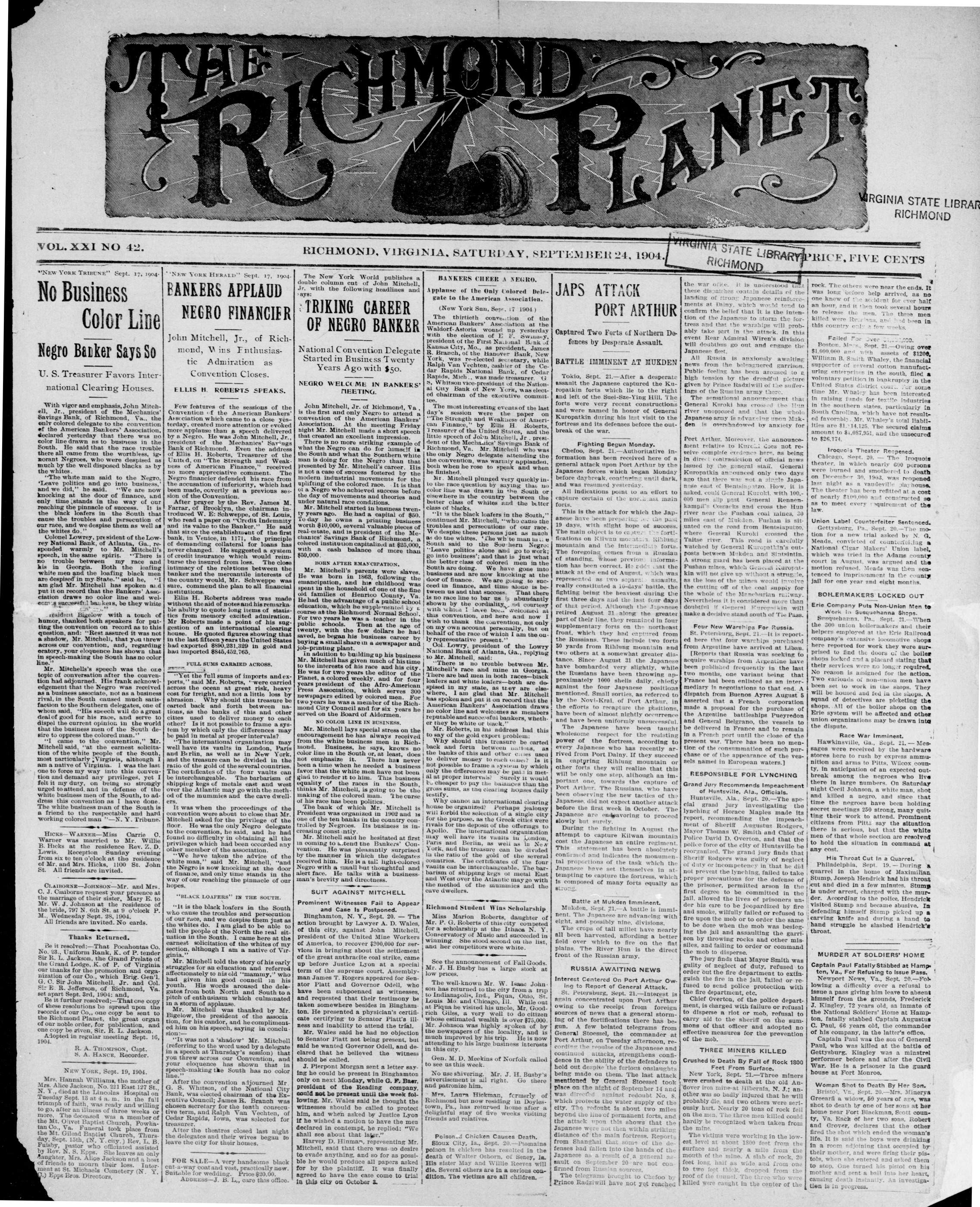
THE RICHMOND PLANET
VOL. XXI NO 42.
"NEW YORK TRIBUNE" Sept. 17, 1904
No Business Color Line Negro Banker Says So
U. S. Treasurer Favors International Clearing Houses.
With vigor and emphasis, John Mitchell, Jr., president of the Mechanics' Savings Bank, of Richmond, Va., the only colored delegate to the convention of the American Bankers' Association, declared yesterday that there was no color line drawn as to business in the South. He said that the race trouble there all came from the worthless, ignorant Negroes, who were despised as much by the well disposed blacks as by the whites.
"The white man said to the Negro, 'Leave politics and go into business,' and we did," he said. "We are now knocking at the door of finance, and only time stands in the way of our reaching the pinnacle of success. It is the black loafers in the South that cause the troubles and persecution of our race, and we despise them as well as the whites do."
Colonel Lowrey, president of the Lowrey National Bank, of Atlanta, Ga., responded warmly to Mr. Mitchell's speech, in the same spirit. "There is no trouble between my race and his in Georgia. Both the leafing white men and the loafing black men are despised in my State," said he, "I am glad Mr. Mitchell has spoken and put it on record that the Bankers' Association draws no color line and welcomes successful bankers, be they white."
resident Bigelow with a touch of humor, thanked both speakers for putting the convention on record as to this question, and: "Rest assured it was not a shadow, Mr. Mitchell, that you threw across our convention, and, regarding oratory, your eloquence has shown that in speech-making the South has no color line."
Mr. Mitchell's speech was the one topic of conversation after the convention had adjourned. His frank acknowledgment that the Negro was received as a business associate, not as a business rival, in the South caused much satisfaction to the Southern delegates, one of whom said, "His speech will do a great deal of good for his race, and serve to dispel the current opinion in the world that the business men of the South desire to oppress the colored man."
"I came to the convention," Mr. Mitchell said, "at the earnest solicitation of the white people of the South, most particularly Virginia, although I am a native of Virginia. I was the last one to force my way into this convention and demand any privileges, yet I felt it my duty, on being so strongly urged to attend, and in defense of the white business men of the South, to address this convention as I have done. The white business man of the South is a friend to the respectable and hard working colored man"—N. Y. Tribune.
HICKS—WARNER—Miss Carrie O.
Warner was married to Mr. Willie
B. Hicks at the residence Rev. Z. D.
Lewis. Reception Sunday evening
from six to ten o'clock at the residence
of Mr. and Mrs. Hicks, 1100 St. John
St. All friends are invited.
---
CLAIBORNE—JOHNSON—Mr. and Mrs. C. J. Cainore request your presence at the marriage of their sister, Mary E. to Mr. W. J. Johnson at the residence of the bride, 797 N. 6th St. at 9 o'clock P. M., Wednesday Sept. 28, 1904.
friends are invited. No cards.
Thanks Returned.
Be it resolved:—That Pocahontas Co. No. 23, Uniform Rank, K. of P. tender Sir R. L. Jackson, the Grand Prelate of the Grand Lodge, K. of P. of Virginia our thanks for the promotion and organization of our Co., which Brig. Gen'1. G. C. Sir John Mitchell, Jr. and Col. S. I. R. R. Jefferson, of Richmond, Va. set apart Sept. 3rd, 1904; and.
Be it further resolved:—That one copy of these resolutions be spread upon the records of our Co., one copy be sent to the Richmond Planet, the great organ of our noble order, for publication, and one copy be given, Sir R. L. Jackson.
Adopted in regular meeting Sept. 16, 1904.
R. A. THOMPSON, Capt.
S. A. HANCE, Recorder.
NEW YORK, Sept. 19, 1904
Mrs. Hannah Williams, the mother of Mrs. Alice Jackson, No. 221 East 127 St., N. Y., died at the Lincoln Hospital on Tuesday Sept. 13 at 4 a.m. in the fall triumph of faith, was ready and willing to go, after an illness of three weeks or more. The deceased was a member of the Mt. Oiver Baptist Church, Powhatan Co., Va. Funeral took place from the Mt. Gilead Baptist Church, Thursday, Sept. 15th, (N. Y. city.) Rev. L. B. Fuisby, pastor who officiated assisted by Rev. N. S. Epps. She leaves an only daughter, Mrs. Alice Jackson and a host of friends to mourn their loss. Interment at St. Michaels Cemetery (N. Y. O.) Epps Bros. Directors.
BANKERS APPLAUD
NEGRO FINANCIER
John Mitchell, Jr., of Richmond, Wins Enthusiastic Admiration as Convention Closes.
ELLIS H. ROBERTS SPEAKS.
Few features of the sessions of the Convention of the American Bankers' Association which came to a close yesterday, created more attention or evoked more applause than a speech delivered by a Negro. He was John Mitchell, Jr., president of the Mechanics' Savings Bank of Richmond. Even the address of Ellis H. Roberts, Treasurer of the United, on "The Strength and Weakness of American Finance," received no more appreciative comment. The Negro financier defended his race from the accusation of inferiority, which had been made, coverty at a previous session of the Convention.
After prayer by the Rev. James M. Farrar, of Brooklyn, the chairman introduced W. E: Schwepe, of St. Louis, who read a paper on "Credit Indemnity and its value to the Banker." He said that since the establishment of the first bank, in Venice, in 1171, the principle of demanding collateral for loans has never changed. He suggested a system of credit insurance which would reimburse the insured from loss. The close intimacy of the relations between the banker and the mercantile interests of the country would, Mr. Schwepe was sure, commend the plan to all financial institutions.
Ellis H. Roberts address was made without the aid of notes and his remarkable ability to quote long items of statistics from memory admiration. Mr Roberts made a point of his suggestion of an international clearing house. He quoted figures showing that in the last fifteen years the United States had exported $890,231,329 in gold and had imported $845,452,765.
FULL SUMS CARRIED ACROSS.
"Yet the full sums of imports and exports," said Mr. Roberts, "were carried across the ocean at great risk, heavy cost for freight, and not a little loss by abrasion. Why should this treasure be carted back and forth between nations, as the banks of this and other cities used to deliver money to each other? Is it not possible to frame a system by which only the differences may be paid in metal at proper intervals? "The international organization may well have its vaults in London, Paris and Berlin, as well as in New York, and the treasure can be divided in the ratio of the gold of the several countries. The certificates of the four vaults can be interchangeable. The barbarianism of shipping kegs of metals cast and west over the Atlantic may go with the method of the mummies and the cave dwellers.
It was when the proceedings of the convention were about to close that Mr. Mitchell asked for the privilege of the floor. He was the only Negro delegate to the convention, he said, and he had found no difficulty in obtaining all the privileges which had been accorded any other member of the association.
"We have taken the advice of the white man," said Mr. Mitchell, "and the Negro is now knocking at the door of finance, and only time stands in the way of our reaching the pinnacle of our hopes.
"BLACK LOAFERS" IN THE SOUTH.
"It is the black loafers in the South who cause the troubles and persecution of our race, and we despise them just as the whites do. I am glad to be able to tell the people of the North the real situation in the South. I came here at the earnest solicitation of the whites of my section, although I am a native of Virginia."
Mr. Mitchell told the story of his early struggles for an education and referred affectionately to his old "mammy," who had given him good council in his youth. His words aroused the delegates from both North and South to a pitch of enthusiasm which culminated in a storm of applause.
Mr. Mitchell was thanked by Mr. Bigelow, the president of the association, for his candor, and he complimented him on his speech, saying in conclusion:—
"It was not a 'shadow' Mr. Mitchell (referring to the word used by a delegate in a speech at Thursday's session) that you threw across our Convention, and your eloquence has shown that in speech-making the South has no color line."
After the convention a journed Mr. G. S. Whitson, of the National City Bank, was elected chairman of the Executive Council; James R. Branch was chosen secretary for the tenth consecutive term, and Ralph Van Vechten, of Cedar Rapids, Iowa, was selected for treasurer.
After the theatres closed last night the delegates and their wives began to leave the city for their homes.
FOR SALE—A very handsome black cut-a-way coat and vest, practically new. Suitable for wedding. Price $20.00.
Address—L. R. L. care these offices.
RICHMOND, VIRGINIA, SATURDAY, SEPTEMBER 24, 1904.
The New York World publishes a double column cut of John Mitchell, Jr. with the following headlines and says:
BANKERS CHEER A NEGRO.
Applause of the Only Colored Dele- JAPS ATTACK
TRJKING CAREER OF NEGRO BANKER
National Convention Delegate Started in Business Twenty Years Ago with $50.
NEGRO WELCOME IN BANKERS MEETING.
John Mitchell, Jr. of Richmond, Va., is the first and only Negro to attend a convention of the American Bankers' Association. At the meeting Friday night Mr. Mitchell made a short speech that created an excellent impression. There is no more striking example of what the Negro can do for himself in the South and what the Southern white man is doing for the Negro than that presented by Mr. Mitchell's career. His is not a case of success fostered by the modern industrial movements or the uplifting of the colored race. It is that at a Negro who achieved success before the day of movements and theories and under natural race conditions. Mr. Mitchell started in business twenty years ago. He had a capital of $50. To day he owns a printing business worth $10,000, several valuable pieces of real estate, and is president of the Mechanies' Savings Bank of Richmond, a colored institution capitalized at $25,000, with a cash balance of more than $50,000.
BORN AFTER EMANCIPATION.
Mr. Mitchell's parents were slaves. He was born in 1863, following the emancipation, and his childhood was spent in the household of one of the first old families of Henrico County, Va. He had the advantage of a public school education, which he supplemented by a course at the Richmond Normal School. For two years he was a teacher in the public schools. Then at the age of twenty, with the few dollars he had saved, he began his business career by buying a small share in a newspaper and job-printing plant.
In addition to building up his business Mr. Mitchell has given much of his time to the interests of his race and his city. He was for two years the editor of the Planet, a colored weekly, and for four years president of the Afro-American newspaper organization which serves 300 newspapers published in men. For two years he was a member of the Richmond City Council and for six years he served on the Board of Aldermen.
NO COLOR LINE IN BUSINESS.
Mr. Mitchell lays special stress on the encouragement he has always received from the white business men in Richmond. Business, he says, knows no color line in the South or, at least, does not emphasize it. There has never been a time when he needed a business favor that the white men have not been glad to render it to him. This business equality of the races in the South, thinks Mr. Mitchell, is going to be the making of the colored man. The curse of his race has been politics. The bank of which Mr. Mitchell is President was organized in 1902 and is one of the ten banks in the country controlled by Negroes. Its business is increasing constantly. Mr. Mitchell said he hesitated at first in coming to a tend the Bankers' Convention. He was pleasantly surprised by the manner in which the delegates received him. He is a tall, light-colored Negro with a small but thoughtful and alert face. He talks with a businessman's brevity and directness.
SUIT AGAINST MITCHELL
Prominent Witnesses Fail to Appear and Case Is Postponed
Binghamton, N. Y., Sept. 20. — The action brought by Lawyer A. D. Wales, of this city, against John Mitchell, president of the United Mine Workers of America, to recover $200,000 for services in bringing about the settlement of the great anthracite coal strike, came up before Justice Lyon at a special term of the supreme court. Assemblyman James T. Rogers appeared for Senator Platt and Governor Odell, who have been subpoenaed as witnesses, and requested that their testimony be taken somewhere besides in Binghamton. He presented a physician's certificate certifying to Senator Platt's illness and inability to attend the trial. Mr. Wales said he had no objection to Senator Platt not being present, but said he wanted Governor Odell, and declared that he believed the witness should be called.
J. Pierpoint Morgan sent a letter saying he could be present in Binghamton only on next Monday, while G. F. Baer, president of the Reading company, could not be present until the week following. Mr. Wales said he thought the witnesses should be called to protect him, and when asked by Justice Lyon if he wished a motion to have the men declared in contempt, he replied: "We shall see about that later." Harvey D. Hinman, representing Mr. Mitchell, said that there was no desire to evade anything, and so for as possible he would produce all papers asked for by the plaintiff. It was finally agreed to have the case come to trial in this city on October 2.
BANKERS CHEER A NEGRO.
Applause of the Only Colored Delegate to the American Association.
(New York Sun, Sep. (7, 1904.)
The tibirth convention of the American Bankers' Association at the Waldorf-Astoria wound up yesterday with the election of E F. Swainey, president of the First National Bank of Kansas City, Mo., as president, James R. Branch, of the Hanover Bank, New York, was re-elected secretary, while Ralph Van Vechten, cashier of the Cedar Rapids National Bank, of Cedar Rapids, Mich., was made treasurer. G S. Whitson vice-president of the National City Bank of New York, was elected chairman of the executive committee.
The most interesting events of the last day's session were the paper on "The Strength and Weakness of American Finance" by Ellis H. Roberts, treasurer of the United States, and the little speech of John Mitchell, Jr. president of the Mechanics' Savings Bank of Richmond, Va. Mr. Mitchell was the only Negro delegate attending the convention, was warmly applauded, both when he rose to speak and when he finished.
Mr. Mitchell plunged very quickly into the race question by saying that no color line was drawn in the South or elsewhere in the country between the better class of whites and the better class of blacks.
"It is the black leafers in the South," continued Mr. Mitchell, "who cause the troubles and persecutions of our race. We despise these persons just as much as do the whites. "The whie man in the South said to the Southern Negro: "Leave politics alone and go to work; go into business"; and that is just what the better class of colored men in the South are doing. We have gone into business and are now knocking at the door of finance. We are going to succeed in finance, and time alone is between us and that success. That there is no race line to bar us is abundantly shown by the cordiality, and courtesy with which I have been welcomed at this convention, and here and now I wish to thank the convention, not only on my own account personally, but on behalf of the race of which I am the only representative present."
Col Lowry, president of the Lowry National Bank of Atlanta, Ga., replying to Mr. Mitchell, said: "There is no trouble between Mr. Mitchell's race and mine in Georgia. There are bad men in both races—black loafers and white loafers—both are despised in my state, as they are elsewhere. I am glad that Mr. Mitchell has spoken and put it on record that the American Bankers' Association draws no color line and welcomes as members reputable and successful bankers, whether they be white or black." Mr. Roberts, in his address had this to say of the gold export problem:
Why should this treasure be carted back and forth between nations, as the banks of this and other cities used to deliver money to each other? Is it not possible to frame a system by which only the differences may be paid in metal at proper intervals? Surely it would be cheaper to pay the balances than the gross sums, as the clearing houses daily testify.
Why cannot an international clearing house be organized? Perhaps jealousy will forbid the selection of a single city for the purpose, as the Greek cities were rivals for the deposit of the offerings to Apollo. The international organization may well have its vanities in London, Paris and Berlin, as well as in New York, and the treasure can be divided in the ratio of the gold of the several countries. The certificates of the four vanits can be interchangeable. The barbarism of shipping kegs of metal East and West over the Atlantic may go with the method of the mummies and the cave dwellers.
Richmond Student Wins Scholarship
Miss Marion Roberts, daughter of Mr. P. G. Roberts of this city competed for a scholarship at the Ithaca N. Y. Conservatory of Music and succeeded in winning. She stood second on the list, and her competitors were white.
See the announcement of Fall Goods. Mr. J. H. Busby has a large stock at low prices.
The well-known Mr. W. Isaac Johnson has returned to the city from a trip to Indianapolis, Ind., Piqua, Ohio, St. Louis Mo. and Chicago, Ill. While out at Piqua he visited his uncle, Mr. Goodrich Giles, a very well to do citizen whose estimated wealth is over $75,000. Mr. Johnson was highly spoken of by the newspapers of the locality, and is much improved by his trip. He is now attending to his large business interests in this city.
Gen. M. D. Meekins of Norfolk called to see us this week.
No use shivering. Mr. J. H. Busy's advertisement is all right. Go there and patronize him.
Mrs. Laura Hickman, formerly of Richmond but now residing in Doylestown, Pa., has returned home after a delightful stay of five weeks visiting friends and relatives.
Poisoned Chicken Causes Death
Sloux City, Ia., Sept. 20.—Pomina polson in chicken has resulted in the death of Walter Osborn, of Seney, Ia. His sister May and Willie Reeves will die. Several others are in a serious condition. The victims are all children.
JAPS ATTACK
PORT ARTHUR
Captured Two Forts of Northern Defences by Desperate Assault.
BATTLE IMMINENT AT MUKDEN
Tokio, Sept. 21.—After a desperate assault the Japanese captured the Kuropatkin forts which lie to the right and left of the Suei-Sze-Ying Hill. The forts were very recent constructions and were named in honor of General Kuropatkin during his last visit to the fortress and its defenses before the outbreak of the war.
Fighting Begun Monday.
Chefoo, Sept. 21.—Authoritative information has been received here of a general attack upon Port Arthur by the Japanese forces which began Monday before daybreak, continuing until dark, and was resumed yesterday. All indications point to an effort to capture certain of the north east main forts.
This is the attack for which the Japanese have been preparing for the past 19 days, with slight hope of success. The main object is to capture the fortifications on Kilwan mountain, Rihlung mountain and the intermediate forts. The foregoing comes from a Russian of standing, whose previous information has been correct. He rides that the attack at the end of August, which was represented as two separatist assaults, really constituted a 10-day's battle, the fighting being the heaviest during the first three days and the last four days of that period. Although the Japanese retired August 31 along the greater part of their line, they remained in four supplementary forts on the northeast front, which they had captured from the Russians. These include two forts 50 yards from Rihlung mountain and two others at a somewhat greater distance. Since August 31 the Japanese have bombarded very slightly, while the Russians have been throwing approximately 1000 shells daily, chiefly against the four Japanese positions mentioned. Small sorties, as referred to by the Novi-Krai, of Port Arthur, in the efforts to recapture the positions, have been of almost nightly occurrence and have been uniformly unsuccessful.
The Japanese have been taught wholesome respect for the resisting power of the fortress, according to every Japanese who has recently arrived from Port Dalny. If they succeed in capturing Rihlung mountain or other forts they will realize that this will be only one step, although an important one, towards the capture of Port Arthur. The Russians, who have been observing the new tactics of the Japanese, did not expect another attack before the first week in October. The Japanese are endearing to proceed slowly but surely.
During the fighting in August the attempt to capture Kilwan mountain cost the Japanese an entire regiment. This statement has been absolutely confirmed and indicates the monumental proportions of the task which the Japanese have set themselves in attempting to capture the fortress, which is composed of many forts equally as strong.
Battle at Mukden Imminent
Mukden, Sept. 21.—A battle is imminent. The Japanese are advancing with eight, and possibly nine, divisions. The crops of tall millet have nearly all been harvested, affording a better field over which to fire on the flat plains. The River Hun is the direct front of the Russian army.
RUSSIA AWAITING NEWS
Interest Centered On Port Arthur Ow
ing to Report of General Attack.
St. Petersburg, Sept. 21.—Interest is again concentrated upon Port Arthur owing to the receipt from foreign sources of news that a general storming of the fortifications there has begun. A few belated telegrams from General Stoessel, the commander at Port Arthur, on Tuesday afternoon, recording the repulse of the Japanese and continued attacks, strengthens confidence in the ability of the defenders to hold out despite the furious onslaughts being made on them. The last attack mentioned by General Stoessel took place on the night of September 14 and was directed against redoubt No. 8, which protects the water supply of the city. The redoubt is about two miles beyond the line of permanent forts, and the attack upon this shows that the Japanese were not then within striking distance of the main fortress. Reports from Shanghai that some of the defenses had fallen into the hands of the Japanese as a result of a general assault on September 20 are not confirmed from Russian sources.
The telegrams brought to Chefoo by Prince Radziwill have not yet reached
the war office. It is understood that these dispatches contain details of the landing of strong Japanese reinforcements at Dainy, which would tend to confirm the belief that it is the intention of the Japanese to storm the fortress and that the warships will probably take part in the attack. In this event Rear Admiral Wiren's division will doubtless go out and engage the Japanese fleet.
All Russia is anxiously awaiting news from the beleaguered garrison. Public feeling has been aroused to a high tension by the dreadful picture given by Prince Radzilwill of the sufferings of the Russian army there.
The sensational announcement that General Kuroki has crossed the Hiru river unopposed and that the whole Japanese army is advancing upon Mukden is overshadowed by anxiety for
Port Arthur. Moreover, the announcement relative to Kuroki does not receive complete credence here, as being in direct contradiction of official news issued by the general staff. General Kuropatkin announced only two days ago that there was not a single Japanese east of Bentsilaputzo. How, it is asked, could General Kuropatki, with 100,000 men slip past General Rennenkampfil's Cossacks and cross the Hun river near the Fushan coal mines, 30 miles east of Mukden. Fushan is situated on the road from Bentsilaputzo, where General Kuroki crossed the Taltse river. This road is carefully watched by General Kuropatkin's outposts between Mukden and Sintintin. A strong guard has been placed at the Fushan mines, which General Kuropatkin will not give up without a struggle, as the loss of the mines would involve the cutting off of the coal supply for the whole of the Manchurian railway. Nevertheless it is considered more than doubtful if General Kuropatkin will make a decisive stand south of Tie Pass.
Four New Warships For Russia.
St. Petersburg, Sept. 21.—It is reported here that four warships purchased from Argentine have arrived at Libau. [Reports that Russia was seeking to acquire warships from Argentine have been published frequently in the last two months, one variant being that France had been enlisted as an intermediary in negotiations to that end. A dispatch from Buenos Ayres August 5 asserted that a French corporation made a proposal for the purchase of the Argentine battleships Pueyredon and General Belgrano, the vessels to be delivered in France and to remain in a French port until the close of the present war. There has been no mention of the consummation of such purchase or of the appearance of the vessels named in European waters.]
RESPONSIBLE FOR LYNCHING
Huntsville, Ala., Sept. 20.—The special grand jury investigating the lynching of Horace Maples made its report, recommending the impeachment of Sheriff Augustus Rodgers, Mayor Thomas W. Smith and Chief of Police David D. Overton, and that the police force of the city of Huntsville be reorganized. The grand jury finds that Sheriff Rodgers was guilty of neglect of duty or incompetency in that he did not prevent the lynching, failed to take proper precautions for the defense of the prisoner, permitted arson in the first degree to be committed in the jail, allowed the lives of prisoners under his care to be jeopardized by fire and smoke, wilfully failed or refused to fire upon the mob or to order the same to be done when the mob was besieging the jail and assaulting the garrison by throwing rocks and other missiles, and failing to order or command the mob to disperse.
The jury finds that Mayor Smith was guilty of neglect of duty, refused to order out the fire department to extinguish the fire in the jail, failed or refused to send police protection with the fire department, etc.
Chief Overton, of the police department, is charged with failure or refusal to disperse a riot or mob, refusal to carry aid to the sheriff on the summons of that officer and adopted no effective measures for the prevention of the mob.
THREE MINERS KILLED
Crushed to Death By Fall of Rock 1800
Feet From Surface.
New York, Sept. 21.—Three miners were crushed to death at the old Andover iron mine at Hibernia, N. J.; another was so badly injured that he will probably die, and two others were seriously hurt. Nearly 20 tons of rock fell on the men. The three men killed could hardly be recognized when taken from the mine.
The victims were working in the lowest level at about 1800 feet from the surface and nearly a mile from the mouth of the mine. A slab of rock, 20 feet long, half as wide and from one to two feet thick, dropped from the roof of the tunnel. The three who were killed were caught in the center of the
RGINIA STATE LIBRAR
RICHMOND
rock. The others were near the ends. It was long before help arrived, as no one knew of the accident for over half an hour, and it then took several hours to release the men. The three men killed were Rutgers, and had been in this country only a few weeks.
Failed For Over $1,125,000.
Boston, Mass., Sept. 21.—Owing over $1,600,000 and with assets of $1200, William B. Smith Whaley, the financial supporter of several cotton manufacturing enterprises in the south, filed a voluntary petition in bankruptcy in the United States district court. For some time Mr. Whaley has been interested in raising funds for textile industries in the southern states, particularly in South Carolina, which have not resulted favorably. Mr. Whaley's total liabilities amount to $1,141,125. The secured claims amount to $1,087,951, and the unsecured to $26,174.
Iroquois Theater Reopened
Chicago, Sept. 20. — The Iroquois theater, in which nearly 600 persons were burned and smothered to death on December 30, 1903, was reopened last night as a vaudeville playhouse. The theater has been refitted at a cost of nearly $100,000 and constructed so as to meet every requirement of the law.
Union Label Counterfeiter Sentenced, Gettyburg, Pa., Sept. 20. — The motion for a new trial asked by N. G. Meads, convicted of counterfeiting a National Cigar Makers' Union label, which was tried in the Adams county court in August, was argued and the motion refused. Meads was then sentenced to imprisonment in the county jail for one year and eight months.
BOHLERMAKERS LOCKED OUT
Erie Company Puts Non-Union Men to Work In Susquehanna Shops
Susquehanna, Pa., Sept. 21.—When the 300 union boilermakers and their helpers employed at the Erie Railroad company's extensive locomotive shops here reported for work they were surprised to find the doors of the boiler shops locked and a placard stating that their services were no longer required. No reason is assigned for the action. Two carloads of non-union men have been set to work in the shops. They will be housed and fed in the shops. A squad of detectives are picketing the shops. All of the boiler shops on the Erie system will be affected and other union organizations may be drawn into the dispute.
Race War Imminent
Hawkinsville, Ga., Sept. 21. — Messages were received by the hardware stores here to rush by express ammunition and arms to Pitts, Wilcox county, in anticipation of an expected outbreak among the negroes who live there in large numbers. On Saturday night Cecil Johnson, a white man, shot and killed a negro, and since that time the negroes have been holding secret meetings 250 strong, many quitting their work to attend. Prominent citizens from Pitts say the situation there is serious, but that the white men of that whole section are resolved to hold the situation in command at any cost.
His Throat Cut in a Quarrel.
Philadelphia, Sept. 19. — During a quarrel in the home of Maximilian Stump, Joseph Hendrick had his throat cut and died in a few minutes. Stump is under arrest, charged with the murder. According to the police, Hendrick visited Stump and became abusive. In defending himself Stump picked up a carving knife and during a hand to hand struggle he slashed Hendrick's throat.
MURDER AT SOLDIERS' HOME
Captain Paul Fatally Stabbed at Hamp
Captain Paul Fannah Scalebaker at Hampton, Va., For Refusing to issue Pass.
Newport News, Va., Sept. 20. Following a difficulty over a refusal to issue a pass giving him leave to absent himself from the grounds, Frederick J. Kingley, 72 years old, an inmate of the National Soldiers' Home at Hampton, fatally stabbed Captain Augustus C. Paul, 66 years old, the commander of his company, in the latter's office.
Captain Paul was the son of General Paul, who was killed at the battle of Gettysburg. Kingley was a minstrel performer before and after the Civil War. He is a prisoner in the guard house at Fort Monroe.
Woman Shot to Death By Her Son.
Bristol, Va., Sept. 20—Mrs. Minerya
Greerarth a widow, 50 years of age, was
shot to death by one of her sons at her
home near Fort Blackman, Scott county,
Va. Each of her two sons, Robert
and Grover, declares that the other
fired the shot which ended the woman's
life. It is said the boys were drinking
in a room adjoining that occupied by
their mother, and were firing their pistols, when she entered and asked them to stop. One turned his pistol on his mother and sent a ball into her heart, causing death instantly. An investigation is in progress.
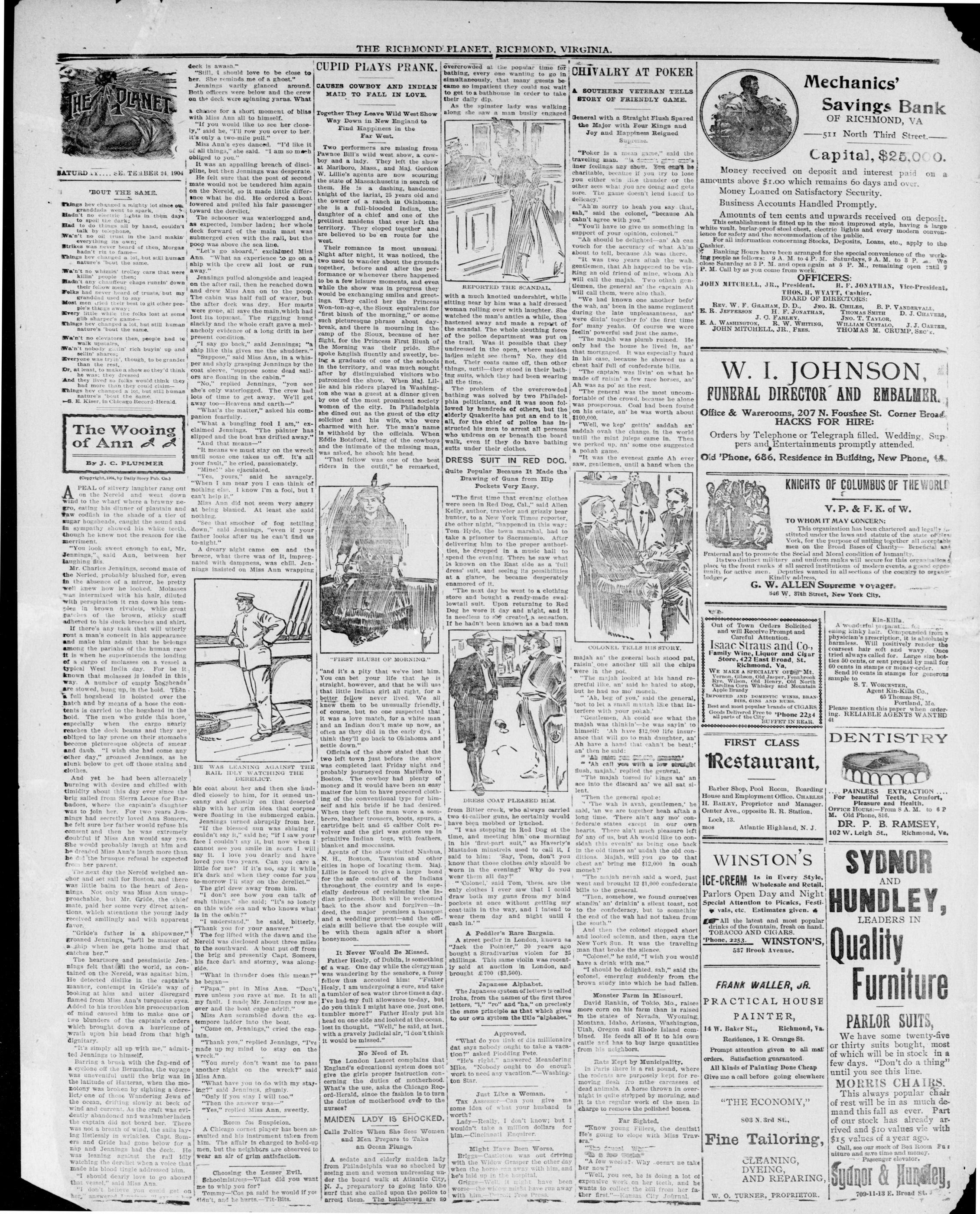
THE PLANET
BATURDAY... SE. TEMBER 24, 1904
'BOUT THE SAME.
Fangs he changed a mighty lot since our granddads went to spark.
India they made them demi-
Wan't no oil trust in the land makin'
everything its own;
everything its own;
Stirrer was never heard of then, Morgan
had heard of it.
Things hev changed a lot, but still human
nature's 'bout the same.
Things hev changed a lot, but still human nature's 'bout the same.
Wa'n't no elevators then, people had to walk upstairs.
Wa'n't nobody kailin' rich buyin' up and sellin' shares;
Everyone was trin', though, to be grander than the rest.
S. E. Kiser, in Chicago Record-Herald.
The Wooing of Ann
By J. C. PLUMMER
(Copyright, 1904, by Daily Story Pub. Co.)
PEAL of silvery laughter rang out on the Nereld and went down wind to the wharf where a brawny negro, eating his dinner of plantain and raw codfish in the shade of a tier of sugar hogsheads, caught the sound and in sympathy showed his white teeth, though he knew not the reason for the merriment.
"You look sweet enough to eat, Mr. Jennings," said Ann, between her laughing fits.
Mr. Charles Jennings, second mate of the Neried, probably blushed for, even in the absence of a mirror, he pretty well knew how he looked. Molasses was intermixed with his hair, diluted with perspiration it ran down his temples in brown rivulets, while great patches of the brown, sticky stuff adhered to his duck breeches and shirt.
If there's any task that will utterly rout a man's conceit in his appearance and make him admit that he belongs among the pariahs of the human race it is when he superintends the loading of a cargo of molasses on a vessel a typical West India day. For be it known that molasses is loaded in this way. A number of empty hogsheads are stowed, bung up, in the hood. Then full hogshead is hoisted over the hatch and by means of a hose the contents is carried to the hogshead in the hood. The men who guide this hose, especially when the cargo nearly reaches the deck beams and they are obliged to lay prone on their stomachs become picturesque objects of smear and daub. "I wish she had come any other day," groaned Jennings, as he slunk below to get off those stains and clothes.
And yet he had been alternately burning with desire and chilled with timidity about this day ever since the brig sailed from Sierra Leone for Barbados, where the captain's daughter was to join her. For two years Jennings had secretly loved Ann Somers, he felt sure her father would refuse his consent and then he was extremely doubtful if Miss Ann would say yes. She would probably laugh at him and he dreaded Miss Ann's laugh more than he did the brusque refusal he expected from her parent.
The next day the Nercid weighed anchor and set sail for Boston, and there was little balm to the heart of Jennings. Not only was Miss Ann unapproachable, but Mr. Gride, the chief mate, paid her some very direct attentions, which attentions the young lady received smilingly and with apparent favor.
"Gride's father is a shipowner," groaned Jennings, "he'll be master of a ship when he gets home and that catches her."
The heartsore and pessimistic Jennings felt that all the world, as contained on the Nereid, was against him. He detected dislike in the captain's manner, contempt in Gride's way of looking at him and utter disregard flamed from Miss Ann's turquoise eyes. Added to his troubles his preoccupation of mind caused him to make one or two blunders of the captain's orders which brought down a hurricane of wrath upon his head from that high dignitary.
"It's simply all up with me," admitted Jennings to himself.
Barring a brush with the fag-end of a cyclone off the Bermudas, the voyage was uneventful until the brig was in the latitude of Hatteras, when the monotony was broken by sighting a derelict; one of those Wandering Jews of the ocean, drifting slowly at beck of wind and current. As the craft was evidently abandoned and wasnumberladen the captain did not board her. There was not a breath of wind, the sails laying listlessly in wrinkles. Capt. Somers and Gride had gone below for a nap and Jennings had the deck. He was leaning against the rail idly watching the derelict when a voice that made his blood tingle addressed him. "I should dearly love to go aboard that vessel," said Miss Ann. "I don't believe you could get on her," answered Jamison. "I give you her
deck is awash.
"Still. I should love to be close to her. She reminds me of a ghost." Jennings warily glanced around. Both officers were below and the crew on the deck were spinning yarns. What a chance for a short moment of bliss with Miss Ann all to himself.
"If you would like to see her closely," said he, "I'll row you over to her. it's only a two-mile pull."
Miss Ann's eyes danced. "I'd like it of all things," she said. "I am so much obliged to you."
It was an appalling breach of discipline, but then Jennings was desperate. He felt sure that the post of second mate would not be tendered him again on the Nereid, so it made little difference what he did. He ordered a boat lowered and pulled his fair passenger toward the derelict.
The schooner was waterlogged and, as expected, lumber laden; her whole deck forward of the main mast was submerged even with the rail, but the poop was above the sea line.
"Let's go aboard," exclaimed Miss Ann. "What an experience to go on a ship with the crew all lost or run away."
Jennings pulled alongside and leaped on the after rail, then he reached down and drew Miss Ann on to the poop. The cabin was half full of water, but the after deck was dry. Her masts were gone, all save the main, which had lost its topmast. The rigging hung slackly and the whole craft gave a melanolych evidence of a long drift in her present condition.
"I say go back," said Jennings; "a ship like this gives me the shudders." "Suppose," said Miss Ann, in a whisper and shyly grasping Jennings by the coat sleeve, "suppose some dead sailors are floating in the cabin."
"No," replied Jennings, "you see she's only waterlogged. The crew had lots of time to get away. We'll get away too—Heavens and earth."
"What's the matter," asked his companion fearfully.
"What a bungling fool I am," exclaimed Jennings. "The painter has slipped and the boat has drifted away."
"And that means—"
"It means we must stay on the wreck until some one takes us off. It's all your fault," he cried, passionately.
"Mine!" she ejaculated.
"Yes, yours," said he savagely.
"When I am near you I can think of nothing else. I know I'm a fool, but I can't help it."
Miss Ann did not seem very angry at being blamed. At least she said nothing.
"See that smother of fog settling down," said Jennings, "even if your father looks after us he can't find us to-night."
A dreary night came on and the breeze, what there was of it, impregnated with dampness, was chill. Jennings insisted on Miss Ann wrapping
A
HE WAS LEANING AGAINST THE RAIL IDLY WATCHING THE DERELICT.
his coat about her and then she huddled closely to him, for it seemed uncanny and ghostly on that deserted ship with her grim idea that corpses were floating in the submerged cabin. Jennings turned abruptly from her.
"If the blessed sun was shining I couldn't say it," said he; "if I saw your face I couldn't say it, but now when I cannot see you smile in scorn I will say it. I love you dearly and have loved you two years. Can you care a little for me? If it's no, say it while it's dark and when they come for you to-morrow I'll stay on the derelict."
The girl drew away from him.
"I don't see how you can talk of such things" she said; "it's so lonely on this wide sea and who knows what is in the cabin?"
"I understand," he said, bitterly.
"Thank you for your answer."
The fog lifted with the dawn and the Nereid was disclosed about three miles to the southward. A boat put off from the brig and presently Capt. Somers, his face dark and stormy, was along-side.
"What in thunder does this mean?" he began—
"Papa," put in Miss Ann. "Don't rave unless you rave at me. It is all my fault. I made Mr. Jennings row me over and the boat came adrift."
Miss Ann scrambled down the extempore ladder into the boat.
"Come on, Jennings," cried the captain.
"Thank you," replied Jennings, "I've made up my mind to stay on the wreck."
"You surely don't want me to pass another night on the wreck?" said Miss Ann.
"What have you to do with my staring?" said Jennings, glumly.
"Yes," replied Miss Ann, sweetly.
Room 201 Suspicion.
A Chicago cornet player has been assaulted and his instrument taken from him. The affair is charged to hold-up men, but the neighbors are observed to wear an air of grim satisfaction.
Choosing the Lesser 2011.
Schoolmistress What did you want me to do for you?
Tommy - Cos pa said he would if you didn't, and he hurts. - Tit-Bits.
THE RICHMOND PLANET, RICHMOND, VIRGINIA.
CAUSES COWBOY AND INDIAN
MAID TO FALL IN LOVE.
Together They Leave Wild West Show
Way Down in New England to
Find Happiness in the
Far West.
Two performers are missing from
Pawnee Bill's wild west show, a cowboy and a lady. They left the show at Mariboro, Mass., and Maj. Gordon W. Lillie's agents are now scouring the state of Massachusetts in search of them. He is a dashing, handsome knight of the lariat, 25 years old and the owner of a ranch in Oklahoma; she is a full-blooded Indian, the daughter of a chief and one of the prettiest maidens that ever left the territory. They eloped together and are believed to be en route for the west.
Their romance is most unusual. Night after night, it was noticed, the two used to wander about the grounds together, before and after the performance or whenever there happened to be a few leisure moments, and even while the show was in progress they would be exchanging smiles and greetings. They called her the Princess Won-ton-ay-e, the Sioux equivalent for "first blush of the morning," or some such picturesque phrase about daybreak, and there is mourning in the camp of the Sioux, because of her flight, for the Princess First Blush of the Morning was their pride. She spoke English fluently and sweetly, being a graduate of one of the schools in the territory, and was much sought after by distinguished visitors who patronized the show. When Maj. Lillie and his riders played in Washington she was a guest at a dinner given by one of the most prominent society women of the city. In Philadelphia she dined out as the guest of the city solicitor and his wife, who were charmed with her. The man's name is withheld by the officials. When Eddie Botsford, king of the cowboys and the intimate of the missing man, was asked, he shook his head.
"That fellow was one of the best riders in the outfit," he remarked.
TOMMY
"FIRST BLUSH OF MORNING."
"and it's a pity that we've lost him. You can bet your life that he is straight, however, and that he will use that little Indian girl all right, for a better fellow never lived. We all knew them to be unusually friendly, of course, but no one suspected that it was a love match, for a white man and an Indian don't mate up now, as often as they did in the early dys. I think they'll go back to Oklahoma and settle down."
Officials of the show stated that the two left town just before the show was completed last Friday night and probably journeyed from Marlboro to Boston. The cowboy had plenty of money and it would have been an easy matter for him to have procured clothing of the conventional type for himself and his bride if he had desired. When they left the man wore a sombrero, leather trousers, boots, spurs, a cartridge belt and 45 caliber Colt revolver and the girl was gotten up in primitive Indian togs, with feathers, blanket and moccasins.
Agents of the show visited Nashua, N. H., Boston, Taunton and other cities in hope of locating them. Maj. Lillie is forced to give a large bond for the safe conduct of the Indians throughout the country and is especially desirous of reclaiming the Indian princess. Both will be welcomed back to the show and forgiven—indeed, the major promises a banquet and a wedding present—and the officials still believe that the couple will be with them again after a short honeymoon.
It Never Would Be Missed.
Father Healy, of Dublin, is something of a wag. One day while the clergyman was wandering by the seashore, a fussy fellow thus accosted him: "Father Healy, I am undergoing a cure, and take a tumbler of sea water three days a day. I've had my full allowance to-day, but do you think I might have one, just one, tumbler more?" Father Healy put his head on one side and looked at the ocean, lost in thought. "Well," he said, at last, with a gravely judicial air, "I don't think it would be missed."
No Need of It.
The London Lancet complains that England's educational system does not give the girls proper instruction concerning the duties of motherhood. What's the use, asks the Chicago Record-Herald, since the fashion is to turn the duties of motherhood over to the nurses?
MAIDEN LADY IS SHOCKED.
Calls Police When She Sees Women and Men Prepare to Take an Ocean Plunge.
A sedate and elderly malden lady from Philadelphia was so shocked by seeing men and women undressing under the board walk at Atlantic City, N. J., preparatory to going into the surf that she called upon the police to arrest them. The bathhouses are so
overcrowded at the popular time for bathing, every one wanting to go in simultaneously, that many guests became so impatient they could not wait to get to a bathhouse in order to take their daily dip. As the spinster lady was walking along she saw a man busily engaged
REPORTED THE SCANDAL.
with a much knotted undershirt, while sitting near by him was a half dressed woman rolling over with laughter. She watched the man's anties a while, then hastened away and made a report of the scandal. The whole sleuthing force of the police department was put on the trail. Was it possible that they undressed in the open, where maiden ladies might see them? No, they did not. Their coats came off, then other things, until—they stood in their bathing suits, which they had been wearing all the time.
The problem of the overcrowded bathing was solved by two Philadelphia politicians, and it was soon followed by hundreds of others, but the elderly Quakerite has put an end to it all, for the chief of police has instructed his men to arrest all persons who undress on or beneath the board walk, even if they do have bathing suits under their clothes.
DRESS SUIT IN RED DOG.
Quite Popular Because It Made the Drawing of Guns from Hip Pockets Very Easy.
"The first time that evening clothes were seen in Red Dog, Cal," said Allen Kelly, author, traveler and grizzly bear hunter, to a New York Times reporter, the other night, "happened in this way: Tom Hyde, the town marshal, had to take a prisoner to Sacramento. After delivering him to the proper authorities, he dropped in a music hall to spend the evening. There he saw what is known on the East side as a 'full dress' suit, and seeing its possibilities at a glance, he became desperately enamored of it.
"The next day he went to a clothing store and bought a ready-made swallowtail suit. Upon returning to Red Dog he wore it day and night, and it is needless to say created a sensation. If he hadn't been known as a bad man
A
DRESS COAT PLEASED HIM.
from Bitter creek, who always carried
two 44-caliber guns, he certainly would
have been mobbed or lynched.
"I was stopping in Red Dog at the
time, and meeting him 'one morning
in his 'first-part suit,' as Haverly's
Mastadon minstrels used to call it, I
said to him: 'Say, Tom, don't you
know that those clothes only should be
worn in the evening? Why do you
wear them all day?'
"Colonel," said Tom, 'these are the
only clothes I ever saw that I could
draw both my guns from my hind
pockets at once without getting my
coat taints in the way, and I intend to
wear them day and night until I
cash in."
A street pedler in London, known as "Jack the Pointer," 30 years ago bought a Stradivarius violin for 25 shillings. This same violin was recently sold at auction in London, and brought £700 ($3,500).
Japanese Alphabet
The Japanese system of letters is called Iroha, from the names of the first three letters, "i," "ro" and "ha," on precisely the same principle as that which gives to our own system the title "alphabet."
Approved.
"What do you think of my millionaire dat says nobody ought to take a vacation?" asked Plodding Pete.
"He's right." answered Meandering Mike. "Nobody ought to do enough work to need any vacation."—Washington Star.
Tax Assessor—Can you give me some idea of what your husband is worth?
Lady—Really, I don't know; but I wouldn't take a million dollars for him.—Cincinnati Enquirer.
Might Have Been Worse.
Briggs—Castleton was out driving with the Widow Grasper the other day when the horse run away with him, and he's laid up in the hospital.
Griggs—Well, it might have been worse—the widow might have run away with him.—Pennsylvania Press.
CHIVALRY AT POKER
A SOUTHERN VETERAN TELLS
STORY OF FRIENDLY GAME.
General with a Straight Flush Spared
the Major with Four Kings and
Joy and Happiness Reigned
Supreme.
"Poker is a mean game," said the
traveling man. "It is a game
inner feelings any show. You can't be
charitable, because if you try to lose
you either win like thunder or the
other sees what you are doing and gets
sore. The game doesn't lend itself to
delicacy."
"Ah'm sorry to heath you say that,
sah," said the colonel, "because Ah
cannot agree with you."
"You'll have to give us something in
support of your opinion, colonel."
"Ah should be delighted—an' Ah can
vouch for the accuracy of what Ah'm
about to tell, because Ah was there
"It was two years afah the wah, gentlemen, that Ah happened to be visiting an old friend of mine, whom Ah will call the majah. Two othah gentlemen, the general an' the captain Ah will call them, were also tha'.
"We had known one another befo' the wah, an' been in the same regiment during the late unpleasantness, an' were dinin' together fo' the first time for' many yeahs. Of course we were feelin' powerful sad just the same.
"The majah was plumb ruined. He only had the house he lived in, an' that mortgaged. It was especially hard in his case, because he showed us a chest half full of confederate bills.
"The captain was livin' on what he made off raisin' a few race horses, an' Ah was as po' as the rest.
"The general was the most uncomfortable of the crowd, because he alone was prosperous. Coal had been found on his estate, an' he was worth about $100,000.
"Well, we kop' gettin' saddah an' saddah ovah the change in the world until the mint juleps came in. Then we perked up, an' some one suggested a pokah game.
"It was the evenest game Ah ever saw, gentlemen, until a hand when the
M. W.
COLONEL TELLS HIS STORY.
majah an' the general both stood pat, raisin' one another till all the chips were in the pot.
"The majah looked at his hand regretful like, an' said he hated to stop, but he had no mo' monch.
" 'Ah, beg of you,' said the general, 'not to let a small mattah like that interfere with your pokah.'
"Gentlemen, Ah could see what the majah was thinkin'—he was sayin' to himself: 'Ah have $12,000 life insurance that will go to mah daughter, an' Ah have a hand that cahn't be beat,' an' then he said:
" 'Ah taken you $12,000, general,'
" 'Ah call you with a low throat flush, mah' replied the general.
"The majah tossed fo' kings an' an ace into the discard an' we all sat silent.
"Then the general spoke:
"The wah is avah, gentlemen," he said, "an we are together heah aftah a long time. There ain't any mo' confederate states except in our own hearts. There ain't much pleasure left fo' any of us, but Ah would like to considh this evenin' as being one back in the old times an' undah the old conditions. Majah, will you go to that chest an' bring me $12,000 in ouah moneh?"
"The majah nevah said a word, just went and brought 12 $1,000 confederate bills to the general.
"Then, somehow, we found ourselves standin' an' drinkin' a silent toast, not to the confederacy, but to somethin' the end of the wah had not taken from the south."
And then the colonel stopped short and looked solemn, and then, says the New York Sun. It was the travelling man that broke the silence.
"Colonel," he said, "I wish you would have a drink with me."
"I should be delighted, sah," said the colonel, emerging suddenly from the brown study into which he had fallen.
Monster Farm in Missouri
David Rankin, of Tokio, Mo., raises more corn on his farm than is raised in the states of Nevada, Wyoming, Montana, Idaho, Arizona, Washington, Utah, Oregon and Rhode Island combined. He feeds all of it to his own cattle and has to buy large quantities from his neighbors.
Rats Kent by Municipality.
In Paris there is a rat pound, where the rodents are purposely kept for removing flesh fro mthe carcasses of dead animals. A horse thrown in overnight is quite stripped by morning, and it is the regular work of the men in charge to remove the polished bones.
Far Sighted.
"Know young Fillers, the dentist! He's going to elope with Miss Travers."
"A few weeks?. Why doesn't he take her now?"
"Well, you see, he is doing a lot of expensive work on her teeth, and he wants to collect the bill from her father first."—Kansas City Journal.
Money received on deposit amounts above $1.00 which re-
Money Loaned on Satisfaction
Business Accounts Handler
Amounts of ten cents and
This establishment is fitted up in the white vault, burlar-proof steel chest, elec-
ence for safety and the accommodation is
For all information concerning Stock Cashier.
Banking Hours have been arranged ding people as follows: 9 A. M. to 4 P. M. close Saturday at 3 P. M. and open again P. M. Call by as you come from work.
OFFICI
JOHN MITCHELL, JR., President.
THOS. H. WY
BOARD OF F
REV. W. F. GRAHAM, D. D., JN
E. R. JEFFERSON H. F. JONATHAN,
J. O. FARLEY,
E. A. WASHINGTON, R. W. WHITING,
JOHN MITCHELL, JR., FRES.
W. I. JOHN
FUNERAL DIRECTOR
Office & Warerooms, 207 N.
HACKS F
Orders by Telephone or Tele-
pers and Entertainment
Old 'Phone, 686, Residence
ed on deposit and interest
to which remains 60 days a
on Satisfactory Security.
ents Handled Promptly.
cents and upwards receive
tuted up in the most improved sty
heel chest, electric lights and eve
commodation of the public.
cerning Stocks, Deposits, Loans,
been arranged for the special conve
M. to 4 P. M., Saturdays, 9 A. M
and open again at 5 P. M., rema
from work.
Money received on deposit and interest paid on a amounts above $1.00 which remains 60 days and over.
Money Loaned on Satisfactory Security.
Business Accounts Handled Promptly.
Amounts of ten cents and upwards received on deposit.
This establishment is fitted up in the most improved style, having a large white vault, burlar-proof steel chest, electric lights and every modern convenience for safety and the accommodation of the public.
For all information concerning Stocks, Deposits, Loans, etc., apply to the Cashier.
Banking Hours have been arranged for the special convenience of the working people as follows: 9 A. M. to 4 P. M. Saturdays, 9 A. M. to 3 P. We close Saturday at 3 P. M. and open again at 5 P. M., remaining open until 9 P. M. Call by as you come from work.
OFFICERS:
JOHN MITCHELL, JR., President, H. F. JONATHAN, Vice-President,
THOS. H. WYATT, Cashier,
President. H. F. JONATHA
THOS. H. WYATT, 'cashier.
BOARD OF DIRECTORS:
D. D., JNO. R. CHILES, B. I.
F. JONATHAN, THOMAS SMITH
BLEY, JNO. T. TAYLOR
JOHNSON
DIRECTOR AND ENG
Ins, 207 N. Foushee St.
BACKS FOR HIRE:
one or Telegraph filled. V
entertainments promptly at
Residence in Building, N
KNIGHTS OF COLUMBUS
V. P. & F. K.
W. I. JOHNSON. FUNERAL DIRECTOR AND EMBALMER.
Office & Warerooms, 207 N. Foushee St. Corner Broad HACKS FOR HIRE: Orders by Telephone or Telegraph filled. Wedding, Suppers and Entertainments promptly attended. Old 'Phone, 686, Residence in Building, New Phone, 14.
TO WHOM IT MAY CONCERN:
This organization has been char-
istified under the laws and statu-
York, for the purpose of uniting
men on the Broad Bases of Cha-
the Social and Moral condition of life
and uniform ranks will secure
all sacred institutions of modern
deputies wanted in all sections of the
city address.
ALLEN Supreme voyage
W. 87th Street, New York City.
This organization has been chartered and legally
situated under the laws and statute of the state of New
York, for the purpose of uniting together all acceptable
men on the Broad Bases of Charity—Beneficial
Fraternal and to promote the Social and
Its two distinct military and unifor-
place in the front ranks if all sacred ins-
titution for active men. Deputies wante
lodges
Kindly address,
G. W. ALLEN S
846 W. 87th Street
Istwo distinct military and uniform ranks will secure for this organization a place in the front ranks of all sacred institutions of modern events, a ground opportunity for active men. Deputies wanted in all sections of the country to organize lodges. Kindly address.
Out of Town Orders Solicited
and will Receive Prompt and
Careful Attention.
Isaac Straus and Co.,
Family Wine, Liquor and Cigar
Store, 422 East Broad, St.
Richmond, Va.
WE MAKE A SPECIALTY OFFER Mt.
Vernon, Gibson, Old Jasper, Peebrook
Rye, Wilson, Old Henry, Old North
Carolina Corn Whiskey and Mountain
Apple Brandy
IMPORTED DOMESTIC WINES, BRAN-
DIES, GINS AND RUMS.
Best and most popular brands of CIGARS
Good Delivery Free to 'Phone 2234
all parts of the City
BUFFET IN REAR.
FIRST CLASS Restaurant.
Barber Shop, Pool Room, Boarding House and Employment Office, CHARLES H. BAILEY, Proprietor and Manager. Center Ave., opposite R. R. Station, Lock, 13. mos Atlantic Highland, N. J.
N'S SYD very Style, and Retail.
WINSTON'S
Parlors Open Day and Night
Special Attention to Picnics, Festi-
vals, etc. Estimates given.
All the latest and most popular
drinks of the fountain, fresh on hand.
TOBACCO AND CIGARS.
'Phone, 2253. WINSTON'S,
537 Brook Avenue.
R, JR.
FRANK WALLER, JR.
PRACTICAL HOUSE
14 W. Baker St., Richmond, Va.
Residence, 1 E. Orange St.
Prompt attention given to all mail
orders. Satisfaction guaranteed.
All Kinds of Painting Done Cheap
Give me a call before going elsewhere
"THE ECONOMY."
Fine Tailoring,
CLEANING,
DYEING,
AND REPARING
W. O. TURNER, PROPRIETOR.
1720
```markdown
```
803 N.3rd St.,
Mechanics' Savings Bank OF RICHMOND, VA
511 North Third Street.
Capital, $25,000.
deposit and interest paid on a
ch remains 60 days and over.
satisfactory Security.
Handled Promptly.
iss and upwards received on deposit,
up in the most improved style, having a large
best, electric lights and every modern conven-
dation of the public.
Stocks, Deposits, Loans, etc., apply to the
ranged for the special convenience of the work.
4 P. M. Saturdays, 9 A. M. to 8 P.
We can again at 5 P. M., remaining open until 9
work.
ent. H. F. JONATHAN, Vice-President,
H. WYATT, Cashier.
D OF DIRECTORS:
JNO. R. CHILES, B. P. VANDERVALL,
CATHAN, THOMAS SMITH D. J. CHAVERS,
JNO. T. TAYLOR,
HUTING, WILLIAM CUSTALO, J. J. CARTER,
ES. THOMAS M. CRUMP, SNC.
OHNSON,
VECTOR AND EMBALMER.
2007 N. Foushee St. Corner Broad
KS FOR HIRE:
For Telegraph filled. Wedding, Sup-
tainments promptly attended.
Nence in Building, New Phone, 18
RIGHTS OF COLUMBUS OF THE WORLD
V. P. & F. K. of W.
this organization has been chartered and legally under the laws and statute of the state of Iowa for the purpose of miting together all acceptable on the Broad Bases of Charity—Beneficial social and Moral condition of humanity. uniform ranks will secure for this organization a sacred institutions of modern events, a grand opperation wanted in all sections of the country to organize a KEN Supreme voyager. 10th Street, New York City.
Kin-Killa. A wonderful prepara- tion ening kinky hair. Compounded from a physician's prescription, it is absolutely harmless. Will positively render the coarsest hair soft and wavy. Once tried always called for. Large size bob ties 50 cents, or sent prepaid by mail for 60 cents in stamps or money-order. Send 10 cents in stamps for generous sample to
Please mention this paper when ordering. RELIABLE AGENTS WANTED 4t
DENTISTRY
... PAINLESS EXTRACTION .... For beautiful Teeth, Comfort, Pleasure and Health.
OFFICE HOURS:—From 8 A. M. to 6 P.
M. Old Phone, 816.
DR. P. B. RAMSEY,
102 W. Leigh St., Richmond, Va.
SYDNOR AND HUNDLEY.
LEADERS IN Quality Furniture
PARLOR SUITS.
We have some twenty-five or thirty suits bought, most of which will be in stock in a few days. "Don't do a thing" until you see this line. MORRIS CHAIRS.
This always popular chair of rest will be in as much demand this fall as ever. Part of our stock has already arrived and $10 values vie with $15 values of a year ago. Call, see our stock of Bad Room Furniture and save time and money. Passenger elevator. Sydney & Hunsley, 709-11-13 E. Broad St.
Kin-Killa
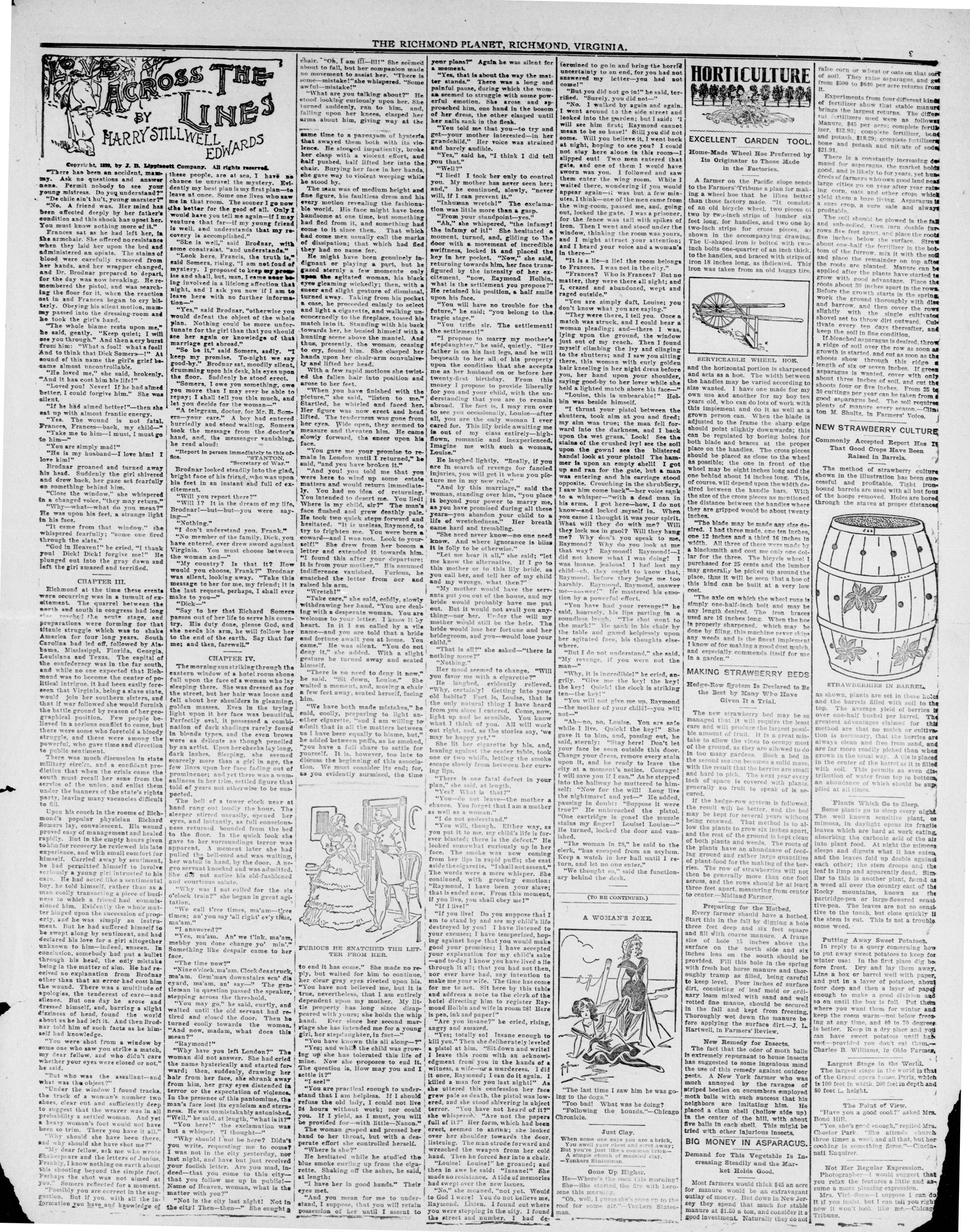
ACROSS THE LINES BY HARRY STILLWELL EDWARDS
Copyright, 1839, by J. B. Lippincott Company. All rights reserved.
"There has been an accident, mammy. Ask no questions and answer none. Permit nobody to see your young mistress. Do you understand?" "De chile ain't hu't, young marster?" "No. A friend was. Her mind has been affected deeply by her father's condition and this shock has upset her. You must know nothing more of it."
Frances sat as he had left her, in the armchair. She offered no resistance when they laid her upon the bed and administered an opiate. The stains of blood were carefully removed from her hands, and her wrapper changed, and Dr. Brodnar prepared to depart, for the day was now breaking. He remembered the pistol, and was searching the floor for it, when the reaction set in and Frances began to cry bitterly. Obeying his silent motion, mammy passed into the dressing-room and he took the girl's hand.
"The whole blame rests upon me," he said, gently. "Keep quiet; I will see you through." And then a cry burst from him: "What a food! what a fool! And to think that Dick Somers—"1" At sound of this name the girl's grief became almost uncontrollable.
"He loved me," she said, brokenly. "And it has cost him his life!" "Loved you! Never! If he had aimed better, I could forgive him." She was silent.
"If he had aimed better!"—then she sat up with almost frantic energy.
"Yes. The wound is not fatal. Frances, Frances—back, my child—"
"Take me to him—I must, I must go to him—"
"You are simply mad!"
"He is my husband—I love him! I love him!"
Brodrian groaned and turned away his head. Suddenly the girl shivered and drew back, her gaze set fearfully on something behind him.
"Close the window," she whispered in a changed voice, "they may return."
"Why—what—what do you mean?"
He was upon his feet, a strange light in his face.
"It came from that window," she whispered fearfully, "some one fired through the slats."
"God in Heaven!" he cried, "I thank you! Dick! Dick! forgive me!" He plunged out into the gray dawn and left the girl amazed and terrified.
CHAPTER III
Richmond at the time these events were occurring was in a tumult of exilement. The quarrel between the north and south in congress had long since reached the acute stage, and preparations were forming for that titanic struggle which was to shake America for four long years. South Carolina had led off, followed by Alabama, Mississippi, Florida, Georgia, Louisiana and Texas. The capital of the confederacy was in the far south, and while no one expected that Richmond was to become the center of political intrigue, it had been easily foreseen that Virginia, being a slave state, would join her southern sisters, and that if war followed she would furnish the battle ground by reason of her geographical position. Few people believed in a serious conflict to come, but there were some who foretold a bloody struggle, and these were among the powerful, who gave time and direction to public sentiment.
There was much discussion in state military circles, and a confident prediction that when the crisis came the south must recall her sons from the service of the union, and enlist them under the banners of the state's rights party, leaving many vacancies difficult to fill.
Upon his couch in the rooms of Richmond's popular physician Richard Somers lay, convalescent. His wound proved easy of management and healed rapidly. But in the empty hours given to him for recovery he reviewed his late experience, and with small comfort for himself. Carried away by sentiment, he had permitted himself to involve seriously a young girl intrusted to his care. He had acted like a sentimental boy, he told himself, rather than as a man coolly transacting a piece of business to which a friend had commissioned him. Evidently the whole matter hinged upon the succession of property, and he was simply an instrument. But he had suffered himself to be swept along by sentiment, and had declared his love for a girl altogether unknown to him—indeed, unseen. In conclusion, somebody had put a bullet through his head, the only mistake being in the matter of alm. He had received no explanation from Brodnar other than that an error had cost him the wound. There was a multitude of apologies, the tenderest of care—and silence. But one day he arose and dressed himself, and, barring a slight dizziness of head, found the world about as he had left it. And then Brodnar told him of such facts as he himself had knowledge.
"You were shot from a window by some one who saw you strike a match, my dear fellow, and who didn't care whether your eyes were closed or not," he said.
"But who was the assailant—and what was the object?"
"Under the window I found tracks, the track of a woman's number two shoes, clear cut and sufficiently deep to suggest that the wearer was in all probability a settled woman. And yet a heavy woman's foot would not have been so trim. There you have it all."
"Why should she have been there, and why should she have shot me?"
"My dear fellow, ask me who wrote Shakespeare and the letters of Janius, Frankly, I know nothing on earth about this shooting beyond the simple fact. Perhaps the shot was not aimed at you." Somers reflected for a moment.
"Possibly you are correct in the suggestion. But if you, with all the information you have and knowledge of
these people, are at sea. I have no chance to unravel the mystery. Evidently my best plan is my first plan—to leave at once. Some one lives who saw me in that room. The sooner I go now the better for the good of all. Only I would have you tell me again—if I may venture that far—if my young friend is well, and understands that my recovery is accomplished."
"She is well," said Brodnar, with some constraint, "and understand." "Look here, Francis, the truth is," said Somers, rising, "I am not fond of mystery. I proposed to keep my presence and shall, but, man, I came near being involved in a lifelong affection that night, and I ask you now if I am to leave here with no further information—"
"Yes," said Brodnar, "otherwise you would defeat the object of the whole plan. Nothing could be more unfortunate for the girl than that you should see her again or knowledge of that marriage get abroad."
"So be it," said Somers, sadly. "I keep my promise. To-night we say good-by." Brodnar sat, moodily silent, drumming upon his desk, his eyes upon the floor. Suddenly he stood erect.
"Somers, I owe you something, owe you more than I may ever be able to repay; I shall tell you this much, and let you decide for the woman—"
"A telegram, doctor, for Mr. R. Somers—your care." A boy had entered hurriedly and stood waiting. Somers took the message from the doctor's hand, and, the messenger vanishing, he read aloud:
"Report in person immediately to this office.
"STANTON.
"Secretary of War."
Brodnar looked steadily into the glad, bright face of his friend, who was upon his feet in an instant and full of excitement.
"Will you report there?"
"Will I? It is the dream of my life, Brodnar!—but—but—you were saying—"
"Nothing."
"I don't understand you, Frank."
"No member of the family, Dick, you have entered, ever drew sword against Virginia. You must choose between the woman and—"
"My country? Is that it? How would you choose, Frank?" Brodnar was silent, looking away. "Take this message to her for me, my friend; it is the last request, perhaps, I shall ever make to you—"
"Dick—"
"Say to her that Richard Somers passes out of her life to serve his country. His duty done, please God, and she needs his arm, he will follow her to the end of the earth. Say that for me; and then, farewell."
CHAPTER IV.
The morning sunstriking through the eastern window of a hotel room shone full upon the face of a woman who lay sleeping there. She was dressed as for the street, but her hair was loose and tell about her shoulders in gleaning, golden masses. Even in the trying light upon it her face was beautiful. Perfect oval, it possessed a combination of dark shadings rarely found in blonde types, and the even brows were as delicate as though penciled by an artist. Upon her cheeks lay long, dark lashes. Sleeping, she seemed scarcely more than a girl in age, the few lines upon her face fading out of prominence; and yet there was a womanliness in her trim, settled figure that told of years not otherwise to be suspected.
The bell of a tower clock near at hand rang out loudly the hour. The sleeper stirred uneasily, opened her eyes, and instantly, as full consciousness returned bounded from the bed to the floor. In the quick look she gave to her surroundings terror was apparent. A moment later she had pulled the bell-cord and was waiting, her watch in hand, by the door. A nego servant knocked and was admitted. She did not notice his old-fashioned and courteous salute.
"Why was I not called for the six o'clock train?" she began in great agitation.
"We call t'ree times, ma'am—t'ree times; an' you say 'all right' ev'y time, ma'am."
"I answered?"
"Yes, ma'am. An' we tink, ma'am, mebby you done change yo' min'."
Something like despair came to her face.
"The time now?"
"Nine o'clock.ma'am. Clock des struck, ma'am. Gem'mam downstairs sen' des eyard, ma'am, an' say-" The gentleman in question passed the speaker, stepping across the threshold.
"You may go," he said, curtly, and waited until the old servant had retired and closed the door. Then he turned coolly towards the woman.
"And now, madam, what does this mean?"
"Raymond!"
"Why have you left London?" The woman did not answer. She had cried the name hysterically and started forward; then, suddenly, drawing her hair from her face, she shrank away from him, her gray eyes distended in terror or the expectation of violence. In the presence of this pantomime, the man's face lost its cynicism and sternness. He was unmistakably astonished. "Well," he said, at length, "what is it?" "You here!" the exclamation was but a whisper. "I thought—"
"Why should I not be here? Didn't you write, requesting me to come? I was not in the city yesterday, nor last night, and have but just received your foolish letter. Are you mad, indeed—that you come to this city—that you follow me up in public! Name of Heaven, woman, what is the matter with you?"
"Not in the city last night! Not in the city! Then—then—" She caught a
THE RICHMOND PLANET, RICHMOND, VIRGINIA.
chair. "Oh, I am ill—lil!" She seemed about to fall, but her companion made no movement to assist her. "There is some—mistake!" she whispered. "Some awful—mistake!"
"What are you talking about?" He stood looking curiously upon her. She turned suddenly, ran to him, and, falling upon her knees, clasped her arms about him, giving way at the same time to a paroxysm of hysteria that swayed them both with its violence. He stooed impatiently, broke her clasp with a violent effort, and half pushed, half lifted her into the chair. Burying her face in her hands, she gave way to violent weeping while he stood by.
The man was of medium height and fine figure, his faultless dress and his every motion revealing the fashionable world. His face might have been handsome at one time, but something had fled from it, and something had come to it since then. That which had come men usually call the marks of dissipation; that which had fled they had no name for.
He might have been genuinely indignant or playing a part, but he gazed sternly a few moments only upon the agitated woman, his black eyes gleaming wickedly; then, with a sneer and slight gesture of dismissal, turned away. Taking from his pocket a case, he proceeded calmly to select and light a cigarette, and walking unconcernedly to the fireplace, tossed his match into it. Standing with his back towards her, he busied himself with a hunting scene above the mantel. And thus, presently, the woman, ceasing to cry, found him. She clasped her hands upon her chair-arm convulsively and lifted her head.
With a few rapid motions she twisted the fallen hair into position and arose to her feet.
"When you have finished with the picture," she said, "listen to me." Startled, he whirled and faced her. Her figure was now erect and head lifted. The tenderness was gone from her eyes. Wide open, they seemed to measure and threaten him. He came slowly forward, the encer upon his face.
"You gave me your promise to remain in London until I returned," he said, "and you have broken it."
"And you! you told me that you were here to wind up some estate matters and would return immediately. You had no idea of returning. You intended to desert me. You lied! Where is my child, sir?" The man's face flushed and grew deathly pale. He took two quick steps forward and hesitated. "It is useless, Raymond, to try to frighten me. You were born a coward and I was not. Look to yourself!" She drew from her bosom a letter and extended it towards him. "I found this after your departure; it is from your mother." His assumed indifference vanished. Furious, he snatched the letter from her and raised his arm.
"Take care," she said, coldly, slowly withdrawing her hand. "You are dealing with a desperate woman. You are welcome to your letter. I know it by heart. In it I am called by a vile name—and you are told that a bride and fortune await you at home. You came." He was silent. "You do not deny it," she added. With a slight gesture he turned away and seated himself.
"There is no need to deny it now," he said. "Sit down, Louise." She waited a moment, and, moving a chair a few feet away, seated herself, facing him.
"We have both made mistakes," he said, coolly, preparing to light another cigarette, "and I am willing to admit that in all the matters between us I have been equally to blame, but," he added between puffs, as he smoked, "you have a full share to settle for yourself. It is, however, too late to discuss the beginning of this association. We must consider its end; for, as you evidently surmised, the time
FURIOUS HE SNATCHED THE LET-
TER FROM HER
to end it has come." She made no reply, but waited for him to continue, her clear gray eyes riveted upon his. "You have not believed me, but it is true, nevertheless, that I am entirely dependent upon my mother. My little property has long since disappeared with yours; she holds the whip hand. Ever since her second marriage she has intended me for a young girl, her stepdaughter, in fact—" "You have known this all along—?" "Yes; and while the child was growing up she has tolerated this life of mine. Now she proposes to end it. The question is, How may you and I settle it?" "I seel!" "You are practical enough to understand that I am helpless. If I should refuse the old lady, I could not live 24 hours without work; nor could you. If I yield, as I must, you will be provided for—with little—Napon."
The woman gusped and pressed her hand to her throat, but with a desperate effort she controlled herself.
"Where is she?"
He hesitated while he studied the blue smoke curling up from the cigarette. Shaking off the ashes, he said, at length:
"I have her in good hands." Their eyes met.
"And you mean for me to understand, I suppose, that you will retain possession of her until I assent to
your plans?" Again he was silent for a moment.
"Yes, that is about the way the matter stands." There was a long and painful pause, during which the woman seemed to struggle with some powerful emotion. She arose and approached him, one hand in the bosom of her dress, the other clasped until her nails sank in the flesh.
"You told me that you—to try and get—your mother interested—in her grandechild." Her voice was strained and barely audible.
"Yes," said he, "I think I did tell you that."
"Well?"
"I lied! I took her only to control you. My mother has never seen her; and," he continued, slowly, "never will, if I can prevent it."
"Inhuman wretch!" The exclamation was little more than a gasp.
"From your standpoint, so."
"Ah," she whispered, "the infamy! the infamy of it!" She hesitated a moment, turned, and, gliding to the door with a movement of incredible swiftness, locked it and placed the key in her pocket. "Now," she said, returning towards him, her face transfigured by the intensity of her excitation, "now, Raymond Holbin, what is the settlement you propose?" He retained his position, a half smile upon his face.
"You will have no trouble for the future," he said; "you belong to the tragic stage."
"You trifle sir. The settlement! the settlement!"
"I propose to marry my mother's stepdaughter," he said, quietly. "Her father is on his last legs, and he will bequeath to her all of his property upon the condition that she accepts me as her husband on or before her twenty-first birthday. From this money I propose to provide liberally for you and your child, with the understanding that you are to remain abroad. The fact is, I may run over to see you occasionally, Louise—after all, you are the only woman I ever cared for. This lily bride awaiting me is out of my class entirely—high-flow, romantic and inexperienced, Imagine me with such a woman, Louise."
He laughed lightly. "Really, if you are in search of revenge for fancied injuries, you will get it when you picture me in my new role."
"And by this marriage," said the woman, standing over him, "you place it beyond your power to marry me, as you have promised during all these years—you abandon your child to a life of wretchedness." Her breath came hard and trembling.
"She need never know—no one need know. And where ignorance is bliss it is folly to be otherwise."
"Let me hear it all," she said; "let me know the alternative. If I go to this mother or to this lily bride, as you call her, and tell her of my child and my wrongs, what then?"
"My mother would have the servants put you out of the house, and my bride would probably have me put out. But it would not avail you anything—nor her. Under the will my mother would still be the heir. The bride would lose her fortune and her bridegroom, and you—would lose your child."
"That is all?" she asked—"there is nothing more?"
"Nothing."
Her mood seemed to change. "Will you favor me with a cigarette?"
He laughed, evidently relieved. "Why, certainly! Getting into your old habits? Fact is, Louise, that is the only natural thing I have heard from you since I entered. Come, now, light up and be sensible. You know what I think of you. All will work out right, and, as the stories say, 'we may be happy yet.'"
She lit her cigarette by his, and, leaning against the center table, took one or two whiffs, letting the smoke escape slowly from between her curving lips.
"There is one fatal defect in your plan," she said, at length.
"Yes? What is that?"
"You do not leave—the mother a chance. You forget that I am a mother as well as a woman."
"I do not understand."
"You will, though. Either way, as you put it to me, my child's life is forever blasted; there is the defect." He looked somewhat curiously up in her face. The smoke was now coming from her lips in rapid puffs; she cast aside the cigarette. "Ishall not assent." The words were a mere whisper. She continued, with growing emotion: "Raymond, I have been your slave; that is ended now. From this moment, if you live, you shall obey me!"
"If you live! Do you suppose that I am to stand by and see my child's life destroyed by you! I have listened to your excuses; I have temporized, hopping against hope that you would make good your promises; I have accepted your explanation for my child's sake—and to-day I know you have lived a life through it all; that you had not then, nor ever have had, any intention to make me your wife. The time has come for me to act. Sit here by this table and address a note to the clerk of the hotel directing him to register Raymond Holbin and wife in room 28! Here is pen, ink and paper!"
"Are you insane?" he cried, rising, angy and amazed.
"Yes; totally so! Insane enough to kill you." Then she deliberately leveled a pistol at him. "Sit down and write! I leave this room with an acknowledgment from you in the hands of a witness, a wife—or a murderer. I did it once, Raymond; I can do it again. I killed a man for you last night!" As she uttered this confession her face grew pale as death, the pistol was lowered, and she stood shivering in abject terror. "You have not heard of it?" she whispered. "Are not the papers full of it?" Her form, which had been erect, seemed to shrink; she looked over her shoulder towards the door, listening. The man strode forward and wrenched the weapon from her cold hand. Then he forced her into a chair. "Louise! Louise!" he groaned; and then in awe he said: "Insane!" She made no resistance. A tide of memories had swept over the new issues.
"No," she moaned, "not yet. Would to God I were! You do not believe me, Raymond. Listen. I found out where you were stopping in the city. I found the street and number. I had de-
termined to go in and bring the horrid
uncertainty to an end, for you had not
answered my letter—you had not
come!"
"But you did not go in!" he said, terrified.
"Surely, you did not—"
"No. I walked by again and again. I went around to the side street and looked into the garden; but I said: 'I will see him first; Raymond cannot mean to be so base!' Still you did not come. Will you believe it, I went back at night, hoping to see you? I could not stay here alone in this room—I slipped out! Two men entered that gate, and one of them I would have sworn was you. I followed and saw them enter the wing room. While I waited there, wondering if you would appear again—it was but a few minutes. I think—one of the men came from the wing-room, passed me, and, going out, locked the gate. I was a prisoner, for the fence was tall with spikes of iron. Then I went and stood under the window, thinking the room was yours, and I might attract your attention; and I heard your voice and a woman's in there—"
"It is a lie—a lie! the room belongs to Frances. I was not in the city."
"Frances? Who is Frances? But no matter, they were there all night; and I, crazed and abandoned, wept and raged outside."
"You are simply daft, Louise; you don't know what you are saying."
"They were there, I tell you. Once a match was struck, and I could hear a woman pleading; and—there I was, lying upon the ground, the window just out of my reach. Then I found myself climbing the ivy and clinging to the shutters; and I saw you sitting there, this woman with curly golden hair kneeling in her night dress before you, her hand upon your shoulder, saying good-by to her lover while she held a lighted match above his face—"
"Louise, this is unbearable!" Holbin was beside himself.
"I thrust your pistol between the shutters, took aim at you and fired; my aim was true; the man fell forward into the darkness, and I back upon the wet grass. Look! See the stains of the crushed lily! see the soil upon the gown! see the blistered hands! look at your pistoll. The hammer is upon an empty shell! I got up and ran for the gate, but a man was entering and his carriage stood opposite. Crouching in the shrubbery, I saw him come back"—her voice sank to a whisper—"with a dead man in his arms. I got here—how, I do not know—and locked myself in. When you came I thought it was your spirit. What will they do with me? Will they lock me in gaol? Will they hang me? Why don't you speak to me, Raymond! Why do you look at me that way? Raymond! Raymond!—I did not know what I was doing! I was insane, jealous! I had lost my child—oh, they ought to know that, Raymond! before they judge me too harshly. Raymond, Raymond, answer me—answer! He mastered his emotion by a powerful effort.
"You have had your revenge!" he said, hoarsely, his lips parting in a soundless laugh. "The shot went to the mark!" He sank in his chair by the table and gazed helplessly upon her agitated face, his thoughts elsewhere.
"But I do not understand," she said. "My revenge, if you were not the man—"
"Why, it is incredible!" he cried, angrily. "Give me the key! the key! the key! Quick! the clock is striking ten—the key!"
"You will not give me up, Raymond—the mother of your child!—you will not—"
"Ah—no, no. Louise. You are safe while I live. Quick! the key!" She gave it to him, and passing out, he said, sternly: "Stay here! Don't let your face be seen outside this door. Change your dress, remove every stain upon it, and be ready to leave the city at a moment's notice. Courage! I will save you if I can." As he stepped into the hallway he muttered to himself: "Now for the will! Long live the nightmare! and yet—" He added, pausing in doubt: "Suppose it were true?" He unbraached the pistol. "One cartridge is gone! the muzzle stains my finger! Louise! Louise—" He turned, locked the door and vanished.
"The woman in 28," he said to the clerk, "has escaped from an asylum. Keep a watch in her hall until I return, and let no one enter."
"We thought so," said the functionary behind the desk.
(TO BE CONTINUED.)
"The last time I saw him he was going to the dogs."
What we're doing?
"Following the hounds."—Chicago Chronicle.
Just Clav.
When some one says you say a brick,
You swell your chest and strut away;
But you're just like a common brick-
Yorkers built of modeled clay.
-Yorkers Stuartman
Gone Up Higher
He—Where's the cook this morning?
She—She started, the fire with kerosene this morning.
"Oh, well, I guess she's come up to the roof for some air."—Yonkers Statesman.
HORTICULTURE
Home-Made Wheel Hoe Preferred by Its Originator to Those Made in the Factories.
A farmer on the Pacific slope sends to the Farmers' Tribune a plan for making a wheel hoe that he likes better than those factory made. "It consists of an old bicycle wheel, two pieces of two by two-inch strips of lumber six feet long, for handles, and two one by two-inch strips for cross pieces, as shown in the accompanying drawing. The U-shaped iron is bolted with two-inch bolts one-quarter of an inch thick, to the handles, and braced with strips of iron 18 inches long, as indicated. This iron was taken from an old buggy tire.
SERVICEABLE WHEEL HOE
and the horizontal portion is sharpened and acts as a hoe. The width between the handles may be varied according to size wanted. I have one made for my own use and another for my boy ten years old, who can do lots of work with this implement and do it as well as a grown person can. When the blade is adjusted to the frame the sharp edge should point slightly downwards; this can be regulated by boring holes for both blade and braces at the proper place on the handles. The cross pieces should be placed as close to the wheel as possible; the one in front of the wheel may be eight inches long and the one behind about 14 inches long. This, of course, will depend upon the width desired between the handle bars. With the size of the cross pieces as mentioned the distance between the handles where they are gripped would be about twenty inches.
"The blade may be made any size desired. I had three made, one ten inches, one 12 inches and a third 16 inches in width. All three of these were made by a blacksmith and cost me only one dollar for the three. The bicycle wheel I purchased for 25 cents and the lumber may generally be picked up around the place, thus it will be seen that a hoe of this kind can be built at a very low cost.
"The axle on which the wheel runs is simply one-half-inch bolt and may be any length desired. The iron braces used are 16 inches long. When the hoe is properly sharpened, which may be done by filing, this machine never skips any weeds and is the finest implement I know of for making a good dust muck, and especially commends itself for use in a garden."
MAKING STRAWBERRY BEDS
Hedge-Row System Is Declared to Be the Best by Many Who Have Given It a Trial.
The new strawberry bed may be so managed that it will require the least care and will produce the largest possible amount of fruit. It is a great mistake to allow the vines to occupy most of the ground, as they are allowed to do in too many gardens. Such a bed in the second season becomes a solid mass, with the result that the berries are small and hard to pick. The next year every inch of space is covered with plants, generally no fruit to speak of is secured.
If the hedge-row system is followed, the result will be better, and the bed may be kept for several years without being renewed. That method is to allow the plants to grow six inches apart, and the rest of the ground is kept clean of both plants and weeds. The roots of the plants have an abundance of feeding ground and rather large quantities of plant-food for the making of the berries. The row of strawberries will not then be generally more than one foot across, and the rows should be at least three feet apart, measuring from center to center.—Midland Farmer.
Preparing for the Hotbed
separating for the Hotbed.
Every farmer should have a hotbed.
Start this in the fall by digging a hole three feet deep and six feet square and fill with coarse manure. A frame size of hole 15 inches above the surface on the north side and six inches less on the south should be provided. Fill this hole in the spring with fresh hot horse manure and thoroughly tramp as filled, being careful to keep level. Four inches of surface dirt, consisting of leaf mold or ordinary loam mixed with sand and well rotted fine manure, should be secured in the fall and kept from freezing. Thoroughly wet down the manure be fore applying the surface dirt.-J. L. Hartwell, in Farmers' Review.
New Remedy for Insects
Insects.
The fact that the odor of moth balls is extremely repugnant to house insects has suggested to some ingenious mind the use of this remedy against outdoor pests. A New York farmer who was much annoyed by the ravages of striped beetles on cucumbers employed moth balls with such success that his neighbors are imitating him. He placed a clam shell (hollow side up) in the center of the hill, with about five balls in each shell. This might be tried with other injurious insects.
BIG MONEY IN ASPARAGUS.
Demand for This Vegetable Is Increasing Steadily and the Market Holds Good.
Most farmers would think $45 an aneer for manure would be an extravagant outlay of money. But down in New Jersey they spend that much for stable manure at $1.50 a ton, and consider it a good investment. Naturally they do not
raise corn or wheat or oats on that sort of soil. They raise asparagus, and get from $500 to $640 per acre returns from it.
Experiments from four different kinds of fertilizer show that stable manure brings the largest returns. The different fertilizers used were as follows. Manure, $45 per acre; complete fertilizer, $12.93; complete fertilizer, bone and potash, $18.29; complete fertilizer, bone and potash and nitrate of soda, $21.91.
There is a constantly increasing demand for asparagus the market holds good, and is likely to for years, yet hundreds of farmers who own good land near large cities go on year after year rating corn, oats and other crops which yield them a bare living. Asparagus is a sure crop, a sure sale and always profitable.
The soil should be plowed in the fall and sub-soiled, then turn double furrows five feet apart, and place the roots five inches below the surface. Strew about one-half the fertilizer in the bottom of the furrow, mix it with the soil and place the remainder on top after the roots are planted. Manure can be applied after the plants have started to grow with good advantage. Place the roots about 30 inches apart in the rows. Before the growth starts in the spring, work the ground thoroughly with disease and harrow, and then cover the rows slightly with the single cultivator shovel set to throw dirt outward. Cultivate every ten days thereafter, and keep the soil in fine condition.
If bleached asparagus is desired, throw a ridge of soil over the row as soon as growth is started, and cut as soon as the shoots show through this ridge a length of six or seven inches. If green asparagus is wanted, cover with only about three inches of soil, and cut the shoots four or five inches. From 25 to 30 cuttings per year can be taken from a good asparagus bed. The soil requires plenty of manure every season. -Clinton M. Shultz, in Farmers' Voice
NEW STRAWBERRY CULTURE
Commonly Accepted Report Has It That Good Crops Have Been Raised in Barrels.
The method of strawberry culture shown in the illustration has been successful and profitable. Tight iron-bound barrels are used with all but four of the hoops removed. Holes are bored through the staves at proper distances
STRAWBERRIES IN BARREL.
as shown, plants are set in these hotels and the barrels filled with soil to the top. The average yield of berries is over one-half bushel per barrel. The greatest advantages claimed for this method are that no mulch or cultivation is necessary, that the berries are always clean and free from sand, and are far more readily picked than when grown in the usual way. A tile is placed in the center of the barrel as it is filled with soil. This permits an even distribution of water from top to bottom, an abundance of which should be suppled at all times.
Plants When Go to Sleep.
Some plants go to sleep every night. The well known sensitive plant, or mimosa, in daylight opens its fragile leaves which are hard at work eating absorbing the carbonic acid of the air into plant food. At night the mimosa sleeps and digests what it has eaten, and the leaves fold up double against each other; the stem droops and the leaf is limp and apparently dead. Similar to this is another plant, found as a weed all over the country east of the Rocky mountains, known as the partridge-pea or large-flowered sensitive-pea. The leaves are not so sensitive to the touch, but close quickly if the stem is cut. This is not a trouble some weed.
Putting Away Sweet Potatoe
Putting Away Sweet Potatoes.
In reply to a query concerning how to put away sweet potatoes to keep for winter use: In the first place dig before frost. Dry and lay them away. Line a box or barrel well with paper, and put in a layer of potatoes, about four deep and then a layer of paper enough to make a good division and so on until the box is full. Put them where you want them for winter and keep the room warm—not below freezing at any time, and 40 to 70 degrees is better. Keep in a dry place and you can have sweet potatoes until half-vest—provided you don't eat them. Charles B. Williams, in Ohio Farmer.
Largest Stage in the World.
The largest stage in the world is that of the Grand opera house, Paris, which is 100 feet in width, 200 feet in depth and 80 feet in height.
The Point of View.
"Have you a good cook?" asked Mrs. Bond Hill.
"Yes, she's good enough," replied Mrs. Chester Park. "She attends church three times a week and all that, but her cooking is something fierce."—Cincinnati Enquirer.
Not Her Regular Expression.
Photographer—I would suggest that you relax the features a little and assume a more pleasing expression.
Mrs. Vick-Sonn—I suppose I can do it if you insist, but I can tell you right now it won't look like me.—Chicago Tribune.
THE PLANET
Published every Saturday by JOHN MATTHEWS
Bk. at all 9 North 8th Street Richmond Va
All commerciens intended for publication
should send soils to reach us by Wednesday
TERMS IN ADVANCE
One Copy one year, $1.50
One Copy eight months, 1.00
One Copy six months, 8.00
One Copy four months, 5.00
One Copy three months, 4.00
Single Copy, 3.00
ADVERTISING RATES.
One inch, one insertion, $ 50
One inch, each subsequent insertion, 25
Two inches, three months, 9.00
Two inches, six months, 10.00
Two inches, nine months, 14.00
Two inches, twelve months, 20.00
Mortgage and Funeral Notices, 80
Bonding and Trustee Notices per line, 110
POSTAGE STAMPS OF A HIGHER DE-
COMMENATION THAN TWO CENTS NOT
RECEIVED ON SUBSCRIPTIONS
The PLANET is issued weekly. The subscri-
pure price is $1.50 a year, in advance.
Here are FOUR WAYS by which money can be by mail at our risk: - In a Post Office Mobile Money Order, and when none of these can be procured, in a Registered Letter. MONEY ORDER—You can buy a Money Order at your Post Office, payable at the Richmond, and we will be responsible for it at your arrival. EXPRESS MONEY ORDERS can be o'canced at any office of the American Express. b. The United States Express Co., and the Web. c. Possible for money sent by any of these companies. The Express Money Order is a safe and convenient way for money. REGISTERED LETTER—If a Money Order you reach, your Postmaster will Register the letter you wish to send on payment of ten cents. Then. If the letter is lost or stolen, you can send money in this manner at our risk. We cannot be responsible for money sent in any other way than one of the four ways mentioned above. If you send your moneym in any other way, you must do it at your
SENEWALS, ETC.—If you do not want The
LANE continued for another year after your
phone has run out, you then notify us by
postal Card or discontinue it. The courts have
decided last subscribers to newspapers who do
not pay the paper which it has been paid are
held liable for the payment of the subscription
to data when they order the paper discor-
dent.
COMMUNICATION—When writing to us
to renew your subscription or to discontinue
your name, you should give your name and ad-
ress in it, otherwise we cannot find your
name on our list.
CHANGE OF ADDRESS—In order to change
the address of a subscriber, we must be se-
cted former as well as the present address.
embarked in the Post Office of Dhulbhun-
n in record class matter.
COLORED men, there is no need to
despair. Lift up your heads, face the
difficulties and march onward to success.
We handicap ourselves by the fights that we wage against each other. Oh, if some colored folks would only under stand!
The tone of the southern press has changed wonderfully in the past fifteen years. It is practically a unit in its opposition to lynching.
It may seem otherwise at times, but we have passed the worst part of the lane of oppression and there are thons and of southern white men who sympathize with us and are ready to extend to us a helping hand if we prove ourselves worthy and willing to help ourselves.
DON'T fail to teach your children politeness and make them thoroughly conversant with good manners. Tell them they must be respectful to white people and to each other and a long stride will have been taken in the direction of bettering their condition in the Southland.
THE Negro-hating, jealous hearted white hoodlums should not cause us to place all white men in that class. We must make friends with our white neighbors, wherever such a thing is possible. If we are patient, God-fearing, polite and law-abiding, we shall win out bye and bye.
MORE TROUBLE IN GEORGIA
As a preliminary movement to another wholesale lynching, it was charged that "Before the Day" clubs had been organized in Georgia for the purpose of murdering the white people. The proposition was absurd, for the colored people are kindly disposed even towards their bitterest enemies, and have not been known to foster strife or promote blood-shed.
The trial of the alleged members of this club ended at Talbotton, Georgia, Tuesday, September 20th, 1904, and was found to be a hoax. The report is alleged to have been circulated with no facts to serve as a basis and the accused persons were discharged from custody. Despite all this, a hack containing four or five white men followed the discharged colored people and when about a mile from the town, under date of the 21st inst., it is alleged that they met JACK TROY, a colored boy, and shot him so dangerously that he is not expected to live.
After driving six miles, they called ED. MARTIN, a colored man, who works on H. C. Truessal's plantation and when
he came, they made him get into the hack, where one of the party deliberately shot the colored man's eyes out, and he is expected to die. Neither of these colored persons thus injured were even charged with being members of the "Before the Day" clubs. They were law-abiding and peaceable. Sheriff Richard has gone to Pratsburg, so says the report, to protect the colored people there and no effort has as yet been made to harm the colored people who have been acquitted
It will be seen that the Negro hating elements in the Southland are as yet active and that the liberal-minded white elements are heavily handicapped in their efforts to protect the law-abiding, hard-working colored people from injury. Coated people who live out side of the cities are practically helpless. They are far away from the residence of the white plantation owner and they have no firearms as a rule, with which to protect themselves. Still with all this, there is a hopeful tone in the reports. The upper class of whites are endeavoring to rid their sections of this incubus of lawlessness and the colored people can do much themselves to assist them.
A man's home is his cisle, whether he be a black man or a white one and he should take all proper methods and measures to defend it. We hope that some steps may be taken to punish the brutal assaultants of these two colored people.
We are now a race of sheep, but then we are learning and the awakening will not be attested by blood shed, for the cowards will know how to respect even a dog, when he shows sharp teeth and a determination to use them.
EVEN WHITE FOLKS "KICKING."
THE "Jim Crow" street-cars are not patronized by the majority of the colored people here and the great mass of our people are continuing to inconvenience themselves and maintain their self-respect by walking. As a result there has been practically no trouble so far as the colored people are concerned and the street-car officials openly admit that they are being annoyed by the disobedience of the white patronage. The Richmond, Va., NEWS-LEADER in its issue of the 21st inst., publishes a communication from a white patron who vigorously protests against being discriminated against on account of his color. He says:
"The writer on last evening had occasion to board a Clay street car at Hancock and Marshall streets, in company with two ladies, coming eastward. The car was pretty well filled with passengers, so I took the first vacant seat, which was the seat fourth from the rear, or the first seat in front of the portion of the car reserved for colored passengers, smokers, etc. The last three seats in the car were filled with colored passengers, and the remaining seats had half of whites. When I had gotten about halfway to the point I was to get off, the car stopped at a corner and several darkies, got on. The conductor of this car approached me, stating that I would have to move my which I die, rather than have any argument with him, but what I am getting at, he seated the colored passengers in the seat which he asked me to vacate."
Of course he did, because the conductor is presumed to fill up the car from either end. He then states that he was of the opinion that only the last three seats were for colored folks. He continued:
"Why I am making mention of this fact is for the reason that I have, upon several previous occasions, ridden on the cars, seating myself in the most convenient portion of the whites' reserve and have not been asked to move up by the conductors in charge of said cars. Then again, it is quite unpleasant for ladies to have to get up and change their seats on summer or open cars, as you know they have to get out of the car on the step and are liable, more or less, to an accident of some kind."
This was because some of the conductors play "a fast and loose" game, just as they choose. There is seldom a set rule, although the company alleges that it has established one. As a rule, white people are permitted to ride any where they please, the third seat from the rear included, while the colored are confined to the rear portion of the car and when there are few white persons on the car and a large number of colored persons, the car is filled up towards the front, beginning at the rear. He continued:
"The way I understand it, and I know it to be a fact from personal observation, a white person cannot occupy a seat behind the third seat in a street car unless he does so for the purpose of smoking, and if he wants to smoke, either white or colored can occupy these seats, but I have seen cars absolutely full of passengers, with the exception of the third seat from the rear, and whites (ladies) would not be allowed by the conductors to enter those seats, but would have to go to the front of the car and stand, while there was a vacant seat in the car, being reserved for the colored people; therefore, I cannot understand why it is that a conductor can make the white people vacate their seats, especially ladies, and give way to the colored. Why cannot they stand as well as the whites?"
He then reaches the conclusion that the colored people arrived at, many months ago when he says:
"I, for one, had much rather take my part in walking than to be inconvenienced in this manner, and I am sure you will agree with me that it is anything but pleasant to have to move up, especially in open cars, and the more so when in company with several ladies."
It will be seen that this absurd regulation is an abomination to both races and is steadily reducing the street-car company's revenues. The corporation has been forced to reduce its force of employees on account of its reduction
THE RICHMOND PLANET, RICHMOND, VIRGINIA
in revenues. This "Jim Crow" car law should go and the company management should return to a sane and safe platform once more. Many colored people have walked and are still walking and with the liberal-minded white people concerned will yet find a solution of this most embarrassing proposition
---
A WEEK'S NEVER CONDENSED.
Four men were killed in a cave-in at a travel pit near Mississippi. The 30th annual convention of the American Bankers' Association is in session in New York. Mobile, Ala., is flooded with $5 gold certificates stamped "United States National Bank of Morristown, N. J." While preparing dinner on a gasoline stove, Mrs. Annie O'Neill, of Philadelphia, was fatally burned by her dress catching fire. In a duel with shot guns at Columbus, Miss. Rev. E. M. Younghouse shot and fatally injured. John Harris. The cause of the shooting is not known.
Friday, September 16.
William Norton, of Baltimore, Md., was instantly killed by coming in contact with a live wire blown down during the storm.
Fire destroyed the Sawyer & Austin plant at Pine Bluff, one of the largest lumber mills in Arkansas, entailing a loss of $500,000.
The sailing ship Henry B. Hyde, which was blown ashore in February on the Virginia coast, has been floated and towed to Norfolk for repairs.
The new American Party, whose purpose is to oppose the alleged interference of the Mormon church in politics, has been permanently organized at Salt Lake City, Utah.
Saturday, September 17.
The next meeting of the American Bankers' Association will be held at Washington, D. C. During a class rush at Wittenburg College, Springfield, O., four students were seriously injured. The final trial of the protected cruiser Denver will be held in Hampton Roads on the 26th inst. Harry Mitchell, of Philadelphia, died of erysipelas, caused by being struck on the face with a base ball bat while watching a game. Midshipman J. H. McCool, of the state of Washington, has been dropped from the Ananapolis, Md., naval academy for continued infractions of the regulations.
Monday, September 19.
There is a great shortage of eggs in South Jersey and a famine is predicted. Harry Evans, of Carlisle, Pa., was sentenced to two years in the penitentiary for stealing chickens. Edward L. Bourne, a wealthy Philadelphiaian, committed suicide by shooting at an Augusta, Me., hotel while despondent over ill health. Bids for the battleship New Hampshire and the armored cruisers Montana and North Carolina will be opened at the navy department November 15. The Canadian government has offered $5000 reward for t he capture of the bandits who held up the Canadian Pacific train at Mission Junction last week.
Tuesday, September 20.
The first annual encampment of the United Spanish War Veterans was held at the World's Fair, St. Louis.
In a quarrel over going to church, Edward Speagle, aged 13, shot and killed his 15-year-old brother near Charlotte, N. C.
George Tilley, living near Raleigh, N. C., during a family quarrel fatally shot his mother-in-law and seriously wounded his wife.
Mrs. William Hall, aged 83, of Philadelphia, was stricken with vertigo in the bathroom of her home and fell into the tub and drowned before assistance arrived.
Richard A. Johnson, a stock broker of Washington, D. C., and son-in-law of Senator Gorman, filed a petition in bankruptcy. Assets, $429,457; liabilities, $313,485.
Wednesday, September 21.
William J. Bryan will open the Democratic campaign in Ohio at Lima October 1.
The Homeopathic Medical Society of Pennsylvania held its 40th annual meeting in Easton. The Supreme Grove, United Ancient Order of Druids of the United States, met in biennial session at Richmond, Va. Paul Lawrence Dunbar, the Afro-American poet, is dying of consumption at the home of his mother at Dayton, O. The first payment of $2,000,000 on account of the purchase of the friars' lands in the Philippines has been authorized by the war department.
GENERAL MARKETS
Philadelphia—Floor firm; winter superfine, $6.55; $6.38; Penna roller, clear, $4.75@4.95; city mills, fancy, $6.50@6.70. Rye roulf firm; per barrel, $4.25. Wheat firm; No. 2 Penna, red, new, $1.08@1.08%; Corn steady; No. 2 yelLOW@1.08%; Corn steady, white clipped, $6.3%; lower grades, 35c Hay steady; No. 1 timothy, $15@15.50. large bales. Pork firm; family, $17. Beef steady; beef hams, $23@24. Live poultry steady; hens, 14½@15%; old roosters, 10c. Dressed poultry firm; choice fowls, 14½%; old roosters, 10c. Dressed poultry steady; New York and Penna, 22½@23c. per dozen. Potatoes steady; new, per basket. 35@38c.
Baltimore -Wheat unsettled; spot contract, $1.08%@1.08%; spot No. 2 red western, $1.10%@1.10%; steamer No. 2 red, $1.01%@1.01%; southern, by sample, 85c@$1.08; on, on grade, 90c@$1.08; Corn dull; year, $1.51%@16c; southern white corne $55c@; do yellow corne $62c. Dats steady; corn corne $62c. Dats steady; 34%c, Rye steady; uptown 2 western, $2@83c. Hay steady; No. 1 timothy, $15; No. 1 clover, mixed, $12.50@13. Butter firm; fancy imitation, $17@18c; do creamery, $20@21c; do ladle, $14@14c; store packed, $10@12c Eggs firm, at 22c.
Live Stock Markets.
Union Stock Yards, Pittsburgh—Cattle
slow; choice, $5.50@6.5%; prime, $5.20
@5.40; fair, $3.25@3.75; logs active;
logs active; heavy Yorkers, $6.40; light
Yorkers, $6.20@6.30; pligs, $5.75@6;
roughs, $4.40@4.40; Sheep slow; prime
wethers, $4.25@4.50; common sheep,
common sheep; yeal
calves, $7.75@per 100 pounds.
$25,000 Worth Men's and Youths'
J. H. Busby, 00 Broad St.
CAPTURED BY
N. D. KIRKMAN & CO.
TWO DECISIONS AGAINST MINERS
TWO DECISIONS AGAINST MINERS
Operators Win in Grievances Settled by Umpire Wright.
$200,000 SUIT AGAINST MITCHELL
Scranton, Pa., Sept. 20. — Decisions adverse to the miners have been rendered by Umpire Carroll D. Wright in the grievances submitted to the conciliation board by the contract miners of collieries Nos. 1 and 2 of the Pennsylvania Coal company, Dunmore, and the employees of the Lehigh Valley Coal company. The grievances of the contract miners of the Pennsylvania Coal company were for extra compensation for changing the roads from the center to the sides of the chambers. This work, they claimed, entailed additional work and had to be done without additional compensation. The men asked that the company return to the old system of having the road in the center of the chamber.
In giving his decision on this case Umpire Wright said that the anthracite coal strike arbitration board in rendering its findings did not take into consideration physical conditions that may exist in the mining and preparing of anthracite coal for market; that it was impossible to do so.
"The only way," he says, "in which such matters as that involved in grievance No. 110 can be adjusted by an agreement between employers and employees."
The grievance of the employees of the Lehigh Valley Coal company is for an adjustment of the sliding scale. They claim that the company is not paying them according to the commission's award; that instead of getting 16 per cent. they are getting only 10. The company, they claimed, considered the reduction in the price of powder equal to a 6 per cent. increase. The company, on the other hand, contends that the scale of wages on which they figured their increase was in effect April, 1902, the time from which the commission's award dates.
CRANK AT OYSTER BAY
Baid He Came From Heaven, Whither
He Went In An Automobile.
Oyster Bay, L. L., Sept. 21. A man who is regarded by the secret service officers and by the authorities of Oyster Bay as a dangerous crank, was apprehended here. He is J. E. Reeves, a medium-sized, roughly attired man about 40 years of age. He was making his way to Sagamore Hill when he was arrested. He told Officer Tyrese, who apprehended him, that he wanted to see the president on important business. Believing from the man's manner that he was insane, Officer Tyrese took him before Justice Franklin for examination. To the justice Reeves said that six years ago he died in a Jersey City hospital and went to heaven in an automobile. While there he received an important message for President Roosevelt, which he was directed to deliver personally. He refused to say what the nature of the message was and declared he could communicate it to nobody but the president. He declared to the justice, however, that he had written a book of experiences in heaven as he he'd decided to have published, as he was satisfied millions could be made out of it. The president, he said, undoubtedly would join with him in seeing the publication of the work, and that was one reason why he wished to have a talk with him.
Reeves, who talked as if he had enjoyed some educational advantages, said that he was a resident of Baltimore. He had gone from that city to Hagerstown, Md., and then to Washington to see the president.
Justice Franklin, after the examination, being convinced that the man was insane and very likely dangerous, deputized one of the secret service men to take him to Mineola, where a formal inquiry into his mental condition will be held.
MAN AND GIRL FOUND DEAD
York, Pa., Couple Who Could Not Marry Die Together.
York, Pa., Sept. 20.—Michael Schall, head of the Keystone Foundry Machine company, of this city, and Miss Nettie Gotwalt, also a resident of York, were
With our pay-easy system no man in the city need be without proper raiment for the fall and winter season. Our fashions will be in popular demand. You will look your best by letting us fit you out. CASH OR CREDIT.
found dead in a bedroom in a house on South Water street. Three gas jets in the room were turned on and the apartment was full of gas.
Miss Gotwalt resided in the apartments where the tragedy occurred. Both wrote notes in which they complained of the world, sat down without removing their clothing and turned on the gas. When found Schall was seated in an arm chair and his companion was prostrated on the side of the bed. Before becoming unconscious they tore up the notes which they had written. The fragments were put together by the coroner. Both said the world was cruel and regretted that they could not get married. Schall was a single man. He had been drinking to excess the past week. He and his companion had both been suffering from nervous affections and were receiving medical treatment. Ill health is attributed as the cause of the tragedy, as no impediment to their marriage is known. Both were well connected socially.
OFFICERS GRAND LODGE I. O. O. F
Robert E. Wright, of Allentown, Pa.
Elected Grand Sire.
San Francisco, Sept. 21. The following officers were elected by the Sovereign Grand Lodge of Odd Fellows:
Deputy grand sire—E. S. Conway, of Chicago, chosen on the second ballot by a vote of 108 to 89 for John T. Nolan, of Nashville, Tenn.
Grand secretary — J. Frank Grant, of Baltimore, re-elected without opposition.
Grand treasurer—M. Richard Muckle, of Philadelphia, re-elected without opposition.
The officers will be appointed by the new grand sire and their names will be announced on Saturday.
After the election of officers it was decided by a unanimous vote that Grand Sire Elect Wright, who is in feeble health, might be installed in office in his home in Allentown, Pa.
THE LATEST POLITICAL NEWS
THE LATEST POLITICAL NEWS
Senator Fairbanks Opens Republican Campaign in Maryland.
PARKER ON CAMPAIGN BOOK
Baltimore, Md., Sept. 21. — Senator Charles W. Fairbanks was the chief speaker at a Republican mass meeting held in this city, the event being the formal opening of the Republican campaign in Maryland.
In his speech Senator Fairbanks declared that the losses of Baltimore in the conflagration of this year were not so large as those sustained by the city during the last Democratic administration as a result of the temporary overthrow of Republican principles. He declared that during the Cleveland administration business in this and other large cities was checked, pay rolls were reduced and the wage rate diminished. On the subject of protec on he said:
"The Republican prot. live system is an issue in the pending campaign. The Democratic party, true to its traditional policy of hostility to it, has declared protection to be 'robbery.' "The overthrow of Republican policies today must bring similar results to those that followed their overthrow in 1892. Strike down the protective system today and we will eat the bread of repentance tomorrow.
"A restoration of Democratic policies and a Democratic administration does not mean that your business establishments will be reduced to ashes, as they were a few months ago, but it means to touch the nerves of your industries with paralysis. It means loss of revenue, loss of opportunity in which merchants, manufacturers and workers must all share in some degree for an indefinite period."
The senator defended the course of President Roosevelt toward Panama, declaring that "had it not been for the president's timely act the construction of the canal would have been postponed for years." The country's sound monetary system, he maintained, had been established "through the genius, the courage and the wisdom of the Republican party."
CONTINUED ON 8TH PAGE.
Negroes Take City By Storm.
after one year's secret planning 3,000 Negroes armed with the most modern implements of war-fare, boldly assaulted the capital of one of the largest western states. All day long on August 31st and September 1st 2nd, the in-bound trains brought car loads of the attacking troops from every section of the country. The men had been so well drilled in the method of attack, that no time was lost after getting off the train. Falling into the quietly and orderly, the men made for the objective Tomlinson Hall in the heart of the city. No orders were given to charge the hall like the Negro soldiers at San Juan, El Caney, and Las Guasimus, the important moment had come for them to take themselves brave men, worthy representatives of a people's interests, and like one man the army of 3,000 strong, charged over the trenches of in-grown and deep, unprejudice, over the heavy breast-works of modern business competition. Great exotement reigned on the out-side. The mob of curious on-lookers asked the court of the Negro demonstration. A brief pause, and then the rapid fire-guns of execution argument cut loose on the inside. For three days the battle raged. Oa Sept. 3rd the cry of victory filled the hall streets, and city. And the world soon knew that an officer important victory had been scored by the Fifth Annual Convention of the National Negro Business League, at Indianapolis Indiana.
Are you a merchant, manufacturer, organizer, beneficial insurance promoter, or real estate manager? Do you head corporations that deal with our people? Are you a colored business man? If so we want to fight your battles for you. We have the very latest methods of making your business grow, increasing your trade, showing you how to put any new article of manufacture on our market and make it sell, pointing out to you the newest and best way to get new members into your secret order, explaining the one and only successful way of buying and selling property, awakening and inspiring continued interest in your newly organized firm or corporation. In short we show you how to succeed. Tell us what your business is and we will put it before the people for you in such a way as to make sales. Get the habit to day. Don't wait. Modern business methods have clearly demonstrated the value of advertising Sleep in business means loss of opportunities, money and success. Write for our plans at once.
GARDNER BROS.
AD WRITERS.
1607 BROADWAY, N Y.,
Advertising Specialists.
ADVERTISING MANAGERS:—Colored American Magazine,
Voice of the Negro,
McGirt's Magazine.
AGREAT periodical published every month in order that we may have a paper that will be read by both races, the white as well as the colored, that the white race may know the many great men and women of the colored race and what they are saying and doing.
Thousands of white, as well as the colored, read this Magazine every month. Some of them declare that they have learned more about the great men of the colored race through this Magazine than they ever knew before and that without a doubt this periodical is far in advance of anything yet attempted by the Negro. Each month it contains articles from the greatest writers of the race. Agents are just as sure of making $5.00 per day selling this Magazine as they are in answering this advertisement.
Write at once that you may be the first in the field. Send 50c. for agents' terms, outfit, and a large number of Magazines, with which you may begin work at once. Subscription Price to every one is One Dollar Per Year. Write—
JAMES E. McGIRT, 420 S. 11th St., Phila Pa.
AD WRITERS.
ADVERTISING MANAGERS:—Colorado
Voice
McGin
GONZALS
The Greatest Clairvoyant & Fortune Teller the World Has Ever Known.
Unites Separated Brings back the one you Love, Helps Quickly all in Trouble.
Removes Evil Influences, Cures Mysterious Diseases, Gives Luck and Success. Send Lock of Hair, Date of Birth and 12 cents. Ask three questions and receive Horoscope and Lucky Birthstone by mail. GONZALES, 236 Bergen St., Brooklyn, New York.
tl-8-13-6m
t1-8-13-6m
JAMES E. McGIRT, Ph. B.
"THE NEW POET."
Editor-in-Chief and Owner of
"McGirt's Magazine."
A GREAT periodical pub that we may have a pa races, the white as we race may know the many great race and what they are saying
COPYRIGHT, 1910
A. S. BENTHALLE & CO.
es Take By Storm.
nanning 3,000 Negroes armed with the most war-fare, boldly assaulted the capital of one of states. All day long on August 31st and September-bound trains brought car loads of the attacking man of the country. The man had been so well at no time was lost after gatting off the train. The men made for the objective Tomlinson orders were given to charge the hall like the amy, and Las Guasimus, the important mom-selves brave men, worthy representatives of man the army of 3,000 strong, charged over the steel prejudice, over the heavy breast-works of great exertion reigned on the out-side. The cause of the Negro demonstration. A brief s of exerting argument cut loose on the inside. Oa Sept. 2nd the cry of victory filled the hall soon knew that another important victory had Convention of the National Negro Business turer, organizer, beneficial insurance promoter, lead corporations that deal with our people. If so we want to fight your battles for you of making your business grow, increasing out any new article of manufacture on out to you the newest and best way to get now explaining the one and only successful way of tening and inspiring continued interest in your son. In short we show you how to succeed, we will put it before the people for you in the habit to day. Don't wait. Modern bustrated the value of advertising Sleep in busin-money and success. Write for our plans at
GARDNER BROS.
1007 BROADWAY, N Y.,
Advertising Specialists.
Colored American Magazine,
Voice of the Negro,
McGirt's Magazine.
THE
FRISCO
SYSTEM
Opportunities for All.
No section of the United States provides the wonderful opportunities for success to the capitalist, professional man, farmer, miner, laborer, or trades that exists in the Great Southwest.
Missouri, Arkansas, Kansas, Oklahoma, Indian Territory, Texas, New Mexico and Arizona await men with money brain and muscle.
Science has declared the climatic conditions of this section the grandest in the world.
Special round trip tickets to permit you to investigate and full information furnished upon application to
W. T. SAUNDERS, D. P. A.,
FRISCO SYSTEM.
1108 E. Main St., Richmond, Va.
McGIRT'S MAGAZINE. $5. Per Day Sure.
Agents are making $5.00 per Day
Selling "McGIRT'S MAGAZINE."
published every month in order
a paper that will be read by both
as well as the colored, that the white
great men and women of the colored
playing and doing.
As the colored, read this Magazine every month,
have learned more about the great men of the
one than they ever knew before and that without
advance of anything yet attempted by the Negro.
from the greatest writers of the race. Agents
per day selling this Magazine as they are in an
the first in the field. Send 500. for agents' of Magazines, with which you may begin work
to every one is One Dollar Per Year. Write—
RT, 420 S. 11th St., Phila Pa.
THE PLANET
THE DAIRY
How to Construct a Trap Which Is Sure to Do Quick and Most Effective Work.
It is an easy matter to make a cheap and very effective fly trap to kill off flies about cow and horse stables. A tight barrel, with one head out, is placed in a corner of the stable and filled with water. A loose board cover (a), is placed on the barrel, and an old tin plate (d) is tacked to the board cover to hold any attractive fly bait
files about cow and horse stables.
A tight barrel, with one head out, is placed in a corner of the stable and filled with water. A loose board cover (a), is placed on the barrel, and an old tin plate (d) is tacked to the board cover to hold any attractive fly bait
Take one yard of screen wire and tack it around a circular board head (c), a little less than one foot in diameter. The wire screen should be of a width about two inches less than the depth of the barrel. Tack three pieces of lath on cylinder (b), for legs, to project one-half inch below the bottom. Put a large screw or nail in center of the cylinder head for lifting it in and out of the barrel of water. Set the cylinder on the barrel cover, over the bakt.
The files will crawl under the cylinder to get at the bait, and instead of going out as they went in will rise up in the cylinder. Several times during the day the barrel cover can be carefully removed and the cylinder submerged in the barrel of water until the files are drowned, when it can be reset. It is astonishing the number of files that may be killed by this trap during a day.—Orange Judd Farmer.
A PUZZLE TO DAIRYMEN.
Variations in Fat Content of Milk a Source of Wonderment Here and Abroad.
One of the great problems that confront the scientists who deal with milk is the great and frequent variation in fat content. In a long period of time the amount of fat secreted seems to be quite constant, but within the limits of 24 hours all rules apparently go astray. Here and there examiners of milk have made hundreds and even thousands of tests of milk during a short time and have found extreme variations. In England a Prof. Ingle made some hundreds of tests. At one experimental farm he tested 700 samples of milk. The average results as to fat were: Morning milk, 3.2 per cent; evening milk, 4.5 per cent. Other solids: Morning milk, 9.2 per cent; evening milk, 8.9 per cent. Average milk yield: Morning, 18 pounds; evening, 12 pounds. These samples were taken in March and April, when the days were short and the nights were long. From the time of milking at night till the time of milking in the morning was 14 to 15 hours, and from the morning milking to the evening milking was eight or nine hours. The milk was richest in the evening, but the quantity was smallest.
The causes for this great variation are little known, and we have not yet learned the conditions that influence them. In some of the samples analyzed the fat content fell below three per cent., which is the legal standard for milk in England. If a man should sell milk that contained less than three per cent, butter fat he could be prosecuted for watering his milk. In such cases it is a common practice to have the cow milked and the sample tested for the court's benefit. But in allowing this a milkman is taking great chances, for the cow that gave less than three per cent. milk in the morning is likely to give a four per cent. milk at night. In that case the sample would most certainly convict the unhappy cow owner, for it would apparently prove beyond all question that he had liberally watered his milk to get it below three per cent. This has not been known until recent years and it may be suspected that many a milkman has been prosecuted for watering his milk when he did not do so. This does not mean that we must do away with all standards, but that the milkman must be more careful about the milk he sells. —Farmers' Review.
POINTERS FOR MILKERS
Cream irregularly ripened makes streaky butter. Dry salt cannot be worked into dry butter successfully. Never breed a "klecky" cow. Your herd needs cows, not mules. The cows should be thoroughly acquainted with the milkers. Sourced milk affects the cream injuriously. Get the cream off in time. Fresh cream and ripened cream mixed will always result in dubious butter. A "mess" of cream in a churning should be of one degree of ripeness throughout. Some cows set the "dairy marks" of the experts at defiance and give large yields of good milk. All the same, the good dairy cow should show certain features in size, shape and general make-up. The old churn used to turn out good butter on the farm. To-day, with the knowledge of handling, ripening and
churning that has become so genera, the churn should be able to turn out really glit-edge butter. Such butter would promptly put a profit into dairy farming — N. Y. Farmer.
GIVE US STRAIGHT GOODS
New York Dairyman Tells Why He Has No Earthly Use for the Dual-Purpose Ideas.
There has been a large amount of talk lately about the dual-purpose cow. One of the most serious problems we have to contend with in making successful milk producers of many of those engaged in dairy husbandry is the fact that there are too many dual-purpose farmers. They have neither the beef cow as a milk producer, nor the milk producer as a beef animal. The true dairy type is not, in all my experience, homogeneous with the Hereford, Short-horn or Angus breeds. The beef animal is in a class by itself, and is ready for the block two or three years before the milk producer is at her best. I fear that one of the chief reasons for much of the discontent among us for this low per cent. of profit in dairying can be charged to the fact that at the end of the cow's profitable milk-producing period she can be made into beef. But the farmer who cares to draw on his financial resources to purchase fat-producing foods to empty into an animal whose whole life has been spent in working her natural machinery for milk secretion has got an uphill job on his hands, and when the books are balanced the true dairyman who cares to improve his herd for milk production with a sire of the Ayrshire or Holstein type or for a less show of amount, but greater per cent. of fat, with a Jersey or Guernsey, will be able to show this dual-purpose man that he has not more than two per cent. of butter fat in his argument. You will never make a good dog at the hunt out of the combination of the bulldog and the hound; no amount of breeding will ever make a Dan Patch out of a Clydesdale. They are too far apart. Good breeders have been working at this problem for centuries, getting the classes further apart, that each in its turn may fit in the niche where it can do its share of the work. The machine which sells the best to-day is the one with the most modern improvements and up-to-date requirements of the times. A machine that by nature (nature does not change much) will assimilate and make into milk the greatest amount, for food consumed, is a better article to have on the farm than any dual-purpose cow.
When the dual-purpose farmer will learn to keep better sires, letting the butcher have his steer-shaped cows, and raise calves only from cows with dairy form, and known milk-producing qualities, he will be ready, shortly, to sell as second-class goods his dual-purpose ideas.—J. E. Head, in Rural New Yorker.
MODEL DOOR FOR A BARN.
An Arrangement Which, According to Its Designer, Is Sure to Prevent Sagging.
The hinged barn door is usually loose or sagging and very unsatisfactory. For my own needs I contrived the arrangement shown. About one-third of the upper part of the door is hinged
A DOOR VENTILATOR
horizontally, and opens from top down. This gives light and ventilation without opening the door to allow passage of animals. If light only is wanted in winter, a sash containing heavy glass may be fastened inside this door. With the rough handling, however, that a track door usually gets, glass is very often broken.-R. T. Murphy, in New England England.
Glazed Butter in Germany
German papers state that it has long been known in Germany that butter can be glazed by the use of sugar; that is, it can be coated with a glasslike sugar covering. This method, the papers state, seems to become of some importance, as it recently has been used on a large scale in England for butter sold in forms. One journal calls attention to the usefulness of this innovation and says that butter so treated keeps fresh for a longer time than if not treated. It is first carefully kneaded and washed, then put into forms weighing one pound each, and placed in a cool room. The glazing is done by painting the surface with a hot sugar solution. The brush should be very soft and the painting should be done quickly. The sugar solution melts the surface of the butter, and the sugar and melted butter form a sort of varnish, which protects the butter against deterioration from outside influences.
Cow as a Household Pet
Gentleness has been bred into the females of most of our dairy breeds. Women have taken care of them for untold generations, and the cows have been made to feel that they are members of the family. This quality is easily brought out by anyone that gives special attention to the Jersey, Guernsey or Holstein cow. She will become a household pet much more readily than will animals of some other breeds.—Farmers' Review.
Slow milking frets the cow. Hosten the performance as much as possible.
Mrs. Flareup—I believe that nooth-
would make you so happy as my death.
Mr. Flareup—Oh, I don't know,
divorce would suit me just as well-
Ally Slover.
THE RICHMOND PLANET, RICHMOND, VIRGINIA
SAVED HER BROTHER
UNPARALLELED HEROISM DISPLAYED BY A GREEK GIRL.
Undergoes Awful Ordeal and Suffers Excruciating Pain to Preserve One Dear to Her from Death in the Alps.
The heroic records of ancient Greece contain no tale of bravery or endurance more worthy of remembrance than the act of a modern Grecian malden—Mile, Hadjiuazaro.
On Saturday M. Hadjiuazaro, a member of the Genevan section of the Alpine club, set out with his two sisters from Zinal for the mountains. Relying upon his expertness as a climber, and great knowledge of that part of the range, he did not take a guide.
For five or six hours all went well with the intrepid three. Roped together they successfully scaled the Grand Cornier. The last difficult piece of climbing did not deter them. They felt sure of themselves. The girls were innocent of thought of danger, so completely did they rely upon their brother, who was first on the rope.
They looked forward to the descent of the Glacier de Moiry. It is not regarded as difficult, but all glaciers have one spice of danger—a concealed crevasse. At the height of 13,000 feet or less, they had some hours of mountaineering before them before they were down again at Zinal.
M. Hadjilazaro, anxious for his sisters' safety, and feeling the heavy responsibility upon him, took extra care, but he lacked that instinct which guides have. He could not be quite sure.
Suddenly he called a halt and bade the girls look out. He feared a concealed crevasse. He bent forward to test the foothold. Scarcely was he on his hands and knees before the treacherous snow gave way beneath him. His sister, next on the rope, had but a few seconds to think and act. Her nerve never left her. Swinging, partly pulled by his fall, over the crevasse, she braced herself with one leg on
THE WOMAN
PAIN WAS EXCRUCIATING.
either side and bore her brother's
weight upon her hips.
What could be done?
M. Hadjilazaro called that he could not climb up. He did not even try, lest his sister's strength should give out as he tugged at her in the effort. Rapidly the sisters made up their minds. The one at the end of the rope untied herself and went off to Zinal alone for help.
Would she get there safely? The brother in danger, the sister supporting him upon her hips as she stood astride the crevasse in an attitude only a woman could have kept for long, did not know.
As the minutes one by one made way for the other, and lengthened into hours, the noble girl felt as though the strain would send her mad. The rope cut into her hips, and the pain was excruciating.
Her brother tried to ease her by cutting steps in the side of the crevasses, and holding on to them, but he dare not attempt to climb. A slip would mean death for both in the depths. As he looked and called encouraging words to her the icy cold water felt drop by drop on to his forehead, an imitation of the greatest torture known to the Spanish inquisition. To add to the horror, darkness came down on the mountain. For 12 awful hours they held out. Then, when they felt that human nature could withstand the awful strain no longer, a welcome cry rang out. Lights shone over the glacier. Their sister had brought help. So as not to alarm the rest of the family she had descended by the Col de l'Allee, and arrived at the village in two hours and a half, at 8:30 in the evening.
Frantically she sought guides. But things are slow at Zinal. It was hours before she could collect the five men she needed, with lanterns and Alpine life-saving apparatus. Not till seven in the morning—and she started for succor at six the night before—did the rescue party reach the courageous girl and release her from her trying ordeal.
Rhenmatism Caused by
Rheumatism is very common in Munich. This is attributed to the fact that so much beer is drank there. The average daily consumption of beer in that city is one and a half quarts for each resident, counting adults and children.
Man Killed by Foul Ball.
A foul ball, glancing from the bat, struck Grove Thomas over the heart; he reeled and fell, on his face, and in half an hour was dead. He was the catcher of the Babcock baseball team, of Johnstown, Pa.
An Unpardonable Offense.
Friend—Aren't you rather afraid of that handsome rival of yours?
Smartchap—Not a bit.
"He is very rich."
"Yes."
"A great favorite with the ladies."
"I know it."
"Yet you have no fear?"
"No. He guessed at her age once, and got her only two years younger than she is."—N. Y. Weekly.
MRS. DR. CORNELIA WHITE
A Powerful Woman with a Powerful Force
SENDS HAPPINESS TO THOSE WHO ACCEPT IT.
She will raise you from Diseases, Disappointments, Diseases, Poverty and Drudgery, to Health, Wealth and Success. This wonderful woman is helping thousands of our children and will help you. Countless numbers who were crushed in life by diseases, worries, sadness and despair are now becoming prosperous, healthy, successful and happy, by the aid of this mighty woman, and her women.
as any gift ever held out by a generous hand.
There is no cost; no charge whatever, simply
that it is no cost; it will be sent by next mail.
Don’t miss your name and address to Mrs. Dr. White, Baltimore,
she will send you FREE a most valuable book of
information, consisting of 32 pages, handsome
how you how to gain
Health, Wealth, Luck, Power, Power
also tells you how to develop the power of Chair-
voyance, Hypotism, Personal Magnetism, Men-
vency, Healing, Calming, Mental Teal-
pathy, (thought transferred to) that
wonderful power of all Powers, White and
from yourself. Also how to remove Evil Influences
from yourself. This is a grand book to
place in the hands of each of you to rise
and better their conditions in life. It tells
you how to remove and cure all habits of
evil, and to suffer humanity,
and the Key to Eternal Life, the
extracts of twenty years of ceaseless labor
outlay of ten thousand dollars, ($10,000). We do
not send any money, all we ask, is
that you send us the cost of packing, poste. We
write for this valuable free book to Dr. Cornelia White.
Dr. White’s College of Science,
1917 E. Pratt St., Baltimore, Md. U.S.A.
The Family Name.
Seven-year-old Marjorie is very fond of Indian stories at bedtime. The story of Hiawatha and Minnehaha is especially attractive.
"I cannot remember the name of Minnehaha's father," said her aunt the other evening.
"Why," said Marjorie, "it was Mr. Ha-Ha, of course."—Little Chronicle.
Poetry Vs Prose
"So," said the stern parent, "you want to marry my daughter, ch?"
"Ah, yes!" sighed the romantic young man. "I would gladly lie down and die for her."
"I'm afraid you won't do," replied the practical father. "What I want is a son-in-law who is willing to get up and hustle for her." —Chicago Daily News
A Pair of Them
Wife—I have about made up my mind. John, that when I married you I married a fool. Husband—That reminds me of a remark you made just before we were married. You remember that you said it would be hard to find two people more alike than you and I?—Buffalo Commercial.
Like His Sauce
Economical Parent (trying to get a free prescription)—I think my boy Fred wants a tonic, doctor. He's all behind in his work. What would you give him if you were me? Doctor—All behind, is he? Give him some catchup then—Ally Sloner.
Mr. Richmond—I don't sound that my dawn or shall marry wealth, but I do insist that the man she marries shall have brains enough to get along in the world.
Young Silipseme—Well, I think I've shown pretty good judgment in selecting a father-in-law, don't you?—N. Y. Weekly.
Question of Priority.
The Publisher—The insolence of these authors! Here's Spifles demanding to see the illustrations before he writes the story for them!
His Partner—Absurd! First thing one knows they will be asking to have the illustrators read the stories before they draw the pictures for 'em!—Life.
Long Distance.
State Street—That lady lecturer talked on women's rights for three hours consecutively.
Kinzie Street—That's nothing; my old woman has been talking on women's rights for 15 years without a break, and hasn't told me the half of it—Chicago Journal.
Special Excursion Rates to Los Angeles and San Francisco via Southern Railway $65.25 for the Round Trip. Returning via St. Louis if desired.
Beginning with August 15th and continuing daily to September 7th, Southern Railway will sell special tickets from Richmond and all points on its lines to Los Angeles or San Francisco and return at the rate of $65.25 round trip, final return limit October 23, 1904. The Southern offers the choice of several routes, rate open to the public—go one route and return another if desired, taking in at the same time the St. Louis Exposition, tickets via this route allowing stop over of as much as ten days at St. Louis. For details, apply to any Agent of Southern Railway, or
C. W. WESTBURY, D. P. A.
F. H. Jackson. Chas. T. Williams.
JACKSON & WILLIAMS
THE STAR BEEF &
Beef, Pork, Veal and Lamb,
101 W. Jackson St., Richmond, Va.
Fresh Country Eggs and
Butter. Fine Butter a
Specialty.
To receive prompt attention kindly mention the name of this paper.
Long Distance
BUY THE
NEW HOME
LIGHT RUNNING
SEWING MACHINE
Before You Purchase Any Other Writes
THE NEW HOME SEWING MACHINE COMPANY
ORANGE, BASS.
Many Sewing Machines are made to sell regardless of quality, but the "New Home" is made to wear. Our warranty never runs cut.
We make Sewing Machines to suit all conditions of the trade. The "New Home" stands at the head of all High-grade family sewing machines Sold by authorized dealers only. FOR SALE BY J. M. P. COOKE.
SEABOARD AIR LINE RAILWAY
Short Line to Principal Cities of the South and South west, Florida, Cuba, Texas and Mexico
TRAINS LEAVE RICHMOND-MAIN ST.
: TATION-DAILY
2:20 p. m. "SEABOARD MAIL," composed of latest improved day coaches, Pullman Sleeper, Pullman Parlor Car and Cafe Coffee, Henderson, Raleigh, Southern Pines, Hanes, Huntington, Atlanta, Camden, Columbia, Savannah, Jacksonville, St. Augustine and Tampa.
10:35 p. m. "SEABOARD EXPRESS," composed of day coaches, Pullman Cars to Mackenzie, Lakeville and Tampa, Cake Cars South of Hampton, Lakeville, Raleigh, Southern Pines, Hampton, Pinehurst, Atlanta, Camden, Columbia, South Carolina, Jacksonville, St. Augustine, Tampa, and Grosse Pointe. 9:10 a. m.-Local for Norlina, Hamlet and Charlotte.
TRAINS ARRIVE RICHMOND-DAILY.
6:35 a. m.-No. 34, from Florida, Atlanta, and the Southwest.
4:55 p. m.-No. 66, from Florida, Atlanta and the Southwest.
5:20 a. m.-No. 36, from Norlina and Local Points.
W. M TAYLOR,
City Ticket Agent.
H. S. LEARD, Dis. Pass. Agt.
No. S09 E Main St., Richmond, Va
Phone 405.
C & O
ROUTE.
CHESAPEAKE & OHIO
RAILWAY.
2 Hours and 25 Minutes to Norfolk.
LEAVE RICHMOND—EASTBOUND.
7:35 a.m.—daily—Local to Newport News
Old Point and way stations.
5:00 p. m.-Daily-Locals to Old Point and
Norfolk.
MAIN LINE-WESTEOUND.
8:30 a. m.-Daily to Charlottesville and Except
Sunday to Clifton Forge.
2:00 p. m.-Daily to Cincinnati, Louis-
ville, St. Louis and Chicago.
5:15 p. m.-Week days-Local to Orange.
10:45 p. m.-Daily to Cincinnati,
Louisville, St. Louis and Chicago.
JAMES RIVER LINE.
10:20 a. m.-Daily to Lynchburg, Lexington,
New Castle, Clifton Forge and
principal stations.
5:15 p. m. — Week days—Local to Esmont.
3:15 p. m. — ERVIE RICHMOND FROM
Nortok尔 — Old Points: 3:45 a. m. daily, 11:45
a. m. daily, 7:00 p. m. daily and 10:25 p. m.
daily.
From Cincinnati and West 7:30 a.m. m. daily
3:30 p. m. daily Main Line Local from
Clifton to Cincinnati Orange Accommodation 8:30 a.m. Ex. Sun.
James River Line Local from Clifton Forge
3:30 p. m. daily Emount Corridor 8:40 a.m. Ex.
C.E. DOYLE W.O. WARDEN
FREE
ROUTE.
COAL!COAL!
PLACE YOUR ORDER WITH US NOW AND GET IT AT THE LOWEST SUMMER PRICE.
PHONE 577
A. D.
THE FUNERAL DIRECTOR,
All orders promptly filled at short
rented for meetings and nice entertain-
conveniences. Large picnic or band w
ing but first-class carriage-, buggies, e
Supplies.
212 EAST L
[Residence
OPEN ALL DAY & NIG
Hall Memorial
A. D. PRICE
GENERAL DIRECTOR, EMBALMER AND
promptly filled at short notice by telegraph or
rings and nice entertainments Plenty of room
Large picnic or band wagons for hire at reason-
less carriage, buggies, etc. Keeps constantly on
12 EAST LEIGH STREET
[Residence Next Door.]
L DAY & NIGHT--Man on Duty
Memorial Industrial S
All orders promptly filled at short notice by telegraph or telephone. Hello rented for meetings and nice entertainments Plenty of room with all necessary conveniences Large jiance or band wagons for hire at reasonable rates and noticing but first-class carriage, buggies, etc. Keeps constantly on hand fine Furnishings
OPEN ALL DAY & NIGHT--Man on Duty All Night
Hall Memorial Industrial School.
Massillon Ohio
HALL MEMORIAL DOMESTIC TRAINING SCHOOL
SUMMER COURSE
Fall Term Open
One of the Finest Equipment
North for Young Women
Themselves for Don
Competent faculty, new building, on
course, ONE YEAR. TUITION
BOARD and ROOM in building
HALL MEMORIAL CONSERV
advantages to those d
Vocal
PHYSICAL CULTURE C
For further information, address all co
Frances A. Riley, Pres.
Made the Dur
MEMORIAL DOMESTIC SCIENCE
TRAINING SCHOOL FOR TEACH
SUMMER COURSE NOW IN SESSION.
e rm Opens Sept. 12th
The Finest Equipped Boarding Semi-
for Young Women Desirous of H
inselves for Domestic Science Te
quality, new building, complete coures, TWO
YEAR, TUITION, per annum, $50.00
and ROOM in building, $11.00 to $15.00 per
ALL MEMORIAL CONSERVATORY OF MUSIC, offers
advantages to those desiring Instrumental and
Vocal Training,
MEMORIAL CULTURE CLASSES SPECIAL Fo
formation, address all communications to
Miley, Pres.
Mrs. Leonora Wilson
the Dumb Beast
HALL MEMORIAL DOMESTIC SCIENCE NORMAL TRAINING SCHOOL FOR TEACHERS
Fall Term Opens Sept. 12th, 1904.
One of the Finest Equipped Boarding Seminaries in the North for Young Women Desirous of Preparing Themselves for Domestic Science Teachers.
Competent faculty, new building, complete courses, TWO YEARS. Special course, ONE YEAR, TUITION, per annum. $30.00, in advance. BOARD and ROOM in building, $11.00 to $15.00 per month. HALL MEMORIAL CONSERVATORY OF MUSIC, offers special advantages to those desiring Instrumental and Vocal Training.
PHYSICAL CULTURE CLASSES SPECIAL FOR TEACHERS.
For further information, address all communications to
Frances A. Riley, Pres.
Made the Dumb Beast Obey.
THE WORLD'S MOST FANTASTIC WOMAN
MADAME S. MONZOOLO
Madam S. Monzoolo, the great show of RINGLING BROTHERS oldest elephants in the world name Smen during the day. Madam Monzoolo the elephant name Sampson by holding speaking nine Holy words and the beast. Madam Monzoolo was born in Paris schooling. She was born a fortune teller can do. She gives advice on law suits, property, sickness female trouble, bourne ple and blind affairs, hidden treasures, woman is a friend to the poor. She is to mighty Healer from birth. She blesses forever; keeps your enemies behind you, works has been blessed and tested at the mighty. She works from the dead and attached Medimus, Fortune Tellers, etc., medium but her equal has never been. She has cured thousands who were blind years. Yes, lawyers, doctors, ministers, the earth seek this gifted woman for adults over thirty five thousands people. Friends it would pay you to look are sleep. Some one is crossing your path for against you not because you have harmed out of their sight they are jealous of you. Madam Monzoolo gives you a charm enemies to love you, make you successful happily forever, drive all evil from your into possession of property, cause you to you, cause the one whom you love to love you want to come to pass. In fact make excites the wonders. She is known over workers Don't waste your time and more same or worse condition than before, but troubles will end. No matter how much business etc. Don't loose any more but take her advice and you will be wealthy tation is one dollar ($1.00). Inclose $1.00 address and your life will be sent to you.
AD
MONZOOLO, THE ONLY LIVING SHE WRITING MEDIUM AND ANT, who can read from in RINGLING BROTHERS in Vidalia Laone one of the in the world name Sampson because unruly day. Madam Monzooolo was called, upon for her the Sampson by holding a charming bone seal only words and the beast obeyed. Monzooolo was born in Paris, France and had eight sons was born a fortune teller. No female on earth advises on law suits, divorces, marriages, loves, female trouble, bounties, pensions, trickery, hairs, hidden treasures, and lost and stolen artworks to the poor. She is the seventh daughter of her mother. She blesses your home and makes her enemies behind you. The charming bone seal was tested and at the dark hours of mid-night works from the dead and reads from the sky. The Fortune Tellers, etc., have tried to imitate equal has never been found. She causes seven sons who were blind, crippled and other wives, doctors, ministers, bankers and other prods is gifted women for advice. She should live for five thousand people in seven months. Could pay you to look around yourself for a wife who is crossing your path for bad luck, and works because you have harmed them only because you are jealous of you. Monzooolo gives you a charming bone seal that you make, you make you successful in business, cause your drive all evil from your path, cause you to save property, cause you to gain back that which we whom you love you until death and to pass. In fact make you dumb beast to love your sons. She is known over all the wo-d as the quarrel waste your time and money with frauds and stintation than before, but consult this Christian woman. No matter how much money you have lost, you can't lose any more but write to Madam Monzooolo and you will be wealthy and happy forever. Price ($1.00). Inclose $1.00, a two cent stamp, your life will be sent to you at once. Write for other ADDRESS,
Maram S. Monzoolo, THE ONLY LIVING SLEEPING SLATE WRITING MEDIUM AND CLAIRVOYANT, who can read from the sky, during the great show of RINGLING BROTHERS in Vidalia Laone of the largest and oldest elephants in the world name Sampson because unruly and killed nine men during the day. Madam Monzoolo was called, upon for help, she influenced the elephant name Sampson by holding a charming bone seal in her hand and speaking nine Holy words and the beast obeyed.
Madam Monzoole was born in Paris, France and had eight years of English schooling. She was born a fortune teller. No female on earth can do what she can do. She gives advice on law suits, divorces, marriages, love, votes, deeds, property, sickness female trouble, bounties, pensions, trickery, evil stories, cripple and blind affairs, hidden treasures, and lost and stolen articles. This gifted woman is a friend to the poor. She is the seventh daughter of her parents, a mighty Healer from birth. She blesses your home and makes bright your palace forever; keeps your enemies behind you. The charming bone seal with which she works has been blessed and tested at the dark hours of mid-night and was found mighty. She works from the dead and reads from the sky. Thousands of pretended Mediums, Fortune Tellers, etc., have tried to imitate this wonderful medium but her equal has never been found. She causes speedy marriage. She has cured thousands who were blind, crippled and otherwise afflicted, for years. Yes, lawyers, doctors, ministers, bankers and other professional men of the earth seek this gifted woman for advice. She should live forever. She consulted over thirty five thousands people in seven months.
Friends it would pay you to look around yourself for a while as you are sleep. Some one is crossing your path for bad luck, and working conjuration against you not because you have harmed them only because your living is kept out of their sight they are jealous of you.
Madam Monzoloo gives you a charming bone seal that will cause your enemies to love you, make you successful in business, cause your family to live happily forever, drive all evil from your path, cause you to save money and come into possession of property, cause you to gain back that which was stolen from you, cause the one whom you love to love you until death and cause whatever you want to come to pass. In fact make the dumb beast to love you. Her power excites the wonders. She is known over all the wo-ld as the queen of spiritual workers. Don't waste your time and money with frauds and still be left in the same or worse condition than before, but consult this christian wonder and your troubles will end. No matter how much money you have lost in sickness and business etc. Don't lose any more but write to Madam Monzoloo to-day and take her advice and you will be wealthy and happy forever. Price for consultation is one dollar ($1.00). Inclose $1.00, a two cent stamp, your name and address and your life will be sent to you at once. Write for us.
GOOD FOR SHOES
The purchaser of each Pair of Shoes from $1.00 upwards entitles you to a Coupon.
RICHMOND. VA.
PRICE, •
BMBALMER AND LIVERYMAN
notice by telegraph or telephone. Hall
ents Plenty of room with all necesse-
rons for hire at reasonable rates and not
Keeps constantly on hand fine Funer
IGH STREET. •
Next Door.]
T—Man on Duty All Night
Industrial School.
ESTIC SCIENCE NORMAL
FOR TEACHERS.
NOW IN SESSION.
Sept. 12th, 1904.
Boarding Seminaries in the
Desirous of Preparing
Estic Science Teachers.
Complete courses, TWO YEARS. Special
per annum. $50.00, in advance.
$11.00 to $15.00 per month.
Story or Music, offers special
Instrumental and
Training.
Courses Special FOR TEACHERS.
munications to
Mrs. Leonora Wilson Polk, Cor. Sec'y
ub Beast Obey.
THE ONLY LIVING SLEEPING SLATE RITING MEDIUM AND CLAIRVOYF, who can read from the sky, during RIS in Vidalia Laone of the largest and japon because unruly and killed nine was called, for help she influenced charming bone seal in her hand and payed. France and had eight years of English No female on earth can do what she favors, marriages, love, notes, deeds, pensions, trickery, evil spirits, oripled lost and stolen articles. This gifted seventh daughter of her parents and a our home and makes bright your path The charming bone seal with which sheark hours of mid-night and was found ads from the sky. Thousands of prevailed to imitate this wonderful sound. She causes speedy marriage. crippled and otherwise afflicted, forankers and other professional men of she. She should live forever. She conseven months, and yourself for a while as you are bad luck, and working conjuration them only because your living is kept ing bone seal that will cause your business, cause your family to live, cause you to save money and come in back that which was stolen from you until death and cause whatever the dumb beast to love you. Her power the wo-d as the queen of spiritual y with frauds and still be left in the consult this christian wonder and your money you have lost in sickness and write to Madam Monzolo to-day and happy forever. Price for consulta two cent stamp, your name and at once. Write for other particulars.
RESS,
MADAM S. MONZOOLO,
840 Elm St. Dallas, Tex.
BOARDING & LODGING.
Rates Reasonable. All the Comfort
of Home
Orders received by letter or telegraph.
MRS. BOOKER LEFTWICH,
PROPRIETRESS,
516 N. 2d St.
ADDRESS.
THE PLANET
STORIES OF CAMP AND WAR
```markdown
```
an Unfortunate Soldier Raised
the Wind After He Had Lost
All His Money.
brother of mine served in the Seventh
seventh regulars during the siege of
versburg, and tells the following:
A large, powerful, good natured com-
by the name of Welch—a brother
Col. Welch, of the Sixteenth Michi-
man, who was killed at Chapin's farm-
dubbed 'Blddy' Welch. Boys were
not to play a little game of 'draw' at
times. When pay day passed in the dim
stance and greenbacks were flow; they
layed scale of two hardtacks equal to
one spoonful of coffee; two spoonfuls
sugar equal one of coffee, etc. Sugar
adced at 25 cents; coffee, 50 cents; a
square inch of plug toco.ec, 25 cents.
"We drew rations every ten days, and
the boys who went broke at the game
MILITARY
BROUGHT OUT A PICKLE.
two days after the drawing, had to
spike for grab the eight remaining
days, or until another issue.
"One day while paying in the trenches Biddy sat in hard luck—Biddy generally did sit in hard luck, and was short on rattons; everything he had was up. Number one raised the blind; number two called. Biddy looked at the pot, and a shade came over his face—his rattons were all up; looked again at his hand, and his face lightened; studied a moment, went down into his "starve-gag" and brought to light an enormous number pickle, held it reluctantly out, and queried: "Boys, what'll you low me on that?" Instantly three pairs of eyes bulged in amazement. Where did he get that? How did he come by it? Instantly three stomachs craved the unacustomed luxury. An ardent desire to possess the succulent anti-scorbuticrose under every blue blouse. On go it? Why, that's worth the last chit! Everything was put up, cards drawn, hands showed down, and Biddy raked in the pot, a phenomenon for him to do. Many a comrade in the succeeding nights went feeling for that pickle, but Biddy always took it into the blanket with him. Often was it thereafter produced as the dernier resort, and when it decayed and became no longer merchantable, his bank stock was gone. But before the dissolution came many a good hand was laid down by an opponent upon production of that noisy pickle."—National Tribune.
Missed by Narrow Margin.
"Speaking of good shots," said Sergeant Sam Grimshaw, "Orderly Sergeant Humphreyville, of Company B. Fifty-second Ohio, missed one in front of Atlanta by a narrow margin. When we first moved into position near the sandtown road, the orderly's place in the line was in a shallow ravine, and almost as soon as we were located he proceeded to build in front of him a shield or protection of stones. It was the rule then for every man to look after his own fortifications, and to stand by them. After Humphreyville had completed his little stone fort, he had a premonition that it wasn't safe, and he changed position to the south, four or five feet. He did scarcely made the change when the stones he had piled up in front of his first position were struck by a solid shot and sent flying in every direction. If he had not moved he would have been killed, and at his place in line seemed just as safe as any on Company B's front. After that when any one of the boys had a ceiling that they ought to move they moved, and the orderly made no remarks."—Chicago later Ocean.
Why His Nose Was Red.
A man from Mexico, Jacques Forbes
my name, at the Galt house last night,
claims to have a typical mother-in-law,
inflicted with that strange and almost
universal womanly failing of asking
promiscuous questions.
"It is only a few weeks ago," said Mr.
Forbes, that a dilapidated looking
bramp, with a long, strikingly red nose
—one of those all altate noses—applied
at the back door of my mother-in-law's
momet or food.
"Sure" sold my mother-in-law, in
response to his request for food, "I'll give
you something to eat, but, my good man,
won't you please tell me what makes
your nose so very red?"
"Not the least objection, madam," replied the trump. "It is simply blooming with pride that it doesn't stick itself into other people's business. Good day, madam." —Louisville Herald.
A GENTLEMAN OF HONOR.
Confederate Lieutenant Kept His Word in Spite of Orders and Flying Bullets.
The Atlanta Constitution relates this interesting war reminiscence: Lieut. C. A. Coryell, formerly of the One Hundred and Forty-first New York Volunteers, Twentieth Army corps, was with Sherman on the famous march to the sea. One bright Sunday in December, 1864, the lieutenant was detailed to take charge of the picket line in front of Savannah, on the edge of a rice swamp. There was a truce between the pickets, and everything wore a Sabbath-like stillness.
Coryell had nothing to do, and was out of tobacco. How to get a chew was the question. Finally a handsome young officer from the confederate side strolled out between the lines. Coryell hailed him at once:
"I say, Johnny, got any chewing tobacco over there?"
"Yes, plenty of it—something good."
"Come over!" shouted the federal.
"I want to buy some. Got lots of confederate money, but no tobacco."
"Can't do it," replied the confederate.
"It's against orders to leave my post."
"Well, then, come half way, and I'll meet you."
"Sorry, Yank, but I can't do that, either," yelled the confederate.
"Johnny," yelled the desperate federal. "If I come over to you can I get the tobacco and return safely to my lines?"
"Come along, I'll treat you right."
"How do you know that I will not be taken prisoner?"
"You have the word of a gentleman and a confederate officer."
Coryell thought a moment. He wanted the tobacco, and the young officer had spoken in a manly way.
The federal decided to make the venture. He laid aside his sword and belt and started across the high and narrow dike leading to the confederate line. On either side of the dike the water in the rice fields was ten feet deep.
The lieutenant reached the opposite shore without any misgivings. The confederate produced some tobacco and a trade was made in no time. Then the two fell into a pleasant conversation.
Suddenly Coryell saw a signal flutter from a house some distance in the rear of the confederate line.
"What does that mean?" he asked, sharply.
Just then an orderly dashed up on horseback and with a dignified salute said to the confederate officer:
"Lieutenant, the general orders you to take the Yankee officer to head-quarters."
Coryell was dumfounded. Vistona of Andersonville, Castle Thunder and Libby prison danced before his eyes. He thought of his loved ones at home and the disgrace attached to such a capture.
He cursed the infernal tobacco that had placed him in such an unlucky position. Then he looked at the confederate Heutenan and noted the honest eye and his manly face.
"Am I your prisoner?" asked Coryell.
The confederate extended his right hand.
"I offered you my protection," he said. "Go to your lines. I will follow you over the dike, and if my body can shield you from confederate lead you
A man in a hat stands on a beach, looking out at the sea. The sky is filled with clouds, and there are two other figures in the background.
"GOT ANY TOBACCO"
shall reach your command in safety, Good-by and God bless you!
The federal started on his return trip. He dreaded the enemy's fire and fully expected a chance shot would cripple him and cause him to fall into the water, where death would be a certainty.
He was half way across when the first shot came. There was another and another, until the whole brigade seemed to be firing at him.
The fugitive walked rapidly onward until he reached the federal lines and vaulted over the breastwork. Then he looked back and saw his protector standing on the dike. The confederate waved his hand turned about, and marched back to his own side. He had kept his promise like a true soldier.
Glovemakers Meet New Conditions. A size six glove to-day is larger than a size six glove five years ago, and this applies to all the sizes made. The explanation is that ladies' hands have grown larger than they used to be, through their practice of cycling, golfing, hockey, etc., but they do not like to admit it, so the glovemakers meet the new conditions and yet avoid hurtling the vanity of their customers. Westminster Gazette.
A Small Beginning.
Elsie—Your Uncle Harry seems awful young to be a doctor.
Willey—Yes, but he ain't a real, growed-up doctor yet. I guess he's only 'tendin' to children yet, so he's to get some practice.—Philadelphia Prass.
THE RICHMOND PLANET RICHMOND, VIRGINIA.
JOB DEPARTMENT
It is thoroughly equipped to do all kinds of printing on short notice. We make a specialty of Society printing and work for Insurance Companies, such as Financial
EXCURSION
We print Handbills, Quarter-Sheet posters, Tags, Tickets, Placards, Utes, Visiting Cards, Mourning Station
WE HAVE
Our St
OF THE LATES
WE CAN PRINT A BILL AS SMALL
A Three-Sheet
CURSION W
at Handbills, Quarter-Sheets, Half a
ers, Tags, Tickets, Placards, Society C
ing Cards, Mourning Stationery.
HAVE AN
WHICH W
Our Stock
OF THE LATEST STYLE
PRINT A BILL AS SMALL AS A
Three-Sheet Po
VISION WORK C
arter-Sheets, Half and Whole
Placards, Society Cards, Min-
ing Stationery.
is to please
give them
the lowest
with satis
WE AN ELEGANT
WHICH WE WILL SHOW A
Stock Room
LATEST STYLE BOND, FINE WRIT
AS SMALL AS A DODGER.
Sheet Poster
EXCURSION WORK OF ALL DESCRIPTIONS
We print Handbills, Quarter-Sheets, Half and Whole Sheet posters, Tags, Tickets, Placards, Society Cards, Minutes, Visiting Cards, Mourning Stationery.
OF THE LATEST STYLE BOND, FINE WRITING—FLAT AND LINEN PAPER, ENVELOPES, ETC.
OUR PRESENT CON
IS WITHIN EASY
Our street-entrance is retired and has no obj
fastidious lady being able to enter without emba
OUR PRESENT CO
IS WITHIN EASY
reet-entrance is retired and has no obj
lady being able to enter without embac
OUR PRESENT CORP OF EMPLOYEES ARE
IS WITHIN EASY REACH OF THE PUBL
tired and has no objectionable features, th
enter without embarrassment or annoyance
, 2213.
Our street-entrance is retired and has no objectionable features, the most fastidious lady being able to enter without embarrassment or annoyance.
LONG DISTANCE TELEPHONE, 2213.
Expensive.
Expensive.
Business Man—Well, my dear, I have about made up my mind to sell out my business and go out into the country, and buy a hundred acres or so, and be a farmer for the rest of my life.
Business Man's Wife—O. John, how lovely! But are you sure you can afford it?—Somerville Journal.
The Man Worth While.
"This easy enough to be pleasant
When there's nothing to mar one's life.
But hurrash for the chap
Who has courage on tap,
With a chronic scold for a wife.
—Chicago Record-Herald.
Just Out
If you have read the Press by John Bunyan, you sure and read the
SEVEN SEA
by Mrs. Lucinda Young,
sells for $1.00 and is meeting success all over the country
great book. Address all
tions to
MRS. LUCINDA
Lambertville, N
AGENTS WANT
ap16-6m
FASHION
FISH, OYSTERS AND GAME,
FRESH MEATS & GROCERIES
All orders receive prompt atten
tion.
619 Brook Ave. Phone 1580
Lawn and Picnic Parties, Fest
vals, Weddings etc., furnished with
the best high-grade Ice Cream
o the Shortest Notice.
plain manner and should know the children about their swims.
Do not keep o ice until you o tus scruples. Madame is the
She- Do you suppose it is possible for us to be any more civilized than we are.
there is no truth
a Medium, but a
truth. It is only
that such a
is not every one
self as a medium
body but a person.
And a person
the reason why
tissers do not
nature. They o
a moment with
and kindred brer
to make the pat
He—Well, they say there is no limit to our capacity for suffering.—Pick-Me-Up.
Cheat.
A horse trotted 5,000 ft., And broke at that stage of the ht, The driver 'twas plain Had yanked on the rein, Being paid to let other mags bt. -N. Y. Times.
A Sure Cure.
Borem (11 p. m.)—Yes, I'm a perfect martyr to insomnia. I've tried everything I ever heard of, but I simply can't get to sleep at night.
U R G
Refrigerators,
Mattings, Oil-Cloths.
And in fast everything that is need-
ed in house furnishings.
RUGS AND CARPETS.
to hear if it will
repeat the last
unprincipled M
hand and gain
matter of import
Mrs. Marth the
Mrs. Marth the
This subject is
eminent men
Miss Cutting (suppressing a yawn)—Did you ever try talking to yourself after going to bed?—Chicago Journal.
In the Future.
She—Heaven must be a place where we poor women will be allowed to have as many new hats and frocks as ever we want.
He—Then the other place will be where we poor husbands will be always having to pay for them.—Ally Sloper.
S. C. G. Jurgen's Son
421 EAST BROAD ST.,
between 4th and 5th Street
Shipment to THE PLANET.
2.50 per year.
Horrors of Solitude.
Mr. Minks (reading)—The captain's wife was the only one who escaped, and she was thrown by the waves upon the beach of an uninhabited island.
Mrs. Minks—Poor thing! How did she ever button her dress in the back, the next morning?—N. Y. Weekly.
Expensive.
Cards, Policies, both straight life and benevolent, Physician's Certificates, Sick Cards, Application blanks, Agents Report Sheets, Rate Cards, etc.
WHICH WE WILL SHOW ANY ONE DESIRING TO SEE THEM.
OUR PRESENT CORP OF EMPLOYEES ARE COMPETENT AND QUICK-WORKING. OUR OFFICE IS WITHIN EASY REACH OF THE PUBLIC, BEING WITHIN FIFTY YARDS OF BROAD ST.
Just Out!
If you have read the Pilgrims Progress by John Bunyan, you ought to be sure and read the
SEVEN SEALS
by Mrs. Lucinda Young. This Book sells for $1.00 and is meeting with great success all over the country. Truly a great book. Address all communications to
MRS. LUCINDA YOUNG,
Lambertville, N. J.,
AGENTS WANTED.
ap16-6n
DANBURNS IN
MRS. P. C. EASLEY
615 N. Second St.
ICE CREAM, CONFECTIONARIEN
' CAKEN, ETC. |
Satisfaction Guaranteed
8-7-3mos.
*Your purchase you would do well. to call at the most reliable furniture house in the city and see the fine line of
Of every description; also the latest designs in ROCKERS and special OMAIRS. Our goods are the best for the price and the price is very low.
WORK OF ALL
OUR AIM
is to please our patrons and to
give them the best service at
the lowest prices, consistent
with satisfactory work.
LEGANT I
SHOW ANY ONE DESIRING
Em Embrace
LINE WRITING—FLAT AND
LOVEES ARE COMPETENT AND QUIET
OF THE PUBLIC, BEING WITHIN F
features, the most
or annoyance. FOR FUR
Jol
JOHN HENRY
MRS. MARTH, the world renowned and highly celebrated Business and Test Medium, received upon all occasions. No importance, love and marriage a speciality. Every mystery revealed, also of absent, deceased and living members, challenges any Medium who can exceed her in starting to embrace the past, she will not for any price flatter you; you may assume she is not a woman without nonsense. She can be consulted for advice. Life, Court, Marriage, Marriage Esec, with full description of your future companions, friends, enemies etc., business law in your journey, contested wills, divorce and speculation friends, enemies etc., business law in your destination, she reads your destination - good and, she without doubt
MRS. MARTH tells your entire life past and future, the power of any two Mediums you ever met. In tests she tells your mother's full name before marriage, the names of all your family, the names of your present husband, the names of your next if you are to have one, the name of the young man who now calls on you, the name of your mother, the name of your year of your marriage, how many children you have or will have; whether your present marry you; if you have no sweetheart she will tell you when you will have one and his name, business and date of acquaintance. All your mother's children should know the plain manner and in a dead trance. Mothers should know the success of their husbands and children; young ladies should know everything you need to know. Do not keep company, marry or go into business until you know all, not let silly religious scruples prevent your consulting. Do not tell who can tell you the full name of your future husband with age and date of marriage go, and tells whence the truth. It is only from the sick of discrimination that such a conclusion can be reached. It is not every one who pleases himself or herself as a medium that can stand the test of what
And a person of an inquiring mind may ask the reason for an inquiry that these advertisements take to take the nature. They do not spend their thoughts for a moment with acquiring the art of phrasology and kindred branches that have a tendency to clear the mind, but the business clear and devoid of all obstacles. It is and undeniable fact that persons will want to know and yet as soon as they confront a medium they try their utmost endeavor to dispel from their minds what they know so as to understand what they are in a matter of impossibility to most of them. And yet this can be done and by consulting MARTIN the seemingly mystery becomes a realization. This subject has received no little attention by eminent men and even college professors. So it proves that the gates of wisdom have not been closed to the entire profession. So it proves that in our midst with oily tongues perhaps the gates of wisdom have not been secured to the entire profession has been secured by MRS. MARTIN the benefit of humanity.
ADVICE BY LETTER, $1.00.
HOURS FROM 10 A. M. TO 9 P. M.
MRS. M. B. MARTH.
CHICHASHA,
INDIAN TERRITORY.
(BOX, No. 958.)
Enclose Stamp for reply.
Please mention the PLANET.
We print Wedding Invitations, and High Class Stationery for Balls, Parties, Picnics and all entertainments of a social nature.
ALL DESCRIBE
us and to
service at
consistent
work.
We furnish "cuts" when des-
complete special work in our l
in our line, call and see us and
T LINE OF S
DESIRING TO SEE THEM.
oraces a full
AT AND LINEN PAPER, ENVELOP
WE HAVE ONE OF THE
OF WOOD
Of Any Job Printing E
T AND QUICK-WORKING. OUR OFFICE
WITHIN FIFTY YARDS OF BROAD ST.
FOR FURTHER INFORMATION, AP
John Mitch
311 N. 4th St
W. S. SELDEN,
FUNERAL DIRECTOR
AND EMBALMER.
Warerooms:
1508 E. Broad Street,
OLD 'PHONE, 1484
FOR FURTHER INFORMATION, APPLY TO
full name be your family,
and bust name of your name of the
name of mother and children you
present to your present will
she will add his name,
m. Mary,
t. clear and
H. F. JONATHAN
Fish Oysters & Produce
and may ask
these adver-
ture human
thoughts for
phraseology
we a tendency
of the busi-
ness
persons will
of what they
they confront
endorow to
know so as
the Mafia con-
tion by unfair
New Phone, 478.
ROBT. S. FORRESTER
FLORIST
215 E. Leigh Street,
When You Are Sick
Leonard's
Reliable
Prescription
Drug Store
724 North Second Street.
A
We furnish "cuts" when desired and we will arrange to complete special work in our line. When in need of any work in our line, call and see us and estimates will be furnished.
WE HAVE ONE OF THE LARGEST ASSORTMENTS OF WOOD-TYPE Of Any Job Printing Establishment in the city.
311 N. 4th St., Richmond, Va.
RESIDENCE,
1308 E. Leigh St.
Richmond, Virginia.
506 E. BROAD STREET,
Richmond, Va.
DEALER IN
Fine Boots, Shoes,
and Ladies Gaiters,
All Kinds of Fine Footwear.
TRANSFER
ALL ORDERS WILL RECEIVE
PROMPT ATTENTION.
Long Distance Phone, 752.
RICHMOND, VIRGINIA
Plant Decorations, Choice Rosebuds
Our Flowers, Funeral Designs, House
Decorations for Wedding, Parties, &c.
a specialty. Give me a call.
Pure and Fresh Mediaries only w
sure you then purchase your
Drugs and Mediaries from
opes, Note and Letter Paper Bill-heads, Monthly Statements, Business Cards, Financial and Order Books, Circulars, Check-books, Pamphlets.
SCRIPTIONS
sired and we will arrange to
line. When in need of any work
estimates will be furnished.
SAMPLES
Line
PES, ETC.
LARGEST ASSORTMENTS
OD-TYPE
Establishment in the city.
PLY TO
nell, Jr.,
., Richmond, Va.
'Phone, 1589. Residence No. 911 32d
Street.
ROBT. W. WILLIAMS,
FUNERAL DIRECTOR &
EMBALMER.
NO. 3019 P. STREET, BETWEEN
30TH AND 31ST STREETS.
RICHMOND, VA.
Special attention given to all business entrusted to me. Carriages for funerals, receptions and marriages at all hours. Satisfaction guaranteed to all. til6-20-04
A. Hayes
First-class Hacks and Caskets of all descriptions. I have a spare room for bodies when the family have not a suitable place. All country orders are given special attention. Your special attention is called to the new style Oak Caskets. Call and see me and you shall be watted on kindly.
'Phone, 2778.
The Custalo House.
702 E. BROAD ST.
Having remodeled my bar, and having an up-to-date place, I am prepared to serve my friends and the public at the same old stand.
Choice Wines, Liquors and Cigars.
FIRST CLASS RESTAURANT.
Meals At All Hours.
New Phone. 1261. Wm. Custalo, Post
S. W. ROBINSON,
NO. 23 NORTH 18TH ST.
FINE WINES, LIQUORS,
CIGARS, &c.
All Stock Sold as Guaranteed.
PROMPT ATTENTION.
Your patronage is respectfully solicited.
JOHN M. HIGGINS,
DEALER IN
CHOICE GROCERIES,
WINES LIQUORS,
AND CIGARS.
PURE GOODS, FULL VALUE FOR
THE MONTH.
1610 East Franklin Street
[Near Old Market]
RICHMOND. VIRGINIA.
THE PLANET
DREAM WORLD.
The wind is heavy
With dew, and the red
Of the rest beetle me;
And up overhead
The sky is a japphire,
A deep vault and blue,
Never a sign
Of where the summer through
When the night wraps the world; all the
earth and the sea.
And the rose and the sky—it was all made for me.
And forget-me-nots hide
In the grass 'gainst the breast
Of the earth in my path,
Like the blossoms that rest
On the breast of a maid;
Each wee bloom softly lilies
Just as pure and as sweet
As the look in her eyes;
And it's mine, where forget-me-nots nestle and hide,
All the world it is mine; it is mine far and wide!
It is mine where the birds
Of the day shrill their tune;
It is mine where the birds
Of the night softly croon;
And in his throne on his throne
Such a treasure has been
And no heart in the breast
Of a king is as glad
As my heart is in me as I walk by the
And breathe the perfume of a world made for me.
J. M. Lewis, in Houston Post.
The Wallace Mill Affair BY FRANK H. SWEET
(Copyright, 1904, by Daily Story Pub. Co.)
THE owner has a right to pay whatever wages he may please for his own interests," flashed the girl, her voice clear and strong, and a little indignant. "The property is his and he can do as he likes with it—even to shutting the mill down, if it should seem best. The employees have absolutely nothing to do with the matter. Their option is to leave work if the pay does not suit."
"And I say the employer has no such right," returned the man, steadily. "There should be more than self-interest in his relationship with the workmen. In our own mill here, for instance, fully one-half the employees are from a distance, attracted by the mill's reputation for generous wages. Some are all the way from Ireland, brought here through letters from their friends. It is not right for the owner to cut 20 per cent., as is contemplated, without stronger reason than the mere increase of profit. From my position in the mill I happen to now the firm is making as good profit now as it has for years. What right has it to make this reduction?"
"The right of any business to add to its profits in a legitimate way," answered the girl, coldly. "Other mills through the country are cutting wages; why should this try to maintain its generous standard to the owner's loss. The new superintendent is a practical man, who is working for the owner's interest."
"If only I could get to that owner," cried the man impetuously, "so I could lay the case before him. But he acts through his attorneys, and they through the superintendent, and he—well, he is a machine without a heart.—but I but I beg your pardon, Miss Esten," breaking off suddenly, "I ought not to talk about this matter with you, so long as we disagree. I wish I could make you see it as I do.—I I have been hoping of late—that"
He hesitated awkwardly and stopped. But the girl was looking at him comprehendingly, a slight change coming to her face.
"I forced the topic, I believe, Mr. Blalsdell," she said, more gently. "It is better for even friends to know each other's views. I wish, however," with a trace of irony in her voice, "that I could make you see this as I do." The both laughed, but with more constraint than usual. Several mill girls were coming down the canal path, and they walked on to the lower gate and then stood aside to let the girls pass. In another few minutes the bell would ring.
This canal path, with its overarching elm branches, had become a favorite walk of Miss Esten's, and the young designer had got in the habit of joining her. They had many tastes in common, which they discussed with increasing friendliness, and with something warmer gradually coming into Blaisdell's manner. Miss Esten was different from the other mill girls, was more educated and refined, and sometimes he wondered what straits had reduced her to working for a living; but whatever it was he blessed the cause that had brought her to this mill. Now, as the clanging bell broke the air he looked at her with sudden determination and longing.
"I can't have you go away from me with that look in your eyes, Miss Esten—Louise," he cried, impetuously. "I couldn't bear to know you were thinking ill of me for even an hour. We are too good friends to disagree—no," sharply. "I mean more than that. We are not just friends. I would do anything in the world for you—everything, except what I felt was not right. And this proposed strike is right, and the help look for me to lead them. It is not for myself, but for them. Oh, Louise, don't you understand this, and that I love—"
He stopped suddenly, for she had thrunk back, he hands up raised protesting, her face startled. "Please don't, Mr. Blaisdell," she gasped. "Indeed I would rather not
bear. And you must excuse me now. It's time I were in the mill."
He watched her with set face as she hurried away; then he turned and walked toward the office.
The superintendent passed out as he was entering, then turned.
"Oh, I say, Blaisdell," he called, disagreeably; "I have just received a letter from the mill agents. The reduction will go into effect on the first, just as announced."
"Then the help will leave work on the first, just as they have warned," the designer answered, calmly. "There will scarcely be an exception."
"That's all right," curtly. "We are already advertising for more help at lower wages. I fancy we will be able to bear the strain as well as you."
When the mill shut down that evening it was raining hard. Blaisdell joined the hurrying line that was surging from the mill, bending his head to the storm like the others. At the post office he turned aside, taking a package of letters from his pocket which he wished to mail. A young girl near him also turned, drawing some letters from beneath her waterproof. He recognized her as a girl working beside Miss Esten in the weave shops. "Shall I drop them in for you, Elsie?" he asked. The girl gave him the letters with a smile and slipped back into the line. As he dropped them in Blaisdell noticed the address on the upper one. It was in Miss Esten's handwriting, and was to the mill agents. He thrust the other letters in quickly, with his eyes turned away.
When she had first come among them, so different from the other girls and so eager in her inquiries about the cause of the dissatisfaction among the help, which was even then being felt, there had sprung up a rumor that Miss Esten was an emissary of the agents, a paid spy. But as the help had grown to know her better this suspicion died away. The remembrance of it flashed into Blaisdell's mind, but was instantly scouted away, indignantly. Miss Esten's sympathy was plainly not with the strikers, but she had not come as a paid spy. The next noon he was out on the canal path as usual, but Miss Esten did not appear. On his way back to the office he stopped at the weave shop, and found that she had taken a train for Elton that morning. Elton was the address of the mill agents. The last days of the month passed gloomily. The help went about their work mechanically, some dispiritedly.
I
The overseers were for the most part cross and exacting. On the last afternoon Blatsdell was in his office arranging the papers with the expectation that his work would soon be finished. Presently he had occasion to go into the main room, and while there the office boy brought in the mail and dumped it upon the table. Blatsdell stepped across and selected his. One letter was in a well-known hand, and he moved quickly to a window and opened it with trembling fingers. It read:
"Dear Mr. Blaisdell:
"I have come round to your point of view—indeed, I believe I had that day when contending my own so strongly. I knew very little about the business, being away at school most of the time during my father's life. When his death summoned me home, the agents explained the situation and I accepted their view. Later I was not quite satisfied and went down to see for myself, hiring out as one of the hands.
"I have ordered that the business go on as formerly, with no reduction of wages. Before long I shall come down and see what else can be done.
"As to the request you did not complete that day on the canal path, suppose you come up and repeat it to me, here. I shall be waiting, and will be glad to listen. Yours,
"Louise Esten Wallace."
A sudden exclamation caused him to look up. The superintendent had opened a letter and was staring at the contents.
"Hello, what does this mean?" Blaisdell heard him mutter, wrathfully. "The mill to go on in the old way, without any reduction. What—" He looked up suddenly and saw Blaisdell regarding him with an odd smile. "Do you know?" he demanded.
"Yes."
"Get a letter like mine—from headquarters?"
"Yes, I received a letter from headquarters," answered Blaisdell, still smiling. "It told me everything was go on the same."
He slipped the letter into his pocket for later readings, and then left the office for a walk up the canal path.
Unconscious
"Your friend Delver," said the editor, "left some verses with me to-day that were quite amusing."
"Indeed?" exclaimed Reeder, "I didn't think he was a humorous writer."
"Neither does he."—Catholic Standard and Times.
No Use.
"Don't you think it would be a good idea to send our beloved pastor abroad?"
"But he wouldn't stay."—Life.
THE RICHMOND PLANET. RICHMOND VIRGINIA.
WIDOW SAVES HER CROPS.
Marries a Sewing Machine Agent in Order to Get the Right Kind of Farm Help.
Howard Allen, of Staten, Ind., traveling salesman for a sewing machine company, and Mrs. Amanda Burlingham, of Probe, N. Y., ten miles north of Cortland, were married under romantic circumstances. The two had not known each other more than half an hour when the ceremony was performed.
Mrs. Burlingham, a widow of 50, owns a large farm and found difficulty in procuring competent help to assist her in farm work. E. J. Bowdish, a sewing machine salesman, stopped at the home of Mrs. Burlingham who
A man in a suit is presenting a drink to a woman in a dress. The background includes a desk and a window.
GETTING TO THE POINT.
complained of the scarcity of farm help and said the only way she could get out of the difficulty was to get married. Bowdish jokingly remarked that he would have to find her a husband. Bowdish thought nothing more of the matter until Thursday afternoon, when he, Allen and several other salesmen, met at Corland. In the afternoon mail came a letter for Bowdish from Mrs. Burlingham. In it the widow reminded the agent of the promise to find her a husband. While the agents joked, Allen took the matter seriously, and said he thought it was the chance for which he was looking.
Bowdish volunteered to take Allen to Preble. -Mrs. Burlingham welcomed the party and wasted no time in getting to the point. She made Allen give the history of his life, and learned that he was a widower of 47, with a daughter living in Chicago. Mrs. Burlingham soon was satisfied Allen was the man for whom she had been waiting and proposed that they be married at once. Justice Dalley was aroused from his slumbers and the ceremony was performed.
STORY OF FAITHFUL DOG.
Watched an Entire Day and Night to Protect the Property of His Young Mistress.
When Miss Bonnie V. Lynn, of Los Angeles, Cal., returned from her rural mail delivery route on Tuesday she was much surprised at the non-appearance of her faithful old dog Tracey, which always accompanies her on her rounds. Diligent search and inquiry developed nothing as to the whereabouts of the faithful companion. The members of the Lynn household were grieved by the absence of their favorite canine, which was regarded almost as one of the family. They were confident that
A cowgirl stands in a field, holding a letter box, with a dog running beside her.
nothing short of death or imprisonment could prevent Tracey from returning to them.
The following day, when Miss Lynn was again covering her route, she was surprised, upon stopping to deposit some letters in a box, to find the lost dog lying near the place, faithfully guarding an empty envelope that she had dropped on the ground the day before.
For 24 hours Tracey had kept vigil over this envelope, evidently realizing the responsibility that rested upon his mistress and believing the preservation of the envelope was of vital importance.
During this long watch the dumb animal had neither food nor water, and not until the envelope was picked up would it desert the post.
Ambergris Is a Disease
A torpid liver is worth a fortune, if it chances to be the liver of a whale. From this organ comes ambergris, a costly perfume. It is estimated that the ambergris from a single whale is worth $50,000, provided it happens to be adflicted with a lazy liver.
*Patience*—What idiotic expressions
*the English have!*
*Patrice*—What do you mean?
"Why, that Britisher who danced with you last night said he had a 'ripping' time!" "Well, if you had seen the condition of my dress when he got through, I guess you would have appreciated his remark."—Yonkers Statesman.
As little Jim was going to bed, crawling under the coverlet, his mother asked him if he had not forgotten something.
"Nope," he answered.
"Didn't you forget to say your prayers?"
"Nope. I didn't say 'em last night, an' nothin' didn't happen to me. I an' a-toin'g to say 'em to-night, neither; an' if nothin' don't happen to me to-night, an' I ain't never goin' to say 'em'.
But he did; something happened.— Boston Budget
A Journalistic Jewel
Managing Editor (to proprietor)—Flyer, our new man, ought to have a permanent position. He's the best reporter we have.
Proprietor—How's that? I thought he was a regular stick.
Managing Editor—Stick? Why, he's a genius! He found the broken rail that caused that accident on the railway, and sat on a stone eight hours waiting for the accident to occur, so he could get the report in to-night's paper.
—Tit-Bits.
Church and Sport
Miss McCall—You weren't at church this morning.
Miss Swellman—No, it was so awfully rainy.
Miss McCall—Yes, but it was an improvement upon yesterday. Wasn't that an awful storm we had yesterday afternoon?
Miss Swellman—Yes, and I went out and played golf in it. It was really quite exhilarating and novel.—Philadelphia Press.
Repeating History
"What's all that noise about in there, children?"
"Why, sister and me is playing Adam and Eve, mamma."
"Well, can't you play more quietly?"
"No, mamma; we've got to the part where we have trouble over who shall have the apple."—Yonkers Statesman.
Stingy.
"Why did you quit the Richleys, June?"
"It was the stinginess of 'em, mum. I was a-looking' out me kitchen window one day when the mistress comes in and says that she'd give a penny for me thoughts; and them millionaires, moind you!"—Detroit Free Press.
Used to It.
Tommy was visiting a neighbor's.
At dinner the hostess apologized to
him because the table linen was soiled
at his plate.
"Oh, that's nothing," he assured her,
promptly. "Ours is worse" that at
home."—Brooklyn Life.
Short-Sighted Man.
Mrs. Knocker—So your husband has
no idea of the value of money?
Mrs. Bocker—None whatever. He
absolutely doesn't realize what a lovely
bonnet ten dollars will buy—Tit-Bits.
A Stinting Stunt
Algy—Ferdy has had to economize
frightfully since he got mawwied.
Ethel—He has?
Algy—Jove, yes he's wolling his
own cigwettes now, ye know.—Puck.
Pleasant Prescription.
Doctor—You must do something to
develop your lungs.
Patient—What do you advise?
Doctor—Well, you might attend a few
baseball games.—Town Topics.
Taking No Chances.
Edith's over 20, but
She keeps her age well hid;
She put the Bible in
the attic, so she did.
—Cleveland Leader.
SOUTHERN RAILWAY
Effective May 29th, 1904.
TRAINS LEAVE RICHMOND.
7:00 a.m.—Daily. Local for Charlotte.
12:30 p.m.—Daily. Limited. Bridget Pullman
1 to Atlanta and Ft. Mingham. New Orleans
Memphis. Chattanooga and all the South.
6:00 p.m.—Ft. Mingham. Keysville.
1 4:00 p.m.—Elyria. Limited. Pullman ready
9:30 p.m. for all a South.
THE favorite to route Baltimore and eastern
points Leave Richmond 4:20 p.m. Daily except
Sunday.
4:35 a. m. - Except Sunday. Local mixed for
West Point.
5:00 a. m. - Except Sunday.
2:15 p. m.—Daily except Sunday. Local for West Point.
4; 20 p. m. - Except Sunday. For West Point, point
steamers for steamers for Baltimore and
river handings
Steamer calls at Clay Bank and Yorktown,
Mondays, Wednesdays and Fridays, and at
Saturday, Thursdays and Monday, Tuesdays,
Thursday and Saturday.
**TRAINS ARELIVE RICHMOND.**
6:38 a.m. From Charlotte and all the South.
3:36 p.m. From Charlotte and Durham.
2 a.m. — M. from Keysville.
1 a.m. — M. from West Point.
0:45 a.m. — M. from West Point.
10 p.m. — From West Point.
10 p.m. — From West Point.
H. C. ACKERN, G. M. H. W. TAYLOR, G. P. A.
C. W. WESTBURY, D. P. A., Richmond. Vm.
ATLANTIC COAST-LINE
TRAINS LEAVE JICHMON DAILY
BYRD STREET STATION.
9:00 a. m. Petersburg and Norfolk.
9:05 a. m. A. C. L. Express to all points south
9:10 a. m. Petersburg and Norfolk & W. West.
9:15 a. m. Petersburg and Norfolk.
14:10 p. m. Goldsboro local.
5:45 p. m. Petersburg local.
7:25 p. m. West Indian Limited'
To point South.
9:20 p. m. Petersburg and N. & W. West.
11:30 p. m. Petersburg local.
**TRAINS ARRIVE RICHMOND.**
407 a. m. 7.35 a. m. 8.25 a. m. except Sunday
10 a. m. every only. 11 a. m. 4 p. m.
2.65 a. m. 8.50 a. m. 7.45 p. m. . 0.65 p. m.
**Except Sunday**
C. S. CAMBELL, Dv. Pass, Agt.
W. J. CRAIG, Gen Pass, Agt.
OLD DOMINION STEAMSHIP COMPANY.
Leave Richmond daily at 7 p.m., stopping at Newport
News in both directions.
Fare, $2.50 one way, $4.50 round trip,
includes stateroom, berth; meals, 50cts.
Street cars to Steamer's Wharf:
For New York by O, & O. Railway,
9:00 a. m., 4 p. m. 9 a. m. and 3 p. m.
by N. & W. Railway; also by Old
Dominion night line steamer. All lines
connect at Norfolk with direct steamers
for New York, sailing daily except
Sunday, 7 p. m.
K. F. CHALKLER, City Ticket Agt.,
808 E. Main St.
JOHN F. MAYER, Agt. Wharf Foot
of Ash St., Richmond, Va.
H. B. WALKER, V. P. & T. M. New
York.
The Greatest Offer Yet JUST WHAT THE LADIES WANT Send A Good Photograph.
WE WILL SEND YOU A HANDSOME GOLD-PLATED BREAST-PIN WITH YOUR PICTURE HANDSOMELY COLORED AND REPRODUCED THEREON FREE OF CHARGE.
They can be worn by either male or female, being called either Button or Medallions. We have made special arrangements with one of the largest concerns in the country to furnish all new subscribers, who pay $1.50 cash in advance for the PLANET one of these handsome Medallion free of charge. Fill out the Coupon and send it with $1.50 together with a good Photograph of the person whose features you desire reproduced in colors and we will send the button or medallion. All photographs will be returned. Enclose 5 cents extra to pay postage on the same. If you are not satisfied, your money will be refunded. Send us one yearly subscriber and we will send one Medallion. Two yearly subscribers, two Medallions.
Now is the time to take advantage of the offer. The Medallion alone is worth the price of the subscription.
COUPON.
JOHN MITCHELL, JR.
Publisher, THE PLANET:
Please find enclosed $1.50 for the Planet one year, which you will send to the following address:
NAME,.....
STREET,.....
CITY OR TOWN,.....
COUNTY, STATE,.....
closed photograph which I desire inserted in medallion or button.
Norfolk and Western R. R.
LEAVE RICHMOND (DAILY), BYRD
STREET STATION.
9:00 A.m. NORFOLK LIMITED. Arrives at
Norfolk 11:20 A.m. M. Stops only at Peersburg.
Waverly and Suffolk.
9:00 A.m. CHICAGO EXPRESS Buffet Parlor
Chesapeake to Lynchburg and Roxakas
Pullman to Knoxville and Roxakas
Buffet ttl to Custamata; also Roxakas
Knoxville, and Knoxville to Chattanooga,
Milwaukee.
12:20 A.m. Ramone Express for Farmville,
Lynchburg, and Rouneks.
8:30 P.M. Ocean Shores, mitted Arrives Not
folk 8:20 M. Stops cola 1 Petersburg Wav-
er Cause Cause with Steamers to
Boston, Providence, cork Baltimore and
Washington
6:59 p.m. for Norfolk. d all stations east
9:35 p.m. NEW ORLEANS short line. LPN
9:35 p.m. M.P. NEW ORLEANS short line. PU
Palm Beach Richmond to Lynchburg, Peters
Memphis to New Orleans. Cafe Dining Car.
Trains arrive from the west 7:35 a.m. m.
4:35 p.m. m from Norfolk 11:10 a.m.
11:33 a.m. Office Ng88 East Main Street.
W. Railroad. W. Railroad. O. Pass Agupt.
Gen. Pass Agt.
R. F & P Richmond, Frederickburg, and Poto-
8:40 a. m., daily Byrd st. Through Local stops.
6:30 p. m., week days. Elba. Ashland accommodation.
8:29 a.m., week days, Byrd St. Fredericksburg accommodation.
8:29 a.m., daily, Byrd St. Through.
11:50 a.m., week days, Byrd St. Through. Local stops.
2:05 a.m., daily Main St. Through.
6:00 p.m. week days, Eiba Ashiand accommodations.
7:15 p.m., daily, Byrd St. Through.
7:15 p.m., daily, Byrd St. Through. Local stops.
10:29 a.m., daily, Main St. Through
10:29 a.m., publicman Sleeping or Parior Cars on all above street and train arriving Richmond 11:50 a.m., week days and local accommodations.
Some arrivals and departures and concessions not guaranteed.
W. D. DUKE, C. W. CULP, W. P. TAYLOR R. Gen'l Man r. Ass't Gen'l Man. Traf. Man.
ALPHEUS SCOTT,
OHUROH HILL
FUNERAL DIRECTOR
... AND ENBALMER,
Open Day and Night. Office and Ware rooms 3006 P St., Church Hill
Orders By Telegraph and Telephone promptly attended to. All business confidential. Old Phone No. 3183.
WONDERFUL
DISCOVERY
Curly Hair Made Straight By
TAKEN FROM LIFE:
REPORTED BY
The wonderful hair pomade is the only safe preparation in the world that makes key or curly hair.� above is not ishes the scalp, prevents the hair from falling out or breaking off, cures dandruff and makes the hair grow long and silky. Sold over forty years and used by thousands. Warranted harmless. It was the first preparation ever sold for straightening king hair. Beware of snip. Get the original Ozonized Ox Marrow as the generation of the best of the best.
Keep the hair straight, soft and beautiful, give the that healthy life like appearance so much desired. A toilet necessity for ladies, gentlemen and children. Elegantly perfumed. Owing to its superior and lasting qualities it is the best and most economical. It is not possible for anybody to produce a preparation quality to. Full direction with every little. Only 30 cents. Sold by dripping and dealers or send us 50 cents for one bottle or $1.40 for three bottles. We pay all expenses charges. Send postal or express money order. Please mention name of this paper when ordering. Write your name and address plainly to
OZONIZED OX MARROW CO.
76 Wabash Ave., Chicago, Illinois.
The
JUST
Actual Size.
Send A
WE WILL SEND YOU
YOUR PICTURE
THEREON FREE OF CHA
They can be worn by eith
lions. We have made special
to furnish all new subscribers
these handsome Medallion free
This offer is, without the least doubt, the greatest value for the money ever offered by any newspaper in the whole history of journ
★ FULL SIZE ★
3½ cts.
★ LARGE TYPE ★
SHEET MUSIC
A Co p y
UNABRID
WE have made arrangements with one of the largest music houses of Boston so readers with ten pieces, full size, complete and unrivaled. Next a Co p y. The quality of this sheet music is the very best. The composers' names are housed over the continent. One but high-priced copyright pieces or the most popular rep printed. A complete sheet music paper from new places made from large, clear type colored titles - and is in every way first-class, and worthy of your trust.
This offer holds good to any of our subscribers or to 17 08 2014 much as 50 cents for a subscription to the PLANET.
Address, JOHN MITCHELL, JR.,
311 N.4th St., Richmond, Va.
* PRICE OF ABOVE PIECES.
Any 10 for 35 cents.
Any 21 for 65 cents.
Any 43 for $1.25.
Any 100 for $3.00.
In / in the office
It's a small town
It's a small town
It's a small town
It's a small town
Write your name, full address, and first
pleased wants by the numbers;
this, with stamps or silver, and mail to
to address given below, and the mum
be sent direct from Boston, postage prepaid.
HELLLUGE
SUNDAY
'The Sunday now,
The day is still,
And on the brow
Of yonder hill
A lonely tree
Stands as if It
Might simply be
untreated
Against the dawn;
As sill it stands
As if 'twere drawn
With human hands,
And birds that sang
On yesterday,
Whose good notes rang
A rounday,
So shrill and sweet
It seemed it might
In rhythm beat
Throughout the night,
No sill as still,
Or so softly
From yonder hill
A gospel tune.
And over there
Across the street,
With paited hair
And faces sweet,
The chiten go
Sedately down,
Some fair as snow,
Some almost brown,
To Sunday school
And take their seat
Midst shadows cool,
Demure and sweet.
God bless them all!
Just yesterday
I heard them call
The same old way,
And laugh
And dance and run
As bits of chaff
Float in the sun;
God bless each lad
And girlish mite;
They'll all be glad
Auntie will be eight.
J. M. Luskey, Houston Post
Sally Tigg of the Tutti-Frutti's
BY WILLIAM HEYLIGER
(Copyright, 1904, by Daily Story Pub. Co.)
IF THE many schmes to separate the public from its money," said Major Ike Gleason, "commend me to the idea of fraternity. If ever I have a dollar that I desire to see disappear, either wholly or in part, steer me for a lodge room. And if the day should ever come when I forget the hard truths I learned across the knee of a benevolent Sunday school superintendent, make me president of the Sons of Beelzebub, or something else.
"It's a queer game, with more mistory to the square inch than a plate of boarding house hash. The cards are all marked and stacked, and grim Fate has decreed that ladies shall make the best dealers. A man has a slim, forlorn chance when he sits in a game with a fellow man who wears a plug hat and sports a diamond in his tie; but when a woman throws in her chips, he wants to bring along an extra suit, or he'll go home without even the protecting embrace of his own very shirt.
"Sally Tigg was a case in point, and said point was sharp. Sally was 39 and unmarried, which may account for many things. Take a spoonful of tobacco sauce, sprinkle it with pepper and swallow it, and you'll have a life-sized portrait of Sally. Take a Wall street gentleman, with an eagle eye on his neighbor's wealth, and you'll have Sally again. Then take any ordinary old gentleman who makes a practice of minding his own business and paying his rent, and you'll have what Sally was not.
"Sally Tigg joined the Tutti-Frutti Ladies just when they needed her most. Money was as scarce as billygoat whiskers, and the treasurer had nothing to do but look wise. For a couple of meetings there was nothing doing. Then somebody said that Sally, poor thing, was beginning to show her age and was getting too old for active work, and rolling up her sleeves, Sally spat on her hands and sparred for an opening.
'Her first offering was a dark horse. It was concealed in a bag, and the members were to pay five cents a chance, and the winner was to bring a dark horse for the next meeting, and then they were to take chances all over again. 'The more dark horses, the more money,' said Sally, and they went at the constitution with a bowie knife and cut out such a scandalous thing as a monthly meeting, and changed it to a gathering every week. Soon the Tutti-Frutti's money was on speaking terms with some of the swellest accounts in the bank, and at the end of six months the society decided to give a ball.
"Sally was the whole show. One little girl was engaged to Perkins, a printer, and Sally appointed her a committee of one to see to the presswork. 'How much?' said the little girl to Perkins, and Perkins said 'Nothing,' and went to the back of the shop and asked somebody to kick him. Then Sally called on some of the merchants. They were looking for contributions to raffle, she said, sweetly, and the first man she tried to hold up showed her the door, and asked her did she think he was running a hock shop. After that she used tact. Of course, if a store-keeper could afford to lose the Tutti-Frutti Ladies' trade he doesn't give anything, but—— The merchants took the hint. First came a morris chair, then a bottle of hair oil, then a bunch of junk that would have done credit to an iron foundry, and lastly a cheap wedding ring. 'You can give it to some one of the old maid ladies,' said the clerk in the jewelry store. Sally never spoke to him again.
"The society called on the editor of
the Wes. 'Dowler' in a body, and that identity nearly fell out of his sanctum when they asked for free space. It was unheard of, he sputtered, and then they sat down to argue it out, and from the moment he wasn't even an also-ran. At five o'clock the printer's戴 carved him out thump as a rag. 'We'll come again tomorrow,' said Sally. 'Don't,' implored the editor; 'Till give you half a column.'
"I think they paid for the hall, but I have to see the bills to believe it. Each and every Tutti-Frutti Lady was expected to sell ten tickets, and soon the town and the male inhabitants thereof began to wear a haunted look. You couldn't go to the corner grocery without being held up for a quarter, and it meant financial ruin to go out for a prolonged walk. One lady camped on my trail for three days, and then I tipped a policeman a dollar to lock her up as a suspicious character. That quieted things down a bit.
"The day of the ball breakfast and dinner were unknown quantities. The tickets read 'including supper,' and we were preparing to settle old scores. 'We'll eat even the dishes,' said Perkins, the printer, and I invited all hands to have one on me. 'Strike at the oppressors,' said I, and every man promised to do his duty. It was a solemn moment, a very solemn moment. "The ball was a grand success. The jewelry clerk wore a white vest and patent leather shoes, and Perkins, the printer, sported a red tie. The band was an amateur cornetist. He knew only 'Marching Through Georgia,' and he played that over and over again until midnight. Then we took up a collection and begged him to stop, and while he was packing away his instrument, I went down stairs and scouted around.
"The boys were buckling their belts tighter and winking at one another in anticipation. 'There's many a slip,' said I, and I put my eye to a keyhole and peeked into the dining-room. A long table stood in the center of the floor, and on each plate was one lone, solitary sandwich.
"I went back to the dining-room with all the modesty of one who has made a great discovery. They were pairing off for the supper march, and, getting my hat, I slid out to the street. Pretty soon I heard a yell, and after that came sounds as though somebody was trying to stand the dining-room on its festive head. 'Sweet
TUTTI-
FRUTTI
LADIES.
land of liberty,' said L. and I started thoughtfully homeward. As I entered my boarding house the police patrol dashed past the door, and as I rolled into bed I heard the fire engines go up a side street. Then I sank into the sleep of the just.
"Next morning I met Perkins, the printer. His eyes were blackened, his head was done up in bandages, and, taking him all in all, he looked like a hospital out for a walk.
"See Sally Tigg?" said he.
"See Sally Tigg? said he.
"Looking for her?" said I, surprised.
"I am,' said he, making a noble effort to see straight. 'If you come across her send her around to the shop, will you?"
"Sure,' said I.
"And like?' said he.
"Yes,' said I.
"Yes,' said I.
"Send the coroner with her,' said he, and he walked down the street."
Major like buttoned his coat and stared dismally across the room. I lit a cigar. After awhile Major Ike rose to his feet and sighed.
"Some things," said he, impressively, "are necessary evils, like mothers-in-law and politicians. I always bow to the inevitable. Guess I'll go down and pay my dues in the Sons of Opportunity."
BEATS TYPEWRITER RECORD.
Boy of Eighteen Reels off Nearly 29,000 Words in Seven Hours —Uses Old System.
A notable typewriting feat was performed in St. Louis by S. F. Cole, aged 18, of Catskill, N. Y. He broke the world's record for the greatest number of words in seven hours of continuous writing. At the end of five hours the previous record of 22,000 words was broken and Mr. Cole decreased his speed, finishing the seven hours with a total of 28,944 words, an average of 67 11-12 words per minute. The previous record was made by Mattie F. Pretty, in the United States senate office on the 29th of last July. Cole received his training in a law office. In speed writing he uses the first finger of each hand and in his recent test he wrote a 54 word sentence from memory.
Hard Time of It
The Typewriter—You told me you were going to raise my salary last week, sir.
The Boss—I know; I did raise it. But I expect to have a very hard time to raise it this week.—Chicago Journal.
A. Distinction
Bibulous Manager (who has received notice)—I understand that you object to my drinking?
Employer—Not a bit. I only object to you managing my business.—Ally Sleeper
THE RICHMOND PLANET, RICHMOND, VIRGINIA
Senator Fairbanks spent last night in Baltimore and today left for Reading, Pa., where he will deliver a speech tonight.
STOKES NAMED FOR GOVERNOR
Nominated By New Jersey Republican Convention.
Trenton, N. J., Sept. 21.—In a state convention that was both enthusiastic and harmonious, the Republicans of New Jersey nominated former State Senator Edward C. Stokes, of Cumberland county, for the governorship. The nomination was made by acclamation after nominating speeches had been made by Senator Minch, of Cumberland; Prosecutor Speer, of Hudson, and ex-Governor Foster M. Voorhees. Senator Stokes, who had been ill, appeared in the convention after his nomination had been made and accepted the nomination in a speech that was well received. Senator Stokes was vigorously cheered as he ascended the platform.
The platform endorses the national and state administrations. It points to the primary election law, the factory inspection law, the creation of a tenement house commission, and the securing of interest on state deposits in banks as among the achievements of Governor urphy's administration.
U. H. McCarter, of Essex, and Washington A. Roebling, of Mercer, were decided upon as electors-at-large. District electors—First, H. M. Cooper, Camden; second, Lewis T. Stevens, Cape May; third, Lewis S. Thompson, Monmouth; fourth, Adolph Mack, Somerset; fifth, Richard Williams, Morris; sixth, J. Hall Browning, Bergen; seventh, Henry Ackerman, Essex; sixth, Arthur B. Leach, Essex; ninth, James Rengle, Hudson; 10th, A. S. Baldwin, Hudson.
PARKER ON CAMPAIGN BOOK
Insisted That There Be No Personal Reflection On Rescue
New York, Sept. 19.—The following letter concerning the Democratic campaign book was made public by George F. Parker, chief of the Democratic literary bureau:
"Rosemount, Esopus, N. Y.
"August, 1924."
August 17, 1904.
"My Dear Mr. Parker—The Times says that the party text book is about prepared, and that it will go to the printer in a few days. Therefore I hasten to beg you to see to it that there is no word in it that reflects upon the personal honor and integrity of President Roosevelt.
"An Evening Post editorial indicates that but little care was taken in that direction toward myself by the compiler of the Republican text book, but let there be no rejoinder in kind or otherwise.
"I feel confident that you need no reminder, still my anxiety impels me to send this caution. Very truly yours."
Taggart Claims Middle West.
New York, Sept. 21. -Tomas Taggart, chairman of the national Democratic committee, arrived in New York from Indianapolis, after a week's absence.
He said: "I have had a most enjoyable time and not only have worked hard, but have had the satisfaction to receive the most positive assurance of victory throughout the middle west. The Democrats are working hard, harder in fact than they've worked in years, and nothing but victory can be seen. Indiana will go Democratic, and I am sure that Wisconsin will also fall into line, and of course New York will go for Parker and Davis."
She Handled Him Vigorously.
A bold bad rake reached out his arm, and strove a kiss to take.
But he was knocked upon the farm, knew how to rise a rake.
-Philadelphia Press.
His Calculation.
"So you don't want a vindication?" "No," answered Senator Sorghum. "When you answer a vindication, the chances are that you simply prolong a controversy that merely reminds people that you are under suspicion." —Washington Star.
Loves Them All.
"She's exceedingly partial to men." "O, not at all." "But you should see the way she flirts with every one she meets." "Exactly, and that's why I say she's impartial."—Philadelphia Press.
Move in the Same Set
Move in the Same Set.
Newcome—The Highstiles are a lucky couple.
Paresis—Why so?
Newcome—They belong to the same set in society, and so manage to meet now and again.—Town Topics.
Putting On the Butter.
Pretty Thing—Look here—isn't it sweet? Mr. Jams has just given me this charm.
Mr. Flatterem—I shouldn't have thought there was one that you didn't already possess.—Ally Sloper.
Installments
Yeast—He bought his automobile on the installment plan.
Crimsonbeak—And the way he runs
I it I expect to hear of him being taken to the hospital in the same way, some day—Yonkers Statesman.
Married for Sympathy.
"Fact is," said the one man, "I married because I was lonely, as much as for any other reason. To put it tersely, I married for sympathy."
"Well," said the other man, "you have milne."—Chicago Journal.
Every Day.
"I was just telling my daughter," said Mrs. Noosens, "that it's a shame for her to play the piano on Sunday." "Huh," snorted the neighbor, "why did you mention Sunday alone?"—Philadelphia Press.
A. Dead Certainty.
The Manager—Well, it's a cinch we'll play to standing room only to-night.
The Star—Why do you think so?
The Manager—The sheriff has taken out all the seats for a debt—Chicago American.
THE PLANET FOR 1904.
FOLLOWING LIBERAL OFFERS:
To any person sending us a yearly subscription of $1.50 and the name of a friend or relative as a subscriber on the basis stated, we will send them, postage prepaid, a handsome gold-plated breast pin, with their photograph colored and placed therein. A handsome chromo, size 22x28 inches of the Battle of Shilch, the Battle of Fort Wagner, Fort Pillow Massacre, Fall of Petersburg, Battle of El Caney, Battle of Manila, Land Battle of Quasimas, showing charge of 9th and 10th Cavalry, charge of the 24th and 25th Infantry in rescue of the Rough Riders at San Juan Hill.
We will furnish pictures of the following: Abraham Lincoln, Frederick Douglass, Prof. Booker T. Washington, President Theodore Roosevelt, Gen. U. S. Grant, Family Record for colored people, containing space for photographs of parents and ten children, Autograph copy of the Declaration of Independence, with portraits of all the signers thereof, President McKinley and his Cabinet, Explosion of the U. S. Battleship Maine, Admiral Dewey's Great Naval Battle off Cavite, Spanish and American Peace Commissioners.
Anyone sending two yearly subscribers will be entitled to two of any one of these offers.
We will send the St. Louis, GLOBE-DEMOCRAT, semi-weekly edition, one of the leading Republican papers in the United States to any one sending two yearly subscribers. We will send this great Republican journal to any subscriber who will pay the advance rate of $2.00. This will give the PLANET for one year and the St. Louis GLOBE-DEMOCRAT for one year.
To any one sending 25 yearly subscribers we will send a Sewing Machine. To any one sending Seventy-five Subscribers, we will give a free trip to the World's Fair at St. Louis.
These Offers are made in good faith and will be carried out to the letter. The Cosmopolitan will be sent one year and the PLANET one year for $2.00 for both.
Good, Live, Active Agents Wanted
IN EVERY PART OF THE COUNTRY. WRITE TO US FOR TERMS. ADDRESS:
```markdown
```
FOLLOW
To any person sending on the basis stated, we will send and placed therein. A hands Pillow Massacre, Fall of Pet charge of 9th and 10th Cavalry Hill.
We will furnish picture President Theodore Roosevelt parents and ten children, Aute President McKinley and his Cavite, Spanish and American
Anyone sending two ye
We will send the St. Lo United States to any one send who will pay the advance rate one year.
To any one sending 25 scribers, we will give a free trial
These Offers are made and the PLANET one year for $
Good, Live
IN EVERY PART
JOHN
Mr. John Scheer, expert jeweler and optician, has moved from East Main street to his handsome new store 6 North Ninth, opposite News Leader, where he will be glad to meet his many friends and patrons. Everything in jewelry, etc. Expert repairing.
1909
She—Just back from Philadelphia,
eh? What do you think is the town's
greatest feature?
He—Trains leave there every ten
minutes.—Chicago Chronicle.
Rewards.
The campaign now is under way.
As statesmen toll with zeal intense.
A union man will get the pay.
And some will get experience.
—Washington Star.
Not Much.
"I tell you these ice trust magnates will get their reward in the next world for their avariciousness here."
"That's right; they won't cut much ice over there."—Houston Post.
In order to promote circulation and to create additional interest, we have decided to make the
Knights of Pythias,
It pays an endowment and burial benefit of $200.00 for all ages. It pays $4.00 per week sick dues. The badge, costing 75 cents each is the only absolutely necessary regalia. For information concerning the organization of lodges, apply at the main office.
a feature and persons cannot do better than to enter the little ones in this mystic circle. The expense is nominal and the benefits all the could be expected. It pays from $1.00 to $1.50 sick days and death benefits of from $0.00 to $40.00. If you have no Pythian Lodge or Court Ready in your neighborhood, organize one. For all information concerning the Children's Department, address.
For all information concerning special rates of
KNIGHTS OF PYTHIAS.
F.C.B.
15
311 North Fourth St., Richmond, Va.
This organization is one of the most powerful in the country and its progress has been phenomenal. The Grand Lodge of Virginia has jurisdiction over all of the cities and counties in this state. Thirty males are required to organize a new lodge. The benefits paid constitute one of its strongest features, but the principles are greater than anything else. Founded on Friendship, based on Charity and established on Benevolence, the respectable, upright people of the state will find it an order worthy of their heartiest support.
The Courts of Calanthe
Is the Female Department of the Order. It requires a membership of thirty persons to organize a court. Its members are pledged to exhibit Fidelity, exercise Harmony and prove Love one for the other. It pays an endowment and burial benefit of $150.00. It pays $3.00 per week sick aues. The only expense for regalia is the cost of the badge, 50 cents and a rosette, costing 25 cents for funeral occasions.
N. A., S. A., E., A., A. AND A.
S. ANNA TAYLOR, W. M., 120 W. Hill St., Richmond, Va. JOHN MITCHELL, JR., 311 N. 4th St., Richmond, Va.