Richmond Planet
Saturday, October 1, 1904
Richmond, Virginia
Page text (machine-generated)
THE RICHMOND PLANET
VOL. XXI NO 43.
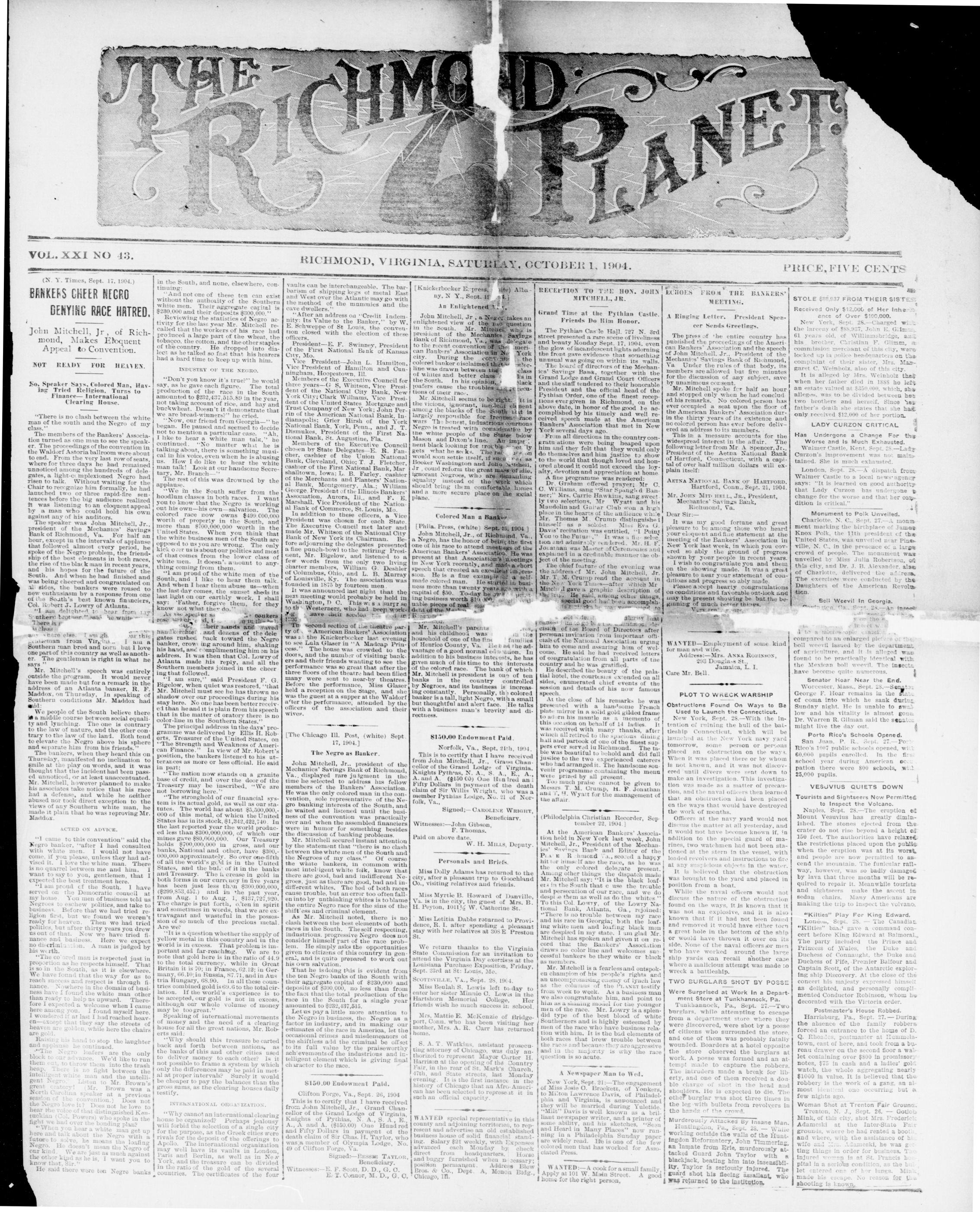
(N. Y. Times, Sept. 17, 1904.)
BANKERS CHEER NEGRO
DENYING RACE HATRED
John Mitchell, Jr., of Richmond, Makes Eloquent Appeal to Convention.
NOT READY FOR HEAVEN.
So, Speaker Says, Colored Man, Having Tried Religion, Turns to Finance—International Clearing House.
"There is no clash between the white man of the south and the Negro of my class."
The members of the Bankers' Association turned as one man to see the speaker. The proceedings of the convention in the Waldorf Astoria ballroom were about to end. From the very last row of seats, where for three days he had remained unnoticed among the hundreds of delegates, a light-ci mulexioned Negro had risen to talk. Without waiting for the reception, he recognize him formally, he had launched an rapid-fire sentences before the big audience realized it was listening to an element appeal by a man who could hold his own against any of his auditors.
The speaker was John Mitchell, Jr., president of the Mechanics' Savings Bank of Richmond, Va. For half an hour, except in the intervals of applause that followed almost every period, he spoke of the Negro problem, the friendship of the best elements in both races, the kind of man in recent years, and his hopes for the future of the South. And when he had and was being cheered and congratulated all sides, the bankers were roused to new enthusiasm by a response from one of the South's best known financiers, Col. Robert J. Lowry of Atlanta.
"I am delighted to hear from my Southern brother," said he white. There is r is class are there else. I am glad to this gentleman from Virginia. I am a Southern man bred and born but I love one part of this country as well as another. The gentleman is right in what he says."
Mr. Mitchell's speech was entirely outside the program. It would never have been made but for a remark in the address of an Atlanta banker, R. F. Maddox, on Thursday. In speaking of Southern conditions Mr. Maddox had said:
"We people of the South believe there a middle course between social equality and lynching. The one is contrary to the law of nature, and the other contrary to the law of the land. Both tend to elevate the Negro above his sphere and separate him from his friends."
The bankers, when they heard this on Thursday, manifested no inclination to smile at the play on words, and it was thought that the incident had been passed unnoticed, or at least unaccentuated. Mr. Mitchell, however planned to make his associates take notice that his race had a defense, and while he neither abused nor took direct exception to the views of any Southern white man, he made it plain that he was reproving Mr. Maddox.
ACTED ON ADVICE.
"I came to this convention" said the Negro banker, "after I had consulted with white men. I would not have come, if you please, unless they had advised it. I love the white man. There is no quarrel between me and him. I want to say to you, gentlemen, that I expected the best treatment here.
"I am proud of the South. I have served on the Democratic council at my home. You men of business told us Negroes to eschew politics, and take to business. Before that we had tried religion first, but we found we weren't ready for heaven. Then we had tried politics, but after thirty years you drew us out of that. Now we have tried finance and business. Here we expect no discrimination. A man is judged by his worth.
"The co'ored man is respected just in proportion as he respects himself. That is so in the South, as it is elsewhere. We have found that the way for us to reach success and respect is through finance. Nowhere in the domain of business have I found the white man other than ready to help us upward. Therefore I expected a welcome when I came here among you. I found myself here, I wondered if at last I had reached heaven—except that they say the streets of heaven are golden, while here the chairs are gold. Raising his hand to stop the laughter and applause, he continued.
"The Negro leafers are the only block to our advance. We'd like to run them out, to throw them into the trash heap. There is no fight between the intelligent white man and the intelligent Negro. Listen to Mr. Brown's great catory! (Mr. Brown was a session chair speaker at a previous session of the convention.) Does not the Negro love you? Does not he love to hear the voice of this distinguished Kentuckian (Col. Powers) spoke in the fight we had over the bombing plan? "When you hear a white man get up here and talk about the Negro with a future to solve, he means the leafing Negro. He doesn't mean the Negro of our kind. We are just as much against the other kind as he is, I want you to know that, Sir." He said there were ten Negro banks
---
in the South, and none, elsewhere, continuing:
"And not one of these ten can exist without the authority of the Southern white men. Their aggregate capital is $230,000 and their deposits $800,000."
Reviewing the statistics of Negro activity for the last year Mr. Mitchell recalled that the workers of his race had produced a large part of the wheat, the tobacco, the cotton, and the other staples of the country. He dropped into dialect as he talked so fast that his hearers had a hard time to keep up with him.
INDUSTRY OF THE NEGRO.
"Don't you know it's true?" he would say, as he gave each figure. The total production of the race in the South amounted to $232,437,515.89 in the year, not taking account of rice, and hay and buckwheat. Doesn't it demonstrate that we are bread-winners?" he cried. "Now, our friend from Georgia—" he began. He paused and seemed to decide not to mention a particular case. "Ah, I he to be a white man talk," he complained. "Matter what he is talking about, there is something musical in his voice, even when he is abusing us. How I do like to hear the white man talk! Look at our handsome Secretary, Mr. Branch—" The rest of this was drowned by the applause.
"We in the South suffer from the hoodlum classes in both races. I want you to know that the Negro is working out his own—his own—salvation. The colored race now owns $489 00,000 worth of property in the South, and more than $700,000,000 worth in the United States. When you think that the white business men of the South are opposed to us you are wrong. The only kick over us is about our politics and most of that comes from the lower class of white men. It doesn't amount to anything coming from them.
"I am proud of the white men of the South, and I like to hear them talk. And when I hear them abuse us—when the last day comes, the sunset sheds its last light on our earthly work, I shall say: 'Father, forgive them, for they know not what they do.' As as speaker so conkers rose and of course in the their hands and waved nandkherief and dozens of the delegates rushed back toward the Negro banker, crowing around him, shaking his hand, and complimenting him on his address. It was then that Col. Lowry of Atlanta made his reply, and all the Southern members joined in the cheering that followed.
"I am sure," said President F. G. Bigelow, when quiet was restored, "that Mr. Mitchell must see he has thrown no shadow over our proceedings during his stay here. No one has been better received than he and it is plain from his speech that in the matter of oratory there is no color-line in the Southern States."
The principal address in the days' programme was delivered by Ellis H. Roberts, Treasurer of the United States, on "The Strength and Weakness of American Finance." In view of Mr. Robert's position, the bankers listened to his utterances as more or less official. He said in part;
"The nation now stands on a granite base of credit, and over the door of the Treasury may be inscribed. "We are not borrowing here."
"The stronghold of our financial system is its actual gold, as well as our statutes. The world has about $5,500,000,000 of this metal, of which the United States has in its stock, $1,342,422,740. In the last reported year the world produced less than $300,000,000, of which our mines gave $800,000,000. Our Treasury holds $700,000,000 in gross, and our banks, National and other, have $300,000,000 approximately. So over one-fifth of all the world's gold is in the United States, and the bulb, of it in the banks Treasury. The i crease in gold in both for the first currency in five years has been just less than $000,000,000 ($299,833,457) and in the past year, from Aug. 1 to Aug. 1, $157,727. The charge is put forth, o'ten spirit and sometimes in words, that we are extravagant and wasteful in the possession of so much of the precious metal. Are we?
"It is a question whether the supply of yellow metal in this country and in the world is in excess. That problem is important and far reaching. We are to note that gold here is in the ratio of 44.9 to the total currency, while in Great Britain it is 70; in France, 62.12; in Germany, 66.10; in Russia, 87.71, and in Austria Hungary, 68.90. In all these countries combined gold is 69.6 to the total circulation. If the world's experience is to be accepted, our gold is not in excess, although our whole volume of money may be too great."
Speaking of international movements of money and the need of a clearing house for all the great nations, Mr. Roberts said:
"Why should this treasure be carted back and forth between nations, as the banks of this and other cities used to deliver money to each other? Is it not possible to frame a system by which only the differences may be paid in metal at proper intervals? Surely it would be cheaper to pay the balances than the gross sums, as the clearing houses daily testify."
INTEKNATIONAL ORGANIZATION
"Why cannot an international clearing house be organized?" Perhaps jealousy will forbid the selection of a single city for the purpose, as the Greek cities were rivals for the deposit of the offerings to Apollo. The international organization which vaults in London, Paris and Berlin, well as in New York, and the treasure of the city in the ratio of the gold of the several countries. The certificates of the four
vaults can be interchangeable. The barrism of shipping keys of metal East and West over the Atlantic may go with the method of the mummies and the cave dwellers."
"After an address on "Credit Indemnity: Its Value to the Banker," by W. E. Schweppe of St Louis, the convention closed with the election of these officers.
President—E. F. Swinney, President of the First National Bank of Kansas City, Mo.
Vice President—John L. Hamilton, Vice President of Hamilton and Cuningham, Hoopestown, Ill.
Members of the Executive Council for three years of the S. Wintson, Vice President of the National City Bank, New York City; Clark Williams, Vice President of the United States Mortgage and Trust Company of New York; John Perrin of the American National Bank, In diapolis; Grier Hirsch of the York National Bank, York, Penn., and J. T. Dismukes, President of the First National Bank, St. Augustine, Fla.
Members of the Executive Council chosen by State Delegates—E. R. Fancher, cashier of the Union National Bank, Cleveland, Ohio; T. J. Fletcher, cashier of the First National Bank, Marshaltown, Iowa; L. B. Farley, cashier of the Merchants and Planters' National Bank, Montgomery, Ala.; William George President of the Illinois Bankers Association, Aurora, Ill., and F. E. Marshall, Vice President of the National Bank of Commerce, St. Louis, Mo.
In addition to these officers, a Vice President was chosen for each State. The Executive Council met later and made Mr. Whitson of the National City Bank of New York its Chairman. Before adjourning the delegates presented a fine punch-bowl to the retiring President, Mr. Bigelow, and listened to a few words from the only two living charter members, William G. Desherl of Columbus, Ohio, and L. B. Murray of Louisville, Ky. The association was founded in 1875 by fourteen men. It was announced last night that the meet meeting probably be held in Washington, D.C. This was a surr se to the Westerners, who had been working have their section in
The second section of the creative party of "American Bankers" Association was at the Knickerbocker last evening to see Lala Glaser in "A Madcap Princess." The house was crowded to the doors, and the number of visiting bankers and their friends wanting to see the performance was so great that after the three floors of the theatre had been filled many were sent to near-by theatres. Before the performance, Miss Glaser held a reception on the Stage, and she was the guest at a supper at the Waldorf after the performance, attended by the officers of the association and their wives.
[The Chicago Ill. Post, (white) Sept 17, 1904.]
The Negro as Banker
John Mitchell, Jr., president of the Mechanics' Savings Bank of Richmond, Va., displayed rare judgment in the time he selected to address his fellow members of the Bankers' Association. He was the only colored man in the convention, sole representative of the Negro banking interests of the South, and waited and listened until the business was practically over and when the assembled financiers were in humor for something besides the discussion of banking problems.
Mr. Mitchell secured instant attention by the statement that "there is no clash between the white men of the South and the Negroes of my class." Of course the white bankers, in common with most intelligent white folk, know that there are good, bad and indifferent Negroes, just as there are good, bad and indifferent whites. The bad of both races cause trouble, but an error too often fallen into by unthinking whites is to blame the entire Negro race for the sins of the shiftess and criminal element.
As Mr. Mitchell noted, there is no clash between the best elements of both races in the South. The self respecting, industrious, progressive Negro does not consider himself part of the race problem. He simply asks the opportunities men of citizens of this country in general, and is prepared to work out his own salvation.
That he is doing this is evident from the ten Negro banks of the South with their aggregate capital of $230,000 and deposits of $900,000, no less than from the fact that the total production of the race in the South for a single year amounted to $232,497,515.
Let us pay a little more attention to the Negro in business, the Negro as a factor in industry, and in making our estimates of the race in America, let the occasional crimes and misdemeanors of the shiftless add the criminal be offset to its full value by the praiseworthy achievements of the industrious and intelligent element which is giving final character to the race.
S150.00 Endowment Paid.
Clifton Forge, Va., Sept. 26, 1904
This is to certify that I have received from John Mitchell, Jr., Grand Chancellor of the Grand Lodge of Virginia, Knights of Pythias, N. A., S. A., E. A., A. and A. ($150.00) One Hundred and Fifty Dollars in payment of the death claim of Sir Chas. H. Taylor, who was a member of Olympia Lodge, No. 49 of Clifton Forge, Va.
Signed—BESSIE TAYLOR
Beneficiary.
Witnesses:—E. F. Scott, D. D., G. C.
E. T. Comor, M. D., G. C.
John Mitchell, Jr., a Negro takes an enlightened view of the race question in the south. Mr. Mitchell, who is president of the Mechanics Sayings Bank of Richmond, Va., was delegate to the recent convention of the merican Bankers' Association in New York city. During the convention the colored banker disclaimed that the color line was drawn between the class of whites and better class in the South. In his opinion, black poachers cause the troubles and precautions of their trade.
Mr Mitchell seems to be right. It is the vicious, ignorant, insolent element among the blacks of the South that is largely responsible for frequent race wars. The heist, industrious sourries Negro is treated with consideration by the white people of the States beaten Mason and Dixon's him. An impartial black looking for trouble netly gets what he seeks. The racist on would soon settle itself, if such net as Booker Washington and John Mitchell, Jr. could reform the work which should bring them comfortable homes and a more secure place on the social plane.
Colored Man a Banke
[Phila. Press, (white) Sept. 25, 1904]
John Mitchell, Jr., of Richmond, Va., a Negro, has the honor of being the first one of his race to attend meetings of the American Bankers' Association. He was present at that Association's meetings in New York recently, and made a short speech that created an excellent impression. He is a fine example of a self-made colored man. He started in business more than twenty years ago with a capital of $50. To-day he own printing business worth $10,000, acquired valuable pieces of real estate dept. of the Mason
Mr. Mitchell's parents and his childhood was in the household of one of the finest families of Heurico County, Va. He had the advantage of a good normal education. In addition to his business interests, he has given much of his time to the interests of the colored race. The bank of which Mr. Mitchell is president is one of ten banks in the country controlled by Negroes, and its business is increasing constantly. Personally, the colored banker is a tall, light Negro, with a small but thoughtful and alert face. He talks with a business man's brevity and directness.
S150.00 Endowment Paid
Nortok, Va., Sept. 24th, 1904.
This is to certify that I have received from John Mitchell, Jr., Grave Chancellor of the Grand Lodge of Virginia, Knights Pythas, N. A., S. A., E. A., A. a. and A. ($150 00) One Hun仁 and Fifty Dollars in payment of the death claim of Sir Willis Wright, who was a member Pythias Lodge, No. 21 of Norfolk, Va.
Witnesses:—John Gibson,
F. Thomas.
Paid on above date.
Personals and Briefs
Miss Dolly Adams has returned to the city, after a pleasant trip to Goochland Co., visiting relatives and friends.
Miss Myrtle B. Howard of Danville, Va. is in the city, the guest of Mrs. B. H. Peyton, 1011½ W. Catherine St.
Miss Letitia Dabbs returned to Providence, R. I. after spending a pleasant stay with her relatives at 308 E Preston St.
We return thanks to the Virginia State Commission for an invitation to attend the Virginia Day exercises at the Louisiana Purchase Exposition, Friday, Sept. 23rd at St. Louis, Mo.
SCOTTSVILLE, VA., Sept. 28, 1904.
Miss Beulah S. Lewis left to day to enter her sister Minnie G. Lewis in the Hartshorn Memorial College. Her friends wish he much success in school.
Mrs. Mattie E. McKenzie of Bridgeport, Conn. who has been visiting her mother, Mrs. A. R. Carr has returned home.
S. A. T. Watkins, assistant prosecuting attorney of Chicago, was duly authorized to represent Mayor Carter H. Harrison at the opening of the Country Fair, in the rear of St. Mark's Church, 47th, and State streets, last Monday evening. It is the first instance in the history of Chicago that an Afro-American has been selected to represent it in such an official capacity.
---
WANTED special representative in this county and adjoining territories, to represent and advertise an old established business house of solid financial standing. Salary $21 weekly, with Expenses advanced each Monday by check for badquarters, Horse and buggy furnished, where necessary; position permanent. Address Blow Bros. & Co., Dept. A, Monon Bidg., Chicago, IL.
RECEPTION TO THE HON. JOHN MITCHELL, JR.
Grand Time at the Pythian Castle,
Friends Do Him Honor.
The Pythian Castle Hall, 737 N. 3rd street presented a rare scene of liveliness and beauty Monday Sept. 17, 1904, even the glow of incandescent lights adorning the front gave evidence that something unusual was going on within its walls. The board of directors of the Mechanics' Savings Bank, together with the Grand Lodge and Grand Court Officers the staff tendered to their honorable presidency, and the official head of the Pythian Orchard, one of the finest receptions ever given in Richmond, the above date, in honor of the good he accomplished by his timely and well received speech made at the American Bankers' Association that met in New York several days ago. From all directions in the country congratulations were being heaped on him and they felt that they would only do themselves and him justice to show to the world that though loved and honored abroad it could not exceed the loyalty, devotion and appreciation at home.
programme was rendered: Dr. Graham offered prayer; Mr. C. O. Williams sang "Star Spangled Banner"; Mr. Cawley sang, sang sweetly two selections, Mr. Watt and his Maundolin and Guitar Clan in place in the hearts of the audience while Mr. Thomas M. Crump distinguished himself as a solist. Willa Eva G. Davis' recitation was entitled, "I Point You to the Future." It was a fine selection and admirably centered, Mr. H. F. Jouantam was Master of Ceremonies and explained in a creditable manner the object of the meeting.
The chief feature of the evening was the address of Mr. John Mitchell, Jr. Mr. T. M. Crump read the account in the New York Times—after which Mr. Mitchell gave a graphic description of the trip. He said, among other things, special good had been accomplished in the work he was very used to not do. He said, "I am always thankful him to go back to the continuous decision of the Board of Directors after personal invitation from important officials of the National Association urging him to come and assuring him of welcome. He said he had received letters of congratulation from all parts of the country and he was gratified.
He described the beauty of the palatial hotel, the courtesies extended on all sides, enumerated chief events of the session and details of his now famous speech.
At the close of his remarks he was presented with a handsome French plate mirror in a solid gold gilded frame to adorn his mantle as a memento of this occasion on behalf of 14 ladies. It was received with many thanks, after which all retired to the spacious dining hall and partook of one of the finest supper served in Richmond. The table was beautiful to behold and did full justice to the many experienced caterers who had arranged it. The handsome souvenir programme containing the menu were prized by all present.
Too much praise cannot be given to Messrs T. M. Crump, H. F. Jonathan and T. H. Wyatt for the management of the affair.
(Philodelphia Christian Recorder, Sept
tenber 22, 1904.)
At the American Bankers' Association held in New York last week, John Mitchell, Jr., President of the Mechanies' Savings Bank and Editor of the PLACE Richard V.A., scored a happy hit for himself an the race, as he was the only colored delegate present. Among other things the dispatch made Mr. Mitchell say: "It is the black loafers in the South that c use the trouble and persecution of our race, and we do despite them as well as do the whites." To this Col. Lowry, of the Lowry National Bank, Atlanta, Ga., rejoined; "It is no trouble between my race and his race in Georgia; both the loafing white men and I am glad Mr. Mitchell has spoken and given it on record that the Bankers' Association draws no color line and welcomes successful bankers be they white or black as members.
Mr. Mitchell is a fearless and outspoken champion of his people's rights and an uncompromising enemy of lycea law, as the columns of the PLANET testify from week to week. As a business man we also congratulate him, and point to him as a simming model for the younger men of the race. Mr. Lowry is a splendid type of the best blood of white Southerners and is highly esteemed by men of the race who have business relation with him. It is the bad elements of both races that brew trouble between the races and because they are aggressive and in the majority is why the race question is so acute.
A Newspaper Man to Wed.
New York, Sept. 21:—The engagement of Miss Josie O. Brockett, of Yonkers, to Milton Lawrence Davis, of Philadelphia and Virginia, is announced and they will be married during Yuletide. "Milt" Davis is well known as a brilliant newspaper writer, and a printer of some ability, and his sketches. "Seen and Heard in Many Places" now running in a Philadelphia Sunday paper are widely read. He is one of the few colored men that has worked for Associated Press.
WANTED:—A cook for a small family. Apply at 101 W. Main Street. A good home for the right person.
ECHOES FROM THE BANKERS MEETING.
A Ringing Letter. President Spencer Sends Greetings.
The press of the entire country has punished the proceedings of the American Bankers' Association and the speech of John Mitchell, Jr., President of the Mechanics' Savings Bank of Richmond, who is the rules of that body, its members are also out five minutes for the discussion of any subject, save by unanimous consent.
Mr. Mitchell spoke for half an hour and stopped only when he had concluded his remarks. No colored person has ever occupied a seat upon the floor of the American Bankers' Association during the thirty years of its existence and no colored person has ever before delivered an address to its members.
This in a measure accounts for the widespread interest in the affair. The following letter from Mr A Spencer, Jr., President of the Aetna National Bank of Hartford, Connecticut, with a capital of over half million dollars will explain itself:
AETNA NATIONAL BANK OF HARTFORD,
Hartford, Conn., Sept. 21, 1904.
It was my good fortune and great pleasure to be among those who heard your eloquent and fine statement at the meeting of the Bankers' Association in New York last week, in which you covered so ably the ground of progress shown by your people in recent years. I wish to congratulate you and them on the showing made. It was a great pleasure to hear your statement of conditions and progress so ably made. Please accept hearty congratulations on conditions and favorable out-look and may the present showing be but the beginning of much better things.
WANTED—Employment of some kind for man and wife.
Address—Mrs. ANNA ROBINSON,
293 Doughs-St,
Jamaica, L. I.
Care Mr. Bell.
PLOT TO WRECK WARSHIP
Obstructions Found On Ways to Be Used to Launch the Connecticut. New York, Sept. 28.—With the intention of ruining the hull of the battleship Connecticut, which will be launched at the New York navy yard tomorrow, some person or persons placed an obstruction on the ways. When it was placed there or by whom is not known, and it was not discovered until divers were sent down to make an investigation. This investigation was made as a matter of precaution, and the naval officers then learned that an obstruction had been placed on the ways that would have destroyed the work of months.
Officers at the navy yard would not discuss the matter at all yesterday, and it would not have become known if, in addition to the special guard of marines, two watchmen had not been stationed at the stern in the vessel, with loaded revolvers and instructions to fire at any suspicious objects in the water. It is believed that the obstruction was brought to the yard and placed in position from a boat.
While the naval officers would not discuss the nature of the obstruction found on the ways, it is known that it was not an explosive, and it is also known that if it had not been found and removed it would have either torn a great hole in the bottom of the ship or would have thrown it over on its side. None of the naval officers or men who have worked around the large ship yards can recall another case where a mallicious attempt was made to wreck a battleship.
TWO BURGLARS SHOT BY POSSE
Were Surprised at Work In a Department Store at Tunkhannock, Pa.
Tunkhannock, Pa., Sept. 27.—Two burglaries, while attempting to escape from a department store where they were discovered, were shot by a posse of citizens who surrounded the store, and one of them was probably fatally wounded. Boarders at a hotel opposite the store observed the burglaries at work. A posse was formed and an attempt made to capture the robbers. The intruders made a break for liberty, and one of them received a double charge of shot in the head and shoulders. He is expected to die. The other burglar was shot three times in the leg with bullets from revolvers in the hands of the crowd.
Murderously Attacked By Insane Man,
Huntingdon, Pa., Sept. 18. — White
working outside the walls of the Huntingdon Reformatory, John Timmering,
an inmate from Erle, murderously attacked Guard John Taylor with a
blackjack, beating him into insensibility. Taylor is seriously injured. The
guard shot his feeling assailant, who was returned to the institution.
PRICE,FIVE CENTS
STOLE $88,937 FROM THEIR SISTER
Received Only $12,000 of Her Inhe
sance of Ours $100,000
since of Over $100,000.
New York, Sept. 28.—Charged with the larceny of $88,937, John E. Gilmur, 61 years old, of Williamsbridge, and his brother, Christian F. Gilmur, a commission merchant of this city, were locked up in police headquarters on the complaint of their sister, Mrs. Margaret C. Weinholz, also of this city.
It is alleged by Mrs. Weinholz the when her father died in 1888 he left an estate valued at $350,000, which she alleges, was to be divided between her two brothers and herself. Since her father's death she states that she had only received $12,000 of her portion.
LADY CURZON CRITICAL
Has Undergone a Change For the
Worse and is More Enjoyed
Worse and Is Much Exhausted.
Walmer Castle, Kent, Sept. 28.—Lady Curzon's improvement was not maintained. She is much exhausted.
London, Sept. 28.—A dispatch from Walmer Castle to a local news agency says: "It is learned on good authority that Lady Curzon has undergone a change for the worse and that her condition is critical."
Monument to Polk Unveiled.
Charlotte, N. C., Sept. 27.—A monument marking the birthplace of James Knox Polk, the 11th president of the United States, was unveiled near Pineville, N. C., in the presence of a large crowd of people. The monument was unveiled by Miss Julia Robertson, of this city, and Dr. J. B. Alexander, also of Charlotte, delivered the address. The exercises were conducted by the Daughters of the American Revolution.
Boll Weevil In Georgia.
Cominica Ga., Sept. 28.—An insect
insect on the
insect w
i to a microscopic cannibal
compared to an enlarged picture of the
boll weevil issued by the department
of agriculture, and it is alleged was
found to be practically identical with
the Mexican boll weevil. The insects
have become quite numerous.
Senator Hoar Near the End.
Worcester, Mass., Sept. 28.—Senator
George F. Hoar remains in the state
of coma into which he sank during
Sunday night. He is unable to swallow
and his vitality is almost gone.
Dr. Warren R. Gilman said the senator might live the day out.
Porto Rico's Schools Opened.
San Juan, P. R., Sept. 27.—Porto
Rico's 1007 public schools opened, with
60,000 pupils enrolled. In the first
school year during American occu-
pation there were 800 schools, with
25,000 pupils.
VESJVIUS QUIETS DOWN
Tourists and Sightseers Now Permitted to Inspect the Volcano.
to inspect the Volcano.
Naples, Sept. 28.—The eruption of Mount Vesuvius has greatly diminished. The stones ejected from the crater do not rise beyond a height of 150 feet. The authorities have relaced the restrictions placed upon the public when the eruption was at its worst, and people are now permitted to ascend the mountain. The funicular railway, however, was so badly damaged by lava that three months will be required to repair it. Meanwhile tourists and sightseers make the ascent in sodan chairs. Many Americans are making the trip to inspect the volcano.
"Killies" Play For King Edward. London, Sept. 28. — The Canadian "Killies" band gave a command concert before King Edward at Balmoral. The party included the Prince and Princess of Wales, the Duke and Duchess of Connaught, the Duke and Duchess of Fife, Premier Balfour and Captain Scott, of the Antarctic exploring ship Discovery. At the close of the concert his majesty expressed himself as delighted, and personally complimented Conductor Robinson, whom he decorated with the Victoria order.
Postmaster's House Robbed
Harrisburg, Pa., Sept. 27. — During the absence of the family robbers forced an entrance to the home of D. Q. Rhoades, postmaster at Hummelstown, east of here, and took from a bureau drawer on the second floor a wallet containing over $800 in promissory notes, $75 in cash and a ladies' gold watch, the whole aggregating nearly $1000 in value. It is believed that the robbery is the work of a gang, an almost identical one occurring but a few nights ago.
Woman Shot at Trenton Fair Grounds
Trenton, N. J., Sept. 28. — Godof
Mink, of this city, shot Mrs. Frederick
Adameski at the Inter-State Fair
grounds, where he had rented a booth
and where, with the assistance of his
wife and Mrs. Adameski, he was get-
ting things in order for business. The
injured woman is at St. Francis
hospital in a serious condition, as the
bullet entered one of her lungs. Mink
made his escape. No reason for the
shooting is known.
SATURDAY
OCTOBER 1, 1890
ROAD AND FARM IMPROVEMENT
How to Put a Durable Foundation Under Structures Put Up Some Seasons Before.
The illustration shows an excellent plan for putting a tight foundation under a barn or other structure that is already built. This is usually a difficult matter, particularly if the building is close to the ground. Foundation should extend down below frostline.
Dig a trench (t) close to the barn, as shown, and then under the barn to required distance to accommodate width
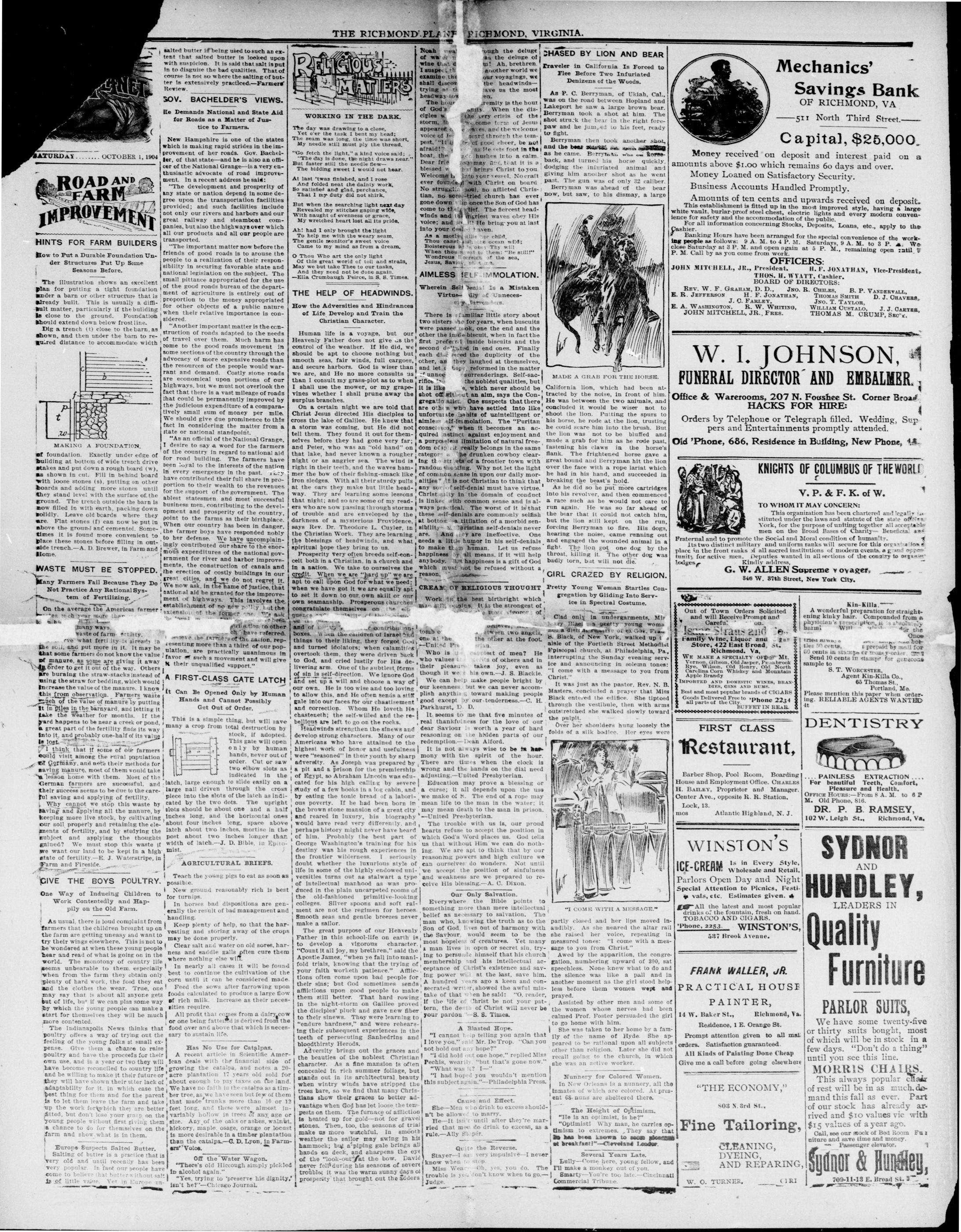
MAKING A FOUNDATION
of foundation. Exactly under edge of building at bottom of wide trench drive stakes and put down a rough board (w), as shown in cut. Fill in behind board with loose stones (s), putting on other boards and adding more stones until they stand level with the surface of the ground. The trench outside the barn is now filled in with earth, packing down solidly. Leave old boards where they are. Flat stones (f) can now be put in above the ground and cemented. Sometimes it is found more convenient to place these stones before filling in outside trench.—A. D. Brewer, in Farm and Home.
WASTE MUST BE STOPPED.
Many Farmers Fail Because They Do Not Practice Any Rational System of Fertilizing.
ve what fertility is already in the soil, and put more in it. It may be that some farmers do not know the value of manure, as some are giving it away in order to get it out of the way. Others are burying the straw-stacks instead of using the straw for bedding, which would increase the value of the manure. I know this from observation. Farmers waste much of the value of manure by putting it in piles in the barnyard, and letting it take the weather for months. If the yard happens to be near a creek or pond, a great part of the fertility finds its way into it, and probably one-half of its value is lost.
I think that if some of our farmers could visit among the rural population of Germany, and note their methods for saving manure, most of them would take a lesson home with them. Most of the German farmers are successful, and their success seems to be due to the careful saving and applying of fertility.
Why cannot we stop this waste by having and applying all the manure, by keeping more live stock, by cultivating our soil properly and retaining the elements of fertility, and by studying the subject and applying the thoughts gained? We must stop this waste if we want our land to be kept in a high state of fertility—E. J. Waterstripe, in Farm and Fireside.
GIVE THE BOYS POULTRY.
One Way of Inducing Children to Work Contentedly and Happily on the Old Farm.
As usual, there is loud complaint from farmers that the children brought up on the farm are getting uneasy and want to try their wings elsewhere. This is not to be wondered at when these young people hear and read of what is going on in the world. The monotony of country life seems unbearable to them especially when from the farm they obtain only plenty of hard work, the food they eat and the clothes the wear. True, one may say that is about all anyone gets but of life, but if we can plan some way by which the young people can make a start for themselves they will be much more contented.
The Indianapolis News thinks that poultry offers a way of trying out the feeling of the young folks at small expense. Give them a chance to raise poultry and have the proceeds for their own use, and in a year or two they will have become reconciled to country life and be willing to make it their future or they will have shown their utter lack of adaptability for it, in which case the best thing for them and for the parent is to let them leave the farm and take up the work for which they are better fitted, but don't lose your grasp on the young people without first giving them a chance to do for themselves on the farm and show what is in them.
Europe Suspects Salted Butter.
Salting of butter is a practice that is very old and until recently has been very popular. In fact our people have come to believe that butter without salt is of little value. Yet in Europe un-
salted butter is being used to such an extent that salted butter is looked upon with suspicion. It is said that salt is put in to disguise the bad qualities. That of course is not so where the salting of butter is extensively practiced.—Farmers Review.
SOV. BACHELDER'S VIEWS.
Ke Demands National and State Aid for Roads as a Matter of Justice to Farmers.
New Hampshire is one of the states which is making rapid strides in the improvement of her roads. Gov. Bacheller, of that state—and he is also an officer of the National Grange—is a very enthusiastic advocate of road improvement. In a recent address he said:
"The development and prosperity of any state or nation depend in some degree upon the transportation facilities provided; and such facilities include not only our rivers and harbors and our great railway and steamboat companies, but also the highways over which all our products and all our people are transported.
The important matter now before the friends of good roads is to arouse the people to a realization of their responsibility in securing favorable state and national legislation on the subject. The small pittance appropriated for the use of the good roads bureau of the department of agriculture is entirely out of proportion to the money appropriated for other objects of a public nature when their relative importance is considered.
"Another important matter is the construction of roads adapted to the needs of travel over them. Much harm has come to the good roads movement in some sections of the country through the advocacy of more expensive roads than the resources of the people would warrant and demand. Costly stone roads are economical upon portions of our highways, but we must not overlook the fact that there is a vast mileage of roads that could be permanently improved by the judicious expenditure of a comparatively small sum of money per mile. We should give due prominence to this fact in considering the matter from a state or national standpoint.
"As an official of the National Grange, I desire to say a word for the farmers of the country in regard to national aid for road building. The farmers have been loyal to the interests of the nation in every emergency in the past. They have contributed their full share in proportion to their wealth to the revenues for the support of the government. The ablest statesmen and most successful business men, contributing to the development and prosperity of the country, point to the farms as their birthplace. When our country has been in danger, the farmer boys have responded nobly to her defense. We have uncomplainingly contributed our share to the enormous expenditures of the national government for river and harbor improvements, the construction of canals and the erection of costly buildings in our great cities, and we do not regret it. We now ask, in the name of justice, that national aid be granted for the improvement of highways. This involves the establishment of no new policy but the extension of the former one. We ask
attribution to other oh have referred
I believe the farmers of the nation, representing more than a third of our population, are practically unanimous in favor such a movement and will give their unqualified support."
A FIRST-CLASS GATE LATCH
It Can Be Opened Only by Human
Hands and Cannot Possibly
Get Out of Order.
This is a simple thing, but will save
many a crop from total destruction by
thing, but will save total destruction by stock, if adopted. This gate will open only by human hands, never out of order. Cut or saw two elbow slots as indicated in the
stock, if adopted. This gate will open only by human hands, never out of order. Cut or saw two elbow slots as indicated in the latch, large enough to slide easily on a large nail driven through the cross piece into the slots of the latch as indicated by the two dots. The upright slots should be about one and a half inches long, and the horizontal ones about four inches long, space above latch about two inches, mortise in the post about two inches longer than width of latch. J. D. Bible, in Epitomist.
AGRICULTURAL BRIEFS.
Teach the young pigs to eat as soon as possible.
New ground reasonably rich is best for turnips.
In horses bad dispositions are generally the result of bad management and handling.
Keep plenty of help, so that the harvesting and storing away of the crops may be done properly.
Clear salt and water on old sores, harness and saddle galls often cure them where nothing else will.
In nearly all cases it will be found best to continue the cultivation of the corn until it can be considered made.
Feed the sows after farrowing upon foods calculated to produce a large flow of rich milk. Increase as their necessities require.
All profit that comes from a dairy cow or one being fattened is derived from the food over and above that which is necessary to sustain life.
Has No Use for Catalpas.
A recent article in Scientific American deals with the financial side of growing the catalpa and notes a 20-acre plantation 17 years old sold for about enough to pay taxes on the land. We have no faith in the catalpa as a timber tree, as we have seen but few of them that made trunks more than 10 or 12 feet long, and these were almost invariably hollow in trees of any age or size. Any of the oaks or ashes, walnut, hickory, maple, osage, orange or locust is more desirable in a timber plantation than the catalpa.—G. D. Lyon, in Farmers' Voice.
Off the Water Wagon
"There's old Hiccough simply pickled in alcohol again."
"Yes, trying to 'preserve his dignity,' isn't he?"—Chicago Journal.
THE RICHMOND PLANE
GIOUS MATTERS
Noah weed of water in wine that I suspect the examine the shall discover trying at the headway to
The hour the remembrance is the hour of God’s unity. When the disciples wail the very crisis of the storm, for we come turn of Jesus appeareer, we waves, and the welcome voice of he heard through the tempest, “It is of good cheer, be not afraid!” he az Beets foot in the boat, the az hushes into a calm. Dear friend you may not, that it is a blessed w that brings Christ to you. Welcome be into your vessel. Noercr ever found, with Christ on board. No struggle soul, no afflicted Christian, no sore-tried church has ever gone down in once the Son of God has come to the lief. The fiercest headwinds and the most烈 waves obey His voice, and so will He bring you at last into your desired haven.
As a mother calls her child, Thou canst sash the ocean wild; Boisterous sows obey Thy will. When thouest to them: “Be still!” Wondrous Sovereign of the sea, Jesus, Saviour, philma.
AIMLESS ELF-IMMOLATION.
There is a familiar little story about two sisters she for years, when buscuits were passed took one, the end and the other the inside biscuit, when in fact the first preferred inside biscuits and the second detached in end ones. Finally each served the duplicity of the other, an they laughed at themselves, and let a hope reformed in the matter of oneself.
Since it is the noblest qualities, but it is like, which never should be shot of without an alm, says the Congregatio allot. One suspects that there are others who have settled into like unfortunate habits of unintelligent or almless self-imolation. The "Puritan conscience," when it becomes an acquired instinct against enjoyment and a purposeless limitation of natural freedom of spirit really belongs in the same category: a the drunken cowboy clearing the streets of a frontier town with random shooting. Why not let the light of common sense in upon our daily moralities? It is not Christian to think that any sort of self-denial must have virtue. Christianity in the domain of conduct is linked with common sense and is always practical. The worst of it is that these self-denials are commonly selfish at bottom—a titiation of a morbid sensibility. Christian self-denials never are. And they are ineffective. One needs a little humor in his self-denials to make them human. Let us refuse happiness by all means, if it will help anybody. But happiness is a gift of God which must not be refused without a reason.
CREAM OF RELIGIOUS THOUGHT
Work is the best birthright which
man still possesses. It is the strongest of
the most virtuous of
We can help make people bright by our keenness, but we can never accomplish anything toward making people good except by our tenderness.—C. H. Parkhurst, D. D.
It seems to me that five minutes of real thankfulness for the love of our dear Saviour is worth a year of hard reasoning on the hidden parts of our redemption.—Dean Alfred.
It is not always wise to be in harmony with the spirit of the hour. There are times when the clock is wrong and the hands on the dial need adjusting.—United Presbyterian.
Education may prove a blessing or a curse; it all depends upon the use we make of it. The end of a rope may mean life to the man in the water; it may mean death to the man in prison.—United Presbyterian.
The trouble with us is, our proud hearts refuse to accept the position in which God's Word places us. God tells us that without Him we can do nothing. We are apt to think that by our reasoning powers and high culture we can ourselves do wonders. Not until we accept the position of sinfulness and weakness are we prepared to receive His blessing.—A. C. Dixon.
Everywhere the Bible points to something more than mere intellectual belief as necessary to salvation. The man who, knowing the truth as to the Son of God, lives out of harmony with the Saviour, would seem to be the most hopeless of creatures. Yet many a man lives in open or secret sin, trying to persuade himself that his church membership and his intellectual acceptance of Christ's existence and saving power will at the last, save him. A hundred years ago a keen and consecrated writer, showed the awful mistake of that when he said: "O, reader, if the life of 'christ' be not your pattern, the death of Christ will never be your pardon" —S. S. Times.
A Blasted Hope.
"I cannot help telling you again that I love you," said Mr. De Trop. "Can you not hold out any hope?" "I did hold out one hope," replied Miss Pechis, wearily "but that's gone now." "What was it? I—"
"I had bored you wouldn't mention this subject again."—Philadelphia Press.
She—Men who drink to excess shouldn't be allowed to marry.
He—It isn't until after they're married that men do drink to excess, as a rule. Ally Shoer.
Miss Wene—Oh, yes, you do. The trouble is you don't know when to go.—
Judge.
RELIGIOUS MATTERS
WORKING IN THE DARK
The day was drawing to a close,
Yet o'er the task I bent my head;
The seam was long, the time was short,
My needle still must ply the thread.
"Go fetch the light," a kind voice said;
"The day is done, the night draws near."
But faster still the needle flew—
The bidding sweet I would not hear.
At last 'twas finished, and I rose
And folded neat the dainty work,
So satisfied and glad, perchance,
That I my duty did not shirk.
But when the searching light next day
Revealed my stitches gaping wide,
With naught of evenness or grace,
My wretched heart lost all its pride.
Ah! I only I brought the light
To help me with the weary seam.
The gentle monitor's sweet voice
Came to my mind as from a dream.
O Thou Who art the only light
Of this great world of toll and strain,
May we but take Thee to our tasks,
And they need be done again.
—Ella Crumbaugh Peirce, in S. S. Times.
THE HELP OF HEADWINDS.
How the Adversities and Hindrances of Life Develop and Train the Christian Character.
Human life is a voyage, but our Heavenly Father does not give us the control of the weather. If He did, we should be apt to choose nothing but smooth seas, fair winds, full cargoes, and secure harbors. God is wiser than we are, and He no more consults us than I consult my grass-plot as to when I shall use the mower, or my grape-vines whether I shall prune away the surplus branches.
On a certain night we are told that Christ Jesus directed His disciples to cross the lake of Gallilee. He knew that a storm was coming, but He did not tell them. They found it out for themselves before they had gone very far; and Peter, who was an "old hand" on that lake, had never known a rougher night or an angrier sea. The wind is right in their teeth, and the waves hammer the bow of their fishing-smack like iron sledges. With all their sturdy pulls at the cars they make but little headway. They are learning some lessons that night; and so are some of my readers who are now passing through storms of trouble and are enveloped by the darkness of a mysterious Providence, says Rev. Dr. Theodore L. Cuyler, in the Christian Work. They are learning the blessings of headwinds, and what spiritual hope they bring to us.
Prosperity very often breeds self-conceit both in a Christian, in a church and in a nation. We take to ourselves the credit. When we are "hard up" we are apt to call upon God for what we need; when we have got it we are equally apt to set it down to our own skill or our own seamanship. Prosperous churches congratulate themselves on the sinquence and of necessity. We contribute boxes. When the children of Israel and things to their liking, they forgot God and turned idolators; when calamities overtook them, they were driven back to God, and cried lustily for His delivering arm. One of the subtlet forms of sin is self-direction. We ignore God and set up a will and choose a way of our own. He is too wise and too loving to allow this, and He often sends a stiff gale into our faces for our chastisement and correction. Whom He loveth He chasteneth; the self-willed and the rebellious are left to go on the rocks.
Headwinds strengthen the shnews and develop strong characters. Many of our Americans who have attained to the highest work of honor and usefulness were "seasoned" in their youth by sharp adversity. As Joseph was prepared by a pit and a prison for the premiership of Egypt, so Abraham Lincoln was educated for his high calling by severe study of a few books in a log cabin, and by eating the tonic bread of a laborious poverty. If he had been born in the brown stone mansion of a great city and reared in luxury, his biography would have read very differently, and perhaps history might never have heard of him. Probably the best part of George Washington's training for his destiny was his rough experiences in the frontier wilderness. I seriously doubt whether the luxurious style of life in some of the highly endowed universities turns out as stalwart a type of intellectual manhood as was produced in the plain uncarpeted rooms of the old-fashioned primitive-looking colleges. Silver spoons and soft ralment are not the regimen for heroes Smooth seas and gentle breezes never make a sailor.
The great purpose of our Heavenly Father in this school-life on earth is to develop a vigorous character. "Count it all joy, my brethren," said the Apostle James, "when ye fall into manifold trials, knowing that the trying of your faith worketh patience." Afflictions often come upon bad people for their sins; but God sometimes sends afflictions upon good people to make them still better. That hard rowing in the night-storm on Galilee proved the disciples' pluck and gave new fiber to their sinews. They were learning to "endure hardness," and were rehearing their subsequent experiences in the teeth of persecuting Sanhedrins and bloodthirsty Herods.
Adversity brings out the graces and the beauties of the noblest Christian character. As a fine mansion is often concealed in rich summer foliage, but stands out in its architectural beauty when wintry winds have stripped the trees bare, so we find that many Christians show their graces to better advantage when God has let loose the tempests on them. The furnace of affliction is heated up for gold—not for gravel stones. Then, too, the seasons of trial make us more watchful. In smooth weather the sailor may swing in his hammock; but a piping gale brings all hands on deck, and sharpens the eye of the "look-out" fat the bow. David never fell during his seasons of severe trouble; it was the warm sunny days of prosperity that brought out the adders
RICHMOND, VIRGINIA.
SHASED BY LION AND BEAR
Traveler in California Is Forced to Flee Before Two Infuriated Denizens of the Woods.
As P. C. Berryman, of Ukiah, Cal., was on the road between Hopland and Lakeport he saw a large brown bear. Berryman took a shot at him. The shot struck the bear in the right forepaw and he jumped to his feet, ready to fight.
Berryman then took another shot, and the bear started to run as he came. Berryman who on horseback, and turned his horse quickly, dodging the infuriated animal and giving him another shot as he went past. The gun was of only 32 caliber. Berryman was ahead of the bear now, but saw, to his dismay, a large
L.
California lion, which had been attracted by the noise, in front of him. He was between the two animals, and concluded it would be wiser not to shoot the lion. Putting the spurs to his horse, he rode at the lion, trusting he could scare him into the brush. But the lion was not to be bluffed and made a grab for him as he rode past, fastening his claws in the horse's flank. The frightened horse gave a great bound and Berryman hit the lion over the face with a rope lariat which he had in his hand, and succeeded in breaking the beast's hold.
As he did so he put more cartridges into his revolver, and then commenced a race such as he would not care to run again. He was so far ahead of the bear that it could not catch him, but the lion still kept on the run, forcing Berryman to fire. His dogs, hearing the noise, came running out and engaged the wounded animal in a fight. The lion got one dog by the throat, killing it. The other dog was badly torn, but will not die.
GIRL CRAZED BY RELIGION.
Pretty Young Woman Startles Congregation by Gliding Into Service in Spectral Costume.
Clad only in undergarments, Miss Mary Black a pretty young woman with a distractive voice of ex-Gov. Frank S. Black, of New York, walked up to a aisle of the Fortieth Street Methodist Episcopal church, at Philadelphia, Pa, interrupting the Sunday evening service and announcing in solemn tones: "I come with a message to you from Christ."
It was just as the pastor, Rev. N. B. Masters, concluded a prayer that Miss Black entered the edifice. She tiptoed through the vestibule, then tipped out stretched she walked slowly toward the pulpit.
Over her shoulders hung loosely the folds of a silk hoodie. Her eyes were
partly closed and her lips moved inaudibly. As she neared the altar rail she raised her voice, repeating in measured tones: "I come with a message to you from Christ."
Assisted by other men and some of the women whose nerves had been calmed Prof. Foster persuaded the girl to go home with him. She was taken to her home by a family of the name of Hyde. She appeared to be rational upon all subjects other than religion. Later she did not recall going to the church, in which she was an active worker.
ough the deluge
was the deluge of
tu! Ah, brethren,
another world we
our voyagings, we
the headwinds—
save us the most
en.
believe, then
sween two angels,
the other at the foot,
plan.
Our Only Salvation
A. Blasted Hope.
Cause and Effect
Stayer—I am very impulsive—I never know, when to stop.
---
MADE A GRAB FOR THE HORSE.
"I COME WITH A MESSAGE."
Awed by the apparition, the congregation, numbering upward of 300, sat speechless. None knew what to do and the silence was like a pall and in another moment as the girl stood helpless before them women wept and prayed.
Nunnery for Colored Women.
In New Orleans is a nunnery, all the inmates of which are colored. At present 68 nuns are sheltered there.
"Optimist! Why man, he carries optimism to extremes. They say that he has been known to come pleasure at breakfast!" -Cleveland Leader
Several Years Late
Efully—Come here, come yellow, and
I'll make a monkey out of you.
Smarty—You're too late—Cincinnati
Commercial Tribune.
Japan
511 North Third Street.
Capital, $25,000.
Money received on deposit and interest paid on amounts above $1.00 which remains 60 days and over.
Money Loaned on Satisfactory Security.
Business Accounts Handled Promptly.
Amounts of ten cents and upwards received on deposit.
This establishment is fitted up in the most improved style, having a large white vault, burlar-proof steel chest, electric lights and every modern convenience for safety and the accommodation of the public.
For all information concerning Stocks, Deposits, Loans, etc., apply to the Cashier.
Banking Hours have been arranged for the special convenience of the working people as follows: 9 A.M. to 4 P.M. Saturdays, 9 A.M. to 3 P.M. We close Saturday at 3 P.M. and open again at 5 P.M., remaining open until 9 P.M. Call by as you come from work.
OFFICERS:
JOHN MITCHELL, JR., President. H. F. JONATHAN, Vice-President.
THOS. H. WYATT, Cashier.
BOARD OF DIRECTORS:
REV. W. F. GRAHAM, D. D., JNO. R. CHILES, B. P. VANDERVALL,
E. R. JEFFERSON H. F. JONATHAN, THOMAS SMITH D. J. OHAVERS,
J. O. FARLEY, JNO. T. TAYLOR,
E. A. WASHINGTON, R. W. WHITING, WILLIAM CUSTALO, J. J. CAERTER,
JOHN MITCHELL, JR., Pres. THOMAS M. CRUMP, SEC'Y.
W. I. JOHNSON,
FUNERAL DIRECTOR AND EMBALMER.
Office & Warerooms, 207 N. Foushee St. Corner Broad HACKS FOR HIRE:
Orders by Telephone or Telegraph filled. Wedding, Suppers and Entertainments promptly attended.
Old 'Phone, 686, Residence in Building, New Phone, 18
KNIGHTS OF COLUMBUS OF THE WORLD
Money received on deposit and interest paid on a amounts above $1.00 which remains 60 days and over.
Money Loaned on Satisfactory Security.
Business Accounts Handled Promptly.
Amounts of ten cents and upwards received on deposit.
This establishment is fitted up in the most improved style, having a large white vault, burlar-proof steel chest, electric lights and every modern convenience for safety and the accommodation of the public.
For all information concerning Stocks, Deposits, Loans, etc., apply to the Cashier.
Banking Hours have been arranged for the special convenience of the working people as follows: 9 A. M. to 4 P. M. Saturday, 9 A. M. to 3 P. . We close Saturday at 3 P. M. and open again at 5 P. M., remaining open until P. M. Call by as you come from work.
OFFICERS
JOHN MITCHELL, JR., President, H. F. JONATHAN, Vice-President,
THOS, H. W. JONATHAN,
BOARD OF DIRECTORS
W. I. JOHNSON, FUNERAL DIRECTOR AND EMBALMER.
Office & Warerooms, 207 N. Foushee St. Corner Broad HACKS FOR HIRE:
Orders by Telephone or Telegraph filled. Wedding, Suppers and Entertainments promptly attended.
Old 'Phone, 686, Residence in Building, New Phone.
A
KNIGHTS OF COLUMBUS OF THE WORLD
KNIGHTS OF COLUMBUS OF THE WORLD
V. P. & F. K. of W.
TO WHOM IT MAY CONCERN:
This organization has been chartered and legally instituted under the laws and statute of the state of New York, for the purpose of uniting together all acceptable men on the Broad Bases of Charity—Beneficial and Fraternal and to promote the Social and Moral condition of humanity.
Its two distinct military and uniform ranks will secure for this organization a place in the front ranks of all sacred institutions of modern events, a grand opposeunity for active men. Deputies warranted in all sections of the country to organize lodges.
G. W. ALLEN Supreme voyager.
This organization has been chartered and legally instituted under the laws and statute of the state of New York, for the purpose of uniting together all acceptable men on the Broad Bases of Charity—Beneficial and Praternal and to promote the Social and Moral condition of humanity. Its two distinct military and uniform ranks will secure for this organization place in the front ranks of all sacred institutions of modern events a grand opportunity for active men. Deputies wanted in all sections of the country to organize lodges. Kindly address, G. W. ALLEN Supreme voyager. 346 W. 37th Street, New York City.
Kin-Killa.
A wonderful preparation for straightening kihny hair. Compounded from a physician's prescription, it is absolutely harmli. Will it work for the Ques
treen always bots 50 cents, prepaid by mail for 60 cents in stamps or money-order. Send 10 cents in stamps for generous sample to
WE MAKE A SPECIALTY OFF Mt.
Vernon, Gibson, Old Jaaper, Peambrook
Rye, Wilson, Old Henry, Old North
Carolina Corn Whiskey and Mountain
Apple Brandy
IMPORTED AND DOMESTIC WINES, BRAN-
DIES, GINS AND RUMS.
Best and most popular brands of CIGARS
Goods Delivered Free to 'Phone 2234
all parts of the City.
BUFFET IN REAR.
Please mention this paper when ordering
RELIABLE AGENTS WANTED
DENTISTRY
FIRST CLASS
```markdown
```
Restaurant.
Barber Shop, Pool Room, Boarding House and Employment Office. CHARLES H. BAILEY, Proprietor and Manager. Center Ave., opposite R. R. Station, Lock 13
... PAINLESS EXTRACTION ...
For beautiful Teeth, Comfort,
Pleasure and Health,
OFFICE HOURS:—From 8 A.M. to 6 P
M. Old Phone, 816.
DR. P. B. RAMSEY,
102 W. Leigh St., Richmond, Va.
Atlantic Highland. N. J.
WINSTON'S
HUNDLEY,
Parlors Open Day and Night
Special Attention to Picnics, Festi-
vals, etc. Estimates given.
All the latest and most popular
drinks of the fountain, fresh on hand.
TOBACCO AND CIGARS.
'Phone, 2253.
WINSTON'S,
537 Brook Avenue.
FRANK WALLER, JR.
PRACTICAL HOUSE
PARLOR SUITS.
14 W. Baker St., Richmond, Va Residence, 1 E. Orange St.
We have some twenty-five or thirty suits bought, most of which will be in stock in a few days. "Don't do a thing" until you see this line.
MORRIS CHAIRS.
This always popular chair of rest will be in as much demand this fall as ever. Part of our stock has already arrived and $10 values vie with $15 values of a year ago.
"THE ECONOMY,"
S03 N.3rd St.,
Fine Tailoring,
Call, see our stock of Bed Room. Fur
niture and save time and money.
CLEANING,
DYEING,
AND REPARING
Sydnor & HunaHey,
W. O. TURNER, CIRI 709-11-13 E. Broad St.
X pore les
U \ bh
SS manent et gs
Copyricht, m9, by J. B oe
CHAPTER V.
Facing the sun on the same morn-
ing which broke through the length-
ened slumbers of Louise if the Rich-
mind hotel, an old man sat in an in-
valid chair. Everything that wealth
could provide for his comfort, every-
thing demanded by convention, sur-
rounded him. No one would ever say,
Yooking in upon the appointments of
his house, that the sick man lacked
anything that loving sympathy and
tender solicitude could suggest. The
deep velvet carpet gave back no sound
under the feet of those who moved
around him; curtains of damask and
lace softened the too direct rays of
light which entered the long windows
across the balcony: bits of landscape
and color relieved the wide expanse
ef wall; and flowers lent freshness
end fragrance to the soft spring afr
eparingly admitted.
The old man was haggard from
Joss of rest and from apprehension.
Riis once florid face was pallid and
the cheeks sunken, His eyes shone
with an unnatural brilliancy. One
eed not have been a skilled physi-
cian to have detected the fact that
4eath’s seal was upon that pale face
and shrunken frame. ‘The tiny spark
of life might glimmer in its socket
for days, weeks, even months; it
Would never again send up a clear and
steady blaze.
Within the same room several peo-
ple kad gathered, controlled by varied
sentiments, Dr. Brodnar was there,
his massive frame bent above the
ick man, his eyes everywhere. Pulse,
Fespiration, temperature, were par
tiently ascertained, and ‘with unsat.
isfactory results, evidently, for the
octor's face was a tell-tale. Once
or twice his eyes rested upon a tall
Woman in black who mored slowly
about the invalid, touching his hands
and forehead, admonishing him gen-
tly, and keeping watch upon the
physician's actions with a singular in-
tentness.
This woman was of marked per
@onality. Her iron-gray hair was
brushed back smoothly from a broad,
low forehead, her biack eyes were
well sunk under dark brows and
lashes, but flashed indolently from
time to time when she was speak-
are fil Ee
er =
hn it
LA
Zz
SOR SR Ee Ree
ing. The small, straight, relentiess
mouth and uquiline nose gave a note
‘of severity to her face. Her charm,
it is likely, had existed in the con-
tour and coloring of that face, and
fn a certain easy self-reliance, or
gonsciousness of power. Just now her
face was inserutably placid. She
‘spoke only in tones so low as to be
audible but a short distance.
Across the room a girl stood looking
fdly, dreamily, from a casement win-
dow into the treen She was slender,
with a mass of reddish, golden curls
gathered back and fallen over her
Shoulders. The profile revealed birth
end refinement, and suggested nobil-
ity, high purpose and innate purity.
‘There was a wistful tenderness about
her mouth and a soft radiance in her
Blue-gray eyes when from time to time
she turned towards the group gath-
‘ered about the sick man.
“Iam ata loss, madam,” the doctor
‘was saying, “to account for his Inck
ef improvement. There seems to be
nothing organically wrong, and yet
the nerve centers are totally inactive.”
He picked up several medicine bottles
end examined them, testing their con-
tents by smell and sight. ‘The tall
Woman's eyes met his.
“He passed a restless night," she said,
Jaying her hands vpon the sek man's
forehead. ‘There was considerable
confusion Im the city, and some one
Just before daylight fired a pistol near
the house. This gave him a fearful
sock.”
“There is much excitement in Rich-
mond over the secession movement,”
said Rrodnar, “and the police are far
too few for these times, What have
You given him during the night?”
“I want my danghter to be present,”
said the sick man, fretfully; “I want
her to hear the will read before I sign
it, dostor.”
“1am here, papa,” sala the girl, eom-
ing stowly forward and standing quiet-
ly near him. He looked into her face
Jong and intently, his own softening.
“I would suggest,” said the doctor,
rising and addressing the elder wome
fn, “that we leave them alone for «
few moments; he seems a tritte bright-
‘@F just now.” She fixed her black eyes
upon him steadily, and a slight smile
moved the hard lines of her mouth.
“It would not do. Frances is excit-
able. and excitement is contagious.”
“But Iam sure, madam—!"
“It is useless, sir. He relies upon me,
and is nervous if T leave him for even &
minute." Her white hand fell in rhyth-
mic monotony upon the invelid’s fore-
Bend. Presently he reached up impa-
Yently and pushed it away; but, wait.
pane eS Ere
ance.
“I want my daughter to hear it read,"
he said, querulousiy, reverting te @
thought unspoken.
“Oh, I would not let her do that, ete.”
said Brodear. “You will not permit
that. mada!”
“She shall hear it,” said the woman,
“Tt pleases him; and he has a good ob-
Ject in it, Tam sure."
A professional man who had been
writing at a side table now came for-
ward and read the dying man's wile
Rotary standing near. ‘The letter eu
changed glances with Brodnar and
looked away, a half smile upon his lips,
The document, after the usual recita-
tions and the naming of numerous
amall legacies for family servants and
ethers, proceeded as follows:
“And the residue of my property, my
wife, Annette, having been amply pro-
vided for by deed of gift during my
life, I bequeath to my daughter, Fran-
ces Brookia, upon condition that she
shall, on or before attaining the age
of 21 years, accept as her lawful hus-
band Raymond Holbin, who has asked
her hand of me, my object being to pre-
vide for the future of a wayward girl
by giving her a guardian who is in all
respects a gentleman and worthy of
every confidence. But if my said
@aughter, Frances, fails or declines to
marry the said Raymond Holbin with-
| im the limit of her minority, or immedi-
ately after attaining her majority,
then I will and declare that all the
property named and éescribed as the
Tesidue of my estate, after legacies
apecified have been paid, shall vest in
my wife Annette, the said Frances te
become a charge upon my estate dur-
ing her life for sustenance and clothing
enly, unless it happens that she enters
into a marriage contract with some one
other than the said Raymond Holbin,
in ‘which event the charge shall cease
and the estate be acquitted of all de-
mands from her, her heirs or assigns.”
Absolute silence followed the read-
ing of the document, except that an ex-
clamation, half an oath, half a groan,
burst from the doctor's lips. He
strode to the table and picked up his
hat, but paused when his gaze fell upon
the figure of the slender girl. She stood
erect, proudiy looking at the group, her
calm white face outlined against the
damask curtains as the face of a statue.
He laid his hat on the table, and, mov-
ing a little nearer to her, waited. The
‘sick man grasped the pen with fever
ishyanerge aod the sess
—nndiectiy attesting, ‘tall, grave
"woman tcok the legal Instroment and
applied a blotter. Then, folding it, she
placed it in her bosom. Te the law-
yer’s embarrassed protest she said:
| “Iam the executrix of this will,
and I prefer to be its custodian. That
is your desire, dear, is It not—you
wish to keep the will here in the
house?” ‘The exhausted Invalid nod-
| ded fecbly. At this moment the door
opened ind Raymond entered the
lroom. ‘The elder woman, with an
‘angry flush upon her face, walked
rapidly towards him, and the law-
| yer passed out with the notary.
| “Fool!” she whispered, “you endan
ger It all!” She drew him into a
bay window, where they began an an-
‘imated discussion. Brodnar had but
one free moment but in that moment
he acted. The girl had been left
standing by her father's side. She
alone caught the sentence whispered
to her by the physician; her eyes fol-
lowed him as he walked slowly away
and then returned to rest upon the
sick man. Gazing into his wan face, |
all her tenderness came back. Sudden
ly she sank by his side and clasped
her hands upon Ns knees.
| “Father! she said, gently, “one
word! Will you let me speak now?
We may be parting for all eternity.” |
He opened his eyes and looked stead-
fly upon her,
“It iw for eternity,” he said. And
then, somehow, his hand found her |
head and rested there gently. “You
are proud, Frances, and hurt, but the
time will come when you will know
that—T have acted for the best—” |
“Oh, you think so." she said, shake
ing with half-suppressed emotion and
hiding her face. “I know you think
0. But" |
“Listen, Frances You have a cons-
im whose name has long since ceased
to be spoken in my family. She was |
proud—and wayward—and headstrong,
too. You are very like hex as she was |
—when her father’s will made her my !
ward—as she was when she passed— |
away—”
She Is dead |
“Yes, to us!" he waited for breath
and strength to proceed. “A husband
—would have saved her. She bad a
right under the will—to choose—her
Fesidence. A foolish aunt received her.
She followed her own fancy!” |
“I would not talk of it, father. Tt
excites you.” |
“I must! She was always—heedless
—of advice—self willed—jealous—And |
then she—disappeared — leaving — a!
note—and disgrace! I let her go.!
She is dead to me!” After a pause be
continued: “I have seen you ‘drifting |
away—Frances! Sieotedient tier: |
ing—I would save you—it I could.
Weep no more—I have forgiven; I!
have forgiven—!" ‘The girl lifted her |
face quickly, indignant and agonized, |
“You have been deceived, father; oh, |
so basely deceived. I am not mat
ward—I have never yet disobeyed you. |
Se ee Doe Deane 9
THE RICHMOND PLANE, RICHMOND, VIRGINIA.
Oe ee FOR Tae ate. + 1Oee
you, father. I would have been
your dear daughter if you had not
put it beyond my power.”
“Child!” What is it you are say-
ing?”
“Do you not understand, father?”
she said, passionately, “do you not
know that that woman has for years
deprived you of your independence—
of your freedom? Now shehas taken
your property! Can't you see it? You
have been robbed of everything—and
I—t Oh, she has preyed upon your
holiest feelings: she bas turned you
against your own child—the child to
whose mother you promised to guard
and guide!”
He raised himself in his chair, A
look of fright was upon his face.
“See!” she cried, “there is the wom-
an with her son dividing your prop-
erty before you are dead. Oh, they
think Iam harmless, now; I am not to
to be feared! the die is cast, the will
ig signed, and you, father, have be-
trayed your only child into the hands
of her bitterest enemy.”
He was speechless and pale. His
ull eyes were fixed on the girl's.
| “But no,” he said faintly, “this cam-
mot be it cannot be! My’ child, you
fre rerers = eof woman—an’
Raymond—he has veen very kind, sc
very kind!”
“You are blinded, father; you are
“unsuspecting. Tellme, have they
ever said that for months I have been
| eager to be with you; that?”
| “You, Frances! Why, you refused
over and over—" She sank her head
upon her chair.
“And you believed that of me? Tt
‘was untrue—a cruel, cruel invention.”
Mother and son caught the sound
of her agitated voice and would have
gome over from the bay window, but
Dr. Brodnar, drawing the sofa around
as though to sit with them, stood
with his hand resting upon it, com-
pletely blocking their way.
“To-day and to-night,” he said, “he
must have absolute quiet Continue
the powders I have left, and see that
he does not attempt, under any oir
gumstances, to walk about the room.”
He continued rapidly te gire direc:
tions concerning the treatment of the
Patient, and disregarded the woman's
efforts to pass him. Frances lowered
her voice and continued earnestly:
“You do not believe me, father, you
do not realize what you have done,
You do not know the man to whom
you have consigned me, nor the wom:
an to whom you gave your name
years ago. You knew nothing then!
You know nothing now! You tool
her from Washington because she
fascinated you as she had fascinated
)all those other men. You believed
in her, because she knew intimately
“the great politicians. She was smart,
‘too smart for an honest, honorable
Virginia gentleman. Oh, my eyes
have been opened to-day; the son is
| worthy of his mother. I do not know
who Louise is, but a friend has just
told me to say to you this: ‘Ask
Raymond Holbin what he his done
ih he
“¢ Ps and
t & her abroad.” i q
| luutionless, but with straining eyes
the old man sat gazing at bis daugh-
ter,
|_.“Who—told you—that?” he gasped.
She made no reply, a sudden anxiety
for him banishing every other emo-
tion. With a mighty effort, and be-
fore she could prevent him, he arose
and staggered forward. The group
dissolved and hurried towards him.
Disregarding the physician and the
Woman, he leaned forward, and
thrusting his face near to Holbin said
with frantic energy:
“Sir, where is my niece? Where ta
Louise?” Holbin drew back. “Speak,
you coward!" Holbin did not reply,
but stood with eyes cast down, hie
face as pale almost as that which
challenged him. The olf*man tore
at his throat and gasped in a mighty
struggle for breath. “My willl—my
will!” he cried, moving feebly towards
his wife. She retreated, keeping just
beyond his hand. “Give—me—back—
the—ah—!" A look of unutterable
horror rose to his face; he wavered,
Plunged forward, and would have
fallen, but Brodnar took him in his
arms and laid him on the floor. For
& moment not a sound broke the
silence of the room.
“Who—will —protect—my dangh-
ter?” he whispered. Frances, his
hand in hers, knelt in agony by his
side.
“Have no fear of me, my fathert
God has raised up a defender!” Hear-
ing this, Brodnar suddenly thrust
back the group, leaving the girl alone
with the dying man, to whom she
Whispered earnestly and rapidly. As
he lay looking into her face a new.
light came for a brief moment to his
and vanished. Brodnar, kneeling,
placed his ear above the motionless
heart. The moments passed.
“Dead!” he said at length, and
arose. Raymond Holbin had paused
at the door. He turned and ex-
changed glances with his mother and
passed out,
Frances lay with her face upon the
dead man’s breast.
CHAPTER VI.
In all the throng that followed to
the grave in Hollywood the remains
of the wealthy and once distinguished
John Brookin there was, aside from
family servants, but one sincere
mourner. The slender figure of his
daughter Frances, supported by the
strong arm of Dr. Brodnar, shook
with an agony of grief. She had not
looked on death since her mother
died, and the passing of the saintly
woman had been but as sleep pro-
longed into eternity. But here was
the consciousness of a great wrong}
the discovery of an error beyond rem-
edy; here was the end of a tragedy
in which she had been made to act
a fatal part, Her rightful protector
had been stricken from her.
“Courage, my child!"—she heard the
doctor's yoice and felt his arm press
upon her hand—"courage! Save your
strength for the struggle tocome. Live
now to defeat the enemies of your fa-
ther.” Her frail figure strengthened
and grew steady; she no longer leaned
upon bis arm,
“Dust to dust, aches to ashes.” The
minister's volce rang out the ead and
solemn words; the clay dropped and
Clattered a Bhs coffin-
box. Be Ss
‘The prayer thattom ford was marked
by « dramatic ini rances knelt
by the open grave’ owing lips that
uttered no sound B rodnar alone
understood that R@F ition was no
prayer, but a pledge! 4: would never
be forgotten. ‘The wi 27 stood oppo-
site, veiled in deepest: ich, the apothe-
oste of grief.
It was a matterofg seral comment
that Raymond Holbim ‘ra4 not present
at the funeral. It wasigiven out that
| sudden indisposition had detained
him at home. t the indi ition of
Raymond Holbin was a pure
and simple. There WoWld have been
no more discreet aB@ well-behaved
mourner by the grava-tham be; but
there was nothing te | gained In at-
tending the tuners “there was «
matter of vital ‘which must
be settled in the des@rted residence
ef the decensed.
| For Holbin was @ Bewildered and
unhappy man. Not tha: he feared Lou:
ise. The Brookin | and the death
of the tentaor apparent aecered hi
interests, even should Boulse be rash
enough to carry out her threats of ex-
Posure. This, however, he felt assured
| she would never at | Terror of
‘the law had already proved itself po-
tent to control her. Su his hurried end
| frequent visits te SMMMENERS had ac
(fertained the fact that abe was for the
| time being compl his power.
Reaction from her fierse excitement
| fad set in; she clung'to Blu, helpless
and penitent. Thatshe? iseena man
at midnight in the wit oom of the
| Brookin house and haouhot him, he
id not doubt that she, belfeved. "As
for himself, there were times when
he had thought her sigiply insane—
| the victim of an illusion} and yet the
facts seemed to support her statement
that she had visited the premises.
| Clearly his best course lay fn the sup-
port of the illusion,
| © This, then, was the invention which
| Holbin carried to the,-ateof the mis-
erable woman: The sim she bad slain
" was indced the loves@f the woman in
ES
| ice Af .
AN
= \ a! A\
AN
a
SS —
Begy. — Tome —
gma woes dhe ap, reiketed
ee =
mankad come into tie jen and haé
shot himself, All the (coc and the
surrounding circumsias.,s pointed
"pletaty tel tls theorye Sto wes eke
iscovered him, it was ani, bad found
@ note from the suicide upon his table,
@irecting him where to look for his
body; but, added Holbin, while the
coroner had by a skillful selection of a
fury from among the family's friends
Secured a hasty verdict in accordance
With the theory of suicide, it was ap-
Parent that the police were suspicious,
and it was said that some of them were
Nquietiy searching for the woman who
bad left the imprints of number twe
thoes under the window of the wings
foom. Such was the story.
|. Loutse believed it implicitly. The
Rorror of her crime deprived her fo"
the time of her mental powers an‘/
good judgment. She suffered hersrit
to be guided and directed by Hetoin.
She was consigned to the care of an
\tiderly negro woman, and readily ac-
eepted her room as ber prison, It was
mot long before she was physically
powerless to leave it.
| Raymond Holbin's most serious ap-
prehension during the day which wit-
messed the death of John Brookin
grew out of the fact that by infer-
| thee at least he had been charged with
erime in connection with Louise. His
‘ gommon sense told him that something
‘said by Frances in her last interview
| with her father had provoked the sud-
fen accusation. What did Frances
know of Louise and who was her {n-
formant! Gradually during the day
bis suspicions nature secured ascend-
ancy over his common sense. A se-
eret visit outside the window of the
wing-room betrayed the still distinct
tracks made by Louise and the fact
that the ivy had been disturbed.
| From the moment of these @iscov-
eries Holbin was a miserable man. Tt
Is a peculiar but a well-known idio-
synerasy of the masculine nature that
whatever the man himsei? may bring
the marriage altar he demands that
fe shall rcet there only immaculate
purity. The realization by Holbin
that fortune could be secured only by
Linking himself for life to Frances,
who was thus proven to have com.
| promised herself, was alone sufficient
to fill him with bitterness and hatred,
‘though it did not for a moment deter
jbim; but by a not unnatural operation
‘ef the processes which were molding
bis future he had found himself
strangely influenced from the hour
‘ef their first meeting by this young
girl whose future was to be linked to
Bis, Fresh from school, her mind un-
formed, and with but vague ideas of
‘real fe, Frances Brookin presented
‘that charming combination of knowl
‘edge and ingenuousness which makes
the girl-woman forever irresistible to’
men of experience. Himself accom-
Plished and versatile, he set about the
Pleasant task of winning her conf-
fence, and he might perhaps have
succeeded but for over-assiduousness
and the wonderful intuition of the
feminine mind. The unwelcome re-
sults of his efforts were that within
two weeks he had fatally alarmed her
and as fatally involved himself. For
the first time in his life he was genu-_
inely in love, '
Tt was at (his time that Dr. Brod |
nar, hovering sround his aged patient,
Alscovered the drift of affairs, and, be:
coming aware of tee infamy planned |
cn reug® the will. privately took com
trol of Frances and reresied to hee
the plot of which she was to be the
victim. From that moment Frances
turned from Holbin as from a crim.
foal, and Holbin was piqued to cours
her with a fiercer jealousy.
‘Is was to this heart, consumed by «
hopeless passion, that the revelatior
made by Louise had winged its tight
like ashaft of fame. Try as he might
he could not in the face of corroborat
ing facts convince himself that she
spoke altogether falsely or labored un:
der s complete hallucination. Yet
looking with the eyes of memory inte
the open, pallid face of Frances, he
‘could not, he would not, accept the
inevitable conclusion forced upon him
by Louise. Such was his frame ot
‘mind on the day of the funeral, when
he remained at the Brookin residence,
Perhaps his only opportunity to make
n examination of Frances’ apart-
ments. Before the carriages had
reached the cemetery he turned the
Jateh and entered her deserted bed-
room.
The appointments of this room were
few, but tasteful. It abounded in the
little belongings of a young girl. To-
day there were many evidences of a
scene which had defeated good order.
A jaunty hat and bright ribbons were
hastily thrown aside, and the open bu-
eau drawers revealed dainty laces
and lingerie. But the eyes of the in-
quisitive intruder took notice of none
of these things; they were riveted in-
stantly to an object that lay beside
® book upon the centertable, near
which stood an armchair. That ob-
dect was a slender cigar. He took it
Uup—answered. He knew that in the
Brookin household he was the only
smoker—and he did not smoke slender
cigars, To the mind of this man, ever
open to suspicions and suggestions of
evil, that strange cigar was testimony
unimpeachable. It was the knife in
the heart of a jealous love. With in-
expressible rage and with » fierce
hatred of every living thing, he placed
the weed in his own case. Here, then,
he reasoned, had the man described
by Touise been sitting before the
dawn of that fatal day; here bad the
little saint knecled to place her arma
about him and say farewelll Yonder
was the window, straight ahead from
which Louise had fired. Brave, faith-
ful Louise! His heart warmed towards
her, despite the fact that she had fired
to kill him. Somewhere in that crim-
fon carpet was the blood of her vie~
tim if her aim had been true. Was
it true? He glanced back over his
shoulder; the ball would have struck
the wall behind him had she missed
her aim. And there in the wall, a
little out of line, it is true, was a.
emnall hole. Amazed, he hurriedly ex-
amined it. The shot, after all, had
missed.
Then this doubt came to the active
mind: Why had the man been car-
ried away if the shot failed?
Holbin went gi to his own
room where he Seon gandte and,
eee eg eS
EES cox OA th wa
tering, he dircovered a slight red
stain.
“Blood!” he whispered; “she did not
miss!” Opening his penknife, he care-
fully cut a section from the broken
plaster. “Whoever the man was, he
was struck in the head. Here is the
hair.”
For a few moments Holbin was deep
in thought. Then he drew from hie
pocket the pistol which he had taken
from Louise and examined it with the
eye of an army expert, Apparently
puzzled, he tried the depth of the hole
in the plastering with a pencil and
found that the perforation was com-
plete, He seated himself in the arm-
chair facing the window, If Frances
had been kneeling with her back to
the window, the face of the unknown
man must have been fully exposed.
The weapon did not have power
enough to fire a bullet through the
head of a man, an inch of plaster and
a lath, and to carry away hair and
blood—the bullet must have glanced
from the side of the head. ‘The posi-
tion of the hole indicated that the
right side of the man’s head had been
struck.
Holbin's final conclusions were that
the stranger had been only stunned.
His friends could not have concealed
his death, for no common man would
have won the privileges of the room,
nor would it hare been possible for
Frances to have borne herself so calm-
ly with the memory of a murder fresh
in her mind. “A society man is miss
Ing from his club in Richmond to-
day!" he said aloud. “The mystery |
s half solved. As for you, my lovely
pride!”—he finished the sentence with
1 smothered oath,
Spe petaa peo Ste
= avroxootn DIALOGUE.
La ae
ie Se” NE
V Sea Ee
eee
Fee wu
f Ne
| e ser
PW
AUR RY,
AM QA
Vote SY UM
Nee A
Pee are ee
He--Darling, we are now'one.
She—Yes, Jack. And it’s such ap
ure to think when I spend any money
Tam doing ‘t foryou, too.—N. Y. Herald.
= Thess
em ROUNNT SS
CA EON DER
eR UR
Ph eq HES ar Ly
Ponidnn) sl
va ss
or aS
SS FF Gs
HICKS, PINE BLUFFS spPyY.
His Capture by a Daring Cavalryman
Graphically Described by Wis-
Retr
| T enlisted August 15, 1862, at the age
of 17, in company C. Twenty-Eighth
Wisconsin, was mustered out with the
Tegiment at: Brownsvilie, Tex., August
23, 1865. T would like to add a few lines
as hearsay in regard to the Pine Blufts
spy. I was detailed at Gen. Clayton's
headquarters, and bad a chance to hear
some of the particulars by which Wil-
liam Hicks came to his death. He was
reported as coming from the outside
in the early part of 1864, and opened up
@ repair boot and shoe shop and made
his home at a private boarding house,
kept by a widow and her two daugh-
ters. A number of union officers board-
ed at the same place. ‘These young la-
dies were very entertaining, and won
the confidence of officers sufliciently to
be allowed to visit the fortifications
surrounding Pine Bluffs, in company
of Hicks.
‘The reports were that there was a
“woman in the case.” When the maps
were taken from Hicks they were found
to be correct In every detail. Hicks was
seen at different times about headquar-
ters, and one day, seeing a captain of
the First Indiana cavalry hitch his
horse and go inside, he mounted the
horse and rodeaway. When he arrived
at the picket line he presented a pass
‘and parsed out, creating no suspicion;
but some of the boys recognized the
fast-running mare. In the course of an
hour or two a squad of. cavalry came
from town tn pursuit. The track made
by the peculiar shoe worn by the mare
was plain to follow. and it was followed
at a lively clip until all the horses were
Winded, except that of one cavalrsman,
who discovered the track had left the
main road by acowpath into the woods.
The man continued pursuit, but soon
had to dismount and proceed on foot;
and he found the mare hitched in a
thicket. He went to a cabin, sald to
de occupied by friends of Hicks; see-
ing @ ght, he rapped at the door, but
got no answer. He broke the door in,
=
rai)
ce
‘i! LS
Vem
im? io
ye
\ ~~
ay} I
ais ~ cine +l |
Gnd as he stepped inside saw a bed-
room door partly open, a stand near
‘a bed, upon it two revolvers and the
Ught. " Hicks was in bed, and raived on
Bis elbow, reaching for a revolver, but
he was ordered to hold still, which he
Seemed Willing to do. as he was looking
Into a nine-inch Colt's revolver held
by the plucky cavalryman.—James J.
Hall, in National Tribune,
HUMOR IN WAR HOSPITAL.
Young Woman Missionary - Nurse
Made a Mistake Which Aroused
Her Patient.
[Rakes lace ypdinlaceniauisl cel ASM
Jor often cited, as an example of ghastly
‘humor, an incident that befell a young
woman during the civil war.
“She was good and kind,” he wonld
say, “and during (he war she visited the
hospitals daily, distributing fruits and
flowers and tracts,
“One morning on her rounds a young
soldier, immediately after she had pass.
ed him, set up a loud laugh.
“She turned and looked at him in sur-
prise, He seemed a pitiful case. Noth-
ing of him but his face was visible on
the little white bed, and this young
face was sadly thin and pale, Never-
theless he laughed like one possessed.
His mirth resounded through the grue-
some room.
“The visitor returned to him,
“ WIIl you tell me what amuses you?”
she said.
“Why, ma’am.’ sald he, ‘here you
have siven mea tract on the sin of dane-
ing, when I've got both legs shot off." ”
Amended.
“Mother thinks you'll make me a good
wifo,” said the girl's intended.
“Indeed?” replied the girl with the
determined jaw; “you tell your mother
I'll make you a good husband.”—Phila-
delphia Ledger,
ones
Gilad to See Her Go.
| “Was your last mistress satisfied with
you?”
Bridget—Well, mum, she sald she was
very well pleased when I left!—An-
sewers, <
NEW COMMANDER-IN-CHIEF,
Gen. Blackmar, of Massachusetts,
Now Is at the Head of the
Grand Army Veterans.
‘The new commander in chief, Gen.
Wiimon W. Biackmar, is regarded as
& man who Will highly honor the office
to which he has been chosen, It is a
rare thing for the encampment to give
‘the highest office to the state in which
£
The gatliering is held, it usually having
to content itself with the senior vice
fommander in chief, but Gen. Blackman
was so popular and strong a candidate
that Gen. John Sbotts, of New. York
who was his only competitor, withdrew
his name, at the request of Corporal
James Tanner, of U.S. Grant post, af
Brooklyn, as Shotts had once betore
done, and Gen. Blackmar was electe@
by acclamation, Shotts heading the
committee appointed to conduct the
LENE Esa
ear “ee
QF Sy |
Sf UNNSE
|) naga Nea |
! lies) OS OP
2 po aS rs
Kas ER 3%, if
Ba ee ae Res ght [1 f
Fh hg SST:
7 ii ea Ded Mee |
| Te Ne ley ' Yi,
Y/N # >>
es / Le
Te), \ fie wy
PL OG
x fe
GEN, W. W, BLACKSAR.
(New Commander-in Chief of the @, A. R&
new commander In chief to the chatrg
Both were applauded to the echo. I€
fs thought that nothing can keep Gem,
Shotts out of the office in 1905,
Gen. Blackmar has had an interesting
career and has an excellent civil war
record. He was born in Pennsylvania
in 1841 and was fitting for college whem
the civil war broke out. He reline
quished his studies to enlist in the
Fifteenth Pennsylvania cavalry, serve
ing with that command at Antictam
Stone River, Chattanooga, Chickes
mauga, Lookout Mountain and Missiom=
ary Ridge. He was promoted throug
the noncommissioned grades, then come
missioned second lieutenant and trans=
ferred to the First West Virginia vet=
eran cavalry, one of Gen. Custer's far
mous regiments. It was while holding
this position and when only 24 yeare
Of age that he performed the act whicht
has made him known as a gallant sole
@ler the country over. Near Five
Forks, April 1, 1865, Blackmar was ore
dered to form a new line at a critteal
stage of action, while the men were be=
ing pressed back. He carried out thie
instruction, and then, without! orders,
advanced the line, calling upon the
‘color-bearer to follow. ‘The call was.
Fepeatea and the line advanced, the
charge was made and the enemy routed
| This audactous and brave action wadl
witnossed by Custer, who promoted him),
on the fleld to a captaincy, and ine
the war an order has been issued
the war department granting a medal
of honor to Gen. Blackmar for gallantry{
in action. Participating In upward of
30 battles of the war, he remained at
‘the front until Lee's surrender at Ape
be were viost marched
soon of Sheridan's fae
ee tive cin .
UNCLE QUOTED SCRIPTURE
Reminder to the Soldier Was, “It Is
‘More Blessed to Give Than i
to Receive. os
“At the second battle of Bull Ran.”
remarked a member of one of the New
York posts, “the famous Thirty-fifth
regiment, from Jefferson county, N. Ya
suffered terribly, end efforts were im=
mediately made by the friends at home
to fill its thinned ranks, Among the
first to spring to its rescue was one At=
gustus Buel, who was famous as a hunts
er in John Brown's tract, and étstin=
gulshed for being a capital fellow and am
excellent marksman, His uncle, Deacon
Weatherby, met Gus a day or two after
ho had enlisted, and said:
“Well, Augustus, I understand you
have enlisted in the Thirty-ffth 2
"Yes, uncle, I have.’ was the reply,
‘and I am to start for the regiment to=
morrow morning,"
“That's right my boy; that’s right,”
continued the deaccn, ‘Tam very glad
you have enlisted, and you have wy
Prayers and blessings. And now, AU
gustus, boy, let me give you a little ads
vice. When the order is given to ad=
vance on the confederates, I want you,
my dear boy, to remember the Scriptural
Injunction, ‘It is more blessed to give
than to receive.’ "' :
atnt Goamiatt: 1
“Young Watkins and his bride have
already quarreled,” remarked the #0-
clety reporter, “although they have only
been married’ two weeks.” '
“What's the trouble?” asked the
sporting editor.
“It seems,” explained the penclt
shover, “that the wedding presents were
at the bottom of it He wanted to take
two or three of theni to his office and
she objected.”
“Serves ‘em right.” growled the
sporting editor. “They should have
signed an agreement as to the division’
of the gate receipts before the match
was pulled off."—Chicago Daily News,
His Interpretation. t
Little Amz (who har an inquiring
miné)—Uncle Tim—1 saw the word tn
the newspaper—what Is the “curricus
lum” of a coliere?
Unele Timrod (promptly)—Currfeu-
lum, eh? Why, that's what them ‘ere
mop-headed college students comb thelr
hair with—Puck, '
‘What She Heard. 1
“Dia you hear the shot fred?” tn-
quired the lawyer of the peppery female
witness,
“You told me,” replied the witness,
“that you didn’t want any hearsay evis
dence.”
“Answer my question, madam!”
roared the lawyer, “Did you hear the
shot fired?”
“T heard the gun fired,” sald the witness,
“if that’s what you want tg know."—
Cleveland Pinin Dealer, ~*~ }
No Use. ;
‘We meet the exiravagant woman at
the bargain counter.
“Why do you spend so much
money?” we ask. “Would it not be
well to lay by something for a rainy
day?” '
‘With a merry gursle of laughter she
replies: “Goodness, no! I never go
shopping on rainy days."—Judge. |
HE PLANET
27. at 311 North 4th Street by Richmond Va.
JOHN MITCHELL, JR., - EDITOR
All communications intended for publication should be sent to reach us by Wednesday
TERMS IN ADVANCE
The Copy, one year,
The Copy, eight months,
The Copy, six months,
The Copy, four months,
The Copy, three months,
The Copy,
ADVERTISING RATES
The one inch, one insertion,
one inch, each subsequent insertion,
two inches, three months,
two inches, six months,
two inches, nine months,
two inches, twelve months,
seagrage and Funeral Notices,
Seeding and Transient Notices per line
POSTAGE STAMPS OF A HIGHER DEMONINATION THAN TWO CENTS NOT RECEIVED ON SUBSCRIPTIONS
THE PLANET is issued weekly. The subscription price is $1.50 a year, in advance. There are FOUR WAYS by which money can be received, in a Registered Letter, by order, by Bank Check or Draft, or an Express Money Order, and when none of these can be procured, in a Registered Letter, at your Post Office, payable at the Richmond Post Office, and we will be responsible for its arrival. THE EXPRESS MONEY ORDERS can be obtained at any office of the American Express Co., the United States Express Co., and the Well- Fared Express Co. The Express Money Order is a safe and convenient way for forwarding money. You can send money to your Post Office or an Express Office if it is not within your reach, your Postmaster will Register the year, and then the letter is lost or stolen. It can be traced. You can send money in this manner at our risk. You can be responsible for money sent in any other way than one of the four ways mentioned above. If you send your money in any other way, you must do it at your
NEWENA, ETC.—If you do not want THE
CARD continued for another year after your
application in discontinuity, the courts have
included t subscribers to newspapers who do
act of time on your subscription at the expi-
dence of time on which it has been paid as
sold liable for the payment of the subscription
to date when they order the paper discount
COMMUNICATIONS—When writing to us
to renew your subscription or to discontinue
your paper, you should give your name and ad-
dress otherwise we cannot find you.
ORANGE OF ADDRESS—In order to change
the address of a subscriber, we must be sent
former as well as the present address.
Buried in the Post Office at Background
and closed since.
SATURDAY—OCTOBER 1, 1904
OUR BUSINESS RELATIONSHIP.
In our speech in New York before the American Bankers Association, we spoke as a banker to bankers, as a business man to business men. That the facts stated are true admits of no question on the part of intelligent, business men, be they white or be they colored. The obnoxious color-line is not discernible in our business relationship with the white business men of the South. A colored man who makes a point to keep his credit above par, by meeting his obligations promptly and caring for his outstanding paper is always accorded a hearty support by white men of the business type, who haven't the time to indulge in race prejudice or to consider whether the person giving their trade belongs to the much abused race of the Southland.
But when you come to the lower strata of the white humanity, you find the anarchistic tendencies that breed lynchings, stake-burnings and other barbarous practices. The better class of white and colored people are endearing to form an alliance for the stamping out and the obliteration of these evils.
---
The loafing, insulting, good for nothing Negro elements are an abomination. They constantly handicap the better class of colored people, who are endeavoring to improve their condition.
It is partially at least to relieve ourselves of "the body of this death" and to disclaim our responsibility for their foibles and follies that we at times join in a denunciation of them.
A FEARLESS JUDGE.
THE action of Judge DANIEL PARTRIDGE, Jr., in charging the grand jury to bring in indictments in the cases of the white men engaged in the recent lynching of the colored man, EDWARD BELL, is a splendid illustration of the type of white men of the Southland, who are standing up for law and order and fearlessly doing their duty.
He is a law-partner of Senator PETTUS and was reared in the heart of the black belt. That he was nursed and attended by a black mamy admits of no question. He criticised the white people severely for their treatment of the colored people and declared that the lower class of whites were responsible for the lawlessness among the colored people by setting them bad examples.
He spoke of the faithfulness of the colored people during the late civil war, declaring that if they were given equal justice with the white citizens that they would make better citizens. He denounced the southern white men who carried revolvers for the purpose of shooting down helpless and inoffensive
colored people upon the slightest provocation.
He commended Prof. BOOKER T. WASHINGTON and quoted his views with approval. As a result, the grand jury is alleged to have disregarded its oath and proceeded to release every lyncher, one of whom had confessed to complicity in the crime. It recommended that the men charged with the lynching be discharged.
Col. W. W. QUARLES, the prosecuting attorney openly charged that the grand jury had been influenced by the friends of the prisoners. Judge PARTRIDGE is a fearless jurist and it is evident that more men of his type are batting against the wave of lawlessness now sweeping over the Southland.
ATTACKING "BREAD-WINNERS"
THE Richmond, (Va.) TIMES-Dispatch in its issue of the 27th ult., descends to the lowest level of the demagogue and indulges in editorial comments that do not comport with the ethics of higher journalism. It says:
"The Western Union Telegraph Company has yielded to the inevitable. A little while ago the company undertook to introduce Negro messenger boys into this community. There was a protest from press and people, but the company did not regard it. In coefiance of public news it undertook to force the Negro into its service, but after having tried the experiment it has come to the conclusion that the newspapers knew what they were talking about when they warned the company that the people of Richmond would not tolerate the innovation."
The better class of white people did tolerate the innovation and despite the fact that the stoning of the colored boys by white ones was condoned by the local authorities, these colored boys remained at their posts and delivered the messages as per contract. It says: "There is no use in going over the ground, as the objection to Negroes was pointed out at the time. The messenger boys must frequently go into the homes of the people at all times of the day and night and sometimes when the men of the household are absent. For manifest reasons it is not agreeable to the whites to have Negroes come into their homes under such circumstances and as a consequence the business of the Western Union Company suffered severely."
Well, these colored boys did go to residences at night and there has not been a single case reported where they committed any offense or crime in so doing. Moreover, colored boys and girls are already in most of the houses of the "upper classes" of whites and usually the same color met the same color when the door bell rang.
We know that it is near election day, but such clap-trap argument and appeals to the worst passions can not do otherwise than invite the condemnation of 10,000 to the white and black of colored people of this community. It concludes as follows:
"We are gratified that the management has at last recognized the blunder which was committed, that the Negroes have been deposed and that bright white boys have been substituted."
Why don't you admit that the change from colored to white boys again was due to the change of Superintendents in this city, a new official having been brought here from Georgia, who evidently had an antipathy to the colored people and yielded to the importunities of the lower strata of the white race in this community?
It would be well to remark here that this kind of talk on the part of the Negro-hating contingent of the TIMES-DIPATCH may please the rank and file of the party in this rock-ribbed state of democracy, but it will hardly and the Democratic managers in the doubtful states where they are making persistent appeals to the independent Negro vote to assist them in their fight against Republicanism. It is very much out of tune too with the following declaration by Judge ALTON B PARKER, Democratic candidate for President, when he said:
"The pledge of the platform to secure to our citizens, without distinction of race or creed, whether native born or naturalized, at home and abroad, the equal protection of the laws and the enjoyment of all the rights and privileges open to them under the covenants of our treaties, as their just due, should be made good to them."
We do not know whether Judge PARKER had the Negroes on his mind when he used these words in connection with the Jews, but it nevertheless applies to them.
The colored boys that you are attacking are not members of the loafers' brigade. They are bread-winners, endearing to earn a livelihood in a legitimized employment and it is an outrage in our judgment that you should have so wontally assailed them.
Oh, there are white people and there are white people! When will some of these white folks see?
A Question of Quantity
"I maintain," she declared, "that
men are better speakers than men."
"But sometimes quantity is mis-
taken for quality," he pointed out.
Town Topics.
A. Bad B. Bargain
"Did Wilkie get away with you on that horse dicker?"
"No, but the horse did the first time I hitched him up."—Detroit Free Press.
Retort Sarcastic.
"I've had ten proposals this summer."
"And you refused him every time?"
-Chicago American.
The One Drawback
"Your husband knows a great deal about horses, doesn't he?" said the visitor.
"Yes," answered young Mrs. Torkins, "but the trouble is that the horses that Charley knows about never win any races."—Washington Star.
JAPS CLOSING IN ON MUKDEN
JAPS CLOSING IN ON MUKDEN
Line Sixty Miles Long Threatens
Kuropatkin's Flank.
HE MUST FIGHT OR RETREAT
St. Petersburg, Sept. 28.—The latest development in the situation at the front is the definite establishment that Field Marshal Oyama has now begun to move up his left. General Kuropatkin's report shows that the Japanese have reached Davan, on the west bank of the Liao river. A considerable concentration of Japanese is observed at Sianchan, on the Hun river, 35 miles southwest of Mukden, and Japanese cavalry is massing in the valley of the Pu river. The latter is a tributary of the Hun river, which crosses the line of railway midway between Tie Pass and Mukden, and may furnish a natural line of advance from the west. Oyama's armies now apparently cover a front of 60 miles for enveloping movements. His wings are extended to the north, east and west of Mukden. Thus far the Russians have found little strength or pressure from the Japanese center. Oyama seems to be moving with great deliberation, probably gathering strength for a rapid advance of both wings when an attempt is made to close the net. Although the imaginary line connecting the extreme Japanese advance east and west of Mukden still passes 10 miles below that city, it is evident that the fate of Mukden cannot long be delayed. If General Kuropatkin intends to try to hold the city, fighting on his flanks will begin almost immediately.
The Mukden telegram to the Berlin Lokal Anzeiger, reporting that the Japanese had crossed the Hun river 59 miles above the city, is believed to refer to scouting parties of Japanese, whose presence there was recorded in the Associated Press dispatches of September 26.
The movement of Japanese forces on the Liao river, which was reported in a dispatch from General Sakharoff to the general staff on September 26, is all the more significant, since Sianchan is the starting point of roads leading to Tie Pass, Mukden and Simintin. The announcement that the Russians are fortifying Fakoman, 25 miles northeast of Mukden, shows that General Kuropatkin is preparing to check the flanking movement on Tie Pass from the west in case Simintin should have to be evacuated.
The entire absence of news from Port Arthur, it is feared, indicates a closer blockade there. Hitherto dispatches from General Stoessel have been coming through semi-weekly.
The admiralty has not received any details of the reported sea fight at Aniva, at the 50m extremal Sakhaln. The Vindivostos squadron, it is understood, is still in the harbor. The cannonading at Aniva was probably a Japanese attack on blockade runners.
JAPS CAPTURE SiX MORE FORTS
Story of Three Days' Fighting.
Chefoo, Sept. 26.—As a result of the battle before Port Arthur, which began on September 19, the Japanese succeeded in capturing several important positions, and today the Russian tenure of the big forts guarding the north, northeast and northwest sides of the town is seriously threatened. Chinese information places the Japanese losses under 2000 for the three days' fighting, and this comparatively small casualty list is by the excessive care used by the Japanese in making their preparations for the advance. Russian sources, however, claim to have information that the Japanese losses were unusually severe, amounting to fully three times the number mentioned above. Possibly the most important capture during the three days' fighting was that of Fort Kuropatkin, which, while of minor value with regard to preventing the entrance into the town of the Japanese, has been constructed for the purpose of protecting the source of the garrison's water supply. The control of this water supply is now in the hands of the Japanese.
At 5 o'clock of the afternoon of the 20th the Japanese captured a supplementary fort, which from the lower ground threatens the fort on Itz mountain. This ended the heavy fighting for that day, although the Japanese later were compelled to resist several sorties.
During the night the heavy bombardment of the Russian positions continued, the Japanese fire being directed with particular vigor against another supplementary fort 3000 yards to the west of the fort on Itz mountain, and regarded as highly important because of its bearing on the Itz and Anshu mountain forts. The next day, after having pounded this position unmercifully and until its fire had slackened visibly, the Japanese delivered their assault. They met with a stubborn resistance. They were exposed to the fire of machine guns and rifles and they made frantic efforts to reach the crest of the slope. They leaped over trenches and embankments and tore down the entanglements in their path until at length they entered the fort. The Russian troops there refused to desert their position, even in the face of the superior numbers which confronted them, and desperate hand-to-hand fighting occurred inside the fort. Eventually almost the entire Russian garrison were either killed or badly wounded.
PRESIDENT'S NAME FORGED
Letter Attacking Union Labor Published in West Over His Name.
IN WEST OVER His Name.
Butte, Mont, Sept. 28.—When Senator Fairbanks and party arrived here they formed a committee much exercised over the publicists the Miners' Magazine, published by the Western Federation of Miners, of what purported to be a declamation of union unions by President Rosevelt, and
THE RICHMOND PLANET, RICHMOND, VIRGINIA
$75,000 Worth Men's and Youth's
J. H. Busby, 00 Broad St.
---
STREETS, NO. 1
A. A. BROADWAY, L. N.
a denial of its authenticity by the president. The president's contradiction was sent to former Senator Lee Mantle in response to a telegram. The letter in which the president was represented to have made an attack on union labor was addressed to Michael Donnelly of Chicago, president of the Butchers' and Meat Cutters' Union. The document is given in full, with President Roosevelt's name attached, but without date, and it is stated that it was written in response to an appeal by Donnelly to him to interfere for the settlement of the late butchers' strike. Following are some extracts from it: "I stand ready to do as my illustrious predecessor, Grover Cleveland, did, and assert the power of this nation against all local nullifiers.
"Last summer I felt impelled to write a letter calling upon my countrymen to put down lynching. But labor union terrorists and crime are as great a national menace as lynch law."
After advising Connelly to put a stop to the strike, the president is represented as saying:
"In any case, be assured I will keep my hands off unless your folly brines you into collision with the laws of the country in my hand will go"
So far as I am concerned I have crushed up wrong the man, not to be either wheeled out or fenced into meddling with what is being of my business."
am concerned have placed up the wrong tie, not to be either wheedled or offended into meddling with what is about of my business."
JUDGE PASKER IN NEW YORK
His Third Trip There to Consult Democratic Leaders.
New York Sept. 28.—Judge Parker met and conferred at length with Democratic politicians from half a dozen states, covering territory as far east as Connecticut and west to California. His visit to New York is the third of a series.
In accordance with his custom, Judge Parker prohibited broad circulation of his plans for his New York visit, and as a result had the foremost clear to receive such persons as came by appointment. During the afternoon he saw a number of delegates who learned of the judge's presence through the Democratic national committee.
Fewer of Judge Parker's political managers called than on the two previous occasions, but it is expected they will confer with the candidate on the succeeding days of his stay here.
POISONER BREAKS DOWN
At Last Moment Negro Servant Warned Family Not to Eat Salmon Salad Lexington, Ky., Sept. 27.—The family of Judge James H. Mulligan, former United States consul to Samoa, has been saved from death by a negro servant breaking down just as a meal was being served and asking one of the members of the family not to eat salmon salad which was ready to be served. A chemist afterwards examined the salad and found it contained enough strychnine to kill 50 people. The negro servant, Lewis Mitchell, had been with the family for years, and had been pardoned from the penitentiary through the influence of Judge Mulligan. When the meat was served he asked Judge Mulligan's son not to eat the salmon. Being arrested he said he would condemn all. Judge Mulligan was offered the nomination of a governor when William Goebel was nominated for governor and had he accepted he would be appointed the governor of Kentucky. Goebel's death.
Francisco, CA, is an officer grocer of Landis, CA, who suicides by shooting while despondent. Lichtenberg, a naval oil tank at Port Arthur, Tex. on when six men were at work and five were killed. Wilson Kelser was killed and several others injured by overcharged electric light wires at New Bloomfield, Pa. Rev. Dr. Arthur S. Lloyd, of New York, has been elected bishop of the Protestant Episcopal diocese of Kentucky. John N. Navarro, consul general for Mexico at New York, was stricken with apoplexy on a train and is in a serious condition.
Friday. September 23.
Captain John W. Hall, one of Baltimore's leading financiers, died suddenly of heart failure, aged 78 years. The German emperor has conferred the order of the Red Eagle on President Harper, of the Chicago Univer-
CLOTHING MUST BE SOLD BY JANUARY 1ST.
THE PLAN OF ACTION SATURDAY Will be the greatest sale of Men's and Youths' Suits ever started by this house. It will not be a cut, slash or sacrifice of goods at half price and less, but your full money's worth, with a great variety to choose from. Reputable makers have sought this store for an outlet of dependable garments, consequently new styles, new patterns are arriving daily. We are pulling business from every quarter of the city. This is proof of what we are doing: MEN'S SUITS AND OVERCOATS $7.50, $10.00, $13.00, $15.00 to $25.00
Princeton University, at Princeton, N. J., was opened for its 158th year by an address by President Wilson to the students. The Louisiana Purchase Exposition company has adopted a resolution to admit clergymen free to the World's Fair during the month of November.
Saturday, September 24.
Rear Admiral Nicoll Ludlow, retired, has been assigned to duty as governor of the naval home at Philadelphia.
G. W. Fidlar, a deputy guarding the steel plant at Glassport, Pa., was fatally shot in a riot between strikers and non-union men.
Homer Smith, 15 years old, was killed at Laurel, Del., by being thrown from his horse and dragged through the streets by the stirrups.
General Harrison Allen, deputy auditor for the postoffice department at Washington, D. C., died suddenly of heart disease, aged 69 years.
George Davis, son of a wealthy ranch owner of Kansas City, was found dead in a London hotel, having committed suicide by cutting an artery in his arm.
Monday, September 26.
James Stuart, colored, was lynched at Iucens, S. C., for an attempted assault on a 4 yr-old white girl. Lonely without his wife, who had r returned to Austria, Andrew Scalco committed suicide by hanging near Pottsville, Pa.
The fall of an elevator in the Cohen Printing company's plant at Cincinnati, O., killed one man and seriously injured two others.
Four children of George Cooper, ranging in age from 2 to 7 years, were burned to death at Winchester, Ky., while left alone in their home.
Fire destroyed the structural building at the Bethlehem Steel Works, Bethlehem, Pa., together with the paint, car, carpenter and pattern shops, entailing a loss of $250,000.
Tuesday, September 27.
The International Pure Food Congress held their sessions at the St. Louis World's Fair.
Owing to scarcity of labor planters in Georgia are preparing to start picking cotton by moonlight.
Mrs. Bossie Peck, of Kansas City, drowned her daughter and herself in a rain cistern while despondent. James Bailey, colored, was hanged at Courtland, Va., for the murder of Cadmus Williams, colored, in a dispute over five cents. A passenger train on the Burlington railroad was wrecked near Elmwood, Ill., by a washout, and one man was killed and three fatally injured.
Wednesday, September 28.
Three children of Charles M. Bird were burned to death in a fire which destroyed their home at Iowa Falls, Ia. The 54th annual meeting of the Pennsylvania Medical Society was held at Pittsburg, with 400 delegates in attendance.
David B. Hill will speak in Indiana for Parker and Davis October 17, 18 and 19 at places to be designated by the Democratic state committee.
After a shut-down of two months, the furnaces of the Carnegie Steel company at Sharon, Pa., resumed operations, giving employment to 2000 men. Because a young woman with whom he was infatuated refused to recognize him, Carlo Frederiques Von Bauditz, a wealthy Venezuelan, committed suicide in a New York hotel.
GENERAL MARKETS
Philadelphia—Floor firm; winter superfine, $3.55@1.35; Penna, roller, clear, $4.80@1.45; city mills, fancy, $6.40@6.60. Rye hour firm; $4.25 per barrel. Wheat steady; No. 2 Penna, red, new. Wheat steady; No. 2 yellow, local, 62@61%; milk white, clipped, 63@61%; low, grades, 35c. Hay steady; No. 1 timothy, $15@15.50, large bales. Pork firm; family, $17. Beef steady; beef hams, $23@21. Live poultry steady; hens, 141%@15c.; old roosters, 10c. Dressed poultry firm; choice fowls, 141%c; old roosters, 10c. Dreamy, 22c. per lb. Eggs steady; Dreamy, 22c. per lb. Eggs steady; New and Penna, 211%@22c. per dozen. Potatoes steady; new, 35%@38. per basket.
Baltimore - Wheat unsetified; spot contract, $1.10% to 1.10%; spot No. 2 red western, $1.12% to 1.14%; southern, by sample, 90c@$1.10; do, on grade, 94c, 96c, 98c, 102c; southern white corn, 55c@$8; southern white corn, 60@$14c%. Oats easier; No. 2 white, 34@$34c%. No. 2 mixed, 33%c. Rye firm; uptown, No. 2 western, $8@4c. Hay quiet; No. 1 timothy, $14.50@$15; No. 1 clover, mixed, $12@$12.50. Steady; tance imitation, 16@17c; store packed, 14@15c; ladle, 14@15c; store packed, 12@13c. Eggs steady; per doz, 22@23. Cheese firm; large, 9@$4c%; small, 10@$14c%.
"Negro Business Men Robbed of Thousands."
What in the world should we expect of the worthless, street comer and pillow supporting Negro, when those who represent the leaders and more thrifty of the race are caught stealing from themselves? A sad fact to those who have spent years trying to teach—"honesty is the best policy."
Of the three thousand. (3,000) engaged in business, 2,999 of them are daily robbing themselves of the quickest and surest way to succeed.
OUR Up-to-date SYSTEM
at how our white neighbor earns his millions quickly. We will guarantee to make business. PICK
Gardner Bros.
315 Bridge St.,
Brooklyn, N. Y.
AGREAT periodical published every month in order that we may have a paper that will be read by both races, the white as well as the colored, that the white race may know the many great men and women of the colored race and what they are saying and doing.
Thousands of white, as well as the colored, read this Magazine every month. Some of them declare that they have learned more about the great man of the colored race through this Magazine than they ever knew before and that without a doubt this periodical is far in advance of anything yet attempted by the Negro. Each month it contains articles from the greatest writers of the race. Agents are just as sure of making $5.00 per day selling this Magazine as they are in answering this advertisement.
Write at once that you may be the first in the field. Send 50c. for agents' terms, outfit, and a large number of Magazines, with which you may begin work at once. Subscription Price to every one is One Dollar Per Year. Write—
JAMES E. McGIRT. 420 S. 11th St., Phila Pa.
AD WRITERS.
Advertising Specialists.
GONZALES
The Greatest Clairvoyant &
Fortune Teller the World
Has Ever Known.
Unites Separated. Brings back the
one you Love, Helps Quickly all in
Trouble.
Removes Evil Influences, Cures Mysterious Diseases, Gives Luck and Succes. Send Lock of Hair, Date of Birth
and 12 cents. Ask three questions and
receive Horoscope and Lucky Birth
stone by mail. GONZALES, 236 Bergen St., Brooklyn, New York.
tl-8-13-6m
tl-8-13-6m
JAMES E. McGIRT, Ph. B.
"THE NEW POET."
Editor-in-Chief and Owner of
"McGirt's Magazine."
AGREAT periodical pub that we may have a pa races,the white as wel race may know the many great race and what they are saving
Youth's
BENNETT, J. A.
4, A. M. MESSER A. G.
oad St.
ess Men
bed of Thousands."
should we expect of the worthless,
and pillow supporting Negro, when
sent the leaders and more thrifty
stealing from themselves? A sac-
rent years trying to teach—"hon-
and (3,000) engaged in business,
obbing themselves of the quickest
need.
late SYSTEM
AD writing is the only guide to
write for our system TO-DAY. And
your own drawer. We will show
horbor earns his millious quickly.
r Bros.
115 Bridge St.,
Brooklyn, N. Y.
THE FRISCO SYSTEM Opportunities for All.
No section of the United States provides the wonderful opportunities for success to the capitalist, professional man, farmer, miner, laborer, trades that exists in the Great Southwest. Missouri, Arkansas, Kansas, Oklahoma, Indian Territory, Texas, New Mexico and Arizona await men with money, brain and muscle. Science has declared the climatic conditions of this section the grandest in the world. Special round trip tickets to permit you to investigate and full information furnished upon application to W. T. SAUDERS, D. P. A., FRISCO SYSTEM, 110S E. Main St., Richmond, Va.
McGIRT'S MAGAZINE. $5. Per Day Sure.
Agents are making $5.00 per Day
Selling "McGIRT'S MAGAZINE."
published every month in order
a paper that will be read by both
as well as the colored, that the white
great men and women of the colored
lying and doing.
is the colored, read this Magazine every month.
we learned more about the great men of the
than they ever knew before and that without
much of anything yet attempted by the Negro.
from the greatest writers of the race. Agents
or day selling this Magazine as they are in an-
the first in the field. Send 50c. for agents'
of Magazines, with which you may begin work
every one is One Dollar Per Year. Write
RT, 420 S. 11th St., Phila Pa.
THE PLANET
SATURDAY.....OCTOBER 1, 1904
LIVE STOCK
The Picture Shows the Results of an Interesting Trial with Two Lots of Shotes.
The accompanying cut almost tells the story of results secured in a comparative feeding trial with two lots of shoats. One lot, represented by No. 1, was fed on corn meal and water, and one lot, as shown by No. 2, corn meal and skim milk. Lot No. 1 gained 118 pounds and No. 2 309 pounds. The cost
1 2
DIFFERENCE CAUSED BY SKIM-
MILK.
of lot No. 1, purchase price of shoats,
outlay for feed and labor in caring for
same during feeding period, was $19.56;
selling for $20.64, netting a profit of
only $1.05. Lot No. 2 cost a total of
$26.87, allowing 20 cents per hundred
pounds of skim milk, sold for $34.83,
giving a profit of $7.96. The slop for
No. 2 was made of corn meal one part
and skimmed milk three parts.—Farm
and Home.
CLOVER AS F FOR PIGS
Some Feeding Hints Whose Value Is So Apparent That They Should Be Given a Trial.
Clever and a little corn or other grain make a much cheaper growing ration for pigs and shoats during the grass feeding period than the grass alone. If pigs and shoats are fed with a little grain while running on grass at the age of five months they may be made to weigh all the way from 150 to 175 pounds.
On the other hand, where they were compelled to live on grass alone, it will bother them to weigh more than 125 pounds. The increase in weight during the first five months of the young shoat's life can be made at a less cost than any gain that will be made later.
At the same time, to keep the young shoot in good condition from the time he is weened until the fattening period in no sense interferes with making just as rapid gains during the fattening period, so that one is just ahead the extra gain for a given amount of grain feed in this way that a young shoot will make over an older one.
When it comes to selling the grown-up shoots that have been fed with a little corn or other grain while at pasture, they will outsell the quickly fattened hog.
This is because the butcher who has to cut up the carcass has learned that the hams, shoulders and other parts of the hog that has been fed well and kept growing are thicker and of better quality than of one that is first allowed to grow the frame and afterwards fatten in a few months.
In the latter case there is too apt to be an excess of internal fat. In the former case there is an intermingling of the fat and lean, especially that of the hams and shoulders, which pelases the ham epicure, thus making the carcass one that will cut up more profitably and give better satisfaction to the consumer.—St. Louis Republic
SUNSHINE IN THE STABLE
Light Is Essential to the Welfare of Horses and Other Animals Confined Within Walls
Sunshine is just as essential to horses and other farm animals as it is to human beings. Do not lose sight of this fact when building stables and pens. This is too often done, and stables for both horses and cattle are too dark. The eyes of horses are not infrequently injured by being kept in dark stables. Our houses, as a rule, are much better lighted than our stables, yet we all know how uncomfortable it is to go out of a well lighted house into the glare of sunshine, especially if there is snow on the ground. The effect is even worse on horses and cows. Aside from any special effect on the eyes, light and sunshine in stables are of vast importance to the general health and thrift of farm stables, and the should always be constructed with a view to admitting as much as possible of both. In old barns and stables where the stock quarters are dark, and as a necessary consequence, damp, it would be a good idea to put in some win-
dows to admit light and suns in into them. The present is a good time to attend to this, and the considerate person will do it.—Thomas W. Lloyd, in N. Y. Tribune Farmer.
BOME FACTS FOR BREEDERS
Why Close Attention Should Be Paid to the Individual Merits of Farm Animals.
The breeder of cattle sooner or later comes to realize the fact that individual merit must be the chief thing considered in an animal. At first he is inclined to stake everything on pedigree, but after a time he comes to realize that pedigrees are indicative only of certain facts in the past history of the breed, but are not enough to use as a foundation in building up a herd. A remote ancestor of his animals may have been a wonder in his ability to make meat, but it will be seen, after a little figuring, that a very small part indeed of the blood of that animal can be in the animals he owns. If in-breeding is not practiced, the tenth generation after an animal each of his progeny will have in him less than one-thousandth part of the blood of that size or dam and the rest will be from the blood of animals not particularly noted.
Therefore individual merit must receive a large amount of attention. Some one has said that a pedigree running back 15 generations would contain over 32,000 names, which will show how little of the blood of any remote ancestor any one animal can have. Pedigrees are of value, but sometimes they are a positive injury to the breeder, who keeps an animal with a pedigree when he would have killed the animal before breeding it if it had no pedigree.
But for all this the buyer of cattle, if they are to be used for breeding purposes, puts great weight on the pedigree, though there may be little in it. There is always a chance that something unusual may come out of it, and the ordinary buyer is ready to take the chance. In many cases pedigrees are profitable only in the sale of an animal, and that only because of the sentiment of the buyer. We believe there is more danger of losing sight of the individuality of an animal than of losing sight of a pedigree. Therefore we say, pay close attention to the Individuality of the animal that is to be used for a breeder, and if he does not, in conformation and other qualities, come up to the type desired, fatten him or her for the shambles—Farmers' Review.
A CHEAP HOUSE FOR HOGS
The Structure Here Described Will Pay for Itself in the Course of a Single Season.
Every farmer who raises a dozen or more hogs through the season should have a suitable place for them to sleep and eat. A neat and comfortable house can be built from native lumber, the cost of which can be made perhaps in one season by the number of plugs saved during farrowing time, and by economy of feed. Besides, the image will be
MODEL HOGHOUSE.
more healthy in having a clean feeding floor and dry sleeping quarters.
The accompanying plan suggests a simple hoghouse, which can be built very cheap. This is a shed-roof building facing south, which has several windows to let in plenty of sunshine. The height from floor to plate is nine feet in front and six in the rear. The feedroom is 12x12, the sleeping-room 8x12, and the alley four feet wide. Farrowing pens are 6x8 feet each. The dotted lines mark movable partitions. Each pen and room should be well lighted. Small doors in front open into lots. If desired, a feeding crib or grain bin may be built on the end of the house adjacent to the feed room.—Orange Judd Farmer.
Changing the Shoes
Changing the Sheep Pasture. The sheep pasture must be sometimes given a rest from sheep on account of the deposit of the eggs of intestinal worms of sheep. In some old pastures these eggs are said to be spread by the millions. This is particularly dangerous ground to be fed over by young lambs. The man that has more than one pasture will find himself in an advantageous position in case of trouble with intestinal worms arising. He can then simply change his sheep run from one pasture to the other. Such a change is not necessary unless there are slims of the presence of such worms among the sheep—Farmers' Review.
It has been a common idea that all the hog was good for was to consume in entrated feeds; but now we find in the hog a new and profitable way to market roughage. Our hogs will do better if kept on grass and given cheaper grains. Our experiment stations have been experimenting with clover and alfalfa hay. Don't think that a hog is only fit to eat corn, and at the same time eat up profit; it is so sometimes, but if managed carefully it will sldom turn out that way. Mix brains with all your work, if you want more dollars mixed in your profit—Midland Farmer.
Wheat Produces Cheap Pork
If pork or bacon produced by wheat will be as marketable as that produced by corn the lat er will take second place in the pork-growing price is. At the Oregon experiment station 3.70 pound of wheat a day produced one pound of hog meat daily, whereas it took 3.58 pounds of corn to produce the same result. The period of the test was 21 days. Another fact disclosed was that the hogs fatten almost half as fast again the first half of the fattening period as they do during the second half. The heavy lard hogs take more feed than the younger smaller bacon hogs.
The Wise Landlord
"No, sir," answers the clerk. "He has come to the city for his summer vacation."—Judge.
THE RICHMOND PLAN T. RICHMOND, VIRGINIA.
New York Suburbanite Tries an Experiment Which May Be Worth Imitating.
"I think I got square with a couple of dogs last night," said the suburban resident, whose business keeps him out till two o'clock every morning, to a New York Sun reporter, "and that without running foul of the S. P. C. A. "The beasts haunt my street and the moment they hear my footstep they set up a barking which wakes up all the neighbors and sets them wondering what form of dissipation keeps me out so late.
"Well, I was carrying an umbrella unrolled last night and an inspiration struck me. One brute, a cross-grained fox terrier, was standing in the frince
WALKED UP CLOSE TO HIM
of shadow about 20 feet from a lamp post.
"I walked close up to him, he snarling and yapping to split your ears. At about ten feet range I suddenly opened the umbrella wide, right facing him.
"You know the odd flapping and clicking noise it makes when you do it quickly. Well, sir, I was astonished at the result.
"That dog gave a low growl of alarm and turned a flip flop in haste to get away. He ran clear into the middle of a big vacant plot before he stopped.
"I tried it again a minute later on a big nondescript animal that came below at me in a dark stretch under some trees. As I dashed the umbrella open, his note changed to sharp relps of agony, and I'm sure I don't know where he stopped running. He certainly got clear off the block. I was startled myself at the success of my experiment.
"I recommend the umbrella cure for dogs. Try it."
TRAPPED BETWEEN TRAINS
Man's Hair Turned White in a Moment, But He Escaped with a Pail of Beer.
Hundreds of commuters on the Harlem & New Haven railroad witnessed the remarkable escape from death near the Bronx Park station, Mount Vernon, N. Y., of a man whose identity is not known. Two trains going in opposite directions trapped him between them, and so great was his fright that his hair turned white.
Both engine drivers made their whistles shriek, and the man stepped between the tracks. In his hand was a bucketful of beer. There was barely room for him to stand between the two
STILL CLUNG TO THE BEER
rushing trains, and the Harlem train turned him round like a top and he fell between the trains. Both engine drivers threw on the brakes so quickly passengers were thrown from their seats. A conductor looked under the train for the mangled body, but in vain. Then the man was seen climbing up an embankment by the tracks. His clothing was torn, but he was not injured, and he still clung to the beer. When last seen he was running toward the Bronx zoo. His hair had turned from black to white.
Sets a Splendid Example.
Beneath the sheltering boughs of a large oak tree in a forest a mile and a half from human habitation, Miss Claude Elydia Burkhalter, of Peoria, Ill., practices daily on a grand piano. In an improvised cottage beneath the same tree the young woman lives, fully apart from intruding strangers who might disturb her. Miss Burkhalter is the daughter of Mr. and Mrs. William Burkhalter and is recognized as one of the most accomplished musicians in Peoria. She is a teacher in the Peoria conservatory of music and her work this summer, she says, is to better fit her for her coming duties this winter.
Criticism
Fred—Yes; but her intellect isn't in it with her conversational abilities.—Cincinnati Enquirer.
MRS. DR. CORNELIA WHITE.
FREE TO ALL
A Powerful Woman with a Powerful Force
SENDS HAPPINESS TO THESE WHO ACCEPT IT.
he will raise you from Diseases, Disappoint-
ment, and Drudgery, to Health, Wealth, Power and Sur-
durance. derful woman is helping thousands of others, who were numbers who were crushed in life by diseases, disap-
disappointments, are now becoming prosperous,
successful and happy, by the aid of this
nightly HAPPINESS.
There is no cost; no charge whatever, simply write for it, and it will be sent by next mail. But the send any money, just send your name and address to Mr. White, Baltimore, Md., and she will send you FREE.
Information, consisting of 32 pages, handsome illustrated, which will tell you how to gain health, Wealth, Luck, Power and Happiness, also to the help of the power of Clairvoyance, Itpnotism, Power and Health, Mental Healing, Magnetic Healing, Mental Telegraphy, (thought transference), Psychometry and Black Art. Also how to remove Evil Influences from yourself and friends. This is a grand book to place in the hands of those who do not be and better their conditions in life. It positively is by how to remove and cure all habits of driving. It is not to send to suffering humanity and the Key of the Human Life. This is the exact of twenty years of ceaseable action at the end of ten thousand dollars, ($10,000). We do not ask you to send any money, all we ask, is to send us five cents in stamps to help cover the cost of packing, postage, etc. Write for this valuable free book to Dr. Cornelia White.
Dr. White's College of Science, M.D., A
Customer—Here, waiter! Here's a beetle in my soup. Wafter—Sorry, sir. Thought I'd picked 'em all out.—Ally Sloper.
A Jokeless Joke.
The ice-cream joke is now on tap,
Yet with six fair maledicts eating.
Tis no joke for the poor young man
Who must put up for the treating.
-Cincinnati Enquirer.
IT WAS SO UNUSUAL.
"Mrs. Highbee is worried nearly to death."
"She can't find out anything abou the family that moved next door to her." —St. Louis Republic.
Boyhood Memories
Boyhood Memories.
Boys know good mothers by the score,
But more than all they prize
Those mothers who are noted for
The goodness of their ples,
—Catholic Standard.
Special Excursion Rates to Los Angeles
and San Francisco via Southern
Railway $65.25 for the Round Trip,
Returning via St. Louis if desired.
Beginning with August 15th and
continuing daily to September 7th, Southern Railway will sell special tickets
from Richmond and all points on its
lines to Los Angeles or San Francisco
and return at the rate of $65.25 round
trip, final return limit October 23, 1904.
The Southern offers the choice of
several routes, rate open to the public—go
one route and return another if desired,
taking in at the same time the St. Louis
Exposition, tickets via this route allowing
stop over of as much as ten days at
St. Louis. For details, apply to any
Agent of Southern Railway, or
C. W. WESTBURY, D. P. A.
PROVISION COMPY
DEALERS IN CHOICE
Beef, Pork, Veal and Lamb,
101 W. Jackson St., Richmond, Va.
Fresh Country Eggs and
Butter. Fine Butter a
specialty.
To receive prompt attention kindly mention the name of this paper.
BUY THE
NEW HOME
LIGHT RUNNING
SEWING MACHINE
Before You Purchase Any Other Write
THE NEW HOME SEWING MACHINE COMPANY
ORANGE, MASS.
Many Sewing Machines are made to sell regardless of quality, but the "New Home" is made to wear. Our guaranty never runs out.
We make Sewing Machines to suit all conditions of the trade. The "New Home" stands at the head of all High-grade family sewing machines. Sold by authorized dealers only.
FOR SALE BY
J. M. P. COOKE.
SEABOARD AIR LINE RAILWAY
Short Line to Principal Cities of the South and Southwest, Florida, Cuba, Texas and Mexico
Schedule in Effect April 17th, 1904.
TRAINS LEAVE RICHMOND-MAIN STATION-DAILY
2:20 p. m. "SEABOARD MAIL," composed of latest improved day coach, Pullman Sleeper, Pullman Phorr Car and Cafe Car, to Henderson, Raleigh, Southern Phorr Car, the Chester, Atlanta, Canden, Columbia, Jacksonville, St. Augustine and Tampa.
10:35 p. m. "SEABOARD EXPRESS," commemorating the fullman Cars to Atlanta, Jacksonville, and Cars South of Hamlet. - To Hensoncox, Kaleigh, Southern Purple Hamlet. - Pina, Southern Purple Hamlet. - Pina, Savannah, Jacksonville, St. Augustine, Savannah, Jacksonville, St. Augustine, New, and New Norfolk. Hamlet and 9:10 a. p.
9:10 a. m.-Local for Norlima, Hamlet and Charlotte.
TRAINS ARRIVE RICHMOND-DAILY.
6:35 a. m.-No 34, from Florida, Atlanta, and the Southwest.
4:55 p. m.-No 66, from Florida, Atlanta and the Southwest.
5:30 p. m.-No 36, from Norlima and Local Points.
W. M TAYLOR,
City Wheel Agent.
H. S. L. LARD, Ds. Pass. Age.
No. 380 E Main St., Richmond, Va.
Phone 405.
June 19, 1904.
C & O
ROUTE.
CHESAPEAKE & OHIO
RAILWAY.
2 Hours and 25 Minutes to Norfolk.
LEAVE RICHMOND-EASTROUND
7.35 a.m.—m.daily—Local to Newport News
Old Point and way stations.
4:00 p. m. — Daily — Special — Arrives Williamsburg 4:36 p. m. Newport News 5:30 p. m., Old Point 6:00 p. m., Norfolk 6:25 p. m.
5:00 p. m. — Daily — Local
5:00 p. m.-Daily-Locals to Old Point and New
Point. MAIN LINE-WESTBOUND.
8:50 a. m.-Charlotteville and Except
Sunday to Clifton Forge.
2:00 p. m.-Cincinnati, Cincinnati, Louis-
ville, St. Louis and Chicago.
5:15 p. m.-Week days-Local to Orange.
10:45 p. m.-Limited to Cincinnati,
Louisville, St. Chicago.
JAMES RIVER LINE.
10:20 p. m.-Daily-Express to Lynchburg Lex-
ington, Clifton Forge and
principal stations.
5:15 p. m.-Week days-Local to Esmont.
TRAINS ARRIVE RICHMOND FROM
Norfolk and Old Point 8:45 a. m., daily 11:45
a. m., daily 7:00 a. m., daily 10:25 m. daily.
Cincinnati and West 7:30 a. m. daily
and 8:30 a. m. Local from
Clifton Forge 8:30 a. m. Except
Orange Accommodation. 8:30 a.m. Ex. Sun.
James River Line Local from Clifton Forge
6:35 p. m. daily. Esmont Accom. 8:40 a.m. Ex.
Sun.
COAL!COAL!
PLACE YOUR ORDER WITH NOW AND GET IT AT THE LOWEST SUMMER PRICE.
All orders promptly filled at short notice by telegraph or telephone. Holds rented for meetings and nice entertainments. Plenty of room with all necessary conveniences. Large picnic or band wagons for hire at reasonable rates and notices. First-class carriage, buggies, etc. keeps constantly on hand fine Fuelless Supplies.
OPEN ALL DAY & NIGHT--Man on Duty All Night
Hall Memorial Industrial School.
Massillon Ohio.
HALL MEMORIAL DOMESTIC TRAINING SCHOOL
SUMMER COURSE
Fall Term Open
One of the Finest Equipment
North for Young Women
Themselves for Don
Competent faculty, new building, course, ONE YEAR. TUITION
BOARD and ROOM in building
HALL MEMORIAL CONSERVATION
advantages to those d
Vocal
PHYSICAL CULTURE CENTER
For further information, address all co.
Frances A. Riley, Pres.
Made the Dur
MEMORIAL DOMESTIC SCIENCE
TRAINING SCHOOL FOR TEACH
SUMMER COURSE NOW IN SESSION.
Term Opens Sept. 12th.
Finest Equipped Boarding Semi-
for Young Women Desirous of F
Imselves for Domestic Science Te
ulty, new building, complete coures, TWO
NE YEAR, TUITION, per annum, $50.00,
D and ROOM in building, $11.00 to $15.00 per
ALL MEMORIAL CONSERVATORY OF MUSIC, offers
advantages to those desiring Instrumental and
Vocal Training,
MICAL CULTURE CLASSES SPECIAL Fo
formation, address all communications to
Hiley, Pres.
Mrs. Leonora Wilson
Be the Dumb Beast
HALL MEMORIAL DOMESTIC SCIENCE NORMAL TRAINING SCHOOL FOR TEACHERS
One of the Finest Equipped Boarding Seminaries in the North for Young Women Desirous of Preparing Themselves for Domestic Science Teachers.
Competent faculty, new building, complete courses, TWO YEARS. Special course, ONE YEAR. TUITION, per annum, $50.00, in advance. BOARD and ROOM in building, $11.00 to $15.00 per month. HALL MEMORIAL CONSERVATORY OF MUSIC, offers special advantages to those desiring Instrumental and Vocal Training.
PHYSICAL CULTURE CLASSES SPECIAL FOR TEACHERS.
For further information, address all communications to
Frances A. Riley, Pres.
Made the Dumb Beast Obey.
Made the Dumb Beast Obey.
THE QUEEN OF THE WEST
MADAME S. MONZOOLO.
Madam S. Monzoolo, T
the great show of the RINGLING BRO
oldest elephants in the world name S
Men during the day. Madam Monzo
the elephant name Sampson by holding
speaking Holy words to the beast.
Madam Monzoolo was born in Paris
schooling. She was born a fortune tell
can do. She gives advice on law satis-
ness, property form, trouble, boun-
ple and blind affairs, hidden treasures,
woman is 'friend to the poor. She is to
mighty Healer from birth. She blesses,
forever; keeps your enemies behind you
works has been blessed and tested at the
mighty. She works from the dead and
attended Mediums, Fortune Tellers, etc.
medium but her equal has never been.
She has cured thousands who were blin-
years. Yes, lawyers, doctors, ministers,
the earth seek this gifted medium for a
sulted over thirty thousand people in
Friends it would pay you to look are
sleep. Some one is crossing your path f
against you not because you have harm
out of their sight they are jealous of you.
Madam Monzoolo gives you a char
enemies to love you, make you successful
happily forever, drive all evil from your
into possession, cause all you to you,
cause the one whom you love to love
you want to come to pass. In fact make
excites the wonders. She is known over
workers. Don't waste your time and me
for more worse condition than before, but
business will end. No matter how much
business etc. Don't lose any more but
take her advice and you will be weath-
tation is one dollar ($1.00). Inclose $1.0
address and your life will be sent to you.
S. Monzoolo, THE ONLY LIVING SLAVE, WRITING MEDIUM AND ANT, who can read from the RINGLING BROTHERS in Vidilia Laonera in the world name Sampson became unruly today. Madam Monzoolo was sent for help the Sampson by holding acharming bone seal in his holy words to the beast and he obeyed. Monzoolo was born in Paris, France and had eight sons born a fortune teller. No female on earth had advice on law saits, divorces, marriages, love for trouble, bounties, pensions, trickery,airs, hidden treasures, and lost and stolen artifact to the poor. She is the seventh daughter of her from birth. She blesses your home and makes your enemies behind the door. The charming six-born blessed and tested at the dark midst of hours worked from the dead at night from the sky. The Fortune Tellers, etc., have instituted equat has never been found. She causes spouses who were blind, crippled and other victims, doctors, ministers, bankers and other people is gifted medium for advice. She should live for a thousand people in seven months. Could pay you to look around yourself for a wife is crossing your path for bad luck, and works because you have harmed them only because you are they are jealous of you. Monzoolo gives you a charming bone seal that you make, you make you successful in business, cause your drive all evil from your path, cause you to save, property, cause you to gain back that which we whom you love to love you until death and to pass. In fact make the dumb beast to love yourers. She is known over all the world as the queen waste your time and money with frauds and sin condition than before, but consult this Christian woman. No matter how much money you have lost, don't lose any more but write to Madam Monzoolo and you will be wealthy and happy forever. Price ($1.00). Inclose $1.00, a two cent stamp, you life will be to you at once. Write for other
Madam S. Monzoolo, THE ONLY LIVING SLEEPING SLATE WRITING MEDIUM AND CLAIRVOYANT, who can read from the sky, during the great show of the RINGLING BROTHERS in Vidalia Laone of the largest and oldest elephants in the world name Sampson became unruly and killed nine men during the day. Madam Monzoolo was sent for help, she influenced the elephant name Sampson by holding a charming bone seal in her right hand and speaking nine Holy words to the beast and he observed.
Madam Monzooko was born in Paris, France and had eight years of English schooling. She was born a fortune teller. No female on earth can do what she can do. She gives advice on law saints, divorces, marriages, love, notes, deeds, property, sickness female trouble, bounties, pensions, trickery, evil spirits, cripple and blind affairs, hidden treasures, and lost and stolen articles. This gifted woman is 'friend to the poor. She is the seventh daughter of her parents and a mighty Healer from birth. She blesses your home and makes bright your path forever; keeps your enemies behind you. The charming bone with which she works has been blessed and tested at the dark hours of mid-night and was found mighty. She works from the dead and reads from the sky. Thousands of pretended Mediums, Fortune Tellers, etc., have tried to imitate this wonderful medium but her equal has never been found. She causes speedy marriages. She has cured thousands who were blind, crippled and otherwise afflicted, for years. Yes, lawyers, doctors, ministers, bankers and other professional men of the earth seek this gifted medium for advice. she should live forever. She consulted over thirty thousand people in seven months.
Friends it would pay you to look around yourself for a while as you are sleep. Some one is crossing your path for bad luck, and working conjuration against you not because you have harmed them only because your living is kept out of their sight they are jealous of you.
Madam Monzoloo gives you a charming bone seal that will cause your enemies to love you, make you successful in business, cause your family to live happily forever, drive all evil from your path, cause you to save money and come into possession of property, cause you to gain back that which was stolen from you, cause the one whom you love to you until death and cause whatever you can pass. In fact make the dumb beast to love you. Her power exites the wonders that is known over all the world as the queen of spiritual workers. Don't waste your time with frauds and still be left in a for same worse condition than before, but consult this Christian wonder and your troubles will end. No matter how much money you have lost in sickness and business etc. Don't lose any more but write to Madam Monzoloo to-day and take her advice and you will be wealthy and happy forever. Price for consultation is one dollar ($1.00). Inclose $1.00, a two cent stamp, your name and address and your life will be sent to you at once. Write for other particulars.
For other particulars write
GOOD FOR SHOES
The purchaser of each Pair of Shoes from $1.00 upwards entitles you to a Coupon.
25 Coupons will get you a Pair of our BEST $1.50 SHOES.
ALBERT STEIN.
ESTIC SCIENCE NORMAL
SCHOOL FOR TEACHERS.
NOW IN SESSION.
Ses Sept. 12th, 1904.
Boarding Seminaries in the
own Desirous of Preparing
Esthetic Science Teachers.
Complete courses, TWO YEARS. Special
per annum, $50.00, in advance.
$11.00 to $15.00 per month.
HISTORY OF MUSIC, offers special
siring Instrumental and
Training.
CASSES SPECIAL FOR TEACHERS
communications to
Mrs. Leonora Wilson Polk, Cor. Secy.
umb Beast Obey
MADAM S. MONO0OLO,
840 elm St. Dallas, Tex.
BOARDING & LODGING.
Rates Reasonable. All the Comfort
of Home
Orders received by letter or telegraph.
MRS. BOOKER LEFTWICH,
PROPRIETRESS,
S16 N. 2d St., Richmond, Va
HEY PLANET
SATURDAY,....OCTOBER 1, 1904
THE CALLOUSED HANDS.
Whatsoever thy hand findeth to do, do with thy might" - Ecclesiastes 9-10.
And some write books of empty words, and some write songs of longing.
And who toils among the sheerers, and handshed, brown of face, and strong, and clears the place where shall arise structure that shall long endure, hands be counted far from wise position of reward is sure.
Some with the brush and many hues, structures that men rush to see there are hearts, than those where many workmen be, where chisel rings against the stone, and hammer clings upon the steel, peasant's but or monarch's throne the fingermarks of toll reveal.
Wands writ in ink grow dim and fade, the canvas turns to dust in time, structures which bare hands have lean through the centuries sublime; the bridge, the temple, and the street, the castle well and city gate, call of men braving cold and heat, of hands that builted high and great.
The harm in the harmony of life
The one word that runs alone
and which length is rife-
The hum of toil is in its tone,
The sounds of tools that bleed and blur
In harmony from all the lands,
The hymn of the artificer.
The world owes much to calloused hands
W. D. N., in Chicago Daily Tribune.
BY ARTHUR RENWICK O'HARA
(Copyright, 1904, by Daily Story Pub. Co.)
BROTHER ABNER was buried
jest a month ago to-day," re-
marked Ezra Willetts, helping himself
a huge slice of ham, "an" court sets
in November, so I reckon we'd as well
our claim to his estate."
Mrs. Martha Adams, his eldest sis-
er, a grim, harsh-featured woman,
mudded, "I reckon we might as well,
she assented.
Lucy Willetts, the youngest and only
unmarried member of the family,
hooked up from the bread she was but-
tering for her small nephew, in indig-
nant surprise.
"But you know Brother Abner meant
his wife to have everything," she
protested. "You've both heard him say
in a hundred times, and
intended making a will, leave..."
"He'd sort to a done it then," said
"Anyway, she'll get her third.
We can't touch that."
"She ought to have it all," cried Lu-
A
AEE WALKED HOME WITH HER AFTER CHURCH.
angrily. "She has worked so hard to help him pay for the farm, and neither you or Martha need it."
"I feel that I owe it to my children to take all that's comin' to me," said Martha Adams.
"I ain't rich enough to give up my rights," said Ezra, stubbornly.
Lucy's mild brown eyes flashed. You've neither of you the least shadow of a right to Abner's property." she cried. "At any rate she won't be robbed of the part that I could claim, or I shall sign it over to her."
"I'd think you'd want authin' to fall back on, when you git old, so as not to be a burden on your folks," observed her waspish little sister-in-law.
Lucy, the meek, gave her a scorching glance. "If you think I don't earn my board doing the work for your whole family, I can easily get another place," she declared with some spirit.
"You know me an' Ezra don't be rude you a home, Lucy," replied her sister-in-law, hastily. "You've no call to snap me up."
"Thus the family conclave ended, and the next day, Lucy reluctantly informed her brother Abner's widow that Ezra and Martha intended claiming a share in Abner's estate.
"I dunno as they've any right to it," said the limp little widow. "I worked jest as hard as Abner did. Taint as if he had it when I married him. I wish now we had children. Taint right. It's like pickin' my pocket."
"I know it isn't right," said Lucy, but you shall have the part that I could claim."
"I'm much oblegged," said the widow, tearfully, "but Abner meant that I should have it all."
"I know he did," replied poor Lucy, but its all I can do. It's better than nothing at all.
"Yes," said her sister-in-law, meek-
er, "I suppose it is."
The news that the two well-to-do
members of the Wilmette family meant
to claim a share in their brother's est-
ate, while Lucy—an unpaid, unappre-
sured
clated slave in her brother Eara's household, refused her share, formed for a time the sole topic of conversation in the village.
"I call it mighty self-deny'in in a girl that's a wearin' an old brown cashmere that's been turned three times, for her Sunday best," said Mrs. Keishaw, when she told the young minister the story at the tea table, "but she says she ain't got no right to Abner's property and she won't touch a cent of it. She's the only poor one in the Willett's family, too."
"She certainly has a most commendable sense of justice," remarked the Rev. David Spencer, "although she is only doing what she believes to be right." And the next Sunday he for the first time gave her more than a passing glance.
"What a brave, upright little creature she must be," he thought, and then, in the very midst of his discourse he noticed that her bright brown hair waved prettily over her smooth forehead, that her eyes were big and brown and that her cheeks were faintly pink; then he even admired the neat fit of the thrice-turned brown cashmere.
"She deserves a word of encouragement," he told himself, during the singing of the last hymn, and then—he walked home with her after church. Thus, at the age of 28, Lucy's "sense of justice" won for her, her first sweetheart.
A few days before the fall court convened, the Willetts received written notices from Lawyer Coburn to appear at his office in the afternoon of the following day. Greatly mystified by the summons, they repaired to his office to find their brother's widow, old Squire Howells and Israel Sparks there before them.
"We'd like to know why you sent fur us?" said Mrs. Adams, eyeing the assembled company with much disfavor. "We've no thought of compromisin'."
"It was necessary for you to be present at the reading of this document," replied Lawyer Coburn curtly, and he read the following:
"I, Abner Willetts, bequeath to my wife, Julia Page Willetts, my entire property, real and personal, to be hers unconditionally, and I furthermore appoint said Julia Page Willetts executor of said property without bond."
Witnessed by Simeon Howells and Israel Sparks.
"I have omitted the legal bligease," said Lawyer Coburn, breaking the silence, "but such is the substance of your brother's will. It leaves his widow in undisturbed possession."
"Why in tarnation did you keep still till now fur?" demanded Ezra Willetts, wrathfully.
"At Abner's request," replied Lawyer Coburn. "A request made in the presence of his wife and these gentlemen," and to this the aforesaid gentlemen chuckled a gleeful assent. Neither Abner or Martha were beloved in the community.
"Ab was suthin' of a joker in his way," remarked Israel Sparks.
"Put with ail paper on our an' shir our weil, right Julia me it to fight our claims, we're out more in a number dollars apiece, Marty an nec," sputtered Ezra.
"Abner meant it all fur your good. He said it would be a lesson to you," remarked the widow.
"Lucy kissed her sister-in-law, affectionately. 'I'm so glad for you, Julia,' she whispered.
"I knowed you'd be," answered Julia, "fur you're no ways covetous."
"That same evening the disgruntled household of Ezra Willetts received another crushing blow. Lucy announced her engagement to the Rev. David Spencer. They were to be married almost immediately. Mrs. Ezra Willetts gave way to tears. "I'd think you'd have a little feelin' fur your own blood kin," she sobbed. "Your pore brother Ezra'll have to pay out $12 a month to some girl an' then she won't do the milkin'."
"Do you know what first led me to admire you?" said the Rev. David Spencer, during their first breakfast together. "It was the stand you took about your brother Abner's property. Your strong sense of justice first attracted me, then—afterward—"
"Well, then—afterward—" repeated Lucy, smiling across the table at him, "what then?"
"Afterward I learned to love you for your own sweet self," replied the Rev. David.
And five years later, when Abner Willetts' widow died, after willing her entire estate to Lucy, the reverend gentleman experienced delightful thrills of satisfaction as he reflected upon the wisdom of his choice
COST OF RARE ELEMENTS.
Radium and Polonium Have Purely Speculative Value, But Others Have a Set Price.
Boron in powder made by the Mola-san process in Germany is worth $142.80 per kilogram (2.2 pounds); germanium, fused by electrolysis, sells at $59.50 per gram; lanthanum in bales, $9.04 per gram; tellurium, $106.10 and $107.10 a kilogram; uranium, $190.40 per kilogram, and zirconium, $55.20 per kilogram. Most of the rare metals are used in the laboratory for experimental purposes, but a few, like iridium, quoted at $9.52 and $10.71 per ten grams in Germany; osmium, $17.14 per ten grams; magnesium, $3.81 and $7.62 per kilogram; manganese, commercial (94 and 97 per cent). $2.75 per pound in New York; molybdenum, commercial, $4.05 and $6.66 per kilogram in Germany, and tungsten powder, 88 cents per pound in New York, find employment as an individual metal or as alloys for special manufactures. There is an increasing market, however, for the nitrates, especially cerium, $10 per pound, and thorium, $4.50 per pound, which are utilized in the manufacture of incandescent gaslight mantles. Radium and polonium, recent discoveries, have a purely speculative value.
The Reason Why.
The Statistic Man—We live much longer than our ancestors did, don't you know?
The Joker—Ah! but you must remember that nowadays we don't hang for stealing—Ally Sloper.
THE RICHMOND PLANET RICHMOND, VIRGINIA.
JOB DEPARTMENT
EXCURSION
We print Handbills, Quarter-Sheet posters, Tags; Tickets, Placards, Notes, Visiting Cards, Mourning Stations
WE HAVE
Our St
OF THE LATES
WE CAN PRINT A BILL AS SMALL
A Three-Sheet
AS LARGE AS A FRO
Our street-entrance is retired and fastidious lady being able to enter w
VISION WORK
Charter-Sheets, Half and Whole
Placards, Society Cards, Min-
ing Stationery.
WE AN ELE
WHICH WE WILL
Stock Roof
LATEST STYLE BOND, F
AS SMALL AS A DODGER
Sheet Poster
A FRONT DOOR.
OUR PRESENT CORP OF EMPLOYE
IS WITHIN EASY REACH OF
tired and has no objectionable
to enter without embarrassment
, 2213.
EXCURSION WORK OF ALL DESCRIPTIONS
We print Handbills, Quarter-Sheets, Half and Whole Sheet posters, Tags; Tickets, Placards, Society Cards, Minutes, Visiting Cards, Mourning Stationery. OUR AIM is to please our patrons and to give them the best service at the lowest prices, consistent with satisfactory work. We furnish "cuts" when desired and we will arrange to complete special work in our line. When in need of any work in our line, call and see us and estimates will be furnished.
WE CAN PRINT A BILL AS SMALL AS A DODGER. A Three-Sheet Poster AS LARGE AS A FRONT DOOR. WE HAVE ONE OF THE LARGEST OF WOOD-T Of Any Job Printing Establishment
Our street-entrance is retired and has no objectionable features, the most fastidious lady being able to enter without embarrassment or annoyance.
LONG DISTANCE TELEPHONE, 2213.
THE REASON WHY.
If you have read the Pilgrims Progress by John Bunyan, you ought to be sure and read the
SEVEN SEALS
by Mrs. Lucinda Young. This Book sells for $1.00 and is meeting with great success all over the country. Truly a great book. Address all communications to
MRS. LUCINDA YOUNG,
Lambertville, N. J.,
AGENTS WANTED.
ap16-6m
M. LAWSON & CO.,
FISH, OYSTERS AND GAME,
FRESH MEATS & GROCERIES
All orders receive prompt attent
tion.
619 Brook Ave. 'Phone 1580.
BEFORE
MAKING
U R G
Refrigerators,
Mattings, Oil-Cloths.
And in fast everything that is need-
ed in house furnishings.
RUGS AND CARPETS.
S C. G. Jurgen's Son
421 EAST BROAD ST.,
between 4th and 5th Street
It is thoroughly equipped to do all kinds of printing on short notice. We make a specialty of Society printing and work for Insurance Companies, such as Financial
Brown (engaging parlor maid during his wife's absence)—And why did you leave your last place?
Comely Applicant—Please, str, it was for kissing master. But don't mention the matter to Mrs. Brown.—Hour Glass.
Time to Wake Up.
Girls, since first the world began,
Have often dreamed of an ideal;
But when at last they get a man,
meets them, they find, are simo real.
—Climbing
Scholastic.
"Yes, our son is to go away to school soon. His father will go next week to take the entrance examinations."
"His father?"
"Yes; the school is a very select school, you know, and no boy is admitted unless his father is worth at least 15 millions."—Puck.
**A Wall Street Character.**
Jack—Going to the fancy ball?
George—Can't afford a costume.
"Got a threadbare coat?"
"Of course."
"And an old pair of baggy trousers?"
"Certainly."
"Well, put them on and go as a millionaire."—N. Y. Weekly.
**An Unfair Advantage.**
Mrs. Potts—Just to think of you talking to me in such a style. You, who used to swear I was an angel.
Mr. Potts—Look here, my dear, that isn't fair; you know it isn't. What is the use of twitting a man about the lies he told 15 years ago?—Tit-Bits.
Real Sufferer
Mrs. Caller—I understand your husband is troubled with rheumatism.
Mrs. Growell—Yes; but his rheumatism doesn't trouble him half as much as it does me. — Chicago Daily News.
A Fad Follower.
Burglar Bill—What's become o' Slick-finger's sister?
Sneeky Sam—Servin't time for follow-in' a fashionable fad.
"Jeeches bet Silas he could stay under water three minutes. Silas bet he could stay under five minutes." "Who won?"
Cards, Policies, both straight life and benevolent, Physician's Certificates, Sick Cards, Application blanks, Agents Report Sheets, Rate Cards, etc.
WHICH WE WILL SHOW ANY ONE DESIRING TO SEE THEM.
OUR PRESENT CORP OF EMPLOYEES ARE COMPETENT AND QUICK-WORKING. OUR OFFICE IS WITHIN EASY REACH OF THE PUBLIC, BEING WITHIN FIFTY YARDS OF BROAD ST.
Just Out!
DEALERS 18
MRS. P. C. EASLEY
MRS. P. C. EASLEY
615 N. Second St.
ICE CREAM, CONFECTIONARIES
' CAKES, ETC. |
Lawn and Pic-nio Parties, Festivals, Weddings etc., furnished with the best high-grade Ice Cream or the Shortest Notice.
Satislication Guaranteed.
6-7-83.
*Your purchase you would do well to call at the most reliable furniture house in the city and see the fine line of
Of every description; also the latest designs in BOOKERS and spee-
dials. Our goods are the best for the price and the price is very low.
Subscribe to THE PLANET.
RK OF ALL
OUR AIM
is to please our patrons and to
give them the best service at
the lowest prices, consistent
with satisfactory work.
LEGANT I
SHOW ANY ONE DESIRING
from Embraced
INE WRITING—FLAT AND
LOVEES ARE COMPETENT AND Q
OF THE PUBLIC, BEING WITHIN F
features, the most
or annoyance.
FOR FUR
Jol
MARY
MRS. MARTH, the world renowned and highly celebrated Business and Test Medium, is a dedicated teacher, consulted upon all affairs of life, business love and marriage a specialty. Every mystery receiver, marriage a specialty. Removes air trouble and estrangements, challenges any Mediums who can express their feelings. Present, future events of one's life. Remember she will not for any price flatter you; you may ask for a discount. She is not sensitive; She can be consulted upon all affairs of Life, Love, Courtship, Marriage Friends, Etc. She is very accurate in future comparison. She is very accurate in future comparison. Friends, enemies etc., business law, lawsuits, court cases, business law, lawsuits is valuable and reliable. She reads your destiny - good or bad; she withholds nothing.
present and future in DEAD TRANCE, has the power of any two Mediums you ever met. In tests she tells your mother's full name before marriage, the names of all your family, their ages and description, the name and business of your present husband, the name of your next if you are to have one, the name of the young man who now calls on you, the name of your future husband, and the day, month and year of your marriage, how many children you have or will have; whether your present sweetheart will be true to you and if he will marry you; if you have no sweetheart she will tell you when you will have one and his name, but if he is to be acquaintance. All your future will be told in a dead manner, clear and plain manner and in a dead manner. Both should know the success of their husbands and children; young ladies should know everything about their sweethearts or intended husband. Do not keep company, marry or go into business until you know all, do not let silly religious scruples prevent your consulting.
Madame is the only one in the world who can tell you the full name of your future husband with the name of Marrie and his son, who is the one you love. It is a far-old, far-old, far-old, far-old, far-old, far-old. There are some persons who believe that there is no truth to be going from consulting a Medium, but such beliefs are contrary to the truth. It is only from the sick of discrimination and dissatisfaction. It is not every one who places it himself. He is not every one who places it himself, and he is not every one who stands that the test of what he or she claims.
And a person of an inquiring, mind may ask the reason why. It is simply that these adversaries do not take the fact that the subject is the nature. They do not spend their thoughts for a moment with inquiring the art of phraseology and kindred branches that will have a tendency to make the pathway to the road of the business clean, and devoid of all obstacles.
I am a good person of the world, and I am the person of what they want to know, and yet as soon as they confront a medium they try their utmost endeavor to dispel from their minds what they know so as to hear it will be rehearsed by the Medium.
My very very well out of a person by unfaced and dishonest means is the art used by many unprincipled Mediums, but to take hold of the hand and gain control of the mind thereby is a matter of impossibility to most of them. And you this can be done and by consulting a Medium with the seemingly mystery becomes a
___
This subject has received no little attention by eminent men and even college professors. It is true that so many are infringers in our midst with oily morns, perhaps the gates of wisdom have not been closed to the entire profession. It is likely to become an accomplished medium and by a contiguous and untiring effort, the key to the well of apparently unfathomable mysteries has oceen secured by MRS. MARTH for the benefit of humanity.
ADVICE BY LETTER, $1.00.
HOURS FROM 10 A. M. TO 9 P. M
MRS. M. B. MARTH,
CHICHASHA,
INDIAN TERRITORY.
(BOX, No. 958).
Enclose Stamp for reply.
Please mention the PLANET.
We print Wedding Invitations, and High Class Stationery for Balls, Parties, Picnics and all entertainments of a social nature.
ALL DESCRIBE
ns and to service at consistent work.
We furnish "cuts" when desired, complete special work in our line in our line, call and see us and
T LINE OF S
DESIRING TO SEE THEM.
oraces a Full
AT AND LINEN PAPER, ENVELOP
WE HAVE ONE OF THE OF WOOD
Of Any Job Printing B
NT AND QUICK-WORKING. OUR OFFICE WITHIN FIFTY YARDS OF BROAD ST.
FOR FURTHER INFORMATION, AR
John Mitch
311 N. 4th St
W. S. SELLDEN,
FUNERAL DIRECTOR
AND EMBALMER.
Warerooms:
1508 E. Broad Street,
OLD 'PHONE, 1484
FOR FURTHER INFORMATION,APPLY TO
John Mitchell, Jr.,
nowned and
best Medium.
Can be
business, love
mystery re-
el and living
and living
who can ex-
cept of the past.
Remember
you can may
without non-
all affairs of
friends, Etc.
are company
writing misses,
law suits
and specula-
tory may
S. J. GILPIN,
506 E. BROAD STREET,
Richmond, Va.
DEALER IN
Fine Boots, Shoes,
full name be-
name and brasid
name of your
name of the
month and
children you
our present
he will
start she will
this name.
see all
it, clear and
new
and may ask these adver-
t study human thoughts for
of phrasology
we a tendency
the busi-
cles.
persons will
of what they
they confront
endeavor to
know so as
the Street,
by unfair
215 E. Leigh Street,
When You Are Sick
Leonard's Reliable Prescription Drug Store 724 North Second Street.
WE HAVE ONE OF THE LARGEST ASSORTMENTS OF WOOD-TYPE Of Any Job Printing Establishment in the city.
311 N. 4th St., Richmond, Va.
We print Church Envel-
RESIDENCE,
1308 E. Leigh St.
Richmond, Virginia.
and Ladies Gaiters. All Kinds of Fine Footwear.
TRANSFER
ALL ORDERS WILL RECEIVE
PROMPT ATTENTION.
Long Distance Phone, 752.
RIGHMOND, VIRGINIA
Plant Decorations, Choice Rosebuds,
Oats Flowers, Funeral Designs, House
Decorations for Wedding, Parties, &c.
a specialty. Give me a call.
Fure and Fresh Mediames only will
sure you then purchase your
Drugs and Mediames from;
opes, Note and Letter Paper, Bill-heads, Monthly Statements, Business Cards, Financial and Order Books, Circulars, Check-books, Pamphlets.
SCRIPTIONS
Irsired and we will arrange to
line. When in need of any work
estimates will be furnished.
SAMPLES
Line
PES, ETC.
LARGEST ASSORTMENTS
OD-TYPE
Establishment in the city.
APPLY TO
nell, Jr.,
., Richmond, Va.
ROBT. W. WILLIAMS.
FUNERAL DIRECTOR &
EMBALMER.
NO. 3019 P. STREET, BETWEEN
30TH AND 31ST STREETS.
RICHMOND, - - - VA.
Special attention given to all business
entrusted to me. Carriages for funer-
als, receptions and marriages at all
hours. Satisfaction guaranteed to all.
til6-20-'04
A. Hayes
OFFICE AND WARE-ROOMS,
727 North Second Street
RESIDENCE, 725 N. 2nd St.
First-class Hacks and Caskets of all descriptions. I have a spare room for bodies when the family have not a suitable place. All country orders are given special attention. Your special attention is called to the new style Oak Caskets. Call and see me and you shall be waited on kindly.
'Phone, 2778.
The Custalo House
Having remodeled my bar, and having an up-to-date place, I am prepared to serve my friends and the pubishe same old stand.
Choice Wines, Liquors and
Cigars.
FIRST CLASS RESTAURANT
Meals At All Hours,
New Phone, 1261. Wm. Custalo, Prest
S. W. ROBINSON,
NO. 23 NORTH 18TH ST.
FINE WINES, LIQUORS,
CIGARS, &c.
All Stock Sold as Guaranteed.
*PROMPT ATTENTION.
Your patronage is respectfully solicited.
JOHN M. HIGGINS,
DEALER IN
CHOICE GROCERIES,
WINES LIQUORS,
AND CIGARS.
PURE GOODS, FULL VALUE FOR
THE MONEY.
1610 East Franklin Street,
[Near Old Market.]
RICHMOND, VIRGINIA
THE PLANET
THE CANDIDATE'S GLAD HOUR.
I do not mind the shaking hands,
Ner introductions right and left,
Nor bang and blare of busy bands
By which the trembling air is cleft—
But, O, I have to smile and smile,
To scatter sunshine every place!
I'm thankful for each little while
When I may partly rest my face.
The delegations come and go,
Committeemen drop in to chat—
A smile I've always got to show;
I always must remember that.
Although this constant smiling lends
To the morning work a zest,
I'm happy when good fortune arrives
A chance to give my face a rest.
Shake hands and smile; smile and shake hands;
Arts and bow with winning smile;
Smile at the tooting of the bands!
I feel just like a crocodile!
I'm but a slave who thus bespeaks
A chance to get his face in shape,
Each dream that haunts my slumber
mocks
My weary face, with mad ning guile;
A nightmare of a ballot box
Demands that I keep on my smile.
So, one dull ache from ear to ear,
I go my way from place to place,
And finer far than shout or cheer
Would be a chance to rest my face.
-W. D. N., in Chicago Daily Tribune.
EDUCATING
BENSON
By O. L. SHEPARD
(Copyright, 1904, by Daily Story Pub. Co.)
HE HAD not seen her since that bright June day, over three years ago, when she had given him a last kind smile with her great blue-gray eyes as the car window moved slowly away from him. He had on that day watched the end of the last car shrinking away up the shining lines of steel, with the bitter knowledge in his heart that he should never see her again. He knew it was hopeless.
Benson had not threatened suicide or self-ruln, for gentlemen do not promise more than they can gracefully perform. He did not even swear to remain single. He was just thoroughly disgusted with himself for being hasty. He had known his scarcely three months, but that he needed to take awake him into the world some definite leap besides that afforded by his diploma. Moreover, she had been very, very kind to him, and he had been fascinated and flattered by her interest.
"Oh, you have spolied our nice friend-hip," she had said. "And I thought you were different from other men!" Benson was as sensitive as any man, but he had an iron will, so he calmly said: "Never mind. I'll not refer to it again, and everything will go on just as before." How kind she was to him all the rest of the ride. How her little fingers fluttered regrettably on his sleeve at times. She would not let the matter rest, but in-
8
HE RECEIVED A LETTER EVERY FORTNIGHT.
sisted on having all the details. "Why not feed her woman heart?" he thought. "I owe her that much anyhow." So he discussed his love calmly and philosophically, as befits friendly discourse, and she discharged her responsibility by explaining just how and where he had misunderstood her. They parted good friends, with an agreement to write.
So they wrote. All through her last year at college, he received a letter every fortnight. It was plain, square, and was covered with queer, indecisive pencillings that in no way resembled the clear, forcible thoughts that they stood for. Nor were the thoughts familiar. The Dora he had loved had always seemed an alry, irresponsible creature, with a face pretty odd, and manners childish and winsome. In the letters he read a woman with ideals immovable as granite hills, principles fully formed and nobler than his own, and thoughts lofty and beautiful. It was an entirely new Dora to Benson, and he gradually grew to like'her. Meanwhile the dainty butterfly of his senior year fluttered and faded, and became a memory.
When spring came again, she invited him, formally and informally, to be present at her graduation. She really wished his presence, and counted on it. But he made a polite excuse, and did not go.
And the reason was simple and human. He felt that if he went he would owe it to his sense of gentlemanly propriety to renew his suit, and he couldn't bring himself to make love to the new Dora. The dear, charming old Dora was dead. In her place was a noble, clear-minded woman, whose friendship he cherished and which he would preserve at the risk of being a trifle untruthful. During the next year the letters continued, and the new Dora grew upon him daily. Once he honestly wrote: "I prefer your friendship to the love of any other woman." And again: "You are such a friend! What would it be to be loved by you!" Not once did the thought come to him to try again for her love. Impossible!
And her letters grew more sweetly confidential. She told him as she would a brother, about the proposals she received. And he, like a brother, advised her to think well and do nothing hastily. Of one suitor he wrote: "I think he will win if he manages his campaign properly." And he believed it, for he had, all along, had a suspicion that this old friend was the one who had stood in his light. Benson was not jealous; he was mightily concerned, though, about the possible effect of her engagement on their friendship. He did not see how he could exist without her letters. And the suitor did not win.
When the third year was nearing an end, Dora's letters became a strange mixture of irritation and tenderness. Was she well? Was she happy? Did teaching wear on her nerves? He asked these questions again and again, and she answered: "I am weary of this dull town, and I'm so loneless sometimes. I don't see why you will not come to see me."
At last there came a day when Benson rose from reading one of her letters and paced his room nervously. "I know it!" he said, exultantly. "I know it! She may never love me, but she can never love another man so long as we are such friends." And he was happy.
He could not tell at what moment the thought first came to him that perhaps she might yet learn to love him. Impossible, of course, for she had not seen him in three years, but still the thought would creep into his heart, and with it came terror. It could not be. He wouldn't let her, for he was unworthy. Once he thought of the butterfly Dora's love would have made him insanely happy for hours, but now—Queen Dora must not lower herself by loving him. It was glory enough to oe her friend.
So he refused again and again to visit her. At last, his suspicion became almost a certainty, and then he told her frankly of it, and of his own utter unworthiness. And she answered as frankly, "Perhaps what you say is true. I cannot tell unless I see you. Won't you come? But he could not bring himself to the point of risking all in one interview. If he overcame the feeling of unworthiness, and went to beg for her love, what if she couldn't love him? He confessed to her that he was a rank coward and a laggard in love. Then: "I shall be going through your town next Thursday on my way to Chicago. If I do not see you at the station. I shall never forgive you."
And so he was to see her again after three years. A new terror named him. He dreaded to lash her the same cunning girl-woman who had futtered her filmy laces and faded away. Yet that was the vision that gazed at him innocently wherever he turned his eyes. "No, no," he muttered, "I do not love you. I love the Dora of the letters. I cannot be civil to you. I want to see 'Yours sincerely, Dora Hartly.' I love 'Your own true friend, Dora.'"
"How little!" he gasped, as he first caught sight of her. He had forgotten how small she was, for she was, somehow, quite tall in her letters. Yes, the same innocent butterfly—but different. She looked very little older, but in the lines of the prettily odd face were written ten ideals immovable as granite hills, principles fully formed and nobler than his own, and thoughts lofty and beautiful. He knew suddenly that they were all there three years before, but he, the fool, had loved her for her girlish wisdomless alone, and had overlooked entirely the signs of her true womanly beauty.
"Now, sir," with the same toss of the golden head, and the same birdlike touch of the fingers on his coat. "Why have you been so ungallant? Make your excuses."
"You know why I didn't come," he said.
"I was willing to risk it. You are not generous, sir."
"But your friendship has grown so dear to me that I couldn't risk marring it again."
"I told you that I would risk it. Don't you understand? Oh, you perverse friend. You'd better go now, Mr. Benson. the bell is--ringing."
"Dora," he cried, "will you marry me?"
FAIR JAPS GOOD AT TENNIS
Japanese women, for all their pretty listlessness of carriage and manner, are beginning to take an interest in athletic sports. An American woman tells in the New York Sun how she played tennis in Japan with native women. "It is wonderful how agile they are," she said, "and it certainly is a most extraordinary sight to see them playing in the regular Japanese dress, the pretty soft silk robe so associated with reclining ease, and the thick soled sandals. You can imagine the effect of the sunlight on the sheen and gorgeous hues of the silken dress. Of course, the serve and return of the balls sends the gayly costumed little ladies into the pretties of posturing. They look like nowers lightly blowing about the court. The thick soled sandals are not hard to run in. Indeed, I was assured they were most comfortable for the sport. Some of the Japanese ladies I met set up a strong enough game to play with their husbands, who enjoyed the imported game immensely."
Five been in galleries where pictures hung
That set my soul a-thrill.
But the handsomest picture I ever saw
Is the face of a five-dollar bill.
-Chicago Chronicle.
THE RICHMOND PLANE RICHMOND VIRGINIA.
PLOT FOR NOVELIST
OFFICIALLY DEAD AND BURIED,
YET IN LAND OF LIVING.
Remarkable Stoy of Washington
Man Who Will Inherit $75,000
from Negro Woman — Doll
Buried in Lieu of Corpse.
Lewis Alexander, of Washington, D.
C., to whom a negro
willed $75,000 a fe
remarkable s
ander
is a white man, and is
supposed to be a son of white sou-
therners of wealth and social standing.
He is supposed to be dead officially,
but is much alive, notwithstanding the
fact that a tombstone has been erected
to his memory, and a doll, purporting
to be his body, was buried in a cemetery
in the city several years ago.
Mary Shiner, a full-blooded negro woman, who lived in Washington nearly all her life, declared she would never marry a negro, and several years ago was married to an Italian named Almarolia, and the two accumulated a fortune. Two white boys, Lewis and Joseph Alexander, were turned over to the woman, who reared and educated them.
The strange story of Lewis Alexander's life came to light as a sequel of the woman's death, and the threat of Charles and Janie Grayson, negroes, who threatened to contest the will. They claimed to be nices of the dead woman, but Alexander claims they are not her blood relatives.
"Yes," said Lewis Alexander, an intelligent young man, "I am not supposed to be in the land of the living, and a pretty tombstone with a little cherub carved on it marks my grave in one of Washington's cemeteries. Beneath the mound is a tiny coffin in which my baby remains were supposed to have been interred. But, notwithstanding my death and burial, here I am, not in spirit either, but in flesh." The story of Lewis' life was then related by one who is familiar with the facts, and was corroborated by the young man himself from written infor-
A
Station in his possession. Early in 1878 young woman said to have been prominent in Washington was brought to the residence of Mary Almarolia, in southeast Washington, by a man who it is claimed, was prominent in financial circles, and who, at one time, is said to have represented the United States as minister in a foreign country. This man was a native of Kentucky, it was added, but had spent nearly all his life in the capital, where he attained prominence. The young woman remained at the Almarolia house several weeks until a child, Lewis Alexander, was born, as shown by the records of the district health department. When able to leave the place she returned to her friends, the infant being left in the hands of the negro woman.
Mary Almarolla was a crafty woman and decided upon a programme, which she carried out to the letter. She notified the parents of the little one within a month after its birth that it had died of ination. The father, without making an investigation, gave the woman money for the supposed burial of his offspring, and told her to have a suitable tombstone placed over the little grave. A coffin was purchased, into which was placed a dummy corpse. Those who claim to know say a remarkably life-like doll baby of large size figured as the tiny corpse. This was placed in a carriage, and, accompanied by Mary Almarolla, was taken to a local cemetery and interred, whether with or without religious rites is not known.
A return of the bogus death and burial was made to the health office in some manner not yet revealed, and Lewis Alexander is dead so far as the health records are concerned. The father, who was reported to be quite wealthy, and the mother are both dead, and the father's property went to his nearest of kin, who are said to be nephews and nieces.
When asked what steps he would take in the matter, Lewis Alexander said to a Chicago Tribune correspondent:
"They seem to be afraid I will adopt my father's name, but I have no present intention of doing so. I am, however, certainly entitled to some of his wealth. He was responsible for my birth and I am his son, for I know that he married my mother a few weeks before my birth, although he deserted her afterward, secured a divorce quietly, and married again. As to the names of my father and mother, I have taken a solemn oath never to reveal them save in self-defense. I intend to fight for my rights, and if the other secrets come out it will not be my fault."
Where Art Failed
Jay—Wonder why Smartee turned that portrait back on Ochre?
Flay—Well, you see, no artist can paint Smartee as big as he thinks he is.
-N. Y. Times.
He Had It.
Mrs. Newwed—What! You have no in-
come but your salary? You told me you
had "money to burn!"
Mr. Newwed—Well, I've just paid for a
ton of coal, haven't L."—N Y. Weekly.
"Is it true," she asked the caller, "that your husband ordered Dr. Smother out of the house."
"Yes, Poor Jack had been carrying the baby all night and every night for a week, and was run down to a thread. I called the doctor, and he told Jack that he must take exercise."—Detroit Free Press.
Nothing to Hinder Now.
Lover—You are getting prettier every day.
Sweet Girl—Just now I am living on brown bread and water, to improve my complexion.
"How long can you keep that up?"
"Oh, indefinitely."
"Then let's go married."—N. Y. Weekly.
May Get There on Time.
Pendennis—I've made an awful mistake. I sent a messenger boy up to Miss Cashley's with a list of flowers, thinking it was her birthday, and now I learn that her birthday is to-morrow.
Warrington - That's all right; the mess-
ager boy may get there in time. -Tit-
bler
Rusty
A little three-year-old miss, while her mother was trying to get her to sleep, became interested a peculiar noise and asked what it was.
"A cricket, dear," replied the mother. "Well," remarked the little lady. "he ought to get himself oiled."—Young People's Paper.
Not Free.
Gladys—She he the fatal gift of beauty.
May—What ma. es you think so?
May—What ma es you think so?
Gladys—Such glorious hair and complexion.
May—Oh, that isn't a gift. I was with her when she bought it—Smith's Weekly.
Pardonable Curiosity.
"At this height," said the guide, as they paused on the mountain side to look at the valley far below, "people with weak hearts often die."
"How often," asked a deeply interested listener, "do they have to die before they stay dead?"—Chicago Tribune
Is It False?
"When a woman comes down to breakfast late," remarked the Observer of Events and Things, "an't her husband says: 'You've forgotten something,' why is it that she invariably puts her hands up to her hair?'—Yonkers Statesman.
Enjoyable
"Hello, old man. Had your vacation yet?"
"Didn't go anywhere, but my wife was away for six weeks."—Cincinnati Commercial Tribune.
Paradoxial.
Grace—Did you be about Blanche having to go to aarium to take a rest?
May—Gracious! $ has been away on a vacation all summer.
Grace—Yes, thee soon. N.Y.
Misunderstood.
She—Your new machine, Mr. Goby, is perfectly killing.
He (doubtfully)—You think so? I can tell better after I've had it a month or two—Brooklyn Life.
The Way of the World.
Yes, Bessie, dear; you will observe, Whatever way you walk.
That largest, scandals often grow Out of our smallest talk.
-N. O. Times-Democrat.
SOUTHERN RAILWAY
Effective May 29th, 1904.
TRAINS LEAVE RICHMOND.
7:00 a. m.-Daily. Local for Charlotte.
12:30 p. m.-Daily. Limited. Bcet Pullman
11:30 p. m.-Daily. Limited. Oceans
Memphis. Chattawan and all the South.
6:00 p. m.-Ex. sur. keys. Keysville.
1:00 p. m.-Daily. Limited; Pullman ready
1 : 00 p. m. -- Daily, [limited; Pullman ready]
9 : 30 p. m., for all p. s. South.
The favorite route to Baltimore and eastern
points Leave Richmond 4:20 p.m. Daily ox-
4:35 a.m.—Except Sunday. Local mixed for
West Point.
12:15 p. m. Daily except Sunday. Local for Wes. lclnt.
4:25. p. m. - Except Sunday. For West Point,
connecting with steamers for Baltimore and
river landings
4:25. p. m. Clay Bank and Yorktown,
Mondays, Wednesdays and Fridays, and at
Gloucester Point and Almond, Tuesday,
Thursdays and Saturdays:
**TRAINS ARELIE RICHMOND.**
6:38. a. m. From all the South.
8:38. p. m. From Charlotte and Durham.
8:41. a. m. - From Keysville.
9:25. a. m. - From Baltimore and West Point.
0:45. a. m. - From West Point.
0:45. p. m. - From West Point.
5:10. H. HARDWICK, Pass Traf. M'g'r.
H. C. ACKER, G.M. W. H. TAYLOE, G.P.A.
C. W. HWERTWICK, D. P. A., Richmond. Va.
ATLANTIC COAST-LINE
TRAINS LEAVE JICHMOND DAILY
BYRD STREET STATION.
9:00 a. m. Petersburg and Norfolk.
9:05 a. m. A. C. L. Express to all points south.
12:10 a. m. Petersburg and N. W. West.
12:30 a. m. Petersburg and N. W. West.
14:10 p. m. Goldsboro local.
14:45 p. m. Petersburg local.
17:25 p. m. West Indian Limited' To points South.
9:20 p. m. Petersburg and N. & W. West.
11:30 p. m. Petersburg local.
**TRAINS ARRIVE RICHMOND.**
407 a. m. 7.35 a. m. 8.25 a. m. except Sunday
10:10 p. m. Sunday only. 11:40 a. m. 1 p. m.
2.05 p. m. 7.35 p. m. 9.05 p. m. Except Sunday
C. S. CAMBELL, Div. Pass. >.
W. J. CRAIG, Gen. Pass. Agt.
OLD DOMINION STEAM SHIP COMPANY.
News in both directions.
Fare, $3.50 one way, $4 50 round trip,
includes stateroom, berth; meals, 50uts.
Street cars to Steamer's Wharf.
For New York by C, & O. Railway,
9:00 a.m. 4 p.m. 9 a.m. and 3 p.m.
by N. & W. Railway; also by Old
Dominion night line steamer. All lines
connect at Norfolk with direct steamers
for New York, sailing daily except
Sunday. 7 p.m.
K. F. CHALKLER, City Ticket Agt.,
808 E. Main St.
JOHN F. MAYER, Agt. Wharf Foot
of Ash St., Richmond, Va.
H. B. WALKER, V. P. & T. M., New
York
The Greatest Offer Yet! JUST WHAT THE LADIES WANT. Send A Good Photograph.
WE WILL SEND YOU A HANDSOME GOLD-PLATED BREAST-PIN WITH YOUR PICTURE HANDSOMELY COLORED AND REPRODUCE THEREON FREE OF CHARGE.
They can be worn by either male or female, being called either Button or Medallions. We have made special arrangements with one of the largest concerns in the country to furnish all new subscribers, who pay $1.50 cash in advance for the PLANET one these handsome Medallion free of charge. Fill out the Coupon and send it with $1.50 together with a good Photograph of the person whose features you desire reproduced in colors and we will send the button or medallion. All photographs will be returned. Enclose 5 cents extra to pay postage on the same. If you are not satisfied, your money will be refunded. Send us one yearly subscriber and we will send one Medallion. Two yearly subscribers, two Medallions.
Now is the time to take advantage of the offer. The Medallion alone is worth the price of the subscription.
COUPON.
JOHN MITCHELL, JR,
Publisher, THE PLANET:
Please find enclosed $1.50 for the Planet for one year, which you will pay to the following address:
NAME,.....
STREET,.....
CITY OR TOWN,.....
COUNTY, STATE,.....
closed photograph which I desire inserted in medallion or button.
Norfolk and Western R. R.
LEAVE RICHMOND (DAILY), BYRD
STREET STATION
9:00 a. m. NORFOLK LIMITED. Arrives at
Norfolk 11:20 a. M. Suffolk only at Peersburg,
Waverley and Suffolk.
Suffolk EXPRESS Parker Park
Car Petersburg to Lynchburg and Roan
Pullman Sieger Roanoke to Columbus and
Cincinnati also Rosoke to
Knoxville and Knoxville to Chattanooga,
Memphis.
12:30 p. m. Roanoke Express for Farmville,
Lynchburg, and Roanebo.
3.00 P.m. o. Ocean Shore...limited Arrives Nor
folk 5:30 P.m. M. Stops cola...Petersburg Wav
Canaan...Canaan...with Steamers to
Boston, Providence, W. Fork, Baltimore and
Washington
6:56 P. m., for Norfolk, all stations east of Petersburg.
9 35 P. M. NEW ORLEANS SHORT LINE. Pull man Sleeper Richmond to Lynchburg, Petersburg to Roanoke: 1 Lynchburg to Chattanooga, 2 Lynchburg to Chicago, 3 Trains arrives from the west 7:33 a.m. p.m. and 8:56 p.m. from Norfolk 11:10 a.m. 11:32 a.m. a.m. and 6:50 p.m. 18:38 East Mt. Street. W. B. BEVHIL G. H. BOSLEY Gen. Pass. Agt Cly. Pass. Agent
R. F & P Richmond, Frederickburg, and Potsi-
Trains Leave Richmond—Northward.
4:15 a.m. daily, Byrd t. Through.
6:35 a.m. daily, Main St. Through.
7:15 a.m. week days, Elba. Ashland accommodation.
8:40 a.m. m., daily Byrd st. Through.
12:30 a.m. week days, Byrd t. Through.
4:00 p.m. week days, Byrd st. Fredericksburg accommodation.
5:30 p.m. daily, Main St. Through.
6:30 p.m. week days, Elba. Ashland accommodation.
8:30 p.m. daily, Byrd t. Through.
Trains Arrive Richmond—Southward.
6:30 a.m. week days, Elba Ashland accommodation.
8:20 a.m. week days, Byrd St. Fredericksburg accommodation.
8:35 a.m. daily, Byrd t. Through.
11:25 a.m. week days, Byrd St. Through.
12:30 a.m. week days, Byrd t. Through.
1:35 p.m. daily, Main St. Through.
2:00 p.m. week days, Elba Ashland accommodations.
7:15 p.m. daily, Byrd St. Through.
8:30 p.m. daily, Byrd St. Through. Local stops.
1:25 p.m. daily, Main St. Through.
NOVELS, Main St. or Cara on all above trains except arriving Richmond 11:30 a.m. week days and local accommodations.
UNITED arrivals and departures and connections not guaranteed.
W. D. DUKE, C. W. CULP, W. P. TAYLOR, Gen'l Man r. Ass' Gen'l Man t. Traf. Man.
ALPHEUS SCOTT,
CHURCH HILL
Open Day and Night. Office and
Ware rooms 3006 P St., Church Hill.
Orders By Telegraph and Telephone
promptly attended to. All business con-
idential. Old Phone No. 3183.
WONDERFUL
DISCOVERY
Curly Hair Made Straight By
TAKEN FROM LIVE:
This wonderful hair pomade is the only safe preparation in the world that makes kinky or fraying out or hair growing long and silky. Sold over forty years and used by thousands. Warranted for straightening kinky hair. Beware of sold for straightening kinky hair. Beware of or grow out the genuine never fails to keep the hair straight, and beautiful, giving much desired. A toilet necessity for ladies. Owing to its superior and lasting qualities it is not possible for anybody to economise a preparation equal to it. Full directions with every dealer or send us 50 cents for one bot. and dealers or send us 50 cents for one bot. express charges. Send postal or express money order. Please mention name of this preparation. Write your name and address plainly to
OZONIZED OX MARROW CO.
76 Wabash Ave., Chicago, Illinois.
The
JUST
Actual Size
Send Me
WE WILL SEND YOU
YOUR PICTURE
THEREON FREE OF CH
They can be worn by eith
lions. We have made special
to furnish all new subscriber
these handsome Medallion fre
This offer is, without the least doubt, the greatest value for the least
soney offered by any newspaper in the whole history of lour soney
WE have made arrangements with one of the largest music houses of Boston to showcase with ten pieces, full size complete and unabridged. Sheet Music for the thirteenth album. The music is printed on high-quality paper over the continent. None but high-priced copyright pieces or the most popular reproductions of high-quality music paper from large, clear teal-colored titles, and is in excellent condition.
PRICE OF ABOVE PIECES.
Any 10 for 35 cents.
Any 21 for 65 cents.
Any 43 for $1.25.
Any 100 for $3.00.
THE PLANET
OLD SWEETHEARTS MEET AND WED TWO HOURS LATER.
Kaffir King Accidentally Comes Face to Face with Love of His Youth and Becomes the Happiest of Mortals.
They met on the sands of the beach near the Cliff house in San Francisco last Monday. As children they had been sweethearts in America. He had drifted to South Africa and became a Kaffir king, a miner of fabulous wealth, and, incidentally, a husband. But he never forgot Anita Mallory, his California child sweetheart. He accumulated millions in the stand, but he was not happy. His wife and he could not agree. She drifted away from him and he got a divorce. In the far land of the neither realms of Africa, with all his wealth, with all his power, Jim Burlesm could neither buy nor summon happiness. His dreams were of an American sweetheart, and last spring he came to America.
In New York he learned that his Anita had married a Los Angeles banker, Hugh Glassell, and in an aimless and yearning frame of mind the rich young widower set out for the Pacific coast. He had made up his mind that he would not seek out his old sweetheart of childhood, but he could not resist the temptation to revisit the scenes of the early happiness of his boyish dreams. He went to San Francisco, got a room in the Cliff house and, day after day, from his lonely window watched the seals sporting on the rocks far out in the harbor. One day in the dining room he saw a young woman who recalled his childhood. She was beautiful, distract, lonely, and—she knew him. She smiled upon him, and in five minutes he was exchanging the experiences of a decade with the girl whose heart had been his for all that time, but whose life had been not less adventures than his own. He learned that she, too, was alone in the world, her husband having
A
"LET'S START RIGHT NOW."
crossed the great divide, and left her
wow a year previously. She had
not forgotten the old, simple, guillelle
days of their childhood, nor had the
years effaced or diminished the tender
regard in which she held him. For
half an hour they talked over the
intervening years, and then he said:
"Anita, we have both made our miss
takes. We are sorry, we are not? But
use us quit grieving and start it all
over again. Let's start right now.
Let's be married."
A sympathetic hotel Clerk summoned Deputy County Clerk Baker, who accompanied the groom-to-be to the county clerk's office, where the license was made out. Rev. John Rich, of the First Presbyterian church of Oakland, was summoned and within two hours after their meeting this lover and sweetheart of an old romance were made man and wife. Mrs. Glassell became Mrs. Burslem, and the delighted couple set out for St. Louis, whence they will go to New York, returning to the western coast to make their home in San Francisco.
"I did not know that she had been married and she did not know that I had," explains Mr. Burslem—Jim Burslem, the multi-millionaire of the veldt. "I had never forgotten her, and my own failures and disappointments had brought her memory back with renewed affection and regret. Her story was so like mine; we met so unexpectedly, we sympathized so readily and so sincerely that there seemed to be something fatefully in our reunion. I proposed marriage five minutes after I knew her story. She accepted me promptly and we were married within the hour. It was the happiest hour of my life. I was a boy again. I know that I am the luckless man in the world. Suffering seldom works to the end that its victims shall be doubly happy. But that's what it did for me."
Excited Lady (at the telephone)—I want my husband, please, at once.
Telephone Girl from the exchange)—Number, please?
Excited Lady (snappishly) — How many do you think I've got, you impudent think?—Tit-Bits.
Unappreciative.
"What did you say that girl was playing?" said the irritable man.
"One of Chopin's waltzes."
"Well, I wish Chopin would send around and claim his property."—Washington Post.
GRAY'S DECISION A MINERS' VICTORY
Check Weighman Dispute Decided Against the Operators.
ALL THE EMPLOYES MUST PAY
Scranton, Pa., Sept. 27. — Judge Gray's decision on the check weighmen question is a complete victory for the miners. It decides that check weighmen must be established where a majority of the miners ask for them, and that the mining companies must deduct a proportionate share of the check weighmen's salaries from all the wages of all the miners, whether they have made assignments to that effect or not.
This was the crucial point of the question that was submitted to Judge Gray. The operators contended that they should not be forced to collect the check weighmen's pay only from those miners who had made assignments of a portion of their wages for that purpose. The miners hold that whenever a majority of the miners at any colliery asked for a check weighman the operators should collect a pro rata share of the check weighmen's pay from all the miners, those who had not assigned a portion of their wages for that purpose as well as those who had.
In arriving at his decision Judge Gray decides that Umpire Carroll D. Wright went outside of his jurisdiction in his decision of April 6, 1904. He decides that as the question had not been submitted to the board of conciliation it could not be referred to the umpire. He says, however, if the board of conciliation had submitted to the umpire a question already decided, the umpire's decision would be binding within the meaning of section five of the award.
Judge Gray makes the following findings:
"First—That check weighmen and check docking bosses shall be employed at any of the collieries, whenever requested, by the majority of the contract miners of said colliery.
"Second-That the wages of said check weighmen and check docking bosses shall be fixed, collected and paid by the miners (meaning all the miners of said colliery), but in such manner as said miners shall by a majority vote elect.
"Third-That when proper requests, as provided in said award, have been made by a majority of the miners at any colliery, it is the duty of the management of said colliery, under the award, to co-operate with the miners of said colliery in the establishment of check weighmen and check docking bosses, and to pay the wages of the same out of the proportionate deductions from the earnings of all the contract miners of said colliery who are employed or continue in employment after due notice of the employment of check weighmen and check docking bosses and to the provisions of said
"I fourth—That no assignment of earnings for that purpose is necessary to the due performance of the requirements of this award."
As regards the liability of the operators in case some miner should sue to recover a deduction made without his tacit consent, Judge Gray says:
"In the case we have in hand, it would be quite sufficient to simply post a notice at the mouth of the mine, or in the office where the wages and earnings are paid, that such deduction will be made. Therefore, those who enter on, or continue in, the employment, do so with the understanding that this is a stipulation inheriting in their contract. I am quite sure that this was what the commission had in mind, in making this part of their report, and the award with which they conclude it."
ACCIDENT AT LAUNCHING
Scaffolding With 200 Persons On It
Fell and 15 Are Seriously Injured.
Milford, Del., Sept. 28.—Two hundred persons were thrown from a scaffolding and fell 30 feet at the launching of the schooner Charles J. Bunns.
Fifteen persons were seriously injured. A like which held the scaffold gave way and the entire structure fell. Physicians of Milford were summoned, and with nurses and others who volunteered their services attended to the injured.
Among the more seriously injured were: Alfred Nutter, internal injuries; Thomas Simpson, internal injuries; William Roff, leg and side crushed; Alfred Miller, back and chest injured; Ralph Simpson, internal injuries; Ralph Neuman, internal injuries.
Boy Gored to Death By a Cow
Penn Yann, N. Y., Sept. 26. — John Halpin, 11 years old, son of James Halpin, was hooked to death in the street here by a cow. The animal, which was tied behind a wagon, broke her tether and attacked the boy, who was dressed in a red sweater. One horn penetrated his skull, causing almost instant death.
Motorman Killed In Trolley Wreck. Bordentown, N. J., Sept. 27.—Robert White, a motorman on the Camden and Trenton railway, whose home was in Palmyra, was killed by his car jumping the track on a curve near Riverton and crashing into a tree. George Frazee, of Delanco, was caught in the car and seriously injured. None of the other passengers were hurt.
Died While Attending Services.
Scranton, Pa., Sept. 27. S. N. Stetter, a pioneer and retired coal operator, died suddenly of apoplexy while attending services at the Washburn Street Presbyterian Church.
Human Nature
He—There goes a man who hasn't a friend in the world.
She—Poor fellow. How did he lose his money. Cincinnati Enquirer.
The Best of Luck.
Dyer—I had great luck yesterday.
Duell—How?
Dyer—Was going to the races and missed the trade.—Brooklyn Life.
THE RICHMOND PLANET, RICHMOND, VIRGINIA
SIXTY-TWO DEAD IN HEAD-ON CRASH
Trains on Southern Railway Collide Through Disregard of Orders.
114 INJURED, SEVERAL FATALLY
Knoxville, Tenn., Sept. 26. — The death list as a result of the fearful wreck on the Southern railway near Hodges has grown to 62, and it will probably exceed 70, as many of the 114 injured are in a serious condition and more deaths will occur in the hospitals. There were six deaths at that institution, the last one occurring when M. P. Gant, a prominent North Carolinian, residing at Shamby, N. C., passed away.
This appalling loss of life resulted apparently from the disregarding of orders given to the two trains to meet at a station which has for a long time been their regular meeting point. The claim of failure to see either the station or signals cannot be set up by the engineer of the west-bound train were he alive to enter a plea of defense, as the accident happened in broad daylight, and, according to the best information obtainable, he had the order in a little frame in front of him as his engine rushed by the station. A mile and a half further on it came full upon an east-bound passenger train making for Hodges, in compliance with instructions to meet the west-bound train, which carried the sleepers from the east for Knoxville, Chattanooga and other southern cities. The possibility exists that the ill-fated engineer may have been asleep, but nothing is known save that the orders were not obeyed. The trains were on time and not making over 35 miles an hour, yet the impact as they rounded a curve and came suddenly upon each other was frightful. Both engines and the major portions of both trains were demolished, and why the orders were disregarded or misinterpreted will probably never be known, as the engineers of the two trains were crushed, their bodies remaining for hours under the wreckage of the locomotives, which but a second before had leaped forward at the touch of their strong hands upon the throttle.
John B. Brown, of Rogersville, Tenn., a newspaper editor, was in the rear coach of the west-bound train. When the fearful jolt came, he said, all the seats in the car were torn loose, and people and seats were hurled to the front end of the car. When he recovered from the shock he heard the screams and groans of the injured and dying in every direction.
"I left the car," said Mr. Brown, "as soon as I could and walked to the main part of the wreck. It was the most horrible sight I ever witnessed. I saw a woman pinioned by a piece of split timber which had gone completely through her body. A little child, quivering in death's agony, lay beneath the woman. I saw the child die, and within a few feet of her lay a woman's head, while the desensitized boy was 39 feet feet away. A little whose body, was terribly mangled, was calling for her mother. I have since learned that she was Lucille Conner, of Knoxville, and that both her parents were killed. I heard one woman, terribly mangled, praying earnestly to be spared for her children, but death relieved her sufferings."
Family of Seven Among Killed
Columbia, S. C., Sept. 26.—A telegram was received at Gaffney, this state, announcing the death of Lee Hill at Jellicoe, Tenn., who was killed in an explosion in a powder mill. The corpse was expected at Gaffney, but instead a telegram was received stating that the corpse, accompanied by Scott Hill, his father; Lee Hill's wife and four children and a single sister, were on the train which was wrecked near Knoxville, and that all the parties were killed. The corpses of all seven of the family are expected to reach Gaffney today.
MURDERER CHEATS GALLOWS
Antonio Cosato Found Hanging In His Cell at West Chester, Pa.
Cell at West Wesley Pa.
West Chester, Pa., Sept. 28. Antonio Cosato, who murdered Nicola Digloa in February last, committed suicide in his cell by hanging himself with a rope made of his bed clothing.
Counsel for Cosato Monday made application for a new trial, but the plea was refused, and Cosato was sentenced to death by the court. The condemned man seemed to be depressed by the decision of the court and refused to partake of any supper, but when the prisoners were all locked in their cells for the night Cosato was apparently asleep on his cot.
It is thought that after the watch had retired Cosato prepared for his self-destruction. He left several letters acknowledging his guilt. The coroner's jury returned a verdict of suicide.
Thirteen Buildings Burned.
Harrisburg, Pa., Sept. 28. -Fire that threatened to destroy the mining town of Wiconisco, Dauphin county, started in the four-story frame hosiery mill of W. H. Sheaffer, of Philadelphia, which was destroyed, with 12 other buildings, including the large merchandise stores of Kimmel & Co. and Samuel Miller estate. Loss, $100,000. Fire fighting apparatus was sent from here to help subdue the flames.
Woman Murdered a Kick
Woman murdered by a Kick.
Wilmington, Del., Sept. 28. — Mrs. Jonna Talliver, colored, died as a result, physicians say, of injuries inflicted by Alfred Jackson, colored, who kicked her in the stomach, Jackson is under arrest. This is the fifth murder case to claim the attention of the oyer and terminer court, now in session in this city.
Helping Him Out.
"I'm going to ask you for your daughter's hand before long, Mr. Rocks; is there any chance for me?"
"Humph! Why not ask now?"
"I don't think a man ought to marry until he has saved $5,000; and I've only saved three so far."
"That's all right, my boy; I'll give you the other two." Take her and may the Lord—er—that is to say, take her and be happy."—Houston Post.
THE PLANET FOR 1904.
FOLLOWING LIBERAL OFFERS:
To any person sending us a yearly subscription of $1.50 and the name of a friend or relative as a subscriber on the basis stated, we will send them, postage prepaid, a handsome gold-plated breast pin, with their photograph colored and placed therein. A handsome chromo, size 22x28 inches of the Battle of Shilch, the Battle of Fort Wagner, Fort Pillow Massacre, Fall of Petersburg, Battle of El Caney, Battle of Manila, Land Battle of Quasimas, showing charge of 9th and 10th Cavalry, charge of the 24th and 25th Infantry in rescue of the Rough Riders at San Juan Hill.
We will furnish pictures of the following: Abraham Lincoln, Frederick Douglass, Prof. Booker T. Washington, President Theodore Roosevelt, Gen. U. S. Grant, Family Record for colored people, containing space for photographs of parents and ten children, Autograph copy of the Declaration of Independence, with portraits of all the signers thereof, President McKinley and his Cabinet, Explosion of the U. S. Battleship Maine, Admiral Dewey's Great Naval Battle off Cavite, Spain, and American Peace Commissioners.
Any pending two yearly subscribers will be entitled to two of any one of these offers.
We will send the St. Louis Globe-Democrat, semi-weekly edition, one of the leading Republican papers in the United States, any one sending two yearly subscribers. We will send this great Republican journal to any subscriber who will pay the advance rate of $2.00. This will give the PLANET for one year and the ST. LOUIS GLobe-Democrat for one year.
To any one sending 25 yearly subscribers we will send a Sewing Machine. To any one sending Seventy-five Sub scribers, we will give a free trip to the World's Fair at St. Louis.
These Offers are made in good faith and will be carried out to the letter. The Cosmopolitan will be sent one year and the PLANET one year for $2.00 for both
Good, Live, Active Agents Wanted
IN EVERY PART OF THE COUNTRY. WRITE TO US FOR TERMS. ADDRESS: JOHN MITCHELL, JR., Proprietor,
1
FOLLOW
To any person sending on the basis stated, we will see and placed therein. A hands Pillow Massacre, Fall of Pe charge of 9th and 10th Caval Hill.
We will furnish picture President Theodore Roosevelt parents and ten children, Aut President McKuley and his Cavite, Spam and America.
Any sending two ye
United States who will pay one year.
To any one sending 250 scribers, we will give a free trip
These Offers are made and the PLANET one year for $
Good, Live
IN EVERY PAR
JOHN
Mr. John Schaer, expert jeweler,
and optician, has moved from East
Main street to be handsome new store,
6 North Ninth, opposite News Leader,
where he will be glad to meet his many
friends and patrons. Everything in
jewelry, etc. Expert repairing.
Josser—I wonder why it is that a woman, no matter how much she may slang him herself, will never allow anyone else to abuse her husband.
Bouncer—Selfishness, my boy; she enjoys it so much herself that she won't let anyone else share the luxury with her.—Ally Sloper.
Modesty.
"Zeb," said the colored man's employer, "I am afraid you are getting a little lazy."
"No, sui," was the earnest reply. "I isn't lazy. I kin do as much work as any two o' theese other men, but I'm tryin' to keep fum showin' off."—Washington Star
A Burning Question.
Can anyone tell why a blamed old hen,
With plenty of good land of her own,
Won't there and scratch to her heart's
content.
And let other folks' gardens alone?—Judge.
On the Jump.
"That fellow is a most remarkable runner."
"Who, Burpoughs?"
"Yes. He's always running in debt and yet he's forever running away from the people to whom he is in debt"—Philadelphia Press.
On Wind.
Robinson—What kind of business is Brown engaged in?
Jones—Well, whatever it is, he's running it on wind. Smith's Weekly.
In order to promote circulation and to create additional interest, we have decided to make the
Knights of Pythias,
a feature and persons cannot do better than to enter the little ones in this mystic circle. The expense is nominal and the benefits all the could be expected. It pays from $1.00 to $1.50 sick dues and death benefits of from $30.00 to $40.00. If you have no Pythian Lodge or Coast or Bend in your neighborhood, organize one. For all information concerning the Children's Department, address.
For all information concerning special rates of
KNIGHTS OF PYTHIAAS.
F.C.B.
VINE
311 North Fourth St., Richmond, Va.
This organization is one of the most powerful in the country and progress has been phenomenal. The Grand Lodge of Virginia has jurisdiction over all of the cities and counties in this state. Thirty males are required to organize a new lodge. The benefits paid constitute one of its strongest features, but the principles are greater than anything else. Founded on Friendship, based on Charity and established on Benevolence, the respectable, upright people of the state will find it an order worthy of their heartiest support.
It pays an endowment and burial benefit of $200.00 for all ages. It pays $4.00 per week sick dues. The badge, costing 75 cents each is the necessary regalia. For information concerning the organization of lodges, n office.
The Courts of Calanthe
Is the Female Department of the Order. It requires a membership of thirty persons to organize a court. Its members are pledged to exhibit Fidelity, exercise Harmony and prove Love one for the other. It pays an endowment and burial benefit of $150.00. It pays $3.00 per week sick days. The only expense for regalia is the cost of the badge, 50 cents and a rosette, costing 25 cents for funeral occasions. THE BANDS OF CALANTHE or Children's Department also constitutes
N. A., S. A., E., A., A. AND A.
120 W. Hill St., Richmond, Va.
JOHN MITCHELL, JR.,
311 N. 4th St., Richmond, Va.