Richmond Planet
Saturday, October 29, 1904
Richmond, Virginia

Page text (machine-generated)
THE RICHMOND PLANET
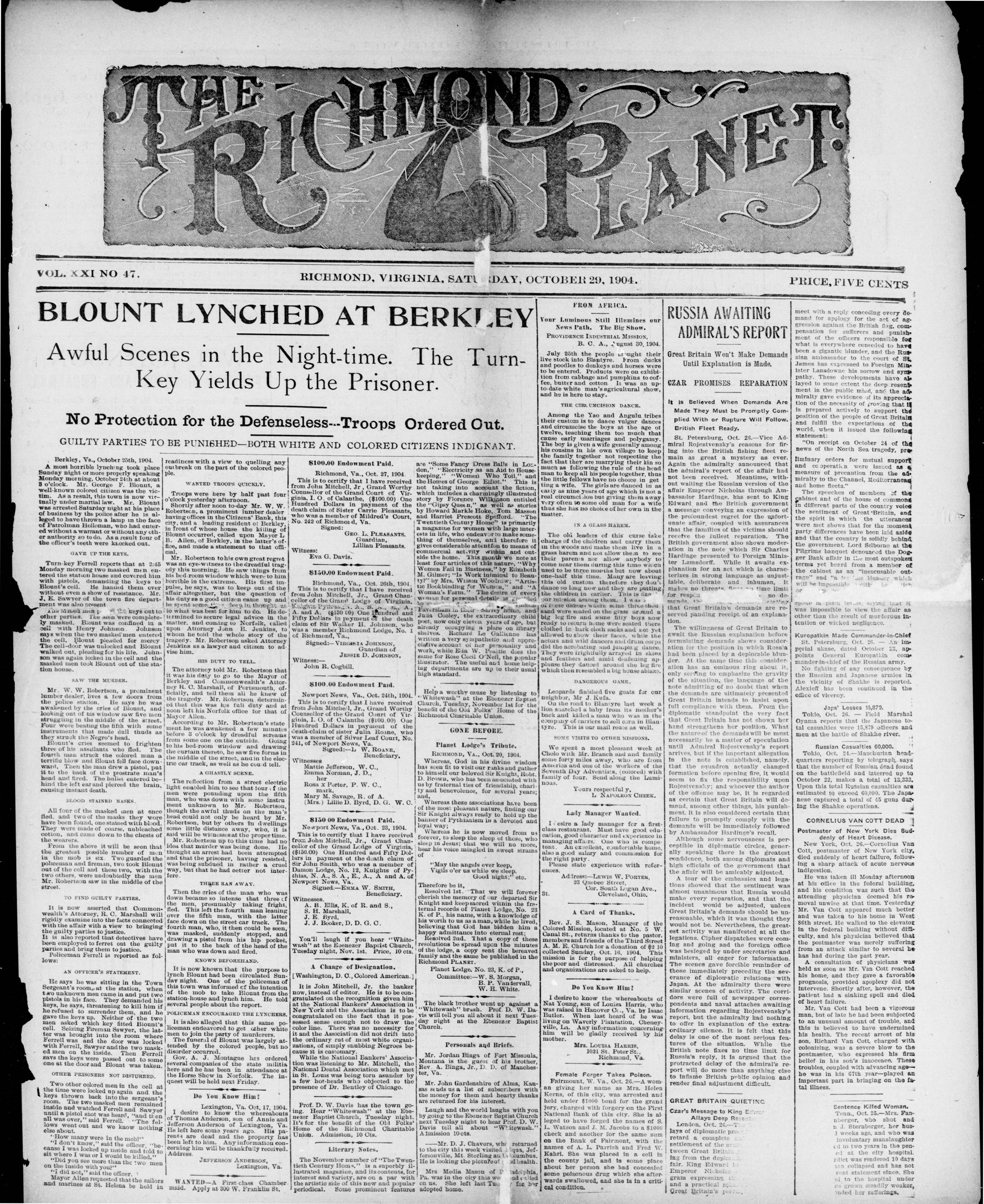
BLOUNT LYNCHED AT BERKLEY
Awful Scenes in the Night-time. The Turn- Key Yields Up the Prisoner.
No Protection for the Defenseless---Troops Ordered Out. GUILTY PARTIES TO BE PUNISHED-BOTH WHITE AND COLORED CITIZENS INDIGNANT
VOL. XXI NO 47.
BLOUNT
Awful Scen
Ke
No Protection
GUILTY PARTIES TO
Berkley, Va., October 25th, 1904.
A most horrible lynching took place Sunday night or more properly speaking Monday morning, October 24th at about 3 o'clock. Mr. George F. Blount, a well-known colored citizen was the victim. As a result, this town is now virtually under martial law. Mr. Blount was arrested Saturday night at his place of business by the police after he is alleged to have thrown a lamp in the face of Patrolman Holman, who had entered the building about any other authority so to do. As a result of the officer's teeth were knocked out.
GAVE UP THE KEYS
Turn-key Ferrell reports that at 2:45 Monday morning two masked men entered the station house and covered him with pistols, demanding the keys to Blount's cell. He handed them over without even a show of resistance. Mr. J. E. Sawyer of the town fire department was also present. The masked men took the keys out to other parties. The men were completely masked. Blount was confined in a cell with Henry Johnson. Johnson entered the two masked men into the cell. Blount forged a key. The cell-door was unlocked and Blount walked out, pleading for his life. Johnson was again locked in the cell and the masked men took Blount out of the station house.
SAW THE MURDER
Mr. W. W. Robertson, a prominent lumber dealer, lives a few doors from the police station. He says he was awakened by the cries of Blount, and looking out of his window saw five men struggling in the middle of the street. Four were beating the fifth with some instruments that made dull thuds as they struck the Negro's head. Blount's cries seemed to frighten three of his assailants who fled. The fourth man struck the colored man a terrific blow and Blount fell face downward. Then the man drew a pistol, put it to the back of the prostrate man's head and fired. The bullet entered behind the left ear and pierced the brain, causing instant death.
BLOOD STAINED MASKS
All four of the masked men at once fled, and two of the masks they wore have been found, one stained with blood. They were made of coarse, unbleached cotton, and came down to the chests of the wearers. From the above it will be seen that the greatest possible number of men in the mob is six. Two guarded the policeman and fireman, two took Blount out of the cell and these two, with the two others, were undoubtedly the men Mr. Robertson saw in the middle of the street.
TO FIND GUILTY PARTIES
It is now asserted that Commonwealth's Attorney, R. C. Marshall will rigidly examine into the facts connected with the affair with a view to bringing the guilty parties to justice.
Policeman Ferrell is reported as follows:
AN OFFICER'S STATEMENT
He says he was sitting in the Town Sergeant's room at the station, when two unknown men came in and put two pistols in his face. They demanded his keys, he says, threatening to kill him if he refused to surrender them, and he gave the keys up. Neither of the two men asked which key fitted Blount's men using Fireman Sawyer, the latter was brought into the room where Ferrell was born, and the door was locked with Ferrell, Sawyer and the door was masked men on the inside. Then Forss says the keys were passed out to some one at the door and Blount was taken.
OTHER PRISONERS NOT DISTURBED
Two other colored men in the cell at the time were locked up again and the keys thrown back into the sergeant's room. The two masked men remained inside and watched Ferrell and Sawyer until a pistol shot was heard, "and it all was over," said Ferrell. "The fellows went out and we know nothing else about. 'How many were in the mob?'
"Did you see more than the two men on the inside with you?"
"I did not," said the officer.
Mayor Allen requested that the sailors and mariners at St. Helena, be held.
readiness with a view to quelling any outbreak on the part of the colored people.
WANTED TROOPS QUICKLY.
troops were here by half past four o'clock yesterday afternoon.
She arrived after noon to-day Mr. W. W. Robertson, a promising number dealer, having offices in the Citizens' Bank, this city, and a leading resident of Berkley, in front of whose house the killing of Blount occurred, called upon Mayor B. B. Allen, of Berkley, in the latter's office, and made a statement to that official.
Mr. Robertson to his own great regret was an eye-witness to the dreadful tragedy this morning. He saw things from his bed room window which were to him horrible in the extreme. His first impulse, he says, was to keep out of the affair altogether, but the question of his duty as a good citizen came up and he spent some time deep in thought as to what was best for him to do. He devised to secure legal advice in the matter to be turned to Norfell, called upon Attorney John H. Jenkins, whom he told the whole story of the tragedy. Mr. Robertson asked Attorney Jenkins as a lawyer and citizen to advise him.
HIS DUTY TO TELL.
The attorney told Mr. Robertson that it was his duty to go to the Mayor of Berkley and Commonwealth's Attorney R.C. Marshall, of Portsmouth, officially, and tell them all he knew of the tragedy. Mr. Robertson determined that this was his full duty and at noon left his Norfolk office for that of Mayor Allen. According to Mr. Robertson's state statement he was awakened a few minutes before he o'clock by dreadful screams from some window and drumming. To his bed-room window and draping the curtain thereto, he saw five forms in the middle of the street, and in the electric car track, as well as he could tell.
A GHASTLY SCENE.
The reflection from a street electric light enabled him to see that tour. f the men were pounding upon the fifth man, who was down with some instrument unknown to Mr. Robertson, though the awful thuds on the man's head could not only be heard by Mr. Robertson, but by others in dwellings some little distance away, who, it is said will be witnesses at the proper time. Mr. Robertson up to this time had no knowledge of murder was being done. He thought that he had been attempted and that the prisoner was resisted, was being subdued in rather a cruel way, but that he had better not interfere.
THREE RAN AWAY.
Then the ories of the man who was down became so intense that three of the men, presumably taking fright, fled. This left the fourth man leaning over the fifth man, with the latter face down on the street car track. The fourth man, who, it then could be seen, the man, it then stopped, and drawing a pistol from his pocket, put it to the back of the head of the man who was down and fired.
KNOWN BEFOREHAND.
It is now known that the purpose to lynch Blount had been circulated Sunday night. One of the policeman of this town was informed of the intention of the mob to take Blount from the station-house and lynch him. He told several people about the report.
POLICEMAN ENCOURAGED THE LYNCHERS.
It is also alleged that this same policeman endeavored to get other white men to join the party of murderers. The funeral of Blount was largely attended by the colored people, but no disorder occurred.
Gov. A. J. Montague has ordered several companies of the state militia here and he has been in attendance at the Horse Show in Norfolk. The inquest will be held next Friday.
Do You Know Him?
Lexington, Va. Oct. 17, 1904.
I desire to know the whereabouts of Thomas Anderson, son of Annie and Jefferson Anderson of Lexington, Va.
He left here some years ago. His parents are dead and the property has been left to him. Any information concerning him will be thankfully received.
Address.
JEFFERSON ANDERSON,
Lexington, Va.
WANTED—A First-class Chamber maid. Apply at 300 W. Franklin St.
RICHMOND, VIRGINIA, SATURDAY, OCTOBER 29, 1904.
$100.00 Endowment Paid.
Richmond, Va., Oct. 27, 1904.
This is to certify that I have received from John Mitchell, Jr., Grand Worthy Counselor of the Grand Court of Virginia, I. O. of Calanthe, ($100.00) One Hundred Dollars in payment of the death claim of Sister Carrie Pleasants, who was a member of Mildred's Court, No. 242 of Richmond, Vn.
Signed:
GEO. L. PLEASANTS.
Guardian,
Lillian Pleasants.
$150,00 Endowment Paid
Richmond, Va., Oct. 26th, 1904.
This is to certify that I have received from John Mitchell, Jr., Grand Chancellor of the Grand Lodge of Virginia, Kingman Pythagore, A., S. A., M., A., A. and A. ($150 00) One Hundred and Fifty Dollars in payment of the death claim of Sir Walker H. Johnson, who was a member Richmond Lodge, No. 1 of Richmond, Va.,
Signed:—VIRGINIA JOHNSON,
Guardian of JESSIE D. JOHNSON,
Witness:—
John R. Corbill.
$100.00 Endowment Paid
Newport News, Va., Oct. 24th, 1004.
This is to certify that I have received from John Mitchell, Jr., Grand Worthy Counsellor of the Grand Court of Virginia, I. O. of Calanthe ($100.00) Oae Hundred Dollars in payment of the death-claim of sister Julia Roane, who was a member of Silver Leaf Court, No. 241, of Newport News, Va.
Signed:—L. W. ROANE,
Beneficiary.
Vitnesses
Mattie Jefferson, W. C.,
Emma Norman, J. D.,
her
Rosa X Porter, P. W. C.,
mark.
Mary M. Savage, R. of A.
(Mrs.) Lillie D. Byrd, D. G. W. C.
$150 00 Endowment Paid.
Newport News, Va., Oct. 23, 1904.
This is to certify that I have received from John Mitechell, Jr., Grand Chancellor of the Grand Lodge of Virginia, ($150.00). One Hundred and Fifty Dollars in payment of the death claim of Sir John Smith, who was a member of Damon Lodge, No. 12, Knights of Pythias, N. A., S. A., E., A., A and A. of Newport News, Va.
Signed:—EMMA W. SMITH,
Beneficiary.
Witnesses.
A. B. Ellis, K. of R. and S.,
S. H. Marshall,
J. E. Byrd,
J. J. Booker, D. D. G. C.
You'll laugh if you hear "Whitewash" at the Eoeneerest Baptist Church,
Tuesday night, Nov. 1st. Price, 10 cts.
It is John Mitchell, Jr. the banker now, instead of editor. He is to be congratulated on the recognition given him at the National Bankers' Association in New York and the Association is to be congratulated on the fact that it possessed sense enough not to draw the color line. There was no necessity for it and the Association did not drift into the ordinary rat of most white organizations, of simply snubbing Negroes because it is customary.
While the National Bankers' Association was listening to Mr. Mitchell, the National Dental Association which met in St. Louis was being torn under by a few hot-heads who objected to the presence of Dr. Bentley of Chicago.
Prof. D. W. Davis has the town going. Hear "Whitewash" at the Ebenezee Baptist Church, Tuesday night. It's for the benefit of the Old Folks' Home of the Richmond Charitable Union. Admission, 10 Cts.
The November number of "The Twentieth Century Home," is a superbly illustrated magazine, and its contents, for interest and variety, are on a par with the artistic side of this new and popular periodical. Some prominent features
---
Help a worthy cause by listening to "Hitewash" at the Ebenezer Baptist Church in November 1st for the benefit of the Old Folk Home of the Richmond Charitable Union
GONE BEFORE.
Whereas, God in his divine wisdom has seen fit to visit our ranks and gather to himself our beloved Sir Knight, Robt. D. Brown, who has been associated with us by fraternal ties of friendship, charity and benevolence, for several years; and,
Whereas these associations have been of the most pleasant nature, finding our Sir Knight always ready to hold up the banner of Pythianism in a devoted and loyal way;
Whereas he is now moved from us forever, to sleep the sleep of those, who sleep in Jesus; that we will no more, hear his voice mingled in sweet strains
Therefore be it.
Resolved 1st. That we will forever cherish the memory of our departed Sir Knight and keep sacred within the fernal records of Planet Lodge, No. 23 K. of P., his name, with a knowledge of his worth to us as a man, while he lived, believing that God has bidden him a happy admittance into eternal rest; Resolved 2nd. That a copy of these resolutions be spread upon the minutes of the lodge, a copy sent the bereaved family and the same be published in the Richmond PLANET.
Planet Lodge, No. 23, K. of P., Committee:—W. S. Morgan, B. P. Vandervall, W. H. White.
The black brother went up against a "Whitewash" brush. Prof D. W. Davis will tell you all about it next Tuesday night at the Ebenezer Baptist Church.
Personals and Briefs
Mr. Jordan Binga of Fort Missoula, Montana is the guest of his brother, Rev A. Binga, Jr., D. D. of Manchester, Va.
Mr. John Gardenshire of Alma, Kansas sends us a list of subscribers with the money for them and hearty thanks are returned for his interest.
Laugh and the world laughs with you by going to the Ebenezer Baptist Church next Tuesday night to hear Prof. D. W. Davis tell all about "Whitewash." Almission 10 octs.
Mr. D. J. Chavers, who returned to the city this week visited Iqaga, Jeffersonville, Mt. Sterling and Columbus, He is looking the picture of good health.
Mrs Media Mason of Philadelphia, Pa. was in the city this week and called on us. She left last Tuesday for her adopted home.
FROM AFRICA
Your Luminous Still Illumines our News Path. The Big Show.
July 25th the people brought their live stock into Blantyre. From ducks and poodles to donkeys and horses were to be entered. Products were on exhibition from cabbage and pumpkins to coffee, butter and cotton. It was an up-to-date white man's agricultural show, and he is here to stay.
THE CIRCUMCISION DANCE.
Among the Yao and Angulu tribes their custom is to dance vulgar dances and circumcise the boys at the age of twelve, teaching them too much that cause early marriages and polygamy. The boy is given a wife generally among his cousins in his own village to keep the family together not respecting the fact that they are marrying their kin so much as following the rule of the head man to keep all his people together, thus the little fellows have no choice in getting a wife. The girls are danced in as early as nine years of age which is not a real circumcision but giving them a way very often to some old man for a wife thus she has no choice of her own in the matter.
IN A GEASS HAREM
The old leaders of this curse take charge of the children and carry them in the woods and make them live in a grass barem and not allow them to see their parents nor allow anybody to come near them during this time when used to be three months but now about one-half this time. Many are leaving this old custom therefore they don't dance so long now and they are putting the children in earlier. This is due our mission among them. I was of these dances where some three thousand were seated on the grass around a big leg fire and some fifty boys now ready to return home were seated there clothed in dark cloth shoes and not yet allowed to show their faces, while the actors and wild dancers and drum corps did the acrobatics and jumping dance. They were frightfully arrayed in skins and feathers and amid deafening applause they danced around the big fire which then resembled a big house ablaze.
DANGEROUS GAME.
Leapards finished five goats for our neighbor, Mr J. Kufa.
On the road to Blantyre last week a leapad snatched a baby from its mother's back and brought the company of carriers to sell corn in Blantyre. This is our mail route as well.
SOME VISITS TO OTHER MISSIONS.
We spent a most pleasant week at Cholo with Mr. Branch and family some forty miles away, who are from America and one of the workers of the Seventh Day Adventists, (coined) with family of four. Send along the Luminous. Yours respectfully, L NAPOLEON CHEEK.
Lady Manager Wanted.
I desire a lady manager for a first-class restaurant. Must have good education, good character and experience in managing affairs. One who is competent. An excellent, comfortable home, also a good salary and commission for the right party.
Please state experience with references.
Address:—LEWIS W, PORTER,
23 Quebec Street,
Cor. South Logan Ave.,
3t.
Cleveland, Ohio.
A Card of Thanks.
Rev. J. S. Mason, Manager of the Colored Mission, located at No. 5 W. Canal St., returns thanks to the pastor, members and friends of the Third Street A. M. E. Church for a donation of $210 members and friends of Oct. 16, 1904. This mission is for the purpose of helping the poor and distressed. All churches and organizations are asked to help.
Do You Know Him?
I desire to know the whereabouts of Nat Young, son of Lonisa Harris, who was raised in Hanover Co., Va. by Isaac Butler. When last heard of he was living on Waverly Plantation, Cheneyville, La. Any information concerning him will be gladly received by his mother.
Female Forger Takes Poison
Female Forger Takes Poison.
Fairmount, W. Va. Oct. 26.—A woman giving her name as Mrs. Helen Kerns, of this city, was arrested and held under $1000 bond for the grand jury, charged with forgery on the First National Bank of this city. She is alleged to have forged the names of S. L. Watson and J. M. Jacobs to a $1000 check and another for the same sum on the Bank of Fairmont, with the names of A. L. Parrish and Fred W. Kahrl. She was placed in a cell in the county jail, and in some place about her person she had concealed some poisonous drug which she after wards swallowed, and she is in a critical condition.
RUSSIA AWAITING ADMIRAL'S REPORT
Great Britain Won't Make Demands
Until Explanation is Made.
It is Believed When Demands Are Made They Must be Promptly Complied With or Rupture Will Follow. British Fleet Ready.
St. Petersburg, Oct. 25.—Vice Admiral Rojestvensky's reasons for firing into the British fishing fleet remain as great a mystery as ever. Again the admiralty announced that the admiral's report of the affair had not been received. Meantime, without waiting the Russian version of the affair Emperor Nicholas through Ambassador Hardinge, has sent to King Edward and the British government a message conveying an expression of the profoundest regret for the unfortunate affair, coupled with assurances that the families of the victims should receive the fullest repatriation. The British government also shows moderation in the note which Sir Charles Hardinge presented to Foreign Minister Lamsdorff. While it awaits explanation for an act which is characterizes in strong language as unjustifiable, deliberate and inhuman, it makes no threats, for a time limit for respon- dents, the testimony that Great Britain's demands are reserved panding receipt of an explanation.
The willfulness of Great Britain to await the Russian explanation before formulating demands shows consideration for the position in which Russia had been placed by a deplorable blunder. At the same time this consideration has an ominous ring about it, only serving to emphasize the gravity of the situation, the language of the note admitting of no doubt that when the demands are ultimately presented Great Britain intends to insist upon full compliance with them. From the diplomatic standpoint the very fact that Great Britain has not shown her hand strengthens her position. What the nature of the demands will be must necessarily be a matter of speculation until Admiral Rojetenvensky's report arrives, but if the important allegation in the note is established, namely, that the squadron actually changed formation before opening fire, it would seem to fix the responsibility upon Rojetenvensky; and whoever the author of the offense may be, it is regarded as certain that Great Britain will demand, among other things, his punishment. It is also considered certain that failure to promptly comply with the demands will be immediately followed by Ambassador Hardinge's recall.
Although some nervousness is perceptible in diplomatic circles, generally speaking there is the greatest confidence, both among diplomats and high officials of the government that the affair will be amicably adjusted.
A tour of the embassies and legations showed that the sentiment was almost unanimous that Russia would make every reparation, and that the incident would be adjusted, unless Great Britain's demands should be unreasonable, which it was thought they would not be. Nevertheless, the greatest activity was manifested at all the legations. Cipher dispatches were coming and going and the foreign office was besieged by under secretaries and ministers, all eager for information. The scenes gave forcible reminder of those immediately preceding the severance of diplomatic relations with Japan. At the admiralty there were similar scenes of activity. The corridors were full of newspaper correspondents and naval attaches awaiting information regarding Rojestvensky's report, but the admiralty had nothing to offer in explanation of the extraordinary silence. It is felt that this delay is one of the most serious features of the situation. While the British note fixes no time limit for Russia's reply, it is argued that the protracted delay of the admiral's report will do more than anything else to inflame British public opinion and render final adjustment difficult.
GREAT BRITAIN QUIETING
Allays Deep Resent
London, Oct. 26.—The
lays of diplomatic proce-
retard a complete and
settlement of the acuity
tween Great Britain and
from the deploi-
fair. King Edward his
Emperor Nicholas the
gram expressing the
and a practical agen-
Great Britain's perc
PRICE, FIVE CENTS
meet with a reply conceding every demand for applogy for the act of aggression against the British flag, compensation for sufferers and punishment of the officers responsible for what is everywhere conceded to have been a gigantic blunder, and the Russian ambassador to the court of St. James has expressed to Foreign Minister Lansdowne his sorrow and sympathy. These developments have allowed to some extent the deep resentment in the public mind, and the admiralty gave evidence of its appreciation of the necessity of proving that it is prepared actively to support the position of the people of Great Britain and fulfill the expectations of the world, when it issued the following statement:
liminary orders for mutual support and cooperation were issued as a measure of precaution from the admiralty to the Channel, Mediterranean and home fleets."
The speeches of members of the cabinet and of the house of common in different parts of the country voice the sentiment of Great-Britain, and the spirit in which the utterances were met shows that for the moment party differences have been laid aside and that the country is solidly behind the government. Lord Selborne at the Pilgrims banquet denounced the Dogger Bank affair in the most outspoken terms yet heard from a member of the cabinet as an "inexcessable outrage" and "a terrible blunder which will be impossible with either or spoke in plain terms, saying that it was impossible to view the affair as other than the result of murderous intention or wicked negligence.
Kuropatkin Made Commander-in-Chief
St. Petersburg, Oct. 26. — An im-
perial ukase, dated October 23, ap-
points General Kuropatkin com-
mander-in-chief of the Russian army.
No fighting of any consequence by
the Russian and Japanese armies in
the vicinity of Shakhe is reported.
Alexieff has been continued in the
office of viceroy.
Japs' Losses 15,879.
Tokio, Oct. 26. — Field Marshal
Oyama reports that the Japanese total
casualties were 15,879 officers and
men at the battle of Shakhe river.
Russian Casualties 60,000.
Tokok, Oct. 24.—Manchurian headquarters reporting by telegraph says that the number of Russian dead found on the battlefield and interred up to October 22, makes a total of 13,333. Upon this total Russian casualties are estimated to exceed 60,000. The Japanese captured a total of 45 guns during the Shahke operations.
CORNELIUS VAN COTT DEAD
Postmaster of New York Dies Suddenly of Heart Disease.
New York, Oct. 26.—Cornelius Van Cott, postmaster of New York city, died suddenly of heart failure, following a sharp attack of acute nervous indigestion.
He was taken ill Monday afternoon at his office in the federal building, and his condition was such that the attending physician deemed his removal unwise at that time. Yesterday Mr. Van Cott appeared much better and was taken to his home in West 86th street. He walked to the elevator in the federal building without difficulty, and his physician believed that the postmaster was merely suffering from an attack similar to several he has had during the past year.
A consultation of physicians was held as soon as Mr. Van Cott reached his home, and they gave a favorable prognosis, provided apoplexy did not intervene. Shortly after, however, the patient had a sinking spell and died of heart failure.
Mr. Van Cott had been a vigorous man, but of late he had been subjected to an unusual amount of trouble, and this is believed to have undermined his health. The recent arrest of his son, Richard Van Cott, charged with colonizing, was a severe blow to the postmaster, who expressed his firm belief in his son's innocence. These troubles, coupled with advancing age—he was in his 67th year—played an important part in bringing on the fatal illness.
Sentence Killed Woman,
Tenn., Oct. 25.—Mrs. Fannberger, who shot and
n J. Sternberger, her hus-
wile weeks ago, and who was
involuntary manslaughter
ed to two years in the pened
at the city hospital.
rlict was rendered 10 days
ann collapsed and has not
rent statement since. She
led to the hospital under
as grown steadily weaker,
ended her sufferings.
LOVE ACROSS THE LINES
BY
HARRY STILLWELL
EDWARDS
Copyright, IBB, by J. B. Lippincott Company. All rights reserved.
SYNOPSIS.
CHAPTER I—Story opens in Richmond, Va., of Key St. Sumter surrendered. Dr. Francis Brodner makes remarkable request of his friend, Dick Somer, which Somers finally agrees. He is to marry, blindfolded, a woman whose name he not to know, ask no questions, and finally, when she is out of the power of certain enemies, is to grant her an honorable divorce.
tion, displaying by her own effort and the efforts of her stepdaughter in hospital work devotion to southern acorns, and in cemetery ancing accounts with Jefferson Du Friends of Raymond Holbin, for still had a few, with the aid of mother, secured him a bomb-proof station with a rank of contain-
CHAPTER II-According to the agreement, Somers is mystically married to a young woman, who is called Frances, being left with her, they fall in love with her, and they light a match in the dark room, that they may see each other. A pistol shot rings out. Somers falls with a scalp wound just as Brodna comes to take him. He is conveyed to the doctor's office.
CHAPTER III-Somers, on his recovery, receives telegram to report to war office immediately. He learns Frances is well, and asks the doctor to tell her Richard Somers passes out of her life, and she must duty done, please God, and she needs him will follow her to the end of the earth.
CHAPTER IV-Woman named Louise is visited by Raymond Holbin, the father of her child, who has not kept his mother to marry her, and who bears a striking resemblance to her sister Somers she tells of having, in her sleep, shot a man who she thought was her.
CHAPTER V—Frances' father John Brooklin, makes his will bequeathing her certain property upon condition that she marry Holbin, his stepson. Just before he dies she disillusions his mind of notion that she had been disloyal to him, and tells him a friend has wished her baby him: "Ask Raymond Holbin what he has done with Louise (the dying man's niece); for he is the man who betrayed her by a mock marriage, and took her abroad."
CHAPTER VI—Holbin's absence from the Brooklin funeral is noticed. He is busy in the deserted residence of deceased unravelling the mystery of the connection between the shooting, told him by Louise, and the implied charge against him made by Frances. He finds evidences of a rival's presence in Frances' room, and his evil mind fills with suspicion of the pure girl.
CHAPTER VII—Holbin decides to ask Dr. Brodnar if he knows the man who was in the Frances' room. The doctors assert he had been shot there, and that he suspected Mr. Brooklin (Holbin's mother) of being the woman who fired the shot, which, he declares, missed its mark.
CHAPTER VIII—Baffled in attempt to learn anything from Dr. Brodman. Holbin turns to Frances, but is again unsuccessful. However, by a skillful move, the man has made a most powerful imitation upon the woman he hopes to marry.
CHAPTER IX—Hobin having exhausted all his resources for information concerning the victim of the shooting, as last turns to Frances 'old mammy, but again falls.
CHAPTER X—Upon this he goes to his mother's room and makes a clean breast of the facts. She summons Dr. Brodman, and demands to know the information he has who then denounces her life.
the room and attacks the cou-
willa with a knife. The doctor escapes,
Frances long enough to tell her what
she knows about Somers' assault,
and drives. Misconstruing his mean-
ing, thinking Louise has jealous on
account of Somers' attention, she
visits Louise full of sympathy for
latter's troubles, but nothing comes up
to throw the distrust out of her mind,
CHAPTER XI-Frances becomes a
murse for the wounded soldiers brought
to Richmond. A wounded federal came
under her care. He has been with Capt-
some so he had at the same time been
desperately wounded. Frances love and
trust for Somers returns upon this news
of him.
CHAPTER XII
When Virginia seceded and her young men rushed to the front, among the first to seek a commission was Raymond Holbin. This was in the days when most people believed that the military feature of secession would prove little more than a grand spectacular demonstration. Graduates of West Point were at once in great demand, and backed by the Brookin influence Holbin was appointed a captain of infantry among the state troops, no search of his record being at the time possible; but when the state transferred her troops to the confederate government, and Holbin sought a coloneley, advancing in support of his application the fact that he had been an officer in the regular army, the matheless memory of the southern president recalled his history. Jefferson Davis had been secretary of war at the time the Holbin court-martial was held, and the record coming before him for review, he had promptly approved the sentence of the court. A long struggle to secure a modification of the sentence had followed—and in this struggle many politicians had been arrayed by Holbin's mother, but in vain. The sentence stood; and these people never forgot the issues involved; the Holbins hated Jefferson Davis. The name "Holbin" had clung to the memory of the hero of Buena Vista; he declined to appoint Raymond Holbin or to commission him in any way to command honorable men. The decision was in harmony with his devotion to his principles, a devotion that was destined to make him in the end the most unfortunate of American statesmen.
This new public reflection upon Holbin filled him with an ungovernable rage. Had safe opportunity offered, he would not have hesitated to send a bullet through the heart of the man who was responsible for it. Indeed, he armed himself, and for many months was convinced that he might at any moment be dedicated to the discharge of a patriotic duty. The president of the confederacy walked daily in the presence of death, for fanatism and desperate men surrounded him. His safety lay in the fact that he walked in the sunlight, where the results of an attack promised never less than life for life. And Raymond Holbin was not the man to barter his away; he bided his time. A far more dangerous enemy was his mother, who numbered official acquaintances in Washington by the scores, and who knew when and where to plant the deadliest blow. This woman, secure in her social posts
tion, displaying by her own efforts and the efforts of her stepdaughter in hospital work devotion to the southern area, with the balancing accounts with senerson Davis. Friends of Raymond Holbin, for he still had a few, with the aid of his mother, secured him a bomb-proof position with a rank of captain; and there he stuck, with all the time for plotting that might be demanded.
What seemed to Holbia an opportunity for a sweeping revenge came very unexpectedly. Up to them he had been but an instrument of his mother and the hope of invisibles known to him who sapped the strength of the confederacy. Their many interests preceded his. The opportunity came through Louise. He did not dare to disregard her card and responded instantly to her implied command, armed with his old secret and a virtuous indignation. He had almost forgotten her. A year before, when she had sufficiently recovered from her illness to permit it, he had sent her north, deceived by "sacred" pledges, to a new hiding-place. The immediate opening of hostilities had seemed to fix the separation. It had never occurred to him that she would make an effort to cross the lines.
The new meeting between Louise and Holbin was marked by a great display of passion on his part; she was calm and collected, a suggestion of recklessness, however, in her eyes and every movement; her face relentless and white with despair of an abandoned life. For the first time Holbin failed to move her to anger or to tears.
"I came," said she, when his rage had spent itself and in answer to his despairing offer of money if she would depart, "not because I need your assistance—that is, your money, for I do not; I am now well supplied." She could not have touched him in a more delicate spot. A swift jealousy, a curious indignation, filled him.
"Whose money?" he asked, breathlessly.
"He is very rich, and gives with a libreral hand when the woman is smart, is able, is fearless, and willing to risk her life at his bidding." It was not the speech, but the cautious glance which involuntarily she gave to her surroundings that awoke a suspicion in his breast.
"Louise, you are a—"
"Hushl I am a mother robbed of her child; that is explanation enough; for such a woman is capable of anything, even murder, as you know. Raymond, where is my daughter?" He looked at her unceased, and the white feather appeared in spite of his efforts to conceal it.
"She is well, and well cared for."
"I asked you where, and you have not answered me!"
"There is much to be agreed upon between us before I tell you that," he said, after a pause, during which he narrowly watched her. He took a seat close beside her and continued in his old confidential, half-appealing way: "Louise, I am ruined, a disgraced man, and ripe for anything that will take me out of this city." He paused, but she did not answer or seem to hear him, and he added: "My downfall began when I was untrue to myself—to you. I have never had a moment's good luck since; everything has gone wrong with me." Still she did not answer him, but her bosom heavened once or twice, and a strange look came into the white face she turned towards him. "I have now no chance on earth except a chance to play for even and quit the country. Louise, if I succeed will you go back with me into the old sweet life? I will be true to you; I will right all of your wrongs—and I will be a father indeed to your child. Let us go, Louise, out of this wild, heartless country back across the ocean to the little English home, back to our flowers, back to the old life." He took her hand, and this time she did not withdraw it.
"My child," she said, almost inaudibly, her face lowered and her bosom rising and falling rapidly.
"That will be all right—all right. I swear to you she is well and has not forgotten you. She never falls to ask for you, and at night to say her little prayer." Ary burst from the wretched woman.
"My baby! My baby!" She sank her face in her hands, then sprang to her feet. "You deceived me," she said, frantically, beginning to walk the floor, "I cannot—I cannot believe you."
"I have no cause to deceive you, Louise—none." He spoke very tenderly; "and I would not if I could—now. This uniform, these shoulder-straps, mean nothing in my case but disgrace. I am a stay-at-home. The dullards of my class at West Point are brigadier generals in the field; I am a uniformed clerk."
"The woman—?" Louise could not conclude her question.
"She will not assent," he said, savagely; and then quickly, lest a natural inference should array her against him again. "I have purposely made myself so obnoxious to her that she would rather be a pauper than share a fortune with me. She has yet time to decide, for she is not 21; but I know her decision in advance."
"And then?" "Then life with you, Louise, our child's happiness provided for. I do not count upon that fortune; the slaves will be free and all values upset; land will not be worth much in this state." Louise came close to him and laid her hand upon his shoulder. "If I could only trust you," she said, sadly, "all might yet be well, for I have a way—"
. "What do you mean?" She hesi-
THE RICHMOND PLANET, RICHMOND, VIRGINIA.
stated and, leaning over, whispered a sentence in his ear. He lifted his face quickly.
"How much?"
"Our own price."
"Our own price!"
"And revenge, Raymond, revenge for you."
"Revenge?—yes—well said. No price could be complete without that. And what a revenge! The assassin stabs his foe and is infamous; the man who alays his country's foe is a hero. Louise, you have made me happy, and you little know how chance has favored you. I am connected with the war department — I have friends around me; and, better, I have my facts in hand."
"You were planning then, too."
"I did not know what might arise, and I was determined to be ready; I was tired of doing the work while others reaped the benefit. But now comes the greatest difficulty—and that reminds me. How did you get here through the lines?"
"You remember the little farm in which I had only a life interest, the only thing we could not sell? I was warned that it would soon be within the southern lines and was sent there Jackson's army passed over it, and I came on to Richmond and delivered my messages." Holbin was astounded.
"Who do you know here?"
She shook her head. "Not a human being beside yourself. I placed my papers in a certain receptacle to which I had been directed. If there is an answer I shall find it in the same place at an appointed time." Holbin walked the floor in great excitement.
"Iknow both the place and the time," he said; "I took your messages; but there never would have been any answer except for this meeting. I alone can supply the information which is desired, and I shall not let it go through the usual channel. It is the chance of my life. I have facts that no other human being could have accumulated, facts of vital importance. My God, Louise! A million dollars is a small price."
"Give them to me," she said; "I will deliver them upon one condition."
"One condition? Name it."
"The price shall be paid to me." Holbin stood in deep thought.
"No," he said, as if dismissing some mental argument, "it is too dangerous a mission for any woman. Capture would mean for you certain death."
"My child!" she said, simply; and then: "I shall find a way to get through."
"Then make the trip safely, and I swear to you I will surrender the child and come to you, too."
"Oh, Raymond, promises, promises! It would be inhuman to deceive me now."
"You will control the future if you deliver my information and collect the price." She knew him well enough to
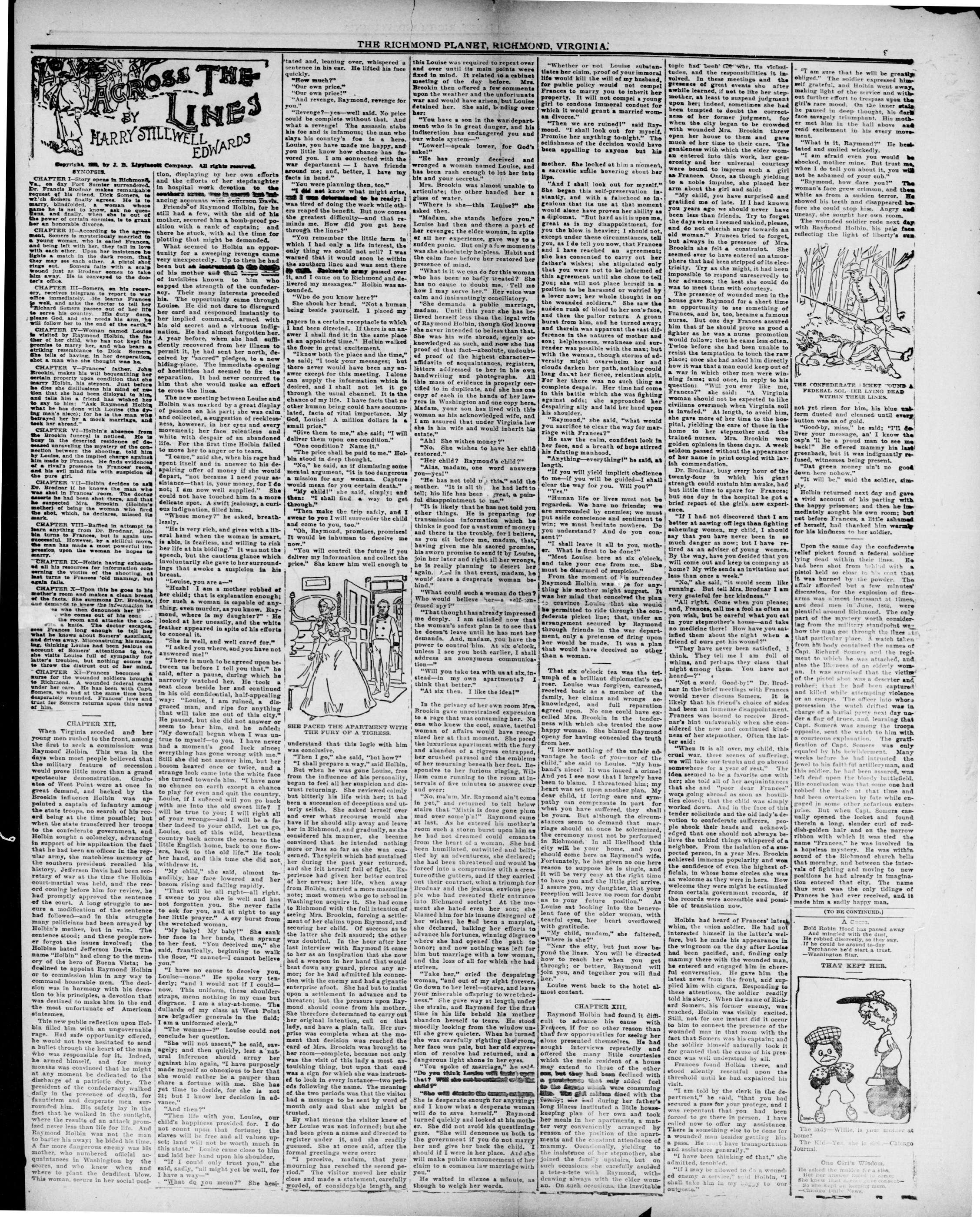
SHE PACED THE APARTMENT WITH THE FURY OF A TIGRESS.
understand that this logic with him was conclusive.
"Then I go," she said, "but how?" "I shall prepare a way," said Holbin. But when he was gone Louise, free from the influence of his personality, began to feel all her suspicion and distrust returning. She reviewed calmly but bitterly his life with her; it had been a succession of deceptions and utterly selfish. She asked herself over and over what recourse would she have if he should slip away and leave her in Richmond, and gradually, as she considered his manner, she became convinced that he intended nothing more or less so far as she was concerned. The spirit which had sustained her during the past year returned, and she felt herself full of fight. Experience had given her better control of her nerves; her life, when away from Holbin, carried a more masculine note; most women who go to school in Washington acquire it. She had come to Richmond with the full intention of seeing Mrs. Brookin, forcing a settlement of her claims upon Raymond, and securing her child. Of success as to the latter she felt assured; the other was doubtful. In the hour after her last interview with Raymond it came to her as an inspiration that she now had a weapon in her hand that would beat down any guard, pierce any arm; for he had admitted his connection with the enemy and had a gigantic enterprise afoot. She had but to insist upon a settlement in advance and to threaten; but the pressure upon Raymond should come from his mother. She therefore determined to carry out her original intention, call on that lady, and have a plain talk. Her surprise was complete when at the moment that decision was reached the card of Mrs. Brookin was brought to her room—complete, because not only was the visit of this lady a most astounding thing, but upon that card was a sign for which she was instructed to look in every instance—two periods following the name. The meaning of the two periods was that the visitor had a message to be sent by word of mouth only and that she might be trusted.
By what means the visitor knew of her Louise was not informed; but she had been given a name and directed to register under it, and she readily guessed. She at once said, after the formal greetings were over:
"I perceive, madam, that your mourning has reached the second period." The visitor moved her close and made a statement, carefully worded, of considerable length, and
this Louise was required to repeat over and over until its main points were fixed in mind. It related to a cabinet meeting of the day before. Mrs. Brookin then offered a few comments upon the weather and the unfortunate war and would have arisen, but Louise detained her. She said, binding over her:
"You have a son in the war department who is in great danger, and his indiscretion has endangered you and our whole system—"
"Lower!—speak lower, for God's sake!"
"He has grossly deceived and wronged a woman named Louise, and has been rash enough to let her into his and your secrets."
Mrs. Brookin was almost unable to articulate; the other handed her a glass of water.
"Where is she—this Louise?" she asked then.
"Madam, she stands before you." Louise had then and there a part of her revenge; the elder woman, in spite of all her experience, gave way to a sudden panic. But only a few moments was she absolutely helpless. Habit and the calm face before her restored her presence of mind.
"What is it we can do for this woman who has been so badly treated? She has no cause to doubt me. Tell me how I may serve her." Her voice was calm and insinuatingly conciliatory.
"She demands a public marriage, madam. Until this year she has believed herself less than the legal wife of Raymond Holbin, though God knows she never intended to be less than that. She was his wife abroad, openly acknowledged as such, and now she has proof of that fact—absolute, undoubted proof of the highest character—affidavits of acquaintances, registers, letters addressed to her in his own handwriting and photographs. All this mass of evidence is properly certified to in duplicate, and she has one copy of each in the hands of her lawyers in Washington and one copy here. Madam, your son has lived with this woman as his acknowledged wife, and I am assured that under Virginia law she is his wife and would inherit his estate."
"Ahl She wishes money?"
"No. She wishes to have her child restored."
"Her child? Raymond's child?"
"Alas, madam, one word answers you—yes!"
"He has not told me, this" said the mother. "It is all th' he had left to tell; his life has been great, a painful disappointment to me."
"It is likely that he has not told you other things. He is preparing for transmission information which he thinks is good for a vast sum of money; and there is the trouble, for I believe, as you sit before me, madam, that, having given me his sacred promise, his sworn promise to send it by Louise, join her later and right all her wrongs, he is really planning to desert her again. And in that event, madam, he would leave a desperate woman behind."
"What could such a woman do then? Who would believe her—a self-confessed spy?"
"That thought has already impressed me deeply. I am satisfied now that the woman's safest plan is to see that he doesn't leave until he has met her demands. And, madam, you have the power to control him. At six o'clock, unless I see you both earlier, I shall address an anonymous communication—"
"Will you take tea with us at six, instead—in my own apartments? I think that better."
"At six then. I like the ideal!"
In the privacy of her own room Mrs. Brookin gave unrestrained expression to a rage that was consuming her. No one who knew the cool, suave, tactful woman of affairs would have recognized her at that moment. She paced the luxurious apartment with the fury and abandon of a tigress entrapped, her crushed parasol and the emblems of her mourning beneath her feet. Responsive to her furious ringing, William came running to the room at intervals of five minutes to answer over and over:
"No, ma'am, Mr. Raymond ain't come in yet," and returned to tell below stairs that "Mistis is done gone plum mad over some p'u!" Raymond came at last. As he entered his mother's room such a storm burst upon him as he had not dreamed could emanate from the heart of a woman. She had been humiliated, outwitted and belittled by an adventureess, she declared; she had been threatened and would be forced into a compromise with a creature of the gutters, and if they carried out their contract, what a triumph for Brodnar and the jealous, envious people who had resented their entrance into Richmond society! At the moment she hated even her son; she blamed him for his insane disregard of her wishes; he had been a marplot, she declared, balking her efforts to advance his fortunes, winning disgrace where she had opened the path to honor; and now nothing was left for him but marriage with a low woman, and the loss of all for which she had striven.
"Take her," cried the despiring woman, "and out of my sight forever. Go down to her level—starve, and leave your miserable offspring to wretchedness." She gave way at length under the strain, and Raymond for the first time in his life beheld his mother abandon herself to tears. He stood moodily looking from the window until she grew quieter. When he curned she was carefully righting the room, her face was pale, but her old expression of resolve had returned, and a dangerous light shone in her eyes.
"You spoke of marriage," he said.
"Do you think Leslie will come that? Will she be able to do that?"
"She is desperate enough for anymings and I know what a desperate woman will do to save herself." Raymond turned quickly and looked at his mother. She did not avoid his questioning gaze. "She will denounce us both to the government if you do not marry her and give her back the child. I should if I were in her place. And she will make public announcement of her claim to a common law marriage with you."
He waited in silence a minute, as though to weigh her words.
"Whether or not Louise substantiates her claim, proof of your immoral life would kill the will of my husband, for public policy would not compel Frances to marry you to inherit her property. It will not compel a young girl to condone immoral conduct for which it would grant a married woman divorce." "Then we are ruined!" said Raymond. "I shall look out for myself. Promise her anything to-night." The selfishness of the decision would have been appalling to anyone but his mother. She looked at him a moment, a sarcastic unile hovering about her lips.
"And I shall look out for myself." She began this self-preservation instantly, and with a falsehood so ingenious that its use at that moment would alone have proven her ability as a diplomat. "But hard as it is upon me, great as is my disappointment, for you the blow is heavier; I should not, except under these circumstances, tell you, as I do tell you now, that Frances and I have reached an agreement; she has consented to carry out her father's wishes; she stipulated only that you were not to be informed of this agreement until she chose to tell you; she will not place herself in a position to be harassed or worried by a lover now; her whole thought is on the wounded soldiers." She saw the sudden rush of blood to her son's face, and then the pallor return. A groan burst from him, and he turned away; and thersin was apparent the vast difference in the natures of mother and son; helplessness, weakness and surrender was possible with the man; but with the woman, though storms of adversity might overwhelm her and clouds darken her path, nothing could long dauat her fierce, relentless sirt. For her there was no such thing as complete despair. Her time had come in this battle which she was fighting against odds; she approached her despairing ally and laid her hand upon his shoulder.
"Raymond," she said, "what would you sacrifice to clear the way for marriage with Frances?"
He saw the calm, confident look in her face, and a breath of hope stirred his fainting manhood.
"Anything—everything!" he said, at length.
"If you will yield implicit obedience to me—if you will be guided—I shall clear the way for you. Will you?"
"Yes."
"Human life or lives must not be regarded. We have no friends; we are surrounded by enemies; we must put aside conscience and sentiment to win; we must hesitate nowhere. Do you understand? And do you consent?"
"I shall leave it all to you, mother. What is first to be done?"
"Meet Louise here at six o'clock, and take your cue from me. She must be disarmed of suspicion."
From the moment of his surrender Raymond Holbin was to be for anything his mother might suggest. It was her mind that conceived the plan to convince Louise that she would be permitted to ride through the confederate picket line; that, under an arrangement secured by Raymond through friends in the war department, only a pretense of firing upon her would be made. It was a plan that would have deceived no other than a woman.
That six o'clock tea was the trilumph of a brilliant diplomatist's career. Louise was forgiven, caressed, received back as a member of the family, her claims and wrongs acknowledged, and full reparation agreed upon. No one could have excelled Mrs. Brookin in the tenderness with which she treated the now happy woman. She blamed Raymond openy for having concealed the truth from her.
"I knew nothing of the unfair advantage he took of you—nor of the child," she said to Louise. "My husband's niece! It was inseed a orimel. And yet I see now that I largely have been to blame. I threatened him; my heart was set upon another plan. My dear child, if loving care and sympathy can compensate in part for what you have suffered, they shall be yours. But although the circumstances seem to demand that marriage should at once be solemnized, the ceremony must not be performed in Richmond. In all likelihood this city will be your home, and you should come here as Raymond's wife. Fortunately, he has given no one here reason to suppose he is single, and it will be very easy at the right time to have you and the little girl arrive. I assure you, my daughter, that your reception will leave no room for doubt as to your future position." As Louise sat looking into the benevolent face of the older woman, with tearful eyes, her heart overflowed with gratitude.
"My child, madam," she faltered. "Where is she?"
"Near the city, but just now beyond the lines. You will be directed how to reach her when you get through; or better, Raymond will join you, and together you will find her."
Louise went back to the hotel almost content.
CHAPTER XIII
Raymond Hobbin had found it difficult to advance his cause with Frances, if for no other reason than that few opportunities for seeing her alone presented themselves. He had sought interviews repeatedly and offered the many little courtesies which the male resident of a house may extend to those of the other man, but they had been declined with a courtesies that only added fuel to the fears which were consuming him. The gold dish dined with the family; she laid during her father's long illness instituted a little housekeeping plan of her own and took her meals in her apartments, a matter very conveniently arranged by reason of the position of the apartments and the constant attendance of mammy. Occasionally, yielding to the insistence of her stepmother, she joined the family upstairs, but on such occasions she carefully avoided a tete-a-tete with Raymond, withdrawing always with the elder woman. On such occasions, the inevitable
topic had been the war. Its vexissitudes, and the responsibilities it involved. In these meetings and the presence of great events she after awhile learned, if not to like her stepmother, at least to suspend judgment upon her; indeed, sometimes she had been tempted to doubt the correctness of her former judgment, for when the city began to be crowded with wounded Mrs. Brookin threw open her house to them and gave much of her time to their care. The gentleness with which the elder woman entered into this work, her generosity and her universal courtesy were bound to impress such a girl as Frances. Once, as though yielding to a noble impulse, she placed her arm about the girl and said:
"My child, you have surprised and gratified me of late. If I had known you years ago we should never have been less than friends. Try to forget the days when I seemed unkind, please, and do not cherish anger towards an old woman." Frances tried to forget, but always in the presence of Mrs. Brookin she felt a constraint. She seemed ever to have entered an atmosphere that had been stripped of its electricity. Try as she might, it had been impossible to respond unreservedly to her advances; the best she could do was to meet them with courtesy.
The presence of wounded men in the house gave Raymond for a short time an opportunity to see something of Frances, and he, too, became a famous nurse. But one day Frances assured him that if he should prove as good a fighter as he was a nurse promotion would follow; then he came less often. Twice before she had been unable to resist the temptation to touch the raw place; once she had asked him directly how it was that a man could keep out of a war in which other men were winning fame; and once, in reply to his question: "Will you ever like me, Frances?" she said: "A Virginia woman should not be expected to like civilians overmuch when Virginia soil is invaded." At length, to avoid him, she gave more of her time to the hospital, yielding the care of those in the home to her stepmother and the trained nurses. Mrs. Brookin won golden opinions in those days. A week seldom passed without the appearance of her name in print coupled with lavish commendation.
Dr. Brodnar, busy every hour of the twenty-four in which his giant strength could sustain him awake, had but little time to spare for Frances; but one day in the hospital he got a brief report of the girl's new experience.
"If I had not discovered that I am better at sawing off legs than fighting scheming women, my child, I should say that you have never been in so much danger as now; but I have retired as an adviser of young women. By the way, have you decided that you will come out and keep us company at home? My wife sends an invitation not less than once a week."
"No," she said, "it would seem like running. But tell Mrs. Brodnar I am very grateful for her kindness."
"All right. Come when you please; and, Frances, call me a fool as often as you wish, but be careful what you eat in your stepmother's house—and take no medicine there! How have you satisfied them about the night when a friend of ours got his wound?" "They have never been satisfied, I think. They tell me I am full of whims, and perhaps they class that night among them. You have not heard—?" "Not a word. Good-by!" Dr. Brodnar in the brief meetings with Frances would never discuss Somers. It is likely that his friend's choice of sides had been an immense disappointment. Frances was bound to receive Brodnar's hint unfavorably when she considered the new and continued kindness of her stepmother. Often the latter said:
"When it is all over, my child, this cruel war, these scenes of suffering, we will take our trunks and go abroad somewhere for a year of rest." The idea seemed to be a favorite one with her; she told all of her acquaintances that she and "poor dear Frances" were going abroad as soon as hostilities closed; that the child was simply worked down. And in the face of this tender solicitude and the old lady's devotion to confederate sufferers, people shook their heads and acknowledged that one should not always believe the unkind things whispered of a neighbor. From the isolation of a suspected person, in a year Mrs. Brookin achieved immense popularity and won the confidence of even the highest officials, in whose home circles she was as welcome as they were in hers. How welcome they were might be estimated from certain government records, if the records were accessible and possible of translation now.
Holbin had heard of Frances' latest whim, the union soldier. He had not interested himself in the latter's welfare, but he made his appearance in the wingroom on the day after Louise had been pacified, and, finding only mammy there with the wounded man, he entered and engaged him in cheerful conversation. He gave him the latest news from the front, and supplied him with cigars. Responding to these attentions, the soldier readily told his story. When the name of Richard Somers, his former enemy, was reached, Holbin was visibly excited. Still, not for one instant did it occur to him to connect the presence of the wounded man in that room with the fact that Somers was his captain; and the soldier himself naturally took it for granted that the cause of his presence was well understood by all. Frances found Holbin there, and stood silently resentful upon the threshold until he had explained his visit.
"I am told by the clerk in the department," he said, "that you had secured a pass for your protege, and I was repentant that you had been forced to go there in person. I have called now to offer my assistance. There is something else to be done for a wounded man besides getting him a pass. He must have transportation and assistance generally."
"I have been thinking of that," she admitted, troubled.
"If I may be allowed to do a wounded enemy a service," said Holbin, "I shall take him in my luggy to our outposts."
"I am sure that he will be greatly obliged." The soldier expressed himself grateful, and Holbin went away, making light of the service and without further effort to trespass upon the girl's rare mood. On the inner stalk he paused in deep thought, his dark face savagely triumphant. His mother met him in the hall above and read excitement in his every movement.
"What is it, Raymond?" He heated and smiled wickedly.
"I am afraid even you would be shocked, mother mine. But trust me, when I do tell you about it, you will not be as ashamed of your cub."
"Raymond, how dare you?" The woman's face grew crimson, and then white as from a sudden terror. He showed his teeth and disappeared before she could stop him. Angry and uneasy, she sought her own room.
The wounded soldier rode next day with Raymond Holbin, his pale face reflecting the light of liberty's sun.
THE CONFEDERATE ICKET FOUND A FEDERAL SOLDIER LYING DEAD WITHIN THEIR LINES.
not yet risen for him, his blue uniform dusted and cleaned until every button was as of gold.
"Good-by, miss," he said; "I'll deliver your message, an' I know the cap'n' ll be a proud man to see me back!" He offered mammy his last greenback, but it was indigently refused, witnesses being present.
"Dat green money ain't no good down here nohow."
"It will be," said the soldier, simply.
Holbin returned next day and gave a vivid account of his parting with the happy prisoner; and then he immediately sought his own room; but not before Frances, a little ashamed of herself, had thanked him warmly for his kindness to her soldier.
Upon the same day the confederate relief picket found a federal soldier lying dead within their lines. He had been shot from behind with a pistol held so close to his coat that it was burned by the powder. The affair afforded but a few minutes' discussion, for the explosion of firearms was almost incessant at times, and dead men in June, 1862, were plentiful around Richmond. The only part of the mystery worth considering from the military standpoint was how the man got through the lines at that particular place. A watch taken from his body contained the names of Capt. Richard Somers and the regiment to which he was attached, and also the likeness of an elderly woman. It was surmised that the victim of the pistol shot was a deserter and robber; that he had been captured and killed while attempting violence or an escape. The officer into whose possession the watch drifted was in charge of a barial perry next day under a flag of truce, and learning that Capt. Somers was among the troops opposite, sent the watch to him with a courteous explanation. The gratification of Capt. Somers was only equaled by his bewilderment. Many weeks before he had intrusted the jewel to his faithful artilleryman, and this soldier, he had been assured, was left dead upon the bloody battlefield. His conclusion was that some one had robbed the body at that time and had been overtaken by fate while engaged in some other nefarious enterprise. But when Capt. Somers casually opened the locket and found therein a long, slender curl of reddish-golden hair and on the narrow ribbon with which it was tied the name "Frances" he was involved in a hopeless mystery. He was within sound of the Richmond church bells that morning, and between the intervals of fighting and moving to new positions he had already in imagination entered that city. The name thus sent was the only tidings of Frances he had already received, and it made him a sadly happy man.
The lady—Willie, is your mother at home?
The Kid—Yes, she is sick.—Chicago Journal.
One Girl's Wisdom.
He asked the mother for a kiss.
But her answer hated to come;
she knew that silence gave consent—
So she kept on keeping mum.
—Chicago daily News.
THE PLANET
NEW PLANET is issued weekly. The subscriber
price is $1.50 a year, in advance.
There are FOUR WAYS by which money can be by mail at our risk:- In a Post Office Money Order, you can send money by a Post Office an Ex-Post Money Order, and when none of these be procured, in a Registered Letter. MONEY ORDERS—You can buy a Money Order at your Post Office, payable at the Richmond and we will be responsible for their arrival. MONEY ORDERS can be or trained at the office of the American Express. So, the United States Express Co., and the Web. Far more convenient for money sent by any of these companies. The Express Money Order is a safe convenient way for forwarding money. REGISTERED LETTER—If a Money Order is registered, your Postmaster will Register the you wish to send us on payment of ten cents. Then. If the letter is lost or stolen, it may be you can send money in the form at our risk. We cannot be responsible for money sent in letters in any other way than one of the four ways mentioned above. If you send your monies in any other way, you must do it at your risk.
REWARDS, etc.—If you do not want The
class continued for another year after your
class has run out, you then notify by
email that you discontinue it. The courts have
ordered that subscribers to newspapers who do
not cover their paper discontinued at the exp
time for which it has been paid an
amount of time for the payment of the subscription
to when they order the paper discor
OCCUPATION. When writing to a
renew your subscription or to discontinu
paper, you should give your name and no
address, otherwise we cannot find you.
GRANDE ADDRESS—In order to con-
clude of a subscriber, we must be see
as well as the present address.
SATURDAY. OCTOBER 29, 1904
We should be careful not to estrange
the better class of white people of the
South. They can do us much good.
DON'T fail to give your children an education and permit them to have as much as they seem capable of receiving.
We should not stop to worry over the loafing, lazy, disreputable elements amongst us. Every race of people has been similarly afflicted.
COLORED men should not sacrifice any of their manhood rights. They may take them away from us by force, but we yield them up only under protest.
COLORED men, save your money and buy land. Some of us are having a hard time of it, but it is not as bad as it was sixty years ago. The rainbow of promise is still to be seen in the heavens.
Some colored folks were intended for hard labor and some for the professions and other employment requiring the exercise of brain-work. We should endeavor to ascertain whether a boy or girl belongs in any of those classes.
We must make ourselves useful citizens in the communities in which we live. It is no use to sit down with our fingers in our mouths crying about rights denied. Some of these white folks down here are treating us wrong and they know it. Property, education and money have a tendency to make them ashamed of themselves and will in time cause them to accord to us all rights denied.
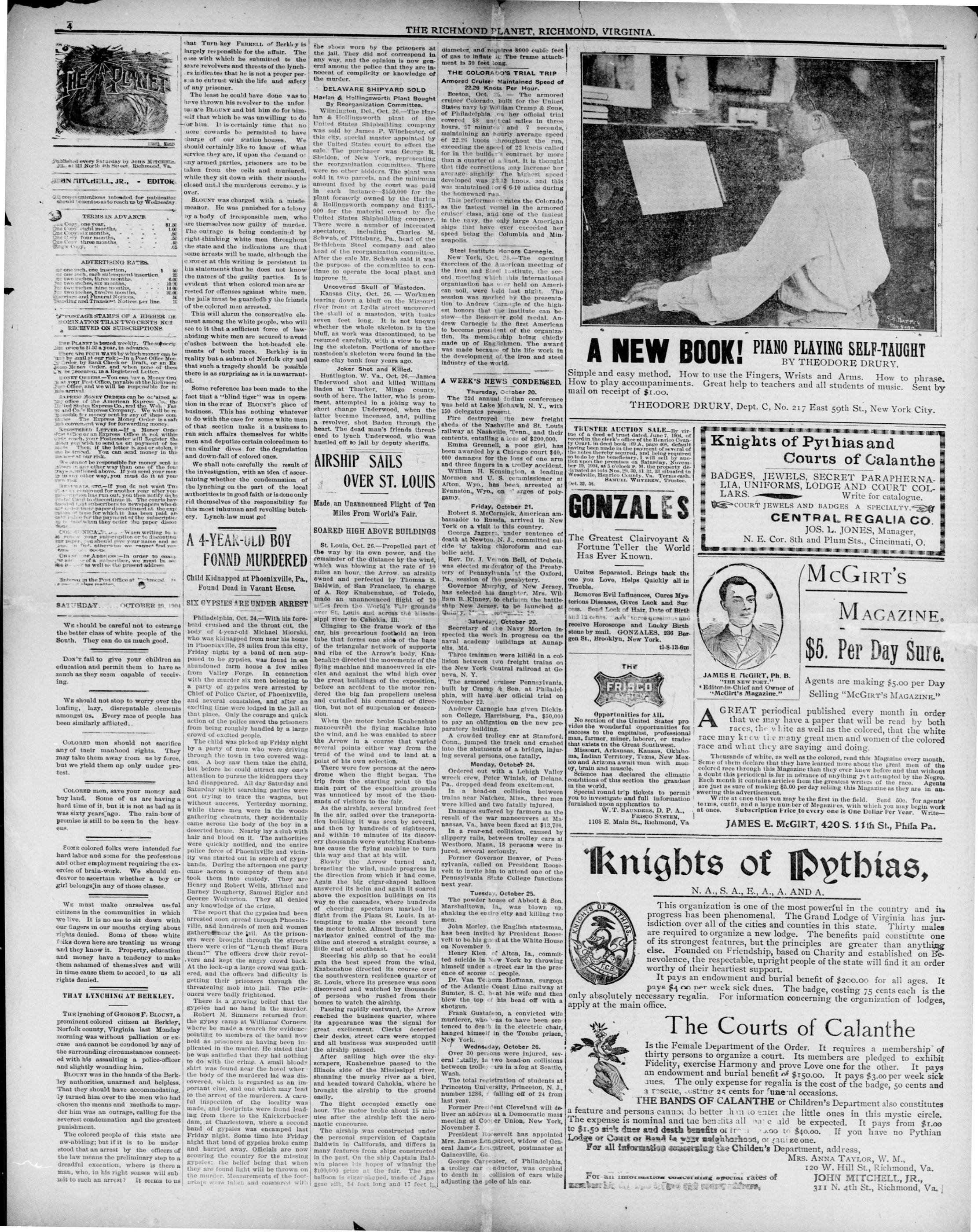
THAT LYNCHING AT BERKLEY.
THE lynching of GEORGE F. BLOUNT, a prominent colored citizen at Berkley, Norfolk county, Virginia last Monday morning was without palliation or excuse and cannot be condoned by any of the surrounding circumstances connected with his assaulting a police-officer and slightly wounding him.
BLOUNT was in the hands of the Berkley authorities, unarmed and helpless. That they should have accommodating, ly turned him over to the men who had chosen the means and methods to murder him was an outrage, calling for the severest condemnation and the greatest punishment.
The colored people of this state are aw-abiding; but if it is to be understood that an arrest by the officers of the law means the preliminary step to a dreadful execution, where is there a man, who, in his right senses will sub mit to such an arrest? It seems to us
---
that Turn key FERRELL of Berkley is largely responsible for the affair. The use with which he submitted to the scare revolvers and threats of the lynchers indicates that he is not a proper person to entrust with the life and safety of any prisoner. The least he could have done was to have thrown his revolver to the unfortunate BLOUNT and bid him do for himself that which he was unwilling to do or him. It is certainly time that no more cowards be permitted to have charge of our station houses. We should certainly like to know of what service they are, if upon the demand of any armed parties, prisoners are to be taken from the cells and murdered, while they sit down with their mouths closed until the murderous ceremony is over.
BOUNT was charged with a misdemeanor. He was punished for a felony by a body of irresponsible men, who are themselves now guilty of murder. The outrage is being condemned by right-thinking white men throughout the state and the indications are that some arrests will be made, although the coroner at this writing is persistent in his statements that he does not know the names of the guilty parties. It is evident that when colored men are arrested for offenses against white men, the jails must be guarded b y the friends of the colored men arrested.
This will alarm the conservative element among the white people, who will see to it that a sufficient force of law-abiding white men are secured to avoid clashes between the hot-headed elements of both races. Berkley is in reality but a suburb of Norfolk city and that such a tragedy should be possible there is as surprising as it is unwarranted.
Some reference has been made to the fact that a "blind tiger" was in operation in the rear of BLOUNT's place of business. This has nothing whatever to do with the case for some white men of that section make it a business to run such affairs themselves for white men and depotize certain colored men to run similar dives for the degradation and down-fall of colored ones.
We shall note carefully the result of the investigation, with an idea of ascertaining whether the condemnation of the lynching on the part of the local authorities is in good faith or is done only rid themselves of the responsibility for this most inhuman and revolting butchery. Lynch-law must go!
A 4-YEAR-OLD BOY FONND MURDERED
Child Kidnapped at Phoenixville, Pa. Found Dead in Vacant House.
SIX GYPSIES ARE UNDER ARREST
Philadelphia, Oct. 24.—With his forehead crushed and the throat cut, the body of 4-year-old Michael Miorski, who was kidnapped from near his home in Phoenixville, 28 miles from this city, Friday night by a band of men supposed to be gypsies, was found in an abandoned farm house a few miles from Valley Forge. In connection with the murder six men belonging to a party of gypsies were arrested by Chief of Police Carter, of Phoenixville, and several constables, and after an exciting time were lodged in the jail at that place. Only the courage and quick action of the police saved the prisoners from being roughly handled by a large crowd of excited people.
The child was picked up Friday night by a party of men who were driving through the town in two covered wagons. A boy saw them take the child, but before he could attract any one's attention to pursue the kidnappers they had disappeared. All day Saturday and Saturday night searching parties were out trying to trace the wagons, but without success. Yesterday morning, while three men were in the woods gathering chestnuts, they accidentally came across the body of the boy in a deserted house. Nearby lay a club with hair and blood on it. The authorities were quickly notified, and the entire police force of Phoenixville and vicinity was started out in search of gypsy bands. During the afternoon one party came across a company of them and took them into custody. They are Henry and Robert Wells, Michael and Barney Dougherty, Samuel Rigler and George Wolverton. They all denied any knowledge of the crime.
The report that the gypsies had been arrested soon spread through Phoenixville, and hundreds of men and women gather near the jail. As the prisoners were brought through the streets there were cries of "Lynch them! Burn them!" The officers drew their revolvers and kept the angry crowd back. At the lock-up a large crowd was gathered, and the officers had difficulty in getting their prisoners through the threatening mob into jail. The prisoners were badly frightened.
There is a growing belief that the gypsies had no hand in the murder. Robert M. Simmers returned from the gypsy camp at Williams' Corners, where he made a search for evidence pointing to members of the band now held as prisoners as having been implicated in the murder. He stated that he was satisfied that they had nothing to do with the crime. A small bloody shirt was found near the hovel where the body of the murdered lad was discovered, which is regarded as an important clue, and one which may lead to the arrest of the murderers. A careful inspection of the locality was made, and footprints were found leading from there to the Knickerbocker dam, at Charlestown, where a second band of gypsies was encamped last Friday night. Some time late Friday night that band of gypsies broke camp and hurried away. Officials are now scouring the country for the missing gypsies; the belief being that when they are found light will be thrown on the murder. Measurements of the footprints were taken and compared with
THE RICHMOND PLANET, RICHMOND, VIRGINIA
the shoes worn by the prisoners at
the jail. They did not correspond
in any way, and the opinion is now
general among the police that they are
innocent of complicity or knowledge of
the murder.
DELAWARE SHIPYARD SOLD
Harlan & Hollingsworth Plant Bought
By Reservation Company
By Reorganization Committee.
Wilmington, Del. Oct. 26.—The Harlan & Hollingsworth plant of the United States Shipbuilding company was sold by James P. Winchester, of this city, special master appointed by the United States court to effect the sale. The purchaser was George R. Sheldon, of New York, representing the reorganization committee. There were no other bidders. The plant was sold in two parcels, and the minimum amount fixed by the court was paid in each instance—$550,000 for the plant formerly owned by the Harlan & Hollingsworth company and $135,000 for the material owned by the United States Shipbuilding company. There were a number of interested spectators, including Charles M. Schwab, of Pittsburg, Pa., head of the Bothechem Steel company and also head of the reorganization committee. After the sale Mr. Schwab said it was the purpose of the committee to continue to operate the local plant and improve it.
Uncovered Skull of Mastodon,
Kansas City, Oct. 26. — Workmen
tearing down a bluff on the Missouri
river front at Lydia stonet uncovered
the skull of a mastodon, with tusks
seven feet long. It is not known
whether the whole skeleton is in the
bluff, as work was discontinued, to be
resumed carefully, with a view to saving the skeleton. Portions of another mastodon's skeleton were found in the same clay bank four years ago.
Joker Shot and Killed.
Huntington, W. Va., Oct. 26. — James
Underwood shot and killed William
Baden at Thacker, Mingo county,
south of here. The latter, who is prominent, attempted in a joking way to short change Underwood, when the latter became incensed, and, pulling a revolver, shot Baden through the heart. The dead man's friends threaten to lynch Underwood, who was hustled off to jail by deputy sheriffs.
AIRSHIP SAILS OVER ST. LOUIS
Made an Unannounced Flight of Ten
Miles From World's Fair.
SOARED HIGH ABOVE BUILDINGS
St. Louis, Oct. 26.—Propelled part of the way by its own power, and the remainder of the distance by the wind, which was blowing at the rate of 10 miles an hour, the Arrow, an airship owned and perfected by Thomas S. Baldwin, of San Francisco, in charge of A. Roy Knabenshue, of Toledo, made an unannounced flight of 10 miles from the World's Fair grounds over St. Louis and across the Mississippi river to Cahokia, Ill.
Clinging to the frame work of the car, his precarious foothold an iron tube that forms one side of the base of the triangular network of supports and ribs of the Arrow's body. Knabenshue directed the movements of the flying machine and manoeuvred in circles and against the wind high over the great buildings of the exposition, before an accident to the motor rendered the big fan propellers useless and curtailed his command of direction, but not of suspension or descension.
When the motor broke Knabenshue manoeuvred the flying machine into the wind, and he was enabled to steer the Arrow in a course that varied several points either way from the trend of the wind and to land at a point of his own selection.
There were few persons at the aerodrome when the flight began. The trip from the starting point to the main part of the exposition grounds was unnoticed by most of the thousands of visitors to the fair.
As the airship, several hundred feet in the air, sailed over the transportation building it was seen by several, and then by hundreds of sightseers, and within 10 minutes of its discovery thousands were watching Knabenshue cause the flying machine to turn this way and that at his will.
Slowly the Arrow turned and, breasting the wind, made progress in the direction from which it had come. Again the big cigar-shaped balloon answered its helm and again it soared above the exposition buildings on its way to the cascades, where hundreds of cheering spectators marked its flight from the Plaza St. Louis. In attempting to make the second turn the motor broke. Almost instantly the navigator gained control of the machine and steered a straight course, a little east of southeast.
Steering his ship so that he could gain the best speed from the wind, Knabenshue directed its course over the southwestern residence quarter of St. Louis, where its presence was soon discovered and watched by thousands of persons who rushed from their homes to watch the airship.
Passing rapidly eastward, the Arrow reached the business quarter, where its appearance was the signal for great excitement. Clerks deserted their desks, street cars were stopped and all business was suspended until the airship passed.
After sailing high over the sky scrapers, Knabenshue passed to the Illinois side of the Mississippi river shunning the murky river as a bird, and headed toward Cahokia, where he brought the airship to the ground easily.
The flight occupied exactly one hour. The motor broke about 15 minutes after the airship left the aeronautic concourse.
The airship was constructed under the personal supervision of Captain Baldwin in California, and differs in many features from ships constructed in the past. On the ship Captain Baldwin places his hopes of winning the $100,000 prize at the fair. The gas balloon is cigar-shaped, made of Japanese nell is $4 feet long and 17 feet in
diameter, and requires 8000 cubic feet of gas to inflate it. The frame attachment is 30 feet long. _____
THE COLORADO'S TRIAL TRIP
Armored Cruiser Maintained Speed of
22.26 Knots Per Hour.
Boston, Oct. 25. — The armored cruiser Colorado, built for the United States navy by William Cramp & Sons, of Philadelphia, on her official trial covered 88 nautical miles in three hours, 57 minutes and 7 seconds, maintaining an hourly average speed of 22.26 knots throughout the run, exceeding the speed of 22 knots called for in the builder's contract by more than a quarter of a knot. It is thought that tide corrections may increase her average slightly. The highest speed developed was 23.33 knots, and this was maintained for 6 6-10 miles during the homeward run.
This performance rates the Colorado as the fastest vessel in the armored cruiser class, and one of the fastest in the navy, the only large American ships that have ever exceeded her speed being the Columbia and Minneapolis.
Steel Institute Honors Carnegie.
New York, Oct. 25.—The opening exercises of the American meeting of the Iron and Steel Institute, the second meeting which this international organization has ever held on American soil, were held last night. The session was marked by the presentation to Andrew Carnegie of the highest honors that the institute can bestow—the Bessner gold medal. Andrew Carnegie is the first American to become president of the organization, its membership being chiefly made up of Englishmen. The award was made because of his life work in the development of the iron and steel industry of the world.
A WEEK'S NEWS CONDENSED
The 22d annual Indian conference was held at Lake Mohawk, N. Y., with 150 delegates present.
Fire destroyed the new freight sheds of the Nashville and St. Louis railway at Nashville, Tenn., and their contents, entailing a loss of $200,000.
Emma Grennell, a poor girl, has been awarded by a Chicago court $40,000 damages for the loss of one arm and three fingers in a trolley accident.
William H. Kensington, a leading Mormon and U. S. commissioner at Afton, Wyo., has been arrested at Evanston, Wyo., on charges of polygamy.
Friday, October 21.
Robert S. McCormick, American ambassador to Russia, arrived in New York on a visit to this country.
George Jaggers, under sentence of death at Newton, N.J., committed suicide by taking chloroform and carbolic acid.
Rev. Dr. J. Vernon Bell, of Dubois, was elected moderator of the Presbytery of Pennsylvania at the Oxford, Pa., session of the presbytery.
Governor Murphy, of New Jersey, has selected his daughter, Mrs. William B. Kinney, to christen the battleship New Jersey, to be launched at Quarry, N.Y., November 10.
Saturday, October 22.
Secretary of the Navy Morton inspected the work in progress on the naval academy buildings at Annapolis, Md.
Three trainmen were killed in a collision between two freight trains on the New York Central railroad at Geneva, N. Y.
The armored cruiser Pennsylvania, built by Cramp & Son, at Philadelphia, will have her official trial on November 22.
Andrew Carnegie has given Dickinson College, Harrisburg, Pa., $50,000 to pay an obligation on the new preparatory building.
A crowded trolley car at Stamford, Conn., jumped the track and crashed into the abutments of a bridge, injuring several persons, one fatally.
Monday, October 24.
Ordered out with a Lehigh Valley wreck crew, Peter Winkish, of Delano, Pa., dropped dead from excitement.
In a head-on collision between trains near Natchez, Miss., three men were killed and two fatally injured.
Damages suffered by farmers as the result of the war manoeuvers at Manassas, Va., have been fixed at $13,700.
In a rear-end collision, caused by slippery rails, between trolley cars at Westboro, Mass., 18 persons were injured, several seriously.
Former Governor Beaver, of Pennsylvania, called on President Roosevelt to invite him to attend one of the Pennsylvania State College functions next year.
Tuesday, October 25.
The powder house of Abbott & Son, Marshalltown, Ia., was blown up, shaking the entire city and killing two men.
John Morley, the English statesman, has been invited by President Roosevelt to be his guest at the White House on November 9.
Henry Klen, of Alton, Ia., committed suicide in New York by throwing himself under a street car in the presence of scores of people.
Dr. Van Teuburn Hoffman, surgeon of the Atlantic Coast Line railway at Sumter, S. C. beat his wife and then blew the top of his head off with a shotgun.
Frank Gustafson, a convicted wife murderer, who was to have been sentenced to death in the electric chair, hanged himself in the Tombs prison, New York.
Wednesday, October 26.
Over 30 pensions were injured, several intally, in two head-on collisions between trolley cars in a fog at Seattle, Wash.
The total registration of students at Princeton University, Princeton, N. J., number 1286, falling off of 24 from last year.
Former President Cleveland will deliver an address at a Democratic mass meeting at Cooper Union, New York, November 2.
President Roosevelt has appointed Mrs. James Longstreet, widow of General James Longstreet, postmaster at Gainesville, Ga.
George Carpenter, of Philadelphia, a trolley car conductor, was crushed to death in collision of cars while adjusting the pole of his car.
S. B. BURNSY
NEW YORK
A NEW BOOK! PIANO PLAYING SELF-TAUGHT BY THEODORE DRUBY
Simple and easy method. How to use the Fingers, Wrists and Arms. How to phrase. How to play accompaniments. Great help to teachers and all students of music. Sent by mail on receipt of $1.00. THEODORE DRURY, Dept. C, No. 217 East 50th St., New York City.
knights of Pythias,
This organization is one of the most powerful in the country and its progress has been phenomenal. The Grand Lodge of Virginia has jurisdiction over all of the cities and counties in this state. Thirty males are required to organize a new lodge. The benefits paid constitute one of its strongest features, but the principles are greater than anything else. Founded on Friendship, based on Charity and established on Benevolence, the respectable, upright people of the state will find it an order worthy of their heartiest support.
It pays an endowment and burial benefit of $200.00 for all ages. It pays $4.00 per week sick dues. The badge, costing 75 cents each is the only absolutely necessary regalia. For information concerning the organization of lodges, apply at the main office.
The Courts of Calanthe
Is the Female Department of the Order. It requires a membership of thirty persons to organize a court. Its members are pledged to exhibit Fidelity, exercise Harmony and prove Love one for the other. It pays an endowment and burial benefit of $150.00. It pays $3.00 per week sick aues. The only expense for regalia is the cost of the badge, 50 cents and a rosette, costing 25 cents for funeral occasions.
THE BANDS OF CALANTHE or Children's Department also constitutes a feature and persons cannot do better than to enter the little ones in this mystic circle. The expense is nominal and the benefits all have could be expected. It pays from $1.00 to $1.50 sick dues and death benefits or from $0.00 to $40.00. If you have no Pythian Lodge or Coast or Bend in your neighborhood, organize one.
For all information concerning the Children's Department, address.
For an information concerning special rates of
charges, please contact:
TRUSTEE AUCTION SALE—By virtue of a deed of trust dated, June 7, 1904, of record in the clerk's office of the Henrico County Court, in deed book 169 A, page 408, default having been made in the payment of several of the notes thereby secured, and being required so to do by the beneficiary. I will sell by auction upon the premises on Saturday, November 19, 1904, at 5 o'clock p. M. the property de-disrated as lots Nos. 29, 30, 31 32, 33 situated in Woodville, Henrico County, Va. Terms cash.
SAMUEL WHYBREW, Trustee. Oct. 22, 5t.
GONZALES
The Greatest Clairvoyant & Fortune Teller the World Has Ever Known.
Unites Separated. Brings back the one you Love, Helps Quickly all in Trouble.
Removes Evil Influences, Cures Mysterious Diseases, Gives Luck and Success. Send Lock of Hair, Date of Birth and 12 cents. Ask three questions and receive Horoscope and Lucky Birthstone by mail. GONZALES, 236 Bergen St., Brooklyn, New York.
tl-8-13-6m
THE FRISCO EXPEDITION
No section of the United States provides the wonderful opportunities for success to the capitalist, professional man, farmer, miner, laborer, or trades that exists in the Great Southwest. In Missouri, Arkansas, Kansas, Oklahoma, Indiana, Texas, Louisiana, Mexico and Arizona await men with money, brain and muscle.
Science has declared the climatic conditions of this section the grandest in the world.
Special round trip tickets to permit you to investigate and full information furnished upon application to
W. T. SAUNDERS, D. P. A.,
FRISCO SYSTEM,
1108 E. Main St., Richmond, Va
KNIGHTS OF PYTHIAS.
F.C.B.
16
a feature and persons cannot do
The expense is nominal and to
to $1.50 sick dues and death be
Lodge or Court or Bond in yr
For all information concern
For an information concern
member be
BY THEODORE DRURY.
Knights of Pyrmont
Court
BADGES, JEWELS, SH
LIA, UNIFORMS, LOD
LARS.
COURT JEWELS AND B
CENTRAL
JOS.
N. E. Cor. 8th and
of Pythias and Courts of Calanthe
VELLS, SECRET PARAPHERNA-
RMS, LODGE AND COURT COL-
Write for catalogue.
VELLS AND BADGES A SPECIALTY.
CENTRAL REGALIA CO.
JOS. L. JONES, Manager,
r. 8th and Plum Sts., Cincinnati, O.
McGIRT'S
MAGAZINE.
$5. Per Day Sure.
BADGES, JEWELS, SECRET PARAPHERNALIA, UNIFORMS, LODGE AND COURT COLLARS. Write for catalogue.
GREAT periodical public that we may have a paper races, the white as well race may know the many great race and what they are saying.
Thousands of white, as well as the col. Some of them declare that they have learned race through this Magazine than a doubt this periodical is far in advance of Each month it contains articles from the are just as sure of making $5.00 per day so swerving this advertisement.
Write at once that you may be the first terms, outfit, and a large number of Magazines at once. Subscription Price to every
JAMES E. McGIRT,
medical published every month in order, have a paper that will be read by both white as well as the colored, that the white many great men and women of the colored are saying and doing.
as well as the colored, read this Magazine every month, they have learned more about the great men of the Magazine than they ever knew before and that without air in advance of anything yet attempted by the Negro, articles from the greatest writers of the race. Agents $5.00 per day selling this Magazine as they are in an- it may be the first in the field. Send 50c. for agents' number of Magazines, with which you may begin work Price to every one is One Dollar Per Year. Write—
McGIRT, 420 S. 11th St., Phila Pa.
Pythias,
A. AND A.
The most powerful in the country and in The Grand Lodge of Virginia has juried counties in this state. Thirty males lodge. The benefits paid constitute one principle are greater than anything based on Charity and established on behalf people of the state will find it an order.
trial benefit of $200.00 for all ages. It The badge, costing 75 cents each is the concern concerning the organization of lodges,
s of Calanthe
Order. It requires a membership of it. Its members are pledged to exhibit improve Love one for the other. It pays of $150.00. It pays $3.00 per week sickalia is the cost of the badge, 50 cents and several occasions.
for Children's Department also constitutes the little ones in this mystic circle.uld be expected. It pays from $1.00 to $40.00. If you have no Pythianize one.
Department, address,
GREAT periodical published every month in order that we may have a paper that will be read by both races, the white as well as the colored, that the white race may know the many great men and women of the colored race and what they are saying and doing.
Thousands of white, as well as the colored, read this Magazine every month. Some of them declare that they have learned more about the great men of the colored race through this Magazine than they ever knew before and that without a doubt this periodical is far in advance of anything yet attempted by the Negro. Each month it contains articles from the greatest writers of the race. Agents are just as sure of making $5.00 per day selling this Magazine as they are in answering this advertisement.
Write at once that you may be the first in the field. Send 50c. for agents' terms, outfit, and a large number of Magazines, with which you may begin work at once. Subscription Price to every one is One Dollar Per Year. Write—
JAMES E. McGIRT, 420 S. 11th St. Phila Pa.
N. A., S. A., E., A., A. AND A.
organization is one of the most power-
has been phenomenal. The Gran-
over all of the cities and counties is
ed to organize a new lodge. The
largest features, but the principles
funded on Friendship, based on CL
the respectable, upright people on
the heartiest support.
MRS. ANNA TAYLOR, W. M.
JAMES E. McGIRT, Ph. B.
"THE NEW POET."
* Editor-in-Chief and Owner of
"McGirt's Magazine."
Agents are making $5.00 per Day Selling "McGIRT'S MAGAZINE."
NS. ANNA TAYLOR, W. M., 120 W. Hill St., Richmond, Va. JOHN MITCHELL, JR., 311 N. 4th St., Richmond, Va.
else's fault.
Years before this man had received himself when told by an anxious wife and friends that he must give up that bottle, or give up everything else.
And now that all but the bottle he gone, he still deceived himself into the belief that the bottle, which caused his misery, had come really as a friend at the end, as a solace in his misfortunes
How great a benefit it would be if every young man in this country could have seen YEARS ago, and ONI WEEK I should the whisky victim that is told about here.
It is hard for us to learn through the experience of others, but no man could fail to be impressed by this example.
The man once had everything that he wanted, and one thing that he did not want or need—the whisky bottle.
Had he given up that one unnecessary thing, he might have kept all the others, and the remaining years of his life might have been happy and useful.
But with the power of self-deception which that very bottle supplied to him, he clung to it to the end of his good fortune, and he will cling to it to the end of his life, unless a miracle of self-control should save him.
In mere selfishness and the desire for wealth, success and ease, there are to be found powerful temperance arguments. Young men must make up their minds, in this day of competition and of organized, exacting struggle, that a man who would go to the top must not try to carry that bottle with him.
But for the REAL man, the young man worthy the opportunities of modern life, the argument against whisky should be based, not on selfishness, but on a noble desire to be a useful and worthy human being.
Whisky takes away your money, your houses, your friends, your prospects of getting those things.
But it does worse than that. It takes away your manhood and your courage; it takes away your right to look other men in the eye, and your power to use the strength that nature has given to you.
Whisky destroys the will, and supplies the lying arguments with which its victims deceive themselves. It arouses the lowest instincts of vice and of dissipation, and chokes the possibility of progress toward better things.
If whisky controls you, you cannot be a MAN. Leave it alone.
CANDIES CONTAIN ALCOHOL
Confectionery Hand - Book Recipe Shows Use of Spirits in Composition of Different Sweets.
It is quite easy to absorb an appreciable amount of alcohol by means of the apparently innocent chocolate bean and the tempting fondant. Liqueur beans and liqueur fondants are on sale at all the better class confectioners' in London.
In the question which was addressed to the chancellor of the exchequer it was assumed that the practice of making sweets containing a large percentage of proof spirit was confined to German and other continental manufacturers. Inquiries recently went to prove that the practice is almost universal among English manufacturing confectioners.
The trade has never made any secret of the composition of these confections. In a popular confectionery hand book the following recipe is given for the making of superfine liqueur bonbons and fondants: "Take three parts of sugar and one part of spirits, such as brandy, rum, cognac, gin, or whisky." It is added that the liqueur should always be mixed with 10 per cent. of dissolved white gum. In some sweets the spirit remains mixed with sugar; in others, by a peculiar method of manufacture, the spirit remains in the center in a liquid form. As a rule children do not buy these liqueur sweets, as they are expensive.
Stupefies and besets.—Bismarck.
The greatest enemy that labor has is the saloon.—American Issue.
One vision of its work would turn wine into wormwood.—Ram's Horn.
No man chooses to live with a saloon on one side of him and the Saviour on the other.—Ram's Horn.
When the professed Christians wink at an evil, the ungody will close both eyes and let the work go on; and the devil will call both classes good fellows.
The Chesapeake & Ohio railway is to be added to those that do not permit an employee to visit a saloon, on or off duty. Business requires sobriety.
Mrs. Margaret Sherman, of Menominee, Mich., has brought suit for $5,000 damages against Joseph Scholz, saloonist, and his bondsmen, Ferdinand C. Nowack and Joseph Erdltz, for selling liquor to her husband after being warned not to do so.
What a terrible arraignment against cigarettes is found in the following assertion made by Chief of Police Cleary, of Rochester: "Ninety per cent. of the young criminals we have to deal with follow the same road that leads inevitably to crime and prison. The path opens with idleness; ends behind prison bars. The sign posts along this road are cigarettes, dime novels, poolrooms, gambling and drink. This road brings them to burglary, breaking open slot machines, petty theft and numerous other kinds of crime of a petty nature. As the youth matures, murder may be the end."
All Saloons Are Subway.
All saloons are subway, all lead down to death, and it does not matter in the least whether they are opened with prayer and closed with the Doxology, the results are just the same.—American issue.
Dirt in milk makes more undesirable butter than all the wrong methods of working. No perfection of working on butterflies and working in salt can secure the proper flavor of butter from dirty milk.
SATURDAY.....OCTOBER 29.1904
TEMPERANCE NOTES
Money, Friends, Clubs, Wife and Children Dropped Away, But the Bottle Remained.
This is a true story, readers. The writer first knew the man in London. He was successful, owned a bank, had a fine house in the city and another in the country, had horses and carriages and a promising family. He belonged to some of those clubs in which membership means cheap and desired distinction. He had AMBITION. His friend is predicte dthat his success and affluence would grow and his ambitions be realized as the years went by. Among his other possessions, this man had one to which he attached, then, but slight importance. That was a bottle which was passed to him quite often by a solemn butler, who always brought with it a smaller bottle containing soda water.
The curious part of the story is that this man gradually lost all of the important things, all of those which he originally valued very highly, and that he never lost that one small, unimportant bit of property—the plain, black bottle of which, in the beginning, he thought so little.
The man was seen again the other day toward dusk on the sidewalk of a western city. It was difficult to recognize him, and he was evidently surprised that anyone should recognize him, and take the trouble to check him in his shuffling march.
His clothes were dirty and actually ragged. The brim of his hat was torn. His face was bizarre, his look unseen.
BUT THE BOTTLE STAYED WITH HIM
tain. His diffident, timid smile, with
all the old self-reliance gone, was very
pathetic.
The man told his story, and as he told it in a restaurant, after being asked to eat and drink, he whispered to the waiter: "A little whisky, please." And the waiter brought him that same dark bottle that had been brought him so often in the days of his prosperity.
The story that he told was his story, but it was not THE story.
The real story was very simple; you who read this can guess quite easily its main features, says the New York American. It is a story that you can read in the faces of men in every barroom, prison or poorhouse, in the faces of men that commit suicide, of those that commit murder, of others that shuffle along as this man shuffled—poor, heart-broken failures.
The man had gradually lost his mental keenness and capacity for business. Others got his banking business away from him.
BUT THE BOTTLE STAYED WITH HIM.
He gradually came to rely more and more upon it, and to value its companionship as his force of character diminished.
His friends left him, and he had to leave his clubs.
BUT THE BOTTLE STILL STUCK TO HIM. The dues that it claimed he paid faithfully. It was there at his elbow when his other friends had disappeared.
He lost his house in the city and his house in the country; but that bottle, which represented now his chief possession, was still with him.
His wife and his children had to go to those who could take care of them. But they did not take the bottle away with them. The wife had tried only too often to take away that bottle, but she had to leave it. She could take away the children—the law allowed her to do that. The sheriff could take away his horses and his carriages—the law allowed that. The governing committees could put him out of the clubs, and friends could take away his reputation and remaining chances of employment with a shake of the head. BUT NO POWER ON EARTH AND NO LAW COULD TAKE AWAY THE BOTTLE; that stuck to him, and he stuck to it.
The man who had traveled with his bottle from success and fortune to ragged clothes and pathetic despair, ate his dinner and drank his whisky, and, with the drunkard's pitiful deception, said:
"I don't look like much, do I? I am afraid I have been drinking pretty hard since luck went against me. It is not many of my old friends that speak to me when they see me now." Even then the poor man could not see that it was whisky which had turned fortune against him—not ill luck that had turned him to whisky. Whisky conquers men by deceiving them, by encouraging them to think that their drunkenness is some one
FACTS AND COMMENT.
Guilty.
All Saloons Are Subway
---
THE RICHMOND PLANET, RICHMOND, VIRGINIA.
DEMOCRATIC CLAIMS
New York, Jersey, Delaware, Maryland, West Virginia Certain For Parker, New York, Oct. 24.—A statement was given out by the Democratic national committee after a consultation between Thomas Taggart, chairman; William F. Sheeban, chairman of the executive committee, and Delancey Nicoll, vice chairman for the east. It says:
"We have made no formal statement concerning the political situation before this time, because the materials upon which a correct judgment could be formed were not at hand.
"Our efforts during the past three months have been devoted to harmonizing of the party in the states hitherto considered doubtful by reason of former dissensions. That work is now finished, and it is possible for the first time to reach a conclusion based upon a systematic canvass, which can never be satisfactorily made until after organization is completed and the campaign has well progressed.
"Our canvass shows that we shall certainly carry by good majorities the states of New York, New Jersey, Connecticut, Maryland, Delaware, West Virginia and Indiana, and that in addition to these electoral votes we shall have the majority, if not all, of the electoral votes of the Rocky Mountain states. It is impossible at this juncture to predict the outcome in Wisconsin.
"Illinois must also be classed in the doubtful column, for although at this moment our canvass there is imperfect, it is sufficiently advanced to indicate an unmistakable Republican defection."
REPORT OF STEEL TRUST
Earnings and Unfilled Orders Show a Marked Decrease.
New York, Oct. 26.—Directors of the United States Steel Corporation declared the regular quarterly dividend of 1% per cent. on the preferred stock, payable November 30. The financial statement of the quarter ended September 30 last shows net earnings, after the usual deductions for repairs, renewals, maintenance, fixed charges and interest on bonds, of $18,773,932, which is below conservative estimates.
Comparison with the same quarter for three years past follows: 1903, $32,422,954; 1902, $36,954,488; 1901, $28,633,843. Net earnings for the nine months of this year aggregated $111,709,839. In 1903 for the same period they were $94,133,971, and in 2002 $101,233,004.
Unmanned orders on hand on September 30 last amounted to 3,027,436 tons, a decrease of 701,306 tons over the same period last year. As an offset to this, however, Chairman Gary stated that the corporation had booked an average of 26,000 tons of new orders per day during the current month, an increase of 30% per cent. over the business of last October.
STEAMER WRECKED
Atlantic Liner Massachusetts Stranded Off Bahama Islands.
Nassau, N. P., Oct. 26.—The Atlantic Transport line steamer Massachusetts, from Cardiff, for New Orleans, stranded off Abaco, Bahama Islands, October 16. She is resting easy.
Asked Navy For Aid.
Washington, Oct. 26. — Secretary Morton ordered the protected cruiser Tacoma, Commander Reginald F. Nicholson, commanding, to go in search of the steamer Massachusetts, belonging to the International Merchant Marine company, of New York. The vessel was reported lost about 20 miles north of the Old Bahama channel by the steamer Ontendeta, which has arrived at Port Tampa. The Massachusetts left Cardiff, October 1, for New Orleans. Sixty persons are on board, and the company sent an urgent request to the navy department for assistance.
Bride's Fatal Fall From Wall
New York, Oct. 24. -Rosa Gods left her home in Yonkers in her bridal dress, accompanied by Andrew Borel, whom she was to marry, and John Tabaczar, who was to act as best man. A few hours later she was found unconscious at the foot of the wall in Jerome Park reservoir, and now she is dying in Fordham hospital. Borel and Tabaczar are under arrest and tell conflicting stories as to how the woman came to fall. The police have found witnesses who saw her and the two men on the top of the wall not long before the woman was discovered unconscious on the rocks 25 feet below. She was found to have a fractured skull and a number of bruises about the face and body.
Anthracite Coal Trade Dull.
Philadelphia. Oct. 26.—The anthracite coal trade continues dull, and further curtailment of production will be necessary, according to coal mining officials, unless a sudden cold snap sets in. The Philadelphia and Reading Coal and iron company is likely to shut down its collieries on Friday, to remain closed until the following Wednesday. The other companies are likely to do the same, as aside from Sunday the mine workers will take two holidays between Friday and Wednesday—Mitchell day (Saturday) and All Soul's day (Tuesday). Mitchell day commemorates the ending of the strikes of 1900.
Famous Battlefield Sold Cheap
Richmond, Va.; Oct. 24—The famous Civil War battlefield of Gaines Mill, near Cold Harbor, Hanover county, where both northern and southern armies suffered so severely, has been sold to Joseph Woodson, of this city, for $360.75. It is probable an electric line will be built thither from Richmond, so that the place may be more accessible to sightseers.
Young Men Who Had Wooed Girl by
Mail Flees When He Bebolds
His Charmer.
Wide-spreading umbrellas were carried about in the lobby of the Auditorium at Chicago the other morning. The first one was noticed by Clerk Shaffer, a large commodoious parachute
MRS. DR. CORNELIA WHITE.
A Powerful Woman with a Powerful Force
SENDS HAPPINESS TO THOSE WHO ACCEPT IT.
She will raise you from Diseases, Disappointment, Digness, Poverty and Drudgery, to Health, Wealth, Health and Wellness, a wonderful woman is helping thousands of others and will help you. Countless numbers who were crushed in life by diseases, worries, sadness and treatments, are now becoming prosperous, healthy, and happy, by the aid of this mighty woman, and her.
as any gift ever held out by a generous hand. There is no cost; no charge whatever, simply write for it, and it will be sent by next mail. Don't send any money, just send your name and address to the office. Baltimore, Md., and she will send you FREE information.
In the case of $12 pages, head-demolly is illustrated, which will tell you how to gain Health, Wealth, Luck, Power and Happiness, and how to develop the power of Clairvoyance, Hypnotism, Power and ManுNewment. Mental Healing, Magnetic Healing, Mental Teaching, and the most valuable work is the "The Power of the Alive." Psychometry and that wonderful Power of all Powers, White and Black Art. Also how to remove Evil influences from yourself and friends. This is a grand book to place in the hands of those who desire to rise and better their conditions in life. It is positive to tell you how to remove and cure all habits of drink. It is a godsend to suffering humanity, the only one to Eternal Life. This is the exact process of twenty-two people who are the outlay of ten thousand dollars. ($10). We do not ask you to send any money, all we ask is that you send us five cents in stamps to help cover the cost of packing, postage, etc. Write for this valuable free book to Dr. Cornelia White.
Dr. White's College of Science, M.D.
carried by a long and lank young fellow with cadaverous cheeks and earnest eyes. He paraded up and down the lobby from north to south the length of the lobby, and it was just 9:28 when who to be? "How's this? What's up?" inquired Clerk莎克. "Don't you know it
A
"THIS IS HOW IT IS."
ain't raining and that raised umbrellas are against the rule in this hotel!"
The young fellow looked dazed a moment. "Oh, it's her," said he. Evidently that constituted a sufficient explanation according to him, for he resumed his march up and down.
The clerk followed him. "See here, what is it? This won't do. You aren't the king of Siam."
The stranger stopped in his walk. "I'll tell you," he said, confidingly. "My name's Ephraim Hiles, and I live on a farm four miles from Owsox, Mich. I'm here to meet her, the girl I'm going to marry. We agreed to meet in this hotel at 9:30 this morning. Each of us is to carry a raised umbrella so we can recognize each other.
"You see, this is how it is: We corresponded through a matrimonial agency, but we ain't never met, and we had to have some sign."
He looked at the clock. "She ought to be here now—it's two minutes past the time. Now, wait a minute, and I'll put the umbrella down." Just then, says the Chicago Chronicle, into the lobby from the ladies' entrance floated a creature in pink. Her green and blue parasol was up and from it hung a streamer of ribbons. She minced along and glanced about. "What's her name?" asked the clerk. "Minnie Edkins; she's from Iowa," stammered Ephraim. "But," he gasped, "I never thought she looked like that." He closed the umbrella precipitately and sneaked toward the door. "The Lord keep her from spotting' me," he murmured as he streaked north on Michigan avenue.
Mrs. Henpeck—What a little word "yes" is. Henpeck—But a long sentence follows it sometimes—St. Louis Republic.
To receive prompt attention kindly mention the name of this paper.
WONDERFUL DISCOVERY Curly Hair Made Straight By
```markdown
```
* T is a wonderful hair pomade is the only safe preparation in the world that makes kinky or oily hair shine. It is also the scalp, prevents the hair from fall-out or cuts, cuts, handmade and durable hair grow hair growth for forty years and used by thousands. Warranted for straightening kinky hair. Sold for straightening kinky hair. Bawore of Ox Marrow is the finest line promised Ox Marrow is the finest line promised keep the hair straight, soft and beautiful, give much desired* A toilet necessity for ladies, gentlemen and children. Elegantly performed, the hair is the best in the host and most economical. It is not only a hair pomade but an equation equal to it. Full directions with eaves and dealers or send us 50 cents for one bag and dealers or send us 50 cents for one bag and express charges. Send postal or money order. Please mention name of this preparation. Write your name and address plainly to
OZONIZED OX MARROW CO.
76 Wabash Ave., Chicago, Illinois.
The
John A. Dix Industrial
School, Dinwiddie Va.
FOR BOTH SEXES OF THE
COLORED RACE.
Elementary and Advanced
Courses of Study. Industrial courses in, Agriculture, Carpentry, Blacksmithing and Wheelrighting Painting, Shoemaking, Basketry, and Domestic Science.
J. M. COLSON, Superintendent
BUY THE
NEW HOME
LIGHT RUNNING
SEWING MACHINE
Before You Purchase Any Other Write
THE NEW HOME SEWING MACHINE COMPANY
ORANGE, MASS.
Many Sewing Machines are made to sell regardless of quality, but the "New Home" is made to wear. Our guaranty never runs out.
We make Sewing Machines to suit all conditions of the trade. The "New Home" stands at the head of all High-grade family sewing machines Sold by authorized dealers only.
FOR SALE BY
J. M. P. COOKE.
WANTED special representative in this county and adjoining territories, to represent and advertise an old established business house of solid financial standing. Salary $21 weekly, with Expenses advanced each Monday by check direct from headquarters. Horse buggy trained when necessary; position permanent. Address Blow Bros. & Co., Dept. A, Monon Bidg, Chicago, Il.
FREE
Frisco System.
Chicago and Eastern Illinois R. R.
DOUBLE DAILY TRAINS
AND CHICAGO—MORNING
From LaSalle Street Station, Chicago...
From Union Sta. (Morphants Bridge) St.
Morning or evening connection at box
Equipment entirely new and modern
A DOUBLE TRACK RAILWAY.
Equipped with practical and approved
Substantially constructed.
PHONE. 577.
• A. D. P.
THE FUNERAL DIRECTOR, E.
All orders promptly filled at short notice
treated for meetings and nice entertainment
conveniences. Large picnic or band wag-
ing but first-class carriage, buggies, etc.
supplies.
212 EAST LE
[Residence]
OPEN ALL DAY & NIGHT
Hall Memorial L
DAILY TRAINS BETWEEN
CHICAGO—MORNING and EVENING
Street Station, Chicago.....9:50 A.
A. (Morchants Bridge) St. Louis.....9:30 A.
Evening connection at both termini with lines dis-
entirely new and modern throughout.
E TRACK RAILWAY.
With practical and approved safety appliances.
ly constructed.
DOUBLE DAILY TRAINS BETWEEN ST. LOUIS AND CHICAGO-MORNING and EVENING
A. D. PRICE
CORAL DIRECTOR, EMBALMER AND
promptly filled at short notice by telegraph or
ings and nice entertainments. Plenty of room w
Large picnic or band wagons for hire at reasonable
ss carriages, buggies, etc. Keeps constantly on h
12 EAST LEIGH STREET
[Residence Next Door.]
L DAY & NIGHT--Man on Dut
Memorial Industrial Sc
All orders promptly filled at short notice by telegraph or telephone. Hands
treated for meetings and nice entertainments. Plenty of room with all necessary
conveniences. Large picnic or b band wagons for hire at reasonable rates and not
first-class carriage, a buggies, etc. Keeps constantly on hand fine Foster
supplies.
OPEN ALL DAY & NIGHT--Man on Duty All Night
Hall Memorial Industrial School.
Massillon Ohio.
HALL MEMORIAL DOME
TRAINING SCHOOL
SUMMER COURSE
Fall Term Opens
One of the Finest Equipped
North for Young Women
Themselves for Dome
Competent faculty, new building, course
course, ONE YEAR. TUITION,
BOARD and ROOM in building
HALL MEMORIAL CONSERVAT
advantages to those des
Vocal
PHYSICAL CULTURE CLAS
For further information, address all coun
Frances A. Riley, Pres.
Made the Dum
MEMORIAL DOMESTIC SCIENCE
TRAINING SCHOOL FOR TEACHERS
SUMMER COURSE NOW IN SESSION.
Kerm Opens Sept. 12th.
Finest Equipped Boarding Seminar
for Young Women Desirous of Pursuits
selves for Domestic Science Teacher
Quality, new building, complete course, TWO YEAR TUITION, per annum. $50.00, D and ROOM in building, $11.00 to $15.00 per ALL MEMORIAL CONSERVATORY OF MUSIC, offers several advantages to those desiring Instrumental and Vocal Training.
MEMORIAL CULTURE CLASSES SPECIAL FOR Information, address all communications to Hiley, Pres.
Mrs. Leonora Wilson
be the Dumb Beast
HALL MEMORIAL DOMESTIC SCIENCE NORMAL TRAINING SCHOOL FOR TEACHERS
One of the Finest Equipped Boarding Seminaries in the North for Young Women Desirous of Preparing Themselves for Domestic Science Teachers.
Competent faculty, new building, complete course, TWO YEARS. Special course, ONE YEAR. TUITION, per annum, $50.00, in advance. BOARD and ROOM in building, $11.00 to $15.00 per month. HALL MEMORIAL CONSERVATORY OF MUSIC, offers special advantages to those desiring Instrumental and Vocal Training.
PHYSICAL CULTURE CLASSES SPECIAL FOR TEACHERS.
For further information, address all communications to
Frances A. Riley, Press.
Made the Dumb Beast Obey.
A
MADAME S. MONZOOLO.
Ma'dam S. Monzoo, the man the great show of the RINGLING BROOK oldest elephants in the world name Samen during the day. Ma'dam Monzoo the elephant name Simpson by holding a speaking nine Holy words to the beast. Ma'dam Monzoo was born in Paris, schooling. She was born a fortune teller who do. She gives advice on law suits, property, guesses for male trouble, boating plea and blind adduits, hidden treasures, a woman is a friend to the poor mighty Healer from birth. She blesses forever; keeps your enemies behind you. works has been blossomed and tested at the mighty. She works from the dead and tended Mediuns, Fortune Tellers, etc., medium but her equal has never been. She has cured thousands who were blind years. Yes, lawyers, doctors, ministers, the earth seek this gifted medium for ad suited over thirty thousand people in seas. Friends it would pay you to look are sleep. Some one is crossing your path against you not because you have harmed out of their sight they are jealous of you. Ma'dam Monzooo gives you a charm enemies to love you, make you successful happily forever, drive all evil from your into possession of property, cause you to you, cause the one whom you love to love you want to come to pass. In fact make excites the wonders. She is known over workers. Don't waste your time and me for some worse condition than before, but troubles will end. No matter how much business etc. Don't lose any more but take her advice and you will be wealthy tation is one dollar ($1.00). Inclose $1.0 address and your life will be sent to you.
S. Monzold, THE ONLY LIVING SLAVE, WAITING MEDIUM AND ANN, who can read four books in the world now, Sampson became unruly day. Malam Monzold was sent for help one Sampson by holding a charring bone sail in the Holy words to the beast and no obeyed. Monzold was born in Paris. Frumes and half eight was born a fortune teller. No female on earth loves advice of law suits, livies, marriages, loves fe male trouble, bonitos, possessions, trickery, affairs, hidden treasures, and lost and stolen art, to the loot. She is the seventh daughter of from birth. She blues the music of your enemies behind you. The charring saw her blessed and tested at the dark hours of midnight, worked from the dead and reads from the sky. Thus, Fortune Tellers, etc., have tried to imitate an equal has never been found. She causes spouses who were blind, crippled and other wives, doctors, ministers, bankers and other persons gifted medium for advice, she should live forty thousand people in seven months, would pay you to look around yourself for a wife is crossing your path for bad luck, and worst because you have harmed them only because you they are jealous of you. Monzold gives you a charming bone seal that you, make you successful in business, cause you drive all evil from your path, cause you to save of property, cause you to gain back that which one whom you love to love you until death and to pass. In fact make the dumb beast to love leaders. She is known over all the world as the q't waste your time and money with franks and so condition than before, but consult this christian and. No matter how much money you have lost. Don't lose any more but write to Madam Monzold and you will be wealthy and happy forever. Dollar ($1.00). Inclose $1.00, a two cent stamp, our life will be sent to you at once. Write for our
Ma'am S. Monzoo, THE ONLY LIVING SLEEPING SLATE, WRITING MEDIUM AND OLARVOV-KANT, who can read too a the sky, during the great show of the RINGLING BROCHERS in Vidalia Lone of the largest and oldest elephants in the world nine Sangas became nurally and killed nine men during the day. Ma'am Monzoo was sent for help, she influenced the elephant name Sumpon by building a raining bone seal in her right hand and speaking nine Holy words to the beast and his obeyed.
Ma'am Monzoo was born in Paris. Friends and had eight years of English schooling. She was born a fortune teller. N friends on earth can do what she can do. She gives advice on law suits, livies, marriages, loves, notes, deals, property, sickness for no trouble, bonnies, possions, trickery, evil sports, cripple and blind affairs, hidden treasures, and los and stolen articles. This gifted woman is a friend to the poor. She is the seventh daughter of her parents and a mighty Healer from birth. She blesses your home and in uses bright your path forever; keeps your enemies behind you. The charming sane bone with which she works has been blessed and tested at the dark hours of mishaps and was found mighty. She works from the dead and reads from the sky. Chances of pretended Mediums, Fortune Tellers, etc., have tried to imitate this wonderful medium but her equal has never been found. She can speedly marriages. She has curled thousands who were blind, crippled and otherwise afflicted, for years. Yes, lawyers, doctors, ministers, bankers and other professional men of the earth seek this gifted medium for advice. She should live forever. She consulted over thirty thousand people in seven months.
Friends it would pay you to look around yourself for a while as you are sleep. Some one is crossing your path for bad luck, and working conjuration against you not because you have harmed them only because your living is kept out of their sight they are feaulous of you.
Madam Monzooolo gives you a charming bone seal that will cause your enemies to love you, make you successful in business, cause your family to live happily forever, drive all evil from your path, cause you to save money and come into possession of property, cause you to gain back that which was stolen from you, cause the one whom you love to love you until death and cause whatever you want to come to pass. In fact make the dumb beast to love you. Her power exites the wonders. She is known over all the world as the queen of spiritual workers. Don't waste your time and money with franks and still be left in a for same worse condition than before, but consult this Christian wonder and your troubles will end. No matter how much money you have lost in sickness and business etc. Don't lose any more but write to Madam Monzooolo to-day and take her advice and you will be wealthy and happy forever. Price for consultation is one dollar ($1.00). Inclose $1.00, a two cent stamp, your name and address and your life will be sent to you at once. Write for other particulars.
For other particulars write
GOOD FOR SHOES
The purchaser of each Pair of Shoes from $1.00 upwards entitles you to a Coupon.
25 Coupons will get you a Pair of our BEST $1.50 SHOES.
ALBERT STEIN
---
BETWEEN ST. LOUIS
ING and EVENING
9:50 A. M.-9:10 P. M.
louis.....9:30 A. M.-9:46 P. M.
termini with lines diverging.
broughout.
safety appliances.
RICHMOND, VA.
RICE, •
BALMER AND LIVERYMAN
Price by telegraph or telephone. Hall
Plenty of room with all necessities for hire at reasonable rates and no lock
Keeps constantly on hand fine Purses
HIGH STREET.
Next Door.]
—Man on Duty All Night
Industrial School,
ATIC SCIENCE NORMAL FOR TEACHERS.
BOW IN SESSION.
Sept. 12th, 1904.
Boarding Seminaries in the Desirous of Preparingatic Science Teachers.
Private course, TWO YEARS. Specialper annum. $50.00, in advance. $11.00 to $15.00 per month.
Very or Music, offers specialInstrumental andTraining.
SES SPECIAL FOR TEACHERS.
Inquiries to
Lars, Leonora Wilson Polk, Cor. Sec'y
b Beast Obey.
ONLY LIVING SLEEPING SLATE
TING MEDIUM AND OLARVOVOY,
who can raid foil on the sky, during
EES in Vidalia Lone of the largest and
who became nurally and killed nine
was sent for help, sae influences
arousing bone seal in her right hand and
the obeyed.
Ursus and had eight years of English
No faint oa oar can do was she
roses, marriages, love, notes, des-
poss, trickery, evil sports, cripple-
and stolen articles. This gifted
seventh daughter of her parents and a
home and makes bright your path
the charming sea bone with which she
kirk hours of mith and was found
from the sky. Tensands of pre-
vie tried to imitate this wonderful
found. She causes speedy marriages,
crippled and otherwise allotted, for
ankers and other professional man of
she should live forever. She cou-
nails months.
and yourself for a while as you are
bad luck, and working conjuration
than only because your living is kepe-
ng bone seal that will cause your
in business, cause your family to
breathe, cause you to save money and come
in back that which was stolen from
you until death and cause whatever
the dumb beast to love you. Her power
the world as the queen of spiritual
gay with franks and still be left in a
consult this christian wonder and your
money you have lost in sickness and
ate to Madam Monzoo to-day and
happy forever. Price for consult
a two cent stamp, your name and
at once. Write for other particulars.
MADAM S. MONZ00LO,
840 Elm St. Dallas, Tex.
BOARDING & LODGING
Rates Reasonable. All the Comfort
of Home
Orders received by letter or telegraph
MRS. BOOKER LEFTWICH,
PROPRIETRESS,
16 N. 2d St., Richmond,
THE PLANET
20-DAY AND FOREVER.
One generation passeth away, and another generation cometh; but the earth never.—Kecclesiastes 1:4.
Men builds a mastel or town.
He makes a cisadel or town.
And are the world may know his skill
Another comes to tear it down.
Set day by day and year by year
Through all the changing centuries,
Men appear and reappear,
God paints His rushes on the seas.
Not all the years the world has known
Have changed the pattern of the stars—
Men in conflict for a throne
Have many waltzes, waltzes,
Bough men in their own blinded way
Have grown confused of wrong and right,
Still gives them the golden day
And silent glory of the night.
He turns Time's records, page on page,
And writes His history, the same.
While men blot out each bygone age
The richness of fading fame,
On countries of untamed lands,
And try their weakness or their force.
Not calmly through the endless skies
The earth holds its appointed course.
Man's dreams as deeds to him appear,
And dreamlike, deeds and words are gone.
day by day and year by year
we have the sunset and the dawn.
we never come to understand
The trenchant man makes brought by these
lions His sunrise on the land
And paints His sunset on the seas.
W. D. N., in Chicago Daily Tribune.
The Apotheosis of Doctor Cockrill
BY J. C. PLUMMER
(Copyright, 1901, by Daily Story Pub. Co.)
MRS. BOND. standing in front of Job
Crimea's store declared to Mrs.
abb that a judgment would fall on Dr.
Lockrill.
"It stands to reason," she said, "that
A mighty ain't for allowin' any man
shake his fist at Death and dare 'im."
Mrs. Crabb concurred, which was not together fair to Dr. Cockrill for, while may have looked sacrilegious to see him enter the room where one lay in the closet of death and behold him burst forward his great head like a dog presenting his quarry and hear him growl in his gray beard: "I'll beat him; I'll and him yet!" This same challenge had hurried many a sick soul to a new grip on the and as their weak eyes took in the sweet forceful man who uttered it, they felt a champion had entered the lists in their behalf who was equal to the context.
A sharp-tongued man was he to the well and strong—many there were who had winced at the lash of that tongue—to they were well and strong. To the sock he was as tender as a woman, and night was as noon, and the direst storm as a calm if sickness called him worth.
The old folk would tell of how young and natty Dr. Cockrill had wooed Mary Johnson; of the persistence and ardor of his suit, which ended in John Hobson clearing off the prize; and then he became the shabbily-dressed, sharp-bruged, uncount man whom Bayport knew so well, criticised occasionally and withall loved so heartily.
That was a savage gale which, after crawling up the coast all day, broke over the bay at dusk. A howling nor'easter whose chill breath pierced the stoutest tooth and whose sharp rain stung the nose as would needles. Before night the wind had tormented the bay water into trample waves and turned the inlet into a huge skin with white fluffy fur. Under darkness the waves burst into the inlet and pounded the beach as if madly seeking to reach the houses further up to bear them from their foundations and bear them out into the wreck.
A negro, drenched and shivering, who had sculled himself from Brodie's Point and the early part of the gale, came into support at fall of night and told Dr. Cookrill that the grandchild of Mrs. Hobson was at point of death of croup, and she was wanted immediately. And then the negro told of how he had balled with one hand all the way to prevent his boatounding, and he further said that nothing would tempt him to risk those waves again that night.
Capt. Isaac Lord, at whose house Dr. Cookrill boarded, shook his head.
"The old man is not well," said he; "he'll not go out to-night."
But the old doctor had donned his cap and put on his long boots while Isaac was talking, and now came into the room.
"You can't drive around the inlet in this here harricone!" cried Capt. Isaac. "No," replied the doctor; "but you can call me across."
"It's certain death to resk it, doctor!" led Isaac, "Hear that wind?"
"Death is not on the inlet to night, Isaac," said the old man. "He's at Brodie's Point. Didn't you hear what the nigger said?"
"It's soocid!!" exclaimed Capt. Isaac, "Then sit by your fire!" thundered the doctor, "I'll scull myself."
"You won't scull yourself," exclaimed capt. Isaac, "for I'm going with you, but is hard for a man who's been three times around Cape Horn to drown in a rocky inlet of the Chesapeake bay."
It was ball to keep the little craft from
knapping to escape that awful pounding
that made her galver as if a living crea-
ture. It was fight to keep her bow on to
the waves, for she sorely tried to shirk
the encounter, and shirking meant
bounding. It was gasp for breath as
the gale bent itself into their lungs to
afflictate them while it dashed the
pume into their eyes to blind them, and
when the boat grounded in the lee of
the wharf in the River Dr. Cookrill
triggered like a drunken man as he
rode up the wharf and capt. Isaac
panted as if he had run a mite.
Not a little task was the walk up the hill in the teeth of the gale to the Hobson house, but they did it, and the door opened at their first step on the porch, for a watchful woman has a keen ear.
"I am afraid you are too late, doctor," she groaned.
He made no reply, but dropping his soaked cape on the floor tramped upstairs to the sickroom.
The little boy lay with beads of sweat on his forehead, writhing in his effort to breathe, emitting that crowing, rasping noise which tells that the hand of death presses sorely on the throat of his victim. Mrs. Hobson sank upon her knees, quivering with the great despair which overwhelmed her, for she had lost husband and daughter, and this fair-haired boy alone remained to her.
At the sight of the dying child the old doctor's eyes gleamed with the light of battle, his lips gripped close together and his gravy beard seemed to stand out like bristles. Here was a contest with his old adversary worthy of his steel; a more than half-heaten army to be rallied, a beleguered city ready to open its gates to the enemy. He flung his coat from him and rolled his shirt sleeves from his hairy arms.
"Get up," he said to Mrs. Hobson, shaking her roughly by the arm. She was no woman in his eyes then, merely a fellow soldier in a great fight, and she must do her duty.
"Hot water," he said, curtly; "and immediately" at the same time pouring some medicine into a glass.
The gale stormed, but he heeded it not. He stood alongside of the woman he had loved for 30 years and heeded her not. He saw nothing but the grisly shape at the head of the bed, which mocked him.
Midnight tolled from the old clock in the hall, and the child lay gasping. Dr. Cockrill's battle had been fought. Nature must do the rest. He stood, his fingers on the child's wrist and his eyes fixed on his face. Mrs. Hobson, on the other side of the bed watched alternately the faces of the doctor and her grandchild, her face pale, her hands tightly clasped.
For an instant the child seemed to stop breathing, a convulsion writhed his limbs, and then with a long sigh he turned upon his side. Dr. Cockrill bent
A woman is taking care of a man lying on a bed in a room with a mirror and curtains.
DR. COCKRILL HAS POUGHT HIS LAST BATTLE.
DR. COCKRILL HAS POUGHT HIS LAST BATTLE.
over him, and then raised his head aloft and from his lips there burst a cry that old Capt. Isaac, sitting by the fire in the dining-room, heard, and started from his dose.
"Beaten, by God, Beaten again."
Mrs. Hobson burst into thankful tears as the doctor drew down his sleeves and resumed his coat.
"He'll do all right now," said he.
"You go and get some rest. I'll watch awhile. The danger is past."
She walked over to him and clasped his hand in both of hers. It had been 30 years since Mary Gibson's hand had lain in his, but at the touch his blood tingled and the wrathful eyes softened.
"Go now," he said, gently. "Get a little rest. The danger is over."
The half light of the early dawn awoke Mrs. Hobson from the sleep of utter exhaustion, and she hastened to the slickroom, blaming herself for having dared to sleep. The child was sleeping restfully and Dr. Cockrill, his head on the pillow, seemed to sleep beside him. "Tired out," murmured Mrs. Hobson, glancing at him, and then the glance became a fearful one, and she walked quickly over to him. Dr. Cockrill had uttered his last defiance, had fought his last battle.
ELECTRICITY ON WARSHIPS
Russian Government Has Plan to Determine Its Effects on Metallic Hulls.
Electricity is so largely used on the modern warship that naval officers have exhibited some concern lest there be deterioration of the metallic hull and framework from electrolysis. It would seem that by avoiding "grounding" on the hull and by high-class insulation this apprehension would be allayed, but in some quarters the fear continues to exist. In consequence of it the Russian admiralty has determined on a curious experiment. For reason beyond its control, the czar's government is rather short on war vessels just at present, and seven torpedo boats are now building for service in the far east. The Elektritcheskip Vestnik—an esteemed contemporary—reports that one of these will be fitted exclusively for oil lighting, while the others will be lighted by electricity. Thus, in a practical way, an opportunity will be given to observe the alleged deleterious effect of the existence of electric current on shipboard. But the experiment will be rather hard on the officers and crew of the oil-lighted ship. Further notice of the test should be given to the gentlemanly Japs, that at least one of the electric-lighted boats and the oil-lighted boats be protected. by amicable agreement, from the projectiles of rapid-fire guns, which are even more dangerous than electrolysis.
A girl's purse always has a healthy look until its contents are displayed.
An Old Maid's Thought.
Ella—The paper tells of a girl who was hugged so hard that she died.
Stella—What an ideal death!—N. Y.
Herald.
THE RICHMOND PLANET. RICHMOND. VIRGINIA.
JOB DEPARTMENT
EXCURSION
We print Handbills, Quarter-Sheet posters, Tags, Tickets, Placards, Visiting Cards, Mourning Stations
WE HAVE
Our St.
OF THE LATEST
WE CAN PRINT A BILL AS SMALL
A Three-Sheet
AS LARGE AS A FRO
Our street-entrance is retired and fastidious lady being able to enter w
VISION WORK
arter-Sheets, Half and Whole
Placards, Society Cards, Min-
ing Stationery.
WE AN ELE
WHICH WE WILL
Stock Ro
LATEST STYLE BOND, F
AS SMALL AS A DODGER
Sheet Poster
A FRONT DOOR.
OUR PRESENT CORP OF EMP
IS WITHIN EASY REACH OF
tired and has no objectionable
enter without embarrassment
, 2213.
EXCURSION WORK OF ALL DESCRIPTIONS
We print Handbills, Quarter-Sheets, Half and Whole Sheet posters, Tags, Tickets, Placards, Society Cards, Minutes, Visiting Cards, Mourning Stationery. OUR AIM is to please our patrons and to give them the best service at the lowest prices, consistent with satisfactory work. We furnish "cuts" when desired and we will arrange to complete special work in our line. When in need of any work in our line, call and see us and estimates will be furnished.
WE CAN PRINT A BILL AS SMALL AS A DODGER. A Three-Sheet Poster AS LARGE AS A FRONT DOOR. WE HAVE ONE OF THE LARGEST OF WOOD- Of Any Job Printing Establishme
Our street-entrance is retired and has no objectionable features, the most fastidious lady being able to enter without embarrassment or annoyance.
LONG DISTANCE TELEPHONE, 2213.
HEAVYWEIGHT SAT ON HIM
MRS. LUCINDA YOUNG,
Lambertville, N. J..
AGENTS WANTED.
ap16-6m
FISH, OYSTERS AND GAME,
FRESH MEATS & GROCERIES
All orders receive prompt atten
tion.
619 Brook Ave. Phone 1580.
615 N. Second St.
ICE CREAM, CONFECTIONARIES
— 'CAKES, ETC. |
Lawn and Pio-nio Parties, Festivals, Weddings etc., furnished with the best high-grade Ice Cream or the Shortest Notice.
Satisfaction Guaranteed.
6-7-8mos.
BEFORE
MAKING
Refrigerators,
Mattings, Oil-Cloths,
And in fact everything that is need
ed in house furnishings.
RUGS AND CARPETS.
A Risky Journey.
Indian Chief (to prisoner)—You say you are a foreign tourist?
Prisoner—Yes.
"And you have a title?"
"Yes."
"And you are unmarried?"
"Yes."
It is thoroughly equipped to do all kinds of printing on short notice. We make a specialty of Society printing and work for Insurance Companies, such as Financial
Man Charges a Three Hundred Pound
Bit of Femininity with Assault
and Battery.
From Philadelphia a correspondent
of the Chicago Inter Ocean writes that
for sitting on the lap of a man Mrs.
Mary Walsh, of Camden, was held in
$200 ball.
She weighs more than 300 pounds.
Harry Carle, her victim, weighs 110
pounds. His friends advised him to
bring a charge of attempted murder.
Although believing he could not have
survived had Mrs. Walsh sat much
G
AN ATTEMPT AT MURDER.
longer, Carle said the facts did not warrant more than a charge of assault and battery.
Justice Barr was undecided whether sitting on a man's lap constituted assault, but as Carl insisted that he was suffering from the effects of his experience, he decided the case was one to go to a jury.
According to Carle, who lives at 939 Pearl street, he tried to prevent Mrs. Walsh's son from making noise in front of his house.
Later Mrs. Walsh appeared, when he was on his front step, and threw her 200 pounds into his lap.
Mrs. Walsh lives at Fifth and Borton streets.
An unfortunate husband in Ohio, whose wife occasionally forgets womanly dignity, and gets fuddled, sent the following advertisement to the paper of his town: "I hereby give notice to my friends, and not my friends, that my wife ran away and stole money from the house, last Thursday. If she don't return in 24 hours I call us parted."
"Well, I will let you go; but you will have to run the gaudiett of American heirsees all from Denver to New York."—N. Y. Weekly.
Cards, Policies, both straight life and benevolent, Physician's Certificates, Sick Cards, Application blanks, Agents Report Sheets, Rate Cards, etc.
WHICH WE WILL SHOW ANY ONE DESIRING TO SEE THEM.
OUR PRESENT CORP OF EMPLOYEES ARE COMPETENT AND QUICK-WORKING. OUR OFFICE IS WITHIN EASY REACH OF THE PUBLIC, BEING WITHIN FIFTY YARDS OF BROAD ST.
Just Out!
If you have read the Pilgrims Progress by John Bunyan, you ought to be sure and read the
SEVEN SEALS
by Mrs. Lacinda Young. This Book sells for $1.00 and is meeting with great success all over the country. Truly a great book. Address all communications to
M. LAWSON & CO.,
DEALERS IN
MRS. P. C. EASLEY
MRS. P. C. EASLEY
*Your purchase you would do well to call at the most reliable furniture house in the city and see the fine line of
Of every description; also the latest designs in ROOKERS and special CHAIRS. Our goods are the best for the price and the price is very low.
421 EAST BROAD ST.,
between 4th and 5th Street
Subscribe to THE PLANET.
$1.50 per year.
RK OF ALL
OUR AIM
is to please our patrons and to
give them the best service at
the lowest prices, consistent
with satisfactory work.
LEGANT D
SHOW ANY ONE DESIRING
from Embrace
LINE WRITING—FLAT AND
ELEVEN EMPLOYEES ARE COMPETENT AND QUIET
OF THE PUBLIC, BEING WITHIN F
features, the most
or annoyance.
FOR FUR
Jol
JOHN BURTON
MRS. MARTH, the world renowned and highly celebrated Business and Test Medium, reveals everything. No imposition. Can be consulted upon all affairs of life, business, love and life. You can be a teacher, a teacher, a teacher, also of absent, deceased and living Friends. Removes all trouble and estrangements, challenges any Mediums who can exert themselves. You can be a present, future events of one's life, she will not for any price flatter you, you may rest assured you will gain facts without nonsense; she can be consulted upon all affairs of life. She can be made to understand with full description of your future companion. She is very accurate in describing missing friends, enemies etc., business, law suits, and other matters. The acquisition is valuable and reliable. She reads our destiny—good or bad; she withholds nothing.
MRS. MARTH tell your entire life past and present, and you have the power of any two Mediums you ever have. In tests she tells your mother's full name before marriage, the names of all your family, the names of your present husband, the name of your next if you are to have one, the name of the young man who now calls on you, the name of your present wife, the name of your year of your marriage, how many children you have or will have; whether your present marry you; if you have no sweetheart she will tell you when you will have one and his name, business and date of acquaintance. All your friends should know the success of their husbands and children; young indies should know everything you need to do. Do not keep company, marry or go into business until you know all, do not let silly religious scruples prevent your consent, the world who can tell you the full name of your future husband with age and date of marriage, and tells which person that such a conclusion can be reached. It is not every one who placards himself or herself as a medium that can stand the test of what
And a person of an inquiring mind may ask advertisers not to take the trouble to study nature. They do not spend their thoughts for a moment with acquiring the art of phrasology and they do not want to make the pathway to the road of the business clear and devoid of all obstacles. Their professors will come for advice in full knowledge of what they want to know, and yet as soon as they confront a medium they try their utmost endeavor to hear it. They will hear it if it will be rehearsed by the Medium. To get the secret out of a person by unfair imprintment, most mediums, but to take hold of the hand and gain control of the mind thereby is a matter of impossibility to most of them. Imprintment is the skill of attaching Mrs. Martha the seemingly mystery becomes a realization. And she has received no little attention by eminent men and even college professors. so it proves conclusively that although there are infringers in our mids with oily tongues, we do not have been closed to the entire profession.
It takes a great deal of study to become an accomplished teacher, and an uniting effort, the key to the well of apparently unfathomable mysteries has been secured by MRS. MARTH for the benefit of humanity.
ADVICE BY LETTER, $1.00.—
HOURS FROM 10 A. M. TO 9 P. M
MRS. M. B. MARTH,
CHICKASHA,
INDIAN TERRITORY.
(BOX, No. 958.)
Enclose Stamp for reply.
Please mention the PLANET.
We print Wedding Invitations, and High Class Stationery for Balls, Parties, Picnics and all entertainments of a social nature. We print Church Engel
ALL DESCR
us and to
service at
consistent
k.
We furnish "cuts" when de-
complete special work in our
in our line, call and see us an
T LINE OF S
DESIRING TO SEE THEM.
races a full
AT AND LINEN PAPER, ENVELO
WE HAVE ONE OF THE
OF WOO
Of Any Job Printing B
T AND QUICK-WORKING. OUR OFFICE
WITHIN FIFTY YARDS OF BROAD ST.
FOR FURTHER INFORMATION, A
John Mitch
311 N. 4th St
W. S. SELDEN,
FUNERAL DIRECTOR
AND EMBALMER.
Warerooms:
1508 E. Broad Street,
OLD 'PHONE, 1484
FOR FURTHER INFORMATION, APPLY TO
John Mitchell, Jr.,
John Mitchell, Jr.,
S. J. GILPIN,
all name be your family,
he and busi-
name of your name of the
the name of month and
children you
present
he will
art she will
his name,
All your
clear and
H. F. JONATHAN
Fish Oysters & Produce
and may ask these adversary human thoughts for phraseology of a tendency to the business. persons will ask what history they confront endeavor to know so as the Medium. on by unfair bribery. New Phone, 478.
ROBT. S. FORRESTER
FLORIST
215 E. Leigh Street,
2 inch. $m.
When You Are Sick
Reliable Prescription Drug Store 724 North Second Street.
WE HAVE ONE OF THE LARGEST ASSORTMENTS OF WOOD-TYPE Of Any Job Printing Establishment in the city.
311 N. 4th St., Richmond, Va.
RESIDENCE,
1308 E. Leigh St.
Richmond, Virginia.
506 E. BROAD STREET,
Richmond, Va.
DEALER IN
Fine Boots, Shoes,
and Ladies Gaiters,
All Kinds of Fine Footwear.
TRANSFER
ALL ORDERS WILL RECEIVE PROMPT ATTENTION. Long Distance Phone, 752.
RICHMOND, VIRGINIA
Plant Decorations, Choice Rosebuds,
Out Flowers, Funeral Designs, House
Decorations for Wedding, Parties, &c.
a specialty. Give me a call.
Fure and Fresh Medicines only will
eure you then purchase your
Drugs and Medicine from;
Leonard
opes, Note and Letter Paper, Bill-heads, Monthly Statements, Business Cards, Financial and Order Books, Circulars, Check-books, Pamphlets.
SCRIPTIONS
Irsired and we will arrange to
line. When in need of any work
estimates will be furnished.
SAMPLES
Line
PES, ETC.
LARGEST ASSORTMENTS
OD-TYPE
Establishment in the city.
PLY TO
nell, Jr.,
., Richmond, Va.
Phone, 1980. Residence No. 132d
Street.
ROBT. W. WILLIAMS,
FUNERAL DIRECTOR &
EMBALMER.
Special attention given to all business entrusted to me. Carriages for funerals, receptions and marriages at all hours. Satisfaction guaranteed to all. til6-20-'04
A. Hayes
First-class Hacks and Caskets of all descriptions. I have a spare room for bodies when the family have not a suitable place. All country orders are given special attention. Your special attention is called to the new style Oak Caskets. Call and see me and you shall be watted on kindly.
'Phone, 2778.
The Custalo House
Having remodeled my bar, and having an up-to-date place, I am prepared to serve my friends and the public of the same old stand.
Choice Wines, Liquors and Cigars.
FIRST CLASS RESTAURANT
Meals At All Hours.
New Phone, 1281. Wm. Oustalo, Pte.
S. W. ROBINSON.
NO. 23 NORTH 18TH ST.
FINE WINES, LIQUORS, CIGARS, &c. All Stock Sold as Guaranteed. PROMPT ATTENTION.
JOHN M. HIGGINS,
DEALER IN
CHOICE GROCERIES,
WINES LIQUORS,
AND CIGARS.
PURE GOODS, FULL, VALUE FOR
THE MONEY.
1610 East Franklin Street,
[Near Old Market.]
RICHMOND, VIRGINIA
THE PLANET
ROAD AND FARM IMPROVEMENT TALK ON TILE DRAINING
Simple Essentials Which Will Assure
Work That Will Last and
Prove Effective.
In my experience I have learned that, as a rule, tiles of too small capacity have been laid with the expectation of carrying away the vast volume of water that often suddenly collects in deep depressions after heavy rain. Four-inch tile is often required, and a tile of less than three inches in diameter, inside measurement, should never be used. The work of grading the bottom of the ditch for the reception of the tile often results in failure, owing to depressions or irregularities remaining where silt or other foreign matter accumulates in the tile, thus obstructing the flow of water. The final grade of a ditch should never be finished, especially where a doubt exists in regard to required fall, without the aid of a level, and the work should never be trusted to the eye of anyone, no matter how expert.
TILE DRAIN LEVEL.
I once employed a professional ditcher to drain a slough or pond hole, and, owing to its failure to perform its work, the tiles were taken up and the bottom of the ditch properly graded with a level, when it was discovered that the grade at the outlet of the ditch was 18 inches higher than the point it was intended to drain. Of course, such a piece of work proved of short duration and very expensive.
It often happens that the outlets of drains are allowed to become obstructed with silt, coarse grass, etc., rendering them nearly or quite useless. To those who may contemplate the improvement of their farms by inaugurating a system of tile drainage, but are deterred from doing so owing to the impossibility of obtaining a professional ditcher, allow me to state that the services of ordinary farm help with the oversight and assistance of the farmer himself give as good, if not better, results. Where a suitable fall is plainly visible, it is not essential that a level be used, providing the bottom of the ditch has an even grade and is free from irregularities. But where a doubt exists, a level, as shown in the accompanying diagram, should be used.
In the device, a and b represent the base of level, $16\frac{1}{2}$ feet long, six inches wide, tapering to two inches at the ends; c and d the plumb indicating on e the amount of fall per rod. A wire or wooden guard at f keeps the plumb bob d from flopping about. The upright is six inches wide at base, where it is mortised into the long strip, a b, and two and one-half inches wide at the top. The braces are two inches wide and made from one-inch pine.—Irving B. Cook, in Orange Judd Farm-er.
LITTLE MARKETING HINTS.
Shippers Should Study the Conditions of Trade Rather Than Depend on "Luck."
Of all the practical points in farming there is not one that has greater claim on the attention of the raiser of farm products than the art of marketing. Many a farmer puts tons of energy into producing first-class fruits, cereals, or live stock and when it comes to putting them on the market acts with childish judgment that loses him many a fine margin that he might gain.
There is no better way to practically illustrate the market feature of farming than for farmers to visit their markets a few times each year and see just how their commission men handle their consignments. There are innumerable little hints a farmer of good judgment can pick up any time he visits a large produce or live stock market. He should study very carefully the best seasons to market his produce, and when the market looks favorable should hustle his consignments in as promptly as possible.
The shipper must bear in mind that there are a few honest commission men at least and that being on the ground from day to day must know the market better than a man looking at it at long range. As a rule the seller of live stock does his best to get the top price, but he must follow the market. What the shipper or producer of live stock, vegetables or fruit must look out for is to get what the market wants and when it is wanted. To illustrate the point I will tell of a conversation a first-class butcher had with a seller of cattle.
“Your cattle look all right,” said the butcher, “but I am going slow because this year all cattle that have had any grass, kill spongy. We must make an allowance on that. It has been that way this year.”
This is only one phase of the business and serves to show that the shipper must ever keep in mind the exact state of the trade and to closely follow its vagaries. Luck frequently aids the shipper, but good judgment on market conditions is better than trusting to luck. Sherwood, in Ohio Farmer.
POINT TO BE CONSIDERED:
Among those interested in road improvement the farmers, of course, stand first. The character and condition of the roads are of vital interest to them every day in the year. The farmers until recently have been compelled to struggle with the road problem without much help or encouragement from any other class. Now, however, some strong elements of the city population are rallying to their support. Among these may be named the manufacturers of road building machinery, the makers and users of bicycles and automobiles and men of the cities who have money invested in the country. These people are entering into the work for road improvement with even more enthusiasm and zeal than the farmers.
Just now the farmers who want better roads are brought face to face with a most important question: Will he accept the assistance of these city allies? Will he welcome the aid of the machinery man, the capitalist, the bicyclist and the automobilist? Or will he treat them as schemers who are trying to middle with his affairs?
The answer to these questions ought to depend on what these city friends of good roads are proposing to do. If they propose to have the country roads improved in order to increase their business, and enhance their pleasures, wholly at the expense of the farmer, then he should spurn the proffered alliance. If, on the contrary, they are proposing, through state and national taxation, to lift a large part of the burden off the farmer and place it on the taxpayers of the cities, he ought to bid them welcome and extend the glad hand.
This is a live question for the farmer to consider and answer. Already the opponents of state and national aid are at work trying to sow seeds of suspicion in the minds of the farmers, and they will do their best to prevent any cooperation between the country and city friends of good roads.
As a matter of fact, state and national aid offer the only hope of general road improvement, and such aid can never be secured if the city people array themselves against it. Unless the farmers are wholly blind to their own interests they will welcome aid from any and every source, and will make every effort to secure the powerful aid of the state and federal governments.
CONVENIENT FARM WAGON
It Is of the Low Down Type and Equal to Any Herstofore Described in This Paper.
There is hardly a day through the season of preparation for and cultivation of crops when I do not use the wagon pictured. It saves 99 per cent of the heavy lifting necessary in handling fertilizers. Implements, seeds.
HANDY LOW DOWN WAGON
etc., in moving same from barn to fields. The front end of this platform may be hung on an ordinary road wagon axle. For the rear end the heavy bar of iron can be properly bent at a blacksmith shop as indicated in the cut to make a low down wagon. The rail shown about this wagon may be attached or not, according to use and convenience.—Roger Graham, in Farm and Home.
Grounding Barbed Wire Fences.
A letter from Atchison, Kan., says that an unusual number of live stock have been killed this summer by lightning running along barbed-wire fences. Twelve cattle were thus killed recently near Farmington; they stood with their heads against the wire. Electricians say there is no limit to the amount of electricity a barbed wire can carry, but that farmers can prevent this killing of live stock by grounding the wires frequently along the fence—that is, run a wire connected with the barbed wires into the ground from the posts at a distance of about 100 feet. These grounded wires will carry the electricity into the ground. A charge of lightning striking a barbed wire will kill anything touching the wire, even though the fence be 20 miles long.
Best Results from Mender
Best Results from Meadows.
The Michigan experiment station found after repeated tests that about four times as much food can be obtained from a meadow by allowing it to mature hay than by pasturing it. This means that four cows can be kept on the land by growing hay instead of pasturing it; or, to show it in another light, four times as much land is required for pasture as for hay, for the same number of cattle. Green food is given by growing soiling crops, but in soiling from two to three times the number of cows can be maintained than by pasturing.
A New Peat Fertilizer
The peat bogs which abound in the north end of Mason county, Ill., and render many acres of land unavailable for agricultural purposes, are now being put to use. The land is skimmed and the top layer of peat removed, and then passed through a pulverizing and drying process. After this a city sewage is mixed with it and it is sold as fertilizer. A small plant near Manito is turning out four carloads per day with a force of 20 men employed.—National Provision-ar.
THIS PUPPY WAS A HERO.
Suffering from rabies, it is declared, and having already bitten three Italian children and several small dogs, a huge mastiff was prevented from dashing into a crowd of children and committing greater damage by a little puppy at
Plains, a village near Wilkesbarre, Pa. The puppy gave up its life, but saved the children. The cry of "mad dog" had been raised in the street, and people were flying to shelter, as the mastiff was seen to be bifing at every object in its merely tell the patient's widow what was the matter with him."—Philadelphia Press.
How to Do It.
Mrs. Noope—my baby cries all night. I don't know what to do with it.
A dog running
MASTIFF GRABBED THE PUPPY. path. The children were panic-stricken. The puppy had been among them, barking and dancing about in the general frolic. When the panic came it seemed to regard the approaching mastiff as another source of amusement. Trotting out from the little ones, it ran straight for the mastiff, barking furiously. The mastiff dashed straight at the puppy and its jaws snapped upon the frail little fellow. With the body of the puppy dangling from its mouth, the mastiff dashed through the crowd of children and was finally shot some distance beyond. The action of the puppy had sufficiently distracted the dog to cause it to ignore the little ones, and when it was shot its teeth still clinched the puppy. The three Itallian children who were bitten were treated by local physicians, and will receive antitoxin treatment. All the bitten dogs were killed.
ROUNDS UP STRAY POULTRY
Cat of the Tiger Species Catches Game Alive and Always Brings It to His Master.
Well Tuttle, of Case avenue, Winsted, Conn., has a large cat that is in the habit of bringing home all the game it catches without killing it. The cat is a good ratter, but never kills any of the rodents, but will always keep guard over any it captures until some member of the family appears to relieve.
About a year ago Tom, as the cat is called, varied its usual form of game and brought home alive and unharmed a small Wyandotte roofer.
Inquiry among the neighbors failed to show where Tom had stolen the
THE CAT
BROUGHT HOME A ROOSTER. rooster, and Mr. Wells allowed the bird to go, thinking it might find its way to its owner. The next morning Tom brought the same rooster to the house again and this time Mr. Wells kept it. Two days later Tom brought home a Plymouth Rock pullet, and diligent inquiry did not reveal from where it had been taken. Tom was whipped for this second offense and seemed to remember the punishment until the other day, when he brought home another pullet. It was discovered that the owner this time was J. B. Adams, of Main street, but the owners of the other chickens have never been heard from. Tom is a large, powerful cat of the tiger species, and his strength and pluck are shown by his bringing home such large game alive and unhurt.
Live to a Green Old Age.
A long-lived family is that of Mrs. Sarah Gilpin, of Henry county, Mo. She recently celebrated her one-hundredth birthday. Her father lived to be 116 years old, her monster 115, her older sister 107; she has a brother in Oregon who is 106, and one of her sisters died at 104. Naturally, Mrs. Gilpin hopes to live to a green old age.
Frog Centers of America
Six million frogs were marketed last year in St. Paul and Minneapolis. These two cities are the largest frog markets in the world.
Fond of Doughnuts
The little fellow was extremely fond of doughnuts. His eyes sparkled when his grandmother set a plate of them on the table the night of his arrival at the farm. Frankle did not eat much until the doughnuts were passed, then he eagerly seized one in each chubby hand.
"Why, Frankle," whispered his mother, reprovingly, "you have taken two doughnuts!"
"I know it, ma," he whispered back, with a longing glance at the plate, "and if I had free hands, I'd taken free."—Lippincott's.
Ante and Post.
"He really is a remarkable surgeon. He can tell a patient what's the matter with him." "What are you talking about? Is that so remarkable?" "Certainly; the average surgeon can
merely tell the patient's widow what was the matter with him."—Philadelphia Press.
How to Do It
Mrs. Noopop—by baby cries all night.
I don't know what to do with it.
Mrs. Knowitt I'll tell you what to do. As soon as our baby commenced to cry I used to turn on all the gas. That fooled him. He thought it was broad daylight and wet to sleep—Trained Motherhood.
A Celestial Office-Seeker
"Yes," said the Billville citizen, "he wuz a natral born runner er office—jest run in his blood, so to speak—an" its my firm belief that when he landed in paradise the fery fast thing he did wuz to git out a opposition ticket to St. Peter iorgate eeper"—Atlanta Constitution.
∴\(x_{1}=-1,x_{2}=-2,x_{3}=-3\)
Chubb—Well, I have a waiter I can depend upon never-to-talk, never to laugh at one of my stories, and never to listen to gossip.
Dubb—Lucky cevil. Where d'ye get him?
Chubb—It's a dumb waiter.—N. Y. Times.
Relieved.
"What I am," he said, "my wife has made me."
"By George," said his old bachelor brother, "you've removed a weight from my mind. I was afraid it might be inherited from our side of the family."—Chicago Record-Herald.
Her Retort.
"My ancestors came over in the Mayflower," said the young woman who boasts.
"Yes," answered Mrs. Packinham of Chicago; "I understand that travel was very cheap on that boat."—Washington Star.
Made Safe
Coy—Is marriage such a perilous path?
Joy—Not when there is plenty of dust on it—N. Y. Times.
"I wonder what led him to propose to her."
"It wasn't lead, but gold."—Philadelphia Press.
On Matrimonial Seas.
"Issue the captain of the family ship?"
"Oh, yes; he is her second or third mate, I understand."—Puck.
SEABOARD AIR LINE RAILWAY
Short Line to Principal Cities of the South and Southwest, Florida, Cuba, Texas and Mexico
Schedule in Effect April 17th, 1904
TRAINS LEAVE RICHMOND-MAIN ST
TATION-MAIN ST
2:20 p. m. "SEABOARD MAIL," composed of latest improved day coaches, Pullman Sleeper, Pullman Partier Car and Cafe Cars, Pullman Pine, Pullman Pines, Hamlet, Pinehurst, Atlantic, Camden, Columbia, Savannah Jacksonville, St. Augustine and Tampa.
10:30 p. m. "PRESS," composed of day coaches, Pullman Cars to Atlanta, Jacksonville and Tampa. Cars South of Hamlet. - To Henderson Maleigh, Southern Pines, Hamlet, Pinehurst, Columbia, Savannah, Jacksonville, St. Augustine, Tampa, and New Orleans.
9:10 a. m.-Local for Norlina, Hamlet and
Champion.
TRAINS ARRIVE RICHMOND-DAILY.
6:35 a. m.-No. 34, from Florida, Atlanta, and
the Southwest.
4:55 p. m.-No. 66, from Florida, Atlanta and
the Southwest.
5:50 p. m.-No. 36, from Norlina and Local
Points.
W. M TAYLOR,
City Ticket Agent.
H. S LEARD, D. Pass, Agt.
No. 880 E Main St., Richmond, Va
405
SOUTHERN RAILWAY
Effective May 29th, 1904.
TRAINS LEAVE RICHMOND.
7:00 a.m.-Daily. Local for Charlotte.
12:30 p.m.-Daily. Limited, Brent Pullman
1 to Atlanta and Ft. Riggs, New Orleans
Memphis, Chattanooga and all the South.
6:00 p.m.-Daily. Limited, Pullman ready
1 4:00 p.m.-Daily. Limited, Pullman ready
9 3:00 p.m. for all the South.
FORE FIVE LINE
The favorite to route Baltimore and eastern
points. Leave Richmond 4:20 p.m. Daily except
Sunday.
4:45 a. m. -Except Sunday. Local mixed for West Point.
West Point.
2:15 p.m.—Daily except Sunday. Local for West
Way.
4:29 p. m. --Except Sunday. For West Point,
connecting with steamers for Baltimore and
river landings.
5:29 p. m. --Clay Bank and Yorktown,
Monmouth, Wednesdays, and Saturdays, and
at Gloucester. Point and Almond, Tuesday,
Thursdays and Saturdays:
6:38 p. m. --BRAIN RIVER RICHMOND.
6:38 p. m. --6:42 p. m. for the South.
6:38 p. m. --From Charlotte all the South.
8:44 p. m. --From Keysville.
8:45 p. m. --Baltimore and West Point.
0:00 p. m. --Except Sunday.
m. = Birmingham and West Point.
0. 45 m.
1. 59 m.
2. 10 m. = From West Point.
B.H.HARDWICK, Pass Traf. M'g'F,
H. C. JACKERT, G. M. CHEW, P.A.
C. W. WESTBURY, D. P. A., Richmond. Va.
ATLANTIC COAST-LINE
TRAINS LEAVE JICHMOND DAILY
BYRD STREET STATION.
9:00 a. m. p. Metersburg and Norfolk.
9:05 a. m. A. C. L. Express to all points south
9:10 a. m. p. Metersburg and & W. West.
9:30 a. m. p. Metersburg and Norfolk.
14:10 p. m. Goldsboro local.
14:15 p. m. Goldsboro local.
7:25 p. m. Florida and West Indian Limited
To points South.
9:20 p. m. p. Metersburg and N. & W. West.
11:30 p. m. p. Metersburg local.
**TRAIN ARRIVE RICHMOND.**
4:05 a. m. 7.05 s., except Sunday
10:35 a. m. Sunday only, 11:40 p. m.
2.05 p. m., 8.50 p. m., 7.50 p. m., 9.50 p. m.
& Except Sunday.
11:30 a. m. D. L. Express to all points south.
OLD DOMINIIGN STEAMSHIP COMPANY.
Night Line for Norfolk.
Leave Richmond daily at 7 p.m., stopping at Newport News in both directions.
Fare, $2.50 one way, $4.50 round trip, includes stateroom, bert; meals, 500ts. Street cars to Steamer's Wharf.
For New York by O. & O. Railway, 9:00 a. m., 4 p. m. 9 a. m. and 3 p. m. by N. & W. Railway; also by Old Dominion night line steamer. All knives at Norfolk with direct steamers for New York, sailing daily except Sunday, 7 p. m.
K. F. OHALKLER, City Ticket Agt., 808 E. Main St.
JOHN F. MAYER, Agt. Wharf Foot of Ash St., Richmond, Va.
H.B. WALKER, V.P. & T.M., New York.
The Greatest Offer Yet! JUST WHAT THE LADIES WANT Send A Good Photograph.
WE WILL SEND YOU A HANDSOME GOLD-PLATED BREAST-PIN WITH YOUR PICTURE HANDSOMELY COLORED AND REPRODUCED THEREON FREE OF CHARGE.
They can be worn by either male or female, being called either Button or Medallions. We have made special arrangements with one of the largest concerns in the country to furnish all new subscribers, who pay $1.50 cash in advance for the PLANET one of these handsome Medallion free of charge. Fill out the Coupon and send it with $1.50 together with a good Photograph of the person whose features you desire reproduced in colors and we will send the button or medallion. All photographs will be returned. Enclose 5 cents extra to pay postage on the same. If you are not satisfied, your money will be refunded. Send us one yearly subscriber and we will send one Medallion. Two yearly subscribers, two Medallions.
Now is the time to take advantage of the offer. The Medallion alone is worth the price of the subscription.
Please find enclosed $1.50 for the Planzi for one year, which you will see in the following address:
closed photograph which I desire inserted in medallion or button.
C & O
CHESAPEAKE & OHIO RAILWAY.
LEAVE RICHMOND-EASTBOUND.
7:35 m.—daily—Local to [Newport News
Old Point and way stations.
9:00 a.m.—Eastbound Well
9:00 a. m.-Daily-Limited-Arrives Williamsburg 9:50 a. m. Newport News 10:30 a. m., Old Point 11:00 a. m., Norfolk 11:25 a. m.
4:30 p.m. — Daily — Special — Arrives Wil-
hambsburg 4:36 p.m. Newport News 5:30
p.m. Old Point 6:00 p.m. Norfolk 6:25
p.m.
5;) b. m. —Daily—Locals to Old Point and Norfolk
St. Louis to Cincinnati, Louisville, St. Louis, St. Louis
5:15 p. m. - Week days - Local to Orange
10 45 m.-Daily - Limited to Orange
10 45 m.-Daily - Limited to Cincinnati
Louisville, St. Louis and Chicago
NORTHERLINE
10 20 m.-Daily - Exp. Airport, Lexington, New Castle, Clifton Forge and stations.
6 15 m.-Daily - Local to Emont.
TRAINS ARRIVE RICHMOND FROM Newark and Old Point 8:45 m.-daily, 11:45 m.-daily, 7:30 m. daily and 10:25 m. daily.
m.-daily to Cincinnati and West 7:30 m. daily and 8:30 m. daily. Local from Clifton Forge 8:10 m. Ex. Sun
Orange Accommodation. 8:30 a.m. Ex. Sun.
James River Line Local from Clifton Forge
8:30 p.m. daily. Emont Accom. 8:40 a.m. Ex.
Sun.
C.E. DOYLE, W.O. WARTHEN,
Genl Manager. Dist. Pass. Agt
Norfolk and Western R. R.
LEAVE RICHDON (DAILY), BYRD
STREET STATION.
9:00 a.m. NORFOLK LIMITED. Arrives at
Norfolk 11:30 A. M. Stops only at Peersburg,
Waverly and Suffolk.
9:20 A.m. CHICAGO EXPRESS Buffet Parlor
Citiesburg to Lynchburg and Roakie
Citiesburg to Lynchburg and Roakie
Citiesburg to Lynchburg and Roakie
Blufffield to Cincinnati; also
Knoxville, and Knoxville to Chattanooga,
and Monmouth.
9:20 A.m. Roanoke Express for Farmville,
Lynchburg, and Roakie.
9:20 P.m. Ocean Shores limited Arrives Nor
folk 9:20 P.M. Stops only 1 Petersburg Wav-
e, Cincinnati, Cincinnati with Steamers to
Boston, Providence, M-9:20, Baltimore and
Washington.
6.36 P.m., for Norrskjold all stations east of Petersburg.
9:35 P. M. NEW ORLEANS SHORT LINE. PULLman Sleeper Richmond to Lynchburg, Petersburg to Roanoke: Lynchburg to Chattanooga. Transfers from Lynchburg to Caring Car. Trains arrive from the west 7:35 m., 4 p.m and 8:56 p.m., from Norfolk 11:10 m. 11:38 a.m. a.m. and 8:56 p.m. W. B. REVILH. 838 East Main Street. W. B. REVILH. Gen.Pass. Arg. Div.Pass. Argent.
R. F. & P. Richmond, Fredericksburg, and Potio-
Trains Leave Richmond—Northward.
4:15 a. m., daily, Byrd t. Through.
6:48 a. m., daily, Main St. Through.
6:48 a. m., week days, Elba. Ashland accommodation.
8:40 a. m., daily Byrd st. Through.
8:40 a. m., week days, Byrd st. Through.
12:05 noon, week days, Byrd st. Fredericksburg accommodation.
4:00 p. m., week days, Byrd st. Fredericksburg accommodation.
5:00 p. m., daily, Main St. Through.
6:30 p. m., week days, Elba. Ashland accommodation.
8:45 p m., daily. Pyrd st. Through.
Trains Arrive Richmond—Southward.
6:40 a. m., wock days. Elba Ashland accommodation.
8:20 a.m., week days, Byrd St. Frederick's-bug accommodation.
8:20 a.m., daily, Byrd St. Through.
11:50 a.m., m., week days, byrd St. Through.
Local steps.
2:05 p.m., m., daily Main st. Through.
4:05 p.m., m., week days, Elai Ashland accommodation.
7:15 p.m., m., daily Byrd St. Through.
8:50 p.m., m., daily, Byrd St. Through. Local steps.
8:20 p.m., m., daily, Main st. Through
NOTE: Pullman Sleeping or Parior Cars on all above trains except train arriving Richmond 11:50 a.m., m., week days and local accommodations.
The train arrivals and departures and connections not guaranteed.
W. D. DUKE, C. W. CULP, W. P. TAYLOR, Gen'l Man r. Asse' Gen'l Man. Traf Man.
ALPHEUS SCOTT,
OHUROH HILL
FUNERAL DIRECTOR
Open Day and Night. Office and Ware rooms 3006 P St., Church Hill Orders By Telegraph and Telephone promptly attended to. All business confidential. Old Phone No. 3183.
Actual Size.
WE WILL SEND YOUR YOUR PICTURE THEREON FREE OF CHARGE.
They can be worn by either lions. We have made special to furnish all new subscribers these handsome Medallion frost together with a good Photographic colors and we will send the Enclose 5 cents extra to pay will be refunded. Send us one yearly subscribers, two Medallions.
Now is the time to take a price of the subscription.
JOHN MITCHELL, JR.
Publisher, THE PL
Please find enclosed
to the following address:
NAME.....
STREET.....
CITY OR TOWN.....
COUNTY, STA
closed photograph
This offer is, without the least doubt, the greatest value for money ever offered by any newspaper in the whole history of jou
FULL SIZE ★
3 1/2 cts.
SHEET MUSIC
a Co
LARGE TYPE ★
UNA BRED
WE have made arrangements with one of the largest music houses of Boston to readers with ten pieces, full size, complete and unbridged Sheet Music for this The family of one sheet music is the very best. The composers' names are how choover the continents. Now but high-pried, copieries pieces or the most popular reprinted on regular sheet-music paper, from new plates made from large, colored titles — and is in every way first-class, and worthy of your love.
322 Zelma Lee. Chorus
DONT FORGET that the price you have to pay should be shown to you in ten cents; that for this you get ten pieces, not one; that it is in some address, postpaid; that all the little details are up to the standard, including colored clothes; the vocal pieces have full piano accompaniments; that the instrumental pieces give that impression; that music must be audited or any published. Also don't forget to give your selection at once, to send us your order and to your friends about this Sheet Music Satisfaction guaranteed. Order by Numbers, not Names
This offer holds good to any of our subscribers or to any much as 50 cents for a subscription to the PLANET.
Address, JOHN MITCHELL, JR.,
311 N.4th St., Richmond, V.
PRICE OF ABOVE PIECES.
Any 10 for 35 cents.
Any 21 for 65 cents.
Any 43 for $1.25.
Any 100 for $3.00.
Write your name, full address, any
pieces wanted by the number,
this, with stamps or silver and mail
to address given below, and the m
besent direct from Boston, postage pay
THE FANATIC
THE FALL VACATION
Three weeks of quiet ways, of shaded pools,
Of sunlooks lying on the waters still.
Of purple nights the perfumed geysir,
Of colors spread afar over date and hill.
That mortal pen nor torque could tell at all.
So that the city-marble might see and know.
When nights are long, and shorn fields wait for snow.
A color scheme too darling for the mind.
Of man to plan, or brush of man to paint,
Tumbled glory changing with each wind.
Etched out at evenfall by the far plant
Of whippoorwill where shadows, purple
Of old-time joys, of restful grapevine swings.
Of life as sweet as heaven-dited peach,
Of rest, of owing cattle wending home.
Home to be milked, and waiting at the
bars;
**The "soo-o bossy"** coming through the gloam;
he loved and loving ones around you, too.
The clasp of hands far dearer than a
hand.
Vacation in the country in the fail!
J. M. Lewis, in Houston Post.
An Unfinished Story
BY ANSON PADEM
(Copyright, 1994, by Daily Story Pub. Co.)
THE night editor grabbed the last bunch of proofs with something between an imprecation and a sigh of relief. It had been a particularly trying night and he was tired to the point of nervous exhaustion. It seemed as though everything had broken loose at once—especially that character of news which demanded close editorial attention and quick decision.
More than that, the night editor was tired and exhausted anyway. Strange as it may seem to the great and mysterious powers down stairs who hire and discharge night editors this particular night editor had distinct troubles of his own. Therefore shall he be nameless in this story for it is known of all men that night editors have no right to have troubles of their own, or any interests of any sort outside the office, or any sentiments or emotions whatever that shall distract their attention for an instant from the judging of the relative importance and value of news, its bearing on the policy of the paper, and things like space, intrigues, head-lines and such.
But this night editor did have troubles of his own—of the nature that snows men's hearts out and puts the gray in their hair and the wrinkles in their faces. His wife, the sweetheart of his youth, the idol of all his years, had left him. Others whispered to him that she had gone with a handsomer man, but he never took the pains to find out. The great tragic fact that came to him at once was that she cared for him no longer and bad left him.
After his sorrow a deep resentment came to him. He had given to her the best he had. All his devotion had been her's and all his loyalty and all his reverence. He had worked hard and beer generous. She had wanted for nothing. And now he was left alone with his memory—and moreover disgraced and humiliated. He had gone on with his work in a mechanical sort of way, but his heart was not there. It no longer matters whether the Jaws sank one or 15 Russian fleets or who was nominated for congress in the Eighty-seventh district or who won yesterday's ball game, or if Lou Dillon's record was broken at Buffalo. Still he did the things necessary to be done in the regular way and the paper looked all right.
On this night the work had been more ardous than usual and this last batch of proofs gave him a sense of relief rather stronger than ordinarily. Suddenly his eye caught a headline over two stickfall of type. In the headline was the name of his wife—her maiden name Grace Hopewell. One rapid glance familiarized him with the story which was as follows:
"A woman giving the name of Grace Hopewell attempted to commit suicide yesterday evening at 364 Blank street by shutting the doors and windows of her room and turning on the gas. Another roomer noticed the smell of gas and an investigation was made. The woman was found to be alive, but a very few moments more would have proved fatal, the physician states. She was removed to the county hospital, where she recovered consciousness. She seems utterly indifferent to her rescue and states she will be successful in her next attempt. Her antecedents are shrouded in mystery. She will not speak of them and the people at 364 Blank street state that she came there a week ago, paying one week's rent in advance. She made no acquaintances and rebuffed all advances. She seemed entirely destitute of money, as none was found in her room or on her person. The case is interesting in that the woman's clothing, appearance and conversation all indicate that she is of the better class. She is not at all known to the police, who suspect there is more of a tragedy in this case than appears on the surface. The name she gives does not appear in the city directory."
The night editor stared at the proof with unseeing eyes while memory re
traced as it had done so often before in the weary days just gone, all the sweet incidents and of his courtship and the great moments of his married life.
Well, at last, she had reached to the sure goal for which she started. He smiled a silly smile and tried to murmur to himself that he was glad of it. But in his mind's eye he saw only a white face on a cot in a great ward filled with other cots and other white faces. Only the other white faces were all indistinct to him while this one was vivid.
Suddenly he started from his reverie and swiftly drew his pencil through the story and wrote he word "kill." Then he called the boy and sent it to the composing room saying:
"Tell Jim that all's and to rush the forms down stall. He's only to get four minutes—and boy, tell him to be sure to kill that police story of Gray's." Then he reached for h's hat and called to the telegraph editor:
"Stay and look over the sheet, will you. Hopkins. I got something on." "Ten-cent ante or 50?" grinned Hopkins.
But the night editor did not "Josh" back. As he was leaving the room the night city editor came in. "Much over?" he asked.
"Not much," replied the night editor. "I killed that last police story of Gray's."
"I thought you would," replied the other, carelessly. "Cheap crime. I never would have sent it up, but Gray seems to be impressed that there's a follow-up story in it—seems to think the woman is some folks."
"No, you're right, cheap crime," the night editor said with a hysterical little cough. "Tell Gray not to waste any more time on it," and he reeled to the elevator, muttering: "Yes, cheap crime, cheap crime. My God, yes, cheap crime."
"What in thunder is the matter with John," remarked the night city editor, starting after him as he took the elevator. "Drinking." "No, guess not," replied the telegraph editor. "Seems to have something on his mind.' Out on the street the night editor was wrestling with himself. All the yearnings of his heart pulled him toward the hospital. All his pride and all the traditions he had ever learned pulled him away. "She deserves it and I'm glad of it," says his head. "But I love her." replies his heart. Suddenly a great resolve takes possession of him. He straightens up and thus communes with himself: "She has sinned and she has suffered. Who am I to cast a stone. If all they say is true still she is better than I."
Forthwith he threw himself into a hack and 15 minutes later was at the door of the hospital. His card procured him ready admittance despite the rules and the gray dawn creeping into the window. He went straight to the cot in the corner of the great ward, dismissing the attendant with scant courtesy. The woman opened her eyes and looked up into his first with surprise, then with terror, then wearily, "John," she said, "why did you come
A man kneels in bed, holding a woman in his arms. The room is decorated with a window, a mirror, and a table with a glass of water and a book.
"I CAME TO TAKE YOU HOME," HE SAID.
John?" she said. "I know I deserve all you can say, but I am so weak and tired. I won't worry you much longer. Next time I will make sure."
He sank on his knees beside the cot and took her in his arms. "I came to take you home," he said, simply.
A startled look came into the eyes of the woman. "But John," she said, "you don't know—"
"I don't want to know," he interrupted, fiercely. "All I know is that I love you and that you are my wife. There's a carriage down here. I will carry you down."
"Funny thing about that suicide story I turned in last night," remarked Gray, the police reporter. "I tried to get a line on it to-day and can't get the beginning of a clue. Somebody went to the hospital last night and took the woman away and closed everybody's face so effectually that I can't get a start on it. I knew there was a story in it though even if the night editor didn't have the sense to run it and left me orders to leave it alone—cheap crime. I bet its the best story we've had in six months if we could get the truth."
Must Not Kiss Images
Gov. Pedro Arguelles, of the state of Tamaulipas, in Mexico, has issued an order prohibiting the practice of kissing sacred pictures and images in the churches of that state. The order is the result of investigations by the health authorities, which determined that contagious diseases were transmitted through people indulging in the practice.
Sorry Ke Spoke
"Mrs. Guschley remarked to me that it must be pleasant to be married to a clever man," said Proudley's wife. "And what did you say?" queried Proudley. "I told her, of course, that I didn't know; that I had only been married once." - Catholic Standard
Tommy—I've hurt my b-hand in th' h-bot-
h. Bridget—Shure, thin, it serves ye reight. Ye should have felt th' wather befoe ye put yure hand in it.' Judge.
THE RICHMOND PLANET, RICHMOND, VIRGINIA
A FEW MINUTES TALK TO INVESTORS. UNITED AID INSURANCE COMPANY.
Incorporated Under the Laws of the State of Virginia 1894.
In order to place our business in other cities and towns, we will make a special offer to those who want to invest and will write us.
We have written more than sixty-thousand members in our Insurance Department. We have more than twenty-five branches. We are planning to enlarge our business. We want to place our business in every city and town in the United States, and we are going to do that just as soon as the funds of the corporation will permit. We want to establish a Loan Department, where we can loan money to our policy holders and stock-holders. We want to make a deposit of $10,000.00 in the Treasury of the State. In that way we will be able to show to the word that we mean business. In order to do this the corporation is capitalized for twenty-five thousand dollars (2,500 shares at $10.00 each). Of this amount about 500 shares have already been subscribed for at the par value of $10.00, making the present subscribed capital $5,000.00. The remainder, consisting of 2,000 shares is now offered to the public at $10.00 a share. The terms are cash or part cash, and the rest installment. The corporation has paid dividends of 10 per cent. It has declared within the last few days a dividend of the same percentage. The corporation has no bonded debts, and its stock when fully paid is non assessable. All shares come dividend bearing from due of final payment. Dividends are payable July in each year. We want reliable agents to handle our stock. Write us to day for stock.
J. E. BYRD, President,
506 East Broad Street,
Richmond Va.
or 619 F Street, N. W.
Washington, D. C.
Court Notice
VIRGINIA:—In the Law and Equity
Court of Richmond, October 13th, 1904.
The subject of this suit is to obtain a divorce A Vinculo Matrimonii; by the plaintiff from the defendant.
An affidavit having been made and filed that the defendant is a non resident of the State of Virginia, it is ordered that he appear here within 15 days after due publication of this order, and do whatsoever is necessary to protect his interest herein.
You are hereby notified, that I shall on Thursday, December 16th, at the law office of Wm. M. Turpin, Room No 11, Shafer's Building, Corner of 10th and Main Streets, in the City of Richmond, Va., between the hours of 10 o'clock. A. M., and 6 o'clock P. M., on that day, proceed to take the depositions of Sarah Wilder and others, to be read in evidence in my behalf, in a certain suit in equity, depending in the Law and Equity Cases of the City of Richmond, Va., wherein you are the defendant and I am the plaintiff.
If from any cause, the taking of the said depositions be not commenced on that day, or if commenced be not concluded on that day, the taking of the same will be adjourned and continued from day to day or from time to time, at the same place and between the same hours until the same shall be completed.
Very respectfully,
MARGARET ALLEN.
C. F. Whittle, Esq.
p. q.
The Way to Reach the North and East
is vina. the popular York River Line,
leaving Richmond daily except Sunday.
4:20 P. M. To Baltimore one way $50;
round trip, limited ten days $4.00
Special low rate round trips to Philadelphia
and New York. Low rate tickets to all
Northern and Eastern points. For
information apply to ticket agents 819 or
920 East Main Street. 'Phones No. 46
and 455.
1892-12TH YEAR OFFEB-1904
$1000
Given
To You
if you produce a more
harmless or better hair
tonic than
Glossine East Indian Hair Tonic
Stops dandruff, stops falling hair, turns
gray hair dark, grows hair on bald spots
if any roots remain, causes hair to grow
long, soft and silken. Small box 250,
large box 500, 3 for $1. We pay for mail-
ing it to you.
Bruno's Hair Restorative
The wonder of the age. Restores gray
hair to its natural color also stops hair
falling out and makes it grow. Large
bottle $1, 2 for $1.75. Each bottle gun-
anted to do the work or your money
back. We pay for expressing it to you
Dr. Williamson's National Herbs
1 qt. 50c, 8 qts. $1. We pay for mailing.
In capsule and tablet form 25c, 50c and
$1 box. The greatest and cheapest
known blood purifier, kidney, liver,
bladder, stomach and skin regulator.
Infallible as cure for rheumatism, kidney
disorder, bladder troubles, constipation,
nervousness, dyspepsia, eczema,
entarhg pimples, eruptions, blood peel
that is termed lost man or womanhood
that is taken each night is all that is required.
You sleep. Your money back if it fails to cure or benefit even the worst case. No doctor needed when this is in the house.
Bruno Manufacturing Co.
235 Washington St., Boston, Mass.
Just What He Had Expected.
Mrs. Lonecee—Weren't you surprised,
uncle, to hear that poor Harry had left
me a widow.
"That's about all I expected he would
leave you."—Tit-Bits.
Philanthropist by Compulsion.
Ted—Do you think that old millionaire
will do any good with his money?
Ned—He'll have to. He has six marriageable daughters.—Town Topics.
She Knew Him.
He—Did you tell your father I was a poet?
She—No; I didn't have the nerve.
He has read your books—Judge.
$10,000 Worth of Goods
500 Suits for men made up in the latest style and fabrics, undressed worsteds, granites, hard finished worsteds, both in box cut and round cut, guaranteed to fit, ranging in price from $3.50 to $18.00. Our $12.00 to $18.00 Suits take in the very best quality that can be had for the price.
THE PLANET FOR 1904
FOLLOWING LIBERAL OFFERS.
To any person sending us a yearly subscription of $1.50 and the name of a friend or relative as a subscriber on the basis stated, we will send them, postage prepaid, a handsome gold-plated breast pin, with their photograph colored and placed therein. A handsome chromo, size 22x28 inches of the Battle of Shilch, the Battle of Fort Wagner, Fort Pillow Massacre, Fall of Petersburg, Battle of El Caney, Battle of Manila, Land Battle of Quasimas, showing charge of 9th and 10th Cavalry, charge of the 24th and 251 Infantry in rescue of the Rough Riders at San Juan Hill.
We will furnish pictures of the following: Abraham Lincoln, Frederick Douglass, Prof. Booker T. Washington, President Theodore Roosevelt, Gen. U. S. Grant, Family Record for colored people, containing space for photographs of parents and ten children, Autograph copy of the Declaration of Independence, with portraits of all the signers thereof, President McKinley and his Cabinet, Explosion of the U. S. Battle of Maine, Admiral Dewey's Great Naval Battle off Cavite, Spanish and American Peace Commissioners.
Anyone sending two yearly subscribers will be entitled to two of any one of these offers.
We will send the St. Louis. GLOBE-DEMOCRAT, semi-weekly edition, one of the leading Republican papers in the United States to any one sending two yearly subscribers. We will send this great Republican journal to any subscriber who will pay the advance rate of $2.00. This will give the PLANET for one year and the St. Louis GLOBE-DEMOCRAT for one year.
To any one sending 25 yearly subscribers we will send a Sewing.Machine. To any one sending Seventy-five Subscribers, we will give a free trip to the World's Fair at St. Louis.
These Offers are made in good faith and will be carried out to the letter. The Cosmopolitan will be sent one year and the PLANET one year for $2.00 for both.
Good, Live, Active Agents Wanted
IN EVERY PART OF THE COUNTRY. WRITE TO US FOR TERMS. ADDRESS:
1,000 Pairs of Pants, for men, from $1.00 to $6.50 per pair. Our $2.50, $3.00 and $3.50 pants will equal any $4.00 or $5.00 pants in make and quality sold by other merchants.
300 Pairs of Pants for Children. Boys and Youths from 25 cts to $3.50 per pair. We defy competition on our 50 ct. and 75 ct. Knee Pants for school boys.
528 East B
I. J.
FOLLOW
```markdown
```