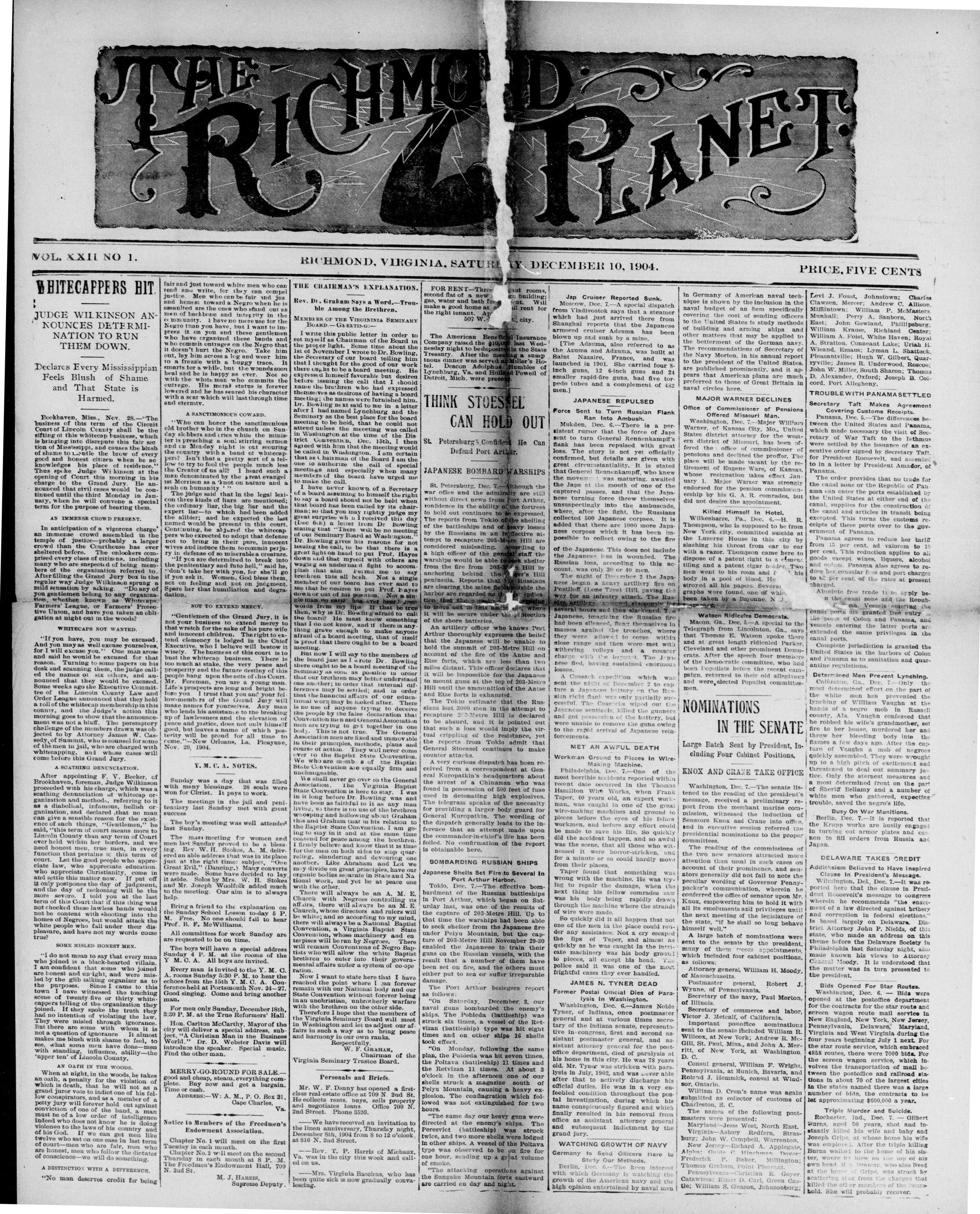
Richmond Planet
Saturday, December 10, 1904
Richmond, Virginia
Page text (machine-generated)
THE RICHMO
VOL. XXII NO 1.
WHITECAPPERS HIT
JUDGE WILKINSON ANNOUNCES DETERMINATION TO RUN THEM DOWN.
Declares Every Mississippian Feels Blush of Shame and That State is Harmed.
Bookhaven, Miss., Nov. 28—"The business of this term of the Circuit Court of Lincoln County shall be the sifting of this whitecap business, which is bringing into disrepute this fair sation of Mississippi, and causes the blush of shame to lantle the brow of every good and honest citizen when he ac knowledges his place of residence." Thus spoke Judge Wijkinson at the opening of Court this morning in his charge to the Grand Jury. He announced that civil cases would be continued until the third Monday in January, when he will convene a special term for the purpose of hearing them.
AN IMMENSE CROWD PRESENT
In anticipation of a vigorous charge' an immense crowd assembled in the temple of justice—probably a larger crowd than the Courthouse has ever sheltered before. The onlookers comprised every class of citizens, including many who are suspected of being members of the organization referred to. After filling the Grand Jury box in the regular way Judge Wilkinson sprang a mild sensation by asking. "Do any of you gentlemen belong to any organization, whether known as Whitcaps, Farmers' League, or Farmers' Protective Union, and have you taken an obigation at night out in the woods?"
WHITECAPS NOT WANTED.
"If you have, you may be excused. And you may as well excuse yourselves, for I will excuse you." One man arose and said he would be excused for that reason. Turning to some papers on his desk and scanning them, the judge called the names of six others, and announced that they would be excused. Some weeks ago the Executive Committee of the Lincoln County Law and Order League announced that they held a roll of the whitecap membership in this county, and the Judge's action this week was that the announcement was not a bluff, but a peremptory challenge of the members drawn intojected to by Attorney James W. Cassedy, of Summit, who is counsel for some of the men in jail, who are charged with whitecapping, and whose cases will come this Grand Jury.
A SCATHING DENUNCIATION.
After appointing F. V. Becker, of Brookhaven, foreman, judge Wilkinson proceeded with his charge, which was a scathing denunciation of whitecap organization and methods, referring to it as a diabolical, infamous, hellish organization, and declared, that no man can give a sensible reason for the existence of such things, "Gentlemen," he said, "this term of court means more to Lincoln County than any term of Court ever held within her borders, and we need honest men, true men, in every function that pertains to this term of court. Let the good people who appreciate law, who appreciate education, who appreciate Christianity, come in and settle this matter now. If put off if only postpones the day of judgment, and the day of reckoning will be the more severe. I told you at the last term of this Court that if this thing was not checked these lawless bands would not be content with shooting into the homes of Negroes, but would attack the white people who fail under their displeasure, and have not my words come true?
SOME MISLED HONEST MEN.
"I do not mean to say that every man who joined is a black-hearted villain. I am confident that some who joined are honest and upight, and were missed by the glib talking organizer as to the purposes. Since I came to this town I have witnessed the touching scene of twenty-five or thirty white-cappers telling of the organization they joined. If they spoke the truth they had no intention of violating the law. They were misled through ignorance. But there are some with whom it is not a question of ignorance. It almost makes me blush with shame to feel, to see, what some men have done—men with standing, influence, ability—the "upper ten" of Lincoln County.
AN OATH IN THE WOODS
When at night, in the woods, he takes an oath, a penalty for the violation of which is death, that he will not as a grand juror vote to indict one of his fellow conspirators, and a member of a petty jury will forever hold out against conviction of one of the band, a man must be of a low order of intelligence indeed who does not know he is doing violence to the laws of his country and of his God. If we can get men like twake who sat on one case in last term of court—men who are fair, men who are honest, men who follow the dictates of conscience—we will do something.
A DISTINCTION WITH A DIFFERENCE.
"No man deserves credit for being
fair and just toward white men who can read and write, for they can compel justice. Men who can be fair and jus and honest toward a Negro when he is assaulted are the ones who stand out as men of backbone and integrity in the community. I have no more use for the Negro than you have, but I want to impress it on you and these gentlemen who have organized these bands and who commit outrages on the Negro that it doesn't hurt the Negro. Take him out, lay him across a log and wear him to a frazzie with a buggy trace. It smarts for a while, but the wounds soon heal and he is happy as ever. Not so with the white man who commits the outrage. His moral status is forever lowered and he has seared his character with a scar which will last through time and eternity.
A SANCTIMONIOUS COWARD.
"Who can honor the sanctimonious old brother who in the church on Sunday slobbers and cries while the minister is preaching a soul stirring sermon and on Monday night is out scouring the country with a band of whitecappers? Isn't that a pretty sort of a fellow to try to fool the people much less the Creator of us all? I heard such a man denominated by the great evangelist Morrison as a 'knot on nature and a scab on humanity.'"
The judge said that in the legal lexicon three kinds of liars are mentioned; the ordinary liar, the big liar and the expert liar—to which had been added the alibier; and he expected the last named would be present in this court. Continuing, he abjured the whitecapers who expected to adopt that defense not to bring in their pure, innocent wives and induce them to commit perjury in defense of so miserable a creature. "If you are determined to break into the penitentiary and futo hell," said he, "don't take her with you, for she'll go if you ask it. Women, God bless them, act on feeling and not on judgment. Spare her that humiliation and degradation.
NOT TO EXTEND MERCY.
"Gentlemen of the Grand Jury, it is not your business to extend mercy to that wretch for the sake of his pure wife and innocent children. The right to extend clemency is lodged in the Chief Executive, who I believe will bestow it wisely. The business of this court is to bust the whitecap business. There is too much at stake, the very peace and prosperity and the future destiny of this people hang on the nets of this Court. Mr. Foreman, you are a young man. Life's prospects are long and bright be you. I trust that you and your fellow colleagues of the Grand Jury will make names for your journey. Any man who lends his assistance to the breaking up of lawlessness and the elevation of peace and justice, does not only himself if good, but leaves a name of which posterior will be proud for all time to come."—New Orleans, La, Picayune, Nov. 29, 1904.
Y. M. C. A. NOTES.
Sunday was a day that was filled with many blessings. 28 souls were won for Christ. It pays to work.
The meetings in the jail and penitentiary last Sunday met with great success.
The boy's meeting was well attended last Sunday.
The mass meeting for women and men last Sunday proved to be a blessing. Rev. W. H. Stokes, A. M. delivered an able address that was in its place just at the right time: subject, "One Great Evil," (Dancing.) Many converts were made. Some have decided to lay it aside. Solos by Mrs. W. H. Stokes and Mr. Joseph Woolfolk added much to the meeting. Our aim is to always help.
Bring a friend to the explanation on the Sunday School Lesson to-day 5 P. M. Free. No one should fail to hear Prof. B. F. McWilliams.
All committees for work Sunday are requested to be on time.
The boys will have a special address Sunday 4 P. M. at the rooms of the Y M. C. A. All boys are invited.
Every man is invited to the Y. M. C. A. rooms Sunday 5:30 P. M. to hear the echoes from the 15th Y. M. C. A. Conference held at Portsmouth Nov. 24-27. Good singing. Come and bring another man.
For men only Sunday, December 18th, 3:30 P. M. at the True Reformers' Hall.
Hon. Carlton McCarthy, Mayor of the city will deliver a special address, subject, "A Christian Man in the Business World." Dr. D. Webster Davis will introduce the speaker. Special music. Find the other man.
MERRY-GO-ROUND FOR SALE.—good and cheap, steam, everything complete. Buy now and get a bargain. Time or cash.
ADDRESS:—W: A. M., P. O. Box 21, Cape Charles,
Notice to Members of the Freedmen's Endowment Association.
Chapter No.1 will meet on the first Tuesday in each month.
Chapter No.2 will meet on the second Thursday in each month at 8 P. M.
The Freedmen's Endowment Hall, 709 N. 2nd St.
M. J. HAREIS,
Sugreme Deputy.
THE CHAIRMAN'S EXPLANATION.
Rev. Dr. Graham Says a Word.—Trouble Among the Brethren.
MEMBERS OF THE VIRGINIA SEMINARY BOARD.—GREETING:—
I write this public letter in order to set myself as Chairman of the Board in the proper light. Some time about the 1st of November I wrote to Dr. Bowling, the Secretary of our board taking him that I thought for the good of our work there ought to be a board meeting. He expressed himself favorable but less before issuing the call that I should name the brethren who had expressed themselves as desirous of having a board meeting; the names were furnished him. Dr. Bowling next said to me in a letter after I had named Lynchburg and the Seminary as the best place for the board meeting to be held, that he could not attend unless the meeting was called in Washington at the time of the District Convention, Dec. 15th. I then agreed with him that the meeting would be called in Washington. I am certain that as Chairman of the Board I am the one to authorize the call of special meetings and especially when many members of the board have urged me to make the call.
I have never known of a Secretary of a board assuming to himself the right to say a board should not be held when that board has been called by its chairman; so that you may rightly judge my great surprise when I received this day (Dec 6th) a letter from Dr Bowling stating that "There will be no meeting of our Seminary Board at Washington." Dr Bowling gives his reasons for not issuing the call, to that there is a great light on hand to put Prof. Hayes down and that myself with others are waging an underhand fight to accomplish that aim. Fremit me to say brethren this all besh. Not a single member of our board has ever said to me that he desirte to put Prof. Hayes down or out of his position. Not a single man on earth has ever heard I gram words from my lips. If that be true then, why is Dr Bowling afraid to call the board? He must know something that I do not know, and if there is anything grave enough to make anyone afraid of a board meeting, that of itself is proof that there ought to be a board meeting.
But now I will say to the members of the board just as I wrote Dr. Bowling there ought to be a board meeting of the Seminary as soon as possible in order that our brethren may better understand one another; in order that internal differences may be settled; and in order that the financial affairs of our educational work may be looked after. There is no use of anyone trying to deceive the people by the false declaration that Convention men and General Association men are trying to get together in one body. It is true. The General Association men are faded and unmovable in their principles, method, plans and course of action. They will never come over to the Baptist State Convention. We who are members of the Baptist State Convention are equally firm and unchangeable.
We shall never go over to the General Association. The Virginia Baptist State Convention is here to stay. I was in it long before Dr. Bowling was and have been as faithful to it as any man living, so there is no use of the brethren whooping and hollowing about Graham this and Graham that in his relation to the Baptist State Convention. I am going to stay in it and at the same time content for peace among the brethren. I firmly believe and know that it is time men on both sides to stop quarreling, sitting and devouring one another. Like Graham and Lot we may divide on great priests, have our organic bodies separate in State and National work, and yet be at peace one with the other.
There will always be an A. M. E. Church with Negroes controlling its affairs, there will always be an M. E. Church, whose directors and rulers will be white; and so according to my mind, there will always be a National Baptist Convention, a Virginia Baptist State Convention, whose machinery and enterprises will be run by Negroes. There will remain Conventions of Negro Baptists who will allow the white Baptist brethren to enter into their governmental affairs under a system of co-operation. I want I want to state here that I have reached the point where I can forever remain with our National body and our State Convention without forever being in an unchristian, unbrotherly warfare with the brethren on the other side.
Therefore I hope that the members of the Virginia Seminary Board will meet in Washington and let us adjust our affairs in such a way as to bring peace and harmony in our own ranks.
W. F. GRAHAM,
chairman of the
Virginia Seminary Trigonometry
Personals and Briefs
Mr. W. F. Denny has opened a first-class real-estate office at 709 N. 2nd St. He collects rents, buys, sells property and negotiates loans. Office 709 N. 2nd Street. Phone 85326.
—We have received an invitation to the linen anniversary, Thursday night, December 8th, 1904 from 8 to 12 o'clock at 816 N. 2nd Street.
—Rev. T. P. Harris of Michaux, Va. was in the city this week and called on us.
—Mrs. Virginia Bacchus, who has been quite sick is now gradually convalescing.
D. PLANET.
AY DECEMBER 10, 1904.
The American Bene fiscal Insurance Company raised the $10,000 last Wednesday night to be deposited in the State Treasury. After the meeting a sumpuous dinner was served at Miller's Hotel. Deacon Adolphus Humbles of Lynchburg, Va. and Holland Powell of Detroit, Mich. were present.
JAPANESE BOMBARD WARSHIPS
St. Petersburg, Dec. 7.—Although the war office and the admiralty are still without direct news from Fort Arthur, confidence in the ability of the fortress to hold out continues to be expressed. The reports from Tokio of the shelling of the battleships and of heavy losses by the Russians in an inactive attempt to recapture 203-More Hill are considered misleading. According to a high officer of the general staff the warships would be able to seek shelter from the fire from 203-More Hill by anchoring behind the Swerer's Hill peninsula. Reports that the Russians are clearing the mine fields outside the harbor are regarded as the indication that the admiralty is preparing to move out to this new area where
to move out to this amphitheater, where it will be secure under the protection of the shore batteries.
An artillery officer who knows Port Arthur thoroughly expresses the belief that the Japanese will be unable to hold the summit of 203-Metre Hill on account of the fire of the Antse and Etse forts, which are less than two miles distant. This officer declares that it will be impossible for the Japanese to mount guns at the top of 203-Metre Hill until the ammunition of the Antse and Etse forts is exhausted.
The Tokio estimate that the Russians lost 3000 men in the attempt to recapture 203-Metre Hill is declared to be absurd, and it is pointed out that such a loss would imply the virtual crippling of the resistance, yet the reports from Tokio admit that General Stoessel continues to make counter attacks.
A very curious dispatch has been received from a correspondent at General Kuropatkin's headquarters about the arrest of a Chinaman who was found in possession of 500 feet of fuse used in detonating high explosives. The telegram speaks of the necessity for providing a larger body guard for General Kuropatkin. The wording of the dispatch generally leads to the inference that an attempt made upon the commander-in-chief's life has been foiled. No confirmation of the report is obtainable here.
Japanese Shells Set Fire to Several In Port Arthur Harbor
Tokio, Dec. 7.—The effective bombardment of the Russian battleships in Port Arthur, which began on Saturday last, was one of the results of the capture of 203-Metre Hill. Up to that time the warships had been able to seek shelter from the Japanese fire under Polyn Mountain, but the capture of 203-Metre Hill November 29-30 enabled the Japanese to train their guns on the Russian vessels, with the result that a number of them have been set on fire, and the others must either put to sea or suffer irreparable damage.
The Port Arthur besiegers report as follows:
"On Saturday, December 3, our naval guns bombarded the enemy's ships. The Pobieda (battleship) was struck six times, a vessel of the Retvizan (battleship) type was hit eight times and on other ships 16 shells took effect.
"On Monday, following the same plan, the Pobieda was hit seven times, the Poltava (battleship) 11 times and the Retvizan 11 times. At about 3 o'clock in the afternoon one of our shells struck a magazine south of Pelyn Mountain, causing a heavy explosion. The conflagration which followed was not extinguished for two hours.
"The same day our heavy guns were directed at the enemy's ships. The Perserviet (battleship) was struck twice, and two more shells were lodged in other ships. A vessel of the Poltava type was observed to be on fire for one hour, sending up a great volume of smoke.
"The attacking operations against the Sungshu Mountain forts eastward are carried on day and night.
FOR RENT—Three second flat of a new gas, water and bath for make a good home at the right tenant. Ap 507 W.
BOMBARDING RUSSIAN SHIPS
Jap Cruiser Reported Sunk.
Moscow, Dec. 7—A special dispatch from Vladivostok says that a steamer which had just arrived there from Shanghai reports that the Japanese armored cruiser Adsuma has been blown up and sunk by a mine.
[The Adsuma, also referred to as the Azuma and Adzuma, was built at Salnt Nazeaire, France, and was launched in 1901. She carried four 8-inch guns, 12 6-inch guns and 24 smaller rapid-fire guns, had five torpedo tubes and a complement of 482 men.]
JAPANESE REPULSED
Force Sent to Turn Russian Flank
Ran Into Ambush.
Mukden, Dec. 6.—There is a persistent rumor that the force of Japs sent to turn General Rennenkampf's flank has been repulsed with great loss. The story is not yet officially confirmed, but details are given with great circumstantiality. It is stated that General Rennenkampf, who knew the movement was maturing, awaited the Japs at the mouth of one of the captured passes, and that the Japanese turning force threw themselves unsuspectingly into the ambuscade, where, after the fight, the Russians collected 500 Japanese corpses. It is added that there are 1000 more Japanese corpses which it has been impossible to collect owing to the fire of the Japanese. This does not include the Japanese loss in wounded. The Russian loss, according to this account, was only 36 or 40 men.
The night of December 2 the Japanese began a heavy artillery fire on Peutloff (Lone Tree) Hill, paving the way for an infantry attack. The Russian artillery, now equipped for several hours and then slackened, The Japanese, imagining the Russian fire had been silenced, funged themselves in masses against the trenches, where they were allowed to come within close range and then were met with withering volleys and a counter charge with the bayonet. The Japanese fled, having sustained enormous losses. A Cossack expedition which was sent the night of December 2 to capture a Japanese battery on the Russian right bank was only partially successful. The Cossacks wiped out the Japanese sentinels, killed the gunners and got possession of the battery, but were unable to remove the guns owing to the rapid arrival of Japanese reinforcements.
MET AN AWFUL DEATH
Workman Ground to Pieces In Wire-
Making Machine.
Philadelphia, Dec. 7.—One of the most horrible accidents reported within recent date occurred in the Thomas Hamilton Wine Works, when Frank Taper, 40 years old, an expert workman, was caught in one of the great wire-making machines and ground to pieces before the eyes of his fellow workmen, and before any effort could be made to save his life. So quickly did the accident happen, and so awful was the scene, that all those who witnessed it were horror-striken, and for a minute or so could hardly move from their places.
Taper found that something was wrong with the machine. He was trying to repair the damage, when the next his fellow comrades saw his body being rapidly drawn through the machine where the strands of wire were made.
So quickly did it all happen that not one of the men in the place could render any assistance. Not a cry escaped the lips of Taper, and almost as quickly as he was caught in the intricate machinery was his body ground to pieces, all except his head. The police said it was one of the most frightful cases they ever handled.
JAMES N. TYNER DEAD
Former Postal Official Dies of Paralysis In Washington.
Washington, Dec. 6.—James Noble Tyner, of Indiana, once postmaster general and at various times secretary of the Indiana senate, representative in congress, first and second assistant postmaster general, and assistant attorney general for the postoffice department, died of paralysis at his home in this city. He was 78 years old. Mr. Tyner was stricken with paralysis in July, 1902, and was never able after that to actively discharge his official duties. He was in in a very enfeebled condition throughout the postal investigation, during which his name conspicuously figured and which finally resulted in his removal from office as assistant attorney general and subsequent indictment by the grand jury.
Berlin, Dec. 6.—The keen interest with which Germany is watching the growth of the American navy and the high opinion entertained by naval men
in Germany of American naval technique is shown by the inclusion in the naval budget of an item specifically covering the cost of sending officers to the United States to study methods of building and arming ships and other matters that may be applied to the betterment of the German navy. The recommendations of Secretary of the Navy Morton, in his annual report to the president of the United States, are published prominently, and it appears that American plans are much preferred to those of Great Britain in naval circles here.
MAJOR WARNER DECLINES
Office of Commissioner of Pensions Offered Missouri Man.
Offered Missouri Man.
Washington, Dec. 7. - Major William Warner, of Kansas City, Mo., United States district attorney for the western district of Missouri, has been offered the office of commissioner of pensions and declined the proffer. The place will be made vacant by the retirement of Eugene Ware, of Kansas, whose resignation takes effect January 1. Major Warner was strongly endorsed for the pension commissionership by his G. A. R. comrades, but did not desire the appointment.
Killed Himself In Hotel
Wilkesbarre, Pa., Dec. 6.—H. R. Thompson, who is supposed to be from New York city, committed suicide at the Luzerne House in this city by slashing his throat from ear to ear with a razor. Thompson came here to dispose of a patent right to a cement tiling and a patent cigar holder. Two men went to his room and f' ' his body in a pool of blood. He stroyed all his papers. Several graphs were found, one of which been taken by a Bayonne, N. J.,
Watson Ridicules Democrats.
Macon, Ga., Dec. 5. A special to the Telegraph from Lincolnton, Ga., says that Thomas E. Watson spoke there and at great length ridiculated Parker, Cleveland and other prominent Democrats. After the speech four members of the Democratic committee, who had been Populists before the recent campaign, returned to their old allegiances and were elected Populist committeemen.
NOMINATIONS IN THE SENATE
Large Batch Sent by President, Including Four Cabinet Positions.
KNOX AND CRANE TAKE OFFICE
Washington, Dec. 7.—The senate listened to the reading of the president's message, received a preliminary report from the merchant marine commission, witnessed the induction of Senators Knox and Crane into office, and in executive session referred the presidential nominations to the proper committees.
The reading of the commissions of the two new senators attracted more attention than usual in such cases on account of their prominence, and senators generally did not fall to note the peculiar wording of Governor Penny-packer's communication, wherein he conferred the office of senator upon Mr. Knox, empowering him to hold it with all its emoluments and privileges until the next meeting of the legislature of the state, "if he shall so long behave himself well."
A large batch of nominations were sent to the senate by the president, many of them recess appointments, which included four cabinet positions, as follows:
Attorney general, William H. Moody, of Massachusetts.
Postmaster general, Robert J. Wynne, of Pennsylvania.
Secretary of the navy, Paul Morton,
of Illinois.
Secretary of commerce and labor;
Victor J. Metcalf, of California.
Important postoffice nominations
sent to the senate included William R.
Willcox, at New York; Andrew R. McGill,
St. Paul, Minn., and John A. Merritt,
of New York, at Washington,
D. C.
Consul general, William F. Wrlicht,
Pennsylvania, at Munich, Bavaria,
and Roland J. Hemmick, consul at Windor,
Ontario.
William D. Crum's name was again
submitted as collector of customs of
Charleston, S. C.
The names of the following post-
masters were presented:
Maryland—Jesse West, North East.
Virginia—Ashbury Redfern, Strasburg; John W. Campbell, Warrenton,
New Jersey—Richard A. Applegate
Alpha; Quide C. Hinchman, Dover
Frederick P. Baker, Millington;
Thomas Graham, Point Pleasant.
Pennsylvania—Christian E. Goyer
Catawissa; Elmer D. Carl, Green Castle;
William S. Gleason, Johnsonburg
Levi J. Foust, Johnstown; Charles Clawsen, Mercer; Andrew C. Allison, Mifflintown; William P. M. Masters, Munhall; Perry A. Sainborn, North East; John Gowland, Phillipsburg; William Krause, Richland Center; William A. Foist, White Haven; Royal A. Stratton, Conneaut Lake; Uriah H. Wieand, Emaus; Lyman L. Shattuck, Pleasantville; Hugh W. Gilbert, Quarryville; James R. Underwood, Roscoe; John W. Miller, South Sharon; Thomas D. Alexander, Oxford; Joseph B. Colcord, Port Allegheny.
TROUBLEWITH PANAMASETTLED
Secretary Taft Makes Agreement
Covering Customs Receipts...
Making Customs Receipts.
Panama, Dec. 5.—The differences between the United States and Panama, which made necessary the visit of Secretary of War Taft to the Isthmus were settled by the issuance of an executive order signed by Secretary Taft, for President Roosevelt, and assented to in a letter by President Amador, of Panama.
The order provides that no trade for the canal zone or the Republic of Panama can enter the ports established by the United States at either end of the canal, supplies for the construction of the canal and articles in transit being excepted. This turns the customs receipts of these ports over to the government of Panama.
Panama agrees to reduce her tariff from 15 per cent, ad valorem to 10 per cent. This reduction applies to all goods except wines, liquors, alcohol and oilum. Panama also agrees to reduce her consular fees and port charges to 65 per cent, of the rates at present charged.
Absolute free trade is to apply bienn the canal zone and the Republica. Vessels entering the canal ports are granted free entry to the ports of Colon and Panama, and vessels entering the latter ports are extended the same privileges in the canal ports.
Complete jurisdiction is granted the United States in the harbors of Colon and Panama as to sanitation and quarantine regulations.
Determined Men Prevent Lynching.
Columbus, Ga., Dec. 7.—Only the most determined effort on the part of the white men has prevented the lynching of William Vaughn at the hands of a negro mob in Russell county, Ala. Vaughn confessed that he robbed his wife's grandmother, set fire to her house, murdered her and threw her bleeding body into the flames a few days ago. After the capture of Vaughn a mob of negroes quickly assembled. They were wrought up to a high pitch of excitement and threatened to deal out summary justice. Only the sternest measures and a most determined front on the part of Sheriff Bellamy and a number of white men who gathered, expecting trouble, saved the negro's life.
Busy On War Munitions
Berlin, Dec. 7. - It is reported that the Krupp works are busily engaged in turning out armor plates and cannon to fill orders from Russia and Japan.
DELAWARE TAKES CREDIT
Addickism Believed to Have Inspired Clause in President's Message.
Wilmington, Del. Dec. 7. It was reported here that the clause in President Roosevelt's message to congress wherein he recommends "the enactment of a law directed against bribery and corruption in federal elections," is based largely on Delaware. District Attorney John P. Nields, of this state, who made an address on this theme before the Delaware Society in Philadelphia last Saturday night, also made known his views to Attorney General Moody. It is understood that the matter was in turn presented to the president.
Bids Opened For Star Routes
Washington, Dec. 6. — Bids were opened at the postoffice department for the contracts for the star route and screen wagon route mall service in New England, New York, New Jersey, Pennsylvania, Delaware, Maryland, Virginia and West Virginia during the four years beginning July 1 next. For the star route service, which embraced 4858 routes, there were 7000 bids. For the screen wagon service, which involves the transportation of mall between the postoffice and railroad stations in about 70 of the largest cities in the states named there was a large number of bids, the contracts to be let approximating $600,000 a year.
Triple Murder and Suicide
Rochester, Ind., Dec. 7. — Gilbert Burns, aged 50 years, shot and instantly killed his wife and baby and Joseph Gripe, at whose home his wife was employed. After the triple killing Burns walked to the home of his sister, where no breeze on the top or his own head, Ms. Braman, who also lived at the home of Gripe, was struck by scattering shot from the charges that killed the other members of the household. She will probably recover.
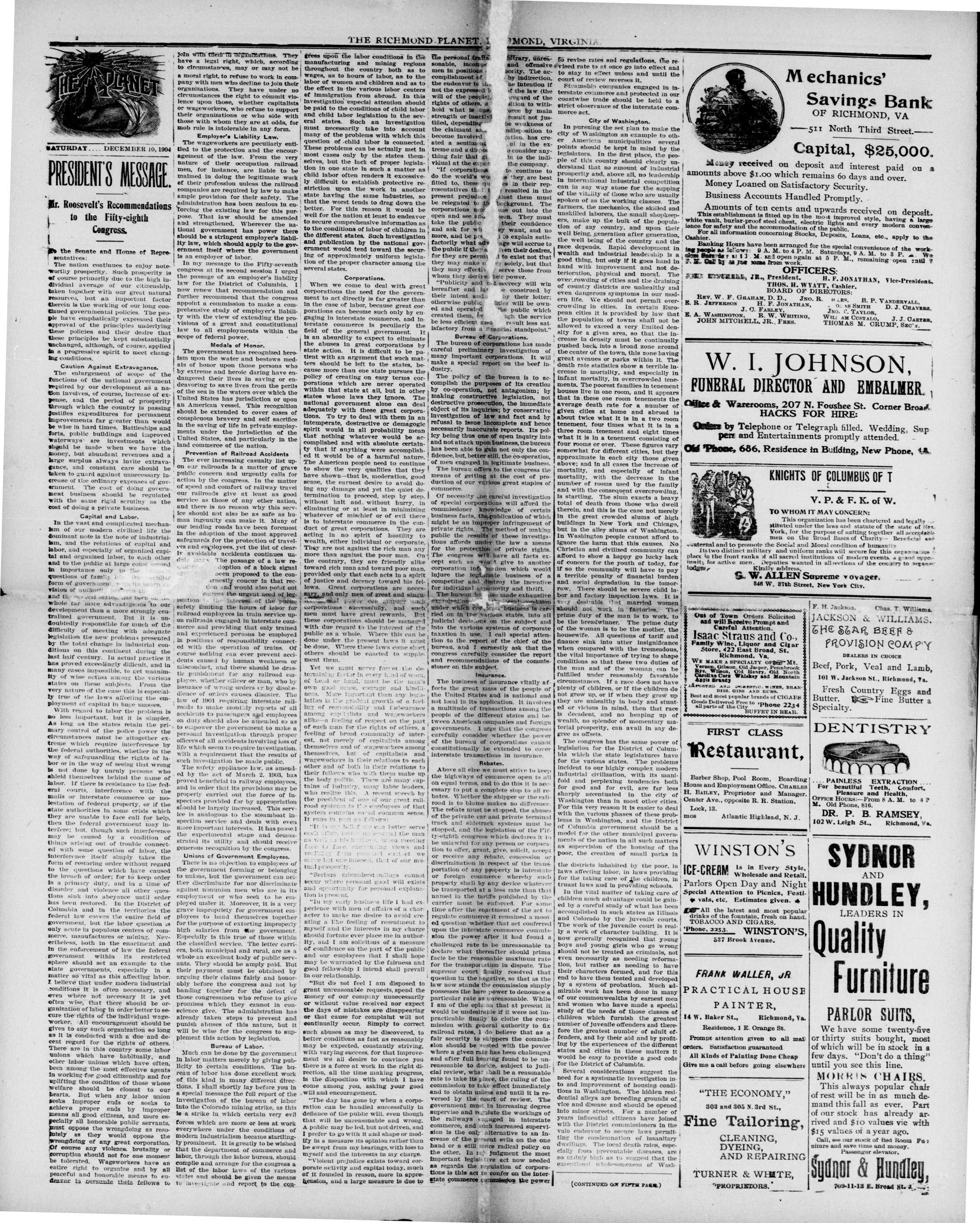
THE PLANET
SATURDAY... DECEMBER 10, 1904
PRESIDENT'S MESSAGE
the Senate and House of Representatives:
The nation continues to enjoy noteworthy prosperity. Such prosperity is of course primarily due to the high individual average of our citizenship, taken together with our great natural resources, but an important factor therein is the working of our long continued governmental policies. The people have emphatically expressed their approval of the principles underlying these policies and their desire that these principles be kept substantially unchanged, although, of course, applied in a progressive spirit to meet changing conditions.
Caution Against Extravagance.
The enlargement of scope of the functions of the national government required by our development as a nation involves, of course, increase of expense, and the period of prosperity through which the country is passing justifies expenditures for permanent improvements far greater than would be wise in hard times. Battleships and forts, public buildings and improved waterways are investments which should be made when we have the money, but abundant revenues and a large surplus always invite extravagance, and constant care should be taken to guard against unnecessary increase of the ordinary expenses of government. The cost of doing government business should be regulated with the same rigid scrutiny as the cost of doing a private business.
Capital and Labor.
In the vast and complicated mechanism of our modern civilized life the dominant note is the note of industrialism, and the relations of capital and labor, and especially of organized capital and organized labor, to each other and to the public at large come second in importance only to the primary questions of family life. Our secular form of government, with its sharp vision of authority, has been and the state states, has been and the war more advantageous to our development than a more strongly centralized government. But it is undoubtedly responsible for much of the difficulty of meeting with adequate legislation the new problems presented by the total change in industrial conditions on this continent during the last half century. In actual practice it has proved exceedingly difficult, and in many cases impossible, to get unanimity of wise action among the unanimity states on these subjects. From the very nature of the case this is especially true of the laws affecting the employment of capital in large masses.
With regard to labor the problem is no less important, but it is simpler. As long as the states retain the primary control of the police power the circumstances must be altogether extreme which require interference by the federal authorities, whether in the way of safeguarding the rights of labor or in the way of seeing that wrong is not done by unruly persons who shield themselves behind the name of labor. If there is resistance to the federal courts, interference with the mails or interstate commerce or molestation of federal property, or if the state authorities in some crisis which they are unable to face call for help, then the federal government may interfere; but, though such interference may be caused by a condition of things arising out of trouble connected with some question of labor, the interference itself simply takes the form of restoring order without regard to the questions which have caused the breach of order; for to keep order is a primary duty, and in a time of disorder and violence all other questions sink into abeyance until order has been restored. In the District of Columbia and in the territories the federal law covers the entire field of government, but the labor question is only acute in populous centers of commerce, manufactures or mining. Nevertheless, both in the enactment and the enforcement of law the federal government within its restricted sphere should set an example to the state governments, especially in a matter so vital as this affecting labor. I believe that under modern industrial conditions it is often necessary, and even where not necessary it is yet often wise, that there should be organization of labor in order better to secure the rights of the individual wageworker. All encouragement should be given to any such organization so long as it is conducted with a due and decent regard for the rights of others. There are in this country some labor unions which have habitually, and other labor unions which have often, been among the most effective agents in working for good citizenship and for uplifting the condition of those whose welfare should be closest to our hearts. But when any labor union seeks improper ends or seeks to achieve proper ends by improper means all good citizens, and more especially all honorable public servants, must oppose the wrongdoing as resolutely as they would oppose the wrongdoing of any great corporation. Of course any violence brutality or corruption should not for one moment be tolerated. Wageworkers have an entire right to organize and by all peaceful and honorable means to endear to persuade their fellows to
join with them in organizations. They have a legal right, which, according to circumstances, may or may not be a moral right, to refuse to work in company with men who decline to join their organizations. They have under no circumstances the right to commit violence upon those, whether capitalists or wageworkers, who refuse to support their organizations or who side with those with whom they are at odds, for mob rule is intolerable in any form.
Employer's Liability Law.
Employer's Liability Law. The wageworkers are peculiarly entitled to the protection and the encouragement of the law. From the very nature of their occupation railroad men, for instance, are liable to be malmed in doing the legitimate work of their profession unless the railroad companies are required by law to make ample provision for their safety. The administration has been zealous in enforcing the existing law for this purpose. That law should be amended and strengthened. Wherever the national government has power there should be a stringent employer's liability law, which should apply to the government itself where the government is an employer of labor.
In my message to the Fifty-seventh congress at its second session I urged the passage of an employer's liability law for the District of Columbia. I now renew that recommendation and further recommend that the congress appoint a commission to make a comprehensive study of employer's liability with the view of extending the provisions of a great and constitutional law to all employments within the scope of federal power.
Medals of Honor.
The government has recognized heroism upon the water and bestows medals of honor upon those persons who by extreme and heroic daring have endangered their lives in saving or endeavoring to save lives from the perils of the sea in the waters over which the United States has jurisdiction or upon an American vessel. This recognition should be extended to cover cases of conspicuous bravery and self sacrifice in the saving of life in private employments under the jurisdiction of the United States, and particularly in the land commerce of the nation.
Prevention of Railroad Accidents
The ever increasing casualty list upon our railroads is a matter of grave public concern and urgently calls for action by the congress. In the matter of speed and comfort of railway travel our railroads give at least as good service as those of any other nation, and there is no reason why this service should not also be as safe as human ingenuity can make it. Many of our leading roads have been foremost in the adoption of the most approved safeguards for the protection of travelers and employees, yet the list of clearly avoidable accidents continues unduly large. The passage of a law requirement adoption of a block signal system been proposed to the con- armently concur in that reaction and would also point out
nurtress the urgent need of legislation in the interest of the public safety limiting the hours of labor for railroad employees in train service upon railroads engaged in interstate commerce and providing that only trained and experienced persons be employed in positions of responsibility connected with the operation of trains. Of course nothing can ever prevent accidents caused by human weakness or misconduct, and there should be drastic punishment for any railroad employee, whether officer or man, who by issuance of wrong orders or by disloquence of orders causes disaster. The law of 1901 requiring interstate railroads to make monthly reports of all accidents to passengers and employees on duty should also be amended so as to empower the government to make a proper investigation through proper officers of all accidents involving loss of life which seem to require investigation, with a requirement that the results of such investigation be made public.
The safety appliance law, as amended by the act of March 2, 1903, has proved beneficial to railway employees, and in order that its provisions may be properly carried out the force of inspectors provided for by appropriation should be largely increased. This service is analogous to the steamboat inspection service and deals with even more important interests. It has passed the experimental stage and demonstrated its utility and should receive generous recognition by the congress.
Unions of Government Employees. There is no objection to employees of the government forming or belonging to unions, but the government can neither discriminate for nor discriminate against nomination men who are in its employment or who seek to be employed under it. Moreover, it is a very grave impropriety for government employees to band themselves together for the purpose of extorting improperly high salaries from the government. Especially is this true of those within the classified service. The letter carriers, both municipal and rural, are as a whole an excellent body of public servants. They should be amply paid. But their payment must be obtained by arguing their claims fairly and honorably before the congress and not by banding together for the defeat of those congressmen who refuse to give promises which they cannot in conscience give. The administration has already taken steps to prevent and punish abuses of this nature, but it will be wise for the congress to supplement this action by legislation.
Bureau of Labor.
Much can be done by the government in labor matters merely by giving publicity to certain conditions. The bureau of labor has done excellent work of this kind in many different directions. I shall shortly lay before you in a special message the full report of the investigation of the bureau of labor into the Colorado mining strike, as this is a strike in which certain very evil forces which are more or less at work everywhere under the conditions of modern industrialism became startlingly prominent. It is greatly to be wished that the department of commerce and labor, through the labor bureau, should compile and arrange for the congress a list of the labor laws of the various states and should be given the means to investigate and report to the con-
THE RICHMOND PLANET.
gress upon the labor conditions in the manufacturing and mining regions throughout the country both as to wages, as to hours of labor, as to the labor of women and children and as to the effect in the various labor centers of immigration from abroad. In this investigation especial attention should be paid to the conditions of child labor and child labor legislation in the several states. Such an investigation must necessarily take into account many of the problems with which this question of child labor is connected. These problems can be actually met in most cases only by the states themselves, but the lack of proper legislation in one state in such a matter as child labor often renders it excessively difficult to establish protective restriction upon the work in another state having the same industries, so that the worst tends to drag down the better. For this reason it would be well for the nation at least to endeavor to secure comprehensive information as to the conditions of labor of children in the different states. Such investigation and publication by the national government would tend toward the securing of approximately uniform legislation of the proper character among the several states.
Corporations.
When we come to deal with great corporations the need for the government to act directly is far greater than in the case of labor, because great corporations can become such only by engaging in interstate commerce, and interstate commerce is peculiarly the field of the general government. It is an absurdity to expect to eliminate the abuses in great corporations by state action. It is difficult to be patient with an argument that such matters should be left to the states, because more than one state pursues the policy of creating on easy terms corporations which are never operated within that state at all, but in other states whose laws they ignore. The national government alone can deal adequately with these great corporations. To try to deal with them in an intemperate, destructive or demagogic spirit would in all probability mean that nothing whatever would be accomplished and with absolute certainty that if anything were accomplished it would be of a harmful nature. The American people need to continue to show the very qualities that they have shown—that is, moderation, good sense, the earnest desire to avoid doing any damage and yet the quiet determination to proceed, step by step, without halt and without hurry. in eliminating or at least in minimizing whatever of mischief or of evil there is to interstate commerce in the conduct of great corporations. They are acting in no spirit of hostility to wealth, either individual or corporate. They are not against the rich man any more than against the poor man. On the contrary, they are friendly alike toward rich man and toward poor man, provided only that each acts in a spirit of justice and decency toward his fellows. Great corporations are necessary, and only men of great and sincere power can manage such corporations successfully, and such men must have great rewards. But these corporations should be managed with due regard to the interest of the public as a whole. Where this can be done under the present laws it must be done. Where these laws come short others should be enacted to supplement them.
Yet we must never forget the determining factor in every kind of work, of load or hand, must be the man's own good sense, courage and kindness. More important than any legislation is the gradual growth of a feeling of responsibility and forciveness among capitalists and wageworkers alike—a feeling of respect on the part of each man for the rights of others, a feeling of broad community of interest, not merely of capitalists among themselves and of wageworkers among themselves, but of capitalists and wageworkers in their relations to each other and of both in their relations to their fellows who with them make up the body politic. There are many captains of industry, many labor leaders, who realize this. A recent speech by the president of one of our great railroad systems to the employees of that system contains sound common sense. It runs in part as follows:
"It is my belief you can better serve each other, better understand the man as well as his behavior, when meeting face to face, exchanging views and realking from personal contact we serve but one interest, that of our mutual prosperity.
"Serbs misunderstandings cannot occur where personal good will exists and opportunity for personal explanation is present.
"In my early business life I had experience with men of affairs of a character to make me desire to avoid creating a like feeling of resentment to myself and the interests in my charge should fortune ever place me in authority, and I am solicitous of a measure of confidence on the part of the public and our employees that I shall hope may be warranted by the fairness and good fellowship I intend shall prevail in our relationship.
"But do not feel I am disposed to grant unreasonable requests, spend the money of our company unnecessarily or without value received nor expect the days of mistakes are disappearing or that cause for complaint will not continually occur. Simply to correct such abuses as may be discovered, to better conditions as fast as reasonably may be expected, constantly striving, with varying success, for that improvement we all desire to convince you there is a force at work in the right direction, all the time making progress, is the disposition with which I have come among you, asking your good will and encouragement.
"The day has gone by when a corporation can be handled successfully in defiance of the public will, even though that will be unreasonable and wrong. A public may be led, but not driven, and I prefer to go with it and shape or modify in a measure its opinion rather than be swept from my bearings, with loss to myself and the interests in my charge. "Violent prejudice exists toward corporate activity and capital today, much of it founded in reason, more in apprehension, and a large measure is due to
the personal traffica-
sonable, incompa-
men in positions
complishment of
the endeavor to tha-
not the expressed
will of the people,
rights of others, a
hold what is due,
strength or inactive
tified, depending
the claimant and
become involved
ated a sentiment
treme and a dispo-
thing that giv
guald at the expe
"If corporations do the world's work fitted to, these que resentatives that if present prejudice be relegated to the corporations may open and see and take the public and ask for what more, and be profactorily what advice the public if they are permit they may make it they may effect whom they derive "Publicity and in hereafter and lay their intent and otherwise published and operated created them, by be less efficient and isfactory from a
Bureau of Corporations.
The bureau of corporations has made careful preliminary investigation of many important corporations. It will make a special report on the beef industry. The policy of the bureau is to accomplish the purposes of its creation by co-operation, not antagonism; by making constructive legislation, not destructive prosecution, the immediate object of its inquiries; by conservative investigation of law and fact and by refusal to issue incomplete and hence necessarily inaccurate reports. Its policy being thus one of open inquiry into and not attack upon business, the bureau has been able to gain not only the confidence, but, better still, the co-operation, of men engaged in legitimate business. The bureau offers to the congress the means of getting at the cost of production of our various great staples of commerce.
Of necessity the careful investigation of special corporations will afford the commissioner knowledge of certain business facts, the publication of which might be an improper infringement of private rights. The method of making public the results of these investigations affords under the law a means for the protection of private rights. The congress will have all facts except such as would give to another corporation information which would injure the legitimate business of a competitor and destroy the incentive for individual superiority and thrift. The bureau can also make exhaustive examinations of the local condition under which corporate business is carried on in the various states, into all judicial decisions on the subject and into the various systems of corporate taxation in use. I call special attention to the report of the chief of the bureau, and I earnestly ask that the congress carefully consider the report and recommendations of the commissioner on this subject.
The business of insurance vitally affects the great mass of the people of the United States and is national and not local in its application. It involves a multitude of transactions among the people of the different states and between American companies and foreign governments. I urge that the congress carefully consider whether the power of the bureau of corporations cannot constitutionally be extended to cover interstate transactions in insurance.
Above all else we must strive to keep the highways of commerce open to all on equal terms, and to do this it is necessary to put a complete stop to all rebates. Whether the shipper or the railroad is to blame makes no difference. The rebate must be stopped, the abuses of the private car and private terminal track and sidetrack systems must be stopped, and the legislation of the Fifty-eighth congress which declares it to be unlawful for any person or corporation to offer, grant, give, solicit, accept or receive any rebate, concession or discrimination in respect of the transportation of any property in interstate or foreign commerce whereby such property shall by any device whatever be transported at a less rate than that named in the tariffs published by the carrier must be enforced. For some time after the enactment of the act to regulate commerce it remained a mooted question whether that act conferred upon the interstate commerce commission the power after it had found a challenged rate to be unreasonable to declare what thereafter should prima facie be the reasonable maximum rate for the transportation in dispute. The supreme court finally resolved that question in the negative, so that the law now stands the commission simply possesses the bare power to denounce a particular rate as unreasonable. I am of the opinion that at present it would be undesirable if it were not practicable finally to cloth the commission with general authority to fix railroad rates, I do believe that as a fair security to shippers the commission should be tipped with the power where a given rate has been challenged and after full hearing found to be unreasonable to device, subject to judicial review, what shall be a reasonable rate to take its place, the ruling of the commission to take effect immediately and to obtain unless and until it is reversed by the court of review. The government must in increasing degree supervise and regulate the workings of the railways engaged in interstate commerce, and such increased supervision is the only alternative to an increase of the present evils on the one hand or a still more radical policy on the other. In any judgment the most important legislative act now needed as regards the regulation of corporations is this act to confer on the interstate commerce commission the power
MOND, VIRGINIA
to revise rates and regulations, the revised rate to at once go into effect and to stay in effect unless and until the court of review reverses it. Steamship companies engaged in interstate commerce and protected in our constwise trade should be held to a strict observance of the interstate commerce act.
In pursuing the set plan to make the city of Washington an example to other American municipalities several points should be kept in mind by the legislators. In the first place, the people of this country should clearly understand that no amount of industrial prosperity and, above all, no leadership in international industrial competition can in any way atone for the sapping of the vitality of those who are usually spoken of as the working classes. The farmers, the mechanics, the skilled and unskilled laborers, the small shopkeepers, make up the bulk of the population of any country, and upon their well being, generation after generation, the well being of the country and the race depends. Rapid development in wealth and industrial leadership is a good thing, but only if it goes hand in hand with improvement and not deterioration, physical and moral. The overrowing of cities and the draining of country districts are unhealthy and even dangerous symptoms in our modern life. We should not permit overcrowding in cities. In certain European cities it is provided by law that the population of towns shall not be allowed to exceed a very limited density for a given area, so that the increase in density must be continually pushed back into a broad zone around the center of the town, this zone having great avenues or parks within it. The death rate statistics show a terrible increase in mortality, and especially in infant mortality, in overcrowded tenements. The poorest families in tenement houses live in one room, and it appears that in these one room tenements the average death rate for a number of given cities at home and abroad is about twice what it is in a two room tenement, four times what it is in a three room tenement and eight times what it is in a tenement consisting of four rooms or over. These figures vary somewhat for different cities, but they approximate in each city those given above; and in all cases the increase of mortality, and especially of infant mortality, with the decrease in the number of rooms used by the family and with the consequent overcrowding, is startling. The slum exacts a heavy total of death from those who dwell therein, and this is the case not merely in the crowded slums of high buildings in New York and Chicago, but in the alley slums of Washington. In Washington people cannot afford to ignore the harm that this causes. No Christian and civilized community can afford to show a happy go lucky lack of concern for the youth of today, for if so the community will have to pay a terrible penalty of financial burden and social degradation in the tomorrow. There should be severe child labor and factory inspection laws. It is very desirable that married women should not work in factories. The prime duty of the man is to work, to be the breadwinner. The prime duty of the woman is to be the mother, the housewife. All questions of tariff and finance sink into utter insignificance when compared with the tremendous, the vital importance of trying to shape conditions so that these two duties of the man and of the woman can be fulfilled under reasonably favorable circumstances. If a race does not have plenty of children, or if the children do not grow up, or if when they grow up they are unhealthy in body and stunted or vicious in mind, then that race is decadent, and no heaping up of wealth, no splendor of momentary material prosperity, can avail in any degree as offsets.
The congress has the same power of legislation for the District of Columbia which the state legislatures have for the various states. The problems incident to our highly complex modern industrial civilization, with its manifold and perplexing tendencies both for good and for evil, are far less sharply accentuated in the city of Washington than in most other cities. For this very reason it is easier to deal with the various phases of these problems in Washington, and the District of Columbia government should be a model for the other municipal governments of the nation in all such matters as supervision of the housing of the poor, the creation of small parks in
the districts inhabited by the poor, in laws affecting labor, in laws providing for the taking care of the children, in truant laws and in providing schools. In the vital matter of taking care of children much advantage could be gained by a careful study of what has been accomplished in such states as Illinois and Colorado by the juvenile courts. The work of the juvenile court is really a work of character building. It is now generally recognized that young boys and young girls who go wrong should not be treated as criminals, not even necessarily as needing reformation, but rather as needing to have their characters formed, and for this end to have them tested and developed by a system of probation. Much admirable work has been done in many of our commonwealths by earnest men and women who have made a special study of the needs of those classes of children which furnish the greatest number of juvenile offenders and therefore the greatest number of adult offenders, and by their aid and by profiting by the experiences of the different states and cities in these matters it would be easy to provide a good code for the District of Columbia.
Several considerations suggest the need for a systematic investigation into and improvement of housing conditions in Washington. The hidden residential alleys are breeding grounds of vice and disease and should be opened into minor streets. For a number of years influential citizens have joined with the District commissioners in the vain endeavor to secure laws permitting the condemnation of insanitary dwellings. The local death rates, especially from preventable diseases, are so unlucky high as to suggest that the exceptional wholesomeness of Wash-
library, unrest and offensive morality. The ac by indirection, the intention if the law (the law the guard of the sition to with- force by main result not just the weakness of indisposition to cation, has cre- cul in the exo consider any in to the indi- the company. to continue to as they are best es in their re- resulted in the mist them must background. The one out into the seen. They must their confidence they want, and no to explain satisfaction will accrue to given their desires, d to exist not that they solely, but that serve those from their power.
Insurance.
Rebates.
City of Washington.
(CONTINUED ON FINTH PAGE.)
1820
Money received on deposit amounts above $1.00 which re Money Loaned on Satisfaction Business Accounts Hand Amounts of ten cents and This establishment is fitted up in the white fault, burlar-proof steel chest, education for safety and the accommodation. For all information concerning Stock Cashier. Banking Hours have been arranged people as follows: 9 A.M. to 4 P.M. close Saturday at 11 A.M. and open again. P. E. Call by just some from work.
FORK ENGINEER, JR., President. THOS. H. W. BOARD OFF.
REV. W. F. GRAHAM, D. D., JN.
E. R. JEFFERSON H. F. JONATHAN
J. O. FARLEY,
E. A. WASHINGTON, R. W. WHITING
JOHN MITCHELL, JR., PRES.
W. I. JOY
FUNERAL DIRECTOR
Office & Warerooms, 207 N. HACKS R.
Others by Telephone or Telephone and Entertainment
Old Phone, 686, Residence
Money received on deposit and interest paid on amounts above $1.00 which remains 60 days and over. Money Loaned on Satisfaction
Money Loaned on Satisfactory Security.
Business Accounts Handled Promptly.
Amounts of ten cents and upwards received on deposit.
This establishment is fitted up in the most improved style, having a large white vault, burlar-proof steel chest, electric lights and every modern convenience for safety and the accommodation of the public.
For all information concerning Stocks, Deposits, Loans, etc., apply to the Cashier.
Banking Hours have been arranged for the special convenience of the working people as follows: 9 A.M. to 4 P.M. Saturdays, 9 A.M. to 3 P. We close business at 11 J. M. and open again at 5 P.M., remaining open until 9 E. M. Call us for some work.
OFFICERS
FOR E. GERHEL, JR., President. H. F. JONATHAN, Vice-President.
THOS. H. WYATT, cashier.
BOARD OF DIRECTORS:
REV. W. F. GRAHAM, D. D., JNO. R. H. LES, B. P. VANDERVALL,
E. R. JEFFERSON H. F. JONATHAN, O. AS SMITH D. J. CHAVERS,
J. O. FARLEY, JNO. R. TAYLOR,
E. A. WASHINGTON, R. W. WHITING, WILM AM CURSAL, J. J. CARTER,
JOHN MITCHELL, JR., FRES. THOMAS M. CRUMP, SSC.
W. I. JOHNSON FUNERAL DIRECTOR AND EMBALMER
Office & Warerooms, 207 N. Foushee St. Corner Broad HACKS FOR HIRE: Order by Telephone or Telegraph filled. Wedding, Support and Entertainments promptly attended. Old Phone, 686. Residence in Building, New Phone. 14.
KNIGHTS OF COLUMBUS OF T
This organization has been chartered and legally
mituted under the laws and statute of the state of New
York, for the purpose of uniting together all acceptable
men on the Broad Bases of Charity - Beneficial
internal and to promote the Social and Moral condition of humanity
Ist two distinct military and uniform ranks will secure for this organization
place at the front ranks of all institutions of modern events a grand oppo-
unity for active men. Deputies wanted in all sections of the country to organ-
lize. Kindly address.
G. W. ALLEN Supreme voyager,
846 W. 87th Street, New York City.
Out of Town Orders Solicited and will Receive Prompt and Careful Attention.
Careful Attention.
Isaac Straus and Co.,
Family Wine, Liquor and Cigar
Store, 422 East Broad, St.
Richmond, Va.
WE MAKE A SPECIALTY OFFICE "Mr.
Vernon, Gibson, Old Jasper, Pembrook
Rye, Wilson, Old Henry, Old North
Cumberland Cars Whisky and Mountain
Apple Brandy
LAPORTED AND SUPPLIED WINES, BRAND
DIES, GINS AND RUMS.
Best and most popular brands of CIGAES
Goods Delivered Free to "Phone 2234
all parts of the City.
BUFFET IN REAR.
FIRST CLASS
Restaurant,
Barber Shop, Pool Room, Boarding House and Employment Office. CHARLES H. BAILEY, Proprietor and Manager. Center Ave., opposite R. R. Station. Lock, 13. mos Atlantic Highland, N. J.
WINSTON'S ICE-CREAM Is in Every Style, Wholesale and Retail. Parlors Open Day and Night Special Attention to Picnics, Festivals, etc. Estimates given.
Phone: 2253. WINSTON'S,
537 Brook Avenue.
FRANK WALLER, JR.
PRACTICAL HOUSE
14 W. Baker St., Richmond, Va.
Residence, 1 E. Orange St.
Prompt attention given to all mail orders. Satisfaction guaranteed
All Kinds of Painting Done Cheap
Give me a call before going elsewhere
"THE ECONOMY,"
303 and 305 N. 3rd St.,
Fine Tailoring,
CLEANING,
DVEING,
AND REPAIRING
TURNER & WHITE, PROPRIETORS.
```markdown
```
Mechanics'
Savings Bank
OF RICHMOND, VA
511 North Third Street.
Capital, $25,000.
F. H. Jackson. Chas. T. Williams. JACKSON & WILLIAMS. THE STAR BEER &
Beef, Pork, Veal and Lamb,
101 W. Jackson St., Richmond, Va.
Fresh Country Eggs and
Butter. Fine Butter a
Specialty.
DENTISTRY
PAINLESS EXTRACTION
For beautiful Teeth, Comfort,
Pleasure and Health,
OFFICE HOURS:—From 8 A. M. to 4 P.
M. Old Phone, 816.
DR. P. B. RAMSEY,
102 W. Leigh St., Richmond, Va.
SYDNOR AND HUNDLEY, LEADERS IN Quality Furniture
PARLOR SUITS.
We have some twenty-five or thirty suits bought, most of which will be in stock in a few days. "Don't do a thing" until you see this line.
MORRIS CHAIRS.
This always popular chair of rest will be in as much demand this fall as ever. Part of our stock has already arrived and $10 values vie with $15 values of a year ago.
Call, see our stock of Bed Room Furniture and save time and money.
Passenger elevator.
Sydnor & Hundley,
709-11-13 E. Broad St. 2.
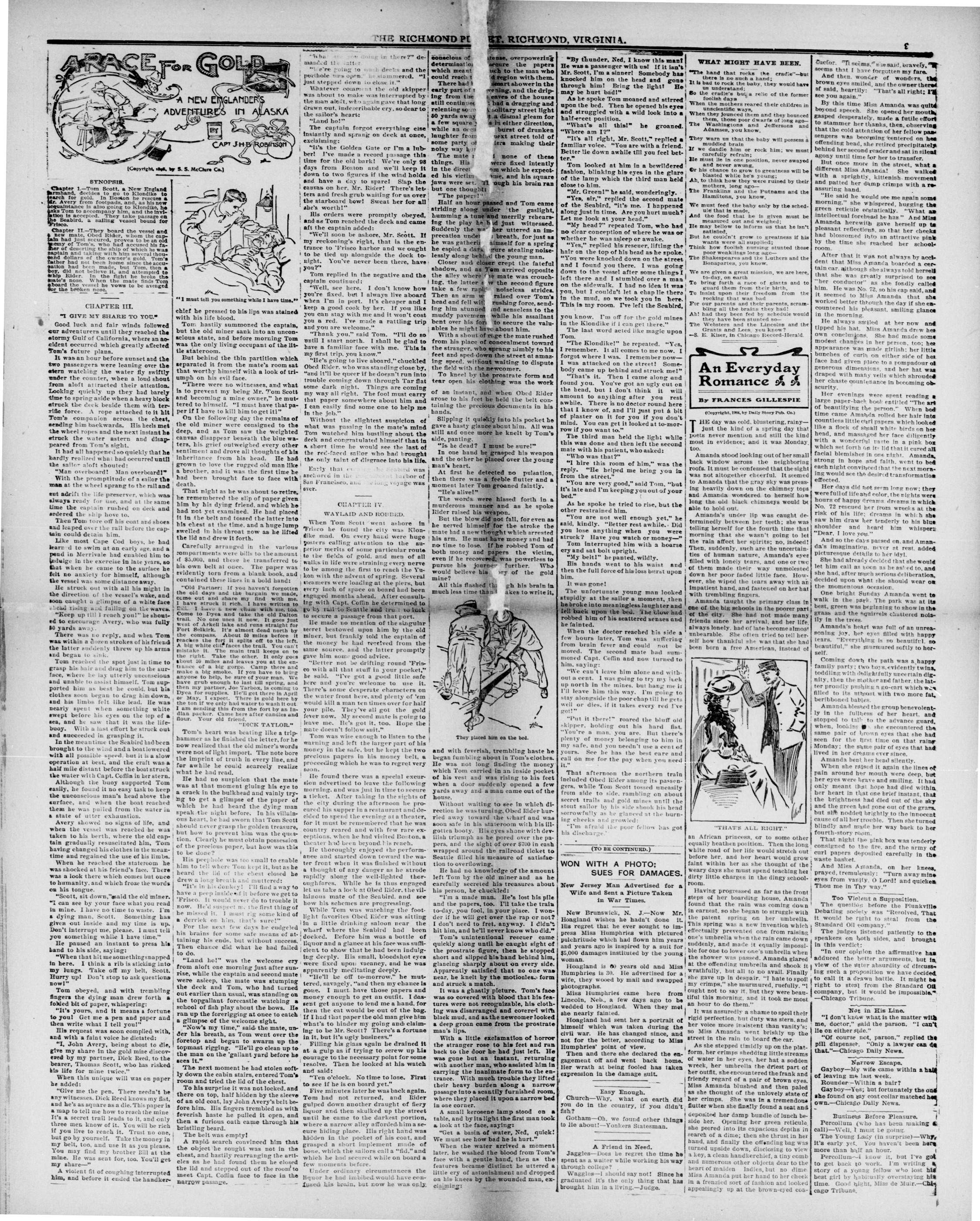
ARACE FOR GOLD
A NEW ENGLANDER'S
ADVENTURES IN ALASKA
BY
CAPT J.H.B. ROBINSON
[Copyright, 1894, by S. S. McClure Co.]
Chapter 1—Tom Scott, a New England farmhand, decides to go to Klondike to help Mr. Avery from footpatrol, which acquaintance is also going to Klondike, he asks Tom to accompany him, and the invitation is accepted. They take passage on the Seabird, a sailing vessel bound for Frisco.
Chapter II—They board the vessel and a new mate, Obed Rider, whom the captain acquired, proves to be an old enemy of Tom's. The captain her of deserting the ship of which he was captain and taking with him several thousand dollars of the owner's gold. Tom's acquaintance had been made, but Tom, the boy, did not believe it, and attempted to whip Rider. In the fight he broke the man, and the mate finds Tom board the vessel he vows to be avenged or the broken nose.
"I GIVE MY SHARE TO YOU."
Good luck and fair winds followed our adventurers until they reached the stormy Gulf of California, where an accident occurred which greatly affected Tom's future plans.
It was an hour before sunset and the two passengers were leaning over the stern watching the water fly swiftly under the counter, when a loud shout from aloft attracted their attention. Looking quickly up they had barely time to spring aside when a heavy block struck the deck beside them with terrific force. A rope attached to it hit Tom's companion across the cheat, sending him backwards. His heels met the wheel ropes and the next instant he struck the water astern and disappeared from Tom's sight.
It had all happened so quickly that he hardly realized what had occurred until the sailor aloft shouted:
"Man overboard! Man overboard!"
With the promptitude of a sailor the man at the wheel sprang to the rail and cut adrift the life preserver, which was already ready for use, and at the same time the captain rushed on deck and ordered the ship how to.
Then Tom tore off his coat and shoes and leaped over the rail before the captain could detain him.
Like most Cape Cod boys, he had learned to swim at an early age, and a pend in Merrivale had enabled him to indulge in the exercise in late years, so that when he came to the surface he felt no anxiety for himself, although the vessel was some distance away.
He struck out with all his might in the direction of the vessel's wake, and soon caught a glimpse of a white face rising and falling on the waves.
"Keep up till I reach you!" he shouted to encourage Avery, who was fully 50 yards away.
There was no reply, and when Tom was within a dozen strokes of his friend the latter suddenly threw up his arms and began to sink.
Tom reached the spot just in time to grasp his hair and drag him to the surface, where he lay utterly unconscious and unable to assist himself. Tom supported him as best he could, but his clothes soon began to drag him down, and his limbs felt like lead. He was nearly spent when something white swept before his eyes on the top of a sea, and he saw that it was the lifebuoy. With a last effort he struck out and succeeded in grasping it.
In the meantime the Scabirid had been brought to the wind and a boat lowered with all possible speed, but it is a slow operation at best, and the craft was a half mile distant before the boat struck the water with Capt. Coffin in her stern.
Although the buoy supported Tom easily, he found it no easy task to keep the unconscious man's head above the surface, and when the boat reached them he was pulled from the water in a state of utter exhaustion.
Avery showed no signs of life, and when the vessel was reached he was taken to his berth, where the old captain gradually resuscitated him. Tom having changed his clothes in the meantime and regained the use of his limbs.
When he reached the stateroom he was shocked at his friend's face. There was a look there which comes but once to humanity, and which froze the words on his tongue.
"Scott, sit down," said the old miner. "I can see by your face what you read in mine. I have no time to waste. I'm a dying man. Scott. Something has given out inside and my time is up. Don't interrupt me, please. I must tell you something while I have time."
He paused an instant to press his hand to his side saving.
"When that hit me somethingnapped in here. I think a rib is sticking into my lungs. Take off my belt, Scott. Hurry up! Don't stop to ask questions now!"
Tom obeyed, and with trembling fingers the dying man drew forth a folded bit of paper, whispering:
"It's yours, and it means a fortune to you! Get me a pen and paper and then write what I tell you!"
His request was soon compiled with, and with a faint voice he dictated:
"I, John Avery, being about to die, give my share in the gold mine discovered by my partner, Dick Reed, to the bearer, Thomas Scott, who has risked his life for mine twice."
When this unique will was on paper he added:
"Give me the pen. There needn't be any witnesses. Dick Reed knows my fist, and he's as square as a die. This paper is a map to tell me how to reach the mine. It's a secret trail leads to it, and only three men know of it. You will be rich if you live to reach it. Trust no one, but go by yourself. Take the money in my belt, too, and use it as you please. You may find my brother Bill at the mine. He was sent for, too. You'll get my share—"
A violent fit of coughing interrupted him, and before it ended the handker-
SYNOPSIS.
CHAPTER III
"I must tell you something while I have time."
chief he pressed to his lips was stained with his life blood.
Tom hastily summoned the captain, but the old miner sank into an unconscious state, and before morning Tom was the only living occupant of the little stateroom.
But behind the thin partition which separated it from the mate's room sat that worthy himself with a look of triumph on his evil face.
"There were no witnesses, and what is to prevent my being Mr. Tom Scott and becoming a mine owner," he muttered to himself. "I must have that paper if I have to kill him to get it!"
On the following day the remains of the old miner were consigned to the deep, and as Tom saw the weighted canvas disappear beneath the blue waters, his grief outweighed every other sentiment and drove all thoughts of his inheritance from his head. He had grown to love the rugged old man like a brother, and it was the first time he had been brought face to face with death.
That night as he was about to retire, he remembered the slip of paper given him by his dying friend, and which he had not yet examined. He had placed it in the belt and tossed the latter into his chest at the time, and a huge lump swelled in his throat now as he lifted the lid and drew it forth.
Carefully arranged in the various compartments were bills to the amount if $5,000, and these he transferred to his own belt at once. The paper was evidently torn from a blank book, and contained these lines in a bold hand;
"Old Partner: If you haven't forgotten the old days and the bargain we made, come out and share my find with me, I have struck it rich. I have written to Dyca and taken it to the Dyca and take the old Dalton trail. No one uses it now. It goes just west of Arkell lake and runs straight for Fort Selkirk. It almost dead north by the compass. About 50 miles before it the compass. On the left. A big white cliff faces the trail. You mistake it. The main trail keeps on to the right. Take the other. It only goes about 50 miles and leaves you at the entrance of a big gorge. Camp there and make a big smoke. If you have to bring a dog, you have to have a grub enough to last till spring, and then my partner, Joe Tarbox, is coming to Dyca for supplies. He'll get in April or May. I expect. There is gold here by the ton if we only had water to wash it out. We have to come to the fort by an Indian packer. Camps after candles and flour. Your old friend.
Tom's heart was beating like a triphammer as he finished the letter, for he now realized that the old miner's words were not of light import. The note bore the imprint of truth in every line, and for awhile he could scarcely realize what he had read.
He had no suspicion that the mate was at that moment gluing his eye to a crack in the bulkhead and vainly trying to get a glimpse of the paper of which he had heard the dying man speak the night before. In his villainous heart, he had sworn that Tom Scott should never grasp the golden treasure, but how to prevent him was the question. Clearly he must obtain possession of the precious paper, but how was this to be done?
His peephole was too small to enable him to tell where Tom kept it, but as he heard the lid of the chest closed he drew a long breath and muttered:
"It's in his donkey! I'll find a way to have a peep inside if it before weget to Frisco. It would never do to trouble it now. He suspects me, the first thing of he missed it. I must rig some kind of a derrick on him, that's sure!" For the next few days he endured his brains for some safe means of attaining his ends, but without success. Then chance did what he had failed to do.
"Land ho!" was the welcome cry from aloft one morning just after sunrise, where the captain and second mate were asleep, the mate was stumping the deck and Tom, who had turned out earlier than usual, was standing on the togallant forcecastle watching a school of fish play about the bows. He run up the forerigging at once to catch a glimpse of the welcome sight.
"Now's my time," said the mate, under his breath, as Tom went over the foretop and began to swarm up the topmast rigging. "He'll go clean up to the man on the 'gallant yard before he sees it." The next moment he had stolen softly down the cabin stairs, entered Tom's room and tried the lid of the chest. To his surprise it was not locked, and there on top, half hidden by the sleeve of an old coat, lay John Avery's belt before him. His fingers trembled as with feverish haste he pulled it open, and then a furious oath came through his bristling beard. The belt was empty!
A rapid search convinced him that the object he sought was not in the chest, and hastily rearranging the articles as he had found them he closed the lid and stepped out of the room to meet Capt. Coffin face to face in the narrow passage.
"DICK TAYLOR"
"What are you doing in there?" demanded the latter conscious determined
concections of determination which meant could reach it
"We're going to wash decks and the porchole was open," he stammered. "I just stepped down to close it."
There had I
early part of
ting from the
still continue
relenting so
50 yards away
a few square
while an ooc
laughter from
some party of
nolsy way lay
Whatever comment the old skipper was about to make was interrupted by the man aloft, who again gave that long drawn out, indescribable cry, so dear to the sailor's heart:
"Land ho!"
The captain forgot everything else instantly and sprang on deck at once, exclaiming:
"It's the Golden Gate or I'm a lubber! I've made a record passage this time for the old bark! We're only 98 days from Boston and we'll keep it down to two figures if the wind holds and have a day to spare! Slap the canvas on her, Mr. Rider! There's letters and fresh grub waiting for us over the starboard bow! Sweat her for all she's worth!"
The mate :
things. His
in the direct
ed his victim
jaws were set. T
but one thought
"The one
His orders were promptly obeyed, and as Tom reached the deck and came aft the captain added:
"We'll soon be ashore, Mr. Scott. If my reckoning's right, that is the entrance to 'Frisco harbor and we ought to be tied up alongside the dock tonight. You've never been there, have you?"
Tom replied in the negative and the captain continued:
"Well, see here. I don't know how you're fixed, but I always live aboard when I'm in port. It's cheaper and I keep a good cook by her. If you like you can stay with me and it won't cost you a red. I've made a rattling trip and you are welcome."
"Thank you." said Tom. "I'll do so until I start north. I shall be glad to have a familiar face with me. This is my first trip, you know."
"He's going to live aboard," chuckled Obed Rider, who was standing close by, "and it'll be queer if he doesn't run into trouble down through Tar flat some dark night. Things are coming my way all right. The fool must carry that paper somewhere about him and I can easily find one to help me in the job." Without the slightest suspicion of what was passing in the mate's mind Tom watched him bustling about the deck and congratulated himself that in a short time he would see the last of the red-faced sailor who had brought the only taint of disgrace into his life. Early that evening the seabird was anchored in the congregation harbor of San Francisco, and the long voyage was ever.
CHAPTER IV
WAYLAID AND BOBBED
When Tom Scott went ashore in Trisco he found the city was Klon-like mad. On every hand were huge posters calling attention to the superior merits of some particular route to the fields of gold, and men of all walks in life were straining every nerve to be among the first to reach the Yukon with the advent of spring. Several steamers were loading at the piers, but every inch of space on board had been engaged months ahead. After consulting with Capt. Collin he determined to go by rail to Seattle and trust to lock to secure a passage from that port.
He made no mention of the singular secret bestowed upon him by the old miner, but frankly told the captain of the money he had received from the same source, and the latter promptly gave him some good advice.
"Better not be drifting round 'Frisco with all that stuff in your pocket," he said. "I've got a good little safe here and you're welcome to use it. There's some desperate characters on the water front here, and plenty of 'em would kill a man ten times over for half your pile. They've all got the gold fever now. My second mate is going to leave me. He's got it, too. Hope the mate doesn't follow suit." Tom was wise enough to listen to the warning and left the larger part of his money in the safe, but he kept the two precious papers in his money belt, a proceeding which he was to regret very soon.
He found there was a special excursion advertised to leave the following morning, and was just in time to secure a ticket. After taking in the sights of the city during the afternoon he procured his supper in a restaurant and decided to spend the evening at a theater, for it must be remembered that he was country reared and with few rare exceptions, when he had visited Boston, a theater had been beyond it is reach. He thoroughly enjoyed the performance and started down toward the water front when it was finished without a thought of any danger as he strode rapidly along the well-lighted thoroughfares. While he is thus engaged let us take a look at Obed Rider, the villainous mate of the Seabird, and see how his schemes are progressing.
While Tom was watching the footlight favorites Obed Rider was sitting in a little drinking saloon near the wharf where the Seabird had been docked. Before him was a bottle of liquor and a glance at his face was sufficient to show that he had been indulging deeply. His small, bloodshot eyes were fixed upon vacancy, and he was apparently meditating deeply.
"He'll be off to to-morrow," he muttered, savagely, "and then my chance is gone. I must have those papers and money enough to get an outfit. I dassert get anyone to lend me a hand, for then the cat would be out of the bag. If I had that paper the old man give him what's to hinder my going and claiming to be Mr. Scott? There's a fortune in it, but it's ugly business."
Filling his glass again he drained it at a gulp as if trying to screw up his courage to the necessary point for some resolve. Then he looked at his watch and said:
"Ten o'clock. No time to lose. First to see if he is on board yet."
Five minutes later he was back again. Tom had not returned, and Rider gulped down another draught of fiery liquor and then skulked up the street until he came to the darkest portion, where a narrow alley affixed him a secure hiding place. His right hand was hidden in the pocket of his coat, and grasped a short implement made of bone, which the sailors call a "fid," and which he had secured while on board a few moments before.
Under ordinary circumstances the liquor he had imbibed, would have confused his brain, but now he was only
ST. RICHMOND, VIRGINIA.
intense, overpowering
secure the papers
such to the man who
d region with them.
smart shower in the
evening, and the drip-
enves of the houses
had a dragging and
solitary street light
a dismal gleam for
in either direction.
"By thunder, Ned.
He was a passenger
Mr. Scott, a sinen-
knocked him on the
through him! Brin
may be hurt bad!"
As he spoke Tom r
upon the bed. Then
and struggled with
half-eet position.
"What's all this
"By thunder, Ned, I know this man! He was a passenger with us! If it isn't Mr. Scott, I'm a sinner! Somebody has knocked him on the head and gons through him! Bring the light! He may be hurt bad!" As he spoke Tom moaned and stirred upon the bed. Then he opened his eyes and struggled with a wild look into a half-erect position. "What's all this!" he groaned. "Where am I?"
burst of drunken next street told of 1ers making their
"It's all right, Mr. Scott," replied a familiar voice. "You are with a friend. Better lie down awhile till you feel better."
i none of these were fixed intently on which he expect-tune, and his squareough his brain ran
Tom looked at him in a bewildered fashion, blinking his eyes in the glare of the lamp which the third man held close to him.
"Mr. Green!" he said, wonderingly.
"Yes, sir," replied the second mate of the Seabird, "it's me. I happened along just in time. Are you hurt much? Let me look at your head."
Half an hour passed and Tom came striding along under 'the gaslight, humming a tune and merrily rehearsing the play he had just witnessed. Suddenly the war her uttered an imprecation under 'breath, for just as he was gatherer himself for a spring he espied a dark, sure stealing noiselessly along behind the young man.
"My head?" repeated Tom, who had no clear conception of where he was or whether he was asleep or awake. "Yes," replied his rescuer, lifting the hair on the top of his head as he spoke. "You were knocked down on the street and I found you there. I was going down to the vessel after some things I left there and I stumbled over a man on the sidewalk. I had no idea it was you, but I couldn't let a chap lie there in the mud, so we took you in here. This is my room. I've left the Seabird,
Closer and closer crept the fateful shadow, and as Tom arrived opposite the alley where he mate was crouching, the latter s w the second figure take a few rapids noiseless strides. Then an arm w raised over Tom's head and fell wilt rushing force, sending him stunned and senseless to the muddy pavement while his assailant bent over his form to secure the valuables he might have about him.
you know. I'm off for the gold mines in the klondike if I can get there."
The last word acted like magic upon Tom.
With a shout of rage the mate rushed from his place of concealment toward the stranger, who sprang nimply to his feet and sped down the street at amazing speed, without waiting to dispute the field with the newcomer.
"The Klondike!" he repeated. "Yes, I remember. It all comes to me now. I forgot where I was. I remember now—I was attacked on the street! Somebody came up behind and struck me!"
To kneel by the prostrate form and tear open his clothing was the work
"That's it. Then I came along and found you. You've got an ugly cut on the head, but I don't think it will amount to anything after you rest awhile. There is no doctor round here that I know of, and I'll just put a bit of plaster on it for you if you don't mind. You can get it looked at to-morrow if you want to."
Slipping it quickly into his pocket he gave a hasty glance about him. All was still and once more he knelt by Tom's side, panting.
The third man held the light while this was done and then left the second mate with his patient, who asked:
"Is he dead? I must be sure!"
In one hand he grasped his weapon and the other he placed over the young man's heart.
"Who was that?" "I hire this room of him," was the reply. "He helped me bring you in from the street."
At first he detected no pulsation,
then there was a feeble flutter and a
moment later Tom groaned faintly.
"He's alive!"
"You are very good," said Tom, "but it's late and I'm keeping you out of your bed."
The words were hissed forth in a murderous manner and as he spoke Rider raised his weapon.
As he spoke he tried to rise, but the other restrained him.
"You are not well enough yet," he said, kindly. "Better rest awhile. Did you lose anything when you were struck? Have you watch or money—" Tom interrupted him with a hoarse cry and sat bolt unright.
But the blow did not fall, for even as he nerved himself for the stroke the mate had a new thought which arrested his arm. He must have money and had no time to lose. If he robbed Tom of both money and papers the victim, even if he recovered, was powerless to pursue his journey further. Who would believe his story of the gold mine?
"My belt!" he panted, wildly.
His hands went to his waist and then the full force of his loss burst upon him.
It was gone!
All this flashed the gh his brain in much less time than akes to write it.
The unfortunate young man looked stupidly at the sailor a moment, then he broke into meaningless laughter and fell back upon the bed. The blow had robbed him of his scattered senses and he fainted.
!
When the doctor reached his side a few hours later, Tom was suffering from brain fever and could not be moved. The second mate had summoned Capt. Coffin and now turned to him, saying:
"We can't leave him alone and without a cent. I was going to try my back up north in the mines, but hang me if I'll leave him this way. I'm going to stay alongside the poor chap till he gets well or dies, if it takes every red I've got!"
"Put it there!" roared the bluff old skipper, holding out his hard fist. "You're a man, you are. But there's plenty of money belonging to him in my safe, and you needn't use a cent of yours. See he has the best care and call on me for the pay when you need it."
They placed him on the bed.
and with feverish, trembling haste he began fumbling about in Tom's clothes. He was not long finding the money which Tom carried in an inside pocket of his vest and was rising to his feet when a door suddenly opened a few yards away and a man came out of the house.
That afternoon the northern train included Obed Rider among its passengers, while Tom Scott tossed uneasily from side to side, rambling on about secret trails and gold mines until the stout sailor by his side shock his head sorrowfully as he glanced at the burning cheeks and groomed:
Without waiting to see in which direction he was turning, Obed Rider hurried away toward the vaharf and was soon safe in his stateroom with his ill-gotten booty. His eyes shone with devilish triumph as he pored over the papers, and the sight of over $700 in cash wrapped around the railroad ticket to Seattle filled his measure of satisfaction to overflowing.
"I'm afraid the poor fellow has got his discharge."
WON WITH A PHOTO;
SUES FOR DAMAGES
WON WITH A PHOTO;
SUES FOR DAMAGES
He had no knowledge of the amount left Tom by the old miner and as he carefully secreted his treasures about his person, he chuckled:
New Jersey Man Advertised for a Wife and Sent a Picture Taken in War Times.
"I'm a made man. He's lost his pile and the papers, too. I'll take the train to-day, you fool, in your place. I wonder if he will get over the rap or not? I don't need to frest, anyway. I didn't hit him, and he'll never know who did."
New Brunswick, N. J.-Now Mr. Hongland wishes he hadn't done it. His regret that he ever sought to impress Miss Humphries with pictured pulchritude which had flown him years and years ago is inspired by a suit for $5,000 damages instituted by the young woman.
Tom's unintentional rescuer came quickly along until he caught sight of the prostrate figure, then he stopped short and slipped his hand behind him, glancing sharply about on every side. Apparently satisfied that no one was near, he knelt by the motionless form and struck a match.
Hoagland is 60 years old and Miss Humphries is 30. He advertised for a wife, they wooded by mail and swapped photographs.
It was a ghastly picture. Tom's face was so covered with blood that his features were not recognizable, his clothing was disarranged and covered with black mud, and as the newcomer looked a deep groan came from the prostrate man's lips.
Miss Humphries came here from Lincoln, Neb., a few days ago to be wedded to Hoagland. When they met she nearly fainted. Hoagland had sent her a portrait of himself which was taken during the civil war. He has changed since, and not for the better, according to Miss Humphries' point of view.
With a little exclamation of horror the stranger rose to his feet and ran back to the door he had just left. He was gone but an instant, returning with another man, who assisted him in carrying the inanimate form to the entrance. With much trouble they lifted their heavy burden along a narrow passage into a scantily furnished room, where they placed it upon a narrow bed in one corner.
Then and there she declared the engagement off and went back home. Her wrath at being fooled has taken expression in the damage suit.
Easy Enough.
Church—Why, what on earth did you do in the country, if you didn't fish?
A small kerosene lamp stood on a table, and by its light the first man took a look at the face, saving:
Gotham—Oh, we found other things to lie about —Yonkers Statesman.
"Get a basin of water, Ned, quick! We must see how bad he is hurt." When the water arrived a moment later, he washed the blood from Tom's face with a gentle hand, then as the features became distinct he uttered a little cry of astonishment and dropped on his knees by the wounded man, exclaiming:
A Friend in Need.
Jaggles—Does he regret the time he spent as a waiter while working his way through college?
Waggles—I should say not! Since he graduated it's the only thing that has brought him in a living—Judge.
WHAT MIGHT HAVE BEEN
So the cradle is but a relic of the former foolish days
When the mothers reared their children in the war
When they jounced them and they houred them, those poor dwarfs of long ago—
The Washingtons and Jeffersons and Adamsms, you know.
They warn us that the baby will possess a muddled brain
If we dandle him or rock him; we must carefully refrain;
He must sway in our position, never swayed and never swung.
We must feed the baby only by the schedule that is made.
And the food that he is given must be measured out and weighed;
He may bellow to inform us that he isn't satisfied.
The Shakespearees and the Luthers and the Bonapartes, you know.
We are given a great mission, we are here, to-day, on earth
For our parents and their parents, scrambling all the brains they had!
Ah! had they been fed by schedule would they have been stunted so.
The Websters and the Lincoln and the Grants and Lees, you know?
—S. E. Kiser, in Chicago Record-Herald.
An Everyday Romance
By FRANCES GILLESPIE
(Copyright, 1904, by Daily Story Pub. Co.)
THE day was cold, blustering, rainy—just the kind of a spring day that poets never mention and still the kind most in evidence; and it was Monday, too.
Amanda stood looking out of her small back window across the neighboring roofts. It must be confessed that the sight was not altogether cheerful. It seemed to Amanda that the gray sky was pressing heavily down on the chimney tops and Amanda wondered to herself how long the old black chimneys would be able to hold out.
Amanda's under lip was caught determinedly between her teeth; she was telling herself for the fourth time that morning that she wasn't going to let the rain affect her spirits; no, indeed! Then, suddenly, such are the uncertainties of human nature, Amanda's eyes filled with lonely tears, and one or two of them made their way unmolested down her poor faded little face. However, she wiped the tears away with an impatient hand, and fastened on her hat with trembling fingers.
Amanda taught the primary class in one of the big schools in the poorer part of the city. She had not made many friends since her arrival, and her life, always lonely, had of late become almost unbearable. She often tried to tell herself how thankful she was that she had been born a free American, instead of
"THAT'S ALL RIGHT."
an African princess, or to some other equally heathen position. Then the long white road of her life would stretch out before her, and her heart would grow faint within her as she thought of the weary days she must spend teaching her dirty little charges in the dingy schoolroom.
Having progressed as far as the front steps of her boarding house, Amanda found that the rain was coming down in earnest, so she began to struggle with the patent spring on her umbrella. This spring was a new invention which effectually prevented one from raising one's umbrella when the rain came down suddenly, and made it equally impossible for one to lower one's umbrella when the shower was passed. Amanda glared at the offending umbrella and shook it wrathfully, but all to no avail. Finally she gave up in despair. "I hate to spoil my crimps," she murmured, ruefully. "I ought not to say it, but they were beautiful this morning, and it took me most an hour to do them."
It was assuredly a shame to spoil their rigid perfection, but duty was stern, and her voice more insistent than vanity's; so Miss Amanda was briskly up the street in the rain to board the car.
As she stepped timidly up on the platform, her crimps shedding little streams of water in her eyes, her hat a sodden wreck, her umbrella the driest part of her outfit, she encountered the frank and friendly regard of a pair of brown eyes. Miss Amanda blushed and then paled as she thought of the unlovely state of her crimps. She was in a tremendous flutter when she finally found a seat and deposited her damp bundle of lunch beside her. Opening her green reticule she peered into its capacious depths in search of a dime; then she thrust in her hand, and finally the offending bag was turned upside down, disclosing to view a key, a clean handkerchief, a tiny comb and numerous other objects dear to the heart of maiden ladies, but no dime. Miss Amanda put her hand to her cheek in a frenzied sort of fashion and looked appealingly up at the brown-eyed con-
Suctor. It seems "she said, bravely, it seems that I have forgotten my fare. And then, wonder of wonders, the brown eyes smiled, and the owner there of said, heartily: "That's all right; I see you again." By this time Miss Amanda was quite beyond speech. She opened her mouth, gasped desperately, made a futile effort to stammer her thanks, then, observing that the cold attention of her fellow passengers was becoming "centered on her offending head, she retired precipitately behind her second reader and sat in silent agony until time for her to transfer.
But once more in the street, what a different Miss Amanda! She walked with a sprightly, kittenish movement and patted her damp crimps with a reassuring hand.
"He said he would see me again some morning," she whispered, hugging the green reticule ecstatically. "What an intellectual forehead he has." And Miss Amanda herewith gave herself up to pleasant reflections, so that her cheeks had blossomed into an attractive pink by the time she reached her schoolroom.
After that it was not always by accident that Miss Amanda boarded a certain car, although she always told herself that she was greatly surprised to see "her conductor" as she fondly called him. He was No. 72, so his cap said, and it seemed to Miss Amanda that she worked better through the day if she encountered his pleasant, smiling glance in the morning.
He always smiled at her now and tipped his hat. Miss Amanda drew her own conclusions. She had made some modest changes in her person, too; her appearance was made girlish; her little bunches of skin on either side of her face had given place to a pompadour of generous dimensions, and her hat was draped with many veils which shrouded her chaste countenance in becoming obscurity.
Her evenings were spent reading a large paper-back book entitled "The art of beautifying the person." When bed time came Amanda rolled her hair into countless little curl papers which looked like a flock of small white birds on her head, and massaged her face diligently with a wonderful paste in a pink box which set forth on its lid that it cured all facial blemishes in one right. Amanda, strong in hope and faith, went to bed each night convinced that the next morning would see the desired transformation effected.
Her days did not seem long now; they were full of life and color, the nights were hours of happy dreams, dreams in which No. 72 rescued her from wrecks at the risk of his life; dreams in which she saw him draw her tenderly to his blue shoulder and heard him whisper: "Dear, I love you."
And so the days passed on, and Amanda's imagination, never at rest, added picturesque details to her idyl.
She had already decided that she would let him call as soon as he asked to, and she had, after much serious deliberation, decided upon what she should wear on the momentous occasion.
One bright Sunday Amanda went to walk in the park. The park was at its best, green was beginning to show in the grass and the squirrels chattered noisily in the trees.
Amanda's heart was full of an unreasoning joy, her eyes filled with happy tears: "Everything is so beautiful, so beautiful," she murmured softly to herself.
Coming down the path was a happy family party; two boys, evidently twins, toddling with delightfully uncertain dignity, then the mother and father, the latter proudly pushing a go-cart which was filled to its utmost with two more fat, beribboned babies.
Amanda blessed the group benevolently in the fullness of her heart, and stopped to talk to the advance guard, when, looking she encountered the same pair of brown eyes that she had seen for the first time on that raining Monday; the same pair of eyes that had lived in her dreams ever since.
Amanda bent her head silently.
When she raised it again the lines of pain around her mouth were deep, but her eyes were brave and smiling. It had only meant that hope had died within her heart in that one brief instant, that the brightness had died out of the sky and the green had gone out of the grass, but she nodded brightly to the innocent cause of all her trouble. Then she turned blindly and made her way back to her fourth-story room.
That night the pink box was tenderly consigned to the fire, and the army of curl papers deposited carefully in the waste basket.
And Miss Amanda, on her knees, prayed, tremulously: "Turn away mine eyes from vanity. O Lord! and quicken Thou me in thy way."
Too Violent a Supposition.
The question before the Plunkville Debating society was "Resolved, That it would be right to steal from the Standard Oil company."
The judges listened patiently to the speakers on both sides, and brought in this verdict: "In our opinion the affirmative has adduced the better arguments, but in view of the utter absurdity of discussing such a proposition we have decided to call it a drawn battle. It might be right to steal from the Standard Oil company, but it would be impossible." —Chicago Tribune.
Not in His Line.
"I don't know what is the matter with me, doctor," said the parson. "I can't lie on either side."
"Of course not, parson," replied the pill dispenser. "Only a lawyer can do that."—Chicago Daily News.
Narrow Escape.
Gayboy—My wife came within a half of leaving me last week.
Rounder—Within a hair?
Gayboy—Yes; but fortunately the one she found on my coat collar matched her own.—Chicago Daily News.
Business Before Pleasure.
Percolum (who has been making a call)—Well, I must be going.
The Young Lady (in surprise)—Why it's early yet. You haven't been here more than half an hour.
Percoluml—I know it, but I've got to get back to work. I'm writing a story of a young fellow who lost his best girl by habitually overstaying his time. Good night, Miss de Muir.—Chicago Tribune.
4
74 eee a ces
PICA Ci aa
{Hae NET.
wae
Nea ee
a Ne
a ge
sean eee os tos
SRA SERN TS
ON TMTCHELL, JR., - EDITOK
Nhoual bassteopntorensh ae by Weteescey
2 mmsmapvance*
sooreenepear — ~ sie
Revatiee = 65 Se
Sie Gone se
ele Copy 6
ADVERTISING BASE
vore inch. one insertion, > 8
Sr one inch cach subsequent insertion >
= two inches three ments oa
STNG iehes, tx month, we
Seco meee: seoieeeemiin 1 "2 same
Jecringe and Runcral Notices. &
SSnding and Transit Notices per tine
PrUSTAGHSTAMPS OF A HIGHER Dx
SOMINATION THAN 1. WO CENTS NOT
‘RECEIVED ON SUBSCRIPTIONS.
ait PLANT Tis tamed weekly. Thesubscrip
su price is 10a year. in ndvance.
Spere ara Foun WAYS Dy which money emp ie
soak by mall gt oun fe,In @ Pont Oice Mr
“Sider by Banke Checie or Draft, or am Es
Same Meney Order and whem Tone of the
SPedrocurea, ina Wegisterca Letter.
Soxty OnpEns —You ean bur a Money Ore
a Migans Bont Otic, gable nt thelticrmen
‘ sand we will be respon ble Tor It:
Sarrival
Schemes Mowry Onpens can be ot!nined 9:
ny aitigg, ff the American expres cs th
JEMGd States Express Go. and the Wel Far
and CoN Epress Company. | We will be re
Tinble fer maney sent by any Of wes com.
a. The Express’ Money: Order isn cate
‘Shvement way for forwarding money
screrennn Lerorn—It a Money Ome
ont Once oF an Hexprens Office fy mol withsr
“SCeach your Postmaster will Register. the
SeSom Aah to send us. on payment of ter
ora Phen Mf the letter is lost or stolen i
ve traced. "Yow ean send money im this
Scher at our risk :
vecannot be responsible for money. sen: “ie
sucreinang other way than one of the fo
2huintioned above: If'you send vour moe
‘Timany other wag, you must dof at you
vas
SeNEWATE, EMC.—TE you de not want ‘TW:
nvr continued for syother sear after you
~sheripian hag rum out yon hah noite
tai Gard to discontinge it.The courts hav:
sovdied tant wulseribers to. newspapers who
Order thelr paper discontinued at the-exp:
onetime tor which it. hae. been paid ar
Sua Hiatte For the parment of the mtmenpties
eto date when they onder “se paper diner
OMMUNICA.” + sso: When writing too
< onew. youn, wuleription or to dnconting:
‘a paper, Fou should give Your name. and. wd
LEN Rite otherwhse wee sanmes And vor
SMANGHOF ADDRES In order to ena
Sintra off muteriber, we mt We see
oS Former as Well us the present nddrem:
Sntered in the Post Office at Bechmond. Se
romrond chum yootinn, saa
SATURDAY ..,, DECEMBER 10, 1904
‘Tur anniversary numberof the Pars.
DELPUTA TRIBUNE was highly creditable.
Pablisher Cums. J. Perry will please
Sccept our congratulations. He is well:
nigh at the top of the ladder of journal:
jem,
Prestgest Roosevect has renomi-
nated Dr. W. D. Ckvatas Collector of
the Port at Charleston, South Carolina,
and this time, he will no doubt be con
firmed by the Republican Unired States
Senate, even though Hon, BR. Tit.
MAN remains upon the roster of that
august tribunal:
‘Tux Supreme Court of Kentucky has
granted CaLen Powers, former Score
tary of State and alleged accomplice in
the murder of Senator GoxreL, a new
trial ‘This will be his third trial. ‘The
action of the Supreme Court will be
approved by every right-thinking per
son who has taken the trfuble to read
the facts in the case. be
Pxesipent Roosevent’s Message to
the Congress of the United States i:
lengthy and exhaustive. It is not eal
calated to elicit criticism or conaem-
nation from his enemies, being virtually
a resume of the personal platform upon
which he waselected. He makes no
reference to the South whatever and
the colored brother does not come in tor
attention or comment. Tt is an able,
mardy document and has beea appar
ently favorably received by all ele-
ments.
It is to be expected that his message
next Fall, following as it will his in.
suguration, may be more strenuous and
deal with many issues whizh are found
wanting in the present voluminous doc.
ument.
‘Tue charge of Judge WILKINSON o/
the Circuit Court of Lincoln County
Mississippi to the grand jury is one of
the most remarkable deliverances that
have ever emanated from a similar
source. It emphasizes the fact so often
expressed in these colamns that when a
southern white man is for you, he is 80
all the way through. He has the cour-
‘age of his convictions and will see to it
that thoy are impressed upon all persons
in that neighborhood. The account
which we reproduce in another column
will richly repay a perusal.
Orricer Over-streer of Roancke,
Virginia, was detailed to watch the
store of Gecrar W. Awatzn on account
of the fact that it had been broken in.
toon numerous occasions, At 4:30
o'clock Tuesday morning, he saw Ant
MEN go up to the docr of his own store,
break the glass and enter. When spok.
en to by the policeman, he shot at the
officer, the heavy clothing ouly saving
him from serious injury. He was
suocked duwn however by the shock,
during which time AsateN escaped
When arrested the next morning, be
stuted that he went to bed at 9:30 Mon-
Say night and knew nothing of the nf-
fair uuvil arrested the next morning.
It any charge against the colored
brother has ever equalled this, we
should like to bear a recttal of the case.
MR. PAGE AND “THE OLD TIME
NEGRO”
| NeR'S MOSTHLY for November, and his
reminiscences of “The Old Time Ne
| gro will serve as a reminder tthe
| Whice and colored folks of the presen:
| time. emphasizing the past and magni-
| fying the present and glorifying ube
| fatare.
Certainly no one born in this day and
i time, be they white or black, would
wish to experience the conditions which
“he now portrays. It possesses a factnu.
tion for the oid time white folks ani:
his direct offspring. bat for them only
Mr. Page says;
|Next to themammy in point of dig
nity was, of right, the butler. He held
much tne same position that is held in
Engiish houses He was a person in
jsutbority, and he looked that every
inch He had his ideas, and they usaai
jJy prevailed. He was the governor of
| the young children, the mentor of the
|young men, and their counsellor even
| after they had grown up.
| Some of my readers may have seen in
some hotel a Negro head-waiter wo
was a model of digmity and of grave au
| thority—a field marshall in eboay—do-
ing the honors of his soiee, Toom like
acoart chamberlain, and raling his su
bordinates with the authority of a des
| pot. Such a one was probably some
jgentleman’s butler, who had rise:
by his abilities to be the chief of the
| the dining rom,
|More than one such character rises
| beture me from the past, and the stori--
j of their authority area part of the tradi
| tional record of every family. The most
| imposing one that I” personally remem
| ber was “Uncle Tom,’ the butler of u
| cousin, whose stateliness impressed my
| childhood’s fancy in a way which his
[never been effaced. I have sen mou
jarchs less impressive. His authori)
| Was so well recognized that he used ti
be called to make the children take thei:
physic.
| The above isan accurate pen-picture,
| true to lifs, and can be vouched for by
jevery blooded southerner and favored
old time house servant in the land.
| Negroes were permitted not only to
|sieop with white children, and nurse
| them, but were permitted to correct and
[punish them as well. ‘That this was
|done judiciously admits of no question
[and acomplaint made to the master «1
| mistress by the wailing white offspring
ae with reproof and was often followes
by additional punishment while the
black mammy wascommendeé for bi
‘wisdom and foresight,
In is not this class of white people
who are ciawormg! for separation frou
the Negro and advocating the evactment
of “Jim Orow Car” laws. Ie is the en
vious Negro hating whites who neve:
| owned Negro and who never knew th:
value of one. It is only surprising tha
jsach « brilliant representative of thy
Old ‘Lime Whites shouid permit his tw
| ents to be utilized in misreprosenti:,
and injuring oue of the kindliest race:
‘lof people on the face of the globe.
| How many times has his father's ano
|| mother’s servants prayed for his success
aud wished for his prosperity? How
}| many times have they fondled the carly
|hair of the young Pac and prophesied
as to the futare which was in store for
him? In spite of all of this their off
|Sprivg to day are straggling upward,
; with a hope that a kind word from him
‘| would lighten the burden and cause
|| those who oppose oar progress to cr ase
their opposition and waderstand,
| Mr. Pas continues,
|| It was said that one of the children,
whois now a.matron of great dignity
and a grandmother, once, in an awe!
| whisper, asked her grandmothe rT, why
was the mistress of “Uncle Tom’ and
of several hundred other servan s.
“Grau’ma is yo feared o* Une’ Tom?
) And her graudmocher, who void the ato:
ry. used to ade: “And you muow the
‘rath is, I am.”
Ir was a cousin of hers, Mrs. Carter,
|of Shirley, who used to say that wher
she invited company she always had w
break it to Olarissy, ner maid.
In wrath, whatever limitation there
was ou the austinted hospitality of the
| South was dae to the fact that the ser
vants were always coumdered in such
matters,
This «we of the bu'ler in his grandeur
often did not pass away with youth. He
| both demanded and reseived his due re-
spect even from grown members of
|the family. Ofone that I knew it is
| told now by gray-headed men how, on
| occasion, long after they were grown,
| he would correct their manners, even at
| table, by a little rap on the head and a
whispered reproof, as he leaned over
them to place a dish. And I never
| knew one who did not retain his posi-
tion of influence and exercise his right
of admonition.
Ihave known butlers to take uron
themselves the responsibility of saying
| what young gentlemen should be admit-
ted and to whom the ladies should be de
| nied. In fact, every wise young man used
| to be at pains tomake friends with the
| old servants, for they were a sagacious
|class and their influence in the house.
hold was not inconsiderable. They had
| an intuitive knowledge, which amounted
|| to instinet, for “winnowing the grain
,|from the ‘chaff,’ and they knew.
||“gent’man” at sight, ‘Their acate and
caustic comments have wrecked the
‘|chances of many an aspiring young
:| suitor who failed to meet with their at.
THE RICHM ON
‘by his trosty honse-dog or his acknow!-
edged body. servant.
There is much more in this re-
markable recital and we shall continue
‘consideration of it to its close
CARNEGIE’S NAME
ON CHADWICK NOTE
Paper For $250,000 Given Oberlin
Bank in Authorities’ Hands.
BANK OFFICERS HELD IN BAIL
Cleveland, Dec. 6.—There were mi-
‘Merous new angles developed in con-
‘tection with the affairs of Mrs. Cassie
'L. Chadwick and the troubles of the
‘closed Citizens’ National Bank of
Oberlin, O. President C. T. Beckwith
and Cashier Frank Spear, of the latter
‘Institution, were arraigned before
‘United States Commissioner Starek.
Both pleaded not guilty and waived
‘a preliminary hearing. Commissiener
Starek fixed bail at $10,000 in each
case and bound the two men over to
the grand jury, which meets in Feb-
Tuary next. Both were released on
bail.
‘That the Oberlin bank or President
Beckwith really possessed notes for
$250,000 and $500,000, respectively,
with the name of Andrew Carnegie
signed thereto, is now known as a
definite fact. Whether these notes are
forgeries is yet to be shown. This Is
stated on the authority of United
States District Attorney Sullivan and
a very prominent banker of Cleveland.
District Attorney Sullivan declared
that he had the note for $250,000 with
Mr. Carnegie’s signature in bis. pos-
session, and that it bore the name of
Andrew Carnegie and was endorsed
by ©."L. Chadwick. A widely known
banker, who requested that his name
be not used, stated positively that he
had seen the $500,000 note signed
“Andrew Carnegie.” This banker said
he was not familiar enough with Mr.
Carnegie’s signature to state posi:
tively whether the signature was gen-
uine or a forgery.
Recelver Nathan Loeser filed his
bond, thus making him the legal cus-
todian of all property owned by Mrs.
‘Chadwick. It is stated that the ap-
‘proval of Mr. Loeser’s bond ties up ab-
solutely all of Mrs. Chadwick's prop-
erty, and not a dollar of her debts can
be paid out of the proceeds of her
estate. All creditors, it is said, must
share alike. This is supposed to ap-
ply to the Newton claims, if there is
an attempt to pay them out of any
money that may be due to the estate.
Him On Chadwick Case.
New York, Dec. 7.—The expected
aid not happen, and all predictions
proved at fault when it was announced
that no conference between feieral
SSP en ee
‘This rere a
Carnegie had announced that he would
be glad to receive a federal officer,
and it was supposed that F. F. Old.
ham, representing the comptroller of
the treasury, would meet him, and
that the matter of the notes alleged
to have been given Iri Reynolds, of
Cleveland, and said to bear the name
of Andrew Carnegie, would be dis-
cussed.
As unexpected as the news that no
conference was held was the depar-.
ture of Mrs. Chadwick from the Hol.
land House, where she has resided,
for the New Amsterdam Hotel. She
was accompanied by her son and a
maid, and took with her some bag
gage. Secret service men, who have
been at the Holland for several days,
followed Mrs. Chadwick.
Andrew Carnegie was shown a copy
of the dispatch from Cleveland, in
which District Attorney Sullivan, o!
that city, is quoted as saying that he
had recently in his possession a note
for $250,000 signed with Mr. Carne
gie’s name and endorsed on the back
"0. L. Chadwick” His secretary gave
out this statoment for Mr. Carnegie:
“Mr. Carnegie says that it is years
since he has given a note of any kind
or has endorsed any note. He says
there are no notes in his name out
standing at present.”
Harrisburg, Pa, Dee, 5. — Dantel
Best, Sr, of this city, was arrested by
a deputy United States marshal, on
the charge of forging bis son's name
to a check for payment as services as
a soldier of the United States. The
son's name is Daniel Best, Jr., and the
check was made Daniel Best and so
endorsed by the father. Best will be
tried in the federal court.
Mother and Son Asphyxiated.
Philadelphia, Dec. 5. — Mrs. Ida
Slaysman, a widow, and her 11-year-
old son Harry were asphyxiated by i
luminating gas in their room in a lodg-
ing house, The son was found clasped
in his mother’s arms, It is believed
that a gas jet in the room was acct.
dentally turned on while either Mrs,
Slaysman or her son was turning of
the gas.
1904 DECEMBER 1904
Su,|Mo| ru. We|th [Fr.[Sa,
tte aes
4|_5| 6 7) 8) 9/10
11)12)13)14)15/16)17
16/10 20/21 22)23 24
25|26|27|28|29|30/31
ee eee ee es Se
‘And mused: *\\ at wha the pastor buy?
With eyes that Soonved to gaze alte
cashless pastor her by.
-_Judsa wae
DIDN’T SEE CARNEGIE
Forced Son’s Name.
‘Passing of the Pastor.
re
4 é
fr th of
ax :
4 © New Mair.
oA ie
A Fama Doctor-Chemist
Has. vered a Secret
Con ad That
G Hair on
Bald
, “Sad.
Wieees, rostpata, Free
re ee roses, Fre
NSE SOK
ae i Eee
LY Wes
5 > ae
ho ee
a. = wo
hese fo se
oe eee
Po ee soos
al RS SSS
ey if S\. aN
ran a ae
a SN 4
= RS : NV A
RS LN }) fe
Yee
Fa || qe
Rey Ne eS
& JENS LS
ey OM EX
iy A
Ie tS \ \ ess
+ ANY fe
ay \ 3
rae |
N A
CRAY)
4 aN "i
a RS a
aw)
=
=
et we Sd Bow and preeerte
Par ceen en ete, a
ite edger te ro
eta samme lsat Se
Hai peemaaes ear ge Gs aise
‘iat daigmeestee eh patcic! sacs
Saeed semen totes "We Ste
ve
BUY THE “ .
PARR gm,
Seay ba
eae Thay
Sa ae,
—_ b wy)
« ‘eq os) b
baa ant
ye Aya)
Bh ee
PR ai No ef
eS F
ne ie
ee Ba NE
A
Before You Purchase Any Oinoe Write
THE NEW HOME SEWING MACHINE COMPANY
nance, mass
Many Sewing Machines are mace to sell regara-
sesvol quallyebut the "New Brome” is trad
tS wont Our guaranty never runs out
‘We reaka Sewing Machines to suit al conditions
Dead cfallltighegrede tary sowine machines
Sold by authorized dealers only.
FoR save sv
J. M. P. COOKE.
BOARDING & LODGING
Rates Reasonable. All the Comtor.
@% otHome 4 &
Orders reseived by letter or telegraph
MRS. BOOKER LEFT WICH,
PROPRIETRESS,
S16.N, 2d St, Richmond,
in handsome Obristmas
yrossttige want toate.
©. B. Nonux,
28 W. Broad St,
Overheard in Chicago.
First Chicaxo Matron —isn't it shock-
ing the way Mrs. Calumet carries on
with Mr. Prairie.
Second Chieazo Matron—Yes, in-
deed. Why. K's only three months
since he €:voFeed her.—Town Topies.
| Siew ieiitoeve One Ancther.
Gladys (meeting an old {riend)—
rm not Uving at home now, dear. 1
have bees wiapried since I saw you
last, and hav got a flat of my own.
_ Ethel: \—How nice! What's
‘his mame?—<A lly Sloper.
-ANET. RICHMOND, VIRGINIA.
Christmas Bargains
—. 3
| Bid 7 = pe a ¥ ;
4 : , 4
SS ,* Sie ce af =
a 3
ae Te
| y ens 3 a
a
| a 8 "
® a
ey ‘ . baa i
Teer ee
5 fe
i %
: —— c 4%
ape ‘ A es
= ‘S
2 le
a 2 a g Le
=. Re ee Biter pcet
aN Eee
A NEW BOOK! BY THEODORE DRURY.
Simple and casy method. How to use the Fingers, Wrists and Arms. How to phrase.
How to play accompaniments. Great help to teachers and all students of music. Seut by
mail on receipt of $1.00.
THEODORE DRURY, Dept. C, No. 217 East sth St, New York City.
PAVIS AND BRIGHT. Pes 2. Oe ee ee
“Wr Brmiwg wine e| § Knights of Pyithiasand |
38th St.
Bituations waiting, good wanes, for| Courts of Calanthe
Recchas Gaehe wane ck ent oD
tility.” Bure paid, write for’ tiokets | § BADGES, JEWELS, SECRET PARAPHERNA-
mae. # Lia, UNIFORMS, LODGE AND COURT COL.
jf LARS. ame Write for catalogue. i
GONZAL $ § KSEcouRT JEWELS AND BADGES A SPECIALTY. [9
=~ OG CENTRAL REGALIACO
i & JOS. L. JONES, Manager,
hes Greatest Clairvoyant & { N. E. Cor. Sth and Plum Sts., Cincinnati, O.
Fortune Teller the World, 2 ee ee ee
Has Ever Known ——— ——KS_—
Unites Separated. Brings back th:
one you Love, Helps Quickly all ip
Trouble.
Removes Evil Influences, Oures My»
terions Diseases, Gives Luck and Suc
coos. SGRA Lock of Hn!, Date-of Bint
aud 12cents. Ask three questions and
stone by mail. GONZALES, 236 Ber
gen St., Brooklyn, New York.
8-13-6m
wme
: ‘ ( ‘
Syarre
SSS
Opportunities for All.
No section of the United States pro
‘vides the wonderfal opportunities for
success to the capitalist, professioua
man, farmer, miner, laborer, or trades
that exists tn the Great Southwest.
Missouri, Arkansas, Kansas, Oklaho
‘ma, Indian Territory, Texas, New Mex
ico und Arizona await men with mon
ey, brain and muscle.
Science has declared the climatic
conditions of this section the grandest
in the world.
Special round trip tickets to permit
you to investigate and fall information
furnished upon apphieation to
W.'T. DauxpeRs, D. P. A,,
Fusco SystEM,
2108 E. Main St., Richmond, Va
o> This org
Sy progress hi
fs oN isdiction oy
~ . are require
~ of its stron.
Rnight t Pythbi
nigbts of Pythbias,
N. A., S.A. E., A. A. AND A.
— ee se
> This organization is one of the most powerful in the country and ite
eae progress has been phenomenal. The Grand Lodge of Virginia has jur-
Se K\isdiction over all of the cities and counties "| this state. Thirty males
| SCY _\\ ate required to organize a new lodge. ‘The venefits paid onstitute one
' SEO of its strongest features, but the principles are greater than anything
4 Xe D 4 else. Founded on Friendship, based on Charity and established on Be-
\ see nevolence, the respectable, upright people of the state will nd it an order
Me Ef ~— worthy of their heartiest support.
SS It pays an endowment and burial benefit of $200.00 for all ages. It
a pays $400 ner week sick dves. The badge, costing 75 cents each is the
only absolutely necessary vegalia. For iuforviation concerning tke organization of lodges,
apply at the main office.
“
’ [he Courts of Calanthe
wm™e Is the Female Lepartment of the Order. It requires a membership’ of
| AOS thirty persons to organize a court. Its members are pledged to exhibit
5 . Fidelity, exercise Harmony and prove Love one for the other. It pays
,) an endowment and burial benefit of $150.00. It pays $3.00 per week sick
fal\ sues. ‘The only expense for regalia is the cost of the badge, so cents and
“QS a rosette, -ustine 25 cents for funeral occasions.
* THE BANDS OF CALANTHE or Children’s Department also constitutes
a feature and persons cannoi do better -him to Suter che little ones in this mystic circle,
The expense is nominal and tue benefits all na c ald be expected. It pays from $1.00
P' ee :
te $1.50 sick dues and death kemefits of [r= 24.00 to $40.00. If you have no Pythian
Lodge or Const or Rasd ta wo-a neighborhood, o savize one.
For all information coucety!ng the Childen’s Department, address,
is ‘pa >
s Mrs. Anna Taytor, W. M.,
120 W. Hill St., Richmond, Va.
For ral inieramnison wneerminng epee raves of JOHN MITCHELL, JR.,
nermben ! pe reeeaticem, 311 N. 4th St., Richmond, Va,
eo ees 1tsof Pythiasand
* Knights of Pythiasand
= Courts of Calanthe
; = =
* BADGES, JEWELS, SECRET PARAPHERNA-
LIA, UNIFORMS, LODGE AND COURT COL. |
* LARS. —eagm Write for catalogue. |
® (KScOURT JEWELS AND BADGES A SPECIALTY. [9
; CENTRAL REGALIACO
: JOS. L. JONES, Manager,
N. E. Cor. Sth and Plum Sts., Cincinnati, oO. |
Ow Ee Oe Sth and Plum Sts, Cincinnati, O,
ge (McGirr's
yi : CGIRT’S
r _—_—___
Ra \
4 Mic
Wee \CAZINE,
pe ee
\ a | ~
mY! er Day Sure
SS 7 . e
SS _—
JAMES EB. McGIRT, Ph. B. | Sari
“THE NEW PORT.” Agents are making $5.00 per Day
Editor-ia Chet and Owner of sa ie eee
*MeGirt's Magazine.” | Selling “McGirr’s Macazine.”
GREAT periodical published every month in order
A that we may have a paper that will be read by both
taces, the white as well as the colored, that the white
race may know the many great men and women of the colored
race and what they are Saying and doing.
Thousands of white, as well as the colored, read this Magazine every month.
Some of them declare that they have learned more about the great men. of the
colored race through this Magazine than they ever kuew before and that withous
& doubt this pericdical is far in advance of anything yrt uit: mpted by the Negro.
Each month st contains articles from the greatest writers of the race, Agente
are just as sure of making $5.00 per day selling this Magazine as they are im ane
swering this advertisement.
Write at once that you may be the first in the field. Send 0c, for agente’
terms, outfit, ene # lorge number of Mrgazires, with which you may begin work
at once. Subscription brice to every one is One Dollar Per Year, Write—
JAMES E. McGIRT, 420 S. 11th St., Phila Pa.
THE PLANET
PRESIDENT'S MESSAGE
(CONTINUED FROM SECOND PAGE.)
ington's better sections is offset by bad conditions in her poorer neighborhoods. A special "commissioner on housing and health conditions in the national capital" would not only bring about the reformation of existing evils, but would also formulate an appropriate building code to protect the city from mammoth brick tenements and other evils which threaten to develop here as they have in other cities. That the nation's capital should be made a model for other municipalities is an ideal which appeals to all patriotic citizens everywhere, and such a special commission might map out and organize the city's future development in lines of civic social service, just as Major L'Enfant and the recent park commission planned the arrangement of her streets and parks.
It is mortifying to remember that Washington has no compulsory school attendance law and that careful inquiries indicate the habitual absence from school of some 20 per cent of all children between the ages of eight and fourteen. It must be evident to all who consider the problems of neglected child life or the benefits of compulsory education in other cities that one of the most urgent needs of the national capital is a law requiring the school attendance of all children, this law to be enforced by attendance agents directed by the board of education.
Public playgrounds are necessary means for the development of wholesome citizenship in modern cities. It is important that the work inaugurated here through voluntary efforts should be taken up and extended through congressional appropriation of funds sufficient to equip and maintain numerous convenient small playgrounds upon land which can be secured without purchase or rental. It is also desirable that small vacant places be purchased and reserved as small park playgrounds in densely settled sections of the city which now have no public open spaces and are destined soon to be built up solidly. All these needs should be met immediately. To meet them would entail expenses, but a corresponding saving could be made by stopping the building of streets and leveling of ground for purposes largely speculative in outlying parts of the city.
There are certain offenders whose criminality takes the shape of brutality and cruelty toward the weak who need a special type of punishment. The wife beater, for example, is inadequately punished by imprisonment, for imprisonment may often mean nothing to him, while it may cause hunger and want to the wife and children who have been the victims of his brutality. Probably some form of corporal punishment would be the most adequate way of meeting this kind of crime.
Agriculture.
The department of agriculture has grown into an educational institution with a faculty of 2,000 specialists making research into all the sciences of production. The congress appropriates, directly and indirectly, $6,000,000 annually to carry on this work. It reaches every state and territory in the Union and the islands of the sea intely come under our flag. Cooperation is hnd with the state experiment stations and with many other institutions and individuals. The world is carefully searched for new varieties of grains, fruits, grasses, vegetables, trees and shrubs suitable to various localities in our country, and marked benefit to our producers has resulted.
The activities of our age in lines of research have reached the tillers of the soil and inspired them with ambition to know more of the principles that govern the forces of nature with which they have to deal. Nearly half of the people of this country devote their energies to growing things from the soil. Until a recent date little has been done to prepare these millions for their life work. In most lines of human activity college trained men are the leaders. The farmer had no opportunity for special training until the congress made provision for it forty years ago. During these years progress has been made and teachers have been prepared. Over 5,000 students are in attendance at our state agrultural colleges. The
federal government expends $10,000,000 annually toward this education and for research in Washington and in the several states and territories. The department of agriculture has given facilities for postgraduate work to 500 young men during the last seven years, preparing them for advanced lines of work in the department and in the state institutions.
The facts concerning meteorology and its relations to plant and animal life are being systematically inquired into. Temperature and moisture are controlling factors in all agricultural operations. The seasons of the cyclones of the Caribbean sea and their patios are being forecasted with increasing accuracy. The cold winds that come from the north are anticipated and their times and intensity told to farmers, gardeners and fruiters in all southern localities.
We sell $250,000,000 worth of animals and animal products to foreign countries every year in addition to supplying our own people more cheaply and abundantly than any other nation is able to provide for its people. Successful manufacturing depends primarily on cheap food, which accounts to a considerable extent for our growth in this direction. The department of agriculture, by careful inspection of meats, guards the health of our people and gives clean bills of health
to deserving exports. It is prepared to deal promptly with imported diseases of animals and maintain the excellence of our flocks and herds in this respect. There should be an annual census of the live stock of the nation.
We sell abroad about $600,000,000 worth of plants and their products every year. Strenuous efforts are being made to import from foreign countries such grains as are suitable to our varying localities. Seven years ago we bought three-fourths of our rice. By helping the rice growers on the gulf coast to secure seeds from the orient suited to their conditions and by giving them adequate protection they now supply home demand and export to the islands of the Caribbean sea and to other rice growing countries. Wheat and other grains have been imported from light rainfall countries to our lands in the west and southwest that have not grown crops because of light precipitation, resulting in an extensive addition to our cropping area and our homemaking territory that cannot be irrigated. Ten million bushels of first class macaroni wheat were grown from these experimental importations last year. Fruits suitable to our soils and climates are being imported from all the countries of the old world—the fig from Turkey, the almond from Spain, the date from Algeria, the mango from India. We are helping our fruit growers to get their crops into European markets by studying methods of preservation through refrigeration, packing and handling which have been quite successful. We are helping our hop growers by importing varieties that ripen earlier and later than the kinds they have been raising, thereby lengthening the harvesting season. The cotton crop of the country is threatened with root rot, the bollworm and the boll weevil. Our pathologists will find immune varieties that will resist the root disease, and the bollworm can be dealt with, but the boll weevil is a serious menace to the cotton crop. It is a Central American insect that has become acclimated in Texas and has done great damage. A scientist of the department of agriculture has found the weevil at home in Guatemala being kept in check by an ant, which has been brought to our cotton fields for observation. It is hoped that it may serve a good purpose.
The soils of the country are getting attention from the farmer's standpoint, and interesting results are following. We have duplicates of the soils that grow the wrapper tobacco in Sumatra and the filler tobacco in Cuba. It will be only a question of time when the large amounts paid to these countries will be paid to our own people. The reclamation of alkali lands is progressing, to give object lessons to our people in methods by which worthless lands may be made productive.
The insect friends and enemies of the farmer are getting attention. The enemy of the San Jose scale was found near the great wall of China and is now cleaning up all our orchards. The fig fertilizing insect imported from Turkey has helped to establish an industry in California that amounts to from 50 to 100 tons of dried figs annually and is extending over the Pacific coast. A parasitic fly from South Africa is keeping in subjection the black scale, the worst pest of the orange and lemon industry in California. Careful preliminary work is being done toward producing our own silk. The mulberry is being distributed in large numbers, eggs are being imported and distributed, improved reels were imported from Europe last year, and two expert reelers were brought to Washington to reel the crop of coccus and teach the art to our own people.
The crop reporting system of the department of agriculture is being brought closer to accuracy every year. It has 250,000 reporters, selected from people in eight vocations in life. It has arrangements with most European countries for interchange of estimates, so that our people may know as nearly as possible with what they must compute.
Irrigation.
During the two and a half years that have elapsed since the passage of the reclamation act rapid progress has been made in the surveys and examinations of the opportunities for reclamation in the thirteenth states and three territories of the arid west. Construction has already been begun on the largest and most important of the irrigation works, and plans are being completed for works which will utilize the funds now available. The operations are being carried on by the rec
lamination service, a corps of engineers selected through competitive civil service examinations. This corps includes experienced consulting and constructing engineers as well as various ports in mechanical and local matter and is composed largely of men who have spent most of their lives in practical affairs connected with irrigation. The larger problems have been solved and it now remains to execute wise, economy and thoroughness the work which has been laid out. All important details are being carefully considered by boards of consulting engineers, selected for their thorough knowledge and practical experience. Each project is taken up on the ground by competent men and viewed from the standpoint of the creation of prosperous homes and of promptly refunding to the treasury the cost of construction. The reclamation act has been found to be remarkably complete and effective and so broad in its provisions that a wide range of undertakings has been possible under it. At the same time economy is guaranteed by the fact that the funds must ultimately be returned to be used over again.
Forests.
It is the cardinal principle of the forest reserve policy of this administration that the reserves are for use. Whatever interferes with the use of their resources is to be avoided by every possible means. But these reresources must be used in such a way as to make them permanent.
The forest policy of the government is just now a subject of vivid public interest throughout the west and to the people of the United States in general. The forest reserves themselves are of extreme value to the present as well as to the future welfare of all the western public land states. They powerfully affect the use and disposal of the
public lands. They are or special importance because they preserve the water supply and the supply of timber for domestic purposes and so promote settlement under the reclamation act. Indeed they are essential to the welfare of every one of the great interests of the west.
Forest reserves are created for two principal purposes. The first is to preserve the water supply. This is their most important use. The principal users of the water thus preserved are irrigation ranchers and settlers, cities and towns to whom their municipal water supplies are of the very first importance, users and furnishers of water power and the users of water for domestic, manufacturing, mining and other purposes. All these are directly dependent upon the forest reserves.
Proper caretant interest can and shall from the main circumsions of other important governments.
Every admired is convinced the proposed work in the d and I myself once in form mend it to the sideration of the west in part because of it.
Public Lands.
I call the attention of the congress.
the exceedingly important nation, and they be offset by returns forests. Under similar forest possessent nations form an of revenue to their native officer concern of the necessity for ussolidation of forest ment of agriculture, urged it more than stages. Again I com- and favorable con-gress. The inter- at large and of the have suffered greatly byelay.
official if possesses ergy and would be a more bringing into close more direct union in Washington a field, and with the branches thus se- reau would in me before lift up the self help and self situte the man.
Jamestown.
In 1907 there w ton Roads the trie of the settlement with which the new become the begins. I comm- able consideration.
The second reason for which forest reserves are created is to preserve the timber supply for various classes of wood users. Among the more important of these are settlers under the reclamation act and other acts, for whom a cheap and accessible supply of timber for domestic uses is absolutely necessary; miners and prospectors, who are in serious danger of losing their timber supply by fire or through export by lumber companies when timber lands adjacent to their mines pass into private ownership; lumbermen, transportation companies, builders and commercial interests in general.
Although the wisdom of creating forest reserves is nearly everywhere heartily recognized, yet in a few localities there has been misunderstanding and complaint. The following statement is therefore desirable:
The forest reserve policy can be successful only when it has the full support of the people of the west. It cannot safely and should not in any case be imposed upon them against their will. But neither can we accept the views of those whose only interest in the forest is temporary, who are anxious to reap what they have not sown and then move away, leaving desolation behind them. On the contrary, it is everywhere and always the interest of the permanent settler and the permanent business man, the man with a stake in the country, which must be considered and which must decide.
The making of forest reserves within railroad and wagon road land grant limits will hereafter, as for the past three years, be so managed as to prevent the issue under the act of June 4, 1897, of base for exchange or lieu selection (usually called scrip). In all cases where forest reserves within areas covered by land grants appear to be essential to the prosperity of setters, miners or others the government lands within such proposed forest reserves will, as in the recent past, be withdrawn from sale or entry pending the completion of such negotiations with the owners of the land grants as will prevent the creation of so called scrip.
It was formerly the custom to make forest reserves without first getting definite and detailed information as to the character of land and timber within their boundaries. This method of action often required in badly chosen boundaries and consequent injustice to settlers and others. Therefore this administration adopted the present method of first withdrawing the land from disposal, followed by careful examination on the ground and the preparation of detailed maps and descriptions, before any forest reserve is created.
I have repeatedly called attention to the confusion which exists in government forest matters because the work is scattered among three independent organizations. The United States is the only one of the great nations in which the forest work of the government is not concentrated under one department in consonance with the plainest dictates of good administration and common sense. The present arrangement is bad from every point of view. Merely to mention it is to prove that it should be terminated at once. As I have repeatedly recommended, all the forest work of the government should be concentrated in the department of agricul-
ture, where the larger part of that work is already done, where practically all of the trained foresters of the government are employed, where chiefly in Washington there is comprehensive first hand knowledge of the problems of the reserves acquired on the ground, where all problems relating to growth from the soil are already gathered and where all the sciences auxiliary to forestry are at hand for prompt and effective co-operation. These reasons are decisive in themselves, but it should be added that the great organizations of citizens whose interests are affected by the forest reserves, such as the National Live Stock association, the National Wool Growers' association, the American Mining congress, the National Irrigation congress and the National Board of Trade, have uniformly, emphatically and most of them repeatedly expressed themselves in favor of placing all government forest work in the department of agriculture because of the peculiar adaptation of that department for it. It is true also that the forest services of nearly all the great nations of the world are under the respective departments of agriculture, while in but two of the smaller nations and in one colony are they under the department of the interior. This is the result of long and varied experience, and it agrees fully with the requirements of good administration in our own case.
The creation of a forest service in the department of agriculture will have for its important results:
First.—A better handling of all forest work, because it will be under a single head and because the vast and indispensable experience of the department in all matters pertaining to the forest reserves, to forestry in general and to other forms of production from the soil, will be easily and rapidly accessible.
Second.—The reserves themselves, being handled from the point of view of the man in the field instead of the man in the office, will be more easily and more widely useful to the people of the west than has been the case hitherto.
Third.—Within a comparatively short time the reserves will become self supporting. This is important, because continually and rapidly increasing appropriations will be necessary for the
proper care
tant interes
can and she
from the nai
circumsions of oth
important se
governments.
ILS exceedingly impress the nation, and they be offset by returns forests. Under simi- the forest possesses nations form an of revenue to their trative officer concern of the necessity for usilidation of forest ment of agriculture, urged it more than uses. Again I com- and favorable con-gress. The inter- large and of the have suffered great-elay.
Every adm ed is convin the proposed work in the d and I myself once in form mend it to the sideration of ests of the west in parly because of
Public Lands
I call the attention of the congress again to the report and recommendation of the commission on the public lands forwarded by me to the second session of the present congress. The commission has prosecuted its investigations actively during the past season, and a seco report is now in an advanced stage of preparation.
Game Preserves.
In connection with the work of the forest reserves I desire again to urge upon the congress the importance of authorizing the president to set aside certain portions of these reserves, or other public lands, a same refuges for the preservation of the bison, the wapiti and other large casts once so abundant in our woods and mountains and on our great plains and now tending toward extinction. Every support should be given to the authorities of the Yellowstone park in their successful efforts at preserving the large creatures therein, and at very little expense portions of the public domain in other regions which are wholly unsuitable to agricultural settlement could be similarly utilized. We owe it to future generations to keep alive the noble and beautiful creatures which by their presence add such distinctive character to the American wilderness. The limits of the Yellowstone park should be extended southward. The Canyon of the Colorado should be made a national park, and the national park system should include the Yosemite and as many as possible of the groves of giant trees in California.
Pensions.
The veterans of the civil war have a claim upon the nation such as no other body of our citizens possess. The pension bureau has never in its history been managed in a more satisfactory manner than is now the case.
Indians.
The progress of the Indians toward civilization, though not rapid, is perhaps all that could be hoped for in view of the circumstances. Within the past year many tribes have shown in a degree greater than ever before an appreciation of the necessity of work. This changed attitude is in part due to the policy recently issued of reducing the amount of subsistence to the Indians and thus forcing them through sheer necessity to work for a livelihood. The policy, though severe, is a useful one, but it must be exercised only with judgment and with a full understanding of the conditions which exist in each community for which it is intended. On each or near the Indian reservations there is usually very little demand for labor, and if the Indians are to earn their living and when work cannot be furnished from outside, which is always preferable, then it must be furnished by the government. Practical instruction of this kind would in a few years result in the forming of habits of regular industry.
which would render the Indian a producer and would effect a great reduction in the cost of his maintenance
It is commonly declared that the slow advance of the Indians is due to the unsatisfactory character of the men appointed to take immediate charge of them, and to some extent this is true. While the standard of the employees in the Indian service shows great improvement over that of bygone years, and, while actual corruption or fragrant dishonesty is now the rare exception, it is nevertheless the fact that the salaries paid Indian agents are not large enough to attract the best men to that field of work. To achieve satisfactory results the official in charge of an Indian tribe should possess the high qualifications which are required in the manager of a large business, but only in exceptional cases is it possible to secure men of such a type for these positions. Much better service, however, might be obtained from those now holding the places were it practicable to get out of them the best that is in them, and this should be done by bringing them constantly into closer touch with their superior officers. An agent who has been content to draw his salary, giving in return the least possible equivalent in effort and service, may be proper treatment, by suggestion and encouragement or persistent urging be stimulated to greater effort and induced to take a more active personal interest in his work.
Under existing conditions an Indian agent in the distant west may be wholly out of touch with the office of the Indian bureau. He may very well feel that no one takes a personal interest in him or his efforts. Certain routine duties in the way of reports and accounts are required of him, but there is no one with whom he may intelligently consult on matters vital to his work except after long delay. Such a man would be greatly encouraged and aided by personal contact with some one whose interest in Indian affairs and whose authority in the Indian bureau were greater than his own, and such contact would be certain to arouse and constantly increase the interest he takes in his work.
The distance which separates the agents—the workers in the field—from the Indian office in Washington is a chief obstacle to Indian progress. Whatever shall more closely unite these two branches of the Indian service and shall enable them to co-operate more heartily and more effectively will be for the increased efficiency of the work and the betterment of the race for whose improvement the Indian bureau was established. The appointment of a field assistant to the commissioner of Indian affairs would be certain to insure this good end. Such an
official if possessed of the requisite energy and deep interest in the work would be a most efficient factor in bringing into closer relationship and a more direct union of effort the bureau in Washington and its agents in the field, and with the co-operation of its branches thus secured the Indian bureau would in measure fuller than ever before lift up the savage toward that self help and self reliance which constitute the man.
Jamestown Tricentennial.
In 1907 there will be held at Hampton Roads the tricentennial celebration of the settlement at Jamestown, Va., with which the history of what has now become the United States really begins. I comment this to your favorable consideration. It is an event of prime historic significance, in which all the people of the United States should feel and should show great and general interest.
Postal Service
In the postoffice department the service has increased in efficiency, and conditions as to revenue and expenditure continue satisfactory. The increase of revenue during the year was $9,358,181.10, or 6.9 per cent, the total receipts amounting to $143,382,624.34. The expenditures were $152,362,116.70, an increase of about 9 per cent over the previous year, being thus $8,979,492.36 in excess of the current revenue. Included in these expenditures was a total appropriation of $12,956,637.35 for the continuation and extension of the rural free delivery service, which was an increase of $4,902,237.35 over the amount expended for this purpose in the preceding fiscal year. Large as this expenditure has been, the beneficent results attained in extending the free distribution of mails to the residents of rural districts have justified the wisdom of the outlay. Statistics brought down to the 1st of October, 1904, show that on that date there were 21,138 rural routes established, serving approximately 12,000,000 of people in rural districts remote from postoffices, and that there were pending at that time 3,859 petitions for the establishment of new rural routes. Unquestionably some part of the general increase in receipts is due to the increased postal facilities which the rural service has afforded. The revenues have also been added greatly by amendments in the classification of mail matter and the curtailment of abuses of the second class mailing privilege. The average increase in the volume of mail matter for the period beginning with 1902 and ending June, 1905 (that portion for 1905 being estimated), is 40.47 per cent as compared with 25.46 per cent for the period immediately preceding and 15.92 for the four year period immediately preceding that.
Consular Service
Our consular system needs improvement. Salaries should be substituted for fees, and the proper classification, grading and transfer of consular officers should be provided. I am not prepared to say that a competitive system of examinations for appointment would work well, but by law it should be provided that consuls should be familiar, according to places for which they apply, with the French, German or Spanish language and should possess acquaintance with the resources of the United States.
National Gallery of Art
The collection of objects of art contemplated in section 5586 of the Revised Statutes should be designated and established as a national gallery of art, and the Smithsonian institution should be authorized to accept any additions to said collection that may be received by gift, bequest or devise.
National Quarantine Law.
It is desirable to enact a proper national quarantine law. It is most undesirable that a state should on its own initiative enforce quarantine regulations which are in effect a restriction upon interstate and international commerce. The question should properly be assumed by the government alone. The surgeon general of the national public health and marine hospital service has repeatedly and convincingly set forth the need for such legislation.
Extravagance In Printing.
I call your attention to the great extravagance in printing and binding government publications and especially to the fact that altogether too many of these publications are printed. There is a constant tendency to increase their number and their volume. It is an understatement to say that no appreciable harm would be caused by, and substantial benefit would accrue from, decreasing the amount of printing now done by at least one-half. Probably the great majority of the government reports and the like now printed are never read at all, and, furthermore, the printing of much of the material contained in many of the remaining ones serves no useful purpose whatever.
Currency.
The attention of the congress should be especially given to the currency question and that the standing committees on the matter in the two houses charged with the duty take up the matter of our currency and see whether it is not possible to secure an agreement in the business world for bettering the system. The committees should consider the question of the retirement of the greenbacks and the problem of securing in our currency such elasticity as is consistent with safety. Every silver dollar should be made by law redeemable in gold at the option of the holder.
Merchant Marine.
I especially commend to your immediate attention the encouragement of our merchant marine by appropriate legislation.
Oriental Markets
The growing importance of the orient as a field for American exports drew from my predecessor, President McKinley, an urgent request for its special consideration by the congress. In his message of 1808 he stated: "In this relation, as showing the peculiar volume and value of our trade with China and the peculiarly favorable conditions which exist for their expansion in the normal course of trade, I refer to the communication addressed to the speaker of the house
(CONTINUED ON SIXTH PAGE.)
If You Wish to Accumulate Wealth in These Strenuous Times You must learn to take advantage of every opportunity that presents itself for safe and profitable investment.
THE ENTERPRISE STOCK CO. INC. OF ATLANTIC CITY, N. J.
offers an exceptional opportunity to the coloree residents of this city, for such an investment. This corporation is engaged in the Coal, Flour, and Feed businesses and in order to secure ample capital for tails winters business they will sell all once 100 shares of the Capital Stock of the company at par value of $5.00 each. Full information and booklet mailed upon application. This corporation also wishes to gain the services of a reliable colored business mrn to act as their agent in Richmond. Man must furnish good reference and be able to furnish surety bonds. APPLY BY LETTER TO—ENTERPRISE STOCK COMPANY INC.
1409 Mottiterranean A
All orders promptly filled at short notice by telegraph or telephone. Be ready for meetings and nice entertainments. Plenty of room with all necessary conveniences. Large picnic or band wagons for hire at reasonable rates and not first-class carriage, buggies, etc. Keeps constantly on hand fine Postal supplies
HALL MEMORIAL DOMESTIC SCIENCE NORMAL TRAINING SCHOOL FOR TEACHERS.
One o. e Finest Equipped Boarding Seminaries in the North for Young Women Desirous of Preparing Themselves for Domestic Science Teachers.
Competent faculty, new building, complete course, TWO YEARS. Special course, ONE YEAR. TUITION, per annum. $50.00, in advance. BOARD and ROOM in building, $11.00 to $15.00 per month. HALL MEMORIAL CONSERVATORY OF MUSIC, offers special advantages to those desiring Instrumental and Vocal Training.
PHYSICAL CULTURE CLASSES SPECIAL FOR TEACHERS.
For further information, address all communications to Frances A. Riley, Pres.
MRS. DR. CORNELIA WHITE
A Powerful Woman with a Powerful Force
SENDS HAPPINESS TO THESE WHO ACCEPT IT.
She will raise you from Diseases, Disappointments, Weakness, Power and Druidery, to Health, Wealth, Power and prosperous, a wonderful woman is helping thousands of others, and will help you. Countless numbers who were crushed by diseases, worries, sadness and disappointments, are making prosperous, healthy, successful and happy, by the power of mighty woman, and her wonderful discovery
as any gift ever held out by a generous hand,
there is no cost; no charge whatever, simply
don't send it, and it will be sent by next mail.
Don't send it to Mrs. Dr. White, Bathing House,
and address to Mrs. Dr. White, Bathing House,
she will send you FREE a most valuable book of
illustration, consisting of 32 pages, handsomely
illustrated, with a special touch to gain
Health, Wealth, Luck, Power and Power,
also tells you how to develop the power of Clair-
tion, Motivation, Personal Magnetism, Mental
Healing, Mental Health, Mental Telepathy,
(thought transferring Power), and in all
that wonderful Power of all Powers, White and
Bathing House to remove Evil Influences
from yourself and frighten you a grand book
to place in the hands of those who wish
and better their conditions in life. It positively
takes to remove and cure all habits of
drink. It takes to remove and cure all health,
and the key to Eternal Life, and the number
of twenty years of ceaseless labor and an
enough of twenty years of ceaseless labor and an
enough of twenty dollars ($10,000). We do
not ask you to send us, because it is ask
that you send us five cents in stamps to help
cover the cost of packing, go, etc. Write
for this excellent free book to Dr. Sorrell White.
Dr. White's College @ Science
1917 E. Pratt St., Baltimore, M.D. U. S. A.
A FEW MINUTES TALK TO INVESTORS. UNITED AID INSURANCE COMPANY
COMPANY.
Incorporated Under the Laws of the
State of Virginia 1894.
In order to place our business in OTHER
cities and towns, we will make a special
offer to those who want to invest and
will write us.
We have written more than sixty-thousand members in our Insurance Department. We have more than twenty-five branches. We are planning to enlarge our business. We want to place our business in every city and town in the United States, and we are going to do that just as soon as the funds of the corporation will permit. We want to establish a Loan Department, where we can loan money to our policy-holders stock-holders. We want to make a deposit of $10,000.00 in the Treasury of the State, that way, we will be able to show to the world that we mean business. In order to do this the corporation is capitalized for over five thousand dollars (2,500 shares, $10 each). Of this amount about 500 shares have already been subscribed for at the par value of $10.00, making the present subscribed capital $5,000.00. The remainder, consisting of 2,000 shares is now offered to the public at $10.00 a share. The terms are cash or part
To receive prompt attention kindly mention the name of thispaper.
cash and the rest installment. The corporation has paid dividends of 10 per cent. It has declared within the last few days a dividend of the same percentage. The corporation has no bonded debts, and its stock when fully paid is non assessable. All shares become dividend bearing from date of final payment. Dividends are payable July in each year. We want reliable agents to handle our stock. Write us to day for stock. J. E. BYRD, President, 506 East Broad Street, Richmond, Va. or 619 F Street, N. W. Washington, D. O.
GOOD FOR SHOES
The purchaser of each Pair of Shoes from $1.00 upwards entitles you to Coupon.
25 Coupons will get you a Pair of our BEST $1.50 SHOES.
ALBERT STEIN
Cor. 5th & Broad St. 428 E. Broad St.
Subscribe to the PLANET.
FREE
5
THE PLANET
SATURDAY, ...DECEMBER 10, 1904
PRESIDENT'S MESSAGE.
(CONTINUED FROM FIFTH PAGE)
of representatives by the secretary of the treasury on the 14th of last June, with its accompanying letter of the secretary of state, recommending an appropriation for a commission to study the industrial and commercial conditions in the Chinese empire and to report as to the opportunities for and the obstacles to the enlargement of markets in China for the raw products and manufactures of the United States. Action was not taken thereon during the last session. I cordially urge that the recommendation receive at your hands the consideration which its importance and timeliness merit." In his annual message of 1899 he again called attention to tuls recommendation, quoting it, and stated further:
"I now renew this recommendation, as the importance of the subject has steadily grown since it was first submitted to you, and no time should be lost in studying for ourselves the resources of this great field for American trade and enterprise."
The importance of securing proper information and data with a view to the enlargement of our trade with Asia is undiminished. Our consular representatives in China have strongly urged a place for permanent display of American products in some prominent trade center of that empire under government control and management as an effective means of advancing our export trade therein. I call the attention of the congress to the desirability of carrying out these suggestions.
Immigration and Naturalization
Immigration and Naturalization.
In dealing with the questions of immigration and naturalization it is indispensable to keep certain facts ever before the minds of those who share in enacting the laws. First and foremost let us remember that the question of being a good American has nothing whatever to do with a man's birthplace any more than it has to do with his creed. In every generation from the time this government was founded men of foreign birth have stood in the very foremost rank of good citizenship, and that not merely in one but in every field of American activity, while to try to draw a distinction between the man whose parents came to this country and the man whose ancestors came to it several generations back is a mere absurdity. Good Americanism is a matter of heart, of conscience, of lofty aspiration, of sound common sense, but not of birthplace or of creed. The medal of honor, the highest prize to be won by those who serve in the army and the navy of the United States, decorates men born here, and it also decorates men born in Great Britain and Ireland, in Germany, in Scandinavia, in France and doubtless in other countries also. In the field of statesmanship, in the field of business, in the
field of philanthropic endeavor, it is equally true that among the men of whom we are most proud as Americans no distinction whatever can be drawn between those who themselves or whose parents came over in sailing ship or steamer from across the water and those whose ancestors stepped ashore into the wooded wilderness at Plymouth or at the mouth of the Hudson, the Delaware or the James nearly three centuries ago. No fellow citizen of ours is entitled to any peculiar regard because of the way in which he worships his Maker or because of the birthplace of himself or his parents, nor should he be in any way discriminated against therefor. Each must stand on his worth as a man, and each is entitled to be judged solely thereby.
There is no danger of having too many immigrants of the right kind. It makes no difference from what country they come. If they are sound in body and in mind and above all if they are of good character, so that we can rest assured that their children and grandchildren will be worthy fellow citizens of our children and grandchildren, then we should welcome them with cordial hospitality.
But the citizenship of this country should not be debased. It is vital that we should keep high the standard of well being among our wageworkers, and therefore we should not admit masses of men whose standards of living and whose personal customs and habits are such that they tend to lower the level of the American wageworker, and above all we should not admit any man of an unworthy type, any man concerning whom we can say that he will himself be a bad citizen or that his children and grandchildren will detract from instead of adding to the sum of the good citizenship of the country. Similarly we should take the greatest care about naturalization. Fraudulent naturalization, the naturalization of improper persons, is a curse to our government, and it is the affair of every honest voter wherever born to see that no fraudulent voting is allowed, that no fraud in connection with naturalization is permitted.
In the past year the cases of false, fraudulent and improper naturalization of aliens coming to the attention of the executive branches of the government have increased to an alarming degree. Extensive sales of forged certificates of naturalization have been discovered, as well as many cases of naturalization secured by perjury and fraud, and, in addition, instances have accumulated showing that many courts issue certificates of naturalization carelessly and upon insufficient evidence. Under the constitution it is in the power of the congress "to establish a uniform rule of naturalization," and numerous laws have from time to time
Been enacted for that purpose, which have been supplemented in a few states by state laws having special application. The federal statutes permit naturalization by any court of record in the United States having common law jurisdiction and a seal and clerk, except the police court of the District of Columbia, and nearly all these courts exercise this important function. It results that where so many courts of such varying grades have jurisdiction there is lack of uniformity in the rules applied in conferring naturalization. Some courts are strict and others lax. An alien who may secure naturalization in one place might be denied it in another, and the intent of the constitutional provision is, in fact, defeated. Furthermore, the certificates of naturalization issued by the courts differ widely in wording and appearance and when they are brought into use in foreign countries are frequently subject to suspicion.
Naturalization Laws Should be Revised
There should be a comprehensive revision of the naturalization laws. The courts having power to naturalize should be definitely named by national authority; the testimony upon which naturalization may be conferred should be definitely prescribed; publication of impending naturalization applications should be required in advance of their hearing in court; the form and wording of all certificates issued should be uniform throughout the country, and the courts should be required to make returns to the secretary of state at stated periods of all naturalizations conferred.
Laws Concerning Citizenship:
Not only are the laws relating to naturalization now defective, but those relating to citizenship of the United States ought also to be made the subject of scientific inquiry with a view to probable further legislation. By what acts expatriation may be assumed to have been accomplished, how long an American citizen may reside abroad and receive the protection of our passport, whether any degree of protection should be extended to one who has made the declaration of intention to become a citizen of the United States, but has not secured naturalization, are questions of serious import, involving personal rights and often producing friction between this government and foreign governments. Yet upon these questions our laws are silent. I recommend that an examination be made into the subjects of citizenship, expatriation and protection of Americans abroad, with a view to appropriate legislation.
Protection of Elections.
The power of the government to protect the integrity of the elections of its own officials is inherent and has been recognized and affirmed by repeated declarations of the supreme court. There is no enemy of free government more dangerous and none so insidious as the corruption of the electorate. No one defends or excuses corruption, and it would seem to follow that none would oppose vigorous measures to eradicate it. I recommend the enactment of a law directed against bribery and corruption in federal elections. The details of such a law may
be safely left to the wise discretion of the congress, but it should go as far as under the constitution it is possible to go and should include severe penalties against him who gives or receives a bribe intended to influence his act or opinion as an elector, and provisions for the publication not only of the expenditures for nominations and elections of all candidates, but also of all contributions received and expenditures made by political committees.
Delays In Criminal Prosecutions
No subject is better worthy the attention of the congress than that portion of the report of the attorney general dealing with the long delays and the great obstruction to Justice experienced in the cases of Beavers, Green and Gaynor and Benson. Were these isolated and special cases I should not call your attention to them, but the difficulties encountered as regards these men who have been indicted for criminal practices are not exceptional. They are precisely similar in kind to what occurs again and again in the case of criminals who have sufficient means to enable them to take advantage of a system of procedure which has grown up in the federal courts and which amounts in effect to making the law easy of enforcement against the man who has no money and difficult of enforcement, even to the point of sometimes securing immunity, as regards the man who has money. In criminal cases the writ of the United States should run throughout its borders. The wheels of sould not be clogged, as they have been clogged in the cases above mentioned, where it has proved absolutely impossible to bring the accused to the place appointed by the constitution for his trial. Of recent years there has been grave and increasing complaint of the difficulty of bringing to justice those criminals whose criminality instead of being against one person in the republic is against all persons in the republic, because it is against the republic itself. Under any circumstance and from the very nature of the case it is often exceedingly difficult to secure proper punishment of those who have been guilty of wrongdoing against the government. By the time the offender can be brought into court the popular wrath against him has generally subsided, and there is in most instances very slight danger indeed of any prejudice existing in the minds of the jury against him. At present the interests of the innocent man are amply safeguarded, but the interests of the government—that is, the interests of honest administration; that is, the interests of the people—are not recognized as they should be. No subject better warrants the attention of the congress. Indeed no subject better warrants the attention of the bench and the bar throughout the United States.
Alaska.
Alaska.
Alaska, like all our territorial acquisitions, has proved resourceful beyond the expectations of those who made the purchase. It has become the home of many hardy, industrious and thrifty American citizens. Towns of a permanent character have been built. The extent of its wealth in minerals, timber, fisheries and agriculture, while great, is probably not comprehended ret in any just measure by our people.
however, that from a long its products have are a steady and mature to the wealth of the to the immensity of the location in the far distant matter to prosecute essential to its happiness and comply with private enterprise therefore receive reach the government. The ready done excellent in laying cables and lines. This work the most economical by the signal corps it has outgrown its periods of function.
Hawaii The Alaska the right to of property as given of privilege of to such as must definite requisition should to remove under him. should be capital service, study leprosy special const recommend Porto Rico.
and extreme destitution and Porto Rico.ives should be given fire, hold and dispose the same conditions inhabitants, and the ship should be given able to meet certainents. In Hawaii con- tence the governor power the officials appointed harbor of Honolulu. The marine hospital be empowered to the islands. I ask for the report and us of the governor of advanced stage ofitions would come under exercise of the interest great free people oo to all mankind not lessness before the arbitration. We are in every help on, with cordial movement which we into more friendly rest of mankind. I policy I shall senate treaties of the powers which are w these treaties with sible at this period velopment to agree.
In treating of our foreign policy and of the attitude that this great nation should assure in the world at large it is absolutely necessary to consider the army and the navy, and the congress, through which the thought of the nation finds its expression, should keep ever vividly in mind the fundamental fact that it is impossible to treat our foreign policy, whether this policy takes shape in the effort to secure justice for others or justice for ourselves, save as conditioned upon the attitude we are willing to take toward our army and especially toward our navy. It is not mere unwise, it is contemptible, for a man, as for an individual, to use high funding language to proclaim its purposes or to take positions which are disculous, if unsupported by potent force, and then to refuse to provide this force. If there is no intention of providing and of keeping the force necessary to back up a strong attitude, then it is far better not to assume such an attitude.
The steady aim of this nation, as of all enlightened nations, should be to strive to being ever nearer the day when there shall prevail throughout the world the peace of justice. There are kinds of peace which are highly undesirable, which are in the long run as destructive as any war. Tyrants and oppressors have many times made a wilderness and called it peace. Many times people who were slothful or timid or shortsighted, who had been
enervated by ease or by luxury or misled by false teachings, have shrunk in unusually fashion from doing duty that was stern and that needed self sacrifice and have sought to hide from their own minds their shortcomings, their ignoble motives, by calling them love of peace. The peace of tyrannous terror, the peace of craven weakness, the peace of injustice—all these should be slinned as we shun unrighteous war. The goal set before us as a nation, the goal which should be set before all mankind, is the attainment of the peace of justice, of the peace which comes when each nation is not merely safeguarded in its own rights, but scrupulously recognizes and performs its duty toward others. Generally peace tells for righteousness, but if there is conflict between the two then our fear is due first to the cause of righteous as. Unrighteous wars are unrighteous peace is rare, but both should be shunned. The right of freedom and the responsibility for the exercise of that right cannot be divorced. One of our great poets has well and finely said that freedom is not a gift that tarries long in the hands of those too slothful, too dishonest or too unintelligent to exercise it. The eternal vigilance which is the price of liberty must be exercised sometimes to guard against outside foes, although, of course, far more often to guard against our own selfish or thoughtless shortcomings.
If these self evident truths are kept before us, and only if they are so kept before us, we shall have a clear idea of what our foreign policy in its larger aspects should be. It is our duty to remember that a nation has no more right to do injustice to another nation, strong or weak, than an individual has to do injustice to another individual; that the same moral law applies in one case as in the other. But we must also remember that it is as much the duty of the nation to guard its own rights and its own interests as it is the duty of the individual so to do. Within the nation the individual has now delegated this right to the state—that is, the representative of all the individuals—and it is a maxim of the law that for every wrong there is a remedy. But in international law we have not advanced by any means as far as we have advanced in municipal law. There is as yet no judicial way of enforcing a right in international law. When one nation wrongs another or wrongs many others, there is no tribunal before which the wrongdoer can be brought. It is necessary supinely to acquiesce in the wrong and thus put a premium upon brutality and aggression or else it is necessary for the aggrieved nation vastly to stand up for its rights. Until some method is devised by which there small be a degree of international control offending nations it would be a wicked thing for the most civilized powers, for those with most sense of international obligations and with keenest and most generous appreciation of the difference between right and wrong, to disarm. If the great civilized nations of the present day should completely disarm, the result would mean an immediate recrudescence of barbarism in one form or another. Under any circumstances a sufficient armament would have to be kept up to serve the purposes of international police, and until international cohesion and the sense of international duties and rights are far more advanced than at present a nation desirous both of securing respect for itself and of doing good to others must have a force adequate for the work which it feels is allotted to it as its part of the general world duty. Therefore it follows that a self respecting, just and farseeable nation should on the one hand endeavor by every means to aid in the development of the various movements which tend to provide substitutes for war, which tend to render nations in their actions toward one another, and indeed toward their own peoples more responsive to the general sentiment of humane and civilized mankind, and on the other hand it should be prepared, while scrupulously avoiding wrongdoing itself, to tell any wrong and in exceptional cases to take action which in a more
We do know, however, that from a very small beginning its products have grown until they are a steady and material contribution to the wealth of the nation. Owing to the immensity of Alaska and its location in the far north it is a difficult matter to provide many things essential to its growth and to the happiness and comfort of its people by private enterprise alone. It should therefore receive reasonable aid from the government. The government has already done excellent work for Alaska in laying cables and building telegraph lines. This work has been done in the most economical and efficient way by the signal corps of the army.
In some respects it has outgrown its present laws, while in others those laws have been found to be inadequate. In order to obtain information upon which I could rely I caused an official of the department of justice. In whose judgment I have confidence, to visit Alaska during the past summer for the purpose of ascertaining how government is administered there and what legislation is actually needed at present. A statement of the conditions found to exist, together with some recommendations and the reasons therefor, in which I strongly concur, will be found in the annual report of the attorney general. In some instances I feel that the legislation suggested is so imperatively needed that I am moved briefly to emphasize the attorney general's proposals.
Under the code of Alaska as it now stands many purely administrative powers and duties, including by far the most important, devolve upon the district judges or upon the clerks of the district court acting under the direction of the judges, while the governor, upon whom these powers and duties should logically fall, has nothing specific to do except to make annual reports, issue Thanksgiving lay proclamations and appoint Indian policemen and notaries public. I believe it essential to good government in Alaska and therefore recommend that the congress divest the district judges and the clerks of their courts of the administrative or executive functions that they now exercise and cast them upon the governor. This would not be an innovation. It would simply conform the government of Alaska to fundamental principles, making the governor a real instead of a merely nominal office and leaving the judges free to give their entire attention to their judicial duties and at the same time removing them from a great deal of the strife that now embarrasses the judicial office in Alaska.
I also recommend that the salaries of the district judges and district attorneys in Alaska be increased so as to make them equal to those received by corresponding officers in the United States, after deducting the difference in the cost of living; that the district attorneys should be prohibited from engaging in private practice; that United States commissioners be appointed by the governor of the territory instead of by the district judges, and that a fixed salary be provided for them to take the place of the discredited "ice system," which should be abolished in all offices; that a mounted constabulary be created to police the territory outside the limits of incorporated towns—a vast section now wholly without police protection—and that some provision be made to at least lessen the oppressive delays and costs that now attend the prosecution of appeals from the district court of Alaska. There should be a division of the existing judicial districts and an increase in the number of judges.
Alaska should have a delegate in the congress. Where possible the congress should aid in the construction of needed wagon roads. Additional lighthouses should be provided. In my judgment, it is especially important to aid in such manner as seems just and feasible in the construction of a trunk line of railway to connect the gulf of Alaska with the Yukon river through American territory. This would be most beneficial to the development of the resources of the territory and to the comfort and welfare of its people. Salmon hatcheries should be established in many different streams, so as to secure the preservation of this valuable food fish. Salmon fisheries and canneries should be prohibited on certain of the rivers where the mass of those Indians dwell who live almost exclusively on fish.
The Alaskan natives are kindly, intelligent, anxious to learn and willing to work. Those who have come under the influence of civilization, even for a limited period, have proved their capability of becoming self supporting, self respecting citizens and ask only for the first enforcement of law and intelligent instruction and supervision. Others, living in more remote regions, primitive, simple hunters and usher folk, who know only the life of the woods and the waters, are daily being confronted with twentieth century civilization with all its complexities. Their country is being overrun by strangers, the game slaughtered and driven away, the streams depleted of fish and litherto unknown and fatal diseases brought to them, all of which combine to produce a state of abject poverty and want which must result in their extinction. Action in their interest is demanded by every consideration of justice and humanity.
The needs of these people are:
The abolition of the present fee system, whereby the native is degraded imposed upon and taught the injustice of law.
The establishment of hospitals at central points, so that contagious diseases that are brought to them continually by incoming whites may be localized and not allowed to become epidemic, to spread death and destitution over great areas.
The development of the education system in the form of practical training in such industries as will assure the Indians self support under the changed conditions in which they will have to live.
The duties of the office of the governor should be extended to include the supervision of Indian affairs, with necessary assistants in different districts. He should be provided with the means and the power to protect and advise the native people, to fulfill medical treatment in time of epidemics and to extend material relief
and extreme destitu
d Porto Rico.
a Porte Riche.
vives should be given
fire, hold and dispose
the same conditions
inhabitants, and the
nship should be given
sable to meet certain
cents. In Hawaii con-
ce the governor power
he officials appointed
a harbor of Honolulu
ex. The marine hos-
sold be empowered to
the islands. I ask
son for the report and
is of the governor of
Foreign Policy.
advanced stage of international relations would come under the head of the exercise of the international police. A great free people owes it to itself and to all mankind not to stink into helplessness before the powers of exil.
Arbitration Treaties.
We are in every way endeavoring to help on, with cordial good will, every movement which will tend to bring us into more friendly relations with the rest of mankind. In pursuance of this policy I shall shortly lay before the senate treaties of arbitration with all powers which are willing to enter into these treaties with us. It is not possible at this period of the world's development to agree to arbitrate all matters, but there are many matters of possible difference between us and other nations which can be thus arbitrated. Furthermore, at the request of the interparliamentary union, an eminent body composed of practical statesmen from all countries, I have asked the powers to join with this government in a second Hague conference, at which it is hoped that the work already so happily begun at The Hague may be carried some steps further toward completion. This carries out the desire expressed by the first Hague conference itself.
Policy Toward Other Nations of Western Hemisphere.
It is not true that the United States feels any land hunger or entertains any projects as regards the other nations of the western hemisphere save such as are for their welfare. All that this country desires is to see the neighbor boring countries stable, orderly and prosperous. Any country whose peo ple conduct themselves well can count upon our hearty friendship. If a nation shows that it knows how to act with reasonable efficiency and decency in social and political matters, if it keeps order and pays its obligations, it need fear no interference from the United States. Chronic wrongdoing or an impotence which results in a general looseness of the ties of civilized society may in America, as elsewhere, ultimately require intervention by some civilized nation, and in the western hemisphere the adherence of the United States to the Monroe doctrine may force the United States, however reluctantly, in flagrant cases of such wrongdoing or impotence to the exercise of an international police power. If every country washed by the Caribbean sea would show the progress in stable and just civilization which with the aid of the Platt amendment Cuba has shown since our troops left the island, and which so many of the republics in both Americas are constantly and brilliantly showing, all question of interference by this nation with their affairs would be at an end. Our interests and those of our southern neighbors are in reality identical. They have great natural riches, and if within their borders the reign of law and justice obtains prosperity is sure to come to them. While they thus obey the primary laws of civilized society they may rest assured that they will be treated by us in a spirit of cordial and helpful sympathy. We would interfere with them only in the last resort, and then only if it became evident that their inability or unwillingness to do justice at home and abroad had violated the rights of the United States or had invited foreign aggression to the detriment of the entire body of American nations. It is a mere truism to say that every nation, whether in America or anywhere else, which desires to maintain its freedom, its independence, must ultimately realize that the right of such independence cannot be separated from the responsibility of making good use of it.
In asserting the Monroe doctrine, in taking such steps as we have taken in regard to Cuba, Venezuela and Panama and in endeavoring to circumscribe the theater of war in the far east and to secure the open door in China we have acted in our own interest as well as in the interest of humanity at large. There are, however, cases in which, while our own interests are not greatly involved, strong appeal is made to our sympathies. Ordinarily it is very much wiser and more useful for us to concern ourselves with striving for our own moral and material betterment here at home than to concern ourselves with trying to better the condition of things in other nations. We have plenty of sins of our own to war against, and under ordinary circumstances we can do more for the general uplifting of humanity by striving with heart and soul to put a stop to civic corruption, to brutal lawlessness and violent race prejudices here at home than by passing resolutions about wrongdoing elsewhere. Nevertheless there are occasional crimes committed on so vast a scale and of such peculiar horror as to make us doubt whether it is not our manifest duty to endenor at least to show our disapproval of the deed and our sympathy with those who have suffered by it. The cases must be extreme in which must be no effort made to remove the mote from our brother's eye if we refuse to remove the beam from our own. But in extreme cases action may be justifiable and proper. What form the action shall take must depend upon the circumstances of the case—that is, upon the degree of the atrocity and upon our power to remedy it. The cases in which we could interfere by force of arms as we interfered to put a stop to intolerable conditions in Cuba are necessarily very few. Yet it is not to be expected that a people like ours, which, in spite of certain very obvious shortcomings, nevertheless as a whole shows by its consistent practice its belief in the principles of civil and religious liberty and of orderly freedom, a people among whom even the worst crime, like the crime of lynching, is never more than sporadic, so that individuals and not classes are molested in their fundamental rights. It is inevitable that such a nation should desire eagerly to give expression to its horror on an occasion like that of the massacre of the Jews in Kishineff or when it witnesses such systematic and long extended cruelty and oppression as the cruelty and oppression of which the Armenians have been the victims and which have won for them the indignant pity of the civilized world.
(CONTINUED ON SEVENTH PAGE.)
A. H. H.
There are some persons who believe that there is no truth to be gain’t from consulting, or that there is no truth to be gained to the truth. It is only from the sick of doubt that such a conclusion can be reached. It is not every one who placards himself or her reason why that can stand the best of what he or she claims.
And a person of an inquiring mind may ask the reason why. It is simply that their advice is not useful to the nature. They do not spend their thoughts for a moment with acquiring the art of philosophy and kindred branches that will have a tendency to clear and devoid of all obstacles.
It is and undeniable fact that persons who want for advice in the knowledge of what they want to learn must be a medium to their utmost endeavor to a medium they try their utmost endeavor to dispel from their minds what they know so as to be a medium to their secret out of a person by dishonest means is the art used by many and dishonest means is the art used by the take hold of the hand and gain control of the mind as a matter of impossibility to most of them. And yet it can be done and by consultation it can the seemingly mystery becomes a realization.
This subject has received no little attention by eminent men and, even college professors, who have been interested in it, and there are infringers in our midst with only a few perhaps the gates of wisdom have not been opened to them. It takes a great deal of study to become accomplished medium and by a continuous and enturing effort, the key to the well of apparent youthful manhood is secured by MRS. MARTH for the benefit of humanity.
—ADVICE BY LETTER. $1.00.
Hours From 10 A. M. TO 9 P. M.
MRS. M. B. MARTH,
CHICKASHA,
INDIAN TERRITORY.
(BOX, No. 968.)
Enclose Stamp for reply
Please mention the PLANET.
FISH, OYSTERS AND GAME,
FRESH MEATS & GROCERIES
All orders receive prompt atten
tion.
619 Brook Ave. 'Phone 1589
S. J. GILPIN.
506 E. BROAD STREET,
Richmond, Va.
DEALER IN
Fine Boots, Shoes,
and Ladies Gaiters,
All Kinds of Fine Footwear.
H. F. JONATHAN Fish Oysters & Produce
120 N. 17th St., RICHMOND, VA.
ALL ORDERS WILL REOEIVE
PROMPT ATTENTION.
Long Distance Phone, 752.
New Phone, 478.
ROBT. S. FORRESTER
FLORIST
215 E. Leigh Street,
RICHMOND, . . . VIRGENIA
Plant Decorations, Choice Rosebuds
Ous Flowers, Funeral Designs, Hous
Decorations for Wedding, Parties, &e
a specialty. Give me a call.
3 inch. 8m
When You Are Sick
Pure and Fresh Medicines only will cure you then purchase your Drugs and Medieins from: Leonard's Reliable Prescription Drug Store 724 North Second Street.
TAKEN FROM THE WEB
OZONIZED OX MARROW CO.
pearson college
Chicago, Illinois.
MRS. P. G. EASLEY.
615 N. Second St.
ICK CREAM, CONFECTIONARIES,
' CAKES, ETC. |
Lawn and Picnic Parties, Festivals, Weddings etc., furnished with the best high-grade Ice Cream on the Shortest Notice.
Satisfaction Guaranteed.
9.7 Sizes.
BEFORE
Your purchase you would do well to call at the most reliable furniture house in the city and see the fine tree of
Refrigerators,
Mattings, Oil-Gloths,
And in fact everything that is neede d in house furnishings.
ROGS AND CARPETS.
Of every description; also the las test designs in ROOKERS and speci al OWAIrs. Our goods are the best for the price and the price is very low.
C. G. Jurgen's Son
421 EAST BROAD ST.,
between 4th and 5th Street
Phone, 1589. Residence No. 911 32d
Street.
ROBT. W. WILLIAMS,
FUNERAL DIRECTOR &
EMBALMER.
NO. 2019 P. STREET, BETWEEN
301H AND 31ST STREETS.
RICHMOND, VA.
Special attention given to all business entrusted to me. Carringes for funerals, reception and marriages at all hours. Satisfaction guaranteed to all. 116-20-704
A. Hayes
OFFICE AND WARE-ROOMS,
727 North Second Street
RESIDENCE, 725 N. 2nd St.
First-class Hacks and Caskets of all descriptions. I have a spare room for bodies when the family have not a suitable place. All country orders are given special attention. Your special attention is called to the new style Oak Caskets Call and see me and you shall be watched on kindly.
'Phone, 2778.
The Custalo House
792 E. BROAD ST.
Having remodeled my bar, and having an up-to-date place, I am prepared to serve my friends and the public at the same old stand.
Choice Wines. Liquors and Cigars.
FIRST CLASS RESTAURANT
Meals At All Hours.
Serv. Phone. 1261. Wm. Oustalo, Fax.
S. W. ROBINSON.
NO. 23 NORTH 18TH ST.
DEALER IN
FINE WINES, LIQUORS,
CIGARS, &c.
All Stock Sold as Guaranteed.
PROMPT ATTENTION.
Your patronage is respectfully solicited.
JOHN M. HIGGINS.
CHOICE GROCERIES,
WINES LIQUORS,
AND CIGARS.
PURE GOODS, FULL VALUE FOR
THE MONEY.
1610 East Franklin Street
[Near Old Market.]
RICHMOND. VIRGINIA.
sovereign.
The visitors then discovered that he had made them man and wife, but as they had already been married five years, the only sufferer by the transaction was the well meaning Belgian, who never got his fee.
GOAT GETS BUSY AT
POLICE HEADQUARTERS
Chicago.—"Get him by the horns! Grab the boe beer sign by the tail! Look out! He's coming after you!" These cries, accompanied by the sound of scurrying feet, attracted a crowd in front of the Summerdale police station. Once in a while a policeman shot out the front door and half way across the street. "The windows in the station rattled, and it seemed that the building was about to collapse or blow up. But inside, as it appeared after the battle was over, was only Nigger the
New York.—"Every boy should be taught how to box, because he might be called upon to defend himself or a weaker person. It is the knowledge of boxing that teaches pugnacious big men respect for small men." Rev. John L. Seudder, pastor of the First Congregational church, Jersey City, in the above words explained his action in contracting with a former professional pugilist to teach the young men of his congregation boxing in the People's Palace, an adjunct of the church organized by Mr. Seudder for the entertainment of the members of his congregation.
HE PLANET
A GUEST WANTED LIGHT AND WATER
BECAME EMPHATIC IN HIS DEMANDS TO THE BELL BOY.
CHASED HIM THROUGH HALL
Afterwards Had an Opportunity to Explain His Actions to a New York Police Judge Who Reprimanded Him.
New York.—Jerry H. Simpson, a lawyer, was arrested in the Hotel Roland at 56 East Fifty-ninth street, after a lot of excitement among the hotel people and the guests, some of whom were women. The proprietor of the hotel is Dr. Roland D. Jones. Simpson, who is 29 years old, went to the hotel and registered as Mr. Warner. He explained to Magistrate Ommen, in the Yorkville police court, that he did not wish his friends to know that he was stopping at the hotel, and so used a name other than his own.
He returned to the hotel about 1:30 o'clock, and as soon as he got to his room rang for a bellboy. Frank Gregory, a negro youth, was sent to his room.
"Bring me some ice water and some matches," ordered Simpson, who occupied room 504, on the fifth floor.
The derk sent up the ice water and the matches. In a few moments there was another call from the room and the same bellboy went up. "Get me some more water and turn on the electric lights. What's the matter with the lights, anyway?" said Simpson.
The bellboy replied that the lights were turned out every night at ten o'clock. "Well, you turn on the lights and get me that water," ordered Simpson. The bellboy got the water, but didn't turn on the electric lights. There was a third call from room 504 and a request for more water and to have the lights turned on.
"This gentleman chased me down the hall and called me names because I didn't turn the lights on," the bellboy said to the magistrate. "Then he threw things out the window of his room. Brushes, brooms, water pitcher.
CHASED HIM DOWN THE HALL
bottles, they all went smashing down to the court below."
The bellboy added that many of the guests were aroused from slumber by the racket and came out into the corridors to learn the cause of the trouble.
"I didn't throw anything out of the window," said the lawyer. "There wasn't anything in my room that could be thrown out. It was dark in my room and I wanted the electric light turned on until I should get to bed. I am a lawyer and have been in practice in this city for five years."
Dr. Jones told the magistrate that he was asleep on the second floor when the trouble occurred. He stepped out into the tail and heard the noise up on the fifth floor. He then had the man arrested.
Simpson pleaded to be released and Dr. Jones withdrew the complaint. Magistrate Ommen discharged the prisoner with a severe reprimand.
AN ODD MISTAKE IN
CONGO FREE STATE.
A Stupid Belgian Official Weds Couple Who Call to Tell Him of a Death.
London.—An amusing story is brought by the last West African mail steamer of the blunder of a Belgian official at Boma, in the Congo Free State.
A European missionary having died at a small upriver station, a Swedish lady and gentleman who had been present at his decease went to Boma to notify the event to the registrar of the district. This official, however, spoke only Flemish, and the visitors had to use French.
However, the registrar opened his books, made a prodigious number of notes as to names, ages, occupations, etc., and then with a beaming smile shook hands with both lady and gentleman, wished them every happiness, and told them that his fee was one
Eats Pop Bottle and Monkey Wrench.
Gets Indigestion and Attacks
Guardians of Law.
NIGGER CHARGED
pet goat of the neighborhood. He was in charge and Desk Sergeant Schroeder and Operator Demmler had fled. Usually a sight of Nigger is almost enough to cure a thirsty feeling, for he reminds one of spring. But he ate for breakfast a pop bottle and a monkey wrench, which did not agree with him. He wandered down the alley back of the station and saw Policeman Krantz sleeping in the barn in a chair. Nigger charged—Krantz does not know how much, but enough to send him to the floor. Then the goat started for the station and commenced to chase Operator Demmler and Sergeant Schroeder about the front office. He butted them about the room, and they did not have time to arise from the floor before the goat was there with the goods again. The owner, William Sternberg, was summoned, and he relieved the policemen of the dilemma they were in by taking it to by both horns.
A MINISTER ENGAGES CHAMPION PUGILIST.
His Duty Will Be to Teach the Boys of the Church the Manly Art.
Dr. Scudder's inauguration of a dancing class for the young people of the church was criticised in some quarters, and the announcement that a boxing class is to begin to receive instructions on Monday evening has caused a storm of criticism to descend on the pastor.
Pat Cahill, one time champion middle weight of America, recently keeper of a saloon, is the instructor engaged.
"Yes, I've signed articles with the dominie, and will do my best to deliver the goods. Every boy in the land ought to be taught to use his fists, church members as well as sinners."
An expert boxer himself, Dr. Scudder will aid Cahill in his instructions, and may possibly put on the gloves with the former champion.
Children Held in Bondage
Vancouver, B. C.—A blue-eyed baby, less than 14 months old, and the child of people now supposed to be in Vancouver, has just been carried north by Alert Bay Indians, according to Provincial Constable Walacott, who is determined that it shall not stay among the red men.
'Local police think the child was given the Indians by parents who wanted to get rid of it.
It is asserted that the Northern British Columbia Indians are holding half a dozen white children. The attention of the provincial government was drawn to the subject some time ago, and it communicated with the Children's Aid society, which is doing its best to find out the truth of the report. If white children are being held by the red men on any pretext, the association will try to recover them.
A Timely Killing
Portland, Ore.—Killing a bear with a hunting knife has not often occurred since the days of Davy Crockett, but the method was brought into fashion again Sunday afternoon by James Short, a resident of Washongal, Wash., who stabbed a big, shaggy brute to death after a desperate encounter lasting 30 minutes. Weakened by loss of blood, Short fell in his tracks alongside of the dead bear, and was found by two companions who had accompanied him out into the woods for a morning ramble.
An international fund is to be started to carry on the work of the late Prof. Finsen, of Sweden.
THE RICHMOND PLANET
ALL TESTIMONY GIVEN IN SIGNS
A UNIQUE DIVORCE CASE THAT WAS TRIED IN CHICAGO.
NOT A WORD WAS SPOKEN
Both Principals and Witnesses Were Deaf Mutes—With Violent Gesture's Wife Explains That She Was Brutally Treated.
Chicago.—Judge Brentano had the distinction of trying an absolutely unique lawsuit. It was a divorce suit, at that, and one in which not a word was spoken nor a sound uttered by either the principals or any of the witnesses. Every one concerned in it was a deaf mute; the wife, who sued for the divorce, the husband who was sued, and the child for whom the mother has cared, and the witnesses who corroborated her story of marital woe and testined to her good character.
For a deaf and dumb man, Hannay Lefi is said to have managed to make himself pretty disagreeable before he deserted his wife and 13-year-old daughter. Therefore Judge Brentano gave Mrs. Lefi a divorce when she asked for it in his court.
The court did not, perhaps, quite understand all that Mrs. Lefi said her husband did to her, for the language the complainant spoke is not one of the court's accomplishments.
But from the violence of her gestures under the counsel's questioning, Judge Brentano took it that Mr. Lefi had done enough for the court to intervene. Which is to say, that Mrs. Lefi, as well as her husband, is a deaf mute.
The suit was an altogether new thing in divorces. Not only did Mrs. Lefi tell her story from her finger tips, but it received finger tip confirmation from the two witnesses who supported her, Mr. and Mrs. Sonneborn.
The unique feature of it was that not one word was spoken in the trial except by the lawyers interpreter and the court. The evidence given was seen rather than heard, and it was an uncanny sort of proceeding, as question after question was silently signed to the witnesses as they took the stand.
The courtroom was full of other women seeking divorces, and they looked
MRS. LEFTS FINGERS FLEW EAST
upon the hearing, or rather seeing, of
the Left case with something of awe.
"Why should a man be brutal to a woman that couldn't talk?" asked a mere man who watched the trial.
"Why should a woman find fault with a husband who couldn't talk back, whatever other suns he may have had," was the retort of a woman waiting the chance to tell her own story.
Mrs. Leif was the first witness on the stand. Mrs. S. H. Howes was the interpreter and it was through her that the questions of court and counsel were made intelligible to the witness.
Mrs. Leif's fingers few fast as she told the story of her married unhappiness. With rapid gesticulation and emphatic nods of the head she told of her marriage 15 years ago when she was but 20 years of age; of how he had failed to support her, taking from her money she got from her father to spend upon himself; of his having treated her cruelly, pinching her out of pure wantonness, locking her in her room for a week at a time, and his final desertion of her in 1896, leaving to her the support of her little daughter, now 13 years old, and like her mother without the power of speech or faculty of hearing.
She had managed the child's support, the mother signed, by doing sewing. It was the sort of story that is heard every Saturday in the courtroom of the city, but it took a kind of dignity from the manner in which it was tried.
Mr. Sonneborn and his wife followed Mrs. Leif on the stand. With emphatic waves of their supple hands they testified to witnessing Leif's cruelty toward his wife. They also said they had seen him scold and call her names upon his fingers. While the husband talked, or rather signed, the wife looked on, and every question that was put she answered also, making what might be called asides in the conversation. Deaf-mute witnesses are not altogether unknown in the courthouse, and Mrs. Hawes is a regular interpreter, but a case in which all the testimony was given in the sign language had never been heard there before.
Dead Man Gets Up
Marletta, O.-Fred Payne, a clerk, feeling a pain in his head, went home, saying he was ill. When the physician arrived he pronounced him dead. His relatives were summoned, but within an hour Payne revived.
A. Delicate Morsel
A little friend of mine said to his mother one day: "Mamma, how fat Amelia has grown."
"Yes," said his mother; "but don't say fat,' dear; say 'stout.'"
At the dinner table the next day my little friend was asked if he would have some lean meat.
"No, thank you," said he. "I'll take some stout meat." Little Chronicle.
Rights of American Citizens Abroad
Rights of American Citizens. Abroad.
Even where it is not possible to secure in other nations the observance of the principles which we accept as axiomatic it is necessary for us firmly to insist upon the rights of our own citizens without regard to their creed or race, without regard to whether they were born here or been abroad. It has proved very difficult to secure from Russia the right for our Jewish fellow citizens to receive passports and travel through Russian territory. Such conduct is not only unjust and irritating toward us, but it is difficult to see its wisdom from Russia's standpoint. No conceivable good is accomplished by it. If an American Jew or an American Christian misbehaves himself in Russia he can at once be driven out, but the ordinary American Jew, like the ordinary American Christian, would behave just about as he behaves here—that is, behave as any good citizen ought to behave—and where this is the case it is a wrong against which we are entitled to protest to refuse him his passport without regard to his conduct and character merely on racial and religious grounds. In Turkey our difficulties arise less from the way in which our citizens are sometimes treated than from the indignation inevitably exited in seeing such a fulmlisure as has been witnessed both in Amcous and Macedonia.
The strong arm of the government in enforcing respect for its just rights in international matters is the navy of the United States. I most earnestly recommend that there be no halt in the work of upbuilding the American navy. There is no more patriotic duty before us as a people than to keep the navy adequate to the needs of this country's position. We have undertaken to build the isthmian canal. We have undertaken to secure for ourselves our just share in the trade of the orient. We have undertaken to protect our citizens from improper treatment in foreign lands. We continue steadily to insist on the application of the Monroe doctrine to the western hemisphere. Unless our attitude in these and all similar matters is to be a mere boastful sham we cannot afford to abandon our naval programme. Our voice is now potent for peace and is so potent because we are not afraid of war. But our protestations upon behalf of peace would neither receive nor deserve the slightest attention if we were impotent to make them good.
The war which now unfortunately rages in the far east has emphasized in striking fashion the new possibilities of naval warfare. The lessons taught are both strategic and tactical and are political as well as military. The experiences of the war have been shown in conclusive fashion that, like seagoing and sea keeping torpedo destroyers are indispensable and, lightly armed and armored cruiser is very useful, yet that the main force, the name must be the great battleships, heavily armored and heavily grinned. Not a Russian or Japanese battleship has been sunk by a torpedo boat or by gun fire, while among the less protected ships cruiser after cruiser has been destroyed whenever the hostile squadrons have got within range of one another's weapons. There will always be a large field of usefulness for cruisers, especially of the more formidable type. We need to increase the number of torpedo boat destroyers, paying less heed to their having a knot or two extra speed than to their capacity to keep the seas for weeks and if necessary for months at a time. It is wise to build submarine torpedo boats, as under certain circumstances they might be very useful. But most of all we need to continue building our fleet of battleships or ships so powerfully armed that they can inflict the maximum of damage upon our opponents, and so well protected that they can suffer a severe hammering in return without fatal impairment of their ability to fight and maneuver. Of course ample means must be provided for enabling the personnel of the navy to be brought to the highest point of efficiency. Our great fighting ships and torpedo boats must be ceaselessly trained and maneuvered in squadrons. The officers and men can only learn their trade thoroughly by ceaseless practice on the high seas. In the event of war it would be far better to have no ships at all than to have ships of a poor and ineffective type or ships which, however good, were yet manned by untrained and unskilled crews. The best officers and men in a poor ship could do nothing against fairly good opponents, and on the other hand, a modern warship is useless unless the officers and men aboard have become adepts in their duties. The marksmanship in our navy has improved in an extraordinary degree during the last three years, and on the whole the types of our battleships are improving, but much remains to be done. Sooner or later we shall have to provide for some method by which there will be promotions for merit as well as for seniority, or else retirement of all those who after a certain age have not advanced beyond a certain grade, while no effort must be spared to make the service attractive to the enlisted men in order that they may be kept as long as possible in it. Reservation public schools should be provided wherever there are navy yards.
Within the last three years the United States has set an example in disarmament where disarmament was proper. By law our army is fixed at a maximum of 100,000 and a minimum of 60,000 men. When there was insurrection in the Philippines we kept the army at the maximum. Peace came in the Philippines, and now our army has been reduced to the minimum at which it is possible to keep it with due regard to its efficiency. The guns now mounted require 28,000 men if the coast fortifications are to be adequately manned. Relatively to the nation it is not now so large as the police force of New York or Chicago relatively to the population of either city. We need more officers. There are not enough to perform the regular army work. It is very important that the officers of the
HMCND VIRGINIA
The Navy.
The Army.
army should be accustomed to handle their men in masses, as it is also important that the national guard of the several states should be accustomed to actual field maneuvering, especially in connection with the regulars. For this reason we are to be congratulated upon the success of the field maneuvers at Mamaroneck and at larger number of regulars and national guard took part than was ever before assembled together in time of peace. No other civilized nation has relatively to its population such a diminutive army as ours, and while the army is so small we are not to be excused if we fail to keep it at a very high grade of proficiency it must be incessantly practiced. The standard for the called men should be kept very high, while at the same time the services should be made as attractive as possible, and the standard for the officers should be kept even higher, which as regards the upper ranks can best be done by introducing some system of selection and training, and should be able in the event of some sudden emergency to put into the field one first class army corps which should be as
a whole at least the equal of any body of troops of like number belonging to any other nation. Great progress has been made in protecting our coasts by adequate fortification with sufficient guns. We should, however, put more emphasis on present to the development of an extensive system of floating mines for use in all our more important harbors. These mines have been proved to be a most formidable safeguard against hostile fleets. Medals of Honor in the Navy. Learnestly call the attention of the congress to the need of ampeding the existing law relating to the award of congressional medals of honor in the navy so as to ensure that the commissioned officers and warrant officers as well as to enlisted men. These justly prized medals are given in the army alike to the officers and the enlisted men, and it is most unjust that the commissioned officers and warrant officers of the navy are commissioned in this regiment, and the same rights as their brethren in the army and as the enlisted men of the navy.
In the Philippines islands there has been during the past year a continuation of the steady progress which has obtained ever since our troops definitely got the upper hand of the insurgents. The Philippine people, or to speak more accurately, the tribes and even races, surrender from our hands and we go to make up the people of the Philippines islands, contain many elements of good and some elements which we have a right to hope stand for progress. At present they are utterly incapable of being in independence at all or of building a nation. I firmly believe that we can help them to rise higher and higher in the scale of civilization and of capacity for self government, and I most earnestly hope that in the end they will be able to stand. If not entirely alone, yet in some such relation with us, they will now be new stands. This end is not yet in sight, and definitely postponed if our people are foolish enough to turn the attention of the Philippines away from the problems of achieving moral and material prosperity, of working for a stable, orderly and just government and toward foolish and dangerous intrigues for a complete independence for which they are as yet totally unfit.
Meanwhile our own people should remember that there is need for the highest standard of conduct among the Americans sent to the Philippine Islands, not only among the private individuals who go there, but among the private individuals who go there, it because I feel this so deeply that in the administration of these islands I have positively refused to permit any discrimination whatsoever for political reasons and have insisted that in choosing the men and associates of the Philippines we should be paid solely to the worth of the men chosen and to the needs of the islands. There is no higher body of men in our public service than we have in the Philippine islands under Governor Wright and associates. So far as possible these men and associates should have their suggestions should receive the hearty backing both of the executive and of the congress. There is need of a vigilant and disinterested support of our public servants in the Philippines by good officers here in the United States. Unfortunately we stop at all industrial development at home who have specially claimed to be the champions of the Philippines have in reality been their worst enemies. This will continue to be the case as long as they strive to make the Philippines indestructible and stop all industrial development of the islands by the laws which would bring it on the ground that capitalists must not "exploit" the islands. Such proceedings are not only unwise, but are most harmful to the Philippines who do not need labor laws, good public servants and the industrial development that can only come if the investment of America and forest
The Philippines
capital in the islands is favored in all
legitimate ways.
Every measure taken concerning the islands should be taken primarily with a view to their advantage. We should certify that we have states or their exports to the United States. If this is not done it will be a wrong to extend our shipping laws to them. I earnestly hope for the immediate enactment of a law that would be pending to encourage American capital investment in the islands in railroads, in factories, in plantations and in lumbering and mining. "THEODORE ROOSEVELT
The White House, Dec. 5, 1920."
To Settle a Bet
"Why, I gave you a piece of cake yesterday," said the young housekeeper.
"Yes, ma'am," replied Weary Willie, "but I want another chunk to settle a bet."
"To settle a bet?"
"Yes, ma'am. I told me partner out dereat it was cake, but he says it's a hunk o' concrete."—Philadelphia Public Ledger.
What He Learned
"Do you think that religion and politics can be made to harmonize?"
"Yes," answered the man who had consented to become a candidate. "The first thing I learned from the campaign managers is that it is more blessed to give than to receive."—Washington Star.
Juat So
"Well, I went to church this morning," said the patent-churn man, on a recent Sabbath. "Your pastor is a very dogmatic man, isn't he?" "Just tollably so," returned the landlord of the tavern at Polkville, Ark. "He owns only about ten or 'leven of 'em."—Puck
No Choice in the Matte
"And the charity is supported by voluntary contributions?"
"Why," said the clergyman, "I can't say that it is exactly. The fact is that some of the ladies on our committee are so persuasive and so persistent that people just have to contribute."—Brooklyn Life.
Ecocity
Binks—Speaking of lerency, do you remember Forrestor, who bought some wild land and turned it into a farm? Winks—Yes; he was the inventor of a very effective stamp-puller. Binks—Just so. Well, his son is a very successful dentist.—N. Y. Weekly.
Quite Different.
She—They say a girl that works in a candy store gets so she doesn't care for candy.
He—Perhaps; but you never saw a girl who wore'ed in a millinery establishment who got tired of wearing hats, did you?—Yonkers Statesman.
An Accident of the War
It was 11 o'clock p. m. when the Japanese fire ceased.
"Repulsed?" said one of the Russian officers, eagerly.
"Oh, 'Um, afraid, not.'" replied a companion. "I guess they've just knocked off for the night."—Brooklyn Life.
DIDN'T NEED TO ASK
"I hope you didn't ask for more cake at Mrs. Moxhy's. Tommy."
"No'm, I didn't have to. The plate was so near me that I could help myself."—Boston Globe
Literally Speaking
Jenkins—You can't get around a girl this winter.
Tompkins—Eh? Why not?
Jenkins—Because her fashionable dress will be 30 feet in circumference. Town Topics.
Sold Again.
Gus—Married? Sold I should call it. Cholly—I expect old ruilion will be the one most sold in the end.—Ally Sloper.
"And does the girl care for you, at all?" "Not yet, but she will." "Yes?" "Yes, her father has just announced that he is opposed to me."—Philadelphia Press.
SEABOARD AIR LINE RAILWAY
Short Line to Principal Cities of the South and Southwest, Florida, Cuba, Texas and Mexico
Schedule in Effect April 17th, 1904
TRAINS LEAVE RICHMOND - MAIN ST. CINEMAS
2:20 p. m.—"SEABOARD DAILY," composed of latest improved day coaches, Pulman Sleeper, Pulman Parior Car and Cafe Car, To Henderson, Raleigh Southern Pines Hotel, Pinehurst, Atlanta Canden, Columbia, Savannah Jacksonville, St. Augustine and Tampa.
10:30 p. m.—"PRESS," composed of day coaches, Pulman Care, Atlanta, Jacksonville and Pampa Cars South of Hamlet. To Henderson, Southern Pines Hotel, Pinehurst, Atlanta Canden, Columbia, Savannah, Jacksonville, St. Augustine, Tampa, and New Orleans.
9:10 a. m.—Loc for Nortna, Hamlet and TRAINS ARRIVE RICHMOND - DAILY
6:35 a. m.—No. 34 from Florida, Atlanta, and the Southwest.
4:55 a. m.—No. 36 from Florida, Atlanta and the Southwest.
5:30 a. m.—No. 36 from Northna and Local Points.
W. M TAY OR.
H. S TICKET Agent.
H. S LEARD, H. Pass Act.
No. 830 E Main St., Richmond, Va
Phone 405.
LEAVF RICHMOND-EASTBOUND.
7:35 a.m.-Week days-Local to Newport
Newport away staions.
9:00 a.m.-Week days-Local to Newport
**Arrives Williams**
burg 9:35 a. l. Newport 10:30 a. m.
O. Point 11:30 a. m. Norfolk 11:25 a. m.
5:00 p. m. special—Arrives Williams
burg 4:10 p. m. Norfolk 5:00 p. m.
O. Point 6:30 p. m. Norfolk 6:25 p. m.
5:00 p. m. weekdays—Locals to Oid Point
MAIN
8:20 a. m. Ecclesiand to Chippewa
burg. 2:00 p. m. Daily—Special to Cincinnati, Louis
Chicago. 2:00 p. m. Weekdays—Chicago.
5:15 p. m.
10.45 p.m.-Daily-Limited to Louisville,
Louisiana, Clinton and Chicago.
JAMES ROSENBERG
10.20 a.m.-Daily-Express to Lynchburg, Lex-
ington, Clinton Forge and principal stations.
s:15 p m-Week days-Local to Eamont
TRAIN3 ARRIVE RICHMOND, FROM
# IOND FROM
Norfolk and Old Point to m. daily.
Newport to m. daily, Newport
News al oal to m. daily.
From Cincinnati and West 7:30 a. m. daily.
To Cincinnati daily. Main Line Local from
Staunton 7:30 a. m. daily. Goldville Accommodation 8:20 a. m. ex-
cess. James River Line Local from Clifton Forge
6:35 a. m. daily. Esmont Accommod 8:40 a. m. ex-
cess. Sunday.
Norfolk and Western R. R.
LEAVE RICHMOND (DAILY), BYEB
STREET STATION.
9:00 A. m. ORFOLK LIMITED. Arrives at
Norfolk 11:30 a.m. stops only at Peersburg.
Waverly and Suffolk.
9:00 A. m. CICAGO EXPRESS Buffet Parlor
Culverbury to Lynchburg and Roxawatts.
Pullman Culverbury to Columbia and
Bluefield. (Cinnamati) also Roxawatts.
Knoxville, and Knoxville to Chattanooga,
Mississippi.
12:30 a.m. roanoke Express for Farmville,
Lynchburg, and Roune.
3:00 P. m. Ocean Shores, united Arrives Nor-
folk. Stops at Petersburg. Waverly
and Suffolk, comes with Steamers to
Boston. Providence. R. R. cork, Baltimore and
Washington.
m. for Norfolk. d all stations east of Peterson
9:35 P.M. M NEW ORLEANS SHORT LINE. Pull man Sleeper Richmond to Lynchburg, Peters man Sleeper Richmond to Cattalagoa, Memphis and New Orleans. Cat. Fellshaw. Trains arrive from the west 7:35 a.m. m. p. m. and 9:35 p.m. m. from Norfolk 11:10 a.m. 1:32 p.m. m. and 10:35 a.m. Office Ng 888 East Main Street. W. B. EVILL. C. H. EOLEY Gen. Pass Art Div. Pass Agent.
R. P & P Richmond, Frederick'sburg, and mac Railroad.
Trains Leave Richmond — Northward. 4:15 a.m. daily, Bydt. t. Through. 4:15 a.m. daily, Main St. t. Through. 7:10 a.m. weekdays, Rilla A. Ashland accommodation.
8:40 a. m., daily Byrd st. Through Local stops.
12:08 noon, week days. Byrd st. Through
5:35 p. mallyst. Malm st. Through
5:35 p. m, week days. Elm. Ashlind accom-
mation
5:35 p. mallyst. Malm st. Through
5:35 p. m, week days. Elm. Ashlind accom-
mation
8:20 a.m., week days. Byrd st. Frederick
burg accommodation.
1838 a.m. daily, Byrd st. Through.
11:34 a.m. week days, Byrd st. Through.
11:54 a.m. daily, Byrd st. Through.
2:14 p.m. daily Main st. Through.
3:24 p.m. week days, Ella Ashland accommodation.
3:55 p.m. daily, Byrd st. Through.
2:00 p.m. daily, yod st. Through. Local street.
9:00 p.m. daily, Main st. Through.
NOTE: Palmhill, camping on Porter Gars on above pristine ooop train arriving Richmond.
10:34 a.m. week days and local accommodation.
Time of arrivals and departures and con nections guaranteed.
W. to HILK, CULP, W. TAYLOR, Gen'l Manr. Asst Gen'l Man. Traf. Man.
ALPHEUS SCOTT,
OHURCH HILL.
FUNERAL DIRECTOR
... AND ENBALMER,
Open Day and Night. Office and Ware rooms 3006 P St., Church Hill.
Orders By Telegram and Telephone promptly attended to. All business confidential. Old Phone No. 3183.
SOUTHERN RAILWAY
Effective Nov. 6th, 1904.
TRAINS LEAVE RICHMOND.
7:00 p.m.
12:30 p.m. to a.Daily. Limited. Basket Pullman
1 to Atlanta and Ft. Flyingham, New Orleans
1 to Atlanta, Canton, taps and at the South.
1 to Atlanta, Exc. Flyingham.
11:30 p. m. - Daily. Limited. Pullman road.
9:30 p. m. for all ks South.
WEST LINE
The favorite route to Fallmore and eastern
points. Leave Richmond 4:20 p. m. Daily
except Sunday.
4:20 p. m. - Except Sunday. Local mixed for
West Point.
3:16 p. m. - Daily except Sunday. Local for
West Point.
4:20 p. m. - Except Sunday. For West Point,
connecting with steamers for Baltimore and
landings
Steemers call at Clay Bank and Yorktown,
Mondays, two days and Fridays, and at Gloucester
Monday, three days and Monday, Tuesday,
Thursday and Saturday.
**BEAINS ARRIVE RICHMOND**
6:38 a.m. From Charlotte and South.
3:36 p.m. From Charlotte and Durham.
a. d. a. m. — i. n. a. Krysville.
a. d. a. m. — i. n. a. Krysville.
0:45 a. m. — From West Point.
1:19 p. m. — From West Point.
1:19 p. m. — From West Point.
a. d. a. m. — From West Point.
H. C. ACKERT, G.M. W. H. TATLOR, G.P.A.
C. W. WESTBURY, D. P.A. Richmond, Va.
ATLANTIC OAST-LINE
TRAINS LEAVE VICHMOND DAILY
BYRD STREET STATION.
9:30 a. m. Petersburg and Norfolk
9:30 p. m. A. C. L. Express to all points south
9:30 p. m. Petersburg and N. & W. West
9:30 p. m. Petersburg and Norfolk
14:10 p. m. Goldsboro local
5:45 p. m. Petersburg local
7:25 p. m. "Florida and West Indian Limited"
9:30 p. m. Petersburg and N. & W. West
9:30 p. m. Petersburg local
11:30 p. m. Petersburg local
**TRAINS ARRIVE RICHMOND.**
4:07 a. m. 7:35 a. m. 8:25 a. m. except Sunday
10:45 a. m. Sunday only. 11:40 a. m. 1 p. m.
3:05 p. m. 7:35 a. m. 7:45 p. m. 9:05 p. m.
**B克斯**
C. S. CAMBELL, Div. Pass, Agt.
W. J. CRAIG, Pass. Agt.
OLD DOMINION STEAM
SHIP COMPANY.
NEW IN OUR CIRCULATIONS.
Fare, $? 50 one way, $5 50 round trip,
includes sitterroom, birth, meals, 50cts.
Street cars to Steamer's Wharf
For New York by O. & O. Railway,
99th st. & 101st st. p.m.
by N. & W. Railway; also Old
Dominion night line steamer. All lines
connect at Naftek with direct steamer's
for New York. sailings daily except
Sunday, 7 p.m.
K. F. OHALKLER, City Ticket Agt,
808 F. Main St.
JOHN F. MAYER, Agt. Wharf Foot
of Ash St. Bryndwood Fo.
O. Bath St., Richmond, Va.
H. B. WALKRIS, Y. P. & T. M., New
York
---
COHEN'S STORE IS THE GREAT HOLIDAY GOODS CENTER OF RICHMOND
It is with pleasure that we announce toRichmond Shoppers that we have gathered together the greatest stock of Holiday goods ever shown in this city. Thousands of Dolls, Toys of all kinds, but especially the useful or es; Ornaments, Fancy Goods, Jewelry are among the few Xmas stocks. In our regular lines of Goods, there are of course everything that fits the season. We have in all nearly Four Hundred Thousand Dollars Worth of Merchandise.
---
8
---
$150,000
Stock of Pianos,
Organs and Musical
Instruments Must
be Sold by Dec.
24th.
The Famous Cable Line of Pianos:
MASON & HAMLIN,
CONOVER,
CABLE,
KINGSBURY,
WELLINGTON,
DEKOVEN
PIANOS
Small Instrument
Department.
Guitars, Mandolins,
Violins, Banjos,
Autoharps, Accordeons,
Zithers, Band Instruments
THE BEST AND LOWEST
PRICES!
We carry a full line of WASHBURN'S.
MAKE YOUR SELECTION NOW.
It will be held for you and delivered as a Christmas surprise.
CO
HOLIDAY
It is with pleasure that we announce but especially the useful ones; Ornaments nearly Four Hundred Thousand Dolls
```markdown
```
Broad Cloths$1
These imported Broad Cloths were made to sell at $2 50, but as many pieces have a hole punched in by the complicated machinery used in making them, we bought the whole lot from the maker and give you all our saving on them. They are here for $1 a yard and they are 54 inches wide. There are blacks and all the wanted shades. Another big bargain is some double width imported all-wool plaid goods, made to sell at $1 and $1 50, but our price is 39c. a yard.
We have some very pretty woolen Mannish suitings, regular 25c. goods for 16½c. a yard.
Fur Bar gains.
When you get a large, stylish Fox Scarf for which fur stores charge $10, here for $5.98, you will understand the values we are giving here.
We have some very pretty Coney Scarfs for 79c.
Handsome Ermine Sets, Scarf and Muff, the counterpart in appearance of the $100.ones are here for $12 50. These pure white fur sets are very stylish. Hundreds of pieces of all kinds of furs are at similar prices.
BE MORE
In Annual
Table Con
THE INDUC
from inaugurated elev-
tion SALE. We intend
valued at more than
which is the largest man-
ufacture the go-
ness safeguard is given
WE BY BUYING N
SPECIAL HOLIDAY DE
VALUE FOR MON
piano now. We will
A CHARGE ACCO
HOLIDAY
For $269.00
$325 Value.
Eleventh Annual Xmas Special Sale
NOTE THE INDUCEMENTS TO PURCHASE NOW.
Following a custom inaugurated eleven years ago, WE announce the opening of our eleventh annual HOLIDAY SPECIAL SALE. We intend to dispose of by December 24th a stock of Pianos, Organs and Musical Instruments valued at more than $150,000, embracing the very finest instruments manufactured by this company, which is the largest manufacturer of Pianos and Organs in the world.
REMEMBER, we manufacture the goods we sell EVERY INSTRUMENT IS FULLY GUARANTEED, and every business safeguard is given the CUSTOMERS WHO BUY FROM THE CABLE COMPANY.
WHAT YOU SAVE BY BUYING NOW. We always sell direct to the customer at manufacturers' prices, but THE SPECIAL HOLIDAY DISCOUNT WILL SAVE YOU FROM $25 TO $100. YOU CAN GET A GREATER VALUE FOR MONEY SPENT THAN ANY OTHER HOUSE IN RICHMOND. Select your piano now. We will hold it and deliver it as an Xmas surprise.
OPEN A CHARGE ACCOUNT. YOUR CREDIT IS GOOD HERE.
HOLIDAY BARGAINS:
Twenty - five beautiful UPRIGHT Pianos, good make, fully warranted.
Terms, $1.25 Per Week.
See Them.
Talkin
Columbia Phon
Disc Records
ABLE
S STO
ODS
that we have gathered
y are among the few
which will be merely a
THE CAI
HEN'S
Y GOOD
toRichmond Shoppers that we
s. Fancy Goods, Jewelry are a
Worth cf Merchandise.
ll give you a few ideas which w
Handker chiefs.
We got thousands of dozens of Handkerchiefs from Ireland and Switzerland, the great manufacturers of fine handkerchiefs in the world.
For $12\frac{1}{4}$ c. each we can give you a choice of thousands of Handkerchiefs. You can choose pure Irish linen with initial or the dainty Swiss makes. There is not a one in the lot worth less than $2 a dozen and you can pick many worth 25c.
Womens hemstitched handkerchiefs for 2c. and pure linen ones for 4c. each.
We have men's linen handkerchiefs from 8c. to 75c. each and women's from 4c. up to $2.50 each. Men's hemstitched Japonette handkerchiefs, look like silk are 5c. each. AND CALEN
ENDAR
Christmas Special.
Fifty full size UPRIGHT
Pianos, new and guarantee,
$249.00.
Terms, $2 Per Week.
You Can't Resist This.
24 Used Upright Pianos
received in exchange, to be sold
for what they will bring.
Regular Price $250 to $600.
Selling Price $150 up.
Gold-Moulded
Phonograph Records,
25c Each.
10,000 new ones.
Why pay more?
THE RICHMOND DAY
MORE THE
Annual X
le Company
THE INDUCEMENTS
naugurated eleven years ago,
LE. We intend to dispose of
ed at more than $150,000, embe
the largest manufacturer of L
manufacture the goods we sell
safeguard is given the CUS
BY BUYING NOW. We al-
HOLIDAY DISCOUNT W
UE FOR MONEY SPENT
to now. We will hold it and
CHARGE ACCOUNT. YO
HOLIDAY E
for $269.00 $239.
$325 Value.
Christmas
Talking Machine
Columbia Phonographs and
Disc Records, $9.50 to $
STORE
DS CEN
we have gathered together the
e among the few Xmas stocks.
will be merely a suggestion,
VDARS IN
E THE TIME
ual Xmas S
mpany. The Name
DECEMENTS TO PUR
even years ago, WE announce
and to dispose of by December
on $150,000, embracing the very
manufacturer of Pianos and Orga
goods we sell EVERY INST
given the CUSTOMERS WE
NOW. We always sell direct
DISCOUNT WILL SAVE YOU
NEY SPENT WERE THAN
will hold it and deliver it as an
COUNT. YOUR CREDIT
DAY BARGA
$239.00 For
Christmas Special.
We offer fifteen UPRIGHT Plano's, elegant instruments of national reputation.
Terms, $1.50 Per Week.
COMPANY
ORE IS
CENTE
Tailored Garments.
Our women's fine tailor made Garments are too well known to need any praise from us.
We have all-wool Mannish Suits for $12.50, which are actually worth $20.
We have covert coats for $10, which were made to sell at $15.
Our Covert Coats for $5.98 are wonderfully good $7.50 values.
And so for the scores of other bargains.
Underwear.
All our 35c. to 37½c Knit Underwear for women is now priced 25c. a garment. Women's Union Suits 39c. that are worth 50c. Children's 25c. Knit Underwear, 15c.
FICH OT VIECINIA
TIME IS HERE
Xmas Special
The Name is Sufficient
TO PURCHASE IT
WE announce the opening of our
December 24th a stock of
being the very finest instrument
mos and Organs in the world
VERY INSTRUMENT IS LISTED
MERS WHO BUY FROM
sell direct to the customer.
SAVE YOU FROM $25 TO
MORE THAN ANY OTHER
over it as an Xmas surprise.
CREDIT IS GOOD
MARGAINS:
For $289.00
cial.
Don't Miss.
---
Week. Terms, $2.00 Per Week.
department.
The Phonograph and
Graphophone will furnish you with neces-
sary music for dances.
It will furnish satis-
factory amusement for
any festive gathering
you may have.
It educates you to
appreciate music.
Last—It is moderate
in price.
IPANY J. R
IS THE
NTER C
atest stock of Holiday good
on our regular lines of Goods
will show you the price ad
ear.
Greatest
For this price you can have your selection from one lot of twenty large size Standard UPRIGHT Pianos—best make.
We have in stock at this time seven elegant CON- OVER Pianos, rented a short while, but practically new. These fine Pianos are included in this sale. Don't Overlook Them.
26 Square Pianos will be sacrificed. We need the room they occupy.
$10.00 to $100.00 will give you your choice.
Terms, $2.00 Per Month.
Gold-Moulded
Phonograph Records,
25c Each.
10,000 new ones.
Why pay more?
Richmond, Va.
THE GREAT OF RIC
goods ever shown in this city.
Goods, there are of course everyth
ice advantage for you to deal at C
Jewelry.
5000 RINGS are here in all the shapes that are used. Our gold shell rings for 25c. and 50c. each are guaranteed.
We have a beautiful line of imported brooches worth 75c. to $1. which are 25c. and 50c. each.
A beautiful line of solid silver ware at a third less than jeweler's charge.
Optical Goods.
Our scientific optical expert will examine your eyes free of cost and furnish you $5. 10-Karat gold filled glasses for $1. Prices for other glasses in proportion.
st Profusion
More of these Organs have been sold in the United States than any other makes. They are ideal instruments for small churches, for the home and religious work.
The Sheet Music Department.
An appropriate Xmas present—a roll of the Latest Music in a neat leather case. We have them.
OUR STOCK OF
SHEET MUSIC
IS THE LARGEST IN THE CITY.
All the latest popular hits.
Catalogue of 10c Music.
IT'S FREE.
By Mafe
MAKE YOUR SELECTION NOW.
It will be held for you and delivered as a Christmas surprise.
EAT CHMOND
Thousands of Dolls, Toys of all kinds, thing that fits the season. We have in all Cohen's.
---
Leather
GOODS.
Lap Writing Desks, 50c.
Collar and Cuff Boxes, 50c.
Men's Traveling Cases, 98c.
Children's Alligator Purses,
10c. 75c. plaited or strap
handle Bags for 50c.
These are a few sample
prices from a ten thousand
dollar stock of leather goods.
CANDIES.—We have Candies from 61/4c. to 37c. a pound. For 37c. you can get
our finest chocolate mixtures
or our splendid conserved
fruits.
BOOKS.
Cloth bound Books for 6c. is rather a singular price, but we have thousands of them. The Henty and Alger Books bound in cloth are 12½c. and 15c. each.
We will sell you five volume sets of the world's best books, over twenty-five different lots to select from for 59c. a set of five books.
AND AT ALL Prices.