Richmond Planet
Saturday, December 17, 1904
Richmond, Virginia
Page text (machine-generated)
THE RICHMOND PLANET
VOL. XXII NO 2.
A WHITE GENTLEMAN'S PLEA.
Thinks Colored Folks Should Relinquish Fundamental Rights.—Editor Mitchell Questioned.—He Makes Reply.
To the Editor of THE PLANET,
MARY SIR—
In reading the remarks of Mr. John D. Long of Canada, at a banquet in Boston recently, wherein he said that the question could only be settled "by the black man waiving for half a generation, if need be, * * all striving for mere political office in the South, and waiting the slower, but surer elevation of educational and material growth."
I thought of what I wrote your esteemed paper Sept 26, 1891, and which you so courteously published with remarks. Oct. 7, 1891.
DOES NOT DENY THE RIGHT.
In your reply you spoke as though I denied the colored man the "right" not hold office, "not on his lack of ability, but upon his color and the condition of his ancestors."
This was a mistake, I did not deny him the right, but I suggested a "higher and nobler course for the leaders of your race to pursue;" as it seemed to me then, and has for a long time.
That was, "It would be a good thing for your race to voluntarily renounce all intention of holding political office;—that you would not accept such office, not for fifty years, certainly not for ten years."
A DISTINCTION WITHOUT A DIFFERENCE.
This was not saying that you had no right to hold office. But the thought was, that if you would not accept office, then the white race South would have no occasion to prevent you from voting, but on the contrary, that they would be afteryon, both the Republicans and Democrats to have you vote, and would want you to vote their ticket.
Then in time, when this feeling again you now had died out, it was sure to, when those that were your masters were all dead, then your race would hold office and be one with the white race in the South, being as refined and as well educated.
Do you not think that this would be a better course for your race to pursue.
Sincerely yours,
Wm. L. JONES,
Buffalo, N. Y.
Dec. 6, 1904.
[For reply to this article, see page 4:—Editor.]
A Novel Display.
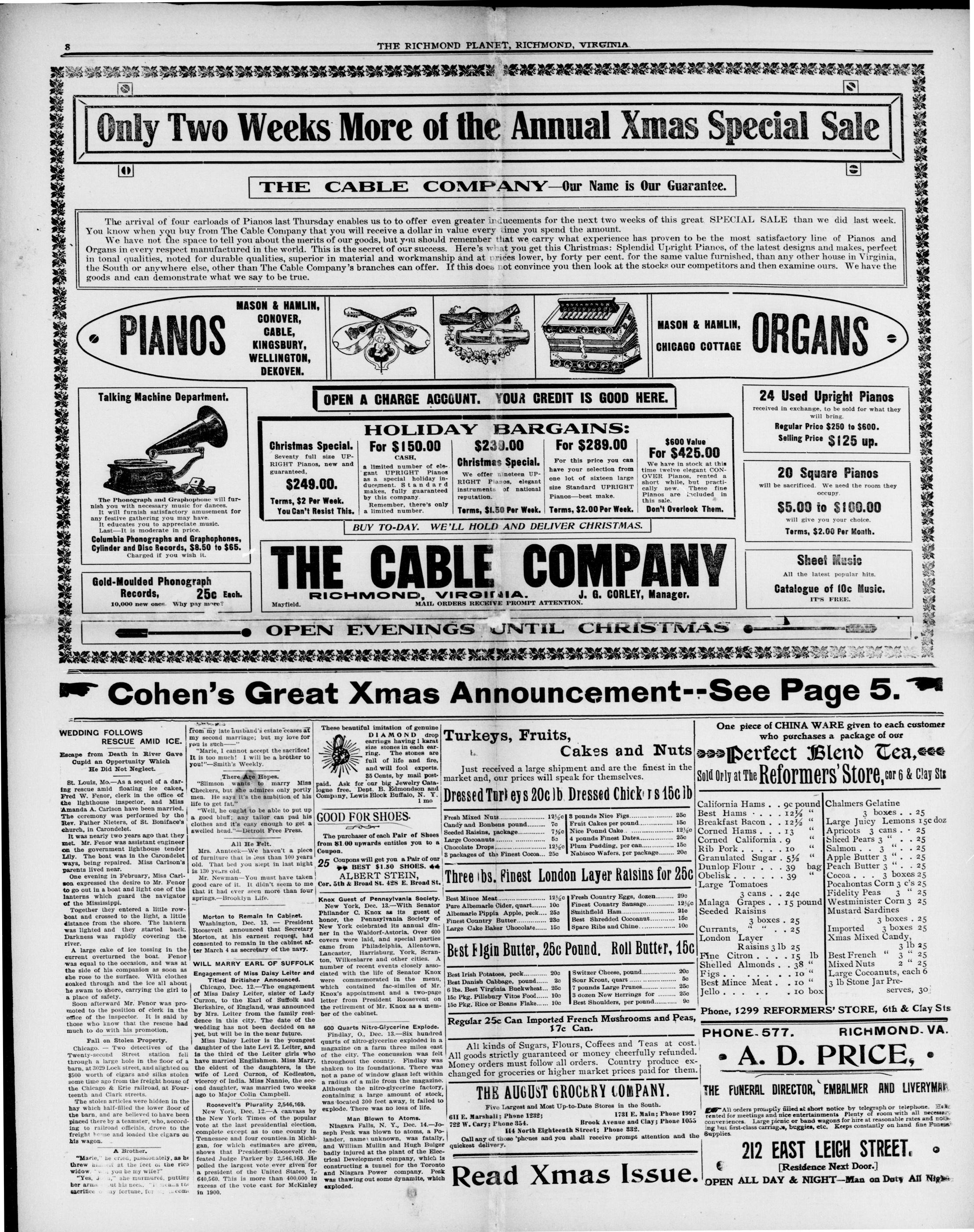
The Cable Piano Company, the skillful Mr. J. G. Corley, Manager, created a sensation in Richmond Thursday, December 8th, when it paraded the streets of this city with two-car loads of piano? To do this, it seemed that every one and two horse wagon had been called into requisition. The parade covered what seemed to be about ten blocks. Business men left their offices to witness the strange sight. On each team were the music letters "The Cable Co" and they had boxe music ready of course for the touch of datiny fingers. The reputation of the pianos of this popular music-house is world-wide and many musicians are the children for the musical world by purchasing the best pianos obtainable for the purpose, and Mr. Corley insists that he has them.
The increase of business in this territory has justified large expenditures in electric fittings and the palatial store on Broad Street between Second and Third Streets is a thing of beauty. Already it has outgrown its capacity and a handsome new music house with all modern ornamentations, furnishings, etc. is on the boards for the coming year. No one can afford to purchase a piano before looking over the stock of this popular concern. Payments are made to suit the convenience of the purchaser. When you sign a contract with The Cable Company, you make a safe investment, sure of a swift and profitable return. Read their magnificent advertisement in this issue.
$150.00 Endowment Paid
This is to certify that I have received from John Mitchell, Jr., Grand Chancellor of the Grand Lodge of Virginia, N. A., S. A., E. A., and A. ($150.00) One Hundred and Fifty Dollars in payment of the death claim of James Corprew who was a member of Friendship Lodge, No. 3, K of P. of Norfolk, Va.
James E. Mills, M. D., J. C. Wilson, W. H. Mills, Deputy.
Mr. John W. Howard, General Supt. of the American Beneficial Insurance Company has been in Roanoke for two weeks inspecting. He found the work in healthy condition, and says the company will soon begin the straight life work in Roanoke.
Mr. R. W. Anderson, who is so well and favorably known in this city has been appointed General Inspector of the American Beneficial Insurance Company.
Rev. R. O. Judkins passed through the city last week en-route to Fredericksburg, Va. after spending a delightful vacation.
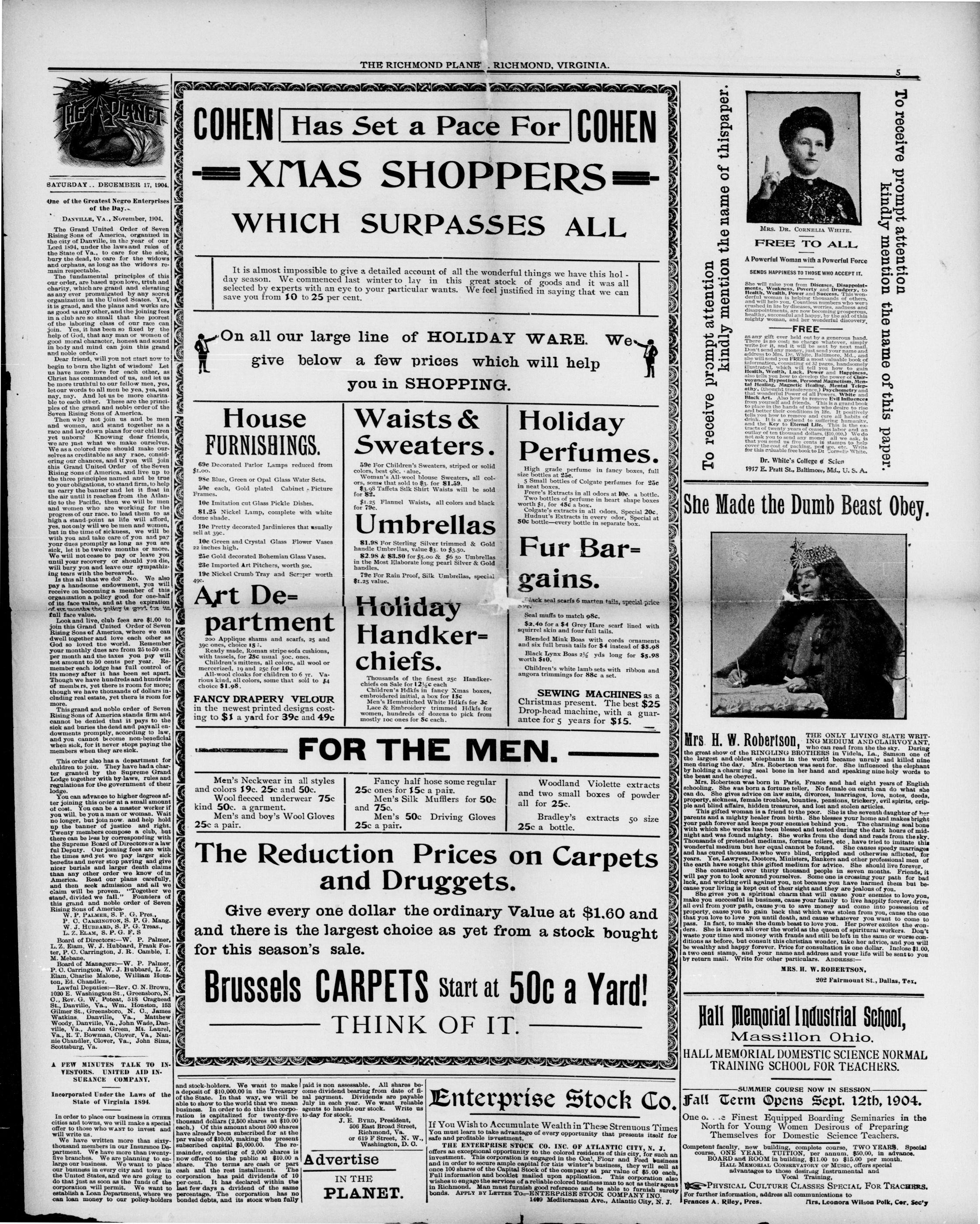
Don't buy until you have inspected the mammoth stock of the Cohen Co. See Page 5.
We shall publish a reply to Rev. Dr. Harvey Johnson's criticisms and also an account of our trip to Franklin, Va. in our next issue.
We shall discuss "The White Peril: The Immediate Danger of the Negro" by Mr. William Garrott Brown, which appears in the North American Review for December.
The Reformers' Grocery Store meets competition. Read their surprising offers in another column.
—Mrs Sadie Fitzgerald, the accomplished wife of Mr. B. G. Fitzgerald of Atlantic City, N. J., has returned to Atlantic City with her son.
—Mrs. M. L. Jackson of Trenton, N. J., has left the city. She was the guest of Misses Mary and Pearl Rowe during her stay here.
—Mr. Wm. H. Evans and his private secretary Mr. Robert W. Bell of Hot Springs, Va., were in the city last week.
—Josephine Court, No. 238, I. O. Calanthe had annual supper Thursday night, December 1st and all heathly enjoyed themselves. Visitors were ent. The Court is in a prosperous condition. Mrs. Fannie James is Worthy Counselor and Mrs. Martha E. Forrest, Register of Deeds.
$90.45 Endowment Paid.
Received of W. F. Denny, President of the Freedmen's Endowment Association $90.45 in full for the death of my mother, (Ella Carter.)
Signed:—W. C. CARTER.
Beneficiary.
Witnesses:—
M. Judah Foster,
M. J. Harris.
MARRIAGES.
H. SOMER'S Mrs. Martha Harper takes your place at the marriage of her daughter Tannie E. to Rev Chas. L. Somers, Tuesday evening Dec. 27th, '04 at 6:30 o'clock, St. Philips P.E. church, cor St. James & Leigh Sts. Reception 32 W Leigh St. 7 to 10. Friends are invited. No cards.
SIMS-JACKSON—The marriage of Miss Mary A. Jackson to Mr. Solomon Sims will take place Thursday, Dec. 22, 1904, at 9 o'clock P. M., at the residence of Rev. W. T. Johnson, D. D. 110 E Leigh St., Richmond, Va. Friends are invited. Reception from 9 to 11 P. M. at 1015 N. 1st St. The couple will reside at Glimmer St.
ROBINSON—FINNEY—The marriage of Miss Bertha E. Robinson to Mr. Essex J. Finney will take place at the residence of the bride, No. 117 East 20th St. Manchester, Va. Wednesday morning, December 28th, 1904 at 11 o'clock. Friends are invited. No cards.
Richmond Va. Dec. 13, 1904
DABNEY—ARCHER—Mr. Charles R. Dabney and Miss Mary L. Archer were quietly married at 1506 West Leigh Street on Dec. 3, 1904 by Rev. R. O. Johnson.
Real Estate Deposit and Investment Company.
DAVIS & BRIGHT, Managers.
1607 Broadway, N. Y. City.
Capital $200,000. $1.00 and upward
received for investment in real estate.
Money loaned. Furnished room houses,
hotels, restaurants, etc., bought and
sold Eight room house, all improvements
on Park Ave., for sale, easy terms.
Very respectfully.
Remember the Cohen Company is reliable and their goods always sustain their guarantees. See Page 5.
Stock-holders Attention.
Richmond, Va., Dec. 15, 1904.
The annual meeting of the stock-holders of the Mechanics' Savings Bank will be held at the Pythian Castle, No. 727 N. Third Street Tuesday, Jan. 3, 1905 at 8.30 P. M. You are requiued to be present without fail and hear the reports of the President and Cashier.
Yours respectfully,
JOHN MITCHELL, JR., President,
THOS. M. ORUMP, Secretary.
DIED—Mr. Charley Harris died in Philadelphia, Dec. 11th at 2 o'clock.
He was the nephew of Mrs. Pinkey Wilson, Mrs. Bettie Gravie and Mrs. Rosa Scott, and the grandson of Mrs. Adine Harris. He was formerly a resident of Richmond.
LOST.—A liberal reward will be given for informat on or return of Small Black and Tan Dog (female): has very little hair and curled tail; trayd from 205 East Clay street. THE TUXEDO, 707 E Broad street. 'Phone 2090.
See Cohen Company's Christmas offers on Page 5.
The fine convenient Brook Avenue Store of the Augu-t Grocery Co., is a lasting testimonial to the progressiveness of this most remarkable concern. See advertisement.
RICHMOND, VIRGINIA, SATURDAY, DECEMBER 17, 1904.
JAPS HAMMERING PORT ARTHUR FLEET
Firing Shell Into Them to Make Sure of Their Destruction.
RIOTING IN ST. PETERSBURG
Tokio, Dec. 12.—The Japanese continue to batter the Port Arthur fleet, and there is little ground for expecting that it will ever again engage the Japanese. The battleship Sevastopol continues at anchor outside, but possibly returns to the harbor at nights and anchors inside the outer boom, which protects her from torpedo boats. The recent heavy weather has given added protection to the vessel.
Naval experts are discarding the theory that the Russians themselves sank any of the ships. The fact that the vessels first showed lists while in exposed positions, and the efforts made to save the Sevasstopol are regarded as conclusive evidence against the theory of their being sunk by the Russians. A majority of the sunken warships lie headed northward. They received the bulk of the fire across their port sides, and the fact that at least two of them showed lists to starboard gives rise to the theory that Japanese shells exploded inside the ships and against the starboard armor, driving the armor outward and causing leaks. To make sure of the destruction of the Russian warships the Japanese continue to drop shells into the sunken hulks. The whereabouts of the torpedo boat destroyers continue doubtful, but it is thought they are sheltering outside the harbor. The observers report a number of tugs, tankers, aircraft and small craft anchored near the hospital ships in the west harbor, where they evidently have gone for the purpose of obtaining protection. It is suggested that the besiegers notify Lieutenant Genera Stoessel to separate these vessels from the hospital ships or take the consequences. The Japanese are exercising care to avoid hitting the hospital ships, which frequently are in the direct line of fire.
RIOTING IN ST. PETERSBURG
100 Injured and Many Arrested In Anti-Government Demonstration.
St. Petersburg, Dec. 12.—A popular anti-government demonstration, the participants in which included large numbers of students of both sexes, began at midday in the Nevsky Prospect and lasted about two hours. Hundreds of police and mounted gendarmes, who were hidden in the courtyard of the public buildings, emerged suddenly and charged the crowd at full gallop, driving the demonstrators in headlong confusion and screaming with terror upon the sidewalks and into adjacent streets. This led to serious encounters, 100 persons being more or less severely injured. Many were arrested.
Toward 1 o'clock the workmen and students seemed to swarm toward the corner of the Hotel Europe, opposite the Kazan Cathedral. Then, when there was not a single mounted policeman in sight, on the stroke of 1, from the heart of the thickly wedged crowd a blood-red flag, like a sheet of flame, suddenly shot up. It was the signal. Other flags appeared in the crowd, waving frantically overhead; and they were greeted with a hoarse roar "Down with autocracy." The students surged into the street, singing the "Marsellaise," while innocent spectators, seeking to extricate themselves, crowded into doorways and hugged the walls. Dismounted police made a single attempt to force their way into the crowd to wrest the flags from the demonstrators, but the students and workmen, armed with sticks, stood close and beat back the assailants. Then, like a flash, from behind the Kazan Cathedral, came a squadron of gendarmerie. The doors of adjoining courtyards were thrown back, and battalions of police came out. A double squadron charged the flank of the demonstrators with drawn sabres. Five other squadrons circled the mob, cutting through the fringe of spectators, who gladly scurried to cover. The main wedge of the demonstrators stood fast only a moment or two. There was a sharp rattle of cudgels and sabres, though the wounds showed that the police struck principally with the flat of their sabres. The women were especially fierce in their resistance. Many were struck and trampled, and blood streamed down their faces.
While the mob stood, those within managed to throw hundreds of revolutionary proclamations over the heads of their fellows. The police urged their horses fiercely into the crowd, driving those who resisted into the courtyards, the Hotel Europe and the Catholic church. The intense excitement lasted about 10 minutes, after which mounted squads of the gendarmerie patrolled the streets and the policemen
devoted themselves to keeping the crowd moving.
PLEHVE'S MURDERERS GUILTY
Man Who Threw Bomb Sentenced For Life and Accompanied to 20 Years
Life and Acompice to 20 Years.
St. Petersburg, Dec. 14 - Sasoneff, who threw the bomb which killed Minister of the Interior Von Plehve on July 28, and Sikorisfky, his accomplice in the crime, were found guilty by the court of appeals, sitting in the law courts building. The former was sentenced to imprisonment for life at hard labor, and the latter to 20 years imprisonment. The trial had been expected to last at least two days, but it was rushed to a speedy completion, in view of the possibility of revolutionary demonstrations. The trial was held behind closed doors, and all the entrances to the building were locked.
A WEEK'S NEWS CONDENSED
Thursday, December 8.
Lew Spencer, famous in the minstrel world for the last 20 years, dropped dead in Chicago from heart disease.
Senator Proctor presented to the senate a memorial adopted by the Vermont legislature, protesting against reciprocity with Canada.
Townsend Cox, of Bordentown, N. J., an ex-member of the New Jersey legislature, died of injuries sustained in falling down stairs in his home.
Daniel Best, of Harrisburg, Pa., was convicted of forging his son's name to a government pay warrant and sentenced to 30 days in jail and pay a fine of $100.
Friday, December
By an explosion of fire jump in a coal mine at Burnett, W., 11 miners were killed and four
imp in a
11 min.
red.
isant. W.
by rob
The safe of the Point
Va., postoffice was blown
robbers and $1100 in ca-
taken.
A steam pipe burst on th: British
steamer Murcia at Baltimore Md., and
frightfully scalded two men, one fatally.
Jesse Williams, an agent for a Philade-
phia medical book concern, com-
mitted suicide in Wilmington, Del., by
shooting.
Fannie Snyder, aged 7 years, of
Philadelphia, fell into a tub of scald-
ing water at her home and was fatally
scalded.
Saturday, December 10.
Saturday, December 10.
Dr. Garry Lampen, of Philadelphia, has been elected president of Bellvue Presbyterian College, Omaha, Neb.
Eleven fishermen were drowned in an attempt to rescue the crew of a wrecked steamer at Newbiggin, England.
The court house at Jamestown, Fentress county, Tenn., was burned by incendiaries and many valuable records were destroyed.
The child labor law of Illinois is being enforced in the coal mines of the state, and 2500 boys have been taken away from employment.
Joseph Jacobs, of New York, a detective attached to the district attorney's office, was sentenced to prison for one year for perjury in the Canfield gambling case.
Monday, December 12.
President Roosevelt has decided not to call a special session of congress in the spring to revise the tariff.
Amendments to the Montana state constitution relating to child labor and the eight-hour law have been declared in full force.
The register of the Naval Academy at Annapolis, Md., shows 823 midshipmen enrolled, the largest number in the history of the institution.
Knotting a handkerchief about his neck and placing a newspaper through it, James T. Lunn twisted the paper until he strangled to death at Flint, Mich.
The pay of the anthracite miners of Pennsylvania for November has just been fixed at 7 per cent. above the minimum basis fixed by the strike commission.
Tuesday, December 13.
The arbitration treaty between the United States and Great Britain was signed in Washington.
Robbins entered the postoffice at Reinbeck, Ia., and escaped with $2500, after exchanging shots with a posse.
On the North German Lloyd steamer Hanover, which arrived at New York from Bremen, were 20,000 birds, mostly canaries.
The widow of Confederate General D. H. Hill, sister of Mrs. "Stonewall" Jackson, died at Raleigh, N. C., at an advanced age.
For the fifth time within two months the Newport (Ky). Iron Foundry was dynamited, but no one was injured. Strikers are suspected.
Wednesday, December 14.
Wednesday, December 14.
James Hall was sentenced to five years' imprisonment for forgery by a Philadelphia judge.
Baron Speck von Sternburg, the German ambassador, sailed for Germany on the steamer Kaiser Wilhelm II.
The store of Long & Kremer, Phillipsburg, N. J., was robbed of $1000 worth of revolvers, guns and cutlery.
MRS. CHADWICK TO FACE CREDITORS
Waives a Hearing in New York and Goes to Cleveland.
SAYS SHE WILL PAY DEBTS
New York, Dec. 14—Mrs. Chadwick started for Cleveland on the Buffalo limited, which left the Grand Central station over the New York Central, at 8 o'clock last night. Before leaving she made a statement in which she declared she will pay all her obligations, and that her sole purpose in going is to face her creditors. She said that she could have obtained bail here if she had wished to, and that one of the most prominent men in the country had offered yesterday to go on her bond. Mrs. Chadwick left here in the custody of Deputy Marshals Kumb and Kelker.
Before leaving the United States marshal's office for the station, Mrs. Chadwick, at the suggestion of her counsel, Philip Carpenter, consented to an interview with a number of newspaper men who were waiting. She was the absolute mistress of herself, and either smiled as she made her statements or gave way to an expression of bitterness.
"Many statements that have appeared about me are absolutely false," she began. "I have read statements in one or two papers that are absolutely false. I am physically and mentally broken down. I am not in any condition to make a statement. I am going home for the sole purpose of facing my creditors and whatever charges they have against me. I am going home voluntarily and not because I could not obtain bail. Since my arrest I have had offers of bail from many prominent persons. Yesterday bail was offered to me by one of the most prominent men in Cleveland by telegram. I have had at least half a dozen prominent persons offer me bail yesterday. There was no reason why I could not get bail, none at all.
"I am not going to answer any questions," said Mrs. Chadwick firmly, when one of the reporters asked her to disclose the identity of the person who had made the offer.
"I want it distinctly understood that I am going home simply because it is the place where I should be. I shall not give ball when I get in Cleveland. I have the best motive in the world for not doing so. The history of this case from beginning to end will soon be published in a certain newspaper." "You will call names, won't you, Mrs. Chadwick?" interrupted Mr. Carpenter. "I shall use names," corrected Mrs. Chadwick. "I promised to give out my story, and it may take months to get it out. It may be, however, that it will be published tomorrow, next week, or in a month. But certainly not until all my obligations are settled and paid.
"Furthermore I will give the names of those with whom I have done business and will show that not only have I stood by my creditors up to this time but that I will stand by them till the very moment of my death. I intend to pay every dollar of my indebtedness."
"Will you say anything about your relations with Mr. Carnegie?" was asked.
"I am not here to be questioned," she replied. "I have nothing to say about Mr. Carnegie and nothing to say about any one else. I want to say emphatically that I have not been forced to go back to Cleveland. I delayed my return home because I thought it best to wait and see what the grand jury would do. If the grand jury had indicted me 50 times I would have gone back just the same. For the past week I have been wanting to go back. Isn't that so, Mr. Carpenter?"
"That's so," said the lawyer.
"I was ready to go back a week ago last Saturday," declared Mrs. Chadwick. "I had all my things packed, but they wanted me to go down to Wall street." Mrs. Chadwick would not say who "they" meant.
Excitement In Cleveland.
Cleveland, Dec. 14.—The home-coming of Mrs. Cassie L. Chadwick will create more excitement in this city than any event of recent years. The probability of a tremendous jam at the depot has compelled Chief of Police Keehler to arrange details of officers to restrain the crowd, and United States Marshal Chandler, to whose offices she will be taken immediately on her arrival, has determined to station a force of deputies around his office to prevent the throng from taking the
room by storm.
The prospects are that Mrs. Chadwick will be compelled to go to jail unless she can give bail to the amount of $40,000, and she may be asked to furnish surety as high as $52,000. United States District Attorney Sullivan said that he did not care to discuss what action he would take after Mrs. Chadwick's arrival.
There was a report that a third indictment had been found against Mrs. Chadwick, charging forgery in connection with the $5,000,000 Carnegie note. It was not returned, but such a thing may occur before Mrs. Chadwick has seen the end of her troubles with the federal officials. If it does, Mr. Koehler will ask for a bond of $12,500 in this case also, making the total amount of surety that she will be called upon to furnish $52,500.
PENNSY WINS
W. U. CASE
Supreme Court Says Railroad Had Right to Remove Poles.
AN OPINION HANDED DOWN
Washington, Dec. 13.—The supreme court of the United States decided in favor of the railroad in the case of the Western Union Telegraph company vs. the Pennsylvania Railroad company, involving the right of the telegraph company to condemn a part of the railroad's right of way in Western Pennsylvania and appropriate it for its lines. This is a second case in the controversy between these companies.
The opinion was handed down by Justice McKenna. In the decision the court held that the congressional act of 1866, which controlled in the case, does not grant eminent domain to telegraph companies over the private property of railroad companies.
In his opinion Justice McKenna reviewed the case from its inception, saying that it came to the supreme court from the decision of the circuit court of appeals for the third circuit, which was adverse to the contentions of the telegraph companies, to the effect that the act of July 24, 1866, granting companies along post roads gives the right of eminent domain and adding that the supreme court sustains that view. Justice McKenna stated that the suit began with the filing of a bill in equity in the United States court in New Jersey by the telegraph company to restrain the railroad company from removing the telegraph poles placed there in 1881 under a 20-year contract
Justice Harlan delivered a dissenting opinion, holding that the act of 1866 gives to telegraph companies the unequivocal right to construct and operate lines not only upon the public domain, but along any post road of the United States, and he contended that if the decision was to stand the United States government could not itself enter upon the rights of way of railroad companies.
Justice Brewer concurred in the decision, but said he did so because he considered that the points in controversy had been determined in previous litigation.
The contention of the telegraph company in this case, as in the case involving the right of the railroad company to remove the poles of the telegraph company, was that the telegraph company had the right to maintain its lines of telegraph over and along the railroads of the railroad company for the use so appropriated, so long as the maintenance of its telegraph lines does not materially interfere with the ordinary travel of such roads, and that the right can be asserted by proceedings in eminent domain, but this was denied.
There was also an additional element caused by the claim of the telegraph company as the lessee of the Atlantic and Ohio Telegraph company, incorporated by the state in 1849 and authorized "to erect and construct works, edifices, fixtures and structures along and across any of the roads." This point was decided adversely to the Western Union on the ground that "eminent domain cannot be delegated" and that "lessees cannot exercise it."
JERSEY REPUBLICANS CAUCUS
John Boyd Avis, of Gloucester, Chosen For Speaker of the House.
Trenton, N. J., Dec. 14—The Republican members of the legislature met in caucus in the state house and selected officers of the assembly to serve during the next session of the legislature. Edward D. Duffeld, of Essex, was made chairman of the caucus, which carries with it the leadership of the majority on the floor of the house. There was but one contest, that for assistant bill clerk.
The following officers were agreed upon: Speaker, John Boyd Avis, Glou-
PRICE,FIVE CENTS
cester; clerk, James Parker, Passalc; assistant clerk, Upton S. Jeffreys, Camden; journal clerk, Robert S. Terhune, Essex; sergeant-at-arms, George Lutz, Atlantic; first assistant sergeant-at-arms, William S. Dye, Middlesex; supervisor of bills, George E. Grover, Essex; bill clerk, Edward F. Totten, Morris; assistant bill clerk, Frederick W. Bender, Union.
Zion City Out of Debt
Chicago, Dec. 13. -Zion City has paid the final installment on the big debt which a year ago involved it in sensational bankruptcy proceedings and threatened to wreck the gigantic enterprise established by John Alexander Dowle. Checks were sent out by Deacon C. G. Barnard, head of the financial department of Zion, in payment of the final 40 per cent, approximately $140,000, of the original indebtedness of more than $400,000. Dowle has kept his agreement to the letter and paid 100 cents on the dollar of every claim involved.
College Students Resign
Roanoke, Va., Dec. 13—The entire junior class at the Virginia Polytechnic Institute resigned. The junior class is composed of 130 men. The cause of the action was the alleged unjustifiable dismissal of one of their members. The sophomore and senior classes also have become involved, and they also may resign within the next few days.
FIRE RAGING IN MINNEAPOLIS
$3,000,000 Worth of Property Destroyed and Three Firemen Killed. Minneapolis, Dec. 14.—Probably the worst fire that the city of Minneapolis has ever known is now raging here and already $3,000,000 worth of property has been destroyed, with prospects that the total loss will reach at least $5,000,000.
The fire started in the photographic supply house of O. H. Peck & Co., on Fifth street and First avenue, South, and in less than one-half hour this building was a mass of wreckage. Next to the Peck building is the furniture supply house of Boutelle Bros., the largest house of its kind in the northwest. This building soon caught fire, and is now burning, the sparks from it being carried blocks by the north wind which is blowing, causing several small fires throughout the city. Relief has been secured from St. Paul, that city having sent all its available fire apparatus. With the strong wind blowing, aided by zero weather, the firemen are experiencing considerable difficulty in their work, which has not as yet been effective, as the fire is burning itself out in one or two buildings, and their work is entirely directed to the buildings in close proximity in an attempt to save them. It is reported that three firemen have already lost their lives.
WILL IMPEACH SWAYNE
Federal Judge to Be Tried For "High Crimes, and Misdemeaners."
Washington, Dec. 14—Sitting as a grand jury, the house of representatives, with almost a full membership and after more than five hours' discussion, to the exclusion of all other business, adopted a resolution providing for the impeachment of Judges Charles Swayne, of the northern district of Florida, for "high crimes and misdemeanors." The case against the respondent was clearly set out by Mr. Palmer, of Pennsylvania, chairman of the sub-committee of the judicial judiciary committee which heard evidence in the case. He carefully dissected the evidence bearing on each of the specifications, and said that if it were found that Judge Swayne had done well he should be vindicated, but if he had done ill he should be sent to trial "where his excuses and apologies may or may not receive consideration." He was followed by Messrs. Clayton, of Alabama; Powers, of Massachusetts; Henry, of Texas, and Lamar, of Florida, each of whom in most vigorous terms advocated impeachment. Messrs. Gillett, of California, and Littlefield, of Maine, in speeches opposed their colleagues on all the specifications except the one as to the account rendered to the government by Judge Swayne for travelling expenses.
Scranton, Pa., Dec. 12. — Charges with padding payrolls of the street department, Chief Clerk Hugh Jones, of the department of public works, and Thomas Watkins, a miner, were arrested at the instance of President Joseph Jermyn, of the Taxpayers' Association.
So far as ascertained the amount involved is $1458.
Watkins stated at a preliminary hearing that he was not employed as a teamster, as made to appear, but had received $1 for indorsing his name on some warrants which Jones had brought to him. City officials have begun an inquiry into the charges against Jones.
THE PLANET
BAREFOOT TO SAVE SHOES
Pretty Denver Stenographer Creates
Genuine Sensation When She
Appears on Streets.
A pretty blond stenographer created
a sensation on Fifteenth street, Denver,
Oak, during a recent storm. She had
gone out to lunch, and when she left the
restaurant she saw that it would be
impossible to return to an office in the
Mining Exchange building, where she
was employed, without damaging her
new white low shoes and a pair of fancy
stockings. So she deliberately removed
A
CREATED A SENSATION.
the shoes and stockings and started down the street barefooted.
Policeman Michael Horkans stood at the corner of Fifteenth and Curtis streets when he saw the young woman coming down the street. She was followed by a big crowd and she was running to escape. In her hand she carried her shoes and stockings. Horkans attempted to find out what all the trouble was about, but the young woman disappeared in the Mining Exchange building.
"What did you do it for?" asked the policeman.
"I had no idea it would attract any attention," replied the young lady. "I had to get back here in a hurry and I didn't want to ruin my shoes." On the desk in front of her were the shoes, a pair of white kids.
MAKE MONEY AS FARMERS.
Women in Various Parts of the Country Who Have Taken Up Farming in Practical Way.
One of the interesting features of modern feminine industry is the extent to which women are following the latter day cry: "Back to the jand." Mrs. Harriet M. King has a good right to her western title of "cattle queen." for her ranch near San Antonio, Tex., is larger than many of those German principalities which have given monarchs to reigning houses of Europe. Her Santa Gertrude ranch is 90 miles long, and includes 1,500,000 acres within its barbed wires; it is nearly twice as large as Rhode Island. Two thousand employees care for its 100,000 cattle and 50,000 sheep. The income of the ranch is between $300,000 and $400,000 a year, and the owner laughed at the offer of a cattle syndicate to buy it for $6,000,000 a year or two ago. Mrs. King is the personal manager of this vast domain. The second great woman land owner of the west is Mrs. F. H. Kriesman, of St. Louis. Her L. F. ranch near Tascosa, Tex., is 30 miles square. Mrs. Kreisman understands both the raising and selling of cattle, being a practical woman and business woman.
Miss Austin, a San Francisco schoolteacher, starting with a small vineyard near Fresno, was the pioneer in packing raisins in attractive form for the high-class market. She introduced a number of improvements, both in the vineyard and the package house. The Washington navel orange industry of California sprang from the planting of trees from Brazil by Mrs. Tibbetts, of Riverside, and Mrs. E. G. Shields originated the pampas plume industry, which was for some years very profitable. Mrs. Shields is a member of the state board of trade. and has a magnificent fruit farm of 250 acres in Sacramento valley, in which she began 20 years ago, a widow, with no capital except a houseful of children. Miss Clara Wilbur, of New Haven, Conn., specializes on violets and carnations, and as she becomes better established intends to specialize on orchids and other fragile and high-priced blooms.
Radiator as an Incubator.
While carrying on a series of experiments in his laboratory with chicken life during the embryonic stages, Dr. Counter, a young dentist, of Toledo, succeeded in hatching a chicken by means of an ordinary steam radiator. The egg was placed in a small paper box and hung from the radiator during the period of incubation. At the end of the 21 days the chick was hatched, and has since been kept in a paper suit box, about three by one and one-half feet, with a little shelter in the corner of it. The box is hung near the radiator, and its inmate, now three weeks old, is as strong and vigorous as one could expect a chicken to be raised under natural conditions.
A Bridge Built of Coffins
A curious bridge was built by the British troops in 1860, when they were marching on Peking. They found their progress barred by a river of considerable width and depth. A timber par-
ty was formed, but found nothing to cut down or confiscate suitable for a bridge. At last a huge store of coffins was discovered in the village, and with these the soldiers built their bridge and crossed alive over the receptacles for the dead.
YOUNG VIRGNIANS
MARRIED IN A BOAT
Escape the Bride's Irate Father and Take to the Water with a Preacher.
Baltimore.—A marriage in an open boat in Pecomoke sound was the novel sequel to the romantic elopement of a Virginia couple.
The lovers were Miss Angie Mister and John Spence, of Saxe's Island, Va. William Mister, father of the bride, was much opposed to the attention that young Spence was paying to his daughter, and forbade her to allow him to call, threatening him with violence should he catch him at the Mister home. Spence paid little attention
CHASED HIM WITH SHOTGUN
to the threats, but wooed and won the girl.
An elopement was planned for Friday night, and Spence procured the license in Virginia.
Arriving at the garden gate, which was the appointed spot for the meeting, the young man uttered his familiar whistle, and, to his surprise, instead of his lady love carrying a satchel, her father appeared with a shotgun and gave Spence a chase through cornfields and marshes until a late hour, when Mr. Mister, thinking that he was thoroughly rid of Spence, returned to his home to enjoy peaceful slumber.
The next morning Spence went to Princess Anne, Md., and secured another license. He then met his sweetheart, found a minister and with a few friends embarked in the boat.
They sailed just across the boundary line into Maryland waters and were married.
A large number of Maryland oystermen witnessed the marriage, and say it was the most novel affair they have seen in many years.
GIANTS REPORTED IN WILDS OF LABRADOR.
Indians Report the Existence of a Race of Mighty Men in That Region.
Quebec.-Stories of a race of aboriginal giants living in the interior of Labrador continue to come from Indian sources, but ethnologists do not believe that such a race exists. It was while endeavoring to find this strange people that Leonidas Hubbard, Jr., associate editor of Outing, perished of hunger in the interior of the inhospitable peninsula less than one year ago. The late "Adirondack" Murray also had planned an expedition of discovery in the same region, but died before he could put his project into execution.
Scientists appear to be agreed that if any such giant race exists they must be the survivors of the Beothics or aboriginal Indians, of Newfoundland, the last of whom died in captivity in St. Johns, in 1829. In the previous year the final effort to find the Beothics, who, because of barbarous treatment, had been driven from Newfoundland, was made by Mr. Cormack, a representative of the Beothic society, of St. Johns, but all he could find were relics and graves.
It is believed that the Beothics had affinity with the Mayalo-Polynesian race, and it is supposed that their remote ancestors must have formed part of a great emigration from the Indian archipelago prior to the Christian era, consequent upon Buddhist invasion of those islands.
Curse in Sign Language
Minneapolis—George Gilbert, a deaf mute, accused by Edward Gallman, another mate, of swearing at the latter, was arraigned, and, through an interpreter, defied his accuser to prove it. Gallman's complaint was that Gilbert had used violent, indecent language, and had cursed him with great violence, all by a few rapid twistings and wavings of his slender hands.
When Gallman tried to repudiate the silent words of Gilbert, the interpreter started and then informed the court that the two mutes talked in different languages, and used systems that were not alike.
The case was complicated enough before this information was offered, and in despair the police judge took it under advisement.
Never Suspected It
"Don't you think," asked Mrs. Oldcastle, "that our minister rather over-indulges in obiterdicta?" "Oh, grahicra," her hostess replied, "I never would of suspicioned such a thing. He's always claimed right up and down to be a teetotaler—Chicago Record-Herald.
How He Got Even.
She had just worked the "Th-be-a-ster-to-you" degree on him. "Exuse me, Miss Chillington," he said, "but as I am already well supplied with elder sisters, would you mind being a grandmother to me instead?"—Chicago News.
THE RICHMOND PLANE 2, RICHMOND, VIRGINIA.
A GHOST PLAYS
PECULIAR PRANKS
LIVERPOOL, ENG., HAS AN UNSOLVABLE MYSTERY.
FRIGHTENED GIRL TENANTS
They Swear "Spook" Threw Flatirons, Took Down Mirrors, and Opened Doors of Their Home—Residence Abandoned.
London,—Not being able to support its terrestrial tame, a modest ghost, whose weird pranks have created a sensation in the neighborhood of Islington, Liverpool, has mysteriously vanished.
The "spook" evidently made its arrival a few days after four girls, three of whom are named Moran, left their mother's house and took up their residence at 99 Field street, off Carver street, Islington, about three weeks ago. The house is situated in the middle of a row of tall three-storied dwellings, each of which is only one room deep except on the ground floor, where there is a back scullery. Winding stairs lead from one floor to another.
The maidenly quartette left their habitation each morning at six o'clock to go to work in the neighborhood, returning to dinner and to tea. Two days after taking the house they were greatly perplexed on returning home at midday to find a large mirror, which had been left on the wall in one of the bedrooms, lying face downward on the kitchen floor. It was replaced, but at noon next day the girls trembled to see the looking glass again hiding its face on the hearthrug.
Then other familiar objects in the house become possessed with evil spirits. When the door was opened some unseen influence closed it, sometimes with an elastic spring, frightening the girls terribly.
The ghost began to manifest itself in nocturnal visitations. Dreadful rumblings kept the girls awake through the long, dismal night. At such times shadows flitted over the ceilings, and the girls hid their white faces under the blankets.
Two of the girls were sitting reading just over a week ago when the apparition presented itself to one of them. The next door neighbor, a work-
THE GHOST! THE GHOST!
ing man, declares that not a pedestrian was within 100 yards of the house, but the girls sprang out of the doorway with alarmed faces, shrieking: "The ghost!"
One of the girls swore the phantom had passed in front of her; another states that she was scrubbing the stairs when a flat iron, sans handle, which was placed in the kitchen fire grate, came tumbling inexplicably down upon her from above. It was followed by the shuffling of feet.
At last the terrorized quartette removed their goods and chattels at midnight, and went to live with a relative. Thousands of people went nightly to see the haunted house, and stones were hurled through the windows, but it was not even then believed that the ghost had been laid.
At last a wager was made by a man named Hugh Morgan that he would enter the place and tackle the hobgoblin. By this time the agents, Messrs. Sykes, of Brunswick road, had boarded up the front windows, but Morgan went behind and forced an entrance by smashing another pane. His investigations were not complete when a policeman appeared on the scene and arrested him. He is still in jail. The scare has not yet subsided, and many visitors go nightly to inspect the house.
Bride Had Wed Another.
Chester, Pa.—William Domini, a shoe dealer here, wooed and thought, he had won a pretty girl who lately came to this country to reside in Wilmington. The wedding was set for a few nights ago. Dominica went to Wilmington after he had made arrangements for a feast in this city. He left his friends here awaiting his coming with the bride. Viands had been spread and the party waited. At a late hour the shoemaker returned in tears, telling his friends that the bride had married another a few days before. Whereupon they all fell to and dispatched the edibles and drink-ables
Fell 65 Feet Unhurt.
Port Huron, Mich.—Clay C. Cady, brother of Prosecuting Attorney Bert D. Cady, and of City Comptroller Ervin Cady, fell 65 feet at a pole-raising at the summer home of Bert D. Cady. He was severely stunned, but no bones were broken.
A Street Car Napoleon
Old Gentleman—Tell me, my friend why you are so ugly to passengers.
"No-o, not exactly."
"Why, when they hate the company, they'll just laugh to theirselves when they see me cheatin't 'h' company by not ringin' up fares. -N. Y. Weekly.
Three Handsome Tailor Suits
Designed for Fall Exhibit. But Can Be Worn All Through the Winter.
THE FASHION OF THE EARLY 19TH CENTURY.
ARTISTIC FLOWER STANDS.
Late Designs in Garden and Conservatory Dustrations Add to the Beauty of the Plants.
The application of the artistic to the useful, the movement begun by Ruskin and Morris, has finally entered the field of garden and conservatory decorations, where it might be imagined from their constant associations with beauty that such ideas would have emanated. The Chicago Journal says that in place of the ugly, unadorned clay pots or their still uglier ornamentations of frilled crest, and tissue paper, or the old style painted washtubs in use in conservatories, are now set upon
ARTISTIC FLOWER STAND.
bronze stands tubs of highly polished woods, birded by hoops of brass.
The shapes vary, ovals, squares, rectangles and circles being employed according to their fitness to the plants they hold. Some of the designs in the bronze work are quaint. Although many are original, others are reproductions of medieval work. The lack of monotony is favorable compared to the old styles.
One conservatory varies these artistic novelties with wicker baskets of divers designs, that inclose the clay pots closely, painted green or white, their lighter colorings making a pleasing contrast under the brilliancy of the flowers and the shining green colorings of the leaves, to the black Chine teakwood and reddish bronze of these new plant-holders.
A rhodendron in a teakwood tub, with green bronze hoops and supports, is the most admired of all the plants in a north side conservatory.
Throw Physic to the Dogs.
"It is safe to say" declared a physician, "that one-half of the women are simply starving for fresh air, and if they would throw away their pill bottles and headache powders and exercise freely in the open air for at least two hours daily, they could feel like new women at the end of a year. Nature cannot be cheated, no can impaired forces be restored by allowing medicine every time warr pain and illness overtake the officer. A busy woman may be forced to neglect some duty or the outdoo exercise, but under the circumstances it will be excusable, and in the long run she will make up for it because of increased bodily vigor."—Boston Herald.
Three Handsom
Designed for Fall Exhibit,
Through t
THE gowns here illustrated were designed for the American Dress-
maker by Mme. Baker and were exhibited at the fall exhibit of the National Dressmakers' association, recently held at Chicago. The first is a tailor suit of white mixed and brown etamine, with lines of brown soutache braid for finish; brown satin belt; skirt cut with panel and deep yoke in one
Tea Busy for Inspection.
Doctor (politely, but looking at his watch with visible impatience)—Pardon me, madam, but my time is not my own! You have given me all your symptoms in sufficient detail; and now, perhaps, you will kindly—er—ah—
Husband (not so considerate)—Maria, he doesn't want to hear your tongue any more. He wants to look at it—Tit-Bits.
THE NEAT GIRL'S SECRET.
It Consists in Nothing More or Less
Than the Proper Care of All
of Her Clothes.
We all have among our acquaintances the girl, who, without being in the least good-looking, always manages to look neat and well dressed. Perhaps she has only a small dress allowance, and whenever you happen to meet her she looks smart and attractive, while other girls with twice the money at their command too often look shabby and dowdy.
What is the neat girl's secret? Nothing more or less, says the New York Weekly, than taking care of her clothes; she has a place for everything, and everything is kept in its place, her ribbons, gloves, handherbiefs, vells, etc., are not all huddled together in one drawer, neither do they lie about on the tables and chairs until they are wanted. Every article of apparel is put away with the most scrupulous care, first being dusted, shaken or mended as the case may be.
There is a great difference, too, in the way in which girls put on their clothes, and very often a girl dressed in a shirt waist and plain skirt will look twice as neat as one clad in a $50 gown, the reason being simply and solely this: The one has put her dress on anyhow, the other has taken care that all shall be neat and fresh.
It is the duty of all parents to see that their children are taught from their babyhood, to take proper care of their wearing apparel; for the child who lets her clothes drop off her and tie in a heap on the floor invariably grows into the careless, untidy woman with whom we are so familiar.
FOR LOVERS OF NOVELTIES
Cleverly Contrived Clocks Which Are Calculated to Attract Interest of the Public.
Ingenuity has of late been turned in the direction of clock making, with the result that a number of cleverly contrived timepieces are now in the market. One of these is the Plato clock without hands or dials. The hours and minutes are shown in large
4
57
TWO CLOCK NOVELTIES.
bold figures upon revolving flaps. The clock is wound and set as an ordinary clock; its special advantage lies in the fact that the time is seen instantly and from quite a long distance. The second ingenious novelty is an electrical propeller clock which to go for 12 months without interference. The battery, it is claimed, is easily replaced by any one. The clock stands on a base of solid wood and is covered with plate glass.-Brooklyn Eagle.
ne Tailor Suits
, But Can Be Worn All
the Winter.
piece, lower part circular. The second is a tailor suit of blue pongee; vest of blue and green Japanese embroidery; skirt plain and full, laid in two box plaits in front. The third is a tailor suit of gray checked suiting, edges piped and stitched with gray silk; vest of white silk, braided with red and gold; skirt in four gores and plaited panels.
"I would like to have you send me about twenty-three hundred pounds of coal," said Mr. Sniggsley.
"Very well," replied the dealer, "but why do you take twenty-three hundred pounds? Why not make it even weight?
"I merely want to be sure to get a full ton, if I can."—Chicago Record-Herald.
1820
Capital, $25,000.
Money received on deposit and interest paid on amounts above $1.00 which remains 60 days and over.
Money Loaned on Satisfactory Security.
Business Accounts Handled Promptly.
Amounts of ten cents and upwards received on deposit.
This establishment is fitted up in the most improved style, having a large white vault, burlar-proof steel chest, electric lights and every modern convenience for safety and the accommodation of the public.
For all information concerning Stocks, Deposits, Loans, etc., apply to the Cashier.
Banking Hours have been arranged for the special convenience of the working people as follows: 9 A.M. to 4 P.M. Saturday, 9 A.M. to 8 P.M. We close Saturday at 1 P.M. and open again at 5 P.M., remaining open until 7 P.M. Call by as per some work.
OFFICERS:
JOHN EDGRELL, JR., President. H. F. JONATHAN, Vice-President.
THOS. H. WYATT, Cashier.
BOARD OF DIRECTORS:
REV. W. F. GRAHAM, D.D., JNO. R. HLES, B. P. VANDERVALL,
E. R. JEFFERSON H. F. JONATHAN, O. OAS Smith D. J. CHAVERS,
J. O. FARLEY, JNO. C. TAYLOR.
E. A. WASHINGTON, R. W. WHITING, WILM A CUSTALO, J. J. OARTER,
JOHN MITCHELL, JR. FRES. THOMAS M. CRUMP, SEGAL
W. I. JOHNSON FUNERAL DIRECTOR AND EMBALMER
Office & Warerooms, 207 N. Foushee St. Corner Broad HACKS FOR HIRE:
Order by Telephone or Telegraph filled. Wedding, Suppers and Entertainments promptly attended.
Old Phone, 686. Residence in Building, New Phone. 48
KNIGHTS OF COLUMBUS OF T
```markdown
```
TO WHOM IT MAY CONCERN:
This organization has been chartered and legally situated under the laws and statute of the state of New York, for the purpose of uniting together all acceptable men on the Broad Bases of Charity—Beneficial and External and to promote the Social and Moral condition of humanity.
Its two distinct military and uniform ranks will secure for this organization place in the front ranks of all sacred institutions of modern events, a grand opportunity for active men. Deputies wanted in all sections of the country to organi- lodges. Kindly address,
G. W. ALLEN Supreme voyager,
846 W. 87th Street, New York City.
F. H. Jackson. Chas. T. Williams. JACKSON & WILLIAMS. HU S6AH BEER &
Out of Town Centers Solic
le will Resell Promote and
Careful Attention.
Isaac Straus and Co.,
Family Wine, Liquor and Cigar
Store, 422 East Broad, St.
Richmond. Va.
WE MAKE A SPECIALITY OFF Mt.
Vernon, Gibson, Old Jasper, Penbrough
Harry, Old North
Corona Cork Whiskey and Mountain
Apple Brandy
Fresh Country Eggs and Butter. Fine Butter a Specialty.
IMPORTED ARTS SCIENTIFIC WINES, BRAN
Best and most popular brands of CIGARS
Goods Delivered Free to 'Phouse 2234
all parts of the CIGAR店
BUFFER IN BEAR.
DENTISTRY
FIRST CLASS
```markdown
```
Barber Shop, Pool Room, Boarding House and Employment Office. CHARLES H. BALEY, Proprietor and Manager. Center Ave., opposite R. R. Station. LOOK 18.
... PAINLESS EXTRACTION.... For beautiful health, Comfort, Pleasure and Health, OFFICE HOURS:--From 8 A. M. to 6 P M. Old Phone, 816.
DR. P. B. RAMSEY,
102 W. Leigh St., Richmond, Va.
mos Atlantic Highland, N. J.
SYDNOR AND HUNDLEY, LEADERS IN Quality Furniture
ICE-CREAM Is in Every Style,
Wholesale and Retail.
Parlors Open Day and Night
Special Attention to Picnics, Festi-
vals, etc. Estimates given.
All the latest and most popular
drinks of the fountain, fresh on hand.
TOBACCO AND CIGARS.
'Phone, 2253.
WINSTON'S,
537 Brook Avenue.
FRANK WALLER, JR.
PRACTICAL HOUSE PAINTER.
PARLOR SUITS.
14 W. Baker St., Richmond, Va.
Residence, 1 E. Orange St.
We have some twenty-five or thirty suits bought, most of which will be in stock in a few days. "Don't do a thing" until you see this line.
Prompt attention given to all mail orders. Satisfaction guaranteed. All Kinds of Painting Done Cheap. Give me a call before going elsewhere
This always popular chair of rest will be in as much demand this fall as ever. Part of our stock has already arrived and $10 values vie with $15 values of a year ago. Call, see our stock of Bed Room Funiture and save time and money.
CLEANING,
DYEING,
AND REPAIRING
Sydnor & Hundley,
709-11-18 E. Broad St. 2
TURNER & WHITE,
PROPRIETORS.
ARACE FOR GOLD
A NEW ENGLANDER'S
ADVENTURE'S IN ALASKA
BY
CAPT J.H.B. ROBINSON
[Copyright, 1892, by S. S. McClure Co.]
Chapter 1—Tom Scott, a New England armhand, decides to go to Klondike to search for gold. In Boston he rescues a black-skull footpath, and, as a new acquaintance is also going, Klondike visits Tom to accompany him, and the invitation is accepted. They take passage on the Seabird, a sailing vessel bound for Tsubco.
Chapter II.—They board the vessel and new mate, Obed Rider, whom the cap-main had just secured, proves to be an old-party of Tom's, who had accused his father of deserting the ship of which he was搭乘. The two}}}_{
and dollars of the owner's gold. Tom's father had not been home since the occupation had been made, but Tom, then a ship did not believe it, and attempted to ship Rider. In the fight he made the mate's nose. When the mate finds Tom, the board of the vessel he vows to be avenged for the broken nose.
Chapter III.—During the passage Mr. Avery is knocked overboard accidentally to the port. Tom is very busy in the ocean after him. The muster is fured internally and about to die. He calls Tom to him and wills him all his money, $500, and also his share in a rich gold re-
and where he was going to join them gives Tom a letter from one of them which gives direction for finding the territory, will possess an identification when he gets there.
Chapter IV.-Rider hears the man's conversation with Tom and determines to get the man to the door. He asks the holder to. In San Francisco Tom is waylaid and robbed by Rider of the paper money he honeyshipped but the majority of cash was on the Seabird. Tom is found by the second mate of the Seabird, Green, who has left the see sings. Rider escapes and starts for Dyers.
Obed Rider was far from easy in his mind as the train sped on, leaving San Francisco behind. He had slept on board the vessel the previous night until the noise of the second mate arousing the captain had awakened him. They did not call him, knowing the enmity that had existed between himself and Tom, but he overheard enough to tell him that Tom was alive, although badly hurt and out of his head with fever.
He knew Tom was in utter ignorance of the identity of his assailant, but had he been aware of the loss of the belt? Would the skipper remember the time he had seen the mate coming out of Tom's room and place any new significance on the incident?
A guilty conscience made him imagine all sorts of dangers to himself, and he trembled each time the train stopped at a station lest an officer should be in wait for him.
But nothing of the kind happened, and in due time he reached Seattle. Here things seemed more encouraging, for he was fortunate enough to find a man who had engaged a passage on a steamer for Skagway and Dyea, which sailed the same day. The man had received a telegram announcing the dangerous illness of his wife, and was eager to leave Seattle by the next train. The mate happened to be the first man he met, and the latter soon came to terms with him, and hurried on board to secure his quarters. He kept himself out of sight as much as possible, but when the lines were cast off the following day and the City of Seattle steamed out of the harbor he drew a long breath of relief, and said, half aloud:
"We're off at last, and I'm safe now."
He found that his ticket entitled him to a stateroom, and that the trip from Seattle to Dyena usually occupied about five days. All his fellow passengers were wild with impatience to reach the land of gold, and now that he felt safe from pursuit he eagerly listened to the stories of wonderful wealth found by lucky miners, for each one made it more probable that the papers he had secreted about him were genuine evidence, a fact which at times he was inclined to doubt.
He had paid the returning miner $500 for his ticket and outfit, the latter including three horses and a good supply of provisions, while the former included their transportation to Dyena free of cost. He must, however, land then himself, the company declining all re responsibility for this part of the work.
A short stop was made at Juneau, and two days later he found himself on the beach at Dyea with his belongings and feeling utterly at a loss how to proceed. How to handle this formidable outfit was a puzzle. On board a vessel he was at home, but a horse was an animal of which he knew very little and here were three of them besides the heap of miscellaneous articles piled on the rocky shingle.
It was plain that they must be moved before the tide came in, and with a sailor's knowledge of knots he soon lashed the burdens on the backs of the raw-boned animals and succeeded in getting them to the town safely.
A small tent was among his newly acquired possessions and he proceeded to pitch it as best he could, piling his goods outside. He set up his little sheet-iron stove and was going for water when he passed close to one of his animals, who launched out viciously at him with his hoof, sending him to the ground several yards away with a broken rib and his left arm badly bruised.
"What's the trouble?" said a rough voice from the next camp as a burly, bearded man strolled leisurely to the spot. "Hurt ye much, pard?"
A string of oaths burst from Rider as he scrambled to his feet.
"Something's cracked inside," he growled, and my arm's hurt. D—n the horse, anyway!
"Better let my mate see if anything's wrong. He's a master hand with anything o' that kind. Here, Scott!" he added, raising his voice.
Obed Rider started at the name, but he turned fairly white with amazement as a tall, broad-shouldered man in the prime of life issued from the tent and came toward him, saying:
SYNOPSIS
CHAPTER V
RIDER GETS A SURPRISE
"What is it, Jack?"
Before the other could reply both Rider and the newcomer uttered exclamations of astonishment.
"Obed Rider!"
"Capt. Scott!"
The mate looked about him in a helpless way as if seeking some avenue of escape, but the other held out his hand cordially, saying:
"Of all men, to see you here!" Then he added:
"But you are hurt. Can I do anything for you? Let me have a little look. We can talk afterward."
The injury was soon located, and after predicting that a few days would set the matter right, Capt. Scott said:
"What on earth brought you here? Have you been home lately? Did you see my boy?"
The mate had done considerable thinking during the past few minutes. After the first surprise was over he had rapidly determined upon his course, and he now shook his head, replying:
"I'm afraid I can't give you much good news from home, cap'n."
The voice was hoarse now with suppressed eagerness. "My boy! Tell me! is he—why don't you speak? My brother, too! D—it, man speak out! Has anything happened to them? They might both be dead by the way you act!"
"They are." murmured Rider, still with his eyes cast down.
Without a word the captain turned on his heel and disappeared. It was half an hour before he returned, and there was such a change in his rugged features that even the mate felt compassion for him. But he had no alternative. Anything to prevent Tom's father from learning the truth. He had told his story, and now he must be prepared with the details. Fortunately the absence of his latest victim had given him time to rapidly sketch out a line of procedure which he hoped would be safe.
"Your brother died three years ago," he said, "and your son was a passenger with me to 'Frisco this winter. He was coming to the mines, he said. He was killed a couple of weeks ago one night when he was coming down to the vessel. Capt. Coffin took charge of the body. It was the day before I left town. I had my ticket all bought and couldn't wait for the funeral."
"Did you see the body yourself?" "No," said the mate, hesitatingly, "but I heard the second mate say he was dead."
"Do they know who did it?" "No."
"How did it all happen?" The stalwart miner's voice trembled as he spoke, but he controlled himself by a superhuman effort and Obed Rider replied:
"He was picked up dead on the water front one night. He was on his way down to the vessel and they supposed some one hit him from behind. They went through the poor chap's clothes and left him on the sidewalk; the scoundrels! The second mate found him there the same night 'long toward morning. I had my ticket on an excursion train that day and I couldn't wait. I had lots to do getting ready."
"Was there no clew to the murderer?" "No, they said there warnn't no chance of ever finding out who done it. No one was 'round to see the feller do it and he got clean off."
"Then you don't know where he was to be buried?" "No, but Cap'n Coffin would see that he was tuken care of all ship shape and sang."
"Who is this Capt. Coffin?"
"Skipper of the Seabird."
"Was that the craft you came out in?"
The mate replied in the affirmative, and the unhappy father went on:
"God bless him for his big heart if he does that! Money is no object to me now. I've frozen and swerted all these years to get gold, and now I'm alone in the world. You haven't told me how my brother died. When was that?"
The mate gave him all the details, this time truthfully, for he had heard them all at Merrivale. When he had finished, Capt. Scott said:
"Did you never hear Tom speak of me? Why did he never write? When I left the ship in your charge I gave you a letter to mail to him, telling him that I was going up in Alaska after gold, and giving him an address in Seattle where he could write, and I would get the letter some time. He never wrote as far as I know, or if he did it was never forwarded to me. For over three
years I have been buried where no letters could reach me, and now I was on my way to Seattle and then for home. It's an awful blow, Rider!"
The mate was silent, and the stricken man continued:
"What did the owners say when you burned over the vessel and accounts?"
The other's face was ashy pale, but he made a great effort, and replied:
"O, it was all right."
"Accounts were all straight?"
Rider's agitation was so great that the other must have noticed it but for his own great grief, but he managed to say:
"All straight, cap'n."
Tom's father was silent a moment, and Obed Rider's thoughts were anything but pleasant. His brain was in a whirl, and he feared that any moment his tongue might betray him to the man he had wronged so deeply. He was at his wit's end for the best course to pursue, when suddenly his companion settled the matter at once by exclaiming:
"I have only one thing left to live for now! I have more money than I know
THE RICHMOND PLANET. RICHMOND, VIRGINIA.
what to do with, and I'll see that ray poor boy is buried properly in Frisco. Then I'll do the square thing by everybody that was good to him there and then—" He broke off suddenly and set his teeth hard. "Then I'll put $20,000 reward up for the wretch who killed him!" Rider shuddered involuntarily as the captain spoke, but he made no reply. The belt about his waist seemed to fairly burn his flesh as the father went on, and he dared not meet the speaker's gaze:
"What will he do if he finds his whelp alive and hears what I told about his skipping out?" he thought. "He will murder me! I must be out of this before he gets back here, and he will never think of looking for me on the Dalton trail! Besides, if he's rich the chances are that they'll go east at once and I can work my little scheme without anyone to hinder me. Perhaps it's the best thing after all that I met him. If the youngster is dead the old man will never hear what I told about him unless he goes to Merrivale, and he isn't likely to go there now he has no folks there. He won't go near no shipping firms to hear it, not if he's rich."
He was beginning to feel more easy in his mind when he was interrupted by Capt. Scott, who said:
"What brought you out here, Rider?"
"O, I got the gold fever like the rest."
"Going to the Klondike region?"
"Yes, I suppose so."
"Take my advice and don't. It's on Canadian ground, and you can't do so well. I'll give you a tip that is worth a fortune to you. Go to the Copper river and you won't regret it. I'll give you the lay of the ground and a note to a good chum there who will set you right. How are you fixed for money?"
Rider hesitated. Scoundrel as he was, he could not find his tongue for a moment in reply, and the miner saved him the trouble by adding:
"Never mind, Rider. I see how it is, but you needn't be bashful. I'll see that you have enough to start in with the best of them. A good outfit is half the battle up there, and you want all the grub you can take in. I'm going to make a rush for that steamer now before I get left. I'll see you again if there is time before the boat leaves. I guess my partner will go to."
He wrung Rider's heartily, disappeared into his tent, and came out with a plump bag of gold, which he laid by Rider's side without further comment, then started for the beach with long, swinging strides, that took him to the water's edge in very few moments, while the mate looked at the bag with glistening eyes and said to himself:
"He's got a heart big as an ox, but I'm in too deep to back out now, and I'll
"No, he started up north a week or ten days ago."
need all I can get to keep out of his clutches if he ever finds out the truth"
The steamer sailed the following morning, but before he left the returning miner saw that Rider wanted for nothing. He gave him the benefit of his experience in the wilderness, made a list of the necessary articles of outfit and paid a pennilless fortune to look after the mate and his horses until the former was able to do it himself. The return voyage went well for two days, then the steamer broke down and it was nearly a week before she was able to proceed. The following night she ran on a small island, causing another week's delay. It was over three weeks before Capt. Scott reached San Francisco and was driven to the dock where the Seabird still lay.
Old Capt. Coffin was on deck and Tom's father accosted him at once:
"Is this Capt. Seth Coffin?"
"That's my name."
"Well my name is Scott. My son came out with you and—"
"What? Are you his father?" interrupted the old skipper. "Yes, I can see the look! Gise us your flapper! Won't
he be disappointed? It's too bad!"
His visitor's weather-beaten face
His visitor's weather-beaten face
turned ghastly pale and begged:
"Disappointed! What do you mean? Is he not—" "Aboard? No, confound it, he start-ed up north a week or ten days ago."
CHAPTER VL
GREEN TURNS DETECTIVE
When Tom Scott opened his eyes to an understanding of what was passing around him he gazed curiously around his poorly furnished room. Then as his eyes fell upon the second mate of the Seabird reading by the window he said in a faint whisper:
"Mr. Green!"
Down went the paper and the honest sailor hastened to his side, exclaiming:
"He's come to at last! You mustn't ask any questions, Mr. Scott! The doctor gave me my orders just now. You'll be all right in a day or two."
"But where am—"
"Belay!" was the firm response, as the watcher placed his broad hand gently on Tom's mouth. "I ain't going against orders. Lay right still and don't talk. Here, take this stuff. You was to have it as soon as you got your reckoning."
As he spoke he held a glass to Tom's lips with one hand, raising the patient tenderly with the other with a defiance that told of considerable practice. Tom was too weak to resist, and swallowed the medicine as he was bid. Then he was about to try to speak again,
when his nurse raisf
ingly. Tom would I
efort, but he felt a
sense of drowsiness,
later he was forced
head fell back and h
restful slumber.
when his nurse raises his hand warningly. Tom would be made another effort, but he felt a overpowering sense of drowsiness, and a moment later he was forced to yield. His head fell back and he dropped into a restful slumber.
When he again awoke the second mate was dozing in his chair. Tom's head was clear now, and he felt stronger. As he watched the sleeping man the events of the fateful night began to come back to him, and, as he remembered his loss, he could not help muttering an exclamation of despair.
"Aye, aye, sirl."
It was the watcher who replied, and as he spoke he came quickly to the bedside, saying:
"I must have dropped off a minute. How do you feel now?"
"Pretty weak," was the faint response, "and I'm hungry."
"Good! You'll do! You'll be all right in a week. I'll soon fix that!" As he spoke a portly man entered the room, and the sailor added: "Here's the doctor now. I'll leave him to see you while I run down to the vessel and tell Cap'n Coffin you're all right aloft." When the doctor left he said, briskly: "You are all right now, young man. Eat all you want and you'll be able to travel in a week or two. It's only weakness now, and that is soon mended."
He said nothing about the loss of the papers at first, but when he learned from Capt. Coffin how the second mate had offered to spend his hard-earned savings and give up his cherished plan of going to the mines, he determined to make him his confidant, and offer to share with him if they could find the parties to whom he had been directed. After carefully thinking the matter over he was convinced that the robber would probably place no reliance on the rude will, even if he took the trouble to read it. It was more than probable that he had thrown both papers away when he rifled the belt, paying attention only to the tidy sum he had secured by his crime.
In this case it would only be necessary to find the old miner's friends and tell the truth, to which the second mate could certify. There was another precaution, too, which might be taken, and that was to obtain a sworn statement from the captain of the Seabird as to the identity of both Tom and the second officer, together with the fact that John Avery was the former's roommate and had died at sea.
Tom easily obtained this in writing and he then told his secret to Green, who listened in open-mouthed amazement, but with a kindling face that showed he had no doubt of the absolute truth of what he heard.
"Now," concluded Tom, "that's the whole story. It may be a wild goose chase, but there it h. Will you go in with me and share a hare allike? I know the papers by h. and they are probably lost, so we right. What do you saw?"
"Say? Why, what would any man say? I'm with you as long as I have a drop of blood left! Of course I'll go, but I have hanged little mon—"
"Don't talk money to me!" interrupted Tom, quickly. "I know what you did for me before you knew I had a cent. I have $4,000 left, and the first thing is for you to take half of it. I'll feel safer then."
"Don't you think anyone knew you had them papers?" asked his new comrade after awhile. "Sure you never mentioned them or showed them?"
"Sure," replied Tom. "I did not mention them to a single person, and they were never out of the belt except when I was looking at them alone by myself."
"Was the money you lost in the belt, too?"
"Yes—no, come to think of it, I had it in my pocket that night. It was lucky I put the most of it in the safe that very day."
"What made you do that?"
"Capt. Coffin advised me to," replied Tom, a little surprised at the persistence of his friend's questioning. "Why do you ask?"
"Because," was the thoughtful reply, "I'm figuring up how many folks could possibly have seen those papers."
"I tell you—"
"Belay a bit!" broke in Green. "Let me finish my calculation. Two heads are better'n one. The old man gave the papers to you aboard ship, in your state-room?"
Tom nodded, and the other went on: "Now, who could have seen them when they was in your room? Let's count up. The cap'n, the mate and me is the only ones that had any chance, 'cause no one else is allowed in the cabin beside the cook. The cook went to sea long ago, which he wouldn't done if he had any money to buy rum nor any such papers as them in his pocket. We know Cap'n Coffin didn't slug you, for he ain't that kind, and if he was he wouldn't have told you to put your money in the safe and felt so bad over your hurt." "What are you driving at?" asked Tom, rather amused at the businesslike way in which the sailor was checking off his points on the ends of his fingers. "Then there's the mate!" Green paused and looked triumphantly at Tom.
"The mate's room was next to yourm. He might have seen them. He was in his room when you came out and said the old man was dying. He skipped out the same day you was hurt and give no notice. He never come nigh you at all. He—"
"What do you mean?" demanded Tom, starting to his feet, as for the first time the other's meaning began to dawn upon him.
"He hated you like poison, and—"
"Yes! Yes! I see it all!" cried Tom, clenching his fists. "I see why he left so suddenly. I had a ticket in my pocket by an excursion train for Seattle! It was only good that day! He is the robber. I could swear to it! How did you come to think of it so quick?" "Cause the chap that did it would have taken your money out of your pocket and lit out. He wouldn't have took no chances hunting for a belt unless he knew there was one there. I see
It must be some one that knew of the papers, and then the rest was easy. Now come down aboard and we'll see if we can't prove it." Tom followed him to the Seabird, and they soon stood in the mate's state-room.
"See here!"
The second officer pointed as he spoke to a narrow crack in the partition which separated it from Tom's room. It needed but a glance to show that it had been recently enlarged.
"That's what did the business," he continued, "and he's off for that gold mine. He's got a big start, and what's to prevent his passing himself off as Mr. Tom Scott on those people?"
"He couldn't do that!" exclaimed Tom.
"Why not? Was there any description of you in the paper the old man gave you? How are they to know?"
"But I've got a statement in my pocket from Capt. Coffin, telling who we are, and all about it!" insisted Tom.
"What good is that when the mate is on the spot, perhaps, with his documents, and how can you make anyone believe you are the right chap? Look here. Scott, there's only one thing to do. We've got to go after that son of a sea cook, and take the law in our own hands. Something will turn up to help us out. After all, I don't know but that there is something in what you say. All he could tell about Avery was what he saw on board the vessel. He never talked any with him, and don't know anything about his family or business. Now, I dare say the old chap told you a good many things about himself, didn't he?" "Yes," replied Tom, eagerly, "he told me all about his family, and I can soon convince anyone that the mate is lying if he claims to be me. I've got the captain's statement, you know, sworn to before a justice of the peace, and all witnessed. The mate will have a hard time to get round that."
"Mebbe so," was the doubtful reply, "but it's a wild country where we're going, and I don't believe papers will be of much account there. We're two to one, anyhow, and if we overhaul the rascal we shall find some way to get square with him."
"The sooner we start the better, then," decided Tom. "Come on, let's be off, and see about it at once."
It did not take the two friends long to make their simple preparations. The money remaining in the captain's safe was equally divided between them and worn in belts. Tickets to Seattle were procured, and the following day, after a hearty farewell to the big-hearted skipper, the two young men started on their adventurous trip.
At Seattle there was no steamer ready to sail for Dyca and they decided to continue to Victoria, where they learned they would arrive in time to purchase their outfit and catch the steamer Islander, which sailed on the 15th of the month, and was due in Dyca five days later.
At Victoria they found the streets thronged with men, each with an earnest look on his face as he hustled about. They were from all walks in life, but all animated by the same purpose. Some were buying horses, others learning to secure packs with the famous "diamond hitch" which alone will answer the purpose. Others were purchasing heavy woolens, belts to wear about the waist, with flaps that buttoned down over the compartments.
Exposed for sale on every hand were buckskin bags to hold gold, heavy iron-shod shuves, moccasins of moose hide, with socks as thick as a man's hand and reaching to the knee, mittens, hats, coats, flour, bacon, saddles, coffee, sacks—and everything was for the Klondike! Men talked and thought of nothing else. All were interested. Many of them were to sail on the Islander with our friends, who were fortunately in time to secure passage. Some were going by one route and some by another after reaching Skagauy, but no one seemed to mention the Dalton trail, a fact which both Tom and his friend marked with satisfaction.
The purchase of an outfit would have been a serious stumbling block but for the advice of the storekeepers, who, however, were not only very honest, but very well posted as to the requirements of a miner. Tom's knowledge of horses came in very handily, and he soon found six good animals which promised to serve his purpose. To get these and the other purchases on board the steamer in time kept both men very busy, but it was safely accomplished at last, and they saw Victoria fade away astern as the stout steamer made her way up the inland channel two days later.
The voyage of nearly 1,000 miles was made without accident, but our friends were anything but comfortable. The steamer was packed with miners and the hold was full of horses, the latter being cramped for space owing to the great number shipped. They required great care, but although many died on the trip, Tom succeeded in preserving those he had bought, as they were vastly superior to most of their companions.
An hour or two was spent at Juneau, where the steamer stopped, but the rain was falling in a steady drizzle, which made the steamer's deck preferable to sightseeing. In fact, for the previous two days she seemed to have entered a land of perpetual fog and rain.
At the entrance of the Lynn canal the captain was obliged to anchor on account of the fog, and the passengers took advantage of the delay to arrange for the landing of their goods, for the transportation company took no responsibility more than to deliver them at the rail. This was soon done, and a vote of thanks passed the captain for his courtesy on the voyage. Then some one started a song, and all joined with a will till the air rang with the unusual noise. Suddenly the fog lifted from the frowning hills, the anchor was weighed and the argonauts saw a number of vessels ahead of them, while just beyond was a faint streak of white sparkling in the fitful sunshine across a little valley at the edge of a bay on the right hand, with the steep hills rising on either side, their tops lost in the canopy of clouds.
Beyond the line of white were green trees, and far away stretched a level valley, winding among the hills and growing blue and faint in the distance.
"That is Skagway bay," said the captain to the eager questioners, "and you can see the White pass way off there in the distance."
A shout went up at the welcome news, and then as the steamer moved slowly into the little bay the white streak resolved itself into tents stretched across a level plain for a space of half a mile and fronting the water.
As the anchor chain went rattling through the hawse pipes the steamer was surrounded by a fleet of rowboats and Slaw canoes, trying to pick up passengers. On the beach could be seen the large scaws used for unloading the horses, and the passengers were eager to go ashore. This could not be done, however, until the captain came back with the customs officer.
The beach at Skagway is low, and runs out several hundred yards before dropping off into deep water. At low tide this is all bare, so steamers are forced to lie outside and try to unload at high tide.
Tom and Green were to continue four miles further to Dyea, but as they found it impossible to secure a scow to tow their horses and outfit to that port, they were forced to leave them on the steamer until she finished her trip after unloading the bulk of her freight at Skagway.
When the customs officer had made his visit the two friends went ashore in a rowboat and took their first glimpse of a typical mining town.
What a scene it was! Crowds of men rowing in boats to the beach, then clambering out and carrying their goods above the reach of the tide and piling them in little heaps on the ground. Horses tethered singly and in groups. Tents of every size and kind, and men cooking over sheet iron stoves set outside. Piles of goods were on every hand, and men could be seen loading horses and starting off toward a sort of lane in the direction of a small grove of cottonwoods, beyond which was the trail to the famous White pane.
Rough frame buildings were going up on every hand as fast as man could handle the material, all of which were to be turned into stores when completed. "Outfits bought and sold" was a familiar sign, and the stars and stripes floating over a tent announced the presence of a United States court commissioner.
It required two days to unload the freight here, and then the Islander proceeded to Dyea, where, without accident, Tom and his friends succeeded in landing their outfit and setting up their tent.
When everything was done it was dark, and to Tom's delight the second mate proved an excellent hand to cook. They made a hearty meal, lit their pipes and then Tom said:
"To-morrow we must see if we can find the man Avery's letter told about—the one who was coming here after supplies this spring. It said he would be here some time in April or May. Today is the first of May. Then we must inquire about Rider. We may find out if he has been here and when he left. You know we may be wrong about him, after all. It's possible."
"I wish I was as sure of being rich as I am that he is ahead of us somewhere," was the sleepy rejoinder, as Green knocked the ashes out of his pipe and curled up in his blanket. "Mark my words, you'll find I am right."
Perhaps their sleep would not have been so sound had they known that Obed Rider was at that very moment sitting in a tent not more than 100 feet away in earnest conversation with a rough-looking miner.
(TO BE CONTINUED.)
He Saw Double.
Jaggs—I was so frightened I didn't hear what she said.
Naggs—What frightened you?
Jaggs—I thought I was a bigamist.
—Chicago Daily News.
And There Are Others
Husband—There are two ways of living, my dear.
Wife—What are they?
Husband—One is within our means as we should, but don't, and the other is beyond our means, as we shouldn't, but do—Chicago Daily News.
Definition of a Coward
Teacher—What is a shepherd, Tommy?
Tommy—One who cares for sheep.
Teacher—That's right. Now, Johnny, can you tell me what a coward is?
Johnny—One who cares for cows.
Los Angeles Herald.
Juvenile Diplomacy
First Boy—It's six o'clock. Let's go home.
Second a Boy—Nio. If we go home now we'll get licked for stayin' out so later. If we stay till eight o'clock we'll git hugged an' kissed fer not bein' drowned.—Tit-Bits.
Marriage a Success
Foreign Visitor—I am told that American marriages are generally happy.
Mr. Gotham—Oh, perfectly. The husband is devoted to business, the wife to society, and they hardly ever meet.
—N. Y. Weekly.
Making Destination
"Are you in the habit of observing your birthday anniversaries?"
"Why, I can't help observing them as they come and go." responded Mr. Gayboy, "but I don't make any fuss over 'em, you can bet your life!"—Chicago Tribune.
Wanted No Extremes
Daughter—Papa. I wish you wouldn't look so fierce when young men call to see me. It frightens them.
Father—How shall I look—meek?
Daughter—Um—not too meek; that might scare them off, too.—N. Y. Weekly.
Not to Be Expected
Mrs. Deepdigger—You never said a word about our wedding anniversary last Tuesday—not a word.
Prof. Deepdigger—My dear, how can you expect me to take any interest in anything so ridiculously recent?—Tit-Bits.
3
BOYS HAD THEIR REVENGE
They Were Deprived of Their Mutton and Then Fed the Headquarters Staff on Dog.
"Speaking of the experiences of new troops," said Sergt. Sam Grimshaw, to a Chicago Inter Ocean reporter, "reminds me of things that happened on the retreat from Lexington, Ky., in 1863. Our regiment (the Fifty-second Ohio) was of the newest, for it rushed from its first camp into arduous campaigning in Kentucky. That march from the Kentucky river through the rain and mud would have been hard on the most seasoned troops, but it was particularly hard on us. My mouth waters now as I think of our muddy and hungry company huddled in the courthouse at Lexington.
"Our captain, who was afterward co-nel of the regiment, went out foraging
KILLED THE BLOODHOUND
and came in with three big boxes of gingerbread. Nothing ever tasted so good to me as that gingerbread, and I never forgot the captain. In the march to Louisville our company (B) was rear guard, and the men were so exhausted they went to sleep standing. On one occasion I went to sleep and was overlooked when the regiment moved on, and would have been captured had not John McCook (Col. Dan's brother), snooping along in the rear, waked me up. I never forgot John for that.
"When we left Lexington our haver-sacks were like old Mother Hubbard's cupboard, and, despite the gingerbread, we were soon hungry. We were not allowed to forage, and after an all day's and an all night's march we were pastured in a meadow alongside of a corn-field, the ears at the roasting stage of development. We were ordered to build fires and cook the corn, but some of the boys were so blamed hungry they could not wait for the corn to cook, but ate it raw, and others ate it half cooked and thought it was good. That was our hardest experience in the army. We got the hot end of the poker first.
"Later in the war, when we were in Gen. Jimmy Morgan's brigade, and were cruising down near Galinesville, Ala., for Hood, there was a good deal of foraging in spite of the general's prejudices against it. There were a good many sheep in the neighborhood, and some of them fell by the way. As the boys came in loaded with mutton, they were captured by Gen. Morgan's provost guards, taken to headquarters, despoiled of their mutton, and advised to go and sin no more. The boys were at a disadvantage, but they had their revenge
"Among those severely reprimanded at headquarters was a member of the One Hundred and Twenty-first Ohio regiment, and he was made the instrument of revenge. He had noticed a very likely bloodhound out in the country and he went back, killed the hound, dressed the carcass and carried it into camp by way of division headquarters. As he had supposed he would be he was arrested by order of 'Brick Top' adjutant general of the division, and compelled to unload his 'mutton' at headquarters. It was prepared for supper for 'Brick Top's' mess. After the supper had been eaten the story was told to the boys in camp, and there was grief in that mess for several days."
Improvements That Handicap
Gen. Miles was discussing army methods ancient and modern, and defending the present systems and officers. In calling attention to changed conditions, he remarked to a New York Tribune man:
"What would George Washington have done if he had had telephone instruments in his various headquarters, and newspaper correspondents there who sent out his orders so that they were known to the public before they reached the officers for whom they were intended?
"The telephone is a great institution; but I am afraid that the famous fighters of the past would not have appreciated it. I never use one that I do not think of Judge Albion W. Tourgee's description of the instrument:
"A man," he said, "stands in front of a hole in the wall and yells: 'Hello!' He gets no answer, and repeats the call. About the third time he leaves off the last syllable, and the fourth time he puts the last syllable first."
JUST LIKE A MAN.
Bridget (the new cook)—An' pwat do yer hoosband be after loikin' fer his breakfast, mam?
Mrs. Growells—Oh, he likes anything we haven't got—Cincinnati Enquirer.
THE PLANET
**observed every Saturday by JOHN K. ROONEY**
at 8:30 N. 41st Street, Richmond, Va.
communications intended for publication
would be too us to reach us by Wednesday
TERMS IN ADVANCE
Copy, one year, $1.50
Copy, eight months, 1.00
Copy, twelve months, 0.80
Copy, four months, .50
Copy, three months, .40
Die Copy, .50
ADVERTISING RATES
one inch, one insertion, $ 80
one inch, each subsequent insertion, 25
two inches, three months, 6.00
two inches, six months, 14.00
two inches, twelve months, 20.00
ranging and Funeral Notices, 50
reading and Transit Notices per line, 15
POSTAGE STAMPS OF A HIGHER DE
DOMINATION THAN TWO CENTS NOT
RECEIVED ON SUBSCRIPTIONS
THE PLANET is issued weekly. The subscript
price is $1.50 a year, in advance.
There are FOUR WAYS by which money can be by mail at our risk: In a Post Office Money Order, by a Post Office Money Order, and when none of these is procured, in a Registered Letter. MONEY ORDERS—You can buy a Money Order at your Post-Office, payable at the Richmond, and we will be responsible for its arrival. EXPRESS MONEY ORDERS can be obtained at office of the American Express, the United States Express Co., and the Well Farmer's Express Co., and are possible for money sent by any of these companies. The Express Money Order is a safe convenient way for forwarding money. REGISTERED LETTER—If a Money Order is registered, your reach, your Postmaster will register theter you wish to send us on payment of ten cents. Then, if the letter is lost or stolen, theter you wish to send us on payment of ten cents can send money in this manner at our risk. We cannot be responsible for money sent in letters in any other way than one of the 7 days mentioned above. If you send your money in other way, you must do it at your on risk.
BENEWALS, ETC.—If you do not want The CANET continued for another year after your subscription has run out, you should notify us by postal Card or discontinue it. The courts have issued Last subscribers to newspapers who do renew their paper is discontinued at the expiration time for which it has been paid and liable for the payment of the subscription or to date when they order the paper discontinued.
COMMUNICALES—When writing to us to renew your subscription or to discontinue our paper, you should give your name and address, otherwise we cannot find your name on our cards.
CHANGE OF ADDRESS—In order to change the address of a subscriber, we must be sent former as well as the present address.
Borrowed in the Post-Office at Pishmach, New York, close of business.
SATURDAY ... DECEMBER 17, 1904
We have received the initial number of the NEGRO EDUCATIONAL REVIEW, published at Vincennes, Indiana with Mr. DAVID B. BOHANNON as Editor. It is a fine monthly journal and we bespeak for it a hearty support.
THE COLORED AMERICAN MAGAZINE has improved since its removal from Boston to New York. It is devoted to the interest of the race and deserves a hearty support. It may be secured by writing to No. 4 Cedar St., New York. It is only $1.00 per year.
MR. JONES QUERIES.
We are publishing in another column a communication from Mr. Wm. L. JONES (white) of Buffalo, N. Y., in which he endorses Hon. John D. LONG's solution of the alleged race problem. That distinguished son of Massachusetts proposes that the Negro relinquish his right to vote and decline to hold political office for the period of fifty years.
This proposition might be worthy of an intelligent consideration were it to contain anywhere within its composition those elements which would with certainty effect a cure.
The yielding up of office does not tend to allay race prejudice, but on the other hand, tends to increase it. No where within the confines of the southern states does a Negro hold any office under a state government.
There are to-day fewer colored men holding office than has ever been known since the Civil War. The rancor of the TILLMANS and the VARDAMANS and men of their persuasion has increased rather than diminished, until even the President of the United States has been grossly assailed.
No race of people deserving to enjoy rights and privileges can afford to yield up those privileges save by force and under protest. To do so, indicates racial inferiority, which betokens the decay of the people practicing such degeneracy.
Mr. Jones errs when he states that the slaves-owners primarily object to colored men as office-holders. The protest is far more emphatic from the ranks of the lower elements of whites—men and women—who never owned slaves, and who never knew the value of them.
Every step backward taken by us has led to other aggressions from those who assail us. To yield further will lead not only to the confiscation of the offices held by us, but to the confiscation of property as well. Already, Negro-haters are demanding our transportation to Africa and some of them go so far as to intimate that we should be made to get off the face of the earth or disappear within its bosom. Our position should be that of every
other American citizen, demanding all of our legal rights and privileges, improving our social and financial condition to the extent of being self-supporting, tax-paying members of the body politic.
True politeness, good manners and an even temperament in the face of the most embarrassing aggravations will win in the long run, and our children and their children's children will come into the full enjoyment of all of the constitutional guarantees that the great Magna Charter of human rights affords.
MR. THOMAS NELSON PAGE AND
"THE OLD TIME NEGRO."
THE most astounding part of Mr. THOMAS NELSON PAGE's article in the November number of SCRIENNER'S MAGAZINE is Chapter IV, where he attempts to create the impression that it was customary to educate the slaves in Virginia. He deals with the subject in the following gingerly manner:
There is a universal belief that the Negroes under slavery had no education. I have seen it stated a number of times, that it was made a crime by law, in every State of the South, to teach one to read. I have not been able to find these laws. Teaching them was not encouraged, generally, and such laws may have existed in some of the States of the South; but they did not exist in Virginia. Several of our Negroes could read, and if it was not the same on most of the plantations, it was at least the same on those of which I had any knowledge. My great-grandmother's maid used, I have heard, to read to her regularly, and in our family the ladies used to teach the girls as much as they would learn. But apart from book learning, they had, especially the house-servants, the education which comes from daily association with people of culture, and it was an education not to be despised. Some gentlemen carried on a correspondence about home affairs with their butlers during their absence from home. For instance, I recall hearing that when Mr. Abel P. Upshur was Secretary of the Navy, some gentlemen were at his house, and were discussing at table some public matter, when the butler gave them the latest news about it, saying that he had that morning received a letter from his master.
What he says is strictly true, but this education was secured surre ticiously by the slaves, through the medium of "Marster's" children. The slave child, being a boon companion of the white one, learned when the lessons were be ing studied.
For a Negro of the corn-field type to be caught with a primer or a spelling book was a crime for which nine and thirty lashes were placed upon his bare back or worse still, he would be sold to the "nigger" traders,—a punishment to a Virginia Negro, second only to death.
Mr. PAGE, as in former chapters fails differentiate, but continues to hold up the rights and privileges of the house-servant Negroes, who constituted the exception rather than the rule, upon the large plantations of the Southland.
The "Mistis" and "Marster's" children usually looked out for and protect the Negroes of the house-servant class.
Mr. PAGE attempts to show that because all of the Negroes did not desert the plantations and join the Yankees, slavery was not the cruel thing it was portrayed to be. In this he errs, for a training of two hundred and fifty years would certainly out-weigh the aspirations of amcment.
The Negro did not know which side would win and he preferred to bear the present ills than "to fly to those he knew not of."
No Negro who listened to a southerner's boast doubted but what one "Johnny Reb" could whip three Yankees. In the face of such a deduction, the success of southern arms seemed assured.
So true was this that some Negroes were induced to take up arms on the side of "Marse" BOB LEE and fight boldly for their continued enslavement.
But Mr. PAGE gives his case away when he remarks:
One other class was likely to furnish the element that went off, and this was the "pampered class." House-servants were more likely to go than field-hands. Their ears were somehow more attuned to the song of the siren.
It will be seen then that the failure to join the Yankees was not due to kind treatment for he admits that the class that was best treated sought to leave first, while the brutally treated cornfield Negroes remained to "sup the sorrows" of the coming years.
Mr. Page practically admits all of our contention when he says:
Doubtless there were many—possibly, the most of them—who remained from sheer inertia or fear to leave.
Mr. PAGE might also have told his readers that prayers were offered by the southerners, both male and female for the success of Gen ROBERT E. LEE and the southern arms, and often the Negroes were asked to join in the religious services.
It is a most amusing fact that while the white folks were praying for victory for the southern army, the Negroes were making the rafters ring with prayers for the success of the northern one.
As to which set of prayers reached God ALMIGHTY first, and as to which set was answered, the story of Appomattox gives an answer too positive to be misunderstood.
Mr. PAGE pays the following tribute to the Negro:
The devotion of slaves to their masters in time of war is no new thing under the sun. The fact that their masters are in arms, has always no doubt, borne its part in the phenomenon. But it does not wholly account for the absolute devotion of the Negroes. It is to the eternal credit at once of the whites and of the Negroes that, during the four years of war, when the white man of the South were absent in the field they could entrust their homes, their wives, their children, all they possessed, to the guardianship and care of their
THE RICHMONI PLANET, RICHMOND, VIRGINIA
slaves, with absolute confidence in their fidelity. And this trust was never violated. They were their faithful guardians, their sympathizing friends, and their shrewd advisers guarding their proper end, ensuring necessary denial with cheerfulness, and identifying themselves with their master's tortures with the devotion not of slaves, but of clansmen.
The devotion of the body-servants to their masters in the field is too well known almost to need mention, and what is said of the them in this paper is owing rather to the feeble that the statement of the fact is a debt due to the class from which these came than to thinking it necessary to enlighten the reader.
When the Southern men went into the field there was always a contest among the Negroes as to who should accompany them. Usually, the choice of the young men would be for some of the younger men among the servants, while the choice of the family would be for some of the older and more stained members of the household, who would be prudent, and thus more likely to take better care of their masters. And thus there was much heart burning among the younger Negroes, who were almost as eager for adventure as their masters. Of all the thousands of Negroes who went out as servants with their masters, I have never heard of one who deserted to the North, and I have known of many who had abundant opportunity to do so. Some were captured, but escaped, others apparently deserted, but returned laden with spoils.
Mr. PAGE cites an instance:
My father's body-servant, Ralph Woodson, served with him throughout the entire war. While at Petersburg, where the armies were within a mile of each other, he was punished for getting drunk and he ran away. But instead of making for the Union lines which he could easily have done and surrendered to a Union picket, he started for home sixty miles away. He was, however arrested as a straggler or runaway, and my father, hearing of him, sent and brought him back to camp, where he remained to the end.
And still another:
An even more notable instance which has come to my knowledge was that of Simon, the servant of a friend of mine. He disappeared from camp during the Spottsylvania campaign and just when his master had given him up, he reappeared with a sack full of all sorts of things useful, for the mess, which he declared "dem gent'mens on the other side had gin him." He had borrowed of the Egyptians.
He makes an acknowledgement and in his confusion leaves the impression that a southerner was more careful of the safety of his Negro than he was of his off-spring—a rather absurd conclusion. In this, Mr. PAGE attempts to prove too much. But here is what he says:
The letters and annals of the time are full of references to the singular, but then well-known fact, that while the people of the South gave their sons joyfully to the cause, they were most unwilling to allow their Negroes to go. The reason for this has been much misapprehended. It has been generally supposed outside that it was because they were afraid to lose their property. Nothing could be more unfounded, they were afraid their servants might be hurt or suffer some harm. The authors who wrote their sons to be always the person of honor, would write them explaining how to keep their servants out of danger. The war in some way was concerned with the perpetuation of slavery, and it was felt that it was not just to expose slaves to danger, when such was the case.
Something of this same feeling played its part in the decision not to enlist Negroes in the army of the Confederacy. In the field they showed both courage and sagacity, and many are the instances in which, when their masters were wounded and left on the field, they hunted for them. The records of the time are full of such instances.
It should be remembered that these were the Negroes of the "house-servant" class who, as a rule, were better treated than many of the "poor whites of Dixie." But—God help those of the "corn-field class."
But why should Mr. THOMAS NELSON PAGE in the face of the tribute he has paid us deny to us the fundamental rights guaranteed by our laws?
If we protected the wives and children, and made light the burden of defeat, following the men to the battlefields, and in the midst of carriage and death brought back the dead to the homestead, and nursed the wounded back to health, why should we be denied the right to vote and the right to participate in holding office in this great government of ours?
Why should the siren voice of the tempter, TILLMAN and the wail of the monster, VARDAMAN be permitted to handicap our cause by the with-holding from us in Mississippi, education and in South Carolina, common law privileges?
These questions demand an answer. Why should the distinguished son of old Virginia, Mr. THOMAS NELSON PAGE, a gentleman who has been nursed by a Negro mammy, played with by the Negro butler, who, no doubt many a time placed the glass of Virginia "toddy" to his lips or permitted him to sip the delightful mint julep, while he with skillful hands held the nectar to his childish lips?
It is not right, Mr. PAGE for you, of all men to assail our honesty and make light of our chastity. We were, sir, as clay in the hands of the potter. What we are, you made us and in the day of the final resurrection, when our God shall judge the quick and the dead and mete equal and exact justice to all men, we believe that many of our foibles and our follies will be overlooked, and many of our vices recognized as the result of your training and that mercy, tempered with justice will give us a high seat even around the great white throne. But enough for this week. We shall deal further with Mr. THOMAS NELSON PAGE in our next issue.
Christmas Bargains
Bargains in handsome Christmas presents, See what I make.
C. E. NOBLE,
23% W. Broad St.
TOLD MORMON SECRETS
J. H. Wallis Tells of the Oath and Enjoyment House.
Washington Dec. 14. — Five witnesses were examined by the senate committee of privileges and elections in the investigation of protestants against Senator Reed Smoot retaining his seat in the senate.
J. H. Wallis, a Mormon, upon being questioned, said he never believed fully in the celestial marriages to the dead, and four times had stood as proxy for four marriages of living women to dead men. He married his present wife in the temple. Explaining the marriages in the temple, Mr. Wallis said it is necessary to take the endowment before marriage, and in this way he had passed through the Endowment House 20 times at least. The ceremonies, he said, are always substantially the same, and each one consumes about two hours.
Mr. Wallis said he had a distinct recollection of the ceremonies within the temple, and that he is able to describe them just as they took place. He was asked to give the oaths taken by those who participated, and this he did, together with a description of the secret signs executed by each person. Nearly all of the obligations were that those who took part would not reveal anything they saw or heard on penalties of mutilation of the person, and every one who passed through the temple, said the witness, was compelled to agree to the conditions laid down by the priests.
The penalties agreed to were given by Mr. Wallis as follows:
That the throat be cut from ear to ear and the tongue torn out.
That the breast be cut asunder and the heart and vitals torn from the body.
That the body be cut asunder at the middle and the bowels cut out.
SPECIAL SESSION IN DELAWARE
Legislature to Meet December 29 to
Amend Judgment Lien Laws.
Wilmington, Del., Dec. 14. — Governor Hurie decided to call a special session of the Delaware legislature for December 29.
This action was taken in response to the almost unanimous request of the lawyers of Keat and Sussex counties for the purpose of securing an amendment to a judgment lien law affecting those two counties, passed at the last session. The act makes invalid all judgments on real estate after 10 years unless renewed by agreement in writing between the two parties, but a blunder in the law made it apply to all liens on the 1st of January next, instead of those entered on January 1, 1895, the year 1905 having been stated in the law where the year 1895 was intended to be.
TO TEST JIM CROW LAW
Jersey Preach • Going South to Make Fight.
Elizabeth. J. Dec. 12.—Rev. Taylor Jones has started on a trip because of making a test of the Jim Crow' laws of the southern states. It is said that he is backed by a number of colored organizations of New York and New Jersey, and that he will be gone for several weeks.
Mr. Jones will first present a protest to the authorities of Maryland, Virginia, North and South Carolina, and if no attention is paid to the protest Mr. Jones will, it is said, ride in cars provided for white people exclusively. If ejected he will take the case to the highest courts on the ground of the unconstitutionality of the laws.
POSTAL DECISION AFFIRMED
Appeal In Conspiracy Case Decided Against Machen and Lorenz
Washington, Dec. 14.—The District of Columbia court of appeals affirmed the decision of the criminal court in the postal conspiracy cases of August W. Machen, George E. Lorenz, Samuel A. Groff and Diller B. Groff, who were sentenced to two years' imprisonment in the West Virginia penitentiary and to pay a fine of $10,000.
The court of appeals announced that after considering every point made by counsel no error has been found in the preceedings in the trial for which the judgment ought to be reversed.
It is probable that the counsel for the defense in the postal cases will now seek to carry the cases to the supreme court of the United States.
"Jefferson Bible" In Demand.
Washington, Dec. 14.—Judging by the demand upon senators and representatives, "the Jefferson Bible" has proved to be one of the most popular books ever published by the government. The present edition of 10,000 copies has been practically exhausted, and its distribution seems merely to have whetted the appetite of the reading public. Senators and members are flooded with requests for the book, which they are unable to comply with. Resolutions for a second edition have been introduced in both the senate and the house, but it is stated that owing to the expensive nature of the volume it is doubtful whether this will be ordered.
BUY THE
NEW HOME
LIGHT RUNNING
SEWING MACHINE
Before You Purchase Any Other Write
THE NEW HOME SEWING MACHINE COMPANY
ORANGE MASS.
Many Sewing Machines are made to sell regard-
less of quality, but the "New Home" is made
to wear. Our warranty never runs out.
We make Sewing Machines to suit all conditions of the trade. The "New Home" stands at the head of all Hickh- rude family sewing machines. Sold by the ordered dolls only.
C.M. BARFEY
NEW YORK
A NEW BOOK! PIANO PLAYING SELF-TAUGHT BY THEODORE DRURY
Simple and easy method. How to use the Fingers, Wrists and Arms. How to phrase. How to play accompaniments. Great help to teachers and all students of music. Sent by mail on receipt of $1.00. THEODORE DRURY, Dept. C, No. 217 East 59th St., New York City.
knights of Pythias,
This organization is one of the most powerful in the country and its progress has been phenomenal. The Grand Lodge of Virginia has jurisdiction over all of the cities and counties in this state. Thirty males are required to organize a new lodge. The benefits paid constitute one of its strongest features, but the principles are greater than anything else. Founded on Friendship, based on Charity and established on Benevolence, the respectable, upright people of the state will find it an order worthy of their heartiest support.
It pays an endowment and burial benefit of $200.00 for all ages. It pays $4.00 per week sick dues. The badge, costing 75 cents each, is the only absolutely necessary regalia. For information concerning the organization of lodges, apply at the main office.
The Courts of Calanthe
Is the Female Department of the Order. It requires a membership of thirty persons to organize a court. Its members are pledged to exhibit Fidelity, exercise Harmony and prove Love one for the other. It pays an endowment and burial benefit of $150.00. It pays $3.00 per week sick dues. The only expense for regalia is the cost of the badge, 50 cents and a rosette, costing 25 cents for funeral occasions.
THE BANDS OF CALANTHE or Children's Department also constitutes a feature and persons cannot do better than to enter the little ones in this mystic circle. The expense is nominal and the benefits all that could be expected. It pays from $1.00 to $1.50 sick dues and death benefits or from 3.00 to $40.00. If you have no Pythian Lodge or Court or Band in your neighborhood or organize one.
For all information concerning the Children's Department, address.
For all information concerning special rates of membership for new lodges and courts address
BOARDING & LODGING Rates Reasonable. All the Comfort
PROPRIETRESS.
S16 N. 2d St.,
Richmond.
GONZALES
The Greatest Clairvoyant & Fortune Teller the World Has Ever Known.
Unites Separated. Brings back the one you Love, Helps Quickly all in Trouble.
Removes Evil Influences, Cures Mysterious Diseases, Gives Luck and Success. Send Lock of Hair, Date of Birth and 12 cents. Ask three questions and receive Horoscope and Lucky Birthstone by mail. GONZALES, 236 Bergen St., Brooklyn, New York.
tl-8-13-6m
THE
FRISCO
SYSTEM
No section of the United States provides the wonderful opportunities for success to the capitalist, professional man, farmer, miner, laborer, or trades that exists in the Great Southwest.
Missouri, Arkansas, Kansas, Oklahoma, Indian Territory, Texas, New Mexico and Arizona await men with money, brain and muscle.
Science has declared the climatic conditions of this section the grandest in the world.
Special round trip tickets to permit you to investigate and full information furnished upon application to
W. T. SAUNDERS, D. P. A.,
FRISCO SYSTEM.
1108 E. Main St., Richmond, Va.
KNIGHTS OF PYTHIA'S
F.C.B.
1
a feature and persons cannot do The expense is nominal and tr to $1.50 sick dues and death b Lodge or Court or Band in you For all information concern For all information concerning membership for new lodges a
Knights of Pythias and
Courts of Calanthe
BADGES, JEWELS, SECRET PARAPHERNA-
LIA, UNIFORMS, LODGE AND COURT COL-
LARS. Write for catalogue.
COURT JEWELS AND BADGES A SPECIALTY.
CENTRAL REGALIA CO.
JOS. L. JONES, Manager,
N. E. Cor. 8th and Plum Sts., Cincinnati, O.
GREAT periodical public that we may have a paper races, the white as well race may know the many great race and what they are saying to
Thousands of white, as well as the coarse. Some of them declare that they have learned colored race through this Magazine than to a doubt this periodical is far in advance of. Each month it contains articles from the magazine just as sure of making $5.00 per day so swerving this advertisement.
Write at once that you may be the first terms, outfit, and a large number of Magazines at once. Subscription Price to every
JAMES E. McGIRT,
have a paper that will be read by both
me as well as the colored, that the white
many great men and women of the colored
he saying and doing.
well as the colored, read this Magazine every month.
they have learned more about the great men of the
magazine than they ever knew before and that without
in advance of anything yet attempted by the Negro.
gives from the greatest writers of the race. Agents
00 per day selling this Magazine as they are in an-
may be the first in the field. Send 500. for agents'
number of Magazines, with which you may begin work
rice to every one is One Dollar Per Year. Write—
C GIRT, 420 S. 11th St., Phila Pa.
Pythias,
AND A.
most powerful in the country and in
The Grand Lodge of Virginia has jur-
counties in this state. Thirty males
age. The benefits paid constitute one
principles are greater than anything
used on Charity and established on Be-
people of the state will find it an order
real benefit of $200.00 for all ages. It
The badge, costing 75 cents each, is the
concerning the organization of lodges,
of Calanthe
Order. It requires a membership of
Its members are pledged to exhibit
Love Love one for the other. It pays
$150.00. It pays $3.00 per week sick
a is the cost of the badge, 50 cents and
real occasions.
Children's Department also constitutes
the little ones in this mystic circle.
d be expected. It pays from $1.00
to $40.00. If you have no Pythian
size one.
department, address,
AGREAT periodical published every month in order that we may have a paper that will be read by both races, the white as well as the colored, that the white race may know the many great men and women of the colored race and what they are saying and doing.
Thousands of white, as well as the colored, read this Magazine every month. Some of them declare that they have learned more about the great men of the colored race through this Magazine than they ever knew before and that without a doubt this periodical is far in advance of anything yet attempted by the Negro. Each month it contains articles from the greatest writers of the race. Agents are just as sure of making $5.00 per day selling this Magazine as they are in answering this advertisement.
Write at once that you may be the first in the field. Send 50c. for agents' terms, outfit, and a large number of Magazines, with which you may begin work at once.
Subscription Price to every one is One Dollar Per Year. Write—
JAMES E. McGIRT, 420 S. 11th St., Phila Pa.
N. A., S. A., E., A., A. AND A. organization is one of the most power has been phenomenal. The Grand over all of the cities and counties I need to organize a new lodge. The largest features, but the principles
MRS. ANNA TAYLOR, W. M.,
120 W. Hill St., Richmond, Va.
JOHN MITCHELL, JR.,
311 N. 4th St., Richmond, Va.
JAMES E. McGIRT, Ph. B.
"THE NEW POET."
Editor-in-Chief and Owner of
"McGirt's Magazine."
Agents are making $5.00 per Day Selling "McGIRT'S MAGAZINE."
THE PLANET
One of the Greatest Negro Enterprises of the Day.
DANVILLE, VA., November, 1904.
The Grand United Order of Seven Rising Sons of America, organized in the city of Danville, in the year of our Lord 1894, under the laws and rules of the State of Va., to care for the sick, bury the dead, to care for the widows and orphans, as long as the widows remain respectable.
The fundamental principles of this our order, are based upon love, truth and charity, which are grand and elevating as any ever promulgated by any secret organization in the United States. Yes, it is grand, and the plans and works are as good as any other, and the joining fees in a club are so small that the poorest of the laboring class of our race can join. Yes, it has been so fixed by the help of God, that any man or women of good moral character, honest and sound in body and mind can join this grand and noble order.
Dear friend, will you not start now to begin to burn the light of wisdom? Let us have more love for each other, as Christ has commanded of us, and let us be more truthful to our fellow men, yes, let our words to all men be yea, yea, and nay, nay. And let us be more charitable to each other. These are the principles of the grand and noble order of the Seven Rising Sons of America.
Then why not join us and be men and women, and stand together as a race and lay down plans for our chiln yet unborn? Knowing dear friends, we are just what we make ourselves. We as a colored race should make ourselves as creditable as any race, considering our chances, and if you will join this Grand United Order of the Seven Rising Sons of America, and live up to the three principles named and be true to your obligations, to stand firm, to help us carry the banner and let it float in the air until it reaches from the Atlantic to the Pacific, then we will be men and women who are working for progress of our race, and to as high a stand-point as life will afford, yes, not only will we be men and women, yes, not only of sickness, we will be with you and take care of you and pay your dues promptly as long as you are sick, let it be twelve months or more. We will not cease to pay or leave you until your recovery or should you die, will bury you and leave our sympathizing tears with the bereaved.
Is this all that we do? No. We also pay a handsome endowment, you will receive on becoming a member of this organization a policy good for one-half of its face value, and at the expiration of six months the policy is good for its full face value.
Look and live, club fees are $1.00 to join this Grand United Order of Seven Rising Sons of America, where we can dwell together and love each other as God so loved the world. Remember your monthly dues are from 25 to 50 cts per month and the taxes you pay will not amount to 50 cents per year. Remember each lodge has full control of its money after it has been set apart. Though we have hundreds and hundreds of members, yet there is room for more though we have thousands of dollars including real estate, yet there is room for more.
This grand and noble order of Seven Rising Sons of America stands firm and cannot be denied that it pays to the sick and buries the dead and pays all endowments promptly, according to law, and you cannot become non-beneaficial when sick, for it never stops paying the members when they are sick.
This order also has a department for children to join. They have had a charter granted by the Supreme Grand Lodge together with by laws, rules and regulations for the government of their lodge.
You can advance to higher degrees after joining this order at a small amount of cost. You can be a master worker if you will be, you a man or woman. Wait no longer, but join now, and help hold up the banner of justice and right. Twenty members compose a club, but there can be less by corresponding with the Supreme Board of Directors or a lawful Deputy. Our joining fees are with the times and yet we pay larger sick benefits and never stop paying and give nicer burials and larger death claims than any other. We know of in America. Read our plans carefully, we can seek admission and all we claim will be proven. "Together we stand, divided we fall." Founders of this grand and noble order of Seven Rising Sons of America. W.P. PALMER, S. P. G. Pres.,
Board of Directors:—W. P. Palmer, L. Z. Elam, W. J. Hubbard, Frank Foster, P. C. Carrington, J. R. Camble, I. M. Mebane, Board of Managers:—W. P. Palmer, P. C. Carrington, W. J. Hubbard, L. Z. Elam, Charlie Malone, William Honton, Ed. Chandler. Lawful Deputies:—Rev. C. N. Brown, 1020 E. Washington St., Greensboro, N. C., Rev. G. W. Poteat, 518 Oraghead St. Danville, Va., Wm. Houston, 153 Gilmer St., Greensboro, N. C., James Watkins, Danville, Va., Matthew Woody, Danville, Va., John Wade, Danville, Va., Aaron Green, Mt. Laurel, Va., R. T. Bowman, Clover, Va., Nannie Chandler, Clover, Va., John Sims, Scottsburg, Va.
A PEW MINUTES TALK TO INVESTORS. UNITED AID INSURANCE COMPANY.
Incorporated Under the Laws of the State of Virginia 1894.
In order to place our business in OTHER cities and towns, we will make a special offer to those who WANT to invest and will write us.
We have written more than sixty-thousand members in our Insurance Department. We have more than twenty-five branches. We are planning to enlarge our business. We want to place our business in every city and town in the United States, and we are going to do that just as soon as the funds of the corporation will permit. We want to establish a Loan Department, where we can loan money to our policy-holders
COHEN Has Set a Pace For COHEN XMAS SHOPPERS WHICH SURPASSES ALL
It is almost impossible to give a detailed account of all the wonderful things we have this holiday season. We commenced last winter to lay in this great stock of goods and it was all selected by experts with an eye to your particular wants. We feel justified in saying that we can save you from 10 to 25 per cent.
On all our large line of HOLIDAY WARE. give below a few prices which will help you in SHOPPING.
FOR THE M
FOR THE MEN.
FOR THE MEN.
duction Prices and Druggets
by one dollar the ordinary
the largest choice as yet f
n's sale.
CARPETS Start at
— THINK OF IT
The Reduction Prices on Carpets and Druggets.
Give every one dollar the ordinary Value at $1.60 and and there is the largest choice as yet from a stock bought for this season's sale.
Brussels CARPETS Start at 50c a Yard! THINK OF IT.
paid is non assessable. All shares become dividend bearing from date of final payment. Dividends are payable July in each year. We want reliable agents to handle our stock. Write us to-day for stock.
House FURNISHINGS.
House FURNISHINGS.
69c Decorated Parlor Lamps reduced from $1.00.
98c Blue, Green or Opal Glass Water Sets.
50c each, Gold plated Cabinet - Picture Frames.
10c Imitation cut Glass Pickle Dishes.
81.25 Nickel Lamp, complete with white dome shade.
19c Pretty decorated Jardinieres that usually sell at 39c.
10c Green and Crystal Glass Flower Vases 22 inches high.
25c Gold decorated Bohemian Glass Vases.
23c Imported Art Pitchers, worth 50c.
19c Nickel Crumb Tray and Scraper worth 400.
Art De= partment
200 Applique shams and scarfs, 25 and
39c ones, choice 15.
Ready made, Roman stripe sofa cushions,
with tassels, for 25c usual 50c. ones.
Children's mittens, all colors, all wool or
mercerized, 19 and 25c for 10c.
All-wool cloaks for children to 6 yr. Vari-
ious kind, all colors, some that sold to $4
choice $1.98.
FANCY DRAPERY VELOUR
in the newest printed designs cost-
ing to $1 a yard for 39c and 49c
Men's Neckwear in all styles
and colors 19c. 25c and 50c.
Wool fleeced underwear 75c kind 50c. a garment.
Men's and boy's Wool Gloves 25c a pair.
The Reduc
Give every one
and there is the la
for this season's
Brussels C
and stock-holders. We want to make a deposit of $10,000.00 in the Treasury of the State. In that way, we will be able to show to the world that we mean business. In order to do this the corporation is capitalized for twenty-five thousand dollars (2,500 shares at $10.00 each.) Of this amount about 500 shares have already been subscribed for at the par value of $10.00, making the present subscribed capital $5,000.00. The remainder, consisting of 2,000 shares is now offered to the public at $10.00 a share. The terms are cash or part cash and the rest installment. The corporation has paid dividends of 10 percent. It has declared within the last few days a dividend of the same percentage. The corporation has no bonded debts, and its stock when fully
THE RICHMOND PLANE . RICHMOND, VIRGINIA.
Enterprise Stock Co.
If You Wish to Accumulate Wealth in These Strenuous Times You must learn to take advantage of every opportunity that presents itself for safe and profitable investment.
THE ENTERPRISE STOCK CO. INC. OF ATLANTIC CITY, N. J. offers an exceptional opportunity to the colored residents of this city, for such an investment. This corporation is engaged in the Coa! Flour weed business and in order to secure ample capital for tails winter's business, they will sell at once 100 shares of the Capital Stock of the company at par value of $ 0.00 each. Full information and booklet mailed upon application. This corporation wishes to engage the services of a reliable colored business man to act as their agent in Richmond. Man must furnish good reference and be able to furnish surety bonds. APPLY BY LETTER TO-ENTERPRISE STOCK COMPANY INC.
Waists & Sweaters
Waists & Sweaters
59c For Children's Sweaters, striped or solid colors, best 98c. *value*
Woman's all-wool blouse Sweaters, all colors, some that sold to $3. for $1.59.
$3.98 Taffeta Silk Shirt Waists will be sold for $82.
$1.25 Flannel Waists, all colors and black for $79.
Umbrellas
$1.98 For Sterling Silver trimmed & Gold handle Umbrellas, value $3, to $3.50.
$2.98 & $3.50 for $5.00 & $6.50 Umbrellas in the Most Elaborate long pearl Silver & Gold handles.
79c For Rain Proof, Silk Umbrellas, special $1.25 value.
Holiday Handker= chiefs.
Thousands of the finest 25c Handkerchiefs on Sale for 12¢ each
Children's Hdkfs in fancy Xmas boxes, embroidered initial, a box for 15c
Men's Hemstitched White Hdkfs for 3c
Lace & Embroidery trimmed Hdkfs for women, hundreds of dozens to pick from mostly 10c ones for 5c each.
Fancy half hose some regular 25c ones for 15c a pair.
Men's 50c Driving Gloves 25c a pair.
J. E. BYRD, President,
506 East Broad Street,
Richmond, Va.
or 619 F Street, N. W.
Washington, D. C.
IN THE PLANET.
She Made the Dumb Beast Obey.
She Made the Dumb Beast Obey.
the great show of the RINGLING BROTHERS in Videla, La., Samson one of the largest and oldest elephants in the world became unruly and killed nine men during the day. Mrs. Robertson was sent for. She influenced the elephants by holding a charring seal bone in her hand and speaking nine holy words to the beast and he obeyed.
Mrs. Robertson was born in Paris, France and had eight years of English schooling. She was born a fortune teller. No female on earth can do what she can do. She gives advice on law suits, divorces, marriages, love, notes, deeds, property, sickness, female troubles, bounties, pensions, trickery, evil spirits, cripple and blind affairs, hidden treasures, and lost and stolen articles.
This gifted woman is a friend to the poor. She is the seventh daughter of her parents and a mighty healer from birth. She blesses your home and makes bright your path forever and keeps your enemies behind you. The charming seal bone with which she works has been blessed and tested during the dark hours of midnight and was found mighty. She works from the dead and reads from the sky. Thousands of pretended mediums, fortune tellers, etc, have tried to imitate this wonderful medium but her equal cannot be found. She causes speedy marriages and has cured thousands who were blind, crippled and otherwise afflicted, for years. Yes, Lawyers, Doctors, Ministers, Bankers and other professional men of the earth have songt this gifted medium for advice. She should live forever.
She consulted over thirty thousand people in seven months. Friends, it will pay you to look around yourselves. Some one is crossing your path for bad luck, and working evil against you, not because you have harmed them but because your living is kept out of their sight and they are jealous of you.
She gives you a spiritual charm that will cause your enemies to love you, make you successful in business, cause your family to live happily forever, drive all evil from your path, cause you to save money and come into possession of property, cause you to gain back that which was stolen from you, cause the one that you love to love you until death, and cause whatever you want to come to pass. In fact, to make the dumb beast to love you. Her power excites the wonders. She is known all over the world as the queen of spiritual workers. Don't waste your time and money with frauds and still be left in the same or worse conditions as before, but consult this Christian wonder, take her advice, and you will be wealthy and happy forever. Price for consultation is one dollar. Inclose $1.00, a two cent stamp, and your name and address and your life will be sent to you by return mail. Write for other particulars. ADDRESS:—
HALL MEMORIAL DOMESTIC SCIENCE NORMAL TRAINING SCHOOL FOR TEACHERS.
One o...e Finest Equipped Boarding Seminaries in the North for Young Women Desirous of Preparing Themselves for Domestic Science Teachers.
Competent faculty, new building, complete course, TWO YEARS. Special course, ONE YEAR, TUITION, per annum, $50.00, in advance. BOARD and ROOM in building, $11.00 to $15.00 per month. HALL MEMORIAL CONSERVATORY OF MUSIC, offers special advantages to those desirous Instrumental and Vocal Training.
PHYSICAL CULTURE CLASSES SPECIAL FOR TEACHERS.
For further information, address all communications to
Frances A. Riley, Pres. Irs. Leonora Wilson Polk. Cor. Sec'y
we
Holiday Perfumes.
High grade perfume in fancy boxes, full size bottles at 25c.
5 Small bottles of Colgate perfumes for 25c in neat boxes.
Frere's Extracts in all odors at 10c. a bottle.
Two bottles of perfume in heart shape boxes worth $1, for 45c a box.
Colgate's extracts in all odors, Special 20c.
Hudnut's Extracts in every odor, Special at 50c bottle—every bottle in separate box.
Fur Bar= gains.
Fur Bar= gains.
Black seal scarfs 6 marten tails, special price 99c.
Seal muffs to match 98c.
$2.40 for a $4 Grey Hare scarf lined with squirrel skin and four full tails.
Blended Mink Boas with cords ornaments and six full brush tails for $4 instead of $5.98
Black Lynx Boas 2½ yds long for $5.98 worth $10.
Children's white lamb sets with ribbon and angora trimmings for 88c a set.
SEWING MACHINES as a Christmas present. The best $25 Drop-head machine, with a guarantee for 5 years for $15.
EN.
Woodland Violette extracts and two small boxes of powder all for 25c. Bradley's extracts 50 size 25c a bottle.
on Carpets
Value at $1.60 and
from a stock bought
50c a Yard!
rise Stock Co.
inulate Wealth in These Strenuous Times
antage of every opportunity that presents itself for
nt.
STOCK CO. INC. OF ATLANTIC CITY, N. J.
unity to the colored residents of this city, for such an
ion is engaged in the Coa', Flour and Feed business
capital for this winter's business, they will sell at
al Stock of the company at par value of $5.00 each
not mailed upon application. This corporation also
of a reliable colored business man to act as their agent
arnish good reference and be able to furnish surety
TO-ENTERPRISE STOCK COMPANY INC.
1409 Mediterranean Ave., Atlantic City, N. J.
1
MRS. DR. CORNELIA WHITE.
FREE TO ALL
A Powerful Woman with a Powerful Force
SENDS HAPPINESS TO THOSE WHO ACCEPT IT.
attentive mentic
in a Powerful Force
SEE WHO ACCEPT IT.
To receive prompt attention kindly mention
Dr. White's College @ Sclen
1917 E. Pratt St, Baltimore, Md. U.S.A.
ade the Dumb Beast
W. Robertson, THE ONLY LIVING ING MEDIUM AND who can read from the oldest elephants in the world became unruled day. Mrs. Robertson was sent for. She influxed warring seal bone in her hand and speaking to the obeyed.
Robertson was born in Paris, France and had eight years was born a fortune teller. No female on earth lives advice on law suits, divorces, marriages, less, female troubles, bounties, pensions, trickery, affairs, hidden treasures, and lost and stolen artisan woman is a friend to the poor. She is the seventh nightly healer from birth. She blesses your home and keeps your enemies behind you. The crafts has been blessed and tested during the cold found mighty. She works from the dead and rested mediums, fortune tellers, etc. have the medium but her equal cannot be found. She causes thousands who were blind, crippled and other lawyers, Doctors, Ministers, Bankers and other people sought this gifted medium for advice. She sheated over thirty thousand people in seven men look around yourselves. Some one is crossing your evil against you, not because you have harmed is kept out of their sight and they are jealous you a spiritual charm that will cause your successful in business, cause your family to live happily your path, cause you to save money and come to you to gain back that which was stolen from you love you until death, and cause whatever you to make the dumb beast to love you. Her power known all over the world as the queen of spiritues and money with frauds and still be left in the house, but consult this christian wonder, take her a happy forever. Price for consultation is one dollar, and your name and address and your life—Write for other particulars. ADDRESS:—
THE ONLY LIVING SLATE WEEK
BIG MEDIUM AND CLAIRVOYAGE
who can read from the the sky. Due
ERS in Videla, La., Samson one
world became unruly and killed
sent for. She influenced the elep
and speaking nine holy word
ance and had eight years of Engl
No female on earth can do what
forces, marriages, love, notes, de-
s, pensions, trickery, evil spirits, a
lost and stolen articles.
or. She is the seventh daughter of
the blesses your home and makes behind you. The charming seal I
tested during the dark hours of f
from the dead and reads from f
tellers, etc. have tried to imitate
the speedy marriagc crippled and otherwise afflicted, Bankers and other professional men
or advice. She should live for
people in seven months. Friend
one is crossing your path for
cause you have harmed them but
and they are jealous of you.
will cause your enemies to love
her family to live happily forever, do
doney and come into possession
which was stolen from you, cause the
cause whatever you want to come
love you. Her power excites the w
queen of spiritual workers. D
d still be left in the same or worse
wonder, take her advice, and you
insultation is one dollar. Inclose $
address and your life will be sent to
us. ADDRESS:—
THE WORLD'S MOST FAMOUS WOMEN
MRS. H. W. ROBERTSON.
202 Fairmount St., Dallas, Tex.
Memorial Industrial School,
ustrial School,
Hall Memorial Industrial School.
Massillon Ohio.
MEMORIAL DOMESTIC SCIENCE
TRAINING SCHOOL FOR TEACH
—SUMMER COURSE NOW IN SESSION.
Term Opens Sept. 12th
Finest Equipped Boarding Semi-
for Young Women Desirous of Pr
selves for Domestic Science Tea
tivity, new building, complete course, TWO
NE YEAR. TUITION, per annum, $50.00,
D and ROOM in building, $11.00 to $15.00 per
MEMORIAL CONSERVATORY OF MUSIC, offers a
advantages to those desiring Instrumental an
Vocal Training,
MASSILLON CULTURE CLASSES SPECIAL FO
ATIC SCIENCE NORMAL
FOR TEACHERS.
LOW IN SESSION.
Sept. 12th, 1904
Boarding Seminaries in the
Desirous of Preparing
ATIC Science Teachers.
Private course, TWO YEARS. Spee
per annum. $50.00, in advance.
11.00 to $15.00 per month.
LY OF MUSIC, offers special
ing Special For Teachers.
THE PLANET
SATURDAY, .....DECEMBER 17, 1904
THE WHIRLPOOL RAPIDS.
Where rugged gorges frowning rise
Crowned with the lightning-riven pine,
Where far on high the eagle flies
Anchored in the twine, twin
Here, young as youth, as age all gray
The Demons of the Whirlpool play.
Now like to gnarl and grasping hands
The swift, fierce current clasping rolls
Its close embrace of watery bands
In liquid cincture round the shoals,
Where, ghostlike, robed in hissing spray,
The Demons of the Whirlpool play.
Up leap the bubbles, fecked with foam,
While, racing by in elin glee.
The green, strong eddies swirling comb,
The manatee horses neighing flee,
As whirling in the water.
The Demons of the Whirlpool play.
All day the tireless eagles soar;
All night the steadfast stars look down.
Forever sounds Niagara's roar.
Which time's last echo shall not drown;
While, fanged with rocks that seize and slay.
The Demons of the Whirpool play.
—Ernest McGaffey, in Youth's Companion.
An Experiment
BY F. B. LINTON
(Copyright, 1904, by Daily Story Pub. Co.)
EDWARD GRADY confided to Charley Stanley, his friend, that he had wanted for more than a year to propose to Ethel Bayne, but that he had never been able to summon sufficient courage.
Charley laughed at him. He knew that Grady was a good fellow, though extremely timid. While thinking of some plan to brace Grady up, he remembered a conversation he had had the evening before with Prof. Walker, a hypnotist.
"I have it!" he exclaimed, slapping Grady on the back. "Courage, or no courage, to-morrow night you will propose. Come with me and meet Prof. Walker. He can fix you up."
Stanley stated briefly the case to Prof. Walker.
"My friend here wants to propose to-morrow night. You see," he said, in concluding, "he is somewhat bashful. It occurred to me that you could help him by hypnotic suggestion."
"Let me see," said the professor, looking puzzled. "Yes, I catch your idea. By Jove! it can be done. I never thought of it. I'll work out the details."
The professor walked up and down the room in deep thought, exclaiming, at intervals:
"Good! It will certainly work! Open up a new line of business! Can't fail!"
Presently he explained his plan. Grady fell in with it, and the professor hypnotized him at once. Grady was a good subject, acting readily upon the professor's suggestions. The professor tested him thoroughly. He had him make a credit-ble five minute speech on a subject of which he knew nothing, had him stand on his head, and read an essay from a sheet of blank paper, and perform a number of antics. Then the professor snapped his fingers and Grady was himself again.
"To-morrow night, at eight o'clock," sald the speech, "you are to call upon the lady to whom you wish to propose. At nine o'clock—remember the hour, nine—you will have, as the result of a hypnotic suggestion that I have given you, an uncontrollable impulse to declare your affection for the lady with you. You need not think beforehand of what to say, or how to say it. The words will come to you by my suggestion, although, of course, I shall not be present, and nothing can prevent you at that time from asking her hand in marriage. You will be for a few minutes at nine o'clock under my influence as completely as you were this evening.
"Immediately after you speak the words that I give you I will free you from the hypnotic influence. The result depends entirely with the lady. Our part cannot fail."
The next evening, promptly at eight o'clock, Edward Grady, with palpitating heart, rang the door bell at the home of Ethel Bayne. Realizing that he could not bring himself to the point of proposing, he wondered if the professor's plan was a fake or a joke. Ethel received him graciously. The conversation turned to books, and Grady talked entertainingly. It was only when personal matters drifted into their discussion that he hesitated, stammered and lost his self-assurance.
Presently Miss Jennie, Ethel's elder sister, dropped in, monopolizing the conversation. Grady detested her. She had a way about her that made him feel insignificant. He was greatly relieved, therefore, when some of Ethel's friends called to discuss plans for a party.
Glancing at his watch he was horrified to find that it was only five minutes to nine.
"Great heavens!' he thought, am I going to propose before all these people?" He recalled the professor's words, "an uncontrollable impulse to declare your affection."
In rapidly succeeding intervals he felt hot—cold—sick. The keen glances of Miss Jennie intensified his misery. He groped about in his bewildered
mind for some plan of escape, some excuse for sudden flight; but nothing feasible occurred to him.
"I'm in for it," he groaned. Again he nervously consulted his watch. One minute to nine!
The guests arose and were saying good-night. It seemed to Grady that they would never go. But now they were in the hall. Ethel accompanied them to the door. Grady breathed a sigh of relief. He was alone with Miss Jennie.
"I can't propose to Ethel to-night at nine," he thought, "for it is exactly nine now."
He wished Ethel was with him alone. He realized that he never loved her so well, and he wanted to tell her so. He looked towards Miss Jennie, and was surprised to see that she was gone, and that Ethel was in her chair. He did not know how it happened, but he was glad that it was so. He went over to her and, dropping on his knee at her feet, poured out his long-suppressed affection in passionate words. Never before had he spoken so confidently, so earnestly, so eloquently. He offered her his love, his life, his all. Did she love him? Could she learn to love him? Would she be his wife?
Pausing for her to reply, he came to himself with a start, like one awakening from a deep sleep. For a moment he was dazed. Then he heard, not Ethel, but Miss Jennie reply:
"Why, Mr. Grady, this is so sudden—I thought it was my sister. How you surprise me! I must have time to think!"
Instantly the situation flashed upon him. Under the hypnotic influence he had proposed to Miss Jennie, whom he detested. There in the doorway stood Ethel, with a startled, pained expression, which quickly turned to one of haughtiness when he looked towards her. "I beg your pardon," said she in icy tones, "for intruding. Pray excuse me," and she disappeared from the doorway. Grady, covered with confusion, arose from his knees.
"Miss Jennie, this is a mis—I did
A
"MISS JENNIE, THIS IS A MIS—" not," he stammered. "It is all a joke —that is— I thought you were—"
"Sir," she interrupted, "are you trilling? Joking with me in this fashion? What do you mean, sir?" She stamped her foot angrily, her flashing eyes held Grady spellbound.
"I-I—no—that is," he gasped. "I am not well—I will explain later. Good-night," and out he rushed. He went directly to Charley Stanley and told him of his plight. The next day Grady sailed for England.
Stanley, having recommended the hypnotic experiment, felt responsible for his friend's predicament. He therefore called upon Ethel Bayne and told her of the experiment, explaining clearly Grady's actions.
When Grady arrived in London he found this cablegram awaiting him:
"I know all about it. Come home."
"ETHEL BAYNE."
CURE FOR ILLS OF LIFE.
French Physician Prescribes Running as Panacea for "Disease of Civilization."
For neurasthenia, the "disease of civilization," Dr. Felix Regnault, of Paris, believes he has found a cure. The remedy is nothing more than making the patient learn to run.
While in the orient, Dr. Regnault observed the spindid physical condition of the jinricksha man, who pull a little cab at a horse's trot for hours together without fatigue. Many of these men, although not of powerful build, are marvels of endurance. Their nerves are perfect. The physician studied their method of training for their work.
The jinricksha apprentice, while being taught to run, is made to hold a wand in his two hands in such a way that his elbows are thrown well backward. This throws out his chest, while his back is straight.
The runner's gait is developed so that with the knees well bent he lifts the feet only a slight distance from the ground, insuring a minimum of expenditure of energy. The whole trick of this style of running is development of "wind."
Dr. Regnault take his neuurastenic patients on a smooth road, teaches them the jirnicksha man's style of running, limiting the run of the first few days to seven minutes or so.
Gradually the length of the run is increased until the patient is stepping out briskly for a half-hour at a time without breathing or "stitches" in the side.
The deep breathing tones the whole system, the exercise improves the circulation, and the exhilaration of the motion eliminates the depressed mental condition peculiar to nerve exhaustion.
A catalogue of autograph letters, published by a London dealer, has surprised a good many people by showing the fact that Charles Dickens' full name was Charles John Huffam Dickens.
Not Easy Going.
"They say that he is an easy-going man," said Emmy Lou.
"But he isn't," said Mary Louise.
"How do you w?"
THE RICHMOND PLANET RICHMOND. VIRGINIA
JOB DEPARTMENT
EXCURSION
We print Handbills, Quarter-Sheet posters, Tags, Tickets, Placard notes, Visiting Cards, Mourning Statics
WE HAVE
Our St
OF THE LATE
WE CAN PRINT A BILL AS SMALL
A Three-Sheet
AS LARGE AS A FRO
Our street-entrance is retired and fastidious lady being able to enter w
VISION WORK
Quarter-Sheets, Half and Whole
S, Placards, Society Cards, Mi-
ning Stationery.
WE AN EN
WHICH WE WILL
Our Stock Ro
THE LATEST STYLE BOND, I
AS SMALL, AS A DODGER
Sheet Poster
AS A FRONT DOOR.
OUR PRESENT CORP OF EM
IS WITHIN EASY REACH O
retired and has no objectionable
no enter without embarrassment
E, 2213.
EXCURSION WORK OF ALL DESCRIPTIONS
We print Handbills, Quarter-Sheets, Half and Whole Sheet posters, Tags, Tickets, Placards, Society Cards, Minutes, Visiting Cards, Mourning Stationery. OUR AIM is to please our patrons and to give them the best service at the lowest prices, consistent with satisfactory work. We furnish "cuts" when desired and we will arrange to complete special work in our line. When in need of any work in our line, call and see us and estimates will be furnished.
WE CAN PRINT A BILL AS SMALL AS A DODGER. A Three-Sheet Poster AS LARGE AS A FRONT DOOR. WE HAVE ONE OF THE LARGEST OF WOOD-T
Our street-entrance is retired and has no objectionable features, the most fastidious lady being able to enter without embarrassment or annoyance.
LONG DISTANCE TELEPHONE, 2213.
It Nearly Killed Him.
Towne—I thought Stinjay looked pretty bad this morning.
A
MRS. MARTH, the world renowned and highly celebrated Business and Test Medium, can be consulted upon all affairs of life, business and marriage a specialty. Every mystery reef friends, Removes all troubles and living ments, challenges any Mediums who can exceed her in starting revelations of the past, challenges any Mediums who she will not for any price flatter you; you may rest assured you will gain facts without non-compliance; is accurate in usciting missing friends, encounters journeys, contested wills, divorce and speculation is valuable and can read your stories, she withholds information.
MRS. MARTH tells your entire life past and present and future in a DEAD TRANCE, has a beautiful smile and is very kind. In tests she tells your mother's full name before marriage, the names of all your family, their ages and description, the name of your business and the name of business next if you are to have one, the name of the young man who now calls on you, the name of your mother, the name of your year of your marriage, how many children you have or will have; whether your present marriage or marry you; if you have no sweetheart she will tell you when you will have one and his name, business and date of acquaintance. All your friends will be there, the plain manner and in a dead trance. Mothers should know the success of their husbands and the success of their children about their sweethearts or intended husband. Do not keep companies, marry or go into business unless you are really religious seruples prevent your consulting. Madame is the only one in the world who can tell you the full name of your future husband and the success of their marriage, which tells whether the one you love is true or false.
There are some persons who believe that there is no truth to be gained from consulting a person with a certain knowledge of truth. It is only from the ack of discrimination that such a conclusion can be reached. It is not every one who pleases himself or her, but who can stand the test of what he or she claims.
And a person of an inquiring mind may ask a person of an inquiring mind why his tisers do not take the trouble to study human nature. They do not spend their thoughts for an inquiring mind by phasing them into kindred branding and kindred branding to tenderness to make the pathway to the road of the business clear and devoid of all obstacles. These persons will come for advice in full knowledge of what they want to know, and yet as soon as they contend medium they must utmost endeavor to hear their mind more clearly to hear if it will be rehearsed by the Medium.
To get the secret out of a person by unfair unprincipled Medium, but to take hold of the hand and gain control of the mind thereby is a matter of impossibility to most of them. As an unprincipled Medium, but to take hold of the hand and gain control of the mind thereby is a matter of impossibility to most of them. As an unprincipled Medium, but to take hold of the hand and gain control of the mind thereby is a matter of impossibility to most of them.
So it proves conclusively that although there are infringers in our minds with oily tongues, they have not been closed to the entire profession.
It takes a great deal of study to become an acutely successful student in an exciting effort, the key to the well of apparently unintimidable mysteries has been secured by MRS. MARTH for the benefit of them.
ad Good Start.
on new vicar's ing
wife)—
a seen the libr at
the hall? Sir George is quite a l tophile, you know.
ADVICE BY LETTER, $1.00.
HOURS FROM 10 A. M. TO 9 P. M
MRS: M. B. MARTH,
CHICKASHA,
INDIAN TERRITORY.
(BOX, No. 958.)
Enclose Stamp for reply.
It is thoroughly equipped to do all kinds of printing on short notice. We make a specialty of Society printing and work for Insurance Companies, such as Financial
Browne—Yes, he asked Billings and me to go to the theater with him last night, but he made a mistake about the tickets.
Towne—But the man looks positively sick this morning.
Browne—Of course. You see, he made the mistake of supposing Billings and I would pay our own way.—Philadelphia Press.
LOCATED.
"Alas!" sighed the poet. "I have lost my inspiration."
"Excuse me, Mr. Scribblum," ventured the housemaid, "but I found your bottle of rye under your desk."—Chicago Tribune.
The Uncertainty of Applause.
The statesman said: "'Tis sad to see How fickle auditors can be! A lot of people shout 'hooray! And then vote the other way.'—Washington Star.
Inopportune Descent
"Mr. Spotcash," hiccoughed the suave person with the valise, "I have just dropped in to say—"
"Well, sir," interrupted the busy merchant, "I can see that you've taken a drop too much. Williams, show this man out."—Chicago Tribune.
All the Same.
Professional House Cleaner (operat-
ing compressed air tube)—Hold on
there, Bill, I've blown the shading all
off the oxidized silver!
Engineer—Never mind. I'll put a
shovelful of dust in the hose and you
can blow it back on again—Detroit
Free Press.
Vicar's wife (warmly)—Oh, I'm to glad to hear that! So many of these wealthy men have no religion!—Punch.
Cards, Policies, both straight life and benevolent, Physician's Certificates, Sick Cards, Application blanks, Agents Report Sheets, Rate Cards, etc.
N WORK C
is, Half and Whole Society Cards, Ministry.
is to please give them the lowest with satis
AN ELEGANT WHICH WE WILL SHOW AT
Rock Room D
STYLE BOND, FINE WRITTEN
AL AS A DODGER.
Poster
DOOR.
PRESENT CORP OF EMPLOYEES ARE MIN EASY REACH OF THE PUBLISHER
has no objectionable features, the but embarrassment or annoyance
OUR PRESENT CORP OF EMPLOYEES ARE COMPETENT AND QUICK-WORKING. OUR OFFICE IS WITHIN EASY REACH OF THE PUBLIC, BEING WITHIN FIFTY YARDS OF BROAD ST.
BY LETTER, $1.00.—
A. O. M. to 9 P. M
B. B. MARTH,
CKASHA,
TERRITORY.
X, No. 958.)
or reply.
WORK OF ALL
OUR AIM
is to please our patrons and
give them the best service
the lowest prices, consisten
with satisfactory work.
LEGANT
ALL SHOW ANY ONE DESIR
from Embra
FINE WRITING—FLAT AN
EMPLOYEES ARE COMPETENT AND
OF THE PUBLIC, BEING WITHIN
features, the most
or annoyance.
FOR FU
Jo
M. LAWSON & CO.,
DEALERS IN
FISH, OYSTERS AND GAME,
FRESH MEATS & GROCERIES.
All orders receive prompt atten-
tion.
619 Brook Ave. 'Phone 1580.
S. J. GILPIN,
506 E. BROAD STREET,
Richmond, Va.
DEALER LN
Fine Boots, Shoes,
and Ladies Gaiters.
All Kinds of Fine Footwear.
H. F. JONATHAN
Fish Oysters & Produce
ALL ORDERS WILL RECEIVE
PROMPT ATTENTION.
Long Distance Phone, 752.
New Phone, 478.
ROBT. S. FORRESTER
FLORIST
215 E. Leigh Street,
RIOHMOND, VIRGINIA
Plant Decorations, Choice Rosebuds
Our Flowers, Funeral Designs, House
Decorations for Wedding, Parties, &c.
a specialty. Give me a call.
2 inch, 8m.
When You Are Sick
Pure and Fresh Medicines only will
sure you then purchase your
Drugs and Medicine from:
Leonard's
Reliable
Prescription
Drug Store
724 North Second Street.
Only $1.50 per year.
We print Wedding Invitations, and High Class Stationery for Balls, Parties, Picnics and all entertainments of a social nature.
We print Church Envel-
ALL DESCRI
ns and to
service at
consistent
work.
We furnish "cuts" when d
complete special work in our
in our line, call and see us a
T LINE OF
DESIRING TO SEE THEM.
braces a full
AT AND LINEN PAPER, ENVELO
WE HAVE ONE OF THE
OF WO
Of Any Job Printing
NT AND QUICK-WORKING. OUR OFFICE
WITHIN FIFTY YARDS OF BROAD ST.
DR FURTHER INFORMATION, A
John Mitch
311 N. 4th St
CO.,
E.
CERIES.
pt atten-
580.
WONDERFUL
DISCOVERY
Curly Hair Made Straight By
TAKEN FROM LIFE.
BEFORE AND AFTER TREATMENT.
ORIGINAL
OZONIZED OX MARROW
FOR FURTHER INFORMATION, APPLY TO
John Mitchell, Jr.,
John Mitchell, Jr.,
615 N. Second St.
ICE CREAM, CONFECTIONARIES
' CAKES, ETC. |
Lawn and Picnic Parties, Festivals, Weddings etc., furnished with the best high-grade Ice Cream or the Shortest Notice.
Satisfaction Guaranteed
6.7-3mos.
BERGENIA Rosebuds, House parties, &c.
Sick only will your om:
URG
Refrigerators,
Mattings, Oil-Cloths,
And in fact everything that is need ed in house furnishings.
RUGS AND CARPETS.
C. G. Jurgen's Son
421 EASI BROAD ST.,
between 4th and 5th Street
WE HAVE ONE OF THE LARGEST ASSORTMENTS OF WOOD-TYPE Of Any Job Printing Establishment in the city.
311 N. 4th St., Richmond, Va.
This wonderful hair pomade is the only safe preparation in the world that makes kinky or curly hair soft and shiny. It is the hair from failing out or breaking off, cures dandruff and makes the hair soft and shiny for forty five years and used by thousands. It harms hair, the first preparation ever made straighten hair and is a straighten hair fifty cent size and made only in Chicago and in New York. See that "Ozonized Ox Marrow Co. Hair Pomade" for details. Do not be misled by substitutes that claim to keep the hair straight, soft and beautiful, keep the hair straight, soft and beautiful, keep the hair straight, soft and beautiful, much desired. A toilet seat for ladies, goumenen and children. Elegantly perfumed, goumenen and children. It is the best and most economical. It is not possible for anyone to produce a preparation that only 50 cents. Sold by druggists and dealers, for anyone to produce a one bottle, postpaid, or $1.40 for three bottles, express charges. Send postage and express charges. Send postage and express charges. Name of this paper when ordering. Write your name and address pliably to UW CO. UW CO. 70 Wabash Ave., Chicago, Illinois. Agents wanted everywhere.
MRS. P. G. EASLEY
*Your purchase you would do well to call at the most reliable furniture house in the city and see the fine line of
Of every description; also the latest designs in ROCKERS and special CHAIRS. Our goods are the best for the price and the price is very low.
opes, Note and Letter Paper, Bill-heads, Monthly Statements, Business Cards, Financial and Order Books, Circulars, Check-books, Pamphlets.
SCRIPTIONS
resired and we will arrange to
line. When in need of any work
and estimates will be furnished.
SAMPLES
Line
TYPES, ETC.
LARGEST ASSORTMENTS
OD-TYPE
Establishment in the city.
APPLY TO
nell, Jr.,
., Richmond, Va.
Phone, 1532. Residence No. 911 230
Street.
ROBT. W. WILLIAMS,
FUNERAL DIRECTOR &
EMBALMER.
NO. 3019 P. STREET, BETWEEN
30TH AND 31ST STREETS.
RICHMOND, - - - VA.
Special attention given to all business
entrusted to me. Carriages for funerals,
receptions and marriages at all
hours. Satisfaction guaranteed to all.
t16-20-'04
A. Hayes
727 North Second Street
RESIDENCE, 725 N. 2nd St.
First-class Hacks and Caskets of all descriptions. I have a spare room for bodies when the family have not a suitable place. All country orders are given special attention. Your special attention is called to the new style Oak Caskets. Call and see me and you shall be watted on kindly.
'Phone, 2778.
The Custalo Honse
702 E. BROAD ST.
Having remodeled my bar, and having an up-to-date place, I am prepared to serve my friends and the public of the same old stand.
Choice Wines, Liquors and Cigars.
FIRST CLASS RESTAURANT
Meals At All Hours.
New Phone. 1251. Wm. Oustalo, Pho
S. W. ROBINSON,
NO. 23 NORTH 18TH ST.
DEALER IN
FINE WINES, LIQUORS,
CIGARS. &c.
All Stock Sold as Guaranteed. PROMPT ATTENTION.
JOHN M. HIGGINS,
DEALER IN
CHOICE GROCERIES,
WINES LIQUORS,
AND CIGARS.
PURE GOODS, FULL VALUE FOR
THE MONEY.
1610 East Franklin Street
[Near Old Market.]
RICHMOND, VIRGINIA
THE PLANET
SATURDAY...DECEMBER 17, 1904
ALL HAPPY.
("Are three American women out of five disappointed in their husbands?"—Life.)
He thought he would investigate;
He asked of Mrs. Brown
If she were happy with her mate;
The finest man in town!
She said "no, never had a tiff;
And I can only say;
My husband would be perfect if"—But then he walked away.
He next inquired of Mrs. Green:
"Are you quite satisfied
With Green?" "The best man ever seen!"
In earnest tones she cried;
"His lover's vows he always kept;
He always knew;
And he'd be simply fine, except"—But then he walked away.
He went and asked old Mrs. White.
If with White she was pleased;
"I sing his praise with all my might,
He is so good," she wheezed.
"He always has been nice and kind
Since our bright wedding day—
In fact, the only faults I find"—
Again he walked away.
The fourth he asked was Mrs. Black,
"He husband? Yes, indeed!
I'm and with Jack—
His every word I heed.
He's not at all like other men,
And I must gladly say
He has not many faults—but, then"—
Once more he walked away.
At last he asked of his own wife:
"Pray, how do I suit you?"
"You are the idol of my life,
You are so good and true
You have any faults at all—
That is of course I may
Find room for change, when I recall"—
This time he had to stay.
-W. D. N., in Chicago Daily Tribune.
The Testing of Princess Lovelylocks
By BERTHA E. BUSH
(Copyright, 1904, by Daily Story Pub. Co.)
THE Princess Lovelylocks was in the depths of trouble. It was only in amateur theatricals that she was the Princess Lovelylocks. In plain life she was known as Miss Mamie Jones. And life had been very plain to her. She was having the most exciting summer she had ever known.
It had begun in May when the family council had decided that she needed a change and had sent her to visit her aunt. She found the little town in which her aunt lived—it seemed a large one to her inexperience—perfectly delightful and, as is usual with delighted people, she made many friends. The young people were getting up a nome talent play, one of the good, old-fashioned kind with fairies and captive princesses and a real Prince Charming in a blue velvet cloak, and in this she was invited to take part. In the midst of the rehearsing Josephine Maylie, the heroine, sprained her ankle and had to give up the part of Princess Lovelylocks.
Who should take her place? Each girl hoped it would be herself, for Prince Charming was confessedly the idol of each maiden's heart, but no girl was quite willing to give him up to any of the others and so it came about that Mamie, as a stranger, was chosen. Josephine chose her because this young country girl seemed such a quiet and unassuming stringer that she did not fear to leave the prince in her hands, and she did not care whether the play succeeded or not. Josephine was not a favorite among her mates, for she was as selfish a belle as ever lived, and ready to ride rough-shod over friend and foe if only she might get her own way. She claimed Prince Charming, with exasperating airs, as her own exclusive property, but the matter was not settled yet and the prince paid just enough attention to every one in the set to keep them all stirred up. There was not one among them whom Josephine had not antagonized. They rejoiced openly at the present failure of her plans and had no hesitancy about expressing their sentiments to Mamie.
"She is just bound to have him and she thought this play would f. teh him, sure," said Reba Lane. "I'm just pleased over the way it has turned out. Now you just go in and get him, Mamie. There isn't one of us who won't do anything we can to help you. We are so mad at Josephine that we'd spite ourselves to upset her schemes. You'll have all our blessings." And Mamie, with a becoming blush, had demurred so prettily that Prince Charming, coming a round a corner, had seen for the first time that she was a very pretty girl indeed. The impression grew on him. Mamie was very sweet and unselfish in all the exigencies of rehearsing, and her acting proved unexpectedly. Little by little Prince Charming was transferring his allegiance from Josephine, who raged upon her sofa, to this gentler princess with whom he enacted moving love scenes every night.
Ah, but nobody but Mamie herself knew how the tones of Prince Charming's voice thrilled her and how dear the acted love-making was growing! If he should by any possibility come to care for her! and certainly he seemed more devoted every night! The very thought set her cheeks almame and her heart beating for gladness.
And now—it must all end. Not gloriously with a grand performance, the praise of many spectators and the delightful, wonderful possibilities of which she did not dare to let herself think, but in the most prosaic manner with no glory, nothing but a heartache which she must not on any account reveal. She was called home.
It was not even some great exigency that called her, some calamity of accident or sickness that would distract her thoughts, make her the center of attraction for a little while, and give her an excuse for sadness.
"I don't want anything bad to happen.
I'm sure, but it seems as if that would
have made it easier," thought Mamie, wistfully, half-ashamed that it should be so hard.
"Your father says you had better come on Thursday," wrote her mother. "Aunt Jemima and the children are here and there is a good deal for me to do. You have had a good vacation and we think you must be rested."
Oh, but her father did not know! Her mother did not understand! Only a few more days might make such a difference. If only she dared to write back that she could not come now, that she could not be spared from the play that was to be given next week. But in truth she knew that she could be spared now. Josephine was well enough to take her part back, and only too glad to do it. What could she say? Nothing. It would be unmaldenly. But yet —
The other girls said enough. They exhausted every method of persuasion and indignation when her decision was made known.
"Don't think of such a thing. You'll lose all your chances," said plain-spoken Reba Lane, and romantic little Genevieve added shyly:
"This one week might make a difference in all your life, Mamie."
"Do you think I care? Do you think I'd stay for any such reason as that?" cried Mamie, fiercely; but in her heart she knew that she did care very much and that she would give everything she possessed to stay.
"Well, if you wouldn't, Josephine would," said Reba. "You may be sure that when she gets him into her clutches you'll never have a chance at Harry Gray again. Write to your mother that you can't come till the play is over."
But Mamie shook her head, smiling, and with a very sore heart beneath her smile she went down to give her part to Josephine, whose rejoicing no polite regrets could conceal, and to pack into the trunk her pretty gowns, which might stay there long, for there were no gayeties at home.
On the last night she went to the rehearsal to see her Prince Charming go through the well-known scenes with all his accustomed fervor at Josephine's feet. "It will not hurt so badly if I remember him so," she told herself, proudly. "Whither art thou bound, fair Princess Lovelylocks?" said Harry to her in the words of the play. "A cruel ore has plotted to shut me up in his grim old castle," answered Mamie, lightly. Then Josephine called him away and those were the last words she heard her Prince Charming say—Josephine saw to that. And so the true princess went away and left the prince in full possession of the false princess. How hard a test it was for her she never told. She moved quietly about her home on the farm.
MARIE
"WHITHER ART THOU BOUND, FAIR PRINCESS?"
"WHITHER ART THOU BOUND, FAIR PRINCESS?"
tidying rooms, washing dishes, entertaining small cousins and doing the thousand and one things that the daughter of the house may do to make the wheels of home run smoothly.
"The home talent play was a great success. They repeated it three times and made $100," wrote Aunt Mary, and that was all the news that came to her from her fairyland. All until one day there came a square white envelope with writing that Mamie glanced at once and then fled to her room to read with cheeks flaming as they had not flamed since the day she was called home.
"Dear Princess Loveylocks," she read, "will you let me come and make you a little visit in the grim old castle where the ogre has spirted you away?"
"HARRY GRAY."
For the dear old fairy tales had come true again and the false princess had not been able to deceive the prince twice, while the real princess, after she had stood the test, received the reward she wanted most.
RACE SUICIDE IN FRANCE.
Over 18,000 Fewer Births There in 1903 Than Year Before—Death Rate Has Also Decreased.
The race suicide theory which has agitated America finds conspicuous support in French statistics. Official figures just published for 1903 show the total births were 826,712, and deaths 753,606, an excess of birth of 73,106. The excess in 1902 was 83,944. The population of France in 1902 was 38,961,945. The population in 1903 was 39,119,095. In 1903 there were 18,666 fewer births than in 1902, and the number of deaths was less by 7,828 than in 1902.
It is pointed out in the report that the increase in population is not due to any increase in the general birth rate, but solely to the steadily declining death rate. The tables go on showing that while the excess of births over deaths in 1901-'02 was 21 per 10,000 inhabitants the ratio for the same period in Germany was 153, and in Great Britain 119.
A German missionary travels through his native land holding religious services in a canal-boat in order that he may carry the gospel to those who can be reached in no other way.
No Cold Feet
The mermaid is a favored soul—
She looks demure and sweet;
She swims in aambel night and day,
But never goes cold feet.
-Yonkers Stateman.
THE RICHMOND PLANET. KICHMOND VIRGINIA
DUEL FOR WIDOW'S HAND.
It Will Be Fought with Two Pinochle Decks Between Two Experts at the Game.
Guttenberg, N. J., famed for its wild woods, sparkling green cells, and shaded nooks, wherein a century ago many famous duels were fought, and later famed for its weird race tracks, and handsome widows, is soon to be the scene of another desperate encounter. The entire burg is aroused to intense excitement over the affair. The cases belli modestly but firmly declares itself in the person of Mrs. Emelia Arland, a handsome widow. Mrs. Arkland has selected the
"I LOVE THEM BOTH."
weapons, has staked off the ground, and will watch the combat from the drop of the handkerchief to the last desperate shuffle.
The rivals—and Mrs. Arkland will tell you frankly that the rivalry solely is to determine who shall clasp her fair, plump hand in wedlock—are Rhinehold von Blessing. 39 years old, a master mechanic, and Capt. John Taylor, 43 years old, the commander of the Jolly Spark, a trim little brig.
The weapons will be two pinochle decks, and the scene of combat the backyard of the widow's handsome villa. Here Will Blessing and Capt. Taylor will play a series of games and the winner shall escort Mrs. Arkland to the altar.
The struggle will commence at sunup, and, after a recess for refreshments, will continue until the shadows of the evening descend. All Gutenberg has been invited to watch the fray and to congratulate the happy victor. Besides being fair, fat, and 40, Mrs. Arkland has a snug bank account of $20,000 left her by her three lamented husbands.
"I love them both quite enough," said "Wildow Wilhelm." "But as to which should be which, I couldn't quite select. I haven't decided yet on a day for the game, but it'll be soon, and we'll have a grand party."
MULES THRIVE ON THISTLE
Farmer in Chicago Suburb Prefers the Canadian Weed to American Beauty Roses.
William Klinke, a farmer of Riverside, a suburb of Chicago, says that corn, hay and oats do not compare with Canada thistles when it comes to fattening mules.
"Not in the same class, your honor," he said when he laced Justice Grant. He was charged with violating that section of the statute which prohibits unrestricted growth of Canada thistles.
Judge Sherman, the commissioner, was the prosecutor. He said that Klinke's farm was given up to Canada thistles. He said that there were enough thistles on the farm to convert the country for miles around into a sea of thistles.
"He certainly ought to be fined the limit of $100," said Judge Sherman when he had finished his testimony.
"He talks foolishness, your honor," were Klinke's opening words, "I have Canada thistles on my farm, I admit, I like Canada thistles. There is nothing that the mules love so well. I wait until the flowers are ripe and feed them to my mules. I have good mules. I sold a span the other day for $250. That is a good price, is it not?" "Certainly," answered the judge. "Nothing but the thistles. Of course, my other stock won't eat it. My cows and horses refuse, but the mules love it. May be their contrariness or something else. I don't know. I don't care. If the mules love Canada thistles, why, they get them." "No fair to legislate against the mule," continued the farmer. "People make fun of the mule, but he is a good animal. Moreover, Canada thistles are pretty. I like them much better than American beauty roses and they don't cost half as much."
Klinke then pleaded ignorance of the law and promised to clear his farm of the pest. He was dismissed upon motion of Judge Sherman.
An Honest Wedding Notice
A western paper contains the following unique wedding notice: "The bride was born of honest, but well-meaning parents, and could walk alone at six months; at ten she could run real fast, and has never slackened her gait. She has many friends—most of them dead ones. The happy couple took a bridal trip to Westley, and will be at home with the old man until they are kicked out. The Tribune wishes them long life and happiness."
Encouragement to Matrimony
Some of the innkeepers in Sweden charge less for a woman's meal than for a man's, on the theory that she is physically unable to eat so much. A married couple, traveling together, are charged for at many hotels as one person and a half
An Attraction
Mistress—Goodness, Mary! What's that you've got on?
Mald (with becoming pride)—That's a picshure 'at, mum.
Mistress—But, Mary, it isn't suitable. Why. I wouldn't think of wearing such a thing.
Mald (simpering)—I dessay not, mum. You've got to be parsable good-lookingin' to carry it off, as it were.—Ally Sloper.
HOR AND ABOUT WOMEN
It Produces the Most Effective and Most Rapid Results in Embroidery Known.
Ribbon work is supposed to be difficult and tedious. The reason for this is that it was introduced by the shops that supply elaborately designed pieces of embroidery to their patrons, in patterns combined with embroidery and with tiny grosgrain ribbon in pale tints manufactured for the purpose. The patterns were of the Louis XV. and Louis XVI. type, and the effect of the heavy garlands and elaborate stitching was certainly extremely beautiful and well worth the long and tedious work which it necessitated, but the patience and close application the large, intricate pieces required acted as a deterrent to the majority of workers, who wish quick results
RIBBON EMBROIDERY DESIGN.
and easy methods. Ribbon work, however, is really easy and produces the most effective and most rapid results in embroidery known. With very narrow white linen braid it makes a durable and effective trimming on colored linens, and with narrow satin "baby" ribbon it will give an elaborate finish to a dinner or bail gown.
The New York Tribune says that a running pattern of bowknots and flowers, with the stems and tendrils put in with embroidery silk or linen floss, according to the kind of ribbon employed, is the easiest and prettiest. Trace a design something in the character of the example given with a hard pencil lightly on the material. The bowknots are laid on with the braid or ribbon, gathering the latter on one side to make the required turns. When the flat work is finished thread a darning nec e with the narrow flat ribbon or braid and make the leaves. This is done by taking one stitch of the length required and then running in the leaves. Make a sharp point at one end, snapping the leaf with the fingers to the rounded end, which is attached to the stem by an embroidery stitch. Round flowers may be made either by gathering the ribbon to a point and sewing on the little round disk, or, as in the case with daisies, making the petals by one long stitch like the leaves. The running design given in the illustration has been carried out on pale green linen with flat, narrow white linen braid with excellent effect.
A CHICAGO GIRL'S SECRET.
She Says That Swiss Worn Over White Wash Silk Has the Effect of Organdy.
"Where did you get that exquisite organdie waist?" asked a girl the other day of a friend who wore a dainty creation that buttoned up the back with tiny lace buttons.
"I'll let you into the secret," said the friend. "It is not a particularly fine organdy or swiss, rather, for it is swiss, which was better than the organdy—but it looks so, because I wear it over the thinnest kind of a white wash silk blouse, which is made plainly, but along the same lines. This gives the swiss a cloudy, filmy and kind of billowy effect, that makes it look like chiffon. It 'throws up' each little thread of the lace trimming, so that it appears like something costly instead of the ordinary wash valenciennes, which it is. And it gives a soft effect to the skin.
"The lining, too, saves the swiss, so that by washing it out in the wash bowl and pressing it when nearly dry the waist itself can be worn two or three times without up. Besides all this, instead of having to lay the whole thing away this fall, I intend to wear it with the lining all winter. Try it yourself." added the girl, generously, "but be sure and get the softest and lightest slik possible, as a more expensive quality will not mix so artistically with the waist fabric and look so much like a part of it." —Chicago Tribune.
Toilet Hint for Housewives
Apple, potato and most other stains can be removed from the hands by rubbing them with oatmeal moistened with lemon juice or vinegar. A nailbrush should be used all around the fingernails. When the stain's quite removed wash with warm water and soap. Never use soap before removing the stain, as it will be ten times more difficult to remove.
That Horrid Smell of Fish.
To clean a fishy frying pan fill with cold water and place on the fire to boil. When boiling put a red-hot cinder in, then wash in the usual way.
Always Found Her So.
A story is told of a lady who complained to a shopkeeper that, in sending parcels to her, he would address her as "The Honorable."
"Don't mention it, ma'am. It doesn't signify at all."
"But it does signify. My parcels may go to the wrong person. I am not 'Honorable.'"
"We, madam, have always found you so."-Smith's Weekly.
NEW FURS ARE ELABORATE
Lace, Braiding and Fancy Buttons Used Liberally in Ornamentation of the Garments.
Although it makes a woman gasp to think of furs at this time of year, yet fashionable women are ordering their winter wraps already, because anything in fur can be gotten so much more cheaply now than later.
The St. Louis Republic says that although the season's stock may not yet be all made up in the fashionable houses, many sample garments, and plush and cloth models are at hand from which to see the styles and to order.
Furs this season are to be much ornamented. Lace, passementerie, braiding and fancy gilt or cut steel buttons will be used on these garments in great profusion. Vests of suede or cloth and appliques of these materials set on with fancy braiding ornament many.
The vests appear in nearly all of the short jackets and boleros. Handsome metal belts will also be worn as a finish to many fur coats.
Sleeves are very much larger than last season and show many variations. In the most fashionable cuts the fullness lies from the elbow up, rather than below. An exact opposite to this effect appears in a sleeve that hangs full, but in almost a straight line at the outer fold, from shoulder to elbow. The sleeve is so cut that from this point in to the forearm is another straight horizontal line. These two lines of the fullness meet at the elbow at right angles, so that the effect of this sleeve is a square fall of fullness at the elbow.
The old-fashioned leg-of-mutton sleeve has a place this season along with the bell sleeve, whose fullness is left loose and that which is caught up, as well as other forms of large sleeves.
Of all the fur garments seen this winter few will be more popular than the boleros and little jackets that just cover the hips.
DESIGNS FOR SILK QUILTS.
Our Grandmothers and Mothers Took Delight in Doing This Useful Fancy Work.
In order to make an effective quilt the silk pieces must be carefully assorted, placing the very dark and the very light in separate piles. The medium shades can be used as light only when combined with black or the dark greens, browns or blues. If there is a scarcity of these dark shades, it is frequently advisable to dye part of the very light or slightly soiled scraps. It is easily done and gives more uniformity to the quilt, removing it farther from the crazy-work effect.
Fig. 1 is a simple hexagon, yet it makes a most beautiful quilt and uses the small pieces. Exactness in cutting is very necessary. If the rows of small blocks with which the large
Fig 1. Fig. 2.
PATTERNS FOR SILK QUILTS.
blocks are united can be made uniform in color, the effect is much more pleasing. Baste each piece of silk over a block of stiff paper, and overstitch together on the wrong side. The papers can be removed when the quilt is finished. The width of the border is usually determined by the number and size of the pieces on hand.
Whether the border is plain, of silk, satin or velvet, or whether it is embroidered solidly, in outline or appliqué, is a matter of taste and convenience.
The basket design shown in Fig. 2 is excellent for using the small scraps of silk. The dark handle should be carefully baked upon the light silk, then turned under and felled on both edges. Put together with strips of light silk—although the colors may be reversed with satisfactory results.
The old-fashioned log-cabin pattern is especially good for utilizing ribbons, samples or ruffles from skirts. A very handsome log-cabin quilt was made from two worn silk dresses, one ivory, the other a faded blue. The latter was dyed a golden brown and having been made quite long and full with a deep flounce, furnished sufficient material, after the blocks were finished, for a border of medium width. The joining was covered with a very fancy stitch done in ivory embroidered silk. The owner thought it pretty enough to deserve a silk lining which she purchased at 44 cents per yard. It was bound with brown taffeta ribbon.—Ohio Farmer.
Facts to Be Remembered
It is well to remember that a pound of sugar is one pint, an ounce of liquid is two tablespoonfuls and a pint of liquid weighs 16 ounces.
Charcoal for the Refrigerator.
Keep a good-sized piece of charcoal in the refrigerator until frost comes, removing the charcoal every ten days or two weeks.
Modern Enterprise
Homer—Sanders, the grocer, is the most enterprising chap I ever met.
Nixon—What's the answer?
Nixon—Slashem, the barber, is equally as enterprising.
Homer—What's his scheme?
He has a card in his window, offering a package of court plaster free with each shave.—Cincinnati Enquirer.
Long Trip for Bride.
Cincinnati.—"Five thousand miles is no distance to go for a bride when you know she will accompany you on the return trip," laughingly remarked Joseph Halbleib, in Magistrate Dunn's office, Covington.
He had just been wedded to Miss Louise Scheldemandel, daughter of Mrs. Anna Scheldemandel, of Cincinnati.
Halbleib came all the way from southeastern Bavaria, Germany. He is the son of a prominent manufacturer.
She—Did you say anything to papa about your being too young?
He—Yes; but he said when I once began to pay your bills I would age rapidly enough.—Chicago Chronicle.
A Luxury.
My new alarm clock is a gem;
It is a great invention.
I make it at 6 a m.
And then pay no attention.
—Washington Star.
Crusty.
"And what did you say when he told you that your pie wasn't like the pie his mother used to make?" "Well," replied the hostess, with a toss of her head, "I made a few remarks like my mother used to make." Ally Sloper.
Puzzling.
Bronson—Has Mr. Jupson enquired for me this morning?
Hall Porter—Sure and I can't say, sor, for though I know the gentleman by sight, I don't know him by name at arl at arl—Ally Sloper.
Hadn't Tried It
Mrs. Pinkleigh—Have you tried that new complexion cream that has just been placed on the market?
Mrs. Newrich—No; I don't think our milkman handles it—Chicago News.
Strictly Private Now
Mr. Tile—Your wife used to lecture before she was married; has she given it up now?
Mr. Milds—Well—er—yes; that is, in public—Well's Weekly.
man. Why, he orders his mother and sister about as if they were slaves. Mr. de Briar—Don't worry, my dear. He won't order our daughter about more than once. She takes after you.—Tit-Bits.
Tactical Blunder
Mr. Spoonamore—Does your papa object to my coming to see you, Castella? Miss de Train—Oh, no; but he was so dreadfully careless as to tell mamma he approved of your coming, and now, of course, she thinks it's a conspiracy.—Chicago Tribune.
Just the Thing for He
"Why is your daughter taking lessons on the violin? Has she a particular talent for that instrument?"
"No, not that we know of; but it helps to show off her neck and arms to such good advantage."—Chicago Record-Herald.
REGISTERED
PATENT OFFICE
U.S.
BEFORE AFTER
A WONDERFUL FACE BLEACH
...AND HAIR TONIC...
both in a box for $1.00, or three boxes for $2.00. Guaranteed to do what weisay and to be "the best in the world." One box is all that is required if used as directed.
A WONDERFUL FACE BLEACH.
A PRACH-LIKE complexion obtained if used as directed. Will turn the skin of a black or brown person four a five she does lighter, and a mulatto person perfectly white. In forty-eight hours a shade or two lighter will be noticeable. It does not turn the skin in spots, but bleaches out white, the skin remaining beautiful without continual use. Will remove wrinkles, freckles, dark spots, pimples or bumps or blackheads, making the skin very soft and smooth. Smallpox pits, tan, liver spots removed without harm to the skin. When you get the color you wish, stop using the presaration.
* CRANE'S HAIR TONIC
not post in every one insider box is enough to make anyone's long and straight, the bib soft and fall out, highly practical, the bib soft and soft and soft and soft. Any person sending us one dollar in a letter or Office-Postal envelope is welcome, but you should send it through the mail postage payable if you want it sent. 36 cents extra, 63 cents extra. We will return in any case when it falls out. We will return the money or send a book free of charge. Packed so that no
SEABOARD
Short Line to Principal Cities of the South and Southwest, Florida, Cuba, Texas and Mexico .
Schedule in Effect April 17th, 1904.
TRAINS LEAVE RICHMOND-MAIN ST.
TATION-DAILY
2:20 p. m. "SEABOARD MAIL," composed of latest improved day coaches, Pulman Carriage Manor Car and Cafe Car, to Henderson, Southern Pines, Hamlet, Pinchurst, Atlanta,enden, Columbia, Savannah Jacksonville, St. Augustine and Tampa.
10:35 p. m. "SEABOARD MAIL," composed of day coaches, Pulman Carriage Atlanta, Jacksonville and Tampa. Cafe Cars South of Hamlet. - To Henderson, Riggs, Southern Fines, Hamlet, Pinehurst, Atlanta,enden, Columbia, Savannah, Jacksonville, St. Augustine, Tampa, and New Orleans.
9:10 a. m.-Local for Nerlina, Hamlet and
Charlotte.
'TRAINS WRIEVERICHOND-DAILY'.
6:25 a. m.-No. 84, from Florida, Atlanta, and
The Southwest.
W. M. TAYLOR,
City Ticket Agent.
H. S. LEARD, Pass. Agt.
No. 830 E Main St., Richmond, Va.
'Phone 405.
LEAVE RICHMOND-EASTBOUND.
7:35 a.m.-Week days-Local to Newport
News and way stations
9:00 a.m.-Daily-Limited-Arrives Williams
9:00 a.m.-Newport News 10:30 a.m.
Old Point 10:30 a.m.
4:00 p.m.-Daily-Special-Arrives Williams
4:00 p.m.-Newport News 5:30 p.m.
Old Point 5:30 p.m.
Norfolk 6:25 p.m.
5:00 p.m.-Week days-Local to Point
MAIN LINE-WESTBOUND
8:20 a.m.-Sunday to Clifton Forges
8:20 p.m.-Daily-Special-Clifton, Louisville,
St. Louis and Chicago
5:15 p.m.-Week days-Local to Gordonsville
10:15 p.m.-Clifton-Special-Clifton,
Louisville, St. Louis and Chicago.
JAMES RIVER LINE
10:20 a.m.-Express to Lynchburg, Lexington,
Clifton Forges and principal stations.
10:20 p.m.-Week days-Local to Eumont.
5:15 p.m.-Express to Lynchburg, Lexington,
Clifton Forges and principal stations.
11:45 a.m.-daily and 7:00 p.m. a week days,
11:45 a.m.-daily and 7:00 p.m. a week days,
Newport local 5:00 p.m. daily
West 7:30 a. m. daily and 3:20 p. m. daily. Macau Local from Staunton 7:40 p. m. Exc. Gordonville Accommodation 8:20 a. m. except James River Line Local from Inner Forton 6:35 p. m. daily. Esmont Accom. 8:40 a. m. except Sunday.
D. DOWLE
Gen'l Manager.
W. O. WARTHEN.
Dist. Pass Ag't
Norfolk and Western R. R.
LEAVE RICHMOND (DAILY), BYRD
STREET STATION.
ORFOLK LIMITED. Arrives at Norfolk 11:20 and only at Peersburg, Waverley and Suffolk.
7000 A.m. CHICAGO EXPRESS Buffet Parlor
Roanoke burg to Lynchburg and Roanoke
Pullman Shops Cincinnati, Cincinnati
Blucoff allda Cincinnati; also Roanoke
and Knoxville to Chattanooga, and
Memphis.
12:20 p. Roanoke Express for Farmville,
Lynchburg, and Roanoke.
Lynchburg, and Roanoke,
Ocean Shores, joined Arrives Nor-
folk 6:30 P.M. *Washington, Waverly and Suffolk*. Copenhagen with Stetson,
Boston, Providence, N.W. Cork, Baltimore and
6:56 P.M. for Norfolk, and all stations east
of Petersburg.
9:35 P. M. NEW ORLEANS SHORT LINE. Pull man sleeper Richmond to Lynchburg, Petersburg to Lynchburg to Chattanooga, Memphis and New Orleans. Caring Car. Trains arrives from the west 7:35 m., m. 7 p. m and 8:56 p. m. from Norfolk 11:10 a. 11:32 a. m. a. m and 6:30 p. m. street. W. B. BEVILI 838 East Mall street. W. B. BEVILI C. H. BREVILI Gen. Pass, Agt. Oly. Pass, Agent
R. F. & P. Richmond, Frederickburg, and Potio-
R. F. & P. Richmond, Frederickburg, and Potio-
Trains Leave Richmond—Northward.
4:15 a. m., daily, Byrd st. Through.
6:45 a. m., daily, Main st. Through.
7:10 a. m., week days, Elba. Ashland accommodation.
8:40 a. m., daily Byrd st. Through.
Local stops.
12:05 noon, week days. Byrd st. Through.
4:00 p.m., week days. Byrd st. Fredericksburg accommodation.
5:05 p.m., daily, Main st. Through.
6:30 p.m., week days. Elba. Ashland accommodation.
8:05 p.m., daily, Byrd st. Through.
Trains Arrive Richmond—Southward.
6:33 a. m., week days. Elba. Ashland accommodation.
8:20 a.m., week days, Byrd St. Fredericksburg accommodation.
8:35 a.m., m., daily, Byrd St. Through.
1:30 a.m., week days, Byrd St. Through.
Local stops.
2:14 p., m., daily Main St. Through.
5:25 p., m week days, Eiba Ashland accommodation.
7:15 p., m., daily, Byrd St. Through.
9:30 p., m., daily, Byrd St. Through; Loca stops.
9:30 p., m., daily, Main St. Through.
NOTE - Pullman Sleeping or Pillar Cars on all above trains except train arriving Richmond on 1:30 a.m., week days and local accommodations.
Time of arrivals and departures and connections not guaranteed.
W. B. DUKE, C. W. CULP, W. P. TAYLOR, Gen'l Man.'r. Ass't Gen'l Man. Traf. Man.
ALPHEUS SCOTT,
CHURCH HILL
FUNERAL DIRECTOR
... AND ENBALMER,
Open Day and Night. Office and Ware rooms 3006 P St., Church Hill.
Orders By Telegraph and Telephone promptly attended to. All business confidential. Old Phone No. 3183.
SOUTHERN RAILWAY
TRAINS LEAVE RICHMOND.
7:00 a.m.—Daily. Local for Charlotte.
12:30 p.m.—Daily. Limited. Buffet Pullman
1 to Atlanta and Fu ningham, New Orleans,
Mississippi, and the South.
6:00 p.m.—Ex. Suz. keys. Keysville.
11:30 p.m.—Daily. Limited; fullman ready
9:30 p.m. for all 8's South.
*ORK IVER LINE
The favorite route Baltimore and eastern
points Leave Richmond 4:20 p.m. Daily except Sunday.
4:45 a. m. -Except Sunday. Local mixed for West Point.
East Point.
2:15 p.m.-Daily except Sunday. Local for West Point.
4:20 p. m.—Except Sunday. For West Point,
connecting with steamers for Baltimore and
river landings.
5:10 p. m.—Clay Bank and Vortown,
Mondays, Wednesdays and Fridays, and as
Gloucester Point and Almond, Tuesday,
Thursdays and Saturdays:
6:28 p. m.—BRIE RICHMOND.
6:38 a. m. and 6:42 p. m. From all the South.
6:38 p. m. From Charlotte and Durham.
6:46 a. m.—Fram. Keysville.
6:25 a. m.—Baltimore and West Point.
a. m. Bathurst and West Point.
0:45 a. m. W. Norfolk.
5:10 p. m. From West Point.
5:10 p. m. From West Point.
S.H.HARDWICK, Pass. Traf. M'g'r.
H. C. ACKERT, G.M. W. H.TAYLOE, G.P.A.
C. W. WESTBURY, D. P.A., Richmond. Va.
ATLANTIC COAST-LINE.
TRAINS LEAVE JICHMOND DAILY
BYRD STREET STATION.
9:00 a. m. Petersburg and Norfolk.
9:05 a. m. A.C.L. Express to all points south
12:10 p. m. Petersburg and N. & W. Wessex.
12:10 p. m. Petersburg and Norfolk.
14:10 p. m. Goldsboro local.
14:55 p. m. Petersburg local.
7:25 p. m. "Florida and West Indian Limited"
South.
9:20 p. m. Petersburg and N. & W. West.
11:30 p. m. Petersburg local.
TRAINS ARRIVE RICHMOND.
TRAINS ARRIVE RACHOUD.
4 97 a. m. 7.35 a. m. 8.25 a. m. except Sunday
a. m. Sunday only. 11:40 a. m. 1 p. m.
2.05 a. m. 7.45 p. m. 0.35 p. m.
2.45p. Sunday
C. S. CAMBELL, Div. Pass. Agt.
W. J. CRAIG, Gen. Pass. Agt.
OLD DOMINION STEAM
SHIP COMPANY.
OLD DOMINION STEAM
SHIP COMPANY.
Night Line for Norfolk.
Leave Richmond daily at 7 p.m., stopping at Newport News in both directions.
Fare, $2.50 one way, $4.50 round trip, includes stateroom, berth; meals, 500ts. Street cars to Steamer's Wharf.
For New York by C, & O. Railway, 9:00 a. m., 4 p. m. 9 a. m. and 8 p. m. by N. & W. Railway; also by Old Dominion night line steamer. All lines connect at Norfolk with direct steamers for New York, sailing daily except Sunday, 7 p. m.
H.B. WALKER, V.P. & T.M., New York.
Only Two Weeks More of the Annual Xmas Special Sale
The arrival of four carloads of Pianos last Thursday enables us to to offer even greater inducements for the next two weeks of this great SPECIAL SALE than we did last week. You know when you buy from The Cable Company that you will receive a dollar in value every time you spend the amount.
We have not the space to tell you about the merits of our goods, but you should remember that we carry what experience has proven to be the most satisfactory line of Pianos and Organs in every respect manufactured in the world. This is the secret of our success. Here's what you get this Christmas: Splendid Upright Pianos, of the latest designs and makes, perfect in tonal qualities, noted for durable qualities, superior in material and workmanship and at prices lower, by forty per cent. for the same value furnished, than any other house in Virginia, the South or anywhere else, other than The Cable Company's branches can offer. If this does not convince you then look at the stocks our competitors and then examine ours. We have the goods and can demonstrate what we say to be true.
Cohen's Great Xmas Announcement--See Page 5.
The Phonograph and Graphophone will furnish you with necessary music for dances. It will furnish satisfactory amusement for any festive gathering you may have. It educates you to appreciate music. Last—It is moderate in price. Columbia Phonographs and Graphophones, Cylinder and Disc Records, $8.50 to $65. Charged if you wish it.
Gold-Moulded Phonograph Records, 25c Each. 10,000 new ones. Why pay more?
from my late husband's estate ceases at my second marriage; but my love for you is such—"
"Marie, I cannot accept the sacrifice! It is too much! I will be a brother to you!"—Smith's Weekly.
There Are Hopes.
"Slimson wants to marry Miss Checkers, but she admires only portly men. He says it's the ambition of his life to get fat."
"Well, he ought to be able to put up a good bluff; any tailor can pad his clothes and it's easy enough to get a swelled head."—Detroit Free Press.
Mrs. Annteek—We haven't a piece of furniture that is less than 100 years old. That bed you siept in last night is 130 years old.
Mr. Newman—You must have taken good care of it. It didn't seem to me that it had ever seen more than four springs—Brooklyn Life.
Morton to Remain In Cabinet.
Washington, Dec. 13. — President Roosevelt announced that Secretary Morton, at his earnest request, had consented to remain in the cabinet after March 4 as secretary of the navy.
WILL MARRY EARL OF SUFFOLK
Titled Britisher Announced.
Chicago, Dec. 12. The engagement of Miss Daisy Leiter, sister of Lady Curzon, to the Earl of Suffolk and Berkshire, of England, was announced by Mrs. Leiter from the family residence in this city. The date of the wedding has not been decided on as yet, but will be in the near future.
Miss Daisy Leiter is the youngest daughter of the late Levi Z. Leiter, and is the third of the Leiter girls who have married Englishmen. Miss Mary, the eldest of the daughters, is the wife of Lord Curzon, of Kedleston, viceroy of India. Miss Nannie, the second daughter, was married two weeks ago to Major Colin Campbell.
Roosevelt's Plurality 2.546.169.
New York, Dec. 12.—A canvass by the New York Times of the popular vote at the last presidential election, complete except as to one county in Tennessee and four counties in Michigan, for which estimates are given, shows that President Roosevelt defeated Judge Parker by 2,546,169. He polled the largest vote ever given for a president of the United States, 7,640,560. This is more than 400,000 in excess of the vote cast for McKinley in 1900.
8
```markdown
```
THE GRAMMOPHON
النموذج التالي
WEDDING FOLLOWS
RESCUE AMID ICE.
Escape from Death in River Gave Cupid an Opportunity Which He Did Not Neglect.
St. Louis, Mo.—As a sequel of a daring rescue amid floating ice cakes, Fred W. Fenor, clerk in the office of the lighthouse inspector, and Miss Amanda A. Carlson have been married. The ceremony was performed by the Rev. Father Nieters, of St. Boniface's church, in Carondelet.
It was nearly two years ago that they met. Mr. Fenor was assistant engineer on the government lighthouse tender Lily. The boat was in the Carondelet ways, being repaired. Miss Carlson's parents lived near.
One evening in February, Miss Carlson expressed the desire to Mr. Fenor to go out in a boat and light one of the lanterns which guard the navigator of the Mississippi.
Together they entered a little rowboat and crossed to the light, a little distance from the shore. The lantern was lighted and they started back. Darkness was rapidly covering the river.
A large cake of ice tossing in the current overturned the boat. Fenor was equal to the occasion, and was at the side of his companion as soon as she rose to the surface. With clothes soaked through and the ice all about he swam to shore, carrying the girl to a place of safety.
Soon afterward Mr. Fenor was promoted to the position of clerk in the office of the inspector. It is said by those who know that the rescue had much to do with his promotion.
Fall on Stolen Property.
Chicago. — Two detectives of the Twenty-second Street station fell through a large hole in the floor of a barn, at 3029 Lock street, and alighted on $500 worth of cigars and silks stolen some time ago from the freight house of the Chicago & Erie railroad, at Fourteenth and Clark streets.
The stolen articles were hidden in the hay which half-filled the lower floor of the barn, and are believed to have been placed there by a teamster, who, according to railroad officials, drove to the freight house and loaded the cigars on his wagon.
A Brother.
"Marie," he cried, passionately, as he threw him off at the feet of the rich widow. "You, you be my wife?" "Yes, Jill," she murmured, putting her arms out his necks. "I means the sacrifice or my fortune, you come."
THE RICHMOND PLANET, RICHMOND, VIRGINIA
THE CABLE COMPANY—Our Name is Our Guarantee.
OPEN A CHARGE ACCOUNT. YOUR CREDIT IS GOOD HERE.
BUY TO-DAY. WE'LL HOLD AND DELIVER CHRISTMAS.
MASON & HAMLIN,
CONOVER,
CABLE,
KINGSBURY,
WELLINGTON,
DEKOVEN.
Christmas Special.
Seventy full size UP-RIGHT Pianos, new and guaranteed.
$249.00.
Terms, $2 Per Week.
You Can't Resist This.
ul imitation of genuine DIAMOND drop earrings having 1 karat size stones in each earring. The stones are full of life and fire, and will fool experts. 35 Cents, by mail post
#
There Are Hopes.
paid. Ask for our big Jewelry Catalogue free. Dept. B. Edmondson and Company, Lewis Block Buffalo, N. Y. 1 mo.
GOOD FOR SHOES
The purchaser of each Pair of Shoes from $1.00 upwards entitles you to a Coupon.
All He Felt
25 Coupons will get you a Pair of our
BEST $1.50 SHOES.
ALBERT STEIN
Knox Guest of Pennsylvania Society. New York, Dec. 13.—With Senator Philander C. Knox as its guest of honor, the Pennsylvania Society of New York celebrated its annual dinner in the Waldorf-Astoria. Over 600 covers were laid, and special parties came from Philadelphia, Allentown, Lancaster, Harrisburg, York, Scranton, Wilkesbarre and other cities. A number of recent events closely associated with the life of Senator Knox were commemorated in the menu, which contained fac-similes of Mr. Knox's appointment and a two-page letter from President Roosevent on the retirement of Mr. Knox as a member of the cabinet.
600 Quarts Nitro-Glycerine Explode.
Findlay, O., Dec. 13—Six hundred quarts of nitro-glycerine exploded in a magazine on a farm three miles east of the city. The concussion was felt throughout the county. Findlay was shaken to its foundations. There was not a pane of window glass left within a radius of a mile from the magazine. Although the nitro-glycerine factory, containing a large amount of stock, was located 300 feet away, it failed to explode. There was no loss of life.
Man Blown to Atoms.
Niagara Falls, N. Y., Dec. 14.—Joseph Pesk was blown to atoms, a Polander, name unknown, was fatally, and William Mullin and Hugh Bulger badly injured at the plant of the Electrical Development company, which is constructing a tunnel for the Toronto and Niagara Power company. Pesk was thawing out some dynamite, which exploded.
Just received a large shipment and are the finest in the market and, our prices will speak for themselves.
Dressed Turkeys 20c lb Dressed Chickens 15c lb
Fresh Mixed Nuts ..... 12½c
Candy and Bonbons pound ..... 7c
Seeded Raisins, package ..... 7½c
Large Cocoanuts ..... 5c
Chocolate Drops ..... 12½c
3 packages of the Finest Cocoa ..... 25c
3 pounds Nice Figs ..... 25c
Fruit Cakes per pound ..... 15c
Nice Pound Cake ..... 12½c
4 pounds Finest Dates ..... 25c
Plum Pudding, per can ..... 15c
Nabisco Wafers, per package ..... 20c
Three lbs. Finest London Layer Raisins for 25c
Best Elgin Butter, 25c Pound. Roll Butter, 15c
All kinds of Sugars, Flours, Coffees and Teas at cost. All goods strictly guaranteed or money cheerfully refunded. Money orders must follow all orders. Country produce exchanged for groceries or higher market prices paid for them.
THE AUGUST GROCERY COMPANY.
611 E. Marshall; Phone 1232; 1731 E. Main; Phone 1997
722 W. Cary; Phone 354. Brook Avenue and Clay; Phone 1055
114 North Eighteenth Street; Phone 332.
Call any of those 'phcues and you shall receive prompt attention and the quickest delivery.
Read Xmas Issue.
We offer nineteen UPRIGHT Planos, elegant instruments of national reputation.
TERMS, $1.50 Per Week. Terms
WE'LL HOLD AND DELIVER
BLE CO
VIRGINIA.
ORDERS RECEIVE PROMPT ATTENTION
GS UNTIL
Announc
Turkeys, Fruits,
Just received a large shipment market and, our prices will speak
Dressed Turkeys 20c lb B
Fresh Mixed Nuts..... 12½c 8
Candy and Bonbons pound..... 7c 1
Seeded Raisins, package..... 7½c 1
Large Cocoa nuts..... 5c 1
Chocolate Drops..... 4c 1
3 packages of the Finest Cocoa..... 25c 1
Three lbs. Finest London
Best Mince Meat..... 12½c 1
Pure Albemarle Cider, quart..... 10c
Albemarle Pippin Apple, peck..... 25c
Finest Country Butter..... 23c
Large Cake Baker Chocolate..... 15c
Best Flgin Butter, 25c P
Best Irish Potatoes, peck.....20c
Best Danish Cabbage, pound.....2c
6 lbs. Best Virginia Buckwheat.....25c
15c Pkg. Pillsbury Vitos Food.....10c
15c Pkg. Rice or Beans Flake.....10c
Regular 25c Can Imported F
17c
All kinds of Sugars, Flour
All goods strictly guaranteed or
Money orders must follow all
changed for groceries or higher
We have in stock at this time twelve elegant CONOVER Pianos, rented a short while, but practically new. These fine Pianos are included in this sale.
TERMS, $2.00 Per Week. Don't Overlook
LIVER CHRISTMAS.
COMPAN
J. G. CORLEY, Manager.
ATTENTION.
AL CHRISTM
ncement-
its,
Don't Overlook Them.
ANY
, Manager.
STMAS
ent--S
Cakes and Nuts
shipment and are the finest in the tall speak for themselves. c lb Dressed Chickrs 15c lb
finest in the Sold Only
rs 15c lb
For this price you can have your selection from one lot of sixteen large size Standard UPRIGHT Pianos—best make.
California Hams . . 9c pound
Best Hams . . . . 12½“
Breakfast Bacon . . 12½“
Corned Hams . . . 13“
Corned California . 9“
Rib Pork . . . 10“
Granulated Sugar . 5½“
Dunlop Flour . . . 39 bag
Obelisk . . . . 39“
Large Tomatoes
3 cans . . 24c
Malaga Grapes . . 15 pound
Seeded Raisins
3 boxes . 25
Currants, ““ . 25
London Layer
Raisins 3 lb 25
Fine Citron . . . 15 lb
Shelled Almonds . 38“
Figs . . . . 10“
Best Mince Meat . 10“
Jello . . . . 10 box
Chalmers Gelatine
3 boxes . . 25
Large Juicy Lemons 15c doz
Apricots 3 cans . . 25
Sliced Pears 3“ . . 25
Salmon . . 3“ . . 25
Apple Butter 3“ . . 25
Peach Butter 3“ . . 25
Cocoa . . . 3 boxes 25
Pocahontas Corn 3 c's 25
Fidelity Peas 3“ 25
Westminister Corn 3 25
Mustard Sardines
3 boxes . 25
Imported 3 boxes 25
Xmas Mixed Candy,
3 lb 25
Best French “ 3“ 25
Mixed Nuts 2“ 25
Large Cocoanuts, each 6
3 lb Stone Jar Preserves, 30
Phone, 1299 REFORMERS' STORE, 6th & Clay Sts
THE FUNERAL DIRECTOR, EMBALMER AND LIVERYMAN
All orders promptly filled at short notice by telegraph or telephone. Rented for meetings and nice entertainments Plenty of room with all necessary conveniences. Large picnic or band wagons for hire at reasonable rates and noticing but first-class carriages, buggies, etc. Keeps constantly on hand fine Furnishings.
OPEN ALL DAY & NIGHT-Man on Duty All Night
24 Used Upright Pianos received in exchange, to be sold for what they will bring.
Regular Price $250 to $600.
Selling Price $125 up.
20 Square Pianos will be sacrificed. We need the room they occupy.
$5.00 to $100.00 will give you your choice.
Terms, $2.00 Per Month.
Sheet Music
All the latest popular hits.
Catalogue of 10c Music.
IT'S FREE.
One piece of CHINA WARE given to each customer who purchases a package of our
212 EAST LEIGH STREET.