Richmond Planet
Saturday, December 31, 1904
Richmond, Virginia
Page text (machine-generated)
THE RICHMOND
VOL. XII NO 4.
CHAIN OF FORTS TAKEN BY JAPS
Captnre All Advance Positions West of Port Arthur.
TOWN NOW UNDER NOGI'S GUNS
Tokio, Dec. 27.—The most important announcement that has come from General Nogi since the capture of 203-Metre Hill was received, when he reported that the Japanese captured all of the advanced positions defending Port Arthur on the west. The area captured comprises a chain of forts reaching from 203-Metre Hill southward to Pigeon Bay. There are a number of fortified heights from which Port Arthur can be bombarded, and the guns on these heights can prevent the movement of troops by land from Port Arthur proper to Liaoti Mountain, where it has been expected that the Russians would make their last stand. If at any time the garrison should be compelled to evacuate the city it could not retreat to Liaoti Mountain only by crossing the bay in boats, and the boats would be within range of the Japanese guns for over a mile of the journey. General Nogi's report is as follows:
"A body of our right wing surprised the enemy at Housanyentao and Slaofantun, the latter about six and a half miles northwest of Port Arthur, at 10 o'clock Saturday night, and occupied the villages, and, subsequently dislodging the enemy, occupied the whole of Talichiatun, five miles northwest of Port Arthur, at 2.55 o'clock in the morning.
"Our repeated attacks during the past few days were uniformly successful, and now the whole of the enemy's advanced position, fronting our right wing, is in our hands."
The continued success of General Nogi's operations have given renewed hope to the government that the fortress will soon be taken and that the third army will be able to reinforce Marshal Oyama at Liao Yang.
In the meantime Tokio is again a great military camp, and the scenes of last spring, when the first armles were mobilized and dispatched, are being duplicated. Thousands of recruits and reservists are assembled, drilling and equipping preparatory to taking the field. The permanent and temporary barracks are filled, and it is necessary to billet the soldiers brought to the city. Oyama field is the centre of activity, while infantry, cavalry and artillery are constantly drilling.
The batteries fire blank charges for the purpose of breaking in the new horses.
The general military preparations are enormous. It is planned to give Field Marshal Oyama a rough total of half a million men, with a heavily-increased artillery arm, besides providing a defense for Formosa and the southern islands in anticipation of the Russian second Pacific squadron's attempt to seize a base. The port of Kelung, in Formosa, has been declared in a state of siege, and other positions in Formosa and the Pescadores are progressing.
REFORMS IN RUSSIA
Imperial Ukase Makes Liberal Promises Under a Number of Hands
St. Petersburg, Dec. 27.—An imperial ukase just issued makes decidedly liberal promises under a number of heads. It promises a full and equitable enforcement of existing laws; assures the Zemstvos of the fullest possible measure of self-government, and the enforcement of the laws now existing in their behalf; promulgates a scheme of workmen's insurance, extends the liberty of the press, and promises a full legal trial of all persons accused.
M. Witte seems to be high in the favor of the emperor, and is almost a daily visitor at Tsarakoe-Selo.
The Zemstvos generally are increasing the budgets from 30 to 35 per cent, in order to meet the increased demands of the Red Cross work for the relief of the reservists.
There seems to be no evidence of a cessation of the agitation in different parts of the country in favor of liberal reforms. The situation is most acute in Moscow, where the university is closed and the students, the pedagogic and other societies are in a constant state of ferment. It develops that the social revolution party in Moscow before the demonstrations of December 18 and 19 practically issued a warning condemning to death Grand Duke Sergius and Police Master Trepoff, if during those demonstrations there should be a recurrence of "the police brutality which was witnessed in St. Petersburg."
General Kuropatkin, according to an interview with Prince Dolgoruki, head of the Moscow Red Cross detachment at the front, has added his voice in favor of broader activity of the
Zemstvos. This may be fraught with immense significance later.
Dropped Dead Coming From Prayer.
Poughkeepsie, N. Y., Dec. 28.—Sister Farrerla, of the Church of the Nativity, dropped dead as she was coming from evening prayers in the chapel of the church here, Apoplexy was the cause of death. She was Annie F. Boos, of Pittston, Pa., and leaves a sister anw two brothers. She was 34 years of age.
Gives $400,000 to Employes.
Kansas City, Dec. 27.—As a Christmas present Crane & Co, manufacturing plumbers, have presented each of their employees who has been with the firm one year a check for 10 per cent of his yearly salary. Mr. Crane, whose home is in Chicago, distributed $400,000 this year in this manner.
CHARGES AGAINST BISHOP TALBOT
New York Lawyer Outlines What Presenters Will Take Up.
BASED ON LETTER OF 1902
New York, Dec. 28.—In a statement, Herbert Noble, a lawyer of this city, representing the presenters in the charges recently made against Bishop Talbot, of the central diocese of the Episcopal church in Pennsylvania, briefly outlined what those who will appear against the bishop will take up. The presenters Mr. Noble will not name, except to say that Dr. Irvine is not one, and he also declined to give out the text of the presentment, but his statement says that the presentment has its foundation in a letter said to have been written by Bishop Talbot to Rev. Samuel Uplohn, when the latter was president of the Philadelphia Catholic Club in 1902.
"The presentment is based on this letter," says Mr. Noble. "It is in the hands of the Dev. W. B. Bodine, D. D., of Philadelphia. It charges Bishop Talbot with 'a criminal libel,' 'immorality, to wit, false statements,' 'the circulating of a false, malicious and defamatory report,' 'falsifying,' 'breach of ordination and consecration vows,' and 'conduct unbecoming a bishop.'"
These charges, said Mr. Noble, are the "headings" of the allegations made in the presentment. He added that he had communicated with Dr. Bodine, and would call on him tomorrow or Friday in Philadelphia for a consultation as to the method of procedure in the hearing of the charges against Bishop Talbot in Reading, Pa., January 10. These charges will come before a committee of investigation appointed by Presiding Bishop Tuttle, of St. Louis, this committee consisting of 12 clerical and 12 lay members, appointed from three dioceses adjoining that of Central Pennsylvania.
This committee was appointed about 10 days ago, and the investigation is a direct outcome of incidents relating to a case which for some time have stirred the Episcopal church, that of Rev. Dr. Ingraham W. N. Irvine, now a resident of Philadelphia, who was deposed from the ministry by Bishop Talbot several years ago.
Continuing, Mr. Noble says in his statement that having deposed Irvine from office, this bishop wrote on January 25, 1902, the letter complained of to Rev. Dr. Samuel Uplohn, and two years after its date sent a copy of this letter to Rev. Dr. John Fulton.
"It was after the sending of the copy of the letter to Dr. Fulton in July, 1904," the statement goes on, "that the presenters first learned of the existence of such a letter. It was felt by them that the church generally should know the circumstance of the case, particularly because of the fact that Bishop Talbot was to sit as the final judge to pass on the evidence which was produced at the trial."
The letter referred to as the letter to Dr. Uplhoen is signed by "Ethelbert Talbot," and charged Dr. Irvine with immorality, and closed by referring to Bishops Whitaker, Whitehead, Seymour, Scarobrough, Potter, Doane, Adams, Taylor and Rev. Dr. Leffling-well and a host of others who will bear out all I have said in regar to his character."
The statement issued denies that Dr. Irvine was deposed for immorality, denies that for 20 years he was under the ban of ecclesiastical discipline, and denies that he was ever suspended or inhibited as charged in this letter. Referring to a statement in the letter that eight bishops held charges against Dr. Irvine, Mr. Noble says the presenters disagree with this, and adds that Dr. Irvine denies that Bishop Burgess ever made a charge of any kind against him, as alleged according to a copy of the Uplhoen letter.
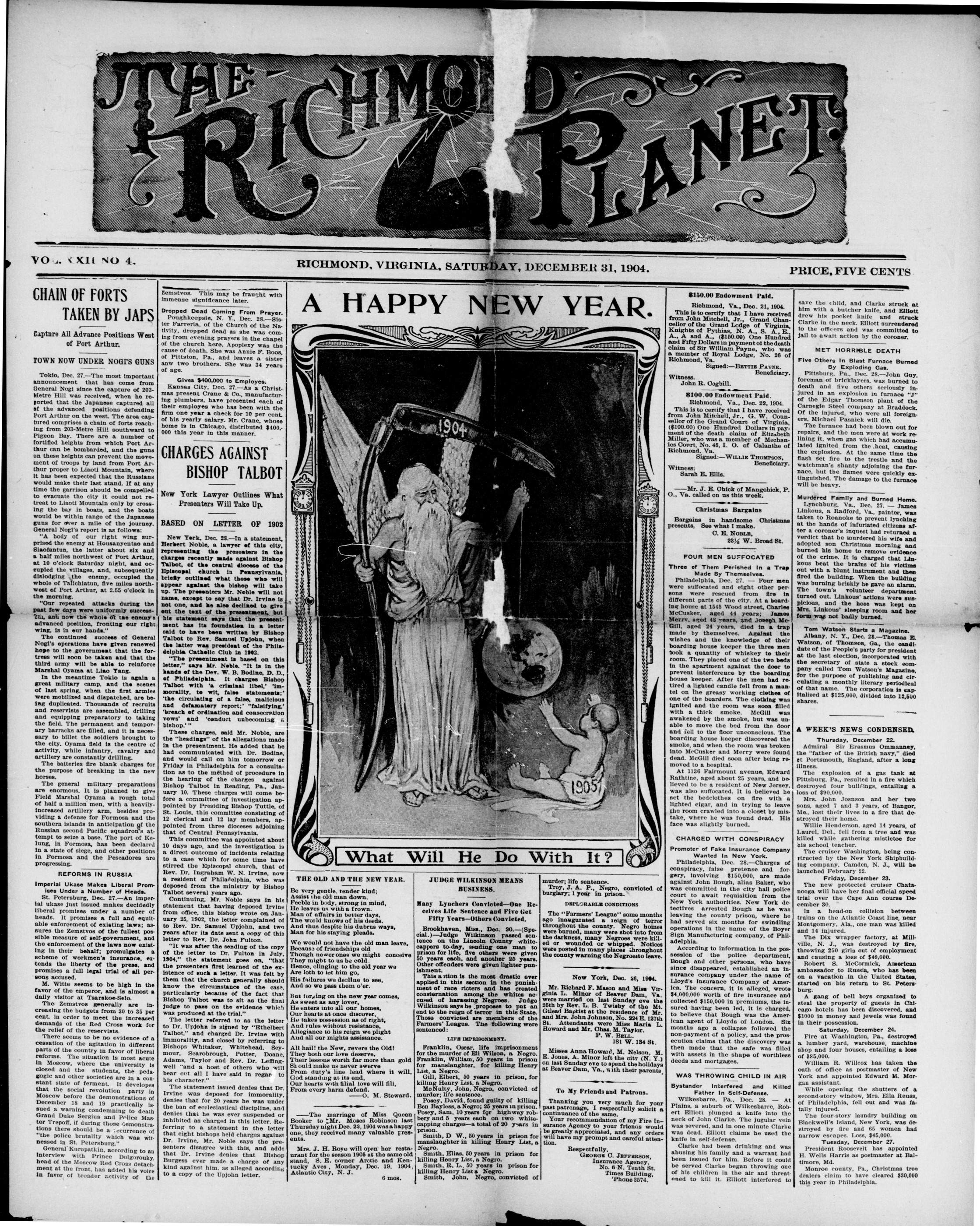
A HAPPY NEW YEAR.
What Will He Do With It?
Be very gentle, tender kind;
Assist the old man down.
Feeble in body, strong in mind.
He leaves us with a frown.
Man of affairs in better days.
The world knows of his deeds.
And thus despite his dubrus ways,
Man for his staying pleads.
We would not have the old man leave,
Because of friendships old
Though newer ones we might conceive
They might to us be cold.
Hence, clinging to the old year we
Are loth to let him go.
His failures we decline to see,
And so we pass them o'er.
But forging on the new year comes,
As sweet as any lover.
He enters into all our homes,
Our hearts at once discover.
He takes possession as of right,
And rules without resistance,
Allegiance to his reign we plight
And all our mights assistance.
All hail! the New, revere the Old!
They both our love deserve.
Their lessons worth far more than gold
Sh could make us never swerve
From duty's line lead where it will,
God standing at its end,
Our hearts with filial love will fill,
From every harm defend.
The marriage of Miss Queen Booker to Mr. Moses Robinson last Thursday night Dec. 23, 1904 was a happy one, they received many valuable presents.
Mrs. J. H. Roye will open her restaurant for the season 1905 at the same old stand, S. E. corner Arctic and Kentucky Aves, Monday, Dec. 19, 1904 Atlantic City, N. J.
6 mos.
PLANET
JUDGE WILKINSON MEANS BUSINESS.
Many Lynchers Convicted—One Receives Life Sentence and Five Get Fifty Years—Others Convicted.
Brookhaven, Miss., Dec. 20.—(Special.)—Judge Wilkinson passed sentence on the Lincoln County white-cappers to-day, sending one man to prison for life, five others were given 50 years each, and another 25 years. Other offenders were given lighter punishment.
This action is the most drastic ever applied in this section in the punishment of race rioters and has created consternation among the whites accused of harassing Negroes. Judge Wilkinson says he proposes to put an end to the reign of terror in this State. Those convicted are members of the Farmers' League. The following were sentenced:
LIFE IMPRISONMENT.
Franklin, Oscar, life imprisonment for the murder of Eli Wilson, a Negro. Franklin, William, 50 years in prison for manslaughter, for killing Henry List, a Negro. O'Brien, Albert, 50 years in prison, for killing Henry List, a Negro. MoNulty, John, Negro, convicted of murder, life sentence.
Posey, David, found guilty of killing Ben Bayless, a Negro; 25 years in prison. Posey, Sam, 10 years for highway robbery and 5 years each on two white-capping charges—a total of 20 years in prison. Smith, D W., 50 years in prison for manslaughter in killing Henry List, a Negro. Smith, Elias, 50 years in prison for killing Henry List, a Negro. Smith, R. L. 50 years in prison for killing Henry List a Negro.
Smith, John, Negro, convicted of
murder; life sentence. Troy, J. A. P., Negro, convicted of burglary; 1 year in prison.
DEPLORABLE CONDITIONS
The "Farmers' League" some months ago inaugurated a reign of terror throughout the county. Negro homes were burned, many were shot into from the darkness, many Negroes were killed or wounded or whipped. Notices were posted in many places throughout the county warning the Negroes to leave.
New York, Dec. 26, 1984
Mr. Richard F. Mason and Miss Virginia L. Minor of Beaver Dam, Va. were married on last Sunday eve the 25th by Rev. L. B. Twisby of the Mt. Gilead Baptist at the residence of Mr. and Mrs. John Johnson, No. 224 E. 127th St. Attendants were Miss Maria L. Howard and Mr. Ohas. M. Taylor. P. W. BELL. 181 W. 134 St.
Misses Anna Howard, M. Nelson, M. E. Jones, A. Minor left the city (N. Y.) on last Sunday eve to spend the holidays at Beaver Dam, Va., with their parents.
To My Friends and Patrons
Thanking you very much for your past patronage, I respectfully solicit a continuance of the same.
Your recommendation of my Fire Insurance Agency to your friends would be greatly appreciated, and any orders will have my prompt and careful attention.
Respectfully,
GEORGE C. JEFFERSON,
Insurance Agency,
No. 6 N. Tenth St.
Times Building,
'Phone 2574.
$150.00 Endowment Paid.
Richmond, Va., Dec. 21, 1904.
This is to certify that I have received from John Mitchell, Jr., Grand Chancellor of the Grand Lodge of Virginia, Knights of Pythias, N. A., S. A. E., A., A and A., ($150.00) One Hundred and Fifty Dollars in payment of the death claim of Sir William Payne, who was a member of Royal Lodge, No. 26 of Richmond, Va.
Signed:—BETTIE PAYNE.
Beneficiary.
Witness.
John R. Cogbill.
Richmond, Va., Dec. 22, 1904.
This is to certify that I have received from John Mitchell, Jr., G. W. Counsellor of the Grand Court of Virginia, ($100.00) One Hundred Dollars in payment of the death claim of Elizabeth Miller, who was a member of Mechanics Court, No. 45, I. O. of Calanthe of Richmond, Va.
Signed:—WILLIE THOMPSON,
Beneficiary.
Witness:
Sarah E. Ellis.
—Mr. J. E. Chick of Mangohick, P.
O., Va. called on us this week.
Bargains in handsome Christmas presents. See what I make.
FOUR MEN SUFFOCATED
Three of Them Perished In a Trap
Made By Themselves
Made by themselves.
Philadelphia, Dec. 27. — Four men were suffocated and eight other persons were rescued from fire in different parts of the city. At a boarding house at 1545 Wood street, Charles McCusker, aged 44 years; James Merry, aged 48 years, and Joseph McGill, aged 24 years, died in a trap made by themselves. Against the wishes and the knowledge of their boarding house keeper the three men took a quantity of whiskey to their room. They placed one of the two beds in the apartment against the door to prevent interference by the boarding house keeper. After the men had retired a lighted candle fell from a mantel on the greasy working clothes of one of the boarders. The clothing was ignited and the room was soon filled with a thick smoke. McGill was awakened by the smoke, but was unable to move the bed from the door and fell to the floor unconscious. The boarding house keeper discovered the smoke, and when the room was broken into McCusker and Merry were found dead. McGill died soon after being removed to a hospital.
At 1136 Fairmount avenue, Edward Rathine, aged about 25 years, and believed to be a resident of New Jersey, was also suffocated. It is believed he set the bedclothes on fire with a lighted cigar, and in trying to leave the room crawled into a closet by mistake, where he was found dead. His face was slightly burned.
CHARGED WITH CONSPIRACY
Promoter of Fake Insurance Company Wanted In New York.
Philadelphia, Dec. 28.—Charges of conspiracy, false pretence and forgery, involving $150,000, are made against John Bough, alias Baker, who was committed in the city hall police court to await requisition from the New York authorities. New York detectives arrested Bough as he was leaving the county prison, where he had served six months for swindling operations in the name of the Boyer Sign Manufacturing company, of Philadelphia.
According to information in the possession of the police department, Bough and other persons, who have since disappeared, established an insurance company under the name of Lloyd's Insurance Company of America. The concern, it is alleged, wrote $4,000,000 worth of fire insurance and collected $150,000 in premiums, the insured having been led, it is charged, to believe that Bough was the American agent of Lloyds of London. Six months ago a collapse followed the non-payment of a policy, and the prosecution claims that the discovery was then made that the safe was filled with assets in the shape of worthless deeds and mortgages.
WAS THROWING CHILD IN AIR
Bystander Interfered and Killed Father In Self-Defense.
Wilkesbarre, Pa., Dec. 28. — At Plains, a suburb of Wilkesbarre, Robert Elliott plunged a knife into the neck of John Clarke. The jugular vein was severed, and in one minute Clarke was dead. Elliott claims he used the knife in self-defense.
Clarke had been drinking and was abusing his family and a warrant had been issued for him. Before it could be served Clarke began throwing one of his children in the air and threatened to kill it. Elliott interfered to
save the child, and Clarke struck at him with a butcher knife, and Ellott drew his pocket knife and struck Clarke in the neck. Ellott surrendered to the officers and was committed to jail to await action by the coroner.
MET HORRIBLE DEATH
Five Others In Blast Furnace Burned By Exploding Gas.
Pittsburg, Pa., Dec. 28.—John Guy, foreman of bricklayers, was burned to death and five others seriously injured in an explosion in furnace "J" of the Edgar Thomson plant of the Carnegie Steel company at Braddock. Of the injured, who were all foreigners, Michael Passnick will die. The furnace had been blown out for repairs, and the men were at work relining it, when gas which had accumulated ignited from the heat, causing the explosion. At the same time the flash set fire to the trestle and the watchman's shanty adjoining the furnace, but the flames were quickly extinguished. The damage to the furnace will be heavy.
Murdered Family and Burned Home
Lynchburg, Va., Dec. 27. — James Linkous, a Radford, Va., painter, was taken to Roanoke to prevent lynchings at the hands of infuriated citizens after a coroner's inquest had returned a verdict that he murdered his wife and adopted son Christmas morning and burned his home to remove evidence of the crime. It is charged that Linkous beat the brains of his victims out with a blunt instrument and then fired the building. When the building was burning briskly he gave an alarm. The town's volunteer department turned out. Linkous' actions were suspicious, and the hose was kept on Mrs. Linkous' sleeping room and her form was not badly burned.
John Watson Starts a Magazine.
Albany, N. Y., Dec. 28—Thomas E.
Watson, of Thomson, Ga., the candidate
of the People's party for president
at the last election, incorporated with
the secretary of state a stock company called Tom Watson's Magazine,
for the purpose of publishing and circulating a monthly literary periodical
of that name. The corporation is capitalized at $125,000, divided into 12,500
shares.
A WEEK'S NEWS CONDENSED.
Thursday, December 22.
Admiral Sir Erasmus Omannney,
the "father of the British navy," died
at Portsmouth, England, after a long
illness.
The explosion of a gas tank at
Pittsburg, Pa., resulted in a fire which
destroyed four buildings, entailing a
loss of $90,000.
Mrs. John Josnson and her two
sons, aged 7 and 3 years, of Bangor,
Me, lost their lives in a fire that
destroyed their home.
Wille Henderson, aged 14 years, of
Laurel, Del., fell from a tree and was
killed while gathering mistletoe for
ais school teacher.
The cruiser Washington, being
constructed by the New York Shipbuilding
company, Camden, N. J., will be
launched February 22.
Friday, December 23.
The new protected cruiser Chata-
nooga will have her final official speed
trial over the Cape Ann course
December 30.
In a head-on collision between trains on the Atlantic Coast line, near Montgomery, Ala., one man was killed and 14 injured.
The Dix wrapper factory, at Millville, N. J., was destroyed by fire, throwing 250 girls out of employment and causing a loss of $40,000.
Robert S. McCormick, American ambassador to Russia, who has been on a vacation in the United States, started on his return to St. Petersburg.
A gang of bell boys organized to steal the property of guests in Chicago hotels has been discovered, and $1000 in money and jewels was found in their possession.
Saturday, December 24.
Fire at Washington, Pa., destroyed a lumber yard, warehouse, machine shop and four houses, entailing a loss of $85,000.
William R. Willcox has taken the oath of office as postmaster of New York and appointed Edward M. Morgan assistant.
While opening the shutters of a second-story window, Mrs. Ella Reuss, of Philadelphia, fell out and was fatally injured.
The four-story laundry building on Blackwell's island, New York, was destroyed by fire and 65 women had narrow escapes. Loss, $45,000.
Tuesday. December 27.
President Roosevelt has appointed H. Wells Harris as postmaster at Baltimore, Md.
Monroe county, Pa., Christmas tree dealers claim to have cleared $30,000 this year in Philadelphia.
THE PLANET
(1)
THE CENTURY'S CALL
Deep unto deep, it calleth,
The century's dominant sky;
Over the over, the plain,
Over the peak and the mountain chain,
Under the thrilling sky,
The voice of mighty peoples,
And the toast of war and woe,
For the land. Were its sounding,
And a man must rise and go.
**I am hasten**
To find her hidden wealth.
The lore she guards and the treasure
She only yields by stealth.
A man must fear no peril.
He must ride like knight of old;
To tourney and tilt, with a good right hand.
That she loves to the hilt for the love of the land.
And here's to the soldier bold!
Who is pure of thought and action,
Who is ready to serve his age,
Who cares for the thing he doeth,
And not for the soldier's wage.
Deep unto deep, it calleth,
The century's urgent cry.
Splendid and strong is the century's song,
Valer and love to the battle throng,
And it may not pass you by.
From East to West 'tis sounding,
The call for the brave and the true.
O lads with puses bounding,
That cry is meant for you.
Wherever the need is greatest,
Wherever the ill is worst,
Over the city's thousands thick,
Over the deserts of stone and brick,
Over the lands accurst,
The cry for help is pealing,
Bitter with want and woe.
O brave heart, it is worth,
A man must arise and go.
Margaret E. Sangster, in Youth's Companion.
OLD RACKABONES' L·A·S·T·K·I·C·K BY ROBERT MERRILL, JR.
IF WAS a very queer thing to have happen, a most uncanny circumstance, at best. Perhaps only a physiologist could have retained his equanimity.
But if Hoke Samson had been a better boy, if he had been anything, in fact, except the ignorant, rough fellow he was he would not have been so badly frightened.
Hoke drove a green-truck wagon into Bristol village every summer morning. The fresh young beets, peas, cucumbers, potatoes and green corn which he peddled were all right; and for that reason the village housekeepers were glad to see him appear. Yet it made everybody's heart ache to see the way he used his old horse.
Whenever he stopped at a house, or rather when he started on to another. Hoke would yell, savagely: "Hudup, Old Rackabones!" and beat the horse with his white oak whip-stock.
It was plain that the animal could but just drag along with his load. His bones stood up high in his rusty, rumpled gray hide, and his looks were those of hopeless dejection. Evidently he was half-starved, and the only reward for his hard day's labor was: "Hudup, Old Rackabones!" and a crack from the whip-stock.
The village people talked about it, and the Cruelty-to-Animalies officer was notified. But the selection of Bristol argued that Hoke had a mother and three sisters, and that if they took the old horse away from him the town would have to help them. They threatened him, however, and bade him feed the horse better.
Others, mostly women, remonstrated with Hoke time and again, till he grew insolent with them. "This is my boss—see? I shall drive him as I've a mind to—see? Lots o' folks git rich mindin' their own business—see?"
Compassion had been left out of Hoke. He was a little more cautious about beating the horse when he saw that people were watching him, but it was said by some that he more than made up for this when he thought he was out of sight and hearing on the road beyond the village.
What all who knew Hoke and his horse had long expected, happened one day last autumn. Old Rackabones died. On one of his trips to the village he fell in the shafts of the wagon, about a mile and a half from his miserable home, and that time even the oak whip-butt failed to make him get up. The only wonder was that he had not died long before! Hoke was "mad clean through"—that was what he said to a neighbor afterward—that Old Rackabones should "up and die" in that mean fashion, just as he was most needed to draw the winter wood. Besides, he broke one of the wagon shafts in falling. That was another mean trick! If he must fall, he might, at least, have fallen forward, and not sidewise on that shaft!
Hoke unbuckled the harness, got the horse clear of the wagon, and then, pulling first by the tail, then by the ears, he hauled the body out of the road and through a set of bars into a pasture, where he left it to fate and the crows. The way home was over descending ground, and Hoke was able to haul the wagon himself.
His mother was even more angry than he had been. She berenated Old Racka-bones and the world at large the time they were at supper. Then an idea occurred to her.
"We must save his hide and shoes."
said she. "His hide's worth a dollar and a quarter, anyhow, and his four shoes ten cents apiece. You go skin that hoss, Hoke, and do it while he's warm, and call at Robbins' and borrow his pinchers to pull off them hoss-shoes with."
She sharpened the butcher-knife with a whetstone and lighted the lantern. But Hoke did not like the idea of going back there in the evening.
"I don't b'lieve I can do it," said he.
"What! Pay a dollar to have that boss skinned!" cried Mrs. Samson.
"That never'll do! You go skin that hoss, Hoke, and go right off, too, before he's cold."
Hoke set off with lantern and knife, having little stomach for the job. He called at their neighbor Robbins' to borrow the pinchers, and succeeded in coaxing little Jimmy Robbins to go with him to hold the lantern.
The gray body did look rather uncanny by lantern-tight, lying there in the dark pasture, and some animal, a dog, probably, was sneaking round, but slunk away as they approached. It did not add to the cheerfulness that an owl began to hoot down in the swamp below the pasture, and that ere long a dog—perhaps the same one—raised a melancholy howl at a distance.
Hoke felt queer all over; but he got to work after a shaky fashion, and pulled off the shoes from the two forefeet and one of the hind ones. The other, the under one, bothered him.
The leg was drawn up, the tendons contracted, but they stretched out when he pulled at the shoe. When he let go they drew back in an odd way.
It came into his mind to cut the cords, and, seizing the leg by the fetlock, he began hacking with the large knife above the "gambrel joint." Quite by chance he partly severed, not the tendons, but the sciatic nerve, or what corresponds to that in a horse. Instantly a singular phenomenon was exhibited. The cut through the nerve sheath liberated the residual nervous energy of the nerve trunk. The flexor muscles were first stimulated to contraction; the leg jerked itself from Hoke's hand!
This of itself was somewhat alarming, but even before he could step back, the extensors felt the reflex stimulus, and the leg straightened powerfully—much as if a living horse had kicked. Hoke was standing exactly in line, and the result was that hoof and shoe landed pretty nearly over his solar plexus, with such violence that he was bowled over backward and measured his length among the stones of the pasture.
Little Jimmy Robbins, who had stood holding the lantern in a rather perturbed state of mind, no sooner saw the dead horse kick Hoke over than he dropped the light and fled homeward, with a howl of terror.
And Hoke—well, one knows just what Hoke did or thought. He has
A
never described his emotions. The breath was pretty nearly knocked out of him; but he got away from there, somehow, and arrived home not long after in a condition, mentally, that frightened his mother, although she was not a woman easily alarmed. Hoke rushed in at the door, with eyes sticking out, and white as a sheet. Perhaps it was partly the kick on his stomach. All he could say was that dead Old Rackabones had tried to kill him! The kick itself is easily explained on grounds of nerve action; but Hoke knew little of nerves. He sat by the stove and shook like a leaf. His mother could hardly drive him to bed. The next day he pretended to be sick and kept indoors. For more than a fortnight he could not be induced to go out after dark. For, like most cruel boys, Hoke was a coward.
Meanwhile the selectmen had interred Old Rackabones at the public expense. Hoke's courage rose a little after he learned that the old horse was underground; but people noticed that he had a scared look round the ear of the autumn.
In November he went to work with a gang of Italians excavating gravel for a new railroad that was to pass within a mile of their house. He is still excavating. That seems fit employment for him. It is no doubt, better that a boy like Hoke should not have dumb animals at his mercy. Pick and shovel do not suffer from his cruelty.—Youth's Companion.
Do It Now.
When you've got a job to do.
Do it now!
If it's one you wish was through,
Do it now!
If you're sure the job's your own,
Don't hem and haw and groan—
Do it now!
Don't put off a bit of work,
Do it now!
It doesn't pay to shirk,
Do it now!
If you want to fill a place
And be useful to the race,
Just get up and take a brace,
Do it now!
Don't linger by the way.
Do it now!
You'll lose if you delay;
Do it now!
If the other fellows wait,
Or postpone until it's late,
You hit up a faster gait—
Do it now!
—Frank Farrington, in N. Y. Sun.
The day started with a frown is qui
apt to end with a failure.
Mistress—Norah, you shouldn't use kerosene to light the fire with. It's dangerous.
THE RICHMOND PLAN
Norah—Oi allus used it at me last place, mum.
Mistress—And you never got blown up?
Norah—Sure, an' Oi did, mum—most every day, by th' missus.-Cincinnati Enquirer.
A DAIN
Pretty H
Be
The C
Masculine Delusion
Mr. Squallop—Eunice, what do you want me to get you for a Christmas present this year?
Mrs. Squallop—Why do you ask me so long before Christmas?
Mr. Squallop—Because you'll forget all about it by that time, and when I get it for you it'll come with all the force of a sudden surprise—Chicago Tribune.
Looking Ahead
"I have heard a good deal about people who borrow trouble, but I think my wife is a champion in that line."
"Why, I thought she was always cheerful and contented with her lot."
"She was until our baby was born six weeks ago. Now she is worrying because he may marry some girl that we shan't like." - Smith's Weekly.
WAR WITH WATER.
The Great Conflict in the East Again Demonstrates the Superiority of Temperate Soldiers.
While all eyes are turned in the direction of Port Arthur, it may be well to remember that war has its temperance lessons as well as peace. Many years ago the late Sir Benjamin Ward Richardson declared: "Never let this lesson be forgotten in thinking of strong drink; that the drink is strong only to destroy; that it never by any possibility adds strength to those who drink it," and his declaration has received the backing of athletes, mountaineers, explorers and generals in every part of the world. The old fallacy that intoxicating liquors produce strength and give endurance has been exploded, and the men and women who take strong drink under the delusion that it will make them strong have no evidence whatever in support of their case. For almost without exception when a man of really remarkable physical ability speaks upon the subject he presents a totally different view of the case, and when records are broken and great athletic and military victories are won it is almost invariably without the aid of liquor.
This is emphasized from both sides in the present struggle in the east. The Japs are a very abstemious race, and their bravery and endurance during the present campaign have been remarkable, and now there comes the intelligence that open indulgence in drink by the Russians has assumed appaling dimensions, and Gen. Kuropatkin has issued stringent orders prohibiting the sale of liquors. This is very significant. It shows that the general has read history to some purpose. For our greatest generals have been unanimous in declaring that drink is not only unnecessary but injurious to soldiers in the performance of their arduous work. Sir Evelyn Wood, in 1882, testified: "Throughout the Crimea these were the best and healthiest soldiers and sailors who did not touch infloxating drink." A few years later, Lord Wolseley wrote: "There are yet some great enemies to be encountered by the United Kingdom. But the most pressing enemy is drink. It kills more than all our newest weapons of warfare, and not only destroys the body but the mind and soul also." The Ashantee war, the famous Red river expedition, and not so long ago the series of brilliant and decisive achievements in the Soudan campaign of 1898, by Lord Kitchener and his troops, were accomplished on nothing stronger than water. And have we not the authority of the field marshal that those wonderful British marches in the south African campaign were accomplished through the remarkable steadiness of the troops? A meeting held at Bloomfeinstein, Lord Roberts said: "He was proud to be the leader of the best behaved army in the world. They had fought splendidly, marched uncompromisingly, and endured all the hardships of the campaign. The whole army have been members of the Army Temperance association. Modder river was all they had to drink and sometimes little of that."
Thus it is not surprising that Gen. Kuropatkin should not have been slow to profit from the experience of his contemporaries. For without justifying bloodshed in the slightest degree, temperance reformers can point to any campaign from the Crimean war to the present struggle in the east as unanswerable arguments in favor of warring without drink, declares the Scottish Reformer. "The old superstition that grog is a good thing for men before, driving us after a march has," decked Lord Wellesley, the commander of the Red river expedition, "been proved by scientific men of all nations to be a fallacy, and is only maintained by men who mistake the cravings arising from habit for the promptings of nature." And this statement is truer to-day than ever, and is receiving volume and emphasis from every sphere of physical activity. The moral of this is as plain to the civilian as to the soldier.
Sad Disappointment.
"Now," said the visitor, "will you show me my racing stables and your prize heifers?" "I haven't any of either," replied the prominent politician. "Is it possible," exclaimed the other, "that you are running this farm to make money out of it!"—Chicago Tribune.
Dissatisfied.
"Dere's a lot o' people kickin'," said Meandering Mike, "tame names of the railroads won't hire a man under forty 35 years old."
"Yes," answered Plodding Pete, "I'm only 32. I've got to take chances on havin' work shoved at me fur tree more years."—Washington Star.
A Long Meal.
Mrs. Farmer—After you finish <u>cintin</u>
I shall expect you to do some <u>work</u>
arount, th' farm.
ICHMOND, VIRGINIA.
BACK TO THE CHEMISE.
Paris has dropped the corset cover as abruptly as the nondescript little garment was taken up and not a single trousseau of the hundreds made for wealthy or titled autumn brides includes one. Women of fashion who were permitted to feast their eyes on the truly royal outfit of Mile. Anna Massena d'Essling de Rivioli, recently married to the ambitious young marquis of Albufera, looked in vain for the abbreviated waist long regarded as an indispensable adjunct to stays. Instead, they saw stocks of wondrous chemises, each prettier than its predecessor, on which nimble fingers plainly had lavished unusual beauty to insure their welcome. As the bridegroom is a Bonaparte, a great-grand-grandson of the Lucien of that name, and as the bride derives her ancestry from several of the oldest families in the imperialist nobility, being a great-grandniece of Massena, it may be supposed the jingerie was designed with an eye to the newest fashion. The Tuxedo set doubtless will cling to the corset cover for awhile, but it must yield in the end—the chemise has come to its own again.
PROTECTING CHILD'S BED.
How the Little One May Be Given Fresh Air Without Danger of Drafts.
The illustration shows a device for keeping the air from an open window from blowing upon the heads of sleeping children, and also for keeping restless little sleepers from falling out of bed, says the Rural New Yorker. A triangular piece of cloth is tacked
with round-headed brass tacks to the side of the bed. The upper corner has a ring to go over a brass hook in the head-board. During the day this piece of cloth can be folded in under the mattress. If made of some pretty material and neatly bound, this addition to the bed's furnishings will not look at all unattractive, if left in place during the day.
The front panel is quite the newest thing in skirts. Most of the small hats are tricornes or short-shaped turbans. The crown is quite distinct from the brim in the new turbans. Tulle is one of the latest trimming ideas and is used in great quantities. Coq de roche is most effective as a relief note with gray-green and brown. Not for years has the separate wrap been such an important feature of dress. Ribbon of two contrasting shades is very smart for trimming tailor hats. Lots of fire brown and spinach green will be exploited in panne velvet and net.
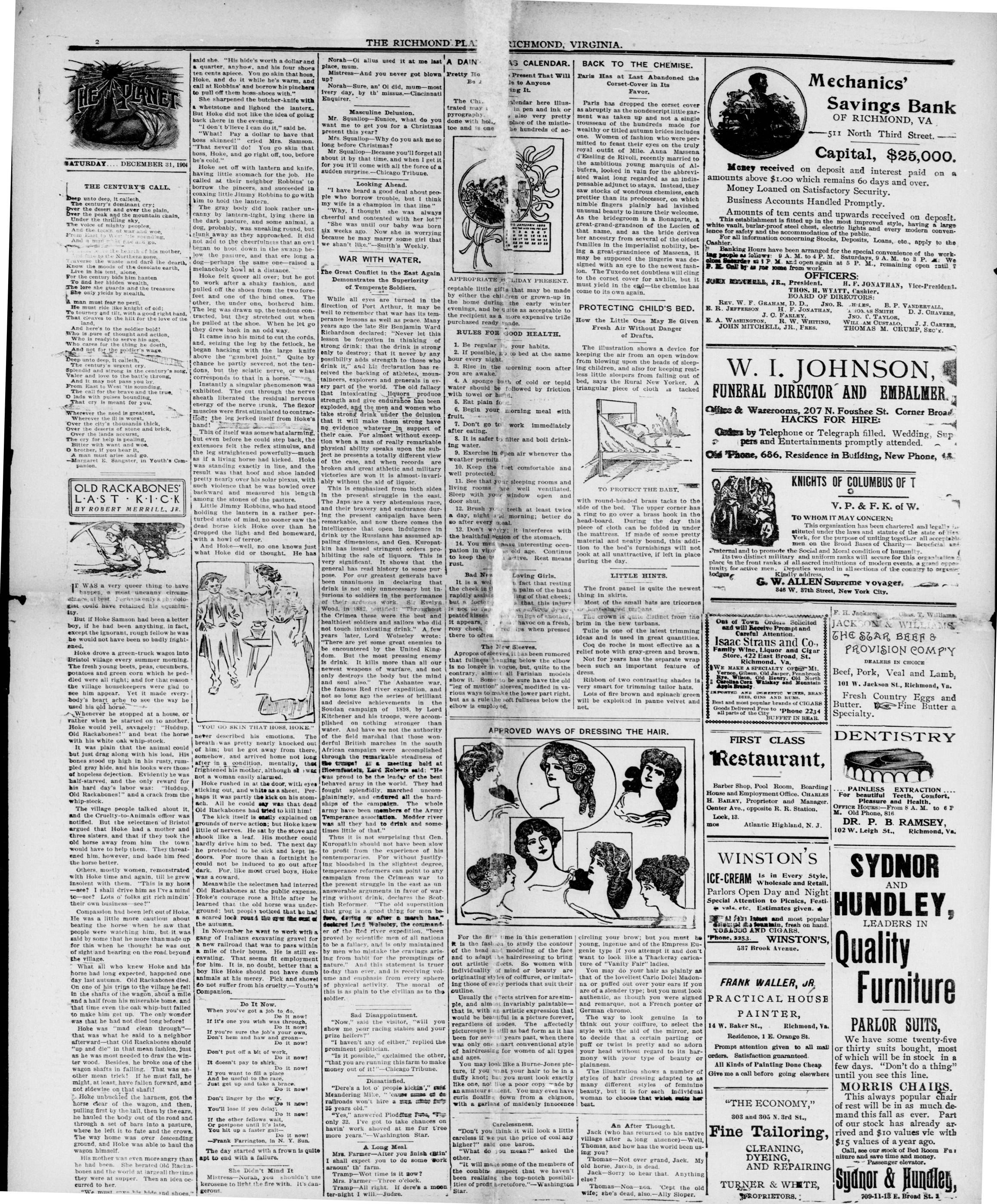
APPROVED WAYS OF DRESSING
DRESSING THE HAIR.
3
circling your brow; but you must be young, ingenuine and of the Empress Eugenie type if you attempt it and don't want to look like a Thackeray caricature of "Vanity Fair" ladies. You may do your hair as plainly as that of the loveliest Carlo Dolci Madonna or puffed out over your ears if you are of a slender type; but you must look authentic, as though you were signed and remarque, not a French poster or German chromo.
The way to look genuine is to think out your coiffure, to select the style with the aid of the mirror, not to decide that a certain parting or puff or twist is pretty and so adorn your head without regard to its harmony with your type of beauty or plainness.
The illustration shows a number of styles of hair dressing adapted to as many different styles of feminine beauty, but it is for each individual woman to choose that which suits her best.
In After Thought:
Jack (who has returned to his native village after a long absence)—Well, Thomas, and how has the world been using you?
Thomas—Not over grand, Jack. My old horse. Jacob, is dead.
Jack—Sorry to hear that. Anything else?
Thomas—Noa—noa. 'Cept the old wife; she's dead, also. Ally Sloner.
Pretty Ho
Ba A
Present That Will be to Anyone ing It.
The Chi.
trated may:
pygraphy
done with hol-
toe and is one
calendar here illus
in pen and ink or
also very pretty
place of the mistle
be hundreds of ac
20 JANUARY 1899
MARTH VISIT THE 70 BAT
1 2 3 4 5 6 7
8 9 10 11 12 13
14 15 16 17 18 19
20 21 22 23 24 25
26 27 28 29 30 31
APPROPRIATE HOLIDAY PRESENT.
ceptable little gifts that may be made by either the children or grown-up in the home during the early winter evenings, and be quite as acceptable to the recipient as a more expensive tride purchased ready made.
RULES FOR GOOD HEALTH.
1. Be regular in your habits.
2. If possible, go to bed at the same hour every night.
3. Rise in the morning soon after you are awake.
4. A sponge bath of cold or tepid water should be followed by friction with towel or hand.
5. Eat plain food.
6. Begin your morning meal with fruit.
7. Don't go to work immediately after eating.
8. It is safer to filter and boil drinking water.
9. Exercise in open air whenever the weather permits.
10. Keep the feet comfortable and well protected.
11. See that your sleeping rooms and living rooms are well ventilated. Sleep with your window open and door shut.
12. Brush your teeth at least twice a day, night and morning; better do so after every meal.
13. Don't worry; it interferes with the healthful action of the stomach.
14. You must have interesting occupation in vigor or old age. Continue to keep the body active. Rest means rust.
Loving Girls.
n fact that resting
n palm of the hand
ling of that check;
a that this injury
a suffered by re-
mains lips of another,
a havoc on a fresh,
red lips when pressed
Bad New
It is a wel
the cheek in it
rapidly assists
but a doctor
is not so rap-
peated kisses
it appears, c
rosy cheek
there to often
The New Sleeves.
Apropos of sleeves, it has been rumored that fullness hanging below the elbow is no longer in vogue, but, quite to the contrary, almost all Parisian models show it. Some to be sure have the old "leg of mutton" sleeves, modified in various ways to make the lower part right, but as a rule the soft fullness below the elbow is employed.
For the first time in this generation it is the fashion to study the contour of the head and modelling of the face and to adapt the hairdressing to bring out artistic effects. So women with individuality of mind or beauty are originating styles of colfures, or imitating those of early periods that suit their outline.
Usually the effects striven for are simple, and almost invariably paintable—that is, with an artistic expression that would be beautiful in a picture forever, regardless of modes. The affectedly picturesque is still as bad form as it has been for several years past, when there was only one smart conventional style of hairdressing for women of all types and ages.
You may look like a Burne-Jones picture, if you want your hair to be in a fluffy knot; but you must look exactly like one, not like a poor copy made by an amateur student. You may even have curls floating down from a chignon, with a garland of maidenly innocence
Carelessness.
"Don't you think it will look a little careless if we put the price of coal any higher?" said one baron.
"What do you mean?" asked the other.
"It will make some of the members of the combine suspect that we haven't been realizing the top-notch possibilities of profit heretofore."—Washington Star.
TO PROTECT THE BABY
LITTLE HINTS
JINHUANG
Mechanics' Savings Bank OF RICHMOND, VA
Capital, $25,000.
Money received on deposit and interest paid on amounts above $1.00 which remains 60 days and over. Money Loaned on Satisfactory Security.
Money received on deposit and interest paid on a amounts above $1.00 which remains 60 days and over.
Money Loaned on Satisfactory Security.
Business Accounts Handled Promptly.
Amounts of ten cents and upwards received on deposit.
This establishment is fitted up in the most improved style, having a large white vault, burlar-proof steel chest, electric lights and every modern convenience for safety and the accommodation of the public.
For all information concerning Stocks, Deposits, Loans, etc., apply to the Cashier.
Banking Hours have been arranged for the special convenience of the working people as follows: 9 A. M. to 4 P. M. Saturday, 9 A. M. to 3 P. M. We close Saturday at 1 P. M. and open again at 5 P. M., remaining open until 9 P. M. Call by as per some from work.
OFFICERS:
JOHN BETTLELL, JR., President. H. F. JONATHAN, Vice-President.
THOS. H. WYATT, Cashier.
BOARD OF DIRECTORS:
REV. W. F. GRAHAM, D. D., JNO. R. HILES, B. P. VANDERVALL,
E. R. JEFFERSON, H. F. JONATHAN, JONAS SMITH, D. J. CHAVERS,
J. O. FARLEY, JNO. C. TAYLOR.
Amounts of ten cents and upwards received on deposit.
This establishment is fitted up in the most improved style, having a large white vault, burlar-proof steel chest, electric lights and every modern convenience for safety and the accommodation of the public.
For all information concerning Stocks, Deposits, Loans, etc., apply to the Cashier.
Banking Hours have been arranged for the special convenience of the working people as follows: 9 A. M. to 4 P. M. Saturday, 9 A. M. to 3 P. M.; We close Saturday at 1 P. M. and open again at 5 P. M., remaining open until 2 P. M. Call by as per form work.
OFFICERS
JOHN BETTLELL, JR., President. H. F. JONATHAN, Vice-President-
THOS. H. WYATT, Cashier.
BOARD OF DIRECTORS:
REV. W. F. GRAHAM, D. D., JNO. R. HULES, B. P. VANDERVALL,
E. R. JEFFERSON H. F. JONATHAN, I. OXON SMITH D. J. CHAVERS,
J. C. FARLEY, JNO. C. TAYLOR,
E. A. WASHINGTON, R. W. WHITING, WILL AM CUSTALO, J. J. CARTEE,
JOHN MITCHELL, JR., FRES. THOMAS M. CRUMP, SECY.
W. I. JOHNSON,
FUNERAL DIRECTOR AND EMBALMER.
Office & Warerooms, 207 N. Foushee St. Corner Broad
HACKS FOR HIRE:
Orders by Telephone or Telegraph filled. Wedding, Sup-
pers and Entertainments promptly attended.
Old Phone, 686, Residence in Building, New Phone, 48
W. I. JOHNSON, FUNERAL DIRECTOR AND EMBALMER
Office & Warerooms, 207 N. Foushee St. Corner Broad HACKS FOR HIRE: Orders by Telephone or Telegraph filled. Wedding, Suppers and Entertainments promptly attended. Old Phone, 686, Residence in Building, New Phone.
```markdown
```
KNIGHTS OF COLUMBUS OF T
TO WHOM IT MAY CONCERN:
This organization has been chartered and legally instituted under the laws and statute of the state of New York, for the purpose of uniting together all acceptable men on the Broad Bases of Charity - Beneficial and paternal and to promote the Social and Moral condition of humanity.
It two distinct military and uniform ranks will secure for this organization place in the front ranks of all sacred institutions of modern events, a grand oppo- tunity for active men. Deputies wanted in all sections of the country to organize lodges.
G. W. ALLEN Supreme voyager.
846 W. 87th Street, New York City.
This organization has been chartered and legally situated under the laws and statute of the state of New York, for the purpose of uniting together all acceptable men on the Broad Bases of Charity—Beneficial and internal and to promote the Social and Moral condition of humanity. Its two distinct military and uniform ranks will secure for this organization a place in the front ranks of all sacred institutions of modern events, a grand opportunity for active men. Deputies wanted in all sections of the country to organize lodges.
G. W. ALLEN Supreme voyager.
846 W. 87th Street, New York City.
F. H. Jackson Chas. T. Williams JACKSON & WILLIAMS THE STAR BEER &
Out of Town Orders Solicited and will Receive Prompt and Careful Attention.
Isaac Straus and Co.
Family Wine, Liquor and Cigar Store, 422 East Broad, St. Richmond, Va.
PROVISION COMP'Y
DEALERS IN CHOICE
WE MAKE A SPECIALTY OFFICE Mt.
Vernon, Gibson, Old Jasper, Pennbrook
Rye, Wilson, Old Henry, Old North
Wilshire, Whisky and Mountain
Apple Brandy
IMPORTED ONE DOCENTIC WINES, BRANDS,
DIES, GUNS AND RUMS.
Best and most popular brands of CIGARS
Goods Delivered Free to 'Phone 2234
all parts of the City
BUFFET IN REAR.
Fresh Country Eggs and Butter. Fine Butter a Specialty.
DENTISTRY
FIRST CLASS
```markdown
```
Restaurant.
Barber Shop, Pool Room, Boarding House and Employment Office. CHARLES H. BAILEY, Proprietor and Manager. Center Ave., opposite R. R. Station. Look 13.
PAINLESS EXTRACTION
For beautiful Teeth, Comfort,
Pleasure and Health,
OFFICE HOURS:—From 8 A. M. to 6 F
M. Old Phone, 816
DR. P. B. RAMSEY,
102 W. Leigh St., Richmond, Va.
mos Atlantic Highland, N. J.
WINSTON'S
ICE-CREAM Is in Every Style,
Wholesale and Retail.
Parlors Open Day and Night
Special Attention to Picnics, Festi-
vals etc. Estimates given.
Al farin Instant and most popular
dishware in a fresh on hand.
YOULOOO AND CIGARS.
Phone: 2253. WINSTON'S
537 Brook Avenue.
FRANK WALLER, JR.
PARLOR SUITS.
We have some twenty-five or thirty suits bought, most of which will be in stock in a few days. "Don't do a thing" until you see this line. MORRIS CHAIRS.
This always popular chair of rest will be in as much demand this fall as ever. Part of our stock has already arrived and $10 values vie with $15 values of a year ago. Call, see our stock of Bed Room Furniture and save time and money. Passenger elevator.
CLEANING
DYEING
AND REPAIRING
Sydnor & Hundley,
TURNER & WHITE PROPRIETORS.
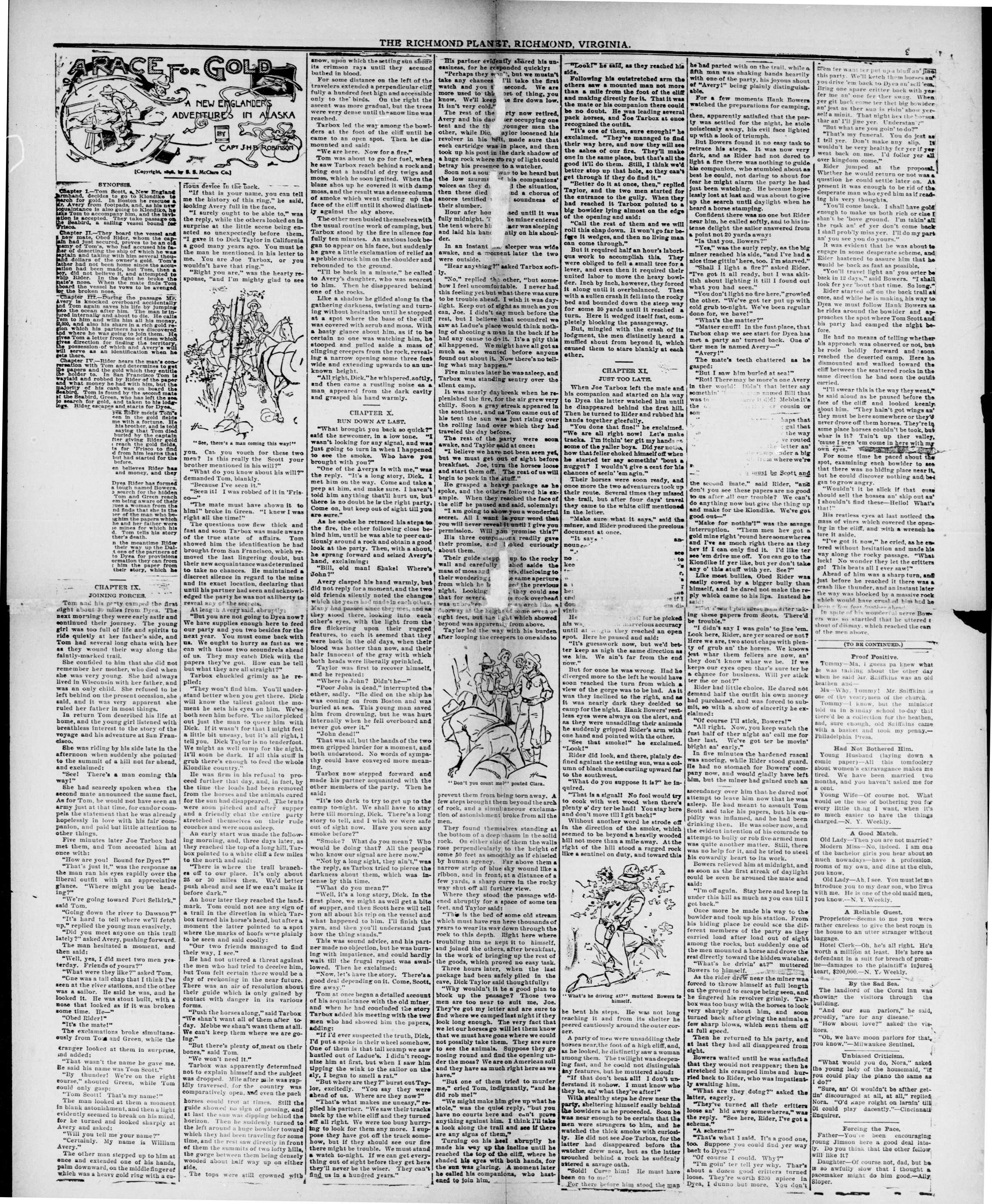
ARACE FOR GOLD
A NEW ENGLANDERS
ADVENTURES IN ALASKA
BY
CAPT J.H.B. ROBINSON
[Copyright, 1998, by B. S. McClure Co.]
Chapter 1.—Tom Scott, a New England armhand, decides to go to Klondike to search for gold. In Boston he rescues a young woman of a footpads, and, as his new loquimance is also a tool, which�s his skis Tom to accompany him, and the invitation is accepted. They take passage on the Beabird, a sailing vessel bound for Tisco.
Chapter II.—They board the vessel and new mate, Obed Rider, whom the cap-
am had just secured, proves to be an old army of Tom's, who had accused his father deserting the ship of which he was sent to the seals. The total thousand dollars of the owner's gold, together with the other had not been home since the accession had been made, but Tom, then a boy, did not believe it, and attempted to ship to the river. In a fight, the man's note. When the mate finds Tom, the board the vessel he vows to be avenged for the broken nose.
Chapter III.—During the passage Mr. Avery is knocked overboard accidentally and Tom was on the ship by jumping into the ocean after him. The man was reduced internally and about to die. He calls Tom to him and wills him all his money, too, and also calls his share in a rich gold redemption which his mother, the discovers and where he was going to join them. He gives Tom a letter from one of them which gives direction for finding the territory by the pression of which and Avery's will will serve as an identification when he gets the.
Chapter IV.-Rider hears the man's conversation with Tom and determines to get the paper and the gold which they entitle the holder to. The paper and the gold are waylaid and robbed by Rider of the paper and what money he had with him, but the holder of his money is on board the Seabird. Tom is found by Rider at the Seabird, Green, who has left the sea to search for gold, and taken to his lodgings. Rider escapes and starts for Dynea. Rider meets Tom's e-mail and asks me with a fortune. He his brother, and is told saying that Tom died buried with his after giving Rider gold reach the gold fields, ts for "Frisco to find df from him learns that but had started for the before. en believes Rider has and money, and they
Dyea Rider has formed a tough named Bowera, so search for the hidden man em being aware of their nues a woman from the end finds that she is the right him the papers which he and her father were iines for which his id. Tom tells his story in the meantime Rider their way up the Dal-tone of the partners of to Dyea for provisions formation they can from their story, which he
Tom and his party camped the first eight about 30 miles from Dyca. The next morning they were early atir and continued their journey. The young girl was too full of life and spirits to ride quietly at her father's side, and Tom had several long chats with her as they wound their way along the faintly-marked trail.
She confided to him that she did not remember her mother, who died when she was very young. She had always lived in Wisconsin with her father, and was an only child. She refused to be left behind on the present occasion, she said, and it was very apparent she ruled her father in most things.
In return Tom described his life at home, and the young girl listened with breathless interest to the story of the voyage and his adventure at San Francisco.
She was riding by his side late in the afternoon when suddenly she pointed to the summit of a hill not far ahead, and exclaimed:
"See! There's a man coming this way!"
She had scarcely spoken when the second mate announced the same fact. As for Tom, he would not have seen an army just at that time, for candor compels the statement that he was already hopelessly in love with his fair companion, and paid but little attention to other things.
Five minutes later Joe Tarbox had met them, and Tom accosted him at once with:
"How are you! Bound for Dyea?"
"That's just it," was the response as the man ran his eyes rapidly over the liberal outfit with an appreciative glance. "Where might you be heading?"
"We're going toward Fort Selkirk," said Tom.
"Going down the river to Dawson?"
"It's hard to tell where we'll fetch up," replied the young man eagerly.
"Did you meet anyone on this trail lately?" asked Avery, pushing forward. The man hesitated a moment, and then said:
"Well, yes, I did meet two men yesterday. Friends of yours?"
"What were they like?" asked Tom.
"One was a tall chap that I think I've seen at the river stations, and the other was a sailor. He said he was, and he looked it. He was stout built, with a nose that looked as if it was broken some time. He—"
The exclamations broke simultaneously from Tom and Green, while the stranger looked at them in surprise, and added:
"That wasn't the name he gave me. He said his name was Tom Scott."
"By thunder! We're on the right course," shouted Green, while Tom could only gasp:
"Tom Scott! That's my name!"
The man looked at them a moment in blank astonishment, and then a light evidently seemed to break on his mind, for he turned and looked sharply at Avery and asked:
The other man stepped up to him at once and extended one of his hands, palm downward, on the middle finger of which was a heavy gold ring with a cu-
"Obed Rider!"
"It's the mate!"
"Will you tell me your name?"
"If that is your name, you can tell me the history of this ring," he said, looking Avery full in the face.
"I surely ought to be able to," was the reply, while the others looked on in surprise at the little scene being enacted so unexpectedly before them.
"I gave it to Dick Taylor in California a good many years ago. You must be the man he mentioned in his letter to me. You are Joe Tarbox, or you wouldn't have that ring."
"Right you are," was the hearty response, "and I'm mighty glad to see
"See, there's a man coming this way!"
you. Can you vouce for these two men? Is this really the Scott your brother mentioned in his will?" "What do you know about his will?" demanded Tom, blankly.
"Because I've seen it."
"Seen it! I was robbed of it in 'Frisco—"
"The mate must have shown it to him!" broke in Green. "I knew I was right all the time!"
The questions now flew thick and fast and soon Tarbox was made aware of the true state of affairs. Tom showed him the identification he had brought from San Francisco, which removed the last lingering doubt, but their new acquaintance was determined to take no chances. He maintained a discreet silence in regard to the mine and its exact location, declaring that until his partner had seen and acknowledged the party he was not at liberty to reveal any of the secrets.
At length Avery said, abruptly:
"But you are not going to Dyea now? We have supplies enough here to feed our party and you two besides for the next year. You must come back with us. We ought to hurry as fast as we can with those two secondnels ahead of us. They may catch Dick with the papers they've got. How can he tell but what they are all straight?" Tarbox chuckled grimly as he replied:
"They won't find him. You'll understand better when you get there. Dick will know the tallest galot the moment he sets his eyes on him. We've both seen him before. The sailor picked out just the man to queer him with Dick. If it wasn't for that I might feel a little bit uneasy, but it's all right, I tell you. Dick Taylor is no tenderfoot. We might as well camp for the night. It'll soon be dark. If all this stuff is grub there's enough to feed the whole Klondike country."
He was firm in his refusal to proceed further that day, and, in fact, by the time the loads had been removed from the horses and the animals cared for the sun had disappeared. The tents were soon pitched and after supper and a friendly chat the entire party stretched themselves on their rude couches and were soon asleep.
An early start was made the following morning, and, three days later, as they reached the top of a long hill, Tarbox pointed to a white cliff a few miles to the north and said:
"There is where the trail branches off to our place. It's only about 25 or 30 miles then. We'd better push ahead and see if we can't make it before dark."
An hour later they reached the landmark. Tom could not see any sign of a trail in the direction in which Tarbox turned his horse's head, but after a moment the latter pointed to a spot where the marks of hoofs were plainly to be seen and said coolly:
"Our two friends managed to find their way, I see."
He had not uttered a threat against the men who had tried to deceive him, but Tom felt certain there would be a day of reckoning in the near future. There was an air of resolution about their guide which is only gained by contact with danger in its various forms.
"Push the horses along," said Tarbox "We shouldn't want all of them after today. Mebbe we shan't want them at all. We can't keep them where we are going."
"But there's plenty of meat on their bones," said Tom.
"We won't need it."
Tarbox was apparently determined not to explain himself and the subject was dropped. Mile after mile was rapidly traversed, for the country was comparatively open, and even the pack horses could trot at times. Still the guide showed no sign of pausing, and at last the sun was dipping behind the horizon. Then he suddenly turned to the left around a huge bowler toward which they had been traveling for some time, and the rest saw directly in front of them the summits of two lofty hills, the gorge between them being densely wooded about half way up on either side.
The tops were still crowned with
THE RICHMOND PLANET, RICHMOND, VIRGINIA.
snow, upon which the setting sun shone its crimson rays until they seemed bathed in blood.
For some distance on the left of the travelers extended a perpendicular cliff fully a hundred feet high and accessible only to the birds. On the right the ascent was more gradual, but the trees were very dense until the snow line was reached.
Tarbox led the way among the bowlers at the foot of the cliff until he came to an open spot. Then he dismounted and said:
"We are here. Now for a fire."
Tom was about to go for fuel, when he saw Tarbox reach behind a rock and bring out a handful of dry twigs and moss, which he soon ignited. When the blaze shot up he covered it with damp moss, and the result was a dense column of smoke which went curling up the face of the cliff until it showed distinctly against the sky above.
The other men busied themselves with the usual routine work of camping, but Tarbox stood by the fire in silence for fully ten minutes. An anxious look began to appear on his face, but suddenly he gave a little exclamation of relief as a pebble struck him on the shoulder and rebounded to the ground.
"I'll be back in a minute," he called to Avery's daughter, who was nearest to him. Then he disappeared behind one of the rocks.
Like a shadow he glided along in the gathering darkness, twisting and turning without hesitation until he stopped at a spot where the base of the cliff was covered with scrub and moss. With a hasty glance about him, as if to be certain no one was watching him, he stooped and pulled aside a mass of clinging creepers from the rock, revealing a narrow opening some three feet wide and extending upwards to an unknown height.
"All right, Dick," he whispered, softly, and then came a rustling noise as a man appeared from the dark cavity and grasped his hand warmly.
RUN DOWN AT LAST
"What brought you back so quick?" said the newcomer, in a low tone. "I wasn't looking for any signal, and was just going to turn in when I happened to see the smoke. Who have you brought with you?" "One of the Averys is with me," was the reply. "It's a long story, Dick. I met him on the way. Come and take a peep at him, and make sure. I haven't told him anything that'll hurt us, but there is no doubt he is the right party. Come on, but keep out of sight till you are sure." As he spoke he retraced his steps to the fire, the other following close behind him, until he was able to peer cautiously around a rock and obtain a good look at the party. Then, with a shout, he sprang forward and seized Averys's hand, exclaiming: "Bill, old man Shakel Where's John?"
Avery clasped his hand warmly, but did not reply for a moment, and the two old friends silently noted the changes which the years had made in each other. Many had passed since they met, and they stood there, looking into each other's eyes, with the light from the fire flickering upon their rugged features, to each it seemed that they were back in the old days, when their blood was hotter than now, and their hair innocent of the gray with which both heads were liberally sprinkled. Taylor was first to recover himself.
Taylor was first to recover himself, and he repeated:
"Where is John? Didn't he—"
"Poor John is dead," interrupted the other, sadly. "He died on the ship he was coming on from Boston and was buried at sea. This young man saved him from drowning, but he was hurt internally when he fell overboard and never got over it."
"John dead!"
That was all, but the hands of the two men gripped harder for a moment, and both understood. No words of sympathy could have conveyed more meaning.
Tarbox now stepped forward and made his partner acquainted with the other members of the party. Then he said:
"It's too dark to try to get up to the camp to night. We shall have to stay here till morning, Dick. There's a long story to tell, and I wish we were safe out of sight now. Have you seen any smoke before?"
"Smoke? What do you mean? Who would be doing that? All the people who know our signal are here now." "Not by a long sight, they ain't," was the reply, as Tarbox tried to pierce the darkness about them, which was intense by this time.
"What do you mean?"
"Well, it's a long story, Dick. In the first place, we might as well get a bite of supper, and then Scott here will tell you all about his trip on the vessel and what happened to him. I'll finish the yarn, and then you'll understand just how the thing stands."
This was sound advice, and his partner made no objection, but he was burning with impatience, and could hardly wait till the frugal repast was swallowed. Then he exclaimed:
"Now, let's have the story. There's a good deal depending on it. Come, Scott, fire away."
Tom at once began a detailed account of his acquaintance with the old miner, and when he had concluded the story Tarbox added his meeting with the two men who had showed him the papers, adding:
"If I'd ever suspected the truth, Dick, I'd put a spoke in their wheel somehow. One of them is that tall scamp we saw hustled out of Ladue's. I didn't recognize him at first, but when I saw him tipping the wink to the sailor on the ally, I began to smell a rat."
"But where are they?" burst out Taylor, excitedly. "You say they were ahead of us. Where are they now?" "That's what makes me uneasy," replied his partner. "We saw their tracks back by the white cliff and they turned off all right. We were too busy hurrying to look for them any more. I suppose they have got off the track somehow, but if they should see our fire there might be trouble. We must stand a watch to night. If we can get everything out of sight before they get here they'll never be the wiser. They can't find us in a hundred years."
His partner evidently shared his uneasiness, for he responded quickly: "Perhaps they won't, but we mustn't take any chances. I'll take the first watch and you won't second. We are more used to the sort of thing, you know. We'll keep we fire down low. It isn't very cold."
Perhaps they will, but we mustn't take any chances. I'll take the first watch and you't second. We are more used to the sort of thing, you know. We'll keep the fire down low. It isn't very cold."
The rest of the thirty now retired, Avery and his daughter occupying one tent and the third younger men the other, while Dio,aylor loosened his revolver in his belt, made sure that each cartridge was in place, and then took up his post in the dark shadow of a huge rock where to ray of light could betray his presence to a watcher.
Soon not a souls was to be heard but the low murmur of his companions' voices as they danced in the situation, then these died and a chorus of anores testified to soundness of their slumber.
was to be heard but
his companions'
l the situation,
and a chorus of
soundness of
Hour afer how fully midnight. T the tent where his and laid his hand der.
Hour after hour, sed until it was fully midnight. Then the miner entered the tent where his helper was sleeping and laid his hand on his shoulder.
In an instant the sleeper was wide awake, and a moment later the two were outside.
"Hear anything?" asked Tarbox softly.
"No," replied the other, "but somehow I feel uncomfortable. I never had this feeling yet but what there was sure to be trouble ahead. I wish it was daylight. Keep out of sight as much as you can. Joe. I didn't say much before the rest, but I believe that scoundrel we saw at Ladue's place would think nothing of shooting a man in the back if he had any cause to do it. It's a pity this all happened. We might have all got as much as we wanted before anyone found out about it. Now there's no telling what may happen."
Five minutes later he was asleep, and Tarbox was standing sentry over the silent camp.
It was nearly daybreak when he resplished the fire, for the air grew very chilly. Soon a gray streak appeared in the southeast, and us Tom came out of his tent the sun was just rising over the rolling land over which they had traveled the day before.
The rest of the party were soon awake, and Taylor said at once: "I believe we have not been seen yet, but we must get out of sight before breakfast. Joe, turn the horses loose and start them off. The rest of us will begin to pack in the stuff."
He grasped a heavy package as he spoke, and the others followed his example. When they reached the face of the cliff he paused and said, solemnly
"I am going to show you a wonderful secret. All I want is your word that you will never reveal it until I give you permission. Will you promise this?" His three companions readily gave their promise, and looked curiously about them.
Their guide stepp up to the rocky wall and carefully ahed aside the mass of moss and tras, disclosing to their wondering the same aperture from which he met the previous night. Looking they could see that for several rock overhead was unbeen.
Their guide stepp up to the rocky wall and carefully abide aside the mass of moss and disclosing to their wondering to the same aperture from which he had the previous night. Looking they could see that for several it rock overhead was unobeyed an arch like a doorway at the height of some seven or eight feet, but the light which showed beyond was apparently from above. Taylor led the way with his burden after looping the creepers to one side to
44 Don't run count well past Gum
"Don't you count me?" pouted Clara. prevent them from being torn away. A few steps brought them beyond the arch of rock, and a simultaneous exclamation of astonishment broke from all the men. They found themselves standing at the bottom of a deep chasm in the solid rock. On either side of them the walls rose perpendicularly to the height of some 50 feet as smoothly as if chiselled by human agency. Far above them a narrow strip of blue sky wound like a ribbon, and in front, at a distance of a few yards, a sharp curve in the rocky way shut off all further view. Where they stood the passage wildened abruptly for a space of some ten feet, and Taylor said:
"The is the bed of some old stream which must have run here thousands of years to wear its wav down through the rock to this depth. Right here where troubling him he kept it to himself, and joined the others, after breakfast, in the work of bringing up the rest of the goods, which proved no easy task. Three hours later, when the last package had been safely piled in the cave, Dick Taylor said thoughtfully:
"Why wouldn't it be a good plan to block up the passage? Those two men are too near to suit me, Joe. They've got my letter and are sure to find where we camped last night if they look long enough. The very fact that we let our horses go will let them know that we must have gone where we could not possibly take them. They are sure to see the animals. Suppose they go nosing round and find the opening under the moss? We are on American soil and they have as much right here as we have."
"But one of them tried to murder me," cried Tom, indignantly, "and he did rob me!" "We might make him give up what he stole," was the quiet reply, "but you have no courts here and can't prove anything against him. I think I'll take a look along the trail and see if there are any signs of them."
Turning on his heel abruptly he made his way up the inloline until he reached the top of the cliff, where he shaded his eyes with both hands, for the sun was glaring. A moment later he called his companions, who hastened to join him.
"Look!' he said, as they reached his side.
Following his outstretched arm the others saw a mounted man not more than a mile from the foot of the cliff and making directly for it. That it was the mate or his companion there could be no doubt. He was leading several pack horses, and Joe Tarbox at once recognized the outfit.
"It's one of them, sure enough!" he exclaimed. "They've managed to find their way here, and now they will see the ashes of our fire. They'll make one in the same place, but that's all the good it'll do them. Still, I think we'd better stop up that hole, so they can't get through if they do find it."
"Better do it at once, then," replied Taylor, and the two men started for the entrance to the gully. When they had reached it Tarbox pointed to a big bowler lying almost on the edge of the opening and said:
"Call the rest of them and we will roll this chap down. It won't go far before it wedges, and then no living man can come through."
But it required half an hour's laborious work to accomplish this. They were obliged to fell a small tree for a lever, and even then it required their united labor to move the heavy bowler. Inch by inch, however, they forced it along until it overbalanced. Then with a sullen crash it fell into the rocky bed and bounded down the steep way for some 30 yards until it reached a turn. Here it wedged itself fast, completely blocking the passageway.
But, mingled with the crash of its lodgment, the men distinctly heard a muffled shout from beyond it, which caused them to stare blankly at each other.
JUST TOO LATE
When Joe Tarbox left the mate and his companion and started on his way to Dyca the latter watched him until he disappeared behind the first hill. Then he turned to Rider and rubbed his hands together gleefully.
"You done that finel!" he exclaimed.
"We are all right now! Let's make tracks. I'm itchin' ter git my hands on some of the yaller boys. Did yer notice how that feller choked himself off when he started ter say somethin' 'bout a nugget? I wouldn't give a cent for his chances of seein' 'em again."
Their horses were soon ready, and once more the two adventurers took up their route. Several times they missed the trail, but after four days' travel they came to the white cliff mentioned in the letter.
"Make sure what it says," said the miner, and Rider produced the precious document at once.
He lighted for he picked his way, and marvelous accuracy until at length they reached an open spot. Here he paused and said: "It's guesswork now, but we'd better keep as nigh the same direction as we kin. We ain't far from the end now."
But for once he was wrong. Had he diverged more to the left he would have soon reached the turn from which a view of the gorge was to be had. As it was they inclined to the right, and as it was nearly dark they decided to camp for the night. Hank Bowers' restless eyes were always on the alert, and as they were unsaddling their animals he suddenly gripped Rider's arm with one hand and pointed with the other. "See that smoke!" he exclaimed. "Look!"
Rider did look, and there, plainly defined against the setting sun, was a column of black smoke curling upward far to the southwest.
"What do you suppose it is?" he inquired.
"That is a signall! No fool would try to cook with wet wood when there's plenty o' dry ter be had! You stay here and don't move till I git back!"
Without another word he strode off in the direction of the smoke, which seemed to be beyond a heavily wooded hill not more than a mile away. At the right of the hill stood a ragged rock like a sentinel on duty, and toward this
M.
"What's he driving at?" muttered Bowers to himself.
he bent his steps. He was not long reaching it and from its shelter he peered cautiously around the outer corner.
A party of men were unsaddling their horses near, the foot of a high cliff, and, as he looked, he distinctly saw a woman among them. The twilight was deepening fast, and he could not distinguish any features, but he muttered aloud:
"If that don't beat all! I don't understand it nohow. I must know who they be, an' what they're after!"
With stealthy steps he drew near the party, sheltering himself easily behind the bowlers as he proceeded. Soon he was near enough to be certain that the men were strungers to him, and he watched the thick smoke with curiosity. He did not see Joe Tarbox, for the latter had disappeared before the watcher drew near, but as the latter aroused behind a rock he suddenly uttered a savage oath.
"Sold! Curse him! He must have been on to me!"
For there before him stood the man
he had parted with on the trail, while a fifth man was shaking hands heartily with one of the party, his joyous shout of "Avery!" being plainly distinguishable.
For a few moments Hank Bowers watched the preparations for camping, then, apparently satisfied that the party was settled for the night, he stole noiselessly away, his evil face lighted up with a look of triumph.
But Bowers found it no easy task to retrace his steps. It was now very dark, and as Rider had not dared to light a fire there was nothing to guide his companion, who stumbled about as best he could, not daring to shout for fear he might alarm the party he had just been watching. He became hopelessly lost at last and was about to give up the search until daylight when he heard a horse stamping.
Confident there was no one but Rider near him, he called softly, and to his-intense delight the sailor answered from a point not 20 yards away:
"Is that you, Bowers?"
"Yes," was the surly reply, as the big miner reached his side, "and I've had a nice time gittin' here, too. I'm starved." "Shall I light a fire?" asked Rider. "I've got it all ready, but I was skittish about lighting it till I found out what you had seen." "You don't light no fire here," growled the other. "We've got ter put up with cold grub to-might. We've been regular done for, we have!"
"What's the matter?"
"Matter enuff! In the fust place, that
Tarbox chap we see start for Dyea has
met a party an' turned back. One o'
other men is named Avery—"
"Avery!"
The mate's teeth chattered as he
gasped:
the second mate," said Rider, "and don't you see these papers are no good to us after all our trouble? We can't do anything now but give the thing up and make for the Klondike. We've got good out—"
"Make for nothin'!" was the savage interruption. "The men hev got a gold mine right round here somewhere and I've as much right there as they hev if I can only find it. I'd like ter see'm drive me off. You can go to the Klondike if yer like, but yer don't take any o' this stuff with yer. See?"
Like most bullies, Obed Rider was easily cowed by a bigger bully than himself, and he dared not make the reply which came to his lips. Instead he said:
"But I couldn't pull these men after taking these papers from Scott. There'd be trouble."
"I didn't say I was goin' to jine 'em. Look here, Rider, are yer scared or not? Here we are, two stout chaps with plenty of grub an' the horses. We knows jest what them fellers are now, an' they don't know whar we be. If we keeps our eyes open that's sure ter be a chance for business. Will yer stick ter me or not?" Rider had little choice. He dared not demand half the outfit his own money had purchased, and was forced to submit, so with a show of sincerity he exclaimed:
"Of course I'll stick. Bowers!"
Of course I'll stick, Bowers!"
"All right. Now, you keep watch the first half of the night an' call me for ther last. We've got ter be movin' bright an' early."
In five minutes the hardened rascal was snoring, while Rider stood guard. He had no stomach for Bowers' company now, and would gladly have left him, but the miner had gained such an ascendancy over him that he dared not attempt to leave him now that he was asleep. He had meant to assault Tom Scott and take his papers, but his cupidity was inflamed, and he had been drinking then. He was sober now, and the evident intention of his comrade to attempt to bully or rob five armed men was quite another matter. Still, there was no help for it, and he tried to steel his cowardly heart to its work.
Bowers relieved him at midnight, and as soon as the first streak of daylight could be seen he aroused the mate and said:
"I'm off again. Stay here and keep in under this hill as much as you can till I get back."
Once more he made his way to the bowler and took up his station. From his hiding place he could see the different members of the party as they carried load after load out of sight among the rocks, but suddenly one of the men mounted a horse and drove the rest directly toward the hidden watcher.
"What's he drivein' at?" muttered Bowers to himself.
As the rider drew near the miner was forced to throw himself at full length on the ground to escape being seen, and he fingered his revolver grimly. Tarbox was too busy with the horses to look very sharply about him, and soon turned back after giving the animals a few sharp blows, which sent them off at full speed.
Then he returned to his party, and at last they had all disappeared from sight.
Bowers waited until he was satisfied that they would not reappear; then he stretched his cramped limbs and hurried back to Rider, who was impatiently awaiting him.
"What are they doing?" asked the latter, eagerly.
"They've turned all their critters loose an' hid away somewhere," was the reply. "See here, Rider, I've got a scheme."
"A scheme?"
"That's what I said. It's a good one, too. Suppose you could find yer way back to Dyce?" "Of course I could. Why?" "I'm goin' teril tell yer why. Thar's about a dozen good critters turned loose. They're worth $200 apiece in Dyce, I dunno but more. You don't
seem fer waner waner put up a bluff an find this parity. We ketchell them horses an 'em you drive em' back to Dyean an' sell 'em. Bring one spare critter back with yer fer me an' an' fer ther swag. When yer git back come ter thet big bowder an' jest as ther is risin' show yer-self a minit. That night hex the horses thar an' ill jine yer. Understan " " "But what are you goin' to do" " " "That's my funeral. You do jest as I tell yer. Don't make any slip. It wouldn't be very healthy fer yer if yer went back on me. I'd foller yer all over kingdom come." Rider jumped at the proposal. Whether he would return or not was a question he could settle later on. At present it was enough to be rid of the desperate man who eyed him as if reading his very thoughts.
"You'll come back. I shall have gold enough to make us both rich or else I shan't be 'bove ground. I'm takin' all the resk an' ef yer don't come back I shall prob'ly miss yer. I'll do my part an' you see you do yours."
It was evident that he was about to engage in some desperate scheme, and Rider hastened to assure him that he would be back as fast as possible.
"You'll travel light an' you orter be back in 12 days," said Bowers. "I shall look for yer 'bout that time. So long."
Rider started off on the back trail at once, and while he is making his way to Dyea we must follow Hank Bowers as he rides around the bowler and approaches the spot where Tom Scott and his party had camped the night before.
He had no means of telling whether his approach was observed or not, but he rode boldly forward and soon reached the deserted camp. Here he dismounted and walked toward the cliff between the scattered rocks in the same direction he had seen the outfit carried.
"I'll swear this is the way they went," he said aloud as he paused before the face of the cliff and looked keenly about him. "They hain't got wings an' they must be here somewhere or they'd never drove off them horses. They're in some place horses couldn't be took, but whar is it? Tain't up their valley, 'cause I seen 'em come in here with my own eyes."
For some time he paced about the spot, examining each bowler to see that there was no hiding place near it, but he could discover nothing and began to grow angry.
"Wouldn't it be blick if that cus should sell the hosses an' skip out an' I shouldn't find these—Hello! What's that!"
His restless eyes at last noticed the mass of vines which covered the opening in the cliff, and with a wrench he tore it aside.
"I've got it now," he cried, as he entered without hesitation and made his way along the rocky passage. "What luck! No wonder they let the critters go! This beats all I ever saw!"
Ahead of him was a sharp turn, and just before he reached it there was a crash like thunder, and an instant later the way was blocked by a massive rock which would have crushed him bad he been 'low feet' feathered ahead.
In spite of his wonderful nerve Bowers was so startled that he uttered shout of dismay, which reached the ear of the men above.
Proof Positive.
Tcmmy—Ma, I guess pa knew what he was talking about the other day when he said Mr. Sniffkins was an old heathen and— Ma—Why, Tommy! Mr. Sniffkins is one of the vestrymen of the church. Tommy—I know, but the minister told us in Sunday school to-day that there'd be a collection for the heathen, and, sure enough, old Sniffkins came with a basket and took my penny.— Philadelphia Press.
Had Not Bothered Him
Young Husband (laying down a comic paper)—All this tomtooilery about women's extravagance makes me tired. We have been married two months, and you haven't asked me for a cent.
Young Wife—Of course not. What would ue the use of bothering you for every little thing I want, when it's so much easier to have the things charged—N. Y. Weekly.
A Good Match
Old Lady—Then you are not married?
Modern Miss—No, indeed. I am one of the bachelor girls you hear about so much nowadays—have a profession, rooms of my own, and dine at the club, you know.
Old Lady—Ah. I see. You must let me introduce you to my dear son, who lives with me. He is one of the old maid men, you know.—N. Y. Weekly.
A Reliable Guest
Proprelector—Seems to me you were rather careless to give the best room in the house to an utter stranger without baggage.
Hotel Clerk—Oh, he's all right. He's worth a million at least. He's here as defendant in a suit for breach of promise—damages to the plaintiff's injured heart, $200,000.—N. Y. Weekly.
By the Sad Sea.
The landlord of the Coral inn was showing the visitors through the building.
"And our sun parlors," he said, proudly, "are for any disease."
"How about love?" asked the visitors.
"Oh, we have moon parlors for that, you know."—Milwaukee Sentinel.
Unbiased Criticism
"What would you do, Nora," asked the young lady of the housemaid, "if you could play the piano the same as I do?" "Sure, an' Oi wouldn't be afther getin' discouraged at all, at all," replied Nora. "O'd kape roight on larnin' till Oi could play dacently."—Cincinnati Enquirer.
Forcing the Pace.
Father-You've been encouraging young Jimson here a good deal later. Do you think that the other fellow will like it?
Daughter-Of course not, dad, but he is so awfully slow that I thought a pacemaker might do him good.—Ally Sloper.
THE PLANET
issued every Saturday by JOHN A. CRAFT
at 80 North 40th Street Richmond, VA
DIN CUTCHELL, JR. - EDITOR
a communications intended for publications
could serve Cosmos to reach us by Wednesday
TERMS IN ADVANCER
Copy, one year, $1.50
Copy, eight months, 1.00
Copy, six months, .50
Copy, four months, .50
Copy, three months, .40
Agile Copy, .40
ADVERTISING RATES
one inch, one insertion, $ 60
one inch, each subsequent insertion, $ 85
two inches, six months, 6.00
two inches, six months, 10.00
two inches, nine months, 14.00
two inches, twelve months, 20.00
marriage and Funeral (Notices, 06
standing and Transient) Notices per line.
POSTAGE STAMPS OF A HIGHER DE-
COMMISSION THAN TWO CENTS NOT
RECEIVED ON SUBSCRIPTIONS.
THE PLANET is issued weekly. The subscrip-
tion price is $1.50 a year, in advance.
There are FOUR WAYS by which money can be by mail at our risk.—In a Post Office Money Order, by Bank Check or Draft, or an Exempt Money Order, if these are to be procured, in a Registered Letter, MONEY ORDERS.—You can buy a Money Orders at your Post Office, payable at the Richmond Post Office, and we will be responsible for its arrival. MONEY ORDERS can be obtained at any office of the American Express Co., the United States Express Co., and the Well Fared Companies for money sent by any of these companies. The Express Money Order is a safe and convenient way for forwarding money. REGISTERED LETTER—If a Money Order is to be reached, your Postmaster will Register the letter you wish to send on payment of ten cents. Then, if the letter is lost or stolen, you can send money in this manner at our risk. We cannot be responsible for money sent in letters in any other way than one of the seven mentioned above. If you send your money in another way, you must do it at your own risk.
GENEWALE, ETC.—If you do not want THE PLANET continued for another year after your desciption has not yet, you then notify by cardinal card to discontinue it. The courts have decided that subscribers to newspapers who do not their paper discontinue the execution of their work which it has been paid are liable for the payment of the subscription is to date when they order the paper discontinue.
GUMUNICA.—When writing to us renew your subscription or to discontinue the paper, you should give your name and adress in that otherwise we cannot find your CHANGE OF ADDRESS—In order to change the address of a subscriber, we must be sent former as well as the present address.
ENTERED in the Post Office at Richmond, and class matter.
SATURDAY ... DECEMBER 31, 1904
We have received a most interesting exchange with the euphonious name of Phonograph. It is published at Harrisonburg, Va with Rev. L. Campbell Garland as editor and Mr. J. Rollie Rice, publisher. It deserves success and the management has our best wishes.
MR. THOMAS NELSON PAGE'S CONCLUSION.
MR. THOMAS NELSON PAGE's conclusion of his admirable article on "The Old Time Negro" as published in SCHINNER'S MAGAZINE for November is as touchingly pathetic as any portion of the narrative.
Those of us who knew the late Mr. JOHN DANBEY, the caterer, will appreciate fully this tribute to the honesty of a deserving Virginian of the old school. He says:
The character of the old time Negro I can hardly better illustrate than by the case of an old friend of mine, John Dabney, to whom I, in common with nearly all my acquaintances in Richmond, used to be greatly indebted, for he was the best caterer I ever knew. John Dabney was, in his boyhood, a race-rider for a noted Virginia turfman, Major William R. Johnson, but, possibly because of his gifts as a cook, he soon grew too fat for that "lean and hungry" calling, and in time he became a celebrated cook and caterer. He belonged to one of the De Jarnetts of the adjoining county to my native county, and, prior to the war, he bought himself from his mistress, as was not infrequently done by clever Negroes. When the war closed he still owed his mistress several hundred dollars on account of this debt, and as soon as he was able to raise the sum he sent it to her. She promptly returned it, telling him that he was free and would have been free anyhow and that he owed her nothing. On this, John Dabney took the money, went to his old home and insisted on her receiving it, saying that his old master had brought him up to pay his debts, and that this was a just debt which he proposed to pay.
He adds the following testimonial:
The instances are not rare in which old family servants who have worked under the new conditions more successfully than their former owners have shown the old feeling by rendering them such acts of kindness as could only have sprung from a deep and abiding affection.
He says further:
Whoever goes to the White House will find at the door of the executive offices an elderly and very stout Negro door-keeper, with perfect manners, a step as soft as the fall of the leaf, and an aplomb which nothing can disturb. His name is Arthur Simmons, and, until toward the close of the war, he was a gentleman's servant in North Carolina, then he came North. He is, possibly the oldest employee in the White House, having been appointed by General Grant during his first term, and having held his position, with the exception of a single term—that of General Harrison—to the present time. It is said that Mr. Cleveland's first appointment after his return to office was that of Arthur Simm
mons to his old post. Possibly, Mr. Cleveland had heard this story of him: Once, Arthur, having learned that his old mistress had expressed a desire to see the President of the United States, invited her to Washington, met her at the station, saw to her comfort while in the city, arranged an interview with the President for her, and then escorted her back to take her train home.
Here is a case where a Democratic President appointed a Negro at the very doors of the White House, and to a position from which he had been removed by a Republican Chief Executive. In this case, there was no howl from the Negro haters of the Southla. d, who have since made themselves hoarse over the appointment of Dr. W. D. CRUM as Collector of the Port at Charleston, South Carolina
Mr. PAGE relates another incident:
On the part of the old plantation which I have attempted to describe has lived for the past thirty years, free of rent, the leading Negro politician in the upper end of Hanover County. His wife was Hannah, my mother's old maid, wno, from within a year or two after the war served us with a fidelity and zeal of which I can give no conception. It may, however, illustrate it to state that, although she lived a mile and a quarter through which, to and to cross a creek, through which, in time, she occasionally had to wade almost to her waist, she for thirty years did not miss being at her post in the morning more than a half-score times.
Hannah has gone to her long home, and it may throw some light on the old relation between mistress and servant to say that on the occasion of the golden wedding of my mother and father, as Hannah was at that time too ill to leave her home, they took all the presents in the carriage and carried them over to show them to her.
Indeed, Hannah's last thought was of her old mistress. She died suddenly one morning, and just before her death she said to her husband, "Open the do', its Miss —." The door was opened, but the mistress was not there, except to Hannah's dying gaze. To her, she was standing by her bedside, and her last words were addressed to her.
Mr. PAGE remarks;
It is a continual cause of surprise among those who do not know the South intimately that Southernners should be so fond of the old Negroes and yet should be so intolerant of things which Northerners would regard with indifference. It is a matter which can hardly be explained, but if anyone goes and live at the South, he will quickly find himself falling into Southern ways.
Let one go on the plantations where the politician is absent and the "bloody-shitt" newspaper is unknown, and he will find something of the old relation still existing.
The above is an absolutely correct statement. The case is very much like the young fellow and his best girl. He will kiss her, but—he doesn't want any one else to do the same thing.
The Southerner will eat with his Negroes, drink with his Negroes, and play with his Negroes, "But sah, I'll be d—ned if I want a Northerner to do it at right, and southern customs, must be observed only in the south and only by us, By Gawd." Mr. Page says:
I have seen a young man (who happened to be a lieutenant in a volunteer company) kiss his old mammy on the parade ground in sight of the whole regiment.
Here you have the testimony of an unimpeachable witness. How does this compare with President Reosevelt's attitude towards Prof. Booker T. WASHINGTON in the now famous lunching incident at the White House?
The white lieutenant could kiss a Negro woman before a whole white regiment, but a white President is not permitted to eat a meal of victuals with a Negro man within the privacy of his own official mansion. Mr. PAGE spoke truly when he said that such inconsistency "can hardly be explained." It can be summed up as being one of the incongruities of race prejudice.
Mr. PAGE cites another incident:
Some years ago, while General Fitzhugh Lee was Governor of Viiginia, a wedding took place in she executive mansion at Richmond. At the last moment, when the company were assembled and all had taken their places, waiting for the bride to appear, it was discovered that mammy Celia, the bride's mammy had not come in, and no less a person than General Lee, the Governor of Virginia went and fetched her in on his arm to take her place beside the mother of the bride.
This is true and occasioned no adverse comment at the time.
He concludes as follows:
Unhappily, whatever the future may produce, the teachings of doctrinaires and injudicious friends have lost the Negroes of the present generation their manners and cost them much of the friendship of the whites.
None of us knows what relation the future may produce between the two races in the South, but possibly when the self-righteous shall be rewer than they are now and the teachings which have estranged the races shall become more sane the great Anglo-Saxon race, which is dominant, and the Negro race, which is amiable, if not subservient, will adjust their differences more in accordance with the laws which must eventually prevail, and the old feeling of kindliness, which seems, under the stress of antagonism, to be dying away, will once more reassert itself.
This is a wish in which we can all join. We know that there are tens of thousands of colored people, who are uncoath and devoid of good manners, but the corn-field system and the freedom that came suddenly tended to make them so.
But on the other hand, there are thousands of as courty youngsters today in the hotels and club-houses of the North and the South as ever handled a waiter during the palmy days of the slave-holders' regime.
No one who has visited the aristocratic Westmorland Club-house, where Mr. Page often may be found during his "whiling away" moments here or at the palatial Commonwealth Club-house will doubt the truth of all that we say.
These colored servants are living types of the black butlers of the old
THE RICHMOND PLANET, RICHMOND, VIRGINIA.
school. Ill-bred', insulting, lazy, shiftless colored people are an abomination, and are roundly abhorred by the better elements of both races.
It must be admitted, however, that the uncoath Negro is but a duplicate of the uncoath white man, and the one should be as objectionable as the other. Every hotel in this city is managed and controlled in its dining apartments by the polite Chesterfiedian Negro and waiters, who are practical duplicates of the butlers of long ago. He is being antagonized by the New Issue Whites, but is being rigidly and tenaciously supported by the Old Issue ones and his offspring.
The time is now at hand when the Negro must depend upon himself without the advice and helping hanus of "Old Marster."
Still, it is a sad change for both parties. The old Mammy regards the white man of to day who is to her the white child of yesterday, as her charge and she can always secure a ready admittance to his presence. Even the wild, roving, wayward ones can excaim in the words of WILL CARLETON:
"But I've learned one thing and it cheers a man
In always a-doin' the best he can;
That whether, on the big book a blot
Gets over a fellow's name or not,
Whenever he does a deed that's white
It's credited to him fair and right,
An' when you hear the great bugle'
An' when you hear the great bugle's notes.
An' the Lord divides his sheep and goats:
Will be sure to stand right up for me."
SUIT AGAINST PAPER TRUST
SUIT AGAINST PAPER TRUST
Attorney General Moody Petitions U.S.
Court For Injunction.
ALLEGES UNLAWFUL COMBINE
St. Paul, Minn., Dec. 28—Attorney General Moody, for the United States, through United States District Attorney Haupt and Frank B. Kellogg and James M. Beck, special assistant attorneys general for the United States, filed a petition in the United States district court, in which he makes the General Paper company as principal defendant and 22 other paper and pulp companies, known as the paper trust, party defendants in a suit to enjoin them and restrain them from doing business through the General Paper company as the sales agent, in violation of the provisions of sections 1 and 2 of the act of congress approved July 1, 2012, "in an effort to protect trade and commerce against unlawful restraints and monopolies."
The petition alleges that the defendants entered into an agreement to combine and control the sale of the product of the different companies through the General Paper company, in that the General Paper company regulated prices, sales and shipments and territory for the sale of the same, and after deducting operating expenses of the General Paper company divided the surplus among the members of the corporation.
The petition recites that the General Paper company was organized under the laws of Wisconsin May 26, 1900, with a capital stock of $100,000, divided into 1000 shares, which were distributed among and are now held by certain of the defendants named, and that later the others were taken into the combination, naming them in the order in which they entered the combination, and goes on to state that the General Paper company became the exclusive selling agent for the defendants, with absolute power to control the output of the various mills, fix the price of all paper sold and to whom and upon what terms and conditions the paper should be sold; and into what states and places it shall be shipped and what publishers and other customers each mill shall supply.
the petition alleges that in consequence of the combination all competition in the manufacture, sale and distribution of paper had been restricted and the price of all paper products greatly increased, particularly that of news print paper, which has been increased about 50 per cent. The court is asked to declare the alleged combination unlawful and that the defendants be perpetually enjoined from doing any act in pursuance of the same. That the General Paper company be enjoined from acting as sales agent for the other defendants, and that the latter be enjoined from continuing their arrangement with the General Paper company. The court is also asked to direct the defendants to come into court and answer all questions relating to the charges in the petition which may be asked.
A TERRIFIC EXPLOSION
Portion of Powder Works Blows Up and Shakes Several Towns.
Halifax, N. S., Dec. 27.—A portion of the Acadia Powder company's works, near Waverly, 10 miles from this city, blew up, and the concussion shook the country and broke windows for 20 miles around. Fortunately no one was killed or seriously injured, although about 20 of the employees, who had just left the powder works when the explosion took place, were thrown violently to the ground and badly stunned.
The plant is situated a mile outside of Waverly, yet every window in the town was broken and many people on the streets were cut by the shower of broken glass. The property loss at the Acadia works is estimated at $25,000.
The explosion was in a small building known as the dry house, in which about a ton of powder was stored, and is believed to have been due to overheating. The concession demolished half a dozen other buildings close by the dry house, but did not explode the
powder in the magazine, although that building was partially wrecked. A hole several feet deep was blown in the ground.
Similar mortars were received from Bedford, the miles from the powder plant, and in Renfrew, Oldham and other small towns situated up the valley toward the scene of the explosion. The fact the only about one-fifth of the ordinary working force was about the building undoubtedly prevented loss of life.
Louisville, Ky. Dec. 27—A passenger train on Southern Railway collided head on the passenger train from Loa near Mawas Station, Ill. Oneenger and six employees were killed two passengers and eight emptied were slightly injured. The collisions was caused by the failure of the director at Browns, Ill., to deliver to east-bound train an order name meeting point for the two trains.
Physicians Off For Panama.
Baltimore, Md., Dec. 28—Twenty-two physicians, accompanied by several men and women not of the medical profession, left here on board the steamship Alos, of the Di Giorgio steamship line, bound for Panama. The physicians are delegates to the fourth PanAmerican Medical Congress, which will meet in Panama on or about January 3, 1905.
PATTERSON JURY DISAGREES
Unable to Reach Verdict After Being
Out Over 24 Hours.
New York, Dec. 24.—Following a day of intense nervous strain, Nan Paterson is in the Tembs ill and perhaps on the verge of a breakdown, but with constant attendance.
The former show girl, expecting acquittal at the hands of the jury which has listened to the evidence in her trial for the murder of Caesar Young last June, went into court to learn that the 12 men chosen to decide as to her innocence or guilt, had been unable to reach an agreement—in fact, had divided evenly over the question as to whether or not she held the revolver which ended Young's life. The jurors stood six to six—half for acquittal, the other for conviction. Although no official announcement was made further than this, court house talk had it that of the six deciding against Miss Patterson, none was for conviction of murder in the first degree, that one held out for murder in the second degree, two for manslaughter in the first degree and three for manslaughter in the second degree.
Immediately the announcement of the verdict was made Miss Patterson broke into fit of weeping, which continued after she was led from the court room in a retiring chamber, where physicians were called and restorative ministers. Then she was taken to Tombis, but she again wept and became hysterical, and the prison astron and attendants to quiet her were fallee.
ADMIRAL SCHLEY IN COLLISION
Was Badly Shaken Up In Railroad Wreck at Baltimore
Baltimore, Md., Dec. 28.—A collision occurred in the yards of the Pennsylvania railroad at Union Station between the Northern Central Harrisburg express train enroute from Washington and the peninsula express train of the Philadelphia, Baltimore and Washington railway, the latter being empty and shifting at the time. On the Harrisburg express were a large number of Mystic Shriners of that city and other passengers, including Admiral Schley.
The following persons were injured: George Ungle, engineer of Harrisburg express, hurt internally; Rudolph Bruetner, car cleaner, broken arm and cuts on forehead; S. S. Hall, of Washington, bruised on head and body; John G. Rappold, car cleaner, broken nose and cut head; Harry E. Heald, baggagemaster on the Peninsula express, cuts on head and broken nose, sent to hospital.
None of the passengers was injured though all of them, including Admiral Schley, were badly shaken up.
SILVER BULLION EXHAUSTED
Congress Must Take Prompt Action to Relieve the Situation.
Philadelphia, Dec. 23. — John H. Landis, superintendent of the U. S. Mint, in this city, announced that the available silver bullion of the country has been exhausted. Unless congress takes prompt action to relieve the situation by authorizing the purchase of more silver bullion for coining purposes or by accepting a suggested temporary remedy, he said, commerce will be greatly hampered next year as a result of a $10,000,000 sheritage in small silver coin. The prevailing conditions of the country's collateral also entails wholesale discharges of mint employees, to take effect on January 1, and unless relief is obtained from congress the regular mint force will be cut down to a nominal number within the next few months.
FIVE PERSONS BURN TO DEATH
Police Suspect Foul Play In Tragedy at Old Town, Md.
Old Town, Md., Dec. 27. — Mack Nimarick, his wife and child and Anna and Massaun Cole, Nimarick's sisters-in-law, all Slavs, were burned to death in a shanty in which 50 laborers employed on the Wabash railroad were housed. The men were employed by a sub-contractor named John Nichols. An explosion of coal oil is supposed to have caused the accident. Foul play is suspected by the police, as Nimarick is said to have had a considerable sum of money on his person. Two of the Slavs, members of the camp, are said to be missing.
Bought His Own Coffin.
Chicago, Dec. 28.—Buying a coffin estensibly or a friend, Leroy K. Nesbit, a banker committed suicide in an undertaking establishment. Scribbled on a card in the banker's pocket was a note saying: "I am tired of being a cripple." Nesbit had a shriveled leg and had spent thousands of dollars in a vain attempt to effect a cure.
C. H. R. W. Y.
1920
A NEW BOOK! PIANO PLAYING SELF-TAUGHT BY THEODORE DRURY
Simple and easy method. How to use the Fingers, Wrists and Arms. How to phrase. How to play accompaniments. Great help to teachers and all students of music. Sent by mail on receipt of $1.00. THEODORE DRURY, Dept. C, No. 217 East 50th St., New York City.
Knights of Pythias,
This organization is one of the most powerful in the country and its progress has been phenomenal. The Grand Lodge of Virginia has jurisdiction over all of the cities and counties in this state. Thirty males are required to organize a new lodge. The benefits paid constitute one of its strongest features, but the principles are greater than anything else. Founded on Friendship, based on Charity and established on Benevolence, the respectable, upright people of the state will find it an order worthy of their heartiest support.
It pays an endowment and burial benefit of $200.00 for all ages. It pays $4.00 per week sick dues. The badge, costing 75 cents each is the only absolutely necessary regalia. For information concerning the organization of lodges, apply at the main office.
The Courts of Calanthe
Is the Female Department of the Order. It requires a membership of thirty persons to organize a court. Its members are pledged to exhibit Fidelity, exercise Harmony and prove Love one for the other. It pays an endowment and burial benefit of $150.00. It pays $3.00 per week sick days. The only expense for regalia is the cost of the badge, 50 cents and prescribe stubs 25 cents for funeral occasions.
THE BANDS OF ALANTHE or Children's Department also constitutes
a feature and persons cannot better enter the little ones in this mystic circle. The expense is nominal and the benefits all that could be expected. It pays from $1.00 to $1.50 sick dues and death benefits from $0.00 to $40.00. If you have no Pythian Lodge or Court or Band in your neighborhood organize one. For all information concerning the Children's Department, address.
For all information concerning special rates of membership for new lodges and courts address
BOARDING & LODGING
Rates Reasonable. All the Comfort
of Home
Orders received by letter or telegraph
MRS. BOOKER LEFTWICH,
PROPRIETRESS,
8 St., Richmond.
GONZALES
The Greatest Clairvoyant &
Fortune Teller the World
Has Ever Known.
Unites Separated. Brings back the
one you Love, Helps Quickly all in
Trouble.
Removes Evil Influences, Cures Mysterious Diseases, Gives Luck and Success. Send Lock of Hair, Date of Birth and 12 cents. Ask three questions and receive Horoscope and Lucky Birthstone by mail. GONZALES, 236 Bergen St., Brooklyn, New York.
FRISCO
Opportunities for All.
No section of the United States provides the wonderful opportunities for success to the capitalist, professional man, farmer, miner, laborer, or trades that exists in the Great Southwest.
Missouri, Arkansas, Kansas, Oklahoma, Indian Territory, Texas, New Mexico and Arizona await men with money, brain and muscle.
Science has declared the climatic conditions of this section the greatest in the world.
Special round trip tickets to permit you to investigate and full information furnished upon application to
W.T. SAUUNDERS, D. P. A.,
FRISCO SYSTEM,
1108 E. Main St., Richmond, Va.
Knigh
KNIGHTS OF PYTHIAVS.
FCEN
This org
progress h
isdiction o
are require
of its stron
else. Fou
nevolence,
worthy of
It pays
THE FLOWER OF THE ROSE
a feature and persons cando.
The expense is nominal and due to $1.50 sick dues and death
Lodge or Court or Band in y
For all information concerni
For all information concerning membership for new lodges
McGIRT'S
MAGAZINE.
$5. Per Day Sure.
GREAT periodical public that we may have a paper races, the white as well race may know the many great race and what they are saying.
Thousands of white, as well as the coats. Some of them declare that they have learned colored race through this Magazine than to a doubt this periodical is far in advance of. Each month it contains articles from the are just as sure of making $5.00 per day so swerving this advertisement.
Write at once that you may be the first terms, outfit, and a large number of Magazines at once. Subscription Price to every
JAMES E. McGIRT,
have a paper that will be read by both
as well as the colored, that the white
my great men and women of the colored
saying and doing.
well as the colored, read this Magazine every month.
they have learned more about the great men of the
Magazine than they ever knew before and that without
an advance of anything yet attempted by the Negroes
from the greatest writers of the race. Agents
500 per day selling this Magazine as they are in an
may be the first in the field. Send 500. for agents
number of Magazines, with which you may begin work
to every one is One Dollar Per Year. Write—
GIRT, 420 S. 11th St., Phila Pa.
Pythias,
AND A.
most powerful in the country and in
The Grand Lodge of Virginia has jur
counties; this state. Thirty males.
The benefits paid constitute one
principles are greater than anything
ed on Charity and established on Be-
people of the state will find it an order
al benefit of $200.00 for all ages. If
The badge, costing 75 cents each is the
concerning the organization of lodges
of Calanthe
Order. It requires a membership o
Its members are pledged to exhibit
Love one for the other. It pays
$150.00. It pays $3.00 per week sick
is the cost of the badge, 50 cents and
al occasions.
Children's Department also constitutes
the little ones in this mystic circle
be expected. It pays from $1.00
$40.00. If you have no Pythian
ze one.
department, address,
GREAT periodical published every month in order that we may have a paper that will be read by both races, the white as well as the colored, that the white race may know the many great men and women of the colored race and what they are saying and doing.
Thousands of white, as well as the colored, read this Magazine every month. Some of them declare that they have learned more about the great men of the colored race through this Magazine than they ever knew before and that without a doubt this periodical is far in advance of anything yet attempted by the Negro. Each month it contains articles from the greatest writers of the race. Agents are just as sure of making $5.00 per day selling this Magazine as they are in answering this advertisement.
Write at once that you may be the first in the field. Send 500. for agents' terms, outfit, and a large number of Magazines, with which you may begin work at once. Subscription Price to every one is One Dollar Per Year. Write—
JAMES E. McGIRT. 420 S. 11th St. Phila Pa.
N. A., S. A., E., A., A. AND A. organization is one of the most power has been phenomenal. The Gran over all of the cities and counties is used to organize a new lodge. The largest features, but the principles
MRS. ANNA TAYLOR, W. M., 120 W. Hill St., Richmond, Va. JOHN MITCHELL, JR., 311 N. 4th St., Richmond, Va.
JAMES E. McGIRT, Ph. B.
"THE NEW POET."
Editor-in-Chief and Owner of
"McGirt's Magazine."
Agents are making $5.00 per Day Selling "McGIRT'S MAGAZINE."
THE PLANET
SATURDAY.. DECEMBER 31. 1904
Romance OF THE Time-Limit Ticket
BY BELLE MANIATES
(Copyright, 1904, by Daily Story Pub. Co.)
THE blue-coated ticket taker walked down the aisle of the rapidly moving train, with the ease peculiar to train officials. He had an exceedingly bored air, from the fact that already seven tickets, purchased from scalpers and exceeding the date of expiration by one day, had been tendered him.
"Why is it," he asked, as he encountered the Pullman conductor in the vestibule, "that people hate to cough up the price of a railroad ticket? I don't know of anyone who gets money given so grudgingly as a conductor."
"Unless it is a dentist," suggested the Pullman conductor.
The train conductor pursued his way into the diner. From a well-groomed, well-garbied man, who looked as if he might live at the expense of the government, the conductor fully expected a pass. Instead, he got one of the bogus tickets.
"You, too!" he exclaimed, grimly.
"What's the matter?" asked the passenger, pausing in his perusal of the menu card.
"You got this at a scalper's, didn't you?"
"Yes; what of it?"
"It's N. G. A time limit ticket
This is the eighth I've had offered me already. You'll have to pay your fare."
The passenger didn't seem to be particularly disturbed by this intelligence. He paid his fare and resumed his study of the menu card with complacent interest. After a most satisfactory dinner he returned to the coach where he had left his luggage, intending to read, but immediately his attention was diverted from the magazine to the handsome young woman who occupied the section opposite him. He had noticed her when he boarded the train, and, after a mental analysis, had classified her as a girl one would like to know, but would not dare approach.
To his surprise and distress she was now quietly weeping. A sudden thought came to him. He hunted up the conductor.
"Isn't that young woman who has the seat opposite mine one of the una-
"IS SHE CRYING?"
fortunate eight who had time-limit tickets?" he asked.
"Yes; she is," snapped the conductor viciously.
"That is what she is crying for, then!"
"Is she crying?" asked the conductor, and Boyden thought he detected exultance in his tone.
"Yes; it may have embarrassed her to pay her fare."
"She hasn't paid it. She says she hasn't got the money to pay it, and I am going to put her off at the next station," he declared emphatically.
"What! You'd put her off—a woman alone and unfortunate?" exclaimed Boyden, indignantly. "She bought her ticket in good faith—as I did."
The conductor made no reply.
"Do you mean," persisted Boyden, wrathfully, "that you are in the habit of putting women off the train if they can't pay?"
"I never put one off before. In fact, only yesterday I lent a woman, who had lost her purse, the money to get home with."
"Why have you got it in for this woman?"
"Because I think she could get home, or wherever she may be going, all right, if she wanted to."
"Now, see here!" argued Boyden.
"You know a woman like her wouldn't be put off if she could possibly pay."
"I don't know as to that, and I don't care. I do know that I am going to obey orders."
Boyden returned to the Pullman. The young woman was still crying. He took the seat beside her.
"Pardon me," he said respecfully, "but I think that you, like myself, have been the unfortunate victim of an unscrupulous us scalper."
She looked up, and said, eagerly:
"Oh, did you have one of those time-mill time."
conductor make you pay full fare!" "Yes, of course. He had to do that, you know. I might perhaps the unexpected emergency might have embarassed you financially. I know that when ladies are away from home they are quite apt to keep their expenses up to the limit of their cash on hand." She turned brown, appealing eyes to his. "Really," she said impulsively, and with a little hysterical giggle, "I had money enough to buy a legitimate ticket, and leave a good little margin for incidentals, but I did see such a lovely bargain in a lace collar! I bought it and then just had one dollar left after buying that scalper's ticket. That horrid conductor is going to put me off as soon as we stop." Her tears began to flow again. "No, he won't, by gracious!" thundered Boyden wrathfully.
She looked at him hopefully.
"That sounds like Jacs. Jack's my brother, and he's going to meet me. I told the conductor Jack would be at the station and would pay, but he wouldn't listen to me."
"You must let me help you out," said Boyden, bringing out his pocket-book.
"Oh, dear! I suppose I ought not to, but—oh—I never did have money look so tempting."
"That's all right. Take this ten-dollar bill—I believe your ticket was to Buffalo. That will pay your fare and incidentals."
She thanked him effusively.
"Where do you live?" she asked. "Or, where are you going, now?" "I am going home—to Rochester." "Then Jack can pay you when we get to Buffalo. If he isn't there, I can send it to you at Rochester." He naturally expected that she would ask for his name and address, but she didn't, and his gallantry would not permit him to ask her name less she should think he was reminding her of the oversight. When the conductor came forward, as they were approaching the next station, the young woman paid her fare triumphantly, and Boyden glared at him savagely, but long ago the conductor had become impervious to private—or public—opinions of passengers.
Boyden and his young debtor chatted pleasantly for some time, and then he went back to the observation car, where he became involved in an animated political discussion which was prolonged until he realized with a start that they were at Buffalo. He went into the Pullman coach, but the fair passenger was not there.
"She has probably hurried out to get the money of 'Jack,' and will return," he thought.
In order to facilitate this action for her, he went out on the platform and remained there until the train started, but he did not have a glimpse of the "seventh victim of the scalper." He went back to the car, disappointed it is true, but with his belief in her good faith, unhonored. "She was a liustrated," he decided, "and forgot it."
Two days later as he picked up as evening paper he read among the personal:
"Will the man who loaned $10 to the holder of scalper ticket on train No. 14 on Tuesday send his address to Jack Linden, care Flanders Manufacturing company, Buffalo."
He immediately wrote to Jack Linden, telling him how glad he was to have rendered assistance to his sister, and that he knew that only her excitement had prevented her asking him for his address. By return mail he received a letter from Jack Linden with enclosure of a check for $10, and, what pleased him more, a pretty little note of thanks from Jack's sister, signed Ethel Linden, which was redolent of violets and regret that Jack was late for the train, and that the gateman would not let her out of the station again without a ticket.
The letter was promptly answered, and two weeks later Jack Linden had business in Rochester. Of course, he looked up Boyden, and in the course of a month the latter was en route to Buffalo. There was mutual recognition between himself and the conductor at first glance.
"Got another scalper's ticket?" asked the latter.
Boyden produced his mileage, and remarked:
"I am a better judge of human nature than you. The young woman whom you thought dishonest and to whom I lent $10 returned it promptly."
"I didn't think she was dishonest," said the conductor, tearing off the mileage carefully. "I knew you'd get your money back."
"Why wouldn't you trust her, then?" demanded Boyden.
The conductor looked sheepish
"Well, I'll own up" he said, "that I thought she was a spotter. You'd be surprised to know what nice looking women take that job, and I was given a tip that she was one. So I thought she was putting up a bluff to see what I would do. I haven't any use for that sort, and I was going to put her off. I found afterwards I was wrong."
And Boyden became sufficiently fond of Ethel to promise her that he would never, never relate to Jack the conductor's suspicions.
Thanksgiving Ceremony.
It's a very formal matter.
Eatin' turkey out our way;
'Cause grawn'paw allus rises
With
With a word or two to say
After gran'maw asks the blessin';
Just before he starts to carve.
It's a joke. We think it funny.
If we didn't, we might starve.
It's something about Turkey
Getting' all mixed up with Greece,
An' how the combination
When our grand paw tells his joke.
—Washington Star
To Meet the Case.
Jimpson—Why do you say such extraordinary things, when you are preaching at the street corners in the slums?
Salvation Army Captain.—Because the folks I am talking to are such extraordinary sinners.—Alley Sloper.
THE RICHMOND PLANET, RICHMOND, VIRGINIA.
The Idea That It Soon Wears Out
Is Declared Not Scientific
or True.
The idea that "soil soon wears out" is not scientific or true. Soil may be exhausted so that it cannot grow good crops of grain, fruits and vegetables, but this implies a regular practice of taking from the soil some of its plant-food elements each year, and of putting nothing back in the soil in the form of manure, says Prof. J. L. Doren.
Where anything at all approaching a balance of taking from and giving back is practiced, the soil is indestructible. Where the taking and giving are just equal, the soil remains at one level of productive capacity, no matter how long it may be cropped. Where the taking exceeds the giving, no matter how slightly, the soil must lose in productive capacity, and exhaustion is only a question of time. Where the giving exceeds the taking, however slightly, the soil grows richer and richer the longer it is cropped. In some European countries, as Holland, Belgium, Denmark, Germany and England, land that has been cropped for centuries is richer now than it was hundreds of years ago. The farmers have recognized the scientific necessity of giving a little more than they take. At least they have not committed the error of taking more than they give. In China there are vast areas of garden soil that have grown crops for 3,000 to 6,000 years, and support swarming millions of people. These lands, according to the reports of travelers, are surprisingly fertile after thousands of years of service, and today they are producing crops that are simply amazing to farmers accustomed to the take-all and give-nothing methods that prevail in some countries.
Farmers may draw freely upon their soil so long as they return to it all that part of its produce which they do not sell or consume with the addition of some commercial fertilizer to assure the maintenance of the balance of the plant-food elements in it. The soil can hardly be worn out or destroyed. The worst that even the worst farming can do to it is to use up its available plant food. Even then it still retains plant food elements, and when those elements are made available the soil will return to the work of production.
American farmers, like the farmers in all other new and wide countries, started in to take without giving. Now they are coming to the true idea of farming. It is high time to make a general improvement in farming methods, and the soil will promptly respond to the coming changes in practice.
A HANDY SLED.
How a Farm Conveyance May Be Made to Pull Easy in Dry or Muddy Weather.
To make a sled pull easy in dry or muddy weather and answer the purpose of a wagon in many ways the device shown here will be found very useful. This time of the year a sled pulls very heavy, but with this improvement, it can be made so it takes only one-half the power to pull it, that is one horse can pull what would require two horses on an ordinary sled. It is very simple and easy to make. Nearly every farmer has a self-binder
PLAN OF THE SLED.
for cutting his grain; each binder has a set of trucks and that is what this device is made of. Put the trucks under the top piece of your sled about two feet back of the center for a 12-foot sled, about three feet back for a 14-foot sled. Either wire or bolt if wood axle; if iron, make a U clamping around axle and top of sled to keep from slipping endwise when loaded heavily.—Agricultural Epitomist.
Preserving the Pork
I find that nearly every recipe for the preservation of pork that has been given recently in our farm paper contains a certain quantity of saltpeter. Now, one of the chemical truths that I learned during my schooldays was that much of the nutritive value of meat is destroyed by the chemical action of salt and saltpeter and that the nitric acid absorbed by the meat is largely responsible for the diseases common to marines and others who subsist principally upon salt meats. Among these diseases I might mention scurvy, sore gums, decayed teeth, ulcers, etc. I doubt if the effects of saltpeter are so peralicious as represented, since so many good people advocate its use, but I for one am resolved to steer clear of it. I find that sugar is a good substitute and renders the meat sweeter and more wholesome and is equally good as a preservative.—John Jackson, in Agricultural Epitomist.
The Dust Beth.
To keep the fowls free from lice during the winter months nothing is better than the dust-bath. A large box is not required if the attendant will give a little attention to it each day. At this season of the year plenty of road dust can be provided. Get a barrel or box large enough to hold the winter supply, and store in a dry place, and when cold weather comes you will be provided with one of the very best lice powders at very little cost. Take a small box and set in the sun, keep well filled with the fine, loose earth. The fowls will do the rest.-Midland Farmer.
How She Managed It
They were seated in the parlor and there was a hitch in the conversation. He seemed a trifle nervous and she seemed a trifle bored. Finally he said: "What a lovely evening for a walk?" "Indeed it is," she rejoined. "Would you like to take a walk?" "Above all things," he assented, eagerly. "Then why don't you?" she queried. And he did.—Chicago News.
One of the Greatest Negro Enterprises of the day.
DANVILLE, VA., November, 1904.
The Grand Unite Order of Seve-
Rising Sons of Amen,
organized
the city of Danville,
the year of
Lord 1894, under the
award rules
the State of Va., are
for the sick
bury the dead, to o
for the widow
and orphans, as long as the widows r
main respectable.
Order of Seven
sta, organized in
the year of our
award rules of
are for the sick,
for the widows
is the widows re-
The fundamental principles of this our order, are based upon love, truth and charity, which are grand and elevating as any ever promised by any secret organization in the United States. Yes, it is grand, and the 'up' and works are as good as any other who are joining fees in a club are so sure that the poorest of the laboring class our race can join. Yes, it has fixed by the help of God, that or women of good moral charisect best and sound in body and mind in this grand and noble order.
Dear friend, will not start now to begin to burn the fire of wisdom? Let us have more love each other, as Christ has commanded of us, and let us be more truthful to our fellow men, yes, let our words to all men be yea, yea, and nay, nay. And let us be more charitable to each other. These are the principles of the grand and noble order of the Seven Rising Sons of America.
Then why not join us and be men and women, and stand together as a race and lay down plans for our children yet unborn? Knowing dear friends, we are just what we make ourselves. We as a colored race should make ourselves as creditable as any race, considering our chances, and if you will join this Grand United Or ler of the Seven Rising Sons of America, and live up to the three principles named and be true to your obligations, to stand firm, to help us carry the banner and let it floats in the air until it reaches from the Atlantic to the Pacific, then we will be men and women who are working for the progress of our race, to lead them to life will afford, not, not only will we be men and women, but in the time of sickness, to be with you and take care of you and pay your dues promptly as long as you are sick, let it be twelve months or more. We will not cease to pay or leave you until your recovery or should you die, will bury you and leave our sympathizing tears with the bereaved.
Is this all that we do? No. We also pay a handsome endowment, you will receive on becoming a member of this organization a policy good for one-half of its face value, and et the expiration of six months the policy is good for its full face value.
Look and live, club fees are $1.00 to join this Grand United Order of Seven Rising Sons of America, where we can dwell together and love each other as God so loved the world. Remember your monthly dues are om 25 to $6 cus. per month and the taxes you pay will not amount to $6 cents per year. Remember each lodge has all control of its money after it has been set apart. Though we have hundreds and hundreds of members, yet there is room for more, though we have thousands of dollars including real estate, yet are is room for more.
This grand and noble order of Seven Rising Sons of America stands firm and cannot be denied his pay to the sick and buries the dead and pays all endowments promptly according to law, and you cannot become non-beneficial when sick, for it never stops paying the members when they are sick. This order also has a department for children to join. They have had a charter granted by the Supreme Grand Lodge together with by laws, rules and regulations for the government of their lodge.
You can advance to higher degrees after joining this order at a small amount of cost. You can be a master worker if you will. be you a man or woman. Wait no longer, but join now and help hold up the banner of justice and right. Twenty members compose a club, but there can be less by corresponding with the Supreme Board of Directors or a lawful Deputy. Our joining fees are with the times and yet we pay larger sick benefits and never stop paying and give nicer burials and larger death claims than any other order we know of in America. Read our plans carefully, and then seek admission and all we claim will be proven. "Together we stand, divided we fall." Founders of this grand and noble order of Seven Rising Sons of America:
W. P. PalMER, S. P. G. Pres.,
P. C. CARRINGTON, S. P. G. Manga,
W. J. HUBBARD, S. P. G. Treas.,
L. Z. ELAM, S. P. G. F. S
Board of Directors:—W. P. Palmer, L. Z. Elam, W. J. Hubbard, Frank Foster, P. C. Carrington, J. R. Camble, L. M. Mebane.
Board of Managers—W. P. Palmer,
P. C. Carrington, W. J. Hubbard, L. Z.
Elam, Charlie Malone, William Houston,
Ed. Chandler.
Lawful Deputies—Rev. C. N. Brown,
1030 E. Washington St., Greensboro, N. O.
, Rev. G. W. Potest, 518 Oragead
St., Greensboro, Va., Wm. Houston, 153
Gilmer St., Greensboro, N. C., James
Watkins, Daniell Va., Matthew
Woody, Danville Va., John Wade, Danville,
Va., Aaron Green Mt., Va., Nannie
Chandler, Clover, Va., John Sims,
Scottsburg, Va.
---
Christmas Holiday Excursion Rates
via Southern Kallway.
For the Christmas and New Year Holidays, Southern Railway will sell tickets between all stations on its lines, and to stations on lines of its connections south of Potomac and east of Mississippi Rivers at rate of one and one-third first class fares for round trip. Minimum rate 50 cts. Tickets to be sold Dec. 33rd, 24th, 25th and 31st, and January 1st, with final return limit January 4th, 1905.
TO STUDENTS AND TEACHERS OF SCHOOLS AND COLLEGES.
Tickets will be sold on presentation and surrender of certificates signed by President or Principal, December 17th to 24th inclusive, with final return limit January 5th, 1905, rate one and one-third first class fare.
For full information apply to Ticket Agents.
C. W. WESTBURY. D. I. A.
Richmond, Va.
These beautiful imitation of genuine
iniation of genuine DIAMOND drop earrings having 1 karat size stones in each earring. The stones are full of li-ge and fire, and will tool experts. 35 Cents, by mail post
DIAMOND drop earrings having 1 karat size stones in each ear ring. The stones are full of fire and fire and will tool experts 35 Cents, by mail post paid. Ask for our big Jewelry Catalogue free. Dept. B. Edmondson and Company, Lewis Block Buffalo, N. Y. 1 mo
Subscribe to the PLANET.
She Made the Dumb Beast Obey.
MRS. H. W. Robertson,
THE ONLY LIVING SLATE WRIT-
ING MEDIUM AND CLAIRVOYANT,
who can read from the sky.
During the great show of the RINGLING BROTHERS in Videla, La., Samson one of the largest and oldest elephants in the world became unruly and killed nine men during the day. Mrs. Robertson was sent for. She influenced the elephant by holding a charming seal bone in her hand and speaking nine holy words to the beast and he obeyed.
Mrs. Robertson was born in Paris, France and had eight years of English schooling. She was born a fortune teller. No female on earth can do what she can do. She gives advice on law suits, divorces, marriages, love, notes, deeds, property, sickness, female troubles, bounties, pensions, trickery, evil spirits, cripple and blind affairs, hidden treasures, and lost and stolen articles.
This gifted woman is a friend to the poor. She is the seventh daughter of her parents and a mighty healer from birth. She blesses your home and makes bright your path forever and keeps your enemies behind you. The charming seal bone with which she works has been blessed and tested during the dark hours of midnight and was found mighty. She works from the dead and reads from the sky. Thousands of pretended mediums, fortune tellers, etc. have tried to imitate this wonderful medium but her equal cannot be found. She causes speedy marriages and has cured thousands who were blind, crippled and otherwise afflicted, for years. Yes, Lawyers, Doctors, Ministers, Bankers and other professional men of the earth have sought this gifted medium for advice. She should live forever.
She consulted over thirty thousand people in seven months. Friends, is will pay you to look around yourselves. Some one is crossing your path for bad luck, and working evil against you, not because you have harmed them but because your living is kept out of their sight and they are jealous of you.
She gives you a spiritual charm that will cause your enemies to love you, make you successful in business, cause your family to live happily forever, drive all evil from your path, cause you to save money and come into possession of property, cause you to gain back that which was stolen from you, cause the one that you love you until death, and cause whatever you want to come to pass. In fact, to make the dumb beast to love you. Her power excites the wonders. She is known all over the world as the queen of spiritual workers. Don't waste your time and money with frudges and still be left in the same or worse conditions as before, but consult this Christian wonder, take her advice, and you will be wealthy and happy forever. Price for consultation is one dollar. Inclose $1.00, a two cent stamp, and your name and address and your life will be sent to you by return mail. Write for other particulars. ADDRESS—
Hall Memorial Industrial School,
HALL MEMORIAL DOMESTIC SCIENCE NORMAL TRAINING SCHOOL FOR TEACHERS.
One o. Finest Equipped Boarding Seminaries in the North for Young Women Desirous of Preparing Themselves for Domestic Science Teachers.
Competent faculty, new building, complete course, TWO YEARS. Special course, ONE YEAR. TUITION, per annum $50.00, in advance. BOARD and ROOM in building, $11.00 to $15.00 per month. HALL MEMORIAL CONSERVATORY OF MUSIC, offers special advantages to those desiring Instrumental and Vocal Training.
PHYSICAL CULTURE CLASSES SPECIAL FOR TEACHERS.
For further information, address all communications to
Frances A. Riley, Pres.
KEEP AFTER THE LICE.
Eternal Vigilance Is the Price of Freecom from the Little Pests.
With the development of any industry comes an increase of the parasitic enemies of that industry. This is as true of the poultry industry as of others, and is especially true as regards the parasitic enemies of the birds. Some of these are so small as not to be readily discovered and hence may cause serious loss before the owner becomes aware of their presence.
The following instructive article recently appeared in the Gardener's Journal:
"The bird lice belongs to the group Mallophaga, quite distinct from human lice (Pedicididae) and from mammalian lice (Haematopus). These Mallophaga have not a piercing mouth, their mouth is simply used for biting. They subsist upon the productions of the skin and fragments of feathers. They cause violent itching and bite sharply and must produce considerable pain when present in large numbers, as is too often the case. The feathers, especially the saddle hackle, generally show notched edges with lice infestation.
"Eight distinct species of lice attack fowls. The presence of these lice (Phthiriases) is generally ascribed to too uniform or insufficient nutrition, or else to damp, dark and dirty runs, especially those badly ventilated. Food, either when uniform or insufficient, has no effect upon their presence. Dark, damp places, however, when dirty are sure to harbor all these pests, especially when badly ventilated. It is also said that certain breeds affect their presence, but observation tends to show that all breeds are more or less subjected to infestation. In every case they set up severe irritation and in-
Fowl louse Goniocotes
holopaster (greatly
enlarged).
Fowl louse Menopon
polidinum (greatly
enlarged)
flammation of the skin, which often
leads to stunted growth, and even
death. Lice and other parasites flourish on unhealthy birds.
"All lice breed rather rapidly. The eggs or nuts are laid upon the down feathers, as a rule; they are often beautifully sculptured objects, oval in form. In about six to ten days they hatch into small, pale, active lice, which at once commence to irritate the birds. The adults are occasionally found in the nests. Some species are found copulating in the nests. Menopon pallidium have been kept alive for months upon fresh feathers, the quill epidermis being especially eaten. Before reaching the full-grown state as many as ten to 12 molts apparently take place, there being little difference in each stage, except the gradual darkening of the markings."
Snappy
"I, sir, am a self-made man."
"Yes, a fellow with less nerve would blame it on Providence."--Philadelphia Press.
Financially All There.
"I do not like his ways, I fear."
"To dissipation each one loner."
And then her mother answered: "Dear,
It is not ways one wants, but means."
-N. Y. Herald.
Orly Wav.
Singleton—I never think of judging a married woman by her clothes.
Wedderly—No?
Singleton—No; I always judge her by the buttons missing from her husband's clothes. Chicago, New.
A FEW MINUTES TALK TO INVESTORS. UNITED AID INSURANCE COMPANY.
Incorporated Under the Laws of the State of Virginia 1894.
In order to place our business in other cities and towns, we will make a special offer to those who WANT to invest and will write us.
We have written more than sixty-thousand members in our Insurance Department. We have more than twenty-five branches. We are planning to enlarge our business. We want to place our business in every city and town in the United States, and we are going to do that just as soon as the funds of the corporation will permit. We want to establish a Loan Department, where we can loan money to our policy-holders and stock-holders. We want to make a deposit of $10,000.00 in the Treasury of the State. In that way, we will be able to show to the world that we mean business. In order to do this the corporation is capitalized for twenty-five thousand dollars (2,500 shares at $10.00 each). Of this amount about 500 shares have already been subscribed for at the par value of $10.00, making the present subscribed capital $5,000.00. The remainder, consisting of 2,000 shares is now offered to the public at $10.00 a share. The terms are cash or part and the rest falliment. The corporation has paid dividends of 10 per-cent. It has declared within the last few days a dividend of the same percentage. The corporation has no bonded debts, and its stock when full paid is non assessable. All shares become dividend bearing from date of final payment. Dividends are payable July in each year. We want reliable agents to handle our stock. Write us to day for stock.
E. E. BYRD, President,
E06 East Broad Street,
Richmond, W.
or Dearborn, N. W.
Washington, D. Q.
GOOD FOR SHOES
The purchaser of each Pair of Shoes
from $1.00 upwards entitles you to a
Coupon.
25 Coupons will get you a Pair of our
BEST $1.50 SHOES.
ALBERT STEIN
ALBERT STEIN,
Cor, 5th & Broad St. 428, E. Broad St.
MRS. DR. CORNELIA WHITE
FREE TO ALL A Powerful Woman with a Powerful Force
men
SENDS HAPPINESS TO THESE WHO ACCEPT IT.
She will raise you from Diseases, Disappoint-
ment, and Druidery, to Health, Wealth, Power and
delicous woman is helping thousands of others,
the numbers who were wan-
crushed in life by diseases, were now
disappointments, are now becoming prosperous,
successful and happy, by the aid of this
mighty woman.
ade the Dumb Beast
W. Robertson, THE ONLY LIVING ING MEDIUM AND WHO can read from the land of the RINGLING BROTHERS in Videla, La. The oldest elephants in the world became unruled day. Mrs. Robertson was sent for. She influence warring seal bone in her hand and speaking more obeyed. She was born in Paris, France and had eight was born a fortune teller. No female on earth lives advice on law suits, divorces, marriages, less, female troubles, bounties, pensions, trickery, fairs, hidden treasures, and lost and stolen articles woman is a friend to the poor. She is the seventh nightly healer from birth. She blesses your home and keeps your enemies behind you. The cloak works has been blessed and tested during the day around mighty. She works from the dead and retended mediums, fortune tellers, etc, have triumph but her equal cannot be found. She causes thousands who were blind, crippled and other lawyers, Doctors, Ministers, Bankers and other people brought this gifted medium for advice. She sheed over thirty thousand people in seven men look around yourselves. Some one is crossing evil against you, not because you have harming is kept out of their sight and they are jealous you a spiritual charm that will cause your ennoble in business, cause your family to live happily, cause you to save money and come to you to gain back that which was stolen from you love you until death, and cause whatever you make the dumb beast to love you. Her powerown all over the world as the queen of spirits and money with frudges and will be left in the dark, but consult this christian wonder, take her as happy forever. Price for consultation is one dollar up, and your name and address and your life to Write for other particulars. ADDRESS:—
mb Beast Obey
THE ONLY LIVING SLATE WHICH GOD MEDIUM AND OLAIRVOYA can read from the sky. DURERS in Videla, La., Samson one world became unruly and killed the infant for. She influenced the elephant and speaking nine holy words.ince and had eight years of Eng. No female on earth can do what forces, marriages, love, notes, deeds, pensions, trickery, evil spirits, cost and stolen articles.Or she is the seventh daughter of the blesses your home and makes brideshadow you. The charming seal lests during the dark hours of night from the dead and needs from the tellers, etc, have tried to imitate found. She causes speedy marriages crippled and otherwise afflicted, bankers and other professional men or advice. She should live forever people in seven months. Friend one is crossing your path for because you have harmed them but and they are jealous of you. will cause your enemies to love your family to live happily forever, do money and come into possession which was stolen from you, cause the whatever you want to come love you. Her power excites the queen of spiritual workers. Dwell it still be left in the same or worse wonder, take her advice, and your consultation is one dollar. Inclose $ address and your life will be sent to us. ADDRESS:—
A
MRS. M. W. ROBERTSON.
202 Fairmount St., Dallas, Tex.
Memorial Industrial School,
Memorial Industrial School.
MEMORIAL DOMESTIC SCIENCE
TRAINING SCHOOL FOR TEACH
—SUMMER COURSE NOW IN SESSION.
Term Opens Sept. 12th
The Finest Equipped Boarding Semi-
for Young Women Desirous of Purs-
selves for Domestic Science Teach-
city, new building, complete course, TWO
YEAR. TUITION, per annum. $50.00,
D and ROOM in building, $11.00 to $15.00 per
ALL MEMORIAL CONSERVATORY OF MUSIC, offers a
advantages to those desiring Instrumental and
Vocal Training.
ATIC SCIENCE NORMAL
FOR TEACHERS.
LOW IN SESSION.
Sept. 12th, 1904
Boarding Seminaries in the
Desirous of Preparing
atic Science Teachers.
State course, TWO YEARS. Spee
per annum $50.00, in advance.
11.00 to $15.00 per month.
Ly of Music, offers special
ing Teachers and
ining.
to receive prompt attention kindly mention the name of thispaper.
5
To receive prompt attention kindly mention the name of this paper.
THE PLANET
SATURDAY, .....DECEMBER 31, 1904
RELIGIOUS MATTERS
LOOKING UP.
"I will lift up mine eyes unto the hills
whence cometh my help"—Ps. 21:1)
"Whence er depression fills thy heart
and grief has stolen peace.
Lift to the hills thine anxious eyes,
and are dear bear will cause.
When cares are raised weary
About thee, day by day.
Lift up thine eyes unto the hills,
And cares will fall away.
Whence the sunlight of thy day
By clouds is hid from sight.
In the hills thine eyes shall turn,
Thee shall see the light.
Will give the knowledge of His strength
Who watches over thee.
And thou wilt hear the tender voice
Whis whispers"—Trust in Me.
And trusting Him, poor troubled soul,
What need to worry more?
Whose I do does the burden bear,
Its weight for me.
Lift up thine eyes. Lift up thine eyes
Unto the hills each day.
Christ's love is shining steadily,
And clouds must face away.
—Mary D, Brine, in Christian Work.
THE GLAD HEART.
It Makes the Burdens Lighter and Quickens and Intensifies the Abilities.
"The true hand drives a truer nail.
The glad heart sees a longer seam."
If you want to do work easily, get a gay, glad heart. You know how hard it is to do anything, how the lessons drag, how the tasks seem to pile up, when you feel a little sad or unhappy. On the contrary, any of us can remember times when the work in hand fairly flew, because our hearts were so glad about something that the fingers had to keep time to their joyous beating.
But my thought to-day is as to the excellence of the work done, rather than the ease or rapidity of the performance. Good work is almost always joyous. Heart sunshine gets into the painter's colors and brightens all the dull, dead pigments. By and by people get to talking about it. "The canvas glows and throuls with the life pulse of genius!" The life pulse of love and happiness, rather. The painter has told nobody, but they found it out, those careless onlookers. They knew his heart was gay as he painted in that trudging berry picker, those sheep and cattle feeding in the meadows. Might he not have painted the same thing in a trouble-filled house, with new griefs knocking at the door? No, not that same thing. Something must have been lost out, some sad thing have crept in. Our mood gets into everything, whether it is shutting a door or making a picture or poem.
So, then, for the sake of the good that we can do, let us shut the door on the whole sulking, frowning crew of ugly feelings, and call in the good little brownies of g adness and good will. They will work while we are sleeping. We shall wake to find that happy thoughts have no selflessly cleared away our troubles overnight, and fresh light will seem to be poured on the old problems, "bright ideas" find some swift, sure way through all the tangles. Brigat, clear, outlooking eyes see better than tear-dimmed ones. Every sad and gloomy moment is a waste of power.
But can anyone be always glad? He can always keep the attitude of gladness. He can hold his joy-cup right side up, so as to catch any drop of gladness. Eyes and lips can learn to smile so easily that little pleasures move them. It is a matter of habit and training, quite as much as of natural temperament, or even of circumstances. That being the case, do not some of us need to make us other habits and start in on a new course of training? Not because we shall be happier, more peaceful, richer every way—that is all true, but it is not the reason. The real motive ought to be that we shall be stronger for our work in the world, whatever it is. "Be strong; be strong!"—how the Bible echoes with the inspiring command! And it adds, also, by way of explanation: "The joy o. the Lord is your strength."—Anna Frances Burnham, in Pittsburg Christian Advocate.
THE POWER OF LOVE
You cannot get fat feeding on fog. There are no losses in loans of love. Every loveless day is worse than lost.
Love is the evidence of having learned of Him.
Good cheer puts love's gifts into caskets of gold.
Love is the light that shines farther than all others.
Love is the only voice that can preach loud enough to reach the heart.
The pleasure of resisting evil is greater than the pleasure of yielding to it.—United Presbyterian.
What would you think of a lover who stayed away on account of the weather? Yet we say we love the Lord.—Ram's Horn.
Our love must make long marches, and our prayers must have a wide sweep. We must embrace the whole world in our intercessions.—C. H. Sprugeon.
The way to broaden love is to deepen it. Jesus loved His disciples more, not less, because of the inner circle of
the four and his special joy in the companionship of John. Selfish love is shallow but not wide. As our affection breaks through to perfect love of God it will break forth to purer and more fervent love of all God's creatures.
STAND BY!
A Nautical Phrase Which Brings Its Message and Its Lesson to the Christian.
The lingo of the sailors, which smacks of the salt sea and the vasty deep, contains many short and suggestive phrases, which in a figurative way may have a meaning and an application for landsmen. Among the terse commands which often ring out from the quarter-deck is the familiar order: "Stand by!" These two little words "stand by" are usually introductory to some special piece of work. Sometimes it is: "Stand by to heave the lead!" sometimes: "Stand by to loose the to-gallant sails!" and again: "Stand by" to get the cutter aboard!" or: "Stand by the main sheet!"
The phrase as used by the men of the sea, who have no time to lose in roundabout expressions, means to keep near to a post of duty and to maintain oneself in a state of attention, ready to execute a piece of important work without delay and without a miss as soon as the next order comes. There is also another familiar application of these words among seamen, as when the captain of one ship "stands by" another vessel in distress, keeping near it on the high seas so long as danger threatens, ready at a moment's notice to render needed assistance.
In life at large there is constant need of "standing by" to do the thing that is duty or to offer the succor that is required by some suffering or perishing soul, says Rev. Charles A. S. Dwight, in New York Observer. To "stand by" is to be alert and attentive to the duty of the moment. A captain would make short work of a sailor who while on watch should remain star-gazing, or should take a nap in the long boat, while sharp, quick orders were being given on the execution of which might depend the safety of the ship and its passengers. So on land as well as at sea eternal vigilance—a constant watchfulness for the chance to do or dare—is the price of success and fame. Not aloofness but alertness is the characteristic of the successful man.
The scholar who "stands by" to mark and ponder the instructions of a teacher, the clerk who "stands by" to catch and execute the request of a customer, or the order of his employer, the conductor who "stands by" to read carefully and obey the telegram from the train-dispatcher, the watchman who "stands by" to guard valuable property from loss by fire or theft, the doctor who "stands by" the bedside of the sick to save a still more valuable life, the statesman who "stands by" his desk at the nation's capital to follow with close thought the latest developments in world-wide politics, all offers illustrations of admirable achievement through attention to the task of the hour. By thus "standing by" to do the next thing many a man, once in very humble circumstances, has climbed the ladder of success by successive rounds of effort, until at last perhaps the whole world knows his name and holds him in honor. For one opportunity improved leads to another, and one duty done affords the basis for a bigger and braver doing thereafter.
The Christian is a man who "stands by" to hear what God may have to say to him, and to execute the Divine commands as they come. "Standing by" is after all but the modern colloquial paraphrase of the familiar infunction: "Watch and pray!" The Christian is perpetually on guard, ready allike for defense and for advance against evil. Life is crowded with golden opportunities of service for God and man. Heed the call of the Great Captain when He commands: "Attention!" "stand by" to serve as occasion offers and Providence points the way.
CHRIST OUR COMFORTER.
The Ministry of Suffering Is One of Discipline and Preparation for Service.
Suffering may be a rod to chastise. It may be a scper to empower.
All suffering is in the hands of the Sufferer. It is a dispensation, made up of many parts; and it is mysterious because we know only a part of it. We see only in part. We shall not know as we are known until by and by. But, after all, we are told that God presides over nature, and over providence, and over grace, as a loving Father; and Jesus Christ, the Sufferer, who gave Himself rather than that men should die, stands up to intercede for us; and the Holy Spirit is set forth as the almighty and ineffable benefactor. We are carrying on our life under the presiding counsels of a God who knows what suffering is good for, and what it can do. There is a heart of the universe that is warm with love, and that beats above you with infinite sympathy. You have not a God who has no impulse to praise. And even when He blames, He comforts and consoles you as no mother ever comforted and consoled her weeping child—if you will. The difficulties, trials and temptations of every kind in this mortal life really drive us up into the higher elements of our nature, practice us in them, make us more sanctified men, veterans as distinguished from militia untried in the field, old men of wisdom and experience as compared with young men just coming into the trial of life.—H. W. Beecher.
The true Christian studies the happy art of making the most of every one with whom he is thrown in contact, of recognizing in each soul and of eliciting from it that feature of heart and mind in which stands the relationship of that particular soul to God. It is this true self of our neighbor which we are required to love—Edward M. Goulburn.
Always on Time.
Always on Time.
Now let us warble and be gay
In spite of politicians' sins.
We always get Thanksgiving day
Regardless of which party wins.
-Washington Star.
THE RICHMOND PLANET, RICHMOND, VIRGINIA
JOB DEPARTMENT
SION WORK
Quarter-Sheets, Half and Whole
Placards, Society Cards, Min-
ing Stationery.
WE AN EL
WHICH WE WILL
Stock Roof
THE LATEST STYLE BOND, F
AS SMALL AS A DODGER
Sheet Poster
A FRONT DOOR.
OUR PRESENT CORP OF EMPLOYEES IS WITHIN EASY REACH OF
retired and has no objectionable
no enter without embarrassment
, 2213.
EXCURSION
We print Handbills, Quarter-Sheet posters, Tags, Tickets, Placards, Visiting Cards, Mourning Stations
WE HAVE
Our St.
OF THE LATEST
WE CAN PRINT A BILL AS SMALL
A Three-Sheet
AS LARGE AS A FRO
Our street-entrance is retired and fastidious lady being able to enter w
EXCURSION WORK OF ALL DESCRIPTIONS
We print Handbills, Quarter-Sheets, Half and Whole Sheet posters, Tags, Tickets, Placards, Society Cards, Minutes, Visiting Cards, Mourning Stationery.
OUR AIM is to please our patrons and to give them the best service at the lowest prices, consistent with satisfactory work.
We furnish "cuts" when desired and we will arrange to complete special work in our line. When in need of any work in our line, call and see us and estimates will be furnished.
WE HAVE AN ELEGANT LINE OF SAMPLES
WHICH WE WILL SHOW ANY ONE DESIRING TO SEE THEM.
WE CAN PRINT A BILL AS SMALL AS A DODGER. A Three-Sheet Poster AS LARGE AS A FRONT DOOR. WE HAVE ONE OF THE LARGEST OF WOOD- Of Any Job Printing Establishment
Our street-entrance is retired and has no objectionable features, the most fastidious lady being able to enter without embarrassment or annoyance.
LONG DISTANCE TELEPHONE, 2213.
JOHN BURTON
MRS. MARTH, the world renowned and highly celebrated Business and Test Medium, consulted upon all affairs of life, business, love and marriage a specialty. Every mystery-research friend. Removes all trouble and estrangements, challenges any Mediums who can exert their full potential, the past, present, future events of one's life. She will not for any price fatter you; you may not nonsense; She can be consulted upon all life, Love, Courtship, Marriage Friends, Etc., her description of your future companion. She can be consulted upon all friends, enemies etc., business, law on its journeys, contested wives, divorce and speculation, destiny - good or bad; she withholds nothing.
MRS. MARTH tells your entire life past and future, and you, EHS, has the power of any two Mediums you need. In tests she tells your mother's full name before marriage, the names of all your family, the ages and description, the name and business of your next if you are to have one, the name of the young man who now calls on you, the name of your future husband, and the day, month and year of your marriage. You have or will have; whether your present sweetheart will be true to you, if he will tell you when you will sweetheart the date, when you will date, business and date of acquaintance. All your future will be told in an honest, clear and honest manner, and you should know the success of their husbands and children; young ladies should know everything about their sweethearts or intended husband. Do not keep company, marry or go into business with them. You will be religious serums prevent your consulting.
There are some persons who believe that there is no truth to be gained from consulting a psychologist. It is only from the lack of discrimination that such a conclusion can be reached. It is not every one who places himself or her mind on a person who can stand the test of what he or she claims. And a person of an inquiring mind may ask the reason why. It is simply that these adversaries do not understand the nature. They do not spend their thoughts for a moment with acquiring the art of phraseology and kindred branches that will have a tendency to clear their minds and the business clear and devoid of all obstacles.
A Great Loss.
The New Cook—What time do you have breakfast?
Mrs. Highblower—At 7:30.
"Well, O'm sorry Ol can't be wild ye."
—Smart Set.
It is and undeniable fact that persons will come for me, and I will know what they know, and yet as soon as they confront a medium they try their utmost endeavor to dispel from their minds what they know so as to understand. To meet the secret out of a person by unfair and dishonest means is the art used by many unprincipiated Mediums, but to take hold of the hands of a person who is a kind of unimpossible to most of them.
And yet this can be done and by consulting Mrs. Marik the seemingly mystery becomes a subject. This subject has received no little attention by eminent men and even college professors. The students in our midst with oily tongues, perhaps the gates of wisdom have not been opened, the study of history is taken a great deal of difficulty to become an accomplished medium and by a continuous and untiring effort the complex mysteries has been secured by MRS. MASTER for the benefit of humanity.
It is thoroughly equipped to do all kinds of printing on short notice. We make a specialty of Society printing and work for Insurance Companies, such as Financial
THE HANDICAP OF MARRIAGE.
Mrs. Dockett—You'll miss half the fun
if you don't take us with you.
Mr. Dockett—But I'll miss the other
half if I do.—Tattler.
The Quarter-Back.
He goes 66 college bound to make
A name with fame replete,
And then on history's golden page
He writes it with his feet.
—Judge.
Not Catching.
Rosie—I wonder if it is true that one is likely to catch something from being kissed?
Maud—Of course not. You've been kissed enough, but you haven't caught anything yet, have you?—Chicago Journal.
An Osculatory Pose.
"I hear Jack Nervy was seen kissing you out on the golf links."
"Yes, he took a mean advantage of me, when I couldn't defend myself. He did it just as I was posed to hit the ball." —Kansas City Star.
Higher Climb.
Pat—Begorra, they have increased ther hod-carriers' scale!
Bridget—Yez don't mane it?
Pat—Yis, they have to climb up twin-ty stories now instead of three an' four.
—Chicago Journal.
Ups and Downs.
"Hello!" came an excited voice over the wire. "Give me the football grounds. I want to find out about the line-up." "Well, you can't do it!" replied the telephone girl, sharply. "The line's down."—Chicago News.
Just Like a Woman.
"It it bitter cold," remarked the shivering husband. "Why don't you button up your jacket?"
"The idea!" exclaimed the wife.
"Why, if I did that no one would know it is lined with fur."—Chicago News.
Cards, Policies, both straight life and benevolent, Physician's Certificates, Sick Cards, Application blanks, Agents port Sheets, Rate Cards,
WORK
is to please
give them
the lowest
with satis
AN ELEGANT
WHICH WE WILL SHOW A
Rock Room
STYLE BOND, FINE WRITTEN
L AS A DODGER.
Poster
DOOR.
SENT CORP OF EMPLOYEES ARE
IN EASY REACH OF THE PUBLIC
no objectionable features, the
out embarrassment or annoyance
OUR PRESENT CORP OF EMPLOYEES ARE COMPETENT AND QUICK-WORKING. OUR OFFICE IS WITHIN EASY REACH OF THE PUBLIC, BEING WITHIN FIFTY YARDS OF BROAD ST.
CHICKASHA,
INDIAN TERRITORY.
(BOX, No. 958.)
Enclose Stamp for reply.
RK OF ALL
OUR AIM
is to please our patrons and to
give them the best service at
the lowest prices, consistent
with satisfactory work.
LEGANT
ALL SHOW ANY ONE DESIRING
om Embrace
FINE WRITING—FLAT AND
EMPLOYEES ARE COMPETENT AND QUALIFIED OF THE PUBLIC, BEING WITHIN THE
features, the most or annoyance. FOR FUR
Jo
M. LAWSON & CO.,
DEALERS IN
FISH, OYSTERS AND GAME,
FRESH MEATS & GROCERIES.
All orders receive prompt atten
tion.
619 Brook Ave. 'Phone 1580
S. J. GILPIN,
506 E. BROAD STREET,
Richmond, Va.
DEALER IN
Fine Boots, Shoes,
and Ladies Gaiters,
All Kinds of Fine Footwear.
H. F. JONATHAN
Fish Oysters & Produce
ALL ORDERS WILL RECEIVE
PROMPT ATTENTION.
Long Distance Phone, 752.
ROBT. S. FORRESTER
FLORIST
RICHMOND,
VIRGINIA
Plant Decorations, Choice Rosebuds
Our Flowers, Funeral Designs, House
Decorations for Wedding, Parties, &c.
a specialty. Give me a call.
2 inch. 8m
Pure and Fresh Medicines only will
sure you then purchase your
Drugs and Medicine from:
Leonard's
Reliable
Prescription
Drug Store
724 North Second Street.
Subscribe to THE PLANET
Only $1.50 per year.
We print Wedding Invitations, and High Class Stationery for Balls, Parties, Picnics and all entertainments of a social nature.
We print Church Envel-
ALL DESCR
us and to
service at
consistent
We furnish "cuts" when de
complete special work in our
in our line, call and see us an
T LINE OF S
DESIRING TO SEE THEM.
braces a full
AT AND LINEN PAPER, ENVELO
WE HAVE ONE OF THE
OF WOO
Of Any Job Printing
T AND QUICK-WORKING. OUR OFFICE
INTHIN FIFTY YARDS OF BROAD ST.
R FURTHER INFORMATION, A
John Mitcl
311 N. 4th St
CO.,
WONDERFUL
DISCOVERY
Curly Hair Made Straight By
TAKEN FROM LIFE
BEFORE AND AFTER TREATMENT.
ORIGINAL
OZONIZED OX MARROW
(Copyrighted)
FOR FURTHER INFORMATION, APPLY TO
John Mitchell, Jr.,
615 N. Second St.
ICE CREAM, CONFECTIONARIES
C'MES, ETC. |
Lawn and Picnic Parties, Festivals, Weddings etc., furnished with the best high-grade Ice Cream or the Shortest Notice.
zet,
RGINIA
Rossbuds,
as, House
ties. &c. BEFORE
MAKING
S. C. G. Jurgen's Son
421 EAST BROAD ST.,
between 4th and 5th Street
A man sitting in a chair and a man standing.
WE HAVE ONE OF THE LARGEST ASSORTMENTS OF WOOD-TYPE Of Any Job Printing Establishment in the city.
311 N. 4th St., Richmond, Va.
This wonderful hair pomade is the only safe preparation in the world that makes kinky or cuffed. It is a light and light, and you are not in the scale. It pours out or breaking off, eures dandruff and makes the hair grow long and silky. Sold over forty-five and are the two. Warranted harness. It was the first of the same type of imitation. Remember that the Original Ozonized OX Marrow is put up only in fifty cent size and made only in Chomoo.
Chicago, U.S. A. is printed on the package. It is a small size of the line that is made just as good—but always insist on the "Ozonized" as the genuine never fails to keep the hair straight, soft and beautiful.
The old head of the person is much desired. A toilet necessary for balance, gentlemen and children. Elegantly perfumed. Owing to its superior and lasting quality it is possible for anybody to produce a preparation equal to it. Full directions with every bottle. Only 50 cents. Sold by druggists and dealers.
The new head of the company is $1.40 for three bottles, express paid. We pay all postage and express charges. Send postage or express money order. Please mention name and address. Writing. Write your name and address plainly to OZONIZED OX MARROW CO.
76 Wabash Ave., Chicago, Illinois.
Agents wanted everywhere.
MRS. P. G. EASLEY
Satisfaction Guaranteed
6-7-3mos.
Your purchase you would do well to call at the most reliable furniture house in the city and see the fine line of Refrigerators, Mattings, Oil-Cloths, And in fact everything that is needed in house furnishings.
Of every description; also the la-
test designs in ROOKERS and special
OHAIRS. Our goods are the
best for the price and the price is
very low.
opes, Note and Letter Paper
Bill-heads, Monthly Statements,
Business Cards, Financial and Order Books,
Circulars, Check-books, Pamphlets.
SCRIPTIONS
sired and we will arrange to
line. When in need of any work
estimates will be furnished.
SAMPLES
Line
PES, ETC.
LARGEST ASSORTMENTS
OD-TYPE
Establishment in the city.
PLY TO
nell, Jr.,
., Richmond, Va.
Phone, xk80. Residence No. 011 32d
Street.
ROBT. W. WILLIAMS,
FUNERAL DIRECTOR &
EMBALMER.
NO. 3019 P. STREET, BETWEEN
30TH AND 31ST STREETS.
RICHMOND. VA.
RICHMOND, VA.
Special attention given to all business entrusted to me. Carriages for funerals, receptions and marriages at all hours. Satisfaction guaranteed to all. tl16-20-04
A. Hayes
First-class Hacks and Caskets of all descriptions. I have a spare room for bodies when the family have not a suitable place. All country orders are given special attention. Your special attention is called to the new style Oak Caskets. Call and see me and you shall be waited on kindly.
'Phone, 2778.
The Custalo House
Having remodeled my bar, and having an up-to-date place, I am prepared to serve my friends and the public of the same old stand.
FIRST CLASS RESTAURANT Meals At All Hours,
S. W. ROBINSON.
NO. 23 NORTH 18TH ST.
FINE WINES, LIQUORS,
CIGARS, &c.
All Stock Sold as Guaranteed.
*PROMPT ATTENTION.
Your patronage is respectfully solicited.
JOHN M. HIGGINS,
DEALER IN
CHOICE GROCERIES,
WINES LIQUORS,
AND CIGARS.
PURE GOODS, FULL VALUE FOR
THE MONEY.
1610 East Franklin Street,
[Near Old Market.]
RICHMOND. VIRGINIA
THE PLANET
SATURDAY...DECEMBER 31, 1904
SAILS TO FIGHT BALTIC FLEET
Japanese Send Forty Warships South to Engage Rojestvensky.
FIERCE FIGHTING AT FORTRESS
Washington, Dec. 20. — Japan has dispatched a great fleet of 40 warships to meet and destroy the powerful Russian Baltic fleet.
This information is official. It is contained in a cable to the United States government from the American minister in Tokyo. It reads:
"A Japanese fleet of 40 vessels passed Pescadores Islands yesterday, going south. This report has been confirmed here."
The Pescadores Islands lie just south of Formosa.
Thus, Japan, ever ready and quick to act, has moved far ahead of the time expected, to bring about a sea battle that is expected to be the most important in modern times.
The place agreed upon by the Russians to concentrate is believed to be the Chagos group of islands, south of India. Naval experts here figure that the czar's officers expected to mobilize the armada about January 4.
However, this sudden and dramatic move on the world's chess board by the mikado is declared here to be certain to surprise the Russians and compel a hurried change of plans.
Another Fort Captured.
Tokio, Dec. 20.—The Japanese fired an immense mine under portions of the north fort of East Keekwan Mountain at 2 o'clock Sunday afternoon. The infantry immediately afterward charged and occupied the fort with a heavy force. The following report of the capture was telegraphed from General Nogi's headquarters:
"At 2.15 o'clock on the afternoon of December 18 part of our army blew up the parapets of the north fort of East Keekwan Mountain and then charged. A fierce battle with hand grenades ensued.
"Subsequently, at 7 o'clock in the evening, General Semeamiam, commanding the supports, advanced into the caesmates and, encouraging his men, threw his supports into the fighting line in a last brave charge.
"At 11.50 o'clock at night we completely occupied the fort and immediately engaged in the construction of defensive works. Our occupation became firmly assured today.
"We captured five nine-centimetre field guns and two machine guns, as well as plenty of ammunition.
"The enemy left 40 or 50 dead. Our casualties have not been investigated, but they are not heavy."
It is reported that the Japanese have seized a strong position about 1000 yards southeast of 203-Metre Hill, preparatory to assaulting the new town and pushing between Laiota Mountain and the Russian headquarters at Port Arthur.
The fighting against Sungshu Mountain continues.
TWO JAPANESE HEROES
Details of Desperate Torpedo Attacks Against the Sevastonol.
Tokio, Dec. 20. — Although accustomed to hearing of acts of bravery on the part of their soldiers and sailors, the people of Japan have been thrilled by the details of the series of desperate torpedo attacks against the Russian battleship Sevastopol and other craft driven outside the harbor of Port Arthur by the fire of the Japanese land batteries.
Commander Yezoe and Lieutenant Nakahara are the heroes of these attacks, and the former promises to gain equal prominence with Commander Hirose (who on March 27 last was blown to fragments in Vice Admiral Togo's second attempt to bottle up Port Arthur) in the war traditions of Japan.
Commander Yezoe's flotilla of torpedo boats was undergoing repairs when the attacks were planned, but he succeeded in putting one of his vessels into condition for a fight. On this vessel he promptly steamed to the rendezvous, and, finding that the other flotilla had gone, begged and gained permission to join in the attacks. Then he steamed through the snow storm alone and succeeded in locating the Sevastopol, to which he was able to get close enough to hear the Russians talking.
Yezoe fired a torpedo and then went closer and fired a second torpedo, when a shell from the Sevastopol struck him in the abdomen, cutting his body in two.
Portions of Commander Yezoe's remains were saved and brought back to the fleet. They will probably come to Japan for public interment, as was done with portions of the remains of Commander Hirose.
Lleutenant Nakahara went to the rescue of the disabled torpedo boat, which had been under the command of Lleutenant Nakahori, who with five others was killed, and submitted to a deadly fire. Nakahara's boat was hit repeatedly, but he succeeded in rescuing a majority of the crew of Nakahori's boat.
It is probable that Admiral Togo will soon return to Japan, leaving a junior admiral to conduct the final operations and to continue the blockade. It is expected that Togo will be summoned by the emperor to Tokio, where he will be given splendid public receptions.
MRS. CHADWICK BEFORE REFEREE
Was Excused From Testifying Because of Illness.
TWO MORE BANKS CLOSE
Cleveland, O., Dec. 21.—Mrs. Cassie L. Chadwick was brought into the bankruptcy court here in the bankruptcy proceedings against her, but was excused from testifying because of illness. Whether Mrs. Chadwick will again be summoned will depend on counsel for Receiver Nathan Loeser, whose attorneys are expected to take up the matter. Should Mrs. Chadwick again be brought into court, it is unlikely that she will give any testimony. If she does it will be against the advice of her attorney, who refuses even to allow her to be sworn as a witness.
When the court was ready to proceed, J. P. Dawley, attorney for Mrs. Chadwick, made the announcement that he would not allow her to be sworn, but had decided to have her come to court that it could not be said she was shamming illness, although he knew her to be in no condition to be summoned.
"I have not been able to carry on a connected conversation with this woman, owing to her condition," said Mr. Dawley. "I am as much in the dark about her affairs as any one."
Touching on the possibility of contempt proceedings growing out of the bankruptcy case, Attorney Dawley said:
"You can send her back to jail if she is in contempt for not testifying. At night she can sleep in one cell and stay in another during the day."
Mrs. Chadwick became more nervous as the attorneys argued and seemed on the verge of fainting. Soon after the announcement was made that she was excused she returned to the jail in a carriage.
Two More Banks Close.
Conneaut, O., Dec. 21—The First National Bank of Conneaut and the Marine Bank of Conneaut Harbor did not open their doors for business. The suspension resulted from runs on both concerns during the past few days. Officials claim the concerns are entirely solvent and declare that business will be resumed again in a short time. Cashier Lilley made the following statement on behalf of the First National Bank: "Ever since the exposure of the Chadwick matter our depositors have been withdrawing their funds. We do not hold any Chadwick paper, but there was a general feeling of unrest. The money has been taken out gradually, but on Saturday $50,000 was withdrawn. On Monday practically all the remaining cash on hand was taken."
STEAMSHIP DISASTER
Nine Burned to Death In Vessel On Long Island Sound.
New York, Dec. 19.—An awful reminder of the General Slocum steamboat horror was the destruction by fire of the steamboat Glen Island on Long Island Sound, resulting in the death of two passengers and seven members of the crew. The fire was discovered when the steamer was off Captain's Island, and within 15 minutes the vessel was wrapped in flames from stem to stern.
In splendid contrast to the circumstances attending the destruction of the General Slocum, the crew of the Glen Island behaved heroically, and the name of Fireman Newman Miller stands out vividly as that of a man who gave up his life in a vain endeavor to rescue a terrified woman. The fire is believed to have been due to crossed electric wires.
The members of the crew who perished were in the hold and could not escape before the flames swept over them. Mrs. Silkin escaped from her cabin, but went back after her purse and was burned to death. How the unknown passenger met his fate is not known.
Woman Hanged Herself
Washington, Dec. 21.—Because of news received in a letter that she would lose her position as assistant matron of the Pennsylvania institution for the Deaf, Miss Cora M. Storm, 33 years of age, committed suicide by hanging and strangling herself in a room at the home of Mrs. A. B. Train, 1428 Euellid place, Miss Storm, who was in poor health, had been visiting in Washington for about six weeks as the guest of Mrs. Train. Her home was in Bethlehem, Pa, and a sister who lives in Philadelphia was notified of her death.
Farewell Dinner to Governor Murphy,
New York, Dec. 20. A farewell dinner was given to Governor Franklin Murphy, of New Jersey, at the University Club by the members of his general and personal staff. Governor-elect Edward C. Stokes was the only invited guest present. Bird W. Spencer, inspector general of rifle practice, presented Governor Murphy, on behalf of his staff, with a silver-mounted book, in which were recorded the incidents connected with the military affairs of his administration.
Robbed In Broad Daylight
Atlanta, Ga., Dec. 21. — The residence of J. K. Orr, one of Atlanta's wealthiest merchants, was entered in broad daylight and robbed of between $3000 and $4000 worth of jewelry. The upstairs living rooms were robbed while the members of the family were down stairs by a stylishly dressed young man. The robber escaped.
BURSTING BOILER KILLS FOUR
Saw Mill Crew Horribly Mangled By the Explosion.
Wilkesbarre, Pa., Dec. 21.—Four men were killed and their bodies terribly mangled, as the result of a boiler explosion at the saw mill of B. F. Redline, near Rohrsburg, in Columbia county. The dead are: William Redline, aged 20; Irwin Kline, aged 30; Charles
Wright, aged 35; Ellia Ash, aged 60. The explosion occurred while all of the men were at work, and the shock was felt at Rohrsburg, two miles distant. Citizens hurried to the scene and were horrified to find the dismembered remains of the saw mill crew, all of whom were killed. Redline's body was found nearby, 20 yards from the saw mill. The whole top of his head above the eyes was blown off and his brains spattered on the snow. Both of Wright's arms were broken and both legs were torn from his body. The section of his right leg from the thigh to the knee was found quite a distance from his mangled remains. Kline's body was horribly mangled, and both arms and both his legs were broken.
business district of Opp. Ala., entailing a loss of 150,000. Brigadier General S. retired, died su Pension Commission linguished his official ingleton and left for Two masked men of John Rizvak, a and at the point robbed him of 18 Wireless telegraph sent from Kansas 725 miles, without distance over Saturday, According to t executives the late of Philadelphia, lea at 831 578 268.
muel M. Whiteonly in Washington. Ware has resides at Washin. ington in Kansas, ered the bank lipsburg, N. J., their revolvers messages were ty to Cleveland, laying, the long-ver covered. er 17. filled by the L. Elkins, state valued the he of New York city broken ribs. The fourth and
Ash, who was the fireman, was struck by a large bolt from the boiler, which was driven into his head. His body was mangled and his entire chest torn away. The boiler was comparatively new, and the cause of the explosion is not known.
MAYOR OF CAMDEN RESIGNS
Took This Action Rather Than Sign
$80,000 Bond Issue.
Camden, N. J., Dec. 21.—Mayor Joseph E. Nowrey handed his resignation as mayor of Camden to the president of city councils, to take effect immediately. No reason is given for his stepping out of office, but it is believed he took this action rather than sign the $0,000 bond issue authorized by city councils for the purchase of land for park purposes.
City councils awarded the bond issue to a New York firm of brokers, but the mayor refused to sign the bonds on the ground that the price to be paid for the land was excessive. The matter was referred to the supreme court, which handed down a decision directing that a writ of mandamus be issued compelling the mayor to attach his signature to the bonds.
Efforts were made to serve the writ on the mayor, but he could not be found. He personally handed his resignation to the president of councils, clerk of councils and the city recorder. Mr. Nowrey's term would have expired on December 31. Under the lay the city recorder becomes the acting mayor.
MAFIA LEADERS ARRESTED
Carbondale Police Capture Them In
Round-Up In Italian Colony.
Scranton, Pa., Dec. 19.—Two arrests were made by the police of alleged leaders of the Carbondale Mafia. One of them is John Costa, of New York, who has been making monthly visits to the Italian colony, and who is said to be the gobetween for the New York headquarters and the Carbondale branch of the Mafia, was caught after a round-up of the colony. He was found hiding under a bed in the home of a member of the gang. The warrant for his arrest specifically charges him with shooting Pasquale Corretti, November 11 last. Corretti was a member of the gang, who made threats to disclose the secrets of the organization after he had a rupture with the officers of the gang about a division of the spoils. The other man arrested is Frank Mazurka, who is accused of levying tribute on Carmen Preto, under threats to cut out his eyes and burn down his house. Both prisoners are in jail.
GROUND TO BITS UNDER TRAIN
James Freed Met Terrible Death at Grade Crossing in Philadelphia. Philadelphia, Dec. 21.—Mangled almost beyond recognition, James Freed, 50 years old, was ground to death under a Reading railway train at the Poplar street grade crossing of that road. Freed was coming east on Poplar street, and stopped on the west side of the railroad to let a north-bound train go by. When this had passed he started to cross the tracks, not noticeing that a southbound train was bearing down upon him. The watchman shouted to him to look out, but his words and the sound of the south-bound train were drowned in the rumble made by the train that had just passed. The man on the track was struck by the locomotive and hurled ahead of the train, which afterwards passed over his body, grinding it to pieces.
Nine Killed By Failing Wall.
Minneapolis, Dec. 21. The side wall of the O. H. Peck building, on Fifth stret, South, which was left standing by the great fire of last week, toppled over in a high gale onto the Crocker hotel, a three-story structure adjoining. The tons of brick and mortar crashed completely through the filmsily constructed building, carrying floors and all into a mass of debris in the basement. There was no warning of the disaster, and 14 persons who were sleeping in the various apartments were caught in the crushed structure. Nine of them were killed.
Killed In Coasting Accident
Easton, Pa., Dec. 20. — Ervin H. Stocker, 14 years old, a son of Charles Stocker, of Phillipsburg, died in the Easton hospital from a fractured skull caused by a coasting accident. The lad was coasting on a hill near his home, when a big sled on which a dozen older boys and girls were riding ran into him.
WEEK'S NEWS CONDENSED
Thursday. December 15.
A treaty of arbitration between Italy and the United States was signed at Washington. The trial of the land fraud cases at Portland, Ore., has been postponed until next March. Charles A. Semler, a prominent broker of Okron, O., was sentenced to 18 months in prison for obtaining $5,-400 under false pretense. The Massachusetts state grange adopted a resolution calling upon members of congress to prevent the repeal of the oleomargarine law. The World's Fair company has decided to present each state and territory the statue symbolic of it that occupied a niche in the colonnade of states back of Festival Hall. Friday, December 16. Fire destroy 16 buildings in the
business district of Opp. Ala., entailing a loss of $150,000.
Brigadier General Samuel M. White side, retired, died so only in Washington of acute indigence.
Pension Commissio
inquished his official
ington and left for t
Ware has res
ries at Wash-
ne in Kansas,
ered the bank
hipburg, N. J.
the revolvers
Two masked me
of John Rizvak,
a and at the polt
robbed him of $18
messages were
try to Cleveland,
laying, the longer
covered.
Wireless telegra
sent from Kansas
725 miles, without
distance overl
Saturday,
According to t'
executors the late
of Philadelphia, be
at 31,578,268.
filed by the L. Elkins, state valued
The Carnation I
churches to hold
January 29 as a
President McKinley
The Carnation I requests all churches to hold vital services January 29 as a to the late President McKenzie
One girl was killed and 20 injured, two fatally, by jumping from windows after an explosion had wrecked a toy pistol factory at Portsmouth, O.
By placing a basin of gasoline on the stove in mistake for water, Mrs. Henry Radusky and niece, of Philadelphia, were severely burned by the explosion that followed.
Monday, December 19.
The National Educational Association will hold their next convention at Ashbury Park, N. J., July 3 to 7, 1905. After quitting work at the Dick strippings, Laziono, Pa., Anthony Churcart was killed by a steam shovel. Nearly $225,000 worth of statuary now at St. Louis Exposition has been secured for the Lewis and Clark Exposition at Portland, Ore. William Schimper & company's nickel plating and decorating factory at Hoboken, N. J., was destroyed by fire, entailing a loss of $100,000. Counsel for August W. Machen, Dr. George E. Lorenz and the Groff brothers, all convicted of postal frauds, will carry the cases to the United States supreme court.
Tuesday, December 20
The United States supreme court has adjourned until January 3 for the Christmas holidays.
M. Calhoun, engineer, and H. Kinney, fireman, were killed and four others injured by the explosion of a locomotive boiler at Davenport, Ia.
Having dressed herself in five complete sets of clothing, Mrs. Sarah Sauble hanged herself from a tree near her home at Woodensburg, Md.
Justice of the Peace John Ford was shot and killed by his cousin on the main street of Chattanooga, Tenn., as the outcome of an old family feud.
Before a congregation of 5000 persons, John Alexander Dowie declared that the assets of Zion City were $30,000,000, and that the total indebtedness less than $500,000.
The Steel Bar Assn. on at a meeting in Jersey City sed the price of steel bars $2 a b Commissioner Gar of the bureau of corporations, will Chicago and Kansas City to in trust. A marble bust of Major Genera Judson Kilpatrick, of Civil War famer has been placed in the reception room of the secretary of war. Sixty miners from Pennsylvania were put to work at Leiter's mine at Carbondale, Ill., where a strike has been on for some time. Ovide Chapdelaine, aged 17 years, charged with the murder of Miss Emma Brigham at Leicester, Mass., was discharged after a hearing.
GENERAL MARKETS
Philadelphia—Flow steady; winter superfine, $3.55@3.70; Penna, roller clear, $4.50@4.75; city mills, fancy, $6.10@6.30. Yye floor steady; per bar red, new, $1.10@1.10*. Corn firm; No. 2 yellow, local, 50%c; Oats firm; No. 2 white, clipped, 36%c; lower grates, 34c. Hay firm; I. no. 1. Timothy firm; I. no. 2. Timothy firm; beef hams, $23@24. Live beef try firm; hens, 11c; old roosters, 7c. Dressed poultry firm; choice fowl; 12%c; old roosters, 9%c; Butter firm; and Penna, 50%c. Eggs firm; New York and Penna, 50%c. Stew firm; steady, new, per bushel, 55%@60c
Baltimore—Wheat firmer; spot contract, $1.11%@1.11%; steamer No. 2 red, $1.05%@1.05%; southern, by sample, 88%@1.88%; southern, on grade, 50%@50%; southern, on grade, 50%@50%; 50%@50%; 50%@50%; mixed steamer, 48%@48%; new southern white and yellow corn, 45%@50%; Oats firm; No. 2 white, 38%; No. 2 mixed, 35%; Rye dred; uptown. No. Steamer; Dry hay;涨温. No. timothy; $14@14.60; mixed, $12. Butter steady; fancy imitation, 20@21%; fancy creamery, 28@28%; fancy lade, 17@19%; store packed, 14@16%; Eggs easy, at 30%.
Live Stock Markets.
Union Stock Yards, Pittsburg—Cat
tale active; choice, $5.25@ 5; prime
Holgs lower; prime heavy,
$4.70@ 4.75, prime heavy,
Yorkers, $4.60@ 4.65, light Yorkers,
$4.50@ 4.55, jigs, $4.40@ 4.50, roughs,
$4.40@ 4.25, Sheep lower; prime weth,
$4.30@ 4.30, prime heavy, $2
@ 3; spring lambs, $4.60@ 4.75,
calves, $7.70@ 100 pounds.
Jimmy Britt Gets Decision Over "Battling" Nelson at San Francisco
San Francisco, Dec. 21.-Before an audience that jammed Mechanics Pavilion to the doors, Jimmy Britt, of this city, was given the decision over "Battling" Nelson, of Chicago, after a 20-round fight for the lightweight championship. Throughout the contest the honors alternated between the two men, and had they fought to a finish it was impossible to state who would have won. The decision was greeted with mingled cheers and hisses, the majority of the big crowd evidently thinking the battle should have been declared a draw, as both men were on their feet when the gong sounded in the last round.
In the final round Nelson waded in desperately, but could not locate Britt, who suddenly hooked two fearful lefts to the jaw, and followed it with another, staggering Nelson a bit. They fought in the center of the ring and exchanged right and left swings to the faces. Britt then sent Nelson's head back with a left hook and followed it with a left swing to the jaw. Then Britt once more hooked his left to the jaw and followed it with two right swings and a left hook to the face. The fighting was fearful. Britt waded in with right and left swings
to Nelson's jaw, and the gong clanged,
denoting that the battle was over.
Referee Roche promptly awarded the
decision to Britt.
COLLISION ON THE PENNSY
and Overturns Two Sleepers. Philadelphia, Dec. 20.—The Chicago limited on the Pennsylvania railroad was run into by a local passenger train in the railroad yards at 44th street and Girard avenue, this city, and several persons were injured. Among those hurt are H. Le Bastian, of Detroit, Mich., who received slight lacerations of the head, and L. M. Beamer, of New York city, who sustained two broken ribs.
The fourth and fifth coaches of the limited, both sleeping cars, were overturned. The other coaches did not leave the tracks. That the accident was not more serious was due to the fact that at the time the wreck occurred most of the passengers travelling in the fourth and fifth cars were in the dining car, which was the third coach of the train.
The accident was due to a switch failing to work, which caused the engine of the local train to cross over to the west-bound track and strike the third and fourth coaches. The overturned coaches caught fire from a lamp on the front of the engine, but the few imprisoned passengers were rescued before the flames had gained much headway.
FLED IN THEIR NIGHT ROBES
Mahanoy City, Pa., Dec. 20.—By the settling of the surface at Jackson's, near here, the families of Jacob Lambert, Francis Benedict, Frank Collin and Joseph Weir were forced to flee in their night robes to escape being swallowed up in a cave-in. The earth was rent in huge fissures, and the ground subsided several feet. The flitchens of the homes of Benedict and Lambert dropped into the mine. The houses which toppled off the foundations are the property of the Philadelphia and Reading Coal and Iron company and are located over the workings of this company.
$200,000 Fire In Philadelphia
$200,000 Fire in Philadelphia.
Philadelphia, Dec. 20. — The large three-story building at 919 and 921 Walnut street, occupied by about half a dozen business concerns, was totally destroyed by fire, entailing a loss estimated at $200,000. Among the occupants of the building, which extended from Walnut to Sansom streets, were Henry T. Coates & Co., the well-known book publishers; Loughead & Co., printers; H. E. Schultz & Co., millinery and dress trimming; A. K. Billstein, millinery goods, and D. Klein & Co., tailors. The Irving House, largely patronized by the theatrical profession, and the Racquet Club, which adjoin the burned property, were damaged principally by smoke and water. Thousands of Christmas shoppers were attracted by the sight, and for a time greatly hindered the firemen.
Held in Peonage by a Negro.
Athens, Ga. Dec. 19.—One negro seeks release from a condition of servitude under that of his own race. In Clark county Robert Christopher, colored, through his attorney, has sworn out a warrant before United States Commissioner Kinnebrew, charging his half-brother, George Christopher, with compelling him to work for the latter without any legal right to do so, and he seeks aid of the federal court in procuring his release. The commitment trial of the accused negro is awaited with unusual interest.
Couldn't Buy Child Xmas Present.
New York, Dec. 21.—Because she could not buy a Christmas present for her 3-year-old daughter, Mrs. Mary Metzger, of Jersey City, tried to cut the little girl's throat. The child's screams attracted neighbors, who rescued her after she had been badly injured. The mother then tried to kill herself, but was prevented. Mrs. Metzgar was arrested and the child was removed to a hospital, where it is said she may die.
Egyptian Exhibit Sold.
St. Louis, Dec. 20.—The sale of the Egyptian anthological exhibit at the World's Fair has been announced. John Wanamaker, of Philadelphia, purchased half of the exhibit, which included an ancient sarcophagus and a mummy (200 B. C.) for the Philadelphia Museum. The price paid for the exhibits aggregated about $70,000.
NAN PATTERSON CROSS-EXAMINED
Declares She Didn't Kill Caesar Young and Denies Everything.
BOTH SIDES REST THEIR CASE
New York, Dec. 21.—After a day of torment, facing the merciless cross-examination of Prosecutor Rand, Nan Patterson, the former show girl, was tired, but happy. For several hours she sat under the galling cross fire of the assistant district attorney, who probed the events of her life from the day she met Caesar Young, for the killing of whom she is being tried, until the moment of his tragic death.
There were few striking admissions made by the witness, despite the very searching questions asked. Noticeable among these, however, was the story of the money given by the bookmaker to Miss Patterson during their year's acquaintance. At one time the sum was $2800, at another $2500, and at others $1500 and $1800.
She did not know the total amount, and could not state whether it would total $50,000, but acknowledged that Young was a very generous man and gave her money whenever she asked.
Miss Patterson said Young was fearful Mrs. Young would kill him and possibly the actress also, and for that reason wished her to flee to Europe with him. Later she modified this under the battery of the prosecutor.
The dramatic climax of the court
scene came with the pantomime enacted by Miss Patterson and a district attorney's messenger, showing the death scene in the cab.
Seated side by side on a platform, facing the court and the jury, the messenger, under the tutelage of the former show girl, grasped her wrists, and they swayed back and forth as the prisoner said she and Caesar Young had done just before the shooting.
With the calm reserve of one accustomed to play to thousands, Miss Patterson, without a tremor, went over the scene, and by her interpretation tried to make it clear that Young had taken his own life.
This scene closed the evidence for the defense.
When both sides rested, Judge Davis said he wished the case to go to the jury today, and after a conference between opposing counsel it was agreed that the closing speeches should be limited to three hours each.
In a voice quavering with emotion, but filled with dramatic intensity, Miss Patterson recited to the jury the scenes in her life which had to do with her dealings with Young. Not only did Miss Patterson swear that she did not kill Young, but she denied every circumstance in the case which the state has brought up against her. She denied that she was dismayed because Young was about to leave her and go to Europe, after having been told by him, as it has been alleged, that all was over between them.
She was asked to describe what happened after leaving the saloon, while driving down West Broadway.
"We talked about his going away, and he kept questioning me about my coming to meet him," she said. "I did not say anything, and finally he said: 'But I don't feel positive that you are going to come over.' He said: 'I believe that you are fooling, are you?' Then he said:
"'Are you going?' I said: 'Well, Caesar, there's no use saying I will, because I've made up my mind not to, but you go over there and get things quieted down, until the folks have forgotten about things by that time. I will meet you at the Saratoga meeting.'
"He looked at me a while and said: 'Do you mean that?' and then he grabbed me by my hand nearest to him and pulled me over toward him. He hurt me so that I tried to pull away, but I could not get away from him. I put my other hand up, and he grabbed me—somehow or other I got away from him. I told him that he hurt me.
"He said: 'If you don't come over there and I have to wait until the Saratoga meeting, I may never see you again. My horses have gone back on me. I've lost all that money. Now I'm losing my little girl; do you mean that."
"He grabbed me and hurt me so badly that the tears came to my eyes. I tried to struggle away from him and had to bend away over.
"There was a flash—the end."
"You heard a report?" her lawyer asked. "Yes."
"Was the pistol in Young's hands?" "I had not seen the pistol. Young fell over my lap; got half way up, fell again, and I thought he was having a spasm. He kept twitching and twitching. I called to him and tried to make him answer, but he would not. I believe I put my hand up and told the cabman to drive to the druggist. I don't know whether I did. That was my idea, and it seemed -Oh!- ages before I could get any one to pay any attention to me and help me."
"Mr. Levy, I did not have any pistol to shoot Mr. Young with, and if I had—" said the witness in trembling tones.
Assistant District Attorney Rand objected to further answer, and was sustained.
"Did you, or did you not shoot 'Caesar' Young, Nan?"
"I did not; I would give my own life to bring him back if it were in my power," she answered.
REGISTERED
PATENT OFFICE
U.S.
BEFORE
AFTER
A WONDERFUL FACE BLEACH
...AND HAIR TONIC...
both in a box for $400, or three boxes for $400. Guaranteed to do what we ask, be the "best in the world." One box in all that is required if used as directed.
**UNDERFUL PACE BLEACH.**
A PRACTICAL BOX is chosen if used as directed. Will turn the skin of a black man's elbow right, and a multirotate person perfectly white. In forty-four degrees, the skin in the spots, but butenadine out wate, the skin in beautiful without continual use. Will remove wrinkles, freckles, and blemishes of bump or plaque on the skin very soft and smooth. Will remove blemishes on the skin. When you get the color you wish, harm to the skin. When you get the color you wish, harm to the skin.
CRANE'S HAIR TONIC
Highly perfumed and makes the hair soft and easy to comb.
Any person sending us one dollar in a letter or Post-Office money order, express money order or registered letter, we will send it through the mail postage prepaid; or if you want it sent C. O. D., it will come by express, 35 cents extra.
where it fails to do what we claim, we will return
the money to the customer and the contents except received.
GAMER & CO.
SEABOARD
Short Line to Principal Cities of the South and Southwest, Florida, Cuba, Texas and Mexico
Schedule in Effect April 17th, 1904.
TRAINS LEAVE RICHMOND STATION-DAYLY
2:20 p. m.—"SEABOARD MAIL," composed of latest improved day coaches, Pilman Sleeper, Pilman Parlor Car and Cafe Cars, Henderson, Raleigh, Southern Pines, Hines, Atlanta, Atlanta, Camden, Columbia, Savanna, Jacksonville, St. Augustine and Tampa.
10:35 p. m.--"SEABOARD EXPRESS," com-
pany, day coaches, "Pullman Cars to
Cars South of Hamlet. - Po Henderson,
Cars South of Hamlet. - Po Henderson,
Raleigh, Southern Pines, Hamlet, Pine-
line, Jacksonville, Henderson, Columbia,
Savannah, Jacksonville, Augustine,
Tampa, and New Orleans.
Tampa, and New Orleans.
Local for Norlina, Hamlet and
Charlotte.
TRAINS ARRIVE RICHMOND-DAILY.
6:35 a. m.-No. 84, from Florida, Atlanta,
and the Southwest.
6:35 p. m.-No. 86, from Florida, Atlanta and
the Southwest.
6:30 p. m.-No. 36, from Norlina and Local
C & O SCENIC ROUTE
ROUTE TO THE WEST
LEAVE RICHMOND-EASTBOUND
7:25 a.m. - Week days-Local to Newport
News and wayward
9:00 a.m. - Daily-Limited-Arrives Williams
burg 9:51 a.m. Newport News 10:39 a.m.
9:00 a.m. 10:39 a.m. Norfolk 11:25 a.m.
4:00 p.m. Special-Arrives Williams
burg 4:45 p.m. News 5:30 p.m.
Ola Po'nt 6:00 p.m. Norfolk 5:00 p.m.
5:00 p.m. Week days-Local to Old Point
LINE-WESTBOUND
8:20 a.m. - MAJOR
2:00 p.m.—Daily—Sunday to Clifton Forge
2:00 p.m.—Daily—Sunday to Clifton Forge,
Louis St. Louis, St. Louis and Chicago.
5:15 p.m.—Daily
10:45 p. m.—Daily—Limited to Gordonsville,
Maryland; Limited to Chicago.
JAMES RIVERS
Express to Lynchburg, Lexington,
Chattanooga, Forgue and principal stations.
5:15 Weekend.
weekdays-Local to Eamont
TRAIN3 ARRIVE RICHMOND FROM
MOND FROM
Norfolk and Old Point Bistion m. week days,
11:35 a.m. daily and 7:00 p.m. daily, Newport
m. daily and 7:00 p.m. daily,
From Cincinnati m. daily, Main Line local from
3:20 p.m. daily, Main Line local from
Sussex m. daily, Ex. Sux. Day,
Gordonville Accommodation 8:20 m. a. except
Sunday,
James River Line Local from Clifton Forge
m. daily, Emount Accommodation 8:40 m. a. except
Sunday,
C E DOYLE
Gen. Managor,
W. O. WARTHEN,
Dist. Pass A's
Norfolk and Western R. R.
LEAVE RICHMOND (DAILY), BYRD
STREET STATION
ORFOLK LIMITED. Arrives at Norfolk 11.30am. Opplies only at Peersburg, Waverley and Suffolk.
8:30 a.m. CHICAGO EXPRESS Buffet Parlor
8:30 a.m. Lynchburg and Roakie,
Pullman Steak House
8:30 a.m. Buford tld. Cincinnati; also Roakie to
Buford tld. Knoxville and Knoxville to Chattanooga, and Memphas.
12:20 p. M. Roanoke Express for Farmville.
12:20 p. M. Ocean Shores arrived Norv
12:30 p. M. Ocean Shores arrived Norv
5:30 p. P. M. Stops cola; Petersburg Wav-
ington. Cause with Steamers to Boston, Providence, R.I. Rock, Baltimore and
Washington. For Norv. all stations east of Petersburg.
9-35 P. M. NEW ORLEANS SHORT LINE. Pullman Sleeper Richmond to Lynchburg, Peters to Roanoke; Lynchburg to Chattanooga. Monroe to Carrins Car. Trains arrives from the west 7:30 a. m. p. m and 8:56 p. m. from Norfolk 11 a. m. 11:33 a. m.-a. m. and 6:50 p. m. 11:33 a. m.-a. m. and 6:58 East Main Street. W. B. BEVILEN Gen. Pass. Act
R. F & P Richmond, Frederickburg, and Potio-
ALPHEUS SCOTT,
OHUROH HILL
FUNERAL DIRECTOR
. . . AND ENBALMER,
Open Day and Night. Office and
Ware rooms 3006 P St., Church Hill
Orders By Telegraph and Telephone
promptly attended to. All business
confidential. Old Phone No. 3183.
SOUTHERN RAILWAY
Effective Nov. 6th, 1904.
TRAINS LEAVE ECHMOND.
7:00 a. m. — Daily. Local for Charlotte.
7:00 a. m. — Daily. Local for Charlotte.
1 to Atlanta and Ft. smitham, New Orleans,
Memphis, Chattanooga and all the South.
11:30 p. m. — Daily. limited. fullman ready
9:30 p. m. for all 3 South.
Memphis, Ft. smitham, New Orleans.
The favorite to route Bay Area and eastern
eastside is Richmond 420 p. m. Daily, ex-
cept Sunday.
4:35 a. m. -Except Sunday. Local mixed for
West Point.
9:30 a. m. -Except Sunday. Local mixed for
12:35 p. m.—Daily except Sunday. Local for West Point.
4:20 p. m.—Except Sunday. For West Point, connect with steamers for Baltimore and St. Louis. Steamers call at Clay Bank and Yorktown. Mondays, Wednesdays and Fridays, and at St. Louis. For Almond, Tuesday, Thursdays and Saturday. **TRAINE ARIEVE RICHMOND.** 4:58 p. m.—From all the South. 3:36 p. m. From Charlotte and Durham. 4:0 a. m.—From Keysville. 4:36 p. m. From West Point. 4:0 a. m.—From West Point. 5:10 p. m.—From West Point. **M. K. H. C. ACKERT, G.M. W. H. TAYLOR, G.P.A. C. W. WESTBURY, D. P. A., Richmond, M.**
ATLANTIC COAST-LINE
TRAINS LEAVE JICKMOND DAILY BYRD STREET STATION.
9:30 a. m. Petersburg and Norfolk.
9:35 a. m. A. C. L. Express to all points south
8:30 a. m. Petersburg and N. & W. West.
8:30 a. m. Petersburg and Norfolk.
4:10 p. m. Goldsboro local.
5:45 p. m. Petersburg local.
7:25 p. m. "Florida and West Indian Limited"
9:30 p. m. Petersburg and N. & W. West.
11:30 p. m. TRAINS ARRIVERICHMOND.
4:07 a. m. 7:35 a. m. 8:25 a. m. except Sunday
10:45 a. m. Sunday only. 11:40 a. m. 1 p. m.
2.05 p. m. 3.05 p. m. 7.45 p. m. 9.05 p. m.
1 xcept Sunday.
W. J. CRAIG, Gen. Pass. Art.
OLD DOMINION STEAMSHIP COMPANY.
Leave Richmond daily at 7 p.m., stopping at Newport News in both directions.
Fare, $3.50 one way, $4.50 round trip, includes stateroom, bath; meals, 50cts. Street cars to Steamer's Wharf:
For New York by O, & O. Railway, 9:00 a.m., 4 p.m. 9 a.m. and 2 p.m. by N. & W. Railway; also by Old Dominion night line steamer. All lines connect at Norfolk with direct steamers for New York, sailing daily except Sunday, 7 p.m.
K. F. CHALKLER, City Ticket Agt., 808 E. Main St.
JOHN F. MAYER, Agt. Wharf Foot of Ash St., Richmond, Va.
H. B. WALKER, V. P. & T. M., New York
THE PLANET
SATURDAY,....DECEMBER 31,1904
RETROSPECTION
When autumn leaves turn crisp and sere,
And golden fruit hangs on the bough,
We hail the harvest time with cheer
And crown it king of all the year,
The happiest time of all I trow.
And yet, with many a longing thought
We backward peer into the past
Swingtime. With all the joy it brought—
It sings and bloom with fragrance fraught,
And sigh because it cannot last.
So, when Life's autumn time is nigh,
Witness that makes a life complete,
We often bask in the light
For joys of youth that cannot die
Hid sacred in our heart's retreat.
Now sow your young heart while there's
room.
With choiceest seeds to grow and bear;
And buds of promise then will bloom
And round you shed a sweet perfume,
Then ripen to a harvest rare.
-W. A. B., in Christian Work.
A Very Old Story
BY CATHERINE CARR
(Copyright, 1901, by Dally Story Pub. Co.)
THIS story is old; very old. It has
happened times without number,
and is likely to often happen again, but
that does not lessen its heart ache.
It begins in the present telling, on a wide vine shaded gallery where a girl sat writing a letter. Her inspiration came unsteadily. At times her pen moved swiftly and again she would hesitate and look far over the blue water of the bay with grave sweet eyes that held the light of dreams.
"Really it it is difficult to know just what to say," she mused. "It isn't as if we were regularly engaged. I do miss him and want to see him, but it would be a deal easier to tell him how much than to write it. It seems different somehow. I wonder if he really cares or if Oh dear, we play so much at seriousness nowadays that we teey with involuntarily I believe. I wish things were as in the old days when men and women were not set afraid to confess their hearts. I—Oh, how provoking. There comes Harry Hillett for me to go out to the liahs, and this letter to Phillip didn't half finished. I must go, I suppose, since I premised, and perhaps I can get back in time to finish it for the steamer. If I don't—well, they say it isn't best to let a man know how much you care, and he will appreciate it all the more when it does come."
She pressed a shy kiss to the innateen page, blushing consumingly, and went up stairs, softly singing a little version of her own of Mandelay which she reserved for herself:
"Don't you hear my voice a-selling—Don't you hear me what I say; Come you back my gallant soldier, Come you back to Mobile bay."
In his quarters at Manila a young lieutenant of the United States army lounged; the weariness of the tropical summer and imitation heavy upon him. He restlessly tossed about a heap of books and magazines in search of distraction, yawning and smoking many cigarettes.
By and by he took some letters out of his case and looked over them, reading extracts and now and again he smiled, glancing toward a tinted photograph of a beautiful girl with the light of dreams in her eyes, that seemed to smile softly back at him from beside his mirror.
The letters were not love breathing missives, but they were of charm both grave and sparkling, with infrequently a hint of tenderness, more to be valued because of its rareness. Very characteristic these letters of a most charming personality. How charming Dorsey was realizing more vlidly now that he was so far from its almost bewildering presence. He had not been in love with her when they had parted. Their acquaintance had been short, only the space of a brief furlough of the fall before, when she chanced to be visiting at his home town, and though they had been mutually attracted she hedged her sweet responses with a gentle reserve that would have checked too speedy declaration had he so willied.
He had not, and even new he could not quite gauge his heart-beat. The thought of her meant much to him, and always he read her letters first, regardless of home news, but he filinched and was restive at the thought of beads. Certainly Evelyn's charm was very satisfying and various; of a swift sympathy and a clever wit. Generous and true, he was confident of her absolute sincerity, but in this matter a man must be sure, and after all he could not know that she cared. In the meantime her letters came regularly, bringing much of interest, and on this day when the news of the overdue mail steamer's arrival reached him, he hastened down for his mail, his blood running quick with expectancy. He was somewhat anxious to see what reply she had made to two or three things he had said in his last letter.
When he failed to find the familiar paint gray of the stationery she used among the bundle of letters and papers given out as his portion, he stood staring unbelief. Response to his request to "look again" resulted the same and he turned away with a newly irritated consciousness of the heat and the insects, and feeling a distinct hurt. Later anger, and he scoffed at the notion of any woman's constancy. She was like all the others and he had been fool. Well, no one should know that his face cared and certainly he would soon get over it. No woman should spoil his life. And what was the use of living
coming to an incen Pole:
"Come fill the cup," and all the rest of it. Omar had solved the question, and Dorsey drank some rather top-heavy high balls that evening. Afterward he joined a party of the most riotous spirits of the mess for a tour of the town's dark places, and then rumors of Dorsey's dissipation were many. To the surprise of his friends, for he was notable among them for not "slopping over," and much to his colonel's regret.
But he was a man of large comprehension, Col. Blair, and he measured well the complexities of young blood, so he withheld reproof for the time, having steadfast faith in the reassertion of Dorsey's habit of clean living.
It was not misplaced. The fifth morning that Dorsey looked at the rising sun with eyes that had seen all the hours of the night, he was seized with a vast disgust for what those hours had held, and a vaster desire for the nice clean rosy joys that leave no stain. That night he went with Porterfield to call on some American girls.
They were the daughters and niece of a newly appointed civil official, who had recently struck oil in Kansas, and thence rumor averred ill-naturedly, his present emolument. His wealth had been too newly acquired to be altogether pardoned, and he and his wife bore plainly the marks of its imperfect adjustment.
So in a lesser degree did the younger generation, but Dorsey's chastened senses erected pedestals for them, particularly for the second daughter, who was frank in the favor she gave him. He sat beside her and thought how lovely her healthy tanned cheeks and hands were, in contrast with the painted geisha faces that had been giving him his quota of smiles of late. And if her chatter was somewhat shallow and commonplace, why, what of that? The nature of woman was limited; impossible to contain both cleverness and constancy. He made his aphorism with a bitter little mental twist. The genuliness of this girl was apparent, and her goodness. Somehow the few faint freckles across her little nose seemed eloquent of these qualities. Dorsey surreptitiously reached out and wound a floating ribbon end of her gown's decoration about his finger and the contact was indescribably soothing.
Then some one played and they danced,
and presently he had forgotten everything save that she was young and a woman, and that he was young and a man. So paradise is ever peopled, whether in its verity or its mirage.
And he kept on forgetting. The picture of Evelyn fell unnoticed from its place, and his presence at the new girl's
WIPED AWAY THE DUST
home was a daily one. At his third call he kissed her pretty lips whose red want no deeper than the surface, and then he spoke as a gentleman and officer should.
"Clearly a case of love at first sight," the delighted mother declared, and straightway was the engagement announced; publicity being strongly a bond in such affairs. Pere and mere were wise in much sordid knowledge.
Dorsey assented. It was the simplest way of accounting for some things, but when the next mail came in, revelation was upon him. Evelyn's delayed letter was now in his hand and as he read its phrases expressing more of tenderness than its predecessors, he knew that in extricably are a man's senses, his brain and his soul entangled, and that in all the world there was but one woman who could satisfy the triple exaction. Knew that his heart now reached eagerly for the bead that would link them, and he felt no longer question of her thought for him; and the knowledge made his newly forged chains deeply galling.
He was wondering how it had all come about. Causes seemed very vague and remote, but the effect was cruelly distinct. He looked down the length of his years and saw the better part of himself walking always alone, and his fancy further tortured him with a vision of her with free hands.
He got up and found her photograph slipped down behind the chiffon; he carefully wiped away the dust and after looking long upon it he kissed it and placed it deep down in his trunk along with a fair curl cut from the head of the little sister who had died young.
He sat thinking until the hour when he was due at his fiancée. Then he clipped the announcement of his engagement from a paper and with rare tact for a man he wrote thus to enclose it:
"Dear Friend of mine—Either you have not written or your letters have been lost, for I have not heard from you for two mails, but I am none the less confident of your friendship and interest, and shall expect your congratulations very soon.
"May the roses bloom for you always. Sincerely,
"PHILLIP."
His only easing thought was, that in Evelyn's pain humiliation would have no part.
Danger in Overactivity
Every once in a while a man ruhs his reputation by working too actively at his profession. Now, for instance, remarks the Indianapolis News, there's Admiral Rojestvensky.
A Querv.
If truth were told in language free
To all who pass our way,
How many people would there be
to come to day?
—Washington Star
THE RICHMOND PLANET, RICHMOND, VIRGINIA
DUAL LIFE OF A SOCIETY MAN
DEATH REVEALS HIM IN ROLE OF BURGLAR.
KILLED WHILE ROBBING BANK
Received Electric Shock When Cutting Wires in Office—Friends Unable to Account for His Actions.
Montgomery, Ala.—Overtaken in a twinkling by an awful fate, which surprised him under conditions in which he would doubtless have welcomed death rather than discovery, the body of James H. Hendricks, a member of one of the oldest families in Alabama and a leader in the younger social set, was found on the veranda roof of the American National Bank building at daybreak one morning recently.
Near the body, which was clothed in the uniform of the Montgomery Grays, the crack local militia company of which Hendricks was a member, was a complete set of burglar's tools. Directly under the limp hand which hung over the roof was a pair of pilers such as are used in cutting wire.
It was apparent that death had come upon Hendricks while he was in the act of severing the feed wire leading to the electric arc light which illuminated the safe in the main office of the bank. That Hendricks should have been caught in such a death-trap seems well-nigh incomprehensible. In view of the fact that he was recently graduated from the Polytechnic institute in Atlanta, where he learned much of the principles of electricity. The instant he affixed the pilers to the live wire he was electrocuted. A current of 4,500 voltage shot through his body.
He was 22 years old and was a son of Mrs. D. H. Hendricks, of this city, and a nephew of Bradford Hardie, a wealthy wholesale drug dealer. His relatives are well to do, and no reason is known why he should be pressed for funds. He was on close social terms with officials of the bank and knew well the arrangement of the bank building.
A policeman caught sight of a man's body on the veranda roof at daybreak. Officials could scarcely believe their eyes when they recognized the body as that of Hendricks. The only mark was on the inside of the right hand, near the thumb, where the handle of the pilers had pressed. This was the point of contact where the deadly electric current had entered. The pilers were not insulated
A
THE INSTANT HE AFFIXED THE PLIERS.
and afforded a perfect medium for a circuit once they touched the live wire. The supposition is that Hendricks was accompanied by a confederate. He was seen the previous day in company with a strange man who had been "spotted" during the day by Chief of Police Gerald. This man is believed to have been an expert cracksman who in some way had won the confidence of Hendricks. Entrance was to be gained through the rear of the building, but it was necessary to extinguish the are light in order to darken the office where the safe was situated. It is believed Hendricks climbed to the roof of the veranda to accomplish this difficult task. There he met his death.
The burglar's tools were suspended from the roof into an open court at the back of the building by a length of rope brought from the armory of the Montgomery Grays. They consisted of a brace and bit, a plate used in boring the dial plate on the combinations of safes, several smaller tools and dynamite fuses. In the young man's clothing were found nitroglycerin and dynamite in sufficient quantities to have destroyed the building.
Except for the blue shirt he wore the Gray's uniform was not Hendricks'. He had taken from lockers in the armory the hat and shoes of Hunt Taylor and the coat of another member. His own suit of citizens' clothes was found later in the armory. On the roof of the bank were found a comforter and a blanket, undoubtedly intended to muffle the sound of the explosion when the attempt should be made to blow open the safe. The accident which resulted in Hendricks' death extinguished the are light and also lights in about 30 other places.
The friends of the young man are dumfounded and cannot account for his actions. It is thought by some that he was the tool of some of the experts who came to the city with the street fair.
The Problem.
"Do you think the automobile will ever take the place of the horse?" asked the man who was standing around watching the tourist trying to repair a breakdown.
"My friend," was the response, "that is an unimportant question. The problem now is to get a horse to take the place of the automobile."—Washington Star.
COULDN'T ENDURE MODEL HUSBAND
YOUNG BRID CAUSE HE
ITS SPOUSE BE TOO COOD.
"Backbone" and
r Who Will
Stand
id."
e her husband was
even-tempered and
life became "monot-
rable," Mrs. Evan-
f three months, has
"Doesn't it stand to reason," said this remarkable bride, "that if I loved Mr. Craig no power on earth could keep me from him. Why, I would as soon be dead as go back to the life led with him. I thought, when I married him that he was a man, that he had some decision and force of character and that he would be to me the oak tree on which I might depend. I did not want a man that would let me have my own way about everything said, instead of guiding, controlling and restraining me, come to me constantly for guidance and advice. "Mr. Craig is a good man, no doubt; too good for me. A woman like me needs a strong man to keep her on the right track; but, when I would say 'Evander do this,' or 'Evander do that,' he would obey me to the letter, and without questioning.
"Now, if there is one thing a woman of strong personality detests more than another it is a man that she can wrap about her little finger. It is all right before marriage for the lover to be obedient and always willing to do the woman's slightest will, but after marriage the husband should assert himself and if a wife doesn't please him he should tell her so. If I ever did anything that displeased my husband I do not know it. He never objected to anything. My word was law and my slightest whim, no matter how foolish, was granted. Often I expressed a desire to do some piece of folly just to see if he would forbid it, but he never did.
"Imagine my chagrima when I discovered that my husband had no backbone and no force of character. Yes, no doubt, he loves me. He loves me too well to make me a good husband. I think it is better for us to live apart."
DON'T BE
DUMP ON
THE
TV
HE WAS TOO GOOD TO HER.
I am not happy with him, and in time I should make him miserable.
"The only serious wrong I have done him was in marrying him, not in leaving him. I knew at the time we became engaged that I did not love him and told him so, but he persuaded me that I should learn to love him in time, and I believe I might have if he had treated me in a masterful manner.
"He talks like a fool when he tells the newspapers that I am being forcibly held prisoner from him and hints that I have been spirited out of the city by my parents. He well knows I am right here at my home with my parents and expect to stay here. When I left him he acted in a most detestable manner. Perhaps if he had come to me then, taken me by the arm and shud, 'Let's have no more of this foolishness, come on back home,' I should have gone as meekly as a lamb to the slaughter. But he did not even come to me and demand an explanation of my conduct. Instead he snooped around and asked this person and that person what they thought he ought to do, and sent friends to me to intercede for him and beg me to return to him.
"Girls take a tremendous risk when they marry a man, hoping they will learn to love him after the vows are spoken. I made this error and it has blighted my life and one other. I do not know that I am acting properly in thus making bare the secrets of my soul, but I have borne so much in silence recently that I cannot restrain myself further."
Over Mile a Minute in Auto.
Atlantic City—Sixty minutes and 50 seconds was the time turned in by George H. Filinn, son of the Pittsburgh senator, for his run over the 70 miles from Camden to this city in his new 60 horsepower automobile. Former records were beaten by over ten minutes, and the time was within seven minutes of the time of the Pennsylvania fast express train over a road 16 miles shorter.
Man's Best Friend
A horse, they say, is man's best friend,
Whose love is loyal to the end;
And yet this friend, with form reversed,
Runs seven when you've played him first.
—Philadelphia Bulletin.
Principal Distinction.
"Mamma, want is the difference between a souvenir and a keepsake?"
"There isn't much difference, dear
if it's a souvenir you pay more for it
that is all."—Chloe
The Gu
JUST WHAT
Actual Size.
Send A Gift
WE WILL SEND YOU A HANDY YOUR PICTURE HAND THEREON FREE OF CHARGE.
They can be worn by either male tions. We have made special arrangement to furnish all new subscribers, who possess these handsome Medallion free of charge together with a good Photograph of the colors and we will send the button. Enclose 5 cents extra to pay postage will be refunded. Send us one yearly yearly subscribers, two Medallions.
Now is the time to take advantage price of the subscription.
JOHN MITCHELL, JR.
The Greatest Offer Yet JUST WHAT THE LADIES WANT. Send A Good Photograph.
WE WILL SEND YOU A HANDSOME GOLD-PLATED BREAST-PIN WITH YOUR PICTURE HANDSOMELY COLORED AND REPRODUCED THEREON FREE OF CHARGE.
They can be worn by either male or female, being called either Button or Medallions. We have made special arrangements with one of the largest concerns in the country to furnish all new subscribers, who pay $1.50 cash in advance for the PLANET on these handsome Medallion free of charge. Fill out the Coupon and send it with $1.50 together with a good Photograph of the person whose features you desire reproduced in colors and we will send the button or medallion. All photographs will be returned. Enclose 5 cents extra to pay postage on the same. If you are not satisfied, your money will be refunded. Send us one yearly subscriber and we will send one Medallion. Two yearly subscribers, two Medallions.
Now is the time to take advantage of the offer. The Medallion alone is worth the price of the subscription.
Please find enclosed $1.00 to the following address:
NAME.....
STREET.....
CITY OR TOWN.....
COUNTY, STATE.....
closed photograph which
Please find enclosed $1.50 for the Plan one year, which you will be to the following address:
closed photograph which I desire inserted in medallion or button
BITS OF TEMPERANCE
The trustees of Colton, Cal., have enacted an ordinance providing for but one saloon in the city, and fixing the license tax at $3,600.
P. M. Arthur, chief of the Brotnerhood of Locomotive Engineers, says that if it were not for the saloons seven-tenths of all the workingmen would have their own homes.
The chief of police of Charlotte, N. C., is dying from a pistol wound, inflicted by a drunken negro who got chunk on whiskey sold to him in a saloon by authority of the city of Charlotte.
Grief banished by wine will come again, And come with a deeper shade, Leaving perchance on the soul a stain That sorrow hath never made.
Then fill not the tempting glass for me; If mournful, I will not be mad; Either did because we sinful be, Than sinful because we are sad.
-Sir W. A. Becket
Science and Moderate Drinking.
Thomas Easton, the noted English physician, says: "The dictum of science on the subject of moderate drinking is by no means ambiguous. Science does not support the plea that alcohol is a harmless, pleasant beverage. It cannot support the plea of the moderate drinker that alcohol is an aid to health. But it does support the position of the total abstainer with an emphasis which it is culpable to disregard. It shows that the abstainer can do more and better work, live longer and be healthier than the moderate drinker. Science, in short, shows that the abstainer lives the normal life, while the moderate drinker lives the abnormal."
HE CUT IT OUT
The Man—Do you ever cut wood for a meal?
The Hobo—Yes, I cut wood out of me lunch route, if I see it in time.—Chicago Journal.
"There goes a man with a very interesting history," said the clerk in the book store.
"You don't say? How do you know?"
"I just sold it to him."—Philadelphia Press.
Shortage in Wearing Material.
Miss Mandy—I'd like to go to church with you this morning. Aunt Rachel, but I haven't a dress that's fit to wear.
Aunt Itschel—I suspected that, dear, when I saw you in your ball dress the other night—Chicago Tribune.
His Peculiar Reasoning.
"Haven't you any ambition to work as your father did at your age?"
"Certainly not," answered the gilded youth. "If I were to work what would have been the use of father's working?"
—Washington Star.
Very Natural.
"These false teeth Dr. Pullium put in for you look very natural."
"They feel that way. They ache just like the ones he pulled out."—Philadelphia Ledger.
One piece of CHINA WARE given to each customer who purchases a package of our
California Hams . . 9c pound
Best Hams . . . 12½“
Breakfast Bacon . . 12½“
Corned Hams . . 13“
Corned California . 9“
Rib Pork . . . 10“
Granulated Sugar . 5½“
Dunlop Flour . . 39 bag
Obelisk . . . 39“
Large Tomatoes
3 cans . . 24c
Malaga Grapes . 15 pound
Seeded Raisins
3 boxes . 25
Currants, “” . 25
London Layer
Raisins 3 lb 25
Fine Citron . . . 15 lb
Shelled Almonds . 38“
Figs . . . 10“
Best Mince Meat . 10“
Jello . . . 10 box
Chalmers Gelatine
3 boxes . . 25
Large Juicy Lemons 15c doz
Apricots 3 cans . . 25
Sliced Pears 3“ . . 25
Salmon . . 3“ . . 25
Apple Butter 3“ . . 25
Peach Butter 3“ . . 25
Cocoa . . . 3 boxes 25
Pocahontas Corn 3 c’s 25
Fidelity Peas 3“ 25
Westminister Corn 3 25
Mustard Sardines
3 boxes . 25
Imported 3 boxes 25
Xmas Mixed Candy,
3 lb 25
Best French “ 3“ 25
Mixed Nuts 2“ 25
Large Cocoanuts, each 6
3 lb Stone Jar Preserves, 30]
Phone, 1299 REFORMERS' STORE. 6th & Clay Sts
A. D. PRICE,
THE FUNERAL DIRECTOR, EMBALMER AND LIVERYMAN
All orders promptly filled at short notice by telegraph or telephone. Have treated for meetings and nice entertainments Plenty of room with all necessary conveniences Large picnic or band wagons for hire at reasonable rates and most first-class carriage a, buggies, etc. Keeps constantly on hand fine Supplies
[Residence Next Door.]
OPEN ALL DAY & NIGH
OPEN ALL DAY & NIGHT--Man on Duty All Night
"Aw," began Reginald Van Sappweed, proudly, "I would have you know that many of me ancestors in England had their heads cut off."
"Dear me!" exclaimed Miss Dashing. "Automobile accidents, I suppose?"—Chicago News.
That Compact Existence.
"You can always tell a New Yorker."
"How?"
"He always takes it for granted that any piece of furniture bigger than a writing desk is a folding bed."—Washington Star.
Melancholy Resignation.
"Don't you find yourself in a terrible state of suspense when your husband plays the races?"
"There is no suspense whatever," answered young Mrs. Torkins. "I know what is going to happen."—Washington Star.
Her Impression
RICHMOND. VA.
PRICE,
EMBALMER AND LIVERYMAN.
notice by telegraph or telephone. Ea
ents Plenty of room with all necessa
ons for hire at reasonable rates and note.
Keeps constantly on hand fine Fees.
EIGH STREET.
BUY THE
NEW HOME
LIGHT RUNNING
SEWING MACHINE
Before You Purchase Any Other Write
THE NEW HOME SewING MACHINE COMPANY
Many Sewing Machines are made to sell rearr-
hassed of quality, but the "New Home" is made
to wear. Our guaranty never runs out.
We make Sewing Machines to suit all conditions
of the trade. The "New Home" stands at the
bottom of the line. Sewing Machines
bests sold by our dealers bests
Offer Yet
FOR SALE BY
J. M. P. COOKE