Richmond Planet
Saturday, January 14, 1905
Richmond, Virginia
Page text (machine-generated)
THE RICHMOND PLANET
VOL. XXII NO 6.
TALBOT INQUIRY IS POSTPONED
Members of Board Declare Charges Cannot be Withdrawn.
MUST BE SETTLED FOR GOOD
Reading, Pa., Jan. 11.—Despite the lack of a quorum, seven members of the board of inquiry appointed to probe the charges made against Bishop Ethelbert Talbot, of the Central Pennsylvania diocese of the Protestant Episcopal church, by Rev. Dr. I. N. W. Irvine, the deposed priest, met in this city, and after a three-hours' conference adjourned to meet here on Friday. The members of the committee informally considered the case in many of its phases, and after adjournment it was the consensus of their opinion that the case must be settled to save the good name of the church, as well as in justice to the accused prelate. The members of the board were of the opinion that there can be no withdrawal of the grave charges, and that the case ought to be settled once and for all.
William B. Butler, of Mauch Chunk, Pa, a lay member of the board, who was elected secretary, said that notwithstanding the Huntingdon signers had repudiated the charges, and that other signers had asked Bishop Tuttle to permit them to withdraw the accusations, the charges stand as prominently as ever before the members of the board, and neither repudiations nor withdrawals could avail while the reputation of a bishop is assailed.
Butler is also attorney for the statement. Bishop Tuttle has refused to acquiesce in the request of the majority of the presenters for the withdrawal of the charges. "The charges once having been made and signed," he said, "are no longer the property of the presenters, but are now the property of the church, and they have nothing to do but let the matter take its own course."
All the members of the board and the presenters agree in one paragraph of the withdrawal paper, which reads as follows:
"We earnestly desire that the long existing scandal in the church shall be forever quieted."
There was some discussion regarding the legality of the board. In this connection Mr. Butler said: "Bishop Tuttle has not questioned the power of the board to act and has not in the slightest way intimated that this body has no authority to consider these charges. This body was appointed in due canonical form and will act."
REV. DR. E. J. WOLF DEAD
President of Lutheran General Synod
Pascal Auguste Gottfried Riese
Passes Away at Gettysburg, Pa.
Gettysburg, Pa. Jan. 11.-Rev. Dr. Edmund J. Wolf, president of the General Synod of the Lutheran Church of America, died at his home here after a brief illness. His death removes from the Lutheran church one of its foremost men, as Dr. Wolf was a most able theologian and ecclesiastical writer.
Dr. Wolf was born near Rebersburg, Pa. in 1840, and graduated from Gettysburg College in 1863. During his senior year the state was invaded by the Confederate army, and he enlisted in the college company and served as a non-commissioned officer of the 26th Pennsylvania regiment. After graduating from college he pursued a further course of study at German universities. He returned to the United States in 1865 and engaged in ministerial work in Northumberland county, Pa., for two years.
Dr. Wolf was elected president of the General Synod of the Lutheran Church at Baltimore in June, 1903.
SHOT HIMSELE IN RIVER
Man's Body-Fastened to Tree With Rope Found Near Reading, Pa. Reading, Pa., Jan. 9.—With a bullet hole in the right temple and fastened to a tree by a rope, the body of a man, supposed to be Colonel M. Ream, 60 years old, late of Brubakers, Lancaster county, was found floating in Wyoming creek, a mile south of Reading. On his chest was a revolver and in his pockets were letters that gave a clue to his identity. It is supposed that he fastened himself with a rope, and, walking into the stream, shot himself. There are no evidences of foul play. Ream was formerly a promoter and insurance agent of this city. He has a number of relatives residing at Brubakers.
Sausages Killed Labor Leader. Allentown, Pa., Jan. 11.—Lewis H. Kelier, a prominent furniture worker and labor leader, died in terrible agoy of ptomaine poisoning. At a labor meeting on Saturday night a luncheon was served, in which frankfurters were included. A number of those who ate the sausages got sick
suddenly, and Keller developed such a painful case of poisoning that his case was given up as hopeless. Five doctors were called in consultation, without avail. The coroner has been called, and it is likely that impure food prosecutions will be made in connection with the case.
Trainmen Want Ten-Hour Day.
Mahanoy City, Pa., Jan. 10—Train crews on the Shamokin and Mahanoy division of the Reading railway are circulating a petition for a 10-hour work day. The men say that since December the majority of crews have been on duty an average of 18 hours every weekday. Twenty trainmen employed by the Lehigh Valley railroad, refusing to work overtime during the recent storm, have it is said, been dismissed from the service.
Murder Committed in the Store of Johnson and Pettis.
Pocaitas, Va., Dec. 29, 1904.
Minnie Thompson, a young lady of about 20 years of age was shot and instantly killed by William Hairston in the store of Johnson and Pettitt last night about 11:30 o'clock.
She has been employed by Johnson & Pettitt for the past two years as cook in their restaurant department, and has been keeping company with Will Hairston during the past four or five months. It seems that she dissatisfaction has existed from this early acquaintanceship. There had been threats made by Hairston that he would kill this girl. He had even bought a new revolver, and showed it to some of his friends and told them that he intended to kill the girl. This was just three days before the murder occurred.
Hairston accompanied Miss Thompson, from her room to the Baptist Church, to attend the Christmas tree entertainment on the evening of the 25th and it me in known cause the say to each other while at the church as tree.
About 11:35 o'clock Miss Thompson left the church in company with some other girls. Leaving Hairston in the church, he was pretending that he was asleep.
She reached the store of Johnson & Pettis about 11:30 o'clock. Hairston walked in a few moments behind her. He found Miss Thompson standing behind the counter eating an apple. Hairston knew that D. C. Johnson, was out of town on business. He asked if Mr. Pettis was in the store. S. M. Young, who was keeping the store while Mr. Pettis was attending the Christmas tree, told Mr. Hairston that neither Mr. Pettis nor Mr. Johnson was in at present. Hairston then upon snatched a pistol from his coat or pants pocket and fired the fatal shot. The ball took effect over the ear and ranged back and lodged in her brain. She fell dead not uttering one word. A scuffle ensued between S. M. Young and Hairston, in which Hairston got the best of it. Young pleaded for his own life, until he was permitted to leave the store room. Hairston escaped but the excitement am so high until Hairston soon found out that his escape from the town was cut off.
He was soon afterwards arrested by Mr. Joo Matz, who is in a saloonist next door to Johnson & Pettis store, passing his saloon door, he tried to play crazy, saying that he knew not what cause he was arrested. Hairston was arraigned before Police Justice Owens, but at once turned him over to the grand jury. No time or money will be spared in the case against Hairston and if there be any other justice in a cold blooded murder like this except the rope we shall wait to see it.
Miss Thompson was a financial member of the True Reformers and also of the Court of Ualanthe. She had neither mother nor father living. She was born in Grayson Co., Va.
The case will begin in the February term of court in Tazewell Co. Va.
$100.00 Endowment Paid
This is to certify that I have received from John Mitchell, Jr., Grand Foyne Counsellor of the Grand Court of Virginia, I. O. Calanthe ($100.00) One Hundred Dollars in payment of the death claim of Elenora Frye, who was a member of Sylvia's Court, No. 105. Signed: -BERTANIA C. FRYE.
Friday Dec. 30, 1904 was a great day for the St. Lukes of Buckingham County. The occasion was a public meeting on behalf of Queen Esther's Council. Grand Deputy J. Thomas Hewin of Richmond was present and lectured at night to a large audience in behalf of the St. Sutreme Grand Council. The entire audience arose at the conclusion of the lecture and signified their intention of becoming united with the St. Lukes. Miss Mary J. Jenkins, the local deputy for Buckingham and Fluvanna Counties came forward and paid the death claim of Mrs. Tyree, the former Secretary of Queen Esther's Council to her husband at the conclusion of the meeting which was a public one, many persons expressed their high appreciation of the St. Lukes and its officers. Another Council is in formation at this place.
RICHMOND, VIRGINIA, SATURDAY, JANUARY 14, 1905.
WILL CALL EXTRA SESSION
President Determined On Tariff Revision and Railroad Legislation.
Washington, Jan. 11. — President Roosevelt favors the earliest possible action looking to a revision by congress of the tariff. He so informed the senators and representatives who were in conference with him at the White House last Saturday, and he has made plain his position to others since that conference. He will call the 59th congress into extraordinary session as soon as the committees have indicated that they are prepared to submit a tariff measure for passage.
While no decision of a definite character has been reached as to the time of the extraordinary session, it is reasonably certain that, if one should be held, it will be called to meet next autumn, probably in October. On this point, however, it is too early to speak definitely, as by the agreement to be between the president and the leaders of the senate and the house of representatives, the extraordinary session will not be called until the committees are ready to report a bill.
On another question, however, that of legislation relating to the interstate freight rates of railroads, his mind is quite made up. He will fight for that legislation and fight hard. He hopes to secure from congress some definite action regarding that legislation at the present session; but if he does not, he will bring the subject again before congress at the proposed extraordinary session, and will urge with all his power the crystallization into law of the recommendations he already has made to congress on that question. The freight rate question he does not regard as one of expediency. He holds that it is a subject in which a great principle is involved and one country. He regards it, in fact, as the paramount issue at this time, far and away more important than the proposed revision of the tariff.
NAN PATTERSON ILL
Has Toneilitis and May Have to Undergo Operation.
New York, Jan. 10.—Nan Patterson, who is awaiting a second trial on a charge of killing Caesar Young, a rich bookmaker and turtman, is ill with tonsilitis in her cell in the Tombs prison. Her condition is regarded as serious by the Tombs physician, and he said that she probably would have to submit to an operation for the removal of her tonsils. Miss Patterson said that she did not feel able to undergo the operation at present.
Since the last jury in her trial reported a disagreement more than two weeks ago, Miss Patterson has been in receipt of a large number of letters every day. In her mail there was a registered letter from a man in Portland, Ore., enclosing $25, with the request that she use the money to purchase herself a New Year token. The letter said Miss Patterson has many sympathizers in the west who believe her innocent, and concluded: "If you need any more money, send the word." Miss Patterson gave the $25 to her father, saying: "Take this and buy mamma a present and tell her I am sorry I am not home with her."
VOTED TO SEAT ADAMS
Colorado Legislature Declares Democrat Elected Governor.
Denver, Colo., Jan. 9.—Alva Adams was declared by the legislature to be the duly elected governor of Colorado. The returns showed 123,078 votes for Adams; Peabody, 113,304; plurality for Adams, 9774.
A cheer greeted the announcement of the result of the election when made by Lieutenant Governor Haggott.
The Republican candidates to all the other state offices were declared elected. Under the terms of the agreement reached by the various factions in the legislature no notice of contest can be filed by Governor Peabody until after the inauguration of Mr. Adams, which is set for 10 o'clock tomorrow. It has not yet been definitely decided by Governor Peabody whether or not he will make a contest.
Secretary Morton Will Testify.
Chicago, Jan. 10.-Secretary of the Navy Paul Morton will be a witness before the inter-state commerce commission when that body meets on the occasion of the rehearing in the Santa Fe rebate case. This can be stated practically on official authority. The commission has postponed the hearing from Friday to next Monday, when it will come to Chicago prepared to hear all the evidence which may be adduced. It was stated that the three main witnesses for the Santa Fe would be Secretary Morton, President E. P. Ripley, of the Santa Fe, and James Douglass, president of the El Paso and Southwestern road, with which the Santa Fe claims to have had an agreement regarding the division of the through rate on coal.
Gen. Gomez No Presidential Candidate Havana, Jan. 11.-General Maximo
Gomez has published a letter declining to allow himself to be mentioned as a candidate for the presidency. General Gomez has frequently been mentioned in connection with his reiterated policy of paying revolutionary veterans in full in accordance with the lists, instead of effecting a compromise, which was the plan tentatively favored by the Palma administration.
Two School Girls Drowned.
Chesapeake City, 1. Jan. 16. Edith Tumey and Sally Foster, each 12 years old, fell into Back creek and were drowned. Two other young girls fell into the water, but were rescued. Miss Tumey's body has been recovered, and that of Miss Foster is being grappled for. The children were on their way home from school.
George C. Jefferson Conducts One of the Strongest Insurance Agencies in the City.
That "nothing succeeds like success" is well illustrated in the case of Mr. George U. Jefferson, who conducts the well-known and popular insurance agency in the Times Building. Mr. Jefferson may be said to have been born and brought up in the business, as his first venture after leaving school was that of clerk in a large insurance office. For ten years he served in that capacity, carefully studying the details of the business and fitting himself for success in a larger field. Twelve years ago he began business on his own accord, and that day to this day has sustained an enviable reputation in t. e. business community. He is assisted by two able solicitors, each of whom work under his supervision. He himself has a wide acquaintance among the people of the city and county and is personally popular with all classes.
I. Many city the s. and importance of Richmond, it is imperative that the vast amount of insurance business necessarily transacted should pass through the hands of careful and reliable agents, and Richmond is to be congratulated in having agents of such character and stability as Mr. Jefferson and staff. The "Old Hartford" Fire Insurance Company and Accident Department of the Aetna Life Insurance Company are represented in his office. These companies represent a combined capital of $0,000,000, and are recognized as being among the strongest institutions in America. Mr. Jefferson is a man of marked business ability, backed by a world of energy. He has the ability to make warm friends of chance acquaintance and has not less reason to feel proud of his social tact than of his financial success. A long personal acquaintance with Mr. Jefferson justifies us in recommending his Agency to our readers.
Mrs. J. H. Roye will open her restaurant for the season 1908 at the same old stand, S. E. corner Arctic and Kentucky Aves., Monday, Dec. 19, 1904, Atlantic City, N. J.
The Anniversary Exercises of Mount Olivet Baptist Church; for next Sunday, January 15, 1905 are as follows: 11:30 A.M. Dr. J. E.; Jones; 4:00 P. M. Rev. M. A. Jones, pastor of the Leigh Street Baptist church; 8:30 P. M., Rev. W. H. Stokes, B. D. Good music will be rendered by the various choirs.
All are welcome, and especially invited to be present. Rev. J. ANDREW BOWLEE, A. M., pastor.
Mr. Page and the Negro.
[Dallas, Texas Metropolitan.]
While Mr Thomas Nelson Page is not the most accurate markman who ever fired a solution shot at the perturbing "race problem" target, it must be admitted he sometimes shoots dangerously near the mark-hitting it at times; thereby doing the race and the country a service the value of which, though not perceptible to the casual observer, is incalculable. Mr. Page, at times appears, and undoubtedly intends to be harsh in dealing with the Afro-American; but the many tributes which he pays the "Old Time Negro" can't but prove beneficent to the "New Time Negro." Editor Jno. Mitchell, Jr. reflects credit upon both himself and his race, by the very able, analytical manner of his criticism of Mr. Page's elaborations on the Negro problem.
Installation
Independent Literary Club gave its installation Dec. 29, 1904 at the residence of Miss Alice Kersey, 100 W. Leigh Street. Mr. Clifton Cabell delivered the installation address.
President, Miss Nannie L. Burton; Vice Pres., Misses Ernestine L. Christian; Secretary, Pearl L. Bland; Ass's Secretary, Nannie B. Taylor; Treas, Marie R. Stokes; Moderator, Mr. Arnold T. Hill; Critic, Miss Virginia Adams; Pianoist, Miss Ethel Bowler; Chaplain, Mr. Richard F. Tancil.
Mr. W. L. Young, a well known patron of the PLANET has been appointed Postmaster at File, Carol On. Va.
THE STOCK-HOLDERS MET.
Fine Report from Mechanics' Savings Bank—Fine Repast—Officers Elect-ed—Ten Per Cent Dividend De-
The stock holders of the Mechanies' Savings Bank of Richmond, Va., held their annual meeting Tuesday night, January 3d, 1905 in the Concert Hall of the Pythian Castle, 727 N. Third St.
President John Mitchell, Jr., presided. Secretary Thomas M. Cramp kept the minutes. Prayer was offered by Director W. F. Graham. The report of Cashier Thomas H. Wyatt was a revelation to the stock-holders. It showed remarkable progress and occasioned much favorable comment.
President John Mitchell, Jr., reviewed the work of the past year and gave an insight in to some of the plans for the future. Despite the stormy weather nearly one hundred persons were present.
The following Board of Directors were elected for the ensuing term: John Mitchell, Jr., H. F. Jonathan, J. C. Farley, W. F. Graham, E. R. Jefferson, John R. Chiles, B. P. Vandervall, D. J. Chawers, John T. Taylor, Thomas Smith, R. W. Whiting, Thomas M. Crump, A. W. Washington, J. J. Carter and William Custab.
Those present were then invited to the spacious dining hall where a most bountheous repast was served. The table was handsomely decorated with flowers. The affair was a grand success. The supper was magnificent.
The committee who managed this affair so successfully is as follows: Miss M. L. Chiles, chairman; Mrs. Harriet E. Thompson, Mrs. Mildred Johnson, Mrs. Nancy Custalo, Mrs. George Bolling, Miss Lucinda Smith and Miss Eva G. Davis, Mrs. Kate Thomas, Mrs. Josie A. Graham, Miss Bertha Thompson.
The Board of Directors met Friday night, January 6th and elected the following: Mr. P. sent John Mitchell, Jr.; Vice-President, H. F. Jonathan; Secretary, Thomas M. Crump; Oanhier, Thomas H. Wyatt; Runner, Elam L. Banks.
President Mitchell named the following committees—Finance, W. F. Graham, D. J. D. C. Farley, J. D. Chavers, William Custalo. Real Estate, John R. Chiles, (chairman) E. R. Jefferson, Thomas Smith. Auditing, Thomas M. Orump, (chairman) J. J. Carter John R. Chiles.
The Mechanics' Savings Bank owns property to the value of $45000.00, all of which is paid for.
A cash dividend of ten per cent was paid the stock-holders.
Gone Before.
The funeral of Sir Knight Chas, H. Johnson took place Sunday Jan., 1st, 1905 from the 4th Baptist Church Rev. Evans Payne officiating. He was member of North Star Lodge No.52 K.of.P for 2 years. He was faithful and obedient. his christian like spirit with which he endowed won for him the love and respect of all his Sir Knights. The following resolutions were adopted
Resolutions
Richmond, Va., Dec. 30, 1904.
Whereas, it has pleased Almighty God to take from our midst our beloved brother, Sir Knight, Charles H. Johnson. And white we fully realize that the icy hand of death has been thrust in our midst, yet our hearts are still aglow with that love and friendship we once had for him, knowing as we do that He has taken but what He gave. Though we miss him, we can but bow to the divine will of Him who created all mankind, and hope to meet him in the great Beyond where danger cannot come. As a faithful member loved by all who knew him, he was a worthy Knight, tresus to his holy obligations. We pray that his beloved wife and children and friends will accept his sympathies, and that she may fully recognize she has in North Star Lodge No 52, K. of P. that friendship that is due to all widows of worthy Knights. Our ears will always be open to her cries of distress.
Resolved 1st. That we humbly to the will of Almighty God, who is too great to err and too good to be unkind.
Resolved 2nd. That a copy of these resolutions be published in the Richmond PLANET.
Resolved 3rd. That a copy be presented to the family.
Resolved 4th. That a copy be spread upon our minutes.
Done by order of North Star Lodge,
No. 52, K. of P.
Com., Sir W. H. Coy,
Sir SAM'L H. WALKER, C. C.,
Sir WM. H. DANDRIDGE,
Sir A. W. DANDRIDGE, K. S.
Reception Tendered.
On Friday evening January 6th, the residence of Mrs. Mary E. Meade was brilliantly arranged. The occasion was a parlor social given in honor of her brother, Mr. C. C. Johnson who is here on a visit from Atlantic City, N. J. Among those present were:
Mr. and Mrs. Burrell Jackson, Mr. and Mrs. Patrick Younger, Mrs. Minnie White, Mrs. Mary E. Meade, Mr. and Mrs. Tinsley, Miss Lucy Jordan and Mr. Napoleon Price, Miss Lelia Cable and Mr. Jeffry, Miss Inez Price and Mr. Willie Lewis, Miss Marie Graves and Mr. Samuel Truman, Miss Senora Lawrence and Mr. John Scott, Miss Ada Hayden and Mr. Frank Augustus, Miss
Josephine Ayers and Mr. Eddie Foster,
Miss Mary Lou Mayo and Mr. Joseph
Christian, Miss Gracie Carroll and Mr.
Willie Smith, Miss Alberta Jones and
Mr. Henry Lee Jordan, Miss George
Green and Mr. Banks, Miss Cassie
Oter, Miss Nannie Hoskins and Mr. Philip
Mosby, Messrs, John Price, Milton
Westray, James Hunt, Joseph Yeates,
Thomas Randolph and G. O. Johnson,
A New Press.
A new "Century" Press is now being placed in our press-room. A fire occurred December 28th, 1948 about 5:30 P. M. and did considerable damage. The cost of the new press together with the installation charges will be $3,400.
Rev. Dr. Jones Installed Pastor
January 1st, Rev. R. R. Jones of Roanoke but row of Washington D. C. was installed pastor of Clarke Memorial Baptist Church of Homestead, Pa. by the ministers of Pittsburg, viz., Dr W. W. Brown, C. D. Patterson B. L. Rose, R. C. Fox, T. H. C. Messer, F. G. Brookins, Rev. Smith and others.
We had a great day as Rev. Jones had many friends in Pittsburg and vicinity who were glad to welcome him in their midst.
We will write you later also our friends who have prayed for Rev. Jones' success.
A DEACON.
Where is Dr. Wm. Larkins?
Any information given pertaining to his wh reabnts will be thankfully received. He is known as Dr. J. T. S. Larkins, O. S. D.
Astoria. Beneficial Club Speaks.
RICHMOND, VA., Jan., 9th 1906.
To the Officers and Members
of the Astoria Beneficial Club,
Gentlemen:—
We, your committee on resolution beg
leave to submit the following report:
WHREAS—We deem that in the establishment of a Hotel by one of our representative young men, supplies a long fee need in this community, and WHREAS—From observation, we have cause to believe that the conducting of said Hotel would be in keeping with all rules of decency and propriety; Therefore be it,
RESOLVED 1st—That we condemn in no uncertain language the attitude assumed and the sentiments expressed by various parties.
RESOLVED 2—That we shall give him our unswerving support as long as he conducts a Hotel in the manner, as he has prescribed, and therefore appeal to the support of all young men, allowing nothing to coerce or intimidate, for that which we believe to be a manly stand.
RESOLVED 3—That since in the establishment on whole of such a business, it marks a stitch in our progress, we hasteningly endorse Mr. William Miller, our servant.
RESOLVED 4—That a copy of these resolutions be forwarded to Mr. Wm. Miller, and be published in the press.
Done by order of the, Astorian Rose.
Done by order of the Astoria Beneficial Club.
Committee—JOHN B. PRICE,
J. WILLIAM ANDERSON,
Secretary,
EVANGELIST H. JACKSON,
Chairman
HEAD-ON CRASH ON PENNSY
Two Killed Many Injured, In Collision Near Shamokin, Pa.
Shamokin, Pa., Jan. 10.—A passenger train on the Pennsylvania railroad collided head-on with a light engine near here, and Engineer Thomas Consert, of the passenger train, and his fireman, D. R. McElarff, were killed, while Conductor Daniel Mack, of the passenger train, was badly injured. The crew of the passenger train are all from Sunbury. Engineer Harry McElwee, of Shamokin, of the light locomotive, was injured about the head. A number of passengers were injured. Among them were the following: E. C. Voss and A. E. Welker, Baltimore; William Foster, Lewisburg; P. D. David, York; Mrs. Anna Ritchie and Miss Amy Swank. Irish Valley; Adam Burrell, Weigh Scales; Mrs. Harry Erwine, Shamokin; Dr. P. N. McNiel, Shamokin; A. K. Reed, Sunbury; J. B. Bowersor, Middleburg. An alleged confusion of orders in the telegraph office caused the collision.
TO SAVE WOMEN FROM GALLOWS
Stamford, Conn., Jan. 9.—An appeal to the women of America, urging them to use their influence with the governors of Pennsylvania and Vermont to save from the gallows Mrs. Kate Edwards, of Pennsylvania, and Mrs. Mary Rogers, of Vermont, has been prepared by Mrs. William J. Blickensderfer, of this city. Both condemned women were sentenced for killing their husbands.
The appeal is based on grounds of general opposition to capital punishment.
Please permit us to state to our thousands of members in Virginia and Washington, D. C. or other parts of this country through your daily circulated paper that the Richmond Beneficial Insurance Company is still in the field and doing business at the same, old stand.
We feel called upon to make this statement because it has been a question in the public mind for quite a while as to whether one Sick Benefit Company or could stand under the sweeping regulation of the last legislature of Va. , namely, receipt in the State Treasury of $10,000,000 for the protection of policy holders.
The Richmond Beneficial Insurance Company have met this requirement, has also assumed the liabilities of the People's Relief Association, the Feedmen's Endowment Association of Virginia and the People's Sheltering Arms Association of Manchester, Va.
This great company starts out with the year 1905 to do a greater insurance work than ever before. The work of this mammoth company is now being spread over the entire state by the combined forces of nearly five-hundred persons.
Take out an application through any superintendent, manager or agent of the Richmond Beneficial Insurance Company or through any of the agents who formerly represented the four last named companies above mentioned and you will be right under the mammoth wing of the great Richmond Beneficial Insurance Company, who will surely protect you.
Home Office—No. 728 N. Second St.
E. F. JOHNSON, President,
JOHN T.
JOHN T. TAYLOR, Sec. & Gen. Man.
A Great Time in Manchester
The regular monthly meeting of the National Baptist S. S. Union was held on last Sunday, Jan. 8th, 1905 at 3:30 P. M. at the Zion Baptist Church, Manchester, Va. The edifice was crowded from pulpit to door.
Supt. Rev. J. H. Stephens welcomed the Union. President B. H. Peyton in a fine address responded. He reviewed the past of the Union and implored the many hearers to put their shoulders to the work for another year of success.
The recitations of the little ones and the essays and solos of the larger ones were well rendered and appropriate for the occasion. Rev. L. D. Thomas of Jamaica addressed the Union. His speech was well received and so much that he was invited to speak to the Union again. The New Year solo by Brother C. C. Williams carried the house by storm, also the address of Miss M. E. L. Coleman. A windsome collection was raised. Next union is expected to meet with Mt. Olivet Baptist Church, the second Sunday in February 1905.
The Manager Remembered.
The agents and inspectors of the American Beneficial Insurance Company presented a silk silver mounted umbrella to their manager, B. H. Poyton, as a token of their appreciation of his work and faithful discharge of his duty. General Sick Inspector R. H. Fauntiery in an appropriate address presented the gift. The General Manager accepted in gracious words.
The clerks called the Manager in question and presented to him as their token of appreciation a silk muffier. Mrs. J. A. Graham in a neat speech presented the gift. The names of the clerks and agents are as follows: Mrs. J. A. Graham, Misses M. M. Seay, Pollie F. Clarke, Ida A. Kyles, Clara L. Kersey, Nannie Shavers, General Route Inspector, R. W. Anderson, General Sick Inspector, R. H. Fauntiery, L. Hawkins, M. C. Waller, D. J. Bradford, R. Beverly, J. T. White, W. H. Jones, F. L. Bryant, A. W. Dandridge, R. W. Moss, Wm. S. Page, Alice Robinson, Thomas Beverly.
To the Public.
Rionmond, Va., Jan. 4, 1905.
The Directors and Matron of the Friends' Asylum for Colored Orphans take this meauns of extending thanks to all persons; and firms who assisted in making the Christmas holidays pleasant for children of this institution.
We trust that the hearts of generous public may be opened to aid us throughout the year and the years yet to come, for our only support is charity.
Board of Directors,
Mrs. BETTIE GRAVES, Matron,
Rev. W. T. JOHNSON, D. D., Pres.,
W. P. EPPS, Secretary.
Fulton Lodge, No. 42, K. of P.
On last Monday at 8 P. M. the following officers were elected for quarter and installed by the District G. M. A. S. S. Baker, M. W. Samuel Smith, C. O. James Wilson, V. C., R. G. R. Porter, P. W., S. Selden, K. of R. & S., R. W. Whiting, M. F., W. H. Banks, M. E. J. A. Jones, M. A. Isaiah Sweet, I. G. Wm. Hacket, O. G. Henry Roberson.
Free to Women Only.
To introduce DeAviers' Imperial Sachet Powder. a beautiful lace handkerchief will be sent free, with each packet of powder at 25 cents. Send at once. "Tres Gros." 49 E. Long Street, Columbus, Ohio
THE PLANET
SATURDAY...JANUARY 14.1905
HELP WANTED.
Let's give the sun a little help
In clearing clouds away;
A cheerful word or two may serve
To brighten up a day.
Perhaps a smiling face is all
Some dismal scene requires
To make it fair, to make it what
Some yearning soul desires.
Perhaps a little song of cheer
Will spread the clouds apart,
And carry new encouragement
To some poor aching heart.
Let's give the Lord a little help,
For He has much to do;
Who cannot sing may smile or say
A cheerful word or two.
—S. E. Kiser, in Chicago Record Herald.
"JIM"
By FRANK H. SWEET
(Copyright, 1904, by Daily Story Pub. Co.)
JIM COLLINS was born and bred in the mountains, with no ambition except nature until Edna Jackson came there one summer with her father, who was interested in mines. She was a lover of nature, too, and Jim naturally came to be her guide. A little later he began to buy books to educate himself. After they left he peeled tanbark for awhile, and with the money bought a small piece of ground in the notch between the two mountains, where a railroad was proposed to be run.
The next spring the railroad came, and in the notch a mining town commenced to boom, with the railroad station almost joining his land. Speculators began to inquire for the owner, but Jim could not be found. He was away at school now, working stubbornly into a knowledge of books. Three years later the town was a small city; then Tom Jackson returned and opened a real estate office for the sale of mining stocks and city property. Jim saw the notice in a paper at school, and two days later he was back home. The same evening he called at the Jackson residence, where Edna received him with frank cordiality. Her father was in the room, reading, "Papa," she said, advancing to him with her guest, "this is Mr. Collins—my guide, you know." Mr. Jackson looked up impatiently. Then he seemed to remember something, for he rose and shook hands cordially.
"Glad you've come home. Mr. Collins," he said. "I want to have a talk with you about that piece of land.
Janner.
Half a dozen men are eager to secure it. Prices are inflated now and it is a good time to sell. If you will put the land in my hands I can secure a rare bargain for you."
"Well," returned Jim, doubtfully; "I hadn't thought of selling, but I saw my brother Tom to-day and he needs $50 pretty bad. I've promised to raise it. Could you advance that much if I let you have the land to sell?
"Fifty dollars!" contemptuously.
"You can have a hundred times that if you want it. Why, man alive! your land is worth $50,000 easy." He took out his watch and looked at it hurriedly. "Suppose you stop at my office when you come down town. I've an overdue engagement now."
As he left the room Edna turned to Jim.
"What made you deceive me?" she asked, in a displeased voice. "I thought you were a poor man, working for a living, and here you are worth $50,000."
"I hadn't the least idea of it," he answered indifferently. "I didn't pay much for the land, and haven't given it much thought. But I'm glad, if you are glad."
Edna looked at him and laughed.
"You are a strange fellow, Jim," she said.
After this he was a frequent visitor. Sometimes he had business with Mr. Jackson, but usually he brought some curious plant or stone he had found in the woods. When the land was sold he objected to receiving the money. He had no place to put it, he said, would not Mr. Jackson be kind enough to keep it in his safe awhile. So Mr. Jackson put it back in his safe.
One morning there was a sudden consternation in the town. The bank did not open and it was soon known that the cashier had absconded with all its available assets. The next day several business houses put up their shutters, and within a week real estate had dropped to a fraction of its former
value. Nearly all business was suspended, and men skulked around corners as "ough they would avoid creditors perhaps the sheriff.
Jim had been absent on a hunting trip. When he returned he was surprised at the gloomy streets and worn, haggard faces. He went directly to the Jacksons.
"What's the matter with everybody?" he asked.
Edna told him in a few words, and then added, anxiously:
"I am afraid papa has lost something—he is so nervous and downcast. He did not eat any breakfast this morning. What! more specimens?"
Jim nodded and placed a small package on the table. As he did so he noticed a photograph which he had not seen before. Taking it up he examined it critically.
"A good face," he said, approvingly,
"I reckon he's a man worth knowing."
"He is indeed!" warmly. "I wish
you could meet him, Jim. I am sure
that you and he would like each
other."
"Some of your folks?"
ONE OF YOUR TALKS.
"N—no, not exactly," a delicate flush coming into her face. "I expect he will be my husband sometime. He is in Europe now, finishing his studies."
The photograph fell to the floor. She sprang toward it with a quick cry, but as she looked into his face the impatient words died on her lips.
"Why, Jim! I—I didn't know. I never thought—" she began. Then she stopped. Words were so inadequate. Jim turned and walked to a window. When he came back his face was calm.
"I reckon you'll like the specimens," he said, simply. "They are the most interesting I have found. No, not now," as she was about to open the package. "I must be going."
"So soon?"
"Yes—and I'll say good-bye. Likely we shall not see each ether again. I must go off somewhere—a long way, if reckon. I hope everybody will be right good to you."
She did not speak. She could only give him her hand and look at him through gathering tears. When he left she went to the window and watched him go down the street. And she noticed that he never turned to look back. He went directly to the office. Mr. Jackson was out, the boy said. Jim waited ten minutes, and then walked slowly down the street. When he reached the railroad crossing he turned up the track. He wished to ask the agent some questions. As he approached the station he saw a familiar figure slipping hurriedly around a corner of the building. Thinking that he had not been seen, Jim went around the other way and met him face to face. "I was looking for you, Mr. Jackson," he said. "I won't bother you to keep the money any longer." Jackson coughed nervously. "How—er much do you want?" he asked.
"I'm going off and will take it all." Jackson whitened perceptibly. He drew a small roll of bills from his pocket and handed it to Jim.
"Here are $800," he said, with a short laugh. "It's every cent I have in the world." He hesitated a little, and then added harshly: "I was going away myself, never to return."
Jim looked at him gravely.
"How about Miss Jackson?" he asked.
The man threw up his arms despairingly.
"What could I do?" he groaned. "If I remained it would be criminal prosecution. I thought that by going away I could save her part of the disgrace." Jim took him by the arm and led him to one of the beaches.
"Now tell me all about it," he commanded.
"There is little to tell," irritably.
"When the bank closed all I had left was in real estate. My creditors grew impatient, and I tried to pay them. Some pieces of land I used for half what they cost me, others I could not sell at all. Then I took your money—stole it, if you like," bitterly. "I thought I could recover myself before you called for it."
The cloud left Jim's face.
"Am I the only creditor you have?" "Yes, but you are enough. Fifty thousand dollars! Why, all my land would not sell for one-fifth that amount."
Jim did not answer. He was looking across the mountains; and as he looked all the dreaminess and indecision went out of his eyes, never more to return.
Selecting one bill from the small roll, he put it in his pocket, the rest he handed back. "You've got Miss Jackson to look after and will need it more than I. Time it's gone your business will likely come round all right again."
"And—do you not intend to prosecute me?" wonderingly.
"No, only you're never to tell Miss Jackson about it. Just say you saw me and told me good-by."
Jackson rose tremulously to his feet.
"Where are you going, Jim?"
"I don't know. I reckon there's something cut out for me somewhere, and that I'll find it. I couldn't be satisfied to go back in the woods and live, now."
First Ocean Cable's Cost
The original 1858 cable weighed 93 pounds per mile, and had a conductor of seven copper wires of $22\frac{1}{2}$ gauge; price of deep sea wire per mile, $200; price of spun yarn and iron wire per mile, $265; cost of outside coating of tar and gutta percha, $25; total cost per mile, $485. At $85 per mile the total cost of the 2,500 miles of deep-sea wire was $1,212,500. To this add 25 miles of "shore end" wire, costing $1,450 per mile, and we find that the first ocean cable, exclusive of instruments, cost $1,250,000.
Milk Produces Big Melons.
A farmer living near Marselles-France, has discovered that by "watering" his melons with milk they will grow to twice their ordinary size. He carries off all the melon prizes at local agricultural shows.
To read them 'em over I love to pause.
Those poems in the magazine.
They really soothe me more because
they tell me what they mean,
—Washington Star
THE RICHMOND PLANE
STEER ALWAYS IN AT THE KILLING
GREWSOME PART PLAYED BY AN-
IMAL IN MANY TRAGEDIES.
TRUE TO "MURDER" BRAND
Alpine, Tex.—A big white steer, which was known to cowmen and others in west Texas on account of the peculiar brand which it bore on its left side and the tragedies in which had played a passive but important part, is dead.
The death recalls a series of startling murders in this region. The steer was an outcast at will. Many of the lonely travelers to whom it brought a chill of terror when they caught sight of the words branded in large letters on its left side. These words were: "Murder, 1889." Judge Van Sickle, of this place, is familiar with the tragic incidents in the life of this remarkable steer. He said:
"A big round-up took place in January, 1889, on the Leon Clipa ranch, in Brewster county. There were many cowboys in this round-up and some were desperate characters. A dispute arose between H. H. Pow and Fine Gilland as to the ownership of a certain yearling. The two men fought a duel at close range with six shooters, Gilland killed Pawe, mounted a horse and fled to escape the vengeance of the cowboys, who had taken sides with Powe. The yearling was roped and branded: 'Murder, 1889,' and then turned loose on the range.
"Six weeks after the killing John Putnam and T. T. Cook, members of a ranger squad, started on a scout for Fort Stockton. In the mountains they came face to face with Gilland. In the fight Cook was wounded and Gilland was killed where he fought behind his dead horse.
"Putnam and Cook were surveying the scene of the battle when a white steer walked out of a bunch of scrubby live oaks and sniffed at Gilliland's body. As the animal turned to walk away the two rangers saw the brand, 'Murder, 1889,' on its left side. The steer was more than 75 miles from where it was branded and turned loose six months before.
"Soon after this, 'Jeff' Webb, a nephew of Gilliland, left Alpine with a pet
MURDER A
1990
bear. The morning following his dead body was found on the road toward Fort Davis. Gilliland suspected that Webb had been killed by Sam Taylor, a desperado. Taylor was killed one night not long after this in the back room of a saloon by some one who fired a load of buckshot through the window. He leaned forward over the table, the cards still grasped in his lifeless hand. He had just won a pot with aces and eights, which was thereafter known as a 'dead man's hand'. In after years the outcast steer was seen at night standing meditatively near the window of that saloon."
A DANDY APPEARS
IN WOMAN'S GARB.
Naples Is Scandalized by a Young Mrn Either English or American.
Naples.—The city is deeply interested in a young man, English or American, who calls himself Richard Atkinson. He has taken expensive rooms at the Hotel Savoy, where he keeps a retinue of 20 servants and drives a carriage with eight horses. He has the appearance of being immensely wealthy.
What is more remarkable is that the young man possesses a wardrobe containing male and female attire in unlimited quantities and a collection of Parisian millinery said to be worth many thousands of pounds.
A journalist who called on him was received in his boudoli and found Mr. Atkinson decked out in the gorgeous habiliments of a grande dame and much collude.
The journalist says Atkinson is about 21 years old and not at all handsome; he speaks French and maintains several establishments around Naples. Atkinson frequently visits Neapolitan theaters, sometimes attired as a man and at other times as a woman, to the great scandal of the authorities, who have requested the British consul to have him removed.
A Hero.
She—Charlie, they say kissing is awfully dangerous.
He—Is that so? Then just watch me win one of those hero medals.—Chicago Journal.
Twofers
BOYS AND
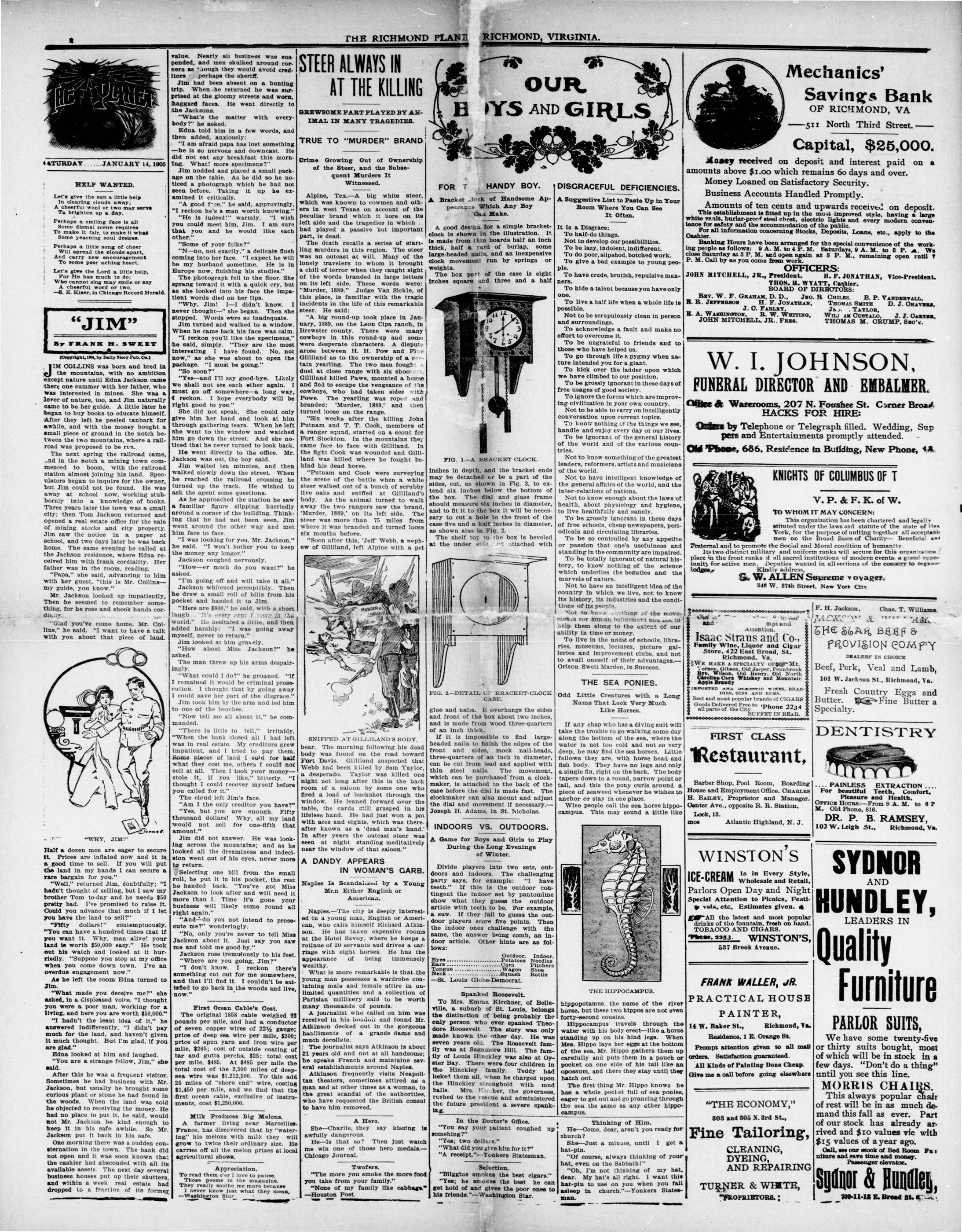
FOR THE HANDY BOY.
OUR BOYS AND GIRLS
A Bracket Clock of Handsome Appearance Which Any Boy Can Make.
A good design for a simple bracket-clock is shown in the illustration. It is made from thin boards half an inch thick, half a yard of burlap, some large-headed nails, and an inexpensive clock movement run by springs or weights.
The box part of the case is eight inches square and three and a half
FIG. 1-A BRACKET CLOCK.
Inches in depth, and the bracket ends may be detached or be a part of the sides, cut, as shown in Fig. 2, to extend six inches below the bottom of the box. The dial and glass frame should measure six inches in diameter, and to fit it to the box it will be necessary to cut a hole in the front of the case five and a half inches in diameter, as shown also in Fig. 2. The shelf top to the box is beveled at the under side and attached with
FIG. 2.—DETAIL OF BRACKET-CLOCK CASE.
glue and nails. It overhangs the sides and front of the box about two inches, and is made from wood three-quarters of an inch thick.
If it is impossible to find large-headed nails to finish the edges of the front and sides, mock nail-heads, three-quarters of an inch in diameter, can be cut from lead and applied with thin steel nails. The movement, which can be purchased from a clock-maker, is attached to the back of the case before the dial is made fast. The clockmaker can also mount and adjust the dial and movement if necessary.—Joseph H. Adams, in St. Nicholas.
INDOORS VS. OUTDOORS.
A Game for Boys and Girls to Play
During the Long Evenings
of Winter.
Divide players into two sets, outdoors and indoors. The challenging party says, for example: "I have teeth." If this is the outdoor contingent the indoor set by pantomime show what they guess the outdoor article with teeth to be. For example, a saw. If they fall to guess the outdoor players score five points. Then the indoor ones challenge with the same, the answer being comb, an indoor article. Other hints are as follows:
Outdoor. Indoor.
Eyes. Potatoes Needles
Ears. Corn. Fathers
Tongue. Wagon. Shoe
Neck. Squash. Bottle
—St. Louis Globe-Democrat.
To Mrs. Emma Kirchner, of Belleville, a suburb of St. Louis, belongs the distinction of being probably the only person who ever spanked Theodore Roosevelt. The story was only made known the other day. He was seven years old. The Roosevelt family was at Sagamore Hill. The family of Louis Hinckley was also at Oyster Bay. There were four children in the Hinckley family. Teddy had licked them all, when he charged upon the Hinckley stronghold with mud balls. Mrs. Kirchner, the governess, rushed to the rescue and administered the future president a severe spanking.
In the Doctor's Office.
"You say your patient coughed up somehing?"
"Bilgigs smokes the best cigars."
"Yes; he smokes the best he can get hold of and gives the poor ones to his friends."—Washington Star.
RICHMOND, VIRGINIA.
Spanked Roosevelt
Selection.
UR GIRLS DISGRACEFUL DEFICIENCIES.
A Suggestive List to Paste Up in Your
Room Where You Can See
It Often.
It Is a Disgrace:
To give a bad example to young people.
To have crude, brutish, repulsive manners.
To hide a talent because you have only one.
To live a half life when a whole life is possible.
Not to be scrupulously clean in person and surroundings.
To acknowledge a fault and make no effort to overcome it.
To be ungrateful to friends and to those who have helped us.
To go through life a pygmy when nature intended you for a giant.
To kick over the ladder upon which we have climbed to our position.
To be grossly ignorant in these days of free usages of good society.
To know nothing of the things we see, handle and enjoy every day of our lives.
To be ignorant of the general history of the world and of the various countries.
Not to know something of the greatest leaders, reformers, artists and musicians of the world.
Not to have intelligent knowledge of the general affairs of the world, and the inter-relations of nations.
Not to know enough about the laws of health, about physiology and hygiene, to live healthfully and sanely.
To be grossly ignorant in these days of free schools, cheap newspapers, periodicals and circulating libraries.
To be so controlled by any appetite or passion that one's usefulness and standing in the community are impaired.
To be totally ignorant of natural history, to know nothing of the science which underlies the beauties and the marvels of nature.
Not to have an intelligent idea of the country in which we live, not to know its history, its industries and the conditions of its people.
Not to know anything of the movements or human battement and not to help them along to the extent of our ability in time or money.
To live in the midst of schools, libraries, museums, lectures, picture galleries and improvement clubs, and not to avail oneself of their advantages.—Orlison Swett Marden, in Success.
Odd Little Creatures with a Long Name That Look Very Much Like Horses.
If any chap who has a diving suit will take the trouble to go walking some day along the bottom of the sea, where the water is not too cold and not so very deep, he may find the sea horses. Little follows they are, with horse head and fish body. They have no legs and only a single fin, right on the back. The body tapers down to a round, narrow point or tail, and this the pony curls around a piece of seaweed whenever he wishes to anchor or stay in one place.
Wise people call the sea horse hippocampus. This may sound a little like
A SEAHORSE
hippopotamus, the name of the river horse, but these two hippos are not even forty-second cousins.
Hippocampus travels through the water with his body erect—like a horse standing up on his hind legs. When Mrs. Hippo lays her eggs at the bottom of the sea, Mr. Hippo gathers them up carefully and puts them in a pouch or pocket on one side of his tail like an opossum, and there they stay until they hatch out.
The first thing Mr. Hippo knows he has a whole pocket full of sea ponies, eager to get out and go prancing through the sea the same as any other hippocampus.
Thinking of Him.
He—Come, dear, aren't you ready for church?
She—Just a minute, until I get a hat-pin.
"Of course, always thinking of your hat, even on the Sabbath!"
"Oh, I'm not thinking of my hat, dear. My hat's all right. I want this hat-pin to use on you when you fall asleep in church."—Yonkers Statesman.
Indoor
Needles
Pitchers
Shoe
Bottle
THE SEA PONIES
THE HIPPOCAMPUS.
THE
MUSEUM
OF
ART
AND
COLLECTIONS
511 North Third Street. Capital, $25,000. Money received on deposit and interest paid on amounts above $1.00 which remains 60 days and over. Money Loaned on Satisfactory Security. Business Accounts Handled Promptly. Amounts of ten cents and upwards received on deposit. This establishment is fitted up in the most improved style, having a large white vault, burlar-proof steel chest, electric lights and every modern convenience for safety and the accommodation of the public.
For all information concerning Stocks, Deposits, Loans, etc., apply to the Cashier.
Banking Hours have been arranged for the special convenience of the working people as follows: 9 A. M. to 4 P. M. Saturdays, 9 A. M. to 8 P. A. We close Saturday at 3 P. M. and open again at 5 P. M., remaining open until 7 P. M. Call by as you come from work.
OFFICERS:
JOHN MITCHELL, JR., President. H. F. JONATHAN, Vice-President.
THOS. H. WYATT, Cashier.
BOARD OF DIRECTORS:
REV. W. F. GRAHAM, D. D., JNO. R. CHILES, B. P. VANDERVALL,
H. R. JEFFERSON H. F. JONATHAN, THOMAS SMITH D. J. CHAVES,
J. C. FARLEY, JNO. TAYLOR,
WILL AM CUSTALO, J. J. CARTER,
THOMAS AM. ORUMP. SECY.
W. I. JOHNSON FUNERAL DIRECTOR AND EMBALMER
Office & Warerooms, 207 N. Foushee St. Corner Broad HACKS FOR HIRE:
Ouine by Telephone or Telegraph filled. Wedding, Suppers and Entertainments promptly attended.
Old Phone, 686. Residence in Building, New Phone. 48
PICCOLIN
KNIGHTS OF COLUMBUS OF T
TO WHOM IT MAY CONCERN:
This organization has been chartered and legally situated under the laws and statute of the state of New York, for the purpose of uniting together all acceptable men on the Broad Bases of Charity—Beneficial
Fraternal and to promote the Social and Moral condition of humanity.
Its two distinct military and uniform ranks will secure for this organization a place in the front ranks of all sacred institutions of modern events, a great opportunity for active men. Deputies wanted in all sections of the country to organize lodges. Kindly address.
G. W. ALLEN Supreme voyager.
846 W. 87th Street, New York City
F. H. Jackson. Chas. T. Williams
JACKSON & WILLIAMS
Oil and Sewing
and
Attention.
Isaac Straus and Co.
Family Wine, Liquor and Cigar
Store, 422 East Broad, St.
Richmond, Va.
WE MAKE A SPECIALTY OFFICE Mt.
Vernon, Gibson, Old Jasper, Pennbrook
Brown, Old Henry, Old North
Carolina Co. Whitley and Mountain
Apple Brandy
Fresh Country Eggs and Butter. Fine Butter a Specialty.
IMPORTED AND DOMESTIC WINES, BRANDS,
GINS AND RUMS.
Best and most popular brands of CIGARS
Goods Delivered Free to 'Phone 2234
all parts of the City
BUFFET IN REAR.
DENTISTRY
FIRST CLASS Restaurant.
```markdown
```
Barber Shop, Pool Room, Boarding House and Employment Office. CHARLES H. BAILEY, Proprietor and Manager. Center Ave., opposite R. R. Station.
.... PAINLESS EXTRACTION .....
For beautiful Teeth, Comfort,
Pleasure and Health,
OFFICE HOURS:-From 8 A.M. to 6 P
M. Old Phone, 816.
DR. P. B. RAMSEY,
102 W. Leigh St., Richmond, Va.
mos Atlantic Highland, N. J.
SYDNOR AND HUNDLEY, LEADERS IN Quality Furniture
ICE-CREAM Is in Every Style,
Wholesale and Retail.
Parlors Open Day and Night
Special Attention to Plcnics, Festi-
vals, etc. Estimates given.
All the latest and most popular
drinks of the fountain, fresh on hand.
TOBACCO AND CIGARS.
Phone, 2253. WINSTON'S,
537 Brook Avenue.
FRANK WALLER, JR.
PRACTICAL HOUSE PAINTER.
PARLOR SUITS.
14 W. Baker St., Richmond, Va.
Residence, 1 E. Orange St.
We have some twenty-five or thirty suits bought, most of which will be in stock in a few days. "Don't do a thing" until you see this line.
Prompt attention given to all mail orders. Satisfaction guaranteed. All Kinds of Painting Done Cheap. Give me a call before going elsewhere
MORRIS CHAIRS.
MORRIS CHAIRS.
This always popular chair of rest will be in as much demand this fall as ever. Part of our stock has already arrived and $10 values vie with $15 values of a year ago.
Call: our stock of Bed Room. Fax:
CLEANING,
DYEING,
AND REPAIRING
Call, see our stock of Bed Room. Fur
niture and save time and money.
Passenger elevator.
Sydnor & Hundley,
209-11-12 E. Broad St.
TURNER & WHITE,
PROPRIETORS.
Y e are e 3s
aU
ne Pe en
ee AGSACCU F
2 a
J aN)
a
Wy
SATURDAY .. .. JANUARY 14, 1905
= GOD IS CALLING.
God Iscaiting! Are varendy! Ready, broth
ers, for the fight!
Bark! ‘the cry of drunkard’s children
women trampled in your sight!
Ob! be swift, my brothers—answer: “We
will battle for the right!”
Bee the ttle feet so feeble! See the eye:
‘whose tears will flow!
See the little arms, uplifted, plead for help
yet tremble so!
Hearts of faithful men! ye cannot spurz
that bitter cry of woe!
‘Ob! be swift! The days are passing; scor
will end our working day:
‘Onward comes a crowd of children, laugh
ing merrily at play,
And before them liew the danger; they must
pass it on thelr way.
‘They are growing men and women—can wr
guard them from It still?
‘Oh, my sisters, save the children: ye car
save them from this Ii;
Bo your feet swift and your hearts brave
and as true as steel your will.
‘Az Tread of One Who loves us, in my hear
hear this plea:
“As ye do to these, My children, ye are
doing it to Me.""
As He died to bring us freedom, tet us try
to make men free!
‘Hearts of faithfui men! before you lies a
hard and weary strife,
Dark the way is, and the roadway is with
rocks and thorns so rife,
‘Yet the battle gained will mean for all a
higher, truer life.
God ts calling! Answer gladly: “We are
ready to obey!”
From far off our eyes can see at last the
dust of battle fray;
‘Ob, be glad each sol, rejoicing in the dawn:
ing of the day?
eibablona) Afbocnta,
FENCE AN® SERPENT.
A Temperance Sermon from a Text
from the Book of Eecle-
~ siastes,
‘The writer of the book which we
call Ecclesiastes, said in his own pithy
and sententions way long ago, that
“Wheso breaketh a hedge, a serpent
shall bite him;” but the word in the
original appears to refer to a stone
wall rather than a planted boundary,
as our revisers signify by a new ren-
dering. What is in the mind of the
meralist s that the man who secretly
breaks down or removes the land-
mark between himself and his neigh-
Dor is likely to find that this same
stone-pile has become the refuge of
Some creature with avenging fangs
and swift-darting venom, so that in
ather Veyy—act of -aisransgressien the
vevildoer is struck by a deserved chas-
‘tisement, says tie Chicago Interior.
‘The fact which was cbserved by the
Anspired writer s one often overlooked
dy the modern moralist, neverthelo-s
it is true that it costs a man offort to
do wrong. Not only doos the saint
have to fight against his better na-
ture and his active conscience. When
ome one askd Charles Lamb how he
came to be such a slave to tobacco,
he frankly replied that he “tolled after
it as some men after virtue.” Instead
of being an unlucky “misstep,” the
first step in a criminal course is very
Ukely to be a painful climb. The boy
is not always frightened into his frst
Ue; he deliberately shapes and fash-
fons it and presents it with “mal-
fce pretense” to fils parents. He does
not fall off a stone wall; he breaks
Uhrough It.
But while there is a fence around
every sin, one can throw it down. It
fs not a Sterga. It is not an Ehren-
Dreitstein laughing at guns of every
caliber with an equal contempt. The
boy who will drink must fight down
his scruples, but he can overcomethem.
‘The young employe who is tempted
to “take a flyer” in the stock market
or the wheat pit will know more than
one wakeful hour and fitful dream over
his beginnings of speculation, but steal
he can if he will.
‘Only out of his experience will shoot
forth his own punishment. Each sin
brings forth its own peculiar penalty,
Mke a serpent shooting ont unexpect-
edly from a broken wall. Lying does
not beget a headache, but more lying.
Drink creates thirst and punishes {t-
self with drinking. Licentiousness de-
files the body and rots it. Everyone
of God's fences hides within itself its
silent but sure avenger. People who
‘are looking for evidences of a moral
fuler of the universe might well pause
and study such facts as were obvious
to the wise man of 3,000 years ago,
‘and which are not less obvious to one
with eyes to see in our own day.
“Go on in your deliberately chosen
path,” says the Preacher of the Old
Westament, “but remember that for all
these things God will ‘bring you Into
Judgment.” The young men who have
been brought up in these Christian
thomes about us do not slip into sin;
they break into wrong-doing. It is not
Ratural, it is not easy for them to cast
‘ff the restraints of piety and faith,
nor is it safe. The penalty 1s not re
mote but near, not arbitrary but Im.
perative, not falling out of a clear sky
Dut darting from the very center and
shadow of the sin itself. This is a
study in psychology which we com:
mend to those who would deal with
facts which have a real reference to
practical life.
‘Two Misses.
| When indies meet and wish to greet
Each other with a kiss,
‘Those hats immense make such defense
| Its five to one they miss,
eee
Pretty Low.
‘Bthel—She told me that she couldn't
go to the ball, because she had post-
tively nothing to wear, But she went
Giadys—Yes, and her remark to you
‘was.pretty close to the truth.—Cincin-
eatl Commercial Tribune.
TRUE SPIRIT OF THE DAY.
How Thanksgiving Day Should Find
Expression Within the
Heart of Man.
Se en Sere ee ee ee Sa
‘Thanksgiving day is not essentially
or even distinctively a New England
—much less a Puritan—festival. There
were Thanksgivings before Governor
Bradford's time, as there have been
ever since, and as there will be till
time shall cease to be. And when we
turn to the Sacred Book, is it not
sometimes more than a bald fact that:
Praise and Love and Heaven claim pre-
eminence in Biblical treatment over
other subjects, except, indeed, God, His
Spirit and Christ? ‘And how closely
correlated is love with praise, and
what is thanksgiving but the praise
ef the Divine Being for His bound-
Jess mercies? So we are confronted
at the outset with the fact that first
and preeminent is Thanksgiving a
religious service--there is no. true
thanksgiving without recognition of
an overshadowing Providence, For, it
we have abundant harvest; if ours is
a land of peace and plenty; If every-
fone enjoys freedom here that in its
completed sense is not enjoyed any-
where else in the wide world as here;
if we have free schools, and not only
have them for ourselves, but have in-
fluenced other nations—and notably
Great Britain—in solving their own
educational problems; if the buman-
ities are being developed as never be-
fore; if we have waged the wars that
have unwillingly come to us in a very
different spirit trom that in which
Joshua fought, who thought he was
serving a God of infinite tenderness
and love in slaying the young and
putting the mothers to the sword—
if all these blessings have come to us
and we are freed from pestilence,
whom shall we thank but the Giver
of all z00d?
Hence it is, then, that we would
Press home upon all observers of this
festival the difference between being
thankful and being glad. A man
may be glad because he has won his
friend’s money at a gambling game;
he may rejoice that he has avenged
himself upon some one whom he re-
gards as his enemy; but thankful he
cannot truly be. As nature fs all un-
satisfying save as we regard a sup-
preme beneficent Intelligence behind
her, so the good things that come into
ows lives and into the national life of
our country are meaningless save as
they are traced back to the hand and
heart of God. Did God create man
and give him an immortal soul, and
having accomplished that cease to care
for him? Did the Almighty lead the
Israelites through the waters; did He
establish them into a nation; did He
give them prophets who should tn rapt
vision tell of a Messiah whose reign
should be everlasting; did He tell of a
people redeemed from the bondage of
captivity, and from the most dread-
ful of all captivities—that of sin; did
He do all this and more, and has He
no pity, no love, no prophecy, no prom-
ise for the teeming millions of these
/United States,-with tis humdred thon
sand of church spires pointing heaven-
ward, and telling of the worship of the
‘one true God—whatever may be the de-
nominational polity of the sectarian
| cutt?
| We have taken this line of thongnt
at the present time, says:the Christian
| Work, because other Jines will bé pur-
sued by others as they meditate or write
the Thanksgiving essay or preach the
| Thanksgiving sermon. That is to say,
| We shall be told what a wonderful coun-
| try we have; how many we cam feed;
| how great and strong we are: what an
| mormous population,we have; howmany
| mites of- railroad we have; how our
trolley lines have been extended (though
‘probably nottiing will be said of our
| inditference to human life and the vie-
tims sacrificed yearly to electricity and
| steam). So it is at this time we would
emphasize the religious aspect of our
Thanksgiving festival. Good cheer,
even athleties and other phases of out-
door sports, have come, and they will
remain. None the less, but al! the more,
should we at least devote « portion of
the festival to the recalling of our
Diessings, and to recognizing the hand
of the Divine Author and Creator to
‘Whom we owe them all. In this way
alone can our festival truly deserve its
“Thanksgiving” title—in this way alone
can the day be made as helpful in the
religious life as it is full of joy and hap-
piness on its social side, when the aged
grandparents, the father and t’ e moth-
er, the children, some with ch ldren of
their own, assemble in the c d home-
stead, recall the old memories » 1th faces
now vanished and voices now s* led, and
the lovelight is seen in the ey: and the
love greeting is received as 1! # sure to
be every Thanksgiving day a: the years
go by.
THEN THE STORM BROKE.
CS |
% c a A a
EZ Sie
<a OK.
Z AN (. Pgs
oR a
Gt
: iy) 4 8
eZ | é
at Se Sy
sie!
SSS as
Unele (to Fred, who has expectations,
but is very absent-minded)—And so you
don’t fancy the looks of your new clerk?
Fred—No. Funny thing, I never could
take to a man with a hooked nose!
And then Fred wondered why his uncle
was mad.—Ally Sloper. ;
Kener apes
Mr. Blabb—How beautiful these au.
tuma leaves look on the grass!
Mrs. Blabb—No, Josiah! You can't
work that again this year. I expect you
to rake thoze leaves up atonce—Cinein.
pati Commercial Tribune,
THE RICHMOND PLANET, IND, VIRGINIA,
; Tuctance. ~ “~~ Jone of the Greate
a PROLIFIC WEED. Some of _ e tan of th
Komething About th: Galinsoys Par- less agreeably. ‘s boat
wiflora and How It Has Spread sighted an island, fen went | Darvin, Va
Nias: ashore to fill their only to _ The Grand Unit
- be confronted with ‘of savages eget as
About one year ago 1 mentioned the 1m full war paint, mpearaand Tied tok, sort
advent of a weed which very suddenly ¢lubs. One of the 8D the State of Va... t
occupied the whole of the eastern scuth ¢™Pty revolver, and the par bary the dead, to 0
and-already, within a year or very t- tY Sot away unl . | and orphans, as lon
Ue more, had to some extent shared a OFFICER BUI [magia Teepectnbie
large tract not only of uncultivated 1e fundament
grass and clover elds, but of waste AROUND SU RDINATE oar order, are based
lands. It is known as Galinsoga parvi- = BB RE
flora, and is not wholly to be consider- O¥t of BG cepattizaticn in the
ed as a cumberer of the land, along an? So it is grand, and the
with other weeds, but a8 a useful for- army. | as good as any other
age plant, far more valuable than the an in a club are so sm:
majority of plants classed as weeds. _ Paris—Judgment — has Ges been of the laboring cl
‘The present appearance of this weed Siven by & court ree 6 at join. Yes, it has b
im the west, in nearly all the large Chalons-sur-Marne in’ of Bris- help of God, that a
Cities, in which it occupies the road- der Robin, of the Te i Srtil- good moral charact
sides and a large part of the cultivated J*Y resiment, charged “with various in body and mind |
NZ
mie
Sir)
dand, as well as the gardens of the
citles, is an interesting fact In connee-
tion with the subject of weeds, and the
several ways in which they spread far
‘nd wide; in this instance thousands
of miles in as few as five years from
its first appearance near Charleston,
BC.
| I am reminded of the circumstance
by a note from a subscriber to this pa-
per, asking for eeod of the plant for
the purpose of sowing (mixed with
grass seeds) for making a pasture, I
am rather disinclined to ald in spread-
ing such a hardy and prolific weed as
this for obvious reasons; but in this
instance would do so were it not that
the plant Is abundant all over the
neighborhood where the epplicant Itves,
writes a correspondent in the Country
Gentleman. The plant is easily recog-
nized by its low growth, much similar
to that of clover, and by its small
white flowers.
This Galinsoga ts an Interesting ex-
ample of the amayinely rapid spread
of weeds, and of the carefulness which
should be exercised in rezard to the
Introduction of similar plants, which
may bring inconvenience—to say the
Jeast—to thousands of persons. My
mention of the plant and its history
was not piven as aily tecomeuaation
‘of it for a fodder plant, but merely in
the interest of xeneral knowledge. Con-
sidering how many of our worst weeds
were -introduced in very simple, but
thoughtless ways, and how justly the
Public execrates ‘the memory of the
PETSOAS imipiedted In the mischtef, all
foncerned showld, T think. be slow to
Spread any plant, ont of mere curiosity
the injurions character of which may
In after years ma‘ his namo disagree-
ably notorious. Still, while this Galln-
Soga may cause waste of Inbor and
some apprehension by Its prolific habit,
{t Is not so bad as the large majority
of weeds, enil in some efrenmstances
may be turned to profitable uses, But
it 18 a weed and hence not to he made
fa friend and companion of.
FARM NOTES.
Note the chanves you intended to
make for, next winter.
Have all the live stock ready for
market before you market it.
‘The appearance of things about the
house is the first that attracts atten-
tion, good or bad.
See that all necessary repairs are
made, not only upon the home build-
ings, but upon the outbuildings also.
Winter is coming.
A cheery, co.ofortable family room
and plenty of good things to read robs
winter of about all of its terrors, ce-
ments family ties and lays a founda-
tion for pleasant memories in after
life.
If those March and April plgs had
clover and peas to run through the
summer they are now just about ready
for a corn diet—American Tribune.
Estimating the Profits.
‘The profits of a farm are usually
more than the actual cash received for
produce. The farmer takes his living
expenses, as well as the cost of produc:
tion, before he decides upon the
amount of profit. The merchant takes
only the difference between the buying
and the selling price, less the cost of
the transaction, then lives on the prof-
it. The question of “Does the farm
pay?” depends largely upon what 1
taken from it other than the cash re
‘cahued Aaland Batson.
REAL CRUSOES LIVE
IN ISLAND PARADISE.
Zong Lost Sailors Enjoying Existence
with South Sea Island
Natives.
Sydney, New Zealand.—After having
been given up for lost, the eight missing
men of the British steamer Aigvurth,
which was wrecked last July on an un-
charted rock midway between New
Guinea and New Britain, arrived af
Brisbane safe and sound, on board the
German steamship Prinz Sigismund.
‘The men who landed had experiences
such as seldom fall tothe lotof ship-
wrecked mariners. After atempestuous
voyage they ran their boat ashore at
Aramit island, and to their surprise were
received with the greatest hospitality by
the natives, who provided them with the
Dest food and shelter they could afford.
So amicable became the relations be
tween the castaways and the islanders
that the latter entreated their friends
to stay with them for good. Eventually
‘a passing sloop anchored off the island
and offered to take the whites on board,
Dut, according to the captain, several
of the Aigburth’s crew required much
persuasion before they would consent
to leave, and the natives only allowed
them to depart with the greatest re
fductance. —
Some of the fared
less agreeably. s boat
sighted an island, |men went
ashore to fill their only to
be confronted with of savages
In full war paint, spears and
clubs. One of the = ed an
empty revolver, and ly the par-
ty sot ewey conan
OFFICER BUILDS. FIRE
AROUND SU *RDINATE
Out of His Action Ha .._wnaScan-
dal in the 2 ch
Army.
Paris—Judgment has ‘ust been
given by a court maria sitting at
Chalons-sur-Marne in” of Brig-
adier Robin, of the arth artil-
lery regiment, chi ith various
acts of revolting cruelty toward his
subordinates. s
‘The evidence proved that Robin tied
up a gunner named Sonnet while he
was asleep, and, after pushing him out
of bed, attached the unfortunate man
to a nail in the floor so that he could
not move.
He then piled around him straw and
baper to which he set fire, and finally
extinguished the flames By deluging
Sonnet with buckets of water.
Witnesses declare that Robin acted
Im this way in order to force men to
semble with him. and Mage bim Uquor.
‘The brigadier adzaitt ly all the
‘charges and during the trial wept co-
piously. He was sentenced to two
years’ Imprisonment.
EASTERN MAIDEN WINS
FORTUNE. IN KLONDIKE.
Wnattended She Spends Six Winters
| tm Alaska, and Comes Out
{ Rich in Gold.
| Plainfield, Conn.—Miss Marie Reids
‘elle fs home again, and for miles around
the country folk would lixe to know just
what her six years in the Klondike have
amounted to.
‘Miss Reidselle left her Hopeville farm
in Mr. Geer's care six years ago and
started, alone and unaided, for the gold
fields of the Klondike. With 900 pounds
of baggage and two dogs she followed
the trail via Chilkoot Pass, and finally
reached the Klondike. When the Cape
Nome gold craze started Miss Reldselle,
who had become known @m the “Angel
of Alaska,” went there, amd after stak-
ing out several claims hiihg out her card
as a hygienic physician,
‘When Miss Reidselle¢ua@enly arrived
Ye Si WY,
Wy BEA
gas mY
ae a
We an =
a OS a |
FOLLOWED "THE TRAH. WIA. CH
at her old home yesterday the rush to
See her was great.
“Tam home to: rest,” Miss Reidselle
sald. “I am tired of winters in cold
Alaska. I have bought one of the most
deautiful places in this town ahd expect
to end my dayshere. I will not practice
here for money, as I am able to live in
Peace and comfort without work, no
matter how long I may live, Ishall stay
here a few days xhd then go away, but
when I return here next year it will be
to remain.
“I left Cape Nome on ad 15 and
spent a week at the world’s fair and an-
other among my old New York friends.”
Before Miss Reldselle left Nome the
richest claim ever discovefed had been
opened up at Little Creek, near Anvil.
‘Thousands of dollars havé been taken
out there in one pan, Miss Reldselle has
tatatents ta oeperal Cape Nome, Anvi
aud Little Creek claims. _
Yette.
‘A man who loved his clgaretth
‘Would beg one trom each mn he matte,
Se ae
‘people. ;
Thay think that he is smokide yet
“GBleago Chronicle.” pe
———___}
Thoughts. |
“A penny for your thougits, dear?”
said the young girl who hal just sald
“Yes.” i
“T'd give four dollars to know your
father’s without speaking |to him,"
said the young man, with feeling —
| Yonkers Statesman. )
The Precocious Rhetotician.
“Waldo, you mustn’t eat any more
pork. You are a perfect pig.”
“I assume,” said the Boston boy,
“that is intended as a figute of met-
onymy, which substitutes the con-
tatner for the thing cortained.”—
‘Washington Star. |
Forgot to Notice Ih
Girl with the Gibson Girl Neck—How
aid you enjoy the matinee?
Girl with the Julia Marlowe Dimple—
Bplendidly. I was with a box party.
Oh, while I think of it, what was the
play ?—Chicago Tribune. t
Contrary to Her Bee,
“Charley, dear,” said young Mrs,
‘Torkins, “I wish I were a beokmaker.”
“why?”
“People seem so generous and good-
natured about giving a bookmaker
money.”—Washington Star, }
| Pined for It.
“You say you'd like to heartome mu-
sic? Why I thought there Wis « piano
and a mandolin and a cornet and a vio-
Un at your boarding house?”
“Yoo, that’s why 4 Uke sore mu-
sic.”"—Honusten Post. Sanat
s
F of the Day.
Daxvinux, Va., November, 1904.
‘The Grand United Order of Seven
Rising Sons of America, organized in
the city of Danville, in the year of our
Lord 1894, under the Iawaand rales of
the State of Va., to care for the sick,
bury the dead, to oare for the widows
and orphans, as long as the widows re.
main respectable.
_ The fundamental principles of this
our order, are based upon love, trtah and
charity, which are grand. ‘and’ elevating
asapy ever prom by any secret
organization in the United Scatos. Yes,
itis grand, and the plans and works are
as good as any other, and the joining fees
in a club are so small that the poorest
of the laboring class of our race can
join. Yes, it has been so fixed by the
help of God, that any man or women of
000 moral character, honest and sound
body and mind can join this grand
and noble order.
|, Dear friend, will you not etart now to
dogin to barn the light of wisdom? | Let
ushave more love for each other, as
Obrist has commanded of ms, aud tet us
be more truthful to our fellow men, yes,
Ietour words to all men be yea, yea, and
Ray, nay. And let us be more charita
ble to each other. These are the princi-
ples of the grand and noble order of the
wen Rising Sons of America.
_ "Then why not join us and be men
and women, and stand together as a
race #nd lay down plans for our chiliren
yet unborn? Knowing dear friends,
Weare just what we make ourselves.
We asa colored race should make our
selves aa creditable as any race, consid
‘ering our chances, and if you will join
this Grand United Order of the Seven
Rising Sous of America, and live up to
the three principles named and be true
to your obligations, to stand firm, to help
‘us carry the banner and let it float in
the air until it reaches from the Atlan-
‘tio to the Pacific, then we will be men
‘and women who are working for the
Progressof our race. to lead them to as
high stand-point as lite will afford,
Yet. not only will wo bomen and women,
it in the time of sickness, we will be
with you and take care of you and pay
your dues promptly as long as you are
ick, let it be twelve months or more,
‘We will not cease to pay or leave you
trill bury you and learo our eypanlis
y you and leave our syz3j
ing teara with the bereaved.
is this all that we do? No. We also
pay handsome endowment, you will
Teoeive on becoming a member of this
organization a policy good for one-half
of ts face vatne, Cais {fhe expiration
six mon! 10 pol good for its
full face value.
Look and live, club fees are $1.00 to
join this Grand United Order of Seven
Rising Sons of America, where we can
dwell together and love each other as
God so loved tne world. Remember
your monthly dues are from 25 to.50 cts.
per month and the taxes you pay will
‘hot amount to 50 cents per year, Re:
member each lodge has full control of
its money after it has been set apart.
‘Though we have hundreds and hundreds
of members, yet there 18 room for more;
though we have thousands of dollars in
eluding real estate, yet thero is room for
more.
‘This grand and noble order of Seven
Rising Sons of America stands firm and
cannot be denied that it pays to the
sick and buries the dead and pays all on-
dowments promptly, according to Jaw.
and you cannot brcome non-beneficial
who sick, for it never stops paying the
members ey are si8k,
This orde. so hesa department for
children to joia. They have had a char.
fer granted by the Supreme Grand
Lodge together with by-laws, rules and
regulations for the government of their
lodge.
‘You can advance to higher degrees af-
ter joining this order at a small amount
ot cost, You can be a master worker if
you will. be youa man or woman, Wait
no longer, but joiu now. and help hold
up the banner of justice and right
Twenty members compose a clab, bat
there can be less by corresponding’ with
the Supreme Board of Directors or a law
fal Deputy. Oar joining fees are with
the times and yet wo pay larger. siok
benefits and never stop paving and give
niorr barials and larger death claims
[than anz other order we know of in
America. Read our plans carefully,
and then seek admission and all we
claim will be proven. ‘Togother we
stand, divided we fall.” Founders ot
this grand and noble order of Seven
Rising Sous of Anierica-
W. P. Patan, S. P_G. Pres.
P.O. Cartxotos, 8. P. G. Mang.
W. J. Hupnanp, 8.'P. G. Treas.,
L. Z. Eva, 8. P.G. B.S
Board of Directors:—W. P. Palmer,
LZ, Biam, W. J. Hubbard, Frank Fos
ter, P. O. Garrington, J. R.’ Oamble, I.
M.'Mebane,
Board of Managers:—W. P. Palmer,
P. ©. Carrington, W. J. Babbard, LZ
Elam, Qharlie Malone, William ' Hous.
ton, Ed. Ohandler.
Lawfal Deputies:—Rev. 0. N. Brown,
1020 E. Washington St., Greensboro, N.
O., Rev. G. W. Poteat, 518 Craghead
St.. Danville, Va., Wm. Houston, 153
Gilmer 8t., Greensboro, N. O., James
Watkins.” Danville, ‘Va., Matthew
Woody, Danville, Va., John Wade, Dan-
Yille, Va, Aaron Green, Mt. Laurel,
Va., 8. T. Bowman, Clover, Va., Nan
ee ee Seen Very Sreee
Po
gf
oe.
s pane gs
Sa foe - :
a oe — oe oR "
a | es |
p=; Cee! : 5
° ch oe g
* Pte
2 e ne ae ‘
2 a cs
y “ 3
ie et] “
2: sya es
~~ ins. Dr. st : \ z
a FR ae - B
as APo sore u ee
BS & ywerful W ag = :
Y ‘SENDS eee : : :
: a a wit -
+ — L
: : ene INESS TO. ree : 5
oe} Oo ae - i os ve
i : Sree — WHO ac @ ot
3s Sige? ee = H
Sone See = 8
aw be Ses =
acd ty uccouet aa = og
a 2 =z ee a
ga nex eta soe oe E
oO" Don’ ye coat: na =—
& ee ste ah
= anes .
ease eae z
© ease eee =
> Pica feat ores ie EB
on tee fe oe
3S a cease fame ie ea 3 =
Gace = Power = =
9 = Sosa = 8
o = comers!
x ad th one =
Ee ikea aig
° ae = =e
: aa pe B
ea eas .
able ‘pack conte os fc =
191 Dr. Whit packing, p a re : 2 :
— ee
Pre ite’s oe a
rat Col = = = 5
s ate 5 sas ie S
ots =
ore, int 3
i U.S. 5
ane
She Made the Dumb Beast Obey.
A Le e
aria WRT rear a sort hie nee
WPS fH. W. NODALISON, te smeptow ann oratrvoyanr,
eo we ¥ who can read from the the sky. Daring
the great show of the RINGLING BROTHERS in Videla, La., Samson one of
the largest and oldest elephants in the world became unruly and killed nine
men daring the day, Mrs. Robertson was sent for. She influenced the elephant
by holdingacharwing seal bone in her hand and speaking nine holy: wouls to
the beast and he obeyed.
Mrs. Robertson was born in Paris, France and had eight years of English
schooling. She was bora a fortune teller, No female on earth can do. what sue
can do. She gives advice on law suite, divorces, marriages, love, notes, deeds,
property, sickness, female troubles, bounties, pensions, trickery, evil spirits, crip:
ple and blind affairs, hidden treasures, and lost and stolen articles.
‘This gifted woman is a friend to the poor. . She is tho seventh daughter of her
parents anda mighty healer from birth. ‘Sho blesses your home and makes bright
your path forever and keeps your enemivs behind you. The charming seal bone
with which she works has been blessed and tested during the dark hours of mid-
night and was found mighty. She works from the dead and reads from the eky.
‘Thousands of pretended mediams, fortane tollers, oto , have tried to imitate, this
wonderful medium bat her equal cannot be found. She causes speedy. marriages
and has cured thousanas who wers blind, crippled and otherwise aflicted,
Years." Yes, Lawryers, Doctors, Ministers, Bankers and over profesional men of
the earth have sought this gifted medium for advice. She should live forever.
She consulted over thirty thousand people in seven months.” Friends, it
will pay you to look around yourselves. Some one is crossing your path for bad
Tuck, end working evil against you, not because you have harined them but be-
cause your living is kept out of their sight and they are jealous of you.
She gives you @ spiritual charm that will cause your enemies to love you,
make you successfal in business, cause your family to live happily forever, deive
all evil from your path, cause yu to eave mouey and como tats posstetion, Of
property, cause yon to gain back that which was stolen from you, cause the ond
that yor love to love you until death, and cause whatever you want to come to
. "Tn fact, to mako the dumb beast to love you, "Her power excites the won.
Gere. She is known all over the world aa tho queen of spiriturat workers, “Don't
‘waste your time and money with frauds and still be left in the samo or worse con-
ditions as before, bat consalt this christian wonder, take her advice, and you will
be wealthy and happy forever. Price for consultation is one dollar. ’ Inclose $1 00,
fa two cent stamp, and your name and address and your life wili be seat to’ you
by return mail, Write for other particulars. ADDRESS:—
MRS. Hl, W. ROBERTSON,
202 Fairmount St., Dallas, Tex.
GOOD FOR SHOES.
oS
The purchaser of each Pair of Shoes
from $1.00 upwards entitles you to a
Coupon.
2G Coupons will get you a Pair of our
® BEST $1.50 SHOES. #4
ALBERT STEIN,
Cor. 5th & Broad St. 428 E. Broad St.
Hall Memorial Industrial School,
Massillon Ohio.
HALL MEMORIAL DOMESTIC SCIENCE NORMAL
TRAINING SCHOOL FOR TEACHERS.
—_—_—__SUMMER COURSE Now IN SESsioN,—________.
Fall Term Opens Sept. 12th, 1904,
One o. .¢ Finest Equipped Boarding Seminaries in the
North for Young Women Desirous of Preparing
Themselves for Domestic Science Teachers.
Competent faculty, new building, complete course, TWO YEARS. Speoial
Bas tee ae
Hats, Mawontat, Qoxsnvarony or Music, offre special
advantages 0 thote desiring Instramental
W@ePavsicat Curture Crasses Sprcrar, For TRAcnars,
For further information, nadress sll commanicstions to
Prances A. Riley, Pres. Tirs, Leonora WilsoaPoik, Cor. Sec
BUY THE
& Ny nd f
ee ae EN
A ne
Raa Wests
ef eee eee
TVACHINE
Before You Purchase Any Other Write
‘THE NEW HOME SEWING MACHINE COMPARY
Faanues mass,
‘Many Sewing Machines are mace to sell regara-
‘Jess of quality, but the “New Home” is made
Siweus OW gusrety never runs out
‘Womaks Sewing Machines to sul all condition
ee Tek Na aroume™ sansa tie
heed of all High-grade family sewing machines
| ‘Bold by authorixed dealers only.
von save ev
J. M. P. COOKE.
HAC PLANET
TATTLE.
Too bad about Mrs. de Smithers," says she,
"That she and her husband can never agree.
They seem quite devoted, but that's a pre-ensee.
That can never deceive any person of sense.
These very affectionate couples, you know,
Nine-tenths of the time are just making a show,
And their fondness in public is really absurd—
But hadn't you heard?
I think that the Browns will now lower their tone.
They've mortgaged, you know, everything that they own.
She was determined on leading her set,
She's no wonder they ran into debt.
She had the money to buy one chair,
She bows to me now in the friendliest way.
She not caught by chaff, for I'm too old a bird—
But hadn't you heard?
Young Jones has got into some sort of disgrace.
At Robinson's house now he can't show his face.
I hear he was drinking—it broke off the match.
I think he laugh, he proved not so much of a catch.
But Robinson needn't say much on that score;
His personal habits I greatly deplore.
Well, if I had known I'd have not said a word.
I thought you had heard."
—Chicago, Delaware.
(Copyright, 1904, by Daily Story Pub. Co.)
THE old merchant turned on his stool, shook his long, lean finger authoritatively at his caller and sald, agrily:
"The whole thing is a lie—a lie made out of whole cloth. And it has been helped along by his aunts, his two blessed aunts. What's more, I candidly believe you are a party to the scheme—" "Prender, Prender—" "Don't Prender me, if you please. I've been Prendered for a good long time, and it has cost me a barrel of money. If Billy sneezed you came. If Billy whimpered you came. If Billy ran a silver in his little finger you came. I've had enough of it. I've been bullied and Billed from the start. It must stop."
"Prender, 25 years ago, when I came to you as you sat crouched in your library and told you that it was a boy, you thought differently then. I can see you yet. Crushed with anxiety one moment and buoyed by hope the next. Kings have prayed for what came to you that chill, long night. Kings have been disappointed. You were not. It was a boy. And the mother—"
The old physician reached out to catch the wavering man before him, but Prender quickly recovered himself and uttered huskily:
"Don't, don't tell me that! It is in my life here, here in my breast—the death of—her. I loved her. I idolized
Jammer
"DON'T PREEND ME."
her, my Marie! And the boy went the pace from early childhood; coddled and anuggled by his two blessed aunts. They are to blame for it all. I wash my hands of the entire thing—an utter failure—"
"Pardon me. Prender, but you have failed as well."
"It is a—never mind what I mean; out a lie, just the same. I provided all a boy could ask for. My means were his. My purse was ever open. What more could a father do? Answer me that."
"You made the usual mistake that some fathers make. Prender. You should have kept a little closer leading string—"
"But, man, what could I do? His two blessed aunts babied him and kept me from showing my authority. And now the result is—Billy is of no use to me when I need him so much. Doctor, is there no alternative?"
"None but a quick race with death—"
"Well, have your way, then. To the woods with the boy. But how about me?"
"Oh! You are tough as nails and can stand anything."
The old doctor left the busy man's office with a quiet look on his face as he murmured softly:
"It is Billy's last chance."
And it was Billy to the woods, to rough it, to bluff it, and to tough it. And the pale but brave young fellow did his best to down the thing that clutched at his vitals and confronted him like the white ghost of Nemesis. And his father—tough as nails—kept his nose to
the stone and attended to affairs.
Prender had not seen Billy for two years, but wanted to more than he dared to confess. The boy, puny, weak, slim had as he was, had his mother's eyes, the tone of her voice and the soit touch of her hands. And Prender missed them so-ah, how he missed them! The delight of it all, the sweetness of all such passed away from the merchant's life when his darling died—the mother of Billy, who is fighting for his life up in the woods.
Prender is seated at his desk, trying to work. The air chokes him and a mist comes before his eyes. He is angry because of his womanish weakness—and he tough as nails. Prender, who had never known a sick hour in his life, is growing weak and ill. He tries to down the foolish fancy that creeps over him; foolish to him who has been so strong
The air grows more and more oppressive; the lines and figures on the sheet under his faltering hand looked like tiny black streams that flow away from him like things of nothingness, fancies he cannot follow. The mist before his eyes grows dense—and is now like an almost impenetrable veil. He gasps for breath and tries to lift his hand to touch the tiny button in the desk. He cannot lift or move a muscle. He cannot speak. He is slowly freezing, so he thinks as the sluggish blood halts in his veins. His head sinks upon the desk. The old war horse of business has reached the border line and is slowly drifting upon a sea that carries him afar, afar!
And there Prender is found shortly afterwards with eyes that are open, but unseeing; with lips that mumble, but say nothing.
When the leaves turn to russet and flutter down softly, slowly, whisperingly, the old merchant comes back unto his own from border land. The glaze passes from his eyes and the blood begins to flow more rapidly in his veins. His lips fashion words that are freighted with meaning, and things beneath the touch of the hands, that have been like frozen members, are less like vague things to his brain.
In a quiet cozy corner where the rays of the sun stream across the old man's lap, the old merchant is seated, propped in pillows. Upon his lap is a tiny tint whose soft pink fingers play with the snowy beard that falls like a billow on his breast.
He stares, he bends his head down and gazes upon this strange face before him—nay, not so strange, for there is a look like unto his Marle there. He lifts his feeble hand and strokes the yellow tresses, so like those of one he dearly loved to stroke years ago. Softly he draws the little one close, and when the baby cuddled its warm cheek against his a blessed light came into his eye and a glad tremor of delight passes through every fiber of his being, and he lives again. The clog drifts from the old man's brain and he can think, can reason once more.
For the first time in weeks the tears that stream down the old man's cheeks mean something. His lips move and he utters slowly, softly and reverently: "My Marie!"
And the baby, the little tot with his Marle's eyes, looks up and coos and plays with the silver strands in her pink fingers.
And then the brisk, brown, robust young fellow who has been watching the little scene from the corner, steps close to the old man's chair and leans over and lays his strong hand upon the thin shoulder.
"My Billy—thank God! But where is she, she who has been like a beautiful dream angel to me while I was dreaming my life away in the shadow land? Let me see her, Billy."
A pretty lady—the lady of his dreams—steps near, bends down and presses a kiss upon the old man's brow.
"Billy, and my pretty dream angel—and—and, this is my own Marie, come back to me to stay forever. Oh! Billy, I must keep them both. Do not take them back to the cruel woods, Billy, do not."
"They have come to stay forever, father. My wife and baby."
"Thank God for that! I am so happy now."
And a tear that rolled down the silver beard touched the pink finger, and the child cooled and played with the pearly drop.
INSURES AGAINST HOLDUPS
Surety Company Seeks to Protect Persons Who May Be Victims of Highway.man.
The holdup man soon will lose half his terrors. Ralph W. Smith, of the National Surety company, of Denver, Col., has opened a holdup insurance business and will pay back if the man with the gun takes it.
The holdup insurance covers money, bullion, bank notes, bonds, debentures, negotiable securities in the care of any employee of the person who takes the policy. But there are some provisions which must be observed, one of which is that the person carrying the valuables is to be over 16 and under 55 years of age and must not go down in the slums to invite a holdup. Anything thus taken "by force or violence commonly known as highway robbery" will be repaid.
Then the company will turn in and do its utmost to run the holdups to earth, just as the national banks cooperate to pursue bank burglaries.
Besides the holdup insurance Mr. Smith is extending his philanthropy to the covering of the thefts by servants. The insurance policy on thefts by servants covers plate, watches, jewelry, wearing apparel, furs, laces, tapestries, paintings, clocks, bronzes, bric-a-brac, art works, musical instruments, liquors, cigars and anything else which a servant might be tempted to remove and turn into cash at the second-hand stores. It is a horse thief insurance also, for the horse in the snake is included and automobiles can be put on the list.
Pulling the Strings on him.
"Throggins, isn't that little flirtation between you and Miss Pompeydure beginning to look serious?"
"It is, Ruggles; more serious than I thought. She told me last night I mustn't take her out to the theater or bring her costly bouquets any more—that it was time for me to begin to save money."—Chicago Tribune
THE RICHMOND PLANET. RICHMOND. VIRGINIA
JOB DEPARTMENT
It is thoroughly equipped to do all kinds of printing on short notice. We make a specialty of Society printing and work for Insurance Companies, such as Financial
VISION WORK
Quarter-Sheets, Half and Whole
S, Placards, Society Cards, Mi-
ting Stationery.
WE AN E
WHICH WE WILL
r Stock Ro
E LATEST STYLE BOND,
AS SMALL AS A DODGE
Sheet Poster
EXCURSION
We print Handbills, Quarter-Sheet posters, Tags, Tickets, Placard utes, Visiting Cards, Mourning Stati
WE HAVE
Our S
OF THE LATE
WE CAN PRINT A BILL AS SM
A Three-Shee
We print Handbills, Quarter-Sheets, Half and Whole Sheet posters, Tags, Tickets, Placards, Society Cards, Minutes, Visiting Cards, Mourning Stationery. OUR AIM is to please our patrons and to give them the best service at the lowest prices, consistent with satisfactory work. We furnish "cuts" when desired and we will arrange to complete special work in our line. When in need of any work in our line, call and see us and estimates will be furnished.
OF THE LATEST STYLE BOND, FINE WRITING—FLAT AND LINEN PAPER, ENVELOPES, ETC.
OUR PRESENT CON
IS WITHIN EASY
Our street-entrance is retired and has no obj
fastidious lady being able to enter without emba
OUR PRESENT CORP OF EMPLOYE
IS WITHIN EASY REACH OF
retired and has no objectionable
to enter without embarrassment
E, 2213.
Our street-entrance is retired and has no objectionable features, the most fastidious lady being able to enter without embarrassment or annoyance.
LONG DISTANCE TELEPHONE, 2213.
MOTHER OF THIR
MEETS DEATH ALONE.
Not One of Them with Her When She Died in a Hospital in Denver.
Denver.—"One of the most remarkable patients at the county hospital, to my mind," said Dr. Charles Swindt, of the county hospital recently, "has just died. She was Mrs. Mary Gillespie, a woman of 86 years. During her lifetime she was the mother of 30 children, and, what was the strangest of all, they consisted of 15 pairs of twins.
"Mrs. Gillespie came to the hospital in 1901. She had emigrated to the United States in 1840 from England, where she was born. In 1896 she came to Colorado for her health, as she was suffering from tuberculosis, not seriously, but enough to bring her to this state from Massachusetts, where she had made her home since coming from England. I imagine that her life had not been a happy one, though during her stay here she steadily refused to tell anything of her past history save the part that I have just related.
"When she came to us at the age of 82 practically all signs of tuberculosis had disappeared, and the woman was suffering from nothing save old age and generally decrepit condition. In this condition she might have lived had she not, about three days before her death, fallen and broken her thigh bone. The utmost that medical skill could do for her was done, but all to no avail. Her system was too feeble to stand the shock.
"Of her thirty children we have only succeeded in locating one, Mrs. Eva Hildebrand, of Sioux City, Ia., who upon hearing of her mother's death wrote us and offered to pay funeral expenses."
There are 3 some persons who believe that a person who gains a from consulting a Medium, but such a person is not the truth. It is only from the sick of discrimination that such a conclusion can be reached. It is the person who places himself or herself as a medium who can stand the test of what he or she claims.
THE SPRINGTIME OF LOVE.
And a person of an inquiring mind may ask a question that these advisers do not take the trouble to nature. They do not spend their thoughts for acquiring the art of phraseology and kindred language, and tendency to make the pathway to the road of the business clear and devoid of all obstacles. That persons will come for advice in full known, and want to know, and yet as seen as they confront a medium they try their utmost endeavor to hear it, and not to hear it will be rehearsed by the Medium. To get the secret out of a person by unfair use of the art used by many unprincipled Mediums, they must hand and gain control of the mind thereby is a matter of impossibility to most of them. Mrs. Martt the seemingly mystery becomes a realization
he was received no little attention by eminent men; and he was conceived by eminent men; so it proceeds conclusively that although there are a few persons in our midst with oily tongues, perhaps we have not been closed to the entire profession.
The first symptoms of budding affection-Chicago American.
Make a great deal of study to become an artist and by a continuous and uninterrupted effort, the knowledge is unfathomable mysteries has been secure by MRS. MARTIN for the benefit of humanity.
Plucky Woman Kills Copperhead.
Wilmington, Del.—As she left the home of Simon Cheyney, Miss Frances Lehane, of Greenville, was attacked by a copperhead snake, but the young woman picked up a big stone and killed the reptile. Several residents of the neighborhood have been attacked by snakes recently.
MRS. M. B. MARTH,
CHICKASHA,
INDIAN TERRITORY.
(BOX, No. 958.)
Enclose Stamp for reply
Cards, Policies, both straight life and benevolent, Physician's Certificates, Sick Cards, Application blanks, Agents Report Sheets, Rate Cards, etc.
IS, Half and Whole Society Cards, Ministry.
is to please give them the lowest with satisfaction.
AN ELEGANT WHICH WE WILL SHOW AM
Rock Room D
STYLE BOND, FINE WRITING
ALL AS A DODGER.
Poster DOOR.
PRESENT CORP OF EMPLOYEES ARE IN EASY REACH OF THE PUBLIC
as no objectionable features, the out embarrassment or annoyance
OUR PRESENT CORP OF EMPLOYEES ARE COMPETENT AND QUICK-WORKING. OUR OFFICE IS WITHIN EASY REACH OF THE PUBLIC, BEING WITHIN FIFTY YARDS OF BROAD ST.
T
RK OF ALL
OUR AIM
is to please our patrons and
give them the best service
the lowest prices, consiste
with satisfactory work.
LEGANT
SHOW ANY ONE DESIRE
oom Embra
FINE WRITING—FLAT AN
EMPLOYEES ARE COMPETENT AND
OF THE PUBLIC, BEING WITHIN
e features, the most
or annoyance. FOR FU
Jo
I. LAWSON & CO.,
DEALERS IN
FISH, OYSTERS AND GAME,
FRESH MEATS & GROCERIES
All orders receive prompt atten
tion.
619 Brook Ave. 'Phone 1580.
S. J. GILPIN,
506 E. BROAD STREET,
Richmond, Va.
DEALER IN
Fine Boots, Shoes,
and Ladies Gaiters,
All Kinds of Fine Footwear.
H. F. JONATHAN
Fish Oysters & Produce
120.N. 17th St., RICHMOND, VA.
ALL ORDERS WILL RECEIVE
PROMPT ATTENTION.
Long Distance Phone, 752.
New Phone, 478.
ROBT. S. FORRESTER
FLORIST
215 E. Leigh Street,
RICHMOND, VIRGINIA
Plant Decorations, Choice Rosebuds,
Out Flowers, Funeral Designs, House
Decorations for Wedding, Parties &c.
a specialty. Give me a call.
2 inch. 8m.
When You Are Sick
Pure and Fresh Mediomes only will
sure you then purchase your
Drugs and Medicine from:
Leonard's
Reliable
Prescription
Drug Store
724 North Second Street.
Subscribe to THE PLANET
Only $1.50 per year.
We print Wedding Invitations, and High Class Stationery for Balls, Parties, Picnics and all entertainments of a social nature. We print Church Envel-
ALL DESCR
us and to
service at
consistent
k.
We furnish "cuts" when o
complete special work in our
in our line, call and see us a
T LINE OF
DESIRING TO SEE THEM.
races a full
AT AND LINEN PAPER, ENVELO
WE HAVE ONE OF THE
OF WOO
Of Any Job Printing
NT AND QUICK-WORKING. OUR OFFICE
WITHIN FIFTY YARDS OF BROAD ST.
FOR FURTHER INFORMATION, A
John Mitch
311 N. 4th St
CO.,
WONDERFUL
DISCOVERY
Curly Hair Made Straight By
FOR FURTHER INFORMATION, APPLY TO
John Mitchell, Jr.,
D, VA.
RECEIVE
N.
MRS. P. C. EASLEY
615 N. Second St.
ICE CREAM, CONFECTIONARIES
'C' AES, ETC. |
Lawn and Pionic Parties, Festi-
vals, Weddings etc., furnished with
the best h gh-grade Ice Cream or
the Shore est Notice.
Satisfaction Guaranteed
6-7-8mos
BEFORE
MAKING
Sick URG Refrigerators, Mattings, Oil-Cloths, And in fact everything that is need- ed in house furnishings. RUGS AND CARPETS.
S. C. G. Jurgen's Son
421 EAST BROAD ST.,
between 4th and 5th Street
A
Of Any Job Printing Establishment in the city.
811 N. 4th St., Richmond, Va.
SUNY AND MADE STRAIGHT BY
TAKEN FROM LIVE
BEFORE AND AFTER TREATMENT.
BY JOHN H. HARRIS.
*Your purchase you would do well to call at the most reliable furniture house in the city and see the fine line of
Of every description; also the latest designs in ROCKERS and special CHAIRS. Our goods are the best for the price and the price is very low.
opes, Note and Letter Paper, Bill-heads, Monthly Statements, Business Cards, Financial and Order Books, Circulars, Check-books, Pamphlets.
SCRIPTIONS
resired and we will arrange to
line. When in need of any work
and estimates will be furnished.
SAMPLES
Line
TYPES, ETC.
LARGEST ASSORTMENTS
OD-TYPE
Establishment in the city.
APPLY TO
nell, Jr.,
.., Richmond, Va.
'Phone, 1589. Residence No. 911 326
Street.
ROBT. W. WILLIAMS,
FUNERAL DIRECTOR & EMBALMER.
RICHMOND, VA.
Special attention given to all business entrusted to me. Carringes for funerals, receptions and marriages at all hours. Satisfaction guaranteed to all. tl16-20-04
A. Hayes
OFFICE AND WARE-ROOMS,
727 North Second Street.
RESIDENCE, 725 N. 2nd St.
First-class Hacks and Caskets of all descriptions. I have a spare room for bodies when the family have not a suitable place. All country orders are given special attention. Your special attention is called to the new style Oak Caskets. Call and see me and you shall be waited on kindly.
'Phone, 2778.
The Custalo House,
702 E. BROAD ST.
Having remodeled my bar, and having an up-to-date place, I am prepared to serve my friends and the public of the same old stand.
Choice Wines, Liquors and Cigars.
FIRST CLASS RESTAURANT
Meals At All Hours,
New Phone, 1261. Wm. Custalo, Pre
S. W. ROBINSON,
NO. 23 NORTH 18TH ST.
DEALER IN
FINE WINES, LIQUORS,
CIGARS, &c.
All Stock Sold as Guaranteed.
PROMPT ATTENTION.
Your patronage is respectfully solicited.
JOHN M. HIGGINS,
DEALER IN
CHOICE GROCERIES,
WINES LIQUORS,
AND CIGARS.
PURE GOODS, FULL VALUE FOR
THE MONEY.
1610 East Franklin Street,
HEY PLANET
SATURDAY..... JANUARY 14. 1900
ROAD AND FARM IMPROVEMENT
How Winter Time Annoyances May Be Overcome by a Simple Device.
I am speaking from actual experience with a 60-foot stand-pipe under a tank, and also with another tank only 32 feet high. Both of these pipes are one and one-half inch diameter. We tried several methods, and found the present plan entirely satisfactory. It may seem rather expensive, but such a job to be improperly done is much more expensive, as we have found by experience. The diagram will show just how we do it, says the Rural New Yorker. Make a four-inch pipe of heavy galvanized iron in sections like stovepipe, each made to slip over the next. Every second section should have four copper wires run through holes in the pipe on four sides and opposite to each other, and the wire soldered on the outside, also solder the holes up tight. As you put each section on, fasten these wires so the water pipe is in the middle of the galvanized pipe. If inconvenient to disconnect your water pipe to slip these pipes over the top, then crimp and fasten at top and bottom with small short stove bolts. Screw heads on the outside. Then put the boards on as shown in diagram. Be sure always to break joints. Do not wrap pipes with anything; leave them bare; paper and asbestos get wet in summer and freeze in winter. Do not try to keep the water from freezing in the pipes by letting water run through them; it will not work under most conditions. Unless the water is very warm in the tank, it will form ice and freeze quicker running than if not running. If you have a windmill to supply the water by letting the water run and also the mill, you will be all right, but any other kind of a supply will not be satisfactory. I use a gasoline engine and pump every night just before go-
10 inches
10 inch
4 inch
HOW THE PIPES ARE PROTECTED
ing to bed a few minutes, and had no trouble during the past severe winter. The other tank is supplied by a ram, and the water is so cold coming from the ram that it will often freeze while the ram is working. With this style of protection you have an advantage over any other method, as by setting a lamp under the box you can thaw the worst kind of a freeze out in a very short time.
The heat gets direct at the pipe, and very quickly lets the ice loose, and there is no possible danger of fire, because the iron pipes are protection. Before putting up the pipes it is best to paint them with white lead and oil, which will keep them from rusting for many years. A lamp set in this box on the severest night in the coldest climates will absolutely prevent freezing. The chimney of the lamp should be made of tin, and should be eight to ten inches long, and fit tightly through a hole in a piece of tin under the box. Brush the wick every day, and put in a new wick every month. A lamp with a one-half-inch wick is large enough.
You will only need the lamp during extremely cold nights. In diagram A is water pipe and W are wires to hold pipe in center; circle is galvanized iron pipe four inches diameter. Rest are one-inch boards carefully trued. Paper should be put under every joint, and two thicknesses would be better. It acts as an air-tight washer. Numerous xx represent the several dead-air spaces; Y is inner dead-air space, which can be warmed when necessary.
Killing Rats and Mice
To kill rats and mice, fill any deep, smooth vessel of considerable capacity to within six inches of the top with water, cover the surface with bran, and set the vessel in a place most frequented by the pests. In attempting to get at the bran they will fall in and be drowned. You can get one or two dozen at a time by this method when they are thick. They are so wise one need not sit up again for some time. Another way is to sprinkle concentrated lye in their runs. The moisture of the ground will dissolve it, and when they step in it it will eat their feet.—Farm and Home.
Cultivation of the Orchard
When the orchard is set is the time to begin the treatment that is to be continued from year to year. If the cultivation of the orchard is begun early the roots will seek the depths of the soil from the first and the culti-
vator can run over them year after year without doing them injury. If the land is not cultivated at all the surface soil becomes filled with roots and in the course of years and the ground will be then plowed with difficulty.—Farmers' Review.
DRAGGING THE ROADS.
The Splendid Results Which May Be Obtained with the Proper Devices.
The season for bad roads is now approaching and it is a good time to meditate over the matter as we slowly wend our way over—or rather through—some of the muddy thoroughfares of this great commonwealth.
The cost of making and maintaining a good roadbed has been frequently quoted at many thousands of dollars per mile. We do not believe in these extravagant figures. Many of our roads can be greatly improved and maintained in excellent condition, at a moderate cost, if the work is in the hands of the right man or men.
It is wonderful what good results can be secured with a good road drag. The Rural Advocate drag is again illustrated and briefly described:
It is made of oak plank two inches thick, one foot wide, and about eight
A A
B B
Read Drag.
feet long. The sketch shows its construction. Use short sections of oak to hold the two planks about 28 inches apart. Shoe the lower front edges.
Two three-fourths inch rods 34 inches long, with rings at the front ends and threads cut on the opposite ends, should be used to bolt the drag solidly together. Nail the cross pieces into position with No. 40 wire spikes. Put heavy washers on the rods next to the hitching rings, also back of the burrs.
Put a detachable seat or platform on top for the driver. Use a chain, hooked into each ring, and make the hitch so that the dirt may be worked toward the center of the track as required.
Use a two or three-horse team, as may be needed. As soon as the road begins to get dry enough, go over a short piece of track, giving it a good dragging. This treatment will fill the ruts, distribute the moist earth evenly over the track and slightly elevate the center. It will pound, plaster and cement the dirt solidly together and leave a smooth, hard surface that will shed water readily, unless it be very sandy.
After every rain, when the road begins to dry out, repeat this treatment. It will produce results on any road that will both surprise and please everyone who drives over the track. There will be no ruts, but a hard, cemented surface as long as this frequent treatment is maintained.
CKUNK FARMS.
A New Industry Which Is Now Being Developed in the United States.
The United States holds many novel farms. One industry that perhaps the average farmer would hesitate to engage in is the growing of skunks. Yet we have some skunk farms that are said to be a success. For certain good reasons the industry is one that is not likely to be overdone in the near future. It is of interest to note, however, what a Missouri enthusiast recently had to say regarding the enterprise.
"That skunk farm is no joke," he is quoted as saying. "Several of us have put up $100 apiece and bought a tenacre piece of scrub land, which we are now having fenced in. The enclosure is such that no skunk in there will ever be able to get out. We are digging holes in the ground, and underbrush heaps for the protection of the skunks.
"We have offered rewards for all the skunks in the neighboring country. We pay $1.25 for a short or narrow striped skunk and $1.50 for a black one, the latter being by far the most valuable. Already one young fellow has caught 15, another 12, and others lesser numbers. We shall probably start in with about 50. We will gradually develop the breed by cutting out all of the scrubs so that we can have a black breed in the end.
"A man up in Michigan gave us the idea. He has a ten-acre lot full of skunks and is clearing from $5,000 to $6,000 a year from them without a stroke of work, you might say.
"The skunks become domesticated and are not troublesome. We expect to furnish enough fur to supply all of Missouri within a comparatively short time. There have been several requests for stock in our concern, but we think we have a good thing and are holding on to it."
FARM NOTES
Last year the country raised 1,250-000 bushels of cranberries, but this year the crop is 15 to 20 per cent. smaller.
An Illinois farmer has husked 123 bushels and 42 pounds, by actual weight, of corn from one acre. Other acres are yielding 100 bushels or better.—Farm and Fireside.
Have you gone over the barn lots and about the old straw tacks for a last load or two of manure? If not, we are sure that it will pay you to do so, as there are several places on the farm that need it.—Farmers' Voice.
If stable manure is spread with a manure spreader on the meadow, it will show very good results for a very thin coat, and what the hay crop does not use will be in the soil for the succeeding corn crop.—Farmers' Voice.
A good rotation for mixed farming is wheat, clover, meadow one year, cow pasture for one year, corn, oats. This makes a six-year rotation. Where there are permanent pastures on the farm, one year can be cut out by not pasturing the clover the second year—Farmers' Voice.
Cut Long.
to be 807
Mike—No, he lived to be wan hundred. N. Y. Sun.
THE RICHMONT PLANET.
EXCITING BATH TUB GAME.
It Is Played with a Home-Made Flotilla Which Is Seeking Shelters in Safe Wharves.
That the bathtub can be utilized for many purposes of amusement has been proved by many a boy or girl, but perhaps never before in the following manner, described in the New York Mall: Let us imagine the bathtub is a harbor, with one end for the water front and the other end for the harbor entrance. But if we are to have a water front, where are the wharves? You are to make them, and this is the way: First, measure the width of the end of the tub which is selected for the water front. The measurement should be taken of the distance between the sides, inside the tub. The mark out your proposed wharves with a pencil on a thin pine board about a foot wide, and long enough to just float snugly between the sides of the tub at the water front end.
Having done this, saw out the "wharves" with a thin saw, and you will have a result like the diagram. The "slips" between the wharves in the middle of the board are the narrowest, and the others grow wider until they reach the ends, the two end slips being the widest, and marked with the lowest
5 10 25 50 25 10 5
PLAYING THE BATHTUB FLOTILLA
GAME
number, five. There should be seven "slips" in all, and marked as shown in the diagram, the narrowest wharf having highest number, 50.
You are now ready to play the game, if you have a hotlla of small boats. If not fashion half a dozen or so out of flat pine boards, whittled into the shape of a boat, and equipped with a rudder. You may add masts if you like, but they will not be of the slightest use in this game, because the only motive power will be your own efforts, for you and your competitors are to push the boats with your right hand.
The idea is to shove the vessel under your command into the narrowest "slip" between the wharves. This may look very easy, but you will quickly find that a good deal of difficulty is required. It is a sure test of a steady eye and hand, and the effort is renowed harder by the fact that the rudder must be set so that it steers the boat slightly toward the left. This will sometimes spoil the calculations of the sharpest eye, and there will be quite a little, practice necessary before you can gauge the proper impulse necessary to guide your craft along a true course into the "slip".
Any number agreed upon, such as 100 or 200 points, may determine the game; five must be subtracted from the total number of every player who misses a "slip" by his boat striking the end of the wharf instead of gliding in to a successful landing. All the players must stand at the other end of the tub, and must release their craft in turn after pushing it six inches; if they lean forward too far they are likely to tumble in besides breaking the six-inch rule, but if they are careful not to "fall overboard" and have their sleeves well rolled up a very amusing afternoon's sport may be extracted from the bathtub.
SURE RABBIT TRAP
Simple Contrivance Which the Boy May Rig Up to Catch Bunny In.
A rabbit trap which is here represented is made of a box two and a half feet long and two feet wide. The platform, P, on which the trap is set, should be about one foot longer and one foot wider, than the box. The two pieces,
A SIMPLE RABBIT TRAP
A A, are each five inches long and one inch square. The bait and wire, to which the bait is fastened, should be very light so that a slight touch on the bait will cause the trap to fall. This trap is very simple, says Orange Judd Farmer, and the illustration shows everything so plainly that it requires no further explanation.
Schools in Switzerland
All new schools in Switzerland have a portion of the ground floor appropriated for baths. Each class bathes about once a fortnight, summer and winter. Soap is used and a warm bath is followed by a cooler one. Sick children and those having skin diseases are excluded.
TOY WATER MOTOR.
How Any Ingenious Boy May Establish a Power Plant in His Own Home.
The toy motor here shown is stronger than any offered for sale, if it is properly made. It will run 1,000 or 1,200 revolutions per minute, and can be made by any boy who has a
hammer, saw, nails a
It can be used for runn
which will be pictured
here from time to time
ning a thread to and fro
ley some distance away
script of this motor
used in a great many
on you will find it v
even if you make no us
The most important part is the wheel. This is made from soft wood.
Wheel
HOW THE WHEEL IS LAID OUT
half an inch thick and five inches wide. To make the wheel, drive a nail in a half-inch board. Make a loop in a thread and throw over it. Use the string as a guide in drawing a circle by putting the end around the point of a lead pencil and using the nail as the center. Cut off all the wood from around this circle.
Now put the wheel in a vise to hold it very still. From the edge of the wheel down toward the center saw slits half an inch deep to hold the paddles. The shape of t paddles is shown inside the wheel. They are made of tin taken from a cracker box and cut out with an old pair of shears. Cut pieces of tn one inch square. Make two cuts in each piece half an
SHOWING PADDLES ON WHEELS. inch apart, half an inch long, and make both cuts from the same side of the tin square.
Bend back the small piece between the cuts. Slip each paddle into the slit made for it, and you will find the doubled up tin will just fill the saw cut nicely. The axle of the wheel must be a very straight metal rod about six inches long. A telegraph wire makes an excellent axle. Force the rod through a hole made in the center of the wheel. When the axle will be found fitted in it. The box to inclose the wheel is necessary not only to support it, but to keep the water from flowing around. It may be made of wood taken from a soap box. If the wheel is of the size given above the two sides should be eight inches square. The ends are fas-
Water Motor
THE AREA OF THE MOTOR.
tened inside the sides—that is, the
nails are to be drawn through the
sides into the ends. The ends are two
inches wide, but are made shorter
than the sides to permit the water to
flow out under them. The top has
only one nail or screw in it, so that
it may be slid around so that one may
see inside.
For a pulley use a spool. As the hole in the spool will be found too large, fill it up with a wooden plug and bore a hole through the plug. If no boring tools are handy, burn out the plug with a large needle or hatpin, heated in the gas jet.
For the hose pipe a short piece of metal tube is very necessary, for it can be pinched smaller at the end which is stuck in the box next the wheel, and will give the water more force. The small bit of gas jet which screws onto the gas chandelier and which holds the tip is always to be found about the houses where gas is used and is just the thing needed.
One important thing must not be overlooked in making the motor. The axle, when run through the box, will become stuck when the box swells unless the hole is large enough. The best way is to make the holes very much too large and cover them with tin in which holes just the right size have been made. When so arranged the motor will work beautifully and at a great speed.—Chicago Inter Ocean.
Study and Kitchen
Wife—Well, we need a love sonnet for lard, a soap jingle for a barrel of flour and a ballad for sausages.—N. Y. Sun.
"Why did Gladys have so quiet a wedding?"
"Well, she knew it would make lots of talk."—Judge.
Johnny-Papa, what's a stag party?
"One where there are no little
dears, my son."—Cincinnati Commercial-
Tribune.
An After Experience.
She—Were you ever disappointed in
love before you were married?
He—No. Not until afterward.—Town
Topica.
HIM AND VIRGINIA
d some tin.
big small toys,
and described
and also run
another pul-
Keep the de-
r it can be
s, and later
able to you,
of it now.
Vicaric
"What are you
asked the hedge
originality, no s
nificant for a pe
shucks, and you
or anything else
"That's all you
torted the indigin
like a hum
Her Reason
Vicariously Useful
"What are you good for, anyway?"
asked the hedgehog. "You have no originality, no snap, you're too insignificant for a pet, you can't fight worm shucks, and you're not account for food or anything else."
"That's all you know about it," retorted the indignant guinea pig. "I'm so much like a human being that the doctors try all their medicines on me first, and the surgeons cut me up when they want to find out what alls some millionaire's nerves!"—Chicago Tribune
Cutting the Salary to Fit
The Employer—I believe, sir, that you pr de yourself upon your excessive modesty, do you not?
The employed—Well, yes; I may say that I do.
The Employer—In that case, it occurs to me that your salary may not be sufficiently modest to suit you. I beg to assure you, however, that this matter will be attended to at once, and that henceforth you will have no reason to blush on pay days. That is all.—Tit-Bits.
No Use Wasting Time
"The fool killer had stopped off in New York, and, seeing people hurrying in a certain direction, he followed. At length he arrived at a place where the crowd had gathered to look at something. The fool killer climbed a post for the purpose of finding out what the attraction was and saw that there were automobile races in progress. "Pshaw," he said, "no use of my staying here. They'll attend to their own cases."—Chicago Record-Herald.
Entirely Too Easy
"Well," said the young lawyer, after he had heard his new client's story, "your claim appears to be good. I think we can secure a verdict without much trouble."
"That's what I told my wife, and yet she insisted at first that that we ought to engage a first-class lawyer."—Chicago Journal.
Old Gotrox—I don't think much of that young Dudeleigh who poses as a parlor ornament around here occasionally.
Pretty Daughter—Why, papa, he pays me the loveliest compliments.
Old Gotrox—Yes, and that's all he was ever known to pay, as far as I can learn.
-Chicago News.
Two Kinds of Courage
An officer in the army laughed at a timid woman because she was alarmed at the noise of a cannon when a salute was fired. He subsequently married that timid woman and six months afterward he took off his boots in the hall when he came in late at night.—Chicago Journal.
Oh. These Children.
Mamma (to a friend who is lunching with her)—I don't know why it is, but I always eat more when we have company than when we're alone.
Tommy (helping himself to a third piece of cake)—I know why it is. "Cause we have be. Things."—Chicago Journal.
So Says "Uncle Sam."
"Why should I pay extra?" asked the traveler.
"Because," replied the obdurate official, "it's your duty."—Cincinnati Enquirer.
Went to an Oculist
Friend—Did you go to that fashionable oculist, as I suggested?
Nearsight—Yes. He examined my eyes, and gave me a piece of paper showing the sort of glasses I needed.
"Why don't you get the glasses?"
"No money left."—N. Y. Weekly
In days of old when knights were bold
And barons held their sway.
Men saved on tailor bills, but had
A hardware bill to pay.
Sutor—I came to ask your daughter's hand.
Father—Can you support her auto in the manner to which it has been accustomed?—N. Y. Sun.
Not a Total Failure
Orchestra Leader—it's strange; a part of the audience are applauding the "vilain."
Bass Violinist—Yes. He's dodged, ducked and side-stepped all the bricks heaved, and the pugilistic part of the audience are applauding his "shifttiness."—Judge.
Clerk—I lady in the front of the store wants some elephant tusk jelly. What on earth shall I do?
Fashionable Grocer—Tell her we just sold the last lot to a boarding house keeper, but we'll get another hoghead in soon. She'll change her mind then. N. Y. Weekly.
THE WONDERS OF ART.
"And then, my dears, I am going to have fluffy lace all down the front so as to make me look light and airy."—Chicago Chronicle.
Futility.
The wise man studies night and day
And never seeks to shirk his task,
Yet cannot answer, so to say,
The questions his small boy can ask
-Washington Star.
His Limit
Armor.
The Question.
Holding Trade
A Philanthropist
The Owner (after perusing bill for auto repairs)—Whew! I didn't think for a moment it cost me that much. Can't you shave it a bit?
The Repair Man (grudgingly)—Well, us poor devils have to live, you know, but I'll tell you what I'll do—I'll risk taking the car and call things square.
—The Chauffeur.
A Long Respite
"Mabel's singing teacher is a wonder. We all think so much of him." "Why?" "Well, Mabel seems to have something wrong with her voice, and he told her that she must not attempt to sing for 32 years at least, and perhaps not then." —Kansas City Star.
Made Her Pay for It.
Chemist's Assistant—Good gracious! I have kept that woman waiting three-quarters of an hour. I forgot all about her prescription.
Chemist—You will have to charge her a good tall price in order to make her think you had a lot of trouble in mixing it up—Smith's Weekly.
Another Masher Turned Down. "Caw, caw," said the crow, as away he flew,
"I didn't expect a snub from you."
"Craw claw," cried the blue bird. "Good-
by, crow!
We girls can't be too careful, you know."
—Milwaukee Sentinel.
LIVING ON HIS LOOKS
A man in a coat and hat walks with a cane, carrying a woman in a large hat and dress.
"Oh, isn't he just too handsome for anything?"
"He evidently thinks so; he hasn't done anything for years."—Chicago American.
Seasonable.
And now the restaurant garbage can
The season's stryp tells;
Where once we saw only melon rinds
We now see oyster shells.
—Chicago News.
THE MAIN POINT.
A
"How can you want to marry my daughter if you have never met her and know nothing about her?"
"But I know all about you, sir."—Chicago Chronicle.
REGISTERED
PATENT OFFICE
U.S.
BEFORE
AFTER
A WONDERFUL FACE BLEACH!
... AND HAIR TONIC...
both in a box in a holder, or three boxes on the one word." One box is all that is required if used as directed.
A WONDERFUL FACE BLEACH.
A FRACH-IKR completion obtained if used as directed.
Will turn the skin of the holder into a five-hour lighter, and a mutilate person perfectly white. In eight hours a shade or two lighter will be noticeable. It does not turn in sports in pools, but will remain with the skin, resulting beautiful without the use. Will remove wrinkles, freckles, dark spots, pimples or bumps or blackheads, making the skin way and smooth, blight out the three rows creased without harm to the skin. When you get the color you wish.
CRANE'S HAIR TONIC
The money box is enough to make anyone's hair grow long and shaggy. Highly perfumed and makes the hair soft and easy to wear. Highly perfumed and makes the hair soft and easy to wear. Money order, express money order or registered letter, we will send you a money box or if you want it we C. O. D. It will be by email.
SEABOARD
AIR LINE RAILWAY
Short Line to Principal Cities of the South and Southwest, Florida, Cuba, Texas and Mexico.
Schedule in Effect April 17th, 1904.
TRAINS LINE TO PRINCIPAL MAIN ST.
*NATIONAL-DAILY*
2:30 p. m. "SEABOARD MAIL," composed atlest improved day coaches, Pulman Slave Car, to Henderson, Raleigh, Southern Pines, Hamlet, Pinehurst, Atlanta, Camdusville, Yannah, Jacksonville, St. Augustine and Tampa, 10:35 p. m. "SEABOARD EXPRESS," composed atlest improved day coaches, Pulman Slave Car, South of Hamlet. To Henderson, Raleigh, Southern Pines, Hamlet, Pinehurst, Savannah, Jacksonville, St. Augustine, Tampa, and Kew Orians.
9:10 p. m. local for Norla, Hamlet and Charlotte.
TRAINS ARRIVE RIGHMOND-DAILY.
6:35 a. m. "No. 84, Righmond, the Atlantic, and the Texas."
7
CORO ROUTE SCENIC ROUTE TO THE WEST
LEAVE RICHMOND-EASTBOUND.
**Iliana**
burg 9:3 a.m. N=wport News 10:20 a.m.
Ou Point 11:00 a.m. Norfolk 11:40 a.m.
Ou Point 11:00 a.m. Special—Arrives Wiliana
burg 9:3 p.m. Norfolk 10:20 p.m.
Ou Point 6:00 p.m. Norfolk 6:25 p.m.
5:00 p. m. Week days—locals to Ou Point
5:00 p. m. Week days—WESTBOUND.
8:20 a.m. E=Fort Wayne
Forge,
20 p.m.-Daily-Special to Cincinnati, Louis
Louis and Chicago.
5:15 p. BW.
118
10:45 p. m.-Daily-Limited to
Ucinnati
Louisville, St. Louis and Chicago
10:20 p. m.-Daily-Express to Lynchburg, Lex
ington, Clifton Forge and principal站
6:15 p. m.-Week days-Local to Emmons.
STRAINS ARRIVE RICHMOND FROM
New York, 10:55 a. m.-Week days.
11:44 p. m., daily, and 7:00 p. m., daily, Newport
News local 8:50 p. m., daily
Cincinnati and West 7:30 a.m. daily and 8:30 a.m. daily. Main Local Local from Shaunton 7:30 a.m. Sunday. Gordonville Accommodation 8:20 a.m. except Sunday. River Kaye Line Local from Clifton Forge 6:35 a.m. Eumont Accommodation 8:40 a.m. except Sunday. C E DOYLE. W. O. WATCHEN. Gen'l Manager. Dist. Pass Ag'
Norfolk and Western R. R.
LEAVE RICHMOND (DALY), BYRD
STREET STATION
9:00 a. m. NORFOLK LIMITED
Arrives at Norfolk 11:20 a. M. Stops only as Petersburg,
Worryville and Suffolk.
9:00 a. m. EXPRESS BURF Parker
Car Petersburg to Lynchburg and Parker
Pulman Sleeper Boakoke to Columbus and
Cincinnati; also Roake to
Knoxville, Ennerville to Chattanooga, and
Memphas.
18:20 p. m. Roanoke Express for Farmville, Lynchburg, and Roanebs.
3.00 P. m., Ocean State, united Arrives New
folk 5.20 P. m. Stops early, Petersburg Wav-
erly and Suffolk. Connecns with Steamers to
Kenton, Providence, M-19 for Fork, Baltimore and
Washington. 5.56 P. m., for Norfolk and all stations east
of Petersburg.
9:35 P. M. NEW ORLEANS SHORT HOUR. Pull man sleeve Richmond to Lynchburg. Peter's booze: Lynchburg to Chattanooga. Memphis carriage. Carriage Car. Trains arrive from the west 7:35 a.m. p. m. and 8:50 p. m. from Norfolk 11:10 a.m. 11:38 a.m. a.m. and 6:50 p. m. G838 East Main Street. W. B. BETTLE BOSLEY Gen. Pass. Arg
R. F. & P. Richmond, Frederickburg, and Poto-
R. F. & P. Richmond, Frederickburg, and Poto-
*Trains Leave Richmond* — Northward.
*4:15 a.m. daily, Byrd t. Through.
*4:15 a.m. daily, Main St. Through.
*7:10 a.m. week days, Ella. Ashland accommodation.
8:40 a. m., daily Byrd st. Througha
Local stops.
12:05 noon, week days. Byrd st. Through.
4:50 p. m., week days. Byrd st. Fredericka
burg accommodation.
5:05 p. m., medially, Main st. Through.
6:30 p. m., week days Elba. Ashland accom
modation.
8:30 p. m., daily Byrd st. Through.
Trains Arrive Richmond — Southward.
6:33 a. m., week days Elba Ashland accom
modation.
2:20 a.m. week days, Byrd St. Frederick-
burg accommodation.
8:30 a.m. week days, Elba St. Through.
11:30 a.m. week days, Byrd St. Through.
Local steps.
2:40 a.m. daily Main St. Through.
5:25 a.m. week days, Elba Ashland ac-
mulations.
7:15 a.m. daily, Byrd St. Through.
6:00 a.m. p.m., daily, Byrd St. Through. Loca
stations.
9:50 p.m. daily, Main St. Through
NOTE----Pulmman Sleeping or Porsor Cars on
alarm trains except train arriving Rich-
mond 11:30 a.m. week days and local ac-
mulations.
Time of arrivals and departures and con-
nions not guaranteed.
W.B. DUKE, G. W. CULP, W.P. TAYLOR,
Gen'l Man r. Ass't Gen'l Man. Traf. Man.
ALPHEUS SCOTT,
CHURCH HILL
FUNERAL DIRECTOR
... AND ENBALMER,
Open Day and Night. Office and Ware rooms 3006 P St., Church Hill Orders By Telegraph and Telephone promptly attended to. A' business confidential. Old Phone No. 3183.
SOUTHERN RAILWAY
Effective Nov. 1, 1904.
TRAINS LEAVE RICHMOND.
7:00 a. m.—Daily. Local for Charlotte.
12:30 p. m.—Daily. Limited. Buffet Pullman
1 to Atlanta and Flamingham, New Orleans,
Memphis, Chastain's spa and all the South.
9:00 p. m.—Daily. Limited. Pullman ready
11:30 p. m.—Daily. Limited. Pullman ready
9:30 p. m. for all the South.
FORE RIVER LINE
The favorite to route Baltimore and eastern
points Leave Richmond 4:20 p. m. Daily except
Sunday.
4:45 a. m.—Except Sunday. Local mixed for West Point.
at West Point.
2:15 p.m. Daily except Sunday. Local for West Point.
4:30 p.m. Except Sunday. For West Point, connect with steamers for Baltimore and river landings.
Steamers call at Clay Bank and Yorktown,
and at Gloucester Point and Fridays, and at
Glonocenter Point and Ilmoud, Tuesday,
Thursday and Saturday.
3:38 a.m. and 6:38 a.m. BIVE RICHOM
3:38 p.m. from Charlotte and Durham.
8:38 a.m. - Fram Keysville.
8:38 p.m. from Charlotte and Point.
0:4:45 m. - From West Point.
5:10 p. m. - From West Point.
6:10 p. m. - From West Point.
PASS, Pass, Pass, Myr.
H. C. ACKER, G. M. H. TAYLOR, G. P.
C. W. WESTBURY, D. P. A., Richmond. Vs.
ATLANTIC COAST-LINE
9:00 a. m. Petersburg and No. folk.
9:00 a. m. A.C.L. Express to all points south
12:10 p. m. Petersburg and N. & W. West.
12:10 p. m. Petersburg and Norfolk.
12:10 p. m. Petersburg local.
12:45 p. m. Petersburg local.
7:25 p. m. "Florida and West Indian Limited"
To points South.
9:30 p. m. Petersburg and N. & W. West.
9:30 p. m. Peterburg and N. & W. West.
11:20 p. m. Peterburg local.
TRAINS ARRIVE RICHMOND.
4:07 p. m. 7:35 a. m. 8:25 a. m. except Sunday
10:10 a. m. only 11:40 a. m. p. m.
2:05 p. m. 8:50 a. m. 7:45 a. m. 9:05 p. m.
Except Sunday
C. S. CAMBELL, Div. Pass. Agt.
W. J. CRAIG, Gen Pass. Agt.
OLD DOMINION STEAM SHIP COMPANY. Night Line for Nortfolk.
Leave Richmond daily at 7 p.m., stopping at Newport News in both directions.
Fare, $3.50 one way, $4.50 round trip, includes stateroom, berth; meals, 50ots.
Street cars to Steamer's Wharf.
For New York by O. & O. Railway,
9:00 a. m., 4 p. m. 9 a. m. and 8 p. m.
by N. & W. Railway; also by Old Dominion night line steamer. All lines connect at Norfolk with direct steamers for New York, sailing daily except Sunday, 7 p.m.
K. F. OHALKLER, City Ticket Agt., 806 E. Main St.
JOHN F. MAYER, Agt. Wharf Foot of Ash St., Richmond, Va.
H. B. WALKER, V. P. & T. M., New York
8
LT
ANG IIIT
Area, ANG ;
mPa s Ps
4 jie alae
Nite:
4 PAN y -
i Ag
SS ree”
SATURDAY........ JANUARY 14, 1905
COW IS KEPT IN
' THIS FRONT PARLOR.
‘he Staronski Family Makes House-
hold Companions of the Beasts
OE ts Se es
Buffalo.—Dr. William B. May, an
Amspector for the health department, has
dust investigated @ caso of unsanitary
ving which he says is beyond belief in
‘this age of unlimited soap and water
and rigid sanitary fegulations. The
jease was at the house of one Ludwig
Staronski. ‘The house is a small frame
Awelling of three rooms.
Dr. May’s report on the conditions in
substance 1s as follows: “The premises
wero in the most unsanitary condition
Possible. Adjoining the house on the
rear is a small summer kitchen. In that
‘apartment was a closet in which @ pig
‘was quartered. The improvised sty was
so narrow that the animal was unable
to turn arourit. 1:, the frSnt room, what
Fa | = | a
i) ye i ioe
i Vics |
PB
toes "
i ys! Be
Ks
es i x (i |
Daina ae
oe
“While on my tour of inspection,”
said Mr. May, “two goats dropped in to
see what was going on. The stench was
‘unbearable. Four dogs comprise the
Test of the menagerie, not to mention
the numerous chickens which were al-
Jewed to roam at will around the hou
I was informed that eight persons, in-
luding some small children, lived in the
mall rooms along with the cow, the pig,
the goats, the Qogs, and the chickens.”
WANTS GAGS FOR ALL
BUFFALO ROOSTERS.
‘Indignant Citizen Prods City Father
| Into Introducing Such an Or-
dinance in Council.
Buffalo, N. Y.—A few mornings ago
sm angry man called at Alderman
‘Martin's home on Prospect avenue at
five a. m., and demanded an audience.
“Tell him to call around after the sun
4s up,” growled ‘the statesman to the
maid who pounded on his door.
“He says,” xeplied the maid, “that
At te city business, and he has to see
you,”
“Blame’4t,” .sollloquized the alder
man, “there's an election next year,
and this guy may be a voter.” He
Wrapped himself in four blankets, and
‘went to the parlor.
“I'm glad to see_you,” he said to his
aller.
“I've got a kick coming,” began the
visitor. “I've been awake since four
o'clock.”
“Too bad,” said the alderman, yawn-
ing. “You need a glass of—"
\ “What I need,” shouted the caller,
“is protection. It’s an outrage fot
folks to allow their roosters to get up
and crow at four o'clock in the morn-
ling”
“Yes, it is annoying” admitted the
alderman, wrapping the blankets
around his legs.
“Well, I've come to you for protec-
tion. It's up to you to get through a
Tesolution in the common council to
stop the roosters from crowing before
nine o'clock.”
“Ill do it, sure,” said Mr. Martin.
So the following resolution was offered
‘at the meeting of the aldermen:
“Resolved, That the health commis-
sioner 18 directed to notify ali persona
owning roosters within the city limite
that they must cause the said roosters
to be muzzled or otherwise prevented
from crowing between the hours of
four a.m. and nine a. m.”
“I protest,” cried Alderman Land-
sheft. “That resolution will make the
Doard look ridiculous.”
“Such @ resolution comes with poor
grace from.a republican ‘after the re-
feent election,” commented Alderman
Fix.
“There is some sense in the resolu:
tion,” said Alderman Collins, judicial-
ly. He's a democrat. “There should
be some way of curbing the enthusi-
‘asm of ambitious roosters.”
‘The aldermen passed to other bust-
ness; and most people thought the res-
olution had, died, ‘but the official pro-
ceedings after the session showed that
it had been ‘properly referted to the
committee on’ ordinances.
Burns. Wife's’ Best Clothes. - _
St. Paul, Minn—To break up the
theater habit. which his wife had cul-
tivated? he says, to a degreo, R.A.
Landrtim took a bundle of her best
clothés ‘dnd’ put tiem in a stove. “The
garments were reduced to ashes in a
few seconds, snd when Mrs. Landrum
came'-infyom a neightorhadd’eall to
dress for the theater she found that
her prettitst'waist was missing. Lan-
drum admitted that he knew the fat:
of the waist, and Mrs. Landrum be
came so enraged that he had to flee
‘Then she called a policeman and had
her husband arrested on the charge of
malicious destruction of property.
CARE OF THE CALF.
Suggestions for Developing the Great-
est Possibilities for Dairy
‘Sersioem.
The calf, if it is of the feminine gen-
der, is mother to the cow, and for that
matter, grandmother and great-grand-
mother to numerous other cows and runs
and fathers of cows. Great virtue in a
cow is a created, fostered trait. After
the breeder has exhausted his wisdom in
bringing together combinations he be-
levee will unite harmoniously, and the
eal comes into the world as mother of
‘the cow, the work of the feeder has be-
‘gun, and this work must be grasped and
‘held to intelligently if much of the work
of the breeder is not nullified or at least
endangered,
| Some one, some time, has said that
good dairy cow: must have good dairy
form. Good dairy form musi show its
‘hip bones, its ribs, its shoulder blades,
a lean and hungry jaw; there must be ne
suggestion or evidence of fat. To se-
cure this angularity of the mature ani-
mal, the calf must never be allowed to
carry flesh. The practical result of a lot
ofthis nonsense Is that the calf is often
halt-ted for fear it will take a notion
to fatten and not fulfill its ancestral
obligations. Being underfed, it is func-
tionally undeveloped, and the function
of continually giving a large quantity of
rich milk being, as T have sald, an arti-
ficial one, it naturally follows that this
function suffers first, and we have a
weakening of the very qualities we are
desirous of enlarging and more firmly
‘establishing In our best dairy breeds.
‘Where there {s one breeder, however,
who thus from design keeps his calves
underfed, there are dozens who simply
neglect them. Someargue: “My calves
are well bred. They are registered, and
they trace in direct lines to great ances-
tral performers, and surely the mere
matter of a little more or less feed and
comfortable environments will not alter
their destiny. ‘They will grow up into
good cows, else what is the use in their
deing well bred? When they get to be
cows then they shall have all the feed
they can eat. We haven't time to fool
with calves.”
Others, again, do not seem to think
anything about it. ‘These people have
concelved the idea that it Is advisable to
raise a few heifers into cows, and for
this purpose the calves from ‘the sup-
pasedly best cows are saved, and through
summer's heat and pests, and winter's
pests and cold, on scant pasture, in the
lee of a straw stack, or in some bleak
place contemplatively chewing corn-
stalks, they are permitted to grow up
to the dignity of cows; so that the mer
who make the statistics tell us that the
Average butter production of the cows
in our broad land is about 120 pounds a
year.
‘The man who starves the calf with «
promise of feeding 1 fli when it 2
comes a cow. says American Dairyman
very often does not know what full feed-
ing Is, does not know what balanced
feeding is, and the unfortunate cow
Rever has a chance to try to do the work
‘Of a good cow.
‘This pessimistic view of the short-
comings of the cow men in the land ts
‘not a pleasant one, and does not say
‘much for the thoroughness of them, but
it is true one. The average disheart-
‘ening cows we have with usin flocks and
droves. They would be better if they
had thechance. For their lack of chance
thee breeders and seeders must be re-,
‘sponsible.
BREAKING HEIFER TO MILK.
How a Resourceful Woman Overcame
Difficulties with a Young
‘Milch Cow.
Recently it fell to my lot, my husband
being away, to help break In a two-year-
ba heifer that had just calved, says
44
) Ex. web
he CZ, =
RU p
Clik
|
Shue RG
Aunt Jean, in Farm anc Home. She
was extremely lively with her heels, so
‘that I had to milk with one hand, caring
for my milking tin with the other. I
did not want to use straps, so I took a
box, turned it on its side and nailed a
few strips of wood, by way of a guard,
on the corner next the heifer’s leg.
‘Within this guard I placed my milking
tin, then, sitting sidewise, as on horse-
back, on the other end; Iwas able to
‘milk with both hands, keeping my knees
and left arm close to heifer’s leg. The
plan was simple and worked beauti-
fully.
| Advantage of Public Dairy.
One ‘advantage with the public dairy
‘will be found in the increased richness
of the farm, caused by the extra quality
pnd quantity of the manure made on
account of keeping more cows and giv-,
ing them better feed.
| __ A Well-Weighed Answer.
| “Do you believe there is luck ina rab-
bit’s foot?”
“Well,” answered Mr. Erastus Pink-
ley, after deliberation, “T'll say dis much.
It’s luckier to be kicked by one of ‘em
dan by a mule’s foot.”—Washingtop
| Star.
cas Sica eka ter a
Sibyl—-Mr. Joshem complimented me
‘on my intellectuality last night, What
d@ you suppose he meant by eet
Phyllis—Oh, it was a polfte way of
admitting that he”haon’t the nerve to
call you a beauty.—Chicago News.
THE RICHMOND PL JET, RICHMOND, viRGomA
ew See
A SILAGE DISTRIBUTOR.
Device Which Distributes and Mixes
the Fodder as It Is Fed
Into Silo.
Some time ago the Ohio Farmer {Ilus-
trated a silage distributor, consisting
of a large board suspended by ropes
so that the silage would fall upon it,
and by tilting would drop the silage,
first on one side and then on the other.
The silage apparentiy still was to be
mixed, and scattered by hand. The
distributor I describe spreads the silage
Over the entire slo, mixes It at theanme
time, and wher once adjusted aright
needs no further change till the silo is
filled. Make a shield of boards (1)
about three feet equare. Hang this to
the roof by hinges. the hinges to serew
into the rafters and bolt to the shield.
ZEB ENS.
BSS
LENS
FOOD
We yee S
VA, he, A]
Ki g_ try, NU
Naa
i Ak
‘THE SILAGE DISTRIBUTOR AT
WORK.
Fasten small pulleys to the side of a
rafter as shown in cut. Pass rope over
Pulley and fasten to lower edge of shield
Let the other end (5) hang down in
slo within reach. The shield should
be placed not more than one-fourth of
the distance to the back side of the silo.
‘The curve of the blow pipe (4) should
be adjusted at an angle of about 40 de-
grees if possible. The shield should be
at a right angie with the line of the fly-
ing silage. By raising the shield to va-
tious angles as shown at 2 und 3, the
right adjustment can te found when the
silage will be well mixed and distrib-
uted evenly over the silo. If the blow
pipe enters silo at the gable, the top of
shield must be triangular, and the
hinges made long, or better, the shield
‘hung to a bar nailed trom one side to the
other. If the roof is very fiat, it may be
Recessary to cut a door a little lower
and use {t till the silo is nearly full.
When the shield is adjusted aright all
the man in the pit has to do is to adjust
the doors and tramp the silage.
THE OLD MILCH COW.
Bulogy on the Manifold Uses to Which
‘That Faithful Animal
Is Put.
One of the best live stock auction-
eers in the state of Iowa is Col. F. M.
‘Woods, of Nevada, Ia. At a sale re-
cently ‘held at Springfield, Col, as he
had mounted the block to sell a fine-
looking old milch cow he stopped for a
some to look the animal over and
then said:
ar eee eae
she is the g. cx. t — . that, as
you are about to s¢ down te your Sun-
day dinner, might take from your ta-
ble what she had placed thereon. I
would remove the cup of milk waiting
@t the baby’s chair. I'd take the cream,
the cheese, the bitter, the custard pie,
the cream biscuit, the roast of beef,
and leave you a meal of potatoes,
Deets, pickles and toothpicks.
“Every scrap of her, from nose to tall,
is used by man. We use her horns to
comb our hair, her skin upon our feet,
her hair keeps the plaster on our wails,
her hoofs make glue and her tail makes
‘soup. Her blood is used to make our
sugar white, her bones are ground to
fertilize our soil.
“She has gone with man from
Plymouth Rock to the setting sun.
It was her sous that turned the sod in
the settler’s clearing; it was her sous
that drew the prairie schooner for the
sturdy pioneers, while she followed.
And when the day’s march was done she
came and gaye the milk to fill the
mother’s breast to feed the suckling
babe that was perchance to become the
ruler of his country.”
HINTS FOR DAIRYING.
Feed, water, salt and milk regularly,
Don’t guess at what your cows are do-
ing —test them.
Keep your milk and butter machine
well “oiled”—feed the cow plenty of a
variety.
Cows naturally possess dainty appe-
tites—if they eat harness and old bones
their owner has neglected them.
Begin training the cow when sheis
calf to docility and the halter habit. A
halter-wige cow is worth much more
than a wild cow.
Keep all the really good cows and
‘raise more. ‘The value of this advice will
De appreciated if you start out to try to
buy @ good cow.
A good cow will annually pay at least
$50 profit above the cost of keep, to say
nothing of the value of her manure—
extra good ones will pay $75.
~~ Don’t shelter (7) the cows on the south
fide of a barb wire fence during a cold
storm if you expect the yield to remain
undiminished. Artificial heat is cheaper
‘than -enimal heat—American. Dairy.
‘man.
‘ile Geowtae tn Saece:
_ Prejudice against the silo is disap-
pearing under the influence of convine-
ing demonstrations of its economy and
value in every direction; and if someot
our slow-moving dairymen do” not
hasten to adopt it they will find them-
selves in the rear, not only of their
fellow craftsmen, but of the makers of
beef, as well. The old-fashioned silo,
badly constructed and as badly: filled,
was @ failure, as it deserved to be; but
the modern silo is transforming life on
many farms, and {s one of the essentials
to economic, high-grade farming —
Farm Journal.
) Recent Conditions.
First Chaulfeur—Did you run over
anybody? :
Second Chauffeur—Don't know; I
haven't rend the morning papers yet
N. ¥. Sun
‘Why He Treated.
First Tenant—Why: did you give the
Janitor ice cream? .
Second Tenant—I want Lim to feel
eold.—N. Y. Sun.
MANNISH WAYS A MISTAKE.
‘Women Wil ‘ever Win Adoration
from Mu by Adopting
Them.
Women ar ever more largely and
gorgeously m %keo than when they
Giink thas foake 6 winnin; with
men by tryif, © make imitation men
of themselves; The fallacy that men
pine for woe to be Little brothers to
them has ¢ ees a lets ane
found many among women
who affect z scutine sports, discuss
risque sui iS endeavor to wipe
out the Never was greater
folly. It ig Woman's unlikenees to man,
the ne point of view, that
makes ali “\eF eharms and lends pi-
quaney cay . Ifa man wanted
the idea man on a subject,
he wou me Who had been born
to the aia estate, not one who
has merely X died the role.
‘Men like what we cail the old-fash-
foned virtues in women, says the Chi-
cago Tribune, It is the fashion now for
women to be blase and cynical, but there
{8 no man so hardened that he does not
shudder away froma bard woman. He
may never put his foot inside of a
church, but ke wants a woman te be
pious. He may disbelieve in everything
in heaven and earth, but he wauts a
woman to havea chtidlike faith in every-
thing, and no mr*ter how much he laughs
at her for het credulity, ne loves her the
better for it. He may judge the world
mercilessly, but he wants a woman to
be full of tender and unreasoning sym-
pathy and pity. No man ever loved a
woman who” 4 not cry, or who was not
tender to little children, orwio would not
give to a beggar and investigate his
needs afterwards. ‘The girl who thinks
it smart to sneer at domesticity and de-
clares that she will never debase her tal-
ents by learning to cook or sew, who
hates children and mocks at religion, no
matter how brilliant or beautiful she is,
does not attract men.
USEFUL UMBRELLA CASE.
A Very Handy and Economical Ar-
ticle for Every Traveler
to Have.
An umbrella will last twice as long
if used with care and properly treat-
ed. Although it of course looks much
neater to carry when folded, when put
aside it should be undone to prevent
the folds from cracking. When tray-
cling, however, both parasols and um-
brellas hoa ert up and packed
in a case to =prevent tneir getting
rubbed or soiled. Our illustration
shows one which is designed to be
ge) (ator
fe a fi
1a ere
we fe
oF aaa
li. wc aH
Ay ia 1
ea i baa by
Re eg all
mat i
Ha cue
He cis Hl
nu oe
made from cloth or waterproof mate-
rial from 45 to 52 inches wide. About
three-quarters yard would be needed,
one-half Sard of which forms the
foundation, which must be turned in
all around and machine stitched. The
remainder is employed to make the
receptacles for the umbrellas. Thes«
also should be stitched after having
been carefully tacked in position, and
should be placed so as to leave enough
of the foundation to turn over and
Protect the handles. The whole is
tied up with two lengths of ribbon
which should be sewn neatly to the
back of the foundation.
LOVE AS A COSMETIC.
Love is the greatest beautifier. The
Teason Is easy to see. Love itself is
deautiful, and, if we give unselfish love
@ lodgment with us, it is constantly
exerting @ moulding influence upon us.
Love always appears at its best.
When it goes wooing, it always
chooses the most becoming attire and
the most captivating adornments. So
love, when it gets possession of a hu-
man body, proceeds to mould the face
of that body into the most attractive
form, for love always seeks to clothe
itself in the most attractive garb.
There is no masseur like love to
work miracles in a homely face. There
is no facial specialist who can begin
to do as much to make a plain young
man or woman attractive, to over-
come deformity or hide blemishes, as
the magiciain Love can do.—Christian
Endeavor World.
iethine Ointient
| When the skin is irritated because
‘of ‘some application, soothe -with sine
ointment, «which is prepared as f0l-
lows: “Add one part of the oxide ot
zine, in very fine powder to six parts of
simple ointment and mix in an earthen
or marble mortar. This simple oint-
ment is composed of spermaceti, two
and One-hilf ounces; white wax, one
ounce; @ mond ofl, cne-haif pint. ” Mix
‘the first (wo Ingredients in a doubie boil-
er over a gentle’heat, and when they can
be smeothly “creamed” add the almond
oll, drop by drop, stirring the mixture
with &r!¥ér-spoon or fork.
A CHICAGO MONKEY
>» GOES ON A DRUNK.
incoln- Fark Pet Takes to Drink and
5 Meats His Wite and
Children.
40—"Jim the Bum," one of Cy
De Viy's pet monseys, always here-
red in the monkey. col-
ony 4 in park & (oral abstainer,
and in his habis, was drunk
| pena on ~~
gam, -1 he Greatest Offer Yet!
1a} i + Ege 2
Se JUST WHAT THE LADIES WA NT.,
stual Size.
Send H Good Pbotograpb.
WM WILL SEND YOU A HANDSOME GOLD-PLATED BREAST-PIN WITE
YOUR PICTURE HANDSOMELY COLORED AND REPRODUCEE
THEREON FREE OF CHARGE.
| © ‘They can be'worn by either male or female, being called either Betton or Mes...
ftons! We have made special arrangements with one of the largest concerns in the count: ,
to furnish all new subscribers, who pay $1.50 cash in advance for the PLANET one c
these handsome Medallion free of charge. Fill out the Coupon and send it with $1.5
together with a good Eee the person whose features you desire reproduced ix!
glee and we will send the ion or medallion. All photographs will be returned
Enclose 5 cents extra to pay postage on the same. If youare not satisfied, your money
will be refunded. Send us one yearly subscriber and we will send one Medallion. Two
yearly subscribers, two Medallions.
| Now is the time to take advantage of the offer. The Medallion alone is worth *he
price of the subscription.
| eeemensereree + + reucaneanenenanenemerenanasemmeesonewnte tect seerreconereeceerererrevecesnerscese exae lS
¥OHN MITCHELL, JR, ‘ :
Potlishes, HE PLANET:
Please find enclosed $1.50 for the Pla.» one year, which you will ee:
to the following address:
; i 6 ,
PT rc nc es eR ; :
IIR TO ep oe as
COUNTY) TIT er ener nner nel ie ‘
closed photograph which I desire inserted in medallion of bottoms;
the other day. He was led astray, the
animal keeper says, by Oliver D. Kra-
mer, who was seeking a congenial com-
Panion to share a bottle of rye with
him.
Kramer poured some whisky into
‘the palm of his hand and Jim drank
it Then Jim tried to find the crack-
ers and cheese, and also the towel to
wipe his lips.
‘Only one of the monkeys in the cage
‘saw Jim take the drink, but that one
Fan over to the others and told them
the scandai.
At once there was a great chattering,
and they all looked at Jim, who was
taking another with his friend Kra-
mer. Jim's family, consisting of his
1 Alp MY AAMAS
FA a Pin
Pca
ga Ne alien
eed ae i
wey vie
= oN
wife and two young sons, cowered in
corner. The other monkeys went to
them and kept telling them what a
shame it was. The female monkeys
sympathized with Mrs. Jim, and told
her how glad they were that thelr
husbands did not drink.
Nothing else was talked about in the
cage but Jim's downfall and what =
shame it was, with all he had to live
for.
All the time Jim was having a time
with Kramer and telling him about his
ancestors back a few generations, and
about his relatives who are still alive
in Brazil.
‘Then there was a commotion. Jim
started for his family in the corner
of the cage, reeling and waving his
arm in the air. He attacked his wife,
beat her up, and grabbed two peanuts
that his sons were about to eat. These
he carried staggering to the front of
the cage, and offered them for more
whisky.
FULL TO OVERFLOWING.
al x a
é m Et
ry 7 eS:
Wet
head
Saas
ale
Saige ae: —
Parson (to Jones, newly engaged)—
Ah, Well, “every Jack has his Jill”
Jones—Yes; but my gil's a quar.—
Ally Sloper.
~~ Direction,
“Whar yo’ bin, Mose?”
“I ain't bin. I'se jes’ a-gwine*—
Cincinnat! Commercial Tribune.
Heartily thanking our many friends for their liberal
patronage in the past, and CORDIALLY SOLICITING
ANY BUSINESS pertaining to SELLING, BUYING,
NEGOTIATING LOANS and RENTING of
...Real Estate...
from which transactions we are prepared in every respect to
give EFFICIENT, PROMPT ani PROFITABLE RE.
SULTS, we are, with best wishes for everybody,
A. J. Chewning Company,
“TIMES BUILDING.” No. 6 North 10th, Street.
PHONE. 577. RICHMOND. VA.
= A. D. PRICE, at
THE FUNERAL DIRECTOR, “EMBALMER AND LIVERYMAL
fmrcdlor mectings and nice entertainments Plenty of voom with ail ecm
Jey tincshew lg Wugalon Se Begs contasiy on and Bae Panes
212 EAST LEIGH STREET. ~
& [Residence Next Door.]
OPEN ALL DAY & NIGHT—Man on Doty All Night!
Specially Honored.
“Do you mean to tell me that when
Muntoburn’s daughter started ‘away on
her wedding tour they threw lumps of
coal at the carriage?”
“Yes; everybody said rice was too
cheap and common.”—Chicago Trib-
une.
Starting a Fund.
Church—Haven't seen you at the
theater lately?
Gotham—No; I am laying the foun-
@ation for a fund which is to be divided
between the plumber and the coal man
‘this winter.—Yonkers Statesman.
‘Examples.
Lives of rich men all remind us,
ir we wish to be sublime
We mont let naught ever blind us
“Fo the worth of every dime:
Chicago Chronicle.
‘UNNECESSARY ANXIETY.
oz go,
2 Coanerr
tam & qe Gv
H | \ hie = ir
or u Us y i
ds =~? } |
3 See 5
‘Sk mee ah :
iy) Eh
a iC) i \ ‘hy ))
Prams «bet i) E
ee ee en ae
PS eS
eee ak
a iN NS
as
“I'll not object if you join the Turn
‘Verein only—for theo you'll exercise,
But I'm afraid that after you exercise
You'll become an athlete. After you're
an athlete you may become a soldier.”"—
Fuegende Biaetter.
A-Large Mouthful.
Mrs. Hard—Do have some more
cream, Miss Sweetooth! ,
Miss Sweetooth (hesitating)—Well,
just a Uttle, Mrs. Hard. Only a mouth-
tal.
Mrs. Hard—Bridget, fill Miss Sweet
‘coth’s plate up again.—Smith's Weekly.
Had Him Cornered.
| ‘The Cashier—I wish to marry your
daughter, sir, -£ you have no objections,
His Employer (who has just fnished
examining his books)—Of course I have
Bo objections. I'm only too glad of
‘an opportunity to keep the money in the
family.—Chicago News.
A Good Sample.
Councilor Broadbeam (of the Stow-
gombe Pogis village council)—Drat
that there edercation, I ses! Wot do
they want to go and larn ‘em ail them
there ologies and odities, and i dunno
wot? I never ‘ad no larnin’ and look
wet Iam?—Ally Sloper.
BOARDING & LODGING
Rates Reasonable. _ All the Comforts
*% ottome «4
Orders resetved by letter or telegraph .
MRS. BOOKER LEFTWICH,
PROPRIETRESS,
816 N. 2nd St., Richmond, Va,
To My Friends and Patrons,
Thanking you very much for your
past patronage, I respectfully solicit a
continuanoe of the same.
‘Your recommendation of my Fire In—
surance Agency to your friends would
be greatly appreciated, and sny orders
have my prompt and careful atten-
TSeonas 0. JarvERsor,
Ingurance Agency.
‘No. 6N. Tenth 8.
‘Times Building,
"Phone 2574.