Richmond Planet
Saturday, January 21, 1905
Richmond, Virginia
Page text (machine-generated)
THE RICHM
VOL. XXII NO 7.
REV. DR. JOHNSON WRITES AGAIN.
REV. DR. JOHNSON WRITES AGAIN.
DENIES THAT HE CON-DEMNED THE EDITOR
Says His Language Was Mis construed—Makes Emphatic Statements.
IS SENSITIVE ABOUT HIS CALLING
Objects to the Invasion of the Religious Field—No Preaching Newspaper Man for Him.
Editor MITCHELL,
My Dear Friend:
Yes, I have the temerity to come again regardless of the severe chastisement I received from the editor's former and the three column answer to my last article. Editor Mitchell will bear in memory that I stated in my first article as follows: "I am trembling now, but venture the danger I risk in thus presuming to write such an article to your paper." And in my last article I stated that "I was aware that I was up against a two-edged sword; so how ever great the castigation I have received up to the present, and may receive in the future from his facile editorial pen, is not a surprise to me.
COMPLIMENTARY REFERENCES:
I have known Editor Mitchell too long to be surprised at whatever drubbing I may get at his hands. I repeat, it is with the knowledge of these facts in view, that made me say, "I tremble now." I wish to say further that I am aware that my assistance, in with an editor,—with an editor of perhaps over 20 years standing—with an editor who has passed through what few editors have in many respects, for I know the editor of the PLANET, I know his battles; I know his conflicts; I have prouted greatly by his editorialists. I have myself had new life infused into my old frame, by his zeal, enthusiasm, bravery and courage, for a braver, bolder, more courageous editor, no race has possessed or does possess, to-day, because I read after them all and so am able (if you will pardon the egotism) to draw a contrast. So you see, when I come back again after him, it is with the full knowledge that I may be treated even worse as to this last article than the two former ones.
WAS TREATED BADLY.
Now I want to call Editor Mitchell to some of his mannerisms in the treatment of both articles; and indeed of whatever subject-matter that comes under his purview, but especially with reference to the treatment of these articles of mino. It is this: the freedom and liberty with which he preumes as Editor, that he has the right to take the correspondence of a correspondent, because it is the correspondence of a correspondent, and treat it with the freedom and caprice of the bout and tendencies and logical trend of his own mind with the constructions that he may put upon it from his own point of view. I claim that this is what Editor Mitchell has done with both of my articles. For example he puts words into my mouth that I never uttered. He puts constructions on my propositions that I never thought of. Indeed if he will allow me to say it and I do it with respect and courtesy, that he perverts the whole trend, thought and purpose of both my first and last articles.
DENIES COND6MNATION
I have in no word condemned Editor Mitchell for giving credit, special credit to the special individuals, to whom he has referred. I stated that, in my last article, and denied that I was criticising him for the praise he bestowed upon those who had made efforts to put down the mob, and said that I myself instead of condemning them, rather gave them praise. He took advantage of that opportunity, as it is the privilege of an Editor to do, and lifted and isolated that paragraph and putting the marks of ellipsis after it instead of putting the connecting words, which would have modified and shown the force of the statement made. And then Editor Mitchell comments upon the simple isolated paragraph and d oides for the writer of this article and also for his readers, that the writer "has given his case away." But the writer does not see in what sense he had given his case away, or the ellipsis had been filled up, which he has shown what he meant when he said that he did not blame those who tried to down the mob but rather praised them, repeat that I do not see how I have in any sense given away my case by such means, because my case is not what Editor Mitchell asserts it to be. He asserts that preposition is condemnation of him for praising those who try to put down the mobs, and to abate the violence, which I repeat are not the facts in the case, I also repeat that nowhere have I condemned Editor Mitchell for such praise but rather endorsed it.
A REFERENCE TO THE GOVERNOR.
When I said I had no condemnation for the Governor of Va. in sending 18 companies of the troops of Virginia to make the white people of Roanoke obey the
law, and let Williams be executed according to law, I rather gave him praise. But I stated also, that I was after that class that made the state so lawless as to make it necessary for the governor, not only in the case of Roanoke, but in any part of the state and for whatever cause a colored man was suspicioned of crime of any kind that might arise and punish him for, before even him guilty. It was this thought and idea that I had in view.
I also thought, and I yet think, that the lawless class do not separate themselves from what the editor is pleased to call the good people of the South; because they consider themselves the good people of the South, and consider themselves in those very acts of violence, mobbism, anarchism, defiance of the laws, to be the preservers and protectors of the South. These are they that say that the Negro is trying to be. The Negro is too slow in its action therefore it is too duty to take advantage of the higher class, which is the law of self preservation; so they claim to be preserving themselves, their homes, their families, their state, their county, their district, their city, their precinct, just as the case may be.
STILL AFTER JUDGE WILKINSON
For instance Juice Wilkinson of Miss. says "I have no more use for the Negro than you (the mob) have, but I'm acting for my state and county." I pointed out in my second article that I did not consider this spirit human, and that where there was no humanity there was no moral spirit of action; and where there is no moral spirit of action, a man has no right to credit for doing what he does from a moral view, and that is the point I understand from which you are dealing when you quote the words of Jesus when he says, "Whatseer ye would men should do unto you do ye also unto them."
Editor Mitchell. This brings you into the moral realm; and I make the point that when Judge Wilkinson says he does not care for the Negro but for his state and county, it bars you from the use of this moral precept as applicable to him, and it was your endorsement of him that gave rise to my first article. It was your endorsement of him that he had made the basis of his action rest on county and state, and not on humanity which took it out of the realm of morals and put it into the realm of politics that made me come after you. And you sadden me, Editor Mitchell when you say that you do not care whether the Judge's action is political or moral, so he seeks to check the mob. This may do for special pleading, and in a special case, but as Mr. Lincoln said, "Nothing is settled until it is settled right." I hold that nothing is settled right until it is settled on a moral b sis.
To attempt, my dear friend, to answer in detail all the questions you asked in your last article: What has this to do with that, and that with the other would take up not only three columns of your paper as your last editorial has done, but a whole page; and you have been too kind to me in this correspondence to burden you with this oblation. But before I close, I would really advise Editor Mitchel l to stick to his editors, at which he is such a fine adept, and leave the realm of preaching to myself and others, who are engaged in that business. His first text was that "Whatsoever ye would that men should do unto you, do ye also unto them," quoting it of course to condemn the writer for doing what he had not done that is condaining the Editor, because he praised those who had attempted to prince down the mobs; and then when the writer these articles asked him why not apply it in a broad sense to those lawless characters all over the country and especially the South, he then asks me what application the use of this moral principle would have to do with this praise of those who were trying to put down the mob?
AN EXPRESSION OF OPINION.
I say the rule works both ways, even allowing that I had done what the Editor assumed I had done, which I had not done—that is, condemning him for commending the authorities and others who had attempted to ameliorate the conditions in the South. But as I said before, I was pointing out the fact that since the mob and that class of citizens who oppress us, consider that they are the good people of the South, that his commendations fall to the ground, so as a remedy for ourills. And I no want to say that I think the best way is to let these who are helping, live in the consciousness of the fact, that they are doing a moral duty, impelled by the spirit of humanity, of God and of Christianity, and occupy your and my time exclusively in trying to show up the ills and evils and spirit of the times, and in trying to show that the white man's "greatest government on earth" is really no government at all, so far as the security of life, liberty and property is concerned; and let the humantarians fight out the battles along the moral line.
A DISCIPLE AND A PROPHET
I repeat that I think if Editor Mitchell will stick to his editorial sphere, he will be safer, especially as in his last article, he calls Matthew "the silvery toned prophet." I remember that one of old asked this question: "And is Saul also with the prophets?" It becomes how to ask Editor Mitchell: "And is Matthew the prophet?" and if so, when did he become one and where is the Scripture that sets forth the fact? I am now prepared, my dear friend.
RICHMOND, VIRGINIA, SATURDAY, JANUARY 21, 1905.
for what ever is to come, for I am quite sure it is coming, and in full measure, so "Woe is me!" I am respectfully, HARVEY JOHNSON. Baltimore, Jan. 9th, 1905.
MR. CARTER CLEARS THE ATMOS PHERE.
Hon John Mitchell, JR.,
Editor of the PLANET.
Richmond, Va.
Dear Sir—
Your able defense against the Rev.
Dr. Johnson's criticism of your conservative course in an endeavor to obtain justice for a people for whose rights you has been contending for the past year is worthy of the highest praise. Radicalism has been tried in the South as a means to give the colored people their civil and political rights, but it is needless to say that every effort in that particular has completely failed.
WELL TO KEEP IN MIND
It is well to keep in mind, we that are struggling for manhood recognition; that the bee seeks the fragrant flower for essence to create honey, not the bowl of vinegar; that more flies swarm about the cup of sugar than around the vessel of liquid aids; that that which is gained by force by force it must be maintained; that the Negro is in the minority when the black and white people of this country are counted; that we are but as infants when the wealth of the population is estimated; that the Irish, the Scotch, the English, the German and French, all meet on social lines, mary, marry, marry, meet and become one great race of people; that these are the people that the Supreme Court at Washington, D. O. preside over the inferior and superior courts in the South, that had Booker T. Washington gone to the State of Ala, accepting radicalism, success would not have attended his efforts to better the condition of the colored race in that section and Tuskegee would not now be known.
THE LOGICAL CONCLUSION.
These are facts that cannot be overlooked by the learned Dr. Johnson. They are prominent points that cannot be denied by right-thinking people who command your conservative course in defending the rights of the Afro-American nation. Again the learned doctor must recognize the fact, that it is largely through the instrumentality of the PLANET's distinguished editor that Judge Wilkinson rendered a fair and impartial decision at Brookhaven. Miss. gives several white men long terms in the state prison for unjustly and untimely killing of colored men. Now must he be condemned for doing his duty or shall we give him unmitigated praise?
ROBERT W. CARTER.
Brookline, Mass.,
Jan. 10th, 1905
Y. M. C. A. NOTES.
The members meeting was well attended last Friday night. The reports from the committee were very encouraging. Much business of importance was transacted.
Everybody enjoyed the explanation on the Sunday School Lesson last Saturday by Prof. McWilliams.
The street committee did much good work in the slums last Sunday.
About 125 boys were out last Sunday to hear Rev. Dr. G. D. Pinkney. Every boy was helped. The Dr is very much interested in the boys.
A large number of men heard Rev. W. H. White last Sunday and profited much. He showed the men how they must help the other man to cut it loose. Every man enjoyed the solo by Mr. Walter D. Jones. The Starlight quartette made a lasting impression upon the men. Brother John Mabrey knows how to help the fellows.
The Woman's Auxiliary had an excellent meeting last Monday, many joined. A special meeting will be held for the women at the Y. M. C. A. rooms Monday, Jan. 30th, 5 P. M. All women are invited to join and help us in this great work.
You are invited to-day to the explanation on the Sunday School lesson, 5 P. M.
Be on time Sunday for hard work
Mr. Charles H. Hooper, Assistant Supt. Second Baptist Church Sunday School will address the boys Sunday 4 P.M. at the Y. M. C. A. rooms.
Mr. E. A. Washington, Cashier of the Nickel Savings Bank will address the men, Sunday 5:30 P. M. at the rooms. Subject; "God's Witnesses." Prof. Thomas H. Hopkins will sing special solos. Come and bring the other man.
Officers Elected.
The following are the officers for the ensuing term of Planet Lodge. No. 23, K. of P.;—C. C., Sib B. A., Graves; V. O., Sib Jas, Anthony; K. of R. & S., Sib W. T. Morgan; M. of F., Sib T. M. Camp, Pelate, Sir Henry Stokes; at M. of R., Sir Henry Stokes; at W., Sir W. E. Jones; I. G., Sir Joseph Vanghan; O. G., Sir Fred, Frey.
PLANET
To Hide Knowledge of Defenses Ship Left Nagasaki After Dark.
MAY DRAW OTHERS INTO WAR
Nagasaki, Japan, Jan. 18. — The French steamer Australian sailed for Marseilles, having on board General Stoeessel and his wife and 865 Russians, including Admirals Grigorovitch and Lockinsky, Generas Gorbatowsky and Reiss and 245 other officers and their wives. The Australian was not allowed to leave the harb before dark, as a precaution against the Russians or others obtaining knowledge of the defenses. The steamer was piloted out of Nagasaki by Japanese naval officers. During their stay here the Russian officers bought curios valued at over $12,000, having ample supplies of money, but the soldiers had not received their pay for many months. General Fock remains a prisoner in Japan.
A correspondent had an interesting interview with General Stoeessel, in the course of which the general said:
"The capitulation occurring on New Year's Day was merely a coincidence. The loss of 203-Metre 1 ill and the subsequent capture of for s, combined with the deadly marksmanship with the terrible 11-inch shells, the depressing effect of the death of General Kendratenko and the full increase of scurvy really fixed the time of capitulation. It is quite true that I dissented from the unanticipated decision of the final council. The final urgent requests for war were never answered."
The correspondent added that conversations with other Russo officers reveals great bitterness against and denunciations of Admiral Alexieff for his failure to properly fortify Port Arthur and "his cowardly flight" by the last train from the fortress. The junior officers denounce the incapacity and folly of the government in entering on the war, and declare that all the men who return to Russia from Port Arthur are revolutionists in spirit. These opinions were openly expressed in the presence of General Stoeckel, who remarked: "Let them talk; they have earned the right to think as they please by braving untold deaths for our country."
Japanese Believe They Are Trying to
Involve France and China Learning
Involve France and China in War.
Tokio, Jan. 18.—The note of the Russian government to the powers, calling attention to the alleged violation by China of her declared neutrality, which Russia charges has been at the instance of Japan; the raid of Lieutenant General Mistchenko's cavalry southwest of Liao Yang, resulting, as the Japanese claim, in the alleged invasion of neutral territory, and the alleged violation of French neutrality by vessels of the Russian second Pacific squadron in making a prolonged stay at ports of the Island of Madagascar, have created the impression in official quarters here that the Russians are trying to involve France, China and other powers in the Russo-Japanese troubles in the Far East, so that Russia may be enabled to take her defeat with greater grace.
China Asks For Details
Washington, Jan. 18. — Russia, through Count Cassini, expressed her thanks to the American government for its prompt action in calling to China's attention the charges that her neutrality was being violated. The Russian ambassador received a note from Secretry Hay acknowledging the communication of Count Lamsdorff and informing the ambassador that the American government had promptly called China's attention to the charges, and expressed the fervent hope that China's neutrality, as well as her administrative entity, would be faithfully preserved. The secretary further said that the Chinese minister had assured him that his government was equally desirous of remaining strictly neutral, and was doing her utmost to prevent violations of her neutrality by either belligerent. Secretary Hay had another conference with Sir Chentung Liang Cheng, the Chinese minister, who reported that he had received a telegram from his government asking for the charges in detail.
Count Cassini said that Russia's note to the powers was prompted by the fact that she had absolute proof that Chinese neutrality was being frequently violated, and that unless China mended her ways and maintained, with the assistance of the other neutrals as well as Russia, an attitude of strict neutrality, the imperial government would be forced to look first to Russia's interest.
Admits He Tried to Blow Up Statue and Steamship Umbria.
ARRESTED IN PHILADELPHIA
Philadelphia, Jan. 16.—"Gessler Rosseau, who was arrested in this city on Thursday with an unloaded infernal machine in his possession, admitted to the police that he is the man who attempted to destroy the statue of Frederick the Great in Washington last Tuesday, and also that it was he who sent the trunk containing an infernal machine to the British steamship Umbria at New York in May, 1903. The prisoner, whose right name is not known, made these admissions after he had been identified by persons brought here from New York and Washington for that purpose. He gives no reasons for the attempted窍ages except that "there are too many foreign affairs in this country." After having Rosseau under fire all afternoon, the police classed him as an "American patriotic fanatic." Both the Washington and New York authorities want the man, and it is probable that he will be turned over to the police of the latter city.
The apprehension of Rosseau was due to the disappearance of Owen Kelly, a wealthy Irish-American, who is prominent in Irish-American societies in this country. Kelly disappeared October 25. On Thursday Rosseau called on Patrick Kelly, the brother of the missing man, and offered to take him to his brother in New York for $500. He said he and Owen Kelly belonged to secret societies that were organized for the purpose of blowing up British ships in American ports. The valise he carried, he said, contained explosives. Patrick Kelly notified the police, and Rosseau was taken into custody. The valise contained an infernal machine of the clock-arrangement variety, but no explosives.
In reply to questions, he admitted the attempted outrage on the statue. He said he had manufactured the infernal machine himself, and that it consisted of a candle, fuse and "dynamic engine." Where he made it he would not say. It was his intention, he said, to blow up the statue at night, because he did not want to hurt anybody. Because of the ice in the Potomac river, he failed to find any one who would row him from Seventh street wharf, Washington, to the arsenal, which is on one bank of the river, and he had to change his plans.
He said that he made part of the Umbria infernal machine in Chicago, and then took it to New York in a trunk. The trunk, he said, was not strong enough, so he purchased one better suited for the machine. In New York he obtained a room at Mrs. Curry's place and there finished the work of making the machine. He admitted writing the note to Police Commissioner Green, which read:
"The Mafia greets you and wishes you well. The society has declared war against England, and has ordered the destruction of every steamer flying the British flag that sails out of New York. The society has undertaken to clear New York harbor of British ships, and it will succeed."
It was this note of warning which led to the finding of the trunk before it was placed on the steamship.
Having learned all they could regarding his attempts on the Umbria and the statue, the police officials turned their attention to learning something of the antecedents of the man. He said he was born in America and that he was a farmer. Where in America he was born and where his present home is, he would not say. He admitted his name was not "Gossler Rossean."
BISHOP SMALL DEAD
Was One of the Best Known Negro
Ministers In the Country
York, Pa., Jan. 17.—Bishop John Bryant Small, one of the best known negro bishops in this country, is dead at his home, after an illness of 10 days.
Bishop Small was born in Barbados in 1835. He came to the United States in 1871, and afterward joined the African Methodist Episcopal church. In 1896 he was elected by the general conference at Mobile, Ala., to the episcopate.
Shot His Brother
Trenton, N. J., Jan. 16.—John Samsdell, aged 14 years, of Seward avenue, lies at the McKinley hospital with a pistol wound in his stomach, and his 18-year-old brother, William, has been locked up pending an investigation into the shooting. It was reported that the boys had quarrelled, but the older boy says that they were shooting
at a target and skylarking, and that the shooting was an accident. The injured boy is expected to recover.
Bryan Declines College Presidency. Springfield, Ill., Jan. 18. — William Jennings Bryan attended a meeting of the board of trustees of Illinois College at Jacksonville and was elected chairman of the board. He was tendered the presidency of the college, but declined, owing to a press of business affairs. He addressed a meeting of citizens of Jacksonville in behalf of the college.
Rev. R. J. Bass Remembered.
The members of the Mt. Tabor Baptist Church Woodville, Va., remembered the r pastor by presenting to him a fat purse as a New Year's gift. The pastor said that he lacked words to express his appreciation for their kindness toward him, but would strive by the help of God to show his gratitude by his writing efforts to build up old Mt. virginity and to bring her out of debt. An along those that remembered the Pastor were found some from the Deacon Board. The St. Mary School and the membership. The Pastor thanks all of his members and friends who contributed so liberally for his comfort.
Mr. John B. Barris Was Here
Mr. John B. Harris, a well known and well-to-do former resident of this city was in Richmond a few weeks ago, visiting friends. He was the picture of health and the indications are that he is prospering greatly in his present place of business at Philadelphia, Pa.
Mr. Johnson Passes Away.
Rectortown, Va., Jan. 18, 1905.
mr moses T. johnson, a brother in law of Rev. Gabriel O. Bannister, departed this life Wednesday, Jan 12th at 7:05 A.M. at Robesonia, Pa. after a brief illness from Tiphilite. Mrs. Johnson found Mr. Johnson alarmingly ill on her return home after the Christmas from the South.
Many of the friends and relatives hastened to his bedside, hoping he would recover.
The funeral services took place from the Mt. Olive Baptist Church, Rectortown, Va., Jan. 15th at 2 P. M. Rev. R. P. Dawson the pastor officiating. Interment in the family cemetery.
He leaves a wife, three sisters, and a host of friends and relatives to mourn their lost. Mr. Johnson lived a honored and respected citizen of Robesonia for eighteen years. He returns to Richmond in 1889 and married Miss Harriet Ann Bannister, a sister of Rev. G. C. Bannister, and a niece of Mrs. Alfred Mabrey. Their union was a blessed one. Mr. and Mrs. Johnson had no children, but lavished their entire affection on their nieces, particularly Miss Salie Bannister, whom they reared and educated.
Mr. Johnson was a polite and affable gentleman, loved by all who knew him, a hard worker, a model husband a duncle and lived for the future as well as the present. His opportunities were bright and he used them.
He leaves his wife in very comfortable circumstances. Mrs. Johnson will return to Virginia and make her future home with her brother Rev. G. C. Bannister.
Miss Sallie Bannister who also hurried to Pennsylvania during her uncle's illness, will return to her post, January 24th, at Front Royal, Va. Miss Bannister is Principal of the Colored Graded School of Front Royal
Gone Before.
The funeral of Sir Wm. Price who departed this life Jan., 7th, 1905 took place at the 4th Baptist Church, Tuesday Jan. 10th. Rev. Evans Payne being sick Rev. Ward officiated who delivered an able discourse. Sir Price was a member of North Star Lodge No. 52, K. of P. He was faithful and obedient to all commands and while we deeply feel his loss we trust our loss is his eternal gain. The following resolutions were also adopted:
RICHMOND, VA. Jan. 9th, 1905.
Whereas, it has pleased Almighty God to take from our midst our beloved brother Sir Knight William, Price.
Price, and
Whereas, the said brother was a good
and faithful member ever ready and
willing to do all he could for the good of
the order and the uplifting of human-
ity, good in his attendance, faithful in
all duties devolved upon him.
Whereas, we will never meet our
brother again in flesh to shake his wel-
come hand. We, the NorthStar Lodge,
No. 52 K. of P, beg to commit to his
memory the following resolutions.
Resolved 1st, That we deeply mourn
the loss of our brother, but sincerely
trust that our loss is his eternal gain and
that we shall some day meet in Haven.
Resolved 2nd, That we extend to the
bereaved family our sympathies, hoping
that they will feel that God has only
taken but what He giveth.
Resolved 3rd, That a copy of these
resolutions be spread upon our minutes.
Resolved 4th, That a copy be sent to
the bereaved family, and a copy
published in the Richmond PLANET.
Done by order of North Star Lodge,
No. 52. K. of P.
W. H. COY, SAMUEL H. WALKER,
WM. H. DANDRIDGE,
SAMUEL H. WALKER, C. O.
A. W. DANDRIDGE, K. of R, and S.
A WHITE GENTLEMAN SPEAKS
Colored People Buying Land.
Blackstone. Va., January 11, 1905.
Editor PLANET:
Dear Sir:—Since I wrote you for your advertising terms I have sold all three of the little farms I intended to advertise. My Christmas sales to colored people have been better than usual.
I note in the paper sent me that your Buffalo correspondent thinks that the colored man should give up ill effort for political office leaving all the fat political positions for his 'po' white brothers." Would it not be as well for the Negro to give up buying land and the idea of his having a home for himself so as to be sure of remaining a "hewer of wood and drawer of water" for him? I am very certain that the material advancement of the colored man is a much greater menace to the ease and comfort of the aforesaid brot er than all of the political offices the colored man has ever inspired to. In my section of Virginia, the Richmond tax land grabber where compared with the colored land grabber. He wants a home. He is bound to have it. He has saved the money to pay for it and if he starts and is given a fair chance, it is his home certain. I speak from an extensive experience having sold about one hundred little homes and farms to Negroes and every man of them has paid his debt and got his land. I can show you sections here where the colored man owns fully one half of the land and these sections will compare very favorably with the sections where the white man is farming under his system. The white owner complains bitterly that his former tenants who used to drive a little bull yearling to a rickety cart in going to town to sell his little part of the crop now drives to town with a good horse and top burgy and sells his whole crop to nit himself, while the land he formerly rented is growing up to scrub pines.
What has become of the laborer?
Where has he goe? Why did he go?
When the land, owner and farmer has given these three questions careful, conscientious consideration, he will stop sending to the legislature men who will seek to add to the burdens of the colored men, men who fully believe that the more the laborer is deprived of his ambition and his comforts the better laborer he is and the lower he is in the scale of intelligence the better, but he must be a moral person at the same time. Nature doesn't work that way, and the unjust laws made by them have cost the farmers of the state hundreds of thousands of dollars in the depreciation of the value of their lands from lack of labor to work them, and the colored man is fast taking advantage of that condition to buy him a home. Now is time for him to do it. I am taking too much of your time out I feel deeply on this matter.
Respectfully yours,
S. S. BAKER.
Have You Tried It?
I used only one bottle of Ozonized Ox Marrow and my hair has stopped breaking off and has greatly improved. When I started using this wonderful preparation my hair was seven inches long and now it is ten inches or more. I beg to remain yours truly, MINNIE FOOSTER, 314 Southeast street, Key West, Florida, August 28, 1904.—One bottle of Ozonized Ox Marrow will do for you and it also makes hair straight and soft. It also cures dandruff. Wash thoroughly. Send us fifty-cents and we will mail you a bottle postpaid. Address Ozonized Ox Marrow Co., 76 Wabash Ave, Chicago, Illinois.
Only Wants to Know.
Dr. Harvey Johnson, of Baltimore, has taken to task Brother John Mitchell, editor of the Richmond PLANET for an alleged compromising position on the wrongs of the white South against the colored brother. It is a pity that our successful leaders are so easily misunderstood or are actually supine. We have certainly no sympathy with a compromising position; but we have arrived to a point that we are puzzled and would like to be enlightened. Do we through ignorance and envy misrepresent our successful leaders when they require a certain zenith, or do they become a highly suppliant when crossing the threshold of success? It is one thing or the other. Every leader of the race from Dr. Harvey leader of the race from one or the other of the above causes, has had to go through a red hot fire fire of persecution, from the race. Frederick City, Md. Hornet.
No Part of The Big Four
United Aid Insurance Company is no part of the "Big Four." It stands alone. With our $10,000 00 on deposit in the State Treasury of Virginia, we wish to inform our policy-holders and the public, that we have not entered into any combine, nor have we merged, neither have we endangered the interests of our old faithful policy holders by going out taking in other companies with persons, some sick, and some too old to be admitted into any company.
J. E. BYRD, President,
United Aid Insurance Company.
—Rev Charles Jasper of Subletts, Va. and Mr. Madison Jasper of Fine Creek Mills, Va. were in the city this week.
THE PLANET
SATURDAY.....JANUARY 21, 1900
MAKE SOME SUNSHINE.
When the clouds hang dark an' dreay,
Shutttin' out the blessed light;
When you're feelin' sort o' weary,
An' you don't know wrong from right-
ward, the brightness,
An' the world seems dull an' dull.
Make some artificial sunshine
In the place where you are at.
When the skies are most foebodin',
When they're black, instead o' blue,
When your heart with gloom's corrodin',
I will tell you what to do--
lose your hold on all your troubles--
Shutttin' out the brighter 'scat!'
Make some artificial sunshine
In the place where you are at.
If you'd like to try the business
I will tell you how to start:
The ingredients an' formulas
You'll find within your heart;
Gathe yourself in home-made sunshine
(Very necessary, that!)
Filament your brightness
In the place where you are at.
-Benjamin Keech, in Chicago Record-Her
By ANNIE BRASHEAR
(Copyright, 1904, by Daily Story Pub. Co.)
THE graphophone had been placed on the table, and the family had gathered around to listen to the new music which Mr. Leigh had brought for the entertainment of the girl sitting in the shadow of the curtains.
For once he almost regretted his popularity in the family, for while his heart was one moment agitated by hope and the next dulled by fear, he was anxious to learn the fate which awaited him. He had asked the hand of the girl in marriage, and to-night he was to learn his fate. For awhile the family listened, then turned away. Mr. Leigh said:
"Wait a moment, Mrs. Hardy. Here is one selection which I am anxious for you to hear. It is, to me, a singularly sweet song, and the saddest romance is associated with it. I have a friend in Dallas who is a dealer in graphophones. One day he told me the story of this song. Its author was a brilliant musician, and this song was written upon the occasion of his acceptance by the young lady he loved, and afterward lost. He allowed my friend to have several plates made, but it was never published. This plate was given to me."
He screwed it upon the graphophone, and a prelude, soft, sweet, thrilling beneath the touch of a master hand, floated through the room, and a voice beautiful and vibrant, sang the triumph of accepted love "When the Sunlight Pierced the Shadows."
No one noticed the cry which burst from the lips of the girl near the window. All were in touch with the sentiment of the words and music.
They seemed to feel the hush of evening, to listen to the murmur of
3.
HER FORM SHOOK WITH SOBS.
music among the pines, and to hear the soft trickle of water over pebbles as it hastened to a forest lake. They saw the vision of a girl, dainty, sweet and fair, standing in the shadows of the pines, the glory of the setting sun falling around her, giving her promise to the lover by her side.
"It is indeed exquisite," said Mrs. Hardy, as the last notes died away.
"We are indebted to you, Mr. Leigh, for a great pleasure."
Then in response to her words:
"Come papa, come babies," husband and children followed her from the room.
With face pale with emotion Mr. Leigh turned to the girl:
"Alice, will you not give me the same promise which was whispered 'when the sunlight pierced the shadows?'
Her face was hidden, but her form shook with sobs. He knew that no sypathetic emotion had thus affected her, and his hope was polished by a deadly fear, but his voice was as soft as that of a mother comforting a sorrowing child, as he said:
"Will you not trust me, dear, and let me help you in this trouble which I do not understand?"
"That is beyond human power."
Then yielding her trembling hands to his clasp she said:
"Dear friend, that was my song, written for me, sung for me, by my lover.
I was the girl who made that promise beneath the shadow of the pines. It seems so long ago. I was not a poor teacher then, earning my daily bread, homeless, alone, but a rich man's
piece, whom he always said would be his heiress. One summer when the winter's gayety had 'left me in need of perfect rest. I went to a sanitarium in the pine woods of Carolina. It was there that I met Harry Sinclair. When I went away I was his promised wife. My uncle married, died, leaving no will. I was thrown upon the world. I came here to Calvert, Tex., and friends secured me a position in the public school."
"What of the man?" he asked, sternly. "Did he dare—"
"Hush, hush," she implored. "He was true to me. Business called him to Europe before my uncle's marriage. He was lost at sea. My sorrows followed each other in quick succession; the last being a long illness and grim fight with death. I care for you, I have seen your love for me. I have tried to yield to it, for I know that you are noble, good and true. My heart has sometimes hungered for your tenderness and care, but phantom hands have always, and will always, thrust you from my heart, for I feel bound to him for time and eternity." "You say that Mr. Sinclair is dead?" "Yes; the vessel was lost off the banks of Newfoundland."
For a moment the love of the man struggled with the integrity of the gentleman. Unconsciously she had betrayed the fact that he might in time win her love, and save his happiness, but by paying the price of eternal shame. His soul bowed in the dust of despair, but his honor arose triumphant from the crumbling ruin of his hopes.
"Alice, can you bear a great shock? Be brave. I have something wonderful to tell you. Harry Sinclair was picked up by a fishing boat, but was desperately ill for months afterward. My friend says that he sought for his lost love even as Evangeline sought for Gabriel. Then he heard that she was dead. Weep to your heart's comfort now. I will never rest, never cease in my efforts, until I lay this little hand in his. I have seen him! . . . I had only known!"
"You have seen him! Is it possible? Oh! tell me all about him. Was he broken-hearted, sad?"
"Well, no; he did not impress me that way. I thought him a genial, pleasant fellow." "I do not see how that was possible—" "You must not be unjust. You loved him truly and yet you have always seemed like God's smile and angel of light." His voice broke with suppressed sobs as he arose: "Good-by, my lost love, I will go away to-morrow, and when I return, please God, it will not be alone." The shock of the news, the power of memory awakened by the imprisoned voice, which she had thought stilled in death, left her mind almost in a state of chaos, but the beauty of such unselfish devotion impressed her as "Love's divine self-abnegation." As if whispered to her soul, came the words of the Son of God:
"Greater love has no man than this; that he lay down his life for his friend," and she knew that the sweetest hone of his heart had been claim by her hand.
She stood in the parlor awaiting his coming. Her face was like a lily which the frost had touched. Piteous expectancy was in her eyes. Her hands were cold and nerveless. She knew that Mr. Leigh had returned alone, but what story did he bring?
When he came the pity upon his face did not escape her eyes.
"He is dead," she almost whispered.
"I can read the truth in your face."
He is dead, she almost whispered.
"I can read the truth in your face."
"No; it is worse than that, poor child. Sinclair was married the very day I reached—"
"Married, married! Oh, thank God!"
and the frozen misery of her face broke up in a flood of tears. After awhile she said:
"Listen before you tell me one word. He was my girlhood's lover, associated with the romance, music and sentiment of youth. If he had remained constant to my memory I would have married him. Dudley, the girl loved him, the woman loves you. I did not know until you had gone that I had sent you to find my doom as well as yours."
"Alice, Alice!" and he drew her to his heart. "In June I must go to Europe. Tell me that I need not go alone."
The family had gathered in the sitting room and the children went as usual to the graphophone. In a moment the air quivered with the melody of song. Childish voices joined in the refrain, blending with the father's bass and the mother's sweet contralto.
Alice moved to the doorway, the porters framing her slight form, and sang as no human ear had ever heard her sing. Then turning she laid her hand in his, and he read his answer in the dying cadence:
"I will wed you in the golden summer-time."
Strawberries on Trees
M. Ballet, a French specialist, was enabled to grow strawberries on plants of a decidedly tree-like nature. The method was simplicity itself. The runners were trained vertically and tied to a stake in the same way that a pot to-mato plant is, and then the lateral buds were pinched out. The result was a strawberry tree on a small scale. The system, as regards the strawberry plant, has been utilized in the production of tree heliotropes, or "cherry pie," as the fragrant flowers are usually called on account of the strong cherry-like perfume they give out. The finest specimens of these are to be seen in the season in the lovely gardens of Walmer castle, the late marchioness of Salsbury having been very partial to them.
Will Wall In Island
Heligoland.—The navy office has decided to build the walls, now embracing two sides of the island, all around it. There semes to be no other way to save this possession from being eaten by the waves. The wall will be built of large granite blocks, held together with iron clamps.
Ideal
"What is your idea of a quiet life?"
"A deaf and dumb couple marrying and going to Philadelphia to live."—Town Topics.
THE RICHMOND PLANET
Balky Horse Conquered by a Woman and Its Driver Taught a Wholesome Lesson.
An elderly lady tells a story in Our Dumb Animals that will be very interesting for you boys and girls to read, because most of you love animals and hate to see them ill-treated.
Says this lady: 'We were going from A to S. one day. My nephew, a lad of 14, was driving; beside him was a grand-child, and before, a pair of favorite horses. We came round a sharp turn in the road, and at the foot of a steep hill found a quadruped and a biped. The former was a noble-looking horse, the latter an unmistakable brute. The horse was harnessed to a farm wagon, containing perhaps half a ton; the man was beating him and shouting loud enough to be heard a mile away. I told Eddie to stop, and I said to the man: 'Please don't whip that horse any more.' He answered churlishly that he thought he knew his own business. I thought he did not, but kept it to myself. I kept talking to him pleasantly, as I wished to gain time for the panting horse. After a few minutes, I said: 'You think, probably, that women don't know how to manage a balky horse, but I have been accustomed to ride and drive ever since I was 12 years of age. If you'll allow me, I would like to try your horse, and if I fail with him, I will help you up the hill with my team.' He looked annoyed, but after a little hesitation said: 'All right, you can try.' I stepped from my carriage and went at once to his horse's head, which I loosed from the vile check. He dropped his head, and, as if he knew I was his friend, he turned his face toward me for a good look. I patted him on the neck and face for a minute, and we soon were on the best of terms. Soon I mounted the wagon, and indicated my wish by slightly pulling one rein, and saying: 'Come.' He started promptly, and went straight up the hill to the top, when I stopped him! His owner followed. To his credit he it said, he removed his hat, helped me from the wagon, and said: 'I thank you; you have taught me a lesson.'"
A PARTY TRICK.
Easy Way in Which You Can Trap Your Boastful and Rash Acquaintances.
Here is a very simple way to quell a boaster or anyone who is "showing off," as some youngsters are prone to do when a party of several are together, says the Chicago Inter Ocean. You start the thing going by declaring that you do not believe any of those present can lift a glass full of water and carry it five feet in five seconds without spilling most of it. Of course several will at once claim the ability to perform
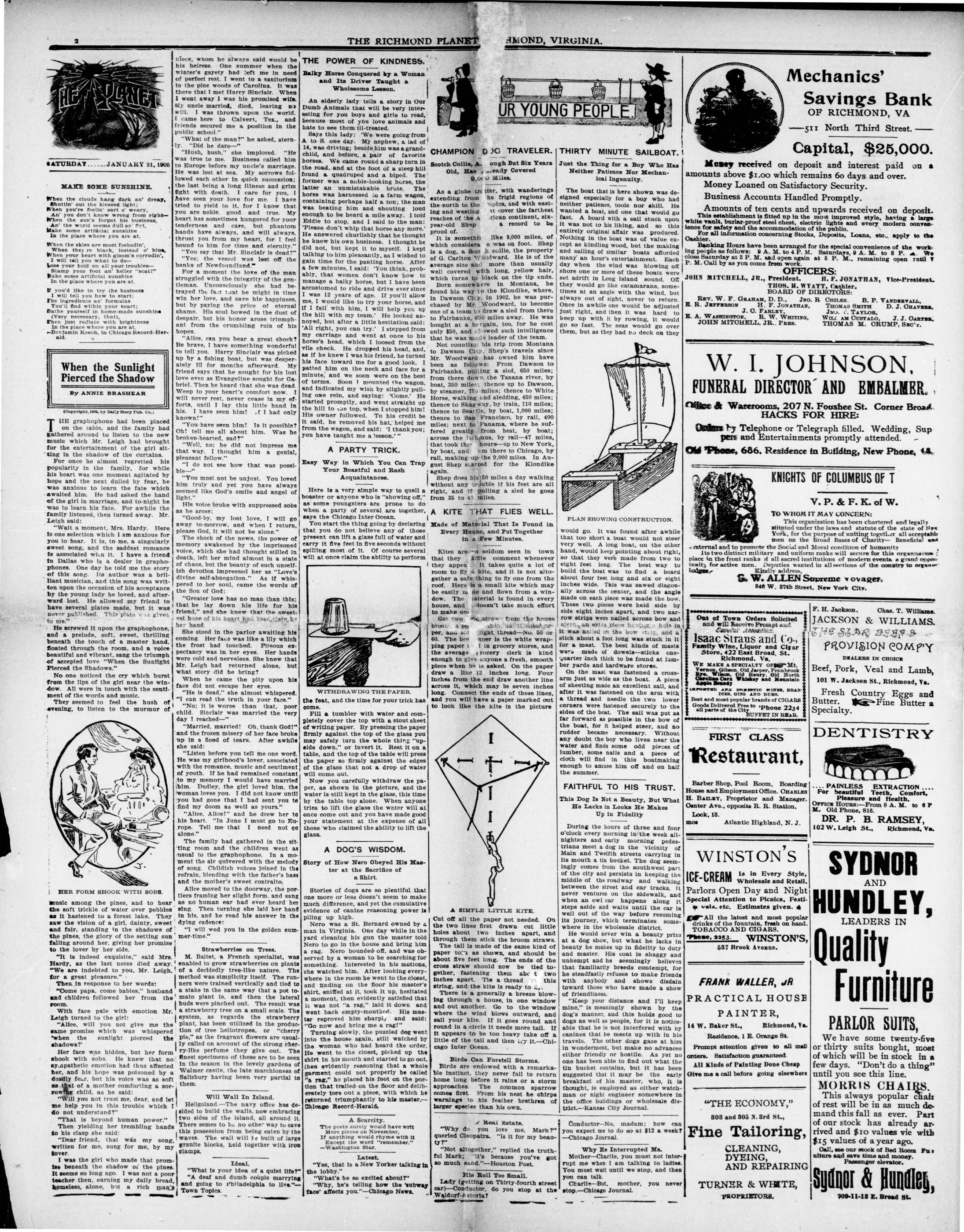
WITHDRAWING THE PAPER.
the feat, and the time for your trick has come.
Fill a tumbler with water and completely cover the top with a stout sheet of writing paper. By pressing the paper firmly against the top of the glass you may safely turn the whole thing "upside down," or invert it. Rest it on a table, and the top of the table will press the paper so firmly against the edges of the glass that not a drop of water will come out.
Now you carefully withdraw the paper, as shown in the picture, and the water is still kept in the glass, this time by the table top alone. When anyone tries to lift the glass the water will at once come out and you have made good your statement at the expense of all those who claimed the ability to lift the glass.
A DOG'S WISDOM.
Story of How Nero Obeyed His Master at the Sacrifice of a Shirt.
Stories of dogs are so plentiful that one more or less doesn't seem to make much difference, and yet the cumulative evidence of canine reasoning power is piling up high.
Nero was a St. Bernard owned by a man in Virginia. One day while in the yard cleaning his gun the master told Nero to go in the house and bring him a rag. Nero bounded off, and was observed by a woman to be searching for something. Interested in his motions, she watched him. After looking everywhere in the room he went to the closet, and finding on the floor his master's shirt, sniffed at it, took it up, hesitated a moment, then evidently satisfied that it was not "a rag," laid it down and went back empty-mouthed. His master reproved him sharply, and said: "Go now and bring me a rag!"
Turning slowly, the puzzled dog went into the house again, still watched by the woman who had heard the order. He went to the closet, picked up the shirt in his mouth and started to go out, then evidently reasoning that a whole garment could not properly be called "a rag," he placed his foot on the portion that trailed on the floor and deliberately tore out a piece, with which he returned triumphantly to his master.—Chicago Record-Herald.
A Scarcity.
The poets surely would have writ More pieces on November.
If anything would rhyme with it Except the word "remember."
—Washington Star.
Latest.
"Yes, that is a New Yorker talking in the lobby."
"What's he so excited about?"
"Why, he's telling how the 'subway face' affects you."—Chicago News.
As a globe tr extending from the north to the ing and westing reaches of the A year-old Shep proud of.
It is somethi! Like 9,000 miles, of which considera e was on foot. Shep is a dog, a Scott collie, the property of G. Carlton Woodward. He is of the average size and more than usually well covered with long, yellow hair, which turns to black on the tip ends. Born somewhere in Montana, he found his way to the Klondike, where, in Dawson City, in 1902, he was purchased by Mr. Woodward, to become one of a team to draw a sled from there to Fairbanks, 630 miles away. He was bought at a bargain, too, for he cost only $50, and showed such intelligence that he was made leader of the team.
Not counting his trip from Montana to Dawson City, Shep's travels since Mr. Woodward has owned him have been as follows: From Dawson to Fairbanks, pulling a sled, 650 miles; from there down the Tanana river, to Dawson, 350 miles; thence up to Dawson, by steamer, 750 miles; thence to White Horse, walking and sledding, 450 miles; thence to Skagway, by train, 110 miles; thence to Seattle, by boat, 1,000 miles; thence to San Francisco, by rail, 400 miles; next to Panama, where he suffered greatly from heat, by boat; across the fishmus, by rail—47 miles, that took three hours—up to New York, by boat, and from there to Chicago, by rail, making up the 9,000 miles. In August Shep started for the Klondike again.
Shep does his 50 miles a day walking without any trouble if his feet are all right, and if pulling a sled he goes from 35 to 40 miles.
A KITE THAT FLIES WELL.
Made of Material That Is Found in Every House, and Put Together in a Few Minutes.
Kites are so seldom seen in town that they kite comment whenever they appear. It takes quite a lot of room to fly a kite, and it is not altogether a safe thing to fly one from the roof. Here is a small kite which may be easily made and flown from a window. The material is found in every house, and doesn't take much effort to make one.
Get two on straw from the house broom a pencil thin and coated paper, and scrub light thread—No. 50 or 60. The best paper is the white wrapping paper in grocery stores, and the average grocery clerk is kind enough to give anyone a fresh, smooth piece when he is asked. On the paper draw a line 12 inches long. Four inches from the end draw another line across it, which may be seven inches long. Connect the ends of these lines, and you will have a paper marked out to look like the kite in the picture
I
I
I
A SIMPLE LITTLE KITE.
Cut off all the paper not needed. On the two lines first drawn cut little holes about two inches apart, and through them stick the broom straws. The tail is made of the same kind of paper torn as shown, and should be about five feet long. The ends of the cross straw should now be tied together, fastening them about two inches apart. Tie a thread to this string, and the kite is ready to fly. There is a generally a breeze blowing through a house, in one window and out another. Go to the window where the wind blows outward, and sail your kite. If it goes round and round in a circle it needs more tall. If it appears to be too heavy take off a little of the tail and then lay it.—Chicago Inter Ocean.
Birds are endowed with a remarkable instinct, they never fail to return home long before it rains or a storm approaches. The common sparrow comes first. From his nest he chirps warnings to his feather brethren of larger species than his own.
"Why do you love me, Mark?" queried Cleopatra. "Is it for my beauty?" "Not altogether," replied the truthful Mark; "it's because you've got so much sand."—Houston Post.
His Roll Too Small.
Lady (getting on Thirty-fourth street car)—Conductor, do you stop at the Waldorf-Astoria?
AMOND, VIRGINIA
G PEOPLE
THIRTY MINUTE SAILBOAT.
UR YOUNG PEOPLE.
Just the Thing for a Boy Who Has Neither Patience Nor Mechanical Ingenuity.
The boat that is here shown was designed especially for a boy who had neither patience, tools nor skill. He wanted a boat, and one that would go fast. A board with a sail stuck upon it was not to his liking, and so this entirely original affair was produced. Nothing in the boat was of value except as kindling wood, but the making and sailing of similar boats afforded many an hour's entertainment. Each day when the wind was blowing off shore one or more of these boats were set adrift in Long Island sound. Off they would go like catamarans, sometimes at an angle with the wind, but always out of sight, never to return. Once in awhile one would be adjusted just right, and then it was hard to keep up with it by rowing, it would go so fast. The seas would go over them, but as they had no deck on they
A rowing boat
PLAN SHOWING CONSTRUCTION.
would go. It was found after awhile that too short a boat would not steer very well. A long boat, on the other hand, would keep pointing about right, so that they were made from two to eight feet long. The best way to build the boat was to find a board about four feet long and six or eight inches wide. This was sawed diagonally across the center, and the angle made on each piece was made the bow. These two pieces were held side by side eight inches apart, and two narrow strips were nailed across bow and stern an extra piece having a hole in it was nailed on the bow strip, and a stick about a foot long was stuck in it for a mast. The best kinds of masts were made of dowels—sticks one-quarter inch thick to be found at lumber yards and hardware stores.
On the mast was fastened a crossarm just as wide as the boat. A piece of sheeting made an excellent sail, and after it was fastened on the arm with a thread and needle the two lower corners were fastened securely to the sides of the boat. The sail was put as far forward as possible in the bow of the boat, for it helped steer, and no rudder became necessary. Without any doubt the boy who lives near the water and finds some odd pieces of lumber, some nails and a piece of cloth will find in this boatmaking enough to amuse him off and on half the summer.
This Dog Is Not a Beauty, But What He Lacks in Looks He Makes Up in Fidelity
During the hours of three and four o'clock every morning in the week all nighters and early morning pedestrians meet a dog in the vicinity of Main and Twelfth streets carrying in its mouth a tin bucket. The dog seemingly comes from the southwest part of the city and persists in keeping the middle of the roadway and walking between the street and car tracks. It never ventures on the sidewalk, and when an owl car happens along it steps aside and waits until the car is well out of the way before resuming its journey, which terminates somewhere in the wholesale district.
He would never win a beauty prize at a dog show, but what he lacks in beauty he makes up in fidelity to duty and master. His coat is shaggy and unkempt and he seemingly believes that familiarity breeds contempt, for he steadfastly refuses to make friends with anybody and shows disdain toward those who have made a show of friendiness.
"Keep your distance and I will keep mine," is meaningly shown by the dog's manner, and this holds good to dogs as well as people, for it is noticeable that he is not interfered with by canines that be meets up with in his travels. The other dogs gaze at him in wonderment, but make no advances either friendly or hostile. As yet no one has been able to find out what the tin bucket contains, but it has been suggested that it may be the early breakfast of his master, who, it is thought, is employed as either watchman or night engineer somewhere in the office buildings or wholesale district.—Kansas City Journal.
Conductor—No, madam; how can you expect me to do so at $12 a week?—Chicago Journal.
Mother - Charlie, you must not inter-
rupt me when I am talking to ladies.
You must wait until we stop, and then
you can talk.
Charlie-But, mother, you never stop-Chicago Journal.
itter, with wanderings the frigid regions of opics, and with east- at cover the farthest rican continent, six- a record to be
100
Money received on deposit amounts above $1.00 which reel Money Loaned on Satisfaction Business Accounts Handled Amounts of ten cents and This establishment is fitted up in the white vault, burlar-proof steel chest, elelence for safety and the accommodation For all information concerning Stock Cashier. Banking Hours have been arranged in people as follows: 9 A. M. to 4 P. M. close Saturday at 3 P. M. and open again P. M. Call by as you come from work. OFFICE JOHN MITCHELL, JR., President. THOS. H. W. BOARD OF REV. W. F. GRAHAM, D. D., JN E. R. JEFFERSON H. F. JONATHAN J. O. FARLEY E. A. WASHINGTON, R. W. WHITING JOHN MITCHELL, JR., PRES.
W. I. JO
FUNERAL DIRECTOR
Office & Warerooms, 207 N. HACKS F
Orders by Telephone or Te
pers and Entertainment
Old Phone, 686. Residence
Money received on deposit and interest paid on a amounts above $1.00 which remains 60 days and over.
Money Loaned on Satisfactory Security.
Business Accounts Handled Promptly.
Amounts of ten cents and upwards received on deposit.
This establishment is fitted up in the most improved style, having a large white vanit, burlar-proof steel chest, electric lights and every modern convenience for safety and the accommodation of the public.
For all information concerning Stocks, Deposits, Loans, etc., apply to the Cashier.
Banking Hours have been arranged for the special convenience of the working people as follows: 9 A. M. to 4 P. M. Saturdays, 9 A. M. to 8 P. A. We close Saturday at 8 P. M. and open again at 5 P. M., remaining open until 9 P. M. Call by as you come from work.
OFFICERS:
JOHN MITCHELL, JR., President. H. F. JONATHAN, Vice-President.
THOS. H. WYATT, Cashier.
BOARD OF DIRECTORS:
REV. W. F. GRAHAM, D. D., JNO. R. CHILES. B. P. VANDERVALL,
E. R. JEFFERSON H. F. JONATHAN, THOMAS SMITH D. J. CHAVERS,
J. O. FARLEY, JNO. C. TAYLOE,
E. A. WASHINGTON, R. W. WHITING, WILM AM CUSTALO, J. J. CARTER,
JOHN MITCHELL, JR. PRES. THOMAS M. ORUMP, SEC.
W. I. JOHNSON. FUNERAL DIRECTOR AND EMBALMER.
Office & Warerooms, 207 N. Foushee St. Corner Broad HACKS FOR HIRE:
Odens by Telephone or Telegraph filled. Wedding, Suppers and Entertainments promptly attended.
Old Phone, 686. Residence in Building, New Phone, 18.
KNIGHTS OF COLUMBUS OF T
TO WHOM IT MAY CONCERN:
This organization has been chartered and legally situated under the laws and statute of the state of New York, for the purpose of uniting together all acceptable men on the Broad Bases of Charity—Beneficial and external and to promote the Social and Moral condition of humanity.
Its two distinct military and uniform ranks will secure for this organization place in the front ranks of all sacred institutions of modern events a grand opportunity for active men. Deputies wanted in all sections of the country to organize lodges.
G. W. ALLEN Supreme voyager,
846 W. 87th Street, New York City.
Out of Town Orders Solicited
and will Receive Prompt and
Consent Johnston
Isaac Straus and Co.
Family Wine, Liquor and Cigar
Store, 422 East Broad, St.
Richmond, Va.
WE MAKE A SPECIALLY PROMOTED
Mr. Vernon, Gibson, Old Jaaper, Pembrowk
Rye, Wilson, Old Henry, Old North
Carolina Cors Whiskey and Mountain
Apple Brandy
IMPORTED AND DOMESTIC WINES, BRAN-
DISH AND RUMS.
Best and most popular brands of CIGARS
Goods Delivered Free to 'Phone 2234
all parts of the City
BUFFET IN REAR.
FIRST CLASS Restaurant.
Barber Shop, Pool Room, Boarding House and Employment Office. CHARLES H. BAILEY, Proprietor and Manager. Center Ave., opposite R. R. Station. Look, 18. mos Atlantic Highland, N. J.
WINSTON'S
ICE-CREAM Is in Every Style, Wholesale and Retail. Parlors Open Day and Night Special Attention to Picnics, Festivals, etc. Estimates given. All the latest and most popular drinks of the fountain, fresh on hand. TOBACCO AND CIGARS. Phone, 2253. WINSTON'S,
587 Brook Avenue.
FRANK WALLER, JR
PRACTICAL HOUSE
14 W. Baker St., Richmond, Va.
Residence, 1 E. Orange St.
Prompt attention given to all mail orders. Satisfaction guaranteed.
All Kinds of Painting Done Cheap
Give me a call before going elsewhere
"THE ECONOMY,"
303 and 305 N. 3rd St.,
Fine Tailoring,
CLEANING,
DYEING,
AND REPAIRING
TURNER & WHITE,
PROPRIETORS.
```markdown
```
Mechanics' Savings Bank OF RICHMOND, VA 511 North Third Street. Capital, $25,000.
F. H. Jackson. Chas. T. Williams. JACKSON & WILLIAMS. THE STAR BEEP & PROVISION COMP'Y DEALERS IN CHOICE Beef, Pork, Veal and Lamb, 101 W. Jackson St., Richmond, Va. Fresh Country Eggs and Butter. Fine Butter a Specialty.
DENTISTRY
PAINLESS EXTRACTION
For Beautiful Teeth, Comfort,
Pleasure and Health.
OFFICE HOURS:—From 8 A. M. to 6 P.
M. Old Phone, 816.
DR. P. B. RAMSEY,
102 W. Leigh St., Richmond, Va.
SYDNOR AND HUNDLEY, LEADERS IN Quality Furniture
PARLOR SUITS.
We have some twenty-five or thirty suits bought, most of which will be in stock in a few days. "Don't do a thing" until you see this line.
MORRIS CHAIRS.
This always popular chair of rest will be in as much demand this fall as ever. Part of our stock has already arrived and $10 values vie with $15 values of a year ago.
Call, see our stock of Bed Room Furniture and save time and money.
Passenger elevator.
Sydnor & Hundley,
Ligity a ls A oF
ba) SARS in For Go os a {
SC =.
ae AE aes)
mae: pee new CO DER}
ZL a KO =, aovepzures in SKA
NP iy Ee
! lee Be Ss EH PRB)
2 - Rouen
S PT JZ ae
: gees
Copyright, set, ty & 5. McCrure Ca)
peers nes —1 Ts painted.
; eS | ikea he ees onitta ascetic
: io Reece plainly hear the deep snoring of both
A i ital gee tL 2 eee ee
the forenoon trying to pass the wood,
and then the leader said:
“It ain't no use goin’ any farther this
way. We might as well go back ter
their trail. Them fools has gone ter
Dyea as fast as their feet kin take "em
ter try an’ find us. Come on.”
He wheeled his horseas he spoke, and
the others followed bis example. ‘The
gan was below the horizon when the
tired animals once more entered the
track they had left that morning, and
Bowers hurried hisslone, remarking:
“We might as well git along ter ther
old hut agin an’ camp ternight. It'll
save ther bother of sticking out our tent
an’ cuttin’ beds. Stir up those crit-
ters!”
Half an hour later they had reached
the spot where they left their prisoners.
It was deserted, and Bowers chuckled
with satisfaction as he said:
“Think of ‘em trampin’ forall they're
wuth an? we with all their stuff!”
As he spoke he dismounted, and
added:
“We'll hey ter lead these critters in-
ter ther bush with us afore we unpack
“em. We must put al! ther dust in the
hut with as. I don’t take no chances.
‘We'll stan’ a watch, too.”
After some trouble the horses were
led to the hut, the gold unloaded and
placed within. Then Bowers threw
himself on the pile of boughs, saying:
“Come on, Turner, let's warm our
eyes. I'm too sleepy ter eat, Rider,
you keep watch fer awhile, an’ then
‘wake one o’ us up.”
Almostas he spoke he dropped asleep,
an example promptly followed by Tur-
mer, while Rider sat by the door yawn-
ing. Neither man had slept the night
before and soon his head began to
droop.
‘Finding it impossible to keep awake
fm this position, he arose and paced
alewly up and down in front of the but,
aa ho had been accustomed to do on
ahipboard.
He did not see a dark form which
@rew neerer cach time his back was
‘turned.
Closer and closer it crept until t
Feached @ tree at the end of his route.
‘The next time he turned his back to it
dhe was seized by the throat from be-
‘hind with a grip which completely shut
off his breath while a stern whisper
sounded in his ear:
“Make « sound and I'll kill you like
- 8 ~
"Deed Rider made no attempt tovtrog
gle after the first involuntary start of
surprise. The cold rim of steel pressed
against his ear was too strong an argu-
ment in addition to the viselike gripon
his windpipe.
‘The latter was loosened when he
ceased struggling and the voice whis-
pered:
“Come with me quietly, or it'll be the
‘worse for you!"
‘The speaker pushed him along 9 few
yards until he reached a spot where he
ould readily distinguish the outlines
ef several men under a tree. As they
@pproached the group, his captor said:
“Here he is. Now, what shall we do
with him?”
It was Tarbox who stood behind the
prisoner, and he added:
“One of you take away his weapone.”
‘Tom Scott sprang to the side of his
eld enemy, and to his delight found
‘two loaded revolvers in his belt, which
he secured, giving one to Taylor.
Avery had takem the one from his
daughter, and Tom found that the car|
tridges in the weapon just secured fit
ted the empty revolver he had found a
‘the but.
‘To slip three of them inte It was the
‘work of a moment. Then our friends
found they had four weapons ready for
‘ase, and determined to lose no time in
recovering their golden treasure.
“Let's surround the hut,” said Tom,
‘eagerly, “and call them out. They'll
aurrender when they find they have no
abow with us.”
But Avery advised caution. “They're
Gesperate men,” he said, “and they wil
fight when cornered. We don’t want
any bloodshed over this affair if we can.
Belp it, When daylight comes they
may be glad to give us the gold to save
their skins, but if we surprise them in
the dark somebody is likely to get
killed.”
“See here,” said Tarbox, suddenly,
still gripping Rider's collar with his
sinewy band, “why can’t this rascal
Relp us? Send him back, and let him
get hold of the guns in the hut and
bring them out. If he tries any crook-
ed business I'll put a bullet through him
myself at the first sign.”
“You hear?” said Taylor. “Now be
off, and remember we are six te your
three. We already have the horses
sate, and if you serve us well you sia
go free, although you ought to be hung
for what you have done. Go back and
gc all the weapons you can out of the
rat. Hurry up!”
“But Bowers will shoot me in a mine
ute if he wakes,” whispered Rider, fear
fully.
“Shoot him first, then,” was the
Prompt response. “I'll shoot you if you
act the least bit suspicions. No mere
talk now. Start”
‘The muzzle of a revolver poked
smartly into the small of his back left
the wretched man no alternative and
> scan elye den came af seagate abacus iietl wee
is painted. te S.
When he reached the door he coule
plainly hear the deep snoring of bot!
men, and. mustering all bis courage, he
stepped lightly inside.
In order to reach the rifles in the cor
ner he was forced to step over the bod}
of Turncr, and it seemed to the mate
that he lived an hour in the few sec.
fonds so employed.
His hand trembled so that it was wit
the utmost difficulty he managed to se
cure the three weapons noiselesely, but
fortune favored him. With bated
breath he stole out of the hut with them
in his arms, and when he reached the
edge of the clearing he was met by
‘Tarbox, who said, grimly:
“Good! You make a capital bur
glar! Now, how many revolvers have
they got in there?”
“They've got two apiece,” replied Ri
der, “but you might as well shoot me
as to ask me to try to get them off the
men. Bowers sleeps with one eye opex
and he—"
‘The rest of the sentence was lost by
& startling interruption.
While he was speaking he had unwit-
tingly raised his voice above a whisper
and aroused the very man of whom he
was speaking, and who now stood in the
doorway saying:
“What the ——, Rider! Who's that
you're talking to?”
Even as he spoke the moon's edge ap-
peared over the tops of the trees be-
hind the hut and a bright shaft of light
illuminated the spot with startling
distinctness.
At the sound of his voice the entire
party sprang from the dark shadows,
and Tarbox shouted, as he leveled his
revolver:
“Surrender peaceably and we will
only take our own! If you show fight
We'll shoot. We are two to your one!"
“Treachery!” snarled Bowers, as he
jerked his revolver from his belt with
lightning epeed and fired pointblank at
Rider,
‘The bullet sped true to the mark and
with a groan the unfortunate man sank
to the ground, grasping his side con-
vulsively.
Tarbox fired almost at the same in-
stant, his bullet striking Bowers’ hand
and sending the weapon spinning to the
ground.
Although the wound must have caused
him exquisite pain, the desperado drew
his remaining weapon instantly with
his left hand and at the moment Tur-
‘ner appeared and coolly took his place
‘at his side.
“There's too many of ‘em,” he sald,
after a comprehensive glance about
Lim. “We'd better light out!”
Bowers’ reply was to senda bullet
within half an inch of Tom's head, but
ey
& \
| BS ee
a/— |
Pits
it was his last shot, for the second
mate, who had stolen behind the hut
suddenly sprang at him with a heavy
elub and stretched him senseless ot
the ground.
When Turner found himself alone
and looking into the muzzles of s¢
many weapons, he dropped his own,
held his hands up above his head and
said quietly:
“Don't shoot, pards! I gives int”
‘Tie him up!” ordered Tarbox.
It was soon done, and while Tom was
assuring his sweetheart that he had
not been injured one of the other men
started a fire. Obed Rider was evidently
mortally wounded, and all that could
be done was to make him as comfort
able as possible. He was gently litted
and carried inside the hut, while Bow-
ere was secured as soon as he recov-
ered consciousness.
The mate had bean shot through the
lungs, and after examining his wound
Taylor shook his head and said bluntly:
“I might as well tell you the truth.
You are a dying man.” a
Rider did not dispute him. Perhaps
with the approach of death some warn-
ing came to him, for he said in feeble
tones:
“Die! Yes, I feel that I've made my
lost voyage. Call Scott here.”
Tom eame at once, and ue he knelt by
the dying man and gazed into his pale
face, upon which the shadow of death
was already beginning to settle, he for-
got his long cherished vengeance and
said softly:
“I'm here, Rider. I can guess what
you want to say. It’s all right now.
Don’t fret oxer what you've done to
me. It doesn’t matter. Can I do any-
thing to make you any easier? Have
you uny message to send toyour folks?”
“Tell ‘em anything but the truth,”
said the dying men. “They mustn't
know what'a bad end I came to, Imust
tell you something while I can. it's
about your father.”
“My father!"
Tom drew closer to Rider and ex-
‘claimed:
/ “Quick! What do you mean?”
“Get me some brandy,” whispered
the other. “I'm getting faint.”
Tom darted off, and soon returned
with the stimulant which they had pro
THE RICHMOND PLAN Tf, RICHMOND, VIRGINIA.
revived at once and said:
“Don't interrupt me. I must be
quick. ‘This wound is burning me up.
Your father got the Alaska fever and
left his ship at ‘Frisco. He gave me
all the money that) belonged to the
owners to take to them. I gambled it
away. To hide my crime I said he
ran away with it I saw him tn
Dyea—"
“What!”
‘Tom stared) at him as if inclined te
think his mind was wandering but the
mate went on:
“He's rich. He's struck gold some-
where, and was going home to find you.
He was wild when I told him you was
dead and started off for "Frisco to see
you was buried in good shape. That's
all, and it’s enough, too.”
As he uttered the last words be fell
back exhausted. Tom tried to give him
more of the fiery liquor, but he could
not swallow it. His lips moved feebly
and his eyes were turned on Tom fn
mute appeal.
“I forgive youl God knows I do!”
whispered the young man huskily, and
@ flash of joy on the dying man’s face
told him that he was heard and under-
Stood. Then a single long-drawn breath
followed, and with it Obed Rider's
earthly career ended.
There was no desire for sleepin the
Uttle party that night. By the sight
of the camp fire a grave was dug and
the body of the unfortunate sailor
placed beyond the reach of any wild
animals, and by the time this was done
the dawn was near.
Avery dressed: Bowers’ fingers to the
dest of his ability, the latter grinding
his teeth with pain and rage as be
realized how he had been outwitted the
second time.
His partner, however, took the whole
matter as coolly as if he had not been
caught in any act that might cost him
hie life. He spoke but once, and that
was to ask one of his captors to ac-
commodate him with a chew of to-
bacco.
“Wouldn't trouble yer, only yer've
tied my hands,” he explained.
When it was fairly light a council
was held to determine what disposition
should be made of the prisoners. This
proved a somewhat difficult matter. Te
take them to Dyea involved a vexatious
delay, for there were no horses forthem
te ride, and to turn two such desperate
men loose seemed a dangerous thing
to do. Moreover, they would starve
without provisions.
After talking the matter over some
time without arriving at any conclu-
sion, Taylor exclaimed, impatiently:
“They ought to be hung, but I don't
want the job! We'd better give them
grub enough for a week or two and
turn them loose, We can’t be bothered
with them!”
Bis advice was agreed to by the rest
and the little outfit was at once pre-
pared. When they were ready to start
he walked up to the two desperadoes
and said:
“There's your grub. Take itand light
eut, I shall give a full description of
you to the authorities at Dyea and see
that it is sent to Dawson. Somebody ix
sure to hang you both before long.”
As he spoke he cut their bonds and
‘then mounted: his horse, _
Half an hour later our friends were
‘well on their way, while the baffled rob-
‘bers were trudging tediously along to-
ward Fort Selkirk in moody silence.
Their plots had failed, and here we
must leave them to their fate.
_ It was a happy party that rode into
Dyea five days later. The capitalist was
eager to close his advantageous bar-
gain, and the business was soon trans-
acted. Taylor received adraft for $100,-
000 on responsible San Francisco par
ties, and when the bags of gold dusthad
been safely deposited on board the
steamer all care was at an end.
It was the first night out from Dyea
that Tom Scott found Avery alone on
the deck, and ina few manly words de-
clared his love for Clara, asking her
father's permission to marry her.
“What does stie say?” asked the old
miner, soberly.
‘Tom blushed like a schoolgirl and re-
plied:
“I haven't asked her yet.”
“Then do it, my Ind. She's been the
boss this long time. Strikes me you're
Pretty sure what she'll say to ask me
first, you rascal.”
But Tom was already gone, and we.
cannot follow him. Suffice it to say
that the other men saw but little ef
him for the rest of the voyage.
At Seattle the party decided to re-
main a day in order to procure more
suitable clothing. They went at once
to a hotel and registered, and half an
hour later a stranger accosted Tom,
saying:
“Mz. Thomas Scott, I believe?”
‘Tom admitted his identity, and the
man continued:
“I have been hired by Capt. Scott,
your father, to find you. He is.at the
Palace hotel in San Francisco, waiting
for news of you. Will you wire to him,
or shall I do it?”
For @ moment Tom was too aston-
ished to speak; then he bolted for the
telegraph office.
Three days Inter there was a joyful
‘weunion of father and een. andell cals
Genius tn Distress,
Homer'was a beggar; Plautus urned
® mill; Terence was a slave; Boetius
died in jail; Paul Borghese had 14
trades and yet starved with them alls
‘Tasso was often distressed for five shil-
Ungs; Bentivoglio was refused admit.
tance into a hospital he had himself
erected; Cervantes died of hunger, and
Vagelas left his body to thesurgeons to
pay his debts as far asthe money would
G0; Bacon lived a life of meanness and
distress; Sir Walter Raleigh died on the
aeaffold: Spenser, the charming, died
Tn want; the dea
through neglect. |
derangement; MM!
right of “Paradir
three payments
im obscurity; Dr
and distrese; Oty
and through hu
street; Steele live
fare with bailiffs
of Wakefield” wa
pony rang oe pe
tn want; the dea “of Collins was
through neglect. 8 ( mented
derangement; M&t Bold his copy-
right of “Paradir for £15 at
three payments hed his life
im obscurity; Dr in poverty
and distrese; Oty prematurely
and through hu “Lee died in the
street; Steelelive £@of perfect war
fare with bailiffs Udemith’s “Vicar
of Wakefield” wa | for a trifle te
save him from { tip of the laws
‘Fielding lies in th Surying ground of
‘the English factors at Lisbon, without
S atone to mark therspot; Savage died
In prison at Bristol, where he was con-
fined for a debt 6f eight pounds;
| Butler lived a life of penury and died
Poor; aatterton, the ehild of genius
‘and misfortune, dei tryed himself—
Homiletic Review.
Sympr \y.
“You look awf y tired, young
man,” sald the, neyolent-looking
Woman to the you man with the
books under his at
“Yes, ma’am,” re ied the student,
“I'm studying for a foctor.”
“It's a shame! Way don’t you let
the doctor study for himself ?’—
Yonkers Stater an.
Finally.
As you walk the » ¥ along,
Weave the suai @ in the song:
Even let the darkest night
Have one star that dreams of ight!
—AUlanta Constitution,
ANOTHER GUESS COMING.
GQ
yah
haat
fy cae Se
a
COR Sey
AS § uy
Ca ©
SS 5 oH
eai | a \
Rayese Heh |) |
edi SY
Sa ey My Hh
eee
y | + Y
V\ Milf
twa i | i} I i
i i fl MAH
f SG i
Can cK
She—Is my hat on straight, Cholly?
He—No; It tilts to the right.
She—That is just what it should do,
you simpieton.—St. Louls Republic.
They Merely Tote "Em
“Now, how do you move your poles about?
we queried. “Do rou Samm om
The chief replied with ol shout:
“Ob, no! We merely toxem.”
Chicago Journal.
‘Has Its Compemmations.
| “Riches, my friend,” sald the pluto-
erat, “do not bring happiness.”
| “Maybe not,” said the proletarian,
“Dut it must be a heap of satisfaction
to have a lot of money and be abie to
talk ze that to ache that hasn't
Wot any.” —Chtengo Trini
Glory.
“I understand that het mother ts
one of the Daughters of the American
Revolution.”
| “¥es, but the thing that interests
‘me ts that the girl herself is tue
daughter of a miliionaire."—N. Y.
‘Herald.
Charlie Loet.
|. Patience—Did you say Charlie Half-
back asked for her hand?
Patrice—Yes.
“How did he come out?
“Oh, her father won in the kick-off. 1
Ddelieve.”"—Yonkers Statesman.
A Reasonable Suspicion.
“Is Miss Pretty considered fast?”
“Gracious, no! What put that idea
tuto your head?”
“Why, I heard Sprinter had been try-
tng to catch her for the last alx
months."—Houston Pest,
The Grammar of Love,
He—Give me a kiss,
She—I won't.
He—You shouldn't say “I won't.”
"You should say “I prefer not to."
She—But that wouldn't be true—
Mlustrated Bits,
‘Two Kinds,
“You say there are two kinds of liter-
ary success?"
“Yes,” answered the publisher. “One
depends on how well an author can
write, and the other on how much.”—
‘Washington Star,
What He Would “Save Done.
_ Mike—Shure, an’ thot mew boss av
moine began to kick befoor O!’d done
& shtroke ay wur-rk,
_ Pat—Thin, begorra! yez wor a fool
not to quit befoor yetz comminced.—
Judge.
; TOO FUNNY.
»
§
“Look at me! Look at me!” pleaded
the distracted lover. “See how your
aloofness affects me! Only give me one
glance—"
“Oh, don’t tempt me,” said the gentle
damsel, keeping her eyes averted.
“Don’t tempt me to look atyou. I have
& fever blister on my Mp and can’t
laugh."—Chicago Tribune. .
A PRAYER.
Being to him so precious,
‘Beyond all things of price,
Bo comforting and gracious
‘Oh, scales upon his even!
Since lost and broken:earted
He'd go his tonely road,
If he and I were parted,
Keep me, dear God!
From Ughtnings that affright me,
From pitfalls in my path,
From suns that burn and smite me,
And from the whirlwind’s wrath;
From poison and from fever,
From snares at home, abroad,
Because he loves forever,
‘Keep me, dear God!
‘Yea, will Thine angels guard me,
Lest that I fall and fail,
From avaianches ward me,
And precipices all;
By fire and water tend me,
Who have deserved Thy rod,
Because one man must need me,
Keep me, gear God!
—Pall Mali Gazette.
THE LATEST
THING
By WM. H. OSBORNE
a. ———
ROM time immemorial the true
poker sharp has operated under
ws as fixed and immovable and un-
‘changeable as the laws of nature. The
first step has invariably been to get a
man with a wad of money. The sec-
ond step is to get him off alone some-
where. The third step is to let him
win a few games, uatil he is well
worked up. The fourth and last is to
Jet him lose all the other games, tak-
ing good care to keep him at it until
be 1s dead broke.
But this is an age of originality—ot
enterprise. Mickey Walters and his
close companion, Shitty Smith—two
young mem with fresh complexions,
but very hard mouths—were poker
sharps par excellence. For they had a
little game that was all their own.
“It’s the latest thing In poker,”
Mickey would remark, as he winked
his other eye.
It was. And it was novel. For,
‘whereas the old-timers had been wont
to let their victims stack up the chips
at the start, they always, toward the
fend of the game, did the stacking up
themselves; whereas this had been the
rule, Messrs. Smith and Walters had
apparently reversed it. They usually
started om an even basis, allowing
their victim to win a game and lose a
game, and when the victim was quite
sure that they were on the level,
they let him have everything in
sight. Any man, who within the last
two years has been up against Mickey
Walters or Shifty Smith, will recall
that he finished In grand style, with
every chip piled up before him. How
could this be? Ah, that Is where the
enterprise and originality came into
play.
It was an invariable rule with
Messrs. Smith and Walters and a third
individual, who aided them in the en-
terprises now and then, to keep on
hand at least the sum of $500. This
1s quite essential, for he who goes out
after elephants mus: use something
thaw fish worms as his bait. But
at times they were sadly pinched to
Keep this tidy sum in tow.
It was on a pleasant, but frigid win-
ter evening, that they found them-
selves—but for this reserve fund of
half a thousand—almost without funds,
But Smith and Walters started out
and soon came back. They came back
not alone. They had with them a
youngster who they were sure had in
his clothes the sum of $2,000. They
were sure of this, because they had
seen the money. It was two lusctous
$1,000 bills. This yonth found in the
couple two very agreeable companions.
They froze fast to him. They became
‘acquainted with him by inviting him
to throw dice for the drinks. As the
fntimacy ripened, they suggested to
him, that as he had nothing to do, and
they had nothing to do, how about a
quiet little game? Casually Mickey
pulled from his pocket the $500 to
show that he was a man with the
funds.
“I'm with you,” sald the young
stranger. -
Shifty Smith then iutimated that he
knew of a cosy little place over on the
avenue, where they could sit till morn.
ing and never be disturbed. ‘The
stranger assented, No warning hand
was there to hold him back. He went.
The place was Charley's. Charley
was the mysterious third party asso-
clated with Smith and Walters. He
had one peculiarity. He hired his
cosy little room only for one day oF
one night. Some times it was cheaper.
Sometimes it was convenient. When
they entered Charley's Mickey Walters
quickly passed to Charley the $500 that
he had.
“Who's the mug?" whispered Char-
ley, eyeing the invited guest.
“Sh!” returned Mickey, “he's the In-
test thing in poker.”
“Chips, Charley,” said Shifty Smith,
“and charge ‘em ‘up to my account.”
Shifty was supplied with chips by the
“house.” Mickey Walters. got some,
too, but made a show of really paying
for them. The young stranger pulled
‘out two $1,000 bills. The eyes of the
three glistened.
“Gee,” though Mickey, “if he’s goin’
to plunge like that we can get his pile
by midnight.”
‘The stranger scratched his head. “I
don't want to take too many chances,”
he announced. “I'm going to play
$1,500 of this and then quit, hit or miss.
Give me,” he commanded, “$1,500
worth In big chips and $500 in change.
See?”
|. Charley, thanking his stars that he
had the $500, handed it out, and took
‘the two large bills. ‘Then Charley and
‘Ais two companions sighed with relief,
For, though apparently the game was
Just beginning, the real game, their
Fame, had been played,
Steadily the stranger won, At the
‘start he lost a game'or so—that was a
Part of the scheme arranged by Smith
and Walters. But after that it was a
walk-over. He won hands down,
Shifty and Walters fnally threw up
their hands in despair.
“Great Scott!” sald Mickey; “I
‘won't play another card to-night.” He
cai os te ee ee
/* "Nor 1,” echoed Shifty. “I'm busted.”
He nodded admiringly toward the
stranger. “How do you do it?” he
exclaimed.
| The stranger modestly said he didn’t
Brnow how he did it. This made Messrs
Smith and Walters smile. For they
knew, all right—they knew that they
hal been doing it for him. Then they
sighed.
“One more game?” insisted the
stranger. They shook their heads.
“Some other time,” they said.
The stranger rose, after having ar-
ranged his chips ia little piles.
“Then,” remarked the stranger, “as
Mt is getting late, I'll have to cash in
and get out. That's all.”
“Charley,” called Shifty to “the
house,” “the gentleman wants to cash
in.” There was no answer. “Gone to
sleep, I guess," said Smith. He strode
to the little alcove, where “tne house”
sat behind a little curtain, and pulled
‘the curtain aside. There was nothing
there but @ chair, and a broken-down
desk with the drawer wide open. Char-
ley was not there.
“Geewhilikers!” exclaimed Mickey
‘Walters, “he's vamoosed. Hanged it
he hasn't. And, by George, with au
the cash.”
It was too true. Or at least it seemed
to be. “I didn’t think it of Charley,”
said Walters.
“Maybe he's just slipped out,” ‘sug:
gested Smith. They turned to the
stranger. “I'll tell you what we'll do,”
they said; “you stay here. Charley has
& favorite cafe over on the corner, and
df he's there, we'll send him back. You
wait.”
“I'l wait,’ assented the latest thing
in poker, “until you bring him back.
I hope.” he went on, “that he hasn't
gone away for good.”
“We'll find him,” said Smith and
‘Walters, “see if we don’t.”
They strode downstairs, and when
they reached the street, they turned
and ran at full speed. After running
for three-quarters of a mile, they da:t-
ed into a cafe, and brought up in the
back room. There sat Charley. holding
77
fly a \
fed <a! ES
AR WAY
, Lo 4 1
SED ey
NSS
<x{l z
im his hands the two $1,000 bills
“Gee!” he commented, “wasn't {
great.”
“Don't talk about it,” said Walters
“let's ‘have a drink on the house.”
“Itll have to be.” corrected Charley
“on the latest thing in poker. The
house hasn't got a copper—nothing
else except these bills.”
‘They ordered drinks and drank
them; ordered them again and drank
them; again and drank them. “And te
think,” said one, “that six hours ago,
‘We had nothing but our net egg, an¢
Mow we've Kot a cold $2,000; $500
apiece and five in the bank. Gee
whiz!”
Fanally they had had enough. “I
wonder,” said Mickey, “is the latest
thing in poker awaitin’ for us.” He
‘was not. He had waited long enough
to take out the $500 change and count
it over. “A good night's work,” he
said. “I didn’t think T could ever get
rid of them two hoodoes—the denom:
ination was too large.” The latest
thing in cards stepped quietly down
stairs and disappeared.
Back in tne little cafe the waiter
stepped into the room. “Say!” he said
to the trio, “haven't you got some
money wot is good. This here ts on
the bum." He tossed the $1,000 bill
upon the table.
The young victim of the evening may
have been the latest thing in cards, but
the thousand dollar bills were the lx
test things in counterfeit.
Bad Teeth Cause Cancer.
London.—Walter Whitehead, the well
known Manchester surgeon, believes {t
possible that cancer may be due to bad
teeth. Addressing the students of ths
Victoria Dental hospital the other day
he said, that to drain, trap, and ventilate
a house for a man with bad teeth was
waste of money, for he polluted the
purest air as he breathed it, and con-
taminated the most wholesome food as
he ate it
Dreadfully Provincial.
The Strange Hen—You'd hardly be
lieve it, ladies, but in the part of the
country from which I came incubators
are unknown.
The Modern Hen—Goodness gr
cious! I suppose the simple minded
folk out that way stil! believe that a
hen’s sphere is her nest—Town Ty
ics,
Then They All Laughed.
“Gentlemen,” said the canaidate, “you
twit me with having turned my coat
Years ago I supported your policy. Then
Thad a reason. But now, genticmen, |
have lost my reason.” And he wonderei
at the deafening smile that pervaced the
meeting—Chicago Journal. |
uk” Gacleae Makecieten
_ “*Rastus, why don’t you sign der
pledge?”
__""Tain’t no use,” said Mr. Pinkiey;
“I writes so had dat if I did put my name
to de pledge I wouldn't be able «
reco'nize de signature."—Washingto:
Star.
Bought and Paid For.
“They are saying that you bought at
paid for your election.
“That's right,” answered Senator Sor
ghum. “Ican look the world in the fac
‘nd say: ‘I owe no man a penny.'"—
Washington Star.
¢
THIS PRETTY GIRL
IN MAN'S CLOTHES
Denver.—A wild rose of rare beauty
Jamong the sage brusn of the boundless
plains; @ lily amid the weeds of Wyo-
ming as the embiem of purity; with
he face of a Madonna and the eyes of
a fawn, gracetul as a gazelle, shy as
an antelope, and with the form of a
Venus—only the glorious west could
have produced Mary Coilins—a patient
Jat St. Joseph's hospital, says the Post.
Strange enigma se, that even the
[sweet sisters in charge of the hospital
Were unable to solve. Perhaps they
did not try too hard when she hid be-
hind her flaming blushes and whis-
pered faintly: “Well, I'd rather not
tell my real name. ‘Spect it wouldn’t
do folks no good to know, anyway, and
then 4s they always looked on me as
[a boy—"
That brought out the most interest
ing phase of all about Mary Collins—
'so-called—most people took her to be
© boy. Took her to be a boy until the
tender nurses at the hospital prepared
her for the operating table, and thea—
well, then, she told her story.
‘The telephone message to St. Jo-
‘seph’s was simple, buc exciting: “ofan
dying at the Union station; send ambu-
lance at once.”
__ The “man,” whose garb included the
Tegulation leather jacket, chaps, high-
heeled boots and a sombrero, was
found to be in a serious condition. He
gave his name as “James Brown.”
In a private ward, away from the
fresh, free air, “James Brown” broke
down and told a pitiful tale of Wyo-
ming life and-pluck in the face of dis-
heartening sorrow.
“She was a pretty little thing,” sald
one of the sisters this morning. “and
the way she tried to explain things
while lying there suffering so, was pit-
ftul to see. ‘Oh, T could not help it; T
could not help it, shc would moan
Lea \ ‘9
)) yew
Gh isi
GAY YA Sf |:
BRR
<a a ‘
NEO
ch %,, a et Yall,
yg RE a a ee ee
ven in her sleep, and we were almost
Prepared to hear the tale of some terri-
dle crime, when late that same evening
she called me to her bed and said she
had something to tell me. This te
what she told me:
“Iam either going to die or get
well, but before I go I want to tell you
all why you hanpened to find me in =
cowboy’s suit, and then perhaps you
won't judge me harshly. [am 22 years
‘of age, and was born on a cattle ranch
in Wyoming. I was the only child,
and as father had a hard time to get
along alone and could not afford to hire
help, I donned a cowboy’s suit and
helped him. Year after year I rode
‘with him over the ranges, looking after
the great herds of cattle, and when
scarcely 17 years of age, fell in love
with a real cowboy and we were mar-
Tied. We wern't happy, though, from
the first—I guess it was just because
‘We were not suited to each other, and
after two years of living together, he
left me. In the meantime father and
mother had both died and I was left
all alone in the world, with no money
and 0 way of earning a living except
by cattle herding. Of course, no ranch-
man wonld hire a woman, and so I de-
cided the only thing I could do would
de to try to be a man. Accordingly T
got a cowboy’s sult, found a pony and
set out to find work, which is not hard
to get on the ranges if one only knows.
how to ride.
“ ‘That's about all there is to it. T
worked hard and was getting a Uttle
money ahead, when I began having
‘awful pains and was afraid I had ap-
Pendicitis. I decided to come to Den-
Yer and go to the hospital. Of course,
I could not buy any woman's clothes
‘on the range, so I decided to come just
as Iwas and as soon as I reached Den-
ver to get myself an outfit and go to
the hospital in a respectable way. But
I was taken sick on the train and the
first thing knew I was in a bed here,”
“The next morning the girl went on
the operating table.” explained the sis-
ter, “and for many days we did not
think she could live, but she finally
pulled through and yesterday we got
her some clothes, gave her a ticket to
Wyoming, and she went back home—
whether to the ranges she did not say,
Dut perfectly happy because we said
We believed in her and knew she had
done the best she knew how. The only
thing she would not give us was her
real name. ‘I would just a little rather
not,’ she would say, 50 we did not in-
sist and she was known about the has
pital as Mrs, Mary Collins.” 3
Traducing a Good Man,
Mrs. Ferguson—What did Dr. Fourth-
ly preach about this morning?
Mr. Ferguson—Well, he preached
about half the congregation to sleep —
Chicago Tribune.
Surprising Ignorance.
Jimmy—Don't you spell faint
“f-a-t-n-t2”
‘Tommy—No; you spell it “f-e-t-m-t.”
Don’t yoa read the sportin’ noos?—Puck.
THE PLANET
SATURDAY... JANUARY 21, 1905
THE DAIRY
A CHEAP SILO.
The Following Plan of Construction Is Recommended by George E. Scott.
It is always difficult to give full instructions how to build a silo correctly so that the majority can comprehend the full idea of what is meant. In sections where the soil and subsol made up of gravel formation, the bottom should be cemented, as the liquor from the silage would leach away and ultimately spoil the silage. On the other hand, if the soil is clay and a clay subsol, if well compacted I would prefer it to even cement, as it can be made waterproof very readily. In our illustration the bottom and sides of wall will have to be cemented water-proof up to the top of wall, as there would not be any opportunity for drainage and outside water would get in and soon destroy the silage, at least to the top of the ground. It is not practical to go more than four feet in the ground with a pit, as no one wants to lift enallage more than four feet, if that high.
It would be better to break stone six inches over the bottom of the excavation and begin the wall on top of it. Grout the top of the stone and then put a cement coat on, one inch thick, and up the sides of the wall to the lining.
In Ohio nearly all the silos are made of 3½-inch flooring seven-eighth-inch thick, commonly known as Georgia pine well matched and secret nailed. To undertake to break joints in lining up a silo makes a lot of trouble, and while a little stronger, it has never been proven worth
DOORS
CEMENT
CONCRETE
PLAN OF SILO
the time, as none of those made in seo-
sections have as yet racked in the least,
and were I going to erect a new one I
would make it just like the one de-
scribed in this article, and the article re-
ferred to. If the doors are closely fitted
with bevel edges, there is little dang-
er of spoiling, but if the doors are too
leose, then it would be wise to pad them
with felt.
There seems to be some fear with people that the lining would shrink through the summer so badly as to affect the keeping of the ensailage, but we have not found it the case with ours. I think that more silage is spoiled because not evenly tramped, as it should be. I know, last season, I was forced to take one of two men out of the pit and left an inexperienced man in, who could not keep it well distributed and tramped near the top, and the result was the silage spoiled some on one side down a few feet. It is not doing it this year, as the men kept it well packed. I spoke of not roofing the silo and that, aside from the snow getting in it was better for the rain that would fall on it. We have prepared to put a roof on it more for the looks than utility. It may last a little longer, but we have not weatherboarded it, nor shall we this year, although our illustrations show both patterns with siding on them. In case I did side the silo I would arrange to make the joint on another hoop below the one on which the lining was joined—Ohio Farmer.
DAIRY NOTES
Touchy cows and touchy men should get a divorce as soon as they can. Life is too short to spend quarrelling with cows or men.
Cleanliness is the first essential in the production of pure milk. Protection from injurious bacteria is a better remedy than the killing of the germs.
If your cow has a sore teat, try to get the sore spot in the palm of your hand. You will find that she will make much less fuss about the job of milking if you do this.
In buying a dairy cow, look well to the udder. It should be well up in front and high up in the rear, teats of good size and well placed, and far enough apart so that the animal can be milked without constantly hitting the knickles.
Foundation of Dairying
The motherhood of the cow is the foundation of dairying. This foundation has not been understood in the past, and the mother quality was set at naught. The care and feeding of the mother are things that should receive our first attention, but they have been the things to receive attention last. As soon as the cow is dry it has been the custom to cut down her feed and some-
times to let her go with only hay and a poor quality of hay at that. This is not a treatment that is likely to develop the alf within her or to improve the milk-ug qualities of the cow herself.—Warmers' Review.
THE COVERED MILK PAIL.
Some Tests Which Prove Conclusively That It Is the Cleanest and Best to Use.
In a bulletin of the Connecticut Storrs station, W. A. Stocking, Jr., reports the result of comparative studies of the sanitary condition of milk drawn in open and covered pails. Two kinds of milking pails were used in these experiments. One was a regular, open pail, the other was a pail with a cover of special design. An illustration of the latter is given here-with. It is an ordinary milk pall with a closely fitting cover, which has an open-
COVERED MILK PAIL
ing near one side into which is soldered a funnel four inches in diameter having a wire gauze of fine mesh soldered across the bottom. This funnel extends slightly above and below the cover, and slopes somewhat toward the side of the pail. Another funnel, which is loose, fits inside of the first one. When the pail is to be used a few layers of clean cheese-cloth are placed across the opening of the lower funnel and the loose funnel is pushed in to hold the cheese cloth in position. The whole apparatus is simple in structure and can be easily cleaned.
The method of the experiment was to compare the amount of dirt in samples from the two pails. In order to have the conditions as nearly uniform as possible, two cows were chosen, which gave about equal quantities of milk, and required about the same time to milk. These cows stood side by side in the stable, and were milked by the same man each time. On one day cow No. 1 was milked into the open pail and cow No. 2 into the covered pail; and on the next day the order was reversed, cow No. 2 being milked into the open pail and cow No. 1 into the covered pail.
The milk in each pail was then thoroughly stirred and a sample taken and tested for the amount of dirt it contained.
The amount of dirt in the milk from the covered pail was only 37 per cent. of that in the open pail, while the amount of dirt in the strained milk was 53.4 per cent. of that in the milk not strained. In other words, the cover excluded 63 per cent., while the strained removed less than 47 per cent. The differences in the two samples varied more widely in the latter tests than in the former. In the strained milk the amount of dirt removed depended largely upon the nature of the dirt.
By the use of the covered pail an average of 29 per cent. of the total number of bacteria and 41 per cent. of the acid-producing bacteria were excluded from the fresh milk. By straining the milk as soon as drawn into the ordinary open pail an average of but 11 per cent. of the total number of bacteria and 17 per cent. of the acid-producing species were removed.
After the milk had stood for 50 hours, at a constant temperature of 70 degrees F., the samples from the covered pall contained a smaller number of bacteria in the majority of the tests than did the samples from the open pall, yet the covered pall sample frequently contained the larger number. In each test the number of acid-producing bacteria was smaller in the sample from the covered pall. In the strained milk both the total number of bacteria and the number of acid-producing bacteria were larger than in the milk not strained. While the data at hand will not warrant any positive conclusions, yet it is probable that the large numbers in the strained milk are due to the rapid growth of certain species not removed by straining which are able to develop more rapidly because of the removal of certain species which if present would antagonize their growth.
The milk from the covered pail usually curdled somewhat sooner than that from the open pail, the average difference being about seven hours; likewise the strained milk in most cases curdled sooner than the milk not strained, the average difference being also about seven hours.
The fact that the keeping properties of the milk were not increased is of little practical value, since the milk used in these tests kept on the average nearly $2\frac{1}{2}$ days at a constant temperature of 70 degrees before curdling. This means that it would have kept for about five days had it been kept at the usual temperature for handling and marketing milk. This is considerably longer than milk is ordinarily required to keep.
The results of these tests indicate that the covered pail is much more efficient for the production of pure milk than is the straining of milk drawn into an open pail. It is quite evident, also, that to keep the dirt out of the milk in the first place is much better than to strain it out after the milking. A considerable portion of the dirt dissolves quickly in the warm milk, and thus introduces a contamination that cannot be strained out.
These tests were made in a dairy where the conditions of cleanliness are good, as is shown by the small quantities of dirt found even in milk from the open pail. The use of the covered pail would doubtless prove to be even more efficient where the conditions were not so good.
Cows should be milked in a comfortable, clean, thoroughly drained and well lighted place.
Gunbusta—Yes; he goes 100 miles now
with only two arrests—N. Y. Suy.
THE RICHMOND PLANET, RICHMOND, VIRGINIA
CHICKS FROM EGG SHELLS.
You Can Create Lots of Surprise and Amusement by Making a Flock of These Birds.
A well known prover's says that you cannot eat your cake and have it too. It is equally true that you cannot eat your eggs and hatch them too, but you can eat them in the form of sponge cake and convert the empty shells into very life-like chicks or little birds.
The shells need not be blown out, says the Chicago Inter Ocean, but may be emptied easily through fairly large holes at both ends. Plug the hole at the small end with a lump of putty, dough, or fresh bread, well squeezed, making the projecting part of the lump larger than the hole and round to represent the head of the chick. A sharp pointed wooden peg imbedded in the soft mass, with the point outward, forms the bill, and two beads or tacks serve for eyes. The tail is a bunch of feathers glued around the hole in the large end of the shell, and concealing it; the legs are match sticks, fastened to the shell with sealing wax.
This is all that is strictly necessary, but you can paint or draw the wings if you choose, or cover the whole body with down or fine wool, fastened on with glue. For a newly hatched chick no tail is needed. There should be only one hole
A
EGG SHELL CHICKEN COMPLETE.
in the shell, which should be entirely
covered with soft down.
So far so good, but your bird or chick
is a lifeless and helplike thing and cannot
even stand up. You can make it very
much more lifelike and interesting in
the following way: Bend one end of a
short piece of fine wire into a ring,
at right angles to the rest of the wire, and
make a hook on the other end. Now fasten
the ring with sealing wax to the under
side of the bird just behind the legs.
Put a cork, a little block of wood, or
some other small weight in the hook and
perch birdie on your forefinger, bending
the wire to make him balance perfectly.
Now you can set him rocking forward
and backward, and he will not fall off
his perch.
You can create a good deal of surprise and amusement by making a flock of these little birds and perching them on the trees, the potty palms, and the rubber plant, so that the weights are hidden by the leaves, or by setting a row of them swinging on the edge of an upright card, with the weights hanging behind unseen. If your birds are chicks, they will look all the funnier in such positions, for chickens, as you know, do not "roost" until they have good sized tails and wings.
FOR THE PHILATELIST
Reproduction of Stamps Issued to Commemorate the Servian Coronation.
Young stamp collectors will be interested in the new issue of stamps of the Servian monarchy commemorating the
NEPALTHA OPENJA
1903 1904
1 AKNOP AONITA
THE ONE DINAR.
recent coronation of King Peter, even though they will not be able to secure specimens. The reproductions given herewith are enlarged. The stamps of the five lower denominations com-
ΗΡΑΜΑΤΗΜΑ
ΣΥΣΤΕΙΑ
1807
1904
10 ΠΑΛ. ΛΟΪΤΑ.
memorate the coronation of King Peter,
while those of 5, 10, 15, 25 and 50 paras
bear portraits of the king and his grand-
father, Karageorge. The three and five
linars, the highest values, are identical
in design with the one dinar.
Earned Living from Age of Two
Mr. Levison, a San Francisco attorney, is perhaps the only person living who earned his own living from the tender age of two years, and that, of course, was with help. When he was but two years old George Levison panned out about $1,000 worth of gold in a California stream, with his father holding one side of the pan. As it has been estimated that the cost of rearing a boy is $1,000, it is safe to say that Mr. Levison on was self-supporting from the age of two years.—Denver Republican.
MULE HELPS VICTIM
TO ENTER HOSPITAL
The Long-Eared Quadruped Gently
Kicks His Owner Through Window
of the Institution.
Philadelphia.—It was only a mule,
meek of eye and long of ears, and it
bore the name of "William Penn."
It was said that an owner of the
beast having come in sharp contact with its gentle hoofs and mild disposition, bestowed the name of the founder of the City of Brotherly Love upon it when in a sardonic mood. Recently Edward Hall, of Twenty-sighth and Gordon streets, invested good, round sum in "William Pean." Hall was the animal's thirteenth owner, but he laughed at unpertinent and
RECEIVED A BROADSIDE FROM "WILLIAM PENN."
said the animal was a "dandy." "William Penn" is, in fact, big and strong of limb, and would be valued highly, but for certain idiosyncrasies of temper.
Hall was driving the animal up Corinthian avenue when the aforesaid idiosyncrasies manifested themselves. First the front of the cart to which the animal was attacked was reduced to kindling wood, and then Hall, while endeavoring to disentangle himself from the reins, received a broadside from the hoofs of "William Penn." It happened just in front of the German hospital, and an instant later Hall was describing a parabolic curve in the direction of an open window of that institution. He landed at the feet of a nurse, who filed screaming. He was carried unconscious to a cot, while "William Penn" led a policeman a merry chase.
HER LIFE PAID THE
BILL FOR ROOM RENT
Actress Sought Escape from a Hotel by a Rope and Was Dashed to the Pavement.
Chicago.--Apparently fearing prosecution because she had no money to pay for her room, a woman who registered under the name of Mrs. C. M. Morris at the Revere House, attempted to slide down an improvised rope from a fifth-story window. When rescue was at hand she either lest her hold or deliberately loosened her grasp. She fell four stories, landed head first on the brick pavement and was instantly killed.
The woman's death was witnessed by a crowd of about 100 persons who gathered below. Above her, out of window, leaned attaches and guests of the hotel shouting to her to climb back to safety. She had started upward, bracing her knees against the side of the hotel, when she fell. She was about 34 years of age. The rope by which the woman had tried to escape had been made out of sheets and blankets torn into strips. She seemed to have believed that her desperate expedient would be unnoticed because her room was at the rear of the hotel, above an unfrequented alley. The police say the woman's correct name was Myra Delaroe. The name was found in her card case.
This was confirmed by the manager of a theatrical exchange, who said she was an actress, and had come to Chicago from New York last summer.
Pig and Rooster Comrades.
Lewiston, Me.—A remarkable case of comradeship and apparent affection between a rooster and a little pig may be seen any day at Mr. George McGraw's home at Sabatitis. The fowl and the pig are inseparable, eating from the same trough and living on the best of terms. The pig stands or lies for hours with his nose under the rooster's wing. The rooster belongs to Rev. L. S. Williams, whose flock of hens he deserted to take up his present quarters. A few days ago the rooster was taken home, but he soon escaped and went back to his bristly comrade, who had spent the time of separation in disconsolate squealing.
Cow Gives Birth to Triplets
Petersburg, Ind. - Scarcely a day passes that visitors do not call upon Mrs. John Stork, of this county, to see her cow Daisy and the latter's triplets, all of which are pictures of health. Daisy is a thoroughbred shorthorn, and is at present the property of Mrs. Stork, who resides three miles north of this city. The triplets were born four months ago. Mrs. Stork prizes the triplets above anything else on the farm. Several cattle buyers have already made offers to her, all of which have been refused.
Her Hope Disastrous
Paris, ill.—Judge Kimbrough granted a divorce from Horace Collins from Rebecca Collins because she wrote a letter expressing pleasure at the death of his father and the hope that he was "in the bad place.
He Got the Job
Boss- Well, what kind of a salary would you start in on?
izzy--Yep; but you kin beat me down to two dollars and fifty cents a veek.--Judge.
Easily Accommodated.
"Oh, spare me, dear angel, one look of your hair" a bashful young lover took courage and sighed.
"Twere a sin to refuse so modest a prayer, so take the whole wig," the sweet creature replied--Brown Rock
I am thinking of getting out a paper for girls. What sort of contents should it have?" "To make an instantaneous hit it should contain cale and pickles and bon-bons." - Houston Post.
She Made the Dumb Beast Obey.
the great show of the RINGLING BROTHERS in Videla, La., Samson one of the largest and oldest elephants in the world became unruly and killed nine men during the day. Mrs. Robertson was sent for. She influenced the elephant by holding a charring seal bone in her hand and speaking nine holy words to the beast and he obeyed.
Mrs. Robertson was born in Paris, France and had eight years of English schooling. She was born a fortune teller. No female on earth can do what she can do. She gives advice on law suits, divorces, marriages, love, needs, property, sickness, female troubles, bounties, pensions, trickery, evil spirits, cripple and blind affairs, hidden treasures, and lost and stolen articles.
This gifted woman is a friend to the poor. She is the seventh daughter of her parents and a mighty healer from birth. She blesses your bone and makes bright your path forever and keeps your enemies behind you. The bravery seal bone with which she works has been blessed and tested during the dark hours of mid-night and was found mighty. She works from the dead and reads from the sky. Thousands of pretended mediums, fortune tellers, etc., have tried to mitigate this wonderful medium but her equal cannot be found. She canes speedy marriages and has cured thousands who were blind, crippled and otherwise afflicted, for years. Yes, Lawyers, Doctors, Ministers, Bankers and other professional of the earth have sought this gifted medium for advice. She should live forever.
She consulted over thirty thousand people in seven month. Friends, it will pay you to look around yourselves. Some one is crossing your path for bad luck, and working evil against you, not because you have harmed them but because your living is kept out of their sight and they are tealons of you.
She gives you a spiritual charm that will cause your enemies to love you, make you successful in business, cause your family to live happily forever, drive all evil from your path, cause you to save money and come into possession of property, cause you to gain back that which was stolen from you, cause the one that you love to love you until death, and cause whatever you want to come to pass. In fact, to make the dumb beast to love you. Her power excites the wonders. She is known all over the world as the queen of spiritual workers. Don't waste your time and money with frauds and still be left in the same or worse conditions as before, but consult this Christian wonder, take her advice, and you will be wealthy and happy forever. Price for consultation is one dollar. Include $100, a two cent stamp, and your name and address and your life will be sent to you by return mail. Write for other particulars. ADDRESS:—
Hall Memorial Industrial School.
HALL MEMORIAL DOMESTIC SCIENCE NORMAL TRAINING SCHOOL FOR TEACHERS.
One o. e Finest Equipped Boarding Seminaries in the North for Young Women Desirous of Preparing Themselves for Domestic Science Teachers.
Competent faculty, new building, complete course, TWO YEARS. Special course, ONE YEAR. TUITION, per annum $50.00, in advance BOARD and ROOM in building, $11.00 to $15.00 per month. HALL MEMORIAL CONSERVATORY OF MUSIC, offers special advantages to those desiring Instrumental and Vocal Training.
PHYSICAL CULTURE CLASSES SPECIAL FOR TEACHERS.
For further information, address all communications to Frances A. Riley, Pres.
WEEK'S NEWS CONDENSED
Thursday, January 12.
The Tennessee legislature elected Hon. William B. Bate, Democrat, to succeed himself as United States senator.
In a drunken frenzy, John Miller, of Chicago, shot and killed his wife and two daughters and then committed suicide.
The immense plant of the St. Louis Glass company, near St. Louis, Mo., was destroyed by fire, entailing a loss of $250,000.
While going to a fire in Philadelphia a hose cart was struck by a train on a grade crossing and several firemen were injured, one fatally.
The boiler of a locomotive on the Erie railroad blew up at Creston, G., killing the engineer and fireman and fatally injuring another man.
Friday, January 13.
President Roosevelt has appointed James D. Yeomans, of Iowa, to be an inter-state commerce commissioner.
Selma Variation and Charles Hines, miners, were caught under a fall of rock at the Hazle mines, Hazleton, Pa., and instantly killed.
The Virginia supreme court refused a writ of error in the case of ex-Mayor McCue, of Charlottesville, convicted of wife murder and sentenced to hang January 20.
It is said in Washington if the business of the war department will warrant it, Secretary Taft will make an official visit of inspection to the Philippines the coming summer.
Saturday, January 14.
Safe robbers wrecked the safe in the office of the county treasurer at Wauslon, O., and secured $5000 of the county funds.
The controller of the currency has issued a call for the condition of national banks at close of business on Wednesday, January 11.
Rev. Christopher Noss has been inaugurated professor of systematic theology in the Reformed Theological Seminary, Lancaster, Pa.
The New Jersey state board of agriculture declared in favor of the parcel post and more stringent rules regulating the speed of automobiles.
Charles Ubelman was awarded $750 damages by a Philadelphia jury for the loss of an arm in an elevator accident at the plant of the American Ice company.
Monday, January 16.
Robert S. Glifford, the famous landscape painter, died in New York after a short illness.
Henry I. Budd, state road commissioner of New Jersey, died at Mount Holly of tuberculosis.
An open-grate fire set fire to bed clothing that burned to death Elvira and Roxana Harrison, sisters, at Boston, Mass.
The Stonemasons' International Union, with $22,000 in its treasury, elected Thomas F. O'Nell, of Kansas City, as president.
Herman Genkinger, a prominent business man of New Castle, Pa., was shot and killed by his father-in-law during a family quarrel.
Tuesday, January 17.
The safe in the Pennsylvania railroad station at Phoenixville, Pa., was blown open by robbers and $150 secured.
A baby boy and a 4-year-old daughter of George Troxell, of Philadelphia, were suffocated in a fire which gutted their home.
The United States senate committee on judicially reported a bill giving an additional district judge for the district of New Jersey.
the railroads of the country will within the next six months pay off or convert maturing bond issues and loans to the immense sum of $192,196,120.
Wednesday, January 18.
While ill, Charles H. Collins, of Camden, N. J., fell under an ash cart in Brooklyn and died from his injuries.
Three summer hotels and cottages at Rockaway Beach, N. Y., were destroyed by fire, entailing a loss of $200,000.
John G. A. Leishman, American minister to Turkey, who has been on a visit to his home in this country, sailed from New York to return to his post of duty.
A. Zerfoss, of Philadelphia, while working on the roof of an ice house at Burlington, N. J., tripped over a bucket and fell 60 feet to the ground, breaking his neck.
Mrs. J. H. Roye will open her restaurant for the season 1905 at the same old stand, S. E. corner Arctic and Kentucky Aves., Monday, Dec. 19, 1904 Atlantic City, N. J. 6 mos.
GOOD FOR SHOES
The purchaser of each Pair of Shoes from $1.00 upwards entitles you to a Coupon.
Coupons will get you a Pair of our BEST $1.50 SHOES.
ALBERT STEIN,
Cor. 5th & Broad St. 428 E. Broad St.
BUY THE
NEW HOME
LIGHT RUNNING
SEWING MACHINE
Before You Purchase Any Other Write
THE NEW HOME SEWING MACHINE COMPANY
ORANGE, MASS.
Many Sewing Machines are made to sell ragard-
less of quality, but the "New Home" is made
to wear. Our warranty never runs out.
We make Sewing Machines to suit all conditions
at the trade. The "New Home" stands at the
head of all High-grade family sewing machines
sold by authorized dealers only.
MRS. DR. CORNELIA WHITE
FREE TO ALL A Powerful Woman with a Powerful Force
FREE TO ALL
A Powerful Woman with a Powerful Force
SENDS HAPPINESS TO WHO ACCEPT IT.
She will raise you from Diseases, Disappointments, Weakness, Power and Success to Health, Wealth, Power and Success. This wonderful woman is being thousands of others, and will help you. Count on numbers, words, success and crushed in life by diseases, worries, sadness and disappointments, are now becoming prosperous, healthy, successful in happy, by the aid of this mighty woman, and in life.
Made the Dumb Beast
W. Robertson, THE ONLY LIVING MEDIUM AND
ING MEDIUM AND
of the RINGLING BROTHERS in Videla, L.
and oldest elephants in the world became unr
day. Mrs. Robertson was sent for. She infu-
ltrating seal bone in her hand and speaking
he obeyed.
Robertson was born in Paris, France and had eight
was born a fortune teller. No female on earth
lives advice on law suits, divorces, marriages,
loss, female troubles, bounties, pensions, tricker
fairs, hidden treasures, and lost and stolen art
woman is a friend to the poor. She is the seven
mighty healer from birth. She blesses your hon-
er and keeps your enemies behind you. The two
works has been blessed and tested during the
found mighty. She works from the dead and
pretended mediums, fortune tellers, etc, have to
tum but her equal cannot be found. She causes
thousands who were blind, crippled and other
lawyers, Doctors, Ministers, Bankers and other
sought this gifted medium for advice. She she
stored over thirty thousand people in seven m
look around yourselves. Some one is crossing
ing evil against you, not because you have har-
ing is kept out of their sight and they are jealous
you a spiritual charm that will cause your
easil in business, cause your family to live ha-
ur your path, cause you to save money and come
you to gain back that which was stolen from
love you until death, and cause whatever you
to make the dumb beast to love you. Her power
down all over the world as the queen of spiritu-
and money with frands and still be left in the
be, but consult this christian wonder, take her a
happy forever. Price for consultation is one dol-
ap, and your name and address and your life
Write for other particulars. ADDRESS:—
umb Beast Obey
THE ONLY LIVING SLATE WORKING MEDIUM AND OLAIRVOYA who can read from the sky. Do DERS in Videla, La., Samson on world became unruly and killed sent for. She influenced th-elep and speaking nine holy words
ance and had eight years of Eu. No female on earth can do what forces, marriages, love, notes, c. pensions, trickery, evil spirits, lost and stolen articles.
or. She is the seventh daughter of the blesses your home and makes be behind you. The charming seal tested during the dark hours of from the dead and reads from the tellers, etc., have tried to imitate found. She causes speedy marriaged and otherwise afflicted Bankers and other professional men or advice. She should live forever people in seven months. Friend one is crossing your path for, cause you have harmed them but and they are jealous of you. will cause your enemies to love, family to live happily forever, money and come into possession which was stolen from you, cause the cause whatever you want to come love you. Her power excites the queen of spiritual workers. D still be left in the same or worse wonder, take her advice, and your usation is one dollar. Inclose address and your life will be sent to you. ADDRESS:—
THE WORLD'S MOST FAMOUS WOMEN
MRS. H. W. ROBERTSON,
202 Fairmount St., Dallas, Tex.
Memorial Industrial School,
Memorial Industrial School. Massillon Ohio.
MEMORIAL DOMESTIC SCIENCE
TRAINING SCHOOL FOR TEACH
—SUMMER COURSE NOW IN SESSION.
Term Opens Sept. 12th.
Finest Equipped Boarding Semi-
for Young Women Desirous of Purs-
selves for Domestic Science Teach-
city, new building, complete course, TWO
YEAR. TUITION, per annum $50.00,
and ROOM in building, $11.00 to $15.00 per
MEMORIAL CONSERVATORY OF MUSIC, offers a
advantages to those desiring Instrumental and
Vocal Training.
ATIC SCIENCE NORMAL
FOR TEACHERS.
NOW IN SESSION.----
Sept. 12th, 1904
Boarding Seminaries in the
Desirous of Preparing
atic Science Teachers.
ate course, TWO YEARS. Spee
per annum $50.00, in advance
11.00 to $15.00 per month.
or Music, offers special
Instrumental and
ining.
To receive prompt attention kindly mention the name of thispaper.
THE PLANET
SATURDAY.....JANUARY 21, 1906
HORTICULTURE
Serious Enemy of the Raspberry and How the Pest May Be Dealt With.
One of the most serious insect enemies of the raspberry is the Snowy Tree Cricket. This is a pale green insect with very transparent wings folded on its back when at rest. The male insect may often be heard during the latter part of summer making shrill musical notes in the raspberry patch.
The female deposits her eggs in the raspberry canes, cutting diagonally about two-thirds of the way through the cane and depositing an egg in the slit. Then moving along, she deposits another close to this, and so on until there is a whole row of eggs, usually containing from 5 to 20.
The eggs develop considerably in the autumn and early in the spring, and are often mistaken for small yellowish colored worms. The eggs hatch in the spring, and the young feed upon other insects and sometimes upon leaves. In this stage, however, they do little damage, the principal damage being done to the canes when the eggs are deposited within them. This often
I
FEMALE SNOWY TREE CRICKET AND
SECTION OF RASPERRY CANE,
SHOWING EGG PUNCTURES.
so weakens the canes that they break
off or bend over. Many times the canes
die above the point of injury.
From the habits of the insect, it will
be seen that it is difficult successfully
to spray to kill it, and the best way to
keep it in check is to cut out all of
the canes containing eggs each fall.
This is not so difficult a task as might
appear, as the incisions are readily seen
as regular rows of wounds. By splitting
the canes the large eggs may be
seen laid regularly in the canes.
If this cutting out of infected canes
is done when the patch is pruned it
may be done with very little extra
labor. Constant watchfulness will hold
the tree crickets in check, so that they
will not do serious damage.
It is difficult to entirely exterminate them, as they deposit eggs not only upon the raspberry, but upon the apple, cherry, grape, peach and other fruit trees, as well. Upon these, however, the injury is seldom serious.
The accompanying cut shows the female snowy tree cricket (Oecauthus nivens) and the appearance of a cane upon which eggs have been laid.—Iowa Experiment Station.
OLD LAND FOR ORCHARDS
It Is Free of Stumps and Can Be Easily Cultivated with the Aid of the Horse.
It is not advisable to locate orchards on new lands. Some of these lands may be very fertile, but there are good reasons why they should not be put at once into fruit. The temptation to do so is very great, as it is argued that by so using the land the new trees will be growing while the old stumps are rotting. If it were possible to cultivate such land by the use of the spade and the hoe, one of the main objections would be done away with. But hand work is too expensive to be applied to a large commercial orchard in the first years of its existence. Horse work is cheap and must be utilized. That kind of labor cannot be utilized on new ground full of stumps and roots. If trees are planted on land that has been merely cut over, the cultivation is sure to be neglected. The trees will not receive the attention they would have received on land that is well-cleared, well-pulverized, and that has been worked by plow and cultivator for a number of years at least. Usually, too, insect pests are more abundant on new land than on old. If new land must be used it is better to cultivate it for two or three years in some crop that requires thorough stirring of the soil. If possible the last crop before the orchard is set should be a leguminous one, that the soil may have a good supply of nitrogen.—Farmers' Review.
Remarizable Apple Tree.
A man at Atlanta, Ias, as an apple tree which is 17 inches but. Ike on top.
growing for 43 years without bearing an apple, but it now bears every year and is as thrifty as needs be. One foot above the ground it has a circumference of 11 feet and its branches cover 52 feet from side to side.
GRAPE TRELLISES.
How These Necessary Supports to the Fruitful Vine Should Be Constructed.
Heavy fence posts set at the usual depth for fencing should be used for the supports, and four or five galvanized fence wires be stretched at equal distances apart. If half-round posts are used they should be set with the board side crosswise of the trellis, so that the great strain of the weight of vines and wires will not pull the posts out of position. The end posts should be well braced, so that the trellis is firm, much of the durability depending on how the end posts are placed.
The wires can be passed through holes bored in the posts or be fastened with large staples which are left loose enough so that the wires run freely through them, says H. M. Woodward, in American Agriculturalist. The reason for this is the advantage it gives for tightening the wires when they begin to sag. Almost every spring the wires will be found more or less loosened, and to make the work of tightening them easy it is well to provide for the work when the trellis is made.
At one end of each wire have a block of wood $8 \times 2 \times 2$ inches, left square at each end, but rounded similar to the middle of a spool near the center. Enough extra wire should be left so that it can be fastened around the block after it has passed through the last fastening on the post, and by turning the block round and round all extra slack is wound on it like thread on a spool.
These blocks are left in position all the time, and whenever a wire is found slack, a few turns will stretch it in shape at once. This process not only makes a much finer appearing vineyard, but gives less chance for wind to injure the vines when they are heavy with foliage and fruit.
When one has hardy vines which can stand the exposure, an overhead trellis is a fine way to support them, having many advantages over the trellis in common use. Experienced growers claim that vines so grown are less liable to disease, more prolific, that the clusters of fruit hanging under the foliage are less troubled by birds, and that it is less work to care for the vines, as the necessity for tying the canes to the wires and for summer pruning is entirely done away with. Then, too, cultivation can be given with a horse both ways of the vineyard, the same as when vines are tied to stakes.
For this trellis tall posts are required, seven or eight feet above ground, and placed in rows like the ordinary trellis. To the top of each post a crosspiece three feet long is spiked to which three wires are fastened, one at each end and one in the middle, extending the whole length of the row. A vine is planted near each post and trained to one stem, all side shoots being removed till the vines reach the wires.
A LONE PINE TREE.
One That Is Nearly One Hundred Feet in Height a Landmark in Georgia.
The hard or long-leaved pine, once common through southern Georgia, Alabama, Mississippi and Louisiana, is now
PINE TREE NEARLY 100 FEET HIGH.
seen only in a few large tracts remote from the railroads, and is being cut off rapidly. Fine specimens are to be seen standing singly or in groups. The picture shows an almost perfect tree of this kind, with a negro cabin near by, standing on the grounds of the Hale Orchard company, of Houston county, Ga.—Orange Judd Farmer.
ORCHARD GOSSIP
Prune in the fall for fruit; in the spring for growth.
If pruning has been neglected for years, do not trim too much the first year.
Go into the orchard in the fall or winter and remove all dead trees and burn them. A dead tree is an excellent harbor for insects.
If farmers will set their apple trees 20 to 35 feet apart and keep off all water sprouts, the trees will do better.—Berry Robbins, Gentry Co., Mo.
Choose rather those kinds of fruit that are sure and abundant bearers. Of what account is a fine-appearing fruit if it is a scant bearer, and such as the case with many new kinds.
In pruning see that the head is evenly balanced, with, however, the heaviest side to the southwest, as that side needs more shade to protect the trunk from the hot afternoon sun.—Farm and Home.
Kerosene for Ants
For ants, try kerosene oil, says Farm and Flireside. "I had a nest of big black ants on my apple tree in my back yard, and I got rid of them after a couple of applications. It doesn't cost much to try it."
Ingratitude.
"Yes. His wife was a nurse in a hospital. After she had got him through a serious illness he married her."—Chicago Record-Herald.
THE RICHMOND PLANE F, RICHMOND, VIRGINIA
JOB DEPARTMENT
SION WORK
Quarter-Sheets, Half and Whole
Placards, Society Cards, Min-
ing Stationery.
WE AN ELE
WHICH WE WILL
Stock Ro
THE LATEST STYLE BOND, H
AS SMALL AS A DODGER
Sheet Poster
AS A FRONT DOOR.
OUR PRESENT CORP OF EMP
IS WITHIN EASY REACH OF
retired and has no objectionable
to enter without embarrassment
, 2213.
EXCURSION
We print Handbills, Quarter-Sheet posters, Tags, Tickets, Placard notes, Visiting Cards, Mourning Stations
WE HAVE
Our St
OF THE LATE
WE CAN PRINT A BILL, AS SMALL
A Three-Sheet
AS LARGE AS A FRO
OUR IS W
Our street-entrance is retired and fastidious lady being able to enter w
EXCURSION WORK OF ALL DESCRIPTIONS
We print Handbills, Quarter-Sheets, Half and Whole Sheet posters, Tags, Tickets, Placards, Society Cards, Minutes, Visiting Cards, Mourning Stationery. OUR AIM is to please our patrons and to give them the best service at the lowest prices, consistent with satisfactory work. We furnish "cuts" when desired and we will arrange to complete special work in our line. When in need of any work in our line, call and see us and estimates will be furnished.
WE CAN PRINT A BILL AS SMALL AS A DODGER. A Three-Sheet Poster AS LARGE AS A FRONT DOOR. WE HAVE ONE OF THE LARGEST OF WOOD-T Of Any Job Printing Establishment
Our street-entrance is retired and has no objectionable features, the most fastidious lady being able to enter without embarrassment or annoyance.
LONG DISTANCE TELEPHONE, 2213.
MRS. MARTH, the world renowned and highly celebrated Business and Test Medium, can be consulted upon all affairs of life. Can be consulted upon all affairs of life and marriage a speciality. Every mystery revealed, also of absent, deceased and living persons, future events of one's life. Remember future events of one's life. Remember you may rest assured you will gain some sense. She can be consulted upon all affairs of Love, Courthship, Marriage Friends, Hes, with her future companion. She is very secluded in friends, enemies etc., business, law suite journey, cantered wills, divorce and specialization. She is good at her destiny—good or bad; she withholds none. MRS. MARTH tells your entire life past and
the power of my two Mediums you over me!
full name before marriage, the names of all your name before their ages and description, the name and business of your husband, the name of your name if you are to see you, the name of young man who now calls on you, the name of your future husband, and the day, month and day you have or will have; whether your sweetheart will be true to you and if he will tell you when you will have sweetheart she will business and desire of acquaintance. All your business and desire in an honest, clear and plain manner, and in good faith should know the success of their husbands and children; young ladies should know everything about their intended husband. Do not keep company, make friends, and incesses until you know all, do not let silly religious scruples prevent your consulting.
There are some persons who believe that they can teach a Medium, but such beliefs are not truth. It is only from the ack of discriminaria that such a conclusion can be reached. It is not every person who can teach or herself as a medium that can stand the test of what he or she claims.
There is an inquiring mind that may ask the reason why. It is simply that the tisera do not take the trouble to study human anatomy. They do not spend their thoughts for anatomy and kindred branches that will have to make the pathway to the road of the business. It is undeniable fact that professors will come for advice in full knowledge of what they want to know, and yet as soon as they confront their students, most endorser to dispel from their minds the objections to hear M it will be rehearsed by the Medium, and dishonest and misleading most of them. And yet it can be done, most of them, by assisting Mr. Marth the seemingly mystery becomes a truth. This subject has received no little attention by eminent men and even college attention. So it proves conclusively that although there are many who have with only tongues, perhaps the gates of heaven have not been closed to the entire profession.
ADVICE BY LETTER, $1.00.—
HOURS FROM 10 A. M. TO 9 P. M.
MRS. M. B. MARTH,
CHICKASHA,
INDIAN TERRITORY.
(50X, No. 958.)
Enclose Stamp for reply.
---
It is thoroughly equipped to do all kinds of printing on short notice. We make a specialty of Society printing and work for Insurance Companies, such as Financial
METHODIST GOVERNOR TO LEAD GRAND MARCH
Mr. Mickey Effects a Compromise When It Is Explained Marching Is Not Dancing.
Lincoln, Neb.—After prayerful contemplation, Gov. Mickey, of Nebraska, has decided on a compromise between conscience and constituency in the matter of an inaugural ball. The constituency seem to want the ball. The governor's Methodist conscience rebels at the thought. Finally it has been decided that both sides shall yield. It is proposed to cross a church social with a hop, throw in a strain of military glory by the Nebraska national guard, carefully exclude the "stick" from the liquid refreshments and call it a "function."
Gov. Mickey has positive views on the subject of dancing, and it was only after much persuasion that he was induced to consent to lead the grand march. The governor has always understood the grand march was a sort of dance. He was told it was not, but just walking around a spell, and that he really ought to lead it. The thing being properly diagramed and elucidated, he consented to this.
The programme begins with a grand march; then will come the reception. Light refreshments will be served, including a punch that the governor has stipulated shall contain nothing whatever that has ever been under suspicion of containing alcohol. After the reception the governor and his staff will go home. If some of the giddy and worldly after that dance a little while, why it will be unofficial on without the gubernatorial countenance.
Missouri Girls to Carry Pistols
Joplin, Mo.—A number of young ladies of Joplin, are forming themselves into a very unique club, the purpose of which will be to protect themselves from mashers, with which the town is overrun. The club will not have a flowery name and a set of beautifully worded by-laws.
The girls, profiting by the experiences they or their friends have had recently, are intending to carry pistols when forced to be out at night unattended, and in the future when some fair one has a hand shoved deeply into her coat pocket or beneath her jacket she may be clasping the handle of a weapon, which may become dangerous in the hands of one so strongly determined to learn how to use it as the girl who enters the new club.
The club is composed of girls who are employed in stores, business and telephone offices and others who are forced to be out late at night.
An Easy Guess.
"Yes, Mr. D'Auber says he is wedded to his art."
"Well, judging from his present condition, he didn't wed for money."—N. Y. Herald.
A Gloomy Prediction Fulfilled.
Farmer Whiftletree—Bill Perkins' son Dan has got a political job.
Farmer Medders—Gosh! I allers said that feller 'd grow up ter be a loafer!—Puck
Cards, Policies, both straight life and benevolent, Physician's Certificates, Sick Cards, Application blanks, Agents R port Sheets, Rate Cards,
IS, Half and Whole Society Cards, Ministry.
is to please give them the lowest with satisfactory.
AN ELEGANT WHICH WE WILL SHOW AT ROCK ROOM II STYLE BOND, FINE WRITING AS A DODGER.
Poster DOOR.
PRESENT CORP OF EMPLOYEES ARE IN EASY REACH OF THE PUBLIC.
as no objectionable features, the unt embarrassment or annoyance
OUR PRESENT CORP OF EMPLOYEES ARE COMPETENT AND QUICK-WORKING. OUR OFFICE IS WITHIN EASY REACH OF THE PUBLIC, BEING WITHIN FIFTY YARDS OF BROAD ST.
```markdown
```
It takes a great deal of study to become an accountant. It takes a great deal of effort, the key to your success unfaithful mysteries has been sourced by MRS. MARTH for the benefit of humanity.
ADVICE BY LETTER, $1.00.
Hours From 10 A. M. to 9 P. M.
MRS. M. B. MARTH,
CHICKASHA,
INDIAN TERRITORY
RK OF ALL
OUR AIM
is to please our patrons and to
give them the best service at
the lowest prices, consistent
with satisfactory work.
LEGANT
SHOW ANY ONE DESIRE
om Embrace
TINE WRITING—FLAT AN
EMPLOYERS ARE COMPETENT AND QUALIFIED OF THE PUBLIC, BEING WITHIN LIMITS
features, the most or annoyance. FOR FURTHER JO
1. LAWSON & CO.,
FISH, OYSTERS AND GAME,
FRESH MEATS & GROCERIES
All orders receive prompt atten
tion.
619 Brook Ave. 'Phone 1580.
S. J. GILPIN,
506 E. BROAD STREET,
Richmond, Va.
DEALER IN
Fine Boots, Shoes,
and Ladies Gaiters,
All Kinds of Fine Footwear.
H. F. JONATHAN
Fish Oysters & Produce
120 N. 17th St., RICHMOND, VA.
ALL ORDERS WILL RECEIVE
PROMPT ATTENTION.
Long Distance Phone, 752.
New Phone, 478.
ROBT. S. FORRESTER
FLORIST
215 E. Leigh Street,
RICHMOND, VIRGINIA
Plants Decorations, Choice Rosebuds,
Oats Flowers, Funeral Designs, House
Decorations for Wedding, Parties, dee
a specialty. Give me a call.
2 inch, 8m.
When You Are Sick
Pure and Fresh Mediames only will
sure you then purchase your
Drugs and Medicine from:
Leonard's
Reliable
Prescription
Drug Store
724 North Second Street.
Subscribe to THE PLANET
Only $1.50 per year.
We print Wedding Invitations, and High Class Stationery for Balls, Parties, Picnics and all entertainments of a social nature.
ALL DESCRIBE
us and to
service at
consistent
work.
We furnish "cuts" when d
complete special work in our
in our line, call and see us an
ST LINE OF
RESIRING TO SEE THEM.
traces a full
AT AND LINEN PAPER, ENVELO
WE HAVE ONE OF THE
OF WOO
Of Any Job Printing
T AND QUICK-WORKING. OUR OFFICE
WITHIN FIFTY YARDS OF BROAD ST.
R FURTHER INFORMATION, A
John Mitch
311 N. 4th St
CO.,
WONDERFUL
DISCOVERY
Curly Hair Made Straight By
FOR FURTHER INFORMATION, APPLY TO
John Mitchell, Jr.,
Sick
only will
your
URG
Refrigerators,
Mattings, Oil-Cloths.
And in fact everything that is need
ed in house furnishings.
RUGS AND CARPETS.
C. G. Jurgen's Son
421 EAST BROAD ST.,
between 4th and 56th Street
A
WE HAVE ONE OF THE LARGEST ASSORTMENTS OF WOOD-TYPE Of Any Job Printing Establishment in the city.
311 N. 4th St., Richmond, Va.
FAREN FROM LIRA
MRS. P. C. EASLEY
615 N. Second St.
ICE CREAM, CONFECTIONARIES
' C' AES, ETC. |
Lawn and Plo-nio Parties, Fest
vals, Weddings etc., furnished with
the best high-grade Ice Cream
of the Shortest Notice.
Satisfaction Guaranteed
6-7-8mos.
MAKING
Your purchase you would do well to call at the most reliable furniture house in the city and see the fine line of
Of every description; also the la
est designs in ROCKERS and speci
UAL OHAIRS. Our goods are the
best for the price and the price is
very low.
opes, Note and Letter Paper
Bill-heads, Monthly Statements,
Business Cards, Financial and Order Books,
Circulars, Check-books, Pamphlets.
SCRIPTIONS
resired and we will arrange to
line. When in need of any work
estimates will be furnished.
SAMPLES
Line
PES, ETC.
LARGEST ASSORTMENTS
OD-TYPE
Establishment in the city.
APPLY TO
nell, Jr.,
., Richmond, Va.
Phone, 1589. Residence No. 911 326
Street.
ROBT. W. WILLIAMS,
FUNERAL DIRECTOR &
EMBALMER.
NO. 3019 P. STREET, BETWEEN
30TH AND 31ST STREETS.
RICHMOND, --- VA.
Special attention given to all business
entrusted to me. Carriages for funer-
als, receptions and marriages at all
hours. Satisfaction guaranteed to all.
t16-20-04
A. Hayes
OFFICE AND WARE-ROOMS,
727 North Second Street.
RESIDENCE, 725 N. 2nd St.
First-class Hacks and Caskets of all descriptions. I have a spare room for bodies when the family have not a suitable place. All country orders are given special attention. Your special attention is called to the new style Oak Caskets. Call and see me and you shall be waited on kindly.
'Phone, 2778.
The Custalo House.
Having remodeled my bar, and having an up-to-date place, I am prepared to serve my friends and the public of the same old stand.
Choice Wines, Liquors and Cigars.
FIRST CLASS RESTAURANT
Meals At All Hours.
New Phone. 1261. Wm. Oursale. Pre
S. W. ROBINSON,
NO. 23 NORTH 18TH ST.
DEALER IN
FINE WINES, LIQUORS,
CIGARS, &c.
All Stock Sold as Guaranteed.
PROMPT ATTENTION.
Your patronage is respectfully solicited.
JOHN M. HIGGINS,
DEALER IN
CHOICE GROCERIES.