Richmond Planet
Saturday, February 4, 1905
Richmond, Virginia
Page text (machine-generated)
THE RICHMOND PLANET
Remarkable Decision of the Coroner's
Jury.—The White Boy Discharged.
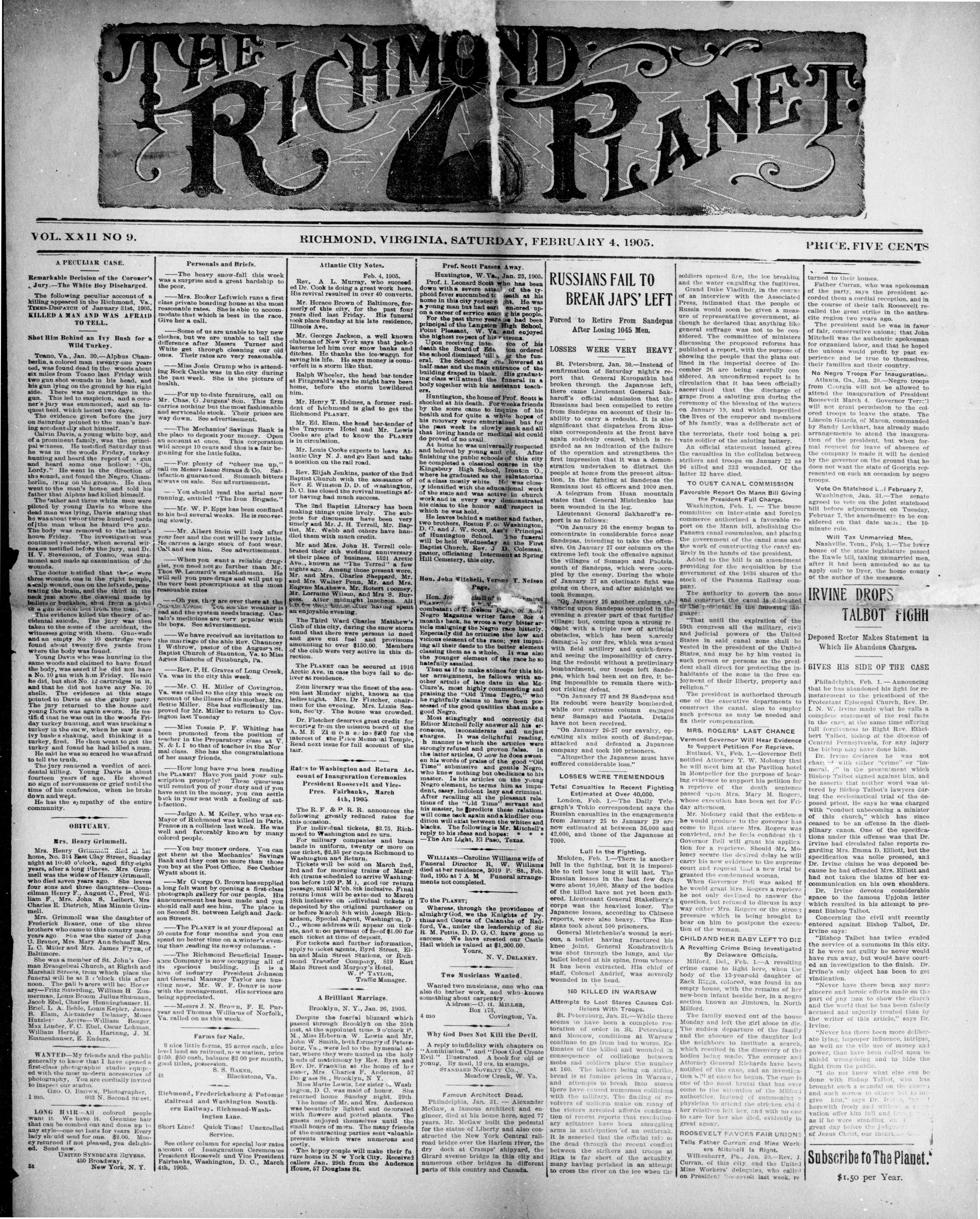
The following peculiar account of a
killing appeared in the Richmond, Va.
TIMES-DISPATCH of January 31st, 1905.
KILLED A MAN AND WAS AFRAID
TO TELL.
Shot Him Behind an Ivy Bush for a Wild Turkey.
Toano, Va., Jan. 30.—Alphus Chamberlin, a colored man twenty-one years old, was found dead in the woods about six miles from Toano last Friday with two gun shot wounds in his head, and his gun lying on the ground by his right side. There was no cartridge in the gun. This led to suspicion, and a coroner's jury was summoned, and an inquest held, which lasted two days.
The evidence given before the jury on Saturday pointed to the man's having accidently shot himself.
Calvin Davis, a young white boy, and of a prominent family, was the principal witness. He testified Saturday that he was in the woods Friday, turkey-hunting and heard the report of a gun and heard some one hollow: "Oh, Lordy." He went in the direction of the sound, and found the Negro, Chamberlin, lying on the ground. He then went to the man's house and told his father that Alphus had killed himself.
The father and three white men were piloted by young Davis to where the dead man was lying, Davis stating that he was about two or three hundred yards of the man when he heard the gun. The body was removed to the father's house Friday. The investigation was continued yesterday, when several witnesses testified before the jury, and D.H. V. Stevenson, of Toano, was summoned and made an examination of the wounds.
The doctor testified that there were three wounds, one in the right temple, a scalp wound, one on the left side, penetrating the brain, and the third in the neck just above the clavical made by bullets or buckshot, shot from a pistol. A gun was shot from the man.
This evidence killed the theory of accidental suicide. The jury was then taken to the scene of the accident, the witnesses going with them. Gun-wads and an empty No. 10 cartridge were found about twenty five yards from where the body was found.
Young Davis who was hunting in the same woods and claimed to have found the body, was assailed if he did not have a No. 10 gun with him Friday. He said he did, but shot No. 12 cartridges in it, and that he did not have any No. 10 shells. The evidence at this stage pointed to Davis as the guilty party. The jury returned to the house and young Davis was again sworn. He testified that he was out in the woods Friday turkey hunting, and was tracking a turkey in the snow, when he saw some ivy washes shaking, and thinking it a turkey. He thought to get the turkey and found he had killed a man. He said he was so scared he was afraid to tell the truth.
The jury rendered a verdict of accidental killing. Young Davis is about fourteen years of age. He showed no sign of nervousness or grief until the time of his confession, when he broke down and wept.
He has the sympathy of the entire community.
OBITUARY.
Mrs. Henry Grimmell
Mrs. Henry Grimmell died at her home, No. 314 East Clay Street, Sunday night at 10:40 o'clock, aged fifty-eight years, after a long illness. Mrs. Grimmell was the widow of Henry Grimmell who died seven years ago. She leaves four sons and three daughters—Concilman Henry F., August C., Fred, William F., Mrs. John S. Leibert, Mrs. Charles E. Dietrich, Miss Minnie Grimmell.
Mrs. Grimmell was the daughter of Frederick Brauer, one of the three brothers who came to this country many years ago. She was the sister of John O. Brauer, Mrs. Mary Ann Schaaff Mrs. L. C. Miller and Mrs. James Flynn, of Baltimore.
She was a member of St. John's German Evangelical Church, at Eighth and Marshall Streets, from which place the funeral will be at 3 c'clock this afternoon. The pall bearers will be. Horcary—Fritz Stittering, William H. Merman, Louis Broom, Julius Shumman, Jacob Ebel, Henningshauer, H. Briel. L. A. Behle, Louis Kepler, James B. Elam, Alexander Delaney, Moses Hutzler. Active—William Reuer, Max Linder, F. C. Ebel, Oscar Lohman, William Herbig A. Hartung, J. M. Emmenhauer, E. Enders.
---
WANTED—My friends and the public generally to know that I have opened a first-class photographic studio equipped with the most modern accessories of photography. You are cordially invited to inspect our studio.
Geo. O. Brown, Photographer,
1 mo. 603 N. Second Street.
LONG HAIR—All colored people want it. We have it. Genuine hair that can be combed out and done up in any style—one set lasts for years. Every lady should send for one. $2.00. Money returned if not pleased, yea delight ed. Send now.
UNITED SYNDICATE BUYERS.
450 Broadway.
5t New York, N. Y.
Personals and Briefs
The heavy snow-fall this week was a surprise and a great hardship to the poor.
Mrs. Booker Leftwich runs a first class private boarding house at the most reasonable rates. She is able to accommodate that which is best in the race. Give her a call.
Some of us are unable to buy new clothes, but we are unable to tell the difference after Messrs Turner and White get through cleaning our old ones. Their rates are very reasonable.
Miss Josie Crump who is attending Rock Castle was in the city during the past week. She is the picture of health.
For up to-date furniture, call on Mr. Chas, G. Jurgens' Son. This firm carries nothing but the most fashionable and serviceable stock. Their prices are way down. See advertisement.
The Mechanics' Savings Bank is the place to deposit your money. Open an account at once. This corporation will accept 10 cents and this is a fair beginning for the little folks.
For plenty of "cheer me up," call on Messrs Isaao Straus & Co. Satisfaction guaranteed. Stomach bitters always on sale. See advertisement.
You should read the serial now running, entitled "The Iron Brigade."
Mr. W. P. Epps has been confined to his bed several weeks. He is recovering slowly.
Mr. Albert Stein will look after your feet and the cost will be very little. He carries a large stock of foot wear. Call and see him. See advertisement.
When you want a reliable drug-gist, you need not go further than Mr. Thos W. Leonard's establishment. He will sell you pure drugs and will put up the very best prescriptions at the most reasonable rates.
Oh yes, they are received there at the Cosgate House. You see the weather is bad and the system needs bracing. Castalo's medicines are very popular with the boys. See advertisement.
We have received an invitation to the marriage of the able Rev. Chaucey I Withrow, pastor of the Augusta St. Baptist Church of Stanton, Va. to Miss Agues Blanche of Pittsburgh, Pa.
Rev. P. H. Graves of Long Creek, Va. was in the city this week.
Mr. C. H. Miller of Covington, Va. was called to the city this week on account of the illness of his mother, Mrs. Bette Miller. She has sufficiently improved for Mr. Miller to return to Covington last Tuesday.
Miss Tossie P. F. Whiting has been promoted from the position of teacher in the Preparatory class at V. N. & I. I to that of teacher in the Normal class. She has the congratulations of her many friends.
How long have you been reading the PLANET? Have you paid your subscription promptly? These questions will remind you of your duty and if you have sent in the money, you can settle back in your seat with a feeling of satisfaction.
Judge A. M. Kelley, who was ex-Mayor of Richmond was killed in Paris, France in a collision last week. He was well and favorably known by many colored people.
You buy money orders. You can get them at the Mechanics' Savings Bank and they cost no more than those you buy at the Post Office. See Cashier Wyatt about it.
Mr George O. Brown has supplied a long felt want by opening a first-class photograph gallery for our people. His announcement has been made and you should call and see him. The place is on Second St. between Leigh and Jackson Streets.
The PLANET is at your disposal at 50 cents for four months and you can spend no better time on a winter's evening than reading its newsy columns.
The Richmond Beneficial Insurance Company is now occupying all of its spacious building. It is a hive of industry President Johnson and General Manager Taylor are busting now. Mr. W. F. Denny is now with the management. His services are being appreciated.
Messrs J. N. Brown, F. E. Puryear and Thomas Williams of Norfolk, Va. called on us this week.
Farms for Sale
8 nice little farms, 25 acres each, nice
level land on railroad, n w station, price
$150. $50 cash, balance $2.00 per month,
good titles, possession.
Richmond, Fredericksburg & Potomac
Railroad and Washington Southern
Railway. Richmond-Wash-
ington Lane.
Short Line! Quick Time! Unexcelled Service.
See other column for special low rates account of Inauguration Ceremonies President Roosevelt and Vice President Fairbanks, Washington, D. C., March 4th, 1905.
RICHMOND, VIRGINIA, SATURDAY, FEBRUARY 4, 1905.
Atlantic City Notes.
Rev. A L. Murray, who succeeded Dr. Cook is doing a great work here. His revival resulted in over 40 converts.
Mr. Horace Brown of Baltimore, formerly of this city, for the past four years died last Friday. His funeral took place Sunday at his late residence, Illinois Ave.
Mr. George Jackson, a well known clubman of New York says that jack-canterns led him over snow banks and ditches. He thanks the ice-wagon for saving his life. He says money is counterfeit in a storm like that.
Ralph Wheeler, the head bar-tender at Fitzgerald's says he might have been home, before the storm bewildered him.
Mr. Henry T. Holmes, a former resident of richmond is glad to get the Richmond PLANET.
Mr. Ed. Elam, the head bar-tender of the Traymore Hotel and Mr. Lewis Cooke are glad to know the PLANET is in circulation.
Mr. Louis Cooke expects to leave Atlantic City N. J. and go east and take a position on the rail road.
Rev. Elijah Jenkins, pastor of the 2nd Baptist Church with the assurance of Rev. E. Winston D. D. of washington, D. C. has closed the revival meetings after having had much success.
The 2nd Baptist Literary has been making things quite lively. The subjects for discussion have been very timely and Mr. J. H. Terrell, Mr. Baptist, Mr. Webb and others have handled them with much credit.
Mr and Mrs. John H. Terrell celebrated their 4th wedding anniversary at their place of business, 1521 Arctic Ave., known as "The Terrell" a few nights ago. Among those present were, Mr. and Mrs. Charles Sheppard, Mr. and Mrs. Walter Penn, Mr. and Mrs. Engene Matthews, Mr. Robert loomey, Mr. Lorraine Wilson, and Mrs S. Burgess. After midnight luncheon. All for the benefit of having spent an enjoyable evening.
The Third Ward Charles Matthew's Club of this city, during the snow storm found that there were persons in need and gave cut fuel and provisions amounting to over $150.00. Members of the club were very active in this direction.
The PLANET can be secured at 1916 Arctic Ave. in case the boys fail to deliver at residence.
Zion literary was the finest of the season last Monday night, known as the ladies night. Mrs. Dr. Fletcher, chairman for the evening, Mrs. Lizzie Seaton, Sec'ty. The house was crowded.
Dr. Fletcher deserves great credit for securing from the mission board of the A.M. E Zion concession $40 for the interest of the Price Memorial Temple. Read next issue for full account of the fair.
Rates to Washington and Return Account of Inauguration Ceremonies President Roosevelt and Vice-Pres. Fairbanks, March 4th, 1905
The R. F. & P. R. R. announces the following greatly reduced rates for this occasion: individual tickets, $3.75. Richmond to Washington and re-arr.
For military companies and brass bands in uniform, twenty or more on one ticket, $2.35 per capita Richmond to Washington and Return.
Tickets will be sold on March 2nd, 3rd and for morning trains of March 4th (trains scheduled to arrive Washington before 1:00 P. M.), good for return passage, until M'ch. 8th inclusive. Final return limit will be extended to March 18th inclusive on individual tickets it deposited by the original purchaser on or before March 8th with Joseph Richardson, Special Agent, Washington, D.C., whose address will appear on tickets, and on payment of fee of $1.00 for each ticket at time of deposit.
For tickets and further information, apply to ticket agents, Byrd Street, Elba and Main Street Stations, or Richmond Transfer Company, 819 East Main Street and Murpuy's Hotel.
W. P. TAYLOR,
Traffic Manager.
A Brilliant Marriage
Brooklyn, N. Y., Jan. 26, 1905.
Despite the fearful blizzard which passed through Brooklyn on the 25th inst. at the appointed time, 9 o'clock P. M., Miss Hibernia W. Lewis and Mr. John W. Smith, both formerly of Petersburg, Va., were led to the hymenal altar, where they were united in the holy bonds of matrimony by Rev. Byrts and Rev. Dr. Franklin at the home of her sister, Mrs. Charles F. Anderson, 57 Dogsst St., Brooklyn, N. Y.
Miss Marie Lewis, her sister C. Washington, D. C. was maid of honor. She returned home Sunday night, 29th. The home of Mr. and Mrs. Anderson was beautifully lighted and decorated with flowers and potted plants. The guests enjoyed themselves until the small hours of morn. The many friends of the contracting parties sent valuable presents which were numerous and costly.
The happy couple will make their future home in N w New York City. Received callers Jan. 29th from the Anderson House, 57 Donglass St.
Prof. Scott Passes Away.
Huntington, W. V., Jan. 23, 1905. Prof. L. Leonard Scott who has been down with a severe attack of the typhoid fever succumbed to death at his home in this city yester night. He was a young man but had early entered upon a career of service among his people. For the past three years he had been principal of the Langston High School, Point Pleasant, W. V., and enjoyed the highest respect of his wristrons.
Upon receiving interest of his death the Board of Education ordered the school dismissed till he or the funeral. The School flag was lowered at half-mast and the main entrance of the building draped in black. His graduating class will attend the funeral in a body together with his assistant teachers.
Huntington, the home of Prof. Scott is shocked at his death. For weeks by the score came to inquire of his health and for quite a while hopes of his recovery were entertained but for the past week he slowly sank and all that loving hands or medical aid could be proved of no avail.
At home he was universally respected and beloved by young and old. After finishing the public schools of this city he completed a classical course in the Kingsbury High School, Ironton O., where he graduated as the salutatorian of a class mostly white. He was closely identified with the educational work of the state and was active in church work and in every way demonstrated his claim to the honor and respect in which he was held.
He leaves behind a mother and father, two brothers, Boston F. O. Washington, D. G. and J. W. Scott, Asst' Principal of Huntington School. The funeral will be held Wednesday at the First Baptist Church, Rev. J. D. Coleman, pastor, officiating Interment at Spring Hill Cemetery, this city.
Hon. John Mitchell, Versus T. Nelson Page.
Hon. Job shell of Richard Planty, combatant of T. Nelson Page, of Anti-Negro Magazine writer writer 30 or 4 months back, he wrote a very bitter article maligning the Negro race bitterly. Especially did he criticise the low and violent element of the race; yet imputing all them deeds to the better element classing them as a whole. It was also the younger element of the race he so hatefully assailed.
Then as if to make stones for this bitter arraignment, he follows with another article of late date in the McClure's, most highly commending and praising the "Old Time Negro," who he rightfully claims to have been possessed of the good qualities that make a good Negro.
Most singly and correctly did Editor Mitchell fully answer all his erroneous, inconsiderate and unjust charges. It was delightful reading, h manner in which the articles were strongly refuted and proven false. In the latter articles. O how he does sweeten his words of praise of the good "Old Time" submissive and gentle Negro who knew nothing but obedience to his master. In his articles on the young Negro element, he terms him as impudent, sassy, indolent lazy and criminal. After recalling all the pleasant relations of the "Old Time" servant and his master, he predicts these relations will come back again and a kindlier condition will exist between the whites and blacks. The following is Mr. Mitchell's reply to his ideas and hopes: * * * * * The Arc Light, El Paso, Texas.
WILLIAMS—Caroline Williams wife of Funeral Director R, W. Williams died at her residence, 3019 P. St., Feb. 2nd, 1905 at 7 A. M. Funeral arrangements not completed.
To the PLANET:
Whereas, through the providence of almighty God, we the Knights of Pythias and Courts of Calantha of Radford, Va., under the leadership of Sir R. M. Pettis, D. D. G. C. have gone to success. We have erected our Castle Hall which is valued at $1,200.00.
Two Musicians Wanted.
Wanted two musicians, one who can also do barber work, and who knows something about carpentry.
Why God Does Not Kill the Devil.
A reply to infidelity with chapters on "Ambition," and "Does God Create Evil." Illustrated. A book for old or young. By mail, 12 cts. in stamps.
Famous Architect Dead:
Philadelphia, Jan. 31. — Alexander McGaw, a famous architect and engineer, died at his home here, aged 77 years. Mr. McGaw built the pedestal for the statue of Liberty and also constructed the New York Central railroad bridge over the Harlem river, the dry dock at Cramps' shipyard, the Girard avenue bridge in this city and numerous other bridges in different parts of this country and Canada.
RUSSIANS FAIL TO BREAK JAPS' LEFT
Forced to Retire From Sandepas After Losing 1045 Men.
LOSSES WERE VERY HEAVY
St. Petersburg, Jan. 30.—Instead of confirmation of Saturday night's report that General Kuropatkin had broken through the Japanese left, there came Lieutenant General Sakharoff's official admission that the Russians had been compelled to retire from Sandepas on account of their inability to carry a redoubt. It is also significant that dispatches from Russian correspondents at the front have again suddenly ceased, which is regarded as an indication of the failure of the operation and strengthens the first impression that it was a demonstration undertaken to distract the people at home from the present situation. In the fighting at Sandepas the Russians lost 45 officers and 1000 men. A telegram from Huan mountain states that General Mistchenko has been wounded in the leg.
Lieutenant General Sakharoff's report is as follows:
"On January 26 the enemy began to concentrate in considerable force near Sandepas, intending to take the offensive. On January 27 our column on the extreme left took the offensive against the villages of Sumapu and Paotsla, south of Sandepas, which were occupied by the enemy. During the whole of January 27 an obstinate fight was going on there, and after midnight we took Sumapu.
"On January 26 another column advancing upon Sandepas occupied in the evening a greater part of that fortified village; but, coming upon a strong reddoubt with a triple row of artificial obstacles, which has been sarcely damaged by our fire, which was armed with field artillery and quick-firers and seeing the impossibility of carrying the redoubt without a preliminary bombardment, our troops left Sandepas, which had been set on fire, it being impossible to remain there without risking defeat.
"On January 27 and 28 Sandepas and its redoubt were heavily bombarded, while our extreme column engaged near Samapu and Paotsia. Details have not been received.
"On January 26-27 our cavalry, operating six miles south of Sandepas, attacked and defeated a Japanese company and took 100 prisoners.
"Altogether the Japanese must have suffered considerable loss."
LOSSES WERE TREMENDOUS
Total Casualties In Recent Fighting Estimated at Over 40,000. London, Feb. 1.—The Daily Telegraph's Tokio correspondent says the Russian casualties in the engagements from January 25 to January 29 are now estimated at between 36,000 and 42,000, and those of the Japanese at 7000.
Lull In the Fighting.
Mukden, Feb. 1.—There is another lull in the fighting, but it is impossible to tell how long it will last. The Russian losses in the last few days were about 10,000. Many of the bodies of the killed have not yet been gathered. Lieutenant General Stakelberg's corps was the heaviest loser. The Japanese losses, according to Chinese reports, were also heavy. The Russians took about 500 prisoners. General Mistchenko's wound is serious, a bullet having fractured his knee joint. General Kondratovitch was shot through the lungs, and the bullet lodged at his spine, from whence it has been extracted. His chief of staff, Colonel Andrief, was severely wounded in the head.
160 KILLED IN WARSAW
Attempts to Loot Stores Causes Collisions With Troops
St. Petersburg, Jan. 31.—While there seems to have been a complete restoration of order in St. Petersburg and Moscow, conditions at Warsaw continue to go from bad to worse. Estimates of the killed and wounded in consequence of collisions between mobs and soldiers place the number at 160. The bakers being on strike, bread is at famine prices in Warsaw, and attempts to break into stores there have crushed numerous collisions with the military. The finding of revolvers of uniform make on many of the rioters arrested affords confirmation of recent reports that revolutionary agitators have been smuggling arms in anticipation of an outbreak. It is asserted that the official tale of the dead through the recent conflict between the strikers and troops at Riga is far short of the actuality, many having perished in an attempt to cross the river on the lee when the
soldiers opened fire, the ice breaking and the water engulfing the fugitives. Grand Duke Vladimir, in the course of an interview with the Associated Press, intimated that the people of Russia would soon be given a measure of representative government, although he declared that anything like general suffrage was not to be considered. The committee of ministers discussing the proposed reforms has published a report, with the purpose of showing the people that the plans outlined in the imperial decree of December 26 are being carefully considered. An unconfirmed report is in circulation that it has been officially ascertified that the discharge of grape from a saluting gun during the ceremony of the blessing of the waters on January 19, and which imperilled the lives of the emperor and members of his family, was a deliberate act of the terrorists, their tool being a private soldier of the saluting battery. An official statement issued gives the casualties in the collision between strikers and troops on January 22 as 96 killed and 333 wounded. Of the latter 32 have died.
The President Full Charge.
Washington, Feb. 1. — The house committee on inter-state and foreign commerce authorized a favorable report on the Mann bill, abolishing the Panama canal commission, and placing the government of the canal zone and the work of constructing the canal entirely in the hands of the president.
Added to the bill is an amendment providing for the acquisition by the government of the 1636 shares of the stock of the Panama Railway company.
The authority to govern the zone and construct the canal is delegated to the president in the following language:
"That until the expiration of the 59th congress all the military, civil and judicial powers of the United States in said canal zone shall be vested in the president of the United States, and may be by him vested in such person or persons as the president shall direct for protecting the inhabitants of the zone in the free enjoyment of their liberty, property and religion."
The president is authorized through one of the executive departments to construct the canal, also to employ such persons as may be needed and fix their compensation.
MRS. ROGERS' LAST CHANCE
Vermont Governor Will Hear Evidence
to Support Petition For Reprieve.
Rutland, Vt., Feb. 1.—Governor Bell notified Attorney T. W. Moloney that he will meet him at the Pavilion hotel in Montpellier for the purpose of hearing evidence to support his petition for a reprieve of the death sentence passed upon Mrs. Mary M. Rogers, whose execution has been set for Friday afternoon.
Mr. Moloney said that the evidence he would produce to the governor has come to ligat since Mrs. Rogers was convicted, and he feels confident that Governor Bell will grant his application for a reprieve. Should Mr. Moloney secure the desired delay he will carry his new evidence to the supreme court and request that a new trial be granted the condemned woman.
When Governor Bell was asked if he would grant Mrs. Rogers a reprieve he not only declined to answer the question, but refused to discuss in any way either Mrs. Rogers or the strong pressure which is being brought to bear on him to postpone the execution of the woman.
By Delaware Officials.
Milford, Del, Feb. 1.—A revolting crime came to light here, when the body of the 13-year-old daughter of Zack Riggs, colored, was found in an empty house, with the remains of her new-born infant beside her, in a negro section known as Jimtown, in North Milford.
The family moved out of the house Monday and left the girl alone to die. The sudden departure of the family and the absence of the daughter led the neighbors to institute a search, which resulted in the discovery of the bodies being made. The coroner and Attorney General Richards have been notified of the case, and an investigation will at once be begun. The case is one of the most brutal that has ever come to the attention of the Milford authorities. Instead of summoning a physician to attend the stricken child her relatives left her, and with no one to care for her she died, evidently in great agony.
ROOSEVELT FAVORS FAIR UNION
Tells Father Curran and Mine Workers Mitchell is Right.
RIGHT
Wilkesharrt, Pa., Jan. 26, Rev. J. Curran, of this city, and the United Mine Workers' delegates, who called on President Bosevack last week, re-
turned to their homes.
Father Curran, who was spokesman of the party, says the president accorded them a cordial reception, and in the course of their talk Roosevelt recalled the great strike in the anthracite region two years ago.
The president said he was in favor of fair, conservative unions; that John Mitchell was the authentic spokesman for organized labor, and that he hoped the unions would profit by past experience and be true to themselves, their families and their country.
No Negro Troops For Inauguration
Atlanta, Ga., Jan. 30.—Negro troops from Georgia will not be allowed to attend the inauguration of President Roosevelt March 4. Governor Terrell will not grant permission to the colored troops to leave the state.
The Lincoln Guards, of Macon, commanded by Sandy Lockhart, has already made arrangements to attend the inauguration of the president, but when formal request for leave of absence of the company is made it will be denied by the governor on the ground that he does not want the state of Georgia represented on such an occasion by negro troops.
Vote On Statehood L.ll February 7.
Washington, Jan. 31.—The senate agreed to vote on the joint statehood bill before adjournment on Tuesday. February 7, the amendments to be considered on that date under the 10-minute rule.
Will Tax Unmarried Men
Nashville, Tenn., Feb. 1.—The lower house of the state legislature passed the Rawle bill, taxing unmarried men, after it had been amended so as to apply only to Dyer, the home county of the author of the measure.
IRVINE DROPS TALBOT FIGHH
Deposed Rector Makes Statement in Which He Abandons Charges.
GIVES HIS SIDE OF THE CASE
Philadelphia, Feb. 1. — Announcing that he has abandoned his fight for reinstatement to the priesthood of the Protestant Episcopal Church, Rev. Dr. L. N. W. Irvine made what he calls a complete statement of the real facts in the case, at the same time offering full forgiveness to Right Rev. Ethelbert Talbot, bishop of the diocese of Central Pennsylvania, for any injury the bishop may have done him.
Dr. Irvine declares he was not charmed with either "crime" or "immoral," in the presentment which Bishop Talbot signed against him, and he asserts that neither word was uttered by Bishop Talbot's lawyers during the ecclesiastical trial of the deposed priest. He says he was charged with "conduct unbecoming a minister of this church," which has since ceased to be an offense in the disciplinary canon. One of the specifications under this offense was that Dr. Irvine had circulated false reports regarding Mrs. Emma D. Elliott, but the specification was nolle prossed, and Dr. Irvine claims he was deposed because he had offended Mrs. Elliott and had not taken the blame of her communication on his own shoulders. Dr. Irvine devotes considerable space to the famous Upjohn letter which resulted in his attempt to present Bishop Talbot.
Concerning the civil suit recently entered against Bishop Talbot, Dr. Irvine says:
"Bishop Talbot has twice evaded the service of a summons in this city. If he were not guilty he never would have run away, but would have courted an investigation to the finish. Dr. Irvine's only object has been to get vindication.
"Never have there been any more sincere and heroic efforts made on the part of any man to show the church and the world that he has been falsely accused and unjustly treated than by the writer of this article," says Dr. Irvine.
"Never have there been more deliberate lying, improper influence, intrigue, as well as the vile use of money and power, than have been called upon to shield wrong-doing and to hide the light from the public.
"I do not know what else can be done with Bishop Talbot, who has brought such a scandal on the church and such sorrow to others but to forgive him," says Dr. Irvine. "I herewith freely and without a revocation offer him full and free praise as if he were standing on the great day before the judgment of Jesus Christ, our incarnate God."
$1.50 per Year.
THE PLANET
SATURDAY.....FEBRUARY 4. 1908
FOR
SUNDAY
READING
THE PRECEPTOR.
I set my eyes on the face of Duty;
"Master," I said, "let be! let be!
Life will lose all its golden beauty
If I must follow Thee!"
Ah, but the ways that we trod were weary,
Ah, but the paths that we followed long!
Dreary the span of the sky, and eerie
The sound of every song.
And yet, as though through some chrismal
wonder,
After the lapsig of sunless days,
The grim gray veil seemed to melt and
sunder
Like the rifted morning haze.
SERVANTS OF CHRIST.
What This Relationship Involves Pauli's Attitude and Example.
Paul delights to speak of himself as the servant of Christ. He also thus speaks of himself in his salutations. He is an apostle, but also a servant. A servant is one under authority. He does not "lose his own sense of individuality, but there is to him the recognition of a superior will and of his obligation to it. The same thought is presented when it said: "Ye are not your own; ye are bought with a price." "One is your master, even Christ." This relation to Christ covers the whole life. There is no section to be reserved, for there cannot be a division of personality. We are ourselves always, and in accepting Christ we give our whole selves to Him. There cannot be two masters; one to be served in some things and the other in ways that differ. There cannot be two ownerships in the human soul. Paul said without reserve: "Whose I am and whom I serve." He belonged to God in his whole person, and he served Him with is whole life. It is "the first importance that we recognize
teness of the Lordship of us" His own prayer becomes the model of our lives. "Not My will, but Thine, be done." We sustain many relations in life, and we speak of our secular affairs and relations, as if they were widely separated from the spiritual or religious, but they are inseparable, for the reason that we are ourselves always, and in all things the servants of Christ. We may not divest ourselves of this thought in any part of our living. "Christ's in all things and at all times."
This is our normal relation to God. Sin is separation; it is abnormal; it is destructive. Without God there is only death. The life that cannot die is in Christ. All the outgoings of that life are from Him. All the developments of that life are in the reception of His Spirit, and the obedience of the heart to Him. The Lordship of Christ is the Lordship of life, and in that life we find our true place, both here and hereafter. There is no violation of any law of our nature in becoming obedient to Christ; there is no lowering of our position in becoming a servant; there is no limitation of our freedom of will, but rather the perfection of our nature in being so related to Him in whom we live, that His will becomes ours.
There is no hardship in this service, Jesus said: "My yoke is easy and my burden is light." We are bidden to no unpleasant duty, for all the ways of God are pleasantness and all His paths are peace. The obedience to Him is the obedience of a loving heart, whose highest joy is in doing His will. There is no service in love which is a burden and a hardship, for love delights to serve. Self-surrender is the highest normal development of manhood, and therefore in it there is the very perfection of nature and the highest possible enjoyment of life. The service may require exertion; it may involve the change of our plans and the acceptance of many things which at one time were repulsive to us, but it does not require anything that militates against our well-being, or our happiness, for the reason that in it we are nearest to God, and God is all to us.
RAM'S HORN BLASTS
Wisdom increases itself by enriching others.
The mercy of God is the greatest of all mercies.
How would a prayer-party do for a change?
A mighty little man can undo a large man's work.
Stars of hope are always born in the night of trouble.
Walking in faith is walking in the light of His face.
He who is willing to guide a child is preparing to lead a nation.
The Eight Sart of Best
It is rest first, and after that all else that He holds for us. Our rest should be like our Sabbath, a beginning of the days. Under the law the order was, work at the first, and day after day until the seventh, when labor shall end in rest. But when Christ rose from the dead, that first day of the week became the hallowed one, consecrated to life and rest and joy. And from that living, joyful rest in Him, the whole being energized and fitted for its task, the soul can go on to serve Him to the end.
has ceased from working in its own strength, ceased from its own will, and now God worketh in it to will and to do of His own good pleasure. Practically, it makes the widest possible difference whether we work up to rest or from It—Sarah F. Smiley.
THE RIGHT TO SPEAK.
Why the Christian Should Speak Out the Message of the
Christ.
Sir John Lubbock, the eminent English naturalist, has spent a lifetime in the study of the habits of ants and other insects. He has made some very wonderful discoveries, some of which are contrary to the common ideas of the ways of these insects; but when Sir John Lubbock publishes anything about ants the world reads it and accepts it as authoritative, for by his long, patient and accurate researches the naturalist has earned the right to speak upon that subject. For the same reason the world eagerly listens to anything that Thomas A. Edison may have to say about photographs or any other topic connected with the development of electrical power, or to anything that Mr. Ernest Thompson-Seton may have to say about the habits of wild animals. These men have created for themselves the right to speak on these subjects, but when Joshua says: "Come hither, and hear the words of the Lord your God," his right to speak rests upon a different foundation, and the distinction between them is not always kept so clear as it ought to be. Joshua's right to speak does not rest upon his own investigations into the realm of spiritual truth, but upon the fact that he has received a message from the final authority in such things. That message he has a right to speak with confidence.
It is the same right to speak which Joshua had that belongs to every Sunday school teacher, to every minister, to every discipline of our Lord, says J. Mervin Hull, in Christian Work. All investigations of every kind, natural, scientific, philosophical, ethical, are limited by the vastness of the field. No man can ever say that he has covered all the ground so as to come to an absolutely sure conclusion. But the humblest discipline can teach love to God and man and be absolutely sure that he is right. He has the authority of the Lord Himself for it. It is a pity that we realize so imperfectly the nature of this right to speak the truths of God's word. It would be an excellent idea for every teacher and every Christian in any walks of life to make a study of the attitude that Paul had toward the message that he received from his Lord. It filled him with joy. He just bubbled over with enthusiasm for it. He never made the mistake of delivering it as if it were his message, but he simply gave out that it was the message of the Lord, and never made any pretense of bolstering it up by any other authority. That view of our right to speak enables us to speak with helpfulness to every kind of human need. Human hearts are yearning for certainty in spiritual things. It is the privilege of the disciples of the Master to speak the things which he has revealed with a note of authority which shall comfort those who are in sorrow, guide those who are wandering, and encourage those who are fighting the battle of life. If the world is asking in despair, Is life worth living? those who know that to live is Christ have for it the message of life more abundantly.
ON AND OFF CUARD
A False Condition of Mind and Heart Which Is Destructive of the True Man.
A true man is never on his guard. He is never watching himself test he say unwise words or do ungentlely things. He has neither home manners, nor street manners, nor company manners. He has no pulpit tone, social tone, nor business tone. When a man feels that he must be on his guard, in view of the company in which he happens to be, it is an indication of hypocrisy, all the worse if it is unconscious. The true gentleman is a gentleman all the time—asleep or awake. Some time ago a prominent lecturer was telling of a dream he had, in the course of which came a test as to whether he would be true to his word, even though it was at great cost to himself. "I made a right decision," he said, "and on waking I was so glad to discover that I did not play the dog in my dream." He was unconsciously right—through and through. The man who can trust himself in his dreams is likely to be trusted in his waking hours. It is in the natural, unguarded actions of life that we reveal our true selves. "I have a good story I want to tell you," said a prominent railroad official to another, not very long ago. "If one that I can repeat when I get home?" was the hurried response of his friend. There was a moment's awkward pause, a deep blush, and one man reached over the desk to another and said: "I want to thank you for your rebuke; it is just; I shall never tell such stories anywhere." In conversation with a friend recently, the writer was saying that he was sorry a certain man tallied as he did. "That isn't it," said the other; "he wouldn't talk that way if he did not think that way; he should not think that way, then he would never trouble with his speech." All of which is true; it is the unconscious Christian that is likely to be the best Christian; when one must take pains to express his character it is an indication that there is something wanting under the surface.—Service.
Sinners and Thistles
A man was once walking with a farmer through a beautiful field, when he happened to see a tall thistle on the other side of the fence. In a second, over the fence he jumped, and cut it off close to the ground. "Is that your field?" asked his companion. "Oh, not!" said the farmer. "bad weeds do not care much for fences, and if I should leave that thistle to blossom in my neighbor's field, I should soon have plenty in my own."
It may make some of us feel queer to see our ballots at the judgment
Depopulating England.
More emigrants left the United Kingdom and fewer foreigners settled there in 1893 than in any year since 1889.
THE RICHMOND PLANET
Not a Skeptic.
"They say," remarked the typewriter, boarder, "that geese often travel 3,000 miles in migrating." "I guess that's right." rejoined the old bachelor at the pedal extremity of the mahogany. "A friend of mine traveled fully that distance on his wedding trip." —Chicago News.
Love Not Blind
"Love is blind, you know," said the minister's wife.
"Blind nothing!" exclaimed the parson.
"Don't you suppose if it was blind it would sometimes make a mistake and give the minister a little more than a 25-cent wedding fee?" — Yonkers Statesman.
SHOULD SAY HE WAS.
J. M.
Doctor—I don't think it is anything very serious, but you will have to stay in bed at least two weeks.
Patient—Say, doctor, do you know that this is a four-dollar-a-day hotel?
Doctor—Yes, I am a friend of the proprietor.—Chicago Journal.
The Farewell
He put away his meerschaum pipe.
He put away his meerschaum pipe,
Upon the self he let it lie,
The time for his reform was ripe,
He happy New Year time was nigh;
He put away his pipe, oh, my!
But to it did not say good-by,
He simply murmured with a sigh:
"Auf weldersehen."
—Chicago Chronicle.
As Through a Glass
"Yes," said the jilted lover. "I am all over my love for her. I can't understand how I ever could have loved her. I now see through the saying: 'Love is blind.' "It is easy for a man to see through a thing after some one else has made a spectacle of him."—Houston Post.
Fully Explained
Bacon—I just heard of a man who doesn't claim that he has been awarded a world's fair prize.
Egbert—Indeed! Who is he?
"Oh, he's a man who didn't have anything on exhibition there."—Yonkers Statesman.
Bose to the Occasion
Rose to the Occasion.
"How did you get your wife out of the burning building so quickly without alarming her?"
"I told her an auction sale of household goods was just beginning in the flat next door."—Chicago Tribune.
Too Big for His House.
She—What a noise that dog next door makes! I wonder they don't shut him up at night.
He—Why, he's a dachshund, and I suppose he's so long they can't shut him up—Yonkers Statesman.
Hair Invigorator
"Do you think that music is of any practical benefit in life?"
"Well," answered Miss Cayenne,
"judging from the photographs of eminent violinists, it must keep the hair from falling out." -Tit Bits.
As Others See Us.
Mifkins - Old Skinner tells me he began his business career by running away with a circus.
Pifkins - Well, I don't doubt it. It's almost impossible to nall a circus down - Chicago News.
"And is there nothing left save honor?" asked the wife of the president of the defunct bank.
"Nothing save honor—and a little brown paper!" replied the broken man—Yonkers Statesman.
Enlisting
"I wish to enter and take an active part in the battle of life. What would you advise me to do?" "Get married," wrote the editor of the "Replies to Queries" column.—Kansas City Star.
Dead in It.
"Well, Ould Clanahan was one o' th' byes all right; they was nawin' th' goin' on but he was dead in ut." "Thot's right, jabbers, an 'wth th' same wid his waile."—Houston Post.
In the Department Store.
First Census Taker—What did that young fellow at the false hair counter give as his occupation?
Second C. T.—He said he was a switch tender.—Chicago Journal
In the Line of Reform
Gayman—That's a good cigar you're smoking. But, hold! I thought you had sworn off.
Gayboy—I have—from smoking cheap cigars.—Chicago Tribune.
Precaution
Landlady—I never count my chick
ens before they are hatched.
Starboard—Quite right; some of the
eggs might accidentally be fresh.—
N. Y. Sun
Of Course.
Subbabs—I nearly broke my back shoveling the snow on my place yesterday.
Backlotz—Well, it's a good thing summer isn't here, too.
Subbabs—What are you talking about?
Backlotz—Why, if we had winter and summer together you'd have to shovel snow and cut the grass, too.—Philadelphia Press.
Left!
'The not a dainl
Those feasting
The name woul
lish
The menus of
But nothing can
On the hungry
Can give more c
To a yearning
beans.
having
And the teeth
How the gay, g
Through a fell
When on the al
He sniffs the
Is 'way up yonder beyond his means,
One feast is his, and a mighty good 'un—
A man's size platter of pork and beans.
Chicago, mart of the hog, we bless you,
With wreaths of gratitude deck your
name,
And Boston, in love we'd fain caress you
For the succulent truck you've given
name.
No combination de culinary,
From the dainty dishes of kings and
queens
Clear down to poverty's commissary,
Can hold a candle to pork and beans.
-Denver Post.
Old Man Ferry
and the Suitor
I
their dispositions it don't make much difference 'bout their size,' said the oven winter evenings?
"I most gin'raly do,' says O. P. 'takes one side o' the oven an' I take
storekeeper, saguoy. "If Irving had a spindlin' disposition an' Mabel had ideas as that an' spread out as a 40-acre medder close eat down it might." "Rufe's got the right end o' the stick for oneset," said Washington Hancock. "He's had experience an' he ought to know. If Rufe had picked out a wife that didn't weigh more'n a hundred an' thirty at the outside an' couldn't split kindlin' he wouldn't be the happy man he is to-day." "My wife's got her first stick o' kindlin' wood to plit yet," declared the storekeeper, with some heat. "Mebbe Mis' Hancock can say the same, but I dunno."
"She splits all we use, reg'lar," said Hancock, equably. "Til back her against any lady in the county for handl'in an ax. I like to go out an' sit on the sawbuck an' watch her. It's an inspirin' sight. But most young fellers picks their life pardners jest for their looks an' the gals makes their choice for similar reasons. When they come to grief I always think of the time O. P. Jackson went to old man Ferry to ask him for his daughter Inez's hand."
"How was that?" asked Marvin Parsons.
"There wasn't nothin' to it," replied Hancock. "He went to the old man an' he says: 'Inez an' me have got it settled we'll git married. I reckon, you don't care?'
"No,' says old man Ferry. 'If you've reelly got it settled I haven't got nothin' ter say to the contrary. I reckon you've both o' you give the matter the keerful an' ca'm consideration it calls fer. You've got it all figgered out an' there ain't no two ways about it.'
"I figger I'm pretty well fixed with the 80 an' the stock I've got an' the 20 an' the team of mules I allow I'm going to get from pap this fall', says O. P. "That's about all the figgerin' I've done, an I reckon it's about all that's ne'sry."
"Sho' says old man Ferry. 'You don't tell me that, O. P. You don't mean ter say that you, a likely young n.an, haven't studied over it more'n that. I allow you hain't got no manner o' use for onions or biled cabbage, anyway.'
" "I'm right fond o' them both,' says O. P. "There ain't nothin' I like better'n a piece o' fresh beefsteak smothered in onions, an' cabbage b'lied is what I calculate to have fer dinner three days in the week.'
" "There it is,' says the old man, sadly, 'Inez has a conspiction fit if she
First Giraffe—During a little conversation I had with the lion to-day I asked him if he was the king of beasts.
Second Giraffe—And what did he say?
First Giraffe—He said he was, but he made me solemnly promise not to tell his wife he said so.—Chicago News.
"I AIN'T GOIN' BACK ON MY POLITICS."
the gods would relish—
ods of mythology—
ever with grace embel-
ish society,
at more proper action
spot 'neath a feller's
fort and satisfaction
tomach than pork and
can for feed is craving
is wrapped in a flame
rebels and is mlsbe-
anxiety seem to burn,
night of anticipation
its optics in joy careens,
the feeding station
of pork and beans!
SEE by the Bugle that Irving Firestone an' Mabel Nye sanger got married on Toosday, observed Sol Baker. Seems to me they hain't right well matched up. She's so sort o' spindin'an' him about as broad as he is long. Don't seem like they'd make a good team noways."
"Slong as they 're matched up in
A. Secret
VIRGINIA.
smells onions cookin' around 'he house an' she jest despises cabbage. I don't know whether she got more pernickety after she come back from visitin' her cousin at St. Joe, but I do know that there hain't no cabbage nor onions cooked in this house sense—an' her mother backs her up in it. Still, I reckon a young man 'at gits as good a wife as Inez is goin' to make kin afford to do without onions an' billed cabbage. You're a great hand to spend money, I hear.
"Whoever told you that was a liar,' says O. P.
"You don't tell me! Well, I'm sorry it ain't so, because Inez just loves to spend. I can't send her into town with a crock o' butter an' feel safe. She'd be as apt to trade it for a rhinestone di'mund hat pin or a plated top perfoom bottle as to bring back muslin an' plug terbacker or somethin' else useful. If a man loves to spend himself he can stand for a woman lavishin' good butter that way, but I'm keerful, an' it makes me mad. You're a republican, ain't you?
"I ain't goin' back on my politics,' says O. P.
"I hain't askin' you to an' I don't know as you'll have to do it to please Inez, only you'll have to keep your mouth shet. Inez has been raised in a dimercrat fam'ly an' she's mighty well posted. I know how it might be with you an' her, because I was a republican myself after I merried her mother, an' Inez can out-talk the oil woman ten to one. O course you young folks will do jest as you're a mind to, but when I set down behind the barn, where it's restful an' quiet, an' smoke my pipe an' meditate on the joys o' mattermony I don't minu sayin' that if I had it to do all over ag'in I'd ask the gal a few leadin' questions. If I liked to lie abed in the mornin' tell five or six o'clock—which I do—I'd make sure my wife did, too. Now, Mis' Ferry she's up an' around by half-past three or four in the summer.'
"Inez takes after her paw in that respect," says the old man. "But if you like fancy sweep! Inez' please you. She made a tidy 'at took fust prize at the fair two years ago. I reckon she told you that. It's a great comfort for a man to be let to take off his boots 'an in the front settin' room once in a while an' look at the tides his women makes. Talkin' of stockin' feet, do you like ter set an' put your feet on the rail after the oven winter evenings?" "I most gin' raly do," says O. P. Tap takes one side 'o the oven an' I take the
other. An' the hired man he puts his feet up in front.'
"Then you'd better get that p'int settled with Inez inafer you do anythin' foolish. My mother used to let me put my feet in the oven when I was a boy, but Mis' Ferry she don't hold with it an' neither does Inez. But then o' course barrin' them an' a few other little triflin' points you an' Inez may soot each other fust rate. On'y—I sh'd think you'd study over sech things, O. P.'
"Well,' says O. P., who had been gettin' to look glummer every minit, 'I b'lieve I will study over them some,' an' he went away.'
"Broke up the match, did he?" asked Baker.
1
"Well, that was old man Ferry's calculations," replied Hancock. "He didn't like O. P. any too well, and he fingered to sorter discourage him." "Pretty smart old man," commented Parsons.
"Did he discourage him?" asked the stokekeeper.
"Didn't I tell you Rufe had experience?" asked Hancock, triumphantly. "No O. P. studied it over an' he fingered that him an' Inez might shake down together after all, biled cabbage won't worth considerin'. It turned out, though, that cabbage was Inez' fav'rit dish, an' she was speshully fond of onions."—Chicago Daily News.
New Species of Potato.
A new species of white potato is being cultivated in France from a peculiar variety found in Uruguay. It is believed that it is destined to replace even the Irish potato. Originally a very bitter tuber, the new vegetable becomes, after three or four years of cultivation, an admirable food product. Its yield is enormous and it is exempt from maladies that attack the ordinary potato. It grows best in moist soil, its native habitat being the marsy shores of the river Mercedes, in Uruguay. Its flowers have a jasmine-like odor, and a delicate perfume has already been extracted from them. After one planting the species perpetuates itself from the broken roots left in the ground.
Nothing Serious
"I saw Empee, going into a doctor's office this morning," said Stringer. "He had an awful cut on his head that his wife was responsible for."
"You don't say!" exclaimed Nibbles. "What did she hit him with?"
"Oh, she didn't hit him at all," explained Stringer. "It was merely a hair-cut she had given him as a matter of economy."—Chicago News.
Money received on deposit amounts above $1.00 which re-
Money Loaned on Satisfaction Business Accounts Handl-
Amounts of ten cents and
This establishment is fitted up in the white vault, burlar-proof steel chest, ele-
lence for safety and the accommodation
For all information concerning Stock Cashier.
Banking Hours have been arranged
ing people as follows: 9 A.M. to 4 P.M.
close Saturday at 3 P.M. and open again
P.M. Call by as you come from work.
OFFICE
JOHN MITCHELL, JR., President.
THOS. H. W.
BOARD OF
REV. W. F. GRAHAM, D. D., JN
E. R. JEFFERSON H. F. JONATHAN
J. O. FARLEY.
received on deposit and interest paid on a $1.00 which remains 60 days and over.
used on Satisfactory Security.
accounts Handled Promptly.
ten cents and upwards received on deposit.
it is fitted up in the most improved style, having a large
proof steel chest, electric lights and every modern conven-
e accommodation of the public.
on concerning Stocks, Deposits, Loans, etc., apply to the
have been arranged for the special convenience of the work.
9 A.M. to 4 P.M. Saturday, 9 A.M. to 3 P.
We M. and open again at 5 P. M., remaining open until 9
come from work.
Money received on deposit and interest paid on amounts above $1.00 which remains 60 days and over.
Money Loaned on Satisfactory Security.
Business Accounts Handled Promptly.
Amounts of ten cents and upwards received on deposit.
This establishment is fitted up in the most improved style, having a large white vanit, burlar-proof steel chest, electric lights and every modern convenience for safety and the accommodation of the public.
For all information concerning Stocks, Deposits, Loans, etc., apply to the Cashier.
Banking Hours have been arranged for the special convenience of the work ing people as follows: 9 A. M. to 4 P. M. Saturday, 9 A. M. to 3 P. W. We close Saturday at 3 P. M. and open again at 5 P. M., remaining open until P. P. M. Call by as you come from work.
OFFICERS
JR., President. H. F. JONATHAN, Vice-President.
THOS. H. WYATT, Cashier.
BOARD OF DIRECTORS:
HAM. D. D., JNO. R. CHILES. B. P. VANBERVALL,
H. F. JONATHAN, CHILES. D. J. CHAVERS,
F. FARLRY. D. J. CHAVERS.
JOHN MITCHELL, JR., President. H. F. JONATHAN, Vice-President
THOS. HOWY HAWY, BOARD OF DIRECTORS
E. A. WASHINGTON. R. W. WHITING,
JOHN MITOHELL, JR. FRES.
W. I. JO
FUNERAL DIRECTOR
Office & Warerooms, 207 N.
HACKS F.
Orders by Telephone or Tele-
pers and Entertainment
Old Phone, 686. Residence
M. JOHNSON,
DIRECTOR AND EMBALMER.
Rooms, 207 N. Foushee St. Corner Broad
HACKS FOR HIRE:
Telephone or Telegraph filled. Wedding, Supp
Entertainments promptly attended.
6. Residence in Building, New Phone,
W. I. JOHNSON. FUNERAL DIRECTOR AND EMBALMER.
Office & Warerooms, 207 N. Foushee St. Corner Broad HACKS FOR HIRE: Calls by Telephone or Telegraph filled. Wedding, Suppers and Entertainments promptly attended. Old Phone, 686. Residence in Building, New Phone.
KNIGHTS OF COLUMBUS OF T
KNIGHTS OF COLUMBUS OF T
FO WHOM IT MAY CONCERN:
This organization has been chartered and legally instituted under the laws and statute of the state of New York, for the purpose of nitting together all accepted men on the Broad Bases of Charity. Benebene are note the Social and Moral condition of humanity military and uniform ranks will secure for this organization ks of all sacred institutions of modern events a grand oppo Deputies wanted in all sections of the congy to orgaNkly address,
W. ALLEN Supreme voyager,
This organization has been chartered and legally mituted under the laws and statute of the state of New York, for the purpose of uniting together all acceptable men on the Broad Bases of Charity. Beberice
Cateral and to promote the Social and
Its two distinct military and unifor
place in the front ranks of all sacred insuity for active men. Deputies wante lodges
Kindly address,
G. W. ALLEN'S
Its two distinct military and uniform ranks will secure for this organization place in the front ranks of all sacred institutions of modern events, a great opportunity for active men. Deputies wanted in all sections of the country to organize Kindly address,
G. W. ALLEN Supreme voyager,
846 W. 87th Street, New York City.
Out of Town Orders Solicited
and will Secure Promotion and
Careful Attention.
Isaac Straus and Co.
Family Wine, Liquor and Cigar
Store, 422 East Broad, St.
Richmond, Va.
WE MAKE A SPECIALTY OPERATOR Mt.
Vernon, Gibson, Old Jasper, Pennbrook
Rye, Wilson, Old Heury, Old North
Carolina Cora, Whiskey and Mountain
Pine.
IMPORTED AND DOBBYETIC WINES, BRANDIES,
GINS AND RUMS.
Best and most popular brands of CIGARS
Good Delivery Free to 'Phone 2234
all parts of the City
BUFFET IN REAR.
Restaurant.
Barber Shop, Pool Room, Boarding House and Employment Office. CHARLES H. BAILLE, Proprietor and Manager. Center Ave., opposite R. R. Station. Lock, 18. mos Atlantic Highland, N. J.
WINSTON'S
ICF-CREAM Is in Every Style,
Wholesale and Retail.
Parlors Open Day and Night
Special Attention to Picnics, Festi-
vale, etc. Estimates given.
All the latest and most popular
drinks of the fountain, fresh on hand.
TOBACCO AND CIGARS.
Phone. 2253.
WINSTON'S,
537 Brook Avenue.
FRANK WALLER, JR
PRACTICAL HOUSE
14 W. Baker St., Richmond, Va.
Residence, 1 E. Orange St.
Prompt attention given to all mail orders. Satisfaction guaranteed.
All Kinds of Painting Done Cheap
Give me a call before going elsewhere
"THE ECONOMY."
CLEANING,
DYEING,
AND REPAIRING
TURNER & WHITE,
PROPRIETORS.
JOHN W. HARRIS
```markdown
```
FIRST CLASS
PAINTER.
303 and 305 N. 3rd St.,
Capital, $25,000.
WILL AM CUSTALO, J. J. CARTER,
THOMAS M. CRUMP, SEC. 4
F. H. Jackson. Chas. T. Williams
JACKSON & WILLIAMS
THE STAR BEEF &
PROVISION COMP'
DEALERS IN CHOICE
Beef, Pork, Veal and Lamb,
101 W. Jackson St., Richmond, Va.
Fresh Country Eggs and
Butter. Fine Butter a
Specialty.
DENTISTRY
```markdown
```
OFFICE HOURS—From 8 A.M. to 6 P.
M. Old Phone, 816.
DR. P. B. RAMSEY,
102 W. P. Leigh St., Richmond, Va.
SYDNOR AND HUNDLEY, LEADERS IN Quality Furniture
PARLOR SUITS.
We have some twenty-five or thirty suits bought, most of which will be in stock in a few days. "Don't do a thing" until you see this line.
MORRIS CHAIRS
This always popular chair of rest will be in as much demand this fall as ever. Part of our stock has already arrived and $10 values vie with $15 values of a year ago.
Call, see our stock of Bed Room **Fn**
nature and save time and money.
Passenger elevator
Sydnor & Hundley
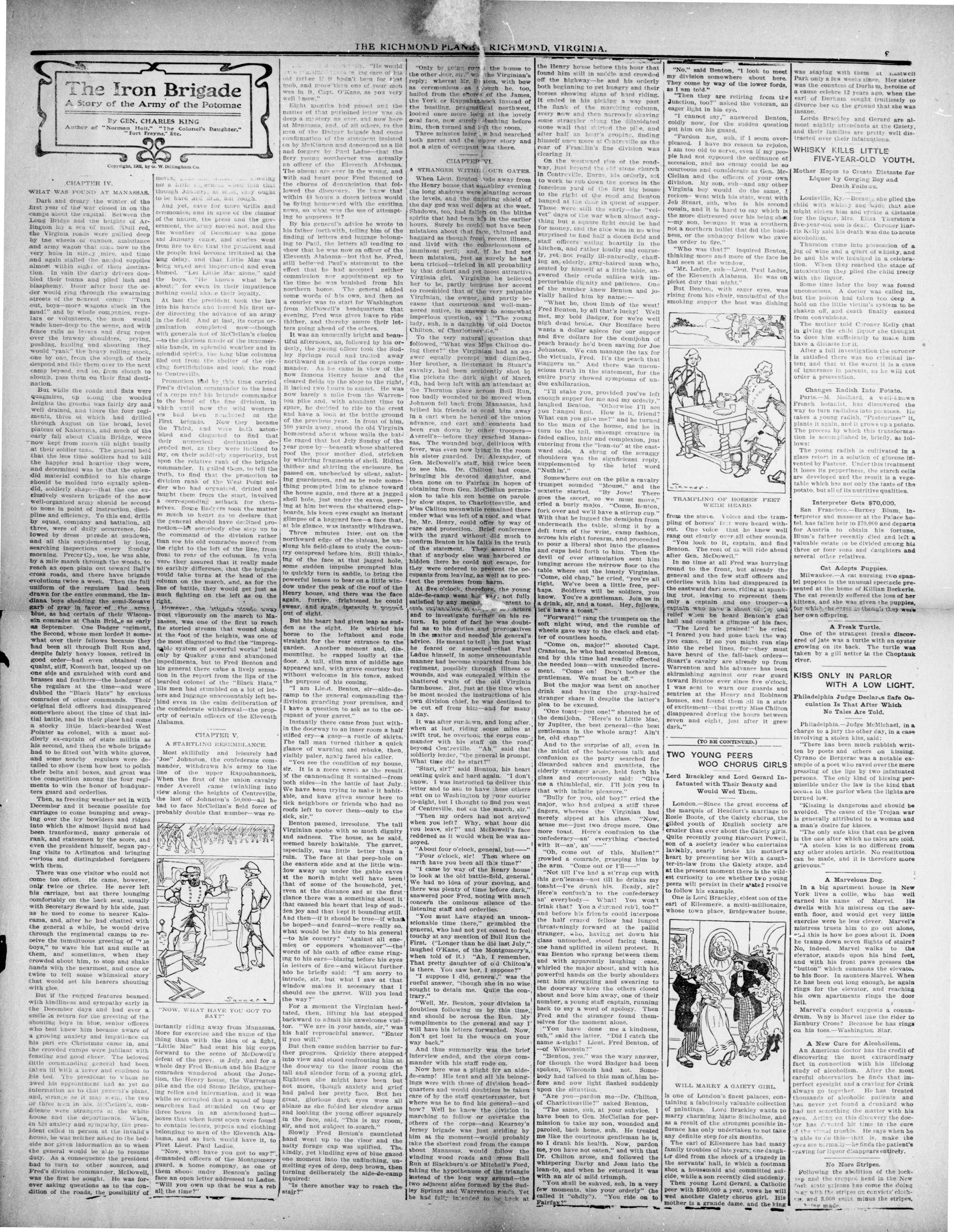
The Iron Brigade
A Story of the Army of the Potomac
By GEN. CHARLES KING
Author of "Norman Holt," "The Colonel's Daughter," "Fort Frayne," Etc.
Copyright, 1907, by G. W. Dillingham Co.
Dark and dreary the winter of the first year of the war closed in on the camps about the capital. Between the Long Bridge and the heights of Arlington key a sea of mud. Dull red, the Virginia roads were gullied deep by the wheels of cannon, ambulance and army wagon that same, now to the very hubs in silvery mire, and time and again stalled the needed supplies almost within sight of their destination. In vain the darky drivers doubled their teams and plied lash and blasphemy. Hour after hour the order would ring through the swarming streets of the nearest camp: "Turn out, boys—more wagons stuck in the mud!" and by whole companies, regulars or volunteers, the men would wade knee-deep to the scene, and with fence rails as levers and drag ropes over the brawny shoulders, prying, pushing, hauling and shouting they would "yank" the heavy rolling stock, one by one, from the slough of their despond and tide them over to the next camp beyond, and so, from slough to slough, pass them on their final destination.
But while the roads and flats were quagmires, up along the wooded heights the ground was fairly dry and well drained, and there the four regiments, three of which had drilled through August on the broad, level plateau of Kaliorama, and much of the early fall about Chain Bridge, were now kept from morn till night busily at their soldier tass. The general held that the less time soldiers had to kill the happier and heartier they were, and determined was he that the splendid material confided to his charge should be molded into equally splendid, soldierly shape—that the one exclusively western brigade of the now well-organized army should be second to none in point of instruction, discipline and efficiency. To this end, drills by squad, company and battalion, all three, were of daily occurrence, followed by dress parade at sundown, and all this supplemented by long, searching inspections every Sunday morning. Precently, too, he was able, by a mile march through the woods, to reach an open plain out toward Ball's cross roads, and there have brigade evolutions twice a week. Then the full uniform of the regulars had been uniform for the entire command, the Indiana boys shedding the semi-Zouave garb of gray in favor of the army blue, as had certain of their Wisconsin comrades at Chain Bridle as early as September. One Badger regiment, the Second, whose men lorded it somewhat over their fellows because they had been all through Bull Run and, despite fairly heavy losses, retired in good order—had even obtained the quaint, stiff, Kossuth hat, looped up on one side and garnished with cord and brasses and feathers—the headgear of the regulars at the time—and were dubbed the "Black Hats" by envious comrades of other commands. Their original field officers had disappeared somewhere about the time of that initial battle, and in their place had come a stocky little black-bearded West Pointer as colonel, with a most soldierly ex-captain of state militia as his second, and then the whole brigade had to be fitted out with white gloves, and some nearby regulars were detailed to show them how best to polish their belts and boxes, and great was the competition among the four regiments to win the honor of headquarters guard and orderles.
Then, as freezing weather set in with December and it became possible for carriages to come bumping and swaying over the ice bowlders and ridges into which the almost liquid mud had been transformed, many generals of rank, and statesmen by the score, and even the president himself, began paying visits to Arlington and bringing curious and distinguished foreigners with them.
There was one visitor who could not come too often. He came, however, only twice or thrice. He never left his carriage, but sat there lounging comfortably on the back seat, usually with Secretary Seward by his side, just as he used to come to nearer Kalorama, and, after he had chatted with the general a while, he would drive through the regimental camps to receive the tumultuous greeting of "the boys," to wave his hat and smile at them, and sometimes, when they crowded about him, to stop and shake hands with the nearmost, and once or twice to tell some whimsical story that would set his hearers shouting with glee.
But if the rugged features beamed with kindliness and sympathy early in the December days and had ever a smile in return for the greeting of the shouting boys in blue, senior officers who best knew him became aware of a growing anxiety and impatience on his part ere Christmas came in, and the crowded camps were jubilant with feasting and good cheer. The beloved little commanding general had been taken till with a fever and confined to his bed. The president to whom heowed his appointment had as yet no information as to that general's plans, and, strange as it may seem, the two or three men in his, McCielan's, confidence were strangers at the white house and the departments. When, in his anxiety and sympathy, the president called in person at the invalid's house, he was neither asked to the bedside nor given information as to when the general would be able to resume duty. As a consequence the president had to turn to other sources, and Fred's division commander, McDowell, was the first he sought. He was forever asking questions as to the condition of the roads, the possibility of
moving, gave and thanked, is sowing not a little earnest when told that through January, at least, they ought to be hard and firm, but rough.
And yet, save for more drills and ceremonies, and in spite of the clamor of the nation, the press and the government, the army moved not, and the fine weather of December was gone and January came, and stories went from fire to fire that the president and the people had become irritated at the long delay, and that Little Mac was being urged and importuned and even blamed. "Let Little Mac alone," said the boys. "He knows what he's about;" for even in their impatience nothing could share their loyalty.
At last the president took the law into his hands and issued his first order directing the advance of an army in the field. And at last, its corps organization completed now—though with generals not of McClellan's choice—to the glorious music of the innumerable bands, in splendid weather and in splendid spirits, the long blue columns filed out from the shelter of the circling fortifications and took the road to Centreville.
Promotion had by this time carried Fred's division commander to the head of a corps and his brigade commander to the head of the fine division, in which until now the wild westernness had been numbered as the First brigade. Now they became the Third, and were both astonished and disgusted to find that their numerical destination depended not, as they were inclined to say, on their soldierly superiority, but upon the relative rank of the brigade commander. It gailed them, to tell the truth, to find that the promotion to division rank of the West Point soldier who had organized, drilled and taught them from the start, involved a corresponding setback for themselves. Some Badgers took the matter so much to heart as to declare that the general should have declined promotion—let somebody else step up to the command of the division rather than see his old comrades moved from the right to the left of the line, from front to rear of the column. In vain were they assured that it really made no earthly difference, that the brigade would take turns at the head of the column on the march, and, as for the line of battle, they would get just as much fighting on the left as on the right.
However, the intruder stole away most vigorously on the march to Manasses, was one of the first to reach the storied stream that wound along at the foot of the heights, was one of the most disgusted to find the "impregnable system of powerful works" held only by Quaker guns and abandoned impediment, but to Fred Benton and his general there cause a lively sensation in the report from the lips of the bearded colonel of the "Black Hats." His men had stumbled on a lot of letters and luggage unaccountably left behind even in the calm deliberation of the confederate withdrawal—the property of certain officers of the Eleventh Alabama.
CHAPTER V.
A STARTLING RESEMBLANCE
Most skillfully and leisurely had "Joe" Johnston, the confederate commander, withdrawn his army to the line of the upper Rappahannock. When the first of the union cavalry under Averell came twinkling into view along the heights of Centreville, the last of Johnston's 50,000—all he had to face McClellan's field force of probably double that number—was re
JAMES A.
"NOW, WHAT HAVE YOU GOT TO SAY?"
luctantly riding away from Manassas. More for exercise and the name of the thing than with the idea of a fight, "Little Mac" had sent his big corps forward to the scene of McDowell's defeat of the prev. is July, and for a whole day Fred Benton and his Badger comrades wandered about the Junction, the Henry house, the Warrenton pike and the old Stone Bridge, gathering relies and information, and it was while so occupied that a squad of busy searchers had stumbled on two or three boxes in an abandoned hut—boxes that when burst open were found to contain letters, papers and clothing belonging to men of the Eleventh Alabama, and as luck would have it, to First Lieut. Paul Ladie.
"Now, what have you got to say?" demanded officers of the Montgomery guard, a home company, as one of them shook under Benton's paling face an open letter addressed to Ladue. "Will you own up that he was a reb all the time?"
He would be the only one in long care of his old father if it hadn't been for that mob, and more than one of your men was in it. Capt. O'Kane, as you very well know."
Eight months had passed and the matter of that purloined letter was as deep a mystery as ever, and now here at Menussas, and of all others, to the men of the Badger brigade had come confirmation of the statement insisted on by McKinnon and denounced as a lie and forgery by Paul Ladue—that the flery young southerner was actually an officer of the Eleventh Alabama. The absent are ever in the wrong, and with sad heart poor Fred listened to the chorus of denunciation that followed the discovery. He knew that within 48 hours a dozen letters would be flying homeward with the exciting news, so what was the use of attempting to suppress it?
By his general's advice he wrote to his father forthwith, telling him of the finding of letters and luggage belonging to Paul, the letters all tending to show that he was now an officer of the Eleventh Alabama—but that he, Fred, still believed Paul's statement to the effect that he had accepted neither commission nor appointment up to the time he was banished from his northern home. The general added some words of his own, and then as a courier was to start for Washington from McDowell's headquarters that evening. Fred was given leave to ride thither, and thereby assure their letters going ahead of the others.
It was an unusually bright and beautiful afternoon, as followed by his orderly, the young officer took the Sudley Springs road and trotted away northward in search of the corps commander. As he came in view of the now famous Henry house and the cleared fields up the slope to the right, it lacked two hours to sunset. He was now barely a mile from the Warrenton pike and, with abundant time to spare, he decided to ride to the crest and have a look at the battle ground of the previous year. In front of him, 100 yards away, stood the old Virginia homestead about whose walls the battle raged that hot July Sunday of the year gone by—beneath whose shattered roof the poor mother died, stricken by whirring fragments of shell. Riding thither and skirting the enclosure, he passed on, unchecked by silent, saluting guardsmen, and as he rode something prompted him to glance toward the house again, and there at a jagged shell hole, just under the eaves, peering at him between the shattered clapboards, his keen eyes caught an instant glimpse of a haggard face—a face that, at his glance was instantly withdrawn
Three minutes later, out on the northward edge of the plateau, he unslung his field-glass to study the country outspread before him. Still thinking of the face at that jagged hole, some sudden impulse prompted him to quickly turn in saddle, to bring the powerful lenses to bear on a little window under the peak of the roof of the Henry house, and there was the face again, furtive, frightened, he could swear, and again instantly it popped out of sight.
But his heart had given leap as sudden as the sight. He whirled his horse to the leftabout and rode straight for the rear entrance to the garden. Another moment and, dismounting, he rapped loudly at the door. A tall, slim man of middle age appeared and, with grave courtesy but without welcome in his tones, asked the purpose of his coming.
"I am Lieut. Benton, sir—alde-decamp to the general commanding the division guarding your premises, and I have a question to ask as to the occupant of your garret."
Instantly there came from just within the doorway to an inner room a half stifted cry—a gasp—a rustle of skirts. The tall man turned thither a quick glance of warning and rebuke, then, visibly paler, agaïp faced his caller.
"You see the condition of my house, sir. It is a mere wreck as the result of the cannonading it sustained—from both sides—in the battle of last July. We have been trying to make it habitable, and have given succor here to sick neighbors or friends who had no roofs left to cover them—only to the sick, sir."
Benton paused, irresolute. The tall Virginian spoke with so much dignity and sadness. The house, as he said, seemed barely habitable. The garret, especially, was little better than a ruin. The face at that peep-hole on the eastern side and at the little window away up under the gable eaves at the north might well have been that of some of the household, yet, even at the distance and at the first glance there was a something about it that caused his heart that leap of sudden joy and that kept it bounding still. And then—if it should be true—if what he hoped and feared—were really so, what would be his duty to his general—to his country? "Against all enemies or opposers whomsover"—the words of his oath of office came ringing to his ears—blazing before his eyes in letters of fire—and without further ado he briefly said: "I am sorry to intrude, sir, but what I saw at that window makes it necessary that I should see the garret. Will you lead the way?"
For a moment the Virginian hesitated, then, lifting his hat stepped backward to admit his unwelcome visitor. "We are in your hands, sir," was his half reproachful answer. "Enter if you will."
But then came sudden barrier to further progress. Quickly there stepped into view and stood confronting him at the doorway to the inner room the tall and slender form of a young girl. Eighteen she might have been but not more, though anxiety and grief had paled her pretty face. But her great, glorious dark eyes were all ablaze as she folded her slender arms and looking the young officer squarely in the face, said. "This is my room, sir, and not subject to search."
Slowly Fred Benton's gauntlet hand went up to the visor and the natty forage cap was uplifted. The kindly, yet kindling eyes of blue gazed one moment into the unfinching, unmelting eyes of deep, deep brown, then turning deliberately the side-de-camp inquired: "Is there another way to reach the stair?"
RICHMOND, VIRGINIA
"Only by going round the house to the other door, sir," was the Virginian's reply; whereat Mr. Braton, with bow as ceremonious as a though he, too, hailed from the shores of the James, the York or Rappahannock instead of the bustling, pragmatical northwest, looked once more long at the lovely oval face, now surely blushing before him, then turned and left the room. Three minutes later, he had searched both garret and the upper story and not a sign of occupant was there.
A STRANGER WITH OUR GATES.
When Lieut. Benton code away from the Henry house that sunshine evening the long shadows were slanting across the levels, and the dazzling shield of the day god was well down at the west, Shadows, too, had fallen on the blithe spirits that had been his in the earlier hours. Surely he could not have been mistaken about that face, thinned and haggard as though from recent illness, and livid with the consciousness of imminent peril; and, if he had not been mistaken, just as surely he had been tricked—tricked in all probability by that defiant and yet most attractive Virginia girl. Virginian he believed her to be, partly because her accent so resembled that of the very palpable Virginian, the owner, and partly because that courteous and well-mannered native, in answer to somewhat imperious question, said, "The young lady, suh, is a daughter of old Doctor Chilton, of Charlottesville."
To the very natural question that followed, "What was Miss Chilton doing there?" the Virginian had an answer equally prompt and dignified. Her brother, a lieutenant in Stuart's cavalry, had been accidentally shot by the pickets the dark night of March 4th, had been left with an attendant at the Thornton place across Bull Run, too badly wounded to be moved when Johnson fell back from Manassas, had bribed his friends to send him away in a cart when he heard of the union advance, and cart and contents had been run down by other troopers—Averell's—before they reached Manassas. The wounded boy, delirious with fever, was even now lying in the room his sister guarded. Dr. Alexander, of Gen. McDowell's staff, had twice been to see him. Dr. Chilton had come, bringing his devoted daughter, and then gone on to Fairfax in hopes of obtaining from Gen. McChellan permission to take his son home on parole by slow stages, to Charlottesville, and Miss Chilton meanwhile remained there under what was left of a roof, and what he, Mr. Henry, could offer by way of care and protection. Brief conference with the guard without did much to confirm Benton in his faith in the truth of the statement. They assured him that if anybody else was harbored or hidden there he could not escape, for they were ordered to prevent the occupants from leaving, as well as to protect the premises from harm.
At five o'clock, therefore, the young alde-de-camp went his way, not fully satisfied by any means, content to seek explanation at corners in matters and to investigate further on his return. In point of fact he was doubtful as to his duties and prerogatives in the matter and needed his general's advice. He meant to tell, 'Im just what he feared or suspected—that Paul Ladue himself, in some unaccountable manner had become separated from his regiment, possibly through illness or wounds, and was concealed within the shattered walls of the old Virginia farmhouse. But, just at the time when he most needed the instructions of his own division chief, he was destined to be cut off from him—and for many a day.
It was after sunrise, and long after, when at last, riding some miles at swift trot, he overtook the corps commander with his staff on the road beyond Centreville. "Ah" said that soldierly leader, "the general is prompt. What time did he start?"
"Start, sir?" said Benton, his heart beating quick and hard again. "I don't know. I was instructed to deliver this letter and to ask to have these others sent on to Washington by your courier to-night, but I thought to find you west of Centreville, not on the march, sir."
"Then my orders had not arrived when you left? Why, what hour did you leave, sir?" and McDowell's face reddened as it would when he was an-oyed.
"About four o'clock, general, but——"
"Four o'clock, sir! Then where on earth have you been all this time?"
"I came by way of the Henry house to look at the old battle-field, general. We had no idea of your moving, and there was plenty of time before dark," answered poor Fred, noting with much concern the ominous silence of the listening staff and orderlies.
"You must have stayed an unconscionable time there," grimbled the general, who had not yet ceased to feel touchy at any mention of Bull Run the First. ("Longer than he did last July," laughed O'Kane, the Montgomery's, when told of it.) "Ah, I remember, That pretty daughter of old Chilton's is there. You saw her, I suppose?"
"I suppose I did, general," was the rueful answer, "though she in no wise sought to detain me. Quite the contrary."
"Well, Mr. Benton, your division is doubtless following us by this time, and should be across the Run. My compliments to the general and say I will have his letters forwarded. Now, don't get lost in the woocs on your way back."
And thus summarily was the brief interview ended, and the corps commander with his staff rode on.
Now here was a plight for an aldeed-camp! His tent and all his belongings were with those of division head-quarters and would doubtless be taken care of by the staff quartermaster, but where was he to find his general—and how? Well he knew the division in marching to follow or overtake the others of the corps—and Kearney's Jersey brigade was just striding by him at the moment—would probably take the shortest road from the camps about Manassas, would follow the winding wood roads and cross Bull Run at Blackburn's or Mitchell's Ford, taking the hypothenuse of the triangle instead of the long way around—the two adjacent sides formed by the Sudley Springs and Warrenton roads. Yet he had full—in intended to be tack at
CHAPTER VI.
the Henry house before this hour that found him still in saddle and crowded off the highway—he and his orderly both beginning to get hungry and their horses showing signs of hard riding. It ended in his picking a way past the flank of the marching column, every now and then narrowly shaving some strangler along the dilapidated stone wall that slitted the pile, and after half an hour's groping, finding himself once more at Centreville as the rear of Franklin's fine division was clearing it.
On the westward rise of the roadway, just beyond the old stone church in Centreville, Burns, his orderly, sot to work to rob down the norses in the fenceless yard of the first big house to the right of the road and Benton banged at the door in quest of supper. Those were still the early—the "velvet" days of the war when almost anything but a square fight could be had for money, and the slice was in no wise surprised to find half a dozen field and staff officers eating heartily in the kitchen, and rather loudly and coarsely, yet not really ill-natured, chaffing an elderly, gray-haired man who, seated by himself at a little table, answered their crude saliies with imperturbable dignity and patience. One of the number knew Benton and joyfully hailed him by name:—
"What ho, thou limb of the west! Fred Benton, by all that's lucky! Well met, my bold Badger, for we're well nigh dead broke. Our Boniface here wants a dollar apiece for our supper and five dollars for the demijohn of peach brandy he'd been saving for Joe Johnston. We can manage the tax for the victuals, Fred. It's the peach that staggers us." And there was unconscious truth in the statement, for the entire party showed symptoms of undue exhilaration.
"I'll stake you, provided you've left enough supper for me and my order," laughed Benton. "Otherwise I'll see you banged first. How is it, friend? What can you give me?" and he turned to the man of the house, and he in turn to the tail, unkempt creature in faded calico, hair and complexion, just entering from the "lean-to" at the eastward side. A shrug of the scraggy shoulders was the significant reply, supplemented by the brief word "Nuthin."
Somewhere out on the pike a cavalry trumpet sounded "Mount," and the sextette started. "By Jove! There goes the escort, so we must move." cried a burly major. "Come, Benton, fork over and we'll have a stirrup cup." With that he lugged the demjohn from underneath the table, slung it by a deft turn of the wrist, camp fashion, across his right forearm, and proceeded to pour a liberal shot into the glasses and cups held forth to him. Then the devil of over stimulation sent him lunging across the narrow floor to the table where sat the lonely Virginian. "Come, old chap," he cried, "you're all right. We've been a little free, perhaps. Soldiers will be soldiers, you know. You're a gentleman. Join us in a drink, sir, and a toast. Hey, fellows, let's have a toast."
"Forward!" rang the trumpets on the soft night wind, and the rumble of wheels gave way to the clack and clatter of countless hoofs.
"Come on, major!" shouted Capt. Cranston, he who had acceded Benton, and by this time had readily effected the needed loan—with unneeded increment. "Come on! Don't bother the gentleman. We must be off."
But the major was bent on another drink and having the gray-haired stranger share it despite the latter's plea to be excused.
"One toast—just one!" shouted he of the demiljohn. "Here's to Little Mac, by Jupiter, the best general—the best gentleman in the whole army! Ain't he, old chap?"
And to the surprise of all, even in the midst of the boisterous talk and confusion as the party searched for discarded sabres and gauntlets, the elderly stranger arose, held forth his glass and courteously said: "Give me a thimbleful, sir. I'll join you in that with infinite pleasure."
"Bully for you, old boy!" cried the major, who had gulped a stiff three fingers, whereas the Virginian had merely sipped at his glass. "Now, sense me—just two drops more. One more toast. Here's confusion to the confederacy—an' everything c'nected with it—an', an'——"
"Oh, come out of this, Mullen!' growled a comrade, grasping him by the arm. "Come out or I'll——"
"Not till I've had a stirrup cup with this gen'leman—not till he drinks my toast—I've drunk his. Ready, sir? Here's confush'n to the confederacy an' everybody—What! You won't drink that? You a damned reb!, too?" and before his friends could interpose the half crazed fellow had lunged threateningly forward at the pallid stranger, who, having set down his glass untouched, stood facing them, one hand uplifted in silent protest. It was Benton who sprang between them and with apparently laughing ease, whirled the major about, and with his powerful hands on the burly shoulders sent him struggling and swearing to the doorway where the others closed about and bore him away, one of their number, a young staff captain, running back to say a word of apology. Then Fred and the stranger found themselves for the moment alone.
"You have done me a kindness, suh," said the latter. "Did I catch the name a-right? Lieut. Fred Benton, of—of Wisconsin?"
"Benton, yes," was the wary answer, for though the word Badger had been spoken, Wisconsin had not. Somebody had talked to this man of him before and now light flashed suddenly upon the situation.
"Are you—pardon me—Dr. Chilton, of Charlcttesville?" asked Benton.
"The same, suh, at your suhvice. I have been to Gen. McChellan for permission to take my son, wounded and paroled, back home, suh. He treated me like the courteous gentleman he is, so I drank his health. Now, pardon me, you have not eaten," and with that Dr. Chilton arose, and followed the whispering Darby and Joan into the lean-to, and when he returned it was with an air of mild triumph.
"You shall be suvled, suh, in a very few moments, also your orderly" (he called it "ohdly"). "You ride on to Fairfax?"
"No," said Benton. "I look to meet my division somewhere about here. They come by way of the lower fords, as I am told."
"Then they are retiring from the Junction, too?" asked the veteran, an eager light in his eye.
"I cannot say," answered Benton, coldly now, for the sudden question put him on his guard.
"Pardon me, suh, if I seem overpleased. I have no reason to rejoice, I am too old to serve, even if my people had not opposed the ordinance of secession, and no enemy could be so courteous and considerate as Gen. McClellan and the officers of your own division. My son, suh—and any other Virginia boy would do the same. I reckon—went with his state, went with Jeb Stuart, suh, who is his second cousin, and it is hard to say which is the more distressed over his being shot—my son, because it was a southern not a northern bullet that did the business, or the unhappy fellow who gave the order to fire."
"Who was that?" inquired Benton, thinking more and more of the face he had seen at the window.
"Mr. Ladue, suh—Lieut. Paul Ladue, of the Eleventh Alabama. He was on picket duty that night."
But Benton, with eager eyes, was rising from his chair, unmindful of the smoking supper the host was dishing
JAMES
TRAMPLING OF HORSES' FEET
WERE HEARD.
from the stove. Voices and the trampling of horses' feet were heard without. One voice that he knew well rang out clearly over all other sounds. "You look to it, captain, and find Benton. The rest of us will ride ahead after Gen. McDowell."
In no time at all Fred was hurrying round to the front, but already the general and the few staff officers and orderlies with him had disappeared in the eastward dartiness, riding at spanking trot, leaving to represent them only a captain and one trooper—a captain who gave a short notice and relief when he heard Benton's glad hall and caught a glimpse of his free
"The Lord be praised!" he cried. "I feared you had gone back the way you came. If so you might run slap into the rebel lines, for—they must have heard of the fall-back orders—Stuart's cavalry are already up from Warrenton and his advance has been skirmishing against our rear guard toward Bristoe ever since five o'clock. I was sent to warn our guards and sentries at the Henry and Robinson houses, and found them all in a state of excitement—that pretty Miss Chilton disappeared during the hours between seven and eight, just after it grew dark."
TWO YOUNG PEERS
WOO CHORUS GIRLS
Lord Brackley and Lord Gerard Infatuated with Their Beauty and Would Wed Them.
London.—Since the great success of the marquis of Headfort's marriage to Rosie Boote, of the Gaiety chorus, the gilded youth of English society are crazier than ever about the Gaiety girls. Quite recently young Harcourt Powell, son of a society leader who entertains lavishly, nearly broke his mother's heart by presenting her with a daughter-in-law from the Gaiety stage, and at the present moment there is the wildest curiosity to see whether two young peers will persist in their state resolve to follow his example.
One is Lord Brackley, eldest son of the earl of Ellesmere, a multi-millionaire, whose town place, Bridgetwage house.
WILL MARRY A GAIETY GIRL
is one of London's finest palaces, containing a fabulously valuable collection of paintings. Lord Brackley wants to marry charming Marie Suecholme, and as a result of the strongest possible influence has only undertaken to not take any definite step for six months.
The earl of Ellesmere has had many family troubles of late years; one daughter died from the shock of a tragedy in the servants' hall, in which a footman shot a housemaid and committed suicide, while a son recently died suddenly. Then young Lord Gerard, a Catholic peer with $300,000 a year, vows he will wed another Galety chorus girl. His mother is a grande dame, and the king
was staying with them at Eastwell Park only a few weeks since. Her sister was the countess of Durham, her heroine of a cause celebre 12 years ago, when the earl of Durham sought truittlessly to divorce her on the ground that she was insane. Lords Brachley and Gerard are almost nightly attendants at the Gaiety, and their families are pretty well distracted over their infatuations.
WHISKY KILLS LITTLE
FIVE-YEAR-OLD YOUTH.
Mother Hopes to Create Distaste for Liquor by Gorging Boy and Death Follows
Louisville, Ky.—Because she plied the child with whiskey and wine that she might sicken him and create a distaste for the liquor, Mrs. Eliza Thurston's five-year-old son is dead. Coroner Harris Kelly said his death was due to acute alcoholism.
Thurston came into possession of a jug of wine and a quart of whiskey, and he and his wife indulged in a celebration. When they reached the stage of intoxication they plied the child freely with the liquor.
Some time later the boy was found unconscious. A doctor was called in, but the poison had taken too deep a hold on the little victim's system to be shaken off, and death finally ensued from convulsions.
The mother told Coroner Kelly that in giving the child liquor she thought to dose him sufficiently to make him have a distaste for it.
After a full investigation the coroner is satisfied there was no criminal intent and that at the worst it is a case of ignorance in parents, so he will not order a prosecution.
Changes Radish Into Potato.
Paris—M. Moillard, a well-known French botanist, has discovered the way to turn radishes into potatoes. He takes a young radish, "Pasteurizes" it, plants it again, and it grows up a potato. The process by which this transformation is accomplished is, briefly, as follows:
The young radish is cultivated in a glass retort in a solution of glucose invented by Pasture. Under this treatment it loses its pepperiness, the starch cells are developed and the result is a vegetable which has not only the taste of the potato, but all of its nutritive qualities.
Interpreter Gets $70,000.
San Francisco—Barney Blum, interpreter and massurer at the Palace hotel, has fallen heir to $70,000 and departs for Austria to obtain his fortune. Blum's father recently died and left a valuable estate to be divided among his three or four sons and daughters and several other relatives.
Cat Adopts Puppies
Milwaukee.—A cat nursing two spantel puppies is the unusual spectacle presented at the home of Killian Beckerle. The cat recently suffered the loss of her kittens, and she was given the puppies, for which she cares as though they were her own offspring.
A Freak Turtle.
One of the strangest treals discovered of jate was a turtle with an oyster growing on its back. The turtle was taken by a gill netter in the Choptauk river.
KISS ONLY IN PARLOR
WITH A LOW LIGHT.
No Tales Are Told.
Philadelphia.—Judge McMichael, in a charge to a jury the other day, in a case involving a stolen kiss, said:
"There has been much rubbish written by poets and others on kissing. Cyrano de Bergerac was a notable example of a poet who raved over the mere pressing of the lips by two infatuated persons. The only kind of kissing permissible under the law is the kind that occurs in the parlor when the lights are turned low.
"Kissing is dangerous and should be avoided. The cause of the Trojan war is generally attributed to a woman and a man's desire for kisses.
"The only safe kiss that can be given is the one after which no tales are told.
"A stolen kiss is no different from any other stolen article. No restitution can be made, and it is therefore more grievous."
A Marvelous Dog.
In a big apartment house in New York lives a colle, who has well earned his name of Marvel. He dwells with his mistress on the seventh floor, and would get very little exercise were he less clever. Marvel's mistress trusts him to go out alone, and this is how he goes about it. Does he trump down seven flights of stairs? No, indeed. Marvel walks to the elevator, stands upon his hind feet, and with his front paws presses the "button" which summons the elevator, to his floor. In saunters Marvel. When he has been out long enough, he again rings for the elevator, and reaching his own apartments rings the door bell.
Marvel's conduct suggests a conundrum. Why is Marvel like the rider to Banbury Cross? Because he has rings on his toes.—Washington Star.
A. New Cure for Alcoholism
An American doctor has the credit of discovering the most extraordinary fact in connection with his lifelong study of alcoholism. After the most careful observation he finds that imperfect eyesight and a craving for drink always go together. He has treated thousands of alcoholic patients and has never yet found a drunkard who had not something the matter with his eyes. Acting on this discovery the doctor has devoted his time to the cure of the visual trouble. He says when he is able to do this—that is, make the eyes see normally—he finds the patient's craving for liquor disappears entirely.
No More Stripes.
Following the abolition of the lock-
rep and the crumple head in the New
York state prisons has come the doing
way with the stripes on convicts' clo-
衣, and 3,000 suits minus the stripes,
made
THE PLANET
opened every Saturday by JOHN M. JOBB
at 3D North 46th Street Richmond, Va
based every Saturday by John N. Cole.
at 810 North 4th Street Richmond Va.
COMMUNICATIONS intended for publication
and be used to reach us by Wednesdays
TERMS IN ADVANCE
Copy one year, $1.8
Copy eight months, 1.0
Copy six months, .8
Copy four months, .5
Copy three months, .4
Copy .2
ADVERTISING RATES
one inch, one insertion, $ 8
one inch, each subsequent insertion, 2
two inches, six months, 6.0
two inches, six months, 10.0
two inches, nine months, 14.0
two inches, twelve months, 30.0
stage and Pencil Notes, 25
coding and Transcribe Notices per line.
*POSTAGE STAMPS OF A HIGHER DE-
PENDENCE* RECEIVED OR SUBSCRIBED
PLANET is issued weekly. The subscri
price is $1.50 a year, in advance.
There are FOUR WAYS by which money can be by mail at our risk—In a Post Office Money Order or an Easier Money Order and when none of these are procured, in a Registered Letter.
MONEY ORDERS—You can buy a Money Order at your Post Office, payable at the Richmond Office, and we will be responsible for the arrears.
EXPRESS MONEY ORDERS can be obtained at the office of the American Express. So, the United States Express Co. and the Well, Fargo, or American Express can be for money sent by any of these companies. The Express Money Order is a convenient way for forwarding money.
CONSTERED LETTER—If a Money Order is not received, your Postmaster will register the you wish to send as on payment of the letter. Then if the letter is lost or stolen, you can car send money in the manner mentioned above. If you send your information on the at our risk.
cannot be responsible for money sent in any other way than one of the four mentioned above. If you send your information on the at our risk, you must do it at you.
DEVILS, S.C.—If you do not want to
continued for another year after your
birth, you may not send your
Card to discontinue it. The courts have
added that subscribers to newspapers who
order their paper discontinued at the time
of their paper delivery, it is required
to send it. If you do not want to
continue when they order, paper discontinued
is enforced.
MUNICA. When writing to
your subscription or to discontinue
subscription, you should give your name and
address. We assume you are
address or address in order to ensure
that your subscription we insist
on as well as the present address.
sintered in the Post Office.
SATURDAY, FEBBRARY 4, 1905
COLORED folks, we should continue to buy land and educate our children.
COLORED people are progressing and although some of them are slow to see and slower to take advantage of golden opportunities, the out-look for them is bright and brightening.
PRESIDENT ROOSEVELT has re-appointed Hon. WALTER L. COHEN, (colored) Register of the Land Office at New Orleans, Louisiana. Mr. COHEN is of course delighted. We do not presume that there will be any material opposition to his confirmation. He has made a satisfactory and efficient officer.
---
PRESIDENT ROOSEVELT'S speech be fore the Union League at Philadelphia January 30th, 1905 was the most remarkable deliverance that has ever fallen from his lips. It has the ring of the true statesman and enunciates principles that are self-evident. He shrewdly took a middle course and thereby elicited the favorable approval of the conservative elements on both sides of the industrial and ratemaking controversy.
THE QUESTION OF REPRESENTATION.
It is an unfortunate fact that our people at times "glory" in division. The discussion under way with reference to the plan of the national Republican party to reduce the electoral and congressional representation of all states that abridge the electorate except for crime has emphasized this fact. The New York Age, edited by that accomplished journalist, Hon. T. THOMAS FORTUNE is leading the opposition against this plank in the platform of the Republic party. It is needless to say that the southerners are well contented to let the colored people lead the movement. It is also stated that President ROOSEVELT has unofficially placed the seal of his disapproval upon any such re-duction.
This makes quite a complicated situation and it is safe to say that the proposed legislation is as good as defeated. The day has not as yet dawned when the educated moneyed elements amongst the colored people could agree upon a specified plan of action and as long as this condition prevails, but little can be expected as a result of their efforts.
We have never seen any particular benefit to be derived by the colored people by the enforcement of the penalizing clause of the Fourteenth Amendment, but have always insisted that it was the duty of Congress to enforce and vitalize the provision guaranteeing a free ballot and a fair count for all citizens, regardless of race or color. Still, if the Republican leaders choose to reduce the representation of any state of the Union, that abridges the suffrage, save for crime, we have nothing to say against it. It is a fight now being waged by our white friends against each other and
we cannot see that a sheep sheared on his wool has any cause to concern it self, as to who secures possession of it for use as winter clothing. If we cease this agitation among our selves and leave the question to be threshed out by the white folks of the North and the South, the East and the West, it seems to us that it will prove to be the wisest course that an oppressed and downtrodden people could pursue.
PRESIDENT ON RATE ABUSES
Advocates Government Control to Abolish Rebates.
JUSTICE FOR LITTLE SHIPPER
Philadelphia, Jan. 31. — President Roosevelt was the guest of honor and principal speaker at the 42d anniversary banquet of the Union League. The banquet room was a marvel of the decorator's art. The national colors predominated in the floral and electrical effects, and the tables were designated by letters in red, white and blue, forming the name "Roosevelt." President Roosevelt occupied a seat in the centre of the guests' table, with President E. T. Stotesbury, of the Union League, on his right, and United States Senator Penrose on his left. Seated at the same table were former Postmaster General Charles Emory Smith, Congressman Bingham, Surgeon General Rixey, Major General Frederick D. Grant, Lieutenant General S. B. M. Young, Governor Lea, of Delaware; Governor Stokes, of New Jersey, and Mayor Weaver of this city.
When President Roosevelt arose to make his address he was greeted with long-continued applause. He said in part:
This club was founded to uphold the hands of Abraham Lincoln when he stood as the great leader in the struggle for union and liberty. The principles which Lincoln applied to the solution of the problems of his day are those which we must apply if we want to solve the different problems of our own day—problems which are so largely industrial. Unquestionably the great development of industrialism means that there must be an increase in the supermarket and the instrument over business enterprises. This should not take the form of violent and ill-advised interference; and assuredly there is danger lest it take such form if the business leaders of the business community themselves to trying to thwart the effort at regulation instead of guiding it aight.
Neither this people nor any other free people will permanently tolerate the use of the vast power conferred by vast wealth, and especially by wealth in its entirety, without lodging somewhere in the government, for power of seeing that this power, in addition to being used in the interest of the individual or individuals possessing it, is also used for and not against the interests of the people as a whole. Our peculiar form of government, a government in the nation is supreme throughout the arts, and the nation is supreme throughout the arts, of nearly half a hundred states is supreme in its part of the union in certain other respects, renders the task of dealing with these conditions especially difficult. No finally satisfactory result can be expected from merely state action. The government must come through the federal government, and the country is now carried on by law, which the founders of our constitution could by no possibility have had any idea.
All great business concerns are engaged in interstate commerce and it was beyond question the intention of the founders of the government that interstate commerce in all states should be under national and not state control. If the courts decide that this intention was not carried out and made effective in the constitution as it now stands, the government, if not construed differently, will be be amended so that the original undoubted intention may be made effective. But a constitutional amendment is only to be enacted at last resort, if every effort of legislation or arbitration shall have been proved inadequate.
The railroad, which was utterly unknown when our government was formed and when the great principles of our jurisprudence were laid down, has now become almost everywhere the most imminent and only form of highway for commerce. That is why we use cannot be permitted to control it in his own interest alone. It is not only just but it is in the interest of the public that this man should receive ample payment for the business capacity which enables him to benefit himself while benefiting the public; but in return he must himself do the public. He will not and cannot do the public. His laws are so defective that in the sharp competition of the business world the conscientious man is put at a disadvantage by his less scrupulous fellows. It is in the interest of the conscientious and public spirited railway man that there be such governmental supervision of the business country as to require from his less scrupulous competitors and from unscrupulous big shipers as well, that heed to the public welfare which he himself would willingly give, and which is of vital consequence to the small shipper. Every important railroad is engaged in interstate commerce; this control over the railroads must come through the national government.
The control must be exercised by some governmental tribunal, and it must be real and effective. It must best with the lawmakers of the two houses of congress, but about the principle there can be no doubt. Hasty or vindictive action would merely work damage; but in temperate, resolve fashion, there must be lodged in the legislature. It must especially over rebates—whether secured by means of private cars, of private tracks, in the form of damages or commissions, or in any other manner — which will protect the railroad and the highway. It must be done and the little shipper on an equal footing.
Child Accidentally Shot and Killed.
New York, Jan. 30.—George Vanderpoel, 5 years of age, was shot and instantly killed by Bernard Raszkowsky, 6 years of age, in the dining room of the later's home in Bronzale. The accident occurred while the boys were playing with a shotgun.
THE RICHMOND PL. NET. RICHMOND, VIRGINIA
MORE LAND FRAUD INDICTMENTS
Federal Grand Jury Returns Another Charge Against Senator Mitchell. Portland, Ore., Feb. 1.—After many days of silence the federal grand jury returned three indictments in connection with the investigation into the land fraud cases which it is alleged, have been perpetrated upon the United States government.
The first indictment is against United States Senator John H. Mitchell, Congressman Binger Hermann, S. A. D. D. Puter, Horace C. McKinley, Emma L. Watson, Daniel McTarpley, Elbert K. Brown, Nellie Brown, his wife, Henry A. Young, Frank H. Walgamot, Clark E. Loomis and Salmon B. Ormsby.
Senator Mitchell is specifically charged with having at Washington, D. C., on March 3, 1902, unlawfully prepared an affidavit for Emma L. Watson to sign, in which Mrs. Watson untruthfully swore that she was a bona fide sider on a portion of these lands. It also charges that Senator Mitchell prepared unlawfully an affidavit for S. A. D. Puter to sign, in which Puter is alleged to have sworn that he knew that the contents of the Watson affidavit were true. The indictment charges that Mitchell received as a compensation for his alleged services the sum of $2000, paid to him by Puter. The indictment goes on to state that in pursuance of the conspiracy, Senator Mitchell introduced Puter to William A. Richards as the commissioner of the general land office at Washington, stating that Puter was one of the most honorable citizens in the state.
The other indictments are against Henry W. Miller, Frank E. Kincart, Martin G. Hoge and Charles Nickell and Mayor William Davis, of Albany, Oregon.
JOHANN HOCH ARRESTED
Alleged Wife Poisoner Caught After Proposing to New York Woman.
New York, Jan. 31.—Johann Hoch, charged with the murder of a wife in Chicago, and who, it is alleged, married 20 women, was arrested in a boarding house in West 47th street by central office detectives. He admitted his identity, although when first arrested he gave the name of Henry Bartels.
At the 47th street station, where he was taken, he said: "I'm Hoch, and a much abused man." Hoch denied murdering Marie Fisher on January 12. He said that after she died he came to New York at once and has been here ever since.
Mrs. Catherine Kimmerle, the landlady, said he engaged board on Saturday, and had not been in the house 20 minutes when he asked to be allowed to peel some potatoes for her. Yesterday he proposed marriage, and she told the police. She added that the man talked a good deal to her and became much interested in her, she thought.
"He was so anxious to talk: that I did not know what he was after," said Mrs. Kimmerle, "till a sudden he told me he wented to marry me. I remember reading in the papers about that awful man, and it suddenly flashed across my mind that this man, who wanted to peel potatoes after 20 minutes in my house, and wanted to marry me after knowing me a day or so, was the same man they wanted in Chicago, and as I ran to the station house as quickly as I could."
DECISION AGAINST BEEF TRUST
Supreme Court Sustains Contention of Conspiracy to Rise Prises
or Conspiracy to Raise Prices.
Washington, Jan. 31.—The supreme court of the United States decided the case of the United States versus Swift & Co., known as the beef trust case, charging conspiracy among the packers to fix prices on fresh meats, etc. The opinion was handed down by Justice Holmes, and affirmed the decision of the court below, which was against the packers.
In his opinion Justice Holmes discussed at length the various contents of the packers and disposed of them individually. He admitted that some of the charges were less specific than desirable, but said this was necessarily true on account of the vast field covered.
He added that sufficient had been shown to prove continuous offense and an offense of such a nature as to justify the proceeding. The opinion continues the injunction granted against the packers under the Sherman antitrust law by the lower courts. The opinion was concurred in by all the members of the court.
A WEEK'S NEWS CONDENSED
Thursday, January 26.
Tuesday, January 26.
A bill absolutely prohibiting collegiate football as a felony was introduced in the Nebraska legislature.
Captain William Carter, once a famous horseman and millionaire, died penniless in New York from apoplexy.
The Texas legislature has elected Charles A. Culberson, Democrat, so succeed himself in the United States senate.
Charles Bonfer, aged 76 years, has been convicted for the second time of murder for killing Granz Frebri, at Buffalo, N. Y.
Zacharias T. Lair, a trackman on the Pennsylvania Railroad, was struck by a freight train during a snow storm at Bird-in-Hand, Lancaster county, Pa., and instantly killed.
Friday, January 27.
The First National Bank of Nederland, Tex., has been closed and a receiver appointed.
William F. Frick, aged 87 years, the oldest member of the Baltimore bar, died from bronchitis.
The next national convention of the Reall Grocers' Association will be held at Niagara Falls, N. Y.
The Union Ex-Prisoners of War Association of Pennsylvania held their annual meeting at Wilkesbarre, with over 100 veterans present.
Charles Lockhart, at one time president of the Standard Oil company, died after a long illness at Pittsburgh. His wealth was estimated at from $75,000,-£00 to $100,000,000.
Saturday. January 23.
Julius Cooper, colored, was hanged at Annapolis, Md., for the murder of George Harris, also colored.
Four trainees were killed in a collision of freight trains on the Nashville railroad near Tulahoma, Tennessee. William Faraday, a laborer, dropped dead from heart disease at Atlantic City, N. J., while shovelling snow. During a fire in a veterinary hospital at Baltimore, Md., William B. Wilmer, a Civil War veteran, was burned to death.
Monday: January 30.
The Lewis and Clark Exposition at Portland, Ore. Will be open on Sunday.
Damage claims filed against the owners of the burned steamer General Slocum aggregate so far $1,475,673.
Three small, children of Mr. and Mrs. Lewis Saxon, of New York, were burned to death in a fire which destroyed their home.
Anthony Bossi and Frank Gombrash, Reading, railroad trackwalkers, were instantly killed by a freight train at Shamokin, Pa.
One man was killed and six seriously injured by a premature explosion of dynamite on the Western Maryland railroad extension near Hancock, Md.
Tuesday, January 31.
The supreme court of the United States has taken a recess for three weeks.
Frank Furlo g. 19 years old, of New York, was not id guilty of murder in the first degree for killing his aunt.
C. C. F. Bept has been appointed general superintendent of the B. & O. railroad, with headquarters at Baltimore.
For the six months ended December 31 last, 400,063 immigrants were admitted to the United States, against 403,966 for the same time in 1903.
Mrs. Lucy Crandall, who had property worth $400,066, died in Denver, Colo., shortly after a jury declared her incapable of managing her business affairs.
Wednesday, February 1.
James M. Hobson, father of Captain Richmond P. Hobson, died at Greensboro, Ala., aged 69 years.
Ellas Umberger, a well-to-do farmer, committed suicide by shooting at his home near Harrisburg, Pa.
Colonel D. W. Thomas, a well-known G. A. R. man and architect, died at his home in Baltimore from a fall.
Arthur E. Applevard has been indicted at Buffalo, N. Y., for securing from the German Bank $50,000 on worthless securities.
Samuel Fance was run down and instantly killed by a Pennsylvania railroad train in Wilmington, Del., his body being horribly mangled.
GENERAL MARKETS
Philadelphia—Floor steady; winter
extras, $4.25@4.40; Penna, roller
clear, $4.50@4.75; city mills, fancy
$6.25@3.55; live flour steady; per bar
steady, $4.25@3.55; red, new, $11.45@1.14%; Corn steady
No. 2 voll; $11.45@1.14%; Oats firm; No. 2
trades, $9.25@3.55; Dr. no. 1 rumothy;
$9.25@3.55; Beet dough; Beet steady;
beet dough; $28@24; Live beef
firm; heens, $12.5%; old rooster; 9c
Dressed poultry steady; choice fowls,
13c; old roosters, 9c; Butter steady;
cream, 32; Bens firm; New York
penna, 32; Bens firm; New York
potatoes firm; new per bushel.
Baltimore - Wheat firmer; spot, contract, $1.14% to 1.14%; spot No. 2 red western, $1.14% to 1.15%; steamer No. 1 western, $1.14% to 1.15%; steamer No. by sample, $1@114; southern grain $1.03@115. Corn easier; spot, $49% @49%; steamer mixed, $47% @47%; southern white and yellow corn, $44% southern white, $37%; no. 2 mixed, $64% @38%; Rye dull, utown, No. 2 western, $8@86; Hay steady, No. 1 timothy, $14.50@15; No. 1 clover, mixed, $12@23%; farm fern; farm fern imitation, $22@23%; fancy fern; fancy lade, $19@26; store packed, $16@18; Eggs firmer; per dozen, 28c.
Live Stock Markets.
Union Stock Yards, Pittsburgh—Cattle twer were higher; choice, $5.40/$6.00; prince, $5.38; Horses were higher; sheep, heavy; Yorkers, $4.50; light Yorkers, $4.85; @4.90; pligs, $4.75/$4.89; roughs, $4.@4.30. Sheep were steady; prince wethrough, $4.25; $2.50 @3.25; spiril, jambs, $4.70; veal calves, $7.50 per 100 pounds
AGREE ON RATE BILL
House Committee Favors Extending Authority to Inter-State Commission. Washington, Jan. 31. — The house committee to inter-state and foreign commerce be a party vote authorized a favorable report to the house on a bill extending authority to the interstate committee commission to fix rates, increasing the size of the commission from five to seven members, and creating a "court of transportation," to hold four sessions a year. The bill is a combination of the Esch Townsend measures, with amendments taken from the Hephorn bill.
The bill, is reported, contains 22 sections. Sections 1 and 2 extend authority to the interstate commerce commission whenever, after full hearing, it has declared any existing rate for the transportation of persons or property to be unreasonable or unjustly discriminatory, to declare and order what shall be a just and reasonable rate, practice or regulation to be charged, imposed or followed in the future in place of that found to be unreasonable or unjustly discriminatory, and the order of the commission shall, of its own force, become operative 30 days after notice has been given to the person or persons directly affected thereby, but at any time within 60 days from date of such notice any person may institute proceedings in the court of transportation, sitting as a court of equity, to have it reviewed and its lawfulness, justness or unreasonableness determined.
Su. Mo. Tu. We. Th. Fr. Sa.
1 2 3 4
5 6 7 8 9 10 11
12 13 14 15 16 17 18
19 20 21 22 23 24 25
26 27 28
C.M. RATTERY
1904
A NEW BOOK! PIANO PLAYING SELF-TAUGHT BY THEODORE DRURY
Simple and easy method. How to use the Fingers, Wrists and Arms. How to phrase. How to play accompaniments. Great help to teachers and all students of music. Sent by mail on receipt of $1.00.
THEODORE DRURY, Dept. C, No. 217 East 59th St., New York City.
GONZALES
The Greatest Clairvoyant & Fortune Teller the World Has Ever Known.
Knights of Py bos and courts of alanthe
BADGES, JEWELS, SECRET PARAPHERNA.
Has Ever Known
Unites Separated Brings back the one you Love, Helps Quickly ally Trouble.
Removes Evil Influences, Cures Mysterious Diseases, Gives Luck and Success. Send Lock of Hair, Date of Birth and 12 cents. Ask three questions and receive Horoscope and Lucky Birthstone by mail. GONZALES. 236 Bergen St., Brooklyn, New York.
tl8-13-6n
THE QUEEN OF ALL HAIR TONICS.
Talk is cheap, and actions speak louder than words. In order to prove to the public that Glossine is the greatest and most memoritious of all hair tonics we will give free to every reader of this paper, not a sample; but a full size box. If Glossine was not the best hair tonic in all the whole wide world this offer would bankrupt us. Glossine, queen of all hair tonics is the most wonderful remedy for the human hair ever discovered and has astounded the whole world by its miraculous and mysterious power in lengthening, strat, heating and beautifying hair. It is the result of long years of careful research and the earnest researches of Miss Heidi M. Marie a beautiful and attractive woman who is acknowledged to be the most skilful and famous beauty doctor of the day.
She is a wonderful and most magnificent specimen of womanly grace and beauty, and although now 58 years of age she scarcely looks to be 30. When asked by what mediums she had been able to so successfully preserve the attractiveness and beauty of youth. Miss Martin said, Why it is very simple to me and every woman be she white or colored, young or old or as ugly as sin itself can become pretty, shapey and graceful if she will only do as I advise. As a child I was never considered prettier than I was not even thought to be good looking. I was a very reason ever since I was a girl of sixties. I have made a study of such agencies and materials which tend to beautyfy and adorn the human person.
In the glorious vegetable world which nature has so bountifully bestowed upon us there are hundreds of innocent mediums which after my long life of study and investigation I have been able to successfully blend and formulate into various preparations which enhance and preserve the life and beauty of the hair and skin. I cwe my own good looks and youthful appearance to these preparations which are the results of my life long work.
As to Glossine I have never known it to fail to cause the hair to grow long, straight soft and luxurious. It matters not how barsh and kiky it may be and I care not if it be short broken, splitting at the ends or falling out Glossine will positively make it long, soft, straight and pliant. It will give to the hair lustre, length, life and beauty and no head of hair can be so harsh and refractory but that Glossine will make it so pliant and wavy that it can be dressed with ease and in any prevailing style desired. It will restore gray hair to its former color, make she hair grow out on all bald spots, and on the temples where the hair is usually thin and unsightly. Glossine is highly, sweetly and most delicately perfumed, and its color and subsistence is very attractive to all. Seeing our great success and with the desire to trade upon our reputation gained by long years of honest dealing numerous unscrupulous firms are trying to fool the people into buying sparrows and harmful compounds for the hair and skin, that cause the hair to fall, thus causing it to become fluffy. Since the delicate texture of the human skin their wicked desire to gain money, these people do not hesitate to sell the people many preparations which are dangerous to life itself. In order to discountenance and condemn such dishonest methods, Miss Martin has decided to give a full size package of Glossine to any reader of this paper male or female who will send their name and address. Do not delay. Write to-day. A postal card will do. We will also send our catalog which describes in detail our hair tonics, face bleaches and other toilet requisites.
Address:--Miss HELEN MARTIN,
care Continental Chemical Co.,
No. 9 Governor Street,
Richmond, Va.
BADGES, JEWELS, SECRET PARAPHERNALIA, UNIFORMS, LODGE AND COURT COLLARS. Write for catalogue.
McGirt's Magazine. $5. Per Day SURE.
AGENTS are making $5.00 per Day Selling : :
I periodical published every month in order we may have a paper that will be read by both the white as well as the colored, that the white now the many great men and women of the colored at they are saying and doing.
White, as well as the colored, read this Magazine every month, more that they have learned more about the great men of the high this Magazine than they ever knew before and that without whom is far in advance of anything yet attempted by the Negro. Agents making $5.00 per day selling this Magazine as they are in an advertisement that you may be the first in the field. Send 906, for agent's in large number of Magazines, with which you may begin work Scripture price to every one is One Dollar Per Year. Write—
S E. McGIRT, 420 S. 11th St., Phila., Pa.
GREAT periodical pub-
that we may have a pr
races, the white as we
race may know the new great
race and what they are saying
Thousands of white, as well as the
Some of them declare that they have lea-
colored race through this Magazine that a doubt this periodical is far in advance. Both much if contains articles from the
and just as much as among $1.00 per day
sweating this advertisement.
Write in notice that you may be the
terms, outfit and a three number of Mo-
tion ones.
Subscription price to evi
JAMES E. McGIRT.
GREAT periodical published every month in order that we may have a paper that will be read by both races, the white as well as the colored, that the white race may know the many great men and women of the colored race and what they are saying and doing.
Thousands of white, as well as the colored, read this Magazine every month. Some of them declare that they have learned more about the great men of the colored race through this Magazine than they ever knew before and that without a doubt this periodical is for advance of anything yet attempted by the Negro. Each month it contains articles from the greatest writers of the race. Agents are just as sure of making $5.00 per day selling this Magazine as they are in an answering this advertisement.
Write in once that you may be the first in the field. Send 400, for agent's terms, a writ, and a large number of Magazines, with which you may begin work at once.
Subscription price to every one is One Dollar Per Year. Write—
JAMES E. McGIRT 420 S. 11th St. Phila. Pa.
The J V. Hawkin's HAIR GROWER & RESTORER.
To which all state and national rights have been reserved, enjoys the reputation of an enormous home patronage in first class white and colored families. Its wonderful success has thrown it into prominence in this and other states, and whenever once used, the patron is never satisfied until her discovery of this hair grower and restorer has been made known to her nearest friend.
To which all state and national rights have been reserved, enjoys the reputation of an enormous home patronage in first class white and colored families. Its wonderful success has thrown it into prominence in this and other states, and whenever once used, the patron is never satisfied until her discovery of this hair grower and restorer has been made known to her nearest friend.
Mrs. Mary Watson of 1015 St. Peter St., a prominent woman, used our preparation for a short time only herein testifies to its value and wonderful results by permitting us to use her picture.
will positively remove Dandruff,
of all impurities. Restore Hair on Oil
or Bald heads, where the roots are not
Prices:-25 cts. per box (local or
out city; eight boxes, $2.80 express prep
Money can be sent by Post Office M
or Express Money Order.
Address all communications
MME. J. V. HAWKIE
612 N. First Street, Ri
It will positively remove Dandruff, Care Scalp of all impurities, Restore Hair on Clean Temples or Bald Heads, where the roots are not dead
PRICES;—25 cts. per box (local orders) 35 cts. out city; eight boxes, $2.80 express prepaid.
Money can be sent by Post Office Money Order or Express Money Order.
Correspondence strictly confidential
Corruption Charges In West Virginia.
Corruption Charges in West Virginia.
Charlesten, W. Va., Feb. 1.—In a speech in the house of delegates, Dr. Lanham charged that his fellow members had sold their votes and had been corrupted by corporations. The two-cent mileage bill, which provides for straight two-cent mileage on all the railroads in West Virginia, was up at the time and had been reported unfavorably by the committee, when Dr. Lanham made the charges. The bill finally passed its second reading.
JAMES S. McHRT, Ph.B.
"THE NEW POET"
Editor in Chief and Owner of
"McHirt's Magazine."
Mrs Mary Watson.
1015 St. Peter St.,
Richmond, Va
```markdown
```
1
"Wet, wet, phihoo
"Wet, wet, phihoo
pretty hard to guessing through hee hee
—Washing
THE PLANET
"HE NEVER DID COMPLAIN."
No matter what the trouble—
In the sunshine or the rain,
If you axed him of his feelin's
Well—he never did complain!
Though the hives had lost the honey,
An' there wasn't a cup to drain—
Jest ax him of his feelin's,
An' he never did complain!
An' I reckon it wuz wisdom;
For the world'll jump a train
To make the glad acquaintance
Of the chap who don't complain!
—P. L. Stanton, in Atlanta Constitution.
CLOE AND
THE STILE
By H. B. MARRIOTT-WATSON
As we came down the field of waving corn on Lavender hill Chloe was talking quite heroically of life. Her hair had been blown a little into admired disorder by the blu翼 wind on the heath, her cheeks were flushed with health and beauty, and she was mistress and queen of herself and her domain. For me, my eyes went from her bright and significant face across the gray-green oats in which we walked breast high, and back again in serene contentment. What did it matter that she was prepared to give battle to the monster —Man? Let him perish.
The hills were ablaze with light, the fields with charlock; we moved in the sun's eye, but Chloe looked as cool as a primrose in her muslin, despite the heat of her opinions.
"I can't really understand a sensible man like you taking up a position like that," said she.
I had taken no position, except the one by her side, but I defended myself weakly.
"Well, you see, we inherit these prepositions and prejudices from our savage ancestors. I suppose."
"That's just it," said Chloe, eagerly. "You admit it, then? Savage! Of course, they were savages. You've given away your case."
I never really had any case, but I didnt say so. "I suppose I have." I said, ruefully.
"You know it," said Miss Bohun, firmly. "It is quite absurd to pretend that women are one whit inferior to man, except, of course," she added, quickly, "in regard to physical strength."
"And even then there were the Amazons," I suggested.
She cast a glance at me. "Yes, there were the Amazons," she said, "which shows—"
"And the women do all the hard work among the aboriginals," I went on.
She gave me another glance. "And that again shows—" she began with less confidence.
"Do you know," I said, stopping in mildfield to observe her critically, "I believe that if you only practiced a little you would be more than a match for a man."
She looked away across the corn.
"Do—do you think so?" she said, hesitatingly, and added, after a pause, "I—I don't think I'm so—I'm not what you'd call muscular."
"Well, perhaps not," I assented, examining her appraisingly; "but sinewy, say."
"How absurd!" said Chloe, quite snappishly, as she walked on. I followed. The deep, spreading shadows of the bushes at the end of the field enveloped us.
"Another stile," said I, cheerfully.
"Dear me, that's the fourth!" said Chloe, resignedly. "I do wish they'd make gates between the fields."
"A stile's more picturequease," said L. "Very possibly," said Miss Bohun, indifferently. "It's certainly not as convenient."
"Ah," said I, smiling, "there's one thing, at any rate, in which men are superior. They can negotiate a stile." "Indeed!" said Chloe, loftily. "I should have thought the feat was not impossible for a woman" I pursed up my lips. "Any woman can get over stiles," she said, warmly, seeing my skepticism. "Oh, I've no doubt," I said, politely. "It's nonsense your saying that when I can see you don't believe it," said Miss Bohun. "You're simply pleased to be sarcastic all along." I shrugged my shoulders. She marched coldly and confident toward the stile. It took off a high ground, which, I suppose, accounted for the absence of a step. But there were two cross-bars to assist the climber. I thought Chloe's face fell as she noted it.
"Let me give you a hand," I said.
"Nonsense!" she replied. "I don't want any assistance. It's quite easy."
She put the hand which was not encumbered by the sunshade on the top bar and placed one neat foot on the lowest. Then she hesitated.
"Perhaps I'd better take the sunshade," I suggested.
She did not answer at once; then:
"If you wish it," she replied, nonchalantly, "though it's of no consequence."
I took the sunshade and waited. Chloe's two feet were now on the lowest bar. She peered over. The stile let down beyond in a big drop into a kind of hollow or ditch.
"Ok!" said she. "I didn't—" I was still waiting.
"I wish you'd go on and not stare in that atrocious way," said she, with asperity.
I begged pardon, vanished the stile with one hand and strolled on. Presently I looed back. Miss Bobun was seated aside the top bar, eliminating
with both hands to it. Her face was deeply flushed.
"Do go on!" she called out, vehemently. I went on leisurely. But, somehow, I could not make up my mind to walk briskly. She did not join me, so I fung myself on the grass and pulled out a cigarette. Then I heard my name called in a distressful voice. I stood up and looked around. Miss Bohun was astride the top bar and she was pinker than ever.
"Please come—don't be so unkind!" she cried, with tears in her voice. I hurried back like the wind.
"Oh, just give me your hand!" panted Chloe, nervously lifting one from the bar. "I can't—it's such a long drop. I can't get my—"
"Wait a bit," said I, considering. "You're half way over now. You've only got to lift that foot of the bar and—"
"I shall go over. I know I shall go over," she said, pathetically.
"No, you won't," said I. "It only requires confidence. Imagine you're on a horse and—"
"But I don't ride a horse this way," said Chloe, miserably.
"No," said I. "but men do; and women are just as good as—"
"It's cruel of you—it's beastly, when I'm in such peril" sobbed Miss Bohun. She clutched wildly for me with the trembling hand she had disengaged. I seized it and her.
"Now just lift that foot," I enjoined. Chloe's weight lay limp on my shoulder.
"I can't get it free. It's stuck," she said, pitifully. I moved closer, still with my burden on my shoulder, and loosened the dainty foot. "Now," I said. She lifted it gingerly. "Don't mind your ankles." I said.
"Oh, but I am—" Her foot went back. "Shut your eyes, please," she entreated. I shut my eyes. The next instant the weight on me was doubled and two arms went strangely about my neck. As I have explained, the foothold descended into a hollow. I
A man in a suit and hat stands on a path, holding an umbrella. In the background, a woman walks along a path surrounded by trees and rocks.
MISS BOHUN WAS ASTRIDE THE TOP BAR.
went down precipitately on my head.
I saw several cornfields and two or three stiles; also more than one Chloe. But I seemed content to be there.
Miss Bohun extricated herself quickly.
“Oh, are you hurt? Oh, how dreadful of me!” she said. “Oh, please do speak!”
“I liked it,” I said, “and I’m only hurt in one place.”
“I—you frightened me,” she said, with a serious little laugh. “I’m so sorry; is it your head?”
I shook it and sat up. “No, luckily I was born thick headed.”
“Your—your knee?” she inquired again, hesitatingly.
“Certainly not my knee,” I replied.
“Then—” Chloe turned away. She might have asked further questions, but she didn’t. She was busy smoothing her skirt. “I can’t think why they make such horrible things” she said.
"Oh, but any woman can get over a stile," I told her. She made no reply, but turned right away. "Please," I called, "won't you help me up?" Miss Bohun turned back reluctantly. I made a face of pain.
"It's your ankle?" she said, with sudden anxiety. I wined and took her hand, and then I was on my feet, with that hand in nine.
"No, it's here," I said in a lower voice, laying that hand on my heart. "It was here long ago." I drew her to me.
"Do you always do that to people you help over stiles?" asked Chloe, between a smile and a sob.—London Sketch.
The sparrow has never been noted for its good works and kind deeds, but Samuel T. Fox, the well-known real estate man, says the Philadelphia Record, relates an experience that throws an entirely new light on the character of the little scraper. Mr. Fox lives in Tioga and the other evening just about dusk he discovered a young robin foundering about his lawn. It was unable to fly and had evidently fallen from its nest. Fearing that the cats might covour it in the night, Mr. Fox took the bird to the rear of his yard, where he had a couple of guinea pigs in an enclosure completely covered with a fairly-woven wire screen. He carefully placed the young robin in the pen, intending to liberate it in the morning. While dressing the next morning he looked out of his window and was amazed at the actions of a couple of sparrows, who were carrying worms to the young robin in the enclosure. They would fly away, only to return a few moments later with worms, which they proceeded to drop through the screen into the upturned mouth of the captive. They kept this performance up until the robin was liberated and even then they continued to hover around like self-constituted guardians.
How It Works
new wealth so disagrees,
When they need too soon to higher stations,
They strive to prune their family trees
By cutting their poor relations.
-Brooklyn Life.
THE RICHMOND PLANET
Where the Rub Comes.
Untraveled Youth—I believe I will go to Florida next week. What is the fare?
Traveled Elder—Young man, if you had enough to pay your board after you get there, you wouldn't ask about such a trifling incidental as the railroad fare.—N. Y. Weekly.
Unreasonable Demand
Boarder (see tiring his weekly bill)—I've taken several meals down town this week, Mrs. Irons. You couldn't to make me pay for these.
Inexorable Landlady—It doesn't save me anything when you do that, Mr. Harris. The other boarders always eat your share—Chicago Tribune.
Unmentionable.
Teacher—What does b-u-l-y spell? Tommy—Dunnno.
Teacher—Come, come! Suppose a big boy were to strife a little fellow, what would you call him?
Tommy—I don't dast ter tell yer, ma'am.—Chicago Journal.
Less Expensive
"No, slr," said the promoter of gigantic schemes. "I never bought a politician in my life."
"So?!" queried the skeptical person.
"Fact," answered the other. "I find it cheaper to rent them for occasional use."—Chicago News.
ALLEVIATION
Criticus—Why do you send all your poems to the Howler?
Female Poet—All their waste baskets are decorated with ribbons.—Chicago News.
Fort Arthur.
'Tis done at last and done right well,
The fight was long, but fair.
The Rushing sea, Fort Arthur fell.
'Twas pushed, the Jaws cease.
—Washington Star.
Would Stop All Marries
"What do you think of this plan to forbid the marriage of weak-minded people?"
"I don't approve of it. Without marriage the world would go to the dogs."—Kansas City Star.
The Real Exercise
"What you need," said the physician,
"is more exercise."
"That will be all right," answered the
patient. "I'll probably begin walking
the floor when your bill comes in."—
Chicago Journal.
Hard Blow.
Jack—So she gave you the mitten, old
chap?
Tom—Well, it may have been a mitten,
but it felt more like a boxing
glove with a horseshoe in it.—Chicago
News.
All He Knew of It.
"Brer Williams, does you think de
devil is a white or a black man?"
"De Lawd knows. De biggest race
problem I got is ter keep ten yards
ahead er him."—Atlanta Constitution.
Agreeing With
"I think the man is sensible who dies
a bachelor."
"I think so, too; most all I have ever
seen looked as if they would be better
off dead."—Houston Post.
Johnny's Answer
"I'm afraid, Johnnie," said the Sunday school teacher, "that I shall never meet you in the better land."
"Why, what have you been doing now?"—Kansas City Star.
The Poet.
"He says he is burning up with the fire of genius."
"Yes, and his wife is borrowing coal at my house to keep the children from freezing."—Houson Post.
Pennies and Dollars
"I believe in the old saying about taking care of the pennies."
"Oh, yes. Take care of the pennies and the collars will take care of your heels."—Kansas City Star.
Home vs. society.
"Mrs. Pusser is trying to make people believe she is a society woman."
"Yes, I notice she is neglecting her children more and more every day."—Kansas City Star.
His Money Worked.
Riggs—is Reggie very rich?
Diggs—He is so rich that when he wants a thousand dollars he goes to sleep for ten minutes and saves it up.
—Town Topics.
He Knew.
Father—But do you think you can make my daughter happy?
Suitor—Happy! Say, you should just have seen her when I proposed!—Brooklyn Life.
"Is he really a great financier?"
"Well, he has piled up a billion or so of dollars. But he has never written anything for a magazine."—Washington Star.
His Disquieting Suspicion
"Do you enjoy your wife's teas and receptions?"
"No," answered Mr. Cumrox; "to be candid, I do not. I can't help harboring a suspicion that if I didn't happen to be her husband Mrs. Cumrox would not consider me of sufficient social consequence to be invited."-Washington Star.
A Modified Appreciation
"Yes," answered Farmer Corntossel. "I allus give 'em credit for one thing. The weather mentioned is always produced sooner or later, although the dates aren't always strictly accurate."—Washington Star.
Agreeing With
The Poet
Another Test
CHIMNEY OF WARSHIP.
Smokestack of Confederate Vessel Albemarle Kept by North Carolina.
Perhaps the most remarkable of all the reliefs of the civil war which North Carolina has in its museum at Raleigh is the smokestack of the Albemarle, a vessel which had a unique history and a sensational ending. There are, as well as can be picked out, 100 holes in the smokestack, those made by 6, 10 and 12-inch guns being yawning ones.
The vessel was built of white oak and pine in a corn field belonging to Peter E. Smith, of Scofield Neck, and when completed was launched in the Roanoke river.
Mrs. Smith says the Albermarle was built under a contract made by Gilbert Elliott & Co. of Elizabeth City, N. C., with the confederate navy department.
The vessel was hastily built, but the work was substantially done. The cannon for her armament was sent from the Norfolk navy yard, which the confederates had taken in June, 1861, upon its abandonment by the federal forces. The iron used in plating the vessel was rolled at the Tredegar iron works at Richmond, the material used being railroad iron, which was taken from the side-track of a road or two in North Carolina, and sent to Richmond for this purpose.
The vessel was relied upon to drive the federal forces from northeastern North Carolina, where they had taken possession.
The Albemarle sent, disabled or captured several feral vessels, but was finally sunk at her wharf at Plymouth, by the daring of Lieut. Cushing, the box officer of the United States navy, who after weeks of watching, lying in the marshes, succeeded one night in getting a torpedo ever her boom and under her. The explosive did the work and the vessel sank to remain in the mud
Fitting Name
Slug 13—I see that are going to found a home for aged proofreaders.
Slug 18—I oppose they'll call it the House of Correction?—Yonkers Statesman.
What He Would Do
"What would you do if you were a king?" asked the man of vaulting ambition.
"I don't know." answered the matter-of-fact person; "I suppose I'd follow the fashion and wear a boot of worry and a bullet-proof shirt."—Washington Star.
"Who is the villain in your production?" asked the hotel clerk.
"Well," answered Mr. Stormington Barnes, "the man who plays the villain is named Smith; but the real villain is the manager who got us out here." Washington Sur.
FOR
The Atlanta
The Greatest America
ONE DOLLAR
The Sun
The South's Standa
The Atlanta Constitution
The Greatest American Weekly Newspaper,
ONE DOLLAR PER YEAR.
BOTH FOR
SENT TO ANY ADD
THE combination of these
for news, the other pur-
offer for every Southern hous
THE WEEKLY CONST
contains the news of the we
telligently presented, Its a
SENT TO ANY ADDRESS IN AMERICA
THE combination of these two weekly papers—the one for news, the other purely literary—makes an ideal offer for every Southern household. THE WEEKLY CONSTITUTION, 12 to 16 pages, contains the news of the week carefully prepared and intelligently presented. Its agricultural features alone are worth many times its subscription price. Its market page is always complete. Its Woman's Kingdom and Children's Department are the best read and most appreciated pages at the fireside. Its special articles and contributions are of the highest standard.
THE SUNNY SOUTH is the recognized literary leader of the South, popular throughout its wide territory, and known by its great work in the introduction of new Southern writers to the literary world. Many of its short story contests have brought to light authors whose fame and fortune have been made possible by The Sunny South. It is welcomed in over 50,000 homes today and is destined to be the leading American story and household paper.
This wonderful combination blends all that is desirable in a home reading offer, two complete papers every week, and 1905 will demonstrate to you its value and insure your enrollment as a lifetime subscriber.
The Great Agents' Offer
One Hundred Dollars a Month to Active Agents. We have a most attractive agents' offer—the most liberal of any American publication—by which agents may earn from Fifty to One Hundred Dollars per Month. Agents wanted in every community. Write for agency particulars and put yourself in a way to make money on a good proposition.
Send your subscription to either paper at its price, or take both at the combination rate. Remit by safe methods, addressing all orders to
The Atlanta Constitution,
ATLANTA, GA.
RICHMOND, VIRGINIA.
FOR 1905
The South's Standard Literary Weekly. FIFTY CENTS PER YEAR.
"Let's see." said Mr. Shilverton. "last year we gave the children a drum and a lot of other musical instruments as Christmas gifts."
"Yes."
"Well, this year let us try to give them something on Christmas that we won't feel like taking away from them the next day."—Washington Star.
A Clash of Opinion
"There is no satisfying people," said Senator Sorghum, plaintively. "Public opinion is painfully inconsistent." "What is the matter now?" "Some people are saying that I used money to get into politics and others that I used politics to get into money.—Washington Star."
Comparison
Ethel—I see you are trying to keep that
tamp from flaring up.
Ernie—Yes; it reminds me of Jack
Stickley.
Ethel—How so?
Ernie—It is hard to turn down and it
won't go out when you want it to do so
—Chicago News
Mrs. J. H. Rove will open her restaurant for the season 1905 at the same old stand. J. S. corner Arctic and Kentucky Aves. Ayres, Dec. 19, 1904 Atlantic City, N.J. J.
GOOD FOR SHOES
The purchaser of each Pair of Shoes from 81 00 upwards entitles you to a Coupon.
25 Coupons will get you a Pair of our BEST $1.50 SHOES.
ALBERT STEIN.
Cor. 5th & Broad St. 428 E. Broad St.
BUY THE
NEW HOME
LIGHT RUNNING
SEWING MACHINE
Before You Purchase Any Other Write
THE NEW HOME SEWING MACHINE COMPANY
ORANGE, MASS.
Many Sewing Machines are made to sell regardless of quality, but the "New Home" is made to wear. Our guaranty never runs out.
We make Sewing Machines to suit all conditions of the trade. The "New Home" stands at the head of all High-grade family sewing machines. Sold by authorized dealers only €.
1905
Constitution
in Weekly Newspaper,
PER YEAR.
My South
d Literary Weekly.
FOR SALE BY
J. M. P. JJJJ
ONLY $1.25
PRESS IN AMERICA.
two weekly papers—the one
likely literary—makes an ideal
vehicle.
INITUTION, 12 to 16 pages,
keek carefully prepared and in-
tricultural features alone
She gives
property, sickness,
ple and blind affair.
This gifted w
parents and a migh
your path forever w
with which she we
night and was fou
Thousands of preta
wonderful medium
and has cured thou
years. Yes, Lawwy
the earth have son
She consulted
will pay you to loo
lack, and working
cause your living n
She gives you
```markdown
```
```markdown
```
She Made the Dumb Beast Obey.
MRS H. & ROB r.SON, THE ONLY LIVING SLATE WRITING MEDIUM AND OLAIRVOYANT, who can read from the sky. During the great show of the RINGLING BROTHERS in Videla, La., Samson one of the largest and oldest elephants in the world became unruly and killed nine men during the day. Mrs. Robertson was sent for. She influenced the elephant by holding a charring seal bone in her haud and speaking nine holy words to the beast and he obeyed.
Mrs. Robertson was born in Paris, France and had eight years of English schooling. She was born a fortune teller. No female on earth can do what she can do. She gives advice on law suits, divorces, marriages, love, notes, deeds, property, sickness, female troubles, bounties, pensions, trickery, evil spirits, cripple and blind affairs, hidden treasures, and lost and stolen articles. This gifted woman is a friend to the poor. She is the seventh daughter of her parents and a mighty healer from birth. She blesses your home and makes bright your path for her and keeps your enemies behind you. The charming seal bone with which she makes has been blessed and tested during the dark hours of midnight and was found in museums, works from the dead and reads from the sky. Thousands of pretended mediums, for tellers, etc. have tried to imitate this wonderful medium but her equal cannot be found. She causes speedy marriages and has cured thousands who were blind, crippled and afflicted, for years. Yes, Lawyers, Doctors, Ministers, Bankers and other professors, men of the earth have sought this gifted medium for advice. She also looks for
She consulted over thirty thousand people in seven months. Friends, it will pay you to look around yourselves. Some one is crossing your path for bad luck, and working evil against you, not because you have harmed them but because your living is kept out of their sight and they are jealous of you.
She gives you a spiritual charm that will cause your enemies to love you, make you successful in business, cause your family to live happily forever, drive all evil from your path, cause you to save money and come into possession of property, cause you to gain back that which was stolen from you, cause the one that you love to love you until death, and cause whatever you want to come to pass. In fact, to make the damb beast to love you. Her power exites the wonders. She is known all over the world as the queen of spiritual workers. Don't waste your time and money with franks and still be left in the same or worse conditions as before, but consult this christian wonder, take her advice, and you will be wealthy and happy forever. Price for consultation is one dollar. Inclose $1 00, a two cent stamp, and your name and address and your life will be sent to you by return mail. Write for other particulars. Answer:
Hall Memorial Industrial School.
HALL MEMORIAL DOMESTIC SCIENCE NORMAL TRAINING SCHOOL FOR TEACHERS.
One o. a Finest Equipped Boarding Seminaries in the North for Young Women Desirous of Preparing Themselves for Domestic Science Teachers.
Competent faculty, new building, complete course, TWO YEARS. Special course, ONE YEAR. TUITION, per annum. $50.00, in advance. BOARD and ROOM in building, $11.00 to $15.00 per month. HALL MEMORIAL CONSERVATORY OF MUSIC, offers special advantages to those desiring instrumental and Vocal Training.
PHYSICAL CULTURE CLASSES SPECIAL FOR TEACHERS.
For further information, address all communications to
frances A. Riley, Pres.
Experience.
6 mos.
MRS. DR. CORNELIA WHITE.
A Powerful Woman with a Powerful Force
SENDS HAPPINESS TO THOSE WHO ACCEPT IT.
She will raise you from Discases, Disappointments, Workplace Purity and Druggery, to Health, Wealth, Power, Success. This wonderful woman is helping thousands who were crushed by their diseases, worries, sadness and disappointments, becoming prosperous, healthy, successful and happy by the touch of this mighty woman, and her wonderful
as any gift ever held out by a generous hand. There is no cost; no charge whatever, simply write for it, and it will be sent by me. Don't send any money, just send your name and address to Mrs. Dr. White, Baltimore, Md., and with you and FREE. A most valuable book of instruction, which will be 2 pages, handsomely instructed, which will you how to gain high, Wealth, Luck, Power, and happiness also kids you how to develop the power. Change, by means of a good time, Personal Magnetism, Mental Healing, Agingneti, Healing, Mental Telephone, Thought Transference, Psychometry and Black Art. Also, the above will be the most effective from yourself and friends. When is a grand book to place in the hands of those who desire the most better their conditions in life. It is the best way you how to remove and cure all bads of pain in a good end to suffering humanity, from the Kier to Eternal Ida. This is the exact way of the most�ness of the causeless labor and an inexoratory of the thousand chasers (2000). We do not ask you to send any money, in any case, is to cover the cost of packing, pos. for this is the free book to be
THE ONLY LIVING SLATE WORKING MEDIUM AND CLAIRVOYAGE can read from the sky. Do MERS in Videla, La., Samson or world became unruly and killed, sent for. She influenced the elep and speaking nine holy words,ance and had eight years of En. No female on earth can do what orces, marriages, love, notes, ors, pensions, trickery, evil spirits, lost and stolen articles. orr. She is the seventh daughter of the blesses your home and makes behind you. The charming seal tested during the dark hours of from the dead and reads from the tellers, etc., have tried to imitate found. She causes speedy marry crippled and otherwise afflicted darkers and other professional med advice. She should live forever people in seven months. Friend one is crossing your path for cause you have harmed them but and they are jealous of you. will cause your enemies to love family to live happiness forever, money and come into possession which was stolen from you, cause the cause whatever you want to con love you. Her power excites the queen of spiritual workers. He did still be left in the same or worse wonder, take her advice, and your assistance is one dollar. Inclose address and your life will be sent to us. ADDRESS:—
Dr. White's College © S.
1917 E. Peatt Falters 605
Rob r. son, THE ONLY LIVING MEDIUM AND who can read from the RINGLING BROTHERS in Videla, Lost elephants in the world became unruly Mrs. Robertson was sent for. She infiltrated seal bone in her hand and speaking in French was born in Paris, France and had eight born a fortune teller. No female on earth advice on law suits, divorces, marriages, female troubles, bounties, pensions, trickers, hidden treasures, and lost and stolen artisan is a friend to the poor. She is the seventy healer from birth. She blesses your home and keeps your enemies behind you. The artisan has been blessed and tested during the night. She works from the dead and mediums, fortune tellers, etc., have to out her equal cannot be found. She causes anions who were blind, crippled and other doctors, Ministers, Bankers and other people this gifted medium for advice. She shever thirty thousand people in seven marrow yourselves. Some one is crossing evil against you, not because you have hard kept out of their sight and they are jealous of spiritual charm that will cause your health, cause you to save money and come to gain back that which was stolen from you until death, and cause whatever you take the dumb beast to love you. Her power all over the world as the queen of spiritual money with frauds and still be left in the consult this christian wonder, take her a forever. Price for consultation is one do and your name and address and your life for other particulars. ADDRESS:—
A
MRS. H. W. ROBERTSON,
202 Fairmount St., Dallas, Tex.
Memorial Industrial School,
Massillon Ohio.
MEMORIAL DOMESTIC SCIENCE NORMAL
ING SCHOOL FOR TEACHERS.
SUMMER COURSE NOW IN SESSION.
Open's Sept. 12th, 1904
Industrial School,
in Ohio.
ATIC SCIENCE NORMAL
FOR TEACHERS.
LOW IN SESSION.
Sept. 12th, 1904
To receive prompt attention kindly mention the name of thispaper.
THE PLANET
STORIES OF CAMP AND WAR
A SURGEON INCOG.
"You never could tell," said the colonel, "what kind of a man you were picking up when a man enlisted in the first year of the civil war. All sorts of men were eager to get into the service, and most of them were humble-minded. I remember that in one of the earlier regiments mustered in Ohio we found a college president, three lawyers and four doctors among the privates and hundred; of men who were reticent as to their previous standing in life. Much the same conditions prevailed, I know, in Indiana, Illinois, Michigan and Wisconsin. In that day the best of us did not believe that any man was too good to carry a musket in defense of the flag.
"Many of the men who enlisted incognito were not found cut for months or years. For example, when we were going through the Carolinas in the last year of the war Surgeon McCaulley of the Ninety-eighth Ohio, overtook an Irish sergeant on his way from the field hospital to the front. Artillery and skirmish firing in front indicated that the brigade was having a hard fight, but the sergeant, well equipped as to arms and ammunition, and well fortified with 'spiritus frumenti', obtained at the field hospital, where the surgeons were too busy with the wounded to protect their supplies, seemed indifferent.
"Surgeon McCaulley, taking in the situation, said: 'Fat, what are you
SURGEON M'CAUALEY SAID: "PAT. WHAT ARE YOU DOING BACK HERE?"
doing back here when the regiment is having a fight in front?' Pat saluted and said in reply: 'Faith, and bedad, doctor, it is meslift that is going to the same front where the boys are fighting. I carried Jamey back there to the hospital and strapped him to a dure while they took off his leg. It is a sorry day for the poor lad. These field hospitals are little more than butcher shops—a dure for an operating table. Bad luck to the whole of them.' After trudging along quietly for a few minutes Pat sald, explosively: 'If I were not better sawbones than the spalpeens back yander I would never take scalpel in my hand again.'
"A change in the bearing of the man, a change in the tone of voice, led the doctor to suspect that Pat was something more than a struggler who had drifted back to the field hospital simply to get a drop of the crater, and he plied him with questions so skillfully that he soon learned that Pat was a graduate of Dublin Surgical college and had practiced surgery. A few days later Pat, at the suggestion of Surgeon McCauley, was detailed to assist in the field hospital. He proved to be, when sober, an expert with saw and knife, and in a few days made the quickest and neatest amputation recorded from Perryville to Bentonville. Later he made a hip joint amputation, regarded at that time as very difficult and placed to his credit one of the noted operations of the war."
"I remember," said the major, "several men with histories who enlisted in the first three months of the war to carry muskets. There wee' full numred men in my compny in the three months' service, but I didn't know the antecedents of more than 20 of them. All were well appearing men, and a few seemed to me rolling dare-devils looking for trouble or adventure. I noticed in the first week's drill in the mud of camp one man who was disgardful of injury to a very fine pair of trousers, which he wore every day. These would be crusted with mud half way to the knees some days and yet the wearer was never disturbed.
"Every garment that he wore was of fine material and he started in every morning clean as to person and apparel. However, he trotted around with the most awkward of men, making no remarks, until some visitors identified him one day as the son of an old army officer who had run away from school and enlisted. For years I watched with interest his steady promotion in the regular army. Another man puzzled me not a little, he was a fair-skinned, pink-cheeked, smolder young fellow, very choice, a coch and gracious
in manner. One day there was a scrap in his mess and he handled himself so well that I asked 'Where did you learn to use your fists?' Taken off his guard, he said: 'At Eton, sir,' and in a few weeks I learned that he was a young Englishman who, traveling in this country, had bolted his tutor and enlisted. He served a year and was sent home by the British minister.
In one of the early drills I noticed a man who seemed to regard the drill officer with smiling wonder, but who was strangely or perversely awkward in executing commands. One day I ordered him to the front and said good humourly: 'The awkward squad will give an exhibition drill for the benefit of officers and men.' Without more ado I put him through the French zouave drill, and, much to the amazement of the men, he executed every movement with marvelous dispatch and precision. I then put him through our own manual. He had been having lots of fun, but the next drill day took up without protest the work of drill master of several companies.
"In a few days he complained of a 'darned Dutchman' in one of the companies, given, he thought, to deriding his methods. I sent for the quiet German and asked him what he had to say for himself. He said at once: 'That Frenchman is not a man to drill others for practical work. He is too much inclined to frills and showy movements when you are not watching him, and he has no character whatever, but I never meant to make any complaint, because all this is none of my business.' A few questions brought out the fact that I had in the company half a dozen men who had received military training in Europe, and most of them were serviceable in a larger field later in the war."—Chicago Inter Ocean.
WORLD'S DECISIVE BATTLES
An Interesting List from Earliest Times to the Present
According to Dr. Creasy, the decisive battles of the world have been: Marathon, B. C. 490, when Greek civilization was preserved from an Asiatic inundation; the defeat of the Athenians at Syracuse, B. C. 413, by which Rome, instead of Greece, became the schoolmaster of Europe; the battle of Arabella, B. C. 331, which extended the Greek influences from the Nile to the Caspian; the battle of Metaurus, B. C. 207, which decided between Carthage and Rome; the victory of Arminius over the Roman legions under Varus, A. D. 9, which saved our Germanic ancestors from enslavement or extermination, and drew the line between the Latin and Teutonic races; the battle of Chalons, A. D. 451, when "the Scourge of God" Attilia and his Huns ceased their affliction over Christendom; the battle of Tours, A. D. 732, when only for Charles the Hammer, the Koran might have been taught at Oxford instead of the Bible; the battle of Hastings, 1066, which "high mettled" the blood in our veins; Joan of Arc's death over the "English at Orleans, 1429, by which she "rescued her country from becoming a second Ireland;" the defeat of the Spanish Armada, 1588, which checked the sea power of Spain and saved England from the Inquisition; the battle of Blenheim, 1704, when Germany was decisively delivered from Louis XIV.; the battle of Poltava, 1709, when Peter the Great brought Russia into Europe; the victory of the Americans over Burgoyne at Saratoga, 1777, by which the new world was able to work out its own destinies; the battle of Valmy, 1792, which proved the power of the French republic; the battle of Waterloo, 1815, which checked the attempt to found an empire for the agranizement of one man. Since Creasy's writings at tast four decisive battles have been fought, viz.: the battle of Gettysburg, 1863, which secured the union and decided the destiny of the enslaved race; the battle of Sedan, 1870, which marked the rise of the German empire; the destruction of the Spanish fleet at Manila bay, 1898, which made the United States the dominant power in the Pacific ocean and marked its entrance into the world politics; and the battle of Liaoyang, 1904, the first time the yellow race proved its superiority, to the white race in modern methods of scientific warfare, the first serious check in the conquest of Asia by Europe.
"NO FIGHT, NO PRAYERS."
How a Signal from the Flagship Brought an End to Solemn Devotions.
A group of navy officers were indulging in reminiscences of the war, when one of them spun the following yarn:
"Early on the morning of December 24, 1864," he said, "Admiral Porter signaled to the fleet before Fort Fisher: 'Get under way and follow me!' The ship to which I belonged was assigned, in the programme, to the position between two ironclads close under the fort. We anticipated hot and terrible work. The flagship led the way, and was approaching within range, when Lieutenant Commander B——, of my ship, ordered all hands to muster. The brawny tars gathered aft on the quarterdeck, with the officers in their usual places, and our commander began to read from the prayer-book the 'Prayer before Battle.' It was a solemn moment—none knew who or how many among us might suddenly be ushered into the presence of the God of battles. Our commander read as though he felt it; the whole ship's company was aweed and hushed; and the throbbing of the engines and wash of the water along the side seemed prematurely loud. When about half through, a signal was reported from the flagship: 'Come to anchor in your positions.' When it was read to our commander a sudden revulsion of feeling came over him. Throwing down the prayer book upon the hatch, he exclaimed: 'Well, I'll be hanged if I'm going to pray if we aren't a going to fight.'"—Army-Navy Union.
Don't Dream.
"He said he would lay the world at my feet," said the impressionable girl. "Tell him to start with something easy," answered Miss Cayenne. "Tell him to look after the house rent and the grocery bill, and never mind the world for a few years vet."—Brown Book.
THE RICHMOND PLANE', RICHMOND, VIRGINIA.
JOB DEPARTMENT
EXCURSION
We print Handbills, Quarter-Sheet posters, Tags, Tickets, Placard minutes, Visiting Cards, Mourning Stations
WE HAVE
Our St
OF THE LATE
WE CAN PRINT A BILL AS SMALL
A Three-Sheet
AS LARGE AS A FRO
Our street-entrance is retired and fastidious lady being able to enter w
VISION WORK
Quarter-Sheets, Half and Whole
Placards, Society Cards, Mini-
ing Stationery.
WE AN EN
WHICH WE WILL
Our Stock Ro
THE LATEST STYLE BOND, N
AS SMALL AS A DODGER
Sheet Poster
AS A FRONT DOOR.
OUR PRESENT CORP OF EM
IS WITHIN EASY REACH O
retired and has no objectionable
no enter without embarrassment
E, 2213.
EXCURSION WORK OF ALL DESCRIPTIONS
We print Handbills, Quarter-Sheets, Half and Whole Sheet posters, Tags, Tickets, Placards, Society Cards, Minutes, Visiting Cards, Mourning Stationery. OUR AIM is to please our patrons and to give them the best service at the lowest prices, consistent with satisfactory work. We furnish "cuts" when desired and we will arrange to complete special work in our line. When in need of any work in our line, call and see us and estimates will be furnished.
WE CAN PRINT A BILL AS SMALL AS A DODGER. A Three-Sheet Poster AS LARGE AS A FRONT DOOR. WE HAVE ONE OF THE LARGEST OF WOOD-
Our street-entrance is retired and has no objectionable features, the most fastidious lady being able to enter without embarrassment or annoyance.
LONG DISTANCE TELEPHONE, 2213.
MRS. MARTH, the world renowned and highly celebrated Business and Test Medium, is consulted upon all affairs of life, bushies, love and marriage a specialty. Every mystery remains, challenges any Medium who can answer, presents, future events of one life. Reason she will not for any price flatter you: you may not nonsense; She can be consulted upon your Life, Love, Courtship, Marriage Friend, Ets, description of your future companion. She is consulted upon your friends, enemies etc., business, law gives journeys, contested wills, divorce and special occasions, good or bad; she withholds nothings.
MBS. MARTH tells your entire life next and present and future in a DEAD TRANCE, has a great time to look at your other men. In teets she tells your mother's full life, for marriage, the names of all your family, their ages at a description, the name and business of your wife, husband, the name of your next if you're to have a life of the young man who now calls on you, the name of your future husband, and the day, month and year of your marriage, how many children you have ever had, how many children you present will be true to you and the many you; if you have no sweetheart she will tell you when you will have one and his name, if you have a date of the same, if you have a date of the future will be told in a dead trance. All your main manner and in a dead trance. Mothers should know the success of their husbands and children; young indies should know everything about the future; and the future should be intended husband. Do not keep company marries to be long.
In the case of a family of one or two, do not keep company.
If you know your�leons to be only religious scruples prevent your consulting.
If you are only one of the world who can tell the life of the world, they should be the best� husband with age and date of marriage, and tells whether or the one you love is true or false.
There are some persons who believe that the life of the world is from consulting to the other.
In the case of a family of one or two, but such beliefs are not the truth. It is only from the lack of discrimination that such a conclusion an be reached. It is not every one who pleacards himself or herself, but that can be that can stand the test of what he or she claim.
And a person of an inquiring mind may ask the reason why. It is simply that these advertisers do not take the trouble to study human nature. They do not spend their thoughts for a moment with acquiring the art of phrasology and kindred branches that will have a tendency to make the pathway to the road of the usiness clear and devoid of all obstacles.
It is and undeniable fact that persons will come for advice in full knowledge of what they want to know, and yet as soon as they confront a medium they try their utmost endeavor to dispel from their minds what they know so as to hear it will be rehearsed by the Medium.
To get the secret out of a person by unfair and dishonest means is the art used by many unprincipled Mediums, but to take hold of the hand and gain control of the mind thereby is a matter of impossibility to most of them.
And yet this can be done and by consulting Mrs. Marth the seemingly mystery becomes a realization.
This subject has received no little attention by the world. It is so powerful that it so proves consistently that although there are infringers in our midst with oily tongues, perhaps the gates of wisdom have not been closed. It takes a great deal of study to become an accomplished medium and by a continuous and untiring effort we can apprehend the apparent mysteries has been brought by MRS. MARTH for the benefit of humanity.
It is thoroughly equipped to do all kinds of printing on short notice. We make a specialty of Society printing and work for Insurance Companies, such as Financial
Mother—O! you baa Loy! Dirty hands again! I'm afraid you're a hopeless case.
Tommy (eagerly)—O! Ma! does "hopeless" mean you're going to give up talking about it?—Philadelphia Press.
The Life Road.
Though life is a tangle
Of infinite mazes.
We'll hunt up the sunshine
And dream with the daisies!
—Atlanta Constitution.
Mrs. Benton Holme—I suppose, general, you are acquainted with war in all its horrors?
Gen. D. Bilitee—No, I'm still a bachelor.—Age Herald.
O! Such Repeating!
Though "History repeats itself," it cannot add a candle
In that respect a moment to
A bit of racy scandal.
—Philadelphia Press.
Unkind
Call Haine — I shut myself up for over
three months when I wrote my last
novel.
Friend (who had read it) — W. at, may
I ask, was the name of the asylum? —
Ally Sloper.
Conservatism of Cheops.
Cheops was building the Pyramid.
"I thought," said he, "it would be
cheaper to do it in the desert than in
stocks." — N. Y. Sun.
Bella—Well, you see, her own age is
fn it.—N. Y. Sun.
The Sad, Old Story
"Drink did it; God help me!" were the words which a Brooklyn man scrawled on an envelope recently before he fired the pistol that ended his life. The man had a prosperous business and a large family to whom he was devoted in his sober moments, but he became enslaved by the drink habit and saw no way to break the chains that bound him but by ending his existence with his own hand. "Drink did it; God help me!" might well serve as a fitting inscription over thousands of other men who go down to ruin and death every year under a like enslavement. And yet there are those professing to have the well-being of the community at heart who would have the drink-shops turning out their grist of shame and misery not only for six days of every week, but on the seventh day, also.—Leslie's Weekly.
Cards, Policies, both straight life and benevolent, Physician's Certificates, Sick Cards, Application blanks, Agents Report Sheets, Rate Cards, etc.
N WORK C
is Half and Whole Society Cards, Ministry.
is to please give them the lowest with satisfaction.
AN ELEGANT WHICH WE WILL SHOW A Rock Room D STYLE BOND, FINE WRITING AS A DODGER.
Poster DOOR.
PRESENT CORP OF EMPLOYEES ARE MIN EASY REACH OF THE PUBLISHER
is no objectionable features, the but embarrassment or annoyance
OUR PRESENT CORP OF EMPLOYEES ARE COMPETENT AND QUICK-WORKING. OUR OFFICE IS WITHIN EASY REACH OF THE PUBLIC, BEING WITHIN FIFTY YARDS OF BROAD ST.
P.
CHICKASHA,
INDIAN TERRITORY.
(BOX 9, No. 985.)
book or stamp for reply.
RK OF ALL
OUR AIM
is to please our patrons and
give them the best service
the lowest prices, consisten
with satisfactory work.
LEGANT
ALL SHOW ANY ONE DESIRE
Room Embra
FINE WRITING—FLAT AN
EMPLOYEES ARE COMPETENT AND
OF THE PUBLIC, BEING WITHIN
features, the most
or annoyance. FOR FU
Jo
I. LAWSON & CO..
DEALERS IN
FISH, OYSTERS AND GAME,
FRESH MEATS & GROCERIES.
All orders receive prompt atten
tien.
619 Brook Ave. 'Phone 1580.
S. J. GILPIN,
506 E. BROAD STREET,
Richmond, Va.
DEALER IN
Fine Boots, Shoes,
and Ladies Gaiters,
All Kinds of Fine Footwear.
H. F. JONATHAN
Fish Oysters & Produce
120 N. 17th St., RICHMOND, VA.
ALL ORDERS WILL RECEIVE
PROMPT ATTENTION.
Long Distance Phone, 752.
New Phone, 478.
RORT. S. FORRESTER
FLORIST
215 E. Leigh Street,
RICHMOND, VIRGINIA
Plant Decorations, Choice Rosebuds.
Our Flowers, Funeral Designs, House
Decorations for Wedding, Parties, &c
a specialty. Give me a call.
2 inch. 8m.
When You Are Sick
Pure and Fresh Mediames only will
sure you then purchase your
Drugs and Mediisine from:
Leonard's
Reliable
Prescription
Drug Stores
724 North Second Street.
Subscribe to THE PLANET
Only $1.50 per year.
FOR FURTHER INFORMATION, APPLY TO
John Mitchell, Jr.,
A man in a chair is talking to a man in a suit.
WE HAVE ONE OF THE LARGEST ASSORTMENTS OF WOOD-TYPE Of Any Job Printing Establishment in the city.
811 N. 4th St., Richmond, Va.
We print Wedding Invitations, and High Class Stationery for Balls, Parties, Picnics and all entertainments of a social nature.
We print Church Envel-
ALL DESCRI
us and to
service at
consistent
ex.
We furnish "cuts" when o
complete special work in our
in our line, call and see us a
T LINE OF
RESIRING TO SEE THEM.
races a full
AT AND LINEN PAPER, ENVELO
WE HAVE ONE OF THE
OF WOO
Of Any Job Printing
T AND QUICK-WORKING. OUR OFFICE
within Fifty YARDS OF BROAD ST.
R FURTHER INFORMATION, A
John Mitch
311 N. 4th St
CO.,
WONDERFUL
DISCOVERY
Curly Hair Made Straight By
```markdown
```
This wonderful hair pomade is the only safe preparation in the world that makes kinky or eucalyptian hair straight as shown above. It nourishes the body of the hair and is not out of breaking off, eures dandruff and makes the hair grow long and silky. Sold over forty times a year is used by thousands. Warranted harnesses. It is the most important to be a carnage of the old, sold for straightening kinky hair. Beware of limitations. Remember that the Original Ozonized is the same as the original. But up only in fifty cent size and made only the Chom and by us. See that "Ozonized Ox Arrow Co., Chicago, U.S.A." It is printed on the package. Do not use a solid one. It is printed on the package. It is the most important to be just as good as the genuine never fain to know. On the straight, soft and beautiful giving is that he has the same one and much desired. A toilets necessity for ladies. Owing to the superior and lasting quality of the product, the price is the best and most important to the price is the best and most important is the best and most important is the best. All the prices are in the same form as the 1000. Full directions with every bottle. One is 1000. Full dimensions and dealers. Or send us 80 cents for one bottle, post-order $1.40 for three bottles, express paid. We pay all pestage and express charges. Send postage at the price of 1000. The name must be the name of this paper when ordering. Write your name and address plainly to OZONIZED OX MARROW CO., 76 Wabash Ave., Chicago, Illinois.
Agents wanted everywhere.
MRS. P. C. FASLEY
615 N. Second St.
ICE CREAM, CONFECTIONARIEN
'Cakes, ETC. |
Lawn and Picnic Parties, Fest
vals, Weddings etc., furnished with
the best high-grade Ice Cream or
the Shortest Notice.
Satisfaction Guaranteed
6 7-8mos.
BEFORE
MAKING
Your purchase you would do well to call at the most reliable furniture house in the city and see the fine line of Refrigerators, Mattings, Oil-Gioths And in fact everything that is needed in house furnishings.
Of every description; also the latest designs in ROCKERS and special CHAIRS. Our goods are the best for the price and the price is very low.
C. G. Jurgen's Son
421 EAST BROAD ST.,
between 4th and 5th Street
opes, Note and Letter Paper
Bill-heads, Monthly Statements,
Business Cards, Financial and Order Books,
Circulars, Check-books, Pamphlets.
SCRIPTIONS
resired and we will arrange to
line. When in need of any work
and estimates will be furnished.
SAMPLES
Line
PES, ETC.
LARGEST ASSORTMENTS
OD-TYPE
Establishment in the city.
PLY TO
nell, Jr.,
., Richmond, Va.
'Phone, 1589. Residence No. 911 320
Street.
ROBT. W. WILLIAMS,
FUNERAL DIRECTOR &
EMBALMER.
NO. 3019 P. STREET, BETWEEN
30TH AND 31ST STREETS.
RICHMOND, VA.
RICHMOND, VA.
Special attention given to all business entrusted to me. Carringes for funerals, receptions and marriages at all hours. Satisfaction guaranteed to all. t16-20-'04
A. Hayes
OFFICE AND WARE-ROOMS,
727 North Second Street.
RESIDENCE, 725 N. 2nd St.
First-class Hacks and Caskets of all descriptions.
I have a spare room for bodies when the family have not a suitable place. All country orders are given special attention. Your special attention is called to the new style Oak Caskets. Call and see me and you shall be watted on kindly.
'Phone, 2778.
The Custalo House
Having remodeled my bar, and having an up-to-date place, I am prepared to serve my friends and the public of the same old stand.
Choice Wines, Liquors and Cigars.
FIRST CLASS RESTAURANT
Meals At All Hours.
Set Phone. 1281. Win. Oustalo. 150
S. W. ROBINSON,
NO. 23 NORTH 18TH S1
FINE WINES, LIQUORS,
CIGARS, &c.
All Stock Sold as Guaranteed.
PROMPT ATTENTION.
Your patronage is respectfully solicited.
JOHN M. HIGGINS,
DEALER IN
CHOICE GROCERIES,
WINES LIQUORS,
AND CIGARS.
PURE GOODS, FULL VALUE FOR
THE MONEY.
1610 East Franklin Street,
Pine Old Market
THE PLANET
STRANGE WORLD, BELIEVERS!
When the cold day came along with its hallucia song.
were hunting for the glooms,
Though the bees were making honey in a
holiday of blooms!
Strange world, good people!
**When you own the whole plantation there**
is trouble at the door;
**If you cornered all creation you'd be**
envying the poor!
**You'd be growing at the landscape, if you**
ever took your stand
Strange world, believers!
Don't you think if, once in heaven, with
the good folk you should meet,
You'd expect them all to lead you to the
very highest seat,
And then, in perfect safety, find lots of
New living in the crown!
If the very brightest jewels were not given
for your crown?
Strange world, believers!
Never satisfied at all.
If you the thriving in the lovel,
Or the master of the hall!
Atlanta Constitution.
AN AUTO RACE
By AMY F. GACKETT
DEPRIVED for awhile of the delights of basking in the sunshine of Melinda's charms, I spend half my time wondering how I, the creature of habit, whose every action had the sanction of a century behind it, could have fallen in love with her-Melinda, the very personalization of restless modernity. During the other half of my time I concoct futile plans by means of which I hope to regain Melinda's favor.
"Learned ping-pong to play with me?" said Melinda, raising her pretty eyebrows. "That's awfully sweet of you, you know, but I never play now, nobody does; it's quite out. Why not learn hockey?" I'm just gone on hockey."
But when I had mastered the brutalities of hockey Melinda was learning to dance on artificial ice.
One day I thought I had caught her up. "Fancy," she said. "I've never been on a motor. I should love to go for a good sharp spin."
"Awfully dangerous things, motors,"
I remarked, earnestly.
Melinda ignored the suggestion.
"Charley Rumbold took Phoebe down
to brighten the other day, and she says
it is just ripping."
"Phoebe looks just spiff in her rig," protested Melinda. By "spiff" Melinda also means "nice."
"I wish," she said, musingly, "that I knew some one who could drive a motor. You can hire them for the day. Mr. Farley has several that he lends. I'd give anything to go for a spin; it would be just lovely."
The words a friend had said to me a few days before came to my mind:
8
MELINDA HAVING DRESSED IN APPROVED MOTORING COSTUME.
"Dangerous? Difficult to drive? Not a bit of it, my boy. A cool head and any idiot can drive one after seeing it done once."
I did not stop to think whether I had the necessary cool head. I was under Melinda's thrall and remembered only her eager words: "I'd give anything to go for a run." I took the fatal plunge. "Will you come for a ride with me?" I asked, and my heart sank with foreboding as I uttered the words.
"You darling old thing," cried Melinda, joyfully. "I'd no idea you could drive. Won't Phoebe be wild! Just fit to tear her hair. It will be lovely."
So on Thursday we went down to Mr. Farley's, Melinda having dressed in approved motoring costume, her head being swathed in an impenetrable dark blue veil.
To my surprise Charley and Phoebe were already at the depot looking at a motor car, and I noticed that Melinda's costume was an exact copy of Phoebe's. "Going for a ride, dear?" asked Melinda, innocently. "How strange! So are we." "Why, I told you we were going to Beinborough to-day," protested Phoebe. "when I was showing you my costume. Don't you remember?" "No; did you? I had quite forgotten
it," replied Melinda. "Isn't it funny—we are going to Benborough, too. I wonder who'll get there first. I fancy we shall."
This was said with aggravating confidence and was a distinct challenge. "Oh!!" said Charley, turning to me, "is it to be a race? You had better prepare yourself for a hot time, then, old man, and we may as well settle who's to pay the police fines."
"I never go against the law of the land," I said, reprovingly, as I tried to catch Melinda's eye. But she persistently avoided me, so at last I grew her to the far end of the saed.
"Don't you think that we had better choose another route and go to Benborough some other time?" I began. But Melinda turned on me like a tigress.
"Coward!" she whispered, fiercely. "We are going to Benborough to-day, and we are going to start just in front of them. We are going to keep in front all the way, even if we get fined. If you let them pass us I steer the car myself and perhaps smash it up and theirs, too. I will. If you don't go now I'll never speak to you again, never! I mean what I say."
The cars were being pushed out and Phoebe and Melinda were following them closely. Charley held back, and for a moment I thought that he, too, dreaded the contest.
"Don't you wait for me, old man," he said, with an aggressively self-confident grin on his face. "I'm going to light up. I reckon I can give you a start and catch you in five minutes, anyhow."
If Charley had not said that all might have been well. As it was, my "cool head" was fast deserting me and his words and manner put my back up and made me feel as if I would almost like to contest the road with him.
At that moment Phoebe's voice floated in from outside.
"Do come along, Charley," she called, angrily, "or the day will be gone."
That settled it. Melinda had never called me by my Christian name before. It made me reckless. I would enter the lists and do what I could for her that day, cost what it would.
Charley made a move as if to go. "I'll take the road before you and keep it." I shouted as I rushed out before him.
The car swung out into the road and dashed off at a good pace, which every moment increased.
After a few minutes I heard Charley's machine snorting and clanging behind, and a minute later I heard him yelling something. Melinda clutched at my arm and shouted in my ear, but the rushing wind carried her words away.
"Don't let him pass." I imagined she must have said, and I resolved not to do so as I shook her hand off my arm, for it impeded my control of the machine.
Suddenly, when terror at my rash temerity was gradually stealing over me, Melinda gave a lurch and fell against me limp and inert. The strain had been too much for her and she had fainted.
I tried to stop the car and then terror wholly seized me, for, do what I would, I could not abate its pace one jot. In fact, to my excited fancy it seemed to laugh at my efforts, and the more I tried to stop it the faster it appeared to go. On and on it tore, while I clung frantically to the steering wheel, wondering vaguely whether Melinda would recover consciousness before we smashed up and exactly what kind of a smash it would be.
Suddenly, as if it had lost nerve, I felt the car slacken. Slower and slower it went, until I had hopes of being able to take my eyes off the road and of giving some attention to Melinda, who seemed to be gradually recovering. Then off it went again, and there were more gymnastic animals and policemen.
Meanwhile his maneuvers had given our enemies a chance to catch us up. The air was full of shouts and yells approaching from the rear. And then—hateful sound!—just as the car gave a final snort, tried to stand on end, but came to a dead stop, I heard Charley's voice among the rest, and he brought his machine alongside us.
"You old idiot! What on earth do you mean by this?" he yelled as he lifted Melinda down.
"What does this mean?" I stammered feebly.
"Mean, you fool!" crled Charley.
"Mean! Why, it means that you've been tearing over the country for the last hour with Miss Winsley and have nearly killed her with fright."
The lady lifted her impenetrable vell and I realized that it was only too true. My companion had been Phoebe and not Melinda.
NEARSTONE FOR BUILDING.
Beton, or Imitation Granite and Sandstone, Said to Be Durable—Formula for Former.
United States Consul Kehl, in Stettin, Germany, tells about the first imitation sandstone or beton building in northern Germany, says the New York World. It is to be used as a government insurance building. The staircase railing of imitation red granite has a polish equal to that on the real article; only by close inspection can one detect that it is in imitation. Even the halls and stairs will all be of beton. The framework is of cheap brick faced with pieces of imitation sandstone, cement being used in setting the pieces. All the blocks, window frames, sills, columns, roof, balcony and portal ornaments are so exactly cast that they fit with little chiseling. To obtain the effect of granite ground black marble is used; for red granite red marble is used. The outer shell of stonework is from 1.18 to 1.97 inches thick and is of fine-ground quality, while the filling is coarse-ground. Wood forms are used for block work; for fancy pieces plaster of paris molds are used. The stones are sold by measurement and ornaments by the piece, and the claim is made that the imitation is 50 per cent, cheaper and just as durable as the real article. The best formula for mixing beton is said to be one part cement, three parts sand, five parts ground stone.
Looking Ahead
Mabel—You don't know George, papa.
He's generous to a fault.
Arrost—I glad to hear it. Perhaps hell be generous to some of yours.
—Judge.
THE RICHMOND PLANET. RICHMOND VIRGINIA
LIFEBOAT BESET BY
MAN-EATING SHARKS
Horde of Monsters Haunt Long Voyage of Five Men in Small Vessel.
San Francisco.—A voyage of 200 miles by oar, almost destitute of provisions and water and pursued by a horde of giant sharks that threatened momentarily day and night to capsize the craft and devour its occupants, was the experience of Capt. Sam Harris and four South Sea islanders who composed the crew of the little trading schooner Visitor, wrecked on Apataki island on November 30. Apataki is 200 miles from Papeete, the port of Tahiti.
This is a tale of the sea brought here by the liner Mariposa, recently arrived.
THE SHARKS
CONSTANT COMBAT WITH SHARKS,
which left Papeeet on the day Capt. Harris and his men landed there, emaciated and nearly crazed, but still alive. When the Victor ended her career by striking the reef the shipwrecked crew had barely time to put off in the boat for their long voyage, made without a compass and no sail, with one day's provisions and a half dozen cocoanuts on board.
The milk from the cocoanuts was all they had to drink during the 11 days it took to reach Papeeet. The passage was enlivened by a constant combat with the sharks. In verification of their story oars were shown splintered and worm repelling the attacks of the ferocious fish, which gave them no rest. The Victor was a trader among the Friendly and Society islands.
Saw Through It.
Subbs—The cook going to quit next Saturday? Great Caesar! Perhaps if you were to drop a hint that we intended giving her a nice present at Christmas she might reconsider.
Mrs. Subbs (dejectedly)—I did, dear, and that's why she gave notice. She said she didn't care to work any longer for such scheming folk.—The Waltress.
Pill Pictures.
Patient Medicine Man—I want some pictures of pretty and healthy children, to use in my advertisements of my juvenile pills. Photographer—Very well; I'll start for Lonelville to-morrow, where I can find plenty of healthy children, for there isn't a doctor or a drug store in the whole county.—N. Y. Weekly.
Position.
On turning the corner the scrubbily who worked in the office of a rendering establishment encounterd another scrubbily. She held her head high in the air and passed her without recognition. "That woman scrubs in a glue factory," she said to herself.—Chicago Tribune.
Woman's Moods.
Indicative.—When she picks out the hat.
Subjective (fast becoming obsolete).—When she wonders if she can afford it.
Imperative.—When she mentions the matter to her husband.
Infinitive.—When her husband asks if there is no end to her extravagance.—Puck.
Bad for Bender
"I never meet Bender on the street any more."
"No, he can't come out."
"Is he sick?"
"Not exactly. You see, women's coats are so masculine looking this autumn that Bender's wife wears his, and he hasn't any."—Chicago News.
Preferred Not to Risk It.
"We're awfully glad you can be here to dinner with us, Uncle Thomas. What's the matter?"
"I guess I better wait for the second table, Mary. You see, I never et with two knives and forks and three or four spoons to wunst before, and I'm afeard I might spill things."—Chicago Record-Herald.
Deputy Game Warden (in northern woods)—That's your third deer, isn't it? It, that is all you are allowed to shoot. You'll have to stop. Hunter—No; I'm entitled to one more. You—er—forget that my second one wasn't a deer. It was a man. —Chicago Tribune.
No Expense.
Eva—Your rather doesn't object to that young man coming up and sitting every other evening, does he?
Edna—I should say not. He sent up a ton of coal and always brings a pocket electric lamp that sufficiently lights the parlor without gas.—Chicago News.
Wise
"What was the cause of your barn burning down?" asked the drummer,
"Spark from the railroad, stranger," drawled the farmer.
"You used to blame it on tramper," "Railroads have more money than the tramper, stranger." - Atlanta Coop
"What do they carry a fortress—just as if it were ten inches?" asked the Tired Citizen, forgetting that the Cheerful idiot was in the vicinity.
"Because," glibly responded that individual, "there's generally a lot of men gathered about it anxious to take it, until they find out they can, after which all interest in the campaign ceases."—Chicago Journal.
Arthtic.
"Aren't you going to see that performance?"
"No," answered Mr. Cumrox.
"But it is said to be very artistic."
"That is why I am not going. When people say a thing is 'highly' artistic, they are so often trying to apologize for its being unpleasant."—Washington Star.
A Guntlet Truck
"Please, sir," paused the bengar.
"I'd like to get a separate feal. I—"
"Here, poor fellow," said Kloseman,
"here's a penny for you."
"O! thank you, sir, but, pardon me,
you haven't got a deprisonment a tabllet
about you, have you? I always suffer
when I overheat." - Philadelphia Press
In the Prince
I had been admitted into the jail-
tor's apartments. Among other things
I asked:
"What comes through these pipes?"
"Steam," replied the haughty one.
"And through there?" pointing to a
row of speaking tubes.
"Hot air."—N. Y. Sun.
Rare Distinction
Visitor (at art exhibit)—Why are the people crowling around that picture? I don't see anything remarkable about it.
The Other Visitor—It's said to be the only painting that didn't get a medal of honor at the world's fair.—Chicago Tribune.
Simplicity Legend
Jefferson had hitched his horse to the post.
"What's the use?" they asked "Pastor Wagner will knock your brand of simplicity out of sight!"
Regretting the lack of a patent, Thomas continued with the inauguration.—N. Y. Sun.
"Yes, Willie," she said, with a fond smile, "our engagement must be kept a secret."
"But why, dear?" he asked.
"Because, silly boy, if it were made public, people would think I really intended to marry you."—Tit-Bits.
Comforting
Church—I had to walk the floor all night with the baby. Can you think of anything worse than that?
Gotham—Yes; you might have married out in Greenland, where the nights are six months long.—Yonkers Statesman.
"Just look, Francois, these mosquitoes have eaten me entirely up!"
"Come, come, my dear! You exaggerate. There is quite enough of you left."—Journal Amusant.
Wax o' Them
Hard Pressed.
Husband—These millinery and dress-
making bills are outrageous! Are you
trying to outdress Mrs. Astorbilt?
Wife—No. my dear! I am simply en-
deavoring to be a little better dressed
than my servants. N. Y. Weekly.
It Depends.
"Well, how about that new patient of yours; was it appendicitis or just old-fashioned stomachache?" "I don't know until I have looked him up in Bradstreet's."-Houston Post.
In the Dark
Patience—Did you ever look at a diamond in the dark?
Patrice—Certainly! Where do you suppose I was when I got my engagement ring?—Yonkers Statesman
A Long Chase.
Wide Experience
Tillie—Did you ever see your father use his razor strop?
Billie—I not only seen him, but I've felt him!—Yonkers Statesman.
Desperate.
"Do you realize how serious a thing marriage is?" her father, who was the president of the company, asked after the young man had laid the case before him.
"Yes, sir. I've thought it all over. I'm fully aware that it will be mighty serious, but it'll be worse if I don't get her. The general manager's taken a dislike to me, and if I'm to keep my job here there's got to be something doing right away."—Chicago Record-Herald.
Automobiles and Women.
Mr. Crimsonbeak—Automobiles are a good deal like women.
"Not exactly. Because they are hard to control, and when they get cranky you don't know what's the matter with them."—Yonkers, Statesman.
Young Husband (on his return to his flat, finds his wife in tears)—What's the matter, dear? What are you crying about?
Young Wife—Why, I've been trying to cook the dinner to-day from the cookery book we bought yesterday, and it says that potatoes should be cooked in cold water; and I've used all the ice and done everything I can think of, but I can't keep the water cold with the gas burning underneath—Ally Sloper.
REASON WHY
IV
She—I wonder why Toodles dislikes dancing so much?
He—Oh, he met the girl he married at a dance, don't you know. Painful associations. Eh—what?—Ally Sloper.
A Clever Precaution.
The wise girl said: "I want to wed
A man who's brave and good;
But he must be an orphan from
His early babyhood.
I shall insist upon that, so
That old-line talk about the things
His mother used to make."
—Judge.
Too Suspicious
Mistress—What! Going away? Why?
Servant—Please, mum, when I come yesterday you gave me the keys of your trunks, and drawers and chests, and jewel-boxes to keep for you.
"Yes, I did that to show that I trusted you. What is the matter?"
His Comment.
Uncle—Well, you've told me about what you have done and what you expect to do, and all that. Now, please state what you are doing just at present?
Nephew—Why—I—er—er—
Uncle—So I thought it doesn't take any particular energy to err—Puck.
Appearances Often, Deceptive.
Tramp—Please, mum, I am almost starved.
Tramp—Yes, mum, but they was all boardin' houses.—N. Y. Weekly.
Three Points of View.
First Young Man—What sort of a voice has she?
Second Young Man—Well, that depends. Her admirers term it a soprano, her rivals call it a shriek, while her husband says it's perpetual motion.—Tit-Bits.
What It Sounded Like
Fond Mother (to first pledge of affection)—O zoo icky ticky ducky wucky! Hasser dotter icky painee! Modern Woman (just home from tour of the world)—Fancy you talking to your baby in Hindustanee!—Ally Sloper.
Knew When to Stop
Farmer Corntassel—Ye don't mean't tell me ye've stopped smin'!
Farmer Longjaw—Yep; threw away m' pipe this mornin'. Been smokin' nigh onto 57 years an' was afraid if I didn't quit pretty soon I'd git the habit. —Puck.
Giggles.
"Did you attend the debutante's tea party?"
"Yes."
"How did you like it?"
"It struck me as more of a te-he party than a tea party."—Houston Post.
A Candid Avowal.
"Would you marry a man or money?" asked the sentimental person. "No," answered Miss Cayenne, "I wouldn't marry a man for money; but neither would I marry one in spite of poverty."—Washington Star.
She Was Sure.
"Monopoly is the cause of our financial troubles," said Mr. Torkins. "No, Charley, dear," answered his wife. "I'm sure you are mistaken. There isn't any race horse by that name."—Washington Star.
Secret.
Gunner—Why are the fellows always taking Clubman up to the buffet and treating him? He never tells a funny story.
Guyer—No, but he laughs when they tell one—Chicago News.
"Is it hard to write jokes?" asked the editorial writer.
"No," replied the jokesmith; "it's easy. The hard part is thinking of 'em."
—Yonkers Statesman.
Patrice—Because none but idle men could find time to go to a matinee.—Yonkers Statesman.
Raising a Christmas Fund.
Benham—I saw Dunn coming out of a pawnbash the other day.
Dunham—He must be making preparations for Christmas.—Town Topics.
Two Old Stand-Bys.
"I see that somebody is again writing magazine articles in which he endeavors to prove that Bacon wrote the works of Shakespeare."
"Yes, they come back to it with unfailing regularity. Pretty soon some magazine will begin publishing a new Life of Napoleon."—Chicago Record-Herald.
Bacon—You say she's a great actress?
Egbert—Oh, yes; why, she claims that when she's on the stage she actually doesn't know what she's doing.
"Nor the audience, either, I sup
"Nor the audience, either, I suppose." -Yonkers Statesman.
A Hint.
"So you sent your wealthy uncle a dozen handkerchiefs for Thanksgiving. Aren't Thanksgiving gifts rather unusual?"
"Yes, rather; but I wanted to give him a hint to blow himself for Christmas." - Houston Post.
The Other Side
Is this Miss De Muir?
"Yes, sir. Pray be seated."
"Thank you. Miss De Muir, I am Mr. Hoppendyke. I wish to ask you what your intentions are in permitting my son to dance attendance upon you six evenings in the week."—Chicago Tribune.
The Highest Authority.
Little Willie (Who has an inquiring mind)—Papa, is there any such thing as a sea serpent?
Mr. Meeks—Not unless your mother says so, Willie; I do not recall ever having heard her express her opinion on the subject—Puck.
A Mighty Difference
"Mother," said the golden-haired little girl.
"What is it?"
"I don't remember which it was you said: 'Be good and I'll sing to you, or 'be good or I'll sing to you.'"—Washington Star.
"Aw, my Gear, to you I will give my whole heart."
"I thank you, but I am not at all fond of giblets."—Chicago Chronicle.
Had Heard of the Wireless.
"I want t' send a telegraph to Podunk," said the hayseed, entering the telegraph office.
"But there are no wires running to Podunk," replied the operator.
Retribution at Last
"Who is that chap making so much fuss over there on the corner?" asked the pedestrian.
"Oh, that's the guy who writes jokes for the comic papers," replied the policeman. "He has just been run down by his mother-in-law in an automobile."—Chicago News.
Eternal Summer
The south has got its drawbacks, too;
For every door that you go through
You have to watch for a rebound;
You dodge screen doors the whole year round.
—Houston Post.
REGISTERED
PATENT OFFICE
U.S.
BEFORE
AFTER
A WONDERFUL FACE BLEACH
...AND HAIR TONIC...
both in a box of 5,000, or three boxes for $400. Guaranteed to do what we say and to be "the best in the world." One box is all that is required if used as directed.
A WONDERFUL FACE BLEACH.
Will turn the skin of a shirt or brown person four a week, lighter, and a matte finish perfectly white. In covered 24 hours a shade or two lighter will be noticeable. It does not turn skin in, but blends perfectly white. In covered 24 hours a beautiful without continual use. Will remove wrinkles, freckles, dark spots in skin, or blemishes or blackheads, making the skin very soft and smooth. The free斑 removed very soft and smooth. The free斑 removed very soft and smooth. When you get the color you wish, popping like the skin.
CRANE'S HAIR TONIC
that post in every one dollar box is enough to make anyone's fallout. Highly performed and the make hard soft and easy. Any person sending us one dollar in a letter or Post-Office envelope, more money than we need, we will send it through the postage payable we want it sent C, O, D, I will come by express,夸 greatly, claim we will the money or send it a book of free charge. Packed so that one will know the contents except received. GRANE & CO, I W, Jackson St., Bickham Vau.
SEABOARD
Short Line to Principal Cities of the South and Southwest, Florida, Cuba, Texas and Mexico
Schedule in Effect April 17th, 1904.
TRAINS LEAVE OCCUPATION - MAIN ST.
TATION-DAILY
2:36 p. m. "SEABOARD MAIL," conposed
the best improved day coaches, Pullman
Cars, Jacksonville, Car to Henderson, Raleigh, Southern
Pines, Hammett, Pinchur, Atlanta, Cam-
dublin, Savannah Jacksonville, St. Augustine.
10:35 p. m. "SEABOARD EXPRESS," conposed
the best coaches, Pullman Cars to
Atlanta, Jacksonville, Cars South of Hamlet. To Henderson
Raleigh, Southern Pines, Hamlet, Pinchur,
Columbia Savannah, Jacksonville, St. Augustine,
Tampa, and New Orleans.
9:10 p. m. "Local for Norina, Hamlet and
Charlotte."
W. M TAYLOR,
City Ticket Agent.
H. S. LEARD, Dr. Pass, Agt.
No. 830 E Main St., Richmond, V
C & O ROUTE
SCENIC ROUTE
TO THE WEST
2 Hours and 25 Minutes to Norfolk
LEAVE RICHMOND-EASTBOUND.
7:35 a.m.-Week days-Local to Newport
News and way stations.
Olo Po m 6:30 p. m. Norfolk 6:25 p. m.
5:00 p. m. Locals to Old Point
MAIN LINE 5:00 p. m.
8 20 a. m. Except Sunday to Clifton Forge.
8 20 a. m. Through pullin an to
Cincinnati. Inland and Chicago
without charge. Pullman service for
Louville and St. Louis.
5 15 a. m.
p. m. M.昨日 days-Local to Gordonville.
10 45 p. m.-Daily-Limited with Pullman Service to Cincinnati, Louisville, St. Louis and Chicago.
JAMES RIVER LINE.
10:20 a. m.-Daily-Express to Lynchburg, Lea-
ngton, and principal stations.
6:15 a. m.-Week
From Cincinnati and West 7:30 a. m. daily and 3:30 m. daily. Main Line Local from Staunton 745 p. m. Ex. Sunday.
Gordonsville Accommodation 8:20 a. m. except Sunday.
James river Line Local from Clifton Forge 6:35 m. daily. Esmont Accom. 8:40 a. m. except Sunday.
C E. DOYLE W. O. WARTHEN, Gen'l Manager Dist. Pass Agt. H. W. FULLER, G. P. A.
SOUTHERN RAIL W Y
TRAINS LEAVE RICHMOND.
7:00 a.m. – Daily. Local for Charlotte.
12:30 p.m. – Local for Fullman.
1 to Atlanta and Fu wingham, New Orleans,
Amphis, Chatties a.p. and all the South.
1 to Atlanta.
The favorite to route Baltimore and eastern
waters is Monday around 4:30 p.m. m. Mondays
Wednesdays and Tuesdays
4:45 a.m. m.—Except Sunday. Local mixed for
West Point.
2:15 p.m. Daily except Sunday. Local for
West Point.
2:30 p.m.—Except Sunday. For West Point,
counselors and steamers for Baltimore and
river landing Mondays Wednesdays and
Fridays.
Square at City Bank, Gloucester Point
and Allmounds, Mondays, Wednesdays and
Fridays.
SEHARDWICK, Pass Traf. M'g r.
H. C. ACKWERT, G. M. H. W.TAYLOR, G. P.A.
C. W. WESTBURY, D. P. A., Richmond. Va.
Norfolk and Western R. R.
LEAVE RICHMOND (DAILY), BYRD
STREET STATION
9:00 a. M. NORFOLK LIMITED. Arrives at
Norfolk 11:20 a. M. Stops only at Peersburg,
Worley and Bunklo.
9:00 a. M. NORFOLK EXPRESS Buffet Parlor
Car Petersburg to Lynchburg and
Pullman River Boarne to Columbus and
Bluefelt Jr. Cindamatti: also Roake to
Koons and Knoville to Chattanooga, and
Memphis.
12:30 p. M. Roake Express for Farmville,
Lynchburg, and Roake.
8:30 P.M. Ocean Shores Limited Arrives Nor-
westerly. Stars a'cra! Petersburg Waverly
and Suffolk. Boaters swamers to Boston.
Providence, N. 9-10 Fork, Baltimore and
Washington.
6:36 P.m. for Northland all stations east of Petersburg.
8:38 P.M. NEW ORLEANS SHORT LINE. Pull-
moment to Roanoke, Lynchburg, Peters
burg to Roanoke, Lynchburg to Chattaw-
burg and New Orleans. Cafe Dining Car.
P. im and 8:56 p. m. from Norfolk 11:10 a. m.
11:30 a. m. Office Ng883 East Main Street.
W. B. BEVILL. C. H. BOSLEY
Gen.Pass. Art Div. Pass.Agent.
R. F & F Richmond, Frederick-
kingsburg, and Potomac railroad
Trains Leave Richmond—Northward.
4:15 a. m., daily. Byrd st. Through.
6:45 a. m., daily. Main st. Through.
7:10 a. m., week days. Elba. Ashland ac-
mulation.
8:40 a. m., daily. Byrd st. Through.
12:06 a. m., week days. Byrd st. Frederick-
burg accommodation.
4:00 p. m., week days. Byrd st. Frederick-
burg accommodation.
6:30 p.m.daily. Main st. Through.
6:30 p. m., week days. Elba. Ashland ac-
mulation.
8:20 a.m. week days, Byrd St. Frederick-
burg accommodation.
8:20 a.m. week days, Byrd St. Through.
11:50 a.m. week days, Byrd St. Through.
Local steps.
2:15 p.m. daily Main St. Through.
5:25 p.m. week days, Eiba Ashland ac-
commodations.
7:15 p.m. daily, Byrd St. Through.
9:15 p.m. daily, Byrd St. Through. Locale
stops.
9:50 p.m. daily, Main St. Through
NOTE- Pullman Sleeping or Parlor Cars on
almost trains except train arriving Rich-
mond 11:50 a.m. m week days and local ac-
commodations.
Time of arrival and departures and con
necions not guaranteed.
W. is. DUKE, C. W. CULP, W. P. TAYLOR,
Gen'l Man r. Aess' Gen'l Man. Traf. Man.
ALPHEUS SCOTT,
OHURCH HILL
FUNERAL DIRECTOR
... AND ENBALMER.
Open Day and Night. Office and
Ware rooms 3006 P St., Church HI
Orders By Telegraph and Telephone
promptly attended to. A. business con-
idential. Old Phone No. 3183.
TRAINS LEAVE JICHMOND DAILY
BYRD STREET STATION.
9:00 a. m. Petersburg and Norfolk.
9:10 a. m. A. C. L. Express to all points south.
12:10 p. m. Petersburg and N. W. W.
8:00 p. m. Petersburg and Norfolk.
14:10 p. m. Goliabo local.
8:45 p. m. Petersburg local.
7:25 p. m. "Florida and West Indian Limited'
9:30 p. m. Petersburg and N. & W. West
11:30 p. m. Petersburg local.
**TRAINS ARRIVE RICHMOND.**
4:07 a. m. 7:35 a. m. 8:25 a. m. except Sunday
10:45 a. m. Sunday only. 11:40 a. m. 1 p. m.
2.05 p. m. 8:30 p. m. 7:45 p. m. 9:05 p. m.
+Excuse
C. S. CABELL, Div. Pass. Agt.
W. J. CRAIG, Gen. Pass. Agt.
OLD DOMINION STEAMSHIP COMPANY.
Night Line for Nortfolk.
Leave Richmond daily at 7 p.
m., stopping at Newport
News in both directions.
Fare, $3.50 one way, $4.50 round trip,
includes stateroom, berth; meals, 50cts.
Street cars to Steamer's Wharf.
For New York by C, & O. Railway,
9:00 a. m., 4 p. m. 9 a. m. and 8 p. m.
by N. & W. Railway, also by Old
Dominion night line steamer. All lines
connect at Nerfok with direct steamers
for New York, sailing daily except
Sunday, 7 p. m.
K. F. OHALKLER, City Ticket Agt.
808 E. Main St.
JOHN F. MAYER, Agt. Wharf Foot of
Ash St., Richmond, Va
H. B. WALKER V P & T. M., New
York
THE PLANET
SATURDAY,... FEBRUARY 4, 1905
Next Best.
Next Best
"But you promised to take me to the football game to-day."
"I know it; but the game has been postponed."
"And I just had my heart set on going."
"Well—suppose we get out to the abattoirs, they're quite interesting."—louston Post.
An Awkward Position
Blodgers—Why do you never take a holiday?
Smarte—Why, if I went away without leaving anyone to do my work, the boss would think he could do without me; and if I did leave some one in my place, he would be sure of it—so I prefer to stay where I am. Ally Sloper.
Two Qualifications.
Mrs. Brago—Tell me, professor, will my daughter ever become a great pianist?
Herr Vogleschnitzle—I cannot dell.
"But has she none of the qualifications necessary for a good musician?"
"Ach! Yah, me dam, she has two hands!-" Smith's Weekly.
Much Too Proud.
Mrs. Banks—That Mrs. Snaggs is too much of a aristocrat for me to mingle with.
Mrs. Jones—How's that?
"She was knocked down by a hand-arrow, and she had it put into the parer that she was struck by a motor-car."
-Cassell's.
Can't Always Tell
Jenks—You can't always judge a man my the clothes he wears. Look at Raggsy, for instance.
Blinks—He certainly does look like a hard-luck victim.
Jenks—Yes. But I succeeded in borrowing $5 from him yesterday.—Chicago news.
No Doubt of It
Mary—Have you heard the latest?
Ann—No. What is it?
Mary—Well, I don't know what it is,
or when or where it happened, but it's
about that cat, Jane Lighthead, so you
may be sure it's true—Brooklyn Life.
A Terrible Test
"How can I make sure that he loves me?" asked the sentimental girl. "Pick out a necklace for him that corresponds to your idea of the beauti-," said Miss Cayenne, "and see if he wears it."—Washington Star.
Circumstances Alter Cases.
Jack—You tell me that you couldn't possibly live with Miss Bullion, and now the wedding is announced.
A. Terrible Fire.
"Exa! All about the terrible fire!
to thousand kids burned up!"
"Here's a quarter, boy. Where was
fire?"
"In a glove factory."—Kansas City
ar.
LITTLE WIZZIE WISDOM.
"Who is that shabby looking man
er there?"
"He is the president of the bank."
"But why—"
"That's just it. The office boy deposi-
his earnings in the clothing store
e president keeps his in the bank."—
Y. Sun.
Was Quite Willing:
I want you to understand, however," her father, "that I consent to your marriage only under protest." Oh, that's all right," the young man said, "if you will let none of the deaths I may make on you afterward go protest." —Chicago Journal.
nenshaw—I hear you are to wed Col-
enger, Miss Grasse. He's a noble fel-
every inch a soldier, born to com-
dle.
dow Grasse—H'm! We'll see about
Mr. Fensnaw; we'll see about that.
chicago Journal.
The Reason Why
1. skynys—I wonder why it is so few
2. then insure their lives?
3. marte—Too selfish. They don't care
4. at happens when they've gone.
5. narpe—That's not the reason. It's
6.ause they've got to give their real
7.—Ally Sloper.
A Case of Necessity.
Do you think a woman is justified in deception in order to secure a husband?"
For mercy's sake, how do you exert a woman is ever going to get married. I should like to know?—Kansas Star.
Not Likely.
there many habits in your exercise?
Arthur (just out of school)—Oh, lots!
Anxious Parent—Did the Latin master ask if I'd helped you?
Arthur—Yes; and I told him papa had!
Anxious Parent—Why did you say papa?
Arthur—Well, you know, I wasn't going to expose your ignorance, mamma dear.—Smith's Weekly.
Easily Satisfied
An Irishman entered an office, took off his hat politely to the manager, and said: "The top of the mornin' to ye, soor. I've been told ye're wantin' o' help."
"I really have very little to do myself," was the reply.
"Then," said the Irishman, "I'm the boy for yez. It's little I care about doin', sure; it's the money I'm after."—Cassell's.
CENSORIOUS.
A
Laura—What kind of a man is Mr. Sportleigh?
Lawrence—Well. I have met him in a number of places where I would hate to be seen myself.—Chicago Daily News.
Two Kinds.
Then They Both Smiled
"Gracious, my dear!" said the first society belle, spitefully. "I trust you're not ill. You look so much older tonight."
"Do I, dear." the other replied, sweetly. "I feel quite well. And you--how wonderfully improved you are! You look positively young!"—Tit-Bits.
Real Lightning.
Franklin had just drawn lightning from the sky.
"Huh! that's easy," said a meek-looking man; "just hint to your wife that she is extravagant!"
With a sniff of contempt for science he melted away in the crowd.—N. Y. Sun.
"We are far more civilized than the Romans."
"Perhaps," answered the man with an artistic sense. "But there is no use trying to pretend that a football player looks as picturesque as a gladiator."—Washington Star.
Why It Was
Police Inspector—Why didn't you report at 11 o'clock, as I told you to? It is after 12 now!
Detective—Fact is, sir. I didn't know the time. One of those pickpickets I was shadowing stole my watch!—Smith's Weekly.
Cause for Complaint
Merchant—What did that man want?
Clerk—Nothing, sir.
Merchant—Then what was he growling about as he went out?
ing about as he went out?
Clerk:He was growling because we didn't have it in stock.,Chicago News.
Serious Indeed!
"Anything serious, doctor?" asked the neighbor.
"I'm afraid so," replied the doctor with a serious look; "you see the fellow that's hurt is a job-e-writer, and he's broken his funny bone." —Yonkers Statesman.
The Post Met His Match
Office Boy—There are two men out there, sir, who want to see you; one of them is a poet and the other a deaf man. Editor—Well, go out and tell the poet that the deaf man is the editor—Tit-Bits.
It Would Empty the House.
Young Dramatist (proudly)—So sorry I can't give you a seat for the first performance of my new play, old man. The fact is that every seat is booked.
His Friend—Oh, well, I'll just wait until the end of the first act; there will be plenty of room then.—Brown Book.
Disconcerts the Pastor
A prominent English clergyman once congratulated an old lady on her bravery in fighting her way to church against a terrible tempest, but received the disconcerting reply: "My husband gets so cross-grained after meals that I have to get out of his way, so I might as well go to church." —Chicago Journal.
Why He Felt Badly.
"Don't feel so cut up about it, Mr. Skemer," said Miss Poxley, after rejecting him. "I'm not the first girl you ever loved, nor, I venture to say, am I likely to be the last." "No," he sighed, disconsolately, "but you're the richest."—Milwaukee Wisconsin.
Kent Them Busy.
"I hope, your honor," said the bad man, "that you will be lenient with me. I have a number of people depending on me for their daily bread." "Relations?" queried the judge. "No," answered the prisoner. "Policemen and detectives." — Chicago News.
THE RICHMOND PL. NET, RICHMOND, VIRGINIA
ROBBED AT BOTH ENDS.
Mr. Henpeck—But my dear, you will not need all that money to go shopping. Mrs. Henpeck—I will need this to establish my credit. The goods I will have charged—Philadelphia Telegraph.
Tommy's Idea.
Teacher—Tommy, tell us something about Constantine, e.
Tommy—Yes, mum. It was a city founded so the name could be used as a catch word at spelling bees.—Chicago News.
"Papa, did you ever see an artificial whale?"
"There is no such thing. my son."
"Then where does artificial whalebone come from?"—Chicago News.
Liked Tips
"Do you like your tip before or after the meal, my man?" asked the rich-looking diner.
"Both, sr," was the waiter's prompt reply.—Yonkers Statesman.
Why Don't They, Indeed?
"Pop!"
"Yes, my son."
"They have schools for making civil engineers. don't they?"
"Yes, my son."
"Well, pop, why don't they have 'em for making civil conductors?"—Yonkers Statesman.
A Souvenir.
"Yes," said the erstwhile summer Girl, "it's all off. I sent everything back to him yesterday."
"Not the ring?" asked her friend.
"No, he said I could keep that if I'd send him the hammock I caught him in."—Philadelphia Press.
Examination
"Has you boy passed his examinations for college?"
"Not entirely. He has qualified in his studies, but has yet to pass a physician's examination to determine whether he can stand being hazed."—Washington Star.
Club Needed
Bacon—Have you a motor-cycle club in your town?
Egbert—No, but I wish we had.
There ought to be something a fellow could throw at them when they frighten the life out of a man.—Yonkers Statesman.
An Ample Supply.
"And now," said the promoter, after explaining his scheme, "I'm willing to let you in on the ground floor." "Not any for me, thank you," replied the wise guy. "My wife has enough of those basement bargains at home to last us for 99 years." -Chicago News.
DIFFERENT POINTS OF VIEW
"It always seemed to me it must be an ideal life, that of a bachelor with all his freedom."
"Quite right, madam! But occasionally one longs for a being who will kiss away the core from his brow—and keep his laundry work in order."—Simpliceis simus.
A False Euror.
"I have been told, said Mrs. Oldcastle, "that your daughter has been doing some wonderful things in pyrography."
"Oh, no." replied her hostess, "she ain't been there at all. The last we had from her she was in Pittsburgh, and thought she'd go right through to Washington."—Chicago Record Herald.
Just the Thing.
"So you got rid of Freddy Bore at last." said the girl with the holly berries.
"Yes," replied her chum. "I told him, the president wanted him."
"What does the president want with Freddy?"
"Why, Freddy is such a 'big stick.'"
—Chicago News.
Not His First Experience
The young woman had just said no. "Have you ever been rejected before, Mr. Huddleston?" she asked, sympathy thickly, and almost tenderly. "Once," he said, a spasm of pain contorting his features at the recollection. "By a life insurance company I tell you it hurt—that time!"—Chicago Tribune.
4. Restoration Inavitable
"If you hushon' beats you mebeen kih kab him sent to de wlippin-'pos'," said Mrs. Potomac Jackson.
"If my husband' ever beats me," said Mrs. Tolliver Grapevine, "cey kin semhim to de wlippin-'pos' if dey wants to. But dey' I have to wait till he gets out'n de hospital."—Washington Star.
"Do you think..." she asked the dermatologist, "that you can make my nose beautiful?" "Well, I may not be able to make it beautiful, but I couldn't help improving it some even I were to hit it with a mailer." "I Chicago Record-Her aid."
No Tanger
William Tell shot the apple from his son's head.
"No" be admitted. "I had no fear of hurting the boy. I had just raised a crop of football hair."
The truth thus revealed. the deed naturally lost much of its glory.—Judge.
What He Heard
De Style- So you were at the opera last night. What did you hear?
Gunbusta—Well, I heard that the Swellguyes are going to buy a new winter home at Lakewood, that Mrs. Goldust is to be divorced, and lots of other things.—N. Y. Sun.
A Quiet Relax
"Mr. Smith," said the neighbor's boy, "pa sent me over to borrow your morning paper."
"Haven't time to lend it to-day, Bobby," replied Mr. Smith. "But here's three cents. Tell him I'll send over for it when I need it, same as I do when he borrows the paper."—Cincinnati Commercial Tribune.
Too Subtle for Him.
"Yeur father must have been a great man," she said.
"Why?" he asked, showing sudden interest.
"Oh. I—that is, somehow, you give one the impression that he was."
But he, a fool, took it as a compliment and she had to tell him in plain English, at last, what she meant.—Chicago Record-Herald.
"Do you keep typewriter ribbons?" asked the man in the department store.
"Yes," said the saleslady; "is she a blonde or brunette?"—Yonker-Statesman.
Special Inducement
Miss White—Yes, she can hear dad
he is chicken hearted—Chicago News.
"Darringer, have you a quarter you don't want?"
"Why, certainly. Here it is."
The next day:
"I say, Darringer, that quarter you gave me was a bad one."
"Yes, Bromley. You asked me if I had a quarter that I didn't want."—Brown Book.
Acheleus Teeth.
"What shall I get for your birthday?" asked a father of his five-year-old daughter, who was suffering from toothache.
"I'd like some teeth like mamma's, so I can take 'em out when they ache," replied the objection miss.—Calicago News.
Islam. Sing.
"The world is a stump," she said dramatically, "and we women are really the star performers. Men are mere clowns."
"Perhaps," he retorted, glancing at her cheeks, "but it keeps the star performers busy making up."—Chicago News.
When the body grows weaker. When God is God, gain and growth need never cause in one of His children. There is no "dead line" here, no matter how far back in physical youth the gossip of the world may try to force that line. Many an aged saint has realized, as no younger person can, that while the body is daily growing weaker, the life within is daily growing stronger. And there are things that are worth more than bodily strength. Those who are most possessed of physical strength are usually least noted for intellectual or spiritual power. And those in whom the physical powers are waning, after a life of service in Christ, may rejoice in saying with Paul: "Our citizenship is in Heaven; whence also we wait for a Saviour, the Lord Jesus Christ; Who shall fashion anew the body of our humiliation, that it may be concerned to the body of His glory."—Christian Work.
All orders to native servants in India must be literally given, for in that manner they will be received. A missionary once took a country lad as a servant when going out on a boating journey. As there are no lavatories on board the country boats, one's ablutions have to be performed in a very simple manner, an ordinary bucket serving as a wash bowl. The boy was told to bring some water, and, in doing so, happened to spill a little on the floor. "Why don't you throw it all over me?" asked the missionary, jocosely "Aha," said the lad, and immediately, to his master's astonishment, took up the pail and emptied it over his employer's head—Golden Days.
Academic Honor.
How neat a commentary upon the value of academic honor or a place among the immortals is the exclamation of the obscure Leon Diesx when told that he had been chosen to succeed Mallarmaeus "Prince of Poets," "Henceforth I shall be a butt for ridicule," said the great unknown, and nothing more to the point could have come from him. Yet 60 poets of Paris were concerned in giving him this empty honor, and how many ambitious ones they were trying to kill in doing it does not appear.—St. Louis Globe-Democrat
A Better Price.
A clergyman was very much vexed by one of his congregation. An old man used to go to sleep during the sermon. The clergyman offered the old man's grandson a penny if he would keep his grandfather awake. This went all right for a month. One Sunday the old man went to sleep as usual. The clergyman asked the boy why he did not keep his grandfather awake. The boy answered: "You offered me a penny to keep him awake, but grandfather gives me twopence not to disturb him."-Pearson's Weekly.
Knights of Pythias,
This organization is one of the most powerful in the country and its progress has been phenominal. The Grand Lodge of Virginia has jurisdiction over all of the cities and counties in this state. Thirty males are required to organize a new lodge. The benefits paid constitute one of its strongest features, but the principles are greater than anything else. Founded on Friendship, based on Charity and established on Benevolence, the respectable, upright people of the state will find it an order worthy of their heartiest support.
It pays an endowment and burial benefit of of $200.00 for all ages. It pays $4.00 per week sick dues. The badge costing 75 cents each is the only absolutely necessary regalla. For information concerning the organization of lodges, apply at the main office.
The Courts of Calanthe
Is the Female Department of the Order. It requires a membership of thirty persons to organize a court. Its members are pledged to exhibit Fidelity, exercise Harmony and prove Love one for the other. It pays an endowment and burial benefit of $150.00. It pays $3.00 per week sick dues. The only expense for regalia is the cost of the badge, 50 cents and a rosette, costing 25 cents for funeral occasions.
THE BANDS OF CALANTHE or Children's Department also constitutes a feature and persons cannot do better than to enter the little ones into this mystic circle. The expense is nominal and the benefits all that could be expected. It pays from $1.00 to $1.50 sick dues and death benefits of from $30.09 to $40.00. If you have no Pythian Lodge or Court or Band in your neighborhood, orgrnize one.
For all information concerning the Children's Department address.
For all information concerning special rates of membership in the lodges and courts, address.
The Greatest Offer Yet
Send A Good Photograph.
WE WILL SEND YOU A HANDSOME GOLD-PLATED BREAST-PIN WITH YOUR PICTURE HANDSOMELY COLORED AND REPRODUCED THEREON FREE OF CHARGE.
They can be worn by either male or female, being called either Button or Medallions. We have made special arrangements with one of the largest concerns in the country to furnish all new subscribers, who pay $1.50 cash in advance for the PLANET one of these handsome Medallion free of charge. Fill out the Coupon and send it with $1.50 together with a good Photograph of the person whose features you desire reproduced in colors and we will send the button or medallion. All photographs will be returned. Enclose 5 cents extra to pay postage on the same. If you are not satisfied, your money will be refunded. Send us one yearly subscriber and we will send one Medallion. Two yearly subscribers, two Medallions.
New is the time to take advantage of the offer. The Medallion alone is worth the price of the subscription.
Please find enclosed $1.50 for the F
the following address:
CITY OR TOWN.....
closed photograph which I desire inserted in medallion or button.
KNICHI'S OF PYTHIA'S
FCB
only absolutely necessary regal
apply at the main office.
The Court
Is the Female Department of the
thirty persons to organize a court
Fidelity, exercise Harmony and
an endowment and burial benefit
dues. The only expense for re-
rosette, costing 25 cents for fu
THE BANDS OF CALAM
stitutes a feature and persons ca
circle. The expense is nominal
$1.00 to $1.50 sick dues and de-
Lodge or Court or Band in you
For all information concernin
For all information concern
membership in the lodges and o
BOARDING & LODGING
Rates Reasonable. All the Comforts
of Home
Orders received by letter or telegraph.
MRS. BOOKER LEFTWICH.
The Ideal Waist, Skirt & Belt Holder
10 Cts. in stamps will bring you one by return mail. It is superior to all others. Is simple, strong, easy to adjust and holds the Waist and Skirt together. Try one and you will not be disappointed. EDMONDSON & CO., Deps. B, Lewis Block, Buffalo, N. Y.
Actual Size.
WE WILL SEND YOU YOUR PICTURE THEREON FREE OF CHARGE.
They can be worn by either lions. We have made special to furnish all new subscribers these handsome Medallion free together with a good Photograph colors and we will send the Enclose 5 cents extra to pay we will be refunded. Send us one yearly subscribers, two Medallions.
New is the time to take a price of the subscription.
JOHN MITCHELL, JR.
Publisher, THE PLAN
Please find enclosed the following address:
NAME:.....
STREET:.....
CITY OR TOWN:.....
COUNTY, STATE:.....
closed photograph
Sure to Follow
"Did you ever have any difficulty in making your guests at ease in conversation?"
"No," answered the hostess. "I always invite a pianist of reputation. As soon as the music starts the conversation is sure to follow."—Washington Star.
Slim
I read a Christmas magazine,
It was the thickest ever sine;
The "ads" were there
I do declare,
But not much reading in betwine.
—Chicago Chronicle.
N. A., S. A, E., A., A. AND A.
organization is one of the most powerful has been phenominal. The Grand
over all of the cities and counties is in need to organize a new lodge. The
longest features, but the principles is based on Friendship, based on Char-
the respectable, upright people of their heartiest support.
An endowment and burial benefit of $20 per week sick dues. The badge
regalia. For information concerning
curts of Calant
of the Order. It requires a mem-
court. Its members are pledged and prove Love one for the other.
Benefit of $150.00. It pays $3.00 per
regalia is the cost of the badge, 50
for funeral occasions.
ANTHE or Children's Department
is cannot do better than to enter the
final and the benefits all that could
death benefits of from $30.09 to $4
our neighborhood, orgrize one.
ning the Children's Department a
of the most powerful in the col-
onial. The Grand Lodge of Vir-
land and counties in this state.
New lodge. The benefits paid
by the principles are greater
than, based on Charity and estab-
lished people of the state will
import.
The burial benefit of of $200.00 for
fees. The badge costing 75 cen-
tration concerning the organiza-
tion requires a membership of
members are pledged to exhibit
for the other. It pays
it pays $3.00 per week sick
of the badge, 50 cents and
men's Department also con-
man to enter the little ones in
all that could be expected.
from $30.09 to $40.00. If you
orgrnize one.
Department address,
Mrs. ANNA TAYLOR, W. M.
cerning special rates of
and courts, address
PHONE 577.
A. D. P
THE FUNERAL DIRECTOR, EN
All orders promptly filled at short not
rented for meetings and nice entertainment
conveniences Large picnic or band wagoe
ing but first-class carriage, buggies, etc.
Supplies.
212 EAST LE
D. PRICE
DIRECTOR, EMBALMER AND
mostly filled at short notice by telegraph
and nice entertainments. Plenty of roo-
picnic or band wagons for hire at reason
lag.s, buggies. etc. Keeps constantly
EAST LEIGH STRE
All orders promptly filled at short notice by telegraph or telephone. Reserved for meetings and nice entertainments. Plenty of room with all necessities, conveniences. Large picnic or band wagons for hire at reasonable rates and notting but first-class carriage, buggies, etc. Keeps constantly on hand fine Friesen Supplies.
212 EAST LEIGH STREET.
[Residence Next Door.]
OPEN ALL DAY & NIGHT
The Greatest C
WHAT THE LAST
Good Pho
CHARGE.
YOU A HANDSOME GOLD-PLAT
HANDSOMELY COLORI
CHARGE.
either male or female, being call
ual arrangements with one of the la
ers, who pay $1.50 cash in advan
free of charge. Fill out the Cou
graph of the person whose feature
the button or medallion. All p
y postage on the same. If you are
one yearly subscriber and we will
dallions.
e advantage of the offer. The M
CCUPON.
PLANET:
closed $1.50 for the F.
TATE,
graph which I desire inserted in me
Latest Offer
THE LADIES TO
Photography
THE GOLD-PLATED BREAST
LY COLORED AND R
ale, being called either But
with one of the largest concern
to cash in advance for the P
fill out the Coupon and send
in whose features you desire
allion. All photographs w
name. If you are not satisfied
per and we will send one Me
offer. The Medallion alone
ON.
one year, whi
inserted in medallion or but
OPEN ALL DAY & NIGHT--Man on Duty All Night
praise,
But hurried for the ind
Who keeps on being glad
While looking in vain for a raise.
—Chicago Record-Herald.
Anxious to Have It Known.
"Do you believe in Santa Claus,
Jimmy?"
"You bat your life. Say, tell pa
about it next time you see him, will
you?"—Chicago Record-Herald.
ent also con-
he little ones into this mystic
ld be expected. It pays from
$40.00. If you have noPythian
address,
311 N. 4th St., Richmond, Va.
RICHMOND, VA.
PRICE,
EMBALMER AND LIVERYMAN.
notice by telegraph or telephone. Has
ents Plenty of room with all necessa
gons for hire at reasonable rates and noti-
Keeps constantly on hand fine Fees.
EIGH STREET.
Offer Yet
ADIES WANT
photograph.
ATED BREAST-PIN WITH RED AND REPRODUCED
called either Button or Medallion largest concerns in the countance for the PLANET one of supon and send it with $1.50 shares you desire reproduced in photographs will be returned are not satisfied, your money will send one Medallion. Two Medallion alone is worth one year, which you will send one Medallion or button.
She'll Give Him a Chance.
"Oh, see here!" cried the good-natured man, finally. "I'm getting tired of waiting on you in this way."
"Are you, dear? Just be patient, then, and I'll let you wait on me some other way," replied his wife.—Chicago Journal.
Sillman—I gave her a beautiful pair of jeweled garter clasps for a Christmas present.
Uncle Josh—Well that's the last you'll see of them, me boy. Town Topics.
M
Quite Properly So.