Richmond Planet
Saturday, March 4, 1905
Richmond, Virginia
Page text (machine-generated)
THE RICHMOND PLANET
Rev. W. H. Sheppard, who was in this city recently and in company with his wife gave interesting lectures on Africa, where he has spent fourteen years of his life under the management of the Presbyterian Board gives an interesting account of the natives.
Those among whom he labored possess a high degree of intelligence and make fine knives and weave cloth. In speaking of the reptiles and animals, he said that lizards, scorpions and snakes abounded in that country. In fact, you cannot get rid of them. A scorpion will not bite you unless you touch him. Then he is at you in an instant.
HIS WIFE BITTEN.
His wife had been bitten twice by them, but her life was saved by the remedies furnished by the natives. As to the centipedes, he said they seemed to have a thousand legs and any one of them would sting you. He awoke one morning and took the covering from the bed. He was astounded to find onion cream his companion during the night. Had he moved in his sleep he would have been stung or bitten by it.
MANY LIONS THERE
There were many lions. They frequently came into his yard at night. He did not go outside, but on the next morning a missing sheep told of his mission. Snakes are plentiful and boa-constrictors a common thing. The natives know of remedies to cure eract the poison. The snakes seidom attack any one, but occasionally a native is killed by them.
Elephants and hippopotamus are hunted and killed. To hunt the latter is very dangerous business. One of these large animals when cut up with two or three river boats. Every part of the tree is then said Rev. Sheppard, even the skin, which is about two or three inches thick. It becomes tender after a time. The meat tasted like beef.
THUNDER AND LIGHTNING
"Does it thunder and lightning there? I should say so," said he, as his face assumed a look which indicated holy horror. "Why, I have never heard such thunder or seen such lightning. It is a continuous roar and it is impossible to darken one's room. The natives say it is God talking. And the lightning kills them too," he said. The natives can not understand how it is possible to have tall houses. Their huts are usually one story. I could only convey the idea to them by telling them that where I came from there were houses as high as the palm tree. They would shake their heads as though they doubted me. As a matter of fact, there are houses here many times higher than the tree I pointed out to them. They could not understand about snow and ice. When I told them that in my country the water became hard so that I could walk on top of it, they shook their heads again. They could not believe it.
RAN EIGHTY MILES
My wife was sick and I thought I would lose her. Suddenly, I thought of a remedy of which I had none. I wrote on a slip of paper the word "nitre" and called a native and told him to take it to the other mission, forty miles away. He left that morning and had made the round trip by seven o'clock that night. Yes, he was winded, but after a rest of the day he made ready to start out again, being no worse for the trip.* He was afterwards ordered killed by the king for some offense.
THE USE OF MONEY.
Wire is used for money, and beads and the like are also a commodity. I labored adjacent to the Congo Free State. The country is under Belgium, but there is trouble there now, due to the refusal of the African king to recognize the Belgium government. Rubber is an article of commerce.
When war comes, the nativestake to the bushes, carrying their women with them. In these fastnesses, it is impossible to follow them, and they can kill with poisoned arrows and spears. They have courts of their own.
LOST HIS CASE
I had something stolen from me and icharged a native with taking it. He was tried for the offense and, I couldn't prove it on him. He sued me in the native court, and got judgment against me. I paid it and the matter was ended. Yes, I like there. It is home with the children. My two children were born there. The native doctors are very skillful. I was taken dangerously ill. They treated me and cured me in a short time by
methods, which were simple and effective.
EXECUTING CRIMINALS
The executions there in Africa are very simple. The condemned native visits his friends and tells them good-bye. He is told at what time he must return. He is then given a rope with a noose in it and he gets up on a tree, puts the noose around his neck, lets himself down and strangles to death.
They rarely fail to do this. Of course, if the convicted man didn't do it, it would be done for him.
I am going to Staunton where my mother lives and in the Spring I shall return to Africa. I can reach the mission in about two months from here. I read an account about your New York trip and the Bankers' Association while I was in Africa. Rep. W. H. Sheppard was the guest of Dr. P. B. Ramsey while in this city and he made a remarkable impression upon all who heard him. He is plain, unassuming, but intensely interesting and enlistes both sympathy and interest from the start and holds both to the finish.
Hard Times There
Salem, N. J. Feb. 25th. The workmen of Crevan's Glass Co., are complaining about their wages being as low as $7.00 per week and are trying to think of how a poor man will be able to live, if present conditions continue. The company has a store and the men are compelled to deal there. They say a man is not employed long if he does not patronize the store. The company runs a co-ware yard also. The poor worker is being crushed on all sides. We hope that wages may be raised and conditions improved. The necessities of life are high and almost out of reach. When pay day comes, the men often have nothing but an empty envelope.
BOTH WATCHMEN BURIED
Seldom has there been a greater funeral display than was witnessed last Tuesday afternoon at the First Baptist Church, when Mr. Washington Early and Mr. Malachi Griffin, both faithful and devoted members of the I. O. St. Luke were laid away forever. There were about seventy-five carriages in the procession. One hearse was behind the other, both being preceded by a floral car, containing the costly designs sent by friends of the deceased.
Rev. W. T. Johnson, D. D., and Rev. Z. D. Lewis, D. D., were the principal speakers at the services, while letter after letter of condolences were read from friends and organizations. It was after 6 o'clock before the cortege moved to go to Evergreen Cemetery.
A peculiar feature of the affair was that Mr. Early had been watchman at the St. Luke Penny Savings Bank. His death created a vacancy and Mr. Griffin, who was apparently well was elected to succeed him. He went on duty Saturday night and on Sunday morning, he was a corpse, dying suddenly after reaching his residence on North 8th St.
Previous to this Mr. Griffin had made arrangements for draping the hall in memory of Mr. Early and it later transpired that he was draping it for himself as well. The remains of both of them "laid in state at the St. Luke's Hall was the funeral last described was the result. Funeral planner for Willi Isaac Johnson had charge of the remains of both of them. Mrs. Maggie L. Walker, the accomplished official of the order was present.
Drowned in the Dock.
An unknown colored man was found in the dock last Tuesday morning. He had been dead some time. He was evidently a sailor. In his pocket was found a blank book with the name of Mary F. Dickson. No. 128 Fighteenth St. He seemed to be about 50 years of age.
Were Baptized.
Peter Dancey and Edward Austin, who are to be banged at the Henrico County Court House on the 16th inst., were baptized in a large bath-tub at the Henrico County jail-yard last Tuesday by Rev. W. H. Stokes, pastor of the Ebenenez Baptist Church, assisted by Rev. S. C. Burrell, secretary of the colored Y. M. C. A. N. J. Lewis, Esq., colored, is doing all he can to save Dancey.
STEWART—The funeral of Mrs. Mary Stewart of 618 Kinney St., who died Friday night, Feb. 24th at 11 o'clock took place from the Moore St. Baptist Church, Sunday afternoon at 3 o'clock, Rev. R. O. Johnson officiating. She left one daughter and three grand-children to mourn their loss.
RICHMOND, VIRGINIA, SATURDAY, MARCH 4, 1905.
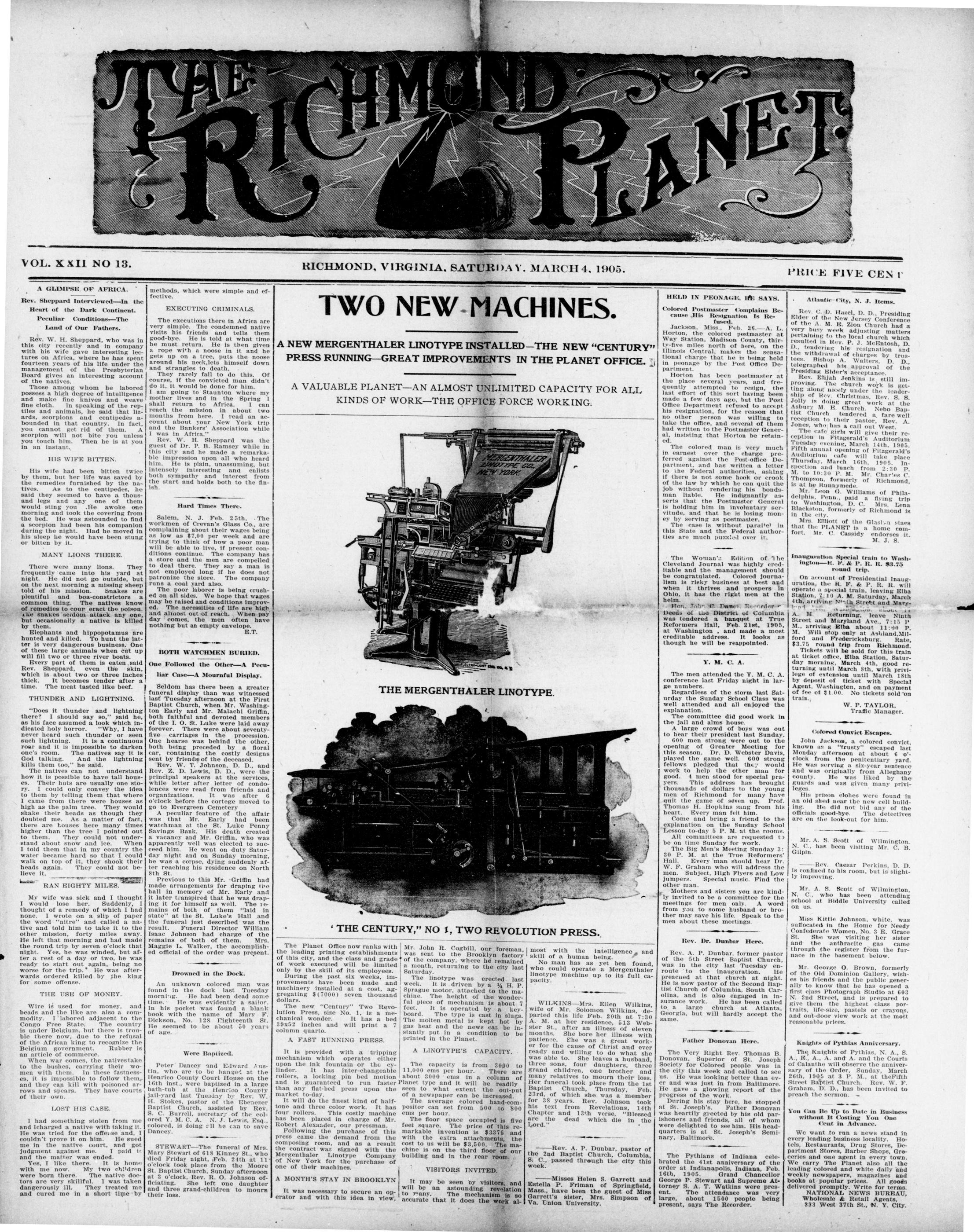
TWO NEW MACHINES.
A NEW MERGENTHALER LINOTYPE INSTALLED—THE NEW "CENTURY" PRESS RUNNING—GREAT IMPROVEMENTS IN THE PLANET OFFICE.
A VALUABLE PLANET—AN ALMOST UNLIMITED CAPACITY FOR ALL KINDS OF WORK—THE OFFICE FORCE WORKING.
MERGENTHALER
LIMOTYPE CO.
NEW YORK.
'THE CENTURY,' NO 1, TWO REVOLUTION PRESS.
The Planet Office now ranks with the leading printing establishments of this city, and the class and grade of work executed will be limited only by the skill of its employees. During the past six weeks, improvements have been made and machinery installed at a cost, aggregating $ (7000) seven thousand dollars. The new "Century" Two Revolution Press, size No. 1, is a mechanical wonder. It has a bed 39x52 inches and will print a 7 column quarto.
A FAST RUNNING PRESS
It is provided with a tripping mechanism which operates either upon the ink fountain or the cylinder. It has inter-changeable rollers, a locking pin bed motion and is guaranteed to run faster than any flat-bed press upon the market to-day. It will do the finest kind of half-tone and three color work. It has four rollers. This costly machine has been placed in charge of Mr. Robert Alexander, our pressman. Following the purchase of this press came the demand from the composing room, and as a result the contract was signed with the Mergenthaler Linotype Company of New York for the purchase of one of their machines.
A MONTH'S STAY IN BROOKLYN
It was necessary to secure an operator and with this idea in view
THE MERGENTHALER LINOTYPE
Mr. John R. Cogbill, our foreman, was sent to the Brooklyn factory of the company, where he remained a month, returning to the city last Saturday.
The linotype was erected last week. It is driven by a $ \frac{1}{4} $ H. P. Sprague motor, attached to the machine. The height of the wonderful piece of mechanism is about 7 feet. It is operated by a keyboard. The type is cast in slugs. The moisten metal is kept hot by gas heat and the news car be instantly put in a condition to be printed in the Planet.
A LINOTYPE'S CAPACITY
The capacity is from 3000 to 11,000 ems per hour. There are about 3000 ems in a column of Planet type and it will be readily seen to what extent the out-put of a newspaper can be increased. The average colored hand-compositor can set from 500 to 800 ems per hour. The floor space occupied is five feet square. The price of this remarkable invention is $3375 and with the extra attachments, the cost to us will be $3,500. The machine is on the third floor of our building and in the rear room.
VISITORS INVITED.
It may be seen by visitors, and will be an astounding revelation to many. The mechanism is so accurate that it does the work al-
most with the intelligence and skill of a human being. No man has as yet ben found, who could operate a Mergenthaler linotype machine up to its full capacity.
WILKINS—Mrs. Ellen Wilkins, wife of Mr. Solomon Wilkins, departed this life Feb. 20th at 7:30 A.M. at her residence, 513 Webster St., after an illness of eleven months. She bore her illness with patience. She was a great worker for the cause of Christ and ever ready and willing to do what she was able to. She leaves a husband, three sons, four daughters, three grandchildren, one brother and many relatives to mourn their loss. Her funeral took place from the 1st Baptist Church, Thursday, Feb. 23rd, of which she was a member for 38 years. Rev. Johnson took his text from Revelations, 14th Chapter and 13th verse, "Blessed are the dead which die in the Lord."
Rev. A. P. Dunbar, pastor of the 2nd Baptist Church, Columbia, S. C., passed through the city this week.
Misses Helen S. Garrett and Estela P. Friman of Springfield, Mass., have been the guest of Miss Garrett's sister, Mrs. Simpson of Va. Union University.
HELD IN PEONAGE, HE SAYS.
Colored Postmaster Complains Because His Resignation Is Refused.
Jackson, Miss., Feb. 26.—A. L. Horton, the colored postmaster at Way Station, Madison County, thirty-five miles north of here, on the Illinois Central, makes the sensational charge that he is being held in peonage by the Post Office Department.
Horton has been postmaster at the place several years, and frequently attempted to resign, the last effort of this sort having been made a few days ago, but the Post Office Department refused to accept his resignation, for the reason that no other person was willing to take the office, and several of them had written to the Postmaster General, insisting that Horton be retained.
The colored man is very much in earnest over the charge preferred against the Post-Office Department, and has written a letter to the Federal authorities asking if there is not some hook or crook of the law by which he can quit the job without rendering his bondsman liable. He indignantly asserts that the Postmaster General is holding him in involuntary servitude, and that he is losing money by serving as postmaster.
The case is without parallel! in this State and the Federal authorities are much puzzled over it.
---
The Woman's Edition of The Cleveland Journal was highly creditable and the management should be congratulated. Colored journalism is risky business at best and when it thrives and prosperis in Ohio, it has the right men at the helm.
Hon. John C. Daney, Recorder of beeds of the District of Columbia who ordered a banquet at True Reformers Hall, and 14 at Washington, and made a most creditable address. It looks as though he will be reappointed.
Y. M. C. A
The men attended the Y. M. C. A. conference last Friday night in large numbers. Regardless of the storm last Saturday the Sunday School Class was well attended and all enjoyed the explanation.
The committee did good work in the jail and alms house.
A large crowd of boys was out to hear their president last Sunday. 600 men strong were out to the opening of Greater Meeting for this season. Dr. D. Webster Davis, played the game well. 600 strong fellows pledged that they would work to help the other man for good. 4 men stood for special prayers. This address has brought thousands of dollars to the young men of Richmond for many have quit the game of seven up. Prof. Thomas H. Hopkins sang from his heart. Every man felt him.
Come and bring a friend to the explanation on the Sunday School Lesson to-day 5 P. M. at the rooms. All committees are requested to be on time Sunday for work.
The Big Men's Meeting Sunday 3: 30 P. M. at the True Reformers' Hall. Every man should hear Dr. W. F. Graham who will address the men. Subject, High Flyers and Low jumpers. Special music. Find the other man.
Mothers and sisters you are kindly invited to be a committee for the meetings for men only. A word from you to some husband or brother may save his life. Speak to the men about these meetings.
Rev. Dr. Dunbar Here.
Rev. A. P. Dunbar, former pastor of the 5th Street Baptist Church, was in the city last Tuesday enroute to the inauguration. He preached at that church at night. He is now pastor of the Second Baptist Church of Columbia, South Carolina, and is also engaged in insurance work. He has been called to a large church at Atlanta, Georgia, but will hardly accept the same.
Father Donovan Here:
The Very Right Rev. Thomas B. Donovan, Superior of St. Joseph Society for Colored people was in the city this week and called to see us. He was looking better than ever and was just in from Baltimore. He gave a glowing report of the progress of the work. During his stay here, he stopped at St. Joseph's. Father Donovan was heartily greeted by his old parishoners and friends, all of whom were delighted to see him. His headquarters is at St. Joseph's Seminary, Baltimore.
The Pythians of Indiana celebrated the 41st anniversary of the order at Indianapolis, Indiana, Feb. 16th, 1905. Grand Chancellor George P. Stewart and Supreme Attorney S. A. T. Watkins were present. The attendance was very large, about 1500 people being present, says The Recorder.
Atlantic City, N. J. Items.
Rev. C. D. Hazel, D. D. Presiding Elder of the New Jersey Conference of the A. M. E. Zion Church had a very busy week adjusting matters pertaining to the local church which resulted in Rev. P. J. McEntosh, D. D. Presiding Elder his resignation and the withdrawal of charges by trustees. Bishop A. W. Wainwright, D. D., telegraphed his approval of the Presiding Elder's acceptance
Rev. Elijah Jenkins is still improving. The church work is getting along nicely under the leadership of Rev. Christmas, Rev. S. S. Jolly is doing great work at the Asbury, M. M. E. Nebo Baptist Church tendered a well reception to their pastor, Rev. A. Jones, who has a call out West.
The cafe girls will give their reception in Fitzgerald's Auditorium Tuesday evening, March 14th, 1905. Fifth annual opening of Fitzgerald's Auditorium cafe will take place Thursday, March 16th, 1905. Inspection and lunch from 2:30 P. M. to 10:30 P. M. Mr. Charles C. Thompson, formerly of Richmond, is a he Runnymede. Mr. Leon G. Williams of Philadelphia, Penn., paid a flying trip to Washington, D. C. Mrs. Lena Blackston, formerly of Richmond is in the city. Mrs. Elliott of the Glaslyn stae that the PLANET is a home comfort. Mr. C. Cassidy endorses it. M. J. S.
Inauguration Special train to Washington—R. R. R. R. R. $8.75 round trip
On account of Presidential Inauguration, the R. F. & P. R. R. will operate a special train, leaving Elba Station, 7:10 A. M. Saturday, March 4th, arriving Ninth Street and Marylond Street about 1:40 A. M. Returning, leave Ninth Street and Maryland Ave., 7:15 P. M., arriving Elba about 11:00 P. M. Will stop only at Ashland,Milford and Fredericksburg, Rate, $3.75 round trip from Richmond. Tickets will be sold for this train at ticket office, Elba Station, Saturday morning, March 4th, good returning until March 5th, with privilege of extension until March 5th by deposit of ticket with Special Agent, Washington, and on payment of fee of $1.00. No tickets sold on train.
W. P. TAYLOR,
Traffic Manager.
Colored Convict Escapes
John Jackson, a colored convict, known as a "trusty" escaped last Monday afternoon at about 6 o'clock from the penitentiary yard. He was serving a six-year sentence and was originally from Alleghany county. He was liked by the guards and was given many privileges. His prison clothes were found in an old shed near the new cell building. He did not bid any of the officials good-bye. The detectives are on the look-out for him.
Mr. A. S. Scott of Wilmington, N. C., has been visiting Mr. C. B. Gilpin.
Rev. Caesar Perkins, D. D. is confined to his room, but is slightly improving.
Mr. A. S. Scott of Wilmington, N. C., who has been attending school at Biddle University called on us.
Miss Kittle Johnson, white, was suffocated in the Home for Needy Confederate Women, No. 3 E. Grace St. She was visiting her sister and the anthracite gas came through the register from the furnace in the basement below.
Mr. George O. Brown, formerly of the Old Dominion Gallery, wishes his friends and the public generally to know that he has opened a first class Photograph Studio at 603 N. 2nd Street, and is prepared to give them the highest class portraits, life-size, pastels or crayons, and out-door view work at the most reasonable prices.
---
Knights of Pythias Anniversary.
The Knights of Pythias, N. A., S. A., E., A., A. and A, and the Courts of Calanthe will observe the anniversary of the Order, Sunday, March 26th, 1905 at 3 P. M., at the Fifth Street Baptist Church. Rev. W. F. Graham, D. D., has been invited to preach the sermon.
```markdown
```
You Can Be Up to Date in Business without Costing you One Dollar You Can Pay
We want to run a news stand in every leading business locality. Hotels, Restaurants, Drug Stores, Department Stores, Barber Shops, Groceries and one agent in every town. We carry The Planet also all the leading colored and white daily and weekly newspapers, magazines and books at popular prices. All goods delivered promptly. Write for terms.
NONAL NEWS DUREAU,
Whole House
333. West 27th St. N.Y. City
THE PLANET
MARCH 4,1905
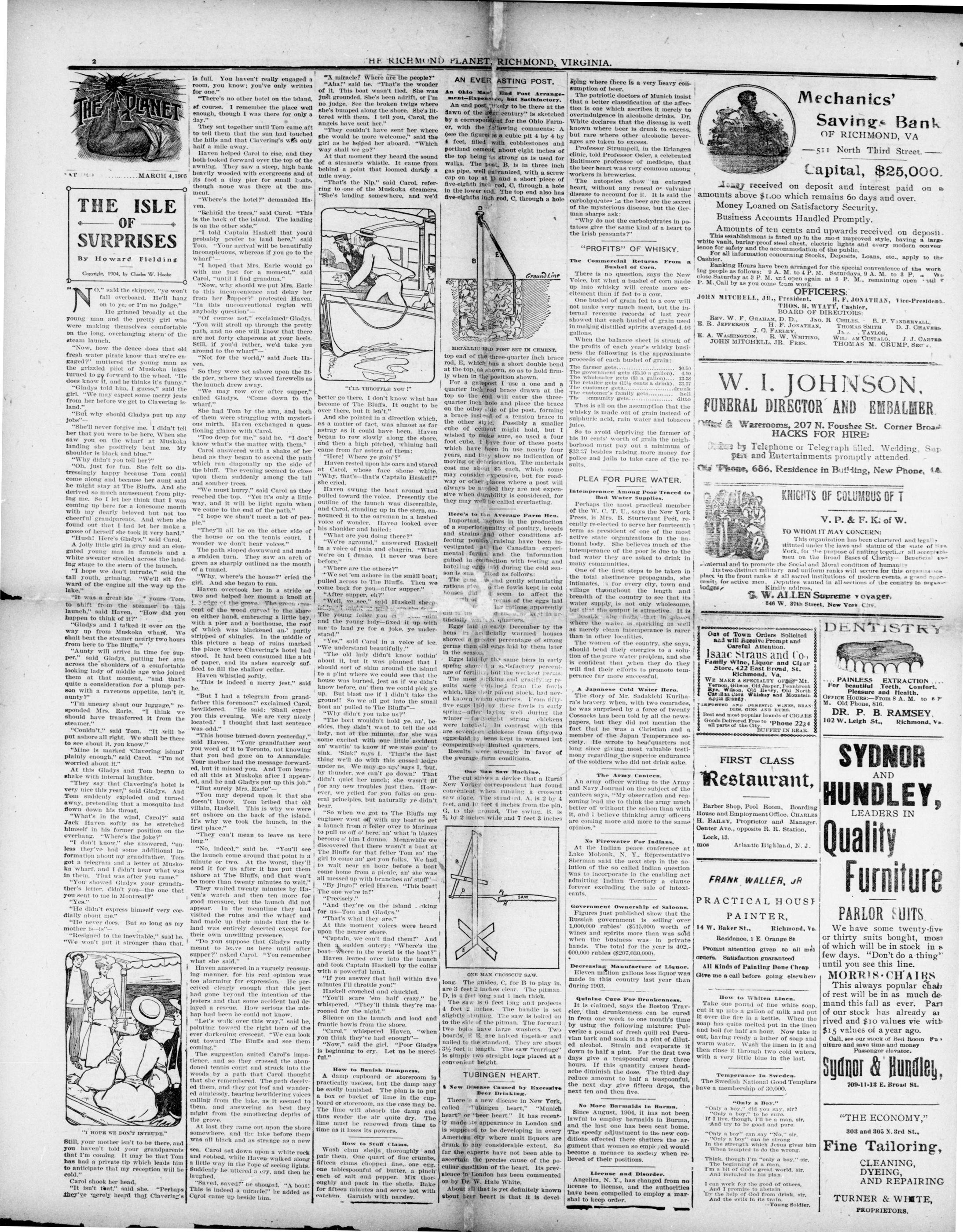
THE ISLE OF SURPRISES
By Howard Fielding
Copyright, 1904, by Charles W. Hooke
"NO," said the skipper, "ye won't fall overboard. He'll hang on to ye, or I'm no judge."
He grinned broadly at the young man and the pretty girl who were making themselves comfortable on the long, overhanging stern of the steam launch.
"Now, how the dence does that old fresh water pirate know that we're engaged?" muttered the young man as the grizzled pilot of Muskoka lakes turned to go forward to the wheel. "He does know it, and he thinks it's funny."
"Gladys told him, I guess," said the girl. "We may expect some merry jests from her before we get to Clavering island."
"But why should Gladys put up any jobs?"
"She'll never forgive me. I didn't tell her that you were to be here. When she saw you on the wharf at Muskoka landing she positively beat me. My shoulder is black and blue."
"Why didn't you tell her?"
"Oh, just for fun. She felt so distressingly happy because Tom could come along and because her aunt said he might stay at The Bluffs. And she derived so much amusement from pitying me. So I let her think that I was coming up here for a lonesome month with my dearly beloved but not too cheerful grandparents. And when she found out that I had let her make a goose of herself she took it very hard."
"Hush! Here's Gladys," said Carol.
A jolly little girl in gray and an elongated young man in flannels and a white sweater strolled across the landing stage to the stern of the launch.
"I hope we don't intrude," said the tall youth, grinning. "We'll sit forward of the engine all the way up the lake."
"It was a great idea," yours Tom, to shift from the steamer to this launch," said Haven. "How did you happen to think of it?"
"Gladys and I talked it over on the way up from Muskoka wharf. We shall beat the steamer nearly two hours from here to The Bluffs."
"Aunty will arrive in time for supper," said Gladys, putting her arm across the shoulders of a comfortable looking lady of middle age who joined them at that moment, "and that's quite a consideration for a plump person with a ravenous appetite, isn't it, aunty?"
"I'm uneasy about our luggage," responded Mrs. Earle. "I think we should have transferred it from the steamer."
"Couldn't," said Tom. "It will be put ashore all right. We shall be there to see about it, you know."
"Mine is marked 'Clavering island' plainly enough," said Carol. "I'm not worried about it."
At this Gladys and Tom began to shake with internal laughter.
"They say that Clavering's hotel is very nice this year," said Gladys. And Tom suddenly exploded and turned away, pretending that a mosquito had flown down his throat.
"What's in the wind, Carol?" said Jack Haven softly as he stretched himself in his former position on the overhang. "Where's the joke?"
"I don't know," she answered, "unless they've had some additional information about my grandfather. Tom got a telegram and a letter at Muskoka wharf, and I didn't hear what was in them. That was after you came."
"You showed Gladys your grandfather's letter, didn't you—the one that you sent to me in Montreal?"
"Yes."
"He didn't express himself very cordially about me."
"He never does. But so long as my mother is—is"
"Resigned to the inevitable," said he.
"We won't put it stronger than that."
A
"I HOPE WE DON'T INTRUDE."
Still, your mother isn't to be there, and you haven't told your grandparents that I'm coming. It may be that Tom has had a private tip which leads him to anticipate that my reception will be cold."
Carol shook her head.
"It isn't that," said she. "Perhaps they've merely heard that Clavering's
is full. You haven't really engaged a room, you know; you've only written for one."
"There's no other hotel on the island, af course. I remember the place well enough, though I was there for only a day."
They sat together until Tom came af to tell them that the sun had touched the hills and that Clavering's was only half a mile away.
Haven helped Carol to rise, and they both looked forward over the top of the awning. They saw a steep, high bank heavily wooded with evergreens and at its foot a tiny pier for small boats, though none was there at the moment.
"Where's the hotel?" demanded Haven.
"Rehind the trees," said Carol. "This is the back of the island. The landing is on the other side."
"I told Captain Haskell that you'd probably prefer to land here," said Tom. "Your arrival will be beautifully inconspicuous, whereas if you go to the wharf"—
"I hoped that Mrs. Earle would go with me just for a moment," said Carol, "until I find grandma."
"Now, why should we put Mrs. Earle to this inconvenience and delay her from her supper?" protested Haven. "In this unconventional region will anybody question"—
"Of course not," exclaimed Gladys. "You will stroll up through the pretty path, and no one will know that there are not forty chaperons at your heels. Still, if you'd rather, we'd take you around to the wharf"—
"Not for the world," said Jack Haven.
So they were set ashore upon the little pier, where they waved farewells as the launch drew away.
"We may row over after supper," called Gladys. "Come down to the wharf."
She had Tom by the arm, and both of them were struggling with mysterious mirth. Haven exchanged a questioning glance with Carol.
"Too deep for me," said he. "I don't know what's the matter with them."
Carol answered with a shake of her head as they began to ascend the path which ran diagonally up the side of the bluff. The evening seemed to close upon them suddenly among the tall and somber trees.
"We must hurry," said Carol as they reached the top. "Yet it's only a little way, and it will be light again when we come to the end of the path."
"I hope we shan't meet a lot of people."
"They'll all be on the other side of the house or on the tennis court. I wonder we don't hear voices."
The path sloped downward and made a sudden turn. They saw an arch of green as sharply outlined as the mouth of a tunnel.
"Why, where's the house?" cried the girl. And she began to run.
Haven overtook her in a stride or two and helped her mount a knoll at the edge of the grove. The green crescent of the wood curved to the shore on either hand, embracing a little bay, with a pier and a boathouse, the root of which was blackened an' partly stripped of shingles. In the middle of this picture a heap of ruins marked the place where Clavering's hotel had stood. It had been consumed like a bit of paper, and its ashes scarcely sufficed to fill the shallow cellar.
Haven whistled softly.
"This is indeed a merry jest," said he.
"But I had a telegram from grandfather this foronowen" exclaimed Carol, bewildered. "He said: 'Shall expect you this evening. We are very nicely located.' I thought that last sentence was odd."
"This house burned down yesterday," said Haven. "Your grandfather sent you word of it to Toronto, not knowing that you had gone on to Annandale. Your mother had the message forwarded, but it missed you. And Tom learned all this at Muskoka after I appeared, and he and Gladys put up this job."
"But surely Mrs. Earle"—
"You may depend upon it that she doesn't know. Tom bribed that old villain, Haskell. This is why we were set ashore on the back of the island. It's why we took the launch, in the first place."
"They can't mean to leave us here long."
"No, indeed," said he. "You'll see the launch come around that point in a minute or two. At the worst, they'll send it for us after it has put them ashore at The Bluffs, and that won't be more than twenty minutes to wait." They waited twenty minutes by Haven's watch and then ten more for good measure, but the launch did not appear. In the meantime they had visited the ruins and the wharf and had made up their minds that the island was entirely deserted except for their own unwilling presence.
"Do you suppose that Gladys really meant to leave us here until after supper?" asked Carol. "You remember what she said."
Haven answered in a vaguely reassuring manner, for his real opinion was too alarming for expression. He perceived clearly enough that this jist had gone beyond the intention of the jesters and that some accident had delayed a rescue. How serious the mishap had been he could not know.
"Let's walk over this way," said he, pointing toward the right horn of the ever darkening crescent. "We can look out toward The Bluffs and see them coming."
The suggestion suited Carol's impatience, and so they crossed the abandoned tennis court and struck into the woods by a path that Carol thought that she remembered. The path deceived them, and they got lost and wandered amlessly, hearing bewildering voices calling from the lake, as it seemed to them, and answering as best they might from the smothering depths of the grove.
At last they came out upon the shore somewhere, and the lake before them was all black and as strange as a new sea. Carol sat down upon a white rock and sobbed, while Haven walked along a little way in theope of seeing lights. Suddenly he uttered a cry, and then he laughed.
"Saved, saved," he shouted. "A boat! This is indeed a miracle!" he added as Carol came up beside him.
"A miracle? Where are the people?" "Aha!" said he. "That's the wonder of it. This boat wasn't tied. She was just grounded. She's been adrift, or I'm no judge. See the broken twigs where she's bumped along the shore. She's littered with them. I tell you, Carol, the angels have sent her."
"They couldn't have sent her where she would be more welcome," said the girl as he helped her aboard. "Which way shall we go?"
At that moment they heard the sound of a steamer's whistle. It came from behind a point that loomed darkly a mile away.
"That's the Nip," said Carol, referring to one of the Muskoka steamers. "She's landing somewhere, and we'd
AN EVER ASTING POST.
An Ohio Man' End Post Arrangement—Expensive, but Satisfactory.
An end post, "likely to be there at the fawn of the next century" is sketched by a correspondent for the Ohio Farmer, with the following comments: A (see the figure) is a cubic pit 4 by 4 feet, filled with cobblestones and portland cement, about eight inches of the top being as strong as is used for walks. The post, B, is in three inch gas pipe, well galvanized, with a screw cap on top at D and a short piece of five-eighth inch rod, C, through a hole in the lower end. The top end also has five-eighth inch screw.
uping where a sumption of it. The patriot that a better tion is one who overindulgence White declare known where but rare who ages are take Professor S clinic, told Prof Baltimore pre the beer heart workers in br. The autopsy heart, without acco
J.
"ILL THROTTLE YOU!" better go there. I don't know what has become of The Bluffs. It ought to be over there, but it isn't." And she pointed in a direction which, as a matter of fact, was almost as far astray as it could have been. Haven began to row slowly along the shore, and then a high pitched, whining hall came from far astern of them: "Here! Where ye go!?" Haven rested upon his oars and stared at Carol, whose face shone white. "Why, that's—that's Captain Haskell!" she cried. Haven swung the boat around and pulled toward the voice. Presently the outline of the launch was discernible, and Carol, standing up in the stern, announced it to the oarsman in a hushed voice of wonder. Haven looked over his shoulder and hailed:
"What are you doing there?"
"We're a ground," answered Haskell in a voice of pain and chagrin. "What we're on I dunno. It never was here before."
"Where are the others?"
"We set 'em ashore in the small boat; pulled across to The Bluffs. Then we come back for you—after supper."
"After supper, eh?"
"Well, ye see," said Haskell sheepishly. "I set up the boat for the young teller you or you—am and the young lady—fixed it up with me to land ye for a joke, ye understand."
"Yes," said Carol in a voice of ice. "We understand beautifully."
"The old lady didn't know nothing about it, but it was planned that I should sort of skim around the island to a 'pint' where we could see that the house was burned, jest as if we didn't know before, an' then we could pick ye up. But blast me if I didn't take the ground! So we all got into the small boat an' pulled to the Bluffs"—"Why didn't you take us?"
"The boat wouldn't hold ye, an', besides, they didn't want to tell the old lady, not at the minute, for she was some excited with our little accident an' wantin' to know if we was goin' to sink. 'Sink' says I. 'That's the last thing well' do with this cussed ledge under us. We may go up,' says I, 'but, by thunder, we can't go down'. That didn't quiet her much; she wasn't fit for any new troubles just then. However, we yelled for you folks on general principles, but naturally ye didn't hear.
"So when we got to The Bluffs my engineer went off with my boat to get a launch from a feller over to Marinus to pull us off o' her, an' what n' blazes become o' him I dumno. Meanwhile we discovered that there wasn't a boat at The Bluffs for that feller Tom an' the girl to come an' get you folks. We had, to wait near an hour before a boat come home from a picnic, an' she was all messed up with branches an' stuff"—
"And they're on the island, looking for us—Tom and Gladys."
"That's what they are."
At this moment voices were heard upon the nearer shore.
"Captain, we can't find them!" And then a sudden outcry: "Where's the boat—where in the world is the boat?"
Haven leamed over into the launch and took Captain Haskell by the collar with a powerful hand.
"If you answer that hall within five minutes I'll throttle you!"
Haskell crouched and chuckled.
"You'll scare 'em half crazy," he whispered. "They'll think they're marooned for the night."
Silence on the launch and loud and frantic howls from the shore.
"Carol," whispered Haven, "when you think they've had enough"—
"Now," said the girl. "Poor Gladys is beginning to cry. Let us be merci-ful."
A damp cupboard or storeroom is practically useless, but the damp may be easily banished. The plan is to put a box or bucket of lime in the cupboard or storeroom, as the case may be. The lime will absorb the damp and thus render the air quite dry. The lime must be renewed from time to time as it loses its powers.
How to Stuff Clams.
Wash clam shells, thoroughly and pair them. One quart of fine crumbs, fifteen clams chopped fine, one egg, one tablespoonful of butter, a pinch ench of salt and pepper. Mix thoroughly and pack in the shells. Bake for fifteen minutes and serve hot with catchum. Garnish with parsley.
AN EVER ASTING POST.
An Ohio Man' End Post Arrangement—Expense, but Satisfactory.
An end post "likely to be there at the dawn of the next century" is sketched by a correspondent for the Ohio Farmer, with the following comments: A (see the figure) is a cubile pit 4 by 4 by 4 feet, filled with cobblestones and portland cement, about eight inches of the top being as strong as is used for walks. The post, B, is in three inch gas pipe, well galvanized, with a screw cap on top at D and a short piece of five-eighth inch rod, C, through a hole in the lower end. The top end also has five-eighth inch rod, C, through a hole
METALLIC END POST SET IN CEMENT.
top end of the three-quarter inch brace
rod, E, which has a short double bend
at the top, as shown, so as to hold firm-
ly when in the position shown.
For a gatepost I use a one and a quarter inch rod brace drawn at the top so the end will enter the three-quarter inch hole and place the brace on the other side of the post, forming a brace instead of a tension brace in the other style. Possibly a smaller cube of cement might hold, but I wished to make sure, so used a four foot cube. I have four of these posts which have been in use nearly four years, and they show no indication of moving or deterioration. The materials cost me about $5 each, which some may consider expensive, but for roadway or other places where a post will always be needed they are not expensive when durability is considered, for they may well be called everlasting.
Here's to the Average Farm Hen.
Important factors in the production of a superior quality of poultry, breeds and strains and other conditions affecting poultry raising have been investigated at the Canadian experimental farms and the information gained in connection with testing and hatching eggs laid during the cold season is sun-treated as follows:
The gene is and gently stimulating rations give to the fowls kept in cold houses did not seem to affect the birth of germs of the eggs laid in larrations apparently due to the lack of the heat in artificially warmed quarters.
Eggs laid in early December by the hens in artificially warmed houses showed a greater percentage of strong germs than did eggs laid by them later in the season.
Eggs laid by the same heens in early spring showed a satisfactory percentage of fertility, but the weakest terms. The most striking and gratifying results were obtained from the fowls which, like their patient stock, had never known warm quarters. From fifty-five eggs laid by these fowls in early spring—after laying well during the winter—forty-eight strong chickens were hatched. In contrast with this are seventeen chickens from fifty-two eggs laid by heens kept in warmed but comparatively limited quarters. Results were strongly in favor of the average farm conditions.
One Man Saw Machine
The cut shows a device that a Rural New Yorker correspondent has found convenient when running a crosscut saw alone. The stand rd. A. is 2 by 4 feet, and 16 feet 4 inches from the pin, G, to the ground. The swing. B. is ½ by 2 inches wide and 7 feet 3 inches
ONE MAN CROSSCUT SAW.
long. The guides, C, for B to play in are 3 feet 2 inches clear. The pitman D, is 4 feet long and 1 inch thick.
The saw is 6 feet long and projects 4 feet 2 inches. The handle is set slightly stunting. The saw is bolted on to the side of the pitman. The forward two bolts have large washers. Two boards, E, E are halved together and nailed to the standard. They are about 3½ feet in length. The saw "carriage" is simply two straight logs placed at a convenient height.
TUBINGEN HEART.
6 New Disease Caused by Excessive Beer Drinking.
There is a new disease in New York, called "Tubingen heart," "Munich heart" or "beer heart." It has recently made its appearance in London and is supposed to be developing in every American city where malt liquors are drunk to any considerable extent. So far the experts have not been able to ascertain the precise cause of the peculiar condition of the heart. Its prevalence in London has been commented on by Dr. W. Hale White.
About all that is yet definitely known about beer heart is that it is devel-
sping where there is a very heavy consumption of beer.
The patriotic doctors of Munich insist that a better classification of the affection is one which ascribes it merely to overindulgence in alcoholic drinks. Dr. White declares that the disease is well known where beer is drunk to excess, but rare where other alcoholic beverages are taken to excess.
Professor Strumpell, in the Erlangen clinic, told Professor Osler, a celebrated Baltimore professor of medicine, that the beer heart was very common among workers in breweries.
The autopsies show an enlarged heart, without any renal or valvular disease to account for it. It is said the carbohydrates in the beer are the secret of the mysterious disease, but the German sharps ask:
"Why do not the carbohydrates in potatoes give the same kind of a heart to the Irish peasants?"
"PROFITS" OF WHISKY
The Commercial Returns From a Bushel of Corn.
There is no question, says the New Voice, but what a bushel of corn made up into whisky will create more excitement than if fed to a cow.
One bushel of grain fed to a cow will not make very much meat, but the internal revenue records of last year showed that each bushel of grain used in making distilled spirits averaged 4.46 gallons.
When the balance sheet is struck of the profits of each year's whisky business the following is the approximate proceeds of each bushel of grain:
The farmer gets ..... $0.50
The government gets ($1 a gallon) ..... 4.90
The wholesaler gets ($3 a gallon) ..... 12.08
The retailer gets (12½ cents a drink) ..... 33.37
The customer gets ..... drunk
The customer's family gets ..... hell
The community gets ..... ditto
This is all on the assumption that the whisky is made out of grain instead of sulphuric acid, rain water and tobacco juice.
So to avoid depriving the farmer of his 10 cents' worth of grain the neighborhood must pay out a minimum of $33.37 besides raising more money for police and jails to take care of the results.
PLEA FOR PURE WATER
Intemperance Among Poor Traced to Bad Water Supplies.
Perhaps the most practical member of the W. C. T. U., says the New York Press, is Mrs. B. Sturtevant Peet, recently re-elected to serve her fourteenth term as president of one of the most active state organizations in the national body. She believes much of the intemperance of the poor is due to the bad water they are asked to drink in many communities.
One of the first steps to be taken in the total abstinence propaganda, she intimates, 4 for every city, town and village throughout the length and breadth of the country to see that its water supply, is not only wholesome, but that the output is attractive. It is local, she finds, that in places where the water is sparkling as well as merely clean intemperance is rarer than in other localities.
The women of the country, she says, should bend their energies to a solution of the pure water problem, and she is confident that when they do they will find their efforts to promote temperance far more successful.
A Japanese Cold Water Hero.
The story of Mr. Sadakichi Kurihara's bravery when, with two comrades, he was surprised by a force of twenty Cossacks has been told by all the newspapers, but they did not mention the fact that he was a Christian and a member of the Japan Temperance society. He wrote to headquarters not long since giving most valuable testimony regarding the superior endurance of the soldiers who did not drink sake.
The Army Canteen
An army officer writing to the Army and Navy Journal on the subject of the canteen says, "My observation and reasoning lead me to think the army much better off without the saloon than with it, and I believe thinking army officers are coming more and more to the same opinion."
No Firewater For Indians.
At the Indian peace conference at Lake Mobonk, N. Y., Representative Sherman said the next step in the solution of the so called Indian question was to incorporate in the enabling act admitting Indian Territory a clause forever excluding the sale of intoxicants.
Government Ownership of Saloons. Figures just published show that the Russian government is selling over 1,000,000 rubles' ($151,000) worth of wines and spirits more than was sold when the business was in private hands. The total for the year is 402,600,000 rubles ($207,030,000).
Decreasing Manufacture of Liquor. Eleven million gallons less liquor was made in this country last year than during 1903.
Quinine Cure For Drunkenness.
It is claimed, says the Boston Traveler, that drunkenness can be cured in from one week to one month's time by using the following mixture: Pulverize a pound of fresh quill red Peruvian bark and soak it in a pint of diluted alcohol. Strain and evaporate it down to half a pint. For the first two days give a teaspoonful every three hours. If this quantity causes headache diminish the dose. The third day reduce amount to half a teaspoonful, the next day give fifteen drops, the next ten and then five.
No More Barmalms In Burma.
Since August, 1904, it has not been lawful to employ barmalms in Burma, and the last one has been sent home. The speedy adjustment to the new conditions effected there shatters the argument that women so employed would become a menace to society when relieved of their positions.
Angelica, N. Y., has changed from no license to license, and the authorities have been compelled to employ a marshal to keep order.
[Pictorial portrait of a man in a military uniform, surrounded by trees and a building].
Money received on deposit amounts above $1.00 which re-
Money Loaned on Satisfaction
Business Accounts Handled
Amounts of ten cents and
This establishment is fitted up in the white vault, burlar-proof steel chest, elec-
lence for safety and the accommodation.
For all information concerning Stock Cashier.
Banking Hours have been arranged in people as follows: 9 A. M. to 4 P. P. close Saturday at 3 P. M. and open again P. M. Call by as you come from work.
OFFICE
JOHN MITCHELL, JR., President,
THOS. H. W.
BOARD OF
REV. W. F. GRAHAM, D. D., JN.
E. R. JEFFERSON, H. F. JONATHAN,
J. G. FARLEY.
E. A. WASHINGTON, R. W. WHITING.
JOHN MITCHELL, JR. PRES.
W. I. JO
FUNERAL DIRECTOR
Office & Warrooms, 207 N.
HACKS H
Calls by Telephone or Te
pear and Entertainment
Oil Phone, 686, Residence
Money received on deposit and interest paid on amounts above $1.00 which remains 60 days and over.
Money Loaned on Satisfactory Security.
Business Accounts Handled Promptly.
Amounts of ten cents and upwards received on deposit.
This establishment is fitted up in the most improved style, having a large white vault, burlar-proof steel chest, electric lights and every modern convenience for safety and the accommodation of the public.
For all information concerning Stocks, Deposits, Loans, etc., apply to the Cashier.
Banking Hours have been arranged for the special convenience of the work
ing people as follows: 9 A.M. to 4 P.M. Saturdays, 9 A.M. to 8 P.M. We
close Saturday at 3 P.M. and open again at 5 P.M., remaining open until
P.M. Call by as you come from work.
OFFICERS:
JOHN MITCHELL, JR., President.
H. F. JONATHAN, Vice-President.
THOS. H. WYATT, Cashier.
BOARD OF DIRECTORS:
W. I. JOHNSON FUNERAL DIRECTOR AND EMBALMER
Office & Warerooms, 207 N. Foushee St. Corner Broad HACKS FOR HIRE:
Define by Telephone or Telegraph filled. Wedding, Superior and Entertainments promptly attended.
Od' Phone, 686, Residence in Building, New Phone, 14
KNIGHTS OF COLUMBUS OF T
TO WHOM IT MAY CONCERN:
This organization has been chartered and legally
attributed under the laws and statute of the state of
Wyork, for the purpose of uniting together all acceptable
men on the broad Bases of Charity - Beneficial
catering and to promote the Social and Moral condition of humanity.
Its two distinct military and uniform ranks will secure for this organization
place in the front ranks of all sacred institutions of modern events, a grand oppo-
unity for active men. Deputies wanted in all sections of the country to organ-
lize.
S. W. ALLEN Supreme voyager,
846 W. 87th Street, New York City.
Out of Town Orders Solicited
and will Reserve Prompt and
Careful Attention.
Isaac Straus and Co.
Family Wine, Liquor and Cigar
Store, 422 East Broad, St.
Vernon, VA.
WE MAKE A SPECIALITY Mr. Mt.
Vernon, Gibson Old Jasper, Pembrook
Rye, Wilson, Old Henry, Old North
Cumberland, Walsky and Mountain
Appalachian.
REPORTED AND DOMESTIC WINES, BRAN-
DIES, GINS AND RUMS.
Best and most popular brands of CIGARS
Goods Delivered Free to 'Phone 2234
all parts of the CIGUFF IN REAR
BUFFET IN REAR
FIRST CLASS Restaurant.
Barber Shop, Pool Room, Boarding House and Employment Office. CHARLES H. BAILEY, Proprietor and Manager. Center Ave., opposite R. R. Station. Lock, 13. mos Atlantic Highland, N. J.
FRANK WALLER, JR
PRACTICAL HOUSE
14 W. Baker St., Richmond, Va.
Residence, 1 E. Orange St
Prompt attention given to all mail orders. Satisfaction guaranteed
All Kinds of Painting Done Cheap
Give me a call before going elsewhere
How to Written Linen.
Take one pound of fine white soap, cut it up into a gallon of milk and put it over the fire in a kettle. When the soap has quite melted put in the linen and boil for half an hour. Now take it out, having ready a lather of soap and warm water. Wash the linen in it and then rinse it through two cold waters, with a very little blue in the last.
Temperance In Sweden.
The Swedish National Good Templars have a membership of 30,000.
"Only a boy."
"Only a boy," did you say, sir?
"Only a boy," to be sure.
If I live, though, I'll be a man, sir,
And try to be good and pure.
"Only a boy," can say "No," sir.
"Only a boy," can be strong.
In the strength which Jesus gives him
When tempted to do the wrong.
Think, though I'm "only a boy," sir,
The beginning of a man.
I'm a bit of God's great world, sir,
And included in his plan.
I can work for the good of others.
And I promise to shatter.
By the help of God from drink, sir,
And the evils in its train.
--Young Soldier.
```markdown
```
Mechanics'
Saving Bank
OF RICHMOND, VA
—511 North Third Street.—
Capital, $25,000
WIL. AM CUSTALO, J. J. CARTER
THOMAS M. CRUMP, SEC. C
PAINLESS5 EXTRACTION .... For beautiful Teeth, Comfort, Pleasure and Health,
OFFICE HOURS:—From 8 A. M. to 6 P.
M. Old Phone, 816.
DR. P. B. RAMSEY.
102 W. Leigh St., Richmond, Va.
SYDNOR AND HUNDLEY, LEADERS IN Quality Furniture
PARLOR SUITS
We have some twenty-five or thirty suits bought, most of which will be in stock in a few days. "Don't do a thing" until you see this line.
MORRIS·CHAIRS
This always popular chair of rest will be in as much demand this fall as ever. Part of our stock has already arrived and $10 values vie with $15 values of a year ago.
Call, see our stock of Bed Room Furniture and save time and money Passenger elevator.
Sydnor & Hundley,
709-11-13 E. Broad St.
"THE ECONOMY," 303 and 305 N.3rd St.,
CLEANING,
DYEING,
AND REPAIRING
TURNER & WHITE,
PROPRIETORS.
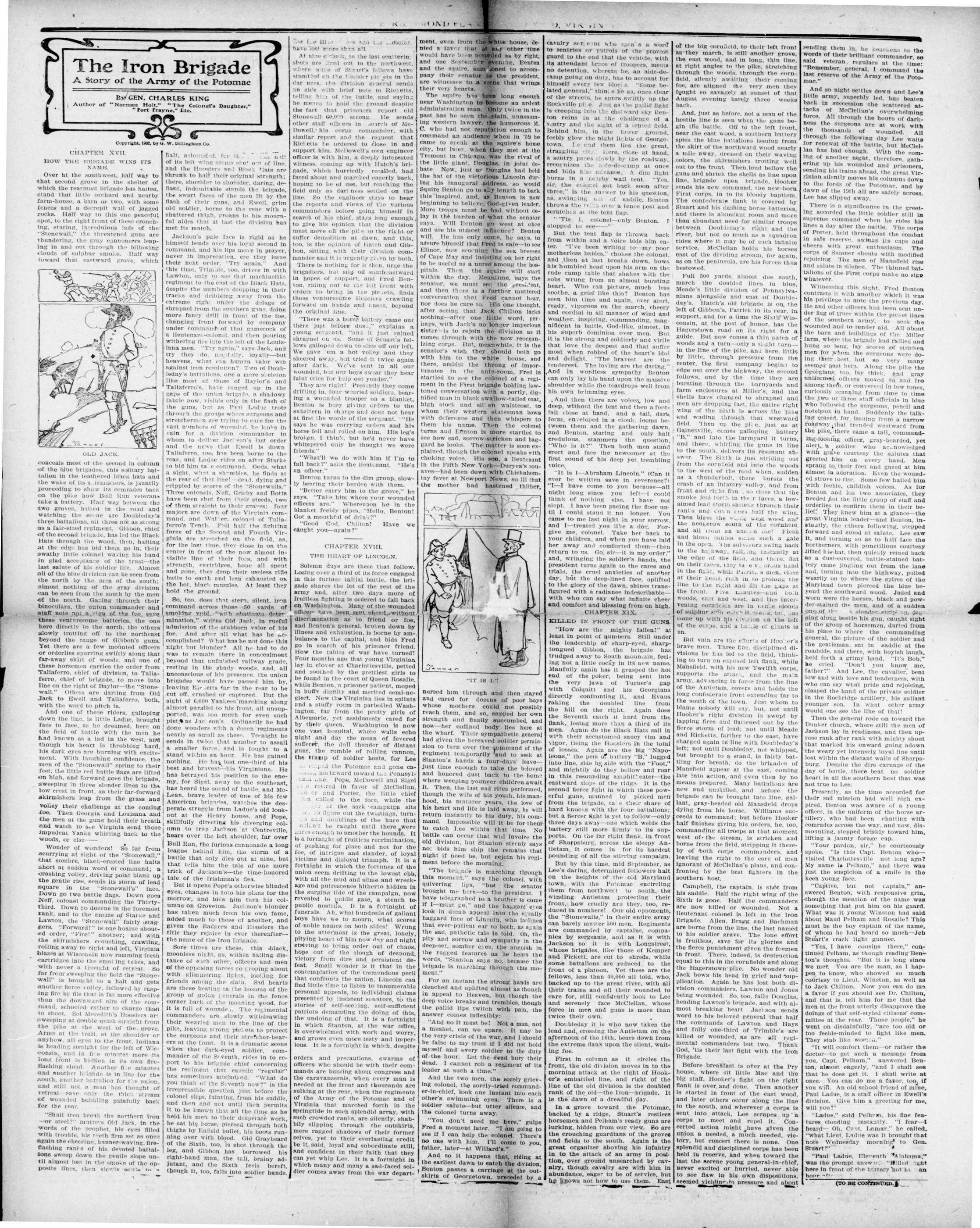
The Iron Brigade
A Story of the Army of the Potomac
By GEN. CHARLES KING
Author of "Norman Holt," "The Colonel's Daughter," "Fort Frayne," Etc.
Copyright, 1902, by G. W. Dillingham Co.
HOW THE BRIGADE WINS ITS NAME.
Over at the southwest, half way to that second grove in the shelter of which the rearmost brigade has hailed, stand that little orchard and nearby farm-house, a barn or two, with some fences and a decrepit wall of jagged rocks. Half way to this one peaceful spot, to the right front of these crouching, staring, incredulous lads of the "Stonewall," the threatened guns are thundering, the gray cannones leaping in and out through the billowing clouds of sulphur smoke. Half way toward that eastward grove, which
Sanner
conceals most of the second in column of the blue brigades, this solitary battalion in the leathered black hats and the wake of its s. armisers, is jauntity proceeding to show its comrades back on the pike how Bull Run veteran take a battery. Half way between the two groves, halted in the road and watching the scene are Doubleday's three battalions, all three not as strong as a fair-sized regiment. Gibbon, chief of the second brigade, has led the Black Hats through the wood, then, halting at the edge has bid him go in, their swathy little colonel waving his hand in glad acceptance of the trust—the last salute of his soldier life. Almost all of the blue division can be seen from the north by the men of the south; almost nothing of the gray division can be seen from the south by the men of the north. Gazing through their binoculars, the union commander and staff note not a sign of the toe, gave these ventures batteries, the one here directly to the north, the others slowly trotting off to the northeast beyond the range of Gibbon's guns. Yet there are a few mounted officers or orderles spurring swiftly along that far-away skirt of woods, and one of these horsemen carries the order from Tallafero, chief of division, to Tallafero, chief of brigade, to move into line on the right of Baylor—the "Stonewall." Others are darting from Old Jack to Ewell and Tallafero, both, with the word to pitch in.
And one of these riders, galloping down the line, is little Ladue, brought face to face, as he dreamed, here on the field of battle with the men he had known as a lad in the west, and though his heart is throbbing hard, his dark eyes are burning with excitement. With laughing confidence, the men of the "Stonewall" spring to their feet, the little red battle flags are lifted on high, and forward goes the brigade, sweeping in three slender lines to the low crest in front, as their far-forward skirmishers leap from the grass and volley their challenge at the coming foe. Then Georgia and Louisiana and the men at the guns hold their breath and watch to see Virginia send those impudent Yanks whirring back to the woods, or else—
Wonder of wonders! So far from scurrying at sight of the "Stonewall," that sombre, black-crested line halts short at sudden word of command; a crashing volley, driving point blank up the gentle rise, sends its storm of lead square in the "Stonewall's" face. Down go two battle flags. Down goes Neff, colonel commanding the Thirty-third. Down go dozens in the foremost rank, and to the amaze of Starke and Lawton, the "Stonewall" fairly staggers. "Forward!" is one hoarse shouted order, "Fire!" another; and with the skirmishers crouching, crawling, rolling away to right and left, Virginia blazes at Wisconsin now ramming fresh cartridges into the smoking tubes, and with never a thought of retreat. So far from sweeping the field the "Stonewall" is brought to a halt and gets another fierce volley, followed by rasping fire by file that is far more effective than the downward aim of the command, schooled rather to charge than to shoot. Sol Meredith's Hoosiers are sweeping at double quick straight from the pike at the west of the grove. Arms at the trail, at the shoulder or anyhow, all eyes to the front, Indiana is heading straight for the left of Wisconsin, and in five minutes more its long front is hidden in its own fire-flashing cloud. Another five minutes and another brigade is in line for the south, another battalion for the union, and still not a man has thought of retreat—save only the thick stream of wounded habbling painfully back for the rear.
"Shall iron break the northern iron — or steel?" mutters Old Jack, in the words of the prophet, his eyes filled with trouble, his tooth firm set as once again the cheering, banner-waving, fire-flashing ranks of his devoted battalions sweep down the gentle slope until almost lost in the smoke of the opposite lines, then slowly settle to a
OLD JACK
falt, astounded, for the half of its left wing seems shot out of line, and the Hoosiers and Black Flats are shrunk to half their original strength; there, shoulder to shoulder, daring, defiant, indomitable stands the brigade, the swart faces of the men lit by the flash of their guns, and Ewell, grim old soldier, borne to the rear with a shattered thigh, groans to his mournful aldes that at last the division has met its match.
Jackson's pale face is rigid as he himself bends over his loyal second command, and his lips move in prayer, never in imprecation, ere they issue their next order, "Try again." And this time, Trimble, too, drives in with Lawton, only to see that machinelike regiment to the east of the Black Hats, despite the numbers dropping in their tracks and dribbling away from the extreme right under the deluge of shrapnel from the southern guns, doing more fancy drill in front of the foe, changing front forward by company under command of that gamecock of a heutenant-colonel, and then pouring withering fire into the left of the Louisiana men. "Try again," says Jack, and try they do, magically, loyalty—but heavens, what can human valor win against iron resolution? Two of Doubleday's battalions, one a mere skeleton like most of those of Baylor's and Tallafero's, have ranged up in the gaps of the union brigade, a shadowy fabric now, visible only in the flash of the guns, but as Paul Ladue trots through the groups where surgeons and stretchermen are trying to care for the vast numbers of wounded, he looks in vain for a division commander to whom to deliver Jacobson's last order and the news that Ewell is down Tallafero, too, has been borne to the rear, and Ladue rides on after Starke to bid him ta e command. Gods, what a sight, what a shrubbles, he finds at the rear of that line!—dead, dying and crippled by scores of the "Stonewalls." Three colonels, Neff, Grisby and Botts have been shot from their steeds, two of them straight to their graves; four majors are down of the Virginia command, and Walter, colonel of Tallafero's Tenth. Full half the fighting force of the Second and Fourth Virginia are stretched on the field, as for the last time, they close in on the center in front of the now almost invisible line of their foes, and with strength, cartridges, hope all spent and gone, they drop their useless rides butts to earth and lean exhausted on the hot, black muzzles. At least they hold the ground.
So, too, does that stern, silent, iron command across those 50 yards of smoking void, "with obstructa determination," writes Old Jack. In rueful admission of the stubborn valor of his foe. And after all what has he accomplished? What has he not done this night but blunder? All he had to do was to remain there in concealment beyond that unfinished railway grade, resting in the shady woods, and, all unconscious of his presence, the union brigades would have passed him by, leaving Riegetts far in the rear to be cut off, crushed or captured. But the sight of 6,000 Yankees marching along almost parallel to his front, all unsupported, was too much for even such plet as Jackson's. Ordinarily he had done wonders with a dozen regiments nearly as small as these. To-night he sends in twice that number to assail a smaller force, and is fought to a stand within an hour. He has gained nothing. He has lost one-third of his best and bravest his Virginians. He has betrayed his position to the enemy, for Sigel, away to the southeast, has heard the sound of battle, and McLean, brave leader of one of his few American brigades, watches the desperate struggle from Ladue's old look-out at the Henry house, and Pope, skillfully directing his diverging column to trap Jackson at Centreville, hears over the left shoulder, far over Bull Run, the furious cannonade a long league behind him, the storm of a battle that only dies out at nine, but that tells him the tale of one more trick of Jackson—the time-honored tale of the Irishman's flea.
But it opens Pope's otherwise blinded eyes, changes in toto his plans for the morrow, and bids him turn his columns on Groveton. Jackson's blunder has taken much from his own fame, added much to those of another, and given the Badgers and Hoosiers the title they rejoice in ever thereafter—the name of the Iron Eridge.
Sore times are these, this -black, moonless night, as, within hailing distance of each other, officers and men of the opposing forces go搽 about with glimmering lights, looking for friends among the slain. Sad hearts are these beating in the bosoms of the group of union generals in the fence corner back of the mooning wood, for it is full of wounde. The regimental commanders are slowly withdrawing their wearied men to the line of the pike, leaving strong pickets to protect the surgeons and their streecher-bearers at the front. It is a dramatic scene when that dark-eyed soldier, commander of the Seventh, rides in to report to his brigade chief concerning the resentment that caustic "regular" has sometimes misjudged. "What do you think of the Seventh now?" is the impressible question just before the colonel slips, fainting from his saddle, and then and not until then permits it to be known that all the time as he held his men to their desperate work, he sat his horse, pierced through both thighs by Enfield bullet, his boots running over with blood. Old Graybeard of the Sixth, too, is shot through the leg, and Gibbon has borrowed his right-hand man, the tall, brainy adjutant, and the Sixth feels bereft, though it, too, falls into soldier hands.
MOND FLA
But the Blue ones and the doosier have lost more than all.
At nine o'clock, as the last scattering shots are fired out to the northwest, where some of Stairt's fellows have stumbled on the Hoosier piers in the dar ness, the division general sends an alice with brief note to Ricketts, telling him of the battle, and saying he means to hold the ground despite the fact that prisoners report old Stonewall 60,000 strong. He sends other staff officers in search of McDowell, his corps commander, with similar report and the request that Ricketts be ordered to close in and support him. McDowell's own engineer officer is with him, a deeply interested witness, coming up with Hatch's brigade, which hurriedly recalled, had faced about and marched eagerly back, hoping to be of use, but reaching the field only as darkness settled on the line. So the engineer stays to hear the reports and views of the various commanders before going himself in search of his chief, stays long enough to give his opinion that the division must move off the pile to the right or suffer demolition at dawn, and this, too, is the opinion of Hatch and Gibbon, sitting with their division commander and it is urgently given by both. There is nothing for it then, urge the brigadiers, but slip off south eastward in hopes of support, and Fred Benton, riding out to the left front with orders to bring in the piets, finds those venturesome Hoosiers crawling forward on hands and knees, beyond the original line.
"There was a horse battery came out there just before dusk..." explains a young sergeant, "and it just rained shrapnel on us. Some of Stuart's fellows galloped down to slice off our left. We gave a em a hot volley and they sheered away, but tried it twice again after dark. We've sent in all our wounded, but our boys swear they hear faint cries for help out yonder."
They are right! Presently they come drifting in, four warried soldiers, bearing a wounded trooper on a blanket, Benton is busy giving orders to the subaltern in charge and does not hear at first the words of the sergeant. "He says he was carrying orders and his horse fell and rolled on him. His leg's broken, I think, but he'd never have whimpered only he thought we were friends."
"What'll we do with him if I'm to fall back?" assis the lieutenant. "He's an officer."
Benton turns to the dim group, slowly bearing their burden with them.
"Better carry him to the grove," he says. "Take him where your wounded officers are." Whereupon he in the blanket feebly pipes, "Hello, Benton! Got a mouthful of drink?" "Good God, Chilton! Have we caught you—again?"
Solem days are these that follow, Losing over a third of its force engaged in this furious initial battle, the brigade shares the lot of the rest of the army and, after two days more of fruitless fighting is ordered to fall back on Washington. Many of the wounded officers have been sent ahead, without discrimination as to friend or foe, and Benton's general, broken down by illness and exhaustion, is borne by ambulance to the capital, and bids Fred go in search of his prisoner friend. How the tables of war have turned! Four months ago that young Virginian lay in clover at Charlottesville, petted and soothed by the prettiest girls to be found in the court of Queen Rosalie, while Benton, a prisoner patient, moped in huff dignity and merited semi-neglect. Now the Virginian lies in splints and a stuffy room in parboiled Washington, far from the pretty girls of Albemarle, yet assiduously cared for by their queen. Washington is now one vast hospital, whose walls echo night and day the moon of fevered sufferer, the dull thunder of distant guns, the rumble of rolling cannon, the trump of soldier hosts, for Lee
the Potomac and gone can-
northward toward the Pennsylvania
the Pope, McDowell and Sigel
is retired in favor of McClellan,
to or and Porter, the little chief
and called to the fore, while the
of the sack campaign sits
was to figure out the twistings, turn-
and doublings of the hare that
didn't be caught until there were
ares enough to smother the hounds. It
is a fortnight of fruitless recrimination,
of pushing for place and not for the
foe, of intrigue and slander, of loyal
victims and disloyal triumph. It is a
fortnight in which the fortunes of the
union seem drifting to the lowest ebb,
with all the mud and slime and wreckage
and putrescence hitherto hidden in
the surging tide of the campaign, now
revealed to public gaze, a stench to
public nostrils. It is a fortnight of
funerals. Ah, what hundreds of gallant
boys have we to mourn, what scores
of noble names on both sides! Wrung
to the uttermost is the great, lonely,
pitying heart of him now dry and night
stiving to bring order out of chaos,
hope out of the slough of despond,
victory from dire and persistent defeat.
Small wonder is it that in the
contemplation of the tremendous peril
that confronts the nation, Lincoln can
find little time to listen to innumerable
personal appeals, to individual claims
presented by insistent senators, to the
stories of self-seeking, self-sufficient
patriots demanding the doing of this,
the undoing of that. It is a fortnight
in which Stanton, at the war office,
is overwhelmed with work and worry,
and grows even more testy and imperious.
It is a fortnight in which, despite
orders and precautions, swarms of officers who should be with their commands are buzzing about congress and the caravanserais, when every man is needed at the front and thousands are sulking at the rear, when the regiments of the Army of the Potomac and of Virginia that marched forth in the springtide in such splendid array, with such crowded ranks, are silently, shabbily slipping through the outskirts, mere ragged shadows of their former selves, yet to their everlasting credit it be said, loyal and subordinate still, and confident in their faith that they can yet whip Lee. It is a fortnight in which many and many a faced-soldier comes away from the war depart-
CHAPTER XVIII
THE HEART OF LINCOLN
ment, even from the white house, denied a favor that at any other time would have been accorded as by right, and one September evening, Benton and the squire, sumoned to accompany their senator to the president, are witnesses to a scene that wrings their very hearts.
Jannas
nursed him through and then stayed and cared for dozens of poor boys whose mothers could not possibly reach them, and so, snapped her own strength and finally succumbed, and now—her coffined body lies here at the wharf. Their sympathetic general had given the bereaved soldier permission to turn over the command of the regiment temporarily and to seek at Stanton's hands a four-days' leave—just time enough to take the beloved and honored dust back to the home where weeping younger children await it. Then, the last sad rites performed, though the wife of his youth, his manhood, his maturer years, the love of his heart and life is laid away, he will return instantly to his duty, his command. Impossible will it be for them to catch Lee within that time. No battle can occur that will involve the old division, but Stanton sternly says no; bids him ship the remains that night if need be, but rejoin his regiment before the morning.
"The brigade is marching through this moment," says the colonel, with quivering lips, "but the senator brought me here—to the president. I have telegraphed to a brother to come if I—must go," and the haggard eyes look in dumb appeal into the equally haggard face of Lincoln, who inclines that ever-patient ear to both, as again the sad, pathetic eye is told. Oh, the pity and sorrow and sympathy in the deep-set, somber eyes, the anguish in the rugged features as he hears the words, "Stanton says no, because the brigade is marching through this moment."
For an instant the strong hands are clenched and uplifted almost as though in appeal to Heaven, but though the deep voice breaks and trembles, though the pallid lips twitch with pain, the answer comes inflexibly:
"And no it must be! Not a man, not a musket, can we spare. It may be the very crisis of the war, and I should be false to my trust if I did not hold myself and every soldier to the duty of the hour. Let the dead bury their dead. I cannot rob a regiment of its leader at such a time."
And the two men, the sorely grieving colonel, the sorely-tried commander-in-chief, look one instant into each other's swimming eyes. There is a soldier salute—but utter silence, and the colonel turns away.
"You don't need me here," gulps Fred a moment later. "I am going to see if I can help the colonel. There's no one with him. I'll come to you, father, later—at Willard's."
And so it happens that, riding at the earliest dawn to catch the division, Bent passes a carriage at the outskirts of Georgetown, preceded by a
"IT IS L"
D. V1N, V1N
cavailry servant who sppa's a word to sentries or patrols of the provost guard to the end that the vehicle, with its attendant brace of troopers, meets no detention, whereas he, an aide-de-camp going on duty, has to account for himself every few blocks. "Some belated general," thinks he as, once clear of the streets, he spurs swiftly up the Rockvilleville pl. Just as the palid light is creeping into the eastward sky Benton reins in at the challenge of a sentry and the sight of a tented field. Behind him, in the lower ground, feebly glow the night lights of Georgetown. Behind them lies the great, straggling city. Here, close at hand, a sentry pages slowly by the roadway, recognizes the aide-de-camp at once and bids him advance. A dim light burns in a nearby wall tent. "Yes, sir, the colonel got back soon after three," is the answer to his question, as, swinging out of saddle, Benton throws the reins over a fence post and scratches at the tent flap.
"Tis I. colonel—only Benton. I
stopped to see—"
But the tent flap is thrown back from within and a voice bids him enter. "I've been writing to—my poor motherless babies," chokes the colonel, and then at last breaks down, bows his humbled head upon his arm on the rude camp table that shakes with the sobs wrung from an almost bursting heart. Who can picture, much less soothe, a grief like this? Benton has seen him time and again, ever alert, ready, vigorous on the march, cheery and cordial in all manner of wind and weather, inspiring, commanding, magnificent in battle, God-like, almost, in his superb dominion over men. But it is the strong and soldierly and virile that love the deepest and that suffer most when robbed of the heart's idol and delight. "The bravest are the tenderest. The loving are the daring." And in wordless sympathy Benton can only lay his hand upon the massive shoulder while the teardrops well from his own brimming eyes.
And then there are voices, low and deep, without the tent and then a football close at hand, and a tall, dark form, enveloped in a cioak. looms between them and the gathering dawn, and Benton, staring and only half credulous, stammers the question, "Who is it?" Then both men stand erect and face the newcomer at the first sound of his deep yet trembling voice.
"It is I—Abraham Lincoln." (Can it ever be written save in reverence?)"I—I have come to you because—all night long since you left—I could think of nothing else. I have not slept. I have been pacing the floor until I could stand it no longer. You came to me last night in your sorrow, and I—treated you like a dog. Forgive me, colonel. Take her back to your children, and when you have laid her away and comforted them—then return to us. Go, sh—it is my order," and, wringing the soldier's hands, the president turns again to the cares and trials, the cruel anxieties of another day, bit the deep-lined face, aplified to the glory of the dawn, shines transfigured with a radiance indescribable—with who can say what infinite cheek and comfort and blessing from on high. CHAPTER XIX.
"How are the mighty fallen!" at least in point of numbers. Still under the leadership of sharp-eyed, sharp-tongued Gibbon, the brigade has trudged away to South mountain, feeling not a little cocky in its new name. Manfully again has it grasped the hoof end of the poker, being sent into the very jaws of Turner's gap with Colquitt and his Georgians directly confronting it, and Evans raking the doubled line from the hill on the right. Again does the Seventh catch it hard from the flank, losing more than a third of its men. Again do the Black Hats sail in with their accustomed sauce vim and vigor, tieing the Hoosiers in the total of losses. Again are the big "Napoleons," the pets of battery "B," hugged into line, side by side with the "Foot," and mightily do they bellow and roar in this resounding amphitheater—the eastward slope of the hill. It is the second fierce fight in which these powerful guns, manned by picked men from the brigade, ta'e their share of hard knocks with the four battalions; but a fiercer fight is yet to follow—only three days away—one which welds the battery still more firmly to its supports. On the far right flank, in front of Sharpsburg, across the sleepy Antietam, it comes in for its hardest pounding of all the stirring campaign.
But by this time, mid September, as Lee's daring, determined followers halt on the heights of the old Maryland town, with the Petemac encircling them from northwest to south, the winding Antietam protecting their front, how cruelly are they, too, reduced in numbers! Our old opponents, the "Stonewalls," in their entire array can barely muster 500 men. Regiments are commanded by captains, companies by sergeants, and as it is with Jackson so it is with Longstreet, whose brigades, like those of Kemper and Pickett, are cut to shreds, while some battallions are reduced to the front of a platoon. Yet these are the fellows, less than 40,000 all told, who, backed up to the great river, with all their trains and all their wounded to care for, still confidently look to Lee and serenely face McClellan, whose force in men and guns is more than twice their own.
Doubleday it is who now takes the lead end, crossing the Antietam on the afternoon of the 16th, bears down from the extreme dank upon the silent, waiting foe.
First in column as it circles the front, the old division moves in to the morning attack at the right of Hooker's embattled line, and right of the line of the old division is the doubled rank of the old—the iron—brigade. It is the dawn of a dreadful day.
In a grove toward the Potomac, backed by a ridge, Stuart's restless horsemen and Pelham's ready guns are lurking, hidden from our view. So are the crouching guardians of the groves and fields to the south. Again is the great organizer shoving his infantry in to the attack of an army in position, over ground unsearched by cavalry, though cavalry are with him in abundance, eager to be of service, but he knows not how to use them. East
of the big cornfield, to their left front as they march, is still another grove, the east wood, and in long, thin line, at right angles to the pike, stretching through the woods, through the cornfield, silently awaiting their coming foe, are aligned the very men they fought so savagely at sunset of that August evening barely three weeks back.
And, just as before, not a man of the hostile line is seen when the guns begin the battle. Off to the left front, near the east wood, a southern battery spies the blue battalions issuing from the skirt of the northward wood nearly a mile away, dressed on their waving colors, the skirmishers trotting well out to the front. Then loud bellow the guns and shriek the shells as line upon line, brigade upon brigade, Hooker sends his new command, the new-born First corps, in to its bloody baptism. The confederate flank is covered by Stuart and his dashing horse batteries, and there is abundant room and more than abundant need for similar troops between Doubleday's right and the river, but not so much as a squadron rides where it may be of such infinite service. McCielan holds his horses east of the dividing stream, for again, as on the peninsula, are his forces thus bestowed.
Full 500 yards, almost due south, march the doubled lines in blue, Meade's little division of Pennsylvanian alongside and east of Double-day's. Hatch's old brigade is on the left of Gibbon's, Patrick in its rear, in support, and for a time the Wisconsin, at the post of honor, has the Hagerstown road on its right for a guide. But now comes a thin patch of woods and a turn—only a slight turn—in the line of the pike, and here, little by little, through pressure from the center, the first company begins to edge out over the highway, the second follows, and by the time they are bursting through the barnyards and farm enclosures at Miller's, and the shells have changed to shrapnel and men are dropping fast, the entire right wing of the Sixth is across the pike and wading through that westward field. Then up the pike, just as at Galnville, comes galloping battery "B." and into the farmyard it turns, and there, whirling the guns in line to the south, delivers its resonant answer. The Sixth is just striding out from the cornfield and into the woods to the west of the road when, sudden as a thunderbolt, there bursts the crash of an infantry volley, and from front and right flam, so close that the smoke jets forth in their faces, a low-aimed lead storm shrieks through their ranks and cown goes half the wing. Then blaze the whole west wood and the negerow south of the cornfield, and all from an unseen loot. Flesh and bloom cannot such a gale in the open. The survivors swing back to the highway, rallying instantly at the edge of the field, and there, flat on their faces, they tae evanous hand in the fight, while Parric's men, close at their heads, rush in to prolong the line to the right and fill the gaps at the front. Five minutes—and both woods, east and west, and the intervening cornfields are in centre clouds of sulphur goo eater Rhoeo, tos, come up with his division on the left of the corps, and a battle of giants is on.
But vain are the efforts of Hoofer's brave men. Three fine, disciplined divisions he has led to the field, thinking to turn an exposed left flank, while Mansfield, with his new Twelfth corps, supports the attack, and the main army, advancing in force from the line of the Antietam, covers and holds the long confederate front extending far to the south of the town. Just whom to blame nobody will say, but, not until Hooker's right division is swept by lapping fires and flattened out by the fierce storm of load; not until Meade and Ricketts, farther to the east, have charged again in line with Doubleday's left; not until Doubleday, not whipped, but brought to a stand, is fairly battling for breath, do the brigades of Mansfield appear at the east, coming late into action, and even then by no means prepared. Many battalions are new and unskilled, and before the brigade can be brought into line, gallant, gray-headed old Mansfield drops dying from his horse. Williams succeeds to command; but before Hooker half finishes giving his orders, he, too, commanding all troops at that moment west of the stream, is stricken and borne from the field, stripping it thereby of both corps commanders, and leaving the right to the care of men ignorant of McClellan's plans, and confronted by the best fighters in the southern host.
Campbell, the captain, is shot from his saddle. Half the right wing of the Sixth is gone. Half the commanders are now killed or wounded. Not a lieutenant colonel is left in the Iron Brigade. Allen, Bragg and Bachman are borne from the line, the last named to his soldier grave. The lone effort is fruitless, save for its glories and the fierce punishment given the foemen in front. There, indeed, is destruction equal to this in the cornfields and along the Hagerstown pike. No wonder old Jack bows his head in grief and supplication. Again he has lost both division commanders, Lawton and Jones being wounded. So, too, falls Douglas, heading Lawton's brigade, and with almost breaking heart Jaci son sends word to his beloved general that half the commands of Lawton and Hays and fully one-third of Trimble's are killed or wounded, as are all regimental commanders but two. Thank God, 'tis their last fight with the Iron Brigade.
Before breakfast is over at the Pry house, where sit little Mac and the big staff. Hooker's fight on the right flank is over and done. Then another is started in front of the east wood, and later others occur along the line to the south, and wherever a corps is sent into attack, Lee scrapes up a corps to meet and repel it. Concerted action might have given the union a needed, a much needed, victory, but concert there is none. One splendid and disciplined corps has been held in reserve, and when toward the last the sorene young general-in-chief, never excited or hurried, never able to see flaw in his own dispositions, seemed yielding to pressure and about
sending them in, he hearkens to the words of their brilliant commander, so said veteran, regulars at the time: "Remember, general, I command the last reserve of the Army of the Potomac."
And so night settles down and Lee's little army, superbly led, has beaten back in succession the scattered attacks of McClellan's overwhelming force. All through the hours of darkness the surgeons are at work with the thousands of wounded. All through the following day Lee waits for renewal of the battle, but McClellan has had enough. With the coming of another night, therefore, gathering up his wounded and prisoners, sending his trains ahead, the great Virrarian silently moves his columns down to the fords of the Potomac, and by dawn of the 19th all are safely across. Lee has slipped away.
There is a significance in the greeting accorded the little soldier still in supreme command when he rides his lines a day after the battle. The corps of Porter, held throughout the combat in safe reserve, swings its caps and cheers with great enthusiasm. The corps of Sunner shouts with modified rejoicing. The men of Mansfield rise and salute in silence. The thinned battalions of the First corps make no sign whatever.
Witnessing this sight, Fred Benton contrasts it with another which it was his privilege to note the previous day. He and other officers had been sent under flag of truce within the picket lines of the southern army, to seek the wounded and to render aid. All about the barn and buildings of the Miller farm, where the brigade had rallied and hung so long, lay scores of stricken men for whom the surgeons were doing their best, but so very many seemed past help. Along the pike the Georgians, too, lay thick, and gray uniformed officers moved to and fro among them, or conversed in low tones, curiously scanning from time to time the two or three staff officials in blue who followed the surgeons, pencil and notebook in hand. Suddenly the talking ceased, for, issuing from a narrow roadway that trended westward from the pike, there came a tall, commanding-looking officer, a gray bearded, yet alert, a soldier who acknowledged with grave courtesy the salutes that greeted him on every hand. Men sprang to their feet and gazed at him almost in adoration. Even the wounded strove to rise. Some few hailed him with feeble, childish voices. As for Benton and his two associates, they needed not the little group of staff and orderlies to confirm them in their belief. They knew him at a glance, the great Virginia leader—and Benton, instantly the Virginia others following, stepped forward and stood at salute. Lee saw it, and turning so as to half face the northerners, with punctilious courtesy lifted his hat, then quickly reined back as a dust-covered, battle-stained battery came jingling out from the lane and, turning into the highway, pulled wearily on to where the spires of the Maryland town pierced the blue beyond the southward wood. Jaded and worn were the horses, black and powder-stained the men, and of a sudden one of the a slender striping, jogging along beside his gun, caught sight of the group of horseman, darted from his place to where the commanding general, the picture of the soldier and the gentleman, sat in saddle at the roadside, and there, with boyish laugh, held forth a grim hand. "It's Bob," he cried. "Don't you know me, father?" And Lee, the cavailer, bent low and with love and tenderness, with who can say what pride and rejoicing, clasped the hand of the private soldier in the Rockridge artillery, his gallant younger son. In what other army would one see the like of that!
Then the general rode on toward the Dunker church, where still the men of Jaekson lay in readiness, and then uprose rank after rank with mighty shout that marked his onward going adown the weary yet intensely loyal line until lost within the distant walls of Sharpsburg. Despite the dire carnage of the day of battle, there beat no soldier heart in all the southern host that was not true to Lee.
Presently, as the time accorded for their sad mission had well nigh expired, Benton was aware of a young officer, in the uniform of the horse artillery, who had been chatting with comrades across the way, and now, dismounting, stepped briskly toward him, lifting a jaunty forage cap.
"Your pardon, sir," he courteously spoke. "Is this Capt. Benton who visited Charlotteville not long ago? My name is Pelham," and there was just the suspicion of a smile in the keen young face.
"Captive, but not captain," answered Benton, with responsive grin, though the mention of the name was something that put him on his guard. What was it young Winston had said about Maud Pelham and Rosalie? This must be the boy captain of the name, of whom he had heard so much—Jeb Stuart's crack light gunner.
"Yes, I have cousins there," continued Pelham, as though reading Benton's thoughts. "But it is long since we met. You are the man, as I happen to know, who showed so much courtesy to Lieut. Winston, as well as to Jack Chilton. Now you can do me a favor if you should see Dr. Chilton, and that is, tell him for me that the men at the front utterly disapprove the doings of that self-styled citizens' committee at the rear. Those people," he went on disdainfully, "are too old or too feeble-minded to fight like men. They stab like women."
"It will comfort them—or rather the doctor—to get such a message from you, Capt. Pelham," answered Benton, almost eagerly, "and I shall see that he does get it. I shall write at once. You can do me a favor, too, if you will. An old school friend of mine, Paul Ladue, is a staff officer in Ewell's division. Give him a greeting for me, will you?"
"Ladue," said Pelham, his fine features clouding instantly, "I fear I—heard—Oh, Capt. Lamar," he called, "what Lieut. Ladue was it brought that note Wednesday morning to Gen. Stuart?"
"Paul Ladue, Eleventh Alabama," was the prompt answer, "Hilled right here in front of the battery not his an hour of...
THE PLANET
sunned every Saturday by JOHN N. FORE
n. at 311 North 4th Street Richmond Va.
all communications intended for publication
should be sent so as to reach us by Wednesdays
TERMS IN ADVANCE
or Copy, one year, 14.0
or Copy, eight months, 1.0
or Copy, six months, 5
or Copy, four months, 5
or Copy, three months, 4
Single Copy, 3
ADVERTISING RATES
or one inch, one insertion, 1.0
or one inch, each subsequent insertion, 2.0
or two inches, three months, 6.0
or two inches, nine months, 10.0
or two inches, twelve months, 14.0
marriage and Funeral Notices, 20.0
sending and Transit* Notices per line, 5
POSTAGE STAMPS OF A HIGHER OR
COMBINATION THAN TWO CENTS NOT
RECEIVED ON SUBSCRIPTIONS
THE PLANET is issued weekly. The same
price is $1.00 a year, in advance
There are FOUR WAYS by which money can be billed at our risk. - In a Post Office Money Order, you can send money by mail at our risk. - In a Money Order, we can send money Order, and when none of these are required, in a Registered Letter. MONEY ORDERS - You can buy a Money Orders at your Post Office, payable at the Richmond and we will be responsible for it as arrived. EXPRESS MONEY ORDERS can be or issued a office of the American Express, to the United States Express Co., and the Web. For express money orders, you are responsible for money sent by all of these companies. The Express Money Order is a safe and convenient way for forwarding money. REGISTERED LETTER - If a Money Order is registered, your Postmaster will register the order you wish to send to an payment of ten dollars. Then, if the letter is lost or stolen, you can send money in the manner at our risk. We cannot be responsible for money sent in letters in any other way than one of the four ways mentioned above. If you send your order in another way, you must do it at your own risk.
RENEWALS, ETC.—If you do not want TU
LANET continued for another year after your
account has been discontinued, you can
postal Card to discontinue the Court's bays,
seceded Tent subscribers to newspapers who do
not order their paper discontinued at the exp
eason of the payment of the subscription
to date when they order the paper discount
canceled.
DOMMUNICA, MARY—When writing to a
subscriber, you should or give your name and
address in full, otherwise we cannot find you
in our offices.
CHANGE OF ADDRESS—In order to change
the address of a subscriber, we must be as
former as well as the present address.
Entered in the Post Office at Birmingham
second class roster.
SATURDAY, MARCH 4 1905
We appreciate the kind refer
ences made to us by the Lynchburg
Christian Organizer in its issue
recently. May its size never grow
less.
President Roosevelt's Lincoln day speech was made in the same palatial banquet hall where the sessions of the American Bankers' Association were held last September and where the Editor of this journal made a speech as President of the Mechanics Savings Bank of Richmond.
---
The sworn officers of the law are doing their duty in the case of the murder of George Henderson, the colored man, who was hounded to his death and forced across a dam, where he was drowned. As a result Sheriff Sedwick on last Tuesday night carried to the jail at Luray, Va., David Comer, white. He was later bailed in the sum of $300, and released from custody.
Warrants are out for Harry Keyser, Junius Comer, Marcus Doffmoyer, Pearl Kite and David Cave, all white. They have left the neighborhood.
Efforts are still being made to recover the colored man's body. The excuse given for killing the colored man is that some colored man cut out the tongue of a child twenty-five years ago and was lynched for the crime.
This reminds us of the story told on an Irishman, who it is alleged was beating a Jew, whom he met on the street. The Jew protested that he had done nothing, whereupon the Irishman declared that he had done something—he had killed Jesus Christ. The Jew reminded him that Christ was killed eighteen hundred years ago. "That's nothing," responded the Irishman, "I've just heard of it," and kept on with the punishment.
These murderers at Luray, Va., seem to have just about the same degree of intelligence as that particular Irishman. They will now have an opportunity to pay counsel fees and be marked in the future as guilty of having human blood on their hands and murder on their consciences.
DRIVEN TO HIS DEATH.
A most distressing story comes from Luray, Va., under date of Feb. 28th, which shows that a number of white men and boys in that neighborhood are guilty of the murder of George Henderson, a color of man whose home is in North Carolina. The unfortunate man was on his way to Martinsburg, West Virginia, and had been put
off a freight train at Grove Hill, Va., a station about three miles south of Ingham, Va.
When it was ascertained that he was in the place a crowd of white men and boys drove him away. He was pursued by them and reached Ingham, being again hunted and pursued by the white residents.
To escape, in his desperation, he attempted to cross the river on the dam and when near the middle was washed into the swiftly moving current, the river being about fifteen feet at this point. He was drowned, and his body has not as yet been recovered. It is said that he was hounded in this manner because of an unwritten law that no colored man shall be permitted to stop over or pass through that neighborhood.
It is evident that some action should be taken in order that it may be known whether such outlandish notions and dangerous practices shall prevail. Sheriff Sedwick, Coroner Hudson and Commonwealth Attorney Keyser are said to be investigating the matter. They owe it to the people of this state as a duty that the guilty parties be arraigned in a court of law and an effort made to mete the punishment commensurate with the crime committed. It is just such occurrences as these that give the Southland such a bad name and cause the average immigrant to shun the section with an alarach like that born of a fear of small-pox or yellow fever. No arrests have been made, but we see no reason why there should not be. The parties to the crime are evidently known by white inhabitants there within a radius of five miles. This is a revised form of lynching and it must go.
COLORED PEOPLE AND THE IN AUGURATION.
The relationship between the white and colored people must necessarily become more friendly as long as such sentiments are expressed as will end to discountance the senseless uproar against us. The editorial utterances of he Richmond, Va. News- Leader of the issue of March 1st, 1905 were along this line and caused general satisfaction on the part of the conservative white and colored people who read them.
"Now let's try and avoid the quadrennial sensational nonsense about Negroes at the inaugural ball and in the parade at Washington. Some Southern people and newspapers seem to make a specialty of being fools on this subject. Suppose in a crowd of seven or eight thousand people at the ball there is a Negro or two, or a dozen? Suppose, even, we are threatened with the horror of Negro waiters on that occasion or a Negro drum corps somewhere in the parade—or mayhap a scattered Negro here and there in a New England militia company? All this is no business of ours. There is no necessity for us to mix with these people or even to encounter them. If we did, they wouldn't hurt us. We cannot imagine that in a parade five or six miles long anybody's Caucasian chastity will be impaired by the presence somewhere in it of a few Negroes."
And again: —
"Nobody believes in drawing the social race line tighter or holding it harder than does The News-Leader, but there is no sense in going to extremes or tuning in about it or talking a lot of nonseasonal bosh. If some of the idiot newspapers with which we are afflicted in the South choose to stir up this subject, as they usually do, and if some sappy youths from Georgia or that neighborhood see fit to fuddle themselves with liquor and say absurd things concerning it, the best course for the rest of us is to ignore them entirely, let the subject go by default, and go on calmly about our business or pleasure."
We see in this rather remarkable dissertation on common-sense, advice for us as well as for the Negro-haters. Certainly, if the conservative white people are to pay no attention to these exhibitions of race prejudice, and are to proceed to ignore those who practice them, we of the conservative class of colored people can afford to do like wise and demonstrate to this progressive southern white element that a friendly cooperative movement is on foot on our side of the line with a hope that the time will soon come when a.union of forces and efforts for the South's betterment will result in the transcendent prosperity of one of the most promising sections on the face of the globe.
NELSON DEFEATS CORBETT
Beconds Threw Up the Sponge to Avoid Complete Knockout
Avoid Complete Knockout.
San Francisco, March 1.—"Battling Nelson, of Chicago, made Young Corbett, of Denver, appear the poorest tyro at the fighting game, when he practically knocked him out in the middle of the ninth round. In order to save his man a complete knockout the seconds throw up the sponge. In the early part of the fight on several occasions Corbett straightened Nelson up with rights and lefts on the jaw, but when it came to following up his advantage his swings were wild. He seemed to be over anxious, while Nelson at all times was cool and confident.
In the seventh round, when it appeared as if Corbett were practically gone, he showed a flash of his old-time speed and landed several severe punches on Nelson's ribs and jaw. It was only a spurt, however, and Young Corbett soon lapped into his semi-groggy condition, which lasted until
THE RICHMOND PLANET, RICHMOND, VIRGINIA.
the fight's end. In the ninth round Nelson swung his right over the jaw and Corbett went down on his back. He remained down and then stood up against the ropes with his hands lowered, unable to protect himself. Nelson partly toppled him over with a swing on the jaw, but before Corbett was fairly on the mat his seconds threw up the sponge.
After the fight was over Corbett had but very little to say. He had no excuses to offer. Nelson, of course, was very happy that his next effort would be to obtain a fight with Britt, who has once defeated him.
KILLED BY REJECTED LOVER
Then committed suicide.
Chicago, Feb. 28.—Miss Mary Catherine Mulve, an heilress, was murdered by Daniel Herman, a policeman, whose love she had refused. The crime was committed in the most fashionable part of Michigan Boulevard at a time when the avenue was filled with pedestrians and carriages. Herman, after killing the young woman, escaped and committed suicide in a lodging house by shooting himself through the brain with the same revolver with which he had killed Miss Mulve.
Herman became infatuated with the girl through hearing her play at St. James' Roman Catholic Church, where she was organist, and he had for a long time annoyed her with his attentions, constantly urging her to marry him. Miss Mulveil had refused him repeatedly, and had told several of her friends a short time ago that he had threatened to kill her unless she married him. She said she feared that she might meet Herman, who followed her wherever she went.
Herman had been a member of the Chicago police force for several years, acting as a "plain clothes" man. For a year he had been on furlough.
EUGENE BLOCH HANGED
Allentown, Pa., Murderer Pays Death Penalty For Killing a Woman.
Allentown, Pa., March 1—Eugene Bloch was hanged in the Lehigh county jail yard here for the murder of Mrs. Kate Fatzinger in her rooms on August 6, 1903. Bloch marched to the gallows unaided. He said nothing on the scaffold. The body fell six feet and the neck was broken. Berks county's gallows was borrowed for the occasion.
Bloch cut the woman's throat and afterward attempted suicide. Bloch dictated a statement to Rev. T. F. Herman, his spiritual adviser. He stated that Mrs. Fatzinger cut his throat. He begged her, he said, to send for a doctor and to spare his life. He then said he became unconscious and remained so until found. The story differs from his first statement made to the police, and it is also different from that he made on the witness stand during his trial. His first story was that a stranger cut the woman's throat and assaulted him when he tried to defend her.
Chaffee Names Division Commanders.
Washington, Feb. 28. — Lieutenant
General Chaffed, grand marshal of the
inaugural parade, has advised the in-
augural committee of the following appoin-
tments of division commanders:
Military grand division, Major General
James F. Wade. First division, Brigadier
General F. D. Grant. Second divi-
sion, Governor S. W. Pennypacker,
of Pennsylvania, Third division, Gover-
nor Frank W. Higgins, of New York.
Veteran division, General O. O. How-
ard. Civic grand division, B. H. Warner.
First division, General O. O.
Howard; Second division, General
Joseph Wheeler. Third division, Judson
W. Lyons.
Swallowed His False Teeth.
Cincinnati, March L.—Charles H. Meyer, a New York sculptor, who has been visiting friends in this city, was given an X-ray examination at the city hospital in order to locate his false teeth. The teeth were dislodged by a hearty laugh and slipped part way down his throat. The teeth interfered somewhat with the patient's breathing, but the physicians say that no operation will be necessary and that the sculptor is in no danger. It was learned later in the day that Meyer's real name is Charles H. Niehaus.
Had $10,800 Hidden In House.
Aurora, ind., Feb. 28.—The sum of $10,800 was found in the home of Mrs. Jacob Frank, of Cockran, Ind., lately deceased. The money was in gold and bills and represented the savings of 50 years. It was tied up in sacks and secreted about the house.
Statue For Lew Wallace.
Indianapolis, Ind., March 1.—The Indiana senate passed a bill appropriating $500 for a statue of General Lew Wallace, to be placed in the capitol at Washington.
GENERAL BATTLE IS NOW RAGING
Japanese Attacking Kuropatkin Along the Whole Line.
REPULSED AT MANY PLACES
St. Petersburg. March 1. — The latest news from Manchuria is of the most important nature, the Associated Press dispatch from Mukden, which was transmitted at noon of Tuesday, indicating that a general battle was beginning along the whole of the 100 miles of front occupied by the two armies. General Kuropatkin in appears to have taken a leaf out of Field Marshal Oyama's book and replied to General Kuroki's attack on the Russian left by a counter attack on the Japanese left, in which General Kaulbar's initial success is better for the Russians than the best efforts of General Gripenberg, the Russian vanguard being established at the outskirts of Sandlapu. At the same time General Kuropatkin delivered a blow against the Japanese center, seizing a railroad bridge across the Shakhe river. These reports, therefore, give a more hopeful aspect to the situation, as the Russian army, though driven out of Da Pass, appears to have succeeded in
stopping, at least for the moment, the further advance of the Japanese eastward and beaten off the attack on the center.
The effect of yesterday's developments on General Kuropatkin's reported intention to withdraw from the Shakhe is problematical. Retirement in the face of an enemy, which is extremely hazardous under any circumstances, is doubly dangerous when the armies are grappling in a general engagement; but it General Kuroki succeeds in rolling up the Russian left much further the perilous expedient may become necessary. The counter strokes on the right and center may possibly be intended to cover the withdrawing of trains and stores. If, however, General Kuropatkin is determined to stand and fight out the battle on the line which he has held during the winter and if he should be able to administer a vigorous check to. General Kuroki, he has secured a good position for his second move in the great game.
Eighting All Along the Line
Mukden, March 1. Fighting is in progress along the whole line, the Japanese attacking everywhere. All attacks were beaten back, and the Russians made counter attacks at many places. On the right flank the Russians occupied the village of Boatatzis, which is close to Sandiapu, and from that position hurled hand grenades across the intervening ravine into the Japanese trenches in Sandiapu, causing heavy loss and great disorder.
The Russians have seized the head of the bridge across the Shakhe river in the center of the Japanese lines, assisted by artillery firing of particular energy from Putiloff Hill and Novgorod Hill.
The seizure of the railroad bridge across the Shakhe river was the occasion of a sharp combat. The Russians succeeded in surprising the Japanese bridge guards and, reinforced, beat off all attempts of the Japanese to regain possession of it.
The Japanese are using heavy siege artillery in the bombardment of Puilloff Hill and Novgorod Hill, and this is believed to be preliminary to an attempt to storm them. The losses to the defending force are insignificant. The roar of artillery firing is echoing unceasingly from the mountains to the eastward to the low flats of the Hun river valley, the scene of General Grilpenberg's repulse.
The sight appears to be developing in intensity along the whole line.
Ten determined attacks opposite Yansintung and west of Vanupudzi were all repulsed with heavy loss.
The situation on the Russian left flank is unchanged as compared with Monday evening.
Russians Left 205 Dead.
General Kuroki's Headquarters, Feb. 27, via Fusan, March 1.—The Japanese S army achieved a signal victory over the forces commanded by Lieutenant General Rennenkampf. While this victory is important in itself it is because of the strategic advantage it has over a more tainous country between 30 and 45 miles east of Yental, which is about 15 miles northeast of Liaoyang. General Kuroki's infantry again displayed remarkable qualities as hill fighters, and proved their superiority to the famous cavalry of the Russians. The right of the Japanese winter position has been near Ponchi, extending towards the southeast on the south of the Shalake river and west of the Taltse river. In the movement a body of Japanese troops which had been advancing from Ponchi swung around toward the northeast and swept the Russians before them.
The principal engagement was northeast of Tsinkhetchen, where the Russians held strongly defended entrenchments. The Russians left 203 dead on the field there and lost several machine guns. Their casualties are estimated at over 2000. On Friday night the Japanese took Tekiteki Hill, which is south of the Shakhe river and a short distance northwest of Waitao Mountain.
Gorky Banished to Rioa.
St. Petersburg, March 1—Maxim Gorky, who was released from the fortress on $2500 bail, was banished to Riga after he had been informed of the decision of Governor General Trepoff that he could not reside in St. Petersburg. According to the official statement, Gorky himself preferred a request that he be allowed to reside at Riga, and thereupon General Trepoff acceded and the author was conveyed to the railroad station. In the meantime Madame Gorky had been informed of the author's release, and went to the railroad station to bid him farewell. Madame Gorky and her son will join Gorky in Riga immediately.
REV. CORDOVA AGAIN ELOPES
Knocked Down His Wife and Fled
With Misa Julia Bourne
New York, March 1.—Rev. J. F. Cordova, the Methodist minister who shocked South River, N. J., last spring by deserting his family and eloping with Julia Bowne, a pretty young singer in his choir, and daughter of Conover Bowne, the village blacksmith, has again eloped with the girl. Last week Cordova went to Jersey City and took a room in Grand street. He had secured a situation with a firm in the Coal and Iron building, at Cortlandt and Church streets. Mrs. Cordova learned that the two were together again, and immediately started out to find her husband. She got his business address and appeared in the corridor of the Coal and Iron building. She met Cordova coming out and tried to stop him. According to her story, her husband knocked her down and ran toward the street. Several men who had seen the assault started after Cordova, and a policeman on the street, seeing the pursuit, yelled to him to stop. Cordova only ran the faster, however, and finally got on a Broadway car and made good his escape. Mrs. Cordova then went to Chief of Police Murphy, of Jersey City. Detective Bennett trailed Cordova to the Pennsylvania railroad depot. Five minutes before Bennett arrived Cordova had taken a train for
the west, accompanied by a young woman whose description answers that of Miss Bowne.
MHS. CHADWICK LOSES
Motion to Quash Indictment Overruled By Court.
Cleveland, March 1.-Judge Tayler, of the United States district court, overruled the motion of Attorney J. P. Dawley, counsel for Mrs. Chadwick, that the two indictments returned against her by the federal grand jury on February 21 be quashed.
Mrs. Chadwick in an interview declared that her attorneys would apply for a change of venue in connection with her trial in the United States district court. She said the action would be taken on the ground that District Attorney Sullivan, who will prosecute her case if tried here, is related to Judge Tayler, and that owing to the strong public feeling existing against her in this city a fair and unprejudiced trial could not be secured.
J. P. Dawley, counsel for Mrs. Chadwick, referring to the statement made by his client, said that no such step as indicated by Mrs. Chdwick was contemplated. He added that he was satisfied to have the case tried before Judge Tayler, whom he declared he believed to be fair and impartial. A government official pointed out that the federal statutes make no provision for a change of venue in criminal cases.
SWAYNE NOT GUILTY
Florida Judge Acquitted in Impeachment Proceedings.
Washington, Feb. 28.—The senate sitting as a court of impeachment for the trial of Charles Swayne, district judge for the northern district of Florida, acquitted him on all of the 12 articles of impeachment brought by the house of representatives. On none of the articles was there even a majority for conviction, although it required two-thirds to convict. The closest vote was on the last article, the contempt case of W. C. O'Neal, where 35 senators voted guilty and 47 not guilty, while on two articles only 13 senators voted for conviction.
The voting for the most part was on party lines though there was not a strict alignment on any article. Att the conclusion of the voting the presiding officer directed the secretary to enter an acquittal upon the records and the court then adjourned without day. Judge Swayne was not in the senate during the roll calls, but in the president's room just back of the chamber. The result of each ballot was sent to him by his attorney.
Morton McMichael 3d Dead
Philadelphia, Feb. 28.—A cable dispatch from Paris announces the death at Nice of Morton McMichael, 3d, of this city. His father, Morton McMichael, Jr., president of the First National Bank of this city, and his mother died within the last 18 months. Mr. McMichael, who was 47 years of age, had for years been the foreign correspondent for several American newspapers.
Found Oil In Alabama
Mobile, Ala., Feb. 28.—Authentic information reached the city that man has been found in the lower end of Baldwin county. A well has been sunk 500 feet, and Saturday oil was pumped out. Experts declare the conditions identical with those at Jennings, La.
Miners Killed By Fall of Coal.
Shamokin, Pa., March 1.—While a miner was attempting to loosen coal in a breast at Richards' colliery, a huge fall occurred, killing Anthony Welcome and injuring Joseph Antumksy so badly that he died soon afterwards. A number of other workmen had narrow escapes.
General R. A. Donnelly Dead.
Trenton, N. J., Feb. 28.—General Richard A. Donnelly, quartermaster of the National Guard of New Jersey, died at his home in this city of Brights disease aggravated by heart trouble.
DRINK AND DIVORCE.
The Idyllie Happiness of a Saloonless Knoxss Town.
Cawker City, Kan., claims more happily married people than any other town of 1,200 people in the United States.
There have been only three divorce cases in fifteen years, and these were granted on the ground of incompatibility. There are very few young women over twenty who are unmarried.
The absence of saloons is given as the reason for the happiness of the community.
Deadly Absinth:
Statistics show a steadily continuing increase in the consumption of absinth in France. Between 1885 and 1892 there was an increase of 85,000 hectoliters. From 1892 only four years more were needed to add another 85,000 liters to the consumption. A recent experiment demonstrated that six drops of essence of absinth in three gills of water were as deadly to fish life as six drops of prussic acid in the same quantity of water.
Lord Roberts on Temperance
There never was a more temperate army than that which marched under my command from the Modder river to Bloemfontein. Nothing but good can result from so many soldiers being brought together in an arduous campaign when they see how splendidly our temperance men have borne up against the hardships and dangers they have had to face.—Lord Roberts.
Power of the American Woman
The great power for the furtherance of temperance today is the God fearing American woman. In the olden days we were successful in a measure, but without the help of woman. Today we are successful beyond all expectations, and it is to the door of woman that we can lay the credit.—Archbishop John Ireland.
Two Temperate Potentates.
The sultan of Turkey and the queen of Holland are said to be the only crowned heads who do not drink.
Worse Than African Slavery.
Abraham Lincoln said, "The slavery of the rum power is a greater tyrant to depose than African slavery."
ELEVEN PERSONS CRUSHED TO DEATH
Church Floor Collapsed While Crowd ed to Hold Funeral Services.
OVER FIFTY OTHERS INJURED
New York, Feb. 28. — Eleven persons were killed and upwards of 50 injured, some probably fatally, by the collapse of the flooring of the Fleet Street African Methodist Episcopal Church, in Brooklyn. Of those killed, eight were women, two men and one a child.
The building was an ancient, ramshackle frame structure, erected 60 years ago, in the heart of the colored section of Brooklyn in Fleet street near Myrtle avenue.
Arrangements had been made to hold funeral services over Sydney Painter, one of the oldest members of the church, and the auditorium, which is on the second floor of the building, the ground floor being used by the Sunday school, was crowded with an audience of upwards of 200 persons, of whom the majority were women.
The congregation was waiting in silence for the arrival of the body, and Pastor Jacobs was standing at the altar awaiting the summons to meet the funeral procession at the door, when a sharp cracking of timbers was heard, and in an instant the half of the auditorium nearest the door collapsed, carrying down more than 100 persons, who were crushed in the wreckage of the flooring and pews. A great volume of dust for a few moments hid from view the victims. The remainder of the audience, finding themselves cut off from the door, and expecting every instant that the rest of the flooring would collapse under them, fought madly to reach the windows, and in some instances leaped from them and sustained serious injuries.
On the arrival of the police and firemen the work of rescue began. Those remaining uninjured on the portion of the floor remaining intact were taken from the windows by ladders. Those lying in the mass of wreckage on the lower floor could only be got at after the firemen had hewed their way to them with axes. Out of the wreck 10 bodies were recovered and taken to a station house and about 30 were removed to the Brooklyn hospital, where three women died soon after being admitted. All the ambulances in Brooklyn were called out, and about a score of those hurt were able to go home after their injuries had been attended to.
Heartrending scenes were witnessed in the station house, which was thronged with relatives and friends who came to identify the dead.
The cause of the collapse was the decayed condition of the beams and supports of the floorings.
Coroner Flaherty said that the church was condemned as unsafe several years ago and that he intended to prosecute a thorough inquiry to fix the responsibility for the disaster. According to Pastor Jacobs, money had been raised for a new church, the erection of which was soon to have been begun.
COUNTERFEITERS ARRESTED
Lebanon, Pa., Men Made Bogus Dollars and Half, Dollars
Lebanon, Pa., Feb. 27.—J. C. Hoffman, Frank Shepley, George Young, James Young and William Hummel, all of this city, were arrested by United States Marshall Frederick C. Leonard, charged with making and passing counterfeit dollars and half-dollars. Officers are looking for William Craig, whose capture is expected soon. It is alleged that Hoffman, who has been here for several weeks, is the leader of the gang. He is said to have passed some counterfeit coins at Harrisburg, and this led to the arrest of the gang. A number of secret service men are here. It is believed that the counterfeit "mill" is in Lebanon. The accused will be arraigned before Commissioner Capp as soon as the sixth man is apprehended.
UNEARTHED 20 SKELETONS
Remains of Federal Soldiers Found in Excavations at Chattanooga, Tennessee. Chattanooga, Tenn., March 1.—In removing a hill in the eastern part of the city to supply earth for the approaches of a viaduct, workmen during the past two days have unearthed 20 skeletons, supposed to be the remains of federal soldiers. Brass buttons bearing the insignia of the Union forces were found near the skeletons. It is the general opinion that the remains are those of soldiers killed in the desperate assaults on Missionary Ridge and who were hastily buried in trenches, being forgotten during the subsequent severe battles and campaigns in this vicinity. The indications are that more skeletons will be removed before the work is completed.
Naples Censulate For Quay'a Brother.
Harrisburg, Pa., March 1.—On Monday next President Roosevelt will send to the United States senate for confirmation the name of Jerome Quay, brother of the late Senator M. S. Quay, to be United States consul at Naples, Mr. Quay is at the present time superintendent of the Reform School at Morganza.
A. "Bellious Minstrel Show."
Peoria, Ill., March 1.—A "religious minstrel show" is planned by the Peoria Central Y. M. C. A., to take place early in May. Two prominent clergy, men, whose names are kept secret, will act as end men. The receipts are to go toward the purchase of furniture for the association rooms.
A WEEK'S NEWS CONDENSED.
Thursday, February 23.
Mr. Takahira, the Japanese minister, spent several days duck hunting in the Virginia waters. Samuel I. McCormick, D.D., LL.D., was made chancellor of the Western University of Pennsylvania at Pittsburg. John Gordon, aged 12 years, was shot and instantly killed at Hunting-
ton, W. Va., by Will Powell, a boy, who escaped. Former City Treasurer George Holcomb, of Everett, Wash., is under arrest charged with embezzling $11,500 from the city.
Friday, February 24.
General Morteza Kahn, the new Persian minister, presented his credentials to President Roosevelt.
Setting fire to her clothing with a lamp Mrs. Virginia Freno, of Philadelphia, was burned to death.
Frederick Wilmer, aged 15, had his right arm torn out of the socket by being caught in a belt at the Altoona (Pa.) Silk mill.
James Seme, a wealthy Italian contractor, was shot to death on the street at Newark, N. J., by Frank Sena, a former employee.
Rev. Dr. J. A. Lefevre, at one time moderator of the Presbyterian General Assembly of the United States, died at Columbia, Mo., aged 75 years.
Saturday, February 25.
Sidney D. Ripley, a prominent insurance and clubman of New York, died as a result of an operation for appendicitis.
Major James C. Carlton, president of the National Mexican War Veterans' Association, died at Bedford, Ind., aged 73 years.
Fire which originated in the basement entirely destroyed the public high school building at Plymouth, Pa., causing a loss of $30,000.
Bartholomew Mearr, ticket agent at North Ashbury Park, N. J., railroad depot, was struck and killed by a train while crossing the track in front of the station.
Monday, February 27.
Philip Burk and his wife Eliza were sent to jail at Chicago for 18 years for murder.
Edward Cooper, former mayor of New York, died suddenly of a stroke of apoplexy.
The cruiser Boston, on which there was yellow fever at Panama, reached San Francisco with two convalescents aboard.
While returning to his home, Justice of the Peace John G. Ayars, of Bridgeton, N. J., dropped dead in the street from heart failure.
Because a friend could not repay $2000 borrowed several years ago, Stanislaus Zumeck, of Shamokin, Pa., grew insane and was removed to an asylum.
Tuesday, February 28.
Joseph W. J. Lee, of Maryland, has been appointed consul general at Panama.
The battleship Minnesota will be launched April 8 at the Newport News (Va.) shipyards.
Dr. E. S. Freed, a prominent physician of Chambersburg, Pa., committed suicide by shooting.
Emma Jones, 45 years old, and weighing 300 pounds, dropped dead at West Chester, Pa., from heart disease.
George S. Boutwell, former governor of Massachusetts, and former United States secretary of the treasury, died at Groton, Mass., aged 87 years.
Wednesday March 4.
The Porto Rican legislature passed a bill to loan $4,000,000 to improve public roads.
Charles Yarnell was hanged in Philadelphia for murdering his mistress, Bella Boyce.
Judge Elliott Rodgers, of the Allegheny county, Pa., common pleas court, has resigned to resume his law practice.
President Roosevelt has signed the joint resolution providing for the return of battle flags captured during the Civil War.
Secretary of the Navy Morton announces that Rear Admiral James H. Sands will succeed Captain Brownson as superintendent of the Annapolis naval academy.
SOME TIMELY ADVICE.
How to Avoid Pneumonia In Treating a Cold.
A cold neglected is the first step in acquiring an acute and dangerous pulmonary or bronchial disease, and a cold half cuted is the straight and narrow path which leads to pneumonia. Here are a few "cold don'ts" which every home maker will do well to hang in her medicine closet along with the directions for first aid to the injured, says the Cincinnati Commercial Tribune.
Don't dose yourself with quinine, antikannia, phenacetin or other standard drugs without first consulting your family physician. Many of these drugs act directly on the heart and weaken it, so that there is not sufficient vitality left to fight the cold.
Don't pin your faith on the remedy which cured your next door neighbor. He may have had a tendency to pleurisy, while you may be headed for pneumonia.
Don't rub camphorated oil or similar lubricants on your chest unless you cover it over with a fannel protector. Lubricants of this sort open the pores and aggravate the cold unless the affected part is properly covered. Don't experiment with the cold water cure unless you thoroughly understand it. This is sometimes efficacious, but if improperly administered it is dangerous. Don't experiment with poultices if symptoms of pneumonia exist. Flax-seed and bread and milk poultices should be used only by a trained nurse, for if they are permitted to cool they aggravate rather than relieve the disease.
Don't undertake the sweat process before retiring unless you have proper attendance. To soak the feet in hot mustad water or to take a sizs bath and then stop to turn out the light or trot around the room a few moments before getting into bed is to do more harm than good. Have the bath right beside the bed, the latter warm and well supplied with blankets. Turn in at once and cover up to the chin. Cold sheets or a draft will more than counteract the effect of the sweat. If you use iodine, don't fail to have glycerin mixed with it; otherwise you will blister the skin. If you apply a mustad plaster, have white of egg or flour mixed with it for the same reason.
PNR
a a i orn ae
[le ay
4 EY. A
Yip
A We
SATURDAY... MARC 4,1905
DRINK’S DEATH RATE
Teetotalers, It Ix Found, Live From
20 to 50 Per Cent Longer Than
Moderate Drinkers, and Spectal
Raton Will Be Offered to Abstniners,
‘The leading life Insurance companies
of the United States as a result of In-
vestigations carrigd on by their actu-
aries in this country and abroad have
prepared a new form of policy giving
‘special rates (9 applicants who do not
alrink. ‘Their investigations show that
for thirty-six years deaths numbered
STAOL drinkers as against 46:56 ab-
stuiners of men between the ages of
twenty and seventy. The conclusion of
the actuaries is that teetotalers as a
<class live from 20 to 50 per cent longer
than moderate drinkers as a class,
It was found that the death rate even
among moderate drinkers of the first
class Is much larger than among total
abstainers. This finding was reached
from statistics covering 125,000 lives
in a period of sixty-one years.
From the age of forty to that of Arty,
which is regarded by insurance men
as the “prime of life,” there were
6.246 deaths among total abstainers
and 10,861 among moderate drinkers,
an excess of 74 per cent in one decade.
Between the ages of twenty and thirty
the excess was 11 per cent, from thirty
to forty It was 6S per cent, from fifty
to sixty 42 per cent and from sixty to
seventy 19 per cent.
During the three decades from thirty
to sixty years of age is the time when
‘most persons carry life Insurance and
‘when the profits are being earned and
accumulated. It is evident, therefore,
say Insurance experts, thet those in
the total abstinence department, where
losses are so much smaller, stand a bet-
ter chance of profitable returns. In
other words, with what the total ab-
stainer saves in money by not drinking
and gains in insurance it is clear that
he is far better off financially than his
brother of the moderate drinking class.
‘Temperance insurance has something
of a vogue in England,"and there is at
Jeast one prosperous company operat-
Ing on these lines there. ‘This company
hhas one Interesting feature about its
business, however—It bas a department
for moderate drinkers as well as for
Its total abstinence clients. Both de-
partments seem to be Well patronized,
the total abstinence policy holders get:
“ting a 10 per cent better proposition,
which, to judge from the statistics pre-
‘sented, appears a money making figure
for the company.
INEBRIETY UNDER JAMES 1.
A Sermon Preached at Petworth by
Dr. Kichard Chambers In 1620,
To remedy this greate evill of drink-
fnge whnehe hath bin the ruine of
menee of His Majesties subjects * * *
E wish the Worshippfull Justices would
be pleased to give care to these my re-
quests.
Firste: That no ale-house be suffered
upon the Commons, and in obscure
places, where Rogues and ‘Theeves may
resort.
Secondly: Not to license any in a vil-
Aage whete the minister thereof and all
‘the whole parish shall think it unit.
‘Thirdly: Not to license any who hath
Justly stood for misdemeanours or ex-
communicated a year or two.
Fourthly: When the abuse shall grow
So grate that poore women out of the
anguish of theire souls shall crave
ayde that their husbands may not
spend all at the Pot and they starve—
that then there be made some redresse.
Lastly: That painful preachers or
‘other officers may be heard and not
checked when they justly complaine at
your Benches against such places as
Suffer drinkinge, carding, and fighting
upon the Sabbath dayes in the time of
Divine Services.
Wicemihie ‘Mebiseaas tenth Geieabheienile
The London Lancet says: “It surely
would not be impossible for one or
more of the great trade societies to
revise their terms of admission in the
direction of rendering them more fa-
vorable to abstainers than to others,
and if this were done there can be no
doubt that the comparative immunity
of the abstainer class from illness and
accident would soon justify the rulers
‘of such a society in proceeding 2 step
farther and ultimately in requiring ab-
stinence as a condition of membership.”
A Pugilints Sermon.
“Philadelphia Jack” O’Brien, noted
Prize fighter, who Ceclires he is always
ready for a “bout.” says:
“You see. I have never abused my
constitution by drink or other forms
‘of dissipation, and this to a greit ex:
tent is the reason why so little train-
ing is sufficient for me,”
Alcohol Always a Potson,
Alcohol, which is at all times poison,
even when taken in the smallest quanti
ties, shortens a man’s life. Hospital
‘experience shows that without alcohol
‘We could close our hospitals, asylums
and workhouses.—Dr. Thomas Bicker.
ton, England.
Pn ie
Manchester, with a population one-
sixth less than that of Liverpool, has
4 greater nuinber of public houses, but
whereas Liverpool has eight spirit It
censes to every beer leense Manches-
ter hax four heer licenses to every spirit
license, :
Ruintetcce Seas ede!
Because he wos under the Influence
of Nawor wicie serving as a court Juror
George Dn:iner of Alliance, Pa, was
‘Aned $50 for contempt.
\ McGirt’s
Gre e
( Magazine.
05/985. Per Day SURE
Ry) vo. rer Day ounb.
Af ~
NVA WG AGENTS are making $5.00
JAMES. AcQIRT. Ph, B. per Day Selling : : a
" yi : § :
aligr sn Ohletand Owes o “McGirt’s Magazine,
GREAT periodical published every month in order
A that we may have a paper that will be read by both
races, the white as well as the colored, that the white
race may know the mauy great men and women of the colored
race and what they are saying and doing. ond
‘Thousands of white, as well as the colored, read this Magazine every month,
‘Some of them declare that they have learned more about the great mon of the
colored race thi this aoe than they ever knew before an that witha?
8 doubt this periodical is far in advance of peer eee attempted by the Nugro.
Each month it contains articles from the writers of the race. Agents
are just as sure of making $5.00 per day selling this Magazine as they are in an-
swering this advertisement.
wooly cedar rarer arta ata Or Be, Sener
asonse ‘Subscription Prico to every one ls Oue Dollar Per Vear, Write
JAMES E McGIRT, 420 S. r1th St., Phila., Pa,
THE SOCIAL DRINKER
The Serpent in the Occasional Wine
Cup No Lens Deadly Than the Adder
Am the Concinuously Flowing Bowl.
A Soctal Curse.
Personal opinion is largely a matter
of education and environment. No-
where perhaps is this fact more strong-
ly emphasized than in the conflicting
beliefs regardins the Hquor question,
In a broad and general manner it
must be conceded that all respectable
people believe in sobriety. But all re-
spectable people do not see the Impor-
tance of total abstinence.
‘Those who have bee reared in homes
where wine Is served as a matter of
ordinary hospitality see nothing ob-
Jectionable in such a practice, or if
they do it has too many adherents
among the rich and powerful to occa-
sion much criticism. ‘The thing we are
accustomed to we accept without argu-
ment. The custom that is sanctioned
by social usaze is too often adopted
without question.
All this, of course, refers to drinking
in a so called moderate and harmless
way. Wine is thought by many to
give a dash of brilliance and old world
splendor to a festive occasion, It is ex-
pected to promote sociability and pro-
vide an element of wit and sparkle,
But the hostess who serves it does not
expect her guests to use her hospitality
as an excuse for inebriety. She may
consider a young man weak if he can-
not drink in moderation, but she cer-
tainly despises him if he drinks to ex-
cess.
‘There may be a touch of incongruity
about the method that sets a ball roll-
ing and then cayils because it keeps
on Ul it gets to the bottom of the hill,
But it illustrates even more strongly
[one great fact of these strenuous times
that sobriety is a necessity. It Is not
Jonly a duty in the broadest and most
"comprehensive sense, but it 18 an abso-
lute necessity If one would reach any-
‘thing like the best results of which he
is capable. Business requirements de-
mand it, and Social position echoes the
| demand, for those who are most lavish
with wines at their own table are of-
ten the first to ostracize an offender,
Sometimes the offender 1s one of the
most brilliant members of some excl
as circle, Alcohol is a great con-
nolsseur where victims are concerned.
It chooses the brightest and best, And
[many a woman who unwittingly has
helped to cause some other mother's
| sorrow sits in loneliness and suffers the
agony of a heartbreaking grief because
her own gifted boy is a drunkard,
No one starts out deliberately to be-
come an inebriate, Int It is only a little
way from the “goad fellow" who takes
a Social lass with his friends to the
poor drunkard who bas no friends—or
-at least none outside of his own family
for usually there is a faithful wife
who is bezeng onl pleading with him,
or there is a heartbroken mother who
| is praying and hoping that some time
the tide nay turn, and often there are
little childrep>-rho faintly, uyderstand
| the blight on thelr young lives Such
devotion speaks well for what a man
“must have been before whisky gained
control of his life.
Whisky is a xreat despoller. ‘Those
who see a min only after he has come
under its power lave but a faint con-
ception of the changes it las wrought.
—Banner of Gold.
Oyama Advocate of Temperance,
“The Hochi Shinbun informs us that
Marshal Oyama is himself an advocate
of temperance principles,” says Kuni
no Hikari, a Japanese journal, “and
discounteninces the use of sake In the
army, though he does not actually pro-
hibit it." It is also a great encourage-
ment to the army to have the distin-
guished temperance warnor, General
Fukushima, with them in Manchuria.
Drink and Dixcase.
Sir Henry Thompson, M, D,, F. R. 8.,
says, “I have no hesitation in attribut-
ing a very large proportion of some of
the most painful maladies which come
under my votice to the ordinary and
dally use of fermented drink taken in
quantities which are considered mod-
erate.”
How Do You Want to Trayelt
‘The distiller rides in a steam yacht,
the wholesale dealer in an automobile,
the retail dealer in a carriage, but the
purchaser of the liquor is pulled around
by the hair of his head by a police-
man.—Atchison Globe.
Bibles In Pittsburg Saloons,
At a recent meeting of the Pittsburg
branch of the Women's Christian Tem-
Perance union tt was decided to place
&@ copy of the Bible in every saloon in
‘the city.
THE RICHMOND PLANE ~XICHMOND, VIRGINIA.
$$
mow gb mack met lela : | uate, J: BH; Ror
Mtx together equal parts of nut meal ‘giana, 8. Be cors
and whole meal flour, adding half a o tncky Aves, Mor
teaspoonful of salt. To this add water : Atlantic City, N.
to make 1 dough the same as for ple ‘The Greatest fMlairvoyant &
crust; roll on a well floured board un-
til perfectly smooth and cut into strips Fortune Teller the Worle --—_-—__
the length of cheese strips or a trite Has Ever Known
larger; bake in a quick oven till they Unites Separated Grings back th: sf
are a delicate brown. A very little ome you Love. Aaigs Quickly au |G()01) FOR
grated cheese may be used in the bat- Trouble. eee
ter if it is desired, ‘Removes Evil Influanoes, Oures Myr 2
———— terious Diseases, Gives Luck and Su | pan erga
How 0 Cook Orsters For an tavaltd. gas, Sond Lok of fair, Date of Bir | rom $1 00 up
Pick the oysters over carefully, drain gnq 19 cents, Ask!” afee questions anc pon.
and pat into 4 xiucepan, Stir with @ | eoatwe Horosiope is Looky Birth | 95 Coupons wil
Desin to ite "Senin" tne agate tome by mail GO, BALES. i Bq |e BEST
and serve ina bread box that has been | ME-1E-0m Cor. Sth & Rrned
brushed with butter and browned ip) = i
thé oven. Garnish with parsley or @ en _ ll
celery tin i
THE QUEEN OF ALL HAIR TONICS. FOR 19C
1A Plain Recital. ee
Talk is cheap, and actions speak loud
er than words. ' In order to prove to the
Public that Glossine is the greatest and
most meritoriousof all hair tonics we
will give free to every reader of this pa
per, not a sample; but a fall size box. It
' Glossine was not the best hair tonic in
all the whole wide world this offer
would bankrupt us.
Glossine, queen of all bair tonics is
the most wonderfal remedy for the hu
man hair ever discovered and has
astozuded the whole world by its mi-
raculous and mysterious power in
lengthening. straixhtening and beanti-
fying the human hair. Ic istne resalt of
long years of careful stuey and the ear
nest rescarches of Miss Helen Martin,
‘8 beantiful and attractive, woman wh:
is acknowledged to be the most skilfn)
and famous beauty doctor of the day
She is a wonderfal and most magaifi
cent specimen of womanly grace anc
beauty, and although now 58 years o!
| age she scarcely looks to be 80. When
|asked by what mediums she had been
[able to so successrally preserve the at
tractiveness and beauty of youth. Mis-
Martin said, Why it is very simple tw
me and every woman be she white o:
colored, young or old or as ugly as sin
|itself can become pretty, shapely ani
| gracefal if she will only do as I advise
Asa child Iwas never considered pret
ty, in fact I was noteven thoaght to b
g00d looking and for this very reso:
ever since I was a girl of sixteen I hav.
made a study of such agencies and ma
terials which tend to beautify and
adorn the human person.
Tn the glorions vegetable world which
nature has so bounteously bestowed u0-
‘onus there are hundreds of innocen
mediums which after my long life ot
study and investigation I have beep abl:
to successfully blend and formulate inti
various preparations which enhanor
and preserve the life aad beauty of th:
hair and skia. I owe my own goon
Looks an youthfal appearances. to. thos:
preparations which are the resalts ot
my life long work.
‘As to Glossine I have never known i
to tail tocause the hair to grow long,
Straight soft and luxurious. ‘Tt matters
not how harsh and kinky it may be anc
T care not if it be short broken, splitting
| at the ends or falling out Glossine wil
‘positively make it long, soft, straigh’
[and pliant. | Tt will givo to tho hair inx
fee: foagth, te sua Geanty wird no best
of hair can be soharsh and refrastors
bat that ossine will make it so pliant
and wavy that it oan be dressed with
ease and in any prevailing style desired
| Tewill rostore gray hair to ite former
color, make the hair grow out on al!
bald spots, and on the temples wher
the har is usnally thia and unsight
ly. Glossine is highly, sweetly and
| most delicately perfumed, and its color
| and subsistenoy is very attr itive to all.
Seeing our greatsaccessand with the de-
sire to trade apon our reputation gained
| by long years of honest dealing numerous
unscrupulous firmeare trying to fool the
people into baying sparious ‘and, farm
fal compounds for the hair and skin,
that cause the hair to fall. chas causing
baldness and ruin; mar and deface the
delicate texrure of the human skin. In
their wicked dasireto gain money, these
Feople do not hesitate to sell the people
many preparations which are dangerous
to lifettacif. In order to discouutenanse
|and condemn sach dishonest methods,
| Miss Martin has decided to give a fall
size package of Glosaine to any reador
of this paper male or female who will
send their name and address. Do not
delay. Write to-day. A jostal card
‘will do We will also send our cata-
logue which describes in detail our hair
tonics, face bleaches and other toilet
requisites.
Address:—Miss Hetex Martin,
care Ountinental Chemical Oo.,
No. 9 Governor Street,
j Richmond, Va.
:
BOARDING & LODGING
Rates Reasonable. _All the Comforts
| ‘2 ottiome a
Orders received by letter or telegraph .
MRS. BOOKER LEFTWICH,
Denice
816 N.2nd St., Richmond, Va.
The Atlanta C ‘onstitution
The Greatest American Weekly Newspaper,
ONE DOLLAR PER YEAR,
The Sunny South
The South’s Standard Literary Weekly,
FIFTY CENTS PER YEAR,
BOTE FOR ONLY $1.25
SENT TO ANY ADDRESS IN AMERICA.
= wees
8 ese combination of these two weekly papers—the one
for meres. the other purely literary—makes an idea!
offer for every Southern household.
THE WEEKLY CONSTITUTION; 12 to 16 pages,
contains the mews of the week carefully prepared and in-
telligently presented, Its agricultural features alone
are worth mazxy times its subscription price. Its market
page is always complete. Its Woman’s Kingdom and
Children’s Department are the best read and most ap-
Preciated pages at the fireside. Its special articles and
contributions are of the highest standard.
THE SUNNY SOUTH is the recognized literary
leader of the South, popular throughout its wide terri-
tory, and known by its great work in the introduction of
new Southera writers to the literary world. Many of its
. short story ceftests have brought to light authors whose
fame and forth: have been made possible by The Sunny
South. Iti: welcomed in over 50,000 homes today and is
destined to { the leading American story and household
paper. e
Se aste eembinatian. Wands vi). than is dain
in a home re ing offer, two complete papers every
week, and i905 will demonstrate to you its value and
insure your enrollment as a lifetime subscriber.
The Great Agents’ Offer
One Hundred Dollars a Month to Active Agents.
We have a most attractive agents’ offer—the most liberal of
any American publication—by which agents may earn from
Fifty to One Hundred Dollars per Month. Agents
wanted in every community. Write for agency particulars
and put yourself in a way to make money on a good
proposition.
Send your subscription to either paper at its price, or
take both at the combination rate. Remit by safe methods,
addressing all orders to
The Atlanta Constitution, *
ATLANTA, GA.
sa?
The J. V. Hawkin’s
HAIR;GROWER & RESTORER,
To which all state and national rights have been
reserved, enjoys the reputation of an cnormous
home patronage in first class white and colored
families. [ts wonderfal success has thrown it into
prominence in this and other states, and wheuever
once used, the es is never satisfied outs) her
discovery of this hair grower and restorer nas been
made known to her nearest friend.
Mrs. Mary Watson of 1015 St. Peter St., a promi.
nent lady of this commanity who used our prepara-
‘ton for a short time only herein testifies to its
value and wonderfal results by permitting us to use
It will positively remove Dandruff, Oure Scalp
of all impurities, Restore Hair on Olean Temples
or Bald Heads, where tha reots are not dead.
PRices;—25 ots, per box (local orders) 35 jets.
out city; eight boxes, $2.80 express prepaid.
Money oan be sent by Post Office Money Orde?
or Express Money Order,
Address all commanications to
MME. J. V. HAWKINS,
G12 N. First Street, - - ‘Richmond, Va.
(O@-OCorrespondence strictly confi
IPHONE ST7T. RICHMOND. VA
a A. D. PRICE, =
SSS
THE FUNERAL DIRECTOR, “EMBALMER AND LIVERYMAT
cteeoreeee ess ara
Eee eee
| _ 2)2 EAST LEIGH STREET. -
& [Residence Next Door.]
OPEN ALL DAY & NIGHT—Miaa on Doty All Nigiv.
The Greatest Mairvoyant &
Fortune Teller the Worlc
Has Ever Known
Unites Separated rings back th:
one you Love, Heigs Quickly ali x
Trouble.
Removes Evil Intiuances, Oures My»
terious Diseases, Gives Luck and Su
cess. Send Lock of Hatr. Date of Biru
and 12 cents. Ask aree questions anc
receive Horoscope fos ae
stone by mail. GO. ZALES. 236 Be:
gen 8t.. Brooklyn, New York
* t1-8-18-6n,
J ESTAR IES The
+ Say Ne i
aa rats
wa Co To whi
a S| resorved,
a jome pa
families.
prominen
8 once use.
R discovery
— made kno
Mrs. M
Mrs Mary Watson, nent lady
1016 St, Peter st. “fon for
Richmond, Va, value and
her pictus
It wlll positively romove Dandruff,
of all impurities, Restore Hair on G
or Bald Heads, whore the reots are not
Prices;—25 ots. per box (local ord
oat city; eight boxes, $2.80 express pre}
Money oan be sent by Post Office 3
or Express Money Order.
Address all commanications
MME. J. V. HAWKI
G12 N. First Street, = - Ri
(0H Corresponden
_—
PHON: S77.
Mrs. J. H. Rove wil) open her resta-
urant for the season 1905 at the same old
stand, S. E. corner Arctic and Ken-
tacky Aves., Monday, Dec. 19, 1904
Atlantic City, N. J.
6 mos.
GOOD FOR SHOES.
Ta = ee :
The purchaser of each Pair of Shoes
from $1 00 upwards entitles you to a
Coupon.
Q5 Coupons will get you a Pair of our
ve BEST $1.50 SHOES, a0
ALBERT STEIN,
Cor. 5th & Rroad St 428 E Broad St.
an Temples > (ae enue
—_
rs) 85 fots. Sed a |
id.
ney Ordcet |
mors
iS, A fl Ne
rmond, Va. fa hata
» strictly confideutial.
—————EEE=_
RICHMOND. VA
RI =
RICE,
—_——_
MBALMER AND LIVERYMAT
otice by telegraph or telephone. Hah
Be far ene cc oeslis toten cad coe
‘Keeps constantly on hand fine Fanem
-
fe
Qa peeks oa .
3 ae
~ i vs
a
aoe in. 4 :
° - A | a :
oO Fe > =
“Za : 2
a :
4 Seed :
oe x e Re : bs
ag tec 3 " :
NE] = :
22 A Pos = TO =
| g wert ~ ,
ee - al W. ag u -
eet — = :
oO She wi a “ :
oe ieee se =
Ss 4 a ioe = A
es HO Accel ‘orce @ e
» me ire ste Se :
AG byeauccca eee 2
me ’ Sa a
= ae CO
og Beers “FRE —— es 30
oa Emo pace Shes
: : 4 i oat by eof So
aS eo, @
frases eae ee a
> pepe peo
rr) = io aoe 5
Z 7 = ‘Bose —— t
= alee aoe he nd Hae mae 5
cena nied eae =
& ein jean ete
E < ee Fen i thie Bae mieten
° en ae a —— ” :
i an ‘is ur = =
= =< =a orcs sean ost sa =
> Sana es —
Sel peepee aaa W et :
hae 7 ebook is ir com e 3
i Pyles = s ne = :
tt Sty cae sce he =
Pisa il . :
» Mid., . .
@
s -
She Made the Dumb Beast Obey.
ie - pA ‘
— a
Hees ‘ :
Mrs. H. W. Robertson. 3g scess ess ceate
the rant how a? ch, wrararrarcs eee n7can reed from the the sky. Daring
the great show of the RINGLING BROTHERS in Videla, La, Samson one of
the largest and oldest siephants in the worlt became uoraly and killed nine
men daring the day. Mra, Roberts was sent for. She inflaeaced ths elephant
by holding acharming seal bone in her hand ani speaking nine holy words to
the beast and he obeyed.
Mes. Robertson was born in Paris, France and had eight yours of Euglish
schooling. She was bora a fortune teller, No female on earth oan do what 836
can do She gives wivicw oa law suits, divorces, marriages, love, notes, deeds,
property, sickanss, female troubles, boanties. pansions, trickery, evil spirits, orip-
ple and blind affairs, hidden treasures, and lost aud stolen articles.
ageThis gifted woman is a friend to the post. She is the seventh d wnghtor of her
parents and a mighty healer from birth. She blesses your home and makes bright
Your path forever and keeps your enemies behind you. The charming seal bone
with which she works has been blessed vad tested dariag the dark hoars of mid-
night and was found mighty. She works from the dead and roads from the sky.
‘Thousands of pretended medians, fortune tellers, ete , have tried to imitate this
wonderful medium but her equal cannot be found She causes speedy marriages
‘and has cured thousands who wer blind, crippled and otherwise affitcied, for
years. Yos, Lawyers, Doctors, Ministers, Bankers and other professional mea of
the earth have sought this gifted medium for advice. She shonld live forever.
She consaited over thirty thousand paople in seven months. Friends, it
will pay you to look arouad yourselves. Some one is crossing your path for bad
luck, and working evil against you, not because you kave harmed them but be-
cause your living 1s kept out of their sight and they are jealous of you.
She gives you a spiritual charm that will cause your enemies to love yoa,
make you successful in business, cause your family to live happily forever, drive
all evil from yoar path, cause you to save money and come into possesion of
Property, oanse you to ‘gain back that whish was stolen from you, cause the one
that you love to love" you until dexth, and cause whatever you want to come to
pass. In fact, to make the damb beast to love you. Her power excites the won-
ders. Sho is known alll over the world as tha queen of spiritaral workers. ‘Don’t
‘waste your time and money with frauds and still be left in the same or worse con-
ditions as before, bat consult this.christian wonder, take her advice, and yon will
be wealthy and happy forever. Price for consultation is one dollar. " Inclose $1 00,
‘a two cent stamp, and your name and address and your life will be sentto you
‘by return mail. Write for other particulars. AppREss:—
MRS. H. W. ROBERTSON,
412 Cochran St., Dallas, Tex.
§ Knights of Pythiasand |
Courts of Galanthe |
BADGES, JEWELS, SECRET PARAPHERNA-. |
LIA, UNIFORMS, LODGE.AND COURT COL. |
LARS. — Write for cacalogue. |
WGEcOURT JEWELS AND BADGES A SPECIALTY. ;
CENTRAL REGALIACO |
! JOS. L. JONES. Manage-, |
} sO... Cor. 8th and PlumSts.. Cincinnati, 0. |
heals GOYAL YAW Y S82 2/08 VO ¢
) PROF. E, ARNOLD. :
‘The greatest Olairvoyant, Palmist and Fortune Teller the world hi
5 over known. Unites Soparavea, brings ‘back the one ‘you love, ip «
quickly all in trouble. Hemoves evil influences and cures mysterigusdi- €
@) senses. Gives luck and success. His advice in law suits, wills, hidden @
5) treasures and divorces is intallible. All in seerch of truth and ‘satisfac. ¢
. tion should see this gifted gentleman. «
an be consulted in all affairs of life. Save time and money by 6
ing at the right place at one. Readin, mail—enclose birthéay, ¢
gE sre, naar Beate a ;
THE PLANET
FARM AND GARDEN
AMERICA'S SALAD PLANT.
Grown In More than a Hundred Distinct Varieties.
By W. W, TRACY, Jr.
Lettuce is our most important salad plant and one of the most varied of our cultivated vegetables. In this country alone it is listed under more than 200 varietal names and represents more than a hundred really distinct varieties. Being in demand at all seasons of the year, it is probably grown under more varied outdoor and indoor conditions than any other vegetable. Five
PRIZE HEAD LETTUCE. hundred acres, producing about 25,000 pounds of seed, are planted in California every year for seed alone. More than 8,000 pounds of one variety have been used in a single year by one American seed house.
Lettuce is a cool weather plant, which succeeds best when grown in the spring and autumn. It succeeds to frost and cold if previously grown in warm weather, but stands severe weather if gradually hardened to it, so much so that gardeners even as far north as Long Island sometimes sow the seed in September and winter the plants over outdoors, either entirely unprotected or with only a slight covering of brush. Under favorable conditions the seed sprouts within three or four days, but it may sometimes be greatly delayed. When the weather is dry or cold seed planted in September may not sprout until the next spring. Self-seed lettuce is common and inferior seed is sometimes obtained from such crops. Practically all the seed used in this country is raised in California. Only a very small part of it is imported, though perhaps not farther back than 1880 the larger part of it came from abroad.
Lettuce does not readily cross fertilize in the field, and different varieties are planted side by side with little danger of mixture. The plants are generally grown for seed in the same way as for market. Sometimes they are left so close together that no heads are formed, and this is said to produce inferior seed. It requires from thirty to sixty plants to produce a pound of seed.
There are many important factors which determine the variety best suited for particular purposes. Some of these are:
Differences In Soil and Climate. The cos varieties, for example, succeed much better in England than in our country, and everywhere market gardeners find that certain kinds are best adapted for their conditions of soil and climate.
The Season at Which the Plants Are Grown.—Some kinds succeed well in the spring, but shoot to seed at once in hot weather and are of little use for summer planting. Certain kinds are very hardy to cold and winter successfully outdoors unprotected, while other varieties, especially the crisp sorts, are failures for this purpose.
Methods of Growing, Whether In Greenhouses, Hotbeds or Cold Frames and Whether Transplanted Into the Open Air or Grown Directly In Place Outdoors.—In field culture, where time and space are not so important as in greenhouses, it is more profitable to grow the large varieties, which are much later in season than those commonly grown under glass.
The Tastes of Consumers or the Requirements of the Markets.—Some prefer the soft, delicate flavored butter
METTE'S FORCING.
varieties, which are used for serving on the table with dressing; others are more accustomed to the hard texture of the crisp sorts, while still others think there is nothing superior to the course but sweet leaves of the cos lettuces, and a change from one to the other of these different types is agreeable to most persons. In some markets the light green lettuces are demanded, and there is little sale for brown colored sorts. In our eastern markets the head lettuces are most in demand during winter, while in the west the more easily grown bunching sorts of the Grand Rapids type are the kinds most
used for forcing _____
"Kick the auto red devil for me and also the fence wire manufacturer" is a correspondent's uncompromising message to an exchange.
SWEET CORN.
Vulnable to Gardeners Who Are Also
Dairymen.
By AUGUSTUS STABLER, M. D.
An early corn with large ears and
large fodder is especially valuable to
those market gardeners who are also
dairymen and keep hogs, for the ears
will usually sell in market for a good
price and leave a good quantity of valu-
able fodder to feed in July and August,
when pastures are generally short and
when field corn, millet, sorghum and
cowpeas are all too immature to make
good feed. Sweet corn may be planted
thicker than field corn. It suckers freely,
and if fed green the whole plant is
greedily consumed by the stock.
A careful dairyman in Montgomery county states positively that he can make more milk from an acre of large sweet corn fed to the cows than from a similar acre of field corn. It also makes the best of silage, so that a man having cows and a silo need not fear to plant a good acreage in sweet corn if only he can obtain reliable seed at a reasonable price. Farmers have been discouraged from planting it for fodder, because the seed has been very costly, and much seed on the market was utterly worthless for any such purpose.
Corn For Canning and Silage. There are some large growers of sweet corn in the state who sell the ears to the canning factories and make silage of the fodder. If cowpeas be planted with corn, or even the old fashioned corn hill beans, the silage will be increased in quantity and improved in quality without detriment to the ears and with a decided increase in the nitrogen and humus left in the soil for succeeding crops. Cowpeas do not grow well in Maryland if planted earlier than May 25, but may be combined with any plantings of corn made between that date and July 4. Corn hill beans succeed best when planted with the early corn—April 24 to May 25—and will grow better and have more effect as land improves if planted year after year on the same land.
Catch Crops With Corn.
All varieties of corn delight in rich land, and to this rule sweet corn is no exception; but, owing to the fact that it does not grow as tall as the field corn, catch crops of leguminous plants, like crimson clover and cowpeas, make a much finer growth in sweet corn. If one of the large late varieties of cowpeas, like Wonderful, be planted between the rows of early sweet corn at the last working the pea vines are just in condition to make their best growth after the corn matures and generally make a very fine growth before frost.
Corn In a Young Orchard.
The writer has a one acre plot in young orchard that has been in sweet corn and cowpeas thus for ten consecutive years without rotation and with only light dressings of cheap fertilizer. The corn crop is apparently as good as ever except that the trees are now so big as to nearly occupy the ground, and I shall cease growing crops between them.—Maryland Experiment Station.
A PROMISING STRAWBERRY.
Handsome, Excellent In Quality and Likely to Command a Fancy Price. This very large strawberry (E. H. Ekey), photographed at the Ohio experiment station, is described as long, conical, pointed and slightly necked, color
THE KEY.
a rich, bright crimson when fully ripe,
very attractive. The flesh is red
throughout, quite firm and of excellent
quality; plants moderately vigorous
and quite healthy; flowers perfect;
first blossoms, May 15, first ripe fruit,
June 13, last picking, July 5.
With the exception of the Chellie, the Ekey was one of the most beautiful berries grown at the station last season. The great size of the unusually long, pointed berries, together with their bright, rich color, made them equally conspicuous on the fruiting row and in the basket. While this variety does not promise to be as productive as might be desired so far as the number of quarts are, concerned, it certainly does promise, in the opinion of the station horticulturist, to be a satisfactory yielder of dollars and cents. Judging from the past season, its great size and beauty will cause it to command a fancy price among appreciative buyers.
Cottonseed Meal For Cows.
Cottonseed Meal For Cows.
As much as five pounds of cottonseed meal may be fed to milk cows per day in some cases with good results and profit; but, as a rule, the amount should not be more than one to three pounds. Cattle will eat it readily without its being mixed with other grain or material, but it is much better to feed it with other grains or chaffed roughage or sprinkled over the uncut hay that has been dampened. If the cotton seed and cottonseed meal can be readily obtained and the cotton seed is cheap and other grain high, a mixture of the seed and meal will be a more desirable ration than either feed alone.
—Oklahoma Experiment Station.
How to Test the Breath.
To find out if your breath is bad hold a hand mirror close to your nose and breathe on the glass. Any odor will be perceptible.
THE RICHMOND PLANET, RICHMOND, VIRGINIA
JOB DEPARTMENT
SION WO
Quarter-Sheets, Half and Whole
Placards, Society Cards, Mi-
ning Stationery.
WE AN E
WHICH WE WILL
Our Stock Ro
THE LATEST STYLE BOND, I
AS SMALL AS A DODGE
Sheet Poster
AS A FRONT DOOR.
OUR PRESENT CORP OF EM
IS WITHIN EASY REACH O
retired and has no objectionable
no enter without embarrassment
EXCURSION
We print Handbills, Quarter-Sheet posters, Tags, Tickets, Placard minutes, Visiting Cards, Mourning Stations
WE HAVE
Our St
OF THE LATE
WE CAN PRINT A BILL AS SMALL
A Three-Sheet
AS LARGE AS A FRO
Our street-entrance is retired and fastidious lady being able to enter w
EXCURSION WORK OF ALL DESCRIPTIONS
We print Handbills, Quarter-Sheets, Half and Whole Sheet posters, Tags, Tickets, Placards, Society Cards, Minutes, Visiting Cards, Mourning Stationery. OUR AIM is to please our patrons and to give them the best service at the lowest prices, consistent with satisfactory work. We furnish "cuts" when desired and we will arrange to complete special work in our line. When in need of any work in our line, call and see us and estimates will be furnished.
WE CAN PRINT A BILL AS SMALL AS A DODGER. A Three-Sheet Poster AS LARGE AS A FRONT DOOR. WE HAVE ONE OF THE LARGEST OF WOOD-
Our street-entrance is retired and has no objectionable features, the most fastidious lady being able to enter without embarrassment or annoyance.
LONG DISTANCE TELEPHONE, 2213.
P.
present and future in a DEAD TRANCE has never met. In tests she tells your mother's, full of love, fare marriage, the names of all your family, the names of your business and business of your present husband, the name of the next if you are to have one, the name of the next if you are to have one, the name of the future husband, the name of the year of your marriage, show many children you love, whether your present sweetheart will be married to you: if you have no sweetheart she will tell you you will have one and his name, the name of your future husband, the name of future will be told in an honest, clear and plain manner and in a dead trance. Mothers and children; young ladies should know everything about their sweethearts or intended husband, into business until you know all, do not let any religious scruples prevent your consulting.
world who can tell you the full name of your year, who can tell you age and date of marry's go, and tells which year you will be born.
It takes a great deal of study to become an astronomer. The unstaffing effect, the key to the wolfbook apparently unfathomable mysteries has been secured by humanity. ADVIRIDY LETTERS.
CHICKASHA,
INDIAN TERRITORY.
(BOX, No. 958.)
Enchose Stamp for reply.
TNNT . . . are among the high
```markdown
```
It is thoroughly equipped to do all kinds of printing on short notice. We make a specialty of Society printing and work for Insurance Companies, such as Financial
THE HOME DOCTOR.
How Various Aches and Pains May be relieved
A very good remedy for relieving carache is to fill a little bag of soft flannel with salt and make this very hot in the oven. Test it against your cheek to make sure it is not too hot and then apply to the aching ear.
To prevent discoloration from bruises it will be found expedient to apply hot water cloths to the injured part and renew frequently until the pain ceases.
As soon as the barking cough begins in cases of croup give one drop of aromatic ammonia in a dessertspoonful of water. Repeat every fifteen minutes until relief is obtained or until a physician can be sent for.
Molested tea leaves applied to a burn will relieve the inflammation and prevent a scar.
A teaspoon of ammonia added to a footbath of warm water will do much to rest tired, burning feet. Soak the feet in this water for fifteen minutes. Dry, and while the feet are warm and moist from the bath rub over them a small quantity of vaseline. In the morning dust the feet over with French chalk.
To remove a wart pour on it a drop of vinegar and then cover it with as much carbonate of soda as the vinegar will absorb. Keep it on ten minutes and repeat the application twice daily. In a few days the wart generally drops off, leaving only a tiny white mark.
For burns or scalds nothing is more soothing than the white of an egg, which may be poured over the wound. It is more soothing as a varnish for a burn than collodion.
How to Rest the Brain
There are five things to remember to help rest an overtired brain—(1) a healthy indifference to wakefulness, (2) concentration of the mind on simple things, (3) relaxation of the body, (4) gentle rhythmic breathing of fresh air, (5) regular nourishment. If we do not lose courage, but keep on stealthy night after night, with a healthy persistence in remembering and practicing these five things, we shall often find what might have been a very long period of sleeplessness may be materially shortened and that the sleep, which follows the practice of the exercises is better, sounder and more refreshing than the sleep that came before. In many cases a long or short period of insomnia can be absolutely prevented by just these simple means. Here is perhaps the place to say that all narcotics are in such cases absolutely permissive.
How to Paper Whitewashed Walls.
Take thick milk and stir in flour
enough smoothly to make a good
paste. Cut paper the desiccated
length,
see that it lies on board or table without wrinkle and spread on the paste.
Hang paper on the well evoluble and smoothly. It will hold its place over the whitewash.
How to Clean a Whitewashed Ceiling
When a whitewashed ceiling has become blackened, apply a layer of starch and water to it with a piece of soft flannel. Allow it to dry, then brush off lightly with a brush. The blackness will have disappeared, leaving no marks whatever.
Cards, Policies, both straight life and benevolent, Physician's Certificates, Sick Cards, Application blanks, Agents Report Sheets, Rate Cards,
IS, Half and Whole Society Cards, Ministry.
is to please give them the lowest with satisfaction.
AN ELEGANT WHICH WE WILL SHOW AN
Rock Room D
STYLE BOND, FINE WRITING
AS A DODGER.
Poster DOOR.
PRESENT CORP OF EMPLOYEES ARE IN EASY REACH OF THE PUBLISHER.
as no objectionable features, the out embarrassment or annoyance
OUR PRESENT CORP OF EMPLOYEES ARE COMPETENT AND QUICK-WORKING. OUR OFFICE IS WITHIN EASY REACH OF THE PUBLIC, BEING WITHIN FIFTY YARDS OF BROAD ST.
The image provided is too blurry and low-resolution to accurately recognize any text. It appears to be a blank or heavily pixelated screen with no discernible content.
RK OF ALL
OUR AIM
is to please our patrons and
give them the best service
the lowest prices, consiste
with satisfactory work.
LEGANT
ALL SHOW ANY ONE DESIRE
oom Embra
FINE WRITING—FLAT AN
EMPLOYEES ARE COMPETENT AND
OF THE PUBLIC, BEING WITHIN
the features, the most
or annoyance. FOR FU
Jo
M. LAWSON & CO.,
DEALERS IN
FISH, OYSTERS AND GAME,
FRESH MEATS & GROCERIES.
All orders receive prompt atten
tion.
619 Brook Ave. 'Phone 1580.
S. J. GILPIN,
506 E. BROAD STREET,
Richmond, Va.
and Ladies Gaiters,
All Kinds of Fine Footwear.
H. F. JONATHAN
Fish Oysters & Produce
ALL ORDERS WILL RECEIVE
PROMPT ATTENTION.
Long Distance Phone, 752.
New Phone, 478.
ROBT. S. FORRESTER
FLORIST
215 E. Leigh Street,
RICHMOND. VIRGINIA
Plant Decorations, Chotee Rosebuds.
Cas Flowers, Funeral Designs, House
Decorations for wedding, Parties &
a specialty. Give me a call.
When You Are Sick
Pure and Fresh Medicines only will
sure you then purchase your
Drugs and Medicine from;
Leonard's
Reliable
Prescription
Drug Stores
724 North Second Street.
Subscribe to THE PLANET
Only $1.50 per year.
FOR FURTHER INFORMATION, APPLY TO
A
WE HAVE ONE OF THE LARGEST ASSORTMENTS OF WOOD-TYPE Of Any Job Printing Establishment in the city.
311 N. 4th St., Richmond
We print Wedding Invitations, and High Class Stationery for Balls, Parties, Picnics and all entertainments of a social nature. We print Church Envel-
ALL DESCR
s and to
service at
consistent
work.
We furnish "cuts" when do
complete special work in our
in our line, call and see us a
T LINE OF
RESIRING TO SEE THEM.
races a full
T AND LINEN PAPER, ENVELO
WE HAVE ONE OF THE
OF WOO
Of Any Job Printing
T AND QUICK-WORKING. OUR OFFICE
WITHIN FIFTY YARDS OF BROAD ST.
FOR FURTHER INFORMATION, A
John Mitch
311 N. 4th St
CO.,
WONDERFUL
DISCOVERY
Curly Hair Made Straight By
EASE FROM LIFE
BEFORE AND AFTER ELEVEN.
FORD'S ORIGINAL
OZONIZED OX MARROW
This wonderful hair pomade is the only safe preparation in the world that makes kinky or hairy hair shine, prevents the hair from falling out or breaking off, cures dandruff and makes the hair soft. It is also a preparation ever sold for straining hair and is used for straightening hair and similar irritations. Remember that Ford's Original Pomade is made only in Chicago, only in fifty cent size, made only in Chicago, only in See that "Ozonized Ox Marrow Co., Chicago, Chicago." The package claims to be misled by substitutes and appears to just as good—but always insist upon getting the hair straight, soft and beautiful, because appearance so much desired. A toilet seat, gentlemen and children. Elegantly perfumed, gentlemen and children. A qualifies it is the best and most economical. It is made for anybody to produce a preparation every bottle. Only 50 cents. Sold by druggists. Made for anybody to purchase a bottle. Postpaid, or $1.40 for three bottles. Send postpaid, or pay all postage and express charges. Please mention name of this hair pomade. Write your name and address plainly to OZONIZED OX MARROW CO., Charlie Ford Press 76 Wabash Ave., Chicago, Illinois. Agents authorized.
MRS. P. C. EASLEY
615 N. Second St.
ICE CREAM, CONFECTIONARIEN
'C'KES, ETC. |
Lawn and Picnic Parties, Festivals, Weddings etc., furnished with the best high-grade Ice Cream or the Shortest Notice.
Satisfaction Guaranteed
@ 7-3mos.
BEFORE
MAKING
Your purchase you would do well to call at the most reliable furniture house in the city and see the fine line of
Refrigerators,
Mattings, Oil-Gloths
And in fast everything that is need
ed in house furnishings.
RUGS AND CARPETS.
Of every description; also the last
best designs in ROCKERS and spee
ial OHAIRS. Our goods are the
best for the price and the price i
very low.
C. G. Jurgen's Son
421 EAST BROAD ST.,
between 4th and 5th Street
opes, Note and Letter Paper, Bill-heads, Monthly Statements, Business Cards, Financial and Order Books, Circulars, Check-books, Pamphlets.
SCRIPTIONS
resired and we will arrange to
line. When in need of any work
and estimates will be furnished.
SAMPLES
Line
PES, ETC.
LARGEST ASSORTMENTS
OD-TYPE
Establishment in the city.
APPLY TO
nell, Jr.,
..., Richmond.
'Phone, 1589. Residence No. 911 320 Street.
FUNERAL DIRECTOR & EMBALMER.
Special attention given to all business entrusted to me. Carriages for funerals, receptions and marriages at all hours. Satisfaction guaranteed to all til6-20-04
A. Hayes
OFFICE AND WARE-ROOMS,
727 North Second Street
RESIDENCE, 725 N. 2nd St.
First-class Hacks and Caskets of all decriptions. I have a spare room for bodies when the family have not a suitable place. All country orders are given special attention. Your special attention is called to the new style Oak Caskets Call and see me and you shall be waited on kindly.
'Phone, 2778.
The Custalo House
792 E. BROAD ST.
Having remodeled my bar, and having an up-to-date place, I am prepared to serve my friends and the public of the same old stand.
Choice Wines, Liquors and Cigars.
FIRST CLASS RESTAURANT
Meals At All Hours.
New Phone. 1261. Wm. Ostale, Fax
S. W. ROBINSON,
NO. 23 NORTH 18TH S1
FINE WINES, LIQUORS,
CIGARS, &c.
All Stock Sold as Guaranteed.
PROMPT ATTENTION.
Your patronage is respectfully solicited.
JOHN M. HIGGINS,
DEALER IN
CHOICE GROCERIES,
WINES LIQUORS,
AND CIGARS.
PURE GOODS, FULL VALUE FOR
THE MONEY.
1610 East Franklin Street
[Near Old Market.]
---
THE PLANET
SATURADAY, MARCH 4, 1905
THE MARQUIS BRAND
By Zoe Anderson Norris
Copyright, 1904, by Zoe Anderson Norris
THE marquis kept a secondhand shop in Ann street. Of all the dingy shops in Ann street the shop of the marquis was perhaps the dingiest. Some said the dust on the secondhand things was about a foot thick, and, while they might have exaggerated it a trifle, the thickness was in reality of a nature to be felt at once upon entering the door. There was dust on the ceiling, dust on the floor, dust on the old books lining the dusty bookshells, dust on the antiques and dust everywhere.
Except that his customers were of those who drive after old articles, secondhand candlesticks too ancient to shine, secondhand books warranted to contain dust and bookworms, he would in all probability have had no customers at all.
As it was, they were so few and far between that the marquis was obliged to practice the most rigid economy in his manner of living. He slept in a little dusty back room of the shop, breakfasted on an orange and the limited sunshine that leaked dingly in at the window and dined, as a rule, at one of those places so numerous downtown in the zizzag streets, through which the antlike crowd meanders swiftly, restlessly and with apparent aimlessness, though each, as a matter of fact, is bound for the selfsame goal) where one sits on a high stool at a counter and drinks muddy coffee from a big, thick, cracked yellow cup.
When times were good, however, the marquis betook himself to a restaurant around the corner in Futon street where you went down brass steps that gleamed in the sunshine in the summer time, but were very dangerous and slippery in the water for totertails for a long time, and entered a long, low room where there were many tables upon which were spread tablecloths.
It was these tablecloths that particularly pleased the marquis. In contrast with the rude wooden counter at which he ordinarily sat in a circle of strange faces the seclusion of the little white table at a window all by himself seemed luxury.
Then the waiter handed him a napkin. Sometimes, also, when he was not too busy, he went so far as to spread this napkin over the marquis' ancient and trembling knees.
This courtesy and the snowiness of the mapkin possibly brought to him a remembrance of past grandeur, for it often happened that, slitting fingering it, testing its quality, which was not of the best, but good, he would in his absorption forget to give his order to the waiter who stood impatiently by, then, coming to himself, would apologize, with a little old fashioned ceremonious bow and a wan and faraway smile, for keeping him waiting.
The marquis had patronized the restaurant in Fulton street for many moons before Beefstekn John, its proprietor, got to know him for what he was.
It happened this way:
During the visit of Henry, prince of Germany, to New York a band of pa-
THE BOOKS
THE WATTER HANDED HIM A NAPKIN.
triotic Germans secured a large round table at Beecksteak John's for a dinner party in honor of their prince; not that the prince was to be present in person at this humble board—they were to hang his picture not in eiffel, but in admiration, above it—but that they might have the pleasure of drinking together to his good health and honor.
The table had been laid with the snowiest of linen. A big pink bunch of flowers had been placed in the center there.
of, and chairs to the number of the guests tilted themselves obsequiously and waitingly forward.
Then the marquis came down the brass steels, holding on to the rail for fear of slipping, and took his seat at his table by the window, which was only half window, being part skylight, since the restaurant had seen fit to locate itself underground.
He watched the table with interest, his faded old eyes lighting up as the Germans came in one by one, tilted back the bowing chairs and sat down in them.
It was a hilarious dinner. A good many steins of beer—more, indeed, than were absolutely necessary—were drunk to the honor of the German prince, and the waiters were not allowed for the moment to let the grass grow under their feet to any great extent.
The marquis forgot to eat his own dinner in his excitement. He sat look
THE BANKER
"THEY USED TO DRINK IN THAT WAY TO ME."
ing on, delighted, and when the party arose in a body to propose for the seventeenth time the health of the prince it was with difficulty that he refrained from rising too.
At last, though, the frown of the waiter, impatient to clear his table for a newcomer from whom he might receive a more generous tip, convinced him that it was time for him to leave, which he did regretfully.
As he paid his bill he looked back over his shoulder at the crowd still standing, still drinking, still hilariously hurraining, and said timidly to Beefsteak John, who behind his desk awaited the advent of the moth eaten dollar from the slender purse:
"They used to drink in that way to me. In my own country," he added, "I am a marquis."
Beefsteak John clapped his large hand over his mouth to conceal the laugh. When he took it away his face was rigid, but as the marquis stumbled up the stairs he leaned forward and whispered hoarsely to the German crowd:
"There goes a marquis!"
But the marquis never once connected the guffaw of laughter which followed him up the stairs from the crowd of Germans who were so gayly engaged in drinking steins of beer to the health of their prince with himself.
After that whenever the marquis appeared in the doorway Beefsteak John hastened to wave his hand in the direction of the waiter.
"The marquis!" he was wont to exclaim. And the waiter, entering into the joke, made a mad rush to attend to his needs.
Beefsteak John was not without a sense of humor. He relished the "jolly" that the marquis was giving him. He amused himself with it. The marquis was duly pointed out to each newcomer as an honored patron of the house, and such history as he could take time to manufacture was dished up to them along with the pate de fole gras. He had castles in the old country. He was possessed of vast riches. It was only his eccentricity which caused him to run a secondhand shop full of dust laden antiquities in Ann street. A little touched he might be, no doubt was, but harmless and aristocratic, as one could readily see, with his gentle ways and his delicate features, yellow and immobile as any old carved curio to be found in his own establishment.
Indeed, it was absolutely necessary to invent fiction in his case, for after that first ebullition of feeling which had carried him away to the extent of revealing his identity the marquis had not seen fit to reveal anything further.
Beefsteak John eventually became so interested in the joke that had been sprung upon him that he caused a brand of cigars to be issued and sold from his desk which he called after the marquis, "The Marquis Brand."
This brand sprang into instantaneous popularity among the habitues of the place. Whenever the marquis sat at his little table of the white napkin and cloth the cigars sold with even more rapidity, for Beefsteak John, with an obsequious bow, pointed him out as he passed the box, then turned his broad back to conceal his laughter as the marquis, smiling his slow and gentle smile, returned the bow as one to the manner born and accustomed to adulation.
Then it came to pass that among those human ants that swarm along the old network paths of the lower town, going each and every one resistlessly, restlessly, relentlessly toward the selfsame identical goal, one ant dropped out.
Beefsteak John began all at once to miss the marquis. He came no more down the brassy steps to sit at the lit table of the white cloth and bow in answer to his irony, for he had reached the goal.
Beefsteak John sent a waiter to question as to his whereabouts.
The waiter found the door of the
The waiter found the door of the
Justy shop closed, the shelves empty. The unwashed "window revealed only the square of light from the dimmer back window which looked dingly through.
"Dead!" frowned Beefsteak John. "But how and when, and who saw to his burial?" Then, "Why?" he burst out, "didn't they let us know?" But how could they, whoever they were—those they break open locked doors to find the dead lying quietly within, who were strangers perhaps, who oftenest are—know of Beefsteak John and his restaurant and his heart, which was large in spite of the fact that he must have his little fun over those who pretended, though ever so timidly, that they were what they were not?
THE COTTON SITUATION.
A Limited Area Under Good Culture Is Again the Proposed Remedy. While the present condition of the cotton market is serious and discouraging, perhaps the most serious problem is yet in the future, the prospects for the next crop, I believe the farmers who have sold part of their last year's crop could stand the present prices for the remnant still in their hands and would let the same go to sale if assured in regard to the market for the present year's prospective crop. What should be done to cause a reaction and give assurance of paying prices next fall is the vital question now awaiting an answer, says R. J. Baskin.
ARMY T
SUCCESS OF T
ASSOCIATE
William E. C. Substitute For His Majesty's R. Found So Satisfy
William E. C. respondent of the in a letter discuss question calls attu ful work of the Temperance assoc. organized on the to tle as far as to tle
"The marquis is dead," said Beefsteak John that night, and, with a great sigh, passed a box of "The Marquis Brand" to be smoked to his memory.
He was the talk of a week, not more, and the marquis was numbered among those who are forgotten.
Then one fine day in June—all this happened in the winter time, when the snow was on the pavement and on the slippery brass steps going down into the restaurant—a carriage stopped at the door, and a girl alighted.
Beefsteak John looked out wonderingly. So did the waiters. So did those who happened just then to be taking their lunch inside.
She was a beautiful girl, most daintily dressed in filmy black. A thin, soft black veil half revealed, half hid, the rose of her complexion.
She came lightly down the steps and stood at the desk. "I want to see," she began in a girlish treble that trembled a little. "The Marquis Brand of cigars I am told you have here." Beefsteak John, wondering still more that a beautiful, dainty girl should ask to see a brand of cigars, brought forth a box and, opening it, handed it to her. She held it in her hand. A tear rose to the blue eye and fell. "It is my father," she explained, "who was the marquis. He kept me at school in France while he came to New
THE STORE
HR BROUGHT FORTH A BOX.
York to recuperate his lost fortunes.
He lost his castles in France, you know."
No, Beefsteak John did not know, but he bowed a courteous assent to this charming girl, as he would have done had she said she had just dropped out of the moon and was on her way back again.
"He wrote me of this honor you had done him," she faltered on, "and so I have come to thank you for your kindness and to ask you to let me shake you by the hand."
With that, after ordering a few thousand boxes of The Marquis Brand to be sent to her home in France for her father's friends, she fluttered up the steps into her carriage, and Beefsteak John, holding out the precious hand she had taken between her two little ones as if he fain would have done it up in paper to keep it from contamination, cried, "I wish I had known!" then repeated, with a tempestuous sigh that was like a sob, "I wish I had known!"
The Abuse of Salt
How easy it is to get too much of a good thing! Salt, one of the most absolute necessities of life when taken in small quantities, may by incessant injudicious use become a violent poison. Before the German sailors were enforced by law to eat sauerkraut once a day to counteract the effect of salt foods the death rate among them was enormous.
An anecdote is told of an Indian medicine man who experimented with salt upon his wife. From the day of their wedding he allowed her to eat nothing but salt meat and brightly salted vegetables, while he ate a great deal of pepper. Before the year was out his wife pined and died, while he was still enjoying the best of health. Little daunted at what might be a coincidence, he married again and continued the salt experiment on squaw No. 2. When she died, after a corresponding length of time, he was convinced that highly salted food was not a healthful diet. Continuing the use of pepper, he lived to be the oldest man of the tribe.
Local Option In Texas
A strong effort is already started in Tennessee to extend the Adams local option law to every town and city in the state.
How to Cure Tonsilitis.
Inflammation of the throat and tonsils is a common complaint at certain seasons of the year. A soothing drink for persons so affected is made by boiling a teaspoonful of isinglass in half a pint of milk with half a dozen bruised almonds and sweetened to taste. This drink has a marvelous effect in reducing the inflammation. It is widely used in England, but is not commonly known in this country.
THE COTTON SITUATION.
A Limited Area Under Good Culture Is Again the Proposed Remedy.
While the present condition of the cotton market is serious and discouraging, perhaps the most serious problem is yet in the future, the prospects for the next crop. I believe the farmers who have sold part of their last year's crop could stand the present prices for the remnant still in their hands and would let the same go to sale if assured in regard to the market for the present year's prospective crop. What should be done to cause a reaction and give assurance of paying prices next fall is the vital question now awaiting an answer, says R. J. Redding in Atlanta institution, and his own answer is as follows:
After considering the various schemes and plans for bringing about a reaction that will carry price to 9 or 10 cents, the willingness of bankers to advance money to farmers or warehouse receipts, etc., it seems obvious that all plans whatever will fall—must inevitably fail—that do not include a settled determination on the part of cotton growers to very materially limit the area of the next crop. Such determination should take sole, tangible shape and not end in mere talk and viva voice resolutions. The cotton men who handle the crop, the manufacturers who work it up and all concerned in the trade must have substantial reason to believe that the farmers are going to do what they (some of them) are ready to swear they will do. The danger to be feared in case the market shall again be quoted at 9 or 10 cents before planting time needs but to be merely hinted at.
The Per Cent of Reduction.
I believe the reduction should be greater than 25 per cent—not less than 33 per cent. Indeed, I am not so sure that one half the area of last year will not yield more money next fall than any larger proportion. At a reduction of 25 per cent it would be a comparatively easy thing to reproduce the total output of last year by throwing out the outlying poorer soils and concentrating skill, labor and fertilizers on the smaller area. The very much more liberal use of fertilizers last year was more largely responsible for the big crop than anything else within the farmers' control. The good seasons probably had more to do with it than fertilizers, and seasons and liberal fertilizing together were far more influential than the increased area compared with previous years.
The Strength of the Proposition.
What the farmer should do is to largely diminish the area-say, 50 per cent on the acreage-plant only good land, fertilize liberally and make a better yield per acre, thus reducing the cost of production, while at the same time reducing the total amount produced and widening the margin between the cost of production and the market price on the sides. The strength of this co-operation is largely in the fact that any farmer can adopt the policy, as has been shown in previous articles, not waiting for the co-operation of other farmer. Another strong feature is that such a policy is always order-at-all times and in all places. It is the fundamental principle that underlies scientific intensive farming.
To Drive Three Horses Abreast.
I send you a diagram of lines that work all right to drive three horses abreast, writes a correspondent to National Stockman. I have been using them myself for two years. For driv-
No.3
No.2
No.1
No.3
No.2
No.1
No.3
No.2
LINES FOR THREE HORSES ARRIAST
ing three in a binder they are very convenient. The lines are made the same as for two horses, only the No. 3 must be added, which must be ten inches longer than the No. 2. The way the lines are crossed is the way they must be put on the horses. The bits in the diagram represent the horses.
Brief Mention.
The Japan Weekly Mail announces that an extraordinary rice crop is expected in Japan this year.
In British India rice culture occupies an area almost four times the area of wheat.
Foreign advices make it appear that from 8,000 to 10,000 acres have been planted to cotton in the British West Indies.
The 1904-05 orange crop of Florida is estimated by the Florida Times-Union at 1,850,000 boxes as compared with 1,650,000 boxes last year.
The San Francisco Trade Journal estimates the California raisin crop for 1904 as 75,000,000 pounds against 120,000,000 pounds in 1903 and the prune output for 1904 as 97,000,000 pounds against 165,000,000 pounds in 1903.
The California shipment of citrus fruits, oranges and lemons, for 1903-04 has been estimated at 29,390 car loads, consisting of 11,259,216 boxes, against 23,871 car loads, consisting of 7,641,302 boxes, for 1902-03.
How to Know Linen.
Cotton may be distinguished from the linen when one is making purchases by moistening the tip of the finger and pressing it on the fabric. If it wets through at once it is linen, while if any cotton enters into its manufacture it will take several seconds to wet through the threads. In linen the threads are more uneven than in cotton. This is a good test for handkerchiefs.
ARMY TEMPERANCE
ARMY TEMPERANCE
SUCCESS OF THE BRITISH ROYAL ASSOCIATION'S WORK.
William E. Curtis Describes the Substitute For the Canteen Which His Majesty's Forces In India Have Found So Satisfactory.
William E. Curtis, Washington correspondent of the Philadelphia Press, in a letter discussing the army canteen work calls attention to the successful work of the British Royal Army Temperance association, which was organized on the total abstinence principle as far back as 1862 and has continued its work until today. In 1888 all of the several temperance associations in the British army in India were consolidated with it, and there is now a very large organization sustained by the higher military officers, the civil governors, the clergy and other people who feel an interest in the welfare of the soldiers.
In the list of patrons are five bishops, one field marshal, one general, five lieutenant generals, fifteen major generals, ten brigadier generals, six governors and the vice governor. The organization now has a branch at every British barracks in India, where a room is set apart for the use of total abstainers, with a library, newspapers, magazines and all forms of amusement and a bar for the sale of soft drinks and light refreshments. This is done on the principle that temperance men should have the same facilities for refreshment and amusement as the non-abstainers, and it is the universal testimony that the association has not only promoted sobriety in the ranks, but has been very effective in securing employment for discharged soldiers who have been augur its members.
The business of the association is managed by Rev. J. H. Bateson, the general secretary, who is constantly traveling from post to post inspecting the clubrooms, encouraging the men and promoting the organization in whatever way seems most expedient. Out of a total average military strength of 74,000 men in 1903 the membership of the society was 21,480 in 183 branches, the average for 1902 was 21,527 and in 1901 was 21,726. In order to join the association soldiers are required to take the following pledge: "I promise, with God's help, to abstain from all intoxicating liquors except when administered medicinally or in a religious ordinance so long as I retain this pledge." All members are on probation for one month, and if an appendant shall have kept the pledge for thirty days he is admitted as a full member and pays monthly dues amounting to about 10 cents in our money.
To encourage members to keep the pledge honors are conferred in the form of badges and medals—for six months, twelve months, for two, three and up to ten years, then for fifteen and twenty years. The ten, fifteen and twenty years medals are ornamental and expensive, and a good many men are wearing them. The number wearing the short term medals runs into the thousands.
The Royal Army Temperance association is not self supporting except in the large barracks, where there are 500 or more men to contribute. At the temperance bar tea, coffee, mineral waters and other soft drinks and light refreshments are sold at an advance of 15 per cent above cost, which barely covers the expense of handling and wastage, and unless the patronage is large there is apt to be a deficit. The government furnishes quarters free of cost and a certain amount of furniture. It furnishes fuel and light and transportation and tents while on the march. It treats the temperance association exactly as it treats the "institute," or canteen, as the Britishers call it, and it usually makes up deficits that are unavoidable.
But the officers of the association appeal for and receive generous donations from private sources, and at morning service on one Sunday in the year a collection for the benefit of the association is taken up in every church of the Church of England throughout India. It has also received the proceeds of amateur entertainments, bazaars, cricket matches and other affairs given by its members and their friends. Last year the contribution of the government was only 10,770 rupees, which is equivalent to about $3,260 in our money, while the general expenses covered by receipts from other sources were in the neighborhood of $20,000.
Mr. Bateson, who is a very earnest man and full of enthusiasm about his work, has expressed a wish, Mr. Curtis says, to do everything in his power to encourage the temperance movement in the United States army and if such a movement were taken up here would be glad to contribute his knowledge and experience.
Wanted, a Good Saloon Keeper.
The Oklahoma Pilot offers the following standing reward: "One hundred dollars for a saloon keeper who is a good, 'moral man,' never violates the liquor laws, and is a good citizen, and who makes the world better for living in it, and is an elevating influence in his town and community."
Drink Made Lunatics:
In the seventh annual report of the Gartloch (Scotland) Lannatic asylum Dr. W. A. Parker says that alcohol stands at the head, as usual, of the causes of admission, alcohol being the "main factor" in 35 per cent of the cases and the "prime factor" in 23.9 per cent.
How to Clean Marble Washstands.
Don't allow your washstand if it possesses a marble top (or your marble chimnepiece) to remain with ugly stains upon it when by making a paste of vinegar and whitening, which you spread over the surface and leave on for twenty-four hours, you can make it perfectly clean.
How to Clean Coffee pots
To clean the coffeepot fill it with water, put in a pinch of borax and a piec of hard soap and set on the stove, titing it boil for half an hour. It be as bright as new and should be mitted to this treatment frequently
FOR CHAPPED HANDS
How to Make an Inexpensive Remedy For Healing Them
"These are the days when chapped hands and lips are in evidence, and I suppose most people use pure glycerin for a remedy," said a chemist to a representative of the St. Louis Globe-Democrat recently. "It is a mistake to presume that glycerin is a cure for such a condition as this. Quite on the contrary, it is a distinct aggravant.
"One of the best remedies for chaps I know of is quite simple, and any one could compound it in her own home. Take ten grains of tragneanth and place this in three ounces of moderately warm, not hot, water. It must then be allowed to stand for several hours, when one ounce of glycerin should be added.
"If it is desired to give the preparation a pleasant perfume, this may be obtained by adding a small quantity of oil of roses at the same time. The whole compound should then be mixed thoroughly either by shaking it up well or stirring with a spoon, after which it is ready for use."
"This remedy is soothing, pleasant and an almost infallible cure after two or three applications. As a rule, unless the cracks in the skin are very much inflamed, an application of the compound just before retiring at night and another in the morning will generally have the desired result of healing them.
"It is also a fine preventive, and few will be troubled with chapped hands who rub it on the skin in the morning after washing."
How to Save Horses From Slipping.
If one is caught in wet or frosty weather with a smooth shod horse on asphalt he may be got safely home by wrapping the horse's feet with a few turns of wire, says the Utica (N. Y.) Observer. Lay the middle of the wire across the toe between shoe and cornet, pass both ends under the shoe, cross then, then between shoe and heels, then under foot, cross again on a different spot and over toe. Repeat this for five or six times and your animal is fairly well rough shod and will get along with ease for a long distance. Even the finest wire will answer, although something extra well tempered, like piano wire, is the best. This arrangement beats all the patent sandals, etc., made for the purpose, is inexpensive and can be instantly applied by any one.
How to Treat an Ingrowing Nail.
To cure an ingrowing toe nail take some lint or old linen and tear it to shreds, moisten this with carbolic oil and stuff as much of it as possible under the nail toward the sore, also on the top of the nail under the flesh. Change the dressing daily, and in a few days the nail will be lifted out of the sore. Then encourage the nail to grow up in the corner and cut the nail straight across the top. When the nail has grown a good length, cut a piece out of the center. This will cause it to leave the flesh at the sides and the discomfort will be passed.
---
How to Freshen Ostrich Tips.
Ostrich tips can be freshened by holding them in the steam from a boiling kettle for a few minutes. This freshens them, absorbs the dust and restores the color. They should be well shaken the whole time. Then, still shaking, hold them either in the sun or before a fire till they are quite dry. The curling is best done either with a stiff piece of whalebone or a silver knife.
How to Clean Furs
To clean or renovate furs of all colors half fill a stone jar with white cornmeal, place it on stove and heat meal as hot as you can bear the bounds in it, stirring to prevent scorching, and put in piece at a time and rub till thoroughly clean, then beat out meal with a stick. Heat further if needed for other pieces. The meal must be hot.
REGISTERED
IN
PATENT OFFICE
U.S.
BEFORE AFTER
A WONDERFUL FACE BLEACH
...AND HAIR TONIC...
A WONDERFUL FACE BLEACH
...AND HAIR TONIC...
both in a box for $1.00, or three boxes for $2.00. Guaranteed to do what we say and to be "the best in the world." One box is all that is required if used as directed.
A WONDERFUL FACE BLEACH.
A PEACH-LIK complexion obtained if used as digested. Will turn the skin of a black or brown person four a fiveaj. the lighter, and a malato person perfectly white. In forty-e, hours a shade or two lighter will be noticeable. It does not turn the skin in spots, but bleaches out white, the skin remaining beautiful without continual use. Will remove wrinkles, freckles, dark spots, pimples or bumps or blackheads, making the skin very soft and smooth. Smallpox pits, tan, liver spots removed without harm to the skin. When you get the color you wish, stop using the preparation.
CRANE'S HAIR TONIC
that goes in one onecarrier box is enough to make anyone's money. It can be an arguable point in the high-priority business of the hair soft and easy to comb. Highly performant, mailing us one onecarrier in a letter or Post-Office money order, enter your address in the mail postage register, send it through the mail postage register, or if you want it sent to someone else, enter a return. In any case where it fails to do what we will return the money and a book of free charge, facked so that no one can see it.
Open Day and Night. Office and
Ware rooms 3006 P St., Church Hill
Orders By Telegraph and Telephone
promptly attended to. A' business
confidential. Old Phone No. 3183.
SEABOARD
1-9 1905.
TRAINS LEAVE RICHMOND-DAILY.
9:10 a. m.-Located for Norlina, and Hamlet
2:20 p. m.-Fast Mail, Savannah
Jacksonville, Atlanta, and Southwest.
9:50 p. m.-Florida Limited, Saved Pullman
New York, and Augustine.
11:00 p. m.-Southwest, Savannah
Jacksonville, Atlanta, and Southwest.
TRAINS ARRIVE RICHMOND.
6:28 a. m.-Solid Pullman from St. Augustine.
6:45 a. m.-From Florida, Attanta, and South
4:55 p. m.-From Florida, Attanta and South
5:20 p. -From Local Points.
7:55 a.m.-Week days-Local to Newport
8:00 a.m.-Day stay sites.
8:15 a.m.-Day stay sites.
8:30 a.m.-Arrives Williamsburg 9:5 a.m.-Newport 9:5 a.m.-Newport 11:0 a.m.-Norfolk 11:25 a.m.-Oo Foint 11:0 a.m.-Norfolk 11:25 a.m.-Special-Arrives Williamsburg 4:15 a.m.-3:00 p.m.-Olo Pe 4:15 p.m.-m. Norfolk 4:15 p.m.
5:00 p.m.-Week days-Local to Oud Fon
5:15 p.m.-LINE WESTBOUND.
5:20 p.m.-East to Clifton Force
5:30 p.m.-Daily-with three clifton wills to Cincinnati, Indiana, and Pittsburgh change. Pullman service for Pittsburgh change.
5:45 p.m.-Week days-Local to Gordonsville.
- Weekdays - Local to Gorville,
10:45 p.m. - Limited with Pullman Service
to Cincinnati, Louisville, St. Louis
and Chicago.
JAMES RIVER LINE
10:20 a.m. Daily-Express to Lynchburg, L
ington, Chiton Forge and principal
stations.
3. Week days—Local to Amount.
TRAIN 3 ARRIVE RICHMOND FROM
NORFOLK
IN 3 ARRIVE RICHMOND FROM
Norfolk. Daily 10:35 a.m. m. week days.
11:34 a.m. daily. m. daily. Newport
News 11:40 a.m. m. daily.
News Cincinnati and West 7:30 a.m. m. daily
and 3:30 a.m. daily. Line Local from
Stanford 7:40 a.m. m. Ex. Gordonville
Gordonville Accommodation 8:20 a.m.
Gordonville Accommodation 8:20 a. m. except Sunday.
James river Lire Lecen from Clifton Egreg
6:33 a.m daily. Esmont Accom. 8:40 a.m. exce
cept Sunday.
C.E.DOYLE W.O.WARTHEN.
Gen I Manugar List. Pass Agt
H.W.FULLER.
G.P.A.
Jan. 4. 1905
SOUTHERN RAILW Y
TRAINS LEAVE RICHMOND.
7:00 a.m. Located for Charlotte.
12:30 p.m.-Daily.
12:30 p. m.—Daily. Limited. Belfast, Baltimore
12:30 p. m.—Faith and Fla. njamgham. New Orleans
Mentonstans* spa and the South
6:00 p. m.—Exa. avine.
11:30 p. m.—Daily. Limited. Belfast ready
9:30 p. m.—Faith. South.
YORK FLA. Belfast
The favorite to route Baltimore and cagers
Leave Białegdmid 4:20 p. m. Monday
Wednesday and Fridays.
4:30 p. m.—Białegdmid.
4:45 a.m.—Except Sunday. Local mixed for west
point.
Daily except Sunday. Local for 1:42 p.m. - Except Sunday. For West Point, connecting with steamers for Baltimore and visiting Mondays Wednesdays and Fridays Steamers call at Clay Bank, Gloucester Point Mondays, Mondays, Wednesdays and Fridays.
N H HARDWICK, Pass Traf. M'g'r.
H. C. HARDWICK, Pass Traf. M'g'r.
H. C. W. HARDWICK, D. P. I. Richmond, M. G.
Norfolk and Western R. R.
LEAVE RICHMOND (DAILY), BYRD
STREET STATION
Norfolk and Western R. R.
LEAVE RICHMOND (DAILY), BYRD
STREET STATION
$300 a. m. NORFOLK LIMITED. Arrives at
$600 a. m. NORFOLK LIMITED only at Peersburg;
$800 a. m. NORFOLK LIMITED only at Peersburg;
$300 A.M. CHICAGO EXPRES Ruffet Parson
800 A.M. CHICAGO EXPRES 777 gtg snykks
Pullman Harbor Roosevelt College and
Buffalo D. L. Linnati also Roosevelt
and Knoxville to Cittango and
Memphis.
12:20 p. m. Rosnoke Express for Farmville
Lynchburg, and Rosnoke.
9:00 P.M. Ocean Shore, United Airlines Norfolk falk 3:20 P.M. Stops on St. Petersburg Wavery airline, Cincinnati with steamers to Providence, Brownsville, Baltimore and Washington. For Norfolk, all stations east of Petersburg. For Norfolk, all stations east of Petersburg. 9:55 P.M. NEW ORLEANS SHORT LINE. Pull in Richmond to Lynchburg, Petersburg burg to Norfolk, Cincinnati, Memphis and New Orleans. Cafe Dining On Train. Travels from the west 7:35 a.m. m. 7:35 a.m. from Norfolk 11:30 a.m. 11:30 a.m. m. 11:30 a.m. Office Ng888 East Main Street W. 1133 a.m. DOSLEY Sen. Park, Art
R. F & P Richmond, Frederick'sburg, and Pote
a m., daily Main St. Through. A/1
farm a m., daily except Monday Byrd
654 a m., daily except Monday Byrd
Through. All full car uses.
750 a m., week days, Elba. Ashland accommodation.
8:30 a. m., daily Byrd st. Tarongh Local stops.
12:00 noon, week days. Byrd st. Through.
m, week days. Byrd st. Fredericks
burg accession. m, daily. Main st. Through.
6:30 p, week days. Elma. Ashland accom-
modation.
8:20 a.m. week days, Byrd St. Frederick-
bath accommodations
8:20 a.m. Byrd St. Through.
11:50 a.m. week days, Byrd St. Through.
bath steps
2:14 p.m. daily Main St. Through.
5:43 p.m week days, Ella Ashland accommodations
p. m., dully. Byrd St. Through. 9:00 p. m., dully. Byrd St. Through. Local stops.
9:46 p. m. daily, Main St. Through All
Pullman cars
9:46 p. m. daily Nain St. Through
11:40 p. m. week days, Byrd St. Through
All Pullman cars
NOTE- Pullman Sleeping or Parlor Cars on above trains except train arriving on board 1150 a.m. week days and local accommodations.
Time of arrivals and departures and conditions not guaranteed:
W. b. LUKE, t. w. CULP, W. p. TAYLOR, Gen'l Man r. Ass't Gen'l Man. Traf. Man.
ATLANTIC OAST-LINE.
TRAINS LEAVE 'ICHMOND DAILY
BYRD STREET STATION.
9:00 a.m. Petersburg and Norfolk.
9:05 a.m. A.C.L. Express to all points south
12:10 p.m. Petersburg and N. & W. West.
8:00 p.m. Petersburg, 7 and Norfolk.
14:10 p.m. Goldsboro local.
6:45 p.m. Petersburg local.
7:25 p.m. "Florida and West Indian Limited"
To points South.
9:30 p.m. Petersburg and N. & W. West
11:30 p.m. Petersburg local.
TRAINS ARRIVE RICHMOVD.
4:07 a.m. 7:35 a.m. 8:25 a.m. except Sunday
10:45 a.m. Sunday only. 11:40 a.m., 1 p.m.
2:05 p.m. 8:50 p.m. 7:45 p.m., 9:05 p.m.
†Except Sunday.
C. S. CAMBELL, Div. Pass. Agt.
W. J. CRAIG, Gen Pass. Agt.
OLD DOMINION STEAM-
SHIP COMPANY.
Night Line for Norfolk.
Leave Richmond daily at 7 p.
m., stopping at Newport
News in both directions
News in both directions.
Fare. $2.50 one way. $4 50 round trip.
includes stateroom, berth; meals, 50ots.
Street cars to Steamer's Wharf.
For New York by C. & O. Railway.
9:00 a. m., 4 p. m. 9 a. m. & 8 p. m.
by N. & W. Railway; also by Old
Dominion night line steamer. All lines
connect at Norfolk with direct steamers
for New York, sailing daily except
Sunday, 7 p. m.
K. F. CHALKLER, City Ticket Agent.
808 E. Main St.
JOHN F. MAYER, Agt. Wbart Foot of
Ash St. Richmond, Vt.
H. B. WALKER V P & T. M., New
ork.
THE PLANET
BERT'S STRATEGY By RUTH SANTELLE
Copyright, 1994, by K. M. Whitehead
Bertie Temple came hurriedly up the steps with a purposeful look in his usually dreamy eyes that elicited a murmur of surprised comment from the nearest groups on the hotel plaza. He made straight for the corner where Dorothy Vane was holding merry court. Mayhap it was rude to interrupt Upright's best story, but the fair lady lifted questioning eyes, and Bertie plunged into the hostile masculine circle.
"If you please, Miss Dorothy, I should like to beg a few moments' conversation—private, if I may make so bold."
Perhaps it was for the reason that this frank request, made with such apparent confidence in its being granted, sounded so unlike diffident, self deprecatory Bertle that her woman's curiosity was aroused. At any rate, the furious swalows received a gracious but aggregate smile for their kindness, and Miss Dorothy was borne away down the moonlit plaza on the arm of that vandal, Temple.
"I'm in a deuce of a hole, Dollie," began Bertle, low and hurriedly. "I can't tell anybody else, but I know you'll help a fellow out. It's that Miss Simplkins—oh, I suppose it sounds frightfully caddish—but I should think you must have seen! Encouraged by my childlike countenance to take advantage, like all the others"—
"Most unhappy infant!" interrupted Dorothy, with a sympathetic pat on his white fannedeed sleeve. "You have had our united commiserations for a week. If that amiable spinner harbors no design upon your innocent head appearances are indeed misleading. Only don't. I beseech you, ask me to abuse a faithful conscience by hiding her false front or anything like that."
"No, Dollie, I have my plan—amazingly simple and, I think you'll admit, rather clever." Then he added, with a sharp glance from the corners of his eyes, unobserved by the smiling maiden. "And if you'll only say, Dollie, we ought to be able to get some fun out of it thrown in."
"Unveil your mystery," came the animated command.
"It's just this: The old, old bore but tonholed me after dinner tonight and whispered laughingly that she'd discovered the music room window behind the portieres was the most heavenly place to watch the moonlight on the waves and that she was going to feast her soul there this evening and—oh, you know the sort of stuff! Of course it would be the most natural thing in the world for me to forget it if I had persuaded my fiancee to sit with me just outside the window." He stopped suddenly as they reached the corner of the east pinza, caught both the girl's hands and held them for an insult: "Dollie, will you be engaged to me for an hour, just to save a fellow from the clutches?"
Dorothy's head went high, the scent of battle in her delicate nostrils. During the barely perceptible hesitation her mind held the picture of a recent day when she had been cheated out of an afternoon's sailing with the adorable Freddie Burton by Miss Simpkins' meddling.
"I'll do it. Freddie," she whispered in gay excitement.
A moment later Mr. Temple was seating his fancee pro tem, beneath the wide, dark music room window.
"Ah, Dollie mine," he breathed in admirably loverlike tones, while the young lady thus possessively addressed half suppressed hysterical giggles "at last I have you to myself and away from all those smirking cads that cluster around you as if they had the right. The right is mine now, isn't it sweetheart?"
"Ye-es," very faintly.
Thus encouraged, the happy lover drew nearer and availed himself of two tempting white hands. Miss Dorothy removed them from his tender clasp with vehemence. "Now, Bertie, how many times have I to tell you"—There was just the tiniest rustling within the window. "Dollie," he whispered, "you mustn't forget we're engaged!" The hands resigned themselves limply to the inevitable. "I hope you realize, dearest!" the voice became audible again, and Dorothy was surprised to notice how pleasantly caressing Bertie's voice could be—that you have made me the happiest man alive. I've never wanted anything as I have wanted this, and now—oh, girlie, it's almost unbelievable yet! Tell me again that it's so that you truly love me!" Dorothy's eyes opened wide in the darkness. Bertie Temple making love in this magnificent fashion! It was almost thrilling.
"Why, of course I do, silly. You know it without my repeating it over and over as if I had nothing else to say."
"Do what, sweetheart?" mischievously.
Again a suggestion of movement on the other side of the window.
Bertie pressed the captive hands warningly. "Please," he whispered. "She's there, listening. You promised. We'll both be in for it if you fail now."
"Well, then behave!" she retorted under her breath. "Just this once, mind." Then a little louder, but un
steadily. "Do I love you, Bertle," she said.
"Oh, my little girl, my little girl!" he said buskily, holding the hands tighter than ever. "I said I was happy before, but I've never been absolutely so until this minute. Why, Dollie! You remember we were interrupted last night, and you've never let me kiss you. It's 'Yes,' isn't it, dear?" leaning very close.
"Why, Bertie Temple, I should say not. Of all the mean, deceiving advantage taking tricks"— She paused breathless, her voice quivering wrathfully.
But Bertie clung desperately to her hands. "Dollie, don't spoil it all!" in beseeching whisper. "We'll never bear the last of it."
She sank back weakly.
"Oh! I—I—it's so very new, you know. I'm not accustomed to it yet. You—you are not angry with me, d-dear?"
"Angry with you? Never, as long as I"
"Of course I didn't mean that. But anyway you mustn't surprise me so violently. It might make me l-like you less. No, I guess I'd better not let you tonight, just for punishment. No—I—well! If you're going to feel so heartbroken, just one very tiny one right here," indicating the tip of a rosy ear.
The elaborate performance was hardly concluded when a small, agitated voice came very close to Mr. Temple's own auditory member.
"Bertie! I'm positive I smell fresh ctgar smoke! Do you suppose any one is listening round the corner? I shall simply die."
The answer came from an unexpected quarter. Out of the dusk of the low music room window stepped the youthful, immaculate figure of Miss Dorothy's brother Bob.
"Hello, you two!" he greeted genially, but with carefully modulated voice. "I didn't mean to listen more than a minute, but it was too good a chance to learn how. I knew you'd not mind so much, being all in the family. But, seriously, old man. I'm no end glad! Rather have you for a brother than any fellow I know—though I had a suspicion that Dot made a practice of refusing you about once a week. And here's my most brotherly kiss for the malden—not on the ear, either!" And Bob beamed gleefully on one and then the other, a man who had risen to accept his felicitations with quiet dignity and a girl who stood with both hands pressed to a palpitating breast.
"This will just about sign your release on the Simpkins' question, won't it, Bertie?" continued the garrulous Bob. "By the bye, that cheerful skeleton came tipping into the music room just before you two obscured my outlook and left with obvious reluctance on discovering me. I suppose it's registered to my discredit, but I hadn't the moral courage to resign the window seat in her favor."
Dorothy's hands suddenly covered her face, but not in time to quench a little gasping sound that was not more than half laughter.
Bertie took one step to her side and threw a protecting arm across the bent shoulders. Under that shelter a futtering little heart was proclaiming: "She did come! It was the truth and not a joke to make me wretched! I could never have married a man who would lie to me!"
"Dot must be weeping to think how cut up old lady Simpkins will be," ventured Bob, "and nervous, I suppose, at being interrupted so suddenly. Never mind, little girl, I'll go right away and never tell a soul. Only she might show brother her new ring—or is it all so very new that the ring hasn't arrived yet?" "So new that the ring was about to be produced when you appeared," replied Bertie in a very deep voice, taking Dollie's left hand and slipping something very quickly on to her finger. "Oh!" she cried, with a quaver of delight; then she sat down very abruptly, leaning forward to let the moonlight sparkle on the beautiful stone. For once in his life Bob showed sufficient discretion to steal noiselessly away.
She sat very still, absently turning the circlelet this way and that, watching the flash of changing colors; then, with a shaky little sigh, she slipped it off and held it toward him. "It's very lovely, Bertie. I guess the girl you bought it for won't mind my having it on for a few minutes. Aren't you going to tell me who she is, Bertie? We've been pretty good friends, you know."
Straight and tall he stood before her. "Yes, Dollie, I am going to tell you who she is," he answered slowly, then dropped on one knee and slipped the ring back on the finger from which she had removed it. "She is you, you," he whispered, "and no one else in the wide world. May it stay there, my Dollie?"
"Bertie," and her eyes grew luminous with wonder, "do you mean that you still care after I have refused you—oh, I don't like to think how many times? But I never knew how nice you could be."
"You never gave me the chance," he answered happily, "so I had to try strategy."
Not In His Line.
The sexton of a certain parish church would brook no interference with what he was pleased to call his "special duties."
"Every mon to his trade, sez I," he would remark. "Let the passon do the patrichin' an' I'll do the rest."
On one occasion the vicar was of the opinion that John was neglecting his duties.
John, who was not wanting in wit, strenuously denied the charge and said that he was "not goin' to stand no meddlin'" with his affairs.
"But, John," said the vicar, "it be hooves everybody to mind his p's and q's."
"Everybody but me," retorted John, refusing to be cornered. "P's an' q's is nowt 'i my line. I've enough to do to mind the keys and pews."—London Telegraph.
South Dakota Saloon Outlawed.
The supreme court of South Dakota has handed down a decision which practically outlaws nearly every saloon in the state. The point at issue was the right of a town board to grant a
THE RICHMOND PLANET, RICHMOND, VIRGINIA
license where there had been no affirmative vote at the last election. Judge Whiting held that an affirmative vote was required every year before a license could be issued, and in this he has been affirmed by the supreme court. 'This means that there is not a legal saloon in the state except in the towns where license was voted in the election last spring, and it affects most of the towns of the state.
$5,000,000 FIRE IN
NEW ORLEANS
Flames Swept Twelve Squares of River Front.
$1,500,000 FIRE AT BOT SPRINGS
New Orleans, Feb. 27.—Fire involving millions of dollars lost in physical property, and that strikes a serious, if temporary, blow at the immense export trade of New Orleans, swept the river front and wiped out the vast freight terminals of the Illinois Central, known as the Stuyvesant Docks. Nearly a dozen squares of modern wharves and freight sheds, two magnificent grain elevators, hundreds of loaded cars and vast quantities of freight, including 20,000 bales of cotton, were destroyed, together with a large number of small residences. The ocean-going shipping seems to have escaped serious damage. A number of firemen and employees of the docks were injured. Actual estimates of the losses are impossible, though they may exceed $5,000,000.
The Stuyvesant Docks extend from Louisiana avenue almost to Napoleon avenue, a distance of 12 squares. The wharves between these two points were covered with miles of trackage, and steel and iron sheds ran the entire distance.
The two grain elevators were of the most modern construction, the upper one having a capacity of a million bushels. Thousands of bales of cotton, several hundred thousand packages of sugar, great quantities of cotton seed oil and oil cake, lumber and every conceivable variety of freight filled the warehouses and sheds. Practically all the export business handled by the Illinois Central was put aboard ships at these docks.
The fire is said to have resulted from a journal that had not been sufficiently oiled. The whole plant was equipped with gigantic water tanks and fire extinguishing apparatus, but the blaze, small at the beginning, almost instantly got beyond control, communicating through the conveyors to the lower elevator and some of the sheds. The response of the fire department was prompt, but owing to the fact that the terminals were not readily accessible, because of fences and tracks, the engines found great difficulty in reaching the flames. In half an hour the fire covered two squares, the lower elevator was practically consumed, and the fire was sweeping with irresistible fury both up and down the river.
Fortunately Louisiana avenue is a very broad thoroughfae, and the further spread of the fire beyond that point into a residence section was checked. Between the points named, however, the flames swept to complete destruction many cottages of the poorer classes, the occupants in a great many instances losing all they possessed. During the fire a heavy wind blew, and the blaze was of indescribable fury, carrying brands to great distances, driving back the crowds of sightseers.
FORTY CITY BLOCKS BURNED
Configuration at Hot Springs, Ark., Caused Loss of $1,500,000.
Hot Springs, Ark., Feb. 27.—The first estimates of the damage done by the great conflagration were not exaggerated. More than 40 city blocks have been eaten away by the flames, and the most conservative estimate places the loss at $1,500,000, while several insurance men say the figures will reach $2,000,000.
The three unknown bodies recovered are the only known fatalities.
The citizens' relief committee has the situation well in hand. The amount subscribed for relief work totals $12,000, and the sum is being steadily increased.
The relief committee has systematized its work to such an extent that no deserving person rendered destitute by the conflagration has suffered for the ordinary comforts of life. Nearly every residence in the city has been thrown open to such persons, and the management of the Oaklawn race track has tendered the use of its grand stand and cottages. The fire started in the Grand Central Hotel, and its origin is a mystery. A strong north wind was blowing, and before the fire department could reach the scene the flames spread rapidly to adjoining buildings.
Senators Expelled For Bribery
Senators Expelled For Brigery.
Sacramento, Cal., Feb. 28—Senators
E. J. Emmons, Harry Bunkers, Eli
Wright and Frank French, o this
state, were expelled from the senate
for the alleged receiving of bribes to
aid building and loan associations. The
report of the investigating committee
recommending expulsion was read in
full and was adopted by 35 affirmative
votes. The other five votes in the senate
were not cast, the four accused
senators and Senator Welch not
1905 MARCH 1905
Su. Mo. Tu. We. Th. Fr. Sa.
1 2 3 4
5 6 7 8 9 10 11
12 13 14 15 16 17 18
19 20 21 22 23 24 25
26 27 28 29 30 31
KANAKAS DING OFF.
Hawaii Is Being Depopulated by Drunkenness and Immorality.
The liquor question is being forced into public attention in Hawaii. It is declared that the Hawaiian people are rapidly dying off, killed by drunkenness and immorality. These people flourished nearly fifty years after the first missionary come, but a retrogressive movement has set in recently which must be checked or the race become extinct, declares a correspondent of the New Voice. Not only the natives, but the whites as well, especially young business men, are falling victims to the saloon. In charging the grand jury at the opening of the circuit court Judge De Bolt said:
"I deem it appropriate to officially bring to your attention at this time in a general way the prevalence of embezzlement in this community by public officials, clerks an employees. This observation is equally applicable to those who are employed by private parties. Viewing this matter in the light of the daily experience and observation of mankind and reasoning thereon from cause to effect, we are led to the conclusion that the drinking of intoxicating liquor, gambling and embezzlement are, in the order named, closely, intimately and logically connected.
"While it is true that any one of these three vices may be found to exist alone, still, as a general rule, with those who have the handling of funds other than their own we know that drinking leads to gambling and that gambling leads to embezzlement as a logical sequence."
TO BANISH DRUNKARDS.
Glaucoma Contemplating Novel Method of Dealing With Injuries
OE of Dealing with Iberianates.
The Glasgow corporation, s.y the Philadelphia North American, is considering a scheme under which Glasgow's many chronicle inebriates shall be banished to the wild islet of Shuna, one of the Hebrides group. The islet is leased to a farmer and has been practically forgotten by the corporation of Glasgow, which has owned it for a century. It is sandwiched between the rugged coast of Argyllshire and the larger island of Luing and is only three miles in length and about half that extent in breadth. Access to the islet is difficult at any time, no railway running from any urban center to the opposite shore, but in winter the narrow, boisterous and impassable ford would cut off the islet of dwellers completely. At times they could not even be reached by a ferry.
The climate is described in the corporation report and is similar to that of Jersey, and those who are urging that the islet should be used as an anebiates' settlement point out that the islanders would be practically self supporting. There should, say these reformers, be a substantial surplus of agricultural produce which could be exchanged for clothing and other articles not produced the islet. Women would be sent well as men.
BARMEN M. NOT DRINK.
The following advertisement from a Washington newspaper shows how even the liquor dealers want abstainers in their business department. It is coming to be the controlling demand of all business:
Wanted--A man between thirty and forty, of good personal appearance, to clerk in the liquor department of a first class grocery and liquor store; must wait on trade, box and pack small shipments for express, be polite, sober, honest, attentive and willing; one with some experience preferred; best references required; a permanent place to the right man.
Certainly the qualities required are worthy of a better business.
Don't be afraid to open the mouth wide and yawn and stretch whenever you feel like it. Indeed, if you are very tired, but do not feel like yawning, there is nothing that will rest you so quickly as to sit on a straight back chair and, lifting the feet from the floor, push them out in front of you as far as possible, stretch the arms, push the head back, open the mouth wide and make yourself yawn, says Woman's Life. Those tense nerves will relax, the contracted muscles will stretch, and the whole body will be rested. Do this two or three times when you are tired and see what it will do for you.
How to Make Pork Cake.
Chop a pound of fat salt pork very, very fine. Pour over it a cup of boiling water, add a pint of brown sugar, a pint of New Orleans molasses, into which a teaspoonful of baking powder has been stirred, a pound each of seeded raisins and stoned dates chopped fine and a quarter of a pound of citron shaved very thin. Add enough sifted flour to make the consistency of cake batter. Season with a teaspoonful each of cinnamon, cloves, allspice, and nutmeg. Bake in a loaf in a steady oven.
REFORM IN GERMANY.
"Soft Drinks" Prove Popular Wi Former Beer Guzzlers.
United States Consul Muench, at Plauen, Germany, reports that a general movement for the suppression of overindulgence in alcoholic drink in Germany as well as in adjoining Austria and Switzerland has been among the recognized symptoms of social reform in these countries during the last several years. Recently a practical direction has been given to theorizing by an east efforts toward the production of palatable nonalcoholic drinks for the masses.
The first step in that direction consisted in practically imitating the American carbonated, or aerated, waters, seasoned with fruit extracts, which have become measurably popular, especially during the brief summer months.
The conceded decrease of beer consumption in Germany within the last several years is justly attributed to these endeavors quite as much as to the prevailing depression in industries. Especially was such diminution been noticed in the larger cities of middle and northern Germany.
Knights of Pythias,
N. A., S. A, E., A., A. AND A.
CURTS of Calantia
of the Order. It requires a memorial court. Its members are pledged and prove Love one for the other. Benefit of $150.00. It pays $300 per regalia is the cost of the badge, 50 funeral occasions.
ANTHE or Children's Department cannot do better than to enter the final and the benefits all that could death benefits of from $30.09 to $40.00 your neighborhood, orgrnize one. Enjoying the Children's Department adjoining the Children's Department adjoining special rates of JOHN and courts, address
THE Greatest Offer
WHAT THE LAST
A Good Photo
U A HANDSOME GOLD-PLATTE THE HANDSOMELY COLORED CHARGE.
Another male or female, being called in arrangements with one of the laurels, who pay $1.50 cash in advance free of charge. Fill out the Coupon graph of the person whose feature button or medallion. All phony postage on the same. If you are a yearly subscriber and we will sell allions.
Advantage of the offer. The M.
COUPON.
LANET:
Closed $1.50 for the Platte on
ATE, which I desire inserted in medallion.
This organization is one of the most powerful in the country and its progress has been phenominal. The Grand Lodge of Virginia has jurisdiction over all of the cities and counties in this state. Thirty males are required to organize a new lodge. The benefits paid constitute one of its strongest features, but the principles are greater than anything else. Founded on Friendship, based on Charity and established on Benevolence, the respectable, upright people of the state will find it an order worthy of their heartiest support.
It pays an endowment and burial benefit of of $200.00 for all ages. It pays $4.00 per week sick dues. The badge costing 75 cents each is the only absolutely necessary regalia. For information concerning the organization of lodges, apply at the main office.
only absolutely necessary regalla. For apply at the main office.
The Courts
Is the Department of the Order thirty hours to organize a court. Its Fid exercise Harmony and prove a present and burial benefit of $500 the only expense for regalia in a rosette, costing 25 cents for funeral of THE BANDS OF CALANTHE stitutes a feature and persons cannot do circle. The expense is nominal and to $1.00 to $1.50 sick dues and death ben Lodge or Court or Band in your neigh For all information concerning the
For all information concerning sp membership in the lodges and courts.
The Courts of Calanthe
Is the Department of the Order. It requires a membership of thirty hours to organize a court. Its members are pledged to exhibit Fid exercise Harmony and prove Love one for the other. It pays a rent and burial benefit of $150.00. It pays $300 per week sick due. The only expense for regalia is the cost of the badge, 50 cents and a rosette, costing 25 cents for funeral occasions.
THE BANDS OF CALANTHE or Children's Department also constitutes a feature and persons cannot do better than to enter the little ones into this mystic circle. The expense is nominal and the benefits all that could be expected. It pays from $1.00 to $1.50 sick dues and death benefits of from $30.09 to $40.00. If you have no Pythian Lodge or Court or Band in your neighborhood, orgrize one.
For all information concerning the Children's Department address
For all information concerning special rates of membership in the lodges and courts, address
The Greatest Offer Yet!
WE WILL SEND YOU A HANDY YOUR PICTURE HAND THEREON FREE OF CHARGE.
They can be worn by either male lions. We have made special arrangement to furnish all new subscribers, who possess handsome Medallion free of chaplet together with a good Photograph of the colors and we will send the button. Enclose 5 cents extra to pay postage will be refunded. Send us one yearly yearly subscribers, two Medallions.
Now is the time to take advantage price of the subscription.
JOHN MITCHELL, JR.,
Send A Good Photograph.
WE WILL SEND YOU A HANDSOME GOLD-PLATED BREAST-PIN WITH YOUR PICTURE HANDSOMELY COLORED AND REPRODUCED THEREON FREE OF CHARGE.
They can be worn by either male or female, being called either Button or Medallions. We have made special arrangements with one of the largest concerns in the country, to furnish all new subscribers, who pay $1.50 cash in advance for the PLANET one of these handsome Medallion free of charge. Fill out the Coupon and send it with $1.50 together with a good Photograph of the person whose features you desire are produced in colors and we will send the button or medallion. All photographs will be returned. Enclose 5 cents extra to pay postage on the same. If you are not satisfied, your money will be refunded. Send us one yearly subscriber and we will send one Medallion. Two yearly subscribers, two Medallions.
Now is the time to take advantage of the offer. The Medallion alone is worth the price of the subscription.
PUBLISHER, THE PLANET:
Please find enclosed $1.00
to the following address:
NAME.....
STREET.....
CITY OR TOWN.....
COUNTY, STATE.....
closed photograph which
Please find enclosed $1.50 for the Pla one year, which you will agree to the following address:
CITY OR TOWN,.....
closed photograph which I desire inserted in medallion or button
KNIGHTS OF PYTHIAVS.
FCB
Actual Size.
GENERAL MARKETS
Philadelphia—Floor steady; winter
extres, $425 @ 4:49. Penna, roller,
clear, $450 @ 4:77. city mills, fancy,
@ 6:22 @ our steady; per barrel,
Wheat flour @ 1:14. Portable,
new, $1,133 @ 1:14. Corn steady; No. 2
yellow, local, 51% lc. Oats firm; No. 2
white, clipped, 78c; lower grades, 36c.
Hay firm; No. 2 noothy, $14 @ 15
beef bams, $23 @ 24. Live poultry firm;
heens, 133c% lc. old resters. Dressed
poultry steady; choice fowls, 14c; old
roosters, 10c. butter firm; creamy,
York and Penna, 33c per dozzo. Port
toes steady; new, per bushel, 48c@50
Baltimore—Wheat dull and lower;
spot contract, $1.15@11%/4%; No. 2 red
western, $1.16@11%/4%; steamer No. 2
red, $1.09@11%/9%; southern, by sample,
$1.14@11%; southern, on grade,
$1.09@11%/9%; southern, by sample,
$50%/6%; steamer mixed, $48%@45%/4%;
southern white and yellow corn, $45%
50c; Oats steady; No. 2 white, 36%
@36%/6%; No. 2 mixed, 35%@36c; Rye
uptown; No. 2 western, 85c; Hay
steady; No. 1 timothy, $14.50@15; No
clover, mixed $12@10%; Butter
creamery, $12@10%; Butter
creamery, $33@34c; fancy ladle, 22%
@23c; store packed, $19@20c; Eggs
easy; per dozen, 30c. Cheese firm;
large 13c; small, 13%c.
Live Stock Markets.
Union Stock Yards, Pittsburgh—Cattle slow; choice, $5.40@5.65; prime, $5.20@5.40. Hogs lower; prime, bavay, $5.20@5.25. mealums, $4.40. heavy Yorkers, $5.25@5.40. Light Yorkers, $5.10@5.25. pigs, $4.80@4.90. Sheep slow; prime wethers, $6.10@6.25; common, $3@4; lambs, $5@8.25; veal calves, $7.50@8.
ROOMS TO LET
Unfurnished Rooms to let. Apply No. 844 2nd Ave., Pittsburgh, Pa.
The Brinkley House, 225 W. Camden Street,
BOARDING AND LODGING. Established 30 years ago. Has re-opened. The rooms are well furnished and heated. First class dining service obtained if desired. Special attention is given to rooms destring rooms during the inauguration to obtain them by writing to LEATHA SMITH
225 W. Camden St., near B. & O Station
Farms for Sale
8 nice little farms, 25 acres each, nice
level land on railroad, n new station, price
$150, $50 cash, balance $2.00 per month,
good titles, possession.
S. S. BAKER,
4t
Blackstone, Va.
LONG HAIR—All colored people want it. We have it. Genuine hair that can be combed out and done up in any style—one set lasts for years. Every lady should send for one. $2.00. Money returned if not pleased, yea delighted. Send now.
UNITED SYNDICATE BUYERS.
450 Broadway.
5t
New York, N. Y.
Two Musicians Wanted
Wanted two musicians, one who can
play the guitar, and one who knows
something about gorilla gorilla.
WANTED- My friends and the public generally to know that I have opened a first-class photographic studio equipped with the most modern accessories of photography. You are cordially invited to inspect our studio. GEO. O. BROWN, Photographer, 1 mo. 603 N. Second Street.
Rates to Washington and Return Account of Inauguration Ceremonies President Rosserdelt and Vice
The R. F. & P. R. R. announces the following greatly reduced rates for this occasion.
For individual tickets, $3.75, Richmond to Washington and return.
For military companies and brass bands in uniform, twenty or more on one ticket, $3.35 per capita Richmond to Washington and Return.
Tickets will be sold on March 2nd, 3rd and for morning trains of March 4th (trams scheduled to arrive Washington before 1:00 P. M.), good or return passage, until March 8th. Inclusive. Final return limit will be exteed to March 18th inclusive on individual tickets if deposited by the original purchaser on or before March 8th with Joseph Richardson, Special Agent, Washington, D. C., whose address will appear on tickets and all payment of $1.00 for each ticket at time of deposit.
For tickets and further information, apply to ticket agents, Byrd Street, Elba and Main Street Stations, or Richmond Transfer Company, 819 East Main Street and Murphy's Hotel.
W. P TAYLOR,
Traffic Manager.
Richmond, Fredericksburg & Potomac
Railroad and Washington Southern
Railway. Richmond-Wash-
Short Line! Quick Time! Unexcelled Service. See other column for special low rates account of Inauguration Ceremonies President Roosevelt and Vice President Fairbanks, Washington, D. C., March 4th, 1905.