Richmond Planet
Saturday, March 11, 1905
Richmond, Virginia
Page text (machine-generated)
THE RICHMOND PLANET
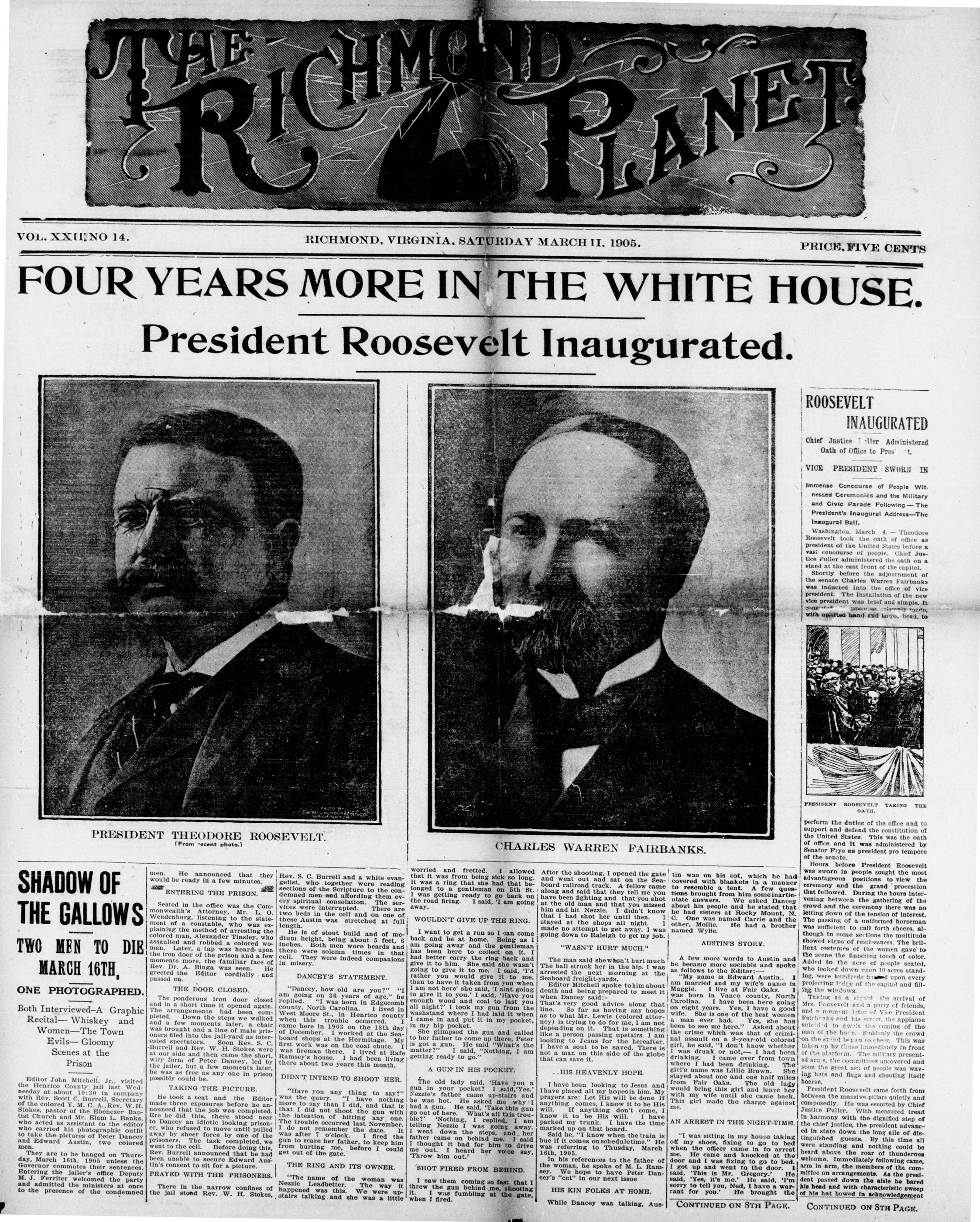
FOUR YEARS MORE IN THE WHITE HOUSE. President Roosevelt Inaugurated.
PHOTO BY
C. W. DELL PHOTOGRAPHY
WASHINGTON
PRESIDENT THEODORE ROOSEVELT. [From: sent photo]
VOL. XX[1] NO 14.
FOUR
PRESIDE
SHADOW OF
THE GALLOWS
TWO MEN TO DIE
MARCH 16TH.
ONE PHOTOGRAPHED.
Both Interviewed-A Graphic Recital—Whiskey and Women—The Town Evils—Gloomy Scenes at the
Editor John Mitchell, Jr., visited the Henrico County jail last Wednesday at about 10:30 in company with Rev. Scott C. Burrell, Secretary of the colored Y. M. C. A., Rev. W. H. Stokes, pastor of the Ebenezer Baptist Church and Mr. Elam L. Banks, who acted as assistant to the editor who carried his photographic outfit to take the pictures of Peter Dancey and Edward Austin, two colored men.
They are to be hanged on Thursday, March 16th, 1905 unless the Governor commutes their sentences. Entering the jailer's office Deputy M. J. Ferriter welcomed the party and admitted the ministers at once to the presence of the condemned
men. He announced that they would be ready in a few minutes.
ENTERING THE PRISON.
Seated in the office was the Commonwealth's Attorney, Mr. L. O. Wendenburg, listening to the statement of a constable, who was explaining the method of arresting the colored man, Alexander Tinsley, who assaulted and robbed a colored woman. Later, a tap was heard upon the iron door of the prison and a few moments more, the familiar face of Rev. Dr. A. Binga was seen. He greeted the Editor cordially, and passed on.
THE DOOR CLOSED
The ponderous iron door closed and in a short time it opened again. The arrangements had been completed. Down the steps we walked and a few moments later, a chair was brought and a line of male prisoners filed into the jail-yard as interested spectators. Soon Rev. S. C. Burrell and Rev. W. H. Stokes were at our side and then came the short, wiry form of Peter Dancey, led by the jailer, but a few moments later, he was as free as any one in prison possibly could be.
TAKING THE PICTURE
He took a seat and the Editor made three exposures before he announced that the job was completed. Ere he did this, there stood near to Dancey an idiotic looking prisoner, who refused to move until pulled away by sheer force by one of the prisoners. The task completed, we went to the cell. Before doing this, Rev. Burrell announced that he had been unable to secure Edward Austin's consent to sit for a picture.
PRAYED WITH THE PRISONERS
There in the narrow confines of the jail stood Rev. W. H. Stokes,
RICHMOND, VIRGINIA, SATURDAY MARCH 11, 1905.
Rev. S. C. Burrell and a white evangelist, who together were reading sections of the Scripture to the condemned men and affording them every spiritual consolation. The services were interrupted. There are two beds in the cell and on one of these Austin was stretched at full length.
He is of stout build and of medium height, being about 5 feet, 6 inches. Both men wore beards and there were solemn times in that cell. They were indeed companions in misery.
DANCEY'S STATEMENT
"Dancey, how old are you?" "I am going on 36 years ago," he replied. "I was born in Edgecomb county, North Carolina. I lived in West Moore St., in Henrico county when this trouble occurred. I came here in 1903 on the 18th day of December. I worked at the Seaboard shops at the Hermitage. My first work was on the coal chute. I was fireman there. I lived at Rafe Ramsey's house. I had been living there about two years this month.
DIDN'T INTEND TO SHOOT HER.
"Have you any thing to say?" was the query. "I have nothing more to say than I did, and that is that I did not shoot the gun with the intention of hitting any one. The trouble occurred last November. I do not remember the date. It was after 7 o'clock. I fired the gun to scare her father, to keep him from hurting me, before I could get out of the gate.
THE RING AND ITS OWNER
"The name of the woman was Nezzie Leadbetter. The way it happened was this. We were upstairs talking and she was a little
M.
CHARLES WARREN FAIRBANKS
worried and fretted. I allowed that it was from being sick so long. It was a ring that she had that belonged to a gentleman on 5th St. I was getting ready to go back on the road firing. I said, 'I am going away.
WOULDN'T GIVE UP THE RING
I want to get a run so I can come back and be at home. Being as I am going away and the gentleman has been here to collect on it. I had better carry the ring back and give it to him. She said she wasn't going to give it to me. I said, 'I'd rather you would give it to me, than to have it taken from you when I am not here' she said, 'I aint going to give it to you.' I said, 'Have you enough wood and coal to last you all night?' I took my gun from the washstand where I had laid it when I came in and put it in my pocket, in my hip pocket.
She glimpsed the gun and called to her father to come up there, Peter is got a gun. He said "What's the matter?" I said, "Nothing, I am getting ready to go."
A GUN IN HIS POCKET.
The old lady said, 'Hava you a gun in your pocket?' I said, 'Yes. Nezzzie father came up-stairs and he was hot. He asked me why I had a gun. He said, 'Take this gun go out of here. What's all this trouble?' 'Nothing, I replied, I am telling Nezzzie I was going away. I went down the steps, and her father came on behind me. I said I thought it bad for him to drive me out. I heard her voice say, 'Throw him out.'
SHOT FIRED FROM BEHIND
I saw them coming so fast that I threw the gun behind me, shooting it. I was fumbling at the gate, when I fired.
After the shooting, I opened the gate and went out and sat on the Seaboard railroad track. A fellow came along and said that they tell me you have been fighting and that you shot at the old man and that you missed him and hit Nezzle. I didn't know that I had shot her until then. I stayed at the shops all night. I made no attempt to get away. I was going down to Raleigh to get my job.
"WASN'T HURT MUCH"
The man said she wasn't hurt much. The ball struck her in the hip. I was arrested the next morning at the Seaboard freight-yards. Editor Mitchell spoke to him about death and being prepared to meet it when Dancey said:- That's very good advice along that line. So far as having any hopes as to what Mr. Lewis (colored attorney) is trying to do for me, I am not depending on it. That is something like a person passing upstairs. I am looking to Jesus for the hereafter. I have a soul to be saved. There is not a man on this side of the globe that can save it.
...HIS HEAVENLY HOPE.
I have been looking to Jesus and I have placed all my hopes in him. My prayers are: Let His will be done if anything comes, I know it to be His will. If anything don't come, I know it to be His will. I have packed my trunk. I have the time marked up on that board. Said he, "I know when the train is bue if it comes on scheduletime." He was referring to Thursday, March 16th, 1905. In his references to the father of the woman, he spoke of M. L. Ramsey. We hope to have Peter Dancey's "cut" in our next issue.
HIS KIN FOLKS AT HOME.
While Dancey was talking. Aus-
tin was on his cot, which he had covered with blankets in a manner to resemble a tent. A few questions brought from him someinarti-ulate answers. We asked Dancey about his people and he stated that he had sisters at Rocky Mount, N. C. One was named Carrie and the other, Mollie. He had a brother named Wylie.
AUSTIN'S STORY
A few more words to Austin and he became more sociable and spoke as follows to the Editor:—
"My name is Edward Austin.. I am married and my wife's name is Maggie. I live at Fair Oaks. I was born in Vance county, North Carolina. I have been here going on eight years. Yes, I have a good wife. She is one of the best women a man ever had. Yes, she has been to see me here." Asked about the crime which was that of criminal assault on a 9-year-old colored girl, he said, "I don't know whether I was drunk or not,—I had been drinking. I came over from town where I had been drinking. The girl's name was Lillie Brown. She stayed about one and one half miles from Fair Oaks. The old lady would bring this girl and leave her with my wife until she came back. This girl made the charge against me.
AN ARREST IN THE NIGHT-TIME.
"I was sitting in my house taking off my shoes, fixing to go to bed when the officer came in to arrest me. He came and knocked at the door and I was fixing to go to bed. I got up and went to the door. I said, 'This is Mr. Gregory.' He said, 'Yes, it's me.' He said, 'I'm sorry to tell you, Ned, I have a warrant for you.' He brought the
CONTINUED ON 8TH PAGE.
PRICE, FIVE CENTS
OUSE.
ROOSEVELT INAUGURATED
Chief Justice Tuller Administered Oath of Office to President.
VICE PRESIDENT SWORN IN
Immense Concourse of People Witnessed Ceremonies and the Military and Civic Parade Following—The President's Inaugural Address—The Inaugural Ball.
Washington, March 4. — Theodore Roosevelt took the oath of office as president of the United States before a vast concourse of people. Chief Justice Fuller administered the oath on a stand at the east front of the capitol.
Shortly before the adjournment of the senate Charles Warren Fairbanks was inducted into the office of vice president. The installation of the new vice president was brief and simple. It consisted of promise, clearly made, with uplifted hand and hove, head to
PRESIDENT ROOSEVELT TAKING THE OATH,
perform the duties of the office and to support and defend the constitution of the United States. This was the oath of office and it was administered by Senator Frye as president pro tempore of the senate.
Hours before President Roosevelt was sworn in people sought the most advantageous positions to view the ceremony and the grand procession that followed. During the hours intervening between the gathering of the crowd and the ceremony there was no letting down of the tension of interest. The passing of a uniformed horseman was sufficient to call forth cheers, although in some sections the multitude showed signs of restlessness. The brilliant costumes of the women gave to the scene the finishing touch of color. Added to the acre of people seated, who looked down upon 10 acres standing, were hundreds based upon every projecting edge of the capitol and filling the windows.
Taking as a signal the arrival of Mrs. Roosevelt and a party of friends, and a moment later of Vice President Falkowski and his escort, the applause subdued to await the coming of the man of the hour. Suddenly the crowd on the stand began to cheer. This was taken up by those immediately in front of the platform. The military presented arms, the committees uncovered and soon the great set of people was waving hats and flags and shouting itself hoarse.
President Roosevelt came forth from between the massive pillars quietly and composedly. He was escorted by Chief Justice Fuller. With measured tread in harmony with the dignified step of the chief justice, the president advanced in state down the long aile of distinguished guests. By this time all were standing and nothing could be heard above the roar of thunderous welcome. Immediately following came, arm in arm, the members of the committee on arrangements. As the president passed down the aisle he bared his head and with characteristic sweep of his hat bowed in acknowledgement
CONTINUED ON 8TH PAGE.
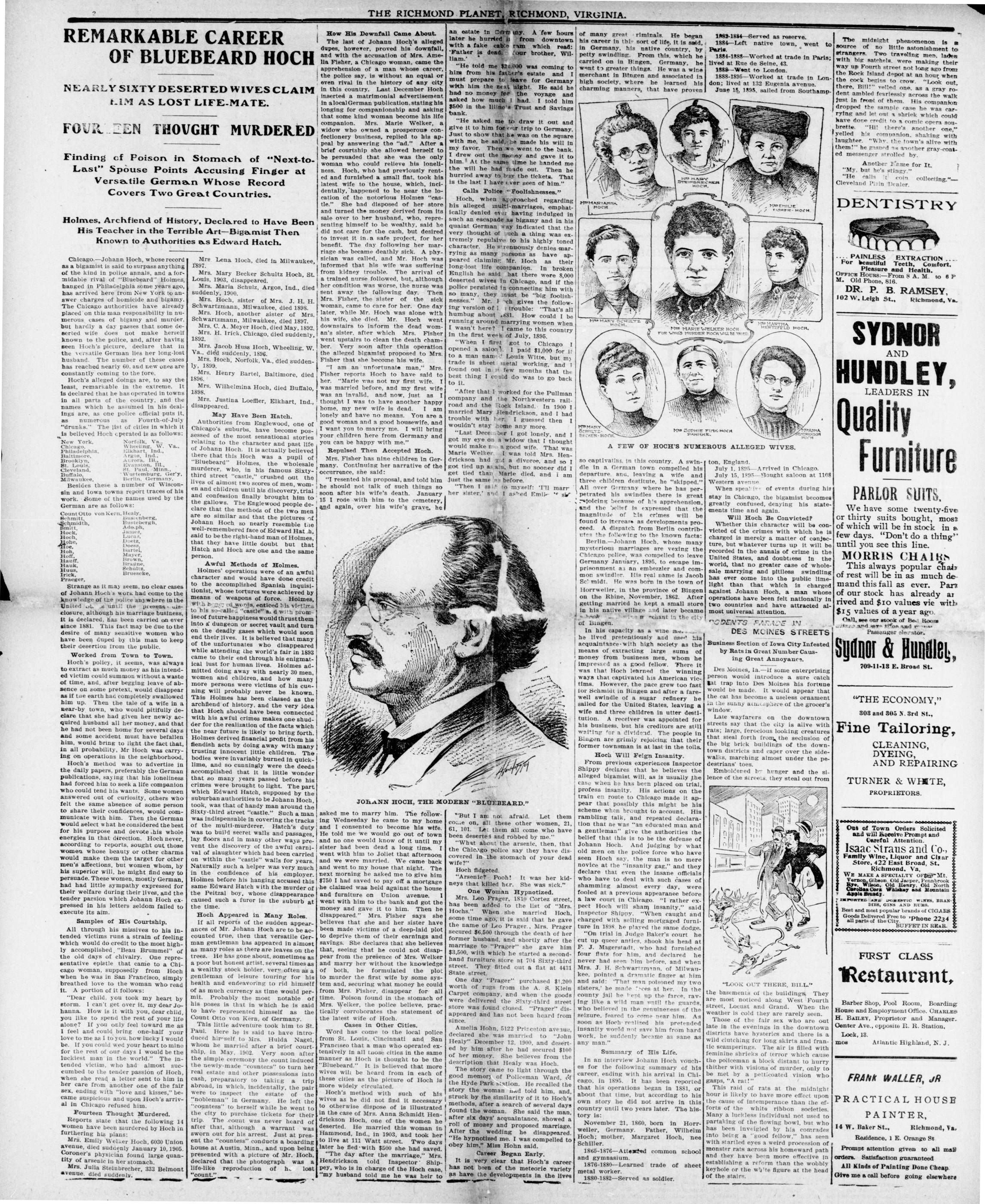
REMARKABLE CAREER OF BLUEBEARD HOCH
NEARLY SIXTY DESERTED WIVES CLAIM LIM AS LOST LIFE-MATE.
Finding of Poison in Stomach of "Next-to-Last" Spouse Points Accusing Finger at Versatile German Whose Record Covers Two Great Countries.
Holmes, Archfiend of History, Declared to Have Been His Teacher in the Terrible Art—Bigamist Then Known to Authorities as Edward Hatch.
Chicago—Johann Hoch, whose record as a bigamist is said to surpass anything of the kind in police annals, and a formidable rival of "Bluebeard" Holmes, hanged in Philadelphia some years ago, has arrived here from New York to answer charges of homicide and bigamy. The Chicago authorities have already placed on this man responsibility in numerous cases of bigamy and murder, but hardly a day passes that some deserted wife does not make herself known to the police, and, after having seen Hoch's picture, declare that in the versatile German lies her long-lost husband. The number of these cases has reached nearly 60, and new ones are constantly coming to the fore.
Hoch's alleged doings are, to say the
least, remarkable in the extreme. It
is declared that he has operated in towns
in all parts of the country, and the
names which he assumed in his dealings
are, as one police official puts it,
as numerous as Fourth-of-July
"drunks." The list of cities in which it
is believed Hoch operated is as follows:
New York, Norfolk, Va.,
Chicago, Wheeling, W. Va.,
Philadelphia, Elkhart, Ind.,
Baltimore, Argos, Ind.,
Brooklyn, Aurora, Ill.,
St. Louis, Euston, Ill.,
Cleveland, St. Paul, Minn.,
Buffalo, Wurtemburg, Ger'y,
Milwaukee, Berlin, Germany.
Besides these a number of Wisconsin
and Iowa towns report traces of his
work. Some of the names used by the
German are as follows:
Count Otto von Kern, Healy,
Schmitt, Bustenberg,
Schmidth, Bustenberg,
Smitt, Adoph,
Hock, James,
Hoch, Lucas,
Hohe, Doetz,
Hoe, Doess,
Hoh, Burtel,
Hoff, Mayer,
Hauff, Brown,
Hauk, Braune,
Huus, Schultz,
Irick, Bruescke,
Praeger.
Strange as it may seem, no clear cases of Johann Hoch's work had come to the knowledge of the police anywhere in the United States until the present disclosure, although his marriage business, it is declared, has been carried on ever since 1881. This fact may be due to the desire of many sensitive women who have been duped by this man to keep their desertion from the public.
Worked from Town to Town.
Worked from Town to Town. Hoch's policy, it seems, was always to extract as much money as his intended victim could summon without a waste of time, and, after begging leave of absence on some pretext, would disappear as if the earth had completely swallowed him up. Then the tale of a wife in a near-by town, who would pitifully declare that she had given her newly acquired husband all her money, and that he had not been home for several days and some accident must have befallen him, would bring to light the fact that, in all probability, Mr Hoch was carrying on operations in the neighborhood
Hoch's method was to advertise in the daily papers, preferably the German publications, saying that his loneliness had forced him to seek a life companion who could tend his wants. Some women answered out of curiosity, others who felt the same absence of some person to share their confidences, would communicate with him. Then the German would select what he considered the best for his purpose and devote his whole energies in that direction. Hoch never, according to reports, sought out those women whose beauty or other charms would make them the target for other men's affections, but women whom, by his superior will, he might find easy to persuade. These women, mostly German, had had little sympathy expressed for their welfare during their lives, and the tender passion which Johann Hoch expressed in his letters seldom failed to execute its aim.
Samples of His Courtship
All through his missives to his intended victims runs a strain of feeling which would do credit to the most highly accomplished, "Bean Brummel" of the old days of chivalry. One representative epistle that came to a Chicago woman, supposedly from Hoch when he was in San Francisco, simply breathed love to the woman who read it. A portion of it follows:
"Dear child, you took my heart by ectorm. I can't get over it, my dear Johanna. How is it with you, dear child, you like to spend the rest of your life alone? If you only feel toward me as I feel and could bring one-half your love to me as to you, how lucky I would be. If you could wed your heart to mine for the rest of our days I would be the luckiest man in the world." The intended victim, who had almost succumbed to the tender passion of Hoch, when she read a letter sent to him in her care from another one of the fair sex, ending with "love and kisses," became suspicious and upon Hoch's arrival in Chicago refused him.
Fourteen Thought Murdered.
Reports state that the following 14 women have been murdered by Hoch in furthering his plans:
Mrs. Emily Welker Hoch, 6030 Union avenue, died suddenly January 10, 1905. Coroner's physician found large quantity of arsenic in her stomach.
Mrs. Julia Steinbrecher, 333 Belmont avenue, died suddenly.
Mrs. Lena Hoch, died in Milwaukee, 1897.
Mrs. Mary Becker Schultz Hoch, St. Louis, 1903, disappeared.
Mrs. Maria Schuiz, Argos, Ind., died suddenly, 1900.
Mrs. Hoch, sister of Mrs. J. H. H. Schwartzmann, Milwaukee, died 1898.
Mrs. Hoch, another sister of Mrs. Schwartzmann, Milwaukee, died 1897.
Mrs. C. A. Meyer Hoch, died May, 1892.
Mrs. H. Irick, Chicago, died suddenly, 1892.
Mrs. Jacob Huss Hoch, Wheeling, W. Va., died suddenly, 1896.
Mrs. Hoch, Norfolk, Va., died suddenly, 1899.
Mrs. Henry Bartel, Baltimore, died 1896.
Mrs. Wilhelmina Hoch, died Buffalo, 1898.
Mrs. Justina Loeffler, Elkhart, Ind., disappeared.
May Have Been Hatch.
Authorities from Englewood, one of Chicago's suburbs, have become possessed of the most sensational stories relating to the character and past life of Johann Hoch. It is actually believed there that this Hoch was a pupil of "Bluebeard" Holmes, the wholesale murderer, who, in his famous Sixty-third street "castle", crushed out the lives of almost two scores of men, women and children until his discovery, trial and confession finally brought him to the gallows. The Englewood people declare that the methods of the two men are so similar and that the pictures of Johann Hoch so nearly resemble the well-remembered face of Edward Hat, he said to be the right-hand man of Holmes, that they have little doubt, but that Hatch and Hoch are one and the same person.
Awful Methods of Holmes. Holmes' operations were of an awful character and would have done credit to the accomplished Spanish inquisitionist, whose tortures were achieved by means of weapons of force. Holmes, with burgled words, enticed his victims to his so-called "castle" and with promise of future happiness would thrust them into a dungeon or secret vault and turn on the deadly gases which would soon end their lives. It is believed that many of the unfortunate who disappeared while attending the world's fair in 1893 came to their end through his enigmatical lust for human lives. Holmes admitted doing away with nearly 30 men, women and children, and how many more persons were victims of his cunning will probably never be known. This Holmes has been classed as the archfleth of history, and the very idea that Hoch should have been connected with his awful crimes makes one shudder for the realization of the facts which the near future is likely to bring forth. Holmes derived financial profit from his friendish acts by doing away with many trusting innocent little children. The bodies were invariably burned in quicklime, and so cunningly were the deeds accomplished that it is little wonder that so many years passed before his crimes were brought to light. The part which Edward Hatch, supposed by the suburban authorites to be Johann Hoch, took, was that of handy man around the Sixty-third street "castle." Such a man was indispensable in covering the tracks of the multi-murderer. Hatch's duty was to build secret walls and passages, lay floors and in many other ways prevent the discovery of the awful carnival of slaughter which had been carried on within the "castle" walls for years. Naturally such a helper was very much in the confidence of his employer. Holmes before his hanging accused this same Edward Hatch with the murder of the Peitzal boy, whose disappearance caused such a furor in the suburb at the time.
Hoch Appeared in Many Roles.
If all reports of the sudden appearances of Mr. Johann Hoch are to be accounted true, then that versatile German gentleman has appeared in almost as many roles as there are leaves on the trees. He has gone about, sometimes as a poor but honest artist, several times as a wealthy stock holder, very often as a gentleman of leisure touring for his health and endeavoring to rid himself of as much currency as time would permit. Probably the most notable of his poses is that in which he is said to have represented himself as the Count Otto von Kern, of Germany.
This little adventure took him to St. Paul. Here he is said to have introduced himself to Mrs. Hulda Nagel, whom he married after a brief courtship, in May, 1902. Very soon after the simple ceremony the count induced the newly-made "countess" to turn her real estate and other possessions into cash, preparatory to taking a trip abroad, in which, incidentally, the pair were to inspect the estate of the "nobleman" in Germany. He left the "countess" to herself while he went to the city to purchase tickets for their trip. The count was never heard of after that, although a warrant was sworn out for his arrest. Just at present the "countess" conducts a boarding house at Austin, Minn., and upon being presented with a picture of Mr. Hoch, declared that the photograph was a life-like reproduction of he lost "count."
THE RICHMOND PLANET, RICHMOND, VIRGINIA.
H. H. 1910
JOHANN HOCH, THE MODERN "BLUEREARD"
How His Downfall Came About.
The last of Johann Hoch's alleged dupes, however, proved his downfall, and with the accusation of Mrs. Amelia Fisher, a Chicago woman, came the apprehension of a man whose career, the police say, is without an equal or even rival in the history of any city in this country. Last December Hoch inserted a matrimonial advertisement in alocal German publication, stating his longing for companionship and asking that some kind woman become his life companion. Mrs. Marie Welker, a widow who owned a prosperous confectionery business, replied to his appeal by answering the "ad." After a brief courtship she allowed herself to be persuaded that she was the only woman who could relieve his loneliness. Hoch, who had previously rented and furnished a small flat, took his latest wife to the house, which, incidentally, happened to be near the location of the notorious Holmes "castle." She had disposed of her store and turned the money derived from its sale over to her husband, who, representing himself to be wealthy, said he did not care for the cash, but desired to invest it in a safe project, for her benefit. The day following her marriage she became deathly sick. A physician was called, and Mr. Hoch was informed that his wife was suffering from kidney trouble. The arrival of a trained nurse followed, but, although her condition was worse, the nurse was sent away the following day. Then Mrs. Fisher, the sister of the sick woman, came to care for her. One day later, while Mr. Hoch was alone with his wife, she died. Mr. Hoch went downstairs to inform the dead woman's sister, after which Mrs. Fisher upstairs to clean the death chamber. Very soon after this operation the alleged bigamist proposed to Mrs. Fisher that she become his wife.
"I am an unfortunate man," Mrs. Fisher reports Hoch to have sald to her. "Marie was not my first wife. I was married before, and my first wife was an invalid, and now, just as I thought I was to have another happy home, my new wife is dead. I am lonely and have no means. You are a good woman and a good housewife, and I want you to marry me. I will bring your children here from Germany and you can be happy with me."
Repulsed Then Accepted Hoch.
Mrs. Fisher has nine children in Germany. Continuing her narrative of the occurrence, she said:
"I resented his proposal, and told him he should not talk of such things so soon after his wife's death. January 15 I rode with him to the cemetery, and again, over his wife's grave, he
JOHANN HOCH, THE M
asked me to marry him. The following Wednesday he came to my home and I consented to become his wife. He told me we would go out of town and no one would know of it until my sister had been dead a long time. I went with him to Joliet at afternoon and we were married. We came back and went to my house that night. The next morning he asked me to give him $750 I had saved to pay off a mortgage he claimed was held against the house and furniture on Union avenue. I went with him to the bank and got the money and gave it to him. Then he disappeared." Mrs. Fisher says she believes that she and her sister have been made victims of a deep-laid plot to deprive them of their earnings and savings. She declares that she believes that, seeing that he could not disappear from the presence of Mrs. Welker and marry her without the knowledge of both, he formulated the plot to murder the first wife by some system and, securing what money he could from Mrs. Fisher, disappear for all time. Poison found in the stomach of Mrs. Welker, the police believe, practically corroborates the statement of the latest wife of Hoch.
Cases in Other Cities.
Word has come to the local police from St. Louis, Cincinnati and San Francisco that a man who operated extensively in all those cities in the same manner as Hoch is thought to be the "Bluebeard." It is believed that more wives will be heard from in each of these cities as the picture of Hoch is more widely circulated.
Hoch's method with such of his wives as he did not find it necessary to otherwise dispose of is illustrated in the case of Mrs. Anna Schmidt Hendrickson Hoch, one of the women he deserted. He married this woman in Hammond, Ind., in 1903, and took her to live at 111 Watt street. Two days later he fled-with $500 she had saved.
"The day after the marriage," Mrs. Hendrickson told Inspector Shippey, who is in charge of the Hoch case, "my husband told me he was heir to
an estate in Germany. A few hours later he hurried in from downtown with a fake cable ram which read: 'Father is dead. Four brother, William.'
"He told me $21,000 was coming to him from his father's estate and I must prepare to leave for Germany with him the next night. He said he had no money for the voyage and asked how much I had. I told him $500 in the Illinois Trust and Savings bank.
"He asked me to draw it out and give it to him for our trip to Germany. Just to show that he was on the square with me, he said, he made his will in my favor. Then we went to the bank. I drew out the money and gave it to him. At the same time he handed me the will he had made out. Then he hurried away to buy the tickets. That is the last I have ever seen of him."
Hoch, when approached regarding his alleged multi-marriages, emphatically denied ever having indulged in such an escape as bigamy and in his quaint German way indicated that the very thought of such a thing was extremely repulsive to his highly toned character. He strenuously denies marrying as many persons as have appeared claiming Mr. Hoch as their long-lost life companion. In broken English he said hat there were 8,000 deserted wives in Chicago, and if the police persisted in connecting him with so many, they must be "big foolishnesses." Mr. Ioch gives the following version of I. trouble: "That's all humbug about . . . 881. How could I be running around marrying women when I wasn't here? I came to this country in the first week of July, 1895.
"When I first got to Chicago I opened a saloon. I paid $1,000 for it to a man named Louis Witte, but my trade is sheet metal working, and I found out in a few months that the best thing I could do was to go back to it.
"After that I worked for the Pullman company and the Northwestern railroad and the Rock Island. In 1900 I married Mary Hendrickson, and I had trouble with her. I guessed then I wouldn't stay home any more.
"Last December I got lonely, and I got my eye on a widow that I thought would make me a good wife. That was Marie Welker. I was told Mrs. Hendrickson got a divorce, and so I got tied up again, but no sooner did I get tied than Marie died, and I am just the same as before.
"Then I said to myself: 'I'll marry her sister,' and I asked Emilie "s
MODERN "BLUEBEARD."
"But I am not afraid. Let them come on, all these other women, 21, 61, 101. Let them all come who have been deserted and robbed by me." "What about the arsenic, then, that the Chicago police say they have discovered in the stomach of your dead wife?"
Hoch fidgeted.
"Arsenic? Pooh! It was her kid
neys that killed her. She was sick."
One Woman Hypnotized.
One Woman Hypnotized.
Mrs. Leo Prager, 1810 Cortez street, has been added to the list of "Mrs. Hochs." When she married Hoch, some time ago, it is said that he gave the name of Leo Prager, Mrs. Prager secured $6,500 through the death of her former husband, and shortly after the marriage to "Prager" she gave him $3,500, with which he started a second-hand furniture store at 704 Sixty-third street. They fitted out a flat at 4431 State street.
One day "Prager" purchased $1,200 worth of rugs from the A. S. Klein Carpet company, and when the goods were delivered the Sixty-third street store was found closed. "Prager" disappeared and has not been heard from since.
Amelia Hohn, 5122 Princeton avenue, declared she was married to "John Healy" December 12, 1900, and deserted by him after he had secured $100 of her money. She believes from the description that Healy was Hoch.
The story came to light through the good memory of Policeman Ward, of the Hyde Park station. He recalled the story the woman had told him, and, struck by the similarity of it to Hoch's methods, after a search of several days found the woman. She said the man, after six days' acquaintance, showed a roll of money and proposed marriage. After the wedding he disappeared.
"He hypnotized me. I was compelled to obey him." Miss Hohn said.
Career Began Early.
It is very clear that Hoch's career has not been of the meteorite variety as have the developments in the lives
1883-1884 - Served as reserve.
1884-Left native town, went to Paris.
1884-1888 - Worked at trade in Paris; lived at Rue de Seine, 43.
1888 - Went to London.
1888-1895 - Worked at trade in London; lived at 132 Eugenia avenue.
June 15, 1895, sailed from Southampton.
MRS. MARIANNA HOCH
MRS. MARY STEINMANNER HOCH.
MRS. MARY SCHULTZ HOCH.
MRS. MARIE WELKER HOCH
FOR WHOS MURDER HOCH WILL BE TRIED.
MRS. MARY SCHULTZ
BECKER HOCH.
MRS. SOPHIE FINK HOCH
PANHINE.
A FEW OF HOCH'S NUMEROUS ALLEGES
MR. EMILIE
FISHER MOCH.
MR. MARTHA
HERTZFELD MOCH.
FINK MOCH
KE.
MR. ANNIA
HURDINGOOH
MOCH.
HEROUS ALLEGED WIVES.
MRS. MARIANNA HOCH
MRS. MARY STEINBERGER HOCH.
MRS. EMILIE FISHER-HOCH.
MRS. MARY SCHULTZ HOCH.
MRS. MARIE WELKER HOCH
FOR WHOS MURDER HOCH WILL BE TRIED.
MRS. MARTHA HERTZFELD HOCH.
MRS. MARY SCHULTZ
BECKER-HOCH.
MRS. SOPHIE FINK HOCH
PANJKE.
MRS. ANNIE HENDRICKSON HOCH.
A FEW OF HOCH'S NUMEROUS ALLEGED WIVES.
vating in this country. A swin-
a German town compelled his
trees and, leaving a wife and
children destitute, he "skipped."
in Germany where he has per-
his swindles there is great
great because of his apprehension,
a belief is expressed that the
ton, England.
July 1, 1895—Arrived in Chicago.
July 15, 1895—Bought saloon at 1108
Western avenue.
When speaking of events during his
stay in Chicago, the bigamist becomes
greatly confused, denying his stat-
ements time and again.
Will Hoch Be Convicted? Whether this character will be convicted of the crimes with which he is charged is merely a matter of conjecture, but whatever turns up it will be recorded in the annals of crime in the United States, and doubtless in the world, that no greater case of wholesale marrying and pittiless swindling has ever come into the public limelight than that which is charged against Johann Hoch, a man whose operations have been felt nationally in two countries and have attracted almost universal attention.
ODENTS PARADE IN
DES MOINES STREETS
Business Section of Iowa City Infested by Rats in Great Number Causing Great Annoyance.
Des Moines, Ia.—If some enterprising person would introduce a sure catch cat trap into Des Moines his fortune would be made. It would appear that the cat has become a useless ornament in the sunny atmosphere of the grocer's window.
Late wayfarers on the downtown streets say that the city is alive with rats; large, ferocious looking creatures that steal forth from the seclusion of the big brick buildings of the downtown districts and caper over the sidewalks, marching almost under the pedestrians' toes.
Emboldened by hunger and the silence of the streets, they steal out from
ROTTERS
the basements of the buildings. They are most noticed along West Fourth street, Locust and Grand. When the weather is cold they are rarely seen. Those of the fair sex who are out late in the evenings in the downtown districts have hysteresis and there is a wild clutching for long skirts and frantic scamperings. The air is filled with feminine shrieks of terror which cause the policeman a block distant to hurry thither with visions of murder, only to be met by a petticated vision who gasps, "A rat!"
This raid of rats at the midnight hour is likely to have more effect upon the cause of intemperance than the efforts of the white ribbon societies. Many a luckless individual not used to partaking of the flowing bowl, but who has been invigued by his comrades into being a "good fellow," has seen with startled eyes a weird procession of monster rats across his homeward path and they have been more effective in establishing a reform than the wobbly keyhole or the white figure at the head of the stairs.
of many great criminals. He began his career in this sort of life, it is said, in Germany, his native country, by petty swindling. From this, which he carried on in Bingen, Germany, he went to greater things. He was a wine merchant in Bingen and associated in high society, where he learned his charming manners, that have proven
so captivating, in this country. A swindle in a German town compelled his departure and, leaving a wife and three children destitute, he "skipped." All over Germany where he has percepted his swindles there is great soliciting because of his apprehension, and the belief is expressed that the magnitude of his crimes will be found to increase as developments proceed. A dispatch from Berlin contributes the following to the known facts: Berlin.—Johann Hoch, whose many mysterious marriages are vexing the Chicago police, was compelled to leave Germany January, 1895, to escape imprisonment as an embezzler and common swindler. His real name is Jacob Schmidt. He was born in the town of Horrweiler, in the province of Bingen on the Rhine, November, 1862. After getting married he kept a small store in his native village and later became a bank — where he rented in the city of Bingen.
In his capacity as a wine mer-
he lived pretentiously and used his acquaintance-with high society as the means of extracting large sums of money from business men, whom he impressed as a good fellow. There it was that Hoch learned the winning ways that captivated his American victims. However, the pace grew too fast for Schmidt in Bingen and after a farewell swindle of a sugar refinery he sailed for the United States, leaving a wife and three children in utter destitution. A receiver was appointed for his business, but his creditors are still waiting for a dividend. The people in Bingen are grimly rejoicing that their former townsman is at last in the toils.
Hoch Will Feign Insanity.
From previous experiences Inspector Shippy declares that he believes the alleged bigamist will, as is usually the case when he has been placed on trial, profess insanity. His actions on the train en route to Chicago made it appear that possibly this might be his scheme when brought to account. His rambling talk, and repeated declaration that he was "an educated man and a gentleman" give the authorities the belief that this is to be the defense of Johann Hoch. And judging by what old men on the police force who have seen Hoch say, the man is no more novice at the "insanity gag," and they declare that even the insane officials who have to deal with such cases of shamming almost every day, were fooled at a previous appearance before a law court in Chicago. "I rather expect Hoch will sham insanity," said Inspector Shippy. "When caught and charged with selling mortgaged furniture in 1898 he played the same dodge.
"On trial in Judge Baker's court, he cut up queer antics, shook his head at F. J. Magerstadt, who had furnished four flats for him, and declared he never had seen him before, and when Mrs. J. H. Schwartzmann, of Milwaukee, pointed a dramatic finger at him and said: "That man poisoned my two sisters," he made faces at her. In the county jail he kept up the farce, raving like a wild man until the guards, who believed in the genuineness of the seizure, feared to come near him. As soon as Hoch realized his pretended insanity would not save him from hard work, he suddenly became as sane as any man."
Summary of His Life.
In an interview Johann Hoch vouches for the following summary of his career, ending with his arrival in Chicago, in 1895. It has been reported that his operations began in 1881, or about that time, but according to his own story he did not arrive in this country until two years later. The history is:
November 21, 1860, born in Horrweiler, Germany. Father, Wilhelm Hoch; mother, Margaret Hoch, nee Schiller.
1865-1876—Attested common school and gymnasium.
1876-1880—Learned trade of sheet metal worker.
The midnight phenomenon is a source of no little astonishment to strangers. Two traveling men, laden with big satchels, were making their way up Fourth street not long ago from the Rock Island depot at an hour when the cock begins to crow. "Look out, there, Bill!" velled one, as a gray rodent ambled fearlessly across the walk just in front of them. His companion dropped the sample case he was carrying and let out a shriek which could have done credit to a comic opera soubrette. "Hi! there's another one," yelled his companion, shaking with laughter. "Why, the town's alive with them!" he gasped as another gray-coated messenger strolled by.
Another Name for It.
"My, but he's stingy."
"He calls it coin collecting."—Cleveland Plain Dealer.
DENTISTRY
PAINLESS EXTRACTION
For beautiful Teeth, Comfort,
Pleasure and Health,
OFFICE HOURS: From 8 A. M. to 6 P.
M. Old Phone, 816.
DR. P. B. RAMSEY,
102 W. Leigh St., Richmond, Va.
SYDNOR
AND
HUNDLEY,
LEADERS IN
Quality
Furniture
PARLOR SUITS
We have some twenty-five or thirty suits bought, most of which will be in stock in a few days. "Don't do a thing" until you see this line.
MORRIS CHAIRS
This always popular chair of rest will be in as much demand this fall as ever. Part of our stock has already arrived and $10 values vie with $15 values of a year ago.
Sydnor & Hundley,
709-11-18 E. Broad St.
"THE ECONOMY,"
303 and 305 N. 3rd St.,
Fine Tailoring,
CLEANING,
DYEING,
AND REPAIRING
TURNER & WHITE,
PROPRIETORS.
Out of Town Orders Solicited and will Receive Prompt and Careful Attention
Store, 422 East Broad, St.
Richmond, Va.
WE MAKE A SPECIALTY OFFICE™ Mt.
Vernon, North Old Jasper, Pennsboro
Rye, Wilkesboro, North
Charlotte Ocea Whiskey and Mountain
Apple Brandy.
IMPORTED AND DOMESTIC WINES, BRANDIES, GINS AND RUMS.
Best and most popular brands of CIGARS
Goods Delivered Free to 'Phone 2234
all parts of the City.
BUFFET IN REAR.
FIRST CLASS Restaurant.
Barber Shop, Pool Room, Boarding House and Employment Office. CHARLES H. BAILEY, Proprietor and Manager. Center Ave., opposite R. R. Station, Lock, 13. mos Atlantic Highland, N. J.
FRANK WALLER, JR
FRANK WALLER, JR
PRACTICAL HOUSE PAINTER,
14 W. Baker St., Richmond, Va.
Residence, 1 E. Orange St.
Prompt attention given to all mail orders. Satisfaction guaranteed
All Kinds of Painting Done Cheap.
Give me a call before going elsewhere
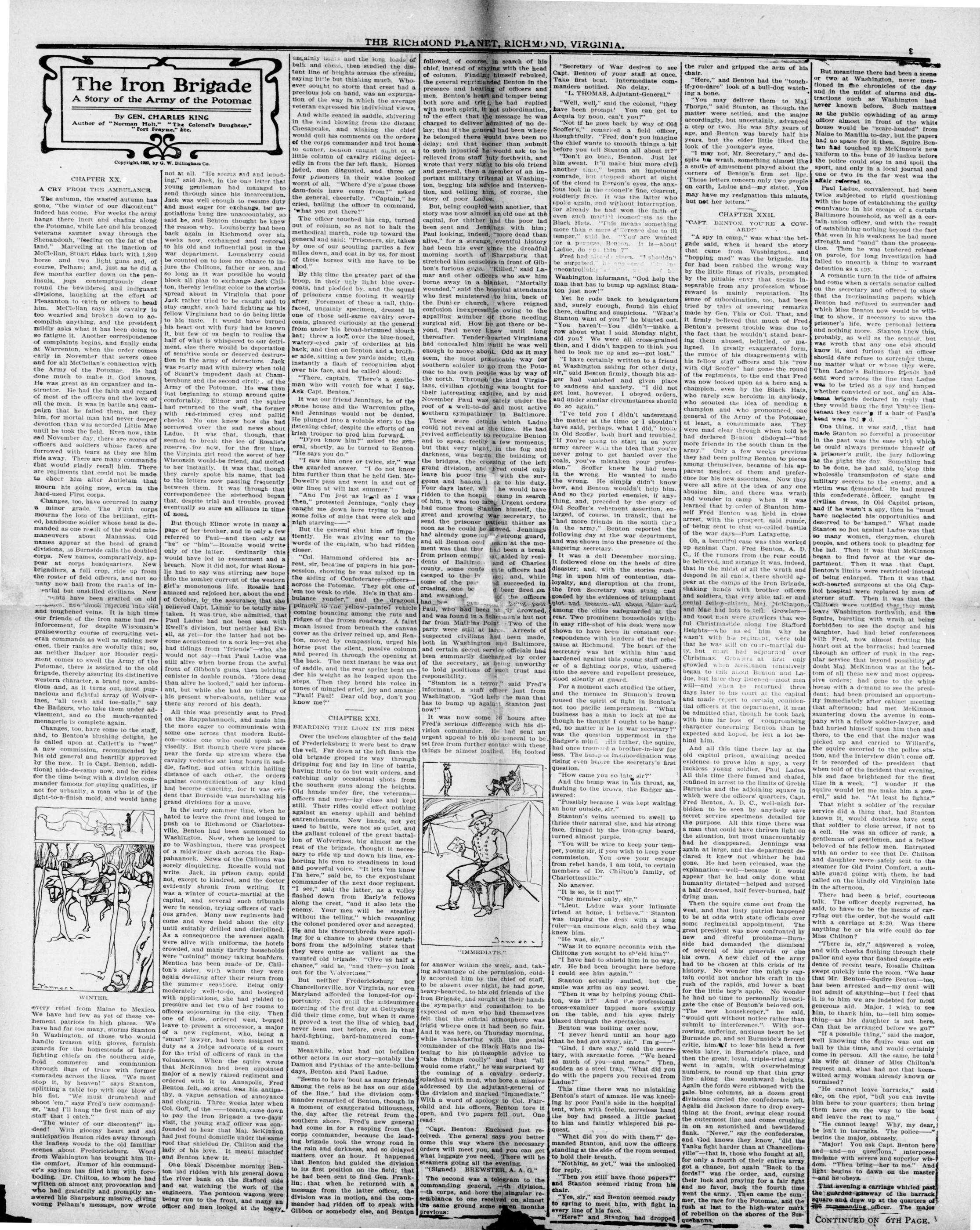
The Iron Brigade
A Story of the Army of the Potomac
By GEN. CHARLES KING
Author of "Norman Holt," "The Colonel's Daughter," "Fort Frayne," Etc.
Copyright, 1982, by G. W. Dillingham Co.
A CRY FROM THE AMBULANCE
The autumn, the wasted autumn has gone, "the winter of our discontent" indeed has come. For weeks the army hangs there inert and chafing along the Potomac, while Lee and his bronzed veterans saunter away through the Shenandoah, "feeding on the fat of the land." Marvelling at the inaction of McChellan, Stuart rides back with 1,800 horse and two light guns and, of course, Pelham; and, just as he did a few months earlier down on the peninsula, jogs contemptuously clear round the bewildered and indignant divisions, laughing at the effort of Pleasanton to catch or others to head him. McChellan says his cavalry is too wearied and broken down to accomplish anything, and the president mildly asks what it has been doing to so fatigue it. Another correspondence of complaints begins, and finally ends at Warrenton, when the order comes early in November that severs once and for all McChellan's connection with the Army of the Potomac. He had done much to make it, God knows. He was great as an organizer and instructor. He had the faith and regard of most of the officers and the love of all the men. It was in battle and campaign that he failed them, not they him, for mortal man had never deeper devotion than was accorded Little Mac until he took the field. Even now, this sad November day, there are scores of officers and soldiers whose faces are furrowed with tears as they see him ride away. There are many commands that would gladly recall him. There are regiments that could not be made to cheer him after Antietam that mourn his going now, even in the hard-used First corps.
Changes, too, have occurred in many a minor grade. The Fifth corps mourns the loss of the brilliant, gifted, handsome soldier whose head is demanded as one result of the wolf mismeasures about Manassas. Old names appear at the head of grand divisions, as Burnside calls the doubled corps. New names, comparatively, appear at corps headquarters. New brigadiers, a full crop, ride up from the roster of field officers, and not so many now hail from the ranks of in-mental but unskilled girls. New
nents have been grafted on old
games, new brood injected into old
and toughened veins. It is high time
our friends of the iron name had re-
inforcement, for despite Wisconsin's
praiseworthy course of recruiting veteran
commands as well as raising new
ones, their ranks are wofully thin; so,
as neither Badger nor Hoosier regiment comes to swell the Army of the Potomac, there is assigned to the old
brigade, thereby assuring its distinctive
western character, a brand new, ambitious and, as it turns out, most pugnacious and fightful array of Wolverines, "all teeth and toe-nails," say the Badgers, who take them under advisement, and so the much-vaulted menagerie is complete again.
Changes, too, have come to the staff, and, to Benton's blushing delight, he is called upon at Catlett's to "wet" a new commission, recommended by his old general and heartily approved by the new. It is Capt. Benton, additional aide-de-camp now, and he rides for the time being with a division commander famous for staying qualities, if not for urbanity, a man who is of the fight-to-a-finish mold, and would hang
Jammer
every rebel from Maine to Mexico. We have had few as yet of these vehement patriots in high places. We have had far too many, storms Stanton in Washington, of those who would handle treason with gloves, furnish guards for the homesteades of hard-fighting chiefs on the southern side, hold commerce and communion through flags of truce with former comrades across the lines. "We must stop it, by heaven!" says Stanton, splitting a table top with one blow of his fist. "We must drumhead and shoot em." says Fred's new commander, "and I'll hang the first man of my staff that I catch."
"The winter of our discontent" indeed! With gloomy heart and sad anticipation Benton rides away through the leafless woods to the old familiar scenes about Fredericksburg. Word from Washington has brought him little comfort. Rumor of his commander's sayings has filled him with foreboding. Dr. Chilton, to whom he had written on almost any, provocation and who had gratefully and promptly answered his Sharpspur missive, giving young Pelham's message, now wrote
CHAPTER XX.
WINTER
not at all. "He seems sad and brooding," said Jack, in the one letter that young gentleman had managed to send through since his incarceration. Jack was well enough to resume duty and most eager for exchange, but negotiations hung fire unaccountably, so said he, and Benton thought he knew the reason why. Lounsberry had been back again in Richmond over six weeks now, exchanged and restored to his old and influential post in the war department. Lounsberry could be counted on to lose no chance to injure the Chiltsons, father or son, and so long as it was possible he would block all plan to exchange Jack Chilton, thereby lending color to the stories spread about in Virginia that poor Jack rather tried to be caught and to stay caught, such hard fighting as his fellow Virginians had to do little to his taste. It would have burned his heart out with fury had he known it, but few of us begin to realize the half of what is whispered to our detriment, else there would be deportation of sensitive souls or deserved destruction in the army of detractors. Jack was nearly mad with misery when told of Suart's impudent dash at Chambersburg and the second circle, of the Army of the Potomac. He was then just beginning to stump around quite comfortably. Elinor and the squire had returned to the west, the former with red-rimmed eyes and pallid cheeks. No one knew how she had sorrowed over the sad news about Ladue. It was that, though, that seemed to break the ice of Rosalie's reserve, for now, for the first time, the Virginia girl read the secret of her Wisconsin would-be friend, and meited to her instantly. It was that, though they rarely spoke his name, that led to the letters now passing frequently between them. It was through that correspondence the sisterhood began that, despite trial and trouble, proved eventually so sure an alliance in time of need.
But though Elinor wrote in many a page of her brother, and in only a few referred to Paul—and then only as "he" or "him"-Rosalie would write only of the latter. Ordinarily this would have led to resentment and a breach. Now it did not, for what Rosalie had told to say was stirring new hope into the somber current of the western girl's monotonous life. Rosalie had amazed and rejoiced her, about the end of October, by the assurance that she believed Capt. Lamar to be totally mistaken. It was true, she admitted, that Paul Lade had not been seen with Ewell's division, but neither had Ewell, as yet—for the latter had not become accustomed to a cook leg—yet she had tidings from "friends"—who, she would not say—that Paul Lade was still alive when borne from the awful front of Gibbon's guns, then belching canister in double rounds. "More dead than alive he looked," said her informant, but while she had no tidings of his present whereabouts, neither was there any record of his death.
All this was presently sent to Fred on the Rappahannock, and made him the more eager to communicate with some one across that modern Rubicon—some one who could speak advisely. But though there were places near the fords up stream where the cavalry vedettes sat long hours in saddle, fading, and often within hailing distance of each other, the orders against communication of any kind had become exacting, for it was evident that Burpinsa was marshaling his grand divisions for a move.
In the early summer time, when he hated to leave the front and longed to push on to Richmond or Charlottesville, Benton had been summoned to Washington. Now, when he longed to go to Washington, there was prospect of a midwinter dash across the Rappahannock. News of the Chilton's was sorely disquieting. Rosalie would not write. Jack, in prison camp, could not, except to kindred, and the doctor evidently shrank from writing. It was a winter of courts-martial at the capital, and several such tribunals were in session, trying officers of various grades. Many new regiments had come and were held about the city until suitably drilled and disciplined. As a consequence the avenues again were alive with uniforms, the hotels crowded, and many thrifty households were "coining" money taking boarders. Mentica has been made of Dr. Chilton's sister, with whom they were again dwelling after their return from the summer seashore. Being only moderately well-to-do, and besieged with applications, she had yielded to pressure and let two of her rooms to officers sojourning in the city. Then one of these, ordered west, begged leave to present a successor, a major of a new regiment, who, being a "smart" lawyer, had been assigned to duty as a judge advocate of a court for the trial of officers of rank in the volunteers. When the squire wrote that McKinnon had been appointed major of a newly raised regiment and ordered with it to Annapolis, Fred Benton felt, so great was his antipathy, a vague sensation of annoyance and chagrin. Three weeks later when Col. Goff, of the —teenth, came down to pay the iron Brigade a two-days' visit, the young staff officer was confounded to hear that Maj. McKinnon had just found domicile under the same roof that shielded Dr. Chilton and the lady of his love. It meant mischief and Benton knew it.
One bleak December morning Benton had ridden with his general down the river bank on the Stafford side and sat watching the work of the engineers. The pontoon wagons were being run to the front, and many an officer and man looked at the heavy
THE RICHMOND PLANET, RICHMOND, VIRGINIA.
unmainly hosts and the long loads of balk and chess, then studied the distant line of heights across the stream, saying little but thinking much. Whoever sought to storm that crest had a precious job on hand, was an expurgation of the way in which the average veteran expressed his individual views, and while seated in saddle, shivering in the wind blowing from the distant Chesapeake, and wishing the chief would quit his comments on the orders of the corps commander and trot home to owner, beaton caught sight or a little column of cavalry riding defectedly in from the far left flank. Horses jaded, men disguised, and three or four prisoners in their wake looked worst of all. "Where d'y'e spose those dam-fools have come from?" asked the general, cheerfully. "Captain," he cried, hailing the officer in command, "what you got there?"
The officer touched his cap, turned out of column, so as not to halt the methodical march, rode up toward the general and said: "Prisoners, sir, taken by one of our scouting parties a few miles down, and sent in by us, for most of these horses with me have to be abod." By this time the greater part of the troop, in their ugly light blue overcoats, had plodded by, and the squad of prisoners came footing it wearily after. Foremost of these a tall, thin-faced, ungainly specimen, dressed in one of those self-same cavalry overcoats, glanced curiously at the general from under his broad-brimmed slouch hat; threw a look over the blue-nosed, watery-eyed pair of orderlies at his back, and then on Eenton and a brother aide, sitting a few yards aside; then instantly a flash of recognition shot over his face, and he called aloud:
"There, captain. There's a gentleman who will vouch for what I say. Ask Capt. Benton."
It was our friend Jennings, he of the stone house and the Warrenton plke, and Jennings would not be denied. He plunged into a voluble story to the listening chief, despite the efforts of an Irish trooper to prod him forward.
"D'you know him?" asked the general, shortly, as he turned to Benton. "He says you do."
"I saw him once or twice, sir," was the guarded answer. "I do not know him further than that he held Gen. McDowell's pass and went in and out of our lines at will last summer."
"And I'm just as local as I was then," protested Jennings, "only they caught me down here trying to help some folks of mine that were sick and nigh starving—"
But the general shut him off impatiently. He was giving ear to the words of the captain, who had ridden closer.
"Col. Hammond ordered his arrest, sir, because of papers in his possession, showing he was mixed up in the aiding of Confederates—officers—across the Potomac. They got one of 'em too weak to ride. He's in that ambulance yonder," and the dragoon pointed to the yellow-painted vehicle coming bouncing among the ruts and ridges of the frozen roadway. A faint moan issued from beneath the canvas cover as the driver reined up, and Benton, moved by compassion, urged his horse past the silent, passive column and peered in through the opening at the back. The next instant he was out of saddle, and the rear spring bent under his weight as he leaped upon the steps. Then they heard his voice in tones of mingled grief, joy and amaze: "Paul! Paul! Dear old boy, don't you know me?"
CHAPTER XXI
BEARDING THE LION IN HIS DEN
Over the useless slaughter of the field of Fredericksburg it were best to draw the vell. Far down at the left flank the old brigade groped its way through dripping fog and lay in line of battle, having little to do but wait orders, and catching only occasional shots from the southern guns along the heights. Old hands under fire, the veterans—officers and men—lay close and kept still. Their rifles could effect nothing against an enemy uphill and behind entrenchments. New hands, not yet used to battle, were not so quiet, and the gallant colonel of the great battalion of Wolverines, big almost as the rest of the brigade, thought it necessary to ride up and down his line, exhorting his men to steadiness in loud and powerful voice. "It lets 'em know I'm here," said he, to the expostulant commander of the next door regiment. "I see," said the latter, as a volley flashed down from Early's fellows along the crest, "and it also lets the enemy. Your men will be steadier without the telling," which reasoning the colonel pondered over and accepted. He and his thoroughbreds were spoiling for a chance to show their neighbors from the adjoining states that they were quite as vallant as the vaunted old brigade. "Give us half a chance," said he, "and then—you look out for the Wolverines."
But neither Fredericksburg nor Chancellorsville, nor Virginia, nor even Maryland afforded the longed-for opportunity. Not until the midsummer morning of the first day at Gettysburg did their time come, but when it came it proved a test like of which had never been met before, even in that hard-fighting, hard-hammered command.
Meanwhile, what had not befallen other actors in our story—notably the Damon and Pythias of the ante-bellum days, Benton and Paul Ladue.
"Seems to have 'bout as many friends among the rebs as he has on our side of the line." had the division commander remarked of Benton, though in a moment of exaggerated billiousness, the day after the retreat from the southern shore. Fred's new general had come in for a rasping from the corps commander, because the leading brigade took the wrong road in the rain and darkness, and so delayed matters over an hour. It happened that Benton had guided the division to its first position on the field; that he had been sent to find Gen. Franklin; that when he returned with a message from the latter officer, the division was in motion, and the commander had ridden off to speak with Gibbon or somebody else, and Benton
followed, of course, in search of his chief, instead of staying with the head of column. Finding: himself reubeked, the general reprimanded Benton in the presence and hearing of officers and men. Benton's heart and temper being both sore and trist, he had replied with much spirit, it not subordination, to the effect that the message he was charged to deliver admitted of no delay; that if the general had been where he belonged there would have been no delay; and that sooner than submit to such injustice he would ask to be relieved from staff duty forthwith, and wrote that very night to his old friend and general, then a member of an important military tribunal at Washington, begging his advice and intervention, and telling him, of course, the story of poor Ladue.
But, being coupled with another, that story was now almost an old one at the capital, for thither had the poor lad been sent and Jennings with him; Paul looking, indeed, "more dead than alive," for a strange, eventful history had been his ever since the dreadful morning north of Sharpsburg that stretched him senseless in front of Gibbon's furious guys. "Killed," said Lamar and other officers who saw him borne away in a blanket. "Mortally wounded," said the hospital attendants who first ministered to him, back of the Dunler church, where reigned confusion inexpressible owing to the appalling number of those needing surgical aid. How he got there or beyond, Paul never knew until long thereafter. Tender-hearted Virginians had concealed him until he was well enough to move about. Odd as it may seem, the most practicable way for southern soldier to go from the Potomac to his own people was by way of the north. Through the kind Virginians, civilian clothing was bought for their interesting captive, and by mid November Paul was safely under the roof of a well-to-do and most active southern sympathizer in Baltimore.
These were details which Ladue could not reveal at the time. He had revived sufficiently to recognize Benton and to speak freely a few moments; but that very night, in the fog and darkness, was begun the building of the bridges, the crossing of the left grand division, and Fred could only leave his poor free with the surgeons and hasten back to his duty. Four days later, when he would have ridden to the hospit, camp in search of him, it was too late. Urgent orders had come from Stanton himself, the great and growing war secretary, to send the prisoner patient thither as soon as he could be moved. Jennings had already gone up, strong guard, and all Benton could learn at the moment was that that had been a break from prison camp; but, aided by residents of Baltimore, and of Charles county, some conference officers had escaped to the Pineville; and, while some of the part had succeeded in crossing, one beard had been fired on and swummed. of the officers had been
Paul, who had been nearly drowned, and was found in a fisherman's hut not far from Mattias Point. Two of the party were still at large. Arrests of suspected civilians had been made, both in Washington and Baltimore, and certain secret service officials had been summarily discharged by order of the secretary, as being unworthy to hold positions of such trust and responsibility.
"Stanton is a terror," said Fred's informant, a staff officer just from Washington. "God help the man that has to bump up against Stanton just now!"
It was now some 26 hours after Fred's serious difference with his division commander. He had sent an urgent appeal to his old general to be set free from further contact with these things he almost loathed. He looked
JAMESON
"IMMEDIATE."
for answer within the week, and, taking advantage of the permission, coldly accorded him by the chief of staff, to be absent over night, he had gone, heavy-hearted, to his old friends of the iron Brigade, and sought at their hands the sympathy and consolation to be expected of men who had themselves felt that the official atmosphere was frigid where once it had been so fair. And it was here, on Thursday morning, while breakfasting with the genial commander of the Black Hats and listening to his philosophic advice to "take things coolly" and that "all would come right," he was surprised by the coming of a cavalry orderly, splashed with mud, who bore a missive addressed by the adjutant-general of the division and marked "immediate." With a word of apology to Col. Fairchild and his officers, Benton tore it open, and two papers fell out. One read:
"Capt. Benton: Enclosed just received. The general says you better come this way where the necessary orders will meet you, and you can get what luggage you need. There will be steamers going all the evening.
"(Signed) BREWSTER. A. A. G."
The second was a telegram to the commanding general, —th division, —th corps, and bore the singular resemblance to one received on almost the same ground some seven months previous:
"Secretary of War desires to see Capt. Benton of your staff at once. Take first boat. Intermediate commanders notified. No delay. "L. THOMAS, Adjutant-General." "Well, well," said the colonel, "they have been prompt! You can get to Acquila by noon, can't you?"
"Not if he goes back by way of Old Scoffer's," remarked a field officer, thoughtfully. "Fred, don't you imagine the chief wants to smooth things a bit before you tell Stanton all about it?" "Don't go back, Benton. Just let him sweat. It'll make him more civil another time," began an impetuous comrade, but stopped short at sight of the cloud in Benton's eyes, the anxious look in the colonel's fine, clearcut, coldly face. It was the latter who spoke again, and without interruption, for already he had won the faith of even such martial iconoclasts as the Black Hats. "This means something more than a mere d'erence due to ill temper," said he. "You're wanted for a purpose, Benton. It is—about Ladue, do you thin?" Fred had already risen. "I shouldn't be surprised, he answered, in uncontrollably." Washington informant, "God help the man that has to bump up against Stanton just now!"
Yet he rode back to headquarters and, surely enough, found his chief there, chafing and suspicious. "What's Stanton want of you?" he blurted out, "You haven't—You didn't—make a row about what I said Monday night, did you? We were all cross-grained then, and I didn't happen to think you had to look me up and so—got lost." "I have certainly written to a friend at Washington asking for other duty, sir," said Benton firmly, though his anger had vanished and given place to sadness and anxiety. "I did not get lost, however. I obeyed orders, and under similar circumstances should do so again."
"I've told you I didn't understand the matter at the time or I shouldn't have said, perhaps, what I did," broke in Old Scoffer, both hurt and troubled. "If you're going to start in on your army career with the idea that you're never going to get hauled over the coals, you've mistaken your profession." Scoffer knew he had been in the wrong. He wanted to undo the wrong. He simply didn't know how, and Benton wouldn't help him. And so they parted enemies, if anything, and, preceded by the story of Old Scoffer's vehement assertion, enlarged, of course, in transit, that he "had more friends in the south then in the army." Benton reported the following day at the war department, and was shown into the presence of the angering secretary.
It was a dull December morning. It followed close on the heels of dire disaster; and, with the stories rushing in upon him of contention, disloyalty, and disruption at the front, the Iron Secretary was stung and goaded by the evidences of triumphant plot and treason all about him and among the cities safeguarded at the rear. Two prominent households within easy rifle-shot of his desk were now shown to have been in constant correspondence with leaders of the rebel cause at Richmond. The heart of the secretary was hot within him and hardened against this young staff officer of a fighting corps, who, ushered into the severe and repellent presence, stood silently at guard.
For a moment each studied the other, and the menace in Stanton's frown roused the spirit of fight in Benton's not too pacific temperament. "What business has a man to look at me as though he thought I ought to be hanged, no matter if he is war secretary?" was the question uppermost in the Badger's mind. His father, the squire, had once trounced a brother-in-law for less. The bump of insubordination was rising even before the secretary's first question.
"How came you so late, sir?"
And the bump was in his throat, as, flushing to the brows, the Badger answered:
"Possibly because I was kept waiting an hour outside, sir."
Stanton's veins seemed to swell to thrice their natural size, and his strong face, fringed by the iron-gray beard, turned almost purple.
"You will be wise to keep your temper, young sir, if you wish to keep your commission. You owe your escape from rebel hands, I am told, to certain members of Dr. Chilton's family, of Charlottesville."
No answer.
"It is so, is it not?"
"One member only, sir."
"Lieut. Ladue was your intimate friend at home, I believe." Stanton was tapping the desk with a long ruler—an ominous sign, said they who knew him.
"He was, sir."
"Was it to square accounts with the Chiltons you sought to sh'eld him?"
"I have had to shield him in no way, sir. He had been brought here before I could see him again."
Stanton actually smiled, but the smile was grim as any scowl.
"Then it was by helping young Chilton, was it?" And the professional cross-examiner tapped more swiftly on the table, and his eyes fairly blazed through the spectacles.
Benton was boiling over now.
"I never heard until an hour ago that he had got away, sir." I'm g——"
"Glad, I dare say," said the secretary, with sarcastic force. "We heard as much of you—and more." Then, sudden as a steel trap, "What did you do with the papers you received from Laude?"
This time there was no mistaking Benton's start of amaze. He was kneeling by poor Paul's side in the hospital tent, when with feeble, nerveless hand the boy had passed a little packet to him and faintly whispered his request.
"What did you do with them?" demanded Stanton, and now the officers standing at the side of the room seemed to hold their breath.
"Nothing, as yet," was the unlooked for reply.
"Then you still have those papers?" and Stanton seemed rising from his chair.
"Yes, sir," and Benton seemed ready to spring to meet him, with fight in every line of his face.
"Here?" and Stanton seemed
the ruler and gripped the arm of his chair.
"Here," and Benton had the "touch-if-you-dare" look of a bull-dog watching a bone.
"You may deliver them to Maj. Thorpe," said Stanton, as though the matter were settled, and the major accordingly, but uncertainly, advanced a step or two. He was fifty years of age, and Benton was barely half his years, but the elder little liked the look of the younger's eyes.
"I may not, Mr. Secretary," and despite his wrath, something almost like a snuffle of amusement played about the corners of Benton's firm set lip.
"Those letters concern only two people on earth, Ladue and—my sister. You may have my resignation this minute, but not her letters."
CHAPTER XXII
"CAPT. BENTON. YOU'RE A COW
ARD."
"A spy in camp," was what the brigade said, when it heard the story that came from Washington, and "hopping mad" was the brigade. Its fur had been rubbed the wrong way by the little flings of rivals, prompted by the pitiful envy that seems inseparable from any profession whose reward is mainly reputation. Its sense of subordination, too, had been tried by tales of sneering remarks made by Gen. This or Col. That, and it firmly believed that much of Fred Benton's present trouble was due to the fact that he wouldn't stand hearing them abused, belittled, or maligned. In greatly aggrated form, the rumor of his disagreements with his fellow staff officers and his "row with Old Scoffer" had gone the round of the regiments, to the end that Fred was now looked upon as a hero and a champion, even by the Black Hats, who rarely saw heroism in anybody, who scouted the idea of needing a champion and who pronounced one general of the Army of the Potomac, at least, a consummate ass. They were mad clear through when told he had declared Benton disloyal—"had more friends in the south than in the army." Only a few weeks previous they had been pulling Benton to pieces among themselves, because of his apparent neglect of them and preference for his new associates. Now they were all afire at the idea of any one abusing him, and there was wrath and wonder in camp when it was learned that by order of Stanton himself Fred Benton was held in close arrest, with the prospect, said rumor, of being sent to that so-called bastille of the war days—Fort Lafayette
Oh, a beautiful case was this worked up against Capt. Fred Benton, A. D. C., if the rumors from the rear could be believed, and srange it was, indeed, that in the midst of all the wrath and despond in all ranks, there should appear at the camps of the Iron Brigade, shaking hands with brother officers and soldiers, that very able taler and genial fellow-citizen, Maj. McKinpon, and Mac had lots to tell. Growlers—and most men were growlers that wolf Christmastide along the Stafford Heights—who as ed him why he wasn't with his regiment, were told that he was still in coarse-martial duty, but court had adjourned over Christmas. Growlers at first only growled when McKinnon tentatively began to talk about Benton and Ladue, but later they listened—most men will—and when he returned three days later to his court at the capital and made report to certain confidential officers at the department, it must be admitted that, though he took back with him far less of compromising character concerning Benton than he expected and hoped, he lett a lot behind him.
And all this time there lay at the old capitol prison, awaiting needed evidence to prove him a spy, a very luckless young soldier, Paul Ladue. All this time there fumed and chafed, confined in arrest to the limits of Grebe Barracks and the adjoining square in which were the officers' quarters, Capt Fred Benton, A. D. C, well-nigh forbidden to be seen by anybody save secret service specimens detailed for the purpose. All this time there was a man that could have thrown light on the situation, but most unaccountably had he disappeared. Jennings was again at large, and the department declared it knew not whither he had gone. He had been released, was the explanation—well—because it would appear that he had only done what humanity dictated—helped and nursed a half drowned, half fever-burned, half dying man.
Then the squire came out from the west, and that lusty patriot happened to be at odds with state officials over some regimental appointment. The great president was now confronted by new and direful problems—Burnside had demanded the dismissal of several of his generals or else his own. A new chief of the army had to be chosen at this crisis of its history. No wonder the mighty captain could not anchor his craft in the rush of the rapids, and lower a boat for the little boy's apple. No wonder he had no time to personally investigate the case of Benton's beloved son. "The new housekeeper," he said, "would quit without notice rather than submit to interference." With sorrowing, suffering, anxious heart he let Burnside go, and set Burnside's fiercest critic, him, to lose his head a few weeks later, in Burnside's place, and then the great, loyal, triple-tried army went in again, with overwhelming numbers, to round up that thin gray line along the southward heights. Again the fords were ribboned with the pale, blue columns, as a dozen great divisions circled the confederate left. Again did Jackson dare to drop everything at the front, swing clear round the outermost line and come crushing in on an astonished and bewildered flank. "Never," say the confederates, and God knows they know, "did the Yanks fight harder than at Chancellorville"—that is, those who fought at all, for only a fourth of their entire array got a chance, but again "Back to the ford!" was the order, and, cursing their luck and praying for a fair fight and no favor, back the fourth time went the army. Then came the summer, the race for the Potomac, and the rush at last to the high-water mark of rebellion on the shores of the Susquehanna.
But meantime there had been a scene or two at Washington, never mentioned in the chronicles of the day and in the midst of alarms and distractions such as Washington had never known before. Such matters as the public cowhiding of an army officer almost in front of the white house would be "scare-headed" from Maine to Manilla to-day, but the papers had no space for it then. Squire Benten had touched up McKinnon's new uniform to the tune of 30 lashes before the police could step in and spoil the sport, and only in a local journal and one or two in the far west was the alair referred to.
Paul Ladue, convalescent, had been twice subjected to rigid questioning with the hope of establishing the guilty conviction in his escape of a certain Baltimore household, as well as a certain-union officer, and with the result of establishing nothing beyond the fact that even in his weakness he had more strength and "sand" than the prosecution. Then he was tendered release on parole, for long investigation had failed to unearth a thing to warrant detention as a spy.
A romantic turn in the tide of affairs had come when a certain senator called on the secretary and offered to show that the incriminating papers which Benton had refused to surrender and which Miss Benton now would be willing to show, if necessary to save the prisoner's life, were personal letters and nothing more. Stanton knew this, probably, as well as the senator, but was wroth that any one else should know it, and furious that an officer should dare refuse to surrender them, no matter what or whose they were. Then Ladue's Baltimore friends had sent word across the line that Ladue was to be tried as a spy and hanged whether convicted or not, and an Alabama brigade declared in reply that they would hang the first Yankee lieutenant they cause if a hair of Paul's head were injured d.
One thing, it was said, that had made Stanton so forceful a prosecutor in the past was the ease with which he could always persuade himself of a prisoner's guilt, the jury following as the night the day. Something had to be done, he had said, to 'stop this wholesale transmission of state and military secrets to the enemy, and a victim was demanded.' He had mured this confederate officer, caught in civilian dress, in Old Capitol prison, and if he wasn't a spy, then he "must have neglected his opportunities and deserved to be hanged." What made Stanton so hot against Ladue was that so many women, clergymen, church people, and others took to pleading for the lad. Then it was that McKinnon began to find favor at the war department. Then it was that Capt. Benton's limits were restricted instead of being enlarged. Then it was that soft-hearted surgeons at the Old Capitol hospital were replaced by men of sterner stuff. Then it was that the Chilliers were notified that they must leave Washington forthwith, and the Squire, bursting at the being forbidden to see the doctor and his daughter, had had brief conferences with Fred, now almost fretting his heart out at the barracks; had learned through an officer of rank in the regular service that beyond possibility of doubt Maj. McKinnon was at the bottom of all these new and most oppressive orders; had gone to the white house with a demand to see the president; had been promised an opportunity immediately after cabinet meeting that afternoon; had met McKinnon sauntering down the avenue in company with a fellow soldier-lawyer, and had hurled himself upon him then and there, to the end that the major was picked up and carried to Willard's, the squire escorted to the police station, and the interview didn't come off. It is recorded of the president that when told of the incident that evening, his sad face brightened for the first time in a week. "I wonder if the squire would let me make him a general," said he. "At least he fights."
That night a soldier of the regular service did a thing, that had Stanton known it, would doubtless have sent that soldier to close arrest, if not to a cell. He was an officer of rank, a gentleman of gentlemen, and a fellow beloved of his fellow men. Entrusted with an order to see that Dr. Chilton and daughter were safely sent to the steamer for Old Point Comfort, a suitable guard going with them, he had called on the kindly old Virginian late in the afternoon.
There had been a brief, courteous talk. The officer deeply regretted, he said, to have to be the means of carrying out the order, but he would call with a carriage at 8:30. Was there anything he or his wife could do for Miss Chilton?
"There is, sir," answered a voice, and with cheeks flushing through their pallor and eyes that flashed despite evidence of recent tears, Rosalie Chilton swept quickly into the room. "We hear that Mr. Benton—Squire Benton—too, has been arrested—and my aunt will not admit of anything—but I feel that it is to him we are indebted for most generous aid. Major, I wish to see him, to thank him, to-tell him something—as his daughter is not here. Can that be arranged before we go?" "If a possible thing," said the major, well knowing the squire was out on ball by this time, and would certainly come in person. All the same, he told his wife at dinner of Miss Chilton's request and, what had not that keen-witted army woman already known or surmised?
"He cannot leave barracks," said she, on the spot, "but you can invite him here to your quarters; then bring them here on the way to the boat and leave the rest to me."
"He cannot leave! Why, my dear, he isn't in barracks. The police—" begins the major, obtusely.
"Major! You ask Capt. Benton here and—and—no questions," interposes madame with severe and superior wisdom. "Then bring—her to me." And light begins to dawn on the master—and he obeys.
That evening a carriage whirled past the guarded gateway of the barrack square and drew up at the quarters of the commanding officer. The major
CONTINUED ON 6TH PAGE.
THE PLANET
announced every Saturday by JOHN MITCHELL,
at all North 4th Street, Richmond, Va.
JOHN MITCHELL, JR., - EDITOR
all communications intended for publication
would be sent so as to reach us by Wednesday.
Copy, one year,
six months,
copy, six months,
copy, four months,
three months,
get copy
ADVERTISING RATES
or one inch, one insertion,
or one inch, each subsequent insertion,
or two inches, three months,
or two inches, nine months,
or two inches, twelve months,
marriage and Funeral Notices,
heading and Transit Notices per line.
POSTAGE STAMPS OF A HIGHER DE-
COMMISION THAN TWO CENTS NOT
RECEIVED ON SUBSCRIPTIONS
THE PLANET is issued weekly. The subscrip-
tion price is $1.50 a year, in advance.
Please follow yearly advice. Money can be sent by mail at our risk: In a Post Office Money Order, by Bank Check or Draft, or an Exchange Money Order, and when none of these money orders are received, a Money Order—You can buy a Money Order at your Post Office, payable at the Richmond Post Office, and we will be responsible for its arrival.
Money Orders can be issued at any office of the American Express Co., the United States Express Co., and the Web Fairs and Co.'s Express Company. We will be responsible for the issuance of the Express Money Order is a safe and convenient way for forwarding money.
REGISTERED LETTER—If a Money Order is lost or an Express Office is not with you, you may write to us on payment of tec data. Then if the letter is lost or stolen, you may send money in the scanner at our risk.
We cannot be responsible for money sent in any other way than one of the four letters mentioned above. If you send your most important other way, you must do it at your risk.
RENEWALS, ETC.—If you do not want TEN
PLANET continued for another year after you
leave, you should discontinue your
postal Card to discontinue it. The courts have
sided that subscribers to newspapers who
do not order their paper discontinued at the exp
time have their subscription set to discontinued
and liable for the payment of the subscription
to date when they order the paper discontinued.
COMMUNICA... When writing to a
subscriber, you should give your name and
address in full, otherwise we cannot find you
your course.
CHANGE OF ADDRESS... In order to change
your course, you should write to the
former office as well as the present address.
Entered in the Post Office at
second class office.
Editor J. R. Clifford of the Martinsburg, W. Va., Pioneer Press has our sympathy in his sore affliction.
Mr. S. D. Ferguson, Jr., editor of the Living Chronicle of Cape Palmas, Liberia, Africa, announces that he will have to leave the country to attend a church meeting at Monrovia and during his absence the journal will not be issued.
The very able editorial in the Baltimore, Md., Afro-American Ledger with reference to the intemperate utterances of Gov. Warfield of Maryland were timely and to the point. It was unfortunate that this influential Chief Executive should have made the Negro his theme and the misrepresentation of him his text.
We have received the initial number of the Catholic Herald, an excellently conducted eight page journal published and edited by Mr. Augustine Joseph McNorton at Washington, D. C.
The journal is all that could be expected of it and will certainly meet with favor. We wish the venture success.
President Roosevelt has nominated the well-known and popular colored Republican, Mr. Charles W. Anderson as Collector of Internal Revenue of New York. The position pays $4,500 per year and 's one of the best within the gift of the administration. This action will be cordially approved by the conservative people of this country and enthusiastically endorsed by Afro-Americans everywhere.
In doing this, Mr. Roosevelt has dealt a left-handed blow at Senator B. R. Tillman of South Carolina and administered a telling rebuke to all who supported him. He conclusively proves that he did no more to South Carolina in the appointment of Dr. W. D. Crum as Collector of Customs of the Port of Charleston than he was willing to tia for New York in the appointment of Mr. Charles W. Anderson.
The Negro-haters are silenced and accordingly are accorded the privilege of "going 'w-a-y back and sit down."
SUING A CITY.
Rev. R R. Jones, through his attorney, Thomas L. Jones, Esq., on Thursday, March 2d, 1995 entered suit in the Circuit Court of the United States, sitting at Lynchburg, Va., against the city of Ronkonkwa for ($36,000.) thirty thousand dollars damages. He entered another one against Mayor Joel Cutchin and
Sergeant J. A. Manuel for ($20,000) twenty thousand dollars.
He charges the city with having failed to protect him in his constitutional rights and alleges that the officials in question did not do their duty. Henry Williams, colored man, who has since been legally hanged made an outrageous and brutal assault upon Mrs. Shields, a respectable white lady of Roanoke. She narrowly escaped with her life. Williams escaped and it was some time before he was captured.
It is alleged that Dr. Jones made some remarks at a meeting in his church, intimating that no colored man had assaulted her, but that her own husband was probably guilty of the outrage. Dr. Jones never uttered these words, but a mob formed and on February 3d, 1904, he was forced to "run for his life," so to speak. His residence was attacked and he has been unable to return to Roanoke in safety, even to settle up his affairs and move away. His wife was also shamelessly frightened in the night-time by a mob of white men, her private apartments being invaded. Rev. Dr. Jones resided for some time in Washington, but has since accepted a church at Homestead, Pennsylvania- His property was sold at a sacrifice and he lost a lifetime job there. He seeks to recover the magnificent sum of ($50,000) fifty thousand dollars.
If Rev. Dr. Jones resided in Turkey or Morocco, or China, this sum of money would have been considered a moderate compensation for the injury of his feelings alone, without reference to his property losses. But his misfortune is in residing in the United States. That the city of Roanoke and its officials are legally liable hardly admits of a question and the agitation of the subject will afford new light on a very knotty question.
A man who is a citizen is entitled to the protection of the laws and a government is both morally and legally bound to afford him all of the protection in its power. When it has done this, its liability ends. If the city of Roanoke can prove that it did do this and the officials of that municipality can establish the fact that their efforts tended in the same direction, the case is closed.
But whether Dr. Jones wins the suit or loses it, the effect will be beneficial and other cities and counties will be induced to look at this question from a different standpoint and take more interest in the matter of controlling irresponsible robs than heretofore. The advertising of Roanoke as a lawless community and the confessed inability of the city's officials to control the vicious will drive away capital and injure the commercial interests of that community in a way that will surprise those who are not cognizant of the elements that go to make up a city's prosperity.
Gov. Montague did his duty and he set an example that officials everywhere can well afford to emulate.
NEW YORK'S TRAFFIC CRIPPLED
Strike on Rapid Transit System Paralyzes Transportation.
COLLISION IN THE SUBWAY
New York, March 8.—With one collision, in which 29 persons were injured and none killed, New York has passed through the first day of the general strike on its rapid transit system. Beyond this accident and some minor casualties due to the abnormal conditions, the sum total of the day was annoyance and vexation to 1,000,000 or more people usually dependent upon the Interborough company's lines for transportation to and from their business. So far there has been little disorder.
Service on the elevated roads and subway, while not tied up, was crippled and badly crippled at that.
In fact the elevated system of the Interborough's lines was pretty well paralysed. The company's entire energy seemed to be directed to an effort to maintain service in the subway, and in this it was partially successful. Strike Breaker Farley and his crew of 700 or 800 men were thrown into the tunnel; officials of the company gave this system their personal attention, and an enormous number of policemen were detailed to the trains and the stations.
The accident at 23d street was in the nature of a rear-end collision, due, it is said, to the inexperience of the men on the trains. Two cars had their ends smashed in, there was a panic among scores of passengers, of the injured 15 were so severely hurt that they had to be sent to the hospitals.
The train had just drawn into the 23d street station, and some of the passengers were about to alight, when there was a crash, as a train which had left the bridge only 30 seconds after the first train dashed into the train standing at 23d street. The steel car on the first train was forced into the rear of the car just ahead. All of the lights of the first train went out, and a moment later were heard the cries of the injured and pane-striken passengers. Those who were standing in the two rear cars of the first train and in the first cars of the second train were thrown to the floor.
The passengers standing on the platforms of the last two cars of the first train were caught as in a vise. It was here that all of those who were hurt received their injuries.
THE RICHMOND PLANET, RICHMOND, VIRGINIA.
Mayor McClellan has addressed a letter to the Interborough company and the Amalgamated Association offering his services to arbitrate the trouble. Nothing has been seen in New York for years equal to the appearance of the Broadway cars on their uptown trips last evening. Scores of people crowded the interior of the cars, dozens hung about the platforms and rode on the fenders, and groups took a precarious position on the steps. By the time the cars reached 14th street they were jammed with humanity. From here on the enterprising and agile young New Yorker, bound to reach home, climbed to the roofs of the cars, and, settling there, pulled out his paper and read war or strike news through the "great white way" of Broadway. All the down-town hotels were crowded with guests last night unable to get home.
MRS. CHADWICK'S TRIAL
Defense Shows She Had Credit of $15,000 In Oberlin Bank. Cleveland, O., March 8.—Nine witnesses were examined in the Chadwick trial, and the defense established the fact that the claim of the government that Mrs. Chadwick had no money in the Oberlin bank at the time of drawing checks which were certified by Spear and Beckwith was incorrect in two instances at least.
It was shown that in the general run of the bank in November, 1903, when Mrs. Chadwick received a certified check for $10,000, an entry crediting her with that amount was made on the journal of the bank, and a deposit for $10,000 was made out in her name. The entry and the slip were in the hand-writing of Cashier Spear. Another entry of similar nature amounting to $-.000 was also found. These facts were brought out on cross-examination by Judge Wing, counsel for Mrs. Chadwick, after long and tedious questioning of H. H. Avery, assistant cashier of the Oberlin bank. Avery at first testified that Mrs. Chadwick at no time had neither money in or credit at the bank.
It is doubtful if Andrew Carnegie will take the stand. District Attorney Sullivan said:
"It is not my present intention to put Mr. Carnegie on the stand, and I do not think that he will be called upon to testify unless his evidence should be needed in rebuttal of something introduced by the defense."
A WEEK'S NEWS CONDENSED.
Thursday, March 2.
One of the new battleships authorized in the naval appropriation bill will be named the South Carolina. James D. Scott, of Wilmington, Del., fell in front of a Reading shifting engine at Coatesville, Pa., and was instantly killed. Seven people were injured, two fatally, by the overturning of a passenger coach on the B. and O. railroad at Colfax, W. Va. Captain Joseph Umble, aged 75, well known in the anti-slavery crusade in Pennsylvania before the Civil War, died at Reading, Pa. Freeman S. Farr, president of the Atlantic Coast Lumber company, and a well-known capitalist, died at Norfolk, Va., while on a business trip.
Friday. March 3.
Frank Tidmarsh, of Bridgeton, N. J., committed suicide by hanging himself to the post of his bed.
Princeton University has added wrestling to the list of college sports and a club has been organized.
Burglaries entered the postoffice and railroad station at Carrcroft, Del., and secured $200 in stamps and valuables.
One man was killed and over 50 injured in a head-on collision between trains on the Mt. Vernon railroad at Spring Park, Va.
While repalring a broken electric wire at Chester, Pa., George McGlinnis forgot to turn off the current and was instantly killed.
Saturday. March 4.
Charles F. Horst, a stell worker, was struck and killed by a train at Harrisburg, Pa., his body being horribly mangled. Three men and one woman were injured in a rear-end collision between trains on the Philadelphia, Baltimore and Washington railroad at Wawa, Pa. Four railroad laborers were killed and two fatally injured near Pikeville, Ky., by an explosion of dynamite, which they were heating in powder cans. The Texas legislature adopted a resolution endorsing President Roosevelt's policy regarding the Standard Oil company and the alleged beef trust.
Monday, March 6.
The Texas legislature is preparing data to assist the government in investigating the methods of the beef trust.
Using her hands to stop fire in lace curtains, Mrs. W. H. Emigh, of Huntingdon, Pa., may lose one of them by amputation.
"High Wall," one of the finest dormitories at Yale College, New Haven, Conn., was damaged to the extent of $20,000 by fire.
President Roosevelt will attend the dinner of the Empire State Society of the Sons of the American Revolution in New York, March 17.
In a head-on collision between freight trains on the B. & O. railroad at Defrance, O., one railroader was killed and two fatally injured.
Tuesday, March 7.
Rear Admiral Robley Evans will assume command of the North Atlantic fleet on March 31.
D. W. Tyron's wall at Spartansburg, Pa., closed its doors, the owner having made an assignment.
Judge John H. Reagan, sole surviving member of the Confederate cabinet, died at Palestine, Tex., aged 86 years.
Banker Jacob H. Schiff, of New York, has given Columbia University $100,000 to endow a chair of social work.
Ellen Peck, 75 years old, the most notorious confidence woman in the country, was arrested in New York for swindling Frank Repetto out of $900.
WEDNESDAY, March 8.
George B. Cortelyou took the oath of office as postmaster general.
John L. Sewourn, assistant attorney
general of New Jersey, resigned to enter the service of a corporation as attorney. John W. Grange, a retired banker and co-receiver of the Neafie and Levy Shipbuilding company, died in Philadelphia of pleurisy. By the will of Lavid R. Jaques, of New York, the Hampton Normal and Agricultural Institute, Hampton, Va. receives $20,000 to educate Indian boys.
TWO MEN CONFESS MURDER
Beat Crippled Girl Insensible and Threw Her Info Stable Pit. Philadelphia, March 7.—Two men who have been under arrest for three weeks on charges of robbery confessed to the murder of Miss Clara McGonnell, a cripple, whose body was found on February 13 in a refuse pit in the stable yard of the Union Transfer company. One of the men is Harry Norris, who was arrested at the Pennsylvania railroad station charged with stealing overcosts. The police decline at present to make public the name of the second prisoner, as they expect to connect him with another crime which they are now investigating.
According to Superintendent of Police Taylor, the men met Miss McGonnell on the street while she was intoxicated. They furnished her with drinks from a flask and invigiled her into a side street after learning that she had $11 in her stocking. Being unable to secure the money in any other way, they attacked her and beat her into insensibility and then took the money. Believing they had killed the woman, they carried her to the stable and threw her into the pit. Whether she died from the effects of their blows or was smothered in the refuse pit will be determined by the coroner's inquest.
AMERICAN CEREA L PLANT BURNS
Two Men Lost Their Lives, and Financial Loss. Le $1,500,000
Cedar Rapids, Ia., March 8.—The plant of the American Cereal plant, the largest of its kind in the world, comprising two entire blocks of brick and iron structures, was destroyed by fire, with the exception of a small group of cooper shops, stage and packing rooms. The loss is estimated at $1,500,000, with insurance estimated at nearly $1,000,000. Two persons are known to have lost their lives in the fire.
The fire started in the hull grinding room of one of the elevators, and a sheet of flame enveloped that structure. In 10 minutes more the flames had crossed the avenue to the mill group of buildings and the firemen were powerless to prevent the spread of the flames in her direction. The fire burned nort ward against the wind slowly in the milling group, and with the wind in the elevator group with fearful raples. Five-story brick walls crumbled fell with a roar for many blocks.
NAMED FOR
Appointment I. C. H. Treat to Succeed Ellis Roberts Sent to Senate.
Washington, March 8. The appointment of Charles H. Treat to be treasurer of the United States, in place of Ellis Roberts, resigned, was sent to the senate. With it went the appointment of Charles W. Anderson, colored, of New York, to be collector of internal revenue in New York city, in place of Mr. Treat.
The appointment of Representative Alston G. Dayton to be United States Judge for the northern district of West Virginia also was sent to the senate.
Gaynor and Green Arrested
Montreal, March 6.—Messra, Gaynor and Green were arrested in Quebec and will be brought here to complete extradition proceedings. They are wanted by the United States authorities for fraud in the Savannah river contract, in connection with which Captain Oberlin M. Carter is already serving a term in Leavenworth penitentiary. The arrests were made on a new warrant based on old information and the judgment of the privy council.
SEVEN KILLED IN WRECK
Special Trains Enroute to Inaugura-
tion Collide Near Pittsburgh
Pittsburgh, Pa., March 4.—In a rear-end collision between two special passenger trains from Cleveland, on the Cleveland and Pittsburgh railroad, en route to the inauguration at Washington, six men and one woman were killed and 20 others injured.
The accident happened at Clifton Station, eight miles west of here, and was caused by the fir' special stopping for a hot box, and the second followed so closely that the flagman had not time to get back far enough to prevent the collision.
The first train carried a battalion of the Ohio Engineers. It was made up of six coaches and a baggage car. The second train, with the same number of coaches, carried the Tippcaneco Club of Cleveland, with a band and 25 or 30 women.
Jumped Overboard in Midocean.
Philadelphia, March 8.—A. B. Edwards, second officer of the steamship Friesland, which arrived here today from Liverpool, jumped overboard in midocean and was drowned. The suicide occurred last Thursday night and is said to have been due to religious mania. Edwards' home was in Liverpool. He was 36 years old.
B. C. Luther Dead.
Pottsville, Pa., March 7.—Roland C. Luther, second vice president of the Philadelphia and Reading Coal and Iron company, died at his home here. Mr. Luther, who was 59 years of age, was stricken with apoplexy in Philadelphia 10 days ago. He was brought here at once, and up to the time of his death he remained in a semi-conclusive condition.
Live Stock Markets.
Union Stock Yards, Pittsburgh—Cattle were steady; choice, $4.50 @ $16.55;
prime, $5.20 @ $4.00. Hogs were higher; cattle were steady; choice, $4.50 @ $16.55;
Yorkers, $4.50 @ $4.05; light Yorkers, $5.30 @ $3.55; plugs, $5 @ $15.5; roughs, $4 @
$4.75. Sheep were steady; prime sheep, $4 @ common sheep, $4 @ lamb, $5 @ $8.25; veal calves, $7.50 @ 50 pounds.
parently, with tom, and sir, such sweet things to him, and looked up into his face with such soulful eyes; He certainly must have thought she was in love with him. It was what used to be called 20 years ago, a 'desperate flirtation.' and when there is a desperate flirtation, somebody gets singed and hurt."
"Oh, it is all in the game," laughed Serena. "Emma is bright and pretty, and Tom had a good time with her—and she likes well enough to have him come around and count one more in filling up the parliars—and he will find plenty of girls who are glad to comfort him, so, as the Irishman said: 'Lave it goat that!'"
As this seems to be the "platform" of the girls, and probably of the boys also, we commend it to the careful perusal of the over-affectionate and over-sensitive of each sex—especially to those somewhat lacking in humor. Forewarned is forearmed.
In the Windy Days of Early Spring Particular Attention Needed to to Keep Skim Presentable.
If there is any truth in the adage "Beauty is but skin deep," we may feel rather alarmed just now, in time to biting winds. Red noses, dried up and smarting skins, tinyasures and cracks, all help to banish good humor. Yet the very contrast of misery without and comfort within may bring its own consolation. Think of arriving home, tired and halt trozen, with skin chapped by cold and blacened by smoke, while one short hour afterwards one may appear rested, retreshed, and in a presentable state after a delightful massage with one's pet lotions and creams. Face massage at home presents to most people many difficulties, yet a little practice, with attention to certain rules, should soon overcome them. Washing the face simply with water does not suffice to remove dirt and grease, so the pores of the skin must be thoroughly cleansed by the application of a pure cream, which may then be bathed with a lotion suitable for the purpose, thus preparing the way for the nourishing skin food which is to follow. Never rub the face, but remember that all movements on the skin should be very gentle, but firm withal. After the lotion has been used and gently dried with a soft piece of the butter muslin, take plenty of the skin food and spread it everywhere on the face and neck where it is required, before attempting to commence massage. For massage movements, the balls of the fingers must be used, the under skin manipulated without the top skin being stretched, for this would produce more wrinkles. All movements must be outward and upward. Work from the center of the forehead and bridge of the nose towards the temples; from the nose, under the eyes, towards their corners, from the nostrils to the tips of the ears, and from the chin to the lobes of the ears. A gentle circular movement, always outwards, on the hollows of the cheeks and cheeks may complete the massage. The skin is particularly elastic under the eyes, which accounts for the prevalence of "crowsfeet". so extra care must be taken here. Almost all novices err on the side of roughness, thinking that strength in the movement will remove wrinkles, whilst it is far more likely to produce them.
After the massage has been completed, wipe off all grease with a soft muslin (the best kind even must never be allowed to remain on), after which a tonic should be sprayed on the face and dried off. Either a pure liquid powder or a dry one may be used, and then the face should be gently massaged for a few minutes with a prepared chamois leather in either hand, with the same upward and outward movements as before. No general rules can be given as to foods and lotions, as different skins require different remedies, and all the best specialists I know make a point of prescribing for each individual case. Therefore, in obtaining advice from a specialist, minute details as to the condition and appearance of the skin, diet, exercise, etc., should be given, if good results are to be obtained. And, one parting word of advice: Be as careful in consulting your specialist as you are in consulting your doctor, and this will not only entail sound counsel, but also good preparations.
What Men Want
There is a medicine that imparts "nervo" and all the powers and attributes of superb man to privately, quickly, and cheaply cure himself of nervous exhaustion and its attendant defects and weaknesses that unit for the different diseases. From our experience we know of no other medicine that is so positive, perfect and permanent a factor of brain, nerve and emotional exhaustion. It forms the structure sturving brain cells and nerve tissue; imparts structural integrity and functional organs; reclaims lost energy; cells with vim and stamina for strenuous endeavor; rendering him equal to occasions and opportunities; reclaims lost energy; depletes enervated, vice wrecked the support of intense and over-worked middle age; the prop and mainstay of advancing years; the bladder and kidney troubles, blood poison, structure, gonorrhoea, and all the other ailments may have been caused by early indiscretions. Simply send your name and address to the Interstate Remedy Co., 263 Luck Building, and you will gladly send to you, absolutely free, a treatment with full directions for its use.
This offer is open to all, and the medicine will be sent absolutely free to everyone who will send your name and address at once and take advantage of this fair and liberal offer.
A GIRL THAT FLIRTS
PLAYS GAME TWO MAY TAKE
A HAND AT.
A Discussion Showing How the Average Girl Regards the Pastime of Accepting Regular Attentions from a Young Man She Has No Intention of Marrying, Pending the Arrival of "the Conquering Hero."
BY KATE UPSON CLARK.
(Copyright, 1805, by Joseph B. Bowles.)
Millicent had often remarked that she could not "bear" young Henry Dunn. When, therefore, that gentleman was heard to remark that he was at Miss Millicent's house almost every evening, there was naturally some surprise felt. When Millicent was asked about the matter, she colored a little, and said: "Yes, he is here a good deal."
"But you said you did not like him."
"Oh—I don't dislike him so very much. And, you see, if the parlor is not pretty well filled with young men every night, the impression gets abroad that one isn't popular."
"Then you encourage poor Henry to come simply because he counts one to make up the crowd?"
"Yes—that is about it. But I can't see the harm. He has a good time. He generally has an ice or some lemonade—or some of his own candy—what do you like?" and we are all nice to him."
"I suppose you must have some young man on hand all the time, whether you like him or not?"
"Well," argued Millicent, defensively, "you don't think it is very agreeable for a girl to act as if nobody liked her, do you? And if you haven't any beau at all—why—what a forlorn thing you seem to be!"
"Then when the one you really like comes along, you drop the 'dummy, so to speak?"
"Yes," admitted Millicent, ingenuously.
"But how does the young man feel who has been dropped to make way for the conquering hero?"
"Oh, he doesn't mind," averred Millicent, with nonchalance.
It is, of course, silly to insist that a young girl cannot receive visits, and even small tokens of regard, like flowers, confectionery and books, from young men toward whom she has no warmer feeling than a friendly regard. Young men who are asked to dinner and other entertainments by young women or their parents, can properly reciprocate by such triflair attentions.
But when a young man goes two or three times a week to see a girl or take her out, and the girl allows these constant services, with smiles and apparent satisfaction, he is quite justified in thinking that she has more than a merely friendly feeling for him. The young man, too, needs a warning—but this article is designed for the girls, and the advice to him is "another story."
It may be a source of comfort to the devoted youth to learn in the end that he has been the means of, as it were, bolstering up the girl's credit until she could secure the attentions of some other young man whom she likes better. Eut as he is gradually retired to the "outer circle," and sees a richer or handsomer or more gifted man receiving the favors to which he has been accustomed, the "substitute lover," as he might be termed, is likely to find the consciousness of his past usefulness a rather hustk.
A certain Serena to whom this matter was broached, remarked illuminatingly: "Yes, Emma is all for Jack Horner now, and poor Tom Perry, who has been most faithful for the past year or so, just has to sit around and suck his thumbs. It is too bad—but Jack is really nicer than Tom, in ever so many ways—and you can't blame Emma for trying to 'catch' him."
"Oh, that is all right. But why did she so long and in such marked ways encourage Tom?"
"Why, don't you see, a girl has got to have somebody—and maybe if Jack had not come around, or anybody better than Tom—Emma might have taken Tom, in the end. You seem to think that a girl always knows when she is in love. Now, she really doesn't. If a fellow is kind and generous, and pretty popular, a girl naturally likes to have him wait on her—and she does not know that she is capable of liking anybody any better, till suddenly, presto, the real hero appears, and her soul flies toward him. As that delicious western Mrs. Malaprop says: It is 'Exit homo,' and, in this case, it is in a double sense."
"But she was so really pleased, ap-
A WATCH BARGAIN A $5 WATCH FOR ladies' or gents size $5 45
WE SELL ONLY WATCHES OF MERIT.
That have been timed, tested and carefully regulated before leaving the factory, and a written binding guarantee for 25 yrs, on both case and movement is sent with each watch. A $20 watch will run no more than 10,000 miles. A $50 watch handsome and handsome JEWELLED Movement Watch. It has a solid gold pattern DOUBLE HUNTING CASE, engraved in assorted designs. The movement is durable, patent safety pinions, regular and barrel and has sunk balance, patent safety pinions, regular and barrel and has sunk dial and exposed winding wheels. We are so sure that you will want this watch when you see it that we will send it C. O. D. $4.55 and before paying the agent a cent WE TAKE ALL THE RISK THAT THE WATCH WILL PLEASE YOU. After examining and being satisfied as to its merits, pay agent $4.55 and express charges and the watch is yours. Ladies Watch a handsome 50-inch gold lidded lorgnette chain and stone set slide, or with Gent's Watch a handsome engraved vest chain with intaglio design. Just send in your name, Post-Office Express Office address and the watch will be promptly sent to your express office for your examination.
National Consolidated Watch Co., Dept. 712, Chicago,
BEAUTY BUT SKIN DEEP.
Passing It Off.
(Overheard at the local Theatre of Varieties.)—Irritable Party (who is sitting next to a man who is whistling the air)—Confound the fellow!
Whistling Party (truculently)—Meanin' me, guv'nor?
Irritable Party—Oh, no; I was referring to the man on the stage, who is making so much noise that I can't hear your charming whistle.—Ally Sloper.
Why?
"I want the pho ographs," said the fair customer, after the sitting, "just as soon as you can possibly finish them up."
"Yes, ma'am," said the photographer. "You want them retouched, of course?"
"Why 'of course,' sir?" was her haughty rejchder—Chicago Tribune.
Her Own Affair
"What do you think you are going to hatch out of that door knob and that piece of brick?" sneeringly asked the old rooster.
"I'll hatch a skyscraper if I want to!" squawled the old hen fiercely. "You go and attend to your own afairs. I'm running this branch of the business."—Chicago Tribune.
S
PRETTY THEATER WAIST.
One of the Newest Designs and Best Liked Is the Tight Bodice with Puffed Sleeves. Fashion has established that we are to have the close-fitting waist, draped more or less, and that much fullness shall dominate the upper part of the sleeves. The design here shown is suitable either for a costume bodice or for
SHIRING WOOL
EVENING WAIST.
separate blouse. Notice the yoke short on the shoulder, the soft draping for the upper part of the waist, the snug fit about the waist. The sleeves are particularly pretty, we think; the soft puffs, little frill of material, and deep frill of lace. The collar should match the yoke, the best effect being obtained by carrying on the collar as an integral part of the yoke. A good feature of this waist is the drawing of the fullness into rows of shirring at the shoulders.
Convenience in Kitchen
Conveniently near the range in the kitchen should be placed the sink and the dresser, not too far from the table and range. You have then the principal articles so placed that the labor will be much lightened.
Lace Cuffs.
Tiny ruffles of valenciennes lace make up a whole deep cuff that is charmingly delicate against the background of soft, deep velvet, of which the gown was made.
Sufficient Illumination.
Sweet maiden, turn the gas jet down, When you I come to see!
"The light that lies in woman's eyes" Is light enough for me!
-N. O. Times-Lenocrat.
Very Lettie.
Stubb—Harler is going around saying: "Man wants but little here below."
Penn.—Yes, he is going to marry a petit girl.—Chicago News.
Very Simple.
Jaggles—How in the world did come to make money in those quick schemes?
Waggles—He worked the scheme.—Judge.
As Others See Us.
our praise.
Blinks—Yes, and he invariably gets
the tune too high.—Cincinnati Enquirer.
VARIETY IS THE SPICE OF LIFE.
So call and see our large variety of
Baby Carriages,
Dressers,
Suites,
Chiffoniers,
Toilet Tables
AND.
Automatic Refrigerators.
YOU can have the advantage of our great stock and great values. We are offering NO CHEAP VALUES, but goods of such REAL VALUE as will insure you confidence in us. Do not fail to at least
INSPECT OUR GOODS.
We are sole agents for the Macey Seoul
ional Book-case s.
MACEY-WERNICKE CO.
FILING CABINETS.
711-713-715-717 E. Broad St.
IN A $25 WATCH FOR ladies' or gents size $5 45
TES OF MERIT.
and carefully regulated before leaving
g requirements for 25 yrs. on both case
in watch. A $25.00 watch will run no
when no other gears are graved latest yrs.
Watch. It has a solid gold pattern
in assorted designs. The movement
is a stem-wind and stem-set with cut
teeths. We are so sure that you will
that we will send it C. O. D. $4.45 and
you will receive the office
WE TAKE ALL THE SIR RISK TREES
examining and being satisfied as to
press charges and the watch is yours.
Our warranty is gold laid lorgnette chain and stone
handsome engraved vest chain with
ay. Just send us your name. Post-Of
the watch will be promptly sent to
ination.
Watch Co. Dept. 712, Chicago.
```markdown
```
AC PLANET
SATURDAY.....MARCH 11,1905
KUROPATKIN'S CENTRE BROKEN
Japs Smashed Through and Captured Thirteen Siege Guns.
RUSSIANS ARE RETREATING
St. Petersburg Believes Kuropatkin Is Fighting Rear Guard Action to Cover Retreat to Tie Pass, and Will Need All His Ability to Extricate His Army—Desperate Fighting Around Mukden.
For 10 days the Japanese and Russian armies in Manchuria have been engaged in a mighty conflict, the issue of which has not yet been reached. Although the most of the news from the scene of the battle comes through Russian sources, and consequently may be supposed to present the facts in as favorable a light as possible for the Russian armies, it is evident that the Japanese made some gains yesterday. St. Peterburg is an unofficial report that General Kuropatkin's centre has been broken and that 13 siege guns have fallen into the hands of the Japanese. These guns, which are of six and eight-inch caller, were given permanent emplacements on the line of the railroad north of Shakhe station, the fact evidencing the confidence of the Russians that the Japanese could not penetrate thither.
In St. Petersburg it is generally believed that General Kuropatkin was yesterday fighting a rear guard action to cover his retreat, and that last night witnessed a large withdrawal of troops toward Tie Pass. All of the commander-in-chief's ability, it is considered, will be required to extricate his army from its present predicament.
The issue, it is expected, will be decided today, and a great deal unquestionably depends upon the comparative ability of the opposing armies to resist the effects of hunger and fatigue, the limit of human endurance having nearly been nearly reached on both sides the statement t t the exceed those of the battle there is little known as to the member killed in the
Mukden Said to Be Evacuated and the Great Magazines Burning.
Great Magazines. Burning.
London, March 8.—The Daily Telegraph's correspondent at Tokio says: "Reports are current here that the Russians are in retreat and preparing to destroy the railway north of Mukden. General Kuropatkin is said to have gone to Fushun after holding a council of war of 100 officers. His left rear guard, consisting of 20,000 picked troops, is retiring. Chinese report that Mukden has been completely evacuated and that its great magazines were set on fire by Japanese artillery."
Believe Kuropatkin is Beaten. St. Petersburg, March 8.—That the battle of Mukden will go down in history with Liao Yang in the long list of Russian defeats is the almost universal belief in pessimistic St. Petersburg, which has forgotten the word victory. The war office does not admit that the issue of the great battle, which already exceeds in magnitude of operations and losses that of Shakhe, has been decided, although it is positively stated in high quarters that General Kuropatkin has telegraphed to Emperor Nicholas that it will be impossible to hold Mukden, and that the withdrawal of the army northward has already been begun.
Nothing from General Kuropatkin later than Monday has been given out, but advices to St. Petersburg newspapers and dispatches to the Associated Press indicate that the position of the Russian army, after a day of furious and unprecedented fighting, is desperate, but not absolutely hopeless, some Russian correspondents even predicting a Russian victory soon, and one affirming that the extreme Japanese left has already begun to retire south-ward.
While the Japanese hurled themselves forward at every point yesterday, their main energies were behind the blow west and southwest in an attempt to envelope the Russian right and drive a wedge through the line at Madzyapu; but General Kuropatkin seems to have been able successfully to change front on the line of his shattered right, aligning from northwest to southeast, to protect the railroad to Mukden; and at nightfall it was reported that he was practically holding all his positions. At the same time he was drawing in and shortening his fin to the southeast.
According to reports, all the concentrated attacks of the Japanese to the westward failed, and the effort of Generals Nogl and Oku to push the encircling movement north and eastward across General Kuropatkin's line of communication was blocked. Reports, however, are conflicting. One correspondent telegraphs of hearing firing to the northward, towards Tie Pass, which may be between Cossacks and a flying column of Japanese. Both sides are terribly exhausted by their three days of continuous fighting, and all the correspondents at the front intimate that the issue must be definitely decided today.
FIERCE FIGHTING AT MUKDEN
Struggle Now in Progress Likely to Begin Fate of Battle
Mukenan, March 8.—Fighting of the fiercest nature, which is likely to decide the fate of the battle, which has been in progress for 10 days, began yesterday and has continued uninterrupt-
edly up to the present time on a front 14 miles long west of the railroad and on a line with the Shakhe river. The Japanese also have made a desperate attack on Bentsilaputz, and reports are arriving here that fighting was renewed on the extreme left of the Russian army. Both sides are fighting with desperation to the westward, though the troops are well nigh exhausted. The issue of the battle may depend largely on the relative physical condition of the rank and file. In the main features the combat is very much like that at Liao Yang, and if the Russians should be able to erush the flanking force victory may be regarded as won. The losses in the 10 days of battle on both sides are already greater than were the casualties in the battle of Liao Yang and are likely to increase as the days pass before the issue is fully decided.
The Japanese made a succession of desperate attacks on General Tserpitsky's division on the west front south of Mukden, repeating the assault at intervals of two hours, with constant reinforcements. About 50,000 Japanese, with 200 pieces of artillery, participated. All the attacks were repulsed, there being enormous losses on both sides. One extremely important position changed hands several times. Finally General Tserpitsky on horseback, placing himself at the head of his troops, led his regiments to the attack with colors flying and music playing. The attack was successful. After it was over the victorious soldiers crowded around General Tserpitsky, shouting his praises and even kissing his hands and feet. The Russians captured several quick-fire guns and many prisoners, including officers.
It was reported that Major General Gerngross, of the East Siberian Rifles, toward evening had taken and held Tatchekiao. The cannonading in the neighborhood of Tatchekiao is now increasing in intensity. The Japanese apparently have brought up reinforcements and are attempting to crush General Gerngross.
The appearance of this region, which has now been two days under fire, begins to resemble a siege. Graves are increasing in number, while dead animals strew the ground. The troops have been seven days without rest, and their powers of resistance are declining. They plinly show the strain of the terrible week. The ground is deeply frozen.
Chester Druggist Attacks Mother-In-Law and Wife With Hearing Loss
LAW and Wife With Hammer.
Chester, Pa., March 7. — Mrs. Isaac
Abrams, aged 50 years, was beaten to
death and Mrs. Sadie Chatham, aged 30
years, her daughter, was fatally inju-
dered by the younger woman's husband,
John E. Chatham, 35 years old, a prominent
druggist of this place. After mun-
derously assaulting the women Chatham
attempted to kill his 1-year-old
child and then shot himself in the
head with a revolver, dying later at a
hospital. Mrs. Abrams was found dead
in the sitting room in the rear of the
drug store, her body lying a few feet
away from the unconscious form of her
daughter.
Mrs. Chatham recovered consciousness
at the hospital and in answer to
questions said: "John did it."
The baby's head was grazed by a bullet and one of its ears was badly lacerated, but the little one was not seriously hurt. The weapon used by Chatham upon his wife and mother-in-law was a hammer. The tragedy was discovered by Emanuel Eliason, a boy, who went to the store to make a purchase. Finding the place apparently vacant he peered behind the prescription counter and saw the druggist lying in a pool of blood. He ran from the store and notified the police.
Mrs. Abrams is the wife of a respectable mechanic. She was a visitor at Chatham's house and the police expressed the opinion that she was summoned there by Mrs. Chatham to settle a dispute between the druggist and his wife. Her head and face were beaten almost to a pulp.
Philadelphia—Floor steady; winter
extras, $4.25@4.40; Penna, roller,
clear, $1.50@4.75; city mills, fancy,
$6@6.25. Rye floor steady; per barrel,
$4.40. Wheat steady; No. 2 Penna.
$4.25@1.15. Corn steady; $1.13%@1.15. Corn steady;
No. 2 yellow beans; $1.13%@1.15. Corn steady;
No. 2 white, clipped, 37c; lower; $36c.
36c. Hay firm; No. 1 timothy; $14%@1.
Pork firm; family; $17. Beef steady;
beef hams, $23@24. Live poultry
steady; hens, $13%c; old roosters, $c.
Dressed poultry steady; choice fowl,
roosters, 10c. Butter firm;
creamy; 15c. per barrel. Eggs
steady; New York and Penna, 25c.
per dozen. Potatoes steady; new,
per bushel. $4%@50c.
McGirt's Magazine. $5. Per Day SURE
AGENTS are making $5.00 per Day Selling ::
"McGirt's Magazine."
GREAT periodical published every month in order that we may have a paper that will be read by both races, the white as well as the colored, that the white race may know the many great men and women of the colored race and what they are saying and doing.
Thousands of white, as well as the colored, read this Magazine every month. Some of them declare that they have learned more about the great man of the colored race through this Magazine than they ever knew before and that without a doubt this periodical is far in advance of anything yet attempted by the Negro. Each month it contains articles from the greatest writers of the race. Agents are just as sure of making $5.00 per day selling this Magazine as they are in answering this advertisement.
Write at once that you may be the first in the field. Send 500. for agent's terms, outfit, and a large number of Magazines, with which you may begin work at once. Subscription Price to every one is One Dollar Per Year. Write [AMES E MCGIRT 420 S 1st St. Philadelphia, PA]
TWO DEAD, ONE DYING
GENERAL MARKETS
JAMES E. McGIRT, Ph. B.
"THE NEW POET."
Editor-in-Chief and Owner of
"McGirt's Magazine."
THE RICHMOND PLANET, RICHMOND, VIRGINIA
Suspected.
"Do you think Mr. Spoonington means anything?" her mother asked.
"Oh, yes, I'm sure he does. He was telling me last night that if papa would only take some energetic, wide-awake young man into his business as a partner it might quickly be made one of the most profitable establishments in this town.—Chicago Record-Herald.
The Secret.
The Secret.
I kissed Ethel and Mabel, too,
Likewise tasted the lips of Sue;
Each one astonished murmured: "Well,
I like your cheek! Don't you ever tell!"
When next morning they came my way,
Why did each pouting sneer and say:
"Don't speak to us, or brothers we'll
brush."
bring
Nassas of harrid oid Mormon thing?
—The Bean.
THE QUEEN OF ALL HAIR TONICS.
IA Plain Recital
Talk is cheap, and actions speak louder than words. In order to prove to the public that Glossine is the greatest and most meritorious of all hair tonics we will give free to every reader of this paper, not a sample; but a full size box. If Glossine was not the best hair tonic in all the whole wide world this offer would bankrupt us.
Glossine, queen of all hair tonics is the most wonderful remedy for the human hair ever discovered and has astounded the whole world by its multitude of meritorious power in lengthening, straightening, and fying the human hair. It is the result of long years of careful study and the earnest researches of Miss Helen Martin, a beautiful and attractive woman who is acknowledged to be the most skilful and famous beauty doctor of the day.
She is a wonderful and most magnificent specimen of womanly grace and beauty, and although now 58 years of age she scarcely looks to be 30. When asked by what mediums she had been able to so successfully preserve the attractiveness and beauty of youth. Miss Martin said, Why it is very simple to me and every woman be she white or colored, young or old or as ugly as sin itself can become pretty, slapely and as young, only do as and as advise. As a child I was not considered good, in fact I was not even thought to good looking and for this very reason ever since I was a girl of sixteen I have made a study of such agencies and materials which tend to beautify and adorn the human person.
In the glorious vegetable world which nature has so bonteously bestowed upon us there are hundreds of innocent mediums which after my long life of study and investigation I have been able to successfully blend and formulate into various preparations which enhance and preserve the life and beauty of the hair and skin. I owe my own good looks and youthful appearance to these preparations which are the results of my life long work.
As to Glossine I have never known it to tail to cause the hair to grow long, straight soft and luxurious. It matters not how harsh and kinky it may be and I care not if it be short broken, splitting at the ends or falling out Glossine will positively make it long, scit, straight and pliant. It will give to the hair lustre, length, life and beauty and no head of hair can be so harsh and refractory but that Glossine will make it so pliant and wavy that it can be dressed with ease and in any prevailing style desired. It will restore gray hair to its former color, make the hair grow out on all bald spots, and on the temples where the hair is usually thin and unsightly. Glossine is highly, sweetly and most delicately perfumed, and its color and subsistence is very attrive to all. Seeing our great success and with the desire to trade upon our reputation gained by long years of honest dealing numerous unscrupulous firms are trying to fool the people into buying spurious and harmful compounds for the hair and skin, thus cause the hair to fall, thus causing baldness, mar and deface the delicate texture of the human skin. In their wicked desire to gain money, these people do not hesitate to sell the people many preparations which are dangerous to life itself. In order to discourageance and condemn such dishonest mothers Miss Martin has decided to give a full size package of Glossine to any reader of this paper male or female who will send their name and address. Do not delay. Write to-day. A postal card will do. We will also send our catalogue which describes in detail our hair tonics, face bleaches and other toilet requisites.
Address: Miss HELEN MARTIN,
care Continental Chemical Co.,
No. 9 Governor Street,
Richmond, Va.
Orders received by letter or telegraph.
MRS. BOOKER LEFTWICH,
PROPRIETRESS.
816 N. 2nd St. Richmond, Va.
Mrs. J. H. Rove will open her restaurant for the season 1905 at the same old stand, S. E. corner Arctic and Kentucky Aves, Monday. Dec. 19, 1904 Atlantic City, N. J.
GOOD FOR HOE
The purchaser of each Pair of Shoes
from $1 00 upwards entitles you to a
Coupon.
25 Coupons will get you a Pair of our
BEST $1 50 SHOES.
ALBERT STEIN
FOR 1919
The Atlanta Constitution
The Greatest American Weekly
ONE DOLLAR PER WEEK
The Sunny Sentinel
The South's Standard Literary Journal
FIFTY CENTS PER WEEK
BOTH FOR ONE
SENT TO ANY ADDRESS IN
THE combination of these two weeks for news, the other purely literary offer for every Southern household.
THE WEEKLY CONSTITUTION contains the news of the week carefully telligently presented. Its agriculture are worth many times its subscription page is always complete. Its Women's Children's Department are the best preciated pages at the fireside. Its contributions are of the highest standard.
THE SUNNY CONSTITUTION is the read leader of the South's popular through story, and known by great work in the new Southern writings to the literary world. Short story content have brought to life fame and fortune we have been made possible South. It is warranted in over 50,000 designed to be the leading American paper.
This wonderful combination blends in a home reading offer, two comp week, and 1905 will demonstrate to insure your enrollment as a lifetime su
The Great Agent
One Hundred Dollars a Month
We have a most attractive agents' offer any American publication—by which age Fifty to One Hundred Dollars per wanted in every community. Write for and put yourself in a way to make proposition.
Send your subscription to either take both at the combination rate. Rem addressing all orders to
The Atlanta Constitution
OR 1905
Santa Constitution
American Weekly Newspaper,
DOLLAR PER YEAR.
Sunny South
Is Standard Literary Weekly,
CENTS PER YEAR.
FOR ONLY $1.25
NY ADDRESS IN AMERICA.
of these two weekly papers—the one other purely literary—makes an ideal southern household.
CONSTITUTION, 12 to 16 pages, of the week carefully prepared and in-Id. Its agricultural features alone uses its subscription price. Its market complete. Its Woman's Kingdom and department are the best read and most ap- the fireside. Its special articles and the highest standard.
TH is the recognized literary popular throughout its wide terri- er work in the introduction of the literary world. Many of its have brought to light authors whose have been made possible by The Sunny lived in over 50,000 homes today and is entering American story and household combination blends all that is desirable offer, two complete papers every will demonstrate to you its value and content as a lifetime subscriber.
Great Agents' Offer
Dollars a Month to Active Agents. Interactive agents' offer—the most liberal of education—by which agents may earn from Adored Dollars per Month. Agents immunity. Write for agency particulars in a way to make money on a good description to either paper at its price, or combination rate. Remit by safe methods, as to
Santa Constitution,
ATLANTA, GA.
FOR 1905
BOTH FOR ONLY $1.25
THE combination of these two weekly papers—the one for news, the other purely literary—makes an ideal offer for every Southern household.
THE WEEKLY CONSTITUTION, 12 to 16 pages, contains the news of the week carefully prepared and intelligently presented. Its agricultural features alone are worth many times its subscription price. Its market page is always complete. Its Woman's Kingdom and Children's Department are the best read and most appreciated pages at the fireside. Its special articles and contributions are of the highest standard.
THE SUNN TH is the recognized literary leader of the popular throughout its wide territory, and known best work in the introduction of new Southern writhe the literary world. Many of its short story contests have brought to light authors whose fame and fortune have been made possible by The Sunny South. It is used in over 50,000 homes today and is desired to be the leading American story and household paper.
This wonderful combination blends all that is desirable in a home reading offer, two complete papers every week, and 1905 will demonstrate to you its value and insure your enrollment as a lifetime subscriber.
The Great Agents' Offer
One Hundred Dollars a Month to Active Agents. We have a most attractive agents' offer—the most liberal of any American publication—by which agents may earn from Fifty to One Hundred Dollars per Month. Agents wanted in every community. Write for agency particulars and put yourself in a way to make money on a good proposition.
Send your subscription to either paper at its price, or take both at the combination rate. Remit by safe methods, addressing all orders to
The Atlanta Constitution,
ATLANTA, GA.
he J. V. Hawkin's HAIR GROWER & RESTORER,
To which all state and national rights have been reserved, enjoys the reputation of an enormous home patronage in first class white and colored families. Its wonderful success has thrown it into prominence in this and other states, and whenever once used, the patron is never satisfied until her discovery of this hair grower and restorer has been made known to her nearest friend. Mrs Mary Watson of 1015 St. Peter St., a prominent lady of this community who used our preparation for a short time only herein testifies to its value and wonderful results by permitting us to use her picture.
To which all state and national rights have been reserved, enjoys the reputation of an enormous home patronage in first class white and colored families. Its wonderful success has thrown it into prominence in this and other states, and whenever once used, the patron is never satisfied until her discovery of this hair grower and restorer has been made known to her nearest friend.
Mrs. Mary Watson of 1015 St. Peter St., a prominent lady of this community who used our preparation for a short time only herein testifies to its value and wonderful results by permitting us to use her picture.
It will positively remove Dandruff, Care Scalp of all impurities, Restore Hair on Clean Temples or Bald Heads, where the reots are not dead.
PRICES;—25 cts. per box (local orders) 35 cts. out city; eight boxes, $3.80 express paid.
Money can be sent by Post Office Money Order or Express Money Order.
Address all communications to
MME. J. V. HAWKINS,
612 N. First Street, Richmond, Va.
Correspondence strictly co
PHONE 577. RIC
A. D. PR
THE FUNERAL DIRECTOR, EMBALME
All orders promptly filled at short notice by te
D. PRICE,
STCTR, EMBALMER AND LIVERYMAI
at short notice by telegraph or telephone. Has
entertainments Plenty of room with all necessar
band wagons for hire at reasonable rates and nota
gglees, etc. Keeps constantly on hand fine Funes
T LEIGH STREET.
ince Next Door.]
All orders promptly filled at short notice by telegraph or telephone. Has rented for meetings and nice entertainments. Plenty of room with all necessary conveniences. Large picnic or band wagons for hire at reasonable rates and noting but first-class carriage, buggies, etc. Keeps constantly on hand fine Funnies Supplies.
GONZALES
The Greatest Clairvoyant & Fortune Teller the World Has Ever Known
Has Ever Known
Unites Separated Brings back the one you Love, Helps Quickly all in Trouble.
Removes Evil Influences, Cures Mysterious Diseases, Gives Luck and Success.
Send Lock of Hair, Date of Birth and 12 cents. Ask three questions and receive Horoscope and Lucky Birthstone by mail. GONZALES. 236 Beden St., Brooklyn, New York.
Mrs Mary Watson,J
1015 St. Peter st.,
Richmond, Va
18
RICHMOND, VA
A.
MRS. DR. C
FREE
A Powerful Woman
SENDS HAPPINESS
MRS. DR. CORNELIA WHITE.
FREE TO ALL
A Powerful Woman with a Powerful Force
SENDS HAPPINESS TO THOSE WHO ACCEPT IT.
She will raise you from Diseases, Disappointments, Weakness, Poverty and Druggery, to Health, Power and Success. This wonderful woman is helping thousands of others, and will help you. Countless numbers are crushed in life by diseases, worries, sadness and disappointments, and are unbecoming prosperous, healthy, successful and happy by the aid of this mighty woman, and her wonderful
receive prompt a kindly
as any gift ever hereto. They is it ever your write for it, and it. Don't send any mon ado to Mrs. Dr. she will send HR information, consisted illustrated, which wi Heal Woman also tells you how to voyance, Hypnotism al Healing, Magnet sthay, Charm that wonderful Power Black Art. Also how from yourself and frie to place in the hands and better their cone tells you how to rem deak, It helps and the Key to Ete tracts of twenty year outlay of ten thousand you ask you to hand that you send us five cover the cost of pac for this duable free
FREE
as any gift ever held out by a generous hand.
as no cost; no charge whatever, simply write for me, be sent by next mail.
Don't send any money, just send a name and address to Mrs. Dr. White, Baltimore, MD, and she will send you FREE a most valuable book of information, concise pages, handsomely illustrated, which will tell you to gain Health, Wealth, Luck, Power and Happiness, also tells you how to develop the power of Charm, Personality, Personal Magnetism, Mental Healing, Magnetic Healing, Teepathy, (thought transference), Psychometry, and wonderful Power of all Powers, White and Black Ace, All Aces to Remove Evil Influences from yourself and friend. It is a grand book to place in the hands of those who better their conditions in life. It positively tells you how to remove and cure all habits of drink. It is a good guide to offering humanity, and the Key to Eternal Life, the tracts of twenty years of ceaseless labor and an infinity of the thousand dollars, ($10,000). We do not ask you to send us all we ask is that you send us five cents in cover the cover of packing, post ect. Write for this valuable free book to Di Sommalee.
Dr. White's College c Sci
1917 E. Pratt St., Baltimore, MD.
She Made the D
de the Dumb Beast O
She Made the Dumb Beast Obey.
THE WORLD'S MOST FAMOUS WOMEN
Mrs. H. W. Robertson.
the great show of the RINGLING BEAR, the largest and oldest elephants in men during the day. Mrs. Robertson by holding a charming seal bone in the beast and he obeyed.
Mrs. Robertson was born in Paris schooling. She was born a fortune ten can do. She gives advice on law suit property, sickness, female troubles, bed and blind affairs, hidden treasures.
This gifted woman is a friend to two parents and a mighty healer from birth your path forever and keeps your enew with which she works has been blessed night and was found mighty. She w Thousands of pretended mediums, for wonderful medium but her equal and has cured thousands who were lyes. Yes, Lawyers, Doctors. Minis the earth have sought this gifted med.
She consulted over thirty those will pay you to look around yourself luck, and working evil against you, n cause your living is kept out of their.
She gives you a spiritual charm make you successful in business, all evil from your path, cause you to do property, cause you to gain back that you love to love you until death pass. In fact, to make the dumb beaders. She is known all over the world waste your time and money with frauditions as before, but consult this chir be wealthy and happy forever. Price is a two cent stamp, and your name is by return mail. Write for other pars.
Knights of H
Cour
BADGES, JEWELS,
LIA, UNIFORMS, L
LARS.
COURT JEWELS AND
CENT
JO
N. E. Cor. 8th an
who can read from the sky,
the RINGLING BROTHERS in Videla, La., Samson
elephants in the world became unruly and k
Mrs. Robertson was sent for. She influenced the
seal bone in her hand and speaking nine holy
years.
was born in Paris, France and had eight years of
born a fortune teller. No female on earth can do
advice on law suits, divorces, marriages. love. note
female troubles, bounties, pensions, trickery, evil spirits, hidden treasures, and rest and stolen articles.
man is a friend to the poor. She is the seventh daugh-
tery heal from birth. She blesses your home and man
and keeps your enemies behind you. The charming
works has been blessed and tested during the dark hour and mighty. She works from the dead and feeds from mediums, fortune tellers, etc, have tried to im-
but her equal cannot be found. She causes spells
sans who blind, crippled and otherwise afflict
right this gifted medium for advice. She should live,
over thirty thousand people in seven months.
I look around yourselves. Some one is crossing your path evil against you, not because you have harmed them, kept out of their sight and they are jealous of you.
a spiritual charm that will cause your energy to heal, cause you to save money and come into posse to gain back that which was stolen from you, cause you until death, and cause whatever you want to make the dumb beast to love you. Her power exites in all over the world as the queen of spiritual workers and money with frauds and still be left in the same or not, but consult this christian wonder, take her advice, and copy forever. Price for consultation is one dollar. Inc.
and your name and address and your life will be se-
cribe for other particulars. ADDRESS:—
the great show of the RINGLING BROTHERS in Videla, La., Samson one of the largest and oldest elephants in the world became unruly and killed nine men during the day. Mrs. Robertson was sent for. She influenced the elephant by holding a charring seal bone in her hand and speaking nine holy words to the beast and he obeyed.
Mrs. Robertson was born in Paris, France and had eight years of English schooling. She was born a fortune teller. No female on earth can do what she can do. She gives advice on law suits, divorces, marriages, love, notes, deeds, property, sickness, female troubles, bounties, pensions, trickery, evil spirits, cripple and blind affairs, hidden treasures, and lost and stolen articles.
This gifted woman is a friend to the poor. She is the seventh daughter of her parents and a mighty healer from birth. She blesses your home and makes bright your path forever and keeps your enemies behind you. The charming sea bone with which she works has been blessed and tested during the dark hours of midnight and was found mighty. She works from the dead and reads from the sky. Thousands of pretended mediums, fortune tellers, etc. have tried to imitate this wonderful medium but her equal cannot be found. She causes speedy marriages and has cured thousands who were blind, crippled and otherwise afflicted, for years. Yes, Lawyers, Doctors, Ministers, Bankers and other professional men of the earth have sought this gifted medium for advice. She should live forever.
She consulted over thirty thousand people in seven months. Friends, it will pay you to look around yourselves. Some one is crossing your path for bad luck, and working evil against you, not because you have harmed them but because your living is kept out of their sight and they are fealons of them.
She gives you a spiritual charm that will cause your energy to love you, make you successful in business, cause your family to live happily, forever, drive all evil from your path, cause you to save money and come into possession of property, cause you to gain back that which was stolen from you, cause the one that you love to love you until death, and cause whatever you want to come to pass. In fact, to make the dumb beast to love you. Her power excites the wonders. She is known all over the world as the queen of spiritual workers. Don't waste your time and money with frauds and still be left in the same or worse conditions as before, but consult this christian wonder, take her advice, and you will be wealthy and happy forever. Price for consultation is one dollar. Inclose $1 00, a two cent stamp, and your name and address and your life will be sent to you by return mail. Write for other particulars. ADDRESS:—
hts of Pythias and
Courts of Calant
JEWELS, SECRET PARAPHER
UNIFORMS, LODGE AND COURT O
Write for catalogu
T JEWELS AND BADGES A SPECIALTY.
CENTRAL REGALIA
JOS. L. JONES, Manager,
E. Cor. 8th and Plum Sts., Cincinnati,
Knights of Pythias and Courts of Calanthe
BADGES, JEWELS, SECRET PARAPHERNA-
LIA, UNIFORMS, LODGE AND COURT COL-
LARS. Write for catalogue.
COURT JEWELS AND BADGES A SPECIALTY.
CENTRAL REGALIA CO
JOS. L. JONES. Manage-,
N. E. Cor. 8th and Plum Sts.. Cincinnati, O.
PROF. E. ARNOLD.
The greatest Clairvoyant, Pass ever known. Unites Separated, quickly all in trouble. Removes a seases. Gives luck and success. Treasures and divorces is infallible. Tion should see this gifted gentlemen. Can be consulted in all at calling at the right place at once. six questions and $1.00. 201 Pujol
best Clairvoyant, Palmist and Fortune Teller the world
Unites Separated, brings back the one you love,
trouble. Removes evil influences and cures mysteria
back and success. His advice in law suits, wills, his
advocates is infallible. All in search of truth and satis
his gifted gentleman.
consulted in all affairs of life. Save time and money
right place at once. Readings by mail—enclose birth
and $1.00. 201 Pujo Street, Lake Charles, La.
The greatest Claivoyant, Palmist and Fortune Teller the world has ever known. Unites Separated, brings back the one you love, he lips quickly all in trouble. Removes evil influences and cures mysticism diseases. Gives luck and success. His advice in law suits, wills, hidden treasures and divorces is intalible. All in search of truth and satisfaction should see this gifted gentleman.
Can be consulted in all affairs of life. Save time and money by calling at the right place at once. Readings by mail—enclose birthday, six questions and $1.00. 201 Pujo Street, Lake Charles, La.
MRS. H. W. ROEBERTSON,
412 Cochran St., Dallas, Tex.
THE PLANET
THE IRON BRIGADE.
Continued From 3rd Page.
stepped forth, tendered his hand to an
agile, slender girl who followed her
solder escort to the doorway, where,
with eyes that shone and cheeks that
colored and lips that puckered and
hands that clasped in sympathy and
compassion, a warm-hearted wife and
mother met the motherless girl and
drew her in. The major went back to
the doctor; the lady led her guest to
the parlor door and ushered her into
the dimly-lighted, cozily-warmed and
closely-curtailed room; then vanished,
and, for the first time since that night
at Charlottesville, Fred Benton stood
face to face, alone, with the girl he so
fondly and so sadly leed.
And when he, in yearning and love,
stepped eagerly toward her, his eyes
shining, his hands outstretched, the
furred hood fell back from her flashing
face, revealing it in all its dark and
queenly beauty. Her eyes, too, flashed
as in annie, and then in anger she
recoiled. One instatn she glared at
him, then spoke:
"Capt. Beaton, you—you're a coward!"
(TO BE CONTINUED.)
The mischief was done all in a minute. Fate perhaps knew how. Karsens certainly was all in the dark and as angry as he was amazed to find himself in Cupid's toils. He had got almost through this house party as through a hundred others scot free, unburdened by more than passing memories of black eyes or gray or blue. Indeed he had passed up Mildred Gore as impossible two minutes after he took her in to dinner, regretfully too. It was on many counts so desirable that he should find in her the woman he wished to marry.
She was his equal in birth, in fortune, in position; his people approved her thoroughly; moreover, there had descended to him a burden of obligation to her blood which it was impossible that money could discharge. Her father had come to his father's rescue in a day of trouble that otherwise must have ended in disaster, forcing his way through a mob of clamoring depositors in the elder Karsens' bank, with bags of gold in either hand and a ready promise of ten times as much at need. That had stopped the senseless run. Men who had been ready to fight for their money had begged abjectly to have it kept in the vaults.
This, of course, had been in the days of provincialism, before Banker Karsens had come to the city to prosper and die a millionaire. His son Herbert had only the haziest memory of the fitting of Minton, the little home town, and haziest of all of Midred as a wisp of long, white clothes with something red and squirmy at the top of them, which he had been bidden to kiss, but from which he had turned away in disgust, sticking small fists into his first pair of pockets and saying grandly, "I'm a man now; don't kiss girls any more."
Until two hours before they were to leave Hidaway, the Barton country house, he told himself the Gore girl was out of the question.
His wife must have, above all things, beauty and brilliance. Mildred was quiet, lumpish even, he thought, content to play wall flower or happy with Dicky Barton for company. Dicky was an infant terrible, aged seven. All the other girls shunned him as much as they dared.
He had somehow sensed it that Mildred might be a beauty if she chose before he saw her come home from a rapid ride with cheeks like damask roses and tendrils of soft brown hair framing her glowing face. A crown of wild grape blooms lay lightly above the tendrils; a sheaf of pink wild roses was crushed against her dark green coat just below the throat. She was laughing, too, as merrily, as happily, as Dicky himself—Dicky, who rode at her elbow, impishly happy over having brought both their horses to the edge of running away. Dicky it was who had crowned her, after pulling off her hat and letting down her hair. He scowled at Karsens as that gentleman made to help Mildred down, saying shrilly: "You go 'way and stay with your no-goals! She," nodding toward Mildred, "belongs to me. I'm goln" to marry her when I'm grown up. That will be about Christmas after next."
"Dicky, don't you think it might be next Christmas?" Mildred asked, her eyes dancing. "I hate long engagements. They're always dreadfully sorrowful, besides being unlucky." Dicky looked at her doubtfully.
"How do you know?" he asked. "Are you begaged to the fellow you carry round in your locket? I saw you kiss it the other day. Let me see what he looks like; you know you said you would."
"So I will—some time," Mildred answered, catching him by the shoulders and swinging him back and forth. Karens noted how soft yet firm her hands were, the fine modeling of wrists and palms, the whole pose of grace and strength. But he hardly knew that he did note them—he was so blindly, so furiously jealous of the fellow in the locket. When Dicky at last ran away
to his mother Karsens stood before Mildred, asking imperatively, "Are you really engaged?"
"What's that to—Hecuba?" Mildred countered, her paling roses suddenly red again.
"Everything!" Karsens said, with a thick undernote. "Mildred, Mildred, he went on. "I have been blind this ten days. Now that I see is it quite too late?"
"I don't understand," Mildred said suddenly, prim and pale. She half turned away her face as she wounded up her thick hair and massed it high on her head. "I must go," she murmured. "Dicky has every hairpin in some of his pockets. He says he means to keep them so I cannot go with the others. My hair, you see, is unruy; it defies ordinary fastenings, so unless I can get the pins back before he thinks to hide them the chances are I shall really be a prisoner until tomorrow."
All this in a huddle, with flight after it. Karsens stood starting after the vanishing figure in a sowling daze. He was angry clean through. If it was fate's decree that he should be thus bowled over, why had it not come to pass at first? Then he might have had a chance—now, now, when he had shown himself a condescending ass, of course she would never look at him, much less listen. There was also the man in the locket. She had blushed furiously when Dicky told of him. Who could he be? Some Minton manikin, no doubt. Though Mildred had been strange to him, he knew how she had grown up there, the light of her fattier's eyes, the stay and comfort of an invalid mother. They had no business to keep her there. It was that which had made her so silent, so pale and ungrish instead of a beauty as glorious as delicate.
She was, after all, the wife for him, yet they had given her no chance. He had been likewise defrauded. How was he to know that aught so nunlike could soften and brighten like a gray sky at dawn? Until train time he asked himself these things and many more over and over. He meant to have them answered in part before he got back to the city. There fate balked him. At the very last minute Mildred decided to stay another day. Dicky howled delight and triumph when he heard it and instantly carried her off from everybody. Karsens made his adieux with what grace he might and went home more than ever dazed. He did not sleep that night. Next day betimes he sped him back to Hidaway. He found the house deserted. Mrs. Barton was out driving, said the butler. Mass Gore? He was not sure. She might be in the grounds. She was not in her own room or anywhere about the house.
Wherever she might be, Master Dicky was with her. Karsens waited to hear nothing more. He plunged into the shrubbery, took a short cut that led to the pine grove and came out at the edge of it breathless, yet content, for he heard voices through the murmuring stillness of it. Dicky's shrill and gleeful, Mildred's touched with pleading, yet wholly good humored. Karsens crept noiselessly toward the pair, stopped in the ambush of a big pine six feet away and listened shamelessly to what was said, having much ado the while to keep himself from laughing.
Mrs Barton doted on antiques. She had astounded the countryside by paying fabulously for all manner of truck, ancient and weather beaten. Thus it happened she had bought from the town authorities the old stocks rummaged out when the town hall was rebuilt and had set them up in the pines, arranging them so strollers might sit on them and hear the tale of them. Adventurers even put their feet in the allotted spaces of timbers still stanch Thus Dicky had learned the trick. He had played it this morning himself, then persuaded Mildred to do the same. When her feet were nicely settled he slapped down the upper half, fastened it tight and said: "Now you are my prisoner. I will not let you out until"—
"Until what, Dickey, dear?" Mildred had asked, laughing heartily. She was asking it still when Karsens came in sight. Dickey seemed pondering deeply. "It's not fair to ask two things for one," he said at last, "and I want to ask two. I don't know just yet which I want worse."
"Oh, well, then I'll go to and let you find out." Mildred said, pretending to sigh deeply, although Karsens was sure her eyes were dancing. Dicky went very near her. "You better not," he said, "'cause if you do I mightn't have to ask but one."
"Indeed! Tell me what they are. Maybe I can decide which of them you ought to care most about." Mildred said coaxingly. Dicky shook his head. "I know all by myself now," he said, "cause if I said you must stay here always you couldn't. We're only here for summer time. So you've got to show me—the man in the locket. If you don't I'll keep you here till mamma comes to find us. Then she will pumish me, and you'll be mighty sorry." "So sorry I cannot possibly let it happen." Mildred said, with a bubbling laugh. Karsens heard the faint click of a spring, then Dicky's sorrowful shout: "Why, it's nobody in the world but that silly Bert Karsens! What do you want with him, Milly? I know I'm ever so much better looking!"
"Not a doubt of it," Karsens said, rushing forward and kneeling beside Dicky's prisoner. The telltale locket lay open face down in her lap, where it had fallen from her nerveless fingers. As he closed it after one glance he said in Mildred's ear, "Darling, if you kept that thing maybe I can persuade you after a long, long time to take the original."
"Not undess your mother says so. She sent me the picture." Mildred whispered. Dicky had scampered off. As Karsens set her free he drew her hand over his arm, saying with a shake of the head: "You're much too dangerous to be left at large. I shall keep you prisoner all the rest of your life."
Two clubmen were praising the pluck of dogs.
"A good dog," said one, "has the same kind of pluck that old Jerome McWade used to show.
THE RICHMOND PLANET, RICHMOND, VIRGINIA.
JOB DEPARTMENT
VISION WORK
Quarter-Sheets, Half and Whole
Placards, Society Cards, Mini-
ing Stationery.
WE AN EN
WHICH WE WILL
Our Stock Room
THE LATEST STYLE BOND, N
AS SMALL AS A DODGER
Sheet Poster
AS A FRONT DOOR.
OUR PRESENT CORP OF EM-
IS WITHIN EASY REACH OF
retired and has no objectionable
to enter without embarrassment.
E, 2213.
EXCURSION
We print Handbills, Quarter-Sheet posters, Tags, Tickets, Placard utes, Visiting Cards, Mourning Stations
WE HAVE
Our St
OF THE LATE
WE CAN PRINT A BILL AS SMALL
A Three-Sheet
AS LARGE AS A FRO
Our street-entrance is retired and fastidious lady being able to enter w
EXCURSION WORK OF ALL DESCRIPTIONS
We print Handbills, Quarter-Sheets, Half and Whole Sheet posters, Tags, Tickets, Placards, Society Cards, Minutes, Visiting Cards, Mourning Stationery. OUR AIM is to please our patrons and to give them the best service at the lowest prices, consistent with satisfactory work. We furnish "cuts" when desired and we will arrange to complete special work in our line. When in need of any work in our line, call and see us and estimates will be furnished.
WE CAN PRINT A BILL AS SMALL AS A DODGER. A Three-Sheet Poster AS LARGE AS A FRONT DOOR. WE HAVE ONE OF THE LARGEST OF WOOD-
Our street-entrance is retired and has no objectionable features, the most fastidious lady being able to enter without embarrassment or annoyance.
LONG DISTANCE TELEPHONE, 2213.
JOHN HENRY
MRS. MARTH, the world renowned and highly celebrated Business and Test Medium, reveals everything. No imposition. Can be consulted upon all affairs of life, business, love and marriage a specialty. Every mystery revealed. also of absent, deceased and living friends. Removes all trouble and estrangements, challenges any Mediums who can exceed her in starting revelations of the past, present, future events of one's life. Remember she will not for any price flatter you; you may rest assured you will gain facts without nonsense; She can be consulted upon all affairs of life, Love, Courtship, Marriage Friends, etc. with full description of your future companion. She is very accurate in determining missing friends, enemies etc., business, law suits journeys, contested will, divorce and speculation is valuable and reliable. She reads your destiny—good or bad; she withheld nothing.
present and future in a DEAD TRANSAH is the power of any two Mediums you ever meet. In tests she tells your mother's full name before you are born, her family, their ages and description, the name and nature of your present husband, the name of your next if you are to have one, the name of the father, the name of your future husband, and the name of your year of your marriage; how many children you have or will have; whether your present or future husband is to you and, if he will marry you; if you have named him, tell you when you will have one and his name, business and date of acquaintance. All your experiences be told in an honest, clear and plain manner; you should know the success of their husbands and children; young ladies should know everything about their sweethearts or intended husband; you should know into business until you know all, do not let any religious serums prevent your consulting.
Madame is the only one in the world who can tell you the full name of your future husband and the name of the child you tell which or the one you love is true or false.
There are some persons who believe that there is no truth to be gained from consulting the truth. It is only from the 'sack of dissimulation that such a conclusion can be reached. It is not every one who placards himself or her in the truth that can stand the test of what he or she claims.
And a person of an inquiring mind may ask the reason why. It is simply that these advertisers do not take the trouble to study human behavior in a moment with acquiring the art of phrasiology and kindred branches that will have a tendency to make the pathway to the road of the business world. It is and undeniable fact that persons will come for advice in full knowledge of what they want to know, and yet as soon as they confront a medium they try their utensus endeavor to hear if they will be rehearsed by the Medium.
To get the secret out of a person by unfair and dishonest means is the art used by many of the people who hear the truth to hear if it will be rehearsed by the Medium.
To get the secret out of a person by unfair and dishonest means is the art used by many of the people who hear the truth to hear if it will be rehearsed by the Medium.
And yet this can be done and by consulting
the seemingly mystery becomes a
realization
This subject has received no little attention by eminent men and, even college professors. S. M. M. B. MARTH, a man of great interest, are infurne in our midst with city tongues, perhaps he goves of wisdom have not been taken to great effect. It is taken a great deal of study to become an accomplished medium and by a continuous and unruling effort. Key to the well-known apparently much more useful book, issued by MRS. MARTH for the benefit of humanity.
ADVICE BY LETTER, $1.00.
Hours From 10 A. M. to 9 P. M.
MRS. M. B. MARTH,
CHICKASHA,
INF AN TERRITORY.
(BOX, No. 958).
mp for reply.
It is thoroughly equipped to do all kinds of printing on short notice. We make a specialty of Society printing and work for Insurance Companies, such as Financial
over their strength, and Jerome declared that he could load quite as fast as they could pitch it.
"So to the fields they went, and Jerome got into a hay wagon with his fork, and the two boys down below began to pitch the hay up to him as fast as they could pitch it.
"The old man stood up to his work stoutly. He loaded with lightning speed, and all the while he kept calling down: 'More hay! More hay!'
"The boys worked hard. Their youth told in their favor. Old Jerome got to loading more and more untidily. Still as he scrambled about on top of the uneven mounds he continued to shout. 'More hay!'
"All of a sudden he tripped as he dug in his fork and fell from the wagon to the ground.
"'Ah,' said his eldest son, 'what are you doing down here?'
"I came down for more hay."—Harper's Weekly.
WHERE VIRTUE THRIVES
Three Pennsylvania Villages Cleansed by Law and Order League. Former proprietors of "speak easily" in the three largest towns in Cumberland county, Pa., have either left for parts unknown or are following some other occupation, says a correspondent of the Philadelphia Ledger.
In Millville the Temperance league has accomplished in three months what its predecessors, in the form of law and order societies or church organizations, have fultily tried to do for seven years. It is now asserted that there is not a single "illicit saloon" left within the city limits, and clubs, which previously with open doors welcomed all guests, have put up their shutters. In Bridgeland the public press was the main factor in extirpating the traffic, which was for some time carried on by licensed saloons. Not only were the church people interested by the shameful articles which were written about their formerly spotless city, but all the good citizens rose in arms and turned out the council which voted for the license. "There may be now and then a speak easy," said one of the clergymen from the county seat, "but they speak lower than a whisper."
The Vineiola Law and Order league created consternation in the Italian section of that town by a raid and or ring the arrest of three alleged sk easy proprietors. Deputy Sheriff seph Spencer and Borough Mar Henry Tumey seized thirty-nine c of beer and five gallons of whi which was carted to the city hall.
Brains of Great Men Wanted.
An attempt is being made, says the Medical Record, to form a society which shall have for its object the education of the public to a realization of the advantages to science attending the study of the brains of illustrious personages. A committee of eminent psychologists has been appointed for the purpose of preparing a general form of brain bequest which will hold in law and not be rendered null by any action that may be taken by relatives of the person making the bequest.
Subscribeto the Planet.
Cards, Policies, both straight life and benevolent, Physician's Certificates, Sick Cards, Application blanks, Agents Report Sheets, Rate Cards, etc.
AN WORK C
is Half and Whole
Society Cards, Min-
ry.
is to please
give them
the lowest
with satis
AN ELEGANT
WHICH WE WILL SHOW AN
Rock Room
STYLE BOND, FINE WRITT
AL AS A DODGER.
Poster
DOOR.
PRESENT CORP OF EMPLOYEES ARE
IN EASY REACH OF THE PUBLIC
as no objectionable features, the
but embarrassment or annoyance
WHICH WE WILL SHOW ANY ONE DESIRING TO SEE THEM.
OUR PRESENT CORP OF EMPLOYEES ARE COMPETENT AND QUICK-WORKING. OUR OFFICE IS WITHIN EASY REACH OF THE PUBLIC, BEING WITHIN FIFTY YARDS OF BROAD ST.
BY LETTER, $1.00.—
00 A. M. TO 9 P. M
M. B. MARTH,
CKASHA,
TERRITORY
ARK OF ALL
OUR AIM
is to please our patrons and to
give them the best service at
the lowest prices, consistent
with satisfactory work.
LEGANT
ALL SHOW ANY ONE DESIRE
om Embra
FINE WRITING—FLAT AN
EMPLOYEES ARE COMPETENT AND
OF THE PUBLIC, BEING WITHIN
features, the most
or annoyance. FOR FU
Jo
M. LAWSON & CO.,
DEALERS IN
FISH, OYSTERS AND GAME,
FRESH MEATS & GROCERIES.
All orders receive prompt attent
tion. 610 Broad Ave. Wilmington, DE 1980
S. J. GILPIN,
506 E. BROAD STREET,
Richmond, Va.
DEALER IN
Fine Boots, Shoes,
and Ladies Gaiters,
All Kinds of Fine Footwear.
H. F. JONATHAN
Fish Oysters & Produce
120 N. 17th St., RICHMOND, VA.
ALL ORDERS WILL RECEIVE
PROMPT ATTENTION.
Long Distance Phone, 752.
ROBT. S. FORRESTER
FLORIST
215 E. Leigh Street,
RICHMOND, VIRGINIA
Plant Decorations, Choice Rosebuds,
Our Flowers, Funeral Designs, House
Decorations for Wedding, Parties &c.
a specialty. Give me a call.
2 inch. 8m.
When You Are Sick
Pure and Fresh Mediences only will
sure you then purchase your
Drugs and Medicine from.
Leonard's
Reliable
Prescription
Drug Stores
724 North Second Street.
Subscribe to THE PLANET
Only $1.50 per year.
We print Wedding Invitations, and High Class Stationery for Balls, Parties, Picnics and all entertainments of a social nature. We print Church Envel-
ALL DESCR
and to
service at
consistent
work.
We furnish "cuts" when d
complete special work in our
in our line, call and see us a
ST LINE OF
DESIRING TO SEE THEM.
traces a full
AT AND LINEN PAPER, ENVELO
WE HAVE ONE OF THE
OF WOO
Of Any Job Printing
T AND QUICK-WORKING. OUR OFFICE
within Fifty YARDS OF BROAD ST.
R FURTHER INFORMATION, A
John Mitch
311 N. 4th St
CO.,
WONDERFUL
DISCOVERY
Curly Hair Made Straight By
FOR FURTHER INFORMATION, APPLY TO
John Mitchell, Jr.
Lawn and Picnic Parties, Fest
vals, Weddings etc., furnished wi
the best high-grade Ice Cream o
the Shortest Notice.
Satisfaction Guaranteed
6-7-8mos.
BEFORE
MAKING
Refrigerators,
Mattings, Oil-Cloths
And in fast everything that is need
ed in house furnishings.
RUGS AND CARPETS.
C. G. Jurgen's Son
421 EAST BROAD ST.,
between 4th and 56th Street
A man sitting in a chair. A man standing in front of him.
WE HAVE ONE OF THE LARGEST ASSORTMENTS OF WOOD-TYPE Of Any Job Printing Establishment in the city.
311 N. 4th St., Richmond.
CARES FROM HER
BEFORE AND AFTER TREATMENT.
FORD'S ORIGINAL
OZONIZED OX MARROW
MRS. P. C. EASLEY.
615 N. Second St.
ICE CREAM, CONFECTIONARIES
' C' ALES, ETC.
Your purchase you would do well to call at the most reliable furniture house in the city and see the fine line of
Of every description; also the last best designs in ROCKERS and special OHAIRS. Our goods are the best for the price and the price I very low.
opes, Note and Letter Paper, Bill-heads, Monthly Statements, Business Cards, Financial and Order Books, Circulars, Check-books, Pamphlets.
SCRIPTIONS
desired and we will arrange to
line. When in need of any work
and estimates will be furnished.
SAMPLES
Line
PES, ETC.
LARGEST ASSORTMENTS
OD-TYPE
Establishment in the city.
PPLY TO
nell, Jr.,
., Richmond.
'Phone, 1589. Residence No. 911 326 Street.
FUNERAL DIRECTOR &
EMBALMER.
NO. 3019 P. STREET, BETWEEN
30TH AND 31ST STREETS.
RICHMOND, - - - VA.
Special attention given to all business
entrusted to me. Carriages for funerals,
receptions and marriages at all
hours. Satisfaction guaranteed to all.
t16-20-04
A. Hayes
727 North Second Street
RESIDENCE, 725 N. 2nd St.
First-class Hacks and Caskets of all descriptions. I have a spare room for bodies when the family have not a suitable place. All country orders are given special attention. Your special attention is called to the new style Oak Caskets. Call and see me and you shall be waited on kindly.
'Phone, 2778.
The Custalo House
702 E. BROAD ST.
Having remodeled my bar, and having an up-to-date place, I am prepared to serve my friends and the public of the same old stand.
Choice Wines, Liquors and Cigars.
FIRST CLASS RBSTAURANT
Meals At All Hours,
New Phone, 1261. Wm. Oustale, Pfo
S. W. ROBINSON.
NO. 23 NORTH 18TH S1
FINE WINES, LIQUORS,
CIGARS, &c.
All Stock Sold as Guaranteed.
PROMPT ATTENTION.
Your patronage is respectfully solicited.
JOHN M. HIGGINS,
DEALER IN
CHOICE GROCERIES,
WINES LIQUORS,
AND CIGARS.
PURE GOODS, FULL VALUE FOR
THE MONEY.
HEAVY LANE
SATURADAY... MARCH 11. 1905
STRANGE POWER OF BOY OVER HIMSELF
YOUTH GOES INTO LONG CATA-
LEPTIC SLEEP.
AWAKENED BY ELECTRICITY
Brought Back to Consciousness After
Five Weeks' Slumber When Doctors Had Amost Given Up
Hope of Saving Him.
Peoria, Ill.—To put himself to sleep
in Washington, D. C., and awaken in Peoria, Ill., five weeks later was the strange and mysterious feat performed by Benjamin Conigiskey, a young artist of this city and the son of a prominent family.
Weakened and emaciated, he was brought back to the land of the living by the use of powerful electrodes, one being placed at the base of the brain and the other at the foot of the spinal column. At first he failed to recognize his friends and he has so far been unable to explain the circumstances of his strange case. The strange sleep, which is ascribed by doctors to be one of the most remarkable on record, is said to have been induced by what is termed autosuggestion or self-hypnotism. The young man actually hypnotized, or mesmerized, himself.
Five weeks he lay in that dreamy sleep which they used to ascribe to the lotus eaters, or to those who drank of the waters of Letho, that fateful river in Hades, where one deep draught drowns out all the bitterness of the past. What dreams came to him, what visions he saw or what phantoms passed before his mind may be told when he recovers more fully the use of his mind.
For five weeks he lay in this semicomatose condition, his life at times despaired of by skilled physicians and his family. To the efforts of a modern science alone he is indebted for his recovery.
Ben Conigigisky is a bright young man, who, when he was in the high
APPLIED ELECTRICITY
school several years ago, developed marked artistic tendencies. His right hand grew facile and his eyes and his memory lent wings to his picturesque fancy. Out of school, he went to Washington, D. C., and entered an art school. He was one of the most diligent and able of its scholars, and the instructors predicted great things of the young man from Peoria. His drawings were distinguished by a distinctive dash which no other pupil possessed. They said a new genius had arisen in America, and many showered praise on the youth. Possibly they turned his head, for, apparently, the flattery worked on his mind.
And then came in the artistic temperament. The mind of Ben Coniglysis was deflected into supernatural channels, and he allowed himself to be led away into fairy realms away beyond the realistic. He dabbed in the occult, and was particularly struck with hypnotism. He made a study of it, and, in the end, he hypnotized himself. He was found one day, five weeks ago, asleep in his room in Washington. No one could wake him, and, after repeated efforts, his parents in Peoria were notified and a brother was sent after him. The sleeping youth was taken home. Day after day he lay as one dead, merely breathing, all the other functions of the body being suspended. They stimulated him through the arteries by subcutaneous injections and gave him sustenance by enemas, but still he wasted away.
Two wee's ago Prof. Flint was in Peoria, and he was appealed to in the hopes that he might aid in bringing the young man from his catalytic sleep, but he declined to have anything to do with the case, saying that he was not familiar with such, and was afraid of it.
Days and weeks passed, each day showing the object of the strange malady to be in a more wasted condition. Mother and father grew frantic with worry, yet nothing, apparently, could be done. Finally physicians thought of the electric battery and the powerful electrodes were applied, with the result that the sleeper regained consciousness.
The doctors say that it will be several weeks before he regains control of his faculties sufficiently to explain the strange power which controlled him.
Burglar Kisses All the Babies in Apartment House and Gets Away with His Loot.
New York.—The next man who kisses a baby in a certain apartment house on One Hundred and Thirty-eighth street is going to get hurt. In fact, he will be lucky if he escapes with his life.
A dapper, good-looking, blond-mustached thief, after looting the apartment of Mrs. John Grierson the other day, kissed his way downstairs through five floors of babies. He didn't miss one. So popular was he with the mothers of some of the young hopefuls that
MOTHER AND FATHER
he might easily have osculated with those of maturer years, but he contented himself with the children.
"What a beautiful child!" exclaimed the blond burglar as he encountered a fond mother with her offspring in her arms. He had just stepped from the Grierson flat and his pockets were bulging with plunder. "Ah, madam, you should be a proud mother to possess such an infant. What is so sweet as innocent childhood?" I trust you will permit me to kiss the darling. Believe me, it is a great privilege,' and as he hedged down the stairs he kissed the baby with all the fervor of a district politician looking for votes.
There were three or four little ones on the floor below, and the osculatory thief started in with a will.
"Children are the flowers that make the pathway of life sweet and rosy," he exclaimed. "I could live all my life with only children for companions. They ennoble me and make me long for a better life. It makes me long to be like them."
Thereupon he planted chaste salutes on the more or less dirty faces of the youngsters.
At the door he turned and waited back kisses from his fingertips.
"Good-by, my little friends. I hope you will miss me when I am gone," he said.
And they did miss him, too. Also Mrs. Grierson about the same time missed many articles of jewelry and silverware.
TURN BROWN HAIR WHITE.
Frightful Experience of a Man Who Was Followed for Three Nights by Timber Wolves.
Tacoma, Wash.—The once brown locks of M. A. Mahoney, who carried from Fairbanks to Valdez, Alaska, the body of former Mayor Humes, of Seattle, are now white as the result of his experience with timber wolves during his trip.
It was Mahoney's custom to leave the box containing Humes' body on the trail while he and his dogs each night entered the nearby timber to build a fire and sleep. As the sun was setting one evening he heard the howls of a large pack of wolves, which gradually closed in around them. Hauling the body into the timber, Mahoney built a fire. His dogs, frightened and nervous, crept between the sled and the fire.
Whenever the fire got low the wolves came closer. Mahoney's fight was largely against his own sleepiness. For safety he tied a burning pine knot to his arm and when it burned close enough to hurt he would get up and replenish the fire. He was compelled thus to torture himself three successive nights. On the last night in particular the wolves were especially ferocious, seeming to understand that by another night their prospective prey would be out of danger. The next day Mahoney reached a roadhouse and from that time had company until Valdez was reached.
Chronic Yawner; Wants Damages.
Chicago.—Robert Thompson, a negro
45 years old yawns once a minute.
Therefore he is suing the Roebling
Construction company, of Chicago,
in the Geneva courts for $5,000 because of
a fall that has made him a chronic
yawner. Thompson says that because
of his affliction he is mistaken for a
lazy man by those to whom he applies
for work and that he can get no
employment. He was employed by the
company on an Elgin building, and last
August fell, hurting his back and neck.
Where the doctors have been puzzled
the court is called in to render a verdict.
Finds Radium in Stars
Prof. Monroe B. Snyder, director of the Philadelphia observatory, announced that he has discovered the existence of radium in the solar photosphere and of radium emanation in the solar corona and in the auroral streamers of the earth. He also finds that radium and radium emanation, the latter identical with coronium, are widely and correlatively distributed in stars, nebulae and very probably comets.
Slight Improvement
Wiggins—I understand, sir, that you said I was a fool.
Higgins—Well. I'm glad to know that you are capable of understanding something!—Chicago News.
Old Fish—A possumist, my son, is a
dish who thinks that every worm has
a hook in it—Pur.
THE RICHMOND PLANET, RICHMOND VIRGINIA
WHISKER ARTIST WAS A WOMAN
BALTIMORE FEMALE PASSED AS A MALE BARBER.
COULD DRINK LIKE A TOPER
Also Smoked Cigarettes Continually, Says "His" Employer—Sex Is Finally Revealed and "He" Disappears.
Baltimore.—Frequenters of Frederick Riebel's barber shop in Baltimore were pleased with the skill of William Leonard, a new hand, whose services with Mr. Riebel began on January 1, but he is no longer there because Howard Chew, the colored bootblack, discovered that the knight of the razor was in reality a woman in male attire.
A peculiar feature of the case is that although the woman was white, she preferred to associate with negroes, manifesting considerable friendship for a female associate of Chew's. After the revelation of her sex the woman bade her erstwhile companions a friendly, though hasty, adieu, and left the house. Since then neither Mr. Riebel nor Chew have seen or heard from her. Mr. Riebel said that Leonard first came to the shop on New Year's morning in reply to an advertisement. The applicant gave the name of William Leonard, and said his home was in Johnstown, O. "‘He’ was put at work and soon demonstrated that “he” was an exceptionally good workman.
"He' gave satisfaction," said Mr. Riebel, "and I would have gladly retained 'him' but for the unexpected expose. Several times during the three weeks 'he' was here I grew suspicious of 'him'. Why my suspicions were aroused I can't exactly say. Probably it was 'his' face and figure. Leonard's figure in every way was unmistakably that of a woman. 'His' actions were feminine, and 'his' face and complexion were girlish.
"He' was very friendly with Howard and seemed to prefer his com-
THE BARBER
HANDY WITH A RAZOR. panionship to that of any one else. 'He' talked but little of 'his' past life, and was uncommunicative on most any question. 'He' did tell me, however, that 'his' home was in Johnstown, O., and that 'he' had traveled 3,000 miles during the past year without paying a cent of railroad fare by riding free on freights. "In some ways Leonard acted like a man. 'His' voice was deep, and 'he' smoked cigarettes continually, while 'he' could drink liquor like a toper, never seeming to become very much intoxicated. While here 'he' boarded somewhere on Franklin street, but at just what number I do not know. 'He' was such a good barber and so expert with the scissors that I am sorry 'he' was found out to be a fakit, for I would like to have retained 'him.'"
Mr. Riebel said that the stranger appeared to be 23 or 24 years old, was about five feet ten inches in height, of medium build and had short brown hair, evidently clipped. Her hands were long and slender and her eyes and complexion were dark.
This strange case of Leonard is the first of its kind since the famous Sawyer case, which attracted so much attention in June and July, 1902. The identity of "Mr." Herman G. Wood, who has passed as a man for six years was revealed at the Northwestern police station on June 25, 1902. The woman had so successfully practiced the deception that during that time she had married Mrs. Ernestine L. Rauck, or North Eutau street. Her true identity was revealed nine days after her marriage, when her "bride" had her arrested on the charge of obtaining $100 from her by means of false pretenses. She aclnowleded then that her name was Lotta A. Sawyer.
Tobogganing a Swiss Sport
Switzerland in winter days is the happy hunting ground for the devotee of tobogganing. Women no less than men are expert exponents of this exhilarating winter sport and honors for clever work in manipulating the bobsled do not all fall to the masculine contestants. For some weeks conditions in Switzerland have been favorable for this sport.
Dog Has Gold Tooth
Elmer, N. J.-Dr. Lummis, a local dentist, boasts of owning the Beau Brummel dog of the country. His pet recently suffered greatly with toothache, until its master's treatment relieved the agony. On one of the molars the dentist put a gold crown.
Literary True
Jes-s-Behind whose back?
Tess-Her own; she's a regular rubber-neck.-Philadelphia Press
Practical Economy
Short—I am going to economize this year.
Long—How are you going to do it?
Short—By paying fewer bills.—Chicago News.
ENGLISH FOOTBALL CLUB HAS A CHOSTLY VISITOR
Enters Dressing Pavilion and Dona Jersey According to Story of Startled Groundsman.
London.—The Bradford football club, one of the best known in the Northern union, has its ghost. It was discovered by Mr. John Jennings, the groundman at the well-known Park avenue football inclosure, on the outskirts of the Yorkshire town.
He lives in a house which overlooks the ground. Just before midnight, looking out of his bedroom window, he was startled to see a light burning in the pavilion. Only an hour before he
CLUB LOCKER
DISTINCTLY SAW THE FORM OF A MAN.
had visited the building and was convinced that everything had been left all right.
His thoughts immediately turned to burglar, who were apparently making free with the club's property. Dressing himself in haste, he left the house, and, crossing the ground, approached the pavilion, where the light was still burning.
Through the window he distinctly saw the form of a man, who had donned a red, amber and black jersey, the well-known colors of the Bradford club.
Wondering what a burglar could be doing with a club jersey, Jennings produced the key and entered the pavilion with the policeman. A careful examination showed that everything was in order. Apparently nothing had been touched, and there was absolutely no evidence that anyone had been in the building.
But the groundman is sure he saw the light and the visitor. The story was the only topic of conversation among the crowd of spectators who watched the match which was played on the grounds the next day.
The more superstitious recalled the fact that only a few day before Joe Hawkridge, the one-time, famous three-quarter, died in San Franisco from typhoid fever. "It was his ghost," they declared, "taking a last look around his old haunts."
It was even suggested that "Joe" desired to see his old clerk, eat some of the glorious victories which he had assisted in the parade, curiously enough, the meeting in the Bradford team winning by 36 points to two. Was there a sixteenth player in the home team?
CAPTURE DUMB WILD MAN
War.
Huntingdon, Tenn.—A wild man has been captured near Luray, Henderson county, in a lonely part of Forked Deer bottom, after giving his pursuers a hard race.
For some time the negroes of that section have claimed that they could hear a curious noise at night, but the white people paid little attention to them. They finally claimed they saw a wild man and four or five white men went to the bottom a few nights since in e rch of him. About 11 o'clock the wild man made his appearance, and, when spawn to by one of the party fell flat on the ground and uttered shriek after shriek. He then disappeared in a crenebrake.
The party, with lighted lanterns, followed the tracks in the mud and twice got a glimpse of the man. After a long chase the party came to a hollow popular log that had been blown down. An investigation revealed tracks in the log and later the form of a man was discovered in the far end of the log in a stooping position. He was captured and proved to be perfectly harmless. His only covering was a long growth of hair. The man seemed to be rational at times, but had lost his power of speech. In a niche of the tree was found an old federal cap and in another place was found what appeared to be paper, but on closer examination proved to be writing. It was dated 1863, and was an order to Gen. Grant, but it could not be told who it was from.
It is the general opinion around Luray that the man was a scout during the war and got lost in the bottom and finally became mentally unbalanced and later wild.
Describes Dying Pain
Boston.-Dr. W. R. Read, a graduate of Edinburgh university and of the University of Pennsylvania, is dead here at the age of 70 years. He was found sitting in a chair beside a table upon which lay a note showing that he had diagnosed his own case as the attack came on. It read as follows: "Nothing suspicious. I died of rheumatism of the heart. My effects go to my wife, Annie Read, Hickory, N. C. The pain is terrible. The rheumatism has reached the vital organs."
A Tartar
Meekly—Yes, we're going to move to Swamphurst.
Doctor—But the climate there may disagree with your wife.
"What character did Charley Chapleigh assume at the costume party?"
"A chump."
"He told me he just went as himself."
"He did."—Cleveland Plain Dealer.
Jones.—Isn't it wonderful how different the world looks to a man when he has a large banking account?
Brown.—Yes, but it is more wonderful still how different the man looks to the world.—Cassell's.
Neighbors.-Watkins kisses his wife at the front door every morning before going downtown.
Homer.-Yes; he told me not long ago that they couldn't afford to keep a servant.-Chicago News.
Mr. Meane—The paper says skirts are to be worn longer than ever.
Mrs. Meane—Well, you needn't reckon on me wearing mire any longer, I've worn it five years—Cassell's.
Such a Difference.
Yeast—I notice that it is fresh paint which always smells strongest.
Crimsonbeard—Yes; but it's different with eggs—Yankees Stainless.
Savings Ban
OF RICHMOND, VA
—511 North Third Street.—
Money received on deposit amounts above $1.00 which re-
Money Loaned on Satisfaction Business Accounts Handl-
Amounts of ten cents and
This establishment is fitted up in the white vault, burlar-proof steel chest, elec-
ience for safety and the accommodation
For all information concerning Stock Cashier.
Banking Hours have been arranged in people as follows: 9 A. M. to 4 P. M. close Saturday at 3 P. M. and open again P. M. Call by as you come from work.
OFFICE
JOHN MITCHELL, JR., President.
THOS. H. WY
BOARD OF
REV. W. F. GRAHAM, D. D., JNG
E. R. JEFFERSON H. F. JONATHAN
J. O. FARLEY.
ed on deposit and interest paid on
soo which remains 60 days and over.
ed on Satisfactory Security.
ounts Handled Promptly.
on cents and upwards received on deposit
affixed up in the most improved style, having a large
steel chest, electric lights and every modern conveni-
accommodation of the public.
concerning Stocks, Deposits, Loans, etc., apply to the
been arranged for the special convenience of the work
A. M. to 4 P. M. Saturday, 9 A. M. to 8 P. M. W.
and open again at 5 P. M., remaining open until
from work.
OFFICERS:
President. H. F. JONATHAN, Vice-President
THOS. H. WYATT, Cashier.
BOARD OF DIRECTORS:
D. D., JNO. R CHILES, B. P. VANDERVALL,
F. JONATHAN, THOMAS SMITH D. J. CHAVER
ARLEY, JNO. TAYLOR.
Aceley received on deposit and interest paid on amounts above $1.00 which remains 60 days and over.
Money Loaned on Satisfactory Security.
Business Accounts Handled Promptly.
Amounts of ten cents and upwards received on deposit.
This establishment is fitted up in the most improved style, having a large white vault, burlar-proof steel chest, electric lights and every modern convenience for safety and the accommodation of the public.
For all information concerning Stocks, Deposits, Loans, etc., apply to the Cashier.
Banking Hours have been arranged for the special convenience of the working people as follows: 9 A.M. to 4 P.M. Saturdays, 9 A.M. to 3 P.M. We close Saturday at 3 P.M. and open again at 5 P.M., remaining open until P.M. Call by as you come from work.
OFFICERS:
JOHN MITCHELL, JR., President. H. F. JONATHAN, Vice-President.
THOS. H. WYATT, Cashier.
BOARD OF DIRECTORS:
REV. W. F. GRAHAM, D. D., JNO. R. CHILES, B. P. VANDERVALL.
E. R. JEFFERSON H. F. JONATHAN, THOMAS SMITH D. J. CHAVERS
J. O. FARLEY, JNO. TAYLOR,
E. A. WASHINGTON, R. W. WHITING, WILM. CURSTAL, J. J. GARTER
JOHN MITCHELL, JR. FRES, THOMAS M. CRUMP, SPOIL.
W. I. JO
FUNERAL DIRECTOR
Office & Warerooms, 207 N
HACKS F
Online by Telephone or Tele
pere and Entertainme
Old Phone, 686. Residence
JOHNSON,
DIRECTOR AND EMBALMER.
Homes, 207 N. Foushee St. Corner Broad
HACKS FOR HIRE:
Phone or Telegraph filled. Wedding, Sup
Entertainments promptly attended.
Residence in Building, New Phon,
W. I. JOHNSON. FUNERAL DIRECTOR AND EMBALMER.
Office & Warerooms, 207 N. Foushee St. Corner Broad HACKS FOR HIRE:
Order by Telephone or Telegraph filled. Wedding, Suppere and Entertainments promptly attended.
Old Phone, 686, Residence in Building, New Phon
KNICHTS OF COLUMBUS OF T
TO WHOM IT MAY CONCERN:
This organization has been chartered and legally situated under the laws and statute of the state of New York, for the purpose of uniting together all acceptable men on the Broad Bases of Charity—Beneficial to the Social and Moral condition of humanity and uniform ranks will secure for this organization all sacred institutions of modern events, a grand oppo- pectedies wanted in all sections of the country to orga- nity address.
ALLEN Supreme voyager.
W. 87th Street, New York City.
This organization has been chartered and legally stituted under the laws and statute of the state of New York, for the purpose of uniting together all acceptable men on the Broad Bases of Charity - Beneficial
external and to promote the Social and
Its two distinct military and uniform
place in the front ranks of all sacred inst
unity for active men. Deputies wanted
lodge Kindly address,
S. W. ALLEN S
846 W. 87th Street
SHARKS SHRED HIS BOOTS
It two distinct mil tary and uniform ranks will secure for this organisation place in the front ranks of all sacred institutions of modern events, a grand oppo unty for active men. Deputies wanted in all sections of the country to orga use lodge Kindly address.
Fisherman Rescued Off Anacapa Island on Pacific Coast After Awful Peril.
San Pedro, Cal.-With his rubber boots reduced to shreds by the attacks of sharks as he clung to a life buoy two miles from shore, "Big Jerry" Shively, of the fishing shop Glencale, of Huseneme, was rescued by Capt. Swenson, of the fishing shop Leone off Anacapa island.
Shively had been clinging to the life buoy four days without food or water, and part of the time in a furious gale.
The vessel drifted out to sea, and Shively, seeing a storm breaking over his frail craft, escaped to the life buoy. So rough was the sea that his companions could not attempt his rescue. On the morning of the fourth day the Leone sighted the buoy with its helpless occupant. A small boat was launched, and, more dead than alive, Shively was carried aboard the Leone.
ALPHEUS SCOTT,
CHURCH HILL
FUNERAL DIRECTOR
... AND EMBALMER,
Kansas City, Mo.-Mrs. Theresa
Schujul, of Kansas City, Kan., gave
her husband, John Schujul, $000
several days ago to leave her and never
return. He kept his promise until the
other night. In the police court the
next morning they said that they were
married in Germany 15 years ago and
had quarreled every day since. This
means a total of more than 5,000 quarrels. The police judge placed a fine of $50 against Schujul and gave him a stay of execution under a promise that he would stay away from his wife and give her no fur her trouble.
Slowboy was wearing a gaudy tie for which he had recently given up 48 cents in real money.
"What kind of a tie do you admire most?" he asked of his fair companion in the parlor scene.
"Why, er—tee! hee!—the marriage tie," she giggled.
And the next day Slowboy hunted up a minister and contracted with him to make one—Chicago News.
4:55 p.m.—From Florida, Atlanta and Souta west.
5:30 p.m.—From Local Points.
Noticeable
An Insinuation.
Fut. Plainly
Such a Difference
```markdown
```
Quarreled Over 5,000 Times
Equal to Leap Year.
His Meal Ticket.
"And, general, did a watch or Bible ever save your life?"
"Yes, madam, my watch once saved my life."
"Oh, tell me about it! Did it stop the deadly missile as it was about to pierce your vitals? Have you the watch yet?"
"No, madam. I never redeemed it; it saved my life one time when I found myself strone in Chicago."—Houston Post.
Love Laughs at Laugh
Dyspeptic Father.—If I had my way I'd make a law that no girls after 18 should be allowed to marry unless they'd passed an exam, in housekeeping and cookery.
Daughter.—That would be no use, dad.
Dyspeptic Father.—Why not?
Daughter.—Because, then, if we didn't want to learn cooking we should all get married at 17.—Ally Sloper.
Mechanics'
Capital, $25,000
WIL. AU CUSTALO, J. J. OARTER
THOMAS M. ORUMP, SEC.
REGISTERED
IN
PATENT OFFICE
U.S.
BEFORE AFTER
A WONDERFUL FACE BLEACH
...AND HAIR TONIC...
both in a box for $0, or three boxes for $0.00. Guaranteed to do what we want, the best in the world. One box is all that is required if used a face bleach.
A WONDERFUL FACE BLEACH.
A BRACH-LINK COMPLEX obtained if used as dyeed, turn the skin of a black or brown person four a fiveinches light brown, and make it perfectly white. In fourinches shade a shade or two lighter than the skin in spots, but blushes out white, the skin remaining a darker, cannual use. It will remove wrinkles, freckles, dark spots, plumps, and blemishes, making the skin very soft and smooth. Small pixie cuts, tan, lavender, very soft and smooth. When you get the color you wish, stop using the preparation.
CRANE'S HAIR TONIC
Highly perfumed and makes the hair soft and easy to comb.
Any person sending us one dollar in a letter or Post-Office money order, express money order or registered letter, we will send it through the mail passage prepaid; or if you want it sent C. O. D., it will come by express, 35 cents extra.
In any case where it fails to do what we claim, we will return the money or send a book free of charge. Packed so that no one will know the contents except receiver.
Open Day and Night. Office and Ware rooms 3006 P St., Church Hill Orders By Telegraph and Telephone promptly attended to. A business confidential. Old Phone No. 3183.
SEABOARD
AIR LINE RAILWAY
1-9-1905.
TRAINS LEAVE RICHMOND-DAILY.
9:10 a. m.-Local for Norlina, and Hamlet
9:20 b. m.-Local for Savannah, and Savannah
Jacksonville, Atlanta and Salt Lake.
9:50 p. m.-Florida Limited-Solid Pullman
9:50 p. m.-Arguine. Augustine.
11:00 p. m.-Beachwood-Savannah
Jacksonville, Atlanta and Southwest.
TRAINS ARRIVE RICHMOND.
6 23 a. m. — Solid Pullman from St. augustine
6 24 a. m. — From Florida, Attanta, and South
west.
7
LEAVE RICHMOND-EASTBOUND.
7:35 a.m. - Week days - Local to Newport
News and way station
9:00 a.m. - Daily-Limited-Arrives Williams
burg 9:30 a.m. - Newport News 10:20 a.m.
Oakland 9:30 a.m. - Norfolk 11:25 a.m.
Oakland 9:30 a.m. - Newport News
burg 4: 6 p.m. - Newport News 10:20 p.m.
Oakland 4: 6 p.m. - Norfolk 6:25 p.m.
5:00 p.m. - Week days - Locals to Old Point
MAIN EASTBOUND.
8:30 a.m. - Eat Sunday
2:30 p.m.-Daily with through Pullman to
Cincinnati. Indianapolis, service by
without change Pullman service for
Village and St. Louis.
5:15 p.m.
40 45 p.m. — Daily lineups: Local to Louisville,
St. Louis, Louisville, Louisville, St. Louis,
and Chicago.
JAMES RIVER LINE.
10:30 a.m. m-daily—Express to Lynchburg, Lexington, Clifton Forge and principal stations.
5:15 p.m. —Week days—Local to Eamont.
DEAINS ARRIVE RICHMOND FROM Norfolk and Old Point 10:35 a.m. m-week days.
11:45 a.m. m-daily, and 7:90 p.m. m-daily, Newport News. 8:00 p.m. m-daily.
From 1:30 a.m.
st. 730 a. m. daily
and 8:30 p. m. daily. Main. Local from
Stapleton 7:43 p. m. Ex. Sunday
accommodation 8:20 a. m. ex-
cept Sunday
James River. Local from Clifton Forge
and 8:30 p. daily. Emmont Accom. 8:40 a. m.
except Sunday
C. E. DOYLE
Gen'l Manager
W. O. WARTHEN
List. Pass Agt
G. W. FULLER
R. G. P. A.
SOUTHERN RAILWAY
Effective Dec. 24th, 1904.
TRAINS LEAVE RICHMOND.
7:00 a.m. — Daily. Local for Charlotte.
12:30 p.m. — Daily. Limited. Brent Pullman
13:00 p.m. — Furringham, New Orleans.
14:00 p.m. — Memphis, Chattanooga and all the South.
6:00 p.m. — Exc. St. Louis. Limited. Pullman ready
11:30 p.m. — Daily. Limited. Pullman ready
13:30 p.m. — for alls's South.
YOU WILL LINE
The favorite to route Baltimore and eastern
points. Leave Richmond 4:20 p. m. Mondays
days and Fridays.
4:30 p.m. — Except Sunday. Local mixed for
West Point.
2:15 p. m. — Daily except Sunday. Local for
4:20 p. m. — Except Sunday. For West Point,
connecting with steamers for Baskinmore and
river landings Mondays Wednesdays and
Fridays.
Steamship at Clay Bank, Gloucester Point
and Allmounds, Mondays, Wednesdays and
Fridays.
TRAINS ABRIEW RICHMOND.
6:30 a.m. — From all the South.
13:35 p. m. From Chattanooga and Durham.
4:00 a. m. — From Krysville.
2:25 a. m. — Faitmore and West Point.
1:00 a. m. — From West Point.
5:10 p. m. — From West Point.
S.H. HARDWICK, Traf. Mfg. g.
H. C. ACKERT, M. W. H. TAYLOE, G.P.A.
C. W. WESTBURY, D. P. A., Richmond, Va.
Norfolk and Western R. R.
LEAVE RICHMOND (DAILY), BYRD
STREET STATION.
0:00 A. m. NORFOLK LIMITED. Arrives at
Norfolk 11:30 A. M. Stops only at Peersburg,
Waverly and Suffolk.
9:30 a.m. CHICAGO EXPRESS Buffet Parlor
Lynchburg to Lynchburg and Roarke,
Culpebri to Culpebri and Cumbus and
Bluffdell to Cinnamatt; also Roanoke to
Knoxville, and Knoxville to Charlotteoga,
and Madison.
12:30 p.m. Roanoke Express for Farmville,
Lynchburg, and Roanoke.
3:00 p.m. Ocean Shore. Limited Arrives Nov
folk 5:20 p.M. M. Bogs c歌 Petersburg Wav
c歌 Cincinnati c歌 Cincinnati with Steensers to
Boston. Providence, N.J. or Baltimore and
Washington.
6:35 p.m. for Norwalk; d all stations east of
9:35 p.m. M. NEW Orleans SHORT LINE. Pull
man Sleeper Richmond to Lynchburg, Peters
Manheim to Lynchburg, Montana, Georgia,
Memphis and New Orleans. Cafe Dining.
Trains arrive from the west 7:35 a.m. m. 7
a.m. Norfolk 11:30 a.m. m. 11:30 a.m.
11:30 a.m. m. 6 and 50 Office Nc888 East Main Street
Office Nc888 East Main Street OHSI BY
Gen. Press Amp. Dir. Press Amp.
R. F & P Richmond, Freder-
icksburg, and Pote
6:45 a. m., daily Main St. Through. ALF
Fullman cars.
All Pulman cars. Byrd St. Through
NOTE—Pullman Sleeping or Parlor. Care on
all above trains except train arriving Rich-
mond 11:54 a. m. weekdays and local accom-
mations.
Time of arrivals and departures and con
sections not guaranteed.
W. P. LIKE, C. W. CULP, W. P. TAYLOR,
Gen'l Man. R. Asst.' gen'l Man. Trai. Man.
ATLANTIC COAST-LINE.
TRAINS LEAVE RICHMOND DAILY
BYRD STREET STATION.
9:00 a. m. Petersburg and Norfolk.
9:05 a. m. A. C. L. Express to all points south
12:10 p. m. Petersburg and N. & W. Wes.
3:00 p. m. Petersburg and Norfolk.
4:15 p. m. Galloway town.
5:45 p. m. Petersburg town.
7:25 p. m. "Florida and West Indian Limited"
To points South.
9:20 p. m. Petersburg and N. & W. West.
11:30 p. Petersburg local.
TRAINS ARRIVE RICHMOND.
4:07 a. m. 7:25 a. m. 8:25 a. m. except Sunday
10:45 a. m. Sunday only, 11:40 a. m., 1 p. m.
2.05 p. m., 8:50 p. m., 7:45 p. m., 9:05 p. m.
+Except Sunday.
C. O. C. FELLOW, D. R. Price.
O. S. CAMBELL, Dtv. Pass. Agt.
W. J. CRAIG, Gen Pass. Agt.
OLD DOMINION STEAM-
SHIP COMPANY.
Night Line for Norfolk.
Leave Richmond daily at 7 p.
m., stopping at Newport
News in both directions.
Fare, $2.50 one way, $4 50 round trip,
includes stateroom, berth; meals, 50 ows.
Street cars to Steamer's Wharf:
For New York by C. & O. Railway,
9:00 a. m., 4 p. m. 9 a. m. and 8 p. m.
by N. & W. Railway; also by Old
Dominion night line steamer. All lines
connect at Norfolk with direct steamers
for New York, sailing daily except
Sunday, 7 p. m.
K. F. CHALKLER, City Tickets Agt., 808 E. Main St.
JOHN F. MAYER, Agt. Wbarf Feon of Ash St., Richmond, Va
H. B. WALKER V P & T. M., New ork.
THE PLANET
SATURDAY.....MARCH 11, 1905
SHADOW OF THE GALLOWS.
CONTINUED FROM 1ST PAGE.
name of the girl in such a way that
I didn't know. He said, Eliza.
I got my shoes on. He came in and
took a seat by me. I told my wife
to be quiet and don't fret.
MUST GO TO HER MOTHER
"If I didn't come back, she could go to her mother. I went down to Fair Oaks, and got on the car and came up here. They delivered me up here in jail. He came back and wanted to know from me what witnesses I wanted summoned. I told him and .he didn't summon them. I was a new-comer at Fair Oaks. I had moved there from Glister's road. I worked for Dr. Thomas and I wasn't acquainted with the neighborhood there."
Rev. Burrell suggested that he tell how he felt now. Austin was close to the iron bars
TRUSTED THE SAVIOUR
He seemed to have gained confidence in his interviewer. "I stand in this way," he said. "I once was lost, but now I'm found. My troubles have been very heavy, but I seem to be comforted now. I am satisfied that I shall have a resting place. I believe to my heart that I have been forgiven. I feel satisfied with every body and I hope that every body will come over on the Lord's side. I find that it is a good thing to claim to know something about Jesus.
IN TROUBLE BEFORE
"Have you ever been in trouble before?" was the enquiry. "Yes, sir. I have been in trouble before.—right here in this place. I stayed about a month. I was charged with fighting in Fulton." This ended the interview. Editor Mitchell looked up and found that Rev. Stokes had disappeared. "He had another engagement," remarked Rev. Burrell. Leaving the minder and the evangelist at the cage cell, the two went to see Alexander Tinsley, who charged with robbing, and criminally assaulting an old colored woman, named Ellen Daniel last Saturday night.
AN UNCONCERNED PRISONER.
He was on the upper bunk, jail and had just been brought in from the preliminary examination before the magistrate. He was on the upper bunk, apparently unconcerned, while his two companions were playing cards below. Another prisoner was on the bunk below. Tinsley is a tall, wiry, dark-skinned man, of somewhat slender build. He smiled as he came forward and he did not hesitate to admit that he had committed the crime of robbery. He said that he had not been here long. He came on a Sunday night, from Goochland county. He stated that he lived at Percy Leadbetters at Peers P. O. He stated also that he had been in fail in Goochland.
ONE OF A LARGE FAMILY
"I had been drinking last Saturday night," said he. "I got $12.60 from the woman. My mother and father are home. Their names are Bill and Annie Tinsley. I have five brothers and seven sisters. I am 23 years of age. I have never attended school. No, sir, I have never attended church, but have been there."
Bidding him good-bye and extending the same courtesies to the other prisoners, the party were soon on the outside of this gloomy structure, having been shown every courtesy by the polite county officials. While in the office, it was learned that Tinsley had served a term before in the Virginia penitentiary for robbery.
IS WITHOUT COUNSEL
He has no counsel and it does not seem likely that any effort will be seriously made to secure him such a defense as will save him from severe punishment for the crime alleged against him.
It was with a sigh of relief that a few moments afterwards, the Editor was en-route to his office, where efforts were at once made to place before the readers of the PLANET this week an account of the journey.
---
Special Services at the 5th Street
Baptist Church.
The eyes of the world are now centered upon that wonderful little people, the Japanese nation. It is conceded that for strength of character, military genius and mental ability, the Japanese, though a dark race, are able to cope with the greatest nations of the earth; it will therefore be very interesting to-morrow at 3:30 P. M. to hear a distinguished member of the priest preach at the 5th St. Baptist Church. All who have heard the Rev. V. K. Sasaruka pronounce a very able divine. Let the public turn out and hear him.
On the third Sunday in this month at 3:30 P. M. there will be a great missionary mass meeting, at which time Secretary L. G. Jordan, D. D., of the National Baptist Convention will speak to the citizens of Richmond. He will have a great deal of information on his three months' stay in Africa last summer. This meeting will be a popular one and all of the pastors, the faculties of Hartshorn and the Union University and Dr. Willingham of the Southern Baptist Convention (white) are
expected to be present. Mr. W. A. Jordan is chairman of the committee of arrangements and Attorney J. Henry Crutchfield is Secretary. A regular printed programme is out for the occasion. The 4th Sunday in March will be another great day at the 5th St. Baptist Church, when the pastor will preach a special sermon at 3:30 to the courts of Calanthe in their anniversary of the subject, "The Hone of the Nerro Race."
At 8 o'clock (4th Sunday) the Lord's Supper will be held, at which time the solemn scene will be seen in its more natural appointment, it being a supper and not an afternoon meal. Upon this occasion many visiting preachers will be present. The 5th St. Church is undergoing much needed repairs and when completed will be one of the most pleasant places of worship in the city. A thousand-dollar steam-fitting outfit has just been put in, a two thousand and dollar organ has been ordered and the church will be newly decorated, both the lecture room and the auditorium. Graham will preach to-morrow morning on "The relations of deacons, pastor and church." Many people are anxious to know what Dr. Graham is going to say about deacons to-morrow morning. Let them go out and hear for themselves.
The Colored American Magazine for March.
The Colored American Magazine has made its appearance for March just as brilliant, just as strong, just as pleasing as ever. This issue is really a magazine work. There are articles on "The Unity of the Races," "The War in the Far East," "Negro Football Players," written by men who have studied these questions. The article on "The Unity of Races" is bound to attract a great deal of attention. Every one should read it.
There is a poem by Bertram Johnson, and a short story by Gertrude Brown. The editorial page has lengthened out, and is especially strong, "Frederick Douglass," and a New Poet being perhaps the best "The Way of the World" is a fine review of the events of the month. A prominent white editor wrote:—"Who is making up that colored magazine—a colored man?" Yes. $1.00 the year; 10 cents the copy. News stand, or corner Pearl and Cedar streets, New York.
An Old-Fashioned Bear Story.
The frontiersman of our day, the hardy settler of the Canadian Northwest, is realistically drawn in a rattling good bear story by Frederick E. Scottford in the March McClure's. This new author does not belong to that school of nature writers who clothe the brutes of the forest with human attributes. "Three Toes" is a ranger-bear learned in traps and the ways of men. There is no glamor thrown over his bear nature. He remains as diabolically wicked as only a ranger-bear can be and the reader, when Molly has suffered from his claws, burns to join her young husband in the chase. We breathe our relief when daring Molly traps him in the root-cellar, and it is a real satisfaction from the woods the terror of the wilderness farm will meet a well-deserved fate.
The Planet is the Quickest and Best.
Mr. Editor:—I wish to compliment you and your employees on fast work. I sent a manuscript to your office at 12:15 P. M., and I received the work in good shape at 5 P. M. same day. Much, yes, much to my surprise. I want to say through this writing that it has been my good fortune to visit the press rooms of the leading papers managed by our race, and allow me to be frank with you, I think your new press is the finest I ever saw. Please accept my best wishes for success.
Respectfully,
W. F. DENNY.
$100.00 Endowment Paid
Richmond, Va., March 4, 1905.
This is to certify that I have received from John Mitchell, Jr., Grand Worthy Counselor of the Grand Court of Virginia, I. O. of Calanthe, ($100) one hundred dollars in payment of the death claim of Sister Isabella Wilkerson, who was a member of Mechanics' Court, No. 45 of Richmond, Va.
Mr. Editor:—
Please allow me space in your paper to express my thanks and appreciation to my friends who have so readily and faithfully helped me during my long sickness. Brother John G. Smith, Sister Susan Howard, as Ruth and Sister Maria Jackson, as Naomi have been very faithful in administering to my needs since I have been sick. These sisters are members of the First Baptist Church. I shall continue to pray that the choicest blessings of an all-wise Providence shall continue to be with them, and that they may continue to do much good among the needy, and when they are called from labor to reward, may they be as faithful servants, welcomed to their Master's joy.
ALEXANDER CHRISTIAN,
Deacon of 5th St. Bapt. Church
$150.00 Endowment Paid.
Newport News, Va., March 2, '05
This is to certify that I have received from John Mitchell, Jr.
Grand Chancellor of the Grand Lodge of Virginia, Knights of Pythias, N. A., S. A., E., A. A. & A. ($150.00) one hundred and fifty dollars in payment of the death claim of Sir George Bailey, who was a members of Newport News Lodge, 74 of Newport News, Va.
Signed: —
MARY BAILEY,
Beneficiary.
Witnesses:
J. W. Larkins, C. C.
Richard Ashe, M. of E.
A. B. Gaines, K. of R. & S.
G. W. Fitzgerald, M. of W.
J. J. Booker, D. D. G. C.
THE RICHMOND PLANET, RICHMOND, VIRGINIA
"The Planet" Found Them.
Mr. Charles Harris called at our office last Monday in response to the enquiry of Miss Sallie Harris. The notice was published in the issue of the 25th ult. He stated that his sister had been gone nineteen years. He was four years of age at the time The Planet has made a record in finding long lost people. Its circulation is wide-spread and varied.
Mrs. R. E. Wesley has been indised for the last two weeks.
Mrs. Leanna Jones of Anna's Eureka Court, formerly of Richmond, but now of Plainfield, N. J., has been on the sick list.
Rev. R. T. Parson, pastor of the St. Matthew M. E. Church of Baltimore, Md., was in the city and called on us.
ROOSEVELT INAUGURATED.
CONTINUED FROM 1ST PAGE.
of the salutations from the stand and the ovation from the people. At a sign from Chief Justice Fuller the clerk of the supreme court stepped forward holding a Bible. A hush fell over the crowd. The president raised his right hand and the oath to support the laws and constitution of the United States was taken amid deep silence. When this had been concluded there was practically no demonstration and the president began his inaugural address. As soon as he finished speaking he re-entered the capitol and as he disappeared within the building a signal was flashed to the navy yard and the roar of 21 guns was begun in official salute to the president.
President's inaugural Address.
The president's inaugural address was as follows:
My Fellow Citizens—No one on earth have more cause to be thankful than ours, and this is said reverently, in no spirit of boastfulness in our own strength, with gratitude to the Giver of Good, who has blessed us with the conditions we are enabled us to achieve so large a measure. We have not been granted to To us as a people it has been granted to lay the foundations of our national life in a new continent. We are the heirs of the ages, and yet we have had to pay few of the penalties which old countries are in need of dead hand of a bygone civilization. We have not had to fight for our existence against any alien race; and yet our life has called For the vigor and effort without which the manlier and harder virtues wither away. Under such conditions it would be our responsibility to be the success which we have had in the past, the success which we confidently believe the future will bring, should cause in us no
feeling of valgvion, but rather a deep and abiding realization of all which life has offered us; a full acknowledgment of the responsibility which is ours; and a fixed determination to show that under a free government a mighty people can thrive best, alike as regards the things of the body and the things of the soul.
Much has been given to us and much will rightfully be expected from us. We have to be careful, and we can shirk neither. We have become a great nation, forced by the fact of its greatness into relations with the other nations of the earth, and we must behave as beesome a people with great courage andeward other nations, large and small, our attitude must be one of cordial and sincere friendship. We must show not only in our words but in our deeds that we are earnestly desirous of securing their good will by acting toward them in a spirit of just and generous recognition of all their right. But justice and generosity in a nation, an individual, count most when shown to be strong, but often from wronging others, we must be no less insistent that we are not wronged ourselves. We wish peace; but we wish the peace of justice, the peace of righteousness. We wish it because we think it is right and not because we are afraid. No weak nation that acts manfully and justly ever have cause to fear us, and no strong power should ever be able to single us out as a subject for insolent aggression.
Yet, after all, though the problems are new, though the tasks set before us differ from the tasks set before our fathers, the spirit in which these tasks must be undertaken and these problems faced, if our duty is to be well done, remains essen- tial and changed. We know that self-government is important, that no people needs such high traits of care as that people which seeks to govern its affairs aright through the freely expressed will of the freemen who compose it. But we have faith that we shall not prove false to the memories of the men of the mighty post. They did their work, they left us the splendid heritage which we now enjoy. We in our turn have an assured confidence that we shall be able to leave this heritage unwasted and en- tended to children and our children's children. To children, not, not merely in great crises, but in the day affairs of life, the qualities of practical intelligence, of courage, of hardhood and endurance, and above all the power and devotion to a lefty ideal, which made great the men who founded this republic in the days of Washington, which made great the men who preserved this republic in the days of Abraham Lincoln.
ENJOYS GREAT PARADE
President Led In Applause For March-
ing Thousands.
Washington, March 6. — "It was
a great success. Great. And did
you note that 'bunch' of cowboys?
Oh, they are the boys who can ride.
It all was superb. It really touched me
to the heart."
This was the comment made by
President Roosevelt as he was lea-
ving the reviewing stand for the White
THE CAPITOL BUILDING
THE INAUGURAL PARADE.
House at the conclusion of the magnificent inaugural parade arranged in his honor, which took three and a half hours to pass.
Early in the parade the cadets from the West Point Military Academy and the Naval Academy at Annapolis passed in review. Their marching excited the admiration of the president.
"Those are the boys!" he exclaimed, enthusiastically. "They're super."
Presently came swinging along, in perfect form, the native Porto Rican military contingent. Turning to Senator Bacon, of Georgia, the president remarked: "They look pretty well for an oppressed people, eh senator?" and then, as aside: "I really shuddered slightly, as I swore to obey the Constitution," and then he laughed.
When the fine Filipino band, playing the president's favorite tune, "Garry Owen," passed at the head of the Filipino scouts, beautifully drilled and disciplined, the president again turned to Senator Bacon and remarked: "The wretched serfs disguise their feelings admirably," and he chuckled significantly.
"Two more battleships," again said the president, "the "jackies" from the war vessels, the harbor marched by. When the seventh Cavalry, of the army, was passing the reviewing stand, it was playing "Garry Owen," President Bacon evelt remarked, enthusiastically it is a bully fighting tune, and Custer's old regiment, one of the service." When the president remarked, these boys were
president remarked: "These boys were with me at Santiago."
As a band heading the Delaware military contingent passed, playing "Dixie," the president sald: "That is one of the best tunes in the lot." Again, when one of the Pennsylvania bands played "There Will Be a Hot Time in the Old Town Tonight," the president swung himself from side to side in consonance with the music and remarked, as he glanced down the line of Pennsylvanians coming: "Here is some of that half million majority."
When the famous Indian chief, Geronimo, together with other Indian chiefs, passed at the head of the battalion of cadets from the Carlisle Indian School, the president's comment was: "This is an admirable contrast—first the chiefs, in their native costumes, and then these boys from Carlisle."
The stand shook with applause, as General O. O. Howard, with his bride reins in his teeth, his right arm gone and saluting with his left, rode by at the head of his division of the parade. A few minutes later, when General "Joe" Wheeler, the great cavalry leader of the Confederacy, passed, he, too, was given a cordial greeting, the president chasing his hands and shaking them enthusiastically at him. And then came Captain Seth Bullock and his "bunch" of "cow-punchers." It was the time of their life and they were making the most of it. All of them knew the president personally, and as they passed the stand they shouted to him, waved their hats and cheered like wild men.
The Inaugural Ball.
The inaugural festivities closed with a ball that in splendor, attendance and
THE FASHION
THE INAUGURAL BALL.
artistic effect fittingly ushered out a brilliant spectacular day. Thousands of handsome gown 1 women with escorts, from every state in the Union, and nearly every civilized country, in the grand illuminated court of the pension building paid their social devoirs to the nation's chief executive of the next four years. The setting for the ball was beautiful, with a riotous wealth of color in flowers, evergreens, lights and clients. The ball opened for
Knights of Pythias,
N. A., S. A, E., A., A. AND A.
organization is one of the most powerful in the country has been phenominal. The Grand Lodge of Virgina over all of the cities and counties in this state. It needs to organize a new lodge. The benefits paid to the largest features, but the principles are greater and based on Friendship, based on Charity and established the respectable, upright people of the state will provide their heartiest support. An endowment and burial benefit of of $200.00 for 50 per week sick dues. The badge costing 75 cents per gallon. For information concerning the organization of Calanthe
of the Order. It requires a membership of court. Its members are pledged to exhibit and prove Love one for the other. It pays benefit of $150.00. It pays $300 per week sick regalia is the cost of the badge, 50 cents and funeral occasions.
ANTHE or Children's Department also concludes cannot do better than to enter the little ones in final and the benefits all that could be expected. Death benefits of from $30.09 to $40.00. If you your neighborhood, orgrnize one. Admining the Children's Department address,
This organization is one of the most powerful in the country and its progress has been phenomenal. The Grand Lodge of Virginia has jurisdiction over all of the cities and counties in this state. Thirty males are required to organize a new lodge. The benefits paid constitute one of its strongest features, but the principles are greater than anything else. Founded on Friendship, based on Charity and established on Benevolence, the respectable, upright people of the state will find it an order worthy of their heartiest support.
It pays an endowment and burial benefit of of $200.00 for all ages. It pays $4.00 per week sick dues. The badge costing 75 cents each is the only absolutely necessary regalia. For information concerning the organization of lodges, apply at the main office.
The Courts of Calanthe
Is the Department of the Order. It requires a membership of thirty sons to organize a court. Its members are pledged to exhibit Fid exercise Harmony and prove Love one for the other. It pays a ment and burial benefit of $150.00. It pays $3 00 per week sick dr The only expense for regalia is the cost of the badge, 50 cents and a rosette, costing 25 cents for funeral occasions.
THE BANDS OF CALANTHE or Children's Department also constitutes a feature and persons cannot do better than to enter the little ones into this mystic circle. The expense is nominal and the benefits all that could be expected. It pays from $1.00 to $1.50 sick dues and death benefits of from $30.09 to $40.00. If you have no Pythian Lodge or Court or Band in your neighborhood, orgrnize one.
For all information concerning the Children's Department address
The Greatest Offer
WHAT THE LADIES WILL GOOD PHOTOGRAPHY
YOU A HANDSOME GOLD-PLATED BREAST, THE HANDSOMELY COLORED AND REAL LARGE.
Another male or female, being called either Butterfly arrangements with one of the largest concerns, who pay $1.50 cash in advance for the PLATTER of charge. Fill out the Coupon and send a photograph of the person whose features you desire to the button or medallion. All photographs will be postage on the same. If you are not satisfied, one yearly subscriber and we will send one Medallion.
An advantage of the offer. The Medallion alone.
COUPON.
LANET:
closed $1.50 for the Plattern one year, which I desire inserted in medallion or button.
For all information concerning special rates of membership in the lodges and courts, address JOHN MITCHELL, JR., 311 N. 4th St., Richmond, Va.
The Greatest Offer Yet JUST WHAT THE LADIES WANT. Actual Size. Send A Good Photograph.
WE WILL SEND YOU A HANDSOME GOLD-PLATED BREAST-PIN WITH YOUR PICTURE HANDSOMELY COLORED AND REPRODUCE THEREON FREE OF CHARGE.
They can be worn by either male or female, being called either Button or Menitons. We have made special arrangements with one of the largest concerns in the court to furnish all new subscribers, who pay $1.50 cash in advance for the PLANET one these handsome Medallion free of charge. Fill out the Coupon and send it with $1.50 together with a good Photograph of the person whose features you desire reproduce colors and we will send the button or medallion. All photographs will be enclose 5 cents extra to pay postage on the same. If you are not satisfied will be refunded. Send us one yearly subscriber and we will send one Medallion. Two yearly subscribers, two Medallions.
Now is the time to take advantage of the offer. The Medallion alone is worth the price of the subscription.
Please find enclosed $1.50 for the Plan one year, which you will the following address:
CITY OR TOWN.....
closed photograph which I desire inserted in medallion or button
KNIGHTS OF PYTHIAAS.
F.C.B.
The Courts
Is the Department of the Order thirty sons to organize a court. It fid exercise Harmony and prove a treatment and burial benefit of $1000. The only expense for regalia is a rosette, costing 25 cents for funeral of THE BANDS OF CALANTHE. Stitutes a feature and persons cannot do circle. The expense is nominal and the $1.00 to $1.50 sick dues and death benefit Lodge or Court or Band in your neigh. For all information concerning the membership in the lodges and courts.
The Gu
JUST WHAT
Actual Size.
WE WILL SEND YOU A HANDY YOUR PICTURE HAND THEREON FREE OF CHARGE.
They can be worn by either male lions. We have made special arrangements to furnish all new subscribers, who possess these handsome Medallion free of chapet together with a good Photograph of the colors and we will send the button. Enclose 5 cents extra to pay postage will be refunded. Send us one yearly yearly subscribers, two Medallions.
Now is the time to take advantage of the subscription.
JOHN MITCHELL, JR.
Publisher, THE PLANET:
Please find enclosed $1.00
to the following address:
NAME.....
STREET.....
CITY OR TOWN.....
COUNTY, STATE.....
closed photograph which
mally with the arrival of President and Mrs. Roosevelt and party and Vice President and Mrs. Fairbanks.
The scene is gorgeous. Imagine a vast hall so large that from one end the lights at the other were lost in haze, and with a height to correspond. Surround this hall with two tiers of balconies, decorate the sides with smilax, evergreen, ferns, bougainvillea, flowers and plants from the tropics and our own southland, bank these sides with a rich red frieze, and through all the greens and flowers have lights shining forth in softened brilliance, place a flowered bordered grotto in the center of the vast court, with fountains splashing, and then people the balconies, the grand court and every space with an animated throng of magnificently gowned women and escorts in evening dress, and brilliantly light the entire building, and an inadequate but possibly fair idea may be had of the scene when President Roosevelt, the guest of honor, glanced swiftly across the ballroom.
Promptly at 12 the bands played "Home, Sweet Home," but the gay scene was not obliterated until the wee small hours.
The inaugural gown of Mrs. Roosevelt surpassed in beauty and simple elegance all expectations. It was of pale electric blue satin, made with a train and decolletie, with short puff sleeves. It was delicately brocaded in gold thread, which outlined flocks of doves, the blue and gold softly merging. Around the neck of her gown was rare old point lace, and she wore a magnificent necklace of diamonds, that shone and glistened under the soft electric lights of the court.
Mrs. Fairbanks wore a gown of
Mrs. ANNA TAYLOR, W. M.
Offer Yet
ADIES WANT,
photograph.
LETED BREAST-PIN WITH
ED AND REPRODUCER
led either Button or Men
largest concerns in the court
ance for the PLANET one
pon and send it with $1.50
res you desire reproduce
photographs will be
are not satisfied
send one Medallion. Two
Medallion alone is worth b
one year, which you will pay
Medallion or button.
The Brinkley House, 225 W. Camden Street.
BOARDING AND LODGING. Established 30 years ago. Has reopened. The rooms are well furnished and heated. First class dining room. Special attention paid to transient people. May obtain rooms during the inauguration may obtain them by writing to LEATHIA SMITH
225 W. Camden St., near B & O. Station
8 nice little farms, 25 acres each, nice
level land on railroad, n-w station, price
$150, $50 cash, balance $2.00 per month,
good titles, possession.
LONG HAIR—All colored people want it. We have it. Genuine hair that can be combed out and done up in any style—one set lasts for years Every lady should send for one. $2.00. Mon shirt not not pleased, yea delighted. Send now.
Two Musicians Wanted
Wanted two musicians, one who can
attain a certain level of knowl of
something about corporeity.
WANTED -My friends and the public generally to know that I have opened a first-class photographic studio equipped with the most modern accessories of photography. You are cordially invited to inspect our studio. GEO. O. BROWN, Photographer, 1 mo. 603 N. Second Street
white satin duchess, the fabric being richly embroidered at intervals with roses of gold in the natural size of the flower, the graceful folds of the full trained skirt showing to advantage the beauty of this unique design.
Prominent Mormon Distenlowshipped
Salt Lake City, March 7. — Former
United States Senator Frank J. Cannon
has been disfellowshipped by the
Mormon church for "unchristianlike
conduct and apostasy." This action of
the church authorities followed a hearing in Ogden before the local bishopric, with whom charges had been preferred against Elder Cannon, who is editor of the Salt Lake Tribune.
The charges were based on editorial utterances of the Tribune, including "an address to the earthly king of the kingdom of God." Mr. Cannon admitted the authorship.
Richmond, Fredericksburg & Potomac
Railroad and Washington Southern
ern Railway. Richmond-Washington Lane.
Short Line! Quick Time! Unexcelled
Service.
See other column for special low rates
account of Inauguration Ceremonies
resident Roosevelt and Vice President
irbanks, Washington, D. O., March
, 1905.
ROOMS TO LET
Unfurnished Rooms to let. Apply No.
844 2nd Ave., Pittsburg, Pa.
J. S. LOGAN,
Proprietor.
Farms for Sale
UNITED SYNDICATE BUYERS.
450 Broadway.
New York. N. Y.