Richmond Planet
Saturday, March 18, 1905
Richmond, Virginia
Page text (machine-generated)
THE RICHMOND PLANET
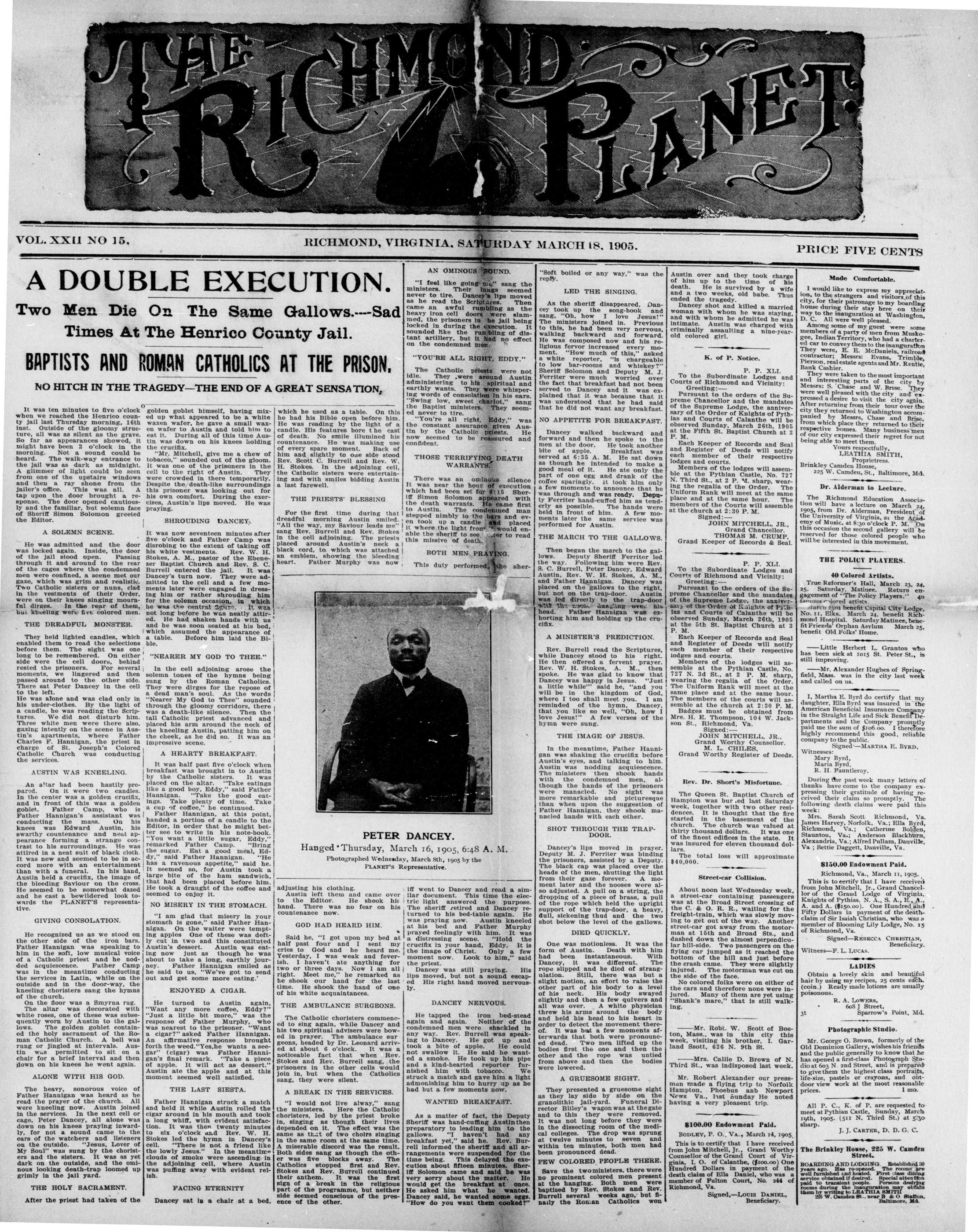
A DOUBLE EXECUTION.
Two Men Die On The Same Gallows.----Sad Times At The Henrico County Jail.
NO HITCH IN THE TRAGEDY—THE END OF A GREAT SENSATION.
VOL. XXII NO 15.
A DOUBLE
Two Men Die
Times At
BAPTISTS AND
NO HITCH IN THE T
It was ten minutes to five o'clock when we reached the Henrico county jail last Thursday morning, 16th inst. Outside of the gloomy structure, all was as silent as the grave. So far as appearances showed, it might have been 2 o'clock in the morning. Not a sound could be heard. The walk-way entrance to the jail was as dark as midnight. A glimmer of light could be seen from one of the upstairs windows and then a ray shone from the jailer's office. This was all. A tap upon the door brought a response. The door opened cautiously and the familiar, but solemn face of Sheriff Simon Solomon greeted the Editor.
A SOLEMN SCENE
He was admitted and the door was locked again. Inside, the door of the jail stood open. Passing through it and around to the rear of the cages where the condemned men were confined, a scene met our gaze, which was grim and realistic. Two Catholic sisters or nuns, clad in the vestments of their Order, were on their knees singing mournful dirges. In the rear of them, but kneeling were five colored men.
THE DREADFUL MONSTER.
They held lighted candles, which enabled them to read the selections before them. The sight was one long to be remembered. On either side were the cell doors, behind rested the prisoners. For several moments, we lingered and then passed around to the other side. There sat Peter Dancey in the cell to the left. He was alone and was clad only in his under-clothes. By the light of a candle, he was reading the Scripples. We did not disturb him. Those which men were there also gazing intently on the scene in Austin's apartments, where Father Charles F. Hannigan, the priest in charge of St. Joseph's Colored Catholic Church was conducting the services.
AUSTIN WAS KNEELING
An altar had been hastily prepared. On it were two candles. In the center was a golden crucifix, and in front of this was a golden goblet. Father Camp, who is Father Hannigan's assistant was conducting the mass. On his knees was Edward Austin, his swarthy countenance and neat appearance forming a strange contrast to his surroundings. He was attired in a neat suit of black cloth. It was new and seemed to be in accord more with an entertainment than with a funeral. In his hand, Austin held a crucifix, the image of the bleeding Saviour on the cross. He seemed to be somewhat dazed and he cast a bewildered look towards the PLANET'S representative.
GIVING CONSOLATION
He recognized us as we stood on the other side of the iron bars. Father Hannigan was speaking to him in the soft, low musical voice of a Catholic priest and he nodded acquiescence. Father Camp was in the meantime conducting the services in Latin, while on the outside and in the door-way, the kneeling christiers sang the hymns of the church.
On the floor was a Smyrna rug. The altar was decorated with white roses, one of these was subsequently worn by Austin to the gallows. The golden goblet contained the holy sacrament of the Roman Catholic Church. A bell was rung or jingled at intervals. Austin was permitted to sit on a chair for a brief interval and then down on his knees he went again.
ALONE WITH HIS GOD.
The heavy, sonorous voice of Father Hannigan was heard as he read the prayer of the church. All were kneeling now. Austin joined in the services. In the next cell or cage, Peter Dancey, all alone was down on his knees praying inwardly, for not a sound came to the ears of the watchers and listeners on the outside. "Jesus, Lover of My Soul" was sung by the choristers and the sisters. It was as yet dark on the outside, and the ominous looking death-trap loomed up grimly in the jail yard.
THE HOLY SACRAMENT.
After the priest had taken of the
golden goblet himself, having mixed up what appeared to be a white waxen wafer, he gave a small waxen wafer to Austin and told him to eat it. During all of this time Austin was down on his knees holding the crucifix.
"Mr. Mitchell, give me a chew of tobacco," sounded out of the gloom. It was one of the prisoners in the cell to the right of Austin. They were crowded in there temporarily. Despite the death-like surroundings this prisoner was looking out for his own comfort. During the exercises, Austin's lips moved. He was praying.
SHROUDING DANCEY.
It was now seventeen minutes after five o'clock and Father Camp was disrobing to the extent of taking off his white vestments. Rev. W. H. Stokes, A. M., pastor of the Ebenezer Baptist Church and Rev. S. C. Burrell entered the jail. It was Dancey's turn now. They were admitted to the cell and a few moments later were engaged in dressing him or rather shrouding him for the solemn occasion, in which he was the central figure. It was not long before he was neatly attired. He had shaken hands with us and he was soon seated at his bed, which assumed the appearance of a table. Before him laid the Bible.
"NEARER MY GOD TO THEE."
In the cell adjoining arose the solemn tones of the hymns being sung by the Roman Catholics. They were dirges for the repose of a dead man's soul. As the words "Nearer My God to Thee" sounded through the gloomy corridors, there was a death-like silence. Then the tall Catholic priest advanced and placed his arm around the neck of the kneeling Austin, patting him on the cheek, as he did so. It was an impressive scene.
A HEARTY BREAKFAST.
It was half past five o'clock when breakfast was brought in to Austin by the Catholic sisters. It was placed on the altar. "Take eatings like a good boy, Eddy," said Father Hannigan. "Take the good eatings. Take plenty of time. Take a cup of coffee," he continued. Father Hannigan, at this point, handed a portion of a candle to the Editor, in order that he might better see to write in his note-book. "You want a little sugar, Eddy," remarked Father Camp. "Bring the sugar. Eat a good meal, Eddy," said Father Hannigan. "He has a ravenous appetite," said he. It seemed so, for Austin took a large bite of the ham sandwich, that had been placed before him. He took a draught of the coffee and seemed to enjoy it.
NO MISERY IN THE STOMACH
"I am glad that misery in your stomach is gone," said Father Hannigan. On the waiter were tempting apples. One of these was definitely cut in two and this constituted Austin's dessert. Austin was eating now just as though he was about to take a long, earthly journey. Father Hannigan smiled as he said to us. "We've got to send out and get some more eating."
ENJOYED A CIGAR.
He turned to Austin again,
"Want any more coffee, Eddy?"
"Just a little bit more," was the response of Father Murphy, who was nearest to the prisoner. "Want a cigar?" asked Father Hannigan. An affirmative response brought forth the weed. "Yes, he wants a seegar" (cigar) was Father Hannigan's final remark. "Take a piece of apple. It will act as dessert." Austin ate the apple and at this moment seemed well satisfied.
THE LAST SIESTA.
Father Hannigan struck a match and hold it while Austin rolled the cigar around in his mouth and took a long whiff, with evident satisfaction. It was then twenty minutes to six o'clock and Rev. W. H. Stokes led the hymn in Dancey's cell. "There is not a friend like the lowly Jesus." In the meantime clouds of smoke were ascending in the adjoining cell, where Austin was puffing away with evident relish.
FACING ETERNITY
Dancey sat in a chair at a bed.
RICHMOND, VIRGINIA, SATURDAY MARCH 18, 1905.
THE MASTER
PETER DANCEY.
Hanged *Thursday, March 16, 1905, 6:48 A. M.
Photographed Wednesday, March 8th, 1905 by the PLANET'S Representative.
which he used as a table. On this he had his Bible open before him. He was reading by the light of a candle. His features bore the cast of death. No smile illumined his countenance. He was making use of every spare moment. Back of him and slightly to one side stood Rev. Scott C. Burrell and Rev. W. H. Stokes. In the adjoining cell, the Catholic sisters were entertaining and with smiles bidding Austin a last farewell.
THE PRIESTS' BLESSING
For the first time during that dreadful morning Austin smiled. "All the way, my Saviour leads me" sang Rev. Burrell and Rev. Stokes in the cell adjoining. The priests placed around Austin's neck a black cord, to which was attached an emblem, showing the bleeding heart. Father Murphy was now
PETER
Hanged Thursday, May
Photographed Wednesday
PLANET'S I
adjusting his clothing.
Austin left them and came over to the Editor. He shook his hand. The was no fear on his countenance now.
GOD HAD HEARD HIM
Said he, "I got upon my bed at half past four and I sent my cries to God and he heard me. Yesterday, I was weak and feverish. I haven't ate anything for two or three days. Now I am all right. Meet me," he remarked as he shook our hand for the last time. He shook the hand of one of his white acquaintances.
THE AMBULANCE SURGEONS
The Catholic choristers commenced to sing again, while Dancey and his two spiritual advisers were bowed in prayer. The ambulance surgeons, headed by Dr. Leonard arrived at about 6 o'clock. It was a noticeable fact that when Rev. Stokes and Rev. Burrell sang, the prisoners in the other cells would join in, but when the Catholics sang, they were silent.
A BREAK IN THE SERVICES.
"I would not live alway," sang the ministers. Here the Catholic choristers, led by the priest broke in, singing as though their lives depended on it. The effect was the same as that of two choirs singing in the same room at the same time. A miserable discord was the result. Both sides sang as though the other was five blocks away. The Catholics stopped first and Rev. Chesapeake and Rev. Burrell continued their singing. The first sign of a break in the first part of the programme, but neither side seemed conscious of the presence of the other.
AN OMINOUS SOUND.
"I feel like going on," sang the ministers. Their lungs seemed never to tire. Dancey's lips moved as he read the Scriptures. Then came an awful rumbling as the heavy iron cell doors were slammed, the prisoners in he jail being locked in during the execution. It sounded like the rumbling of distant artillery, but it had no effect on the condemned men.
"YOU'RE ALL RIGHT. EDDY."
The Catholic priests were not idle. They were around Austin administering to his spiritual and earthly wants. They were whispering words of consolation in his ears. "Swing low, sweet charlot," sang the Baptist ministers. They seemed never to tire. "You're all right, Eddy," was the constant assurance given Austin by the Catholic priests. He now seemed to be reassured and confident.
THOSE TERRIFYING DEATH
WARRANTS.
There was an ominous silence It was near the hour of execution which had been set for 6:15 Sheriff Simon Solomon appeared with the death warrants. He came first to Austin. The condemned man stepped nimbly to the bars and even took up a candle and placed it where the light from it would enable the sheriff to see order to read this missive of death.
BOTH MEN PRAYING.
This duty performed, the sher-
DANCEY.
March 16, 1905, 6:48 A. M.
May, March 8th, 1905 by the
Representative.
iff went to Dancey and read a similar document. This time the electric light answered the purpose. The sheriff retired and Dancey returned to his bed-table again. He was praying now. Austin kneeled at his bed and Father Murphy prayed feelingly with him. It was a distressing scene. "Hold the crucifix in your hand, Eddy. It is the image of Christ. Only a few moment now. Look to him," said the priest. Dancey was still praying. His lips moved, but not a sound escaped. His right hand moved nervously.
DANCEY NERVOUS.
He tapped the iron bed-sed again and again. Neither of the condemned men were shackled in any way. Rev. Burrell was speaking to Dancey. He got up and took a bite of apple. He could not swallow it. He said he wanted a smoke. He took up his pipe and a kind-hearted reporter furnished him with tobacco. We struck a match and gave him a light admonishing him to hurry up as he had but a few moments now.
WANTED BREAKFAST.
As a matter of fact, the Deputy Sheriff was hand-cuffing Austin then preparatory to leading him to the gallows. "I haven't had any breakfast yet," said he. Rev. Burrell informed the sheriff and all arrangements were suspended for the time being. This delayed the execution about fifteen minutes. Sheriff Solomon came and said he was very sorry about the matter. He would get the breakfast at once. He asked him what he wanted. Dancey said, he wanted some eggs. "How do you want them cooked?"
"Soft boiled or any way," was the reply.
LED THE SINGING.
As the sheriff disappeared, Dancey took up the song-book and sang, "Oh, how I love Jesus!" The ministers joined in. Previous to this, he had been very nervous, walking backward and forward. He was composed now and his religious fervor increased every moment. "How much of this," asked a white reporter, "is chargeable to low bar-rooms and whisky?" Sherif Solomon and Deputy M. J. Ferriter were much worried over the fact that breakfast had not been served to Dancey and it was explained that it was because that it was understood that he had said that he did not want any breakfast.
NO APPETITE FOR BREAKFAST
Dancey walked backward and forward and then he spoke to the men at the door. He took another bite of apple. Breakfast was served at 6:35 A. M. He sat down as though he intended to make a good meal of it. He ate only the part of one egg and drank of the coffee sparingly. it took him only a few moments to announce that he was through and was ready. Deputy Ferriter hand-cuffed him as tenderness as possible. The hands were held in front of him. A few moments later the same service was performed for Austin.
THE MARCH TO THE GALLOWS
Then began the march to the gallows. Deputy Sheriff Ferritor led the way. Following him were Rev. S. C. Burrell, Peter Dancey, Edward Austin, Rev. W. H. Stokes, A. M., and Father Hannigan. Dancey was placed on the gallows to the right, but not on the trap-door. Austin was led directly to the trap-door with the noose dangling over his head. Father Hannigan was exhorting him and holding up the crucifix.
A MINISTER'S PREDICTION
Rev. Burrell read the Scriptures, while Dancey stood to his right. He then offered a fervent prayer. Rev. W. H. Stokes, A. M., then spoke. He was glad to know that Dancey was happy in Jesus. "Just a little while" said he, "and you will be in the kingdom of God, where I too shall meet you. I am reminded of the hymn, Dancey, that you like so well, "Oh, how I love Jesus!" A few verses of the hymn were sung.
THE IMAGE OF JESUS.
In the meantime, Father Hannigan was shaking the crucifix before Austin's eyes, and talking to him. Austin was nodding acquiescence. The ministers then shook hands with the condemned men, although the hands of the prisoners were manacled. No sight was more remarkable and picturesque than when upon the suggestion of Father Hannigan, they shook manacled hands with each other.
SHOT THROUGH THE TRAP-DOOR.
Dancey's lips moved in prayer. Deputy M. J. Ferriter was binding the prisoners, assisted by a Deputy. The black cap was placed over the heads of the men, shutting the light from their gaze forever. A moment later and the nooses were also adjusted. A pull on a string, the dropping of a piece of brass, a pull of the rope which held the upright support of the trap-door, a heavy, dull, sickening thud and the two shot below the level of the gallows.
DIED QUICKLY.
One was motionless. It was the form of Austin. Death with him had been instantaneous. With Dancey, it was different. The rope slipped and he died of strangulation. Still, there was but a slight motion, an effort to raise the other part of his body to a level of his neck. His body swayed slightly and then a few quivers and all was over. A white physician threw his arms around the body and held his head to his heart in order to detect the movement thereof. It was but a few moments afterwards that both were pronounced dead. Two men lifted up the bodies first the one and then the other and the rope was untied from above and then the bodies were lowered.
A GRUESOME SIGHT.
They presented a gruesome sight as they lay side by side on the granolithic jail-yard. Funeral Director Billey's wagon was at the gate and to this they were removed. It was not long before they were in the dissecting room of the medical colleges. The drop was sprung at twelve minutes to seven and within ten minutes, both men had been pronounced dead.
FEW COLORED PEOPLE THERE.
Save the twoministers, there were no prominent colored men present at the hanging. Both men were baptized by Rev. Stokes and Rev. Burrell several weeks ago, but finally the Roman Catholics won
Austin over and they took charge of him up to the time of his death. He is survived by a wife and a two weeks, old babe. Thus ended the tragedy. Dancey shot and killed a married woman with whom he was staying, and with whom he admitted he was intimate. Austin was charged with criminally assaulting a nine-year-old colored girl.
K. of P. Notice
To the Subordinate Lodges and Courts of Richmond and Vicinity:
Greeting:—
Pursuant to the orders of the Supreme Chancellor and the mandates of the Supreme Lodge, the anniversary of the Order of Knights of Pythias and Courts of Calanthe will be observed Sunday, March 26th, 1905 at the Fifth St. Baptist Church at 3 P. M.
Each Keeper of Records and Seal and Register of Deeds will notify each member of their respective lodges and courts.
Members of the lodges will assemble at the Pythian Castle, No. 727 N. Third St., at 2 P. M. sharp, wearing the regalia of the Order. The Uniform Rank will meet at the same place and at the same hour. The members of the Courts will assemble at the church at 2:30 P. M.
Signed:—
JOHN MITCHELL, JR.,
Grand Chancellor.
THOMAS M. CRUMP,
Grand Keeper of Records & Seal
To the Subordinate Lodges and Courts of Richmond and Vicinity:
Greeting:—
Pursuant to the orders of the Supreme Chancellor and the mandates of the Supreme Lodge, the anniversary of the Order of Knights of Pythias and Courts of Calanthe will be observed Sunday, March 26th, 1905 at the 5th St. Baptist Church at 3 P. M.
Each Keeper of Records and Seal and Register of Deeds will notify each member of their respective lodges and courts.
Members of the lodges will assemble at the Pythian Castle, No. 727 N. 3d St., at 2 P. M. sharp, wearing the regalia of the Order. The Uniform Rank will meet at the same place and at the same hour. The members of the courts will assemble at the church at 2:30 P. M.
Badges must be obtained from Mrs. H. E. Thompson, 104 W. Jackson St., Richmond, Va.
Signed:—
JOHN MITCHELL, JR.,
Grand Worthy Counsellor.
M. L. CHILES,
Grand Worthy Register of Deeds
Rev. Dr. Short's Misfortune.
The Queen St. Baptist Church of Hampton was bur ed last Saturday week, together with two other residences. It is thought that the fire started in the basement of the church. The church was valued at thirty thousand dollars. It was one of the finest edifices in the state. It was insured for eleven thousand dollars. The total loss will approximate $40,000.
Street-car Collision
About noon last Wednesday week, a street-car containing passengers was at the Broad Street crossing of the C. & O. R. R., waiting for the freight-train, which was slowly moving to get out of the way. Another street-car got away from the motorman at 15th and Broad Sts., and dashed down the almost perpendicular hill-side. Two passengers on the flying car jumped as it reached the bottom of the hill and just before the crash came. They were slightly injured. The motorman was cut on the side of the face.
No colored folks were on either of the cars and therefore none were injured. Many of them are yet using "Shank's mare," that is still walking.
Mr. Robt. W. Scott of Boston, Mass., was in this city this week, visiting his brother, I. Garland Ssott, 626 N. 9th St.
Mrs. Callie D. Brown of N. Third St., was indisposed last week.
Mr. Robert Alexander our pressman made a flying trip to Norfolk Hampton, Phoebus ab Newport News Va., last Sunday He noted having a very pleasant trip.
$100.00 Endowment Paid.
BODLEY, P. O., VA., March 14, 1905.
This is to certify that I have received from John Mitchell, Jr., Grand Worthy Counselor of the Grand Court of Virginia, I. O. of Calanthe, ($100.00) One Hundred Dollars in payment of the death claim of Ella Daniel, who was a member of Fulton Court, No. 244 of Richmond, Va.
Signed,—LOUIS DANIEL,
Beneficiary.
Made Comfortable.
I would like to express my appreciation, to the strangers and visitors of this city, for their patronage to my boarding house during their stay here on their way to the inauguration at Washington, D. C. All were well pleased.
Among some of my guest were some members of a party of men from Muskogee, Indian Territory, who had a chartered car to convey them to the inauguration They were, E. E. McDaniels, railroad contractor; Messrs: Evans, Trumble, Pierson, real estate agents and Mr. Rentie, Bank Cashier.
They were taken to the most important and interesting parts of the city by Messrs: S. Chase and W. Brise. They were well pleased with the city and expressed a desire to visit the city again. After returning from their tour over the city they returned to Washington accompanied by Messrs, Chase and Brise, from which place they returned to their respective homes. Many business men of our city expressed their regret for not being able to meet them.
225 W. Camden, St., Baltimore, Md.
Dr. Alderman to Lecture.
The Richmond Education Association will have a lecture on March 24, 1905, from Dr. Alderman, President of the University of Virginia, at the Academy of Music, at 8:30 o'clock P. M. On this occasion the second gallery will be reserved for those colored people who will be interested in this movement.
THE POLICY PLAYERS
40 Colored Artists.
True Reformer's Hall, March 23, 24.
25. Saturday, Matinee. Return engagement of "The Policy Players." 40 famous cloaked artists.
March 23rd benefit Capital City Lodge, No. 11, Elks. March 24, benefit Richmond Hospital. Saturday Matinee, benefit Friends' Orphan Asylum March 25, benefit Old Folks' Home.
Little Herbert L. Granton who has been sick at 1015 St. Peter St., is still improving.
Mr. Alexander Hughes of Springfield, Mass. was in the city last week and called on us.
---
I, Martha E. Byrd do certify that my daughter, Ella Byrd was insured in the American Beneficial Insurance Company in the Straight Life and Sick Benefit Departments and the Company promptly paid me the sum of $106.00. I therefore highly recommend this good, reliable company to the public.
Signed—MARTHA E. BYRD,
Witnesses:
Mary Byrd,
Maria Byrd,
R. H. Paunteroy.
During the past week many letters of thanks have come to the company expressing their gratitude of having received their claim so promptly. The following death claims were paid this week:
Mrs. Sarah Scott. Richmond, Va.
James Harvey, Norfolk, Va.; Ella Byrd, Richmond, Va.; Catherine Bolden, Staunton, Va.; Anderson Blackburn, Alexandria, Va.; Alfred Pullam, Danville, Va.; Bettie Daggett, Danville, Va.
$150.00 Endowment Paid.
Richmond, Va., March 11, 1995.
This is to certify that I have received from John Mitchell, Jr., Grand Chancellor of the Grand Lodge of Virginia, Knights of Pythias, N. A., S. A. E., A., A. and A. ($150.00). One Hundred and Fifty Dollars in payment of the deathclaim of Sir Isaiah Christian, who was a member of Blooming Lily Lodge, No. 15 of Richmond, Va.
Signed—REBECCA CHRISTIAN,
Beneficiary.
Witness—F. L. LUCAS.
LADIES
Obtain a lovely skin and beautiful hair by using my recipes, 25 cents each.
(coin.) Ready made lotions are usually poisonous.
R. A. LOWERS,
608 J Street,
3t
Sparrow's Point, Md.
Photographic Studio.
Mr. George O. Brown, formerly of the Old Dominion Gallery, wishes his friends and the public generally to know that he has opened a first-class Photograph Studio at 603 N. 2nd Street, and is prepared to give them the highest class portraits, life-size, pastels or crayons, and outdoor view work at the most reasonable prices. 1 mo.
All P. C. K. of P. are requested to meet at Pythian Castle, Sunday, March 19th, 1905. (511 N. Third St.) at 5:30 sharp.
J. J. CARTER, D. D. G. C.
The Brinkley House, 225 W. Camden Street.
BOARDING AND LODGING. Established 30 years ago. Has re-opened. The rooms are well furnished and heated. First class dining service obtained if desired. Special attention given to guests. Dining rooms during the inauguration may obtain them by writing to LEATHIA SMITH
225 W. Camden St., near B & O Station
Baltimore, Md.
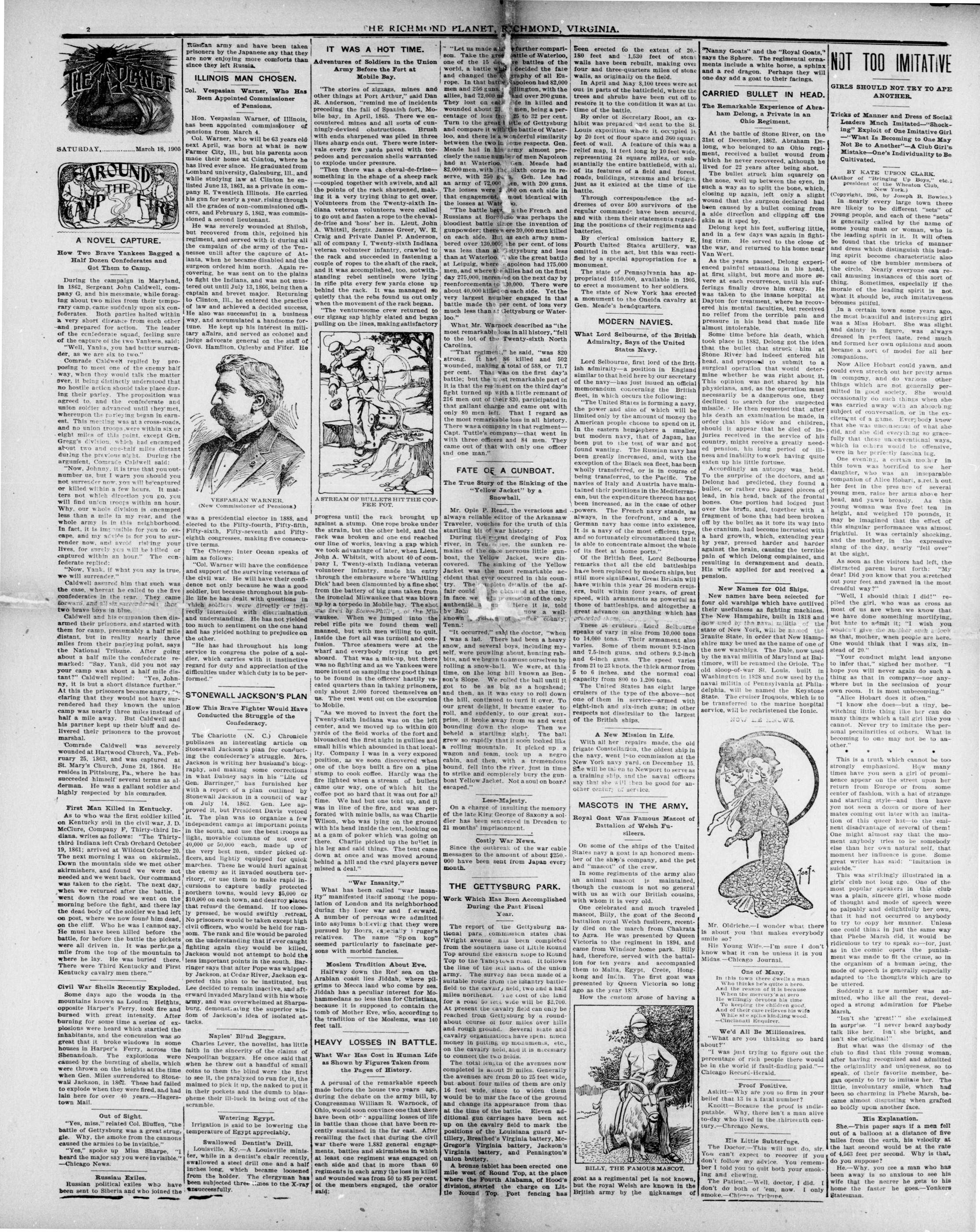
THE PLANET
SATURDAY.....March 18, 1905
AROUND
THE
CAMP FIRE
A NOVEL CAPTURE.
How Two Brave Yankees Bagged a Half Dozen Confederates and Got Them to Camp.
During the campaign in Maryland, in 1862, Sergeant John Caldwell, company G, and his messmate, while foraging about two miles from their temporary camp, came suddenly upon six confederates. Both parties halted within a very short distance from each other and prepared for action. The leader of the confederate squad, feeling sure of the capture of the two Yankees, said:
"Well, Yanks, you had better surrender, as we are six to two."
Comrade Caldwell replied by proposing to meet one of the enemy half way, when they would talk the matter over, it being distinctly understood that no hostile action should take place during their parley. The proposition was agreed to, and the confederate and union soldier advanced until they met, whereupon the parleying began in earnest. This meeting was at a cross-roads, and no union troops were within six or eight miles of this point, except Gen. Gregg's division, which had encamped about two and one-half miles distant during the previous night. During the argument, Comrade Caldwell said:
"Now, Johnny, it is true that you out-
number us, but I warn you should you
not surrender now, you will be captured
or killed within a few hours. It matters
not which direction you go, you will find union troops within an hour.
Why, our whole division is encamped
less than a mile in my rear, and the
whole army is in this neighborhood.
In fact, it is impossible for you to
escape, and my advice is for you to
surrender now, and avoid rising your
lives, for surely you will be killed
or captured within an hour." The con-
federate replied:
"Now, Yank, if what you say is true,
we will surrender."
Caldwell assured him that such was
the case, whereat he called to the five
confederates in the rear. They came
forward, and all six surrendered, those
two brave boys in blue.
Caldwell and his companion then disarmed their prisoners, and started with them for camp, presumably a half mile distant, but in reality nearly three miles from their parlaying point, says the National Tribune. After going about a half mile the confederate remarked: "Say, Yank, did you not say your camp was about a half mile distant?" Caldwell replied: "Yes, Johnny, it is but a short distance further." At this the prisoners became angry, "claring that they would not have surrendered had they known the union camp was nearly three miles instead of half a mile away. But Caldwell and his partner kept up their bluff and delivered their prisoners to the provost marshal.
Comrade Caldwell was severely wounded at Hartwood Church, Va., February 25, 1863, and was captured at St. Mary's Church, June 24, 1864. He resides in Pittsburg, Pa., where he has succeeded himself several terms as alderman. He was a gallant soldier and highly respected by his comrades.
First Man Killed in Kentucky
First Man Killed in Kentucky.
As to who was the first soldier killed on Kentucky soil in the civil war, J. D. McClure, Company F, Thirty-third Indiana, writes as follows: "The Thirty-third Indiana left Crab Orchard October 19, 1861; arrived at Wildcat October 20. The next morning I was on skirmish. Down the mountain side we met other skirmishers, and found we were not needed and we went back. Our command was taken to the right. The next day, when we returned after the battle, I went down the road we went on the morning before the fight, and there lay the dead body of the soldier we had left on post, where we now found him dead, on the cliff. Who he was I cannot say. He must have been killed before the battle, for before the battle the pickets were all driven in. It was perhrps a mile from the top of the mountain to where he lay. He was buried there. There were Third Kentucky and First Kentucky cavalry men there."
Civil War Shells Recently Exploded
Civil War Shells Recently Exploded.
Some days ago the woods in the mountains known as Louden Heights, opposite Harper's Ferry, took fire and burned with great intensity. After burning for some time a series of explosions were heard which startled the inhabitants, and the concussion was so great that it broke windows in some houses in Harper's Ferry, across the Shenandoah. The explosions were caused by the bursting of shells, which were thrown on the heights at the time when Gen. Miles surrendered to Stonewall Jackson, in 1862. These had failed to explode when they were fired, and had lain here for over 40 years.—Hagerstown Mall.
Out of Sight
"Yes, miss," related Col. Bluffen, "the battle of Gettysburg was a great struggle. Why, the smoke from the cannons caused the armies to be invisible."
"Yes," spoke up Miss Sharpe, "I heard the major say you were invisible."
—Chicago News.
Russian Exiles.
Russian political exiles who have been sent to Siberia and who joined the
Russian army and have been taken prisoners by the Japanese say that they are now enjoying more comforts than since they left Russia.
ILLINOIS MAN CHOSEN.
Col. Vespasian Warner, Who Has Been Appointed Commissioner of Pensions.
Hon. Vespasian Warner, of Illinois, has been appointed commissioner of pensions from March 4.
Col. Warner, who will be 63 years old next April, was born at what is now Farmer City, Ill., but his parents soon made their home at Clinton, where he has lived ever since. He graduated from Lombard university, Galesburg, Ill., and while studying law at Clinton he enlisted June 13, 1861, as a private in company E. Twentieth Illinois. He carried his gun for nearly a year, rising through all the grades of non-commissioned officers, and February 5, 1862, was commissioned a second lieutenant.
He was severely wounded at Shiloh, but recovered from this, rejoined his regiment, and served with it during all the campaign of the army of the Tennessee until after the capture of Atlanta, when he became disabled and the surgeon ordered him north. Again recovering, he was sent on to the plains to fight the Indians, and was not mustered out until July 13, 1866, being then a captain and brevet major. Returning to Clinton, Ill., he entered the practice of law and achieved a decided success. He also was successful in a business way, and accumulated a handsome fortune. He kept up his interest in military affairs, and served as colonel and judge advocate general on the staff of Govs. Hamilton, Oglesby and Fifer. He
VESPASIAN WARNER.
(New Commissioner of Pensions.)
was a presidential elector in 1888, and elected to the Fifty-fourth, Fifty-fifth, Fifty-sixth, Fifty-seventh and Fifty-eighth congresses, making five consecutive terms.
The Chicago Inter Ocean speaks of him as follows:
"Col. Warner will have the confidence and support of the surviving veterans of the civil war. He will have their confidence not only because he was a good soldier, but because throughout his public life he has dealt with questions in which soldiers were directly or indirectly interested with discrimination and understanding. He has not yielded too much to sentiment on the one hand and has yielded nothing to prejudice on the other.
"He has had throughout his long service in congress the poise of a soldier, which carries with it instinctive regard for duty and appreciation of the difficulties under which duty is to be performed."
STONEWALL JACKSON'S PLAN
How This Brave Fighter Would Have Conducted the Struggle of the Confederacy.
The Charlotte (N. C.) Chronicle publishes an interesting article on Stonewall Jackson's plan for conducting the confederacy's struggle. Mrs. Jackson is writing her husband's biography, and making some corrections in what Dabney says in his "Lite of Gen. Barringer," has furnished her with a report of a plan outlined by Stonewall Jackson in a council of war on July 14, 1862. Gen. Lee approved it, but President Davis vetoed it. The plan was to organize a few independent camps at important points in the south, and use the best troops as light, movable columns of not over 40,000 or 50,000 each, made up of the very best men, under picked officers, and lightly equipped for quick marches. These he would hurl against the enemy as it invaded southern territory, or use them to make rapid incursions to capture badly protected northern towns, would levy $5,000 or $10,000 on each town, and destroy places that refused the demand. If too closely pressed, he would swiftly retreat. No prisoners would be taken except high civil officers, who would be held for ransom. The rank and file would be paroled on the understanding that if ever caught fighting again they would be killed, Jackson would not attempt to hold the less important points in the south. Barringer says that after Pope was whipped by Jackson, at Cedar River, Jackson expected this plan to be instituted, but Lee decided to remain inactive, and afterward invaded Maryland with his whole army, and was overwhelmed at Sharpsburg, demonstating the superior wisdom of Jackson's idea of isolated attacks.
Naples' Blind Beggars.
Charles Lever, the novelist, has little faith in the sincerity of the claims of Neapolitan beggars. He once said that when he threw out a handful of small coins to them the blind were the first to see it, the paralyzed to run for it, the malmed to pick it up, the naked to put it in their pockets and the dumb to blaspheme their ill-luck in being out of the scramble.
Watering Egypt
Irrigation is said to be lowering the temperature of Egypt appreciably.
Swallowed Dentist's Drill
Swallowed Dentist's Drill. Louisville, Ky.—A Louisville minister, while in a dentist's chair recently, swallowed a steel drill one and a half inches long, which became loosened from the holder. The clergyman has been subjected three times to the X-ray unsuccessfully.
THE RICHMOND PLANET, RICHMOND, VIRGINIA.
IT WAS A HOT TIME.
Adventures of Soldiers in the Union Army Before the Fort at Mobile Bay.
"The stories of zigzags, mines and other things at Port Arthur," said Dan R. Anderson, "remind me of incidents preceding the fall of Spanish fort, Mobile bay, in April, 1865. There we encountered mines and all sorts of cunningly-devised obstructions. Brush with ends sharpened was piled in three lines sharp ends out. There were intervals every few yards paved with torpedoes and percussion shells warranted to explode under pressure.
"Then there was a cheval-de-frise—something in the shape of a sheep rack—coupled together with swivels, and all the points of the rack sharpened, making it a very trying thing to get over. Volunteers from the Twenty-sixth Indiana veteran volunteers were called to go out and fasten a rope to the cheval-de-frise and 'hoss' her in. Lieut. John A. Whitsil, Sergts. James Greer, W. E. Craig and Private Daniel P. Anderson, all of company I. Twenty-sixth Indiana veteran volunteer infantry, crawled to the rack and succeeded in fastening a couple of ropes to the shaft of the rack, and it was accomplished, too, notwithstanding rebel sentinels were lying in rifle pits every few yards close up behind the rack. It was managed so quietly that the rebs found us out only when the movement of the rack began.
"The venturesome crew returned to our zigzag sap highly elated and began pulling on the lines, making satisfactory
THE STORY OF THE STUMP
A STREAM OF BULLETS HIT THE COF FEE POT.
progress until the rack brought up against a stump. One rope broke under the strain, but the other held, and the rack was broken and one end reached our line of works, leaving a gap which we took advantage of later, when Lleut. John A. Whitsit, with about 40 of company I, Twenty-sixth Indiana veteran volunteer infantry, made his entry through the embrasure where 'Whitling Dick' had been dismounted by a fine shot from the battery of big guns taken from the ironclad Milwaukee that was blown up by a torpedo in Mobile bay. The shot was fired by Sweeney Phillip of the Milwaukee. When we jumped into the rebel rifle pits we found them well manned, but with men willing to quit, inside the fort all was turnoil and confusion. Three steamers were at the wharf and everybody trying to get aboard. That was a mix-up, but there was no fighting and as we Yankees were more intent on sampling the good things to be found in the officers' hastily vacated quarters than in taking prisoners, only about 2,000 forced themselves on us. The rest went out on the excursion to Mobile.
"As we moved to invest the fort the Twenty-sixth Indiana was on the left center, and we moved up to within 600 yards of the field works of the fort and bivouacked the first night in gullies and small hills which abounded in that locality. Company I was in a very exposed position, as we soon discovered when one of the boys built a fire on a pine stump to cook coffee. Hardly was the fire lighted when a stream of bullets came our way, one of which hit the coffee pot so hard that it was out for all time. We had but one tent up, and it was in line of the fire, and was perforated with minie balls, as was Charlie Wilson, who was lying on the ground with his head inside the tent, looking on at a gam of poker which was going on there. Charlie picked up the bullet in his leg and said things. The tent came down at once and was moved around behind a hill and the card players never missed a deal."
"War Insanity."
What has been called "war insanity" manifested itself among the population of London and its neighborhood during the Boer war and, further. A number of persons were admitted into asylums believing that they were pursued by Boers, (especially) ruger's relatives. The name "Spon kop" seemed particularly to fascinate persons with morbid fancies.
Moslem Tradition About Eve
Halfway down the Red sea on the Arabian coast lies Jiddah, where pilgrims to Mecca land who come by sea. Jiddah has a peculiar interest for Mohammedans no less than for Christians, because it is supposed to contain the tomb of Mother Eve, who, according to the tradition of the Moslems, was 140 feet tall.
HEAVY LOSSES IN BATTLE.
What War Has Cost in Human Life as Shown by Figures Taken from the Pages of History.
A perusal of the remarkable speech made before the house two years ago, during the debate on the army bill, by Congressman William R. Warnock, of Ohio, would soon convince one that there have been other appalling losses of life in battle than those that have been recently sustained in the far east. After recalling the fact that during the civil war there were 1.882 general engagements, battles and skirmishes in which at least one regiment was engaged on each side and that in more than 60 regiments in each army the loss in killed and wounded was from 50 to 85 per cent. of the members engaged, the orator said:
"Let us make a little further comparison. Take the green battle of Waterloo, one of the 15 defenders, five battles of the world, a battle which decided the fate and changed the life graphy of all Europe. In that battle, Napoleon had 82,000 men and 256 guns, inallington, with the allies, had 72,000 men and over 200 guns. They lost on each side in killed and wounded about 23,500 men, being a percentage of loss from 25 to 32 per cent. Turn to the great little of Gettysburg and compare it with the battle of Waterloo, and there is a wonderful similarity between the two in some respects. Gen. Meade had in his army almost precisely the same number of men Napoleon had at Waterloo. Gen. Meade had 82,000 men, with the sixth corps in reserve, with 250 guns. Gen. Lee had an army of 72,000 men, with 200 guns. The losses were 2,000 on each side in that engagement, most identical with the losses at Waterloo.
"The battle between the French and Russians at Boredo no was perhaps the bloodiest battle since the invention of gunpowder; there were 30,000 men killed on each side. But as each army numbered over 130,000, the per cent. of loss was less than at Gettysburg and less than at Waterloo. Take the great battle at Leipzig, where apoleon had 175,000 men, and where the allies had on the first day 275,000, increased on the next day by reenforcements to 130,000. There were about 40,000 killed on each side. Yet the very largest number engaged in that battle made the per cent. of loss very much less than at Gettysburg or Waterloo."
What Mr. Warnock described as "the most remarkable loss in all history," "fell to the lot of the Twenty-sixth North Carolina.
"That regiment," he said, "was 820 strong. It had 86 killed and 502 wounded, making a total of 588, or 71.7 per cent. That was on the first day's battle; but the most remarkable part of it is that the regiment on the third day's fight turned up with a little remnant of 216 men out of their 820, participated in that gallant charge and came out with only 80 men left. That I regard as the most remarkable loss in all history. There was a company in that regiment—Capt. Tuttle's company—that went in with three officers and 84 men. They came out of that with only one officer and one man."
FATE OF A CUNBOAT.
Mr. Opie P. Read, the veracious and always reliable editor of the Arkansaw Traveler, vouches for the truth of this startling bit of war history:
During the recent dredging of Fox river, in Tennessee, the sunken remains of the once nervous little gunboat, the Yellow Jacket, were discovered. The sinking of the Yellow Jacket was the most remarkable accident that ever occurred in this country. The complete details of the affair could be obtained at the time, in face we can possession of the only authentic a gun. Here it is, told by John. Now a well-known system of coffee county, Tenn.
"It occurred," said the doctor, "when I was a lad. There had been a heavy snow, and several boys, including myself, were prowling about, hunting rabbits, and we began to amuse ourselves by rolling a snow-ball. We were, at this time, on the long hill known as Benson's Slope. We rolled the ball until it got to be as big as a hoghead; and then, as it was easy to roll down the hill, continued to turn it over. To our great delight, it became easier to roll, and suddenly, to our great surprise, it broke away from us and went bounding down the slope. Then we beheld a startling sight. The ball grew so rapidly that it soon looked like a rolling mountain. It picked up a wagon and team, took up a negro cabin, and then, with a tremendous bound, fell into the river, just in time to strike and completely bury the gunboat Yellow Jacket. Not a soul on board escaped."
Lese-Majesty.
On a charge of insulting the memory of the late King: George of Saxony a soldier has been sentenced in Dresden to 21 months' imprisonment.
Costly War News
Since the outbreak of the war cabl
messages to the amount of about $250.
000 have been sent from Japan every
month.
THE GETTYSBURG PARK.
Work Which Has Been Accomplished During the Past Fiscal
The report of the Gettysburg national park commission states that Wright avenue has been completed from the southern base of Little Round Top around the eastern slope to Round Top to the Tancytown roan. It follows the line of the tent hank of the union army. The survey has been made of a suitable route from the infantry battlefield to the cavalry, field, two and a half miles northeast. The cost of the land for a road 50 feet wide will be $2,700. At present the cavalry field can only be reached from Gettysburg by a roundabout course of four miles over hills and rough ground. Several state and cavalry organizations have spent much money in putting up monuments, etc., on the cavalry field, and it is necessary to connect the two fields.
The total length of the avenues now completed is about 20 miles. Generally the avenues are from 20 to 25 feet wide, but about four miles of them are only 16 feet wide, since to widen them would be to mar the face of the ground and change its appearance from that at the time of the battle. Eleven additional gun carriages have been set up on the cavalry field to mark the positions of the Louisiana guard artillery, Breathed's Virginia battery, McGregor's Virginia battery, Jackson's Virginia battery, and Pennington's union battery.
A bronze tablet has been erected one mile west of Round Top, at the place where the Fourth Alabama, of Hood's division, started the charge on Little Round Top. Post fencing has
Been erected to the extent of 20,180 feet and 1,530 feet of stone walls have been rebuilt, making over four and three-quarters miles of stone walls, as originally on the field.
In April and May 8,100 trees were set out in parts of the battlefield, where the trees and shrubs have been cut off to restore it to the condition it was at the time of the battle.
By order of Secretary Root, an exhibit was prepared and sent to the St. Louis exposition where it occupied 10 by 20 feet of floor space and 360 square feet of wall. A feature of this was a relief map, 14 feet long by 10 feet wide, representing 24 square miles, or substantially the entire battlefield, with all of its features of a field and forest, roads, buildings, streams and bridges, just as it existed at the time of the battle.
Through correspondence the addresses of over 500 survivors of the regular command have been secured, and with them their statements regarding the positions of their regiments and batteries.
By clerical omission battery E, Fourth United States artillery, was omitted in the act, but this was rectified by a special appropriation for a monument.
The state of Pennsylvania has appropriated $150,000, available in 1905, to erect a monument to her soldiers.
The state of New York has erected a monument to the Oneida cavalry at Gen. Meade's headquarters.
MODERN NAVIES
What Lord Selbourne, of the British Admiralty, Says of the United States Navy.
Lord Selbourne, first lord of the British admiralty—a position in England similar to that held here by our secretary of the navy—has just issued an official memorandum concerning the British fleet, in which occurs the following:
"The United States is forming a navy, the power and size of which will be limited only by the amount of money the American people choose to spend on it. In the eastern hemisphere a smaller, but modern navy, that of Japan, has been put to the test of war and not found wanting. The Russian navy has been greatly increased, and, with the exception of the Black sea fleet, has been wholly transferred, or is in course of being transferred, to the Pacific. The navies of Italy and Austria have maintained their positions in the Mediterranean, but the expenditure thereon has not been increased, as in the case of other powers. The French navy stands, as always, in the forefront, and a new German navy has come into existence. It is a navy of the most efficient type, and so fortunately circumstanced that it is able to concentrate almost the whole of its fleet at home ports."
Of the British fleet, Lord Selbourne remarks that all the old battleships have been replaced by modern ships, but still more significant, Great Britain will have within this year 26 modern cruisers, built within four years, of great speed, with armaments as powerful as those of battleships, and altogether a great advance on anything which has preceded them.
These 26 cruisers Lord Selbourne speaks of vary in size from 10,000 tons to 14,000 tons. Their armament also varies. Some of them mount 9.2-inch and 7.5-inch guns, and others 9.2-inch and 6-inch guns. The speed varies from 21 to 23 knots, the thick armor from 5 to 6 inches, and the normal coal capacity from 800 to 1,200 tons.
The United States has eight large cruisers of the type of the above—not one of them in service—armed with eight-inch and six-inch guns; in other respects not dissimilar to the largest of the British ships.
A New Mission in Life
With all her repairs made, the old frigate Constellation, the oldest ship in the navy, went into commission at the New York navy yard, on December 15. She will be taken to Newport to serve as a training ship, and the naval officers say that she will then be good for another century of service.
MASCOTS IN THE ARMY.
Royal Goat Was Famous Mascot of
Battalion of Welsh Fus-
sileers.
On some of the ships of the United
States navy a goat is an honored
member of the ship's company, and the pet
and "mascot" of the crew.
In some regiments of the army also
an animal mascot is maintained,
though the custom is not so general
with us as with our British cousins,
with whom it is very old.
One celebrated and much traveled mascot, Billy, the goat of the Second battalion royal Welsh fusileers, recently died on the march from Chakrate to Agra. He was presented by Queen Victoria to the regiment in 1894, and came from Windsor home park. Billy had, therefore, served with the battalion for ten years and accompanied them to Malta, Egypt, Crete, Hongkong and India. The first goat was presented by Queen Victoria so long ago as the year 1829. How the custom arose of having a
BILLY. THE FAMOUS MASCOT
goat as a regimental pet is not known, but the royal Welsh are known in the British army by the nicknames of
"Nanny Goats" and the "Royal Goats," says the Sphere. The regimental ornaments include a white horse, a sphinx and a red dragon. Perhaps they will one day add a goat to their facings.
CARRIED BULLET IN HEAD.
The Remarkable Experience of Abraham Delong, a Private in an Ohio Regiment.
At the battle of Stone River, on the 1st of December, 1862, Abraham Delong, who belonged to an Ohio regiment, received a bullet wound from which he never recovered, although he lived for 22 years after being shot. The bullet struck him squarely on the nose, well up between the eyes, in such a way as to split the bone, which, closing up again, left only a slight wound that the surgeon declared had been caused by a bullet coming from a side direction and clipping off the skin as it sped by. Delong kept his feet, suffering little, and in a few days was again in fighting trim. He served to the close of the war, and returned to his home near Wart.
As the years passed, Delong experienced painful sensations in his head, at first slight, but more and more severe at each recurrence, until his sufferings finally drove him crazy. He was taken to the insane hospital at Dayton for treatment, where he recovered his mental faculties, but received no relief from the terrible pain and pressure in his head that made life almost intolerable.
Some time before his death, which took place in 1882. Delong got the idea that the bullet that struck him at Stone River had indeed entered his head, and proposed to submit to a surgical operation that would determine whether he was right about it. This opinion was not shared by his physicians, and, as the operation must necessarily be a dangerous one, they declined to search for the suspected missile. He then requested that after his death an examination be made, in order that his widow and children, should it appear that he died of injuries received in the service of his country, might receive a greatly needed pension, his long period of illness and inability to work having quite eaten up his little fortune.
Accordingly an autopsy was held. To the surprise of the doctors, and as Delong had predicted, they found a bullet, or rather two jagged pieces of lead, in his head, back of the frontal bones. One portion had lodged just over the brain, and, together with a fragment of bone that had been broken off by the bullet as it tore its way into the cranium, had become incrusted with a hard growth, which, extending year by year, pressed harder and harder against the brain, causing the terrible pain of which Delong complained, and resulting in derangement and death. His wife applied for and received a pension.
New Names for Old Ships
New names have been selected for four old warships which have outlived their usefulness as fighting machines. The New Hampshire, built in 1818 and now used by the naval militia of the state of New York, will be named the Granite State, in order that New Hampshire may be used as the name of one of the new warships. The Dale, now used by the naval militia of Maryland at Baltimore, will be renamed the Oriole. The old sloop-of-war St. Louis, built in Washington in 1828 and now used by the naval militia of Pennsylvania at Philadelphia, will be named the Keystone State. The cruiser Iroquois, which is to be transferred to the marine hospital service, will be rechristened the Ionic.
foet.
Mr. Oldriche—I wonder what there is about you that makes everybody smile so?
His Young Wife—I'm sure I don't know what it can be unless it is you Midas—Chicago Journal.
One of Many.
In this town there dwells a man
who thinks he's quite a hero.
And the reason of it is because
When the mercury's at zero
He willilingly writes his time
To keeping the children good.
Of their care relieves his wife
While she splits kindling wood.
—Cincinnati Enquirer.
We'd All Be Millionaires.
"What are you thinking so hard about?"
"I was just trying to figure out the percentage of rich people there would be in the world if fault-finding paid."—Chicago Record-Herald.
Proof Positive
Raskett—Why are you so him in your belief that 13 is a fatal number? Knott—Because the proof is indisputable. Why, there isn't a man alive to-day who lived in the thirteenth century.—Chicago News.
His Little Subterfuge
The Doctor.—This will not do, dr. shr. You can't expect to recover if you don't follow my advice. You remember I told you to quit both your smoking and chewing. The Patient.—Well, doctor, I did. I don't do both of 'em, now. I only smoke.—Chicago Tribune.
NOT TOO IMITATIVE
GIRLS SHOULD NOT. TRY TO APE
ANOTHER.
Tricks of Manner and Dress of Social
Leaders Munch Imitated—"Shock-
ing" Exploit of One Imitative Girl
—"What Is Becoming to One May
Not Be to Another"—A Club Girl's
Mistake—One's Individuality to Be
Cultivated.
BY KATE UPSON CLARK.
(Author of "Bringing Up Boys," etc.;
president of the Wheaton Club,
New York.)
(Copyright, 1906, by Joseph B. Bowles.) In nearly every large town there are likely to be different "sets" of young people, and each of these "sets" is generally called by the name of some young man or woman, who is the leading spirit in it. It will often be found that the tricks of manner and dress which distinguish this leading spirit become characteristic also of some of the humbler members of the circle. Nearly everyone can recall amusing instances of this sort of thing. Sometimes, especially if the morale of the leading spirit is not what it should be, such imitativeness becomes pitiful. In a certain town some years ago, the most beautiful and interesting girl was a Miss Hobart. She was slight and dainty in figure. She was always dressed in perfect taste, read much and formed her own opinions and soon became a sort of model for all her companions.
Now Alice Hobart could yawn, and could even stretch out her pretty arms in company, and do various other things which are not generally permitted in good society. She would occasionally do such things when she was carried away with an absorbing subject of conversation, or in the excitement of a game. Everybody knew that she was unconscious of what she did, and she did everything so gracefully that these unconventional ways, which in others would be offensive, were in her perfectly fascinating.
One evening, a certain mother in this town was horrified to see her daughter, who was an inseparable companion of Alice Hobart, s.r.t h out her feet in the pres use of several young men, raise her arms above her head, and yawn broadly. As this young woman was five feet ten in height, and welged 170 pounds, it may be imagined that the effect of this singular performance was almost frightful. It was certainly shocking, and the mother, in the expressive slang of the day, nearly "fell over" at the sight.
As soon as the visitors had left, the distracted parent burst forth: "My dear! Did you know that you stretched out your feet and yawned in the most dreadful way?"
"Well, I should think I did!" replied the girl, who was as cross as most of us are when we know that we have done something mortifying, but hate to admit it; "I wish you wouldn't give me another such a book as that, mother, when people are here. One would think that I was six, instead of 20."
"Your conduct might lead anyone to infer that," sighed her mother. "I hope you will never again do such a thing as that in company—nor anywhere but in the seclusion of your own room. It is most unbecoming."
"Alice Hobart does it often."
"I know she does—but a tiny, bewitching little thing like her can do many things which a tall girl like you cannot. Never try to imitate the personal peculiarities of others. What is becoming to one may not be to another."
This is a truth which cannot be too strongly emphasized. How many times have you seen a girl of prominence appear on the street upon her return from Europe or from some center of fashion, with a hat of strange and startling style—and then have you not seen a dozen or more of her mates coming out later with an imitation of this queer hat—to the eminent disadvantage of several of them! One might almost say that the moment anybody tries to be somebody else than her own natural self, that moment her influence is gone. Some great writer has said: "imitation is suicide."
This was strikingly illustrated in a girls' club not long ago. One of the most popular speakers in this club was a plain, sincere girl, whose mode of thought and mode of speech were so palpably and delightfully her own, that it had not occurred to anybody to try to copy her manner. Unless one could think in just the same way that Phebe Marsh did, it would be ridiculous to try to speak so—tor, just as in the comic opera the punishment was made to fit the crime, so in the organism of a human being, the mode of speech is generally especially adapted to the thoughts which are to be uttered.
Suddenly a new member was admitted, who like all the rest, developed a strong admiration for Phebe Marsh.
"Isn't she 'great!'" she exclaimed in surprise. "I never heard anybody talk like her. Isn't she bright, and isn't she original!"
But what was the dismay of the club to find that this young woman, after having recognized and admitted the originality and uniqueness, so to speak, of their favorite member, began openly to try to imitate her. The little, involuntary smile, which had been so charming in Phebe Marsh, became almost disgusting when grafted so boldly upon another face.
His Explanation.
She—This paper says if a man fell out of a balloon at a distance of five miles from the earth, his velocity at the last second would be at the rate of 4.63 feet per second. Why is that, do you suppose?
He.—Why, you see a man who has been away is so anxious to see his wife that the nearer he gets to his home the faster he goes.—Yonkers Statesman.
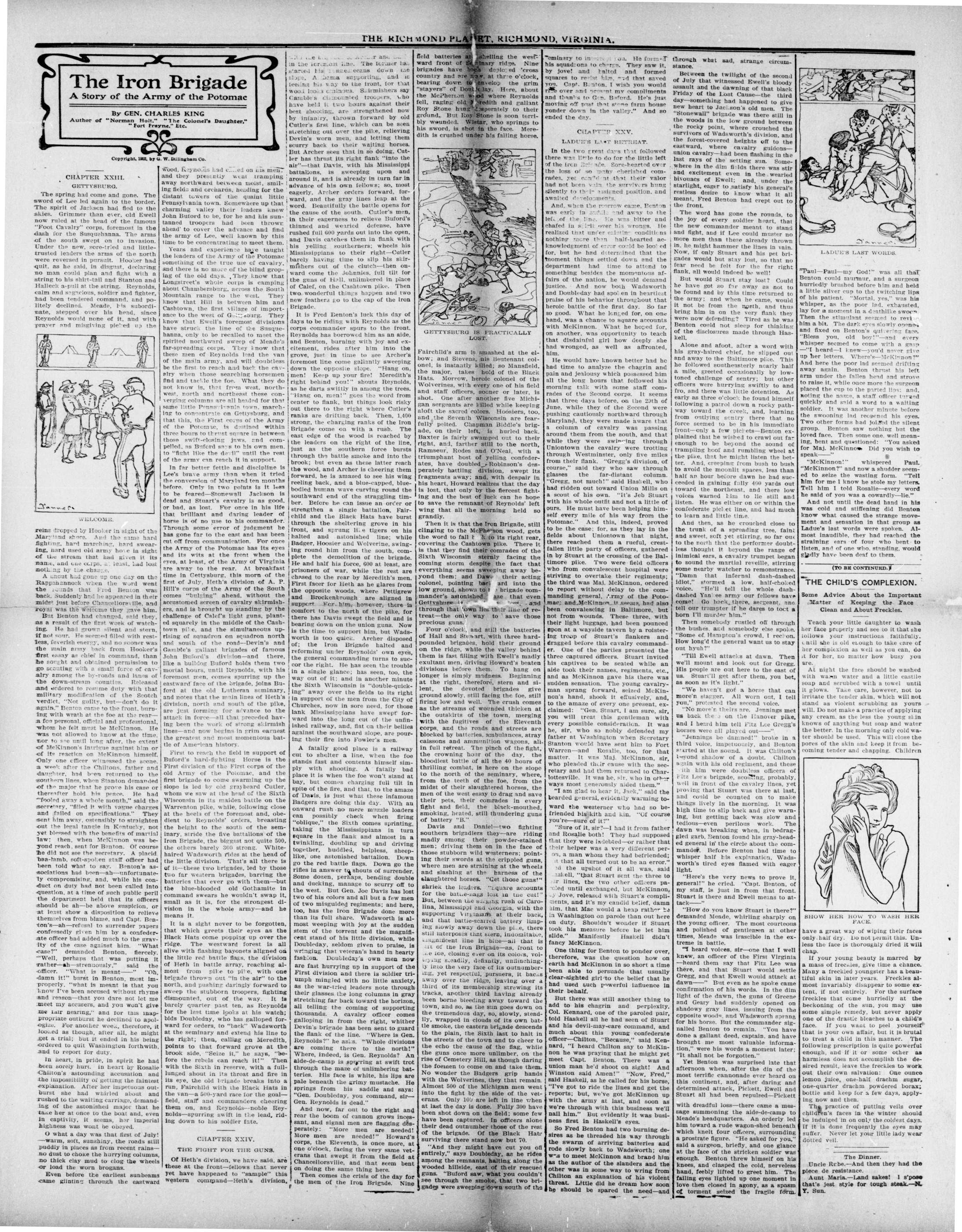
The Iron Brigade
A Story of the Army of the Potomac
By GEN. CHARLES KING
Author of "Norman Holt," "The Colonel's Daughter," "Fort Frayne," Etc.
Copyright, 1902, by G. W. Dillingham Co.
The spring had come and gone. The sword of Lee led again to the border. The spirit of Jackson had fled to the skies. Grimmer than ever, old Ewell now ruled at the head of the famous "Foot Cavalry" corps, foremost in the dash for the Susquehanna. The arms of the south swept on to invasion. Under the new, sore-tried and little-trusted leaders the arms of the north were reversed in pursuit. Hooker had quit, as he said, in disgust, declaring no man could plan and fight with a string to his shirt-tail and Stanton and Halleck a-pull at the string. Reynolds, calm and sagacious, soldier and fighter, had been tendered command, and politely declined. Meade, his subordinate, stepped over his head, since Reynolds would none of it, and with prayer and misgiving pleaded up the
Samantha
reins dropped by Hooker in sight of the Maryland shore. And the same hard fighting, hard marching, hard swearing, hard used old army hove in sight of the stream that had given it its name, and one corps, at least, had lost nothing by the change. A amount had gone up one day on the Rappannnock when the word went the sounds that Fred Benton was back. Suddenly had he appeared in their midst just before Chancellorsville, and royal was the welcome they gave him.
But Benton had changed, said they, as a result of the first week of watching. He had grown silent and stern, if not sour. He seemed filled with restless, feverish energy, and no sooner was the main army back from Hooker's first essay as chief in command, than he sought and obtained permission to go scouting with a small force of cavalry among the by-roads and lanes of the down-stream counties. Released and ordered to resume duty with that military modification of the Scotch verdict. "Not guilty, but—don't do it again." Benton came to the front, burning with wrath at the foe at the rear—a foe personal, official and professional, whom he felt must be McKinnon. He was not allowed to know at the time, nor to see until long after, the extent of McKinnon's intrigue against him or of its reaction on McKinnon himself. Only one officer witnessed the scene, a week after the Chilions, father and daughter, had been returned to the southern lines, when Stanton demanded of the major that he prove his case or thereafter hold his pence. He had "fooled away a whole month," said the secretary, "filled it with vague charges and failed on specifications." They sent him away, ostensibly to straighten out the legal tangle in Kentucky, not well blessed with the benefits of martial law: then, when McKinnon was beyond reach, sent for Benton. Of course he did not see the secretary. A placid ba-ham, soft-spoken staff officer had been told what to say. Benton's associations had been—ah—unfortunately compromising, and, while his conduct on duty had not been called into question, at a time of such public peril the department held that its officers should be ah—be above suspicion, or at least show a disposition to relieve themselves from blame, and Capt. Benton's—ah—refusal to surrender papers confessedly given him by a confederate officer had added much to the gravity of the case against him. "What case?" demanded Benton, fiercely. "Well, perhaps that was putting it rather—ah—strenuously," said the officer. "What is meant—" "Oh damn it!" burst in Benton, most properly. "what is meant that you know I've been accused without rhyme and reason—that you dare not let me meet my accusers, and you won't give me fur nearing," and for this inappropriate outburst he declined to apologize. For another week, therefore, it looked as though, after all, he might get a trial; but it ended in his being ordered to quit Washington forthwith and to report for duty.
In heart, in pride, in spirit he had been sorely hurt. in heart by Rosalie Chilton's astounding accusation and the impossibility of getting the faintest explanation. After her impudent outburst she had whirled about and rushed to the waiting carriage, demanding of the astonished major that he take her at once to the boat and, even in captivity, it seems, her imperial highness was wont be obeyed.
O what a day was that first of July!—warm, soft, sunshiny, the roads still puddy in places as from recent rains—no dust to choke the harrying columns, no thick clay mud to clog the wheels or load the worn brogans.
Even before the earliest sunbeams came glinting through the eastward
Wood, Reynolds had clued on his men, and they presently went tramping away northward between moist, smiling fields and orchards, heading for the distant towers of the quaint little Pennsylvania town. Somewhere up that charming valley their leaders knew John Butord to be, for he and his suntanned troopers had been throws ahead to cover the advance and find the army of Lee, well known by this time to be concentrating to meet them.
Years and experience have taught the leaders of the Army of the Potomac something of the true use of cavairy, and there is no more of the blind groping of the old days. They know that Longstreet's whole corps is camping about Chambersburg, across the South Mountain range to the west. They know that Hill is between him and Cashtown, the first village of importance to the west of Gettysburg. They know that Ewell's foremost divisions have struck the line of the Susquehanna, only to be recalled to meet the spirited northward sweep of Meade's far-spreading corps. They know that these men of Reynolds lead the van of the main army, and will doubtless be the first to reach and back the cavalry when those searching horsemen find and tackle the foe. What they do not know is, that from west, northwest, north and northeast these converging columns are all headed for that same little Pennsylvania town, marching to concentrate on Gettysburg, and that this, the First corps of the Army of the Potomac, is destined within three hours to thrust square in between those swift-closing jaws, and compelled, as Buford says to his own men, to "fight like the devil" until the rest of the army can reach it in support.
In far better fettle and discipline is Lee's brave army than when it tried the conversion of Maryland ten months before. Only in two points is it less to be feared. Stonewall Jackson is dead and Stuart's cavalry is as good, or bad, as lost. For once in his life that brilliant and daring leader of horse is of no use to his commander. Through some error of judgment he has gone far to the east and has been cut off from communication. For once the Army of the Potomac has its eyes and its wits at the front when the eyes, at least, of the Army of Virginia are away to the rear. At breakfast time in Cettysburg, this morn of the first of July, Heth's division of A. P. Hill's corps of the Army of the South comes "bulging" ahead, without the accustomed screen of cavalry skirmishers, and is brought up standing by the challenge of Calef's light guns, planted squared in the middle of the Cash-town pile, and the simultaneous uprising of squadron on squadron north and south of the road—Devin's and Gamble's gallant brigades of famous Buford's division—and there, like a bulldog Buford holds them two mortal hours, until Reynolds, with his foremost men, comes spurring up the eastward face of the brigade, Joins Buford at the old Lutheran seminary, and notes that the main lines of Heth's division, north and south of the pike, are just forming for advance to the attack in force—all that preceded having been the work of strong skirmish lines—and now begins in grim earnest the greatest and most momentous battle of American history.
First to reach the field in support of Buford's hard-fighting Horse is the First division of the First corps of the old Army of the Potomac, and the first brigade to come swarming up the slope is led by old graybeard Cutler, whom we saw at the head of the Sixth Wisconsin in its maiden battle on the Warrenton pike, while, following close at the heels of the foremost and, obedient to Reynolds' orders, breasting the height to the south of the seminary, stride the five battalions of the Iron Brigade, the biggest not quite 500, the others barely 300 strong. White-haired Wadsworth rides at the head of the little division. That's all there is of it—these two brigades, led by those two far western brigades, barring the batteries that ever go with them—but the blue-blooded old Gothamite in command swears he wouldn't swap it, small as it is, for the strongest division in the whole army—and he means it.
It is a sight never to be forgotten, that which greets their eyes as the Black Hats come popping up over the ridge. The westward forest is all alive with flashing bayonets aligned on the little red battle flags, the division of Heth in battle array, reaching almost from pile to pile, with one brigade thrown out "in the air" to the north, and pushing daringly forward to sweep the stubborn troopers, fighting dismounted, out of the way. It is barely quarter past ten, as Reynolds for the last time looks at his watch; bids Doubleday, who has galloped forward for orders, to "back" Wadsworth at the seminary and extend his line to the right; then, calling on Meredith, points to that forward grove at the brook side. "Seize it," he says, "before the rebels can reach it!" Then with the Sixth in reserve, with a full-lunged shout in its throat and fire in its eye, the old brigade breaks into a run, Fairchild with the Black Hats in the van—a 500-yard race for the goal-field, staff and commanders cheering them on, and Reynolds—noble Reynolds—spurring swift in the lead, riding down to his soldier fate.
THE FIGHT FOR THE GUNS.
Of Heth's division, we have said, are these at the front—fellows that never yet have happened to "sample" this western command—Heth's division.
CHAPTER XXIV
THE RICHMOND PLANET, RICHMOND, VIRGINIA.
and the beast of the jungle and on in the terrestrial line. The former has started his course down the slope. A brave supporting, and in feeling his way to the front, for that wool looks crimson. Scalemishers say Gamble's dismounted troopers, who have held it two hours against their best shooting, are strengthened now by infinity, thrown forward by old Cutler's first line, which can be seen stretching out over the pike, relieving Devin's worn men, and letting them scurry back to their waiting horses. But Archer sees that in so doing, Cutler has thrust its right flank "into the air"—that Davis, with his Mississippi battalions, is sweeping upon and around it, and is already in turn far in advance of his own fellows; so, most eagerly, Archer orders forward, forward, and the gray lines leap at the word. Beautifully the battle opens for the cause of the south. Cutler's men, in their eagerness to relieve Buford's thinned and warried defense, have rushed full 600 yards out into the open, and Davis catches them in flank with his yelling southerners; wheels his Mississippiians to their right—Cutler barely having time to slip his skirmishers out of the clutch—then onward come the Johnnies, full tilt for the guns of Hell, unlimbered in place of Calef, on the Cashtown pike. Then two wonderful things happen and two new feathers go to the cap of the iron Brigade.
It is Fred Benton's luck this day of days to be riding with Reynolds as the corps commander spurs to the front. Reynolds has borrowed him as an aide, and Benton, burning with joy and excitement, rides after him into the grove, just in time to see Archer's foremost line come gallantly sweeping down the opposite slope. "Hang on, men! Keep up your fire! Meredith's right behind you!" shouts Reynolds, as he darts swiftly in among the trees. "Hang on, men!" goes the word from center to flank, but things look risky out there to the right where Cutler's ranks are drifting back. Then, 1,400 strong, the charging ranks of the Iron Brigade come on with a rush. The east edge of the wood is reached by the leaders on the right of the line, just as the southern force bursts through the battle smoke and into the brook; but even as these latter reach the wood, and Archer is cheering them forward, he is amazed to see his wing reeling back, and a blue-capped, blue-bodied human wave curving round the southward end of the straggling timber. Before he can issue an order or strengthen a single battalion, Fairchild and the Black Hats have burst through the sheltering grove in his front, and sprung like tigers on his halted and astonished line; while Badger, Hoosier and Wolverine, swinging round him from the south, complete the demolition of the brigade. He and half his force, 600 at least, are prisoners of war, while the rest are chased to the rear by Meredith's men. First facer for Heth as he glares from the opposite woods, where Pettigrew and Brockenbrough are aligned in support. For him, however, there is comfort to the north of the pike, for there has Davis swept the field and is bearing down on the union guns. Now is the time to support him, but Wadsworth is too quick. Archer disposed of; the Iron Brigade halted and reforming under Reynolds' own eyes, the general commanding turns to succor the right. He has seen the trouble in a single glance; has seen, too, the way out of it; and in another minute the Sixth Wisconsin is "double-quicking" away over the fields to its right in support of the men from the City of Churches, now in sore need, for those lank Mississippiians have swept forward into the long cut of the unfinished railway, and, flat on their bellies against the southward slope, are pouring their fire into Fowler's men.
A fatally good place is a railway cut to shelter a line, when the foe stands fast and contents himself simply with shooting. A fatally bad place it is when the foe won't stand at bay, but comes charging full tilt in spite of the fire, and that, to the amaze of Davis, is just what these infamous Badgers are just doing this day. With an onward rush no mere muzzle loaders can possibly check when firing "oblique," the Sixth comes sprinting, taking the Mississippiians in turn square in the flank and almost in a twinkling, doubling up and driving together, huddled, helpless, sheeplike, an astonished battalion. Down go the red battle flags. Down go the rifles in answer to shouts of surrender. Some dozen, perhaps, bending double and ducking, manage to scurry off to the west. But Gen. Joe Davis has lost two of his misguided regiments and here, too, has the Iron Brigade done more than its full share. Wadsworth is almost weeping with joy at the sudden stem of the torrent and the magnificent stand of his little division, while Doubleday, seldom given to praise, is wringing that veteran's hand in hearty fashion. Doubleday's own men now are fast hurrying up in support of the First division and there is soldier triumph mumbling with no little anxiety, as the war-tried leaders note through their glasses the long columns in gray stretching far back toward the horizon, all telling the coming of supporting thousands. A cavalry officer comes galloping in from the right, whither Devin's brigade has been sent to guard the flank of the line. "Where is Gen. Reynolds?" he asks. "Whole divisions are coming there to the north." Where, indeed, is Gen. Reynolds? An alde-de-camp is sprinting at swift tilt through the maze of unlimbering batteries. His face is white, his lips are pale beneath the grimy mustache. He springs from his saddle and says: "Gen. Doubleday, you command, sir—Gen. Reynolds is dead."
And now, far out to the right and rear the boom of cannon grows incessant, and signal men are flagging desperately: "More men are needed! More men are needed!" Howard's corps, the Eleventh, is once more, at one o'clock, facing the very same veterans that swept it from the field at Chancellorville, and that seem bent on doing the same thing here. Then comes the victory.
Then comes the crisis of the day for the men of the Iron Brigade. Nine
field batteries are shelling the westward front of St. Mary ridge. Nine brigades have been deployed 'cross country and are now, at three o'clock, bearing down to envelop the grim "stayers" of Douthey. Here, about the McPherson wood where Reynolds fell, raging old Iredell and gallant Roy Stone hung desperately to their ground. But Roy Stone is soon terribly wounded. Wistar, who springs to his sword, is shot in the face. Meredith is crushed under his falling horse.
Jennon
GETTYSBURG IS. PRACTICALLY
LOST.
Fairchild's arm is smashed at the elbow; and Stevens, his lieutenant colonel, is instantly killed; so Mansfield, the major, takes hold of the Black Hats. Morrow, heroic colonel of the Wolverines, with every one of his field and staff officers, sooner or later, is shot. One after another five Michigan sergeants are killed while keeping aloft the sacred colors. Hoosiers, too, and the Seventh Wisconsin are fearfully pelted. Chapman Biddle's brigade, on their left, is hurled back. Baxter is fairly swamped out to their right, and, farther still to the north, Ramseur, Rodes and O'Neal, with a triumphant host of yelling confederates, have doubled Robinson's desperately battling division, swept its fragments away; and, with despair in his heart, Howard realizes that the day is lost, that only by the fiercest fighting and the best of luck can he hope to save the remnant of Reynolds' left wing that all the morning held so grandly.
Then it is that the Iron Brigade, still clinging to the McPhee son wood, gets the word to fall it K to its right rear, covering the Cashtown plike. There it is that they find their comrades of the Sixth Wisconsin sternly facing the coming storm despite the fact that everything seems sweeping away beyond them; and Dawne their acting colonel, pointing back ard into the low ground, shows to the brigade commander's astonished aze that even Gettysburg is and through that town lies their line of retreat—the only way to save those precious guns.
Four o'clock, and still the batteries of Hall and Stewart, with three hard-pounded brigades, hold their ground on the ridge, while the valley behind them is fast filling with Ewell's madly exultant men, driving Howard's beaten divisions before them. To hang on longer is simply madness. Beginning at the right, therefore, stern and silent, the devoted brigades give ground slowly, still facing the foe, still firing low and well. The crush comes as the streams of wounded thicken at the outskirts of the town, merging with the fugitives of the Eleventh corps, and the roads and streets are blocked by batteries, ambulances, stray caissons and ammunition wagons, all in full retreat. The pinch of the fight, the crowning hour of the day, the bloodiest battle of all the 40 hours of thrilling combat, is on the slope to the north of the seminary, where, from the teeth of the foe, from the midst of their slaughtered horses, the men of the west essay to drag and save their pets, their comrades in every fight and field, the black-mouthed, smoking, heated, still thundering guns of battery "B."
Davis and Daniel—two fighting southern brigadiers they—are riding madly among their powder-stained men; driving them on in the face of those stubborn wild westerners; pointing their swords at the crippled guns, where men are straining at the wheels and slashing at the harness of the slaughtered horses. "Get those guns!" shriek the leaders. "Square accounts for the battle-masks lost in the cut!" But, between the saddling rush of Carolina, Mississippi and Georgia, with the supporting Virginians at their back, and that battle-scarred battery limping slowly away down the pline, there still interposes that stern, indomitable, magnificent line in blue—all that is out of the iron Brigade—as, front to the toe, closing ever on its colors, volleying scadily, defiantly, uninchingly into the very face of its outnumbering, yet respectful, pursurers, it bacs away over the ridge, leaving over a third of its membership strewing its tracks, another third having already been borne bleeding away toward the town, and so, as the sun goes down on the tremendous day, so, slowly, steadily, wrapped in clouds of its own battle smoke, the eastern brigade descends to the plain, the Sixth last to halt in the streets of the town and to cheer to the echo the cause of the flag, while the guns once more unlimber, on the rise of Cemetery Hill, as though daring the foemen to come on and take them. No wonder the Badgers grip hands with the Wolverines, they that remain. Almost 500 of the Michigan men went into the fight by the side of the veterans. Only 100 are left in line when at last the day is done. Fully 300 have been shot down on the field; some few have been captured. In officers alone their dead outnumber those of the rest of the brigade. Of the Black Hate surviving there stand now but 70.
"And they might have cut you off entirely," says Doubleday, as he rides among the remnants, halting along the wooded hillside, of their rescued guns. "Buford saw, what you couldn't see through the smoke, that two bridges were sweeping down south of the
Summary to introduction. He form-I his squads to charge. They saw it by jove! and halted and formed squares to resist him, and that saved you. Capt. Benton, I wish you would rise over and present my compliments and thanks to Gen. Baford. He's just moving off past that stone farm house yonder down in the valley." And so ended the day.
CHAPTER XXV.
LADUETS LAST RETREAT
In the two great days that followed there was little to do for the little left of the iron Bellede. Sore-hearted over the loss of so many cherished comrades, yet could not that their valor had not been with the survivors hung silently to their assigned position, and awaited developments.
And, when the morrow came, Penton was early in midday and away to the left, of the line. He was bitter and chafed in slit over his wrongs. He realized that under existing conditions nothing more than half-hearted acknowledgment of error could be looped for, but he had determined that the moment things settled down and the department had time to attend to something besides the momentous affairs of the nation, he would demand justice. And now both Wadsworth and Doubleday had spoken in heartiest praise of his behavior throughout that heroic battle of the first day. So far so good. What he longed for, on one hand, was a chance to square accounts with McKinnon. What he hoped for, on another, was opportunity to teach that disdainful girl how deeply she had wronged, as well as affronted, him.
He would have known better had he had time to analyze the chagrin and pain and jealousy which possessed him all the long hours that followed his morning talk with some staff comrades of the Second corps. It seems that three days before, on the 23th of June, while they of the Second were pushing cautiously northward through Maryland, they were made aware that a column of cavalry was passing around them from the south, and that while they were swimming through Uniontown the cavalry were trotting through Westminster, only five miles from their flank. "Gregg's division, of course," said they who saw through glasses the far-distant column. "Gregg, not much!" said Haskell, who had ridden out toward Union Mills on a scout of his own. "It's Jeb Stuart with his whole outfit and not a little of ours. He must have been helping himself every mile of his way from the Potomac." And this, indeed, proved to be the case; for, as they lay in the fields about Uniontown that night, there reached them a rueful, crestfallen little party of officers, gathered in by Stuart at the crossing of the Baltimore pike. Two were field officers who from convalescent hospital were striving to overtake their regiments; the third was Mai McKinnon, ordered to report without delay to the commanding general, army of the Potomac; and McKinnon, it seems, had also been convalescens in Baltimore, but not from wounds. These three, with their light luggage, had been pounced upon at a wayside tavern by a roistering troop of Stuart's flankers and dragged before this cavalry commander. One of the parties presented the three captured officers. Stuart invited his captives to be seated while an aide took their names, regiments, etc., and as McKinnon gave his there was sudden sensation. The young cavalryman sprang forward, seized McKinnon's hand, shook it effusively, and, to the amaze of every one present, exclaimed: "Gen. Stuart, I am sure, sir, you will treat this gentleman with every possible consideration. It was he, sir, who so nobly defended my father at Washington when Secretary Stanton would have sent him to Fort Warren—and Rosalie, too, for that matter. It was Maj. McKinnon, sir, who pleaded their cause with the secretary and had them returned to Charlottesville. It was he, sir, who in other ways most generously aided them."
"I am glad to hear it, Jack," said the bearded general, evidently warming toward the westerner who had so befriended his kith and kin. "Of course you're—sure of it?" "Sure of it, sir?—I had it from father and Rosalie both! They had supposed that they were indebted—or rather that their helper was a very different person, a man whom they had befriended; but that all turned out to be an error." And the upshot of it all was, saidaskell, "that Stuart sent the three to our lines, the two other officers parcelled until exchanged, but McKinnon, Jove, released with Stuart's compliments, and it's my candid belief, damn him, that Mac would a heap rather be in Washington on parole than out here on duty. Shouldn't wonder if Stuart took his measure before he let him slide." Manifestly Haskell didn't fancy McKinnon.
One thing for Benton to ponder over, therefore, was the question how on earth had McKinnon in so short a time been able to persuade that usually clear-sighted girl to the belief that he had used such powerful influence in their behalf.
But there was still another thing to add to his chagrin and perplexity, Col. Kennard, one of the paroled pair, told Haskell all he had seen of Stuart and his devil-may-care command, and much about this young confederate officer—Chilton, "Because," said Kennard. "I heard Chilton say to McKinnon he was praying that he might yet meet Capt. Benton. There was a union man he'd shoot on sight! And Winston said Amen!" "Now, Fred," said Haskell, as he called for his horse, "I've got to ride the lines and get the reports; but, we've got McKinnon up with the army at last, and soon as we're through with this business we'll nail him." But evidently it was business first in Haskell's eyes.
So Fred Benton had two burning desires as he threaded his way through the swarm of arriving batteries and rode slowly back to Wadsworth; one was to meet McKinnon and brand him as the author of the slanders and the other was in some way to wring from Chilton an explanation of his violent threat. Little did he dream how soon he should be spared the need—and
through what sad, strange circumstance.
Between the twilight of the second of July that witnessed Ewell's bloody assault and the dawning of that black Friday of the Lost Cause—the third day—something had happened to give new heart to Jackson's old men. The "Stonewall" brigade was there still in the woods in the low ground between the rocky point, where crouched the survivors of Wadsworth's division, and the forest-covered heights off to the eastward, where cavalry guildons—union cavalry—had been flashing in the last rays of the setting sun. Somewhere in the dim fields there was stir and excitement even in the weared bivouacs of Ewell; and, under the starlight, eager to satisfy his general's restless desire to know what it all meant, Fred Benton had crept out to the front.
The word has gone the rounds, to the joy of every soldier heart, that the new commander meant to stand and fight, and if Lee could muster no more men than these already thrown in, he might hammer the lines in vain. Now, if only Stuart and his pet brigades would but stay lost, so that no fear need be felt for the far right flank, all would indeed be well!
But would Stuart stay loat? Could he have got so for away as not to be found and by this time returned to the army; and when he came, would it not be from the north, and thus bring him in on the very flank they were now defending? Tired as he was Benton could not sleep for thinking of the disclosures made through Haskell.
Alone and afoot, after a word with his gray-haired chief, he slipped out and away to the Baltimore plice. This he followed southeasterly nearly half a mile, greeted occasionally by low-toned challenge of sentry; but other officers were hurrying swiftly to and fro, and there was little detention. As early as three o'clock he found himself following a patrol down a rocky pathway toward the creek, and, learning from outlying sentry there that no force seemed to be in his immediate front—only a few pickets—Benton explained that he wished to crawl out far enough to be beyond the sound of trampling hoof and rumbling wheel at the plice, that he might listen the better. And, creeping from bush to bush to avoid the moonlit spaces, less than half an hour before dawn he had succeeded in gaining fully 400 yards out toward the northeast, and there low voices warned him to lie still and listen. He was either on or within the confederate picket line, and had much to learn and little time.
And then, as he crouched close to the trunk of a spreading tree, faint and sweet, soft yet stirring, so far out to the north that the performer doubtless thought it beyond the range of iminal ears, a cavalry trumpet began to sound the martial reville, stirring some nearby watcher to remonstrance. "Damn that infernal dash-dashed idiot," stormed a low, half-choked voice. "He'll tell the whole dash-dashed Yankee army our fellows have come! Go hook, there, servicer, and tell our trumpeter if he dares to toct a horn I'll murder him."
Then somebody rustled off through the bushes, and somebody else spoke. "Some of Hampton's crowd, I reckon. How long'd the general want us to stay out hyuh?"
"Till Ewell attacks at dawn. Then we'll mount and look out for Gregg. His people are out here to the east of us. Stuart'll get after them, you bet, as soon as it's light."
"We haven't got a horse that can more'n stagger. All worn out, I tell you," protested the second voice.
"No more'n theirs are. Jennings met us back the on the Hanover plike, and I heard him tell Fitz Lee Gregg's horses were all played out—"
"Jennings be damned!" broke in a third voice, impetuously, and Benton started at the sound. It was Chilton's beyond shadow of a doubt. Chilton again with his old regiment, and these with him were doubtless officers of Fitz Lee's brigade, scolding, probably, well in front of the cavalry lines, yet proving that Stuart was there at last, and could be counted on to make things lively in the morning. It was high time to slip back and give warning, but getting back was slow and tedious—even perilous work. The dawn was breaking when, in bedraggled garb, Benton found his gray-headed general in the circle about the commander. Before Benton had time to whisper half his explanation, Wadsworth's tired eyes flamed with eager light.
"Here's the very news to prove it, general!" he cried. "Capt. Benton, of my staff, is just in from that front. Stuart is there and Ewell means to attack—"
"How do you know Stuart is there?" demanded Meade, whirling sharply on the young officer. The most courteous and polished of gentlemen at other times, Meade was irascible in the extreme in battle.
"I heard voices, sir—one that I well knew, an officer of the First Virginia—heard them say that Fitz Lee was there, and that Stuart would settle Gregg, and that Ewell would attack at dawn—" But even as he spoke came confirmation of his words. In the dim light of the dawn, the guns of Greene and Geary had suddenly opened on shadowy gray lines, issuing from the opposite woods, and Wadsworth sprang for his horse. But the commander signalled Benton to remain. "You have done a gallant deed, captain, and have brought me most valuable information," were his words a moment later; "It shall not be forgotten."
Yet Benton was surprised late that afternoon when, after the din of the most terrific cannonade ever heard on this continent, and, after daring and determined attack, Pickett, Ewell and Stuart all had been repulsed—Pickett with dreadful loss—there came a message summoning the aide-de-camp to Meade's headquarters. An orderly led him toward a rude wagon-shed beneath which knelt four officers, surrounding a prostrate figure. "He asked for you," said a surgeon, briefly, and one glance at the face of the stricken soldier was enough. Benton threw himself on his knees, and clasped the cold, nerveless hand, feebly lifted to greet him. The falling eyes lighted up one moment in love when closed in agony, as a spasm of torment seized the fragile form.
D'Anne
"Paul—Paul—my God!" was all that Benton could murmur, and a surgeon hurriedly brushed before him and held a little silver cup to the twitching lips of his patient. "Mortal, yes," was his whisper, as the poor lad, exhausted, lay for a moment in a deathlike swoon. Then the stimulant seemed to revil him a bit. The dark eyes slowly opened, and fixed on Benton's quirking face. "Bless you, old boy!"—and every whisper seemed to come with a gasp—"I heard—I knew—you'd never give up her letters. Where's—McKinnon?" And here the poor lad seemed drifting away again. Benton thrust his left arm under the fallen head and strove to raise it, while once more the surgeon placed the cup to the parted lips; and, noting the name, a staff officer turned quickly and said a word to a waiting soldier. It was another minute before the swooning lad reopened his eyes. Two other forms had joined the silent group. Benton saw nothing but the loved face. Then some one, well meaning, bent and questioned: "You asked for Maj. McKinnon. Did you wish to speak—"
"McKinnon!" whispered Paul. "McKinnon!" and now a shudder seemed to seize the wasting form. "Tell him for me I know he stole my letters. Tell him I told Rosalie—every word he said of you was a cowardly—lie." And not until the dead hand in his was cold and stiffening did Benton know what caused the strange movement and sensation in that group as Ladue's last words were spoken. Almost inaudible, they had reached the straining ears of four who bent to listen, and of one who, standing, would gladly have been deaf to them.
(TO BE CONTINUED.)
THE CHILD'S COMPLEXION.
Some Advice About the Important Matter of Keeping the Face Clean and About Freckles.
Teach your little daughter to wash her face properly and see to it that she follows your instructions faithfully, until she is old enough to take care of her complexion as well as you can, do it for her, no matter how busy you are.
At night the face should be washed with water and a little castile soap and scrubbed with a towel until it glows. Take care, however, not to irritate the tender skin, which will not stand as violent scrubbing as yours will. Do not make a practice of applying any cream, as the less the young skin knows of anything but soap and water the better. In the morning only cold water should be used. This will close the pores of the skin and keep it from becoming tender and chapping. Children
SHOW HER HOW TO WASH HER FACE.
have a great way of wiping their faces only half dry. Do not permit this. Unless the face is thoroughly dried it will chap.
If your young beauty is marred by a mass of freecles, give time a chance. Many a treckled youngster has a beautiful skin in later years. Freecles almost invariably disappear to some extent, if not entirely. For the surface freecles that come hurriedly at the beckoning of the sun, you may use some simple remedy, but never apply one of the drastic bleaches to a child's face. If you want to peel yourself that is your own affair, but it is brutal to treat a child in this manner. The following prescription is quite powerful enough, and if it or some other as harmless does not accomplish the desired result, leave the freecles to work out their own salvation: One ounce lemon juice, one-half drachm sugar, one-quarter drachm powdered borax; bottle and keep for a few days, applying now and then.
The practice of putting veils over children's faces in the winter should be indulged in on only the coldest days. If it is done frequently the eyes may suffer. Never let your little lady wear dotted veil.
Uncle Rube.—And then they had the piece de resistance.
Aunt Maria.—Land sakes! I s'pose that's jest style for tough steak.—M. Y. Sun.
THE PLANET
Published every Saturday by JOHN MITCHELL
JR., at 811 North 4th Street, Richmond, Va.
All communications intended for publication should be sent so as to reach us on Wednesday.
TERMS IN ADVANCE.
One Copy, one year, $1.50
One Copy, six months, .80
One Copy, six months, .80
One Copy, four months, .50
One Copy, three months, .50
Single Copy, .05
ADVERTISING RATES.
REGISTERED LETTER.—If a money Order Post-Office or an Express Office is not within the same city, the letter you wish to send us on payment of ten cents. Then if the letter is lost or stolen, you can send money in this manner at our risk.
We cannot be responsible for money sent in letters in any other way than one of the four ways mentioned above. If you send your monogram or other way, you must do it at your own risk.
RENEWALS, ETC.—If you do not want the PLANET continued for another your after your description has cann’t out, you must notify by post or mail it to continue. That means you decided that subscribers to newspapers who do not order their paper discontinued at the expiration date are held liable for the payment of the subscription up to date when they order the paper discontinued.
COMMUNICATIONS.—When writing to us to renew your subscription or to discontinue your paper, you should give your name and address in full, otherwise we cannot find your name on our books.
OR ADDRESS.—In order to change the address of a subscriber, we must be sent the former as well as the present address.
Entered at the Post-Office at Richmond, Va., as second-class matter.
SATURDAY, MARCH 18, 1900
We have received "The Hampton Negro Conference, Number VIII, July, 1904." It is entitled, "Some Conditions of the Negro People and Needed Reforms Discussed by the Negroes Themselves." It will richly repay a perusal.
We have received a pamphlet, entitled, "Why Disfranchisement is Bad," by Archibald H. Grimke. It is one of the ablest dissertations on that subject that we have ever read. Mr. Grimke states axiomatic truths and illustrates them by practical comparisons so plain that a child can understand. It is from the press of E. A. Wright, Philadelphia, Pa., and is issued by the Committee of Twelve, Cheyney, Pa.
DARK OUTLOOK FOR BOWLES.
The Supreme Court of Appeals of Virginia has refused to grant a writ of error in the case of Robert Bowles, colored, charged with killing a white brakeman at Clifton Forge, Va. It will be remembered that the same tribunal reversed the first sentence of conviction of murder in the first degree and remanded the case for a new trial. The order of the court was obeyed and Bowles was again convicted and sentenced to death. He has always alleged that the killing was in self-defense.
There was an attempt to lynch him at the time of his capture, but the officials frustrated all such efforts and he was duly tried and convicted. Public sentiment among the white people was strongly against him. His counsel have made a most remarkable fight for his life and it looked at one time that they would succeed. Our personal opinion was from the first that his only safety was in "leg bail" and when he escaped in the first instance, his chances of life rested in his ability to keep out of the way of the mob and out of sight of the officers of the law. Bowles' friends have stood up for him steadfastly to the end and it may be that in their appeals to the Governor, they may be able to secure for the unfortunate man a longer lease of life than that decreed by the mandates of the court.
RUSSIANS AT TIE PA88
Defeated Army Prepared to Oppose Japanese Attack.
Tie Pass, March 15. After the battle of Mukden the advance of the Japanese army against the new positions of the Russians at Tie Pass is very slow. The leading columns are eight to 10 miles southward, and in touch with the Russian van posts, but the operations at present are not seri-
ous. Field Marshal Oyama shows slight intentions of pressing his advantage in an immediate attack on Tie Pass. It is possible, however, that a wide turning movement, of which reports are current, is in progress. In such operations the Japanese have the immense advantage of several bases and lines of supply, to which is now added the Sinmintin road, while the Russian army necessarily is dependent on one base and one line of communication, and therefore may easily be outflanked.
In the grand army order is being brought out of chaos with remarkable celerity. The plain in front of Tie Pass, which on March 11 seethed like a nest of ants with the dense and confused mass of transport, artillery and troops, corps, divisions and regiments being scattered and parties inextricably mingled, has been cleared, the regiments reorganized, stragglers sent to their respective commands, organizations taken their assigned positions, and today the same soldiers who on March 10 became a terror-stricken, surging, disorganized mass of gray at a few shots from a little detachment of Japanese, or who even fled in panic, firing indiscriminately in all directions as they ran at the mere baseless cry of "Japanese cavalry," are now gathered singing about the camp fires with new courage, ready to oppose with stubborn resistance an attack on Tie Pass. It is unfair to accuse the entire army of this panic. General Linevitch entered Tie Pass with his regiments in perfect order, with music playing and the men singing, and scarcely a straggler was lost in the long, difficult march. Other organizations made equally praiseworthy retreats, and especially the rear guards of all the armies, who performed their difficult task steadily and resolutely.
The struggle for the possession of Mukden cost both sides close upon 200,000 men. The Russian loss of officers includes a large proportion of the regimental commanders and field officers.
HOW THE BATTLE WAS WON
Kuropatkin Was Deceived As to Where
the Blow Was to Be Struck
With General Kuroki's Army in the Field, northeast of Mukden, Sunday, March 13, via Fushun, March 14. Every hour increases the magnitude of the disaster suffered by the Russian armies. Today 25,000 dead are known to have been left on the field, making the casualties at least 100,000. Between 50,000 and 60,000 prisoners, some 70 guns and enormous quantities of ammunition and provisions fell into the hands of the Japanese. The Japanese losses do not exceed those of former great battles, even General Kuroki's army losing only 5000. Field Marshal Oyama's plans derived General Kuropatkin. The Russian commander misjudged the strength of the Japanese. He at first thought that General Nogi's Port Arthur army was pressing his east flank, and concentrated a great force there. This force he was afterward obliged to shift to Mukden, where it arrived in a state of exhaustion after a forced march and was unable to fight.
A retreat from Mukden began on March 9. It became a demoralized flight when the Russians discovered that their egress was blocked by Japanese infantry and artillery from the east. The rapid approach of the Japanese was a complete surprise to the Russians, who expected that their retreat would be harassed only by the Japanese cavalry from the westward. Saturday morning one division of Japanese encountered several Russian regiments retreating along the road to Tie Pass. The Russians descended from the hills on the Russians, who attempted to break through the line. After a sharp engagement, in which the Japanese guns did great execution, 4000 Russians surrendered with their guns. The Japanese lost lost 100 men. According to stories told by captured Russian officers and the appearance produced by their troops, the retreat lacks organization, every battalion shifting for itself.
JURY CONVICTS MRS. CHADWICK
Found Guilty of Conspiracy to Defraud the United States.
Cleveland, March 13.—Mrs. Cassie L. Chadwick was found guilty of conspiring to defraud the United States by conspiring to procure the certification of checks on a national bank, when there were no funds in the bank to her credit.
She was found guilty on every count of the indictment upon which the jury was at liberty to judge her—seven in all. The original indictment contained 16 counts. Two of these were ruled out during the trial by Judge Tayler, and of the remaining 14 one-half charged her with securing the certification of checks without having the proper entries made upon the books of he bank.
Judge Taylor in his charge directed the jury to disregard these counts and consider only the remaining seven, which related to the certification with no funds on deposit. On all of these the jury found against her.
Mrs. Chadwick's attorney entered a motion for a new trial, but the date for argument has not been fixed. Under the law she can be fined on each count not more than $10,000 or imprisoned more than two years on each count.
Father Accused of Murder
Camden, N. J., March 14.—Prosecutor Lloyd announced that the result of the autopsy on the exhumed body of the 4-year-old daughter of Gulseppe Bozzo showed that she had died from a blow on the head. The father is in jail, and his other children say he struck the girl a short time before she died. Bozzo's home is on a farm near Dunbarton.
Workman Blown to Pieces.
New York, March 15.—By the explosion of a dynamite cartridge in a rock excavation in West New York, Francisco Izzo, a laborer, was blown to pieces, portions of his body being picked up 200 yards away; his brother was fatally hurt and two, other men were badly injured. The cartridge had missed fire in a blast which the men had just set off, and exploded while they were clearing away the rock.
THE RICHMOND PLANET, RICHMOND, VIRGINIA
NINETEEN DEAD IN TENEMENT FIRE
Fire Escapes Piled Full of Rubbish Prevented Escape of Many.
MANY DEEDS HEROISM
New York. March 15.—Nineteen persons dead, two score injured, some so seriously that they may die, and nearly 200 persons temporarily homeless, is in brief the story of New York's latest fire horror. The victims of the disaster were typical East Side people, the scene a typical East Side tenement, and the scenes attending it were in many ways peculiar to that cosmopolitan quarter. To apparently reckless displays of heroism shown by firemen, policemen and volunteer rescues alone is due the fact that the list of the dead is not greater.
Two hundred persons herded in the big five-story double-decker tenement house were sleeping when flames from an overturned or exploding kerosene lamp in the basement spread through the structure and wrapped the entire building in flames almost before an alarm had been sounded. The long narrow fire escapes which ran down the building on each of its exposed sides had been made receptacles for rubbish of all descriptions and in many cases they were rendered useless. It was found also, that every fire escape platform on the building had in it a "blind" or square piece of board which fits into the opening through which the ladder passes in the grated floor. The result of these obstructed fire escapes was evident when it was found that nearly all of the dead belonged on the top floors of the building and were roasted before they were able to reach the ground. Another case of negligence which was responsible for the loss of some lives was an immovable skylight at the head of a ladder leading to the roof. Battened securely and partially covered by ice, this skylight resisted all efforts to force it, and a pile of the bodies of the dead lay under it when the horror was over.
Down the fire escapes flowed a stream of humanity. On some of the escapes the rubbish was so closely packed that it became impossible to pass certain points, and men, women and children stood literally roasting to death as the flames roared through the windows. It was on the flame-swept fire escapes that the finest displays of heroism were shown. Scores of men, women and children, driven from their rooms by the flames which swept through hallways and light shafts, cowered high in the air on the hot iron ladders and platforms the flames swirling around them as they waited for help. Through the flames and smoke, time after time, the firemen rushed up to their assistance and every trip meant a life saved. From the fire escape, too, the men plunged in through windows holding flames to come forth a moment later bringing an unconscious form to some place of saffety.
The fire started in the basement, occupied by Isaac Davis, his wife and three children. Davis went into his store on the same floor just in time to see a kerosene lamp in the rear explode. He awoke his wife, and both tried to put out the flaming lamp, but without success, and then gave all their attention to getting their children out of the burning building. A policeman who heard the cries of alarm rushed to the scene, and every effort was made to arouse the sleeping persons in the house.
A SIGN OF EARLY PEACE
French Bankers Postpone Proposed Russian Loan.
London, March 15.—The revolt of the French bankers is considered by the London newspapers as the most hopeful and important news of the day, promising an early conclusion of peace between Russia and Japan. Apparently the proposed loan has not been absolutely refused, but only "postponed." This, however, is regarded here as being tantamount to a refusal, and is expected to speak louder to the Russian war party even than General Kuropatkin's reverse at Mukden.
It is the general belief that by the death of M. Germain, the late governor of the Credit Lyonnaise, Russia lost her strongest financial friend in France, and that had he been alive so difficulty would have been experienced. With the American and English markets closed to her, it is thought that Russia can only turn to Germany, who is not likely to be much more responsive than France, and the only alternative would seem to be to make peace.
Reports are current here that Japan will now demand an indemnity of between $500,000,000 and $750,000,000.
$1000 For Conscience Fund
New York, March 14. — A well-dressed and apparently prosperous man delivered a letter containing $1000 in person to the messenger of the United States sub-treasury in this city. It was directed to Assistant Treasurer Hamilton Fish and contained a note asking him to credit the amount to the United States government. It was unsigned.
Girl Dies of Fright
Norristown, Pa., March 14.—Bessie Orr died from fright. Friday night burglaries entered her parents' home. The intruders were discovered by the girl's mother, whose screams threw the girl into convulsions, from which she suffered until death. The burglaries got away with silverware and clothing.
Dr. Harper Going to Lakewood, N. J. Lakewood, N. J., March 13.—President Harper, of the University of Chicago, is coming here to recuperate. John D. Rockefeller will meet him on his arrival and has arranged for his stay here.
Constable Killed By a Fall.
Altoona, Pa., March 15. While leaving a house where he had served a court subpoena, Constable David Miller stepped on an icy step, and, falling, broke his neck. Dying instantly.
CHILD ASSAULT D AND KILLED
little Brother Fatal Injured Trying
to Defend Four Year-Old Sister.
Philadelphia, March 15.—The body of Mary Deluka, a 4-year-old Italian child, was found in a blacksmith shop at Dyers' stone quarry at Howellville, Chester county, about 30 miles from this city. Beside the body was found the 7-year-old brother of the girl, Dominik, who was unconscious from injuries he had received. The girl had been criminally assaulted and murdered, and it is supposed that the boy received his injuries while attempting to defend his sister. Dominik is in the West Chester hospital in a dying condition. He is so badly hurt that he is unable to speak and cannot give an account of the assault. The children were found by Foreman William Devaney, who at once summoned Dr. George W. Mitchell, of Berwyn, nearby. The little girl's face and head were battered by the fists of her assailant. Her body was still warm when found. The boy's shoulder was broken and he is injured internally. The authorities have no clue as to the perpetrator of the crime.
An Italian who lives nearby says he saw a man running away from the blacksmith shop. The community is thoroughly aroused, and a posse led by Constable Kellar in searching for the murderer. The Italian residents are wild with excitement.
WILL FIGHT THE BEEF TRUST
Independent Packers to Make War On the "Big Five."
Chicago, March 14.—War to the knife between the "big five" of the beef combine and 26 firms, and corporations classed as independent packers will, it is asserted, begin in Chicago March 20, when the special federal grant begins its investigation of the affairs of the alleged bief combination. A fund of $3,000,000 has been raised to carry on the fight against the alleged beef combine and set the claims of the independent packers squarely before the public. The largest of the so-called independent concerns, Schwarzschild & Sulzberger, is concerned in the movement. The principal plants of the company are in Kansas City, but a large plant is operated by the same company in Chicago and a branch in New York. The independent packers are said to have held meetings in Kansas City to devise a plan of offensive and defensive action.
MINT IS OUT OF SILVER
125 Employees Have Been Indefinitely Suspended.
Philadelphia, March 15.—With the entire available ply of silver bullion completely disposed of and no immediate indications of future receipts from the treasury department at Washington, 125 employees in the counting and weighing departments at the mint, mostly women, have been indefinitely susued. Chief Clerk Morris said that if congress had authorized the converting of the mint into subsidiary coin there would be no necessity of reducing the force. "We have simply run out of silver," he said, "and until the secretary of the treasury finds some way of overcoming the present tangled condition of affairs I suppose the women employees will have to remain idle."
FLEEING FROM THE PLAGUE
Town of 20,000 Population In Chile Being Abandoned
Valparaiso, Chile, March 14—Pisagua, 44 miles north of Iquique, with a population of 20,000, is being abandoned by the inhabitants, owing to the fact that hundreds of people there have died of bubonic plague. Houses seemingly deserted have been opened by the police and found to contain bodies in an advanced state of putrefaction.
Impure Milk Dealer Goes to Jail
Impure Milk Dealer Goes to Jail.
New York, March 14—As the result of a crusade against the adulteration of milk and the use of poisons as preservatives, which was begun by the New York city board of health, Henry Blum, a driver of a milk wagon, was sentenced to the Tombs prison for 10 days. An inspector of the board of health testified that he caught Blum with 40 quarts of a liquid that looked like water, which had been used to wash milk cans, and that an analysis proved that it was not even good water.
CORDOVA CONVICTED
Eloping Minister Found Guilty of Wife
Desertion
New Brunswick, N. J., March 15. After six hours' deliberation the jury which tried J. Frank Cordova, the former South River minister, who eloped with Julia Bowne, one of his choir singers, for abandoning his wife, came into court with a verdict of "guilty as indicted." Cordova appeared to be greatly shaken by the verdict. He will probably be sentenced on Saturday. The extreme penalty is imprisonment for one year. In summing up, Prosecutor Berdine scored the former minister severely, and once Cordova leaped from his seat in fury, sinking back again, the spectators howled at him and shouted "Sit down." The close of the prosecutor's address was marked with cheering the court officers could not suppress. Judge Strong's charge was brief, and he emphasized the point that the prisoner could not be excused because he had sent money to his wife.
GREASON'S APPEAL REMANDED
Berkes County Court Given Discretion
In Granting New Trial.
Philadelphia, March 15. — Samuel
Greason, who was convicted at Reading
of murder in the first degree, as
was also Mrs. Edwards, the victim being
the latter's husband, may receive
a new trial. The supreme court rendered
a unanimous decision remanding
the record to the Berks county
court of oyer and terminer.
The court is directed to use its own
discretion in regard to the appeal, and accord a new trial if such procedure is
deemed advisable.
CHOSE DEATH IN AWFUL FORM
WOMAN FACES FAST ENGINE
AND IS GROUND TO PIECES.
A PLAIN CASE OF SUICIDE.
Fails to Heed Warning of Engineer
Who Is Unable to Avert Tragedy — Remains Scattered
Along the Roadbed.
New York.—With bloodless cheeks, staring eyes and hands raised as if in supplication, Mrs. Sadie G. Hanrahan, 42 years old, of this city, deliberately walked in front of a rest-moving train on the Manhattan Beach branch of the Long Island railroad, at Moffat street and Central avenue crossing, and was ground to death beneath the wheels. In this shooting manner the woman ended a life which had been made wretched through an unfortunate marriage. The manner of her death leads the police and her relatives who are prostrated over her horrible death to believe that long years of worry had unbalanced her mind.
The death of the woman was quick, and as the train rolled on under its momentum the road bed for many feet was strewn with portions of her body. It was a ghastly sight for the women and even the men passengers on the train who leaped to their feet when the frantic engineer applied the air brakes in his efforts to stop the train. The speed of the train was reduced with a bad jolt, which at first threw the passengers from their seats, and as they scrambled to their feet they rushed for the doors. They all insisted on getting off, and many of the women regretted this step when they caught sight of portions of the woman's body and clothing, which had left a horrible trail behind the train. Several women uttered piercing shrieks and were carried into the train again in a hysterical condition, while men were compelled to turn their heads to shut out the awful sight. The tumult caused a gathering of people, who crowded about the spot, and in doing so
WALKED ONTO THE TRACK
drew the attention of a policeman. The curious onlookers were at once driven back, while the police and train hands picked up the dismembered remains, which were placed in a canvas stretcher provided by the police, who conveyed them to the station house.
Engineer Eagan Salzman was in charge of engine No. 23, which drew the train. It left the Long Island City depot, bound for Manhattan Beach, shortly after 12 o'clock. Nothing occurred until the train was approaching the point where the traedy occurred.
The tracks of this branch skirt the rear of a cemetery and are protected by a railing composed of three rows of heavy wire, while the crossing is protected by a gate composed of two long arms which are worked automatically from another point. No regular flagman, it is understood, is stationed at this point.
As the train approached within a few hundred feet of the crossing Engineer Salzman was for a moment unable to believe his eyes when he caught sight of the form of a woman clad in deep black deliberately walking across the track and turning her face in the direction of his train. His hand clutched the whistle rope and he blew several shrill blasts. The woman paid no attention, but continued to walk toward the fast-approaching train, and Salzman realized that he must act quickly and immediately applied the air brakes.
At the time he was leaning half out of the cab window, and as the train drew nearer and nearer to the woman he saw her face and wild eyes and her hands raised as if to ward off the blow she knew was coming from the locomotive. Salzman was spellbound by the sight and he made frantic efforts to stop the train before it struck the woman and he not only threw back the throttle but reversed the engine wheels. The momentum, however, was too great and the great engine, one of the heaviest on the branch, struck the woman.
The pilot of the engine picked up her body and threw it some distance ahead, but it was again overtaken by the turning wheels and passed from sight to be ground up in the manner described.
With the assistance of the train hands the dismembered portions of the unfortunate woman were gathered together.
Song by Uncle Sam
"My San Domingo maid, I'm very much afraid I'll have to keep your custom house until your bills are paid." N. Y. Herald.
CLEAN UP THE CELLAR.
Some stormy day overhaul your cellar. Sort over apples and reject those decaying; also potatoes and other vegetables. Decaying cabbage, turnips and onions are specially offensive. Clean out all rubbish, urges a writer in Farm
and Home. Examine the cider and van garr casks for tea and rusted hoops. Gare blacksmith make some hoops of worm buggy tire. Clean the casks and paint them. If you can't do better, paint with cement and silt milk. Examine fruit cans for collective covers.
If mood has invaded the cellar, dust well with fresh lime and copper sulphate well powdered together. Remember this powder coords metals readily. Clean the cellar windows. Examine the soap and pickle tubs for weak hoops. About twice a month take the ash pail half all of ashes and a handful of live coals into the cellar. Throw on an ounce of sulphur and go upstairs quick. It is a grand corrective of foul odors.
Get a dry goods box or piano crate, fit it with shelves and doors. In this housewife can store canned fruit, preserves and similar treasures. Give all the interior of your cellar a coat of whitewash or milk and cement paint.
CUTTING FIRE WOOD
Some Suggestions That Will Prove
Valuable When Working on
the Wood Pile.
In cutting wood for yourself, saw very
bad knots and croches to six or eight-
inch lengths; you can save time spilti.ig
to fit stove, and they are the most dur-
able wood.
A block of wood with two pins loosely
fitting in two-inch holes, makes a good
saw buck to lay
small logs in while
sawing wood in the
forest or chip yard.
Apple wood is a
great heat producer.
Cut the small brush in
small logs in while sawing wood in the forest or chip yard. Apple wood is a great heat producer. Cut the small brush in stove length and bind in small bundles with binder twine. When dry, use for fire kindlers in the cook stove cold mornings. You will be surprised at the heat they yield.
A lever on the saw frame to hold the wood from slipping while the saw is going through it is a great help to the operator and promotes safety.
A pole, one end on ground the other
HORSE FOR HOLDING LOGS
on two legs, and several holes for a pn
is handy to elevate and hold a log at
sawing height.
The farmer who spends weeks of hard
work every winter with ax and buck-
saw in preparing firewood for the coming
year, says Farm and Home, has a job
that is always dreaded. A good buzz saw
and three men will saw up a big woodpile
in a few hours.
PURE-BRED STALLIONS
Each owner of a brood mare should insist that the stallion with which she is mated shall be pure-bred and culy recorded. It is ruthless policy to continue breeding to scrub, grade and cross-bred sires. Such horses may appear excellent individuals, but they lack fixed breed power to transmit their characteristics. Pure blood means hereditary power to reproduce breed type and individual excellence, and is necessary in the stallion to overcome the breed power of his less excellent mates. Unrecorded sires standing at cheap fees prove an expensive proposition at the selling time of their colts. Good feeding can never offset faults derived from a poor sire, but will perfectly bring out the good qualities born in colts from an individually excellent, sound, pure-bred, recorded stallion. Demand that every stallioner shall show the pedigree certificate for his horse, and learn to judge correctly of the merits of such papers. Each stallion should have a certificate of registry in the stud book, of the breed to which he belongs—Dr. A. S. Alexander.
Sell Everything Possible
On our little 40-acre farm we are doing very well. We live five miles from one town, six miles from another, and eight miles from a hirth, says E. M. Wilson, of Lawrence county, Mo. We raise Irish and sweet potatoes, wheat, corn oats and clover; have an orch., some small fruits, garden and true patches, two horses, three cows, two hogs and 100 Brown Leghorn chickens. Sell eggs, chickens, potatoes and butter when we have it to spare. In fact, we sell everything we can and eat what we cannot sell.
Learn to Plan.
Some men seem to have no capacity for planning beforehand. They do the work of the day in the day and without plan. Now and then much time is lost because of lack of what we call thought, but which is really lack of planning.
In the South.
In the south sweet clover (melliotus alba) is being largely planted on worn-out lands rich in lime, and in a few years the lands are brought back to their former state of fertility.
To Get More Manure
To increase the manure supply use plenty of bedding to absorb all the liquid. The comfort and cleanliness of the stock will also be greatly increased.
DRAFT COLTS.
Dr. A. S. Alexander Gives Some Hints How They May Be Developed Perfectly.
Perfectly developed stations of the various draft breeds owe their weight, size of frame and wealth of muscle to feed as well as breed. Complete nutrition, kindly care and adequate shelter have combined with selection and persistent breeding in the production of our draft breeds. The use of such stations is not enough in the grading up of our horses. Blood will always tell, but for the development of progeny similar to the pure bred sire in every respect, breed possibilities can only be perfectly attained by generous feeding and sufficient shelter. Even if we breed solely to sound, pure-bred sires mate only with sound mates and remember to slick persistently to one
breed, we shall fail of perfect success unless we perfectly nourish the resultant progeny. 'ane pregnant mare must be well fed and cared for that she may form a large, strong, robust foal and have an abundance of milk for it at birth. While she is nursing her foal, generous feeding must be maintained and when weaning time comes, the colt must suffer no setback, out be so well fed that he goes into winter quarters thriving apace and by reason of similar feeding and comfortable shelter during the winter, goes out to pasture in spring without having had a check in his progress. From first to last the colt must be kept growing so that at two or three years of age he is heavy and well-grown and not a dwarf apology for a draft horse. The best profit is in the natural growth possible to the draft colt as an inheritance from his ancestors, brought out by generous feeding. Stinting the food means permanent stunting of the colt. Such policy is expensive, for it prevents the horse from developing the size of frame and bulk of body that would be his most valuable features in the market. He will sell at an ordinary horse's price when partially developed. The profit is in the extra weight and the buyer is often a professional feeder who puts on the lacking 200 pounds, gets 25 cents a pound for it and thus steals the profit that should properly go to the breeder.
COW'S MILK FOR COLT.
Several years since we had a young grade coach mare in foal to a German coach stallion. Before the time for foaling she had an attack of disease from the effects of which she became much run down and poor, writes E. R. Toule, in Live Stock Journal. The foal appeared all right on being dropped, but as the dam gave very little milk it made but little growth and was thin and poor.
When two months old, along about the commencement of autumn, it was taken from the mother and put in the barn, where it was fed with fresh green grass. Having a dairy and a separator, the colt was taught to drink the skimmed milk while sweet and warm. It soon became fond of the milk and commenced to grow and fill out. It was kept in a roomy pen all through the winter and given the skimmed milk along with its other feed. As a result it grew fierely, become round, smooth-coated and handsome in great contrast with the poor, small half-starved animal at the beginning. By spring there was not a finer looking colt around, and it attracted much attention on this account.
Perhaps others may obtain a hint from this experience that might prove of much value to them under similar conditions. When fall colts are raised the skimmed milk diet might be of advantage along with the other feed.
GOOD FEED TROUGH
Device Which Will Prove a Great Saver of the Feed for Hogs.
For feeding either soaked or dry corn or similar grains, make a trough of such length as required, according
IMPROVED SELF-FEEDING TROUGH, to model, says Farm and Home. In this place a hopper shaped trough, with bottom open to permit grain passing from a to b. Make the top part too high for the hogs to get into. This makes a self-feeder and also keeps hogs out of the feed.
VARIETY IS THE SPICE OF LIFE.
So call and see our large variety of
Baby Carriages,
Dressers,
Suites,
Chiffoniers,
Toilet Tables
AND.....
Automatic Refrigerators.
YOU can have the advantage of our great stock and great values. We are offering NO CHEAP VALUES,
but goods of such REAL VALUE as will insure you confidence in us. Do not fail to at least
INSPECT OUR GOODS.
We are sole agents for the Macey Sectional Book-cases.
MACEY-WERNICKE CO.
FILING CABINETS.
SYDNOR & HUNDLEY,
711-713-715-717 E. Broad St.
AC YELLOW
SATURDAY ..... MARCH 18,1905
FARM AND GARDEN
How Early Start with the Spring Vegetables May Be Made.
Anyone with even small facilities may get early vegetables with little trouble. It requires some form of forcing bed. The one here described gives satisfactory results, says the Orange Judd Farmer. Many people are so situated that early vegetables may be purchased cheaper than they can be grown, but the quality is not so pleasing and the expense only slightly less.
A very simple and effective arrangement whereby plants for an early garden
may be started
early in the spring
may be arranged
to be kept within
doors as follows:
Make a box of one
inch boards, six
inches deep, two
and one half-feet
wide and four feet
long, with a tight-
matched bottom.
may be started early in the spring may be arranged to be kept within doors as follows: Make a box of one-inch boards, six inches deep, two and one-half feet wide and four feet long, with a tight-matched bottom. At one corner bore a hole for drainage. Fill this box with four inches of mellow, rich soil. If necessary, stir some fertilizer with it before it is put into the box. Settle the soil by shaking, removing all lumps and waste matter, and cover the surface smoothly with about one inch of fine sand. Water the soil thoroughly by sprinkling the surface with a fine spray, using care not to wash out the sand.
Provide a pail to receive any water that may drain through. Place the box before a window upon a frame made of two-inch pieces, such as shown in the cut. Allow it to remain in the sun two or three days until the soil is thoroughly warm, then plant the seeds in rows about three inches apart and deep enough to be below the layer of sand. Tilt the box toward the sunlight, so that it may get all the sun possible. Keep the surface well moistened, but do not water enough to cause drainage water to run through the soil.
If there is considerable sunlight, such a box will grow vigorous plants in a few weeks after planting. The room must be kept at the ordinary temperature of a living room, and not allowed at any time to become very cold, or the plants will be injured. If the box is turned around every day or so the plants will grow more stocky and will not be "drawn" by the light. The plants themselves will indicate by their leaning toward the light just when this should be done. The window before which the box stands should not be opened to allow the cold air to reach the growing plants until they are of sufficient size, when they may be hardened before putting out in the open ground.
SUGGESTIVE.
For sowing small seed, fit a quill in the cork of a bottle, mix with dry, fine sand, put in bottle, and they can be distributed evenly and straight.
We once visited a gigantic duck farm and had a tough chicken for dinner. This is about on par with dining in the country and finding no vegetables on the table.
Now is the time to make an application of manure to the garden if it has not been done before. The spring rains will wash the manure that is not too coarse down into the soil where it is needed.
The long evenings in winter give time for planning the farm work of the year. There is much pleasure in sitting down and fixing the plans for farm work so carefully that everything will move along easily when spring opens.—Farmers' Review.
A Colorado farmer is said to have regaled 12 of his friends with the following menu: One $5\frac{1}{2}$-pound potato, one 15-pound cabbage, one ten-pound chicken, one six-pound turnip, one two-pound onion, and three pies made from a $1\frac{1}{2}$-pound apple. Iowa has a popcorn king whose title seems to be unimpeachable. He recently finished husking 12,000 bushels of popcorn. "And now for some statistician to compute how many hours, days and weeks, months and years of genuine pleasure old-fashioned Iowa boys and girls could get out of that 12,000 bushel lot."
Preserving Manure
It will pay well to give more attention than is done on the average farm to the preservation of barnyard manure, first by guarding it from the sources of loss that occur in the ordinary open barnyard, and, second, by treating it with materials calculated to reduce the losses from escaping ammonia on the one hand, and to increase its content of phosphoric acid on the other. -Ohio Station.
Progressive Farmers
Beneficent plans of all sorts are being proposed in meetings of farmers assembled for mutual and community benefit. One eastern state grange is offering premiums for the best collection of weeds to be presented at future yearly meetings, these collections to serve as object lessons.
Victory for Missouri Farmer.
The supreme court of Missouri recently reversed the decision of the St. Louis criminal court firing a farmer for
selling fruit, vegetables and poultry as a huckster without a license. The judge decided that a farmer had a right to sell the products of his own farm without a license.
There is one valuable advantage to keeping poultry on the farm that is generally overlooked, and that is the vast number of insects destroyed by them.
If every insect caught by a hen in a day were counted and an estimate made of the number of insects eaten by a flock of 25 hens, it would show that hens are more useful in that respect than may be supposed.
When busily at work scratching the hen secures many grubs and worms, while the larvae of insects also assist in providing them with food.
A flock of turkeys will search every nook and corner of a field for insects, and as a turkey can consume a large amount of food it will make away with a vast number of them each day.
The active guinea is ever on the search over the fields for insects. It does not scratch, but every blade of grass is looked over, and it rarely comes up to the barnyard to secure food. Its industry prompts it to secure its own food, and in so doing hundreds of insects are destroyed.
In much of the weather we have in winter the water freezes very quickly if set out at the temperature at which it is drawn from the well. To permit the fowls to, have all the water they desire, it will be necessary to warm the water to about 100 degrees. It will take some time for the temperature of this to fall to 32 degrees. This given twice a day will keep them supplied with the liquid with which to make eggs and flesh. It must be remembered that much of the eggs, as much of the flesh of fowls, is water and that all food must be great
PRIZE PLYMOUTH ROCK HEN.
Iy diluted before it can be used by the system of the fowl. The lack of sufficient water always results in a check to the digestive operations. The coldness of the water also acts as a temporary check. The more water the fowls drink the better it is for them, and the more pounds of flesh and more dozens of eggs they are likely to produce.
Sweet oil applied to frozen combs and wattles in healing.
A chicken with a frozen comb will not lay till the comb is healed.
Cold corn and snow, even if mixed, do not make a balanced egg ration.
Don't hold the eggs longer than a week. Always make it a rule that the product must be fresh.
Scraps from the butcher shop are good inducers to laying when fed to young hens, especially in winter.
A large proportion of an egg is water.
See that the hens have a bountiful supply. If the chill is taken off the water it is all the better.
Grit and green food are two things that need to be supplied to hens during the winter months. Without them the hens cannot do their best.
If hens are given all the water they wish in cold weather a gallon and a half or two gallons of milk to each 100 hens will be about all they will dispose of in a day.
Some claim that skim milk and corn make a balanced ration. Whether this is so or not—one thing is true: If hens are given skim milk they get more protein than they can get from corn alone. We believe skim milk fed to laying hens when eggs are 25 cents per dozen will pay a better dividend than if fed to pigs when live hogs are four cents per pound. What do our readers think or know about it?
McGirt's Magazine. $5. Per Day SURE.
AGENTS are making $5.00 per Day Selling ::
"McGirt's Magazine."
GREAT periodical published every month in order that we may have a paper that will be read by both races, the white as well as the colored, that the white race may know the many great men and women of the colored race and what they are saying and doing.
Thousands of white, as well as the colored, read this Magazine every month. Some of them declare that they have learned more about the great man of the colored race through this Magazine than they ever knew before and that without a doubt this periodical is far in advance of anything yet attempted by the Negro. Each month it contains articles from the greatest writers of the race. Agents are just as sure of making $5.00 per day selling this Magazine as they are in answering this advertisement.
Write at once that you may be the first in the field. Seud 500. for agent's terms, outfit, and a large number of Magazines, with which you may begin work at once.
Subscription Price to every one is One Dollar Per Year. Write—
JAMES E. McGIRT, 420 S. 11th St., Phila.. Pa.
INSECT DESTROYERS.
The Immense Value in This Respect Which Poultry Are Upon the Farm.
WARM DRINKING WATER
The Poultry Will Appreciate It and the Egg Yield Will Be Larger
CHICKEN
POULTRY NOTES.
JAMES E. McGIRT, Ph. B.
"THE NEW POET."
Editor-in-Obief and Owner of
"McGirt's Magazine."
THE RICHMOND PLANET. RICHMOND. VIRGINIA. No Use for Fame. Mrs. J. H. Boy
No Use for Fame.
"It will make a great name for you."
"Confound the name Will it make me lots of money?"
"H'm, it will make you some money; but wouldn't you prefer an undying name to mere wealth?"
"I've already got the undying name."
"Ah! may I ask who—?"
"My name's John Smith."—Houston Post.
Well-Planned.
"If this menagerie should catch fire, what would you do?" the giraffe asked the elephant.
"I would pick up $m$ my trunk and make for the door," was the elephant's reply. "What would you do?"
"I'd go to that window and slide down my neck to the ground," said the giraffe, with a wink at the monkeys—Cassell's.
THE QUEEN OF ALL HAIR TONICS.
!A Plain Recital
Talk is cheap, and actions speak louder than words. In order to prove to the public that Glossine is the greatest and most meritorious of all hair tonics we will give free to every reader of this paper, not a sample; but a full size box. If Glossine was not the best hair tonic in all the whole wide world this offer would bankrupt us. Glossine, queen of all hair tonics is the most wonderful remedy for the human hair ever discovered and has astounded the whole world by its miraculous and mysterious power in beautifying the human hair. It is the result of long years of careful study and the earnest researches of Miss Helen Martini, a beautiful and attractive woman who is acknowledged to be the most skilful and famous beauty doctor of the day.
She is a wonderful and most magnificent specimen of womanly grace and beauty, and although now 58 years of age she scarcely looks to be 30. When asked by what mediums she had been able to so successfully preserve the attractiveness and beauty of youth. Miss Martin said, Why it is very simple to me and every woman be she white or colored, young or old or as ugly as sin itself can become pretty, shapely and graceful if she will only do as I advise. As a child I was never considered pretentious. But I thought to be good looking and for this reason ever since I was a girl of sixteen I have made a study of such agencies and materials which tend to beautify and adorn the human person.
In the glorious vegetable world which nature has so boonteously bestowed upon us there are hundreds of innocent mediums which after my long life of study and investigation I have been able to successfully blend and formulate into various preparations which enhance and preserve the life and beauty of the hair and skin. I owe my own good looks and youthful appearance to these preparations which are the results of my life long work.
As to Glossine I have never known it to fail to cause the hair to grow long, straight soft and luxurious. It matters not how harsh and kinky it may be and I care not if it be short broken, splitting at the ends or falling out Glossine will positively make it long, soft, straight and pliant. It will give to the hair laste, length, life and beauty and no head of hair can be so harsh and refractory but that Glossine will make it so pliant and wavy that it can be dressed with ease and in any prevailing style desired. It will restore gray hair to its former color, make the hair grow out on all bald spots, and on the temples where the hair is usually thin and unsightly. Glossine is highly, sweetly and most delicately perfumed, and its color and subsistence is very attrue to all. Seeing our great success and with the desire to trade upon our reputation gained by long years of honest dealing numerous acupuncturists firms are trying to fool the people buying quarions and harmful compounds for the treatment that cause the hair to fall, thus causing baldness and ruin; mar and deface the delicate texture of the human skin. In their wicked desire to gain money, these people do not hesitate to sell the people many preparations which are dangerous to life itself. In order to discountenance and condemn such dishonest methods, Miss Martin has decided to give a full size package of Glossine to any reader of this paper male or female who will send their name and address. Do not delay. Write to day. A postal card will do. We will also send our catalogue which describes in detail our hair tonics, face bleaches and other toilet requisites.
Address:Miss HELEN MARTIN,
care Continental Chemical Co.,
No.9 Governor Street,
Richmond, Va.
Rates Reasonable. All the Comforts
of Home
Orders received by letter or telegraph.
MRS. BOOKER LEFTWICH
The Greatest Curvoyant and Fortune Teller: the World Has Ever Known
Unites Separated Bings back the one you Love, Helps Quickly all in Trouble.
Removes Evil Influences, Cures Mysterious Diseases, Gives Luck and Success.
Send Look of Hurt, Date of Birth and 12 cents. Ask three questions and receive Horoscope and Lucky Birthstone by mail. GONZ' LES, 236 Begen St., Brooklyn, New York.
FOR
The Atlanta
The Greatest American
ONE DOLLAR
The Sun
The South's Standard
FIFTY CENT
BOTH FOR
SENT TO ANY ADDRESS
THE combination of these for news, the other pub offer for every Southern hour
THE WEEKLY CONSIDER contains the news of the wittigently presented, Its are worth many times its sub page is always complete.
Children's Department preciated pages at the fire contributions are of the high
THE SUNNY SOUTH leader of the South, pop story, and known by its great new Southern writers to the short story contests have been fame and fortune have been South. It is welcomed in our destined to be the leading paper.
This wonderful combination in a home reading offer, week, and 1905 will demonstrate your enrollment as a
The Great A
One Hundred Dollars
We have a most attractive any American publication—Fifty to One Hundred Dollars wanted in every community, and put yourself in a way proposition.
Send your subscription take both at the combination addressing all orders to
The Atlanta
tl-8-18-6n
OR 10
Santa Clara
American West
DOLLAR PEN
Sunny
is Standard Lite
Y CENTS PEN
FOR ON
NY ADDRESS
FOR 1905
SENT TO ANY ADDRESS IN AMERICA.
THE combination of these two weekly papers—the o for news, the other purely literary—makes an idler for every Southern household.
THE WEEKLY CONSTITUTION, 12 to 16 pages contains the news of the week carefully prepared and lightly presented. Its agricultural features
THE combination of these two weekly papers—the one for news, the other purely literary—makes an ideal offer for every Southern household.
THE WEEKLY CONSTITUTION, 12 to 16 pages, contains the news of the week carefully prepared and intelligently presented. Its agricultural features alone are worth many times its subscription price. Its market page is always complete. Its Woman's Kingdom and Children's Department are the best read and most appreciated pages at the fireside. Its special articles and contributions are of the highest standard.
THE SUNNY SOUTH is the recognized literary leader of the South, popular throughout its wide territory, and known by its great work in the introduction of new Southern writers to the literary world. Many of its short story contests have brought to light authors whose fame and fortune have been made possible by The Sunny South. It is welcomed in over 50,000 homes today and is destined to be the leading American story and household paper.
This wonderful combination blends all that is desirabte in a home reading offer, two complete papers every week, and 1905 will demonstrate to you its value and insure your enrollment as a lifetime subscriber.
The Great Agents' Offer
One Hundred Dollars a Month to Active Agents. We have a most attractive agents' offer—the most liberal of any American publication—by which agents may earn from Fifty to One Hundred Dollars per Month. Agents wanted in every community. Write for agency particulars and put yourself in a way to make money on a good proposition.
Send your subscription to either paper at its price, or take both at the combination rate. Remit by safe methods, addressing all orders to The Atlanta Constitution, ATLANTA, GA.
The J. V. Hawkin's HAIR GROWER & RESTORER
The J. V. Hawkin's HAIR GROWER & RESTORER
To which all state and national rights have been reserved, enjoys the reputation of an enormous home patronage in first class white and colored families. Its wonderful success has thrown it into prominence in this and other states, and whenever once used, the patron is never satisfied until her discovery of this hair grower and restorer has been made known to her nearest friend. Mrs. Mary Lisonon of 1015 St. Peter St., a prominent lady of this town, who used our preparation for a short time only herein testifies to its value and wonderful results by permitting us to use her picture.
$ It will positively remove Dandruff,
of all impurities, Restore Hair on U
or Bald Heads, where the roots are not
Prices;-25 cts. per box (local or
out city; eight boxes; $2.80 express pre
The Face Beautifier makes the use of
tirely unnecessary, and is perfectly ha
remove all pimples, splodets and black
prices; 25, 50ts and $1.00.
Money can be sent by Post Office M
or Express Money Order.
Address all communications
MME J. V. HAWKI
612 N. First Street,
Ri
Corresdenden
$ It will positively remove Dandruff, Cure Scalp of all impurities, Restore Hair on Clean Temples or Bald Heads, where the roots are not dead.
PRIICES: -35 cts. per box (local orders) 35 cts. out city; eight boxes; $2.80 express prepaid.
The Face Beautifier makes the use of powder entirely unnecessary, and is perfectly harmless; 'all rejuvenates the brows and black heads. Sale prices: 25.50s and $1.00.
Money can be sent by Post Office Money Order or Express Money Order.
A. D. P
THE FUNERAL DIRECTOR,
All orders promptly filled at short rented for meetings and nice entertainment conveniences Large picnic or band wailing but first-class carriage, buggies, etc. Supplies.
212 EAST L
[Residence
All orders promptly filled at short notice by telegraph or telephone. Each rented for meetings and nice entertainments. Plenty of room with all necessary conveniences. Large picnic or band wagons for hire at reasonable rates and notices. First-class carriage, a buggies, etc. Keeps constantly on hand fine Flower Supplies.
OPEN ALL DAY & NIGHT—Man on Duty All Nite
Mrs Mary Watson,
1015 St. Peter St.,
Richmond, Va.
PHONE. 577.
Mrs. J. H. Rove will open her restaurant for the season 1905 at the same old sandwich E. corner Arctic and Kennett Aves. Bay, Dec. 19, 1904 Atlantic City N. J.
GOOD FOR SHOES
The purchaser of each Pair of Shoes from $1 00 upwards entitles you to a Coupon.
25 Coupons will get you a Pair of our BEST $1.50 SHOES.
ALBERT STEIN.
Cor. 5th & Broad St. 428 E Broad St.
Constitution
American Weekly Newspaper,
PER PER YEAR.
Many South
Hard Literary Weekly,
S PER YEAR.
ONLY $1.25
PRESS IN AMERICA.
are two weekly papers—the one
likely literary—makes an ideal
household.
TITUTION, 12 to 16 pages,
week carefully prepared and in-
agricultural features alone
description price. Its market
its Woman's Kingdom and
are the best read and most ap-
side. Its special articles and
best standard.
is the recognized literary
star throughout its wide terri-
work in the introduction of
literary world. Many of its
ought to light authors whose
made possible by The Sunny
over 50,000 homes today and is
american story and household
on blends all that is desirable
two complete papers every
strate to you its value and
lifetime subscriber.
Agents' Offer
A Month to Active Agents.
Agents' offer—the most liberal of
by which agents may earn from
dollars per Month. Agents
Write for agency particulars
to make money on a good
to either paper at its price, or
rate. Remit by safe methods,
Constitution,
ATLANTA, GA.
J. V. Hawkin's
GROWER & RESTORER,
with all state and national rights have been
enjoys the reputation of an enormous
promotion in first class white and colored.
Its wonderful success has thrown it into
in this and other states, and whenever
the patron is never satisfied until her
of this hair grower and restorer has been
to be nearest friend.
Mary Watson of 1015 St. Peter St., a promi-
nation of this community who used our prepara-
sion a short time only herein testifies to its
wonderful results by permitting us to use.
PRICE,
EMBALMER AND LIVERYMAN
notice by telegraph or telephone. Has
ents Flenty of room with all necesse
ons for hire at reasonable rates and note
Keeps constantly on hand fine Fence
EIGH STREET.
[Next Door.]
```markdown
```
1890
RICHMOND. VA
WILLIAM H.
MRS. DR. CORNELIA WHITE.
FREE TO ALL
A Powerful Woman with a Powerful Force
SENDS HAPPINESS TO THOSE WHO ACCEPT IT.
MRS. DR. CORNELIA WHITE.
FREE TO ALL
A Powerful Woman with a Powerful Force
SENDS HAPPINESS TO THOSE WHO ACCEPT IT.
She will raise you from Disases. Disappointments. Weakness. Poverty and Drudgery, to Health. Worthy. Power and Success. This wonderful woman is helping us of others, and will help you. Countless numbers of women, crushed in life by diseases, worries, sadness and disappointments, are not becoming prosperous, healthy, successful and happy by the aid of this mighty woman, and her wonderful disgrace.
as any gift ever held out by a generous hand. There is no cost; no charge whatever, simply write for it, and it will be sent by next mail. It is the money, just send your name and address to Mr. White's Phillipe. Mr. and she will send you FREE information, consisting of 32 pages, handwritten, in the same form as the call to the Health, Lack, Power and Happiness, also tells to develop the power of Clairvoyance, Hypnotism, Power and Manetism. Men-that Healing, Magnetic Healing, Moods by Tethys, the "thought transference," Psychometry and Black Art. Also how to remove Evil Influences from yourself and friends, this is a grand book to place in the hands of the children to rise and better their conditions in life. It is the only one to remove and cure all habits of the "Key Internal Life." This is the extracts of twenty years of life, and an exact outlay of ten thousand dollars, ($10,000). We do not ask you to send any money that you send us five cents is stamps to help us the cost of packing, post for this "stable free book to Dr. White's College Sc.
Robertson! THE ONLY LIVING MEDIUM AND WHO can read from the best elephants in the world became un. Mrs. Robertson was sent for. She infing seal bone in her hand and speaking ayed. was born in Paris, France and had eighs born a fortune teller. No female on ear advice on law suits, divorces, marriages, female troubles, bounties, pensions, trickles, hidden treasures, and lost and stolen a man is a friend to the poor. She is the sexy healer from birth. She blesses your he and keeps your enemies behind you. The works has been blessed and tested during the and mighty. She works from the dead and ended mediums, fortune tellers, etc., have but her equal cannot be found. She can asses who were blind, crippled and others, Doctors, Ministers, Bankers and other right this gifted medium for advice. She can over thirty thousand people in seven back around yourselves. Some one is cross evil against you, not because you have he kept out of their sight and they are jealous a spiritual charm that will cause your in business, cause your family to live, path, cause you to save money and come to gain back that which was stolen fro you until death, and cause whatever make the dumb beast to love you. Her pen all over the world as the queen of spirit and money with franks and still be left in but consult this christian wonder, take her happy forever. Price for consultation is one and your name and address and your life Write for other particulars. ADDRESS:
Dumb Beast Old
THE ONLY LIVING SLATE ING MEDIUM AND CLAIRY WHO can read from the the sky. BROTHERS in Vidala, La., Sameon is in the world became unruly and kinson was sent for. She influenced that he in her hand and speaking nine holy Paris, France and had eight years of time teller. No female on earth can do suits, divorces, marriages, love, notes, bounties, pensions, trickery, evil spirits, and lost and stolen articles. And to the poor. She is the seventh daughter in birth. She blesses your home and make enemies behind you. The charming is blessed and rested during the dark hour she works from the dead and reads from fortune tellers, etc. have tried to imitate cannot be found. She causes speedy wives blind, crippled and otherwise afflicted. Bankers and other professionals medium for advice. She should live on thousand people in seven months. He resides. Some one is crossing your path you, not because you have harmed them their sight and they are jealous of you. Sharp that will cause your enemies to cause your family to live happily, love you to save money and come into posk that which was stolen from you, cause death, and cause whatever you want to rob beast to love you. Her power exiles world as the queen of spiritual workers in franks and still be left in the same or is christian wonder, take her advice, and Price for consultation is one dollar. Incame and address and your life will be seen particulars. ADDRESS:—
She Made the Dumb Beast Obey.
THE WORLD'S MOST FAMOUS WOMEN
Mrs. H. W. Robertson, THE ONLY LIVING SLATE WRITING MEDIUM AND OLAIRVOYAN, who can read from the sky. During the great show of the RINGLING BROTHERS in Videla, La., Samson one of the largest and oldest elephants in the world became unruly and killed nine men during the day. Mrs. Robertson was sent for. She influenced the elephant by holding a charring seal bone in her hand and speaking nine holy words to the beast and he obeyed.
Mrs. Robertson was born in Paris, France and had eight years of English schooling. She was born a fortune teller. No female on earth can do what she can. She gives advice on law suits, divorces, marriages, love, notes, deeds, property, sickness, female troubles, bounties, pensions, trickery, evil spirits, cripple and blind affairs, hidden treasures, and lost and stolen articles.
This gifted woman is a friend to the poor. She is the seventh daughter of her parents and a mighty healer from birth. She blesses your home and makes bright your life forever and keeps your enemies behind you. The charming seal bone with which she works has been blessed and rested during the dark hours of midnight and was nightly. She works from the dead and reads from the sky. Thousands of pretended illicit fortune tellers, etc. have tried to imitate the wonderful medium but her equal cannot. She has shared married affairs and has cured thousands who were blind, crippled and otherwise afflicted, for years. Yes, Lawyers, Doctors, Ministers, Bankers and other professional men of the earth have sought this gifted medium for advice. She should live forever.
She consulted over thirty thousand people in seven months. Friends, it will pay you to look around yourselves. Some one is crossing your path for bad luck, and working evil against you, not because you have harmed them but because your living is kept out of their sight and they are jealous of you.
She gives you a spiritual charm that will cause your enemies to love you, make you successful in business, cause your family to live happily forever, drive all evil from your path, cause you to save money and come into possession of property, cause you to gain back that which was stolen from you, cause the one that you love to love you until death, and cause whatever you want to come to pass. In fact, to make the dumb beast to love you. Her power excites the wonders. She is known all over the world as the queen of spiritual workers. Don't waste your time and money with franks and still be left in the same or worse conditions as before, but consult this christian wonder, take her advice, and you will be wealthy and happy forever. Price for consultation is one dollar. Inclose $1 00, a two cent stamp, and your name and address and your life will be sent to you by return mail. Write for other particulars. ADDRESS:—
MRS. H. W. ROBERTSON,
412 Cochran St., Dallas, Tex.
ights of Pythias and
Courts of Car-
, JEWELS, SECRET PAR-
UNIFORMS, LODGE AND CO-
Write for
T JEWELS AND BADGES A SPE
CENTRAL REG
JOS. L. JONES, M.
E. Cor. 8th and Plum Sts., Cinc
Of Pythias and
Courts of Calant
ILS, SECRET PARAPHER
ILS, LODGE AND COURT O
Write for catalogu
AND BADGES A SPECIALTY.
NTRAL REGALIA C
JOS. L. JONES. Manager-
sh and Plum Sts., Cincinnati,
Knights of Pythias and
Courts of Calanthe
BADGES, JEWELS, SECRET PARAPHERNA-
LIA, UNIFORMS, LODGE AND COURT COL-
LARS. Write for catalogue.
COURT JEWELS AND BADGES A SPECIALTY.
CENTRAL REGALIA CO
JOS. L. JONES. Manager,
N. E. Cor. 8th and Plum Sts., Cincinnati, O.
PROF. E. ARNOLD.
West Clairvoyant, Palmist and Fortune Tel-
Unites Separated, brings back the one-
touble. Removes evil influences and car-
ruck and success. His advice in law suit
divorces is infallible. All in search of true
this gifted gentleman.
consulted in all affairs of life. Save time
right place at once. Readings by mail—
and $1.00. 201 Pujo Street, Lake Charle
at, Palmist and Fortune Teller the world
created, brings back the one you love,
loves evil influences and cares mysticio-
ness. His advice in law suits, wills, his
illible. All in search of truth and sati-
tleman.
all affairs of life. Save time and mono-
ence. Readings by mail—enclose birth-
Pujo Street, Lake Charles, La.
The greatest Clairvoyant, Palmist and Fortune Teller the world has ever known. Unites Separated, brings back the one you love, helps quickly all in trouble. Removes evil influences and cures mysterious diseases. Gives luck and success. His advice in law suits, wills, hidden treasures and divorces is infallible. All in search of truth and satisfaction should see this gifted gentleman.
Can be consulted in all affairs of life. Save time and money by calling at the right place at once. Readings by mail—enclose birthday, six questions and $1.00. 201 Pujo Street, Lake Charles, La.
o receive prompt attention kindly mention the name of this paper.
t Obey.
SLATE WRITE
DELAIRVOYANT,
on the sky. Daring
, Samson one of
years of English
love, notes, deeds,
encued the elephant
one holy words to
the daughter of her
and makes bright
charming seal bone
dark hours of mid
days from the sky
tenders from the sky
tenders from the sky
tenders from the sky
months. Friends, i
your path for bad
apply forever, drive
you, cause the one
want to come to
you, excites the won
ai workers. Don't
same or worse con-
dvice, and you will
dollar. Inclose $1 00
will be sent to you
dlanthe
APHERNA-
URT COL-
atalogue.
ALTY.
LIA CO
nage-,
innati, O.
```markdown
```
"You peevish, insufferable creature," langged Rejane. "I can dance the cancan. I am not as old as you think." Then sadness appeared in her eyes, and she said: "Alas, it is true I had to cease to try—some time ago."
DRANK NITROGLYCERIN;
FROZE, THAWED, BLEW UP
Le Sueur, Minn.—Clyde Argondale, a wealthy farmer, has for some months employed a hired man named "Pete." No other name was known for him. He was morose, crabbed, and reticent. The other day he went to the village of Wheatley and became intoxicated. He met the town marshal, who had a bottle of nitroglycerin taken from a bank robber. Pete bet a dollar he could drink it all, and promptly won the bet by doing so. As everybody feared he would explode, he had a lonesome afternoon, and early in the evening started walking home. In the morning his body, frozen stiff.
was found a furling from Argondale's place.
Argondale and another hired man dragged the distorted corpse into a workshop and placed it near a stove in which a hot fire was started. The men went away to notify the authorities, and while they were gone Pete and the shop blew up.
It is supposed the heat thawed out the nitroglycerin and caused an explosion. Pete's remains cannot be found.
Soldier Weds Sweetheart Whose Father Sent Her to Kansas to Defeat Lovers.
St. Louis—Love triumphed over all obstacles at Clayton when Sergt. L. C. Burdett, of the Jefferson guards, and Miss Mollie Kelly, of Peniel, W. Va., were married by Rev. R. C. Rinkle, pastor of the Clayton Methodist church.
Burdett and his bride were sweet-hearts in their childhood, but, as they grew up their union was violently opposed by J. C. Kelly, the young woman's father. He forbade his daughter to have anything to do with Burdett, and he breathed easier when Burdett joined Battery O of the First United States artillery and was sent to Galveston.
About a year ago Kelly discovered that a secret correspondence was being carried on between the lovers, and sent his daughter to visit a relative in Parsons, Kan, instructing his kinsman to assist him in his endeavor to cause Burdett to lose trace of her.
The effort was of no avail, however. Burdett kept up a correspondence with Miss Kelly after he was detached from the regular service for duty at the world's fair. Recently he was ordered to Portland, Ore., and sent for his fiancee. She arrived in St. Louis and the wedding followed shortly afterward. The couple are now on the way to Oregon.
BOAR, BEAR AND BULLDOG.
Wind Gap, Pa—A fierce battle between a boar, bear and bulldog in the dead of night was the most exciting occurrence that has stirred this place in many years. Samuel W. Hoffman, a wood-chopper, was awakened by an unearthly chorus of roars, squeals and yeels. He jumped out of bed, and, without waiting to dress, grabbed his rifle and hurried to the pig pen.
In front of the pen Hoffman found his boar, his bulldog and a black bear in conflict. The three were so mixed up that Hoffman did not dare to shoot. Finally the bulldog was thrown into the air dead, and the boar killed with a few more blows. Then Mr. Bruin shambled off, but Hoffman shot him.
The bear had climbed into the pigsty, killed a pig, and had been attacked by the boar. In the fight the pen was torn down and the bulldog joined the rumpus. The bear weighed over 300 pounds. Hoffman was nearly exhausted from the cold when the battle ended.
THE PLANET
FRENCH ACTRESS IN GREAT "STUNT"
MME. REJANE DANCES THE CAN
CAN AT HYDE DINNER.
Sensational Escapade at Sherry's Causes Stir Throughout New York—Story Is Denied by the Woman.
New York.—Mme. Gabrielle Rejane, the French actress, danced the can-can on the top of a table at the James H. Hyde ball at Sherry's recently, if certain reports of the great event can be believed.
Ever since the night of Hyde's ball, with Mme. Rejane as the guest of honor, there has been a story to this effect in the clubs, at the restaurants, and over five o'clock tea tables. In fact, the story of the actress' escapade comes from so many quarters that there no longer is any doubt of its truth.
Stories differ as to how the episode came about. One version has it she interpolated this speciality as a sort of entrace between the little play of her friend, M. Nicodemis, "Entre Deux Portes," and a recitation written for the occasion, which proved so long it sent some members of King Louis' gay court half asleep.
Another version has it that the cancan episode did not take place until early in the morning, after everybody had had at least one supper and a good many of the more staid guests had gone home.
All the stories agreed upon one point, and that is that Mme. Rejane did climb on the top of the table and dance a cancan which couldn't be beaten by any professional dancer at the Moulin Rouge. In fact, she did it with so much abandon and grace that she successfully effaced all recollection of "Little Egypt," who, until then, held the record for this sort of specialty at Sherry's.
To say that this dance of Rejane's created a sensation is putting the fact mildly, but as it usually happens in impromptu and spontaneous episodes of this kind, the can-can did not make nearly as great a stir at the moment as it did on the following day, when the spectators had time to think it all over in cold blood.
The can-can generally has been tabooed at Sherry's for many seasons—
THE BAR
DANCED THE CAN-CAN ON A TABLE.
ever since the famous Seeley dinner, in fact—and so far as one can judge from passing remarks those who witnessed Mme. Rejane's terpichorean specialty say it is likely to be put away in lavender again at Sherry's for some time.
Of all the guests at Hyde's ball who were interviewed only one, a close personal friend of the host, was found who would deny the can-can episode point plank, and even he finally "hedged" to this extent:
"Of course, it might have taken place, but I cannot conceive how I came to miss it, unless it was that the lighting in the ballroom was so bad, you know."
Mr. Hyde emphatically denied the story that Mme. Rejane "did the can-can."
"Can-can, indeed," said Hyde, with heat. "Can-can," and then Hyde's feelings overcame him.
The comment of Mme. Rejane was characteristically French.
"I dance a can-can at the Hyde ball? No, indeed," she declared, "but I would have done so had they asked me. I have no objection to dancing the can-can."
"No, it is not true," Mme. Rejane said pensively. "I don't know how it could have happened.
"At what moment could I have danced the can-can?" she asked, thinking hard. "When I recited the poem by Robert Defenders? Oh, you could not mistake it for a table. Read the poem. Do you see a chance in it for the can-can?"
"In the poem I am a Sylvan in paniers and patches. Not one verse in the entire work gives me a chance to kick. It was not the fashion then. You may say what you wish about me. Anything that you say will not offend me. But you may not say that I am not an artist.
"I am an artist. I don't do incongruous things. The can-can would have been incongruous."
"Don't you wish it were true, though?" exclaimed a young woman, in French. "Mme. Rejane, that you could dance the
can-can?"
"Pete" Got Drunk on Deadly Explosive and His Remains Have Disappeared.
THE MAN IN A WOODEN CABIN
PETE AND THE SHOP BLEW UP.
LOVE FINALLY TRIUMPHS:
Three Animals in Fierce Battle—Bruin
Kills Both Adversaries But
Is Then Shot.
Beard Sweeps the Ground.
Hiawatha, Kan.—Stephen Lamberson, of Blackhaw. Col., who is visiting his brother. Moses Lamberson, has a beard which reaches to the ground when combed out. It is the product of more than 50 years' growth. Mr. Lamberson is 72 years old and is very proud of his long, silky beard, but rather than attract too much attention on the streets, he braids it and keeps it colled under his vest. When his brother, Moses Lamberson, last saw him the beard only reached to his knees. That was 38 years ago.
Brother Bobble (on the stairs).—They won't have the cheek to kiss each other in the face of that, I guess—Jester.
THE RICHMOND PLANE1, RICHMOND, VIRGINIA
JOB DEPARTMENT
EXCURSION
We print Handbills, Quarter-Sheet posters, Tags, Tickets, Placard notes, Visiting Cards, Mourning Stations
WE HAVE
Our St
OF THE LATE
WE CAN PRINT A BILL AS SMALL
A Three-Sheet
AS LARGE AS A FRO
OUR IS W
Our street-entrance is retired and fastidious lady being able to enter w
VISION WORK
Quarter-Sheets, Half and Whole
Placards, Society Cards, Mini-
ing Stationery.
WE AN ELE
WHICH WE WILL
Stock Ro
THE LATEST STYLE BOND, H
AS SMALL AS A DODGER
Sheet Poster
IN A FRONT DOOR.
OUR PRESENT CORP OF EMPLOYE
IS WITHIN EASY REACH OF
retired and has no objectionable
to enter without embarrassment
, 2213.
EXCURSION WORK OF ALL DESCRIPTIONS
We print Handbills, Quarter-Sheets, Half and Whole Sheet posters, Tags, Tickets, Placards, Society Cards, Minutes, Visiting Cards, Mourning Stationery. OUR AIM is to please our patrons and to give them the best service at the lowest prices, consistent with satisfactory work. We furnish "cuts" when desired and we will arrange to complete special work in our line. When in need of any work in our line, call and see us and estimates will be furnished.
WE CAN PRINT A BILL AS SMALL AS A DODGER. A Three-Sheet Poster AS LARGE AS A FRONT DOOR. WE HAVE ONE OF THE LARGEST OF WOOD-
Our street-entrance is retired and has no objectionable features, the most fastidious lady being able to enter without embarrassment or annoyance.
LONG DISTANCE TELEPHONE, 2213.
Arthur.—My dear!
MRS. MARTH. the world renowned and highly celebrated Business and Test Medium, and a graduate of the University, cultured upon all affairs of life, business, love and marriage a specialty. Every mystery requires a friend. Removes all trouble and estrangements, challenges any Mediums who can exert themselves. Provides a present, future events of one's life. Remember she will not for any price fatter you; you may be more sensitive to her presence, nonsense; She can be consulted upon all affairs of life, Love, Courthouse, Marriage Friend, Etc., companion. She is very accurate in usecertain friend, enemies etc., business, law so that she can be consulted on the specification is valuable and reliable. She is hardy-good or bad; she withholds nothing.
the power of any two Madrone AD TRANCE, has
the power of any two Madrone AD TRANCE, has
in tests she tells your mother's full name for
before marriage, the names of all your family,
the names of your present husband, the names of your
next if you are to have one, the name of the
name of your future husband, the name of your
future husband, and the day, the year
year of your marriage, how many children you
will have, how many you will your present
wheatheart will be true to you, your sweetheart
mary you: if you have no sweetheart she will
tell you when you will have one and his name,
what your future husband will be told, what
future will be told in an honest, clear and
plain manner and in a dead trance. Mothers
and children should know everything about their sweetheart or intended husband, and children young ladies should know everything
necessitely until you know all, do your religious止善 prevents your consulting.
This subject has received no little attention. It is not a subject of great interest. So it proves conclusively that although there are infringers in our midst with oily tongues, the only profession that cannot have not been closed, the entire profession. It takes a great deal of study to become an accomplished medium and by a continuous and uninterrupted study of the subject it unfashionable mysteries has been secured by MRS. MAIRTH for the benefit of humanity.
It is thoroughly equipped to do all kinds of printing on short notice. We make a specialty of Society printing and work for Insurance Companies, such as Financial
She.-It's no use protesting; you should have married some credulous, stupid girl!
Arthur.-Well, darling. I eld my very best.-Brooklyn Life.
Unintentional.
"Well," said the young lawyer, after he had heard his client's story, "your case appears to be good. I think we can secure a verdict without much trouble."
"That's what I told my wife, when she insisted that we ought to engage Mr. C., who's a first-class lawyer."—Cassell's.
The Hour Explains
Shapely.—What's this I hear about Charley Rounder?
Handy.—He fell down the church steps and broke a leg.
Shapely.—Lid' it happen about ten o'clock this morning?
Handy.—No, about two o'clock this morning.—Cincinnati Commercial Tribune.
A Chiliy Comparison
"Yes," said the girl from Omaha, "we have very sudde' changes out home, I've often seen the thermometer fall more than 20 degrees in an hour." "But," replied the Boston spinster, "that is not remarkable. I once saw a thermometer fall 30 feet in less than three seconds."—Chicago Record-Herald.
Served Him Right
Dr. Guillotin had just invented his machine.
"I was trying to get something for Mrs. G. to sharpen her pencil with instead of my razor," he explained.
When his own life paid the penalty, the ladies agreed it served him just right.—N. Y. Sun.
After the Consultation.
"Well, Drs. Brown and Smith are going to operate upon old Gotrox."
"Is the operation necessary?"
"Why, yes; Brown has a note coming due, and Smith wants an antumobile."—Puck.
Proof Positive
Lawyer—You say you were sitting in a room, could not see the road, heard nothing, and yet swear, sir, that an automobile passed at seven o'clock.
Witness—Certainly; I smelt it—Puck.
Nobody Walks.
Motorman (street car)—How does the car happen ter be so crowded this trip?
Conductor.—This is the meeting day of the Physical Exercise club—N. Y. Weekly.
The Greatest
"Who is the greatest Hamlet?"
"My dear sir," answered Mr. Stormington Barnes, "I have never seen the greatest Hamlet I reserve that experience for my audiences."—Washington Star.
Extremes.
"How far is a Sabbath day's journey, pop?"
"It depends on whether it is being made by a chauffeur or a messenger boy, my son."—Yonkers Statesman.
Cards, Policies, both straight life and benevolent, Physician's Certificates, Sick Cards, application blanks, Agents report Sheets, Rate Cards, tc.
HALF and Whole Society Cards, Ministry.
is to please give them the lowest with satisfaction.
AN ELEGANT WHICH WE WILL SHOW A Rock Room D STYLE BOND, FINE WRITING AS A DODGER.
Poster DOOR.
PRESENT CORP OF EMPLOYEES ARE IN EASY REACH OF THE PUBLISHER.
Is no objectionable features, the but embarrassment or annoyance
WHICH WE WILL SHOW ANY ONE DESIRING TO SEE THEM.
OUR PRESENT CORP OF EMPLOYEES ARE COMPETENT AND QUICK-WORKING. OUR OFFICE IS WITHIN EASY REACH OF THE PUBLIC, BEING WITHIN FIFTY YARDS OF BROAD ST.
JOHN H.
MRS. M. B. MARTH.
CHICKASHA,
INDIAN TERRITORY.
(BOX, No. 958.)
Enclose Samp for reply.
RK OF ALL
OUR AIM
is to please our patrons and to
give them the best service at
the lowest prices, consistent
with satisfactory work.
LEGANT
ALL SHOW ANY ONE DESIRE
from Embra
FINE WRITING—FLAT AN
ELEVEEES ARE COMPETENT AND
OF THE PUBLIC, BEING WITHIN THE
features, the most
or annoyance. FOR FUL
Jo
M. LAWSON & CO.,
DEALERS IN
FISH, OYSTERS AND GAME,
FRESH MEATS & GROCERIES.
All orders receive prompt atten
tion.
619 Brook Ave. Phone 1580.
S. J. GILPIN,
506 E. BROAD STREET,
Richmond, Va.
DEALER IN
Fine Boots, Shoes,
and Ladies Gaiters,
All Kinds of Fine Footwear.
H. F. JONATHAN
Fish Oysters & Produce
120 N. 17th St., RICHMOND, VA.
ALL ORDERS WILL RECEIVE
PROMPT ATTENTION.
Long Distance Phone, 752.
ROBT. S. FORRESTER
FLORIST
215 E. Leigh Street,
RICHMOND, VIRGINIA
Plant, Decorations, Choice Rosebuds
Our Flowers, Funeral Designs, House
Decorations for wedding, Parties &c
specialty Give me a call.
2 inch. 8m
When You Are Sick
Pure and Fresh Medicines only will
sure you then purchase your
Drugs and Medicine from.
Leonard's
Reliable
Prescription
Drug Store
724 North Second Street.
Subscribe to the Planet.
We print Wedding Invitations, and High Class Stationery for Balls, Parties, Picnics and all entertainments of a social nature.
ALL DESCR
s and to
service at
consistent
t.
We furnish "cuts" when d
complete special work in our
in our line, call and see us a
T LINE OF
RESIRING TO SEE THEM.
races a full
T AND LINEN PAPER, ENVELO
WE HAVE ONE OF THE
OF WOOD
Of Any Job Printing
T AND QUICK-WORKING. OUR OFFICE
WITHIN FIFTY YARDS OF BROAD ST.
R FURTHER INFORMATION, A
John Mitch
311 N. 4th St
CO.,
WONDERFUL
DISCOVERY
Curly Hair Made Straight By
FOR FURTHER INFORMATION, APPLY TO
John Mitchell, Jr.,
John Mitchell, Jr.,
BEFORE
MAKING
Refrigerators,
Mattings, Oil-Cloths
And in fact everything that is need
ed in house furnishings.
RUGS AND CARPETS.
S. C. G. Jurgen's Son
421 EAS! BROAD ST.,
between 4th and 5th Street.
A man sitting in a chair and a man standing.
Of Any Job Printing Establishment in the city.
811 N. 4th St., Richmond, Va.
EVERY FROM THE
BEFORE AND AFTER TREATMENT.
MRS. P. G. EASLEY.
615 N. Second St.
ICE CREAM, CONFECTIONARIEN
' CRAES, ETC. |
Lawn and Picnic Parties, Fest
vals, Weddings etc., furnished with
the best high-grade Ice Cream
o the Shortest Notice.
Satisfaction Guaranteed
8 7-3mos
Your purchase you would do well to call at the most reliable furniture house in the city and see the fine line of
Of every description; also the lastest designs in ROOKERS and spea
ture. Our goods are the best for the price and the price I very low.
opes, Note and Letter Paper. Bill-heads, Monthly Statements, Business Cards, Financial and Order Books. Circulars, Check-books, Pamphlets.
SCRIPTIONS
resired and we will arrange to
line. When in need of any work
and estimates will be furnished.
SAMPLES
Line
TYPES, ETC.
LARGEST ASSORTMENTS
OD-TYPE
Establishment in the city.
PLY TO
nell, Jr.,
Richmond, Va.
Phone: 1589. Residence No. 911 326
Street.
ROB. A. WILLIAMS,
FUNERAL DIRECTOR &
EMBALMER.
RICHMOND, VA
Special attention given to all business entrusted to me. Carringes for funerals, receptions and marriages at all hours. Satisfaction guaranteed to all 116-20-704
A. Hayes
OFFICE AND WARE-ROOMS,
727 North Second Street
RESIDENCE, 725 N. 2nd St.
First-class Hacks and Caskets of all decriptions. I have a spare room for bodies when the family have not a suitable place. All country orders are given special attention. Your special attention is called to the new style Oak Caskets Call and see me and you shall be waited on kindly.
'Phone, 2778.
702 E. BROAD ST.
Having remodeled my bar, and having an up-to-date place, I am prepared to convey to you the public of the same old stand.
Choice Wines, Liquors and Cigars.
FIRST CLASS RESTAURANT
Meals At All Hours.
New Phone, 1251. Wm. Oustalo, Fax
S. W. ROBINSON,
NO. 23 NORTH 18TH S1
FINE WINES, LIQUORS,
CIGARS, &c.
All Stock Sold as Guaranteed.
PROMPT ATTENTION.
Your patronage is respectfully solicited.
JOHN M. HIGGINS,
DEALER IN
CHOICE GROCERIES,
WINES LIQUORS,
AND CIGARS.
1610 East Franklin Street
[Near Old Market.]
RICHMOND, VIRGINIA
THE PLANET
SATURADAY.....MARCH 18 1905
ROBBED MERELY FOR ENJOYMENT
REMARKABLE CONFESSION OF
NOTED NEW YORK CROOK.
TELLS OF HIS FIRST JOB.
Woman's Words Almost Cause Him
to Repent—Amusea at Victim's
Fears—Says "James' Gave
Kim Pointers.
New York.—"Sandra Rock" Smith, the
hold-up man captured the other day, has
made a clean breast of all his jobs.
"Sand rock's" main contention is that he did not go into the non-up business for money, but merely to show how easy it would be. He told O'Brien he had read all the stories Lorning has written about amateur cracksmen, and had gone to the theater several times to see "Raffles." It was the easiest thing in the world, he said, to march into a man's house with gun in hand, scare the servant, and then make the man of the house produce his money.
Smith declared that he had not worked for plunder, but merely for the enjoyment he got out of the excitement incident to the robberies. He confessed that he had been interested in the exploits of western bandits, and that he had tried to emulate their example. He declared confidently that in several instances he could have secured diamonds and other jewels had he so chosen, and was sure that he could have gone to any bank in the city and obtained whatever he demanded.
Here is "Sand Rock's" version of his first job:
"A few days after Thanksgiving, I rang the bell of a house on a street. It was a fine, big house. A woman, evidently the wife of the owner, opened the door. I pushed a revolver in her face and told her I had to have money. She grew pale, and I thought she would drop in a heap. She said:
"My dear man, I have no money with me this minute, but here, take this." She handed me a big diamond ring she had pulled off her finger, and it was a beauty. Then she began to cry. I asked her what she was crying about, and she said:
"Oh, I am sorry I gave you that. I really can't bear to part with it. My mother wore the ring, and so did my grandmother before her; if you will only give it back, I give you my word, I will send you money to any address you
THE BROADWAY
"I TOLD HER I HAD TO HAVE MONEY."
may name, and I will keep faith with you, and not give you away to the police.
"I gave her back the ring and told her that it was all right. This was my first job, and I guess it was easy. As I started for the door she called to me and sald I must be cold and hungry. If I would wait she would send for the butler and have a nice supper prepared for me. Before I could answer she had pressed the button and the butler appeared.
"I told her I was not hungry. When the butler reached the head of the stairs, she told him he might go back. As I went out, bowing politely to her, for she was a good sort, she followed me and told me to be careful of myself and to watch the icy steps in going down. When I got to the sidewalk she called out:
"Now, why don't you reform and be a good man?"
"I almost make up my mind on the spot that I had had enough of the game right there, but somehow it had a fascination for me, and I decided to have at least one more try."
"Really, you couldn't imagine how much fun I have had. The way some of these folks I have visited were scared struck me so funny that even when I was trying to look fierce and blood-thirsty I had to turn my head to keep from snickerling in their faces."
"Too much gab ruined me," said "Sand Rock." "If I hadn't got too gabby the cops would still be running thinking machines over me."
Coolness Saves Her Life
York, Pa.—Mrs. Charles Miller was in the act of striking a match with which to kindle a fire when the burning head of the match became detached from the stick and alighted in
her hair. Part of her hair was destroyed and a portion of her scalp painfully burned. Presence of mind on her part saved her life, for she seized a rug and wound it tightly about her head, smothering the fire.
Slow Growth of Trade. Within the last 30 years the trade of the United States with South America has increased only five per cent.
LONDON'S SMART SET
WILD OVER GAMBLING.
Exclusive Clubs Established That Peers and Women of Rank May Play Cards Day and Night.
London.—Gambling never reached such a pitch in London society as at present, women, being even more reckless than men. Almack's club, in King street, St. James, started last autumn by the most exclusive set to enable men and women to play, is so full morning, afternoon and night that it has been found necessary to extend the premises, providing four additional spacious card rooms.
Stories are in circulation of large sums won and lost by women, married and single, who are heavily involved and therefore under obligations to men, which is a lively source of scandal. Late
THE GAMES
GAMBLING ALL THE RAGE.
at night, after theaters and private parties, they go to Almack's, playing until far into the morning.
The Atlantic club, in Dover street, where young swells gambled freely, came to grief, but has been revived by a South African millionaire, and bridge and baccarat are now in full swing, while so feverish is the demand for gambling facilities that another club has been established a few doors away, to accommodate those who cannot get into the Atlantic, the membership of which was filled within two days of its restarting.
The whole affair has become a stupendous scandal, accounting in some measure for the practical interest evinced in the Torrey-Alexander mission by certain social bigwigs. The Anti-Betting league, originated to check horse race wagering, is endeavoring to stir the authorities to attack these clubs as qualty illegal. Obscure gambling clubs in Soho, chiefly patronized by foreigners, are constantly raided by the police, but the authorities are reluctant to adopt any measure that would result in the appearance in the dock of a police court of a horde of the best-known men and women in society and the court. peers, members of parliament, and even of the government itself.
CONVENT CIRLS IN REVOLT
Young Women Resent Anti-Corset Ukase by Parade in Which Error Is Illustrated.
Bucharest.—Amusing consequences have already resulted from the drastic order issued by the minister of education forbidding the wearing of corsets by young ladies in Romanian private schools. The other morning a gaudily decorated cart drew up outside the door of one of the largest ladies' seminaries in Jassy. A large crowd gathered in expectant curiosity, which developed into astonishment when there issued from the school a procession of the elder pupils, headed by two young women of remarkable appearance. Both had youthful and attractive faces, but, whereas one was garbed in the height of fashion, and charmed all hearts by her sylphlike waist and graceful movements, the other was waistless, stooping and clumsy.
The pair, typifying corset and no-corset, took their seats in the cart and were driven slowly about the town, followed by schoolgirls beating drums, shouting, and blowing whistles, to call the attention of the public to the lamentable effects of the abolition of corsets. After the procession a meeting was held and it was decided to send the minister of education a pair of Parisian stays, with a note to the effect that an individual with so little backbone needed artificial support.
A Grewsome Find
Anderson, Ind.-The finding of the head and arms of a woman in a gravel pit at the end of Morton street the other day has caused a sensation here, and the coroner and detective force of the city are investigating. It was at first thought the parts of the body may have come from a physician's office, but there is no evidence that they were ever in "pickle," and the first theory has been abandoned. Two of the fingers show that rings were recently worn and one finger is missing, presumably being off to get the ring which it wore. The parts were but slightly decomposed, but it is thought that they had been in the gravel pit several months.
Dog a Detective
Yale. I. T.—A bird dog belonging to the station agent here pointed a trunk, which upon request the owner refused to open. The station agent then broke it open and found it packed to the cover with quail. The owner was apprehended and fined $50. The trunk was billed to St. Joseph. Mo.
THE RICHMOND PLANET
BROKEN ENGAGEMENT
WHAT CAUSES GIRLS AND MEN TO BREAK TROTH.
The Long Engagement: Some Girls Tire of Lovers' Delay—A Visit at the Home of the "Intended" Often Brings Trouble—Some Girls Short-Sighted and Selfish—The "Ocean-Steamer" Engagement.
(Copyright, 1805, by Joseph B. Bowles.)
The reason why engagements are broken, judging from those which have come under the writer's observation, can be mostly classified under a few heads. To illustrate by a few examples:
An attachment sprang up between two young people who seemed well adapted to each other, and presently their formal engagement was announced. Congratulations poured in. The young persons received them smilingly, and said: "It will be some time before we are married. It is going to be a long engagement." In the first instance which was mentioned the engagement lasted for four years. Then the girl, who was living at home with her parents in modest circumstances, became tired of her lover's delay and married another man. He was not the equal of the first one, and she was never really happy. This case represents a large class. The only remedy we can suggest is that the matter should remain an absolute secret until a few months before a wedding can be announced.
In another case, which looked bright it first, the girl was away from home and her lover had never seen her parents. They were plain people, and lived in a plain way, and when he paid his first visit to her home his love waned.
It has been said that if you really wish to break up an engagement you can do it more surely than in any other way by arranging a visit of either one at the home of the other. It is truly a hard test. The self-consciousness—the certainty with which little things will go wrong, and the disadvantage at which everything is likely to show—these form an almost fatal combination.
Some variation of this sort of trouble represents another large class of "breakers" on which the embryo snip of matrimony comes to wreck and ruin. In this case the only remedy would seem to be to know pretty well the family of the beloved one, if possible, before the final word has been said.
A third class of troubles arise from a lack of imagination. Thus a delicately reared girl, the heiress to a great fortune, becomes engaged to a charming young boy, who had pledged his life to the cause of foreign missions.
Her parents were consecrated people, who consented that their daughter should give her life to the heathen. But as the wedding day drew near, and the girl began to realize what she was about to do, she faltered. She heard weird tales of the terrors of her future career; of the loneliness; of the difficulty of mastering a barbarous dialect. Her love was not quite strong enough to support her under the prospect—and, with the wedding day all but set, she broke the engagement.
The young man ought to have been delighted to have been freed from such a weadling, but he was not. He was heartbroken. It is said that any man can recover in six months from a "disappointment in love," but there are many exceptions.
Thus, a third class of cases may be said to be those in which the circumstances of the young man are not appreciated by the girl until she has come more fully race to face with them than was possible in the very dawn of their love. Poverty and other stringencies of a similar sort belong under this head. As for a remedy, what can be suggested, unless that every effort should be made to picture to each of the interested parties the conditions which will follow under the plans already made?
Perhaps another class may be called the "ocean-steamer" engagement. The writer has personally known several of this kind which melted into thin air as soon as the prosaic shore was reached.
There seems to be something about the environment of the ocean and the appointments of a steamship, and the negligee in which most of the passengers appear, which alters the values of men and women.
Thus, one young woman who was going to Paris on purpose to purchase her marriage trousseau, fell in love with one of the officers of the steamer on which she went over, wrote home to her distracted lover that her heart was now given to another, bought her trousseau, with the intention of wedding the officer, came home and brought him with her, did not like his appearance in plain clothes and away from his ship, told him that she had made a mistake and finally married her first love and put her trousseau to its original use!
One is driven to the irresistible conclusion that until it is nearly time for the wedding, and until all these various reefs, and the many others, which must be crossed before an engagement can be reckoned as secure, until then as little should be said about it as possible. "Least said, soonest mended," perhaps applies to this sort of thing as properly as to those to which it is more generally applied.
A KNITTED STRING-BAG.
A Handy, Affair to Have About and
Also a Rather Effective Bit
of Decoration.
Materials.—Four needles, No. 11, and
two balls lustrine (one orange, one
black. Cast on (in orange) 24 stitches
on each of three needles.
First round. Plain knitting. *Second
round. Knit 3, make 1 by putting thread
over needle, sin 1, knit 2 together, mass
The slipped stitch over peat from * all round Plain knitting. Fourth 1, knit 2 together, pass over, and make 1, knit end. Fifth round. Plate rounds 2, 3, 4 am but work the last plain In the black work the three times, but the la
```markdown
```
A CONVENIENT ARTICLE.
orange. Work the 4 pattern rounds in
orange four times, the last plain round
in black.
In black the 4 pattern rounds twice,
once in orange, twice in black, 4 times
in orange, then 4 plain rounds of
knitting in black. Make a round
of holes thus: Make 1 (by putting
thread over). Init 2 toether, and repeat
all round. Knit 4 plain rounds. Cast
off. Work with orange one round of
crochet edging thus |: 4, treble miss 2, 1
double crochet, miss 2, and repeat from
*| all round. Place a piece of thick copper
in the holes and fasten the ends
into a circle, then tie a ribbon on
either side, and hang the string-bag
in a useful corner or on the handle of an
office table.
NEAT HAND - MADE COLLAR.
Filet Net Used for This Dainty Piece of Lingerie and the Stitches Are Very Simple.
Of the many new things in collars, none is prettier than those made of flet net, one of which is here illustrated, says a woman writer in the Orange Judd Farmer. A strip three inches wide will make five collars for a 12 or 13-inch neck, and the cotton to work it with is four-threaded, like darning cotton, but is mercurized. Use the four threads at once and fill the squares by working around each one twice. When using a
CORNER SECTION OF COLLAR.
CORNER SECTION OF COLLAR.
four-threaded cotton, great care must be taken in fastening ends. At the beginning of each needleful run the threads through several of the squares to be filled and work over them. At the end run the threads back through seven squares. Sometimes a heavy two-corded mercerized cotton is used, and in the same way. Begin to work eight squares from the side and 23 squares from the bottom. The pattern speaks for itself. Repeat the scallops until there are 12 across, counting those in the corner. Turn the hem so there will be four squares below the pattern and work over the second ones from the edge, as shown in the cut. Sew on a band, and it is ready to wear. Over a ribbon stock, with a bow in front, it is very effective or worn with a large brooch.
FASHION'S FRILLS
Messaline peau de sole and crepe de chine are the silk fabrics most in use for separate waists. Brocaded silks make the most effective tea gowns and require only a little lace for trimming. The latest automobile veil is of chiffon three yards long and fitted up with a fine steel band to slip on the crown of the hat. The fechu trimmed waist will be a leader for the coming season in cotton and other fabrics. Fitted coat suits with vest effects will be prominent in the spring. Blue, brown, butter yellow and champagne supplemented by green are the colors that preevail in the advance millinery shows. Fancy mohair, according to the prophets, will attain to considerable vogue next spring and summer. Combinations of two materials are approved by fashionable modistes.
A novel fancy is to line the broad brim of velvet hats with leather, preferably suede, in a lighter shade than the velvet. Eoliennes continue in favor for dressy wear and cashmeres have been again placed on the modish list.
Exceedingly pretty designs are seen in collar and cuff sets of lawn and lace.
Natural Deduction.
He—The De Stuffes evidently married for love.
She—Why do you think so?
He—Because the wedding was a simple home affair instead of a grand spectacular church performance—Chicago News.
He Still Wonders.
Finnegan—Oh, yis, Oi can undershand how thin astronomers can callklate th' distance av a shtarr, its weight, density and color and all that—but th' thing that gets me is, how th' divle do they know its name.—Puck.
"He'd give you his last cent without thought of repayment."
"Yes, or borrow yours on the same terms."—Chicago Journal.
RICHMOND VIRGINIA
make 1, and re-
Third round.
and. Make1, slip
be slipped stitch
3, and repeat to
on knitting. Re-
5 twice more,
round in black.
pattern rounds
plain round in
Money received on deposit amounts above $1.00 which rest Money Loaned on Satisfaction Business Accounts Handled Amounts of ten cents and This establishment is fitted up in the white vault, burlar-proof steel chest, enclosure for safety and the accommodation For all information concerning Stock Cashier. Banking Hours have been arranged in people as follows: 9 A. M. to 4 P. M. close Saturday at 3 P. M. and open again P. M. Call by as you come from work.
OFFICE
JOHN MITCHELL, JR., President.
THOS. H. W.
BOARD OFF
REV. W. F. GRAHAM, D. D., JN.
E. R. JEFFERSON, H. F. JONATHAN,
J. O. FARLEY.
E. A. WASHINGTON, R. W. WHITING.
JOHN MITCHELL, JR. PRES.
W. I. JO
FUNERAL DIRECTOR
Office & Warerooms, 207 N. HACKS H
Calls by Telephone or Telex pert and Entertainment
Old Phone, 686. Residence
the four threads
ares by working
When using a
caternal and to promote the Social and
Its two distinct military and uniform
place in the front ranks it all sacred ins
unity for active men. Deputies wante
lodges
Kindly address,
G. W. ALLENS
times a heavy cotton is used,
Begin to work
the side and 23
n. The pattern
at the scallops
counting those
the hem so there
IMPORTED AND DOMESTIC WINES, BRAN
DIES, GINS AND RUMS.
Best and most popular brands of CIGARS
Goods Delivered Free to 'Phone 2234
all parts of the City.
BUFFET IN REAR.
"Why, your face shows it."—Yonkers Statesman.
The Finish.
"I wonder what will be the outcome of the simple life."
"That's easy."
"What's the answer?"
received on deposit and interest paid on $1.00 which remains 60 days and over.
used on Satisfactory Security.
accounts Handled Promptly.
ten cents and upwards received on deposit
it is fitted up in the most improved style, having a large
proof steel chest, electric lights and every modern conveni
the accommodation of the public.
on concerning Stocks, Deposits, Loans, etc., apply to the
have been arranged for the special convenience of the work
9 A.M. to 4 P.M. Saturday, 9 A.M. to 8 P.M.
W. M. and open again at 5 P.M., remaining open until
some from work.
Money received on deposit and interest paid on amounts above $1.00 which remains 60 days and over.
Money Loaned on Satisfactory Security.
Business Accounts Handled Promptly.
Amounts of ten cents and upwards received on deposit.
This establishment is fitted up in the most improved style, having a large white vault, burlar-proof steel chest, electric lights and every modern convenience for safety and the accommodation of the public.
For all information concerning Stocks, Deposits, Loans, etc., apply to the Cashier.
Banking Hours have been arranged for the special convenience of the work
ing people as follows: 9 A. M. to 4 P. M. Saturday, 9 A. M. to 8 P. M.
close Saturday at 3 P. M. and open again at 5 P. M., remaining open until
P. M. Call by as you come from work.
OFFICERS:
JOHN MITCHELL, JR., President. H. F. JONATHAN, Vice-President
THOS. H. WYATT, Cashier.
BOARD OF DIRECTORS:
REV. W. F. GRAHAM, D. D., JNO. R. CHILES. B. F. VANDERVALL,
E. R. JEFFERSON H. F. JONATHAN, THOMAS SMITH D. J. CHAVER
J. O. FARLEY, JN. TAYLOR.
JOHN MITCHELL, JR., President. H. F. JONATHAN, Vice-President
THOS. H. WYATT, Cashier.
BOARD OF DIRECTORS:
REV. W. F. GRAHAM, D. D., JNO. R. CHILES. B. F. VANDERVALL,
E. R. JEFFERSON H. F. JONATHAN, THOMAS SMITH D. J. CHAVER,
J. O. FARLEY, JN. TAYLOR.
M. JOHNSON,
DIRECTOR AND EMBALMER
rooms, 207 N. Foushee St. Corner Broad
HACKS FOR HIRE:
Telephone or Telegraph filled. Wedding, Sup
l Entertainments promptly attended.
6. Residence in Building, New Phone, 48
W. I. JOHNSON. FUNERAL DIRECTOR AND EMBALMER
Office & Warerooms, 207 N. Foushee St. Corner Broad HACKS FOR HIRE: by Telephone or Telegraph filled. Wedding, Super and Entertainments promptly attended. Old Phone, 686. Residence in Building, New Phone. 48
KNIGHTS OF COLUMBUS OF T
TO WHOM IT MAY CONCERN:
This organization has been chartered and legally
mituted under the laws and statute of the state of New
York, for the purpose of uniting together all acceptable
men on the Broad Bases of Charity - Beneficial
one the Social and Moral condition of humanity
military and uniform ranks will secure for this organization
as all sacred institutions of modern events a grand oppo-
pules wanted in all sections of the country to organ-
Kindly address.
V. ALLEN Supreme voyager.
This organization has been chartered and legally instituted under the laws and statute of the state of New York, for the purpose of uniting together all acceptable men on the Broad Bases of Charity - Beneficial and external and to promote the Social and Moral condition of humanity. It is two distinct military and uniform ranks will secure for this organization place in the front ranks at all sacred institutions of modern events, a grand opportunity for active men. Deputies wanted in all sections of the country to organ- lodges.
G. W. ALLEN Supreme voyager.
Out of Town Orders Solicited
and will Receive Prompt and
Careful Attention.
Isaac Straus and Co.
Family Wine, Liquor and Cigar
Store, 422 East Broad, St.
Richmond, Va.
WE MAKE A SPECIALTY OFF™ Mt.
Vernon, Gibson, Old Jasper, Ponbrook
Bryant, Old Henry, Old North
Charlissia Cora Whitakay and Mountain
Apple Brands.
FIRST CLASS Restaurant.
Barber Shop, Pool Room, Boarding House and Employment Office, CHARLES H. BAILEY, Proprietor and Manager. Center Ave., opposite R. R. Station. Loek, 18. mos Atlantic Highland, N. J.
FRANK WALLER, JR
PRACTICAL HOUSE
14 W. Baker St., Richmond, Va.
Residence, E. I. Orange St.
All Kinds of Painting Done Cheap
Give me a call before going elsewhere
Crawford—When his wife ran away he said that you were the best friend he had.
Crabshaw—Yes, I was the only one who didn't tell him how to get her back.—Town Topics.
"Did you finally get up courage enough to ask her to marry you?" "Yes, and she gave her word."
303 and 305 N. 3rd St.,
Fine Tailoring,
"Not so fast. Her word was 'Nit.'"—
Philadelphia Press.
Mr. Dauber—And you are fond of art,
are you not?
Miss Painter—Oh, yes, Mr. Dauber.
But how did you ever guess it?
"A simple death."—Cleveland Plain Dealer.
[Image of a man in a robe, seated in a garden with a dog. The background is a patterned field with trees and shrubs.]
9
PAINTER.
A True Friend.
Saving Bank
OF RICHMOND, VA
— 511 North Third Street. —
Capital, $25,000
OFFICERS
WIL AM CUSTALO, J. J. CARTER
THOMAS M. O. ORUMP, SEC.
REGISTERED
PATENT OFFICE
U.S.
BEFORE
AFTER
A WONDERFUL FACE BLEACH
...AND HAIR TONIC...
both in a box for $4.00, or three boxes for $6.00. Guaranteed to
be used in the hair in the world." One box is
all that is required if used as direct
A WONDERFUL FACE BLEACH.
A TRACH-LINE complexion obtained if used as directed.
Will turn the skin of a black or brown person white. In forty-fifth,
he will shave a second two-lighter will be noticeable. It does not turn
dark spots in spots but lustrous. It is required
beautiful without continual use. Will remove wrinkles, freckles,
dark spots, and blackheads, making the skin
very soft and smooth. Smaller spots, and never spots removed
without hard to the skin. When you get the color you wish,
remain in the preparation.
Highly perfumed and makes the hair soft and easy to comb.
Any person sending us one dollar in a letter or Post-Office money order, express money order or registered letter, we will send it through the mail postage prepaid; or if you want it sent C. O. D., it will come by express, 35 cents extra.
In any case where it fails to do what we claim, we will return the money or send a book free of charge. Packed so that no one will know the contents except receiver.
SEABOARD
AIR LINE RAILWAY
1-9-1905.
TRAINS LEAVE RICHMOND-DAILY.
9:10 a. m.-Local for Norlina, and Hamlet
2:30 a. m.-Fast Mail, Savannah
Jacksonville, Atlanta. Southwest.
9:50 p. m.-Florida Limited. Pullman
w. p. k. to St. Augtin solid.
11:00 p. m.-Seattle. Savannah
Jacksonville, Atlanta and Southwest.
TRAINS ARRIVE RICHMOND.
6:23 a. m.-Solid Pullman from St. ugustine
6:45 a. m.-From Florida, Attanta, and South
4:55 p.m. - From Florida, Atlanta and South-
5:30 p.m. - From Florida, Local Points
DENTISTRY
PAINLESS EXTRACTION
For beautiful Teeth, Comfort,
Pleasure and Health.
OFFICE HOURS:—From 8 A.M. to 6 I
M. Old Phone, 816.
DR. P. B. RAMSEY,
102 W. Leigh St., Richmond, Va.
"THE ECONOMY,"
CLEANING,
DYEING,
AND REPAIRING
TURNER & WHITE,
PROPRIETORS.
THE PLANET is a live,
up-to-date weekly journal.
SUBSCRIBE NOW.
LEAVE RICHMOND—EASTBOUND.
7:35 a.m. – Week dwell—Local to Newport
News and wayward
9:00 a.m. – Daily—Limited—Arrives Williams
burg 9:55 a.m. – Newport 10:25 a.m.
burg 10:50 a.m. – Norfolk 11:25 a.m.
4:00 p.m. Daily—Saves Williams
burg 4:15 p.m. – Newport 4:35 a.m.
Ola Po 6:00 p.m. – Norfolk 6:25 p.m.
5:00 p.m. – Locals to Oud Point
MAIN LINK—Sunday to Clifton Forest
8:20 a.m. – Except Sunday to Clifton Forest
2:30 p.m.-Daily-with through Pullman to Chicago, Indiana Indianapolis, and Chicago where change. Pullman service for Louisville, Louisville.
1:55 p.m.-Week days-Local to Gordonville, Louisville.
1:45 p.m.-Daily-Limited with Pullman State, Lake to Cincinnati, Louisville, St. Louis and Cincinnati.
JAMES RIVER LINE
10:20 a.m.-Daily-Express to Lynchburg, Lexington, Clifton Forge and principal stations.
6:15 p.m.-Week days-Local to Eamont.
TRAINS ARRIVE RICHMOND FROM Norfolk and Old Point 10:55 a.m.-p.m. week days.
11:55 a.m., daily. and 7:00 p.m. p.m., Newport News. From 8:00 p.m. p.m.
7:39 a.m. m. daily and 8:39 p.m. m. daily. Main Local from Staundon at 7:49 p.m. m. Ex. Sunday accommodation 8:20 a.m. a. succed Sunday. kinesive line Local from Clifton Forge at 6:35 p.m. Ement Acount 8:40 a.m. a. succed Sunday. W. O. WARTHEN, C.E.DOYLE. Genl Manager H. W FULLER, H.W G.P.A. Jan. 4, 2015
SOUTHERN RAILWAY
Effective Dec. 24th, 1904.
TRAINS LEAVE RICHMOND.
7:00 a. m.-Daily. Local for Charlotte.
12:30 p. m.-Daily. Limited. Buffet Pullman
1 1:30 a. m.-Daily. u. ningham. New Orleans,
Memphis, Chattanooga. Pullman the South.
6:00 p. m.-Exc. 4:45 a. keysville.
11:30 p. m.-Daily. Limited. Pullman ready
9:30 p. m.-Friday.
WORK EVER LINE
The favorite to route Baltimore and eastern
points. Leave Richmond 4:20 p. m. Mondays
and Fridays.
4:55 p. m.-Early.
4. **Fri m.—Except Sunday.** Local mixed for
the Point.
5. **Wed.—Thursday.** Local mixed for
2:30.
?;15 p. m.—Daily except Sunday. Local for
West e'oint.
4:20 p. m.—Except Sunday. For West Point,
connecting with steamers for Atlantic and
Midwest. For Mondays. Wednesdays and
Fridays.
6:50 p. m. in Ballay Clay, Gloucester Point
and Almonds, Mondays. Wednesdays and
Fridays.
**CLAIMS ARBIVE BIRCHMOND.**
6:38 a. m. From from all the South.
3:36 p. m. From Charlotte and Durham.
4:25 a. m. —P. t. o. Keysville.
4:25 a. m. —P. t. o. Keysville.
10:45 a. m. —From West Point.
10:45 p. m. —From West Point.
5:10 p. m. —From West Point.
G. C. KACKERT, G.M. Pass, Traf. M.'g K.
H. C. ACKERT, G.M. Pass, Traf. M.'g K.
C. W. WESTBURY, G.M. A. Richmond, N.
Norfolk and Western R. R.
LEAVE RICHMOND (DAILY), BYRD
STREET STATION.
0:00 A. m. NORFOLK LIMITED. Arrives at
Norfolk 11:20 A. M. Stops only at Peersburg,
Waverly and Suffolk.
3:88 A.m. CHICAGO EXPRESS Buffet Parlor
Buffet to Lynchburg and Roakte,
Pullman Hall and Columbus and
Buffalo dlt; Chattanooga also
Roscoe to Kroville, and Knoxville to Chattanooga, and
12:20 a.m. Roanoke Express for Farmville,
Lynchburg, and Roakte.
12:30 p.m. Ocean Shore, limited Arrives Nov
12:30 p.m. Stops only 1 Petersburg Waverly
and Suffield, census with Steensmor to
Boston. Providence, N.J. cork, Baltimore and
Washington
6.66 P. m., for Norris, d all stations east of Petersburg.
9.85 P. M. NEW ORLEANS SHORT LINE. Pullman Sleeper Richmond to Lynchburg, Petersburg to Rbanoke; Lynchburg to Chattanooga. Memphis and New Orleans. Cafe Dining Car. Trains arrives from the west 7:55 a. m., p.m. and 8:56 p.m., from Norfolk 11:10 a.m. 11:32 a.m. and 6:50 p.m.
Office Ng888 East Main Street.
W. B. BEVILI.
C. H. BOSLEY
Gen. Pass. Agt.
Div. Pass Agent.
R. F & P Richmond, Fredericksburg, and Pote
10 a.m., daily Main St. Through. A7
Fulham cars.
612-222-2222
612-222-2222
6.54 a. m., daily except Monday Byrd
Through. All Pullman cars.
6.54 a., week days, Elba. Ashland ac-
mulation.
8.40 a. m., daily Byrd st. Through
Lake St.
12:05 noon, week days, Byrd st. Through.
4:00 p. m., weekdays, Byrd st. Frederick-
burg accommodation.
5.40 p. m., daily Main St. Through.
5.40 p. m., weekdays, Elba. Ashland ac-
mulation.
8.40 p. m., daily Byrd st. Through.
8.40 p. m., Arrive Richmond—Southward.
6.40 a. m., weekdays, Elba Ashland ac-
mulation.
8.20 a. m., weekdays, Byrd St. Frederick-
burg accommodation.
8.35 a. m., daily Byrd st. Through.
11:50 a. m., weekdays, Byrd St. Through.
Local stops.
2:14 a. m., daily Main St. Through.
5.43 p. m. weekdays, Elba Ashland ac-
mulations.
7.15 p. m., daily Byrd st. Through.
5.43 p. m., daily Byrd St. Through. Local
stops.
9.46 p. m., daily, Main St. Through All
Pullman cars.
10.50 p. m., daily Main St. Through.
10.50 p. m. weekdays, Byrd St. Through
All Pullman cars.
NO STOP.
NOTE - Pullman Sleeping or Parlor Cars on all above transits except train arriving rich accommodations. a.m. week days and local accommodations. Time of arrivals and departures and conventions guaranteed. W.K. BEEK, CULP, W.P. TAYFOR, Gen'l Man r. 'Asst' Gen'l Man, Trial Man,
ATLANTIC OAST-LINE
TRAINS LEAVE 'ICHMOND DAILY
BYRD STREET STATION.
9:30 a. m. Petersburg and Norfolk.
12:10 p. m. Petersburg. Express to all points south.
8:30 p. m. Petersburg, N. & W. West.
8:30 p. m. Petersburg, N. & Norfolk.
14:10 p. m. Goldsburg local.
6:55 a. m. Petersburg local.
7:25 p. m. "Florida West Indian Limited"
To Points South.
9:30 a. m. Petersburg and N. & W. West.
11:30 p. m. Petersburg local.
**TRAINS ARRIVE RICHMOND.**
4:07 a. m. 7:35 a. m. 8:25 a. m. except Sunday
11:00 a. m. only. 11:40 a. m. 1 p. m.
2:05 p. m. 8:50 a. m. 7:45 p. m. 9:30 a. m.
*Except Sunday.*
C. S. CAMI FELL, Div. Pass. Agt.
W. J. CRAIG, Gon. Pass. Agr.
OLD DOMINION STEAM.
Leave Richmond daily at 7 p.m., stopping at Newport News in both directions
both directions.
Fire, $3.50 one way, $4.50 round trip,
includes stateroom, berth; meals, 50ots.
Street cars to Steamer's Wharf.
For New York by O, & O. Railway,
9:00 a. m., 4 p. m. 9 a. m. and 8 p. m.
by N. & W. Railway; also by Old
Dominion night line steamer. All lines
connect at Norfolk with direct steamers
for New York, sailing daily except
Sunday, 7 p. m.
K. F. CHALKLER, City Ticket Agt.
808 E. Main St.
JOHN F. MAYER, Agt. Wbairf Foot of
Ash St., Richmond, Va
H. B. WALKER V P & T. M., New
ork.
THE PLANET
SATURDAY.....MARCH 18 1905
RUSSIAN ARMY
AT TIE PASS
Kuropatkin Reorganizes His Defeated and Demoralized Forces.
CZAR WILL CONTINUE THE WAR
Grand Duke Nicholas to Succeed Kuropatkin As Commander of Manchurian Forces—London Sees Signs of Peace In French Bankers Refusing Russian Loan.
By delay in pressing his pursuit of Russia's defeated and demoralized army to Tie Pass, Field Marshal Oyama has afforded General Kuropatkin time to sort out the disorganized units of his command and restore his forces to at least a semblance of order. So far as known there is no considerable force of Japanese nearer Tie Pass than six or eight miles; but in Russian quarters there is a feeling of apprehension that some turning movement of which there is no definite information is in progress. From Japanese sources it is reported that many
A.
straggling parties of Russians, cut off from their commands in the retreat from Mukden, are surrendering upon the appearance of Japanese troops. The council of war summoned by Emperor Nicholas is reported to have decided that the war must be carried forward. The all-important question of financial means, however, is said to have reached no solution, the situation being complicated by the reported decision of French capitalists not to negotiate the loan recently offered by St. Petersburg. The probability as regarded in St. Petersburg seems to be that when Kuropatkin has completed the task of reorganizing what is left of his army he will be permitted to return to Russia, and that the command in Manchuria will be entrusted to Grand Duke Nicholas Nicholasevitch.
As to the losses, General Kuropatkin now admits that 50,000 wounded were carried off the field. This, with the 26,500 dead left on the field, the 40,000 prisoners and the wounded left in the hospitals, comes somewhat nearer the latest Japanese estimate that the total Russian losses were 155,000. At this rate Kuropatkin cannot have more than 100,000 effective fighting men with him.
The army of General Linevitch seems to have made the best retreat, but this no doubt was due to the stubborn fight made by General Rennenkampff on his extreme left, and the equally fierce resistance of General Kaulbars on the right, the latter general losing 28,000 men. Neither the army of Kaulbars nor of Rennenkampff has yet been accounted for by the dispatches. After his defeat around the western tombs, Kaulbars, finding his retreat directly northward cut off, made a detour to the eastward, where he was still fighting at last accounts. Rennenkampff must also still be in the hills to the eastward, as it took the Associated Press courier three days to reach Tie Pass.
The Japanese report the capture of 24 more guns, 66 in all, a rather small number, considering the decisive defeat and the number of men captured. The Japanese losses have been remarkably light in view of the length and severity of the fighting. Grand Duke Nicholas to Command
Grand Duke Nicholas to Command.
Paris, March 15—The correspondent at St. Petersburg of the Petit Parisien says that General Kuropatkin's resignation has been accepted and that Grand Duke Nicholas Nicholatevitch has consented to take chief command in Manchuria.
Another Russian Army Read??
St. Petersburg, March 15.—Privy Councillor Asmopolsky, a prominent war party leader and head of the recruiting department, said:
"The war continues. I reported to the czar that 400,000 men are ready. The forces at Tieling are sufficient to hold back the Japanese until reinforcements arrive. Mobilization has been begun in the North Moscow districts. The reserves now at Harbin will repair the losses at Mukden. I am sorry the army has lost its provisions.
"Kuropatkin is to blame for this disaster. He has been ordered back, and receives a script similar to that given Admiral Alexieff. The emperor appreciates Kuropatkin's faculty for organization and his other merits. He makes no mention of his defeats, and appoints him supervisor of reinforcements and provisioning. Meanwhile, General Linevitch is in command of the army.
"If Russia were to accept defeat and allow herself to be shut out of the Far
East she would be reduced to the rank of a second-rate power. French financial consideration does not influence Russia. Japan is more likely to be exhausted financially than Russia."
A WEEK'S NEWS CONDENSED
Thursday. March 9.
Postmaster James W. Bartlett, of Doylestown, Pa., d. 3d at his home, aged 67 years.
Judge Peter V. Voorhees, of the New Jersey court of errors and appeals, has resigned on account of ill health.
Vespasian Warner assumed his office of pension commissioner, to succeed Commissioner Ware, resigned.
John Sheer, a freight brakeman on the Pennsylvania railroad, fell from his train near Lancaster, Pa., and was killed.
After searching 25 years for his sister, William Vansickles, of New York, met her by accident on a crowded street in Chicago.
Friday, March 10.
A bill to prohibit prize fighting in California was defeated in the legislature.
The New Jersey Grand Lodge, Ancient Order of United Workmen, held a two-days' session at Trenton.
Thomas Folk, a cripple, committed suicide at Reading, Pa., by cutting his throat with a razor because of his inability to earn a living.
While picking coal on the tracks of the Philadelphia, Baltimore and Washington railroad at Wilmington, Del, James Twaddel was struck by a train and instantly killed.
Mrs. Caroline R. Haldeman, widow of Hon. Jacob S. Haldeman, who was minister to Norway and Sweden under President Lincoln, died at Harrisburg, Pa., aged 80 years.
Saturday, March 11.
Augustus H. Cobb, a banker, of Richmond, Va., committed suicide by shooting himself through the head.
The will of the late James C. Carter, of New York, bequeathes $200,000 to Harvard University, Cambridge, Mass. Railroads entering Chicago have applied for an injunction against ticket scalpers, who they say have combined into a trust. As a result of a furnace explosion at the Cambria Steel Works, Johnstown, Pa., three men were killed, their bodies being horribly burned. Vice President Fairbanks has appointed his son, Fred C. Fairbanks, who graduated from Princeton in 1903, as his private secretary. Monday, March 1? Appraiser think the defunct City Trust company, of Lancaster, Pa., may pay over 60 cents on the dollar. The armored cruiser New York left Old Point Comfort for the navy yard at Boston to be put out of commission.
Dusing the session of congress which closed on March 4, President Roosevelt signed 1842 measures passed by both houses.
By an explosion of gas in the Park Place mine, near Mahanoy City, Pa., two miners were fatally burned, besides being hurled 100 feet down a breast.
An express train on the Buffalo, Rochester and Pittsburg railroad was wrecked at Butler, Pa., by an axle on the engine breaking, and one man was killed and nine injured.
Tuesday, March 14.
Thieves dynamited the safe in the bank at Benton, Ky., and escaped with $4000.
President Roosevelt has appointed Joseph Cross United States district judge for the district of New Jersey.
For the first time in 50 years the Democratic party of Bangor, Me., elected a mayor at the municipal elections.
In a collision between a trolley car and a heavy truck in New York, five men and one woman were injured, several seriously.
Edward McMahon and William Fawls were caught in a rush of coal at the Stanton breaker, at Wilkesbarre, Pa., and suffocated.
Wednesday, March 15.
The biennial convention of the Head Camp of the Woodmen of the World, was held at Harrisburg, Pa.
Twelve locomotives were shipped to Japan by the American Locomotive company, Schenectady, N. Y.
President Roosevelt has appointed George Barclay Rives, of New Jersey, secretary of embassy at Vienna.
Sydney Adams, chief clerk of the general delivery division of the Baltimore postoffice, was sent to jail for three years for robbing the mails.
As the result of a gas explosion in the home of Jacob Bittzer, at Pittsburg, Pa., Mrs. Bittzer was killed, a woman friend fatally injured and two houses wrecked.
GENERAL MARKETS
Philadelphia—Floor steady; winter
extras, $4.25@4.40; Penna, roller;
clear, $1.50@4.75; city mills, fancy,
$5.90@6.25. Rye floor steady; per bar
rel, $4.40. Wheat steady; No. 2 Penna,
del. new, $1.11½@1.12. Corn steady; No. 2
wheat; $1.11½@1.12. Oats firm; No. 2
white, clipped, 37½; Eggs firm,
36¢. Hay firm; No. 1 imothy, $14½
Pork firm; family, $17. Beef steady;
beef hams, $23@24. Live poultry;
steady, hens, 13½¢; old roosters, 9¢;
Dressed poultry steady; cchoice fowls,
14¢; old roosters, 10¢. Butter firm;
Dressed poultry, pound. Eggs
steady; New York and Penna, 27¢
per dozen. Potatoes steady; new,
per bushel, 48@50.
Baltimore—Wheat weak; spot, contract, $1.11%@1.12; spot, No. 2 red western, $1.12%@1.13; steamer No. 2, red western, $1.12%@1.13; southern, by sample, 89c @1.12%; southern, on grade, $1.12%@1.13; Corn quiet, spice on 52%c; steamer mixed, 50%@50%@50% southern white corn, 50@53c; oats firm; No. 2 white, 37@37%c; No. 2 mixed, 36%@36%c; Rye firm; uptown, No. 2 western, 36%@36%c; Butter steady; mitigation, 32@32%; fancy creamery, 32@32%; fancy ladle, 32@25c; store-packed, 22@23c; Eggs steady; 25c. per dozen.
Live Stock Markets
Union Stock Yards, Pittsburgh.-Cattle
choice, choice, $5.40@5.65; prime,
$5.20@5.75; lions, $5.40; medium and heavy Yorkers,
$5.20@5.30; pigs, $5.10@5.15; roughs,
$5.20@5.30; pigs, $5.10@5.15; roughs,
$6.10@6.20; steady; prime wethers,
$6.10@6.20; steady; prime wethers,
$hms@5.8; veal calves, $7.70@
MRS. SHAW OPERATED ON
Wife of Secretary of Treasury Suffer-
ice From Serious Allergic
Dotherson, 16, March 15. — Mrs
the secretary of th
THE RICHMOND PI
Treasury Leslie M. Shaw, was operated on for a serious alliment at Dr. Howard Kelly's private sanitarium. The operation was performed by Dr. Kelly and was reported to be successful. Secretary Shaw was present in the sanitarium during the operation.
To Cancel Arkansas Fire Insurance.
New York, March 14.—The National Board of Fire Underwriters at a special meeting here resolved to recommend the withdrawal of all fire insurance business in the state of Arkansas. This action was taken because of the proposed enforcement of the anticompact law by the Arkansas legislature. The bill becomes operative on March 23, and if not repealed by that date all policies written in the state of Arkansas will be cancelled.
Bloomington, Ill., March 15.—David Strother, the negro who cast the first vote cast by a member of his race in the United States, is dead at El Paso, Ill. Woodford county turned out emaste to pay a final mark of respect to Strother, who had been a resident of El Paso for 41 years.
Henry Carroll's plight was a perplexing one. It drove the young lawyer into a dogged determination to get the girl in spite of herself. He had had a year of the ups and downs of a courtship such as only Helen Benton could have made so torturing, and yet sweetened by the hope of ultimate success. The worst of it was that he really believed that she loved him, though he had no proof beyond the fact that she refused other men right and left, was suspiciously sweet to the other girls to whom he paid the least attention and treated him in a cavalier fashion that indicated that she considered him her property. When he asked, as he did all too often, "Nell, do you love at all?" she would answer sweetly, "Do I act as if I did?"
He was obliged to a nunit that she did not. Then she continued to laugh at his courting and to turn him down whenever she so chose.
One pleasant August afternoon he sauntered to her home and invited her to go golfing. She loved golfing. He found her under the trees in a hammock in a dress of foamy blue ruffles, with a cool blue cushion under her dark little head.
"Too hot," she answered, "and I'm too lazy. Besides, I want to finish my book." She picked up her novel, leaving him to infer that he could take himself off. He did—as far as the gate—then he turned and walked back to her.
"Helen," he said slowly, "do you intend ever to marry me or not?" She looked at him with apparent coolness; something flickered to her eyes, then wavered away.
"I intend not to," she replied.
"Do you love me? Does my love mean nothing to you?"
"Make your own inferences, Henry Carroll. Tell me why I should marry at all. I am happy as I am. Why should I want a—man? Unless," she spoke meaningly, "I could find one who could make me think I wanted him." "Nell," he said sternly, "do you realize what you are throwing away?"
"A love!" she interrupted. "A chance to wear the title of 'Mrs.'; to live in one place always; to say 'Yes, dear,' and 'No, dear:' to audit the household bills; to make and receive calls; to"— "To be loved and protected always; to be made happy, for I can make you happy. Now you are simply idle. Nell, don't you ever look ahead to the time when your parents may leave you, when you—even you—will be no longer young? Don't you see that you need me almost as much as I need you? Aren't you afraid of old age, of not being loved? Aren't you afraid of—anything, girl?" She picked at her sleeve, then lifted serious dark eyes to his own blue ones.
"I am afraid of one thing. P—" "What is it, sweetheart?" She sprang from the hammock and ran into the hall; then she thrust out her head and called; 'I'm awfully afraid of—the dark!" And he heard the sound of retreating laughter.
Thereupon Henry Carroll betok himself and his wrath to the links, where he played very bad golf and flirted excellently with pretty Polly Cummins. Toward sunset, as he was waiting to put her into her dashing little trap, he hazarded a question:
"Miss Polly, if you were a man and wanted a girl, and she kept you dangling, but wouldn't have you, what would you do?" Polly's eyes danced. She knew Nell Benton's ways.
"Does she-care?"
"I think so, but she won't own up. She only torments me. What would you do?"
"You big, splendid, helpless thing?" she laughed. "Why, make her have you! There's nothing women like like being made to do things—by the right man. Get her where she can't help herself and make her promise to do as you wish." Still laughing, the girl drove away.
Carroll walked gloomily along the river road, turning over Polly's advice. He looked up to see a canoe coming swiftly upstream. The girl handled the paddle with easy skill. As she came closer he gasped with anger. It was Nell in her red waist—the one he liked. It was too hot to golf with him, but just right for a laborious upstream paddle by herself. He resolved to make her sorry before she got home.
Keeping carefully out of sight among the trees and bushes, he followed the river's course till Nell landed, drawing the canoe up on shore. Then she sat down on the grass with her book. After what seemed an age she arose and tried vainly to catch the lowest limb of the tree above her. Then she brought up a half dozen old boards lying near. With more skill than Carroll thought
First Negro Voter Dead.
"I intend not to," she replied.
"I am afraid of one thing. I"—
"Does she-care?"
NET, RICHMOND, VIRGINIA
kn matters mechan-
ough sort of incline
fairway up the tree
dled to climb up, but
After a moment's
off her little oxford
ings, which she stuff-
In her bare feet
up her platform and
the disposed herself
charge, almost horizon-
back to the trunk,
the novel.
Making, and it began
carroll stole quietly
and then came strid-
whistling joyfully
but ahead of him in
business of anything
landscape. He saun-
under the tree, ap-
gled Nell's scaffolding.
reely down upon the
opes. He pulled out
and puffed serenely,
deepened into twi-
to soft and indistin-
sat breathless, with
led up beneath her
ment danger of fall,
the slightest move
but he had not seen
away soon.
To dark to read for
seemed ages before
meached a sigh of re-
thought better of
again, she realized
was and that she
left alone. She set
dived to conquer her
worlds would she have
her present plight,
or bad treatment of
mermoon. She regre-
taving told him she
dark and only hoped
joke. If he found
and do something to
hide, she knew that
attened mood she al-
top teasing him and
into the strong,
is love. Nervous at
hopped her book. On
pass it knocked Car-
head and his pipe
aimed as if to him-
t surprise. "A book
the gentle rain from
M. Clay too! A girl
such ridiculous little
locked up and whim-
mer oxford—"would
of girl who reads
I'll take 'em home
"He put them in
enough to leave me
less I'll go."
creaming after him.
shared he! She could
in her bare feet,
lonely river road.
terror she saw him
the little shell, but
and began to push
of the night seemed
upon her. Like a
need to brave out the
well. Bring back
urned, paddling to
there, I should like
Wait till I get this
heaped out. "Where
you, Nell?"
he called carelessly.
ink I was?"
ally, after what you
ind. Hand me my
said sweetly, tuck-
er up under her
Knights
N. A., S.
This organization
progress has been
diction over all of it
are required to orig
of its strongest fea-
else. Founded on
nevolence, the respo-
worthy of their heart
It pays an endow-
pays $4.00 per week
only absolutely necessary regalia. F
apply at the main office.
The Courts
Is the Department of the Orde-
thirties to organize a court. It
Fid exercise Harmony and provi-
nent and burial benefit of $1.
dr The only expense for regalia is
arosette, costing 25 cents for funeral
THE BANDS OF CALANTHE
stitutes a feature and persons cannot do
circle. The expense is nominal and t
$1.00 to $1.50 sick dues and death be-
Lodge or Court or Band in your neigh-
For all information concerning the
For all information concerning s
membership in the lodges and courts.
The Gu
JUST WH
Actual Size.
WE WILL, SEND YOU A HAND
YOUR PICTURE HAND
THEREON FREE OF CHARGE.
They can be worn by either male
lions. We have made special arran-
to furnish all new subscribers, who p
these handsome Medallion free of ch
together with a good Photograph of t
colors and we will send the button.
Enclose 5 cents extra to pay postage
will be refunded. Send us one yearly
yearly subscribers, two Medallions.
Now is the time to take advantage
price of the subscription.
women possessed in matters mechanical she built a tough sort of incline plane reaching 11 way up the tree trunk. Then she climbed to climb up, but her feet slipped. After a moment's hesitation she took off her little oxford and then her stooping, which she stuffed into the shoe. In her bare feet she climbed easily up her platform and into the tree. He disposed herself carefully upon a large, almost horizontal limb, with her back to the trunk, and again attack the novel.
The sun wasinking, and it began to grow cool. Carroll stole quietly away a few rods and then came striding noisily back, whistling joyfully and looking straight ahead of him in seeming unconsciousness of anything
but the distant landscape. He sauntered nonchalant under the tree, apparently not seeing Nell's scaffolding. Then he sat leftright down upon the grass—and her shoes. He pulled out his pipe, lit it and puffed serenely, while the evening deepened into twilight and then into soft and indistinguishable gloom.
Meanwhile Helen sat breathless, with her bare feet pulled up beneath her short skirt, in laminant danger of falling if she made the slightest movement. She thought he had not seen her and would go away soon.
It had been too dark to read for some time, and it seemed ages before he rose. Helen breathed a sigh of relief, and then, as he thought better of it and lay down again, she realized how very dark it was and that she was afraid to be left alone. She set her teeth and resolved to conquer her terror. Not for worlds would she have him catch her in her present plight, especially after her bad treatment of him that very afternoon. She regretted the folly of having told him she was afraid of the dark and only hoped he took it for a joke. If he found her here he would do something to get even, and, besides, she knew that in her present softened mood she almost wanted to stop teasing him and let him sweep her into the strong, sweet current of his love. Nervous at the thought, she dropped her book. On its way to the grass it knocked Carroll's hat from his head and his pipe from his mouth.
"Hello!" he exclaimed as if to himself and in apparent surprise. "A book descending like the gentle rain from heaven! Bertha M. Clay too! A girl who would wear such ridiculous little shoes"—here he picked up and whimically examined her oxfords—"would be just the sort of girl who reads Bertha Clay. Guess I'll take 'em home and advertise 'em." He put them in his coat pocket.
"She was kind enough to leave me her cane too. Guess I'll go."
Nell came near screaming after him. Her cane, dwarfed be! She could never walk alone, and in her bare feet, along that horrible, lonely river road.
With a gasp of terror she saw him actually launch the little shell, but when he leaped in and began to push off all the terror of the night seemed to descend bodily upon her. Like a flash she determined to brave out the situation.
"Hurry!" he screamed. "Bring back my boat this minute!"
"Hello!" he returned, paddling to shore again. "Who's there, I should like to know?"
"Nell Benton."
"Where are you? Wait till I get this thing ashore." He leaped out. "Where in the world are you, Nell?"
"In the tree," she called carelessly.
"Where did you think I was?"
"At home, naturally, after what you said this afternoon."
"I changed my mind. Hand me my shoes, please," she said sweetly, tucking her toes farther up under her skirt.
"I don't see it that way. The shoes are in my pocket; you saw me put them there. I saw you climb up there and waited to watch you trap yourself. You've had me up a tree a year now; now I've got you up one. Guess I'll keep you there till you promise better manners."
Please find enclosed $1.00
the following address:
NAME.....
STREET.....
CITY OR TOWN.....
COUNTY, STATE.....
closed photograph which
any one but a—gen-
ered sweetly.
"Oh, never mind! I can come down without shoes. You will please go away now. Only don't take my boat." She made a motion as if to swing herself down.
"Well," he commanded, "one movement and I'll kick down this little Jacob's ladder of yours and go home, shoes, stockings, boat and all. It's my limnings. You have played with me long enough. Nell, do you love me?"
"I couldn't love any one but a—gentleman," she answered sweetly.
"We'll waive that point. Do you love me? He waited, then went on in a stern tone, "I'll give you four minutes to decide."
It is astonishing how many things can happen out of doors in four minutes. The moon came up over the hills; a quick breeze stirred everything into motion: the birds waked and twittered. Nell's blood surged hotly to her cheeks, and the tide of her unacknowledged love swelled to her lips. Still she was hardly ready to give up. Henry struck a match for another look at his watch.
"Three minutes gone! Nell, I love you. There is just another minute. I shall never ask you again. Dear"—he threw his cap to the ground and reached his arms up to her—"let me come and take you, sweetheart!" The moon silvered his fair face and softened the outlines of the rugged, handsome face upturned to her. In a heart much may happen in a minute. Nell's went out to the man below her. She stretched a hand down toward him.
"Come, then," she whispered. He heard. He leaped to her inclined plane, lifted her in his arms and swung her to the ground.
"Do you love me?" he asked as he still held her close.
"Yes. Stop that! But I'd love you more if you'd give me my shoes and go away while I put them on."
"I will on one condition—that you kiss me again." She regarded him deurely.
"I suppose," she said slowly, "that I am hardly in a position to refuse."
Reciprocal Action.
The cushier at the swell restaurant intercepted the departing guest at the door.
"I beg your pardon, sir," he said.
women possess
ical she built a
plane reaching
trunk. Then she
her feet slippet
hesitation she to
and then her sto
into the she
she climbed easl
into the tree.
carefully upon a
tal limb, with b
and again attack
"Nell Benton."
"What for?" he demanded.
"To put on, so I can go home."
Reciprocal Action:
Knights of Pythias,
This organization is one of the most powerful in the country and its progress has been phenomenal. The Grand Lodge of Virginia has jurisdiction over all of the cities and counties in this state. Thirty males are required to organize a new lodge. The benefits paid constitute one of its strongest features, but the principles are greater than anything else. Founded on Friendship, based on Charity and established on Benevolence, the respectable, upright people of the state will find it an order worthy of their heartiest support.
It pays an endowment and burial benefit of of $200.00 for all ages. It pays $4.00 per week sick dues. The badge costing 75 cents each is the only absolutely necessary regalla. For information concerning the organization of lodges, apply at the main office.
The Courts of Calanthe
The Courts of Calanthe
Is the Department of the Order. It requires a membership of thirty members to organize a court. Its members are pledged to exhibit exercise Harmony and prove Love one for the other. It pays a ment and burial benefit of $150.00. It pays $3 00 per week sick dr The only expense for regalia is the cost of the badge, 50 cents and a rosette, costing 25 cents for funeral occasions. THE BANDS OF CALANTHE or Children's Department also con-
stitutes a feature and persons cannot do better than to enter the little ones into this mystic circle. The expense is nominal and the benefits all that could be expected. It pays from $1.00 to $1.50 sick dues and death benefits of from $30.09 to $40.co. If you have noPythian Lodge or Court or Band in your neighborhood, orgrize one.
For all information concerning the Children's Department address.
For all information concerning special rates of JOHN MITCHELL, JR. membership in the lodges and courts, address 311 N. 4th St. Richmond, Va.
The Greatest Offer Yet JUST WHAT THE LADIES WANT Send A Good Photograph.
WE WILL SEND YOU A HANDSOME GOLD-PLATED BREAST-PIN WITH YOUR PICTURE HANDSOMELY COLORED AND REPRODUCED THEREON FREE OF CHARGE.
They can be worn by either male or female, being called either Button or Medallions. We have made special arrangements with one of the largest concerns in the country to furnish all new subscribers, who pay $1.50 cash in advance for the PLANET one of these handsome Medallion free of charge. Fill out the Coupon and send it with $1.50 together with a good Photograph of the person whose features you desire reproduced in colors and we will send the button or medallion. All photographs will be returned. Enclose 5 cents extra to pay postage on the same. If you are not satisfied, your money will be refunded. Send us one yearly subscriber and we will send one Medallion. Two yearly subscribers, two Medallions.
Now is the time to take advantage of the offer. The Medallion alone is worth b price of the subscription.
PUBLISHER, THE PLANET:
Please find enclosed $1.50 for the Pla one year, which you are c the following address:
STREET,
CITY OR TOWN,
COUNTY, STATE,
closed photograph which I desire inserted in medallion or button.
KNICHIS OF PYTHIAAS.
F.C.B.
Actual Size.
OHN MITCHELL, IR.
NAME.
"but you are forgetting to pay your bill."
"No," said the other, "I haven't forgotten it. I'll send the amount over in an hour or two. That's the length of time I had to wait for my dinner."—Chicago Tribune.
MINERS TO DEMAND EIGHT-HOUR DAY
MINERS TO DEMAND EIGHT-HOUR DAY
Anthracite Workers Preparing For Next Year's Contest.
MITCHELL TO VISIT DISTRICT
Hazleton, Pa., March 14.—That an eight-hour day may be among the demands to be made by the mine workers of the anthracite region upon the expiration of the period covered by the award of the strike commission in 1906 is foreshadowed in the decision of the executive boards of the three anthracite districts in meeting here to send out circulars to all the locals, calling upon the men to remain idle Saturday and observe April 1, the anniversary of the adoption of the eight-hour schedule in the competitive bituminous coal field. One of the features of the celebration will be addresses by the officers and organizers on the significance of the occasion.
It was also decided by the executive boards to hold a joint convention of the miners of the anthracite districts some time before the next national convention. At this gathering the de
N. A., S. A, E., A., A. AND A.
organization is one of the most powerful has been phenominal. The Grand over all of the cities and counties in need to organize a new lodge. The longest features, but the principles handed on Friendship, based on Charity, the respectable, upright people of their heartiest support. An endowment and burial benefit of 50 per week sick dues. The badge regalia. For information concerning Courts of Calanty of the Order. It requires a memorial court. Its members are pledged and prove Love one for the other. Benefit of $150.00. It pays $3 00 per regalia is the cost of the badge, 50 funeral occasions. ANTHE or Children's Department cannot do better than to enter the final and the benefits all that could death benefits of from $30.09 to $4 your neighborhood, orgrnize one. Nining the Children's Department ad
of the most powerful in the col-
onial. The Grand Lodge of Vine-
land and counties in this state.
New lodge. The benefits paid
the principles are greater
than, based on Charity and estat-
eal right people of the state will
report.
burial benefit of of $2c0.co f
es. The badge costing 75 cen-
tion concerning the organiza-
tion.
Calanthe
requires a membership of
s are pledged to exhibit
for the other. It pays
p pays $3 00 per week sick
of the badge, 50 cents and
men's Department also con-
man to enter the little ones in
s all that could be expected.
from $30.09 to $40.co. If you
orgrize one.
s Department address.
Mrs. ANNA TAYLOR, W. M.
The Greatest Offer
WHAT THE LAST
A Good Photo
A HANDSOME GOLD-PLATTE
THE HANDSOMELY COLORED
CHARGE.
Another male or female, being called
real arrangements with one of the la-
kers, who pay $1.50 cash in advance
free of charge. Fill out the Coupo-
graph of the person whose features
button or medallion. All pho-
ty postage on the same. If you are
one yearly subscriber and we will s-
allions.
Advantage of the offer. The Me
COUPON.
LANET:
Closed $1.50 for the Pla
ATE,
ph which I desire inserted in meda
test Offer
THE LADIES W
Photogra
GOLD-PLATED BREAST
LY COLORED AND RE
le, being called either But
h one of the largest concerns
cash in advance for the PL
will out the Coupon and send
whose features you desire
Mallion. All photographs wi
me. If you are not satisfied
er and we will send one Medallion alone
offer. The Medallion alone
ON.
Pla. one year, which
user'ed in medallion or button
tailed demand of the union will be formulated. There has been no joint convention since the last strike, two years ago. Before adjourning the executive boards made preparations for the visit of President Mitchell to the hard coal belt this spring. With Mitchell and the national organizers on the ground, the mine workers will in a few months have started their campaign for the contest ahead, a year hence.
Soft Coal Miners In Session.
Altoona, Pa., March 14.—The annual convention of District No. 2, United Mine Workers of America, representing all the organized miners in the Central Pennsylvania bituminous field, opened in this city this morning, with 200 delegates present. On Thursday the first joint session will be held with the coal operators, when the wage question will be taken up. The operators will conend for a reduction in the rate of pick mining from 62 to 55 cents a ton, and the miners will resist any reduction. Other questions of less importance will also be considered. The convention is likely to be in session all the week, and possibly longer.
Two Musicians Wanted.
Wanted two musicians, one who can also do barber work, and who knows something about carpentry.
ROOMS TO LET
Unfurnished Rooms to let. Apply No.
844 2nd Ave. , Pittsburgh, PA
ROGAN
Offer Yet
ADIES WANT,
photograph.
TED BREAST-PIN WITH
ED AND REPRODUCER
led either Button or Medallion
largest concerns in the court
ance for the PLANET one
upon and send it with $1.50
res you desire reproduced in
photographs will be returned
are not satisfied, your money
send one Medallion. Two
Medallion alone is worth b
one year, which you will s
dallion or buttons.
"What's in a Name?"
"What's in a Name?"
"Are you ever troubled with insomnia—sleeplessness?"
"I should say I am. Some nights I don't sleep three hours."
"That so? I've got it awfully bad. I've been afflicted now about two years. The doctor calls it neuris insomnis paralaxis."
"I've had it about 18 months, and we call it baby."—Royal Magazine.
Sells Millions of Eggs
Russia is the largest seller of eggs in the world. She sells nearly every year to other countries 150,000,000 dozens of eggs, and her sales are now constantly on the increase, showing that poultry raising is also on the increase.
China is supposed to be the largest producer of eggs in the world, but China keeps no egg statistics, so one can't tell exactly, but the Chinese are great egg eaters, and with the exception of a few million she lets the Japanese people have she keeps the rest for home use, and as there are over 400,000,000 people at home it takes a whole lot of eggs. The smallest farm home found anywhere in the empire is always supplied with a great flock of hens.
A Canary Farm
The village of Scofield, in Marathon county, boasts of a canary farm operated by Mr. and Mrs. Herman Neuport. They are now raising about 1,000 birds yearly, and are doing a profitable business. It is a unique occupation, requiring considerable skill, judgment and patience. The Neupertas have been engaged in the business for 40 years, of which 23 have been spent in Wisconsin.—Farmera Sentinel.