Richmond Planet
Saturday, April 29, 1905
Richmond, Virginia

Page text (machine-generated)
THE RICHMOND PLANET.
VOL. XXI NO 21
His Portrait Adorns the Walls—Simple Exercises at St. Luke Hall—A Sketch of Service.
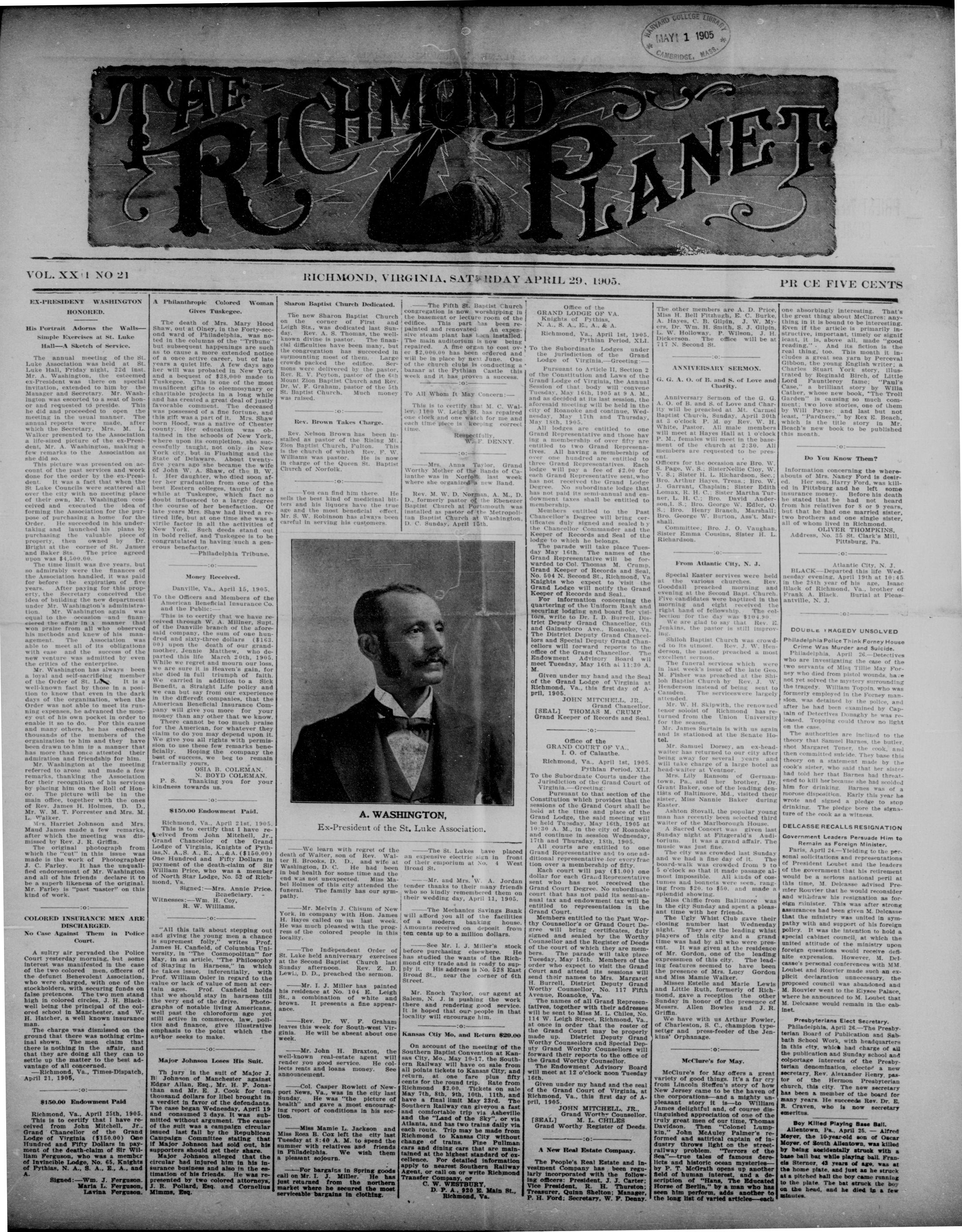
The annual meeting of the St. Luke Association was held at St. Luke Hall, Friday night, 22d inst. Mr. A. Washington, the esteemed ex-President was there on special invitation, extended to him by the Manager and Secretary. Mr. Washington was escorted to a seat of honor and requested to preside. This he did and proceeded to open the meeting the valuable manner. The annual reports were made, after which the Secretary, Mrs. M. L. Walker presented to the Association a life-sized picture of the ex-President, Mr. A. Washington, making a few remarks to the Association as she did so.
This picture was presented on account of the past services and work done for the order by the ex-President. It was a fact that when the St Luke Councils were scattered all over the city with no meeting place of their own, Mr. Washington conceived and executed the idea of forming the Association for the purpose of purchasing a home for the Order. He succeeded in his undertaking and launched his plans by property, then owned by Dr. Bright at the corner of St. James and Baker Sts. The price agreed upon was $4,500.00.
The time limit was five years, but so admirably were the finances of the Association handled, it was paid for before the expiration of five years. After paying for this property, the Secretary conceived the idea of building the new department under Mr. Washington's administration. Mr. Washington again was equal to the occasion and financed the affair in a manner that won praise from all who observed his methods and knew him more than the Association was able to meet all of its obligations with ease and the success of the new venture was admitted by even the critics of the enterprise. Mr. Washington has always been a loyal and self-sacrificing member of the Order of St. Luke. It is a well-known fact by those in a position to know that even in the dark days of the organization, when the Order was not able to meet its running expenses, he advanced the money out of his own pocket in order to enable it so to do. For this cause and many others, he has endeared thousands of the members of the organization to him and they have been drawn to him in a manner that has more than once attested their admiration and friendship for him. Mr. Washington at the meeting referred to arose and made a few remarks, thanking the Association for the recognition of his services by placing him on the Roll of Honor. The picture will be in the main office, together with the ones of Rev. James H. Holmes, D. D., Mr. W. M. T. Forrester and Mrs. M. L. Walker.
Mrs. Harriet Johnson and Mrs. Maud James made a few remarks, after which the meeting was dismissed by Rev. J. R. Griffin. The original photograph from which the "cut" in this issue was made is the work of Photographer J. C. Farley. It has the unqualified endorsement of Mr. Washington and friend Friederich, to be a super likeness of the original. Mr. Farley is "past master" on this kind of work.
COLORED INSURANCE MEN ARE DISCHARGED.
No Case Against Them in Police Court.
A sultry air pervaded the Police Court yesterday morning, but some interest was manifested in the case of the two colored men, officers of the defunct Benevolent Association, who were charged, with one of the stockholders, with securing funds on false pretences. The two men stand high in colored circles, J. H. Blackwell being the principal of the colored school in Manchester, and W. H. Hatcher, a well known insurance man.
The charge was dismissed on the ground that there was nothing criminal shown. The men claim that there is nothing in the affair, and that they are doing all they can to settle up the matter to the best advantage of all concerned.
—Richmond, Va., Times-Dispatch, April 21, 1905.
$150.00 Endowment Paid
Richmond, Va., April 25th, 1905.
This is to certify that I have received from John Mitchell, Jr.
Grand Chancellor of the Grand Lodge of Virginia ($150.00) One Hundred and Fifty Dollars in payment of the death-claim of Sir William Ferguson, who was a member of Invincible Lodge, No. 65, Knights of Pythias, N. A., S. A., E., A., and A.
Signed:—Wm. J. Ferguson.
Maria L. Ferguson.
Lavina Ferguson.
The death of Mrs. Mary Hood Shaw, out at Olney, in the Fort- second ward of Philadelphia, was noted in the columns of the "Tribune" but subsequent happenings are such as to cause a more extended notice of a once active career, but of late years a quiet life. A few days ago her will was probated in New York and a bequest of $38,000 made to Tuskegee. This is one of the most munificent gifts to eleemosynary or charitable projects in a long while and has created a great deal of justly awarded fortune. The deceased was possessed of a fine house, and this gift was a part of it. Mrs. Shaw born Hood, was a native of Chester county. Her education was obtained in the schools of New York, where upon its completion, she successfully taught, not only in New York city, but in Flushing and the State of Delaware. About twenty-five years ago she became the wife of John W. A. Shaw, of the B. W. I. Her daughter, who died soon after her graduation from one of the best Eastern colleges, taught for a while at Tuskegee, which fact no one influenced to a large degree the course of her benefaction. Of late years Mrs. Shaw had lived a retired life, but at one time a virile factor in all the activities of New York. Such deeds stand out in bold relief, and Tuskegee is to be congratulated in having such a generous benefactor.
—Philadelphia Tribune.
Money Received.
Danville, Va., April 15, 1905.
To the Officers and Members of the American Beneficial Insurance Co. and the Public:—
This is to certify that we have received through W. A. Millner, Supt. of the Danville branch of the aforementioned company, the sum of one hundred and sixty-three dollars ($163.00) upon the death of our grandmother, Jennie Matthew, who departed this life March 20th, 1905. While we regret and mourn our loss, we are sure and mourn our gain, for she died in full triumph of faith. We carried in addition to a Sick Benefit, a Straight Life policy and we can but say from our experience in the different companies, that the American Beneficial Insurance Company will give you more for your money than any other that we know. There cannot be too much praise for the American, for whatever they claim to do you may depend upon it. We give you all rights with permission to use these few remarks beneficially. Hoping the company the best of success, we beg to remain fraternally yours.
OSIA B. COLEMAN.
N. BOYD COLEMAN.
P. S. Thanking you for your kindness towards us.
$150.00 Endowment Paid
Richmond, Va. April 21st, 1905.
This is to certify that I have received from John Mitchell, Jr.,
Grand Chancellor of the Grand
Lodge of Virginia, Knights of Pythias,
N. A. S. A. E. A., & A.($150.00)
One Hundred and Fifty Dollars in payment of the death-claim of Sir
William Price, who was a member of North Star Lodge, No. 52 of Richmond, Va.
Signed:—Mrs. Annie Price.
Baneficiary.
Witnesses:—Wm. H. Coy.
R. W. Willars.
"All this talk about stepping out and giving the young men a chance is supremest folly," writes Prof. James H. Canfield, of Columbia University, in "The Cosmopolitan" for May, in an article, "The Philosophy of Staying in Harness," in which he takes issue, inferentially, with Prof. William Osler in regard to the value or lack of value of men at certain ages. Prof. Canfield holds that we should stay in harness till the end of the drive. Photographs of notable Americans, well past the chloroform age, still active in commerce, have politics and finance, give illustrative emphasis to the point which the author seeks to make.
Major Johnson Loses His Suit
The jury in the suit of Major J. B! Johnson of Manchester against Edgar Allan, Esq., Mr. H. F. Jonathan and Mr. E. J. Cook for ten thousand dollars for libel brought in a verdict in favor of the defendants. The case began Wednesday, April 19 and consumed 3 days. It was submitted without argument. The cause of the suit was a campaign circular issued last fall by the Republican Campaign Committee stating that if Major Johnson had sold out, his supporters should get their share. Major Johnson alleged that the circular had injured him in his insurance and also in the estimation of his friend. He was represented by two colored attorneys, J. R. Pollard, Esq. and Cornelius Mimms Esq.
RICHMOND, VIRGINIA, SATRDAY APRIL 29, 1905
M.
Sharon Baptist Church Dedicated.
The new Sharon Baptist Church on the corner of First and Leigh Sts., was dedicated last Sunday. Rev. A. S. Thomas, the well-known divine is pastor. The financial difficulties have been many, but the congregation has succeeded in surmounting most of them. Large crowds packed the edifice. Sermons were delivered by the pastor, K. R. K. Graham, pastor of the 6th Mount Zion Baptist Church and Rev. Dr. W. F. Graham pastor of the 5th St. Baptist Church. Much money was raised.
Rev. Brown Takes Charge.
Rev. Nelson Brown has been installed as pastor of the Rising Mt. Zion Baptist Church, Fulton. This is the church of which Rev. F. W. James was pastor. He is now in church of Queen St. Baptist Church of Norfolk.
——You can find him there. He sells the best kind of medicinal bitters and his liquors have the true age and the most beneficial effect. Mr. S. W. Robinson has always been careful in serving his customers.
A. WAS
Ex-President of the
We learn with regret of the death of Walter, son of Rev. Walter H. Brooks, D. D., and wife at Washington, D. C. He had been in bad health for some time and the end was not unexpected. Miss Mara Holmes of this city attended the funeral. The family has our sympathy.
Mr. Melvin J. Chisum of New York, in company with Hon. James H. Hayes called on us last week. He was much pleased with the progress of the colored people in this locality.
The Independent Order of St. Luke held anniversary exercises at the Second Baptist Church last Sunday afternoon. Rev. Z. D. Lewi, D. D., preached the sermon.
Mr. I. J. Miller has painted his residence at No. 104 E. Leigh St., a combination of white and brown. It presents a fine appearance.
Rev. Dr. W. F. Graham leaves this week for South-west Virginia. He will be absent about one week.
Mr. John H. Braxton, the well-known real-estate agent will render you good service. He collects rents and loans money. See announcement.
Col. Casper Rowlett of Newport News, Va., was in the city last Sunday. He was "the picture of health" and gave a most encouraging report of conditions in his section.
Miss Mamie L. Jackson and Miss Rosa B. Cox left the city last Tuesday at 8:40 A.M. to spend the summer with relatives and friends in Philadelphia. We wish them a pleasant sojourn.
For bargains in Spring goods call on Mr. I. J. Miller. He has just returned from the northern market where he secured the most serviceable bargains in clothing.
The Fifth St. Baptist Church congregation is now worshiping in the basement or lecture room of the edifice. This part has been repainted and renovated. An expensive steam plant has been installed. The main auditorium is now being repaired. A fine organ cost over $2,000.00 has been ordered and will be in place by next June. One of the church clubs is conducting a bazaar at the Pythian Castle this week and it has proven a success.
To All Whom It May Concern:—
This is to certify that M. C. Waller, 1100 W. Leigh St. has repaired one clock and one watch for me and each time piece is keeping correct time.
Respectfully,
W. F. DENNY.
:o:
Mrs. Anna Taylor, Grand Worthy Mother of the Bands of Calanthe was in Norfolk, last week where she organized a new Band.
Rev. M. W. D. Norman, A. M. D. D., formerly pastor of the Ebenezer Baptist Church at Portsmouth was installed as pastor of the Metropolitan Baptist Church at Washington, D. C. Sunday, April 15th.
HINGTON,
St. Luke Association.
The St. Lukes have placed an expensive electric sign in front of their emporium at No. 4 West Broad St.
Mr. and Mrs. W. A. Jordan tender thanks to their many friends who so kindly remembered them on their wedding day, April 11, 1905.
The Mechanics Savings Bank will afford you all of the facilities of a modern banking house. Amounts received on deposit from ten cents up to a million dollars.
See Mr. I. J. Miller's stock before purchasing elsewhere. He has studied the wants of the Richmond city trade and is ready to supply it. His address is No. 528 East Broad St., near the corner of 6th Street.
Mr. Enoch Taylor, our agent at Salem, N. J. is pushing the work there and rendering good service. It is hoped that our people in that locality will encourage him.
Kansas Ctiy Mo, and Return $29.00
On account of the meeting of the Southern Baptist Convention at Kansas City, Mo., May 10-17, the Southern Railway will have on sale from all points tickets to Kansas City, and return, at one fare plus fifty cents for the round trip. Rate from Richmond $2.00. Tickets on sale May 7th, 8th, 9th, 10th, 11th, and have a final limit May 23rd. The Southern Railway can give you a fast and comfortable trip via Asheville and the "Land of the Sky", or via Atlanta, and has two trains daily via each route. Trip may be made from Richmond to Kansas City without change of trains. Fine Pullman cars and dining cars that are maintained at the highest standard of excellence. For detailed information apply to nearest Southern Railway Agent, or call on or write Richmond Transfer Company, or C. W. WESTBURY,
D. P. A., 920 E. Main St., Richmond, Va.
Office of the
GRAND LODGE OF VA.
Knights of Pythias,
N. A., S. A., E., A., & A.
Richmond, Va., April 1st, 1905.
Pythian Period, XLI.
To the Subordinate Lodge under
the jurisdiction of the Grand
Lodge of Virginia.—Greeting:
Pursuant to Article II, Section 2
of the Constitution and Laws of the
Grand Lodge of Virginia, the Annual
Session of that body will convene
Tuesday, May 16th, 1905 at 9 A. M.,
and as decided at its last session, the
aforesaid meeting will be held in the
city of Roanoke and continue, Wednesday,
May 17th and Thursday,
May 18th, 1905.
All lodges are entitled to one
Grand Representative and those having
a membership of over fifty are entitled to two Grand Representatives. All having a membership of over one hundred are entitled to three Grand Representatives. Each lodge will pay a fee of $2.00 for each Grand Representative sent, who has not received the Grand Lodge Degree. No subordinate lodge that has not paid its semi-annual and endowment taxes shall be entitled to membership.
Members entitled to the Past
Member's Degree will bring certificates duly signed and sealed by the Chancellor Commander and the Keeper of Records and Seal of the
lodge to which he belongs.
The parade will take place Tuesday May 16th. The names of the Grand Representative will be forwarded to Col. Thomas M. Crump, Grand Keeper of Records and Seal, No. 504 N. Second St. Richmond, Va. Knights who expect to visit the Grand Lodge will notify the Grand Keeper of Records and Seal.
The convention concerning the quartering of the funeral will securing lodging and board for visitors, write to Dr. I. D. Burrell, District Deputy Grand Chancellor, 6th and Gainesboro Ave., Roanoke, Va. The District Deputy Grand Chancellors and Special Deputy Grand Chancellors will forward reports to the office of the Grand Chancellor. The Endowment Advisory Board will meet Tuesday, May 16th at 11:30 A.M.
Given under my hand and the Seal of the Grand Lodge of Virginia at Richmond, Va., this first day of April, 1905.
JOHN MITCHELL, JR. Grand Chancellor.
[SEAL] THOMAS M. CRUMP Grand Keeper of Records and Seal
Office of the
GRAND COURT OF VA..
I. O. of Calanthe.
Richmond, Va., April 1st, 1905.
Pythian Period, XLI.
To the Subordinate Courts under the Jurisdiction of the Grand Court of Virginia.—Greeting:
Pursuant to that section of the Constitution which provides that the sessions of the Grand Court shall be held at the time and place of the Grand Lodge, the said meeting will be held Tuesday, May 16th, 1905 at 10:30 A. M., in the city of Roanoke and continue in session Wednesday, 17th and Thursday, 18th, 1905.
All courts are entitled to one Grand Representative and to one additional representative for every fraction over a membership of fifty.
Each court will pay ($1.00) one dollar for each Grand Representative sent who has not received the Grand Court Degree. No subordinate court that has not paid its semi-annual tax and endowment tax will be entitled to representation in the Grand Court.
Members entitled to the Past Worthy Counselor's or Grand Court Degree will bring certificates, duly signed and sealed by the Worthy Counselor and the Register of Deeds of the court of which they are members. The parade will take place Tuesday, May 16th. Members of the order who expect to visit the Grand Court and attend its sessions will send their names to Mrs. Margaret H. Burrell, District Deputy Grand Worthy Counselor, No. 117 Fifth Avenue, Roanoke, Va.
The names of all Grand Representatives together with their addresses will be sent to Miss M. L. Chiles, No. 114 W. Leigh Street, Richmond, Va., at once in order that the roster of the Grand Court may be properly made up. District Deputy Grand Worthy Counselors and Special Deuty Grand Worthy Counselors will forward their reports to the office of the Grand Worthy Counselor.
The Endowment Advisory Board will meet at 12 o'clock noon Tuesday 16th.
Given under my hand and the seal of the Grand Court of Virginia, at Richmond, Va., this first day of April, 1905.
JOHN MITCHELL, JR.
JOHN MITCHELL, JR. Grand Worthy Counsellor. [SEAL] M. L. CHILES Grand Worthy Register of Deeds
A New Real Estate Company
The People's Real Estate and Investment Company has been regularly incorporated with the following officers: President, J. J. Carter; Vice President, R. H. Thurston; Treasurer, Quinn Shelton; Manager, P. H. Ford; Secretary, W. F. Denny.
The other members are A. D. Price
Miss H. Bell Fitzhugh, E. C. Burke
A. Hayes, C. B. Gilpin, J. W. Myers
Dr. Wm. H. Smith, S. J. Gilpin
W. Halloway, P. Wilson, J. H.
Dickerson, the office will be at
717 N. Second St.
ANNIVERSARY SERMON.
G. G. A. O. of B. and S. of Love and Charity.
Anniversary Sermon of the G. G. A. O. of B. and S. of Love and Charity will be preached at Mt. Carmel Baptist Church, Sunday, April 30th at 3 o'clock P. M. oy Rev. W. H. White, Pastor. All male members will meet at Hayes Hall at 1 o'clock P. M., females will meet in the basement of the church at 2:30. All members are requested to be present.
Officers for the occasion are Bro. W. S. Page, W. S.; SisterNellie Cloy, W. S.; Sister H. L. Richardson, Sec.; Bro. Arthur Hayes, Treas.; Bro. W. J. Garrant, Chaplain; Sister Edith Lomax, R. H. C.; Sister Martha Turner, L. C.; Bro. David Anderson, L.; Bro. Henry Branch, Elder, O. S.; Bro. Henry Branch, Marshall; Bro. George W. Burton, Ass't. Marshall.
Committee; Bro. J. O. Vaughan, Sister Emma Cousins, Sister H. L. Richardson.
From Atlantic City, N. J.
Special Easter serviles were held at the various churches. Rev. Gooddall preached morning and evening at the Second Bapt. Church. Five candidates were baptized the morning and eight received the right hand of fellowship. The collection for the day was $104.90. We are glad to say that Rev. E. Jenkins, the pastor is still improving. Shiloh Baptist Church was crowded to its utmost. Rev. J. W. Henderson, the pastor preached a most excellent sermon. The funeral services which were in last week's issue of the late Geo. M. Fisher was preached at the Shiloh Baptist Church by Rev. J. W. Henderson instead of being sent to Camden. The serviceswere largely attended. Mr. W. H. Skipwith, the renowned tenor soloist of Richmond has returned from the Union University for the season. Mr. James Surtain is with us again and is stationed at the Senate Hotel. Mr. Samuel Dorsey, an ex-head-waiter has returned to our city after being away for several years and will take charge of a large hotel as head-waiter at Veenmor. Mrs. Lily Ransom of Germantown, Pa., and her brother, Dr. Grant Baker, one of the leading dentists of Baltimore, Md., visited their sister, Miss Nannie Baker during Easter. Ashton Stovall, the popular young man has recently been selected third waiter of the Mariborough House.
A Sacred Concert was given last Sunday night at Fitzgerald's Auditorium. It was a grand affair. The music was just fine.
The city was crowded last Sunday and we had a fine day of it. The board-walk was crowded from 9 to 5 o'clock so that it made passage almost impossible. All kinds of costumes and bonnets were seen, ranging from $20, to $50, and made a splendid display.
Miss Chiffle from Baltimore was in the city Sunday and spent a pleasant time with her friends.
The Ugly Whist Club gave their closing number last Wednesday night. They are the leading whist players of this city and a grand time was had by all who were present. It was given at the residence of Mr. Gordon, one of the leading expressmen of this city. The leading features seemed to have been the presence of Mrs. Lucy Gordon and Miss Mamie Walker.
Misses Estelle and Marile Lewis and Little Ruth, formerly of Richmond, gave a reception the other Sunday in honor of the presence of Messrs. Allen Bowles and J. R. Griffin.
We have with us Arthur Fowler, of Charleston, S. C., champion type-setter and press-feeder of the Jenkins' Orphanage.
McClure's for May
McClure's for May offers a great variety of good things. It's a far cry from Lincoln Steffen's story of how New Jersey came to be the haven of the corporations—and a mighty unpleasant story it is—to William James delightful and, of course distinguished appreciation of one of the truly great men of our time, Thomas Davidson. Then "Colonel Lumpkin." John McAuley Palmer's reformed and satirical captain of industry throws light on the streetrailway problem. "Terrors of the Sea"—true tales of famous derelicts and historic ocean mysteries—by P. T. McGrath opens up another field of human interest, and a description of "Hans, The Educated Horse of Berlin," by a man who has seen him perform, adds another to the long list of varied articles—each
one absorbingly interesting. That's the great thing about McClures; anything in it is bound to be interesting. Even if the article is primarily instructive, important, timely or significant, it is, above all, made "good reading." And its fiction is the real thing, too. This month it includes a great sea yarn by Perceval Gibbon, the young English writer; a Charles Stuart York story, illustrated by Reginald Birch, of Little Lord Fauntleroy fame; "Paul's Case," a brilliant story by Willa Cather, whose new book, "The Troll Garden" is causing so much comment; two love stories, one of them by Will Payne; and last but not least, "Pardners," by Rex E. Beach, which is the title story in Mr. Beach's new book to be published this month.
Do You Know Them?
Information concerning the whereabouts of Mrs. Nancy Ford is desired. Her son, Harry Ford, was killed in Pittsburgh and he left some insurance money. Before his death he stated that he had not heard from his relatives for 8 or 9 years, but that he had one married sister, two brothers and one single sister, all of whom jumped into Oliver THOMPSON, Address, No. 35 St. Clark's Mill, Pittsburgh Pa.
Atlantic City, N. J.
BLACK—Departed this life Wednesday day, April 19th at 10:45 in the 28th car of his life. Isaac Black of Richmond, Va., brother of Frank A. Black. Burial at Pleasantville, N. J.
DOUBLE RAGEDY UNSOLVED
Philadelphia Police Think Forney House Crime Was Murder and Suicide
Philadelphia, April 26.—Detectives who are investigating the case of the two servants of Miss Tillie May Forney who died from pistol wounds, have not yet solved the mystery surrounding the tragedy. William Toppin, who was formerly employed in the Forney mansion, was detained by the police, and after he had been examined by Captain of Detectives Donaghy he was released. Topping could throw no light on the case.
The authorities are inclined to the theory that Samuel Barnes, the butler, shot Margaret Toner, the cook, and then committed suicide. They base this theory on a statement made by the cook's sister, who said that her sister had told her that Barnes had threatened to kill her because she had scolded him for drinking. Barnes was of a morose disposition. Early this year he wrote and signed a pledge to stop drinking. The pledge bore the signature of the cook as a witness.
DELCASSE RECALLS RESIGNATION
Government Leaders Persuade Him to Remain as Foreign Minister
Paris, April 24. - Yielding to the personal solicitations and representations of President Loubet and the leaders of the government that his retirement would be a serious national peril at this time, M. Delcasse advised Premier Rouvier that he would reconsider and withdraw his resignation as foreign minister. This was after strong assurances had been given M. Delcasse that the ministry was united in sympathy with and support of his foreign policy. It was the intention to hold a special cabinet council, at which the united attitude of the ministry upon foreign questions would receive definite expression. However, M. Delcasse's personal conferences with MM. Loubet and Rouvier made such an explicit declaration unnecessary, the proposed council was abandoned and M. Rouvier went to the Elysse Palace, where he announced to M. Loubet that M. Delcasse would remain in the cabinet.
Presbyterians Elect Secretary
Philadelphia, April 26.—The Presbyterian Board of Publication and Sabbath School Work, with headquarters in this city, which had charge of all the publication and Sunday school and colportage interests of the Presbyterian denomination, elected a new secretary, Rev. Alexander Henry, pastor of the Hermon Presbyterian church, this city. The new secretary has been a member of the board for many years. He succeeds Rev. Dr. E. R. Craven, who is now secretary emeritus.
Boy Killed Playing Base Ball
Allentown, Pa., April 25. — Alfred Meyer, the 10-year-old son of Oscar Moyer, of South Allentown, was killed by being accidentally struck with a base ball bat while playing ball. Francis Sterner, 43 years of age, was at the home plate, and just as he struck at a pitched ball the boy came running to the plate. The bat struck the boy on the head, and he died in a few minutes.
THE YELLOW
PRIEST WEDS A COMELY MAIDEN
MARRIAGE CAUSES EXCITE-
MENT IN CANADIAN TOWN.
BRIDE COURTED BY MAIL.
Pretty Romance Begun About Two
Years Ago and Its Culmination
Comes as a Great Surprise to
Friends of Both.
Toronto, Canada.—When Rev. Alex-
ander O'Handly broke his solemn vow
of celibacy to wed Miss May Finch.
Noyes here a few weeks ago, he threw
the town of Hamilton into a condition
of perplexed excitement, for he had been
a zealous and popular priest attached
to the cathedral there. She was a mem-
ber of a wealthy and respected family
and a recent convert to Catholicism.
By this marriage, of course, both put
themselves outside the pale of the
church.
Their friends had never even suspected that they were in love or that anything in the way of a courtship was involved in their association, and the first that anyone knew of it was when the marriage notice appeared in a Hamilton paper.
The romance began two years ago, when Miss Finch-Noyes began attending St. Mary's cathedral. She had been born and brought up in the Anglican church, where her parents still worship. She became a Catholic when Rev. Father Staunton, of New York, was conducting a mission in that cathedral. It is said that while Father O'Handley was instructing the pretty novice in her new faith the spark was kindled which had the old-fashioned ending of marriage, though her first religious instruction was given, no by him, but by Father Walters.
Miss Finch-Noyes had always been gealous in religious work, and follow
HE FELL IN LOVE WITH THE PRET
TY NOVICE
ing her conversion her aeal found ample scope in her work in connection with St Joseph's convent. This change in religion did not interrupt her pleasant home relationship, and she continued to live beneath the parental roof, her father being Mr. E. Finch-Noyes, a large clothing manufacturer.
Coincident with Miss Finch-Noyes' reception into St. Mary's cathedral was the arrival from Antigonish, Nova Scotia, of Rev. Father O'Handley as third assistant at the cathedral. He performed his duties in a creditable and satisfactory manner and won the esteem and good will of his fellow priests and of all with whom he came in contact. No one dreamed that one of his parishioners found more favor with him than another, and the circumstances of their initial wooding are a mystery. It is believed that much of their courtship was carried on by letters. Even the girl's mother had no suspicion of what was going on, her first information on the subject being communicated to her by her daughter herself a few days after their marriage.
Father O'Handley remained at St. Mary's until last November, when he went to help Father Lennon at Brantford. He continued to labor in that field until a few days ago. Absence evidently fanned the flame, and marriage was agreed upon.
By arrangement between the two Miss Finch-Noyes came to Toronto in January to visit friends. For the next few days there was a daily exchange of love missives. One morning soon after Father O'Handly also arrived. They met and together drove to the home of a minister and he performed the oath by which a priest vowed by oath to cellacy took unto himself a wife.
"Was there any secrecy apparent in the actions of the bride and bride-groom?" the minister was asked.
"None whatever," he replied; "they were perfectly honest and above board in the matter."
"Did you know you were marrying a priest?"
"No, I did not know that for some time afterward."
Father O'Handly returned to Brantford a few days afterward and resumed his duties as priest. He was very much preoccupied in his manner, however, and in a day or two relinquished his duties, and immediately thereafter the marriage notice appeared.
Man Loses Power of Speech.
St. Louis.—After awakening from a
bap, Fred Schmidt was stricken speech-
less just as he was about to call to his wife. He had been ill for several days. Physicians stated the case to be motor aphasia, and say he may be permanently speechless. Schmidt's hearing was unaffected.
ORGIES ABOARD
STRANGE CRAFT
MYSTERIOUS PLEASURE YACHT
IN THE ADRIATI SEA.
GIRLS INDUCED TO EMBARK
Young Peasant Maid Who Was
Shanghailed Tells Remarkable
Story of Drinking, Feasting
and Dancing of Hosts.
Vienna.—A mysterious pleasure yacht is cruising along the Adriatic, kidnapping girls, its owners indulging in orgies of the kind described in the tales of the "Decameron." The fishermen along the coast are planning to blow up the mysterious yacht at the best opportunity. Fishing boats and coast steamers which have sighted her tell remarkable stories. The yacht is of considerable size. She is painted black, is, of course, rakish, and carries no flag or name. She has a goodly sized crew, all smartly uniformed, and about half a dozen guests or owners. Because she did not answer signals the steamer Godollo threw a searchlight on her, revealing peculiar sights.
Half a dozen men and the same number of women, fantastically dressed, were on the deck feasting, drinking, dancing and behaving in remarkable ways. A fuller story is told by a peasant girl who has just returned to her home in Croatin after a fortnight's sudden disappearance. She says some uniformed soldiers came ashore and prevailed on her to go aboard to sell vegetables. She was taken to a huge cabin furnished with beautiful carpets and divans, after the Turkish fashion. She was pled with wine and the yacht steamed away. When she awoke she found herself undressed, and in place of her clothes were many others of finest silks and lace. These she donned, and, on the promise of much gold, joined half a dozen aristocratic men and a number
A
THEY DRINK, FEAST AND DANCE of peasant girls like herself, who, however, were all richly dressed.
They feasted on rich viands and drank champagne and gambled around the cabins and on the after deck all night and half the day. Her tales of the happenings are remarkably similar to those of Boccaccio. In ten days' time the girl was completely worn out with the orgles, and her hosts put her ashore at a place she pointed out. They gave her their blessing and many gold pieces. Other girls were also put ashore and new ones brought on the yacht. The girl can tell little about the yacht or her hosts, except that they talked English, French, Italian and German equally well and were evidently rich and aristocratic. A fisherman who sold the yacht some fish confirms much of the girl's story, and says there were at least a dozen peasant girls aboard, but all richly and fantastically dressed.
QUEER DIET OF INSANE MAN
Skeleton of Mouse, Handkerchief and Other Strange Things Found in Body at Danville, Pa.
Danville, Pa.—The skeleton of a mouse, a bandanna handkerchief and other articles of a curious nature, found in the stomach of a dead man, have furnished a puzzle for the resident physician and his assistants at the State Hospital for the Insane here. John Alexander, in whose stomach these evidences of a queer diet was found, died in the hospital recently, and his body was sent to Philadelphia, where, under the direction of the State Anatomical society, it was examined.
Danville physicians say the case of Alexander stands alone in medical annals. What renders it remarkable is, not that the man should have swallowed the things found in him, but that he could have lived two years after the carcass of a mouse had disintegrated in his stomach, which is believed to be the case.
Alexander was a foreigner and had been in the hospital for two years. He had no relatives in this country. He had complained of abdominal pains, and the hospital physicians were unable to diagnose his case. He was classed with the "harmless" insane.
Frozen Snake for Firewood
York, Pa—John Gress, who lives at Pleasureville, this county, laid in a good supply of wood for the winter. A few evenings ago, when he put some wood into the stove a stick which he had picked up began to wriggle. He discovered that what he thought was a stick was a snake, which had been frozen stiff, but which revived in the warmth. He quickly threw the reptile into the stove, where it was consumed. The snake measured about 14 inches.
An Odd Emetic
A policeman of South Shields, England, ground up a clay pipe, administered the powder as an enelectric to a girl who had taken poison, and saved her life.
THE RICHMOND PLANET, RICHMOND, VIRGINIA.
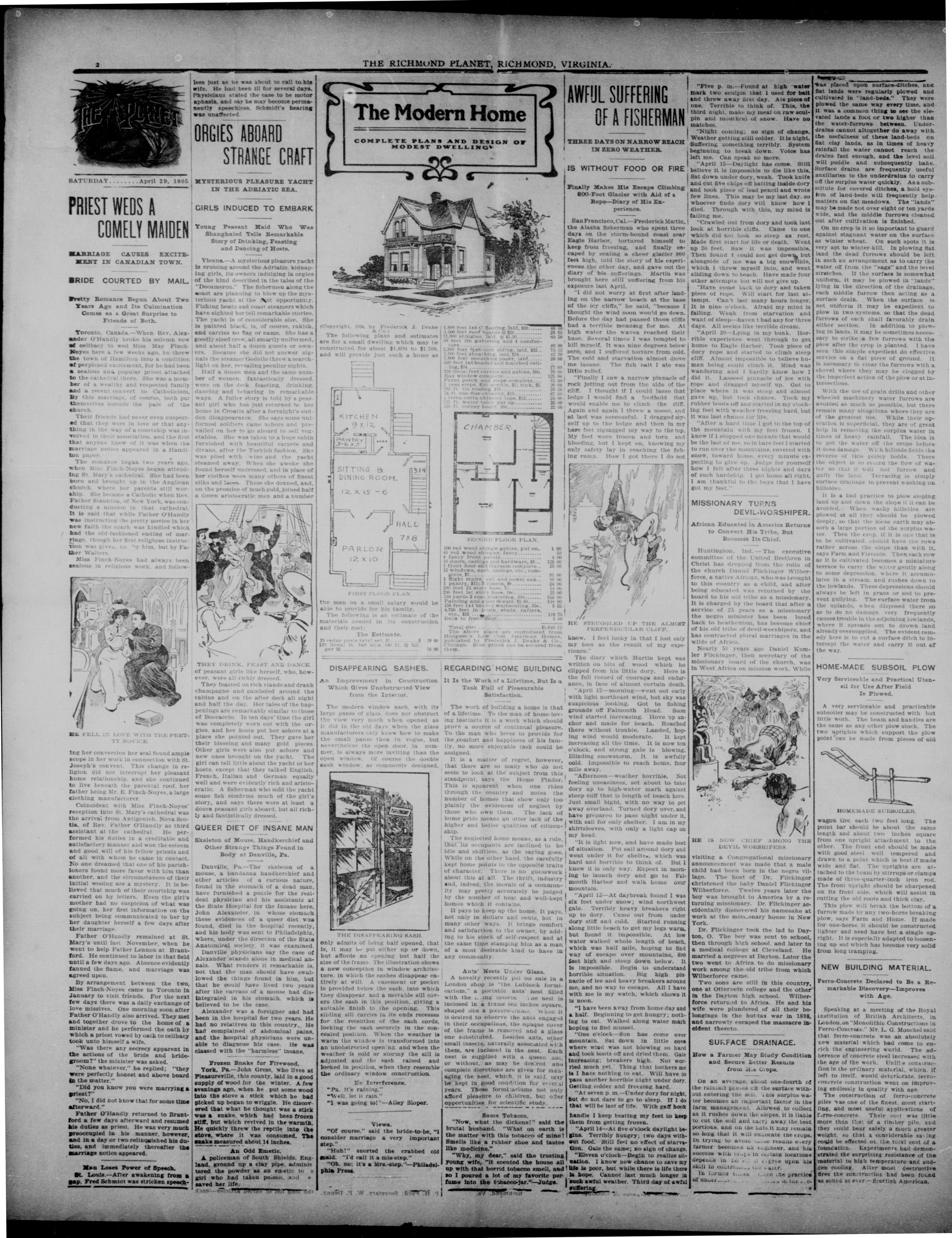
The Modern Home
COMPLETE PLANS AND DESIGN OF
MODEST DWELLING
(Copyright, 1804, by Frederick J. Drake
The following plans and estimates are for a small dwelling which may be constructed for about $1,600 to $1,700 and will provide just such a home as
KITCHEN
9 X 12
PANTRY
3-6 X 5
SITTING &
DINING ROOM.
12 X 15 - 6
HALL
7 X 8
PARLOR
12 X 10
the man on a small salary would be able to provide for his family. The following is an estimate of the materials needed in its construction and their cost:
DISAPPEARING SASHES.
An Improvement in Construction
Which Gives Unobstructed View
from the Interior.
The modern window sash, with its
large panes of glass, does not obstruct
the view very much when opened as
it did in the old days when the glass
manufacturers only knew how to make
the small panes then in vogue, but
nevertheless the open door, in summer,
is always more inviting than the
open window. Of course the double
sash window, as commonly designed.
THE DISAPPEARING SASH
only admits of being half opened, that is, it may be put either up or down, but affords an opening but half the size of the frame. The illustration shows a new conception in window architecture, in which the sashes disappear entirely at will. A casement or pocket is provided below the sash, into which they disappear, and a movable sill covers the sash in this position, giving a suitable finish to the opening. This sliding sill carries in its ends recesses for the retention of the sash cords, locking the sash securely in the concealed position. When the weather is warm the window is transformed into an unobstructed opening, and when the weather is cold or stormy the sill is adjusted and the sash raised and locked in position, when they resemble the ordinary window construction.
No Interference.
"Pn. it's raining."
"Well, let it rain."
"I was going to!"—Alley Sloper.
Views.
"Of course," said the bride-to-be, "I consider marriage a very important step."
15 17 19 21 23 25 27 29 31 33 35 37 39 41 43 45 47 49 51 53 55 57 59 61 63 65 67 69 71 73 75 77 79 81 83 85 87 89 91 93 95 97 99
2,900 feet 18x6-inch siding, laid, $22.
1,900 feet sheathing, laid, $24.
1,900 feet sheathing, laid, $24.
500 feet 18x beaded and matched cell
180, 300
125, 150 feet, and gables, 50c
Bax window compute
Front porch and steps complete.... 80
rear steps, $10; scuttle, $5; sink, $5.... 80
ft. tin roofing, $10.... 80
frame-fluo chimney, $10.... 80
terra-cotta chimney lops, $12.... 80
ft. water table, put up.... 80
ft. corner board, 100.... 80
CHAMBER
SECOND FLOOR PLAN
1 00
50
4 00
128 00
25 00
91 00
60 00
50 00
14 00
23 00
163 00
144 00
5 25
118 70
5 00
100 red wood shingle gables, put on. 1 00
40 red wood shingles, fancy. 20 00
40 doors, casings and hardware, $... 128 00
1 front door and transom complete. 25 00
12 windows, sash, casings, etc., complete. $... 101 00
1 flight stairs, rail and wall oak. 91 00
1 pantry, $15.3 closets, $... 24 00
1 feet, $20.0 house. 20 00
2 feet in story box, $9.0 25 00
100 yards 2 coat plastering, $3c. 158 00
Painting and glass 60 sgrs. $2.40. 144 00
4,750 feet in joists, studs, rafters, $ 5 20
,etc., $25. 118 70
Bells to front door. 5 00
Total cost. $1,640.52
The above plans are reproduced from House of the Lord Low Cost American published by Frederick J. Drake & Co. Chicago. Blue prints can be secured from them.
REGARDING HOME BUILDING
It Is the Work of a Lifetime, But Is a Task Full of Pleasurable
The work of building a home is that of a lifetime. To the man of home-loving instincts it is a work which should prove a source of continual pleasure. To the man who loves to provide for the comfort and happiness of his family, no more enjoyable task could be assigned.
It is a matter of regret, however, that there are so many who do not seem to look at the subject from this standpoint, says the Home Finder. This is apparent when one rides through the country and notes the number of homes that show only too plainly the evidences of neglect by those who own them. The lack of home pride means an utter lack of the higher and better qualities of citizenship.
The neglected home means, as a rule, that its occupants are inclined to be idle and shiftless, as the saying goes. While on the other hand, the carefully kept home points to the opposite traits of character. There is no guesswork about this at all. The thrift, industry and, indeed, the morals of a community may pretty accurately be judged by the number of neat and well-kept homes which it contains. It pays to keep up the home. It pays, not only in dollars and cents, but in many other ways. It brings comfort and satisfaction to the owner, by adding to his stock of self-respect and at the same time stamping him as a man of a most desirable kind to have in any community.
Ants' Nests Under Glass
A novelty recently put on sale in a London shop is "the Lubbock formicarium," a portable ants nest filled with the living insects. The nest is inclosed in a frame ten inches square, shaped like a picture-frame. When it is desired to observe the ants engaged in their occupations, the opaque cover of the frame is removed and a glass one substituted. Besides ants, other small insects, naturally associated with them, are inclosed in the nest. Each nest is supplied with a queen ant, or without, as may be desired and complete directions are given for managing the nest, which, it is said, may be kept in good condition for several years. These formicaria not only afford pleasure to children, but offer opportunities for scientific study.
Some Tobacco
"Now, what the dickens!" said the brutal husband. "What on earth is the matter with this tobacco of mine? Smells like a rubber shoe and tastes like medicine."
"Why, my dear," said the trusting young wife, "it scented the house all up with that horrid tobacco smell, and so I poured a lot of my favorite perfume into the tobacco jar." - Judge.
AWFUL SUFFERING OF A FISHERMAN
THREE DAYS ON NARROW BEACH
IN ZERO WEATHER.
IS WITHOUT FOOD OR FIRE
Finally Makes His Escape Climbing
800-Foot Glacier with Aid of a
Rope—Diary of His Experience.
San Francisco, Cal.—Frederick Martin,
the Alaska fisherman who spent three
days on the storm-bound coast near
Eagle Harbor, tortured himself to
keep from freezing, and finally escaped by scaling a sheer glacier 800
feet high, told the story of his experiences the other day, and gave out the
diary of his sufferings. Martin was
brought here still suffering from his
exposure last April.
"I did not worry at first after landing on the narrow beach at the base of the icy cliffs," he said, "because I thought the wind soon would go down. Before the day had passed those cliffs had a terrible meaning for me. At high water the waves reached their base. Several times I was tempted to kill myself. It was nine degrees below zero, and I suffered torture from cold. The cold and starvation almost drove me insane. The fish oalt I ate was little relief.
"Finally I saw a narrow pinnacle of rock jutting out from the side of the cliff. I thought if I could lasso that ledge I would find a foothold that would enable me to climb the cliff. Again and again I threw a noose, and at last was successful. I dragged myself up to the ledge and then in my bare feet zigzagged my way to the top. My feet were frozen and torn and bleeding, but I kept on, knowing my only safety lay in reaching the fishing camp. How I got there I do not
HE STRUGGLED UP THE ALMOST PERPENDICULAR CLiff
HE STRUGGLED UP THE ALMOST PERPENDICULAR CLIFF, know. I feel lucky in that I lost only my toes as the result of my experience."
The diary which Martin kept was written on bits of wood which he clipped from his little dory. Here is the full record of courage and endurance, in face of almost certain death. "April 12—morning—went out early with light northeast wind, but sky was suspicious looking. Got to fishing grounds of Falmouth Head. Soon wind started increasing. Hove up anchor and made for beach. Reached there without trouble. Landed, hoping wind would moderate. It kept increasing all the time. It is now ten o'clock, and strong gale is blowing. Blinding snowstorm. It is awfully cold. Impossible to reach home, four mile away.
"Afternoon—weather horrible. Not feeling uneasiness, set about to take dory up to high-water mark against steep ciff that is length of beach here. Just small bight, with no way to get away overland. Turned dory over, and have prepared to pass night under it, with sail for only shelter. I am in my shirtsleeves, with only a light cap on my head.
"It is light now, and have made best of situation. Put sail around dory and went under it for shelter, which was hard and horrible to think of. But I know it is only way. Expect in morning to launch dory and go to Falmouth Harbor and walk home over mountain.
"April 13—At daybreak found I was six feet under snow; wind northwest gale. Terribly heavy breakers right up to dory. Came out from under dory stiff and cold. Started running along little beach to get my legs warm, but found it impossible. At low water walked whole length of beach, which was half mile, hoping to find way of escape over mountains, 800 feet high and steep down below. It is impossible. Begin to understand horrible situation. Big high pinnacle of ice and heavy breakers around me, and no way to escape. All I have with me is my watch, which shows it is noon.
"I have been away from home day and a half. Beginning to get hungry; nothing to eat. Walked along water mark hoping to find mussel."
"One o'clock—Sun has come over mountain. Sat down in little cove where wind was not blowing so hard and took boots off and dried them. Gale increasing; breakers high. Not worried much yet. Thing that bothers me is I have nothing to eat. Will have to pass another horrible night under dory. Getting colder and freezing hard.
"At seven p. m.—Under dory for night, but do not dare to go to sleep. If I do that will be last of life. With gaff hook handle I keep beating my feet to keep them from getting frozen.
"April 14—At five o'clock daylight begins. Terribly hungry; two days without food. Still feel no effect of starvation. Gale the same; no sign of change.
"Eleven o'clock—Begin to realize situation. I know now chance to save my life is poor, but while there is life there is hope. Cannot last much longer in such awful weather. Third day of awful suffering.
"Five p. m. -Found at high water mark two sculpin that I used for bait and threw away first day. Ate piece of one. Terrible to think of. This, the third night, make my meal on raw sculpin and mouthful of snow. Have no matches.
"Night coming; no sign of change. Weather getting still colder. It is night. Suffering something terribly. System beginning to break down. Voice has left me. Can speak no more.
"April 15 -Daylight has come. Still believe it is impossible to die like this. Sat down under dory, weak. Took knife and cut five chips off batting inside dory and took piece of lead pencil and wrote few lines. This may be my last day, so whoever finds dory will know how I died. Through with this, my mind is failing me.
"Crawled out from dory and took last look at horrible cliffs. Came to one which did not look so steep as rest, Made first start for life or death. Went up 30 feet. Saw it was impossible. Then found I could not get down, but alongside of me was a big snowslide, which I threw myself into, and went sliding down to beach. Have made four other attempts but will not give up. "Have come back to dory and taken piece of rope. Will start for last attempt. Can't last many hours longer. It is nine o'clock. Afraid my mind is falling. Weak from starvation and want of sleep—haven't it any for three days. All seems like terrible dream.
"April 20—Lying in my bunk. Horrible experience went through to get home to Eagle Harbor. Took piece of dory rope and started to climb steep cliff. Almost impossible to believe human being could climb it. Mind was wandering and I hardly know how I did it. Lassooed pinnacle of fee with rope and dragged myself up. Got to place where it was steep and almost gave up, but took chance. Took my rubber boots off and started in my stocking feet with weather freezing hard, but it was last chance for life.
"After a hard time I got to the top of the mountain with my feet frozen. I knew if I stopped one minute that would be the last of me, so in bare feet I started to run over the mountains, covered with snow, toward home, every minute expecting to give up. Judge for yourself how I felt after three nights and days of such hardship. I got home all right. I am thankful to the boys that I have got my feet."
MISSIONARY TURNS
DEVIL-WORSHIPER
African Educated in America Returns to Convert His Tribe, But Becomes Its Chief.
Huntington, Ind. — The executive committee of the United Brethren in Christ has dropped from the rolls of the church Daniel Flickinger Wilberforce, a native African, who was brought to this country as a child, and after being educated was returned by the board to his old tribe as a missionary. It is charged by the board that after a service of 25 years as a missionary the negro minister has been lured back to heathenism, has become chief of his old tribe of devil-worshipers, and has contracted plural marriages in the wilds of Africa.
Nearly 50 years ago Daniel Kumler Flickinger, then secretary of the missionary board of the church, was in West Africa on mission work. While
HE IS NOW CHIEF AMONG THE
DEVIL WORSHIPERS.
visiting a Congregational missionary announcement was made that a male child had been born in the negro village. The host of Dr. Flickinger christened the baby Daniel Flickinger Wilberforce. Twelve years later the boy was brought to America by a returning missionary. Dr. Flickinger accidentally discovered his namesake at work at the missonary house in New York. Dr. Flickinger took the lad to Dayton, O. The boy was sent to school, then through high school, and later to a medical college at Cleveland. He married a negress at Dayton. Later the two went to Africa to do missionary work among the old tribe from which Wilberforce came.
Two sons are still in this country, one at Otterbein college and the other in the Dayton high school. Wilberforce returned to Africa. He and his wife were plundered of all their belongings in the hut-tax war in 1898, and narrowly escaped the massacre incident thereto.
SURFACE DRAINAGE
How a Farmer May Study Condition and Secure Better Results from His Crops.
On an average, about one-fourth of the rainfall pesses on the surface without entering the soil. This surplus water becomes an important factor in the farm management. Allowed to collect as it rushes down the slopes, it is liable to cut the soil and carry away the best portions, and on the hats it may remain so long that it will蘸ate the crops. In trying to avoid these results every farmer becomes an engineer, and his success with crops in certain locations depends on how creepr upon his skill in controlling the water. In former times, some the practice
more the practice
tion to the s.c.
was placed upon surface-ditches, and flat lands were regularly plowed and cultivated in "land-beds." They were plowed the same way every time, and it was a common thing to see the elevated lands a foot or two higher than the water-furrows between. Underdrains cannot altogether do away with the usefulness of these land-beds on flat clay lands, as in times of heavy rainfall the water cannot reach the drains fast enough, and the level soil will paddle and subsequently bake. Surface drains are frequently useful auxiliaries to the underdrains to carry off the surplus water quickly. As a substitute for covered ditches, a bold system of land-beds will frequently help matters on flat meadows. The "lands" may be made not over eight or ten yards wide, and the middle furrows cleaned out after cultivation is finished.
On no crop is it so important to guard against stagnant water on the surface as winter wheat. On such spots it is very apt to winter-kill. In plowing flat land the dead furrows should be left in such an arrangement as to carry the water off from the "sags" and the level stretches. If the surface is somewhat uniform, it may be plowed in "lands" lying in the direction of the drainage, each middle furrow then acting as a surface drain. When the surface is not uniform it may be expedient to plow in two systems, so that the dead furrows of each shall favorably drain either section. In addition to plowing in lands, it may be sometimes necessary to strike a few furrows with the plow after the crop is planted. I have seen this simple expedient do effective service on a flat piece of ground. It is necessary to clear the furrows with a shovel where they may be clogged by the imperfect action of the plow or at intersections.
With the use of grain drills and other wheeled machinery water furrows are avoided as much as possible, but there remain many situations where they are of the greatest use. While their operation is superficial, they are of great help in removing the surplus water in times of heavy rainfall. The idea is to get the water off the crops before it does damage. With hillside fields the reverse of this policy holds. There the object is to record the flow of water so that it will not furrow and gully the land. Terracing is simply surface drainage to prevent washing on hillsides.
It is a bad practice to plow sloping land up and down the slope if it can be avoided. When washy hillsides are plowed at all they should be plowed deeply, so that the loose earth may absorb a large portion of the surplus water. Then the crop, if it is one that is to be cultivated, should have the rows rather across the slope than with it, says Farm and Fireside. Then each row as it is cultivated becomes a miniature terrace to carry the water gently along to some depression, where it accumulates in a stream, and rushes down to the lowlands. These depressions should always be left in grass or sod to prevent gullying. The surface water from the uplands, when disposed there so as to do no damage very frequently causes trouble in the adjoining lowlands, where it spreads out to drown land already oversupplied. The evident remedy here is to cut a surface ditch to intercept the water and carry it out of the way.
HOME-MADE SUBSOIL PLOW
Very Serviceable and Practical Uten-
sil for Use After Field
Is Plowed.
A very serviceable and practicable
subsolver may be constructed with but
little work. The beam and handles are
the same as any other plow stock. The
two uprights which support the plow
point can be made from pieces of old
HOMEMADE SUBSOILER
wagon tire, each two feet long. The point bar should be about the same length and about two inches square from one upright attachment to the other. The front end should be made with good steel well tempered and drawn to a point which is best if made wide and flat. The uprights are attached to the beam by stirrups or clamps made of three-quarter-inch iron rod. The front upright should be sharpened on its front side, which will assist in cutting the old roots and thick clay. This plow will break the bottom of a furrow made by any two-horse breaking plow, says Farm and Home. If made for one-horse it should be constructed lighter and need have but a single upright. It is especially adapted to loosening up sod which has become very solid from long tramping.
NEW BUILDING MATERIAL
Ferro-Concrete Declared to Be a Remarkable Discovery—Improves with Age.
Speaking at a meeting of the Royal institution of British Architects, in London, on "Monolithic Constructions in Ferro-Concrete." Mr. L. G. Mouchel said that ferro-concrete was an absolutely new material which had come to enrich the engineering world. The adherence of concrete steel increased with the age of the work. Unlike construction in the ordinary material, which, if left to itself, would deteriorate, ferro-concrete construction went on improving endlessly in quality with age.
The construction of ferro-concrete piles was one of the finest, most startling, and most useful applications of ferro-concrete. Their cost was little more than that of a timber pile, and they could bear safely a much greater weight, so that a considerable saving could be effected, or the total cost of a foundation. Experiments had demonstrated the surprising resistance of the material to high temperature and sudden cooling. After most destructive fires the construction had been found as sound as ever—Scottish American.
The Wings of the Morning By LOUIS TRACY Copyright, 1903, by F. W. H.
CHAPTER I.
LADY TOZER adjusted her gold-rimmed eyeglasses with an air of dignified aggressiveness. She had lived too many years in the far east. In Hongkong she was known as the "Mandarin." Her powers of merciless inquisition suggested torments long drawn out. The commander of the Sirdar, home ward bound from Shanghai, knew that he was about to be stretched on the rack when he took his seat at the saloon table.
"Is it true, captain, that we are running into a typhoon?" demanded her ladyship.
"From whom did you learn that, Lady Tozer?" Captain Ross was wary, though somewhat surprised.
"From Miss Deane. I understood her a moment ago to say that you ha 't told her."
"Didn't you? Some one told me this morning. I couldn't have guessed it, could I? Miss Iris Deane's large blue eyes surveyed him with innocent indifference to strict accuracy. Incidentally she had obtained the information from her maid, a nose tilted coquette, who extracted ship's secrets from a youthful quartermaster.
"Well—er—I had forgotten," explained the tactful sailor.
"Is it true?"
Lady Tozer was unusually abrupt today. But she was annoyed by the assumption that the captain took a mere girl into his confidence and passed over the wife of the ex-chief justice of Hongkong.
"Yes, it is." said Captain Ross, equally curt, and silently thanking the fates that her ladyship was going home for the last time.
"Do tell us," chimed in Iris. "Did you find out when you squinted at the sun?"
The captain smiled. "You are nearer the mark than possibly you imagine, Miss Deane." he said. "When we took our observations yesterday there was a very weird looking halo around the sun. This morning you may have noticed several light squalls and a smooth sea, marked occasionally by strong ripples. The barometer is falling rapidly, and I expect that as the day we will encounter a heavy swell. If the sky looks wild tonight, and especially if we observe a heavy bank of cloud approaching from the northwest, you will see the crockery dancing about the table at dinner. I am afraid you are not a good sailor, Lady Tozer. Are you, Miss Deane?" "Capital. I should just love to see a real storm. Now promise me solemnly that you will take me up into the chart house when this typhoon is simply tearing things to pieces."
"Oh, dear! I hope it will not be very bad. Is there no way in which you can avoid it, captain? Will it last long?"
The politic skipper for once preferred to answer Lady Tozer. "There is no cause for uneasiness," he said. "Of course typhoons in the China sea are nasty things while they last, but a ship like the Sirdar is not troubled by them. She will drive through the worst gale she is likely to meet here in less than twelve hours. Resides, I alter the course somewhat as soon as I discover our position with regard to its center."
Then the commander hurriedly excused himself, and the passengers saw no more of him that day.
Her ladyship dismissed the topic as of no present int-rest and focused Miss Deane through her eyeglasses.
"Sir Arthur proposes to come home in June, I understand?" she inquired. It was a remarkably healthy young woman. A large banana momentarily engaged her attention. She nodded affably.
"You will stay with relatives until he arrives?" pursued Lady Tozer.
"Relatives! We have none—none whom we specially cultivate—that is. I will stop in town a day or two to interview my dressmaker and then go straight to Helmdale, our place in Yorkshire."
"Surely you have a chaperon?"
"A chaperon! My dear Lady Tozer, did my father impress you as one who would permit a fussy and stout old person to make my life miserable?" The acidity of the retort lay in the word "stout." But Iris was not accustomed to cross examination. During a three months' residence on the island she had learned how to avoid Lady Tozer. Here it was impossible, and the older woman fastened upon her asp-like. Miss Iris Deane was a toothsome morsel for gossip. Not yet twenty-one, the only daughter of a wealthy baronet who owned a fleet of stately ships—the Sirdar among them—a girl who had been mistress of her father's house since her return from Dresden three years ago—young, beautiful, rich—here was a combination for which men thanked a judicious heaven, while women sniffed enviously.
Business detailed Sir Arthur. A war cloud overshadowed the two great divisions of the yellow race. He must wait to see how many developed, but he would not expose Iris to the insidious treachery of a Chinese spring. She was confided to the personal charge of Caina Ross. At each point of call the company's agents would be solicitous for her waltfare. The cable's telegraphic eye would watch her progress as that of some principally maiden sailing in royal caravel. This fair, slender, well formed girl—delightfully English in face and figure—with her fresh, clear complexion, limpid blue eyes and shining hair was a personage of some importance. Lady Tozer knew these things and sighed complacently.
"Ah, well," she resumed. "Parents had different views when I was a girl."
But I assume Sir Arthur thinks you should become used to being your own mistress in view of your approaching marriage."
"My-approaching—marriage!" cried Iris, now genuinely amazed.
"Yes. Is it not true that you are going to marry Lord Ventnor?" A passing steward heard the point blank question.
It had a curious heard upon him. He gazed with fiercely eager eyes at Miss Deane and so far forgot himself as to permit a dish of water ice to rest against Sir John Tozer's bald head.
Iris could not help noting his strange behavior. A flash of humor chased away her first angry resentment at Lady Tozer's interrogatory.
"That may be my happy fate," she answered gaily, "but Lord Ventnor has not asked me."
"Every one says in Hongkong"—began her ladyship.
"Confound you, you stupid rascal! What are you doing?" shouted Sir John. His feeble nerves at last conveyed the information; that something more pronounced than a sudden draft affected his scalp; the ice was melting.
"The incident amused those passengers who sat near enough to observe it. But the chief steward, hovering watchful near the captain's table, darted forward. Pale with anger, he hissed: "Report yourself for duty in the second saloon tonight." And he hustled his subordinate away from the judge's chair.
Miss Deane, mirthfully radiant, rose. "Please don't punish the man, Mr. Jones," she said sweetly. "It was a sheer accident. He was taken by surprise. In his place I would have emptied the whole dish."
The chief steward smirked. He did not know exactly what had happened. Nevertheless, great though Sir John Tozer might be, the owner's daughter was greater.
"Certainly, miss, certainly," he agreed, adding confidentially: "It is rather hard on a steward to be sent aft, miss. It makes such a difference in the -er-the little gratufties given by the passengers."
The girl was tactful. She smiled comprehension at the official and bent over Sir John, now carefully polishing the back of his skull with a table napkin.
"I am sure you will forgive him," she whispered. "I can't say why, but the poor fellow was looking so intently at me that he did not see what he was doing."
The ex-chief justice was instantly mollified. He did not mind the appl-
A
Iris could not help noting his strange behavior.
Iris could not help noting his strange behavior.
cation of ice in that way—rather liked it, in fact. Probably ice was susceptible to the fire in Miss Denne's eyes. Suddenly the passengers still seated experienced a prolonged sinking sensation, as if the vessel had been converted into a gigantic lift. They were pressed hard into their chairs, which creaked and tried to swing around on their pivots. As the ship yielded stiffly to the sea a whiff of syrup dashed through an open port.
“There!” snapped her ladyship. “I knew we should run into a storm. Yet Captain Ross led us to believe—John, take me to my cabin at once.”
From the promenade deck the listless groups watched the rapid advance of the gale. There was mournful speculation upon the Sirdar's chances of reaching Singapore before the next evening.
Iris stood somewhat apart from the other passengers. The wind had freshened, and her hat was tied closely over her ears. She leaned against the taffrail, enjoying the cool breeze after hours of suitry heat. The sky was cloudless yet, but there was a queer tinge of burnished copper in the all pervading sunshine. The sea was coldly blue. The life had gone out of it. It was no longer inviting and translucent. Long sullied undulations swept noiselessly past the ship. Once after a steady climb up a rolling hill of water the Sirdar quickly pecked at the succeeding valley, and the propeller gave a couple of angry flaps on the surface, while a tremor ran through the stout iron rails on which the girl's arms rested.
The crew were busy too. Squads of Lascars raced about, industriously obedient to the short shrill whistling of jemadars and quartermasters. Boat
THE RICHMOND PLANE1, RICHMOND, VIRGINIA.
lushings were tested and tightened, canvas awnings stretched across the deck forward, ventilator cowls twisted to new angles and hatches clamped down over the wooden gratings that covered the holds. Officers, spotless in white linen, fitted quietly to and fro. When the watch was changed Iris noted that the "chief" appeared in an old blue suit and carried ollskins over his arm as he climbed to the bridge.
Nature looked disturbed and furious, and the ship responded to her mood. There was a sense of preparation in the air, of coming ordeal, of restless foreboding. Clains clanked with a noise the girl never noticed before; the tramp of hurrying men on the hurricane deck overhead sounded heavy and hollow. There was a squeaking of chairs that was abominable when people gathered up books and wraps and staggered ungracefully toward the companionway. Altogether Miss Deane was not wholly pleased with the preliminaries of a typhoon, whatever the realities might be.
Why did that silly old woman ablude to her contemplated marriage to Lord Ventnor, retailing the gossip of Hong-kong with such malicious emphasis? For an instant Iris tried to shake the railing in comic anger. She hated Lord Ventnor. She did not want to marry him or anybody else just yet. Of course her father had hinted approval of his lordship's obvious intentions. Countess of Ventnor! Yes, it was a nice title. Still she wanted another couple of years of careless freedom. In any event why should Lady Tozer pry and probe?
And finally, why did the steward—oh, poor old Sir John! What would have happened if the ice had slid down his neck? Thoroughly comforted by this gleeful hypothesis, Miss Deane seized a favorable opportunity to dart across the starboard side and see if Captain Ross" heavy bank of cloud in the northwest" had put in an appearance.
Ha! There it was, black, ominous, gigantic, rolling up over the horizon like some monstrous football. Around it the sky deepened into purple, fringed with a wide belt of brick red. She had never seen such a beginning of a gale. From what she had read in books she imagined that only in great deserts were clouds of dust generated. There could not be dust in the dense pall now rushing with giant strides across the trembling sea. Then what was it? Why was it so dark and menacing? And where was desert of stone and sand to compare with this awful expanse of water? What a small dot was this great ship on the visible surface! But the ocean itself extended away beyond there, reaching out to the infinite. The dot became a mere speck, undistinguishable beneath a celestial microscope such as the gods might condescend to use. Iris shivered and aroused herself with a startled laugh.
the lively fanfare of the dinner trumpet failed to fill the saloon. By this time the Sirdar was fighting resolutely against a stiff gale. But the stress of actual combat was better than the eerie sensation of impending danger during the earlier hours. The strong, hearty pulsations of the engines, the regular thrashing of the screw, the steadfast onward plunging of the good ship through racing seas and flying scud, were cheery, confident and inspiring.
Miss Deane justified her boast that she was an excellent sailor. She smiled delightedly at the ship's surgeon when he caught her eye through the many gaps in the tables. She was alone, so he joined her.
"You are a credit to the company—quite a sea king's daughter," he said.
"Doctor, do you talk to all your lady passengers in that way?"
"Alas, no! Too often I can only be truthful when I am dumb."
Iris laughed. "If I remain long on this ship I will certainly have my head turned," she cried. "I receive nothing but compliments from the captain down to—to"—
"The doctor!"
"No. You come a good second on the list."
In very truth she was thinking of the ice carrying steward and his queer start of surprise at the announcement of her rumored engagement. The man interested her. He looked like a broken down gentleman. Her quick eyes traveled around the saloon to discover his whereabouts. She could not see him. The chief steward stood near, balancing himself in apparent defiance of the laws of gravitation, for the ship was now pitching and rolling with a mad seal. For an instant she meant to inquire what had become of the transgressor, but she dismissed the thought at its inception. The matter was too trivial.
With a wild swoop all the plates, glasses and cutlery on the saloon tables crashed to stall. Were it not for the restraint of the fiddles everything must have been swept to the floor. There were one or two minor accidents. A steward, taken unawares, was thrown headlong on top of his laden tray. Others were compelled to clutch the backs of chairs and cling to pillars. One man involuntarily seized the hair of a lady who devoted an hour before each meal to her coiffure. The Sliarid with a frezzled bound tried to turn a somersault.
"A change, of course," observed the doctor. "They generally try to avoid it when people are in the saloon, but a typhoon admits of no labored politeness. As its center is now right ahead, we are going on the starboard tack to get behind it."
"I must hurry up and go on deck," said Miss Deane.
"You will not be able to go on deck until the morning."
She turned on him impetuously. "Indeed I will. Captain Ross promised me—that is, I asked him"—
The doctor smiled. She was so charmingly insistent! "It is simply impossible," he said. "The companion doors are bolted. The promenade deck is swept by heavy seas every minute. A boat has been carried away, and several stanchions snapped off like carrots. For the first time in your life, Miss Deane, you are battened down." The girl's face must have paled somewhat. He added hastily: "There is no danger, you know, but these precautions are necessary. You would not
like to see several tons of water rushing down the saloon stairs; now, would you?
"Decidedly not." Then, after a pause: "It is not pleasant to be fastened up in a great iron box, doctor. It reminds one of a huge coffin."
"Not a bit. The Sirdar is the safest ship afloat. Your father has always pursued a splendid pol' in that respect. The London and Hongkong company may not possess fast vessels, but they are seaworthy and well found in every respect."
"Are there many people ill on board?"
"No; just the usual number of disturbed livers. We had a nasty accident shortly before dinner."
"Good gracious! What happened?"
"Some Lascars were caught by a sea forward. One man had his leg broken."
"Ajjything else?"
The doctor hesitated. He became interested in the color of some Burgundy. "I hardly know the exact details yet," he replied. "Tomorrow after breakfast I will tell you all about it."
An English quartermaster and four Lascars had been licked off from the forecaste by the greedy tongue of a huge wave. The succeeding surge fung the five men back against the quarter. One of the black sailors was pitched aboard with a fractured leg and other injuries. The others were smashed against the iron hull and disappeared. For one tremulous moment the engines slowed. The ship commenced to veer off into the path of the cyclone. Captain Ross set his teeth, and the telegraph bell jangled "Full speed ahead."
"Poor Jackson!" he murmured. "One of my best men. I remember seeing his wife, a pretty little woman, and two children coming to meet him last homeward trip. They will be there again. Good God! That Lascar who was saved has some one to await him in a Bambury village. I suppose." The captain fought his way to the chart house. He wiped the salt water from his eyes and looked anxiously at the barometer. "Still falling!" he muttered. "I will keep on until 7 o'clock and then bear three points to the southward. By midnight we should be behind it." He struggled back into the outside fury. By comparison the sturdy citadel he quilted was paradise on the edge of an inferno.
Down in the saloon the hardier passengers were striving to subdue the enum of an interval before they sought their cabins. Some talked. One hardened reprobate strummed the plano. Others played cards, chess, draughts—anything that would distract attention. The stately apartment offered strange contrast to the warring elements without. Bright lights, costly upholstery, soft carpets, carved panels and gilded cornices, with uniformed attendants passing to and fro carrying coffee and glasses—these surroundings suggested a floating palace in which the raging seas were defied. Yet forty miles away, somewhere in the furious depths, four corpses swirled about with horrible uncertainty, lurching through battling currents and perchance conveyed by fighting sharks.
The surgeon had been called away. Iris was the only lady left in the saloon. She watched a set of whist players for a time and then essayed the perilous passage to her stateroom. She found her maid and a stewardess there. Both women were weeping.
"What is the matter?" she inquired. The stewardess tried to speak. She choked with grief and hastily went out. The maid blubbered an explanation.
"A friend of hers was married, miss, to the man who is drowned." "Drowned? What man?" "Haven't you heard, miss? I suppose they are keeping it quiet. An English sailor and some natives were swept off the ship by a sea. One native was saved, but he is all smashed up. The others were never seen again."
Iris by degrees learned the sad chronicles of the Jackson family. She moved to tears. She remembered the doctor's hesitancy and her own idle phrase, "a huge coffin."
Outside the roaring waves pounded upon the iron walls.
Two staterooms had been converted into one to provide Miss Deane with simple accommodation. There were no bunks, but a cozy bed was screwed to the deck. She lay down and strove to read. It was a difficult task. Her eyes wandered from the printed page to mark the absurd antics of her garments swinging on their hooks. At times the ship rolled so far that she felt sure it must topple over. She was not afraid, but subdued, rather astonished, placidly prepared for vague eventualities.
Things were ridiculous. What need was there for all this external fury? Why should poor sailors be cast forth to instant death in such awful manner? If she could only sleep and forget—if kind oblivion would blot out the storm for a few blissful hours! But how could one sleep with the consciousness of that watery giant thundering his summons upon the iron plates a few inches away?
Then came the blurred picture of Captain Ross high up on the bridge peering into the moving blackness. How strange that there should be hidden in the convolutions of a man's brain an intelligence that laid bare the pretenses of that ravenous demon without! Each of the ship's officers, the commander more than the others, understood the why and the wherefore of this blustering combination of wind and sea. Iris knew the language of poker. Nature was putting up a huge bluff.
Oh, dear! She was so tired. It demanded a physical effort to constantly shove away an unseen force that tried to push you over. How funny that a big cloud should travel up against the wind! And so, amid confused wonderment, she lapsed into an uneasy slumber, her last sentient thought being a quiet thankfulness that the screw went thud, thud, thud, thud, with such determination.
After the course was changed and the Sirdar bore away toward the southwest the commander consulted the barometer each half hour. The telltale mercury had sunk over two inches in twelve hours. The abnormally low pressure quickly created dense clouds.
which enhanced the melancholy darkness of the gale.
For many minutes together the bows of the ship were not visible. Masthead and side lights were obscured by the pelting scud. The engines thrust the vessel forward like a lance into the vitals of the storm. Wind and wave gushed out of the vortex with impotent fury.
At last soon after midnight the barometer showed a slight upward movement. At 1:30 a.m. the change became pronounced. Simultaneously the wind swung round a point to the westward.
Then Captain Ross smiled wearily. His face brightened. He opened his oliskin coat, glanced at the compass and nodded approval. Then he turned to consult a chart. He was joined by the chief officer. Both men examined the chart in silence.
Captain Ross finally took a pencil. He stabbed its point on the paper in the neighborhood of 14 degrees north and 112 degrees east.
"We are about there. I think."
The chief agreed. "That was the locality I had in my mind." He bent closer over the sheet.
"Nothing in the way tonight, sir," he added.
"Nothing whatever. It is a bit of good luck to meet such weather here. We can keep as far south as we like until daybreak, and by that time—How did it look when you came in?"
"A tride better, I think."
"I have sent for some refreshments. Let us have another look before we tackle them."
The two officers passed out into the hurricane. Instantly the wind endeavored to tear the chart house from off the deck. They looked aloft and ahead. The officer on duty saw them and nodded silent comprehension. It was useless to attempt to speak. The weather was perceptibly clearer.
Then all three peered ahead again. They stood, pressing against the wind, seeking to penetrate the murkiness in front. Suddenly they were galvanized into strenuous activity.
A wild howl came from the lookout forward. The eyes of the three men glared at a huge dismasted Chinese junk wallowing helplessly in the trough of the sea dead under the bows. The captain sprang to the chart house and signalized in fierce pantomime that the wheel should be put hard over.
The officer in charge of the bridge pressed the telegraph lever to "stop" and "full speed astern." while with his disengaged hand he pulled hard at the siren cord, and a raucous warning sent stewards flying through the ship to close collision bulkhead doors. The "chief" darted to the port rail, for the Sirdar's instant response to the helm seemed to clear her nose from the junk as if by magic.
It all happened so quickly that while the hoarse signal was still vibrating through the ship the junk swept past her quarter. The chief officer, joined now by the commander, looked down into the wretched craft. They could see her crew lashed in a bunch around the capstan on her elevated poop. She was laden with timber. Although waterlogged, she could not sink if she held together.
A great wave sucked her away from the steamer and then buried her back with irresistible force. The Sindar was just completing her turning movement, and she heeled over, yielding to the mighty power of the gale. For an appreciable instant her engines stopped. The mass of water that swayed the junk like a cork lifted the great ship high by the stern. The propeller began to revolve in air, for the third officer had corrected his signal to "full speed ahead" again, and the cumbrous Chinese vessel struck the Sindar a terrible blow in the counter, smashing off the screw close to the thrust block and wrenching the rudder from its bearings. There was an awful race by the engines before the engineers could shut off steam. The junk vanished into the wilderness of noise and tumbling seas beyond, and the fine steamer of a few seconds ago, replete with magnificent energy, struggled like a wounded leviathan in the grasp of a vengeful foe.
She swing around as if in wrath to pursue the puny assailant which had dealt her this mortal stroke. No longer breasting the storm with stubborn persistence, she now drifted almessly before wind and wave. She was merely a larger plaything tossed about by titanic gambols. The junk was burst asunder by the collision. Her planks and cargo littered the waves, were even tossed in derision on to the decks of the Sirdar. Of what avail was strong timber or bolted iron against the spleen of the unchained and formless monster who loudly proclaimed his triumph? The great steamship drifted on through chaos. The typhoon had broken the lance.
But brave men, skillfully directed, wrought hard to avert further disas-
THE WIND
They looked down into the wretched craft.ter. After the first moment of stupor gallant British sailors risked life and limb to bring the vessel under control.
By their calm courage they shamed the paralyzed Lascars into activity. A sail was rigged on the foremast and a sea anchor hastily constructed as soon as it was discovered that the helm was useless. Rockets flared up into the sky at regular intervals in the faint hope that should they attract the attention of another vessel she would follow the disabled Sirdar and render help when the weather moderated. When the captain ascertained that no water was being shipped, the damage being wholly external, the collision doors were opened and the passengers admitted to the saloon, a brilliant palace, superbly indifferent to the wreck and ruin without. Captain Ross himself came down and addressed a few comforting words to the quiet men and pallid women gathered there. He told them exactly what had happened.
The hours passed in tedious misery after Captain Ross' visit. Every one was eager to get a glimpse of the unknown terrors without from the deck. This was out of the question, so people sat around the tables to listen eagerly to Experience and his wise saws on drifting ships and their prospects. Some cautious persons visited their cabins to secure valuables in case of further disaster. A few hardy spirits returned to bed.
Meanwhile in the chart house the captain and chief officer were gravely pondering over an open chart and discussing a fresh risk that loomed ominously before them. The ship was a long way out of her usual course when the accident happened. She was drifting now, they estimated, eleven knots an hour, with wind, sea and current all forcing her in the same direction, drifting into one of the most dangerous places in the known world, the south China sea, with its numberless reefs, shoals and isolated rocks and the great island of Borneo stretching right across the path of the cyclone. Still there was nothing to be done save to make a few unobtrusive preparations and trust to idle chance. To attempt to anchor and ride out the gale in their present position was out of the question.
Two, 3, 4 o'clock came and went. Another half hour would witness the dawn and a further clearing of the weather. The barometer was rapidly rising. The center of the cyclone had swept far ahead. There was only left the aftermath of heavy seas and furious but steadier wind.
Captain Ross entered the chart house for the twentieth time.
He had aged many years in appearance. The smiling, confident, debonair officer was changed into a stricken, mournful man. He had altered with his ship. The Sirdar and his master could hardly be recognized, so cruel were the blows they had received.
"It is impossible to see a yard ahead," he confided to his second in command. "I have never been so anxious before in my life. Thank God, the night is drawing to a close. Perhaps when day breaks?"
His last words contained a prayer and a hope. Even as he spoke the shaw seemed to lift herself bodily with an unusual effort for a vessel moving before the wind. The next instant there was a hurricane grinding off forward. Each person who did not chance to be holding fast to an upilt it was thrown violently down. The deck was tilted to a dangerous angle and ripped there, while the heavy buffeting of the sea, now raging afresh at this unlooked for resistance, drowned the desolai yells raised by the Lassers on duty.
The Sidar had completed her last voyage. She was now a battered wreck on a barrier reef. She hung thus for one heartbreaking second. Then another wave, riding triumphantly through its fellows, caught the great steamer in its tremendous grasp, carried her onward for half her length and smashed her down on the rocks. Her back was broken. She parted in two halves. Both sections turned completely over in the utter wantonness of destruction, and everything—masts, funnels, boats, hull, with every living soul on board—was at once engulfed in a murge of rushing water and farling spray.
(TO BE CONTINUED.)
SOCIETY GIRL'S HAT BURNS FROM HER HEAD
Headgear Accidentally Ignites in Swell New York Cafe Causing Panic Among Diners.
New York.—Surrounded by scores of men and women from New York's most exclusive social set—herself the center of attraction in a merry super party at Sherry's.—Miss Laura Swan, daughter of Mrs. Elisha Dyer, Jr., the other night bent over a shaded candle to listen to the whispered words of Robert Goulet. Her hat touched the flame of the candle, ignited, and before extinguished by the admiring friends who rushed to her assistance, her hair caught fire.
At the time of the accident Sherry's was filled with many merry parties in
HER HAT WAS SOON A MASS OF FLAME
cluding many of New York's most conspicuous social leaders. Miss Swan was seated at a small table with Robert Goetle, Miss Mills and several other friends, and all were having a jolly time. Mr.
Goolet jokingly whispered something to Miss Swan, who bent low over the table to catch his words. On each corner of the table stood a shaded candle, and as the young woman bent her head he hat touched the candle flame, blazed up, and a scream from the young woman sent a shudder of horror over the brilliant assemblage.
The flaring hat and screams from women near the Goelet table threw all in the dining-room into a condition bordering on panic, and many women became hysterical. A dozen young men in evening dress, including Mr. Goelet, rushed to the assistance of the young woman, whose head was enveloped in flames. In trying to batter out the flames the excited young men struck Miss Swan several severe blows on the face and forehead. Everybody tried to help at once, and confusion was the only result, while the suffering young social leader vainly tried to tear the burning hat from her head. Her hair caught fire, and quick action on the part of Mr. Goelet probably saved her from more serious injury and permanent disfigurement. Mr. Goelet pushed the other men from Miss Swan's side and seized a glass of water, with which he extinguished the burning hair and then pulled the blazing hat from Miss Swan's head.
A physician was immediately summoned, and, after having her burns dressed. Miss Swan was immediately removed to her home in a carriage. Most of the damage done was to Miss Swan's hair, but her head and face were also burned and bruised. Miss Swan was the most composed woman in the big dining-room. Most of the other women grew hysterical while their escorts were attempting to extinguish the flames, and several of them had to be assisted from the cafe.
BEAU TAKES HORSE'S PLACE
Animal Ran Away, So Youth Drags
Girl in Cutter Six Miles to
Her Home.
Suffern.—"It ain't no fun to be a
horse, if the going is good, but
when you're drawing a pretty girl you
might be worse off. It's hard lines,
howsomever, when you might be riding
in the sleigh with the girl if your
pesky horse hadn't dumped you out
and skeddaddled home alone."
So says Richard Brown, a dashing
beauty of this village, and Richard ought
to know. He has been the butt of so
much chaffing since the other night,
when he rambled home between the
shafts of his smart cutter with his
best girl gently plying the whip, that
now he is apt to become dangerous
when any one says "gedap" to him.
One bright night recently Mr. Brown asked a pretty girl friend to go sleighing with him. The young woman consented. All went well until six miles from town the reins became tangled, or they dropped out of the sleigh. The spirited horse swerved, throwing the young people into a convenient snow-bank.
Kicking himself free, the animal started away on a gallop. It was a lonely road, no houses in sight, and all that Brown could do was to play horse. As he is a stalwart youth, it was not an impossible task for him. And this is how it happened that very late at night there entered upon the village street a tired young man dragging a somewhat damaged cutter in which, perched upon the seat, was a laughing, red-checked girl.
Plays "Indian" and Kills
Philadelphia—While half a dozen boys were playing "Indian" in the woods at Mount Airy, a suburb of this city, Warren Carr, aged 16 years, was shot dead with a rifle in the hands of James Hawthorne, aged 17 years. The bullet entered the boy's heart. The boys who saw the shooting declare they did not know the rifle was loaded, and believe that Hawthorne also thought the rifle was empty.
HOGS ATE BABE'S BODY.
Mother Tells Story of Terrible Suffer ing in Michigan Lumber Woods.
Alpena. Mich.—A revolting story is related by Mrs. George McClellan, who has just been sent back here after frightful experiences in the lumberwoods of Montmorency county. Some time ago her husband was arrested here for non-support of his wife and three-year-old boy, who were living in destination in this city. He begged off, by saying that he had a job in the woods and said he would take care of them if they would go with him. Mrs. McClellan consented. They lived in a lumberman's shanty. A babe was born to Mrs. McClellan a week ago while she was alone. In her weakness she was scarcely able to move. She was discovered by chance. The mercury was near zero in the house. The babe was lying dead on the floor. Its body was buried under a pile of refuse and snow temporarily, but the hogs discovered it and devoured it.
Mrs. McClellan says she left the hovel in the dead of night and carried her three-year-old boy four miles to the nearest neighbor's. Finding nobody at home, she crawled into the barn until forced by the cold to break into the dwelling, where she was discovered next morning in a pitiful condition. Mother and child were sent to Alpena by the poor commissioner.
Declared Dead, But Lives.
St. Louis. After having been pronounced dead by two physicians and a nurse, Mrs. Charles A. Sweet, wife of a provision merchant, was restored by the infusion of a salt solution into her veins and is now believed to be recovering her health. Five weeks ago Mrs. Sweet, suffering from gastritis, went to Hot Springs, Ark., in the hope of recovery. One night recently she seemed to be dying and eventually her heart ceased beating and respiration stopped. She was pronounced dead. A third physician, however, decided to try a salt solution infusion and there followed signs of animation. The operation was continued and Mrs. Sweet revived. She has returned to her home in St. Louis and is now apparently recovering her health.
THE PLANET
JOHN MITCHELL, JR. - EDITOR
All communications intended for publication
should be sent as to the receiver by Wardrobe
TERMS IN ADVANCE.
One Copy, one year, $1.55
One Copy, eight months, 1.80
One Copy, ten months, 1.80
One Copy, four months, 3.00
One Copy, three months, 4.00
Single Copy 4.00
ADVERTISING RATES.
For one inch, one insertion.
For one inch, each anbequent insertion, $0.50
For two inches, three months, $0.60
For two inches, one month, $0.60
For two inches, nine months, $0.60
For two inches, twelve months
Marriage and Funeral Notices, one inch, $0.50
Standing and Transient Notices per line, $0.10
**PORTAGE STAMPS OF A HIGHER DENOMINATION THAN TWO CENTS NOT RECEIVED ON SUBSCRIPTIONS.
THE PLANET is issued weekly. The subscription price is $1.50 per year in advance.
On any year from the beginning of the month, the money can be sent by mail at our risk. In Post Office Money Order, by Rank Check or Draft, or an Express Money Order, and when none of these can be procured, in a Registered Letter.
MONEY ORDERS.—You can buy a Money Order at your Post-Office, payable at the Rich-Place-Office and we will be responsible for its safe arrival.
Express Money Orders can be obtained at any office of the American Express Co., the United States Express Co., and the Well's Fargo and Co's Express Company. We will be responsible for money sent by any of these companies. The Express Money Order is a safe and convenient way for forwarding money.
REGISTERED LETTER.—If a money Order Post-Office or an Express Office, not within the time you wish to send us on payment will Register the Letter. Then if the letter is lost or stolen, it can be traced. You can send money in this manner our risk.
We cannot be responsible for money sent in letters in any other way than one of the four ways mentioned above. If you send your money in any other way, you must do it at your own risk.
RESEWALS, ERC.—If you do not want The PLANET continued for another year after your subscription has run out, you then notify us by Postal Card to discontinue it. The courts have decided that subscribers are newspapers who do not order their paper discontinued at the expiration of time for which it has been paid are held liable for the payment of the subscription as to date when they order the paper discontinued.
COMMUNICATIONS.—When writing to us to renew your subscription or to discontinue your paper, you should give your name and address to all, otherwise we cannot find your name on our books.
CHANGE OF ADDRESS.—In order to change the address of a subscriber, we must be sent to the former as well as the present address.
Entered at the Post-Office at Richmond, Va. as second-class matter.
SATURDAY, April 29, 1905
The Twenty-four Negro Melodica translated by S. Coleridge Taylor and published by the Oliver Ditson Company of Boston, Mass., is unquestionably the finest and best symposium of musical selections ever presented to the public by any author of color and is a valuable addition to the musical library of the world. It is handsomely bound in cloth and ornamented with gilt and it will prove a most excellent addition to the worldly goods of any citizen of this republic. The price is only $2.50 and it is cheap at that price. We advise every one to purchase the cloth edition, although the paper one can be secured at $1.50. To own a copy is to appreciate its merits.
THE PRESBYTERIAN CHURCH AND THE NEGRO.
-
The action of the Presbyterian Church North in deciding to have separate Presbyteries for the white and colored churches has awakened a most caustic communication from Mr. Archibald H. Grimke. It appears in the last issue of the New York Age and it speaks out and spares not. It now seems that there is no difference in the principles and policies of the two branches of the Presbyterian Church in this country Both have decided that the Negro has a place for himself and that he must occupy it.
Mr. Grimke says:
A short while ago the Christianity of the interdenominational clergy of Washington was put to the test on this question and proved wanting. They were too full of race prejudice to have Afro-American members of the clergy meet with them in conference to consider the subject of moral and religious instruction in the public schools, although these same Afro-American ministers represented a third of the school population of the capital. During the past week the Presbyterian Church has been put to a similar test in the Presbytery of Washington, and it too, failed to make good. It fell down before this idol of the Nation, American color-prejudice, and showed in the fall the horns, the cloven feet, and even the caudal appendage of its real lord and master. Not even this last and sorry proof of its obsession could be tucked out of sight under its long sanctimonious garments of pretence and insincerity. Below the longest robe of deceitful words and hollow professions showed the tail of the serpent of colorphobia.
This was an indictment enough, but it was equalled if not exceeded by the rather remarkable position taken by Rev. Dr. Grimke, pastor of the Fifteenth St. Presbyterian Church at Washington while delivering a sermon in the pulpit of the Westminster Church of the same city. This distinguished pulpiteer is
one of the ablest colored divines in this country. He denounced the acton of his own Church, and in language so eloquent that it drew forth from Mr. Justice Harlan of Kentucky, who was present the declaration that he was opposed to separate Presbyteries for the whites and blacks, even should the whites and blacks agree mutually to have them. Continuing, he declared, "Let us stand in the way of the fathers, and say so far as our church is concerned, we are race blind and color blind."
Mr. A. H. Grimke declares that the action of the Church has resulted in the humiliation of its twenty-thousand members. The question before the Afro-American members of the Church is plain. What are they going to do about it? This is the all important question. A manly protest sounds well and tends to command respect, but how can it be emphasized? It will require the ablest minds within the confines of the Church to answer this question satisfactorily to the end that the Negro-hating contingent of the northern Presbyteries may realize that they not only made a mistake but that they have aroused the latent feeling of antagonism in the breast of every independent thinking Afro-American in the Presbyterian Church.
When the movement for a separate, independent Negro Presbyterian Church is launched, which will not only be bowing to the inevitable but going the anti-colored members of the Church one better, then we shall stand ready to grasp Mr. Grimke's hand and congratulate him and his upon his final epicanlapation from the now seeming thraldom of the northern Presbyterian Church.
NEGRO-LEADERS AND RACIAL ENTERPRISES.
The Bluff City News of Memphis, Tennessee is "reading the riot act" to the colored leaders and business men in its vicinity and it attempts to justify its course in the following language:—
The negro leader who refuses to patronize the institutions of his own race is not worthy of a place at the front. This should not be done on any narrow or prejudiced ground. The reason why The Bluff City News stands for this doctrine is because of the attitude of the majority of the white institutions. They do not talk race, but they act. Whenever a white business institution's success is such that it must increase its force of operatives, all of the best and most honorable and responsible places to be given out are almost invariably given to white applicants. The result is, the does not share in the proportion that does in the white institutions which other whites enjoy. Therefore, the Negro, if he would succeed to the management or responsible connection of any institution, he or some of his race must own the concern.
And again:—
For this reason we call upon the colored man to support his own institutions, and especially The Bluff City News, which is a paper published in the interest of the race, and he who refuses so to do makes a great blunder, and cannot expect the support of his race. All of our thousands of readers, who believe in the elevation and prosperity of the race are warned not to patronize any of the colored lawyers, doctors or undertakers who will not read and pay for our home paper. In calling on any of these men first ask him does he take The Bluff City News, if not, why not? Tell him that he cannot expect the support of the race when he refuses to patronize our lawyer. The lawyers, while they are dependent entirely upon the colored people for support, read all the white daily papers and publish their legals in a white weekly that does not reach any of our people, except the lawyers themselves. Any kind of business run by colored people that is too grand to advertise in our paper, does not deserve the support of the race.
There is hardly an Afro-American journal in the United States that has not been the victim of just such treatment as the Bluff City News describes. We have found that the professional men described by our contemporary as a rule do not patronize racial enterprises and that they may be found upon most all occasions endeavoring to avoid the support of the very business ventures that tend to build up the financial side of the race and bring about respect from our white citizens.
We regard this habit as a recalcual weakness, a relic of slavery, a cringing, bending of the "supple hinges of the knee that (individually and personally) thrift may follow fawning." We have known southern white men to patronize Negroes in business, even when Negroes would not do so until they saw the white men encouraging a member of their own race.
To emphasize what has been said, let any colored editor or manager scan his subscription lists and advertising columns and see how many lawyers, doctors, office-holders, public school teachers and colored people in independent circumstances he finds on his books as regular paying customers. Of those he carries, find out how many of them are constantly making demands upon his charity for personalists and receptions and out of the city visitors locals, all of which are presumed to aid in keeping the names of these kind of people upon the subscription lists
THE RICHMOND PLANET, RICHMOND, VIRGINIA
of the hungry proprietor and self-sacrificing owner. Count up the number of times his collector is told to call again, when he presents a bill for a year's subscription, which bill contains no profit for the unfortunate owner of a journalistic enterprise.
Still there are honorable exceptions. There are some lawyers, physicians, office-holders and public school teachers who pay promptly and wish a racial venture Godspeed. We think so much of these kind of people that we pass them in reverence and always stand ready to do them a favor.
When an Anti-Negro Negro office-holder is put out of office and attempts to set up business for himself though, he can prate about the duty of the Negro to the Negro and yell because these Negroes do not support him in his business.
We know of some of these kind of people in this neighborhood. But colored people have long remembrances and they delight to punish these hypocritical leaders, who preach one thing and do another. We have known colored men who were dependent wholly and solely upon colored support to carry elsewhere than to colored people all of their patronage and the white business men who accepted it were not anxious for it, inasmuch as they had as much as they could do and were not slow to say so.
But a change is taking place. The day is breaking and the sunlight of Negro activity is at hand. We do not advocate such drastic measures as those advocated by our esteemed contemporary, but its utterances furnish food for careful thought and sober reflection. It may yet prove to be that we have been somewhat severe on the latter day white man and that after all the most treacherous enemy of the Negro is the Negro or at least those kind of Negroes so graphically described by the red-hot contemporary from Tennessee.
A WEEK'S NEWS CONDENSED
Thursday, April 22
Frederick E. Stees, national secretary of the P. O. S. of A., died at his home in Philadelphia.
In an attempt to escape from jail at Pentchatonia, L.a., three prisoners set fire to the building, and two were burned to death.
By the explosion of a lamp in the home of Mahlon Prinsevhoef, at Montgomery, Pa., bank notes valued at $10,000 were destroyed.
Robert E. Wright, of Alfortown, Pa., grand secretary of the Old Follows in the United States, appointed ex-Mayor John B. Goodwin, of Atlanta, Ga., grand secretary, vice J. F. Grant, deceased.
Friday. April 21.
Leuttenant General Chaffee, chief of staff, left Washington to inspect military posts in the south and west. Mayor Dunne, of Chicago, has invited President Roosevelt to visit that city when returning from his hunting trip. Turpentine operators of Alabama, Mississippi, Louisiana, Florida and Texas have formed a combine for "protection." Dr. I. S. Weyand, of Denver, Colo., committed suicide by opening an artery in his leg after taking a dose of morphine. Rear Admiral Robley D. Evans has transferred his colors as commander-in-chief of the squadrons from the battleship Maine to the Kearsarge.
Saturday, April 22.
James Mack, city treasurer of Wilkesbarre, Pa., died of cancer, aged 44 years.
M. Paul Lessar, Russian minister to China, whose foot was recently amputated, died at Pekin.
Cerebro-spinal meningitis, or spotted fever, has broken out among the foreign element at Phillipsbug, N. J.
Charles W. Heminway, a salesman of Blinghamton, N. Y., committed suicide by gas in a hotel at Passale, N. J.
The next negro Young People's Christian and Educational Congress will be held in Washington on August 8-12, 1906.
Fourteen thoroughbred horses persisted in flames which destroyed the barns of the Frankfort Driving Association at Frankfort, Ky.
Monday, April 24.
Acting Secretary of State Loomis is in New York city for a brief visit.
The Spanish government has authorized the issue of $40,000,000 treasury bonds at 3 per cent. Four men were killed by the explosion of a can of powder in the store of John Sturgill, at Flat Gap, Ky. William J. Bryan addressed the Buffalo Y. M. C. A. at their Easter services, on "The Prince of Peace." Three hundred miners are on strikes at Coxe Bros.' Oneida, Pa., colliery, because a dozen of their number, "who 'laid off' on Good Friday, were suspended.
Tuesday, April 25.
Charles Vanauken killed himself at Wilkesbarre, Pa., by sending a bullet into his brain, after falling to drown himself in a pond.
Colonel Charles Smart, ranking assistant surgeon general of the United States army, died at St. Augustine, Fla., aged 64 years.
While burning rubbish on a lot near her home in Manayunk, Pa., Mary Chidester, aged 85 years, was burned to death by her clothing taking fire.
W. P. Breckenridge, of Washington, D. C., has been arrested in Colorado at the request of the chief of police of that place for forgery and passing worthless checks.
Wednesday, April 26.
Edward Floyd, colored, was hanged at Greensburg, Pa., for murdering George Uhring. The 34th annual meeting of the Women's Foreign Missionary Society was held at Minneapolis, Minn.
The B. & O. Railroad company has closed contracts for $20 new locomotives that will cost over $4,000,000.
Nashville, Tenn., will aid in erecting the building destroyed by fire at Vanderbilt University, over $35,000 being subscribed.
Howell C. Stull, a hardware dealer, of Trenton, N. J., and a former assemblyman, committed suicide by shooting himself in the head.
TESTIFIES AGAINST BURN
Coroner's Physician Charges His Opinion That Young Committee Orlis. New York, April. — Porras is the most interesting development in the testimony in the trial of Nan Patterson, charged with the murder of Caesar Young, came when Coroner's Physician O'Hanlon took the witness stand for the prosecution and said in reply to questions that he had changed his opinion that Young had committed suicide.
Dr. O'Hanlon performed the autopsy on Young's body. In his testimony he said: "My present opinion is not the opinion I formerly expressed to Coroner Brown."
The counsel for the defense, Lawyer Levy, asked the doctor: "Did you report this case to Coroner Brown as one of suicide?"
When Dr. O'Hanlon replied in the affirmative, Mr. Levy asked: "Do you now say that in your best judgment it is a case of suicide?"
"No, I won't say that."
"Didn't you say so once?" was asked.
"I did, but I think now it is a case for the jury to decide. I thought at the time that I detected powder marks on the hands of Caesar Young."
The scenes on West Broadway, where the shooting took place, were gone over by witnesses, and the cab driver who was on the box when Young was shot was on the stand, but the testimony did not differ materially from that at the previous trial. When Frederick Michaels, the cab driver, was asked why he did not look in the cab when he heard the shot fire, he replied: "It wasn't my place. Suppose I had looked in and got shot."
ASKS FOR A RECEIVER
Policyholder Starts Action Against Equitable Society.
New York, April 25.—Receivership proceedings were instituted against the Equitable Life Assurance Society by J. Wilcox Brown, of Maryland, a policyholder. In the United States circuit court here he filed an action against the society, asking for the appointment of a receiver of the surplus fund, an accounting for the benefit of himself and other policyholders that may join with him in the proceedings and an injunction to prent the society holding the surplus. Brown alleges that the society's officials have disregarded their trust and have not paid his proportion of the net surplus.
Many Interventions to Be Fied.
Philadelphia, April 25.—Joseph DeFunk, of this city, who is one of the attorneys in the suit instituted in New York asking for a receiver for the Equitable Life Assurance Society, said that he represents a number of Philadelphiaians who are heavy policyholders in the Equitable. He said that interventions will be filed in New York by several hundred other policyholders who reside in this city. Their names, he added, will be made public at the time of the filing of the papers.
Entire Family Asphyxiated
Chicago, April 10.—Henry Monroe, his wife Anna, their 11-months-old child and a brother of Monroe were asphyxiated by gas in their home at 2956 Canal street. The body of the father and husband was found near the door, with his arms outstretched as if he had been trying to open the door when overcome. The others were found lying in bed. A leak in a gas pipe in the kitchen was responsible for the accident.
PRODUCE QUOTATIONS
The Latest Closing Prices In the Principal Markets.
Philadelphia—Floor steady; winter extras, $4.10@ 1.30; Penna, roller clear, $4.20@ 4.40; city mills, fancy $5.90@ 6.25; Rye floor firm; per bri rel, $30; Wheat firm; no. Pena, new 89%; born 89%; yellow, 2 yellow, local, 50%; Oats steady; No. 2 white, clipped, 36½; lower grades, 35c. Hay steady; No. 1 time thy, large bales, $14@15; Pork firm, new 89%; born 89%; brown bams $23@24; Live poultry steady, 15c; old roosters, 10½; Dressed poultry steady; choice bows, 14½; old roosters, 10½; Butter firm; creamery 30c, per lb. Eggs steady; New York corn mixed, 48½; frozen Potatoes steady, per bushel, 50c.
Baltimore—Wheat quiet; No. 2 red $1.05½@ 1.65½; steamer No. 2 spot $98@3½; southern, $86@1.3½; corn mixed, 48½; frozen Potatoes mixed, 48½; southern 49½@50½; Oats steady; white No. 2, 34½@37c; No. 3, 35½@36c; No. 4, 34½@37c; mixed, No. 2, 34½@37c; No. 3, 33½@34c; No. 3, 33½@35c; Butter mixed, no. Potatoes, extras, 33@33½; held, 20@27c; prints, 32@33c; Maryland and Penna dairy prints, 28@30c.
Live Stock Markets
Union Stock Yards. Pittsburgh—Cattle the lower; choice. $6.30@6.50; prime $6@6.25. Hogs active; prime heavy medium and heavy Yorkers. $5.80@5.88; light Yorkers. $5.70@5.75; pigs medium and heavy Yorkers. $5.80; slow; prime wethers. $5.50@5.10; mon aheep. $2.50@3; lumps. $4.50@6.50; calve calves. $5.50@6.
FARM NOTES
Scatter a little wheat where the qualls can get it.
Sell the hay and straw through the medium of live stock, and save on the fertilizer bill.
Does the cold wind triumphantly whistle: "No windbreaks here!" If so, take the hint.
The farmer who uses a nail keg in the village store for his workshop on rainy days rarely has his tools in repair.
The farmer who speculates in stocks is pretty certain, sooner or later, to furnish stock for the village gossips to speculate on. Our folks will not do it.
There are classics in agriculture, as in other books. No farmer can afford to be without those works which bear directly on his farming.
Queer Punishments Obtaining in This Country
borrowed from Mother England They Were Retained for Many Years—Signs of Some Return to Olden Forms.
HE agitation concerningly remarks: "As a good sound British giving wife-beaters a institution, and to have familiar singing taste of their own home-like surroundings in the new medicine, the revival of strange land, the whipping-post was the whipping-post, brings promptly set up, and the whip se up the whole question of at work in all the American colonies.
this and similar public chaussement.
The little state of Delaware—certainly not in consequence to the law that large bodies move slowly—looks with favor on an ancient pumilite form; in this day of kindergarten methods, disapproving of corporal punishment, makes use of the whipping-post, but now surrenderers the pillory. At Dover Wilmington and Sallisbury, offenders whose crimes seem to meril the cat-o-nine-tails get what they have given; the wife-beater is himself beaten. The warden administers the blows, and doutless the punished cringes as did his victim.
The police in Delaware towns affirm that since the whipping law went into effect again there has been noticed fewer assaults by intoxicated husbands, "which shows that even when under the influence of liquor the
USING CAT-O'-NINE-TAILS AT DOVER,
DELAWARE
shadow of the pillory has an effect
upon men."
Other states, moved to it by the many cases of wife-beating, have proposed a like return to the whipping-post. Such a bill was proposed in the Massachusetts legislature and also in the legislature of Connecticut. A few years ago there was introduced in the Maryland legislature a bill embracing the adoption of the whipping-post as a method for punishing wife-beaters, which had the effect of almost entirely doing away with the beating in that state.
The man that has strenuously advocated such a measure is himself a bachelor, but a bachelor that stands up valiantly for defenseless women—Congressman Adams, of Pennsylvania. When years ago, Mr. Adams, as a member of the legislature of Pennsylvania, introduced a bill providing for the punishment of wife-beaters at the whipping-post, he brought down upon himself an avalanche of criticism. It was contended that his proposed measure was unconstitutional under the prohibition of cruel and unusual punishment. Philanthrophes decried it as opposed to the humane spirit of the age. The police and police magistrates seemed the only approvers, but Mr. Adams "declared that it would only be a matter of time when there would be a general disposition to regard it seriously as the most effective check upon a mean and cowardly crime." Recently he has taken opportunity to bring forward in congress consideration of such a measure, and had the gratification of having President Roosevelt's expressed views on the subject agree with his own.
The Delaware whipping-post at Dover is an octagonal pillar, seven feet
WIFE-BEATER IN PILLORY
eight, made of heavy boards nailed around a post. The culprit to be whipped is held to the post by heavy handcuffs. The one at Wilmington is an oaken structure, and consists of a tail, square post with a narrow platform which has been used for a pillory. When a person is to be whipped up raised arms are thrust through two straps below the platform. The whip is a stout wooden stock, to which are attached nine knotted leathern thongs. Alice Morse Earle in her book, "Curious Punishments of Bygone Days," tells us some interesting things about the way our forefathers dealt with offenders. We are introduced, among other modes the colonels employed against refractory members of society, to the ducking-stool, the pillory, and the whipping-post. Concerning the last the author humorous
And Greater.
The sunshine works as great reforms as the thunderstorm.—Chicago Tribune.
Negro Field Hands.
Of the 9,204,000 negroes in the United States, 17 per cent. work in the fields.
Germans Swim.
In the German army every man must learn to swim.
ly remarks: "As a good sound British institution, and to have familiar, home-like surroundings in the new strange land, the whipping-post was promptly set up, and the whip set at work in all the American colonies." Red skins and white skins alike suffered. Often the scourgings took place on the sabbath.
Although the whipping occurred in the colonial days with what seems to us shameful frequency, there was some limit put upon it; not more than 40 stripes were permitted at one time. Slaves were corrected at the whipping-post. When the civil war put an end to slavery, the post fell into disuse in the south, save in Maryland, Delaware, too, retained it for some time. These states have been condemned for keeping it, but Delaware to-day stoutly maintains that it is the one thing that successfully deals with wife-beaters and other cruel criminals.
Perhaps as ignominious a punishment: as ever was invented was the pillory, concerning which Hawthorne declares there can be no outrage more flagrant than to forbid the culprit to hide his face for shame. Forced to stand in the most public spot in the village, with the head held in a vise, the culprit must have been very hardened indeed, that did not feel broken in spirit. Often the rabble made a target of the victim, who, wholly defenseless, had to endure double torture. History tells us not only of criminals being pilored in England, but of martyrs of note, Puritans and also made to suffer during the Reformation. In New England the pillory was commonly employed, and also in the southern states; the offenses that would bring one to this disgrace were numerous; cheating, stealing, making counterfeit money, "regrating" (speculating, reselling), perjury. The pillory lingered on in this country for awhile after the beginning of the nineteenth century.
We have come to regard the ducking-stool as a mode of punishment instituted for subduing women scolds, but history tells us scolds of both sexes were subjected to its ignominy. Brawling married couples went into the water back to back, wife-beaters were cooled off by its means, and it was used in the punishment of various
WHIPPING-POST AND PILLORY
offenders — slanderers. "makebayta, chyderers," brawlers, raiders and others. Brewers of bad beer, bakers of poor bread, unruly paupers, were ducked. A Frenchman, traveling in England in 1700, describes, in sprightly French fashion, the ducking-stool: "The way of punishing scolding women is pleasant enough. They fasten an arm-chair to the end of two beams 12 to 15 feet long, and parallel to each other, so that these two pieces of wood with their ends embrace the chair, which hangs between them by a sort of axle, by which means it plays freely, and always remains in the natural horizontal position in which a chair should be, that a person may sit conveniently in it, whether you raise it or let it down. They set up a post on the bank of a pond or river, and over this post they lay, almost in equilibrio the two pieces of wood, at one end of the chair hangs just over the water. They place the woman in this chair and so plunge her into the water as often as the sentence directs, in order to cool her immediate heat." New England eventually, and southern localities early, made use of the ducking-stool.
The Puritans hating sin, but, being mortal, prone thereto, sought to stamp with publicity those that erred. We all know of the Scarlet Letter inflicted upon Hester Pryane. Thus New Plymouth dealt with such as she: They must wear "two Capitall Letters, A. D., cut in scarlet cloth and sewed on their uppermost garment on the Arm and Back; and if any time they shall be found without the letters so worn while in this government, they shall be forthwith taken and publicly whipt." The scarlet letter was used for other crimes than Hester's; a woman that blasphemed had to wear a red B, a drunkard a D.
Time goes on and ideals change, and what yesterday was considered fit, to-day appears unbelievably cruel, unnecessary. And yet we find ourselves siding with Delaware as to the proper punishment for "the mean and cowardly crime of wife-beating."
What Disrespect Costs
A young man entered a business house the other day and met the proprietor, said: "The old man told me this morning that he thought I could get a position in your store." Looking him square in the face, the business man said: "If I had a thousand positions I wanted filled I would not give one of them to a young man who speaks of his father as the 'old man.'" Enough said. —Welmar (Tex.) Mercury.
Wooden Fabrics.
Certain fabrics are being made in Europe, the warp of which is composed of cotton and the wool of a thread made from wood pulp. These goods were introduced almost four years ago. At the outset sheets of wood pulp paper were cut into finest shreds and twisted into thread by machines made for the purpose. Lately the paper process has been abandoned, and wood pulp is passed directly over grooved-metal sheets, forming very thin ribbons, which pass in turn over a machine that twists them into a very regular thread of any desired length.
Transvaal Census
The recent census of the natives in the Transvaal was taken with beads. Each headman was furnished with a number of beads of different colors, and twine on which to string them. A big black bead represented an adult married single man, a big yellow bead a grown-up single man, a big blue bead a married woman, and a white bead a single woman over 15 years old. A small yellow bead stood for a boy, and a small white bead for a girl.
Woman's Way
When the women see the heroine in the hero's arms on the stage; when they read in the last chapter of a book that the hero and the heroine are embracing how they applaud! But when they see the man next door kiss his wife good-bye before starting for work how they laugh and wonder "how long it will last."—Achison Globe.
Quaint Clock.
Lecturing in London the other evening Henry Cunningham told of a quaint clock which once stood on the bridge at Basel, Switzerland. It was placed there to countemorate the victory of the upper town over the lower, and it had a mask which put out its tongue and relied it derisively when the hour struck.
Straw Cuts Three Flags
A lady, fond of cds rescued and fed nine homes, was lost, wondering in poor�ustries of New York, a finding that perse a some of the most take a fancy to see or from the lady exhibits. A son Square
Consumption
Can Be
Cured
FREE
Trial
Treatment
and
Book
Containing proof of
hundreds of cases
cured by a wonder-
ful now remedy.
SENT FREE TO ALL
WHO WRITE.
Consumptives returned
from California nega-
less and discouraged
are now alive and well
through this now cure for Consumption.
If you have any of the symptoms of consumption, don't wait. If you have an obstinate cold that you cannot break up—an aggravated case of Catarrh, Bronchitis, Pain in the Chest or any Throat or Lung Trouble—write at once to Yonkier Allison Cupe Co., 344 Water St., Kalamazoo, Mich. No money, simply mention this paper and ask for the free treatment. It will be sent you by return mail—absolutely free.
VARIETY IS THE SPICE OF LIFE.
So call and see our large variety of _____
aby Carriages,
Dressers,
Sites,
Chiffoniers,
Toilet Tables
AND
YOU can have the advantage of our great stock and great values. We are offering NO CHEAP VALUES, but goods of such REAL VALUE as will insure you confidence in us. Do not fail to at least
INSPECT OUR GOODS.
We are scic agents for the Macey Sectional Book classes.
THE YEARNET
SATURDAY.....April 29, 1905
THE C2AR.
The czar may choose to hold his job
And steer affairs of state.
If that little kid was mine,
You take it.
I kiss his little dimped fiss.
And take him, and I would be
A case of gets-get-out-of-bere-
By-the-back-door for me
Aye, let who will a morach be
TO BE THE TO GO
The happy flower dried ways.
The poor man's bane may know;
If he were nice—but I believe
I have already said.
I'd throw his kingdom overboard.
And give him peace instead.
J. M. Lewis, in Houston Post.
SALT IN THE COFFEE
By EMILY FRANCES SMITH
THERE will be an auction sale of
rugs to-morrow," said Mrs.
Thorpe, pouring her husband's second
cup of coffee, "and that reminds me that
our north room—"
"Needs its window washed," finished
Mr. Thorpe. "I noticed that. If a woman
would devote one-tenth of the time
that she does to looking for bargain
sales to—"
"Doing menial labor that could be hired with one-third of what her husband spends for cigars—"
"She'd have more muscle and less nerves." added Mr. Thorpe sweetening his coffee with salt. "Good heavens, Mary! When was your coffee pot washed? Now, now, little girl, I mean it has a beautiful taste. Does it happen to be buckeye juice?"
"I try to do all I can," mourned Mrs.
"DOES IT HAPPEN TO BE BUCKEYE JUICE?"
Thorpe, "and then I can't please you, I'm a slave to you. That's what—that's who I am."
"You're not a slave to anybody. I told you last week to get a cook. Why didn't you?"
"Who'd stand her off?"
"I usually pay my bills, madam."
"You're remarkably slow about paying mine."
"I not the Bank of England."
"Harold, I sometimes wish I hadn't married you."
"Good! So do I."
"I might have done better."
"I wish you had."
"I might have done worse."
"I don't believe it."
"You may not be bothered with me always. Something may happen to take me out of your life forever."
"Yes, I suppose it may; all things are possible. Anyway, whatever it is, it's worth waiting for."
"Of course you understand, dear, that should you apply for a divorce you could not, under the proposed law, marry again inside of two years?" "Nor you inside of five, darling." "I wouldn't want to. In fact, I think if every woman were given five years in which to consider matrimony, she wouldn't want it." "If she began considering after she was 30, she wouldn't get it. You needn't get the divorce microbe into your mind, Lady Thorpe; nothing of that kind is going to wreck this should be happy family. We were united in holy wedlock at a cost of $250 for the license, $10 to the officiating minister, to say nothing of incidental expenses. Possibly we have both erred grievously, but we have instituted a home, and it is our duty to the public and to the state not to destroy it." "How beautiful! To what state—or did you mean a territory?"
"The marriage state; and to the public because it depends upon us as a source of revenue. Dissolve this home, and taxation will be undermined; light, water, heat, food, clothing and kindred interests will be inconvenienced."
"What about us?"
"As individuals? Who cares? It is the home the public would preserve; the home must be shielded, so long as the inmates can pay rent on it. As an eminent celebrate this week, 'For every divorce that is granted, there is a home destroyed.'"
"The homes that are destroyed by divorces," argued Mrs. Thorpe, "are a small per cent. of the homes that are destroyed by lack of them. When people are mismated and their domestic relations have become mutually odious, the religious aspect of marriage becomes a travesty, if not a tragedy. Separate them, and each might find true allies or—h'm—they might not; compel
them to remain together, and the natural rebellion of a chafed spirit will lead to evils more menacing to the moral status of 'public and state' than divorce."
"Whom God hath joined together, let not man put asunder."
"The sentiment would be better reversed. Marriage is a civil contract, involving fees and legislation; so is divorce. The first is contracted, perhaps blindly, always hopefully; it habits, temperaments, disposition, or other good reason prove it a failure, divorce is the legitimate avenue of escape."
"The trouble is," said Mr. Thorpe, "that people marry without due consideration, believing that they can get a divorce if they are not satisfied."
"I don't believe any such foolishness. I don't believe that any two people ever uttered the marriage vows with any such reserve purpose in view. I don't believe that any marriage is not based on affection. Of course, it may not be affection; but so long as they think it is, they are about as well off."
"They wouldn't be so ready to get married if there were no such thing as divorce," urged Mr. Thorpe.
"They'd get married just the same. They couldn't help it. It is something that gets into the blood and can't be gotten out in any other way. And when they get enough of each other, and are weary of their contract, there is perennial discord, and oftentimes suicide and murder. The marriage contract is the only one that cannot be broken by honorable course of legal procedure without the askance glance of public disapproval."
"In Canada, where there were only 14 divorces last year, the families are happy."
"I happen to know a woman who conducts a mail order business, and the letters that come to her from the wives of Canada are the most hopelessly rebellious that could be conceived. I should judge from these pitiful plains that the happy families of Canada last year were the 14 who got divorces."
"For every broken home, there is one broken heart," said Mr. Thorpe.
"For every home that ought to be broken and isn't," said Mrs. Thorpe.
"there are two broken hearts. Only the finite mind is changeless. God made us amenable to the flesh and its weaknesses, and He did not devise marriage as a torment. It is the sweetest blessing He has bestowed on humanity, and so long as it remains a blessing it has Divine approval; but when the sweetness has turned to gall, it would be flying in the face of nature and establishing a precedent to preserve the spirit as well as the letter of it. In short, my beloved Harold, I have come to the conclusion that life is too short to be unhappy in. I love you, and want to live with you, doing my whole duty, and you doing yours, and then some; but if I should discover that we two had grown irretrievably asunder, I would consider that we were divorced in the sight of Heaven, and go after alimony."
"I suppose you'd marry again?"
"I certainly would. I may think I wouldn't, but at the same time I know I would, and so does anybody. We're just human, poor us; there's one reason God loves us, and I don't see why we shouldn't love each other. Most of us do."
"You would probably think two years a good while to wait?" "Candidly, I don't understand the motif for the sentence. When a man is dead, he's as dead as he'll ever be; and when he's divorced, he's as divorced as he'll ever be. I don't see what concern it is of the state whether he marries or works for his living."
"I am very much pained and shocked that my wife should hold such unconventional views. How long have you been wanting to be free, my lady?" "I haven't wanted to be free. I have only thought it might be best. Best for you, because you have a future, and I—I have only my past, so far. You are still a young man. You are interesting and
"THE PRICE OF EACH SHALL BE A KISS."
attractive. You could aspire to win the proudest in the land. If you didn't have me, you might marry some society girl, with money and position, and whose father would have influence. She couldn't love you any more than I do, but she might be a better helpmeet for you."
"Tut, tut. What kind of talk is all this?"
"It's the plain, simple truth. I know I'm not good enough for you; that I'm not smart enough to be company for you; that I haven't the clothes to be a credit to you; that I can't make the home a fit habitation for you, unless I had money of my own. Now that old north room—"
"Ought to have a gross of new rugs, and the price of each one shall be only a kiss, payable in advance."
"You sweet, generous old dear! And I didn't even have to ask you for a rug!"—Kansas City Star.
Not Perfect
Father—He's a spendthrift and you shall not marry him.
Daughter—But, papa, he will be able to support me before long. He's practicing economy now.
"He might practice economy, but I'll warrant he'll never become proficient in it." -Indianapolis Star.
Powerful Poison
Snake venom, when properly concentrated, forms such a powerful poison that a thimbleful well used is sufficient to kill 25,000 people.
THE RICHMOND PLANET. RICHMOND. VIRGINIA
NEW FOE TO CRIMINALS.
Dr. J. G. Garson Perfects Powder Which Will Bring Out Invisible Finger Prints on Any Object.
The assertion is made that the latest enemy of the criminal is an infallible and what may be termed an invisible witness. It is, as a matter of fact, a remarkable development of the finger print system, due to the research of Dr. J. G. Garson, who, at a meeting of the Medico-Legal society, gave an interesting demonstration of his system.
Although invisible to the eye, the finger prints on almost every conceivable object can, by Garson's invention, be developed as though on a photographic plate. Dr. Garson took an ordinary sheet of note paper and requested Sir William Collins to lay his fingers upon it for a moment. The closest scrutiny failed to reveal any marks left upon the paper. Then Dr. Garson sprinkled a mysterious powder upon the sheet and blew it off, and an imprint of Sir William's fingers distinctly was revealed.
Sir William again placed his fingers upon the ebony edge of a writing desk before him. A different kind of powder was applied again, and a perfect reproduction of the finger markings followed.
A TEA TABLE TRICK.
What May Be Done with Two Forks,
a Pitcher and a Toothpick.
Here is a tea table trick that will astonish everyone: You will need two forks,
a pitcher and a toothpick. Interlace the tips of the forks, so that they hold firmly together in V shape. Then insert a toothpick through these interlaced prongs just far enough to secure it firmly. Sometimes the pressure from one or at most two prongs is sufficient
THE FORKS IN PLACE.
for this. The toothpick should be inserted from the inside of the V, like a tongue, between the fork handles. The other end of the toothpick should then be lodged in the mouth of a pitcher, which is high enough to allow the handles of the dependent forks to clear the table.
With nothing to hold it, the single toothpick will then support the two forks, without tipping or breaking, a feat most puzzling to the ordinary spectator, says the Chicago Inter Ocean, and a most fruitful source of speculation and animated discussion.
"JUGGING FOR CATS."
How the Negroes and Poor Whites Along the Mississippi Do Their Fishing.
The negroes and poor whites in the Mississippi valley rely for a good deal of their animal food upon the enormous and silly catfish which abound in those waters. They have developed a unique method of fishing. They set "trout-lines" which, instead of being buoyed up as usual by corks or bladders, are sustained in the water by
NOVEL FISHING DEVICE
empty gallon jugs, placed at intervals of about 30 feet. Along these lines are shorter ones, say ten feet long, which carry hooks. Sometimes these jug lines are stretched out across the water and held up at the farther end by a snag or a tree, and sometimes they are fastened to a tree and allowed to float down the current. The fishermen make periodical visits along the line in a canoe to bait hooks and take off the fish. Some enterprising fishermen have a mile or more of these jug lines.
Plan to Utilize Sand Hills
The university at Guthrie, O. T., has developed the fact that Oklahoma's sand hills may prove invaluable to brick manufacturers. Prof. Van Vleet, territorial geologist, sent samples of some of the sand to a brick concern in New Jersey, and in reply to his query as to whether brick could be molded from the sand he received several pressed bricks, which were pronounced equal to those used in the construction of government buildings at Washington. Already plans are being made to reexamination of a company to develop the industry.
Curranr for Horses.
Dried currents given to horses occasionally, instead of oats, are said to increase the animals' powers of endurance.
Wise Tp.
Before you begin making a garden ascertain if your neighbor is going to keep chickens—Port Huron Herald.
Matrimonial Seaweeds.
Many a strong swimmer in the sea of matrimony has found himself entangled in the widow's weeds.—N. Y. Times.
Take Fresh Path
Don't travel one path until you wear it into a four. Ruts are hard to get out of.—Rut-Track News.
HOME-MADE BROODER
Statistics for the German empire show further increase in the number of cremations, there having been cremated 1.381 bodies in 1904 against 1.074 bodies in 1903, an increase of 28 per cent., and double the number cremated in 1901
Description of One of Simple Construction Which Is Said to Do Good Service.
The accompanying pictures and condensed descriptions are furnished by C. E. Beare, Trumbull county, Ohio, to the Chio Farmer. Fig. 1 shows the outside of the brooder. Fig. 2 is a cross section. Heat is supplied by lamp L, oxer which is suspended an inverted box. A, with a galvanized iron bottom, and having openings in his sides for ventilation. An inch above the sheet iron is a platform. C, on which the chicks are placed, the space between forms the
There are no less than 540 agricultural societies scattered over Servia, which distribute modern agricultural machinery and implements among the farmers. These societies have a central office at Belgrade.
The wind is, perhaps, the most active disseminator of plant life over the globe. A region devastated by fire will in the course of a few months, be restocked with many different kinds of plants.
```markdown
```
A few enterprising jewelers, dress makers and milliners turned loose among the Mormon women would soon make polygamy a financial impossibility.—Baltimore Sun.
THE INCUBATOR.
hot-air chamber. B. Fresh air is supplied by shaft. H. passing into the chamber. B. where it is heated and rises through a warm air pipe. F. into the brooder pen. F. P. where it is partially confined by the cover. D. which may be adjusted to suit the size of the chicks. About the edge of D is hung a woolen curtain. E. notched so that the chicks may run in and out. The warm air finally finds an outlet through the ventilators. V. V. V. in
A weighing machine is told to be the most powerful in the world is being made in Birmingham, England. It is capable of registering a load of 220 tons.
SECTIONAL VIEW OF INVESTOR. the roof, M. M. Platform C is hinged at T, so that the portion R may be raised or lowered by cord N. When raised it is supported by the spring, S. It is important that this slope be inside rather than outside the brooder, as the chicks are invited by the open door, and when this leans them to the bottom of the slope they will generally find their way up. If the slope is outside they may roll to find the entrance. Relating the slope gives a double slope and greatly improves room inside the roof.
Unites Separated Brings back the one you Love, Helps Quickly all in Trouble.
Removes Evil Influences. Ours Mysterious Diseases, Gives Luck and Success.
Send Lock of Hair. Date of Birth and 12 cents. Ask three questions and receive Horoscope and Lucky Birthstone by mail. GONZALES. 236 Begen St., Brooklyn, New York
Jupiter's Moons
It has recently been discovered that Jupiter has one more moon than the astronomers have heretofore known about. Six moons! It looks as though Jupiter was forming a moon trust.—From "In the Trail of the Traveler," in Four-Track News.
Mrs. J. H. Rove will open her restaurant for the season 1905 at the same old stand. E. corner Arctic and Kenwood. E. Sunday, Dec. 19. 1904 Atlantic City, N.J.
Squaring Himself
"George, did you really intend to beat the street car conductor out of the fare?"
"Never mind, my love. When I get rich I'll send an oil for their conscience fuel." — Clive and Plain Dealer.
Orders received by letter or telegraph
MRS. BOOKE. LEFTWICH,
PROPRIETRESS
S16 N. 2nd St. Richmond, Va
A WONDERFUL D
L DISCOVERY.
A WONDERFUL DISCOVERY.
MARKET IN TWENTY YEARS BY THE
MARKET IN TWENTY YEARS BY THE
VIRGINIA CHEMICAL COMPAN
BEFORE USING A
THE SKIN PURIFIER AND H
Both n box for $1.25. Guaranteed to do what we are world.
A WONDERFUL FACE BLEACH — A ROSY it used as directed. Will turn the skin of a black or shades lighter and a mulatto person three-fourths two days a shade or two lighter will be noticeable. spots, but bleaches out white, the skin remaining move wrinkles, freckles, dark spots, pimples' bump skin very soft and smooth. Small-pox pits, tan live.
THE VIRGINIA CHEMICAL COMPANY'S every $1.25 box is enough to make any one's hair and keep it from falling out. Highly perfumed and easy to comb. Any person sending us $1.25 by P press Money Order or Registered Letter, we will send prepaid; or if you want it seat C. O. D., it will come. Orders are coming by thousands daily. Send it
Virginia Chemical
1-4-t1mo 528
AFTER USING
AND HAIR GROWER
AND HAIR STRAIGHTENER,
to what we say and to be the best in the
A ROSY LIKE con plexion obtained
of a black or brown person four or five
three-fourths lighter or nearly white. In
noticeable. It does not turn the skin in
remaining rosy and beautiful. Will re-
plies' bumps or black heads, making the
its, tan liver spots removed.
PANY'S HAIR TONIC that goes in
ona's hair grow long and straight and
perfumed and makes the hair soft and
1.25 by Post Office Money Order, Ex-
e we will send it by Mail with postage
it will come by Express 350 extra.
y. Send in at once.
Chemical Company.
528 E. Broad St., Richmond, Va.
J. V..Hawkin's
GROWER & RESTORER,
all state and national rights have been
enjoys the reputation of an charming
smudge in first class white and colored
its wonderful success has thrown it into
in this and other states, and whenever
the patron is never satisfied until her
this hair grower and restorer has been
in to her nearest friend.
Watson of 1015 St. Peter St., a promi-
nial this community who used our prepa-
short time only herein testifies to its
wonderful results by permitting us to use
THE WONDERFUL FACE BLEACH AND HAIR STRAIGHTENER. Both n box for $1.25. Guaranteed to do what we say and to be the best in the world.
A WONDERFUL FACE BLEACH—A ROSY LIKE con plexion obtained it used as directed. Will turn the skin of a black or brown person four or five shades lighter and a mulatto person three-fourths lighter or nearly white. In two days a shade or two lighter will be noticeable. It does not turn the skin in spots, but bleaches out white, the skin remaining rosy and beautiful. Will remove wrinkles, freckles, dark spots, pimples' bumps or black heads, making the skin very soft and smooth. Small-pox pits, tan liver spots removed.
THE VIRGINIA CHEMICAL COMPANY'S HAIR TONIC that goes in every $1.25 box is enough to make any one's hair grow long and straight and keep it from falling out. Highly perfumed and makes the hair soft and easy to comb. Any person sending us $1.25 by Post Office Money Order, Express Money Order or Registered Letter, we will send it by Mail with postage prepaid; or if you want it sent C. O. D., it will come by Express $30 extra.
A. B.
The J. V..Hawkin's HAIR GROWER & RESTORER.
To which all state and national rights have been reserved, enjoys the reputation of the enormous home patronage in first class white and colored families. Its wonderful success has thrown it a prominence in this and other states, and whenever once used, the patron is never satisfied until her discovery of this hair grower and restorer has been made known to her nearest friend. Mrs. Mary Watson of 1015 St. Peter St., a prominent lady of this community who used our preparation for a short time only herein testifies to its value and wonderful results by permitting us to use her picture.
Mrs Mary Watson. ment lady of this comm
1015 St. Peter St., for a short time
Richmond, Va. value and wonderful re
her picture.
It will positively remove Dandruff, Cure Soalp
or all impurities, Restore Hair on Clean Temples
or Bald Heads, where the roots are not dead
PRICES:—25 cts. per box (local orders) 35 cts.
out city; eight boxes. $2.80 express prepaid.
The Face Beautifier makes the use of powder entirely unnecessary, and is perfectly harmless; it all remove all pimples, splotches and black heads. Sale prices; 25, 50cts and $1.00.
The Face Beautifier makes the use of powder en-
tirelv unnecessary, and is perfectly harmless; it
remove all pimples, aplotches and black heads. Sale
prices; 25, 50cts and $1.00.
Money can be sent by Post Office Money Order
or Express Money Order.
Address all communications to
MME. J. V. HAWKINS,
6124N. First Street. Richmond, Va.
'PRONE, 4601. Correspondent
Money can be sent by Post Office Money Order or Express Money Order.
respondence strictly confidential.
Crematations in Germanny
Agriculture in Servia
Sown by the Wind
Bankrupt the Saints
Literally True
Stranger—Where is your papa, little boy?
Little Boy—He's gone to Californy on one o' them homesickers' excursions.
Newark News
GONZALES
The Greatest Clairvoyant & Fortune Teller the World Has Ever Known
BOARDING & LODGING
PETER
tl-8-13-6n
6 mos.
She Made the Dumb Beast Obey.
A
Mrs. H. W. Robertson
the great show of the RINGLING BE
the largest and oldest elephants in
men during the day. Mrs. Robertson
by holding a charring - bone in
the breast he obeiled
Mrs. Robertson was in Paris
schooling. She was born a fortune to
she can do. She gives advice on lavt
property, sickness, female troubles,
pledle and blind affairs, hidden treasures.
This gifted woman is a friend to
parents and a mighty healer from birth
your path forever and keeps your eyes
with which she works has been blessed
night and was fond mighty. She w
Thousands of pretended medians, for
wonderful meum but not equal caw
and has cured thousands who's been
bears. Yes. La evers. Doctors. Minis
the earth you have. Doctors. Minis
She consulted over turkey that
will pay you to look around yourselves
luck, and working evil against you no
cause your living is kept out of their
She gives you a spiritual charm
make you successful in business,
all evil from your out cause v to
property, cause you to gain back the
that you love to live you until death,
She is known all over the world
waste your time and money with fron-
dations as before, but consult this chir
be wealthy and happy forever. Price
be two cent stamp, and your names
by return mail. Write for other par-
MRS.
of the RINGLIN ( BROCHERS in Vistla, La. ) oldest elephants in the world became in rival day. Mrs. Robertson w's sent for. She inflaues riring seal bone in her hand and speaking nine obeyed.
on wa'bon in Paris, France and had eight y was born a fortune teller. No female on earth caes victoen la y suits, divorces, mirriages lze les female troubles, bonnites positions, trickervers, ears, hidden treasures, and lost and stolen articles. woao is a friend to the over. She is the eve ith lighty dealer from birth. She blesses y or home and keeps your enemies behind y wa's works has been blessed in the red during the dark and nighty. She works from the deat and real- extended mediaus, fortune tellers, etc. have tried in but her equal cannot be found. She casses spousan s who were blind, crippled and other vis evers. Doctors, Minisiers, Bankers and other prefe ought this gifted medium for advice. She should sell over thirty to asian people in seven month look around yourselves. Some one is crossing your evil against you. Not because you have harmined to keep out of their sights and they are jealous of an a spiritual charm that will cause your enemy afal in business, cause your family to live happily or out, cases y, and a man who is lost from you to gain back that watch was a�ed from you. I love you until death, and cause whatever you are to make the dumb beast to love you. Her power is own all over the world as the queen of spiritualism and money with friends and still beliefs in the sam, but consult this christian wonder, take her advice happy forever. Price for consultation is one dollar, p, and your name and address and your life will Write for other particulars Address:
LING BROTHERS in Vidalia, La. Saxon one of
ants in the world became nurly and tilled nine
Robertson was sent for. She influenced the elephant
bone in her hand and speaking nine words to
In Paris, France and had eight years of English
fortune teller. No female on earth can tell what she
laws, divides, marries, loves lives, needs,
nubes, bounties, possitions, trickery, evil spirits, orp-
tures, and lost and stolen articles.
blind to the door. She is the save daughter of her
from birth. She blesses your home and makes bright
your enemies behind you. Use charming seal bones
blessed and tested during the dark hours of mid-
night. She works from the dead and reads from the sky,
hours, fortune tellers, etc. have tried to imitate this
quid cannot be found. She causes speedy marriages
to womb blind, crippled and otherwise afflicted, for
Missieurs, Bankers and her professional men of
medium for advice. She should live forever.
Thousand people in seven months. Friends it
ourselves. Some one is crossing your path for bad
stay not because you have harmed them but be-
of their sight and they are jealous of you.
Charm that will cause your energies to love you,
will save money and live happily forever, drive
you to save money and live possession of
back that watch was stolen from your hands.
Till death, and cause whatever you want to come to
tumb beast to love you. Her power exposes the wont-
world as the queen of spiritual workers. Don't
with friends and still be left in the same or verse con-
this christian wonder, take her advice, and you will.
Price for consultation is one dollar. Include $10,
name and address and your life will be sent to you
other particulars. Address: MRS. H. W. ROBERUSON,
the great show of the RINGLING BROTHERS in Viola La. Saxon one of the largest and oldest elephants in the world became nurly and tilled nine men during the day. Mrs. Robertson was sent for. She influenced the elephant by holding a charring seal bone in her hand and speaking nine holy words to the beast and he obeyed.
Mrs. Robertson was born in Paris, France and had eight years of English schooling. She was born a fortune teller. N. female on earth can do what she can do. She gives advice on lavs, divorces, marriages, have lives, needs, property, sickness, female troubles, bonnets, possitions, treckery, evil spirits, orphe and blind affairs, hidden treasures, and lost and stolen articles.
This gifted woman is a friend to the court. Saxs she save daughter of her parents and a mighty healer from birth. She blesses your home and makes bright your path forever and keeps your enemies behind you. The charming seal bone with which she works has been blessed and rested during the dark hours of midnight and was f and mighty. She works from the dead and reads from the sky. Thousands of preserved mediums, fortune tellers, etc. have tried to imitate this wonderful medium but her equal cannot be found. She causes speedy marriages and has cured thousands who were blind, crippled and otherwise afflicted, for years. Yes, la years. Doctors, Ministers, Bankers and a professional men of the earth have sought this gifted medium for advice. She should live forever.
She consulted over thirty thousand people in seven months. Friends it will pay you to look around yourselves. Some one is crossing your path for bad luck, and working evil against you not because you have harmed them but because your living is kept out of their sight and they are atrophy of you.
She gives you a spiritual charm that will cause your enemies to love you, make you successful in business, cause your family to live happy forever, drive all evil from your own, cause you to save money and come into possession of property, cause you to gain back that watch was stolen from you, cause the one that you love to love you until death, and cause whatever you want to come to pass. In fact, to make the dumb beast to love you. Her power exerts the wonders. She is known all over the world as the queen of spiritual workers. Don't waste your time and money with franks and still balk in the same or worse conditions as before, but consult this christian wonder, take her advice, and you will be wealthy and happy forever. Price for consultation is one dollar. Indoles $1 00, a two cent stamp, and your name and address and your life will be sent to you by return mail. Write for other particulars. ADDRESS—
(1)
McGirt's Magazine. $5. Per Day SURE.
AGENTS are making $5.00 per Day Selling : : "McGirt's Magazine."
JAMES E. McGIRT, Ph. B.
"THE NEW POEI."
tor in-Chief and Owner of
McGirt's. "Jazzage."
IT periodical published every month
we may have a paper that will be read
the white as well as the colored, that
now the mawv great men and women of
what they are saying and doing.
of white, as well as the colored, read this Magazine
declare that they have learned more about the great
growth this Magazine than they ever knew before and
medical is far in advance of anything yet attempted
contains articles from the greatest writers of the
of making $5.00 per day selling this Magazine as t
ent.
may be the first in the field. Send 5
of Magazines, with which you n
to every one is One Dollar Per
CRT, 420 S. 11th St., Phi
7. Rich
ical published every month in order to have a paper that will be read by both men as well as the colored, that the white man great men and women of the colored are saying and doing. well as the colored, read this Magazine every month. they have learned more about the great men of the magazine than they ever knew before and that without in advance of anything yet attempted by the Negroes from the greatest writers of the race. Agents 100 per day selling this Magazine as they are in an- be the first in the field. Send 500. for agent's of Magazines, with which you may begin work to every one is One Dollar Per Year. Write— C RT, 420 S. 11th St., Phila, Pa.
GREAT periodical paper that we may have a wide races, the white as we race may know the mauv grace and what they are saying. Thousands of white, as well as the Some of them declare that they have a colored race through this Magazine that a doubt this periodical is far in advance. Each month it contains articles from are just as sure of making $5.00 per day swerving this ad ent. Writ terms, at once JAMES CRT
AGREAT periodical published every month in order that we may have a paper that will be read by both races, the white as well as the colored, that the white race may know the many great men and women of the colored race and what they are saying and doing.
Thousands of white, as well as the colored, read this Magazine every month. Some of them declare that they have learned more about the great men of the colored race through this Magazine than they ever knew before and that without a doubt this periodical is far in advance of anything yet attempted by the Negro. Each month it contains articles from the greatest writers of the race. Agents are just as sure of making $5.00 per day selling this Magazine as they are in answering this ad.
Writ- be the first in the field. Send 500. for agent's terms, of Magazines, with which you may begin work to every one is One Dollar Per Year. Write—at once
[AME] CRT, 420 S. 11th St., Phila. Pa.
A. D. PRICE,
Funeral Director, Em
All orders promptly filled at show
Halls rented for meetings and nite
with all necessary conveniences.
hire at reasonable rates and nothil
etc. Keeps constantly on hand fir
Director, Embalmer and Live
promptly filled at shortnotice by telegraph or or meetings and nice entertainments. Plenary conveniences. Large pismic or bandible rates and nothing but first-class carriage instantly on hand fine funeral supplies.
2 East Leigh Street
r, Embalmer and Liveryman.
ed at short notice by telegraph or telephone. and nice entertainments. Plenty of room amenities. Large pismic or band wagons for and nothing but first-class carriages, buggies, hand fine funeral supplies.
First Leigh Street.
Funeral Director, Embalmer and Liveryman.
All orders promptly filled at shortnotice by telegraph or telephone. Halls rented for meetings and nice entertainments. Plenty of room with all necessary conveniences. Large pismic or band wagons for all occasions. Large baggage baggage carriages, buggies, etc. Keeps constantly on hand fine funeral supplies.
212 East Leigh Street.
Residence Next Door.
DAY & NIGHT.—Man on Duty
ights of Pythias and
Courts of Cala
S, JEWELS, SECRET PARAPH
UNIFORMS, LODGE AND COUR
& NIGHT.—Man on Duty All Night
of Pythias and
Courts of Calanthe
ELS, SECRET PARAPHERNA-
OPEN ALL DAY & NIGHT.—Man on Duty All Night
Knights of Pythias and
Courts of Calanthe
BADGES, JEWELS, SECRET PARAPHERNA-
LIA, UNIFORMS, LODGE AND COURT COL-
LARS. Write for catalogue.
COURT JEWELS AND BADGES A SPECIALTY.
CENTRAL REGALIA CO
JOS. L. JONES. Manager,
N. E. Cor. 8th and Plum Sts., Cincinnati, O.
'Phone. 577
THE ONLY LIVING GLASS V
ING MEDIUM AND OLARVIRYO
4U2 Cochran St., Dallas, Tex.
Richmond, Va
THE PLANET
SATURDAY..... APRIL 2 9 1905
LIVE STOCK
Practical Plan Which Has Been Tried by One Farmer with Success.
The great difficulty in planning a hoghouse is to get it so that it will be dry and clean. In this plan, 16x20 feet, I have four sleeping - or nest - pens, and four feed pens; close partitions between them, except passageway between the nest pen and the feed pen explains John M. Jamison, in the Rural New Yorker. Each feed and nest pen is to be 5x6 feet, and the alleyway 4x20 feet. The building should stand east and west, with pens on south side and alley on north side, and have a yard on south side as large as desirable. I would make a double doorway at two of the partitions, and make the doors so they will close
YARD
NEXT N N
5×6 Ft.
ALLEY 4×20FT.
DIAGRAM OF HOG PEN.
tight. As arranged, the sows can make
their nests in corners away from doors,
and the wind will not blow on them
when the doors are open. The pens next
to the alley can be used to feed in, when
the weather is bad, and when good, the
feeding can be done in loss outside. The
more feeding done inside, the more work
required to keep the house clean.
I would lay the floor with cement concrete, making the alley floors level, but the pen floors I would slope from the south wall towards the alley, about three inches in the 12 feet. This will tend to cause all water to flow towards the alley, and keep the nests and feed stalls comparatively dry. The bedding from the nests, when soiled, can go into the lots or alley, just as the feeder wishes, when he cleans out the stalls. The yards should be kept clean by throwing in straw, or other coarse material. Over this floor plan the builder can put such building as suits him best; a shed in form, the roof sloping one way, or a combo roof. In either case, if he wishes, a room for bedding and feed above the pens. The building should be located on an elevated point of ground, so the water will flow away from it in all directions, and the roof spouted, to keep water from making it wet about the building. Make doors at the ends of the alley. If the doors are cut in half, it will often be an advantage in airing out the pens. There should also be plenty of windows on the south side, for sunshine is a very important factor in the health and comfort of swine.
THE BEST HOG TROUGH.
With Slats Across the Top It Will Keep the Hogs from Lying in Them.
I have tried all kinds of hog troughs and like best the one shown here, writes an Illinois farmer to the Farm and Home. It can be made of two boards for water, swill or grain, is stout and durable is not liable to burst when water freezes in it. The boards should be 2x12, and 16 feet long is a good length; 1x12-inch boards make a very good trough, but are not so durable as two-inch. The slats across the top keep the hogs from lying in the trough when it is filled with water in hot weather.
THE LIVE STOCK.
Study the individual needs of each cow and supply those needs.
Keep the horse judiciously shod and exercised.
Be cheerful—help to inspire the other fellow too.
Some cows would be better ones if they were fed more.
It is the steady, quiet horse that can do the biggest day's work when it is hot.
You can change the quantity of milk by tape feed, but the quality is born with the cow.
A strong, well-grown sow may be bred to farrow at one year, but a small one should not be bred until 10 or 12 months old.
Chaff and loose straw dropping through the cracks of an ill-constructed ceiling are a constant source and cause of dust during milking. The ceiling of the stable should be as tight as your house.
Many a stable of four or more horses, if intelligently mated and driven, would do better work and do it easier. An old horse mated to a young one, a heavy horse to a light one, a slow horse to a fast one, often causes trouble, which might easily be avoided by a little fore-sight and judgment in the matter.
The Horse to Reject.
Reject a horse with toes turned in or
out. The twist generally occurs at the fetlock. Toes turned out are more objectionable than toes turned in. When toes are turned out the fetlocks are generally turned in, and animals so formed are very apt to cut or bruise. Both, however, are weak formations.
VALUE OF A GOOD TEAM.
Real Economy Is Found in Using a Well-Mated and Prompt Span of Horses.
How many good farmers stop to consider the real difference in value between a good, heavy, well-mated, prompt team of horses and even an average one, not to say a poor one. Almost every day in the year the farmer has to drive some kind of a team. In fact, his outdoor life is spent largely in their company, and how much more satisfaction he can get in driving a team of horses that are not only pleasing to the eye and handle pleasantly, but one that will do vastly more work and do it better than an inferior one. Almost every piece of machinery on the farm works better when drawn by a well-mated prompt pair of movers. This is particularly true when drilling grain and planting and cultivating corn. No man can drive a drill or planter straight when one horse is lagging behind.
Generally speaking. I think our farm horses are far too tight to do their work profitably and pleasantly, writes Forest Henry, in the Northwestern Agriculturist. Nearly all our farm machinery is much heavier than in the past, and requires stronger teams. We not only plow deeper, but take a wider furrow than we did 20 years ago. Our harrows are made much wider and dig better. We also do vastly more cultivating, all of which requires more horse power. Every engineer will tell you it is not only easier on an engine but less liable to accident to have an engine large enough to do its work without crowding its firebox. It is equally true with a team of horses. A team that has sufficient size to pull their load with their weight, so to speak, and that does not have to work on their nerve, will not only keep easier, but last longer and be less liable to accident than a smaller one.
While it may be well to keep one lighter team for the running about and light work, the farm horses in general should not weigh less than 1,400 pounds, and for my own use I should prefer even 1,500. I know from years of experience that it takes no more grain to feed them, and only a little more hay. A small horse may seem to do the same work nearly as easily for a few days; but he cannot hold up under it for a long stretch like the heavier one. The tendency is also to plow more shallow and to slight the work where one has a light team, when if he had a stronger one he would do it as it should be done.
A good heavy horse will even do a good day's work if he is thin in flesh, while a light one is of little account if he gets poor. I do not mean by this that it is advisable or economical to let a work team get run down; but I have been so situated in my early farm days that I could not keep my team in condition. It would have paid me better if I could have fed them better, or done less work with them; but I then had to do the best I could, and not as I would. It is always more economical to keep an extra horse where one is situated so he can, than to overwork them.
If you have a really good, pleasant working team on the farm, do not part with them, even if you can buy another not as good for $100 less. The difference in price will not pay you. Soon your $100 will be gone, and you will never get any satisfaction in working them. Nothing on the place makes the farmer more contented (and the boys feel more like staying on the farm) than good horses to work and drive.
A MUZZLE FOR HORSES
Good Thing to Use on the Animals Which Have Disagreeable Habits.
Horses sometimes act disagreeable when working in the orchard or when cultivating corn or grain by trying to get a mouthful of the growing crop. The best way to overcome such a habit is to muzzle the horse, says the Indianapolis News, in doing this extreme care should be used that the
HOW THE MUZZLE IS USED
horse is not injured nor seriously discommoded by the muzzle. Take heavy white canvas, such as grain bags are made from. Cut this in 18-inch lengths and wide enough to go around the jaws of the horse comfortably loose. Cut two oval airholes three by four inches, braid the edges with strong braid and make a lattice work over the opening by weaving knotted hard twine through it. Bind the top, add strings at the side, hem the bottom edges and it is complete.
The Dairy Bull.
It is estimated that not one dairy bull in 20 is fit to really improve a dairy herd. The fault is in not distinguishing between the twentieth bull and the other 18. Too often the twentieth one brings no higher price in the market than the others.
To keep up the stamina of the flock it is considered a good policy to mate old males with pullets, and cockerels with old hens.
THE RICHMOND PLANET, RICHMOND, VIRGINIA
JOB DEPARTMENT
EXCURSION
We print Handbills, Quarter-Sheet posters, Tags, Tickets, Placard utes, Visiting Cards, Mourning Stations
WE HAVE
Our St
OF THE LATE
WE CAN PRINT A BILL AS SMALL
A Three-Sheet
AS LARGE AS A FRO
Our street-entrance is retired and fastidious lady being able to enter w
VISION WORK
Quarter-Sheets, Half and Whole
Placards, Society Cards, Min-
ing Stationery.
WE AN ELE
WHICH WE WILL
Stock Roof
THE LATEST STYLE BOND, F
AS SMALL AS A DODGER
Sheet Poster
IN A FRONT DOOR.
OUR PRESENT CORP OF EMPLOYE
IS WITHIN EASY REACH OF
retired and has no objectionable
to enter without embarrassment
, 2213.
The Usual Way.
EXCURSION WORK OF ALL DESCRIPTIONS
We print Handbills, Quarter-Sheets, Half and Whole Sheet posters, Tags, Tickets, Placards, Society Cards, Minutes, Visiting Cards, Mourning Stationery. OUR AIM is to please our patrons and to give them the best service at the lowest prices, consistent with satisfactory work. We furnish "cuts" when desired and we will arrange to complete special work in our line. When in need of any work in our line, call and see us and estimates will be furnished.
WE CAN PRINT A BILL AS SMALL AS A DODGER. A Three-Sheet Poster AS LARGE AS A FRONT DOOR. WE HAVE ONE OF THE LARGEST OF WOOD-
Our street-entrance is retired and has no objectionable features, the most fastidious lady being able to enter without embarrassment or annoyance.
LONG DISTANCE TELEPHONE, 2213.
Dashaway—I'm afraid I'll never get my ring back from that Piper girl.
Cleverton—Why. I thought she was a peach.
Dashaway—She is—clingstone variety.—Judge.
Happy Delusion.
Kitty—So Mr. Clarke is going to marry Lizzie Kerran. Why, I didn't know that he knew her.
Nora—He doesn't; but he thinks he does.—Town Topics.
Clara—Well, it's a new engagement, but I think it's the same old ring.—Chicago Tribune.
Helping Him On.
Together they were looking over the evening paper. He had been hanging around for six months without coming to the point.
Lawn and Pio-nio Parties, Festivals, Weddings etc., furnished with the best h-grade Ice Cream o the Shortest Notice.
BEFORE MAKING
U R G Refrigerators, Mattings, Oil-Cloths. And in fast everything that is need ed in house furnishings. RUGS AND CARPETS.
S. C. G. Jurgen's Son
431 EAST BROAD ST.,
between 4th and 6th Street
It is thoroughly equipped to do all kinds of printing on short notice. We make a specialty of Society printing and work for Insurance Companies, such as Financial
CLOSELY-PENNED FOWLS.
The Best Results Not Obtained from the Chickens Which Have to Be Confined.
I have found by large experience that it is not advisable to pen up fowls unless they have to be penned. writes an instant correspondent of a farm journal. Clearly penned fowls are generally deprived of many of the things fowls should have to enable them to do their best work. Usually the green stuff in the yard is so small in quantity that it soon disappears altogether. I have a lady friend who was very anxious to keep hens. She had a house built for them, about ten by ten feet if size, and a yard about as wide as the house, and 30 feet long. She bought four beautiful White Rocks and a rooster. How pretty they looked in the yard, bright with green grass! If she had but been content with the little flock, she might have been keeping hens yet.
But alas! She thought if 80 eggs a month were such a help, 400 eggs a month would be far better, so she bought 20 more fowls of the same breed. That made a flock of 25. How the grass did disappear from that yard! By midsummer not a green thing was left there. When the fall rains began, even the roots of the grasses that had made up the texture of the sod had disappeared, having decayed in a few weeks after the tops were killed. The birds spattered around in a ink of mud. How they did look, covered with mud from foot to wing.
Their mistress no longer took her visitors out to see them. Her enthusiasm had died out, and she gave the fowls as little attention as possible. Another month, and they had disappeared. The lady said she had got tired of keeping chickens. "they are so dirty."
Now, if my friend had retained her little flock and at the same time retained that bit of green grass, she would not have become disgusted. Looks count for a great deal.
COOPS FOR HEN AND CHICK
An A-Coop, Boarded Tightly at the Back and Part of Front Is Best for Spring.
A handy coop and run for hen and chicks is shown in the cut. This is an A-coop, boarded tightly at the back
HEN COOP AND RUN
and part of the front so as to afford protection in early spring. An A-shaped run the width and height of coop and of any length desired can be used to give the hen greater liberty. -Farm and Home.
Cards, Policies, both straight life and benevolent, Physician's Certificates, Sick Cards, Application blanks, Agents Report Sheets, Rate Cards, etc.
IS, Half and Whole Society Cards, Ministry.
is to please give them the lowest with satisfactory.
AN ELEGANT WHICH WE WILL SHOW AND ROCK ROOM STYLE BOND, FINE WRITING AS A DODGER.
Poster DOOR.
PRESENT CORP OF EMPLOYEES ARE MIN EASY REACH OF THE PUBLIC.
as no objectionable features, the but embarrassment or annoyance.
WHICH WE WILL SHOW ANY ONE DESIRING TO SEE THEM.
OUR PRESENT CORP OF EMPLOYEES ARE COMPETENT AND QUICK-WORKING. OUR OFFICE IS WITHIN EASY REACH OF THE PUBLIC, BEING WITHIN FIFTY YARDS OF BROAD ST.
"Nothing, nothing," she replied, trying to blush; "only those are my sentiments exactly."—Tit-Bits.
An Invitation
He—Suppose I were to attempt to steal a kiss—would you be angry?
She—Indeed I would—if—if—"
He—If what?
She—If it got no farther than an attempt—Royal Magazine.
MRS. P. C. EASLEY.
ICE CREAM, CONFECTIONARIES
—— 'C' KES, ETC. | ——
Satisfication Guaranteed
8-7-30ms.
*Your purchase you would do well to call at the most reliable furniture house in the city and see the fine line of
E Of every description; also the lastest designs in ROOKERS and spec. GHAIRS. Our goods are the best price and the price is very low.
RK OF ALL
OUR AIM
is to please our patrons and to
give them the best service at
the lowest prices, consistent
with satisfactory work.
LEGANT I
SHOW ANY ONE DESIRI
om Embrace
INE WRITING—FLAT AN
ELEVEEES ARE COMPETENT AND QUALIFIED OF THE PUBLIC, BEING WITHIN F
features, the most
or annoyance. FOR FUR
Jol
4
MRS. MARTH, the world renowned and highly celebrated Business and Test Medium, reveals everything. No imposition. Can be consulted upon all affairs of life, business, love and marriage a specialty. Every mystery revealed. also of absent, deceased and living friends. Removes all trouble and estrangements, challenges any Mediums who can exceed her in startling revelations of the past, present, future events of one's life. Remember she will not for any price flatter you; you may rest assured you will gain facts without nonsense; she can be consulted upon all affairs of life, Love, Courtship, Marriage Friends, Etc., with full description of your future companion. She is very accurate in describing missing friends, enemies etc., business, law saints journeys, contested wills, divorce and speculation is valuable and reliable. She reads your destiny—good or bad; she withholds nothing.
present and future in a DEAD TRAKE, has the power of any two Mediums you ever meet. In tests she tells your mother's full name before her age, she is all your family, and their ages and description, the name of your next of your present husband, the name of your next if you are to have one, the name of your young man who now calls on you, the name of her son, the day, month and year of your marriage, how many years have or will have; whether your present sweetheart will be true to you and "she will worry you; if you have no sweetheart she will tell you to have a day and his name, business and date of acquaintance. All her future will be told in an honest, clear and plain manner and in a dead trance. Mothers know the successes of their husbands and children, they are always so, and everything about their sweethearts or intended business will be to you.
Do not keep company, marry or go into business until you know all, do not let silly religious groups prevent your consulting. Madam is the only one who will who can tell you the full name of your future husband, with age and date of marriage, and tells when or the one you love is true or false.
When you know a person who believe that there is no truth to her, you can consulting a Medium, but such beliefs are contrary to truth. It is only from the sick of discrimination that such a conclusion can be reached. It is not the only who place in himself or her self as a medium that can stand the test of what he or she claims.
And a person of an inquiring mind may ask the person to ask the person to tell the person what they want to do, and not to take the time to tell the human nature. They do not spend their thoughts for a moment with inquiring the art of phraseology and kindred branches that will have a tendency to be the whole body of the world. The person of all obstacles is clear and devoid of all obstacles, and it is not an undeniable fact that persons will come for advice in full knowledge of what they do, and they are soon as they confront a medium they try to find. It is not for a person to dispel from their minds what they know to be to hear if it will be rehearsed by the Medium. To get the secret out of a person by unfair and dishonest way, they are very many�apinepleised Mediums, but to take hold of the hand and gate control of the mind thereby is a matter of impossibility to most of them.
Mr. Marth can be done and by consulting Mrs. Marth the seemingly mystery becomes a realization.
This subject has received no little attention by eminent men and even college professors. The men and the others are infingers in our midst with oily things, perhaps the gates of wisdom have not been closed to the entire profession.
Mr. Marth has the goal of study in become an accomplished medium of the most continuous and uninjury-ful and unfamiliar effort, the key to the well-of-apparently unfathomable myeries has been secured by Mrs. Marth for the benefit of humanity.
MRS. M. B. MARTH.
CHICKASHA,
INDIAN TERRITORY.
(BOX, No. 958.)
Enclose Stamp for reply.
We print Wedding Invitations, and High Class Stationery for Balls, Parties, Picnics and all entertainments of a social nature. We print Church Envel-
ALL DESCR
and to
service at
consistent
We furnish "cuts" when do
complete special work in our
in our line, call and see us an
T LINE OF
RESIRING TO SEE THEM.
races a full
T AND LINEN PAPER, ENVELO
WE HAVE ONE OF THE
OF WOO
Of Any Job Printing
T AND QUICK-WORKING. OUR OFFICE
INTHIN FIFTY YARDS OF BROAD ST.
FOR FURTHER INFORMATION, AKE
John Mitch
311 N. 4th St
M . LAWSON & CO.,
DEALERS IN
FOR FURTHER INFORMATION. APPLY TO
John Mitchell, Jr.
John Mitchell, Jr.
S. J. GILPIN,
506 E. BROAD STREET,
Richmond, Va.
DEALER IN
Fine Boots, Shoes,
and Ladies Gatters,
All Kinds of Fine Footwear.
H. F. JONATHAN
Fish Oysters & Produce
owned and
Medium.
Can be
business, love
mystery re-
viewing and living
can change
no can ex-
tend the past.
Summember you may
honor non-
affairs of
ministries. Ec.
compan-
ing miss-
ing and aid
specula-
sies your
thing.
past and
ANCE, has
never met
name be-
mar family,
and buil-
t your name
home of the
name of
When You Are Sick
Reliable Prescription Drug Store 724 North Second Street.
Subscribe to the Planet.
A
WE HAVE ONE OF THE LARGEST ASSORTMENTS OF WOOD-TYPE Of Any Job Printing Establishment in the city.
311 N. 4th St., Richmond, T.
FISH, OYSTERS AND GAME,
FRESH MEATS & GROCERIES
All orders receive prompt atten
tion. 419 Brook Ave. (Phone 158)
TRANSFER
ALL ORDERS WILL RECEIVE PROMPT ATTENTION
Long Distance Phone, 752.
ROBT. S. FORRESTER
FLORIST
RIGHMOND. VIRGINIA
Plant Decorations, Ochoice Rosebuds
Furniture Designs, House
Decorations for wedding, Parties &
a speciality. Give me a call.
Pure and Fresh Medicines only will
sure you then purchase your
Drugs and Medicine from:
opes, Note and Letter Paper. Bill-heads, Monthly Statements, Business Cards, Financial and Order Books. Circulars, Check-books, Pamphlets.
SCRIPTIONS
issued and we will arrange to
line. When in need of any work
estimates will be furnished.
SAMPLES
Line
PES, ETC.
LARGEST ASSORTMENTS
OD-TYPE
establishment in the city.
PLY TO
nell, Jr.,
Richmond, Va.
Phone, 1589. Residence No. 911 32
Street.
ROBT. W. WILLIAMS,
FUNERAL DIRECTOR &
EMBALMER.
NO. 3019 P. STREET, BETWEEN
30TH AND 31ST STREETS
RICHMOND, VA
Special attention given to all business
entrusted to me. Carringes for funerals, receptions and marriages at all hours. Satisfaction guaranteed, to all tl16-20-'04
A. Hayes
First-class Hacks and Caskets of all descriptions. I have a spare room for bodies when the family have not *p* suitable place. All country orders are given special attention. Your special attention is called to the new style Oak Casketa Call and see me and you shall be watted on kindly.
'Phone, 2778.
The Custalo Honse
702 E. BROAD ST.
Having remodeled my bar, and having an up-to-date place, I am prepared to serve my friends and the public the same old stand.
Choice Wines, Liquors and Cigars.
FIRST CLASS RESTAURANT
Meals At All Hours.
Servi-Phone. 1281. Wm. Oustalo, Fri.
S. W. ROBINSON.
NO. 23 NORTH 18TH S1.
DEALER IN
FINE WINES, LIQUORS,
CIGARS, &c.
All Stock Sold as Guaranteed.
PROMPT ATTENTION.
Your patronage is respectfully solicited.
JOHN M. HIGGINS,
DEALER IN
CHOICE·GROCERIES,
WINES LIQUORS,
AND CIGARS.
PURE GOODS, FULL, VALUE FOR
THE MONEY.
1610 East Franklin Street
[Near Old Market.]
RICHMOND, VIRGINIA
THE PLANET
SATURDAY.....April 29, 1905
SCIENCE AND
INVENTION.
Simple Device Invented for the Use of Store Salesmen and Package Wrappers.
For the use of store salesmen and package wrapper, one of the easiest things ever devised is the cutting ring, which is designed to be worn on the little linger like any ring, and the purpose of which is to over an ever-ready means of quickly cutting the string with which a bundle has just been wrapped. While the edge of the knife is always ready for use, it is so protected that it is impossible to do any damage to the flesh or clothing. The ring itself is made of a hard metal casting, polished and silver plated, and it is not in the way or an inconvenience to work at any time. The knife blade is of a high quality tool steel, hand ground to a fine edge, and tempered to the right degree, and it is claimed, will keep a sharp cutting edge for an indefinite length of time. By the use of this device, cord, from
THE KNIFE RING.
thin tine up to heavy marine, can be cut easily, thus obviating the sore fingers which come through snapping twine on parcels.
When a package or bundle is tied the end of the knife edge is caught between the knife edge and the outer surface of the ring proper, and by a slight movement of the hand the twine is instantly cut. By the use of this time and labor-saving device an operator is enabled to do up many more packages with less effort and inconvenience, says the New Orleans Times-Democrat. Another merit is that a considerable saving in twine is secured on account of being able to cut it close to the bundle. Where large numbers of bundles are done up this is quite an item of expense.
A MAGNETIC INDICATOR
Ingenious Appliance Which Will Indicate the Level of a Fluid in a Tank.
A very ingenious little appliance for indicating the level of a fluid in a
tank was exhibited at a recent motor boat and sportsmen's show, says the Scientific American. The construction of the indicator is well shown in the accompanying cross-sectional cut. In a closed tube, G set vertically in the tank, is a float, H adapted to slide on a rod, F, at one side of the center, and on a flat, twisted strip, E, placed in the center. This strip is pivoted and carries on its upper end a small bar magnet, D. As the float rises in the tube, it travels upward along the twisted ribbon.
A
B
C
D
E
F
G
H
and, since it cannot turn about its axis on account of the rod, F, it turns the ribbon, which makes one-half a revolution during the entire travel of the float. In the cap, A, of the tube, G, is a magnetized needle, C which travels over a dial, B. This needle is moved over the dial by the bar-magnet, D, below it, and hence it always indicates the level of the fluid in the tank. The cap A, and tube G, can be removed for filling the tank, or the apparatus can be placed in another part of the tank, instead of in the regular filling hole, in which event it will not need to be disturbed. It will be found a great convenience to automobilists, launch users, and others using gasoline in quantities as there are no holes through which the vapor can leak, and the tank is hermetically sealed as before.
A Locust's Breathing.
Hold a locust between your fingers and watch the breathing movements of the body. Prof. Packard says: "There were 65 contractions in a minute in a locust which had been hot"
between the fingers about ten min.
that compare with
thes you take each
swiftest flight
HOME-MADE WHEEL CHAIR.
Suggestion as to How an Ordinary Rocking Chair May Be Converted Into Serviceable Invalid Chair.
M. M. Hester. Huron county, Ohio, sends a description of his arrangement for converting an ordinary rocking chair into a wheel chair, so that it can be easily moved about by an attendant, says the Ohio Farmer. It is not intended for the invalid to move himself in it. A quarter-inch iron rod is put through the hind legs of the chair about seven inches above the bottom of the rockers, and it is extended an inch beyond each leg to serve as the axis for the levers or side-pieces (B. B). These
THE WHEEL-CHAIR COMPLETE
side-pieces extend far enough in front of the front legs (about three inches) to allow a cross-piece (C) to be attached, as in the illustration. Three inches in front of each hind leg, and a little below a direct horizontal line from the holes already made, make a hole in each side-piece, through which to run a half-inch iron rod, which is to be the axis for the wheels. Let this rod extend outside the side-pieces enough to allow space for the hubs of the wheels and the nuts to hold them on. The wheels are ten inches in diameter. When it is desired to have the wheels touch the floor so as to roll the chair about, let the front ends of the side-pieces down, and hold securely in place by inserting wedges between the cross-piece (C) and the front legs of the chair, as illustrated. When you wish the wheels off the floor, raise the cross-piece and fasten up with the wedges, and you have a rocking chair again.
HOT WATER ALL NIGHT.
Contrivance Which Will More Than Pay for the Trouble It Takes to Make It.
One of the things that must be bad quickly when medicine is needed, and still more often for a bottle baby, is hot water at night. The following contrivance has been found to be worth many times the trouble to make it, for it saves annoyance at a time when baby's worrying may mean hours of sitting up, says W. E. Stone, in Farm and Home.
still more often for a bottle baby, is hot water at night. The following contrivance has been found to be worth many times the trouble to make it, for it saves annoyance at a time when baby's worrying may mean hours of sitting up, says W. E. Stone, in Farm and Home.
Place the socket of a wall bracket lamp just high enough above a table so that the top of a hand lamp chimney will be five or six inches below it. Make an arm of round iron or small piping long enough to extend out over the lamp and to this hang a hook, on which hang a small teakettle or pail. In this enough water for the needs of a night can be kept hot without boiling, and will be ready at an instant's notice. As a night lamp is a necessity in a house where there is a young-gster, the cost of this device will be nothing, for the blaze of a small burner will provide sufficient heat. The proper height for the socket on the wall can be determined by measuring the hook and the kettle to be used; the lamp chimney should not be nearer than two inches to the bottom of the kettle, or the water will boil and steam away.
NAVIGATOR'S INDICATOR
Georgia Man Invents Instrument That Will Determine Vessels' Position at Sea.
Many of those who take a journey over the ocean wonder how the officers of the ship know where they are with nothing but a compass to guide them. few know what a great amount of calculation with proper instruments is necessary before the exact position of a ship in midocean can be determined. A Georgia man claims to have invented an instrument which, when mechanically and properly adjusted and exposed to the sun, will determine the position of a vessel at sea without the ordinary calculations necessary
NAUTICAL INDICATOR
from an observation of the sun's altitude. It consists, says the Louisville Courler-Journal, of a pivoted globe formed of glass in order to secure perfect transparency, containing lines representing meridians of longitude and parallels of latitude. Outlines of the continents can also be marked on the globe. On the axis and within the center of the globe is mounted a small bulb of opaque material. By the peculiar mechanism of the parts, in connection with a clock dial and a compass, it is only necessary to set the instrument, and the sun's cast by
the bulb will fall upon the point on the globe corresponding to the position of the vessel at that time. The inventor claims that when the meridian is known and the sun is visible at sufficient elevation above the horizon for the ordinary form of solar observation, the position of a vessel at sea can be determined accurately and quickly by purely mechanical means without the necessity of making any of the usual calculations based upon observations with a sextant or other solar altitude instrument. The ease of setting the parts of the mechanism to secure the satisfactory observation is greater than in making observations with the ordinary form of instrument, and the results are obtained in tangible form at once.
seemingly standing by an excavation similar to an open grave. The likeness is in the glass, and no rubbing with cloth and water has taken away any of its distinctness.
Much excitement and not a little superstition has been caused among the miners and ignorant people by the mysterious picture, and their curiosity has been so great that the picture had to be placed on exhibition to relieve Mrs. Rogers from distracting questioning.
Several learned men have seen this remarkable pane of glass, and no one has yet advanced a really plausible theory as to the cause of the impression on the glass.
Mrs. Rogers still retains possession amounts abo Money
FRESH WATER SPONGE.
Fine, Large Specimen Found in One of the Streams Near West Drayton, Eng.
There is an unmistakable likeness to mistletoe in the bunch of vegetation shown in our illustration. But in reality the original does not bear the least resemblance to that well-known Christmas plant.
It is a fresh-water sponge, and was found last summer in the River Colne, at Thorney Weir fishery, near West
MONSTER FRESH WATER SPONGE. Drayton, England. A number of them were attached to the sides of an arch through which the river runs, but the one shown in the picture was by far the finest specimen. As the sponge lay in the large basin in which it was photographed, it measured 13 inches across, and nearly $9\frac{1}{2}$ in length.
When taken out of the water it had a slimy coating, owing to the presence of animal matter, and a sharp fish smell. This smell is peculiar to all sponges in their natural state, but with those found in fresh water it can never be got rid of. Moreover, the latter, when fried, are extremely brittle, and crumble away under the least pressure.
RESEMBLES A CECODE.
Remarkable Appearance of Cavern.
Called Crystal Cave on Shores
of Lake Erie.
On the shore of Put in Bay, Ohio, there
are a number of remarkable caverns, into
several of which flow the waters of Lake
Erie. One of these,
called Crystal cave,
was recently described by Mr. M.L.
Pulver before the
ecological society
of Washington, as
an immense geode
Ocean these called Crystal cave was recently described by Mr. M. L. Fuller before the ecological society of Washington, as an immense geode from 10 to 15 feet in diameter, its interior being lined with crystals of celestite, some of which are a foot or more in diameter. Celestite is a native form of strontium sulphate, and owes its name to the blue color of the crystals, some of which, however, are white with a vitreous luster — Youth's Companion.
SPCOK PICTURE CN
A WINDOW-PANE.
Comes During a Thunderstorm and Scientists Are Unable to Explain the Phenomenon.
Charleston, W. Va.—A weird story comes from the coal mining town of Winona, Fayette county, and Mrs. Rogers, wife of C. P. Rogers, a Winona business man, is the authority for the details.
During a recent severe thunderstorm Mrs. Rogers, according to her own statement, was standing by the east window of her kitchen, preparing the morning meal, when, just after a vivid flash of lightning, she noticed a thin
A woman cleans a window.
THE HAZE TOOK THE FORM OF A HUMAN BEING.
blue haze, like a small puff of smoke, gather near the window pane in front of which she was standing. She thought nothing of this until the haze, seeming to settle on the glass, took the form of a human being and remained upon the glass.
Doubling the evidence of her sight, she called in her husband and children to witness the phenomenon and the picture still remained. News of the strange happening spread rapidly, and the Rogers home was visited by people from all over the county. The picture is that of a slender figure of a woman dressed in the paleest blue, with ruffles on her skirt and a vell over her face.
seemingly standing by an excavation similar to an open grave. The likeness is in the glass, and no rubbing with cloth and water has taken away any of its distinctness.
Much excitement and not a little superstition has been caused among the miners and ignorant people by the mysterious picture, and their curiosity has been so great that the picture had to be placed on exhibition to relieve Mrs. Rogers from distracting questioning.
Several learned men have seen this remarkable pane of glass, and no one has yet advanced a really plausible theory as to the cause of the impression on the glass.
Mrs. Rogers still retains possession of the glass, and her friends are trying to induce her to send the "ghost picture" to some eminent scientist at one of the large universities and have it investigated.
THE DEPTH OF FRAMES.
For Comb-Honey the Divisible Brood Chamber Elive Is Probably the Best.
While all are agreed as to the desirability of keeping bees on movable frames, there seems to be a great diversity of opinion regarding style and depth of same.
Movable frame hives may be divided into two classes as far as general principles go. One is known as the divisible brood chamber, and the other as the non-divisible, or single chamber hive. As all hives and fixtures about the apiary should be of one style and size, the beginner ought to welch well this hive problem before marrying himself to any particular one. He will find that changing from one to another is an expensive proceeding. The style or depth best for any certain locality can be ascertained only by being on the spot and studying conditions.
Whether comb or extracted honey is to be produced also has a great deal to do with it. If extracted honey is to be produced, a frame as deep, or deeper than the "L" will most probably be best. If honeycomb is the object, the divisible broch-chamber hive would probably suit better. Consider these points well before proceeding—Midland Farmer.
DURABLE HIVE STAND
One Made Out of Drain Tiles Proves
the Most Satisfactory—
Easy to Make.
Stands are convenient to keep the
hives off the ground. Four drain tiles
set three or four
inches in ground
and leveled and
packed well
around with
earth, will make
one of the cheapest
and heast
see three or four inches in ground and leveled and packed well around with earth, will make one of the cheapest and best stands. They hold the hive up, provide no place for mice or moles and one can easily mow around them, ease Farm and Home. Put a board up in front of an alighting board and the thing is complete. Bricks set on end in the ground would be nearly as good and cheaper.
HENS FOR HATCHING.
Plymouth Rocks Are Undoubtedly the Best Sitters and Mothers.
In spite of the fact that incubators and brooders have been brought to a great state of perfection, the old hen will be used on most farms. The hen is a more skillful producer of chicks than is the incubator in the hands of the average man and woman. Where only a few owls are kept and only a few chicks are desired the hen will still hold her popularity. We believe that where the farmer desires to keep a good-sized flock of hens, and to raise yearly in excess of 100 chicks, the incubator should be used. But we realize the fact that on millions of our farms just enough owls are kept to consume the scraps from the table.
The hens for setting purposes must come from some of the breeds that have not had the maternity instinct breed out of them. We would not think of selecting any of the Leghorn breeds for setters. Probably there is no breed that produces better setters than the Plymouth Rocks. But in selecting a fowl for this work, preference should be given to those that are light in weight as the heavy fowls both break eggs and trample chicks to death. We have found the lighter weights to give most excellent satisfaction. While they cannot cover so many eggs as the larger fowls, they will bring more chicks to maturity.
CACKLES AND CROWS
The hen is the friend of the small capitalist.
The hen is still a leader as a money maker on a small scale.
The farm boy and the farm girl should each own a flock of towels.
Everybody interested in raising poultry should own an incubator.
An incubator raises more kens, consequently more eggs, which makes more money.
Separate the fowls into small flocks of 25 to 30, putting the hens by themselves and dividing the pullets. You can then feed them better and get more eggs.
For incubating purposes care should be exercised to make sure that a large proportion of the eggs are fertile. It will also pay to candle the eggs after they have been in the incubator for a couple of days, removing the eggs that are not fertile.
Small Egg Producers Infertile
Contrary to general impression, the fewer eggs a hen lays the more are they likely to be infertile, if we can judge anything from experiments carried on at the Maine station. There an attempt was made to breed downward in egg yield as well as upward. The experimenters were surprised at finding an unlooked-for obstacle, namely, the infertility of the eggs from hens producing the fewest.
received on deposit and interest paid on $1,00 which remains 60 days and over. Used on Satisfactory Security. Accounts Handled Promptly. Ten cents and upwards received on deposit it is fitted up in the most improved style, having a large steel chest, electric lights and every modern convenience the accommodation of the public. In concerning Stocks, Deposits, Loans, etc., apply to the have been arranged for the special convenience of the work 9 A.M. to 4 P.M. Saturdays, 9 A.M. to 8 P. W. M. and open again at 5 P. M., remaining open until some from work.
OFFICERS:
HR., President. H. F. JONATHAN, Vice-President THOS. H. WYATT, Cashier. BOARD OF DIRECTORS:
HAM, D. D., JNO. R. CHILES B. P. VANDERVALL
H. F. JONATHAN, THOMAS SMITH D. J. CHAVEN
D. FARLEY, JN. TAYLOR
Money received on deposit amounts above $1.00 which reel Money Loaned on Satisfaction Business Accounts Handled Amounts of ten cents and This establishment is fitted up in the white vault, burlar-proof steel chest, elec tion for safety and the accommodation. For all information concerning Stock Cashier. Banking Hours have been arranged ing people as follows: 9 A. M. to 4 P. M close Saturday at 3 P. M. and open again P. M. Call by as you come from work. OFFICE JOHN MITCHELL, JR., President. THON. H. W. BOARD OF REV. W. F. GRAHAM, D. D., JN E. R. JEFFERSON H. F. JONATHAN J. O. FARLEY, E. A. WASHINGTON, R. W. WHITING JOHN MITCHELL JR. FRES.
W. I. JO FUNERAL DIRECTOR
Office & Warerooms, 207 N HACKS F
Dresses by Telephone or Te pper and Entertainment
Old Phone, 686. Residence
Money received on deposit and interest paid on amounts above $1.00 which remains 60 days and over.
Money Loaned on Satisfactory Security.
Business Accounts Handled Promptly.
Amounts of ten cents and upwards received on deposit
This establishment is fitted up in the most improved style, having a large white vanlt, burlar-proof steel chest, electric lights and every modern convenience for safety and the accommodation of the public.
For all information concerning Stocks, Deposits, Loans, etc., apply to the Cashier.
Banking Hours have been arranged for the special convenience of the work people as follows: 9 A. M. to 4 P. M. Saturday, 9 A. M. to 8 P. . W close Saturday at 3 P. M. and open again at 5 P. M., remaining open until P. M. Call by as you come from work.
OFFICERS
JOHN MITCHELL, JR., President. H. F. JONATHAN, Vice-President
THOS. H.WYATT, cashier.
BOARD OF DIRECTORS:
REV, W. F. GRAHAM, D. D., JNO. R CHILES B. P. VANDERVALL
E. R. JEFFERSON H. F. JONATHAN, THOMAS SMITH D. J. GHAVER
J. O. FARLEY JN. TAYLOR
M. JOHNSON,
DIRECTOR AND EMBALMER.
Rooms, 207 N. Foushee St. Corner Broad
HACKS FOR HIRE:
Telephone or Telegraph filled. Wedding, Sup
l Entertainments promptly attended.
6. Residence in Building, New Phone, 18
W. I. JOHNSON FUNERAL DIRECTOR AND EMBALMER
Office & Warerooms, 207 N. Foushee St. Corner Broad HACKS FOR HIRE:
Officers by Telephone or Telegraph filled. Wedding, Support and Entertainments promptly attended.
Old Phone, 686. Residence in Building, New Phone, 48.
KNIGHTS OF COLUMBUS OF T
TO WHOM IT MAY CONCERN:
This organization has been chartered and legally
stituted under the laws and statute of the state of New
York, for the purpose of uniting together all acceptable
men on the Broad Bases of Charity—Beneficial and
note the Social and Moral condition of humanity.
Military and uniform ranks will secure for this organization
of all sacred institutions of modern events, a grand oppo-
depties wanted in all sections of the country to organi-
kally address.
V. ALLEN Supreme voyager.
This organization has been chartered and legally situated under the laws and statute of the state of New York, for the purpose of uniting together all acceptable men on the Broad Bases of Charity—Beneficial
Caternal and to promote the Social and
Its two distinct military and uniform
place in the front ranks of all sacred ins
unity for active men. Deputies wante
lodges
Kindly address,
W. ALLEN S.
Its two distinct military and uniform ranks will secure for this organization place in the front ranks of all sacred institutions of modern events, a grand opportunity for active men. Deputies wanted in all sections of the country to organize lodges.
W. ALLEN Supreme voyager,
846 W. 87th Street, New York City
REGISTERED
PATENT OFFICE
U.S.
BEFORE
AFTER
A WONDERFUL FACE BLEACH
...AND HAIR TONIC...
both in a box for $1.00, or three boxes for $5.00. Guaranteed to do what we want and to be "the best in the world." One box is all that it requires. It uses directed
A PEACH-LIKE complexion obtained if used as digested. Will turn the skin of a black or brown person four a five-eig.delta hours, and a mulatto person perfectly white. In forst-eig hours a shade or two lighter will be noticeable. It does not turn the skin in spots, but bleaches out white, the skin remaining beautiful without continual use. Will remove wrinkles, freckles, dark spots, pimples or bumps or blackheads, making the skin very soft and smooth. Smallpox pits, tan, liver spots removed without harm to the skin. When you get the color you wish, stop using the preparation.
CRANES HAIR TONTO
that goes in every one dollar box is enough to make anyone's hair grow long and straight, and keeps it from falling out. Highly perfumed and makes the hair soft and easy to com.
Any person sending us one dollar in a letter or Post-Office money order, express money order or registered letter, we will send it through the mail passage prepaid; or if you want it sent C. O. D., it will come by express, as cents extra.
When you send a book free of charge. Packed so that no one will know the contents except receiver.
FHANN WALLEK, JR
PRACTICAL HOUS
14 W. Baker St., Richmond, ↵
Residence, E. I. Orange St
Orange St
aven to all me.
guaranteed
ing Done Cheap
Charles Ford Peat
76 Wabash Ave., Chicago, Illinois.
Agents wanted everywhere.
FIRST CLASS
Prompt attention given to all orders Satisfaction guaranteed All Kinds of Painting Done Cheap Give me a call before going elsewhere
DENTISTRY
OFFICE HOURS:—From 8 A. M. to 6
M. Old Phone, 816.
DR. P. B. RAMSEY
102 W. Leigh St., Richmond, V.
Out of Town Orders Solicited
and will Receive Prompt and
Careful Attention.
Isaac Straus and Co.,
Family Wine, Liquor and Cigar
Store, 222 East Broad, St.
Dichmond, Va.
WE MAKE ANY POPULAR Mt.
Version, Gibson, Old Japer, Pembrook
Rye, Wilson, Old Henry, Old North
Christine Cors Whiskey and Mountain
Brewery.
REPORTED ARE DOMESTIC WINES, BRAN
DIES, OINS AND RUMS.
Best and most popular brands of CIGARS
Goods Delivered Free to 'Phone 2234
all parts of the Cigar
BUFFET IN REAR.
THE PLANET is a live;
up-to-date weekly journal.
SUBSCRIBE NOW.
---
---
M.
山
田
CRANE'S HAIR TONIC
```markdown
```
Saving Bank
OF RICHMOND, VA
511 North Third Street.
WIL. AM CUSTALO, J. J. CARTE
THOMAS M. CRUMP. SRC.
WONDERFUL DISCOVERY Curly Hair Made Straight By
TAKEN FROM LIFE
BROTHERS AND SONS
FORD'S ORIGINAL
OZONIZED OX MARROW
This wonderful hair pomade is the only safe preparation in the world that makes kintory curly hair straight as shown above. It is non-woven, a small calap, prevents the hair from falling out or break into the strifft and makes the hair grow long and silks. Warranted 15 years, and used by thousands. Warranted old hairs. It was the first preparation ever sold for strength. Warranted hairs were of imitations. Remember that Ford's 400's were on the top of the center size, made only in Chicago and by us. In the same way, it is put up only in different sizes, made only in Chicago and by us. In the same way, it is put up only in the same size, made only in Chicago and by us. In the same way, it is put up only in the same size, made only in Chicago and by us.
U.S.A. is printed on the booklet that claim to be misled by substitutes that claim to be just as good—but always insist upon getting the hair straight, soft and beautiful.
The hair straight, soft and beautiful, giving is that healthy, life-like.
Since so much desired. A toilet necessary for perfumed. Oven to the best, super and lasting qualities it is the best and most of the best. It is not possible for anybody to produce a preparation equal to it. Full directions with the mostیلک جلدشکری و جلدشکری جلدشکری.
Solid and dealers, or send us 500 cent.
postpaid. or $1.40 for three bottles, express
go. We pay all postage and express charges.
Send us some money order. Please mention name of the ordering.
Write your name and address plainly to OZONIZED OX MARROW CO.
Restaurant.
Barber Shop, Pool Room, Boarding House and Employment Office, CHARLES H. BAILEY, Proprietor and Manager. Center Ave., opposite R. R Station, Lock, 13. mos Atlantic Hiphold, N. J.
SEABOARD
Short Line to the principal Cities of the
Southwest, Florida, Columbia and
0:10 a. m.-Local for Nortla, Raleigh, Hamlet and Charlotte
2:30 p. m.-SEABOARD Mall composed of Pullman
mews in sleeping cars to Atlanta
Summerville and Jacksonville; SEA
BOARD Cafe cars on
on this train, they are matelested at
the highest degree of excellence; al-
so large comfortable day coaches
mews in sleeping cars.
10:00 p. m. — SEABOARD EXPRESS, Compass
of Pullman sleeper to Atlanta,
Seaboard Jacksonville and Tampa.
SEABOARD, Cafe cars, and day
coaches, running to Florida without
change.
TRAINS ARRIVE RICHMOND, DAILY.
6:35 a. m. — From Florida, Atlanta and the
Southwest.
4:35 p. m. — From Florida, Atlanta and the
Southwest.
6:35 p. m. — From local points.
For all information as to rates, schedules
and connections apply to any SEABOARD
Agent, or to
H. S. LEARD, W. M. TAYLOR,
District Passenger Agt City Ticket Agt
808 East Main St., Richmond, Va.
SCENIC ROUTE
ROUTE
TO THE WEST
2 Hours and 25 Minutes to Norfolk
LEAVE RICHMOND—EASTBOUND.
7.35 a.m.—Week days—Local to Newport
News and way stations.
5:000 p.m. United-Arrows Williams
burg 9:30 a.m. a.m. 9:30 a.m.
Point 11 00 a.m. nort. 11 25 a.m.
4:00 p.m. Daily - Special-Arrows Williams
nort. 11 25 a.m. Newport News 5:30 p.m.
Point 40 00 a.m. 5:30 p.m.
Point 60 00 a.m. 5:30 p.m.
5:00 p.m. Week-day - Locals to Omaha
Point
MAIN LINE-WEST.BOUND.
2:00 p.m. Sunday to Clifton Forge.
2:00 p.m. Daily - Dalton to Pullman to
Chinatown. Indianapolis, nort. Chicago
without change Pullman service to
Louisville and St. Louis.
5:125 p.m.
10:45 p.m.—Daily—Limited with Pullman Service to Cincinnati, Louisville, St. Louis and Chicago.
JAMES RIVER LINE
10:20 a. m.-Daily-Express to Lynchburg, Lexington, Clifton Forge and principal stations.
8:15 p. m.-Week days- Local to Eumont.
8:15 p. m.-Week days- Local to Eumont.
Nortok and GOLD RICHMOND FROM
Nortok and GOLD RICHMOND FROM
11:45 a. m., daily, and 7:50 p. m., daily, Newport
News local 8:40 p. m., m. daily
News local Cincinnati and West 7:30 a. m., daily
News local Cincinnati and West 7:30 a. m., daily
Line Local from Staunton 7:45 p. m., Ex. Staunton
Gordon still accommodated 8:20 a. m. ex. except Sunday.
Maryland still accommodated 8:20 a. m. ex. except Sunday.
C E DOYLE
Genl Manager
H. W FULLER
H. W FULLER
G. P. A.
Norfolk and Western R. R.
LEAVE RICHMOND (DAILY), BYRD
STREET STATION
9:00 a.m. NORFOLK LIMITED Arrives at
Norfolk ll 20 A. M. Stops only at Petersburg,
Werley and Suffolk.
9:00 a.m. EXPRESS Buffet Parlor
Car Petersburg to Lynchburg to Columbus and
Pullman Sleeper Bonneau to Columbus and
Cinnamint also Bonneau to Knoxville,
and Knoville to Chattanooga and
Memphas.
12:20 p.m. Roanoke Express for Farmville,
Lynchburg, and Roanoke.
12:20 p.m. Limited Arrives Norfolk
5:20 p.m. Stops only Petersburg Warley
and Suffolk. Consent with Steamers to
Independence, New York, Baltimore and
Washington.
6:56 p.m. for Norfolk, d all stations east
of gerringburg.
6:58 p.m. ORLANS SHOP LINE. Pullman
Sleeper Richmond to Lynchburg. Pullman
burg to Roanoke: Lynchburg to Chattanooga,
Memphis and New Orleans. Cafe Dining Car.
Parking. 11:30 a.m., m. a. m., p. m.
11:32 a.m. m. a. m. and 6:56 p.m.
11:38 a.m. m. a. m. and 6:56 p.m.
11:58 a.m. ESS Main Street
W. B. BEVILY
Gen. Pass. Arg.
Div. Pass. Arg.
SOUTHERN RAILWAY
Effective April 5th, 1905.
TRAINS LEAVE RICHMOND.
7:00 p.m. Local for Charlotte.
12:30 p.m.—Daily. Local for Fullman
1 to Atlanta and Ft. mingham, New Orleans
6:00 p.m., Charleston 3 yrs. and the south.
6:00 p.m., Savannah.
11:38 p.m.-Mary. Limited; fullman ready
3:30 p.m. for Mary. FOLLOW
WORK IVERLINE
your favorite to route Baltimore and eastern
palm Beach Kitchend 4:20 p.m. Dally may
excuse Sunday.
4. m. m. — Except Sunday. Local mixed for West Point.
?3b. p., m.-Daily except Sunday Local for West Point. Except Sunday, For West Point, connective with steamers for Battleship and river landings. Steamers call at Vorkwort and Mondays, Wednesdays and Fridays and Mondays, all monds Tuesdays, Thursdays and Saturday.
TRAINE ABREIVE EICHOM
6.58 a. m. and 6.42 p. m. - From all the South.
6.58 a. m. From Charlotte and Durham.
6.46 a. m. From Durham.
9.25 a. m. - Hastmatter and West Point.
10.45 a. m. - From West Point.
510 p. m. from West Point.
H. HAMMER Pass Traf M'g r.
H. B. SPENCER. ©. M.
C. W. WESTRURY. D. P. Richmond.
R. F & P Richmond, Frederickburg, and Pote-
*Trains Leave Richmond*—Northward.
*4:15 a.m. daily. Bydt s. Through*
*m. daily Main St. Through*
*Pullman St.*
*6:34 a.m. daily except Monday Byrd*
*7:35 a.m. week days. Eba. Ashland ecom-
modation*
8:40 a.m. m., daily Byrd st. Through
Lake Superior.
12:30 p.m. week days. Byrd st. 7 through
4:00 p.m. week days. Byrd st. Frederick's
bug accommodation.
12:30 p.m. week days. St. Through
6:30 p.m. week days. Elsa. Ashland accommodation.
daily Byrd st.
8:35 p. m., daily, Byrd St. Through.
Trains arrive Richmond—Southward.
6:40 a. m., week days. Elba Ashland accommodation.
8:20 a. m., week days, Byrd St. Frederick-bus accommodation.
8:25 a. m., daily, Byrd St. Through.
11:30 a. m., week days, Byrd St. Through.
local stops.
Height: 930 p. m. daily, Byrd St. Through. Local
stop. p. m. daily, Byrd St.
9:50 p. m. daily, Main St. Through
NOTE—Pulman Sleeping or Parlor Cars on
all trains except train arriving Richmond
11:50 m. week days and local accommodations.
Time of arrivals and departures and con-
nections guaranteed.
W. t. DUKE, W. HULP, W. P. TAYLOR,
Gen'l Man r. Ass't Gen'l Man. Traf. Man.
ATLANTIC OAST-LINE.
TRAINS LEAVE RICHMOND DAILY
BYRD STREET STATION.
EFFECTIVE SUNDAY, APRIL 18TH.
9:50 a. m. Express to all points south
9:30 a. m. Petersburg and N. W. West
12:10 p. m. Petersburg and N. W. West
12:10 p. m. Petersburg and Norfolk
14:10 p. m. Globale
14:50 p. m. Petersburg local.
7:25 p. m. "Florida and West Indian Limited"
points South.
9:20 p. m. Petersburg local.
11:20 p. m. Petersburg local.
TRAINS ARRIVE RICHMOND—Daily
4:07 a. m. 7:32 m. 8:33 m. except Sunday
10:45 a. m. Sunday only; 11:40 m. 1-p.
20.5 p. m. 8:50 m. 7:45 m. 9:18 m.
C. G. CAMBELL, Div. Pass. Agr.
W. J. GRAIBELL, Div. Pass. Agr.
OLD DOMINION STEAM SHIP COMPANY.
Night Line for Norfolk.
Leave Richmond daily at 7 p.m., stopping at Newport News in both directions.
Fare, $3.50 one way, $4.50 round trip,
includes stateroom, berth; meals, 500s.
Street cars to Steamer's Wharf.
For New York.
For New York by O. & O. Railway,
9:00 a.m., 4 p., m. 9. a. m. and 5 p.
by N. & W. Railway; also by Old
Dominion night line steamer. All lines
connect at Norfolk with direct steamers
for New York, sailing daily except
Sunday, 7 p.m.
K. F. CHALKLER, City Ticket Agt.
800 E. Main St.
JOHN F. MAYER, Agt. Wbarf Foot
of Ash St., Richmond, Va.
H. B. WALKER, V P & T. M. Wor
P & T. M., New
THE PLANET
BANK PRESIDENT
SHORT $1,450,000
Head of First National, of Milwaukee, Ruined by Speculation.
THE DIRECTORS MAKE IT UP
Milwaukee, Wis., April 25.—Frank G. Bigelow, president of the First National Bank of Milwaukee, was arrested, charged with the embezzlement of over $100,000 of the bank's funds. The arrest of Mr. Bigelow followed his confession to the board of directors of the bank that he was a defaulter to the extent of $1,450,000. Following Mr. Bigelow's confession, he was removed from the presidency of the bank and the fact in the case were laid before the federal authorities. The complaint was sworn to by United States District Attorney H. K. Butterfield. It charges that Bigelow, as president of the First National Bank, embezzled a sum exceeding $100,000. A complaint and a warrant, identical with those in Bigelow's case were made out to Henry G. Goll, assistant cashier of the bank, but Goll could not be found. President Bigelow was taken before United States Commissioner Bloodgood and ball was fixed at $25,000, and he was released to appear before the next federal grand jury.
President Bigelow's confession was made at a special meeting of the board of directors. In addressing his fellow directors, President Bigelow said he had a painful statement to make, a confession that he had misdirected the funds of the bank, and that an examination of his books and a comparison of figures would show that he was indebted to the bank for more than $1,450,000. This money, he said, had been lost in speculation in wheat and stocks. Not a dollar of it could be recovered, and the only sum he could offer toward compensating the bank was personal securities valued at $300,000.
When the defaulcation became known a run on the bank started, and in a short time nearly $1,000,000 was paid out. Over $1,000,000 was sent to Milwaukee by Chicago banks, and the officials are prepared to pay all depositors, although a serious run is not expected.
In making his statement to the directors of the bank, Mr. Bigelow said he had become involved in speculation in Wall street several months ago. More recently he had been a persistent bull in the wheat market, and recent losses in grain had been added to heavy reverses in Wall street. From small manipulations of the bank's funds he had extended the defalcations, until his shortage had passed the million dollar mark. He saw no possibility of returning the money and therefore confessed his actions.
As soon as the directors ascertained the full extent of the peculations, steps were taken to protect the depositors and other creditors. Charles F. Pfister subscribed $600,000 to a fund to make good the surplus. John L. Beggs, president of the Milwaukee Electric Railway and Light company, gave $300,000. William Bigelow, a brother of the president, added $100,000 to the sum. Other directors subscribed lesser sums until the amount raised reached $1,635,000.
While President Bigelow's defalcation amounts to about $1,450,000, he restored $300,000, and the directors subscribed $1,635,000, thus leaving the bank better off by about $400,000 than it was before the funds were depleted by the peculations of the president.
STEEL TRUST'S DIVIDEND
Earnings and Unfilled Orders Show
Marked Increase.
New York, April 26.—The board of
directors of the United States Steel
Corporation declared a regular dividend of 1¾ per cent. on the preferred
stock.
The earnings for the quarter were
$23,025,896, an increase of $9,580,664, as
compared with the same quarter last
year. The unfilled orders on hand
March 31 were 5,597,560 tons, an
increase of 1,460,599, compared with March
$1,1904.
The unfilled orders on hand April 1
last, amounting to 5,597,560 tons, is in
excess of all previous records. The
dividend on all preferred stock is payable May 31.
Killed By Gas Explosion
Newark, N. J., April 25.—An explosion of illuminating gas from a broken pipe wrecked the home of Charles Koch, a machinist, and set fire to the house, causing the death of Koch and probably fatal injuries to his wife. While supposed to be temporarily insane, Koch broke the pipe in his dining room, and when Mrs. Koch entered that room with a lighted lamp an hour later there was an explosion which blew off the roof of the house.
Killed By Fall Through Skylight.
New York, April 26—Miss Geraldine Boardman, daughter of Albert B. Boardman, who is counsel to the New York rapid transit commission, was instantly killed by falling through a skylight in a hotel at Florence, Italy. Miss Boardman had been traveling in Europe with her parents for several weeks.
Minister to Norway Married.
Sayre, Pa., April 26—Colonel C. H. Graves, of Duluth, the newly appointed United States minister to Norway and
Sweden, was married here to Alice Kinney Tripp, formerly a minister in the Universalist church. The couple left at once for New York, from where they sail for Europe.
TOGO'S FLEET NEAR KAMRANH
Passed There a Day After Rojest
vensky's Squadron Left.
RUSSIANS HAVE SEIZED HAINAN
Saigon, Cochin-China, April 26—Advices just received from Kamranh Bay Bay that 20 Japanese warships passed the bay between 8 and 9 o'clock in the evening of April 23. Rojestvensky's fleet left Kamranh Bay April 22. Two ships loaded with rice from Saigon and bound for Japan have been captured by ships belonging to the Russian squadron. Russian officers are reported to have declared that Admiral Rojestvensky is determined to fight Admiral Togo and will endeavor to vanquish the Japanese squadron or sink with it. Admiral Ro-
NA
PEACOCK ISLAND
HONOR OF A PLACE
REQUESTED TO
PASSING
HAIDAN
TURAN
BAY
BARRINN
BAY
SAIGON
CHINA
SEA
PHILIPPINES
WEST
WEST
Map of China Sea, Where Togo and
Rejuvanese May Depend
jestvensky has given every detail of the coming conflict his particular attention. Togo's flagship will be his objective according to a special plan. More firing at sea was heard at Kamranh Bay Sunday morning. The reports were extremely faint.
It is reported that four Russian cruisers are lying off the coast.
The statements that the crew of the Russian protected cruiser Diana joined Admiral Rojevestensky's squadron are again pronounced absolutely unfounded. On the contrary, since the Diana has been intermed the most minute precautions have been taken to prevent the slightest breach of neutrality. With the exception of Dr. Storm, who was invalidated to Russia, one non-commissioned officer, who died, and two sailors, who were invalided, the crew remains the same. The commander of the Diana has given his parole and reports daily to the French commandant. All the essential parts of the Diana's machinery are on board the French battleship Redoubtable.
Russellia Seize Island of Hainan? Hongkong, April 26.—Great excitement prevails in Chinese circles here over a report that the Baltic fleet has seized the island of Hainan. The vice-roy of Kwantung has dispatched officials to investigate the matter.
Don't Expect Battle For Some Time. St. Petersburg, April 26.—Admiralty circles are coming to accept the view that there will be no great or general action between the fleets of Russia and Japan for some time, basing their belief on stragetic and tactical reasons, which incline Admiral Togo to avoid a decisive action until he has made every effort to demoralize the Russian fleet by torpedo attacks and interference with transports by his cruiser division.
The admiralty last evening scouted the reports that engagements have already occurred, pointing out the great distance separating the places where the dispatches originated; and a naval staff captain declared that reports from English sources should not only be doubted but even mistrusted. The probability of a sorlie by the Vladivostok squadron in an attempt to join Admiral Rojestvensky is discussed by the Razvedchik, a military weekly paper, which confirms the report that the three cruisers, Gromobol, Rossia and Bogatyr, have been repaired and that Vladivostok harbor is free of ice, and comments on this accession of strength to Rojestvensky. The paper also intimates that there is a possibility that Vice Admiral Nebogatoff may await a second reinforcing squadron, and expresses the opinion that Rojestvensky will now proceed as rapidly as possible to Vladivostok.
Roosevelt Sends Message to Geronimo.
Lawton, Okla., April 25. — While hunting with President Roosevelt in the Indian pasture reservation, Quanah Parker, a Comanche chief, was given a message by the president for Geronimo, a once ferocious Apache warrior, who is a prisoner of war at Fort Sill. Parker expects a commission from the Apache tribe to visit him at his mountain home in a few days, that he may formally deliver the message, which is that the president is averse to Geronimo's petition that his tribe be transferred to Arizona, but that when the president concludes his western trip he will take up the matter of giving the tribe freedom.
Long-Lost Brother Found.
Boulder, Colo., April 26.—Charles J. Smith, of this city, brother of the late Mrs. Charles L. Fair, who was killed in an automobile accident in France, said that Frank Smith, of Topeka, Kan., is his long-lost brother, and that he will receive a share of the estate of his mother and sister. Charles J. Smith received a photograph of Frank Smith, and is convinced beyond a doubt that it is that of his brother. The picture resembles William Smith, another brother residing in Newmarket. N. J. Twenty-five years have elapsed since any of the Smiths heard from Frank.
PRESIDENT KILLS THREE BEARS
Glenwood Springs, Colo. April 26.
President Roosevelt's hunting trip has
THE RICHMOND PLANET, RICHMOND, VIRGINIA
been crowned with success far beyond his expectations or those of the most sanguine of his guides. Three bears were killed by the party yesterday and two Monday, one by the president and one by Dr. Lambert. P. B. Stewart, of Colorado Springs, one of the president's hunting companions, arrived here, accompanied by Courier Chapman. They brought the story of the hunt. The killing of the three bears was telephoned to them, and they understood that President Roosevelt brought down two of them, but the details are lacking.
The party is almost snow-bound in its present location and no attempt will be made to cross the divide. Fifteen feet of snow is on the ground on the other side, and any effort to reach Redstone would be futile. The hunters are satisfied, however, for they have reached the centre of what the guides say is the best bear country in Colorado. Bobcats are thick in the country now being hunted, so plentiful in fact that many are allowed to escape without a shot being fired in their direction. Several fine skins have been taken, however.
CHARGES WHOLESALE GRAFT
Shenandoah School Directors and Police Force Arrested.
Pottsville, Pa., April 26.—The Taxpayers' Association of Schuylkill County, through their executive officer, William L. Sheafer, created a sensation here by causing the arrest of members of the school board, the entire borough police force and a justice of the peace, all of Shenandoah, charging them with extorting money in the performance of their duties. All waived a hearing and entered bail.
Specific charges are made against School Directors Joseph Bierstein, Jacob Noll and David Niest, charging them with demanding $300 from a widow for the appointment of her daughter to a school and with having demanded and taken $225 from Miss Hand for an appointment to the same position. Justice of the Peace W. H. Shoemaker is charged with extorting money from foreigners to settle cases of felony and with conspiring with policemen to run up illegal bills of costs for cases settled in his office.
Chief of Police John Fry and four patrolmen are charged with conspiracy and malfeasance in office. They all entered bail and waived a hearing.
How to Mend Table Linen
A housewife whose table linen always does her good service mends it with embroidery cotton of a number to correspond with the quality of the cloth. Under the ragged edges of the tear she bastes a piece of stiff paper and makes a network of fine stitches back and forth over its edges, carrying the stitches about an inch beyond the edges. Thin places and breaks in linen may be run with the flax or embroidery floss, and towels should be mended in the same way.
How to Make Neck Ruffles
How to Make Neck Ruffles.
It is an economy to make for oneself out of narrow wash laces pretty neck ruffles, now so greatly in fashion. For a long neck and rather a thin one gather an inch wide lace upon the edge of a very narrow band of white swiss. On the opposite edge of this band gather a quarter inch wide wash lace. Sew in the middle either a black velvet ribbon wide enough to hide the narrow swiss band or use a fancy grimpe or galloon in harmony with the bodice of the gown. The wider lace ruffle stands up round the throat, but the narrower lace turns the opposite way, for its object is to fill out the neck line becomingly. The same little finish at the wrists is extremely well looking, and so it is when used as a border on any moderately open lower sleeve. These little details are of much importance, as they contrast with the ordinary ways of finishing the necks of some gowns most unbecomingly.
HAY SAYS HE IS BETTER
The Secretary Expected Back In Washington In June.
Washington, April 26—Acting Secretary Adee received a cablegram from Secretary Hay dated at Bad Nauheim, in which the secretary states simply but emphatically that he is getting better.
Touching the press report from the German springs to the effect that the secretary's heart is affected, it is learned from persons acquainted with his trouble that Secretary Hay's heart affection is not organic, but purely symptomatic, and is expected to yield readily to treatment.
Mr. Hay is now expected to return to Washington about the middle of June, although he is being urged by his friends here to prolong his stay abroad, in view of the quiescent state of foreign affairs so far as the state department is concerned, and the maelfest benefit he is deriving from his tour.
New York Fire Chief Killed.
New York, April 26.—In a five-alarm fire on the East Side Acting Battalion Chief Wieland was killed and one end of the block on Grand, Orchard and Allen streets was gutted, causing a loss estimated at about $200,000. The fire was under control and Wieland was ascending a ladder on the Grand street side, when it slipped and he was plunged through a plate glass window. He was removed to a hospital, where he died.
Will Advance Ironworkers' Wages. Coatesville, Pa., April 24.—Notices of a readjustment and advance in wages to take effect in two weeks have been posted at the works of the Coatesville Rolling Mill company, Worth Bros. & Co. and the Lukens Iron and Steel company, of this place, and at the Parkesburg iron works. This order will affect $300 workmen here and 500 at Parkesburg.
Killed Hurrying Home From School.
Harrisburg, Pa. April 26.—Because she wanted "to get home to mamma quickly" after school, Edna Bohner, 10 years old, eloped onto a freight train at W. Monaco, this county. She was joined off and her right leg was completed covered from her body. She was conscious for a short time, but died in an airplane.
JOE JEFFERSON PASSES AWAY
Famous Comedian Successums to Lingering Illness In Florida.
SHORT SKETCH OF HIS CAREER
West Palm Beach, Fla., April 24.—Joseph Jefferson, the eminent actor, died at his home, "The Reefs," at Palm Beach at 6:00 o'clock last evening. The end came after a day of unconsciousness and after a heroic struggle of days which had exhausted his vitality. At his deathbed were his wife, his sons, Charles B. and Frank Jefferson; his nurse, Miss Mabel Bingham, Dr. R. B. Potter and his faithful old servant, Carl Kettler. The sickness of Mr. Jefferson which ended in his death was contracted, it is believed, while on a recent visit to his son, Charles B. Jefferson, at Hobe Sound, a few miles above Palm Beach, where he went to meet his friend, former President Cleveland. It is believed that from a slight indiscretion in his eating there he suffered an attack of indigestion. The body of Mr. Jefferson will be taken to Buzzards Bay on a special train.
Joseph Jefferson got his first glimpse of daylight February 20, 1829. His father was a very poor actor and an excellent scene painter, but his grandfather, like the genial man who has just passed away, was a great comedian.
Next to Rip Van Winkle Mr. Jefferson's Bob Acres was probably the most finished piece of dramatic work he ever performed. It is a part that showed the exquisite delicacy of the actor's method—the lights and shadows of impersonation, so to speak—that illustrated his artistic nature.
The play of "Rip Van Winkle" was originally dramatized by Jefferson's half brother, Charles Burke, whose mother married the elder Jefferson, and who played the part long before the Rip who has just gone to his ever-lasting reward did, and until his death at the age of 32 he was considered one of the most promising comedians on the stage.
Subsequently the play was rewritten by Boucault, and Jefferson, after a lengthy tour abroad, extending as far as Australia, returned to London and presented it for the first time to the public. It met with an unqualified success throughout England, and when produced the following year in the United States it created a furore that has rarely been equaled. It not only attracted monster audiences and secured for Jefferson the highest terns paid to a "star," but it popularized the legend in every form, whether illustrated by the artist, reprinted as one of the charming tales of living or made the occasion of the traveler's visit to the scene of the story among the highlands of the Hudson.
Mr. Jefferson was twice married, his first wife being Miss Lockyer, of New York, by whom there are two children—a son and a daughter. The son is a member of the profession. The second Mrs. Jefferson was a niece of William Warren, his old associate in the Boston museum, and quite a family of children is the result.
"FLARE BACK" ON THE MAINE
BADLY Burns Three Men.
Pensacola, Fla., April 25. — "Flare back," or explosion of gases, on the battleship Maine recently caused the injury of three men on that vessel. This fact did not become known until the ship came into harbor and began coaling. It then leaked out that the "flare back" had occurred while the vessel was on the target range, badly burning three men in one of the turrets. It is asserted that a catastrophe similar to that of the Missouri a year ago was narrowly averted. The "flare back," which is one of the dreads of the men of the navy, occurred a few days after rthe Maine went on the target range, and is the second to occur since the vessels have been target practicing. It is explained that gases had formed in the breech of the gun and that when another charge was fired the "flare back" occurred, being caused by some particles of burning powder or covering not having left the muzzle of the gun. The three men are on the sick list, but their injuries are not serious.
Affected Lynchors Arrested.
Chicago, Ill. April 26. — Stewart W. L. Welsh and T. R. Evans, Stephen Welsh and W. K. Rough, of Kershow, are directed on warrants entertained in the office of Joan Morrison, white, last September. Two white men and a negro were committed to jail in Lancaster county Saturday on the same charge. One of the men under arrest is said to have turned state's evidence. Other arrests likely will follow. The parties are prominent in the communie.
Recommend Turbines For Cruisers.
Washington, April 24. — The naval board of construction has recommended to the department the acceptance of the bids of the Fore River Company, at Quincy, Mass., for the building of two of the scout cruisers and the Bath Iron Works, of Bath, Me., for the third. They recommend that two of the cruisers be fitted with turbine engines and the third with reciprocating engines.
Fatally Burned By Stepping On Match.
Norristrom, Pa., April 26. — Miss Mary Brennan, 21 years old, employed as a domestic with the family of Attorney Charles H. Brunner, was fatally burned by her clothing catching fire. Miss Brennan stepped on a match, which ignited, setting fire to her clothing. The house was also set on fire and badly damaged.
Dr. William B. Ulrich Dead.
Chester, Pa., April 25. - Dr. Will H. B. Ulrich, president of the Penny vania State Medical Society, died aged 83 years. Dr. Ulrich was the oldest practicing physician in this section of the state.
Knights of Pythias,
N. A., S. A, E., A., A. AND A.
organization is one of the most power-
has been phenominal. The Grand D
over all of the cities and counties in
used to organize a new lodge. The
largest features, but the principles
funded on Friendship, based on Chas-
the respectable, upright people of
their heartiest support.
an endowment and burial benefit o
to per week sick dues. The badge
regalia. For information concerning
curts of Calant
of the Order. It requires a memb
court. Its members are pledged
and prove Love one for the other.
benefit of $150.00. It pays $3.00 per
regalia is the cost of the badge, 50
funeral occasions.
ANTHE or Children's Department
cannot do better than to enter the
final and the benefits all that could
death benefits of from $30.09 to $4
our neighborhood, orgrnize one.
ning the Children's Department ad
This organization is one of the most powerful in the country and its progress has been phenominal. The Grand Lodge of Virginia has jurisdiction over all of the cities and counties in this state. Thirty males are required to organize a new lodge. The benefits paid constitute one of its strongest features, but the principles are greater than anything else. Founded on Friendship, based on Charity and established on Benevolence, the respectable, upright people of the state will find it an order worthy of their heartiest support.
It pays an endowment and burial benefit of of $200.00 for all ages. It pays $4.00 per week sick dues. The badge costing 75 cents' each is the only absolutely necessary regalla. For information concerning the organization of lodges, apply at the main office.
The Courts
Is the Department of the Ordinary to organize a court. It exercises Harmony and proves a treatment and burial benefit of $1.00 to $1.50 sick dues and death benefit. Lodge or Court or Band in your neigh. For all information concerning the membership in the lodges and courts.
The BANDS OF CALANTHE institutes a feature and persons cannot do circle. The expense is nominal and the $1.00 to $1.50 sick dues and death benefit Lodge or Court or Band in your neigh. For all information concerning the membership in the lodges and courts.
The Grief Just WHAT?
Actual Size.
WE WILL SEND YOU A HANDY YOUR PICTURE HAND THEREON FREE OF CHARGE.
They can be worn by either male tions. We have made special arrangement to furnish all new subscribers, who possess handsome Medallion free of chap. together with a good Photograph of the colors and we will send the button. Enclose 5 cents extra to pay postage will be refunded. Send us one yearly yearly subscribers, two Medallions.
Now is the time to take advantage price of the subscription.
The Courts of Calanthe
Is the Department of the Order. It requires a membership of thirty members to organize a court. Its members are pledged to exhibit Fid exercise Harmony and prove Love one for the other. It pays a ment and burial benefit of $150.00. It pays $3 00 per week sick dr The only expense for regalia is the cost of the badge, 50 cents and a rosette, costing 25 cents for funeral occasions.
THE BANDS OF CALANTHE or Children's Department also con-
stitutes a feature and persons cannot do better than to enter the little ones into this mystic circle. The expense is nominal and the benefits all that could be expected. It pays from $1.00 to $1.50 sick dues and death benefits of from $30.09 to $40.00. If you have no Pythian Lodge or Court or Band in your neighborhood, orgnize one.
For all information concerning the Children's Department address,
Mrs. ANNA TAYLOR,
120 W. Hill St.,
For all information concerning special rates of
membership in the lodges and courts, address
JOHN MITC
311 N.
For all information concerning special rates of membership in the lodges and courts, address JOHN MITCHELL, JR., 311 N. 4th St. Richmond, Va.
The Greatest Offer Yet JUST WHAT THE LADIES WANT Send A Good Photograph.
WE WILL SEND YOU A HANDSOME GOLD-PLATED BREAST-PIN WITH YOUR PICTURE HANDSOMELY COLORED AND REPRODUCED THEREON FREE OF CHARGE.
They can be worn by either male or female, being called either Button or Medallion. We have made special arrangements with one of the largest concerns in the country to furnish all new subscribers, who pay $1.50 cash in advance for the PLANET on these handsome Medallion free of charge. Fill out the Coupon and send it with $1.50 together with a good Photograph of the person whose features you desire reproduced in colors and we will send the button or medallion. All photographs will be returned. Enclose 5 cents extra to pay postage on the same. If you are not satisfied, your money will be refunded. Send us one yearly subscriber and we will send one Medallion. Two yearly subscribers, two Medallions.
Now is the time to take advantage of the offer. The Medallion alone is worth the price of the subscription.
PUBLISHER, THE PLANET:
Please find enclosed $1.
to the following address:
NAME.....
STREET.....
CITY OR TOWN.....
COUNTY, STATE.....
closed photograph which
LAUNDRY LINES.
Please find enclosed $1.50 for the P one year, which you the following address:
closed photograph which I desire inserted in medallion or button.
Phone 2048 112 W. Leigh S John H. Braxton
J. W. WATKINS, AGENT.
KNIGHTS OF PYTHAS
F.C.B.
OHN MITCHELL, JR.
Don't send anything to the laundry before it is marked.
A very hot iron should never be used for flannels or woolens.
A spoonful of ox gall in a gallon of water will set the colors of almost any goods. Soak before washing.
A bit of beeswax in a thin flannel will keep a flatiron clean if rubbed on often during a day's ironing, or wax for this purpose comes in handy form.
A little pipe clay in the water used for washing table linen whitens it and saves hard rubbing. A cloth should always be thoroughly rinsed. Plenty of clean water is the secret of clean, white linen.
REAL ESTATE & LOANS
Private Banker and Broker,
Loans negotiated on Real Estate,
Interest allowed on Deposits,
Estates managed,
Rent collected and prompt returns,
Special attention to repairs.
NOTARY WITH SEAL.
1-4-1-1-9
The New York, Real Estate, 429 W 300th
St. New York, Real Estate, and
Property cared for, and rentes collected. Flats
and rooms in all parts of the city. If you are
desirous of coming to the great metropolis
write us office and we will secure you a
respectable home.
of the most powerful in the con-
trol. The Grand Lodge of Vir-
land counties in this state.
New lodge. The benefits paid
at the principles are greater
up, based on Charity and estab-
lished people of the state will
support.
A burial benefit of of $200.00 for
fees. The badge costing 75 cen-
tration concerning the organiza-
tion.
Calanthe
requires a membership of
sons are pledged to exhibit
the for the other. It pays
it pays $3 00 per week sick
of the badge, 50 cents and
men's Department also con-
chan to enter the little ones int
its all that could be expected.
from $30.09 to $40.00. If you
organize one.
s Department address.
Mrs. ANNA TAYLOR, W. M.
test Offer
THE LADIES W
Photograph
THE GOLD-PLATED BREAST
LY COLORED AND RE
ale, being called either Butte
with one of the largest concerns,
cash in advance for the PL
will out the Coupon and send i
whose features you desire
million. All photographs will
me. If you are not satisfied
er and we will send one Medallion.
offer. The Medallion alone
ON.
one year, which
insered in medallion or button
MUTUAL B
attractive
sortment
AT
popular For Partn
ces
& WHITE
3rd St.
MERCHANT
AND REPAIRING A S
no idea how very skillfully w
THES, look "almost as good
D WE'LL PROVE OUR CLAIMS
225 W. Camden
Two Musicl
FOR MUTUAL BENEFIT.
An Attractive Sortment of Stylish Suitings
AT Popular Prices For Particular People
TURNER & WHITE
303—5 N. 3rd St.
'PHONE 1138.
CLEANING AND REPAIRING A SPECIALTY.
You have no idea how very skillfully we do make OLD CLOTHES, look "almost as good as NEW," COME, AND WE'LL PROVE OUR CLAIMS TO YOU.
d. First class dinging
d. Special attention
e. Poresous desiring
guration may obtain
PHIA SMITH
near B. & O Station,
Baltimore, Md.
Address:—C
Bos
2 mo
Offer Yet
ADIES WANT, Photograph.
STATED BREAST-PIN WITH LARGEST concerns in the course for the PLANET or upon and send it with $1.50 unless you desire reproduced in photographs will be returned we not satisfied, your money send one Medallion. Two Medallion alone is worth one year, which you must dallion or button.
L BENEFIT.
Of Stylish Suitings
Particular People
MERCHANT TAILORS
AIRING A SPECIALTY. Very skillfully we do make almost as good as NEW," WE OUR CLAIMS TO YOU.
Two Musicians Wanted.
Wanted two musicians, one who can also do barber work, and who knows something about carpentry.
Address:—C. H. MILLER,
Box 173,
2 mo Covington, Va.