Richmond Planet
Saturday, May 6, 1905
Richmond, Virginia
Page text (machine-generated)
THE RICHMOND PLANET
MR. HAYES NOT APPOINTED.
An Official Denial—A Puzzling Situation.
The report of the appointment of Hon. James H. Hayes as United States Consul to Guadeloupe, West Indies at a salary of $1,500 per year has caused much comment in this state. The friends of Hon. A. W. Harris alleged that the appointment had been tendered to him. Last week, we were informed that the friends of Hon. T. C. Walker of Gloucester county alleged that the appointment had been tendered to him. Mr. Hayes has steadily maintained a degree of silence. One of his close friends alleged that the original information was contained in a letter written by Hon. John S. Wise, stating that the position in question was at Mr. Hayes' disposal and that this was about the only thing in sight at this time that could be secured for him. In order to settle the discussion, we wrote the following letter which, with the subsequent correspondence will explain itself:
OFFICE OF THE PLANET,
311 N. 4th St.,
Richmond, Va., April 29, 1905.
Assistant Secretary of State,
Washington, D. C.
My Dear Mr. Loomis:
Please inform me whether or not Mr. James H. Hayes of Virginia has been appointed or tendered the appointment of United States Consul to Guadeloupe. With best wishes, I am
John Mitchell, Jr., Esquire,
In response to your letter of the 29th ultimo, I have to inform you that James H. Hayes has not been appointed American Consul at Guadeloupe, West Indies.
Very respectfully yours,
CHAS. RAY DEAN,
Chief, Bureau of Appointments.
Colored Teachers Invited.
April 22nd, 1905.
Editor, PLANET:
Sir:—On May 9—12, there will convene in this city a conference of Eastern Public Education and you are requested to insert in the Planet to the effect that all colored people interested in this conference are invited to attend the meetings and occupy the gallery of the Auditorium of the McKinney Institute on May 9th, evening and 10th, morning and evening; and to occupy the gallery of the Y. M. C. A. Hall on the 11th, morning and evening and 12th, morning only.
Also to insert that the School Board has been requested to close the colored schools on the 11th instant so that the teachers may visit the large exhibit of manual training work done in all the state schools and in Philadelphia, New York and Boston. That the exhibits will be open to the colored teachers on May 1th from 12 to 5 P.M. on large living room of Mechanics Institute and the Broad St. entrance only used.
R. E. A.
Married in New York.
New York, May 2, 1905.
On last Thursday afternoon at 4:30 o'clock, Mr. Isaac L. Brown of Newport News, Va., and Mrs. Mary E. Walker, widow of the late Rev. B. H. Walker, were united into the holy bonds of matrimony at the Mt. Gilead Baptist Church, 309 E. 122d St., by Rev. L. B. Twisby, D. D., pastor, assisted by Rev. N. S. Epss, pastor of the Mercy Seat Baptist Church.
Their attendants were Miss Dora C. Miller, Miss Lottie V. Watkins, Miss Florence Paynter, Mr. Theo. Brown, Mr. R. A. Archer, Mr. Geo. D. Lignons and Mr. Lemiel Shelton. After the ceremony a brief reception was held at the residence of Mrs. Maria Paynter, No. 232 W. 124th St., then they left the city at 8:30 P. M. for Richmond, Va., and thence to their future home, No. 2910 Chestnut Ave. Newport News, V. Chestnut presents were numerous and costly. PATTERTON W. REIL
The Negro Mammy
Mrs. George Madden Martin, author of "The House of Fulfilment" and "Emmy Lou" has a very strong affection for Negroes individually and as a race; an affection which is due to her long familiarity with them. She is a Southern woman, and when quite a small child lost her mother. The care of her fell chiefly to an old Negro mammy; "and how," says Mrs. Martin, "could I think anything but good of a race to whom I was indebted for my bringing-up and my spanking?"
The public schools of this city were closed last Thursday on account of the funeral of Major-General Fitzhugh Lee.
RODE 25 MILES TO SAVE A LIFE.
Colored Editor Tells of General Lee's Kindly Interest in Condemned
John Mitchell, Jr., the colored editor of the Planet, the negra paper has hit 100,000 copies of Gegha magazine.
"Yes, I knew Major-General Fitzhugh Lee personally and his death brought to mind many of his excellent qualities. The best element of the colored people of this State are shocked and mourn the country's loss even though he had reached the zenith of his glory. He represented a type of the old South that is slowly but surely passing away, leaving pleasant memories of the past andorious hopes for the future.
"General Lee understood the colored people and the colored people believe that he had good blood. He could command and they would obey, knowing that in him they had a friend. Even the stern, military discipline of polities could not hold in line the colored people of this state as a unit when he was candidate for governor, and many a candle in a lonely black man's cabin burned brightly when it was ascertained that his election as chief executive was secure.
"He was the friend of the humble and the advocate of the oppressed. It was when he was governor of Virginia that I approached him relative to an unfortunate case in Chester. His sympathies were aroused to such an extent that he drove about twenty-five miles for the round trip into the country, behind his fine pair of blooded horses, and there in the jail investigated the case for himself."
"This was in response to an appeal by white and colored citizens for executive clemency in behalf of a lone, wayward, motherless 16-year-old colored boy, then under sentence of death. The request was granted and a life was saved. Time demonstrated the wisdom of Governor Lee's concurred in, as it was by the commission to act as attorney, the jurors, and I believe the judge of the county court.
"It gave an insight into the gentle nature of the man and emphasized him as a true Virginian of the old school. I had occasion to observe his course since that time and the same open-hearted, genial disposition radiated from this" "prince of Virginians."
"He was indeed a study. He could b stem and just and then again as gentle as a child and as kind-hearted as a woman. To tell of his many acts of kindness would fill a book and to describe his noble qualities way to take a volume. Suffice it to that, the colored people through out the Old Dominion grieve at his quo unum pur quae sajqunju sudden 'taking off'.
"We could trust 'Fitz' Lee. His name is a common heritage and the 'hand in ebony' years to place a garland on his tent."
—Richmond, Va. News-Leader,
Y. M. C. A. Notes
The Y. M. C. A. Conference was well attended last Friday evening. Results were encouraging.
The explanation on the Sunday School Lesson last Saturday was very helpful to all.
Two men accepted Christ in the city jail last Sunday. The meetings in the alms-house last Sunday were very impressive.
The boys' meeting last Sunday was well attended and they were helped. Prof. J. E. Jones, D. D., addressed a large number of men last Sunday at Pythian New Castle. Subject, "Encouragement to Work Among Young Men." The Doctor showed the Young Men's Christian Association was doing a great work towards helping the world. Five men desired special prayer. This meeting was conducted by the workers of the Y. M. C. A. Our General Secretary was called to another meeting.
About 500 women were out to the women's meeting last Sunday, under the auspices of the Woman's Auxiliary of the Y. M. C. A. Mrs. Bettle Graves presided. Programme: Music by the female quartette, led by Mrs. Mary E. Washington; Scripture read by Miss Belle Edwards; Prayer by Mrs. Mildred Johnson; Solo, Mrs. S. Alice Kemp Burrell. Remarks by Mrs. Graves. Address. Wonderful Wonder Dr. Webster Davis. The Doctor has never spoken to the women as he spoke to them on this occasion. Much fruit for good is expected from this address and meeting. Miss Lucy Peters, secretary of the Woman's Auxiliary conducted the exercises. A good collection was given, also a large number of the gleaners were returned with good results. A full report will be made at the meeting of the Auxiliary. We are happy to know that the women are still interested in the work of the Young Men's Christian Association. We thank everybody. Bible study for boys Sunday 4 P. M. the Y. M. C. A. rooms. A great mass meeting for men Sunday 3:30 P. M. at the New Reformers' Hall. Dr. Ryland Knight, pastor of the Calvary Baptist Church (white) will address the men. Subject, "God's Choice." Dr. Q. W.
RICHMOND, VIRGINIA, SATURDAY MAY 6, 1905
Moon of the Shaw University will sing special solos. Let no man miss this meeting. Free. Find the other man. Bring him.
WHY SO?
Wednesday the 26th inst. message was received here that Mr. Robert Harper, one of the well known young men of Richmond, died at the State Hospital, Petersburg, Va. on April 8th. Mr. Harper was taken to the Hospital early in December, and since that time his possessions have continued to see after him and have recovered concerning his condition and at his death City Sergeant Smith was notified, and requested to notify the family of the deceased. This was not done and day after day has passed and the relatives of this young man have known nothing of his death. Why is it that Sergeant Smith has not notified the family when records were at hand giving all particulars? "Can he answer?
$100.00 Endowment Paid
Newport News, Va. Apr. 27, 1805.
This is to certify that I have received from John Mitchell, Jr.
Grand Worthy Counsellor of the Grand Court of Virginia, I. O. Calantha ($100.00) One Hundred Dollars in payment of the death-claim of Alice Price, who was a member of Calantha the Court, No. 162, of Newport News, Va.
Signed:—John Price
Beneficiary.
Witnesses: Lillie D. Byrd Deputy
J. E. Byrd, W. C.
Mary J. Veneh, W. L.
Mary E. Johnakin, R. of D.
$100,00 Endowment Paid.
Newport News, Va. Apr. 26, 1905
This is to certify that I have received from John Mitchell, Jr.
Grand Worthy Counselor of the Grand Court of Virginia, I. O. Calanthe ($100.00) One Hundred Dollars in payment of the death-claim of Martha P. Ellis, who was a member of Calanthe Court, No. 102 of Newport News, Va.
Signed:- A. B. Ellis.
Beneficiary.
Witnesses: Lile D. Byrd W. Cepy
J. E. Bord, W. Cepy
Mary J. Veals, W. I.
Mary E. Johnakin, R. of D.
$156.00 Endowment Paid
Richmond, Va., Apr. 28, 1905
This is to certify that I have received from John Mitchell, Jr.,
Grand Lodge of Virginia, Knight of the Pythias, N. A., S. A., E. A., A., and A. ($150.00) One Hundred and Fifty Dollars in payment of the deathclaim of William Russell, who was a member of Venus Lodge, No. 46 of Richmond, Va.
Signed:—Philip S. Brown.
Administrator.
Witness: W. Lewis
DO YOU KNOW THEM?
I desire to know the whereabouts of my brothers Peter and Abraham Early, my sisters Susan, Mary and Katie Early. We belonged to Edmond Early.
My brother Abraham and I were sold and brought to Richmond. I was then sold to a man in North Carolina. My mother's name was Dolly Early.
Any information concerning them will be gladly received.
Address
RICHARD EARLY
503 E. Leigh St
Richmond. Va.
Say, I will have to busy to Thompson's 702 E. Broad St. and get that quick lunch, and get to my lodge meeting.
Thweatts—Woodley.
The marriage of Mrs. Alice Woodley to Mr. Daniel Thweats took place Thursday, April 20, 1905 at 2:30 o'clock P. M., at 612 St. Peter St. Mr. and Mrs. Thweats left for Baltimore, where they will be the guest of Mrs. Thweats' sister. They will reside in Philadelphia, Pa.
Do You Know Them?
I desire to know the whereabouts of my father. He lived at a place called White Oak Ridge and his name was Nelson Barnett. - My mother and father separated before the war. My father worked for a man named William Snead. His wife belonged to William Gault. Any information concerning him will be thankfully received either at the PLANET Office or by MRS. NELSON WEATHERTON, No. 811 S. Fair Oak Ave., Pasadena, California.
Delegates for Roanoke
The delegates to the Grand Lodge,
Knights of Pythias, will leave Monday,
May 15th at 12:10 P. M. via
Norfolk & Western Railroad, 7th
and Byrd Sts. A special coach will
be on hand. The fare will be one
and one-third of the regular fare
one way, which will be about $7.07
for the round-trip.
The Uniform Rank will get one
fare for the round-trip, that is $5.30
and will be permitted to remain
one day in Roanoke. The outlook
is promising for a large attendance.
:o:
WANTED.
WANTED
Good, first-class, colored brick and stone masons, carpenters, molders, plumbers, pipe filters, plasterers and electricians. None but good mechanics need apply. For further particulars, write to H. Snow and Son J. J. & Co. Limited, 1161 Webster Ave., Pittsburgh, Pa. Bell telephone, 433—J Grant. Enclose 2-cent stamp for prompt reply.
Here, There, and Everywhere
Rev. H. N. Jeter of Newport, R. I. was in the city this week.
Messrs. Turner & White are doing first-class work and their friends are loyally supporting them. See their Spring announcement.
Mr. O. M. Steward has just completed a most artistic piece of sign painting for the PLANET. The tree-boxes that he lettered are being much admired.
The Mechanical Sings Bank is the place to deposit your money. The concern is safe and reliable. Begin now.
If you expect to leave the city this summer, it would be well to have the PLANET follow you. It is only 40c. for three months and it will give you more than $1.50 worth of satisfaction for that length of time.
Mr. Thomas W. Leonard will serve you in a manner that will ensure satisfaction. His pharmacy has a reputation second to none and his polite way of doing business has increased his patronage.
Thompson's lunch room, 702 E. Broad St., is so convenient to the shoppers, in the centre of the shopping district. Sandwiches of all kinds, tea, coffee, milk can be had at all hours.
Our Job Department is in full blast and our patrons say that we are steadily improving in the quality of our work. We aim to please.
Your feet will help much to improve your appearance. This is why we recommend Mr. S. J. Gilpin. Call and see him.
Dr. Sarah G. Jones is as yet indisposed, but her condition is not alarming. She is at her residence and hopes to be able to resume her duties shortly.
Sir T. J. Pree, Grand Vice-Chancellor; Col. Casper Rowlett of Newport News and Sir R. E. Kindred of Norfolk were in the city last Sunday.
Mr. John M. Higgins is still in the business to please and satisfy his customers. Higgins bitters help coughs and colds and serve to increase the working abilities of the laboring man. Call and see him early and often.
Easter Monday another large crowd was accommodated at Thompson's Dining Room. They came from Norfolk, Suffolk, Petersburg, Farmville and Newport News.
Mr. Frank Waller, Jr., will paint your house for you at reasonable rates.
We are under many obligations to the subscribers who sent us their subscriptions. The words of commendation tendered showed that the PLANET is fulfilling its mission and is meeting their approval.
Mrs. Lucretia Price of New York was in the city last week, the guest of Rev. Partice. They visited the Planet office.
Mrs. C. Boulding of Berkley, Va. in company with Mrs. Geo. W. Lewis called on us.
We return thanks for an invitation to the commencement exercises of the Industrial Union Training School and Orphanage at Southern Pines, N. C. Rev. James M, Henderson, M. M., Principal.
Mrs. Emma Graves of Reidsville, N. C., in company with Dr. John H. Gray called on us.
Col. Thomas M. Crump, Secretary and General Manager of the Southern Aid Society was out this week in a fine new rubber-tire buggy.
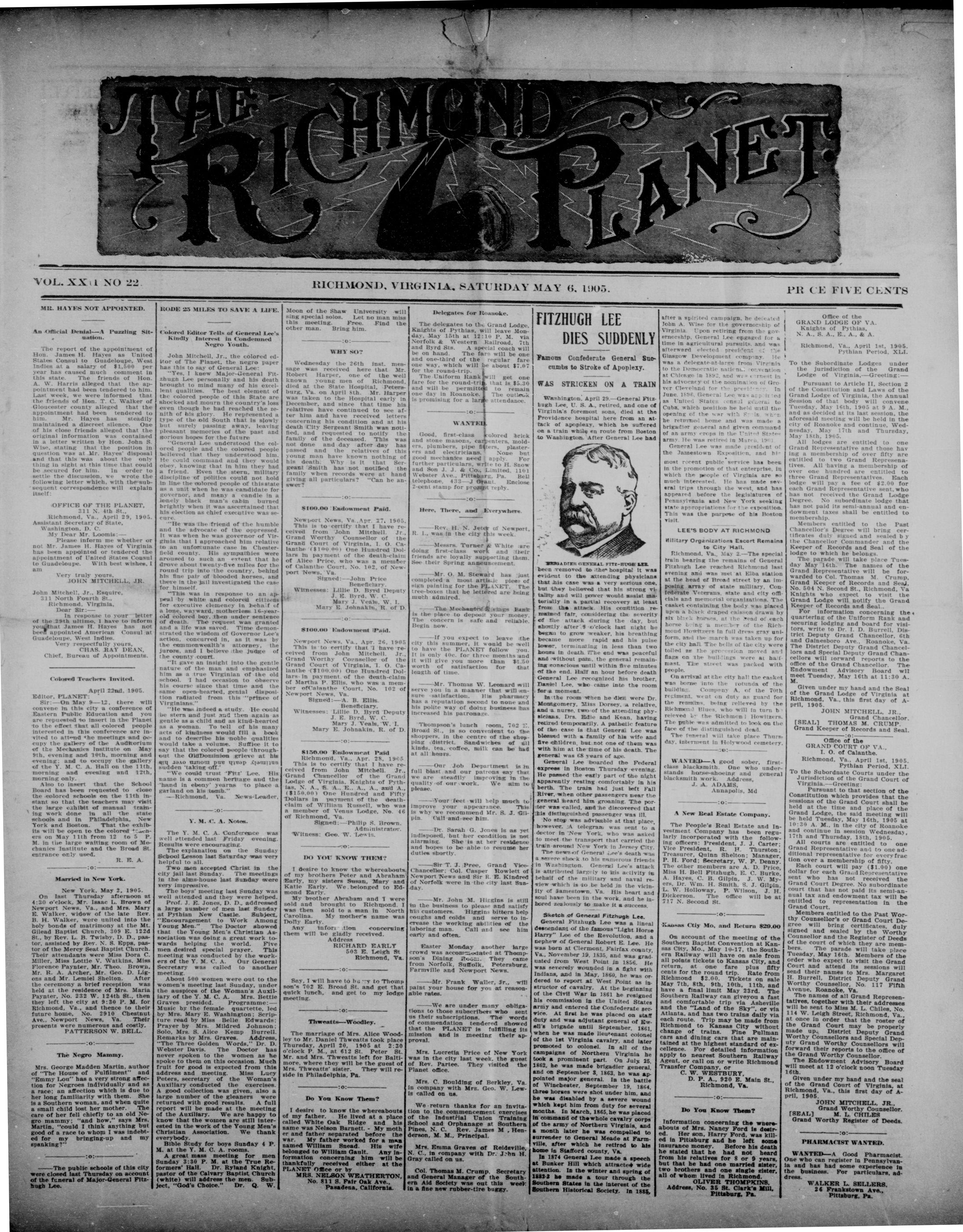
FITZHUGH LEE DIES SUDDENLY
Famous Confederate General Succumbs to Stroke of Apoplexy.
Washington, April 29.—General Fitzhugh Lee, U. S. A., retired, and one of Virginia's foremost sons, died at the Providence hospital here from an attack of apoplexy, which he suffered on a train while en route from Boston to Washington. After General Lee had
BEGADIER GENERAL FITZ-HUGH LEE. been removed to the hospital it was evident to the attending physicians that his case was a very serious one, but they believed that his strong vitality and will power would assist materially in a partial recovery at least from the attack. His condition remained fair, considering the severity of the attack during the day, but shortly after 5 o'clock last night he began to grow weaker, his breathing became more rapid and his pulse lower, terminating in less than two hours in death. The end was peaceful and without pain, the general remaining conscious until within five minutes of the end. Half an hour before death General Lee recognized his brother, Daniel Lee, who came into the room for a moment.
In the room when he died were Dr. Montgomery, Miss Dorsey, a relative, and a nurse, two of the attending physicians. Drs. Edie and Kean, having retired temporarily, a pathetic feature of the case is that General Lee was blessed with a family of his wife and five children, but not one of them was with him at the time of his death. The general was 68 years of age.
General Lee boarded the Federal express in Boston Thursday evening. He passed the early part of the night apparently resting comfortably in his berth. The train had just left Fall River, when other passengers near the general heard him groaning. The porter was called, and he discovered that his distinguished passenger was ill.
No stop was advisable at that place, however. A telegram was sent to a doctor in New York, who was asked to meet the transport that carried the train around New York in Jersey City. The news of General Lee's death was a severe shock to his numerous friends in Washington. General Lee's attack is attributed largely to his activity in behalf of the military and naval review which is to be held in the vicinity of samestown. Va. His heart and soul have been in the work, and he labored zealously to make it a success.
Sketch of General Fitzhugh Lee
Sketch of General Fitznugh Lee.
General Fitzhugh Lee was a lineal descendant of the famous "Light Horse Harry" Lee of the Revolution, and a nephew of General Robert E. Lee. He was born at Clermont, Fairfax county, Va., November 19, 1835, and was graduated from West Point in 1856. He was severely wounded in a fight with Indians, and in May, 1860, he was ordered to report at West Point as instructor of cavalry. At the beginning of the Civil War in 1861 he resigned his commission in the United States army and entered the Confederate service. At first he was placed on staff duty and was adjutant general of Ewell's brigade until September, 1861, when he was made lieutenant colonel of the 1st Virginia cavalry, and later promoted to colonel. In all of the campaigns of Northern Virginia he took a prominent part. On July 25, 1862, he was made brigadier general, and on September 3, 1863, he was appointed major general. In the battle of Winchester, September 19, 1864, three horses were shot under him, and he was disabled by a severe wound which kept him from duty for several months. In March, 1865, he was placed in command of the whole cavalry corps of the army of Northern Virginia, and a month later he was compelled to surrender to General Meade at Farmville, after which he retired to his home in Stafford county, Va.
In 1874 General Lee made a speech at Bunker Hill which attracted wide attention. In the winter and spring of 1882 he made a tour through the Southern States in interest of the Southern Historical Society. In 1885.
after a spirited campaign, he defeated John A. Wise for the governorship of Virginia. Upon retiring from the governorship, General Lee epaged for a time in agricultural pursuits, and was afterward elected president of the Glasgow Development company. He was a delegate-at-large from Virginia to the democratic nation, convention at Chicago in 1892, and was earnest in his advocacy of the nomination of Grover Cleveland for the presidency. In June, 1896, General Lee was appointed as United States consul general to Cuba, which position he held until the opening of the war with Spain, when he returned home and was made a brigadier general and given command of an army crops in the United States army. He was retired in March, 1901. General Lee was made president of the Jamestown Exposition, and his most recent public service has been in the promotion of that enterprise, in which the people of Virginia are so much interested. He has made several trips through the west, and has appeared before the legislatures of Pennsylvania and New York seeking state appropriations for the exposition. This was the purpose of his Boston visit.
LEE'S BODY AT RICHMOND
Military Organizations Escort Remains to City Hall.
Richmond, Va., May 2.—The special train bearing the remains of General Fitzhugh Lee reached Richmond last evening and was met at Elba station at the head of Broad street by an imposing array of state military, Confederate Veterans, state and city officials and memorial organizations. The casket containing the body was placed upon a black draped calisso drawn by six black horses, at the head of each horse being a member of the Richmond Howitzers in full dress gray uniform, and the march was taken up for the city hall. The bells of the city were toled as the procession moved and flags on the buildings were at half-mast. The street was packed with people.
On arrival at the city hall the casket was borne into the rotunda of the building. Company A, of the 70th regiment, went on duty as guard for the remains, being relieved by the Richmond Blues, who will in turn be relieved by the Richmond Howitzers. The public was admitted to look on the face of the distinguished dead.
The funeral will take place Thursday, interment in Holywood cemetery.
:00:
WANTED—A good sober, first-class blacksmith. One who understands horse-shoeing and general blacksmith work. Address.
A New Real Estate Company
The People's Real Estate and Investment Company has been regularly incorporated with the following officers: President, J. J. Carter; Vice President, R. H. Thurston; Treasurer, Quinn Shelton; Manager, P. H. Ford; Secretary, W. F. Denny. The other members are A. D. Price, Miss H. Bell Fitzhugh, E. C. Burke, A. Hayes, B. C. Bilpin, J. W. Myers, Dr. Wm. H. Smith, S. J. Gilpin, L. W. Holloway, P. Wilson, J. H. Dickerson. The office will be at 717 N. Second St.
Kansas Ctiy Mo, and Return $29.00
On account of the meeting of the Southern Baptist Convention at Kansas City, Mo., May 10-17, the Southern Railway will have on sale from all points tickets to Kansas City, and return, at one fare plus fifty cents for the round trip. Rate from Richmond $2.00. Tickets on sale May 7th, 8th, 9th, 10th, 11th, and have a final limit May 23rd. The Southern Railway can giveyon a fast and comfortable trip via Asheville and the "Land of the Sky", or via Atlanta, and has two trains daily via each route. Trip may be made from Richmond to Kansas City without change of trains. Fine Pullman cars and dining cars that are maintained at the highest standard of excellence. For detailed information apply to nearest Southern Railway Agent, or call on or write Richmond Transfer Company, or C. W. WESTBURY,
D. P. A., 920 E. Main St., Richmond, Va.
Do You Know Them?
Information concerning the whereabouts of Mrs. Nancy Ford is desired. Her son, Harry Ford, was killed in Pittsburg and he left some insurance money. Before his death he stated that he had not heard from his relatives for 8 or 9 years, but that he had one married sister, two brothers and one single sister, all of whom are Richmond. OLIVER THOMAS MONS, Address, No. 35 St. Clark's Mill, Pittsburgh, Pa.
Office of the GRAND LODGE OF VA.
Knights of Pythias,
N. A., S. A., E., A., & A.
Richmond, Va., April 1st, 1905.
Pythian Period, XLI.
To the Subordinate Lodges under the jurisdiction of the Grand Lodge of Virginia.—Greeting:—
Pursuant to Article II, Section 2 of the Constitution and Laws of the Grand Lodge of Virginia, the Annual Session of that body will convene Tuesday, May 16th, 1905 at 9 A. M., and as decided at its last session, the aforesaid meeting will be held in the city of Roanoke and continue, Wednesday, May 17th and Thursday, May 18th, 1905.
All lodges are entitled to one Grand Representative and those having a membership of over fifty are entitled to two Grand Representatives. All having a membership of over one hundred are entitled to three Grand Representatives. Each lodge will pay a fee of $2.00 for each Grand Representative sent, who has not received the Grand Lodge Degree. No subordinate lodge that has not paid its semi-annual and endowment taxes shall be entitled to membership.
Members entitled to the Past Chancellor's Degree will bring certificates duly signed and sealed by the Chancellor Commander and the Keeper of Records and Seal of the lodge to which he belongs.
The parade will take place Tuesday May 16th. The names of the Grand Representative will be forwarded to Col. Thomas M. Crump, Grand Keeper of Records and Seal. No. 504 N. Second St., Richmond, Va. Knights who expect to visit the Grand Lodge will notify the Grand Keeper of Records and Seal.
The formation concerning the quartering Uniform Rank and securing lodging and visitors, write to Dr. I. D. Burrell, District Deputy Grand Chancellor, 6th and Gainesboro Ave., Roanoke, Va. The District Deputy Grand Chancellors and Special Deputy Grand Chancellors will inward reports to the office of the Grand Chancellor. The Endowment Advisory Board will meet Tuesday, May 16th at 11:30 A.M.
Given under my hand and the Seal of the Grand Lodge of Virginia at Richmond, Va., this first day of April, 1905.
JOHN MITCHELL, JR., Grand Chancellor.
[SEAL] THOMAS M. CRUMP, Grand Keeper of Records and Seal
Richmond, Va., April 1st, 1905.
Pythian Period, XLI.
To the Subordinate Courts under the Jurisdiction of the Grand Court of Virginia.—Greeting: Pursuant to that section of the Constitution which provides that the sessions of the Grand Court shall be held at the time and place of the Grand Lodge, the said meeting will be held Tuesday, May 16th, 1905 at 10:30 A. M., in the city of Roanoke and continue in session Wednesday, 17th and Thursday, 18th, 1905. All courts are entitled to one Grand Representative and to one additional representative for every fraction over a membership of fifty.
PHARMACIST WANTED
WANTED—A Good Pharmacist.
One who can register in Pennsylvania and has had some experience in the business. For particulars, address.
WALKER L. SELLERS.
26 Frankstown Ave.,
Pittsburgh, Pa.
THE PLANET
SATURDAY ..... May 6th, 1905.
FARM AND GARDEN
A CONVENIENT HAY RACK
In response to a request of one of its readers for the plans of a handy hay rack, the Country Gentleman says:
The combination hay rack shown in the first illustration is a convenient one: T are bed-pieces of pine or other straight-grained light wood, 14 or 18 feet in length, eight inches wide and three inches thick; if of oak or other hard wood, two and one-half inches thick will give sufficient strength. Four cross-pieces, B. of hard wood, one and one-quarter inches thick and six inches wide, are mortised and firmly secured to
the bed-pieces. This constitutes the frame or foundation, and is shown in Fig. 2. It is frequently used separately, to haul rails, boards, stones, manure, etc., and is a convenient, strong and handy arrangement for the purpose. In Fig. 1 is shown the rigging complete, of which its four cross-pieces or arms, P are seven and one-half feet in length, five inches wide and two and one-half inches thick.
If designed for a "sectional rigging" and to prevent side movement, a half-inch groove is cut into the lower sides of the cross arms, P, so that they fit
closely upon the bed-pieces. To prevent a forward or backward movement, eight strong iron hooks are attached by staples to the sides of the cross-arms, and when placed upon the bed-pieces are readily hooked into the staples, A. Thus arranged, one man can easily place the rigging upon or take it from the wagon. Or, if desired, bolts may be used to fasten all together, by passing them through the cross arms and bed-pieces; there is no 25 cents difference in the expense.
Standards. D, can be either stationary, or hinged so as to be quickly lowered, raised or removed, by a small belt, as shown at Y. The standards should be six and one-half feet, high, and quite strong, to withstand the pressure of the load, as well as to serve as a ladder. The boards X should be of the same length as the bed-pieces, and one inch thick and six inches wide, of straight-grained light wood. Wooden pins or stakes, N, are inserted as shown, and should be only slightly sharpened. Should the hind wheels project above the boards, X, bridge over them, as shown at S. Wash with petroleum and keep under shelter when not in use.
FERTILITY OF THE SOIL
Season.
The following brief facts are boiled down from an article by Prof. C. G. Hopkins of the Illinois College of Agriculture on "Fertility of the Soil:" Different types of soil produce different crop yields under the same conditions.
Soils side by side, but cultivated differently for a term of years, produce very different yields.
The same soil differs at different times, according to its cultivation and other treatment and lack of treatment.
One soil will produce 20 bushels of corn, another 40 bushels, another 80 bushels.
One soil is worth $20 an acre, another $100 per acre, largely because of their difference in fertility or productive capacity.
Soil can be "run down."
Soil can be improved.
The fertility of soil can be maintained. It is worth money to know soils and be able to improve them.
The study of soils is vitally connected with profit and propriety in farming, the greatest industry in Illinois. Neither live stock nor clover, nor both together, will maintain the fertility of the soil. The only way: "Preserve good physical conditions and then put back upon the land all of the fertility which is taken off." While there are ten essentials of plant food, seven of them are usually supplied in abundance, but nitrogen, phosphorus and potassium are rather limited in most soils. So the study of fertility is practically reduced to the study of these three.
Ginseng Growers
The ginseng growers are up against another trouble. Insects and fungous disease have appeared to destroy the cultivated plants. Now it is said that the Chinese do not want the cultivated and are instructing their agents to buy only the wild roots.—Midland Farmer.
Two Classes of People.
He who makes two blades of grass
grow where but one grew before is a public benefactor, and he who reduces the fertility of the soil so that only one ear of corn grows where two have grown before is a public curse.
PLANTING STRAWBERRIES.
Some Important Rules to Follow If You Would Have a Generous Crop.
April and May are the two best months in which to set strawberry plants, and success depends largely upon this part of the work being properly done, and for the benefit of those who are making arrangements to grow their own supply of this most delicious fruit, I am going to outline, in a very plain way, just how to prune and set them for best results. If your plants come from a reliable and careful grower, says Frank E. Beatty, in the Farmer's voice, they will be done up in bunches of 25 with a label attached bearing the name of the variety. Before any of these are cut open they should be sorted out, putting all of the bunches of the same variety together, so there will be no danger of getting them mixed.
If your selection consists of both pithillates and bi-sexuals, be sure and set the bi-sexual in the first row and a pistillate of the same season in the second row, and so on until your bed is filled. Plants, like animals, are male and female; the bi-sexual being a male and the pistillate a female, aid by putting the pistillates in separate rows between the bi-sexuals of its season, all their flowers will be properly mated, thus insuring a big crop of perfectly developed berries. The bi-sexuals have both male and female organs combined in their flowers, and will produce fruit without the aid of the opposite sex. Before any setting is done, cut the roots of each plant back at least one-half, this is best done by taking a full bunch and cutting across the roots with a pair of shears or a sharp knife, which will leave them about four inches long. Then they will callous where this cut is made and send out numerous feeders, making a much heavier root system than they would if set in the soil with their roots all doubled up.
The leaves also should be removed so the plant can get well established in its new quarters, at which time it will be strong and fully able to build up a vigorous and thrifty foliage. In setting the plans, use a dibble or spade, either of these tools can be thrust down and worked back and forth until a wedge-shaped opening is made in the soil. Then take the plant in the left hand and give it a quick motion, which will spread the roots and throw them down straight into the opening, so that each one will come in full contact with the moist soil. Now press the dirt firmly about them with the right hand, holding the crown so that it will be on a level with the top surface. After the setting has been done, go over the entire bed with a small cultivator or hoe, and repeat this every week or ten days, unless the ground is wet. This will kill all weeds before they get their heads above ground, beside forming a dust mould, which is so essential in holding moisture; and this is something that plants must have at all times. Make the conditions just as favorable for them as possible, and there is nothing in the garden that will contribute more to a good meal than a strawberry bed.
A TWENTY-FOOT GARDEN
How a Very Small Area May Be Made to Yield Good Returns to the Gardener.
Anyone having a small space in the back yard, even though only 20 feet square, may gain a great profit and considerable experience from raising a small amount of vegetables, says the Orange Judd Farmer. Only constantly appreciated vegetables should be grown, those that mature quickly and are of particular value when fresh. My garden was planted, one-half to tomatoes, which included 12 plants, one-fourth to peas and beans and one-fourth to beds of lettuce, radishes, beets and kitchen herbs. It was well spaced and fertilized before planting, which was not done until May 15. The lettuce and radish beds were sown in succession, two sowings a month, so that there was a constant supply of young and tender vegetables.
A most profitable feature was a cucumber barrel, made as follows: Take an ordinary flour or salt barrel, remove both ends and cut several small holes in the sides. Sink three-fourths of its depth into the ground and fill almost full with rich manure. Bank up earth about it and make hills, in which plant cucumbers. Water the barrel frequently by pouring large amounts of water inside and not upon the hills of plants. Such an arrangement will support a growth of vines which will cover a large part of the yard, requiring but little attention and occupying little real garden space.
EASILY BUILT GRAIN BINS
How Dry Goods Boxes Can Be Utilized to Good Advantage in the Barn.
Grain bins with compartments for different kinds of feed are handy to
compartments for feed are handy in barn or stable. By procuring a number of dry goods boxes, all of the same size and shape, and nailing
barn or stable. By procuring a number of dry goods boxes, all of the same size and shape, and nailing them together side by side, as suggested in the illustration, they are easily made, says the Farm and Home. The cover should extend the entire length of the bin and, though leather hinges will answer, it is better to attach it with iron ones, for then, with a good staple and hasp, the contents can be kept under lock and key if desired.
Value of Soap Suds.
There is not a large amount of potash in soap suds, but it is in a soluble form and ready to be taken up at once by the growing plants. Trees, berry bushes and all kinds of vegetables are benefited by soap suds. They should be utilized.
Hard to Bear.
She—Then you don't believe in "emotion?" He—Oh, yes; but the average woman's idea of "emotion" is generally "commotion"—Brooklyn Life.
THE RICHMOND PLANET, RICHMOND, VIRGINIA
1
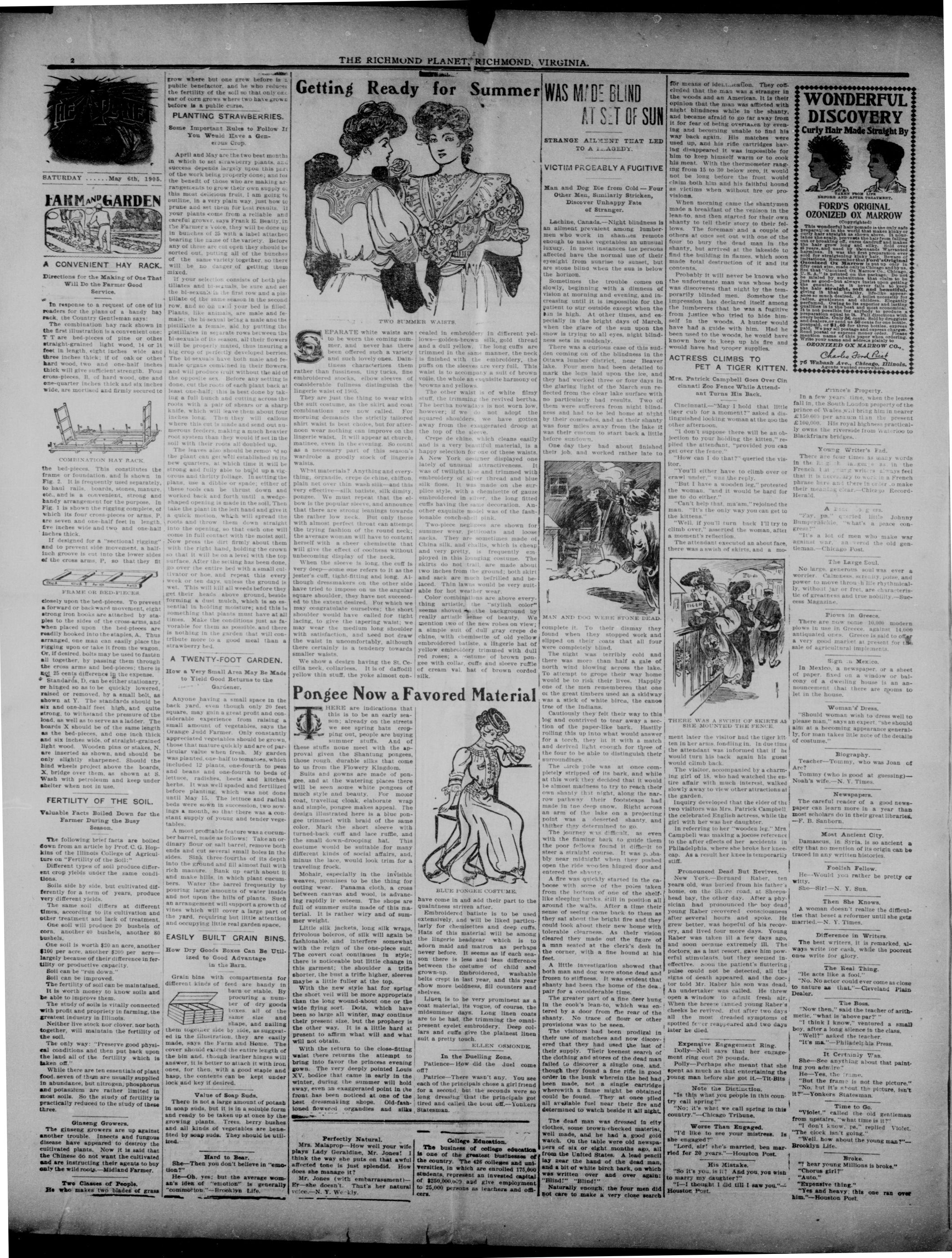
TWO SUMMER WAISTS
cealed in embroidery in different yellows—golden-brown silk, gold thread and a dull yellow. The long cuffs are trimmed in the same manner, the neck is finished with the embroidery, the puffs on the sleeves are very full. This waist is to accompany a suit of brown voile, the whole an exquisite harmony of browns and yellows.
The other waist is of white filmy stuff, the trimming the revived bertha. The bertha nowadays is not worn low, however; if we do not adopt the squared shoulders, we have gotten away from the exaggerated droop at the top of the sleeve.
Crepe de chine, which cleans easily and is a very beautiful material, is a happy selection for one of these waists. A New York designer displayed one lately of unusual attractiveness. It was of twilight blue and trimmed with embroidery of silver thread and blue silk floss. It was made on the surplice style, with a chemisette of gauze embroidered in silver, the long fitted cuffs having the same decoration. Another exquisite model was of the fashionable conch-shell pink.
Two-piece negleagues are shown for summer wear, petite coats and loose sacks. They are sometimes made of China silk, and challis, which is cheap and very pretty, is frequently employed in this lounging costume. The skirts do not trail, are made about two inches from the ground; both skirt and sack are much brilled and belaced. Thin lawns would be very suitable for hot weather wear.
Color combinations are above every-thing artistic, the "stylish color" seems shoved in the background by really artistic sense of beauty. We mention two of the new robes on view; a simple suit of dull gray crepe de chine, with chemisettes of old yellow embroidered batiste, a lingerie hat of yellow embroidery trimmed with dull red roses; a costume of brown ponge with collar, cuffs and sleeve ruffle of cream val, hat of brown corded silk.
Pongee Now a Favored Material
1
have come in and add their part to the quaintness striven after. Embroidered batiste is to be used extensively, and will be liked particularly for chemisettes and deep cuffs. Hats of this material will be among the lingerie headear which is to adorn maid and matron as perhaps never before. It seems as if each season there is less and less difference between the costume of child and grown-up. Embroidered, washable belts crept in last year, and this year show more boldness, fill counters and shelves. Linen is to be very prominent as a coat material, its vogue, of course, the midsummer days. Long linen coats are to be had, the trimming the omni-present eyelet embroidery. Deep collars and cuffs give the plainest linen suit a pretty touch.
Patience—How did the Juel come off?
Patrice—There wasn't any. You see each of the principals chose a girlfriend for a second, but the seconds were so long dressing that the principals got tired and called the bout off.—Yonkers Statesman.
The business of college education is one of the greatest businesses of the country. The 426 colleges and universities, in which are enrolled 175,000 students, represent an invested capital of $250,000,000 and give employment to 25,000 persons as teachers and officers.
EPARATE white waists are to be worn the coming summer, and never has there been offered such a variety and such lovely ones. Daintiness characterizes them.
EPARATE white waists are to be worn the coming summer, and never has there been offered such a variety and such lovely ones. Dainness characterizes them rather than fussiness, tiny tucks, fine embroidered stocks, elbow sleeves of considerable fullness distinguish the lingerie waist of 1905. They are just the thing to wear with the suit costume, as the skirt and coat combinations are now called. For morning demands the strictly tailored shirt waist is best choice, but for afternoon wear nothing can improve on the lingerie waist. It will appear at church matinee, even in the evening. So count as a necessary part of this season's wardrobe a goodly stock of lingerie waists.
What materials? Anything and everything, organdie, crepe de chine, chiffon, plain net over thin wash silk—and this very effective—silk batiste, silk dimity, pongee. We must repeat that the elbow is the popular sleeve, and announce that there are strong leanings towards the rather low neck. But only those with almost perfect throat can attempt the trying fashion of the round neck; the average woman will have to content herself with a sheer chemisette that will give the effect of coolness without unbecoming display of the neck.
When the sleeve is long, the cuff is very deep—some one refers to it as the jester's cuff, tight-fitting and long. Although dressmakers on the other side have tried to impose on us the angular square shoulder, they have not succeeded to the extent desired. For which we may congratulate ourselves; the short shoulder would have called for tight lacing, to give the tapering waist; we may wear the medium long shoulder with satisfaction, and need not draw the waist in uncomfortably, although there certainly is a tendency towards smaller waists.
We show a design having the St. Cecilia neck, collarless. It is of daffodil yellow thin stuff, the voke almost con-
HERE are indications that this is to be an early season; already on the streets we see spring hats cropping out, people are buying summer, stuffs. And of
HERE are indications that this is to be an early season; already on the streets we see spring hats cropping out, people are buying summer stuffs. And of these stuffs none meet with the approval given the Shantung ponges, those rough, durable silks that come to us from the Flowery Kingdom. Suits and gowns are made of ponge, and at the watering places there will be seen some white ponges of much style and beauty. For moor coat, travelling cloak, elaborate wrap and simple, ponge makes appeal. The design illustrated here is a blue ponge trimmed with braid of the same color. Mark the short sleeve with turned-back cuff and lace ruffle, and the small down-drooping hat. This costume would be suitable for many different kinds of social affairs, and, minus the lace, would look trim for a traveling frock.
Mohair, especially in the invisible weaves, promises to be the thing for outing wear. Panama cloth, a cross between canvas and wool, is advancing rapidly in esteem. The shops are full of summer suits made of this material. It is rather wiry and of summer weight.
Little silk jackets, long silk wraps, frivolous baleros, of silk will again be fashionable, and interfere somewhat with the reign of the one-piece suit. The covert coat continues in style; there is noticeable but little change in this garment; the shoulder a trifle shorter, the bust a trifle higher, sleeves maybe a fuller at the top.
With the new style hat for spring the short veil will be more appropriate than the long wound-about one or the wide flying sort. Dots, which have been so large all winter, may continue their present size, but the prophecy is the other way. It is a little hard at present to affirm what will and what will not obtain.
With the return to the close-fitting waist there returns the attempt to bring into favor the princess evening gown. The very deeply pointed Louis XV. bodice that came in early in the winter, during the summer will hold sway, even an exaggerated point in the front has been noticed at one of the best dressmaking shops. Old-fashioned flowered organdies and silks
Perfectly Natural
Mrs. Malaprop—How well your wife plays Lady Geraldine, Mr. Jones! I think the way she puts on that awful affected tone is just splendid. How does she manage it? Mr. Jones (with embarrassment)—Er—she doesn't. That's her natural voice.—N. Y. Weekly.
BLUE PONGEE COSTUME
College Education
WAS MADE BLIND AT SET OF SUN
STRANGE AILMENT TEAT LED
TO A LAGEDY.
VICTIM PROEABLY A FUGITIVE
Man and Dog Die from Cold—Four Other Men, Similarly Stricken, Discover Unhappy Fate of Stranger.
Lachine, Canada.—Night blindness is an aliment prevalent among lumbermen who work in shanties remote enough to make vegetables an unusual luxury. In most instances the persons affected have the normal use of their eyesight from sunrise to sunset, but are stone blind when the sun is below the horizon.
Sometimes the trouble comes on slowly, beginning with a dimness of vision at morning and evening, and increasing until it is impossible for the patient to stir outside except when the sun is high. At other times, and especially in the bright days of March, when the glare of the sun upon the snow is trying to all eyes, night blindness sets in suddenly.
There was a curious case of this sudden coming on of the blindness in the Ottawa lumber district, near Beaver lake. Four men had been detailed to mark the logs laid upon the ice, and they had worked three or four days in the glaring light of the March sun reflected from the clear lake surface with no particularly bad results. Two of them were sufferers from night blindness and had to be led home at night by their comrades, and as their shanty was four miles away from the lake it was their custom to start back a little before sundown. One day they had about finished their job, and worked rather late to
MAN AND DOG WERE STONE DEAD
complete it. To their dismay they found when they stopped work and slipped on their coats that all four were completely blind.
The night was terribly cold and there was more than half a gale of north wind blowing across the lake. To attempt to grope their way home would be to risk their lives. Happily one of the men remembered that one or the great timbers used as a skidway was a stick of white birch, the canoe tree of the Indians.
Cautiously they felt their way to this log and contrived to tear away a section of the paper-like bark. Hastily rolling this up into what would answer for a torch, they hit it with a match and derived light enough for three of the four to be able to distingush their surroundings.
The birch pole was at once completely stripped of its bark, and while at this work they decided that it would be almost madness to try to reach their own shanty that night, along the narrow pathway their footsteeps had made in the deep snow. Right across an arm of the lake on a projecting point was a deserted shanty, and thither they determined to go.
The journey was difficult, as even with the flaming bark to guide them the poor fellows found it difficult to steer a straight course. It was probably near midnight when they pushed open the ride wooden hinged door and entered the shanty.
A fire was quickly started in the caboose with some of the poies taken from the bottom of one of the shelf-like sleeping hunks, still in position all around the walls. After a time their sense of seeing came back to them as they sat about the bright fire and they could look about their new home with tolerable clearness. As their vision cleared they made out the figure of a man seated at the clerk's desk in the corner, with a fine hound at his feet.
A little investigation showed that both man and dog were stone dead and frozen to stiffness. It was evident that shanty had been the home of the dea, pair for a considerable time.
The greater part of a fine deer hung in the cook's lean-to, which was entered by a door from the rear of the shanty. No trace of flour or other provisions was to be seen.
The visitors had been prodigal in their use of matches and now discovered that they had used the last of their supply. Their keenest search of the clothing and stores of the dead man failed to discover a single one, and, though they found a fine riffle in good order in the bunk wherein the bed had been made, not a single cartridge wherewith a flame might be obtained could be found. They at once piled all available fuel near their fire and determined to watch beside it all night.
The dead man was dressed in city clothes, some brown-checked material, well made, and he had a good gold watch. On the table were old newspapers of six or eight months ago, all from the United States. A lead pencil lay near the hand of the dead man, and a bit of white birch bark, on which was written over and over again: "Blind!" "Blind!"
Naturally enough, the four men did not care to make a very close search
for means of identification. They concluded that the man was a stranger in the woods and an American. It is their opinion that the man was afflicted with night blindness while in the shanty, and became afraid to go far away from it for fear of being overtaken by evening and becoming unable to find his way back again. His matches were used up, and his rifle cartridges having disappeared it was impossible for him to keep himself warm or to cook his meat. With the thermometer ranging from 15 to 30 below zero, it would not be long before the frost would claim both him and his faithful hound as victims when without fire or provisions.
When morning came the shantymen made a breakfast of the venison in the lean-to, and then started for their own shanty to tell their story to their fellows. The foreman and a couple of others at once set out with one of the four to bury the dead man in the shanty, but arrived at the lakeside to find the building in flames, which soon made total destruction of it and its contents. Probably it will never be known who the unfortunate man was whose body was discovered that night by the temporarily blinded men. Somehow the impression has declared itself among the lumberers that he was a fugitive from justice who tried to hide himself in the woods. A hunter would have had a guide with him. Had he been used to the woods, he would have known how to keep up his fire and would have had proper supplies.
ACTRESS CLIMBS TO
PET A TIGER KITTEN.
Mrs. Patrick Campbell Goes Over Cincinnati Zoo Fence While Attendant Turns His Back.
Cincinnati.—"May I hold that little tiger cub for a moment?" asked a distinguished looking woman at the zoo the other afternoon.
"I don't suppose there will be an objection to your holding the kitten." replied the attendant, "provided you can get over the fence."
"How can I do that?" queried the visitor.
"You'll either have to climb over or crawl under." was the reply.
"But I have a wooden leg," protested the woman, "and it would be hard for me to do either."
"Can't help that, ma'am," rejoined the man. "It's the only way you can get to the kittens."
"Well, if you'll turn back I'll try to climb over," asserted the woman, after a moment's reflection.
The attendant executed an about face, there was a swish of skirts, and a mo
THERE WAS A SWISH OF SKIRTS AS
SHE MOUNTED THE FENCE
THERE WAS A SWISH OF SKIRTS AS SHE MOUNTED THE FENCE
ment later the visitor had the tiger kitten in her arms, fondling in. In due time the attendant was informed that if he would turn his back again his guest would climb back.
The visitor, accompanied by a charming girl of 18, who had watched the entire affair with much interest, walked slowly away to view other attractions at the garden.
Inquiry developed that the elder of the two visitors was Mrs. Patrick Campbell the celebrated English actress, while the girl with her was her daughter.
In referring to her "wooden leg." Mrs. Campbell was making a jocose reference to the after effects of her accidents in Philadelphia, where she broke her knee-cap. As a result her knee is temporarily stiff.
Pronounced Dead But Revives.
New York—Bernard Raber, ten years old, was buried from his father's home, on the Shore road, at Sheepshead bay, the other day. After a physician had pronounced the boy dead young Raber recovered consciousness after several hours and spoke. He grew better, was hopeful of his recovery, and lived four more days. Young Raber was taken ill a few days ago, and soon became extremely ill. The doctors, as a last resort, gave him powerful stimulants, but they seemed ineffective. Soon the patient's fluttering pulse could not be detected, all the signs of death appeared, and the doctor told Mr. Raber his son was dead. An undertaker was called. He threw open a window to admit fresh air. When the breeze tanned young Raber's cheeks he revived. But after two days all the most dreaded symptoms of spotted fever reappeared and two days later he died.
King.
Dolly—Nell says that her engagement ring cost 20 pounds.
Polly—Perhaps she meant that she spent as much as that entertaining the young man before she got it.—Tit-Bits
Note the Distinction.
"Is this what you people in this country call spring?"
"No; it's what we call spring in this country."—Chicago Tribune.
Worse Than Engaged.
"I'd like to see your mistress. Is she engaged?"
"Lord, sir! she's married, ben married fer 20 years."—Houston Post.
His Mistake
"So it's you, is it? And you, you wish to marry my daughter?"
"I—I thought I did till I saw you."—
Houston Post.
WONDERFUL DISCOVERY Curly Hair Made Straight By
TAKEN FROM LIFE
NEWPORT
Prince's Property
In a few years, time, when the leeses fall in, the South London property of the prince of Wales will bring him in nearer £150 000 per annum than the present £100,000. His royal highness practically owns the riverside from Waterloo to Blackfriars bridges.
Young Writer's Ead
There are four times as many words in the English language as in the French that curing writers always feel that it is necessary to work in a French phrase here and there in order to make their meaning clear.—Chicago Record-Herald.
"Say, pa," queried little Johnny Bumperalickle, "what's a peace congress?"
"It's a lot of men who make war against war," an ever the old gentleman—Chicago Post.
The Large Soul
No large generous soul was ever a worrier. Calmness, screeny, poise, and power to move through life rhythmically, without jar or fret, are characteristic of greatness and true nobility. —Success Magazine.
Plows in Greece
There are now some 10,000 modern plows in use in Greece, against 14,000 antiquated ones. Greece is said to offer the best equipment for the sale of agricultural implements.
Sign in Mexico
In Mexico, a newspaper, or a sheet of paper, fixed on a window or balcony, is a sitting house is an anouncement that there are rooms to let in the house.
Woman's Dress
"Should woman wish to dress well to please man," says an expert, "she should aim at a becoming appearance generally, for man takes little note of the details of costume."
Biography.
Biography.
Teacher—Tommy, who was Joan of
Arce?
Tommy (who is good at guessing)—
Noah's wife.—N. Y. Times
Newspapers.
The careful reader of a good newspaper can learn more in a year than most scholars do in their great libraries. —F. B. Sanborn.
Most Ancient City
Damascus, in Syria, is so ancient a city that no mention of its origin can be traced in any written histories.
Foolish Fellow
He--Would you rather be pretty or witty.
She—Sir!—N. Y. Sun.
A woman doesn't realize the difficulties that beset a reformer until she gets married.—N. Y. Times.
Difference in Writers
The best writers, it is remarked, always write for cash, while the poorest ones write for glory.
"No. No actor could ever come as close to nature as that."—Cleveland Plain Dealer.
The Boss.
"Now then," said the teacher of arithmetic. "what is 'above par?'"
"I think I know," ventured a small boy, after a long silence in the class.
"Well?" asked the teacher.
"It's ma."—Philadelphia Press.
It Certainly Was
She—See anything about that painting you admire."
He—Yes, the frame.
"But the frame is not the picture."
"No, but it's about the picture, isn't it?" — Yonkers Statesman.
"violet" called the old gentleman from upstairs, "what time is it?"
"I don't know, pa." replied Violet.
"The clock isn't going."
"Well, how about the young man?"—Brooklyn Life.
Broke.
"? hear young Millions is broke."
"Chorus girl?"
"Auto."
"Expensive thing."
"Yes and heavy; this one ran over him."—Houston Post.
The Wings of the Morning By LOUIS TRACY Copyright, 1903, by Edward J. Cord
---
CHAPTER II
W
HEN the Sirdar parted amidships the floor of the saloon heaved up in the center with a mighty crash of rending woodwork and iron. Men and women, too stupefied to sob out a prayer, were pitched headlong into chaos. Iris, torn from the terrified grasp of her maid, fell through a corridor and would have gone down with the ship had not a sailor, clinging to a companion ladder, caught her as she whirled along the steep slope of the deck.
He did not know what had happened. With the instinct of self preservation he seized the nearest support when the vessel struck. It was the mere impulse of ready helpfulness that caused him to stretch out his left arm and clasp the girl's waist as she fluttered past. By idle chance they were on the port side, and the ship, after pausing for one awful second, fell over to starboard.
The man was not prepared for this second gyration. Even as the stairway canted he lost his balance; they were both thrown violently through the open hatchway and swept off into the bolling声. Under such conditions thought itself was impossible. A series of impressions, a number of fantastic pictures, were received by the benumbed faculties and afterward painfully sorted out by the memory. Fear, anguish, amazement—none of these could exist. All he knew was that the lifeless form of a woman—for Iris had happily fainted—must be held until death itself wrenched her from him. Then there came the headlong plunge into the swirling sea, followed by an indefinite period of gasping oblivion. Something that felt like a moving rock rose up beneath his feet. He was driven clear out of the water and seemed to recognize a familiar object rising rigid and bright close at hand. It was the pinnacle pillar, screwed to a portion of the deck which came away from the chart house, and was rent from the upper framework by contact with the reef. He seized this unlooked for support with his disengaged hand.
A uniformed figure—he thought it was the captain—stretched out an unavailing arm to clasp the queer raft which supported the sailor and the girl, but a jealous wave rose under the platform with devilish energy and turned it completely over, hurling the man with his inanimate burden into the depths. He rose, fighting madly for his life. Now surely he was doomed. But again, as if human existence depended on naught more serious than the spinning of a coin, his knees rested on the same few stanch timbers, now the ceiling of the music room, and he was given a brief respite. His greatest difficulty was to get his breath, so dense was the spray through which he was driven. Even in that terrible moment he kept his senses. The girl, utterly unconscious, showed by the convulsive heaving of her breast that she was choking. With a wild effort he swung her head round to shield her from the flying scud with his own form.
The tiny air space thus provided gave her some relief, and in that instant the sailor seemed to recognize her. He was not remotely capable of a definite idea. Just as he vaguely realized the identity of the woman in his arms the unsteady support on which he rested toppled over. Again he renewed the unequal contest. A strong, resolute man and a typhoon sea wrestled for supremacy.
This time his feet plunged against something gratefully solid. He was dashed forward, still battling with the raging turmoll of water, and a second time he felt the same firm yet smooth surface. His dormant faculties awoke. It was sand. With frenzied desperation, buoyed now by the inspiring hope of safety, he fought his way onward like a maniac.
Often he fell. Three times did the backwash try to drag him to the swirling death behind, but he staggered blindly on, on, until even the tearing gale ceased to be laden with the suffocating foam, and his faltering feet sank in deep soft white sand.
Then he fell, not to rise again. With a last weak flicker of exhausted strength he drew the girl closely to him, and the two lay clasped tightly together, heedless now of all things.
How long the man remained prostrate he could only guess subsequently. The Sirdar struck soon after daybreak, and the sailor awoke to a hazy consciousness of his surroundings to find a shaft of sunshine flickering through the clouds banked up in the east. The gale was already passing away. Although the wind still whistled with shrill violence, it was more blustering than threatening. The sea, too, though running very high, had retreated many yards from the spot where he had finally dropped, and its surface was no longer scourged with venomous spray. Stowly and painfully he raised himself to a sitting posture, for he was bruised and stiff. With his first movement he became violently ill. He had swallowed much salt water, and it was not until the spasm of slackness had passed that he thought of the girl.
"She cannot be dead" he hoarsely murmured, feebly trying to lift her. "Surely Providence would not desert her after such an escape. What a weak beggar I must be to give in at the last moment! I am sure she was living when we got ashore. What on earth can I do to revive her?" Forgetful of his own aching limbs in this newborn anxiety, he sank on one knee and gently pillowed Iris' head and shoulders on the other. Her eyes were closed, her lips and teeth firmly set—a fact to which she undoubtedly owed her life, else she would have been sur-
focated—and the pallor of her skin seemed to be that terrible bloodless hue which indicates death. The stern lines in the man's face relaxed, and something blurred his vision. He was weak from exhaustion and want of food. For the moment his emotions were easily aroused. "Oh, it is pitiful!" he almost whimpered. "It cannot be!" With a gesture of despair he drew the sleeve of his thick jersey across his eyes to clear them from the gathering
THE RIVER
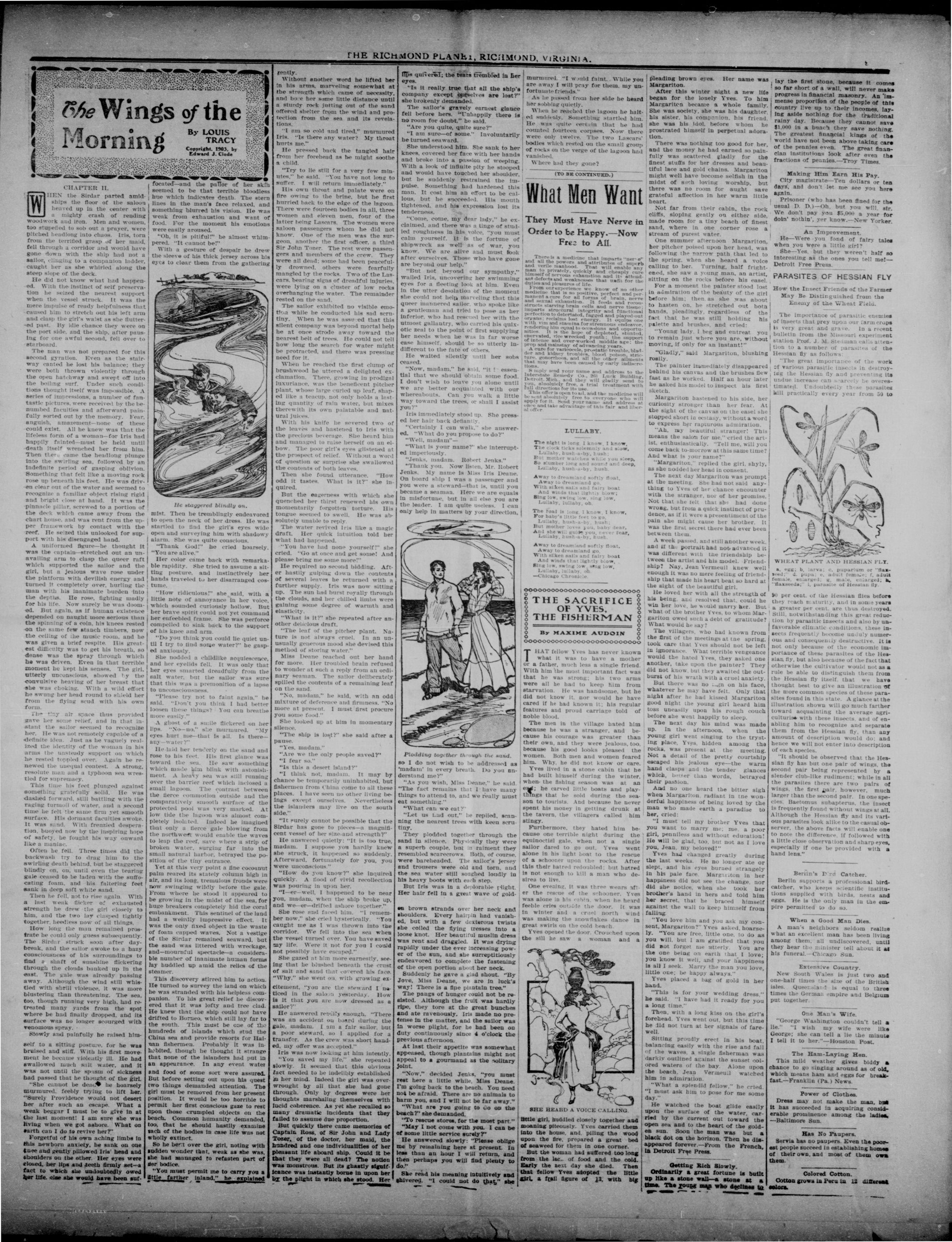
He staggered blindly on. mist. Then he tremblingly endeavored to open the neck of her dress. He was startled to find the girl's eyes wide open and surveying him with shadowy alarm. She was quite conscious.
"Thank God!" he cried hoarsely.
"You are alive."
Her color came back with remarkable rapidity. She tried to assume a sitting posture, and instinctively her hands traveled to her disarranged costume.
"How ridiculous?" she said, with a little note of annoyance in her voice, which sounded curiously hollow. But her brave spirit could not yet command her enfeebled frame. She was perforce compelled to sink back to the support of his knee and arm.
"Do you think you could lie quiet until I try to find some water?" he gasped anxiously.
She nodded a childlike acquiescence, and her eyelids fell. It was only that her eyes smarted dreadfully from the salt water, but the sailor was sure that this was a premonition of a lapse to unconsciousness.
"Please try not to faint again," he said. "Don't you think I had better loosen these things? You can breathe more easily."
A ghost of a smile flickered on her lips. "No-no," she murmured. "My eyes hurt me—that is all. Is there—any—water?"
He laid her tenderly on the sand and rose to his feet. His first glance was toward the sea. He saw something which made him blink with astonishment. A heavy sea was still running over the barrier reef which inclosed a small lagoon. The contrast between the fierce commotion outside and the comparatively smooth surface of the protected pool was very marked. At low tide the lagoon was almost completely isolated. Indeed he imagined that only a fierce gale blowing from the northwest would enable the waves to leap the reef, save where a strip of broken water, surging far into the small natural harbor, betrayed the position of the tiny entrance.
Yet at this very point a fine coconut palm reared its stately column high in air, and its long, tremulous fronds were now swinging wildly before the gale. From where he stood it appeared to be growing in the midst of the sea, for huge breakers completely hid the coral embankment. This sentinel of the land had a weirdly impressive effect. It was the only fixed object in the waste of foam capped waves. Not a vestige of the Sidair remained seaward, but the sand was littered with wreckage, and—mournful spectacle—a considerable number of inanimate human forms lay huddled up amid the relics of the steamer.
This discovery stirred him to action. He turned to survey the land on which he was stranded with his helpless companion. To his great relief he discovered that it was lofty and tree clad. He knew that the ship could not have drifted to Borneo, which still lay far to the south. This must be one of the hundreds of islands which stud the Cina sea and provide resorts for Haliuan fishermen. Probably it was inhabited, though he thought it strange that none of the islanders had put in an appearance. In any event water and food of some sort were assured. But before setting out upon his quest two things demanded attention. The girl must be removed from her present position. It would be too horrible to permit her first conscious gaze to rest upon those crumpled objects on the beach. Common humanity demanded, too, that he should hastily examine each of the bodies in case life was not wholly extinct.
So he bert over the girl, noting with sudden wonder that, weak as she was, she had managed to refasten part of her bodice.
"You must permit me to carry you a little farther inland," he explained
THE RICHMOND PLANE1, RICHMOND, VIRGINIA.
Without another word he lifted her in his arms, marveling somewhat at the strength which came of necessity, and bore her some little distance until a sturdy rock jutting out of the sand offered shelter from the wind and protection from the sea and its revelations.
"I am so cold and tired," murmured Iris. "Is there any water? My throat hurts me."
He pressed back the tangled hair from her forehead as he might soothe a child.
"Try to lie still for a very few minutes," he said. "You have not long to suffer. I will return immediately."
His own throat and palate were on fire owing to the brine, but he first hurried back to the edge of the lagoon. There were fourteen bodies in all, three women and eleven men, four of the latter being Lascars. The women were saloon passengers whom he did not know. One of the men was the surgeon, another the first officer, a third Sir John Tozer. The rest were passengers and members of the crew. They were all dead; some had been peacefully drowned, others were fearfully mangled by the rocks. Two of the Lascars, bearing signs of dreadful injuries, were lying on a cluster of low rocks overhanging the water. The remainder rested on the sand.
The sailor exhibited no visible emotion while he conducted his sad scrutiny. When he was assured that this silent company was beyond mortal help he at once strode away toward the nearest belt of trees. He could not tell how long the search for water might be protracted, and there was pressing need for it.
When he reached the first clump of brushwood he uttered a delighted exclamation. There, growing in prodigal luxuriance, was the beneficent pitcher plant, whose large curled up leaf, shaped like a teacup, not only holds a lasting quantity of rain water, but mixes therewith its own palatable and natural juices.
With his knife he severed two of the leaves and hastened to Iris with the precious beverage. She heard him and managed to raise herself on an elbow. The poor girl's eyes glistened at the prospect of relief. Without a word of question or surprise she swallowed the contents of both leaves.
Then she found utterance. "How odd it tastes. What is it?" she inquired.
But the eagerness with which she quenched her thirst renewed his own momentarily forgotten torture. His tongue seemed to swell. He was absolutely unable to reply.
The water revived Iris like a magic draft. Her quick intuition told her what had happened.
"You have had none yourself!" she cried. "Go at once and get some! And please bring me some more."
He required no second bidding. After hastily guiding down the contents of several leaves he returned with a further supply. Iris was now sitting up. The sun had burst royally through the clouds, and her chilled limbs were gaining some degree of warmth and elasticity.
"What is it?" she repeated after another delicious draft.
"The leaf of the pitcher plant. Nature is not always cruel. In an unusually generous mood she devised this method of storing water."
Miss Deane reached out her hand for more. Her troubled brain refused to wonder at such a reply from an ordinary seaman. The sailor deliberately spilled the contents of a remaining leaf on the sand.
"No, madam," he said, with an odd mixture of deference and firmness. "No more at present. I must first procure you some food."
She looked up at him in momentary silence.
"The ship is lost?" she said after a pause.
"Yes, madam."
"Are we the only people saved?"
"I fear so."
"Is this a desert island?"
"I think not, madam. It may by chance be temporarily uninhabited, but fishermen from China come to all these places. I have seen no other living beings except ourselves. Nevertheless the islanders may live on the south side."
"It surely cannot be possible that the Sirdar has gone to pieces—a magnificent vessel of her size and strength?"
He answered quietly: "It is too true, madam. I suppose you hardly knew she struck, it happened so suddenly. Afterward, fortunately for you, you were unconscious."
"How do you know?" she inquired quickly. A flood of vivid recollection was pouring in upon her.
"I—er—well, I happened to be near you, madam, when the ship broke up, and we—er—drifted ashore together."
She rose and faced him. "I remember now," she cried hysterically. "You caught me as I was thrown into the corridor. We fell into the sea when the vessel turned over. You have saved my life. Were it not for you I could not possibly have escaped."
She gazed at him more earnestly, seeing that he blushed beneath the crust of salt and sand that covered his face. "Why," she went on, with growing excitement, "you are the steward I noticed in the saloon yesterday. How is it that you are now dressed as a sailor?"
He answered readily enough. "There was an accident on board during the gale, madam. I am a fair sailor, but a poor steward, so I applied for a transfer. As the crew was short handed, my offer was accepted."
Iris was now looking at him intently, "You saved my life," she repeated slowly. It seemed that this obvious fact needed to be indelibly established in her mind. Indeed the girl was overwrought by all that she had gone through. Only by degrees were her thoughts marshaling themselves with lucid coherence. As yet she recalled so many dramatic incidents that they failed to assume due proportion. But quickly there came memories of Captain Ross, of Sir John and Lady Tozer, of the doctor, her maid, the hundred and one individualities of her pleasant life aboard ship. Could it be that they were all dead? The notion was monstrous. But its ghastly significance was instantly borne in upon her by the plight in which she stood. Her
lips quivered; the tears trembled in her eyes.
"Is it really true that all the ship's company except ourselves are lost?" she brokenly demanded.
The sailor's gravely earnest glance fell before hers. "Unhappily there is no room for doubt," he said.
"Are you quite, quite sure?"
"I am sure—of some." Involuntarily he turned seaward.
She understood him. She sank to her knees, covered her face with her hands and broke into a passion of weeping. With a look of infinite pity he stooped and would have touched her shoulder, but he suddenly restrained the impulse. Something had hardened this man. It cost him an effort to be callous, but he succeeded. His mouth tightened, and his expression lost its tenderness.
"Come, come, my dear lady," he exclaimed, and there was a tinge of studied roughness in his voice. "you must calm yourself. It is the fortune of shipwreck as well as of war, you know. We are alive and must look after ourselves. Those who have gone are beyond our help."
"But not beyond our sympathy," wailed Iris, uncovering her swimming eyes for a fleeting look at him. Even in the utter desolation of the moment she could not help marveling that this queer mannered sailor, who spoke like a gentleman and tried to pose as her inferior, who had rescued her with the utmost gallantry, who carried his quixotic zeal to the point of first supplying her needs when he was in far worse case himself, should be so utterly indifferent to the fate of others.
He waited silently until her sobs ceased.
"Now, madam," he said, "it!' essential that we should obtain some food. I don't wish to leave you alone until we are better acquainted with our whereabouts. Can you walk a little way toward the trees, or shall I assist you?"
Iris immediately stood up. She pressed her hair back defiantly.
"Certainly I can walk," she answered. "What do you propose to do?"
"Well, madam"—
"What is your name?" she interrupted imperiously.
"Jenks, madam. Robert Jenks."
"Thank you. Now listen, Mr. Robert Jenks. My name is Miss Iris Deane. On board ship I was a passenger and you were a steward—that is, until you became a seaman. Here we are equals in misfortune, but in all else you are the leader. I am quite useless. I can only help in matters by your direction."
A
so I do not wish to be addressed as 'madam' in every breath. Do you understand me?' "As you wish, Miss Deane," he said. "The fact remains that I have many things to attend to, and we really must eat something." "What can we eat?" "Let us land out," he replied, scanning the nearest trees with keen scrutiny. They plodded together through the sand in silence. Physically they were a superb couple, but in raiment they resembled scarecrows. Both, of course, were bareheaded. The sailor's jersey and trousers were old and torn, and the sea water still songhed loudly in his heavy boots with each step. But Iris was in a deplorable flight. Her hair fell in a great wave of gold-
on brown strands over her neck and shoulders. Every hairpin had vanished, but with a few dexterous twists she coiled with the flying tresses into a loose knot. Her beautiful muslin dress was rent and dragged. It was drying rapidly under the ever increasing power of the sun, and she surreptitiously endeavored to complete the fastening of the open portion about her neck.
Suddenly he gave a glad shout. "By Jove, Miss Deane, we are in luck's way! There is a fine plantain tree."
The pangs of hunger could not be resisted. Although the fruit was hardly ripe, they tore at the great bunches and ate ravenously. Iris made no pretense in the matter, and the sailor was in worse plight, for he had been on duty continuously since 4 o'clock the previous afternoon.
At last their appetite was somewhat appeased, though plantains might not appeal to a gourmand as the solitary joint.
"Now," decided Jenks, "you must rest here a little while, Miss Deane. I'm going back to the beach. You need not be afraid. There are no animals to harm you, and I will not be far away."
"What are you going to do on the beach? She demanded."
"To rescue stores, for the most part."
"May I not come with you. I can be of some little service surely."
He answered slowly: "Please oblige me by remaining here at present. In less than an hour I will return, and then perhaps you will find plenty to do."
She read his meaning intuitively and shivered. "I could not do that," she
murmured. "I would faint. While you are away I will pray for them, my unfortunate friends."
As he passed from her side he heard her sobbing quietly.
When he reached the lagoon he halted suddenly. Something startled him. He was quite certain that he had counted fourteen corpses. Now there were only twelve. The two Lascars' bodies which rested on the small group of rocks on the verge of the lagoon had vanished.
Where had they gone?
(TO BE CONTINUED.)
What Men Want
They Must Have Nerve in Order to be Happy.—Now Free to All.
There is a medicine that imparts the power of and all the powers and attributes of superb and verile manhood. That will enable any man to privately, quickly and cheaply cursive himself of nervous exhaustion and its attendance and defects and weaknesses that unfit for the duties and pleasures of life.
From our experience we know of no other medication that is so positive, perfect and permanent a culture of all forms of brain, nerve and sexual exhaustion. It feeds and reconstruct starving brain cells, and nerve tissues imparts structural integrity and functional perfection to deteriorated, flagged and played out organs; reclaims lost energy. It equips one with him and stains for strenuous endeavor, rendering him equal to occursons and opportunities. It is the hope of depleted, stunted, enervated, vice wrecked youth; the support of intense and overworked middle age; the pop and mainstay of advancing years.
A future for varicocele, prostatic trouble, bladder and kidney troubles, blood poison, stricture, gonorrhoea, and all the other ailments that may have been caused by early indications.
Simplify your name and address to the Interstate Remedy Co. 208 Luck Building, Detroit Mich., and they will gladly send to you a formal treatment with full directions for its use. This offer is open to all, and the medicine will be sent absolutely free to everyone who will apply for it. Send your name and address at the same time to take advantage of this fair and liberal offer.
LULLABY
The night is long. I know, I know,
The clock ticks solemnly and slow,
Lullaby, hush-a-by, hush;
But mother watches while you sleep,
So sounded and deep,
Lullaby, hush-a-by, hush;
Away to dreamland softly float,
Away to dreamland go;
With silken sails and fairy boat
And winds that lightly blow;
Sing low, swing low, sing low,
Lullaby, lullaby, oh.
The road is long. I know, I know,
For baby's little feet to go,
Lullaby, hush-a-by, hush;
But mother watches, hush;
And she will guide you, never fear,
Lullaby, hush-a-by, hush;
Away to dreamland softly float,
Away to dreamland go;
With silken sails and fairy boat
And winds that lightly blow,
Sing low, swing low,
Lullaby, lullaby, oh.
-Chicago Chronicle.
THE SACRIFICE OF YVES,
THE FISHERMAN
BY MAXIME AUDOIN
THAT fellow Yves has never known what it was to have a mother or a father, much less a single friend. With him the most important fact was that he was strong; his two arms were all he had to keep him from starvation. He was handsome, but he did not know it, nor would he have cared if he had known it; his regular features and proud carriage told of noble blood.
The men in the village hated him because he was a stranger, and because his courage was greater than their own, and they were jealous, too, because his good looks pleased the women. Both men and women feared him. Why he did not know or care
Yves lived in a stone cabin that he had built himself during the winter, when the fishing season was at an end; he carved little boats and playthings that he sold during the season to tourists. And because he never spent his money in getting drunk at the tavern, the villagers called him stingy.
Furthermore, they hated him because one terrible night during the equinoctial gale, when not a single sailor dared to go out. Yves went alone in his light boat to the rescue of a schooner upon the rocks. After this their hatred redoubled; but hatred is not enough to kill a man who desires to live.
One evening, it was three wears after the rescue of the schooner. Yves was alone in his cabin, when he heard feeble cries outside the door. It was in winter and a cruel north wind was making the snowflakes dance in great swirls on the cold beach.
Yves opened the door. Crouched upon the sill he saw a woman and a
SHE HEARD A VOICE CALLING
little girl, muddled closely together and moaning piteously. Yves carried them into the house, and piling the wood upon the fire, prepared a great bed of seaweed for them in one corner. But the woman had suffered too long from the lace, of food and the cold. Early the next day she died. Then that fellow Yves adopted the little girl, a frail figure of 13, with big
pleading brown eyes. Her name was Margariton.
After this winter night a new life began for the lonely Yves. To him Margariton became a whole family. She was society, she was his daughter, his sister, his companion, his friend, she was his idol, before whom he prostrated himself in perpetual adoration.
There was nothing too good for her, and the money he had earned so painfully was scattered gladly for the finest stuffs for her dresses and beautiful lace and gold chains. Margariton might well have become selfish in the midst of such loving worship, but there was no room for aught save grateful affection in her warm little heart.
Not far from their cabin, the rock cliffs, sloping gently on either side, made room for a tiny beach of finest sand, where in one corner rose a stream of purest water.
One summer afternoon Margariton, her pitcher poised upon her head, was following the narrow path that led to the spring, when she heard a voice calling to her. Turning, half frightened, she saw a young man, an artist, sitting on the rocks before his easel. For a moment the painter stood lost in admiration of the beauty of the girl before him; then as she was about to hasten on, he stretched out both hands, pleadingly, regardless of the fact that he was still holding his palette and brushes, and cried: "Young lady. I beg and eattreu you to remain just where you are, without moving, if only for an instant!" "Gladly," said Margariton, blushing rosily. The painter immediately disappeared behind his canvas and the brushes flew fast as he worked. Half an hour later he asked his model to inspect his first sketch.
Margarition hastened to his side, her curiosity stronger than her fear. At the sight of the canvass on the easel she stopped short in ecstasy, without a word to express her rapturous admiration.
"Ah, my beautiful stranger! This means the salon for me" cried the artist, enthusiastically. "Tell me, will you come back to-morrow at this same time? And what is your name?"
"Margarition," replied the girl, shyly, as she nodded her head in consent. The next day Margarition was prompt at the meeting. She had not said anything to Yves of her chance encounter with the stranger, nor of her promise. Not that she felt that she had done wrong, but from a quick instinct of prudence, as if it were a presentiment of the pain she might cause her brother. It was the first secret there had ever been between them.
A week passed, and still another week, and if the portrait had not advanced it was different with the friendship between the artist and his model. Friendship? Nay, Jean Vermeulé knew well enough it was no mere feeling of friendship that made his heart beat so hard at the sight of the beautiful girl.
He loved her with all the strength of his being, and resolved that, could he win her love, he would marry her. But what of the brother Yves, to whom Marigarton owed such a debt of gratitude? What would he say?
The villagers, who had known from the first of the meetings at the spring, took care that Yves should not be left in ignorance. What terrible vengeance would the hated Yves, they asked one another, take upon the painter? They did not know, but they awaited the outburst of his wrath with a cruel anxiety.
But there was no sign on his face, whatever he may have felt. Only that night after he had kissed Margariton good night the young girl heard him toss uneasily upon his rough couch before she went happily to sleep.
The next day his mind was made up. In the afternoon, when the young girl went singing to the trysting place, Yvys, hidden among the rocks, was present at the meeting. Not a detail of the pretty courtship escaped his jealous eye—the warm hand clasps and the tender glances which, better than words, betrayed their passion.
And no one heard the bitter sigh when Margariton radiant in the wonderful happiness of being loved by the man who made earth a paradise to her, cried:
"I must tell my brother Yves that you want to marry me; me, a poor girl, pennilless and without education! He will be glad, too, but not as I love you, Jean, my beloved!"
Yves had changed greatly during the last weeks. He no longer ate or slept, and his eyes burned strangely in his pale face. Margariton in her happiness did not see the change, nor did she notice, when she took her brother's hand in hers and told him her secret, that he braced himself against the wall to keep himself from falling.
"You love him and you ask my consent, Margariton?" Yves asked, hoarsely. "You are free, little one, to do as you will, but I am gratified that you did not forget me utterly. You are the one being on earth that I love; you know it well, and your happiness is all I seek. Marry the man you love, little one; be happy always."
Yves placed a bag of gold in her hand.
"This is for your wedding dress," he said. "I have had it ready for you a long time."
Then, with a long kiss on the girl's forehead, Yves went out, but this time he did not turn at her signals of farewell.
Sitting proudly erect in his boat, balancing easily with the rise and fall of the waves, a single fisherman was darkly outlined against the sunset colored waters of the bay. Alone upon the beach, Jean Vermeuil watched him in admiration.
"What a splendid fellow," he cried. "I must ask him to pose for me some day."
He watched the boat glide easily upon the surface of the water, carried by the current out toward the open sea and to the heart of the golden sun. Soon the man was but a black dot on the horizon. Then he disappeared forever.—From the French, in Detroit Free Press.
Getting Rich Slowly
And each Snowy. Ordinarily great fortune is built up like a stone wall—a stone at a time. The young man who declines to
lay the first stone, because it comes so far short of a wall, will never make progress in financial masonry. An 'immense proportion of the people of this country live up to their incomes, laying aside nothing for the traditional rainy day. Because they cannot save $1,000 in a bunch they save nothing. The greatest financial kings of the world have not been above taking care of the pennies even. The great financial institutions look after even the fractions of pennies.—Troy Times
City magistrate—Ten dollars or ten days, and don't let me see you here again.
Prisoner (who has been fined for the usual D. D.)—Oh, but you will, str. We don't pay you $5,000 a year for doin' nothin', yer know.—New Yorker.
An Improvement.
He—Were you fond of fairy tales when you were a little girl?
She—Yes, but they weren't half so interesting as the ones you tell me!—Detroit Free Press.
PARASITES OF HESSIAN FLY
How the Insect Friends of the Farmer May Be Distinguished from the Enemy of the Wheat Field.
The importance of parasitic enemies of insects that prey upon our farm crops is very great and grave. In a recent bulletin from the Missouri experiment station Prof. J. M. Stedman calls attention to a number of parasites of the Hessian fly as follows:
"The great importance of the work of various parasitic insects in destroying the Hessian fly and preventing its undue increase can scarcely be overestimated. Undoubtedly these parasites kill practically every year from 50 to
WHEAT PLANT AND HESSIAN FLY.
a, egg; b, larva; c, puparium or "fax-
seed"; d, pupa; e, adult female; f, adult
female, enlarged; g, male, enlarged; h,
"faxeeds"; i, parasite of Hesian fly.
90 per cent. of the Hessian flies before they reach maturity, and in some years a greater per cent. are thus destroyed. Still, notwithstanding this great reduction by parasitic insects and also by unfavorable climatic conditions, these insects frequently become unlucky numerous and consequently destructive. It is not only because of the economic importance of these parasites of the Hessian fly, but also because of the fact that otherwise the cultivator not as a rule be able to distinguish them from the Hessian fly itself, that we have thought best to give an illustration of the more common species of these parasites found in this state. A glance at the illustration shown will go much farther toward acquainting the average agriculturists with these insects, and of enabling him to recognize and separate them from the Hessian fly, than any amount of description would do; and hence we will not enter into description of each species.
"It should be observed that the Hessian fly has but one pair of wings, the second pair being represented by a slender club-like rudiment; while in all the parasites there are two pairs of wings, the first pair, however, much larger than the second pair. In one species, Baetomus subapterus, the insect is frequently found without wings at all. Although the Hessian fly and its various parasites look alike to the casual observer, the above facts will enable one to note the difference. If followed with a little close observation and sharp eyes, especially if one be provided with a hand lens."
Berlin's Bird Catcher
Berlin supports a professional bird-catcher, who keeps scientific institutions supplied with birds, nests and eggs. He is the only man in the empire permitted to do so.
When a Good Man Dies
A man's neighbors seldom realize what an excellent man has been living among them, all undiscovered, until they hear the minister tell about it at his funeral.—Chicago Sun.
Extensive Country
New South Wales is just two and one-half times the size of the British isles. Queensland is equal to three times the German empire and Belgium put together.
One Man's Wife
"George Washington couldn't tell a lie." "I wish my wife were like George; she can tell a lie the minute I tell it to her."—Houston Post.
This mild weather gives biddy a chance to go singing around as of old, which means ham and eggs for breakfast—Franklin (Pa.) News
Power of Clothes
Dress may not make the man, but it has succeeded in acquiring considerable prominence among the ladies. —Baltimore Sun.
Has No Paupers.
Servia has no paupers. Even the poorest people succeed in establishing homes of their own, and most of them own them.
Colored Cotton.
Cotton grows in Peru in 12 different colors.
Published every Saturday by JOHN MITCHELL,
JR., at 511 North 4th Street, Richmond, Va.
JOHN MITCHELL, JR., EDITOR.
All communications intended for publication
should be sent so as to reach us by Wednesday.
TERMS IN ADVANCE.
One Copy, one year. $1.50
One Copy, eight months. 1.00
One Copy, six months. 0.50
One Copy, four months. 0.25
One Copy, three months. 0.05
Single Copy. .05
ADVERTISING RATES
For one inch, one insertion. $50
For one inch, each subsequent insertion, 40
For two inches, three months, 6.00
For two inches, six months, 10.00
For two inches, nine months, 14.00
For two inches, twelve months 20.00
Marriage and Funeral Notices, one inch, 50
Standing and Transient Notices per line, 10
**POSTAGE STAMPS OF A HIGHER DENOMINATION THAN TWO CENTS NOT RECEIVED ON SUBSCRIPTIONS.
THE PLANET is issued weekly. The subscription price is $1.00 per year in advance.
There are four ways by which money can be sent to the money-free Money Order, by Bank Check or Draft, or an Express Money Order, and when none of these can be procured, in a Registered Letter.
MONKEY ORDERS.—You can buy a Money Order at your Post-Office, payable at the Rich and Poor Orders and we will be responsible for its safe arrival.
EXPRESS MONEY ORDERS can be obtained at any office of the American Express Co., the United States Express Co., and the Well's Fargo and Co's Express Company. We will be responsible for money sent by any of these companies. The Express Money Order is a safe and convenient way for forwarding money.
POSTERED LETTER.—If a money Order Post-Office or an Express Office is not within your reach, your Postmaster will Register the Poster for the next week. Then, if the letter is lost or stolen, it can be traced. You can send money in this manner at our risk.
We cannot be responsible for money sent in letters in any other way than one of the four ways mentioned above. If you send your money in any other way, you must do it at your own right.
REMARKS, ETC.—If you do not want THE PLAYKEY continued for another year after your subscription has run out, you then notify us by Postal Card to discontinue it. The courts have decided that subscribers to newspapers who do not order their paper discontinued at the exchange rate for which it has been held in the public service to hold liable for the payment of the subscription up to date when they order the paper discontinued.
COMMUNICATIONS.—When writing to us to renew your subscription or to discontinue your paper, you should give your name and address in full, otherwise we cannot find your name on our books.
CHANGE OF ADDRESS.—In order to change the address of a subscriber, we must be sent to the former as well as the present address.
Entered at the Post-Office at Richmond, Va.,
as second-class matter.
SATURDAY ..... May 6th, 1905.
It seems that Senator B. R. Till-
man is not heard from these days.
Labor is scarce only because hundreds will not work,—not even for pay.
Colored people are improving their condition, while the Negro-haters are abusing them.
"Sons of rest" is the designation of the men who loaf all day and go to laboring people to get a meal of victuals.
The Virginia Baptist State Convention will hold its annual session in Danville, Va., May 10th, 1905. We hope that the attendance may be large and the financial results gratifying.
Grumbling about our condition may be entitely justifiable, colored folks, but it is best to take the night time to do it. It interferes with our labor when we practice it in the daytime.
This information may not be of any interest to some white folks, but it is especially gratifying to the colored ones. We are gaining ground and making progress and this should be an incentive to all of us to redouble our efforts.
Tuesday, May 2nd., 1905.
The only colored man in the Baltimore City Council was defeated last Tuesday for re-election, and the result was said to have been caused by members of his own race voting against him. Great is the jealousy of the Negro. If I can't, you sha'n't.
Editor H. C. Smith makes a very graceful and timely statement in statement in connection with the charge of his very able journal, The Gazette, that Prof. W. H. Council Gazette, that Prof. W. H. Council press. Prof. Council denied the charge and we are gratified to know that the incident is closed.
:0:
The numbers of loafing colored youngsters who throng our street-corners are an abomination and an eye-sore to every self-respecting colored citizen. They should be kept at home or put in a work-house. They not only injure themselves, but those who are supporting them in idleness.
1.
The Sunday School Monitor, the official organ of the A M. E. Church publishes an interesting display of the presses owned by the publishing house of that concern. It has two cylinder presses and two platen presses and one power paper cutter. The gross aggregate cost of the plant was $7,865.00. They are using the Optimus presses.
The Washington, D C. Record is responsible for the statement that in the case of Norwood vs. Dr. Francis et al upon an appeal from the Supreme Court of the District of Columbia, the Court of Appeals of the district, the court pronounced the argument of Attorney W. H. Richards to be the most learned and exhaustive ever heard by that tribunal. This is a compliment that would be highly valued by even the most learned members of the bar. If Prof. Richards will continue to launch out and stand alone for himself, there is no question in our mind, but what his firm will rank among the ablest law firms in this country.
COLORED PEOPLE'S PROGRESS
The annual report of Hon. Morton Marye, Auditor of Public Accounts of the State of Virginia, ending September 30th, 1904 shows that the colored people increased the value of their property in one year ($1,054,626.) one million and fifty four thousand, six hundred and twenty-six dollars.
The value of the property of colored people in this state both real and personal is now ($19,554,884) nineteen million, five hundred and fifty-four thousand, eight hundred and eighty-four dollars. For the year preceding the value was ($18,500,258) eighteen million, five hundred thousand, two hundred and fifty-eight dollars, giving the increase as before stated.
The same report shows that the colored people of Richmond increased their property holding ($44,009) forty-four thousand and nine dollars, in one year. The value of the property owned by them is now ($1,318,638) one million, three hundred and eighteen thousand, six hundred and thirty-eight dollars. The value of their property, the year preceding was ($1,274,629) one million two hundred and seventy-four thousand, six hundred and twenty-nine dollars, giving the increase above specified.
FIERCE RIOTING IN CHICAGO
Non-Union Men Attacked at Every Opportunity by Strikers.
ONE KILLED, FORTY INJURED
Chicago, May 3.—The strike situation in Chicago has assumed a peculiar aspect, and the interests which have been opposing the striking teamsters are not as united as heretofore. The cause of this slight dissension is the Team Owners' Association, which has contracts with the railroads and many of the large firms throughout the city to transfer their merchandise.
The Team Owners' Association, which employs none but union team-sters, flatly refused to make deliveries to any of the firms now involved in the strike when ordered to do so by the Employers' Association. When the employers received this ultimatum they notified the team owners that unless the request that no discrimination be made in deliveries were granted an effort would be made to have all existing contracts between team owners and the business houses and the roads cancelled.
The fighting in the streets was more fierce and savage than any that has yet occurred, one man being killed and 40 injured, many seriously. The strikers and their sympathizers attacked the non-union men at every opportunity, assailing them with bricks, stones, clubs, knives and any and every other offensive weapon upon which they could lay their hands. The fighting occurred in the heart of the business section of the city, men being shot down within 200 feet of the retail store of Marshall Field & Co., clubbed nearly to death at the corner of the Auditorium Hotel in plain view of hundreds of ladies who were compelled to run from the mob to save their own lives. In many instances men walking along the streets who had no active connection whatever with the strike were assaulted by hoodlums, who beat them first and later accused them of being strike breakers. A notable importance of this kind was that of Rev. W. K. Wheeler, pastor of the Ninth Presbyterian church, who, while passing the corner of Desplaines and Adams streets on his way to the Pennsylvania depot, was attacked by three men, who knocked him down and beat him unmercifully, until the timely rival of the police saved him from further injury. Mr. Wheeler managed to hold one of his assailants until the police could arrest him.
William Miles, a colored wafer, while at work in a lunch room at Adams and Sangamon streets, half a mile from any former scene of rioting during the strike, was also a victim of the strikers' fury, although he had no connection whatever with the trouble. He was accused of being a strike breaker, was pounded on the head with a billy, knocked down and trampled on. Miles was removed to the hospital, where his injuries were pronounced severe. As far as known, but one man was killed during the day. The list of injured is much greater than that which
THE RICHMOND PLANET, RICHMOND, VIRGINIA
it is possible to obtain. In many cases the non-union men swung their clubs with great effect, knocking men from their wagons headlong into the streets; in other instances, when assaulted by mobs, they fired point blank into the crowds, and it is difficult to see how the members of the mob could escape many broken heads or how all the bullets fired during the day should have gone wild. Charles Beard was struck on the forehead in the fight near the Auditorium Hotel. He died of a fractured skull at a hospital where he was taken.
TWO KILLED BY EXPLOSION
Tank In Broad Street Station, Pula-
dina, Blaise, Uc.
Philadelphia, May 1- Two men were instantly killed by the explosion of a tank in the electric light plant at the Broad street station of the Pennsylvania railroad. The dead are: George D. Tollinger, aged 62 years, foreman of the night shift, and George Hoey, aged 35 years, engineer.
The electric light plant is situated on the south side of Filbert street, under the train shed. The tank that exploded contained water and air, and was used to regulate the running of elevators. The explosion was so great that the electric light power machinery, including the duplicate sets, were damaged. This plant supplies light for the general offices of the company, the entire station and train shed and other company buildings along the elevated tracks from the station to the Schuylkill river, a distance of nearly a mile. Broad street station was well filled with passengers when the explosion occurred. The shock of the explosion shook the building, and the lights all went out, causing some excitement and much confusion. The great station was left so dark that passengers had much difficulty in finding trains. In consequence of the accident all trains departed late. The signal system of the company was not disturbed.
Dr. Harper's Health Is Fine
Dr. Harper's Real Life
New York, May 2. Dr. William R. Harper, presbyterian of Chicago, university wife, in this city and who recently underwent an operation for cancer, was under examination for two hours by specialists. In speaking of his condition later, Dr. Harper said: "My general health is fine. I wished 170 pounds when the operation was performed by Dr. McHurney. My weight now is $12. I am back at work and put in as many hours as I did before my illness. I took a run on to New York for a few days rest."
DARING BANK ROBBERY
Masked Men Blow Safe at Gilbert-
ville, N. Y. and Escape
Oneonta, N. Y., May 3. A band of masked robbers rode into the village of Gilbertsville, about 18 miles from here, blew open the modern and supposedly burglar-proof safe in the private bank of E. C. Erewer, and made good their escape with booty estimated at between $5000 and $10,000. When the startled villagers were awakened by the muffled roar of the explosion and had been halted by the pistol fire of the retreating bandits, they found that the robbers had completely isolated Gilbertsville from the outside world by cutting all the telegraph and telephone wires. Efforts to communicate with neighboring towns were futile, and when the village folk finally started in pursuit the robbers had gained a lead which could not be overcome.
Parties are now searching the woods in every direction in the hope that the robbers have sought shelter in the thickets and will soon seek to leave the vicinity of their daring exploit. The bold attack rivals in the details of its thoroughness, its daring and its success, the exploits of the most notorious bandits of the western country.
GREASON GETS NEW TRIAL
Kate Edwards' Confession Gives Him Another Chance.
Reading, Pa., May 2.—Judge Ermentrout granted a new trial to Samuel Greason, who was condemned to hang in the now-famous John Edwards murder case.
The new trial is granted on the strength of the confession of Mrs. Kate Edwards that she alone killed her husband. This confession was made just a few days before the day set for the hanging of Mrs. Edwards and Greason last February, and resulted in their reprieve. Judge Ermentrout says in his opinion that right and justice demand a new trial for Greason.
John Edwards was murdered nearly four years ago, and it is expected that Greason, who has made a great fight for life, will be acquitted.
Mrs. Nettie Cravens is Dead.
Washington, May 3.—Mrs. Nettie Cravens, who claimed to be the common law wife of Senator Fair, of California, is dead at Mt. Pleasant hospital. She was brought to the hospital recently from Burlington, deranged mentally. Mrs. Cravens leaves several sisters and brothers.
Startling Explosion In His Pocket.
Pottsville, Pa., May 1.—By the explosion of a bottle of muratic acid in his pocket, William Kennedy, a plumber, was badly injured. His body, face and clothing were burned by the acid, and he was severely cut by pieces of the flying glass.
Hoch Jury Completed.
Chicago, May 2.—The jury in the case of Johann Hoch, the alleged "Blue Beard," who is on trial, charged with wife murder, has been completed.
1905 MAY 1905
Su. Mo. Tu. We. Th. Fr. Sa.
1 2 3 4 5 6
7 8 9 10 11 12 13
14 15 16 17 18 19 20
21 22 23 24 25 26 27
28 29 30 31
TRAGIC TALE OF A CHILD WIFE
MODERN DOMANCE OF TESS OF
THE DUERBERVILLES.
WAS MARRIED AT AGE OF 13
Writes Husband of Her Wrongdoing and Letter Enables Him to Procure a Divorce — Sunsers for Her Commitment.
Chicago.—A modern tess of the D'Urbervilles, a young girl eameshed in an environment that caused her to sin, was revealed in a court document introduced by John Is. Crokin in his suit for divorce here the other day. The document referred to was a letter he said his wife wrote him.
Like she of the London romance this young girl, more simied against than sinning, told all in a letter to her husband, holding naught in reserve. And he used the letter as his principal evidence in the suit for divorce.
An amazing story this letter tells laying oare the tragedy of a child wife's ruined hopes, of the temptor and of his anguish of remorse.
Mrs. Eunia Crosin, the wife, is now living in poverty in Kalamazoo, Mich. John H. Crosin, the husband, lives in this city. Crosin was a prosperous man of the world in 1898, when he married the woman now separated from him. She was then 13 years old, a mere child, still more the companion of her dolls than one prepared to preside over a home. But here is her story, told in the letter, read amid breathless silence to the court:
"You will think me rude in writing; but I must do it. Please get a divorce from me, please do. Harry, I would not ask it, but I am in terrible trouble. I have been so wicked I can never expect to speak to you again. Take this letter as proof against me.
"When I went to Lausin, Mille, in February, 1889, and you stopped writing to me, I met a young man. I thought I loved him. Harry. He did love me and asked me to be his wife. You know how innocent and good I then was. I knew nothing of the world. You also know how little I understood work or the value of money. I had a situation as compan-
1 WAS SO YOUNG HE NEVER DREAMED I WAS A WIFE
ton to an elderly lady, whom I loved very deeply, but I worked so hard. "I was young, and the first summer I was in Lansing every one said I was so pretty. People said I was still prettier than sister Myrtle and you know how beautiful she was. The young man I met was also very good looking. Looks all I thought of then. "Well, he loved me. His love was good and pure. I did not tell him I was a wife. I could not. It was so nice to have him call me pretty and pay me compliments. He never dreamed I was a wife. I was so young, you know. The young man got tired of having me say I would be his wife some day. He said I did not love him and he would go away unless I married him in two months.
"To my surprise," continues the letter, "Myrtle tempted me. She spoke to the young man, too. But neither of us would listen to her at first, but then came the death of my employer's husband and her son became fascinated with me. The struggle ended in my surrender to my love.
"Happiness came to me then. I loved the young man passionately, and for a year he was good to me. Then he became a drunkard. He beat, neglected and starved me. God only knows how I suffered, for I was not strong enough to bear cruelty then. I should have had all kindness.
"A beautiful child with large, blue eyes and golden hair came. I hold him in my arms as I write you. But I hated the child's father after that and I went to work. The best I could do was to work in a hotel dining room.
"The time came when I had only 50 cents. I wrote home to mamma, asking if I could come home, and she would not answer.
"And then came the young man again, and he has been good to me. We have been happy together again.
"Oh, Harry, for my child's sake, got a divorce from me. I know you do not love me. You must detest me. But think how young I was. My right age when I married you was only 13 years and five months.
"Now that you know my sin, I hope, oh, I hope so much you will forgive me, and always think of me as when you first saw me." The man was given a decree.
Did He Mean It?
He—Your sister has a face like a cherub's.
She—The idea! You never saw any cherub's face but a painted one!
"Well?"—Yankers Statesman.
Pubbing It In.
Stella—Jack said I was the eternal feminine.
Bella—How mean of him to refer to your age—Brooklyn Life.
THE SEASON.
I don't know why
I'm a sigh'n here
When the blue, blue sky
I'm a near near,
An I hear the call,
Of the mocking bird,
And, darn k'all,
Every leaf seems stirred,
Where the fishes bite,
And the times bum,
An ea' creepse seems light
As a mute ea' kiss
Used to do,
And woe of wifes
Are a-wading you."
The same day say
I have seen before,
In the same of way
Down at being a store,
Is lived up not,
And you know, somehow,
There's a satt' o' fee.
Along my arm
Take the o' of old.
The wifes alarm
When a breeze takes hold,
An' there a greechest poles
An' line in heaps-
Q' the poles
Where black sheep
An' the fun I had
Is a day gone by!
Just a barefoot lad
With a squintin' eye
A-jokin' aloud,
An alder poke
Where th' current strong
Had digged a hose,
And where the trout
An' the grayin' played,
An' the parked tom
With a book I'd made!
Oh, the breezes light
All say: "Come, come!
Where the fishes hide
And the humbies bum!"
-J. M. Lewis in Houston Post.
NEIGHBORHOOD
GOSSIP
24 IT'S a perfect outrage, that's what it is! I'm going to have my husband write to the government about it and then we'll see what will happen. For a month past the mail that should have been delivered in the morning gets here about five o'clock in the afternoon, and maybe you don't think my mail is important."
The indignant young matron was standing in the doorway of her South
orway of her South side home, and the patient mall car was the listener
THE YOUNG
"I wish you would speak to the government about it," he said, rather eagerly. "You might start an investigation, a n d that would open somebody's eyes."
Disappointed, that she could get no argument from Uncle Sam's courier, she turned to go into the house.
"You won't forget to take the matter up at Washington?" he pleaded. "You have no idea what a load it would take off my shoulders."
He shiited his pouch, as if to designate the load he referred to, and she, with quick insight, impulsively exclaimed:
"Dear me, I wouldn't do anything to make you lose your job."
"You wouldn't, madam. Indeed, I think you would get me a promotion."
B
"A promotion! When you're late with the mail every day!"
"My dear lady—"
He unslung the mail pouch from his shoulder and rested it on the porch. "If they knew in Washing-CAL JOURNALS ton why I am late every day, we would have 30 more mail carriers in this city and still I think the mail would be a trifle behind time.
"When I was given this route five years ago, this place where you are standing was a forest of trees. Almost as far as you can see from here was vacant property, and there were just enough houses scattered through this district to warrant a mail carrier. Now you and hundreds of others have built homes out here, and I suppose I am carrying mail for 1,000 more people than I did when I began. isn't it quite natural that I am not always on time?"
"Over on that corner there they built seven apartments two years ago. There are eight families there, and in the top floor nine trained nurses live. I don't think there is a medical magazine or a patent medicine circular published that they don't get—and I have to carry them.
"That house down there, where they have a new baby—how much mail do
now mcnen mail dc you suppose that baby gets? (I'm not counting the congratulations that came during the first week after. Well, the father decided as soon as the b a b y was named that he'd have it insured and
A
FROM THEIR of course, when one insurance man found it out, all the others did. I'll bet I carry a wagon load of insurance circulars, books and importante letters to that house every week.
"Over here at that's newly built boarding house they have 30 people, and every one of them gets mail. Twelve of them are young women, and each has a bean. They must be afraid to have their mall go to the offices where they work—so I carry it out here for them. Some of the letters are so weighted with love and kisses they seem as heavy as—as—a grand piano!"
"Now, Mr. Mall Man," she interposed.
"Yes, indeed, ma'am," he continued, warming to his work, "and a few doors below there is a long-haired fellow who thinks he is a poet. He's been sending out articles and things for a month—and they are just beginning to come back—some in rolls, and others in big fat envelopes, that will hardly go into this bag. I think there must be spring poems in the lot, for the rolls are very
"One of the worst cases in this district is a young woman several blocks
trict is a young w from here -- and there's going to be a scandal lt that house before long or lea much into taken-"
华
"Do tell me who it is," interrupted the young matron, all eageress. "Couldn't do that, ma'am. But she's got a head. He used THE POET'S RE- to call at the house. WURNED MAIL, because I used to see him on the porch with her afternoons when I came with the mail. But the old man won't let him come any more, and so the first thing he does is to find out the heaviest packages he can send through the mail, and now twice every week he mails her a four-pound box of candy—and I carry it."
"The silly goose. Why don't he send it by messenger or express?"
"Ah, you see, he disguises the package so you couldn't easily tell it was candy and he covers it over with stamps. Now people might be curious to open an express package or something delivered by a messenger, and now if the young lady is not there when it comes, no one cares to tear open a pack-
and he covers it over with stamps. Now people might be curious to open an express package or something delivered by a messenger, and now if the young lady is not there when it comes, no one cares to tear open a package with U. S. stamps on it. She'll be meeting him downtown one of these days and they'll be notifying her family from Chicago or New York. I'd really be glad to see that letter come, for that will be the end of these packages of candy.
"Then there's your case, ma'am. Let's see, you take all the magazines, and—" "Well, I'll have my host and write to Washington about it." The matron interrupted, moving toward the door. He shouldered his mall pouch again and starting down the steps replied: "I hope you will."
She looked after him a moment and launched this parting shot: "And Phil have him tell Washington the reason our mail is always late is that you stop and gossip too much."—Kansas City Star.
THE VANISHING OSAGES.
"The full-blood Indian is gradually passing, just as the deer or the wild turkey will soon die if penned up," said Col. John N. Florer, of Gray Horse, Okla., who has lived with the Osage Indians for 33 years, reports the Kansas City Journal. "My prediction is that in 25 years more there will not be a full-blood Osage left.
"When I first went among the Osages the tribe comprised between 6,000 and 8,000 people. Now there are but 1,700 or 1,800 of them, including, of course, all those of mixed blood. The Osages have been holding their own pretty well in poilt of numbers in the last four or five years, but they are doomed to go the way of their fellows.
"The dying out of the race is due in large measure to the change in their habits of life. They used to be out in the open air all the time, and when they traveled it was always on horse back. Even when they moved their camps each Indian would round up his string of ponies and make pack animals of six or eight of them, to carry his belongings. Now they ride about in buggies and carriages, the best to be had. They are rich enough to afford all the luxuries of that sort, and, with no incentive to exertion, their lives are about as far removed from their former habits of activity as could be.
"I was present at the council near Independence, Kan, when the treaty was signed by which the truce surrendered to the government the Osage ceded lands in southern Kansas, and purchased in their stead the million and a half acres from the Cherokees, which they have since occupied. That trade was a good thing for the Osages. They got $1.25 per acre for the land, and the deferred payments were to draw five per cent interest. That mounted up rapidly, and is the source of the annuities which the Osages enjoy to-day.
"Those were the good old days which the Indians always speak of as the 'buffalo days.' I went out on the plains with them in their hunts for years. On west from the Osage nation there used to be times when one could see buffalo for miles and miles. At a distance it looked like a dark, surging sea. In one year there I bought 28,000 buffalo hides—more than there are in the whole country today. Of course, there are lots of the younger members of the tribe to whom that is all a tradition, and they will sit around for hours and listen to the elders talk of the old times."
Moral Purpose
"How is it business has so much improved in your side-show?" asked the man from the main tent.
"Why, you see, every mother brings her boy in and points out the terrible example."—Chicago Journal.
"No; he acts as if he had something on his mind." —Honatop Post.
POINTERS FOR BEEMEN.
Some Suggestions Which Will Prove to Be of Value During the Springtime.
The necessity of water to the honey bees is to dissolve honey which sometimes becomes candied in the cell. In brood rearing, they can make but little progress without an abundant supply. In early spring, when compelled to go a long distance to secure water from brooks or drains, the losses will be beyond comprehension. The careful apistar is fully aware of the value of these little water gatherers at this season of the year. He could well afford to lose four times their number a month or two later. It is apparent that many cases of so-called spring dwindling is traceable to the want of water at the proper temperature, supplied at convenient places in the apiary.
Many of us have taken great pains in locating our colonies, perhaps wintered fairly well, but without giving the matter a thought. Water had the most to do with our difficulties. There is probably no better way to keep the combs not in use than under a colony. If for any reason you do not want to keep them, little fear need be felt that any harm will come to them from worms from this time till late next spring, when they can again be given to the bees. It is generally admitted that more extracted honey can be produced than comb honey. Just how much more, no one seems to know definitely. Some say twice as much, some say a half more.
The explanation is easy. In running for extracted honey, extracting combs are given. These the bees store with their first honey and keep on storing until full. They do not even have to stop to draw out foundation, much less to loaf around attempting to draw it out. In the case of comby honey, a super containing sections filled with sheets of foundation is given. But before the bees enter that super, they will crowd every available cell in the brood nest. In the meantime the loafing habit is started, and swarming is likely to follow, says the Orange Judd Farmer. The fact of the matter is, the bees seem much to prefer to store the nectar in cells already drawn out; and it takes pressure, a great deal of it to force them into the supers. When they once commence drawing out the foundation, then the storing and the work on the other sections begin.
Some farmers prefer to pour the feed right on the bees. If the feed is of the right consistency, it never injures them at all. It takes but little feed to stimulate to start breeding, provided abundance of honey is in the hive. It would be poor policy to stimulate to rear a lot of bees and then allow them to starve. In feeding in the spring, feed only enough to fill the combs with the feed instead of the brood, for brood not stores is what is desired at this time of year.
Ear Status.
"Oh, that my child should wish to marry an actress" shrieked the proud, patrician mother.
"Now, ma don't take on so," beseeched the undutiful son and hear. "She ain't really an actress; she only thinks she is."—Chicago Sun.
Bullish
Patient—But I thought your price for an appendicitis operation was only $300?
Specialist—Oh, that was yesterday's quotation. The market opened this morning at 325 and advanced briskly to 3374½—Puck.
Enterprise
Nordy—Gasbury is such an enterprising chap. Always first in the field! Butts—What's he done now? Nordy—Started a school of correspondence to teach people how to conduct schools of correspondence.—Chicago Sun.
Dear Mr.,
"I understand," said one Russian general, "that the Japanese are planning a warriors."
"I impossible," answered the other "Nothing could surprise us now"—Washington Star.
VARIETY IS THE SPICE OF LIFE.
So call and see our large variety of _____
Paby Carriages,
Dressers,
Suites,
Chiffoniers,
Toilet Tables
....AND....
Automatic Refrigerators.
YOU can have the advantage of our great. stock and great values. We are offering NO CHEAP VALUES, but goods of such REAL VALUE as will insure you confidence in us. Do not fail to at least
INSPECT OUR GOODS
We are sole agents for the Macey Sectional Book-cases.
MACEY-WERNICKE CO.
FILING CABINETS.
SYDNOR & HUNDLEY,
711-713-715-717 E. Broad St.
THE PLANET
INFURIATED STEER TOURS BROADWAY
MAD ANIMAL CAUSES PANIC IN GOTHA...
TACKLES' EVERYTHING RED
Many Persons Narrowly Escape Serious Injury—Fanny Flunges Into East River and Sums to Backwell Island.
New York.—There was strong need for a toaster on broadway the other afternoon when a big gray steer took it into his head to periora in a manner rarely seen outside of a Spaul's arena. Breath. away from a man who was leading away from an aucteur, as if he knew that his promenade was to end in no present manner, he tore across Forty-second street and attracted more attention than did even Sein Bullock's cowboys before he left the dust of the city behind him to plunge into the East river. As do so many of those who too blindly follow the delights or the great white way, he ended at Blackwell's island, where his owner finally claimed him.
His wild cancer was not long, but
it covered a wide territory while it
lasted. He threw the matinee crowds
which thrombed the streets into a state
of panic; he closed up the theaters,
even to the holders of speculators'
tickets he stopped the cars, and caused
a wild flight among the "cabbies" during
the course of his visit to that portion
of the city.
His taste of high life pleased him apparently, for alter his introductory performance he eschewed the frills and fur-belows and began an active campaign. He knocked a bicyclist off his mount, came within a narrow margin of goring a theater doorkeeper, ran over a woman pushing a baby carriage, caused a sudden vacation among the loungers in Bryant park, and then devoted his attention to a woman wearing a bright scarlet gown whom he spied in Park avenue. She didn't relish her position as matador, and promptly fainted, when a doctor rushed to her rescue and diverted the brute's attention. The physician was agile and chased the animal around an "L" pillar for
DRUG
CAUSED A WILD FLIGHT AMONG THE PEOPLE
about five minutes. Then the steer torc across Thirty-ninth street and leaped into the river. His fury had not left rim and he was lured on by the sight of a bright red light on a ledge of rocks near Blackwell's island. He clambed ashore and bellowed his defiance at the captains of some tug boats who essayed his capture. Finally three men in a row boat from the island hospital threw a rope around his neck and he then quieted down and became a model prisoner.
Meantime police headquarters had received the alarm from four precincts through which the animal passed. When it was learned that the danger was no longer imminent the patrolmen set about obtaining a list of the casualties. It was learned that the woman who was saved was Mrs. H. W. Carter, said to be a sister of Mrs. E. Rawls Reader, of Santo Domingo fame. John Ryland was the man who was knocked off a bicycle. He escaped without harm, as all those who were in the path of the beast. Policeman Ryan grabbed the steer by the horns as the animal entered the slip. One toss and the policeman picked himself up from a spot about 15 feet away.
COURT RULES AS EXPERT
Judge Milks Cow to Decide Whether Animal Has Been Fresh More or Less Than Three Months.
Sloux City.—"The court will proceed to milk this cows and take judicial notice of those facts which to him, as an expert milker, will tend to determine whether she has been fresh for a long or short time." So announced Judge John F. Oliver the other day from the bench, after hearing witnesses dispute for an hour concerning the identity of a Jersey cow. Both sides claimed her, but one side contended that she had been fresh only three months, while the other alleged she had not been fresh for nearly a year. The court adjourned to a stable near by, where his honor milked the cow. "The verdict of the court is that
the cow has not been fresh over three months; therefore she goes to the plaintiff," was the announcement from the bench after the court had solemnly led the procession back to the courthouse.
SON OF CORNELL'S PRESIDENT AT WORK.
Thrown Out of College, the Lad Labors in Blacksmith Shop at 75 Cents Per Day.
Ithaca, N. Y.-While President Jacob Gould Schurman, of Cornell university, is enjoying the pleasures of traveling in Mexico and other southern countries with his wife and daughter, his eldest son, Robert Schurman, aged 19 years, is welding a sledge in a Groton blacksmith shop for 75 cents a day.
Privation has many times visited this young man since he was sent out in the world upon his mettle. He has been compelled to earn his bread by the strength of inexperienced arms.
When young Schurman entered the university of which his father is presi-
A man is using a hammer to break a large metal container. Another man is standing behind him, holding a hammer. There are other workers in the background.
WIELDS A SLEDGE FOR 15 CENTS A DAY.
dent he showed a marked abhorrence to spending his hours in grinding. He experienced difficulty with his studies during the first year, and last year his inefficiency in scholarship was more than ever evident.
After the final examinations he found himself hopelessly conditioned. No helping hand was extended to him, and President Schurman decided to make an example of his own son. He was "ousted" from the university, and suddenly found himself stranded upon the high rocks, thrown upon his own resources.
Drifting helplessly about with only a small amount of money, he learned that work was to be obtained at Groton, and immediately hurried to make application for a position with a concern there. Although somewhat experienced with machinery, through his connection with the university, young Schurman knew nothing about the work unexpectedly at his door. He was necessarily put at the very bottom and on a par with the most common workmen of the concern, using a sledge in the blacksmith shop and cleaning by hand "pig iron."
His associates found occasion often to find glaring faults with n.s attempts at work, but with a determination to master the first principles of the work he toiled more earnestly than ever. His natural spirit of friendliness won for him friends among both sexes in the little town where he chose to settle, and these friends have more than once indirectly become acquainted with his unusual financial position. He never complained.
President Schurman, convinced that more than ordinary measures must be adopted to give his son an understanding of the educational advantages at his disposal, first counselled, then ordered the young man to attend his studies, and failing in bo... attempts put him upon his own responsibility.
Young Schurman is a member of the Phi Kappa Psi fraternity. He was prominent in class politics.
STRANGE CHILDREN FOUND.
Eight Tots Acting Like Animals Discovered in a Hut in Wisconsin Woods.
Appleton, Wis.—Eight children who, when captured, looked and acted more like little wild animals, have been placed in the children's receiving home in this city.
The tots, who are doubtless brothers and sisters, ranging in ages from 3 to 16 years, were discovered in a thatched hut in the dense woods near Tigerton, Wis. by a hunter who was lost in the woods and were brought to this city by Rev. Fred Brayton, trustee of the home, who located them after a long search.
None of the children can speak a word of any intelligible language, although they appear to be of German parentage. They grunt and squal to each other, but do not understand German, English, Polish or any of the other languages which are spoken in Wisconsin.
When found in their little home in the woods the children were huddled together in a corner of the rude hut, a pile of dead grass and leaves being their bed. Their clothing consisted of skins.
Woodmen state that a few years ago a wild or insane man was seen in the woods in the vicinity of the thicket near Tigerton, but no human being could get close to him and it is now believed that he was the father of the eight children who have been rescued. The children will be kept at the home until educated, and then will be placed in private German families.
Forced Her to Pull Plow
Mrs. Hattie Smith, wife of a wealthy farmer of Laporte, Ind., has filed suit for divorce in the Laporte circuit court, in which the allegation is made that her husband hitched her to a plow and made her perform the labor of a beast of burden under threats of death.
He—The closer a man gets to nature the happier he is.
She—That's not what you said when you slipped on the orange peel yesterday—Cassell's.
THE RICHMOND PLANET. RICEMOND. VIRGINIA
Solve Your Own Problem!!
People's Real Estate AND Investment Co.,
717 North Second Street.
THE PEOPLE'S HELPER.
THE PEOPLE'S INVESTOR.
THE PEOPLE'S PROTECTOR.
We Are Now Ready
TO SERVE THE PUBLIC IN A GENERAL WAY.
We Buy Houses.
WE SELL HOUSES. WE COLLECT RENT ON HOUSES AND WE NEGOTIATE LOANS ON HOUSE AND LAND. WE RESPECTFULLY SOLICIT YOUR PATRONAGE. See our rental list before going elsewhere.
SEE OUR INDORSERS BEFORE PLACING YOUR HOUSE WITH ANOTHER FIRM FOR COLLECTION OF RENTS.
Just Come Around and We Will Be Pleased to Serve You.
J. J. CARTER, President; R. H. THURSTON, Vice-President;
P. H. FORD, Manager; W. F. DENNY, Secretary;
QUINN SHELTON, Treasurer.
DIRECTORS:—P. WILSON, C. B. GILPIN, E. C. BURKE, A. D. PRICE,
S. J. GILPIN, W. H. STOKES, D. D., A. HAYES, J. N. MYERS,
H. BELL FITZHUGH, L. W. HOLLOWAY, DR. WM. H. SMITH
J. H. DICKERSON.
FULL BLOOD INDIAN
HEIRESS WEDS NEGRO
Odd Union of Races Celebrated with Weird Dances—Dog Soup Served to Guests.
Chadron, Neb.—One of the strangest weddings in the matrimonial annals of America has just taken place here, the bride being a full-blood Sioux Indian and the groom a negro. "Minnehaha, Laughing Water." in this instance was Miss Mary Lamotte—not quite so euphonious of name, perhaps, as was the daughter of "Old Nokomis," but just as charming—and the dusky "Hiawatha" was Lewis Jones.
Odd as was the union of the races by this wedding, the celebration by the Sioux in honor of the event was even more strange and attracted strangers
A
AFTER THE WEDDING THE WEIRD RITES OF THE SIOUX WERE ENACTED.
from beyond the confines of the reservation, for the event was heralded afar. The civil ceremony itself was prosocial enough. If such ceremonies can ever be called prosocial. In the accepted formular of court-room marriages, Judge Dana Sayers made this couple man and wife.
It was after the bride and groom had returned to the reservation that the wierd rites of the Sloux were enacted. The tepees of the tribe were decorted as became such an event for Mary Lamotte was one of the beauties of the trife and also one of its richest heiresses.
Variated banches cuttecd from
Solve U
Peopl
AND In
717
THE PEOPLE'S
We
TO SERVE
We
WE SELL
HOUSES A
AND LAND. W
RONAGE. See o
SEE OUR INDOB
WITH ANOTH
Just Come An
J. J. CARTER, Pr
P. H. FORD, Man
DIRECTORS:—P. W.
S. J. G.
H. BE
J. H. D
Every Time.
Now glad and joyous spring is here with all
her buds and flowers,
And all the birds her praises sing in bushes
And when it comes to warbling songs we
should remember that
One birdie on a bough is worth two birdies
on a hat.
—Chicago Sun.
What's the Use?
"This is strictly a prohibition county?"
"Yaas."
"What do you do in case of snake bites?"
"Stranger, we don't have no snake bites."—Louisville Courier-Journal.
Very Fine Art.
Slingsby—Told you she was an art collector, did she?
Fladpick—Why, did she tell you the same?
Slingsby—Oh, yes! substantially the same. She asked me to send her some picture post-cards.—Ally Sloper.
the center poles of the wicklips.
Gaudy colored blankets were spread about the sides.
The young bucks were in the gayest paints and feathers.
The medicine num was arranied in his most mystic garb, the old squaws and the old councilors even were in giddy garments. The young girls displayed startling combinations of barbaric and modern finery, and some half-hearted attempt had been made to clean the dirt from the totem poles.
When the bride and groom arrived after the civil ceremony the wedding breakfast was served. Squatting on the ground with tin cups and tin plates before them the bucks were served a sumptuous spread, the women eating when their lords and masters had finished.
Chief of the delicacies was dog soup. The feast disposed of, the pipe of peace was passed to the groom and in dignified silence it was smoked first by him and then by the old chiefs, for was not a stranger being welcomed among the Sloux.
ADVERTISES FOR NIGHTIE
New York Woman Posts Notice of Loss in Elevator and Trouble
New York.—Just how far a tenant's rights to recover property are restricted by the laws of apartment house propriety is the nice question which has precipitated war in one of the most exclusive flats on the upper West side.
It all came about through the loss of some lingerie by a woman on one of the upper floors. The other night, when residents entered the elevator, they were confronted by a note in a feminine hand, written on delicately scented blue note paper. It ran as follows:
"Will the lady, or person, who took by mistake a night gown (with lace) from the line kindly return the same to the elevator boy"
The notice created curiosity, but the elevator boy might have been a sable statue of silence. Frivolous men who rode up in that elevator, however, were inspired with a desire to help the lady. The blue scented advertisement of her wrongs was shortly followed by a dozen others.
"Why the elevator boy?" asked one notice.
"Mine," announced another. "are pajamas, but they are at the service of any lady in distress."
"No face," says," said a third,"but they are still really too be related to any figure."
Your Own Press
THE
e's Real B
vestment
North Second St
S HELPER.
THE PEOPLE'S INVESTOR
THE PEOPLE'S
Are Now
GIVE THE PUBLIC IN A GENE
Buy House
HOUSES. WE COLL
AND WE NEGOTIATE LOA
WE RESPECTFULLY SOLIC
our rental list before going elsewhere
RSERS BEFORE PLACING
A FIRM FOR COLLECTI
round and We Will Be Pleased.
President; R. H. THURSTON
Manager; W. F. D.
QUINN SHELTON, Treasurer
MILSON, C. B. GILPIN, E. C. BU
GILPIN, W. H. STOKES, D. D., A. H.
L. L. FITZHUGH, L. W. HOLLOWAY,
DICKERSON.
In Problem
Real Estate
Client Co.
and Street
INVESTOR.
PEOPLE'S PROT
How Re
IN A GENERAL
Douses
WE COLLECT B
TE LOANS ON
W SOLICIT YOU
ing elsewhere.
PLACING YOUR
COLLECTION OF
e Pleased to Serve
HURSTON, Vice-
W. F. DENNY,
Treasurer.
E. C. BURKE.
D. D., A. HAYES,
DOLLOWAY, DR. W.
D. PR
er, Embalmer
d at short notice by
and nice entertainment
inferences. Large pi
and nothing but first-ha
hand fine funeral sup
A. D. L
Funeral Director, Emb
All orders promptly filled at short notice.
Halls rented for meetings and nice en-
with all necessary conveniences.
hire at reasonable rates and nothing be-
etc. Keeps constantly on hand fine f
212 East Le
Funeral Director, Embalmer and Liveryman.
All orders promptly filed at shortnotice by telegraph or telephone. Halls rented for meetings and nice entertainments. Plenty of room with all necessary conveniences. Large plasic or band wagons for hire at reasonable rates and nothing but first-class carriages, buggies, etc. Keeps constantly on hand fine funeral supplies.
Residence Next Door. OPEN ALL DAY & NIGHT.—Ma
& NIGHT.—Ma
OPEN ALL DAY & NIGHT.—Man on Duty All Night
Follows
'Phone, 577.
way station when the indignant janitor walked in the next morning. He was suffering from shock when he went up to consult the lady. She not only admitted her guilt, but protested she was entirely justified. "It ain't decent," was the janitorial comment. "Advertising night gowns that way don't look well." The lady was insistent on keeping up the notice. The janitor grew impertinent, and she appealed to the owner of the building. He inspected the elevator car and emerged bathed in blushes. Then he ordered the signs removed.
Young Publisher (who has just issued the first number of his new magazine)—How do you like it?
Miss Green—Oh, it is fine! You are too modest. You have made a mistake in calling it second-class matter.—Brooklyn Life.
"Then," said the reporter, "I'll say several pretty songs were rendered by Miss Porkingham."
"O!" replied the hostess, "you must not say 'rendered.' You see, her father made all his money in lard."—Phila-delphia Press.
"You paid that man a great compliment when you elected him to office"
ment when you elected him to office."
"Yes," answered Farmer Cornetosel.
"an the compliment sort o' started a habit. He has expected everything complimentary ever since."—Washington Star.
Willing to Assist.
"Miss, I thought I heard a cry for help?"
"Yes, sir, this young man was trying to kiss me!"
"Who called for help: you or the young man?"—Houston Post.
No Interruption.
Mrs. Wheeler—Whatever, else his faults we can't but say that Elsie's young man is in constant.
Mr. Wheeler—Constant! Humph! I should think "continuous" expressed it better.—Judge.
Resine.
Knicker—When I'm calling I never know what to do with my hands and feet.
Bocker—Offer your hand to the girl and use your teet to get away from her father.—N. Y. Sun.
As Bridget Understood It.
Mistress—If you want eggs to keep you must lay them in a cool place.
Bridget—O'll mention it to the heng at wanst. mum.—N. Y. Weekly.
oblem!!
Estate Co.,
street.
R.
S PROTECTOR.
Ready
GENERAL WAY.
uses.
SELECT RENT ON
BUNS ON HOUSE
MIT YOUR PAT-
diere.
YOUR HOUSE
ON OF RENTS.
to Serve You.
N, Vice-President;
ENNY, Secretary;
RKE. A. D. PRICE,
AYES, J. N. MYERS,
DR. WM. H. SMITH
PRICE,
malmer and Liveryman.
Notice by telegraph or telephone.
entertainments. Plenty of room
Large pinic or band wagons for
but first-class carriages, buggies,
meral supplies.
High Street.
Too Modest
Disliked the Word
Inoculation.
Willing to Assist
No Intermission
Richmond, Va
She Made the Dumb Beast Obey.
A
which can read both the sky. During the great show of the RINGLING BROTHERS in Vitebbia La, Saison one of the largest and oldest elephants in the world beams nearly and tills nine men during the day. Mrs. Robertson was sent for. She inflected the elephant by holding a charming soul bone in her hand and speaking uneably words to the beast and the obeyed.
Mrs. Robertson can be in Paris, France and had eight years of English schooling. She was born a fortune teller. Na female on ear can do what she can. She does advice on laws, diaries, marriages love areas, tools, property, soothes, female troubles, bounties, positions, stools, wolves, orpies, plumb and blind affairs, hidden treasures, and bat and slider. This gifted woman is a friend to the poor. She is the second daughter of her parents and a mighty healer from birth. She blesses your bones and makes bright your path forward and keeps your enemies behind you. She charms soul bone with which she works has been blessed and casted during the dark hours of midnight and wolf and nighty. She works from the dead and feeds for the sky. Thousands of pretended medians, fortune tellers, etc. have tried to imitate this wonderful meum but her ear cannot be found. She canes speedy marriages and has cured thousands who were blind, crippled and otherwise afflicted, for years. Yes, la years. Doctors, Ministers, Bankers and the professional men of the earth have sought this gifted medium for advice. She should live forever.
She consulted over thirty thousand people in seven months. Fate id's will pay you to look around yourselves. Some one is crossing your path for bad luck, and working evil against you not because you have harmed them but because your living is kept on of their sight and they are jealous of them. She gives you a spiritual charm that will cause your enemies to love you, make you successful in business, cause your funy to live happily, drive all evil from your path, cause you to save money and come into possession of property, cause you to gain back that which was stolen from you, cause the one that you love to love you until death, and cause whatever you want to come to pass. In fact, to make the dumb beast to love you. Her power exorcises the wonders. She is known all over the world as the queen of spiritual workers. Don't waste your time and money with frauds and will be left in the same or worse conditions as before, but consult this Christian wonder, take her advice, and will be wealthy and happy forever. Price for consultation is one dollar. Includes $ 100, a two cent stamp, and your name and address and your life will be sent to you by return mail. Write for other particulars. ADDRESS----
McGirt's Magazine. $5. Per Day SURE.
AGENTS are making $5.00 per Day Selling : :
AGREAT periodical published every month in order that we may have a paper that will be read by both races, the white as well as the colored, that the white race may know the many great men and women of the colored race and what they are saying and doing.
tical published every month in order
have a paper that will be read by both
te as well as the colored, that the white
auv great men and women of the colored
are saying and doing.
well as the colored, read this Magazine every month
they have learned more about the great man of the
magazine than they ever know before and that without
in advance of anything y t attempted by the Negro
les from the greatest writers of the race. Agents
.00 per day selling this Magazine as they are in an
may be the first in the field. Send 50c. for agent's
of Magazines, with which you may begin work
to every one is One Dollar Per Year. Write—
CRT. 420 S. 11th St., Phila., Pa.
The J. V. Hawkin's
HAIR GROWER & RESTORER,
To which all state and national rights have been
reserved, enjoys the reputation of an enormous
home patronage in first class white and colored
families. Its wonderful success has thrown it into
prominence in this and other states, and whenever
once used, the patron is never satisfied until her
discovery of this hair grower and restorer has been
made known to her nearest friend.
Mrs. Mary Watson of 1915 St. Peter St., a prominent lady of this community who used our preparation for a short time only herein testifies to its value and wonderful results by permitting us to use her picture.
Thousands of white, as well as the colored, read this Magazine every month. Some of them declare that they have learned more about the great man of the colored race through this Magazine than they ever knew before and that without a doubt this periodical is far in advance of anything y't attempted by the Negro. Each month it contains articles from the greatest writers of the race. Agents are just as sure of making $5.00 per day selling this Magazine as they are in answering this ady-ent.
Write
have the first in the field. Send 500. for agent's terms.
of Magazines, with which you may begin work at once
to every one is One Dollar Per Year. Write—
JAMES
CRT, 420 S. 11th St., Phila. Pa.
The J. V. Hawkin's HAIR GROWER & RESTORER.
To which all state and national rights have been reserved, enjoys the reputation of an enormous home patronage in first class white and colorful families. Its wonderful success has thrown it into prominence in this and other states, and whenever once used, the patron is never satisfied until her discovery of this hair grower and restorer has been made known to her nearest friend. Mrs. Mary Watson of 1015 St. Peter St., a prominent member of this community who used our preparation for a short time only herein testifies to its value and wonderful results by permitting us to use her picture.
It will p positively remove Daundruff, Cure Soak of all impurities. Restore Hair on Clean Temples or Bald Heads, where the roots are not dead (local orders, 35 cts. on city, eight bots, $80 evens.)
opportunity.
The Face Beautifier makes the use of powder entirely unnecessary, and is perfectly harmless, will remove all pimples, splotches and black heads. Sale prices; 25, 50sts and $1.00.
Money can be sent by Post Office Money Order or Express Money Order.
6 mos.
BOARDING & LODGING
Rates Reasonable. All the Comforts
of Home
Orders received by letter or telegraphe.
MRS. BOOKER LEFTWICH.
JAMES E. McGIRT, Ph B.
"THE NEW POET."
Editor in-Chief and Owner of
McGirt's Magazine."
GREAT periodical pub-
that we may have a p
races, the white as w
race may know the mauv g
race and what they are sayin
Thousands of white, as well as the
Some of them declare that they have
colored race through this Magazine tha
a doubt this periodical is far in advance
Each month it contains articles from
are just as sure of making $5.00 per da
swering this ady
ent.
Write
terms,
at once
JAMES
CRT
Mrs Mary Watson.
1015 St. Peter St.,
Richmond, Va.
It will p positively remove Daudruff, of all impurities, Restore Hair on Oi or Bald treads, where the roots are not Prices:-25 cts., $ 80 express prep on city; eight boxes, $ 2.50 express prep The Face Beaufier makes the use of tirely unnecessary, and is perfectly in remove all pimples, splotches and black prices; 25, 50cts and $1.00 Money can be sent by Post Office M or Express Money Order. Address all communications to MME J. V. HAWKIN 612 N. First Street, Ri 'PHONE, 4601.
GONZALES
The Greatest Clairvoyant & Fortune Teller the World Has Ever Known
Has Ever Known.
Unites Separated. Brings back the one you Love, Helps Quickly all in Trouble.
Removes Evil Influences, Ours Mysterious Diseases, Gives Luck and Success.
Send Lock of Hair, Date of Birth and 12 cents. Ask three questions and receive Horoscope and Lucky Birthstone by mail. GONZALES, 236 Bergen St. Brooklyn, New York.
MRS. H. W. ROHERTSON,
412 Cochran St., Dallas, Ft.
McGirt's Magazine.
Druff, Oure Scalp
on Clean Temples
are not dead
local orders; 35 cts.
less prepaid.
use of powder en-
tly harmless; will
and black heads. Sale
office Money Order
rations to
WKINS,
Richmond, Va.
Correspondence strictly confidential.
Mrs. J. H. Rove will open her resta-
urant for the season 1905 at the same od-
stand, S. E. corner Arotic and Kentucky Aves. Monday, Dec. 19, 1904
Atlantic City, N. J.
THE PLANET
LET SOMETHING GOOD BE SAID.
When over the fair frame of friend or foe
the shadows of disgrace shall fall, instead
Of words of blame of proof of thus and so
Let something good be said.
Forget not that no fellow being yet
May fail so soon but love may lift his head
Bewiteth with tears wils wet
If something good be said.
No generous heart may vainly turn aside
In ways of sympathy, no soul so dead
But may awaken strong and glorified
If something good be said.
And so I charge ye, by the thorny crown,
And by the cross on which the Saviour
bled.
And such our own souls' hope of fair renown
Let something good be said.
-James Whitcomb Riley, in Boston Budget
THE photographer smiled, for business had been dull that day, but his joy at the arrival of a customer was tempered by the fact that the customer carried a baby and was accompanied by her mother and a large tray, eling bag besides. After a preliminary discussion of the styles of photographs, which occupied ten or fifteen minutes, the young mother delicately raised some of the wrappings from her infant's face and peeped in at him. "Bess his darling little heart!" she exclaimed. "If he isn't sound asleep!" Her own mother looked over her shoulder. "The angel!" she said. "It seems a pity to wake him up, doesn't it? Look at the little fist all doubled up." "It's a bad, bad shame!" said the elder lady. "Ze pious 'little fist'!"
"Suppose we don't wake him," suggested the photographer, a gleam of hope in his eye. "There's nothing looks prettier than a sleeping baby, and if we just propped him up on those cushions I could get a good picture of him."
"That would be sweet, wouldn't it?" said the mother. "But I can't have more than a dozen now. Would it cost anything extra to have him taken asleep and then awake?"
"Seventy-five cents extra for the extra pose," replied the photographer. "But I thought perhaps you might prefer simply to have him taken asleep. It certainly does seem a shame to wake him."
"Good gracious!" said the grandmother. "We've got to wake him, of course. Why, you couldn't see his eyes."
"Of course, we must wake him," agreed the mother. "But don't you think it would be nice, mamma, to have some pictures of him asleep?"
"Well, just as you say, if you want to go to the extra expense, but you wouldn't want to send out pictures of a sleeping baby."
"No, but I'd like one for myself, anyway—and you would like one, of course. That would be two and we could have the rest of them awake."
"And pay 75 cents for two?"
"Oh, that's so! It would be 75 cents extra; I'd forgotten about that. Well, suppose we had half a dozen extra
'THERE! HE'S WAKING UP.'
That ought not to cost any more than for the two. We are going to be short anyway with a dozen. There's Henry's father and mother and his sister and Pearl and Mrs. Thompson, and—"
"I don't see why you want to give Pearl one. She isn't in the family. And then if you have half a dozen sleeping—"
"Half a dozen extra would be $1.75," interrupted the photographer. "You see, it would be just the same as taking another picture. Shall I take him as he is now?"
"Let me think," said the young mother. "You say it would be 75 cents extra to give me two of them asleep?"
"Seventy-five cents extra for two poses in the dozen. You may have two or half a dozen of one kind. It won't make any difference how many of one kind you take."
"I thought you said it would be $1.75 for a half dozen."
"For a half dozen extra—over the dozen. What I mean is that for $4.75 you can have a dozen pictures, in two poses. You can have ten of one pose and two of the other or half a dozen of each—which you please, but if you have 18 pictures in two poses it will cost you $5.75, because then it will be the same thing as taking two pictures. Don't you see?"
"I'm not sure that I do. You say that if I have half a dozen poses extra it will cost me—how much?"
"I say that if you have two poses—" "There!" said the grandmother.
"He's waking up now, so that question's settled.
A loud wall from the baby corroborated her statement. The photographer went over to his camera and began to arrange it, a resigned expression on his face. Then he stood for a minute or two looking helpless as the two women attempted to soothe the infant.
"Suppose we put him up in the chair now and perhaps I can distract his attention," he said, at last. "Here! Kecher, kecher, baby! Here."
The baby stopped crying and looked at him wonderingly.
"Kecher, kecher!" he repeated. "I guess he's all right now. If you'll get down behind the chair and hold him from the back we'll get at it." With a parting "Kecher!" he hurried to the chair and shifted a screen.
"Why, mercy!" said the grandmother. "We've got to change his dress first. Does the man think we're going to have his picture taken just as he is? In the bag, Mary. If you had taken my advice and had the little mull with the lace trimming I think he would have looked much sweeter. Bessums, dear, a p'eclous. Was ums going have ums picture tookened, dear? No, he mustn't c'y!"
The changing of the dress was an operation that the infant resisted strenuously and with all the power of its lungs. When it was over the soothing process had to be begun anew. It was only by the application of a bottle taken from the traveling bag and then the quick substitution of a bulbous contrivance of red india rubber that it was happily accomplished.
"Now, then!" said the photographer. "Wait!" said the mother. "Just look how his hair has got rumped! Mamma, see if his little brush isn't in the bag."
The brush was found and applied.
"Are we all ready now?" asked the photographer.
"I think so," said the mother. "Now, will you hold him while I stand a little to one side and see how he looks? Why, if I didn't forget to put those ribbons on his sleeves. Did you ever?"
The photographer sighed deeply as the baby was carried back to the sofa and the traveling bag. When the ribbons had been adjusted he posed the infant carefully, and then producing a bell-decorated doll he stood by the camera, the shutter bulb in one hand and jingling the doll with the other while he watched for the psychological moment.
That moment came. His fingers contracted on the bulb and the mother darted in between the camera and the baby simultaneously.
"His dress was all pushed up in front, and I wanted to straighten it," she explained, meeting the photographer's reproachful gaze. "There. It's all right now."
"Iil put in another plate," said the photographer.
Before the second attempt could be made the child began to cry and had to be taken out of the chair and soothed. When the picture was taken the mother insisted that it had a startled look in its eyes, which she attributed to the belled doll. The third time, she said she wanted a particularly thoughtful expression, which the baby quite frequently wore, and declared that she would not give two cents for any picture from which that expression was absent. The photographer explained that it was not his custom to take more than two pictures of a subject, and an animated debate ensued, in which the women were victorious. The photographer consented under protest to make one more attempt, whereas the grandmother said in that case she was going to see that the sweetest angel was perfectly comfortable beforehand. That took several minutes.
"Well," said the photographer, "I think that last war a good picture. In fact, I think the last three were. I'll send you the proof, however, and you can judge for yourself."
As the women went downstairs the grandmother remarked to the baby's mother: "Well, of all things! Did you ever see such a cranky, independent wretch in all your life? I was never so aurrilled and driven before. If the pictures aren't satisfactory I wouldn't take them if I were you. I'd go to somebody who was willing to take a little time and trouble."—Chicago Daily News.
A UNIVERSE ALL ALIVE.
I asked Mr. Burbank this question,
writes William S. Harwood, in "A Wonder-
der-Worker of Science," in Century:
"My theory of the laws and underlying principles of plant creation is, in many respects, diametrically opposed to the theories of the materialists. I am a sincers believer in a higher power than that of man. All my investigations have led me away from the idea of a dead, material universe. tossed about by various forces, so that of a universe which is absolutely all force, life, soul, thought, or whatever name we may choose to call it. Every atom, molecule, plant, animal, or planet is only an aggregation of organized unit forces held in place by stronger forces, thus holding them for a time latent, though teeming with inconceivable power. All life on our planet is, so to speak, just on the outer fringe of this infinite ocean of force. The universe is not half dead, but all alive."
A Domestic Jar.
Many a man who thinks he was born to command marries a woman who was born to countermand.
Accounting for It.
"Yes, he's a high-priced minister."
"I hardly think he practices what he preaches."
"Well, there's more money in preaching." - Judge.
THE RICHMOND PLANET. RICHMOND. VIRGINIA
JOB DEPARTMENT
EXCURSION
We print Handbills, Quarter-Sheet posters, Tags, Tickets, Placard notes, Visiting Cards, Mourning Stations
WE HAVE
Our St
OF THE LATEST
WE CAN PRINT A BILL AS SMALL
A Three-Sheet
AS LARGE AS A FRO
Our street-entrance is retired and fastidious lady being able to enter w
MISSION WORK
Charter-Sheets, Half and Whole
Placards, Society Cards, Min-
ing Stationery.
WE AN ELE
WHICH WE WILL
Stock Roof
LATEST STYLE BOND, F
AS SMALL AS A DODGER
Sheet Poster
A FRONT DOOR.
OUR PRESENT CORP OF EMPLOYE
IS WITHIN EASY REACH OF
tired and has no objectionable
enter without embarrassment
2213.
CUTTING POTATO FOR SEED
EXCURSION WORK OF ALL DESCRIPTIONS
We print Handbills, Quarter-Sheets, Half and Whole Sheet posters, Tags, Tickets, Placards, Society Cards, Minutes, Visiting Cards, Mourning Stationery.
WE CAN PRINT A BILL AS SMALL AS A DODGER. A Three-Sheet Poster AS LARGE AS A FRONT DOOR. WE HAVE ONE OF THE LARGEST OF WOOD- Of Any Job Printing Establishment
Our street-entrance is retired and has no objectionable features, the most fastidious lady being able to enter without embarrassment or annoyance.
LONG DISTANCE TELEPHONE, 2213.
Rules Which Should Be Observed in
Preparing the Pieces for
Planting.
In cutting seed potatoes take the potato in the left hand with the stem end toward you. If it is large cut off a good-sized piece with two or three eyes. Revolve the potato to the right and keep cutting off about the same size pieces, finishing the potato by splitting the seed end. Cut potatoes as you want to use them and after they are cut never expose to the sun or air to dry out.
If you cannot use them immediately pour out on damp ground in the shade of trees or building and cover with a blanket. Seed the least bit dry, says Farm and Home, comes up slower, blights easily, and yields lighter, just in proportion as it is dried out. To cut seed use a kitchen knife ground down narrow and thin, so that the potato can be cut with very little force and not tire the hand
Almost.
"Is he a finished musician?"
"Not quite; he has half a mast
ticket left."—Judge.
MRS. P. P. EASLEY,
615 N. Second St.
ICE CREAM, CONFECTIONARIES
'C'KES, ETC. |
Lawn and Pio-nic Parties, Festi
vals, Weddings etc., furnished with
the best high-grade Ice Cream o
the Shortest Notice.
An Gutiet.
Teacher—Who was that who laughed aloud?
Pupil—I did, sir; but I didn't mean ter do it.
"You didn't mean to do it?"
BEFORE MAKING
Refrigerators,
Mattings, Oil-Cloths,
And in fast everything that is need-
ed in house furnishings.
RUGS AND CARPETS.
Of every description; also the la-
stest design in ROCKERS and spe-
cial OHAIRS. Our goods are the
best for the price and the price is
very low.
C. G. Jurgen's Son
431 EAST BROAD ST.,
between 4th and 5th Street
CHCN
It is thoroughly equipped to do all kinds of printing on short notice. We make a specialty of Society printing and work for Insurance Companies, such as Financial
Rocks with Roots.
The visitor to the Falkland Isles sees scattered here and there singular shaped blocks of what appear to be weather beaten and moss covered bowlders in various sizes. Attempt to turn one of these bowlders over and you will meet with a real surprise because the stone is actually anchored by roots of great strength; in fact, you will find that you are trifling with one of the native trees. No other country in the world has such a peculiar "forest" growth.
In Opposite Direction
It was at a party, and they were talking of the head of one of the large trusts, "I hope he doesn't die before I do," said a young man. "Why?" asked one of the girls. "Because I want to be there to see what the devil does to him. Don't you?" "No," said the girl. "I'm laying my plans to go the other way." The young man was silent during the remainder of the evening—Kansas City Times.
Lighting Photography
The photography of objects moving at high speeds, or, what is the same thing, the taking of a photograph by exceedingly brief exposure—a thousandth of a second or less—is one of the most interesting achievements of modern science. This high speed work dates back scarcely ten years, yet pictures that involve it are passed by without special comment.
Lake of Beer.
The beer which is consumed throughout the world in a single year would make a lake six feet deep, three and three-quarter miles long, a mile wide, or 2,319 acres in area. In this vast lake of beer we could easily drown all the English speaking people to the number of 120,000,000 throughout the entire world.
"No, sir; I laughed in my sleeve, and I did not know there was a hole in my elbow."—Boston Transcript.
Uneasy the Head
Nicholas is a virtual prisoner in his palace, King Edward has the influenza and Alfonso of Spain has just been fined for exceeding the speed limit with his automobile. There doesn't seem to be much fun in being a king these days, anyhow.-N. Y. Press.
Locomotives in Greece
A company at the Piraeus, Greece, has gone into the manufacture of locomotives. Thus far no locomotives have been constructed in any of the Balkan states. The engines in use on the railroads there are all of German, English, Belgian and French manufacture.
"Eternal Fires."
Natural gas has been flowing for many years in several of the Caucasian provinces bordering the Caspian sea. Some of these gas wells, which have emitted flames for a period beyond the memory of living men, are superstitiously called "eternal fires."
Cards, Policies, both straight life and benevolent, Physician's Certificates, Sick Cards, Application blanks, Agents Report Sheets, Rate Cards, etc.
IS, Half and Whole Society Cards, Ministry.
is to please give them the lowest with satisfaction.
AN ELEGANT WHICH WE WILL SHOW AN
Rock Room D
STYLE BOND, FINE WRITING
ALL AS A DODGER.
Poster
DOOR.
NENT CORP OF EMPLOYEES ARE
IN EASY REACH OF THE PUBLIC.
as no objectionable features, the out embarrassment or annoyance.
WHICH WE WILL SHOW ANY ONE DESIRING TO SEE THEM.
OUR PRESENT CORP OF EMPLOYEES ARE COMPETENT AND QUICK-WORKING. OUR OFFICE IS WITHIN EASY REACH OF THE PUBLIC, BEING WITHIN FIFTY YARDS OF BROAD ST.
Humane.
"De Bilk is going to the dogs!"
"Awful sorry to hear it."
"Why? Is he a friend of yours?"
"No; but several of the dogs are."—
rift-Bits.
Satisfaction Guaranteed
8.7-8mbs.
*Your purchase you would do well to call at the most reliable furniture house in the city and see the fine line of
WORK OF ALL
OUR AIM
is to please our patrons and to
give them the best service at
the lowest prices, consistent
with satisfactory work.
LEGANT I
SHOW ANY ONE DESIRING
om Embrace
INE WRITING—FLAT AN
ELOYEES ARE COMPETENT AND QUALIFIED OF THE PUBLIC, BEING WITHIN F
features, the most
or annoyance. FOR FUR
Jol
PETER
MRS. MARTH, the world renowned and the best business and Test Medium, events always happen. She consulted upon all affairs of life, business, love and marriage a speciality. Every mystery revealed by her friends. Removes all trouble and estrange friends. Removes all who can exert her in marital revelations present, future events of one's life. Remember you, you may assured you will gain joy, you may assured you will gain sense; She can be consulted upon all affairs, of with full description of Marriage Friend, Etc. with full description of Marriage Friend, Etc. she is very accurate in describing mission. She is very accurate in describing mission. Journeys, contested wills, division of responsibility is valuable and reliable. She reads your desires to good or bad; she withholds nothing.
present and future in a DEAD TRAKE has been made to the same name you ever met. In tests she tells your mother, full of her family, for marriage, the names of all your family, their ages and description, the name and business of your present husband, the name of your family and who have been the name of the young man who now falls on, the name of the year future husband, and the day, month and year of your marriage, how many children you have to be, whether your present husband will have true love to you and if he will tell you when you will have one and his name will be in the future, and if he is not in the future, all your future will be told in an honest, clear and plain manner, and in a dead trance. Mothers should be the most unceasing and children; young ladies should know about their sweethearts or intended husband.
Do not keep company, marry or go into business until you know all, do not let silly religious saithing.
Madame is the only one in the world who can tell you the full name of your future husband with age and date of marriage, and tells whether the one you love is true or false.
Experiences who believe that there is no truth to gain a relationship in a medium, but such beliefs are contrary to the truth. It is only from the sick of discrimination that such a conclusion can be reached. It is not over the whole place as himself or herself as a medium that can stand the test of what he or she claim.
And a person of an inquiring mind may ask to do so to make the trouble to study human nature. They do not have the right to be a moment with acquiring the art of phraseology and kindred branches that will have a tendency to make the pathway to the road of the business clear and devoid of all obstacles.
To make the problem of the process will come for advice in full knowledge of what they want to know, and yet as soon as they confront a medium they try their utmost endeavor to dispel from their un码 what they know so as to do with the means of the medium.
To get the secret out of a person by the end of and dishonest means is the art used by many unprincipled mediums, but to take hold of the hand and get control of the mind thereby is a matter unpossibility to most of them.
And yet the method of the method of the method and by consulting Mrs. Marth the seemingly mystery becomes a realization.
This subject has received no little attention by eminent men and even college professors. It is almost always the only one to be in the way of the men, even the others are infringers in our midst with oily tongues, and even the gates of wisdom have not been closed to the entire profession.
It takes a great deal of study to become an excellent student of medium and by continuous and uninjurious effort, the key to the well-known of my unfathomable mysteries has been secured by Mrs. Marth for the benefit of humanity.
ADJOE BY LETTER $1.00.
MRS. M. B. MARTH.
CHICKASHA,
INDIAN TERRITORY.
(BOX, No. 988.)
Enclosed Stamp for reply.
We print Wedding Invitations, and High Class Stationery for Balls, Parties, Picnics and all entertainments of a social nature. We print, Church Enrol
ALL DESCR
and to
service at
consistent
We furnish "cuts" when de-
complete special work in our
in our line, call and see us an
ST LINE OF S
RESIRING TO SEE THEM.
traces a full
T AND LINEN PAPER, ENVELOP
WE HAVE ONE OF THE
OF WOOD
Of Any Job Printing H
T AND QUICK-WORKING. OUR OFFICE
within Fifty YARDS OF BROAD ST.
FOR FURTHER INFORMATION, A
John Mitch
311 N. 4th St
M LAWSON & CO.,
DEALERS IN
FOR FURTHER INFORMATION, APPLY TO
John Mitchell, Jr.,
John Mitchell, Jr.,
S. J. GILPIN,
506 E. BROAD STREET,
Richmond, Va.
DEALER IN
Fine Boots, Shoes,
and Ladies Gaiters,
All Kinds of Fine Footwear.
H. F. JONATHAN
Fish Oysters & Produce
believe that consulting
rary to the
discrimina-
treached. It
self or her-
test of what
New Phone, 478.
ROBT. S. FORRESTER
FLORIST
d may ask
these advar-
dity human
concepts for
phrasiology
a tendency
215 E. Leigh Street.
Sure and Fresh Mediomes only will
sure you then purchase your
Drugs and Medicines from:
Leonard's
Reliable
Prescription
Drug Store
724 North Second Street.
Subscribe to the Planet.
A
WE HAVE ONE OF THE LARGEST ASSORTMENTS OF WOOD-TYPE Of Any Job Printing Establishment in the city.
311 N. 4th St., Richmond, Va.
FISH, OYSTERS AND GAME,
FRESH MEATS & GROCERIES.
All orders receive prompt atten
tion.
619 Brook Ave. 'Phone 1580.
```markdown
```
ALL ORDERS WILL RECEIVE PROMPT ATTENTION. Long Distance Phone, 752.
RICHMOND, VIRGINIA
Plant Decorations, Choice Rosebuds
Cats Flowers, Funeral Designs, House
Decorations for Wedding, Parties &
a specialty. Give me a call.
When You Are Sick
opes, Note and Letter Paper, Bill-heads, Monthly Statements, Business Cards, Financial and Order Books, Circulars, Check-books, Pamphlets.
SCRIPTIONS
sired and we will arrange to
line. When in need of any work
estimates will be furnished.
SAMPLES
Line
PES, ETC.
LARGEST ASSORTMENTS
OD-TYPE
establishment in the city.
PLY TO
nell, Jr.,
Richmond, Va.
Phone, 1589. Residence No. 911 32
Street.
ROBI. A. WILLIAMS.
FUNERAL DIRECTOR &
EMBALMER.
NO. 3019 P. STREET, BETWEEN
30TH AND 315T STREETS.
RICHMOND, . . . VA
Special attention given to all business
entrusted to me. Carringes for funer-
als, receptions and marriages at all
hours. Satisfaction guaranteed to all
tt16-20-04
A. Hayes
First-class Hacks and Caskets of all descriptions. I have a spare room for bodies when the family have not not a suitable place. All country orders special attention. Your special attention is called to the new style Oak Casketa Call and see me and you shall be watted on kindly.
The Custalo House
702 E. BROAD ST.
Having remodeled my car, and having an up-to-date place, I am prepared to serve my friends and the public of the same old stand.
Choice Wines, Liquors and Cigars.
FIRST CLASS RBSTAURANT Meals At All Hours.
New Phone, 1261. Wm. Gustale, Free
S. W. ROBINSON.
NO. 23 NORTH 18TH ST.
DEALER IN
FINE WINES, LIQUORS,
CIGARS, &c.
All Stock Sold as Guaranteed.
* PROMPT ATTENTION.
Your patronage is respectfully solicited.
JOHN M. HIGGINS,
DEALER IN
CHOICE GROCERIES,
WINES LIQUORS,
AND CIGARS.
PURE GOODS, FULL VALUE FOR
THE MONEY.
1610 East Franklin Street,
[Near Old Market.]
RICHMOND, VIRGINIA
THE PUNCH
LIVE STOCK
THE RAMBOUILLET SHEEP.
A Well-Known Breed Which Has Many Good Qualities—Has Heavy Fleece.
One of the main characteristics of the Rambouillets is the thickness of the fleece which, of course, makes them very valuable for growers who raise sheep mainly for the wool. While they are also highly thought of for their carcases
```markdown
```
they are not equal in this respect to some of the smaller and more delicately formed breeds, says the Indianapolis News. As a rule the ewes are the best sort of mothers, and are very prolific; moreover, they seem to retain their strong vitality up to the period when the lambs are dropped, hence impart much of it to the young. While it is generally considered that where fleece brings a fair price, the breed is a good general purpose one, there is no doubt but that its main value lies in the quantity and quality of fleece produced.
PROFIT IN LIVE STOCK.
The Effects of Feeding on the Quality of Beef and Meat of Other Animals.
The most valuable cuts on the beef animal are the loin, prime ribs, the seven ribs next the loin, the rump and round; in other words, the cuts taken along the back and from the thighs the former being of much greater value than the latter, says L. D. rattle, Illinois experiment station.
As to whether it is possible to determine by means of the feed the part of the carcass which will be most highly developed, no experimental results have been published which are sufficiently well grounded to warrant a conclusion on this point. Any figures to be trustworthy should be based upon the slaughter test of a large number of animals fed by different methods. So far as our present knowledge goes, it cannot be said that the method of feeding exerts any material influence upon the relative development of the different parts. That is to say, the carcass of a steer in thin condition has about the same percentage of loin and rib cuts as that of a prime fat steer.
Not only does this seem to be true, but much less difference seems to exist between well-bred animals and scrubs in this respect than is commonly supposed. More evidence is needed upon this point also. However, in the light of present knowledge, it would seem that the advantage of intelligent feeding is far more in the rapid gain and better finish secured than in the development of certain parts of the carcass; and that the advantage of animals of beef, mutton or lard types over those of dairy, wool or bacon conformation lies rather in the more rapid gain, higher finish, higher percentage of carcass to live weight and better quality of meat, than in the percentage of valuable cuts.
Care Should Be Taken That They Are Not Spoiled by Improper Handling.
Trouble comes in shoeing horses when there is improper handling the first time the colt is shod. Before the colt is taken to the blacksmith for the first time it should be prepared for shoeing by handing its legs in such manner that he will understand that he is not to be hurt. Unfortunately the rule is to take the colt to the blacksmith first—a poor plan. The following method, says the Midland Farmer, is an excellent one for preparing the colt for shoeing: Tie a long strap around its neck, passing it along the near side and between the hind legs, bringing it to fit close to the body; then pass it under the strap which is around the neck; then tighten up the strap gradually, holding colt by the bridle. It will probably pull a little, but speak to it kindly. When it has become accustomed to the strap lower it to a point just above the hock and gradually pull upon strap until the leg is lifted, at the same time pulling back or to the side on the bridle to keep the colt from stepping ahead; then take the leg in hand. The same thing can be done with the other leg, and after the process has been gone through several times one will be surprised to find how easy it is to lift any leg.
Train Your Own Animals.
I find that it is a mistake to buy a dog
or a horse, that some one else has spoiled
in the training. His old bad habits will
cling to him like a burr in a cow's tail,
and you can't break him. Buy young
animals and train yourself, and
then you have something really fine.
STARTING LAMBS ON FEED
Failure or Success Is Determined by the Care Used in the Beginning.
I do not believe any other one phase of lamb feeding contributes more toward failure than careless feeding when the lambs are first put onto feed. Toward the end of the feeding season careless beginners wonder why their lambs have not done better on the amount of feed supplied them. In nearly every case it is because they were not started in the right manner to begin with, writes a Michigan farmer in Orange Judd Farmer.
When I first began feeding lambs for market I was the experienced in the business, but several of my neighbors had been feeding lambs for several years. To start with I purchased 100 western lambs out of a car let shipped in by one of my neighbors. The lambs were put onto corn feed as soon as they arrived at the barn. Clover hay and bean pods were fed for roughage and corn and oats as a grain ration. Both of these were fed in amounts that the lambs would clean up nicely. These lambs were fed during the winter and the following spring marketed, but to my surprise they had hardly made an average gain of 15 pounds each.
This illustrates the importance of starting the lambs right. While I had supplied the proper amount of food, I had not prepared the lambs to consume it profitably. Since, have become more acquainted with the art of feeding lambs and am now able to fit lambs that when marketed bring the top prices.
For the first two or three weeks after the lambs are put onto feed they should be fed very carefully. At first they are inclined to overheat and unless the feed is supplied in moderate amounts, serious trouble results that in many instances terminates the feeding season. It is advisable for two or three days after the lambs are put in the barn to feed bright oat straw twice daily at morning and evening. With this kind of roughage there is not the danger of the lambs overeating. The aim in feeding this kind of food is to give the lambs a chance to rest up physically before loading the stomach. After the first two or three days the arrangement can be turned around and the hay fed twice daily and the oat straw once at noon.
SELF-WORKING LICE KILLER
Here is a device that will take the lice off the hogs when the farmer is sound asleep, and what better could the farmer ask? Drive a stake into the ground some
THE LICE-KILLER IN USE
place handy where the hogs sleep. Then wrap it with an old rope, nailing well with No. 6 nails, then saturate the rope with half lard and half coal oil twice a week, and that is all the farmer has to do, the hogs will do the rest. This device will prove so effectual that the hogs will stand in line waiting for their turn to rub.—National Tribune.
ANIMAL LORE
Dry sawdust makes a good bedding for the stables.
Good pigs are not grown and fattened on wind and water.
Timothy hay is the curse of sheep. Don't feed it if you can avoid it.
One of the most important things in the training of a colt is that he should have a good mouth.
It is the steady, quiet horse that can do the biggest day's work when the weather is extremely hot.
Good breeding and good feeding are so closely allied that they must go together. One is useless without the other.
When clover hay is fed, one quart a day of the mixture is a liberal ration for ewes, and half of this quantity for lambs.
In January, 1905, this country exported 55,233 sheep, valued at $185,093.
The first thing to teach a colt is a prompt, energetic walk.
Red top is excellent for sheep, but it must not be too dry or woody. This grass if not too rank will make hay next best to clover or alfalfa.
A coal oil barrel cut in two makes first-class drinking tubs. Being saturated with oil, also well-hopped, the halves prove very durable, indeed.
A knowing Missouri mule raiser says two males can be raised till three years on the same feed as one steer. The steer will be worth from $6 to $75; the mules from $200 to $300.
The Best Brood Sow
For early pigs, well matured sows should be mated. As a rule, they will take better care of their litters, will be better sucklers and the danger of parturition will not be so great as with the younger sows, while they will be more readily managed by the feeder.
Fixing the Blame
Langham—Yes, the poor fellow had
three doctors attend #g him before he
died.
Kahn—Well, can't they find out which
one was to blaxus?—'100 Tortos.
Science Applied to Fumor.
"For Heaven's sake, doctor, give ma something quick. I'm going to die."
"What have you swallowed?"
"Nearly a whole page of a newspaper."
"What page was it?"
"The joke page, doctor. Hurry, hurry."
"Calm yourself, sir. We will put the X-ray on those jokes and possibly you can digest them then."—Cincinnati Commercial Tribune.
Outfoot the Railway.
It takes from 50 to 60 days for a freight train to travel from Moscow to Vladivostok, as it averages only eight miles an hour, while passenger trains make but about 13½ miles an hour. The Russian army, on foot, seems to be making as good time as that on its homeward journey.—Louisville Courier-Journal.
Insane in Belgium.
In Belgian lunatic asylums there are securely locked houses in which
Custom Vigilance
"Are you certain that you thoroughly searched the lady?" asked the chief of the customs officials.
"I think so," said the sub-inspector.
"I see," continued the chief, "that she has a patch of court-plaster on her cheek; "did you look under that?"
"No-o; I—"
"Ah, just as I expected! Can't I ever impress on you the necessity of absolute vigilance?"—Brooklyn Life
Absolutely New.
"I have an absolutely new idea," said the young author.
"Hurrah!" replied his friend, the critic; "what is it?
"I won't make the hero of my next magazine story a handsome young giant who is just out of college, and able to whip three or four other men at a time because of his training on the football field."—Chicago Record-Herald
Great Changes Since Then
"There isn't a doubt that my seven-year-old daughter thinks I am a wind-bag as far as education goes."
"How's that?"
"I tried last night to show her something about geography--forgetting that all I knew about it I learned 30 years ago."—Cleveland Plain Dealer.
The Rural Here
"There goes Prof. Figger Attit," says the native.
"Who's he?" asks the visitor.
"Why, he's the man who computed the total pumpkin production of the world for the government bureau of statistics.
He's one of our most prominent men." — Judge.
Not Worth Noticing
"Heaven spare us! What was that terrific detonation just then?" exclaimed the man in the flat above, rushing into the hallway.
"That was your neighbor's wife exploding her husband's pet theories on self-control," replied the janitor.—Cincinnati Commercial-Trubue
Far-Sighted
"They say that this is the tenth successful book these publishers have put on the market in the last year." "They must have a wonderful eye for literary merit." "Yes, I believe they employ the best ad. writers in the country."—Brooklyn Life.
An Innovation
"Oh, the society people get tired talking to one another after awhile, you know."—Yonkers Statesman.
His Health.
"So you took an ocean voyage for your health?"
"Yes."
"How did it work?"
"I got sea sick and never felt so miserable in my life."—Washington Star.
Goes On Forever
GOES ON FOREVER.
A costly clock may tick and tick,
Then stop with sundry flops,
But a gas meter ticks and ticks,
And ticks, and never stops.
—Houston Post.
SHE LOST AND WON.
Her Mother—I saw him kiss you! I am terribly shocked. I did not for a moment imagine he would take such a liberty.
Herself—Nor did I, ma; in fact, I bet him ne darn't—Jester.
Merely a Subterfuge.
He—Miss Sears tells me she has made up her mind never to marry.
She—Oh, that's an old trick of hers.
She wants people to think she's still a gloomy thing.—Chicago News.
Hair of the Dog
marry Jack Spender to return him.
"She ought to be able to do it all right.
Jack will never spend any money she gets hold of."—Houston Post.
Rather Discouraging
Luella—Has Daisy Rushem given young Slowboy any encouragement?
Pauline—No. I think not. She merely asked him to marry her, that's all.—Cincinnati Enquirer.
Months and Births
Children born between September and February are, some authorities state, not so tall as those born in the summer and spring months, and the growth of children is much more rapid from March till August. The extremities grow rapidly up to the sixteenth year, then there is slow growth until the thirtieth year. The legs chiefly grow between the tenth and seventeenth year.
Bet on the Girl.
An Atchison young man, who can't tell Monday morning what became of the money paid him by his employer Saturday night is about to marry a girl who can remember to a penny just what she did with every dollar she has spent since she was ten. Friends are making bets; Which disposition will rule in the settling to come.—Atchison Globe.
Outfoot the Railway.
It takes from 50 to 60 days for a freight train to travel from Moscow to Vladivostok, as it averages only eight miles an hour, while passenger trains make but about $13\frac{1}{2}$ miles an hour. The Russian army, on foot, seems to be making as good time as that on its homeward journey.—Louisville Courier Journal.
Inzane in Belgium.
In Belgian lunatic asylums there are securely-locked boxes in which any inmate may deposit letters of complaint. These letters are collected three times weekly by outside officials, who investigate every case; and if a person asserts that he is not insane, a prompt examination ensues by medical experts.
Comforting.
"Oh, doctor," exclaimed a rheumatic patient, "I suffer dreadfully with my hands and feet."
"But, my dear sir," rejoined the physician, "just try to think how much inconvenience you would suffer without them."—London Tit-Bits.
Sage Advice.
B. Ginnner—Of course, I expect to do a cash business, but I would like to know how to get credit if I should need it.
Oldun—The only sure way to get credit is never to ask for it.—Philadelphia Press.
One of Nature's Oddities
The sea cucumber, which is composed of a curious elly-like substance, can effectively conceal itself from danger by squeezing the water out of its body, and forcing itself into a narrow crack—so narrow as to be invisible to' the naked eye.
Detectives in China
The Chinese detective force is a secret body, and the best organized in the world. Its members keep an eye on every man, woman, or child, foreign or native, throughout China, and, in addition, watch each other.
Daily Thought
A cheerful temper, joined with innocence, will make beauty attractive, knowledge delightful and wit good-natured. It will lighten sickness, poverty and affliction, and render deformity itself agreeable. -Addison.
Unfair Advantage
When the kaiser remarks that he has the greatest army in the world it should be observed that he takes advantage of a time when Oyama is quite too busy to notice the boast—Cleveland Plain Dealer.
Healthy Lady
Tom—You know, they say music is the food of love.
Dick—Nonsense! my love prefers lobster salad, oysters and other expensive fodder.—Philadelphia Press.
British Mining Output
The British empire produces one-third of the world's coal, one-ninth of its copper, one-eighth of its iron, one-fifth of its lead, one-ninth of its silver, and one-half of its gold.
As to Young Nick
Casey—An' whol did ye name th' baby after th' czar?
Corrigan—Well, he don't know a dom thing about anynthin' an' sthill he 's th' boss.—Puck.
Crow Caws.
The cawing of the crow is not as musical as the carolling of the robin, but it is equally significant of the approach of gentle spring - Boston Globe.
Goats in Montenegro
There are over a million goats in Montenegro, where these little animals constitute the chief source of meat for the inhabitants.
The Only Thing.
Nothing beats a good wife-except
a bad husband—Chicago Daily News.
Philosopher—Young man, in order to succeed in life you must begin at the bottom and work up.
Young Man—That wasn't my father's motto. He began at the top and worked down.
"And made a failure. I suppose?"
"Not at all. He made a fortune coal mining."—Cassell's.
Human Nature
"Are you a friend to William Bliggins?"
"That ne'er-do-well? I should say not."
"Then you'll hardly be interested to hear that he has inherited a million dollars."
"What? Dear old Bill?"—Louisville Courier-Journal.
He Was a Panther
"Yes," said the old trapper, "I was hikin' through that bunch of woods one night last year when I was attacked by a painter."
"Is it possible?" exclaimed the tourist. "Why, I thought artists were the most gentle and inoffensive of persons." —Louisville Courier Journal.
All Flesh Is Grass
Mr. Grumbleton—This steak is like leather.
Mrs. Grumbleton—Shall I put it through the mincing machine for you?
Mr. Grumbleton—The lawn-mowing machine's the only thing that would touch this.
Mrs. Grumbleton—Ah, I see; you want beef a la mowed.—Ally Sloper.
Cruel.
Miss Hoamley—I think of taking up automobiling.
Miss Pepprey—Good idea! It certainly would be becoming to you.
Miss Hoamley—Becoming?
Miss Pepprey—Yes, dear, you can wear a mask in an auto.—Philadelphia Press.
A Careful Judge.
"Aren't you going to fine that man for carrying concealed weapons?" asked the clerk of the court.
"I guess so," answered the Kentucky judge, "although I can't help feeling that a man who is willing to keep his firearms peacefully in his pocket ought to be encouraged."—Washington Star.
1910
Money received on deposit amounts above $1.00 which reel Money Loaned on Satisfaction Business Accounts Handled Amounts of ten cents and This establishment is fitted up in the white vault, burlar-proof steel chest, elevation for safety and the accommodation For all information concerning Stock Cashier. Banking Hours have been arranged ing people as follows: 9 A. M. to 4 P. M close Saturday at 3 P. M. and open again P. M. Call by as you come from work.
OFFICE
JOHN MITCHELL, JR., President.
THOS. H. W.
BOARD OF
REV. W. F. GRAHAM, D. D., JN.
E. R. JEFFERSON H. F. JONATHAN
J. O. FARLEY,
E. A. WASHINGTON. R. W. WHITING
JOHN MITCHELL, JR. FRES.
W. I. JOY
FUNERAL DIRECTOR
Office & Warerooms, 207 N. HACKS F.
Officers by Telephone or Telex and Entertainment
Old Phone, 686, Residence
received on deposit and interest paid on
the $1.00 which remains 60 days and over.
loaned on Satisfactory Security.
Accounts Handled Promptly.
Of ten cents and upwards received on deposit
ment is fitted up in the most improved style, having a large-
proof steel chest, electric lights and every modern conve-
dition concerning Stocks, Deposits, Loans, etc., apply to the
s have been arranged for the special convenience of the work
ws: 9 A. M. to 4 P. M. Saturday, 9 A. M. to 8 P. M.
P. M. and open again at 5 P. M., remaining open until
come from work.
OFFICERS:
L., JR., President.
H. F. JONATHAN, Vice-President
THOS. H. WYATT, Cashier.
BOARD OF DIRECTORS:
RAHAM, D. D., JNO. R. CHILES, B. P. VANDERVALL.
H. F. JONATHAN, THOMAS Smith, D. J. CHAVER.
J. O. FARLEY, JN. TAYLOR.
Money received on deposit and interest paid on amounts above $1.00 which remains 60 days and over.
Money Loaned on Satisfactory Security.
Business Accounts Handled Promptly.
Amounts of ten cents and upwards received on deposit.
This establishment is fitted up in the most improved style, having a large white vanit, burlar-proof steel chest, electric lights and every modern convenience for safety and the accommodation of the public.
For all information concerning Stocks, Deposits, Loans, etc., apply to the Cashier.
Banking Honors have been arranged for the special convenience of the working people as follows: 9 A. M. to 4 P. M. Saturdays, 9 A. M. to 8 P. M. We close Saturday at 3 P. M. and open again at 5 P. M., remaining open until P. M. Call by as you come from work.
OFFICERS
JOHN MITCHELL, JR., President. H. F. JONATHAN, Vice-President
THOS. H. WYATT, Cashier.
I. JOHNSON,
P. DIRECTOR AND EMBALMER.
Firerooms, 207 N. Foushee St. Corner Broad
HACKS FOR HIRE:
Telephone or Telegraph filled. Wedding, Sup
and Entertainments promptly attended.
686, Residence in Building, New Phone, 44
W. I. JOHNSON, FUNERAL DIRECTOR AND EMBALMER.
Office & Warerooms, 207 N. Foushee St. Corner Broad
HACKS FOR HIRE:
Old Phone, 686, Residence in Building, New Phone, 48
KNIGHTS OF COLUMBUS OF T
TO WHOM IT MAY CONCERN:
This organization has been chartered and legally
situated under the laws and statute of the state of New
York, for the purpose of uniting together all acceptable
men on the Broad Bases of Charity - Beneficial and
promote the Social and Moral condition of humanity.
military and uniform ranks will secure for this organization
ranks of all sacred institutions of modern events, a grand oppo-
men. Deputies wanted in all sections of the country to organi-
kly address.
This organization has been chartered and legally
situated under the laws and statute of the state of New York, for the purpose of uniting together all acceptable men on the Broad Bases of Charity—Beneficial and praternal and to promote the Social and Moral condition of humanity. Its two distinct military and uniform ranks will secure for this organization place in the front ranks of all sacred institutions of modern events, a grand opportunity for active men. Deputies wanted in all sections of the country to organize lodges. Kindly address,
G. W. ALLEN Supreme voyager,
846 W. 87th Street, New York City.
The Customary Solution
"Why do you have so many rattlesnakes in your village?" asked the visiting owl.
"Well," replied the prairie dog, "we can't suppress the rattlesnake evil, of course, but we regulate it."
"How do you regulate it?"
"Why, we let them settle down among us wherever they choose, and then we oestracize them socially and keep out of their way."—Chicago Tribune.
Name Was Appropriate
"I have come," said the old subscriber,
"to complain about your report of my daughter's wedding."
"What was the matter with it?" demanded the editor.
"Well, her name is Gratia, but you printed it 'Gratia.'"
"That's not so bad. She was given away, wasn't she?"—Tit-Bits.
Why Night Falls.
The night falls and I'll tell you why,
So listen well and hard.
The reason is, of course, because
It stumbles in the dark.
Inquisitive Boy—Caught anything
ister?
Inquisitive Boy—Do yer expect to?
Angler—Can't say. (Pause)
Angler (becoming annoyed and trying to be sarcastic)—Fun!—Punch.
1960, by work alone,
Man might himself from need;
But now he's got to write
If he in business would succeed,
-Cincinnati Enquirer.
Smith -Let me see, didn't you invent a car that can drive car some years ago?
Jones -Yes
Jones—No; the railroads refused to take any stock in it—Chicago News.
By Degrees.
Chesterfield Chauncey—Could you spare me an old pair of trousers, mum?
Mrs. Winrow—Yes; do you want anything else?
Chesterfield Chauncey—Oh, yes. I'd like about $50,000,000 and a seat in the senate—but dat kin wait!—Puck.
```markdown
```
The Helping Hand
Same Old Plaintiff
By Degrees
Mechanics'
Saving Bank
OF RICHMOND, VA
511 North Third Street.
Capital, $25,000
WILI AM CUSTALO, J. J. CARTER
THOMAS M. M. ORUMP, SEC.
V. P. & F. K. of W.
Gone out of Business
FRANK WALLER, JH
DENTISTRY
... PAINLESS EXTRACTION ...
For beautiful Teeth, Comfort,
Pleasure and Health.
OFFICE HOURS:—From 8 A. M. to 6 F.
M. Old Phone, 816.
DR. P. B. RAMSEY,
102 W. Leigh St., Richmond, Va.
SEABOARD
Short one to the principal Cities of the
State of Southwest, the
Florida, Florida
9:10 a. m. --Local for Norlina, Raleigh, Hamlet
and Charlotte
2:26 p. m.
Florida
10:00 p. m. - SEABOARD EXPRESS, for
of Pullman sleeper, to Atlanta,
Southern California, and
SEABOARD Cate care, and
SEABOARD Cate care, and
running to Florida without
change.
TRAINS ARRIVE RICHMOND,DAILY.
6:35 a. m. -From Florida, Atlanta and the
4:55 p. m. -From Florida, Atlanta and the
Southwest.
5:20 p. m. -From Florida, Atlanta and the
point.
For all information as to rates, schedule
and connections apply to any SEABOARD
Agent or ARD.
TAYLOR
District Passenger Agt City Taylor Agt
606 East Main St, Richmond, Fla.
C & O ROUTE SCENIC ROUTE TO THE WEST
7:35 a.m.-Week days-Local to Newport
News and way stations.
8:30 a.m.-Noted-Arrives Williams
burg 9:30 a.m. a.m. Norfolk 12:30 a.m.
Old Point 11:00 a.m. Norfolk 12:30 a.m.
4:00 p.m. Daily- Special-Arrives Williams
burg 9:30 a.m. Newport News 5:30 p.m.
Old Point 6:00 p.m. p.m. p.m.
8:00 p.m.-Week days-Local to Old Point
MAIN LINE-WESTBOUND
8:30 p.m.-except Sunday to Clifton Forge.
8:30 p.m.-Daily- enough Pullman to
Chinatown. Indianapolis and Chicago
without change Pullman service for
Louville and St. Louis.
5:15 a.m.
10:45 p.m.-Daily- Limited to Georgetownville,
Daily to Cincinnati, Louisville, St. Louis
and Chicago.
CASSI RIVER LINE
10:20 a.m.-Daily- Express to Lynbury, Lexington,
Clifton Forge and principal stations.
5:15 p.m.-Week days- Local to Eaugn
TRAINS ARRIVE RICHMOND FROM
Norfolk and Old Point 10:30 a.m. m. week days.
North Point and 7:00 p.m. m. daily, Newport
News local 8:00 p.m.
From Cincinnati and West 7:00 a.m. m. daily
p. m. daily, Main Line Local from
Stanford p. m. daily, m. x. Sunday
Gordonville accommodation 8:30 a. m. ex-
cept Sunday.
James Hines Line Local from Clifton Fife
6:35 a.m. daily, Eaugn Accoun 8:30 a. m. ex-
cept Sunday.
C E. DOYLE
Gen'l Manager
H. W. FULLER
G. P. A.
Norfolk and Western R. R.
LEAVE RICHMOND (DAILY), BYRD
STREET STATION.
9:00 A. m. NORFOLK LIMITED. Arrives at
Norfolk 11:20 A. M. Stops only at Peersburg
Worsley and Suffolk.
9:20 a.m. CHICAGO EXPRESS Buffet Parlor
Lynchburg to Lynchburg and Roakie
Pulaski to Pulaski and Columbus and
Rifftown to Cincinnati and a shake to
Kroxville, and Knoxville to Chattanooga, and
Milwaukee.
12:00 a.m. Roanoke Express for Farmville,
Lynchburg, and Roanoke.
12:00 p.m. Ocean Shire, limited Arrives Nov
12:00 p.m. Ocean Shire, limited Arrives Nov
12:00 p.m. Stops at Cola's with Steamers to
Wavery and Suffolk.
Boston, Providence, New York, Baltimore and
Washington.
m. for Norfolk; d all stations east of Peterborough.
9:38 P.M. M. NEW ORLEANS SHORT LINE. Pull a super Richmond to Lynchburg, Petersburg to bury to St. Augustine to Montana Memphis and New Orleans. Cafe Diner.
Trains arrive from the west 7:35 a. m.; 7:35 a. m. from Norfolk 11:30 a. m. 11:38 a. m. m. and a. m. Office Ng88 East Main Street
W. B. HOSLEY C. H. BOSLEY
Gen. Pass Art
SOUTHERN RAILWAY
Effective April 5th, 1905.
12:30 p. m.—Daily. Limited. Buffet Pullman
1 to Atlanta and Ft. mingham. New Orleans
emphasis. Chastas yn and all the South.
3 to Memphis. Can t yn and keyville.
11:30 p. m.—Daily. Pullman ready
9:30 p. m. for all s South.
YORK IVER LINE
The favorite to route Baltimore and eastern points. Leave Richmond 420 p. m. Daily except Sunday. m.—Except Sunday. Local mixed for West Point. m.—Except Sunday. Local for West Point. p. m.—Except Sunday. For West Point, connect with steamers for Baltimore and river landings. Steamers call at Yorktown and Fridays and at Gloucester, Wednesday and Fridays and at Gloucester, Friday and Allmonds Tuesdays, Thursdays and Saturdays.
TRAINS ARBRE RICHMOND
6:38 a. m. and 6:32 p. m. -From all the south.
6:40 a. m. -Carlottie and Durham.
6:40 a. m. -Fryan. Harbor and West Point.
6:55 a. m. -Hattimore and West Point.
10:50 a. m. -From West Point.
10:50 p. m. -From West Point.
S. H. HARPER, M. G. Mgr. r.
H. B. SPENCER, G. M. H. W. TAHLEY, G. P.A.
C. W. WESTBURY, D. P. A., Richmond, W.
R. F & P. Richmond, Fredericksburg, and Potemac Railroad.
6:15 a.m. Leave Vichondh — Northward.
4:15 a.m. Byrd t. through
6:54 a.m., d.m., dayly Monday Byrd
7:25 a.m., week days, Elba. Ashland
modation.
a. m., daily Byrd st. Through
Local stops.
12:00
Local stops.
10 a.m., week days. Byrd st. through
12 a.m., week days. Byrd st. Fredericks
burg accommodation
5:50 p. m., daily. Main st. Through
6 p. m., week days. Elba. Ashla accom
modation
8:30 p. m., daily. Byrd st. Through
8:50 p. m., daily, Byrd st. Through.
Trains Arrive Richmond—Southward.
Trains Arrive Richmond—Southward.
6:40 a. m., week days, Eiba Ashland accommodation.
m., week days, Byrd st. Frederickburg accommodation.
8:35 a. m., daily, Byrd st. Through.
11:30 a. m., week days, Byrd st. Through.
Local stop.
p. m., daily Main st. Through.
m., week days, Eiba Ashland accommodation.
7:15 p. m., daily, Byrd st. Through.
8:00 p. m., daily, Byrd st. Through. Local stop.
9:50 p. m., daily, Main st. Through.
NOTE—Pullman Sleeping or Pariar Cars on trains except train arriving Richmond 11:30 a. m., week days and local accommodations.
Time of arrivals and departures and con-
nervation guaranteed.
w. D, BAILUN, CULP, W. P, TAYLOR, GEN 'l Man 'r. Aes't GEN 'l Man 'r.
ATLANTIC COAST-LINE.
TRAINS LEAVE RICHMOND DAILY
BYRD STREET STATION.
EFFECTIVE SUNDAY, APRIL 18TH.
9:05 a.m. a. M. C. L. A. express to all points south
9:00 a. m. Petersburg and Northport.
12:10 p. m. Petersburg and N. & W. West.
12:10 p. m. Petersburg and Norfolk.
14:10 p. m. Goldberg and b.
8:45 p. m. Petersburg local.
7:25 p. m. "Florida and West Indian Limited"
all points South.
9:10 p. m. Petersburg N. & W. West
11:30 p. m. Petersburg local.
TRAINS ARRIVE RICHMOND—Daily
4:07 a. m. 7:12 a. m. 8:35 a. m. except Sunday
4:05 a. m. Sunday only. 11:40 a. m. 9:15 p. m.
9:05 p. m. 8:20 p. m. 7:45 p. m. 9:15 p. m.
C. S. CARBELL, Div. Pass. Agt
W. J. CRAIG, Gen. Pass. Agt.
Out of Town Orders Sollicited
and will Receive Prompt and
Careful Attention
Isaac Straus and Co.,
Family Wine, Liquor and Cigar
Store, 422 East Broad, St.
Richmond, Va.
WE MAKE A SPECIAL ORDER Of Mr.
Vernon, Gibson, Old John, John
Rye, Wilson, Old Henry, Old North
Carolina Cora, Whitney and Mountain
Angelica.
SUPPRESSED ARE DOSMETIC WINE, BRAND
DIES, GUN AND BOMB.
Best and most popular brand of CIGARS.
Goods Delivered Free to 'Phone 2234
all parts of the City.
BUFFET IN REAR.
THE PLANET is a live,
up-to-date weekly journal.
SUBSCRIBE NOW.
THE PLANET
MANY SHOT DOWN BY CZAR'S TROOPS
Nearly One Hundred Persons Killed or Wounded in Warsaw.
TERRIBLE SCENES ENACTED
Warsaw, May 2—Nearly 100 persons were killed or wounded in disturbances in various quarters of Warsaw. The troops apparently were uncontrollable, and violated all orders to act with moderation. They fired into crowds of demonstrators, and workmen in retaliation resorted to the use of firearms and bombs. Many women and children are among the dead and dying. What approaches a reign of terror exists; the city presents a most gloomy aspect, and the temper of the entire community augurs ill.
May Day opened with every prospect that the recent gloomy forebodings would find contradiction in a peaceful ending. Glorious weather ushered in the beginning of the celebrations, and all factories, shops and offices of every description were closed. The streets were crowded from early in the morning with gaily dressed people and troops. Children everywhere enjoyed themselves in the warm sunshine. The presence of numerous patrols of Cossack cavalry and infantry were the only reminders of lurking danger.
No untoward incident was reported until afternoon. The first disturbance occurred when a procession of several thousand workmen, carrying red flags, marched along Zelazna street. The demonstration was orderly and proceeded without molestation for some distance. Suddenly several squadrons of Uhlans appeared, but without interfering with the procession, and took up a position along the sidewalks while the workmen passed through the lines. Then a company of infantry approached from the front, and immediately the cavalry charged into the procession, driving it with the flat of their swords into a disorganized mass. Whence cavalry withdrew the infantry fired a volley, whereupon the demonstrators turned and fled. The infantry continued to discharge volleys into the retreating, shrieking multitude. Thirty-one persons were killed and many wounded, and of the latter it is believed that 15 will die.
The shooting is described as having been quite unprovoked. It has aroused the most intense indignation among all classes in Warsaw. Many of those who were killed or wounded were shot in the back, showing that they were running away when they were struck. Another terrible scene was enacted three hours later at the corner of Zlota and Sosnore streets, when men fired from behind a wall at a patrol, which immediately opened fire on the passing crowds, killing or wounding 20 persons. The first bomb throwing occurred last night, when a bomb was thrown into a Cossack patrol near the Vienna station. Three Cossacks and one policeman were killed and two women who were leaving the station at the time, were severely wounded by the explosion of the bomb. Cossacks and infantry fired a number of volleys, and it is reported that many persons were killed or wounded. Troops surrounded the whole neighborhood.
The bloodshed is likely to very seriously affect the situation and may cause a general strike. The temper of the people is at white heat, and there is much apprehension regarding the possible events of May 5, the 114th anniversary of the proclamation of the Polish constitution, when disturbances and demonstrations always occur. There is every indication of trouble. All the ground that had been gained since the disturbance of last January has now been lost. Only passenger trains are leaving Warsaw, and these are crowded with refugees and manned by officials of the engineering departments, all the engine drivers, firemen and porters having quit work.
FLEETS NEAR HAINAN
Russian Second and Third Pacific
Squadrons to Unite There
Squadrons to Unite There.
Tsingtao, Shantung Peninsula,
China, May I—It is reported that the
Russian second Pacific squadron, together with the Russian third Pacific
squadron, are near the Island of
Hainan.
Sighted Big Fleet of Warships.
Hong Kong, May I—The steamer
Stettin, which has arrived here, sighted
from 30 to 40 vessels of the Russian
second Pacific squadron in Honkoho
Bay, Annam (about 50 miles north of
Kamranh Bay), on Thursday afternoon. Two cruisers, which had their decks stacked with coal, signalled the Stettin to stop and questioned her.
The fleet was preparing for sea.
Will Unite May 5
London, May 1.—The Daily Telegraph's Tokio correspondent says: "It is stated here that the whole of the second and third Russian Pacific squadrons will join forces on the morning of May 5.
"The first native loan of $50,000,000 has been oversubscribed five times, and the financial position now permits of a resumption of the construction of the central railway through Japan, which was stopped at the beginning of the war."
Russians Capture Tungbusiang.
Russians Capture Langhousing.
St. Petersburg, May 1. — General
Lavieitch, in a message to Emperor
Nicholas says: "Two Russian forces
on the night of April 29 simultaneously attacked the Japanese near the town of Tunghustiang, driving them from five consecutive positions and occupying Tunghustiang."
A WEEK'S NEWS CONDENSED
Confederate Memorial Day was celebrated throughout the south with the usual ceremonies. The 10th biennial convention of the Young Women's Christian Association was held at Detroit. Colonel Willard Glazier, author, soldier and explorer, died of heart disease at Albany, N. Y., aged 64 years. Andrew Carnegie has offered $40,000 to the University of Tennessee at Knoxville upon condition that a like amount is raised. A Chesapeake and Ohio passenger train struck a tree near Hinton, W.Va., and was thrown into the river 30 feet below, nine persons being injured, none fatally.
Friday, April 28.
Former Governor Alvin Hawkins, of Tennessee, died at Huntington, aged 83 years.
Miss Gladys Smith, of St. Louis, will christen the航艇 St. Louis when the ship is launched at Philadelphia May 6.
Six persons were injured, three fatally, by a gas explosion at Huntington, W. Va., which wrecked two buildings.
Fifteen members of the second class at the Annapolis naval academy who will come up for graduation have been found physically disqualified.
The hides of five bears killed by President Roosevelt in Colorado will be dressed and cured and shipped to the White House.
Saturday, April 29.
Cardinal Andrea Ajuti, archbishop of Verona, died at Rome from liver trouble, aged 56 years.
Mrs. Johanna Barber, 86 years old, was asphyxiated by gas from a stove at her home in Phillipsburg, N. J.
The 11th annual meeting of the National Municipal League at New York ended with a banquet to the delegates.
J. Julius Schumloff, a Baltimore lawyer, was sent to jail for five years for obtaining money under false pretenses.
Hans Olsen, his wife and five children, of Muskegon, Mich., were poisoned by eating diseased beef, but physicians saved all but the mother and the youngest child.
Monday, May 1.
A tornado passed over Carlisle, IL, destroying much property and causing a loss of $200,000.
Chief Wilkie, of the United States secret service, is in San Francisco, running down counterfeiters of silver coin. Mrs. Roosevelt will give a tea at the White House to the International Railway Congress on the afternoon of May 12.
The Pennsylvania Railroad company has planted 30,000 more locust trees near Mt. Joy, Pa., to grow for railroad ties.
Heirs of the late Mrs. Mary Stockdale, of Flint, Mich., who left her $400,000 estate to charity, have decided to contest the will.
Tuesday, May 2.
Secretary Taft has accepted an invitation to visit Honolulu on his trip to the Philippines.
Secretary and Mrs. Shaw attended the funeral of Rev. Dr. Harris, an old friend, at Boone, Ia.
The seventh annual session of the National Cigar Leaf Tobacco Association was held at Lancaster, Pa.
Hon. Craig Kent, former lieutenant governor of Virginia, and a member of the secession convention in 1860, died at Roanoke, Va., aged 76 years.
The transport Summer arrived at Old Point Comfort, Va., with 1000 artillerymen to participate in the army and navy manoeuvres at Fort Monroe next month.
Wednesday, May 3.
The seventh annual convention of the Knights of Columbus of Pennsylvania was held at Wilkesbarre. The 30th annual convention of the Amalgamated Association of Iron, Steel and Tin Workers was held at Detroit. John Conray, who is wanted in Washington, D. C., for embezzlement, was arrested in London and held for extradition. The General Assembly of the Presbyterian Church, representing 38 state synods, will be held at Wilona Lake, Ind., May 18. Falling from a chair upon which she was standing in her home, Mrs. James Rodgers, aged 41 years, of Altoona, Pa., received injuries from which she died.
IS LONGWORTH THE MAN?
Alice Roosevelt to Visit His Mother at
Cincinnati.
New York, May 3. — Miss Alice
Roosevelt has accepted an invitation
to make a visit to Cincinnati to Mrs.
Longworth, mother of Representative
Nicholas Longworth. The visit will
naturally give rise to a renewal of
the rumors that she is engaged to
marry Mr. Longworth.
The rumor has been current for nearly a year and unofficial "announcements" of the engagement have been made on various occasions—notably when Representative Longworth gave a luncheon party for Miss Roosevelt at Newport last summer, and when the two young people as guests at a dinner given by Mrs. Ogden Mills, at her summer home on the Hudson, exhibited and made merry over newspaper clippings telling of the engagement. After this the report was given a brief rest, although Mr. Longworth and Miss Roosevelt were frequently seen together in Washington and at the Bennings races. There has never been an authoritative announcement, however.
The visit of the president's daughter will extend over two weeks, and Cincinnati society people are already making preparations for a series of entertainments in her honor. Representative Longworth, himself, will give a luncheon for her.
PATTERSON CASE GOES TO JURY
Chorus Girl's Fate in Famous Trial
Will Soon Be Known.
New York, May 8.—The case of Nan
Patterson, in her third trial for the
THE RICHMOND PLANET, RICHMOND, VIRGINIA
Annual Statement
For the Fiscal Year Ending the 31st Day of December 1904 of the Actual Condition of the SOUTHERN AID SOCIETY Insurance Company, Organized under the laws of the State of Virginia, made to the Auditor of Public Accounts for the Commonwealth of Virginia, pursuant to the laws of Virginia.
Name of the Company in full, Southern Aid. Society of Virginia.
Location of home or principal office of said company, Richmond, Va.
Character of the business transacted by the company, Sick and Death.
President, A. Washin. ton. Organized and incorporated Feb. 23, 1893.
Secretary, Thos M. Crump. Commenced business March 10, 1895.
Name of the General Agent in Virginia, Thos. M. Crump.
No. Amount.
Number and amount of policies in force December 31st, 1901. 8909 $571,995.75
Number and amount of policies issued during the year, 1901. 3627 22,538.85
Total 12,536 $594,534.03
Deduct number and amount which have ceased to be in force during 1904 1,488 19,777.75
Total number and amount of policies in force at end of year, 1904 11,048 $574,756.28
Amount of losses and claims on policies incurred during the year, 1904 4,096 $18,223.68
Amount of losses and claims on policies paid during the year, 1904 4,096 $18,223.68
EVERYBODY
Likes a dressy and dignified looking MAN. With us it takes but a few dollars to make you look dressy and dignified. Easter is at hand, you will buy a new suit of clothes; your boy also wants one. You will need a
New Enterprise Store.
Which is owned and managed entirely by colored people and buy these things? Oh; you want yours Tailor Made, do you? Well, we are the right people, we take your measure and our tailors in Baltimore do the rest.
Suits From $15.00 to $45.00 Made to Order.
Our Suit Department for men, boys, and children, is up-to-date, in every respect. Bring your boys to us, we will do the rest. Hundreds of parents are rejoicing that they came to us and purchased clothing for their children, for we have the best line in Richmond. The boys can't come too big or too li tie for us, for we handle Children's Suits in Serge and other fabrics in sizes from 3 to 17
Our Shoe Department is Ready for Inspection.
And is composed of some of the leading brands, Kreator, Snow and Road King, among them, all the latest styles in bluchers, Oxfords, and others in all the different leathers, for men, women and children.
Our HAT and CAP Departments are Alright, to say nothing of the latest styles and novelties in GENTS FURNISHINGS. Give us a Call, that is all we Ask.
Amount of capital stock, $5,000.
Number of policies and the amount of interest thereby inforce at end of previous Number of policies issued during the year of insurance effected thereby...
Number of policies and the amount of interest have ceased to be in force during the Whole number of policies in force, and the bilities or risks thereon at end of year.
RECORD
Amount of premiums received.....
Amount of interest received.....
Amount of rents received.....
Amount of all other receipts, viz stock, etc.
DISBURSEMENT
Amount of losses paid (sick and death claim)
Amount of dividends paid to stockholder
Amount paid for expenses, including tax
Amount of all other disbursements, viz.
ASSETS.
Bonds, market value.....
Stocks, market value.....
Real estate, unencumbered market value
Cash in banks, trust companies and companies uncollected and deferred premiums.....
All other assets, office fixtures, etc.....
Carried out at man
Mortgage on building, 555—25th St., New York.
BUSINESS IN VIRGINIA
Number and amount of policies in force
Number and amount of policies issued daily
Total
Deduct number and amount which have force during 1904.....
Total number and amount of policies in year, 1904.....
Amount of losses and claims on policies the year, 1904.....
Amount of losses and claims on policies the year, 1904.....
Amount of assessments, premiums, dues during the year 1904 in cash and losses, dividends, commissions, etc.
[Signed]
[Signed]
State of Virginia, City of Richmond, SS: Sworn to Man
EVERY Likes a dress looking MAN
With us it takes but a few days and dignified. Easter is at the of clothes; your boy also w hat and a nice pair of shoes outfit. Why?
New Entertainments
Which is owned and managed buy these things? Oh, you or you? Well, we are the right and our tailors in Baltimore do Suits From $15.00 to Our Suit Department for to-date, in every respect. Bring the rest Hundreds of parent to us and purchased clothing the best line in Richmond. Too li tle for us, for we handle other fabrics in sizes from 3 t Our Shoe Department And is composed of some Snow and Road King, among bluchers, Oxford, and others for men, women and children Our HAT and CAP Departments a styles and novelties in GENTS FURNISH all we Ask.
The New Ent
murder. o. esar" Young, was given to the jury today. Assistant District Attorney Rand completed the closing argument for the prosecution yesterday afternoon and Recorder Goff charged the jury upon the opening of court today.
At the close of the argument, after Prosecutor Rand had arraigned her in the most scathing terms, had asserted that her silence in this trial was a confession of her guilt, had declared that her sister had lied on the stand and that her counsel had based his plea for her life on a foundation of fabrications. Nan Patterson said she still felt confident the jury would bring in an early verdict of acquittal.
Mr. Rand is a fine orator," she declared, "but I know those 12 men will not hang a girl on oratory."
Big Flour Mill Burned.
Baltimore, Md., May 2.—The Orange Grove Flouring Mills of the C. A. Gambrill Manufacturing company, at Orange Grove, on the Baltimore & Ohio railroad, about 10 miles from Baltimore, with their contents, were totally destroyed by fire, entailing a loss of about $200,000, which is covered by insurance. The railroad station and two small dwellings nearby were also burned. The mill buildings were situated directly alongside the railroad.
and falling walls blocked the tra-
completely for some hours. They wre
w later cleared by a wrecking train sent
from this city. The fire originated in
the engine room.
Students Ostracize Gingrich.
Lancaster, Pa., May 2.—The studen
ts of Franklin and Marshall co-
lege executed their threat to ostracize
Oscar Gingrich, of Lebanon, who re-
cently shot a fellow-student while
being hazed, by leaving the class ro-
up upon his entrance. A majority of the
students remained away from services
at the chapel because of the presence
of Gingrich. The faculty has not yet
taken any action.
Jumped to Escape Fire
Newark, N. J., May 2.—Crazed by fear, Mrs. Josie Balanski threw her young baby from the third-story o. her home here and then jumped to escape fire which prevented her from using the stairways. The child was caught in a blanket and is uninjured, but the mother Hes in St James' hospital probably fatally hurt.
Mrs. Tolla to Hang June 9.
Hackensack, N. J., May 2.—Mrs. Antoinette Tolla was sentenced to be hanged on June 9. She was convicted of the murder of Joseph Sonta, at Kingland, on March 4.
Knights of Pythias,
N. A., S. A., E., A., A. AND A.
CURTS of Calanthe
of the Order. It requires a mem-
bric court. Its members are pledged to
and prove Love one for the other.
benefit of $150.00. It pays $3.00 per
regalia is the cost of the badge, 50
funeral occasions.
GANTHE or Children's Department
cannot do better than to enter the
nal and the benefits all that could
death benefits of from $30.09 to $40
our neighborhood, orgrnize one.
ning the Children's Department ad-
mits.
MRS. ANNA TAY
120 W. Hi-
terning special rates of
and courts, address
The Greatest Offer
WHAT THE LAST
Good Photo
U A HANDSOME GOLD-PLATTE
THE HANDSOMELY COLORED
LARGE.
other male or female, being called
al arrangements with one of the large
ers, who pay $1.50 cash in advance
free of charge. Fill out the Coupon
graph of the person whose features
button or medallion. All photo
postage on the same. If you are
one yearly subscriber and we will se-
millions.
advantage of the offer. The Me
COUPON.
LANET:
closed $1.50 for the Pl.
ATE, which I desire inserted in meda
FOR MUTUAL
An Attractive Assortment
AT
Popular Prices
TURNER & WHITE
303—5 N. 3rd St.
'PHONE 1138.
CLEANING AND REPAIR
You have no idea how very
OLD CLOTHES, look "alm
COME, AND WE'LL PROVE
This organization is one of the most powerful in the country and its progress has been phenominal. The Grand Lodge of Virginia has jurisdiction over all of the cities and counties in this state. Thirty males are required to organize a new lodge. The benefits paid constitute one of its strongest features, but the principles are greater than anything else. Founded on Friendship, based on Charity and established on Nevolence, the respectable, upright people of the state will find it an order worthy of their heartiest support.
It pays an endowment and burial benefit of of $200.00 for all ages. It pays $4.00 per week sick dues. The badge costing 75 cents each is the only absolutely necessary regalia. For information concerning the organization of lodges, apply at the main office.
pays $4.00 per week only absolutely necessary regalla. F apply at the main office.
The Courts
Is the Female Department of the Order thirty persons to organize a court. It Fidelity, exercise Harmony and prove an endowment and burial benefit of $ dues. The only expense for regalia is a rosette, costing 25 cents for funeral.
THE BANDS OF CALANTHE stitutes a feature and persons cannot do circle. The expense is nominal and is $1.00 to $1.50 sick dues and death be Lodge or Court or Band in your neigh For all information concerning the
For all information concerning sp membership in the lodges and courts.
The Courts of Calanthe
The Courts of Calanthe
Is the Female Department of the Order. It requires a membership of thirty persons to organize a court. Its members are pledged to exhibit Fidelity, exercise Harmony and prove Love one for the other. It pays an endowment and burial benefit of $150.00. It pays $300 per week sick dues. The only expense for regalia is the cost of the badge, 50 cents and a rosette, costing 25 cents for funeral occasions. THE BANDS OF CALANTHE or Children's Department also con-
constitutes a feature and persons cannot do better than to enter the little ones into this mystic circle. The expense is nominal and the benefits all that could be expected. It pays from $1.00 to $1.50 sick dues and death benefits of from $30.09 to $40.00. If you have no Pythian Lodge or Court or Band in your neighborhood, orgrize one.
For all information concerning the Children's Department address.
For all information concerning special rates of membership in the lodges and courts, address JOHN MITCHELL, JR., 311 N. 4th St. Richmond, Va.
The Greatest Offer Yet
WE WILL SEND YOU A HAND YOUR PICTURE HAND THEREON FREE OF CHARGE.
They can be worn by either maleitors. We have made special arrangement to furnish all new subscribers, who pay these handsome Medallion free of colors and we will send the button. Enclose 5 cents extra to pay postage will be refunded. Send us one yearly subscribers, two Medallions.
Now is the time to take advantage price of the subscription.
Send A Good Photograph.
WE WILL SEND YOU A HANDSOME GOLD-PLATED BREAST-PIN WITH YOUR PICTURE HANDSOMELY COLORED AND REPRODUCED THEREON FREE OF CHARGE.
They can be worn by either male or female, being called either Button or Medallions. We have made special arrangements with one of the largest concerns in the country to furnish all new subscribers, who pay $1.50 cash in advance for the PLANET or these handsome Medallion free of charge. Fill out the Coupon and send it with $1.50 together with a good Photograph of the person whose features you desire reproduced in colors and we will send the button or medallion. All photographs will be returned. Enclose 5 cents extra to pay postage on the same. If you are not satisfied, your money will be refunded. Send us one yearly subscriber and we will send one Medallion. Two yearly subscribers, two Medallions.
Now is the time to take advantage of the offer. The Medallion alone is worth the price of the subscription.
PUBLISHER, THE PLANET:
Please find enclosed $1.00
to the following address:
NAME.....
STREET.....
CITY OR TOWN.....
COUNTY, STATE.....
closed photograph which
Please find enclosed $1.50 for the Pla one year, which you are to the following address:
closed photograph which I desire inserted in medallion or buttons.
Phone 2048 112 W. Leigh S
John H. Braxton
22 W. Camden St., near B. & O. Station,
Baltimore, Md.
---
KNIGHTS OF PYTHAS
F.C.B.
Actual Size.
JOHN MITCHELL, JR.
PRESIDENT'S CAMP MOVED
Party Goes to East Divide Creek For
Last Days of Hunt.
Glenwood Springs, Colo., May 3.
Secretary Loeb has returned from the president's camp. The party moved to the East Divide creek today, having been delayed by heavy rains. The party will work across the range to the head of Garfield creek, and on Sunday will ride into this city. The quarters in the Hotel Colorado, which will be used by the president on Sunday, have been selected. He will occupy the bridal apartment in the left wing. P. B. Stewart, of Colorado Springs, rejoined the hunting party. Members of the White House staff and newspaper men were taken on an excursion through the Grand Valley by the Colorado Midland railway.
REAL ESTATE & LOANS
Private Banker and Broker,
Loans negotiated on Real Estate,
Interest allowed on Deposits,
Estates managed,
Rent collected and prompt returns,
Special attention to repairs.
NOTARY WITH SEAL.
I-4-t-1-y
The New York, Reality Company, 429 W 338th
St, New York City. Real Estate and Insurance
Property cared for, and rentes collected. Flats
and rooms in all areas. If you are
destroys of coming to the great metropolis
write us at once and we will secure you a re-
spectable home.
J. W. WATRINS. AGENT
FOR MUTUAL BENEFIT.
An Attractive Sortment of Stylish Suitings
AT
Popular Prices For Particular People
TURNER & WHITE
303-5 N. 3rd St.
'PHONE 1138.
You have no idea how very skillfully we do make OLD CLOTHES, look "almost as good as NEW," COME, AND WE'LL PROVE OUR CLAIMS TO YOU.
The Brinkley House, 225 W. Camden Street.
BOARDING AND LODGING. Established 30 years ago. Has reopened. The rooms are furnished and service obtained if desired. Special attention paid to transient people. Persons desiring room during the day may obtain them by writing to LEATHA SMITH
VINE
Offer Yet
ADIES WANT, Photograph.
STATED BREAST-PIN WITH LARGEST concerns in the course for the PLANET upon and send it with $1.50 rises you desire reproduced in photographs will be returned are not satisfied, your money send one Medallion. Two Medallion alone is worth one year, which you will pay.
L BENEFIT.
Of Stylish Suitings
Particular People
MERCHANT TAILORS
FAIRING A SPECIALTY.
ery skillfully we do make almost as good as NEW,"
WE OUR CLAIMS TO YOU.
Two Musicians Wanted.
Wanted two musicians, one who can also do barber work, and who knows something about carpentry.
Address:—C. H. MILLER,
Box 173,
3 mo Covington, Va.