Richmond Planet
Saturday, June 10, 1905
Richmond, Virginia
Page text (machine-generated)
THE RICHMOND PLANET
MUST INTERNE OR LEAVE MANILA
Russian Warships Must Not Repair in Philippines.
MUST OBSERVE TIME LIMIT
Washington, June 7.—In answer to an inquiry from Governor Wright, at Manila, a cablegram has been sent through the bureau of insular affairs in which the president directs that the rule as to the 24-hour limit must be strictly observed, and that the Russian ships can only take on within that time sufficient coal and supplies to take them to the next port.
The following announcement was made at the war department:
"The secretary of war is in receipt of cablegraph from Governor Wright announcing that Secretary Taft's instructions had been formally transmitted to Russian Admiral Enquist, and at the same time inquiry was made whether he would be required to put to sea within 24 hours after taking on coal and provisions sufficient to take them to the nearest port. That up to this time only enoughe coal and sufficient food supplies for use in harbor to last from day to day had been given, as they arrived in Manila with practically no coal or provisions. Governor Wright submitted the question as to whether they were entitled to take on coal and provisions to carry them to the nearest port. Governor Wright was advised that the president directed that the 24-hour limit must be strictly enforced; that necessary supplies and coal must be taken on within that time, these instructions being consistent with those of June 5. stating that as the Russian admiral's ships were suffering from damages due to battle, that the American policy was to restrict all operations of belligerents at neutral ports. In other words, that time should not be given for repair of damages suffered in battle."
Russia Practically Agrees.
St. Petersburg, June 7.—Russia has practically agreed to the internment of the Russian warships at Manila.
RUSSIAN WARSHIPS AT MANILA
Cruisers Aurora, Oleg and Jemchug Escaped Tooto's Pursuit
Manila, June 5. After having been given up for lost by the Russian government, three of the warships which participated in the great naval battle of the Sea of Japan a week ago have arrived here, seeking the hospitality of the American authorities. They are the protected cruisers Aurora, Oleg and Jemtchug, and are under the command of the Russian Rear Admiral Enquist.
Saturday afternoon Rear Admiral Train was manoevering outside Manila bay with the battleships Ohio, Wisconsin and the cruisers Raleigh and Cincinnati, when the Russian squadron approached. The cruiser Aurora hoisted the flag of a rear admiral and fired a salute of 13 guns in honor of the flag of Rear Admiral Train. When the Ohio had answered the salute the Russian flagship signalled that there were many wounded on each of the three ships, and that they would put into Manila harbor. They were accompanied to an anchorage by the American squadron, and formal visits were exchanged by Rear Admirals Enquist and Train.
GRAND DUKES FOR PEACE
Czar's Relatives Counsel Emperor to End the War.
St. Petersburg, June 7.—Beyond the statement that the advisability of confiding the opening of peace negotiations to President Roosevelt in the event that Emperor Nicholas shall have decided that the time has arrived to indicate to Japan Russia's desire to end the struggle was presented in a favorable light, no definite announcement can be made regarding the result of Foreign Minister Lamsdorff's audience with the emperor on the subject of Count Cassini's dispatch communicating the president's practical tender of good offices. It can, however, be stated in addition that Grand Duke Alexander Michaelovitch, the emperor's brother-in-law, who undoubtedly exercises a greater personal influence with his majesty than any other member of the imperial family, and who, until the disaster to the Russian fleet, was the most uncompromising advocate of war to the last ditch, has joined Grand Duke Vladimir, uncle of the emperor, in counselling the conclusion of peace.
Grand Duke Vladimir, at a recent family council, while urging the futility of continuing the struggle, stoutly maintained that the loss of Manchuria and even of a portion of Eastern Siberia would not mean the ruin of Russia's prestige, but that she could continue to grow in influence and power,
just as Great Britain did after the loss of her American colonies.
Fear to Offend Russia.
Washington, June 7.—Pending the decision of the czar regarding war or peace in the Far East, the pledestent and the European ambassadors with whom he is daily conferring, have agreed that silence regarding their activities is necessary, and word to this effect has been passed along less Russia take offense and go contrary to what the neutral powers believe to be for her own advantage. Count Cassini, the Russian ambassador, remains without advices from St. Petersburg that throw any light on the probable policy of the czar.
Russian Warship Towed to Shanghai, Shanghai, June 5. — The British steamer Kuling has arrived here, towing in a Russian torpedo boat destroyer which was found helpless north of Shawaihan with three crews aboard. The vessel had been drifting for six days with 180 men on board and water sufficient for only one day left and with very little food. The vessel was damaged forward. Her crew has already been transferred to the Russian transport interned at Woosung.
TOGO VISITS ROJESTVENSKY
Praised Russiane' Bravery and Sympathized With Wounded Admiral.
Tokio, June 5.—Vice Admiral Togo visited Vice Admiral Rojestvensky at the naval hospital at Sasebo Saturday and expressed his sympathy for the admiral's wounds. He praised the desperately courageous fight of the Russians and expressed the hope that Vice Admiral Rojestvensky would soon be able to return to Russia. Rojestvensky was deeply moved by the admiral's words and thanked him. He congratulated Japan on the courage and patriotism of her sailors, and said it lessened his regret and the sorrow of defeat to know the high character of the victors.
UKASE CREATED SENSATION
Russian Ministers Oppose Making General Trepoff Dictator.
St. Petersburg, June 6. — Emperor Nicholas' ukase virtually creating Governor General Trepoff dictator has given rise to a mighty sensation. It is the imperial recognition of the crisis
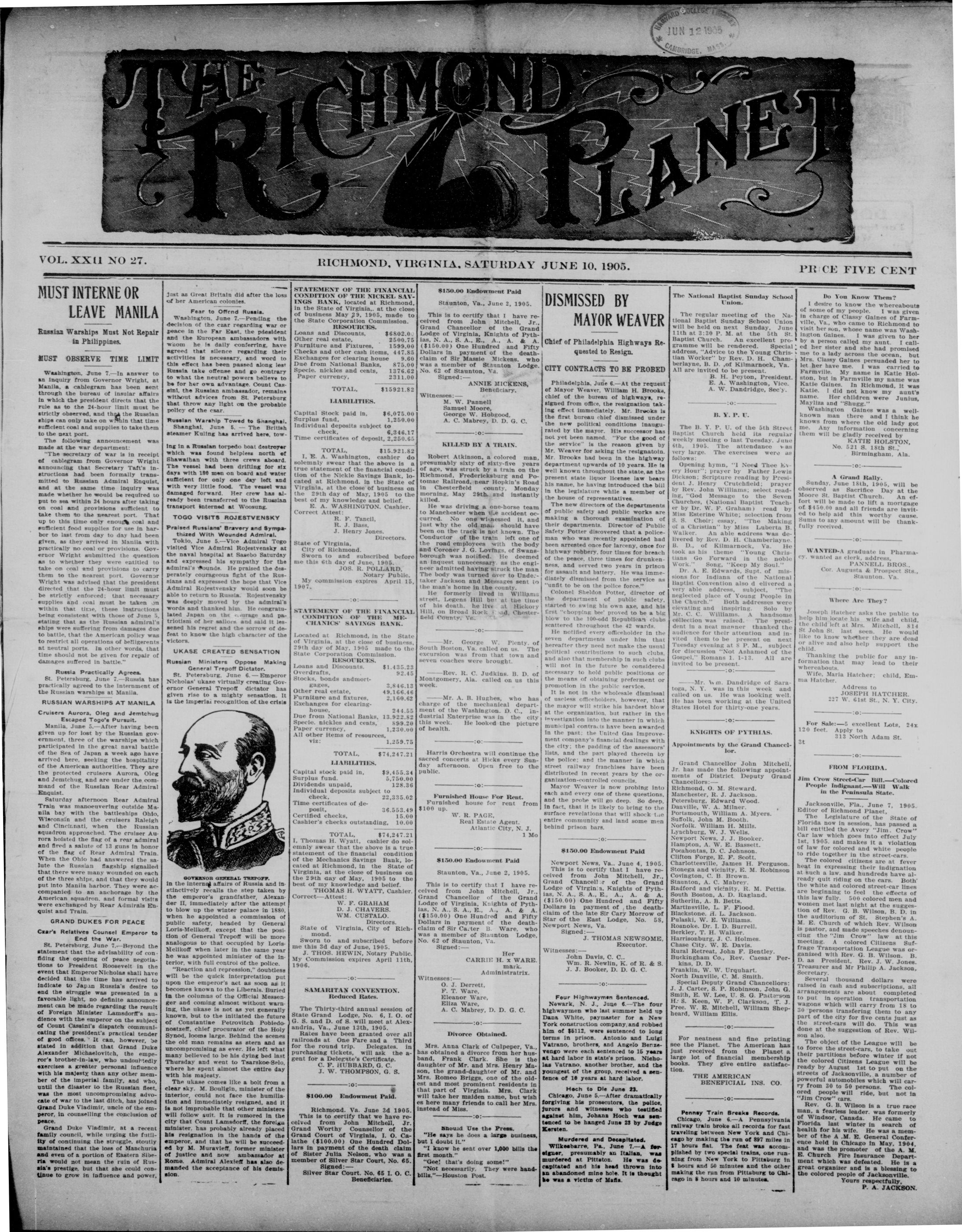
GOVERNOR GENERAL TREPOFF.
in the internal affairs of Russia and instinctively recalls the step taken by the emperor's grandfather, Alexander II, immediately after the attempt to blow up the winter palace in 1880, when he appointed a commission of public safety, headed by General Loris-Melikoff, except that the position of General Trepoff will be more analogous to that occupied by Loris-Melikoff when later in the same year he was appointed minister of the interior, with full control of the police.
"Reaction and repression," doubtless will be the quick interpretation put upon the emperor's act as soon as it becomes known to the Liberals. Buried in the columns of the Official Messenger and coming almost without warning, the ukase is not as yet generally known, but to the initiated the future of Constantine Petrovitch Pobledonostzeff, chief procurator of the Holy Synod, looms large. Behind the scenes the old man remains as stern and as uncompromising as ever. He left what many believed to be his dying bed last Thursday and went to Tsarskoe-Selo, where he spent almost the entire day with his majesty.
The ukase comes like a bolt from a clear sky. M. Boulgin, minister of the interior, could not face the humiliation and immediately resigned, and it is not improbable that other ministers will follow suit. It is rumored in the city that Count Lamsdorff, the foreign minister, has probably already placed his resignation in the hands of the emperor, and that he will be succeeded by M. Muravleff, former minister of justice and now ambassador at Rome. Admiral Alexieff has also demanded the acceptance of his demission.
RICHMOND, VIRGINIA, SATURDAY JUNE 10. 1905.
STATEMENT OF THE FINANCIAL
CONDITION OF THE NICKEL SAVINGS BANK, located at Richmond,
in the State of Virginia., at the close
of business May 29, 1905, made to
the State Corporation Commission.
RESOURCES.
Loans and Discounts, $6802.00
Other real estate, 2500.75
Furniture and Fixtures, 1599.00
Checks and other cash items, 447.85
Exchanges for clearing house 9.60
Due from National Banks, 875.00
Speck, nickles and cents, 1376.62
Paper currency, 2311.00
LIABILITIES.
Capital Stock paid in. $6,075.00
Surplus fund, 1,250.00
Individual deposits subject to
check, 6,346.17
Time certificates of deposit, 2,250.65
TOTAL, $15,921.82
I. E. A. Washington, cashier do
solemni swear that the above is
a true statement of the financial con-
dition of the Nickle Savings Bank,
located at Richmond, in the State of
Virginia, at the close of business on
the 29th day of May, 1905 to the
best of my knowledge and belief.
E. A. WASHINGTON. Cashier.
Correct Attest:
R. F. Tancil,
R. J. Bass,
J. Henry Jones.
Directors.
State of Virginia,
City of Richmond.
Sworn to and subscribed before
me this 6th day of June, 1905.
JOS. R. POLLARD.
Notary Public.
My commission expires April 15,
1907.
:o:
STATEMENT OF THE FINANCIAL
CONDITION OF THE MECHANICS' SAVINGS BANK.
Located at Richmond, in the State
of Virginia, at the close of business,
29th day of May, 1905 made to the
State Corporation Commission.
RESOURCES.
Loans and Discounts. $1,435.23
Overdrafts. 92.45
Stocks, bonds andmortgages. 3,846.13
Other real estate, 49,166.46
Furniture and fixtures. 2,160.62
Exchanges for clearing-house. 244.55
Due from National Banks, 13,922.82
Specie, nickles and cents, 899.20
Paper currency, 1,230.00
All other items of resources,
viz: 1,259.75
TOTAL, $74,247.21
LIABILITIES.
Capital stock paid in, $9,455.34
Surplus fund, 5,750.00
Dividends unpaid, 128.36
Individual deposits subject to
check, 22,335.02
Time certificates of deposit, 36,552.49
Certified checks, 15.00
Cashier's checks outstanding, 10.00
TOTAL, $74,247.21
I. Thomas H. Wyatt, cashier do-solemly swear that the above is a true statement of the financial condition of the Mechanics Savings Bank, located at Richmond, in the State of Virginia, at the close of business on the 29th day of May, 1905 to the best of my knowledge and belief.
THOMAS H. WYATT, Cashier.
Correct—Attest:
W. F. GRAHAM
D. J. CHAVERS.
WM. CUSTALO.
Directors.
State of Virginia, City of Rich-
mond.
Sworn to and subscribed before
me this 2d day of June, 1905
me this sunday of June, 1905.
J. THOS. HEWIN, Notary Public.
My Commission expires April 11th,
1906.
SAMARITAN CONVENTION Reduced Rates.
The Thirty-third annual session of State Grand Lodge, No. 6, I. O. of G. S. and D. of S. will meet at Alexandria, Va., June 13th, 1905.
Rates have been granted over all railroads at One Fare and a Third for the round trip. Delegates, in purchasing tickets, will ask the agent for a Delegate's Certificate.
C. F. HUBBARD, G. C.
J. W. THOMPSON, G. S.
Richmond. Va. June 3d 1905.
This is to certify that we have received from John Mitchell, Jr.
Grand Worthy Counsellor of the Grand Court of Virginia, I. O. Calathe ($100.00) One Hundred Dollars in payment of the death claim of Sister Julia Nelson, who was a member of Silver Star Court, No. 65.
Signed:—
Silver Star Court. No. 65 I. O. C.
Beneficiaries.
$150.00 Endowment Paid
Staunton, Va., June 2, 1905.
This is to certify that I have received from John Mitchell, Jr.,
Grand Chancellor of the Grand
Lodge of Virginia, Knights of Pythias, N. A., S. A., E., A., A. & A.
($150.00) One Hundred and Fifty
Dollars in payment of the death-
claim of Sir Massie Mickens, who
was a member of Staunton Lodge,
No. 62 of Staunton, Va.
Signed:—
ANNIE MICKENS,
Beneficiary.
Witnesses:—
M. W. Pannell
Samuel Moore,
George W. Hobgood,
A. C. Mabrey, D. D. G. C.
KILLED BY A TRAIN
Robert Atkinson, a colored man, presumably sixty of sixty-five years of age, was struck by a train on the Richmond, Frederickburg and Potomac Railroad, near Hopkin's Road in Chesterfield county. Monday morning, May 29th, and instantly killed.
He was driving a one-horse team to Manchester when the accident occurred. No one witnessed it, and just why the old man should have been on the track is not known. The Conductor of the train left one of the road employees with the body and Coroner J. G. Lovings, of Swansborough was notified. He deemed an inquest unnecessary, as the engineer admitted having struck the man. The body was turned over to Undetaker Jackson and Messages sent to the man's home in the county.
He formerly lived in Williams street, Legens Hill but at the time of his death, he live at Hickory Hill, on Broad Rock Road, Chesterfield County, Va.
Mr. George W. Plenty. of South Boston, Va. called on us. The excursion was from that town and seven coaches were brought.
Rev. R. C. Judkins. B. D. of Montgomery, Ala. called on us this week.
Mr. A. B. Hughes, who has charge of the mechanical department of the Washington. D. C., industrial Enterprise was in the city this week. He looked the picture of health.
Harris Orchestra will continue the sacred concerts at Hicks every Sunday afternoon. Open free to the public.
Furnished House For Rent.
Furnished house for rent from
$100 up.
W. R. PAGE.
Real Estate Agent.
Atlantic City, N. J.
1 Mo
____:o:____
$150.00 Endowment Paid
Staunton, Va., June 2, 1905.
This is to certify that I have received from John Mitchell, Jr.
Grand Chancellor of the Grand
Lodge of Virginia, Knights of Pythias, N. A., S. A., E., A., A. & A.
($150.00) One Hundred and Fifty
Dollars in payment of the death-
claim of Sir Catter B. Ware, who
was a member of Staunton Lodge,
No. 62 of Staunton, Va.
Signed:—
Her
CARRIE H. x WARE.
mark.
Administratrix.
Witnesses:—
O. J. Derrett,
F. T. Ware,
Eleanor Ware,
Eliza Ware,
A. C. Mabrey, D. D. G. C.
Divorce Obtained.
Mrs. Anna Clark of Culpeper, Va., has obtained a divorce from her husband, Frank Clark. She is the daughter of Mr. and Mrs. Henry Mason, the grand-daughter of Mr. and Mrs. Romeo Briggs, one of the oldest and most prominent residents in that part of Virginia. Mrs. Clark will take her maiden name, but wish es here many friends to call her Mrs. instead of Miss.
Should Use the Press
"He says he does a large business, but I doubt it."
"I know he sent over 1,000 bills the first month."
"Gee! that's doing some!"
"Not necessarily. They were handbills."—Houston Post.
DISMISSED BY MAYOR WEAVER
Chief of Philadelphia Highways Requested to Resign.
CITY CONTRACTS TO BE PROBED
Philadelphia, June 6.—At the request of Mayor Weaver, William H. Brooks, chief of the bureau of highways, resigned from office, the resignation taking effect immediately. Mr. Brooks is the first bureau chief dismissed under the new political conditions inaugurated by the mayor. His successor has not yet been named. "For the good of the service" is the reason given by Mr. Weaver for asking the resignation. Mr. Brooks had been in the highway department upwards of 10 years. He is well known throughout the state, as the present state liquor license law bears his name, he having introduced the bill in the legislature while a member of the house of representatives.
The new directors of the departments of public safety and public works are making a thorough examination of their departments. Director of Public Safety Potter discovered that a policeman who was recently appointed had been arrested once for larceny, once for highway robbery, four times for breach of the peace, three times for drunkenness, and served two years in prison for assault and battery. He was immediately dismissed from the service as "unfit to be on the police force."
Colonel Sheldon Potter, director of the department of public safety, started to swing his own axe, and his first "chopping bee" proved to be a big blow to the 100-odd Republican clubs scattered throughout the 42 wards.
He notified every officeholder in the seven departments under him that hereafter they need not make the usual political contributions to such clubs, and also that membership in such clubs will not in the future be considered necessary to hold public positions or the means of obtaining preferment or promotion in the public service. It is not in the wholesale dismissal of useless officeholders, however, that the mayor will strike his hardest blow at the organization, but rather in the investigation into the manner in which municipal contracts have been awarded in the past; the United Gas Improvement company's financial dealings with the city; the padding of the assessors' lists, and the part played therein by the police; and the manner in which street railway franchises have been distributed in recent years by the organization-controlled councils. Mayor Weaver is now probing into each and every one of these questions, and the probe will go deep. So deep, in fact, that it is likely to bring to the surface revelations that will shock the entire community and land some men behind prison bars.
$150.00 Endowment Paid
Newport News, Va. June 4, 1905.
This is to certify that I have received from John Mitchell, Jr.,
Grand Chancellor of the Grand
Lodge of Virginia's Knights of Pythias,
N. A. N., S. A. E., A., A. & A.
($150.00) One Hundred and Fifty
Dollars in payment of the death-
claim of the late Sir Cary Morrow of
Star of the East Lodge, No. 58,
Newport News, Va.
Signed:—
J. THOMAS NEWSOME,
Executor.
Witnesses:—
John Davis, C. C.,
Wm. R. Newlin, K. of R. & S.
J. J. Booker, D. D. G. C.
Four Highwaymen Sentenced
Four Highwaymen Sentenced.
Newark, N. J., June 6.—The four highwaymen who last summer held up Dana White, paymaster for a New York construction company, and robbed him of $5112, were sentenced to long terms in prison. Antonio and Luigi Vatrano, brothers, and Angelo Berzevengo were each sentenced to 15 years at hard labor in state's prison. Nicholas Vatrano, another brother, and the youngest of the group, received a sentence of 10 years at hard labor.
Hech to Die June 23.
Chicago, June 5.—After dramatically forgiving his prosecutors, the police, jurors and witnesses who testified against him, Johann Hoch was sentenced to be hanged June 23 by Judge Kersten.
Murdered and Decapitated.
Wilkesbarre, Pa., June 7.—A foreigner, presumably an Italian, was murdered at Pittston. He was decapitated and his head thrown into an abandoned mine hole. It is thought he was a victim of Mafia.
The National Baptist Sunday School Union.
The regular meeting of the National Baptist Sunday School Union will be held on next Sunday, June 11th at 3:30 P. M. at the 5th St. Baptist Church. An excellent programme will be rendered. Special address, "Advice to the Young Christian Worker" by Rev. D. H. Chamberlayne, B. D. ,of Kilmarnock, Va. All are invited to be present. B. H. Peyton, President. E. A. Washington, Vice. A. W. Dandridge, Secy.
B. Y. P. U.
The B. Y. P. U. of the 5th Street Baptist Church held its regular weekly meeting o last Tuesday, June 6th, 1905. The attendance was very large. The exercises were as follows:
Opening hymn, "I Need Thee Every Hour"; prayer by Father Lewis Dickson; Scripture reading by President J. Henry Crutchfield; prayer by Rev. John Williams; select reading, "God Message to the Seven Churches, (National Baptist Teacher by Dr. W. F. Graham) read by Miss Esterine White; selection from S. S. Choir; essay, "The Making of a Christian" by Miss Luberta B. Walker. An able address was delivered by Rev. D. H. Chamberlayne. B. D., of Kilmarnock, Va. He took as his theme "Young Christians Go Forward in the noble Work." Song, "Keep My Soul." Dr. A. E. Edwards, Supt. of missions for Indiana of the National Baptist Convention also d elivered a very able address, subject, "The neglected place of Young People in the Church." Both addresses were elevating and inspiring. Solo by Mr. C. C. Williams. A handsome collection was raised. The president in a neat manner thanked the audience for their attention and invited them to be present on next Tuesday evening at S P. M., subject for discussion "Not Ashamed of the Gospel," Romans 1. 1-13. All are invited to be present.
Mr. Vm. Dandridge of Saratoga, N. Y. was in this week and called on us. He was looking well. He has been working at the United States Hotel for thirty-one years.
KNIGHTS OF PYTHIAS.
Appointments by the Grand Chancellor.
Grand Chancellor John Mitchell, Jr. has made the following appointments of District. Deputy Grand Chancellors:—
Richmond, O. M. Steward.
Manchester, R. J. Jackson.
Petersburg, Edward Wood.
Danville, W. A. Milner.
Portsmouth, William A. Myers.
Suffolk, John M. Booth.
Norfolk, William H. Mills.
Lynchburg, W. J. Wells.
Newport News, J. J. Booker.
Hampton, A. W. E. Bassett.
Pocahontas, D. C. Johnson.
Clifton Forge, E. F. Scott.
Charlottesville, James H. Ferguson.
Stonega and vicinity, E. M. Robinson
Covington, C. B. Brown.
Staunton, A. C. Mabrey.
Radford and vicinity, R. M. Pettis.
South Boston, A. D. Ragland
Sutherlin, A. B. Betts.
Martinsville, L. F. Flood.
Blackstone, H. L. Jackson.
Pulaski, W. E. Williams.
Roanoke, Dr. I. D. Burrell.
Berkley, T. H. Walker.
Harrisonburg, J. C. Holmes.
Chase City, W. E. Davis.
Rural Retreat, John F. Bentley.
Buckingham Co., Rev. Caesar Per
kins, D. D.
Franklin, W. W. Urquhart.
North Danville, C. M. Smith.
Special Deputy Grand Chancellors:
J. S. Hewitt. Robinson, John G.
Smith, E. W. Lee. Johnson, Patterson
H: S. Keen, W. F. Clarkson, T. J.
Pree, W. E. Mitchell, William Sheepard.
William Ellis.
For neatness and fine printing see the Planet. The American has just received from the Planet a large lot of financial membership books. They give entire satisfaction.
THE AMERICAN
BENEFICIAL INS. CO.
Pennay Train Breaks Records
Pennsy Train Breaks Records.
Chicago, June 6.—A Pennsylvania railway train broke all records for fast traveling between New York and Chicago by making the run of 897 miles in 17 hours flat. The feat was accomplished by two special trains, one running from New York to Pittsburgh in 8 hours and 50 minutes and the other making the run from Pittsburgh to Chicago in 8 hours and 10 minutes.
Do You Know Them?
I desire to know the whereabouts of some of my people. I was given in charge of Classy Gaines of Farmville, Va., who came to Richmond to visit her son, whose name was Washington Gaines. I was given to her by a person called my aunt. I called her sister and she had promised me to a lady across the ocean, but Mrs. Classy Gaines persuaded her to let her have me. I was carried to Farmville. My name is Katie Holston, but in Farmville my name was Katie Gaines. In Richmond, it was Katie. I did not know my aunt's name. Her children were Junius, Mayliza and "Shugg." Washington Gaines was a well-known man there and I think he knows from where the old lady got me. Any information concerning them will be gladly received by KATIE HOLSTON,
No. 521 S. 18th St.,
Birmingham, Ala.
A Grand Rally.
Sunday, June 18th, 1905, will be observed as Sacrifice Day at the Moore St. Baptist Church. An effort will be made to lift a mortgage of $450.00 and all friends are invited to help aid this worthy cause. Sums to any amount will be thankfully received.
WANTED-A graduate in Pharmacy. wanted as clerk, address, PANNELL BROS., Cor. Augusta & Prospect Sts., Staunton, Va.
Where Are They?
Joseph Hatcher asks the public to help him locate his wife and child, the child left at Mrs. Mitchell, 814 St John St. last seen. He would like to know whether they are dead or alive and also help support the child.
Thanking the public for any information that may lead to their whereabouts.
Wife, Maria Hatcher; child, Emma Hatcher.
Address to
JOSEPH HATCHER.
227 W. 61st St., N. Y. City.
For Sale:—5 excellent Lots, 24x
120 feet. Apply to
313 North Adam St.
FROM FLORIDA.
Jim Crow Street-Car Bill.—Colored People Indignant.—Will Walk in the Peninsula State.
Jacksonville, Fla., June 7, 1905. Editor of Richmond Planet. The Legislature of the State of Florida now in session, has passed a bill entitled the Avory "Jim. Crow" Car law which goes into effect July 1st, 1905, and makes it a violation of law for colored and white people to ride together in the street-cars. The colored citizens are at fever heat in expressing their indignation at such a law, and hundreds have already quit riding on the cars. Both the white and colored street-car lines are beginning to feel the effects of this law fully. 500 colored men and women met last night at the suggestion of Rev. G. B. Wilson, B. D. in the auditorium of St. Stephen's A. M. E. Church of which Rev. Wilson is pastor, and made speeches denouncing the "Jim Crow" law at this meeting. A colored Citizens Suffrage Transportation League was organized with Rev. G. B. Wilson. B. D. as President, Rev. J. W. Jones. Treasurer and Mr Philip A. Jackson, Secretary.
Several thousand dollars were raised in cash and subscriptions, all arrangements are about completed to put in operation transportation wagons which will carry from 18 to 30 persons transferring them to any part of the city for five cents just as the street-cars will do. This was done at the suggestion of Rev. Wilson also.
The object of the League will be to force the street-cars, to take out their partitions before winter if not the colored Citizens League will be ready by August 1st to put on the streets of Jacksonville, a number of powerful automobiles which will carry from 30 to 50 persons. The colored people will ride, but not in "Jim Crow" cars.
Rev. G. B. Wilson is a true race man, a fearless leader, was formerly of Windsor, Canada. He came to Florida last winter in search of health for his wife. He was a member of the A. M. E. General Conference held in Chicago in May, 1904, and was the promoter of the A. M. E. Church Fire Insurance Department which was defeated. He is a great organizer and is a blessing to the colored people of Jacksonville.
Yours respectfully,
P. A. JACKSON
THE PLANET
SATURDAY. JUNE 10, 1905
DONT'S For Speaker and Writer Ready Reminder of Errors in the Use of Common Words, Arranged Alphabetically
22
BY EDWARD B. WARMAN, A. M.
(Author of "Practical Orthopey and Critique," "The Voice: How to Train It;
How to Care for It." Etc.)
(Copyright, 1965, by Joseph B. Bowles). Author's Note.—It is one thing to record errors, quite another to avoid them. He who waits for the faultless one to cast the first critical stone waits in vain, therefore, as one of many working for the English language I shall be pleased to receive criticism, if, perchance, I, too, have earned. One's theory often is better than one's practice. This was exemplified by the teacher of language when he said to his student, "Now use a proposition to end a sentence with." Many years ago I began to watch for errors. I noted them in a little book; the book grew as the years passed. I read much, shall profit more. I now record that I will benefit others as well as myself. Many of them are recorded for the first time.
Note—Replies are given to statements, accusations, arguments, etc., whether verbal or written; therefore in general correspondence, the word "answer" should be used.
Don't say "reprove" for "rebuke."
Note—These words are often used interchangeably, but erroneously so. A reproof is kindly given with a desire to aid; a rebuke is not always prompted by the best motives; hence, is often unkindly given.
Don't say "reputation" for "character."
Note—These words are not synonymous. A man's character is what he makes it; his reputation is what his friends or his enemies make it. A good reputation does not always bespeak a good character. One with a noble character may have a bad reputation. One's character is what he is; one's reputation is what he seems—sometimes viewed "through a glass darkly."
Don't say "return back" for "return." Example: "We were compelled to return back," "The army retreated back many miles," should be "We were ompelled to return," "The army retreated many miles."
Note—The use of the word in this sense is questionable taste.
Don't say "right here" for "just here."
Example: "Right here let me say," should be "Just here let me say."
"Don't say "rinse off" for "rinse."
Example: "Rinse your hands," should be "Rinse your hands."
Don't say "rode" for "ridden."
Example: "I have rode several miles on my wheel to-day," should be "I have ridden several miles on my wheel to-day."
Don't say "run" for "ran."
Example: "He run to the train," should be "He ran to the train."
Don't say "rung" for "rang."
Example: "He rung the bell," should be "He rang the bell."
Don't say "savage" for "ferocious."
Example: "That man is often quite savage," should be "That man is often quite ferocious."
Note—Savage signifies uncivilized; ferocious, ungentle.
Don't say "saw" for "have seen."
Example: "It was the largest I ever saw," "I never saw it but once," "I never saw such a parade," should be "It was the largest I ever have seen," I never have seen it but once." "I never have seen such a parade."
Note—"When the period of time referred to extends to the time when the statement is made, it must be 'have seen.'"—The Verbalist.
Don't say "see more of you" for "see you more often."
Example: "I should like to see more of you." should be "I should like to see you more often."
* * * * * *
Don't say "see out of his eyes."
Example: "He can hardly see out of his eyes," should be "He can hardly see."
Note—There is only one way of seeing.
* * * * * *
Don't say "seen" for "saw."
Example: "I seen him when he did it." should be "I saw him when he did it."
Sit, sat, sitting or sat.
Note—The meaning of the word should aid one in its correct use. To set, is to place; to fix; to plant; to frame; to regulate. To sit, is to rest upon the haunches; to repose on a seat; to hold a session; to incubate; to be adjusted; to fit.
Example: Set it here. He set the plate on the table. They have been setting the table.
1 sit on the sofa. 1 sat on the sofa. 1
have been sitting on the sofa
have been sitting on the sofa.
Congress is sitting. The hen sits.
The hen is sitting.
"He sits a horse well," "A coat sits well or ill."—Webster's International.
"The new and gorgeous garment, majesty, sits not so easy on me as you think."—Shakespeare.
"As a partridge sitteth on her eggs and hatchett them not."—Jer. XVII:11.
Note: "The use of the verb set for sit, in such expressions as, the hen is setting on 13 eggs, a setting hen, etc., although colloquially common, and sometimes tolerated in serious writing, is not to be approved."—Webster's International.
Note—This error, of course, is not made in speech, but in writing.
Example: "Send me your full sett of books," should be "Send me your full set of books."
Don't say "settle" for "pay."
Example: "I settle my bills promptly," should be "I pay my bills promptly."
Don't say "since" for "ago."
Example: "It was ages since," should be "It was ages ago."
Note—"Since" looks forward from a definite past time until now; as, "He went a month ago, and I have not seen him since." "Ago" looks backward from the present; as "Years ago, it happened."
Don't say "sinks down" for "sinks."
Example: "Lead sinks down in water," should be "Lead sinks in water."
SUCCEEDED IN BUSINESS.
But Failed as a Man Because of the Various Shortcomings Here
He stopped growing.
He was not greater than his occupation.
He never learned to look on the sunny side.
He stuffed his pocketbook, but starved his brain.
He never learned to take the drudg
ery out of his work.
He did not live in his upper stories
but in the basement of his being.
He regarded his business as a means
of making a living, instead of a life
He lost his early friends by neglect
of making a living, instead of a life.
He lost his early friends by neglect,
and had no time to cultivate new ones.
He never learned to enjoy little
things, to see the uncommon in the
common.
He never learned to lubricate his
life's machinery with laughter and
good cheer.
He made life a grind, out of which
he got neither pleasure, profit nor
instruction.
There was only one side of his nature
developed, and that was the money-
making side.
No face ever brightened at his approach,
no heart thrilled at the sound
of his voice.
Society bored him, children bored
him, music and the drama were
unknown languages to him.
He never learned to enjoy himself
as he went along, but was always post-
poning his happiness.
He could not rise to his feet to speak at a public meeting, or to put a motion, if his life depended on it.
He used every means to develop his business, but none to develop his mind or to make himself a larger man.
When he retired from business, he found that, in his struggle to get the means for enjoyment, he had murdered his capacity to enjoy.
He knew nothing of what was going on in the world outside of his own narrow circle; another state was like a foreign country to him.
He read only market reports in the newspapers. He never read articles in magazines, and books were an unknown quantity to him.
The idea of helping others, or of owing society, his city, or his nation, any duty, outside of caring for his own interests, never occurred to him.
Recreation, relaxation, or amusement of any kind was condemned by him as a wicked waste of valuable time which might be coined into dollars.—O. S. Marden, in Success Magazine.
Dogfish for the Table
A Cornish gourmet, following the advice of Horace about combining pleasure with utility, suggests that the destructive dogfish, which are ruining the local fishermen, would prove a valuable addition to our cuisine. When skinned and carefully cooked the dogfish is "more delicate than hake", while a peculiar "sweetness" of flavor can be remedied by lemon or vinegar. Poor Frank Buckland long ago advocated a diet of dogfish, and was once delighted at being asked by some weatherbound French fishermen: "Vill you buy a dog, John?" As a matter of fact, dogfish has been from time to time eagerly eaten under the ambiguous euphemism of "fried fish" by many generations of east and south Londoners.—Westminster Gazette.
How Long Whales Live
"As to the age to which whales live," says Dr. True, curator of biology of the National museum, "there is no accurate data, but I am inclined to the opinion that some of them live to an age in excess of 40 years. This theory is borne out by the finding in a whale in 1890 of a harpoon which had belonged to a ship that was sunk during the civil war. Ten years before the war the ship had cruised as a whaler. The estimates that whales live to be 1,000 years old are fanciful, and not based on authoritative information."—Washington Post.
Industrious at Play.
"It depends," answered Farmer Corntossel. "He's liable to take his time doin' chores, but if you ever get him on second base with a good hitup up his' liable to be about the busiest thing on earth."—Washington Star.
The Reason
"Mr. Borem must be a wrestler."
"Why?"
"I can't throw him down."—Cleveland
Plain Dealer.
THE RICHMOND PLANET, RICHMOND, VIRGINIA
SPOCKS OUST A KENTUCKY FAMILY
A MENIFEE COUNTY DOCTOR
MOVES BECAUSE OF GHOSTS.
AGONY OF SITUATION AWFUL
After Terrible Experience in Home Which the Neighbors Said Was Haunted Physician Gives Up and Vacates Premises.
Louisville, Ky.—One of the most puzzling enigmas that students of psychic phenomena have tried to unravel today is puzzling scholar and neophyte in the lore of mysticism. Not only has this marvel amazed those who delight in revealing the fact that many "miracles" are due only to some person's wonderful imagination or morbid thoughts, but it has also driven from a home of luxury a family that found itself unable to solve the personality, or, rather, the nonpersonality, of a ghostly visitant.
Dr. Joseph King moved with his family into a beautiful country residence near Rothwell, Menifee county, Kentucky. Gossip of the wives of the countryside had never connected with the mansion, practically rebuilt by the physician, even the slightest tinge of mystery. Superstitious babblers had never hinted of the customary accompaniment of nocturnal rambers from the nether world—the sound of clanking chains and occasional flashes of light that came from a portion of the house known to be unoccupied.
But the quiet life of the happy family soon was changed. Three days after the house was occupied Dr. King was awakened by a cold, clammy object placed upon his face. What it was he could not tell, and a careful search of the house by himself and the rest of the family failed to reveal traces of anything unusual. Dr. King describes the sensation of his first awakening thus:
"Like the touch of a lifeless hand!" Thereafter he was often roused from sound slumber by the feeling that there was resting on his face the hand of a corpse. That was only the beginning of the ghostly visitations, and almost nightly
CAREFUL SEARCH FAILED TO REVEAL ANYTHING UNUSEAL.
CAREFUL SEARCH FAILED TO REVEAL ANYTHING UNUSUAL
occurrences of the same sort finally drove the family out.
The members of the household were frightened by noises such as could be made by planks sliding along the floor and then dropping with a sudden crash.
Sitting at the fireside the children would be frightened almost into convulsions by the crash of a heavy object falling upon the floor behind their backs.
A section of the roof would seem to fall off in the night and gates and doors would slam, but no one was ever seen.
Song and conversation were heard in the wee hours of the morning, but no traces could be found of the owners of the ghostly voices. Evidently the ghosts were of a modern make, for in the songs snatches of ragtime mingled with selections from classic operas.
Ghostly footsteps were heard to cross the floor at all hours of the day, while mysterious gavels seemed to be rapping upon the table for order as the family sat down at their meals. Canes were pounded upon the floor in the presence of the King family, but no one could be seen. For a year this went on, until the health of Mrs. King was so affected that her husband feared further residence in the house would cost her life. Then the decision to move was made. It was rumored that the former owner of the house had been a believer in spiritualism. When approached by Dr. King she admitted that spirits had been called back to the house by her. She declared that she had summoned the spirit of her dead husband, as well as that of a murderer hanged many years before in Menifee county, and expressed the belief that these uncanny visitants were causing all the trouble
Many residents of the county have heard the noises and corroborated the stories told by Dr. King. Many have even assisted in the hunt for the ghosts, but in vain.
Weds Woman He Robbed
Ames, Ia.—Fred Alyn, of Denver, Col., was arrested here the other day on the charge of stealing diamonds valued at $1,500 from a woman by the name of Ray Charlton, also of Denver. On being searched the jewels were found sewed up in the waistband of his trousers. The woman has been in the city several days waiting for the arrival of the suspect, as she had learned that he was expecting mail at the post office. Upon the return of her jewelry she withdrew the charges against him on condition that he would marry her which he agreed to. They are both theatrical people.
GIRL RUNS AN ENGINE
WITH VETERAN'S SKILL
ley Park.
St. Louis.—Among those who attended the social session here of the Brotherhood of Locomotive Firemen recently was Miss Bessie Craig, of Fort Worth, Tex., who enlivened the pro-
ceedings with some songs. Although not licensed, Miss Craig, who is but 19, is experienced as an engineer, and she proved the fact by taking the 'Frisco passenger train as far as Valley Park.
Enveloping her tall figure was a light colored cravenette. On her head, jauntily set, was a small cap, from
SHE GRASPED THE THROTTLE
under which a tail, blond pompadour looked. On her slender hands Miss Craig buckskin gauntlets, and her dainty feet were incased in tan shoes.
Miss Craig was practically raised on a locomotive. Her father, G. H. Craig, is one of the best known engineers that runs on southern roads. Since she was a little girl it has been the custom of her father to often take her with him on his daily runs. To the child she taught every detail and intricacy of a locomotive, until there was little she did not know concerning one. When she was older and her hand was strong enough Engineer Craig, sitting beside her, allowed the girl engineer to make the complete run. So attached she Miss Craig become to the vocation of running an engine that she sincerely desires to become a real engineer with a run all to herself.
At home, beeds being called the "Engineer Girl" Miss Craig is known as "The Cowboy Girl." She rides a pitching bronze with the ease of a plainsman and can throw a lariat as true. She is also an accomplished vocalist and possesses a soprano voice of rare quality.
"I could make my living singing," she said, "but I don't care for it as I do running an engine. Aplause from an audience is all right, but it doesn't compare with the exhilaration and excitement of controlling a big engine and having the safety of hundreds of people in your hands. So I want to be an engineer."
At the request of the Brotherhood of Locomotive Firemen special permission was given Miss Craig to run the engine by Superintendent Moore, of the Terminal.
TRAGEDY FROM A JOKE.
Man Frightened His Wife Into Madness and Then in Remorse Kills Himself.
Paris—The death of one person and hopeless insanity of another have resulted from a silly practical joke. Edmond Lelouse, wishing to frighten his wife, dressed up a wax figure, the head of which and one of the hands he lightly attached to the body by means of gum and placed it in bed. While Lelouse was watching the proceedings from behind draperies his wife, about to retire, grasped what she supposed in the semi-darkness to be her husband's hand, but which was in reality that of the wax figure. The hand, cold and clammy, detached itself from the limb and remained in her grasp. With a cry of terror, Mime. Lelouse let the hand drop to the ground and dung her arms around the figure's neck, when the head also became detached and rolled down upon the floor.
The terror-striken woman ran madly down the stairs, where she was stopped by some neighbors. When the police arrived it was found that she had become raving mad. She was conveyed to an asylum. When the husband was told of the hopelessness of his wife's condition, he poisoned himself by swallowing a dose of nitric acid.
Mail Car Used as Barber Sh
Philadelphia.—A trolley mail car was put to an unusual use the other day, having been temporarily turned into a barber shop while standing on a switch on Market street in front of the post office. The hair and beard of one of the conductors needed trimming, so a colored employee who knows something of the barber trade was called upon, a stool was procured and in full view of late pedestrians the act was done. When his hair and beard had been trimmed the "barber" vigorously wielded a whisk, and once more the car became a mail car instead of a barber shop.
Starting Him Aright
"Permit me," said the gallant youth, "to kiss your hand."
"None of that for me, thank you," replied the fair maid.
"Why not?" he asked in surprise, "Because," she answered, "I have no use for a man who has no higher aim in life than that."
And, to the young man's credit, be it said, he took the hint, and aimed a little higher.—Cincinnati Enquirer.
Survival of the Fittest.
"I if had my way," said the ill-natured person, "I'd have all these electric lights taken out." "What for?" "If gas were used everywhere there would be less of this talk about chloroforming the useless. People who could not keep the modern pace would go on blowing the light out and attending to their own asphyxiation."—Washington Star.
TAR AND FEATHER SUSPECTED WOMAN
HUDSON, MICH., SEES WORK OF
VIGILANTES.
RIOTERS FACE PRISON TERM
"Avenging Angels" May Be Lodged
Behind the Bars as the Result of
Their Work — Reason for
Dastardly Act.
Hudson, Mich. — Twenty centuries
ago, in Jerusalem, a band of vigilantes
prepared to take a woman who had
been indiscreet without the walls of
the city and stones her. Soaking
advice from a lowly Nazarene whose
teachings the majority of the civilized
world now professes to follow,
the "regulators" were told to "let him
who is without guilt cast the first
stone."
On April 10, in the year of the same lowly Nazarene, in this little Michigan town of 3,000 inhabitants, a band of men and women, all of whom, so far as they are known, profess to abide by the laws laid down by Jesus of Nazareth, heaped a worse indignity than stoning upon a woman against whom they had less proof of sin than had the men against the woman they would have mobbed save for the interpretation of the moral law as expressed by the Great Teacher.
On the night indicated, Mae Post, a woman who has lived in Hudson for the greater part of 11 years, was visited in her home, a flat in the business center of the town, by a body of men and women whom the public has since dubbed "avenging angels." Entrance to her home was forced at the point of revolvers, her companions—one her divorced husband, who was visiting her, and the other a man whose friendship for the woman was well known to the people of the town—were kept in submission with revolvers on their heads, while the women "angels" cut off her hair, administered a coat of hot tar and embellished the nasty mess with a storm of feathers. Not content with performing these outrages, the woman
THEY ADMINISTERED A COAT OF HOT TAR AND FEATHERS.
who was apparently the leader among the female vigilantes bespattered the walls and floor of the room, the clothing cut from the woman's body and her other wearing apparel with ancient eggs. The vandalism was carried to such an extent that the woman's entire wardrobe was ruined, embryo chickens being found in practically every drawer of her dresser. The alleged reason for the acts of these men and women, most of them prominent residents of the town and community, was the suppressed intimacy of Mrs. Post with Loren Barrett, a well-to-do stockman living near Hudson. Barrett is a married man, and at least three of the band of "avenging angels" were members of his wife's family. Two others were his cwr brothers.
As a result of the outrage a large crop of suits at law have been started, among them damage suits aggregating nearly $50,000, a divorce suit, and criminal proceedings against four of the members of the mob. In the criminal proceedings which charge the defendants with rioting, the penalty which the four men who were members of the party face is a term of two years in prison or a fine of $500, or both.
Mrs. Mae Bennett Post, the victim of the "avenging angels," has made Hudson her home since she was about 15 years of age. She has been twice married. Her first husband, a worthless wight named Bennett, whom she married at the age of 15, failed to support her, and she was compelled to earn a living for herself and her baby boy as a waitress in a local hotel. After a few years Bennett died, and following a brief period of widowhood, the young woman married Gordon Post, a musician of Mansfield, O. She lived with Post until about a year ago. Her son had been kept by his grandparents. Mr. and Mrs. Hodges, in this city. Mrs. Post wished to live near him, and returned to make her residence here.
Her second husband secured a divorce from her on the grounds of desertion, but has, it is claimed, and evidence is offered to substantiate the claim, contributed an amount averaging $30 a month to Mrs. Post's support since the divorce was granted. Friendly relations have been maintained between Post and his divorced wife, and he has on a number of occasions visited her in her home here.
Mrs. Stuyvesant Fish and Companion
Walk Washington Streets Obli-
livious to Downpour.
Washington.—Mrs. Stuyvesant Fish,
of New York, who gave a party a few
years ago at which all the guests were
required to appear dressed to imitate
some animal, has given Washington
something more to talk about. Appar-
ently Mrs. Fish has given it out that it is bad form to allow a storm to break up one's plan to take a walk. 'The other day, while it was raining pitchforks and hammer handles, Mrs. Fish and a companion sauntered down Connecticut avenue, one 'arrayed in a rose-colored reception gown and the other in a tail-made suit. Neither
W
had an umbrella or other protection. Nor apparently gave they a thought to the fact that to ordinary mortals a severe storm prevailed. They loitered along Connecticut avenue from Dupont circle, the center of the fine residence district, down to the shopping quarter, stopping to look into every shop window. When they reached a Turkish bath room they appeared to believe they were wet enough and disappeared therein. The feat is too much for the comprehension of Washington. Capitoline society has not been able to figure out whether it is bad form to permit a rainstorm to break up a walk or whether it was simply a case of being caught in the rain and coming to the conclusion that a little more water would not make the dresses any greater wrecks.
HANDSOME FACE RUINED
AN UNFROCKED PRIEST
Chance Reunites Man and Woman,
Former Lovers, After Nearly
Forty Years.
Paris.—A strange and pathetic romance has been brought to light by the discovery of an aged and miserably clad man and woman, who were found asleep on a bench in the Boulevard Diderot.
They were clasped in each other's arms and looked ill and emaciated.
They were removed to the adjoining police station, where cordials were administered and the couple revived. It was then ascertained that the man, whose name was Jean Lanfret, 68 years old, was an unfrocked priest.
THEY WERE FOUND ASLEEP ON A BENCH
Thirty-eight years ago he had fallen deeply in love with a woman who came to him as a penitent. She was living apart from her husband, and the priest, in he's infatuation, abandoned his sacred call for her.
A year later the woman left him, and the former priest fell upon evil times. Finally he earned his living as a waiter, but he became ill, and, after many vicissitudes, he found himself noomeless and a vagabond, picking up a few shillings now and then as a market porter.
As he sat on the bench on the Boulevard Diderot the other night an old woman, who had been trying to sell a few faded flowers, came and sat next to him, and in her the priest recognized the woman who had abandoned him many years ago.
She also had suffered many reverses, which had removed the last traces of her beauty. Chance had brought her to the bench, and, both suffering from the cold and hunger, they had sunk into sleep as they sat, clamped in each other's arms, until discovered by the police.
BOY WAS A CHAMBERMAID
Sixteen-Year-Old Youth Piqued at Rebuke Runs Away from Home Dressed as a Girl.
Gloversvile, N. Y.—Charles Steele, 16 years old, son of one of the most prominent families of Gloversville, has been masquerading as a woman for three days. A severe rebuke for reckless expenditures caused him to leave home. His parents searched everywhere, and appealed for help in looking for him, but they could get no later trace of him than his appearance in a village store when he purchased a woman's sack.
His identity concealed with a wig and clothes of the latest mode, the boy-girl walked the streets unrecognized and ran accounts with several dry goods establishments for large quantities of woman's apparel, both dress goods and underwear, and with jewelers for trinkets and a gold watch. In the stores where his family was known he had things charged, saying he was Miss Steele. Hearing that the parents of young Steele were looking for him, a saleswoman, having suspicions, had the proprietor put Steele through a rigid questioning. The "girl" objected, attempted to run away and in the shuffle a wig fell from "her" head.
For three days young Steele had been employed in the Hotel St. Charles Disguised as a woman, he engaged to work as a dining-room girl. Not proving an ideal waitress he was changed to chambermaid.
Doggie Has Teeth Cleaned
New York.—"Doggies' dentist." That is the latest. Mrs. Conquest of Boston probably has the distinction of owning the first dog that ever underwent the experience of having his teeth scraped and polished. She brought Muggins, for that is his name all the way here from Boston to have it done.
Muggins is a Yorkshire and weighs only two and a half pounds. Most of the two and a half is long, wry hair. He was seven years old on his birthday the other day. Mrs. Conquest noticed that Muggins didn't eat with his usual gusto. She looked him over and found his teeth were covered with carbon and tartar to a frightful degree.
Mrs. Conquest brought Muggins to New York and gave the case to Dr. Andrew Armstrong.
Muggins was etherized, a spool was put between his jaws and his upper teeth were cleaned. He was then revived, and the next day was etherized and the lower set cleaned.
Eagle Whipped by Crows
Philadelphia.—One hundred crows whipped a big eagle in a fight at the farm of Darlington Beebe, of Westmont, and drove it several miles from the place. The crows attacked the king of birds in a body, and at one time had it so exhausted that it allighted in a field and fell over on the ground, though it finally escaped.
Both Sides of a Question.
“There are many things you can't do with money,” said the man who affects philosophy.
“Yes,” answered Dustin Stax. “But there are a whole lot more things you can't do without it.”—Washington Star.
A Comparison
"Wisdom is greater than wealth," said the sincere citizen. "Perhaps," answered Mr. Dustin Stax. "And yet you can found a college with money, but you can't start a bank with wisdom."—Washington Star.
Ghost of a Chance
First Medium—I tell you that's going to be a pretty searching investigation to-night. Do you think we'll come through it all right?
Second Medium—Oh, I guess we've got a ghost of a chance—Judge.
As in Other Matters
Atom—It isn't the size of the fist that counts. It's the man behind the fist.—Chicago Tribune.
Engaged.
Dick—I kissed Helen twice last night.
Tom—You did? Why, I thought you said she was such a reserved girl?
Dick—So she is; reserved for me.—Chicago Daily News.
Arked and Answered.
Father of Large Family—My dear, isn't it about time you were thinking of getting married?
Eldest Daughter — Goodness! I haven't thought of anything else for years.—Cassell's.
A. Good Point
Mrs. DeFadd—She is magnificently dressed, but her hands are not very aristocratic, are they?
Mr. DeF.—N.o. they look as if they might be good for something.—N. Y. Weekly.
Fine
"Did they have a fine wedding?"
"Yes, one of the finest I ever attended. Both the bride and groom were laid up for a week after we got through with them."—Chicago Record-Herald.
Putting It Straight.
Geraldine—I want to ask you a question.
GeraM—Ask it, dearest.
Geraldine—Am I the only girl whose money you have ever loved?—Town Topics.
A. Harsh Critic
"Does that man speak in his official capacity?" "Certainly not." answered Senator Sorghum. "He invariably speaks in his official incapacity."—Washington Star.
WONDERFUL DISCOVERY
Curly Hair Made Straight By
TAKEN FROM LIFE
The Wings of the Morning By LOUIS TRACY Copyright, 1903, by EDWARD J. CLODE
CHAPTER IX.
THE sailor went after those monkeys in a mood of relentless severity. Thus far the regular denizens of Rainbow Island had dwelt together in peace and mutual good will, but each diminutive wou-wou must be taught not to pull any strings he found tied promiscuously to trees or stakes. As a preliminary essay Jenks resolved to try force combined with artifice. Falling complete success, he would endeavor to kill every monkey in the place, though he had in full measure the inherent dislike of Anglo-India to the slaying of the tree people.
This, then, is what he did: After filling a biscuit tin with good sized pebbles he donned a Dyak hat, blouse and belt, rubbed earth over his face and hands and proceeded to pelt the wou-wous merclessly. For more than an hour he made their lives miserable until at the mere sight of him they fled, shrieking and gurgling like a thousand water bottles. Finally he constructed several Dyak scarcrows and erected one to guard each of his alarm guns. The device was thoroughly effective. Thenceforth, when some adventurous monkey, swinging with hands or tail among the treetops in the morning search for appetizing nut or luscious plantain, saw one of those fearsome bogies, he raised such a hubbub that all his companions scampered hastily from the confines of the wood to the inner fastnesses.
During each of the two daily examinations of the horizon, which he never omitted, Jenks minutely scrutinized the sea between Rainbow island and the distant group. It was perhaps a needless precaution. The Dyaks would come at night. With a favorable wind they need not set sail until dusk, and their fleet samplers would easily cover the intervening forty miles in five hours.
He could not be positive that they were actual inhabitants of the islands to the south. The China sea swarms with wandering pirates, and the tribe whose animosity he had earned might be equally noxious to some peaceable fishing community on the coast. Again and again he debated the advisability of constructing a seaworthy raft and endeavoring to make the passage. But this would be risking all on a frightful uncertainty, and the accidental discovery of the eagle's nest had given him new hope. Here he could make a determined and prolonged stand, and in the end help must come. So he dismissed the navigation project and devoted himself wholly to the perfecting of the natural fortress in the rock. That night they finished the rope ladder. Indeed Jenks was determined not to retire to rest until it was placed. He did not care to try a second time to carry Iris to that elevated perch.
One of the first things he contemplated was the destruction if possible of the point on the opposite cliff which commanded the ledge. This, however, was utterly impracticable with the appliances at his command. The top of the rock sloped slightly toward the west, and nothing short of dynamite or regular quarrying operations would render it untenable by hostile marksmen.
During the day his rifles at ninety yards' range might be trusted to keep the place clear of intruders. But at night—that was the difficulty. He partially solved it by fixing two rests on the ledge to support a rifle in exact line with the center of the enemy's supposed position, and as a variant on the outer rest the marked lines which corresponded with other sections of the entire front available to the foe.
Even then he was not satisfied. When time permitted, he made many experiments with ropes reeved through the pulley and attached to a rifle action. He might have succeeded in his main object had not his thoughts taken a new line. His aim was to achieve some method of opening and closing the breech block by means of two ropes. The difficulty was to secure the preliminary and final lateral movement of the lever bolt, but it suddenly occurred to him that if he could manage to convey the impression that Iris and he had left the island the Dyaks would go away after a fruitless search. The existence of ropes along the face of the rock—an essential to his mechanical scheme—would betray their whereabouts or at any rate excite dangerous curiosity. So he reluctantly abandoned his original design, though not wholly, as will be seen in due course.
In pursuance of his intest idea he sedulously removed from the foot of the cliff all traces of the clearance effected on the ledge, and, although he provided supports for the tarpaulin covering, he did not adjust it. Iris and he might lie pedu there for days without their retreat being found out. This development suggested the necessity of hiding their surplus stores and ammunition, and what spot could be more suitable than the cave?
So Jenks began to dig once more in the interior, laboring manfully with pick and shovel in the locality of the fault with its vein of antimony
Rainbow Island had given him the one thing a man prizes above all else—a pure yet passionate love for a woman beautiful alike in body and mind. And now it was to endow him with riches that might stir the pulse of even a South African magnate, for the saffron, unmindful of purpose other than providing the requisite cache, shoveling and delving with the energy peculiar to all his actions, suddenly struck a deep vein of almost virgin gold.
To facilitate the disposal at a distance of the disturbed debris he throw each shovelful on to a canvas sheet, which he subsequently dragged among
the trees in order to dislodge its contents. After doing this four times he noticed certain metallic specks in the fifth load which recalled the presence of the antimony. But the appearance of the sixth cargo was so remarkable when brought out into the sunlight that it invited closer inspection. Though his knowledge of geology was slight, he was forced to believe that the specimens he handled so dubious contained neither copper nor iron pyrites, but glittering yellow gold. Their weight, the distribution of the metal through quartz in a transition state between an oxide and a telluride, compelled recognition.
Somewhat excited, yet half skeptical, he returned to the excavation and scooped out yet another collection. This time there could be no mistake. Nature's own alchemy had fashioned a veritable ingot. There were small lumps in the ore which would only need alloy at the mint before they could be issued as sovereigns, so free from dross were they. Iris had gone to Venus' bath and would be absent for some time. Jenks sat down on a tree stump. He held in his hand a small bit of ore worth perhaps £20. Slowly the conjectures already placed together in his mind during early days on the island came back to him.
The skeleton of an Englishman lying there among the bushes near the well, the Golgotha of the poison filled hollow, the mining tools, both Chinese and European; the plan on the piece of tin—an, the piece of tin! Mechanically the sailor produced it from the breast pocket of his jersey. At last the mysterious sign "32 divided by 1" revealed its significance. Measure thirty-two feet from the mouth of the tunnel, dig one foot in depth, and you came upon the mother lode of this gold bearing rock. This, then, was the secret of the cave.
The Chinese knew the richness of the deposit and exploited its treasures by quarrying from the outer side of the hill. But their crass ignorance of modern science led to their undoing. The accumulation of liberated carbonic acid gas in the workings killed them in scores. They probably fought this unseen demon with the tenacity of their race until the place became accursed and banned of all living things. Yet had they dug a little ditch and permitted the invisible terror to flow quietly downward until its potency was dissipated by sea and air they might have mined the whole cliff with impunity.
The unfortunate unknown, J. S.,—he of the whitened bones—might have done this thing too. But he only possessed the half knowledge of the working miner and while shunning the plague stricken quarry adopted the more laborious method of making an adit to strike the deposit. He succeeded, to perish miserably in the hour when he saw himself a millionaire. Was this a portent of the fate about to overtake the latest comes? Jenks, of course, stood up. He always stood square on his feet when the volcano within him fired his blood. "No!" he almost shouted. "I will break the spell. I am sent here by Providence, not to search for gold, but to save a woman's life, and if all the devils of China and Mahay are in league against me I will beat them!"
The sound of his own voice started him. What was all the fuss about? With a barrow load of gold he could not buy an instant's safety for Iris, not to mention himself. The language difficulty was insuperable. Were it otherwise the Dyaks would simply humbug him until he revealed the source of his wealth, and then murder him as an effective safeguard against foreign interference. Iris! Not once she was hurled ashore in his arms had Jenks so long forgotten her existence. Should he tell her? They were partners in everything appertaining to the island. Why keep this marvelous intelligence from her?
Yet was he tempted, not ignobly, but by reason of his love for her. Once years ago, when his arduous professional studies were distracted by a momentary infatuation for a fair face, a woman had proved fickle when tempted by greater wealth than he possessed. For long he was a confirmed misogynist, to his great and lasting gain as a leader of men. But with more equable judgment came a fixed resolution not to marry unless his prospective bride cared only for him and not for his position. To a staff corps officer, even one with a small private income, this was no unattainable ideal. Then he met with the shame and agony of the court martial. While his soul still quivered under the lash of that terrible downfall Iris came into his life. He knew not what might happen if they were rescued. The time would quickly pass until the old order was resumed, she to go back to her position in society, she to become again a disgraced ex-officer, apparently working out a mere existence before the mast or handing plates in a saloon.
Would it not be a sweet defiance of adversity were he able, even under such conditions, to win her love and then disclose to her the potentialities of the island? Perchance he might fail. Though rich as Crossus, he would still be under the social ban meted out to a cashiered officer. She was a girl who could command the gift of coronets. With restoration to her father and home, gratitude to her preserver would assuredly remain; but, alas, love might vanish like a mirage. Then he would act honorably. Half of the stored wealth would be hers to do as she chose with it.
Yes, this was a possible alternative. In case of accident to himself and her ultimate escape he must immediately
THE RICHMOND PLANE: RICHMOND, VIRGINIA.
write full details of his discovery and intrust the document to her, to be opened only after his death or six months after their release.
The Lice possessed him so thoroughly that he could brook no delay. He searched for one of the notebooks taken from the dead officers of the Sirdar and scribbled the following letter:
Dear Miss Deane—Whether I am living or dead when you read these lines, you will be amazed by the amount of peat that aweval a million times in as many varied forms I should find in no better phrase to express the dream I have cherished since a happy fate permitted me to live from death to life. I simply say, "I love you, but I will continue to live, while life lasts, and it is my dearest hope that in the life beyond the grave I may still be able to voice my love for you.
loved by you. Therefore, in the event of my death before you leave the island, I wish to give you instructions how to find a gold mine of great value which is hidden in the rock containing the cave. You remember the sign on the piece of th. which denotes the utmost depth of the cave, and the 1 signifies that one foot below the surface, on reaching the face of the rock, there is a rich vein of gold. The hollow on the other side of the cliff beaches stopped the operations of the Chinese, who evidently knew of the existence of the mine. This is all the information the experts employed by Sir Arthur Dean wished the facts are unquestionable. Assuming that, in course, be carpenters in the mine, if I am dead, I wish one-sixth share to be given to my uncle, William Anstrutter, Crossstwaite Manor, Northallerton, Yorkshire, for his kindness to me during my early life. The remainder is to be yours absolutely.
He read this remarkable document twice through to make sure that it exactly recorded his sentiments. He even smiled sarcastically at the endowment of the uncle who disinherited him. Then, satisfied with the perusal, he tore out the two leaves covered by the letter and began to devise a means of protecting it securely while in Iris' possession.
At that moment he looked up and saw her coming toward him across the beach, brightly flushed after her bath, walking like a nymph clothed in tattered garments. Perceiving that he was watching her, she waved her hand and instinctively quickened her pace. Even now, when they were thrown together by the exigencies of each hour, she disliked to be long separated from him.
Instantly the scales fell from his mental vision. What! Distrust Iris! Imagine for one second that riches or poverty, good repute or ill, would affect that loyal heart when its virginal font was filled with the love that once in her life comes to every true woman! Perish the thought!
Laughing at his fantastic folly Jenks tore the letter into little pieces. It might have been wiser to throw the sheets into the embers of the fire close at hand, but for the nonce he was over-powered by the great awakening that had come to him.
"Good gracious! Don't gaze at me in that fashion. I don't look like a ghost, do I?" cried Iris, when near enough to note his rapt expression.
"You would not object if I called you a vision?" he inquired quietly, averting his eyes lest they should speak more plainly than his tongue.
"Not if you meant it nicely. But I fear that 'specter' would be a more appropriate word. Just look at my best gown."
She spread out the front widths of her skirt, and certainly the prospect was lamentable. The dress was so patched and mended, yet so full of fresh rents, that a respectable housemaid would hesitate before using it to clean fire irons.
"Is that really your best dress?" he said.
"Yes. This is my blue serge. The brown cloth did not survive the soaking it received in salt water. After a few days it simply crumbled. The others are muslin or cotton and have been -er-adapted."
"There is plenty of men's clothing," he began.
"Unfortunately there isn't another island," she said severely.
"No. I meant that it might be possible to -er- contrive some sort of rig that will serve all purposes."
"But all my thread is gone. I have barely a needleful left."
"In that case we must fall back on our supply of hemp."
"I suppose that might be made to serve," she said. "You are never at a loss for an expedient."
"It will be a poor one, I fear. But you can make up for it by buying some nice gowns at Doucet's or Worth's."
She laughed delightedly. "Perhaps in his joy at my reappearance my dear
A
"Is that really your best dress?"
old dad may let me run riot in Paris on our way home. But that will not last. We are fairly well off, but I cannot afford ten thousand a year for dress alone."
"If any woman can afford such a sum for the purpose you are at least her equal."
His looked puzzled. "Is that your way of telling me that fine feathers
would make me a fine bird?" she asked.
"No. I intend my words to be understood in their ordinary sense. You are very, very rich, Miss Deane, an extravagantly wealthy young person."
"Of course you know you are talking nonsense. Why, only the other day my father said."
"Excuse me. What is the average price of a walking dress from a leading Paris house?"
"Thirty pounds."
"And an evening dress?"
"Oh, anything from fifty upward."
He picked up a few pieces of quartz from the canvas sheet.
"Here is your walking dress," he said, handing her a lump weighing about a pound. "With the balance in the heap there you can stagger the best dressed woman you meet at your first dinner in England."
"Do you mean by pelting her?" she inquired mischievously.
"Far worse. By wearing a more expensive costume."
His manner was so earnest that he compelled seriousness. Iris took the proffered specimen and looked at it.
"From the cave, I suppose? I thought you said antimony was not very valuable?"
"That is not antimony. It is gold. By chance I have hit upon an extremely rich lode of gold. At the most modest computation it is worth hundreds of thousands of pounds. You and I are quite wealthy people, Miss Deane." Iris opened her blue eyes very wide at this intelligence. It took her breath away. But her first words betokened her innate sense of fair dealing. "You and I! Wealthy!" she gasped. "I am so glad for your sake, but tell me, pray, Mr. Jenks, what have I got to do with it?" "You!" he repeated. "Are we not partners in this island? By squatter's right if by no better title we own land, minerals, wood, game and even such weird belongings as ancient lights and fishing privileges."
"I don't see that at all. You find a gold mine and coolly tell me that I am a half owner of it because you dragged me out of the sea, fed me, housed me, saved my life from pirates and generally acted like a devoted nursemaid in charge of a baby. Really, Mr. Jenks." "Really, Miss Deane, you will annoy me seriously if you say another word. I absolutely refuse to listen to such an argument."
For some time they stood in silence until the sailor commenced to reproach himself for his rough protest. Perhaps he had hurt her sensitive feelings. What a brute he was to be sure! She was only a child in ordinary affairs, and he ought to have explained things more lucidly and with greater command over his temper. And all this time Iris' face was dumpling with amusement, for she understood him so well that had he threatened to kill her she would have laughed at him.
"Would you mind getting the lamp?" he said softly, surprised to catch her expression of sane humor. "Oh, please may I speak?" she inquired. "I don't want to annoy you, but I am simply dying to talk." He had forgotten his own injunction. "Let us first examine our mine," he said. "If you bring the lamp we can have a good look at it." Close scrutiny of the work already done merely confirmed the accuracy of his first impression. While Iris held the light he opened up the seam with a few strokes of the pick. Each few inches it broadened into a noteworthy volcanic dike, now yellow in its absolute purity, at times a bluish black when rused with other metals. The additional labor involved caused him to follow up the line of the fault. Suddenly the flame of the lamp began to flicker in a draft. There was an air passage between cave and ledge.
They came back into the external glare. Iris was now so serious that she forgot to extinguish the little lamp. She stood with outstretched hand.
"There is a lot of money in there," she said.
"Tons of it."
"No need to quarrel about division. There is enough for both of us."
"Quite enough. We can even spare some for our friends."
The hour drew near when Jenks climbed to the Summit rock. He shouldered ax and rifle and set forth. Iris heard him rustling upward through the trees. She set some water to boil for tea and, while bringing a fresh supply of fuel, passed the spot where the torn scraps of paper littered the sand.
She was the soul of honor for a woman, but there was never a woman yet who could take her eyes off a written document which confronted her. She could not help seeing that one small morsel contained her own name. Though mutilated, it had clearly read—"Dear Miss Deane."
"So it was intended for me!" she cried, throwing down her bundle and dropping to her knees. She secured that particular slip and examined it earnestly. Not for worlds would she pick up all the scraps and endeavor to sort them. Yet they had a fascination for her, and at this closer range she saw another which bore the legend—"I love you."
Somehow the two seemed to fit together very nicely.
Yet a third carried the same words—"I love you!" They were still quite coherent. She did not want to look any further. She did not even turn over such of the trompe pieces as had fluttered to earth face downward.
Opening the front of her bodice, she brought to light a small gold locket containing miniatures of her father and mother. Inside this receptacle she carefully placed the three really material portions of the sailor's letter. When Jenks walked down the hill again he heard her singing long before he caught sight of her sedulously tending the fire.
As he came near he perceived the remains of his useless document. He stooped and gathered them up, forthwith throwing them among the glowing logs.
"By the way, what were you writing while I had my bath?" inquired Iris demurely.
"Some information about the mine. On second thoughts, however, I saw it was unnecessary."
"Then some part was impracticable?"
He glanced sharply at her, but she was merely talking at random.
"Well, you see," he explained, "one can do so little without the requisite
1
"I love you!"
plant. This sort of ore requires a crushing mill, a smelting furnace, perhaps big tanks filled with cyanide of potassium."
"And of course, although you can do wonders, you cannot provide all those things, can you?"
Jenks deemed this query to be unanswerable.
They were busy again until night fell. Sitting down for a little while before retiring to rest, they discussed for the hundredth time the probabilities of speedy succor. This led them to the topic of available supplies, and the sailor told Iris the dispositions he had made.
CHAPTER X
NIGHT after night the Pleides swung higher in the firmament. Day after day the sailor perfected his defenses and anxiously scanned the ocean for sign of friendly smoke or hostile sail. This respite would not have been given to him were it not for the lucky bullet which removed two fingers and part of a third from the right hand of the Dyak chief. Not even a healthy savage can afford to treat such a wound lightly, and ten days elapsed before the maimed robber was able to move the injured limb without a curse. Meanwhile each night Jenks slept less soundly. Each day his face became more careworn. He began to realize why the island had not been visited already by the vessel which would certainly be deputed to search for them. She was examining the great coast line of China and Slam.
It was his habit to mark the progress of time on the rudely made sundial, which sufficiently served their requirements as a clock. Iris happened to watch him chipping the forty-fourth notch on the edge of the horizontal block of wood.
"Have we really been forty-four days here? she inquired after counting the marks with growing astonishment.
"I believe the reckoning is accurate," he said. "The Sirdar was lost on the 18th of March, and I make this the 1st of May."
"It seems to be a tremendous time; indeed, in some respects, it figures in my mind like many years. That is when I am thinking. Otherwise, when busy, the days fly like hours."
"It must be convenient to have such an elastic scale."
"Most useful. I strive to apply the quick rate when you are grumpy."
Iris placed her arms akimbo, planted her feet wildly apart and surveyed Jenks with an expression that might almost be termed impudent. They were great friends, these two, now. When the urgent necessity for continuous labor no longer spurred them to exertion during every moment of daylight, they tackled the box of books and read, not volumes which appealed to them in common, but qualit tones in the use of which Jenks was tutor and lets the scholar. It became a fixed principle with the girl that she was very ignorant, and she insisted that the sailor should teach her. For instance, among the books he found a treatise on astronomy. It yielded a keen delight to both to identify a constellation and learn all sorts of wonderful things concerning it.
As a variant Jenks introduced a study of Hindustani. His method was to write a short sentence and explain in detail its component parts. She knitted her brows in the effort to master the ridiculous complexities of a language which, instead of simply saying "Take" or "Bring" compels one to say "Take-go" and "Take-come".
One problem defied solution—that of providing raiment for Iris. The united skill of the sailor and herself would not induce unraveled cordage to supply the need of thread. It was either too weak or too knotty, and meanwhile the girl's clothes were failing to pieces. Jenks tried the fibers of trees, the snows of birds—every possible expedient he could hit upon and perhaps after experiments covering some weeks he might have succeeded. But modern dress stuffs, weakened by aniline dyes and stiffened with Chinese clay, permit of no such exhaustive research. It must be remembered that the lady passengers on board the Sidar were dressed to suit the tropics, and the hard usage given by Iris to her scanty stock was never contemplated by the Manchester or Bradford looms responsible for the durability of the material.
As the days passed the position became irksome. It even threatened complete collapse during some critical moment, and the two often silently surveyed the large number of merely male garments in their possession. Of course in the matter of coats and waistcoats there was no difficulty whatever. Iris
had long been wearing those portions of the doctor's uniform. But when it came to the rest—
At last one memorable morning she crossed the Rubicon. Jenks had climbed, as usual, to the Sunmit rock. He came back with the exciting news that he thought—he could not be certain, but there were indications inspiring hopefulness—that toward the west of the faroff island he could discern the smoke of a steamer.
Though he had eyes for a faint cloud of vapor at least fifty miles distant, he saw nothing of a remarkable change effected nearer home. Outwardly Iris was attired in her wonted manner, but if her companion's mind were not wholly monopolized by the bluish haze detected on the horizon he must have noticed the turned up ends of a pair of trousers beneath the hem of her tattered skirt.
It did occur to him that iris received his momentous announcement with an old air of hauteur, and it was passing strange she did not offer to accompany him when, after bolting his breakfast, he returned to the observatory.
He came back in an hour, and the lines on his face were deeper than before.
"A false alarm," he said curtly in response to her questioning look.
And that was all, though she nerved herself to walk steadily past him on her way to the well. This was disconcerting, even annoying, to a positive young woman like Iris. Resolving to end the ordeal, she stood rigidly before him.
"Well," she said, "I've done it!"
"Have you?" he exclaimed blankly.
"Yes. They're a little too long, and I feel very awkward, but they're better than—than my poor old dress unsupported."
She blushed furiously, to the sailor's complete bewilderment, but she bravely persevered and stretched out an unwilling foot.
"Oh, I see" he growled, and he, too, reddened.
And during the remainder of the day he did not once look at her feet. Indeed, he had far more serious matters to distract his thoughts, for Iris, feverishly anxious to be busy, suddenly suggested that it would be a good thing were she able to use a rifle if a fight at close quarters became necessary.
The recoil of the Lee-Metford is so slight that any woman can manipulate the weapon with effect, provided she is not called upon to fire from a standing position, in which case the weight is liable to cause bad aiming. Though it came rather late in the day, Jenks caught at the idea. He accustomed her in the first instance to the use of blank cartridges. Then when fairly proficient in holding and sighting—a child can learn how to refill the clip and eject each empty shell—she fired ten rounds of service ammunition. The target was a white circle on a rock at eighty yards, and those of the ten shots that missed the absolute mark would have made an enemy at the same distance extremely uncomfortable.
Irls was much pleased with her proficiency. "Now," she cried, "instead of being a hindrance to you I may be some help. In any case, the Dyaks will think there are two men to face, and they have good reason to fear one of us." Then a new light dawned upon Jenks.
"Why did you not think of it before?" he demanded. "Don't you see, Miss Deane, the possibility suggested by your words? I am sorry to be compelled to speak plainly, but I feel sure that if those soundrels do attack us in force it will be more to secure you than to avenge the loss of their fellow tribesmen. First and foremost, the seagoing Dyaks are pirates and marauders. They prowl about the coast looking not so much for a fight as for loot and women. Now, if they return and apparently find two well armed men awaiting them, with no prospect of plunder, there is a chance that they may abandon the enterprise." Iris did not flinch from the topic. She well knew its grave importance
"Yes; as a last resource, that is. I have some hope that they may not discover our whereabouts owing to the precautions we have adopted. Perched up there on the ledge, we will be profoundly uncomfortable, but that will be nothing if it secures our safety."
She did not reply at once. Then she said musingly: "Forty-four days! Surely there has been ample time to scour the China sea from end to end in search of us! My father would never abandon hope until he had the most positive knowledge that the Sirdar was lost with all on board."
The sailor, through long schooling, was prepared with an answer: "Each day makes the prospect of escape brighter. Though I was naturally disappointed this morning, I must state quite emphatically that our rescue may come any hour."
Iris looked at him steadily.
"Do you remember, Mr. Jenks, that soon after the wreck you told me we might have to remain here many months?"
"That was a pardonable exaggeration."
"No, no! It was the truth. You are seeking now to buoy me up with false hope. It is 1,900 miles from Hong-kong to Singapore, and half as much from Siam to Borneo. The Sirdar might have been driven anywhere in the typhoon. Didn't you say so, Mr. Jenks?"
He wavered under this merciless cross examination.
"I had no idea your memory was so good," he said weakly.
"Excellent, I assure you. Moreover, during our forty-four days together you have taught me to think. Why do you adopt subterfuge with me? We are partners in all else. Why cannot I share your despair as well as your toll?"
She blazed out in sudden wrath, and he understood that she would not be denied the full extent of his secret fear. He bowed reverently before her, as a mortal paying homage to an angry goddess. "I can only admit that you are
3
right," he murmured. "We must pray that God will direct our friends to this island. Otherwise we may not be found for a year, as unhappily the fishermen who once came here now avoid the place. They have been frightened by the contents of the hollow behind the cliff. I am glad you have solved the difficulty unaided, Miss Deane. I have striven at times to be course, even brutal, toward you, but my heart flinched from the task of telling you the possible period of your imprisonment."
Then Iris, for the first time in many days, wept bitterly, and Jenks, blind to the true cause of her emotion, picked up a rifle to which, in spare moments, he had affixed a curious device, and walked slowly across Prospect park toward the half obliterated road leading to the valley of death.
The girl watched him disappear among the trees. Through her tears shone a sorrowful little smile.
"He thinks only of me, never of himself," she communed. "If it pleases Providence to spare us from these savages, what does it matter to me how long we remain here? I have never been so happy before in my life. I fear I never will be again. If it were not for my father's terrible anxiety I would not have a care in the world. I only wish to get away so that one brave soul at least may be rid of needless tortures. All his worry is on my account, none on his own."
That was what tearful Miss Iris thought or tried to persuade herself to think. Perhaps her cogitations would not bear strict analysis. Perhaps she harbored a sweet hope that the future might yet contain bright hours for herself and the man who was so devoted to her. She refused to believe that Robert Anstruther, strong of arm and clear of brain, a knight of the Round Table in all that was noble and chivalric, would permit his name to bear an unwarrantable stigma when—and she blushed like a June rose—he came to tell her that which he had written.
The sailor returned hastily, with the manner of one hurrying to perform a neglected task. Without any explanation to Iris he climbed several times to the ledge, carrying armloads of grass roots, which he planted in full view. Then he entered the cave, and, although he was furnished only with the dim light that penetrated through
A
"Oh, I see!" he grouled.
the distant exit, she heard him hewing manfully at the rock for a couple of hours. At last he emerged, grimy with dust and perspiration, just in time to pay a last visit to Summit rock before the sun sank to rest. He asked the girl to delay somewhat the preparations for their evening meal, as he wished to take a bath; so it was quite dark when they sat down to eat. Iris had long recovered her usual state of high spirits.
"Why were you burrowing in the cavern again?" she inquired. "Are you in a hurry to get rich?"
"I was following an air shaft, not a lode," he replied. "I am occasionally troubled with after wilt, and this is an instance. Do you remember how the flame of the lamp flickered while we were opening up our mine?"
"I was so absorbed in contemplating our prospective wealth that I failed to pay heed to the true significance of
that incident. It meant the existence of an upward current of air. Now, where the current goes there must be a passage, and while I was busy this afternoon among the trees over there” he pointed toward the valley of death—“it came to me like an inspiration that possibly a few hours’ hewing and delving might open a shaft to the ledge. I have been well rewarded for the effort. The stuff in the vault is so eaten away by water that it is no more solid than hard mud for the most part. Already I have scooped out a chimney twelve feet high.”
"At present we have only a front door—up the face of the rock. When my work is completed—before tomorrow night, I hope—we shall have a back door also. Of course I may encounter unforeseen obstacles as I advance. A twist in the fault would be nearly fatal, but I am praying that it may continue straight to the ledge."
"I still don't see the great advantage to us."
"The advantages are many, believe me. The more points of attack presented by the enemy the more effective will be our resistance. I doubt if they would ever be able to rush the cave were we to hold it, whereas I can go up and down our back staircase whenever I choose. If you don't mind being left in the dark I will resume work now by the light of your up."
But Iris protested against this arrangement. She felt lonely. The long hours of silence had been distasteful to her. She wanted to talk.
"I agree." said Jenks, "provided you do not pin me down to something I
(Continued on 7th Page.)
THE PLANET
Published every Saturday by JOHN MITCHELL,
JR., at 311 North 4th Street, Richmond, Va.
All communications intended for publication should be sent so as to reach us for Wednesday.
TERMS IN ADVANCE
One Copy, one year,
One Copy, six months,
One Copy, six months,
One Copy, four months,
One Copy, three months,
Single Copy
$1.50
1.50
50
50
40
40
0.50
ADVERTISING RATES
For one inch, one insertion, - -
For one inch, each subsequent insertion, - -
For two inches, six months, - -
For two inches, six months, - -
For two inches, nine months, - -
For two inches, twelve months, - -
Married, standing, one inch, - -
Standing and Transient Notices per line, -
For one inch, one insertion, . . . $ .50
For one inch, each subsequent insertion, . . . $ .40
For two inches, three monthly insertion, . . . $ .30
For two inches, six months, . . . $ 10.00
For two inches, nine months, . . . $ 14.00
For two inches, ten months, . . . $ 18.00
Marriage and Funeral Notices, one inch, . . . $ 5.00
Standing and Transient Notices, one line, . . . $ 10.00
# POSTAGE STAMPS OF A HIGHER DE-NOMINATION®TRAN TWO CENTS NOT RECEIVED ON SUBSCRIPTIONS.
The PLANET is issued weekly. The subscription there are four ways by which money can be sent by mail at our risk—in the Post Office Money Order, by Bank Check or Draft, or an Exhibit can be procured, in a Registered Letter, or by Money Orders. You can buy a Money Order at your Post-Office, payable at the Money Order and we will be responsible for its safe delivery.
Express Money Orders can be obtained at any office of the American Express Co. the Bank of New York, the Bank of Chicago and Co.'s Express Company. We will be responsible for money sent by any of these companies. Express Money Orders is a safe convenient way to send money.
REGISTERED LETTER.—If a money Order Post-Office or an Express Order is not within your jurisdiction, you must send the letter you wish to send us on payment of ten cents. Then, if the letter is lost or stolen, you can send money in this manner at our risk.
We cannot be responsible for money sent in letters in any other way than one of the four ways mentioned above. If you send your monogram or other way, you must do it as your own risk.
RENEWALS, IF YOU do not want THE PLANET continued for another year after your subscription ends, you must not post a Postal Card to discontinue it. The courts have decided that subscribers to newspaper, who do not renew their subscription, must discontinue of time for which it has been paid are held liable for the payment of the subscription up to date when they order the paper discontinued.
COMMUNICATIONS:—When writing to us to renew your subscription or to discontinue your paper, you should give your name and address by order, because we cannot find your name on our books.
CHANGE OF ADDRESS:—In order to change the address of a subscriber, we must be sent the former as well as the present address.
Entered at the Post-Office at Richmond, Va., as second-class matter.
The Negro-haters are never so hap py as they are when they imagine that they are handicapping and aggrassing the citizens of color. All we have to do is to work harder, patronize our own enterprises and trust the rest to God and the good white folks of the Southland.
The legislature of Florida has passed a "Jim Crow" street-car bill, and Gov. Broward has signed it. Under its provisions all street-car lines will be required to separate the races on the street-cars. The peculiar and embarrassing feature of this bill is in the fact that colored people are operating a line in Jacksonville and this measure forces them to discriminate against their own people or rather provide a "White Crow" department for such white people as choose to patronize the system.
At the meeting of the Baptists of North America held in St. Louis, Mo. recently Rev. J. Milton Waldron, D. D. of Jacksonville, Florida was the only colored divine accorded the privilege of the floor. His speech aroused great enthusiasm and by its influence. Rev. E. C. Morris, D. D., president of the National Baptist Convention was selected as a member of the Executive Committee.
THE SITUATION IN FLORIDA
We publish in another column this week a communication from Mr. P. A. Jackson of Jacksonville, Florida, describing the attitude of the colored people there with reference to the action of the legislature of that state in passing a "Jim Crow" Street-car law. They are acting under the leadership of Rev. G. B. Wilson, B. D. of Windsor, Canada. We hope the movement may succeed there, and that the street-car companies may be forced into the hands of Receivers, just as was done in this city.
If the colored people would stand together, and act as a unit in a matter of this kind, they could bankrupt every street-car company in the Southland that attempted the innovation. The success of all street-car lines depends upon the number of passengers carried. There is no oth er source of revenue for, as a rule they do not haul freight. All five cents count. When there is a lack of them, it is felt by the management and it ultimately results in a "kick" on the part of the stock-holders, who insist upon at least having the interest on their money. When the interest expenses cannot be met the company is bankrupt. If the situation is not improved
after a sufficient length of time the road must be sold or abandoned. The representative of the street-car company in this city admitted that the lines could not be successfully run without the support and co-operation of the colored people. This admission was not necessary to those well informed colored men, who had taken the trouble to use pencil and paper in dealing with the facts. It was a self-evident proposition. Worked out to its logical conclusion, it meant that you colored people can handicap the operation of our lines to such an extent as to force us to terms, and compel the abandonment of the schemes we have already out-lined.
The street-car company was figuring upon the great characteristics of the average colored man, the spirit of division, which causes one portion of them to go in the opposite direction from that taken by the other portion. It was a question as to which side would control the larger number of the people. It was ascertained then that walking produced sickness, although God in His wisdom and goodness had provided the average colored person with as big a pair of feet as any other race of people on the face of the globe and had blessed him with the information how to use them.
It was argued that the sun was too hot and that deaths from sunstroke would ensue, although it is known that colored folks can stand stronger rays of the sun on the barehead than any people known to modern times. It was argued that cheap transportation must be obtained at all hazards, although it was evident that cheaper transportation could be obtained at no expense whatever. They could walk. Many colored people, including some leaders among the colored people were permitted to ride free, with the idea of inducing others to accept the street-car companies mode of transportation.
Despite all of these temptations hundreds have refused to return to the street-car method of transportation. Some ride only when absolute necessity forces them, others use it to carry boxes and bundles, regarding this as a method to get even.
The Clay Street line formerly carried colored people to such an extent as to be rammed, jammed and packed, with even standing room at a premium. Now seats can be secured at any hour of the day, so far as colored people are concerned. If the present system continues and the patronage of the colored people does not increase, the street-car company will not be able to meet its obligations in a thousand years.
The key to the situation then has been given. It is in the hands of the colored people of Florida as it is in the hands of those elsewhere. If they can control the situation, so far as the colored are concerned, they can win the fight. We note with interest the statement that the colored street-car company of Jacksonville is also a sufferer and that the colored have already begun to boycott their own line. It is the irony of fate. If colored people were organized and persistent in the contention for their rights and their leaders were united, the result could be told even before the first gun of bloodless battle had been fired from the ramparts.
Additional Particulars
"But I'm not shaking my fist at all creation," he said. "I may be a good deal of a four flusher, but I am not a Castro."
Counting the seconds that elapsed between the next flash and the thunder that followed, he ascertained that the lightning was four miles away, and his scorn and defiance became superb. —Chicago Tribune.
The Ant and the Grasshopper.
First Actor—You seem to be having a good time with your money?
Second Actor—Of course I have a good time with it. That's all it's good for.
First Actor—But what are you going to do when you get old and have neither work nor money?
Second Actor—Oh, that's easy. I'll have a benefit! — Cleveland Plain Dealer.
Where the Damage Was
"I heard you were run into by a trolley car, Sam. Is that true?" "Oh, yes, sah, dat's de gospel truf, sah. De car sruck me on de head, sah." "Couldn't have been much damage done, Sam. You don't look as if you'd been hurt." "Oh, well, boss, yer jist ougher see de car!"—Yonkers Statesman.
Consistency.
"I think it is terrible," said Grayce, as she reached for an olive, "the way young men deliberately set out to acquire a taste for alcoholic liquors." "So do I," said Gladys. "By the way, dear, why do you make such a face over your olive?" "Oh, I'm just learning to eat them."—Louisville Courier-Journal.
Conscientious
Wife—If I thought a thing was wicked, I'd die before I'd do it.
Husband—So would I.
Wife—Huh! I think smoking cigars is a wicked waste; an impious defilement, in fact.
Husband—Then you should not smoke. Hand me a match, please.—N. Y. Weekly.
THE RICHMOND PLANET, RICHMOND, VIRGINIA
PRINCE AND DUCHESS WEDS IN BERLIN
Distinguished Assemblage See Royal Couple Married.
THE CEREMONY WAS SIMPLE
Berlin, June 7.—Crown Prince Frederick William and Duchess Cecilia of Mecklenburg-Schwerin were married in the palace chapel while the clock on the plaza marked 5 and batteries here and in every garrison town in Prussia
[Illustration of a military officer in uniform].
GROWN PRINCE WILLIAM OF GERMANY
and in every sea where German warships floated began firing a 21-gun satute at the same moment. In the chapel one of the most distinguished assemblages that could be gathered in Europe saw the simple wedding service of the Lutheran church. Some 60 to 70 members of the royal families present from German and foreign states stood in a wide circle around the altar, for there were no pews, and behind them, without regard to rank, were the members of the foreign embassies, with Ambassador Tower and Mrs. Tower among them, the cabinet ministers, a number of admirals, the commanders of army corps and many persons of the high nobility.
The crown princess, for she was already crown princess by civil rite, came in on the arm of the crown prince. She was wearing a wreath of fresh myrtle on her head, over which was a small crown of diamonds and rubies in a gold frame, placed there by the empress. A triangle of diamonds rested on the front of her low-cut bodice, and round her neck was a necklace of large diamonds. The wedding dress was of
DUCHESS CECILIA
Russian silver brocade, with a train four and a half yards in length and two and a quarter yards wide attached to the shoulders. Four malds of honor in dresses of pale blue silk, the crown prince's favorite color, carried the train and behind them walked two pegs. Behind the bride and groom came the empress on the arm of the grand duke of Mecklenburg-Schwerin, brother of the bride, and the emperor, with the Grand Duchess Anastasia, mother of the bride. These and other members of the royal family stood on the right of the altar. The choir sang "God give His Angels charge concerning thee," set to music by Mendelssohn. This text was carved on the cradle of the crown prince. The congregation joined in singing from the program the familiar hymn, "Praise the Master."
Dr. Dryander, the court chaplain, with nine of the cathedral clergy standing near him, performed the ceremony
The honeymoon probably will be spent at Hubertusstock, a hunting lodge in a large forest near Eberswalde, Prussia. This is a simple sort of house in the woods, where the emperor goes deer stalking.
1905 JUNE 1905
Su. Mo. Tu. We. Th. Fr. Sa.
1 2 3
4 5 6 7 8 9 10
11 12 13 14 15 16 17
18 19 20 21 22 23 24
25 26 27 28 29 30
Toy Beade Killed Child.
Chicago, June 7.—A chemical analysis of toy beads obtained as a prize by a 5-year-old named Henrietta Crisp, revealed that the beads contained enough arsenic to cause death. The child died after having put the beads into her mouth. Coroner Hoffman says the use of the toy beads as prizes for children is general. It is ciaimed that the beads are made in Germany.
SECURED FOR THIS PAPER SIR A. CONAN DOYLE'S Latest and Greatest Achievement
Comprising Thirteen Great Detective Masterpieces
Copyright by Collier's Weekly.
'SHERLOCK HOLMES EXAMINES THE GLASSES.
A WEEK'S NEWS CONDENSED
The president has appointed David H. Moore collector of internal revenue for the eleventh district of Ohio. The report of Treasurer Mathues for May shows a balance of $9,965,502.88 in the Pennsylvania state treasury. William M. Brook and J. E. Boldt were crushed to death by heavy timbers at a barn raising at Albion, Mich. In a cloudburst at Rhea, Ore., J. H. J. Nunemaker and three children were caught in the water and drowned. J. P. Branch, a wealthy banker of Richmond, Va., has given $30,000 to Randolph-Macon College for the erection of a dormitory.
Friday. June 2.
C. W. Kindrick, United States consul at Cuidad, Juarez, Mexico, died of consumption.
The American Savings Bank, of Trinidad, Colo., closed its doors. Liabilities, $176,000, assets, $196,000.
The comptroller of currency has called for the condition of national banks at close of business, Monday, May 29.
Frank P. Sargent, commissioner general of immigration, left Washington for Honolulu to inspect the immigration station there.
Rev. Levi Haines, one of the youngest members of the New Jersey Methodist conference, died at Bridgeton of inflammatory rheumatism.
Saturday. June 2.
President Roosevelt has declined an invitation to attend the Ohio State Fair in September.
J. Montgomery Sears, one of the wealthiest men in New England, died at Southboro, Mass., of diabetes.
William J. Kelly, of Scranton, Pa., was killed in a freight wreck on the Lackawanna Railroad at Pascale, N. J.
President Roosevelt has appointed William H. Fretz postmaster at Jenkintown, Pa., and G. B. Timanus at Laurel, Md.
Melville O. Wier, treasurer of the Colwell Lead Company, of New York, was arrested for raising a check for $800 to $1800.
Monday, June 5.
Confederate Memorial Day was generally observed throughout the South. Brigadier General George B. Davis has been appointed judge adocate general of the army. A beautiful silver bell, the gift of the people of Missouri, was given to the battleship Missouri at Norfolk, Va. On his first trip after being married, Fireman I. A. Hayward was killed at Youngstown, O., by the sideswiping of a Lake Shore freight by a switching engine. While Edward Deforest, of New York, was sitting by the open window of a Pullman car entering Chicago, a negro grabbed his watch from his hand and got away.
Tuesday, June 6.
Mrs. Margaret Biddle, of Philadelphia, committed suicide by drinking carbolic acid while ill and despondent
Whitelaw Reid, the new American ambassador to England, had an audience with King Edward and presented his credentials. Samuel Lobley, who robbed the Equitable Life Assurance Society, of New York, of $55,000, was sentenced to eight years' imprisonment. George Baldwin, foiled in an attempt at criminal assault, shot and killed Nellie Hart and Mudge Dines and then committed suicide at Hillsboro, O.
AND ILLUSTRATED
OLMES EXAMINES THE GLASSES.
Wednesday, June 7.
James W. King, a retired chief engineer of the United States navy, died at Philadelphia, aged 85 years. Governor Pennypacker has appointed Dr. Samuel G. Dixon, of Ardmore, Pa., state commissioner of health. The body of Daniel M. Taylor, who disappeared from Wilmington, Del., on May 19, was found in New York harbor near the Battery. Three men were killed and two seriously injured by a cap blowing off one of the boilers at the American Steel company's plant at Cleveland, O. A. J. Cassatt, president of the Pennsylvania Railroad company, has resigned from the directorate of the Equitable Life Assurance Society.
PRODUCE QUOTATIONS
The Latest Closing Prices In the Principal Markets.
PHILADELPHIA — FLOUR steady;
winter extras, $3.70@3.90; Pennsylvania roller, clear, $4@4.25; city mills, fancy, $5.85@6.15; RYE FLOUR firm; per bbl, $4.25; WHEAT steady; No. 2 Pennsylvania red, new, $9c@$1; PORK firm; steady; No. 2 yellow, local, 57c OATS; lower grades, 34%c HAY firm; No. 1 timothy, $14@15; PORK firm; family, $17. BEEF steady; beef hams, $23@24; POULTRY; live firm; hens, 14%; old roosters, 10c; Dressed firm; choice towels, 14%c; old roosters, 11c; OAT roller; creamer, 22%c. EGGS steady; new, per barrel, $2.50; POTATOES steady; new, per barrel, $2.50.
BALTIMORE-WHEAT steady; No. 2 red, $1.00% @ 100%; steamer No. 2 brown, $1.00% @ 100%; steamer CORN quiet; mixed spot, $50% @ 55%; steamer mixed, 50% @ 50%; southern 51@56%; OATS fatty; white, No. 2 35% c.; No. 3 35% c.; No. 4 34% c.; No. 4 34% c.; No. 33@33%; No. 4 32@32%; BUTTER steady; creamy separator, extra, 22 @22% c.; held, 19@20%; prints, 23@24%; Maryland and Pennsylvania dairy land, Pennsylvania dairy land, Pennsylvania dairy land, Virginia, West Virginia, 18% c.; southern 16c.
Live Stock Markets
PITTSBURG (Union Stock Yards)—
CATTLE lower; choice, $5.80@6;
prime, $5.60@5.80. HOGS firm; prime
heavy, medium and heavy Yorkers,
$5.60@5.80. Yorkers, $5.55@6.50; pligs,
$5.65@5.70. SHEEP
slow; prime wethers, $4.80@4.80; common
sheep, $2.50@3; spring lambs, $6@7; veal calves, $6.50@7.
TWO KILLED BY TRAIN
Father and Son Terribly Mangled and Daughter Fatally Injured.
Harrisburg, Pa. June 5—John Tittle, a farmer, aged 55 years, and his son, James, aged 17 years, were instantly killed, and his daughter, Bertha, aged 13 years, was fatally injured, by being struck by an express train on the stone arch bridge on the Pennsylvania railroad between Mexico and Port Royal. Tittle lived one mile from the scene of the accident, and he and his children were on their way home from Port Royal, where they had been attending Sunday school. They were crossing the bridge on the railroad tracks, and on the opposite track was a fast freight train, the noise from which prevented their hearing the express coming toward them. The locomotive struck the party, terribly mangling the father and son, whose remains were picked up and taken home in a freight car, and injuring the daughter so badly that she cannot live.
WILL ATTACK WASHINGTON
Joint Operations of Army and Navy to Continue Six Days. Washington, June 5—Sixteen warships will attack the defenses of Washington and Baltimore at midnight June 11, and continue their offensive operations for six days and nights. Meanwhile the fortresses along Chesa-
P.
WILLIAM GILLETTE
As Sherlock Holmes, the Great
Detective
WILLIAM GILLETTE
As Sherlock Holmes, the Great
Detective
A great New York Daily
paid a fabulous sum to
publish these stories and
it is conceded to be the
Climax of Twentieth Century Fiction.
Subscribe Now
Do Not Miss the Opening Installment
peake bay and the Potomac river, constituting the artillery districts of the Chesapeake, Washington and Baltimore, will put forth every defense of which they are capable. With it all the struggle is to be bloodless, practically noiseless, devoid of the spectacular, and intensely interesting only to the army and navy experts, who know the constructive effect of the unloaded mines and the empty shells. These exercises are to constitute the only joint operations of the army and navy during the year.
CRISIS IN NORWAY AT WEDDEN.
Dissolution In inevitable and Norwegian
Kien May, May 19, 1944.
King May Be Lethorne.
Copenhagen, June 7.—The Christiana correspondent of the National Tidende says:
"It is the general opinion that a dissolution between Norway and Sweden is now inevitable but that it cannot occur without removing or suspending the existing Norwegian legal power.
"Before the end of this week the Storthing will have adopted resolutions which from the instant they come in force will mean the dethronement of the King.
"The Norwegians maintain that the King, by not revoking his veto given at Stockholm of the law for separate consular representation and partly by his absence from Norway, has suspended his rights and duties as King of Norway.
"Under article XIII of the Constitution the Storthing will instil a responsible government which in the absence of the King will govern in the King's name.
"Notifications of eventual changes in constitutional situations will probably be given to the powers by special mission."
WILD EXCITEMENT AT MINE
Fan House Destroyed By Fire and No One Was Injured
Wilkesbarre, Pa., June 6.—The fan house at Mount Lookout colliery, at Wyoming, six miles from here, was burned to the ground. The structure was located close to the top of the main shaft, from which the coal is hoisted. The flames communicated to the timbers of the main head shaft, which was also destroyed. As soon as the fire was discovered news was at once sent to the foot of the shaft and men were hurried in all directions in the various openings of the mine, warning the miners and boys to hurry out. As quickly as possible many of them congregated at the foot of the shaft and were hoisted to the surface, all escaping without injury. As they jumped from the cages they were met by fully 1000 men, women and children, who had flocked to the scene, where immense excitement was occasioned until it was made known that all were saved. There was little danger of the fire communicating to the inside workings. The only danger that was to be feared was from smoke and gas accumulating in the workings, as a result of the stoppage of the fan used to ventilate the mine.
One good daily exercise for preserving suppleness of the spine is to bend the back while the legs are rigid and touch the toes with the fingers. This is done while standing.
A practical substitute for the waste paper basket is a high jardiniere which has the additional recommendation of being washable.
Ink stains on any kind of cotton fabric should be soaked in milk before the ink has time to dry.
A USEFUL CHAIR.
Saves Time and Nerves In Dressing and Handling the Baby. The proper caring for baby has grown to be more and more of an art, and among the recent acquisitions got up for the convenience of mother or an attendant in the nursery is a chair fitted, as shown in the accompanying pile.
USEFUL CHAIR FOR THE NURSERY.
ture, with two drawers to contain all
that is necessary in the dressing of the
little one.
The drawers are divided into compartments to hold safety pins, powder puff, handkerchief, brush and comb, feeding utensils and other odds and ends which every mother likes to have handy for baby's toilet. There is no doubt that this device would greatly simplify the trying operation of dressing a fractions infant and save nurse and mother much unnecessary trouble.—Philadelphia Press.
Tender Feet.
Girls who serve in shops and others whose occupation keeps them on their feet a great deal often are troubled with chafed, sore and blistered feet, no matter how comfortably their shoes may fit. A powder used in the German army for sitting into the shoes and stockings of foot soldiers is called "fusstreupulte" and consists of three parts of salicylic acid, ten parts of starch and eighty-seven parts of pulverized soapstone. Any chemist will make it up for a small sun. It keeps the feet dry, prevents chafing and rapidly heals sore spots. Finely pulverized soapstone only is very good. When the feet merely ache a very useful remedy may be found in the following: Take a teapoonful of orinary washing soda, dissolve it in half a gallon of warm water and bathe the feet in it for about half an hour. Repeat this from time to time. A hot water bath is also highly excellent for tired feet. — American Queen.
Take a Rest at Noon
Get into the practice of taking a rest at noon. Lie down if only for ten minutes, or five minutes. If you cannot lie down lean back in a chair and close your eyes. Just forget everything. Rest; relax. Even if you do not sleep, rest. This practice will make you live longer. It will make you healthier while you do live. It will probably make people want you to live longer. It will take the tangle out of your nerves, the irritability out of your temper, the wrinkles out of your face. It will make your eyes brighter, your face fuller. Try it.-Medical Talk.
Kitchen Convenience
Little glass medicine cups, with teapoonful, tablespoonful and wheelseful indicated in raised letters, are valuable to have in the kitchen, says the Brooklyn Times. The usual method of guessing at the right quantity of salt, flavoring extract or other cooking material is not to be recommended. Teaspoons are not made in any uniform size. Medicine glasses are.
The Clothing
A galvanised wire clothesline is better than rope, as it can be left up, is always ready for use—after you have given it a rub with a cloth—and don't get as black and dirty as a rope does. But don't put it up where you will catch you under the chin when you're out in the dark.
VARIETY IS THE SPICE OF LIFE.
So call and see our large variety of
YOU can have the advantage of our great stock and great values. We are offering NO CHEAP VALUES, but goods of such REAL VALUE as will insure you confidence in us. Do not fail to at least
INSPECT OUR GOODS.
We are sole agents for the Macey Sectionsal Book-tases.
MACEY-WERNICKE CO.
FILING CABINETS.
SYDNOR & HUNDLEY,
711-713-715-717 E. Broad St.
THE PLANET
SATURDAY. JUNE 10. 1905.
PRACTICAL POINTS FOR BOYS
WITH AMBITION AND
GENIUS.
Description of How to Make a Work
Bench, Begun in Last Week's Article,
Concluded—The "Stock Bill"
or List of the Pieces Required—
How to Make Trestles, Bench Hook,
Shoot Board, Etc.
(Instructor in Woodworking and Pattern-
making at Armour Institute of
Technology, Chicago.)
(Copyright, 1994, by Joseph B. Bowles.)
Note—The interested reader is advised
to clip this article for preservation.
In boring for the large No. 16 screws we have directed the use of a five-sixteenth-inch bit. The reason for this is that when fastening two pieces together with wood screws the screws must pass loosely and easily through the first piece without cutting a thread or taking hold of it in any way except by the pressure of the screw head, the screw entering the smaller hole and cutting its screw thread in the second or lower piece.
In no other way can the full force of the ordinary wood screw be secured and the two pieces drawn firmly together. A moment's thought will make this plain to anyone, as the upper part of the screw must slip easily in the upper piece, in order to draw the second piece toward it when the screw is turned in the wood. This can never be the case when the screw blinds or if it cuts a screw thread in both pieces.
But to return to the construction of our bench. The remaining or back part of the bench may be made of a seven-eighths-inch board of sufficient width to project about one inch over
FIG. 6 B.
the back of the bench frame. This board is nailed to the frame, but should be raised to the same level as the front plank by placing strips under it on the end rails of the frame and by nailing a strip on the back edge of the front plank for it to rest on, as shown at A in Fig. 6 A (shown in last week's article.) If it has been nailed as directed the back board of the bench frame is already at a sufficient height (seven-eighths of an inch) above the top ends of the back legs to make up for the difference in the thickness between the front plank and the back board of the bench top.
The vise front should, if possible, be made of maple, although ash or even hard pine will do.
It should be one and three-fourths inches in thickness, eight inches wide and 26 to 28 inches in length (the length depending on the height of the bench), and if desired it may be reduced to five inches in width at the lower end, which will give it a neater appearance. This is shown in the drawing, Fig. 6 A. Two inches from the lower end a mortise two and one-half inches long and one-half inch wide must be cut through and through the piece.
This is to receive the end of the slide piece, C, Fig. 9 (shown in last week's article), which has a tenon, or tongue, cut on the end to fit in this mortise, as we have shown at B in Fig. 9, and must be kept in place by a long wood screw or by a half-inch pin, as shown at E, Fig. 6 A.
In this slide piece, must be made of some hard wood, a series of holes must be forced for the insertion of a small iron rod, or pin, which must be moved from time to time
FIG. 11.
as to keep the opening of the vise the same width at the bottom as at the top. It is better to use an iron screw for this bench, such as as shown in Fig. 6 B, being more easily fitted and costing but little more than a cumbersome wooden screw. It should be at least 15 inches long and one and one-fourth inches in diameter. * With a gouge enlarge the hole in the back leg to receive the nut, fitting it tightly and fastening it to the leg by two short, heavy wood
screws through the wing projections of the nut. The pin for the vise slide should be made of a piece of five- sixteenth-inch round iron, and bent with a loop or oce on one end so that It may be fastened by a stout core to the leg of the bench, as it works out easily and is liable to be lost among the shavings on the floor. If our directions are closely followed the building of such a workbench as we have just described is exceedingly simple, and is also good practice for the beginner. As all lumber for the bench should be bought already dressed, we advise the ordering of each piece not only planed, but also cut in the mill to the exact size required. Before going to the mill a carefully prepared list of the pieces should be
10
10
10
FIG. 12
made out, the length, width and thickness of each piece being given on the list. Such a list is called the "stock bill." There are different forms for the stock bills used by the different trades.
In these articles we will use the form in which the length of the piece is given first, then the width and lastly the thickness, and all sizes are given in inches. If the reader will bear this in mind it will prevent confusion and mistakes further on in our work.
The stock bill for a bench such as we have described, 34 inches high, will read as follows:
Four pieces, $28\times 32\times 13\%$, legs, poplar or plume
Two pieces, $20\times 10\%$, end rails, poplar
Two pieces, $70\times 12\%$, side boards, poplar
One piece, $72\times 14\%$, front piece of top board
One piece, 72x15x15%, back piece of top popal
one piece, 72x15x15%, strip for back edge
one piece, 72x15x15%, strip for back edge
One piece, 72x15x15%, strip for back edge of top, poplar.
Two pieces, 12x15x15%, to tilt up under ends of top board, poplar.
One piece, 28x15x15%, vise front, maple or hard pine.
One piece, 28x15x15%, vise slide strip, maple or hard pine.
A good bench stop, such as we have illustrated at C in Fig. 6 B, must be provided for. This form of stop is adjustable and simple. It should be placed in a position where it will be free from interference with the vise and also with the front leg of the bench—in this case about 12 inches from the forward end of the top and three or three and one-half inches back from the front edge.
When fitting the bench stop and also the nut of the iron vise screw, we would advise the beginner, if without experience, to get the assistance of a carpenter or some friend who understands working with tools, as these fittings are the most difficult parts of the construction and need to be well done and carefully adjusted to be serviceable.
It is well to bore a series of three-quarter inch holes in the front board of the bench, as shown in Fig. 6 A, in which a peg may be inserted on which to rest long pieces while held in the vise.
Trestles
Two small sawhorses or trestles, such as shown in Fig. 11, will be necessary. They should be from 26 to 30 inches in
FIG. 13.
length and from 18 to 26 inches high, the latter height for a full-grown youth or man. The method of construction is shown at A in Fig 12, and an enlarged section of the upper piece including dimensions at B. The upper piece should be three and one-half inches wide and two and one-quarter inches in thickness. The legs will be 19 to 27 inches long, three and one-half inches wide and seven-eighths of an inch in thickness, and should be tapered as shown in Fig. 11 to two and one-quarter inches wide at the lower end.
After the recesses are cut in the upper piece, screw each leg into its recess with five one and three-quarter inch No. 12 wood screws, first boring through the legs with a quarter-inch bit, and then bore into the upper piece with a one-eighth inch bit, and ream or counter-sink the screw heads one-eighth inch below the surface, so that the teeth of the saw may not strike and be injured by them. Lastly, trim off the upper ends of the legs smooth with the top edge of the upper piece, and also saw or trim off the lower ends so that they will sit firmly on the floor. The cross braces on the legs just under the top piece should be six inches wide, five-eighths of an inch in thickness and nailed on with one and one-half inch wire nails.
Bench Hook.
The bench hook illustrated in Fig. 13 should be made of poplar or some other moderately hard wood, and is very necessary, not only for sawing and trimming small pieces with the backsaw, but also for planing and dressing the ends of small pieces, as will be explained more fully later on. The board should be 16 inches long, six inches wide and three-quarters of an inch in thickness. The upper cross piece is five inches long, two inches wide and one inch in thickness. The lower cross piece is six inches long and otherwise of the same dimensions as the upper piece. Fasten one of these cross pieces to each opposite end and on opposite sides of the board with five one and one-half inch No.11 screws, and, as before, bore through the upper pieces with a quarter-inch bit and countersink the screw heads flush with the surface of the piece. Great care must be taken to screw on these cross pieces at an exact right angle with the board. Sheet Board.
The shoot board shown in Fig. 14 is used for jointing the edges of short pieces, and will be very necessary for all those who wish to do true and correct
hand work. It may be made from pine or poplar, and is from 36 to 42 inches in length. The lower piece is 7½ inches wide and ⅛ inch in thickness. The upper piece is 5½ inches wide, and must not be more than ⅛ inch in thickness. It extends over the lower piece 1¼ inches on the left hand edge, as shown at A in the illustration.
The lower board is bored with a ¼ inch bit for 1½ inch No.11 screws, and is firmly screwed to the upper piece from the lower side so that no screws will appear on the top surface of the board when completed. Underneath and in the angle formed by the two pieces, a strip 1½ inches wide and ⅛ inch in thickness is screwed as shown at A.
TO HIDE THE FIREPLACE.
Fill It with Greenery to Take Away Reminder of Heat and Add Other Decoration If Desired.
Now is the time when our attention must be turned to the decoration of our grates. Fires will have been done away, and spring cleaning accomplished, and the fireplace will have a deserted, forsaken appearance, and the glowing embers of yesterday must be replaced in some way or other.
Of course, screens are to be bought, but good ones are expensive, and, after all, there is a great deal of amenity in the room.
When the shoot board is in use its forward end rests against the bench top, and this strip rests against the front edge of the bench; or the strip may be gripped in the front vise if desired. The lower right hand angle of the upper piece is chamfered off as shown at E, to prevent chips and dust from interfering with the working of the plane. The cross piece at the head end of the board should project 2 inches over the left-hand edge of the board. It is 2 inches wide and 1 inch in thickness, and firmly screwed to the board with 13, inch No. 12 screws in the same way as directed for the bench hook ends. We give a cross section of the board with the
dimensions and projections of the several pieces in the small drawing in the illustration.
We have given very minute directions, not only for the home-made bench illustrated in Figs. 6, 9 and 10, but also for the saw-horses, bench hook and shoot board, knowing that many will prefer, in the beginning, to do as much as possible toward the equipment of their own workroom. We would only commend the bench, however, to those who cannot afford a complete bench with two vises similar to those shown in Figs. 7 or 8.
QUEER TRAITS OF WOMEN.
Scene in a Shakespearean Play Which Arouses Criticism and Comment.
"Women are by nature unfair and cannot be trusted," said the eminent novelist, John Oliver Hobbes (Mrs. Craigie), herself a member of the sex she criticises. In a speech before a woman's club in London several days ago Mrs. Craigie declared her sex could not be trusted in the administration of justice and as an example quoted from Shakespeare's "Richard III" the famous love scene in which the monster Richard, having killed King Henry VI and his son Edward, wooes Edward's wife, Lady Anne, and wins her before the funeral of the king. As this scene is one of the most discussed passages in "Richard III," Mrs. Craigie's criticism has aroused much comment.
These are some of the things Mrs. Craigie said in her lecture before the London club:
"Women are by nature unfair, although in some instances their unfairness is a source of fascination." "Where would men get sympathy if women were impartial? Women were not intended to govern." "Art rightly represents the woman personifying justice as being blind-folded, because a woman cannot be trusted to see straight." "Lady Anne was not so different from other women. The murders, after all, were committed because of her beauty, and this influenced her in judging Richard." The psychology of Lady Anne's capitulation to Richard may be explained by two traits that underlie the feminine nature, and one of these hinges directly upon the argument advanced by Mrs. Craigie, the novelist, in her claim that the female sense of justice is warped.
These traits have been advanced by nearly all the commentators of Shakespeare's women. They are that the feminine mind is inclined to judge crime more leniently when it is committed for her sake, and that it is women's natural impulse to experience an exaltation at the notion of reforming a wicked or abandoned masculine being by exerting upon him the redeeming influence of her softer, gentler feelings.
Ancestry of Kings.
King Alfonso of Spain is four-fifth Austrian, King Victor Emmanuel is more Austrian than Italian, Emperor Francis Joseph and his presumptive heir are for a large part Bavarian and Italian, the king of Sweden and Norway is of Bearnaise and French source, the king of Greece is a Dane, the king of Servia is half Russian, the prince of Bulgaria has no Bulgarian blood in him, the emperor of Russia is very much Danish or German, the king of the Belgians has no Belgian blood in him, and the king of England is Saxe-Coburg-Hanover, Norman and French.
Awful Responsibility
A woman's waist is located anywhere between her chin and her knees, according to her dressmaker—N Y. Press.
He Had.
Woman of the House (handing him a plate of cold scraps)—You look like a man who has seen better days.
Fondry Gretts—Yes m, thankee. I have. Ther' was a time, ma'm, w'en I would have blushed to hand such a layout as this to a dog.—Chicago Tribune.
Not the Hit of the Year.
"You once wrote a book entitled 'How I Got Rich,' did you not?" "Yes."
"Well, you don't look very rich now."
"No; I got poor trying to bribe the public to buy it."—Houston Post.
TO HIDE THE FIREPLACE.
Fill It with Greenery to Take Away
Reminder of Heat and Add Other
Decoration If Desired.
Now is the time when our attention must be turned to the decoration of our grates. Fires will have been done away, and spring cleaning accomplished, and the fireplace will have a deserted, forsaken appearance, and the glowing embers of yesterday must be replaced in some way or other.
Of course, screens are to be bought, but good ones are expensive, and after all, there is a great deal of sameness in the ready-made article. Clever fingers, with very little expense of time and material, may manufacture something more original—such, for example, as our sketch illustrates.
Against a background of greenery, which may consist of pots of palms, ferns, etc., or of vases filled with branches of oak, beech, or any other woodland foliage, stands a gigantic spider's web, which, if a wise discrimination be exercised in the choice of
FOR SUMMER DAYS
color, will have a very realistic effect.
A leaf-green sheet of cardboard should be selected, or this not being obtainable, whitie cardboard should be painted over in oil or water-colors, shading here and there. Cut out a circle of this and divide into eight sections by lines drawn across and across, and then curve he edge of each section to the shape depicted.
Obtain some silver tinsel and stretch across the middle from point to point, and then, commencing at the edge, wind the tinsel round and round, until the surface is covered and the center is reached. It will be found necessary to tack the tinsel here and there to keep it in the required covered position. To keep the whole in position, some support must be placed behind the screen. For this a good plan would be to take a length of thick, strong wire bend it to form an angle, the apex of which should be sewn in the center of the back, the two ends being attached to two of the points of the web, and continuing to the ground. The portion of them which is exposed to view should be concealed by a length of tinsel twisted round them.
ABOUT TABLE ETIQUETTE.
Very Good People Are Careless of
Ceremony Sometimes, But It
Is Regrettable.
First of all, learn to sit erect at the
table. Do not lounge in your chair nor
lead forward to catch mouthfuls; nothing
looks worse than to see a person
doing this.
Aman naturally stands until the women
at the table are all seated, and if a
woman should come to the table after
everyone is seated, the men should rise
and remain standing until she is seated.
This, of course, is more likely to happen
in a cafe or hotel dining-room than
in the home life, but even at home this
principle must be carried out. It is a
point that every man should remember,
and even the children should be
taught to practice it on all occasions.
Talking of this reminds me of what I saw recently in a ballroom. An elderly woman of distinction was walking with her escort around the room. As she passed a man of her acquaintance she bowed very graciously, and the man, instead of rising, merely inclined his head. What a lack of good breeding was shown in that one simple act of his. But, to return to the etiquette of the table, on entering the dining-room for any meal precedence is given to the lady of the house, and it is a graceful courtesy for her husband or son to place her chair for her. At small, informal dinners or luncheons the hostess leads the way, inviting her guests to follow. At a cafe or hotel dining-room the head waiter shows the way to the table. The chaperone and women enter the room first, followed by the men.
At large dinners the men and women enter the dining-room arm-in-arm. When seated the women remove their gloves and put them in their laps, unfold the napkin once and lay it across their knees.
Summery Dress.
A sheer velling in shepherd plaid checks of tangerine and white was among last summer's offerings and it appears again in the new stuffs at the light end of the gamut of white and brown checks and conjures up a vision of an exceedingly smart shirt-waist frock or afternoon frock. It would, for instance, enter effectively into a frock distinctly of lace, bordered by velvet ribbon shirred at both edges. The bodice blouses slightly and opens all the way down the front to show soft jabots of lace, the fronts being finished by velvet ribbon set on in scrolls. The model might be effectively and easily carried out in any pretty volle, crepe or collienne and would be surely modish throughout the summer.
Wrinkles
Wrinkles and creases should always be massaged in the opposite direction—that is upward and outward. It is well to learn the anatomy of the face before attempting to erase wrinkles. The general rule given above is established, but does not provide for exceptions in individual cases.
The Writer's Cramp Cure.
"What's the matter with your hand, old man?" asked the friend.
"Well," explains the other, "you know I invented a cure for writer's cramp?"
The Return of Sherlock Holmes
BY A. CONAN DOYLE,
Author of "The Adventures of Sherlock Holmes," "The Hound of
the Baskervilles," "The Sign of the Four," "A Study In Scarlet," Ete.
The Latest and Greatest Achievement
COMPRISING
Thirteen New
and Thrilling
Detective
Stories
All Marvelous
Masterpieces
of Mystery
hievement
D A QUEER LITTLE
DOORWAY.
The Latest and Greatest Achievement in Fiction
A
WE LOOKED UP TO FIND A QUEER LITTLE OLD MAN IN THE DOORWAY.
WE LOOKED UP TO FIND A QUEER LITTLE OLD MAN IN THE DOORWAY.
---
The J. W.
HAIR GROWER
To which all state are
reserved, enjoys the
home patronage in fi
families. Its wonderful
prominence in this and
once used, the patron
discovery of this hair g
made known to her nee
Mrs. Mary Watson o
nent lady of this comm
tion for a short time
value and wonderful re
her picture.
---
The J. V. Hawkin's HAIR GROWER & RESTORER.
To which all state and national rights have been reserved, enjoys the reputation of an enormous home patronage in first class white and coloured families. Its wonderful success has thrown it into prominence in this and other states, and whenever once used, the patron is never satisfied until her discovery of this hair grower and restorer has been made known to her nearest friend. Mary L. Mason of 1015 St. Peter St., a prominent lady of this community who used her preparation for a short time only herein testifies to its value and wonderful results by permitting us to use her picture.
It will positively remove Dandruff, Cure Scalp of all impurities, Restore Hair on Clean Temples or Bald Heads, where the roots are not dead.
PRICES: -25 cts. per box (local orders) 35 cts.
Express prepaid.
the use of powder en-
fectively harmless; will
and black heads. Sale
Office Money Order
Communications to
HAWKINS,
Richmond, Va.
Correspondence
D. PRI
r, Embalmer
d at short notice by
and nice entertainment
amities. Large pi-
d nothing but first--
hand fine funeral sup-
st Leigh
The Face Beautifier makes the use of powder entirely unnecessary, and is perfectly harmless; all remove all pimples, splotches and black heads. Sale prices; 25, 50cts and $1.00.
Money can be sent by Post Office Money Order or Express Money Order.
Funeral Director, Embalmer and Liveryman.
All orders promptly filled at short notice by telegraph or telephone. Halls rented for meetings and nice entertainments. Plenty of room with all necessary conveniences. Large plasic or band wagons for hire at reasonable rates and nothing but first-class carriages, buggles, etc. Keeps constantly on hand fine funeral supplies.
212 East Leigh Street.
212 East Leigh Street.
Residence Next Door. & NIGHT.—Ma 'PLANET'
OPEN ALL DAY & NIGHT.—Man on Duty All Night
H. W. PHILLIPS,
Louisville, Ky.
By A. CONAN DOYLE.
ILLUSTRATED BY F. D. STEELE
COMPRISING Thirteen New and Thrilling Detective Stories All Marvelous Masterpieces of Mystery
The publication of this famous series in a great New York daily has just created a profound sensation and stamped the work as the greatest of twentieth century fiction.
We have secured exclusive rights for this field and
publication in this paper.
and get the first installment.
Out of Debt.
"No, I don't owe any man a penny."
"You don't!."
A
"No; why did you think I did?"
"Well, you stood for an hour yesterday while Jones told you the smart things his little boy said."
"Oh, that wasn't because I owed him money; I was jugt trying to get an opportunity to tell him what smart things that little boy of mine said. Last night I said to him—"
"Good-by, there's my car!"—Houston Post.
A
A. B.
Tourist—You want another sovereign each! Why, I paid you your fee before we came up.
The Guides—Yes; but that was before there was a view. Don't you think that this view is worth at least two pounds?
(The tourist looks, shudders, and pays.)
GONZALES
The Greatest Clairvoyant &
Fortune Teller the World
Has Ever Known.
Unites Separated. Brings back the
one you Love, Helps Quickly all in
Trouble.
'Phone, 577.
Removes Evil Influences, Ours Mysterious Diseases, Gives Luck and Success. Send Lock of Hair, Date of Birth and 12 cents. Ask three questions and receive Horoscope and Lucky Birth stone by mail. GONZALES, 236 Bergen St., Brooklyn, New York. tl-18-13-6m
YOUNG MEN Wanted.
How would you like to secure a commission as an officer under Uncle Sam? If you are between the ages of 17 and 35 years, possess the neces sary common school education, are moral, persistent, and can pass the required physical examination send me four one cent stamps to pay postage, and I will mail you a personal letter, literature, etc., that will tell you of the qualifications required for positions leading to promotions of high rank as an officer in our army or navy.
H. W. PHILLIPS,
Louisville, Ky.
S
evement in Fiction
QUEER LITTLE OLD MAN IN THE
DORWAY.
YOU CAN BECOME AN ARMY OR NAVY OFFICER.
If you are a persevering, moral young man, between the ages of 17 and 35 years, possessing a good common school education and passing the necessary physical examination. Further particulars for four cents in stamps, by addressing.
the J. V. Hawkin's
HAIR GROWER & RESTORER,
to which all state and national rights have been
served, enjoys the reputation of an enormous
patronage in first class white and colored
allies. Its wonderful success has thrown it into
influence in this and other states, and whenever
used, the patron is never satisfied until her
lovey of this hair grower and restorer has been
known to her nearest friend.
Mr. Mary Watson of 1015 St. Peter St., a promi-
lary of this community who used our prepara-
tor for a short time only herein testifies to its
use and wonderful results by permitting us to use
picture.
D. PRICE,
Embalmer and Liveryman.
short notice by telegraph or telephone.
nice entertainments. Plenty of room
es. Large picnic or band wagons for
thing but first-class carriages, buggles,
fine funeral supplies.
Leigh Street.
NIGHT.—Man on Duty All Night LANET" your Ad.
Louisville, Ky.
1900
Richmond, Va
WOMAN VISITS.
FIERCE. SAVACES
Mrs. French Sheldon Tells cf Her Re-
mariable Expedition in the
Congo Free State—Customs
‘ef the Peavie.
London.—Mrs. French Sheldon, who
is now in London, bas just told some-
Uhing about the adventures (bat befell
her on the remarkable expedition in the
Congo Free siate, trom which she has
Just returned.
‘The motive that took this intrepid
American woman explorer off to the
dark continent for the second time was
entirely different, from (hose whick
have inspired most of her other expedi:
tions, The three exciting trips around
the world made by Mrs. Sheldon, like the
famous journey through savage east
Africa that earned her the friendship of
Henry M. Stanley and Pau! Du Chailly,
not to mention a fellowship in the Royal
Geographica! society, were undertaken
partly through a love of research. But
the painstaking journey Mra. Sheldon
made through the Congo Free State at
her own expense to see for herself
whether things there were as black as
ihey were painted was quite another af-
fair.
At first she simply thought she'd like
to xo to the Congo to catch butterfies.
‘The Free State is a famous place for but-
terflies, and Mrs. Sheldon, besides being
explorer. physician, novelist, sculptor
playwright and a few otter things, ts
‘an ardent entomologist. But once start:
ed thinking about the Free State, 1
struck this venturesome American that
she would like to know. if only for her
own satisfaction, whether all the stories
of atrocities practiced on the natives
there—of some being flogzed to death
and the hands of others cut off because
they didn’t bring in rubber enough—
‘were true, and if so whether these things
really were done, as has been asserted
so often, at the command of Belgian ad.
ministrators,
Mra. Sheldon has exposed her life %
many times {n different parts of the
7 NY Vj
& 1 SB
RV SY A
=o SBA |
AWC er: A
w , y is
ae ‘’ aS Mo a
: Ji ee
globe that she has got used to being
surrounded by dangers, and it proved
rather difficult to make her dwell on the
periis of one kind and another that ac
companied almost every step of her
journey through the Congo State,
expedition through East Africa, how-
ever, it was probably the most hazard
ous as well as about the most difficult
journey ever attempted by a woman
Begun in October, 1903, Mrs. Sheldot |
investigating expedition did not come
to an end until the last days of last De-
cember, and it wouldn't have been
finished then had not the explorer met
rapids in Congoland, the consequences
of which forced her to return to Eng.
land. There was, however, hardly
corner of the Free State which she had
left unvisited
Whenever possible she traveled b3
the state steamers, which go up the
Congo once in two or three weeks, Om
of the privileges granted her by King
Leopold was the right of having thes
steamers stopped at any port for tw
hours; but, of course, her visits to th
interior of the country had to be mad
‘on foot. In this way she covered hun
dreds of miles, and it spezks well for he
constitution that she never lost a singl
day and was never attacked by fever o
‘any other of the ills that ordinarily be
set travelers in Africa
A lot of ber traveling had to be don
through swampy districts, and for day
together she and her native carrier
marched through water that was ofte
waist deep. Whie on her march Mr
Sheldon was clad in white duck, and sh
says that except at such times as sh
was wading through the swamps sh
Kept herself as immaculate as Capt. Ket
tle himself. Her caravan usually num
ered about 100, including four or fiv
native soldiers, aud with the exceptio
of their leaders every member of th
expedition was a cannibal. Whenevs
she was in the neighborhood of a g0
ernment post Mrs. Sheldon, of cours
accepted the administrator's hospita
ity, but when cn the wilds she slept :
her tent with only two of the native sc
diors keeping guard. Mrs. Sheldon wi
‘armed. with a.
she tea dead as
“hai ie
cat, t cat, as it w
ih east ag gt coi. nO SOF
“called in the Congo. The explorer was
{Teelags when’ the cat Jumped down
_when the cat jumped :
‘upon her from the branches of a tree out-
‘side, alighting on ber shoulders and
‘entangling its fore paws In her hair. No
‘one was near and Mrs Sheldon wasbad-
Seratched before she succeeded fa.
shooting the animal with her revolver.
| Im spite of the fact that she penetrated
into the most savage parts of the Congo:
district, especially those on the old
caravan routes, where the blacks have
been made degenerate and brutish by
‘the drink supplied to them by traders,
she never was molested. She seems to
havemadeareally extraordinary impres-
sion on the natives, (he more so as there
‘are practically no white women in the
‘Congo and the blacks regard theirown
women merely as chattels. Mrs. Shel-
don, however, they dubbed “Bibi Baana
Penba,”” which means “white woman
master.” and In sone districts she was
given the title” Bibi Bula Matari,” which
the natives apply to all officials of state
and which means “rock breaker.” It
‘was first given to Henry M. Stanley,
who blasted bis way through part of the
Congo Free State.
Mrs. Sheldon learned more about the
Congo women fan probably any ex-
plorer ever did before. “I found out lots
about them,” said Mrs. Sheldon, “by get-
ting them to help me catch butterflies.
After all, I did quite a lot of butterfly.
bunting and have brought back some
beautiful specimens. The women took
@ delight in helping me and had uo idea
Tow closely I was studying them ail the
time.”
‘What impressed her most about these
women was the fact that, in spite of the
contempt with which they are looked
upon by their “men folks,” they are
physically rather more than their
equals. They act as carriers, side by side
with their husbands, and work for the
state in making roads and on the coffes
and cocoa plantations and in potteries,
Only when sickness cores aloug do they
prove less robust than the men, and
Mra. Sheldon thinks that thia fe because
none of them is allowed any meat, the
men keeping It all for thelr own use
‘The chief object in life is to con-
tribute to the comfort of thelr lords and
master. Mrs. Sheldon says that often
while on the march her women carriers,
even though burdened by heavy loads,
made a point of keeping well ahead of
the main body, so as to arrive before-
hand at the stopping place to find water,
get fires burning and have food prepared
before the men arrived.
“The women of many tribes,” said
Mra. Sheldon, “are Keen votaries ot
fashion and show an elegance in the
manner in which they wear their clothes
fand in arranging thete hale that a civil
ized woman might envy They are
martyrs to many tribal customs, ove of
them the wearing of enormous brass
collars weighing from ten to. twelve
pounds. Around thetr ankles, too, they
have from two to four equally heavy
“And not only are they so fastidious
as to their own personal decorations,
but they bestow constant care on the
Gecoration and valeting of their. bus
bands, and among some of the tribes
the men’s colffures arv as elaborate aa
the women's”
Tacldentaliy Mrs. Sheldon mentioned
the simplicity Of divorce proceeding
among the Congo natives. ‘The belgiaa
administrators insist on thelr. being
Tegally married, and a certificate. if
given tn crery cans, Hat when @ wan
fand wife decide to sepurate they jus
tear up the certifieate and that eoustl
Kates the divorce
FISTICUFFS ON PICKET LINE
‘dn Entertaining Diversion Between
Soldiers of Opposing Armies Dur-
| ing Lull in Hostilities,
The funniest thing that ever oc-
64 on the p ine in front of the
Thad not bee noted then, and
was out on th as a sergeant. The
firing was so sharp and heavy that we
before. The pickets on our exireme
right at Bermuda Hundred were so
close to each other that the line was
only relieved at nights, and we keot
quiet about it, too, for at the least
noise the Johnnies would fire at the
sound; so that each man would crawl
out w his station and drop tuto a lite
tle pit, while the man he relieved
would crawl back as cautiously to
safety.
‘Ons mighty hot day, some time im
July, it seemed that all the boys om
each ride drew so heavily on their can-
teens that they ran out of water, and
along in the afternoon everybody
seemed to be thirsty as blazes. The
lines were not over 40 yards apart,
but just between us and the rebs a
Uttle branch ran down toward the
James river, and the water looked
mighty tempting. After a while one
of our boys sang out to the man across
|the ceek: ‘Johany, give me a drimkt’
| tonny yelled back: ‘All right; come
efter ic’ That raised a laugh along
both lines, but in a minute our man
}}sang out: “Blamed if 1 won't do it if
Jyou won't shoot!” “Flirt your shirt,
then, and come ahead.’ ‘Honest?
| Yes, indeed, and we'll all fill our can-
,| teens.”
] The proposition iook, and in spite
‘Jot the yelling of the officers on each
line, pretty nearly every bayonet on
,Jeach side showed up something white
;jand in less than ten minutes nearly
every man, Yank and Johnny, was fill
; |ing his canteen. Then came the usua
| [trading of coffee, tobacco and newspa
;|pers, and then some good-nature
2 | chatting.
@| “Much Jater than any of his rel
~|comrades, a long-leeged, thin, red
~]headed and freckled Johnny cam
e |down the bank, and a ‘smart Aleck’ 0
n|the One Hundredth New York san
e fout: “Hello, Tar Heel, why didn’t yo
| come sooner?” Johnny walked straigh
-Jup to him and drawied ou: ‘Sa
»,Jhow'd you know, stranger, that I’
j- from No'th K’liny?” ‘Well,’ said Mi
n|Smarty, ‘you look more like a razo
|-| back than anything I've seen this sid
ws [of New Berne.’ Tar Heel smacked bi
in the mouth, and before t
quisted both went at it hot an
r fellow with, f
to take care « but |
THE RICHMUND PLANET, RICHMOND, VIRGINIA.
OO nn WE INVITE THE ATTR?"TION OF ‘THE PUBLIC TO OUR——_————_-———
:
ae
Tt is thoroughly equipped Cards, Policies, both straight We print Wedding Invita- Opes, Note and Letter Paper,
to do all kinds of printing on life and benevolent, Physi- tions, and High Class Sta- Bill-heads, Monthly State
short notice. We make a cian’s Certificates, Sick Cards, tionery for Balls, Parties, Pic- ments, Business Cards, Fi
specialty of Society printing Application blanks, Agents nies and all entertainments of nancial and Order Books,
and work for Insurance Com- Report Sheets, Rate Cards, (a social nature, Circulars, Check-books, Pam-
panies, such as Financial etc. We print Church Envel- phiets.
SS a Cr ee ee
a a say el grag pa ec,
We print Handbills, Quarter-Sheets, Half and Whole], , , OURAIM We furnish “cuts” when desired and we will arrange to
= is to please our patrous and to) 5
Sheet posters, Tags, Tickets, Placards, Society Cards, Min-Igive them the best service at|compiete special work in our line. When in need of any work
utes, Visiting Cards, Mourning Stationery. the lowest Prices, consistent! our line, call and see us and estimates will be furnished.
WHICH WE WILL SHOW ANY ONE DESIRING TO SEE THEM.
,
\ . . 3 ee __
— =< Our Stock Room Embraces a ffull Lines
OF THE LATEST STYLE BOND, FINE WRITING—FLAT AND LINEN PAPER, ENVELOPES, ETC
WE CAN PRINT A BILL AS SMALL AS A DODGER e s WE HAVE ONE OF THE LARGEST ASSORTMENTS
; me OF WOOD-TYPE
A Three-Sheet Poster * -
AS LARGE AS A FRONT DOOR Of Any Job Printing Establishment in the city
Ra Bae mo ce Rg CO
Our Press Corr or Eariovees ARE COMPETENT AND QUICK-WORKING. OUR OFFI
Pea | 3 wine Easy Reacu or THe I 13 Yarps or Broap St. as
fastidious lady being able to enter withont embarrassment or annoyance. FOR FURTHER INFORMATION, APPLY TO
Mitchell J
onn Mitchell. Jr.
‘Lone Distance TELernonr, 2243.
“I dreamed Yast night that 1 pros,
powed to the most beautiful girl of my
acquaintance, und Pam going to make
that cream come true.” 7
“Ob, Harry! chis is se suddent"—
Houston Post:
“What's the nutter witlt that ttle
Cuban baby? He looks below par.”
“Yes; modern selence Ald. it. |
“How's that?
“Oh, he was Lrowght up.on.stertlized:
eigars.”—Life.
: Big Contract.
j Bacon—Is your fend werking on any
new invention?
Exbert—Yes, he's trying to get up a
sachet powder that will make an auto-
mobile smell sweet—Yarkera States—
man,
Btuebeard Explained.
“It was the only: way to. keep) bee
from housecleaning that roam," lo:
‘said.
Retreating © the Worbiddan Cham-
ber, he enjyed a ltale- penes.—N. Yo,
Sun.
Prospecting.
Patience—t hear Willis out prose
pecting for gold,
Patrice—Yes;, tes. dows in Piprida
looking for c rich widow! —Yenkers
ier:
“L hear the cashier of your tank is
very musical.”
“Try working off a false note om
him, and you'll think s0.”—Judge.
~ sn misGtes, wate all hands
fornied a ring. ‘Tar iteel had ticked lutm
tll be hollered. While the fight was
going on the Johnnies kept betting all
the tobacco they had against our to-
baceo and. suxar, and when the affair
was over told us (at thelr man was
known all through thelr division as a
lively fighter, although be didn’t look
it “by a blamed sight.’
“Both men cleaned off in the branch,
and while they were still shaking
hands one of our shells burst close by,
and 16 two minutes all the mem were
back in their burtows and ax anxious
to shoot the stuffing out of each other
as they had been friendly just before.”
TRIED THEIR METTLE.
What Emergencies in War-Times Did
to Bring Out the Heroic Spir-
‘in ob tie,
“Men of fine spirit,” said the eaptata,
‘were found in all regiments in the
army. | remember well the finding of
the body of Capt. Peter Schneider, of
the Fifty-second Ohio, at Peach ‘Tree
creek. On the line af hand-to-hand
Aghting, Schneider's body was found
with, a bullet nale between the eyes,
Not two feet from it was the dead body
ot a confederate major with a bullet
nole in the forebead. Each man had a
cevolver in lis right hand, and one
chamber in each revolver was empty.
The inferenre was plain. Capt. Schnet-
Jer and the confederate major had
taced each other coolly in the heat of
pattle, had fired at the same instant
and each well-almed shot had killed its
man.
“In the same battle, Capt. Rothacker,
Company G, Fifty-second Ohio, was
na very tight place, when Joe Swan
called to him that he would hold bak
che confederates while the captain got
aut, Joe waited until the confederates
same in singte file around the lunette
.n front and fired, bringing down three
st ane shot. Meantime, Capt. Rothack-
or had started through the brush. ob-
struction. In pressing through,
sraneb that had been bent back caught
the captain's hat, and when released
threw the hat clear back te whee
Swan stood The captain ran back fo
it, and he anu Swan cut our together
making good their escape."—Chieag
Inter Ocean.
Getmeanies of ‘Gelert Sick:
The venerable Thomas Wentworth
Higgineon obtained his title of colonel
in the civil war, He enlisted as cap
tain ond later was asked to take com
mand of the first regiment of colored
troops, ap assignment he gladly ac
cepted. He had been a clergymas
prior to the call to arms, and this
and the ‘alcrity with which he 4s
sumed command of bis negro regi
ment, gave rise to a nonsense vers
be always enjoyed:
There was a young curate of Worcester,
Whe sould have ® command if he choom
Bot nd sald each cecrult,
Must be blacker than soot,
lor «ise he'd go preach where he used ter.
As It Sometimes Happens.
“Yes, they were married in baste.”
“And repented at leisure, eh?”
“No; they repented almost lumme
Gauche.
Stunted.
Ric Gantrarce
Bluebeard Explained
Prospectine.
A Musical Cashier.
MRS. P. G. BASLRY,
615 N. Second St. ~,
IE CREAM, CONFECTIONARIES,
—— * €* 48s, ETC. | —
2 Lawn x04 Pio-nio Partics, Foon
vals, Weddargs otc., farnished witi
the best bh gh-grade loe Oream
the Shoreat Notice.
| Sattstcation Guaranteed.
@1-8mos.
BEFORE _ ‘
MAKING >>
Jcsteeerepeec.
Route fn the city and mater
qu Refrigerators,
Blattings, Oi
Rtn re cepeegsa nee
(| 2UGS_AND CARPETS.
of also the
Bes gen eae
beet for the ‘prtee and the prion te
g) 0. G. durgen’s Sou
oy ee
ee Oy
vealed. lao, of ubeent, deceased Gnd ving:
a a os
Sco antmgreny Noten waster
Sroennk faenre oventnst ‘goes ite. Rementoer
esa antares zor wal gain f rain faces witha now,
aioe Saree er eee et
Us are, Sooreen cess Pome,
oe aaa reece logs sermencoreaee
Rae SSS
tas Seale, canis Se ghee sae
Se
See eerie:
MEA MAIN tolls your entire Ue east ana
moe) a
Seep aes ee
ee a
cp aeecey se coat oil Zone Svea
| nese cf'your present hustand, thename Far
Eee: =
Four fasure basher, ead Gaecsay, month ast
oan ee arte ene tine oe
fone Or ‘will haves wether Your. presen
See Se aT ES ae titan Zed aS
Seeeteert ean ooo, Soren faethe i
Sipe fo cmioereereat aaa
fusure will be tol] in an honest, cleareed
re cle Se Ss oe teers, eee
Sopebtneoe te merce res ernest
poh icorsmmase crimes beta
a =
| tnonn until you know all, do not lof wilig’ relie:
SSepepemss pest seca
nas Kana eae oe
| scoetee en oa saP terre rho
hveaies faneemet re: Meonre ea
Senet se meee paces
nse Say pees Crs te
RS tia
Seeeee eke ges firm oman
Se ete eras
mtd vectas Sno aeat
Sire eden aerate cs
eekcenie
a Sia aa a
gn ceeeree premeee Saet aee, os
pe A
eer We ieee eet ties Soe ee
Teheran mene
Soreeste eeemeerne ego omens
: | to make the pathway to the road of the bus
‘bess clear and devoid of all obstacles.
SEER Sane
cae eee one reas
ed ener nha sere eee
Salpeter Gee's &
=
Seinateseeows
adie ced ator aoe eee
= os Stee Pe
Sietekettacrene &
Sete ‘arg te
pene betent Shad
‘Marth the seomingly mystery Suomen
ad seine ao Sn tpt
a
aes
5 imoar mia a io
S cont have uot
= oa sie
etc:
Soap
as
: pene
Hours Feow 10 4. M. 109 P. M
| MRS. M. B. MARTH,
CHICKASHA,
INDIAN TERRITORY,
(BOX, No. 958.)
Enchee Stamp for reply.
}. LAWSON & CO.,
FISH, OYSTERS AND GAME,
FRESH MEATS & GROCERIES.
(ENF All orders receive prompt atton
BSB G1o}Brook Ave. "Phono 1580
5. J, GILPIN,
506 E. BROAD STREET,
« Richmond, Va.
DEALER 1N at
Fine Boots, Shoes,
and Ladies Gaiters,
All Kinds of Fine Footweas.
tna
H. F. JONATHAN |
Fish Oysters & Produce
ay
ext’ ees
<a
«120N. 1708 St. RICHTIOND, VA.
ALL ORDERS WILL REOKIVE
PROMPT eon
Long Distance Phone, 752.
ESE ee
RORT. S. FORRESTER
—=FLORIST—
255 E. Leigh Street,
typhoons i . 3 Gael ee
Oat Flowers, Funerai Designs, House
Decorations for wedding, Parties. 0.
| a specialty. ip ee eee is
Whon You Are Sick
al
Reliable s
Pres meas
124 North Second Street. »,
Subscribe to the Planet.
"Phone, 1589. Residence No. 1 32+
Street.
ROBT, *. WILLIAMS,
FUNERAL DIRECTOR &
EMBALMER.
NO. 3019 P. STREET, BETWEEN
30TH AND 31ST STREETS.
RICHMOND, - - - VA
Special attention given to all baxiness
entrusted to me. Carriages for funer-
als, receptions and marriages at al
hours. Satisfaction guaranteed to a
6-20-08
A. Ha yes
| OFFICE AND WARH-ROOMS,
727 North Second Street.
% RESIDENCE, 725 N. and St,
aciriclase Hacks and Caskets of all de.
tions. I have :
we ‘whee the family have wot "e ccltabio
ce,
Epccial attention, Your specal sttces
iscalled tothe new style Onk Caskets.
Call and see me and _you shall be waited
on kindiy. Stee ere age
*Phone, 2778.
The Castalo Honse,
702 E. BROAD ST.
Having remodeled my bar, and ier:
igearre my fiends and Abe’ pobiles
sae eame old stand,
Chotce Wines, Liquors «né
Cigars.
S08 CLASS RESTAURANT
Meals At All Hours,
ow Phone, 1261, Wan. Oustalo, Pee
S. W. ROBINSON, ~
‘NO. 23 NORTH 18TH St.
FINE WINES, LIQUORS,
CIGARS, &c.
war All Stock Sold as Guaranteed.-ge
*PROMPT ATTENTION.
‘Your patronage is respecttully solicited.
JOHN M. HIGGINS,
DEALER IN
CHOICE GROCERIES,
‘WINES LIQUORS,
AND CIGARS. BS
PURE GOODS, FULL VALUE
‘THE MONEY.
3680 East —— ‘Street,
eames - + Vico
The Wings of the Morning.
told you a month ago."
"I promise. You can tell me as much or as little as you think fit. The subject for discussion is your court martial."
He could not see the tender light in her eyes, but the quiet sympathy of her voice restrained the protest prompt on his lips. Yet he blurted out after a slight pause:
"That is a very unsavory subject."
"Is it? I do not think so. I am a friend, Mr. Jenkins, not an old one, I admit, but during the past six weeks we have bridged an ordinary acquaintance-ship of as many years. Can you not trust me?"
Trust her? He laughed softly. Then, choosing his words with great deliberation, he answered: "Yes. I can trust you. I intended to tell you the story some day. Why not tonight?"
she knew.
"The remainder may be told in a sentence," he said. "Of what avail were my frenzied statements against the definite proofs adduced by Lord Ventnor and his unfortunate ally? Even her husband believed her and became my bitter foe. Poor woman! I have it in my heart to pity her. Well, that is all. I am here."
"Can a man be ruined so easily?" murmured the girl, her exquisite tact leading her to avoid any direct expression of sympathy.
"It seems so. But I have had my reward. If ever I meet Mrs. Costobell again I will thank her for a great service."
Iris suddenly became confused. Her brow and neck tingled with a quick access of color.
"Why do you say that?" she asked.
Unseen in the darkness, Iris' hand sought and chased the gold locket suspended from her neck. She already knew some portion of the story he would tell. The remainder was of minor importance.
"It is odd," he continued, "that you should have alluded to six years a moment ago. It is exactly six years almost to a day since the trouble began."
"With Lord Ventnor?" The name slipped in involuntarily.
"Yes. I was then a staff corps subaltern, and my proficiency in native languages attracted the attention of a friend in Simla, who advised me to apply for an appointment on the political side of the government of India. I did so. He supported the application, and I was assured of the next vacancy in a native state provided that I got married. I was not a marrying man, Miss Deane, and the requisite qualification nearly staggered me. But I looked around the station and came to the conclusion that the commissioner's niece would make a suitable wife. I regarded her 'points,' so to speak, and they filled the bill. She was smart, good looking, lively, understood the art of entertaining, was first rate in sports and had excellent teeth. Indeed, if a man selected a wife as he does a horse, she"—
"Don't be horrid. Was she really pretty?"
"I believe so. People said she was." "But what did you think?"
"At the time my opinion was biased,
I have seen her since, and she wears
badly. She is married now and after
thirty grew very fat."
Artful Jenks! Iris settled, herself
comfortably to listen.
"I have jumped that fence with a lot
in hand," he thought.
"We became engaged," he said aloud.
"She threw herself at him," communed
Iris.
"Her name was Elizabeth—Elizabeth
Morris." The young lieutenant
of those days called her Bessie, but no
matter.
"Well, you didn't marry her, any-
how," commented Iris, a trifle sharply.
And now the sailor was on level
ground again.
"Thank heaven, no" he said earnestly. "We had barely become engaged when she went with her uncle to Simla for the hot weather. There she met Lord Ventnor, who was on the vice-roy's staff, and—if you don't mind, we will skip a portion of the narrative—I discovered then why men in India usually go to England for their wives. While in Simla on ten days' leave I had a foolish row with Lord Ventnor in the United Service club—hammered him, in fact, in defense of a worthless woman—and was only saved from a severe reprimand because I had been badly treated. Nevertheless, my hopes of a political appointment vanished, and I returned to my regiment to learn after due reflection what a very lucky person I was."
"Concerning Miss Morris, you mean?" "Exactly. And now exit Elizabeth. Not being cut out for matrimonial enterprise, I tried to become a good officer. A year ago, when the government asked for volunteers to form Chinese regiments, I sent in my name and was accepted. I had the good fortune to serve under an old friend, Colonel Costobell, but some malign star sent Lord Ventnor to the far east, this time in an important civil capacity. I met him occasionally, and we found we did not like each other any better. My horse beat his for the Pagoda Hurdle handicap. Poor old Sultan. I wonder he is now."
"Colonel Costobell fell ill, and the command of the regiment devolved upon me, our only major being absent in the interior. The colonel's wife, unhappily, chose that moment to flirt, as people say, with Lord Ventnor. Not having learned the advisability of minding my own business, I remonstrated with her, thus making her my deadly enemy. Lord Ventnor contrived an official mission to a neighboring town and detailed me for the military charge. I sent a junior officer. Then Mrs. Costobell and he deliberately concocted a plot to ruin me, he for the sake of his old animosity—you remember that I had also crossed his path in Egypt—she because she feared I would speak to her husband. On pretense of seeking my advice she inveigled me at night into a deserted corner of the club grounds at Hongkong. Lord Ventnor appeared, and as the upshot of their vile statements, which created an immediate uproar—I-well, Miss Deane, I nearly killed him."
Iris vividly recalled the anguish he betrayed when this topic was inadvertently brouched one day early in their acquaintance. Now he was reciting his painful history with the air of a man far more concerned to be scrupulously accurate than aroused in his deepest passions by the memory of past wrongs. What had happened in the interim to blunt these bygone sufferings? Iris clasped herocket. She thought
```markdown
```
"the remainder may be told in a sentence," he said. "Of what avail were my freized statements against the definite proofs adduced by Lord Ventnor and his unfortunate ally? Even her husband believed her and became my bitter foe. Poor woman! I have it in my heart to pity her. Well, that is all. I am here"
"Can a man be ruined so easily?" murmured the girl, her exquisite tact leading her to avoid any direct expression of sympathy.
"It seems so. But I have had my reward. If ever I meet Mrs. Costobell again I will thank her for a great service."
Iris suddenly became confused. Her brow and neck tingled with a quick access of color.
"Because you once told me you would never marry Lord Ventnor, and after what I have told you now I am quite sure you will not."
"Ah, then you do trust me?" she almost whispered.
He forced back the words trembling for utterance. He even strove weakly to assume an air of good humored badimage.
"See how you have tempted me from work, Miss Deane," he cried. "We have gossiped here until the fire grew tired of our company. To bed, please, at once."
Iris caught him by the arm.
"I will pray tonight and every night," she said solemnly, "that your good name may be cleared in the eyes of all men, as it is in mine. And I am sure my prayer will be answered."
She passed into her chamber, but her angelic influence remained. In his very soul the man thanked God for the tribulation which brought this woman into his life. He had traversed the wilderness to find an oasis of rare beauty.
It was a beautiful night. After a baking hot day the rocks were radiating their stored up heat, but the pleasant southwesterly breeze that generally set in at sunset tempered the atmosphere and made sleep refreshing. Jenks could not settle down to rest for a little while after Iris left him. She did not bring forth her lamp, and, unwilling to disturb her, he picked up a resinous branch, lit it in the dying fire and went into the cave.
He wanted to survey the work already done and to determine whether it would be better to resume operations in the morning from inside the excavation or from the ledge. Owing to the difficulty of constructing a vertical upward shift and the danger of a sudden fall of heavy material he decided in favor of the latter course, although it entailed lifting all the refuse out of the hole. To save time, therefore, he carried his mining tools into the open, placed in position the cheval de frise long since constructed for the defense of the entrance, and poured water over the remains of the fire.
This was his final care each night before stretching his weary limbs on his couch of branches. It caused delay in the morning, but he neglected no precaution, and there was a possible chance of the Dyaks failing to discover the eagle's nest if they were persuaded by other indications that the island was deserted.
He entered the but and was in the act of pulling off his boots when a distant shot rang sharply through the air. It was magnified tenfold by the intense silence. For a few seconds, that seemed to be minutes, he listened, cherishing the quick thought that perhaps a turtle, wandering far beyond accustomed limits, had disturbed one of the spring gun communications on the sands. A sputtering volley, which his trained ear recognized as the firing of muzzle loaders, sounded the death knell of his last hope.
The Dyaks had landed! Coming silently and mysteriously in the dead of night, they were themselves the victims of a stratagem they designed to employ. Instead of taking the occupants of Rainbow island unawares they were startled at being greeted by a shot the moment they landed. The alarmed savages at once retaliated by firing their antiquated weapons point blank at the trees, thus giving warning enough to wake the seven sleepers.
Iris, ruly dressed, was out in a moment.
"They have come!" she whispered.
"Yes." was the cheery answer, for Jenks face to face with danger was a very different man from Jenks wrestling with the insidious attacks of Cupid.
"Up the ladder! Be lively! They will not be here for half an hour if they kick up such a row at the first difficulty. Still, we will take no risks. Cast down those spare lines when you reach the top and haul away when I say 'Ready! You will find everything to hand up there."
He held the bottom of the ladder to steady it for the girl's climb. Soon her voice fell, like a message from a star:
"All right! Please join me soon!"
The coiled up ropes dropped along the face of the rock. Clothes, pick, hatchet, hammer, crowbars and other useful odds and ends were swung away into the darkness, for the moon as yet did not illumine the crag. The sailor darted into Belle Vue castle and kicked their leafy beds about the floor. Then he slung all the rifts, now five in number, over his shoulders and mounted the rope ladder, which, with the spare cords, he drew up and coiled with careful method.
TO BE CONTINUED.
Watch for RETURN of
...SHERLOCK HOLMES...
THE RICHMOND PLANET, RICHMOND VIRGINIA
WOMENASRAILROADERS
Invade Stations In Indiana and Supplant Men.
Lake Erie and Western Railroad Displaces Masculine Agents In Small Towns, and Experiment Is a Success—Station Floors 'Scribbbed, No Dust—Even "Barkers" May Go.
Another field of industry has been invaded by woman, and the wearers of skirts are displacing masculine rivals as railway station agents in Indiana, says a special dispatch from Indianapolis to the Chicago Record-Herald. The Lake Erie and Western railroad appointed Miss Cathryn L. Dicks as agent at Mount Summit, Ind., two years ago, and the experiment has resulted in such success that the road has decided to appoint women to the charge of all the smaller stations along its route.
The application of domestic science to the dingy little station at Mount Summit was the first work of Miss Dicks that brought her to the notice of the higher officials of the road. On their tours of inspection the officials had been accustomed to hurry by the small stations, but a few weeks after they had appointed the first woman on the line they were induced to stop at Mount Summit by the local authorities.
The railway men rubbed their eyes when they alighted from the train. The depot floors were scrubbed until they glistened, the benches were free of dust, curtains were at the windows, flowers were blooming in a corner, and the waiting room looked almost as dainty as a boudoir. The station had ceased to be the loonging place of village idlers and instead had become a clubhouse to which the women took their sewing in the afternoons.
The appearance of the station made a hit with the officials of the road, and a week later they appointed three other women as agents in small towns. In each case the results of the change have been the same. The women have shown greater tact in dealing with ticket purchasers than their masculine predecessors displayed, and fewer complaints have been registered from the offices than in the previous ten years. On inquiry the managers of the road found that the residents of the villages liked the change. Station agents in the smaller towns, it is said, are generally afflicted with a chronic "grouch," and this has disappeared since the women were installed at the stations. The energy of the women has also increased the receipts of the road. It was found that the new agents proved especially valuable in increasing patronage during the excursion season, taking more pains and exhibiting more talent in working up crowds than did their predecessors.
In each of the four villages patrons have come forth voluntarily and have complimented the officials of the road on the wisdom of the new policy. The town council at Mount Summit went to the trouble of passing resolutions to the effect that since the change had been made the depot is no longer a loafing place and that the waiting rooms are made inviting for travelers.
The station agents transact the business for the express companies as well as for the railroad, and their combined salaries amount to $45 or $50 a month. In several of the towns young women are learning telegraphy, and with the adoption of the new policy by the company the old railroad men see the gradual elimination of the masculine station agent and the employment in time of women only. At present it is estimated that twenty young women are almost expert enough in handling the key to take charge of the entire business of a small station, and they will be installed as rapidly as vacancies occur.
"I suppose we'll be seeing women setting the brakes on freight trains in time," commented a railroad man the other day. "They seem to have the men on the run as station agents, and some day perhaps we will have a woman acting as president of a transcontinental system. Who knows? But there is one job that will be always open to men, and let us be thankful for that. They can't employ women as 'barkers' at the stations to announce the arrival and departure of trains. Yet I don't know; some road may make a hit with the public yet by appointing a prima donna to sing the names of the stations instead of hiring a man with a fog horn voice to bawl them out."
Freaks of Lightning.
Camille Flammarion, the noted astronomer and scientist, in a recent lecture in Paris gave an account of some of the freaks of lightning, says the New York Tribune. These freaks, however, he affirmed, were determined by causes which we have yet to learn. Sometimes it kills, sometimes it merely injures, and sometimes it seems to be broilking in a way which gives rise to the hypothesis that "it is a thought which instead of being attached to a brain is attached to an electric current." Sometimes it plays the physician, as in the instance at Romalne, France, when in 1898 it struck a man who had not been able to walk without a crutch on account of rheumatism. After the shock the rheumatism disappeared.
Americanizing Panama Canal Zone.
The United States government, says the Quincy (Ill) Herald and Era, has ordered 10,000 mules to be shipped to the canal zone for use in constructing the Panama canal.
How to Use Canned Foods
Do not use the liquor in the can of peas. The peas will taste fresher if they are opened an hour or two before they are wanted. I are rinsed and are allowed to stand in the air. All canned foods are improved by being left open for an hour or two before they are served. They should never be allowed to stand after they are opened in the can in which they are put up.
WEAVER'S PERSONALITY
So Short That He Is Called "The Little Mayor"-Story of His Rise From an Errand Boy to a Lawyer. His Entry Into Politics-An Enthusiastic Yachtsman.
After a contest lasting five days the gas grab machine in Philadelphia has been forced by public opposition and clamor to abandon its effort to extend the lease of the city gas works to the United Gas Improvement company for seventy-five years.
Thomas Dolan, president of the company, has withdrawn his proposition to advance the city $25,000,000 in consideration of the extension of the lease which the company now holds.
John Weaver, mayor of Philadelphia, who has won a signal victory in his fight with the organization by the withdrawal of the United Gas Improvement company's offer, is a short, ruddy Englishman with a chunky face, says the New York Times. He has one of the biggest chins that ever completed a human face. He is so short that he is called "the little mayor," but his figure is so square and chubby that he does not really look little, even to the medium sized men who tower over him and to whom he has to raise his eyes when he talks. Down his jaw there runs a long and very deep gush, made in his youth by a man who was aiming a blow at some one else and caught the innocent bystander.
English born, Weaver started at the bottom when he came to America as a boy. He was an errand boy, but he saved up enough to go to a business college and thus became a clerk. Then as clerk he saved up enough to go to a law school and become a lawyer.
But he was an unknown lawyer, a respectable but anonymous nobody, when the ring took him up. Once he had joined an independent movement to best a ring councilman for re-election, which had failed, but this aberration had been atoned for by a continuous regularity thereafter.
The situation was serious for the ring in 1901. Rothermel, the able and uncompromising district attorney, had prosecuted the ring's criminals in a way that gave great scandal to the organization and deep thankfulness to honest Philadelphiaans. He had even prosecuted Quay and had astounded the ring by making a persevering effort to adorn that statesman with a suit of stripes. Salter, the ballot box stuffer, was in Mexico with his ear to the ground, waiting to be told when he could come back and be tried. It was painfully evident that Salter must remain an exile until Rothermel had been got out of the office.
Rothermel was renominated by a town meeting. The ring did not dare nominate one of its heelers, and yet must have a man who would do its bidding. Francis Shunk Brown recommended Weaver. Nobody knew who he was, and there was no danger of any one saying anything against him. Durham had never seen him, never heard of him. "Who is Weaver?" became the rallying cry of the independents. Rothermel was defeated. Weaver's majority was 44,000.
Durham did not make many demands on Weaver, and the few he did make were granted. When he was nominated for mayor in 1903 the ring did not expect any trouble with him. But the demands made on the mayor were different from those made on the district attorney. The man with the square jaw found himself a puppet, not one act of whose official life was dictated by himself. He grew restive almost immediately, and as time went on his chains grew unendurable to him. There was an audible clank and rattle of them every time he signed his name by Durham's orders to an official paper. Now he has beaten Durham down to his knees. He has done it not alone by revolting, but by revolting at precisely the right time and striking just the blows that go to the solar plexus. The ring hates him as bitterly as ever, but it does not despise him now.
As a man Mayor Weaver is interesting, says the New York Tribune. His face beams with good nature when greeting callers. He smiles a good deal and gives one the impression of a certain easy frankness that has led to the downfall of more than one witness in court. The mayor has nothing of a dogmatic manner. Neither has he satire, and it would be difficult to imagine him without good manners. He is not the face of a scholar nor an aesthetic nor a subtle humorist. He has a good business head, with a square jaw, a combative chin and a pair of shrewd eyes. His mouth and jaw give the distinct impression of a man who is not in the least afraid of his own opinion.
He has that tenacity of purpose, bulldog courage and inability to quit characteristic of the English, which has carried the English flag over the seven seas.
Mayor Weaver is an enthusiastic yachtman. There is perhaps no other form of sport or amusement in which skill and intrepidity are important factors that affords him more enjoyment or more relief in the leisure hours of his busy life. Beating to windward across Barnegat bay on a broad reach, with the green seas slipping beneath the keel of his boat, or running before the breeze, Mr. Weaver is never more happy than when his hand is on the tiller and the cordage is whistling overhead.
How to Preserve the Teeth
The best way to preserve the teeth is to use lukewarm water and brush them two or three times a day. It is most important to use a soft brush for the purpose. Many folks injure their teeth irreovocably by using hard and inferior bristles. Precipitated chalk is an excellent medium to use for the purpose, while carbolic tooth powder will keep the teeth from decaying.
[Image of a portrait of a man with a crown, possibly a monarch or a high-ranking official.]
511 North Third Street.
Capital, $25,000
Money received on deposit and interest paid on amounts above $1.00 which remains 60 days and over.
Money Loaned on Satisfactory Security.
Business Accounts Handled Promptly.
Amounts of ten cents and upwards received on deposit. This establishment is fitted up in the most improved style, having a large white vault, burlar-proof steel chest, electric lights and every modern convenience for safety and the accommodation of the public.
For all information concerning Stocks, Deposits, Loans, etc., apply to the Cashier.
Banking Hours have been arranged for the special convenience of the working people as follows: 9 A. M. to 4 P. M. Saturdays, 9 A. M. to 8 P. We close Saturday at 8 P. M. and open again at 5 P. M., remaining open until 9 P. M. Call by as you come from work.
OFFICERS
JOHN MITCHELL, JR., President. H. F. JONATHAN, Vice-President
THOS. H. WYATT, Cashier.
BOARD OF DIRECTORS:
REV. W. F. GRAHAM, D. D., JNO. R. CHILES, B. P. VANDERVALL,
E. R. JEFFERSON H. F. JONATHAN, THOMAS SMITH D. J. CHAVERE
J. O. FARLEY, JNO. J. TAYLOR
E. A. WASHINGTON, R. W. WHITING, WILLIAM AM CUSTALO, J. J. CARTER
JOHN MITOHELL, JR.. FRES. THOMAS AM. CRUMP, SNC.
W. I. JOHNSON FUNERAL DIRECTOR AND EMBALMER
Office & Warerooms, 207 N. Foushee St. Corner Broad HACKS FOR HIRE:
Officers by Telephone or Telegraph filled. Wedding, Suppers and Entertainments promptly attended.
Old Phone, 686, Residence in Building, New Phone, 48
9
KNIGHTS OF COLUMBUS OF T
TO WHOM IT MAY CONCERN:
This organization has been chartered and legally instituted under the laws and statute of the state of New York, for the purpose of uniting together all acceptable men on the Broad Bases of Charity—Beneficial and Praternal and to promote the Social and Moral condition of humanity.
Is two distinct military and uniform ranks will secure for this organization place in the front ranks of all sacred institutions of modern events, a grand opportunity for active men. Deputies wanted in all sections of the country to organi- lodge. Kindly address.
MOTHER BICKERDYKE
First Passenger—Would you kindly lend me your spectacles for a moment?
Memorial in Honor of a Civil War Nurse to Be Erected at Galesburg by Illinois Veterans.
Second, Passenger—Certainly, sir, with pleasure.
"Oh, thanks. Now, as you can no longer read your newspaper, will you please have the goodness to pass it over to me?"—Cassell's.
The illustration shows the monument which will be erected to the memory of Mrs. Mary A. Bickerdyke, lovingly known as Mother Bickerdyke, by the veterans of Illinois at Galesburg. The design shows a wounded soldier on the battlefield who has beet, lifted tenderly to a half-sitting posture by a female army nurse, who holds a cooling drink to his lips. The group will be cast in bronze and will rest on a gran
Those Government Seeds.
Beacon—Did you get any seeds from
your congressman this year?
Egbert—Sure.
"Plant any?"
"No, and I'm not going to. Last
year I planted some beautiful
American Beauty rosehose seed and it came
up onions!"—Mr. Statesman.
A boy is taking a drink from a man's cup.
FRANK WALLER, JR
Residence, 1 E. Orange St.
Prompt attention given to all mail orders. Satisfaction guaranteed
All Kinds of Painting Done Cheap
Give me a call before going elsewhere
MOTHER BICKERDYKE MONUMENT.
it pedestal. This granite block will bear the inscription: "Mary A. Bickerdyke—Mother." The memorial to this heroic woman is being made by a woman, Mrs. Theo. A. Ruglesk Kitson, of Boston. Mother Bickerdyke endearled herself to the soldiers of both armies during the struggle, and when at the close of the war the grand review of the victorious armies of the north took place at Washington she rode on horseback with the Illinois troops and was cheered all along the line.
DENTISTRY
PAINLESS EXTRACTION
For beautiful Teeth, Comfort,
Pleasure and Health.
OFFICE HOURS:—From 8 A. M. to 6 P.
M. Old Phone 816
Japanese Smokeless Powder
Maj. Shimose's smokeless powder is a Japanese invention, and is acknowledged to be far more powerful than the English lydrite or the French melinite. Indeed, this powder is by actual test five times as strong as the European powder. When a shell filled with lydrite or melinite is fired it breaks into ten pieces, whereas the same fired with Shimose's smokeless powder which exploded burst into 2,000 pieces. It is the most powerful smokeless powder ever invented, and its inventor is a major in the Japanese army.
DR. P. B. RAMSEY,
115 E. Leigh St., Richmond, Va
SEABOARD
Short one to the principal Cities of
Mississippi, Northwest, M
Florida, Cuba and
Her Surprise
"Yes," said the veteran of many wars, "I have participated in 17 engagements."
"What!" exclaimed the pretty grass widow "And you are still a bachelor?"—Chicago Daily News.
10:00 p. m. -- SEABOARD EXPRESS, Compass
Savannah sleeps to Atlanta,
Savannah sleeps to Atlanta,
SEABOARD Cafe care and day
care services, running to Florida without
change.
and everybody thought she was going to have a big church wedding." "She was but her father offered her a thousand dollars if she would elope." —Brooklyn Life.
6:35 a. m. From Florida, Atlanta and the
4:55 p. m. From Florida, Atlanta and the
5:30 p. m. Southwest.
5:30 p. m. Northwest points.
For all information as to rates, schedules
and connections apply to any SEABOARD
H. S. LEARD, W. M. TAYLOR,
District Passenger Agt City Ticket Agt
603 East Main St., Richmond, Va.
Wagg—it's always necessary to operate if he needs the money.—Philadelphia Press.
SCENIC ROUTE
TO THE WEST
2 Hours and 25 Minutes to Norfolk
LEAVE RICHMOND-EASTBOUND.
7:35 a. m. — DAILY—Local to Newport
News and weather station.
9:00 a. m. — Daily—Limited—Arrive Williams
burg 9:35 a. m., Newport News 10:30 a. m.
Old Point 10:45 a. m., Norfolk 11:25 a. m.
4:00 p. Daily 10:45 p., Newport News 12:55 a. m.
Old Point 6:00 p., Newport News 8:35 p.
Old Point 6:00 p., Newport News 8:35 p.
5:00 p. Daily to Old Point
MAIN LINE—WESTBOUND.
7:20 a. m. — Local to Rochester, daily to
charlotteville, week days beyond.
2:00 p. Daily
Through Pullman to
Cincinnati, Indiana and Chicago
without change Pullman service for
Louisville and St. Louis.
5:15 p.m. - Local to Orange
10:45 p.m. - Daily-Louisville Pullman Service to Cincinnati, Louisville, St. Louis
and Chicago.
Riverdale Local from Clifton Forge
6:35 p.m. Glendale Accom. 8:40 p.m.
except sept. 11
C E. DOYLE W. O. WARTHEN,
Gen'l Manager Lust. Pass Agt
H. W. FULLER,
G. P. A.
June 4, 1995
Norfolk and Western R. R.
LEAVE RICHMOND (DAILY), BYRD
STREET STATION.
9:00 a.m. NORFOLK LIMITED arrives at
Norfolk 11:30 a.m. M. Stops only at Petersburg.
Norfolk 11:30 a.m. M. Stops only at Petersburg.
9:00 a.m. ACM EXPRESS Buffet Parlor
Car Petersburg to Lynchburg and
Car Sleepover Roanoke to Columbus and
Buffet Unmatinat also Roanoke to
Knoxville, and Knoxville to Chattanooga, and
Memphas.
12:30 p. m. Roanoke Express for Farmville, Lynchburg, and Roanebee.
00 p. m., Ocean Shores, limited Arrives Nov
Wakely and Stuffa, stops ocls *Petersburg Waverly
and Stuffa, meets with Sheamers to
Boston, Providence, *M. O.ark, Baltimore and
Washington.
Arrives for Norfolk, all stations east of
Petersburg.
M. NEW ORLEANS SHORT LINE, Pullman
Silver Line, Lynchburg, Petersburg
burg to Roanoke; Lochelton, Memphis
and New Orleans. Cafe Dining On
the west 7:35 a. m., 7 p. m.
and 8:35 p. m., fokolk 11:10 a. m.
11:32 a. m., a. m. and 6:26 p. m.
888 East Main Street.
W. B. BEVILY, D. DUPLY,
Gen. Patt Art
SOUTHERN RAILWAY
Effective April 5th, 1905.
Arabic: Arabic.
12:30 p. m.—Daily. Limited. Birmingham
1 to Atlanta and Ft. mingham. New Orleans
emphasis. Chattanooga and all the South.
p. m.—Ex. buray. Keysville.
11:30 p. m.
United, fullman ready
9:30 p. m., for all the
YORK IVER LINE
The favorite route to Baltimore and eastern
points. Leave Richmond 420 p. m. Daily ex-
cursion. m.—Except Sunday. Local mixed for
West Point. m.—Daily except Sunday. Local for
West Point. 2:15 p. m.—Daily except Sunday. Local for
West Point.
Except Sunday. For West Point,
connecting with steamers for Baltimore
and river landings at Yorktown
and Clay Bank Mondays, Westport
and Clay Bank Mondays, Saturdays and
All Fridays and at Gloucester Point and
All Saturdays and at Gloucester Point and
Saturdays.
TRAINS ARRIVE FROM
6:38 a.m. and 6:42 p.m. - From all the South.
6:35 p.m. - From Harriette and Durham.
8:40 a.m. - From Kewville.
6:35 a.m. - Baltimore and West Point.
10:45 a.m. - From West Point.
9:40 a.m. - West Point.
S.H. HARDWICK, Mgr. M'g.
H. B. SPENCER, G. M. H.W. TAYLOR, G.P.A.
C. W. WESTBURY, D.P. A. Richmond, Va.
R. F. & P. Richmond, Frederick'sburg, and Potemac Railroad.
Trains leave Richmond, Northward.
4:15 a.m., daily, Bryd. Truss.
6:45 a.m., daily Main St. Through.
8:55 a.m., daily Weeks, Ela. Ashland accommodation.
accommodation
8:40 a m., daily Byrd st. Through
local stops.
12:05 noon, week days. Byrd st. Through
noon, week days. Byrd st. Fredericks
burg accommodation.
5:55 p. magically, Main st. Through
5:55 p. m., week days. Elba. Ashland ac-
commodation.
8:55 p. m., daily, Byrd st. Through.
Trains arrive Richmond — Southward.
6:40 a m., week days. Elba Ashland ac-
commodation.
8:20 a m., week days. Byrd St. Fredericks
burg accommodation.
m., daily, Byrd St. Through.
11:30 a.m. to midnight, Byrd St. Through.
Local stops.
through.
9:00 p. m. daily, Byrd St. Through. Local
9:50 p. m. daily, Daly St.
9:20 p. m. daily, Main St. Through
NOTE-Pullman Sleeping or Parlor Cars on
all above trains except train arriving Rich-
mond 11:30 a. m. week days and local accom-
modations.
Time of arrivals and departures and con-
nections guaranteed.
W. J. DURK, GULP, W. P. TAYLOR,
Gen'l Man r. Ass't Gen'l Man. Traf. Man.
ATLANTIC COAST-LINE.
TRAINS LEAVE HICHMOND DAILY
BYRD STREET STATION.
EFFECTIVE SUNDAY, APRIL 16TH.
8:05 a. m. A. C. J. Express to all points south
9:00 a. m. Petersburg and N. W. West.
12:10 p. m. Petersburg and N. W. West.
12:10 p. m. Norbush, J. and Norfolk.
14:10 p. m. Goldberg.
8:45 p. m. Petersburg local.
7:25 p. m. Florida and West Indian Limited
To. Petersburg South.
9:20 p. m. Petersburg N. W. West
11:30 p. m. Petersburg local.
TRAINS ARRIVE RICHMOND—Daily
407 a. m. 7:32 a. m. 8:38 a. m. except Sunday
10:40 p. m. Sunday only; 11:40 a. m. 1 p. m.
2:05 p. m. 7:45 p. m. 9:18 p. m.
C. S. CARLB, Div. Pass. Agt
W. J. CRAIG, Gen. Hill and N. W.
Out of Town Orders Solicited and will Receive Prompt and Careful Attention.
Isaac Straus and Co.
Family Wine, Liquor and Cigar
Store, 422 East Broad, St.
Richmond, Va.
WE MAKE A SPECIALTY OPEN-TM.
Perron, Gibson, Old Japar, Pembrook
Brown, Old Henry, Old North
Carolina Gate, Whiskey and Mountain
Apple Brandy.
IMPORTED ARE DOMESTIC WINES, BRAND-
DIES, GINS AND RUNS.
Best and most popular brands of CIGARS.
Goods Delivered Free to 'Phone 2234
all parts of the City.
BUFFET IN REAR.
THE PLANET is a live,
up-to-date weekly journal.
SUBSCRIBE NOW.
A ay -~— —— “> “eae wo - ne
(Awe) len
2 i fe 74 fil + ee i: tt a7
rN oe Hayseed || :
j : Ae
ii” igh ;
ee <> hiae see a
a ‘wae UUW
Sats —— & anal i Ber nA &
4 pS ea g ' Ay
‘a oe ih “ 2 VW i! fi a Us y
ADMIRAL TOGO, HIS WIFE, HIS CHILDREN AND HIS TOKYO HOME
8
A Silent Man Like
Generai U.S. Grant
A Little Man Like
Napoleon Bonaparte
A Spartan In His
Simplicity of Life
EWARE of the silent man in
war. ‘There was Grant, and
there is Togo. In other ways
besides economy of words the
Japanese admiral resembles the Amer
fean general—in love of his family, in
his simple and domestic tastes, in go-
ing direct to an object, in the power
Of choosing and using subordinates
and, most important of all, In striking
the first blow. Hit the enemy swiftly
and unexpectediy, before he bas time
to bit you. Hoth men followed that
plan. Here is another pont of re
semblance—neltber Grant nor Togo
‘ever lost a battle.
* Self Contained, Wiry and Alert.
Togo—by the way, call it Tongo if
you would pronounce it as the Japs
do—is a little man, even for a Jap.
fanese, and they are by no means large.
He ts only a trifie over five feet up and
down. It will be remembered also that
Napoleon was a littie man ae
The world bas had a number of big
Uttle men. It is never well to judge
of the stature of a man's mind and
soul by that of his body. Togo looks
Ge wea captain—bronzed by weather,
mriry and alert. His face is not un
Mike that of « European, as be iacks
the oriental slant of the eye and wears
close cropped heard, sparse, but bris-
@y, and growing tron gray. Small as
De is, there is about bim a certain air
of command that attracts attention. He
fe poised, self contained, ever ready.
‘He is one of the impassive sort, that
would stand unmoved tn the presence
of au earthquake. Beneath this tron
exterior, Rowever, is Gre. the gem
Of the eve reveals that
The “Ogre Admiral.”
This man, who has wiped out two
Russian fleets and will wipe out others
if the czar Is so {ll advised as to put
them in the way, has reasons for his
immobile exterior. First, there js bis
Face, The men of Nippon are not par.
ticularly demonstrative, especially if
they gre Satsumq samurai, as Togo is.
‘This is the clan, by the way, that fur-
nisbed Japan's other great sea fighter,
Saigo. It ts perhaps the most renown
ed fighting clan in the island empire,
and other Togos have made the name
famous in its annals, With such hered!
ty who can wonder at the stoteal front
of the “ogre admiral,” as he is affec
tionately called? Then bis training
was not conducive to effusiveness or
effeminacy. One tncident will serve
to make this clear, Japanese youths
who are being prepared for the navy
are subjected to certain ordeals, One
of these is a banquet, at which the
boys sit around « circular table, in the
middie of which ts a loaded cannon,
which constany turns so that first
one then another can look into its muz-
zie, ‘The boys know that some time
during the evening the charge will be
set off by © man outside the room.
‘The ball may pass between two ban-
queters or it may take off a bead tn Its
Might. Iron nerves result from eduea-
ton such as this
Another part of Togo's training was
‘the study of Yomel, the Chinese philos-
opher, who preached the gospel of ac
tlon. ‘Since reaching manhood the ad
miral bas spoken of the debt he owes
this great teacher. Poise of soul ts the
cardinal virtue inculcated by the schoo!
of Yomel—balance, nerve, equilibrium,
‘that cannot be disturbed by the flash
of a sword fn front of the eyes or the
explosion of a shell however near it
may be to bim.
Another part of Togo’s training was
received in England, partly at abe na.
val school at Greenwich and paftly ov
board a manof-war. At first he was
not popular and had to stand all sort
ef chafing. He took this with such
stoicism that at the end he was liked
by all. ‘Three results can be traced
these few years of British association
—first, the admiral speaks English like
@ native; second, he is a Christian, «
rare thing among Japan's officers
‘third, be follows British naval idea
and tactics.
Strict Disclptinarian.
Admiral Togo, whose other name i
Hehachiro, is forty-eight years of age
He is not of noble birth, though now «
baron. He struck the first blow tn tw
ware, that between China and Japa
and the present one. In the former h
junk the British transport Kowsbing
TOGO
THE JAPANESE
NELSON
e = , \
c. ©
ey eS
ies 5
Ge,
tag about for @ man to head the SAVY.
“Send Togo,” said Count Ito. “He
struck first at China; he will strike
fret and as hard at Russia.”
So Togo It was, He was summoned
by the naval minster. ‘Though sick
with a coll, he at once prepared for de
parture, with the remark that he would
be well ‘on the bridge.
Boxed His Wife's Bars.
His wife remonstrated with bim
whereupon he exercised the preroga
tive of a Japanese husband by boxing
her ears, telling her not to talk nou
sense and that he kaew his duty, Togo
bas but one wife, by the way, « form
of deatal by no means common tn his
country. So close Is the secrecy of
Japanese military affairs that no word
of bis mission was spoken.
At the railway station his little
daughter met him and chided him for
striking ber mother. “I shall think
you really are an ogre.” she said. “I
id wrong,” he responded and made
her once more happy by taking her in
‘his arms and sending her home with
bis humble apologies.
Arrived at the naval office, the min
feter Ind before him the whole situa
tion, telling him that he had been
chosen to head the fleet and reminding
him that the whole fate of the war
Gepended on his keeping the sea open
for the transportation of troops. The
minister talked long. Most men would
have had much to say in reply. When
the minister had concluded bis re
marks, Togo asked
“Is that all you have to say ?*
‘The minister said it was
“Well, that will be all right,” said
Togo. “Goodby.” And, bowing, be left
the room.
‘An Impressive Ceremony.
Arriving at his flagship, the admiral
piped his officers on board. Here was
surely the time to make a speech. Togo
merely brought out a small table and
placed thereon # short sword, with the
point toward the officers, No word he
spoke, but they understood. That
meant they were either to wia or com-
mit barakiri, the Japanese form of
suicide. And they were giad. They
knew this man. He did things.
‘The world is familiar with Togo's
subsequent history: It remembers bts
laconic order resulting In the first blow
struck at Port Arthur. Other nations
were surprised at the suddenness and
success of the stroke, Not so the Jap:
nese, “Why should we be?" they
asked. Togo was in command. That
meant the attack would be immedi:
ately.
Since then victory has followed vic
tory, and the latest, that over Rojest
vensky—or is It Rojestdennis-ky—ts
greatest of all.
THE RICHMOND PLANET, RICHMOND, VIRGINIA.
Pe ereeeaenaarenre ts.
é
BRIDAL COACHES, CABS, PICNIC WAGONS. 3
@ HAVING added to my Livery Depart-
ment a hardsome BERLIN BRIDAL
COACH, a BROUGHAM, a BROCK-
WAY and a SURRY, Three Elegant
PICNIC or BAND WAGONS, I am 2
now prepared to supply all demands for high- @
class Rubber-Tired Cab service, Wagons for @
Picnics, Hay-rides, etc. Handsome Berlin @
Coaches for marriages, unsurpassed by any :
in the city.
SATISFACTION GUARANTEED
OR NO CHARGES.
THE UP-TO-DATE
W. A. JOHNSON, 72 c-toDaT:
a FUNERAL DIRECTOR
aA AND LIVERYMAN, —~»
a 207 N. Foushee St, Richmond, Va.
‘TELEPHONE, 686.
iim idddeeid
p Eligible to Attend
The Annapolis or West Point
Military School
If you are an womarried American boy between the
ages of 17 and 23, of good habits and can pass the nec
‘essary physical examination, have a knowledge of read-
ing, writing, arithmetic. English grammar, geography
and history of the United States, Unlike most schools,
the government allows you about $500 per year todefray
all expenses. You reeeive « thorough military and
academic education, and upon graduation may resign or
accept a commission as lieutenant with promotion in
the regular service.
Further particulars for four one-cent stamps by ad-
dressing.
H. W. PHILLIPS, Louisville, Ky
A Satsuma Samarai
And a Christian
A Firm Believer
In Poise of Soul
A Champion of the
fiospel of Action
Admiral Tozo is a bard worker.
Here 's one of his Inconic utterances
on the subject, “In the present age
quick and simple ction Is the only
way to succeed, elther in nillitary or
ctvil lige.”
He knows men. Rarely does he make
@ mistake in choosing a subordinate.
So great Is his capacity in this direc
tion that a saying has become current
im Japan, “There is only one com
mander who uses bis subordinates Uke
his own fingers, and the uame of that
man !s Adwiral Togo.”
Japan's Most Popular Hero.
Once on meeting a party of foreign
correspondents the little admiral beard
his praises sung in several different
languages. They cheered him; ther
@rank his health. Through it all he
stood Impassive, with faraway eyes.
He is not « vain man. Upon visiting
bis home he refused a popular recep-
tlon, slipping in and out in secret,
though be Is the most popular hero of
Japan and the people were eagerly
awaiting to give him such an ovation
as only the Japanese can give. He who
Ie Feally great can afford to be bumble.
He lives simply, bas only one servant,
and his house and bis room aboard ship
are almost without ornament He
smiles sekiom, Two occgstogs only are
on record. Once two English corre
spondents came to bim with shaved
beads, a sign of humiliation, “Why are
you humiliated at seeing m2?" be
asked. “Because Port Arthur Is so long
in falling,” they rejoined. At this he
laughed outright. The other time was
Pte i he
yy, —*
| SY Mi
GRRE] oo
SRR 2) oes
LAR |] essen:
| TAN iy aid texpehones
a es
a
Teel Further pa
Wo) "a.
when the wireless fiashed the news
that the Russian feet was coming out
to meet him. And Togo smiled.
Attributes Victory to Mikado’s Virtue.
Admiral Togo makes few speeches,
Dut one of these is noteworthy, ‘The
Japanese hive a custom of addressing
the spirits of the-departed. At a public
service for the purpose Togo spoke to
the souls of those be had lost in battle.
Very solemnly and simply he did this,
telling them of the successes he had
won and ascribing to them the victory.
In his dispatches he attributes bis suc-
ess to the mikado’s virtues.
Many endearing appeliations have
been given to Togo. The one of the
“ogre admiral” has been mentioned. A
utill earller one was “the fighting admi
ral.” ‘The English and French have
called him “the Japanese Nelson.” But
the most apt and expressive one per-
haps ts “Togo the Silent.”
Admiral Togo's familly, of which he 1s
very fond, consists of three sons and
one daughter. ‘The boys are being edu
cated ter Gal Gavy
[Aboard his flagship Admiral Togo
wears an old mnd rusty uniform. It is
tolled und patehed—News Item]
‘You wouldn't cai! him handsome,
An’ you coulin’t call him ble:
AIL the wail (for show) he carried,
Was a tog 0° mutton le.
He never done no braggin’
“Bout the thins that be could 60:
He spent Bix «munition
‘On the drilitn of hie crew;
He never wrote uo stories
For the current magazines
Nor told how he had Megered
In herole, Blowly acenen
You'd say, if you could se him,
“That there funny ttle chap
If he ever mot in bettie
Would be rather @ siek Jap."
For he ain't got no pretensions,
An’ he's no inipostn’ sight:
He's a sawed off ortental—
Bot you ought to see him fight!
Jamen Montague In New York Journal
VIRGINIA—In the Law and
Equity Court of the City of Rich-
mond, the 17th day of May, 1905.
Martha Jane Harvey,......Plaintift
Vs.
Phillis Burton, J. H. Crenshaw, sub-
stituted trustee for Phillis Burton,
Leroy Bowles, and the unknown
heirs of Judith Adams, deceased, if
any, whose names and whereabouts
are unknown, and who are made
parties defendant by the general de-
scription of parties unknown.
Defendants.
Im Chancery.
‘The object of this suit is to make
partition, in gome mode prescribed
by law, or if necessary to sell that
certain lot of land with a frame ten-
ement thereon, in the city of Rich-
mond, Va., fronting on tue north
side of Baker street 24% feet, and
running back between parallel lines
97 feet, more or less, to an alley 16
feet wide and is the same real estate
of which Judith Adams died, siezed
and posessed.
An affidavit having been made
and filed, that the unknown hers of
Judith Adams deceased, if ary, are
‘unknown and whose ‘names’ and
whereabouts are unknown, and who
are made parties defendant by the
general description of parties un-
known, are required to appear here
within fifteen days after due publi-
cation of this notice, and do what is
necessary to protect their interest
herein.
| A copy test:
| P. P. WINSTON, Clerk.
— ‘Rni
— Rnigbts of Pythias
|
| e
N. A.,S. A,E., A., A. AND A.
- ooo
$1; This organization is one of the most powerful in the country and{ its
Sy A ss has b hy inal. The Grand Lodge of Virg he is-
) progress has been phenominal. The Grand Lodge of Virginia has juris
f. So diction over all of the cities and ceunties in this state. ‘Thirty males
fs a Fl are required to organize a new lodge. The benefits paid constitute one
wc SEO of its strongest features, but the principles are greater than anything
ii Ege” By cls. Founded on Friendship, based on Charity and established cn Be-
SeSAwes ucvolence, the respectable, upright people of the state will find it an order
Soy worthy of their heartiest support.
ape” It pays an endowment and burial benefit of of $2co.co for all ages.- It
pays $4.00 per week sick dues. The badge costing 75 cents each is the
only absolutely necessary regalla. For information concerning the organzaiticn of ledges,
apply at the main office. ais RA Ee
The Courts of Caianthe
Is the Female Department of the Order. It requires a membership of
thirty pers‘ms to organize a court. Its members are pledged to exhibit
Fidelity, exercise Harmony and prove Love one for the other. It pays
an endowment and burial benefit of $150.00. It pays $3 00 per week sick
dues. The only expense for regalia is the cost of the badge, so cents and me
|arosette, cgsting 25 cents for funeral occasions.
THE BANDS OF CALANTHE or Children’s Department also con- . {
stitutes a feature and persons cannot do better than to enter the little ones into this mystic
circle. The expense is nominal and the benefits all that could be expected. It pays from
{$1.00 to $1.50 sick dues and death benefits of from $30.09 tc $40.co. If you have x Fythisx
Lodge or Court or Band in your neighborhood, orgrnize one.
| For all information concerning the Children’s Department address,
| Mrs. ANNA TayLor, W. M.,
120 W. Hill St., Richmond, Va
| For all information concerning special rates of | JOHN MITCHELL, JR.,
| membership in the lodges and courts, address a11 N. 4th St., Richmond, Va.
|
lhe Greatest Offer Yet!
a gE
JUST WHAT THE LADIES WA NT,
Actual Size. =
Send H Good Pbotograph.
wae: WILL SEND YOU A HANDSOME GOLD-PLATED BREAST-PIN WIT?
YOUR PICTURE HANDSOMELY COLORED AND REPRODUCE
THEREON FREE OF CHARGE.
“ They can be worn by cither male or female, being called either Button or Med
Mons. We have made special arrangements with one of the largest concerns in the count
to furnish all new subscribers, who pay $4.50 cash in advance for the PLANET one ¢
these handsome Medallion free of charge. Fill out the Coupon and send it with $1.5t
together with a good Photograph of the person whose features you desire reproduced. :
colors and we will send the button or medallion, All photographs will be returnes
Enclose 5 cents extra to pay postage on the same. If youare not satisfied, your mone
will be refunded. Send us one yearly subscriber and we will send one Medallion. Tw
yearly subscribers, two Medallions.
Now is the time to take advantage of the offer, ‘The Medallion alone is worth be
price of the subscription.
oe eee Sie oe dee ieee 2 eee ce toe el etal aeat A ateneny
——“* COUPON. w=
prec mci ceensnt eet sece Se ac we eae naw
JOHN MITCHELL, JR.
Potlisher, ‘1HE PLANET:
Please find enclosed $4.50 for the Pla... one year, which you wlW ex
| to the following address:
eee S
DEI oriccranitiicnninnnsnnsnamannnsaiiessiontanscestiaininaaioatcstaainiaiattinsiitisisstiniaaiaastity
EY RR TWIN, -cctsneed Uevieshintestisssnishesindobierteeretarprionmsmpeernnessedinetsesoepastapuioay
COUNTY, STAT ences anvere-e1e sooneceneeeesnenenasemmpansnsssessceeneescnssssssetnensmnsceesenereeneneetnal
close’ photograph which I desire inser*ed in medallion or Seton i
“THE ECONOMY,”
B08 and 205 N. 91d St,
Fine Tailoring,
CLEANING,
DYEING,
AND REPAIRING
TURNER & WHATE,
PROPRIETORS.
nthe Tock Shy Ri Serpent 2 W an
Saenger eee rae
Sires aecoming Sh reat ect
—— ae J. W. Warkins, Agent,
ek ee
Jobn H. Braxton
REAL ESTATE & LOANS
Private Banker and Broker,
Loans negotiated on Real Estate,
= allowed on Deposits,
Estates managed,
Rent collected and prompt returns,
Special attention to repairs.
| Notary With Seal.
BOARDING & LODGING
Rates Reasonable. All the Comforts
ee oftome 44
‘Orders reosived by letter or telegraph .
‘MRS. BOOKER LEPTWICH,
‘816 N. 2nd St, Richmond, Va.
SUGIANYAN eee ZA. WE RANT
e
;EMPLOYMENT
: ae airy eS
4 1 MEN, WOMEN
porsdial eAebades ae)
2 5 AND CHILDREN
At’ No. 528 E. Broad St.
E wish to employ you to come and inspect
our mammoth stock of Clothing, Shoes,
Hats and Furnishing Goods, as we are pre-
pared to please you in both quality and price. We in-
vite you to come, because we can save you from 15 to
25cts. on every dollar you spend. We want you to
come, because this is your store. Want you to come
because we will treat you right. Want you to come
because we cannot succeed without you.
‘ Want you.to come because this isa race en- 5
wee ee Want you to come because we are
trying to solve the Negro Problem. Want you to come
because we have no other race to depend on but you,
Wont you to please come and give us a chance? All
goods sold guaranteed for price and quality or money
refunded. =“We Also Make Suits to Order.”
Special discounts to Minister and Students. Mail Or-
ders promptly attended to.
NEW ENTERPRISE STORE,
528 EAST BROAD ST., RICHMOND, VA.
{Next to Broad St. Bank, near the corner of 6th Street.]