Richmond Planet
Saturday, June 24, 1905
Richmond, Virginia
Page text (machine-generated)
THE RICHMOND PLANET
VOL. XXI I NO 29
JOHN W. HILL UNDER ARREST
Philadelphia Ex-Official Charged With Forgery and Falsifying Books.
$700.000 CONTRACT REVOKED
Philadelphia, June 21.—The arrest of John W. Hill, who resigned last week as chief of the bureau of filtration, on the charge of forgery and falsifying certain books and papers belonging to the city, and the annulment of a $700,000 contract held by D. J. McNichol & Co. were the dramatic developments in Philadelphia's sensational political upheaval. Hill entered bail in the sum of $10,000 for a hearing. The arrest of Hill is the third that has occurred in connection with city contracts since the mayor began his fight for municipal reform.
The arrest of former Chief Hill was not a surprise, as it had been rumored for several days that he would be taken into custody on charges to be preferred by the mayor. The warrant charges him with having committed forgery, in that he made or caused to be made a statement giving a false estimate of the work done by the firm of D. J. McNichol & Co. on the filtration plants, and also with falsifying certain books and papers of the city for the purpose of defrauding the city.
Former Chief Hill received a salary of $17,000, the highest compensation received by any city employee. Up to a few weeks ago Mayor Weaver had the highest regard for the ability of Chief Hill as an engineer. So well did he think of him that last April he urged city councils to raise his salary from $12,000 to $17,000. With the political upheaval Mayor Weaver began an investigation of all bureaucies, with the result that Chief Hill resigned last week.
The rescinding of the $700,000 contract held by D. J. McNichol & Co. caused consternation in political circles. In revoking the contract the mayor notified the director of public works to immediately take steps to advertise for new bids for the work and material remaining to be done and supplied. The contract held by McNichol & Co. was for furnishing filter sand and gravel and terra cotta internal connections for the Torresdale filter. The original value of the contract was $500,000, but ∞ March 17 this was increased to $700,000 by a supplementary contract. Up to date $213,477 has been paid for work done under the contract. The McNichol firm sub-let all of the work to James Caven & Son. Last week Councilman Frank H.Caven, of the latter firm, was arrested for violating his councilman oath in being interested in city contracts. He was held for court after a sensational hearing.
The Broad Street Boulevard, which is being constructed by a firm composed of State Senator George A. Vare and Recorder of Deeds William S. Vare and which will cost about $5,000,000, is now under investigation.
BACK BROKEN UNDER AN AUTO
Lafayette Commencement Married By Accident That May Prove Fatal.
Easton, Pa., June 21. — The commencement exercises at Lafayette College were marred by an automobile accident on the campus, I. J. Holland, a local chauffeur, was bringing home a jolly party of alumni at 5 o'clock in the morning, when his machine either became unmanageable or he did not know the lay of the grounds and shot over an embankment. The automobile turned turtle and Holland was pinned fast under it. His back was broken and he will die. John Snyder, one of the men who were in and hanging onto the machine, had his nose broken. Some of the others were slightly hurt.
Zionists Elect Officers
Philadelphia, June 21.—The Federation of American Zionists closed its annual convention here with the election of officers. The report of the Mizrachi the orthodox branch of the Zionist body, was read. It was a plea for the better observance of the Jewish Sabbath. The following officers were elected: President, Dr. Harry Friedenwald; Baltimore; vice president, Cyrus L. Sulzberger, New York; honorary secretary, Rev. Dr. J. I. Magnes, Brooklyn; honorary treasurer, E. W. Lewin Epstein, New York.
Yellow Fever On the Isthmus.
Washington, June 12. — Governor
Magoon has reported two new cases of
yellow fever on the Isthmus, as follows:
Frank J. Sanborn, American, 23,
stenographer; Josefa Albarra, Spaniard, 31, non-employee. He also reported the death of Cochran, at Colon.
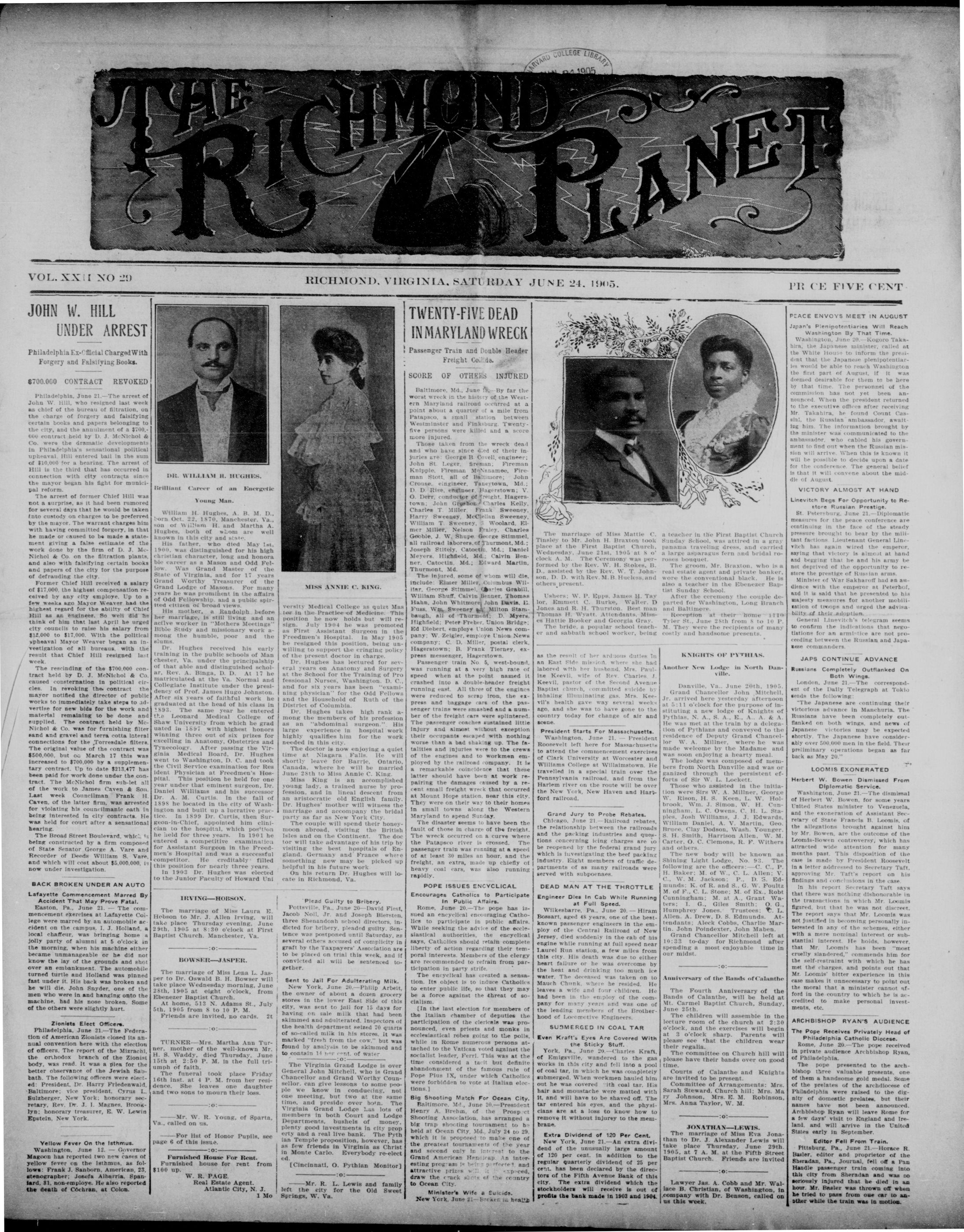
DR. WILLIAM H. HUGHES.
Brilliant Career of an Energetic
Young Man.
William H. Hughes, A. B. M. D., born Oct. 22, 1870, Manchester, Va. son of William H. and Martha A. Hughes, both of whom are well known in this city and state.
His father, who died May last, 1900, was distinguished for his high christian character, long and honora ble career as a Mason and Odd Fellow. Was Grand Master of the State of Virginia, and for 17 years Grand Worthy Treasurer of the Grand Lodge of Masons. For many years he was prominent in the affairs of Odd Fellowship, and a public spirited citizen of broad views.
His mother, a Randolph before her marriage, is still living and an active worker in "Mothers Meetings" Bible Study and missionary work among the humble, poor and the slums.
Dr. Hughes received his early training in the public schools of Manchester, Va. under the principalship of that able and distinguished scholar, Rev. A. Binga, D. D. At 17 he matriculated at the Va. Normal and Collegiate Institute under the presidency of Prof. James Hugo Johnston. After six years of faithful work he graduated at the head of his class in 1893. The same year he entered the Leonard Medical College of Shaw University from which he graduated in 1897 with highest honors winning three out of six prizes for excelling in Anatomy, Obstetrics and Tynecology. After passing the Virginia Medical Board, Dr. Hughes went to Washington, D. C. and took the Civil Service examination for Resident Physician at Freedmen's Hospital. This position he held for one year under that eminent surgeon, Dr. Daniel Williams and his successor Dr. A. M. Curtis. In the fall of 1898 he located in the city of Washington and built up a lucrative practice. In 1899 Dr. Curtis, then surgeon-in-Chief, appointed him clinician to the hospital, which position he held for three years. In 1901 he entered a competitive examination for Assistant Surgeon in the Freedmen's Hospital and was a successful competitor. He creditably filled this position for nearly three years.
In 1903 Dr. Hughes was elected to the Junior Faculty of Howard Uni
IRVING—HOBSON.
The marriage of Miss Laura E. Hebson to Mr. J. Allen Irving, will take place Thursday evening. June 1st. The Baptist Church, Manchester, N.
BOWSER—JASPER.
The marriage of Miss Lena L. Jasper to Dr. Oswald B. H. Bowser will take place Wednesday morning, June 28th, 1905 at eight o'clock, from Ebenezer Baptist Church.
At home, 513 N. Adams St., July 5th, 1905 from 8 to 10 P. M.
Friends are invited, no cards. 21
TURNER—Mrs. Martha Ann Turner, mother of the well-known Mr. H. S. Waddy, died Thursday, June 15th at 2:50 P. M. in the full triumph of faith.
The funeral took place Friday 16th inst. at 4 P. M. from her residence. She leaves one daughter and two sons to mourn their loss.
Mr. W. R. Young, of Sparta,
Va., called on us.
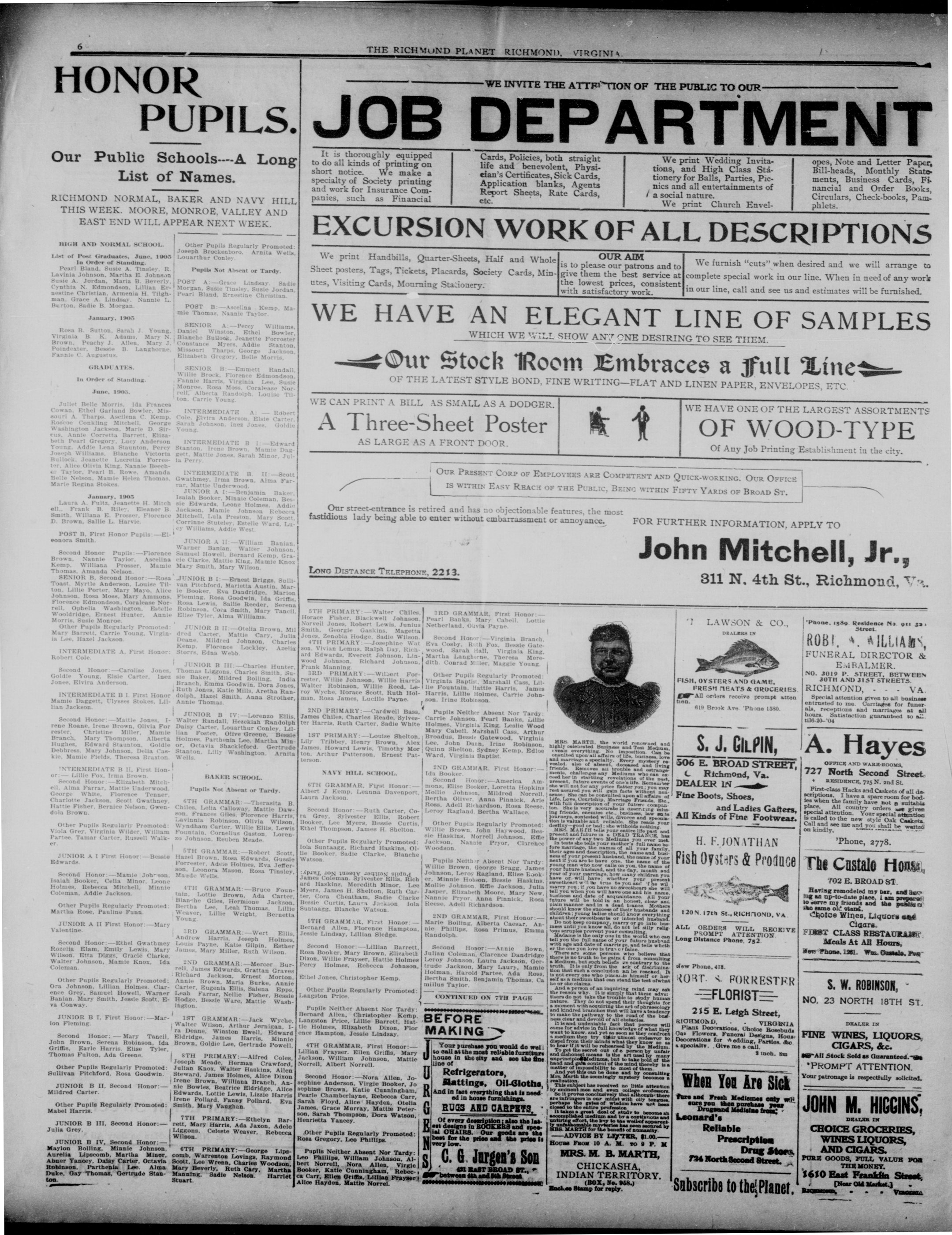
For list of Honor Pupils, see
page 6 of this issue.
:0:
Furnished House For Rent.
Furnished house for rent from
$100 up.
RICHMOND, VIRGINIA, SATURDAY JUNE 24, 1905
M.
MISS ANNIE C. KING.
versity Medical College as quizt Master in the Practice of Medicine. This position he now holds but will resign. July 1904 he was promoted as First Assistant Surgeon in the Freedmen's Hospital. In May 1905 he resigned this position, being unwilling to support the cringing policy of the present doctor in charge.
Dr. Hughes has lectured for several years on Anatomy and Surgery at the School for the Training of Professional Nurses, Washington. D. C., and for six years has been "examining physician" for the Odd Fellows and the Household of Ruth of the District of Columbia.
Dr. Hughes takes high rank among the members of his profession as an "abdominal surgeon." His large experience in hospital work highly qualifies him for the work needed in this city.
The doctor is now enjoying a quiet time at Niagara Falls. He will shortly leave for Barrie, Ontario, Canada, where he will be married June 28th to Miss Annie C. King.
Miss King is an accomplished young lady, a trained nurse by profession, and in lineal descent from an aristocratic old English family. Dr. Hughes' mother will witness the marriage and accompany the bridal party as far as New York City.
The couple will spend their honey-
moon abroad, visiting the British
Isles and on the Continent. The doo
tor will take advantage of his trip by
visiting the best hospitals of England.
Germany and France where
something new may be picked up
helpful in his future work
On his return Dr. Hughes will locate
in Richmond, Va.
Plead Guilty to Bribery.
Pottsville, Pa., June 29—David Flest, Jacob Noil, Jr. and Joseph Biersten, three Shenandoah school directors, indicted for bribery, pleaded guilty. Sentence was postponed until Saturday, as several others accused of complicity in graft by the Taxpayers' Association are to be placed on trial this week, and if convicted all will be sentenced together.
Sent to Jail For Adulterating Milk.
New York, June 20—Philip Arbeit, the owner of about a dozen grocery stores in the lower East Side of this city, was sent to jail for 15 days for having on sale milk that had been skimmed and adulterated. Inspectors of the health department seized 70 quarts of so-called milk in his stores. it was marked "fresh from the cow," but was found by analysis to be skimmed and to contain 14 per cent. of water
The Virginia Grand Lodge is over General John Mitchell, who is Grand Chancellor and Grand Worthy Counsellor, can give lessons to some people we know in conducting, not one meeting, but two at the same time, and preside over both. The Virginia Grand Lodge has lots of members in both Court and Lodge Departments, bushels of money, plenty good investments in city property and a real live bank. The Pythian Temple proposition, however, has as few friends in Virginia as Christ in Monte Carlo. Everybody re-elect ed.
[Cincinnati, O. Pythian Monitor]
:o:
Mr. R. L. Lewis and family
left the city for the Old Sweet
Springs, W. Va.
TWENTY-FIVE DEAD IN MARYLAND WRECK
Passenger Train and Double Header
Freight Collde.
SCORE OF OTHERS INJURED
Baltimore, Md., June 15.—By far the worst wreck in the history of the Western Maryland railroad occurred at a point about a quarter of a mile from Patapsco, a small station between Westminster and Finksburg. Twenty-five persons were killed and a score more injured.
Those taken from the wreck dead and who have since died of their injuries are: George B Covell, engineer; John St. Leger, fireman; Fireman Knipple, Fireman McNamamee, Fireman Stott, all of Baltimore; John Crouse, engineer, Taneytown, Md.; D. D. Rise, engineer, Hagerstown; V. O. Derr, conductor of Freight, Hagerstown; John Greshon, Charles Kelly, Charles T. Miller, Frank Sweeney, Harry Sweeney, McChellan Sweeney, William T. Sweeney, Woolard, Elmer Miller, Nelson Fraley, Charles Gooble, J. W. Shupe George Stimmel, all railroad laborers of Thurmont, Md.; Joseph Stitty, Catoctin, Md.; Daniel Meyers, Highfield, Md.; Calvin Benner, Catoctin, Md.; Edward Martin, Thurmont, Md.
The injured, some of whom will die, include: Elmer Miller, Columbus Wilfir, George Stimmel, Charles Grablain, William Shuff, Calvin Bonner, Thomas Hahn, John Whitmore John Davis, I. Fuss, Wm. Sweeney, Milton Stambaugh, all of the Thurmont, D. Myers, Highfield; Peter Freber, Union Bridge; Ed Dilebert, employe Union News company; W. Zeigler, employe Union News company; C. D. Meller, postal clerk, Hagerstown; B. Frank Tierney, express messenger, Hagerstown.
Passenger train No. 5, west-bound, was running at a very high rate of speed when at the point named it crashed into a double-header freight running east. All three of the engines were reduced to scrap iron, the express and baggage cars of the passenger trains were smashed and a number of the freight cars were splintered. The passenger coaches sustained little injury and almost without exception their occupants escaped with nothing worse than a bad shaking up. The fatalities and injuries were to the crews of the engines and to workmen employed by the railroad company. It is a remarkable coincidence that these latter should have been at work repairing the damages caused by a recent small freight wreck that occurred at Mount Hope station, near this city. They were on their way to their homes in small towns along the Western Maryland to spend Sunday.
The disaster seems to have been the fault of those in charge of the freight. The wreck occurred on a curve where the Patapsco river is crossed. The passenger train was running at a speed of at least 30 miles an hour, and the freight, an extra, made up chiefly of heavy coal cars, was also running rapidly.
POPE ISSUES ENCYCLICAL
Encourages Catholics to Participate In Public Affairs.
Rome, June 20.—The pope has issued an encyclical encouraging Catholics to participate in public affairs.
While seeking the advice of the ecclesiastical authorities, the encyclical says, Catholics should retain complete liberty of action regarding their temporal interests. Members of the clergy are recommended to refrain from participation in party strife.
The encyclical has created a sensation. Its object is to induce Catholics to enter public life, so that they may be a force against the threat of socialism.
[In the last election for members of the Italian chamber of deputies the participation of the clericals was pronounced, even priests and monks in ecclesiastical robes going to the polls, while in Rome numerous persons attached to the Vatican voted against the socialist leader, Ferri. This was at the time considered a tacit but definite abandonment of the famous rule of Pope IX Ius, under which Catholics were forbidden to vote at Italian elections.]
Big Shooting Match For Ocean City,
Baltimore, Md., June 20—President
Henry A. Brehm, of the Prospect
Shooting Association, has arranged a
big trap shooting tournament to be
held at Ocean City, Md., July 24 to 29,
which it is proposed to make one of
the greatest tournaments of the year
and second only in interest to the
Grand American Handicap. An interesting
program is being perfected, and
attractive prizes will be expected,
draw the crack shots of the country
to Ocean City.
Minister's Wife a Suicide.
New York, June 21—Broken in health
M. B. B.
The marriage of Miss Mattie C. Tinsley to Mr. John H. Braxton took place at the First Baptist Church, Wednesday, June 21st, 1905 at 8 o'clock A. M. The Ceremony was performed by the Rev. W. H. Stokes, B. D., assisted by the Rev. W. T. Johnson, D. D. with Rev. M. B. Hucless, and others present.
Ushers; W. P. Epps, James H. Taylor, Emmett C. Burke, Walter. D. Jones and R. H. Thurston. Best man Thomas H. Wyatt. Attendants, Misses Hattie Booker and Georgia Gray. The bride, a popular school teacher and sabbath school worker, being
as the result of her ardious duties in an East Side mission, where she had labored with her husband, Mrs. Pauline Keevil, wife of Rev. Charles J. Keevil, pastor of the Second Avenue Baptist church, committed suicide by inhaling illuminating gas. Mrs. Keevil's health gave way several weeks ago, and she was to have gone to the country today for change of air and scene.
President Starts For Massachusetts.
Washington, June 21. — President Roosevelt left here for Massachusetts to attend the commencement exercises of Clark University at Worcester and Williams College at Williamstown. He travelled in a special train over the Pennsylvania railroad, and from the Harlem river on the route will be over the New York, New Haven and Hartford railroad.
Grand Jury to Probe Rebates
Chicago, June 21—Railroad rebates, the relationship between the railroads and the packing industries and questions concerning leching charges are to be reopened by the federal grand jury which is investigating the beef packing industry. Eight members of traffic departments of as many railroads were served with subpoenaes.
DEAD MAN AT THE THROTTLE
Engineer Dies In Cab While Running at Full Speed.
Wikesharpe, Pa., June 20 — Hiram Bossart, aged 48 years, one of the best-known passenger engineers in the employ of the Central Railroad of New Jersey, died suddenly in the cab of his engine while running at full speed near Laurel Run station, a few miles from this city. His death was due to either heart failure or he was overcome by the heat and drinking too much ice water. The deceased was taken on to Mauch Chunk, where he resided. He leaves a wife and four children. He had been in the employ of the company for many years and was one of the leading members of the Brotherhood of Locomotive Engineers.
SUSMERGED IN COAL TAR
Even Kraft's Eyes Are Covered With the Sticky Stuff.
York, Pa., June 20—Charles Kraft, of Emigsville, wandered to the gas works in this city and fell into a pool of coal tar, in which he was completely submerged. When workmen hauled him out he was covered with coal tar. His hair and moustache were matted with it, and will have to be shaved off. The tar entered his eyes, and the physicians are at a loss to know how to remove it without injurey to the membrane.
Extra Dividend of 120 Per Cent
Extra Dividend of 120 Per Cent.
New York, June 21—An extra dividend of the unusually large amount of 120 per cent. In addition to the regular quarterly dividend of 25 per cent. has been declared by the directors of the Fifth Avenue Bank of this city. The extra dividend which the stockholders will receive is out of profits the bank made in 1903 and 1904.
a teacher in the First Baptist Church Sunday School, was attired in a gray panama traveling dress, and carried a large asparagus fern and bridal roses bouquet.
The groom, Mr. Braxton, who is a real estate agent and private banker, wore the conventional black. He is also a teacher in the Ebenezer Baptist Sunday School.
After the ceremony the couple departed for Washington, Long Branch and Baltimore.
Reception at their home 1110 Tyler St., June 28th from 8 to 10 P. M. They were the recipients of many costly and handsome presents.
KNIGHTS OF PYTHIAS.
Another New Lodge in North Danville
Danville, Va. June 20th, 1905. Grand Chancellor John Mitchell, Jr. arrived here yesterday afternoon at 5:11 o'clock for the purpose of instituting a new lodge of Knights of Pythias, N. A, S. A., E., A. A & A. He was met at the train by a delegation of Pythians and conveyed to the residence of Deputy Grand Chancellor W. A. Millner, where he was made welcome by the Madame and was soon enjoying a hearty meal. The lodge was composed of members from North Danville and was organized through the persistent efforts of Sir W. L. Lockett. Those who assisted in the initiation were Sirs W. A. Millner, George W. Rison, H. S. Keen, L. W. Holbrook, Wm. J. Simon, W. H. Cunningham, L. C. Owens, C. H. L. Staples, Josh Williams, J. J. Edwards, William Daniel, A. V. Martin, Geo Bruce, Clay Dodson, Wash. Younger. S. H. Smith, Harrison Allen, W. M. Carter, O. C. Clemons, R. F. Witthers and others. The new body will be known as Shining Light Lodge. No. 93. The following are the officers:—C. C. P. H. Baker; M. of W., C. L. Allen; V., W. M. Jackson; D. D. S. Edmunds; K. of R. and S., G. W. Foults M. of F., C. L. Stone; M. of Ex. Robt Cunningham; M. at A., Grant Waters; I. G., Giles Smith; O. G. Humphrey Jones; Trustees; L. Allen. A. Drew, D. S. Edmunds. Attendants; Aleck Cobbs, Charlie Martin. John Poindexter, John Maben.
Grand Chancellor Mitchell left at 10:33 to-day for Richmond after spending a most enjoyable time in our midst.
Anniversary of the Bands of Calanthe
The Fourth Anniversary of the Bands of Calanthe, will be held at Mt. Carmel Baptist Church, Sunday, June 25th.
The children will assemble in the lecture room of the church at 2:30 o'clock, and the exercises will begin at 3 o'clock sharp. Parents will please see that the children wear their regalia.
The committee on Church hill will please have their bands over on good time.
Courts of Calanthe and Knights are invited to be present.
Committee of Arrangements: Mrs. Sarah Steward, Church hill: Mrs. Mary Johnson, Mrs. E. M. Robinson, Mrs. Anna Taylor, W. M.
JONATHAN—LEWIS
The marriage of Miss Eva Jonathan to Dr. J. Alexander Lewis will take place Thursday, June 29th, 1905, at 7 A. M. at the Fifth Street Baptist Church. Friends are invited
Lawyer Jas. A. Cobb and Mr. Wallace B. Christian, of Washington, in company with Dr. Benson, called on us this week.
PR CE FIVE CENT
PEACE ENVOYS MEET IN AUGUST
Japan's Plenipotentiaries Will Reach
Washington By That Time
Washington By That Time.
Washington, June 20—Kogoro Takahira, the Japanese minister, called at the White House to inform the president that the Japanese plenipotentiaries would be able to reach Washington the first part of August. If it was deemed desirable for them to be here by that time. The personnel of the commission has not yet been announced. When the president returned to the executive offices after receiving Mr. Takahira, he found Count Cassal, the Russian ambassador, awaiting him. The information brought by the minister was communicated to the ambassador, who cabled his government to find out when the Russian mission will arrive. When this is known it will be possible to decide upon a date for the conference. The general belief is that it will convene about the middle of August.
VICTORY ALMOST AT HAND
Linevitch Begs For Opportunity to Restore Russian Preston.
St. Petersburg, June 21.—Diplomatic measures for the peace conference are continuing in the face of the steady pressure brought to bear by the militant factions Lieutenant General Lin-levich has again wired the emperor, saying that victory is almost at hand and begging that he and his army be not deprived of the opportunity to restore the prestige of Russian arms. Minister of War Sakharoff had an audience with the emperor at Peterhof, and it is said that he presented to his majesty measures for another mobilization of twops and urged the advisability of their adoption. General Linevitch's telegram seems to confirm the indications that negotiations for an armistice are not proceeding between the Russian and Japanese commanders.
JAPS CONTINUE ADVANCE
Russians Completely Outflanked On Both Wings.
London, June 21—The correspondent of the Dally Telegraph at Tokyo sends the following:
"The Japanese are continuing their victorious advance in Manchuria. The Russians have been completely outflanked on both wings, and news of Japanese victories may be expected shortly. The Japanese have considerably over 500,000 men in the field. Their preliminary operations began as far back as May 20."
LOOMIS EXONERATED
Herbert W. Bowen Dismissed From Diplomatic Service.
Washington, June 21.—The dismissal of Herbert W. Bowen, for some years United States minister to Venezuela, and the exoneration of Assistant Secretary of State Francis B. Loomis, of the allegations brought against him by Mr. Bowen, are the outcome of the Loomis-Bowen controversy, which has attracted wide attention for many months past. This disposition of the case is made by President Roosevelt in a letter addressed to Secretary Taft, approving Mr. Taft's report on his findings and conclusions in the case.
In his report Secretary Taft says that there was nothing dishonorable in the transactions in which Mr. Loomis figured, but that he was not discreet. The report says that Mr. Loomis was not justified in becoming personally interested in any of the schemes, either with a mere nominal interest or substantial interest. He holds, however, that Mr. Loomis has been "most cruelly slandered" commends him for the self-restraint with which he has met the charges, and points out that Mr. Loomis' bitter experience in this case makes it unnecessary to point out the moral that a minister cannot afford in the country to which he is accredited to make personal investments, etc.
ARCHBISHOP RYAN'S AUDIENCE
The Pope Receives Privately Head of Philadelphia Catholic Diocese.
Rome, June 20. The pope received in private audience Archbishop Ryan, of Philadelphia. The pope presented to the archbishop three valuable presents, one of them a handsome gold medal. Some of the prelates of the archdiocese of Philadelphia were raised to the dignity of domestic prelates, but their names have not been announced. Archbishop Ryan will leave Rome for a few days' visit to England and Ireland, and will arrive in the United States early in September.
Editor Fell From Train.
Pittsburg, Pa., June 21—Horace R. Basler, editor and proprietor of the Sheradan, Pa., Journal, fell off a Pan Handle passenger train coming into this city from Sheradan and was so seriously injured that he died in an hour. Mr. Basler was thrown off when he tried to pass from one car to another while the train was in motion.
BLEEDING
A LESSON IN MANUAL TRAINING
PRACTICAL POINTS FOR BOYS WITH AMBITION AND GENIUS.
Beginner Should Purchase Only Tools of Good Quality—Handsaws Required—How to File Saw Teeth—Use of Ripsaw and Crosscut Saw—Backsaw and How to Use It—An Exercise for Practice.
BY JAMES RITCHEY.
Gnstructor in Woodworking and Pattern-making at Armour Institute of Technology (Chicago)
(Copyright, 1965, by Joseph B. Bowles.)
In the choice of tools for the beginner only the best in quality should be bought. It is a great error to suppose that progress can be made, or that satisfactory work can be done with poor and cheap tools.
Even the boy who has had no experience whatever in their use should not be furnished with something "good
```markdown
```
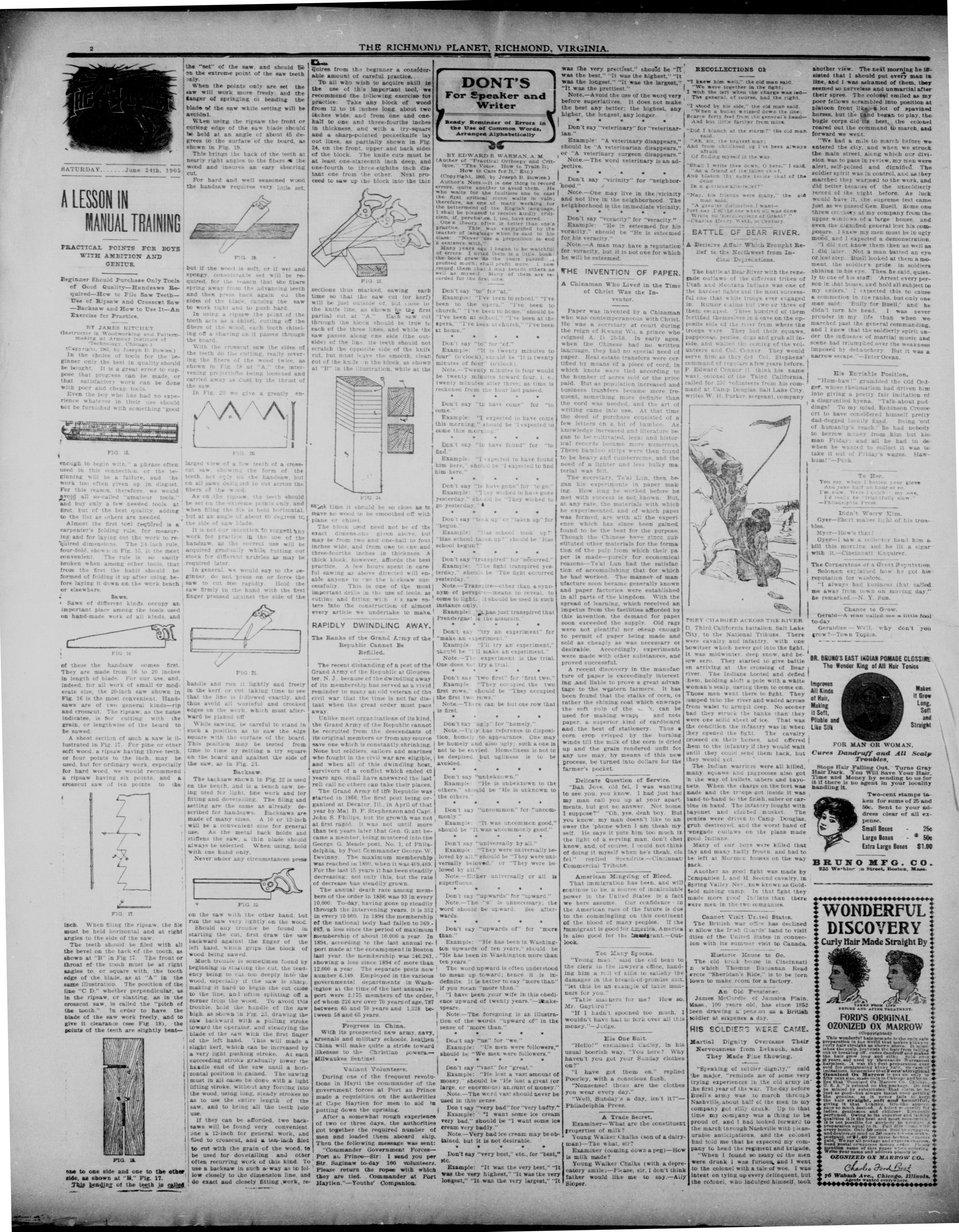
FIG. 15
enough to begin with," a phrase often used in this connection, or the beginning will be a failure, and the work too often given up in disgust. For this reason, therefore, we would avoid all so-called "amateur tools," and buy only a few needed tools at first, but of the best quality, adding to the list as others are needed. Almost the first tool required is a carpenter's folding rule, for measuring and for laying out the work to required dimensions. The 24-inch rule, four-fold, shown in Fig. 15, is the most convenient. The rule is so easily broken when among other tools, that from the first the habit should be formed of folding it up after using, before laying it down on the work bench or elsewhere.
Saws
Saws of different kinds occupy an important place among the tools used on hand-made work of all kinds, and
FIG. 16
of these the handsaw comes first. They are made from 16 to 20 inches in length of blade. For our use and, indeed, for all work of small or moderate size, the 20-inch saw shown in Fig. 16 is the most convenient. Hand-saws are of two general kinds—rip and crosscut. The ripsaw, as the name indicates, is for cutting with the grain, or lengthwise of the board to be sawed.
A shoot section of such a saw is illustrated in Fig. 17. For pine or other soft wood, a ripsaw having three teeth or four points to the inch, may be used, but for ordinary work, especially for hard wood, we would recommend a ripsaw having six points, and a crosscut saw of ten points to the
```markdown
```
FIG. 17.
inch. When filing the ripsaw, the file must be held horizontal and at right angles to the side of the saw.
The teeth should be filed with all the bevel on the back of the tooth, as shown at "B" in Fig 17. The front or throat of the tooth must be at right angles to, or square with, the tooth edge of the blade, as at "A" in the same illustration. The position of the line "C D," whether perpendicular, as in the ripsaw, or slanting, as in the crosscut saw, is called the "pitch of the tooth." In order to have the blade of the saw work freely, and to give it clearance (see Fig 18), the points of the teeth are slightly bent—
FIG. 18.
one to one side and one to the other side, as shown at "B." Fig. 17.
This bending of the teeth is called
the "set" of the saw, and should be on the extreme point of the saw teeth only.
When the points only are set the saw will work more freely, and the danger of springing or bending the blade of the saw while setting will be avoided.
When using the ripsaw the front or cutting edge of the saw blade should be held at an angle of about 45 degrees to the surface of the board, as shown in Fig. 19.
This brings the back of the teeth at nearly right angles to the fibers the wood and insures an easy shearing cut.
For hard and well seasoned wood the handsaw requires very little set.
but if the wood is soft, or if wet and spongy, considerable set will be required, for the reason that the fibers spring away from the advancing teeth and then press back again on the sides of the blade, causing the saw to work tight and to push hard.
In using a rip saw the point of the tooth acts as a chisel, cutting off the fibers of the wood, each tooth chiseling off a shaving as it passes through the board.
With the crosscut saw the sides of the teeth do the cutting, really severing the fibers of the wood twice, as shown in Fig. 18 at "A," the intervening projections being loosened and carried away as dust by the thrust of the saw.
In Fig. 20 we give a greatly en-
FIG. 20
larged view of a few teeth of a crosscut saw, showing the form of the teeth, not only on the handsaw, but on all saws designed to cut across the fibers of the wood.
As on the ripsaw, the teeth should be set on the extreme points only, and when filing the file is held horizontal, but at an angle of about 60 degrees to the side of saw blade.
It is not our intention to suggest any work for practice in the use of the handsaw, as the correct use will be acquired gradually while cutting out stock for different articles as may be required later.
In general, we would say to the oeginner, do not press on or force the saw to cut too rapidly. Hold the saw firmly in the hand with the first finger pressed against the side of the
FIG. 21.
handle and run it lightly and freely in the kert, or cut taking time to see that the line is followed exactly, and thus avoid all wasteful and crooked edges on the work, which must afterward be planed off.
While sawing, be careful to stand in such a position as to saw the edge square with the surface of the board. This position may be tested from time to time by setting a try square on the board and against the side of the saw, as in Fig. 21.
Backsaw
The backsaw shown in Fig. 22 is used on the bench, and is a bench saw being used for light, fine work and for fitting and dovetailing. The filing and setting are the same as already described for handsaws. Backsaws are made of many sizes. A 10 or 12-inch will be a convenient size for general use. As the metal back holds and stiffens the saw, a thin blade should always be selected. When using, hold with one hand only.
Never under any circumstances press
FIG. 22
on the saw with the other hand, but
run the saw very lightly on the wood.
Should any trouble be found in
starting the cut, first draw the saw
backward against the finger of the
left hand, which grips the block of
wood being sawed.
Much trouble is sometimes found by beginning in starting the cut, the tendency being to cut too deeply into the wood, especially if the saw is sharp, making it hard to begin the cut close to the line, and often splitting off a corner from the wood. To avoid this trouble, hold the handle of the saw high, as shown in Fig. 23, drawing the saw backward with a pulling stroke toward the operator, and steadying the blade of the saw with the first finger of the left hand. This will made a slight kerf, which can be increased by a very light pushing stroke. At each succeeding stroke gradually lower the handle end of the saw until a horizontal position is gained. The sawing must in all cases be done with a light lifting stroke, without any forcing into the wood, using long, steady strokes so as to use the entire length of the saw, and to bring all the teeth into use.
If they can be afforded, two backsaws will be found very convenient one a 12-inch for general work, and filed to crosscut, and a ten-inch filed to cut with the grain of the wood, to be used for dovetailing and other often recurring work of this kind. To use a backsaw in such a way as to follow closely to the dimension line, and do exact and closely fitting line, re-
THE RICHMOND PLANET, RICHMOND, VIRGINIA.
quiures from the beginner a considerable amount of careful practice.
sale amount of careful practice.
To all who wish to acquire skill in the use of this important tool, we recommend the following exercise for practice: Take any block of wood from 12 to 16 inches long, about two inches wide, and from one and one-half to one and three-fourths inches in thickness, and with a try-square and a sharp-pointed pocketknife lay out lines, as partially shown in Fig. 24, on the front, upper and back sides of the block. The knife cuts must be at least one-sixteenth inch deep, and one-fourth to three-eighths inch distant one from the other. Next proceed to saw up the block into the thin
7
FIG. 22.
sections thus marked, sawing each time so that the saw cut (or kerf) will be just outside of, but close to the knife line, as shown by the first partial cut at "A". Each saw cut through the block should be true to each of the three lines, and while the saw passes along one side (the outside) of the line, its teeth should not scratch the opposite side of the knife cut, but must leave the smooth, clean cut of the knife on the block, as shown at "B" in the illustration, while at the
a
b
FIG. 24
same time it should be so close as to leave no wood to be smoothed off with plane or chisel.
The block used need not be of the exact dimensions given above, but may be from two and one-half to four inches wide, and from one to one and three-fourths inches in thickness. A thick block, however, affords the best practice. A few hours spent in careful sawing as above directed will enable anyone to use the bicksaw successfully. This is one of the most important drills in the use of tools, as cutting and fitting with it saw enters into the construction of almost every article we undertake to make.
RAPIDLY DWINDLING AWAY.
The recent disbanding of a post of the Grand Army of the Republic at Gloucester. N J., because of the dwindling away of its membership has served as a vivid reminder to many an old veteran of the civil war that the time is not far distant when the great order must pass away.
Unlike most organizations of its kind, the Grand Army of the Republic cannot be recruited from the descendants of its original members or from any source save one which is constantly shrinking. None but soldiers, sailors and marines who fought in the civil war are eligible, and when all of this dwindling host, survivors of a conflict which ended 40 years ago, shall have answered the last roll call no others can take their places.
The Grand Army of the Republic was started in 1866, the first post being organized at Decatur, Ill., in April of that year by Maj. B. F. Stephenson and Capt. John S. Phillips, but its growth was not at first rapid. It was not until more than ten years later that Gen. G. ant became a member, being mustered into the George G. Meade post, No. 1, of Philadelphia, by Post Commander George W. Devinny. The maximum membership was reached in 1890, when it was 409,489. For the last 15 years it has been steadily decreasing, not only this, but the rate of decrease has steadily grown.
The annual death rate among members of the order in 1886 was 93 in every 10,000. To-day, having gone up steadily through the intervening years, it is 352 in every 10,000. In 1894 the membership of the national body had fallen to 369.683, a loss since the period of maximum membership of about 10,000 a year. In 1894, according to the last annual report made at the encampment in Boston last year, the membership was 246.261, showing a loss since 1894 of more than 12,000 a year. The separate posts now number 6,149. Employed in the various governmental departments in Washington at the time of the last annual report were 2,175 members of the order, of whom 226 are over 70 years of age, 787 between 65 and 70 years and 1,338 between 58 and 65 years.
Progress in China
With its prospected new army, navy, arsenals and military schools, heathen China will make quite a stride toward likeness to the Christian powers.—Milwaukee Sentinel.
Vailiant Volunteers.
During one of the frequent revolutions in Hayti the commander of the government forces at Port au Prince made a requisition on the authorities at Cape Haytien for men to aid in putting down the uprising.
After a somewhat rough experience of two or three days, the authorities got together the required number of men and loaded them aboard ship. Then the following message was sent: "Commander Government Forces—Port au Prince—Sir: I send you per Str. Saginaw to day 160 volunteers. Please return the ropes with which they are tied. Commander at Port Haytien." "Youths" Companion.
DONT'S
For Speaker and Writer
Ready Reminder of Errors in
the Use of Common Words,
Arranged Alphabetically
BY EDWARD B. WARMAN, A.M.
(Author of "Practical Orthopey and Critique." "The Voyage of Hawk in 11c, How to Care for I'c," Etc.
(Copyright, 1906, by Joseph B. Bowles.)
Author's Note—It is one thing to record errors, quite another to avoid them. He who waits for the faultless one to cast the first critical stone waits in vain; therefore he is one of many working for the betterment of the English language, I shall be pleased to receive kindly criticism, if, perchance, I, too, have erred.
One's theory often is better than one's practice. This was exemplified by the lesson of change when he said to his class: "Never take a preposition to end a sentence with." Many years ago I began to be watchful of errors. I noted them in a little book: the book grew as the years passed. I now record them as I prout more. I now record them as I benefit others as well as myself. Many of them are recorded for the first time.
Don't say "to" for "at."
Example: "I've been to school." "I've been to the opera." "I've been to church." "I've been to home." should be "I've been at school." "I've been at the opera." "I've been at church." "I've been at home."
Don't say "to" for "of."
Example: "It is twenty minutes to four" (o clock), should be "It is twenty minutes of four" (o clock).
Note—Twenty minutes to four would be twenty minutes toward four, i.e. twenty minutes after three; as time is reckoned from the hour last passed.
Don't say "to have come" for "to come."
Example: "I expected to have come this morning." should be "I expected to come this morning."
Don't say "to have found" for "to find."
Example: "I expected to have found him here," should be "I expected to find him here."
Don't say "to have gone" for "to go."
Example: "They wished to have gone yesterday," should be "They wished to go yesterday."
Don't say "took up" or "taken up" for "begun."
Example: "Has school took up?"
"Has school taken up?" should be "Has school begun?"
Don't say "transpired" for "occurred."
Example: "The fight transpired yesterday," should be "The fight occurred yesterday."
Note—Transpire—other than a synonym of perspire—means to reveal, to come to light. It should be used in such instance only.
Example: "I just just transpired that Prendergast is the assassin."
Don't say "try an experiment" for
"make an experiment."
Example: "I'll try an experiment,"
should be "I'll make an experiment."
Note: "The experiment is the trial.
One does not try a trial.
Don't say "two first" for "first two."
Example: "They occupied the two
first rows, should be "They occupied
the first two rows."
Note: "There can be but one row that
is first.
. . . .
Don't say "ugly" for "homely."
Note—Uply has reference to disposition, homely to appearance. One may be homely and also ugly; such a one is not to be envied. Homeliness is not to be despised, but ugliness is to be avoided.
Don't say "unbeknownn."
Example: "He is unbeknownn to the others," should be "He is unknown to the others."
Don't say "uncommon" for "uncommonly."
Example: "It was uncommon good," should be "It was uncommonly good."
Don't say "universally by all."
Example: "They were universally beloved by all." should be "They were universally beloved," or "They were beloved by all."
Note—Either universally or all is superfluous.
Don't say "upwards" for "upward."
Note.—The "s" is unnecessary; the word should be upward. See afterwards.
Don't say "upwards of" for "more than."
Example: "He has been in Washington upwards of ten years," should be "He has been in Washington more than ten years."
The word upward is often understood to mean up toward; hence it is indefinite. It is better to say "more than" if you mean "more than."
"I have been your wife in this obedience upward of twenty years."—Shakespeare.
Note.—The foregoing is an illustration of the words "upward of" in the sense of "more than."
Don't say "us" for "we."
Example: "Us men were followers, should be "We men were followers."
Don't say "vast" for "great."
Example: "He lost a vast amount of money" should be "He lost a great (or large, or enormous) amount of money."
Note.—The word vast should never be used in this sense.
Don't say "very bad" for "very bad."
Example: "I want some ice cream very bad," should be "I want some ice cream very bad."
Note.—Very bad ice cream may be obtained, but it is not desirable.
Don't say "very best," etc., for "best," stc.
Example: "It was the very best," "It was the very highest," "It was the very longest," "It was the very largest," "It
was the very prettiest," should be "It was the best," "It was the highest," "It was the longest," "It was the largest," "It was the prettiest."
Note.—Avoid the use of the word very before superlatives. It does not make the best any better; the highest, any higher, the longest, any longer.
Don't say "veterinary" for "veterinarian."
Example: "A veterinary disappears," should be "A veterinary disappears," or "A veterinary surgeon disappears."
Note.—The word veterinary is an adjective.
Don't say "vicinity" for "neighborhood."
Note.—One may live in the vicinity and not live in the neighborhood. The neighborhood is the immediate vicinity.
Don't say "voracity" for "veracity."
Example: "He is esteemed for his voracity." should be "He is esteemed for his veracity."
Note.—A man may have a reputation for voracity, but it is not one for which he will be esteemed.
THE INVENTION OF PAPER
A Chinaman Who Lived in the Time of Christ Was the In-
Paper was invented by a Chinaman who was contemporaneous with Christ. He was a secretary at court during the reign of Kwang Wu, a prince who reigned A. D. 25-58. In early ages, when the Chinese had no written language, they had no special need of paper. Real estate transfers were certified by means of a piece of cord, in which knots were tied according to the number of acres sold or the price paid. But as population increased and business transfers became more frequent, something more definite than the cord was needed, and the art of writing came into use. At that time the deed of purchase consisted of a few letters on a bit of bamboo. As knowledge increased and literature began to be cultivated, legal and historical records became more numerous. These bamboo strips were then found to be heavy and cumbersome, and the need of a lighter and less bulky material was felt.
The secretary, Ts'ai Lun, then began his experiments in paper making. How long he worked before he met with success is not known. But, at any rate, the materials with which he experimented, and of which paper was formed, are with all the experience which has since been gained, found to be the best for the purpose. Though the Chinese have since substituted other materials for the formation of the pulp from which their paper is made—purely for economical reasons—Ts'ai Lun had the satisfaction of accomplishing that for which he had worked. The manner of manufacture soon became generally known and paper factories were established in all parts of the kingdom. With the spread of learning, which received an impetus from the facilities afforded by this invention, the demand for paper soon exceeded the supply. Old rags were not plentiful nor cheap enough to permit of paper being made and sold as cheaply as was necessary or desirable. Accordingly, experiments were made with other substances, and proved successful.
A recent discovery in the manufacture of paper is exceedingly interesting, and liable to prove a great advantage to the western farmers. It has been found that the stalks of corn, or rather the shining coat which enwraps the soft pulp of the corn, can be used for making wrappi and note paper, a superior kind of cardboard and the best of stationery. Thus a corn crop crisped by the burning winds till the milk of the corn is dried up and the grain rendered unfit for any use may, by means of this new process, be turned into dollars for the farmer's pocket.
Delicate Question of Service
Dedicate Question of Service
"Bah Jove, old fel, I was wanting
to see you, you know. I had just had
my man call you up at your apart-
ments, but got no answer. Not home,
I suppose?" "Oh, yes, deh boy. But
you know, my man doesn't like to an-
swer the 'phone when I am thehey my
self. He says it puts him too much in
the light of a serving man, don't chek
know, and, of course, I could not think
of doing it myself when he's thehey, olc
fel." replied Spendrite—Cincinnat
Commercial Tribune.
American Mingling of Blood
That immigration has been, and will continue to be, a source of incalculable power in the United States is a fact we here assume. Our confidence in the American race of the future is due to the commingling on this continent of the blood of many peoples. If the immigrant is good for America, America is also good for the immigrant—Outlook.
Too Many Snoops
"Young man," said the old bean to the clerk in the lawyer's office, handling him a roll of bills to satisfy the damages in the breach-of-promise suit, "let this be an example of table manners for you."
"Table manners for me?" How so, Mr. Gaybird?
"If I hadn't spooned too much, I wouldn't have had to fork over all this money."—Judge.
Eis One Suit.
"Hello!" exclaimed Cadley, in his usual boorish way. "You here? Why haven't you got your Sunday clothes on?"
"I have got them on," replied Poorley, with a conscious flush.
"Nonsense! those are the clothes you wear every day."
"Well, Sunday's a day, isn't it?"—Philadelphia Press.
A. Trade Secret.
Examiner—What are the constituent properties of milk?
Young Walker Chalks (son of a dairy-man)—The what, sr?
Examiner (coming down a peg)—How is milk made?
Young Walker Chalks (with a deprerectory smile)—Piease, sir, I don't think father would like me to say.—Aily Sloper.
RECOLLECTIONS OF
"I knew him well," the old man said.
"We were together in the fight.
I with the left when the charge was led—
The general, of course, had the right.
"I stood by his side," the old man said.
"When a bullet whizzed down the line;
Scarce forty feet from the general's head—
And but little farther from mine.
"Did I blanch at the storm?" the old man said.
"Ah, sir, the bravest may;
And from childhood up I've been always afraid
Of finding myself in the way.
"Shall I write the down, O hero," I said.
"As a friend of the fallen chief.
And blazon thy name because that of the dead
In a gourulous alco-reef?"
"Nay, his friends were many," the old man said.
"a greater distinction I want—
Just say, Mr. he one when was done
Wrote no recollections of Grant!"
-Charles Henry Webb, in century.
BATTLE OF BEAR RIVER.
A Decisive Affair Which Brought Ree
bief to the Northwest from Indian Deprecations.
The battle at Bear River with the renegade outlaws of the different tribes of Utah and Montana Indians was one of the hardest fights and the most successful one that white troops ever engaged in. Rumor claims but two or three of them escaped. Three hundred of them fortified themselves in a cave on the opposite side of the river from where the troops were. They had their squawns, pappooses, ponies, dogs and grub all inside, and waited the coming of the volunteers and Col. Conner. They would serve him as they did Col. Stephens' command of regulars a few years before. P. Edward Connor (1 think his name was), colonel of the Third California, called for 250 volunteers from his command at Camp Douglas Sait Lake City, writes W. H. Parker sergeant, company
A
THEY CHARGED ACROSS THE RIVER
D. Third California battalion, Salt Lake
City, to the National Tribune. There
were cavalry and infantry, with one
howitzer which never got into the fight.
It was midwinter, deep snow, and be-
low zero. They started to give battle
on arriving at the crossing of Bear
river. The Indians hooted and defied
them, holding a pole with a white
woman's scalp, daring them to come on.
Those men went there to fight. They
jumped into the river and waded across
from waist to armpit deep. No sooner
had they struck the banks than they
were one solid sheet of ice. That was
the condition the infantry was in when
they opened the fight. The cavalry
crossed on their horses, and offered
them to the infantry if they would wait
until they could send them back, but
they would not.
The Indian warriors were all killed, many squaws and papooses also got in the way of bullets, sabers and bayonets. When the charge on the fort was made and the troops got inside it was hand-to-hand to the finish, saber or carbine in hand. The infantry fought with bayonet and clubbed musket. The ponies were driven to Camp Douglas, grub destroyed, and the worst band of enegade outlaws on the plans made good Indians.
Many of our boys were killed that day and many badly frozen, and had to be left at Mormon houses on the way back.
Another as good fight was made by Companies L and H. Second cavalry, in Spring Valley Nev., now known as Gold- mining camp. In that fight they made more good Indians than there were men in the two companies.
Cannot Visit United States
The British war office has declined to allow the Irish Guards' band to visit cities of the United States in connection with its summer visit to Canada.
Historic House to Go.
The old brick house in Cincinnati which Thomas Buchanan Read wrote "Sheridan's Ride," is to be torn down to make room for a factory.
An Old Pensioner
James McCeardle of Jamaica Plain.
Maas, 100 years old, has since 1882
been drawing a pension as a British
soldier at sixpence a day.
HIS SOLDIERS WERE CAME.
Martial Dignity Overcame Their
Nervousness from Debauch, and
They Made Fine Showing.
"Speaking of soldier dignity," said the major, "reminds me of some very trying experiences in the old army in the first year of the war. The day before Buell's army was to march through Nashville, about half of the men in my company got silly drunk. Up to that time my company was a thing to be proud of, and I had looked forward to the march through Nashville with pleasurable anticipations, and the colonel had told me that he expected my company to head the regiment and brigade.
"When I found so many of the men were drunk I was furious, and I went to the colonel with a tale of woe. I was intent on tying up every delinquent, but the colonel, who indulged himself, took
another view. The next morning he offsisted that I should put every man in line, and I was ashamed of them, they seemed so nerveless and unmartial after their spree. The colonel smiled as my poor fellows scrambled into position at platoon front like a lot of spavined horses, but the land began to play, the bugle corps did its best, the colonel roared out the command to march, and forward we went.
"We had a mile to march before we entered the city, and when we struck the main street, along which our division was to pass in review, my men were alert, self-poised and dignified. The soldier spirit was in control, and as they marched they warmed to the work, and did better because of the unsoldierly record of the night before. As luck would have it, the supreme test came just as we passed Gen Buell. Some one threw crookery at my company from the upper windows of a large house, and even the dignified general lost his composure. I knew my men must be in ugly mood, and I expected a demonstration.
"I did not know them then as well as I did later. Not a man batted an eye or lost step. Buell looked at them a moment the soldier's pride in soldiers shining in his eye. Then he said, quietly to one of his staff: 'Arrest every person in that house, and hold all subject to my orders.' I expected this to cause a commotion in the ranks, but only one man said: 'Bully for Buell,' and he didn't turn his head. I was never prouder in my life than when we marched past the general commanding, and I knew that the soldierly spirit under the influence of martial music and scene had triumphed over the weakness imposed by debauchery. But it was a narrow escape." -Inter Ocean.
His Enviable Position
"Hum-haw!" grumbled the Old Codger, whose rheumatism had driven him into giving a pretty fair imitation of a disgruntled hyena. "Talk about puddings! To my mind, Robinson Crossoort to have considered himself pretty dad-dogged luckily fixed. Being 'out of humanity's reach,' he had nobody to borrow money from him but his man Friday; and all he had to do when he wanted to collect it was to take it out of Friday's wages. Haw-hum!"—Puck.
You say, when I button your glove
and jake half an hour or so,
I'm slow. Were I quicker; my love,
I'd really be "frightfully slow."
—Philadelphia Press
Didn't Worry Him.
Gyer—Short makes light of his troubles.
Myer—How's that?
Gyer—I saw a collector hand him a bill this morning and he lit a cigar with it—Cincinnati Enquirer.
The Cornerstone of a Great Reputation
Solomon explained how he got his reputation for wisdom.
"I always had business that called me away from town on moving day," he remarked.—N. Y. Sun.
Chance to Grow.
Gerald—A man called me a little fool to-day.
Geraldine—Well, why don't you grow?—Town Topics.
DR. BRUUNO'S EAST INDIAN POMADE CLOSSEIN
The Wonder King of All Hair Tonies
Improves
All Kinds
of Hair,
Making
it Soft,
Pliable and
Like Silk
FOR MAN OR WOMAN.
Cures Dandruff and All Scalp
Troubles.
Stops Hair Falling Out. Turns Gray
Hair Dark. You Will Save Your Skin
Time and Money by sending us for
it if there is no agent in your locality
handling it.
Two-cent stamps taken
for sums of 25 and
50c. Sent to your address
clear of all expense.
```markdown
```
Small Boxes - 25c
Large Boxes - $50c
Extra Large Boxes $1.00
BRUNO MFG. CO.
236 Washburn St. Boston, Mass.
WONDERFUL DISCOVERY Curly Hair Made Straight By
TAKEN FROM LIFE
This wonderful hair pomade is the one, safe, preparable, and the best of the best.
This wonderful hair pomade is the one, safe, preparable, and the best of the best. Only 50 cents of the good, and dealers or send us 50 cents of the good, and dealers or send us 50 cents of the good, and dealers or send us 50 cents of the good, and express charges, and postal.
Write your name and address.
Write your name and address.
OZONIZED OX MARROW CO.
The Wings of the Morning
By LOUIS TRACY
Copyright, 1903, by
Edward J. Clode
CHAPTER XII.
HOUGH his eyes, like live coals, glowered with sullied fire at the strip of sand and the rocks in front, his troubled brain paid perfunctory heed to his task. The stern sense of duty, the ingrained force of long years of military discipline and soldierly thought, compiled him to keep watch and ward over his fortress, but he could not help asking himself what would happen if Iris were seriously wounded.
There was one enemy more potent than these skulking Dyaks, a foe more irresistible in his might, more pitiless in his strength, whose assaults would tax to the utmost their powers of resistance. In another hour the sun would be high in the heavens, pouring his ardent rays upon them and drying the blood in their veins.
Hitherto the active life of the island, the shade of trees, hut or cave, the power of unrestricted movement and the possession of water in any desired quantity robbed the tropical heat of the day of its chief terrors. Now all was changed. Instead of working amid grateful foliage they were bound to the brown rock, which soon would glow with radiated energy and give off scorching gusts like unto the opening of a furnace door.
This he had foreseen all along. The tarpaulin would yield them some degree of uneasy protection, and they both were in perfect physical condition. But—if Iris were wounded! If the extra strain brought fever in its wake! That way he saw nothing but blank despair, to be ended for her by delirium and merciful death, for him by a Berserk rush among the Dyaks and one last mad fight against overwhelming numbers.
Then the girl's voice reached him, self reliant, almost cheerful:
"You will be glad to hear that the cut has stopped bleeding. It is only a scratch."
So a kindly Providence had spared them yet a little while. The cloud passed from his mind, the gathering mist from his eyes. In that instant he thought he detected a slight rustling among the trees where the cliff shelved up from the house. Standing as he was on the edge of the rock, this was a point he could not guard against.
When her welcome assurance recalled his scattered senses he stepped back to speak to her, and in the same instant a couple of bullets crashed against the rock overhead. Iris had unwittingly saved him from a serious, perhaps fatal, wound.
He sprang to the extreme right of the ledge and boldly looked into the trees beneath. Two Dyaks were there, belated wanderers cut off from the main body. They dived headlong into the undergrowth for safety, but one of them was too late. Jenks' rite reached him, and its reverberating concussion, tossed back and forth by the echolong rocks, drowned his parting scream.
In the plenitude of restored vigor the sailor waited for no counter demonstration. He turned and crouchingly approached the southern end of his parapet. Through his screen of grass he could discern the long black hair and yellow face of a man who lay on the sand and twisted his head around the base of the farther cliff. The distance, oft measured, was ninety yards, the target practically a six inch bullseye. Jenks took careful aim, fired, and a whiff of sand flew up.
Perhaps he had used too fine a sight and plowed a furrow beneath the Dyak's ear. He only heard a faint yell, but the enterprising head vanished, and there were no more volunteers for that particular service.
He was still peering at the place when a cry of unmitigated anguish came from Irs:
"Oh, come quick! Our water! The casks have burst!"
It was not until Jenks had torn the tarpaulin from off their stores and he was wildly striving with both hands to scoop up some precious drops collected in the small hollows of the ledge that he realized the full magnitude of the disaster which had befallen them
During the first rapid exchange of fire before the enemy vacated the cliff several bullets had pierced the tarpaulin. By a stroke of exceeding bad fortune two of them had struck each of the water barrels and started the staves. The contents quietly ebed away beneath the broad sheet and, flowing inward by reason of the sharp slope of the ledge, percolated through the fault. Iris and he, notwithstanding their freazied efforts, were not able to save more than a pint of gritty discolored fluid. The rest, infinitely more valuable to them than all the diamonds of De Beers, was now oozing through the natural channel cut by centuries of storm, dripping upon the headless skeleton in the cave, soaking down to the very heart of their buried treasure.
Jenks was so paralyzed by this catastrophe that Iris became alarmed. As yet she did not grasp its awful significance. That he, her hero, so brave, so confident in the face of many dangers, should betray such sense of irredeemable loss frightened her much more than the incident itself.
Her lips whitened. Her words became incoherent.
"Tell me," she whispered. "I can bear anything but silence. Tell me, I implore you. Is it so bad?"
The sight of her distress sobered him. He ground his teeth together as a man does who submits to a painful operation and resolves not to finch beneath the knife.
"It is very bad" he said; "not quite the end, but near it."
"The end," she bravely answered, "is death! We are living and uninjured.
You must fight on. If the Lord wills it we shall not die."
He looked in her blue eyes and saw there the light of heaven. Her glance did not droop before his. In such moments heart speaks to heart without concealment.
"We still have a little water," she cried. "Fortunately we are not thirsty. You have not forgotten our supply of champagne and brandy."
He could only fall in with her unreflective mood and leave the dreadful truth to its own evil time. In their little nook the power of the sun had not yet made itself felt. By ordinary computation it was about 9 o'clock. Long before noon they would be grilling. Throughout the next few hours they must suffer the torture of Dives with one meager pint of water to share between them. Of course the wine and spirit must be slinned like a pestilence. To touch either under such conditions would be courting heat, apoplexy and death. And next day!
He tightened his jaws before he answered:
"We will console ourselves with a bottle of champagne for dinner. Meau-while I hear our friends shouting to those left on this side of the island. I must take an active interest in the conversation."
He grasped a ride and lay down on the ledge, already gratefully warm. There was a good deal of sustained shouting going on. Jenks thought he recognized the chief's voice giving instructions to those who had come from Snugglers' cave and were now standing on the beach near the quarry. "I wonder if he is hungry," he thought. "If so, I will interfere with the commissariat." Iris peeped forth at him. "Mr. Jenks!" "Yes," without turning his head. He knew it was an ordinary question. "May I come too?" "What, expose yourself on the ledge!" "Yes, even that. I am so tired of sitting here alone." "Well, there is no danger at present. But they might chance to see you, and you remember what I—
"Yes, I remember quite well. If that is all"— There was a rustle of garments. "I am very manish in appearance. If you promise not to look at me I will join you." "I promise." Iris stepped forth. She was flushed a little, and, to cover her confusion, maybe, she picked up a rifle. "Now there are two guns," she said as she stood near him. He could see through the tail of his eye that a slight but elegantly proportioned young gentleman of the seafaring profession had suddenly appeared from nowhere. He was glad she had taken this course. It might better the position were the Dyaks to see her thus. "The moment I tell you you must fall flat," he warned her. "No ceremony about it. Just flop." "I don't know anything better calculated to make one flop than a bullet," she laughed. Not yet did the tragedy of the broken knees appeal to her.
"Yes, but it achieves its purpose in two ways. I want you to adopt the precautionary method."
"Trust me for that. Good gracious!"
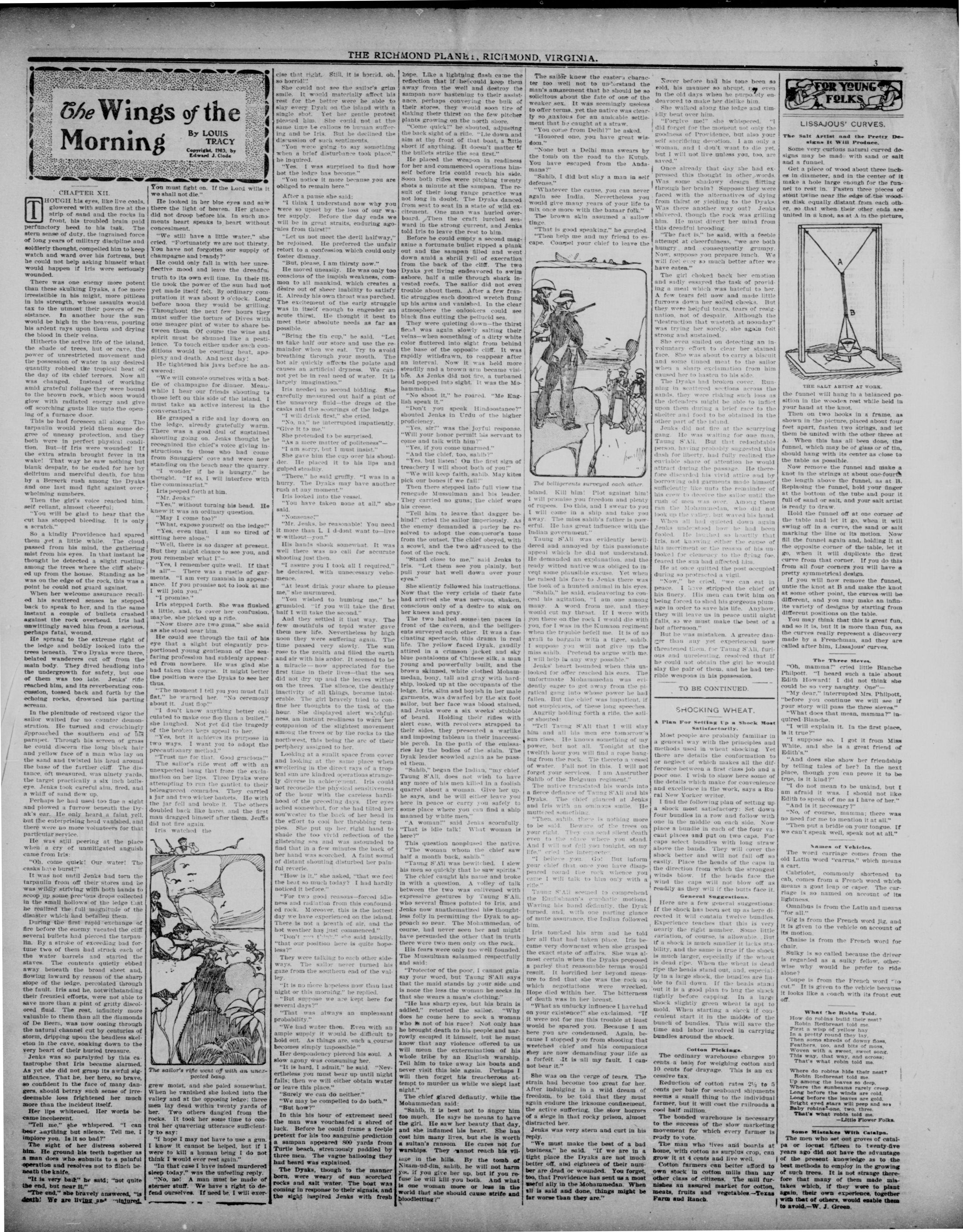
The sailor's rifle went off with an unexpected bang that froze the exclamation on her lips. Three Dyaks were attempting to run the gantlet to their beleaguered comrades. They carried a jar and two wicker baskets. He with the jar fell and broke it. The others doubled back like hares and the first man dragged himself after them. Jenks did not fire again.
Iris watched the.
THE FISHING
The sailor's rifle went off with an unexpected bang.
grew moist, and she paled somewhat.
When he vanished she looked into the valley and at the opposing ledge; three men lay dead within twenty yards of her. Two others dangled from the rocks. It took her some time to control her quivering utterance sufficiently to say:
"I hope I may not have to use a gun. I know it cannot be helped, but if I were to kill a human being I do not think I would ever rest again."
"In that case I have indeed murdered sleep today!" was the unfeeling reply.
"No, no! A man must be made of sterner stuff. We have a right to defend ourselves. If need be, I will exer-
THE RICHMOND PLANE1, RICHMOND, VIRGINIA.
cise that right. Still, it is horrid, oh, so horrid!"
She could not see the sailor's grim smile. It would materially affect his rest for the better were he able to slay every Dyak on the island with a single shot. Yet her gentle protest pleased him. She could not at the same time be callous to human suffering and be Iris. But he declined the discussion of such sentiments.
"You were going to say something when a brief disturbance took place," he inquired.
"Yes. I was surprised to find how hot the ledge has become."
"You notice it more because you are obliged to remain here."
After a pause she said:
"I think I understand now why you were so upset by the loss of our water supply. Before the day ends we will be in great straits, enduring agonies from thirst!"
"Let us not meet the devil halfway," he rejoined. He preferred the unfair retort to a confession which could only foster dismay. "But, please, I am thirsty now."
He moved unsteady. He was only too conscious of the impish weakness, common to all mankind, which creates a desire out of sheer inability to satisfy it. Already his own throat was parched. The excitement of the early struggle was in itself enough to engender an acute thirst. He thought it best to meet their absolute needs as far as possible.
"Bring the tin cup," he said. "Let us take half our store and use the remainder when we eat. Try to avoid breathing through your mouth. The hot air quickly affects the palate and causes an artificial dryness. We cannot yet be in real need of water. It is largely imagination."
Iris needed no second bidding. She carefully measured out half a pint of the unsavory fluid—the dregs of the casks and the scourings of the ledge.
"I will drink first," she cried.
"No, no," he interrupted impatiently.
"Give it to me."
She pretended to be surprised.
Is a mere matter of pointless —
"I am sorry, but I must insist."
She gave him the cup over his shoulder. He placed it to his lips and gulped steadily.
"There," he said gruffly. "I was in a hurry. The Dyaks may have another rush at any moment."
Iris looked into the vessel.
"You have taken none at all," she said.
"Nonsense!"
"Mr. Jeeks, he reasonable! You need it more than I. I d-dont want to—live w-without—you!"
His hands shook somewhat. It was well there was no call for accurate shooting just then.
"I assure you I took all I required," he declared, with unnecessary vehement.
"At least drink your share to please me," she murmured.
"You wished to humbug me," he grumbled. "If you will take the first half I will take the second."
And they settled it that way. The few mouthfuls of tepid water gave them new life. Nevertheless by high noon they were suffering again. The time passed very slowly. The sun rose to the zenith and filled the earth and air with his ardor. It seemed to be a miracle—now appreciated for the first time in their lives—that the sea did not dry up and the leaves wither on the trees. The silence, the deathly inactivity of all things, became intolerable. The girl bravely tried to confine her thoughts to the task of the hour. She displayed alert watchfulness, an instant readiness to warn her companion of the slightest movement among the trees or by the rocks to the northwest, this being the arc of their periphery assigned to her.
Looking at a sunlit space from cover and looking at the same place when sweltering in the direct rays of a tropical sun are kindled operations strangely diverse in achievement. Iris could not recouche the physical sensitivity of the hour with the careless hardihood of the preceding days. Her eyes ached somewhat, for she had tilted her souwester to the back of her head in the effort to cool her throbbing temples. She put up her right hand to shade the too vivid reflection of the glistening sea and was astounded to find that in a few minutes the back of her hand was scorched. A faint sound of distant shouting disturbed her painful reverie.
"How is it," she asked, "that we feel the heat so much today? I had hardly noticed it before."
"For two good reasons—forced ide-
ness and radiation from this confounded
rock. Moreover, this is the hottest
day we have experienced on the island.
There is not a breath of air, and the
hot weather has just commenced."
"Don't run think," she said huskily,
"that our position here is quite hopeless?"
They were talking to each other side-
ways. The sailor never turned his gaze from the southern end of the valley.
"It is no more hopeless now than last
night or this morning," he replied.
"But suppose we are kept here for
several days?"
"That was always an unpleasant
probability."
"We had water then. Even with an
ample supply it would be difficult to
hold out. As things are, such a course
becomes simply impossible."
Her despondency pierced his soul. A slow agony was consuming her.
"It is hard, I admit," he said. "Nevertheless you must bear up until night falls; then we will either obtain water or leave this place."
"Surely we can do neither."
"We may be compelled to do both."
"But how?"
In this his hour of extremest need the man was vouchsafed a shred of luck. Before he could frame a feeble pretext for his too sanguine prediction a sampan appeared 800 yards from Turtle beach, strenuously paddled by three men. The vague hallooping they had heard was explained.
The Dyaks, though to the manner born, were weary of sun scorched rocks and salt water. The boat was coming in response to their signals, and the sight inspired Jenkins with fresh
hope. Like a lightning flash came the reflection that if he could keep them away from the well and destroy the sampan now hastening to their assistance, perhaps conveying the bulk of their stores, they would soon tire of slaking their thirst on the few pitcher plants growing on the north shore.
"Come quick!" he shouted, adjusting the back sight of a ride. "Lie down and aim at the front of that boat, a little short if anything. It doesn't matter if the bullets strike the sea first."
He placed the weapon in readiness for her and commenced operations himself before Iris could reach his side. Soon both riles were pitching twenty shots a minute at the sampan. The result of their long range practice was not long in doubt. The Dyaks danced from seat to seat in a state of wild excitement. One man was hurled overboard. Then the craft lurched seaward in the strong current, and Jenks told Iris to leave the rest to him.
Before he could empty a second magazine a fortunate bullet ripped a plank out and the sampan filled and went down amid a shrill yell of execration from the back of the cliff. The two Dyaks yet living endeavored to swim ashore, half a mile through shark invested reefs. The sailor did not even trouble about them. After a few frantic struggles each doomed wretch flung up his arms and vanished. In the clear atmosphere the onlookers could see black fins cutting the pellucid sea. They were quieting down—the thirst fiend was again slowly salting their veins—when something of a dirty white color fluttered into sight from behind the base of the opposite cliff. It was rapidly withdrawn, to reappear after an interval. Now it was held more steadily and a brown arm became visible. As Jenks did not fire, a turbanned head popped into sight. It was the Mohammedan. "No shoot it," he roared. "Me English speak it."
"Don't you speak Hindoostanee?" shouted Jenks in Urdu of the higher proficiency.
"Yes, sir!" was the joyful response.
"Will your honor permit his servant to come and talk with him?"
"Yes, if you come unarmed."
"And the chief, too, sahib?"
"Yes, but listen! On the first sign of treachery I will shoot both of you!"
"We will keep faith, sahib. May kites pick our bones if we fall!"
Then there stepped into full view the renegade Mussulman and his leader. They carried no guns; the chief wore his creee.
"Tell him to leave that dagger behind" cried the sailor imperiously. As the enemy demanded a parley he resolved to adopt the conqueror's tone from the outset. The chief obeyed, with a scowl, and the two advanced to the foot of the rock.
"Stand close to me," said Jenks to Iris. "Let them see you plainly, but pull your hat well down over your eyes." She silently followed his instructions. Now that the very crisis of their fate had arrived she was nervous, shaken, conscious only of a desire to sink on her knees and pray.
The two halted some ten paces in front of the cavern, and the belligerents surveyed each other. It was a fascinating spectacle, this drama in real life. The yellow faced Dyak, gaudily attired in a crimson jacket and sky blue pantsaiones of Chinese silk, a man young and powerfully built, and the brown skinned, white clothed Mohamedan, bony, tall and gray with hardship, looked up at the occupants of the ledge. Iris, slim and boyish in her male garments, was dwarfed by the six foot sailor, but her face was blood stained, and Jenks wore a six weeks' stubble of beard. Holding their rifles with alert ease, with revolvers strapped to their sides, they presented a warlike and imposing tableau in their inaccessible perch. In the path of the emissaries lay the bodies of the slain. The Dyak leader scowled again as he passed them.
"Sahib," began the Indian, "my chief Taung S'All, does not wish to have any more of his men killed in a foolish quarrel about a woman. Give her up he says, and he will either leave you here in peace or carry you safely to some place where you can find a ship manned by white men," "A woman!" said Jenks scornfully "That is idle talk! What woman is here?" This question nonplused the native. "The woman whom the chief saw half a month back, sahib."
"Taung S'All was bewitched. I slew his men so quickly that he saw spirits." The chief caught his name and broke in with a question. A volley of talk between the two was enlivened with expressive gestures by Taung S'All, who several times pointed to Iris, and Jenks now anmathematized his thoughtless folly in permitting the Dyak to approach so near. The Mohammedan, of course, had never seen her and might have persuaded the other that in truth there were two men only on the rock. His fears were only too well founded. The Mussulman salamened respectfully and said:
"Protector of the poor, I cannot gain-say your word, but Taung S'All says that the maid stands by your side and is none the less the woman he seeks in that she wears a man's clothing."
"He has sharp eyes, but his brain is added," retorted the sailor. "Why does he come here to seek a woman who is not of his race? Not only has he brought death to his people and narrowly escaped it himself, but he must know that any violence offered to us will mean the extermination of his whole tribe by an English warship. Tell him to take away his boats and never visit this isle again. Perhaps I will then forget his treacherous attempt to murder us while we slept last night."
The chief glared defiantly, while the Mohammedan said:
"Sahib, it is best not to anger him too much. He says he means to have the girl. He saw her beauty that day, and she inflamed his heart. She has cost him many lives, but she is worth a sultan's ransom. He cares not for warships. They cannot reach his village in the hills. By the tomb of Nizam-ud-din, sahib, he will not harm you. If you give her up, but if you refuse he will kill you both. And what is one woman more or less in the world that she should cause strife and bloodletting?"
The sailor knew the eastern character too well to understand the man's amazement that he should be so solicitous about the fate of one of the weaker sex. It was seemingly useless to offer terms, yet the native was clearly so anxious for an amicable settlement that he caught at a straw.
"You come from Delhi!" he asked.
"Honored one, you have great wisdom."
"None but a Delhi man swears by the tomb on the road to the Kutub. You have escaped from the Andamans?"
"Sahib, I did but slay a man in self defense."
"Whatever the cause, you can never again see India. Nevertheless you would give many years of your life to mix once more with the bazaar folk."
The brown skin assumed a sallow tinge.
"That is good speaking," he gurgled.
"Then help me and my friend to escape. Compel your chief to leave the
A
The belligerents surveyed each other island. Kill him! Plot against him! I will promise you freedom and plenty of rupees. Do this, and I swear to you I will come in a ship and take you away. The miss sahib's father is powerful. He has great influence with the Indian government."
Taung S'All was evidently bewildered and annoyed by this passionate appeal which he did not understand. He demanded an explanation, and the ready witted native was obliged to invent some plausible excuse. Yet when he raised his face to Jenks there was the look of a hunted animal in his eyes.
"Sahib," he said, endeavoring to conceal his agitation. "I am one among many. A word from me, and they would cut my throat. If I were with you there on the rock I would die with you, for I was in the Kumun regiment when the trouble befell me. It is of no avail to bargain with a tiger, sahib. I suppose you will not give up the miss sahib. Pretend to argue with me. I will help in any way possible."
Jenks' heart bounded when this unlooked for offer reached his ears. The unfortunate Mohammedan was evidently eager to get away from the piratical gang into whose power he had fallen. But the chief was impatient, if not suspicious, of these long speeches. Angrily holding forth a rifle, the sailor shouted:
"Tell Taung S'All that I will shy him and all his men ece tomorrow's sun rises. He knows something of my power, but not all. Tonight at the twelfth hour you will find a rope hanging from the rock. The thereto a vessel of water. Fall not in this. I will not forget your services. I am Anstruther Sahib of the Belgium regiment." The native translated his words into a fierce defiance of Taung S'All and his Dyaks. The chief glanced at Jenks and iris with an omnious smile. He muttered something. "Then, sahib, there is nothing more to be said. Beware of the trees on your right. They can send silent death even to the place where you stand. And I will not fall you tonight, on my life," cried the interpreter: "I believe you. Go! But inform your chief that once you have disappeared round the rock whence you came I will talk to him only with a rifle."
Taung S'All seemed to comprehend the Englishman's emphatic motions. Waving his hand defiantly, the Dyak turned, and, with one parting glance of mute assurance, the Indian followed him.
Iris touched his arm and he told her all that had taken place. Iris became very downcast when she grasped the exact state of affairs. She was almost certain when the Dyaks proposed a parley that reasonable terms would result. It horrified her beyond measure to find that she was the rock on which negotiations were wrecked. Hope died within her. The bitterness of death was in her breast.
"What an unlucky influence I have had on your existence!" she exclaimed. "If it were not for me this trouble at least would be spared you. Because I am here you are condemned. Again, because I stopped you from shooting that wretched chief and his companions they are now demanding your life as a forfeit. It is all my fault. I cannot bear it."
She was on the verge of tears. The strain had become too great for her. After indulging in a wild dream of freedom, to be told that they must again endure the irksome confinement, the active suffering, the slow horrors of a siege in that rocky prison, almost distracted her.
Jenks was very stern and curt in his reply.
"We must make the best of a bad business," he said. "If we are in a tight place the Dyaks are not much better off, and eighteen of their number are dead or wounded. You forget, too, that Providence has sent us a most useful ally in the Mohammedan. When all is said and done, things might be far worse than they are."
Never before had his tone been so cold, his manner so abrupt, so even in the old days when he purposely endowed to make her dislike him.
She walked along the ledge and timely bent over him.
"Forgive me!" she whispered. "I did forget for the moment not only the goodness of Providence, but also your self sacrificing devotion. I am only a woman, and I don't want to die yet, but I will not live unless you, too, are saved."
Once already that day she had expressed this thought in other words. Was some shadowy design fitting through her brain? Suppose they were faced with the alternatives of dying from thirst or yielding to the Dyaks. Was there another way out? Jeuks shivered, though the rock was grilling him. He must divert her mind from this dreadful brooding.
"The fact is," he said, with a feeble attempt at cheerfulness, "we are both hungry, and consequently grumpy. Now, suppose you prepare lunch. We will feel ever so much better after we have eaten."
The girl choked back her emotion and sadly essayed the task of providing a meal which was hateful to her. A few tears fell now and made little furrows down her soiled cheeks. But they were helpful tears, tears of resignation, not of despair. Although the "destruction that wassteth at noonday" was trying her sorely, she again felt strong and sustained.
She even smiled on detecting an involuntary effort to clear her stained face. She was about to carry a biscuit and some tinned meat to the sailor when a sharp exclamation from him caused her to hasten to his side.
The Drakes had broken cover. Running in scattered sections across the sands, they were risking such loss as the defenders might be able to inflict upon them during a brief race to the shelter and food to be obtained in the other part of the island.
Jenks did not fire at the scourrying gang. He was waiting for one man, Taung S'All. But that relentable person, having probably suggested this dash for liberty, had fully realized the enviable share of attention he would attract during the passage. He therefore discarded his vivid attire and by borrowing old garments made himself sufficiently like into the remainder of his crew to deceive the sailor until the rush of men was over. Among them ran the Mohammadian, who did not look up the valley, but waved his hand. When all had quieted down again Jenks understood how he had been fooled. He laughed so heartily that Iris, not knowing either the cause of his merriment or the reason of his unlooked for clemency to the dying foe, feared the sun had affected him. He at once quitted the post occupied during so protracted a vigil.
"Now," he cried, "we can eat in peace. I have stripped the chief of his finery. His men can twit him on being forced to shed his gorgeous plumage in order to save his life. Anyhow, they will leave us in peace until night falls, so we must make the best of a hot afternoon."
But he was mistaken. A greater danger than any yet experienced now threatened them, for Taung S'all, furious and unreleasing, resolved that if he could not obtain the girl he would slay the pair of them, and he had terrible weapons in his possession.
TO BE CONTINUED
SHOCKING WHEAT.
A Plan For Setting Up a Shock Most Satisfactorily.
Most people are probably familiar in a general way with the principles and methods used in wheat shocking. Yet there are details the conformation to or neglect of which makes all the difference between a first class job and a poor one. I wish to show here some of the details which make for convenience and excellence in the work, says a Rural New Yorker writer.
I find the following plan of setting up a shock most satisfactory: Set down four bundles in a row and follow with one in the middle on each side. Now place a bundle in each of the four vacant places and put on two caps. For caps select bundles with long straw above the bands. They will cover the shock better and will not fall off so easily. Place the heads of the caps in the direction from which the strongest winds blow. If the heads face the wind the caps will not blow off as readily as they will if the hurts face it.
General Suggestions.
General Suggestions.
Here are a few general suggestions:
If the shock has been set up as here directed it will contain twelve bundles.
Experience teaches that this is very nearly the right number. Some little variation, of course, is allowable. But if a shock is much smaller it lacks stability, and the same is true if the shock is much larger, especially if the wheat is dead ripe. When the wheat is dead ripe the heads stand out, and, especially in a large shock, the bundles are liable to fall down. If the heads stand out it is a good plan to hug the shock tightly before capping. In a large shock slightly green wheat is apt to mold. When starting a shock if convenient start it in the middle of the bunch of bundles. This will save the time and labor involved in carrying bundles around the shock.
Cotton Pickings.
The ordinary warehouse charges 10 cents a bale for weighing cotton and 10 cents for drayage. This is an excessive tax.
Reduction of cotton rates $2\frac{1}{2}$ to 5 cents per bale for seaboard shipments seems a small thing to the individual farmer, but it will cost the railroads a cool half million.
The bonded warehouse is necessary to the success of the slow marketing movement for which every farmer is ready to vote.
The man who lives and boards at home, with cotton as surplus crop, can grow it at 4 cents and live well.
Cotton farmers can better afford to own stock in cotton mills than any other class of citizens. The mill furnishes an assured market for cotton, meats, fruits and vegetables.-Texas Farm and Ranch.
FOR YOUNG FOLKS
LISSAJOUS' CURVES.
The Salt Artist and the Pretty Designs It Will Produce.
Some very curious natural curved designs may be made with sand or salt and a funnel.
Get a piece of wood about three inches in diameter, and in the center of it make a hole large enough for the funnel to rest in. Fasten three pieces of stout twine near the edge of the wooden disk equally distant from each other, so that when their other ends are united in a knot, as at A in the picture.
A
B
THE SALT ARTIST AT WORK
the funnel will hang in a balanced position in the wooden rest while held in your hand at the knot.
Then on two books in a frame, as shown in the picture, placed about four feet apart, fasten two strings, and let them be united with the other three at A. When this has all been done, the funnel, which may be of glass or of tin, should hang with its center as close to the table as possible.
Now remove the funnel and make a knot in the strings at about one-fourth the length above the funnel, at B. Replacing the funnel, hold your finger at the bottom of the tube and pour it full of sand or salt, and your salt artist is ready to draw.
Hold the funnel off at one corner of the table and let it go, when it will swing off in a curve, the sand or salt marking the line or its motion. Now fill the funnel again and, holding it at the opposite corner of the table, let it go, when it will duplicate the first curve from that corner. If you do this from all four corners you will have a pretty symmetrical design. If you will now remove the funnel, untie the knot at B and make the knot at some other point, the curves will be different, and you may make an infinite variety of designs by starting from different positions on the table. You may think that this is great fun, and so it is, but it is more than fun, as the curves really represent a discovery made by a Frenchman, and they are called after him, Lissajou's curves.
The Three Steves
"Oh, mamma!" cried little Blanche Philpott. "I heard such a tale about Edith Howard! I did not think she could be so very naughty. One"— "My dear," interrupted Mrs. Philpott, "before you continue we will see if your story will pass the three sleeps."
"What does that mean, mamma?" inquired Blanche.
"I will explain it. In the first place, is it true?"
"I suppose so. I got it from Miss White, and she is a great friend of Edith's."
"And does she show her friendship by telling tales of her? In the next place, though you can prove it to be true, is it kind?"
"I do not mean to be unkind, but I am afraid it was. I should not like Edith to speak of me as I have of her."
"And is it necessary?"
"No, of course, mamma; there was no need for me to mention it at all."
"Then put a bridle on your tongue. If we can't speak well, speak not at all."
Names of Vehicles
The word carriage comes from the old Latin word "carrus," which means a cart.
Cabriole, commonly shortened to cab, comes from a French word which means a goat leap or caper. The carriage is so named on account of its lightness.
Omnibus is from the Latin and means "for all."
Gig is from the French word jig, and it is given to the vehicle on account of its motion.
Chaise is from the French word for chair.
Sulky is so called because the driver is regarded as a sulky fellow, otherwise why would he prefer to ride alone?
Coupe is from the French word "to cut." It is given to the vehicle because it looks like a coach with its front cut off.
What the Robin Told
How do robins build their nest?
Robin Redbreast told me.
First a wisp of yellow hay.
In a nest of yellow hay.
Then some shreds of downy floss,
Feathers, too, and bits of moss.
Woven with a sweet, sweet song.
This way, that way, and across;
That's what robin told me.
Where do robins hide their nest?
Robin Redbreast told me.
Up among the leaves so deep.
When the sunbeams rarely creep
Long before the leaves are full.
Long before the leaves are gold.
Bright eyes stars will peep and see
Baby robins-one, two, three.
That's what robin told me.
Some Mistakes With Catalpa
The men who set out groves of catalpa or locust fifteen to twenty-five years ago did not have the advantage of the present knowledge as to the best methods to employ in the growing of such trees. It is not strange therefore that many of them made mistakes which, if they were to plant again, their own experience, together with that of others, would enable them to avoid.—W. J. Green
THE PLANET
Published every Saturday by JOHN MITCHELL,
JR., at 811 North 4th Street, Richmond, Va.
JOHN MITCHELL, JR., - EDITOR.
All communications intended for publication
should be sent so as to reach us by Wednesday.
TERMS IN ADVANCER
One Copy, one year.
One Copy, eight months.
One Copy, six months.
One Copy, four months.
One Copy, three months.
Single Copy.
ADVERTISING RATES
For one inch, one insertion, . . .
For one inch, each subsequent insertion, . . .
For two inches, six months, . . .
For two inches, nine months, . . .
For two inches, twelve months, . . .
For two inches, notices, one inch, . . .
Standing and Transient Notices per line, . .
For one inch, one insertion, 3.00
For two inches, three months, 6.00
For two inches, six months, 10.00
For two inches, nine months, 14.00
For two inches, twelve months, 30.00
Marriage and Funeral Notices, one inch, 50.00
Standing and Transient Notices per line, 10.00
POSTAGE STAMPS OF A HIGHER DEMONATION THAN TWO CENTS NOT RECEIVED ON SUBSCRIPTIONS.
THE PLANET IS ISSUED WEEKLY. The subscription price is $1.00 per year in advance.
There are four ways by which money can be sent by mail at our risk—In-Post Office Money Order, by Bank Check-Out, Draft, or an Express Money Order, and when none of these can be procured, in a Registered Letter.
MONEY ORDERS.—You can buy a Money Order at post-Office, payable at the Richmond Post-Office, and we will be responsible for its safe arrival.
EXPRESS MONEY ORDERS can be obtained at any office of the American Express Co., the United States Express Co., and the Well's Fargo and Co.'s, Express Company. We will be responsible for money sent by any of these companies. The Express Money Order is a cafe and convenient way for forwarding money.
REGISTERED LETTER.—If a money Order, Post Office or an Expense card is not within your address, you must not send your Letter you wish to send on payment of ten cents. Then, if the letter is lost or stolen, you can send money in this manner at our risk.
We cannot be responsible for money sent in letters in any other way than one of the four ways mentioned above. If you send your money in another way, you must do it as your own risk.
BENEFITS, ETC.—If you do not want THE MONEY BENEFITS you can in another way discontinue it. The courts have decided that subscribers to newspaper, who do not send their money in another way, theiration of time for which it has been paid are held liable for the payment of the subscription date when they order the paper discontinued.
COMMUNICATIONS.—When writing to us to renew your subscription or to discontinue your paper, you should give your name and address to us, and we therefore we cannot find your name on our books.
CHANGE OF ADDRESS.—In order to change the address of a subscriber, we must be sent a new address.
Entered at the Post-Office at Richmond, Va.,
as second-class matter.
SATURDAY,.....June 24th, 1905
You can get along in this world if
you try.
Education is a good thing, but educated politeness is much better.
A strong, healthy man or woman has a fortune with which to begin life. Don't forget that.
When you are well and hearty, prepare for the time when you will be old and decrepid.
It doesn't pay to complain too much. When it becomes a habit, it defeats its own purpose.
Some people who cannot spare one dollar for racial enterprises can find ten dollars for sense-less pleasures.
There are lots of people who are always looking for other people to help them, when they might help themselves.
People who will not work should not eat. Funeral expenses will be paid by the community, but laziness should not be countered.
Colored people are advancing along all lines and it is indeed a blind man who cannot see that the race's progress compares favorably with that of any other people on the face of the globe.
Colored people should pay less attention to luxuries and more to material progress. Young colored people, who ape the extravagant habits of the rich white people with whom they come in contact as servants will ultimately "sup sorrow" and land in the poor-house.
The situation of affairs in Washington is sensational to say the least. President Roosevelt is demonstrating that he knows how to stand by his friends. His summary dismissal of Hon. Herbert W. Bowen from the diplomatic service seems to have been deserved, although in the light of the disclosures by Secretary Taft, Assistant Secretary of State Francis B. Loomis' usefulness is at an end. It is unfortunate that President Castro should
have transmitted his troubles to this country and crippled the two leading diplomatic officials in the greatest government of the Western Hemisphere.
The nomination of Capt. Frank W. Cunningham as City Collector is a source of genuine gratification to every good citizen who has had the good fortune to be acquainted with him or who has had the privilege of being conversant with the management of affairs in his office. He is an open hearted, whole-souled Christian gentleman and there were many prayers sent up in his behalf on this side of the Master's vineyard by those colored folks, who could do naught else for his success.
If colored folks could have voted for him, his majority would have been doubled. As it was, it seems that he polled more votes than anybody else. When Capt. Frank makes a mistake, it is the error of the head and not of the heart. He is a typical Virginian and there is much satis faction over the result.
You may say what you will about the white folks, but there are times when they certainly do know how to vote.
PLANNING PICNICS
How to Make Them a Genuine Pleasure.
There are two essentials to a successful picnic, one being a careful choice of guests. One fussy, fault finding, timid or hysterical person can mar the pleasure of twenty. So the person planning a picnic must take the idiosyncrasies of all whose names are down on the list into careful consideration and leave out jealous wives, girls who scream and faint at a caterpillar or crooked stick and, above all, leave out the practical joker and the one who "rocks the boat."
The next essential is a good and satisfying lunch. The majority of those who provide for picnics run to made salads, jelly cake and juicy pies, with a few sandwiches. Man does not live by salads alone nor yet sweet pickles. Taking into account the number of people to be present and the fact that outdoor air always sharpens the appetite, the lunchoon should be planned. It will be found that solid meats, with bread and water cress for an addition instead of elaborate salads, are best appreciated.
For twenty grown people and five children the following is enough, with little to leave: A cold roast leg of lamb, two good sized boiled chickens, a beef tongue and half a boiled ham. A lot of big sandwiches, not mildly little three cornered things, may be made of the ham before starting, each wrapped in waxed paper. All the rest of the meats can be cut at home into slices and packed into large sized grocery plates of wood, wrapped in the waxed paper. Bread cut and buttered and cubes of mild cheese are wrapped also in the waxed paper. These little wooden dishes, such as butter, etc., is packed in, can be purchased by the hundred for a few cents and when they are used can be thrown away. They come in several shapes.
For relishes bottles of olives and small pickles may be taken. Then if some one really must show her skill at making cakes let them be good, wholesome cookies for the children and a nut or pound cake for big folks. Jelly or layer cake is a sorry looking object after reaching the picnic ground.
Fresh fruit in season is excellent. Butter should be put into a wide mouthed jar. Knives and forks are really unnecessary at a picnic where everything has been carved beforehand save for forks to lift the pieces with from the big dish. No china is needed. But a dozen or so of tin cups for those who must have their tea or coffee and spoons may be taken. A teapot and coffeepot then become necessary, but should be of the most primitive description. No table linen is required, for the dainty Japanese paper napkins and clothes are at once pretty and neat. They cost but a trifle. The waxed paper for wrapping the different articles can be obtained at any grocery, and the cost is very small.
The catering should be intended for really hungry people out for a woodland day, and the plainer and more substantial it is the more it is enjoyed. The clean wooden dishes, the pretty napkins and the vlands, each wrapped neatly in the waxed paper, give the touch of daintiness. Of such things are really great plenies made.
How to Make Cucumber Catchup.
Peel and grate fresh green cucumbers, such as would be sliced for the table. Lay on a cheesecloth spread over a strainer so that the surplus juice will drain off. Season two quarts of this pulp, pressed free from juice, one pint of finely chopped onion, one cup of freshly grated horseradish, with a tablespoonful of pepper and six level tablespoonfuls of sugar and a tablespoonful of salt, or enough to make it taste right. This amount should be put into three quart jars and each jar filled with cold vinegar. Seal and set away in a cool, dark place. The catchup will keep all winter.
How to Make Strawberry Shortcake.
Pick over and wash four quarts of strawberries. Cover them in a deep dish with sugar and leave them to stand an hour or more. Make a rich shortcake biscuit dough, rolling it in four layers with melted butter between. This dough should be so soft that it will roll out. Bake it nicely. Crush the berries slightly if not very ripe. When the shortcake is done put the top layer on a platter and butter it abundantly and cover it with berries and their juice. Continue with the other three, buttering each layer well and covering it with berries and pile the biggest lot on the top of the whole. Then put it in the warm oven a few minutes to ripen and serve as hot as possible. Wrapped cream can be served with it, but is in nowhere needed.
THE RICHMOND PLANET, RICHMOND, VIRGINIA
RAISED STOCK
CERTIFICATES
Sensational Case of Forgery Comes to Light in Philadelphia.
BANKS LOSE NEARLY €1,000,000
Philadelphia, June 21.—One of the most sensational cases of forgery that has ever been brought to light in the financial circles of this city was disclosed when it was announced that certificates calling for small numbers of shares of stock had been fraudulently raised to hundreds of shares, causing a loss to certain banks and trust companies of this city of from $750,000 to $1,000,000. The forgery involves the name of Benjamin H. Gaskill, who went to his grave four weeks ago. Gaskill was the sole member of the banking and brokerage concern known as Benjamin H. Gaskill & Co. He had offices in the financial district and his credit was considered gilt edge.
Gaskill died about four weeks ago, and at the time of his death he was believed to be worth about $500,000. He left no will, and administrators began to close up his business. A patron of the firm, whose name is not given, bought from the estate 100 shares of Philadelphia Traction company stock. He turned his account over to E. C. Miller & Co., which firm sent the 100 shares of Traction stock to the Philadelphia Traction company's office to have the transfer recorded. The certificate did not agree with the company's books, and an investigation showed that the certificate had been raised from six shares to 100. The discovery was reported to E. C. Miller & Co., which firm immediately notified the stock exchange, of which Gaskill was a member, which in turn sent out notices to its members not to receive stock certificates from the Gaskill estate.
A further investigation brought to light a surprising state of affairs. It was found that Gaskill had credited himself on his own books with 6000 shares of Philadelphia Traction stock, valued at approximately $600,000, while the Traction company's books showed that he had only 400 shares. It was also discovered that he had raised stock certificates of the United Railways Company of New Jersey from two to 200, and the certificates of the Frankford and Southwark Street Railway company, of this city, from two to 20. The latter stock is worth $450 a share.
Gaskill kept two accounts—one recording the transactions of his customers, which was correct, and another giving his own transactions. His books showed that $1 was losing from $15,000 to $25,000 a year in his business. His method of operations was to obtain certificates of gilt-edge securities calling for one, two, three or some other small number of shares, raise the figures and give them as securities for large loans. At least six banks and trust companies of this city admit holding fraudulent securities for large loans. Not one of the institutions will make public the amount of money they advanced, but a financier who has been making an investigation said that the amount of money loaned on the raised certificates will aggregate between $750,000 and $1,000,000. It is believed that very little will be recovered from the estate.
Gaskill was about 41 years of age when he died, and was a high liver. He was a member of the Manufacturers' and other clubs, and was well and favorably known. The administrators of the estate, Lincoln L. Eyre and George M. Wagner, have retained John G. Johnson to protect the interests of the estate. Gaskill left a wife, to whom the stock exchange a few days ago paid $5000 as life insurance. His seat on the stock exchange is valued at $15,000.
MILITARY FUNERAL FOR GOMEZ
Dead Cuban Patriot Buried With the Greatest Honor.
Havana, June 21. — The funeral of General Maximo Gomez was held yesterday. A military escort led the procession. This was followed by the
GENERAL MAXIMO GOMEZ.
coffin on a gun carriage. On each side were officers who served on General Gomez's staff during the war.
Then came the mourners, President Palma, the cabinet, the diplomatic corps, the national congress, the judiciary, veterans, provincial governors, the mayor of Havana, the provincial council of Havana, the ayuntamiento of Havana, the consular corps, committees from provincial councils and districts outside of Havana, members of the national university, provincial institutes, the Academy of Sciences, the Economic Society, the Bar Association, public functionaries, private Cuban and foreign associations, invited persons, firemen from outside of Havana, hearsees with wreaths, the Havana firemen and mounted police.
MORTON ACCEPTS RESIGNATIONS
President Alexander and Vice Presi-
President Alexander and Vice Presi-
dent Associate Out of Farewell
dent Hyde Are Out of Equitable.
New York, June 21. — Following
quickly the institution of a new and
independent investigation of the affairs
of the Equitable Life Assurance
Society by direction of Paul Morton.
Copyright by Collier's Weekly.
SHERLOCK HOLMES EXAMINES THE GLASSES.
chairman of the board of directors, came the announcement by Mr. Morton that he had accepted the resignations of James W. Alexander as president and James H. Hyde as vice president. These resignations, with those of Second Vice President Gage E. Tarbell, Third Vice President George T. Wilson, Fourth Vice President William H. McIntyre and Assistant Secretary H. R. Winthrop were placed in the hands of Mr. Morton at the meeting of the board of directors of which he was elected chairman of the board, with plenary powers over all the affairs of the society. In receiving the resignations, the new chairman announced that he would hold them in abeyance until he had time to further acquaint himself with the affairs of the society.
CIGARMAKERS' UNION LOSES
Section of New Jersey Label and Trade Mark Law Unconstitutional.
Trenton, N. J., June 21.—The court of errors and appeals in the case of the Cigarmakers' International Union of America against William H. Goldberg has set aside as unconstitutional the 19th section of the law of 1888 respecting labels and trade marks. The law provided a penalty of from $200 to $500 to be recovered by the party injured from the infringement of any label or trade mark. The court holds that this leaves to the party injured the determination of the injury within the $200 or $500 limitation. This the court would be to that extent the taking of private property without due process of law, and for that reason the act is declared unconstitutional. This is a victory for Goldberg and a defeat for the Cigarmakers' Union, who brought the suit for the alleged misuse of union labels.
FOUR DEAD FROM HEAT
Chilly Weather Followed Torrid Temperature In New York.
New York, June 20.—Many prostrations and four deaths, the latter all of young children, accompanied the renewal of the torrid temperature, aggreated by a high degree of humidity, yesterday. The thermometer marked 88 degrees, with every indication of a further rise, but soon afterwards relief came in the form of a cool breeze from the sea, accompanied by a rapid fall in temperature and humidity, which continued steadily until the air was almost too chilly for the comfort of the thousands who had fled to the seaside resorts to escape the heat.
Thomas B. Kennedy Is Dead.
Chambersburg, Pa., June 20—Thos.
B. Kennedy, president of the Cumberland Valley Railroad company, died at his home here. Mr. Kennedy was born in Warren county, N. J., August 1, 1827. He was a graduate of Marshall College, class of 44. In 1849 he headed a party of Pennsylvania to California, but returned in 1851 to the practice of law here. He was a Cleveland elector in 1884. In 1882 he succeeded Frederick Watts as president of the Cumberland Valley Railroad company.
Killed By a Skyrocket.
Tluga, Ind, June 19.—Madaline Ashley, 19 years old, was instantly killed, and Madaline Adams, 2 years old, was probably fatally injured by a sky-rocket during a fireworks exhibition. The rocket struck the smaller girl and the stick then penetrated the brain of Miss Ashley.
Killed By Sunstroke.
Watertown, N. Y., June 21.—Alpheus Davis, a hardware merchant of this city, aged 42 years, was found dead in his garden. Death was due to sunstroke. He resided up to January 1 in Pittsburgh, Pa.
A WEEK'S NEWS CONDENSED.
Thursday, June 15.
According to the returns of election assessors, there are 375,812 qualified voters in Philadelphia.
Degrees and diplomas were conferred on 86 graduates at the 39th commencement of Lehigh University at Bethlehem, Pa.
Mrs. George Campbell, of Tucumcain, N. M., became suddenly insane and killed her five children and herself with a rifle.
Former Secretary of the Treasury John G. Carlisle has been ousted from the presidency of the United States Bankers' Corporation, charged with accepting stock for services.
Friday, June 16.
The Pennsylvania Bankers' Association held its 11th annual convention at Wilkesbarre.
Captain H. B. Mansfield was placed on the retired list of the navy with the rank of rear admiral.
William Hansboro, a grog, was hanged at Warm Springs, Va., for the murder of James N. Keene.
William B. Woodbridge, a prominent Boston business man, was killed in an automobile accident at Saugus, Mass.
Governor Higgins, of New York, has called a special session of the legislature for June 21 to consider the charges against Justice W. B. Hooker.
The Atlantic City convention of the Supreme Council of the Red Cross before adjourning voted to open the charter to membership from every state in the country.
Saturday, June 17.
Baron Nathaniel de Rothschild, who died recently in Vienna, bequeathed $4,000,000 to charity.
Mr. and Mrs. A. T. Brown and Mrs. Rathburn were killed by a train at a railroad crossing at Bryan, O.
Despondent from ill health, Mrs. Paul Klass, of Kieler, Wis., killed her four small children and committed suicide.
W. H. Verner, of Columbia, S. C., the winner of the Cecil Rhodes scholarship at Oxford University, committed suicide by shooting.
The convention of the National Association of Credit Men elected O. G. Fessenden, of New York, president, and decided to meet in Baltimore next year.
Monday. June 19.
For prisoners, three of them white, broke jail at Gate City, Va., and are still at large.
The New Jersey Carpenters and Joiners of America held their annual convention at Trenton.
Elmer Deacon, while playing base ball at Delanco, N. J., broke his leg while sliding to third base.
An express train on the B. & O. railroad killed Alexander and Warren Mills, father and son, at Hyndman, Pa. Lloyd Longenberger, 6 years old, was gored by a cow in Roaring Creek valley, near Shamokin, Pa., so badly that he is expected to die.
Tuesday, June 20.
Colonel B. K. Roberts, of the Artillery Corps, has been promoted to brigadier general and retired.
The annual convention of the International Printing Pressman's Union was held at San Francisco.
H. C. Frick has offered the G. A. R. $1,000,000 towards a $2,500,000 fund to erect a memorial hall in Pittsburgh.
The Fredonia National Bank, Fredonia, N. Y. was closed by the controller of currency and a receiver appointed.
Arthur Bell and Louis Tuck, while swimming in the Ohio river at Wheeling, W. Va. were seized with cramps and drowned.
Wednesday, June 21.
The next meeting of the Interna-
P.
WILLIAM GILLETTE
As Sherlock Holmes, the Great
Detective
WILLIAM GILLETTE
As Sherlock Holmes, the Great
Detective
A great New York Daily
paid a fabulous sum to
publish these stories and
it is conceded to be the
Climax of Twentieth Century Fiction.
Do Not Miss the Opening Installment
tional National Guard Association will be held in Washington. William F. Denn, the oldest clerk in the United States treasury department, died at Auburn, N. Y. The Retail Coal Merchants' Association of Pennsylvania held its annual convention at Reading. President Roosevelt has appointed Colonel Winfield S. Egerly of the Second Cavalry, a brigadier general. While out gunning, Lewis Allen, of Philadelphia, was accidentally shot and killed with a 22-calibre air rifle. The West Virginia State Board of Trade was organized at Wheeling b delegates from all sections of the state. The United States government have been requested to participate in the international conference upon the at fairs of Morocco.
PRODUCE QUOTATIONS
The Latest Closing Prices In the Principal Markets.
PHILADELPHIA—FLOUR steady winter extras, $3.75@3.9; Pennsylvania roller, clear, $4@4.25; city min, fancy, $5.85@6.15. RYE FLOUR f/4 per barrel, $4.20. WHEAT steady, N. 2 Pennsylvania red, new, 98% 1.9. CORN firm; No. 2 yellow local, 59. OATS steady; No. 2 white, clipped 37%c; lower grades, 35c. HAY firm; No. 1 timothy, $14@15. PORK firm; family, $17. BEEF steady; beef hams, $23@24. POULTRY; Live firm; hen, 13%c; old roosters, 9c. Dressed firm, choice fowls, 13%c; old roosters, 9c. BUTTER firm; creamery, 22c. EGGS steady; New York and Pennsylvania, 18c. per dozen. POTATOES steady; new, per barrel, $1.25@1.50.
BALTIMORE—WHEAT firmer; No. 2 red, $1.02@1.02%; steamer No. 2 spot, 92%c; southern, 90c.@1.02. CORN firmer; mixed spot, 59%c; steamer mixed, 55%55%c; southern, 55%60c. OATS firm; white No. 2, 36% 26%c; No. 3, 35%55%c; No. 4, 34%55%c; mixed, No. 2, 34%34%c; No. 3, 33%2c; No. 4, 32%33c. BUTTER unsteady; creamery separator, extras, 20%21c; held, 16%18c; prints, 20%22c; Maryland and Penna dairy prints, 14c. EGGS firm; fanny Maryland, Penna and Virginia, 17c. West Virginia, 16%c; southern, 16c.
Live Stock Markets.
PITTSEURB (Union Stock Yards)—
CATTLE lower; choice, $5.60@5.85;
prime, $5.40@5.60. HOGS lower; prime
heavy, $5.50@5.60; medium; heavy
and light Yorkers and pigs, $5.55@
5.55; heavy SHEEP, $5.50; choice
wheels, $4.90@5.19; common sheep,
$2.50@3; spring lambs, $3.50@
6; veal calves, $6.50@7.
HOT WATER BAGS.
How to Care For These Household Emergency Friends.
Hot water bags are not cheap things to buy and are rather easily put out of order, but this in nine cases out of ten is from carelessness or not taking proper care of the bag. A lady had an india rubber bag that had got stuck together, and she did not know what to do to get it right, as the bag was otherwise perfectly good. The reason of the sticking is that the bag had been put away with no air in it. When not using a bag drain out the water, let it hang bottom side up for a little while, then take it down and blow a little air into it, just enough to keep the inside from coming together, as it would if no air were in, in which case the bag is quite sure to be ruined in pulling it apart. If you happen to have a bag in this condition put into it some hot water with a few drops of ammonia. Let it remain a few minutes, then with a thin, dull edged piece of wood try to separate the adhering sides very carefully.
In preparing the hot water bag for use quite boiling water should not be put into it, and neither should it be more than half filled. After the water is in it, before putting in the stopper, carefully press out the steam. This makes the bag softer, as it is relieved of the pressure the steam makes. Never fold a rubber bag after it has once
been used. A flannel bag for covering the rubber is very useful and very easily made.—Washington Star.
WOMEN AND CLUB LIFE.
Times When Outside Influences Will Freshen Up a Matron.
Judicious intermissions of domesticity are refreshing to women and give them fresh spirits and ideas and qualify them to make home happier than ever when they get back to it. Moreover, there comes a time of life when some of a woman's more pressing home duties are largely accomplished. If she marries at twenty-five, her admirable feat of rocking the cradle is apt to be all done in ten years, and by the time she is forty-five her children have usually reached an age when she can take her eye off them a minute without much risk of disaster. She has few duties that are more important at that age than to bring home ideas. Household spinning is gone. There is always sewing to be done in a family, always daily tasks to be directed or performed, but household industries in this age of ready made are certainly less absorbing than they were a hundred years ago. A woman nowadays, especially a mature woman, may stick too close at home for the best interests of her family, and in so far as a club or two anuse her and stir her mind and give her society and new things to talk about they are not at all unlikely to do her good. -Harper's Weekly.
THE HOME DOCTOR
Try a few drops of spirits of turpentine on a cube of loaf sugar for a hacking cough:
For a febon, or "run around," use stramonium ointment, a preparation of Jimmon or Jamestown weed.
The life can be drawn from a burn by applying clothes wet in strong alum water. It will also assist in relieving the pain.
To stop hiccoughs, when the attack comes on press the pulse as hard as possible, and hiccoughs will immediately cease.
Never drop anything into the ear unless it has been previously warmed, and never use anything but a syringe and warm water for cleansing the ears.
If the eyes are strained and inflamed with sleeplessness or fine work apply to the lids soft linen wrung out in boiling water. Use this as hot as can be boone, and relief will be felt in half an hour.
Keeping a Desk In Order
Keeping a Desk in Order.
Many women could give men "cards and spades" at keeping an orderly desk. Most women of society have their own business desks, at which they spend a part of the day transacting the many duties along this line of interest. Mrs. Clarence Mackay, the rich New York society woman, is said to be a model in keeping her desk in good trim. She never allows any one to touch it. She has a place for everything, and the air of supreme order that prevails is striking. By the desk hangs a panel of mauve silk, her favorite color, which has two capacious pockets. "This Week" and "Next Week" they are labeled. Here are kept on file notes, invitations and other papers that demand her immediate attention. The panel is embroidered with pansies, and never did these symbols of thought find themselves in more congenial company.
How to Relieve Arthritis.
Get some compound tincture of benzoin at the druggist's and keep it in readiness for attacks of asthma if any of the family are subject to them. When needed, pour one teaspoonful of the tincture in a bowl and set it in a small pail of boiling water. Pour one pint of boiling water in the bowl and hold the face close over it while inhaling the fumes. Have some one pin a large newspaper over the head so that none of the steam can escape. The relief will begin with the first breath of steam, and the laboring air passages will soon be quite comfortable. Repeat the treatment as often as the case requires.
VARIETY IS THE SPICE OF LIFE.
So call and see our large variety of
Baby Carriages,
Dressers,
Swites,
Chiffoniers,
Toilet Tables
YOU can have the advantage of our great stock and great values. We are offering NO CHEAP VALUES, but goods of such REAL VALUE as will insure you confidence in us. Do not fail to at least
INSPECT OUR GOODS
We are sole agents for the Macey Seo-
tional Book-ases.
MACEY-WERNICKE CO.
FILING CABINETS.
SYDNOR & HUNDLEY,
711-713-715-717 E. Broad St.
THE PLANET
AROUND
THE
CAMP
FIRE
THE VETERAN'S DREAM.
Upon his cot a veteran lay
And dreamed of days gone by.
When he upon the greensward stood
Beneath a southern sky.
And oer his mind a vision stole
Of scenes that never die.
He stood again upon the spot,
With Old Glory oer his head.
Where friend and for together fought,
And blood was freely shed.
And from his oer stole forth a tear
To the memory of the dead.
The cannon shot, the shriek of shell,
The sound of sword and gun;
The ghastly corpse of friend and foe
Lay nearth the southern sun.
His aged hands were tightly clinched,
His visage fierce and hold,
Arms that have been passed
Of those stern days of old,
When duty to our country called
For men with hearts of gold.
And then a change came over his dreams,
His face was wreathed with joy,
As memory brought back to him
The time he was a boy—
His mother, with her loving face;
His sister, sweet and shy;
His wife, the solace of his life,
The friends of boyhood's days,
The old farm where he used to roam
His home from days of play,
The boys with whom he needed to play,
The fields of corn and maize
But now, alas, his day has gone,
His dream of life rear o'er;
His feeble limbs and aged hands
Can hold the gun no more;
And all that now is left to him.
Are memories of yore.
But, yet, when we have closed these eyes.
With lives that's pure and true—
We'll find among that Heavenly band
A host who wore the blue
Now cried in that immortal white
For spirits good and true.
—Veteran
MADE A GOOD OFFICER.
Story of the Rapid Rise of a Volunteer During the Civil War—Won Admiration of His Men.
Volunteer officers," said the captain, "were of all sorts, and in the first year of the war I wondered how they would maintain discipline when it came down to the things that tried men's souls. I remember a young fellow, overconscious as to his own deficiency, who was elected captain of a company. He made mistakes and was laughed at to his own misery, and the colonel regarded him as a failure.
"One day the captain, who had not fully mastered the school of the soldier, and who was a little afraid of the big, roistering men of his company, was ordered to look after some rebel cavalry threatening our outposts. Just as he ordered his men into line along a fence the cavalry opened fire across a very large field, and the captain's company replied. No harm was done on either side, and the rebs seemed to be laughing at the wild shooting of the Yanks.
"At this juncture the captain climbed over the fence, and, shouting: 'Come on, boys! Let's drive them out of that!' started at full run across the field. His men looked at him in amazement, and stood still. Then a dozen of the bravest climbed the fence and ran after him, and they were followed by the rest of the company. The rebs thought at first the disorderly charge was a great joke, but the young captain rose to the occasion and by audacity and energy drove the cavalry in disorder from the field.
"From that day his company was afraid of him and he held aloof from the men. He devoted himself to tactics, and, after taking lessons of an old regular sergeant promoted to lieutenant, he became a most exacting drill master. When it came to crossing a river, or getting a battery up hill, or a charge, his company always acquitted itself well. The men expected him to lead in whatever they were called upon to do. One day he came at the head of his quick-stepping company upon a train stuck in the mud. Gen. Nelson was swearing and drivers and mules were nervous. The captain ordered his men to stack arms, and said: 'We are going to get them out.' Ten men to a wagon, and out they go.' He put his own shoulder to a wheel, directing his men as he did so. The wagons went out, and before Nelson could say a word the men had taken arms and were marched off. But the general never forgot the young captain, who was major after Shiloh."
"There was Col. J. T. Holmes," said the major, "who on duty was a strict disciplinarian for the good of the service, and off duty the friend and comrade of every man in his command. On July 19, 1864, when he was major of the regiment, in command of the left wing, he was the first man to cross Peach Tree creek, and charged with his men. When night came the major was with the men on the firing line, roughing it with the skirmishers. A message came to him saying that supper was ready at headquarters in the rear. He sent the orderly back to say that headquarters were in front and not in the rear, and he supped with his men on the firing line. Things like that caused the men to freeze to the major."—Chicago Inter Ocean.
Good Rule.
Yeast Which do you think the
worst, the boll-weevil or the rice-weevil?
Crimsonbeak—Which is the largest?
"Why, the boll-weevil, I believe."
"Oh well, of the two weevils I always choose the least"—Yorkers State
KILPATRICK'S CAVALRY.
A Boy's Campaign Experiences at the Front During Three Years of the Civil War.
I was a member of company F. Ninth Ohio cavalry, on Sherman's march to the sea and through the siege of Atlanta. Ga. and Savannah, Ga. and through the swamps of South Carolina in water up to our horses' sides all night long, when we would only go about nine or ten miles at a time, and then we would stop for half an hour or so, writes an old soldier in the National Tribune. Can I forget that, as young as I was; and nothing to eat but dry hardback? Can this country ever pay me for that, and for eating wheat bran for three days going through the Black mountains in Georgia with Gen. Rousseau on a raid from Decatur, Ala., to Atlanta, Ga.? We would now and then get a razor-back hog to eat. Oh! long, weary nights, up and down those mountains! At times my saddle would almost be on the ears of my horse, going down the mountain. We would have to get off and walk.
I was born in Tyler county, W. Va., and left there when 14 years old to go to Ohio to attend school. One Monday morning, September, 1863, I started to school with books under my arm. I went to the woodshed, hid my books, and that was the last my friends saw of me for a year and eight months. I walked eight miles on the railroad at Salesville, O., and there enlisted "for three years or during the war." The first time I ever rode on a train was after K
WE HAD TO RUN FOR THE SWAMP
had put my name down for Camp Denison. O. I went to railroading after I came home, and have been so engaged ever since.
I was in a salber charge at Waynesboro, Ga., and in a stampede with Gen. Kilpatrick, within a few miles of Fayetteville, N.C., one morning, when Gen. Hampton's cavalry came dashing into us just at daybreak. We had gone into camp about two o'clock that morning. A heavy rain was falling. I crawled into an old henhouse. At the sound of reveille I jumped out. We were all dismounted. I think there were about 700 of us, under the command of Col. Stough, who had been lieutenant colonel of the Ninth Ohio cavalry. Well, we had to run for a swamp. Gen. Kilpatrick had to run, too, with nothing on but his under shirt and drawers. Some one gave him a horse, but he had to leave the horse in the swamp. We formed in line of battle on the other side of the swamp, made a charge, and retook our camp. We had about 100 prisoners, but they all got away, and Gen. Kilpatrick lost all of his horses, among them being "Old Spotty," a horse that all the boys knew.
I think it was a surprise to the confederates to get us on the run, more than it was to us, for we had always before defeated them. They took our picket post that morning without firing a gun, and they came onto us before we had our eyes open. It was a very foggy morning. We could only see about 100 yards ahead of us. We had been driving the rebels the day before, and when night came they went out on the roadside and went into camp. They let us march through their camp. It was a good trick; but the rabbit didn't catch the fox.
No Misrepresentation.
"See here," exclaimed the irate purchaser to the typewriter agent. "didn't you tell me the machine you sold me was so strong you could drop it out of a window, go down and pick it up and go right to work on it?"
"I did."
"Well, it fell out of the window accidentally yesterday, and I had to send it to the repair shop."
"Well, you could have gone right to work on it yourself if you'd known how to set about fixing it, couldn't you?"—N. O. Times-Democrat.
In the Billville Regions.
"How many alligators in the mill-pond?"
"Seven."
"How many moonshine distilleries going?"
"Twelve."
"How much scenery in blossom?"
"Ten acres."
"Good! Hang out the sign: 'Summer hotel. Open for business!' "—Atlanta Constitution.
The Pity of It.
Mike—Sure, me rich Uncle Terry died and left me all his money.
Pat—An' did you get it?
"Oi did not; after his death they found he was a pauper, an' Oi didn't get a cint av his fortune!"—Puck.
British Officers Studying Russian.
During the last three months no fewer than 80 British officers secured leave for the purpose of studying Russian, which is now the language for which highest rewards are given in the army.—American Tribune.
Identified.
Little bows of ribbon,
Late grains of rice,
Make the new loved couple
Spotted in a trice.
—St. Louis Republic.
THE RICHMOND PLANET, RICKMOND, VIRGINIA
EXPERIENCE OF A HOMESICK BOY
CROSSES SNOW-COVERED MOUNTAINS IN STOCKING FEET.
LYNX FOLLOWS IN HIS TRAIL
Fifteen-Year-Old Lad Almost Overcome by Cold and Exposure in Desperate Effort to Reach His Parents.
Cambridge, VT. - A fit of homesickness nearly cost Verne Casey, a 15-year-old boy, of this village, his life recently. As it is he will be conned to a bea for a month or more.
Young Casey, went to work about three weeks ago for a farmer in Cambridge, 18 miles distant, and on the other side of the Green mountain range, and seemed contented until one day, when he was attacked by homesickness, and declared his intention of returning here. He had little money, and started to walk.
He was told that he could shorten the distance by cutting through Smugglers' Notch, and set out in that direction, carrying his 50 pounds of effects in a grip. For several miles he followed the lumber roads, and struck into the forest at a point where the Notch begins. Immediately the snow deepened, and when he had gone two miles further it was up to his thighs. Still he kept on, but soon found himself in an exhausted condition. As he was half-way through, he decided to push ahead, rather than return, and he sat down to rest.
The day was warm, and while this prevented his freezing it softened the snow and made progress the more difficult. A little inch the boy had brought was soon disposed of, and he again took up the trail. At nightfall he was still in the deep forests and getting weaker and weaker, and when he finally fell in a swollen brook and his rubber boot was filled with water, he threw the boots away and continued in his stocking feet.
When the moon came up he was so tired that he could hardly move, and scooping out a place in the snow, he lay down and was soon fast asleep. He says that he never expected to awaken, but at daybreak next morning he came to his senses, and, though numb with cold and weak from his exertions and lack of food, he felt rested. He still had ten miles to tramp, and he started out, desperately clinging to the grip.
In the night he had heard the baying of a Canadian lynx, and he had not proceeded far before he found fresh tracks. The animal had circled close to him in the darkness, but had evidently kept at a respectful distance. At the end of eight miles the boy again lost strength, and, leaving the grip, he wrapped his overalls about his feet and crawled to the mouth of the gulch. Here he found a hollow stump, and crawling into it, took a short nap. It was about noon when he awakened, and continued crawling toward a long
HE THREW THE BOOTS AWAY AND
CONTINUED IN HIS STOCKING
FEET
ger's shanty, from the chimney of which he saw smoke ascending. On his arrival he was so weak that he could scarcely speak. His condition was more eloquent than words, and he was put to bed, rubbed with stimulants and fed. During the rest of the day he was in a stupor, and it was night before the lumbermen were able to find out the name of the visitor and get an account of his adventure.
They then went back up the gulch and recovered the grip. On the way they discovered that the lynx had trained the boy to the edge of the forest, and that near the spot where he had crawled into the hollow log the lynx had been joined by two other animals of the same species. The grip was ripped open and its contents strewn over the snow.
The following morning young Casey was able to be moved, and he was dragged to the village on an ox sled, where he was turned over to his parents and a local physician. The physician said that the lad's great vitality alone saved him from succumbing to exposure.
Feathered Fury.
A more vicious enemy than an angry ostrich cock would be hard to find, for that 400 pounds of sinew and temper backs a kick that can split an inch board with one nail of the powerful toe, tipped with a nail like the end of a steer's horn. The keepers now and then get a sharp blow for all their care, and a Mexican who thought to take a short cut across the farm through the breeding yards had to go to the hospital for repairs.
BRITISH FARMHOUSE
Strange Tale of Dead Hare That Dances — Other Extraordinary Occurrences at Place.
London.—A strange story of a bewitched farm house comes from Binbrook, a village on the Lincolnshire wolds. The house, which is known as the Walk farm, is tenanted by a fa-
These lands are adapted to the raising of poultry and early market gardening, and are in close proximity to an ever ready market. GOOD NEIGHBORHOOD, excellent CHURCHES and everything that could be desired in the matter of SCHOOLS from the Primary to Harvard College, electric and steam cars. Country Roads which are the pride of New England. An excellent opportunity to make an independent livelihood and educate your children.
mous Lincolshire_ram breeder, William Drakes, and is occupied by his foreman, a man named White. The foreman and his wife, according to a correspondent, tell weird tales-of a dead hare which detached itself from a book outside the house, ran about and went back to the hook again: of plants in pots on the window sill which mysteriously tilt on one side and then resume their former position, and of brooms which came dancing
A
THE DEAD HARE RAN ABOUT AND
WENT BACK TO THE HOOK
AGAIN
across the middle of the floor while
the family were at dinner.
Then one day the clothes of the
servant started to burn, although she
positively affirmed that she was now
where near a fire at the time. The
girl was so severely injured that she
had to receive medical attention. The
"witch," in whose existence the neighbors are firmly convinced, is said to have commenced her visitations by breaking the legs of a number of fowls at different times.
Mr. White has given correspondents an account of the most recent extraordinary occurrences. His story was corroborated by his wife, children, mother and servants. When Mrs. White saw bottles toppling over one by one and falling from a shelf to break on the tiled floor she called her husband and the servants, and they also watched the completion of the astonishing spectacle.
Two dozen bottles leisurely went to destruction in this way. Some of them contained paint and other oil. In the dairy three strings of homemade sausages were hung on a line, but refused to remain there, and after being hung for the third time they fell and broke into small pieces. A dozen large dinner plates moved from a high shelf and were deposited unbroken in a large earthenware dish. A dish of milk set for cream overturned, and a large pot of cream ready for the churn performed a similar feat. When the family were having tea, water poured into the kitchen from under the storehouse door until the floor was completely flooded. Investigation showed that a large flat-bottomed tub had emptied itself. Offers to "lay the witch" have been received from all over the country, and Mr. White has accepted that of John Dunn of Grimsby.
NUDE FAMILY PARADES CITY
Members Believe They Are Fulfilling Divine Prophecy of World's End
Oklahoma City, Okla.—Believing that they were fulfilling a Divine prophecy, Mr. and Mrs. James Sharp, their 14-year-old son Lee and a young Scotchman whose name is not known, paraded through the streets here the other day as naked as the day they were born. As they marched they shouted hallelujahs and warned the people that the world was coming to an end in three days. The police placed them under arrest and escorted them to the police station, where they were locked up pending an inquiry into their mental condition.
When he was led into the police station the Scotchman, who appeared to be the leader, announced to the captain that he was God, and it would be useless to arrest him.
"In three days," he said, "we will be found dead, and then will occur the resurrection."
James sharp says he was converted two years ago, when a huge star fell on his farm in Woodward county. He said that he had been preaching for two years that god would appear in the flesh. He said that as soon as he appeared he knew him and would follow him. All three of the Scotchman's followers declared they had never known such perfect peace before.
"Beg pardon," piped the meek little man with the ingrown voice, "but is this where you get cards engraved?" "Yes," replied the young woman, "Do you want to order some?" "Yes, please. I've been told to get some visiting cards with 'Mrs. and Mr. Henry Peck' on them."—Phila. delphia Press.
The Return of Sherlock Holmes
Author of "The Adventures of Sherlock Holmes," "The Hound of the Baskervilles," "The Sign of the Four," "A Study In Scarlet," Ete.
ILLUSTRATED BY F. D. STEELE
The Latest and Greatest Achievement
COMPRISING
Thirteen New
and Thrilling
Detective
Stories
All Marvelous
Masterpieces
of Mystery
West Achievement in F
Weekly.
UP TO FIND A QUEER LITTLE OLD MAN
DOORWAY.
ievement in Fiction
A QUEER LITTLE OLD MAN IN THE DOORWAY.
The Latest and Greatest Achievement in Fiction
The Latest and Greatest Achievement in Fiction
Conversation at Colchester Hall
WE LOOKED UP TO FIND A QUEER LITTLE OLD MAN IN THE DOORWAY.
WE LOOKED UP TO FIND A QUEER LITTLE OLD MAN IN THE DOORWAY.
A
H. W. PHILLIPS,
Louisville, Ky.
Hawkin's HAIR GROWER &
RESTORER
V. Hawkin's HAIR GREAT RESTOR
---
The J. V. Hawkin's HAIR GROWER & RESTORER
Hav proved to be a fortune to many of the unfortunate, who are to-day delighted with its wonderful results. The merits of this great hair preparation naturally place it in a sphere all of its own, and the glowing terms in which our patrons speak of it reassures us of its satisfactory results. We can welt toast of a large patronage throughout this and other States and also enjoys the commendation of the very best white and colored people in this immediate community. In order to convince the most skeptical readers of the merits and results of the J. V. Hawkin's Hair Grower and Restorer, we will from time to time produce in print the photographs of those giving us permission to do so, who have used our preparer tion and are to-day
A
by bearing witness of its genuine qualities. We do of those expecting a suitable or anything nure usional and pure compound, the ingredients of which in print. We will just here remind the public that he has placed national patient rights on our hair, detected and we are in turn responsible to the gover square dealings. We hereby remove Dandruff, Care Scalp, Restore Hair on Clean Temples where the roots are not dead
less of its genuine qualities. We do not desire the magiracle or anything unreasonable. Our preparation, the ingredients of which we would not ill just here remind the public that the United national patent rights on our hair preparation by me in turn responsible to the government for honors. Druff. Cure Scalp.
among the many bearing witness of its genuine qualities. We do not desire the correspondence of those expecting a miracle or anything unreasonable. Our preparation is a natural and pure compound, the ingredients of which we would not hesitate to put in print. We will just here remind the public that the United States Government has placed national patent rights on our hair preparation by which it is protected and we are in turn responsible to the government for honest methods and square dealings.
It will positively remove Dandruff, Care Scalp of all impurities, Restore Hair on Olean Temples or Bald trends, where the roots are not dead. PRICES:—35 cts. per box (local orders) 35 cts. out city; eight boxes, $2.80 express prepaid.
The Face Beautifier makes the use of powder entirely unnecessary, and is perfectly harmless. Sale prices: 25, 50cts and $1.00. Money can be sent by Post Office Money Order or Express Money Order.
Address all communications to MME. J. V. HAWKINS,
612 N. First Street, Richmond, Va.,
PHONE, 4601.
Correspondence strictly confidential.
Money can be sent by Post Office Money Order or Express Money Order.
A. D. PRICE,
SHELLER
Cornhill, Boston, Mass.
DEPENDENT
LANDS RANGING IN
0.00 to $10,000.00
EASY TERMS
led to the raising of poul-
ldening, and are in close
city market.
Collegent CHURCHES and everything
of SCHOOLS from the Primary
team cars. Country Roads which
Funeral Director, Embalmer &
All orders promptly filled at short notice by
Halls rented for meetings and nice entertain-
ment with all necessary conveniences. Large pis-
hire at reasonable rates and nothing but first-c-
etc. Keeps constantly on hand fine funeral sup-
212 East Leigh
Residence Next Door.
OPEN ALL DAY & NIGHT.—Ma
Director, Embalmer and Live
promptly filled at short notice by telegraph on
for meetings and nice entertainments. Plen-
sary conveniences. Large pismic or band-
able rates and nothing but first-class carriage
instantly on hand fine funeral supplies.
2 East Leigh Street
Embalmer and Liveryman.
at short notice by telegraph or telephone. and nice entertainments. Plenty of room spaces. Large pisnic or band wagons for nothing but first-class carriages, buggies, and fine funeral supplies.
At Leigh Street.
Funeral Director, Embalmer and Liveryman.
All orders promptly filled at short notice by telegraph or telephone. Halls rented for meetings and nice entertainments. Plenty of room with all necessary conveniences. Large pisnic or band wagons for hire at reasonable rates and nothing but first-class carriages, buggies, etc. Keeps constantly on hand fine funeral supplies.
212 East Leigh Street.
212 East Leigh Street.
Residence Next Door. DAY & NIGHT.—Man on Duty he "PLANET" your
NIGHT.—Man on Duty All Night PLANET" your Ad.
OPEN ALL DAY & NIGHT.—Man on Duty All Night
Thirteen New and Thrilling Detective Stories
All Marvelous Masterpieces of Mystery
The publication of this famous series in a great New York daily has just created a profound sensation and stamped the work as the greatest of twentieth century fiction.
We have secured exclusive rights for this field and
Will Soon Begin publication in this paper.
Subscribe Now and get the first installment.
GONZALES
GONZALES
The Greatest Clairvoyant &
Fortune Teller the World
Has Ever Known
Unites Separated Brings back the
one you Love, Helps Quickly all in
Trouble.
Removes Evil Influences, Ourses Mysterious Diseases, Gives Luck and Success.
Send Lock of Hair, Date of Birth
and 12 cents. Ask three questions and receive Horoscope and Lucky Birth
stone by mail. GONZALES, 236 Bea
gen St., Brooklyn, New York.
t1-8-13-6n
YOUNG MEN Wanted
How would you like to secure a commission as an officer under Uncle Sam? If you are between the ages of 17 and 35 years, possess the necesary common school education, are moral, persistent, and can pass the required physical examination so me four one cent stamps to pay postage, and I will mail you a personal letter, literature, etc., that will tell you of the qualifications required for positions leading to promotions of high rank as an officer in our army or navy.
H. W. PHILLIPS,
Louisville, Ky.
Can't Be Bought with Money.
Can't Be Bought with Money.
"I see that the anonymous donor of the $50,000 that Columbia university recently received is a student in the senior class."
"And yet he can never hope to shine alongside the student in the senior class who is also a halfback on the varsity football team." — Cleveland Plain Dealer.
Couldn't Interfere Then.
Patience—And you say he kissed you?
Patrice—Yes, but I couldn't really help it. He did it when I couldn't help myself.
"How is that?"
"I was putting my hat on!"—Yonkers Statesman.
'Phone, 577.
SHERLOCK HOLMES
YOU CAN BECOME AN
ARMY OR NAVY OFFICER.
If you are a persevering moral young man, between the ages of 17 and 35 years, possessing a good common school education and passing the necessary physical examination. Further particulars for four cents in stamps, by addressing.
M
Richmond, Va
HONOR PUPILS.
RICHMOND NORMAL, BAKER AND NAVY HILL THIS WEEK. MOORE, MONROE, VALLEY AND EAST END WILL APPEAR NEXT WEEK.
HIGH AND NORMAL SCHOOL.
List of Post Graduates, June, 1905 In Order of Standing.
Other Pupils Regularly Promoted: Joseph Brockenboro. Arnita Wells, Louarthur Conley.
Pearl Bland, Susie A. Tinsley, R. Lavinia Johnson, Martha E. Johnson Susie A. Jordan, Maria B. Beverly, Cynthia N. Edmondson, Lillian Ernestine Christian, Armenia H. Tilghman, Grace A. Lindsay, Nannie L. Burton, Sadie B. Morgan
January, 1905
Rosa B. Sutton, Sarah J. Young,
Virginia B. K. Adams, Mary N.
Brown, Peachy J. Allen, Mary J.
Potter, Matthew B. Langhorne,
C. Augustus
GRADUATES
In Order of Standing.
Juliet Belle Morris, Ida Frances Cowan, Ethel Garland Bowler, Missouri A. Tharps, Ascilena C. Kemp, Roscoe Conkling Mitchell, George Washington Jackson, Marie D. Sirtus, Annie Corretta Barrett, Elizabeth Pearl Gregory, Lucy Anderson Young, Addie Lena Staunton, Percy Joseph Williams, Bianche Victoria Bullock, Jeanette Lucretia Forrester, Alice Olivia King, Nannie Beecher Taylor, Pearl B. Rowe, Amanda Belle Nelson, Mamie Helen Thomas, Marie Regina Stokes.
January, 1905
Laura A. Fultz, Jeanette H. Mitch
ell, Frank B. Riley, Eleanor B.
Smith, Willana E. Prosser, Florence
D. Brown, Sallie L. Harvie.
POST B, First Honor Pupils:—Eleonora Smith.
Second Honor Pupils:—Florence
Brown, Nannie Taylor, Ascelina
Kemp, Williana Prosser, Mamie
Thomas, Amanda Nelson.
SENIOR B, Second Honor:—Rosa
Toast, Myrtle Anderson, Louise
Tilton, Lillie Porter, Mary Mayo, Alice
Johnson, Rosa Moss, Mary Ammons,
Florence Edmondson, Coralease Norreli,
Ophelia Washington, Estelle
Woolridge, Ernest Hunter, Annie
Morris, Susie Monroe.
Other Pupils Regularly Promoted:
Mary Barrett, Carrie Young, Virginia
Lee, Hazel Jackson.
INTERMEDIATE A. First Honor:
Robert Cole.
Second Honor:—Carolise Jones, Goldie Young, Elsie Carter, Inez Jones, Elvira Anderson.
INTERMEDIATE B I. First Honor Mamie Daggett, Ulysses Stokes, Lillian Jackson.
Second Honor:—Mattle Jones, Irene Roane, Irene Brown, Olivia Forrest, Christine Miller, Mamie Branch, Mary Thompson, Alberta Hughes, Edward Staunton, Goldie Debbess, Mary Johnson, Delia Caskie, Mamie Fields, Theresa Braxton.
INTERMEDIATE B II, First Honor:—Lillie Fox, Irma Brown.
Second Honor:—Elizabeth Mitchell, Alma Farrar, Mattie Underwood, George White, Florence Tenner, Charlotte Jackson, Scott Gwathney, Hattie Fisher, Bernice Nelson, Gwendola Brown.
Other Pupils Regularly Promoted:
Viola Grey, Virginia Wilder, William
Partee, Tamar Carter, Russell Walker.
JUNIOR A I First Honor:—Bessie
Edwards.
Second Honor:—Mamie Johnson,
Isaiah Booker, Celia Minor, Leone
Holmes, Rebecca Mitchell, Minnie
Coleman, Addie Jackson.
Other Pupils Regularly Promoted:
Martha Rose, Pauline Funn.
JUNIOR A II First Honor:—Mary
Valentine.
Second Honor:—Ethel Gwathmey
Rozelia Elam, Emily Lewis, Mary
Wilson. Etta Diggs, Gracie Clarke,
Walter Johnson, Mamie Knox, Ida
Coleman.
Other Pupils Regularly Promoted:
Ora Johnson, Lillian Holmes, Clarence Grey, Samuel Howell, Warner Banian, Mary Smith, Jessie Scott, Eva Conway.
JUNIOR B I, First Honor:—Marion Fleming.
Second Honor:—Mary Tancil, John Brown, Serena Robinson, Ida Griffis, Earle Harris, Elise Tyler, Thomas Fulton, Ada Greene.
Other Pupils Regularly Promoted:
Sullivan Pitchford, Rosa Goodwin.
JUNIOR B II, Second Honor:—Mildred Carter.
Other Pupils Regularly Promoted:
Mabel Harris.
JUNIOR B III, Second Honor:—Julia Grey.
JUNIOR B IV, Second Honor:—
Maylon Bolling, Minnie Johnson,
Aurelia Lipscomb, Martha Minor,
Abner Yancey, Daisy Carter, Octavia
Robinson, Parthenia Lee, Alma
Duke, Gay Thomas, Gertrude Stanton.
Other Pupils Regularly Promoted: Joseph Brockenboro, Arnita Wells, Louarthur Conley.
Pupils Not Absent or Tardy
POST A:—Grace Lindsay, Sadie Morgan, Susie Tinsley, Susie Jordan, Pearl Bland, Ernestine Christian.
POST B:—Ascelina Kemp, Mamie Thomas, Nannie Taylor.
SENIOR A:—Percy Williams, Daniel Winston, Ethel Bowler, Blanche Bullook, Jeanette Forroster Constance Myers, Addie Stanton, Missouri Tharp, George Jackson, Elizabeth Gregory, Belle Morris.
SENIOR B:—Emmett Randall, Willie Brock, Florence Edmondson, Fannie Harris, Virginia Lee, Susie Monroe, Rosa Moss, Coralease Norrell, Alberta Randolph, Louise Tilton, Carrie Young.
INTERMEDIATE A: — Robert Cole, Elvira Anderson, Elsie Carter, Sarah Johnson, Inez Jones, Goldie Young.
INTERMEDIATE B I:—Edward Stanton, Irene Brown, Mamie Daggett, Mattie Jones, Sarah Minor, Julia Perry.
INTERMEDIATE B II:—Scott Gwathmey, Irma Brown, Alma Farrar, Mattie Underwood.
JUNIOR A I:—Benjamin Baker, Isaiah Booker, Minnie Coleman, Bessie Edwards, Leone Holmes, Addie Jackson, Mamie Johnson Rebecca Mitchell, Lula Preston, Mary Scott, Corrine Stuteley, Estelle Ward, Lucy Williams, Addie West.
JUNIOR A II:—William Banian, Warner Banian, Walter Johnson, Samuel Howell, Bernard Kemp, Gracie Clarke, Mattie King, Mamie Knox Mary Smith, Mary Wilson.
JUNIOR B I:—Ernest Briggs, Sullivan Pitchford, Marietta Austin, Marlie Booker, Eva Dandridge, Marion Fleming, Rosa Goodwin, Ida Griffis, Rosa Lewis, Sallie Reeder, Serena Robinson, Cora Smith, Mary Tancil, Elise Tyler, Alma Williams.
JUNIOR B II:—Otsilia Brown, Milfred Carter, Mattie Cary, Julia Deane, Milred Johnson, Charles Kemp, Florence Lockley, Azelia Storrs, Edna Webb.
JUNIOR B III:—Charles Hunter, Thomas Liggons, Charles Smith, Susie Baker, Milred Bolling, India Branch, Emma Goodwin, Dora Jones, Ruth Jones, Katie Mills, Aretha Randolph, Hazel Smith, Anna Strother, Annie Thomas.
JUNIOR B IV:—Lorenzo Ellis,
Walter Randall, Hezekiah Randolph
Daisy Carter, Louarthur Conley,
Lillian Foster, Olive Greeno, Bessie
Holmes, Parthenia Lee, Martha Minor,
Octavia Shackleford, Gertrude
Stanton, Lilly Washington, Arnita
Wells.
BAKER SCHOOL
Pupils Not Absent or Tardy.
6TH GRAMMAR:—Therasita B. Chiles, Lelia Calloway, Mattie Dawson, Frances Giles, Florence Harris, Lavinia Robinson, Olivia Wilson, Wyndham Carter, Willie Ellis, Lewis Fountain, Cornelius Gaston, Lorenzo Johnson, Reuben Meade.
5TH GRAMMAR:—Robert Scott, Hazel Brown, Rosa Edwards, Gussie Forrester, Adie Mclew, Eva Jefferson, Leonora Mason, Rosa Tinsley, Maude Wells.
4TH GRAMMAR:—Bruce Fountain, Lottie Brown, Ada Carter, Blanche Giles, Hermione Jackson, Bertha Lee, Leah Thomas, Lillie Weaver, Lillie Wright, Bernetta Young.
3RD GRAMMAR:—Wert Ellis, Andrew Harris, Joseph Holmes, Louis Payne, Katie Gilpin, Esther James, Mary Miller, Ruth Wilson.
2ND GRAMMAR:—Mercer Burrell, James Edwards, Grattan Graves Richard Jackson, Ernest Morton, Annie Brown, Maria Burke, Annie Carter, Eugenia Ellis, Salena Epps, Leah Farrar, Nellie Fisher, Bessie Hodge, Bessie Ware, Mattie Washington.
1ST GRAMMAR:—Jack Wyche, Walter Wilson, Arthur Jernigan, Ira Deane, Winston Ewell, Edward Eldridge, James Harris, Minnie Brown, Goldie Lee, Gertrude Powell.
8TH PRIMARY:—Alfred Coles, Joseph Meade, Herman Crawford, Julian Knox, Walter Haskins, Allen Steward, James Holmes, Alice Dixon Irene Brown, Williana Branch, Annie Bowles, Beatrice Eldridge, Alice Edwards, Lottie Lewis, Lizzie Harris Irene Pollard, Fanny Pollard, Eva Smith, Mary Vaughan.
7TH PRIMARY:—Ethelyn Barrett, Mary Harris, Ada Jaxon, Adele Liggons, Celeste Weaver, Rebecca Wilson.
6TH PRIMARY:—George Lipscomb, Warrenton Lovings, Raymond Scott, Lee Wrenn, Charles Woodson, Mary Beverly, Ruth Cary, Martha Manning, Sadie Nelson, Harriet Stuart.
THE RICHMOND PLANET RICHMOND. VIRGINIA
JOB DEPARTMENT
EXCURSION
We print Handbills, Quarter-Sheet posters, Tags, Tickets, Placards, Visiting Cards, Mourning Stations
WE HAVE
Our St.
OF THE LATE
WE CAN PRINT A BILL AS SMALL
A Three-Sheet
AS LARGE AS A FRO
Our street-entrance is retired and fastidious lady being able to enter w
PENSION WORK
Quarter-Sheets, Half and Whole
Pins, Placards, Society Cards, M
ining Stationery.
WE AN EVER
WHICH WE WILL
Our Stock Room
THE LATEST STYLE BOND,
AS SMALL AS A DODGE
Sheet Poster
AS A FRONT DOOR.
OUR PRESENT CORP OF EMP
IS WITHIN EASY REACH OF
retired and has no objectionable
to enter without embarrassment
EXCURSION WORK OF ALL DESCRIPTIONS
We print Handbills, Quarter-Sheets, Half and Whole Sheet posters, Tags, Tickets, Placards, Society Cards, Minutes, Visiting Cards, Mourning Stationery. OUR AIM is to please our patrons and to give them the best service at the lowest prices, consistent with satisfactory work. We furnish "cuts" when desired and we will arrange to complete special work in our line. When in need of any work in our line, call and see us and estimates will be furnished.
WE HAVE AN ELEGANT LINE OF SAMPLES
WE CAN PRINT A BILL AS SMALL AS A DODGER. A Three-Sheet Poster AS LARGE AS A FRONT DOOR. WE HAVE ONE OF THE LARGEST OF WOOD-
Our street-entrance is retired and has no objectionable features, the most fastidious lady being able to enter without embarrassment or annoyance.
LONG DISTANCE TELEPHONE, 2213.
3RD GRAMMAR, First Honor:—
Pearl Banks, Mary Cabell, Lottie
Netherland, Olivia Payne.
Second Honor:—Virginia Branch,
Eva Cosby, Ruth Fox, Bessie Gate-
wood, Sarah Hall, Virginia King,
Martha Langhorne, Theresa Meredith,
Conrad Miller, Maggie Young.
Other Pupils Regularly Promoted:
Virginia Baptist, Marshall Cass, Lillie
Fountain, Hattie Harris, James
Harris, Lillie Holmes, Carrie Johnson,
Irine Robinson.
Pupils Neither Absent Nor Tardy:
Carrie Johnson, Pearl Banks, Lillie
Holmes, Virginia King, Lewis Wood
Mary Cabell, Marshall Cass, Arthur
Broadus, Bessie Gatewood, Virginia
Lee, John Dunn, Irine Robinson,
Quinn Shelton, Sydney Kemp, Edloe
Ward, Virginia Baptist.
2ND GRAMMAR, First Honor:—
Ida Booker.
Second Honor:—America Ammons, Ellise Booker, Loretta Hopkins Mollie Johnson, Mildred Norrell, Bertha Oliver, Anna Pinnick, Arlie Ross, Adell Richardson, Rosa Reese, Leroy Ragland, Bertha Wallace.
Other Pupils Regularly Promoted: Willie Brown, John Haywood, Bessie Haskins, Morrell Johnson, Effie Jackson, Nannie Pryor, Clarence Woodson.
Pupils Neither Absent Nor Tardy: Willie Brown, George Bragg, James Johnson, Leroy Ragland, Elise Booker, Minnie Hobson, Bessie Haskins, Mollie Johnson, Effie Jackson, Julia Jasper, Elizabeth Moore, Mary New, Nannie Pryor, Anna Pinnick, Rosa Reese, Adell Richardson.
2ND GRAMMAR, First Honor:—Marie Bolling, Alberta Caesar, Annie Phillips, Rosa Primus, Emma Randolph.
Second Honor:—Annie Bown, Julian Coleman, Clarence Dandridge Leroy Johnson, Laura Jackson, Gertrude Jackson, Mary Laury, Mamie Holman, Harold Partee, Ada Ross, Bertha Smith, Benjamin Thomas, Camillus Taylor.
BEFORE
MAKING
Your purchase you would do well to call at the most reliable furniture house in the city and see the fine line of
Refrigerators,
Mattings, Oil-Cloths,
And in fact everything that is needed in house furnishings.
RUGS AND CARPETS.
Of every description; also the latest designs in BOOKERS and special OHAIRS. Our goods are the best for the price and the price is very low.
C. G. Jurgen's Son
431 EAST BROAD ST.,
between 4th and 5th Street.
---
---
It is thoroughly equipped to do all kinds of printing on short notice. We make a specialty of Society printing and work for Insurance Companies, such as Financial
5TH PRIMARY:—Walter Chiles, Horace Fisher, Blackwell Johnson, Norvell Jones, Robert Lewis, Junius Smith, George Gaskins, Magetta Jones, Zenobia Hodge, Sadie Wilson.
4TH PRIMARY:—Josephine Watson, Vivian Lemus, Ralph Day, Richard Edwards, Everett Johnson, Linwood Johnson, Richard Johnson, Frank Manning.
2RD PRIMARY:—Wilbert Forrester, Willie Johnson, Willie Harris Walter Robinson, Willie Reed, Leroy Wyche, Horace Scott, Ruth Holman, Rosa James, Lucille Payne.
2ND PRIMARY:—Cardwell Bass, James Chiles, Charles Reade, Sylvester Harris, Ruth Carter, Sadie White
1ST PRIMARY:—Louise Shelton, Lily Tribbey, Henry Brown, Alex James, Howard Lewis, Timothy Morton, Arthur Patterson, Ernest Patterson.
NAVY HILL SCHOOL
6TH GRAMMAR, First Honor:—Albert J Kemp, Leanna Davenport, Laura Jackson.
Second Honor:—Ruth Carter, Cora Grey, Sylvester Ellis, Robert Booker, Lee Myers, Bessie Curtis, Ethel Thompson, James H. Shelton.
Other Pupils Regularly Promoted: Iola Suntaagg, Richard Haskins, Ollie Booker, Sadie Clarke, Blanche Watson.
:APRIL 10 2024 10:00:00 SLIDEN
James Coleman, Sylvester Ellis, Richd Haskins, Meredith Minor, Lee Myers, James H. Shelton, Ruth Carter, Cora Cheatham, Sadie Clarke Bessie Curtis, Laura Jackson Iola Suntaagg, Blanche Watson.
5TH GRAMMAR, First Honor:—Bernard Allen, Florence Hampton, Jessie Lindsay, Lillian Sledge.
Second Honor:—Lillian Barrett,
Rosa Booker, Mary Brown, Elizabeth
Dixon, Willie Frayser, Hattie Holmes
Percy Holmes, Rebecca Johnson,
Ethel Jones, Christopher Kemp.
Other Pupils Regularly Promoted:
Langston Price.
Pupils Neither Absent Nor Tardy:
Bernard Allen, Christopher Kemp,
Langston Price, Lillie Barrett, Hattie
Holmes, Elizabeth Dixon, Flor
ence Hampton, Jessie Lindsay.
4TH GRAMMAR, First Honor:—
Lillian Frayser, Ellen Griffis, Mary
Jackson, William Johnson, Mattie
Norrell, Albert Norrell.
Second Honor:—Nora Allen, Josephine Anderson, Virgile Booker, Josephine Brown, Katie Cunningham, Pearle Chamberlayne, Rebecca Carr, Sarah Floyd, Alice Hayden, Otella James, Grace Murray, Mattie Peterson, Sarah Thompson, Dora Watson, Henrietta Yancey.
Other Pupils Regularly Promoted: Rosa Gregory, Leo Phillips.
Pupils Neither Absent Nor Tardy: Leo Phillips, William Johnson, Albert Norrell, Nora Allen, Virgile Booker, Katie Cunningham, Rebecca Carr, Ellen Griffs, Lillian Frayser, Alice Hayden, Mattie Norrell.
Cards, Policies, both straight life and benevolent, Physician's Certificates, Sick Cards, Application blanks, Agents Report Sheets, Rate Cards, etc.
WHICH WE WILL SHOW ANY ONE DESIRING TO SEE THEM.
OUR PRESENT CORP OF EMPLOYEES ARE COMPETENT AND QUICK-WORKING. OUR OFFICE IS WITHIN EASY REACH OF THE PUBLIC, BEING WITHIN FIFTY YARDS OF BROAD ST.
ARK OF ALL
OUR AIM
is to please our patrons and
give them the best service
the lowest prices, consiste
with satisfactory work.
LEGANT
ALL SHOW ANY ONE DESIRE
room Embra
FINE WRITING—FLAT AN
EMPLOYEES ARE COMPETENT AND OF THE PUBLIC, BEING WITHIN THE features, the most or annoyance. FOR FU JO
M.
MRS. MARTS, the world renowned and highly celebrated. Business and Test Medium, be consulted upon all affairs of business, business, love and marriage a specialty. Every mystery resembles a special occasion and living friends. Removes all trouble and ments, challenges any Mediums who can exceed, in starting situations of the past, in making decisions of our own. She will not for any price flatter you; you may test reassure you will gain facts without non-interest. In descriving missing friends, enemies to your journeys, contested wives, divorce and specialization is valuable and relaits. She reads your words, and understands what you say.
present and future in a DEAD TRANCE, has the power of any two Mediums you ever met. In tests she tells your mother's full name before marriage, the names of all your family, their ages and description, the name and business of your present husband, the name of your next if you are to have one, the name of the young man who now calls on you, the name of your future husband, and the day, month, and year of your marriage, how many children you have or will have; whether your present sweetheart will be true to you and if he will marry you, if you have no sweetheart she will tell you when you will have one and his name, business and date of acquaintance. All your future will be told in an honest, clear and plain manner and in a dead trance. Mothers should know the success of their husbands and children; young ladies should know everything about their sweethearts or intended husband.
Do not keep company, marry or go into business until you know all, do not let silly religious scruples prevent your consulting.
It takes a great deal of study to become an artist, but by a continuous and unentering effort, the key to being uninformable myeries has been secured by MRS. MARTH for the benefit of humanity.
CHICKASHA,
INDIAN TERRITORY.
(BOX, No. 988.)
Enclosure Stamp for reply.
We print Wedding Invitations, and High Class Stationery for Balls, Parties, Picnics and all entertainments of a social nature. We print Church Envelop
ALL DESCRIBE
ons and to
service at
consistent
work.
We furnish "cuts" when o
complete special work in our
in our line, call and see us a
T LINE OF
DESIRING TO SEE THEM.
oraces a full
AT AND LINEN PAPER, ENVELO
WE HAVE ONE OF THE
OF WOO
Of Any Job Printing
NT AND QUICK-WORKING. OUR OFFICE,
WITHIN FIFTY YARDS OF BROAD ST.
FOR FURTHER INFORMATION, A
John Mitch
311 N. 4th St
J LAWSON & CO.,
DEALERS IN
FOR FURTHER INFORMATION, APPLY TO
John Mitchell, Jr.,
S. J. GILPIN,
506 E. BROAD STREET,
Richmond, Va.
DEALER IN
Fine Boots, Shoes,
and Ladies Gaiters,
All Kinds of Fine Footwear.
H. F. JONATHAN
Fish Oysters & Produce
owned and
Medium,
Can be
messy, love
mistry re-
warding
restraught
can ex-
pose the past,
remember,
you may
bount non-
affiliates of
bands, Etc.
compan-
ing mis-
suring is
speciali-
s your
billing.
past and
NUR has
ever met
name be-
r family,
and boi-
ne of your
name of
your
name of
month and
belts wheth
believe that consulting
ary to the
discrimina-
tion. It
if or her-
rest of what
may ask
advice human
oughts for
physiology
tendency
the busi-
ness
persons will
what they
confront
deceiver to
a Medium.
by unfair
by many
cold of the
New Phone, 478.
ROBT. S. FORRESTER
FLORIST
215 E. Leigh Street,
RICHMOND, VIRGINIA
Plant Decorations, Choice Rosebuds
Oat Flowers, Funeral Designs, Hous-
Decorations for wedding, Parties, &c.
a specialty. Give me a call.
3 inch. 8m
A
Of Any Job Printing Establishment in the city.
311 N. 4th St., Richmond, Va.
FISH, OYSTERS AND GAME,
FRESH MEATS & GROCERIES
All orders receive prompt atten
tion.
```markdown
```
ALL ORDERS WILL REEIVE
PROMPT ATTENTION
Long Distance Phone, 752
opes, Note and Letter Paper, Bill-heads, Monthly Statements, Business Cards, Financial and Order Books, Circulars, Check-books, Pamphlets.
SCRIPTIONS
desired and we will arrange to
line. When in need of any work
and estimates will be furnished.
SAMPLES
Line
PES, ETC.
LARGEST ASSORTMENTS
OD-TYPE
Establishment in the city.
APPLY TO
nell, Jr.,
., Richmond, Va.
Phone, 1589. Residence No. 911 32
Street.
ROBI. A. WILLIAMS,
FUNERAL DIRECTOR &
EMBALMER.
NO. 3019 P. STREET, BETWEEN
30TH AND 31ST STREETS.
RICHMOND, . . . VA.
Special attention given to all business
entrusted to me. Carringes for funer-
als, receptions and marriages at all
hours. Satisfaction guaranteed to all.
ti16-20-'04
A. Hayes
727 North Second Street
RESIDENCE, 725 N. 2nd St.
First-class Hacks and Caskets of all descriptions. I have a spare room for bodies when the family have not a suitable place. All country orders are given special attention. Your special attention is called to the new style Oak Caskets. Call and see me and you shall be waited on kindly.
'Phone, 2778.
The Custalo House,
702 E. BROAD ST.
Having remodeled my bar, and having an up-to-date place, I am prepared to serve my friends and the public so same old stand.
Choice Wines, Liquors and
Cigars.
FIRST CLASS RESTAURANT.
Meals At All Hours.
New Phone, 1261. Wm. Custalo, Peq.
S. W. ROBINSON.
NO. 23 NORTH 18TH ST.
DEALER IN
FINE WINES, LIQUORS,
CIGARS, &c.
All Stock Sold as Guaranteed.
*PROMPT ATTENTION.
Your patronage is respectfully solicited.
JOHN M. HIGGINS,
DEALER IN
CHOICE GROCERIES,
WINES LIQUORS,
AND CIGARS.
PURE GOODS, FULL VALUE FOR THE MONEY.
1610 East Franklin Street,
[Near Old Market.]
BRISTOL, VIRGINIA
Jim, the Newsboy
JIM stood on the street corner deliberating. The cold wind tore round the corner and threatened to snatch the cap from his head. Jim did not mind the wind. He had had an unusual streak of good luck that afternoon and sold off all his papers early and now stood jingling several coins in his pocket—coins which meant for him a good hot supper and a night's lodging.
He turned and sauntered along, crossing street after street, till he had wandered into a section of the city where he very rarely came, a most prosperous section, judging from the fine broad avenue.
Jim was cold by this time and thought that he would retrace his steps when his attention was attracted by the sound of music. It came from a church close by, the door of which stood invitingly open. It looked nice and warm inside. There was no one in sight, and Jim softly stepped in and sat down at the back of the church, which was in semidarkness. The only lights were away down at the other end, where were gathered a group of boys about Jim's age and a man seated at an organ. Soon the man began to play and the boys to sing. Now, one would hardly have guessed on seeing Jim that he was a musician himself, but he had a great reputation among his friends, who were sure that not one of the famous
A
THE CHURCH
singers of the day had a voice that could compare in sweetness with Jim's. Jim was interested at once when he heard music in the church. Ob, the beautiful music! He had never heard anything like it in his life. It made him almost unhappy at one moment, and he would rise to go, only it held him so that he could not. But the boys! His astonishment rose as he heard and watched them. The man was evidently trying to teach them something, but some were careless and would not listen, and others were stupid and could not learn. Finally the boys became so restless that the man rose and, closing the organ, told them all to come the next afternoon, and immediately there was a wild scramble for the door.
Talm its wealth in Companion.
Buff Sa
This is a game lowed to smile or ers except one sitc; one goes out turns with a stick and a very grave is supposed to have a visit to Buff. 7 him. "Where do 'From Buff.' The say anything to it reply is:
Buff said "Buff And gave me the Telling me tell laugh.
Buff says "Buff And says "Buff
That night Jim would neither play nor whistle for his friends, to their great surprise, but the grand, uplifting strains which he had heard that afternoon still lingered in his ears.
The next afternoon as soon as his papers were sold Jim started again for the church and the next and the next as well. Every afternoon found him a quiet, unnoticed listener at the back of the great church.
The master went over and over the strains slowly, carefully and patiently, while the boys blundered and hesitated. Jim had learned the whole thing by the second afternoon and could have sung a note of it.
Jim was completely out of patience with one boy. He had a beautiful part to sing alone, evidently the climax of the whole piece, and he had a voice like a skylark, so pure and clear. But it was such a task to teach him anything!
What he apparently learned one day was forgotten the next, and Jim fidgeted and muttered to himself in disgust at the bungling work which he made of it.
They were getting ready for an Easter celebration, as Jim learned from the conversation, and he made up his mind that he would be there on that day himself. He had attended so many of the rehearsals by this time that he felt quite at some in the church, but it seemed a very different place to him in the light of the bright spring morning when Jim walked up to the door on Easter day.
The many carriages, the throngs of gayly dressed people, so abashed him that he hardly dared go in, but he finally found an opportunity to do unobserved and slipped quietly into his accustomed seat. The church quickly filled, even to the corner where Jim sat.
After awhile there was a sound of distant singing, and soon the boys came walking in procession and sing-done he would have rushed out if possible, but kindly hands gently detained him till the service was over and the surprise and wonder and admiration of the people could find expression.
Of course that was the begining of a great change in Jim's life. The nightingale in his throat could no longer be hidden. It had brought to him friends and fortune. But in the future years people liked to tell the story of his first public appearance, when he sang because his bursting heart could not con-
ing the music that Jim had beard them learning.
In their choir garments they looked little like the rough, careless boys of the day before. He did not know that the boy with the beautiful voice who was to have sung the solo part had suddenly been taken ill and that the organist, in despair, had been obliged to substitute in his place one of the other boys who was not capable of filling it, but was the best that the organist could find on such short notice.
So Jim did not know what to make of it when he saw the boy evidently preparing to sing alone. Jim knew each boy's capabilities in a musical way by this time as well as the organist himself did, and he knew that this boy could not sing the music properly. The organist began to play; the boy looked frightened. It was time for him to begin. He hesitated and choked. The organist turned partly round. The next instant a voice of wonderful strength and sweetness filled the church.
After a single start the organist played steadily on. He did not know from whence or whom the heavenly voice proceeded, but it was God sent. Through to the end, without fear or faltering, glowing and thrilling with joy and love and devotion, Jim poured out his soul.
When the pure tones had died away and he realized what he had
THE ORGANISM
tish its wealth of melody - Youth's
Communion.
This is a game in which no one is allowed to smile or laugh. All the players except one sit in a row or half circle; one goes out of the room and returns with a stick or poker in his hand and a very grave and solemn face. He is supposed to have just returned from a visit to Buff. The first player asks him, "Where do you come from?" "From Buff." The next asks, "Did he say anything to you?" To which the reply is:
Buff said "Buff"
And gave me this staff.
Telling me neither to smile nor to laugh.
In spite of all your cunning wiles,
But carries his face with a very good
grace
And passes his staff to the very next
place.
If he can repeat all this without
laughing he delivers up his staff to
some one else, and takes his seat, but
if he laughs or even smiles he pays a
forfeit before giving it up.
Sagacious Swaps
It seems that the palace in which the bishop of Bath and Wells resides is surrounded by a moat full of water, which is crossed by a drawbridge and in which a number of swans are kept. At the left side of the drawbridge stands the porter's lodge, to which a bell is fastened. When the swans are hungry they swim up to the bell, pull and sound an alarm until food is brought to them. It is hard to say which is the more admirable, the kindness of the bishop or the wisdom of the swans (usually thought to be more ill tempered than sagacious), but we shall not be wrong if we allow that both are praiseworthy.
But, pray, do not listen; 'twill give you a shock
She was writing to Nell.
If the truth I must tell.
And she spilled all the ink on her pretty
new frock.
Sardine Croquettes.
After drawing all oil off fill a cup with sardines from which skin and bones have been removed. Cook half a cupful of grated stale bread in half a cupful of milk, adding the beaten yolk of an egg, two tablespoonfuls of butter, a teaspoonful of lemon juice, the cooked yolk of three eggs (sifted) and a dash of parsley with the sardine purée. Mix thoroughly, shape into ovals, dip in beaten egg and sifted crumbs, and fry in deep fat—Pilgrim.
The Hatpin.
"It ought to be possible for an ingenious milliner to devise some less dangerous method of fixing on the hat than the modern hatpin," declares a correspondent. "Not only is the hatpin dangerous, but on a windy day the leverage on the roots of the hair when the large and flapping headgear is endevouring to sail away is one of the causes of headache of which most women complain after a buffeting by the elements."
Buuf Saya "Bouf."
Only Seven.
The Hatpin.
THE RICHMOND PLANET, RICHMOND VIRGINIA
HONOR PUPILS
CONTINUED FROM 6TH PAGE.
Other Pupils Regularly Promoted: Sherman Brown, Robert Poindexter, Ellen Smith, Samuel Young.
Pupils Neither Absent Nor Tardy: Annie Brown, Alberta Caesar, Mamie Holman, Leroy Johnson, Gertrude Jackson, Mary Laury, Rosa Primus, Annie Phillips, Harold Partee, Katie Stevens, Benjamin, Thomas, Camillus Taylor, Taylor Tinsley, Ada Ross, Lavinia Watkins.
1ST GRAMMAR, First Honor: Ruth Cooper, Beatrice Edmunds, Helen Harris, Martha Clay, Joseph Lovings, Mildred Powell.
Second Honor: Iantha Hudson, Royal Harris, Rebecca Stith.
Other Pupils Regularly Promoted:
Elise Holman, Sophia Johnson, Gracie Sloan, Lillie Burrell, Joseph Brooks, Bessie Bolsscaux, Cornelia Banks, Alberta Beal, Aurelia Edmunds, Jane House, Lillie Hamilton, Willie Jackson, Blanche Morris, John Murray, Eddie Jeffress, Berta Richardson, Inez Stutely, Edna Powell.
Pupils Neither Absent Nor Tardy:
Wallace Holmes, Iantha Hudson, Walter Phillips, Mildred Powell, Robert Granderson, Jane House, Joseph Lovings, Royal Harris, Helen Harris, Lillie Hamilton.
1ST GRAMMAR, First Honor:
Fannie Baker, Elizabeth Booker, Harriet Cross, Eugene George, Hannah Hicks, Edith Hill, Peter Taylor, Alma Smith, Bertha Watkins.
Second Honor:—Mary Beale, Lottie Berkley, Rosa Booker, Fannie Brown, Virginia Custalo, Nellie Dance, Edmonia Hayes, Motaen Lewis George Thompson, Eddie Ward.
Other Pupils Regularly Promoted: Emma Banks, Herbert Fenner, Lloyd Johnson, Herman Lewis, Gracie Walls, Arthur Weaver.
Pupils Neither Absent Nor Tardy: Harriet Cross, Herbert Fenner, Eugene George, Herman Lewis, Peter Taylor, Eddie Ward.
8TH PRIMARY, First Honor:—Magnolia Booker, Henry Davis, Alice Fenner, Blanche Burke, Ethel Howell Richard Jones, Frances Perkins, Marion Payne, Mattie Scott, Era Talley.
Second Honor:—James Ammons, Mary Anderson, Walter Coleman, Gertrude Chambleyne, Pattie Davis, Maggie Fountain, Willie Hunt, Florence Hunt, Laura Henley, Marion Jones, Ruth Loundes, Eliza Montague, Fannie Myers, Mary Page, Louise Robinson, Louise Scott, Jesse Scruggs, James Taylor, Willie Ward.
Other Pupils Regularly Promoted: Haywood Cabell, William Lyons, Robert Price, Mary Brown, Martha Jonathan, Rufus Traylor.
Pupils Neither Absent Nor Tardy: Richard Jones, Willie Ward, Martha Jonathan, Rebecca Mayo, Eliza Montague, Fannie Myers, Marion Jones, Gertrude Chamberlayne.
7TH PRIMARY, First Honor:—Effie Burrows, Bessie Cottrell, Annie Harris, James Peters, Lessie Robinson, Clarence Randolph, Julia Thurston, Julia Taylor.
Second Honor:—Evelyn Bowler, John Beale, Othello Barrett, Clara Brown, John Drew, James Friend, Samuel Granderson, Maria Hope, Charles Harris, Isabel Harris, Henry Hill, Lizzie Johnson, Belmore Lee, Daniel Lewis, Catherine Monroe, Corneius Minor, Bessie Minor, Rebecca Mantley, Frank Mason, Jacob Pride, George Robinson; Ruth Scott, Ida Thornton, Wilbur Ward.
Pupils Neither Absent Nor Tardy: Florence Booker, Evelyn Bowler, Clara Brown, Bessie Cottrell, Lessie Robinson, Eugene Burton, James Friend, Charles Harris, Isabel Harris Frank Mason, James Peters, Othello Barrett, John Beale, Belmore Lee, Jacob Pride, Clarence Randolph.
6TH PRIMARY, First Honor:—Robert Ayres, Gracie Ayres, Lillie Capers, Willie Clay, Mary Dent, Cecil Jones, Louise Johnson, Bessie Jones, Irene Minor, Goldie Norrell, Carrie Porter, Walter Page, Bessie Redd, Sadie Selby, Virginia Scott, Brazilia Ward, Marian Whittle, Maud Watson, Daniel Williams.
Second Honor:—James Anderson, Joseph Ayres, Pergurtha Byrd, Mabel Byrd, Melvin Coles, Arthur Dabbs, Irene Dabney, Pricilla Dunn, Westley Graves, Sara Gaines, Maud Harper, James Jones, Alice Manty Willie Nelson, James Richardson, Alice Robinson, Lillie Ruffin, Edward Stutely, Clement Strother, Emmett Turner, Eugene Winken
Pupils Neither Absent Nor Tardy: Melvin Coles, Cecil Jones, Arthur Dabbs, Walter Page, James Richardson, Edward Stutely, Emmett Turner Gracie Ayres, Mamie Brown, Pergurta Byrd, Lillie Capers, Mary Dent, Bessie Jones, Louise Johnson, Goldie Norrell, Bessie Redd, Alise Robinson Brazelia Ward, Pricilla Dunn, Clement Strother, Irene Minor.
6TH PRIMARY, First-Honor: Caroline Clouse, Gussie Harris, Altona Hamilton, Mollie Lomax, Mary Lomax, Lucy Pride, Archer Prosser, Martha Prosser, Julia Pelham, Lena Reed, Belle Richardson, George Robson, Bruce Thomas, Mary Woodson, John Young.
Second Honor: — Robert Camp, George Hope, Eugene Christian, Lafayette King, Willie Kemp, Charley Mosby, Rosa Smith, John Weaver.
Other Pupils Regularly Promoted: Louise Edmonds, Clara Adams, Irvin Adams, Willie Coots, Leon Cooke, James Cabbell, Annie Jefferson, John Kellom. Charles Waddey, Maggie Winston
Pupils Neither Absent Nor Tardy;
Irvin Adams, Edgar Carroll, Alpheus Lewis, John Young, John Weaver, Bessie Allen, Mabel Adams, Caroline Clouse, Louise Edmonds.
5TH PRIMARY, First Honor:—Raymond Ayres, Joseph Cabell, Louise Carter, Lillian Freeland, Jessie Howard, Charles Holmes, Delaware Hooper, Susie Jenkins, Earnest Lang horn, Harrison Lomax, Mary Mead, Walter Reese, Percy Stanard, Reynold Tyler.
Second Honor:—Louis Archer, Florence Allen, Joseph Freeman, Eva Freeland, Fulton Jonathan, Walter Jones, Kate Jones, Susie Jackson, Williana Lewis, George Morton, Clarance Norris, David Robinson, Oscar Shelton, Esta Smith, Marie Thompson, Ada Tyler, Pauline Young, Hattle Young, Charles Watkins.
Other Pupils Regularly Promoted:
Louis Booker, Goldie Banks, Percy Christian, Edward Fields, Walter Hooper, Rutherford Jenkins, Waverly Jenkins, Charks Jones, Douglas Kenny, Rosa Liggons, Lella Morton, Margaretta Scott, George Swarn.
Pupils Neither Absent Nor Tardy:
Raymond Ayres, Louis Booker, Oscar Shelton, Lillian Freeland, Willianna Lewis, Esta Smith, Walter Hooper, Delaware Hooper.
4TH PRIMARY, First Honor:
Blanche Anderson, Minnie Booker, Miles Bowler, Esther Chiles, Nerissa Carter, Viola Downing, James Grey, Moses Jackson, Carried Jordan, Lillie Jones, Edith Mayo, Arthur Rowe, Mary Scott, Willie Tyler, Samuel Thomas, Emily Warrick, John Waters.
Second Honor:—Lenton Booker, Emma Brown, Mary Cooper, Julia Fields, Mary James, Oscar Jones, Richard James, Calvin Roach, Temple Thomas.
Other Pupils Regularly Promoted: Clarence Brooks, Charles Cottrell, Elizabeth Giles, James Goodwyn, Narcissa Jones, Lewis Jackson, Hayes Morton, Serena Ross.
Pupils Neither Absent Nor Tardy; Miles Bowler, Charles Cottrell, Nerissa Carter, James Grey, Elizabeth Giles, Lewis Jackson, Richard James Hayes Morton, Edith Mayo, Willie Tyler, Temple Thomas.
SRD PRIMARY, First Honor:—Martha Holmes, John Giles, Lottie Frayser, Edinboro Norrell, Ethlyn Hudson, Ruby Cabell, Maud Morton, Nannie Roullet, James Meade, Lee Pulliam, Charlotte Porter, Moses Lindsay, Lsisse Dahney, Ryland Taylor, Dora Moseley, Cecile Mc Cray, Julia Roane, Sarah Johnson.
Second Honor:—Martha Brown, Eddie Reynolds, Dora Jefferson, Cornelia Word, Bessie Smith, Ida Moss, Mary Fauntleroy.
Other Pupils Regularly Promoted: Ruth Berkley, Bessie Downing, Eugene Baker, Clarence Blackstone, Leroy Taylor, Elnora Jones, Virginia Ruffan, Sarah Roane, Marie Vaughn Nannie Mason, Josephus Hubbard, Powhatan Baker, William Dandridge, Richard Taylor.
Pupils Neither Absent Nor Tardy: Edinboro Norrell, Ethlyn Hudson, Lottie Frazier, Ryland Taylor, Mary Fauntleroy.
2ND PRIMARY, First Honor:—Moses Johnson, Edna Sledge, Louise Broady, Pattie Robinson, Earl Johnson, Ethel Burton, Flovella Ferguson, Charlotte Richardson, Richard Smith, Bertha Richardson, Madison Davis, Beaulah Austin, Elmore Mills, Emma Anderson, Mitchell Johnson, Maud Porter, Mamie Cephas, Gracie Page, Marion Mitchell, Willie White Herman Porter.
Second Honor:—Minnie Brown James Harris.
Other Pupils Regularly Promoted: Gracie Gibbons, William Turner, Rosa Tinsley, Alberta Williams, Louise Willis, Aurthur Johnson, Carrie Roulett, Herman Eldridge, Milton Harris, Decatur Strother, Eddie Gayles, Cicero Chaffin.
Pupils Neither Absent Nor Tardy: Moses Johnson, Charlotte Richardson, Earl Johnson, Mitchell Johnson.
2ND PRIMARY, First Honor:—Ossie Harris, Spooner Hamiel, James Clay, Ellsworth Washington, Lucy Cousins, Marion Hayes, Walter-Woodson, Henry Rogers, John Frayser, Cora Burrell, Lizzie Gatters Leah Lewis, Nita Burrell, Alice Rose
Second Honor:—Martha Rose, Lavinia Walker, Robert Walker, Beransenia Evans, Irene Henderson, James Thomas, Joseph Green, Laura Gregory, Lucretia Johnson, Juanita Hope, Eddie Morris.
Other Pupils Regularly Promoted: Louis Clarke, Elizabeth Green, Lionel Harper, Pearl Brown, James Evans, Curtis Garrett, James Brown, Russell Bryant, Rosa Foster.
Pupils Neither Absent Nor Tardy; Cora Burrell, Lizzie Gaiters, Laura Gregory, Juanita Hope, Gladys Martin, Martha Rose, Alice Rose, Spooner Hamiel, Griffin Judah, James Thomas, John Frayser, Robert Walker, Leah Lewis.
1ST PRIMARY, First Honor:—Dora Hamiel, Carolyn Carter, Nancy Trent, Mary Thomas, Ora Moss, Bernette Roper, Esther Jonathan, Lillian Pleasants, Percy James, Stanley Jeffress, Bernice Burress, John Lewis, Benjamin Chiles.
Second Honor:—Robert Fields, Cuetta Brown, Fannie Pemberton, Herbert Curry, Mollie Willett, Walter Massonburg, Alphonso Brooks, Moelle Johnson.
Other Pupils Regularly Promoted:
Arthur Brooks, Pearl Thomas, Albert Capers, Sarah Howard, Louise Jefferson, Herman Eldridge, Amanda Byrd, Philip Morton, Gabriel Iver son.
Pupils Neither Absent Nor Tardy: Lavelet Allen, Amanda Byrd, Mollie Willis, Freddie Baker, Herman Elridge, Lillie Simms.
511 North Third Street.
Capital, $25,000
deposit and interest paid on which remains 60 days and over.atisfactory Security.
Money received on deposit and interest paid on amounts above $1.00 which remains 60 days and over.
Money Loaned on Satisfactory Security.
Business Accounts Handled Promptly.
Amounts of ten cents and upwards received on deposit
This establishment is fitted up in the most improved style, having a large white vanit, burlar-proof steel chest, electric lights and every modern convenience for safety and the accommodation of the public.
For all information concerning Stocks, Deposits, Loans, etc., apply to the Cashier.
Banking Hours have been arranged for the special convenience of the workers as follows: 9 A.M. to 4 P.M. Saturday, 9 A.M. to 8 P.M. W close Saturday at 8 P.M. and open again at 5 P.M., remaining open until P.M. Call by as you come from work.
Amounts of ten cents and upwards received on deposit
This establishment is fitted up in the most improved style, having a large
white vault, burlar-proof chest steel, electric lights and every modern convenience for safety and the accommodation of the public.
For all information concerning Stocks, Deposits, Loans, etc., apply to the Oasher.
Banking Hours have been arranged for the special convenience of the work
people as follows: 9 A. M. to 4 P. M. Saturdays, 9 A. M. to 8 P. W.
close Saturday at 3 P. M. at 1 o'clock again at 5 P. M., remaining open until
P. M. Call by as you come from work.
OFFICERS
ENT. H. P. JONATHAN, Vice-President
H. WYATT, cashier.
D. OF DIRECTORS:
JNO. R. CHILES B. P. VANDERVALL
JATHAN, THOMAS SMITH D. J. CHAVER
JN. TAYLOR.
JOHN MITCHELL, JR., President. H. P. JONATHAN, Vice-President
THOS. H. WYATT, Cashier.
BOARD OF DIRECTORS:
REV. W. F. GRAHAM, D. D., JNO. R CHILES, B. P. VANDERVALL.
S. R. JEFFERSON H. F. JONATHAN, THOMAS SMITH D. J. CHAVER.
J. O. FARLEY, JN. TAYLOR.
S. A. WASHINGTON, R. W. WHITING, WILM AM CUSTALO, J. J. CARTE.
JOHN MITCHELL, JR. FRES. THOMAS M. CRUMP, SEC.
OHNSON,
VECTOR AND EMBALMER.
207 N. Foushee St. Corner Broad
LBS FOR HIRE:
For Telegraph filled. Wedding, Sup
inments promptly attended.
Existence in Building, New Phone,
RIGHTS OF COLUMBUS OF T
V. P. & F. K. of W.
W. I. JOHNSON. FUNERAL DIRECTOR AND EMBALMER.
Office & Warerooms, 207 N. Foushee St. Corner Broad HACKS FOR HIRE:
Officers by Telephone or Telegraph filled. Wedding, Supports and Entertainments promptly attended.
Old Phone, 686. Residence in Building, New Phone,
TO WHOM IT MAY CONCERN:
This organization has been chartered and legally
instituted under the laws and statute of the state of New
York, for the purpose of uniting together all acceptable
men on the Broad Bases of Charity—Beneficial to
the Social and Moral condition of humanity.
y and uniform ranks will secure for this organization
all sacred institutions of modern events, a grand oppo-
nent the guarded in all sections of the country to organ-
y address.
ALLEN Supreme voyager,
This organization has been chartered and legally
stituted under the laws and statute of the state of New
York, for the purpose of uniting together all acceptable
men on the Broad Bases of Charity—Beneficial
internal and to promote the Social and Moral condition of humanity.
Its two distinct military and uniform ranks will secure for this organization
place in the front ranks of all sacred institutions of modern events, a grand oppo-
nunity for active men. Deputies wanted in all sections of the country to organ-
lize.
Kindly address,
G. W. ALLEN Supreme voyager,
846 W. 827th Street, New York, NY
Smith—There say Eneck's wife rules him with a rod of iron.
Jones—I guess that's right. I saw her chasing him with a poker the other day—Chicago News.
Instead.
He—I hope when we are married you won't go towing that dog along the street.
She—Of course not. I'll let you tow it—Cassell's.
Permittive Him to Hope.
"Then you refuse me!"
"Yes."
"And you will not merry me!"
"I-I didn't say that—Houston Post.
FRANK WALLER, JR
PRACTICAL HOUSE PAINTER,
Residence, 1 E. Orange St
Prompt attention given to all mail orders. Satisfaction guaranteed
All Kinds of Painting Done Cheap
Give me a call before going elsewhere
DENTISTRY
PAINLESS EXTRACTION
For beautiful Teeth, Comfort,
Pleasure and Health.
OFFICE HOURS:—From 8 A. M. to 6 F.
M. Old Phone, 816.
DR. P. B. RAMSEY,
115 E. Leigh St., Richmond, Va.
SEABOARD
AIR LINE RAILWAY
Short Line to the principal Cities of
the South and Southwest,
Florida, Cuba and Mexico.
9:10 a. m. —Local for Norlina, Raleigh, Hamlet
and Charlotte
2:20 p. m. —SEABOARD Mail, composed of Pulliam sleeping cars to Atlanta, Savannah and Jacksonville; SEABOARD Cafe cars to Florida on this train, they are maintained at the highest degree of excellence; allege reasonable day coaches, running without change, at 10:06 p. m. —SEABOARD EXPRES-S, Composed of Pulliam sleeping cars to Atlanta, Savannah and Jacksonville; SEABOARD Cafe cars, and day coaches, running to Florida without change.
TRAINS ARRIVE RICHEMON DAILY.
For all information as to rates, schedule
and connections apply to any SEABOARD
Agent, or to
H. S. LEARD, W. M. TAYLOB,
District Passenger Agt City Ticket Agt
808 East Main St., Richmond, Va.
1820
A
SHACKLINC CF DAVIS
The Man Who Performed the Fsat
Kad a Kard Time
of It.
The blacksmith advanced with the shackles, and seeing that the prisoner had one foot upon the chair near his beckside his right hand resting on the back of it, the brawny mechanic made an attempt to slip one of the shackles over the snake so raised; but, as if with the vehemence and strength which frenzy can impart even to the weakest invalid, Mr. Davis suddenly seized his assault and hurled him half way across the room.
On this Capt. Titlown turned, and seeing that Davis had backed against the wall for further resistance, began to demonstrate pointing out in brief, clear language that this course was madness and that orders must be enforced at any cost. "Why compel me," he said, "to add the further indignity of personal violence to the necessity of your being ironed?"
"I am a prisoner of war," fiercely retorted Davis; "I have been a soldier in the armies of America and know how to die. Only kill me, and my last breath shall be a blessing on your head. But while I have life and strength to resist, for myself and for my people, this thing shall not be done."
Hereupon Capt. Titlow called in a sergeant and file of soldiers from the next room, and the sergeant advanced to seize the prisoner. Immediately Mr Davis flew on him, seized his musket and attempted to wrench it from his grasp.
Of course such a scene could have but one issue. There was a short, passionate scuffle. In a moment Davis was wung upon his bed and before his four powerful assailants removed their hands from his, the blacksmith and his assistant had done their work—one securing the rivet on the right ankle, while the other turned the key in the padlock on the left.
This done, Mr. Davis lay for a moment as if in a stupor. Then slowly raising himself and turning around he dropped his shackled feet to the floor. The harsh clank of the striking chain seems first to have recalled him to his situation, and, dropping his face into his hands, he burst into a passionate flood of sobbing, rocking to and fro and muttering at brief intervals: "Oh, the shame, the shame!"—Brevet Lieut. Coi. John J. Craven, M. D., U. S. V., in Pearson's Magazine.
Taking a Mean Advantage.
First Dude—Your valet went out on strike, did he? Bless my soul, I hope you did not accede to his demands.
Second Dude—Pon my life I had to, old chap. The cunning cweatuh thwarted to leave me one morning when I was half dwessed.—Royaf Magazine.
Saturday Night
"Yes, he is very dictatorial in his ways toward her, but she makes him pay for it."
"Well, a man should not dictate too much to his wife."
"I was speaking of his stenographer."—Houston, Post.
Instead
SCENIC ROUTE
TO THE WEST
ROUTE
2 Hours and 25 Minutes to Norfolk
LEAVE RICHMOND-EASTBOUND.
7.35 a. m.—DAILY—Local to Newport
News and way stations.
035 a. m..Daily-Limited-Arrives Williams
036 a. m..Daily-Limited-Arrives Williams
Out Point 101 a. m..Norfolk 12-25 a. m.
Norfolk 12-25 a. m.
Bonneverte, daily to Charlottesville, daily to beyond. 2:45 p.m. - Daily with through to Charne nnat. Indianapolis, and to Chicago without change. Pullman service for Louis. Louis. 5:15 p.m. - Week day with Orange 5:15 p.m. - Daily - Limited to Pullman Service to Cincinnati, Louisville, St. Louis and Chicago.
JARES RIVER LINE
10:20 a.m. m. tennessee to Lynchburg, Lexington, New Castle Clifton Forge and principal institutions.
6:25 a.m. m. glendale to Gladstone TRAINS ARRIVE RIGHEM TO Norfolk a.m. Old Point 10 a.m. m. DAILY daily and 7:00 p.m. m. daily, Newport News station and West 7:30 a.m. m. daily from Cincinnati and West 7:30 a.m. m. daily from Clifton Forges and days from stations between Clifton Forge and Charlottesville, Daily from Charlottesville.
Accommodation 8.20 a. m. except Suzay
James Krysner Local from New York
James River Line Local from Clifton, Forge
6:35 p. m. daily Glindstone Accom. 8:30 p. m.
every day.
C E DOYLE W. O. WAsthen.
Genl Manager Just Pass Agent
E. W. FULLER.
G P. A.
Noriolk and Western R. R.
LEAVE RICHMOND (DAILY), BYRD
STREET STATION.
600 A. m. NOEFOLK LIMITED. Arrives at
Waverly and Suffolk. Keeps only at Peersburg.
Waverly and Suffolk. m. CHICAGO EXPRESSES Budget Parlor.
Cars Parking to Lymeburg and Stokeates.
Pulliam Street to Coca-Cola and
Pulliam Street (Limestone) also Roozac.
Kenwood and Knoxville to Chattanooga and
Memphas.
12:30 a.m. Roanoke Express for Farmville,
Lynchburg, and Roanoke.
5.00 P.m. Ocean Shores Limited Arrives New
Ocean Shores. Stops on 10. Petersburg Wav-
ery and Sun. 10am. ences with Steamers to
Boston. Providence. W+1-2-6. Baltimore and
Washington.
Petersburg. N. Norfolk. d all stations east of Petersburg. M. N. NEW ORLEANS STREET LINE. P. 9:35 P.M. M. NEW ORLEANS STREET LINE. P. 9:35 P.M. M. NEW ORLEANS STREET LINE. Petersburg to Reanokbury. Petersburg to Reanokbury. Memphis and New Orleans. Dafin Dining. Transit from the west 7:35 a.m. m. 7:35 a.m. m. 5:35 a.m. 11:10 a.m. 12:35 a.m. m. and 6:30 p.m.
# 888 East Main Street.
W. B. BEVITCH C. H. BOSLEY
Gen. Post. Art
SOUTHERN RAILWAY
Effective May 28th, 1905
Basket Pullman
1 to Atlanta and Fs mingue. Dream
Dream Dream.
Chattanooga and all the
thirteenth coach for Chase City, Durham
and Raleigh.
600 p.m. for $e. Ksunbury, Chase City.
600 p.m. for $e. limited. Pullman ready
9:30 p.m. for all.
**FORE RIVER LINE**
The favorite to Baltimore and eastern
points. Leave Richmond 420 p. m. Daily ex-
cursion. Sunday.
4. Wau.—Except Sunday. Local mixed for
West Point
9-12
8:35 p. m. —Daily except Sunday. Local for West Point.
Connecting with steamers for Baltimore and river landings. Steamers call at Yorktown and Clay Bank Mondays, Wednesdays and Fridays and at Gloucester Point and Allmonds Tuesdays, Thursdays and Saturdays.
B. WEDICK, Pass Tranf. M'y'g.
E. E. WESTHURST, P. A.
C. W. WESTHURST, D. P. A., Richmond.
R. F. & P. Richmond, Frederickburg, and Pote-
a m., week days. Elba. Ashland accom
modation
8.40
8:40 a. m., daily Byrd st. Tereugh
Local stope
10:30 p.m., week days. Byrd st. Through
4:00 p.m., week days. Byrd st. Fredericke
burg accommodation
8:30 p.m., main St. Through
6:30 p.m., week days Elba. Ashland accom-
modation
8:30 p.m., daily Byrd st. Through
3:40 p.m., daily Byrd st. Through
Trains Arrive Ricmond—Southward.
8:40 a. m., week days Elba Ashland accom-
modation
8:40 p.m., week days Byrd st.
Daily Main St. Through.
5:43 p. m. week days. Eiba Ashland accommodations.
7:15 p. m. daily. Byrd St. Through.
7:15 p. m. daily. Byrd St. Through. Local stops.
8:20 p. m. daily. Main St. Through
NOTE - Pullman Sleeping or Parlor Cars on all trains except train arriving Richmond 11:50 a. m. week days and local accommodations.
Time of arrivals and departures and connections not guaranteed.
W. W. UKE. C. W. CULP. W. P. TAMER. Genl' Man'. Asst' Genl' Man. Traf. Man.
ATLANTIC COAST-LINE.
TRAINS LEAVE RICHMOND DAILY BYRD STREET STATION.
EFFECTIVE SUNDAY, APRIL 16TH.
9:05 a. m. A. C. L. Express to all points south
9:00 a. m. Petersburg and Norfolk.
9:10 p. m. Petersburg and N. & W. West.
9:20 p. m. Petersburg and Norfolk.
14:10 p. m. Goldsburg local.
8:45 p. m. Petersburg local.
7:20 p. m. "Florida and West Indian Limited" To point N and N. & W. West.
9:30 p. m. Petersburg local.
11:30 p. m. Petersburg local.
# BRIVERE RICHMOND—Daily
4. 35 a.m. m. Sunday only. m. except Sunday
10. 45 a.m. m. Sunday only. 11 a.m.
2. 05 p. m. 6. 50 p. m. 7. 45 p. m. 9. 18 p.
2. 05 p. m. 6. 50 p. m. 7. 45 p. m. 9. 18 p.
W. J. ORACLE. Get. Tax. Div. Pass. Agt
Out of Town Orders Solicited and will Receive Prompt and Careful Attention.
WE MAKE A SPECIALTY OFFICE Mt. Vernon, Gibbon, Old Jasper, Pennbrook Wilson, Old Henry, Old North Oyster City, Whiskey and Mountain Apples Brandy
IMPORTED ARE DOMESTIC WINES, BRAND DIES, GINS AND BUMS
Best and most popular brands of CIGARS
Goods Delivered Free to 'Phone 2234 all parts of the City.
BUFFET IN REAR.
THE PLANET is a live, up-to-date weekly journal.
SUBSCRIBE NOW
A Poem for Today
TO THE DANDELION
By James Russell Lowell
EAR common flower, that grow'st beside the way,
Fringing the dusty roads with harmless gold—
First pledge of blithersome May,
Which children pucks and, full of pride, uphold
High hearted bucemeers, o'erjoyed that they
An El Dorado in the grass have found
Which not the rich earth's ample round
May match in wealth—thou art more dear to me
Than all the prouder summer blooms may be.
Gold such as thine ne'er drew the Spanish prow
Through the primeval bush of Indian seas
Nor wrinkled the lean brow
Of age to rob the lover's heart of ease.
Tis the spring's largest, which she scatters now
To rich and poor alike with lavish hand,
Though most hearts never understand
To take it at God's value, but pass by
The offered wealth with unrewarded eye.
Thou art my triples and my Italy.
To look at the tree unlocks a warmer cline;
The eyes thou givest me
Are in the heart and heed not space or time.
Not in mid-June the golden cuirassed bee
Feels a more summerlike, warm ravishment
In the white lily's breezy tent—
His fragrant Sylaris—than I when first
From the dark green thy yellow circles burst.
Then think I of deep shade
Of meadows where in
Where, as the breezes pass
The gleaming rushes lea
Of leaves that slumber in
Or whiten in the wind; of
That from the distance sp
Some woodland gap, and o
Where one white cloud lil
My childhood's earliest th
The sight of thee calls
Who from the dark old tree
Beside the door sang cl
And I, secure in childish
Listened as if I heard an
With news from heaven, w
Fresh every day to my un
When birds and flowers a
How like a prodigal doth
When thon, for all thy
Thou teachest me to decem
More sacredly of every
Since each reflects in joy
Of heaven and could some
Did we but pay the love w
And with a child's undoubt
Of all these living pages o
WOMAN'S WORLD
The Able President of the National Congress of Mothers.
Mrs. Frederic Schoff of Philadelphia, president of the National Congress of Mothers, is one of the philanthropists of this country whose fame as a champion of unfortunate children will live long after she has gone-to her eternal reward. Mrs. Schoff was one of the pioneers in the movement for a mothers congress and has always been active in the work of the organization. For many years she has been conspicuous in societies that have for their object the betterment of the laws that relate to the care of children. The juvenile court law that was passed in Pennsylvania
MRS. FREDERIC SCHOPE.
three years ago was placed on the statute books largely through her efforts, and its result has been to remove children entirely from appearance in criminal courts.
Mrs. Schoff has compiled a book of the laws of every state in the Union concerning dependent and delinquent children and in many other ways, aided by her wealth, has shown her devotion to the cause so dear to her heart.
Mrs. Schoff is also deeply interested in the welfare of her sex and is a famous organization woman. She is a member of the Century club of Philadelphia, one of the largest and most influential clubs of women in the country. She was chairman of a committee whose efforts resulted in raising the salaries of the public school teachers of her city.
Mrs. Schoff has a beautiful home in Philadelphia and has seven children of her own, to whom she is devoted.
Tonches Which Count.
The perfect hostess believes in herself and her power to give pleasure to her guests. She arranges her rooms to artfully conceal shortcomings, furbishing up the furniture with a polish and making cleanliness speak for itself. Windows are clear, draperies are spotless, and care shows in every part of the abode. I have been in the simplest kinds of homes, where I felt like exclaiming, "How charming!" and I have gone to mansions where I found not an atom of comfort, though it was teeming with priceless articles. I can call to mind a little house occupied by the vicar of a big, imposing church, in whose yard it was plumped, where milionaires' Counters Called to pour
*
D
tea when the vicar's wife threw open her doors to the parish, says the Philadelphia Bulletin.
It was wonderfully simple and pretty, with its mattings and rugs, its short muslin window curtains and old fashioned furniture, such as can be bought for a song in secondhand stores—not valuable mahogany, but stained woods in odd shapes and full of comfort. There were always flowers growing in that house—not many, but the common kinds, suited to the seasons and giving touches of color and sweetness to the place. Nobody stopped to ask how much money had been spent on the tiny house—the vicar's salary was small and his family large, his home pretty, his wife clever. And he was a gentleman! What more was needed?
The Children's Toys.
One of the most perplexing problems with which the order loving mother has to contend is to decide where to put the children's toys. If placed in the nursery closet they keep the floor in an unlightly litter, and the dust gathers quickly under them.
One of the most convenient devices is a box couch seven feet in length, three feet wide and three feet deep. To this is a hinged top. The box is covered with a deep red brocade, and on the lid is fitted and securely fastened a hair mattress, also covered with brocade. Into this thoroughly ornamental piece of furniture the toys may be stored every night, it being the children's duty to pick off everything from the floor and put it away in a neat and orderly manner.
They become accustomed to this task and perform it with perfect cheerfulness and with a delightfully pleasant conviction that they are helping mamma. By the time their early supper is brought to the nursery not a toy is to be discovered on the floor and the box couch is closed. Upon this same couch are a number of pillows of bright cretonnes and denims and a folded afghan, and here the mother often takes a pussy nap after tucking in the babies.
Folding Beds.
The strange statement has been made that there are people in the world who buy folding beds because they like them, and who, being willing to pay large prices for them, enjoy them as articles of household adornment. There does not seem any reason for such a condition of affairs, and when we are further told of a house with many large bedrooms containing only folding beds one can but rub one's eyes and ask what next? The folding bed is an article of utility, but it is difficult to view it as an article of ornament. Its proper place, and its only place, is in a small room where space cannot be had for an open bed. It is decidedly insanity, because it is generally kept closed during the day. Some people would have us believe it is dangerous because it has been known to fold up of itself and embrace the sleeper with sometimes fatal conclusions. It is seldom beautiful, even though it may be a handsome article of furniture, for it generally inspires to be something which it is not. A handsomely carved chest or wardrobe, if one must have a heavy piece of carved furniture, would be more logical and more beautiful.-Scientific American.
Bread and Butter Rolls
There is a knack about preparing the dalty bread and butter rolls for luncheon or the 5 o'clock tea that not every housekeeper possesses. To roll easily the bread must not be more than a day old, while the breads should not be more than 12 or six inches in distance.
THE RICHMOND PLANET, RICHMOND, VIRGINIA
ter. Cut the slices very thin with a sharp knife, buttering each time before slicing. Trim off the crust and roll lightly, pressing just enough to have the folds adhere. If preferred, the bread can be spread with a fine paste of shrimp, anchovy, chicken, cream cheese, salad or fig before rolling. For children's parties or occasions when frills seem desirable these little ribbons are tied with bebe ribbon, but as ribbon adds nothing to their toothsomeness it is best dispensed with under ordinary circumstances.
Relining a Cont
When a tailor has a jacket to reline he first rips out half of the old lining for a pattern, leaving the other attached as a guide. Then he cuts the new lining from the pattern and sews it up, leaving the underarm seams open. He heats in one half of the lining, fitting it along the fronts and bottom of the jacket and then rips out the half of the old lining that was left attached and bastes in the remaining half of the new. Now he hems the new lining around the bottom, neck and fronts and last of all he does the armholes and underarm seams, into which any excess of material can go. After this is done the linings of the sleeves are put in.
Powder Paper
An ingenious and convenient substitute for the ordinary complexion powder is simply a dainty booklet to be carried in one's chalette and to be used when occasion calls and then with rapidity and without courting notice. Are you at all conscious that you are muggy and that your face is far from clear and dry? Then all that is necessary to effect the requisite improvement is to tear a leaf from this little volume, pass it over the cheeks and brow and consign it to the four winds. No puff, no pad, is needed. The whole operation is quietly and quickly performed.
Helpful Ideas
A woman who does her own housework and who always manages to look neat and tidy has given some helpful ideas. While washing dishes or clothes she tucks a folded newspaper over her apron. This she throws away when the work is done, and her apron is kept perfectly dry. She also keeps a pear of stocking legs to draw over her sleeves while sweeping or dusting or doing anything about the house when she does not like to crumple her sleeves by rolling them up.
The Perfumed Bath
No woman of fashion fails to perfume her bath in these days. By this method the body becomes saturated with a faint, delicate odor. Tablets for perfuming the bath come in every scent, from plain violet to all sorts of bouquets. One of these dropped into a tub of water will perfume not only the bath and the bather, but the room and the whole house.
Marble Surfaces:
Marble surfaces should be cleaned by rubbing with a paste made of a large lump of spanish whiting and a tea-spoonful of washing soda in enough water to thoroughly dissolve the whiting. Rub the paste on with a flannel cloth, leave for half an hour and then wash off with warm water and dry carefully.
Laundry Soap.
Buy your laundry soap by the quantity and pile it in such a way as to leave open spaces between the bars in a dry room. The harder it gets the less it will wash away in using, while it does even more effective work.
Tea owes its flavor to a certain fine volatile oil which is present only in very minute quantities. The fact that it is so volatile readers it most necessa-y to keep tea in a caddy that is alr tight.
AFTERNOON CALLS
A Few Don'ts That It Would Be Well to Bear In Mind.
An afternoon call must be a short and yet not a hurried one. Don't enter the house saying that you have not a minute and don't leave it declaring that you must harry on to another friend or you give an idea that your visit has been paid grudgingly.
Don't monopolize the conversation. Your hostess likes to retell her own news, to air her own grievances, to discuss mutual friends, from her own point of view. You may be the most amusing person present, but your very brilliancy gives others the desire to shine also, and courtesy demands that you should give them their opportunity, says an exchange.
Above all, don't talk of yourself. "I" is a letter of the alphabet to be omitted as much as possible. Who does not know the bore who tells you of his health, his family, his plans, till you sigh of unutterable relief when he at length takes his departure?
There is a military offense called "forcing the sentry." Don't "force" your friend's butler or maid when you are told. "Not at home." Don't say, "Oh, I am sure she is at home to me!" The unfortunate hostess may be indisposed, busy, worried or have important letters to write; so respect her orders to her sentry and content yourself with leaving your card.
Don't utter in an audible aside to your companion. "Thank heaven, they are out!" A whisper is fraught with danger and may possibly be retained from one person to another until it reaches the mistress of the house.
Color Schemes.
If the room is without sun, says the Scientific American, make pale yellow the color key. If it is cold (on a chill or in the mountains or in shadow of high, neighboring walls), warm it with a blending of mahogany and pink or old rose and old gold hangings combined with a relief of curtains in ivory or ecrue tint. If it is sunny, mahogany or other dark woods and blue will give the desired effect. If it is too dark, light it up with maple or white enamel, with cream or golden brown or with rose tones on the walls, and put some flowers and prints on
MAN MEDICINE FREE!
Young Manhood Back Again
Are you going to keep on the way you are—weak—powerless hopeless—and unable?
Or shall the great Man Medicine give you once more the gusto of joyful satisfaction, the pulse and throb of physical pleasure, the keen sense of man sensation, the luxury of life, the snug and snap of body power and comfort—free?
Man Medicine does that.
It makes man mighty in man strength and man force. It restores the ability of youth—cures nervous debility and man weakness.
You feel again the glow and gleam of lively living.
The proof test of Man Medicine is yours to prove and try without a dol lar or a cent to pay. We send it free—plain wrapper—sealed—prepaid—delivered.
It will do what you want it to do Man Medicine does what Man Medicine should do.
It makes men real men—man like man-powerful—refreshes the well-
springs of body sources and keeps them full.
Your name alone—and where to send the Man Medicine—that is all you have to do or send or ask. We send it free to every discouraged one of the man sex.
INTERSTATE REMEDY COMPANY,
263 Luck Bldg., Detroit, Mich.
KNOCKING TO KNOCK COLDS
Orange (N. J.) Physician Says Use of
Hammer on ousercest is remedy.
Dr. T. W. Lauterborn of East Orange, N. J., has evolved * new and unique method of curing a cold, says a special dispatch from Orange, N. J., to the New York Press. He has relegated the old reliable whisky bottle and the solacing quinine pill to the rear and employs a sledge hammer to knock out the snuffles. Dr. Lauterborn reassures his patients, however, by allowing them to ply the hammer themselves.
Dr. Lauterborn, who is a man of experience, has figured it all out, and he says that an ordinarily severe cold in the head, throat or chest will cost the unfortunate who has means and a faithful physician $19 in money, ten days in the house and considerable loss of business besides much suffering.
Dr. Lauterborn says a cold always means a congested and stagnated circulation in the part involved, and he says his method of correcting this is swinging a steel striking hammer vigorously for twenty to thirty minutes.
"This is no joke," says Dr. Lauterborn. "I mean seriously every word, for many times I have deliberately exposed myself to catching cold as a demonstration and thoroughly erudicated it in two days or less by this method.
"Having taken cold, as shown by a feeling of fulness in the nasal passages, threat or chest. I immediately retire to my physical culture studio, lower two diagonally opposite windows about two inches, put on my exercising costume and take up a position outside of the ventilating draft. I now lay hold of a seven pound steel striking hammer and exercise vigorously with it for thirty minutes. I do this three times daily and have yet to meet with any cold that resists this treatment. The rationale of this treatment is as follows: The hard and violent exercise draws the blood away from the swollen parts and thus permits the nerves to regain control over their unruly vessels, and it acts as a vigorous tonic to the nervous system as well. We thus accomplish the two indications for treatment with the one remedy."
DOWIE'S MEXICAN EDEN
Plan to Tunnel Extinct Volcanoes For Water For 2,000,000 Acres.
John Alexander Dowle, the chief overseer of Zion City, will secure water to irrigate the 2,000,000 acres of land which he has arranged to purchase in the state of Tamaulipas, in Mexico, by tunneling into four extinct volcanoes, says a special dispatch from the City of Mexico to the New York Times. The volcanoes are within the boundaries of the tract, and are full of water. Engineers believe that an inexhaustible supply of water will be secured from subterranean sources.
Dowie has agreed to pay $2 Mexican currency per acre or a total of $4,000.00. He will establish seven cities as well as several agricultural settlements. The Mexican colony will be known as "Eden," so that there may be no confusion with the parent colony in the United States. Dowie announces that mules and hogs will not be allowed within the boundaries of the Mexican tract, and that an attempt will be made to exterminate the flies and mosquitoes.
Rich Men's Sons as Longshoremen.
Sons of wealthy men working as longshoremen and deck hands is said by Paul R. Lansing of San Francisco to be the latest fad among the moderately rich residing on the Pacific coast, says the Denver Republican. "Do you know," said Mr. Lansing, "that many of the wealthy shippers and shipowners of the Pacific coast now have a fad which is spreading rapidly and which is unusual—most unusual? They are giving their sons jobs as deck hands on their vessels and as freight handlers on their wharfs and are making their sons like it. The boys, many of whom have just been released from college, get no more money and just as much work as any of their fathers' employees. The old men seem to think that it will prepare the young men for their entrance into the business world and will make them appreciate wealth when they get it."
[A postscript.]
There are some prefer a stick
Which is heavy, hard and thick—
It is wiser far to wave a paper fan.
When your fan is swiftly furled
You can then outflank the world.
Cause you didn't seem at all a bit man.
Knights of Pythias,
This organization is one of the most powerful in the country and its progress has been phenominal. The Grand Lodge of Virginia has jurisdiction over all of the cities and counties in this state. Thirty males are required to organize a new lodge. The benefits paid constitute one of its strongest features, but the principles are greater than anything else. Founded on Friendship, based on Charity and established on Benevolence, the respectable, upright people of the state will find it an order worthy of their heartiest support.
It pays an endowment and burial benefit of of $200.00 for all ages. It pays $4.00 per week sick dues. The badge costing 75 cents each is the only absolutely necessary regalia. For information concerning the organization of lodges, apply at the main office.
The Courts of Calanthe
The Courts of Calanthe
Is the Female Department of the Order. It requires a membership of thirty persons to organize a court. Its members are pledged to exhibit Fidelity, exercise Harmony and prove Love one for the other. It pays an endowment and burial benefit of $150.00. It pays $3 00 per week sick dues. The only expense for regalia is the cost of the badge, 50 cents and a rosette, costing 25 cents for funeral occasions. THE BANDS OF CALANTHE or Children's Department also con-
stitutes a feature and persons cannot do better than to enter the little ones into this mystic circle. The expense is nominal and the benefits all that could be expected. It pays from $1.00 to $1.50 sick dues and death benefits of from $30.09 to $40.00. If you have no ythian Lodge or Court or Band in your neighborhood, organize one.
For all information concerning the Children's Department address.
Mrs. ANNA TAYLOR, W. M., 120 W. Hill St., Richmond, Va. For all information concerning special rates of JOHN MITCHELL, JR., membership in the lodges and courts, address 311 N. 4th St., Richmond, Va.
WE WILL SEND YOU A HANDSOME GOLD-PLATED BREAST-PIN WITHE YOUR PICTURE HANDSOMELY COLORED AND REPRODUCED THEREON FREE OF CHARGE.
They can be worn by either male or female, being called either Button or Medallions. We have made special arrangements with one of the largest concerns in the country to furnish all new subscribers, who pay $1.50 cash in advance for the PLANET one of these handsome Medallion free of charge. Fill out the Coupon and send it with $1.50 together with a good Photograph of the person whose features you desire reproduced in colors and we will send the button or medallion. All photographs will be returned. Enclose 5 cents extra to pay postage on the same. If you are not satisfied, your money will be refunded. Send us one yearly subscriber and we will send one Medallion. Two yearly subscribers, two Medallions.
Now is the time to take advantage of the offer. The Medallion alone is worth the price of the subscription.
Please find enclosed $1.50 for the Plan one year, which you will be to the following address:
closed photograph which I desire inserted in medallion or button
You Are Eligible to Attend
If you are an unmarried American boy between the ages of 17 and 23, of good habits and can pass the necessary physical examination, have a knowledge of reading, writing, arithmetic. English grammar, geography and history of the United States. Unlike most schools, the government allows you about $500 per year to defray all expenses. You receive a thorough military and academic education, and upon graduation may resign or accept a commission as lieutenant with promotion in the regular service.
Further particulars for four one cent stamps by addressing.
Kidney Troubles Cured Free.
If you are a sufferer in any form and will send us the name of your druggist, we will furnish you—through him—free, one dozen bottles of West Baden Bitter Water, which will relieve or entirely cure any case of kidney trouble. This offer is made to a limited number of sufferers for the sole purpose of introducing this wonderful water into your neighborhood. The only condition being the privilege to refer to you (when cured) in corresponding with prospective customers in your locality.
No Testimonials Solicited No Names Published.
All that is required is your name, address, full particulars regarding your case, the name of your druggist accompanied by this offer.
KNIGHTS OF PYTHAS
F.C.B.
only absolutely necessary to apply at the main office.
The Co
Is the Femal: Department
thirty persons to organize
Fidelity, exercise Harmon
an endowment and burial
dues. The only expense for
a rosette, costing 25 cents
THE BANDS OF CA
stitutes a feature and perse
circle. The expense is no
$1.00 to $1.50 sick dues an
Lodge or Court or Band in
For all information cone
For all information co
membership in the lodges
Actual Size
WE WILL SEND YOU YOUR PICTURE THEREON FREE OF OUR
They can be worn by our lions. We have made special to furnish all new subscribes these handsome Medallions together with a good Photo colors and we will send to Enclose 5 cents extra to pay will be refunded. Send us yearly subscribers, two Medallions.
Now is the time to take price of the subscription.
JOHN MITCHELL, JR.
Publisher, THE
Please find e
to the following address:
NAME.....
STREET.....
CITY OR TOWN
COUNTY.
closed photog
You Are El
13
Kidney Trouble
If you are a sufferer in any druggist, we will furnish you—West Baden Bitter Water, which kidney trouble. This offer is the sole purpose of introducing hood. The only condition being cured) in corresponding with pr No Testimonial Ss
All that is required is your name your case, the name of your dru
ASSOCI
THE PLANET.
N. A., S. A., E., A., A. AND A.
this organization is one of the most powerful press has been phenominal. The Grand Court over all of the cities and counties in required to organize a new lodge. The strongest features, but the principles Founded on Friendship, based on Chance, the respectable, upright people of their heartiest support. May an endowment and burial benefit of $4.00 per week sick dues. The badge may regalia. For information concerning Courts of Calanthe Court of the Order. It requires a member to be a court. Its members are pledged to deny and prove Love one for the other. The benefit of $150.00. It pays $300 per year for regalia is the cost of the badge, 500 for funeral occasions.
CALANTHE or Children's Department persons cannot do better than to enter the nominal and the benefits all that could and death benefits of from $30.90 to $40.00 in your neighborhood, organize one. Concerning the Children's Department ad Mrs. ANNA TAY 120 W. HILL concerning special rates of JOHN and courts, address
The Greatest Offer
GET WHAT THE LAST A Good Photo
YOU A HANDSOME GOLD-PLATTE PICTURE HANDSOMELY COLORED CHARGE.
By either male or female, being called special arrangements with one of the largecribers, who pay $1.50 cash in advance on free of charge. Fill out the Coupon photograph of the person whose features are the button or medallion. All photos pay postage on the same. If you are one yearly subscriber and we will send Medallions.
Take advantage of the offer. The Me
COUPON.
PLANET:
enclosed $1.50 for the Plan on
Y, STATE,
graph which I desire inserted in medallions.
eligible to Attend
The Annapolis or West Point Military School
You are an unmarried American boy between the 17 and 23, of good habits and can pass the nec-physical examination, have a knowledge of reading, arithmetic. English grammar, geography history of the United States, Unlike most schools, government allows you about $500 per year to defray expenses. You receive a thorough military and educational, and upon graduation may resign or a commission as lieutenant with promotion in regular service.
Other particulars for four one cent stamps by ad-
H. W. PHILLIPS, Louisville, Ky
Soles Cured Free.
by form and will send us the name of your—through him—free, one dozen bottles of which will relieve or entirely cure any case of as madeo a limited number of sufferers for ing this wonderful water into your neighbor-ing the privilege to refer to you (when prospective customers in your locality.
Solicited No Names Published.
name, address, full particulars regarding druggist accompanied by this offer.
INITATED DRUG STORES.
```markdown
```
Offer Yet
ADIES WANT
photograph.
STED BREAST-PIN WITH
LARGEST concerns in the county
once for the PLANET one
upon and send it with $1.50
res you desire reproduced in
photographs will be returned
are not satisfied, your money
send one Medallion. Two
Medallion alone is worth one year, which you will save
Medallion or button.
"THE ECONOMY,"
303 and 365 N. 3rd St.,
Fine Tailoring,
CLEANING,
DYEING,
AND REPAIRING
TURNER & WHITE,
PROPRIETORS
The New York, Renity Company, 438 W. 55th
St. New York City. Real Estate and insurance
property cared for, and rents collected. Flats
and rooms in all parts of the city. If you are
destruct of coming to the great metropolis
write us at once and we will secure you a
respectable home.
Phone 2048 112 W. Leigh S
John H. Braxton
REAL ESTATE & LOANS
Private Banker and Broker,
Loans negotiated on Real Estate,
Interest allowed on Deposits,
Estates managed,
Rent collected and prompt returns,
Special attention to repairs.
Notary With Seal.
BOARDING & LODGING
Rates Reasonable. All the Comforts
of Home
Orders received by letter or telegraph.
MRS. BOOKER LEFTWICH,
PROPRIETRESS,
816 N. 2nd St. Richmond, Va.