Richmond Planet
Saturday, July 8, 1905
Richmond, Virginia
Page text (machine-generated)
THE RICHMOND PLANET
VOL. XX(1 NO 31.
A Monument To His
Rev. John Jasp
Imposing
MANY PRESENT-
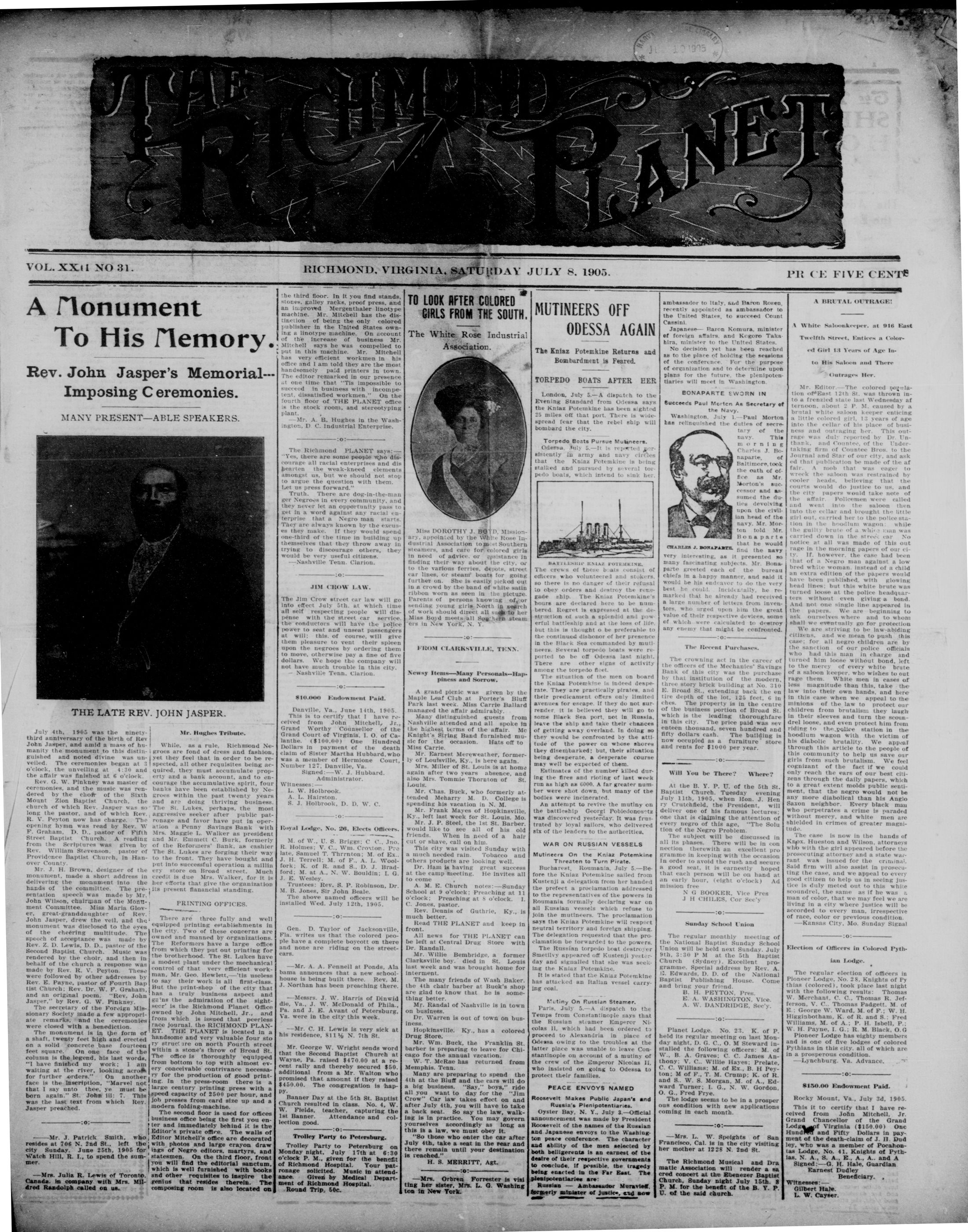
A Monument To His Memory.
MANY PRESENT—ABLE SPEAKERS.
THE LATE REV. JOHN JASPER
July 4th, 1905 was the ninety-third anniversary of the birth of Rev John Jasper, and amid a mass of humanity the monument to this distinguished and noted divine was unveiled. The ceremonies began at 3 o'clock, the unveiling at 4:30 and the affair was finished at 6 o'clock. Rev. G. W. Pinkney was master of ceremonies, and the music was rendered by the choir of the Sixth Mount Zion Baptist Church, the church of which Rev. Jasper was so long the pastor, and of which Rev. R. V. Peyton now has charge. The opening hymn was read by Rev. W. F. Graham, D. D., pastor of Fifth Street Baptist Church. A reading from the Scriptures was given by Rev. William Stevenson, pastor of Providence Baptist Church, in Hanover County.
Mr. Hughes T
While, as a rule, groes are fond of dress yet they feel that in a spected, all other required, they must accept and a bank account courage the accumulate banks have been estates within the past and are doing thrice The St. Lukes, perhensive seeker after renonance and favor haveation a Penny Savin Mrs. Maggie L. Walker and Mr. Emmett C. B of the Reformers' Bar The St. Lukes are for to the front. They have put into successful one
Mr. J. H. Brown, designer of the monument, made a short address in delivering the monument into the hands of the committee. The presentation speech was made by Mr. John Wilson, chairman of the Montument Committee. Miss Maria Glover, great-great-daughter of Rev. John Jasper, drew the veil, and the monument was disclosed to the eyes of the cheering multitude. The speech of acceptance was made by Rev. Z. D. Lewis, D. D., pastor of the Second Baptist Church. Music was rendered by the choir, and then in behalf of the church a response was made by Rev. R. V. Peyton. These were followed by other addresses by Rev. E. Payne, pastor of Fourth Bap tist Church; Rev. Dr. W. F. Graham, and an original poem. "Rev. John Jasper," by Rev. G. W. Pinkney. The secretary of the Foreign Missionary Society made a few appropriate remarks, and the ceremonies were closed with a benediction. The monument is in the form of a shaft, twenty feet high and erected on a solid concrete base fourteen feet square. On one face of the column is the legend, his last words, "I have finished my work; I am waiting at the river, looking across for further orders." On another face is the inscription, "Marvel not that I say unto thee, ye must be born again." St. John ill: 7. This was the last text from which Rev. Jasper preached.
Mr. J. Patrick Smith, who resides at 706 N. 2nd St., left the city Sunday. June 25th, 1905 for Watch Hill, R. I., to spend the summer.
Mrs. Julia R. Lewis of Toronto, Canada. in company with Mrs. Mildred Randolph called on us.
Mr. Hughes Tribute
While, as a rule, Richmond Negroes are fond of dress and fashion, yet they feel that in order to be respected, all other requisites being acquired, they must accumulate property and a bank account, and to encourage the accumulative spirit, four banks have been established by Negroes within the past twenty years and are doing thriving business. The St. Lukes, perhaps, the most aggressive seeker after public patronage and favor have put in operation a Penny Savings Bank with Mrs. Maggie L. Walker as president and Mr. Emmett C. Burk, formerly the Reformers' Bank, as cashier The St. Lukes are forging their way to the front. They have bought and put into successful operation a millery store on Broad street. Much credit is due Mrs. Walker, for it is her efforts that give the organization its present financial standing.
PRINTING OFFICES.
There are three fully and well equipped printing establishments in the city. Two of these concerns are owned and manned by organizations. The Reformers have a large office from which they put out printing for the brotherhood. The St. Lukes have a modest plant under the mechanical control of that very efficient workman, Mr. Geo. Hewlett,—'tis useless to say their work is all first-class. But the print-shop of the city that has a truly business aspect and gains the admiration of the sight-seer is the Richmond Planet Office owned by John Mitchell, Jr., and from which is issued that peerless race journal, the RICHMOND PLANET. The PLANET is located in a handsome and very valuable four story structure on north Fourth street within a stone's throw of Broad St. The office is thoroughly equipped from bottom to top with almost every conceivable contrivance necessary for the production of good printing. In the press-room there is a large century printing press with a speed capacity of 2500 per hour, and job presses from card size up and a modern folding-machine.
The second floor is used for offices business office being the first you enter and immediately behind it is the Editor's private office. The walls of Editor Mitchell's office are decorated with photos and large crayon drawings of Negro editors, martyrs, and statesmen. On the third floor, front you will find the editorial sanctum, which is well furnished with books and other requisites to inspire the genius that resides therein. The composing room is also located on
RICHMOND, VIRGINIA, SATURDAY JULY 8. 1905.
the third floor. In it you find stands, stones, galley racks, proof press, and an improved Mergenthaler linotype machine. Mr. Mitchell has the distinction of being the only colored publisher in the United States owning a linotype machine. On account of the increase of business Mr. Mitchell says he was compelled to put in this machine. Mr. Mitchell has very efficient workmen in his office and I am told they are the most handsomely paid printers in town. The editor remarked in our presence at one time that "Tis impossible to succeed in business with incompetent, dissatisfied workmen." On the fourth floor of THE PLANET office is the stock room, and stereotyping plant.
—Mr. A. B. Hughes in the Washington, D. C. Industrial Enterprise.
The Richmond PLANET says:— "Yes, there are some people who dis- encourage all racial enterprises and dis hearten the weak-kneed elements amongst us, but we should not stop to argue the question with them. Let us press forward." Truth. There are dog-in-the-man ger Negroes in every community, and they never let an opportunity pass to get in a word against any racial enterprise that a Negro man starts. They are always known by the execuses they make. If they would spend one-third of the time in building up themselves that they throw away in trying to discourage others, they would be very useful citizens.
JIM CROW LAW
The Jim Crow street car law will go into effect July 5th, at which time all self respecting people will dispense with the street car service, the conductors will have the police power to seat and unseat passengers at will; this, of course, will give them pleasure to vent their spleen upon the negroes by ordering them to move, otherwise pay a fine of five dollars. We hope the company will not have much trouble in this city. - Nashville Tenn. Clarion.
$10.000 Endowment Paid.
Danville, Va., June 14th, 1905. This is to certify that I have received from John Mitchell, Jr., Grand Worthy Counsellor of the Grand Court of Virginia, I. O. of Calanthe. ($100.00) One Hundred Dollars in payment of the death claim of Sister Martha Hubbard, who was a member of Hermione Court, Number 127, Danville, Va.
Witnesses:—
L. W. Holbrook.
A. L. Hairston.
S. J. Holbrook, D. D. W. C.
Royal Lodge, No. 26, Elects Officers
M. of W., U. S. Briggs; C C., Jno. R. Holmes; V. C., Wm. Croxton. Prate, Samuel T. Thrinton. M. of Ex. J. H. Terrell; M. of F., A. L. Woolfork; K. of R, and S. D, J. Bradford; M. at A, N. W. Bouldin; L. G. J. E. Wesley. Trustees: Rev. S. P. Robinson, Dr. M. B. Jones, Sir John Beale. The above named officers will be installed Wed. July 12th, 1905
Gen. D. Taylor of Jacksonville, Fla. writes us that the colored people have a complete boycott on there and none are riding on the street-cars.
—Mr. A. A. Fennell at Ponds, Ala bama announces that a new school-house is being built there. Rev. M. J. Northan has been preaching there.
—Messrs. J. W. Harris of Dinwid die, Va., J. W. McDonald of Phila., Pa. and J. E. Avant of Petersburg, Va. were in the city this week.
—Mr. C. H. Lewis is very sick at his residence, W 81 1/2 N. 7th St.
Mr. George W. Wright sends word that the Second Baptist Church at Wayne, Pa. raised $470.00 at a recent rally and thereby secured $50. additional from a Mr. Walton who promised that amount if they raised $450.00. The congregation is happy.
Banner Day at the 5th St. Baptist Church resulted in class. No. 4, W. W. Fields, teacher, capturing the 1st Banner. Attendance and collection good.
Trolley Party to Petersburg
Trolley Party to Petersburg on Monday night, July 17th at 6:30 o'clock P. M., given for the benefic of Richmond Hospital. Your patronage solicited. Music in attendance. Given by Medical Department of Richmond Hospital. Round Trip. 50c.
LOOK AFTER COLORED GIRLS FROM THE SOUTH
The White Rose Industrial Association.
Miss DOROTHY J. BOYD, Missionary, appointed by the White Rose Industrial Association to meet Southern steamers, and care for colored girls in need of advice, or assistance in finding their way about the city, or to the various feries, depots, street car lines, or steam boats for going further on. She is easily picked out in a crowd by the band of white satin ribbon worn as seen in the picture. Parents of persons knowing of, or sending young girls. North in search of work should direct all such to her Miss Boyd meets all Southern steamers in New York, N. Y.
FROM CLARKSVILLE, TENN.
Newsy Items—Many Personals—Happiness and Sorrow.
A grand picnic was given by the Maple Leaf Club at Porter's Bluff Park last week. Miss Carrie Ballard managed the affair admirably. Many distinguished guests from Nashville attended and all spoke in the highest terms of the affair. Mr Knight's String Band furnished music for the occasion. Hats off to Miss Carrie. Mr. Earnest Mereweather, formerly of Louisville, Ky., is here again.
Mrs. Miller of St. Louis is at home again after two years absence, and also Mrs. Tommie Thornton of St. Louis. Mr. Chas. Buck, who formerly attended Meharry M. D. College is spending his vacation in N. M.
Mr. Frank Mayes of Hopkinsville, Ky., last left week for St. Louis, Mo. Mr. J. P. Steel, the 1st St. Barber, would like to see all of his old friends. When in need of a hair cut or shave, call on him. This city was visited Sunday with a much needed rain. Tobacco and others products are looking well. Dr. Ham is having great success at the camp meeting. He invites all to come. A. M. E. Church notes:—Sunday School at 9 o'clock; Preaching at 11 o'clock; Preaching at 8 o'clock. I. C. Jones, pastor. Rev. Dennis of Guthrie, Ky., is much better. Read THE PLANET and keep in front. All news for THE PLANET can be left at Central Drug Store with Dr. Randall. Mr. Willie Bembridge, a former Clarksville boy, died in St. Louis last week and was brought home for interment. The many friends of Wash Baker, the 4th chair barber at Buck's shop are glad to know that he is something better. Mr. Randal of Nashville is in town on business.
Dr. Warren is out of town on business.
Hopkinsville, Ky., has a colored Drug Store.
Mr. Wm. Buck, the Franklin St. barber is preparing to leave for Chicago for the annual vacation.
W. T. McRae has returned from Memphis. Tennessee.
Many are preparing to spend the 4th at the Bluff and the cars will do a big business. "Say," boys," ride all you want to day for the "Jim Crow" Car law takes effect on and after July 4th, you will have to take a back seat. So say the law, walking is in practice. You may govern yourselves accordingly as long as this is a law, we must obey it.
"So those who enter the car after July 4th, take a seat in the rear and there remain until your destination is reached."
H. S. MERRITT, Agt.
:o:
Mrs. Orbren Forrester is visiting her sister, Mrs. L. G. Washington in New York.
MUTINEERS OFF
ODESSA AGAIN
MUTINEERS OFF
ODESSA AGAIN
The Kniaz Potemkine Returns and Bombardment is Feared.
TORPEDO BOATS AFTER HER
London, July 5—A dispatch to the Evening Standard from Odessa says the Kniaz Potemkine has been sighted 25 miles off that port. There is widespread fear that the rebel ship will bombard the city.
Torpedo Boats Pursue Mutineers.
Odessa, July 5—It is reported persistently in army and navy circles that the Kniaz Potemkine is being stalked and pursued by several torpedo boats, which intend to sink her.
BATTLESHIP KNIAZ POTEMKINE.
The crews of these boats consist of officers who volunteered and stokers, so there is no danger of their refusal to obey orders and destroy the rune gade ship. The Kniaz Potemkine's hours are declared here to be numbered Regret is expressed at the destruction of such a splendid and powerful battleship and at the loss of life, but this is thought o be preferable to the continued dishonor of her presence in the Black Sea commanded by mutilers. Several torpedo boats were reported to be off Odessa last night. There are other signs of activity among the torpedo fleet.
The situation of the men on board the Kniaz Potemkine is indeed desperate. They are practically pirates, and their predicament offers only limited avenues for escape. If they do not surrender, it is believed they will go to some Black Sea port, not in Russia, leave the ship and take their chances of getting away overland. In doing so they would be confronted by the attitude of the power on whose shores they disembarked; but, their situation being desperate, a desperate course may well be expected of them.
Estimates of the number killed during the fires and rioting of last week run as high as 6000. A far greater number were shot down, but many of the bodies were incinerated.
An attempt to revive the mutiny on the battleship Georgi Pobiedonosetz was discovered yesterday. It was frustrated by loyal sailors, who delivered six of the leaders to the authorities.
WAR ON RUSSIAN VESSELS
Mutineers On the Kniaz Potemkine
Threater to Turn Pirate
Bucharest, Roumania, July 5.—Before the Kniaz Potemkine sailed from Kustenji a delegation from her handed the prefect a proclamation addressed to the representatives of the powers in Roumania formally declaring war on all Russian vessels which refuse to join the mutineers. The proclamation says the Kniaz Potemkine will respect neutral territory and foreign shipping. The delegation requested that the proclamation be forwarded to the powers. The Russian torpedo boat destroyer Smetlivy appeared off Kustenji yesterday and signalled that she was seeking the Kniaz Potemkine. It is stated that the Kniaz Potemkine has attacked an Italian vessel carrying coal.
Mutiny On Russian Steamer
Paris, July 5.—A dispatch to the Temps from Constantinople says that the Russian steamer Emperor Nicolas II, which had been ordered to proceed to Alexandria in place of Odessa owing to the troubles at the latter place was unable to leave Constantinople on account of a mutiny of the crew of the Emperor Nicolas II, who insisted on going to Odessa to protect their families.
PEACE ENVOYS NAMED
Roosevelt Makes Public Japan's and Russia's Plenipotentiaries. Oyster Bay, N. Y., July 3. Official announcement was made by President Roosevelt of the names of the Russian and Japanese envoys to the Washington peace conference. The character and ability of the men selected by both belligerents is an earnest of the desire of their respective governments to conclude, if possible, the tragedy being enacted in the Far East. The plenipotentiaries are:
Russian — Ambassador Muravieff,
formerly minister of Justice, and now
ambassador to Italy, and Baron Rosen, recently appointed as ambassador to the United States, to succeed Count Cassin. Japanese—Baron Komura, minister of foreign affairs, and Kogoro Takahira, minister to the United States. No decision yet has been reached as to the place of holding the sessions of the conference. For the purpose of organization and to determine upon plans for the future, the plenipotentiaries will meet in Washington.
BONAPARTE SWORN IN
Succeeds Paul Morton As Secretary of the Navy.
Washington, July 1.—Paul Morton has relinquished the duties of secretary of the navy. This morning Charles J. Bonaparte, of Baltimore, took the oath of office as Mr. Morton's successor and assumed the duties devolving upon the civilian head of the navy. Mr. Morton told Mr. Bonaparte that he would find the navy
tary of the navy. This morning Charles J. Bonaparte, of Baltimore, took the oath of office as Mr. Morton's successor and assumed the duties devolving upon the civilian head of the navy. Mr. Morton told Mr. Bonaparte that he would find the navy very interesting, as it presented so many fascinating subjects. Mr. Bonaparte greeted each of the bureau chiefs in a happy manner, and said it would be his endeavor to do the very best he could. Incidentally, he remarked that he already had received a large number of letters from inventors, who urged upon him the great value of their respective devices, some of which were calculated to destroy any enemy that might be confronted.
The Recent Purchases.
The crowning act in the career of the officers of the Mechanics' Savings Bank of this city was the purchase by that institution of the modern, three story brick building at No. 310 E. Broad St., extending back the enire depth of the lot, 125 feet, 6 inches. The property is in the centre of the business portion of Broad St. which is the leading thoroughfare in this city. The price paid was seventeen thousand, seven hundred and fifty dollars cash. The building is now occupied as a furniture store and rents for $1000 per year.
Will You be There? Where?
At the B. Y. P. U. of the 5th St. Baptist Church. Tuesday evening July 11th, 1905, when Hon. J. Henry Crutchfield, the President, will deliver one of his famous lectures; one that is claiming the attention of every negro of this age, "The Solution of the Negro Problem.
The subject will be discussed in all its phases. There will be in connection therewith an excellent pro grame in keeping with the occasion. In order to avoid the rush and secure a good seat, it is earnestly hoped that each person will be on hand at an early hour, (eight o'clock) Ad mission free
N G BOOKER, Vice Pres
J H CHILES, Cor Sec'y
Sunday School Union
The regular monthly meeting of the National Baptist Sunday School Union will be held next Sunday, July 9, 3:30 P M at the 5th Baptist Church (Sydney). Excellent programme. Special address by Rev. A. E. Edwards, D. D. of the National Baptist Publishing House. Come and bring your friend.
B. H. PEYTON, Pres.
E. A. WASHINGTON, Vice.
A. W. DANDRIDGE, Sec'y.
Planet Lodge, No. 23. K. of P. held its regular meeting on last Monday night, D. G. C. C. O. M Stewart installed the following officers: M. of W. B. A. Graves; C. C. James Anthony; V. C. Willie Hues; Prelate, C. C. Williams; M. of Ex. B. H Peyton; M of F. T. M. Crump; K. of R. and S. W. S. Morgan, M. of A., Edward Turner; I. G., N. W. Gordon, O. G., Fred Frye.
The lodge seems to be in a prosperous condition with new applications coming in each month.
—Mrs. L. W. Speights of San Francisco, Cal. is in the city visiting her mother at 1228 N. 2nd St.
The Richmond Musical and Dramatic Association will render a sacred concert at the Ebenezer Baptist Church, Sunday night July 15th. $ P. M. for the benefit of the B. Y. P. U. of the said church.
A BRUTAL OUTRAGE!
A White Saloonkeeper. at 916 East
ed Girl 13 Years of Age In-
Mr. Editor.—The colored population of East 12th St. was thrown in to a frenzied state last Wednesday at afternoon, about 2 P. M. caused by a brutal white saloon keeper enticing a little colored girl, 13 years of age into the cellar of his place of business and outraging her. This outrage was daily reported by Dr. Unthank, and Countee, of the Undertaking firm of Countee Bros. to the Journal and Star of our city, and asked that publication be made of the afair. A mob that was eager to wreck the saloon was restrained by cooler heads, believing that the courts would do justice to us, and the city papers would take note of the affair. Policemen were called and went into the saloon then into the cellar and brought the little girl out, carried her to the police station in the hoodium wagon; while the guilty brute of a white man was ridden in the street car. No notice at all was made of this outrage in the morning papers of our city. If, however, the case had been that of a Negro man against a low bred white woman, instead of a child an extra edition of the papers would have been published, with glowing head lines; but this white brute was turned loose at the police headquarters without even giving a bond. And not one single line appeared in the papers. We are beginning to ask ourselves where and to whom shall we eventually go for protection
We are striving to be law-abiding citizens, and we mean to push this case; for all negro children are by the sanction of our police officials who had this man in charge and turned him loose without bond, left to the mercy of every white brute of a saloon keeper, who wishes to outrage them. White men in cases of less magnitude than this, take the law into their own hands, and here in this case when we appeal to the minions of the law to protect our children from brutalism they laugh in their sleeves and turn the scoundrel loose, and even protect him from riding to the police station in the hoodium wagon with the victim of his diabolic brutality. We appeal through this article to the people of this community to help us save our girls from such brutalism. We feel cognizant of the fact if we could only reach the ears of our best citizens through the daily papers, which to a great extent molds public sentiment, that the negro would not be any more diabolical than his Anglo Saxon neighbor. Every black man who perpetrates a crime is paraded without mercy, and white men are shielded in crimes of greater magnitude.
The case is now in the hands of Knox. Hueston and Wilson, attorneys who with the girl appeared before the prosecuting attorney and a state warrant was issued for the criminal. Said firm will also assist in prosecuting the case, and we appeal to every good citizen to help us in seeing justice is duly meted out to this white scoundrel, the same as if he was a man of color, that we may feel we are living in a city where justice will be accorded to every man, irrespective of race, color or previous condition.
Election of Officers in Colored Pytha
ian Lodge.
The regular election of officers in Pioneer Lodge, No 28, Knights of Pythas (colored), took place last night with the following results: Thomas W. Merchant, C. C., Thomas R. Jefferson, V. C., Thomas Padgett, M. of E.; George W. Ward, M. of F.; W. H. Higginbotham, K. of R. and S.; Fred Williams, M. of A.; P. H. Isbell, P.; W. H. Payne, I. G.; R. M. Black, O. G. Pioneer Lodge has eighty members and is one of five lodges of colored Pythas in this city, all of which are in a prosperous condition.
—Lynchburg, Va. Advance.
$150.00 Endowment Paid.
Rocky Mount, Va., July 3d, 1905.
Rocky Mount, Va., July 3d, 1905.
This it to certify that I have received from John Mitchell, Jr.
Grand Chancellor of the Grand Lodge of Virginia ($150.00) One Hundred and Fifty Dollars in payment of the death-claim of J. H. Dudley, who was a member of Pocahontas Lodge, No. 41. Knights of Pythias, N. A., S. A., E. A., A. and A.
Signed:—G. H. Hale, Guardian
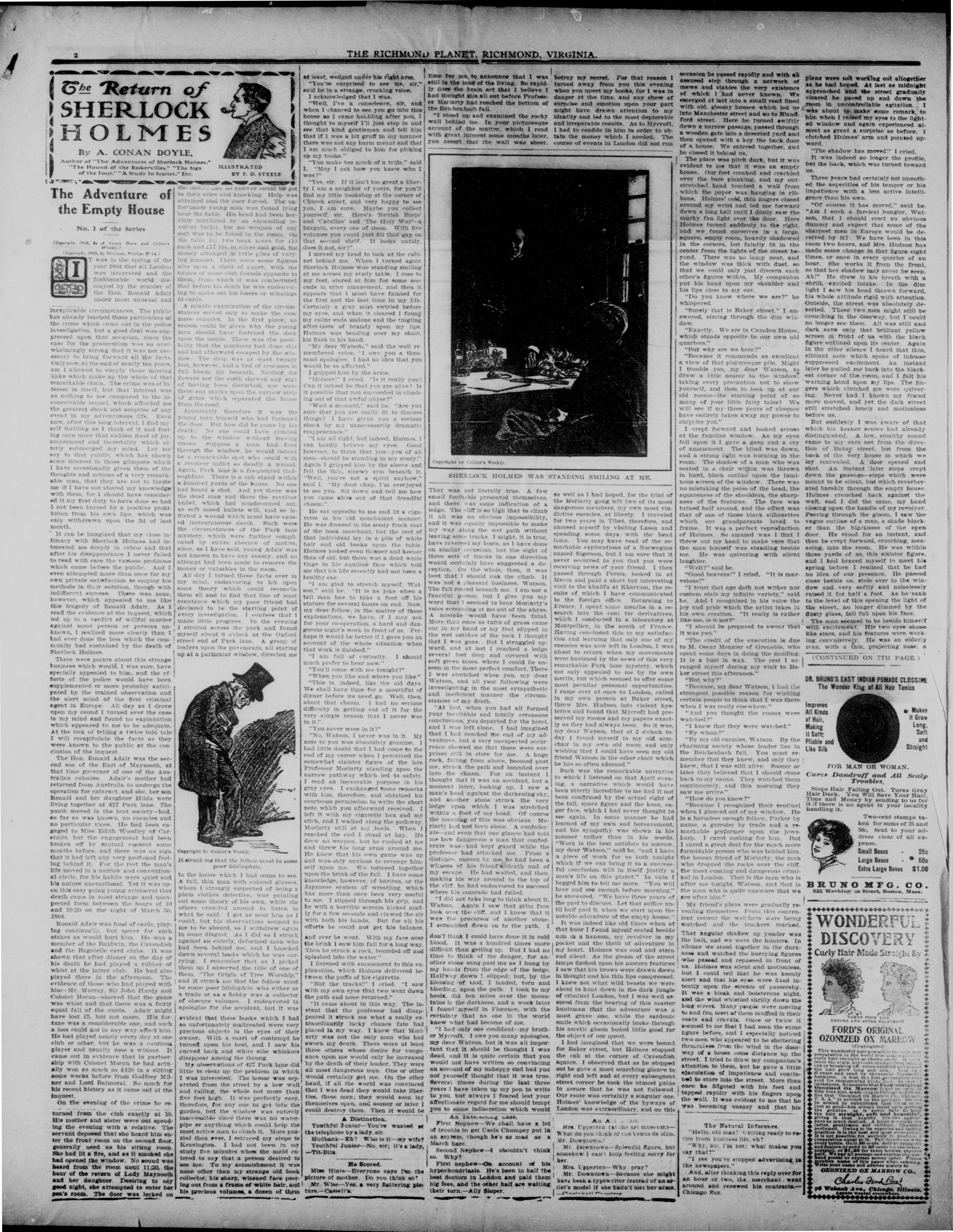
The Return of SHERLOCK HOLMES
Author of "The Adventures of Sherlock Holmes."
"The Hound of the Baskervilles," "The Sign of the Four," "A Study In Scarlet." Etc.
the insurer, and no answer could be got to their cries and knocking. Help was obtained and the door forced. The unfortunate young man was found lying near the table. His head had been horribly mutilated by an expanding revolver bullet, but no weapon of any sort was to be found in the room. On the table lay two bank notes for £10 each and £17 10s, in silver and gold, the money arranged in little piles of varying amount. There were some figures also upon a sheet of paper, with the names of some club friends opposite to them, from which it was conjectured that before his death he was endeavoring to make out his losses or winnings at cards.
A minute examination of the circumstances served only to make the case more complex. In the first place, no reason could be given why the young man should have fastened the door upon the inside. There was the possibility that the murderer had done this and had afterward escaped by the window. The drop was at least twenty feet, however, and a bed of croses in full bloom lay beneath. Neither the flowers nor the earth showed any sign of having been disturbed, nor were there any marks upon the narrow strip of grass which separated the house from the road.
Apparently therefore it was the young man himself who had fastened the door. But how old be come by his death? No one could have climbed up to the window without leaving traces. Suppose a man had fired through the window, he would indeed be a remarkable shot who could with a revolver inflict so deadly a wound. Again, Park lane is a frequented thoroughfare. There is a cab stand within a hundred yards of the house. No one had heard a shot. And yet there was the dead man and there the revolver bullet, which had mushroomed out, as soft nosed bullets will, and so inflicted a wound which must have caused instantaneous death. Such were the circumstances of the Park lane mystery, which were further complicated by entire absence of motive, since as I have said, young Adair was not known to have any enemy, and no attempt had been made to remove the money or valuables in the room.
All day I turned these facts over in my mind, endeavoring to hit upon some theory which could reconcile them all and to find that line of least resistance which my poor friend had declared to be the starting point of every investigation. I confess that I made little progress. In the evening I strolled across the park and found myself about 6 o'clock at the Oxford street end of Park lane. A group of loafers upon the pavements, all staring up at a particular window, directed me
Copyright by Gustave Doré
It struck me that the fellow must be some poor bibliophile.
to the house which I had come to see.
A tall, thin man with colored glasses, whom I strongly suspected of being a plain clothes detective, was pointing out some theory of his own, while the others crowded around to listen to what he said. I got as near him as I could, but his observations seemed to me to be absurd, so I withdrew again in some disgust. As I did so I struck against an elderly, deformed man who had been behind me, and I knocked down several books which he was carrying. I remember that as I picked them up I observed the title of one of them. "The Origin of Tree Worship," and it struck me that the fellow must be some poor bibliophile who either as a trade or as a hobby was a collector of obscure volumes. I endeavored to apologize for the accident, but it was
evident that these books which I had so unfortunately maltreated were very precious objects in the eyes of their owner. With a snarl of contempt he turned upon his heel, and I saw his curved back and white side whiskers disappear among the throng.
My observations of 427 Park lane did little to clear up the problem in which I was interested. The house was separated from the street by a low wall and railing, the whole not more than five feet high. It was perfectly easy, therefore, for any one to get into the garden, but the window was entirely inaccessible since there was no waterpipe or anything which could help the most active man to climb it. More puzzled than ever, I retraced my steps to Kensington. I had not been in my study five minutes when the maid entered to say that a person desired to see me. To my astonishment it was none other than my strange old book collector, his sharp, wizened face peering out from a frame of white hair, and his precious volumes, a dozen of them
The Adventure of the Empty House
No. 1 of the Series
(Copyright, 1905, by A. Conan Doyle and Collier's Weekly.)
(Copyright, 1905, by McClure, Phillips & Co.)
T was in the spring of the year 1894 that all London was interested and the fashionable world dismayed by the murder of the Hon. Ronald Adair under most unusual and
I
inexplicable circumstances. The public has already learned those particulars of the crime which came out in the police investigation, but a good deal was suppressed upon that occasion, since the case for the prosecution was so overwhelmingly strong that it was not necessary to bring forward all the facts. Only now, at the end of nearly ten years, am I allowed to supply those missing links which make up the whole of that remarkable chain. The crime was of interest in itself, but that interest was as nothing to me compared to the inconceivable sequel, which afforded me the greatest shock and surprise of any event in my adventurous life. Even now, after this long interval, I find my thrilling as I think of it and feeling once more that sudden flood of joy, amazement and incredulity which utterly submerged my mind. Let me say to that public, which has shown some interest in those glimpses which I have occasionally given them of the thoughts and actions of a very remarkable man, that they are not to blame me if I have not shared my knowledge with them, for I should have considered it my first duty to have done so had I not been barred by a positive prohibition from his own lips, which was only withdrawn upon the 3d of last month.
It can be imagined that my close intimacy with Sherlock Holmes had interested me deeply in crime and that after his disappearance I never failed to read with care the various problems which came before the public. And I even attempted more than once for my own private satisfaction to employ his methods in their solution, though with indifferent success. There was none, however, which appealed to me like this tragedy of Ronald Adair. As I read the evidence at the inquest, which led up to a verdict of willful murder against some person or persons unknown, I realized more clearly than I had ever done the loss which the community had sustained by the death of Sherlock Holmes.
There were points about this strange business which would, I was sure, have specially appealed to him, and the efforts of the police would have been supplemented or more probably anticipated by the trained observation and the alert mind of the first criminal agent in Europe. All day as I drove upon my round I turned over the case in my mind and found no explanation which appeared to me to be adequate. At the risk of telling a twice told tale I will recapitulate the facts as they were known to the public at the conclusion of the inquest.
The Hon. Ronald Adair was the second son of the Earl of Maynooth, at that time governor of one of the Australian colonies. Adair's mother had returned from Australia to undergo the operation for cataract, and she her son Ronald and her daughter Hilda were living together at 427 Park lane. The youth moved in the best society—had, so far as was known, no enemies and no particular vices. He had been engaged to Miss Edith Woodley of Carstairs, but the engagement had been broken off by mutual consent some months before, and there was no sign that it had left any very profound feeling behind it. For the rest the man's life moved in a narrow and conventional circle, for his habits were quiet and his nature unemotional. Yet it was upon this easy going young aristocrat that death came in most strange and unexpected form between the hours of 10 and 10:20 on the night of March 30, 1894.
Ronald Adair was fond of cards, playing continually, but never for such stakes as would hurt him. He was a member of the Baldwin, the Cavendish and the Bagatelle card clubs. It was shown that after dinner on the day of his death he had played a rubber of whist at the latter club. He had also played there in the afternoon. The evidence of those who had played with him—Mr. Murray, Sir John Hardy and Colonel Moran—showed that the game was whist and that there was a fairly equal fall of the cards. Adair might have lost 15, but not more. His fortune was a considerable one, and such a loss could not in any way affect him. He had played nearly every day at one club or other, but he was a cautious player and usually rose a winner. It came out in evidence that in partnership with Colonel Moran he had actually won as much as £420 in a sitting some weeks before from Godfrey Miller and Lord Balmoral. So much for his recent history as it came out at the inquest.
On the evening of the crime he returned from the club exactly at 10. His mother and sister were out spending the evening with a relative. The servant deposed that she heard him enter the front room on the second floor, generally used as his sitting room. She had lit a fire, and as it smoked she had opened the window. No sound was heard from the room until 11:20, the hour of the return of Lady Maynoth and her daughter. Desiring to say good night, she attempted to enter her son's room. The door was locked on
ILLUSTRATED
BY F. D. STEELE
THE RICHMOND PLANET, RICHMOND, VIRGINIA
at least, wedged under his right arm.
"You're surprised to see me, sir," said he in a strange, croaking voice. I acknowledged that I was.
"Well, I've a conscience, sir, and when I chanced to see you go into this house as I came holbling after you, I thought to myself I'll just step in and see that kind gentleman and tell him that if I was a bit gruff in my manner there was not any harm meant and that I am much obliged to him for picking up my books."
"You make too much of a trifle," said I. "May I ask how you knew who I was?"
"Yes, sir. If it isn't too great a liberty I am a neighbor of yours, for you'll find my little bookshop at the corner of Church street, and very happy to see you. I am sure. Maybe you collect yourself, sir. Here's 'British Birds' and 'Catullus' and 'The Holy War'-a bargain, every one of them. With five volumes you could just fill that gap on that second shelf. It looks unfiddy, does it not, sir."
I moved my head to look at the cabinet behind me. When I turned again Sherlock Holmes was standing smiling at me across my study table. I rose to my feet, stared at him for some seconds in utter amazement, and then it appears that I must have fainted for the first and the last time in my life. Certainly a gray mist swirled before my eyes, and when it cleared I found my collar ends undone and the tingling after-taste of brandy upon my lips. Holmes was bending over my chair, his flask in his hand.
"My dear Watson," said the well remembered voice. "I owe you a thousand apologies. I had no idea that you would be so affected."
I gripped him by the arms.
"Holmes?" I cried. "Is it really you? Can it indeed be that you are alive? Is it possible that you succeeded in climbing out of that awful abyss?"
"Walt a moment," said he. "Are you sure that you are really fit to discuss things? I have given you a serious shock by my unnecessarily dramatic reappearance."
"I am all right, but indeed, Holmes, I can hardly believe my eyes. Good heavens, to think that you—you of all men—should be standing in my study?"
Again I gripped him by the sleeve and felt the thin, sinew arm beneath it.
"Well, you're not a spirit anyhow." said I. "My dear chap, I'm overjoyed to see you. Sit down and tell me how you came alive out of that dreadful chasm."
He sat opposite to me and lit a cigarette in his old nonchalant manner. He was dressed in the seedy frock coat of the book merchant, but the rest of that individual lay in a pile of white hair and old books upon the table. Holmes looked even thinner and keener than of old, but there was a dead white tinge in his aquiline face which told me that his life recently had not been a healthy one.
"I am glad to stretch myself, Watson," said he. "It is no joke when a tall man has to take a foot off his stature for several hours on end. Now, my dear fellow, in the matter of these explanations, we have, if I may ask for your co-operation, a hard and dangerous night's work in front of us. Perhaps it would be better if I gave you an account of the whole situation when that work is finished."
"I am full of curiosity. I should much prefer to hear now."
"You'll come with me tonight?"
"When you like and where you like."
"This is, indeed, like the old days.
We shall have time for a mouthful of dinner before we need go. Well, then, about that chasm. I had no serious difficulty in getting out of it for the very simple reason that I never was in it."
"You never were in it?"
"No, Watson. I never was in it. My note to you was absolutely genuine. I had little doubt that I had come to the end of my career when I perceived the somewhat sinister figure of the late Professor Morlarty standing upon the narrow pathway which led to safety. I read an inexorable purpose in his gray eyes. I exchanged some remarks with him, therefore, and obtained his courteous permission to write the short note which you afterward received. I left it with my cigarette box and my stick, and I walked along the pathway, Morlarty still at my heels. When I reached the end I stood at bay. He drew no weapon, but he rushed at me and threw his long arms around me. He knew that his own game was up and was only anxious to revenge himself upon me. We tottered together upon the brink of the fall. I have some knowledge, however, of bariton, or the Japanese system of wrestling, which has more than once been very useful to me. I slipped through his grip, and he with a horrible scream kicked madly for a few seconds and clawed the air with both his hands. But for all his efforts he could not get his balance
and over he went. With my face over the brink I saw him fall for a long way. Then he struck a rock, bounded off and splashed into the water."
I listened with amazement to this explanation, which Holmes delivered between the puffs of his cigarette.
"But the tracks!" I cried. "I saw with my own eyes that two went down the path and none returned."
"It came about in this way. The instant that the professor had disappeared it struck me what a really extraordinarily lucky chance fate had placed in my way. I knew that Morlarty was not the only man who had sworn my death. There were at least three others whose desire for vengeance upon me would only be increased by the death of their leader. They were all most dangerous men. One or other would certainly get me. On the other hand, if all the world was convinced that I was dead they would take liberties, these men; they would soon lay themselves open, and sooner or later I could destroy them. Then it would be
A Distinction.
Youthful Junior—You're wanted at the telephone by a lady, sir.
Mudbank—Eh? Who is it—my wife?
Youthful Junior—No, sir; it's a lady,
-TitBits.
He Scored.
Miss Hinte—Everyone says I'm the picture of mother. Do you think so?
Mr. Wise—Yes, a very flattering picture.—Cassell's.
```markdown
```
SHERLOCK HOLMES WAS STANDING SMILING AT ME.
time for me to announce that I was still in the land of the living. So rapidly does the brain act that I believe I had thought this all out before Professor Moriarty had reached the bottom of the Reichenbach fall.
"I stood up and examined the rocky wall behind me. In your picturesque account of the matter, which I read with great interest some months later, you assert that the wall was sheer.
Copyright by Collier's Weekly.
SHERLOCK HOLMES WAS S
That was not literally true. A few small footholds presented themselves, and there was some indication of a ledge. The cliff is so high that to climb it all was an obvious impossibility, and it was equally impossible to make my way along the wet path without leaving some tracks. I might, it is true, have reversed my boots, as I have done on similar occasions, but the sight of three sets of tracks in one direction would certainly have suggested a deception. On the whole, then, it was best that I should risk the climb. It was not a pleasant bushness, Watson. The fall roared beneath me. I am not a fanciful person, but I give you my word that I seemed to hear Moriarty's voice screening at me out of the abyss. A mistake would have been fatal. More than once as tufts of grass came out in my hand or my foot slipped in the wet notches of the rock I thought that I was gone. But I struggled upward, and at last I reached a ledge several feet deep and covered with soft green moss, where I could lie unseen in the most perfect comfort. There I was stretched when you, my dear Watson, and all your following were investigating in the most sympathetic and inefficient manner the circumstances of my death.
"At last, when you had all formed your inevitable and totally erroneous conclusions, you departed for the hotel, and I was left alone. I had imagined that I had reached the end of my adventures, but a very unexpected occurrence showed me that there were surprises still in store for me. A huge rock, falling from above, boomed past me, struck the path and bounded over into the chasm. For an instant I thought that it was an accident, but a moment later, looking up. I saw a man's head against the darkening sky, and another stone struck the very ledge upon which I was stretched within a foot of my head. Of course the meaning of this was obvious. Moriarty had not been alone. A confederate and even that one glance had told me how dangerous a man that confederate was—had kept guard while the professor had attacked me. From a distance, unseen by me, he had been a witness of his friend's death and of my escape. He had waited, and then making his way around to the top of the cliff, he had endeavored to succeed where his comrade had failed.
"I did not take long to think about it, Watson. Again I saw that grim face look over the cliff, and I knew that it was the precursor of another stone. I scrambled down on to the path. I don't think I could have done it in cold blood. It was a hundred times more difficult than getting up. But I had no time to think of the danger, for another stone sang past me as I hung by my hands from the edge of the ledge. Halfway down I slipped; but, by the blessing of God, I landed, torn and bleeding, upon the path. I took to my heels, did ten miles over the mountains in the darkness, and a week later I found myself in Florence, with the certainty that no one in the world knew what had become of me.
"I had only one confident—my brother Mycroft. I owe you many apologies, my dear Watson, but it was all important that it should be thought I was dead, and it is quite certain that you would not have written so convincing an account of my unhappy end had you not yourself thought that it was true. Several times during the last three years I have taken up my pen to write to you, but always I feared lest your affectionate regard for me should tempt you to some indiscretion which would
An Interesting Case.
First Nephew—We shall have a lot of trouble to get Uncle Chumpey put in an asylum, though he's as mad as a March hare.
Second Nephew—I shouldn't think so. Why?
First nephew—On account of his hypochondriasis. He's been to half the best doctors in London and paid them big fees, and the other half are waiting their turn—Ally Sloper.
betray my secret. For that reason I turned away from you this evening when you upset my books, for I was in danger at the time, and any show of surprise and emotion upon your part might have drawn attention to my identity and led to the most deplorable and irreparable results. As to Mycroft, I had to confide in him in order to obtain the money which I needed. The course of events in London did not run
STANDING SMILING AT ME.
so well as I had hoped, for the trial of the Moriarty gang left two of its most dangerous members, my own most vindictive enemies, at liberty. I traveled for two years in Tibet, therefore, and amused myself by visiting Lassa and spending some days with the head lama. You may have read of the remarkable explorations of a Norwegian named Sigerson, but I am sure that it never occurred to you that you were receiving news of your friend. I then passed through Persia, looked in at Mecca and paid a short but interesting visit to the khalifa at Khartum, the results of which I have communicated to the foreign office. Returning to France, I spent some months in a research into the coal tar derivatives, which I conducted in a laboratory at Montpellier, in the south of France. Having concluded this to my satisfaction and learning that only one of my enemies was now left in London, I was about to return when my movements were hastened by the news of this very remarkable Park lake mystery, which not only appealed to me by its own merits, but which seemed to offer some most peculiar personal opportunities. I came over at once to London, called in my own person at Baker street, threw Mrs. Hudson into violent hysteries and found that Mycroft had preserved my rooms and my papers exactly as they had always been. So it was, my dear Watson, that at 2 o'clock to day I found myself in my old armchair in my own old room and only wishing that I could have seen my old friend Watson in the other chair which he has so often adorned."
Such was the remarkable narrative to which I listened on that April evening, a narrative which would have been utterly incredible to me had it not been confirmed by the actual sight of the tall, spare figure and the keen, eager face, which I had never thought to see again. In some manner he had learned of my own sad bereavement, and his sympathy was shown in his manner rather than in his words. "Work is the best antidote to sorrow, my dear Watson," said he, "and I have a piece of work for us both tonight which if we can bring it to a successful conclusion will in itself justify a man's life on this planet." In vain I begged him to tell me more. "You will hear and see enough before morning" he answered. "We have three years of the past to discuss. Let that suffice until half past 9, when we start upon the notable adventure of the empty house."
It was indeed like old times when at that hour I found myself seated beside him in a hansom, my revolver in my pocket and the thrill of adventure in my heart. Holmes was cold and stern and silent. As the gleam of the street lamps flashed upon his austere features I saw that his brows were drawn down in thought and his thin lips compressed. I knew not what wild beasts we were about to hunt down in the dark jungle of criminal London, but I was well assured from the bearing of this master huntsman that the adventure was a most grave one, while the sardonic smile which occasionally broke through his ascetic gloom boded little good for the object of our quest.
I had imagined that we were bound for Baker street, but Holmes stopped the cab at the corner of Cavendish square. I observed that as he stopped out he gave a most searching glance to right and left and at every subsequent street corner he took the utmost palms to assure that he was not followed. Our route was certainly a singular one. Holmes' knowledge of the byways of London was extraordinary, and on this
An A: ...I.C.
Mrs. Upperten (at the art museum)—What do you think of the Venus de Milo, Mr. Downtown?
Mr. Downtown—Splendid figure, but somehow I can't help feeling sorry for her.
Mrs. Upperten—Why pray?
Mr. Downtown—Because she might have been a typewriter instead of an artist's model if she hadn't lost her arms.
Cincinnati Fountain
occasion he passed rapidly and with an assured step through a network of mews and stables the very existence of which I had never known. We emerged at last into a small road lined with old, gloomy houses which led us into Manchester street and so to Blandford street. Here he turned swiftly down a narrow passage, passed through a wooden gate into a deserted yard and then opened with a key the back door of a house. We entered together, and he closed it behind us.
The place was pitch dark, but it was evident to me that it was an empty house. Our feet creaked and crackled over the bare planking, and my outstretched hand touched a wall from which the paper was hanging in ribbons. Holmes' cold, thin fingers closed around my wrist and led me forward down a long hall until I dimly saw the murky fan light over the door. Here Holmes turned suddenly to the right, and we found ourselves in a large square, empty room, heavily shadowed in the corners, but faintly lit in the center from the lights of the street beyond. There was no lamp near, and the window was thick with dust, so that we could only just discern each other's figures within. My companion put his hand upon my shoulder and his lips close to my ear.
"Do you know where we are?" he whispered.
"Surely that is Baker street." I answered, staring through the dim window.
"Exactly. We are in Camden House which stands opposite to our own old quarters." "But why are we here?"
"Because it commands so excellent a view of that picturesque pile. Might I trouble you, my dear Watson, to draw a little nearer to the window, taking every precaution not to show yourself, and then to look up at our old rooms—the starting point of so many of your little fairy tales? We will see if my three years of absence have entirely taken away my power to surprise you."
I crept forward and looked across at the familiar window. As my eyes fell upon it I gave a gasp and a cry of amazement. The blind was down, and a strong light was burning in the room. The shadow of a man who was seated in a chair within was thrown in hard, black outline upon the luminous screen of the window. There was no mistaking the pulse of the head, the squareness of the shoulders, the sharpness of the features. The face was turned half around, and the effect was that of one of those black silhouettes which our grandparents loved to frame. It was a perfect reproduction of Holmes. So amazed was I that I threw out my hand to make sure that the man himself was standing beside me. He was quivering with silent laughter.
"Well? said he.
"Good heavens!" I cried. "It is marvelous!"
"I trust that age doth not wither nor custom stale my infinite variety," said he. And I recognized in his voice the joy and pride which the artist takes in his own creation. "It really is rather like me, is it not?"
"I should be prepared to swear that it was you."
"The credit of the execution is due to M. Oscar Mennler of Grenoble, who spent some days in doing the molding. It is a bust in wax. The rest I arranged myself during my visit to Baker street this afternoon."
"But why?"
"Because, my dear Watson, I had the strongest possible reason for wishing certain people to think that I was there when I was really elsewhere."
"And you thought the rooms were watched?"
"I knew that they were watched."
"By whom?"
"By my old enemies, Watson. By the charming society whose leader lies in the Reichenbach fall. You must remember that they knew, and only they knew, that I was still alive. Sooner or later they believed that I should come back to my rooms. They watched them continuously, and this morning they saw me arrive."
"How do you know?"
"Because I recognized their sentinel when I glanced out of my window. He is a harmless enough fellow, Parker by name, a garroter by trade and a remarkable performer upon the jewsharp. I cared nothing for him. But I cared a great deal for the much more formidable person who was behind him, the bosom friend of Moriarty, the man who dropped the rocks over the cliff, the most cunning and dangerous criminal in London. That is the man who is after me tonight, Watson, and that is the man who is quite unaware that we are after him."
My friend's plans were gradually revealing themselves. From this convenient retreat the watchers were being watched and the trackers tracked.
That angular shadow up yonder was the bait, and we were the hunters. In silence we stood together in the darkness and watched the hurrying figures who passed and repassed in front of us. Holmes was silent and motionless, but I could tell that he was keenly alert and that his eyes were fixed intently upon the stream of passersby. It was a bleak and boisterous night, and the wind whistled shrilly down the long street. Many people were moving to and fro, most of them muffled in their coats and cravats. Once or twice it seemed to me that I had seen the same figure before, and I especially noticed two men who appeared to be sheltering themselves from the wind in the doorway of a house some distance up the street. I tried to draw my companion's attention to them, but he gave a little excalation of impatience and continued to stare into the street. More than once he figured with his feet and tapped rapidly with his fingers upon the wall. It was evident to me that he was becoming uneasy and that his
And, after thinking this reply over for an hour or two, the merchant, went around and renewed his contracts.— Chicago Sun.
plans were not working out altogether as he had hoped. At last as midnight approached and the street gradually cleared he paced up and down the room in uncontrollable agitation. I was about to make some remark to him when I raised my eyes to the lighted window and again experienced almost as great a surprise as before. I clutched Holmes' arm and pointed upward.
"The shadow has moved!" I cried.
It was indeed no longer the profile, but the back, which was turned toward us.
Three years had certainly not smoothed the asperities of his temper or his impatience with a less active intelligence than his own.
"Of course it has moved," said he. "Am I such a farcical bungler, Watson, that I should erect an obvious dummy and expect that some of the sharpest men in Europe would be deceived by it? We have been in this room two hours, and Mrs. Hudson has made some change in that figure eight times, or once in every quarter of an hour. She works it from the front, so that her shadow may never be seen. Ah!" He drew in his breath with a shrill, excited intake. In the dim light I saw his head thrown forward, his whole attitude rigid with attention. Outside, the street was absolutely deserted. Those two men might still be crouching in the doorway, but I could no longer see them. All was still and dark save only that brilliant yellow screen in front of us with the black figure outlined upon its center. Again in the utter silence I heard that thin, sibilant note which spoke of intense suppressed excitement. An instant later he pulled me back into the blackest corner of the room, and I felt his warning hand upon my lips. The fingers which clutched me were quivering. Never had I known my friend more moved, and yet the dark street still stretched lonely and motionless before us.
But suddenly I was aware of that which his keeper senses had already distinguished. A low, stealthy sound came to my ears not from the direction of Baker street, but from the back of the very house in which we lay concealed. A door opened and shut. An instant later steps crept down the passage—steps which were meant to be silent, but which reverberated harbly through the empty house. Holmes crouched back against the wall, and I did the same, my hand closing upon the handle of my revolver. Peering through the gloom, I saw the vague outline of a man, a shade blacker than the blackness of the open door. He stood for an instant, and then he crept forward, crouching, menacing, into the room. He was within three yards of us, this sinister figure, and I had braced myself to meet his spring before I realized that he had no idea of our presence. He passed close beside us, stole over to the window and very softly and noiselessly raised it for half a foot. As he sank to the level of this opening the light of the street, no longer dimmed by the dusty glass, fell full upon his face.
The man seemed to be beside himself with excitement. His two eyes shone. Like stars, and his features were working convulsively. He was an elderly man, with a thin, projecting nose, a (CONTINUED ON 7TH PAGE.)
DR. BRUNO'S EAST INDIAN POMADE CLOSSEM
The Wonder King of All Hair Tonics
Improves
All Kinds
of Hair,
Making
it Soft;
Pilable and
Like Silk
Makes
it Grow
Long,
Soft
and
Straight
FOR MAN OR WOMAN.
Cures Dandruff and All Scalp
Troubles.
Stops Hair Falling Out. Turns Gray
Hair Dark. You Will Save Your Hair.
Time and Money by sending to us for
it if there is no agent in your locality
handling it.
Two-cent stamps taken
for sums of 25 and
50c. Sent to your address
clear of all expense.
A
Small Boxes - 25c
Large Boxes - 50c
Extra Large Boxes $1.00
BRUNO MFG. CO.
235 Washington Street, Boston Mass.
```markdown
```
BARELY FROM BEFORE AND AFTER TREATMENT
This wonderful hair pomade is the only one on the table for theя early hair straight as shown above. It is taken the scalp, prevents the hair from being cut off or breaking off, ensures that hair and the hair grow long and six. Sold every 15 years and used by thousands. Warranty, harmless. It was the first preparation ever sold for straightenz kliny. It came in a collection. Remember that Ford's original 1950s Ford 1950.
Oze Marrow
See that "Ozonized Or Marrow".
U.S. A. is printed on the package. Do you be misled by subtleties that claim to be just as good—but always ideal upon getting the genuine, as it never falls to keep the hair straight, soft and beautiful—giving it that healthy, life-like appearance, so much desired. A toint to a new item is not a bad one. A little older child's head is perfumed. Owing to its superior and best-kept qualities it is the best and most economical. It is not possible for anybody to produce a preparation equal to it.
Pull directiona with every bottle. Only 40 cents. Sold by drugstores and dealers, or send us 50 cents for one bottle postpaid, or $140 for three bottles, express postpaid, or $140 for three bottles, express postpaid, or $140 for three bottles.
Send postal or postage and express cheques to the person of the person to send the information.
Write your name and address plainly to OZONIZED. OX. MARROW.
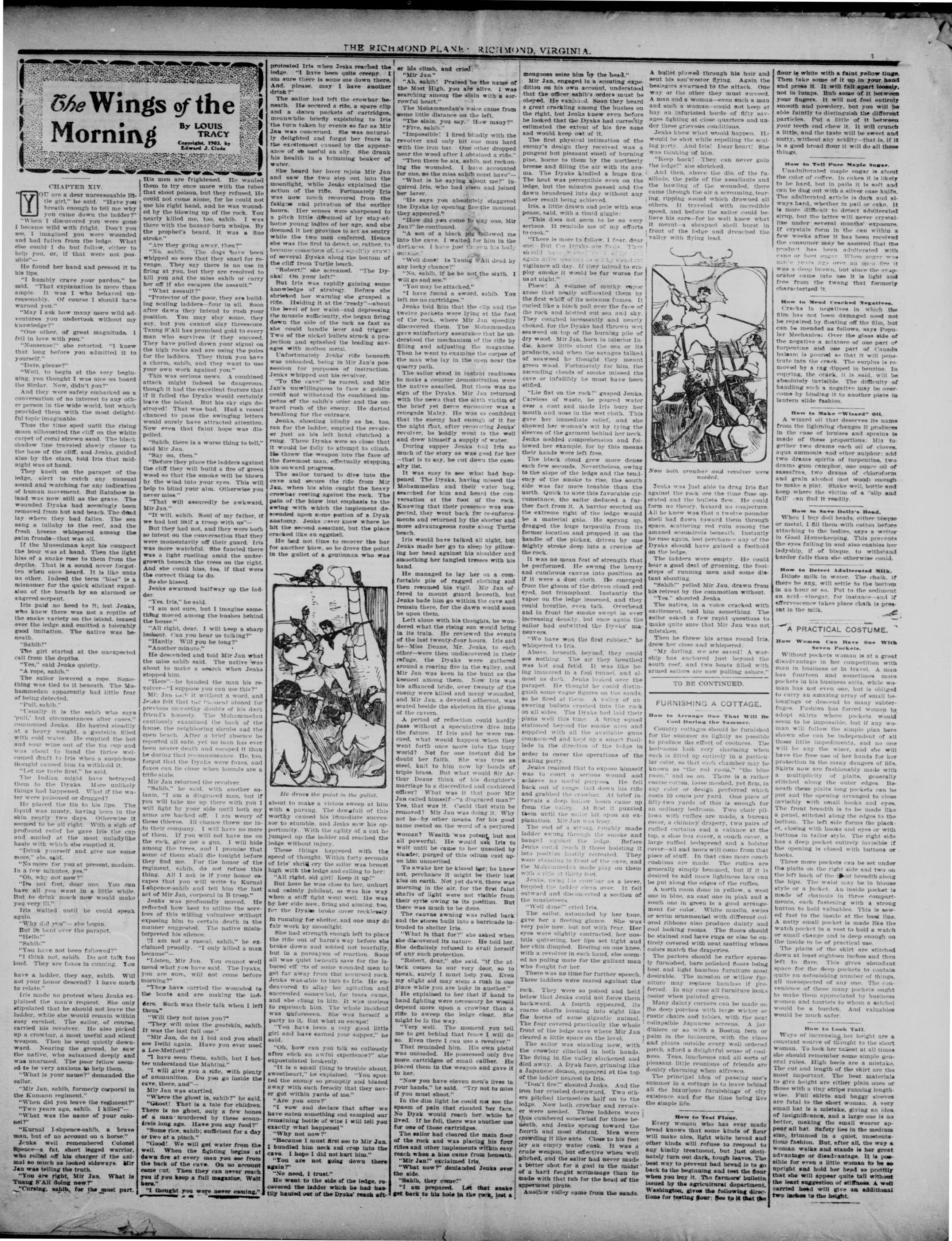
The Wings of the Morning By LOUIS TRACY Copyright, 1903, by Edward J. Cline
---
CHAPTER XIV
"YOU are a dear unreasonable little girl," he said. "Have you breath enough to tell me why you came down the ladder?" "When I discovered you were gone I became wild with fright. Don't you see, I imagined you were wounded and had fallen from the ledge. What else could I do but follow, either to help you, or, if that were not possible"— He found her hand and pressed it to his lips. "I humbly crave your pardon," he said. "That explanation is more than ample. It was I who behaved unreasonably. Of course I should have warned you." "May I ask how many more wild adventures you undertook without my knowledge?" "One other, of great magnitude. I fell in love with you." "Nonsense!" she retorted. "I knew that long before you admitted it to yourself."
"Date, please?"
"Well, to begin at the very beginning, you thought I was nice on board the Sirdar. Now, didn't you?"
And they were safely embarked on a conversation of no interest to any other person in the wide world, but which provided them with the most delightful topic imaginable.
Thus the time sped until the rising moon silhouetted the cliff on the white carpet of coral strewn sand. The black shadow line traveled slowly closer to the base of the cliff, and Jeaks, guided also by the stars, told Iris that midnight was at hand.
They knelt on the parapet of the ledge, alert to catch any unusual sound and watching for any indication of human movement. But Rainbow island was now still as the grave. The wounded Dyaks had seemingly been removed from hut and beach. The dead lay where they had fallen. The sea sang a lullaby to the reef, and the fresh breeze whispered among the palm fronds—that was all.
If the Mussulman kept his compact the bour was at hand. Then the light hiss of a snake rose to them from the depths. That is a sound never forgotten when once heard. It is like unto no other. Indeed the term "hiss" is a misnomer for the quick sibilant expulsion of the breath by an alarmed or angered serpent.
Iris paid no heed to it; but Jenks, who knew there was not a reptile of the snake variety on the island, leaned over the ledge and emitted a tolerably good imitation. The native was beneath.
"Sahib!"
The girl started at the unexpected call from the depths.
"Yes," said Jenks quietly.
"A rope, sahib."
The sailor lowered a rope. Something was tied to it beneath. The Mohammeden apparently had little fear of being detected.
"Pull, sahib."
"Usually it is the sahib who says 'pull,' but circumstances after cases' communed Jenks. He hauled steadily at a heavy weight, a goatskin filled with cold water. He emptied the hot and sour wine out of the tin cup and was about to hand the thrice welcomed draft to Iris when a suspicious thought caused him to withhold it.
"Let me taste first," he said.
The Indian might have betrayed them to the Dyaks. More unlikely things had happened. What if the water were poisoned or drugged?
He placed the tin to his lips. The liquid was musty, having been in the skin nearly two days. Otherwise it seemed to be all right. With a sigh of profound relief he gave Iris the cup and smiled at the most unladylike haste with which she emptied it.
"Drink yourself and give me some more," she said.
"No more for you at present, madam. In a few minutes, yes."
"Do not fret, dear one. You can have all you want in a little while. But to drink much now would make you very ill."
Iris waited until he could speak again.
"Why did you"—she began.
But he bent over the parapet.
"Hello."
"Sahib."
"You have not been followed?"
"I think not, sahib. Do not talk too loud. They are foxes in cunning. You have a indder, they say, sahib. Will not your honor descend? I have much to relate."
Iris made no protest when Jenks explained the man's request. She only stipulated that he should not leave the ladder, while she would remain within easy carrot. The sailor, of course, carried his revolver. He also picked up a crowbar, a most useful and silent weapon. Then he went quietly downward. Nearing the ground, he saw the native, who salaamed deeply and was unarmed. The poor fellow seemed to be very anxious to help them.
"What is your name?" demanded the sailor.
"Mir Jan, sahib, formerly corporal in the Kumaon regiment."
"When did you leave the regiment?"
"Two years ago, sahib. I killed"—
"What was the name of your colonel?"
"Kurnal I-shpence-sahib, a brave man, but of no account on a horse."
Jenks well remembered Colonel Spence—a fat, short legged warrior, who rolled off his charger if the animal so much as looked sideways. Mir Jan was telling the truth.
"You are right, Mir Jan. What is Tuang S'All doing now?"
"Cursing, sahib, for the most part.
Copyright, 1903, by Edward J. Clode
His men are frightened. He wanted them to try once more with the tubes that shoot poison, but they refused. He could not come alone, for he could not use his right hand, and he was wounded by the blowing up of the rock. You nearly killed me, too, sahib. I was there with the bazaar-born whelps. By the prophet's beard, it was a fine stroke."
"Are they going away, then?"
Are they going away, then?
"No, sahib. The dogs have been whipped so sore that they snarl for revenge. They say there is no use in firing at you, but they are resolved to kill you and the miss sahib or carry her off if she escapes the assault."
"What assault?"
"Protector of the poor, they are building scaling ladders—four in all. Soon after dawn they intend to rush your position. You may slay some, they say, but you cannot slay threescore. Taung S'All has promised gold to every man who survives if they succeed. They have pulled down your signal on the high rocks and are using the poles for the ladders. They think you have a charm, sahib, and they want to use your own work against you."
This was serious news. A combined attack might indeed be dangerous, though it had the excellent feature that if it failed the Dyaks would certainly leave the island. But his sky sign destroyed! That was bad. Had a vessel chanced to pass the swinging letters would surely have attracted attention. Now even that faint hope was dispelled.
"Sahib, there is a worse thing to tell," said Mir Jan.
"Say on, then."
"Before they place the ladders against the cliff they will build a fire of green wood so that the smoke will be blown by the wind into your eyes. This will help to blind your aim. Otherwise you never miss."
"That will assuredly be awkward, Mir Jan."
"It will, sahib. Soul of my father, if we had but a leaf a troop with us"—
But they had not, and they were both so intent on the conversation that they were momentarily off their guard. Iris was more watchful. She fancied there was a light rustling amid the undergrowth beneath the trees on the right. And she could hiss, too, if that were the correct thing to do.
So she hissed.
Jenks swarmed halfway up the ladder.
"Yes, Iris," he said.
"I am not sure, but I imagine something moved among the bushes behind the house."
"All right, dear. I will keep a sharp lookout. Can you hear us talking?"
"Hardly. Will you be long?"
"Another minute."
He descended and told Mir Jan what the miss sahlib said. The native was about to make a search when Jenks stopped him.
"Here"—he handed the man his revolver. "I suppose you can use this?" Mr. Jan took it without a word, and Jeaks felt that the recipient atoned for previous unworthy doubts of his dark friend's honesty. The Mohammedan cautiously examined the back of the house, the neighboring shrubs and the open beach. After a brief absence he reported all safe, yet no man has ever been nearer death and escaped it than he during that reconnoissance. He, too, forgot that the Dyaks were foxes, and foxes can lie close when hounds are a trifle stale. Mir Jan returned the revolver.
"Sahib," he said, with another saaam. "I am a disgraced man, but if you will take me up there with you I will fight by your side until both my arms are hacked off. I am weary of these thieves. I will chance threw me into their company. I will have no more of them. If you will not have me on the rock, give me a gun. I will hide among the trees, and I promise that some of them shall die tonight before they find me. For the honor of the regiment, sahib, do not refuse this thing. All I ask is if your honor escapes that you will write to Kurnal I-spence-sahib and tell him the last act of Mir Jan, corporal in B troop."
Jenks was profoundly moved. He reflected how best to utilize the services of this willing volunteer without exposing him to certain death in the manner suggested. The native misinterpreted his silence.
"I am not a rascal, sahib," he exclaimed proudly. "I only killed a man because"—
"Listen, Mir Jan. You cannot well mend what you have said. The Dyaks, you are sure, will not come before morning?"
"They have carried the wounded to the boats and are making the ladders. Such was their talk when I left
ders. Such was their talk when I left them."
"Will they not miss you?"
"They will miss the goatskin, sahib. It was the last full one."
"Mir Jan, do as I bid and you shall see Delhi again. Have you ever used a Lee-Metford?"
"I have seen them, sahib, but I better understand the Mahtini."
"I will give you a rifle, with plenty of ammunition. Do you go inside the cave, there, and"
Mr Jan was startled.
"Where the鬼 is, sabib?" he said.
"Ghost! That is a tale for children.
There is no ghost, only a few bones
of a man murdered by these scoundrels long ago. Have you any food?"
"Some rice, sabib; sufficient for a day
or two at a pinch."
"Good! We will get water from the
well. When the fighting begins at
dawn fire at every man you see from
the back of the cave. On no account
come out. Then they can never reach
you if you keep a full magazine. Wait
here."
"I thought you were never coming."
THE RICHMOND PLANE: RICHMOND, VIRGINIA
protested Iris when Jeeks reached the lodge. "I have been quite creepy. I am sure there is some one down there. And, please, may I have another drink?" The sailor had left the crowbar beneath. He secured a ride, a spure clip and a dozen packets of cartridges, meanwhile briefly explaining to Iris the turn taken by events so far as Mir Jan was concerned. She was naturally delighted and forgot her fears in the excitement caused by the appearance of sb useful an ally. She drank his health in a brimming beaker of water.
She heard her lover rejoin Mir Jan and saw the two step out into the moonlight, while Jeksa explained the action of the rifle. Fortunately Iris was now much recovered from the fatigue and privation of the earlier hours. Her senses were sharpened to a pitch little dreamed of by stay-at-home young ladies of her age, and she deemed it her province to act as sentry while the two men conferred. Hence she was the first to detect, or rather, to become conscious of the scorchy crawl of several Dyaks along the bottom of the cliff from Turtle beach. "Robert!" she screamed. "The Dyaks! On your left!"
But Iris was rapidly gaining some knowledge of strategy. Before she shrieked her warning she grasped a rifle. Holding it at the "ready"—about the level of her waist—and depressing the muzzle sufficiently, she began firing down the side of the rock as fast as she could handle lever and trigger. Two of the nickel bullets struck a projection and splashed the leading savages with molten metal.
Unfortunately Jenks' rifle beneath was unloaded, being in Mir Jan's possession for purposes of instruction. Jenks whipped out his revolver.
"To the cave!" he roared, and Mir Jan's unwillingness to face a goblin could not withstand the combined impetus of the saihib's order and the onward rush of the enemy. He darted headlong for the entrance.
Jenks, shooting blindly as he, too, ran for the ladder, emplied the revolver just as his left hand clutched a rung. Three Dyaks were so close that it would be folly to attempt to climb. He threw the weapon into the face of the foremost man, effectually stopping his onward progress.
The sailor turned to dive into the cave and secure the rife from Mir Jan, when his shin caught the heavy crowbar resting against the rock. The pain of the blow lent emphasis to the swing with which the implement descended upon some portion of a Dyak anatomy. Jenks never knew where he hit the second assailant, but the place cracked like an eggshell.
He had not time to recover the bar for another blow, so he drove the point in the gullet of a gentleman who was
A
He drove the point in the gullet.
about to make a vicious sweep at him
with a parang. The downfall of this
worthy caused his immediate successor
to stumble, and Jekks saw his opportunity. With the agility of a cat he jumped up the ladder and reached the ledge without injury.
These things happened with the speed of thought. Within forty seconds of Iris' shrill cry the sailor was breast high with the ledge and calling to her:
"All right old girl! Keep it up!"
But here he was close to her, unhurt and calmly jubilant, as was his way when a stiff fight went well. He was by her side now, firing and aiming, too, for the Dyaks broke cover recklessly in running for shelter, and one may do fair work by moonlight.
She had strength enough left to place the rifle out of harm's way before she broke down and sobbed not tearfully, but in a paroxysm of reaction. Soon all was quiet beneath save for the labored efforts of some wounded men to get far away from that accursed rock. Jenks was able to turn to Iris. He endeavored to allay her agitation and succeeded somewhat, for tears came, and she clung to him. It was useless to reproach him. The whole incident was unforeseen. She was herself a party to it. But what an escape!
"You have been a very good little girl and have earned your supper," he said.
"Oh, how can you talk so callously after such an awful experience?" she expostulated brokenly.
"It is a small thing to trouble about, sweetheart," he explained. "You spotted the enemy so promptly and blazed away with such ferocity that they never got within yards of me."
"Are you sure?"
"I vow and declare that after we have eaten something and sampled our remaining bottle of wine I will tell you exactly what happened"
"Why not now?"
"Because I must first see to Mir Jan. I bundled him neck and crop into the cave. I hope I did not hurt him."
"You are not going down there again?"
"No need, I trust."
He went to the side of the ledge, recovered the ladder which he had hastily hauled out of the Draks' reach aff
er his climb, and cried:
"Mir Jan."
"Ah, sahib! Praised be the name of the Most High, you are alive. I was searching among the slain with a sorrowful heart."
The Mohammedan's voice came from some little distance on the left.
"The slain, you say. How many?"
"Five, sahib."
"Impossible! I fired blindly with the revolver and only hit one man hard with the iron bar. One other dropped near the wood after I obtained a ride."
"Then there be six, sahib, not reckoning the wounded. I have accounted for one, so the miss sahib must have"—
"What is he saying about me?" inquired Iris, who had risen and joined her lover.
"He says you absolutely staggered the Dyaks by opening fire the moment they appeared."
"How did you come to slay one, Mir Jan?" he continued.
"A son of a black pig followed me into the cave. I waited for him in the darkness. I have just thrown his body outside."
"Well done! Is Taung S Ali dead by any lucky chance?"
"No, sahib, if he be not the sixth. I will go and see."
"You may be attacked."
"I have found a sword, sahib. You left me no cartridges."
Jenks told him that the clip and the twelve packets were lying at the foot of the rock, where Mir Jan speedily discovered them. The Mohammedan gave satisfactory assurance that he understood the mechanism of the rife by filling and adjusting the magazine. Then he went to examine the corpse of the man who lay in the open near the quarry path.
The sailor stood in instant readiness to make a counter demonstration were the native assailed. But there was no sign of the Dyaks. Mir Jan returned with the news that the sixth victim of the brief yet fierce encounter was a renegade Malay. He was so confident that the enemy had enough of it for the night that, after recovering Jenks' revolver, he boldly went to the well and drew himself a supply of water. During supper Jenks told Irfs so much of the story as was good for her—that is to say, he cut down the casual list. It was easy to see what had happened. The Dyaks, having missed the Mohammedan and their water bag, searched for him and heard the conversation at the foot of the rock. Knowing that their presence was suspected, they went back for re-enforcements and returned by the shorter and more advantageous route along Turtle beach.
Iris would have talked all night, but Jenks made her go to sleep by pillowing her head against his shoulder and smoothing her tangled tresses with his hand.
He managed to lay her on a comfortable pile of ragged clothing and then resumed his vigil. Mir Jan offered to mount guard beneath, but Jenks bade him go within the cave and remain there, for the dawn would soon be upon them.
Left alone with his thoughts, he wondered what the rising sun would bring in its train. He reviewed the events of the last twenty-four hours. Iris and he—Miss Deane, Mr. Jenks, to each other—were then undiscovered in their refuge, the Dyaks were gathered around a roaring fire in the valley, and Mir Jan was keen in the hunt as the koenest among them. Now Iris was his afflianced bride, over twenty of the enemy were killed and many wounded, and Mir Jan, a devoted adherent, was seated beside the skeleton in the gloom of the cavern.
A period of reflection could hardly pass without a speculative dive into the future. If Iris and he were rescued, what would happen when they went forth once more into the busy world? Not for one instant did he doubt her faith. She was true as steel, knit to him now by bonds of triple brass. But what would Sir Arthur Deane think of his daughter's marriage to a discredited and cashiered officer? What was it that poor Mir Jan called himself "a disgraced man"? Yes, that was it. Could that stain be removed? Mir Jan was doing it. Why not be-by other means, for his good name rested on the word of a perjured woman? Wealth was potent, but not all powerful. He would ask Iris to wait until he came to her unsoiled by slander, purged of this odium cast up on him unmerited.
To awake her he kissed her; he knew not, perchance it might be their last kiss on earth. Not yet dawn, there was morning in the air, for the first faint shafts of light were not visible from their eyrtie owing to its position. But there was much to be done.
The canvas awning was rolled back and the stores built into a barricade intended to shelter Iris.
"What is that for?" she asked when she discovered its nature. He told her. She definitely refused to avail herself of any such protection.
"Robert, dear," she said, "if the attack comes to our very door, so to speak, surely I must help you. Even my slight aid may stem a rush in one place while you are busy in another."
He explained to her that if hand to hand fighting were necessary he would depend more upon a crowbar than a rifle to sweep the ledge clear. She might be in the way.
"Very well. The moment you tell me to get behind that fence I will do. Even there I can use a propol."
That reminded him. His own pistol was unloaded. He possessed only five more cartridges of small caliber. He placed them in the weapon and gave it to her.
"Now you have eleven men's lives in your hands," he said. "Try not to miss if you must shoot."
In the dim light he could not see the spasm of pain that clouded her face. No Dyak would reach her while he lived. If he fell, there was another use for one of those cartridges.
The sailor had cleared the main floor of the rock and was placing his four rifles and other implements within easy reach when a hiss came from beneath.
"Mir Jan!" exclaimed Iris.
"What now?" demanded Jenka over the side.
"Sabib, they come!"
"I am prepared. Let that snake get back to his hole in the rock. lest a
Mir Jan, engaged in a scouting expedition on his own account, understood that the officer sahib's orders must be obeyed. He vanished. Soon they heard a great crackling among the bushes on the right, but Jenks knew even before he looked that the Dyaks had correctly estimated the extent of his fire zone and would keep out of it.
The first physical intimation of the enemy's design they received was a pungent but pleasant smell of burning pine, borne to them by the northerly breeze and filling the air with its aroma. The Dyaks kindled a huge fire. The heat was perceptible even on the ledge, but the minutes passed and the dawn broadened into day without any other result being achieved.
Iris, a little drawn and pale with suspense, sald, with a timid giggle: "This does not seem to be so very serious. It reminds me of my efforts to cook."
"There is more to follow. I fear, dear one. But the Deaks are foolish. They should have waited until night and again after wearing it to the constant vigilance all day. If they intend to employ smoke it would be far worse for us at night."
Phew! A volume of murky vapor arose that nearly suffocated them by the first whiff of its noisome fumes. It curled like a black pall over the face of the rock and blotted out sea and sky. They coughed incessantly and nearly choked, for the Dyaks had thrown wet seaweed on top of the burning pile of dry wood. Mir Jan, born in interior India, knew little about the sea or its products, and when the savages talked of seaweed he thought they meant green wood. Fortunately for him, the ascending clouds of smoke missed the cave or infallibly he must have been stifed.
"Lie flat on the rock" gasped Jenks. Careless of waste, he poured water over a coat and made irls bury her mouth and nose in the wet cloth. This gave her immediate relief, and she showed her woman's wit by tying the sleeves of the garment behind her neck. Jenks nodded comprehension and followed her example, for by this means their hands were left free.
The black cloud grew more dense each few seconds. Nevertheless, owing to the slope of the ledge and the tendency of the smoke to rise, the south side was far more tenable than the north. Quick to note this favorable circumstance, the sailor deduced a further fact from it. A barrier erected on the extreme right of the ledge would be a material gain. He sprung up, dragged the huge tarpaulin from its former location and propped it on the handle of the pickax, driven by one mighty stroke deep into a crevice of the rock.
It was no mean feat of strength that he performed. He swung the heavy and cumbrous canvas into position as if it were a dust cloth. He emerged from the gloom of the driven cloud redeyed, but triumphant. Instantly the vapor on the ledge lessened, and they could breathe, even talk. Overhead and in front the smoke swept in ever increasing density, but once again the sailor had outwitted the Dyaks' maneuvers. "We have won the first rubber," he whispered to Iris.
Above, beneath, beyond, they could see nothing. The air they breathed was hot and fetid. It was like being immured in a foul tunnel, and almost as dark. Jenks looked over the parapet. He thought he could distinguish some vague figures on the sands, so he fired at them. A volley of answering bullets crashed into the rock on all sides. The Dyaks had laid their plans well this time. A firing squad stationed beyond the smoke area and supplied with all the available guns commenced and kept up a smart fusillade in the direction of the ledge in order to cover the operations of the
order to cover the operations of the scaling party.
Jenks realized that to expose himself was to court a serious wound and achieve no useful purpose. He fell back out of range, laid down his rifle and grabbed the crowbar. At brief intervals a deep hollow boom came up from the valley. At first it puzzled them until the sailor hit upon an explanation. Mir Jan was busy.
The end of a strong, roughly made ladder swing through the smoke and banged against the ledge. Before Jenks could reach it those holisting it into position hastily retreated. They were standing in front of the cave, and the Mohammed made play on them with a rifle at thirty feet.
Jenks, using his crowbar as a lever, topped the ladder clean over. It fell outward and disconcerted a section of the musketeers.
"Well done!" cried Iris.
The sailor, astounded by her tone, gave her a fleeting glance. She was very pale now, but not with fear. Her eyes were slightly contracted, her nostrils quivering, her lips set tight and her chin dimpled. Resting on one knee, with a revolver in each hand, she seemed no puling mate for the gallant man who fought for her.
There was no time for further speech. Three hadders were reared against the rock. They were so polished and held below that Jenks could not force them backward. A fourth appeared, its coarse shafts looming into sight like the horns of some gigantic animal. The four covered practically the whole front of the ledge save where Mir Jan cleared a little space on the level.
The sailor was standing now, with the crowbar clinched in both hands. The firing in the valley slackened and died away. A Dyak face, grinning like a Japanese demon, appeared at the top of the ladder nearest to its.
"Don't fire!" shouted Jenks. And the iron bar crushed downward. Two others pitched themselves half on to the ledge. Now both crowbar and revolver were needed. Three ladders were thus cumbered somewhat for those beneath, and Jenks sprang toward the fourth and most distant. Men were crowding it like ants. Close to his feet lay an empty water cask. It was a crude weapon, but effective when well pitched, and the sailor had never made a better shot for a goal in the midst of a hard fought scrimmage than he made with that tub for the head of the uppermost pirate. Another volley came from the sands.
A bullet plowed through his hair and sent his son'wester flying. Again the besiegers swarmed to the attack. One way or the other they must succeed. A man and a woman—even such a man and such a woman—could not keep at bay an infuriated horde of fifty savages fighting at close quarters and under these grievous conditions. Jenks knew what would happen. He would be shot while repelling the scaling party. And Iris! Dear heart! She was thinking of him. "Keep back! They can never gain the ledge!" she shrieked.
And then, above the din of the fusillade, the yells of the assailants and the bawling of the wounded, there came through the air a screaming, tearing, ripping sound which drowned all others. It traveled with incredible speed, and before the sailor could believe his ears—for he well knew what it meant a shrapnel shell burst in front of the ledge and drenched the valley with flying lead.
TAROT
Now both crouchar and revolver were needed.
Jenks was just able to drag Iris flat against the rock are the time fuse operated and the bullets flew. He could form no theory, hazard no conjecture. All he knew was that a twelve pounder shell had flown toward them through space, scattering red run among the amazed scoundrels beneath. Instantly he rose again, lest perchance any of the Dyaks should have gained a foothold on the ledge.
The ladders were empty. He could hear a good deal of graning, the footsteps of running men and some distant shouting.
“Sahib!” yelled Mir Jan, drawn from his retreat by the commotion without.
“Yes,” shouted Jenks.
The native, in a voice cracked with excitement, told him something. The sailor asked a few rapid questions to make quite sure that Mir Jan was not mistaken.
Then he threw his arms round Iris, drew her close and whispered:
"My darling, we are saved! A warship has anchored just beyond the south reef, and two boats filled with armed sailors are now pulling ashore."
TO BE CONTINUED
FURNISHING A COTTAGE.
How to Arrange One That Will Be Cool During the Summer.
Country cottages should be furnished for the summer as lightly as possible to produce the effect of coolness. The bedrooms look very charming when each is fitted up entirely in a particular color, so that each chamber may be known as "the red room," "the blue room," and so on. There is a rather coarse cotton, loose mesh, yet firm, in any color or design preferred which costs 10 cents per yard. One piece of fifty-two yards of this is enough for an ordinary bedroom. Two chair pillows with ruffles are made, a bureau cover, a chimney drapery, two pairs of ruffled curtains and a valance at the top, a shoe box cover, a couch cover, a large ruffled bedspread and a bolster cover-all and more will come from that piece of stuff. In that case more couch cushions are made. The ruffles are generally simply hemmed, but if it is desired to add more lightness lace can be put along the edges of the ruffles.
A north room done in yellow, a west one in blue, an east one in pink and a south one in green is a good arrangement for color. White muslin, swiss or scrim ornamented with different colored ribbons also produce dainty and cool looking rooms. The floors should be stained and have rugs or else be entirely covered with neat matting whose colors match the draperies. The parlors should be rather sparsely furnished, bare polished floors being best and light bamboo furniture most desirable. The mission or willow furniture may replace bamboo if preferred. In any case all furniture looks cooler when painted green.
Many dainty corners can be made on the deep porches with large wicker or rustic chairs and tables, with the neat collapsible Japanese screens. A jardiniere or so with a Boston fern or palm in the inclosure, with the vines and plants outside every well ordered porch, afford a delightful sense of coolness. Teas, luncheons and all sorts of pleasant little reunions of friends are doubly charming when alfresco.
The principal idea of passing one's summer in a cottage is to leave behind all the luxurious furnishings of city existence and for the time being live the simple life.
How to Test Flonr
Every woman who has ever made bread knows that some kinds of flour will make nice, light white bread and other kinds will refuse to respond to any kindly treatment, but just obstinately turn out dark, tough leaves. The best way to prevent bad bread is to go back to the beginning and test the flour when you buy it. The farmers' bulletin issued by the agricultural department, Washington, gives the following directions for testing flour: See to it that the
flour is white with a faint yellow tinge. Then take some of it up in your hand and press it. It will fall apart loosely not in lumps. Rub some of it between your fingers. It will not feel entirely smooth and powdery, but you will be able faintly to distinguish the different particles. Put a little of it between your teeth and chew it. It will crunch a little, and the taste will be sweet and nutty, without any acidity—that is, if it is a good bread flour it will do all these things.
How to Tell Pure Maple Sugar.
Unadulterated maple sugar is about the color of coffee. In cakes it is likely to be hard, but in pails it is soft and can be dug out with a silver case knife. The adulterated article is dark and always hard, whether in pail or cake. It is more difficult to detect adulterated sipur, but the latter will never crystallize under several months' exposure. If crystals form in the can within a few weeks after it has been received the consumer may be assured that the product has been adulterated with cane or best sugar. When sugar was made years ago over an open fire it was a deep brown, but since the evaporator came into use it is light and free from the twang that formerly characterized it.
How to Mend Cracked Negatives.
Cracks in negatives in which the film has not been damaged need not be repaired by floating off the film, but can be mended as follows, says Popular Mechanics: Over the glass side of the negative a mixture of one part of turpentine and one part of Canada balsam is poured so that it will penetrate into the crack. The surplus is removed by a rag dipped in benzine. In copying, the crack, it is said, will be absolutely invisible. The difficulty of handling such a negative may be overcome by blinding it to another plate in luntern slide fashion.
How to Make "Wizard" Oil
A wizard oil that deserves its names from the lightning changes it produces in the case of bruises and sprains is made of these proportions: Mix together two drams each oil of cloves, aqua ammonia and ether sulphur; add two drams spirits of turpentine, two drams gum camphor, one ounce oil of sassafras, two drums of chloroform and grain alcohol (not wood) enough to make a pint. Shake well, bottle and keep where the victim of a "slip and fall" can find it readily.
How to save Dollin's Head
When I buy doll heads, either bisque or metal, I fill them with cotton before attaching to the bodies, says a writer in Good Housekeeping. This prevents the eyes falling in and also enables her ladyship, if of bisque, to withstand harder falls than she otherwise could.
How to Detect Adulterated Milk
A PRACTICAL COSTUME.
How Women Can Have One With Seven Pockets.
Without pockets woman is at a great disadvantage in her competition with man in business or in travel. A man has fourteen and sometimes more pockets in his business suits, while woman has not even one, but is obliged to carry an amazing array of small belongings or descend to many subterfuges. Fashion has forced women to adopt skirts where pockets would seem to be impossible, but if any woman will follow the simple plan here shown she can be independent of all those little impediments, and no one will be any the wiser, and she will have the free use of her hands for her protection in the many dangers of life. Skirts now are fashionably made with a multiplicity of plaits, generally stitched along the outer edges. Below these plaits long pockets can be put and the opening arranged to close invisibly with small hooks and eyes. The front breadth is to be made like a panel, stitched along the edges to the bottom. The left side forms the placket, closing with hooks and eyes or with buttons in tailor style. The right side has a deep pocket entirely invisible if the opening is closed with buttons or hooks.
Three more pockets can be set under the plaits on the right side and two on the left back of the joint breadth along the hips. The waist may be in brouse style or a jacket. An inside pocket is made of chamois in three compartments, each fastening with a strong button to hold valuables. This is sewed fast to the inside at the bust line. A nutty small pocket is made like the watch pocket in a vest to hold a watch or small change and is deep enough on the inside to be of practical use.
The plaits of the skirt are stitched down at least eighteen inches and then left to flare. This gives abundant space for the deep pockets to contain quite an astonishing number of things, all unsuspected of any one. The convenience of these many pockets ought to make them appreciated by business women and tourists to whom a satchel would be a burden. And valuables would be much safer.
How to Look Tall
Ways of increasing her height are a constant source of thought to the short woman. To look her tallest at all times she should remember some simple general rules. High heels are a mistake. The cut and length of the skirt are the most important. The best materials to give height are either plain ones or those with a tiny stripe running lengthwise. Full skirts and baggy sleeves are fatal to the short woman. A very small hat is a mistake, giving an idea of insignificance, and a large one is no better, making the small wearer appear all hat. Safety lies in the medium size, trimmed in a quiet, unostentatious fashion. But, after all, the way a woman walks and stands is her great advantage or disadvantage. It is possible for even a little woman to be so upright and hold her head so prettily that she will appear quite tall without the least suggestion of stiffness. A well carried head will give an additional two inches to the height.
METAL PLANET
Published every Saturday by JOHN MITCHELL,
JR., at 811 North 4th Street, Richmond, Va.
JOHN MITCHELL, JR., - EDITOR.
All communications intended for publication
should be sent so as to reach us by Wednesday.
TERMS IN ADVANCED
One Copy, one year, $1.50
One Copy, eight months, 1.00
One Copy, six months, .90
One Copy, four months. .50
One Copy, three months, .40
Single Copy . .06
For one inch, one insertion, 0.20
For one inch, each subsequent insertion, 0.40
For two inches, three months, 0.60
For two inches, six months, 10.00
For two inches, nine months, 14.00
For two inches, twelve months, 30.00
Marriage and Funeral Notices, one inch, 0.50
Standing and Transient Notices per line, 0.10
PROSTAGE STAMPS OF A HIGHER DEMONATION THAN TWO CENTS NOT RECEIVED ON SUBSCRIPTIONS.
THE PLANET is issued weekly. The subscription price is $1.50 per year in advance.
There are four ways by which money can be sent by mail at our risk—In the Post Office Money Order, by Bank Check or Draft, or an Express Money Order, and when none of these can be procured in a Registered Letter.
MONEY ORDER.—You can buy a Money Order at your Post-Office, payable at the Richmond Post-Office, and we will be responsible for its safe arrival.
EXPRESS MONEY ORDERS can be obtained at any office of the American Express Co., the United States Express Company, and the Well's Fargo and Co. Express Company. We will be responsible for money sent by any of these companies. The Express Money Order is a safe and convenient way for forwarding money.
REGISTERED LETTER.—If a money Order Post Office or an Express Office is not within the same address, the letter you wish to send us on payment of the Letter you wish to send us on payment of the money. Then, if the letter is lost or stolen, it cannot be returned, you can send money in this manner at our office.
We cannot be responsible for money sent in letters in any other way than one of the four ways mentioned above. If you send your monogram in another way, you must do it as your own risk.
REWARDS, ETA.—If you do not want THE PLANET continued for another year after your letter has been sent, you may not send the Postal Card to discontinue it. The courts have decided that subscribers to newspaper, who do not order their paper discontinued at the exit, are held liable for the payment of the subscription up to date when they order the paper discontinued.
COMMUNICATIONS.—When writing to us to renew your subscription or to discontinue your paper, you should give your name and address to us. Otherwise we cannot fix your name on our books.
ORANGE OF ADDRESS.—In order to change the address of a subscriber, we must be sent the former as well as the present address.
Entered at the Post-Office at Richmond, Va., as second-class matter.
SATURDAY. JULY 8, 1905.
BOTH DRUNK.
The colored people were disfranchised in Virginia with the avowed purpose of purging the electorate and guaranteeing the election to office of competent officials. Appomattox county, Virginia was one of the places alleged to have been thus purified. The following telegraphic report will explain itself.
LYNCHBURG, VA, June 27—Constable R. M. Mann, of Apponattox county, came to Lynchburg this morning to take a negro arrested here on charge of an attempted criminal assault in that county, back to Apponattox, but before he got out of the city he was locked up on the charge of being drunk. The constable and negro were loaded into the patrol wagon and hauled together through the streets to police headquarters. At the station Mann could not produce the key to the handcuffs on the negro, and the police called, Vanos, the handcuff manipulator at the vandeville show at the park, and he removed the cuffs quickly.
This afternoon Deputy Sheriff Mc Kinney came from Appomattox for the negro. He bailed Mann out and took him along home with him. The negro is charged with attempting an assault on a Mrs. Martin, for whom he worked. The crime is alleged to have taken place last Saturday. He was captured, but escaped, and was recaptured here at 3 o'clock this morning.
Let us suppose that this constable had been colored instead of white and it would have been manifest to every unbeliever that every colored man would have been held responsible for this disgraceful exhibition the like of which has not been recorded in a lifetime.
Read the extract again and draw your own conclusions.
HORRIBLE DEPRAVITY.
A mob of white men entered the jail at Watkinsville. Georgia Thursday morning, June 29th, 1905 at 2 o'clock and willfully and maliciously lynched one white man and seven colored ones, by shooting them to death. One other colored man, although badly wounded, escaped by feigning death. This is indeed a red and barbarous record and not only that section of Georgia, but the entire country is aroused over the murders.
The charges against the prisoners may be briefly stated as follows:
Lon J. Aycock, white, charged with the murder of F. M. Holbrook white, and wife, of Oconee county, Rich Robinson. Lewis Robinson. Claud Elder, charged with the murder of the Holbrook couple; Sandy
Price, a young colored man, charged with an assault upon the person of Mrs. Weldon Dooley; Rich Allen, colored, convicted and under sentence of death for the murder of Will Robertson, another colored man; Gene Verby, colored, charged with the burglary of a rifle from Mr. Mar shall, and Bob Harris, colored, charged with shooting another colored man.
The responsibility of the Sheriff admits of no question. He had locked these men in the prison and they had no means to escape or weapons with which to defend themselves. They were slaughtered by cowards and butchered in a manner that even cattle might envy. But the Sheriff thought, and what did he say he thought—that all danger of lynching had passed and he went away and left in charge a cowardly jailor, who thought more of his own skin than he did the lives of eight human beings, whom he had been left to protect and defend.
The Governor of Georgia is doing his duty and a reward has been offered for the arrest and conviction of the lynchers. We understand this to mean five hundred dollars reward for the arrest, and conviction of any one of them and as many five hundred dollars will be paid as there are men arrested and convicted. The best way to stop lynching is to shoot lynchers at the time they are engaged in their unlawful practices. Every conservative law-abiding citizen, white or colored should own a shot gun or a rifle. When the lynchers learn to their sorrow that they are taking the risk of going up against an armed camp of law-abiding white and colored citizens, interest in this kind of business will wane and the vocation of these kind of murderers will pass away forever.
We shall deal further with this horrible tragedy in our next issue.
FOURTH OF JULY VICTIMS
Four Killed, Hundreds Injured, Two Fatally, In Philadelphia.
Philadelphia, July 5—Four persons dead, two probably fatally injured and several hundred others wounded, is the result of the Independence Day celebration in this city.
The most sensational tragedy of the holiday was the killing of a man by Albert Londgren, a policeman, while the former was resisting arrest. The dead man is Michael Cleary. Cleary and a friend were celebrating the day, when they got into a fight with an Italian. Londgren stopped the fight and arrested Cleary and his companion. A crowd pounced on the policeman and were beating him, when he shot into the crowd, killing Cleary.
While sitting on the front steps of her home, Mrs. George Clemens was shot in the abdomen by a bullet, and died in a hospital last night.
Louis Ostrow, a 9-year-old boy, was killed almost instantly by a man who was examining a revolver.
A horse driven by Henry Black became frightened at the discharge of fireworks and ran away. Black was thrown under the wheels of the carriage in which he was riding and so badly hurt that he died a few hours later.
One of the two probably fatal accidents was that of a woman who was shot in the eye. The other case was that of a man who received a bullet in the abdomen. The shot was fired by a neighbor who had never before handled a revolver.
Boy's Eyes Blown Out.
New York, July 5. — Seven boys ranging in age from 4 to 14 years, were frightfully injured by the explosion of a can of powder from which they were loading a toy cannon in Wythe avenue, Brooklyn. The can, which held several pounds of powder, was lying open near the cannon, when a passing stranger, after lighting a cigar, threw away the match, which fell into the powder. A terrific explosion followed, hurling the lads in every direction and breaking windows in the street. Andrew Krecht, aged 13, who was stooping over the can to get a fresh charge at the moment the explosion occurred, had both eyes blown out and is not expected to live. All the other boys were badly burned and cut by flying fragments of the can.
Disemboweled By Fire Crackers
Wheeling, W. Va., July 5. — Mrs Robert Jenkins, of South Wheeling, was the victim of a horrible accident. She conducts a confectionery, and was sitting in front of the store, with a quantity of fire crackers in her lap when they exploded. The woman was disemboweled.
GERMAN GLEANINGS.
Germany is able to feed about nineteenth of her nearly 60,000,000 inhabitants on the products of her own soil. In three days 60,000 people inspected the gorgeous court train of the German crown princess betrothed while it was on view in Berlin. Because he had received notice to quit his lodgings a Berlin locksmith committed suicide by standing in the bucket of a well and dropping to the bottom. Germany has now an inland water system of 8,800 miles, of which 5,776 are natural rivers, 1,451 canalized streams and 1,753 canals. The federated governments have spent $110,000,000 on them in the last ten years, and a large further outlay is in prospect.
Baron Rosen Arrives
New York, July 5.—Baron Rosen, the new Russian ambassador to Washington, and one of the two Russian plenipotentiaries to the peace conference, arrived in this city on the ataser Kaiser Wilhelm II, accompanied by the Baroness Rosen and their daughter.
THE RICHMOND PLANET, RICHMOND, VIRGINIA
JOHN HAY
LAID TO REST
Funeral of Former Secretary of State
Held at Cleveland.
PRESIDENT AND CABINET THERE
Cleveland, July 5.—The funeral of
Secretary of State John Hay was held
here today, the ceremonies being of
the simplest character. President
Roosevelt, accompanied by his cabinet,
except Secretary Taft, who left for
the Philippines, and Elibu Root and
Paul Morton, attended the funeral.
M.
JOHN HAY.
There were many other distinguished men present, including members of congress and the diplomatic corps. The body was not exposed to public view.
A string of messenger boys delivered floral tributes at the home of Samuel Mather, a brother-in-law of Mrs. Hay. They came from all parts of the United States, and a number were sent by foreign countries. The flowers were taken from the house to the cemetery, where they were arranged about the grave while the services were being held in the chapel.
At 10 o'clock the funeral cortege left the chamber of commerce for the drive to the cemetery, five miles away. The services in the chapel were of the simplest description. A quartette composed of B. W. Willard, H. M. Whitney, E. G. Protheroe and Harry A. Cole first rendered the favorite hymn of M. Hay, Tonnyson's "Crossing the Bar;" an extract from the Scriptures was read by Rev. H. C. Haydn, who made a short prayer after the choir had sung "For All the Saints Who From Their Labors Rest." The body was then removed from the chapel and the funeral passed up the hill to the family lot, where the interment was made. The quartette sang "Still, Still With Thee," and the services were concluded by a short prayer and the benediction.
The illness which so weakened Mr. Hay's physical powers as to finally bring about death made itself apparent noticeably about last March. Tired and worn from the strain of overwork, he was ordered by his physicians to make a trip abroad in order to obtain special treatment and complete rest. A short time ago Mr. Hay returned to the United States much improved and there were prospects that he would recover. He had been at his summer home about a week, where he seemed to be getting better.
Short Sketch of His Career.
When Mr. Hay was appointed secretary of state in the cabinet of President McKinley the newspaper correspondents in Washington applied to him for a sketch of his life. He gave them the following:
"John Hay, secretary of state, was born at Salem, Ind. October 8, 1838, and he was graduated at Brown twenty years later. He studied law in Springfield, Ill., and in 1861 became assistant secretary to President Lincoln. He served through part of the Civil War as aide-de-camp under Generals Hunter and Glimore, with rank of major and assistant adjutant general, brevet lieutenant colonel and colonel. He was first assistant secretary of legation in Paris and in charge several times from 1865 to 1867, was diplomat in charge at Vienna 1867-68, secretary of legation at Madrid 1863-70, editorial writer for five years of the New York Tribune, first assistant secretary of state and ambassador to England. He is the author of "Pike County Ballads," "Caustillan Days," and part author of a life of Lincoln, written in conjunction with John G. Nicolay."
The brevity and modesty of this biography was typical of the man—a man whose career and achievements make large and important chapters in the history of his country.
As secretary of state in the cabinet of President McKinley, Mr. Hay accomplished three great results—in fact, made history and precedents that have no parallel in the records of diplomacy. By peaceful methods and without international friction he brought about the abrogation of the Clayton-Bulwer treaty, preserved the integrity of the Chinese empire and committed all the civilized nations of the world to the policy of the open door for commerce in all lands and under all flags.
By insisting on the maintenance of the Berlin treaty, he obtained their rights for the Hebrews in Roumania, and their further persecution was stopped.
He negotiated the Hay-Pauncefote treaty with England, resulting in the building of the Isthmian canal by the United States; also negotiated the Hay- Herran treaty relating to the canal. Through a treaty framed with Cuba, he obtained reciprocity between the United States and the new republic. Kept an armed force representing the powers from coercing Venezuela, and had the dispute referred to The Hague tribunal. Settled by treaty the Alaskan boundary controversy, which had been of many years' standing.
Did much to restrict field of hostilities in the Russo-Japanese war by his famous demand for the preservation of the "administrative entity" of the Chinese empire.
TAFT, BOTT OR CHOATE
One of These Three Likely to Succeed Hay.
Washington, July 3.—Former Secretary of War Elthu Root, Secretary of War Taft and Joseph H. Choate, late ambassador to England, are the men from whom will be chosen the successor to the late Secretary of State Hay, according to the best information obtainable in Washington. The fact that Secretary Taft acted as head of the State department during Mr. Hay's recent absence in Europe may be regarded as making it extremely probable that he will now be permanently transferred to the state department and a new man placed in charge of the war department. But this arrangement would necessitate the abandonment of Secretary Taft's trip to the Philippines, and on that account is open to strong objections.
J. H. MITCHELL GUILTY
Jury Returns Verdict Against U. S.
Senator From Oregon
Senator From Oregon.
Portland, Ore. July 5.—Amidst a din and clatter of fireworks, exploded in honor of the natal day of the country he had served as United States senator during 22 years of his life, John H. Mitchell listened to the words pronouncing him guilty of having violated that law which precluded him as a United States senator from accepting pay for practicing before the departments of the federal government.
As the word "guilty" was pronounced Senator Mitchell seemed as though turned to stone. The nervous stroking of his beard which had continued throughout the proceedings stopped. Not a muscle twitched until Judge Bennett arose and asked that the jury be polled. When he sat down, SenatorMitchell leaned toward the attorney and whispered: "It was guilty."
As the poll proceeded, Senator Mitchell scanned each juror narrowly, hoping against hope that a negative would be heard from one of the I2. As one after the verdict agreed to the verdict, Mr. Mitchell's lips drew closer and closer in the effort to steel himself against his evident disappointment.
As the last man answered "yes," Judge Bennett arose and moved that the defendant be granted a new trial. Judge De Haven set the hearing of the motion for next Monday, and then, after dismissing the jury, adjourned the court. Then, and only then, Senator Mitchell showed plainly the mental torture he was enduring.
FREED BY THE PRESIDENT
Sentences of W. L. Kendig and W. M. Jacobs, Counterfeiters, Commuted. Philadelphia July 5. — President Roosevelt has commuted the sentences of William L. Kendig and William M. Jacobs, who in 1900 were sentenced for 12 years in the eastern penitentiary in this city, and at the same time ordered to pay a fine of $5000 each for having entered into a counterfeiting conspiracy. The men were later transferred to the penitentiary in Atlanta, Ga. As commuted, the sentences will expire immediately, the president's action being taken on the ground that they were excessive.
William M. Jacobs and William L. Kendig were arrested in Lancaster on April 19, 1899, charged with conspiracy to defraud the government by means of counterfeit $100 silver certificates and internal revenue stamps. The arrests followed an investigation by secret service agents covering many months, and uncovered one of the most gigantic and sensational counterfeiting swindles in the history of the department.
Jacobs, who was the head and front of the conspiracy, was a cigar manufacturer. He had a factory in Lancaster, employed about 600 operatives and his output was many thousands of cigars a day. Kendig was in charge of a smaller factory, where the paper for the counterfeits was manufactured and the stamps printed.
A DOUBLE DROWNING
Brother Ends In Death For Both.
Hagerstown, Md., June 39.—Charles and Dewey Kimble, 12 and 7 years of age, sons of William Kimble, of Williamport, this county, were drowned in the Cheapeake & Ohio canal a short distance from their home. The bodies were recovered, being found side by side at the bottom of the canal. The supposition is that while playing on the bank the younger boy fell into the water, and in the efforts of the older boy to rescue his brother both lost their lives.
C. E. Convention Opens
Baltimore, Md., July 5. All the railway trains and coast steamers arriving here brought delegations to the 22d annual international Christian Endeavor convention, which opened in this city today, and it is estimated that 20,000 have reached here. Local reception committees are stationed at each of the railway stations and steamboat piers to welcome the new arrivals and escort them to their quarters. To accommodate this multitude the capacity of the hotels has been tested to the utmost, while every available boarding house has been called into requisition.
POISONED HIS SON
Gustave Closson Confesses Awful Crime to Officers.
Doylestown, Pa., July 5.—After being subjected to a severe examination by detectives, Gustave A. Closson, of Morrisville, Pa., has confessed that he poisoned one of his sons and tried to kill the other in the same manner, Walter Closson, the 11-year-old son of Closson, died suddenly on May 19.
Closson says that on May 17 he put rat poison between two pieces of bread and gave them to his son Henry, telling him it was a sandwich. The boy ate the cread. There was too much poison on the bread and the boy's stomach rejected it. He was ill, but soon recovered. Two days later the father gave Walter a glass of beer with poison in it. The boy became violently ill. The father refused to sang
for a doctor, and the lad died in great agony.
Closson says he wished to poison the boys because they were not very bright, and that there was no chance that they would ever be of any use to him. There is an insurance of $250 on the life of the boy he tried to kill. Closson is in the county jail here.
Tried in Vain to Kill Wife
Newark, N. J.. July 1.—After vainly trying to conx his wife into their room in a boarding house to kill her, Matthew Woodland, with a revolver in his hand, pursued her through the halls of the house, shot and slightly wounded her, and then killed himself when the police came to arrest him. No other cause than melancholia resulting from gastritis is known for Woodland's action. He was formerly proprietor of a hotel at Nutley, N. J.
WALLAGE WAS ASKED TO RESIGN
Secretary Taft Severely Rebuked Canal Engineer.
WAS TEMPTED BY BIG SALARY
Washington, June 30—Charging him with changing his position over night "for more lucre," and with being influenced "solely by personal advantage," Secretary Taft in his conference in New York on June 25 with John F. Wallace, chief engineer of the Panama canal, after administering a severe rebuke to him, requested his resignation on the ground that "public interest requires that you tender your resignation at this moment and turn over the records of your office to the chairman of the commission." Wallace was offered and accepted a position with a New York corporation at $50,000 per annum.
This fact is disclosed in an official statement issued from the office of the secretary of war, which reviews the relations of Mr. Wallace with the war department and the commission since the latter body's reorganization last spring, quoting the several expressions of the chief engineer of his satisfaction with the entire arrangement, and then gives practically a verbatim account of the conference between Secretary Taft and Mr. Wallace in New York, which concluded with the submission to Secretary Taft of Mr. Wallace's resignation. The statement issued concludes with the president's letter to Mr. Wallace, dated Cambridge, Mass., June 28, which reads:
"Your resignation as member and chief engineer of the lathisman canal commission, tendered in accordance with the request of Secretary Taft, which request under the circumstances has my entire approval, is hereby accepted, to take effect immediately. Very truly yours."
"THEODORE ROOSEVELT."
The statement shows that Mr. Wallace made no complaint against any of his associates.
Secretary Taft begins with the statement of Mr. Wallace to Chairman Shonts immediately after the organization of the commission that he would be ready to accept the position. If chief engineer at $25,000 per year and a residence on the lathus, and would enter on his duties June 1.
At the conference in New York the secretary regulated to Mr. Wallace his (Wallace's) endorsement of all the arrangements in regard to the construction of the canal and the personnel of the commission. After accusing him of considering only his personal advantages and saying the construction of the canal would have made him famous the world over, Mr. Taft said:
"Under these circumstances, Mr. Wallace, and with great personal pain and disappointment, I am bound to say that I consider the public interest requires that you tender your resignation at this moment, and turn over the records of your office to the chairman of the commission."
J.F.STEVENS SUCCEEDS WALLACE
Washington, July 1.—Secretary Taft appointed John F. Stevens, of Chicago, chief engineer of the Panama canal commission, with residence on the Isthmus. Mr. Stevens succeeds John F. Wallace, whose resignation was accepted, and his appointment takes effect at once. Mr. Stevens also will be made general manager of the Panama railroad. He will not be a member of the Isthmian canal commission. His salary will be $30,000 a year. Mr. Stevens is now in the service of the Philippine commission as governor. railroad expert in the construction of 1000 miles of Philippine railways about to be built under government aid.
Mr. Stevens was until recently vice president and general manager of the Rock Island system, and formerly was chief engineer and general manager of the Great Northern railway. He constructed the Rocky mountain division of the latter road. He has had extended experience in the projection, construction, operation and management of large enterprises.
ISRAEL DURHAM RESIGNS
David Martin Succeeds Him as Pennsylvania Insurance Commissioner.
Harrisburg, Pa., July 3—Israel W. Durham, of Philadelphia, has resigned as state commissioner of insurance, and ex-Senator David Martin, whom Durham succeeded several years ago as the recognized Republican leader of Philadelphia, takes his place. Durham's letter of resignation is undated, as follows:
"Harrisburg, Pa.
"Hon. Samuel W. Pennypacker.
"My Dear Governor:—I hereby tender my resignation as insurance commissioner, to take effect upon the appointment of my successor. In this connection I desire to thank you for the many courtesies received at your hands. Wishing you every success, I remain. Very truly yours.
"Israel W. Durham."
Governor Pennypacker made the official announcement of the change in
the insurance department before leaving for Schwenkville, to remain over the Fourth of July with his family.
Murder In Camden.
Camden, N. J., July 5. — Antonio Grockoski was shot and killed by Joseph Wisnuski during a quarrel over attentions Grockoski paid Mrs. Wisnuski. The murderer waited the coming of the police and admitted the crime.
WEEK'S NEWS CONDENSED.
Miss Ada Rehan, the American actress, was operated on in London for appendicitis.
A box of insects has arrived in San Francisco from the Orient to be used to destroy the gypsy moth pest in Massachusetts.
Edward C. Hill, assistant postmaster at Pittsfield, Mass., while riding a bicycle was struck by a trolley car and instantly killed.
The state convention of the Pennsylvania Democrats to nominate a candidate for superior court justice will be held at Harrisburg, August 16.
Columbia Post, No. 706, G. A. R., gave a camp fire in honor of General Stephen D. Lee, commander of the Confederate Veterans, in Chicago.
Friday, June 30
Maxwell K. Moorehead, of Pittsburg, has been appointed American consul at St. Thomas, Ont.
The 22d annual Chautauqua Assembly opened at Chautauqua, N. Y., with the largest attendance ever registered.
T. J. Meehan committed suicide in Chicago by jumping from a bridge at Harrison street to the river, 50 feet below.
Edward Burke, a prominent resident of Scranton, Pa., was killed on the Delaware & Hudson railroad, his body being cut in two.
Washington T. Cappa, father of Rear Admiral W. L. Capps, chief of the bureau of construction in the navy department, died at Norfolk, Va., aged 76 years.
Saturday, July 1.
General High Boyle Ewing, a graduate of West Point, died at Lancaster, O., aged 79 years.
Four-year-old Andrew Kolb, of Philadelphia, was drowned in a bathtub in his home while taking a bath.
Fire destroyed the pattern department of the Dayton, O., Malleable Iron Works, entailing a loss of $150,000.
The first annual reunion of the United Spanish-American War Veterans of Pennsylvania was held at Harrisburg.
President Roosevelt has received a petition signed by 20,000 Norwegians residing in Chicago, asking the recognition of the new government of Norway.
Monday. July 3.
James E. Ream, of Baltimore, was shot and killed by his brother Harry, owing to a love affair.
George Schadler, while working in a potato field at Grimsville, Lehigh county, Pa., found a coin dated 1124.
In a freight train collision at Spartansburg, S. C., Sherman Justices and a member of the train crew were killed.
Emperor William dined with Mr. and Mrs. Cornelius Vanderbilt on their steam yacht North Star at Travemünde.
At Cleveland five independent mills have signed the scale of the Amalgamated Association of Iron and Tin Plate Workers, giving employment to 2000 men. The mills have been idle for some time.
Wednesday, July 5.
Ten business houses and one dwelling at Roulette, Pa., were destroyed by fire, causing a loss of $60,000.
Ex-Congressman C. J. Erdman or Allentown, Pa., was run down by a coal train and fatally injured.
Earl Kelset, aged 11 years, died a his home in Camden, N. J., of hydrophobin, having been bitten by a man dog six weeks ago.
John Bowman, cashier of the Commercial Bank, of Hagerstown, IN, committed suicide by shooting. No cause for the deed is known.
George W. Watt and James M. Dohan, Philadelphia lawyers, were adjudged guilty of disrespect and disbarred from practicing in the United States circuit-court of New York.
PRODUCE QUOTATIONS
The Latest Closing Prices In the Principal Markets
PHILADELPHIA — FLOUR steady;
winter extras. $375 @ 3:90; Pennsylvania
nancy roller, clear. $4 @ 425; city mills,
fancy. $385 @ 615. RYE FLOUR firm;
per barrel. $420 RYE steady. new $915,
1.011¹ CORN firm. No. 2 yellow,
total. 59½¹ OATS steady No. 2 white,
clipped. 31½¹; lower grades. 34½¹
HAY firm. no. 1 timothy. $14.50 large,
steady. boat hams. $234.50 steady;
boat hams. $234.50. POULTRY: Live firm; heens. 14¹; old rosters.
9c. Dressed steady; choice fowls.
13¹¾¹; old rosters. 9c. BUTTER firm;
creamer. 22¹¾¹; per pound. EGGS
new. No. 20¹¾¹ Pennsylvania.
3e per dozen. PATATOES steady;
new. per bushel. $1@1.25
BALTIMORE — WHEAT strong,
southern, 75c @ $1.02 CORN firm;
mixed 65c @ $5.6c, southern, 65h @ $2.25
OATS firm, white, No. 2, 37l @ $37l;
No. 3, 37l @ $37c, No. 4, 35l @ $5c,
mixed, No. 2, 35l @ $35c; No. 3, 34l @
$34l; No. 2, 35l @ $35c; No. 3, 34l @
steady; creamy separator extras, 21
@ $21l;c; held, 16l @ 18c; prints, 20
@ 22c; Maryland and Pennsylvania dairy
prints, c. EGGS quiet; fancy Mary
lamb; large, 16c; southern, 15h @
West Virginia, 16c; southern, 15h @
Live Stock Markets.
PITTSPURB (Union Stock Yards)
CATTLE lower, choice, $5.75 @ 5.45
prime, $5.25 @ 5.50 HOGS higher;
prime heavy, $5.70 @ 5.75; mediums,
$5.75; heavy and light Yorkers and
SHEEP higher; choice wether, $5.15
@ 5.30; common, $2.50 @ 3; spring
lambs, $4.59; veal calves, $5.09 @
1905 JULY 1905
Su. Mo. Tu. We. Th. Fr. Sa.
1
2 3 4 5 6 7 8
9 10 11 12 13 14 15
16 17 18 19 20 21 22
23 24 25 26 27 28 29
30 31
STUDYING LAW.
The Lawyer's Office Not What It
Ouce Was For Students.
Questions regarding the study of law were sent out recently to many lawyers of Illinois by the University of Illinois and elicited 1,000 replies. From these it appears that the days of studying law in a lawyer's office have passed away. Very few of the offices have any law students at all. Many of the ablest lawyers expressed the opinion that study in a law office is an absolute waste of energy. Nearly all the successful law firms declared that they had no time to devote to young men who desired to study law and that such young men were a nuisance in the office. The only young man they could use at all was one who had already passed his examination for the state bar and who was willing to work for nothing for a year or two in order to get the experience which comes from a large office. Out of the 1,000 replies only seven favored preparation for the bar in a lawyer's office.
Another striking result of this investigation is found in the answers to the questions as to the proper degree of preliminary education a student should have before entering the law school. A majority of the whole number urged that every one taking up the study of the law should complete a full college course. Of the others a majority were in favor of at least two years in college. There was a practical unanimity that the completion of a four years' high school course was the absolute minimum which was at all acceptable. It was the general opinion that, having once entered the law school, the young man should give his entire time to the work of the school and not attempt to combine it with work in a lawyer's office or, indeed, work in any other place unless that was absolutely necessary to pay expenses. One lawyer declared that it was a poor school that could not keep a student busy all the time, and if a boy found himself in such a school he ought to leave it for one which could keep him busy.—Chicago News.
PITH AND POINT.
A child is always surprised that you don't know the washerwoman at its house.
When you throw a friend a bouquet, don't throw it so he will catch the thorns in his hands.
Hope is a progressive game. One's children failing to become famous, theope progresses to the grandchildren.
It is easy for a woman to be polite; all she has to do is to smile, but man has to smile and raise his hat.
Worrying about the future is believing there will be ghosts tomorrow, though you know there are none today.
Parents are hard on their children when the children are young, and when when the parents are old the children are hard on the parents. — Atchison Globe.
The Theological Labyrinth
Stephen Essex, a Methodist minister, is the hero in "The Bishop's Nice." His state of mind after his early wanderings in the theological labyrinth is thus described by the author, George H. Picard:
At twenty-seven Stephen Essex had not made a perfect recovery from the panic into which a premature discovery of the plan of salvation had thrown him. He had employed the remedies which are prescribed to heal our common moral illnesses, but their abundance and variety as well as his disposition to leave none untasted had retarded his convalescence. His present condition was that of one who, though realizing that he has hailed, almost miraculously, just inside the end of opportunity, is still fearful of doing something which will undo everything.
Too Suggestive
Henry Hyde—You ought to be in the workhouse. Roffess Ruffus—I know it, boss, but I jest bear de kler! Henry Hyde—You shouldn't be so proud. Roffess Ruffus—Taint pede, boss; it's the name of de place I can't stand.—Cleveland Lever.
VARIETY IS THE SRICE OF LIFE.
So call and see our large variety of
Saby Carriages,
Dressers,
Stores,
Chiffoniers,
Toilet Tables
AND
YOU can have the advantage of our great stock and great values. We are offering NO CHEAP VALUES, but goods of such REAL VALUE as will insure you confidence in us. Do not fail to at least
INSPECT OUR GOODS
We are sole agents for the Macey Seo-
tional Book-case.
MACEY-WERNICKE CO.
FILING CABINETS.
SYDNOR & HUNDLEY,
711-713-715-717 E. Broad St.
SATURDAY. JULY 8, 1905.
STORIES OF CAMP AND WAR
THE DYING SOLDIER
We rested on the battlefield,
The busy day was o'er;
Hushed was the angry clash of arms,
The cannot's frightful roar.
And twilight settled o'er the scene
Of carnage and of strife—
"That tuff to gaze upon
The fearful loss of life.
Beneath a text of cedar boughs,
By soft night the fence canned,
One of our brave lay dying now—
A youth from Maryland.
Right well we loved the fearless boy,
When dangers round us pressed,
Through many an awful conflict
He had nobly stood the test
Now, one by one, our comrades all,
Had gathered round his bed;
And when each one had clasped his hand,
He smiled, and then he said:
"Boys, you will send a letter,
When I shall be no more.
To friends in dear old Maryland,
On Blue Patuxent's shore.
"You tell my father that I fell,
When victory was won—
Do not tell them when hastily
The tldings of his
"And, captain, you will tell him
Dick drew no coward's breath;
His last cry on the battlefield
Was 'Victory, or death!'
"To my dear old mother gently tell
The news when I am dead;
And place her letters on my breast,
Her Bible at my head.
"Now, boys. I want you to repeat
A never abused to me;
When I left his child
I learned it at her knee."
With tearful eyes we all obeyed
The dying boy's request.
And when we rose up from our knees
His spirit was at last.
We placed the letters on his breast,
The Bible at his head—
The battleship of the Sunny South
Wavet o'er the rebel dead
—Nannie McClung, in American Tribune
EXECUTION OF A DESERTER
A Rebel Prisoner Who Became a Bounty Jumper and Was Recognized.
During the winter of '62 and '63, the Twenty-third Ohio was quartered at Charleston, W. Va., and the Twelfth Ohio (of which I was a member), writes a correspondent of the National Tribune, at Fayette, W. Va. Some rebel deserters came into Charleston and were confined in guardhouse for a time. They were offered release providing they would enlist in our army. They did this, a portion, if not all, enlisting in the Twenty-third. One young man immediately deserted, taking with him some members of the Twenty-third, and, I believe, borrowing some money of the boys. Pursuit was made, but they failed to catch them, and nothing more was heard of them for more than a year.
On the return from Hunter's raid to Lynchburg, in July, '64, the three years men were mustered out, and the remainder of the Twelfth and Twenty-third were consolidated under the name of the Twenty-third, the members of the Twelfth forming three companies of the
HE FACED HIS DOOM LIKE A MAN.
Twenty-third, and having their own officers, and MaJ, Corey, of the Twelfth, became major of the Twenty-third...
We were sent around to Martinsburg, W. Va., where on July 24 Gen. Crook made a stand against Gen. Early, who had some 25,000 or 30,000 men. Crook had from 8,000 to 10,000 men. Of course, Crook had to fall back that night, after quite a loss of men, including the brave Col. Mulligan, crossing the Potomac river at Shepherdstown. We finally went into camp on the Monocacy river, near Frederick City, Md., where we lay several days to recruit up. While there a batten of recruits and substitutes numbering something like 100 came from Ohio and joined us, and were distributed among the companies of the Twenty-third.
Among this batch was the young man referred to above, who, it seems, after leaving the Twenty-third at Charleston, went back to the rebel army, and with others was captured at Crook's battle of Cloyd Mountain, W. Va. May 9, 1864, and were all sent to Camp Chase. Soon after he, with others, were released to go as substitutes, induced by the big bounties offered by counties and municipalities in Ohio. This boy asked to be assigned to the Twelfth (or it may have been the Twelfth Ohio cavalry). The Twelfth having ceased to exist, he was by a singular fate assigned to the very company he had deserted from. He protested against this, giving as a reason he wanted to stay with a comrade
who had been In prison with him. Col. Comly told him he could make no change just then, but to come to him later and he might transfer him. He insisted, and the colonel finally ordered him to his quarters. He was at once recognized and put under guard. The next morning a court-martial convened. He was brought before the court. I was on regimental guard that day, and of course took him before the court. (My orders were to shoot to kill if he attempted to escape.) He apparently made no defense. The court found him, guilty and he was sentenced to be shot, and sentence was approved. He did not appear to realize his position; was rather indifferent, only he asked me what I thought about it. I could only tell him I thought it would go hard with him (I was sure he would get the extreme penalty). What followed I will remember as long as I live. Shortly after noon I was again guarding him, when Maj. Cherrington, of Gen. Crook's staff, came to notify him what his sentence was. He said: "Young man, it is my painful duty to tell you the result of your trial; prepare yourself for the worst. You have but a short time to live. You are to be shot at five o'clock to-day." He seemed astonished and dazed, and told who would testify to his innocence; of course, some one who could not be gotten then.
Maj. Cherrington told him he had had his trial, and he could do nothing for him in that direction, but if he wanted to see anyone in the camp he would be brought to him. Asking him if he wanted to see a chaplain, he said he did. At that time the Twenty-third was without one, but the chaplain of the Thirteenth, W. Va. who was in camp adjoining, came. The prisoner tallied with him, and he (the prisoner) gave him two new silver watches and about $300 in greenbacks, together with the address of his mother (who I think lived in Monroe or Greenbrick county), and the chaplain promised to see his mother if possible, or, falling to do this, to write and send her the money, etc., the first opportunity.
Now followed the execution; the marching out of the prisoner escorted by the guard and execution party; a detail from the Twenty-third commanded by Lieut. Brig. Hill, ahead of the brass band playing a solemn funeral dirge; the troops formed in a hollow square; the prisoner seated on his coffin; the volley, and he fell forward on his face; the surgeon's examination, and his report in a few brief words.
The guards were only a few paces from the central figure, and we saw that he faced his doom like a man and soldier.
Thus ended one of war's tragedies.
A GOOD NATURED COLONEL
Rept His Temper When an Akwward
Soldier Stepped on His Face
in the Dark.
Only the other day I met Col. A. L.
Fahnestock, or the Eighty-sixth Illinois,
in the city, purchasing his annual stock of dry goods. He told me that
he found in the older wholesale houses
only one salesman who was with the
firms 50 years ago, and that reminded me of a story, says an old soldier in
the Chicago Inter Ocean. After we
charged the confederate works at
Jonesboro and captured Gen. Govan's
brigade, we camped in line, and Col.
Fahnestock picked his horse in the
rear of his regiment, selected a clean,
grassy spot for his bed, rolled himself
in his blanket, and slept the sleep of the tired soldier.
Just before daylight the next morning one of the colonel's regiment was moved to get an early start in making coffee, and hiking for water in the dark, ran over the colonel, stepping squarely on the sleeping officer's head. The shock to the colonel was like that of being hit by a shell. The pain was excruciating, and coming suddenly from a sound sleep the colonel gave voice to imprecations and other things not down in the books.
Recognizing the colonel and realizing what he had done in his haste and awkwardness, the poor fellow of the coffee bucket began an explanation and an apology. Not a man in the line would have excused him, and the colonel seemed to be nursing his wrath. But as the high stepper stammered along he said: "Never mind, my boy. Accidents will happen in the best of regiments. Go ahead with your coffee-making, but remember you have a heavy foot and the next time you bring it down on a head select the head of a confederate." Not many officers would have accepted such a situation so good-naturely.
Jap's Kite Signal.
When Port Arthur fell the Japanese soldiers at the front along the Shakhe chose an ingenious way of announcing the victory to the Russian armies on the other side of the river. A big kite was sent up by the Japanese. On this was a picture representing Gen. Stoessel and Gen. Nogi shaking hands. Underneath, written in the Russian language, was the legend: "Port Arthur has fallen. On the morning of the happy New Year we have the honor to announce this with hearty greetings." It was subsequently learned from prisoners that the kite fell into the hands of a Russian lieutenant at Lluchangtun. Affixed to the tail was a letter written in French.
Says President Is Scarred
At a campfire of the department of United Spanish War Veterans Capt. W. E. English, of Indianapolis, commander-in-chief of the national organization, declared that President Roosevelt had been marked for life by a fragment of a Spanish shell at the battle of La Guasiamas. He says it struck Col. Roosevelt in the arm and that he was near by when the injury was received.
Oldest French Officer
The senior officer on the retired list of the French army has just celebrated his one-hundredth birthday. This veteran is Maj. Desmaretz, whose military experiences began as long ago as 1815.
The Vernacular.
"What sort of a man is Klosefat?" "Well, he's rather tight, except when he happens to get tight, and then he loosens up a bit."—Louisville Courrier journal.
First Grand Reunion of the LADIES AUXILIARY of the Department of Virginia United Spanish War Veterans at Norfolk, Va., Monday, July 17th, 1905. VICTORIA IT IS ONE OF
NORFOLK
NORFOLK & WESTERN RAILWAY SUNDAY NIGHT, JULY 16th, 1905, BY THE BENJAMIN AUXILIARY United Spanish War Veterans No. 4.
Headed by the Municipal Band of Richmond and the Cable Band of Petersburg
Don't fail to go to Norfolk with us as you will have an opportunity of seeing all the Auxiliary's of the State of Virginia in line of march. The W. A. Hankins Command No. 6, of Richmond, Va., and the Jackson Command of Petersburg will accompany the Auxiliary to Norfolk.
A Grand Time is Promised to All.
The True Reformers Hall, No. 136 Queen Street has been secured for the convenience of all who may go with us.
We invite our friends and the public generally to go with us. A grand opportunity to visit our friends at Norfolk, Portmouth, Berkley, Pine Beach, Ocean View and Virginia Beach.
Special attention will be paid to Ladies without escorts. They will be under the protection of the following gentlemen:
Col. THOS. M. CRUMP, K. of P.
Maj. W. A. ROBINSON, K. of P.
Capt. HENRY JONES, K of P.
Sgt. Maj. SILAS FIELDS, K. of P.
Capt. JNO. P. SMITH, K. of P.
who have kindly consented to accompany us.
Our Special Train will leave Norfolk and Weste
Sunday Night, July 16th, at
Giving you all day Monday in Norfolk. Ret
Monday Evening at 7:00 P. M.
COMMITT
Mrs. ALBERTA O. FIELD
Miss ELIZA GLASGOV
Mrs. Susie A. Robinson, M
Miss Margaret Braxton, Mrs
Miss Martha Stovall,
Miss Francis Mor
Our Special Train will leave Norfolk and Western Depot
Sunday Night, July 16th, at 11 P. M. Sharp.
Giving you all day Monday in Norfolk. Returning, will leave Norfolk
Monday Evening at 7:00 P. M.
assisted by the following named gentlemen:
Maj. J. B. JOHNSON, Commander GEO. W.
Quarter Master EMMETT FOWLKES, W. P.
FREDERICK ANDERSON, JAM
LEWIS HENDERSON, SIDNEY JON
Commander GEO. W. POWELL,
WLKES, W. P. LOGAN,
JAMES SMITH,
SIDNEY JONES.
Maj. J. B. JOHSON,
Quarter Master EMETT FOWLKES,
FREDERICK ANDERSON,
LEWIS HENDERSON,
Commander GEO. W. POWELL,
W. P. LOGAN,
JAMES SMITH,
SIDNEY JONES
DANCE BAREFOOTED
OVER LIVE COALS.
Mistinares, Priest of a Special Sect,
Celebrate Feast of St. Helen
in Heroic Manner.
Vienna.—The inhabitants of the village of Toxan Grad in Roumania, celebrated their annual feast of St. Helen recently, when the Nistinares, priests of a special sect, danced barefoot upon live coals, a ceremony which continued every day for ten days. After mass, celebrated by the bishop, a large pile of wood was set on fire, and toward evening the Nistinares took turns at dancing over the scattered embers, uttering prophecies as to the happenings of the coming year most closely affecting the members of the parish. While the ceremony was going on bands
Diuah--Mandy, what' you give dat baby a big piece of pokk tern chaw on? Don't you-all know the poh chile 'il choke on it?
SANTO DOMINGO
Mandy—Dinah, don' you see de string tied to dat piece er fat pokh? De udder end's tied to de chile's toe. Ef he chokes he'll kick, an' if he kicks he'll jerk de pohk out. Ah reckon you all cain't learn me nothin' 'bout bringin' up chillun!—Cleveland Leader.
THE NISTINARES DANCING BARE-FOOT ON LIVE COALS.
played and the people surrounded the burning embers.
The people believe the Nistinares inherit the power of walking unscathed over the fire, and that even they could not enjoy the privilege except on the occasion of this special celebration. This rite has been celebrated from time immemorial in this particular locality and attracts a large number of visitors.
A strange procession was seen in the town of Cucullo, near Aquila, when the statue of St. Dominic was carried through the streets. Snake charmers annually attend the festivities and it is their duty while the procession is moving to keep near the stance and
ROUND
BASE LL
Mrs. Mary Anderson,
Mrs. Minnie Henderson,
Mrs. Elenora Smith,
throw handfuls of live snakes on it. The painter Michetti Illustrated the scene in a painting which was exhibited in Paris some years ago. He represented the statue covered by a mass of green snakes like a statue of Medusa. When the snakes fall to the ground there is a rush on the part of the charmers to gather them up and throw them on the statue again. The inhabitants believe the possession of one of the snakes which has been coiled around the statue insures them against snake bites for the rest of the year, and many are the professionals who go from town to town exhibiting the snakes caught during the celebration, using them for incantations.
Should Be Patented.
NEW ENGLAND FARM LANDS RANGING IN PRICE FROM $200.00 to $10,000.00 CASH OR EASY TERMS These lands are adapted to the raising of poultry and early market gardening, and are in close proximity to an ever ready market. GOOD NEIGHBORHOOD, excellent CHURCHES and everything that could be desired in the matter of SCHOOLS from the Primary to Harvard College, electric and steam cars. Country Roads which are the pride of New England. An excellent opportunity to make an independent livelihood and educate your children.
VICTORIA CATARACT
IT IS ONE OF THE NOTABLE WONDERS OF THE WORLD.
There Is No Other Fails on Earth Just Like It, and There Is No Possibility of Comparison Between It and Our Own Niagara.
It was on the 22d of November, 1855, that the friendly natives with whom he was traveling brought Dr. David Livingstone for the first time within sight and sound of the wonderful cataract on the Zambezi river, now known as the Victoria falls. Before finding it, the good missionary had journeyed for nearly two years, and from his point of departure at Kuruman, in Cape Colony, had traversed quite 4,000 miles of hitherto unknown country.
Today one takes the train at Cape Town on Wednesday, passes through Kimberley on Thursday, reaches Buluway on Saturday, and late in the afternoon of Sunday begins to see in the distance the rising pillar of mist from the great cataract.
The natives call it "Mosi-o-tumi," meaning the roaring smoke." Twenty miles away the spray thrown back from the depths of the tremendous cavern into which the river tumbles appears like a column of smoke rising from a burning village, and during the last mile of the railway journey the roar of the falling water becomes noticeable. Finally, when the edge of the chasm is reached, if the river is in flood, the eye and ear are assailed by a combination of phenomena that probably cannot be duplicated as marvels anywhere else on the planet.
The first question that is asked of an American who has seen this African wonder generally is, "How does it compare with Niagara?" There is no possibility of comparison. The two are as different as day and night. Niagara is a perfect picture in a lovely natural framework. Every point and line and curve of motionless rock, trembling verdure and gliding water is a touch of majestic beauty. Victoria is simply a phenomenon, a terrific gash in the floor of an apparently unending plain, which as one gazes simply swallows a river in a manner that produces almost thrill of horror.
The 'Zambezi valley for a hundred miles or more in every direction from the cataract is a rough and broken plateau covered with low brush and stunted trees, with here and there an outcrop of somber basaltic rock, all thoroughly uninteresting. The herbage is but faintly green and the tropical sky only faintly blue. It is a hazy half tone landscape, wanting in clear
GONZALES
GONZALES
The Greatest Clairvoyant &
Fortune Teller the World
Has Ever Known
Unites Separated. Brings back the
one you Love, Helps Quickly all in
Trouble.
Removes Evil Influences, Cures Mysterious Diseases, Gives Luck and Succass.
Sends Lock of Hair, Date of Birth
and 12 cents. Ask three questions and
receive Horoscope and Lucky Birth
stone by mail. GONZALES, 238 Bargen St., Brooklyn, New York.
t1-8-13-8m
YOUNG MEN Wanted
How would you like to secure a commission as an officer under Uncle Sam? If you are between the ages of 17 and 35 years, possess the neces sary common school education, are moral, persistent, and can pass the required physical examination send me four one cent stamps to pay postage, and I will mail you a personal letter, literature, etc., that will tell you of the qualifications required for positions leading to promotions of high rank as an officer in our army or navy.
H. W. PHILLIPS,
Louisville, Ky.
five dollars of you and never returned it."
"Never said anything of the kind, major—never did."
"But you must have made some remark to start such a story."
"All I said was that you were on one side at that date, at the battle of Gettysburg, and that while you looked as if you would like to ask me for the loan of five dollars, the exigencies of the occasion prevented you from doing so. I pledge you my word I said nothing beyond that."
"Well, you are a gentleman, and I accept your word and we'll go and have a drink. If you only said that, then that's different, and of course I have nothing to say."—Cleveland Plain Dealer.
set times in every direction and lacking, above everything else, that element we always unconsciously seek in a nature picture—life. The absence of this produces in the mind a feeling of loneliness and often of fear. Across this solemn scene appears a river that in flood time is perhaps half a mile wide. If a deaf man were following down one of its banks he would notice little but the quiet water and the odd looking column of smoke ahead. As this column was approached he would expect to see the river banks bending and the water flowing away to one side of the conflagration and might glance to the right and left to note the direction taken. But the panorama changes as he gazes. The river is no more, and there, where it should be, is only the brown plain, as lonely, brush covered and monotonous as ever. One must go twenty miles farther before the vanished water and the surface of the land again commingle, before it will be possible to walk along the banks in company with the river. So sudden is the transformation.
Mountaintree the pillar of smoke has resolved itself into a dense mist forced upward in terrible puffs from a yawning gash stretching directly across the bed of the river. This fearful abyss is second swallowing thousands of tons of green and white water and belching up blasts of mist that rise hundreds of feet into the air and hurry away with the winds as if rejoicing at their escape from the inferno below. And somewhere, nearly 400 feet below, the entrapped river is fighting its way between sheer walls of black rock toward a narrow cleft in the eastern wall, whence it escapes, foaming and bolling, through the zigzags and curves of a deep gorge leading off to the eastward. One goes to an edge of this delivering chasm and looks down upon the tossing waisters, ever pressed from behind by other floods struggling out of the narrow black gateway, and perhaps the most prominent mental sensation is that of thankfulness that even in such a grim and ghastly way nature has provided a means by which the fearful slit of a throat above that has swallowed the stream can disgorge it again without causing an overwhelming catastrophe. The Victoria cataract should be visited at least twice before one is competent to pass an opinion upon it. When the river is in flood (July) the scene is simply terrible. One sees nothing but an enormous sheet of water disappearing into the bowels of the earth with a noise as of mountains falling upon one another, while from the awful gash comes back in force gusts and grimens.
---
YOU CAN BECOME AN
ARMY OR NAVY OFFICER.
If you are a persevering, moral young man, between the ages of 17 and 35 years, possessing a good common school education and passing the examination. Further particulars for four cents in stamps, by addressing.
awkin's HAIR GROWER & RESTORER
The J. V. Hawkin's
```markdown
```
[TRADE MARK REGISTERED.]
Has proved to be a fortune to many of the unfortunate, who are to-day delighted with its wonderful results. The merits of this great hair preparation naturally places it in a sphere all of its own, and the glowing terms in which our patrons speak of it reassures us of its satisfactory results. We can well boast of a large patronage throughout this and other States and also enjoys the commendation of the very best white and colored people in this immediate community. In order to convince the most skeptical readers of the merits and results of the J. V. Hawkin's Hair Grower and Restorer, we will from time to time produce in print the photographs of those giving us permission to do so, who have used our preparation, and are to do
among the many bearing witness of its genuine
correspondence of those expecting a miracle oran-
ration is a natural and pure compound, the ingre-
haste to put in print. We will just here remi-
nants Government has placed national patent rite
which it is protected and we are in turn respon-
sest methods and square dealings.
It will positively remove Dandruff, Cure Soil
of all impurities, Restore Hair on Clean Taupe
or Bald Heads, where the roots are not dead
PRICES;—35 cts. per box (local orders) 35
out city, eight boxes, $2.80 express prepaid.
The Face Beautifier makes the use of powder
tirely unnecessary, and is perfectly harmless. $3
prices; 35, 50cts and $1.00.
Money can be sent by Post Office Money Or
or Express Money Order.
Address all communications to
MME J. V. HAWKINS,
612 N. First Street,
Richmond,
PHONE, 4601.
Correspondence strictly confidential.
less of its genuine qualities. We do not desire the mgira miracle or anything unreasonable. Our prepampound, the ingredients of which we would not will just here remind the public that the United national patent rights on our hair preparation by we in turn responsible to the government for honors.
among the many bearing witness of its genuine qualities. We do not desire that correspondence of those expecting a miracle or anything unreasonable. Our preparation is a natural and pure compound, the ingredients of which we would not hesitate to put in print. We will just here remind the public that the United States Government has placed national patent rights on our hair preparation by which it is protected and we are in turn responsible to the government for honest methods and square dealings.
It will positively remove Dandruff, Cure Scalp of all impurities, Restore Hair on Clean Temples or Bald heads, where the roots are not dead
PRICES:—25 cts. per box (local orders) 35 cts.
out city; eight boxes, $2.80 express prepaid.
out city, eight boxes, $2.80 express prepaid.
The Face Beautifier makes the use of powder entirely unnecessary, and is perfectly harmless. Sale prices; 35, 50cts and $1.00.
Money can be sent by Post Office Money Order or Express Money Order.
A. D. PR
Funeral Director, Embalmer
All orders promptly filled at short notice by
Halls rented for meetings and nice enterta-
with all necessary conveniences. Large
hire at reasonable rates and nothing but
etc. Keeps constantly on hand fine funeral
212 East Leigh
D. PRICE,
Embalmer and Liveryman.
at short notice by telegraph or telephone,
and nice entertainments. Plenty of room
ences. Large pisnic or band wagons for
nothing but first-class carriages, buggies,
and fine funeral supplies.
At Leigh Street.
Funeral Director, Embalmer and Liveryman.
All orders promptly filled at short notice by telegraph or telephone. Halls rented for meetings and nice entertainments. Plenty of room with all necessary conveniences. Large punic or band wagons for hire at reasonable rates and nothing but first-class carriages, buggies, etc. Keeps constantly on hand fine funeral supplies.
Residence Next Door OPEN ALL DAY & NIGHT.—Ma Give the "PLANET'
NIGHT.—Man on Duty All Night PLANET" your Ad.
OPEN ALL DAY & NIGHT.—Man on Duty All Night
A
1
'Phone, 577.
ment below. But in December, when the water is low, the edge of the catacract shows as a long, creamy film of lovely lace; the rising mist flows softly away through the rising rain forest below the cavern's lip; the gigantic vault itself becomes a wonderful spectacle, a dream of neutral tints, a cave of beauty. Far down in its dark depths the waters, gliding along the rocky walls and bending gracefully around the corners toward the narrow outlet pass gayly and laughingly to freedom. For a time the demon of the catacract is sleeping—Theodore F. Van Wagenen in Century.
MODES OF THE MOMENT
Black velvet collars are seen on some of the smartest linen suits. Leghorn hats are back again—tiny, tip tilted affairs trimmed with flowers and feathers in quint styles. Shadow checks and dots and stripes wander over the sheerest of cotton stuffs, as well as everything in cloth or silk line. Use large pearl buttons for a swift waist suit, or better still, cover woolen button molds with the material your suit is made of.
One of the prettiest finishing touches to an embroidered linen suit is an embroidered linen belt. Those with the hem on each side are more attractive than those with a scallop on both sides. White serge coats made three-quarter length, loose fitting, have collars and cuffs of velvet. Blue is the most popular color for these collars and cuffs, all shades of blue being used.—New York Telegram.
HORSES AND HORSEMEN
A. B. Matthews of Philadelphia has purchased the six-year-old trotting golfer Roger Rock.
A. J. Keating of New York has been engaged to officiate as one of the judges at the Readville grand circuit meeting.
A. R. Calhoun of Philadelphia has sold the pacer Crutcher, by Dr. Hooker, dam by Peavine, to Richard Polick of the same city.
The Californians are touting the pacer Albuta, by Altivo, as being the one to take Walter Direct's measure in the pacing stakes this summer.
The trotter Cronej, by Cupid, dam Hulda, 2.08%, by Guy Wilkes, trotted a half in 1.97 and a quarter in 32 seconds at Los Angeles, Cal., recently.
George M. Webb of Philadelphia has purchased the trotting mare Lettle Lee, by Tom Medium, 3.16%, from Ben Rennick at a reported price of $3,000.
H. W. PHILLIPS,
Louisville, Ky.
A
?
Richmond, Va
HONOR PUPILS.
Our Public Schools----A Long List of Names.
Our Public Schools----A Long List of Names.
BAKER, MOORE, MONROE, VALLEY AND
EAST END.
EAST-END SCHOOL.
Continued From Last Week.
7TH PRIMARY, First Honor:—
Ollie Holmes, Gracie Mack, Mary
Crafton, Rychetta Hitchings, Viola
Martin, Adolphus White, Carrie
Scott, Louise Jones, Ethel Bailey, Roa
Taylor, Mary Young.
Second Honor:—John Bossleux,
Hattie Branch, William Cheatham,
John Clarke, Frank Hunt, Georgie
Perkins, Leola Quarles, Fannie Collins,
John Jones, Marie Robinson,
James Easley, Izetta Keiley, John
White, Ruth White, Pauline Ross,
William Scott, Gussie Jackson, Sadie
Cooper, Beulah Fauntleroy, William
Johnson, Marie Fannet, Bessie
Mayo, Cecilia Johnson, Malinda
Harris, Henry Williams.
India Bowler, Virginia Brooks
die Gordon.
Other Pupils Regularly Promote
Cassie Hurrt, Willie Heath, M
Harris, Ethel Watkins, Irene e
Daisy Gordon, Harry Jones
Joseph Greene, Linwood Co
Thomas Hickson, Arthur Edwards
thew Dawson, Percy Taylor.
Pupils Neither Absent Nor T
Matthew Dawson, Thomas Jone
dia Bowler, Lucy Taylor, Aurel
Hitchings.
1ST PRIMARY, First Hon
Adele White, Annie Yarbrough,
ter Price, Marlyn Swann, Clar
son, Annie Brown, Wilson Jones
s Tucker, Willie Jones
Other Pupils Regularly Promoted: Alexander Adams, Abram Brunson, Joseph Dudley, Moses Forsey, Frank Norman, Isaiah Christian.
Pupils Neither Absent Nor Tardy: William Cheatham, Mary Crafton, James Easley, Moses Forsey, Ollie Holmes, Rychetta Hitchings, Louise Jones, Leonard Jones, Viola Martin, Gracie Mack, Pauline Ross, Rosa Taylor, Mary Young.
6TH PRIMARY, First Honor:—Thomas Brown, Wilfred Clarke, Viola Clarke, Mary Jackson, Alexander James, Florine Mack, Ethel Page, Gracie Robinson, Junius Robinson, Nora Swan, Lucile Swan, Charlie Wilson.
Second Honor:—Washington Allen, Moses Branch, John Brown, Eddie Boisseau, Rosa Carter, Bessie Coles, Dorothy Gordon, Mabel Haywood, Mary James, Cammie Jeter, Eddie Meredith, Earnest Montague, Charity Pollard, Laura Price, Lavinia Price, Marie Price, Willie Ransome, Mary E. Washington, Leonard White, Moses White, Emanuel Willis.
Other Pupils Regularly Promoted: Robert Boisseau, Ruth Manning, Ruth Walker.
Pupils Neither Absent Nor Tardy: Robert Boisseau, Dorothy Gordon, Mary Jackson, Mary James, Florine Mack, Laura Price, Gracie Robinson, Nora Swan, Lucile Swan, Leonard White, Emanuel White.
5TH PRIMARY, First Honor:—Percy Baker, Alexander Brooks, Martha, Banks, Annie Banks, Bertha Baker, Chauncey Christian, James Christian, Joanna Cheatham, Alfred Glenn, Willie Gwathmey, Beatrice Gibbs, Beulah Herbert, Cornelius Johnson, John Johnson, Ruth Jefferson, Mary Lawrence, Viola Lewis, Verline Robinson, Mary Sayles, Daniel Scott, Julia Stephens, Marcia Spain, Arminta Thomas, Hugh Williams, William Yarborough.
Second Honor:—Lizzie Banks, Clarence Franklin, Briggs Harris, Charlotte Harris, Ella Jordan, Clarence Kelly, Margie Parham, Sylvia Warwick, Patsie Wilson, Charles Yates.
Pupils Neither Absent Nor Tardy: Gracine Brown, Clarence Franklin, Daniel Scott, Martha Banks, Beulah Herbert, Marcie Spain, Marie White, Viola Lewis.
4TH PRIMARY, First Honor: Dorsey Brown, Hermann Evans, Mamie Gibbs, Parker Norwood, Ernest Roberts, Mary Snain, Bessie White.
Second Honor
John Barber, Thomas Baylor, Daniel Brooks, Alberta Brooks, Eddie Carter, Martha Cobbs, Lola Conway, Clarence Conway, Fred Corbett, Mary Davis, Eunice Floyd, Leroy Johnson, Linwood Johnson, Mabel Kenney, Lily Lacy, Wellington Mayo, James Norman, Fred Robinson, Mary Robinson, Rosa Simms, Thaddeus Swan, Lily May Washington, Sadie Williams, Isabel Williams.
Pupils Neither Absent Nor Tardy: Dorsey Brown, Daniel Brooks, Lola Conway Clarence Conway, Fred Corbett, Mabel Kenney, Linwood Mantley, James Norman, Mary Spain, Thaddeus Swann, Lily May Washington.
3RD PRIMARY, First Honor:—Lizzie Cousins, Laura Hill, Lily Ellis Helen Hammie, Lincoln Lewis, Virginia Sturdivant, Amanda Washington, Elise Walker, Oscar Wood.
Second Honor:—Jessie Briggs, Mary Early, Randolph, Brown, Vernon Evans, Pearl Grasty, Moses Stokes, Arthur George, Junius Trice, Claiborne Lightfoot, Mary Taylor, Thomas Carter, Virginia Grasty, Emmett Harris, Lucinda Dennis.
Other Pupils Regularly Promoted: Matthew Brown, Luther Brown, Daisy Williams, Marie Spriggs, Walter Williams.
Pupils Neither Absent Nor Tardy: Elise Walker, Matthew Brown.
2ND PRIMARY, First Honor:—Marie Thompkins, Benj. Allen, James Ross, Lizzie Turner, Anderson Scott, Leslie Bartlett, Aurelia A. Hitchings, Hattie Rogers, Pearl Parham, Fannie Starke.
Second Honor:—Garnetta Ransom. Estelle Lacy, Lillian Waddy, Minnie Carter, Mary George, Omelia Phillips, Mary Tinsley, James Wood
India Bowler, Virginia Brooks, Sadie Gordon.
Other Pupils Regularly Promoted: Cassie Hurrt, Willie Heath, Major Harris, Ethel Watkins, Irene Cairness, Daisy Gordon, Harry Hobson, Joseph Greene, Linwood Cooper, Thomas Jones, Arthur Edwards, Matthew Dawson, Percy Taylor.
Pupils Neither Absent Nor Tardy: Matthew Dawson, Thomas Jones, India Bowler, Lucy Taylor, Aurelia A. Hitchings.
1ST PRIMARY, First Honor:— Adelae White, Annie Yarbrough, Walter Price, Marlyn Swann, Clara Wilson, Annie Brown, Wilson Jones, Besie Tucker, Willie Jones, Philip Brown, Charles Robinson.
Second Honor:—Martha Robinson Leroy Brooks, Pearl Randolph, Norris Wingfield, Bertram Woodson, Thomas Light, Maggie Day, Collier Johnson.
Other Pupils Regularly Promoted: Tazzie Cheatham, Mary Morse, Pearl Carter, Lily Bovd, Minnie Parham, Leola Brooks, Alfred Tyler, Herman Dawson, Pearl Robinson, Ethel Franklin, Frank Linwood Butler, Alphonso Robinson.
Pupils Neither Absent Nor Tardy: Walter Price, Charles Robinson, Marlyn Swann, Pearl Carter, Ethel Franklin, Minnie Parham, Bessie Tucker, Clara Wilson, Maggie Day, Annie Yarbrough, Mary Morse.
MONROE SCHOOL
1ST GRAMMAR, First Honor:—Bruce Smith, Fannie Bowman, Alice Thompson, Mary Coles, Pearl Granton.
Second Honor:—Emmett Hall, Fannie Martin, Antionette White, Bet tie Mayo, Helen Hooper, Sarah Hewin, Harry Nibbs, John Sheppard, Hazel Dickerson, Frank Tyler.
Other Pupils Regularly Promoted; Irvin Lewis, Emmett Flemming, Talafero Rose, George Green, Kennon Payne, Laura Williams, Martha Smith.
Pupils Neither Absent Nor Tardy; Ernest Johnson, George Green, Emmett Flemming, Talafero Rose, Emmett Hall, Fannie Bowman, Mary Coles, Pearl Granton, Mattie Ross, Mary Smith, Alice Thompson, Laura Williams.
8TH PRIMARY, First Honor:—Pauline Brown, Moses Smith, Leroy Partee, Robert Taylor, Addie Jones, Henry Jones.
Second Honor:—Jonathan Clalborne, Charles Tyler, Stanley Jackson, Edward Taylor, Josephine Shelton, Rosa Miles, Viola Brooks, Vera Allen.
Other Pupils Regularly Promoted: Millie Craddock, Nannie Hicks, Elijah Watkins, James Booker, Charles Terry.
Pupils Neither Absent Nor Tardy; Vera Allen, Pearl Bailey, Pauline Brown, Stanley Jackson, Leroy Partee, Elijah Watkins.
7TH PRIMARY, First Honor:—Hezekiah Stokes, Attie Woodson, Richard Branch, Madeline Freeman, Alice Reed, Bessie Brent, Gilbert Walker, Jared Spottswood, Edward Stanford, Joseph Bowman.
Second Honor
Joseph Harris, Travis Glasgow, Lucy Woodson, Nannie Tinsley, Corine Smith, Helena Nelson, Rebecca Motley, Blanche Dickerson, Fannie Claiborne, Inez Freeman, Lucy White Fred Pride, Frank Orange, George Mickens, John Lynch, Charles Green Joseph Edwards, Jerome Davis, Lottie Parish, Thomas Baker, Elise Vaughn, Timothy Anderson, Ethe Stevenson.
Other Pupils Regularly Promoted: Catharine Pleasants.
Pupils Neither Absent Nor Tardy: Corine Smith, Alice Reed, Helena Nelson, Rebecca Motley, Madeline Freeman, Eugenia Berkley, Jared Spottwood, Edward Stanford, Frank Orange, George Mickens, Joseph Harris Henry Hill, Lucy Woodson.
6TH PRIMARY, First Honor:—Albert Dabney, Ethel Booker, William Randolph, Jackson Phillips, William Watkins, Robert Johnson, Jas Barlow, William Banks, Clara Wells, Susie Matthews.
Second Honor:—Martha Holmes, Elinor Johnson, Joseph White, William Logan, George Hayden, Lynwood Chiles, Elise Smith, Minor Bolding, Lillie Jackson, Martha Lewis, Llewellen Quarles, James Walker, Phillip Spottswood, Frank Sales, Jacob Floyd.
Other Pupils Regularly Promoted: Gay Crawford, Hattie Bates, Senora Ross, Clarence Clarke, Willie Dismond, Rosalie Harris, Floyd Overby Junius Thompson, James Shelton, Pearle Mosby.
Pupils Neither Absent Nor Tardy: Mary Conway, Lillie Jackson, Daisy King, Phillip Spottswood, Liewellen Quarles, James Barlow, Jackson Phillips.
5TH PRIMARY, First Honor:—
THE RICHMOND PLANET, RICHMOND, VIRGINIA
JOB DEPARTMENT
EXCURSION
We print Handbills, Quarter-Sheet posters, Tags, Tickets, Placard utes, Visiting Cards, Mourning Stations
WE HAVE
Our St
OF THE LATE
WE CAN PRINT A BILL AS SMALL
A Three-Sheet
AS LARGE AS A FRO
Our street-entrance is retired and fastidious lady being able to enter w
VISION WORK
Quarter-Sheets, Half and Whole
Placards, Society Cards, Mini-
ing Stationery.
WE AN ELE
WHICH WE WILL
New Stock Room
THE LATEST STYLE BOND, I
AS SMALL AS A DODGER
Sheet Poster
AS A FRONT DOOR.
OUR PRESENT CORP OF EMPL
IS WITHIN EASY REACH O
retired and has no objectionable
to enter without embarrassment
E, 2213.
EXCURSION WORK OF ALL DESCRIPTIONS
We print Handbills, Quarter-Sheets, Half and Whole Sheet posters, Tags, Tickets, Placards, Society Cards, Minutes, Visiting Cards, Mourning Stationery. OUR AIM is to please our patrons and to give them the best service at the lowest prices, consistent with satisfactory work. We furnish "cuts" when desired and we will arrange to complete special work in our line. When in need of any work in our line, call and see us and estimates will be furnished.
WE HAVE AN ELEGANT LINE OF SAMPLES
OF THE LATEST STYLE BOND, FINE WRITING—FLAT AND LINEN PAPER, ENVELOPES, ETC.
Our street-entrance is retired and has no objectionable features, the most fastidious lady being able to enter without embarrassment or annoyance.
LONG DISTANCE TELEPHONE, 2213.
Floyd Wilson, Lloyd Montague, Geo.
Washington, Helen Roberson, Ernest
Lee, Aurelius Mayo, William Ransom,
Lee Johnson, Robert Allen, Alphonso Black.
Pupils Neither Absent Nor Tardy:
Robert Hobson, James Mitchell.
IST PRIMARY, First Honor:—
Clifton Dunn, Walter White, Eliza
Winston, Emmet Randolph, James
Johnson, Edward Mason, Mamie
Cross, Georgiana Burrell, Fannie Will
liams, Henry Mallory, Clarence John
son, Alma Burrell, Goldie Fraysler,
Rosa Mosby, Ernest Shelton, William
Woolfolk, Celestine Franklin.
Second Honor:—Inez Cootes, Viola
Brown, Henrielle Hunt, Alice
Franey, Ida Goodman, Richard Winston,
Daisy Carter, Willnette Hill,
Zulette Dobson,Lucy Bullock, Mary
Tucker, Bertha Woodson.
Other Pupils Regularly Promoted:
Charles Smith, Andrew Funn, Willie
Smith, Bernard Beverly, Willie Cheat
ham, Grace Dismond, Sam Phillor
Pupils Neither Absent Nor Tardy:
Willie Cheatham, Clarence Johnson,
James Johnson, Henry Mallory, Geor
giana Burrell, Rosa Mosby, Fannie
Williams, Rebecca Mosby.
The labor of love never advertises for spectators.
A man's position in the world depends on his purpose.
Some people never feel pious until they get pinched.
The active saint is never satisfied with the nimble nickel.
Men will never think alike as long as they think at all.
Better the pushing pessimist than the dreaming optimist.
The man without reverence should not be trusted with power.
BEFORE
MAKING
Refrigerators,
Mattings, Oil-Gioths,
And in fact everything that is need-
ed in house furnishings.
RUGS AND CARPETS.
Of every description; also the la-
dest designs in BOOKERS and speci-
AL OHAIRS. Our goods are the
best for the price and the price is
very low.
C. G. Jurgen's Son
421 EAST BROAD ST.,
between 4th and 5th Street
Other Pupils Regularly Promoted:
It is thoroughly equipped to do all kinds of printing on short notice. We make a specialty of Society printing and work for Insurance Companies, such as Financial
Rebecca Thompson, John Hatcher, Eliza Alson, Lee Morton, Silas Wilkerson, Blanche Meade, Edgar Roberson, Estelle Pinkney, Enima Allan, Bessie Trower.
Second Honor;—Kate Hobson, Arisia Williams, Mary Carter, Bessie Holmes, Kate Hewin, Russel Meekings, Robert Sears, Alexander Lewis, William Black, Robert Johnson Roscoe Jones, Joseph Pollard, Marie Ligons, Mary Booker, Virgilla Ellis, Norman Brown, Clarence Ryland.
Other Pupils Regularly Promoted: Alberta Byrd, John Jefferson, Hazel Taylor, Percy Ryland, James Wells, Norman Booker, James Woolfolk, Rebecca Dandridge.
Pupils Neither Absent Nor Tardy; Percy Ryland, James Wells, Eliza Alson, Kate Hobson, Mary Carter, Rebecca Thompson.
4TH PRIMARY, First Honor:—Ellen Bryant, Mattie Bolling George Brooks, Windom Dandridge, William Hamilton, Benjamin Hamilton, Ethel Miller, Annie Price, James Shelton Lucile Smith.
Second Honor:—William Banks, Laura Cross, James Fleet, Ethel Jones, Robert Lewis, Ernest Liggons Irene Tomlin, Norma Taylor, Elizabeth Watkins, Willie Winston, Williana Williams, Samuel Willis.
Other Pupils Regularly Promoted: Oscar Brooks, David Butts, York Taylor, Josephine Woodson, Joseph Fountain, John Harris, Lillie Hill, Norman Samuel, Melcenia Webster, Charlie Glasgow, Mattie Mahone.
Pupils Neither Absent Nor Tardy: Ethel Miller, Lucile Smith, William Hamilton, William Redd.
3RD PRIMARY, First Honor:—Bismark Brown, Isaac Brown, George Hobson, Beulah Franklin, Ardela Franklin, Esther Harris, Sallie Ragland, Arnita Staves.
Second Honor:—Isaac Epps, Clarence Henley, Richard Key, Kenneth Morton, William Pride, Louise Dandridge, Alice Franklin, Lucy Johnson, Ida Hatcher, Rebecca Martin, Marian Samuels, Eddie Barlow, Lotte Bolling, Mamie Coleman, Perzelia Key.
Other Pupils Regularly Promoted: Henry Berry, Simeon Bullock, Luther Criss, Reginald Davis, Fred Funn, Fred Mitchell, Robert Royster, Philip White, Nathan New. Melcenia Ammons, Eddie Barlow, George Hobson, Richard Key, Fred Mitchell.
2ND PRIMARY, First Honor:—Herman Harris, Louise Roberson, Arthur Partee, Robt. Hobson, Maud Wilson, Willie Carter, Helen Brown Margaret Clarke, Arthur Cooper, James Mitchell, Frank Taylor, Leola Hill, Annie Cabaniss, Eva Taylor, Hattie Williams, Lynwood Price.
Second Honor:—Thomas Gibson, Daisy Branch, William Roberson, Milred Dandridge, Emma Clarke, Mary Turner, Walter Pleasants, Wesly Bell Edward Loney, Alaseur Thont, Emily Williams, Irving Johnson, Teem Funn.
Cards, Policies, both straight life and benevolent, Physician's Certificates, Sick Cards, Application blanks, Agents Report Sheets, Rate Cards, etc.
AN WORK C
is, Half and Whole
Society Cards, Min-
istry.
is to please
give them
the lowest
with satis
AN ELEGANT
WHICH WE WILL SHOW AN
Rock Room D
STYLE BOND, FINE WRITE
ALL AS A DODGER.
Poster
DOOR.
PRESENT CORP OF EMPLOYEES ARE
MIN EASY REACH OF THE PUBLIC
has no objectionable features, the
but embarrassment or annoyance
WHICH WE WILL SHOW ANY ONE DESIRING TO SEE THEM.
OUR PRESENT CORP OF EMPLOYEES ARE COMPETENT AND QUICK-WORKING. OUR OFFICE IS WITHIN EASY REACH OF THE PUBLIC, BEING WITHIN FIFTY YARDS OF BROAD ST.
RAM'S HORN BLASTS.
No service without sacrifice.
God's grace is His greatest glory.
scolding the boy may sour the man.
There are no leaseholds in Heaven.
He who gives happiness helps others
o Heaven.
*Your purchase you would do well to call at the most reliable furniture house in the city and see the fine line of
RK OF ALL
OUR AIM
is to please our patrons and to
give them the best service at
the lowest prices, consistent
with satisfactory work.
LEGANT
ALL SHOW ANY ONE DESIRE
from Embrace
FINE WRITING—FLAT AN
EMPLOYEES ARE COMPETENT AND OWN OF THE PUBLIC, BEING WITHIN THE
features, the most or annoyance. FOR FUR
JO
PETER
MRS. MARTH, the world renowned and highly celebrated Business and Test Medium, will be consulted upon all affairs of life, business, love and marriage a specialty. Every mystery receiver will be consulted upon all friends. Removes all trouble and estrangements, challenges any Mediums who can express, present, future events or relations of the past, she will not for any price fatter you; you may be fortunate to have someone non-nense. She can be consulted upon all life, Love, Course, Marriage Friends, Etc. with full description of your future company, with friends, enemies etc., business, law suits journeys, contested wives, divorce and special friends, enemies etc., business, law suits your destiny - good or bad; she withholds nothing.
In tests she tells your mother's full name before marriage, the names of all your family, their ages and description, the name and business of your present husband, the name of your next if you are to have one, the name of the young man who now calls on you, the name of your future husband, and the day, month and year of your marriage, how many children you have or will have; whether your present sweetheart will be true to you and if he will marry you; if you have no sweetheart she will tell you when you will have one and his name, business and date of acquaintance. All your future will be told in an honest, clear and plain manner and in a dead trance. Mothers should know the success of their husbands and children; young ladies should know everything about their sweethearts or intended husband.
Do not keep company, marry or go into business until you know all, do not let silly religious scruples prevent your consulting.
Madame is the only one in the world who can tell you the full name of your future husband with a rage and date of marriage, and tells whether the one you love is true or false.
This is not the case, but the fact that there is no truth to be gained from considering a Medium, but such beliefs are contrary to truth. It is only from the lack of discrimination that such a conclusion can be reached. It is not every one who placards himself or herself as a medium that can stand the test of what he or she claims. And so far, it is not the case that any answer to the reason why it is simply that these divers visers do not take the trouble to study and nature. They do not spend their thoughts on a moment with acquiring the art of phraseology and kindred branches that will have a tendency to make the pathway to the road of the business clear and devoid of all obstacles.
It is and undeniable fact that persons will conform for advice in full knowledge of what they want to know. They do not want to beayarders to a medium they try their means of understanding from their minds what they know to hear if it will be rehearsed by the Medium.
To get the secret out of a person by unfair and dishonest means is the art used by many unprincipled mediums, but to take hold of the hand and gas control of the mind thereby is a matter of impossibility to most of them. Yet this can be done and by consulting Mrs. Marth the seemingly mystery becomes a realization.
This subject has received no little attention by eminent men and even college professors. It are provoked conclusively that although there are provinces in which only tongues, perhaps the gates of wisdom have not been closed to the entire profession. It takes a great deal of study to become an eminent medium and by a continuous and unstiring effort, it appears apparently unfashionable has seen its success by MRS. MARTH for the benefit of humanity.
— ADVICE BY LEFTER. $1.00.
MRS. M. B. MARTH.
CHICKASHA,
INDIAN TERRITORY.
(BOX, No. 958.)
Enclose Stamp for reply.
We print Wedding Invitations, and High Class Stationery for Balls, Parties, Picnics and all entertainments of a social nature. We print Church Envol
ALL DESCRIBE
us and to
service at
consistent
work.
We furnish "cuts" when d
complete special work in our
in our line, call and see us a
T LINE OF
DESIRING TO SEE THEM.
braces a full
AT AND LINEN PAPER, ENVELO
WE HAVE ONE OF THE
OF WOO
Of Any Job Printing
T AND QUICK-WORKING. OUR OFFICE
WITHIN FIFTY YARDS OF BROAD ST.
FOR FURTHER INFORMATION, A
John Mitch
311 N. 4th St
I. LAWSON & CO.,
FOR FURTHER INFORMATION, APPLY TO
John Mitchell, Jr.,
owned and
in Medium.
Oral business, love
mystery re-
and living
strength, who can ex-
tend the past,
Remember
you may
about non-
affairs of
genuis Re-
compan-
ing mis-
law suits
you need
needs your
nothing.
The past and
NICE, has
ever met.
All name be-
cur family,
and buil-
tion of your
time of the
name of the
fish Oysters & Produce
S. J. GILPIN,
506 E. BROAD STREET,
Richmond, Va.
DEALER IN
Fine Boots, Shoes,
and Ladies Gaiters,
All Kinds of Fine Footwear.
H. F. JONATHAN
Fish Oysters & Produce
bells wheth
believe that consulting
may be the
discriminine
teached. It
self or her
best of what
ROBT. S. FORRESTER
d may ask
mees are re-
ady human
oughts for
phrasiology
a tendency
of the busi-
215 E. Leigh Street,
When You Are Sick
Reliable Prescription Drug Store. 724 North Second Street. Subscribe to the Planet.
---
WE HAVE ONE OF THE LARGEST ASSORTMENTS OF WOOD-TYPE Of Any Job Printing Establishment in the city.
311 N. 4th St., Richmond, Va.
FISH, OYSTERS AND GAME,
FRESH MEATS & GROCERIES.
All orders receive prompt atten
tion.
```markdown
```
ALL ORDERS WILL REEIVE
PROMPT ATTENTION.
Long Distance Phone, 7s2.
RIGHMOND, VIRGENIA
Plant Decorations, Choice Rosebuds
Oat Flowers, Funeral Designs, House
Decorations for Wedding, Parties, &o.
a specialty. Give me a call.
Fure and Fresh Mediomes only will
sure you then purchase your
Drugeand Mediines from:
Leonard's
opes, Note and Letter Paper,
Bill-heads, Monthly Statements,
Business Cards, Financial and Order Books,
Circulars, Check-books, Pamphlets.
SCRIPTIONS
resired and we will arrange to
line. When in need of any work
estimates will be furnished.
SAMPLES
Line
PES, ETC.
LARGEST ASSORTMENTS
OD-TYPE
Establishment in the city.
APPLY TO
nell, Jr.,
Richmond, Va.
'Phone, 1389. Residence No. 911 32- Street.
ROBT. W. WILLIAMS
FUNERAL DIRECTOR &
EMBALMER.
RICHMOND, VA
Special attention given to all business entrusted to me. Carringes for funerals, receptions and marriages at all hours. Satisfaction guaranteed to all t116-20-'04
A. Hayes
First-class Hacks and Caskets of all descriptions. I have a spare room for bodies when the family have not a suitable place. All country orders give special attention. Your special attention is called to the new style Oak Caskets. Call and see me and you shall be watted on kindly.
'Phone, 2778.
The Custalo House.
702 E. BROAD ST.
Having remodeled my bar, and having an up-to-date place, I am prepared to serve my friends and the public of the same old stand.
Choice Wines, Liquors and Cigars.
FIRST CLASS RESTAURANT
Meals At All Hours,
New York 1891
S. W. ROBINSON.
NO. 23 NORTH 18TH ST.
DEALER IN
FINE WINES, LIQUORS,
CIGARS, &c.
All Stock Sold as Guaranteed.
*PROMPT ATTENTION.
Your patronage is respectfully solicited.
JOHN M. HIGGINS,
DEALER IN
CHOICE GROCERIES,
WINES LIQUORS,
AND CIGARS.
PURE GOODS, FULL VALUE FOR THE MONEY.
1610 East Franklin Street,
[Near Old Market.]
BIGGESON, VIRGINIA
The Adventure
of The Empty House.
```markdown
```
Ligh, bald forehead and a Huge grizzled machete. An opera hat was pushed to the back of his head, and an evening dress shirt front gleamed out through his open overcoat. His face was gaunt and swarthy, scored with deep, savage lines. In his hand he carried what appeared to be a stick, but as he laid it down upon the floor it gave a metallic clang. Then from the pocket of overcoat he overcoat a bulky object, and he busied himself in some task which ended with a loud, sharp click, as if a spring or bolt had fallen into its place. Still kneeling upon the floor, he bent forward and threw all his weight and strength upon some lever, with the result that there came a long, whirling, powerful click, ending once more in a powerful click. He straightened himself then, and I saw that what he held in his hand was a sort of gun with a curiously misshapen butt. He opened it at the breech, but something crouched down, he rested the end of the barrel upon the ledge of the open window, and I saw his long mustache droop over the stock and his eyes gleam as it peered along the sights. I heard a little sigh of satisfaction as he cuddled the butt into his shoulder and saw that amazing target the black man on the yellow ground, standing clear at the end of his forstight. For an instant he was rigid and motionless. Then his finger tightened on the trigger. There was a strange, loud whiz and a long, silvery tinkle of broken glass. At that instant Holmes sprang like a tiger on to the marksmans's back and hurried him flat upon his face. He was up again in a moment, and with convulsive strength he seized Holmes by the throat, but I struck him on the head with the butt of my revolver, and he dropped again upon the floor. I fell upon him, and as I held him my comrade brade a shrill call upon a whistle. There was the clatter of running feet upon the pavement, and two policemen in uniform, with one plain clothes detective, rushed through the front entrance and into the room.
"That you, Lestrade?" said Holmes. "Yes, Mr. Holmes. I took the job myself. It's good to see you back in London, sir."
"I think you want a little unofficial help. Three undetected murders in one year won't do, Lestrade. But you handled the Molesey mystery with less than your usual—that's to say, you handled it fairly well."
We had all risen to our feet, our prisoner breathing hard, with a stalwart constable on each side of him. Already a few bolters had begun to collect in the street. Holmes stepped up to the window, closed it and dropped the blinds. Lestrade had produced two canisters, and the policemen had uncovered their lanterns. I was able at last to have a good look at our prisoner.
It was a tremendously virile and yet sinister face which was turned toward us. With the brow of a philosopher above and the jaw of a sensualist below, the man must have started with great capacities for good or for evil. But one could not look upon his cruel blue eyes, with their drooping, cynical lids, or upon the fierce, aggressive nose and the threatening, deep lined brow without reading nature's plainest danger signals. He took no heed of any of us, but his eyes were fixed upon Holmes' face with an expression in which hatred and amazement were equally blended. "You fiend," he kept on muttering—"you clever, clever fiend."
"Ah, colonel," said Holmes, arranging his rumped collar, "journeys end in lovers' meetings," as the old play says. I don't think I have had the pleasure of seeing you since you favored me with those attentions as I lay on the ledge above the Reichenbach fall."
The colonel still stared at my friend like a man in a trance. "You cunning, cunning fiend!" was all that he could say.
"I have not introduced you yet," said Holmes. "This, gentlemen, is Colonel Sebastian Moran, once of her majesty's Indian army and the best heavy game shot that our eastern empire has ever produced. I believe I am correct, colonel, in saying that your bag of tigers still remains unrivaled."
The fierce old man said nothing, but still glared at my companion. With his savage eyes and bristling mustache he was wonderfully like a tiger himself.
"I wonder that my very simple stratagem could deceive so old a shikari," said Holmes. "It must be very familiar to you. You have not tethered a young kid under a tree, lain above it with your rifle and waited for the balt to bring up your tiger? This empty house is my tree, and you are my tiger. You have possibly had other guns in reserve in case there should be several tigers or in the unlikely supposition of your own aim falling you. These"—he pointed around—"are my other guns. The parallel is exact." Colonel Moran sprang forward with a snarl of rage, but the constables dragged him back. The fury upon his face was terrible to look at.
"I confess that you had one small surprise for me," said Holmes. "I did not anticipate that you would yourself make use of this empty house and this convenient front window. I had imagined you as operating from the street, where my friend Lestrade and his merry men were awaiting you. With that exception all has gone as I expected." Colonel Moran turned to the official detective.
"You may or may not have just cause for arresting me," said he, "but at least there can be no reason why I should submit to the gibes of this person. If I am in the hands of the law let things be done in a legal way."
"Well, that's reasonable enough," said Lestrade. "Nothing further you have to say, Mr. Holmes, before we
Copyright by Collier's Weekly.
"MY COLLECTION OF M'S IS A FINE ONE." SAID HE.
Holmes had picked up the powerful air gun from the floor and was examining its mechanism.
"An admirable and unique weapon," he said, "noiseless and of tremendous power. I knew Von Herder, the blind German mechanic, who constructed it to the order of the late Professor Moriarty. For years I have been aware of its existence, though I have never before had the opportunity of handling it. I commend it very specially to your attention, Lestrade, and also the bullets which fit k."
Copyright by Collier's Weekly.
"MY COLLECTION OF M'S
"You can trust us to look after that, Mr. Holmes," said Lestrade as the whole party moved toward the door. "Anything further to say?" "Only to ask what charge you intend to prefer?" "What charge, sir? Why, of course the attempted murder of Mr. Sherlock Holmes." "Not so, Lestrade. I do not propose to appear in the matter at all. To you and to you only belongs the credit of the remarkable arrest which you have effected. Yes, Lestrade, I congratulate you! With your usual happy mixture of cunning and audacity, you have got him."
"Got hin! Got whom, Mr. Holmes?"
"The man that the whole force has been seeking in vain—Colonel Sebastian Moran, who shot the Hon. Ronald Adair with an expanding bullet from an air gun through the open window of the second floor front of 427 Park lane upon the 30th of last month. That's the charge, Lestrade. And now, Watson, if you can endure the draft from a broken window I think that half an hour in my study over a cigar may afford you some profitable amusement."
Our old chambers had been left unchanged through the supervision of Mycroft Holmes and the immediate care of Mrs. Hudson. As I entered I saw, it is true, an unwonted tidiness, but the old landmarks were all in their place. There was the chemical corner and the acid stained, deal topped table. There upon a shelf was the row of formidable scrapbooks and books of reference which many of our fellow citizens would have been so glad to burn. The diagrams, the violin case and the pipe rack—even the Persian slipper which contained the tobacco—all met my eyes as I glanced round me. There were two occupants of the room—one, Mrs. Hudson, who beamed upon us both as we entered; the other the strange dummy which had played so important a part in the evening's adventures. It was a wax colored model of my friend so admirably done that it was a perfect fascimile. It stood on a small pedal table with an old dressing gown of Holmes' so draped round it that the illusion from the street was absolutely perfect.
"I hope you preserve all precautions, Mrs. Hudson?" said Holmes.
"I went to it on my knees, sir, just as you told me."
"Excellent. You carried the thing out well. Did you observe where the bullet went?"
"Yes, sir. I'm afraid it has spoilt your beautiful bust, for it passed right through the head and flattened itself on the wall. I picked it up from the carpet. Here it is!"
Holmes held it out to me. "A soft revolver bullet, as you perceive, Watson. There's genius in that, for who would expect to find such a thing fired from an air gun. All right, Mrs. Hudson; I am much obliged for your assistance. And now, Watson, let me see you in your old seat once more, for there are several points which I should like to discuss with you."
He had thrown off the seedy frock coat, and now he was the Holmes of old in the mouse colored dressing gown which he took from his effigy.
"The old shikari's nerves have not lost their steadiness nor his eyes their keenness," said he, with a laugh, as he inspected the shattered forehead of his bust.
"Plumb in the middle of the back of the head and smack through the brain. He was the best shot in India, and I expect that there are few better in London. Have you heard the name?" "No, I have not."
"Well, well, such is fame! But, then, if I remember right, you had not heard the name of Professor James Moriarty, who had one of the great brains of the century. Just give me down my index of biographies from the shelf."
He turned over the pages lazily, leaning back in his chair and blowing great clouds from his cigar.
"My collection of M's is a fine one," said he. "Mortyart himself is enough to make any letter, illustrious, and here is Morgan, the poisoner, and Merridue of abominable memory, and Mathews, who knocked out my left canine in the waiting room at Charing Cross, and finally here is our friend of tonight."
He handed over the book, and I read: "Moran, Sebastian, colonel. Unemployed, Formerly First Bengalore Pioneers. Born London, 1840. Son of Sir Augustus Moran, C. B., once British minister to Persia. Educated Eton and Oxford. Served in Jowaki campaign, Afghan campaign, Charaslab (dispatches), Sherpur and Cabul. Author of 'Henry Game of the Western Himalayas' (1851); 'Three Months in the Jungle' (1884). Address: Conduit street. Clubs: The Anglo-Indian, the Tankerville, the Regatelle Card club." On the margin was written in Holmes' precise band, "The second most dangerous man in London."
---
THE RICHMOND PLANET, RICHMOND VIRGINIA
HARV
Million
leg
Cambridge
million
exclusi
of the
ing so
with b
house
men, a
recently
divine.
He w
upon a
men a
streets
ing, ar
---
"This is astonishing," said I as I handed back the volume. "The man's career is that of an honorable soldier."
"It is true," Holmes answered. "Up to a certain point he did well. He was always a man of iron nerve, and the story is still told in India how he crawled down a drain after a wounded man-eating tiger. There are some trees, Watson, which grow to a certain height and then suddenly develop some unsightly eccentricity. You will see it often in humans. I have the
ory that the individual represents in his development the whole procession of his ancestors, and that such a sudden turn to good or evil stands for some strong influence which came into the line of his pedigree. The person becomes, as it were, the epitome of the history of his own family."
"Well, I don't insist upon it. Whatever the cause, Colonel Moran began to go wrong. Without any open scandal he still made India too hot to hold him. He retired, came to London and again acquired an evil name. It was at this time that he was sought out by Professor Moriarty, to whom for a time he was chief of the staff. Moriarty supplied him liberally with money and used him only in one or two very high class jobs which no ordinary criminal could have undertaken. You may have some recollection of the death of Mrs. Stewart of Lauder in 1887. Not? Well, I am sure Moran was at the bottom of it, but nothing could be proved. So cleverly was the colonel concealed that even when the Moriarty gang was broken up we could not incriminate him. You remember at that date, when I called upon you in your rooms, how I put up the shutters for fear of air guns? No doubt you thought me fanful. I knew exactly what I was doing, for I knew of the existence of this remarkable gun, and I knew also that one of the best shots in the world would be behind it. When we were in Switzerland he followed us with Moriarty, and it was undoubtedly he who gave me that evil five minutes on the Reichenbach ledge.
"You may think that I read the papers with some attention during my sojourn in France, on the lookout for any chance of laying him by the heels. So long as he was free in London my life would really not have been worth living. Night and day the shadow would have been over me and sooner or later his chance must have come. What could I do? I could not shoot him at sight or I should myself be in the dock. There was no use appealing to a magistrate. They cannot interfere on the strength of what would appear to them to be a wild suspicion. So I could do nothing. But I watched the criminal news, knowing that sooner or later I should get him. Then came the death of this Ronald Adair. My chance had come at last. Knowing what I did, was it not certain that Colonel Moran had done it? He had played cards with the lad; he had followed him home from the club; he had shot him through the open window. There was not a doubt of it. The bullets alone are enough to put his head in a noose.
"I came over at once. I was seen by the sentinel, who knew, I would, direct the colonel's attention to my presence. He could not fail to connect my sudden return with his crime and to be terribly alarmed. I was sure he would make an attempt to get me out of the way at once and would bring round his murderous weapon for that purpose. I left him an excellent mark in the window, and, having warned the police that they might be needed—by the way, Watson, you spotted their presence in that doorway with unerring accuracy—I took up what seemed to me to be a judicious post for observation, never dreaming that he would choose the same spot for his attack. Now, my dear Watson, does anything remain for me to explain?"
"Yes," said I. "You have not made it quite clear what was Colonel Moran's motive in murdering the Hon. Ronald Adair?"
"Ah, my dear Watson, there we come into those realms of conjecture where the most logical mind may be at fault. Each may form his own hypotheses upon the present evidence, and yours is as likely to be correct as mine."
"I think that it is not difficult to explain the facts. It came out in evidence that Colonel Moran and young Adair had between them won a considerable amount of money. Now, Moran undoubtedly played foul. Of that I have long been aware. I believe that on the day of the murder Adair had discovered that Moran was cheating. Very likely he had spoken to him privately and had threatened to expose him unless he voluntarily resigned his membership of the club and promised not to play cards again. It is unlikely that a youngster like Adair would at once make a hideous scandal by exposing a well known man so much older than himself. Probably he acted as I suggest. The exclusion from his clubs would mean ruin to Moran, who lived by his ill gotten card gains. He therefore murdered Adair, who at the time was endeavoring to work out how much money he should himself return, since he could not profit by his partner's play. He locked the door lest the ladies should surprise him and insist upon knowing what he was doing with these names and coins. Will it
pass?
"I have no doubt that you have hit upon the truth."
"It will be verified or disproved at the trial. Meanwhile, come what may. Colonel Moran will trouble us no more. The famous air gun of Von Herder will embellish the Scotland Yard museum, and once again Mr. Sherlock Holmes is free to devote his life to examining those interesting little problems which the complex life of London so plentifully presents."
TO BE CONTINUED
HARVARD SENIOR IS
HELD AS A BURGLAR:
Millionaire and Model Student Alleged to Have Been Captured in Act of Robbing House.
Cambridge, Mass — Benjamin Joy, a millionaire Harvard scholar, son of an exclusive Boston family and a member of the Hasty Pudding and other leading societies at Harvard, is charged with breaking into the Phillips Brooks house at Harvard, with three other men, and stealing a large bronze tablet recently erected to the memory of that divine.
He was tripped, tackled and pounced upon and captured by a Harvard freshmen after a mile race through the streets of Cambridge early one morning, and is now under $1,500, ball to
THE ARISTOCRATIC HARVARD SEN-
IOR IN THE ROLE OF A EURGLAR.
await the next sitting of the grand
jury.
Joy and his "pals" are supposed to be members of the mysterious order known as the "Med. Fac." which has committed many depredations in and about Harvard, but which up to the present time has always escaped detection.
While two of them were on guard the other two entered the building and removed the table from the wall.
In the meantime the freshman, whose name is not given, had notified the police, and when the men issued forth with their prize the chase began.
Down the street they ran, joy first, the freshie next, the lumbering cops bringing up the rear. Finding the tablet too heavy, they threw it behind some bushes near Gora hall, but even this did not enable them to escape. The freshman overtook Joy and pounced on him, and a few seconds later the police came up and added their weight to the already prostrate senior.
Joy is easily one of the leading men in the senior class. At Groton school, where President Roosevelt sends his sons, he was captain of the baseball team, played on the football team, and was one of the six prefects chosen from the sixth form on account of their general excellent character and deportment to rule over those below. President Eliot and all the college authorities want an example made of him, and despite his prominence and heretofore unimpeachable character the law will be allowed to take its course.
THE BEST SOLDIERS.
Experience Shows That They Are Obtained by Enlisting from All Classes.
"I was surprised," said the doctor, "that the newspapers didn't give Field Marshal Oyama's characterization of the modern Japanese army. After explaining that under the old rule military service was limited to the hereditary fighting or soldier class, the general pointed to the result of breaking away from the old rule, and calling men of all classes into the army. He insisted that an army including all classes had a finer national spirit and fought better than the old army made up exclusively of professional fighters.
"This interested me greatly, because it called to mind experiences in the union army of the civil war which illustrated the processes by which the average man of patriotic impulse was transformed into a soldier. It is impossible for the present generation to understand how utterly ignorant the men of 1881 were of the simplest details of military service. There were then very few military companies outside of the large cities, and the members of the few carried themselves as superior beings.
"When Fort Sumter was fired on the members of the military companies in the country towns constituted a sort of fighting caste, and they became the drill masters of the thousands of patriotic young men, no one of whom could come to an about face. I remember well when 100 of our best young men organized a military company. They sent to Capt. Branch in the nearest city, asking him to send one of his crack company out to drill us. A private in the company doned a lieutenant's uniform and came out to act as instructor at five dollars an hour, and he lorded it over 100 as earnest and intelligent men as ever lived.
"So anxious were we to learn, and so much respect had we for a man who knew military things, that we bore with the autocratic importitiveness of the drill master and conceded all he demanded in the way of deference to himself. He seemed to us a great man, although we discovered later that he taught us very little. We went forward rapidly, however, after he left
Money received on deposit amounts above $1.00 which reel Money Loaned on Satisfaction Business Accounts Handled Amounts of ten cents and This establishment is fitted up in the white vault, burlar-proof steel chest, elevation for safety and the accommodation. For all information concerning Stock Osnier. Banking Hours have been arranged ing people as follows: 9 A. M. to 4 P. M. close Saturday at 3 P. M. at 1 open again. P. M. Call by as you come from work. OFFICE JOHN MITCHELL, JR., President. THOS. M. W. BOARD OF REV. W. F. GRAHAM, D. D., JN E. R. JEFFERSON H. F. JONATHAN J. O. FARLEY, E. A. WASHINGTON, R. W. WHITING JOHN MITCHELL, JR.. FRES.
W. I. JOE FUNERAL DIRECTOR
Office & Waterrooms, 207 HACKS H
Officers by Telephone or Tepepers and Entertainment
Old Phone, 686, Residence
ed on deposit and interest paid on
200 which remains 60 days and over
on Satisfactory Security.
ounts Handled Promptly.
on cents and upwards received on deposit
fitted up in the most improved style, having a large
steel chest, electric lights and every modern conven
accommodation of the public.
concerning Stocks, Deposits, Loans, etc., apply to the
been arranged for the special convenience of the work
A. M. to 4 P. M. Saturdays, 9 A. M. to 8 P. . We
are open again at 5 P. M., remaining open until
from work.
Recently received on deposit and interest paid on amounts above $1.00 which remains 60 days and over
Money Loaned on Satisfactory Security.
Business Accounts Handled Promptly.
Amounts of ten cents and upwards received on deposit
This establishment is fitted up in the most improved style, having a large white vanit, business proof chest, electric lights and every modern convenience for safety and the accommodation of the public.
For all information concerning Stocks, Deposits, Loans, etc., apply to the Osnier.
Banking Hours have been arranged for the special convenience of the work people as follows: 9 A.M. to 4 P.M. Saturdays, 9 A.M. to 8 P.M. W close Saturday at 3 P.M. at 1 o'clock again at 5 P.M., remaining open and P.M. Call by as you come from work.
OFFICERS
President. H. F. JONATHAN, Vice-President
THOS. M. WYATT, Cashier.
BOARD OF DIRECTORS:
D. D., JNO. R. CHILLES. B. P. VANDERVALL,
F. JONATHAN, THOMAS SMITH D. J. CHAVER
ARLEY, JNO. TAYLOR.
JOHN MITCHELL, JR., President. H. F. JONATHAN, Vice-President
THOS. WYATT, cashier.
BOARD OF DIRECTORS:
REV. W. F. GRAHAM, D. D., JNO. R CHILES, B. P. VANDERVALL,
E. R. JEFFERSON H. F. JONATHAN, THOMAS SMITH D. J. CHAVER,
J. O. FARLEY, JN. TAYLOR.
JOHNSON,
DIRECTOR AND EMBALMER.
Ims, 207 N. Foushee St. Corner Broad
HACKS FOR HIRE:
phone or Telegraph filled. Wedding, Sup
entertainments promptly attended.
Residence in Building, New Phone, 48
W. I. JOHNSON, FUNERAL DIRECTOR AND EMBALMER
Office & Warerooms, 207 N. Foushee St. Corner Broad HACKS FOR HIRE: Orders by Telephone or Telegraph filled. Wedding, Suppers and Entertainments promptly attended. Old Phone, 686. Residence in Building, New Phone, 48
KNIGHTS OF COLUMBUS OF T
TO WHOM IT MAY CONCERN:
This organization has been chartered and legally instituted under the laws and statute of the state of New York, for the purpose of uniting together all acceptable men on the Broad Bases of Charity—Beneficial and the Social and Moral condition of humanity.iry and uniform ranks will secure for this organization all sacred institutions of modern events, a grand oppo-puties wanted in all sections of the country to organi-ly address.
ALLEN Supreme voyager.
W. 87th Street, New York City.
A Discrepancy.
Front, where Johnny—Pa, half fare is three cents months more and whole fare five cents, isn't it? soldier could Papa—Yes, my boy, that is right
This organization has been chartered and legally stituted under the laws and statute of the state of New York, for the purpose of uniting together all acceptable men on the Broad Bases of Chagrin, Benfords and
Paternal and to promote the Social and
Its two distinct military and uniform
place in the front ranks of all sacred ins
tuity for active men. Deputies wante
Kindly address,
G. W. ALLEN S.
846 W. 87th Street
Its two distinct military and uniform ranks will secure for this organisation place in the front ranks of all sacred institutions of modern events, a grand opportunity for active men. Deputies wanted in all sections of the country to organise lodges. Kindly address.
us, and were soon at the front, where we learned in a few months more than any crack holiday soldier could teach us. After several campaigns we were with Buell's advance to Shiloh, and as we climbed the bank of the river, where thousands of stragglers were gathered, I heard a voice that I knew.
"The men of the company had been in the service nearly a year. They constituted the crack company of a fighting regiment. They were going up the river bank into battle, and they were ready and eager to meet the enemy. Imagine their surprise when they saw their pompous little drill master of the previous April standing among the stragglers decalimating to the newcomers about the glory and death that awaited them in front.
"The captain, who had been among the humiliest of the learners, in April, 1861, and was in April, 1862, one of the most resourceful officers in the regiment, looked at the declaimer in wonder. The orderly, who had been roundly abused because he could not hold his hands still, said quietly to the shouting struggler: 'If you want to go to the front and glory, fall in at the rear of the company.' Then came the marching men whose swing into line and soldierly bearing silenced the man who had lorded it over them for five dollars an hour less than a year before. They had become fighting soldiers, while he stood still at $13 a month.
"There had been surprises and disappointments in the company, of course. In the first forced march five of the strongest and finest looking men fell by the way, and three of them did not recover their health for several years. Slender young fellows, given three months to break down, stood that march and all others well. Men of refinement and education had come into close fellowship with men who could not write their names, and the hod carrier had become the comrade of his employer, but the thinning out and leveling processes had made dependable soldiers of all." — Chicago Inter Ocean.
Miss Browne—She's forever complaining, but I think she merely lacks stamina—
Mrs. Malaprop—Oh! no; she's got it.
That's what her doctor calls her disease.
She can't sleep, you know.—Philadelphia Press.
Enthusiast—Yes, but that is where the game is so successful. The poorer you play it, the more exercise you get.—Life.
Gotrocks—Why did you pay that scamp with a check? He will raise it, sure.
Swiftun—Ob. I don't care if he does. It's an overdraft, anyway.—Town Toplos.
Child—'Cos ma says I'm gettin' old enough to know better.—Brooklyn Life.
M. B.
Pablo Picasso
Insomnia.
Lots of Exercise
Not Good Anyway
A Drawback.
511 North Third Street.
Capital, $25,000
WILL AM CUSTALO, J. J. CARTEN
THOMAS M. CRUMP, SRC.
A Discrepancy
Johnny—But you said two halves always equal a whole. Puck.
Long Iolenees.
"My poor fellow," said the sympathetic pedestrian to a beggar, "how long have you been out of work?"
"I was born in '68 sir," responded the beggar, respectfully—Life.
In That Way.
"Yes; they are married now."
"Two souls with but a single thought, I suppose?"
"Well, no;—they've got twins."—Puok.
FRANK WALLER, JR
PRACTICAL HOUSE
PAINTER,
Residence, 1 E. Orange St.
Prompt attention given to all mail orders. Satisfaction guaranteed
All Kinds of Painting Done Cheap
Give me a call before going elsewhere
DENTISTRY
PAINLESS EXTRACTION
For beautiful Teeth, Comfort,
Pleasure and Health.
OFFICE HOURS:—From 8 A. M. to 6 I
M. Old Phone, 816.
DR. P. P. B. RAMSEY,
115 E. Leigh St., Richmond, Va.
SEABOARD
Short Line to the principal Cities of
the South and Southwest,
Florida, Cuba and Mexico.
TRAINS LEAVE RICHMOND, MAIN ST.
STATION DAILY.—Schedule in effect
April 16th, 1905.
9:10 a. m.—Local for Norlins, Raleigh, Hamlet
and Charlotte
10:30 p. m. --SEABOARD EXPRESS, G. C. of Pullman sleeps to Atlanta, Seannah, Jacksonville and Tampa SEABOARD Cafe bars, and day coaches, running to Florida without change.
TRAINS ARRIVE RICHMOND, DAILY.
6:35 a. m. --From Florida, Atlanta and the Southwest.
4:25 a. m. --From Florida, Atlanta and the Southwest.
5:90 p. m. --From local points.
For information as to rates, schedule and connections apply to any SEABOARD Agent, or to H. S. LEARD, W. M. TAYLOR, District Passenger Agt City Ticket Agent 808 East Main St., Richmond Va.
SCENIC ROUTE
TO THE WEST
ROUTE
2 Hours and 25 Minutes to Norfolk
LEAVE RICHMOND-EASTBOUND.
7:25 a. m. -- DAILY -- Local to Newport
Newport and Station
9:00 a. m. -- Daly -- Limited-Arrives Williams
burg 9.5 a. m. Newport News 10:00 a. m.
o. Point 11:00 a. m. Norfolk 11.25 a. m.
4:00 a. m. Southwick Williams
burg 4:6 p. m. Newport News 4:30 p. m.
Old Poi 6:30 p. m. Norfolk 6:25 p. m.
5:00 a. m. -- Old Point
MAIN LINE -- WESTBOUND
7:30 a. m. -- Local to Rencoverte, daily to
Charlottesville, weekdays beyond.
10 45 p.m. - Daily, Local to Orange
10 45 p.m. - Daily, Local to St. Louis
10 45 p.m. - Daily, Louisville, St. Louis
and Chicago.
JAMES RIVER LINE
10:20 a.m. m. daily. Express to Lynchburg, Lexington. Express to Atlanta. Forton Forge and principal sections.
6:15 a.m. m. local. Local. Gladstone TRAIN 3 ARRIVE RICONDUM
N folk and Old Point 10 a.m. m. DAILY
11:40 a.m. m. daily. Newport News local 8:00 p. m. daily.
Cincinnati and Weet 7:30 a. m. daily
Farm and m. daily. Main Line Local from
Clifton Fork. Weekdays from
stations between Clifton n. Fargo and
Charlotte
ville, Daily from Charleston
Orange Accommodation 8:30 a. m. excep
cept Sunday.
Cifton Local from Clifton Forge
6:40 m. daily Gladstone Arcade 8:40 m.
capt Sunday.
C E I Sunday
Gen I Manager
H W FILLER
W H WILLER
Norfolk and Western R. R.
LEAVE RICHMOND (DAILY), BYRD
STREET STATION
9:00 a. m. NORFOLK LIMITED. Arrives at
Norfolk 11:20 a. M. Stops only at Petersburg.
9:00 a. m. CHICAGO EXPRESS Before Parlor
Car Petersburg to Lynchburg and Bristol
Sleeper Roanoke to Columbus and
Bluffton. Intimidit also. Ronoke to
Knoxville, and Knoxville to Chattanooga and
Memphas.
12:30 p. m. Roanoke Express for Farmville,
Lynchburg, and Roanebur.
For Norfolk, d all stations east of Petersburg
9:35 P. M. NEW ORLEANS SHORT LINE Pullman
chalmond to Lyndhurst, Petersburg
burg to Roanoke or Albany, Annapoosa,
Memphis and New Orleans, Cafe Driving
City, Transit from the west 7:35 m.
p. P. M. New Orleans from Norfolk 11:30 m.
1:32 m. a. m. and 1:38 m. East Main Street
W. B. BEVILY H. BOSLEY
Gen. Pass Arg
SOUTHERN RAILWAY
Effective May 28th, 1905.
TRAINS LEAVE RICHMOND.
7:00 a.m.—Daily. Local for Charlotte.
12:00 a.m.—Daily. Limited. Basket Pullman
1 tb Atlanta and Fifth Avenue, New Orleans
Memphis. Chattanooga and the south.
Through coach for Chase, Durham and Raleigh.
6:00 p.m.—Ez. Sunday, Chase City.
11:00 p.m.—Daily. Limited. Pullman ready
12:00 p.m.—Daily.
YORK IVERLINE
The favorite to route Baltimore and eastern
points. Leave Richmond 420 p. m. Daily except
Sunday.
4:25 p.m.—Except Sunday. Local mixed for
2:15 p. m.—Except Sunday. Local for
West Point.
4:25 p. m.—Except Sunday. For West Point,
connecting steamers for Baltimore and
river landings.
4:25 p. m.—Clay Bank Mondays, Wednesday.
Friday. Clay Bank Mondays, Wednesday and All
monds Tuesdays. Tuesdays and All
monds Tuesdays. Tuesdays and All
monds Tuesdays.
TRAINS LEAVE RICHMOND.
Saturdays
TRAINS ABRIVE RICHOMD.
6.58 a. m. and 6.25 p. m. - From all the South.
6.38 p. m. From Charlotte and Durham and
Raleigh.
S. H. HARDWICK Tyr Trnf 'M g'^
H. E. H. HARDWICK Tyr ALIOE G. F A
C. W. WESTERBY, D. P. A RIVERY
Krain road
Trains Leave Richmond — Northward.
4:15 a.m. m. daily. Byrd t. Through.
4:54 a.m. m. dany Main St. Through.
7:28 a.m. w. weegs Glba. Els
week days. Elba. Ashland accom-
modation.
8:00 m., daily Byrd st. Through.
Lost steps.
12:00 noon, week days. Byrd st. Through.
4:00 p.m. week days. Byrd st. Frederick-
burg accommodation.
5:05 p.m. daily Main st. Through.
5:05 p.m. weekly. Elba. Ashland accom-
modation.
8:05 p.m. daily Byrd st. Through.
Trains Arrive Richmond — Southward.
6:40 a.m. week days. Elba Ashland accom-
modation.
8:20 a.m. week days. Byrd st. Frederick-
burg accommodation.
8:20 a.m. daily Byrd st. Through.
11:50 a.m. weekly. Byrd st. Through.
Local stops.
5:05 p.m. daily Byrd st. Through.
m., daily Main St. Through.
5:45 p., week days Elba Ashland accom-
modations.
15 p., daily, Byrd St. Through.
5:45 p., daily, Byrd St. Through. Local
store.
9:30 p. m. daily, Main St. Through
NOTE- Pullman Sleeping or Porter Cars on
all above trafs except train arriving Rich-
mond 11:50 a.m. week days and local acco-
munities.
Time of arrivals and departures and
connections not guaranteed.
W. D. DUKE, C. W. CULP, W. P. TAYLOR,
Gen'l man r. 'Asst Gen'l man r. 'Trat Man,
ATLANTIC COAST-LINE
BYD STREET STATION.
EFFECTIVE SUNDAY, APRIL 16TH.
9:05 a. m. A. C. L. Express to all points south 9:00 a. m. Petersburg and Norfolk 12:10 p. m. Petersburg, and N. & W. West.
8:00 p. m. Petersburg, and N. & W. West.
14:10 p. m. Goldsboro, local.
8:45 p. m. Petersburg, local.
7:26 p. m. Florida and West.
9:00 p. m. Petersburg, local.
11:30 p. m. Petersburg and N. & W. West.
TRAINS ARRIVE RICHMONB-DAILY
4:07 a. m. 7:12 a. m. 8:33 a. m. except Sunday 10:46 a. m. Sunday only. 11:40 a. m. 1 p. m.
2:05 p. m. 8:50 a. m. 7:45 p. m. 8:18 p. m.
C. S. CAMBELL, Div. Pass. Agt.
W. J. CHAIG. Gen. Pass. Art.
Out of Town Orders Solicited and will Receive Prompt and Careful Attention.
Isaac Straus and Co.,
Family Wine, Liquor and Cigar Store, 422 East Broad, St. Richmond, Va.
WE MAKE A SPECIALITY OFFICE Mt.
mtr. Gibson, Old Jasper, Penbrook
Gibson, Old Jasper, Old North
Carolina Coa Whistley and Mountain
Apple Brandy.
IMPORTED AND DEMOTIC WINES, BRAN
BIG GUN AND RUMS.
Best and most popular Brands of CIGARS
Goods Delivered Free to Phone 2234
all parts of the City.
BUFFET IN REAR.
THE PLANET is a live,
up-to-date weekly journal.
SUBSCRIBE NOW
A Poem for Today
THE SUPERFLUOUS MAN
By John Godfrey Saxe
I LONG have been puzzled to guess,
And so I have frequently
could.
What the reason could really
be
That I never have happened to wed;
But now it is perfectly clear
I am under a natural ban;
The girls are already assigned—
And I'm a superfluous man!
Those clever statistical chaps
Declare the numerical run
Of women and men in the world
And hence in the pairing, you see,
Since wooling and wedding began,
For every connubial score
They've got a superfluous man!
By twenties and twenties they go,
And giddily rush to their fate,
For none of the number, of course,
Can fall of the conjugal mate;
But while they are yielding in scores
To nature's plea plan,
There's never a woman for me—
For I'm a superfluous man!
It isn't that I am a child.
To solitude over laughed,
It isn't that I am at fault
In morals or manners or mind:
AROUND
CAMP THE FIRE
WAS HIS OWN COURIER.
Stonewall Jackson's Visit to Battery as Related by an Ex-Confederate.
Indulging in some reminiscences of the civil war, an old "confed" was last night entertaining a small party, and in the course of his yarns referred to one occasion where, he said, Stonewall Jackson acted as his own courier. "This circumstance," he remarked, "occurred in the month of December, 1883. Gen. Franklin, commanding a division of the federal forces, had crossed the Rappahannock river not far from Fredricksburg, and with his left was trying to turn the confederate right at a place known as Hamilton's Crossing.
"The Purcell battery, commanded by Capt. Pegram, and in which I served, was one of the parts of Gen. A. P. Hill's division of Jackson's corps. There had already been some very severe fighting on the southern banks of the river, and frequent meetings had taken place on the particular day I allude to between Gens. Lee Jackson and Jeb Stuart, on the hill where the conferedate batteries were in position. The particular incident I refer to happened just about the close of a dismal gray afternoon about the middle of December.
"The men of Pegram's battery were posted about their guns, rather expecting something to occur, when they were surprised to see ride into the battery an officer who was solitary and alone. It was Stonewall Jackson. He
THEY WERE SURPRISED TO SEE AN OFFICER RIDE INTO THE BATTERY.
called out to no one in particular, but to all in general, apparently:
"Where are the cannonlers of these pieces?
"John Callaghan, of this city, now president of the Confederate Veterans' association, jumped to his place, and, saluting, sang out:
"Here we are, general."
"Jackson then called for the captain.
He told Pegram to advance his line down the hill by hand—that is, with? out the horses—and get in line with the advanced infantry. He also left word with the captain that he would receive the order to follow the instructions given him later, and as he turned to ride away, as if talking to himself, he said:
"Those people have got to go over the river or into it."
"Of course, he was referring to the federal division, and, of course, also, we stood at our guns, not exactly relishing the idea of a night fight down in the bottom, but in about three-quarters of an hour, when it had become quite dark, into our midst again came Stonewall Jackson, and again without a soul with him. He didn't seem to want to employ a staff officer or a courier on this occasion. He said to Pegram:
"Let your men lie down, captain."
"Once more, in a sort of soliloquy, he remarked:
"Those people are recrossing to the opposite bank."
"And so they were, as is shown in the official report of Gen. William B. Franklin. I simply mention this to illustrate one of Stonewall Jackson's ways. He did many things of this character himself, calling on neither staff messenger nor courier. I am personally cognizant of this event, for I was there."
This recrossing of the Rappahannock is alluded to in the graphic re-
8
"'Here we are general.'
Then what is the reason, you ask, I'm still with the bachelor clan? I merely was numbered amiss—and I'm a superfous man!
It isn't that I am in want Of personal beauty or grace, For many a man with a wife Is uglier far in the face; Indeed, among elegant men I fancy myself in the van; But what is the value of that, When I'm a superfous man?
Although I am fond of the girls, For aught I could ever discern. The tender emotion I feel Is one that they never return; Tis idle to quarrel with fate, For struggle as hard as I can, They're mated already, you know, And I'm a superfous man!
No wonder I grumble at times. With women so pretty and plenty To know that I never was born To figure as one of the Twenty; But yet, when the average lot I see, I think it may be for best That I'm a superfous man!
port of Gen. Franklin's report of battles before Fredericksburg in December. 1863—Washington Star.
Minor post, of Stainford, Conn., celebrated the fortieth anniversary of Lee's surrender with patriotic speeches to a large audience. Commander Solomon Close presided, and Col. Henry Huss, of Mount Vernon, on behalf of the post, present Past Commander Samuel Fessenden with a beautiful gavel of historic interest. The handle is made from wood taken from the warship Kearsarge, and the head of wood from Barlow's Knoll, Gettsburg. The tree was the rallying point of the Seventeenth Connecticut on the first day's fight. The tree was struck by lightning and shattered some time after. At the time of the dedication of the Seventeenth Connecticut monument, Mr. M. C. Kellogg and Comrade Henry Husse obtained permission to remove the stump and had it sent New York and cut into relics and distributed to the surviving comrades. Gen. Francis C. Barlow was severely wounded near the tree and left on the field for dead.
MONUMENT TO SOLDIERS.
Wisconsin Has Erected Splendid Mem
morial to Veterans Who Have
Passed Away.
One of the most notable soldier monuments of this country has just been erected by Capt. W. R. Hedges, of St. Louis, for the state of Wisconsin, on the battlefield of Shiloh. It is a wide departure from the conventional soldier standing at listless ease with his gun. A color sergeant has been mortally wounded, a beautiful female figure, typifying the nation, whose face and attitude express the utmost tenderness and sympathy, bends over and supports him with her left arm, on which is the shield of the United States entwined with laurel. She has caught the flag as it fell from his grasp, and holds it aloft. It expresses the apotheosis of heroic sacrifice, giving one's life for the land he loves and standing as it does in the "Hornets' Nest," the scene of the most terrific fighting of one of the bloodiest battles of the great war, it is most effective and beautiful. The conception of the group is by Capt. Hodges, and Mr. Robert P. Bringhur, the sculptor, has been entirely successful in giving form, life and action in a masterful way. On the front is the dedicatory panel in bronze, and on the ends and back of the die are bronze panels illustrating in bas-relief scenes of the battle. The pedestal is of Westerly (R. I.) granite, rectangular in shape, and base being nine feet eight inches by seven feet eight inches and six feet in height. The figures of the group are one and a quarter life size, and the total height of the structure from the foundation to the top of the flagstaff is 20 feet.
This monument was erected to commemorate the valor of the Fourteenth Sixteenth and Eighteenth regiments of Wisconsin volunteers, who participated in the battle of Shiloh on April 6 and 7, 1862. The Fourteenth, Col. David E. Wood, was in Buell's army, and did not arrive upon the field until Sunday night. On Monday it joined Smith's bridegift of the army of the Ohio and served with that command all day. It assisted in the capture of a battery, one gun of which was awarded to this regiment and sent to the state of Wisconsin. Its loss was 97 killed and wounded. The Sixteenth, Col. Benjamin Allen, was in the First brigade of Prentiss' division, com-
WISCONSIN'S MEMORIAL
manded by Col. Everett Peabody, of the Twenty-fifth Missouri, who was killed during the battle of the first day. Three companies of the Twenty-fifth Missouri, under Mal. Powell, were sent out at three o'clock to reconnaître, and at 4:33 on Sunday, to ruin the attack.
A Unique Gavel.
THE RICHMOND PLANET, RICHMOND, VIRGINIA
the confederate pickets, and a sharp fight ensued, which lasted until about six o'clock. when Wood's brigade drove Powell back, when he was re-enforced by four companies of the Sixteenth Wisconsin that had been on picket near by, and by five companies of the Twenty-first Missouri, under Col. David Moore, who at once took command and sent back to camp for the balance of his repentant. Capt. Saw of the Sixteenth Wisconsin, was killed at the first fire, and Col. Moore was soon after so severely wounded in the leg that it was amputated. After his recovery he procured a wooden leg returned to the field and fought with distinction to the end of the war. The loss of the Sixteenth Wisconsin was among the bravest of the troops engaged, being 2.8 killed and wounded. The Eighteenth Wisconsin, Col. J. S. Allan, killed during the battle, was in Prentiss' division, in the Second brigade, commanded by Col. Madison Miller, of the Eighteenth Missouri. It fought from eight a.m. on Sunday until 5:30 p.m. Its last stand was with that what was left of Prentiss' division at the "horns' Nest." When surrounded and out of ammunition it was compelled to surrender. The loss of the regiment as reported was 103 killed and wounded. In Prentiss' division was the Eighteenth, Twenty-first, Twenty-third and Twenty-fifth Missouri. The Eighteenth was commanded by Lleut. Col. I. V. Pratt, the Twenty-first by Lleut. Col. H. M. Woodward after Col. Moore was wounded, the Twenty-third by Col. J. T. Tindall, who was wounded, then by Col. Col. R. T. Van Horn. It will
DO YOU WISH TO Buy OR WILL
You Can Be Accommodate a Reliable Firm, well-known
MONEY LOANED ON VERY SHORT NOTICE AND ALL
POLITE ATTENTION AND YOU ARE A NON-RESIDENT BUSINESS IN OUR SIDE HERE. YOU ARE A FIRM'S REAL
Remember the Name and Place. A. J.
No. 6 North Tenth St.,
DO YOU WISH TO Buy OR DO YOU WISH TO Rent?
You Can Be Accommodated in Either Way by a Reliable Firm, well-known throughout the State.
NOTICE AND ALL
REAL ESTATE BUSINESS LOOKED AFTER.
POLITE ATTENTION AND PROMPT SERVICE. IF YOU ARE A NON-RESIDENT, PLACE YOUR BUSINESS IN OUR HANDS. IF YOU RESIDE HERE, YOU ARE A NON-RESIDENT.
Remember the Name and Place. A. J. CHEWNING CO..
LONG DISTANCE BELL 'PHONE. 354.
be seen that the troops from Wisconsin were under the command of officers from Missouri. The men from the two states fought side by side through those terrible two days where more than 16,000 men were killed or wounded. This monument could have been appropriately erected by Wisconsin and Missouri coldehntly. Illinois, Iowa, Ohio. Indiana and other states have numerous monuments on this historic ground, but not a stone mark the spot where men from Missouri fought and fled.
BE PATIENT WITH THE LIVING
and if are gone
Beyond earth's weak
When small shall be our need of grace
From comrade or from neighbor;
Passed all the strife, the toll, the care,
And close with all the sighting-
When truth shall we gaze, gaze,
Alas by sight.
Then hands that would not lift a stone,
When stones were thick to cumber
Our steep hill path, will scatter flowers
Above our pillowed slumber,
'Tis easy to be gentle when
Death silence shames our ciamor,
And easy to discern the best
Through memory's my misc glamor;
But wise it were for the auld me,
Ere love is past forgiving.
To take the under lesson home—
Be patient with the living.
-Good Cheer.
COMPANIONSHIP
It Is the Deepest Need of Any Individual Life and One in Which God Must Be Considered.
"The deepest need of any individual life is the need of companionship." Who can say it is not so? Think what it means to each one, and how like a flute note in the night is the old definition: "Companionship, fellowship, association." Companionship with God is accepting Him as a personal Saviour, dependence upon God means association with God, this is life's supreme opportunity and noblest hope, says Francis Wiley Kelsey, in Christian Work. It will strengthen our hold upon spiritual life, showing us how we are to work and act in the direction that we pray; purifying our impulses, fusing us obedient to Divine will. This is true religion and the effect of fellowship with God. Such a companionship will strengthen all the fondness of human affections, not allowing them to be "mere affections of a night," for religion is friendship, the divinely fellowship with man, and "every human relation truly fulfilled throws a direct light on the Divine relation."
It is Whittier who says:
"O, brother man! fold to thy heart thy
brother:
"Where pity dwells the peace of God is there;
"To worship rightly is to love each other,
"Each smile a hymn, each kindly word a prayer."
MONEY LOANED ON VERY SHORT NOTICE AND ALL
Young Manhood Back Again
Are you going to keep on the way you are weak—powerless hopeless—and unable?
Or shall the great Man Medicine give you once more the gusto of joyful satisfaction. the pulse and throb of physical pleasure, the keen sense of man sensation, the luxury of life, the snug and snap of body power and comfort—free?
Man Medicine does that.
It makes man mighty in man strength and man force. it restores the ability of youth—cures nervous debility and man weakness.
You feel again the glow and gleam of lively living.
The proof test of Man Medicine is yours to prove and try without a dollar or a cent to pay. We send it free —plain wrapper—scaled—prepaid—delivered.
It will do what you want it to do Man Medicine does what Man Medicine should do.
It makes men real men—man like man-powerful —refreshes the well-springs of body sources and keeps them full.
Your name alone—and where to send the Man Medicine—that is all you have to do or send or ask. We send it free to every discouraged one of the man sex.
INTERSTATE REMEDY COMPANY,
263 Luck Bldg., Detroit, Mich.
DO YOU WISH TO Rent?
Lated in Either Way by known throughout the State.
DEPARTMENTS OF THE REAL ESTATE BUSINESS LOOKED AFTER.
D PROMPT SERVICE. IF IDENT, PLACE YOUR HANDS. IF YOU RE-COUAINTED WITH THE LIABILITY.
CHEWNING CO.,
RICHMOND, VA.
When burdens are heavy and many hearts bowed down we need our trueest friendship with man, and in ministering to each other like him who came "not to be ministered to, but to minister," we gain, for the sweetest blessings of life are wrapped, up in the unbought ministries of friendship.
"I say, daddy," began little Tommy, "what—"
"Ask your mother," answered the tired father.
"Well, but it isn't a silly question I want to ask you."
"All right," wearily, "What is it?"
"Well, if the end of the world was to come, and the earth was destroyed while a man was up in a balloon, where would he land when he came down?"—Tit-Bits.
From Experience
Russian Duke—I had to leave Russia. You don't know how you feel when thousands of people wait the chance to hit you with something. Correspondent.—Oh, yes, I do. I used to be baseball umpire in America.—Chicago News.
The Parting Shot
Miss Million (of uncertain age)—The only thing that worries me is the wedding tour. It will be perfectly horrible to have people know—
Miss Resound (viciously)—Oh, don't worry. They'll think you're his mother—Tit-Bits.
HOWARD UNIVERSITY MEDICAL DEPARTMENT.
Including Medical, Dental and Pharmacetic Colleges. — Incorporated 1867.
Thirty-eighth session will begin Oct. 2nd., 1905, and continue eight months. Students matriculated for day instruction only.
Four-years' Graded Course in Medicine.
Three-years' Graded Course in Dental Surgery.
Three-years' Graded Course in Pharmacy.
Instruction is given by Didactic Lectures, Quizzes, Clinics and Practical Laboratory Demonstrations. Well equipped laboratories in all de partments. Unexcelled hospital facilities. All Students must register before Oct. 14., 1905. For further information or catalogue, apply to, F. J. SHADD. A. M., M. D., Secretary.
901 R. St. N. W. Washington, D. C.
7-7.05.12t
Furnished House For Rent.
Furnished house for rent from
$100 up.
W. J. PAGE,
Real Estate Agent.
Atlantic City, N. J.
1 Mo
DEPARTMENTS OF THE REAL ESTATE BUSINESS LOOKED AFTER.
A Poser.
Knights of Pythias,
KNIGHTS OF PYTHAS
F.C.B.
This organization is one of the most powerful in the country and its progress has been phenominal. The Grand Lodge of Virginia has jurisdiction over all of the cities and counties in this state. Thirty males are required to organize a new lodge. The benefits paid constitute one of its strongest features, but the principles are greater than anything else. Founded on Friendship, based on Charity and established on Neveolence, the respectable, upright people of the state will find it an order worthy of their heartiest support.
It pays an endowment and burial benefit of of $200.00 for all ages. It pays $4.00 per week sick dues. The badge costing 75 cents each is the only absolutely necessary regalia. For information concerning the organization of lodges, apply at the main office.
only absolutely necessary apply at the main office.
Is the Femal: Department thirty persons to organize Fidelity, exercise Harmon an endowment and burial dues. The only expense a rosette, costing 25 cents.
THE BANDS OF CA stitutes a feature and pers circle. The expense is no $1.00 to $1.50 sick dues at Lodge or Court or Band in For all information con
For all information o membership in the lodges
The Courts of Calanthe
The Courts of Calanthe
Is the Femal: Department of the Order. It requires a membership of thirty persons to organize a court. Its members are pledged to exhibit Fidelity, exercise Harmony and prove Love one for the other. It pays an endowment and burial benefit of $150.00. It pays $3.00 per week sick dues. The only expense for regalia is the cost of the badge, 50 cents and a rosette, costing 25 cents for funeral occasions.
THE BANDS OF CALANTHE or Children's Department also constitutes a feature and persons cannot do better than to enter the little ones into this mystic circle. The expense is nominal and the benefits all that could be expected. It pays from $1.00 to $1.50 sick dues and death benefits of from $30.09 to $40.00. If you have a Yalian Lodge or Court or Band in your neighborhood, orgnize one.
For all information concerning the Children's Department address
For all information concerning special rates of membership in the lodges and courts, address
The Greatest Offer Yet
JUST WHAT THE LADIES WANT
Actual Size.
The Greatest Offer Yet
WE WILL SEND YOU YOUR PICTURE THEREON FREE OF OUR
They can be worn by itsons. We have made special to furnish all new subscribes these handsome Medallions together with a good Photo colors and we will send to Enclose 5 cents extra to pay will be refunded. Send us yearly subscribers, two Months.
Now is the time to take price of the subscription.
Send A Good Photograph.
WE WILL SEND YOU A HANDSOME GOLD-PLATED BREAST-PIN WITH YOUR PICTURE HANDSOMELY COLORED AND REPRODUCED THEREON FREE OF CHARGE.
They can be worn by either male or female, being called either Button or Medallions. We have made special arrangements with one of the largest concerns in the country to furnish all new subscribers, who pay $1.50 cash in advance for the PLANET one of these handsome Medallion free of charge. Fill out the Coupon and send it with $1.50 together with a good Photograph of the person whose features you desire reproduced in colors and we will send the button or medallion. All photographs will be returned. Enclose 5 cents extra to pay postage on the same. If you are not satisfied, your money will be refunded. Send us one yearly subscriber and we will send one Medallion. Two yearly subscribers, two Medallions.
Now is the time to take advantage of the offer. The Medallion alone is worth the price of the subscription.
JOHN MITCHELL, JR..
Publisher, THE PLANET:
Please find e
to the following address:
NAME.....
STREET.....
CITY OR TOWN
COUNTY,
closed photog
You Are El
Please find enclosed $1.00
allowing address:
E.....
STREET.....
CITY OR TOWN.....
COUNTY, STATE.....
closed photograph which
You Are Eligible
The Annapo
Militan
If you are an unmarried
ages of 17 and 23, of good
essary physical examinat
ing, writing, arithmetic.
and history of the United
the government allows you
all expenses. You ree
academic education, and
accept a commission as
the regular service.
Further particulars for
dressing.
Please find enclosed $1.50 for the Plan one year, which you will be the following address:
closed photograph which I desire inserted in medallion or buttons.
You Are Eligible to Attend
10
If you are an unmarried American boy between the ages of 17 and 23, of good habits and can pass the necessary physical examination, have a knowledge of reading, writing, arithmetic. English grammar, geography and history of the United States. Unlike most schools, the government allows you about $500 per year to defray all expenses. You receive a thorough military and academic education, and upon graduation may resign or accept a commission as lieutenant with promotion in the regular service.
Further particulars for four one cent stamps by addressing.
RHEUMATISIS
After years of experimenting it when applied to any portion of the will immediately relieve, and even of rheumatism. If you are a s this announcement, we will send derful oil. All that is asked in re (when cured) in corresponding vity.
No Testimonial Soli
All that is required is your nagging your case, accompanied
ASSOCIATE
EUMATISM CU
RHEUMATISM CURED FREE
After years of experimenting we have formulated a paste, which when applied to any portion of the body, suffering from rheumatism, will immediately relieve, and eventually cure the most persistent case of rheumatism. If you are a sufferer, and among the first to answer this announcement, we will send you, by prepaid mail, a box of this won derful oil. All that is asked in return, is the privilege of referring to you (when cured) in corresponding with prospective customers in your locality.
No Testimonial Solicited No Names Published.
All that is required is your name and address, and full particulars regarding your case, accompanied by this offer.
N. A., S. A, E., A., A. AND A.
this organization is one of the most powerful press has been phenominal. The Grand Jury on over all of the cities and counties in required to organize a new lodge. The jury strongest features, but the principles Founded on Friendship, based on Charlence, the respectable, upright people of any of their heartiest support. Paays an endowment and burial benefit of $4.00 per week sick dues. The badge may regalia. For information concerning Courts of Calanthe ment of the Order. It requires a memberize a court. Its members are pledged to symy and prove Love one for the other. al benefit of $150.00. It pays $300 per for regalia is the cost of the badge, 500s for funeral occasions. CALANTHE or Children's Department persons cannot do better than to enter the nominal and the benefits all that could and death benefits of from $30.09 to $4.00 in your neighborhood, orgrize one. concerning the Children's Department ad
the Greatest C
ST WHAT THE LAST
A Good Photo
YOU A HANDSOME GOLD-PLATTE
PICTURE HANDSOMELY COLORED
IN CHARGE.
By either male or female, being called
special arrangements with one of the large
scribers, who pay $1.50 cash in advance
on free of charge. Fill out the Coupon
photograph of the person whose features
the button or medallion. All photo
to pay postage on the same. If you are
us one yearly subscriber and we will see
Medallions.
take advantage of the offer. The Me
COUPON.
enclosed $1.50 for the Plan
N
Y, STATE,
graph which I desire inserted in medal
eligible to Attend
The Annapolis or West Point
Military School
You are an unmarried American boy between the 17 and 23, of good habits and can pass the nec-physical examination, have a knowledge of reading, arithmetic. English grammar, geography history of the United States. Unlike most schools, government allows you about $500 per year to defray expenses. You receive a thorough military and civic education, and upon graduation may resign or a commission as lieutenant with promotion in regular service.
Other particulars for four one cent stamps by ad-
H. W. PHILLIPS, Louisville, Ky
ISM CURED FREE
ing we have formulated a paste, which of the body, suffering from rheumatism, eventually cure the most persistent case sufferer, and among the first to answer send you, by prepaid mail, a box of this won return, is the privilege of referring to you with prospective customers in your local-
licited No Names Published.
name and address, and full particulars re-
led by this offer.
LATED DRUG STORES.
of the most powerful in the con-
tial. The Grand Lodge of Vine-
land counties in this state.
New lodge. The benefits paid
at the principles are greater
up, based on Charity and estal-
right people of the state will
report.
All burial benefit of of $200.00 fo-
rces. The badge costing 75 cen-
tation concerning the organiza-
tion requires a membership of
s are pledged to exhibit
for the other. It pays
it pays $300 per week sick
of the badge, 50 cents and
men's Department also con-
han to enter the little ones in
its all that could be expected.
from $30.09 to $40.00. If you
orgrize one.
s Department address.
Mrs. ANNA TAYLOR, W. M.
test Offer
THE LADIES W
Photograph
GOLD-PLATED BREAST
LY COLORED AND RE
ule, being called either Butter
with one of the largest concerns
cash in advance for the PL
all out the Coupon and send it
whose features you desire
million. All photographs will
come. If you are not satisfied
er and we will send one Medallion.
offer. The Medallion alone
ON.
the Plan: one year, which
inserted in medallion or button
like most schools,
per year to defray
high military and
on may resign or
with promotion in
t stamps by ad-
'Phone 2048
John H.
The following information is provided:
the little ones into this mystic
uld be expected. It pays from
$40.00. If you leave Iyali
t address.
Offer Yet
ADIES WANT
photograph.
ATED BREAST-PIN WITH RED AND REPRODUCED
called either Button or Medallion largest concerns in the country for the PLANET one upon and send it with $1.50 unless you desire reproduced in photographs will be returned are not satisfied, your money will send one Medallion. Two
Medallion alone is worth be
one year, which you will s
medallion or buttons.
"THE ECONOMY,"
803 and 805 N. 81d St.,
Fine Tailoring,
CLEANING,
DYEING,
AND REPAIRING
TURNER & WHITE,
PROPRIETORS.
'Phone 2048 112 W. Leigh St
John H. Braxton
REAL ESTATE & LOANS
Private Banker and Broker,
Loans negotiated on Real Estate,
Interest allowed on Deposits,
Estates managed,
Rent collected and prompt returns
Special attention to repairs.
Notary With Seal.
BOARDING & LODGING
Rates Reasonable. All the Comforts
of Home
Orders received by letter or telegraph.
MES. BOOKER LEFTWICH,
PROPRIETERS.
816 N. 2nd St.,
Richmond, Va.
100