Richmond Planet
Saturday, July 15, 1905
Richmond, Virginia
Page text (machine-generated)
THE RICHMOND PLANET
BRITISH ARMY IS INADEQUATE
Lord Roberts Says It is Unable to Uphold English Prestige.
ARE IMPERFECTLY TRAINED
London, July 11. — Field Marshal Lord Roberts created a sensation in the house of lords when, in a lengthy and well-considered speech, he deliberately expressed the opinion as a practical soldier that the military force of Great Britain was in squate, imperfectly trained, and unfit to uphold Great Britain as a first-class power. Lord Roberts did not blame the government, which, he said, was accused by a national feeling, but he scathingly attacked the people of England who, he said, showed no national feeling towards the military until danger arose. Then, said Lord Roberts, the soldier was the pet of the people, but this was only an evanescent enthusiasm, which did not entail self-sacrifice, and passed away as soon as the danger disappeared.
The speech was delivered in connection with a motion introduced by the Earl of Wemyss and March (Conservative), traversing Premier Balfour's statement regarding the impossibility of the invasion of Great Britain, and urging the necessity of keeping up sufficient land forces to repel any possible invasion.
Lort Roberts said the lessons of the South African war had been forgotten. He had no hesitation in saying that the armed forces of Great Britain as a body were now as absolutely unfitted and unprepared for war as they were when the South African trouble broke out. He declared emphatically that the choice lay between conscription or some practical system of universal training, and that only by such means would it be possible for Great Britain to possess armed forces organized and trained to meet the demands of the empire in the event of war.
Lord Roberts, continuing, asserted that any discussion of Great Britain's military position within the limits of the motion proposed by the Earl of Wemyss and March would be entirely unavailing. The country had to deal with a question of infinitely great importance—the question of the life or death of the empire, the issue of which depended upon Great Britain being ready to defend her eastern possessions, and at the same time take part in any affair nearer home, either of which necessitated the placing in the field of an army as large and efficient as that of any of the European countries, all of which might be regarded as nations in arms. Every other European country regarded its army as part of the nation, while England considered her army to be something quite outside the national life, and no thought was bestowed upon it by the civil population except as part of a political and partisan platform.
He appealed to the country to awake to its danger, and to take hold of the army as a great national issue, on which the existence of Great Britain depended. He said the whole empire must rise to the occasion, and that every one must personally bear a share in the defense, or enable those to whom responsibility was delegated to become in all respects efficient.
The government decided not to oppose the motion of the Earl of Wemyss and March, which was passed without a division.
YACHT SUNK IN COLLISION
Much Mystery About Marine Disaster
Off Dobbs Ferry.
New York, July 12.—Police headquarters received information last night that an unknown yacht had been sunk off Dobbs Ferry by a steamer flying the Swedish flag. It was learned that a small yacht, brilliantly illuminated, anchored off a dock at Dobbs Ferry, and hardly stopped when the steamer ran into it. The lights on both went out, and the yacht turned turtle and sank. Fifteen minutes later three men from the steamer rowed in and asked if any survivors had come ashore from the sunken yacht. Upon learning that none had come ashore, the three men pulled their boats up on the beach and took a train for New York. They declined to say who they were, or give the name of their steamer, and after they had taken the train their boat continued on up the river. The Dobbs Ferry pilot reported that several persons were drowned.
Condition of Crops
Washington, July 12.—The monthly crop report of the department of agriculture shows the following percentages of condition: Corn, 87.3; winter wheat, 82.7; spring wheat, 21.0; oats, 92.1; barley, 91.5. The acreage of corn is given as 94,001,000, an increase of 2,080,000.
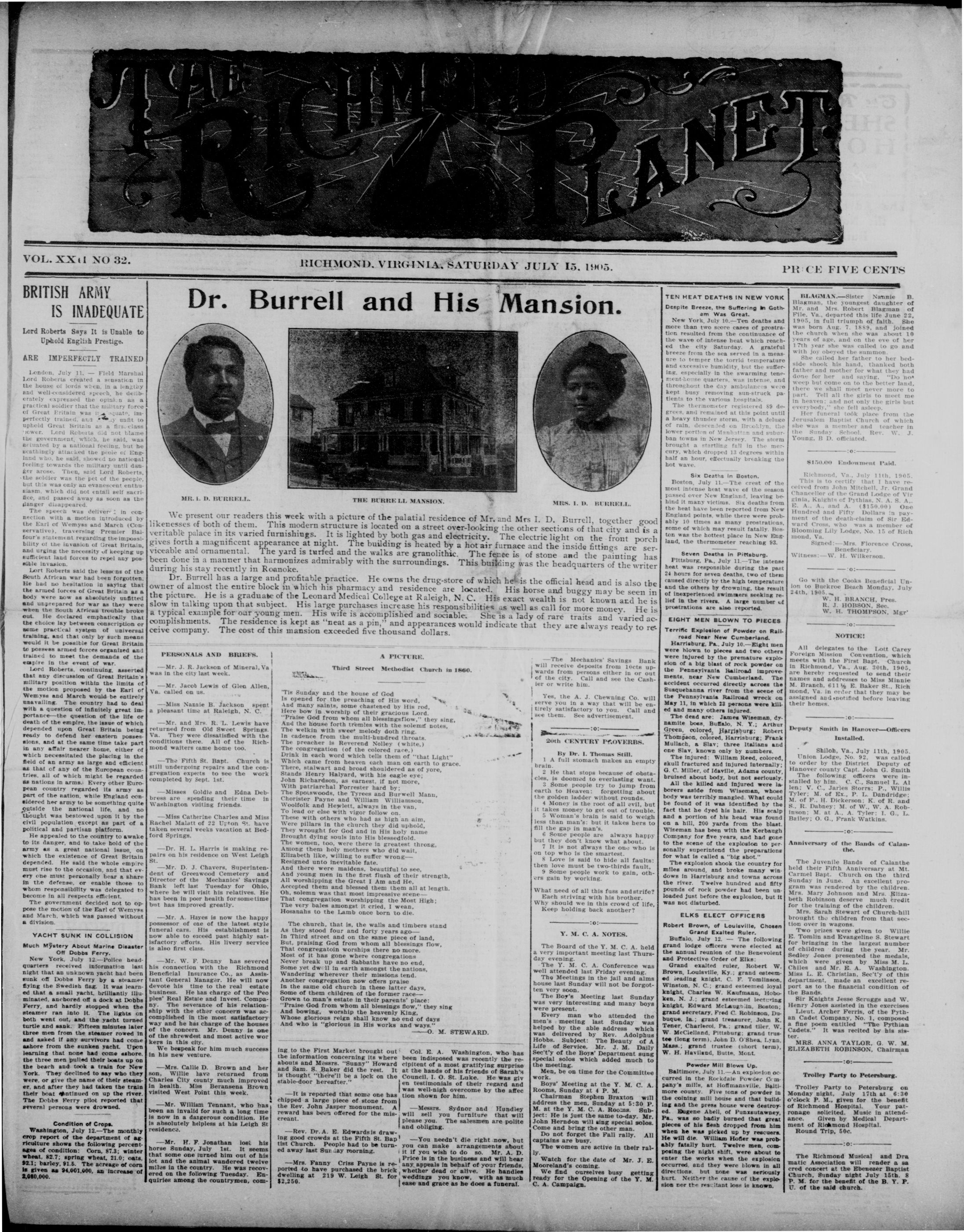
Dr. Burrell and His Mansion.
We present our readers this week with a picture of the palatial residence of Mr. and Mrs I. D. Burrell, together good likenesses of both of them. This modern structure is located on a street over-looking the other sections of that city and is a veritable palace in its varied furnishings. It is lighted by both gas and electricity. The electric light on the front porch gives forth a magnificent appearance at night. The building is heated by a hot air furnace and the inside fittings are serviceable and ornamental. The yard is turfed and the walks are granolithic. The fence is of stone and the painting has been done in a manner that harmonizes admirably with the surroundings. This building was the headquarters of the writer during his stay recently in Roanoke.
Dr. Burrell has a large and profitable practice. He owns the drug-store of which he is the official head and is also the owner of almost the entire block in which his pharmacy and residence are located. His horse and buggy may be seen in the picture. He is a graduate of the Leonard Medical College at Raleigh, N.C. His exact wealth is not known and he is slow in talking upon that subject. His large purchases increase his responsibilities as well as call for more money. He is a typical example for our young men. His wife is accomplished and sociable. She is a lady of rare traits and varied accomplishments. The residence is kept as "neat as a pin," and appearances would indicate that they are always ready to receive company. The cost of this mansion exceeded five thousand dollars.
MR. L. D. BURRELL.
We present our readers this likenesses of both of them. The veritable palace in its varied fur gives forth a magnificent appearance viceable and ornamental. They been done in a manner that hard during his stay recently in Roed Dr. Burrell has a large and owner of almost the entire block the picture. He is a graduate slow in talking upon that subject a typical example for our young complishments. The residence ceive company. The cost of the
PERSONALS AND BRIEFS.
—Mr. J. R. Jackson of Mineral, Va was in the city last week.
—Mr. Jacob Lewis of Glen Allen, Va. called on us.
—Miss Nannie B. Jackson spent a pleasant time at Raleigh, N. C.
—Mr. and Mrs. R. L. Lewis have returned from Old Sweet Springs, Va. They were dissatisfied with the conditions there. All of the Richmond waiters came home too.
—The Fifth St. Bapt. Church is still undergoing repairs and the congregation expects to see the work completed by Sept. 1st.
—Misses Goldie and Edna Debress are spending their time in Washington visiting friends.
—Miss Catherine Charles and Miss Rachel Malatt of 22 Upton St. have taken several weeks vacation at Bedford Springs.
—Dr. H. L. Harris is making repairs on his residence on West Leigh St.
—Mr. D. J. Chavers, Superintendent of Greenwood Cemetery and Director of the Mechanics' Savings Bank left last Tuesday for Ohio, where he will visit his relatives. He has been in poor health for sometime but has improved greatly.
—Mr. A. Hayes is now the happy possessor of one of the latest style funeral cars. His establishment is now able to exceed past high satisfactory efforts. His livery service is also first class.
—Mr. W. F. Denny has severed his connection with the Richmond Beneficial Insurance Co., as Assistant General Manager. He will now devote his time to the real estate business. He has charge of the Peoples' Real Estate and Invest. Company. The severance of his relationship with the other concern was accomplished in the most satisfactory way and he has charge of the houses of the concern. Mr. Denny is one of the shrewdest and most active workers in this city.
We bespeak for him much success in his new venture.
—Mrs. Callie D. Brown and her son, Willie have returned from Charles City county much improved in health. Miss Beransena Brown visited West Point this week.
—Mr. William Tennant, who has been an invalid for such a long time is now in a dangerous condition. He is absolutely helpless at his Leigh St residence.
—Mr. H. F. Jonathan lost his horse Sunday, July 1st. It seems that some one burned him out of his lot and the animal wandered twelve miles in the country. He was recovered on the following Tuesday. Enquiries among the countrymen, com-
RICHMOND, VIRGINIA, SATURDAY JULY 15, 1905.
THE BURRE LL MANSION.
this week with a picture of the parish, this modern structure is located on furnishings. It is lighted by bed coverage at night. The building, a yard is turfed and the walks are harmonizes admirably with the sunnake. And profitable practice. He owns a bank in which his pharmacy and a shop of the Leonard Medical College direct. His large purchases increase men. His wife is accomplished, he is kept as "neat as a pin," and his mansion exceeded five thousand.
Tis Sunday and the house of God is opened for the preaching of His And many saints, some chastened by Here bow in worship of their gracious "Praise God from whom all blessings; and the house forth tremles with the weelkin with sweet melody death. In cadence from the multi-hundred The preacher is Reverend Nolley The congregation of the colored red Drink in each word which tells them Which came from heaven each man There, stalwart and broad shoulder Stands Henry Halyard, with his ear John Richardson, as earnest, if not With patriarchal Forrester hard by The Spouswoods, the Tyrees and But Chorister Payne and William Will Woolfolk and Hewlett, always in the To lead or else with vigor follow on These with others who had as high Were pillars in the church they did They wrought for God and in His hat Brought dying souls into His blesses The women, too, were there in great Among them holy mothers who did Elizabeth like, willing to suffer wroth Resigned unto inevitable fate. And there were maldens, beautiful And young men in the first flush of All worshipping the Great I Am and Accepted them and blessed them the Oh, solemn was that most impressive That congregation worshipping the Very bales amongst it cried, I was Hosanahs to the Lamb once born to
The church, that is, the walls and As they stood four and forty years In Third street and on the same pit But, praising God from whom all be That congregaton worships there no Most of it has gone where congrega Never break up and Sabbaths have Some yet dwell in earth amongst the Wandering wherever their missions Another congregation now offers pra In the same old church in these late Some of them children of the former Grown to man's estate in their parent "Praise God from whom all blessings And bowing, worship the heavenly Whose glorious reign shall know me And who is "glorious in His works
nature of the palatial residence is located on a street lighted by both gas and oil. The building is heated by the walks are granolithic with the surroundings. He owns the drug-safarmacy and residence at Medical College at Raleigh purchases increase his respi his accomplished and soc is a pin," and appearances five thousand dollars
house of God
teaching of His word,
one chastened by His rod,
of their gracious Lord.
from all blessings flow," they si
remles with the solemn notes,
met melody doth ring.
from multi-hundred throats.
from Nolley (white,)
at the colored race,)
which tells them of "that Light
heaven each man on earth to go
broad shouldered as of yore,
and with his eagle eye;
earnest, if not more,
greater hard by;
Tyrees and Burwell Mann,
William Williamson,
always in the van,
vigor follow on.
who had as high an aim,
church they did uphold,
and in His holy name
into His blessed fold,
there in greatest throng,
others who did wait,
to suffer wrong—
table fate.
dens, beautiful to see,
the first flush of their strength
Great I Am and He,
lessed them them all at length
most impressive scene—
worshipping the Most High;
lest it cried, I wean,
ob once born to die.
is, the walls and timbers stand
and forty years ago—
on the same piece of land,
from whom all blessings flow,
worships there no more.
where congregations
Sabbaths have no end,
with amongst the nations,
their missions tend.
now offers praise
which in these latter days,
of the former race—
in their parents' place:
from all blessings flow," they si
up the heavenly King,
shall have no end of days
in His works and ways."
O. M.
'Tis Sunday and the house of God
Is opened for the preaching of His word,
And many saints, some chastened by His rod,
Here bow in worship of their gracious Lord.
"Praise God from whom all blessings flow," they sing,
And the house forth trembles with the solemn notes,
The welkin with sweet melody doth ring.
In cadence from the multi-hundred throats.
The preacher is Reverend Nolley (white.)
The congregation (of the colored race.)
Drink in each word which tells them of "that Light!"
Which came from heaven each man on earth to grace.
There, stalwart and broad shouldered as of yore,
Stands Henry Halyard, with his eagle eye;
John Richardson, as earnest, if not more,
With patriarchal Forrester hard by;
The Spouswoods, the Tyrees and Burwell Mann,
Chorister Payne and William Williamson,
Woolfolk and Hewlett, always in the van,
To lead or else with vigor follow on.
These with others who had as high an aim,
Were pillars in the church they did uphold,
They wrought for God and in His holy name
Brought dying souls into His blessedfold.
The women, too, were there in greatest throng,
Among them holy mothers who did wait,
Elizabeth like, willing to suffer wrong—
Resigned unto inevitable fate.
And there were maidens, beautiful to see,
And young men in the first flush of their strength,
All worshipping the Great I Am and He,
Accepted them and blessed them all at length.
Oh, solemn was that most impressive scene—
That congregation worshipping the Most High;
The very bales amongst it cried, I wean,
Hosanahs to the Lamb once born to die.
The church, that is, the walls and timbers stand
As they stood four and forty years ago—
In Third street and on the same piece of land,
But, praising God from whom all blessings flow,
That congregaton worships there no more.
Most of it has gone where congregations
Never break up and Sabbaths have no end,
Some yet dwell in earth amongst the nations,
Wandering wherever their missions tend.
Another congregation now offers praise
In the same old church in these latter days,
Some of them children of the former race—
Grown to man's estate in their parents' place:
"Praise God from whom all blessings flow," they sing
And bowing, worship the heavenly King,
Whose glorious reign shall know no end of days
And who is "glorious in His works and ways."
ing to the First Market brought out the information concerning its where abouts and Messrs. "Sunny" Howard and Sam. S. Baker did the rest. It is thought "there'll be a lock on the stable-door hereafter."
—It is reported that some one has chipped a large piece of stone from the Rev. John Jasper monument. A reward has been offered for the miscreant.
—Rev. Dr. A. E. Edwards is drawing good crowds at the Fifth St. Baptist Church. People had to be turned away last Sunday morning.
—Mrs. Fanny Criss Payne is reported to have purchased the brick dwelling at 219 W. Leigh St. for $2,250.
```markdown
```
palatial residence of Mr. and Mrs. on a street over-looking the other both gas and electricity. The chimney is heated by a hot air furnace and are granolithic. The fence is surroundedings. This building was the drug-store of which he is residence are located. His home at Raleigh, N. C. His exact cause his responsibilities as well shed and sociable. She is a land and appearances would indicate the thousand dollars.
FIGURE.
Godist Church in 1860.
word,
His His rod,
ous Lord.
flow," they sing,
solemn notes,
ring.
throats.
white,)
race,)
of "that Light"
on earth to grace.
ed as of yore,
gle eye;
more,
well Mann,
damson,
van,
an aim,
uphold,
oly name
fold.
test throng,
wait,
ing—
to see,
their strength,
He,
am all at length.
scene—
Most High;
rean,
die.
timbers stand
ago—
piece of land,
lessings flow,
more.
ations
no end,
nations,
tend.
raise
ter days,
race—
ts' place:
flow," they sing
King,
end of days
and ways."
O. M. STEWARD.
Col. E. A. Washington, who has been indisposed was recently the recipient of a most gratifying surprise at the hands of his friends of Sarah's Council, I. O. St. Luke. He was giv en testimonials of their regard and was well-nigh overcome by the affection shown for him.
— Messrs. Sydnor and Hundley will sell you furniture that will please you. The salesmen are polite and obliging.
— You needn't die right now, but you can make arrangements about it if you wish to do so. Mr. A. D. Price is in the business and will hear any appeals in behalf of your friends, whether dead or alive. He handles weddings you know, with as much ease and grace as he does a funeral.
A PICTURE.
MRS. I. D. BURRELL.
is I. D. Burrell, together good
sections of that city and is a
electric light on the front porch
and the inside fittings are sent
of stone and the painting has
is the headquarters of the writer
the official head and is also the
horse and buggy may be seen in
wealth is not known and he is
as call for more money. He is
of rare traits and varied ac-
t that they are always ready to re
The Mechanics' Savings Bank
will receive deposits from loets up-
wards from persons either in or out
of the city. Call and see the Cash-
lier or write him.
Yes, the A. J. Chewning Co. will
serve you in a way that will be
entirely satisfactory to you. Call and
see them. See advertisement
20th CENTURY P.OVERBS.
By Dr. I. Thomas Still.
1 A full stomach makes an empty brain.
2 He that stops because of obstacles, is doomed to everlasting want.
3 Some people try to jump from earth to Heaven: forgetting about the golden ladder without rounds.
4 Money is the root of all evil, but it takes money to get out of trouble.
5 Woman's brain is said to weigh less than man's; but it takes hers to fill the gap in man's.
6 Some people are always happy but they don't know what about.
7 It is not always the one who is on top who is the smartest.
8 Love is said to hide all faults: then love must be two-thirds fault.
9 Some people work to gain, others gain by working.
What need of all this fuss and strife?
Each striking with blee brother.
Y. M. C. A. NOTES.
The Board of the Y. M. C. A. held a very important meeting last Thursday evening.
The Y. M. C. C. A. Conference was well attended last Friday evening.
The Meetings in the jail and aims house last Sunday will not be forgotten very soon.
The Boy's Meeting last Sunday was very interesting and many boys were present.
Every man who attended the men's meeting last Sunday was helped by the able address which was delivered by Rev. Adolphus Hobbs. Subject: The Beauty of A Life of Service. Mr. J. M. Daily Sect'y of the Boys' Department sung special solos which added much to the meeting.
Men, be on time for the Committee work.
Boys' Meeting at the Y. M. C. A. Rooms, Sunday at 4 P. M.
Chairman Stephen Braxton will address the men, Sunday at 5:30 P. at the Y. M. C. A. Rooms. Subject: He is just the same to-day. Mr. John Herndon will sing special solos. Come and bring the other man.
Do not forget the Fall rally. All
Do not forget the Fall rally. All captains are busy.
The women are active in their rally.
Watch for the date of Mr. J. E. Mooreland's coming.
We find ourselves busy getting ready for the Opening of the Y. M. C. A. Campaign.
TEN HEAT DEATHS IN NEW YORK
Despite Breeze, the Suffering in Gotham Was Great.
New York, July 10.—Ten deaths and more than two score cases of prostration resulted from the continuance of the wave of intense heat which reached the city Saturday. A grateful breeze from the sea served in a measure to temper the torrid temperature and excessive humidity, but the suffering, especially in the swarming tenement-house quarters, was intense, and throughout the day ambulances were kept busy removing sun-struck patients to the various hospitals.
The thermometer registered 89 degrees, and remained at this point until a heavy thunder storm, with a deluge of rain, descended on Brooklyn, the lower portion of Manhattan and suburban towns in New Jersey. The storm brought a startling fall in the mercury, which dropped 13 degrees within half an hour, effectually breaking the hot wave.
Six Deaths in Boston.
Boston, July 11.—The crest of the most intense heat wave of the season passed over New England, leaving behind it many victims. Six deaths from the heat have been reported from New England points, while there were probably 10 times as many prostrations, some of which may result fatal. Boston was the hottest place in New England, the thermometer reaching 93.
Seven Deaths in Pittsburgh.
Pittsburg, Pa., July 11. The intense heat was responsible during the past 24 hours for seven deaths, two of them caused directly by the high temperature and the others by drowning, the result of inexperienced swimmers seeking relief in the rivers. A large number of prostrations are also reported.
EIGHT MEN BLOWN TO PIECES
Terrific Explosion of Powder on Railroad Near New Cumberland.
Harrisburg, Pa. July 10.—Eight men were blown to pieces and two others were injured by the premature explosion of a big blast of rock powder on the Pennsylvania Railroad improvements, near New Cumberland. The accident occurred directly across the Susquehanna river from the scene of the Pennsylvania Railroad wreck on May 11, in which 23 persons were killed and many others injured.
The dead are: James Wiseman, dynamite boys, Buffalo, N. Y.; Arthur Green, colored, Harrisburg; Robert Thompson, colored, Harrisburg; Frank Mullach, a Slav; three Italians and one Slav, known only by numbers.
The injured: William Reed, colored, skull fractured and injured internally; G. C. Miller, of Idaville, Adams county, bruised about body, but not seriously.
All the killed and injured were laborers aside from Wiseman, whose body was terribly mangled. What could be found of it was identified by the fact that he dyed his hair. His scalp and a portion of his head was found on a hill, 200 yards from the blast. Wiseman has been with the Kerbaugh Company for five years, and had gone to the scene of the explosion to personally superintend the preparations for what is called a "big shot."
The explosion shook the country for miles around, and broke many windows in Harrisburg and towns across the river. Twelve hundred and fifty pounds of rock powder had been unloaded just before the explosion, but it was not disturbed.
ELKS ELECT OFFICERS
Robert Brown, of Louisville, Chosen
Grand Exalted Ruler.
Buffalo, July 12. — The following
grand lodge officers were elected at
the annual reunion of the Benevolent
and Protective Order of Elks:
Grand exalted ruler, Robert W. Brown, Louisville, Ky.; grand esteemed
eading knight, C. F. Tomlinson,
Winston, N. C.; grand esteemed loyal
knight, Charles W. Kaufmann, Hoboken,
N. J.; grand esteemed lecturing
knight, Edward McLaughlin, Boston;
grand secretary, Fred C. Robinson, Dubuque, Ia.; grand treasurer, John K.
Tener, Charleroi, Pa.; grand trier, W. W. McClelland, Pittsburg; grand trustee
(long term), John D. O'Shea, Lynn,
Mass.; grand trustee (short term),
W. H. Haviland, Butte, Mont.
Powder Mill Blows Up.
Baltimore, July 11.—An explosion occurred in the Rockdale Powder Company's mills, at Hoffmansville, Baltimore county. Five tons of powder in the colining mill house and that building and the press house were destroyed. Eugene Abell, of Punxsutawney, Pa., was so badly burned that great pieces of his flesh dropped from him when he was picked up by rescuers. He will die. William Hoffer was probably fatally hurt. Twelve men, composing the night shift, were about to enter the works when the explosion occurred, and they were blown in all directions, but none was seriously hurt. Neither the cause of the explosion nor the resultant loss is known.
BLAGMAN—Sister Nannie B. Blagman, the youngest daughter of Mr. and Mrs. Robert Blagman of File, Va. departed this life June 22, 1905, in full triumph of faith. She was born Aug. 7, 1889, and joined the church when she was about 10 years of age, and on the eve of her 17th year she was called to go and with joy obeyed the summon. She called her father to her bedside shook his hand, thanked both father and mother for what they had done for her and saying, "Do not weep but come on to the better land, there we shall meet never more to part. Tell all the girls to meet me in heaven; and not only the girls but everybody," she fell asleep. Her funeral took place from the Jerusalem Baptist Church of which she was a member and teacher in the Sunday School. Rev. W. J. Young, B. D. officiated
$150.00 Endowment Paid
Richmond, Va., July 11th, 1905.
This is to certify that I have received from John Mitchell, Jr. Grand Chancellor of the Grand Lodge of Virginia, Knights of Pythias, N. A. S. A. E. A., and. A. A. ($150.00) One Hundred and Fifty Dollars in payment of the death-claim of Sir Edward Cross, who was a member of Blooming Lily Lodge, No. 15 of Richmond, Va.
Signed:—Mrs. Florence Cross, Beneficiary.
Witness:—W. H. Wilkinson.
Go with the Cooks Beneficial Union to Buckroe Beach Monday, July 24th, 1905.
W. H. BRANCH, Pres.
R. J. HOBSON, Sec.
W. H. THOMPSON, Mgr'
NOTICE!
All delegates to the Lott Carey Foreign Mission Convention, which meets with the First Bapt. Church in Richmond, Va., Aug. 30th, 1905, are hereby requested to send their names and addresses to Miss Minnie M. Branch, 611½ E. Baker St., Richmond, Va. in order that they may be assigned and notified before leaving their homes.
Deputy Smith in Hanover—Officers Installed.
Shiloh, Va., July 11th, 1905.
Union Lodge, No. 92, was called to order by the District Deputy of Hanover county Capt. John G. Smith. The following officers were installed by him. C. C., Samuel L. Allen; V. C., Jaries Storrs; P., Willis Tyler; M. of Ex., P. L. Dandridge; M. of F., H. Dickerson; K. of R. and S., R. Dahney; M. of W., W. A. Robinson; M. at A. A. Tyler; I. G., L. Bailey; O. G., Frank Watkins.
Anniversary of the Bands of Calan the.
The Juvenile Bands of Calanthe held their Fifth Anniversary at M.T. Carmel Bapt. Church on the third Sunday in June. An excellent program was rendered by the children. Mrs. Mary Johnson and Mrs. Elizabeth Robinson deserve much credit for the training of the children.
Mrs. Sarah Stewart of Church-hill brought the children from that section over in wagons.
Two prizes were given to Willie E. Tomlin and Evangeline S. Stewart for bringing in the largest number of children during the year. Mr. Sedley Jones presented the medals, which were given by Miss M. L. Chiles and Mr. E. A. Washington. Miss L. E. Christian, Sec'ty of this department, made an excellent report as to the financial condition of the Bands.
Sir Knights Jesse Scruggs and W. Henry Jones assisted in the exercises Lieut. Christian Ferris, Sec'ty of the Python Cadet Company, No. 1, composed a fine poem entitled "The Pythian Cadets." It was recited by his sister.
MRS. ANNA TAYLOR. G. W. M. ELIZABETH ROBINSON. Chairman
Trolley Party to Petersburg.
Trolley Party to Petersburg on Monday night, July 17th at 6:30 o'clock P. M., given for the benefit of Richmond Hospital. Your patronage solicited. Music in attendance. Given by Medical Department of Richmond Hospital. Bound Trolley.
The Richmond Musical and Dramatic Association will render a sacred concert at the Ebenezer Baptist Church, Sunday night July 15th. 8 P. M. for the benefit of the B. Y. P. U. of the said church.
The Return of SHERLOCK HOLMES
Author of "The Adventures of Sherlock Holmes," "The Hound of the Baskervilles," "The Sign of the Four," "A Study In Scarlet," Etc.
composed I should be glad if you would sit down in that chair and tell us very slowly and quietly who you are and what it is that you want. You mentioned your name as if I should recognize it, but I assure you that beyond the obvious facts that you are a bachelor, a solicitor, a Freemason and an asthmatic I know nothing whatever about you." Familiar as I was with my friend's methods, it was not difficult for me to follow his deductions and to observe the untidiness of attire, the shear of legal papers, the watch charm and the breathing which had prompted them. Our client, however, stared in amazement.
"Yes, I am all that, Mr. Holmes, and in addition I am the most unfortunate man at this moment in London. For heaven's sake, don't abandon me, Mr. Holmes! If they come to arrest me before I have finished my story make them give me time so that I may tell you the whole truth. I could go to jail happy if I knew that you were working for me outside."
"Arrest you!" said Holmes. "This is really most graff- most interesting. On what charge do you expect to be arrested?"
"Upon the charge of murdering Mr. Jonas Oldacre of Lower Norwood."
"Dear me," said he. "it was only this moment at breakfast that I was saying to my friend Dr. Watson that sensational cases had disappeared out of our papers."
Our visitor stretched forward a quivering hand and picked up the Daily Telegraph, which still lay upon Holmes' knuck.
OSE, WITH A GHASTLY FACE.
Copyright by Collier's Weekly.
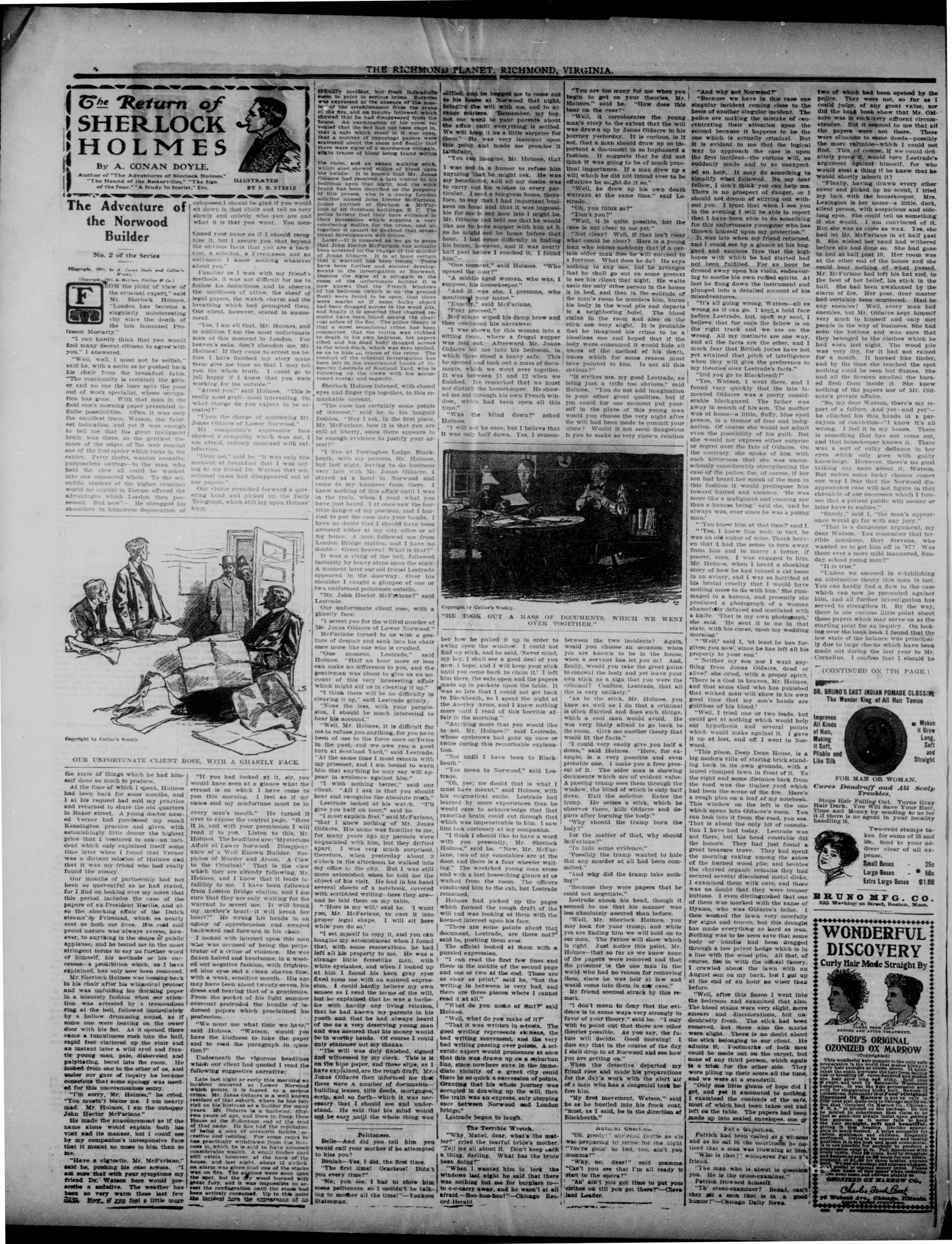
OUR UNFORTUNATE CLIENT ROSE, WITH
Copyright by Collier's Weekly.
OUR UNFORTUNATE CLIENT ROSE, WITH A GHASTLY FACE.
the state of things which he had himself done so much to produce.
At the time of which I speak, Holmes had been back for some months, and at his request had sold my practice and returned to share the old quarters in Baker street. A young doctor named Verner had purchased my smallensington practice and given with stonishingly little demur the highest price that I ventured to ask—an incident which only explained itself some time later when I found that Verner was a distant relation of Holmes and that it was my friend who had really found the money.
Our months of partnership had not been so uneventful as he had stated, or I find on looking over my notes that his period includes the case of theapers of ex-President Murille, and also the shocking affair of the Dutchteamship Friesland, which so nearly cost us both our lives. His cold and roud nature was always awe, how
"If you had looked at it, sir, you would have seen at a glance what the errand is on which I have come to you this morning. I feel as if my name and my misfortune must be in every man's mouth." He turned it over to expose the central page. "Here it is, and with your permission I will read it to you. Listen to this, Mr. Holmes. The headlines are: 'Mysterious Affair at Lower Norwood. Disappearance of a Well Known Builder. Suspicion of Murder and Arson. A Clew to the Criminal.' That is the clew which they are already following, Mr. Holmes, and I know that it leads faunily to me. I have been followed from London Bridge station, and I am sure that they are only waiting for the warrant to accrue me. It will break my mother's heart—it will break her heart." He wrung his hands in an agony of apprehension and swayed backward and forward in his chair.
I looked with interest upon this man who was accused of being the perpetrator of a crime of violence. He was flaxen haired and handsome, in a washed out negative fashion, with frightened blue eyes and a clean shaven face, with a weak, sensitive mouth. His age may have been about twenty-seven, his dress and hearing that of a gentleman. From the pocket of his light summer overcoat protruded the bundle of indorsed papers which proclaimed his profession.
"We must use what time we have," said Holmes. "Watson, would you have the kindness to take the paper and to read the paragraph in question?"
Underneath the vigorous headlines which our client had quoted I read the following suggestive narrative:
Late last night or early this morning an incident occurred at Lower Norwood which points, it is feared, to a serious problem. We have a well-resident of that suburb, where he hied on his business as a builder for many years. Mr. Oldacre is a bachelor, fifty-two years of age, and lives in Deep Dene and the Siddenham end of the road of that name. He has a man of being a man of eccentric habits, secretive and retiring. For some years he has practically withdrawn from the business, and he has amassed considerable wealth. A small collection still exists, however, at the back of the house, and last night, about 12 o'clock an alarm was given that one of the stacks in the house stood soon upon the spot, but the dirty wood building great fury, and it was impossible to arrest the confugation until the stack had been entirely consumed. Up to this point the incident have the appearance of no
By A. CONAN DOYLE.
The Adventure of the Norwood Builder
No. 2 of the Series
(Copyright, 1901, by A. Cusan Doyle and Collier's Weekly)
(Copyright, 1903, by McClure, Phillips & Co.)
ROM the point of view of the criminal expert," sale Mr. Sherlock Holmes "London has become a singularly uninteresting city since the death of
BOM the point of view of the criminal expert," said Mr. Sherlock Holmes. "London has become a singularly uninteresting city since the death of the late lamented Proctus.
fessor Moriarty."
"I can hardly think that you would find many decent citizens to agree with you."
I answered.
"Well, well. I must not be selfish," said he, with a smile as he pushed back his chair from the breakfast table. "The community is certainly the gainer and no one the loser save the poor out of work specialist, whose occupation has gone. With that man in the field one's morning paper presented infinite possibilities. Often it was only the smallest trace. Watson, the fairest indication, and yet it was enough to tell me that the great malignant brain was there, as the gentlest tremors of the edges of the web remind one of the foul spider which lurks in the center. Petty thefts, wanton assaults, purposeless outrage—to the man who held the clew all could be worked into one connected whole. To the scientific student of the higher criminal world no capital in Europe offered the advantages which London then possessed. But now"— He shrugged his shoulders in humorous deprecation of
the state of things which he had himself done so much to produce. At the time of which I speak, Holmes had been back for some months, and I at his request had sold my practice and returned to share the old quarters in Baker street. A young doctor named Verner had purchased my small Kensington practice and given with astonishingly little demur the highest price that I ventured to ask—an incident which only explained itself some time later when I found that Verner was a distant relation of Holmes and that it was my friend who had really found the money.
Our months of partnership had not been so uneventful as he had stated, for I find on looking over my notes that this period includes the case of the papers of ex-President Marille, and also the shocking affair of the Dutch steamship Friessland, which so nearly cost us both our lives. His cold and proud nature was always awe, however, to anything in the shape of public applause, and he bound me in the most stringent terms to say no further word of himself, his methods or his successes—a prohibition which, as I have explained, has only now been removed.
Mr. Sherlock Holmes was leasing back in his chair after his whimsical protest and was unfolding his morning paper in a leisurely fashion when our attention was arrested by a tremendous ring at the bell, followed immediately by a hollow drumming sound, as if some one were beating on the outer door with his fist. As it opened there came a tumultuous rush into the hall, rapid feet clattered up the stair and an instant later a wild eyed and frantic young man, pale, disheveled and palpitating, burst into the room. He looked from one to the other of us, and under our gaze of inquiry he became conscious that some apology was needed for this unceremonious entry.
"I'm sorry, Mr. Holmes." he cried. "You mustn't blame me. I am nearly mad. Mr. Holmes, I am the unhappy John Hector McFarlane."
He made the announcement as if the name alone would explain both his visit and its manner, but I could see by my companion's unresponsive face that it meant no more to him than to me.
"Have a cigarette, Mr. McFarlane," said he, pushing his case across. "I am sure that with your symptoms my friend Dr. Watson here would prescribe a sedative. The weather has been so very warm these last few days. Now, if you feel a little more
ILLUSTRATED
BY F. D. STEELE
ordinary accident, but fresh indications seem to point to serious crime. Surprise of the fire, and an inquiry followed, which showed that he had disappeared from the house. An examination of his room revealed that the bed had not been slept in, the fire was open, that a number of important papers scattered about the room and finally that there were signs of a murderous struggle, slight traces of blood being found within the room, and an oaken walking stick, which also showed stains of blood upon the handle. It is known that Mr. Jonas Oladore had received a late visitor in his bedroom upon that night, and the stick found has been identified as the property of this person who is being held. London solicitor named John Hector McFarlane, junior partner of Graham & McFarlane of 426 Gresham buildings, E.C. The police believe that they have evidence in their possession which supplies a very valuable firearm, and altogether it cannot be doubted that sensational developments will follow.
settled, and he begged to come out to his house at Norwood that night, bringing the will with me, and to arrange matters. "Remember, my boy, not one word to your parents about the affair until everything is settled. We will keep it as a little surprise for them." He was very insistent upon this point and made me promise it faithfully.
"You can imagine, Mr. Holmes, that I was not in a humor to refuse him anything that he might ask. He was my benefactor, and all my desire was to carry out his wishes in every particular. I sent a telegram home, therefore, to say that I had important business on hand and that it was impossible for me to say how late I might be. Mr. Oladore and told me that he would like me to have supper with him at 9, as he might not be home before that.
"You are too begin to get Holmes," said bear on the car.
"Weil, it is man's story to was drawn up journey yester not, that a man a document fashion. It is what it think it was gential importance will which he effective he mk.
"Well, he d warrant at the strade.
"Oh, you this! Don't you?" "Well, it is case not cicle. Not clear?"
Later—it is rumored as we go to press that John Hector McParlane has actually been arrested on the charge of the murder of a woman he claims that a warrant has been issued. There have been further and sinister developments in the investigation at Norwood. Besides the signs of a struggle in the house, there is a man in the house. It is now known that the French windows of his bedroom (which is on the ground floor) were found to be open, that there were marks as if some bulky object had been thrown at the wood pile, and finally it is asserted that the mains have been found among the charcoal ashes of the fire. The police theory is that a most sensational crime has been committed, that the victim was clubbed and that he was riffed and his dead body dragged across to the wood stack, which was then ignited, so as to hide all traces of the crime. The conduct of the criminal investigation has been reported in the newspaper, who is following up the chews with his accustomed energy and sagacity.
Sherlock Holmes listened, with closed eyes and finger tips together, to this remarkable account.
"The case has certainly some points of interest," said he in his languid fashion. "May I ask, in the first place, Mr. McFarlane, how it is that you are still at liberty, since there appears to be enough evidence to justify your arrest."
"I live at Torrington Lodge, Blackheath, with my parents, Mr. Holmes, but last night, having to do business very late with Mr. Jonas Oldacre, I stayed at a hotel in Norwood and came to my business from there. I knew nothing of this affair until I was in the train, when I read what you have just heard. I at once saw the horrible danger of my position, and I hurried to put the case into your hands. I have no doubt that I should have been arrested either at my city office or at my home. A man followed me from London Bridge station, and I have no doubt—Great heaven! What is that?"
It was a clang of the bell, followed instantly by heavy steps upon the stair. A moment later our old friend Lestrade appeared in the doorway. Over his shoulder I caught a glimpse of one or two uniformed policemen outside. "Mr. John Hector McFarlane?" said Lestrade. Our unfortunate client rose, with a ghastly face. "I arrest you for the willful murder of Mr. Jonas Oldacear of Lower Norwood." McFarlane turned to us with a gesture of despair and sank into his chair once more like one who is crushed. "One moment, Lestrade," said Holmes. "Half an hour more or less can make no difference to you, and the gentleman was about to give us an account of this very interesting affair which might aid us in clearing it up." "I think there will be no difficulty in clearing it up," said Lestrade grimly. "None the less, with your permission, I should be much interested to hear his account."
"Well, Mr. Holmes, it is difficult for me to refuse you anything, for you have been of use to the force once or twice in the past, and we owe you a good turn at Scotland Yard," said Lestrade. "At the same time I must remain with my prisoner, and I am bound to warn him that anything he may say will appear in evidence against him." "I wish nothing better," said our client. "All I ask is that you should hear and recognize the absolute truth." Lestrade looked at his watch. "I'll give you half an hour," said he.
"I must explain first," said McFarlane,
"that I knew nothing of Mr. Jonas
Oldacre. His name was familiar to me,
for many years ago my parents were
acquainted with him, but they drifted
apart. I was very much surprised,
therefore, when yesterday about 3
o'clock in the afternoon he walked into
my office in the city. But I was still
more astonished when he told me the
object of his visit. He had in his hand
several sheets of a notebook, covered
with scribbled writing—here they are—
and he laid them on my table.
"Here is my will," said he. "I want
you, Mr. McFarlane, to cast it into
proper legal shape. I will sit here
while you do so."
"I set myself to copy it, and you can imagine my astonishment when I found that, with some reservations, he had left all his property to me. He was a strange little ferretlike man, with white eyelashes, and when I looked up at him I found his keen gray eyes fixed upon me with an amused expression. I could hardly believe my own senses as I read the terms of the will, but he explained that he was a bachelor with hardly any living relation, that he had known my parents in his youth and that he had always heard of me as a very deserving young man and was assured that his money would be in worthy hands. Of course I could only stammer out my thanks.
"The will was duly finished, signed and witnessed by my clerk. This is it on the blue paper, and these slips, as I have explained, are the rough draft. Mr. Jonas Oldace then informed me that there were a number of documents—building leases, title deeds, mortgages, script, and so forth—which it was necessary that I should see and understand. He said that his mind would not be easy until the whole thing was
Belle—And did you tell him you would call your mother if he attempted to kiss you?
Beulah—Yes, I did, the first time.
"The first time! Gracie! Didn't you every time?"
"No; you see. I had to show him some paleness, so I couldn't be talking to mother all the time!"—Yonkers Statesman.
92
"HE TOOK OUT A MASS OF DOCUMENTS, WHICH WE WENT OVER TOGETHER."
settled, and he begged me to come out to his house at Norwood that night, bringing the will with me, and to arrange matters. "Remember, my boy, not one word to your parents about the affair until everything is settled. We will keep it as a little surprise for them." He was very insistent upon this point and made me promise it faithfully.
"You can imagine, Mr. Holmes, that I was not in a humor to refuse him anything that he might ask. He was my benefactor, and all my desire was to carry out his wishes in every particular. I seated a telegram home, therefore, to say that I had important business on hand and that it was impossible for me to say how late I might be. Mr. Oldeane had told me that he would like me to have supper with him at 9, as he might not be home before that hour. I had some difficulty in finding his house, however, and it was nearly half past before I reached it. I found him"—
"One moment," said Holmes. "Who opened the door?"
"A middle aged woman, who was, I suppose, his housekeeper."
"And it was she, I presume, who mentioned your name."
"Exactly," said McFarlane.
"Pray proceed."
McFarlane wiped his damp brow and then continued his narrative:
"I was shown by this woman into a sitting room, where a frugal supper was laid out. Afterward Mr. Jonas Oldacre led me into his bedroom, in which there stood a heavy safe. This he opened and took out a mass of documents, which we went over together. It was between 11 and 12 when we finished. He remarked that we must not disturb the housekeeper. He showed me out through his own French window, which had been open all this time."
"Was the blind down?" asked Holmes.
"I will not be sure, but I believe that it was only half down. Yes, I remem-
Copyright by Collier's Weekly.
"HE TOOK OUT A MASS OF
OVER TO
ber how he pulled it up in order to swing open the window. I could not find my stick, and he said, 'Never mind, my boy, I shall see a good deal of you now, I hope, and I will keep your stick until you come back to claim it.' I left him there, the safe open and the papers made up in packets upon the table. It was so late that I could not get back to Blackheath, so I spent the night at the Anerley Arms, and I knew nothing more until I read of this horrible affair in the morning."
"Anything more that you would like to ask, Mr. Holmes?" said Lestrade, whose eyebrows had gone up once or twice during this remarkable explanation.
"Not until I have been to Blackheath."
"You mean to Norwood," said Lestrade.
"Oh, yes; no doubt that is what I must have meant," said Holmes, with his enigmatical smile. Lestrade had learned by more experiences than he would care to acknowledge that that razorlike brain could cut through that which was impenetrable to him. I saw him look curiously at my companion.
"I think I should like to have a word with you presently, Mr. Sherlock Holmes," said he. "Now, Mr. McFarlane, two of my constables are at the door, and there is a four wheeler waiting." The wretched young man arose and with a last beseeching glance at us walked the room. The officers conducted him to the cab, but Lestrade remained.
Holmes had picked up the pages which formed the rough draft of the will and was looking at them with the keenest interest upon his face.
"There are some points about that document, Lestrade, are there not?" said he, pushing them over.
The official looked at them with a puzzled expression.
"I can read the first few lines and these in the middle of the second page and one or two at the end. Those are as clear as print," said he, "but the writing in between is very bad, and there are three places where I cannot read it at all."
"What do you make of that?" said Holmes.
"Well, what do you make of it?"
"That it was written in a train. The good writing represents stunts, the bad writing movement, and the very bad writing passing over points. A scientific expert would pronounce at once that this was drawn up on a suburban line, since nowhere save in the immediate vicinity of a great city could there be so quick a succession of points. Granting that his whole journey was occupied in drawing up the will, then the train was an express, only stopping once between Norwood and London bridge."
Lestrade began to laugh.
The Terrible Wretch
"Why, Mabel, dear, what's the matter?" cried the tearful bride's mother, "Tell me all about it. Don't keep back a thing, darling. What has the brute been doing?" "When I wanted him to lock the windows last night he said that there was nothing but me for burglaries to—to c-c-carry away, and he wasn't at all afraid—Boo-hoo-hoo!"—Chicago Record-Herald.
"You are too many for me when you begin to get on your theories, Mr. Holmes," said he. "How does this bear on the case?"
"Weil, it corroborates the young man's story to the extent that the will was drawn up by Jonas Oldacre in his journey yesterday. It is curious, is it not, that a man should draw up so important a document in so haphazard a fashion. It suggests that he did not think it was going to be of much practical importance. If a man drew up a will which he did not intend ever to be effective he might do it so."
"Well, he drew up his own death warrant at the same time," said Lestrade.
"Oh, you think so?"
"Don't you?"
"Well, it is quite possible, but the case is not clear to me yet."
"Not clear? Well, if that isn't clear what could be clear? Here is a young man who learns suddenly that if a certain older man dies he will succeed to a fortune. What does he do? He says nothing to any one, but he arranges that he shall go out on some pretext to see his client that night. He waits until the only other person in the house is in bed, and then in the solitude of the man's room he murders him, burns his body in the wood pile and departs to a neighboring hotel. The blood stains in the room and also on the stick are very slight. It is probable that he imagined his crime to be a bloodless one and hoped that if the body were consumed it would hide all traces of the method of his death, traces which for some reason must have pointed to him. Is not all this obvious?"
"It strikes me, my good Lestrade, as being just a trifle too obvious," said Holmes. "You do not add imagination to your other great qualities, but if you could for one moment put yourself in the place of this young man would you choose the very night after the will had been made to commit your crime? Would it not seem dangerous to you to make so very close a relation
DOCUMENTS, WHICH WE WENT
Together."
between the two incidents? Again, would you choose an occasion when you are known to be in the house, when a servant has let you in? And, finally, would you take the great pains to conceal the body and yet leave your own stick as a sign that you were the criminal? Confess, Lestrade, that all this is very unlikely.
"As to the stick, Mr. Holmes, you know as well as I do that a criminal is often flurried and does such things, which a cool man would avoid. He was very likely afraid to go back to the room. Give me another theory that would fit the facts."
"I could very easily give you half a dozen," said Holmes. "Here, for example, is a very possible and even probable one. I make you a free present of it. The older man is showing documents which are of evident value. A passing tramp sees them through the window, the blind of which is only half down. Exit the solicitor. Enter the tramp. He seizes a stick, which he observes there, kills Oldacre and departs after burning the body." "Why should the tramp burn the body? For the matter of that, why should McFarlane?"
"To hide some evidence."
"Possibly the tramp wanted to hide that any murder at all had been committed."
"And why did the tramp take nothing?"
"Because they were papers that he could not negotiate."
Lestrade shook his head, though it seemed to me that his manner was less absolutely assured than before.
"Well, Mr. Sherlock Holmes, you may look for your tramp, and while you are finding him we will hold on to our man. The future will show which is right. Just notice this point, Mr. Holmes—that so far as we know none of the papers were removed and that the prisoner is the one man in the world who had no reason for removing them, since he was heir at law and would come into them in any case."
My friend seemed struck by this remark.
"I don't mean to deny that the evidence is in some ways very strongly in favor of your theory," said he. "I only wish to point out that there are other theories possible. As you say, the future will decide. Good morning! I dare say that in the course of the day I shall drop in at Norwood and see how you are getting on."
When the detective departed my friend rose and made his preparations for the day's work with the alert air of a man who has a congenial task before him.
"My first movement, Watson," said he as he bustled into his frock coat, "must, as I said, be in the direction of Blackheath."
Natural Question.
"Oh, goody!" shrieked Dottie, as she was preparing to retire for the night. "You're goin' to bed, too, isn't you mamma?"
"Why, no, dear!" said mamma "Can't you see that I'm all ready to start to the opera?"
"An' ain't you got time to put your clothes on till you get there?"—Cleveland Leader.
two of which had been opened by the police. They were not, so far as I could judge, of any great value, nor did the bank book show that Mr. Oldace was in such very affluent circumstances. But it seemed to me that all the papers were not there. There were allusions to some deeds—possibly the more valuable—which I could not find. This, of course, if we could definitely prove it, would turn Lestrade's argument against himself, for who would steal a thing if he knew that he would shortly inherit it?
"Finally, having drawn every other cover and picked up no scent, I tried my luck with the housekeeper. Mrs. Lexington is her name—a little dark, silent person, with suspicious and side-long eyes. She could tell us something if she would. I am convinced of it. But she was as close as wax. Yes, she had let Mr. Farlane in at half past 9. She wished her hand had withered before she had done so. She had gone to bed at half past 10. Her room was at the other end of the house and she could hear nothing of what passed. Mr. Farlane had left his hat and, to the best of her belief, his stick in the hall. She had been awakened by the alarm of fire. Her poor, dear master had certainly been murdered. Had he any enemies? Well, every man had enemies, but Mr. Oldacre kept himself very much to himself and only met people in the way of business. She had seen the buttons and was sure that they belonged to the clothes which he had worn last night. The wood pile was very dry, for it had not rained for a month. It burned like tinder, and by the time she reached the spot nothing could be seen but flames. She and all the firemen smelled the burned flesh from inside it. She knew nothing of the papers nor of Mr. Oldacre's private affairs.
"So, my dear Watson, there's my report of a failure. And yet—and yet" he clinched his thin hands in a paroxysm of conviction—"I know it's all wrong. I feel it in my bones. There is something that has not come out, and that housekeeper knows it. There was a sort of suky defiance in her eyes which only goes with guilty knowledge. However, there's no good talking any more about it. Watson. But unless some lucky chance comes our way I fear that the Norwood disappearance case will not figure in that chronicle of our successes which I foresee that a patient public will sooner or later have to endure.
"Surely," said I, "the man's appearance would go far with any jury."
"That is a dangerous argument, my dear Watson. You remember that terrible murderer, Bert Stevens, who wanted to get him off in '87? There ever a more mild mannered, Sunday school young man?"
"Unless we succeed in establishing an alternative theory this man is lost. You can hardly find a flaw in the case which can now be presented against him, and all further investigation has served to strengthen it. By the way, there is one curious little point about those papers which may serve us as the starting point for an inquiry. On looking over the bank book I found that the low state of the balance was principally due to large checks which have been made out during the last year to Mr. Cornelius. I confess that I should be
(CONTINUED ON 7TH PAGE.)
DR. BRUNO'S EAST INDIAN POMADE CLOSSEINE
The Wonder King of All Hair Tonics
Improves
All Kinds
of Hair,
Making
It Soft,
Pillable and
Like Silk
Makes
It Grow
Long,
Soft
and
Straight
FOR MAN OR WOMAN.
Cures Dandruff and All Scalp
Troubles.
Stops Hair Falling Out. Turns Gray
Hair Dark. You Will Save Your Hair,
Time and Money by sending to us for
it if there is no agent in your locality
handling it.
A
MEN FROM THE
BEFORE AND AFTER TREATMENT.
"And why not Norwood?"
"Because we have in this case one singular incident coming close to the heels of another singular incident. The police are making the mistake of concentrating their attention upon the second because it happens to be the one which is actually criminal. But it is evident to me that the logical way to approach the case is upon the first incident—the curious will, so suddenly made and to so unexpected an heir. It may do something to simplify what followed. No, my dear fellow, I don't think you can help me. There is no prospect of danger, or I should not dream of stirring out without you. I trust that when I see you in the evening I will be able to report that I have been able to do something for this unfortunate youngster who has thrown himself upon my protection."
It was late when my friend returned, and I could see by a glance at his hagged and anxious face that the high hopes with which he had started had not been fulfilled. For an hour he droned away upon his violin, endeavoring to soothe his own ruffled spirits. At last he funged down the instrument and plunged into a detailed account of his misadventures.
"It's all going wrong. Watson—all as wrong as it can go. I kept a bold face before Lestrade, but, upon my soul, I believe that for once the fellow is on the right track and we are on the wrong. All my instincts are one way, and all the facts are the other, and I much fear that British juries have not yet attained that pitch of intelligence when they will give the preference to my theories over Lestrade facts."
"Did you go to Blackhawk?"
"Yes, Watson. I went there, and I found very quickly that the late lamented Oldacre was a pretty considerable blackguard. The father was away in search of his son. The mother was at home—a little, fuffy, blue eyed person, in a tremor of fear and indignation. Of course she would not admit even the possibility of his guilt. But she would not express either surprise or regret over the fate of Oldacre. On the contrary, she spoke of him with such bitterness that she was unconsciously considerably strengthening the case of the police, for, of course, if her son had heard her speak of the man in this fashion it would predispose him toward batred and violence. 'He was more like a malignant and cunning ape than a human being,' said she, 'and he always was, ever since he was a young man.'
"You knew him at that time?" said I. "Yes, I knew him well; in fact, he was an old suitor of mine. Thank heaven that I had the sense to turn away from him and to marry a better, if poorer, man. I was engaged to him. Mr. Holmes, when I heard a shocking story of how he had turned a cat loose in an aviary, and I was so horrified at his brutal cruelty that I would have nothing more to do with him." She rummaged in a bureau, and presently she produced a photograph of a woman shamefully defaced and mutilated with a knife. "That is my own photograph," she said. "He sent it to me in that state, with his curse, upon my wedding morning."
"Well," said I, "at least he has forgiven you now, since he has left all his property to your son."
"Neither my son nor I want anything from Jonas Oldacre, dead or alive!" she cried, with a proper spirit. "There is a God in heaven, Mr. Holmes, and that same God who has punished that wicked man will show in his own good time that my son's hands are guiltless of his blood." "Well, I tried one or two leads, but could get at nothing which would help our hypothesis and several points which would make against it. I gave it up at last, and off I went to Norwood.
"This place, Deep Dene House, is a big modern villa of staring brick standing back in its own grounds, with a laurel clumped lawn in front of it. To the right and some distance back from the road was the timber yard which had been the scene of the fire. Here's a rough plan on a leaf of my notebooks. This window on the left is the one which opens into Oldacre's room. You can look into it from the road, you see. That is about the only bit of consolation I have had today. Lestrade was not there, but his head constable did the honors. They had just found a great treasure trove. They had spent the morning raking among the ashes of the burned wood pile, and besides the charred organic remains they had secured several discolored metal disks. I examined them with care, and there was no doubt that they were trouser buttons. I even distinguished that one of them was marked with the name of Hyams, who was Oldacre's tailor. I then wonked the lawn very carefully for signs and traces, but this drought has made everything as hard as iron. Nothing was to be seen save that some body or bundle had been dragged through a low privet hedge which is in a line with the wood pile. All that, of course, lies in with the official theory. I crawled about the lawn with an August sum on my back, but I got up at the end of an hour no wiser than before.
"Well, after this flashe I went into the bedroom and examined that also. The blood stains were very slight, mere smears and discolorations, but undoubtedly fresh. The stick had been removed, but there also the marks were slight. There is no doubt about the stick belonging to our client. He admits it. Footmarks of both men could be made out on the carpet, but none of any third person, which again is a trick for the other side. They were piling up their score all the time, and we were at a standstill.
"Only one little gleam of hope did I get, and yet it amounted to nothing. I examined the contents of the safe, most of which had been taken out and left on the table. The papers had been made up into sealed envelopes, one or
Pats Ojection
Patrick had been called as a witness and as he sat in the courtroom he noticed that a man was frowning at him. "Who is that?" whispered Pat to his friend.
"The man who is about to question you. He is the cross-examiner."
Patrick frowned himself.
"Th' cross-examiner? Beda1, can't they get a mon that is in a good humor?" —Chicago Daily News.
Two-cent stamps taken
taken for sums of 25 and
50c. Sent to your address
clear of all expense.
Small Boxes - 25c
Large Boxes - 50c
Extra Large Boxes $1.00
The Wings of the Morning By LOUIS TRACY
Copyright, 1903, by W. H. H.
---
CHAPTER XV.
THE drifting smoke was still so dense that not even the floor of the valley could be discerned. Jenks dared not leave Iris at such a moment.
He called to Mir Jan:
"Take off your turban and hold it above your head if you think they can see you from the warship."
"It is all right, sahib," came the cheering answer. "One boat is close inshore. I think, from the uniforms, they are English saibls, such as I have seen at Garden Reach. The Dyaks have all gone."
Nevertheless Jenks waited. There was nothing to gain by being too precipitate. A false step now might undo the achievements of many weeks.
Mir Jan was dancing about beneath in a state of wild excitement.
"They have seen the Dyaks running to their sampans, sahib," he yelled, "and the second boat is being pulled in that direction! Yet another has just left the ship."
A translation made Iris excited, eager to go down and see these wonders. The boom of a cannon came from the sea. Instinctively the girl ducked for safety, though her companion smiled at her fears, for the shell would have long preceded the report had it traveled their way.
"One of the remaining sampans has got under way," he explained, "and the warship is firing at her."
"Poor wretches!" murmured Iris. "Cannot the survivors be allowed to escape?"
"Well, we are unable to interfere. Those caught on the island will probably be taken to the mainland and hanged for their crimes, so the manner of their end is not of much consequence."
To the girl's manifest relief, there was no more firing, and Mir Jan announced that a number of sailors were actually on shore. Then her thoughts turned to a matter of concern to the female mind even in the gravest moments of existence. She lavel her face with water and sought her discarded skirt.
Soon the steady trump of boot clad feet advancing at the double was beared on the shingle, and an officer's voice, speaking the crude Hindoostance of the engine room and forecastle, shouted to Mir Jan:
"Hi, you black fellow! Are there any white people here?"
Jenks sang out:
"Yes, two of us! Perched on the rock over your heads. We are coming down."
He cast loose the rope ladder. Iris was limp and trembling.
"Steady, sweetheart," he whispered. "Don't forget the slip between the cup and the lip. Hold tight, but have no fear. I will be just beneath."
It was well he took this precaution. She was now so unnerved that an unguarded movement might have led to an accident. But the knowledge that her lover was near, the touch of his hand guiding her feet on to the rungs of the ladder, sustained her. They had almost reached the level when a loud exclamation and the crash of a heavy blow caused Jenks to hait and look downward.
A Dyak, lying at the foot of one of the scaling ladders and severely wounded by a shell splinter, witnessed their descent. In his left hand he grasped a parang; his right arm was bandaged. Though unable to rise, the vengeful pirate mustered his remaining strength to crawl toward the swaying ladder. It was Taung S'All, inspired with the hate and venom of the dying snake. Even yet he hoped to deal a mortal stroke at the man who had defied him and all his cushthroat band. He might have succeeded, as Jenks was so taken up with iris, were it not for the watchful eyes of Mir Jan. The Mohammedan sprang at him, with an oath, and gave him such a murderous whack with the butt of a rifle that the Dyak chief collapsed and breathed out his fierce spirit in a groan.
At the first glance Jenks did not recognize Taung S'All owing to his change of costume. Through the thinner smoke he could see several soldiers running up
But, with the passing of the chief, their last peril had gone. The next instant they were standing on the firm ground, and a British naval lieutenant was saying eagerly:
"We seem to have turned up in the nick of time. Do you, by any chance, belong to the Sirdar?"
"We are the sole survivors," answered the sailor.
"You two only?"
"Yes. She struck on the northwest reef of this island during a typhoon. This lady, Miss Iris Deane, and I were flung ashore."
"Miss Deane! Can it be possible? Let me congratulate you most heartily. Sir Arthur Deane is on board the Orient at this moment."
"The Orient!"
Iris was dazed. It was all too wonderful to be quite understood yet. She turned to Robert:
"Do you hear? They say my father is not far away. Take me to him."
"No need for that, miss," interrupted a warrant officer. "Here he is coming ashore. He wanted to come with us, but the captain would not permit it, as there seemed to be some trouble ahead."
Sure enough, even the girl's swimming eyes could distinguish the gray bearded civilian seated beside an officer in the stepp sheets of a small gig now threading a path through the broken reef beyond Turtle beach. In five minutes father and daughter would meet.
Meanwhile the officer, intent to duty, addressed Jenks again.
"May I ask who you are?"
"My name is Anstruther—Robert Anstruther."
Iris, clinging to his arm, heard the reply.
So he had abandoned all pretense. He was ready to face the world at her side. She stole a loving glance at him as she cried:
"Yes; Captain Anstruther of the Indian staff corps. If he will not tell you all that he has done, how he has saved my life twenty times, how he has fought single handed against eighty men, ask me!"
"Captain Anstruther does not appear to have left much for us to do. Miss Deane," the officer said. "Indeed," turning to Robert, "is there any way in which my men will be useful!"
"I would recommend that they drag the green stuff off that fire and stop the smoke. Then a detachment should go round the north side of the island and drive the remaining Dynaks into the hands of the party you have landed, as I understand, at the farther end of the south beach. Mir Jan, the Mohammedan here, who has been a most faithful ally during part of our siege, will act as guide."
The other man cast a comprehensive glance over the rock, with its scaling ladders and dangling rope ladder, the cave, the little groups of dead or unconscious pirates—for every wounded man who could move a limb had crawled away after the first shell burst—and drew a deep breath.
"How long were you up there?" he asked.
"Over thirty hours."
"It was a great fight!"
"Somewhat worse than it looks," said Anstruther. "This is only the end of it. Altogether we have accounted for nearly twoscore of the poor devils." Robert looked toward the approaching boat. She would not land yet for a couple of minutes. "By the way," he said, "will you tell me your name?"
"Playdon — Lieutenant Philip H. Playdon."
"Do you know to what nation this island belongs?"
"It is no man's land, I think. It is marked 'uninhabited' on the chart."
"Then," said Anstruther, "I call upon you, Lieutenant Playdon, and all others here present to witness that I, Robert Anstruther, late of the Indian army, acting on behalf of myself and Miss Iris Deane, declare that we have taken possession of this island in the name of his Britannic majesty the king of England, that we are the joint occupiers and owners thereof and claim all property rights vested therein."
These formal phrases, coming at such a moment, amazed his hearers. Iris alone had an inkling of the underlying motive.
"I don't suppose any one will dispute your title," said the naval officer gravely. He unquestionably imagined that suffering and exposure had slightly disturbed the other man's senses.
"Thank you," replied Robert with equal composure, though he felt inclined to laugh at Playdon's mystification. "I only wished to secure a sufficient number of witnesses for a verbal declaration. When I have a few minutes to spare I will affix a legal notice on the wall in front of our cave."
Playdon bowed silently. There was something in the speaker's manner that puzzled him. He detailed a small guard to accompany Robert and Iris, who now walked toward the beach, and asked Mir Jan to pilot him as suggested by Anstruther.
The boat was yet many yards from shore when Iris ran forward and stretched out her arms to the man who was staring at her with wistful despair.
"Father! Father!" she cried. "Don't you know me?"
Sir Arthur Deane was looking at the two strange figures on the sands, and each moment his heart sank lower. This island held his final hope. During many weary weeks, since the day when a kindly admiral placed the cruiser Orient at his disposal, he had scoured the China sea, the coasts of Borneo and Java for some tidings of the ill fated Sirdar.
To examine every sand patch and tree covered shoal in the China sea was an impossible task. All the Orient could do was to visit the principal islands and institute inquiries among the fishermen and small traders. At last, the previous night, a Malay, tempted by hope of reward, boarded the vessel when lying at anchor off the large island away to the south and told the captain a wondrous tale of a devil haunted place inhabited by two white spirits, a male and a female, whither a local pirate named Taung S'Ali had gone by chance with his men and suffered great loss. But Taung S'Ali was bewitched by the female spirit and had returned there with a great force, swearing to capture her or perish. The spirits, the Malay said, had dwelt upon the island for many years. His father and grandfather knew the place and feared it. Taung S'Ali would never be seen again.
This queer yarn was the first indication they received of the whereabouts of any persons who might possibly be shipwrecked Europeans, though not survivors from the Sirdar. Anyhow, the tiny dot lay in the vessel's northward track, so a course was set to arrive off the island soon after dawn. Events on shore, as seen by the officer on watch, told their own tale. Wherever Dyaks are fighting there is mischief on foot, so the Orient took a hand in the proceedings.
But Sir Arthur Deane, after an agonized scrutiny of the world looking persons escorted by the sailors to the water's edge, sadly acknowledged that neither of these could be the daughter whom he sought. He bowed his head in humble resignation, and he thought
THE RICHMOND PLANE: RICHMOND, VIRGINIA
he was the victim of a cruel hallucination when Iris' tremulous accents reached his ears:
"Father, father! Don't you know me?"
He stood up, amazed and trembling.
"Yes, father dear, it is I, your own little girl given back to you."
They had some difficulty to keep him in the boat, and the man pulling stroke smashed a stout oar with the next wrench.
And so they met at last, and the sailors left them alone to crowd round Anstruther and ply him with a hundred questions. Although he fell in with their humor and gradually pieced together the stirring story which was supplemented each instant by the arrival of disconsolex Dyaks and the comments of the men who returned from cave and beach, his soul was filled with the sight of Iris and her father and the happy, inconsequent demands with which each sought to ascertain and relieve the extent of the other's anxiety.
Then Iris called to him:
"Robert, I want you."
The use of his Christian name created something akin to a sensation. Sir Arthur Deane was startled, even in his immeasurable delight at finding his child uninjured, the picture of rude health and happiness.
Anstruther advanced.
"This is my father," she cried, shrill with joy. "And, father darling, this
A
And so they met at last.
is Captain Robert Anstruther, to whom alone, under God's will, I owe my life many, many times since the moment the Sirdar was lost."
It was no time for questioning. Sir Arthur Deene took off his hat and held out his hand.
"Captain Anstruther," he said, "as I owe you my daughter's life I owe you that which I can never repay. And I owe you my own life, too, for I could not have survived the knowledge that she was dead."
Robert took the proffered hand.
"I think, Sir Arthur, that of the two I am the more deeply indebted. There are some privileges whose value cannot be measured, and among them the privilege of restoring your daughter to your arms takes the highest place."
Then he turned to Iris.
"I think," he said, "that your father should take you on board the Orient, Iris. There you may perhaps find some suitable clothing, eat something and recover from the exciting events of the morning. Afterward you must bring Sir Arthur ashore again, and we will guide him over the island. I am sure you will find much to tell him meanwhile."
The baronet could not fall to note the manner in which these two addressed each other, the fearless love which leaped from eye to eye, the calm acceptance of a relationship not to be questioned or gainsaid. Robert and Iris, without spoken word on the subject, had tacitly agreed to avoid the slightest semblance of subterfuge as unworthy alike of their achievements and their love.
"Your suggestion is admirable," cried Sir Arthur. "The ship's stores may provide Iris with some sort of rig-out, and an old friend of hers is on board at this moment, little expecting her presence. Lord Ventnor has accompanied me in my search. He will, of course, be delighted!"—Anstruther fushed a deep bronze, but Iris broke in: "Father, why did he come with you?" Sir Arthur, driven into this sudden squall of explanation, became dignified. "Well, you see, my dear, under the circumstances he felt an anxiety almost commensurate with my own." "But why were?"
Iris was quite calm. With Robert near, she was courageous. Even the perturbed baronet experienced a new sensation as his troubled glance fell before her searching eyes. His daughter had left him a joyous, heedless girl. He found her a woman, strong, self reliant, purposeful. Yet he kept on, choosing, the most straightforward means as the only honorable way of clearing a course so beset with unsuspected obstacles.
"It is only reasonable, Iris, that your afflianced husband should suffer an agony of apprehension on your account and do all that was possible to effect your rescue."
"My—afflianced—husband?"
"Well, my dear girl, perhaps that is hardly the correct phrase from your point of view. Yet you cannot fail to remember that Lord Ventnor"—
"Father, dear," said Iris solemnly, but in a voice free from all uncertainty, "my afflianced husband stands here! We plighted our truth at the very gate of death. It was ratified in the presence of God and has been blessed by him. I have made no compact with Lord Ventnor. He is a base and unworthy man. Did you but know the truth concerning him you would not mention his name in the same breath with mine. Would he, Robert?"
"He advised by me, Sir Arthur, and you, too. Iris," he said. "This is no hour for explanations. I leave me to
deal with Lord Teuton. "I am content to trust the ultimate verdict to you, Sir Arthur. You will learn in due course all that has happened. Go on board, Iris. Meet Lord Ventnor as you would meet any other friend. You will not marry him, I know. I can trust you."
"I am very much obliged to you," murmured the baronet, who, notwithstanding his worry, was far too experienced a man of the world not to acknowledge the good sense of this advice, no matter how ruffly might be the guise of the strange person who gave it.
"That is settled, then," said Robert, laughing good naturally, for he well knew what a weird spectacle he must present to the bewildered old gentleman.
Even Sir Arthur Deane was fascinated by the ragged and hairy giant who carried himself so masterfully and helped everybody over the stile at the right moment. He tried to develop the change in the conversation.
"By the way," he said. "how came you to be on the Sirdar? I have a list of all the passengers and crew, and your name does not appear therein."
"Oh, that is easily accounted for. I shipped as a steward in the name of Robert Jeuks."
"Robert Jeks! A steward!"
"Yes. That forms some part of the promised explanation."
Iris rapidly gathered the drift of her lover's wishes.
"Come, father," she cried merrily.
"I am aching to see what the ship's stores, which you and Robert pin your faith to, can do for me in the shape of garments. I have the utmost belief in the British navy, and even a skeptic should be convinced of its infallibility if H, M. S. Orient is able to provide a lady's outfit."
Sir Arthur Deane gladly availed himself of the proffered compromise. He assisted Iris into the boat, though that active young person was far better able to support him, and a word to the officer in command sent the gig flying back to the ship. Anstruther during a momentary delay made a small request on his own account. Lieutenant Playdon, nearly as big a man as Robert, dispatched a note to his servant, and the gig speedily returned with a complete assortment of clothing and linen. The man also brought a dressing case, with the result that a dip in the bath and ten minutes in the hands of an expert valet made Anstruther a new man. Acting under his advice, the bodies of the dead were thrown into the lagoon, the wounded were collected in the hut, to be attended to by the ship's surgeon, and the prisoners were paraded in front of Mir Jan, who identified every man and found by counting heads that none was missing.
Robert did not forget to write out a formal notice and fasten it to the rock. This proceeding further mystified the officers of the Orient, who had gradually formed a connected idea of the great fight made by the shipwrecked pair, though Anstruther squirmed inwardly when he thought of the manner in which Iris would picture the scene. As it was, he had the first innings, and he did not fall to use the opportunity. In the few terse words which the militant Briton best understands he described the girl's fortitude, her unfagging cheerfulness, her uncomplaining readiness, to do and dare.
When he ended, the first lieutenant, who commanded the boats sent in pursuit of the flying Dyaks—the Orient sank both pampsans as soon as they were launched—summed up the general verdict:
"You do not need our admiration, Captain Anstruther. Each man of us envies you from the bottom of his soul."
"There is an error about my rank," he said. "I did once hold a commission in the Indian army, but I was court martialled and cashiered in Hongkong six months ago. I was unjustly convicted on a grave charge, and I hope some day to clear myself. Meanwhile I am a mere civilian. It was only Miss Deane's generous sympathy which led her to mention my former rank, Mr. Playdon."
Had another of the Orient's twelve pounder shells suddenly burst in the midst of the group of officers it would have created less dismay than this unexpected avowal. Court martialled! Cashiered! None but a service man can grasp the awful significance of those words to the commissioned ranks of the army and navy.
Anstrutther well knew what he was doing. Somehow he found nothing hard in the performance of these penances now. Of course the ugly truth must be revealed the moment Lord Ventnor heard his name. It was not fair to the good fellows crowding around him and offering every attention that the frank hospitality of the British sailor could suggest to permit them to adopt the tone of friendly equality which rigid discipline if nothing else would not allow them to maintain.
The first lieutenant by reason of his rank was compelled to say something. "That is a devilish bad job, Mr. Anstruther," he blurted out.
"Well, you know I had to tell you."
He smiled unaffectedly at the wondering circle. He, too, was an officer and appreciated their sentiments. They were unfeignedly sorry for him, a man so brave and modest, such a splendid type of the soldier and gentleman, yet by their common law an outcast. Nor could they wholly understand his demeanor. There was a noble dignity in his cando; a conscious innocence that disdained to shield itself under a partial truth.
The first lieutenant again phrased the thoughts of his juniors.
"I and every other man in the ship cannot help but sympathize with you. But whatever may be your record—if
you were an escaped convict. Mr. Anstrather—no one could withhold from you the praise deserved for your magnificent stand against overwhelming odds. Our duty is plain. We will bring you to Singapore, where the others will no doubt wish to go immediately. I will tell the captain what you have been good enough to acquaint us with. Meanwhile we will give you every assistance and—er—attention in our power." A murmur of approbation run through the little circle. Robert's face paled somewhat. What first rate chaps they were, to be sure! "I can only bear it."
"I can only thank you," he said un-
steadily. "Your kindness is more trying than adversity."
A rustle of silk, the intrusion into the intent knot of men of a young lady in a Paris gown, a Paris hat, carrying a Trouville parasol and most exquisitely gloved and booted, made every one gasp.
"Oh, Robert, dear, how could you? I actually didn't know you."
Thus Iris, bewitchingly attired, was gazing now with provoking admiration at Robert, who certainly offered almost as great a contrast to his former state as did the girl herself. He returned her look with interest.
"Would any man believe," he laughed, "that clothes would do so much for a woman!"
"What a left handed compliment! But come, dearest. Captain Fitzzy and Lord Ventnor have come ashore with father and me. They want us to show them everything! You will excuse him, won't you?" she added, with a scrapple smile to the others. They walked off together. "Jimmy!" gasped a fat midshipman to a lanky youth. "She's got on your togs!" Meaning that Iris had ransacked the Orient's theatrical wardrobe and pounced on the swell outfit of the principal female impersonator in the ship's company.
TO BE CONTINUED
THE BATTLESHIP.
A Gun Platform Which Can Be Moved Around the World.
Primarily, the battleship is merely a gun platform which can be moved about, says Archibald S. Hard in the Booklovers Magazine. It would be far cheaper for a country to need of defense from a foe coming over sea to mount guns around its shores and abstain from building battleships. The shore guns might be supported by some coast defense ships—small monitors. But this is a form of economy in which no nation with ocean borne commerce and distant possessions can indulge. Consequently men of war are built to go anywhere and do anything.
The battleship is a mobile gun platform. The principal weapons of the Kansas comprise four twelve-inch guns which can discharge, according to the proficiency of the gunners, from one to two projectiles of 884 pounds a minute; eight of the eight-inch weapons, each firing a 250 pound shell at the rate of two or three a minute, and twelve seven-inch pieces, each of which can throw projectiles weighing 165 pounds three and one-half times in sixty seconds. In addition twenty three-inch guns discharge per minute twelve shells weighing fourteen pounds
In the first minute of an action at sea the discharge of a single broadside would result in about 14,500 pounds of metal being buried through space with tremendous force. The surprising anomaly is that while these guns, the cause of the ship's existence, cost less than $1,000,000, the mountings and the platform on which they are carried and moved from one side of the world to the other, if the need arises, entail an expenditure of not far short of $7,000,000. The guns are cheap; it is the platform with its machinery and its 4,000 tons of armor which is expensive.
Embassy In London In 1818
Embassy in London in 1815.
In connection with the announcement that Whitehall Reid has leased Dorchester House, in the opinion of many the finest private residence in London, it is interesting to recall the modest establishment of one of the earlier envoys to London from the United States, Richard Rush, who was sent to the court of George 111, in 1815, has left a record of his own house hunting in London, where at that time, he says, "houses of the first class, with sumptuous furniture to suit, were not to be hired at all." However, Rush did not want a house of the first class, and after inspecting numbers of furnished residences his choice fell upon one in Baker street at a rent of 450 guineas a year. The rooms were twelve, exclusive of the basement, and water from the New river was conveyed to every floor. The house was small, but this, as Rush explained, was in keeping with the smallness of his salary. "Nevertheless," said the patriotic minister, "it is not for those honored by being selected to serve the republic abroad to complain."—London Pall Mall Gazette.
Municipal Ownership
Vienna, without much talk about it, has gone even further in some respects in municipal ownership of certain utilities than Loadon or Brussels. It has municipalized its gas and electric lighting plants, has provided municipal pawnshops, runs its own traction system and even has a municipal system of life insurance. Formerly, owing to its bad water supply, Vienna was annually scourged by typhoid fever, but the municipality took in hand the construction of a water system and tapped the pure lakes and springs of the Alps, many miles away, and now has as pure a water supply as any city of Europe, not even excepting Glasgow, which draws its water supply from famed Loch Katrine. As a result of this wise enterprise the city is now practically free from typhoid.—New York Tribune.
The Manx Language
The Manx language society has been formed and, to carry out its purpose of preserving the language of the Isle of Man, will send a phonograph to different parts of the island, and old men whose accent is pure will speak into the receiver passages from the Scriptures, folklore stories, idiomatic sentences and proverbs. When the records are complete they will be kept at the society's rooms in Douglas. That is a novel use to which to put the phonograph. If Clero and Pericles had only talked into one of the machines and the records had been handed down there would not now be half a dozen ways of pronouncing Latin and Greek.
The House of the Future
The House of the Future.
Here is a prophecy by a Canadian newspaper: "The city home of the future will contain no stoves. Cooking will be done by power, the building will be heated from a central plant, ele-
vators will run from cellar to garret and breakfast, lunch and dinner will be supplied from a co-operative center. Not only will the house of the future be cleaned by power, but the dust will be removed by a pneumatic exhaust system."
A London View of Us.
"Americans," says a London journal, "are coming over in greater swarms than ever, and soon the streets will be full of curiously quiet looking men in weird coats with redded shoulders ending on the hips, long boots bobby at the tips and straw hats with no roots, and women with brown faces and eyes with very white whites, green veils floating in the breeze and accents that set one's teeth on edge."
GEORGE W. PERKINS
He Is Alleged to Be the Smartest Man
In New York.
J. P. Morgan is not a director of many companies. His name appears only twelve times, but he is represented on the boards of many other corporations by his partners and even by clerks in his offices. George W. Perkins, one of those partners, is a director in twenty-two corporations, and Mr. Bacon, another partner, in thirty-one.
Mr. Perkins is becoming one of the big men of this country. He is called the smartest man in New York. He was born in Evanston, Ill., in 1862, and got his education in the public schools of that place. When he was fifteen years old he got a job as errand boy in the Chicago office of the New York Life insurance company and was promoted from time to time to messenger, bookkeeper, cashier, inspector of agencies, superintendent of division, third vice president and second vice president, reaching the latter responsibility in 1892, when he removed to New York to take charge of the agency force throughout the country. In 1901 he called upon Mr. Morgan to ask for a subscription to a fund to preserve the Palsades of the Hudson river and was introduced to him by Mr. Bacon, for the two had never met. After Mr. Morgan had written his name for a generous sum in the subscription book he returned it to Mr. Perkins, and, pointing to the chair on the other side of his desk, he said:
"I'll give you $100,000 a year, Perkins, if you'll move over here and occupy that seat!"
"Are you joking?" Inquired Mr. Perkins.
"Certainly not," said Mr. Morgan. "I feel the need of an energetic young man in this office and have had my eye on you for some time."
After further conversation Mr. Perkins agreed to take the offer under consideration, but finally declined it at the request of the directors of the New York Life Insurance company, who increased his salary to the amount offered by Mr. Morgan. A few weeks later Mr. Morgan renewed the proposition and offered him a partnership in the banking house of J. P. Morgan & Co., which pays him from $250,000 to $300,000 a year.—W. E. Curtis in Chicago Record-Herald.
Wen Hia Bet Yet Lext
Last summer, for a bet, Captain Hinsky, a St. Petersburg dragoon officer, undertook to cross Asia, reach Kuropatkin's headquarters at Liaoyang, dash through the Japanese lines investing Port Arthur, enter the town, break through the naval brigade and reach Chefu. He was to get $20,000 if he succeeded, but to pay nothing if he failed. Disgusted as a Chinaman he sauntered through the Japanese army in broad daylight. The Russian forts fired on him, but on his waving the national flag, which he had wrapped around his body, they welcomed him to the fortress. Three nights later, carrying dispatches from Stoessel to prove that he had succeeded, he sailed through the Japanese fleet and reached Chefu. The journey took him six weeks. After risking his life Hinsky never got his money. When, within three months after starting, he returned to St. Petersburg he found the layer of the $50,000 a bankrupt.
Going Aloft Inside the Mast
To go up inside a mast to reach the lofty altitude of the crow's nest would strike a deep water sailor as a proceeding that savored of madness on the part of any one who suggested such a thing, yet that is just what the man on lookout duty does on all the big liners now that are fitted with steel masts. Any one who has ever observed one of these bare poles with shrouds ending a long distance below the crow's nest must have wondered if the little perch was simply put there for books, for there is no outward evidence of any way of reaching the lookout. And no one would expect a sailor to reach it by "shinning up" the mast. As a matter of fact, the crow's nest is reached by a steel ladder that is fastened inside the hollow tube of the mast, entrance being had to it by a steel door just above the deck on one side of the mast.—New York Press.
Expected a Savage.
Colonel Suarez, Bolivian charge d'affaires in London, tells this story: "It is not very long ago that I was invited to a country house in England, and when I arrived there I found only the ladies of the house party. They were all staring at me, and I could not make out what was the reason. But soon I discovered it. One of the ladies of the house party brought me her album and asked me to write my name down and the country from which I came. I did so, and after having written 'Bolivia' she asked, 'Something else?' I said, 'What?' 'Something else?' I said, 'South America?' 'Yes,' she said, 'that is what we want.' And then the lady of the house told me they had been discussing at length where Bolivia was. Some said it was in South Africa and some in Bohemia. When she told me this I found out they expected to see me dressed in feathers."
The Paris Guillotine
The municipal council of Paris is having great difficulty in finding a location for the guillotine. Since the demolition of the Roquette prison, about six years ago, there has not been a single execution in Paris. The question now is to secure standing room
for the guillotine. Every district in the capital has been approached, and not one will consent to have any of its open places polluted by an execution, and unless the headsman's work is done within the jail precincts there is little chance of the execution being carried out in Paris.
Knox and Scotland.
Scotland owes to Knox not its existing Presbyterian government—this was the subsequent work of Andrew Molville—but that which is the chief feature and main strength of Presbyterianism—viz, the full recognition (lacking in Episcopacy) of the Christian laity in the administration of the church, combined with that orderly submuration (which Congregationalism falls to secure) of the whole church to one representative and supreme authority. It is owing to Knox and his fellow reformers that the Scottish church avoids the danger both of hierarchy and of anarchy."—John Knox," by Professor Henry Cowan.
A Bearded Frenk
One of the earliest of the American boarded freaks was Louis Jasper, who lived in southern Virginia at about the time of the close of the Revolutionary war. His beard was nine and a half feet long and correspondingly thick and heavy. He could take his mustache between his fingers and extend his arms to their full length, and still the ends of the mustache were over a foot beyond his finger tips.
Important Question
The wasp was buzzing [engulldy] around the house cat.
"You needn't come any nearer," said the cat.
"I won't hurt you," said the wasp.
"I'm half sick today, anyhow."
"Which half?" asked the cat, backing off. -Chicago Tribune.
LIGHT FASTER THAN SOUND
Some Everyday Incidents That Go to Prove This Fact.
About a thousand yards from the window where I sit is a factory which blows its whistle every noon. The steam always comes from the whistle some little time before the sound is heard. Yesterday I counted three seconds between the time when the first steam was seen and when the sound of the whistle was heard. The whistle is heard when the weather is foggy or clear, hot or cold, windy or calm. It is sometimes louder than at other times, but it always takes three seconds to travel the 3,000 feet from the factory to my house.
We often hear also an echo of the whistle, which comes two seconds later than the first sound. This is the same sound coming by a roundabout journey 5,000 feet away. It travels first 1,000 feet to a hill beyond and then is sent back 4,000 feet to our house.
A few days ago I heard a band of musicians playing upon the street, and, although they were far distant from me, the high tones of the picole and the low tones of the bass horn reached me exactly together, showing that high and low tones travel at the same speed. During a thunderstorm I noticed a flash of lightning and counted ten seconds before the sound of the thunder was heard. This showed me that the storm was about 10,000 feet (or about two miles) away. A little later, however, the time between the lightning and the thunder began to grow less, and the noise of the thunder became louder, which showed that the storm was getting nearer. Finally a dazzling flash of lightning was followed immediately by a deafening crash of thunder, and at the same time the shingles flew from a patch of roof on a barn near by. It had been struck by lightning and was soon in flames.—St. Nicholas.
THE CRUEL PIANO
Juvenile Sacrifices That Are Offered Up to the Instrument.
My landlady's little boy, separated from me only by a thin lath partition of a wall, is playing five finger exercises in halting rhythm and with innumerable false notes. The instrument is one in which the flight of years has left a tone like a discontented nutmeg grater.
The little boy, a pale child in a long plainfare and big white ears, hates his chosen instrument as much as I do, and so we meet on a level of mutual affliction. I loathe hearing him, and he hates his instrument; now, in the name of good common sense, why must he be offered up as a sacrifice.
His mother is a poor woman, and the tinkling cottage piano with plaited faded green front represents the chops and many other wholesome things she has not eaten, and what she allows the young lady in the third floor back, who takes her board out in plano lessons, is a serious sacrifice. Now, I ask what for?
Why is all the world playing an unnecessary piano?
Marriage has a fatal effect on music. For some occult reason as soon as a girl is married the piano—the grave of so much money and time—retires out of active life and swathed in "art draperies," burdened by vases, cabinet photographs and imitation "curios" serves less as a musical instrument than a warning. But no sooner are the next generation's legs long enough to dangle between the keyboard and the pedals than the echoes awaken to the same old false notes that serve no purpose unless an hour of daily martyrdom over a tear splashed keyboard is an excellent preparation for the trials of life—Mrs. John Lane in London Outlook.
A Pathetic Incident
There is a pitiful story told in the Bookman of Philip Bourke Marston, the blind English writer. One day a particularly good idea came to him, and he sat down to his typewriter with enthusiasm. He wrote rapidly for hours and had nearly finished the story when a friend came in. "Read that," said Marston proudly, "and tell me what you think of it." The friend stared at the happy author and then at the blank sheets of paper in his hand before he was able to understand the little tragedy. The ribbon had been taken from the typewriter, and Marston's toll was for nothing. He never had the heart to write that story again.
THE HUNTER
JOHN NITCHELL, JR. - EDITOR.
All communications intended for publication
should be sent so as to reach us by Wednesday.
One Copy, one year, $1.50
One Copy, eight months, 1.00
One Copy, six months, 0.00
One Copy, four months, 0.00
One Copy, three months, 0.00
Single Copy, 0.00
ADVERTISING RATES.
For one inch, one insertion, $0.30
For one inch, each subsequent insertion, $0.40
For two inches, three months, $0.00
For two inches, six months, $0.00
For two inches, nine months, $0.00
For two inches, twelve months, $0.00
Marriage and Funeral Notices, one inch, $0.50
Standing and Transient Notices per line, $0.10
POSTAGE STAMPS OF A HIGHER DEMONATION THAN TWO CENTS NOT RECEIVED ON SUBSCRIPTIONS.
THE PLANET is issued weekly. The subscription price is $1.50 per year in advance.
There are FOUR WAYS by which money can be sent by mail at our market.—In the Post Office Monograph Money Order, and when none of these can be procured, in a Registered Letter.
MONEY ORDERS.—You can buy a Money Order, the Money Order, payable at the Nicholson Post Office, and we will be responsible for its safe arrival.
EXPRESS MONEY ORDERS can be obtained at the United States Express Go, and the Wells Fargo and Co.'s Express Company. We will be responsible for money sent by any of these companies, and we can be safe and convenient way for forwarding money.
REGISTERED LETTER.—If a money Order Post Office or an Express Office is not within the United States Express Go, and the Wells Fargo and Co.'s Express Company, we can send money in this manner at our desk.
We cannot be responsible for money sent in letters in any other way than one of the four categories above. If you send your money is in any other way, you must do it as your own risk.
RENWALS, B.—If you do not want the Money Order subscription has run out, you then notify us by Post Card to discontinue it. The courts have decided that subscriber to newspaper, who do not subscribe has run out, then notify us of theiration of time for which it has been paid are held liable for the payment of the subcrip- tion date when they order the paper dis-continue.
COMMUNICATIONS—When writing to us to renew your subscription or to discontinue your paper, you should give your name and address in full, otherwise we cannot find your name on our books.
CHANGE OF ADDRESS.—In order to change the address of a subscriber, we must be sent the former as well as the present address.
Entered at the Post-Office at Richmond, Va., as second-class matter.
SATURDAY,..... July 15, 1905
The anniversary edition of the Petersburg, Va. Index-Appeal was highly creditable to the management of that journal. It is unquestionably one of the cleanest journals in the state and its editorial utterances will rank with the best in the country. It has our best wishes for its long life and continued prosperity.
THE DAY IS BREAKING
The action of Judge Cochran, of the United States District Court of Kentucky in assuming jurisdiction in the case of Caleb Powers, under sentence of death for the alleged murder of Senator Goebel, whom he did not murder, if we are to believe the representations of his counsel, is a step forward in creating a better condition in this country. It will have a tendency to curb the arbitrary methods now in vogue in some sections of this country and give to the hitherto "empty vaporings" and alleged guarantees of the Federal constitution "a habitation and a name." We have contended for more than twenty years that the national government had a right and the authority to do this and that it should exercise this right and authority and do it.
Judge Cochran's opinion holds that the prosecution against Caleb Powers pending in the Scott County Circuit Court has been removed to the United States Circuit Court for the Eastern district of Kentucky by the removal proceedings taken in Power's behalf under section 641, United States Revised Statutes. The opinion sustains Powers' motion for a writ of habeas corpus to transfer custody of him from the State of Kentucky to the United States. The ground upon which the court makes its findings is that from the petition for removal and the transcript of the record in the State courts it appears that the defendant has been and is denied the equal protection of the laws by the Scott County Circuit Court and cannot enforce his rights thereto in the Court of Appeals because of section 281 of the criminal code as construed by that court.
Powers can now be granted a change of venue. He can be tried in a place far removed from the exciting surroundings, which have characterized his previous trials and he has a chance of an acquittal.
There can always be found a way to accomplish given results, if you can find attorneys, with the ability and influence to find and lead the
way. Judge Cochran evidently believed and still believes that he is saving an innocent man from death.
Judge Jones of Alabama, of the United States District Court, has recently decided that lynching is a crime against the laws of the United States and a violation of the Constitutional guarantees of a citizen and a person guilty of this offence can be tried in the United States Court. The case is now pending on an appeal to the United States Supreme Court.
Judge Jones is a Democrat and there is but little doubt as to the ultimate decision in this case. The central form of government must be strong or the whole structure must be weak.
Colored people have only to bide their time. The lawless conditions from which they have been suffering are now reacting upon white men and the howls now going up from the South-land indicate that white folks are suffering and that their friends are determined to secure for them needed relief.
When the relief comes the colored brother will be the beneficiary of it as much so as the white one.
Truly, "God is fighting for Israel, and Jehovah is his name."
STRANGE SCENES IN GEORGIA
Well, "wonders will never cease." The legislature of Georgia condemned the lynching of seven colored men and one white man at Watkinsville, Georgia. The resolutions were passed June 30th, 1905 and were opposed by only one member, Dr. Whitley of Douglas county and upon the adoption of an amendment condemning the crimes alleged to provoke lynching, voted for the whole set of resolutions and thereby made the vote unanimous. The resolutions are all right and we confess that this kind of news from Georgia is more surprising than the horrible lynchings, which are so scathingly rebuked.
Hon. Boykin Wright, of Richmond county, Georgia, was the author of the resolutions and he did the right thing at the proper time. It may be well to state that there was but one discordant note in the entire legislature of Georgia and that was sounded by the gentleman referred to. But here are the resolutions:
"Whereas, this house has heard with inexpressible shame and horror of the foul blot put upon the good name of this state by a mob of masked murderers who broke into the jail of Oconee county and shot to death eight helpless prisoners awaiting their trial in the courts;
And, whereas, the members of this house keenly realize that cruel, barbarous and inexcusable as were the bloody injuries perpetrated upon the unfortunate victims of this crime, they are not half so ghastly and but little more fatal than the wounds thereby inflicted upon the honor and civilization of this commonwealth.
And, whereas, no effort should be spared by either the legislative, executive or judicial branches of our government to wipe out this stain and disgrace by apprehending the guilty parties who have thus brought reproach upon all the law-abiding citizens of the state; therefore, be it.
Resolved, first, That the governor or be, and he is hereby, earnestly requested to at once offer ample rewards for the detection and arrest with proof to convict of any one or all of said criminals.
Second, That the governor be, and is hereby, requested to send at once to the scene of the crime the solicitor general of the circuit or the attorney general of the state to institute a thorough investigation as to who are the guilty parties and that he be provided with suitable detectives and officers to exhaustively prosecute said inquiry with a view to bringing them to speedy justice. Third, That while condemning the crime with which the prisoners were charged and especially that of rape, and our sympathies going out to the unfortunate victims of brute force, yet nevertheless we are forced to condemn the action of the mob.
The Governor of Georgia was prompt in responding to this appeal and he offered a reward of ($500.00) five hundred dollars for the arrest and conviction of any one of the murders concerned in this atrocious crime. Respectable colored people have no sympathy with the lawless elements of the race. They are practically a unit though, that the legal guarantees of the Constitutions of the several states be carried out and that the lynchers shall be punished for their outrageous offenses against the dignity and majesty of the respective commonwealths. The legislative and executive departments of Georgia seem to be all right.
When the judicial department gets in good working order to the extent of dangling a few of the lynchers from the rope's end or shutting up the greater portion of that fraternity in the penitentiary, the redemption will be complete and glad halleujahs, and ringing hosannas will be sounded from one side of this country to the other.
Lynch-law must go.
THE RICHMOND PLANET, RICHMOND VIRGINIA
MUTINEERS FREED AFTER SURRENDER
MUTINEERS FREED AFTER SURRENDER
Crew of Kniaz Potemkine Guaranteed Liberty by Roumania.
WARSHIP DELIVERED TO RUSSIA
Kustengi, July 10.—The Russian perate battleship Kniaz Potemkine surrendered here to the Roumanian authorities. The surrender was made upon terms that the mutineers should not be returned to Russia, but should have passports to go wherever they choose. This is expected to cause serious trouble between the Roumanian and Russian governments, as the latter will make a peremptory demand for the delivery of the mutineers to it for punishment.
After the mutineers left the ship they were taken in charge by Roumanian army officers, and, after being divided into small parties, were sent off to various villages in the interior. They will gradually be conveyed to any frontier they may select, and will then be liberated.
Admiral Kruger arrived with his squadron in the morning, and after exchanging the customary salutes, intimated that he had come to arrange for the transfer of the Kniaz Potemkine. Admiral Koslinsky, commander of the Roumanian squadron, boarded the Russian battleship Tcheme and informed Admiral Kruger that King Charles had ordered him to turn the vessel over to the Russian admiral.
The Associated Press representative Inspected the Kniaz Potemkine after the withdrawal of the Roumanian guard. Despite the efforts of the Roumanians to get things in shipshape, everything aboard the battleship was still in a state of wild disorder. The officers' cabins were stripped of everything of any value and bloodstains were everywhere. There was sufficient ammunition aboard the Kniaz Potemkine to have enabled the mutineers to make a desperate resistance.
It is said that during the last few days the vessel was navigate by two engineers and an officer with revolvers at their heads.
All of the sailors wished to surrender with the exception of Matuschenko, the leader of the mutiny, who resisted for some time, and wanted to blow up the ship.
Seven officers were prisoners aboard th Kniaz Potemkine. They were in a pittable condition from ill treatment. They declare that Matuschenko himself killed ten officers of the battleship.
All the papers and books belonging to the vessel were destroyed.
It appears that the decision to surrender the Kniaz Potemkine was made when it became evident that no other vessels would join in the mutiny. The crew of the battleship seemed to be unaware of the surrender of the Georgi Pobiedonosetz, and expected that she also was coming to Kustenji to capitulate to Roumania.
Mutineers on Torpedo Boat Arrested.
Sebastopol, July 11. — The Russian torpedo boat No. 257, which declined to surrender to the Roumanian government with the Kniaz Potemkine, declaring that she had not mutinied, but had been forced to follow the mutinous battleship, has arrived here.
The members of her crew were arrested and placed on board the transport Prout.
JAPS PURSUE RUSSIANS
Landing on Sakhalin Island Made Without Much Resistance.
Tokio, July 11.—The announcement of the landing of a Japanese force at Sakhalin island and the occupation of Korsakovsk, followed by the northern flight of the garrison, has been received with great satisfaction by the Japanese. The landing of the army at Sakhalin marks the first entry of the Japanese upon Russian territory proper. The Japanese have expressed themselves pleased to be again in possession of the island, declaring that they have long felt that the bargain under which they relinquished the place 40 years ago was unsatisfactory. The Japanese express belief that they will speedily control the entire island, as they regard the garrison there as being incapable of serious resistance, and are confident that it will certainly be captured.
PORTSMOUTH, N. H., CHOSEN
Washington, July 11.—Assistant Secretary Peirce announced that the plenipotentiaries of Russian and Japan had agreed upon Portsmouth, N. H., as the meeting place for the sessions of the peace conference to be held outside of Washington. The sessions will be held in the government navy yard at Portsmouth in the new building just completed there.
The selection of Portsmouth was mutually acceptable to the peace envoys of the belligerents, as besides being a cool and comfortable place for this season of the year, it has the advantage of offering a building on government soil, which is regarded as an important consideration. This government, it is stated did not in any wise dictate as to the selection.
MOSCOW PREFECT SLAIN
Major General Shouvaloff Shot Five Times by Petitioner.
Moscow, July 12. — Major General Count Shouvaloff, prefect of police here, and formerly attached to the ministry of the interior, was aseassinated while receiving petitions. One of the petitioners drew a revolver and fired five times at the prefect, who fell dead. The assassin was arrested.
The assassin waited in the anteroom of the warehouse till the other
petitioners had been received, and then, entering the audience room, he advanced towards Count Shouvaloff, firing five shots at close range. The bullets passed through the body of the prefect. Count Shouvaloff owes his death to his custom of freely granting audiences to and receiving petitions from all classes. According to the physicians, the bullets were poisoned. The victim speed-
lost consciousness, and never spoke
afterwards.
126 MINERS ARE DEAD
Entombed by Explosion of Fire Damp in Cardiff Colliery.
Cardiff, Wales, July 12—An explosion not fire damp in No. 2 pit of the United National Colliery Company at Wattstown, in the Rhonda valley, the centre of the great Welsh coal fields, is believed to have resulted in the loss of 126 lives.
The explosion was followed immediately by the belching of clouds of smoke and dust from the pit shaft, in which 150 men were working. The force of the explosion wrecked the machinery at the mouth of the pit. All communication with the doomed men in this direction is completely cut off. No. 1 shaft, adjoining, has ordinarily afforded communication with No. 2. The 800 men in No. 1 and the few who escaped from No. 2 were drawn up.
A rescue party descended, but its work was seriously impeded by the foul air and the falling masses of earth dislodged by the explosion.
Altogether 63 bodies have been recovered.
Heroic efforts have been made for hours to reach the entombed men, but the absence of all sound from the interior of the mine told the tale of the worst disaster that has taken place in South Wales since 1894. The news of the explosion spread rapidly, and hundreds of women and children and thousands of men thronged the head of the pit seeking information. The mountain roadways were crowded all the afternoon, and there are now streams of people in the neighborhood of the mine, all contributing to the pitiful scenes.
MURDER UNEARTHED
Charles Blumh Killed Housekeeper and Buried Body in Cellar
Philadelphia, July 10. — With the back of the head crushed in, mutilated from head to foot, and several bones broken, the body of a woman known only as "Annie" was found buried in the cellar of a house in the northwestern part of the city, formerly the home of Charles Bluh, a German, who died in a hospital on May 18. The police believe that Bluh, who was separated from his wife, murdered the woman, who was his housekeeper, and buried the body in the cellar to hide the crime. A hole had been dug in the middle of the cellar, and a quantity of quicklime thrown in. The body was then placed in the hole and covered with earth.
When Bluhm's will was opened it was found that he left the little house to his wife. She and her mother decided to live in it, and they began to prepare it for occupation, as it was in a filth condition. The two women detected an odor in the house, but did not pay much attention to it until they decided to get rid of it. In the cellar they found a small mound of earth, and, believing that the husband had buried a dog or a cat there, they began to dig up the earth. Under the top layer was a piece of carpet, and under that they found the corpse. The women notified the police of their discovery. After an investigation the police came to the conclusion that Bluhm killed the woman during a quarrel, and in his frenzy to hide the crime hacked the body with a hatchet and buried it. The quicktime has consumed only a small portion of the body.
SHIPBUILDING PLANT SOLD
The William R. Trigg Company Sold
At Richmond For $388,000.
Richmond, Va., July 11.—The shipbuilding plant of the William R. Trigg Company here was sold by order of court to Frank Samuel and H. G. Lloyd, both of Philadelphia, for $368,000, the dock, land and buildings being bought by the latter, and the machinery by the former. Mr. Lloyd bought the dock for $55,000, and the land and buildings for $175,000, while J. M. Tomlinson bought all the machinery for Mr. Samuel for $108,000.
FRANK M. FULLER DEAD
Secretary of Pennsylvania Commonwealth Succumbs to Apoplexy. Uniontown, Pa., July 11.—Secretary of the Commonwealth Frank M. Fuller died at his home here last night. He was suddenly stricken with apoplexy. Drs. John Fuller and Charles F. Smith being summoned, they revived him, and in about an hour he seemed to have almost fully recovered. Later his condition became serious and he died. He was 52 years of age. Mr. Fuller was stricken with apoplexy in his garden, and was unconscious for fully 15 minutes during the first attack. He had recently returned from a vacation and intended to go to Harrisburg today.
Miss Gillick Has Yellow Fever
Washington, July 11.—The Panama Canal Commission is advised that Miss Margaret Gillick, a stenographer in the employ of the commission at Colon, was taken sick with yellow fever July 2. Miss Gillick went to the Isthmus last November from her home, at East Orange, N. J.
Pope Receives Congressman Moon. Rome, July 10.—The pope received Congressman Reuben O. Moon, of Philadelphia, Pa., to whom he imparted the apostolic benediction.
A WEEK'S NEWS CONDENSED
Charles Duncan, for 13 years clerk of the Toledo, O., police board, has confessed to embezzling funds.
The Methodist church at Harvey's Lake, near Wilkesbarre, Pa., was destroyed by fire started by a fire rocket.
James Lyon, who assaulted Miss Mary Gladden, was taken from the fall at Russellville, Ky., by a mob and lynched.
Helen Vangloska, of Philadelphia, was convicted of second degree murder in killing her newly-born baby and sentenced to five years' imprisonment.
The comptroller of the currency has appointed receivers for the Spring Valley National Bank, of Spring Valley, Ill., and the First National Bank, of Toluca, Ill.
Friday, July 7.
Rear Admiral W. H. Whitney has
been retired after serving 42 years in the navy.
President Roosevelt has approved the issue of $000,000 of bonds by the territory of Hawaii.
Baron Speck von Sternburg, the German ambassador, and his wife sailed for Germany from New York.
The wholesale grocery store of Phillips, Webb & Co. at Nashville, Tenn., was destroyed by fire, entailing a loss of $175,000.
The Phillipine commission has granted a franchise to Sabin Glass, of San Francisco, to construct telephone and telegraph systems throughout the islands.
Saturday. July 8.
The National Association of Railway Agents will hold a convention at Portland, Ore., July 17-20.
C. C. Dromgoe, a tobacco salesman of Richmond, Va., was found dead in a hotel at Knoxville, Tenn.
James Marsublo, a trackwalker on the Pennsylvania railroad, was struck by a train at Chester, Pa., and instantly killed.
Two children are dead, another painfully burned and Mr. and Mrs. Charles Brandt, the parents, are in a serious condition as the result of the explosion of an oil lamp at their home in Allegheny, Pa.
Monday, July 10.
Falling from a Reading Railway train at East Penn Junction, Pa.
Brakman William Shafter lost both legs.
Lorenzo Buchanan, aged 20, was thrown while endeavoring to stop a runaway horse at Altoona, and fatally injured.
It is announced that the next convention of the Catholic Young Men's National Union will be held August 22-23 at Albany, N. Y.
The topoal-boat destroyers Whipple and Stewart collided while entering the harbor of Rockland, Me., the former being considerably damaged.
Tuesday, July 11.
John L. Markle, an actor, committedmitted suicide in a New York hotel by shooting.
Couty Collector E. J. Mackey committed suicide at Phillipsburg, N. J. by hanging.
Andrew Sargent, of Philadelphia, was instantly killed while adjusting an electric fan in a confectionery store.
J. H. Thomas, proprietor of a clothing store at Natrona, Pa., shot and killed an unknown burglar whom he found entering his store.
Arthur Neely leaped from the fourth floor of a burning building in New York, landing on his head on the sidewalk, and was killed.
The Pennsylvania State Educational Association convention was held at Reading.
A party of 100 Roman Catholics on a pilgrimage to Rome sailed from New York on the Slavonia.
Mrs. Helen L. Johnson, mother of Mayor Tom Johnson, of Cleveland, died at her home in Brooklyn of old age.
The Jews of the United States are sending 30 delegates to the seven Zionist congress at Basle, Switzerland, July 27.
Count Cassini, the retiring Russian ambassador to the United States, served for Europe on the Kaiser Wilhelm II.
William W. Williams former chief of police of Lithuania, and one of the best-known elections in the country, died from the result of a fall from a street car.
BONAPARTE RETURNS PASSES
Naval Secretary Declines to Accept Courtesies From Railroads. Washington, July 12.—It is reported at the navy department that Secretary Bonaparte has outlined his position in reference to accepting passes for free transportation on the railroads by returning passes that have been sent to him with thanks for the courtesy, but stating that by reason of the public position which he occupies he feels unable to avail himself of such consideration.
Six Years For Bank Embezzler
Six Years For Bank Embezzler.
Raleigh, N. C., July 10.—Thomas W. Dewey, defaulting cashier of the Farmers' and Merchants' Bank, of Newborn, N. C., was found guilty after the jury had been out two days and nights, eH was sentenced to six years in the penitentiary. The defendant's attorneys served notice of an appeal to the supreme court. A bond of $40,000 was furnished.
Two Boys Dronwed.
Dover, Del., July 10.—Frank Hall aged 12 years, and Charles Rice, 11 years of age, the sons of farmers, living near Cowgill, six miles from here were drowned while bathing in Simon's creek.
PRODUCE QUOTATIONS
The Latest Closing Prices In the Principal Markets
**PICNICAL Markets.**
PHILADELPHIA **RUE steady;**
winter extras, $3.55@2.90; Pennsylvania roller, clear, $4@4.25; city mills, fancy, $3.85@$2.90 RYE FLOUR firm; per barrel, $4.20 WHEAT steady; No. bales, $4.20 WHEAT steady; 81%@CORN firm, no yellow, $4.20 OATS steady; No. 2 white, clipped, 38c; lower grades, 36c. HAY firm; No. 1 timothy, $14.50 large bales. beef ham, $23@24 POULTRY steady; beef ham, $23@24 POULTRY firm; hens, 15c; old roosters, 10c. Dressed steady; choice fowls, 14c: old roosters, 91%c. BUTTER firm; creamy, 23c per pound. EGGS 18%c per dozen. PATATOES steady; new, new bushel, $1@1.25
BALTIMORE - WHAT easy; No.
2 red, 88%@88%c; steamer No. 2 spot,
89%@89%c; new, 65%@86; CORN
ern, 60%@65c; OATS firm; white No.
2, 38%@39c; No. 2, 38%@38%c; No. 4,
36%@36%c; mixed No. 2, 36%@36%c;
36%@36%c; No. 4, 24%@35c; BUT
TER steamed; 21@21%c; held; 16%@16%; prints,
20@23c; Maryland and Pennsylvania
dairy prints, 14c EGGS firm; fancy
land and Pennsylvania, 17c; Virginia,
land and West Virginia, 16c; southern,
16c.
Live Stock Markets
PITTSBURG (Union Stock Yards):
—CATTLE. supply fair, market active.
Choice. $5.70@8.55; fair. $5.40@
dale. $5.20@8.55; market active.
active. prime, heavy. $5.95@6.00@
$6.00; Yorkers and pigs. $6.95@
6.10; roughs. $4@5. SHEP, supply
steady. prime, wothers.
$6.00@7.5; market active.
wthers. $5.95; veal calves. $7.00@
Coal! Coal! Coal!
BUY YOUR WINTER SUPPLIES NOW!
All Kinds of Anthracite and Bituminous Coal at the Lowest Market Rates. Will be Delivered now or at Your Pleasure. Prompt Service. Our Patrons are our Best Advertisers.
SAWED WOOD OR UNSAWED WOOD.
EITHER OAK OR PINE.
Summer Rates on Coal and the Best Kind Furnished.
It is free from impurities and is the clean Article at the right price. CALL OR 'PHONE
Crump & West Coal Co.,
1719 East Cary Street, RICHMOND, VA.
Long Distance Bell 'Phone, No. 83.
Manchester Orders Promptly Attended Also.
BELL AND GORDON ARE NOW AT ODDS
Disagree on Prosecution of Cases Growing Out of Filtration Scandal
WON'T CHARGE CONSPIRACY
Philadelphia, July 12.—According to correspondence made public, James Gay Gordon, private counsel for Mayor Weaver, and John C. Bell, district attorney of this city, have seriously disagreed on the question of bringing a charge of conspiracy against Frank H. Caven, John W. Hill and "certain other persons." Caven is a councilman, and is under bail on the charge of violating his councilmanic oath in being interested in city contracts. Hill was formerly chief of the bureau of filtration, and is under $10,000 bail on charges of forgery and falsifying bureau records in connection with the construction of the city's filtration plants. In both cases the name of the contracting firm of D. J. McNichol & Co., of which State Senator James P. McNichol and former Insurance Commissioner Israel W. Durham are members, is involved.
Mr. Gordon wanted the district attorney, in drawing up indictments against Gaven and Hill, to include the charge of conspiracy. Tails the district attorney, in a letter sent to Mr. Gordon, declined to do, he claiming that under the law such an indictment based on the testimony taken before the committing magistrate could not be drawn up. He assured Mr. Gordon that is such charges are brought before a magistrate, and they are returned to him, he would prosecute the cases to a conclusion zealously and to the best of his ability.
Mr. Gordon, in replying to the district attorney, says:
"While the bills of indictment against Caven and Hill are important, they are unimportant compared with the necessity for bringing to justice the real and potent criminals who have profited most by, and who have been the source and inspiration of the gross and far-reaching conspiracy by which the city of Philadelphia has been for years robbed and disgraced. I note with extreme regret what you have to say as to the steps that you will require to be taken before you will take official cognizance of the grievous crimes committed by the prominent and powerful persons who, as a contracting firm, have been the beneficiaries of the crimes of which Hill and Caven were only tools and illustrations."
R. C. HILL FORCED TO RESIGN
Chief of Philadelphia Building Bureau Removed
Philadelphia, July 11.—Another bureau chief lost his position as a result of Mayor Weaver's campaign for municipal reform. The man who was forced to resign was Robert C. Hill, chief of the bureau of building inspection. John Keasler, one of the inspectors in the bureau, was appointed chief, Mr. Hill has been connected with the bureau 11 years. The resignation was requested by Colonel Potter, the director of public safety, and the request did not come as a surprise. Director Potter, in his letter requesting the resignation, says:
"The records of your bureau show that it has been administered in the past in such a manner as to highly favor some and oppress others." The director has also stated that Mr. Hill had revoked building permits in order that "a certain well-known politician, who was building in the immediate neighborhood, might be benefited," and that he had favored some persons and restricted others "according to the exigencies of political dictators."
BATTLE WITH MOONSHINERS.
Three Killed and Three Mortally
Wounded by Revenue Agents.
Roanoke, Va., July 11.—The first details reached here from Christiansburg telling of the battle between revenue agents and alleged moonshiners in Buchanan county. The revenue men went into the mountains to capture distilleries said to be operated in violation of the law. They were marty by a band of moonshiners, led by Henry Adams, and firing on both sides began. Three moonshiners were killed and three more mortally wounded, and one revenue agent, Deputy Collector G. M. Tucker, was slightly injured.
Nine Months For Ballet Fraud
Philadelphia, July 12.—Judge Carr dismissed the motions for a new trial in the cases of Philip Valverdi and Edward H. Wood, convicted last month of conspiring to pad the assessors' list of the 30th division of the First Ward, and sentenced each of the defendants to pay a fine of $1000 and to an imprisonment of nine months in the county prison.
THE WEARING OF BEARDS
At One Time a Tax Was Exacted For the Privilege.
In days gone by the wearing of a beard was a privilege that had to be paid for, the tax on every beard of a fortnight's growth being 3a. 4d. in the gracious days of Queen Elizabeth. For over half a century the monarchs of Russia made their male subjects who wore beards pay into the national exchequer. This tax was imposed by Peter the Great in 1705, the nobles having to disburse 100 rubles and the lower classes 1 kopeck. The tax on beards was kept up by Peter's four successors on the throne of all the Russias, and it was finally repealed in 1762 by Catherine II. France, too, at one time imposed a beard tax upon the clergy, which was paid by those who could afford it, although the large majority had to yield to the razor's onslaught.
In the fourteenth century shaving was popular with young men, while the old men were attached to forked beards. The latter custom is referred to by Chance, who in describing an assembly says, "A merchant was there with a forked beard." Beards were worn in various shapes and forms during the reigns of Elizabeth, James L. and Charles L., as the poems, plays and other literary productions of those periods amply testify. In his "Anatomy of Abuses" Stubbs alludes to the barber who was accustomed to ask his client whether he wished his beard "cut to look terrible to your enemy or amiable to your friends, grim and stern in countenance or pleasant and demure."
William Harrison, a clergyman from whom one gains many peeps at the sixteenth century, refers to some of the styles of beards at that period. If a face happened to be "platter-like," a long, slender beard would make it seem the narrower. If it be weasel beaked, then "much bear left on the cheekes will make the owner look like a bowled hed and so grim as a goose"—London Standard.
Five Years For Beating Son to Death. Richmond, Va., July 10—Mrs. Estelle Smith, charged with beating to death her 5-year-old son, was found guilty of voluntary manslaughter and sentenced to five years in the penitentiary. Owing to the illness of Commonwealth Attorney Page, the case was by agreement submitted to the jury without argument.
Farmer Dies of Heat
Easton, Pa., July 12.—Jacob S. Relmer, 83 years of age, while walking from one of his farms to another at Johnsonville, was overcome with the heat and died. He was a well-known farmer.
VARIETY IS THE SPICE OF LIFE.
So call and see our large variety of
aby Carriages,
Dressers,
States,
Chiffoniers,
Toilet Tables
AND.....
Automatic Refrigerators.
YOU can have the advantage of our great stock and great values. We are offering NO CHEAP VALUES,
but goods of such REAL VALUE as will insure you confidence in us. Do not fail to at least
INSPECT OUR GOODS
We are sole agents for the Macey Seo-
tional Book-cases.
MACEY-WERNICKE CO.
FILING CABINETS.
SYDNOR & HUNDLEY,
711-713-715-717 E. Broad St.
al! Coal!
OR SUPPLIES NOW!
and Bituminous Coal at the Will be Delivered now or Ampt Service. Our Paest Advertisers.
UNSAWED WOOD.
SATURDAY,..... July 15, 1905
THE DAIRY
Dorothy Tucker Hands Out Batch of Excellent Advice to Workers in the Dairy.
As the weather warms up look out for microbes in the calves' feeding pails, as germs cause scours and frequently death.
See that each pail is scalded with boiling water every day, and that the quarters are kept clean; eating filth bedding frequently causes scours.
There must be no guesswork about feeding the calf, says Dorothy Tucker, in Farm Journal. The stomach of the young calf is easily ruined by slipsoff methods of feeding. Think of this when
WHITE SHORTHORN.
tempted to feed it milk that is too hot or too cold, in a bucket that is not so clean and sweet as it should be.
Milk that sticks to the sides of the pail, and becomes sour, is a bad proposition, as it may cause an attack of the scours. This trouble means a break in the calf's growth, perhaps a stunted calf, and in the end, an animal of little value.
Don't get mad when you are trying to teach the little bossy to drink milk, and tell your wife that "fool of a calf," never will know anything. The calf knows some things you never will know.
One of them is, that it is a lot more fun getting its rattons in the old way than drinking it out of a bucket. I don't blame the calf for kicking against learning to suck a man's finger instead of its mother's soft teats. The wonder is that it does as well as it does.
A little and often is the great secret in raising young things. Never overfeed.
Six quarts of seed to the acre is the right amount of seed to grow the best fodder corn.
Fodder corn should be planted in drills or hills so it can be cultivated.
When sown thickly it is soft and washy and makes very poor anilage. Corn must be grown corn fashion, not grass fashion.
Answering an inquiry in Hoard's Dairyman as to the value of goat's milk for butter, Prof. Farrington says: "I know of no reason why goats' milk, if the goat is healthy and receives sound, wholesome food, is not as valuable for butter making as cow's milk, and if the milk is well taken care of and has no bad odors you will probably never know the difference if some goat's milk is added to the cow's milk which comes to your factory. You can yourself judge as to the advisability of accepting the goat's milk by inspecting it before you receive it. I certainly do not know why it should injure the butter, neither do I know of any law in this state that forbids the making of butter from goat's milk. If the goat's milk is richer and increases the test, the patron bringing the milk should get the credit for the increase, and I do not see why this should be an objection."
Daily Exports and Imports
We are exporting a good deal of butter to Canada and some to Europe and other parts of the world. The totals look quite respectable. For last year the value of exports were: Butter, $2,184,082; cheese, $1,928,633; milk, $1,849,513. The value of imports were: Butter, $4,754; cheese, $1,247,931; milk, $2,1040. The value of imports has remained about the same for three years, but the value of exports was greater by a million dollars than in the preceding year.—Farmers' Review.
Odors in the Stable.
Be careful of the odors in the cow stable. Milk is a suttle agent. Recently the milk and cream from a farm had a rank taste of turnips, though the cows had no turnips. A visit to the stable disclosed two big boxes of turnips stored in one part of the stable. Days when the milk was left standing a "little while" it would be almost unfit for use.—Farm Journal.
A Pound of Butter.
A pound of butter consists of the following ingredients in equal proportion: Wisdom, precaution, concentration, cleanliness, determination, prevention, forethought, provision, discrimination, accuracy, judgment, patience, neatness and honor.—Farm and Home.
Capacity of Any Soil.
The capacity of any soil to produce good crops is limited by that substance
which is most deficient in that so-
Hence, if the element which is lacking
is supplied, it also increases the activi-
ity of the other all materials, and thus
produces good orps. -Midland Farmer.
SOME HINTS TO DAIRYMEN
"Cheesemaker's Ten Commandments"
Give Farmers a Number of
Fine Pointers.
There are a good many useful articles
printer relative to the matter of proper
handling of the product of the dairy
farm, but a writer in a late issue of the Cheese and Dairy Journal seems to have
hit on an entirely different method of
putting forth some of the essentials.
While his remarks are couched under
"The Cheese Maker's Ten Commandments," still there are doubtless some
hints that may be read with interest,
and we may add with profit, by many
readers of the Prairie Farmer. We do
not presume to infer that all of the lilies of
the dairy business rests with the farmer,
but it is certainly true that when he
has mastered his and of the business we
will have a great deal better grade of
dairy produce than we have in many
instances at the present time. We quote
from our contemporary as follows:
1. Thou shalt not slumber late in the morning, but shall arise early and deliver thy milk to the factory, for he that goeth late causeth the cheese maker to use much profane language.
2. Thou shalt not cast all the dirt thou canst brush off the cow into the milk pail.
3. Thou shalt not take any cream for thy tea or coffee, for when thou gettest thy dividends thou wilt ask thy neighbor, wherefore gettest thou more for thy milk than do I.
4. Thou shalt not mix water with thy milk, thou nor thy man servant nor thy maid servant, for so suraly as thou doest this thing thy name will be Simple over the length and breadth of the patron's route.
5. Thou shalt not feed thy owls all the old potatoes, onions, horseradish, mustard, rape and cabbage that thou canst find, for though these feeds may be cheap as all outsiders, yet it cauest the cheese maker to grush his teeth and hold his nose and the cheese eater will buy his cheese elsewhere.
6. Thou shalt not set thy can of milk in the cellar without covering for a mousetrap, nor in the woodsbed as a temptation to thy neighbor's cat, but thou shalt have a nice tank out in the fresh air near thy well to set thy can in.
7. Thou shalt not carry away more whey than thy share lest one will say concerning the, "For a wonder one hog carrish feed for another."
8. Thou shalt not use unclean cans, but shalt cause thy cans to be washed and scrubbed clean every day and seams and crevices and kinks thereof, for a filthy can is an abomination in the cheesemaker's sight and he will visit wrath upon him that bring it.
9. Thou shalt not trouble the cheese maker saying, "When shall I receive my pay," when as a practice thou getteth it every first of the month, for verily I say unto them, unless thou bringest thy milk in a sanitary condition, he knoweth not nor careth a little bit.
10. Thou shalt not say unto another, "Behold, have not these cheese makers a soft snap; they receive much pay and do but little work?" Verily I say unto you, this is a whopper. They rise early and toil late and peradventure the buyers refuse the cheese they will be obliged to toil all day Sunday when other people are fanning themselves within the gates of the synagogue.
TYING OUT A COW.
An excellent way to stake out a cow, or horse that will not allow
y to stake out a
hat will not allow
them to quit a
range and yet, be
kept within the
boundes of a narrow
strip, is shown in
cuts, says the Farm
them to quit a range and yet be kept within the bounds of a narrow strip, is shown in cut, says the Farm and Home. Have the blacksmith make two picket stakes out of five-eighth-inch iron two feet long with a two and one-half inch ring or loop at top. Then take a strong, smooth wire from five to ten rods long, as desired, and to both ends of it fasten a strong iron ring, after having slipped another ring onto middle of wire to the tie the picket rope to. Put the iron stakes through loop at both ends and drive into ground after pulling wire taut. The animal to middle ring by a rope which can be quite short if desired. As the iron ring will slip easily tack and forth on the smooth wire, it will allow the animal quite a range. It is cheaper and more satisfactory than to use a long rope.
THE CREAM.
All barns should be as well lighted as the houses in which we live.
If a heifer isn't much of a cow the first year she is not likely ever to be. It is better in all cases not to let the bull run with the hard, but he needs plenty of exercise.
The cow that gives milk ten or eleven months in the year has earned the right to rest a few weeks.
The cows will come home themselves if you practice giving them a little feed of bran, or potato peelings, in the weating. They soon learn, and will be on time, unless the pasture is extra good.—Farm Journal.
In requiring the stable see that the platform on watch the cow stands is just long enough for ner. If it is too long it compels her to lie in her own manure, with detriment to the milk that is drawn from her udder.—Farmer' Review.
It is a poor way to educate the cow by tempting her to come over the fence and then fastening a board over her eyes to break her of it. Better nail the board on the fence before the cow gets out, then she will not need it on her head. This idea is worth remembering.
Implicit Confidence.
Aide—A visitor craves an audience with your excellency.
Russian Grand-Duke—Well, have that former New York customs inspector go through him and then send him in.—The Secretary.
First Grand Reunion of the LADIES AUXILIARY of the Department of Virginia United Spanish War Veterans at Norfolk, Va., Monday, July 17th, 1905. A GO Ohio Correspor Method of I
GRAND EXCURSION
NORFOLK
Vla PETERSBURG and the
NORFOLK & WESTER
SUNDAY NIGHT, JULY
BY THE
BENJAMIN AU
United Spanish War V
ROUND $1.25
CRAND STREET
Hoaded by the Municipal Band of Richmond and
Don't fail to go to Norfolk with us as you see all the Auxiliary's of the State of Virginia W. A. Hankins Command No. 6, of Richmond, mand of Petersburg will accompany the Auxiliary
A Grand Time is Prom
The True Reformers Hall, No. 136 Queen of the convenience of all who may go with us.
We invite our friends and the public general opportunity to visit our friends at Norfolk, Beach, Ocean View and Virginia Beach.
Special attention will be paid to Ladies under the protection of the following gentlemen
Col. THOS. M. CRUMP
Maj. W. A. ROBINSON
Capt. HENRY JONES,
Sgt. Maj. SILAS FIELD
Capt. JNO. P. SMITH,
TOLK & WESTERN RAIL
DAY NIGHT, JULY 16th,
BY THE
JAMIN AUXILIA
Spanish War Veterans
UND $1.25 TR
GRAND STREET PARADISE
Municipal Band of Richmond and the Cable Band
to go to Norfolk with us as you will have an oer
Auxiliary's of the State of Virginia in line of
as Command No. 6, of Richmond, Va., and the
arsburg will accompany the Auxiliary to Norfolk
and Time is Promised to
Reformers Hall, No. 136 Queen Street has been
cease of all who may go with us.
our friends and the public generally to go with
to visit our friends at Norfolk, Portmouth, N
View and Virginia Beach.
attention will be paid to Ladies without escorts.
detection of the following gentlemen :
J. THOS. M. CRUMP, K. of P.
j. W. A. ROBINSON, K. of P.
opt. HENRY JONES, K. of P.
t. Maj. SILAS FIELDS, K. of P.
opt. JNO. P. SMITH, K. of P.
NORFOLK & WESTERN RAILWAY SUNDAY NIGHT, JULY 16th, 1905.
BENJAMIN AUXILIARY United Spanish War Veterans No.4.
GRAND STREET PARADE
Hoaded by the Municipal Band of Richmond and the Cable Band of Petersburg
Don't fail to go to Norfolk with us as you will have an opportunity of seeing all the Auxiliary's of the State of Virginia in line of march. The W. A. Hankins Command No. 6, of Richmond, Va., and the Jackson Command of Petersburg will accompany the Auxiliary to Norfolk.
A Grand Time is Promised to All.
The True Reformers Hall, No. 138 Queen Street has been secured for the convenience of all who may go with us.
We invite our friends and the public generally to go with us. A grand opportunity to visit our friends at Norfolk, Portmouth, Berkley, Pine Beach, Ocean View and Virginia Beach.
Special attention will be paid to Ladies without escorts. They will be under the protection of the following gentlemen:
Col. THOS. M. CRUMP, K. of P.
Maj. W. A. ROBINSON, K. of P.
Capt. HENRY JONES, K of P.
Sgt. Maj. SILAS FIELDS, K. of P.
Capt. JNO. P. SMITH, K. of P.
who have kindly consented to accompany us.
BALL BETWEEN THE RED STOCKET IRON-SIDER
Our Special Train will leave Norfolk and West
Sunday Night, July 16th, at
Giving you all day Monday in Norfolk. Bed
Monday Evening at 7:00 P. M.
COMMITT
Mrs. ALBERTA O. FIELD
Miss ELIZA GLASGOV
Mrs. Susie A. Robinson,
Miss Margaret Braxton,
Mrs. Martha Stovall,
Miss Francis More
assisted by the following names
Maj. J. B. JOHNSON,
Quarter Master EMMETT FOWLKES,
FREDERICK ANDERSON,
LEWIS HENDERSON,
BETWEEN THE RED STOCKINGS, OF
IRON-SIDES, OF R
rain will leave Norfolk and Western Depot
Night, July 16th, at 11 P. M.
all day Monday in Norfolk. Returning, will
being at 7:00 P. M.
COMMITTEE:
ALBERTA O. FIELDS, Pre-
ELIZA GLASGOW, Secre
Our Special Train will leave Norfolk and Western Depot
Sunday Night, July 16th, at 11 P. M. Sharp.
Giving you all day Monday in Norfolk. Returning, will leave Norfolk
Monday Evening at 7:00 P. M.
Miss Francis Monroe,
assisted by the following named gentlemen:
JOHNSON, Commander GEO. W.
Master EMMETT FOWLKES, W. P.
K ANDERSON, JAM
EWIS HENDERSON, SIDNEY JOM
Maj. J. B. JOHNSON, Commander GEO. W. POWELL,
Quarter Master EMETT POWLKES, W. P. LOGAN,
FREDERICK ANDERSON, JAMES SMITH,
LEWIS HENDERSON, SIDNEY JOMES.
ORIGIN OF WEATHERCOCKS
Figure of the Fowl Was Set Upon Churches by Order of the Pope. A contemplative individual, with some power of observation, was asking about weathercocks, says Success Magazine.
weathercocks," says success magazine.
"Why weathercocks?" he asked;
"most vanes are in the form of arrows.
Sometimes they are hands that point with the index finger in the direction toward which the wind is blowing; a running horse is quite popular as a vane; fish, trumpets, locomotives, and many other forms are used, but I seldom if ever see vanes, except in pictures, that can with any propriety be called weathercocks."
I referred the matter by note to our mutual friend, Dr. Detall, and received the following reply:
"The ninth century was a time of extreme ignorance among all countries which now lead in civilization. An authentic account of the controversies, political, social and religious, that then occupied Europe, would make a curious and interesting list of reading. In England, the question of how persons who devoted their lives to religion should wear their hair, and at what particular Sunday they should celebrate Easter, became so bitter that the conversion of that part of the Saxon people who still remained pagans fell into neglect, and even those that had been won from idolatry showed signs of apostatizing.
"At this time, by a papal order, it was enacted that the figure of a cock should be set upon churches, in order to put the people in mind of Peter's denial of our Saviour and of his unfeigned repentance, thus at once admonishing those who would renounce the Saviour and offering forgiveness to the penitent apostle."
Four Nations
Practical idealism takes with the German chiefly the form of devotion to duty. In the Russian it is a readiness to sacrifice everything to his inward feeling. In the Anglo-Saxon it is the staking of the whole person for a concrete, palpable and distinctly fixed purpose. In the Frenchman it is a general idea which carries him away to great deeds.—Contemporary Review.
Worry Time.
"But," asked Mrs. Norvie "don't you
orry Time.
Mrs. Norvig "don't you
EASTERN RAILWAY
JULY 16th, 1905,
THE
AUXILIARY
War Veterans No. 4.
225 TRIP
SEET PARADE
Monnd and the Cable Band of Petersburg
as as you will have an opportunity of
date of Virginia in line of march. The
Richmond, Va., and the Jackson Com-
the Auxiliary to Norfolk.
Promised to All.
16 Queen Street has been secured for
with us.
While generally to go with us. A grand
Norfolk, Portmouth, Berkley, Pine
Ch.
Ladies without escorts. They will be
gentlemen:
RUMP, K. of P.
JONSON, K. of P.
JONES, K of P.
FIELDS, K. of P.
MITH, K. of P.
Company us.
STOCKINGS, of Norfolk
and the
-SIDES, of Richmond
and Western Depot
16th, at 11 P. M. Sharp.
Norfolk. Returning, will leave Norfolk
ITTEE:
FIELDS, President.
SGOW, Secretary.
Mrs. Mary Anderson,
Mrs. Minnie Henderson,
Mrs. Elenora Smith,
is Monroe,
ing named gentlemen :
Commander GEO. W. POWELL,
VLKES, W. P. LOGAN,
JAMES SMITH,
SIDNEY JOMES.
ever worry when you're having a dress
made?"
"No. Indeed," replied Mrs. Spenders; "I
only worry when I'm not having one
made."—Philadelphia Press
Bank Was Short.
The Drummer - is Sipkerr still cashier of the local bank?
Village Merchant—No; he left the country some months ago.
The Drummer—indeed! Was he short?
Village Merchant—Ch, no; he was several thousand! ahead—Chicago News
In Ancient Egypt.
Cleopatra was about to dissolve her pearls.
"How absurd!" said her friend.
"It is absurd," replied the ancient queen. "I think I'll let some one steal them and then go on the stage." And then she applauded Mark Antony her press agent—Calicago News
Getting Wise
"I suppose you had a blow-out when you went to town," said the slangy young man.
"Not any more," answered Farmer Corntossel. "I've got so I know how to handle them gas burners as well as anybody."—Washington Star.
ROBERT
REAL ESTATE 53
BE INDE
NEW ENGLAND FARM
PRICE FROM $20
NEW ENGLAND FARM LANDS RANGING IN PRICE FROM $200.00 to $10,000.00 CASHOREASYTERMS These lands are adapted to the raising of poultry and early market gardening, and are in close proximity to an ever ready market. GOOD NEIGHBORHOOD. excellent CHURCHES and everything that could be desired in the matter of SCHOOLS from the Primary to Harvard College, electric and steam cars. Country Roads which are the pride of New England.
An excellent opportunity to make an independent livelihood and educate your children.
A GOOD PIKE.
Ohio Correspondent Tells of Best Method of Improving Our Country Throughfares.
The illustration gives a good view of a 14-foot center pike on the Springville road near Fostoria, Seneca county, Ohio. I believe this to be the proper way of improving our country roads, says an Ohio correspondent of the Ohio Farmer. The road was first surveyed, graded down ten inches and then rolled
O
with a heavy steam roller, which makes a solid bottom. The crushed stone was then put on, 12 inches thick at the sides and 15 inches in the middle. The loose stone was then rolled until it was solid when four inches of limestone gravel was put on and it was again rolled down with the steam roller. The berm banks (of earth between stone and ditch) were then graded and scraped level and with a rounded slope, and then rolled down solid, which makes one of the finest as well as one of the best roads in the state.
SUBSTANTIAL STONE BOAT.
Working Description of This Article,
One of Great Necessities of
Farm Life.
A stone boat is one of the most use-
ful necessities of the farm. It is used
not only for mov-
ing stones, stumps
and heavy rubbish,
but in hauling
seed, fertilizer,
plows, and other implements to and
from the field, says the Farm and Home.
One of the best for our use is built like
the cut, with runners, a about six inches
GONZALES
The Greatest Clairvoyant &
Fortune Teller the World
Has Ever Known
Unites Separated Brings back the
one you Love, Helps Quickly all in
Trouble.
Removes Evil Influences. Ourses Mysterious Diseases, Gives Luck and Success.
Send Look of Hair, Date of Birth
and 12 cents. Ask three questions and
receive Horoscope and Lucky Birth
stone by mail. GONZALES. 236 Ber
gen St., Brooklyn, New York.
t1-8-13-6n
YOUNG MEN Wanted.
How would you like to secure a commission as an officer under Uncle Sam? If you are between the ages of 17 and 35 years, possess the neces sary common school education, are moral, persistent, and can pass the required physical examination send me four one cent stamps to pay postage, and I will mail you a personal letter, literature, etc., that will tell you of the qualifications required for positions leading to promotions of high rank as an officer in our army or navy.
H. W. PHILLIPS.
Louisville, Ky.
Should Have.
"Do you believe in limited marriages John?"
"N-no, dear; however I believe a husband should have the same reward as a man in the penitentiary."
"What's that?"
"A certain length of time off each year for good behavior." — Houston Post.
Enguasionabilz
"In the bright lexicon of youth," quoth the college freshman. "gritly. "It may possibly be, as rumored, that there is no such word as fail. However—"
Here he released a cross between a whistle and a sigh.
"I—I am tolerably well convinced that there is such a word as 'punk'—Punk
thick. Select, if possible, with natural bend at the forward end. Cross boards are of hard wood about two inches thick. The strip, b. three-fourths of an inch thick, is laid on top and securely nailed to a. If a small gimlet is used to start the spike, there will be less danger of splitting.
The important feature of this boat is the pole, and it should not be omitted. The chain, d. passes through the mortise shown at o. and by passing bolt through link in chain or fastening with clevis, better control can be had of the bolt in descending hills or backing the team. The draft is sustained by the steel coupling, c. and not by the chain. Holes are bored for standards as shown where use of sideboards is required.
ALL AROUND THE FARM
Might as well feed the potatoes to the hogs.
If a colt does not obey the instant, there must be no jerking of the reins.
A good shelter, with a good clean bed, should be grazed in every pasture. It needs to make the world move, likewise to make. With a guard grind, Cooperate to sell farm products, or to control the sale of them by the middleman.
It is a compliment to an egg to say that it cannot be beat, remarks the Washington Life.
If pigs stop growing for one month or two months, you have lost all their feed for that length of time.
A variety in food must be given our feathered friends if we would have them fill our expectations. Variety is one great charm of life.
Taming a colt is a great lesson in self-control; for if the driver loses self-control—gets in a temper—he at once loses control of the colt.
Almost any of the incubators on the market to-day will give good results if they are given good eggs and are handled according to directions. Fowls are naturally hardy, and contagion in a flock is due to carelessness on the part of the poultry keeper. This is proved by the fact that expert poultry raisers have very few sick chick-ans.
Worms and Grubs for Birds
Meal worms and maggots are worms most commonly used by bird stores and by bird breeders, also for raising pheasants and quail. Procure a sheep's liver and hang it where it will be fly blown. Let the maggots develop and as they grow and drop off they can be caught in a pan. A supply of these is particularly useful in raising pheasants. To raise meal worms, half fill an
YOU CAN BECOME AN
---
ARMY OR NAVY OFFICER.
If you are a persevering, moral young man, between the ages of 17 and 35 years, possessing a good common school education and passing the necessary physical examination. Further particulars for four cents in stamps. by addressing.
H. W. PHILLIPS,
Louisville, Ky.
Hawkin's HAIR GROWER & RESTORER
ISTERED.]
The J. V. Hawkin's
---
[TRADE MARK REGISTERED.]
Has proved to be a fortune to many of the unfortunate, who are to-day delighted with its wonderful results. The merits of this great hair preparation naturally places it in a sphere all of its own, and the glowing terms in which our patrons speak of it reassures us of its satisfactory results. We can well boast of a large patronage throughout this and other States and also enjoys the commendation of the very best white and colored people in this immediate community. In order to convince the most skeptical readers of the merits and results of the J. V. Hawkins's Hair Grower and Restorer, we will from time to time produce in print the photographs of those giving us permission to do so, who have used our preparation and are today
among the many bearing witness of its genuine quality correspondence of those expecting a miracle or an inspiration as a natural and pure compound, the ingredient heats to put in print. We will just here remind States Government has placed national patient right which it is protected and we are in turn responsible for methods and square dealings.
It will positively remove Dandruff, Cure Soak of all impurities, Restore Hair on Olean Temple or Bald Heads, where the roots are not dead
PRICES:-25 cts. per box (local orders) 35 cts. out city; eight boxes, $2.80 express prepaid.
The Face Beautifier makes the use of powder entirely unnecessary, and is perfectly harmless. Salary prices: 25, 50 cots and $1.00.
Money can be sent by Post Office Money Order or Express Money Order.
Address all communications to
MME J. V. HAWKINS,
612 N. First Street,
Richmond, Va.
less of its genuine qualities. We do not desire the
ing a miracle or anything unreasonable. Our prepa-
ampound, the ingredients of which we would not
just here remind the public that the United
national patent rights on our hair preparation by
we in turn responsible to the government for hon-
ers.
among the many bearing witness of its genuine qualities. We do not desire the correspondence of those expecting a miracle or any enting unreasonable. Our preparation is a natural and pure compound, the ingredients of which we would not hesitate to put in print. We will just here remind the public that the United States Government has placed national patent rights on our hair preparation by which it is protected and we are in turn responsible to the government for honest methods and square dealings. It will positively remove Dandruff, Cure Scalp of all impurities, Restore Hair on Clean Temples or Bald Heads, where the roots are not dead
PRICES: -25 cts. per box (local orders) 35 cts.
our city; eight boxes, $2.80 express prepaid.
our city; six boxes, the cost of a order entirely unnecessary, and is perfectly harmless. Sale prices: 25, 50sts and $1.00.
Money can be sent by Post Office Money Order or Express Money Order.
Correspondence is strictly confidential.
A. D. PR
Funeral Director, Embalmer
All orders promptly filled at short notice by
Halls rented for meetings and nice entertain-
ment with all necessary conveniences. Large p-
hire at reasonable rates and nothing but first
etc. Keeps constantly on hand fine funeral su
212 East Leigh
D. PRICE,
Embalmer and Liveryman.
at short notice by telegraph or telephone.
and nice entertainments. Plenty of room
ences. Large pisanic or band wagons for
nothing but first-class carriages, buggies,
and fine funeral supplies.
St Leigh Street.
Funeral Director, Embalmer and Liveryman.
All orders promptly filled at short notice by telegraph or telephone. Halls rented for meetings and nice entertainments. Plenty of room with all necessary conveniences. Large pisnic or band wagons for hire at reasonable rates and nothing but first-class carriages, buggies, etc. Keeps constantly on hand fine funeral supplies.
OPEN ALL DAY & NIGHT.—Ma
NIGHT.—Man on Duty All Night
OPEN ALL DAY & NIGHT.—Man on Duty All Night
A
33
'Phone. 577.
sarthem jar with bran, in which bury some pieces of old flannel. Place in the bran a small quantity of meal worms and cover with a piece of cloth, which should be dampened occasionally. It should be jaft undisturbed for a few months, when there will be thousands of worms. -Farm and Home.
GOD'S SYMPATHY.
The Heavenly Father Reveals His Love to His Followers in This Way.
God shows His love for us by sympathizing with us. "In all their affliction He was afflicted," (isa. 63:9). That is one of the wonderful sentences of this book. The prophet is speaking about the children of Israel. Their afflictions were appalling and the direct consequence of their own sin, a judgment sent by the hand of God, and yet the prophet said God suffered with them in their sorrow. It is true. There is not a man or woman here who is in trouble but God sympathizes with you. It may have come in any way, but if you have any trouble God sympathizes with you in it.
Some of you know what it is to have a child sick for a long time. At first friends came and sympathized with you, but their sympathy has grown cold; and, as you have watched day and night by that fading life, you have said: "There is no one who sympathizes with me." Yes, there is. God sympathizes with you. There are men and women who have a sorrow of such a character that they cannot confide it to any human ear; and they say: "Nobody knows it. Nobody sympathizes with me." Yes, there is One Who knows, and He sympathizes with you—God—R. A. Torrey, in Revival Addresses.
"Do you remember dear," he asked,
as they sat down on one of the rustic
seats at the summer resort, "that I
cut our initials on the tree behind us
three or four years ago?"
"Why, no, George," she replied.
"I don't remember that. Are you sure?"
He arose, walked around the tree,
and inspected the bark closely.
"Yes," he said, "It's the tree, all
right, but it was another girl."—Chi-
icago Tribune.
Miss Stocksanbons—I thought I saw the baron come in. Where is he?
Mr. Stocksanbons—He has just had an interview with me; and at present he is in the library trying to figure out whether he loves you or not.—Life.
The Busy Baron
---
Richmond, Va
THE YEAR
SATURDAY..... July 15, 1905
AROUND THE FIRE
MONUMENT TO GEN SIGEL
Splendid Memorial to Brave Fighter
and the German-American Soldier
to Be Erected at St. Louis.
Contracts have been signed for the
monument to be erected in St. Louis to
Gen. Franz Sigel, and the German-
American soldiers of the civil war, and
Robert Cauer, of Kreuznach, Germany,
the sculptor., has started work on the
huge bronze and marble memorial.
One of the contributions to the fund to erect the monument was from Capt. Joseph Boyce, vice president of the city council, who, as an officer in the confederate army, fought against Gen. Sigel. Several other confederate soldiers are also among the contributors.
The monument will be the only equestrian statue in St. Louis, and while the site has not yet been definitely decided, it probably will be located in Forest park.
The fund was raised by the Gen. Franz Sigel Monument association, Judge Leo Rassieur president. Many contributions have been received, mostly from German-American residents of St. Louis. The largest individual contribution was for $1,000.
Many designs for the memorial were submitted to the association before the
A
GEN. FRANZ SIGEL MONUMENT
bronze equestrian statue designed by Robert Cauer of Kreuznach, Germany, was finally accepted.
The statue of Gen. Sigel surmounts a marble pedestal, carved on four sides with war scenes. At the front is a bronze figure of a union soldier, bearing the flag. On the base is inscribed in English:
Erected to the Memory of GERMAN-AMERICAN PATRIOTS OF THE CIVIL WAR. 1861-65
Gen. Sigel, in bronze, mounted upon his charger, surmounts the pedestal. The figure is of heroic size, and is attired in the regulation army uniform.
Gen. Sigel was born in Sinshelm, Baden, in 1824. After completing his studies in Brussel he entered the military school at Carlsruhe and was graduated in 1834.
When the Baden revolution began in 1848 he raised a corps of volunteers and organized the Lake district at Constance. He led a body of more than 4,000 volunteers against Freiburg and was defeated in two encounters with the royal troops.
He escaped across the French border April 28 and made his way into Switzerland. The insurrection of May, 1849, recalled him to Baden.
He was made commandant of the Lake and Upper Rhine district, and placed in charge of the army of the Neckar. He met the royal forces at Hoppenheim May 30, when he was made minister of war and chief commander of the troops.
He fought in several battles under Gen. Louis Meiroslawski, whom he succeeded. He conducted the army of 15,000 men in retreat through three hostile army corps, and crossed the Rhine with the remnant of the army into Switzerland.
While residing at Lugano he was arrested by the federal authorities in the spring of 1851 and delivered to the French police, who conducted him to Havre with the intention of placing him on a ship bound for the United States. He escaped, however, and went to England, living in London until May, 1852, when he departed for the United States. He first settled in New York and taught school in the academy conducted by Rudolph Dulan. A short time after he was married to a daughter of Dulan and started a military magazine, "Die Revue," which he conducted until 1858, when he was called to St. Louis as a teacher of mathematics and history in the German institute. At the outbreak of the civil war he organized a regiment of infantry and a battery, which was at once stationed at the
Arsenal and later at Camp Jackson.
He was ordered in June, 1861, with his regiment and two batteries to Rolla, Mo. From Rolla he marched to Neosho and compelled the retreat of Gen. Sterling Price into Arkansas. He took part in the fight at Dug Springs and after the battle of Wilson's Creek conducted the retreat of the army from Springfield toward Rolla.
He was commissioned brigadier general May 17, 1861, and in the autumn campaign of Gen. John C. Fremont he commanded the advance guard. When the confederates compelled the retreat from Springfield he commanded the rear guard, consisting of two divisions.
He took command of the right wing of the troops assembled under Gen. Samuel R. Cartis at Rolla, and conducted the final assault at the battle of Pea Ridge.
For this victory he was made a major general, his commission dating from March 21, 1862, and was ordered to the east, where he was placed in command of the forces at Harper's Ferry.
He cooperated in the movement against Gen. Thomas J. Jackson at Winchester, and when Gen. John Pope was placed in command of the newly created army of Virginia he was given command of the First corps. This corps took part in the engagements beginning with Cedar Creek and ending with Bull Run, where he commanded the right wing.
After the last battle he covered the retreat to Centerville, where his corps held the advanced position. He also held the advance position at Fairfax Courthouse.
He then commanded the Fourth grand reserve division until that organization was abolished, when he resumed command of the Eleventh corps. He was granted leave of basance on account of falling health and was finally superseded by Gen. Oliver O. Howard.
When his health improved, in 1863, he took command of the reserve army of Pennsylvania and organized a corps of 10,000 men to aid in repelling Lee's proposed invasion. He remained in command of the reserves until February, 1864, when President Lincoln appointed him to the command of the department and army of West Virginia.
He fitted out an expedition that operated under Gen. George Crook in the Kanawah valley against Lynchburg and Staunton, and led a smaller one of 7,000 men through the Shenandoah valley, but was defeated by the confederates under Gen. John C. Breckenridge at New Market.
After his defeat he was relieved from his command, and in June, 1864, was put in command of the division commanding Harper's Ferry. There he repelled the attack of Gen. Jubal A. Early on Maryland Heights, but was relieved of his command soon afterwards and retired to Bethlehem, Pa., to recoup his health.
He resigned his commission May 4, 1865, and removed to Baltimore, where he became editor of the Baltimore Wrecker, which position he held until 1867.
RAILROAD WRECKING
Hardest Work Which the Soldiers Had to Do During War and Sometimes It Counted for Little.
"Tearing up a railway," said the captain to the Inter Ocean reporter, "was the hardest work the soldiers of the civil war were called upon to do. At first we thought that if we tore up a half-mile of railroad track and threw the rails in a creek or river we were accomplishing wonders. But later we learned this didn't count. The rebs would relay the track in two hours after they had driven us off. After such an experience we tore up miles of track, built fires, heated the rails red hot in the middle, and bent them about trees. This settled the rail question, but it was slow work, the fires were so many signals to the enemy, and about half our regiment was captured.
"In another case we did a thoroughly good job and destroyed a railroad by cutting it at intervals of two or three miles and burning the bridges. This was not so funny when we were called upon three months later to rebuild the bridges and relay the track. The boys came to the conclusion that there were two sides to the railroading business. Later in the war railroad raiding counted for less and less, because armies carried duplicates of railroad bridges and materials for reconstructing tracks.
"In the Atlanta campaign Gen. Johnston, holding Kenesaw mountain, sent his cavalry to Sherman's rear to cut the railroad. They tore up some miles of track and burned several bridges. Gen. Johnston was so much elated over the result of the raid that he issued a congratulatory order to his army, saying that the railway had been cut and that Sherman could not get a single locomotive or train through to his army. The order had scarcely been read when a dozen trains steamed into Sherman's camp. The railroad had been repaired as soon as destroyed, and Sherman sent all the locomotives to the picket line on his front to whistle the news to Gen. Joe Johnston and his men."
Charles V. Smith, an agricultural laborer, over 70 years old, of Broadtown, England, has just been informed by the war office that he is entitled to a pension of 18 cents per day in recognition of his military service. The service was done in the Crimea in 1854-56.
Powerful Battleship
The battleship King Edward VII. is the most powerful warship afloat. When she was undergoing armament trails the recoil of the guns buckled up the steel deck plates.
Oyama Equals Grant.
Oyama, the great Japanese marshal, is showing himself to be an adapt in flanking movements. Our own Gen. Grant never did better.
Old Fencing Master
A J. Corbeiser has taught the midshipmen at Anapolis the art of fencing for 40 years. His pupils now exceed in number 6,000.
Very Likely.
Pearl—Now, if the earth is really flat, there must be four corners.
Ruby—Well, I bet if you will find a dude on each corner.—Chicago Daily News.
THE RICHMOND PLANET, RICHMOND, VIRGINIA.
JOB DEPARTMENT
SION WO
quarter-Sheets, Half and Whole,
Placards, Society Cards, Mini-
ing Stationery.
VE AN EN
WHICH WE WILL
r Stock Ro
E LATEST STYLE BOND, I
AS SMALL AS A DODGER
Sheet Poster
AS A FRONT DOOR.
OUR PRESENT CORP OF EM
IS WITHIN EASY REACH O
retired and has no objectionable
to enter without embarrassment.
E, 2213.
EXCURSION
We print Handbills, Quarter-Sheet posters, Tags, Tickets, Placard utes, Visiting Cards, Mourning Stations
WE HAVE
Our St
OF THE LATE
WE CAN PRINT A BILL, AS SMALL
A Three-Sheet
AS LARGE AS A FRO
Our street-entrance is retired and fastidious lady being able to enter w
EXCURSION WORK OF ALL DESCRIPTIONS
We print Handbills, Quarter-Sheets, Half and Whole Sheet posters, Tags, Tickets, Placards, Society Cards, Minutes, Visiting Cards, Mourning Stationery.
OUR AIM is to please our patrons and to give them the best service at the lowest prices, consistent with satisfactory work.
We furnish "cuts" when desired and we will arrange to complete special work in our line. When in need of any work in our line, call and see us and estimates will be furnished.
WE HAVE AN ELEGANT LINE OF SAMPLES
WHICH WE WILL SHOW ANY ONE DESIRING TO SEE THEM.
WE CAN PRINT A BILL AS SMALL AS A DODGER. A Three-Sheet Poster AS LARGE AS A FRONT DOOR. WE HAVE ONE OF THE LARGEST OF WOOD-
Our street-entrance is retired and has no objectionable features, the most fastidious lady being able to enter without embarrassment or annoyance.
LONG DISTANCE TELEPHONE, 2213.
has begun the Christian race if he has entered it by any other door than this.
A crutch is not a guide.—Ram's Horn.
To imitate Christ is to be imitated.—United Presbyterian.
Heavenly rewards depend on heavenward running.
It's dangerous business trying, to steal the sugar from the devil's pills.—Ram's Horn.
We talk readily enough about a revival in business. Why hesitate to apply the word to religion?—Congregationalist.
A frown is satan's tramp, and is a good representative of the country it came from.—United Presbyterian.
Many a man thinks he is laying up treasure in Heaven when he is only paying interest on his indebtedness to the past.—Ram's Horn.
Maintain a holy simplicity of mind, and do not smother yourself with a host of cares, wishes or longings, under any pretext.—Francis de Sales.
I have noticed that folk who had come to grief and quite failed, have the rules how to succeed in life at their fingers' ends than the folk who have succeeded.—Thomas Hardy.
It is a good and safe rule to sojourn in every place as if you meant to spend your life there, never omitting an opportunity of doing a kindness, or speaking a true word, or making a friend.—Ruskin.
If we are to reap as we sow, what will we do in the time of harvest if we find that the grain is still in the garners? If God were to give us a sickle what would we do with it, seeing we have no fields to reap?—United Presbyterian.
Some years ago a Japanese came to Dr. Leighton Parks, in Boston, saying: "Sir, can you tell me where to find the beautiful life?" Dr. Parks learned that he had lived in a boarding house in San Francisco with a man whose life had been so unselfish and sunny and helpful that this Japanese had named it "the beautiful life," and felt a yearning to possess it.
BEFORE
MAKING
Your purchase you would do well to call at the most reliable furniture house in the city and see the fine line of
Refrigerators,
Mattings, Oil-Gloths.
And in fact everything that is needed in house furnishings.
RUGS AND CARPETS.
Of every description; also the latest designs in BOOKERS and special OAIRS. Our goods are the best for the price and the price is very low.
C. G. Jurgen's Son
431 EAST BROAD ST.
between 4th and 5th Street
It is thoroughly equipped to do all kinds of printing on short notice. We make a specialty of Society printing and work for Insurance Companies, such as Financial
I WILL NOT WORRY
I will not worry. I will trust;
I know God is a child of dust;
He knows I long to do His will;
Though darkness closes 'round me still.
I will not worry. I will hope;
Perhaps upon some sunny slope
The flowers are waiting for me there,
While the hills are bleak and bare.
I will not worry. I will pray;
I know God cares for me to-day;
I trusting ever in His love,
I'll treat that in love above
—Hattle Dusenbury, in Messenger.
ONE'S VOCATION.
of It.
Many people spend all their life looking for the place in this world which they were intended to fill. They never settle down to anything with restful or contented feeling. What they are doing now is not by any means the work that is suited to their abilities. They have a sunny ideal of a very noble life which they would like to reach, in which their powers would find free scope, and where they could make a very bright record. But in their present position they cannot do much of anything, and there is little use to try. Their life is a humdrum and prosy routine, and they can accomplish nothing really worthy and beautiful. So they go on, discontented with their own lot, and sighing for another; and while they sigh, the years glide away, and soon they will come to the end, to find they have missed every opportunity of doing anything worthy of an immortal being, in the passage to eternity. The truth is, one's vocation is never some far-off possibility. It is always the simple round of duties that the passing hour brings. No day is commonplace, if we only had eyes to see its splendor. There is no duty that comes to our hand but brings to us the possibility of kingly service.—Christian Work.
THE RIGHT START.
Beginning of the Christian Life Is Marked by Yielded Obedience to God
Obedience is the first condition of entering the Christian life—the start of the Christian race. Belief is not a condition. Feeling is not a condition. Welling, resolving, purposing—that is the condition, and the only condition. It is true that there are some people of gentle nature, of amiable disposition, of flexible will, who never meet that issue clearly; they grow into obedience, they know not how. It is true there are some persons who get a glimpse of the glory and goodness and love of God, and who pursue after it, and then, finding themselves hindered and impeded in their way by obstacles that arise within themselves, learn through love to obey. But unless one has learned to say, Not what I will but what Thou wilt; unless one has learned to ask the question, Lord, what wilt Thou have me do? he has not put his foot on the lowest step that leads up to the temple. This is the very beginning of Christian experience, says R. W. Dale in N. W. Christian Advocate, and no man—no matter what his feeling, no matter what his belief—
Cards, Policies, both straight life and benevolent, Physician's Certificates, Sick Cards, Application blanks, Agents Report Sheets, Rate Cards, etc.
OUR PRESENT CORP OF EMPLOYEES ARE COMPETENT AND QUICK-WORKING. OUR OFFICE IS WITHIN EASY REACH OF THE PUBLIC, BEING WITHIN FIFTY YARDS OF BROAD ST.
GEMS OF THOUGHT.
The Beautiful Life.
RK OF ALL
OUR AIM
is to please our patrons and
give them the best service in
the lowest prices, consisten
with satisfactory work.
LEGANT
ALL SHOW ANY ONE DESIRED
om Embra
FINE WRITING—FLAT AN
EMPLOYEES ARE COMPETENT AND
OF THE PUBLIC, BEING WITHIN
features, the most
or annoyance. FOR FUR
Jo
A
Mrs. MARTH, the world renowned and highly celebrated Business and Test Medium, reveals everything. No imposition. Can be consulted upon all affairs of life, business, love and marriage a specialty. Every mystery revealed, also of absent, deceased and living friends. Removes all trouble and estrangements, challenges any Mediums who can exceed her in starting revelations of the past, present, future events of one's life. Remember she will not for any price flatter you; you may rest assured you will gain facts without nonsense; She can be consulted upon all affairs of life, Love, Courtship, Marriage Friends, Etc., with full description of your future companion. She is very accurate in describing missing friends, enemies etc., business, law suit journeys contested wills, divorce and speculation is valuable and reliable. She reads your destiny—good or bad; she withholds nothing.
MRS. MARKH tells your entire life past and future, the power of any two Mediums. HAS the power of any two Mediums you test in tests tells your mother's full name before marriage, the names of all your family, the names of your husband, the name and business of your present husband, and the name and business of if you are to have one, the name of the young man who now calls on you, the name of the woman who calls on you, the day, month and year of your marriage, whether you have or will have; whether your present sweetheart will be true to you and 'if he will tell you when you will be sweetheart she will tell you when you will be sweetheart she will have business and date of acquaintance. All your future will be told in an honest, clear and honest manner. Mothers should know the success of their children and children; young ladies should know everything about their sweetheart or intended husband, and marry or go into business until you know all, marry or go into reliq 'our cursures prevent your consulting.
Madame is the only one in the world who can be you the full name of your future husband and be you the only one in the world who sells which or the one you love is true or false. There are some persons who believe that there are some beliefs but not a medium, but such beliefs are contrary to the medium, but only from the ack of discrimination that says that a medium is not every one who places himself or herself as a medium that can stand the test of what happens. And a person of an inquiring mind may ask the reason why. It is simply that these adverbs are used to study human nature. They do not spend the time in a moment with acquiring the art of phrasology and kindred branches that will have a tendency to clear and devoid of all obstacles.
It is and undeniable fact that persons will contend in full knowledge that they want to know what they control a medium they try their utmost endeavor to control from their mind what they know so as to have the power to control a medium they will be able to. To get the secret out of a person by unfamiliar most means is the art used by many unprincipled men to control a hand and gas control of the mind thereby is a master of impossibility to most of them. Mrs. Marth the seemingly mystery resisting realization has received an little attention by eminent men and even college professors. It so proves conclusively that although *there* perhaps a gas control have not been closed to the entire profession.
It takes a great deal of study to become an accomplished medium and by a continuous and unparalleled effort we will of apparently unfathomable mysteries by MRS. MARTH for the benefit of humanity.
CHICKASHA,
INDIAN TERRITORY.
(BOX, No. 958.)
Enchase Stamp for reply.
We print Wedding Invitations, and High Class Stationery for Balls, Parties, Picnics and all entertainments of a social nature.
We print Church Envel-
ALL DESCR
ns and to service at consistent work.
We furnish "cuts" when do complete special work in our in our line, call and see us an
T LINE OF DESIRING TO SEE THEM.
braces a full
AT AND LINEN PAPER, ENVELO
WE HAVE ONE OF THE OF WOOD
Of Any Job Printing
NT AND QUICK-WORKING. OUR OFFICE WITHIN FIFTY YARDS OF BROAD ST.
FOR FURTHER INFORMATION, AND
John Mitch
311 N. 4th St
J. LAWSON & CO.,
DEALERS IN
FOR FURTHER INFORMATION, APPLY TO
John Mitchell, Jr.,
John Mitchell, Jr.,
S. J. GILPIN,
506 E. BROAD STREET,
Richmond, Va.
DEALER IN
Fine Boots, Shoes,
and Ladies Gaiters,
All Kinds of Fine Footwear.
boughts for
technology
the teaching
of the busi-
ness
215 E. Leigh Street,
RICHMOND.
VIRGINIA
persons will
what they
yield to
know so as
is Medium.
by many
hold of the
chloride is a
hem
consulting
becomes a
attention
Plant Decorations, Choice Rosebuds
On Flowers, Funeral Designs, House
Decorations for a wedding, Parties. &o.
Give me a call
3 inch. 8m
Prescription
Drug Stores
724 North Second Street.
Subscribe to the Planet.
A
WE HAVE ONE OF THE LARGEST ASSORTMENTS OF WOOD-TYPE Of Any Job Printing Establishment in the city.
311 N. 4th St., Richmond, Va.
FISH, OYSTERS AND GAME,
FRESH MEATS & GROCERIES.
All orders receive prompt atten
tion.
619 Brook Ave. 'Phone 1580.
H. F. JONATHAN
Pish Oysters & Produce
ALL ORDERS WILL REEOIVE
PROMPT ATTENTION.
Long Distance Phone, 752.
ROBT. S. FORRESTER
FLORIST
Pure and Fresh Medicines only will
sure you then purchase yours
Drugstore Medicine from:
Leonard's
Reliable
opes, Note and Letter Paper, Bill-heads, Monthly Statements, Business Cards, Financial and Order Books, Circulars, Check-books, Pamphlets.
SCRIPTIONS
resired and we will arrange to
line. When in need of any work
and estimates will be furnished.
SAMPLES
Line
TYPES, ETC.
LARGEST ASSORTMENTS
OD-TYPE
Establishment in the city.
PLY TO
Shell, Jr.,
Richmond, Va.
Phone, 1589. Residence No. 911 324
Street.
ROBT. W. WILLIAMS,
FUNERAL DIRECTOR &
EMBALMER.
NO. 2019 P. STREET, BETWEEN
30TH AND 31ST STREETS.
RICHMOND, VA
Special attention given to all business
entrusted to me. Carringes for funerals,
receptions and marriages at all
hours. Satisfaction guaranteed to all.
tt16-20-04
A. Hayes
First-class Hacks and Caskets of all descriptions. I have a spare room for bodies when the family have not a suitable place. All country orders are given special attention. Your special attention is called to the new style Oak Caskets. Call and see me and you shall be watted on kindly.
'Phone, 2778.
The Custalo House
702 E. BROAD ST.
Having remodeled my bar, and having an up-to-date place, I am prepared to serve me, the public and the same old stand.
Choice Wines, Liquors and Cigars.
FIRST CLASS RESTAURANT
Meals At All Hours.
New Phone, 1261. Wm. Castaie, Peg.
S. W. ROBINSON.
NO. 23 NORTH 18TH ST.
DEALER IN
FINE WINES, LIQUORS,
CIGARS, &c.
All Stock Sold as Guaranteed.
*PROMPT ATTENTION.
Your patronage is respectfully solicited.
JOHN M. HIGGINS,
DEALER IN
CHOICE GROCERIES,
WINES LIQUORS,
AND CIGARS.
PURE GOODS, FULL VALUE, FOR
THE MONEY.
1610 East Franklin Street,
[Near Old Market.]
RIGGEMOND. VIRGINIA.
The Adventure
of The
NORWOOD BUILDER.
CONTINUED FROM 2ND PAGE.
interested to know who this Mr. Cornelius may be with whom a retired builder has such very large transactions. Is it possible that he has had a band in the affair? Cornelius might be a broker, but we have found no scrip to correspond with these large payments. Failing any other indication, my researches must now take the direction of an inquiry at the bank for the gentleman who has cashed these checks. But I fear, my dear fellow, that our case will end ingloriously by Lestrale banging our client, which will certainly be a triumph for Scotland Yard."
I do not know how far Sherlock Holmes took any sleep that night, but when I came down to breakfast I found him pale and harassed, his bright eyes the brighter for the dark shadows round them. The carpet round his chair
A woman standing in front of a window, wearing a white dress and a black apron.
Copyright by Collier's Weekly.
"She could tell us something if she would."
was littered with cigarette ends and with the early editions of the morning papers. An open telegram lay upon the table.
"What do you think of this, Watson?" he asked, tossing it across.
It was from Norwood and ran as follows:
Important fresh evidence to hand. McFarlane's guilt definitely established. Advise you to abandon case. LESTRADE.
"This sounds serious." said I.
"It is Lestrade's little cock-a-doodle of victory," Holmes answered, with a bitter smile. "And yet it may be premature to abandon the case. After all, important fresh evidence is a two-edged thing and may possibly cut in a very different direction from that which Lestrade imagines. Take your breakfast, Watson, and we will go out together and see what we can do. I feel as if I shall need your company and your moral support today."
My friend had no breakfast himself, for it was one of his peculiarities that in his more intense moments he would permit himself no food, and I have known him to presume upon his iron strength until he has fainted from pure manition. "At present I cannot spare energy and nerve force for digestion," he would say in answer to my medical remonstrances. I was not surprised, therefore, when this morning he left his untouched meal behind him and started with me for Norwood. A crowd of morbid sightseers were still gathered round Deep Dene House, which was just such a suburban villa as I had pictured. Within the gates Lestrade met us, his face flushed with victory, his manner grossly trumpphant.
"Well, Mr. Holmes, have you proved us to be wrong yet? Have you found your trump?" he cried.
"I have formed no conclusion whatever," my companion answered.
"But we formed ours yesterday, and now it proves to be correct, so you must acknowledge that we have been a little in front of you this time, Mr. Holmes."
"You certainly have the air of something unusual having occurred," said Holmes.
Lestrade laughed loudly.
"You don't like being beaten any more than the rest of us do," said he.
"A man can't expect always to have it his own way, can he, Dr. Watson? Step this way, if you please, gentlemen, and I think I can convince you once for all that it was John McFarlane who did this crime."
He led us through the passage and out into a dark hall beyond.
"This is where young McFarlane must have come out to get his hat after the crime was done," said he. "Now, look at this." With dramatic suddenness he struck a match and by its light exposed a stain of blood upon the whitewashed wall. As he held the match nearer I saw that it was more than a stain. It was the well marked print of a thumb. "Look at that with your magnifying glass, Mr. Holmes." "Yes, I am doing so." "You are aware that no two thumb marks are alike?" "I have heard something of the kind." "Well, then, will you please compare that print with this wax impression of young McFarlane's right thumb taken by my orders this morning?" As he held the waxen print close to the blood stain it did not take a magnifying glass to see that the two were undoubtedly from the same thumb. It was evident to me that our unfortunate client was lost.
"That is final," said Lestrade.
"Yes, that is final," I involuntarily echoed.
"It is final," said Holmes.
It is him, take frones.
Something in his tone caught my ear, and I turned to look at him. An extraordinary change had come over his face. It was writhing with inward merriment. His two eyes were shining like stars. It seemed to me that he was making desperate efforts to restrain a convulsive attack of laughter.
"Dear me!" Dear me!" he said at
lust. "Well, now, who would have thought it? And how deceptive appearances may be, to be sure! Such a nice young man to look at! It is a lesson to us not to trust our own judgment, is it not. Lestrade?" "Yes, some of us are a little too much inclined to be cocksure, Mr. Holmes," said Lestrade. The man's insolence was maddening, but we could not resent it.
"What a providential thing that this young man should press his right thumb against the wall in taking his hat from the peg! Such a very natural action, too, if you come to think of it." Holmes was outwardly calm, but his whole body gave a wriggle of suppressed excitement as he spoke. "By the way, Lestrade, who made this remarkable discovery?" "It was the housekeeper, Mrs. Lexington, who drew the night constable's attention to it."
"Where was the night constable?"
"He remained on guard in the bedroom where the crime was committed so as to see that nothing was touched."
"But why didn't the police see this mark yesterday?"
"Well, we had no particular reason to make a careful examination of the hall. Besides, it's not in a very prominent place, as you see."
"No, no-of course not. I suppose there is no doubt that the mark was there yesterday?"
Lestrade looked at Holmes as if he thought he was going out of his mind. I confess that I was myself surprised both at his hilarious manner and at his rather wild observation.
"I don't know whether you think that McFarlane came out of jail in the dead of night in order to strengthen the evidence against himself," said Lestrade.
"I leave it to any expert in the world whether that is not the mark of his thumb."
"It is unquestionably the mark of his thumb."
"There, that's enough," said Lestrade. "I am a practical man, Mr. Holmes, and when I have got my evidence I come to my conclusions. If you have anything to say you will find me writing my report in the sitting room." Holmes had recovered his equanimity, though I still seemed to detect gleams of amusement in his expression.
"Dear me, this is a very sad development, Watson, is it not?" said he. "And yet there are singular points about it which hold out some hopes for our client."
"I am delighted to hear it," said I heartily. "I was afraid it was all up with him."
"I would hardly go so far as to say that, my dear Watson. The fact is that there is one really serious flaw in this evidence to which our friend attaches so much importance."
"Indeed, Holmes! What is it?"
"Only this, that I know that that mark was not there when I examined the ball yesterday. And now, Watson, let us have a little stroll round in the sunshine."
With a confused brain, but with a heart into which some warmth of hope was returning, I accompanied my friend in a walk round the garden. Holmes took each face of the house in turn and examined it with great interest. He then led the way inside and went over the whole building from basement to attic. Most of the rooms were unfurnished, but none the less Holmes inspected them all minutely. Finally, on the top corridor, which ran outside three tenanted bedrooms, he again was seized with a spasm of meriment.
"There are really some very unique features about this case, Watson," said he. "I think it is time now that we took our friend Lestrade into our confidence. He has had his little smile at our expense, and perhaps we may do as much by him if my reading of this problem proves to be correct. Yes, yes, I think I see how we should approach it."
The Scotland Yard detective was still writing in the parlor when Holmes interrupted him.
"I understood that you were writing a report of this case," said he.
"So I am."
"Don't you think it may be a little premature? I can't help thinking that your evidence is not complete."
Lestrade knew my friend too well to disregard his words. He laid down his pen and looked curiously at him.
"What do you mean, Mr. Holmes?"
Oily that there is an important witness whom you have not seen."
"Can you produce him?"
"Then do so."
"I will do my best. How many constables have you?"
"There are three within call."
"Excellent!" said Holmes. "May I ask if they are all large, ablebodied men with powerful voices?"
"I have no doubt they are, though I fall to see what their voices have to do with it."
"Perhaps I can help you to see that and one or two other things as well," said Holmes. "Kindly summon your men, and I will try."
Five minutes later three policemen had assembled in the hall.
"In the outhouse you will find a considerable quantity of straw," said Holmes. "I will ask you to carry in two bundles of it. I think it will be of the greatest assistance in producing the witness whom I require. Thank you very much. I believe you have some matches in your pocket, Watson. Now, Mr. Lestrade, I will ask you all to accompany me to the top landing."
As I have said, there was a broad corridor there, which ran outside three empty bedrooms. At one end of the corridor we were all marshaled by Sherlock Holmes, the constables grinning and Lestrade staring at my friend with amazement, expectation and derision chasing each other across his features. Holmes stood before us with the air of a conjurer who is performing a trick.
"Would you kindly send one of your constables for two buckets of water? Put the straw on the floor here, free from the wall on either side. Now I think that we are all ready."
Lestrade's face had begun to grow red and angry.
"I don't know whether you are playing a game with us, Mr. Sherlock Holmes," said he. "If you know anything you can surely say it without all this tomfoolery."
"I assure you, my good Lestrade, that I have an excellent reason for everything that I do. You may possibly remember that you claffed me a little some hours ago when the sun seemed on your side of the hedge, so you must not grudge me a little pomp and ceremony now. Might I ask you, Watson, to open that window and then to put a match to the edge of the straw?
I did so, and, driven by the draft, a coil of gray smoke swirled down the corridor, while the dry straw crackled and famed.
"Now we must see if we can find this witness for you, Lestrade. Might I ask you all to join in the cry of Fire? Now, then—one, two, three!"
asking questions of its teacher.
"Well, I don't think that is very hard to explain. A very deep, malicious, vindictive person is the gentleman who is now waiting us downstairs. You know that he was once refused by McFarlane's mother? You don't. I told you that you should go to Blackheath first and Norwood afterward. Well, this injury, as he would consider it, has ranked in his wicked, scheming brain, and all his life he has longed for vengeance, but never seen his chance. During the last year or two things have gone against him—secret speculation. I think—and he finds himself in a bad way. He determines to swindle his creditors, and for this purpose he pays large checks to a certain Mr. Corneja.
"Fire!" we all yelled.
"Thank you. I will trouble you once again."
"Fire!"
"Just once more, gentlemen, and all together."
"Fire!" The shout must have rung over Norwood.
It had hardly died away when an amazing thing happened. A door suddenly few open out of what appeared to be solid wall at the end of the corridor and a little wizened man darted out of it like a rabbit out of its burrow.
"Capital!" said Holmes calmly.
"Watson, a bucket of water over the straw. That will do! Lestrade, allow me to present you with your principal missing witness. Mr. Jonas Olders."
The detective stared at the newcomer with blank amazement. The latter was blinking in the bright light of the corridor and peering at it and at the smoldering fire. It was an odious face-crafty, vicious, malignant, with shifty, light gray eyes and white lashes.
"What's this, then?" said Lestrade at last. "What have you been doing all this time, eh?"
Oldace gave an uneasy laugh, shrinking back from the furious red face of the angry detective.
"I have done no harm."
"No harm? You have done your best to get an innocent man hanged. If it wasn't for this gentleman here I am not sure that you would not have succeeded."
The wretched creature began to shimper.
"I am sure, sir, it was only my practical joke."
"Oh, a joke, was it? You won't find the laugh on your side. I promise you. Take him down and keep him in the sitting room until I come. Mr. Holmes," he continued when they had gone. "I could not speak before the constables, but I don't mind saying in the presence of Dr. Watson that this is the brightest thing that you have done yet, though it is a mystery to me how you did it. You have saved an innocent man's life, and you have prevented a very grave scandal, which would have ruined my reputation in the force."
Holmes smiled and clapped Lestrade upon the shoulder.
"Instead of being ruined, my good sir, you will find that your reputation has been enormously enhanced. Just make a few alterations in that report which you were writing and they will understand how hard it is to throw dust in the eyes of Inspector Lestrade."
"And you don't want your name to appear."
"Not at all. The work is its own reward. Pochaps I shall get the credit also at some distant day, when I permit my zealous historian to lay out his foolcap once more—eh, Watson! Well, now, let us see where this rat has been lurking."
A lath and plaster partition had been run across the passage six feet from the end, with a door cunningly concealed in it. It was lit within by slits under the eaves. A few articles of furniture and a supply of food and water were within, together with a number of books and panels.
"There's the advantage of being a builder," said Holmes as we came out. "He was able to fix up his own little hiding place without any confederate, save, of course, that precious house-keeper of his, whom I should lose no time in adding to your bag, Lestrade."
"I'll take your advice. But how did you know of this place, Mr. Holmes?"
"I made up my mind that the fellow was in hiding in the house. When I paced one corridor and found it six feet shorter than the corresponding one below it was pretty clear where he was. I thought he had not the nerve to lie quiet before an alarm of fire. We could, of course, have gone in and taken him, but it amused me to make him reveal himself. Besides, I owed you a little mystification, Lestrade, for your chaff in the morning."
"Well, sir, you certainly got equal with me on that. But how in the world did you know that he was in the house at all?"
"The thumb mark, Lestrade. You said it was final, and so it was in a very different sense. I knew it had not been there the day before. I pay a good deal of attention to matters of detail, as you may have observed, and I had examined the hall and was sure that the wall was clear. Therefore it had been put on during the night."
"Very simply. When these patents were sealed up Jonas Oldacre got McFarlane to secure one of the seals by putting his thumb upon the soft wax. It would be done so quickly and so naturally that I dare say the young man himself has no recollection of it. Very likely it just so happened, and Oldacre had himself no notion of the use he would put it to. Breeding over the case in that den of his, it suddenly struck him what absolutely damning evidence he could make against McFarlane by using that thumb mark. It was the simplest thing in the world for him to take a wax impression from the seal, to moisten it in as much blood as he could get from a pin prick and to put the mark upon the wall during the night either with his own hand or with that of his housekeeper. If you examine among those documents which he took with him into his retreat I will lay you a wager that you find the seal with the thumb mark upon it."
"Wonderful!" said Lestrade. "Wonderful! It's all as clear as crystal as you put it. But what is the object of this deep deception, Mr. Holmes?" It was amusing to me to see how the detective's overbearing manner had changed suddenly to that of a child
"Well, I don't think that is very hard to explain. A very deep, malicious, vindictive person is the gentleman who is now waiting us downstairs. You know that he was once refused by McFarlane's mother? You don't! I told you that you should go to Blackheath first and Norwood afterward. Well, this injury, as he would consider it, has ranked in his wicked, scheming brain, and all his life he has longed for vengeance, but never seen his chance. During the last year or two things have gone against him—secret speculation. I think—and he finds himself in a bad way. He determines to swallow his creditors, and for this purpose I pays large checks to a certain Mr. Corrineau, who is, I imagine, himself under another name. I have not traced these checks yet, but I have no doubt that they were banked under that name at some provinicial town, where Oldace from time to time led a double existence. He intended to change his name altogether, draw his money and vanish, starting life again elsewhere."
"It would strike him that in disappearing he might throw all pursuit off his track and at the same time have an ample and crushing revenge upon his old sweetheart if he could give the impression that he had been murdered by her only child. It was a masterpiece of villainy, and he carried it out like a master. The idea of the will, which would give an obvious motive for the crime, the secret visit unknown to his own parents, the retention of the stick, the blood and the animal remains and buttons in the wood pile—all were admirable. It was a net from which it seemed to me, a few hours ago, that there was no possible escape. But he had not that supreme gift of the artist, the knowledge of when to stop. He wished to improve that which was already perfect—to draw the rope tighter yet round the neck of his unfortunate victim—and so he ruined all. Let us descend, Lestrade. There are just one or two questions that I would ask him."
The malignant creature was seated in his own parlor with a policeman upon each side of him.
"It was a joke my good sir—a practical joke, nothing more," he whined incessantly. "I assure you, sir, that I simply concealed myself in order to see the effect of my disappearance, and I am sure that you would not be so unjust as to imagine that I would have allowed any harm to befall poor young Mr. McFarlane.
"That's for a jury to decide," said Lestrade. "Anyhow, we shall have you on a charge of conspiracy, if not for attempted murder."
"And you'll probably find that your creditors will impound the banking account of Mr. Cornellus," said Holmes.
"The little man started and turned his malignant eyes upon my friend.
"I have to thank you for a good deal," said he. "Perhaps I'll pay my debt some day."
Holmes smiled indulently,
"I fancy that for some few years
you will find your time very fully
occupied," said he. "By the way, what
was it you put into the wood pile be-
sides your old trousers? A dead dog,
or rabbits, or what? You won't tell?
Dear me, how very unkind of you!
Well, well, I dare say that a couple of
rabbits would account both for the
blood and for the charred ashes. If
ever you write an account, Watson,
you can make rabbits serve your
turn."
TO BE CONTINUED.
PROMOTING BETTER ROADS
State of Iowa Is Now Carrying On
Iowa proposes to instruct and educate her farmers in the technic of good road making. Recognizing the fact that if an evil is to be remedied, it is good logic to begin at the root of the matter, the Iowa good roads commission has conceived the idea of holding a short course in road building in which practical demonstrations will be made and useful instructions given. The Prairie Farmer believes that ultimately valuable and far-reaching results are destined to be realized in Iowa providing this work is properly supported and systematically carried forward. Some good road promoters seem to be of the impression that any progress toward better country roads must begin with the state legislature. On the other hand it seems clearly evident that effective results must first spring from the demands of the farmer.
Convince the average farmer that the so-called good road is a good thing, and public sentiment will demand all reasonable improvement. In establishing a course of instruction on the advisability, utility and proper construction of the rural highway Iowa seems to have conceived the importance of getting down to the root of the matter. When the farmers of that state have become convinced that the good road is a practicable as well as a useful utility, we anticipate that there will be no difficulty in securing the enactment of any desirable legislation.
As a class we do not believe that the agriculturist is opposed to all advancement in the proper construction of highways, but it is evident that any legislation attempted by any general assembly in the middle west will have to encounter rough passage until the farmer is thoroughly convinced that the good road law is an actual advantage.
In many of the leading states of the corn belt and adjacent sections, the experiment station and agricultural colleges have liberal appropriations made annually. Ten years ago this was not the case, but having demonstrated their usefulness the farmer as a class urges liberal state assistance. In a large measure this evolution of sentiment must take place in reference to the good road proposition. Iowa has set the educational machinery in motion by announcing its short course.
Perhaps the most commendable factor in the Ames movement is that work will be conducted along the line of developing the rural highways by utilizing home material. There is no question but what good roads can be made out of soil and gravel if the earth is properly handled. The Iowa highway commission protocols to make its beginning along this line, and wisely adopting this course, they will at once
Money received on deposit amounts above $1.00 which reel Money Loaned on Satisfaction Business Accounts Handled
Amounts of ten cents and This establishment is fitted up in the white vault, burlar-proof steel chest, elecence for safety and the accommodation. For all information concerning Stoe Cashier.
Banking Hours have been arranged ing people as follows: 9 A. M. to 4 P. M. close Saturday at 3 P. M. are 1 open again P. M. Call by as you come from work.
OFFICE
JOHN MITCHELL, JR., President.
THOS. N. W.
BOARD OF
REV. W. F. GRAHAM, D. D., JN.
E. R. JEFFERSON H. F. JONATHAN
J. O. FARLEY.
E. A. WASHINGTON, R. W. WHITING
JOHN MITCHELL, JR. FRES.
W. I. JOE
FUNERAL DIRECTOR
Office & Warerooms, 207 N.
HACKS R.
Officer by Telephone or Tepeers and Entertainment
Old Phone, 686, Residence
ed on deposit and interest paid on a
so which remains 60 days and over.
on Satisfactory Security.
ounts Handled Promptly.
in cents and upwards received on deposit
fitted up in the most improved style, having a large
steel chest, electric lights and every modern conven
commodation of the public.
incorning Stooks, Deposits, Loans, etc., apply to the
been arranged for the special convenience of the work
A.M. to 4 P.M. Saturday, 9 A.M. to 8 P. W
are open again at 5 P.M., remaining open until
from work.
Money received on deposit and interest paid on amounts above $1.00 which remains 60 days and over.
Money Loaned on Satisfactory Security.
Business Accounts Handled Promptly.
Amount of ten cents and upwards received on deposit
This establishment is fitted up in the most improved style, having a large white vault, burlar-proof steel chest, electric lights and every modern convenience for safety and the accommodation of the public.
For all information concerning Stooks, Deposits, Loans, etc., apply to the Cashier.
Banking Hours have been arranged for the special convenience of the working people as follows: 9 A. M. to 4 P. M. Saturdays, 9 A. M. to 8 P. W. close Saturday at 3 P. M. are open again at 5 P. M., remaining open until 5 P. M. Call by as you come from work.
OFFICERS
President. H. F. JONATHAN, Vice-President
THOS. M. WYATT, Cashier.
BOARD OF DIRECTORS:
D. D., JNO. R. CHILES, B. P. VANDERVALL,
F. JONATHAN, THOMAS SMITH D. J. CHAVER
ARLEY, JNO. TAYLOR.
JOHN MITCHELL, JR., President. H. F. JONATHAN, Vice-President
THOS. H. WYATT, Cashier.
BOARD OF DIRECTORS:
REV. W. F. GRAHAM, D. D., JNO. R. CHILES, B. P. VANDERVALL.
E. R. JEFFERSON H. F. JONATHAN, THOMAS SMITH D. J. CHAVER
J. O. FARLEY, JNO. TAYLOR.
JOHNSON,
DIRECTOR* AND EMBALMER.
Imes, 207 N. Foushee St. Corner Broad
MACKS FOR HIRE:
phone or Telegraph filled. Wedding, Sup
entertainments promptly attended.
Residence in Building, New Phone, 4.8
W. I. JOHNSON, FUNERAL DIRECTOR AND EMBALMER.
Office & Warerooms, 207 N. Foushee St. Corner Broad HACKS FOR HIRE: Ouifare by Telephone or Telegraph filled. Wedding, Supports and Entertainments promptly attended. Old Phone, 686. Residence in Building, New Phone, 48
KNIGHTS OF COLUMBUS OF T
TO WHOM IT MAY CONCERN:
This organization has been chartered and legally
instituted under the laws and statute of the state of New
York, for the purpose of uniting together all acceptable
men on the Broad Bases of Charity — Beneficial and
the Social and Moral condition of humanity.
and uniform ranks will secure for this organization
all sacred institutions of modern events, a grand oppo-
pitalis wanted in all sections of the country to organi-
sy address.
ALLEN Supreme voyager.
W. 87th Street, New York City.
This organization has been chartered and legally situated under the laws and statute of the state of New York, for the purpose of uniting together all acceptable men on the Broad Bases of Charity - Beneficial
Ternatal and to promote the Social and
Its two distinct military and uniform
place in the front ranks of all sacred ins
unity for active men. Deputies wante
lodges
Kindly address,
G. W. ALLEN S.
446 W. 87th Street
Society and Moral condition of humanity.
Its two distinct military and uniform ranks will secure for this organization place in the front ranks of all sacred institutions of modern events, a great opportunity for active men. Deputies wanted in all sections of the country toargue lodges. Kindly address.
secure the interest and cooperation of many of the most progressive farmers of that state. In her new work Iowa deserves to succeed. Her commission has begun on the plane where the farmer finds himself at the present time. When it has been demonstrated that the possibilities of the earth road have been exhausted, we anticipate that the farmer will be ready to take the initiative in providing for better things. Then the much desired improved rural highway will approach the reality.
BRACING WIRE FENCE POSTS
Description of Fairly Satisfactory Method of Procedure Is Given in Detail.
A fairly satisfactory method of bracing wire fence posts is shown in the accompanying illustration. says the Orange Judd Farmer. To the lower end of the post is securely spiked a piece
SECTIONAL VIEW OF BRACE.
of two-inch oak board. The post is set
four feet in the ground and firmly
tamped. The second post is set two
and one-half feet in the ground.
A four by four-inch brace extends from
near the top of the first to the second,
near where it enters the ground.
Several strands of wire from first to second
post near the ground, and then from
top of second to bottom of first, complete
the brazing. By twisting the wires any slack may be taken up.
A Theory of Egg Moisture.
A walter on poultry subjects in an exchange says that the egg gets gid of its moisture move by reason of the pressure from within than by reason of the evaporation from its surface. He says: "As an evidence of this, infertile eggs do not lose much in size or weight. When a fertile egg loses one-sixth in weight and one-sixth in size." This theory does not appear very sound, says Farmers' Review. The fact seems to be that the infertile egg loses more moisture than the fertile egg. One of the wa s of testing eggs that have been incubated for some time is to put them in water and see if they will float. The infertile eggs float and the eggs with chicks in them sink to the bottom, which is strong evidence that the infertile eggs have host more moisture than the fertile ones.
SEABOARD AIR LINE RAILWAY
the egg loses
the egg. One
eggs that have
time is to put
they will float.
and the eggs
to the bottom.
that the in-
fore moisture
w.
put your
it well. The
other imple-
goes to the
through care
TRAINS LEAVE RICHMOND, MAIN ST.
STATION DAILY - Schedule in effect
April 16th, 1906.
9:10 a.m. m.-Local for Norlina, Raleigh, Harlet
and Charlotte.
2:20 p.m. m.-SEABOARD Mail, composed of Pullman
sleeping cars to Atlanta,
Savannah and Jacksonville; SEA-
BOARD Care cars also operated
on this train, they are maintained at
the highest degree of excellence; al-
ter comfortable day coaches,
running with change to Florida
10:00 p.m. m.-SEABOARD EXPRESS, Composed
Pullman sleepers to Atlanta,
Savannah and Jacksonville;
SEABOARD Care cars and day
coaches, running to Florida without
change.
TRAINS ARRIVE RICHMOND, DAILY.
6:35 a.m.-From Florida, Atlanta and the
Southwest.
4:25 p.m. Florida, Atlanta and the
Southwest.
5:30 p.m.-From local points.
When you finish plowing put your plow away, after greasing it well. The same as with the dise and other implements. Too much money goes to the machinery-manufacturer through carelessness on the farms.
"I bear that Jaeger has failed."
"Yes. He has declared as his agents home in New York and as his habitants' a wife in Europe."—Town Tombs
M.
```markdown
```
511 North Third Street.
Capital, $25,000
WILI A M CUSTALO, J. J. CARTER
THOMAS M. CRUNP, SEC.
For Bad Eggs.
"He took his eggs to a bad market."
"What do you mean by a bad market."
"A bad market is a market where they buy eggs that are used to purge the stage of undesirable characters."
—Walter P. Neff, in Kansas City Telegram.
Flying Homeward.
"You may laugh at Russia, but there is one thing in which she excels."
"And what is that, pray?"
"Aerial navigation. The dispatches every day tell us that the whole army is flying."—Chicago Daily News.
FRANK WALLER, JR
FRANK WALLER, JR
PRACTICAL HOUSE
Residence, 1 E. Orange St.
Prompt attention given to all mail orders. Satisfaction guaranteed
All Kinds of Painting Done Cheap
Give me a qail before going elsewhere
DENTISTRY
PAINLESS EXTRACTION
For beautiful Teeth, Comfort,
Pleasure and Health.
OFFICE HOURS:—From 8 A. M. to 6 P.
M. Old Phone, 816.
DR. P. B. RAMSEY,
115 E. Leigh St., Richmond, Va.
Sheriff Line to the principal Cities of
West, Florida, Cuba and Mexico.
For all information as to rates, schedule and connections apply to any SEABOARD Agent, or to H. S. LBARD W. M. TAYLOR, District Passenger Agt City Ticket Agt 805 East Main St., Richmond, Va.
SCENIC ROUTE
ROUTE TO THE WEST
2 Hours and 25 Minutes to Norfolk
LEAVE RICHMOND-EASTBOUND.
7:35 a. m. — DAILY — Local to Newport
News and way stations
9:00 a. m. — Daily — Limited—Arrives Williams
a. m. — Newport News 10:30 a. m.
016 Point 11:00 a. m. — Norfolk 11:20 a. m.
4:00 p. m. Daily — Special — Arrives Williams
brun 4:56 p. m. — Newport News 5:30 p. m.
014 News 5:60 p. m. — Norfolk 6:25 p. m.
5:00 p. m. — Daily — Locals to 014 Point
MAIN LINE — WESTBOUND
Orange
10:45 p. m.-Daily-Limited with Pullman Service to Cincinnati, Louisville, St. Louis and Chicago.
BOS RIVER LINE
10:20 a. m.-Daily-Express to Poughsburg, Lexington, New Castle Clifton Forge and principal stations.
5:15 a. m.-Daily-days-Local to Gladstone TRAINS ARRIVING MOND FROM Norfolk and Old Point 10:10 a. m., DAILY
11:45 a. m., daily. 7:00 p. m., Newport News local 8:40 p. m., daily.
Wet 7:20 a. m. daily and 3:20 p. m. daily and 8:20 p. m. daily
7:45 p. m. week-days and Charlotte
stations by station and Charlotte
ville. Daily from Charlotte to
A. Accommodation 8 20 a. m. ex-
cept Sunday.
W. O. WAHTEN
Genl Manager
H. W FULLER,
Past Agent
Norfolk and Western R. R.
LEAVE RICHMOND (DAILY), BYRD
STREET STATION.
6:00 a. m. NORFOLK LIMITED. Arrives at
Norfolk 11:30 a. M. Stops only as Peersburg,
Waverly and Suffolk.
EXPRESS Buffet Parlor
Car Petersburg to Lynchburg and Roanoke.
Pulman Seeper Bancake to Colchester.
Officelift it. Cincinnati: also Roanoke to
Roanville and Knoxville to Chattanooga and
Memphas.
12:25 p. m. Roanoke Express for Farmville,
Lynchburg, and Roanoke.
for Norfolk, d all stations east of Petersburg.
9:35 P.M. M. NEW ORLEANS SHORT LINE. Pull in Richmond to Lynchburg, Petersburg to Norfolk, Lynchburg to Annapooga, Memphis and New Orleans. Oceane Driving Car. Trains arrive from the west 7:35 s. from Norfolk 11:30 a.m. to 11:32 a.m. m. m. m. 188 s.East Main Street.
**W. R. BEVILY** C. HOSLEY Gen. Post, Art
SOUTHERN RAILWAY
Effective May 2Sth, 1905.
Limited, Budget Pukman
1 to Atlanta and Fainham, New Orleans
Memphis. (Battleson Coach)
The coach for Chase City, Durham and
Raleigh.
6:00 p.m.—M. Ex. Sunday, Chase City
4:00 p.m.—Limited, fullman ready
9:30 p.m. for all
YORK RIVER LINE
The favorite route to create Baltimore and eastern
points. Leave Round 4.20 p.m. Daily except Sunday.
4 a b h. m. — Except Sunday. Local mixed for West Point.
9-18
$15 p. m.—Daily except Sunday. Local for
4:20 p. m.—Except Sunday. For West Point,
connective with steamers for Baltimore and
river landings. Steamers call at 8 a.m.
and Bank Mondays, Wednesdays and
Fridays and Counterfeet Bank and All
monds Tuesdays.
**TEAMS ARRIVE** Birmingham, D.C.
6:38 a. m. from 6:32 p. m. - From all the south
6:35 p. m. from Charlotte and Durham and
Birmingham.
6:40 a. m. from
G. H. SENCHER, I.G. H. Pass Traf. M.'g'r.
B. E. SENCHER, I.G. H. Pass Traf. P.A.
C. W. WESTBURY, D. A. Rickinson, W.
R. F. & P. Richmond, Frederickburg, and Pote
8:40 a. m., daily Byrd st. Through Local stops.
12:00 m. week days. Byrd st. Through 4:00 a.m. week days. Byrd st. Fredericksburg accommodation.
5:00 p.m. daily, Main st. Through 6:30 p.m., week days. Elba, Ashland accommodation.
8:00 p.m., daily, Byrd st. Through.
Traine Arrive Richmond—Southward.
6:40 a.m., week days. Elba Ashland accommodation.
8:20 a.m., week days, Byrd St. Fredericksburg accommodation.
8:30 a.m., daily, Byrd st. Through 11:30 p.m., week days, Byrd St. Through.
Local stops.
2:14 p.m., daily Main st. Through.
5:43 p.m. week days. Elba Ashland accommodation.
7:15 p.m., daily, Byrd St. Through.
9:00 p.m., daily, Byrd St. Through.
Local stop.
9:20 p.m., daily, Main St. Through NOTE—Fullman Sleeping or Parlor Cars on all above trains except train arriving Richmond.
11:30 p.m., week days and local accommodations.
Time of arrivals and departures and connections not guaranteed.
W.D. DUKE, C.W.CULP, W.P.TAYLOR, Gen'l Man'r. Ass'l Gen'l Man.
ATLANTIC COAST-LINE.
BYLD STREET STATION.
EFFECTIVE SUNDAY, APRIL 16TH.
9:00 p. m. Express to all points south
9:00 p. m. Peterburg. b. N. & W. West.
12:10 p. m. Peterburg. N. & W. West.
12:10 p. m. Goldberg. c. and Norfolk.
14:10 p. m. Peterburg. good.
14:10 p. m. Petersburg. good.
7:28 p. m. Florida and West Indian Limited'
To. York, North South.
9:20 p. m. Petersburg N. W. & W. West.
11:30 p. Petersburg local.
TRAINS ARRIVE RICHMOND—Daily
4:07 p. m. 7:12 a. m. 8:33 a. m. except Sunday
10:45 a. m. Sunday only. 11:40 a. m. 1 p. m.
2:06 p. m. 8:30 p. m. 7:45 p. m. 9:18 p. m.
C. S. CRAIG, Div. Pass. Apt.
W. J. CRAIG, Gen. Pass. Apt.
Out of Town Orders Solicited
and will Rescive Prompt and
Careful Attention.
Isaac Straus and Co.,
Family Wine, Liquor and Cigar
Store, 422 East Broad, St.
Richmond, Va.
WE MAKE A SPECIALTY OFFICE Mt.
Vernon, Gibson, Old Jasper, Penbrook
Ridge, Old Henry, Old North
Charlotte, Winston and Mountain
Apple Brandy
IMPORTANT ARE DORSEY WIRE, BRAN
LAND LINEN, AND LINEN
Best and most popular brands of CIGARS
Goods Delivered Free to Phone 2234
all parts of the City
BUDGET IN BEAR
THE PLANET is a live,
up-to-date weekly journal.
'SUBSCRIBE NOW.'
THE PYLER
SATURDAY..... July 15, 1905
A LESSON IN MANUAL TRAINING
PRACTICAL POINTS FOR BOYS
WITH AMBITION AND
GENIUS.
Directions for Making Hat Hook
Strips—How Beveling Is Done—
Mortising — Mortise Chisels and
How to Use Them—Detailed Explanation of the Various Steps in
Making Hat Eook Strips.
BY JAMES RITCHEY.
Instructor in Woodworking and Pattern-
Making, Armour Institute of Tech-
nology, Chicago.)
[Copyright, 1984, by Joseph B. Bowles.]
(The interested reader is advised to clip
(this article for reference.)
It is often necessary to chamfer or
cut away the corner where two sur-
faces meet, as in Fig. 49—the word
chamfer being a carpenter's term
which includes beveling
A chamfer may be a flat bevel, as
at A and B in Fig. 49, or it may be in
the form of a groove or curve as at
c.
b.
f.
c.
d.
FIG. 49.
C and D, while the term "beveled edge" always indicates a flat surface made at any angle to the two original surfaces.
An example of beveling is given in the hat book strip, Fig. 50. On nearly all work the bevel may be made with a plane and tested with the bevel (Fig. 39) set to the desired angle.
It is sometimes necessary to use a chisel to make the bevel, as when the bevel is stopped off—that is, not continued through the entire length of the piece.
In all such cases the chisel must not be held to cut across the fibers, as at A, Fig. 51, or to cut up against the fibers, as at B, but with the grain, and the chisel given a side or lateral motion, as shown by the dotted lines at C, which will always give a clean, smooth cut.
When a plane is used on the end of the piece it must be held so that the
plane iron will cut at an angle of about 45 degrees, as shown by the line XY at E, and the plane, like the chisel, must be given a sidewise and not a forward stroke. This will prevent splintering at the last or out-corner of the cut.
Before returning to the hatch hook strip it will be necessary to give some instructions in morsifying and in the use of the mortise chisel shown at A in Fig. 52. These chisels are thicker and stronger than the firmer chisels, and are made in all sizes. The size used must always be of the exact
width of the required mortise, this in the case of the hat hook strip being five-sixteenths inch.
When preparing for the mortise, first mark out the length of the mortise, as shown by the cross lines for three mortises on the piece A, Fig. 53. The mortise gauge, shown at B, in Fig. 52, has two spurs, whose distance apart is regulated by the screw in the end of the gauge stem, and is used to
mark the two parallel lines showing the width of the mortise, which in all cases must be the exact width of the mortise chisel used. When mortising the position of the operator must always be at the end—not at the side—of the work, thus enabling him to see that the chisel is held perpendicular to the surface being mortised. It is also the best position for prying out the shavings cut by the chisel. Clamp the piece firmly to the bench, and with a wooden mallet drive the chisel into the middle of the space marked off, as shown at B, but not so deep that it cannot be easily drawn out. Next set the chisel one-sixteenth inch back from the opening thus made and cut down a shaving to a still
FIG. 52.
greater depth as at C, and continue cutting down and increasing the depth at each successive cut until the full depth of the mortise is gained.
Pry out the shavings and continue cutting down the end of the opening to the full depth each time, until the end of the mortise is reached, as at D. Reverse the front of the chisel, and in the same way cut the opposite end of the mortise until completed, as shown at E. Do not try to sink the mortise a little at a time, but at every cut, after a full depth opening has been made, drive the chisel to the bottom of the mortise. If the shavings are not removed from time to time, the incomplete mortise will resemble the enlarged view shown at F. In no case should a chisel be used whose edge will not reach from line to line—the full width of the mortise, as any paring or trimming of the sides of the mortise should be avoided, as that will make the width below the surface uneven and irregular. Such trimming will be entirely unnecessary if the operator carefully follows directions already given.
When the mortise is to be cut through and through, as is often the case, the cross lines shown at A, Fig. 53, are continued, using the try-square across the edge of the piece and around on the opposite side, and the mortise gauge again used on the second side, as on the first. The mortise is then made one-half way through from each side.
of the hat rack strip, with all sizes and distances marked. The mortises will be five-sixteenth inch wide, and must be made through and through in the way directed above.
FIG. 53
After mortising it is next marked for beveling, as shown by the dotted lines one-quarter inch in each direction.
This marking must not be done with the spur of the gauge, which would cut into and deface the work, but instead a lead pencil is used in the following way:
Remove the gauge head from the stem and tightly clamp the back end of the stem in the bench vise (to prevent splitting), and with a one-quarter inch auger bit bore a hole through the stem near its end.
Bore with care, and as soon as the screw point of the bit begins to come through, remove the auger bit and finish boring the hole from the opposite side. This will prevent the bit from splintering the gauge stem, as it
would if forced through and through from the first side.
The gauge head may now be replaced on the stem, and a small piece of lead pencil fitted into the hole thus made. The gauge head can be adjusted to any required distance from the pencil point, and used in the same way as with the spur point. This arrangement is illustrated in Fig. 55. Always plane the bevel on the ends of the strip first, which will enable any splintering at the corners to be removed when beveling the sides, testing with the bevel set to an angle of 45 degrees.
We are now ready for the books or pins, which are made as follows:
Prepare a strip of wood 16 inches long, seven-eighths of an inch wide and three-quarters of an inch in thickness.
After planing the strips to these dimensions, cut off three pieces, each four and three-quarters inches long, and mark them off as shown at A, in Fig. 56. This marking must be on the two opposite sides of each piece. Saw down the shoulders at A and at B with the back saw, and with the saw
FIG. 55.
first, and then with a chisel cut away the wood at X and Y.
Next plane off the wood at S, and with the dividers set to a radius of one-quarter inch. mark the upper curve for the head of the pin, and lastly change the radius to one-half inch, and from a point X on the curve connect that curve with the edge at S.
With a chisel and a cabinet file (Fig. 32) carefully cut away all wood outside of the curved lines, when the
THE RICHMOND PLANET, RICHMOND, VIRGINIA
A Poem for Today
THE STORMY PETREL
By Bryan Waller Procter
A
THOUSAND miles from land are we,
Tossing about on the stormy sea—
From billow to bounding billow cast,
Like fleecy snow on the stormy blast.
The sails are scattered abroad like weeds;
The strong masts shake like quivering reeds;
The mighty cables and iron chains,
The hull, which all earthly strength disdains—
They strain and they crack; and hearts like stone
Their natural, hard, proud strength disown.
Up and down!—up and down!
From the base of the wave to the billow's crown,
And amidst the flashing and feathery foam
The stormy petrel finds a home—
A home, if such a place may be
For her who lives on the wide, wide sea,
On the craggy ice, in the frozen air,
And only seeketh her rocky lair
To warm her young, and to teach them to spring
At once o'er the waves on their stormy wing!
O'er the deep!-o'er the deep!
Where the whale and the sh
Outfiring the blast and the d
The petrel telleh her tale—in
For the mariner curseth the e
Which bringeth him news of
Ah! thus does the prophet of
Meet hate from the creatures
Yet he ne'er filters—so, petre
Once more o'er the waves on
DO YOU WISH TO Buy OR WISE
You Can Be Accommoda
a Reliable Firm, well-kn
MONEY LOANED ON
VERY SHORT
NOTICE AND ALL
POLITE ATTENTION AND
YOU ARE A NON-RES
BUSINESS IN OUR L
SIDE HERE, YOU ARE AC
FIRM'S RE
O'er the deep—o'er the deep!
Where the whale and the shark and the swordfish sleep—
Outflying the blast and the driving rain.
The petrel telleth her tale—in vain;
For the mariner curseth the warning bird
Which bringeth him news of the storm unheard!
Ah! thus does the prophet of good or ill
Meet hate from the creatures he serveth still;
Yet he ne'er falters—so, petrel, spring
Once more o'er the waves on thy stormy wing!
DO YOU WISH TO Buy OR DO YOU WISH TO Rent?
You Can Be Accommodated in Either Way by a Reliable Firm, well-known throughout the State.
NOTICE AND ALL
REAL ESTATE BUSINESS LOOKED AFTER.
POLITE ATTENTION AND PROMPT SERVICE. IF YOU ARE A NON-RESIDENT, PLACE YOUR BUSINESS IN OUR HANDS. IF YOU BE
BUSINESS IN OUR HANDS. IF YOU RE SIDE HERE, YOU ARE ACQUAINTED WITH THE FIRM'S RELIABILITY.
Remember the Name and Place. A. J. CHEWNING CO.,
No. 6 North Tenth St., RICHMOND, VA.
LONG DISTANCE BELL 'PHONE, 854.
No. 6 North Tenth St., RICHMOND, VA.
LONG DISTANCE BELL, PHONE. 354.
Result will be as shown at B. Now taper off with the plane the two sides of the pin as shown at C. The two upper corners are next beveled with chisel and file as shown in the two views of the finished pin at D, in Fig. 50. At E and E, Fig. 56. are given two views of a slightly different form of head for the pin, which may be used in place of the first described. The radius for the upper end curve is
FIG. 56.
one-eighth inch, all other dimensions
being the same.
In Fig. 57 there is shown the same strip, with the beveled edges stopped off opposite to each of the three pins. There is a change in the position of the two end mortises only, and, as will be readily seen, the stopping off of the beveled edges will add greatly to the appearance of the strip.
The angle at the ends of the stopped bevel is 45 degrees, and is marked by
using the bevel (Fig. 39) set to that angle. The work of beveling must be done by first stopping the bevels off square, as shown at A, in Fig. 57. Then, after having finished the bevel true and smooth, the angles are carefully pared off, as indicated on one of the corners at C.
We commend this form of hat hook strip to the beginner as being an excellent exercise for chisel practice. Both should first be made of pine—for practice—after which, if desired, they may be made of quartered oak or some other of the finer grained woods. Before inserting the pins both strip and pins should be sandpapered smooth.
If the wood is pine, first afterward finish with
MONEY LOANED ON
VERY SHORT
NOTICE AND ALL
FIG. 57
ark and the swordfish sleep—
driving rain,
vain;
warning bird
the storm unheard!
good or ill
the serveth still;
l. spring
thy stormy wing!
DO YOU RENT TO Rent?
Stated in Either Way by
own throughout the State.
DEPARTMENTS OF THE
REAL ESTATE BUSINESS
LOOKED AFTER.
DO PROMPT SERVICE. IF
IDENT, PLACE YOUR
HANDS. IF YOU RE-
CQUAINTED WITH THE
LIABILITY.
CHEWNING CO.,
RICHMOND, VA.
BELL 'PHONE, 354.
paper. Should oak or other hard wood be used, No. 1½ first, then No. 0 will be needed.
Medical Ignorance
The late Jay Cooke was talking one day in his Ogontz residence about Gen. Grant.
"Gen. Grant," he said, smiling, "once described to me an illiterate surgeon in the employ of a certain northern regiment.
"A promising young officer had been wounded, and his surgeon had dressed his wounds. Gen. Grant sent for the surgeon later to ascertain the young officer's chances.
"He is wounded,' said the surgeon to the commander-in-chief, 'in three places."
"Are these wounds fatal?' Gen. Grant asked.
"The surgeon nodded a grave assent.
"Two of the wounds is fatal,' he said.
"The third is not. If we can leave him to rest quiet for awhile, I think he will pull through."
"See my engagement ring!" said the girl to her friend, in a small up-river town.
"Yes." replied the one addressed.
"Know where it came from?" continued the proud, engaged one, as she held the precious thing up in the sunlight.
"Well, replied the other, with her nose slightly elevated; I know it must have come from the city; there are no installation jewelry stores in this town!" — Yonkers Statesman.
HOWARD UNIVERSITY MEDICAL DEPARTMENT.
Including Medical, Dental and Pharmaceutical Colleges. — Incorporated 1867.
Thirty-eighth session will begin Oct. 2nd., 1805, and continue eight months. Students matriculated for day instruction only.
Four-years' Graded Course in Medicine.
Three-years' Graded Course in Dental Surgery.
Three-years' Graded Course in Pharmacy.
Instruction is given by Didactic Lectures, Quizzes, Clinics and Practical Laboratory Demonstrations.
Well equipped laboratories in all de partments. Unexcelled hospital facilities. All Students must register before Oct. 14., 1905. For further information or catalogue, apply to,
F. J. SHADD, A. M., M. D.,
Secretary.
901 R. St. N. W. Washington, D. C.
7-7-05. 12t
Furnished House For Rent.
Furnished house for rent from
$100 up.
W. R. PAGE,
Real Estate Agent.
Atlantic City, N. J.
1 Mo.
DEPARTMENTS OF THE REAL ESTATE BUSINESS LOOKED AFTER.
Knights of Pythias,
This organization's progress has been plediction over all of the are required to organize of its strongest feats else. Founded on nevolence, the respo worthy of their health. It pays an endow pays $4.00 per week absolutely necessary regalia. For the main office.
The Courts
General: Department of the Orderers us to organize a court. Its exercise Harmony and proveement and burial benefit of $1.50 the only expense for regalia is costing 25 cents for funeral or BANDS OF CALANTHE feature and persons cannot die. The expense is nominal and the $1.50 sick dues and death benefit Court or Band in your neigh information concerning the
all information concerning sphip in the lodges and courts.
The Gr
JUST WHAT
Size.
WILL SEND YOU A HAND IN YOUR PICTURE HAND ON FREE OF CHARGE.
You can be worn by either male. We have made special arrangement all new subscribers, who possess some Medallion free of charge with a good Photograph of the and we will send the button 5 cents extra to pay postage refunded. Send us one yearly subscribers, two Medallions.
It is the time to take advantage of the subscription.
KNIGHTS OF PYTHIAAS.
F.C.B.
This organization is one of the most powerful in the country and its progress has been phenomenal. The Grand Lodge of Virginia has jurisdiction over all of the cities and counties in this state. Thirty males are required to organize a new lodge. The benefits paid constitute one of its strongest features, but the principles are greater than anything else. Founded on Friendship, based on Charity and established on Benevolence, the respectable, upright people of the state will find it an order worthy of their heartiest support.
It pays an endowment and burial benefit of of $2c0.00 for all ages. It pays $4.00 per week sick dues. The badge costing 75 cents each is the only absolutely necessary regalla. For information concerning the organization of lodges, apply at the main office.
only absolutely necessary apply at the main office.
The Co
Is the Female Department thirty persons to organize a Fidelity, exercise Harmony an endowment and burial dues. The only expense for a rosette, costing 25 cents for THE BANDS OF CARE stitutes a feature and person circle. The expense is not $1.00 to $1.50 sick dues and Lodge or Court or Band in. For all information conc
For all information co membership in the lodges
The Courts of Calanthe
The Courts of Calanthe
Is the Female Department of the Order. It requires a membership of thirty persons to organize a court. Its members are pledged to exhibit Fidelity, exercise Harmony and prove Love one for the other. It pays an endowment and burial benefit of $150.00. It pays $300 per week sick dues. The only expense for regalia is the cost of the badge, 50 cents and a rosette, costing 25 cents for funeral occasions.
THE BANDS OF CALANTHE or Children's Department also constitutes a feature and persons cannot do better than to enter the little ones into this mystic circle. The expense is nominal and the benefits all that could be expected. It pays from $1.00 to $1.50 sick dues and death benefits of from $30.09 to $40.00. If you have religious Lodge or Court or Band in your neighborhood, orgnize one.
For all information concerning the Children's Department address.
For all information concerning special rates of membership in the lodges and courts, address JOHN MITCHELL, JR., 311 N. 4th St., Richmond, Va.
The Greatest Offer Yet
JUST WHAT THE LADIES WANT.
The Greatest Offer Yet
JUST WHAT THE LADIES WANT.
WE WILL SEND YOUR PICTURE THEREON FREE OF OUR
They can be worn by our lions. We have made special to furnish all new subscription these handsome Medallions together with a good Photo colors and we will send the Enclose 5 cents extra to p will be refunded. Send us yearly subscribers, two Med.
Now is the time to talk price of the subscription.
WE WILL SEND YOU A HANDSOME GOLD-PLATED BREAST-PIN WITH YOUR PICTURE HANDSOMELY COLORED AND REPRODUCED THEREON FREE OF CHARGE.
They can be worn by either male or female, being called either Button or Medallions. We have made special arrangements with one of the largest concerns in the country to furnish all new subscribers, who pay $1.50 cash in advance for the PLANET one of these handsome Medallion free of charge. Fill out the Coupon and send it with $1.50 together with a good Photograph of the person whose features you desire reproduced in colors and we will send the button or medallion. All photographs will be returned. Enclose 5 cents extra to pay postage on the same. If you are not satisfied, your money will be refunded. Send us one yearly subscriber and we will send one Medallion. Two yearly subscribers, two Medallions.
Now is the time to take advantage of the offer. The Medallion alone is worth the price of the subscription.
JOHN MITCHELL, JR. Publisher, THE PLANET:
Please find en
to the following address:
NAME.....
STREET.....
CITY OR TOWN
COUNTY,
closed photog
Please find enclosed $1.00
allowing address:
E.....
STREET.....
CITY OR TOWN.....
COUNTY, STATE.....
closed photograph which
You Are Eligible
The Annapolis
Military
If you are an unmarried
ages of 17 and 23, of good
essary physical examinat
ing, writing, arithmetic.
and history of the United
the government allows y
all expenses. You ree
academic education, and
accept a commission as
the regular service.
Further particulars for
dressing.
Please find enclosed $1.50 for the Plan one year, which you will ex to the following address:
closed photograph which I desire inserted in medallion or button.
You Are Eligible to Attend
33
If you are an unmarried American boy between the ages of 17 and 23, of good habits and can pass the necessary physical examination, have a knowledge of reading, writing, arithmetic. English grammar; geography and history of the United States. Unlike most schools, the government allows you about $500 per year to defray all expenses. You receive a thorough military and academic education, and upon graduation may resign or accept a commission as lieutenant with promotion in the regular service. Further particulars for four one cent stamps by addressing.
Kidney Trouble
If you are a sufferer in any for druggist, we will furnish you—the West Baden Bitter Water, which kidney trouble. This offer is not the sole purpose of introducing a hood. The only condition being cured) in corresponding with pro-No Testimonials Sol
All that is required is your na druggist and full particulars reffer
ASSOCIAT
Hey Troubles Cure
are a sufferer in any form and will
live will furnish you—through him—
on Bitter Water, which will relieve on
nuble. This offer is made to a limit
purpose of introducing this wonderful
the only condition being the privilege
corresponding with prospective caster
No Testimonials Sollicited No N
is required is your name and address
and full particulars regarding your c
ASSOCIATED DRUG ST
Kidney Troubles Cured Free.
If you are a sufferer in any form and will send us the name of your druggist, we will furnish you—through him—free, one dozen bottles of West Baden Bitter Water, which will relieve or entirely cure any case of kidney trouble. This offer is made to a limited number of sufferers for the sole purpose of introducing this wonderful water into your neighborhood. The only condition being the privilege to refer to you (when cured) in corresponding with prospective customers in your locality.
No Testimonials Sollicited No Names Published.
All that is required is your name and address, the name of your druggist and full particulars regarding your case, accompanied by this offer
Actual Size.
THE PLANET
N. A., S. A., E., A., A. AND A.
this organization is one of the most powerful press has been phenominal. The Grand Dame over all of the cities and counties in required to organize a new lodge. The strongest features, but the principles Founded on Friendship, based on Chance, the respectable, upright people of the city of their heartiest support. Always an endowment and burial benefit of $4.00 per week sick dues. The badge may regalla. For information concerning Courts of Calanthe.
Amount of the Order. It requires a member be a court. Its members are pledged to pony and prove Love one for the other. Real benefit of $150.00. It pays $300 per year for regalia is the cost of the badge, 500 for funeral occasions.
CALANTHE or Children's Departmentasons cannot do better than to enter the nominal and the benefits all that could and death benefits of from $30.09 to $40.00 in your neighborhood, orgrnize one.
Concerning the Children's Department and Mrs. ANNA TAY 120 W. H.
concerning special rates of JOHN's and courts, address
The Greatest C
AT WHAT THE LAST
A Good Photo
YOU A HANDSOME GOLD-PLATTE PICTURE HANDSOMELY COLORED CHARGE.
By either male or female, being called special arrangements with one of the landlifters, who pay $1.50 cash in advance on free of charge. Fill out the Coupon photograph of the person whose features the button or medallion. All photos pay postage on the same. If you are one yearly subscriber and we will send Medallions.
Take advantage of the offer. The Medallion.
COUPON.
enclosed $1.50 for the Plan on
NOWN,
N.Y. STATE,
graph which I desire inserted in medal
Eligible to Attend
The Annapolis or West Point
Military School
You are an unmarried American boy between the 17 and 23, of good habits and can pass the nec-physical examination, have a knowledge of reading, arithmetic. English grammar; geography history of the United States, Unlike most schools, government allows you about $500 per year to defray expenses. You receive a thorough military and academic education, and upon graduation may resign or a commission as lieutenant with promotion in regular service.
Other particulars for four one cent stamps by ad-
H. W. PHILLIPS, Lorisville, Ky
Oles Cured Free.
in form and will send us the name of your
through him—free, one dozen bottles of
which will relieve or entirely cure any case of
made to a limited number of sufferers for
giving this wonderful water into your neighbor-
ing the privilege to refer to you (when
prospective customers in your locality.
Solicited No Names Published.
name and address, the name of your
regarding your case, accompanied by this of-
LIVED DRUG STORES.
```markdown
```
Offer Yet
ADIES WANT
photograph.
TED BREAST-PIN WITH
ED AND REPRODUCED
led either Button or Medallion
largest concerns in the country
once for the PLANET one upon and send it with $1.50
tres you desire reproduced in photographs will be returned
are not satisfied, your money
send one Medallion. Two
Medallion alone is worth $
one year, which you will earn
Medallion or buttons.
"THE ECONOMY," 303 and 305 N. 3rd St.
CLEANING,
DYEING,
AND REPAIRING
TURNER & WHITE,
PROPRIETORS.
'Phone 2048 112 W. Leigh St
John H. Braxton
REAL ESTATE & LOANS
Private Banker and Broker,
Loans negotiated on Real Estate,
Interest allowed on Deposits,
Estates managed,
Rent collected and prompt returns
Special attention to repairs.
Notary With Seal.
BOARDING & LODGING
Rates Reasonable. All the Comforts
of Home
Orders received by letter or telegraph.
MRS. BOOKER LEFTWICH,
PROFESSOR.
816 N. 2nd St. Richmond Va.