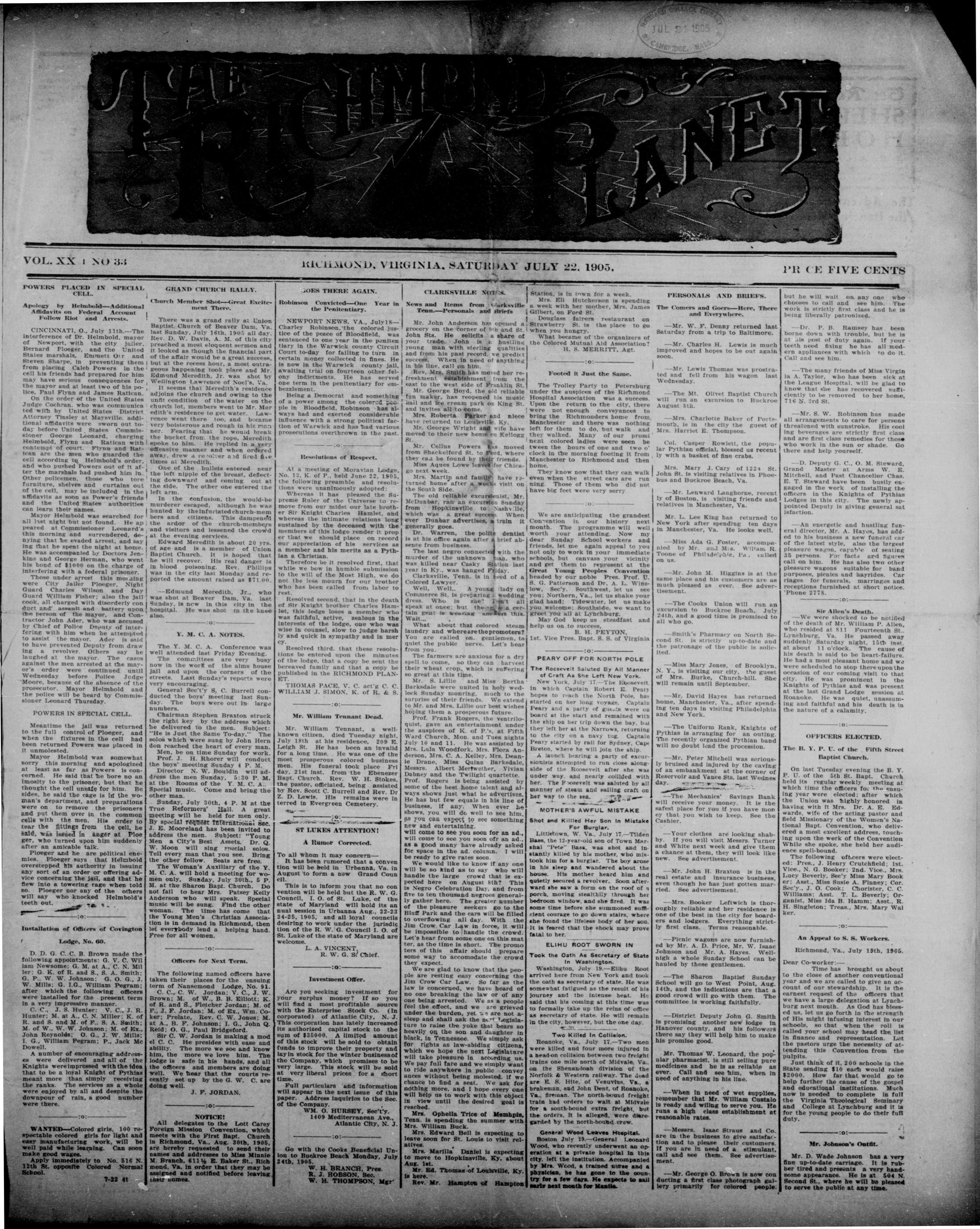
Richmond Planet
Saturday, July 22, 1905
Richmond, Virginia
Page text (machine-generated)
THE PATCHMEND PLANET
POWERS PLACED IN SPECIAL CELL.
Apology by Helmbold—Additional Affidavits on Federal Account Follow Riot and Arrests.
CINCINNATI, O., July 11th.—The interference of Dr. Helmbold, mayor of Newport, with the city jailer, Bernard Ploeger, and the United States marshals, Emmett Orr and Steven Sharpe, in preventing them from placing Caleb Powers in the cell his friends had prepared for him may have serious consequences for the mayor and at least two of his police, Paul Flynn and James Ratican.
On the order of the United States Judge Cochran, who was communicated with by United States District Attorney Tinsley at Maysville, additional affidavits were sworn out today before United States Commissioner George Leonard, charging Helmbold, Flynn and Ratican with contempt of court. Flynn and Ratican are the men who guarded the cell according to Helmbold's order, and who pushed Powers out of it after the marshals had pushed him in. Other policemen, those who tore furniture, shelves and curtains out of the cell, may be included in the affidavits as soon as Power's friends and the United States authorities can learn their names.
Mayor Helmbold was searched for all last night but not found. He appeared at Commissioner Leonard's this morning and surrendered, denying that he evaded arrest, and saying that he spent the night at home. He was accompanied by Doctors Jenkins and George Herman, who went his bond of $1000 on the charge of interfering with a federal prisoner. Those under arrest this morning were City Jailer Ploeger, Night Guard Charles Wilson and Day Guard William Fisher; also the jail cook, all charged with disorderly conduct and 'assault and battery upon the person of the mayor, and Contractor John Ader, who was accused by Chief of Police Deputy of interfering with him when he attempted to assist the mayor. Ader is said to have prevented Deputy from drawing a revolver. Others say he laughed at the mayor. The cases against the men arrested at the mayor's order were continued until Wednesday before Police Judge Moore, because of the absence of the prosecutor. Mayor Helmbold and the police will be heard by Commissioner Leonard Thursday.
POWERS IN SPECIAL CELL
Meantime the jail was returned to the full control of Ploeger, and when the fixtures in the cell had been returned Powers was placed in it unmolested.
Mayor Helmbold was somewhat sorry this morning and apologized at least as far as Powers is concerned. He said that he bore no imosity to the prisoner, but that he thought the cell unsafe for him. He sides, he said the cage is in the woman's department, and preparations were on to remove the prisoners and put them over in the common cells with the men. His order to tear the fittings from the cell, he said, was issued in anger at Ploeger, who turned upon him suddenly after an amicable talk.
Ploeger and he are political enemies. Ploeger says that Helmbold overstepped his authority in issuing any sort of an order or offering advice concerning the jail, and that he fled into a towering rage when told so. Ploeger nor any of the others will say who knocked Helmbold's teeth out.
Installation of Officers of Covington
D. D. G. C. C. B. Brown made the following appointments: G. V. C. William Newsome; G. M. at A. C. N. Miller; G. K. of R. and S. S. A. Smith; G. P., W. W. Johnson; G. O. G., J. W. Mills; G. I. G., William Pegram; after which the following officers were installed for the present term in a very impressive manner. C. C., J. S. Hunter; V. C., J. R. Hunter; M. at A. C. N. Miller; K. of R. and S. and M. of F. S. A. Smith; M. of W., W. W. Johnson; M. of Ex. John Reynolds; O. G., J. W. Mills; I. G., William Pegram; P., Jack Mc Dowell.
A number of encouraging addresses were delivered and all of the Knights were impressed with the idea that to be a loyal Knight of Pythias meant more than simply receiving the ranks. The services as a whole were enjoyed by all and despite the downpour of rain, a good number were there.
WANTED—Colored girls, 100 respectable colored girls for light and easy manufacturing work, will be well paid while learning. Can soon make good wages.
Apply immediately to No. 516 N.
12th St. opposite Colored Normal School.
7-22 4t
GRAND CHURCH RALLY.
Church Member Shot—Great Excitement There.
There was a grand rally at Union Baptist Church of Beaver Dam, Va. last Sunday, July 16th, 1905 all day. Rev D. W. Davis, A. M. of this city preached a most eloquent sermon and it looked as though the financial part of the affair would be a great success, but at the recess hour, a most outrageous happening took place and Mr. Edmund Meredith, Jr. was shot by Wellington Lawrence of Noel's, Va.
It seems that Meredith's residence adjoins the church and owing to the unit condition of the water on the church lot, members went to Mr. Meredith's residence to get water. Lawrence went there too, and became very bolsterous and rough in his manner. Fearing that he would break the bucket from the rope, Meredith spoke to him. He replied in a very offensive manner and when ordered away, drew a revolver and fired five times at Meredith.
One of the bullets entered near the left nipple of the breast, deflecting downward and coming out at the side. The other one entered the left arm.
In the confusion, the would-be murderer escaped, although he was hunted by the infuriated church-members and citizens. This dampened the ardor of the church-members and visitors and lessened the crowd at the evening services.
Edward Meredith is about 20 yrs. of age and is a member of Union Baptist Church. It is hoped that he will recover. His real danger is in blood poisoning. Rev. Phillips was in the city last Monday and reported the amount raised as $71,00.
—Edmund Meredith, Jr., who was shot at Beaver Dam, Va. last Sunday, is now in this city in the hospital. He was shot in the knee also.
Y. M. C. A. NOTES.
The Y. M. C. A. Conference was well attended last Friday Evening. The committees are very busy now in the work of the alms house jail and upon the corners of the streets. Last Sunday's reports were very encouraging. General Sec'ty S. C. Burrell conducted the boys' meeting last Sunday. The boys were out in large numbers. Chairman Stephen Braxton struck the right key by the address which he delivered to the men. Subject: "He is Just the Same To-day." The solos which were sung by John Hern don reached the heart of every man.
Men, be on time Sunday for work.
Prof. J. H. Rhorer will conduct the boys' meeting Sunday 4 P. M.
Director N. W. Bouldin will address the men Sunday, 5:30 P. M.
at the Rooms of the Y. M. C. A.. Special music. Come and bring the other man.
Sunday, July 30th, 4 P. M at the True Reformers' Hall. A great meeting will be held for men only. By special request international sec. J. E. Mooreland has been invited to address the men. Subject: "Young Men a City's Best Assets, Dr. Q. W. Moon will sing special solos. Tell every man that you see. Bring the other fellow. Seats are free. The Woman's Auxiliary of the Y. M. C. A. will hold a meeting for women only, Sunday, July 30th, 5 P. M. at the Sharon Bapt. Church. Do not fail to hear Mrs. Patsey Kelly Anderson who will speak. Special music will be sung. Find the other woman. The time has come that the Young Men's Christian Association is in demand in Richmond, then let everybody lend a helping hand. Free for all women.
Officers for Next Term.
The following named officers have taken their places for the ensuing term of Nansemond Lodge, No. 91. C. C., C. W. Jordan; V. C., J. W. Brown; M. of W, B. B. Elliott; K. of R. and S., Fletcher Jordan; M. of F., J. F. Jordan; M. of Ex. Wm. Cooker; Prelate, Rev. C. W. Jones; M. at A., B. F. Johnson; I. G., John Q. Reid; O. G., Paul Bridgeford. Sir C. W. Jordan is making a model C. C. He presides with ease and ability. The more we see and know him, the more we love him. The lodge is safe in his hands, and all the officers and members are doing well. We hear that the courts recently set up by the G. W. C. are doing well.
NOTICE!
All delegates to the Lott Carey Foreign Mission Convention, which meets with the First Bapt. Church in Richmond, Va., Aug. 30th, 1905, are hereby requested to send their names and addresses to Miss Minnie M. Branch, $611.1\%$ E. Baker St., Richmond, Va. in order that they may be assigned and notified before leaving their homes.
GOES THERE AGAIN.
Robinson Convicted—One Year in the Penitentiary.
NEWPORT NEWS, VA., July 18—Charley Robinson, the colored justice of the peace of Bloodfield, was sentenced to one year in the penitentiary in the Warwick county Circuit Court to-day for failing to turn in certain money collected in fines. He is now in the Warwick county jail, awaiting trial on fourteen other felony indictments. He has served one term in the penitentiary for embezzlement.
Being a Democrat and something of a power among the colored people in Bloodfield, Robinson has always had and exerted considerable influence with a strong political faction of Warwick and has had various prosecutions overthrown in the past.
Resolutions of Respect.
At a meeting of Moravian Lodge, No. 13, K. of P., held June 22, 1905, the following preamble and resolutions were unanimously adopted:
Whereas it has pleased the Supreme Ruler of the Universe to remove from our midst our late brother Sir Knight Charles Hamlet, and whereas the intimate relations long sustained by the deceased with the members of this lodge render it prop that we should place on record our appreciation of his services as a member and his merits as a Pythian a Christian.
Therefore be it resolved first, that while we bow in humble submission to the will of the Most High, we do not the less mourn for our brother who has been called from labor to rest.
Resolved second, that in the death of Sir Knight brother Charles Hamlet, this lodge loses a member who was faithful, active, zealous in the interests of the lodge, one who was wise in counsel, slow to judge harshly and quick in sympathy and in mercy.
Resolved third, that these resolutions be entered upon the minutes of the lodge, that a copy be sent the bereaved family and that a copy be published in the RICHMOND PLANET.
THOMAS PACE, V. C. act'g C. C. WILLIAM J. SIMON, K. of R. E. S.
Mr. William Tennant Dead.
Mr. William Tennant, a well-known citizen, died Tuesday night, July 18th at his residence, 209 E. Leigh St. He has been an invalid for a long time. He was one of the most prosperous colored business men. His funeral took place Friday, 21st inst. from the Ebenezer Bapt. Church. Rev. W. H. Stokes, the pastor, officiated, being assisted by Rev. Scott C. Burrell and Dr. Z. D. Lewis. His remains were in interred in Evergreen Cemetery
ST LUKES ATTENTION!
A Rumor Corrected
To all whom it may concern—
It has been rumored that a convention will be held in Urbanna, Va. in August to form a new Grand Council.
This is to inform you that no convention will be held but the R. W. G. Council, I. O. of St. Luke, of the state of Maryland will hold its anual session in Urbanna Aug., 22-23 24-25, 1905, and all loyal councils desiring to work under the jurisdiction of the R. W. G. Council I. O. of St. Luke of the state of Maryland are welcome.
Investment Offer.
Are you seeking investment for your surplus money? If so you will find a most profitable source with the Enterprise Stock Co. (Incorporated) of Atlantic City, N. J. This corporation has lately increased its authorized capital stock to the sum of $35000. A limited amount of this stock will be sold to obtain funds to improve their property and lay in stock for the winter business of the Company, which promises to be very large. This stock will be sold at very liberal prices for a short time.
Full particulars and information will appear in the next issue of this paper. Address inquiries to the Sec. of the Company.
WM. O. HURSEY, Sec'ty.
1409 Mediterranean Ave.
Atlantic City, N. J.
Go with the Cooks Beneficial Union to Buckroe Beach Monday, July 24th, 1905.
W. H. BRANCH, Pres.
R. J. HOBSON, Sec.
W. H. THOMPSON, Mgr'
News and Items from Clarksville Tenn.-Personals and Briefs
Mr. John Anderson has opened a grocery on the corner of 5th and St. John Sts. He solicits a share of your trade. John is a hustling young man with sterling qualities and from his past record, we predict success. When in need of anything in his line, call on him.
Rev. Mrs. Smith has moved her refreshment establishment from the east to the west side of Franklin St.
Mr. George Boyd, the old reliable fun maker, has reopened his music hail and ice cream park on King St. and invites all to come.
Mrs. Roberta Parker and niece have returned to Louisville, Ky.
Mr. George Wright and wife have moved to their new home on Kellogg St.
Mr. Cellus Powers has moved from Shackelford St. to Ford, where they can be found by their friends. Miss Aques Lowe leaves for Chicago next week. Mrs. Martin and family have returned home after a weeks visit on the South Side. The old reliable excursionist, Mr. McDunbar, ran an excursion Sunday from Hopkinsville to Nashville, which was a great success. When ever Dunbar advertises, a train it generally goes. Dr. Warren, the polite dentist is at his office again after a brief absence from business. The last negro connected with the murder of the unknown man, who was killed near Casky Station last year in Ky., was hanged Friday.
Clarksville, Tenn. is in bed of a Colored Lawyer.
Well, Well. A young lady on Commerce St. is preparing a wedding dress. Who is she? Don't all speak at once; but the en is a certain gent is wearing answers this. Wait.
What about that colored steam laundry and where are the promoters? You are called on, gentlemen, to quiet the public nerve. Let's hear from you.
The farmers are anxious for a dry spell to come, so they can harvest their wheat crop, which is suffering so great at this time.
Mr. S. Lillie and Miss Bertha Barksdale were united in holy wedlock Sunday moning, much to the surprise of their friends. We extend to Mr. and Mrs. Lillie our best wishes hoping them a prosperous future.
Prof. Frank Rogers, the ventilloquist, gave an entertainment under the auspices of K. of P.'s, at Fifth Ward Church, Mon. and Tues nights July 10 and 11. He was assisted by Mrs. Lula Woodfork, Mrs. Flora Anderson, Mrs. C. A. Kelley, Mrs. Deanie Drane, Miss Quinn Barksdale, Messrs. Albert Mertwether, Vivian Dabney and the Twilight quartette.
Prof. Rogers is being assisted by some of the best home talent and always shows just what he advertises. He has but few equals in his line of business, if any. When ever he shows, you will do well to see him, as you can expect to see something new and entertaining.
will come to see you soon for an ad, will come to see you soon of an ad, as a good many have already asked for space in the ad, column. I will be ready to give rates soon. We would like to know if any one will be so kind as to say who will handle the large crowd that is expected here on August 8th? This is Negro Celebration Day, and from five to ten thousand negroes generally gather here. The greater number of the pleasure seekers go to the Bluff Park and the cars will be filled to overflowing all day. With the Jim Crow Car Law in force, it will be impossible to handle the crowd. Let's hear from some one on this matter, as the time is short. The promoters of this affair should prepare some way to accommodate the crowd they expect.
We are glad to know that the people are resting easy concerning the Jim Crow Law. So far as the law is concerned, we have heard of no one breaking the law or of any one being arrested. We as a people feel the effect, and we are grieved under the burden, yet we are not asleep and shall ask the next Legislature to raise the yoke that bears so heavily on the son and daughter in black, in Tennessee. We simply ask for rights as law-abiding citizens, which we hope the next Legislature will take pleasure in according us. We pay full fare and we simply want to ride anywhere in public conveyances without being molested, if we chance to find a seat. We ask for nothing more, and I hope every one will help us to work with this object in view until the desired goal is reached.
Mrs. Ophella Trice of Memphis, Tenn. is spending the summer with Mrs. William Buck.
Mrs. Edward Bell is expecting to leave soon for St. Louis to visit relatives.
Mrs. Marilla Daniel is expecting to move to Hopkinsville, Ky. about Aug. 1st.
Mr. Ed. Thomas of Louisville, Ky. is here.
Rev. Mr. Hampton of Hampton
Station, is in town for a week.
Mrs. Elli Hutcherson is spending a week with her mother, Mrs. James Gilbert, on Ford St.
Douglass fairers restaurant on Strawberry St. is the place to go when you hungry.
What became of the organizers of the Colored Mutual Aid Association?
H. S. MERRITT. Act.
Footed it Just the Same.
The Trolley Party to Petersburg under the auspices of the Richmond Hospital Association was a success. Upon the return to the city, there were not enough conveyances to bring the Richmonders home from Manchester and there was nothing left for them to do, but walk and they walked. Many of our prominent colored ladies were seen be between the hours of one and two o'clock in the morning footing it from Manchester to Richmond and then home. They know now that they can walk even when the street cars are running. Those of them who did not have big feet were very sorry.
We are anticipating the greatest
Convention in our history next
month. The programme will well
worth your attending. Now my
dear Sunday School workers and
friends, let me again appeal to you
not only to work in your immediate
schools, but canvass your vicinity
and get them to represent at the
Great Young Peoples Convention
headed by our noble Pres. Prof. U.
S. G. Patterson and Dr. A. L. Winslow,
Sec'y. Southwest, let us see you;
Northern, Va., let us shake your
glad hand; Tidewater, let us make
you welcome; Southside, we want to
greet you all at Lynchburg.
May God keep us steadfast and help us on to success.
B. H. PEYTON,
1st. Vice Pres. Bapt. S. S. of Virginia
The Roosevelt Saluted By All Manner of Craft As She Left New York.
New York, July 17.—The Roosevelt, in which Captain Robert E. Perry hopes to reach the North Pole, has started on her long voyage. Captain Peary and a party of guests were on board at the start and remained with the ship on her trip down the bay, but they left her at the Narrows, returning to the city on a navy tug. Captain Peary started by rail for Sydney, Cape Breton, where he will join the ship.
A launch bearing a party of excursionists attempted to run close alongside of the Roosevelt after she was under way, and nearly collided with her. The Roosevelt was saluted by all manner of steam and sailing craft on her way to the sea.
MOTHER'S AWFUL MISTAKE
Shot and Killed Her Son In Mistake For Burglar.
Littletown, W. Va., July 17.—Tilden Bass, the 12-year-old son of Town Marshal "Pete" Bass, was shot and instantly killed by his mother, who mistook him for a burglar. The boy arose in his sleep and wandered about the house. His mother heard him and quietly secured a revolver. Soon afterward she saw a form on the roof of a porch, moving stealthily through her bedroom window, and she fired. It was some time before she summoned sufficient courage to go down stairs, where she found the lifeless body of her son. It is feared that the shock may prove fatal to her.
ELIHU ROOT SWORN IN
Took the Oath As Secretary of State In Washington. Washington, July 19—Elihu Root arrived here from New York and took the oath as secretary of state. He was somewhat fatigued as the result of his journey and the intense heat. He said that his coming at this time was to formally take up the reins of office as secretary of state. He will remain in the city, however, but the one day.
Two Killed In Collision
Roanoke, Va., July 17.—Two men were killed and four more injured in a head-on collision between two freight trains one mile north of Midvale, Va., on the Shenandoah division of the Norfolk & Western railway. The dead are E. S. Hite, of Vesuvius, Va., a brakeman, and John Dent, of Roanoke, Va., fireman. The north-bound freight train had orders to wait at Midvale for a south-bound extra freight, but the orders, it is alleged, were disregarded by the north-bound crew.
General Wood Leaves Hospital
Boston July 19.—General Leonard Wood, who recently underwent an operation at a private hospital in this city, left the institution. Accompanied by Mrs. Wood, a trained nurse and a physician, he has gone to the country for a few dars. He expects to sail early next month for Mantle.
PERSONALS AND BRIEFS.
The Comers and Goers—Here, There and Everywhere.
Mr. W. F. Denny returned last Saturday from a trip to Baltimore.
Mr. Charles H. Lewis is much improved and hopes to be out again soon.
Mr. Lewis Thomas was prostrated and fell from his wagon last Wednesday.
The Mt. Olivet Baptist Church will run an excursion to Buckroe August 5th.
Mrs. Charlotte Baker of Portsmouth, is in the city the guest of Mrs. Harriet E. Thompson.
Col. Casper Rowlett, the popular Pythian official, blessed us recently with a basket of fine crabs.
Mrs. Mary J. Cary of 1224 St. John St. is visiting relatives in Phoebus and Buckroe Beach, Va.
Mr. Lenward Langhorne, recently of Boston, is visiting friends and relatives in Manchester, Va.
Mr. L. Lee King has returned to New York after spending ten days in Manchester, Va. He looks well.
Miss Ada G. Foster, accompanied by Mr. and Mrs. William R. Toone of Philadelphia, Pa., called on us.
Mr. John M. Higgins is at the same place and his customers are as much pleased as ever. See advertisement.
The Cooks Union will run an excursion to Huckroe Beach, July 24th, and a good time is promised to all who go.
Smith's Pharmacy on North Second St. is strictly up-to-date and the patronage of the public is solicited.
Miss Mary Jones, of Brooklyn, N. Y., is visiting our city, the guest of Mrs. Burke, Church-hill. She will remain until September.
Mr. David Hayes has returned home, Manchester, Va., after spending ten days in visiting Philadelphia and New York.
The Uniform Rank, Knights of Pythias is arranging for an outing. The recently organized Pythian band will no doubt lead the procession.
Mr. Peter Mitchell was seriously bruised and injured by the caving of an embankment at the corner of Reservoir and Vance Sts. last Wednes day.
The Mechanics' Savings Bank will receive your money. It is the safest place for you if you have mon ey that you wish to keep. See the Cashier.
—Your clothes are looking shabby. If you will visit Messrs. Turner and White next week and give them a chance at them, they will look like new. See advertisement.
—Mr. John H. Braxton is in the real estate and insurance business, even though he has just gotten married. See advertisement.
—Mrs. Booker Leftwich is thoroughly reliable and her residence is one of the best in the city for boarders and lodgers. Everything strictly first class. Terms reasonable.
—Picnic wagons are now furnished by Mr. A. D. Price, Mr. W. Isaac Johnson and Mr. A. Hayes. Well-nigh a whole Sunday School can be hauled by these gentlemen.
—The Sharon Baptist Sunday School will go to West Point, Aug. 14th, and the indications are that a good crowd will go with them. The committee is working faithfully.
—District Deputy John G. Smith is promising another new lodge in Hanover county, and his followers there say they will help him to make his promise good.
Mr. Thomas W. Leonard, the popular pharmacist, is still selling pure medicines and he is as reliable as ever. Call and see him, when in need of anything in his line.
—When in need of wet supplies, remember that Mr. William Custalo is ready and willing to serve you. He runs a high class establishment at reasonable rates.
—Messrs. Isaac Straus and Co. are in the business to give satisfaction and to please their customers. If you are in need of a stimulant, call and see them. See advertisement.
Mr. George O. Brown is now con ducting a first class photograph gallery primarily for colored people.
but he will wait on any one who chooses to call and see him. The work is strictly first class and he is being liberally patronized.
—Dr. P. B. Ramsey has, been borne down with trouble, but he is at his post of duty again. If your teeth need fixing he has all modern appliances with which to do it. Call and see him.
—The many friends of Miss Virginia A. Taylor, who has been sick at the League Hospital, will be glad to know that she has recovered sufficiently to be removed to her home, 716 N. 3rd St.
—Mr. S. W. Robinson has made all arrangements to care for persons threatened with sunstroke. His cooling beverages are strictly first class and are first class remedies for those who work in the sun or shade. Go there and help yourself.
—D. Deputy G. C., O. M. Steward, Grand Master at Arms W. E. Mitchell, and Past Chancellor Chas. E. T. Steward have been busily engaged in the work of installing the officers in the Knights of Pythias Lodges in this city. The newly appointed Deputy is giving general sat isfaction.
—An energetic and hustling funeral director, Mr. A. Hayes, has added to his business a new funeral car of the latest style, also the largest pleasure wagon, capable of seating 35 persons. For facts and figures call on him. He has also two other pleasure wagons suitable for band purposes, plenies and hayrides. Car riages for funerals, marriages and receptions furnished at short notice. Phone 2778.
Sir Allen's Death.
We were shocked to be notified of the death of Mr. William P. Allen, who resided at 811 Fourteenth St. Lynchburg, Va. He was passed away suddenly Saturday night, 15th inst. at about 11 o'clock. The cause of his death is said to be heart-failure. He had a most pleasant home and we were scheduled to stop upon the occasion of our coming visit to that city. He was prominent in the Knights of Pythias and was present at the last Grand Lodge session at Roanoke. He was quiet, unassuming and faithful and his death is in the nature of a calamity.
OFFICERS ELECTED
The B. Y. P. U. of the Fifth Street Baptist Church.
On last Tuesday evening the B. Y.
P. U. of the 5th St. Bapt. Church
held its regular weekly meeting at
which time the officers for the ensuing
year were elected; after which
the Union was highly honored
in having with it Mrs. Dr. A. E. Ed-
wards, wife of the acting pastor and
field Missionary of the Women's
National Bapt. Convention, who delivered
a most excellent address, touching
upon the work of the Convention
While she spoke, she held her audience
spell-bound.
The following of officers were elected:
Pres., J. Henry Crutchfield; 1st.
Vice., N. G. Booker; 2nd. Vice., Mrs.
Lucy Beaver, Secy's Miss Mary Booker
Asst.; Miss Susie A. Finney; Cor.
Secy', J. O. Cook; Chorister, C. C.
Williams; Asst. T. L. Beverly; Organist,
Miss Ida B. Hamm; Asst., R. H. Slingleton; Treas., Mrs. Mary Walker.
An Appeal to S. S. Workers
Richmond, Va., July 19th, 1905.
Dear Co-worker:—
Time has brought us about to the close of another conventional year and we are called to give an account of our stewardship. It is the earnest request of the officers that we have a large delegation at Lynchburg next month. As God has blessed us, let us go forth in the strength of His might infusing interest in our schools, so that when the roll is called your school may head the list in finance and representation. Let the pastors urge the necessity of attending this Convention from the pulpits.
Just think of it, 200 schools in the State sending $10 each would raise $2000. How far that would go to help further the cause of the gospel and educational institutions. Much now is needed to complete in full the Virginia Theological Seminary and College at Lynchburg and it is for the young people to do their full duty.
Mr. Johnson's Outfit.
Mr. D. Wade Johnson has a very fine up-to-date carriage. It is rubber tired and presents a very handsome appearance. He is at 504 N. Second St., where he will be pleased to serve the public at any time.
The Return of SHERLOCK HOLMES
Author of "The Adventures of Sherlock Holmes," "The Hound of the Baskervilles," "The Sign of the Four," "A Study in Scarlet." Etc.
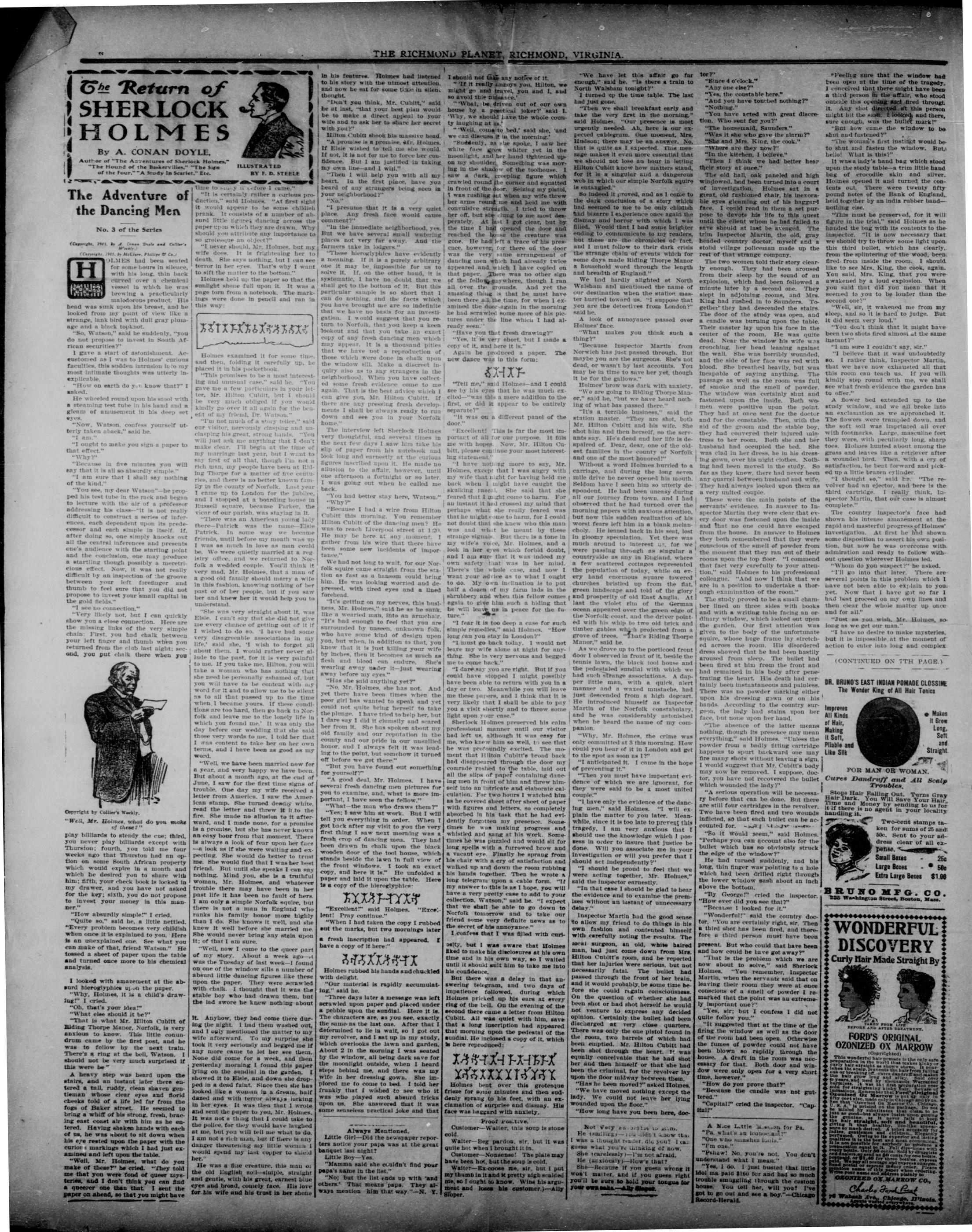
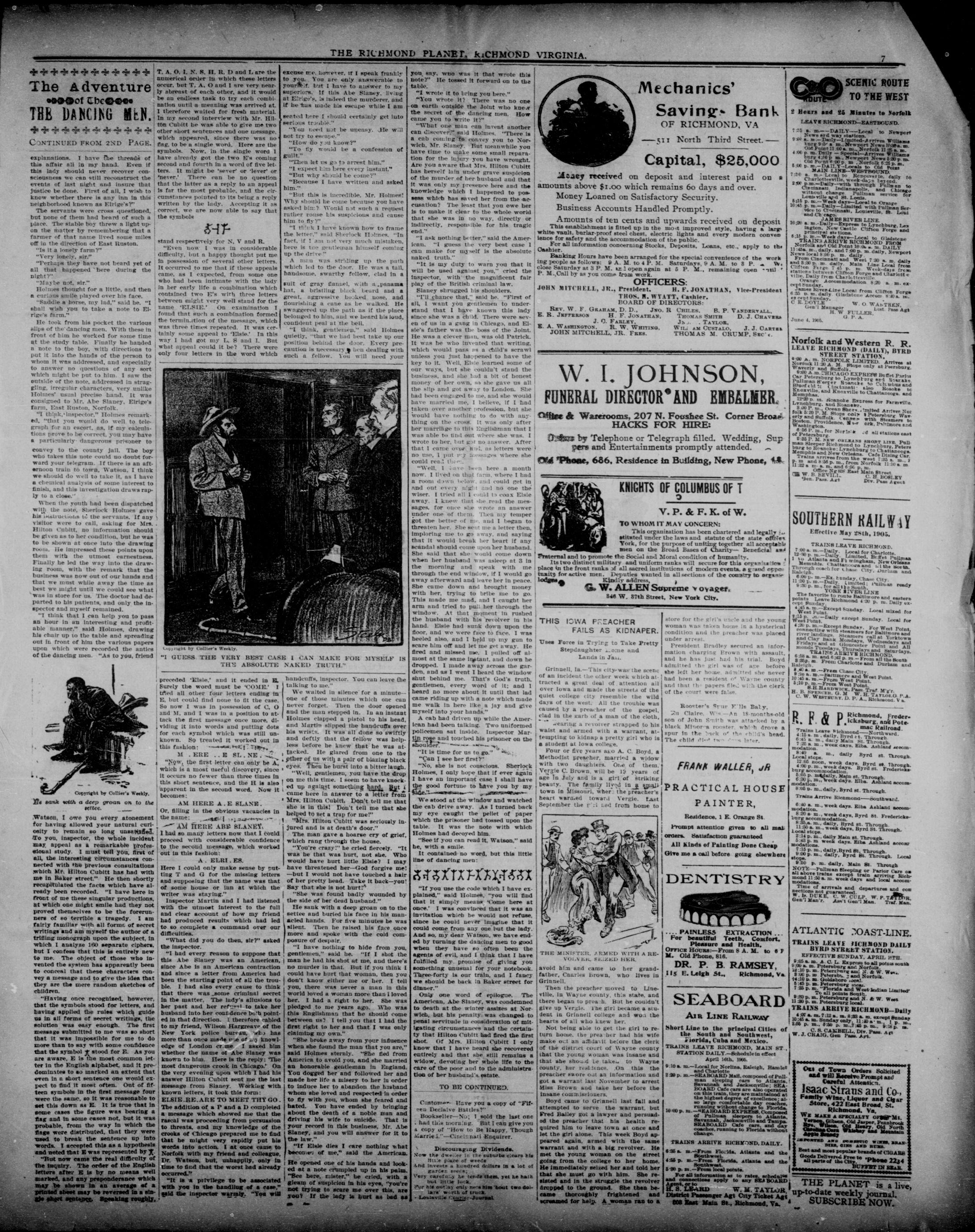
"It is certainly rather a curious production," said Holmes. "At first sight it would appear to be some childish prank. It consists of a number of absurd little figures; dancing across the paper upon which they are drawn. Why should you attribute any importance to so grotesque an object?"
"I never should, Mr. Holmes, but my wife does. It is frightening her to death. She says nothing, but I can see terror in her eyes. That's why I want to sift the matter to the bottom."
Holmes held up the paper so that the sunlight shone full upon it. It was a page torn from a notebook. The markings were done in pencil and ran in this way:
Holmes examined it for some time, and then, folding it carefully up, he placed it in his pocketbook.
"This promises to be a most interesting and unusual case," said he. "You gave me a few participants in your letter, Mr. Hilton Culbitt, but I should be very much obliged if you would kindly go over it all again for the benefit of my friend, Dr. Watson."
"I'm not much of a story teller," said our visitor, nervously chasing and unclasping his great, strong hands. "You will just ask me anything that I don't make clear. I'll begin at the time of my marriage last year, but I want to sirst of all that, though I'm not a rich man, my people have been at Riding Thorpe for a matter of five centuries, and there is no better known family in the county of Norfolk. Last year I came up to London for the jubilee, and I stopped at a boarding house in Russell square, because Parker, the vicer of our parish, was staying in it.
"There was an American young lady there—Patrick was the name—Elise Patrick. In some way we became friends, until before my month was up I was as much in love as man could be. We were quietly married at a registry office, and we returned to Norfolk a wedded couple. You'll think it very mad, Mr. Holmes, that a man of a good old family should marry a wife in this fashion, knowing nothing of her past or of her people, but if you saw her and knew her it would help you to understand.
"She was very straight about it, was Elsie. I can't say that she did not give me every chance of getting out of it if I wished to do so. 'I have had some very disagreeable associations in my life,' said she, 'I wish to forget all about them. I would rather never alude to the past, for it is very painful to me. If you take me, Hilton, you will take a woman who has nothing that she need be personally ashamed of, but you will have to be content with my word for it and to allow me to be silent as to all that passed up to the time when I became yours. If these conditions are too hard, then go back to Norfolk and leave me to the lonely life in which you found me.' It was only the day before our wedding that she said those very words to me. I told her that I was content to take her on her own terms, and I have been as good as my word.
"Well, we have been married now for a year, and very happy we have been. But about a month ago, at the end of June, I saw for the first time signs of trouble. One day my wife received a letter from America. I saw the American stamp. She turned deadly white, read the letter and threw it to the fire. She made no allusion to it afterward, and I made none, for a promise is a promise, but she has never known an easy hour from that moment. There is always a look of fear upon her face—a look as if she were waiting and expecting. She would do better to trust me. She would find that I was her best friend. But until she speaks I can say nothing. Mind you, she is a truthful woman, Mr. Holmes, and whatever trouble there may have been in her past life it has been no fault of hers. I am only a simple Norfolk squire, but there is not a man in England who ranks his family honor more highly than I do. She knows it well, and she knew it well before she married me. She would never bring any stain upon it; of that I am sure.
"Well, now I come to the queer part of my story. About a week ago—it was the Tuesday of last week—I found on one of the window sills a number of absurd little dancing figures like these upon the paper. They were scrawled with chalk. I thought that it was the stable boy who had drawn them, but the lad swore he knew nothing about
it. Anyhow, they had come there during the night. I had them washed out, and I only mentioned the matter to my wife afterward. To my surprise she took it very seriously and begged me if any more came to let her see them. None did come for a week, and then yesterday morning I found this paper lying on the sundial in the garden. I showed it to Elsie, and down she dropped in a dead falut. Since then she has looked like a woman in a dream, half dazed and with terror always lurking in her eyes. It was then that I wrote and sent the paper to you, Mr. Holmes. It was not a thing that I could take to the police, for they would have languaged at me, but you will tell me what to do. I am not a rich man, but if there is any danger threatening my little woman I would spend my last copper to shed her."
He was a fine creature, this man of the old English soil—simple, straight and gentle, with his great, earnest blue eyes and broad, comely face. His love for his wife and his trust in her shone
The Adventure of the Dancing Men
The Adventure of the Dancing Men
No. 3 of the Series
(Copyright, 1903, by A. Conan Doyle and Collier's
Writings)
(Copyright, 1905, by McClure, Phillips & Co.)
OLMES had been seated
for some hours in silence,
with his long, thin back
curved over a chemical
vessel in which he was
brewing a practically
malodorous product. His
HOLMES had been sented for some hours in silence, with his long, thin back curved over a chemical vessel in which he was brewing a practically malodorous product. His head was sunk upon his breast, and he looked from my point of view like a strange, lank bird with dull gray plumage and a black topknot.
"So, Watson," said he suddenly, "you do not propose to invest in South African securities?"
I gave a start of astonishment. Acustomed as I was to Holmes' curious faculties, this sudden intrusion into my most intimate thoughts was utterly inexplicable.
"How on earth do you know that?" I asked.
He wheeled round upon his stool with a steaming test tube in his hand and a gleam of amusement in his deep set eyes.
"Now, Watson, confess yourself utterly taken aback," said he.
"I am."
"I ought to make you sign a paper to that effect."
"Why?"
"Because in five minutes you will say that it is all so absurdly simple."
"I am sure that I shall say nothing of the kind."
"You see, my dear Watson"—he prophed his test tube in the rack and began to lecture with the air of a professor addressing his class—"it is not really difficult to construct a series of inferences, each dependent upon its predecessor and each simple in itself. If, after doing so, one simply knocks out all the central inferences and presents one's audience with the starting point and the conclusion, one may produce a startling though possibly a meretricious effect. Now, it was not really difficult by an inspection of the groove between your left forefinger and thumb to feel sure that you did not propose to invest your small capital in the gold fields."
"I see no connection."
"Very likely not, but I can quickly show you a close connection. Here are the missing links of the very simple chain: First, you had chalk between your left finger and thumb when you returned from the club last night; second, you put chalk there when you
3
Copyright by Collier's Weekly.
"Well, Mr. Holmes, what do you make of these?"
"Well, Mr. Holmes, what do you make of these?" play billiards to steady the cue; third, you never play billiards except with Thurston; fourth, you told me four weeks ago that Thurston had an option on some South African property which would expire in a month and which he desired you to share with him; fifth, your check book is locked in my drawer, and you have not asked for the key; sixth, you do not propose to invest your money in this manner.
"How absurdly simple!" I cried.
"Quite so," said he, a little nettled. "Every problem becomes a childish when once it is explained to you. Here is an unexplained one. See what you can make of that, friend Watson." He tossed a sheet of paper upon the table and turned once more to his chemical analysis.
I looked with amazement at the absurd hieroglyphics upon the paper.
"Why, Holmes, it is a child's drawing!" I cried.
"Oh, that's your idea!"
"What else should it be?" "That is what Mr. Hilton Cubitt of Biding Thorpe Manor, Norfolk, is very anxious to know. This little conundrum came by the first post, and he was to follow by the next train. There's a ring at the bell, Watson. I should not be very surprised if this were be."
A heavy step was heard upon the stairs, and an instant later there entered a tall, ruddy, clean shaven gentleman whose clear eyes and florid cheeks told of a life led far from the fogs of Baker street. He seemed to bring a whiff of his strong, fresh, bracing east coast air with him as he entered. Having shaken hands with each of us, he was about to sit down when his eye rested upon the paper with the curious markings which I had just examined and left upon the table.
"Well, Mr. Holmes, what do you make of these?" he cried. "They told me that you were tond of queer mysteries, and I don't think you can find a queerer one than that. I sent the paper on ahead, so that you might have
ILLUSTRATED
BY F. D. STEELE
in his features. Holmes had listened to his story with the utmost attention, and now he sat for some time in silent thought.
"Don't you think, Mr. Cubitt," said he at last, "that your best plan would be to make a direct appeal to your wife and to ask her to share her secret with you?"
Hilton Cubitt shook his massive head.
"A promise is a promise, Mr. Holmes. If Elsie wished to tell me she would. If not, it is not for me to force her confidence. But I am justified in taking my own line—and I will."
"Then I will help you with all my heart. In the first place, have you heard of any strangers being seen in your neighborhood?"
"No."
"I presume that it is a very quiet place. Any fresh face would cause comment?"
I should not fake any notice of it.
"If it really annoys you, Hilton, we might go and travel, you and I, and so avoid this nuisance."
"What, be driven out of our own house by a practical joke?" said I. Why, we should have the whole county laughing at us.
"Well, come to bed," said she, and we can discuss it in the morning.
"Suddenly, as she spoke, I saw her white face grow whiter yet in the moonlight, and her hand tightened up on my shoulder. Something was moving in the shadow of the toolhouse. I saw a dark, creeping figure which crawled round the corner and squatted in front of the door. Seizing my plato, I was rushing out when my wife threw her arms round me and held me with convulsive strength. I tried to throw her off, but she clung to me most desperately. At last I got clear, but by
"We have lee enough," said he North Walsham. He turned up to the had just gone.
"We then shuake take the very said Holmes urgently needed pected cabbage Hudson; there is that is sage makes it we should not eat Hilton Cubitt kite for it is a sime web in which our is entangled."
So indeed it pled the dark conceal had seemed to and bizarre I exclaimed and bowed.
"In the immediate neighborhood, yes. But we have several small watering places not very far away. And the farmers take in lodgers."
"These hierochlyphics have evidently a meaning. If it is a purely arbitrary one it may be, impossible for us to solve it. If, on the other hand, it is systematic, I have no doubt that we shall get to the bottom of it. But this particular sample is so short that I can do nothing, and the facts which you have brought me are so indefinite that we have no basis for an investigation. I would suggest that you return to Norfolk, that you keep a keen lookout and that you take an exact copy of any fresh dancing men which may appear. It is a thousand pities that we have not a reproduction of those which were done in chalk upon the window sill. Make a discreet inquiry also as to any strangers in the neighborhood. When you have collected some fresh evidence come to me again. That is the best advice which I can give you, Mr. Hilton Cubitt. If there are any pressing fresh developments I shall be always ready to run down and see you in your Norfolk home."
The interview left Sherlock Holmes very thoughtful, and several times in the next few days I saw him take his slip of paper from his notebook and look long and earnestly at the curious figures inscribed upon it. He made no allusion to the affair, however, until one afternoon a fortnight or so later. I was going out when he called me back.
"You had better stay here, Watson." "Why?"
"Because I had a wire from Hilton Cubitt this morning. You remember Hilton Cubitt of the dancing men? He was to reach Liverpool street at 1:20. He may be here at any moment. I gather from his wire that there have been some new incidents of importance."
We had not long to wait, for our Norfolk squire came straight from the station as fast as a banson could bring him. He was looking worried and depressed, with tired eyes and a lined forehead.
"It's getting on my nerves, this business, Mr. Holmes," said he as he sank, like a weared man, into an armchair. "It's bad enough to feel that you are surrounded by unseen, unknown folk, who have some kind of design upon you, but when, in addition to that, you know that it is just killing your wife by inches, then it becomes as much as flesh and blood can endure. She's wearing away under it—just wearing away before my eyes."
"Has she said anything yet?"
"No, Mr. Holmes, she has not. And yet there have been times when the poor girl has wanted to speak and yet could not quite bring herself to take the plunge. I have tried to help her, but I dare say I did it clumsily and scared her from it. She has spoken about my old family and our reputation in the county and our pride in our unsullied honor, and I always felt it was leading to the point, but somehow it turned off before we got there."
"But you have found out something for yourself?"
"A good deal, Mr. Holmes. I have several fresh dancing men pictures for you to examine, and, what is more important, I have seen the fellow."
"What—the man who draws them?" "Yes; I saw him at work. But I will tell you everything in order. When I got back after my visit to you the very first thing I saw next morning was a fresh crop of dancing men. They had been drawn in chalk on the black wooden door of the tool house, which stands beside the lawn in full view of the front windows. I took an exact copy, and here it is." He unfolded a paper and laid it upon the table. Here is a copy of the hieroglyphics:
X X X X X X X
"Excellent!" said Holmes. "Excellent! Pray continue."
"When I had taken the copy I rubbed out the marks, but two mornings later
a fresh inscription had appeared. I have a copy of it here."
```markdown
```
Holmes rubbed his hands and chuckled with delight.
"Our material is rapidly accumulating," said he.
"Three days later a message was left scrawled upon paper and placed under a pebble upon the sundial. Here it is. The characters are, as you see, exactly the same as the last one. After that I determined to lie in wait, so I got out my revolver, and I sat up in my study, which overlooks the lawn and garden. About 2 in the morning I was seated by the window, all being dark save for the moonlight outside, when I heard steps behind me, and there was my wife in her dressing gown. She implored me to come to bed. I told her frankly that I wished to see who it was who played such absurd tricks upon us. She answered that it was some senseless practical joke and that
Always Mentioned.
Little Girl—Did the newspaper reporters notice your papa was at the great banquet last night?
Little Boy—Yes.
"Mamma said she couldn't find your papa's name in the list."
"No; but the list ends up with 'and others.' That means papa. They always mention him that way."—N. Y.
I should not take any notice of it.
"If it really annoyes you, Hilton, we might go and travel, you and I, and so avoid this nuisance."
"What, be driven out of our own house by a practical joker?" said I.
'Why, we should have the whole county laughing at us.'
"Well, come to bed," said she, "and we can discuss it in the morning."
"We can discuss it in the morning."
"Suddenly, as she spoke, I saw her white face grow whiter yet in the moonlight, and her hand tightened up on my shoulder. Something was moving in the shadow of the toolhouse. I saw a dark, creeping figure which crawled round the corner and squatted in front of the door. Seeking my plato, I was rushing out when my wife threw her arms round me and held me with convulsive strength. I tried to throw her off, but she clung to me most desperately. At last I got clear, but by the time I had opened the door and reached the house the creature was gone. He had left a trace of his presence, however, for there on the door was the very same arrangement of dancing men which had already twice appeared and which I have coped on that paper. There was no other sign of the fellow anywhere, though I ran all over the grounds. And yet the amazing thing is that he must have been there all the time, for when I examined the door-again in the morning he had scrawled some more of his pictures under the line which I had already seen."
"Have you that fresh drawing?"
"Yes, it is very short, but I made a copy of it, and here it is."
Again he produced a paper. The new dance was in this form:
সহজ সহজ
"Tell me," said Holmes—and I could see by his eyes that he was much excited—"was this a more addition to the first, or did it appear to be entirely separate?"
"It was on a different panel of the door."
"Excellent! This is far the most important of all for our purpose. It fills me with hopes. Now, Mr. Hilton Cubitt, please continue your most interesting statement."
"I have nothing more to say, Mr. Holmes, except that I was angry with my wife that night for having held me back when I might have caught the skulking raiser. She said that she feared that I might come to harm. For an instant it had crossed my mind that perhaps what she really feared was that he might come to harm, for I could not doubt that she knew who this man was and what he meant by these strange signals. But there is a tone in my wife's voice, Mr. Holmes, and a look in her eyes which forbid doubt, and I am sure that it was indeed my own safety that was in her mind. There's the whole case, and now I want your advice to as to what I ought to do. My own inclination is to put half a dozen of my farm lads in the shrubbery and when this fellow comes again to give him such a hiding that he will leave us in peace for the future."
"I fear it is too deep a case for such simple remedies," said Holmes. "How long can you stay in London?" "I must go back today. I would not leave my wife alone at night for anything. She is very nervous and begged me to come back." "I dare say you are right. But if you could have stopped I might possibly have been able to return with you in a day or two. Meanwhile you will leave me these papers, and I think that it is very likely that I shall be able to pay you a visit shortly and to throw some light upon your case."
Sherlock Holmes preserved his calm professional manner until our visitor had left us, although it was easy for me, who knew him so well, to see that he was profoundly excited. The moment that Hilton Cabitt's broad back had disappeared through the door my comrade rushed to the table, laid out all the slips of paper containing dancing men in front of him and threw himself into an intricate and elaborate calculation. For two hours I watched him as he covered sheet after sheet of paper with figures and letters, so completely absorbed in his task that he had evidently forgotten my presence. Sometimes he was making progress and whistled and sang at his work. Sometimes he was puzzled and would sit for long spells with a furrowed brow and a vacant eye. Finally he sprang from his chair with a cry of satisfaction and walked up and down the room rubbing his hands together. Then he wrote a long telegram upon a cable form. "If my answer to this is as I hope, you will have a very pretty case to add to your collection, Watson," said he. "I expect that we shall be able to go down to Norfolk tomorrow and to take our friend some very definite news as to the secret of his annoyance."
I confess that I was filled with curiosity, but I was aware that Holmes liked to make his disclosures at his own time and in his own way, so I waited until it should suit him to take me into his confidence.
But there was a delay in that answering telegram, and two days of impatience followed, during which Holmes pricked up his ears at every ring of the bell. On the evening of the second there came a letter from Hilton Cubitt. All was quiet with him, save that a long inscription had appeared that morning upon the pedestal of the sundial. He enclosed a copy of it, which is here reproduced:
\(x^{2}+y^{2}-1+x-1+y=x\)
\(x^{2}+2xy+15xy=x^{2}+xy+15xy\)
Holmes bent over this grotesque frieze for some minutes and then suddenly sprang to his feet, with an exclamation of surprise and dismay. His face was haggard with anxiety.
Proof positive.
Customer—Walter, this soup is stone cold.
Walter—Beg pardon, sir, but it was quite hot when I brought it in.
Customer—Nonsense! The plate may have been hot, but the soup is cold.
Walter—Ex coose me, sir, but I put my thumb in it and I pretty nigh scaled me, so I ought to know. Wise his argument and loses his customer.)—Ally Sloper.
"We have let this affair go far enough," said he. "Is there a train to North Walsham tonight?"
I turned up the time table. The last had just gone.
"Then we shall breakfast early and take the very first in the morning," said Holmes. "Our presence is most urgently needed. Ab, here is our expected cablegram. One moment, Mrs. Hudson; there may be an answer. No, that is quite as I expected. This message makes it even more essential that we should not lose an hour in letting Hilton Cubitt know how matters stand, for it is a singular and a dangerous web in which our simple Norfolk squire is entangled."
So indeed it proved, and as I come to the dark conclusion of a story which had seemed to me to be only childish and bizarre I experience once again the dismay and horror with which I was filled. Would that I had some brighter ending to communicate to my readers, but these are the chronicles of fact, and I must follow to their dark crisis the strange chain of events which for some days made Riding Thorpe Manor a household word through the length and breadth of England."
We had hardly alighted at North Walsham and mentioned the name of our destination when the station master hurried toward us. "I suppose that you are the detectives from London?" said he.
A look of annoyance passed over Holmes' face.
"What makes you think such a thing?"
"Because Inspector Martin from Norwich has just passed through. But maybe you are the surgeons. She's not dead, or wasn't by last accounts. You may be in time to save her yet, though it be for the gallows." Holmes' brow was dark with anxiety. "We are going to Riding Thorpe Manor," said he, "but we have heard nothing of what has passed there." "It's a terrible business," said the station master. "They are shot, both Hilton Cubitt and his wife. She shot him and then herself, so the servants say. He's dead and her life is despaired of. Dear, dear, one of the oldest families in the county of Norfolk and one of the most honored!"
Without a word Holmes hurried to a carriage, and during the long seven mile drive he never opened his mouth. Seldom have I seen him so utterly despondent. He had been uneasy during all our journey from town, and I had observed that he had turned over the morning papers with anxious attention, but now this sudden realization of his worst fears left him in a black melancholy. He leanned back in his seat, lost in gloomy speculation. Yet there was much around to interest us, for we were passing through as singular a countryside as any in England, where a few scattered cottages represented the population of today, while on every hand enormous square towered churches bristled up from the flat, green landscape and told of the glory and prosperity of old East Anglia. At last the violet rim of the German ocean appeared over the green edge of the Norfolk coast, and the driver pointed with his whip to two old brick and timber gables which projected from a grove of trees. "That's Riding Thorpe Manor," said he.
As we drove up to the porticoed front door I observed in front of it, beside the tennis lawn, the black tool house and the pedestaled sandal with which we had such strange associations. A dapper little man, with a quick, alert manner and a waxed mustache, had just descended from a high dogcart. He introduced himself as Inspector Martin of the Norfolk constabulary, and he was considerably astonished when he heard the name of my companion.
"Why, Mr. Holmes, the crime was only committed at 3 this morning. How could you hear of it in London and get to the spot as soon as I?" "I anticipated it. I came in the hope of preventing it."
"Then you must have important evidence of which we are ignorant, for they were said to be a most united couple."
"I have only the evidence of the dancing men," said Holmes. "I will explain the matter to you later. Meanwhile, since it is too late to prevent this tragedy, I am very anxious that I should use the knowledge which I possess in order to ensure that justice be done. Will you associate me in your investigation or will you prefer that I should act independently?"
"I should be proud to feel that we were acting together, Mr. Holmes," said the inspector earnestly.
"In that case I should be glad to hear the evidence and to examine the premises without an instant of unnecessary delay."
Inspector Martin had the good sense to allow my friend to do things in his own fashion and contented himself with carefully noting the results. The local surgeon, an old, white haired man, had just come down from Mrs. Hilton Cubitt's room, and he reported that her injuries were serious, but not necessarily fatal. The bullet had passed through the front of her brain, and it would probably, be some time before she could regain consciousness. On the question of whether she had been shot or had shot herself he would not venture to express any decided opinion. Certainly the bullet had been discharged at very close quarters. There was only the one pistol found in the room, two barrels of which had been emptied. Mr. Hilton Cubitt had been shot through the heart. It was equally conceivable that he had shot her and then himself or that she had been the criminal, for the revolver lay upon the floor midway between them.
"Has he been moved?" asked Holmes.
"We have moved nothing except the lady. We could not leave her lying wounded upon the floor."
"How long have you been here, doc-
Not Very valuable to him.
He (smiling)—you didn't know that I was a thought reader, did you? I can guess what you're thinking of now.
She scarcely—I'm not afraid.
He (anxiously)—How's that?
She—Because if you guess wrong it won't matter, and if you guess right you'll be sure to hold your tongue for your own sake—allly fou
tor?"
"Since 4 o'clock."
"Any one else?"
"Yes, the constable here."
"And you have touched nothing?"
"Nothing."
"You have acted with great discretion. Who sent for you?"
"The housemaid, Saunders."
"Was it she who gave the alarm?"
"She and Mrs. King, the cook."
"Where are they now?"
Where are they now?
"In the kitchen, I believe."
"Then I think we had better hear their story at once."
The old hall, oak paneled and high windowed, had been turned into a court of investigation. Holmes sat in a great, old fashioned chair, his inexorable eyes gleaming out of his haggard face. I could read in them a set purpose to devote his life to this quest until the client whom he had failed to save should at last be avenged. The trim Inspector Martin, the old, gray headed country doctor, myself and a stolid village policeman made up the rest of that strange company.
The two women told their story clearly enough. They had been aroused from their sleep by the sound of an explosion, which had been followed a minute later by a second one. They slept in adjoining rooms, and Mrs. King had rushed in to Saunders. Together they had descended the stairs. The door of the study was open, and a candle was burning upon the table. Their master lay upon his face in the center of the room. He was quite dead. Near the window his wife was crunching, her head leaning against the wall. She was horribly wounded, and the side of her face was red with blood. She breathed heavily, but was incapable of saying anything. The passage as well as the room was full of smoke and the smell of powder. The window was certainly shut and fastened upon the inside. Both women were positive upon the point. They had at once sent for the doctor and for the constable. Then, with the aid of the groom and the stable boy, they had conveyed their injured unrest to her room. Both she and her husband had occupied the bed. She was clad in her dress, he in his dressing gown, over his night clothes. Nothing had been moved in the study. So far as they knew, there had never been any quarrel between husband and wife. They had always looked upon them as a very united couple.
These were the main points of the servants' evidence. In answer to Inspector Martin they were clear that every door was fastened upon the inside and that no one could have escaped from the house. In answer to Holmes they both remembered that they were conscious of the smell of powder from the moment that they ran out of their rooms upon the top floor. "I commend that fact very carefully to your attention," said Holmes to his professional colleague. "And now I think that we are in a position to undertake a thorough examination of the room."
The study proved to be a small chamber lined on three sides with books and with a writing table facing an ordinary window, which looked out upon the garden. Our first attention was given to the body of the unfortunate squire, whose huge frame lay stretched across the room. His disordered dress showed that he had been hasty aroused from sleep. The bullet had been fired at him from the front and had remained in his body after penetrating the heart. His death had certainly been instantaneous and painless. There was no powder marking either upon his dressing gown or on his hands. According to the country surgeon, the lady had stains upon her face, but none upon her hand.
"The absence of the latter means nothing, though its presence may mean everything," said Holmes. "Unless the powder from a badly fitting cartridge happens to spurt backward one may fire many shots without leaving a sign. I would suggest that Mr. Cubitt's body may now be removed. I suppose, doctor, you have not recovered the bullet which wounded the lady?"
"A serious operation will be necessary before that can be done. But there are still four cartridges in the revolver. Two have been fired and two wounds inflicted, so that each bullet can be accounted for.
"So it would seem," said Holmes. "Perhaps you can account also for the bullet which has so obviously struck the edge of the window?"
He had turned suddenly, and his long, thin finger was pointing to a hole which had been drilled tight through the lower window sash about an inch above the bottom.
"By George!" cried the inspector. "How ever did you see that?" "Because I looked for it." "Wonderful!" said the country doctor. "You are certainly right, sir. Then a third shot has been fired, and therefore a third person must have been present. But who could that have been and how could he have got away?" "That is the problem which we are now about to solve," said Sherlock Holmes. "You remember, Inspector Martin, when the servant said that on leaving their room they were at once conscious of a smell of powder I remarked that the point was an extremely important one?" "Yes, sir; but I confess I did not quite follow you."
"It suggested that at the time of the firing the window as well as the door of the room had been open. Otherwise the fumes of powder could not have been blown so rapidly through the house. A draft in the room was necessary for that. Both door and window were only open for a very short time, however."
"How do you prove that?"
"Because the candle was not guttered."
"Capital!" cried the inspector. "Capital!"
A Nice Little Mission for Pa.
"Pa, what's an iconoclast?"
"One who smashes tools."
"I'm one."
"Pshaw! No, you're not. You don't understand what I mean."
"Yes, I do. I just busted that little idol me paid $160 for and had so much trouble smuggling through the custom house. You tell her, will you? I've got to go out and see a boy."—Chicago Record-Herald
"Feeling sure that the window had been open at the time of the tragedy, I conceived that there might have been a third person in the affair, who stood outside this opening and fired through it. Any shot directed at this person might hit the sash. I looked, and there, sure enough, was the bullet mark" "But how came the window to be shut and fastened?" "The woman's first instinct would be to shut and fasten the window. But, hello! What is this?" It was a lady's hand bag which stood upon the study table—a trim little hand bag of crocodile skin and silver. Holmes opened it and turned the contents out. There were twenty fifty pound notes of the Bank of England, held together by an india rubber band—nothing else.
"This must be preserved, for it will figure in the trial," said Holmes as he handed the bag with its contents to the inspector. "It is now necessary that we should try to throw some light upon this third bullet, which has clearly, from the splintering of the wood, been fired, from inside the room. I should like to see Mrs. King, the cook, again. You said, Mrs. King, that you were awakened by a loud explosion. When you said that did you mean that it seemed to you to be louder than the second one?"
"Well, sir, it wakened me from my sleep, and so it is hard to judge. But it did seem very loud."
"You don't think that it might have been two shots fired almost at the same instant?"
"I am sure I couldn't say, sir."
"I believe that it was undoubtedly so. I rather think, Inspector Martin, that we have now exhausted all that this room can teach us. If you will kindly step round with me, we shall see what fresh evidence the garden has to offer."
A flower bed extended up to the study window, and we all broke into an exclamation as we approached it. The flowers were trampled down, and the soft soil was imprinted all over with footmarks. Large, masculine feet they were, with peculiarly long, sharp toes. Holmes hunted about among the grass and leaves like a retriever after a wounded bird. Then, with a cry of satisfaction, he bent forward and picked up a little brazen cylinder.
"I thought so," said he. "The revolver had an ejector, and here is the third cartridge. I really think, Inspector Martin, that our case is almost complete."
The country inspector's face had shown his intense amazement at the rapid and masterful progress of Holmes' investigation. At first he had shown some disposition to assert his own position, but now he was overcome with admiration and ready to follow without question wherever Holmes led.
"Whom do you suspect?" he asked.
"I'll go into that later. There are several points in this problem which I have not been able to explain to you yet. Now that I have got so far I had best proceed on my own lines and then clear the whole matter up once and for all."
"Just as you wish, Mr. Holmes, so long as we get our man."
"I have no desire to make mysteries, but it is impossible at the moment of action to enter into long and complex
(CONTINUED ON 7TH PAGE.)
DR. BRUINO'S EAST INDIAN POMADE CLOSINE
The Wonder King of All Hair Tonics
Improves All Kinds of Hair,
Making it Soft,
Pillable and Like Silk
Makes it Grow Long,
Soft and Straight
FOR MAN OR WOMAN.
Cures Dandruff and All Scalp Troubles.
Stops Hair Falling Out. Turns Gray Hair Dark. You Will Save Your Hair,
Time and Money by sending to us for
it if there is no agent in your locality
handling it.
---
Two-cent stamps taken
taken for sums of 25 and
50c. Sent to your address
clear of all expense.
Small Boxes - 25c
Large Boxes - 50c
Extra Large Boxes $1.00
FAREY FROM LETTER
BEFORE AND AFTER TREATMENT.
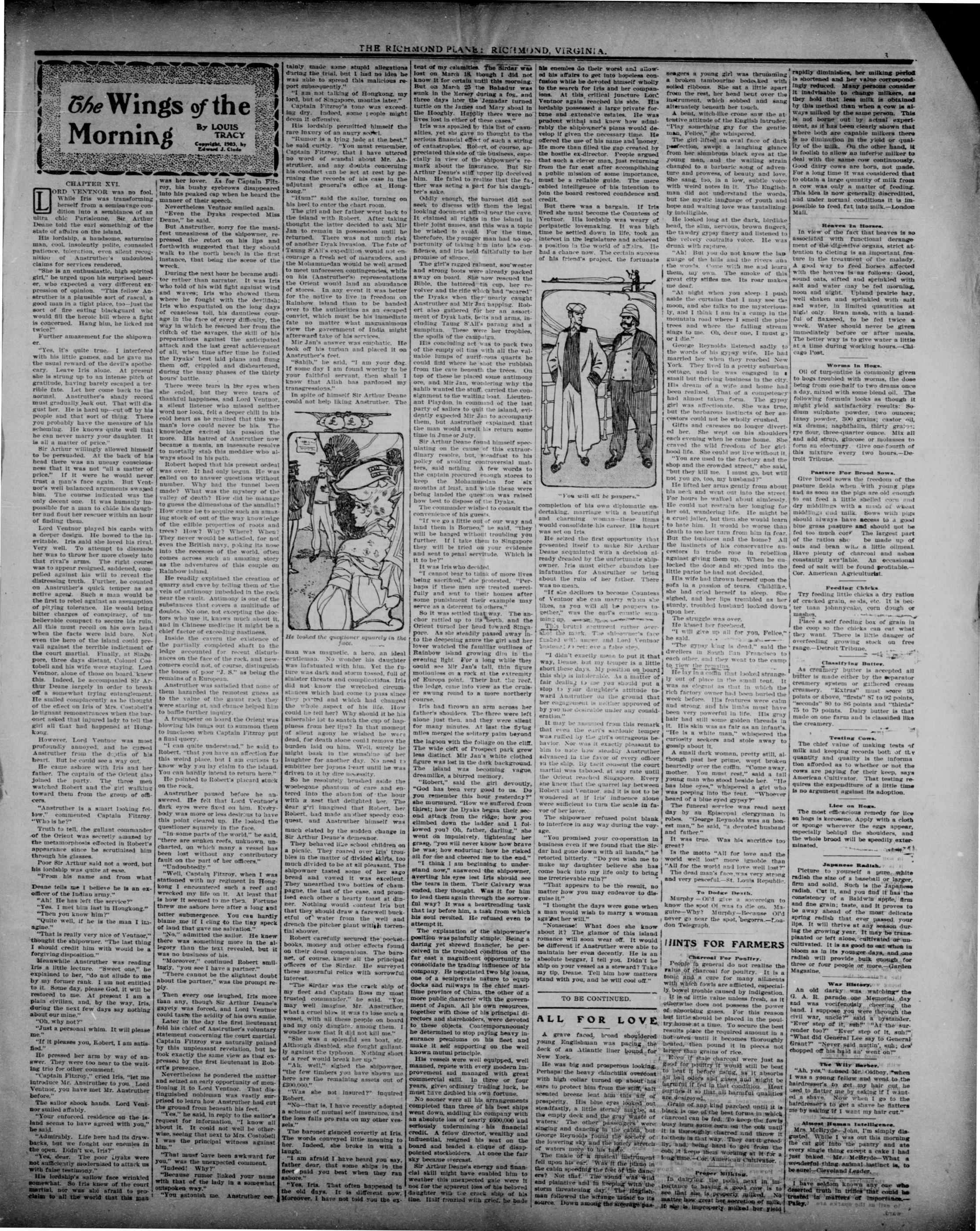
The Wings of the Morning By LOUIS TRACY Copyright, 1903, by Edward J. Clark
---
CHAPTER XVI
LORD VENTNOR was no fool. While Iris was transforming herself from a semisavage condition into a semblance of an ultra chic Parisienne, Sr Arthur Deane told the earl something of the state of affairs on the island.
His lordship, a handsome, saturnine man, cool, insolently polite, counselled patience, toleration, even silent recognition of Anstruthere's undoubted claims for services rendered.
"She is an enthusiastic, high spirited girl." he urged upon his surprised hearer, who expected a very different expression of opinion. "This fellow Anstruthere is a plausible sort of rascal, a good man in a tight place, too—just the sort of fire eating blackguard who would fill the heroic bill where a fight is concerned. Hang him, he licked me twice."
Further amazement for the shipowner.
"Yes, it's quite true. I interfered with his little games, and he gave me the usual reward of the devil's apothecary. Leave Iris alone. At present she is strung up to an intense pitch of gratitude, having barely escaped a terrible fate. Let her come back to the normal. Anstruther's shady record must gradually leak out. That will disgust her. He is hard up—cut off by his people and that sort of thing. There you probably have the measure of his scheming. He knows quite well that he can never marry your daughter. It is all a matter of price."
Sir Arthur willingly allowed himself to be persuaded. At the back of his head there was an uneasy consciousness that it was not "all a matter of price." If it were he would never trust a man's face again. But Ventnor's well balanced arguments swaged his. The course indicated was the only decent one. It was humanly impossible for a man to chide his daughter and flout her rescuer within an hour of finding them.
Lord Ventnor played his cards with a deeper design. He bowed to the inevitable. Iris said she loved his rival Very well. To attempt to dissuade her was to throw her more closely into that rival's arms. The right course was to appear resigned, saddened, compelled against his will to reveal the distressing truth. Further, he counted on Anstruther's quick temper as an active agent. Such a man would be the first to rebel against an assumption of plying tolerance. He would bring bitter charges of conspiracy, of unbelievable compact to secure his ruin. All this must recoil on his own head when the facts were laid bare. Not even the hero of the island could prevail against the terrible indictment of the court martial. Finally, at Singapore, three days distant, Colonel Costobell and his wife were staying. Lord Ventnor, alone of those on board, knew this. Indeed, he accompanied Sir Arthur Deane largely in order to break off a somewhat trying entanglement. He smiled complacently as he thought of the effect on Iris of Mrs. Costobell's indignant remonstrances when the baronet asked that injured lady to tell the girl all that had happened at Hong-kong.
However, Lord Ventnor was most profoundly annoyed, and he cursed Anstruther from the depths of his heart. But he could see a way out.
He came ashore with Iris and her father. The captain of the Orient also joined the party. The three men watched Robert and the girl walking toward them from the group of officers.
"Anstruther is a smart looking fellow," commented Captain Fitzroy. "Who is he?"
Truth to tell, the gallant commander of the Orient was secretly amazed by the metamorphosis effected in Robert's appearance since he scrutinized him through his glasses.
Poor Sir Arthur said not a word, but his lordship was quite at ease.
"From his name and from what Deane tells me I believe he is an ex-officer of the Indian army."
"Ah! He has left the service?"
"Yes. I met him last in Hongkong."
"Then you know him?"
"Quite well, if he is the man I imagine."
"That is really very nice of Ventnor," thought the shipowner. "The last thing I should credit him with would be a forgiving disposition."
Meanwhile Anstruther was reading Iris a little lecture. "Sweet one," he explained to her, "do not allude to me by my former rank. I am not entitled to it. Some day, please God, it will be restored to me. At present I am a plain civilian, and, by the way, Iris, during the next few days say nothing about our mine."
"Oh, why not?"
"Just a personal whim. It will please me."
"If it pleases you, Robert, I am satisfied."
He pressed her arm by way of answer. They were too near to the waiting trio for other comment.
"Captain Fitzroy," cried Iris, "let me introduce Mr. Anstruther to you, Lord Ventnor, you have met Mr. Anstruther before."
The sailor shook hands. Lord Ventnor smiled affably.
"Your enforced residence on the island seems to have agreed with you" be said.
"Admirably. Life here had its drawbacks, but we fought our enemies in the open. Didn't we, Iris?"
"Yes, dear. The poor Iyaks were not sufficiently modernized to attack us with false testimony."
His lordship's sallow face wrinkled somewhat. So Iris knew of the court martial, nor was she afraid to proclaim to all the world that this man
was her lover. As for Captain Fitzroy, his bushy eyebrows disappeared into his peaked cap when he heard the manner of their speech. Nevertheless Ventnor smiled again. "Even the Dyaks respected Miss Deane," he said. But Anstruther, sorry for the manifest uneasiness of the bishopwoman, repressed the retort on his lips and forthwith suggested that they should walk to the north beach in the first instance, that being the scene of the wreck.
During the next hour he became auditor rather than narrator. It was Iris who told of his wild fight against wind and waves; Iris who showed them where he fought with the devilish; Iris who expatriated on the long days of ceaseless toil, his dauntless courage in the face of every difficulty, the way in which he rescued her from the clutch of the savages, the skill of his preparations against the anticipated attack and the last great achievement of all, when time after time he foiled the Dyaks' best laid plans and flung them off, crippled and disheartened, during the many phases of the thirty hours' battle.
There were tears in her eyes when she ended, but they were tears of thankful happiness, and Lord Ventur, a silent listener who missed neither word nor look, felt a deeper chill in his cold heart as he realized that this woman's love could never be his. The knowledge excited his passion the more. His hatred of Anustrther now became a mania, an insensate resolve to mortality stab this meddler who always stood in his path.
Robert hoped that his present ordeal was over. It had only begin. He was called on to answer questions without number. Why had the tunnel been made? What was the mystery of the valley of death? How did he manage to guess the dimensions of the sandplain? How came he to acquire such an amazing stock of out of the way knowledge of the edible properties of roots and trees? How? Why? Where? When? They never would be satisfied, for not even the British navy, poking its nose into the recesses of the world, often comes across such an amazing story as the adventures of this couple on Rainbow island.
He readily explained the creation of quarry and cave by telling them of the vein of antimony imbedded in the rock near the vault. Antimony is one of the substances that covers a multitude of doubts. No one, not excepting the doctors who use it, knows much about it, and in Chinese medicine it might be a chief factor of exceeding restlessness.
Inside the cavern the existence of the partially completed shaft to the ledge accounted for recent disturbances on the face of the rock, and newcomers could not, of course, distinguish the bones of poor "J. S." as being the remains of a European.
Anstruther was satisfied that none of them hazarded the remotest guess as to the value of the gaunt rock they were staring at, and chance helped him to baffle further inquiry.
A trumpeter on board the Orient was blowing his lungs out to summon them to lunchroom when Captain Fitzroy put a final query.
"I can quite understand," he said to Robert, "that you have an affection for this weird place, but I am curious to know why you lay claim to the island. You can hardly intend to return here."
He pointed to Robert's placard stuck on the rock.
Anstruther paused before he answered. He felt that Lord Ventnor's dark eyes were fixed on him. Everybody was more or less desirous to have this point cleared up. He looked the questioner squarely in the face. "In some parts of the world," he said, "there are sunken reefs, unknown, uncharted, on which many a vessel has been lost without any contributory fault on the part of her officers." "Undonbttelly." "Well, Captain Fitzroy, when I was stationed with my regiment in Hongkong I encountered a reef and wrecked my life on it. At least that is how it seemed to me then. Fortune threw me ashore here after a long and bitter submergence. You can hardly blame me if I cling to the tiny speck of land that gave me salvation." "No," admitted the sailor. He knew there was something more in the allegory than the text revealed, but it was no business of his.
"Moreover," continued Robert smilingly, "you see I have a partner."
"There cannot be the slightest doubt about the partner," was the prompt reply.
Then every one laughed, Iris more than any, though Sir Arthur Deane's gayety was forced, and Lord Ventnor could taste the acidity of his own smile.
Later in the day the first lieutenant fold his chief of Anstruther's voluntary statement concerning the court martial.
Captain Fitzroy was naturally pained by this unpleasant revelation, but he took exactly the same view as that expressed by the first lieutenant in Robert's presence.
Nevertheless he pondered the matter and seized an early opportunity of mentioning it to Lord Ventnor. That distinguished nobleman was vastly surprised to learn how Anstruther had cut the ground from beneath his feet.
"Yes," he said, in reply to the sailor's request for information. "I know all about it. It could not well be otherwise, seeing that next to Mrs. Costobel! I was the principal witness against him."
"That must have been awkward for you" was the unexpected comment.
"Indeed! Why?"
"Because rumor linked your name with that of the lady in a somewhat outspoken way."
"You astonish me. Anstruther cer-
THE RICHMOND PLANE: RICHMOND, VIRGINIA.
tainly made some stupid allegations during the trial, but I had no idea he was able to spread this malicious report subsequently."
"I am not talking of Hongkong, my lord, but of Singapore, months later."
Captain Fitzroy's tone was exceeding dry. Indeed, some people might deen it offensive.
His lordship permitted himself the rare luxury of an angry sword.
"Rumor is a lying jade at the best," he said curtly. "You must remember, Captain Fitzroy, that I have uttered no word of scandal about Mr. Anstruther, and any doubts concerning his conduct can be set at rest by perusing the records of his case in the adjutant general's office at Hongkong."
"Hunt!" said the sailor, turning on his heel to enter the chart room.
The girl and her father went back to the island with Robert. After taking thought the latter decided to ask Mir Jan to remain in possession until he returned. There was not much risk of another Drak invasion. The fate of Taung S'All's expedition would not encourage a fresh set of marauders, and the Mohammedan would be well armed to meet unforeseen contingencies, while on his (Anstruther's) representations the Orient would land an abundance of stores. In any event it was better for the native to live in freedom on Rainbow island than to be handed over to the authorities as an escaped convict, which must be his immediate fate no matter what magnanimous view the government of India might afterward take of his services.
Mir Jan's answer was emphatic. He took off his turban and placed it on Anstruther's feet.
"Sahib," he said, "I am your dog. If some day I am found worthy to be your faithful servant, then shall I know that Allah has pardoned my transgressions." In spite of himself Sir Arthur Deane could not help liking Anther. The
美美
He took the questioner squirrelly in the face.
man was magnetic, a hero, an ideal gentleman. No wonder his daughter was infatuated with him. Yet the future was dark and storm tossed, full of sinister threats and complications. Iris did not know the wretched circumstances which had come to pass since they parted and which had changed the whole aspect of his life. How could he tell her? Why should it be his miserable lot to snatch the cup of happiness from her lips? In that moment of silent agony he wished he were dead, for death alone could remove the burden laid on him. Well, surely he might bask in the sunshine of her laughter for another day. No need to embitter her joyous heart until he was driven to it by dire necessity.
So he resolutely brushed aside the woebelegne phantom of care and entered into the abandon of the hour with a zest that delighted her. The dear girl imagined that Robert, her Robert, had made another speedy conquest, and Anstruther himself was much elated by the sudden change in Sir Arthur Deane's demeanor.
They behaved like school children on a picnic. They roared over Iris' troubles in the matter of divided skirts, too much divided to be at all pleasant. The shipowner tasted some of her sago bread and vowed it was excellent. They unearthed two bottles of champagne, the last of the case, and promised each other a hearty toast at dinner. Nothing would content Iris but that they should draw a farewell buckeful of water from the well and drench the pitcher plant with a torrential shower.
Robert carefully secured the pocket-books, money and other effects found on their dead companions. The baronet, of course, knew all the principal officers of the Sirdar. He surveyed these mozrnful relics with sorrowful interest.
"The Sirdar was the crack ship of my fleet and Captain Ross my most trusted commander," he said. "You may well imagine, Mr. Anstruther, what a cruel blow it was to lose such a vessel, with all these people on board and my only daughter among them. I wonder now that it did not kill me."
"She was a splendid sea boat, sir. Although disabled, she fought gallantly against the typhoon. Nothing short of a reef would break her up."
"Ah, well," sighed the shipowner, "the few timbers you have shown me here are the remaining assets out of £300,000."
"Was she not insured?" inquired Robert.
"No-that is, I have recently adopted a scheme of mutual self insurance, and the loss falls pro rata on my other vessels."
The baronet glanced covertly at Iris. The words conveyed little meaning to her. Indeed, she broke in with a laugh:
"I am afraid I have heard you say, father dear, that some ships in the fleet paid you best when they ran ashore."
"Yes, Iris. That often happened in the old days. It is different now. Moreover, I have not told you the ex-
tent of my calamities. The Sirdar was lost on March 18, though I did not know it for certain until this morning. But on March 25 the Bahadar was sunk in the Mersey during a fog, and three days later the Jemadar turned turtle on the James and Mary shoal in the Hooghy. Happily there were no lives lost in either of these cases." Iris was appealed by this list of casualties, yet she gave no thought to the serious financial effect of such a string of catastrophes. Robert, of course, appreciated this side of the business, especially in view of the shipowner's remark about the insurance. But Sir Arthur Deane's stiff upper lip deceived him. He failed to realize that the father was acting a part for his daughter's sake.
Oddly enough, the baronet did not seek to discuss with them the legal looking document affixed near the cave. It claimed all rights in the island in their joint names, and this was a topic he wished to avoid. For the time, therefore, the younger man had no opportunity of taking him into his confidence, and iris held faithfully to her promise of silence.
The girl's ragged ralment, sou'wester and strong boots were already packed away on board. She now rescued the Bible, the battered tin cup, her revolver and the rifle which had "scared" the Dyaks when they nearly caught Anstruther and Mir Jan napping. Robert also gathered for her an assortment of Dyak hats, belts and arms, including Tang S'All's parang and a sumptan. These were her trophies, the spoils of the campaign.
His concluding act was to pack two of the empty oil tills with all the valuable lumps of aurifous quartz he could find where he shot the rubbish from the cave beneath the trees. On top of these he placed some antimony ore, and Mir Jan, wondering why the sabb wanted the stuff, carried the consignment to the waiting boat. Lieutenant Playdon, in command of the last party of sailors to quit the island, evidently expected Mir Jan to accompany them, but Anstruther explained that the man would await his return some time in June or July.
Sir Arthur Deane found himself speculating on the cause of this extraordinary resolve, but, steadfast to his policy of avoiding controversial matters, said nothing. A few words to the captain procured enough stores to keep the Mohammedan for six months at least, and while these were being landed the question was raised how best to dispose of the Dyaks.
The commander wished to consult the convenience of his guests.
"If we go a little out of our way and land them in Borneo," he said, "they will be hanged without troubling you further. If I take them to Singapore they will be tried on your evidence and sent to penal servitude. Which is it to be?"
It was Iris who decided
"I cannot bear to think of more lives being sacrificed," she protested. "Perhaps if these men are treated mercifully and sent to their homes after some punishment their example may serve as a deterrent to others."
So it was settled that way. The anchor rattled up to its berth, and the Orient turned her head toward Singapore. As she steadily passed away into the deepening azure the girl and her lover watched the familiar outlines of Rainbow island growing dim in the evening light. For a long while they could see Mr Jan's tall, thin figure motionless on a rock at the extremity of Europa point. Their hut, the reef, the ledge, came into view as the cruiser swung round to a more northerly course.
Iris had thrown an arm across her father's shoulders. The three were left alone just then, and they were silent for many minutes. At last the flying miles merged the solitary palm beyond the lagoon with the foliage on the cliff. The wide cleft of Prospect park grew less distinct. Mir Jan's white clothed figure was lost in the dark background. The island was becoming vague, dreamlike, a blurred memory.
"Robert," said the girl devoutly, "God has been very good to us. Do you remember this hour yesterday?" she murmured. "How we suffered from thirst; how the Dyaks began their second attack from the ridge; how you eliminated down the ladder and I followed you? Oh, father, darling," she went on impulsively, tightening her grasp, "you will never know how brave he was; how enduring; how he risked all for me and cheered me to the end."
"I think I am beginning to understand now," answered the shipowner, averting his eyes lest Iris should see the tears in them. Their Calvary was ended, they thought. Was it for him to lead them again through the sorrowful way? It was a heartfelt task that lay before him, a task from which his soul revolted. He refused even to attempt it.
The explanation of the shipowner's position was painfully simple. Being a daring yet shrewd financier, he perceived in the troubled condition of the far east a magnificent opportunity to consolidate the trading influence of his company. He negotiated two big loans, one of a semiprivate nature to equip docks and railways in the chief maritime province of China, the other of a more public character with the government of Japan. All his own resources, together with those of his principal directors and shareholders, were devoted to these objects. Contemporaneously he determined to stop paying heavy insurance premiums on his fleet and make it self supporting on the well known mutual principle.
His vessels were well equipped, well manned, replete with every modern improvement and managed with great commercial skill. In three or four years, given ordinary trading luck, he must have doubled his own fortune.
No sooner were all his arrangements completed than three of his best ships went down, saddling his company with an absolute loss of nearly £600,000 and seriously undermining his financial credit. A fellow director, wealthy and influential, resigned his seat on the board and headed a clique of disappointed stockholders. At once the fair sky became overcast.
Sir Arthur Deane's energy and financial skill might have enabled him to weather the unexpected gale were it not for the apparent loss of his beloved daughter with the crack ship of his line. Half trazzed with grief, he bade
his enemies do their worst and allowed his affairs to get into hopeless confusion while he devoted himself wholly to the search for Iris and her companions. At this critical juncture Lord Ventnor again reached his side. His lordship possessed a large private fortune and extensive estates. He was prudent withal and knew how admirably the shipowner's plans would develop if given the necessary time. He offered the use of his name and money. He more than filled the gap created by the hostile ex-director. People argued that such a clever man, just returning from the far east after accomplishing a public mission of some importance, must be a reliable guide. The mere cabled intelligence of his intention to join the board restored confidence and credit.
But there was a bargain. If Iris lived she must become the Countess of Ventnor. His lordship was weary of peripatetic lovemaking. It was high time he settled down in life, took an interest in the legislature and achieved a position in the world of affairs. He had a chance now. The certain success of his friend's project, the fortune
A
"You will all be paupers."
completion of his own diplomatic undertaking, marriage with a beautiful and charming woman—these items would consolidate his career. His heart was set on Iris.
He seized the first opportunity that presented itself to make Sir Arthur Deane acquainted with a decision already dreaded by the unfortunate shipowner. Iris must either abandon her infatuation for Anstruther or bring about the ruin of her father. There was no mean.
"If she declines to become Countess of Ventnor she can marry whom she likes, as you will all be paupers together," was the earl's caustic summing up.
This brutal argument rather overshot the mark. The shipowner's face fushed with anger and Lord Ventnor hastened to retve a false step.
"I didn't exactly mean to put it that way, Deane, but my temper is a little short these days. My position on board this ship is intolerable. As a matter of fair dealing to me you should put a stop to your daughter's attitude toward Anstruther on the ground that her engagement is neither approved of by you nor desirable under any consideration."
It may be assumed from this remark that even the earl's sardonic temper was ruiled by the girl's outrageous behavior. Nor was it exactly pleasant to him to note how steadily Anstruther advanced in the favor of every officer on the ship. By their consent the court martial was tabooed, at any rate until the Orient reached Singapore. Every one knew that the quarrel lay between Robert and Ventnor, and it is not to be wondered at if Iris' influence alone were sufficient to turn the scale in favor of her lover.
The shipowner refused point blank to interfere in any way during the voyage.
"You promised your co-operation in business even if we found that the Sirdar had gone down with all hands," he retorted bitterly. "Do you wish me to make my daughter believe she has come back into my life only to bring me irretrievable ruin?"
"That appears to be the result, no matter how you may endeavor to disguse it."
"I thought the days were gone when a man would wish to marry a woman against her will."
"Nonsense! What does she know about it? The glamor of this island romance will soon wear off. It would be different if Anstruther were able to maintain her even decently. He is an absolute beggar, I tell you. Didn't he ship on your vessel as a steward? Take my tip, Deane. Tell him how matters stand with you, and he will cool off."
TO BE CONTINUED.
ALL FOR LOVE
a grave faced, broad shouldered young Englishman was pacing the deck of an Atlantic liner bound for New York.
He was big and prosperous looking. Perhaps the heavy chinchilla overcoat with high collar turned up about his ears to protect him from the soft salt scented breeze lent him this air of prosperity. His blue eyes looked out steadfastly, a little sternly maybe, at the empty deck and the gray waste of waters. The other passengers were singing and dancing in the cabin, but George Reynolds found the society of the lowering sky and the lonely stretch of waters more to his taste.
The tinkle of a musical instrument fell upon his ear. Was it the piano in the cabin speeding the roar of the dancers? Not that. The sound was wild and plaintive and fi keeping with the storm threatening day. The Englishman followed the strange music to its source. Down among the screechers past.
seagers a young girl was thrumming a broken tambourine bedecked with soiled ribbons. She sat a little apart from the rest, her head bent over the instrument, which sobbed and sang alternately beneath her touch.
A bent, witch-like crone saw the attentive attitude of the English intruder, "Play something gay for the gentleman, Felice," she whispered.
The girl lifted an oval face of dark perfection, sweet a laughing glance from her slumbrous black eyes at the young man, and the walling strain changed to a barbaric song of adventure and prowess, of beauty and love. She sang, too, in a low, subtle voice with weird notes in it. The Englishman did not understand the words, but the mystic language of youth and hope and waiting love was tantalizingly intelligible.
He looked long at the dark, birdlike head, the slim, nervous, brown fingers, the tawdry grypsy finery and listened to the velvety contralto voice. He was drunk with rapture.
"Ah! But you do not know the language of the hills and the rivers and the woods. Come with me and learn them, my own. The smoke of this great city stifles me. Its roar makes me deaf.
"At night when you sleep I push aside the curtains that I may see the moon, and she talks to me mysteriously, and I think I am in a camp in the mountain road where I smell the pine trees and where the falling stream sings to me. Oh, dear one, I must go or I die."
George Reynolds listened sadly to the words of his gipsy wife. He had married her when they reached New York. They lived in a pretty suburban cottage, and he was engaged in small but thriving business in the city. His dream of a wife and home had been realized. That of a competency had almost taken form. The gipsy girl was affectionate. She was true, but the barbarous instincts of her ancestors could not be wholly crushed. Gifts and caresses no longer diverted her. She wept on his shoulders each evening when he came home. She craved the wild freedom of her girlhood life. She could not live without it. "You are used to the factory and the shop and the crowded street," she said, "but they kill me. I must go, but will not you go, too my husband."
He lifted her arms gently from about his neck and went out into the street. For hours he walked about amicably. He could not restrain her longing for her old, wandering life. He might be a cruel jailer, but then she would learn to hate him. It would be worse than death to see her turn from him in fear. But the business and the home? All the instincts of his conservative ancestors in trade rose in rebellion against giving them up. When he unlocked the door and stopped into the little parlor he had not decided. His wife had thrown herself upon the sofa in a passion of tears. Childlike, she had cried herself to sleep. She sighed, and her lips trembled as her sturdy, troubled husband looked down upon her. The struggle was over.
"I will give up all for you, Felice," he said.
"The gypay king is dead," said the dwellers in South San Francisco to each other, and they went to the camp to view the remains.
He lay in a coffin that looked strangely out of place in the small tent. It was as elegant as that in which the rich factory owner had been buried the week before. Its features were calm and strong, and his limbs must have been very powerful in life. His gray hair had still some golden threads in it. His skin was as fair as an infant's. "He is a white man," whispered the curiosity seekers and stole away to gossip about it.
A small dark woman, pretty still, although past her prime, wept broken heartedly over the coffin. "Come away, mother. You must rest," said a tall young man who stood beside her. "He has blue eyes," whispered a girl who was peeping into the tent. "Whoever heard of a blue eyed gypay?"
The funeral service was read next day by an Episcopal clergyman in robes. "George Reynolds was an honest man," he said, "a devoted husband and father." It was true. Was his sacrifice too great? Is the motto "All for love and the world well lost" more ignoble than "All for the world and love well lost?" The dead man's face was very strong and very peaceful. -St. Louis Republic
To Dodge Death
Murphy - Old give a sovereign to
know the spot Owl was to die on.
Maguire-Why? Murphy-Because Old
never go near the spot, begorra.-London Telegraph.
HINTS FOR FARMERS
Charcoal For Poultry.
People in general do not realize the value of charcoal for poultry. It is a tonic and a cure for many ailments with which fowls are afflicted, especially bowel trouble caused by indigestion. It is of little value unless fresh, as it otherwise does not possess the power of absorbing gases. For this reason but little should be placed in the poultry house at a time. To secure the best results place the required amount in a hot oven until it becomes thoroughly heated, then pound it in pieces not larger than grains of rice.
Even if stale charcoal were just as good for poultry it would still be best to heat it before using, as it absorbs all bad odors and gases and might be harmful if fed in that condition. Heat purifies it so that all harmful qualities are destroyed.
Grain of any kind parched until it is black is one of the best forms in which charcoal can be fed. To keep the fowls busy burn some corn on the cob until it is thoroughly charred and throw it to them in that way. They eat it greedily, and, being hard to get from the cob, it keeps them working at it for a long time—Cor. American Cultivator.
Proper Milking.
In dairying, the point next in importance to having a good row is to see that she is properly milked. No matter how great her secretion of milk, if she is improperly milked her yield
rapidly diminishes, her milking period is shortened and her value correspondingly reduced. Many persons consider it inadvisable to change milkers, as they hold that less milk is obtained by this method than when a cow is always milked by the same person. This is not borne out by actual experiment, as it has been clearly shown that where both are capable milkers there is no diminution in the yield or quality of the milk. On the other hand, it is foolish to allow an inferior milker to deal with the same cow continuously. Good dairy cows are born, not made. For a long time it was considered that to obtain a large quantity of milk from a cow was only a matter of feeding. This idea is now generally discredited, and under normal conditions it is impossible to feed fat into milk—London Mail.
Heavex In Horner.
In view of the fact that heaves is so associated with functional derangement of the digestive organs, strict attention to dieting is an important feature in the treatment of the malady. A good way to feed horses affected with the heaves is as follows: Good, sound oats, sifted and sprinkled with salt and water may be fed morning, noon and night. Upland prairie hay, well shaken and sprinkled with salt and water, in limited quantities at night only. Bran mash, with a handful of flaxseed, to be fed twice a week. Water should never be given immediately before or after meals. The better way is to give water a little at a time during working hours.—Chicago Post.
Worms In Hogs.
Oil of turpentine is commonly given to hogs troubled with worms, the dose being from one-half to two drams once a day, mixed with some blend oil. The following formula looks as though it might yield satisfactory results: Sodium sulphate powder, two ounces; tansy powder, 300 grains; castor oil, six drams; naphthalin, thirty grains; rye flour, three-quarter ounce. Mix all and add strup, glucose or molasses to form an electuary. Give one-fourth of this mixture every two hours.—Detroit Tribune.
Pasture For Breed Sows
Give brood sows the freedom of the pasture fields when with young pigs and as soon as the pigs are old enough to eat feed a little shelled corn and dry middlings with a mash of wheat middlings and milk. Sows with pigs should always have access to a good blue grass pasture and should not be fed too much corn. The largest part of the ration she be made up of oats and bran with a little oilmeal. Have plenty of charcoal and ashes constantly available. An occasional feed of salt will be found profitable.—Cor. American Agriculturist.
Feeding Chicks
Try feeding little chicks a dry ration of cracked grain, seeds, etc. It is better than Johnnycake, corn dough or mashes.
Place a self feeding box of grain in the coop so the chicks can eat what they want. There is little danger of overfeeding growing stock on free range -Detroit Tribune
Classifying Butter.
As creamy butter is accepted all butter is made either by the separator creamy system or gathered cream creamy. "Extras" must score 93 points or above, "firsts" 87 to 92 points, "seconds" 80 to 86 points and "thirds" 75 to 79 points. Dairy butter is that made on one farm and is classified like the creamy.
Testing Cows.
The chief value of making tests of milk and keeping records both of the quantity and quality is the information afforded as to whether or not the cows are paying for their keep, says American Cultivator. That testing requires the expenditure of a little time is no argument against its adoption.
Lice on Hogs.
The most efficacious remedy for lice en hogs is kerosene. Apply with a cloth or sponge wherever the eggs appear, especially behind the shoulders, and the whole brood will be speedily exterminated.
Picture to yourself a pure white radish the size of a baseball or larger, firm and solid. Such is the Japanese radish. Cut it, and you find it has the consistency of a Baldwin apple, firm and fine grain; taste, and it proves to be away ahead of the most delicate spring radish that ever passed your lips. It will thrive at any season during the growing year. It may be transplanted or left alone, cultivated or uncultivated. It is as good to eat when in bloom as in its younger days, and one radish will provide bulk enough, for three or four people or more—Garden Magazine.
War History now online
An old darky was watching" the G. A. R. parade one Memorial, day and was vociferously cheering the band. I suppose you were through the civil war, uncle?" said a bystander, "Ever step of it, suh!" "At the surrender too?" "Ever step of it, suh!" "What did General Lee say to General Grant?" "Never said nuttin', suh; des chopped off his hold an' went on!"
The "will" is a word that means "will be."
"Ah, yes." Lussed me. Oldboy. "when I was a young fellow and went to the hairdresser's to get my hair cut, he used to flatter me by asking if I wanted a shave. Now when I go to the hairdresser's to get a shave he flatters me by asking if I want my hair cut."
Almost Human Intelligence.
Mr. McBryde—John, I'm simply disgusted. While I was out this morning the cat got into the pantry and ate every single thing except a cake I had just baked. Mr. McBryde—What a wonderful thing animal instinct is, to be sure. Cleveland Leader.
I have seldom known any one who deserted truth in trifles that could be trusted in matters of importance.—Paley.
THE PLANET
Published every Saturday by JOHN MITCHELL,
Jr., at 81 North 4th Street, Richmond, Va.
JOHN MITCHELL, JR., - EDITOR.
All communications intended for publication should be sent so as to reach us by Wednesday.
TERMS IN ADVANOR
One Copy, one year, $1.50
One Copy, eight months, 1.08
One Copy, six months, .90
One Copy, four months, .50
One Copy, three months, .40
Single Copy .05
ADVERTISING RATES
For one inch, one insertion,
For one inch, each subsequent insertion,
For two inches, six months,
For two inches, six months,
For two inches, nine months,
For two inches, two weeks months,
For two inches, one inch,
Standing and Transient Notices per line.
THE PLANET is issued weekly. The subscription price is $1.50 per year in advance.
There are FOUR WARS by which money can be given. The first is Money Order, by Bank Check or Draft, press Money Order, and when none of these can be given, you can buy Money Order at your Post-Office, payable at the Rich-Order, and we will be responsible for its safe arrival.
REGISTERED LETTER—If a money Order or a note within your reach your Postmaster will REMIND you Letter you wish to send on payment of ten cents. Then, if the letter is lost or stolen, it can send money in this manner at our risk.
We cannot be responsible for money sent in letters in any other way than one of the four letters you send to us. You must do it at your own risk.
BENEWALE, ERC—If you do not want THE POSTMASTER to pay for your subscription has run out, you then notify us by Postal Card to discontinue it. The courts have not order their paper discontinuance, who must proitation of time for which it has been paid are held liable for the payment of the subscription. When they order the paper discontinued.
COMMUNICATIONS—When writing to us to renew your subscription or to discontinue your subscription, in full, otherwise we cannot find your name on our books.
ORANGE OF ADDRESS—In order to change your name, we sent the former as well as the present address.
Entered at the Post-Office at Richmond, Va. as second-class matter.
SATURDAY..... July 22d, 1905.
Economy must be practiced in order to keep your portion of this world's goods.
Politeness is a good investment if you spend it lavishly as you go through this world.
:0:
A person with a six hundred dollar a year salary cannot afford to live like one with a twenty-five hundred dollar a year income.
People who are out for a good time only and spend all of their money getting it, will pay for it with compound interest in want and suffering in after years.
Colored men, we have no cause to despair. The outlook may be dark in some sections of the country, but it is very bright, when taken as a whole and observed through the glasses of the impartial historian. If we will but be true to ourselves, all will be well with us.
The Post Office Department has issued a fraud order against the Peoples' United States Bank of St. Louis It did a mail order business and had accumulated large amounts of the people's funds. This was followed by the appointment of a receiver and the affairs of the concern are now being wound up. The attitude of the Post Office Department in ferreting out fraudulent concerns and refusing to them the use of the United States mails is wor thy of the highest commendation.
Those white folks who have been accustomed to charge the Negroes with stealing will be much surprised and more disgusted to study a map recently published by the Philadelphia, Pa. North American show, that "graft" or white folks robberies exist in twenty-five states of this country and that investigations are now under way in all of them. The others are similarly situated so far as this class of robbery is concerned Only seven are reported to be free from this evil.
This is the example set by the superior race. Colored people should live honest and upright and not allow themselves to be contaminated and led astray by these ungodly white men who seem to be as prone to evil as the sparks are to fly upward.
There is trouble down at Greenwood, Miss. Three colored letter-carriers are serving in the town. There were no white eligibles on the list. When it came to clerks, it was ascertained that the colored brother was on top in this respect and a Mr. Carter from Pine Bluff, Arkansan was instructed to report for duty.
He visited Greenwood and certain white citizens gave him to understand that his room would be better than his company and as the United States government guaranteed him no protection, he thought discretion the better part of valor and he accordingly resigned. The next person on the list of eligibility is also colored and has been ordered to report for duty. It will be an interesting question as to how long the United States Post Office Department will submit to this kind of intimidation of its employees. It is a proposition that should be met and should be met squarely. It might be well to remark that Green wood is the home of Governor James K. Vardaman.
It is surprising that these so-called race riots should be frequently recurring in the liberal Democratic city of New York. Three persons were shot down and many terribly beaten in a fight of this character July 9th, 1905. It is reported that at one time five thousand persons, including men, women and children were exposed to the bullets of the rioters.
Those most seriously injured during the melse were: Mrs. Mary Donohu, white, 55 years old, shot behind left ear; James Hunter, white, 30 years old, shot in left side; Peter McFadden, white, shot in right ankle; George Davis, colored, struck in head with stone; Henry Hart, colored, scalp wounds; John Loye, policeman, arms and shoulders injured
Many others were pelted with missiles and the clubs of policemen were responsible for blackened eyes, scalp wounds and bruised heads. The trouble started when Henry Hart, a colored long-shoreman, rushed into his home and re-appeared in the entrance with a revolver to avenge the taunts of a crowd of young men and boys headed by James Hunter. He fired twice and Hunter fell to the pavement with a bullet in his side. A crowd quickly gathered, there were shouts of "lynch him," and the riot began. In view of the dangerous condition of affairs, it is a wonder that more people were not injured.
FEDERAL AUTHORITY ALL POW- ERFUL.
The recent clash between the United States officials and those of the state of Kentucky, which took place at Newport, Ky., Monday, July 10th reads like the acts in a play and the facts in the case are on a par with a sensational romance. The history of the celebrated case is briefly told as follows:—
Powers is charged with complicity in the murder of William Goebel at Frankfort: in the winter of 1900. For five years he has been in prison. He has been tried four times and sentenced to death three times, but as he walked into the jail he expressed hope of his ultimate acquittal of the charge entered against him. He was the only one of those charged with conspiracy to murder William Goebel to be convicted and sentenced to death. His fight for life has been remarkable, and the attorneys to-day expressed the belief that three more years may pass before the end of the legal complications will make possible the trial in the federal courts for which he had applied five weeks ago at London, Ky.
His case has been removed from the state court and is now before the United States Court, which has assumed jurisdiction. The story of the transfer is graphically told as follows:—
The arrival of Caleb Powers at Newport, Ky. late this afternoon developed a most astonishing situation and precipitated a riot and a war among the leading officials of the town that may yet result in blood-shed.
Mayor Helmbold indulged in a first fight with a jail guard, caused the Newport jailer and both his night and day forces, together with a citizen, to be locked up, and warrants are being sought for the arrest of the mayor and the chief of police upon the charge of interfering with the United States officers.
Helmbold made a most strenuous and unexpected objection to the placing of Powers in a special cell in the Newport jail, which Powers' Republican friends had fitted with a cot, lace curtains and other things for comfort to body and eye. He caused Powers to be locked up with the common herd, among whom were several Negroes. The action precipitated a contest, the end of which can not at present be seen, and in which it is feared some one will yet be killed.
Mayor Helmbold appeared suddenly at the jail as Powers arrived at about 6 o'clock in custody of United States Marshal Steven Sharpe, from Georgetown, Ky. He rushed upon Jailer Bernard Ploeger and commanded him to not dare put Powers in the special cell, known as the "cage." Ploeger objected and Helmbold grew demonstrative. Guard Charles Wilson, a powerful man, was coming by with night shift at that moment. He told Helmbold that he was not in command of Pow-
ers; that he was in custody of the United States, and that it was the duty of the jailer, to whom the prisoner had been remanded, not to the mayor, to obey the orders of the United States court. Helmbold, upon being disputed, seized Wilson by the throat Wilson struck him a blow full in the mouth, knocking him down and almost rendering him unconscious. Helmbold 'ost all of his front teeth
The mayor then shouted what seemed a prearranged signal, and the chief of police and deputy, with tween-seven men, the entire force, which had been held in readiness, rushed in with drawn guns and clubs. At the mayor's command they arrested Jailer Ploeger, Wilson and Guard William Fisher, the entire night and day jail force, a citizen, John Ader, who is a prominent cement contractor, had been guilty of laughing when Mayor Helmbold declared that he was the "boss." Sheriff Dan Riedel of Campbell county immediately went the bonds of these men the may or caused to be arrested. Helmbold was in possession of the jail and he forced Powers into the common cells. His friends were much agitated and began a determined fight.
It was growing late by this time and they started a scouting party after United States. District Attorney Tinsley of Covington. He was routed out of bed and advised the men to try again to place Powers in the select cell. He said that Powers was in care of the United States marshals and that they could place him in any place for which they paid, and that Jailer Ploeager was within his rights claiming jurisdiction in the matter of that particular prisoner.
In charge of Marshal Emmet Orr, Powers was taken from the common cell and started to the one so much contended. Two policemen placed there as a mayor's guard loomed up. Powers was pressed into the cell and then pushed out. The operation was repeated until it took on the appearance of a tug of war.
Powers was roughly handled, being n buffer, but he took it as a huge joke, and laughed heartily.
Mayor Helmbold's minions were for the time victorious. Powers was returned to the common cell, and the matter reported back to Attorney Tinsley. Upon his advice, the Powers delegation then started out to secure warrants for the arrest of Helmbold and Chief of Police H. H. Deputy for interfering with United States marshals. At 11:30 o'clock to-night warrants for Mayor Helmbold, Chief of Police Harry, deputy, and the two officers who resisted the marshals and acted as special guards over the cell, were issued by United States Commissioner Geo. Leonard, on instructions from United States District Attorney Tinsley. The warrants charge interference with United States officers. They were placed in the hands of marshals, who started out immediately to serve them.
Colored folks have succeeded admirably in keeping out of this scrape and they should continue to do so to the end of the chapter. The denial of fundamental rights to colored men has led to the denial of vital rights to white ones. It will cost a fortune to save Caleb Powers life, but the case is making history and the points involved and decided will vindicate the efforts of those white and colored men in this country, who have contended that the national government should have done in the past with a firm hand just as it is now doing in this most remarkable trial which will no doubt be on again within the domain of "Old Kentucky."
OPPRESSIVE HEAT BRINGS SUFFERING
Hundreds of Prostorms and Many Deatns in Large Cities.
HOTTEST DAY OF THE SUMMER
New York, July 19.—An area of oppressive heat, that brings to mind with unpleasant vividness the record-breaking summer of 1901, has settled down over the eastern and New England states, already numbering hundreds among its victims and causing indescribable suffering to thousands in this and other cities.
From all points came the story of the hottest day of the summer, attended with frequent prostrations and not a few deaths. Philadelphia reported a maximum temperature of 98.3, the highest figure officially noted. In this city the weather bureau's high mark was 96, while in Boston, where the sun's rays are wont to be tempered by an east wind, a temperature of 94 was recorded.
The official thermometers located in exposed places above the street did not, however, indicate the temperature in which the ordinary mortal moved, and many street thermometers indicated a temperature of 100 or higher, some reliable instruments registering 104 and 105. Following are the maximum temperatures officially recorded in the larger cities, with the known cases of prostration and death: Maximum. Prostra-
Temperature. tions. Deaths.
New York . . . 96 190 26
Philadelphia . . . 98. 50 5
Baltimore . . . 97. 6 ...
Washington . . . 95 6 ...
Boston . . . 94 4 2
Pittsburg . . . 93 45 13
Buffalo . . . 78 2 1
The above figures by no means represent the sum of human suffering, as an endless number of victims who collapsed at home, in the office or workshop, were privately attended.
No relief is in sight, and the roll of fatalities must be necessarily increased by many who, having thus far withstood the ordeal, are so weakened as to leave them more susceptible to the heat of today.
In New York the suffering was intense, especially in the crowded teng-
of the du du 'Sonnerie may United being thrust in the and al-cious. teeth, what and the htwen which rushed s. At arrested Guard and taint and ment districts, where scarcely a breath of air relieved the stifling atmosphere. Thousands who could afford the holiday flocked to the beaches, but even in the consequent crowds women and children fainted and were overcome, making the trip from home a doubtful experiment, so far as securing any comfort was concerned.
"Jake" Cook, keeper of the monkey house at Central Park, famous as an elephant trainer and the idol of the children who frequent the "Zoo," was among the victims. The other keepers had complained of the heat, and Cook, volunteering to help them with their duties, over-exerted himself and was stricken and died.
GEN. BLACK PASSE
Commander-in-Chief of at Boise, I.
CONDITION WAS I
Boise, Idaho, July W. Blackmar, commas the G. A. R., died his nephritis. His wife was with hi
Prompt measures were taken by the police and park commissioners to alleviate in some degree the suffering of the public. Orders were issued keeping open throughout the night the park gates and permitting those who would to spend the night in these places. "Keep off the grass" signs were by permission disregarded, and last night thousands of men, women and children deserted crowded and stifling apartments for a bed upon the cool grass. Thousands of others, too exhausted to reach the recreation grounds, slept upon the pavements in front of their homes.
Thirteen Deaths at Pittsburg.
Pittsburg, July 19.—The highest temperature of the year was reached yesterday afternoon, when the government thermometer on top of the 24-story Farmers Bank building registered 93. The addition of five degrees will give the temperature in the business section of the city. Fortunately a breeze of about 15 miles an hour prevailed throughout the day, making it possible for those who were forced to be on the streets to prosecute their business. Thirteen deaths from heat, including six infants, have been reported, and in the county a conservative estimate puts the number of prostrations at 45. In all nearby towns the same conditions prevailed as in this city, and several deaths and many prostrations are reported.
FIVE DEAD IN PHILADELPHIA
Temperature In Streets Reached 100 and In Sun 116.
Philadelphia, July 18.—Philadelphia and vicinity experienced the hottest weather in four years. Five deaths and 50 prostrations, due to the continued high temperature, were reported in the city. The maximum temperature was recorded at 3.45 p. m., when the government thermometer on the roof of the federal building registered 98.3 degrees. in shady places on the streets the temperature reached 100 degrees, and in the sun 116 degrees were recorded. At 10 o'clock last night the thermometer stood at 85 degrees. It is probable that the number of deaths and prostrations would have been greater had not the percentage of humidity been below normal during the day.
High temperature was also recorded in Eastern Pennsylvania, Delaware and Southern New Jersey. At Atlantic City the maximum temperature was 98 degrees, and at 8 p. m. the thermometer registered 80. At Cape May 90 was the maximum, and at 8 p. m. the temperature there had dropped to 74.
Scranton's Hottest Day In Four Years. Scranton, Pa., July 19.—it was 98 in the shade and 112 in the sun here yesterday afternoon at 3.30 o'clock. This is the hottest day in four years. Lewis P. Davis, of Taylor, died from sunstroke, and an unknown Polander was prostrated.
100 In Shade at Lancaster
Lancaster, Pa., July 19.—Yesterday was the hottest day of the summer, with shaded thermometers registering 100 degrees at 4 o'clock in the afternoon. A slight breeze brought some relief.
96 at Harrisburg
Harrisburg, Pa., July 19.—The highest temperature recorded at the local weather bureau yesterday was 96 degrees. This is the hottest day since 1901, when 100 degrees were registered officially.
Five Prostrations in Baltimore.
Baltimore, July 19.—There were five prostrations from heat, one being serious. The maximum temperature was 97.3 at 2 p. m.; the minimum 78, at 5 a. m. Humidity 51 at 1 a. m.; 59 at 8 p. m.
Cumberland, Md., high up in the Allegheny mountains, reports a temperature of 101 degrees in the shade.
PLAN TO DEPOSE CZAR
Reformers Want Regency of Czarev
vitch Under Grand Duke.
St. Petersburg, July 19.—A sensational rumor is current here that a large party of the Zemstvolists and Doumaists at Moscow are in favor of the proclacation of the deposition of Emperor Nicholas and the establishment of a regency for the Grand Duke Alexis-Nikolalevitch the infant son of the emperor, and heir to the throne, under four grand dukes.
It is alleged that for this reason the meeting of the all-Russian Zemstvolist and Doumaist Congress, which was to take place at Moscow today, has been prohibited.
M. Witte Sees the Czar
St. Petersburg, July 19.—M. Witte had a final interview with Emperor Nicholas at Peterhof. Foreign Minister Count Lamsdorff was present, showing the complete harmony of views between M. Witte and the foreign minister. M. Witte left St. Petersburg for Paris today, accompanied by Mme. Witte. At Paris they meet their daughter, who is the wife of the secretary of the Russian legation at Brussels. Mme. Witte has no intention of joining her husband later in America.
WILL Envelope Vladivostok
London, July 19.—The Tokio correspondent of the Daily Telegraph says that a J. Japonic army has been landed north of Vilnius, Koskok and that a complete environment of the fortress is imminent.
---
BLACKMAR
PASSES AWAY
Commander-in-Chief of G. A. R. Dies
at Boise, Idaho.
CONDITION. WAS KEPT SECRET
Boise, Idaho, July 17.—General W.
W. Blackmar, commander-in-chief of
the G. A. R., died here of intestinal
nephritis.
His wife was with him during his ill-
ness. The body will be embalmed and
A.
GENERAL W. W. BLACKMAR
taken to the home of the family in
Boston. General Blackmar arrived
here on July 10 on an inspection tour
of Grand Army posts throughout the
northwest. He was ill when he arrived
and gradually failed. The seriousness
of his condition was kept from the
public at the request of his wife.
General Blackmar was born July 25,
1841, at Bristol, Pa. He enlisted in the
15th Pennsylvania cavalry, and subsequently joined the First West Virginia.
He served with distinction throughout
the war, and at Five Forks was promoted on the field by General Custer
to the rank of captain. Through the
three administrations, those of Governors Long, Talbott and Rice, he was judge advocate general of Massachusetts. At the last national encampment of the G. A. R. he was elected commander-in-chief.
Succeeded By John B. King
Boaston, July 17.—Except to two or three officials of the Grand Army, the news of the death of Commander-In-Chief Blackmar was received with great surprise in this city. General Blackmar is succeeded by John R. King, of Washington, senior vice commander.
Two weeks ago the commander-in-chief broke down and was ordered to his bed in his summer home at Hingham by his physicians. At the time his indiposition, however, was regarded as slight.
SWAM NIAGARA RAPIDS
C. D. Graham and W. J. Glover, Jr.
Make the Trip.
Niagara Falls, N. Y., July 18—Carlisle D. Graham, of this city, and William J. Glover, Jr., of Baltimore, successfully swam the lower rapids of the Niagara river from the American side of the whirpool to Lewiston. The distance of four miles was covered in 26 minutes by Glover.
Both men wore life belts and inflated rubber rings around their necks. From the start Glover took the lead. He entered the rapids about a minute ahead of Graham. Until the Devil's Hole was reached the swift current and roaring rapids had the swimmers in their grasp. At that point a swirling eddy caught Glover and he was down nearly two minutes. His life belts saved him. Graham by this time had gained on Glover, and when the two men reached the end of the rapids just above the suspension bridge at Lewiston, there was but a little distance between them. Swimming in the swift, smooth current was hard for Graham, but evidently easy for Glover, Glover was the first pulled up on the dock at Lewiston. He was dressed and about 15 minutes later was telling his story. Graham was taken to a hotel in a wagon and did not leave bed for several hours. Neither of the men was injured.
Graham swam the lower rapids twice before, first on September 7, 1901, and again on August 31, 1902. He is about 55 years old, while Glover is about 35 years old.
RESIGNED UNDER FIRE
Chief Statistician of Department of Agriculture Retires.
Washington, July 19.—The resignation of John Hyde, statistician and chief of the bureau of statistics in the department of agriculture, was handed to Secretary Wilson and promptly accepted. Willett N. Hayes, the assistant secretary of agriculture, has been placed in charge of the bureau temporarily and will continue to act pending the investigation of the cotton scandal and until a competent statistician is found.
Will Contest William Ziegler's Will.
New York, July 19.—Declaring that
William Ziegler, the millionaire baking
powder manufacturer and backer of
Arctic expeditions, was insane and in-
competent to make a will, his widow,
Mrs. E. Matilda Ziegler, began suit
in the supreme court to determine the
validity of the will. Mr. Ziegler left an
estate of $30,000,000 to his adopted son,
William Ziegler, who will be 14 years
old next Friday. At the age of 40 the
boy is to have complete control of the
entire estate.
WEEK'S NEWS CONDENSED.
The Catholic Educational Association held its convention in New York.
William Monray was stabbed to death by John Hawthorne at Ashton, W. Va., in a quarrel over a woman. President Roosevelt has named D. W. Baker, of Washington, for United States attorney for the District of Columbia. Assemblyman Edward S. Coyne, of
Union county, N. J., died at Elizabeth as the result of an operation for appendicitis. Despondent over ill health W. B. Howell, a waitress Arkansas cotton planter, committed suicide by shooting in a New York hotel.
Friday, July 14.
William Dyer and seven Chinese were killed at Oakland, Cal., by an explosion of giant powder.
The 75th annual convention of the American institute of Instruction, at Portland, Ore., has adjourned.
The national convention of the Young Pacole's Union of the Universalist Church was held at Hartford, Conn.
J. J. Jusserand, French ambassador to the United States, sailed from New York on the steamer La Savole for Havre.
Martin Quilligan and John Under were caught in an elevator at the Glirard Iron Company plant, at Cleveland, O., and crushed to death.
Saturday. July 15.
George W. Vanderbilt will establish a school for his team's near Ashville, N. J.
Unlucky at the races Fred Alexander, 17 years old, of New York, committed suicide.
E. W. Warfield, cashier of the St. Louis County Bank, committed suicide by shooting while despondent from ill health.
The first bale of the new cotton of this season was sold at New Orleans for 20 cents a pound and the proceeds given to charity.
William Bradley, of Philadelphia, while putting a belt on in a woolen mill was caught between the belt and pulley and had his arm torn out.
Monday, July 17.
From a blow from her husband's fast Mrs. Patrick Barrett died at Carbondale, Pa. Barrett is under arrest. Plunging headlong down stairs at Red Lion, Pa., Mrs. Michael Bower broke her nose, both arms and a finger. A four-story building at Winnipesq, Man. was blown down, killing four persons and injuring upwards of a dozen. Reorganization of the Teamsters' Union at Chicago along conservative lines will be attempted at the coming international convention. From eating toadstools which were supposed to be mushrooms, one member of Peter Reinhart's family at Upper Sandusky, O., is dead and three more are seriously ill.
Tuesday, July 18.
James Breen,white,and Charles Jackson, colored, were put to death in the electric chair at Sing Sing, N. Y., for murder.
It is announced that General Leonard Wood, who underwent an operation in Massachusetts, will sall for the Philippines in August.
After a stormy interview with her husband, Miss Kate Cleary, a well-known magazine writer of Chicago, dropped dead of heart disease.
By the overturning of a rowboat on Keuka lake, near Rochester, N. Y., Miss Maude Masters and Miss Remel Faulkner, of Mansfield, Pa., were drowned.
Wednesday, July 19.
The depositors of the defunct American Bank at Manila will receive 40 per cent of their claims.
George W. Weat, for years a leader of the Union Republicans of Delaware, died at Dover, aged 62 years.
Toots Taylor, A. M. Miles and Major Milla, three negroes, were hanged at Memphis, Tenn., for murder.
John Dunn and John Coll were both crushed to death under hundreds of bales of hair in a Philadelphia warehouse.
The magazine founded in New York by Frank Leslie in 1875 and known as Leslie's Monthly, has changed its name to the American Monthly Magazine.
PRODUCE QUOTATIONS
The Latest Closing Prices In the Principal Markets
PHILADELPHIA—FLOUR steady;
winter extras, $3.65@3.90; Pennsylvania roller, clear, $4.25; city m. 11, fancy, $7.55@3.90; JOY firm; wheat, $10.95@3.90; WHEAT firm;
2 Pennsylvania red, new, 8.8@5.8c; CORN firm; No. 2 yellow, local 64c OATS steady; No. 2 white, clipped 39c; lower grades, 36c, HAY fit; n. No. timothy, large bale, $14.50 timothy, large bale, BEF beef heams, $23@24; POULTRY; Liva steady, hens, 15c; old roosters, 10c Dressed firm; choice fowls, 912c; old roosters, 912c; BUTTER firm; cr anery, 23c per pound EGGS steady; cr anery, 23c per pound EGGS steady; dozen, POTATOES steady; new, per bushel, $9.8@$1.
BALTIMORE—WHEAT steady; No. 2 red, 80% c; steamer No. 2 spot, 79%; no. 3 red, 80% c; steamer mixed 59%; @59% c; southern, 60@59% c; OATS steady; white, No. 2, 83%@38% c; No. 3, 37%@38% c; No. 4, 36%@38% c; mixed, No. 5, 37%@38% c; mixed, No. 34%@41% c; BUTTER steady; creamery separator, extras 21@21% c; held, 16@18%; prints, 20@23%; Maryland and Pennsylvania dairy prints, 14c Pennsylvania, Maryland, Pennsylvania and Virginia, West Virginia, 17c; southern, 16%c;
Live Stock Markets.
PITTSBURG (Unlon Stock Yards)—CATTLE lower; choice, $5.40; $5.60; fair, $5.10; $5.35. HOGS higher; prime heavy, $6.10; medium, $8.20; heavy Yorkers, $8.20; light Yorkers, $6.25; $8.30; pigs, $6.20. SHEEP dull; prime wethers, $5.10; $5.25; common sheep, $2;3; spring lambs, $6;7.50; veal calves, $7.25.
Was a Granddaughter of John Adams. Newburgh, N. Y., July 18. — Mrs. Carolina Elizabeth Monnelli died suddenly in Fishkill Landing. She was 90 years of age. Mrs. Monnell was the granddaughter of John Adams, second president of the United States, who wrote a congratulatory letter and a poem on her birth. She was a daughter of the late John Peter Downt. She first married Andrew Downing, the landscape artist, who laid out the public grounds at Washington. He persisted in the Henry Clay disaster July 28, 1852. She later married Judge John J. Monnell, who died some years ago. She leaves one daughter.
D. B. Henderson's Condition Grave
D. B. Henderson's Condition Grave.
Dubuque, ia. July 17.—There is little change in the condition of former Speaker D. B. Henderson, who is suffering from paresis. His condition is considered very grave by his physician.
MAYOR WEAVER MAY BRING SUIT
Eilu Root Advises Him to Institute Action in Filtration Scandal.
RESULT OF LAST CONFERENCE
Philadelphia, July 18.—As a result of advice received from Eilu Root, special counsel for Mayor Weaver, it is probable that the mayor will within a few days institute criminal prosecution against certain persons who are prominent in municipal affairs. Mr. Root advises the mayor that in the face of the refusal of District Attorney John G. Bell to take the initiative in bringing further prosecutions the mayor should exercise the right to go before a magistrate and carry the prosecutions as far as the law will permit him. This opinion was sent to Mayor Weaver and was the result of a conference held in New York last Friday.
The purpose of the conference was whether the mayor should take the initiative in further prosecutions, the district attorney having refused to do so. Mayor Weaver and Judge Gordon last week requested that the district attorney, in drawing up indictments against Councilman Frank H. Caven and John W. Hill, former chief of the bureau of filtration, should bring the charge of conspiracy with certain other persons to defraud the city. Councilman Caven is under bail for violating his councilmanic oath in being interested in city contracts, and former Chief Hill is under bonds to answer charges of forgery and falsification of records in connection with contracts for the construction of the city's filtration plants. At the hearing given both men before magistrates the name of the contracting firm of D. J. McNichol & Co., which is constructing the greater part of the filtration system, was frequently brought in by witnesses. The members of this firm are former Insurance Commissioner Israel W. Durham, the leader of the local Republican organization; State Senator James P. McNichol, and his brother, Daniel J. McNichol.
The district attorney, in refusing to add the charge of conspiracy to the indictment drawn up against Caven and Hill and initiate criminal proceedings against "certain other persona," said that such charges, based on the evidence taken at the Caven and Hill hearings, could not under the law be made. He suggested that the mayor take the initiative. Mayor Weaver and Judge Gordon insisted that it was the district attorney's duty to begin prosecutions, they declaring that the evidence in his hands warranted him in so doing. Mr. Bell persisted in his refusal, and the New York conference followed.
In the midst of the controversy between District Attorney Bell and the mayor's counsel, Mr. Bell sustained a broken leg through the falling of an elevator in an office building. Whether this accident will delay the trials of Caven and Hill is not known. Under a law passed by the last legislature, criminal proceedings can be conducted by a special district attorney instead of the district attorney himself or his assistants. The state attorney general is authorized to appoint a special district attorney upon the request of one of the president judges of the county courts.
DISTRICT ATTORNEY INJURED
He and Three Others Fell Eight Stories In Elevator.
Philadelphia, July 18.—By the snapping of a cable on elevator No. 3 of the Land Title Building, Broad and Chestnut streets, the car fell eight floors into the basement. Three passengers, men, and the operator were hurt, all of them seriously except the latter. The injured were:
District Attorney John C. Bell, compound fracture of both bones of the right leg.
Et-State Representative and Assistant City Solicitor Henry T. Kingston, both legs fractured above the ankles and thigh bone slightly split; feet may have to be amputated; condition serious.
William Born, of Collingswood, N. J. Contusions of the head and hands, and possible concussion of the brain.
George Mann, elevator conductor; cuts about the chin and face.
That the four men were not killed outright seems almost miraculous. When the cable parted the wheels fell with it upon the lift, smashing in the top of the elevator and pinning the men to the floor. At the bottom of the elevator shafts are several rubber-topped pins. These penetrated the floor of the elevator and caused all the damage.
MURDERED AND ROBBED
Body of Travelling Watchmaker Found in Philadelphia Suburb.
Philadelphia, July 18. — William Crosby, a travelling watchmaker of this city, was murdered in a lonely road in Narberth, a suburb of this city. Crosby's small satchel, in which he carried watches, was found near his body, empty. He was known to have had 21 watches in the satchel. The body was badly bruised, his face mashed, done probably with a club, and one eye was gouged out. The police are hunting three men who are known to have followed him in the foresoon. The last seen of Crosby alive was when he had called upon a customer to leave a watch he had repaired.
NEW TRIAL REFUSED MITCHELL
United States Senator's Conviction
Unpaid By Federal Court
Ophidia By Press Court
Portland, Ore. July 17. In the federal court Judge DeHaven overruled a motion of United States Senator John H. Mitchell for a new trial. Mr. Mitchell was recently convicted of using his office as senator in the furtherance of the legal practice of the law firm of Mitchell & Tanner, of this city. The firm was deeply engaged in legal work in connection with public lands in this state.
THE PARK
POULTRY AND BEES
USE OF GASOLINE BURNER.
Successful Poultry Raiser Tells Why It Is Better Than the Usual Lamp.
The letters piling up here state that there is "room for oceans of improvement in brooders." There seems to be hardly anyone satisfied with his brooding arrangements, and as it is impossible for me to answer any more personal letters, I will give a description of our houses, writes Floyd Q. White in the Rural New Yorker. You can try the gasoline burners on your old brooders if you wish, as they merely take the place of a lamp, doing the work much better and cheaper, too. Any person wishing to raise only a few chickens can get along with a kerosene lamp, but when you have 1,000 or 2,000 little ones to look after in all kinds of weather, then is when you will appreciate our system
B
D
F
E
MOVEY
3'6" X 4'
SASOLINE BURNER FOR BROODER
of brooding. The gasoline burners can be secured from a gasoline stove manufacturer. Wehavesome made in Cleveland, O. In our illustration a gallon oil can, A, is soldered to a pipe, B, for a tank and $4\frac{1}{2}$ feet of pipe gives good pressure for the burner, which sets under the heater drum, F, where the lamp ordinarily sets. The box where the burner is, E, must be fireproof, as the heat is very great from a stove burner. As a matter of fact we never use the stove burner, as the small igniter gives all the heat we need. It is well to use plenty of asbestos between all wood and the box where the burner is. There is no smoking, and we rarely have a burner go out; only one went out last year, and one must be sure no gasoline has leaked out before relighting the burner, or there will be trouble, as it is explosive. Ten gallons of gasoline have warmed six houses one week, alling the tanks twice in that time, and no trimming or bother rainy nights, as it used to be with lamps. We have two different sized houses, six by eight and eight by eight. For the earlier hatches, those coming in March or early in April, we like the smaller house best, as being smaller it is more easily kept warm. We keep from 150 to 200 chicks in house, and sometimes take the burners from houses which do not need heat any longer, and use the same on other houses with newly hatched chicks. After the first of June we take all burners out and store them ready for next year. The illustration shows house, cut at center showing lamp box heater, E. drum, F, with burner underneath it; C. hover; D. curtain.
THE POULTRY YARD
Forcing egg production is dangerous. The male bird does not influence the egg yield.
If you expect good chickens, you must breed from good parents.
A correspondent thinks that there must be money in hens since so much of it has been sunk in the business.
Women become the most successful poultry keepers, from the fact that they are careful and have a love for the work.
Peter Tumbledown is convinced that his hens are not of the egg type. He always keeps a lot of corn before them and yet they do not supply him with eggs.
Good time to have pot-pie now. Draw on the supply of roosters and keep drawing (till they are all weeded out. The chickens coming on now should furnish your stock for the coming season.
When the chicks weigh a couple of pounds, send them to the market. You will get more for them then in proportion to the cost of growing, than at any other time. The next pound will draw more heavily on your pocketbook, and the price will be more likely to tumble—Farm Journal
Old Hens
Some old hens are worthless for laying purposes and some are of value for many years. This is a thing the poultry raiser needs to look up and become expert in. Some men keep good layers until they are ten years of age, but it does not pay to keep old hens on the general presumption that they are good layers.
Judging Wheat Bran.
The best way to judge wheat bran is to chew a little of it, and if it
chews up into a nice cud, it indicates gluten and the bran that makes eggs. One can get the best idea by operating with several samples.—Western Poultry Journal.
HANDY WOOL TYING BOX.
Way in Which the Wool Grower May Enhance the Value of His Product.
The selling side of farming is, in many cases, as important as the producing side. After incurring the expense of time and labor in the production of an article it is very poor policy to give so little attention to the marketing of it that its full value will not be realized. One important factor in securing the full value of an article is its appearance. There are few if any articles of exchange in which the appearance will not materially affect the price that may be obtained therefor.
While it is not proper to try to influence the appearance by such deceptive methods as putting the larger apples on the top of the barrel, the larger and riper berries on the top of the box, or the larger potatoes on the top of the load, work spent on the improvement of the appearance of the
A B B B A
B B B B
B B B B
7
whole product is not only legitimate but is work well spent. It increases the salability of the immediate product, and creates a favorable impression regarding the character of products to be had from such a farm. In tying the wool clip into bundles having a neat and attractive appearance a tying box is quite a convenient aid, especially to an amateur. There are different styles of tying boxes, but the following is perhaps as good as any, is very simple and easily and cheaply constructed, suggests J. J. Edgerton, in Farmers' Review. All the material needed for the construction of this box is a 16-foot dressed board 12 inches wide, two pieces of 2x4 three feet long, a few nails and four small hinges and screws to fasten them on with.
From the 16-foot board cut three pieces $4\frac{1}{2}$ feet long. Two of these will serve as the leaves, A A in the illustration. The other is cut into four strips, B B B B, and fastened to the $2\times 4$ cross-pieces, C C, leaving a small crack between each two in which to place the twine. The two leaves, A A, are hinged to the two outside strips so they will open out flat or fold up against the head board. D.
This head board is made from the remainder of the 16-foot board, cutting two pieces one foot long, nailing together and fastening on top of the strips, B B, as shown in the illustration. Three holes, as shown, are bored in the lower edge of the headboard to carry the twine. A notched piece, E, can be made to hold the leaves together when they are folded up or latches can be put on the headboard for this purpose.
To use the box, set it on some empty boxes or other support of convenient height, open the leaves out flat, pass the twine through each hole in the head-board and along the corresponding space between the strips. See that the twine is down in these cracks so that the wool will not misplace it and the board is ready to receive the fleece. The fleece should be laid on the board flesh side down and lengthwise of the board.
When the fleece has been put in proper shape and the leaves are folded up the sides will be folded in and the fleece is ready to roll. Roll snugly and tie with the twine from either side; loosen the leaves, turn the fleece and tie crosswise with the center string. If the fleece has been kept in proper shape while being taken off of the sheep this will be all the string necessary to hold it in good shape.
The Bedding.
Dry, clean bedding is equally as important for the horse's best welfare as the warmer weather of spring arrives as it is during the frigid nights of winter. Standing or lying in hot, fermenting bedding not only poisons the air, but softens and weakens the walls of the hoofs, thus increasing liability of diseases of the feet. -Midland Farmer.
In Helping a Horse Un
A horse, in getting up, puts his fore feet up in front of him, raises on them and plunges forward; a cow raises on her hind feet, doubles the front feet under, raises on her knees, plunges backward. In helping a horse up pull his front feet out and help him to plunge forward.
One Thing Needful
Mistress—Why. Jane, the chairs are all covered with dust!
New Servant—Well, they ought to have a covering of some kind to hide their shabbiness, ma'am. — Chicago Daily News.
Expensive "Ls."
Solong—I hear that you've had an ell put on your house.
Golong—I desire that you've had an air put on your house.
Golong—I contracted to have an "L" put on, but, judging by the bill, I guess it must have been the whole alphabet.
—Judge.
THE RICHMOND PLANET, RICEMOND, VIRGINIA
BUILDING CF CONCRETE.
Suggestions for Obtaining Cheap and Durable Building Material Where Stone Is Scarce.
The absence of good building material in the shape of stone or wood in
of stone or wood in many districts has brought before farmers the important question of building farm structures out of cement and sand. The success of this
many discards has brought before farmers the important question of building farm structures out of cement and sand. The success of this method of construction has been thoroughly proven in a great number of cases. In the large structures now standing, a number of which are very old and quite beautiful buildings. Many of the most successful constructors of such buildings make building blocks by molding the concrete, when mixed in a simple mold of wood formed by nailing together four one-inch planks, which are eight inches wide, and setting in on a smooth surface, preferably of rough timber, then pouring the mixed concrete into them and allowing to stand until solid. The sketch illustrates one of these devices.
Many of the larger but roughly constructed concrete works are being built by pouring the concrete between the temporary walls built of one-inch boards. Practically all of the heavy foundation work now being constructed in the cities, under large buildings, is made in this way. For small farm structures this is perhaps the cheapest method to employ. The procedure of such building is about as follows:
First there is constructed a solid wall of one-inch planking on the inner side of the ground, where the foundation of the wall is to stand. This is erected to a height of some four feet, with the smooth side out, being firmly braced within. Another wall of the same nature is constructed and placed facing it six to eight inches away, as the thickness of the wall is desired. When this has been constructed all around in the manner described, concrete is poured into this mold and allowed to harden. As often as the mold is filled some boards are added above and the concrete poured in, in layers of one to two feet deep. The board walls are allowed to remain until the concrete is quite solid.
The double wall is by far the most practical, since it has an air-space extending from cellar to joist, which retards the passage of moisture, heat or cold and makes the building much more stable. The inside wall supports the floor joists and is consequently made thicker than the outside wall. Usually the inner wall is five inches and the outer wall three inches thick, and the space four inches wide. The two must be fastened together, as they are built by the insertion of a number of small iron rods, which to prevent rusting should be galvanized. These may be placed in the concrete as the walls are raised.
Several machines are on the market for building these walls, consisting simply of a frame for the two outside surfaces, with a mould for the cavity. But very good success has been obtained by the use of constructed molds, says Farm and Home. These walls are usually smooth enough on the inside to take a putty finish and paint without further treatment.
The concrete used for this purpose, which is meeting with widest success, is made of one part of cement, three parts sand and five parts of broken stone or nut gravel. This mixture is prepared as it is used, since it allowed to stand any length of time after mixing it will harden and not make a solid wall.
Such a building is practically fireproof, and if the walls are not thick will be very dry within. If the walls are very thick, however, the moisture will collect upon the insides of them and will not allow the plaster to remain without cracking.
A comparison of cost between frame and brick construction is considerably in favor of concrete. In an estimate on a building 24x36 feet, two stories high the frame cost $520, brick $723, while a similar construction of concrete, with two walls, the outer three inches and the inner five inches thick, would cost about $432.
Machines for the molding of single and two-piece building blocks are on the market, ranging in cost from $25 to $500, but for ordinary frame structures the scaffolding molds are by far the cheapest and most practical. For fancy structures, dwelling houses, etc. molded concrete blocks are very serviceable and may be introduced in any part of the wall to decorate it.
FARM NOTES
Spare the birds and spoil the worms.
A day in the hand is worth two in the calendar.
Mistakes are very dangerous and mighty expensive.
There is probably no quality more essential to business success than promptness. Delays are dangerous.
John Gould, an eminent authority, says he is at last convinced that silage is about what its ardent friends have been claiming—the cheapest and best all-around ration for a winter milch-cow.
The average mechanic does not accumulate, is at the beck and call of either employer or labor union, and at 50 or 60 is thrown out to make way for younger men. The average farmer at that age has acquired a competency which renders him independent and provides for his old age.
Crowd the Work
Don't let the work crowd you—
crowd the work. Bear in mind, too,
that no one person can do it all. Your
health and strength are your most
valuable asset. Whatever you do,
don't overdo.
Fired Herself.
She—Kerosene oil has been known to rid a house of nuisances.
Wyld—I understand Dyer has lost half his fortune.
Ryer—Well, he has been married six months.—Town Topica.
Soldier Whome Bowels Were Torn to Pieces by a Cannon Ball Which Did Not Touch Him.
"Speaking of what cannon balls were capable of doing, while seemingly harmless," says Dan R. Anderson, in the Inter Ocean. "brings to memory a strange case of an Ohio soldier at the battle of Missionary Ridge. November 23 or 24, 1863. He was brought to the general field hospital, Army of the Cumberland, and was put in a tent near the commissary tent, so that I could hear him groan in his agony. His groaning was excessive and something altogether unusual—so much so that it caused me to go to him. I met one of the contract surgeons coming from the tent and asked him what was the cause. He said: 'There's nothing the matter at all. He is playing off and I am going to send him to his regiment.' I went in to the sufferer, asking him where he was wounded. He said all he knew about it was that as he was going up the ridge a snail from a riffle came in his pocket. I took him close to it I knocked the breath out of him, and that when he came to his senses he experienced the most unusual pain in his bowels, and that there was no plea to it.
"There was no visible discoloration. His pulse was normal and the only thing to indicate anything wrong was in his respiration, which was like that in a case of lung fever. I called the doctors' attention to his way of breathing, and they all, except the major in charge, said 'Malingerer!' and one of them took hold of him in no gentle manner and tried to pull him off the cot, and said mean things to him. I can see now the agonized look the poor fellow gave the doctor, pleading to be let alone that he might die, protesting all the time that he was mortally hurt and he died while yet the doctor was tugging at him, and in the presence of more than a dozen persons, one of whom was Mother Bickerdike. Was Mother Bickerdike indignant? Well, I should say she was! And there were others that were, and there is one who hasn't got over it yet, and who spoke his piece at the time. In honor of Americans I will say that assistant contract surgeon was a Canadian, and, further, that if he will call at my address, I will give him the best in the shop.
"The soldier was not long dead before the doctors had him on the amputation table holding a post-mortem. I was allowed to be present and saw one of the most unique cases on record brought to light. The man had sustained a complete disintegration of his small intestines—torn all to pieces—and yet there was no swelling of the abdomen to indicate any such condition. That Canadian got his walking papers that day. The facts in this case can be found in the official papers of the general field hospital, Army of the Cumberland, on file at Washington, and if this should meet the eye of any of those present at the time I would be pleased to hear from them. The commissary sergeant of that day is very much alive yet."
THE PASSING SOLDIERS.
Five Great Warriors Have Been Elevated to Highest Office in United States.
Five soldiers of the civil war have been elevated to the presidency—Grant, Hayes, Garfield, Harrison and McKinley. The death of Senator Bate has moved the students of the times to the conclusion that he will go on record as the last confederate in Tennessee to occupy so prominent a place as governor or senator. It is also expressed as a tenable conclusion that McKinley will go down into history as the last union officer of the civil war to be president.
The passing away of the prominent men of the war gives rise to solemn reflection. It is a serious lesson in the flight of time. But it can easily happen that a union officer of a minor grade may be the next president. It is, of course, not likely that he will be one who rose to high command, with a title as great as brigadier or major general. The few left of that grade are past the presidential time of their lives. McKinley's highest grade in the actual service was that of captain of a company in the Twenty-third Ohio regiment of volunteers, the grade of brevet major being conferred at the close of hostilities. There are other captains in the volunteer service—men who served well, and who are physically and mentally rugged—who are still within presidential range. It is not perhaps necessary at this moment to "name names"—Cincinnati Enquirer.
Petroleum on Tornado B
Petroleum on torpedo Boats. The test of solid petroleum fuel on the torpedo boat M-Kee at Newport, to ascertain its superiority over coal, has been concluded, and the report forwarded to the department. In getting up steam, with a cold boiler and cold water a new record was made, it being done in nine minutes while with coal it generally takes from 20 to 25 minutes.
Hard to Get
In England, as in the United States, there is difficulty in getting naval constructors, private firms paying the good men more than the government. The chief constructor of the British navy is paid at the rate of $15,000 a year. But before entering the service he was earning four times as much.
An Ax to Grind.
Senator Steele—Our colleague Sniffkins says he's in favor of government ownership of railroads.
Senator Shugar-Yba; he's got a non-paying jerkwater line that he'd like to have the government buy.—Chicago Sun.
Never Detected Anything
Never Detected Anything.
Snogglins—it's strange that the house burned before an alarm was given. Didn't your lodger detect the smell of smoke?
Bloggins—Him? Gee, no! Why, man, he's a detective!—Cleveland Leader.
"Did you ever go insect-hunting?"
asked the entomologist.
"No," replied the practical girl; "I
don't have to. They generally hunt
for me."—Yonkers Stateman.
First Voter—It takes: a man who wants an office to discover the corruption there is in official circles
Second Voter—Yes: and the more he discovers the more anxious he seems to be to get into it—Cincinnati Enquirer.
Wise.
"I know by the way she acted that she would have asked me to tea but for one thing."
"A fear that you would not have remained?"
"No; a fear that I would."—Houston Post.
Like a Grizzly.
"So you have been married five years?" interrogated the old friend.
"Well, you look so happy your husband must act very nicely."
"He acts like a bear when he comes home," replied the Michigan avenue lady.
"Like a bear? Gracious! In what way?"
"He—hugs me."—Chicago News.
The Nature Fad.
I love to seek the waking woods
Where Nature's dear ones hide;
I love to watch the simple things
That shame the urban pride;
And, oh, I love it best of all
When Maud is by my side!
—Cleveland Plain-Dealer.
The Way We Do Things
Rev. F. B. Meyer says: "Knitting needles are cheap and common enough, but on them may be wrought the fairest designs in the richest wools. So the incidents of daily life may be commonplace in the extreme, but on them as the material foundation we may build the unseen but everlasting fabric of a noble and beautiful character. It does not so much matter what we do, but the way in which we do it matters greatly."
To Be Exact.
"This meat," protested the boarder,
"is overdone."
"Not exactly, it ain't," replied the waitress,
"it's done over. This is the same meat you had yesterday."—Philadelphia Press.
YOUNG MEN Wanted
How would you like to secure a commission as an officer under Uncle Sam? If you are between the ages of 17 and 35 years, possess the neces sary common school education, are moral, persistent, and can pass the required physical examination send me four one cent stamps to pay postage, and I will mail you a personal letter, literature, etc., that will tell you of the qualifications required for positions leading to promotions of high rank as an officer in our army or navy.
H. W. PHILLIPS,
Louisville, Ky.
GONZALES
GONZALES
The Greatest Clairvoyant &
Fortune Teller the World
Has Ever Known
Unites Separated Brings back the
one you Love, Helps Quickly all in
Trouble.
Removes Evil Influences. Ours Mysterious Diseases, Gives Luck and Success. Send Lock of Hair, Date of Birth and 12 cents. Ask three questions and receive Horoscope and Lucky Birthstones by mail. GONZALES. 236 Bergen St., Brooklyn, New York. tl8-13-6n
VARIETY IS THE SPICE OF LIFE.
So call and see our large variety of——
aby Carriages,
Dressers,
Suites,
Chiffoniers,
Toilet Tables
AND.....
Automatic Refrigerators.
YOU can have the advantage of our great stock and great values. We are offering NO CHEAP VALUES,
but goods of such REAL VALUE as will insure you confidence in us. Do not fail to at least
INSPECT OUR GOODS
We are sole agents for the Macey Seo tional Book-cases.
MACEY-WERNICKE CO.
FILING CABINETS.
SYDNOR & HUNDLEY,
711-713-715-717 E. Broad St.
Coal! Coal! Coal!
BUY YOUR WINTER SUPPLIES NOW! All Kinds of Anthracite and Bituminous Coal at the Lowest Market Rates. Will be Delivered now or at Your Pleasure. Prompt Service. Our Patrons are our Best Advertisers. SAWED WOOD OR UNSAWED WOOD. EITHER OAK OR PINE. Summer Rates on Coal and the Best Kind Furnished. It is free from impurities and is the clean Article at the right price. CALL OR PHONE
Crump & West Coal Co..
Crump & West Coal Co..
Manchester Orders Promptly Attended Also
NEW ENGLAND FARM LANDS RANGING IN PRICE FROM $200.00 to] $10,000.00 CASHOREASYTERMS These lands are adapted to the raising of poultry and early market gardening, and are in close proximity to an ever ready market. GOOD NEIGHBORHOOD, excellent CHURCHES and everything that could be desired in the matter of SCHOOLS from the Primary to Harvard College, electric and steam cars. Country Roads which are the pride of New England.
An excellent opportunity to make an independent livelihood and educate your children.
If you are interested, write to or call on the above address.
```markdown
```
A
ARMY OR NAVY OFFICER.
If you are a persevering, moral young man, between the ages of 17 and 35 years, possessing a good common school education and passing the necessary physical examination. Further particulars for four cents in stamps, by addressing.
V. Hawkin's HAIR GR RESTOR
awkin's HAIR GROWER & RESTORER
The J. V. Hawkin
---
The J. V. Hawkin's HAIR GROWER & RESTORER
- [TRADE MARK REGISTERED.]
Has proved to be a fortune to many of the out- fortunate, who are to-day delighted with its wonderful results. The merits of this great hair preparation naturally places it in a sphere all of its own, and the glowing terms in which our patrons speak of it reassures us of its satisfactory results. We can well boast of a large patronage throughout this and other States and also enjoys the commendation of the very best white and colored people in this immediate community. In order to convince the most skeptical readers of the merits and results of the J. V. Hawkins' Hair Grower and Restorer, we will from time to time produce in print the photographs of those giving us permission to do so, who have used our preparation and are today
```markdown
```
among the many bearing witness of its genuine correspondence of those expecting a miracle or a reception is a natural and pure compound, the ingressitate to put in print. We will just here realizes Government has placed national patient which it is protected and we are in turn respondst methods and square dealings.
It will positively remove Dandruff. Cure of all impurities, Restore Hair on Clean Tear Bald Heads, where the roots are not dead PRICES:-25 cts. per box (local orders) 3 city; eight boxes, $2.80 express prepaid. The Face Beautifier makes the use of powders irrely unnecessary, and is perfectly harmless. prices; 25, 50cts and $1.00. Money can be sent by Post Office Money Express Money Order.
Address all communications to MME. J. V. HAWKINS, 12 N. First Street, Richmond 'PHONE, 4601. Correspondence strictly confidential.
Phone, 577.
by bearing witness of its genuine qualities. We do not of those expecting a miracle or anything ureus essential and pace compound, the ingredients of which we print. We will just here remind the public that the patient has placed national patient rights on our hair and we are in turn responsible to the govermment square dealings.
Only remove Dandruff. Cure Scalp Itches. Restore Hair on Clean Temples where the roots are not dead. Ots. per box (local orders): 35 ots. boxes, $2.80 express prepaid. Difier makes the use of powder enquiry, and is perfectly harmless. Sale and $1.00. Present by Post Office Money Order Key Order.
Press all communications to
J. V. HAWKINS,
Street, Richmond, Va.
PHONE, 4601.
Condence is strictly confidential.
less of its genuine qualities. We do not desire the angu miracle or anything nure isonable. Our prepaund, the ingredients of which we would not till just here remind the public that the United national patent rights on our hair preparation by we in turn responsible to the government for hung.
among the many bearing witness of its genuine qualities. We do not desire that correspondence of those expecting a miracle or anyening uureasonable. Our preparation is a natural and pure compound, the ingredients of which we would not hesitate to put in print. We will just here remind the public that the United States Government has placed national patent rights on our hair preparation by which it is protected and we are in turn responsible to the government for highest methods and square dealings.
It will positively remove Dandruff, Oure Scalp of all impurities. Restore Hair on Clean Temples or Bald heads, where the roots are not dead. PRICES
PRICES: -25 cts. per box (local orders) 35 cts.
out city; eight boxes, $2.80 express prepaid.
out bury; eight boxes, $2.50 express prepaid.
The Face Beautifier makes the use of powder entrelly unnecessary, and is perfectly harmless. Sale prices; 25, 50ats and $1.00.
Money can be sent by Post Office Money Order or Express Money Order.
confidential.
A. D. PRICE,
Funeral Director, Embalm
All orders promptly filled at short notice. Mails rented for meetings and nice enter with all necessary conveniences. Lark fire at reasonable rates and nothing but nice. Keeps constantly on hand fine funer
212 East Leigh
Director, Embalmer and Live
promptly filled at short notice by telegraph or
for meetings and nice entertainments. Plex
essary conveniences. Large pismic or band
able rates and nothing but first-class carriage
instantly on hand fine funeral supplies.
2 East Leigh Street
Embalmer and Liveryman.
at short notice by telegraph or telephone. and nice entertainments. Plenty of room ences. Large plasic or band wagons for nothing but first-class carriages, buggies, and fine funeral supplies.
At Leigh Street.
Funeral Director, Embalmer and Liveryman.
All orders promptly filled at short notice by telegraph or telephone. Halls rented for meetings and nice entertainments. Plenty of room with all necessary conveniences. Large plasic or band wagons for hire at reasonable rates and nothing but first-class carriages, buggies, etc. Keeps constantly on hand fine funeral supplies.
212 East Leigh Street.
OPEN ALL DAY & NIGHT.—Ma
REMEMBER:—AN "AD" IN THE
L DAY & NIGHT.—Man on Duty
BER:—AN "AD" IN THE PLANE
NIGHT.—Man on Duty All Night
"AD" IN THE PLANET PAYS.
OPEN ALL DAY & NIGHT.—Man on Duty All Night
REMEMBER:—AN "AD" IN THE PLANET PAYS
H. W. PHILLIPS,
Louisville, Ky.
---
Richmond, Va
SATURDAY,..... July 22d, 1905.
HORTICULTURE
Insect Is Well-Known to Farmers in All States Except Those Located on Pacific Slope.
This insect is well known to farmers in the middle west, being found in most states except those on the Pacific slope. It is about two-fifths of an inch in length and may be recognized by its yellow color striped with black. Cantaloupes, melons, cucumbers and
STAGES OF DEVELOPMENT other members of the gourd family are particularly subject to the attacks of these insects, but they also infect corn, peas, beans and other crops and when appearing in large numbers are most difficult to combat, says the Prairie Farmer. The beetle hibernates and in the early spring deposits its eggs on the ground, the larvae from which burrow in the earth and destroy the roots of the plant. To get rid of the pest the planting of trap crops of early squash is recommended, these being either sprayed or dusted with arsenical poisons, so that by the time the main crop is planted and above ground the insects will have been destroyed. Paris green may also be used on the crops infected with much success.
APPLE TREE BORERS
There Are Two Kinds of This Pest as a General Rule-Often Three Are Found.
Two kinds of borers are usually mentioned as troubling apple trees, although there are often three kinds, especially in the neighborhood of oak timber, writes F. C. Pellett in Fruit Farmer. The two kinds usually noticed are round-headed and flat-headed apple tree borers. The third is much larger than either, and more destructive. It is known as the prionus or giant borer.
*The round-headed borer works near the base of the tree, at or near the surface of the ground. This species requires three years to reach maturity. The flat-headed borer more often attacks sickly trees, and is especially likely to enter at points injured by sun scald, thus not only boring about the base, but also about the trunk, and sometimes larger limbs. The prionus is a larger borer, about the size of a man's little finger. It usually works near the timber, sometimes being troublesome on the outside rows and not bothering in the interior of the orchard. Nothing is known that will reach this fellow, as the tree is generally in a dying condition before his presence is suspected. It often begins work in the tap root, and bores up into the tree. I have seen young nursery stock with the entire heart eaten out by this insect, only the bark remaining, and have had Rome beauty trees six years old cut off by it.
When once seen these pests will always be recognized at once. Woodpeckers are effective in reaching the borers that work above ground, their beaks and tongues being specially constructed for that purpose. The washes so widely advertised for the prevention of borers must be used with great caution, for many of them contain elements injurious to the trees. Many growers report loss of trees by the application of some of the prepared washes.
In a bulletin issued by the department of agriculture soft soap reduced to the thickness of paint by the addition of washing soda is recommended, and is probably safer and better than most of the so-called tree paints offered for sale. About the only remedy we use is to dig out the larvae with a sharp knife or wire. By giving the orchard thorough attention once or twice a year they can be kept in check.
When to Cut Alfalfa.
To get the most out of the alfalfa crop it should be cut when in full bloom, and this time covers about a week. The man that has a large field to cut must keep in mind the fact that he must begin early to get the hay down before the heads get too old. A good many experiments have been made to discover the very best time for the cutting in relation to the digestibility and greatest amount of nutritive contents. Too early cutting gives a good degree of digestibility, but too little nutrient and late cutting give large nutritive content but too little digestibility.—Farmers' Review.
Growing Trees on the Prairie.
We successfully grow trees on the prairies by making a ditch 16 feet deep and as long as the rows. Do not allow the roots to become dry, but keep well
packed or water it till set. Plant one in above the old setting. Fill the ditches with water once a week if possible and nearly every tree will grow. Yellow pine, sador, ash, locust and catapla have proven most hardy.—Farm and Home.
POINTS ON TRANSPLANTING
Terse Paragraphs Giving Results of Study on the Art—Care Must Be Taken.
First of all, the plants should not be set out till they have been thoroughly hardened. This has been repeated so many times that there should be no need to mention it, were it not that the mistake is regularly made of setting plants too early. Nothing is gained and much lost if the plants are injured by cold.
The old way was to soak the ground before the plants were taken up, then set in mud. This is unnecessary. It is better to let the soil get dry. The plants are then much easier to move. Let the dirt fall off the roots if it will, but either set out the plants at once or pack them well.
The time for setting plants is a cloudy or rainy day. says Prairie Farmer. Then the plants have a little time to recover before the sun strikes them. But as weather is not made to order it is not advisable to wait for the right kind of a day. The evening will do quite well. The difference between morning and evening for moving plants is evident to those who have tried it.
Dip the roots in water, then set in moist earth. Four on some water if the ground is very dry, but there is much less need for this than is commonly supposed. Growth will not be begintill the ground has dried out enough and if there is water to be evaporated the temperature will be kept down. Spread out the roots and cover snugly with earth. If the soil is loose there is danger that the roots will dry out. Leave the surface soil loose. This will serve as a mulch to retain the moisture. It should be an inch or two deep, if the plants are large. All broken roots and foliage should be taken off. They do no good and are a drain upon the plant, since it will try to keep them alive. A luxuriant growth of top should be cut back. The same applies to the root, though the need for it does not occur so often. Root and top systems should be balanced.
The leaves of tomato plants should not be wet. Even the wet hands should be kept off the foliage. This may be a small matter but it is important.
Much depends upon the way in which plants are handled when set out. If the work is done in a careless manner the plants will resent it. If done properly there should be no great loss from a failure to make them grow.
IS A FRIEND OF BIRDS.
Feathered Creatures Should Always Be Taken Into Consideration by Fruit Growers.
The fruit grower who does not take the birds into consideration is in the wrong business, to say the least.
Some growers make the fatal mistake of destroying the birds that eat cherries and berries. It is true they do sometimes become very annoying, but this can be lessened by planting wild fruits that ripen at the same time as the cultivated ones. Mulberries will help save the cherries, as will wild cherries, elderberries, wilde grapes, etc.
A recent publication of the department of agriculture names over 100 different insects eaten by the Bob White, among which may be mentioned potato beetles, bill weevil, corn bill bugs, click beetles, bill bugs, cotton worms, grasshoppers, etc., all harmful to the farmer. It states that "as many as 47 cotton boll weevils were known to be eaten at a single meal" and that "chinch bugs" are destroyed by the tablespoonful.
And yet the farmer will permit the city sport to tramp over his fields, leave the gates open and shoot the last quail on the place, says the Prairie Farmer. No one accuses the quall of destroying grain or fruit, yet unfortunately it is good to eat and must be sacrificed to the appetite of the game hog and occasionally, though not so often, to the farmer, whose faithful friend he is.
A BEAN TRELLIS.
Neat Arrangement of the Plant Adds
Greatly to Appearance of the
Farmer's Home.
A well-arranged trellis of green and
thrifty growing bean vines is a thing
of beauty, says
the Farm and
Home. Most peo-
ple set poles up.
of beauty, says the Farm and Home. Most people set poles upright for the vines to run on, but another arrangement is sometimes made that is excellent, though involving a little more work. A row of crotched sticks about seven feet above ground is set six or eight feet apart, the length of the garden. In the crotches poles are laid continuously. Against this ridge or plate other poles eight or nine feet long are placed at right angles like rafters on a house, those being spaced about two feet apart. These poles are arranged on both sides and at the foot of each pole a hill of beans is to be planted and the vines trained to take the poles. A trellis made in this way, besides being very neat looking, is not likely to be blown down with the mass of vines, as often happens with upright poles.
Spray of Tobacco Tea.
A spray of strong tobacco tea is a good remedy for black lice which often injure the tips of fruit trees at this season. But you must take them when hatching out and before they are hid by the curl of the leaves.—Farm Journal.
"Sure! We take in three pounds of butter for subscriptions to the other paper's one."—Judge.
THE RICHMOND PLANET, RICHMOND, VIRGINIA
JOB DEPARTMENT
VISION WORK
Quarter-Sheets, Half and Whole
Placards, Society Cards, Min-
ing Stationery.
WE AN ELE
WHICH WE WILL
The Stock Room
THE LATEST STYLE BOND, F
AS SMALL AS A DODGER
Sheet Poster
IN A FRONT DOOR.
OUR PRESENT CORP OF EMPLOYE
IS WITHIN EASY REACH OF
retired and has no objectionable
to enter without embarrassment
, 2213.
EXCURSION
We print Handbills, Quarter-Sheet posters, Tags, Tickets, Placard utes, Visiting Cards, Mourning Stations
WE HAVE
Our St
OF THE LATE
WE CAN PRINT A BILL AS SMALL
A Three-Sheet
AS LARGE AS A FRO
Our street-entrance is retired and fastidious lady being able to enter w
EXCURSION WORK OF ALL DESCRIPTIONS
We print Handbills, Quarter-Sheets, Half and Whole Sheet posters, Tags, Tickets, Placards, Society Cards, Minutes, Visiting Cards, Mourning Stationery.
OUR AIM is to please our patrons and to give them the best service at the lowest prices, consistent with satisfactory work.
We furnish "cuts" when desired and we will arrange to complete special work in our line. When in need of any work in our line, call and see us and estimates will be furnished.
WE HAVE AN ELEGANT LINE OF SAMPLES
WHICH WE WILL SHOW ANY ONE DESIRING TO SEE THEM.
WE CAN PRINT A BILL AS SMALL AS A DODGER. A Three-Sheet Poster AS LARGE AS A FRONT DOOR. WE HAVE ONE OF THE LARGEST OF WOOD-T Of Any Job Printing Establishment
Our street-entrance is retired and has no objectionable features, the most fastidious lady being able to enter without embarrassment or annoyance.
LONG DISTANCE TELEPHONE, 2213.
faint the lateral and perpendicular dimensions of the set.
"By George, young man." he exclaimed, "that's exactly the thing I want. It just fills a couple of feet of vacant shelving in my library."—Chicago Tribune.
O. Bease-I wonder if the lower regions are any hotter than it was here last summer?
Av R. Dupoys—It may be, but from all accounts there is none of that infernal humidity down there.—Washington Star.
"In court?" gasped Nora, dropping her spoon. "Oh, Pathrick, hav' yes inny defuse?"
"Oi hov six, Nora."
"Six lawyers, Pathrick?"
"No, five nagers awn a thumb doubled up."—Chicago Daily News.
BEFORE MAKING
Refrigerators,
Mattings, Oil-Cloths.
And in fact everything that is need
ed in house furnishings.
RUGS AND CARPETS.
Of every description; also the laxest
designs in BOOKERS and special
OHAIRS. Our goods are the
best for the price and the price is
very low.
C. G. Jurgen's Son
431 EAST BROAD ST.,
between 4th and 5th Street.
It is thoroughly equipped to do all kinds of printing on short notice. We make a specialty of Society printing and work for Insurance Companies, such as Financial
LITTLE PEOPLE OF TRADE.
Mistakes and Shortcomings of Employees in Department Stores of the City.
The head of the glove department in one of the great State street stores was appealed to by a displeased customer whose request to have a glove repaired while she waited had been refused. The man in authority at once proceeded to cast oil upon the troubled waters, relates the Chicago Record-Herald
"You see, madam," he said, with great suavity—he is a relative and namesake of a distinguished ex-governor of the state—"our little people do make such foolish mistakes—they are limited, these little people—they think at times that they are more important than their customers
"Here is your glove, madam, mended while you wait, as it should be. Thank you for making the complaint—it shall be a tonic to our little people."
The "little people" were small only in the sense of being spasmoidly disobliging, but under the kindly training of their young adjuster their ideas of discipline and business are likely to enlarge Their "head," who so lentily protects them, gave a further illustration of "foolish mistakes" on the part of "little people."
"I was in New York last week buying gloves for the house, and stepped into a wholesale place, where I encountered a new saleswoman, who looked me over as if hesitating about waiting on me at all. I asked for a certain style of driving glove which is sewed with saddlers' silk, professionally known as 'saddler-sewed.' The young woman yawned, looked at the clock—it was lunch hour—and took down a few packages of gloves, which were not the kind I wanted. The name of the firm I serve would have compelled her immediate attention, but I wanted to see what she would do next. She looked at me with an icy stare and said:
"We don't keep the goods you want, I think you would be likely to find them in a harness-shop. We are not saddlers here."
Woman Webster
The late Mary A. Livermore was once called "the Daniel Webster of American women," because of her majestic mien, solidity of character, Doric simplicity of thought and weight of utterance. Mrs. Livermore's type of eloquence, in its stateliness of form, its premeditated art, is not imitated to-day by women who address assemblies any more than American men are imitating Webster or Everett. The modern type is more direct, conventional and less ornate. Webster in one of his letters to a correspondent anent eloquence quoted the sentiment: "Nothing is beautiful which is not true," and Mrs. Livermore had no less lofty ideals.
Filled a Long-Felt Want.
"I should like to call your attention," said the saleman at the bookstore, "to this beautifully bound set of Ruskin, comprising his complete works. Book lovers have been waiting a long time for this elegant—"
"Wait a moment," interrupted Mr. Gaswell, as he took a tape measure out of his pocket and proceeded to ascer-
Cards, Policies, both straight life and benevolent, Physician's Certificates, Sick Cards, Application blanks, Agents Report Sheets, Rate Cards, etc.
OUR PRESENT CORP OF EMPLOYEES ARE COMPETENT AND QUICK-WORKING. OUR OFFICE IS WITHIN EASY REACH OF THE PUBLIC, BEING WITHIN FIFTY YARDS OF BROAD ST.
Vox
"Ol hov to appear in court to-day, Nora," said Mr. O'Toole, as he carefully shaved his chin. "Yez know Ol done up O'Brien last week."
*Your purchase you would do well to call at the most reliable furniture house in the city and see the fine line of
RK OF ALL
OUR AIM
is to please our patrons and to
give them the best service at
the lowest prices, consistent
with satisfactory work.
LEGANT I
SHOW ANY ONE DESIRING
om Embrace
TINE WRITING—FLAT AND
LOYEES ARE COMPETENT AND QUALIFIED OF THE PUBLIC, BEING WITHIN F
features, the most or annoyance. FOR FUR
Jol
M.
MRS. MARTH, the world renowned and highly celebrated Business and Test Medium, has enriched upon all affairs of life, business, love and marriage a speciality. Every mystery requires enriched and friendly friends. Removes all trouble and entrainments, challenges any Medium who can exert himself. She past, present, futures of one's life. She will not for any price fatter you; you may not for any price less you. She can be consulted upon all non-nonsee; She can be consulted upon all life, Love, Counsel, Marriage Friends, Ete., Life, Love, Counsel, Marriage Friends, Ete., description of your future companion. She can be consulted upon all friends, enemies etc., business, law saints journeys, contested wives, divorce and specialization friends, enemies etc., business, law saints destiny—good or bad; she withholds nothing.
MRS. MARKE tells your entire life past and future, and the power of any two. Mediums you ever must. In tests she tells your mother's full name before marriage, the names of all your family, the names of your present husband, the names of your next if you are to have one, the name of the next if you are to have one, the name of your future husband, and the day, month and year of your marriage, how many children you sweetheart will be, whether your present sweetheart will be true, whether your present marry you; if you have no sweetheart she will tell you when you will have one and its name, whether your future will be told in an honest, clear, plain manner and in a dead trance. Mothers children keep your husbands and children young ladies should be told about their sweetheart or intended husband. Do not keep company, marry or go into business unless you really relish 'our scruples prevent your consulting'. Madame is the only one in the world who can tell the full name of your future husband with little or no information to tell which or the one you love is true or false.
There are some persons who believe that there is no truth to be gained from consulting a Medium, but such beliefs are contrary to the truth. It is only from the seek of discrimination that such a conclusion can be reached. It is not every one who places himself or herself as a medium that can stand the test of what he or she claims.
And a person of an inquiring mind may ask the reason why. It is simply that these advertisers do not take the trouble to study human nature. They do not spend their thoughts for a moment with acquiring the art of phraseology and kindred branches that will have a tendency to make the pathway to the road of the business clear and devoid of all obstacles.
It is and undeniable fact that persons will come for advice in full knowledge of what they want to know, and yet as soon as they confront a medium they try their utmost endeavor to dispel from their minds what they know so as to hear if it will be rehearsed by the Medium.
To get the secret out of a person by unfair and dishonest means is the art used by many unprincipled mediums, but to take hold of the hand and gain control of the mind thereby is a matter of impossibility to most of them.
And yet this can be done and by oby consulting with the seemingly mystery becomes a realization. This subject has received no little attention by eminent men and even college professors. There are infringers in our midst with city tongues, perhaps the gates of wisdom have not been opened. It takes a great deal of study to become an accomplished medium and by a continuous and uturing study the well of apparent knowledge may be acquired by MRS. MARTH for the benefit of humanity.
- ADVICE BY LEXTER, $1.00.
Houses from 10 A. M. TO 9 P. M.
MRS. M. B. MARTH.
CHICKASHA,
INDIAN TERRITORY.
(BOX, No. 958.)
Enclosure Stamp for reply.
We print Wedding Invitations, and High Class Stationery for Balls, Parties, Picnics and all entertainments of a social nature.
ALL DESCRIBE
ons and to service at consistent work.
We furnish "cuts" when de complete special work in our in our line, call and see us an
T LINE OF S
DESIRING TO SEE THEM.
oraces a full
AT AND LINEN PAPER, ENVELOP
WE HAVE ONE OF THE OF WOOD
Of Any Job Printing B
NT AND QUICK-WORKING. OUR OFFICE WITHIN FIFTY YARDS OF BROAD ST.
FOR FURTHER INFORMATION, AR
John Mitch
311 N. 4th St
J. LAWSON & CO.,
FOR FURTHER INFORMATION. APPLY TO
John Mitchell, Jr.,
John Mitchell, Jr.,
S. J. GILPIN,
506 E. BROAD STREET,
Richmond, Va.
DEALER IN
Fine Boots, Shoes,
and Ladies Gaiters,
All Kinds of Fine Footwear.
H. F. JONATHAN
Pish Oysters & Produce
the name of the
name of the
name of the
believe that
in consulting
to the
of discriminat
reached it
itself or her-
test of what
may ask
these advers-
ties human
thoughts for
phrasology
we a tendency
of leigh Street,
New Phone, 473.
ROBT. S. FORRESTER
FLORIST
215 E. Leigh Street,
When You Are Sick
Pure and Fresh Medicines only will cure you then purchase your Drugs and Medicine from: Leonard's
Reliable
Prescription
Drug Store
724 North Second Street.
A
WE HAVE ONE OF THE LARGEST ASSORTMENTS OF WOOD-TYPE Of Any Job Printing Establishment in the city.
311 N. 4th St., Richmond, Va.
DEALERS IN
FISH, OYSTERS AND GAME,
FRESH MEATS & GROCERIES
All orders receive prompt attn
tion.
619 Brook Ave. 'Phone 1580.
```markdown
```
ALL ORDERS WILL RECEIVE
PROMPT ATTENTION.
Long Distance Phone, 752.
RIGHMOND.
Plant Decorations, Choice Rosebuds
Ous Flowers, Funeral Designs, House
Decorations for wedding, Parties, &o
a specialsy. Give me a call.
2 ijah, sm
opes, Note and Letter Paper, Bill-heads, Monthly Statements, Business Cards, Financial and Order Books, Circulars, Check-books, Pamphlets.
SCRIPTIONS
sired and we will arrange to
line. When in need of any work
estimates will be furnished.
SAMPLES
Line
PES, ETC.
LARGEST ASSORTMENTS
OD-TYPE
establishment in the city.
PLY TO
nell, Jr.,
Richmond, Va.
Phone, 1589. Residence No. 911 325
Street.
ROBT. W. WILLIAMS,
FUNERAL, DIRECTOR &
EMBALMER.
NO. 3019 P. STREET, BETWEEN
30TH AND 31ST STREETS.
RICHMOND, . . . VA.
Special attention given to all business
entrusted to me. Carriages for funerals,
receptions and marriages at all
hours. Satisfaction guaranteed to all
ttls-20-04
A. Hayes
OFFICE AND WARE-ROOMS,
727 North Second Street.
RESIDENCE, 725 N. and St.
First-class Hacks and Caskets of all descriptions. I have a spare room for bodies when the family has not a suitable place. All country orchards give special attention. Your special attire is called to the new style Oak Caskets. Call and see me and you shall be wasted on kindly.
'Phone 2778.
The Custale Hous
702 E. BROAD ST.
Having remodeled my bar, and having an up-to-date place, I am prepared to serve my friends and the public of the same old stand.
Choice Wines, Liquors and Cigars.
FIRST CLASS RESTAURANT
Meals At All Hours.
New Phone, 1281. Wm. Oustale, Paq.
S. W. ROBINSON.
NO. 23 NORTH 18TH ST.
DEALER IN
FINE WINES, LIQUORS
CIGARS, &c.
All Stock Sold as Guaranteed.
*PROMPT ATTENTION.
Your patronage is respectfully solicited.
JOHN M. HIGGINS,
DEALER IN
CHOICE GROCERIES,
WINES LIQUORS,
AND CIGARS.
PURE GOODS, FULL VALUE FOR
THE MONEY.
1610 East Franklin Street
[Near Old Market.]
RICHMOND, VIRGINIA
The Adventure
of The
THE DANCING MEN.
explanations. I have the threads of this affair all in my hand. Even if this lady should never recover consciousness we can still reconstruct the events of last night and insure that justice be done. First of all, I wish to know whether there is any inn in this neighborhood known as Elrige's?" The servants were cross questioned, but none of them had heard of such a place. The stable boy threw a light upon the matter by remembering that a farmer of that name lived some miles off in the direction of East Ruston. "Is it a lonely farm?" "Very lonely, sir." "Perhaps they have not heard yet of all that happened here during the night?"
"Maybe not, sir."
Holmes thought for a little, and then a curious smile played over his face. "Saddle a horse, my lad," said he. "I shall wish you to take a note to Elrige's farm."
He took from his pocket the various slips of the dancing men. With these in front of him he worked for some time at the study table. Finally he handed a note to the boy, with directions to put it into the hands of the person to whom it was addressed, and especially to answer no questions of any sort which might be put to him. I saw the outside of the note, addressed in straggling, irregular characters, very unlike Holmes' usual precise hand. It was consigned to Mr. Abe Sanley, Elrige's farm, East Ruston, Norfolk.
"I thikk, 'inspector,' Holmes remarked, "that you would do well to telegraph for an escort, as, if my calculations prove to be correct, you may have a particularly dangerous prisoner to
convey to the county jail. The boy who takes this note could no doubt forward your telegram. If there is an afternoon train to town, Watson, I think we should do well to take it, as I have a chemical analysis of some interest to finish, and this investigation draws rapidly to a close."
When the youth had been dispatched with the note, Sherlock Holmes gave his instructions to the servants. If any visitor were to call, asking for Mrs. Hilton Cubitt, no information should be given as to her condition, but he was to be shown at once into the drawing room. He impressed these points upon them with the utmost earnestness. Finally he led the way into the drawing room, with the remark that the business was now out of our hands and that we must while away the time as best we might until we could see what was in store for us. The doctor had departed to his patients, and only the inspector and myself remained.
"I think that I can help you to pass an hour in an interesting and profitable manner," said Holmes, drawing his chair up to the table and spreading out in front of him the various papers upon which were recorded the antics of the dancing men. "As to you, friend
Copyright by Collier's Weekly.
He sank with a deep groan on to the settee.
Watson, I owe you every atonement for having allowed your natural curiosity to remain so long unsatisfied. To you, inspector, the whole incident may appeal as a remarkable professional study. I must tell you, first of all, the interesting circumstances connected with the previous consultations which Mr. Hilton Cubitt has had with me in Baker street." He then shortly recapitulated the facts which have already been recorded. "I have here in front of me these singular productions, at which one might smile had they not proved themselves to be the forerunners of so terrible a tragedy. I am fairly familiar with all forms of secret writings and am myself the author of a trifling monograph upon the subject, in which I analyze 160 separate ciphers, but I confess that this is entirely new to me. The object of those who invented the system has apparently been to conceal that these characters convey a message and to give the idea that they are the mere random sketches of children.
"Having once recognized, however, that the symbols stood for letters, and having applied the rules which guide us in all forms of secret writings, the solution was easy enough. The first message submitted to me was so short that it was impossible for me to do more than to say with some confidence that the symbol stood for E. As you are aware, E is the most common letter in the English alphabet, and it dominates to so marked an extent that even in a short sentence one would expect to find it most often. Out of fifteen symbols in the first message four were the same, so it was reasonable to set this down as E. It is true that in some cases the figure was bearing a flag and in some cases not, but it was probable, from the way in which the flags were distributed, that they were used to break the sentence up into words. I accepted this as a hypothesis and noted that E was represented by
"But now came the real difficulty of the inquiry. The order of the English letters after E is by no means well marked, and any preponderance which may be shown in an average of a printed sheet may be reversed in a single short sentence. Speaking roughly,
Stahl
"I GUESS. THE VERY BEST CASE I CAN MAKE FOR MYSELF IS THE ABSOLUTE NAKED TRUTH."
T. A. O. I. N. S. H. R. D and L are the numerical order in which these letters occur, but T. A. O. and I are very nearly abreast of each other, and it would be an endless task to try each combination until a meaning was arrived at. I therefore waited for fresh material. In my second interview with Mr. Hilton Cubitt he was able to give me two other short sentences and one message, which appeared, since there was no flag, to be a single word. Here are the symbols. Now, in the single word I have already got the two E's coming second and fourth in a word of five letters. It might be 'sever' or 'lever' or 'never.' There can be no question that the latter as a reply to an appeal is far the most probable, and the circumstances pointed to its being a reply written by the lady. Accepting it as correct, we are now able to say that the symbols
5-14
stand respectively for N, V and R. "Even now I was in considerable difficulty, but a happy thought put me in possession of several other letters. It occurred to me that if these appeals came, as I expected, from some one who had been intimate with the lady in her early life a combination which contained two E's with three letters between might very well stand for the name 'ELSIE.' On examination I found that such a combination formed the termination of the message, which was three times repeated. It was certainly some appeal to 'Elsie.' In this way I had got my L, S and I. But what appeal could it be? There were only four letters in the word which
A. M.
Copyright by Collier's Weekly
preceded 'Elise,' and it ended in E.
Surely the word must be 'COME.' I tried all other four letters ending in E, but could find none to fit the case.
So now I was in possession of C, O and M, and I was in a position to attack the first message once more, dividing it into words and putting dots for each symbol which was still unknown. So treated it worked out in this fashion:
M . ERE . . E SL . NE .
"Now, the first letter can only be A, which is a most useful discovery, since it occurs no fewer than three times in this short sentence, and the H is also apparent in the second word. Now it becomes:
AM HERE A. E SLANE.
AM HERE ABE SLANEY.
I had so many letters now that I could proceed with considerable confidence to the second message, which worked out in this fashion:
A. ELRI ES
Here I could only make sense by putting T and G for the missing letters and supposing that the name was that of some house or inn at which the writer was staying."
Inspector Martin and I had listened with the utmost interest to the full and clear account of how my friend had produced results which had led to so complete a command over our difficulties.
"What did you do then, sir?" asked the inspector.
"I had every reason to suppose that this Abe Slaney was an American, since Abe is an American contraction and since a letter from America had been the starting point of all the trouble. I had also every cause to think that there was some criminal secret in the matter. The lady's allusions to her past and her refusal to take her busband into her confidence both pointed in that direction. I therefore cabled to my friend, Wilson Hargreave of the New York police bureau, who has more than once made use of my knowledge of London crime. I asked him whether the name of Abe Slaney was known to him. Here is the reply: 'The most dangerous crook in Chicago. On the very evening upon which I had his answer Hilton Cubitt sent me the last message from Slaney. Working with known letters, it took this form:
ELSI RE. ARE TO MEET THY GO.
The addition of a P and a D completed a message which showed me that the rascal was proceeding from persuasion to threats, and my knowledge of the crooks of Chicago prepared me to find that he might very rapidly put his words into action. I at once came to Norfolk with my friend and colleague, Dr. Watson, but, unhappily, only in time to find that the worst had already occurred."
"It is a privilege to be associated with you in the handling of a case," said the inspector warmly. "You will
excuse me, however, if I speak frankly to you. You are only answerable to yourself, but I have to answer to my superiors. If this Abe Sianey, living at Erlige's, is indeed the murderer, and if he has made his escape while I am seated here I should certainly get into serious trouble."
"You need not be uneasy. He will not try to escape."
"How do you know?"
"To fly would be a confession of guilt."
"Then let us go to arrest him."
"I expect him here every instant."
"But why should be come?"
"Because I have written and asked him."
"But this is incredible. Mr. Holmes! Why should he come because you have asked him? Would not such a request rather rouse his suspicions and cause him to fly."
you say, who was it that wrote this note?" He tossed it forward on to the table.
"I wrote it to bring you here."
"You wrote it? There was no one on earth outside the Joint who knew the secret of the dancing men. How came you to write it?"
"What one man can invent another can discover," said Holmes. "There is a cab coming to convey you to Norwich, Mr. Sianey. But meanwhile you have time to make some small reparation for the injury you have wrought. Are you aware that Mrs. Hilton Cubitt has herself under grave suspicion of the murder of her husband and that it was only my presence here and the knowledge which I happened to possess which has saved her from the accusation? The least that you owe her is to make it clear to the whole world that she was in no way, directly or
Money amounts about Money Business Amount
"I think I have known how to frame the letter," said Sherlock Holmes. "In fact, if I am not very much mistaken, here is the gentleman himself coming up the drive."
A man was striding up the path which led to the door. He was a tall, handsome, swartty fellow, clad in a suit of gray flannel, with a pinnam hat, a bristling black beard and a great, aggressive hooked nose, and flourishing a cane as he walked. He swaggered up the path as if the place belonged to him, and we heard his loud, confident peal at the bell.
"I think, gentlemen," said Holmes quietly, "that we had best take up our position behind the door. Every precaution is necessary when dealing with such a fellow. You will need your
SE I CAN MAKE FOR MYSELF IS NAKED TRUTH."
handcuffs, inspector. You can leave the talking to me."
We waited in silence for a minute—one of those minutes which one can never forget. Then the door opened and the man stepped in. In an instant Holmes clapped a pistol to his head, and Martinh slipped the handcuffs over his wrists. It was all done so swiftly and defy that the fellow was helpless before he knew that he was attacked. He glared from one to the other of us with a pair of blazing black eyes. Then he burst into a bitter laugh. "Well, gentlemen, you have the drop on me this time. I seem to have knocked up against something hard. But I came here in answer to a letter from Mrs. Hilton Cubitt. Don't tell me that she is in this! Don't tell me that she helped to set a trap for me."
"Mrs. Hilton Cubitt was seriously injured and is at death's door."
The man gave a hoarse cry of grief, which rang through the house.
"You're crazy!" he cried fiercely. "It was he that was hurt, not she. Who would have hurt little Elsie? I may have threatened her—God forgive me!—but I would not have touched a hair of her pretty head. Take it back—you! Say that she is not hurt!"
"She was found badly wounded by the side of her dead husband."
He sank with a deep groan on to the settee and burted his face in his man-acted hands. For five minutes he was silent. Then he raised his face once more and spoke with the cold composure of despair.
"I have nothing to hide from you, gentlemen," said he. "If I shot the man he had his shot at me, and there's no murder in that. But if you think I could have hurt that woman, then you don't know either me or her. I tell you, there was never a man in this world loved a woman more than I loved her. I had a right to her. She was pledged to me years ago. Who was this Englishman that he should come between us? I tell you that I had the first right to her and that I was only claiming my own."
"She broke away from your influence when she found the man that you are," said Holmes sternly. "She fled from America to avoid you, and she married an honorable gentleman in England. You dogged her and followed her and made her life a misery to her in order to induce her to abandon the husband whom she loved and respected in order to fly with you, whom she feared and hated. You have ended by bringing about the death of a noble man and driving his wife to suicide. That is your record in this business, M. Abe Slaney, and you will answer for it to the law."
"If Elsie dies I care nothing what becomes of me," said the American. He opened one of his hands and looked at a note crumpled up in his palm. "See here, mister," he cried, with a gleam of suspicion in his eyes, "you're not trying to scare me over this, are you? If the lady is hurt as bad as
you say, who was it that wrote this note?" He tossed it forward on to the table.
"I wrote it to bring you here."
"You wrote it? There was no one on earth outside the Joint who knew the secret of the dancing men. How cane you to write it?"
"What one man can invent another can discover," said Holmes. "There is a cab coming to convey you to Norwich, Mr. Slaney. But meanwhile you have time to make some small reparation for the injury you have wrought. Are you aware that Mrs. Hilton Cubitt has herself lain under grave suspicion of the murder of her husband and that it was only my presence here and the knowledge which I happened to possess which she saved her from the accusation? The least that you owe her is to make it clear to the whole world that she was in no way, directly or indirectly, responsible for his tragic end."
"I ask nothing better," said the American. "I guess the very best case I can make for myself is the absolute naked truth."
"It is my duty to warn you that it will be used against you," cried the inspector, with the magnificent fair play of the British criminal law.
"I'll chance that," said he. "First of all, I want you gentlemen to understand that I have known this lady since she was a child. There were seven of us in a gang in Chicago, and Elsie's father was the boss of the Joint. He was a clever man, was old Patrick. It was he who invented that writing, which would pass as a child's scrawl unless you just happened to have the key to it. Well, Elsie learned some of our ways, but she couldn't stand the business, and she had a bit of honest money of her own, so she gave us all the slip and got away to London. She had been engaged to me, and she would have married me, I believe, if I had taken over another profession, but she would have nothing to do with anything on the cross. It was only after her marriage to this Englishman that I was able to find out where she was. I wrote to her, but got no answer. After that I came over and, as letters were no use, I put my messages where she could read there.
"Well, I have been here a month now. I lived on that farm, where I had a room down below, and could get in and out every night and no one the wiser. I tried all I could to coax Elsie away. I knew that she read the messages, for once she wrote an answer under one of them. Then my temper got the better of me, and I began to threaten her. She sent me a letter then, imploring me to go away, and saying that it would break her heart if any scandal should come upon her husband. She said that she would come down when her husband was asleep at 3 in the morning and speak with me through the end window, if I would go away afterward and leave her in peace. She came down and brought money with her, trying to bribe me to go. This made me mad, and I caught her arm and tried to pull her through the window. At that moment in rushed the husband with his revolver in his hand. Elsie had sunk down upon the floor, and we were face to face. I was heeled also, and I held up my gun to scare him off and let me get away. He fired and missed me. I pulled off almost at the same ingent, and down he dropped. I made away across the garden, and as I went I heard the window shut behind me. That's God's truth, gentlemen, every word of it; and I heard no more about it until that lad came riding up with a note which made me walk in here like a jay and give myself into your hands."
A cab had driven up while the American had been talking. Two uniformed policemen sat inside. Inspector Martin rose and touched his prisoner on the shoulder.
"It is time for us to go."
"Can I see her first?"
"No, she is not conscious. Sherlock Holmes, I only hope that if ever again I have an important case I shall have the good fortune to have you by my side."
We stood at the window and watched the cab drive away. As I turned back my eye caught the pellet of paper which the prisoner had tossed upon the table. It was the note with which Holmes had deceived him.
"See if you can read it, Watson," said he, with a smile.
It contained no word, but this little line of dancing men:
```markdown
```
"If you use the code which I have explained," said Holmes, "you will find that it simply means 'Come here at once.' I was convinced that it was an invitation which he would not refuse, since he could never imagine that it could come from any one but the lady. And so, my dear Watson, we have ended by turning the dancing men to good when they have so often been the agents of evil, and I think that I have fulfilled my promise of giving you something unusual for your notebook. Three forty is our train, and I fancy we should be back in Baker street for dinner."
Only one word of epilogue. The American, Abe Sainey, was condemned to death at the winter assizes at Norwich, but his penalty was changed to penal servitude in consideration of mitigating circumstances and the certainty that Hilton Cubitt had fired the first shot. Of Mrs. Hilton Cubitt I only know that I have heard she recovered entirely and that she still remains a widow, devoting her whole life to the care of the poor and to the administration of her husband's estate.
TO BE CONTINUED.
Customer. Have you a copy of "Fifteen Decisive Battles?"
Bookseller. No; I sold the last one. I had this morning. But I can give you a copy of "How to Be Happy, Though Married."—Cincinnati Enquirer.
And invests a hundred dollars in a lot of garden seeds.
Very carefully he tends them, yet he hath
but little lock.
For his outay only needs him 'bout two dol-
Louisville Courier-Journal.
paid on deposit and interest paid on a
so which remains 60 days and over.
on Satisfactory Security.
ounts Handled Promptly.
a cents and upwards received on deposit
itted up in the most improved style, having a large
steel chest, electric lights and every modern conven
commodation of the public.
incoming Stocks, Deposits, Loans, etc., apply to the
been arranged for the special convenience of the work
A. M. to 4 P. M. Saturday, 9 A. M. to 8 P. A. W.
are open again at 5 P. M., remaining open until
from work.
Money received on deposit amounts above $1.00 which reside. Money Loaned on Satisfaction. Business Accounts Handled. Amounts of ten cents and ten. This establishment is fitted up in the white vault, burlar-proof steel chest, elevation for safety and the accommodation. For all information concerning Stock Cashier. Banking Hours have been arranged for ing people as follows: 9 A. M. to 4 P. M. close Saturday at 3 P. M. and 1 open again. P. M. Call by as you come from work.
OFFICE
JOHN MITCHELL, JR., President,
THON. N. W.
BOARD OF
REV. W. F. GRAHAM, D. D., JN.
E. R. JEFFERSON
H. F. JONATHAN,
J. O. FARLEY.
E. A. WASHINGTON
R. W. WHITING.
JOHN MITCHELL, JR. FRES.
W. I. JOHN
FUNERAL DIRECTOR
Office & Warrooms, 207 N.
HACKS F.
Offices by Telephone or Telephers and Entertainment.
Old Phone, 686, Residence
Money received on deposit and interest paid on amounts above $1.00 which remains 60 days and over.
Money Loaned on Satisfactory Security.
Business Accounts Handled Promptly.
Amounts of ten cents and upwards received on deposit
This establishment is fitted up in the most improved style, having a large white vault, burlar-proof steel chest, electric lights and every modern convenience for safety and the accommodation of the public.
For all information concerning Stocks, Deposits, Loans, etc., apply to the Cashier.
Banking Hours have been arranged for the special convenience of the work people as follows: 9 A.M. to 4 P.M. Saturdays, 9 A.M. to 8 P. W. close Saturday at 3 P.M. and open again at 5 P.M., remaining open until P.M. Call by as you come from work.
OFFICERS
President. H. F. JONATHAN, Vice-President
THON. W. RYATT, Cashier.
BOARD OF DIRECTORS:
D. D., JNO. R. CHILES, B. P. VANDERVALL,
F. JONATHAN, THOMAS SMITH D. J. CHAVERA
BLEY, JN. TAYLOR.
JOHN MITCHELL, JK., President. H. F. JONATHAN, Vice-President
THOS. M. WYATT, Cashier.
JOHNSON,
DIRECTOR AND EMBALMER.
Imms, 207 N. Foushee St. Corner Broad
MACKS FOR HIRE:
Phone or Telegraph filled. Wedding, Sup
entertainments promptly attended.
Residence in Building, New Phone,
W. I. JOHNSON, FUNERAL DIRECTOR AND EMBALMER.
Office & Warerooms, 207 N. Foushee St. Corner Broad HACKS FOR HIRE:
Officers by Telephone or Telegraph filled. Wedding, Suppers and Entertainments promptly attended.
Old Phone, 686, Residence in Building, New Phone, 18
KNIGHTS OF COLUMBUS OF T
TO WHOM IT MAY CONCERN:
This organization has been chartered and legally instituted under the laws and statute of the state of New York, for the purpose of uniting together all acceptable men on the Broad Bases of Charity—Beneficial and the Social and Moral condition of humanity.
ALLEN Supreme voyager.
W. 87th Street, New York City.
This organization has been chartered and legally situated under the laws and statute of the state of New York, for the purpose of uniting together all acceptable men on the Broad Bases of Charity - Beneficial
Fraternal and to promote the Social and and
Its two distinct military and uniform
place in the front ranks of all sacred instu-
tunity for active men. Deputies wanted
lodges
Kindly address,
G. W. ALLEN S.
846 W. 87th Street
emerald and to promote the social and Moral condition of humanity. It is two distinct military, and uniform ranks will secure for this organization places for the front ranks in institutions of modern events, a grand opportunity for active men. Deputies waited in all sections of the country to organslodge. Kindly address.
THIS IOWA PREACHER
FAILS AS KIDNAPER.
Uses Force in Trying to Take Pretty
Stepdaughter Home and
Lands in Jail.
Grinnell, Ia.—This city was the scene
of an incident the other week which attracted a great deal of attention all
over Iowa and made the streets of the
quiet college city resemble the wild
days of the west. All the trouble was
caused by a preacher of the gospel,
clad in the karb of a man of the cloth,
wearing a revolver strapped to his
waist and armed with a warrant,
attempting to kidnap a pretty girl who is
a student at Iowa college.
A. C. Boyd, a
rled a widow
one of them.
19 years of
of striking
d in a small
the preacher's
Vergie. Last
from home to
FRANK WALLER, JR
PRACTICAL HOUSE
PAINTER,
Four or five years ago A. C. Boyd, a Methodist preacher, married a widow with two daughters. One of them, Vergie C. Brown, will be 19 years of age in July and is a girl of striking beauty. The family lived in a small town in Missouri, where the preacher's heart warned toward Vergie. Last September the girl died from home to
THE MINISTER, ARMED WITH A REVOLVER, SEIZED HER,
avoid him and came to her grandfather, Charles Brown, who lives in Grinnell.
Then the preacher moved to Lineville, in Wayne county, this state, and there began to preach. But he couldn't give up Vergle. The girl became a student in Grinnell college and won the hearts of all who knew her.
Not being able to get the girl to return home, the prea her had his wife make out an affidavit before the clerk of the district court of Wayne county that the young woman was insane and that she should be taken, to Wayne county, her residence. On this the preacher swore out an information and got a warrant last November to arrest Miss Brown and take her before the insane commissioners.
Boyd came to Grinnell last fall and attempted to serve the warrant, but Fred Bailey got a lawyer and persuaded the preacher that his health required him to leave town at once and let the girl alone. This week Boyd appeared again, armed with the same warrant and with a big revolver. He met the young woman on the street going from the college to her home. He immediately selzed her and told her that she must go with him. She resisted and in the struggle the revolver dropped to the ground. She then became thoroughly frightened and screamed for help. A woman ran to a
with the same revolver. He
on the street
on her home.
and told her
TRAINS ARRIVE RICHMOND, DAILY.
6:35 a. m. -From Florida, Atlanta and the
Southwest.
4:35 p. m. -From Florida, Atlanta and the
Southwest.
5:35 p. m. -From local points.
```markdown
```
```markdown
```
511 North Third Street.
Capital, $25,000
WILI AM CUSTALO, J. J. CARTER
THOMAS M. C. ORUMP, SEC.
store for the girl's uncle and the young woman was taken home in a hysterical condition and the preacher was placed under arrest. President Bradley secured an information charging Brown with assault, and he has just had his trial. Boyd admitted the girl was of age before she left her home, admitted she never had been a resident of Wayne county and that the papers filed with the clerk of the court were false.
Rooster's Srur Fills Baby
Du Claire, Wis—An 18-months-old son of John Smith was attacked by a black Mimorra rooster, which drove a spur in the back of the child's head. The child died two days later.
Residence, 1 E. Orange St.
Prompt attention given to all mail orders. Satisfaction guaranteed
All kinds of Painting Done Cheap
Give me a call before going elsewhere
DENTISTRY
PAINLESS EXTRACTION
For beautiful Teeth, Comfort,
Pleasure and Health.
OFFICE HOURS:—From 8 A. M. to 6 P.
M. Old Phone, 816.
DR. P. B. RAMSEY,
115 E. Leigh St., Richmond, Va.
SEABOARD AIR LINE RAILWAY
Short Line to the principal Cities of the South and Southwest, Fiorida, Cuba and Mexico.
TRAINS LEAVE RICHMOND, MAIN ST.,
STATION DAILY.-Schedule in effect
April 16th, 1906.
9:10 a. m.-Local for Nortna, Raleigh, Hamlet
and Charlotte
2:20 p. m.—NEABOARD Mali, composed of Pullman
machines, sleeping cars to Atlanta,
gymnasium, and other facilities.
BOARD Cafe cars are also operated
on this train, they are maintained at
the highest degree of excellence; also
large comfortable day coaches, provided
by the company.
10:30 p. m. — SEABOARD EXPRESS, Composed
by Seaboard Express sleeper to Atlanta,
Va. Savannah, and Florida.
SEABOARD Cafe cars, and day
coachies, running to Florida without
change.
For all information as to rates, schedule
and connections apply to any SEABOARD
Agent, or to
H. S. LEARD
W. M. TAYLOR
District Passenger Agt City Ticket Agt
608 East Main St., Richmond, Va.
2 Hours and 25 Minutes to Norfolk
LEAVE RICHMOND-EASTBOUND.
7:35 a.m. m.-DAILY—Daily to Newport
News and way stations.
9:30 a.m. Daily—Limited-Arrives Williams
8:30 a.m. Old Point 11 a.m. m., Norfolk 12 a.m.
4:00 p.m. Daily—Special-Arrives Williams
3:00 p.m. Daily—Newport News 8:30 p.m.
Old Point 10 a.m. m., Norfolk 12 a.m.
5:00 p.m. DAILY—Locals to Old Point
MAIN LINE-WESTBOUND.
7:20 a.m. Daily—Maritime, daily to
Charlotteville, weekdays.
2:00 p.m. Daily—with through Pullman to
Indianapolis, and Chicago
without Charlotte service for
Louville and St. Louis.
5:15 p.m. Weekdays—Local to Orange
10:40 p.m. Weekdays—Limited with Pullman
Service to Cincinnati, Louisville, St. Louis
and Chicago.
AMES RIVER LINE
10:20 a.m. m.-Daily—Riverburg, Lex
ington, New Castle Clinton Forge and
principal stations.
5:15 a.m. m.-Daily—Local to Gladstone
TRAINS RIVER RICHMOND
Norfolk and Old Point 10 a.m. m., DAILY
11 a.m. and 7:00 p.m. m., daily, Newport
local to Cincinnati and Week 7 a.m. m., daily
8:30 p.m. daily, Main Line Local from
Cilindra, Weekdays, Weekdays from
stations between Clifton Forge and Charlotte
Ville, daily from Charlotteville.
Accommodation 8:20 a. m. ex-
cept Sunday.
James River line Local from Clifton Forge
a. m. daily Gladstone Accoun 8:40 a. m.
except Sunday.
C E. DOYLE
Genl Manager
H. W FULLER
G. W PULLER
Norfolk and Western R. R.
LEAVE RICHMOND (DAILY), BYRD
STREET STATION
6:00 a.m. m. NORFOLK LIMITED. Arrives at Norfolk on Stops only at Petersburg, Waverley and Suffolk.
6:00 a.m. CHICAGO EXPRESS Parklet Parcel Service. Boatburg and Boatburg and Boatburg. Palmulen River. Boatburg and Boatburg. Boatburg. Cincinnati; also Roselle and Knoville to Chattanooga and Memphas.
12:20 p.m. Roanoke Express for Farmville. Boatburg and Boatburg. 8:00 p.m. Ocean Stops colly Petersburg War. 8:00 p.m. Ocean Stops colly Petersburg War. Cense with Steamers to Boston. Providence, M. or erk, Palmure and Washington.
for Nor'kisi, all stations east of Petersburg.
9:35 P. M. NEW ORLEANS SHORT LINE. Pull-in chinchond to Lynchburg, Petersburg to Roanoke, Lynchburg, Memphis and New Orleans. Cafe Dining. Transit from the west 7:33 a. m. l. 11:00 a. m. 11:32 a. m. a. m. and 6:56 p. m.
1888 East Main Street
W. B. BREVILLE
Gen. P. Pass. Art
SOUTHERN RAILWAY
Effective May 28th, 1905.
6:30 p.m.—Daily. Limited. Bret Paulman
10:30 p.m.—andingham. New Orleans
Memphis. Travel to south.
The coach coach for Chase City, Durham
and Raleigh.
6:30 p.m.—Ek. Sunday. Chase City.
10:30 p.m.—Daily. Limited. Paulman ready
9:30 p.m.—Daily.
**WORK I'VE LINE**
The favorite route to route Baltimore and eastern
points Leavitt Richmond 4:20 p.m. Daily excep
sunday.
4:45 a.m.—Except Sunday. Local mixed for West Point.
9:35 p. m.—Daily except Sunday. Local for West Point. Except Sunday. For West Point, connect with steamers for Baltimore and river landings. Stormy. Yorktown and Clay Bank Mondays. Wednesdays and Fridays and at Gloucester Point and all malls.
Saturdays and Saturdays.
TRAINS ARRIVE RICHMOND.
6:38 a. m. and 6:38 p. m. From all the South
6:38 p. m. From Charlotte and Durham and
Raleigh.
B. W. SPENICK, Pans Trat, M'g'r.
B. H. SPENICK, L'OLEG, P.A.
C. W. WESTERHAM, D. P. A*Rickh
R. F. & P. Richmond, Fredericksburg, and Pote-
Trains Leave Richmond — Northward.
1:55 a. m. daily, Byrd t. Through.
1:55 a. m. daily Main St. Through.
7:25 a. m. weekdays, Elba, Ashland 4:00
modation.
8:40 a. m., daily Byrd st. Through Local stops.
12:06 noon, week days. Byrd st. Through.
4:00 p.m. week days. Byrd st. Fredericks
burg accommodation.
4:00 p.m. meddily. Main st. Through.
6:30 p.m. week days. Elba. Ashland accom-
modation.
8:05 p.m. m.daily. Byrd st. Through.
8:20 a.m. week days, Byrd St. Frederick-
burg accommodation.
m., daily, Byrd St. Through.
11:50 a.m., weekdays, Byrd St. Through.
local stop.
m., daily Main St. Through.
5:45 a.m., weekdays, Eiba Ashland accor-
modations.
m., daily, Byrd St. Through.
8:00 a.m., daily, Byrd St. Through. Local
stop.
926 p. m. daily, Main St. Through
NOTE· Pullman Sleeping or Pair Car
all above trains except train arriving Rich-
mond 11:00 a.m. w. week days and local
commodities.
The best arrivals and departures and con-
nections not guaranteed.
W. B. DUKE, W. CULP, W. P. TADR,
Gen'l Man'r. A's' Gen'l Man'. Tadr, Man'
ATLANTIC COAST-LINE.
TRAINS LEAVE RICHMOND DAILY
BYRD STREET STATION.
EFFECTIVE SUNDAY, APRIL 16TH.
9:55 a.m. A. C. L. Express to all pots south
9:30 a.m. Petersburg and Norfolk.
8:50 a.m. Petersburg and N. W. West.
14:10 a.m. Goldsboro and Norfolk.
8:45 a.m. Petersburg local.
7:25 a.m. Florida and West Indian Limited*
To Railroad.
9:30 a.m. Petersburg and N. W. West
11:30 a.m. Petersburg local.
TRAINS ARRIVE RICHMOND-Daily
4:57 a.m. 7:12 a.m. 8:38 a.m. except Sunday
4:56 a.m. Sunday only, 11:30 a.m. 1 p.m.
2:56 a.m. 3:50 a.m. 7:45 p.m. 9:38 p.m.
C. S. C. G. Gen. Div. Pass. Art
W. J. CRAIG, Gen. Pass. Art
Out of Town Orders Solicited and will Receive Prompt and Careful Attention.
WE MAKE A SPECIALY OFFICE Mt. Vernon, Gibbon, Old Jasper, Pembrook Eye, Wilson, Old Henry, Old North Cork, Cork, Whiskey and Mountain Apple Berry. IMPORTED ARE DOMESTIC WINES, BRANDIER, GINS AND HUBE. Best and most popular brands of CIGARS Goods Delivered Free to 'Phone 2234 all parts of the City. BUFFET IN REAR.
THE PLANET is a live; up-to-date weekly journal. SUBSCRIBE NOW
THE PLANET
SATURDAY,..... July 22d, 1905.
AROUND
THE
CAMP
FIRE
BRAVE DEAD BOYS IN BLUE.
The winding bugle new is still.
No more shall the war cry sever.
Nor loving hearth with fear grow chill.
They are at rest forever and forever.
The sleep or sunny hillsides.
Neath the shoreward the dew.
And some the deep ocean blues.
Our brave dead boys in blue.
And some are sleeping breath the cane
And some terrace the pum.
But ever above the stair
Honor slinks an eternal peam.
Oh, history, thine is a sacred trust,
To teach our kirk the true story.
Oh, history, thine is a sacred trust,
To once that proud treach army blue
-Ophtalia lawrence Bailt, in National
WIDOW OF REVOLUTIONIST
How Mrs. Esther Sumner Damon Has Subsisted on Lotty Cents a Day for Fifty Years.
High among the Green mountains of Vermont, a half day's journey from the nearest railroad, lives the last widow of the war of the revolution—Etheir Sumner Damon, own cousin of former United States Senator Charles Sumner. For half a century she has subsisted on a meager 40 cents per day. Under the provision of a special act approved February 28, 1900, she will receive $24 per month. Strong and active in mind, though broken in body, she sits day after day in an armchair by the south window of a little white cottage, silently studying the horizon; an utter stranger to luxuries. Esther Sumner was born in Bridgewater, Vt., August 1, 1814. When she
MRS. ESTHER SUMNER DAMON.
was eight years old her father met with a fatal accident, leaving the family without financial resources. Esther possessed of the stamina which made her cousin, Charles Sumner, famous, announced her determination to acquire an education. Working out during the summers, she saved each year a few dollars which enabled her to attend the village school during the winters. At the age of 17 she taught the little school on the mountain in the hamlet where she now resides, Plymouth Union. She continued to direct the minds of her little flock until, at the age of 20, Noah Damon, a toottering soldier of the revolution, crossed her path. He went to Plymouth Union on a visit and fell in love with the pretty young school mistress. Two weeks later they were married.
The courtship appears to have been an instance of history repeating itself; a second edition of the wooling of Desdemona by Othello. Night after night Noah Damon, 76-year-old patriarch, sat by Eather Sumner's side and told her of his love for her, recounting his deeds of valor upon a dozen battlefields in the war for independence, urging his need for a helpmeet in the declining days of his life, and giving the girl to understand that he possessed means to enable them to live in comparative comfort. September 6, 1834, was the date of the marriage.
Immediately following the wedding it developed that Mr. Damon, instead of possessing funds or property, could figure up assets amounting all told to but $16.50, and that he had borrowed from a friend the suit of clothes in which he was married.
The bride, by for exercise of the most rigid economy, had saved a small sum of money from her meager allowance for teaching, but this did not last long and soon the couple found themselves without funds or visible means of support. Mr. Damon was physically unable to work and the task of breadwinning fell upon the shoulders of the girl bride of a few weeks, who, instead of escaping the burden of self-support, was compelled to provide food, clothing and shelter for two persons. Quarters in an humble cottage were obtained and by working at odd jobs, accepting any kind of employment and cultivating a bit of a garden mornings and evenings, the mountain lasse kept the wolf from the door, while her husband whiled away the hours in idle gossip with the neighbors or nodded in his chair in the solitary living room.
At the end of three years the young wife wearied of the up-hill struggle and one day suggested to her husband, who had become almost helipless, that he go to his daughter, by a former wife, living in New Hampshire. The
veteran readily agreed to the proposition and left his wife without show of ill-feeling or resentment. He lived only two years after that, but during this time his wife bought his clothes out of her small earnings and sent them to him from time to time as needed.
Concerning her husband, who has been dead 66 years, Mrs. Damon can give but little information. He was born in 175s, and at the age of 16 enlisted in the continental army, in a Massachusetts regiment, and served five years. He participated in the battle of Long island and several other important engagements, and frequently mentioned having fought under George Washington whom he idolized.
The succeeding 60 years in the life of Mrs. Damon were comparatively unaventiful. During most of this period she supported herself by sewing for a tailor and nursing the sick. A few years after the death of Mr. Damon she was granted a pension of $80 per year, this amount a score of years ago having been increased to $12 per month, the amount she has received up to 1905. This 40 cents per day, since she became too old to work, has been inadequate to provide even the most necessary food and clothing, and although neighbors have not permitted her to actually want for food. During the early years of her widowhood Mrs. Damon had several offers of marriage, but she turned a deaf ear to all proposals.
In 1890 she became acquainted with Mrs. Snow, like herself an aged widow, who fortunately owned a little cottage on the mountain. These widowed ladies seemed strangely drawn toward one another and the visit, intended for a day, was protracted into a week, and then it was agreed they should continue to live with each other for an indefinite period. Mrs. Snow was to furnish the house and garden, and the $12 pension money of Mrs. Damon was to go into the common fund; the story of Damon and Pythias reduced to femininity in the closing days of the nineteenth century.
Until 1901 Mrs. Damon and Mrs. Snow lived together in the little white cottage among the clouds, and never were bride and groom in a mansion more happy and contented than they. By the exercise of the strictest economy and the gift of an occasional cord of wood, sack of flour and dress pattern they got along on the 40 cents per day allowed Mrs. Damon by Uncle Sam.
Mrs. Damon recalled without hesitation the names of practically all of the presidents and many of the great statesmen since 1830 and is informed in a remarkable degree concerning events contemporaneous with the administration of each president. Not only does this widow of the revolution possess a memory which is literally an encyclopedia of events for 75 years, but she has original ideas and convictions upon the great questions that have occupied the public mind during that period and commands language and force to express these views clearly and interestingly.
The 91 years of Mrs. Damon's life have been spent in one little spot on the mountain top. In her earlier life she occasionally journeyed to Cuttingsville or other railroad towns, and she has upon a few occasions made trips to neighboring stations on the cars, but aside from these interruptions for a day, sandwiched in between decades of years, she has known no other surroundings all these fourscore and ten years except the pine-clad green mountains.
Mrs. Damon has oftentimes expressed a desire to visit Mount Vernon, the old home and present tomb of George Washington, and to see the capitol and white house in Washington. She had also wished very much to visit Mrs. Rebecca Mayo, of Virginia, her partner on the roll of revolutionary war widows, who died last year, but the slender means of 40 cents per day would not permit the necessary expenditure for railway transportation, and until Mrs. Mayo's death the two last widows of the war for American liberty were compelled to limit their acquaintance within the scope of the mails, exchanging an occasional letter.
Of all the strange features in connection with the remarkable story of the life of this aged woman, perhaps the most striking is the fact that her existence has been practically unknown in the state where she was born and where she has lived for nearly 91 years. Ten miles from her mountain home, not a dozen persons could, apparently, be found who had ever heard of Esther Sumner Damon, the solitary surviving widow of the revolution.
Not What It Was.
This lament is from the Alahabad Pioneer: A painful impression is gaining ground that Simla is not what it was. Visitors are continually being heard to a... Where are the fittations, the frisky grass widows, the steady bachelors, the racy scandals—where, in short, is the joy of life that once made this spot the most delectable in the east? In those gay days bright eyes earned more appointments than long service, a bon mot was even a surer pass to distinction than a relative in the India office. We, who remember how the verb frivol was specially invented for Simla, sigh as we recall those salad days.
Culinary Joblot.
The funny man was seated at a restaurant table waiting to be served. "This," said he. "is where all things come to him who waits."
And a moment later the waiter brought him a plate of hash.—Chicago News.
Worth Nearly a Billion
In 1830 John Jacob Astor was the only man in New York who was worth $1,000,000. Now the entire Astor estate is approaching the $1,000,000,000 mark.
The Case Reversed.
First Fish—isn't Troutley something of a liar?
Second Fish—yes; he has been cast that a
THE RICHMOND PLANET, RICHMOND, VIRGINIA
A Poem for Today
A BIRD IN THE HAND
By Frederie Edward Weatherly
HERE were three young maids of Lee.
They were fair as fair can be.
And they had lovers three times three.
For they were fair as fair can be.
These three young maids of Lee.
But these young maids they cannot find
a lover each to suit her mind;
The plain-spoke lad is far too rough.
The rich young lord is not rich enough.
And one is too poor and one too tall,
...and one just an inch too short for them all.
"Others pick and choose and why not we?"
"We can very well wait," said the maids of Lee.
There were three young maids of Lee.
They were fair as fair can be.
And they had lovers three times three.
For they were fair as fair can be.
These three young maids ... Lee.
There are three old maids of Lee,
And they are old as old can be,
And one is deaf, and one cannot see,
And they are all as cross as a gallows tree,
These three old maids of Lee.
Now if any one chanced—'tis a chance remote—
One single charm in these maids to note,
Le need not a poet nor handsome be,
For one is deaf and one cannot see;
He need not woo on his bended knee,
For they all are willing as willing can be,
He may take the one, or the two, or the three,
If he'll only take them away from Lee.
There are three old maids at Lee,
They are cross as cross can be,
And there they are, and there they'll be
To the end of the chapter one, two, three,
These three old maids of Lee.
You Are Eligible to Attend
The Annapolis or West Point
Military School
If you are an unmarried American boy between the ages of 17 and 23, of good habits and can pass the necessary physical examination, have a knowledge of reading, writing, arithmetic. English grammar, geography and history of the United States, Unlike most schools, the government allows you about 5000 per year to defray all expenses. You receive a thorough military and academic education, and upon graduation may resign or accept a commission as lieutenant with promotion in the regular service.
Further particulars for four one-cent stamps by addressing.
SENATOR CLARK RECOVERING
Woung Is Healing Nicely and Every
Symptom Is Favorable.
New York, July 19 — Senator William A. Clark is steadily recovering
J.
SENATOR W. A. CLARK OF MONTANA from the operation of Saturday. Dr. McKernon was called out of town and did not expect to see the senator again before tonight. It was learned at the house that the first dressing of the brain wound made yesterday afternoon found the healing process nicely begun and that every symptom was favorable to the patient. The senator's temperature has fallen to a little above 98.
PRESIDENT GOES CAMPING
Leaves Sagamore Hill On Annual Out
ing With Young Gymnasts
ing With Young Companions.
Oyster Bay, N. Y., July 13—President Roosevelt, with three sons, accompanied by a party of cousins and friends, left Sagamore Hill on their annual camping out expedition. The president and his young companions have been preparing for this event for a day or two, and when they left the president's home they formed a jolly party.
Hampers of provisions were carried down to the four boats in waiting for the party on the president's bathing beach. After packing away the provisions and camp outfit into the boats the president and his companions rowed away toward a point on Lloyd's Neck, which had been selected as the place of camping. The site is about five miles from Sagamore Hill.
The president himself, it was arranged, should be the camp director and chief cook. Around a good camp fire the president intended to relate some of his own experiences, which always appeal to his youthful companions.
AUTOISTS HURLED INTO CANAL
Easton, Pa., July 19. -While on their way home from Delaware Water Gap a party of automobilists composed of Mr. and Mrs. Edward Kinney, of Philadelphia, and their two children and
T
B
H. W. HILLIPS. Louisville, Ky
Dr. and Mrs. George S. Kusel, of Dewalt, a suburb of Philadelphia, were hurried backward down a road into the canal at Durham Furnace. All were rescued except Mr. Kinney's youngest child, Emily, not quite two years old, and she was drowned. The party had taken the wrong road and in trying to turn the machine on a hill the brake refused to work and the automobile sped down the incline backward into the canal.
POISONED BY TOADSTOOLS
Two Children Dead and Mother In Serious Condition.
Vineland, N. J., July 19. — Two children of Joseph Franzol, of Friendship township, died from poison after eating toadstools. The fungi were gathered by the family, who thought them mushrooms. The parents and the children ate them at their supper, and the whole family became ill during the night. A doctor was sent for, but the two children died before they be relieved. Mrs. Franzol is still in a serious condition. The husband is out of danger.
Elected President of Stone Cutters. Scranton, Pa. July 17. — Frank Hammes, of this city, was notified of his election as national president of the Journeymen Stone Cutters of North America.
Always Practical
"Have you never given any thought to what postity will say about you? "No," answered Senator Sorgham. "I long ago arrived at the conclusion that postity cannot make you as much trouble as one of your next-good neighbors."—Washington Star.
HOWARD UNIVERSITY MEDICAL DEPARTMENT.
Including Medical, Dental and Pharmaceutical Colleges. — Incorporated 1867. Thirty-eighth session will begin Oct. 2nd., 1805, and continue eight months. Students matriculated for day instruction only.
Instruction is given by Didactic Lectures, Quizzes, Clinics and Practical Laboratory Demonstrations. Well equipped laboratories in all de partments. Unexcelled hospital facilities. All Students must register before Oct. 14., 1905. For further information or catalogue, apply to, F. J. SHADD. A. M., M. D., Secretary. 901 R. St. N. W. Washington, D. C. 7-7.05.12t
Furnished House For Rent.
Furnished house for rent from
$100 up.
Knights of Pythias,
It pays an endowment and burial benefit of of $200.00 for all ages. It pays $4.00 per week sick dues. The badge costing 75 cents each is the only absolutely necessary regalia. For information concerning the organization of lodges, apply at the main office.
The Courts of Calanthe
The Courts of Calanthe
Is the Female: Department of the Order. It requires a membership of thirty persons to organize a court. Its members are pledged to exhibit Fidelity, exercise Harmony and prove Love one for the other. It pays an endowment and burial benefit of $150.00. It pays $300 per week sick dues. The only expense for regalia is the cost of the badge, 50 cents and a rosette, costing 25 cents for funeral occasions.
THE BANDS OF CALANTHE or Children's Department also con-
stitutes a feature and persons cannot do better than to enter the little cres into this mystic circle. The expense is nominal and the benefits all that could be expected. It pays from $1.00 to $1.50 sick dues and death benefits of from $30.09 to $40.00. If you have 1 yuan Lodge or Court or Band in your neighborhood, orgrnize one.
For all information concerning the Children's Department address.
For all information concerning special rates of JOHN MITCHELL, JR. membership in the lodges and courts, address 311 N. 4th St., Richmond, Va.
WE WILL SEND YOU A HANDSOME GOLD-PLATED BREAST-PIN WITH YOUR PICTURE HANDSOMELY COLORED AND REPRODUCED THEREON FREE OF CHARGE.
They can be worn by either male or female, being called either Button or Medallions. We have made special arrangements with one of the largest concerns in the country to furnish all new subscribers, who pay $1.50 cash in advance for the PLANET one of these handsome Medallion free of charge. Fill out the Coupon and send it with $1.50 together with a good Photograph of the person whose features you desire reproduced in colors and we will send the button or medallion. All photographs will be returned. Enclose 5 cents extra to pay postage on the same. If you are not satisfied, your money will be refunded. Send us one yearly subscriber and we will send one Medallion. Two yearly subscribers, two Medallions.
Now is the time to take advantage of the offer. The Medallion alone is worth the price of the subscription.
COUPON.
JOHN MITCHELL, JR.
Publisher, THE PLANET:
Please find enclosed $1.50 for the Plan. in one year, which you will send to the following address:
NAME.....
STREET.....
CITY OR TOWN.....
COUNTY, STATE.....
closed photograph which I desire inserted in medallion or button.
DO YOU WISH TO Buy OR DO YOU Rent? WISH TO WISH TO
You Can Be Accommodated in Either Way by a Reliable Firm, well-known throughout the State.
NOTICE AND ALL
REAL ESTATE BUSINESS
LOOKED AFTER.
KNIGHTS OF PYTHIAAS
F.C.B.
only absolutely to apply at the main
The
Is the Femal: D thirty persons to Fidelity, exercise an endowment and dues. The only a rosette, costing THE BANDS stitutes a feature circle. The exp $1.00 to $1.50 sio Lodge or Court o For all inform
For all info membership in t
Actual Size.
SENIOR
WE WILL, YOUR
THEREON FRIEND
They can be
birds. We have
to furnish all new
these handsome birds
together with a g
colors and we will
Enclose 5 cents
will be refunded.
yearly subscriber
Now is the
price of the subs
JOHN MITCHELL
PUBLISH
Plea
to the following
NAME.....
STREET,
CITY
DO YOU
WISH TO B
You Can Be
a Reliable F
MONEY LOANED ON
VERY SHORT
NOTICE AND ALL
POLITE ATTEN
YOU ARE
BUSINES
SIDE HERE, Y
Remember the
Name and Pla
No. 6 North Ter
This organization is one of the most powerful in the country and its progress has been phenomenal. The Grand Lodge of Virginia has jurisdiction over all of the cities and counties in this state. Thirty males are required to organize a new lodge. The benefits paid constitute one of its strongest features, but the principles are greater than anything else. Founded on Friendship, based on Charity and established on Benevolence, the respectable, upright people of the state will find it an order worthy of their heartiest support.
N. A., S. A, E., A., A. AND A.
MINT
Offer Yet!
ADIES WANT
photograph.
TED BREAST-PIN WITH
ED AND REPRODUCED
led either Button or Medallion
largest concerns in the count
ance for the PLANET one o
upon and send it with $1.50
res you desire reproduced in
photographs will be returned
are not satisfied, your money
send one Medallion. Two
Medallion alone is worth
one year, which you will own
Medallion or button.
"THE ECONOMY," 308 and SG. J. F. St.
Fine Tailoring,
CLEANING,
DYEING,
AND REPAIRING
TURNER & WHITE,
PROPRIETORS.
Phone 2048 112 W. Leigh St.
John H. Braxton
REAL ESTATE & LOANS
Private Banker and Broker,
Loans negotiated on Real Estate,
Interest allowed on Deposits,
Estates managed,
Rent collected and prompt returns,
Special attention to repairs.
Notary With Seal.
BOARDING & LODGING
Rates Reasonable. All the Comforts
of Home
Orders received by letter or telegraph.
MRS. BOOKER LEFTWICH,
PROPRIETRESS,
816 N. 2nd St., Richmond, Va.