Richmond Planet
Saturday, August 19, 1905
Richmond, Virginia
Page text (machine-generated)
THE RICHMOND PLANET
PEACE ENVOYS
AVOID CRISIS
Two More of Japan's Terms Have Been Disposed Of.
SAKHALIN IS STUMBLING BLOCK
Discussion of Cession of Island Postponed, Both Sides Trying to Avoid Responsibility For a Break in Negotiations—Crisis Will Be Reached In a Few Days.
Portsmouth, N. H., Aug. 16. — The crisis in the peace negotiations, upon which the eyes of the world are fastened, is approaching rapidly, and the end of this week or the first of next at the latest, should witness the deadlock and the end, if the conference is to go to pieces. Two more of the 12 articles, numbers four and six, were disposed of. Article four consists of mutual pledges to observe the integrity of China and the policy of the "open door" for the commerce of all nations, and article six covers the surrender of the Russian leases to the Liaotung peninsula. Port Arthur, Dalny and the Blonde and Elliott Islands. To article four both parties gave ready assent, and the official statement of the adoption of that article took care to state that it was agreed to "unanimously."
Real Struggle to Come.
Article five, the consideration of which was postponed until later, provides for the cession of the Island of Sakhalin. Discussion appearing useless at this stage on account of the firm negative given in the Russian reply, it was decided on the motion of the Japanese to defer its discussion, thus revealing the Japanese intention of postponing to the end the life and death struggle. This is the usual procedure followed in diplomatic negotiations, enabling the negotiators to come to an accord upon all possible points before tackling the crucial issues, and the fact that the Russians acquiesced in the preposition shows that they too are as careful and as anxious as are the Japanese that the world should not accuse them of being responsible for precipitating the break, if break there is to be, and wrecking the conference. This in itself is a hopeful besides, by postponing the burning questions to the end the psychological moment for bargain and compromise arrives. Then hurriedly the last trump cards and the game is done. And there is growing observes of the final solution begins to crystallize quite naturally—the Russians yielding the cession of Sakhalin, Japan foregoing "the cost of the war," but taking compensation in the money to be refunded to Japan by China on account of the transfer to her of the Chinese Eastern railroad, which Russia contends belongs to a private corporation, and therefore unconfiscable by Japan, the Russian government property in Port Arthur and Dalny, and remuneration for the maintenance of the 100,000 Russian prisoners in Japan. According to the Russian view, Japan has already secured all and more than she dreamed of claiming before the war. To insist upon a aoe who has still half a million men confronting her in the field footing the hill for the cost of the war as the price of peace would, the Russians, change the character of the military struggle henceforth from one for certain principles to one for the exaction of "blood money." All questions relating to Korean and Manchuria except the cession of the Chinese Eastern railroad and the main Siberian line running through Northern Manchuria from the station Manchuria, on the Amur, via Harbin to Vladivostok, are settled in the five articles already adopted. Some confusion has arisen about those articles, and the following resume can be accepted as absolutely accurate:
1—Recognition of Japan's "prepon-
derating influence" in Korea, etc.
2—Mutual obligation to evacuate Manchuria. Russia to retrocede to China all special privileges, etc.
3—Japanese obligation to restore the sovereignty and administration of China in Manchuria.
4—Mutual obligation to respect the territorial and administrative integrity of China and the principle of the "open door."
6—The surrender of the Russian leases to the Liaotung peninsula, including Port Arthur, Dalny and the Blonde and Ellott Islands.
The remaining seven articles (not given in numerical order) are:
The cession of Sakhalin; reimbursement for the cost of the war; the cession to China of the Chinese Eastern railroad; the article relating to that portion of the main line of the Siber-
ban railroad running through Northern Manchuria, which includes provision for policing of the country by China and not by Russia; fishing rights on the Siberian coast north of Vladivostok to the Bering Sea; the article affecting Russia's naval power in the Far East, and that providing for the surrender of the Russian warships interned in Far Eastern waters. To all of these Russia has more or less objection.
Will Oppose Surrender of Warships. Besides indemnity and Sakhalin, Mr. Witte will strenuously oppose the surrender of the interned warships, the limitation upon Russia's naval power and the cession of the Chinese Eastern railroad to China. The article relating to the Chinese Eastern railroad is number seven. The Russians are prepared with documentary evidence, if the article is not passed over, to show that the railroad is a private corporation owned by the Russo-Chinese bank. M. Pokotlott, one of the Russian delegates, was manager of the bank in St. Petersburg until a few months ago, when he was sent to Pekin as minister, upon the death of Mr. Lesser.
Mr. Berger, the attorney of the bank, is also here, and the fight upon this article is sure to prove extremely interesting and possibly prolonged, as Russia will contest the Japanese contention that the Russian government is the real owner of the railroad and that it was built for purely strategic purposes.
The only jar in the sessions of the conference occurred at the morning session, when a rather spirited controversy occurred over the question of the publicity of the proceedings. Each side manifested a disposition to charge the other with being responsible for the "leaks," and it was settled by renewed pledges to observe the strict secrecy henceforth regarding the proceedings. As a result the correspondents experienced additional difficulty in securing information.
The discussion of Sakhalin went far enough to demonstrate the determined opposition of Russia to its cession and there had been not the slightest sign of yielding when the agreement was reached to reserve a decision on the article until later. Competent Japanese authority, however, still insist that Japan will never abandon this point. They declare that Baron Komura and Mr. Takahari will go to the extreme limit to secure the basis of the "treaty of Washington." They do not pretend to say that they are assured the treaty will be signed. They do not even say that they are hopeful.
TWELVE DEAD IN CRASH
Passenger Train On Nickel Plate Road Collided, With Freight
Cleveland, Aug. 14.—A fast east-bound passenger train on the Nickel Plate road collided with a westbound freight train at Kishman, O., near Vermillion, resulting in the death of 12 persons, while at least 25 others were injured, eight of whom will probably die. The wreck, according to the officials of the company, was caused by a misunderstanding of orders, or neglect to obey them, on the part of the crew of the freight train.
The high speed of the passenger train threw its locomotive and first three coaches over on the engine of the freight train; telescoping the smoker and the car following. The forward cars of the freight train were spuntered to fragments. Of the passengers in the smoker none escaped injury. Fortunately there was no fire, but the heavy timbers of the wrecked cars pinned down many and prevented them from getting out until assistance arrived.
60.000 BOGUS NAMES FOUND
Philadelphia Police Complete Recan-
vage in Thirty-one Wards
vass in Thirty-one Wards.
Philadelphia, Aug. 16. The complication of the policemen's recanvass of 31 wards of the city indicates a total of 60,000 to 65,000 illegal names on the assessors' lists.
The names marked improper in the second canvass of the 10th ward number 3570, the highest of any ward in the city. The first canvass turned in by the police showed 1750. The bogus assessments for the 19th ward are 1857, as a nst 38 reported from the first canvass.
From every division, house after house, in the 16th ward, of which Senator James P. McNichol is the organization leader, is reported by the police to contain illegal registrations which are accounted for under the general term of removals.
Drowned While Ganging
Drowned White Cattles.
Reading, Fa, Aug, 16. White an-
mong on the Schytkill river here. Ray-
mond J. Hagy, aged 18, a student at
Williamson College, spending vacation
at home, was caught in a whitelpool.
The canoe cat sized and struck him as
he was swimming ashore. He was
drowned before his companions could
reach him.
RICHMOND, VIRGINIA, SATURDAY AUGUST 19, 1905.
THE EDITOR IN SOUTHWEST VA.
EASY LIVING—MEN QUICK ON THE TRIGGER—MAN AND WIFE FIGHTING WINCHESTERS IN EVIDENCE.
We left Richmond Friday night at 9:30 via N. and W. R. R. for Stonega, Wise Co., Va. Reaching Petersburg, we found the west-bound train ready and waiting. It did not take us long to find out that we were sleepy and a familiar voice called our name and awoke us as we arrived in the station at Lynchburg.
We reached Roanoke without any mishap and we were soon enroute to East Radford, at which point we changed cars for Bluefield. There came aboard a young man who had been injured by falling slate at Maybeury, W. Va.
les and carried us to the land of dreams.
NUMEROUS COKE OVENS.
When we awoke, it was to gaze out among the almost innumerable chain of coke ovens with their red and yellow tongues licking the air as their tips seem to melt in smoke. Norton is growing readily and the population is made up of both white and colored people. A few years ago a colored person there was a scarce article. But the demand for laborers has changed all this and it is now service first and color afterwards. The feeling of bitterness in others. One of them was a snake charmer, and had in her hands and around her waist a large snake of the most dangerous kind.
We would have severed relationship from her had she been kin to us, but Mr. Hall seemed to be proud of the fact that she had been exhibited at the World's Fair at St. Louis. They had been returned to Africa, he said.
Reaching Norton, we were again domiciled at the residence of Mr. and Mrs. E. M. Robinson, and for a few moments witnessed the voluptuous salutations of a man who had been absent from his wife one night on. But who dwell on such laziness?
FOOT BROKEN.
The bones in his left foot had been broken and he could move only on a crutch. He was en-route to Norton. There came aboard two colored ladies, one of whom walked with a crutch. They too were enroute to Norton, but stated that they would go to Stonega the next day. There were three men, including the lame one, and one of this number had one eye closed, but used the other one to his entire satisfaction. He seemed to have charge of the other two men. ANOTHER LABOR AGENT. Reaching Bluefield another colored man came aboard. He was active and announced that he was going to Tazewell on a lookout for some men. He would get them good wages. "I had a hard time of it," said the one-eyed man, "in North Carolina.
HARD TIMES IN NORTH CARO
"Why, they put me in the calaboose down there, because they said I was getting up men to leave the state. They held me and I had a hard time of it getting out. I told them I want down there after any men, I had come down there to see my brother."
"Maybe you didn't have the proper papers,—license, and that sort of thing," remarked the colored man, who had boarded the train at Bluefield, "I always carry my papers with me." A few moments later he was laughing and talking with one of the colored females and after this was in close conversation with a clerical looking colored brother who had come aboard and who was evidently en-route to his charge.
He boasted that he was making $3.00 per day and expenses for getting up men for the works.
WANTED HIM TO STOP THERE
In passing Eggleston, a colored man had recognized one of the colored men on board, and urged him to stop off as work was good there now and the pay was $1.50 per day on the yard and $1.75 per day in the other departments. But the passenger listened but moved not. He was en-route to Norton and he was going there.
There are long stretches of country along about Sword Creek, where a colored man is never seen, except on a railway train and it is boldly stated that it is unsafe for one to get off at the station. To stop over a night, would be as much as his life was worth. All through this section may be seen the mountaineers, many of them with long boards and all of them with that nonchalance,—that attitude of utter indifference, careless as to whether the world goes up or down.
A LAWLESS SECTION.
This is said to be the most lawless section in the state, and a few miles from the station, the most bitter feuds exist between white families, the fights continuing for years and even generations until one or the other is "wiped out" for ever by the shot-gun and Winchester rifle policy. Reaching Norton, we were met by Capt. E. M. Robinson and a number of members of the Order of Knights of Pythias. They grasped a glad hand and we were soon domiciled at the comfortable residence on the mountain side, where Mrs. Robinson met us and prepared an appetizing lunch, which was followed by a nap, which relieved us of all of our troub-
The valleys were in striking con He exhibited pictures of his sis- trast. Oh, mature in all of its
les and carried us to the land o dreams.
NUMEROUS COKE OVENS.
When we awoke, it was to gaze out among the almost innumerable chain of coke ovens with their red and yellow tongues licking the air as their tips seem to melt in smoke. Norton is growing readily and the population is made up of both white and colored people. A few years ago a colored person there was a scarce article. But the demand for laborers has changed all this and we have a color afterwards. The feeling of being on the town is not observable to an onlooker. We met a W. Walls, William Smith, H. S. Staples, E. D. Dogans, W. M. Campbell.
PUT THE DOGS OUT.
We left at 7:40 P. M. Saturday, 12th host for Stonega. Wise county, Va. The colors ported who resides in Louisville. Kentucky stood as a sentimental for the L. and N. R. R. Co. A white man was endeavoring to keep his dogs in the coach for colored people, but was made to carry them to the baggage car. There are some tough looking characters, both white and colored in these mining sections and again there are many refined and cultured ones of both races. We reached Appalachia, and changed cars for the mountain "jerk water" as the branch line to Stonega is called. It was ten miles from Norton to this point and then six miles to Stonega. A large crowd of people was at the station.
MET US THERE.
Reaching our destination, we were met by E. M. Miller and Wm. Foster Capt. E. M. Robinson, who accompanied us, using the Wm. We proceeded at once to the hall. There was all that could be expected. Here we met the well educated Misses Julia and Bennie Hankal. The former teaches at big Sandy, West Virginia and the latter will teach next session at Stonega. We spent a pleasant time in their company. Miss Julia boards with Mrs. Maria Bungardner, who lived in Richmond for so many years as the ward of the late Rev. James H. Holmes and wife
WENT TO BED LATE.
It was 2 o'clock before we reached our temporary residence from the supper given at the Hall and a few moments later we had fallen into a troubled sleep, from which we were aroused by the entrance of our room mate, Capt. Robinson. A second nap and it was broad daylight when the call to breakfast was made. Mr and Mrs. A. D. Johnson entertained us.
It was in this section that the millionare's son, Mr. Wentz met his death and for weeks and months well-nigh every foot of ground was traversed in a search, for his remains, which were subsequently found by a little boy hunting for cows.
THE KILLING OF WENTZ.
It was thought that he accidentally or intentionally killed himself as none of the money on his person had been disturbed. We left Stonega at 8:08 A. M. Sunday, 13th inst. Mrs. Low wag en-route to her home at Johnson City, Tenn. and her sisters, Misses Julia and Bennie accompanied her to the station. She will join her husband at Roanoke.
We were soon en-route to Norton. On the train we met Rev. T. J. Brandon and Rev. W. B. Smith. We met also Rev. William Frizio Hall, who boarded the train at Blackwood. He is a native African of the Zulu tribe and wore large gold earrings. He said he belonged to a Knights of Pythias Lodge, No. 47 at St. Joseph, Missouri. He was en-route to Washington. They wanted him to return to Africa but he preferred to live in this country. He had been here twelve years. When he came he could not speak English. He was lecturing.
PECULIAR RELATIVES
ers. One of them was a snake charmer, and had in her hands and around her waist a large snake of the most dangerous kind.
We would have severed relationship from her had she been kin to us, but Mr. Hall seemed to be proud of the fact that she had been exhibited at the World's Fair at St. Louis. They had been returned to Africa, he said.
Reaching Norton, we were again domiciled at the residence of Mr. and Mrs. E. M. Robinson, and for a few moments witnessed the voluptuous salutations of a man who had been absent from his wife one night only. But why dwell on such luxuries? We are only a bachelor, and we sadly turned away; amused, but not smiling.
We were just coming to the street below, after a meeting in the hall, and were commenting to ourselves on the beauty of the Sunday afternoon when men were seen running from various directions. With Winchesters in their hands. A few moments later, we saw a crowd gathered in a vacant space and we tried to ascertain the cause of the trouble.
TROUBLE IN A FAMILY.
It seems that a white citizen and his wife imbibed too freely on some imported liquor, for Norton is a "dry" town. They were fighting each other and some say were firing at each other with revolvers. Be this as it may, it is further reported that an officer went up to arrest the man and he was at once defied and told to sit down. As the white man had the officer covered with the revolver, he thought discretion the better part of valor and he left for reinforcements. He did not fail to get them.
ARMED WITH WINCHESTERS
Citizens armed themselves with Winchester's as before stated and returned with the officer. The house was surrounded and the threatening muzzles of these loaded weapons caused him to lay down his revolver when ordered. This did not tend to improve his feelings and when his wife appeared from around the corner of one of the houses, and viewed the situation and predicament of her husband, all of her love for him returned and she did not fail to try to obey his command to her to kill them. She sailed in "in great shape" and fought right and left. She kept this up all of the way to the calabooseand in this she was assisted by her husband. It was surprising that either of them had clothing on their persons after such an encounter, if the reports of the witnesses to the affair are to be accepted.
A VIRGINIA CALABOOSE.
It is needless to say that the colored people that did view the affray did so at long range and at a safe distance. We saw the crowd around the calaboose, a structure built of boards, more like a box or wood house than any thing else. It was about 8 by 16 feet and about 8 feet high. A small opening on the end about six by nine inches, with iron bars up and down constituted a peep hole.
COLORED FOLKS REPRESENTED.
A colored man's head appeared at the opening and we were told by him in answer to our question that there were seven prisoners in there A wooden door, fastened with a large pad-lock completed the arrangement. It must have been very dark on the inside. A mob would have but little trouble to secure entrance into such a structure. It was the first genuine calaboose we had ever inspected.
LOW ROOSTING THERE.
It may be well to remark that col
ored folks "roost low" in this section
of the state and thereby escape
observation. This is a quick shoot-
ing section, but labor is now greatly
in demand. We left Norton at 2:30
P. M. Sunday, 13th and were soon
enroute to Buenneld. The lofty
mountains seemed to kiss the clouds
and melt away in ecstacy.
grandeur is sublime and to the mind it is an open book, telling plainly of the goodness and greatness of the Creator.
FRIENDS AT GRAHAM
At Graham, we met Sir D. C. Johnson, District Deputy Grand Chancellor; R. L. Jackson, Grand Prelate and Sir W. T. Foster, all of Pocahontas. They came to pay their respects and tell us that Pocahontas was sadly disappointed at our failure to visit that growing town, due to that Surprise Court at Norton. We had a most pleasant time with them. It was but a few moment later before we reached Blue field. We were engaged in conversation when we were hailed by Mr. E. W. Vaughn, the veteran Y. M. C. A. worker. He has charge of one of the best equipped institutions in the country. He is running it on a basis that pays and we saw his cozy residence in the house adjoining.
SPOKE TO THE PEOPLE
He insisted that we should go over to the Scott St. Baptist Church, of which Rev. Edwards is pastor. It is a most attractive elfice and a congregation was out.
Rev. V. S. Smith was in the pulpit. Travel stained and tired, we had to speak and we did so for about five minutes. A few moments later we were enroute to Richmond. We met Dr. Richard B. Jackson, who has been practicing at Williamson, West Virginia. He has decided to locate at Blue-field. We reached Burke-ville at 5:02 Monday morning after travelling 846 miles for the round trip. It was a rest-breaking journey and tired out, we sank in a chair at our desk and began the performance of our daily duties.
Board Meeting Called.
Richmond, Va., Aug. 14th, 1905. Members of the Va. Baptist State Convention,—Dear Brethren: I feel that our State Board has made one of the most important calls for a union Board meeting of all the Boards connected with our great Baptist State Convention that has ever been made in the history of that grand body. On the 22nd of this month every board connected with our convention is urgently requested to be present at 10 A. M. at the Virginia Seminary building, Lynchburg, Va. Brethren we ought to attend this meeting because as I understand it, the brethren are planning in their next annual meeting in May at Norfolk in the Bute St. Baptist Church to raise twelve thousand dollars. With our forces united we can easily do it. I hope and trust that each member of the respective boards will make a sacrifice and be in Lynchburg on the 22nd of August.
Yours for the work,
W. F. GRAHAM,
Sec'y of Education
Everybody wants to go aboard the steamer Old Point Comfort Tuesday night, August 29th. Round Trin only 50cts.
GARDNER—WASHINGTON
Mr. Lewis A. Gardner and Miss Alma Washington were married in Washington, Monday, Aug. 14th. They will be glad to meet their friends at their residence, 824 N. 2nd St., Aug. 20th.
CHILD FRIGHTFULLY BURNED
Dropped Lighted Match In Gasoline and Caused Explosion.
Baltimore, Md., Aug. 15. — While helping her mother by preparing a bottle of milk for her baby sister, 7-year-old Ida Bonner dropped a lighted match upon a trail of the drippings of gasoline which led to the can containing the family's supply of the fluid, there was an explosion and the child was enveloped in flames. She was frightfully burned and died at a hospital three hours later. Her mother, crazed by grief, attempted suicide by jumping from the third floor of the tenement in which the family live into Jones Falls, which is immediately in the rear of the building. She was dragged back to safety by neighbors just as she was about to make the leap.
PEACHES BRING RECORD PRICES
Crop Is Short, Many Farmers Having None At All.
Dover, Del., Aug. 15—The farmers in this locality who are fortunate enough this year to have a peach crop are realizing sums of money heretofore unheard of for many years in Delaware. Last year's prices of 75 cents to $1.28 for basket have jumped this year to $1.65, and in some cases as high as $1.90. Many believe that before the season is ended prices will range from $2 to $2.50 per basket.
KELLY—John Kelly departed this life July 29th, 1965. His funeral took place from the Sixth Mt. Zion Bapt. Church of which he was a member. Rev. Dr. Peyton officiated. He leaves a wife, son and daughter, and a host of friends to mourn their loss.
His daughter.
MRS. MOLLIE LOMAX
At the regular monthly meeting of the Board of Directors of the Southern Aid Society of Va., held at the office of the company No. 504 N. Second St. Monday night, Aug. 14th, 1905, Mr. A. D. Price, President and Mr. James T. Carter, 2nd Vice President were elected to represent the company at the Session of the National Negro Business League, held in New York during this week.
FOR RENT—Four room flat in a new modern building, doors and windows covered with screens for rent, with bath and bath for one rent. Apply to.
Mrs. Fannie Cooke, D. D. G. W. C., of Norfolk, Va., called on us this week.
—Rev W. H. Stokes, President of the Negro Baptist Congress, has issued a call for the meeting of that body at Suffolk, Va., Wednesday, October 18th, 1905 at the Pine St. Baptist Church.
—Hot weather this, but it will be cool on the James River, when the Peoples Independent Club gives its outing, Tuesday, August 29th.
That was written by his own hand
and spoken by his own mouth—will
be sent prepaid to any address
for only 5 bets. Don't fail to read
this wonderful letter. Address,
W. G. OVERTON,
Wilburton, I. T.
8-19-4t
A Larger Richmond
The City Council has at last passed an ordinance slightly increasing the boundary limits of Richmond and the Mayor has signed the compromise measure which has been adopted. He does not hesitate to say that it is faulty, but hopes to have some of the defects remedied by amendments. The fight was very bitter and it is a surprising thing that any agreement was reached in the matter.
—Mr. L. M. Baker of Exmore,
Va., was in the city this week and
called on us.
:o:
INDEPENDENT ORDER OF CA-
LANTHE.
The First Court at Stonega.
Stonega, Va., Aug. 14th, 1905. Grand Worthy Counsellor John Mitchell, Jr., arrived here last Saturday night at about 9:30, accompanied by Capt. E. M. Robinson. He organized Star of Hope Court and installed the following officers: W. C., Mrs. S. B. Johnson; W. Inspectrix, Mrs. Eliza Miller, W. Inspector, Mrs. Hattie Davis; S. D. Mrs. Ella Roseboro; J. D., Mrs. Easter Heath; O., Mrs. A. P. Law; R. of Dess, Mrs Bennie Hankal; Receiver of Deosostis, Mrs. Della Murphy; Escort, Mrs. Anna Cannon; Conductress, Mrs. Mamie Bowman; Assistant Conductress, Mrs. Alice Harris; Herald, Henry Thomas; Prelate, A. E. Miller, Trustees: Mrs. Anna Armstrong, Mrs. Lizzie Durham and Mrs. Maggie Folsum.
After the initiation, a sumptuous repast was served at the Hall. This court was organized through the efforts of Capt. E. M. Robinson of Norton, Va., and the Grand Worthy Counsellor commended him highly.
—You know you like a trip on the water. The Peoples Independent Club will serve you Tuesday night, August 29th.
WANTED—A good, honest reliable man, who understands thoroughly tailoring, cleaning, dyeing and pressing of ladies' and girls' clothing.
Address.
GEO. I. HUTCHINSON.
50 N. Gratiot Ave.
Mt. Clemens, Mich.
THE PLANET
SATURDAY ..... Aug. 19th, 1905
POOR SCHOOL GIRLS
SURELY THEY HAVE GRIEVOUS TROUBLES OF THEIR OWN.
About Cliques—The Girl Who Is "Not in My Set"—Lack of Gown Keeps Girl from Commencement — Over-Dressing at Grammar School Graduation — Changing Schools — Nothing Finer Than Tussle with Irregular Verb.
(Copyright, 1998, by Joseph B. Bowles.)
This talk is for you, Dorothy, or Eleanor, or Katherine. It is not meant for your older sister who goes to college, nor for your cousin Jean, who came out just after Easter, and goes to parties. You are a school girl, and you are told every day by grown people that you are living your happiest days. Father and mother say so, and of course they must be right; they always are, but you have doubts. There are times when you would very gladly change places with girls who don't go to school, if only you could.
For school life has its shadow, as well as its sunshine.
In your school there are cliques. There are girls who get together and keep together, and shut others out. You cannot define or explain it, but it is as if a magic circle were drawn around a particular set, and the girls within it were divided by an immense distance from the other girls. Often there is one girl who is your admiration, whom you prefer to every one else, a girl so pretty, so lovable, that you are contented to be near her, and breathe the same air, but she never sees you; she is not in your set at all. Girls may recite in the same classes, have the same teachers; if at boarding school occupy adjoining rooms, yet never cross the unseen and imaginary line that separates one set from another.
Teachers disapprove of cliques and try to break them up, and mothers protest against them, but every school has one or more, with the Ins and the Outs at silent warfare, or haughtily indifferent to each other. The situation is a trying one, and the tendency to cliques a great pity. It promotes envy and jealousy, both bad traits in character.
Wherever there is a girl who is a born leader, she has her followers. She has her caprices, too. Like a queen she condescends or she stands aloof. If you love the tones of her voice, and like the way her hair curls, and admire her dimples, and think her hats and boots perfect, you are hurt that she never sees you, and that you are not one of those who compose her little court. I know about this, girls. I have beheld the little drama enacted many a time, and I am sorry for poor Bessie who longs in vain that Queen Isabel should notice her so sorry that there have been days when I would have been glad to shake Miss Isabel and set her free from her proud complacency. Queens should not trample on their subjects.
. . .
Another reason for uneasiness at school may be summed up in a single word—clothes. School girls should dress very simply. I am not sure that a uniform would not be a good solution of some school problems; just a blouse and a skirt, with gymnasium shoes and cap. There ought to be no great difference in the dress of girls who are about on a plane in their work. But once in awhile a girl's mother has fads, or is eccentric, and sends her little daughter to school dressed in an odd or conspicuous fashion which is torture to a sensitive disposition.
Sometimes a girl's poverty interferes with her comfort. She cannot dress as well as others do, and at certain times, commencement for instance, she must either look inferior to the rest or stay away from the public exercise.
Girls are apt to be over-dressed at graduation from the grammar school. There is no fitness in anything except great simplicity when a winnome little maiden passes from one graded school to another. Decked out like little brides, with tucks and flounces, frills, puffs and embroidery, with white gloves, white slippers, white ribbons, and an amount of costly elegance, that makes needful a carriage, the daughter of the banker may go to her graduation, and no one at home suffer a pang.
Side by side with her in class may be the bright little daughter of a clerk on a small salary, or of a day laborer. The pride and ambition of the latter will deprive his home of necessaries, and saddle him with debt, but his Florence shall sit by his employer's Imogene, and the one shall be dressed as expensively as the other. I have known school girls to forego the graduating honors because their parents could not compete with others in the dress that custom has enjoined. A diploma costs too much for a scanty purse.
The question of dress should never be a question of perplexity to the schoolgirl, yet it far too often crops up and makes trouble. Really, a schoolgirl should have no bother about her dress. Any plain neat stuart that will do her good service is the right thing. She requires no ornaments. Her ornaments are the roses in her cheeks, the brightness in her eyes.
But girls, you do have good to at school, don't you? School is a world of its own. The new scholar feels this, and it takes her some little time to find out the laws and regulations that govern it. Always take pains to set her at ease. You were there first, and you know the code.
I was very much vexed when I was myself a schoolgirl, when an older friend put lightly aside my regret at leaving one school and going to another in a distant town.
"I have to leave my friends," I said, with eyes that the tears dimmed.
"Oh, never mind, you'll soon find others just as good."
Others just as good! Every girl knows how foolish vain was this consolation. I did find others, of course, but they were not just as good, in one sense, for they and I had to begin and build up from the foundations. The sweetest thing about old friends, and it is as true at 14 as at 40, that they know lots of things without being told. You and they have grown together into a complete understanding that cannot be built in one day.
Girls, there is this about school sunshine, too, that makes it very satisfying. Books are unfolding for you. You are getting hold of new ideas. You are learning the joy of mastery over tough subjects. Nothing is finer than having a tussle with algebra or Latin or physics, and coming out on the other side, a conqueror. I am not sure that any joy surpasses this. The old concrete problem, the irregular verb, the secret that files out of your sight like a bird, to catch hold of them, to keep them fast, to know that they are yours forever, to find your mind obeying your will—girls, this is triumph, this is glory, this is joy.
More about it another time!
I propose in the coming series to take up a number of subjects that school girls will find practical. Perhaps I can give you a lift over some new place. I want to help you, if I can.
PRETTY STOCK AND CUFFS
A Late Fashion for These Dress Accessories Is the Italian Cut—Work Here Shown.
Italian cut work is the latest thing in embroidery, and it is most effective and easy to do, says Sarah Hale hunter, in the Philadelphia Press. The materials to be used are very heavy linen.
T
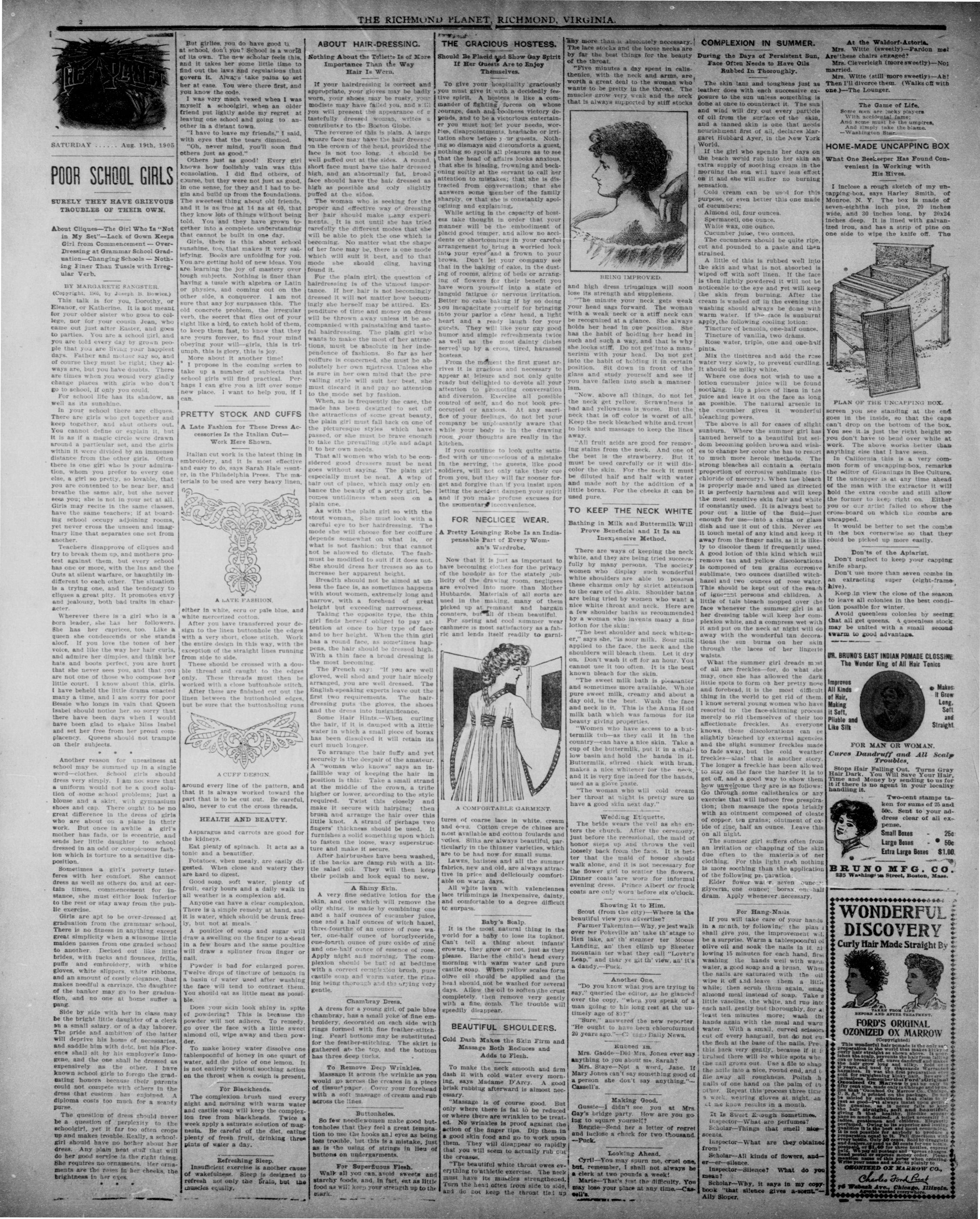
A LATE FASHION.
either in white, ecru or pale blue, and white mercerized cotton.
After you have transferred your design to the linen buttonhole the edges with a very short, close stitch. Work the entire design in this way, with the exception of the straight lines running from side to side.
These should be crossed with a double thread and caught to the edges only. These threads must then be worked with a close buttonhole stitch.
After these are finished cut out the linen between the buttonholed edges, but be sure that the buttonholing runs
A CUFF DESIGN.
around every line of the pattern, and that it is always worked toward the part that is to be cut out. Be careful, also, never to cut the cross threads.
HEALTH AND BEAUTY
Asparagus and carrots are good for the kidneys.
Eat plenty of spinach. It acts as a tonic and a beautifier.
Potatoes, when mealy, are easily digested. When close and watery they are hard to digest.
Good soap, soft water, plenty of fruit, early hours and a daily walk in all weather is a complexion aid.
Anyone can have a clear complexion. There is a simple remedy at hand, and it is water, which should be drunk freely, but not at meals.
A poultice of soap and sugar will draw a swelling on the finger to a head in a few hours and the same poultice will draw a splinter from finger or nail.
Powder is bad for enlarged pores. Twelve drops of tincture of benzoin in a basin of water used after washing the face will tend to contract them. You should eat as little meat as possible.
Does your skin look shiny in spite of powdering? This is because the powder will not adhere. To remedy, go over the face with a little sweet almond oil, wipe away and then powder.
To make honey water dissolve one tablespoonful of honey in one quart of water, add the juice of one lemon. It is not entirely without soothing action on the throat when a cough is present.
For Blackheads
The complexion brush used every night and morning with warm water and castile soap will keep the complexion free from blackheads. Twice a week apply a saturate solution of magnesia. Be careful of the diet, eating plenty of fresh fruit, drinking three pints of water a day.
Refreshing Sleep
Insufficient exercise is another cause of wakefulness. Sleep is designed to refresh not only the brain, but the muscles equally.
THE RICHMOND PLANET, RICHMOND, VIRGINIA
To give your hospitality graciously you must give it with a decidedly festive spirit. A hostess is like a commander of fighting forces on whose courage, dash and coolness victory depends, and to be a victorious entertainer you must not let your needs, worries, disappointments, headache or irritation show before your guests. Nothing so dismays and discomforts a guest, nothing so spoils all pleasure as to see that the head of affairs looks anxious, that she is hissing, frowning and beckoning soily at the servant to call her attention to mistakes; that she is distracted from conversation; that she answers some member of the family sharply, or that she is constantly apologizing and explaining.
While acting in the capacity of hostess take thought in order that your manner will be the embodiment of placid good temper, and allow no accidents or shortcomings in your careful arrangement to bring a worried look into your eyes and a frown to your brows. Don't let your company see that in the baking of cake, in the dusting of rooms, airing of beds or arranging of flowers for their benefit you have worn yourself into a state of languid fatigue or nervous irritation. Better no cake baking if by so doing you incapacitate yourself for bringing into your parlor a clear head, a light heart and a ready laugh for your guests. They will like your gay good humor and simple refreshments twice as well as the most dainty dishes served up by a cross, tired, harassed hostess.
From the moment the first guest arrives it is gracious and necessary to appear at leisure and not only quite ready but delighted to devote all your attention to promoting conversation and diversion. Exercise all possible control of self, and do not look pre-occupied or anxious. At any sacrifice of your feelings, do not let your company be unpleasantly aware that while your body is in the drawing room your thoughts are really in the kitchen.
If you continue to look quite satisfied with or unconscious of a mistake in the serving, the guests, like good soldiers, will not only take their cue from you, but they will far sooner forget and forgive than if you insist upon letting the accident dampen your spirit and if you make profuse excuses for the momentary inconvenience.
A Pretty Lounging Robe Is an Indis-
pensable Part of Every Woman's Wardrobe.
Now that it is just as important to have becoming clothes for the privacy of the boudoir as for the stately publicity of the drawing room, negligence are evolved into more than Mother Hubbards. Materials of all sorts are used in the making, many of them picked up at remnant and bargain counters, but all of them beautiful. For spring and cool summer wear cashmere is most satisfactory as a fabric and lends itself readily to garri-
```markdown
```
tures of coarse lace in white, cream and cera. Cotton crepe de chines are most available and cotton foulards and voilers. Silks are always beautiful, particularly in the thinner varieties, which are to be had now for small sums. Lawns, batistes and all the summer fabrics, new and old, are always attractive in price and delicously comfortable on warm days. All white lawn with valenciennes lace trimming is inexpensive, dainty, and comfortable to a degree difficult to surpass.
It is the most natural thing in the world for a baby to lose its topknot. Can't tell a thing about infants' crows, they grow or not, just as they please. Bathe the child's head every morning with warm water and purs castle soap. When yellow scales form olive oil should be applied and the head should, not be washed for several days. Allow the oil to soften the crust completely, then remove very gently with a fine comb. The trouble will speedily disappear.
Cold Dash Makes the Skin Firm and Massage Both Reduces and Adds to Flesh.
To make the neck smooth and firm dash it with cold water every morning, says Madame D'Arcy. A good brisk rubbing afterward is almost necessary.
"Massage is of course good. But only where there is fat to be reduced or where there are wrinkles to be treated. No wrinkles is proof against the action of the finger tips. Dip them in a good skin food and go to work upon them. They will disappear so rapidly that you will seem to actually rub out the creases.
"The beautiful white throat owes everything to athletic exercise. The neck must have its muscles strengthened. Turn the head often from side to side, and do not keep the throat tilt up
ABOUT HAIR-DRESSING.
Nothing About the Toilet Is of More Importance Than
If your hairdressing is correct and appropriate, your gloves may be badly worn, your shoes may be rusty, your modiste may have failed you, and still you will present the appearance of a tastefully dressed woman, writes a contributor to the Boston Globe.
The reverse of this is plain. A large square face may have the hair dressed on the crown of the head, provided the face is not too long. It should be well puffed out at the sides. A round, short face must have the hair dressed high, and an abnormally fat, broad face should have the hair dressed as high as possible and only slightly puffed at the sides.
The woman who is seeking for the proper and effective way of dressing her hair should make many experiments. It is not until she has tried carefully the different modes that she will be able to pick the one which is becoming. No matter what the shape of her face may be, there is one mode which will suit it best, and to that mode she should cling, having found it.
For the plain girl, the question of hairdressing is of the utmost importance. If her hair is not becomingly dressed it will not matter how becomingly she herself may be attired. Expenditure of time and money on dress will be thrown away unless it be accompanied with painstaking and tasteful hairdressing. The plain girl who wants to make the most of her attractions, must be absolute in her independence of fashions. So far as her coiffure is concerned, she must be absolutely her own mistress. Unless she is sure in her own mind that the prevailing style will suit her best, she must discard it and pay no attention to the mode set by fashion.
When, as is frequently the case, the made has been designed to set off the attractions of some great beauty, the plain girl must fall back on one of the picturesque styles which have passed, or she must be brave enough to take the prevailing style and adapt it to her own needs.
That all women who wish to be considered good dressers must be neat goes without saying. The plain girl especially must be neat. A wisp of hair out of place, which may only enhance the beauty of a pretty girl, becomes untidiness when seen on a plain one.
As with the plain girl so with the stout woman. She must look with a careful eye to her hairdressing. The mode she will choose for her collure depends somewhat on what is, or what is not fashion; but that cannot not be allowed to dictate. The fash-must be modified to suit if it does not. She should dress her tresses so as to increase her apparent height.
Breadth should not be aimed at unless the face is, as sometimes happens with stout women, extremely long and narrow, with a forehead of great height but exceeding narrowness.
Taking the opposite type, the thin girl finds herself obliged to pay attention at once to her type of face and to her height. When the thin girl has a round face, as sometimes happens, the hair should be dressed high. With a thin face a broad dressing is the most becoming.
The French say: "If you are well gloved, well shod and your hair nicely arranged, you are well dressed. The English-speaking experts leave out the first two requirements. The hair-dressing puts the gloves, the shoes and the dress into insignificance. Some Hair Hints.—When curling the hair, if it is damped with a little water in which a small piece of borax has been dissolved it will retain its curl much longer.
To arrange the hair buffy and yet securely is the despair of the amateur. A "woman who knows" says an infallible way of keeping the hair in position is this: Take a small strand at the middle of the crown, a trifle higher or lower, according to the style required. Twist this closely and make it secure with hairpins; then brush and arrange the hair over this little knot. A strand of periphaps two fingers' thickness should be used. It furnishes a solid something upon which to fasten the loose, wavy superstructure and make it secure.
After hairbrushes have been washed, if the backs are damp rub with a little salad oil. They will then keep their polish and look equal to new.
A Shiny Skin
A very fine sedative lotion for the skin, and one which will remove the oily shine, is made by combining one and a half ounces of cucumber juice, one and a half ounces of witch hazel, three-fourths of an ounce of rose water, one-half ounce of boroglyceride, one-fourth ounce of pure oxide of zinc and one-half ounce of essence of rose. Apply night and morning. The complexion should be hatched at bedtime with a correct complexion brush, pure castile soap and warm water, the rinsing being thorough and the orying very gentle.
Chambray Press
A dress for a young girl, of pale blue chambray, has a small yoke of fine embroidery, decorated on each side with rings formed with fine feather-stitching. Pearl buttons may be substituted for the feather-stitching. The skirt is gathered at the top, and the bottom has three deep tucks.
To Remove Deep Wrinkles.
Massage it across the wrinkle as you would go across the creases in a piece of tissue paper. Cover your forehead with a soft massage of cream and rub across the lines.
Buttonholes
So few needlewomen make good buttonholes that they feel a great temptation to use the hooks and eyes as being less trouble, but this is a mistake, just as is the using of strings in lieu of buttons on undergarments.
For Superflueous Flesh.
Walt all you can, avoid sweets and starchy foods, and, in fact, eat as little food as will; keep your strength up to the mark.
FOR NEGLIGEE WEAR.
A COMFORTABLE GARMENT
Baby's Scalp.
BEAUTIFUL SHOULDERS
Any more than is absolutely necessary. The lace stocks and the loose necks are by far the best things for the beauty of the throat. "Five minutes a day spent in callisthenics, with the neck and arms, are worth a great deal to the woman who wants to be pretty in the throat. The muscles grow very weak and the neck that is always supported by stiff stocks
BEING IMPROVED
and high dress trimmings will soon lose its strength and suppleness.
"The minute your neck gets weak your head sags forward. The woman with a weak neck or a stiff neck can be recognized at a glance. She always holds her head in one position. She has the habit of holding her head in such and such a way, and that is why she looks stiff. Do not get into a mannerism with your head. Do not get into the habit of holding it in certain position. Sit down in front of the glass and study yourself and see if you have fallen into such a mannerism.
"Now, above all things, do not let the neck get yellow. Scrawniness is bad and yellowness is worse. But the neck that is off color is worst of all. Keep the neck bleached white and trust to luck and massage to keep the lines away.
"All fruit acids are good for removing stains from the neck. And one of the best is the strawberry. But it must be used carefully or it will discolor the skin. For the neck it must be diluted half and half with water and made soft by the addition of a little borax. For the cheeks it can be used pure.
TO KEEP THE NECK WHITE
Bathing in Milk and Buttermilk Will Prove Beneficial and It Is an Inexpensive Method.
There are ways of keeping the neck white, and they are being tried successfully by many persons. The society women who display such wonderful white shoulders are able to possess these charms only by strict attention to the care of the skin. Shoulder batts are being tried by women who want a nice white throat and neck. Here are a few shoulder baths as recommended by a woman who invents many a fine lotion for the skin:
"The best shoulder and neck whitener," says she, "is sour milk. Sour milk applied to the face, the neck and the shoulders will bleach them. Let it dry on. Don't wash it off for an hour. You cannot use it too often. It is the best known bleach for the skin.
"The sweet milk bath is pleasanter and sometimes more available. Whole pure sweet milk, creamy and about a day old, is the best. Wash the face and neck in it. This is the Anna Hold milk bath which was famous for its beauty giving properties.
"Women who have access to a buttermilk tub—as they call it in the country—can have a nice skin. Take a cup of the buttermilk, put it in a shallow basin and hold the hands in it. Buttermilk, stirred thick with bran, makes a nice whitener for the neck, and it is very fine indeed for the hands, used as a glove paste.
"The woman who will cold cream her throat at night is pretty sure to have a good skin next day."
Wedding Etiquette
The bride wears the veil as she enters the church. After the ceremony, just before the recessional, the maid of honor steps up and throws the veil loosely back from the face. It is better that the maid of honor should walk alone, and it is not necessary for the flower girl to scatter the flowers. Dinner coats 'are worn for informal evening dress. Prince Albert or frock coats are only worn before six o'clock.
Showing It to Him
Scout (from the city)—Where is the beautiful view you advertise?
Farmer Takeminn—Why, ye jest walk over ter Pokeville an 'take th' stage to Hen lake, an 'th steamer ter Moose Landing, an' then climb up Skeeter mountain ter what they call "Lovr's Leap," and thar ye git th' view, an' it's a dandy,—Puck.
Another One
"Do you know what you are trying to say?" queried the editor, as he glanced over the copy, "when you speak of a man going to his long rest at the untimely age of 8?"
"Sure," answered the new reporter. "He ought to have been chloroformed 20 years ago." —CJ Cargo Daily News.
Kubbed in
Mrs. Gadde—Did Mrs. Jones ever say anything to you about me, Sarah?
Mrs. Staye—Not a word, Jane. If Mary Jones can't say something good of a person she don't say anything."—Cassell's.
Making Good.
Gussie - I didn't see you at Mrs. Gay's bridge party. How are you going to square yourself?
Reggle - Send her a letter of regret and enclose a check for two thousand.
--Puck.
Looking Ahead.
Cyril—You may spurn me, cruel one,
but, remember, I shall not always be
a clerk at two pounds a week!
Marie—That's just the difficulty. You
may lose your place at any time.—Cassell's.
COMPLEXION IN SUMMER.
During the Days of Persistent Sun,
Face Often Needs to Have Oils
Rubbed In Thoroughly.
The skin tans and toughens just as leather does with each successive exposure to the sun unless something is done at once to counteract it. The sun and wind will dry out every particle of oil from the surface of the skin, and a tanned skin is one that needs nourishment first of all, declares Margaret Hubbard Ayer, in the New York World.
If the girl who spends her days on the beach would rub into her skin an extra supply of soothing cream in the morning the sun will have less effect on it and she will suffer no burning sensation.
Cold cream can be used for this purpose, or even better this one made of cucumbers:
Almond oil, four ounces.
White wax, one ounce.
Cucumber juice, two ounces.
The cucumbers should be quite ripe, cut and pounded to a paste and then strained.
A little of this is rubbed well into the skin and what is not absorbed is wiped off with soft linen. If the face is then lightly powdered it will not be noticeable to the eye and yet will keep the skin from burning. After the cream is washed off in the evening the washing should always be done with warm water. If the face is sunburnt apply, the following cooling lotion:
Tincture of benzoin, one-half ounce.
Tincture of vanilla, two drams.
Rose water, triple, one and one-half pints.
Mix the tinctures and add the rose water very slowly, to prevent curdling. It should be milky white.
Where one does not wish to use a lotion cucumber juices will be found soothing. Dip a piece of linen in the juice and leave it on the face as long as possible. The natural arsenic in the cucumber gives it wonderful bleaching powers.
The above is all for cases of slight sunburn. Where the summer girl has tanned herself to a beautiful but seldom becoming golden brown and wishes to change her color she has to resort to much more heroic methods. The strong bleaches all contain a certain proportion of corrosive sublimate (bichloride of mercury). When the bleach is properly made and used as directed it is perfectly harmless and will keep the most sensitive skin fair and white if constantly used. It is always best to pour out a little of the fluid—just enough for use—into a china or glass dish and use it out of this. Never get it touch metal of any kind and keep it away from the finger nails, as it is likely to discolor them if frequently used. A good lotion of this kind which will remove tan and yellow discolorations is composed of ten grains corrosive sublimate, two ounces distilled witch-hazel and two ounces of rose water. This should be kept out of the reach of ignorant persons and children. A little of tails bleach mopped over the face whenever the summer girl is at her dressing table will keep her complexion white, and a compress wet with it and put on the neck at night will do away with the wonderful tan decorations the sun burns on her skin through the laces of her lingerie waists.
What the summer girl dreads most of all are freckles—for, do what she may, once she has allowed the dark little spots to form on her pretty nose and forehead, it is the most difficult thing in the world to get rid of them. I know several young women who have resorted to the face-skimming process merely to rid themselves of their too affectionate freckles. As everyone knows, these discolorations can be slightly bleached by external agencies and the slight summer freckles made to fade away, but the cold weather freckles—alas! that is another story. The longer a freckle has been allowed to stay on the face the harder it is to get off, and a good way to show them how unwelcome they are is as follows: Go through some calisthenics or any exercise that will induce free prespiration; then massage the spots briskly with an ointment composed of oleate of copper, ten grains; ointment of oxide of zinc, half an ounce. Leave this on all night.
The summer girl suffers often from an irritation or chapping of the skin due often to the materials of ner clothing. For this light rash nothing is more soothing than the application of the following preparation:
Elder flower water, seven ounces; glycerin, one ounce; borax, one half dram. Apply whenever necessary.
For Hang-Nails
If you will take care of your hands in a month, by following the plan, shall give you, the improvement will be a surprise. Warm a tablespoonful of olive oil and soak the nails in it, allowing 15 minutes for each hand, first washing the hands well with warm water, a good soap and a brush. When the nails are saturated with the oil, wipe it off and leave them a little while; then scrub them again, using almond meal instead of soap. Take a little vaseline, the white, and run into each nail, gently but thoroughly, for at least ten minutes more; wash the hands again with the meal and warm water. With a small, curved scissors cut off every hanguil, but do not cut the flesh at the base of the nails. Precise this hack very gently, because if it bruised there will be white spots where the nail grows out. Use a file to shap the nails into a nice, round end, and file away all roughness. Polish the nails of one hand on the palm of another. Repeat this process three time a week, wearing gloves at night, and at me know results in a month.
It Is Sweet Enough Sometimes,
Inspector—What are perfumes?
Scholar—Things that smell nice—
scents.
Inspector—What are they obtained
from?
Scholar—All kinds of flowers, and—
er—er—silence.
Inspector—Silence? What do you
mean?
Scholar—Why, it says in my copy-
book "that silence gives a-scent"—
Ally Sloper.
At the Waldorf-Astoria,
Writte (sweetly)—Pardon me!
Are'these chairs engaged?
Mrs. Cleverleigh (more sweetly)—No;
married.
Mrs. Witte (still more sweetly)—Ah!
Then I'll divorce them. (Walks off with
one.)—The Louinger.
The Game of Life.
Some men are jucky players
With accidental fame;
And some must be the umpires,
And simply take the blame.
-Washington Star.
HOME-MADE UNCAPPING BOX
What One Beekeeper Has Found Convenient in Working with His Hives.
I inclose a rough sketch of my uncapping-box, says Harley Smith, of Monroe, N. Y. The box is made of seven-eighths inch pine, 20 inches wide, and 30 inches long, by 20x24 inches deep. It is lined with galvanized iron, and has a strip of pine on one side to wipe the knife off. The
PLAN OF THE UNCAPPING BOX.
screen you see standing at the end goes in the inside, so that the caps can't drop on the bottom of the box. You see it is just the right height so you don't have to bend over while at work. The above works better than anything else that I have seen.
In California this is a very common form of uncapping-box, remarks the editor of Gleanings in Bee Culture. If the uncapper is at any time ahead of the man with the extractor it will hold the extra combs and still allow the former to keep right on. Either you or our artist failed to show the cross-board on which the combs are uncapped.
It would be better to set the combs in the box cornerwise so that they could be picked up more easily.
Don'ts of the Apiarist
Don't neglect to keep your capping knife sharp. Don't use more than seven combs in an extracting super (eight-frame hive). Keep in view the close of the season to leave all colonies in the best condition possible for winter. Avoid queenless colonies by seeing that all get queens. A queenless stock may be united with a small second swarm to good advantage.
DR. BRURO'S EAST INDIAN POMADE CLOSINGE
The Wonder King of All Hair Tonics
Improves
All Kinds
of Hair,
Making
it Soft,
Pliable and
Like Silk
Makes
it Grow
Long,
Soft
and
Straight
FOR MAN OR WOMAN.
Cures Dandruff and All Scalp
Troubles,
Stops Hair Falling Out. Turns Gray
Hair Dark. You Will Save Your Hair,
Time and Money by sending to us for
it if there is no agent in your locality
handling it.
Two-cent stamps taken
for sums of 25 and
50c. Sent to your address
clear of all expense.
P
Small Boxes - 25c
Large Boxes ● 50c
Extra Large Boxes $1.00
WONDERFUL DISCOVERY Curly Hair Made Straight By
TAKEN FROM LIFE
BEFORE AND AFTER EXPERIENCE
The Return of SHERLOCK HOLMES
Author of "The Adventures of Sherlock Holmes," "The Hound of the Baskervilles," "The Sign of the Four," "A Study In Scarlet," Ete.
from behind broad gold rimmed glasses. There was something of Mr. Pickwick's benevolence in his appearance, marred only by the insincerity of the fixed smile and by the hard glitter of those restless and penetrating eyes. His voice was as smooth and snave as his countenance as he advanced with a plump little hand extended, murmuring his regret for having missed us at his first visit. Holmes disregarded the outstretched hand and looked at him with a face of granite. Milverton's smile broadened; he shrugged his shoulders, removed his overcoat, folded it with great deliberation over the back of a chair and then took a seat.
"This gentleman?" said he, with a wave in my direction. "Is it discreet? Is it right?"
"Dr. Watson is my friend and partner."
"Very good, Mr. Holmes. It is only in your client's interests that I protested. The matter is so very delicate:" Dr. Watson has already heard of it." Then we can proceed to business. You say that you are acting for Lady Eva. Has she empowered you to accept my terms?"
"What are your terms?"
"Seven thousand pounds."
"And the alternative?"
"My dear sir, it is painful for me to discuss it, but if the money is not paid
#
Copyright by Collier's Weekly.
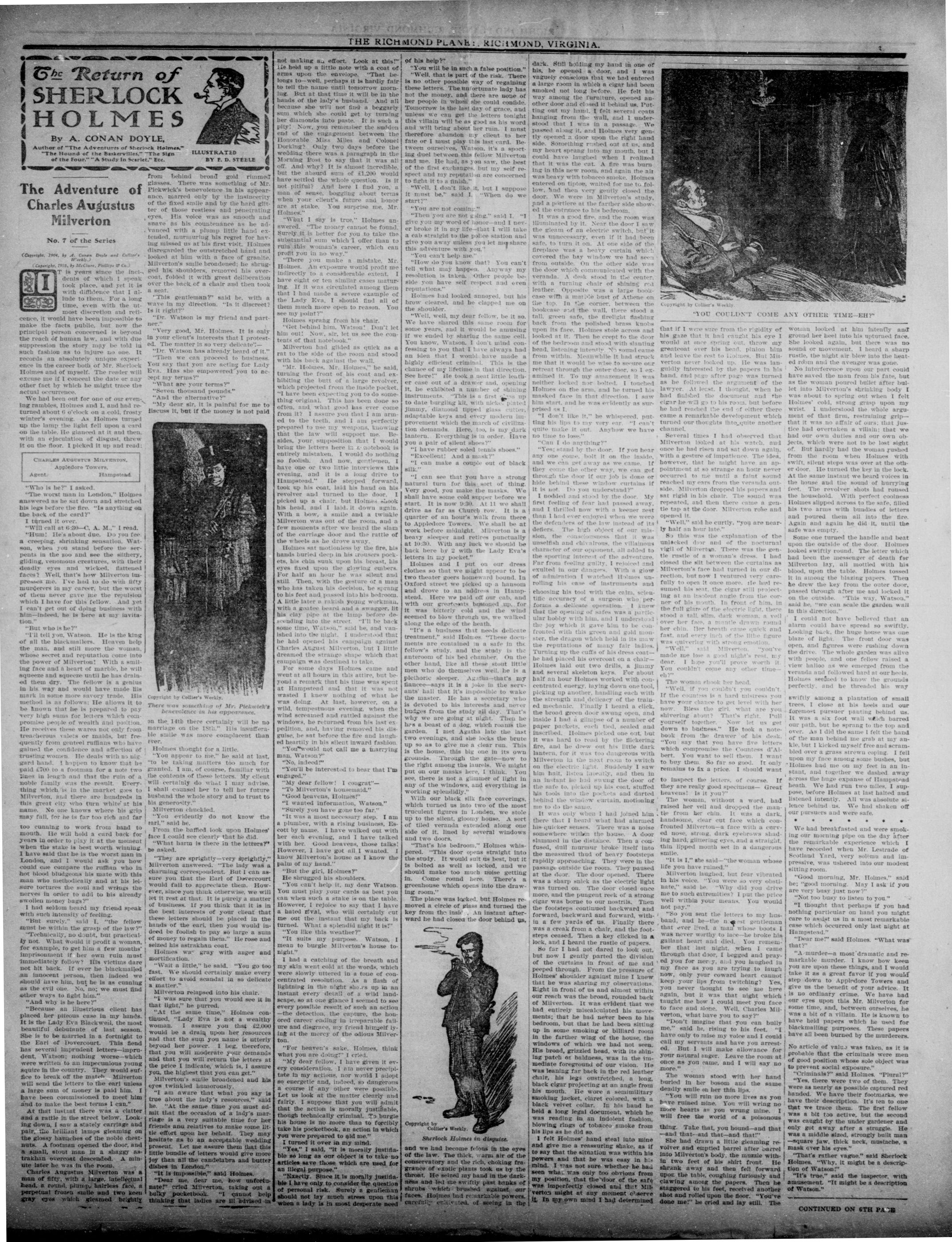
There was something of Mr. Pickwick's benevolence in his appearance.
on the 14th there certainly will be no marriage on the 18th." His insufferable smile was more complacent than ever.
Holmes thought for a little.
"You appear to me," he said at last, "to be taking matters too much for granted. I am, of course, familiar with the contents of these letters. My client will certainly do what I may advise. I shall counsel her to tell her future husband the whole story and to trust to his generosity."
Milverton chuckled.
"You evidently do not know the earl," said he.
From the baffled look upon Holmes' face I could see clearly that he did.
"What harm is there in the letters?" he asked.
"They are sprightly—very sprightly," Milverton answered. "The lady was a charming correspondent. But I can assure you that the Earl of Dovercourt would fall to appreciate them. However, since you think otherwise, we will let it rest at that. It is purely a matter of business. If you think that it is in the best interests of your client that these letters should be placed in the hands of the earl, then you would indeed be foolish to pay so large a sum of money to regain them." He rose and seized his astrakhan coat. Holmes was gray with anger and mortification. "Wait a little," he said. "You go too fast. We should certainly make every effort to avoid scandal in so delicate a matter." Milverton relapsed into his chair. "I was sure that you would see it in that light," he purred.
"At the same time," Holmes continued, "Lady Eva is not a wealthy woman. I assure you that £2,000 would be a drain upon her resources and that the sum you name is utterly beyond her power. I beg, therefore, that you will moderate your demands and that you will return the letters at the price I indicate, which is, I assure you, the highest that you can get." Milverton's smile broadened and his eyes twinkled humorously.
"I am aware that what you say is true about the lady's resources," said he. "At the same time you must admit that the occasion of a lady's marriage is a very suitable time for her friends and relatives to make some little effort upon her behalf. They may hesitate as to an acceptable wedding present. Let me assure them that this little bundle of letters would give more joy than all the candelabra and butter dishes in London."
"It is impossible," said Holmes. "Dear me, dear me, how unfortunate!" cried Milverton, taking out a bulky pocketbook. "I cannot help thinking that ladies are ill advised in
The Adventure of Charles Augustus Milverton
No. 7 of the Series
(Copyright, 1904, by A. Conan Dale and Celler's
Museum.)
(Copyright, 1925, by McClare, Phillips & Co.)
T is years since the inct-
dents of which I speak
took place, and yet it is
with diffidence that I in-
clude to them. For a long
time, even with the ut-
most discretion and reti-
T is years since the incidences of which I speak took place, and yet it is with diffidence that I am able to them. For a long time, even with the utmost discretion and reticence, it would have been impossible to make the facts public, but now the principal person concerned is beyond the reach of human law, and with due suppression the story may be told in such fashion as to injure no one. It records an absolutely unique experience in the career both of Mr. Sherlock Holmes and of myself. The reader will excuse me if I conceal the date or any other fact by which he might trace the actual occurrence.
We had been out for one of our evening rambles, Holmes and I, and had returned about 6 o'clock on a cold, frosty winter's evening. As Holmes turned up the lamp the light fell upon a card on the table. He gianced at it and then, with an ejaculation of disgust, threw it on the floor. I picked it up and read:
CHARLES AUGUSTUS MILVERTON,
Appledore Towers.
Agent: Hampstead
"Who is he?" I asked.
"The worst man in London," Holmes answered as he sat down and stretched his legs before the fire. "Is anything on the back of the card?"
"Will call at 6:30—C. A. M." I read. "Hum! He's about due. Do you feel a creeping, shrinking sensation, Watson, when you stand before the serpents in the zoo and see the silvery, gliding, venomous creatures, with their deadly eyes and wicked, flattened faces? Well, that's how Miltonver impresses me. I've had to do with fifty murderers in my career, but the worst of them never gave me the repulsion which I have for this fellow. And yet I can't get out of doing business with him—indeed, he is here at my invitation."
"I tell you, Watson. He is the king of all the blackmailers. Heaven help the man, and still more the woman, whose secret and reputation come into the power of Milverton! With a smiling face and a heart of marble, he will squeeze and squeeze until he has drained them dry. The fellow is a genius in his way and would have made his mark in some more savory trade. His method is as follows: He allows it to be known that he is prepared to pay very high sums for letters which compromise people of wealth and position. He receives these wares not only from treacherous valets or maids, but frequently from genteel ruffians who have gained the confidence and affection of trusting women. He deals with no nigard hand. I happen to know that he paid £700 to a footman for a note two lines in length and that the ruin of a noble family was the result. Everything which is in the market goes to Milverton, and there are hundreds in this great city who turn white at his name. No one knows where his grip may fall, for he is far too rich and far
too cunning to work from hand to mouth. He will hold a card back for years in order to play it at the moment when the stake is best worth winning. I have said that he is the worst man in London, and I would ask you how could one compare the ruffian who in hot blood bludgeons his mate with this man who methodically and at his leisure tortures the soul and wriggs the nerves in order to add to his already swollen money bags?" I had seldom heard my friend speak with such intensity of feeling.
"But surely," said I. "the fellow must be inside the grasp of the law?"
must be within the grasp of the law?"
"Technically, no doubt, but practically not. What would it profit a woman, for example, to get him a few months' imprisonment or his own ruin must immediately follow? His victims dare not hit back. If ever he blackmailed an innocent person, then indeed we should have him, but he is as cunning as the civil one. No, no; we must find other ways to fight him."
"And why is it?"
"Because an illustrious client has placed her piteous case in my hands. It is the Lady Eva Blackweil, the most beautiful debauchee of last season. She is to be married in a fortnight to the Earl of Dovercourt. This friend has several imprudent letters—imprudent, Watson; nothing worse—which were written to an impunctuous young squire in the country. They would suffice to break off the match. Milverton will send the letters to the earl unless a large sum of money is paid him. I have been commissioned to meet him and to make the best terms I can."
At that instant there was a clatter and a rattle in the street below. Looking down, I saw a stately carriage and pair, the brilliant lamps gleaming on the glossy haunches of the noble chestnuts. A footman opened the door, and a small, stout man in a shaggy astrakhan overcoat descended. A minute later he was in the room.
Charles Augustus Milverton was a man of fifty, with a large, intellectual head, a round plump, hairless face, a perpetual frozen smile and two keen gray eyes which gleamed brightly
ILLUSTRATED
BY F. D. STEELE
THE RICHMOND PLANE: RICHMOND, VIRGINIA.
not making a effort. Look at this!" He held up a little note with a coat of arms upon the envelope. "That belongs to—well, perhaps it is hardly fair to tell the name until tomorrow morning. But at that time it will be in the hands of the lady's husband. And all because she will not find a beggarly sum which she could get by turning her diamonds into paste. It is such a pity! Now, you remember the sudden end of the engagement between the Honorable Miss Miles and Colonel Dorking! Only two days before the wedding there was a paragraph in the Morning Post to say that it was all off. And why? It is almost incredible, but the absurd sum of £1,200 would have settled the whole question. Is it not pitiful? And here I find you, a man of sense, bogging about terms when your client's future and honor are at stake. You surprise me, Mr. Holmes."
"What I say is true," Holmes answered. "The money cannot be found. Surely it is better for you to take the substantial sum which I offer than to ruin this woman's career, which can profit you in no way."
"There you make a mistake, Mr. Holmes. An exposure would profit me indirectly to a considerable extent. I have eight or ten similar cases maturing. If it was circulated among them that I had made a severe example of the Lady Eva, I should find all of them much more open to reason. You see my point?"
Holmes sprang from his chair.
"Get behind him, Watson." Don't let him out! Now, sir, let us see the contents of that notebook." Milverton had glided as quick as a rat to the side of the room and stood with his back against the wall.
"Mr. Holmes, Mr. Holmes," he said, turning the front of his coat and exhibiting the butt of a large revolver, which projected from the inside pocket. "I have been expecting you to do something original. This has been done so often, and what good has ever come from it? I assure you that I am armed to the teeth, and I am perfectly prepared to use my weapons, knowing that the law will support me. Besides, your supposition that I would bring the letters here in a notebook is entirely mistaken. I would do nothing so foolish. And now, gentlemen, I have one or two little interviews this evening, and it is a long drive to Hampstead." He stepped forward, took up his coat, laid his hand on his revolver and turned to the door. I picked up a chair, but Holmes shook his head, and I laid it down again. With a bow, a smile and a twinkle Milverton was out of the room, and a few moments after we heard the slam of the carriage door and the rattle of the wheels as he drove away.
Holmes sat motionless by the fire, his hands buried deep in his roussons pockets, his chin sunk upon his breast, his eyes fixed upon the glowing eubers. For half an hour he was silent and still. Then, with the gesture or a man who has taken his decision, he sprang to his feet and passed into his bedroom. A little later a rakish young workman, with a goatette beard and a swaggier, lit his clay pipe at the lamp before descending into the street. "I'll be back some time, Watson," said he, and vanished into the night. I understood that he had opened his campaign against Charles August Milverton, but I little dreamed the strange shape which that campaign was destined to take.
For some days Holmes came and went at all hours in this attire, but beyond a remark that his time was spent at Hampstead and that it was not wasted I knew nothing of what he was doing. At last, however, on a wild, tempestuous evening, when the wind screamed and rattled against the windows, he returned from his last expedition, and, having removed his disguise, he sat before the fire and laughed heartily in his silent inward fashion. "You would not call me a marrying man, Watson?" "No, indeed!" "You'll be interested to hear that I'm engaged."
"I wanted information, Watson."
"Surely you have gone too far."
"It was a most necessary step. I am a plumber, with a rising business, Escott by name. I have walked out with her each evening, and I have talked with her. Good heavens, those talks! However, I have got all I wanted. I know Milverton's house as I know the palm of my hand."
"But the girl, Holmes?"
He shrugged his shoulders.
"You can't help it, my dear Watson. You must play your cards as best you can when such a stake is on the table. However, I rejoice to say that I have a hated rival, who will certainly cut me out the instant that my back is turned. What a splendid night it is!"
"You like this weather?"
"It suits my purpose. Watson, I mean to burgle Milverton's house tonight."
I had a catching of the breath and my skin went cold at the words, which were slowly uttered in a tone of concentrated resolution. As a flash of lightning in the night she *x*s up in an instant every detail of a wild landscape, so at one glance I seemed to see every possible result of such an action—the detection, the capture, the honored career ending in irreparable failure and disgrace, my friend himself lying at the mercy of the odious Milverton.
"For heaven's sake, Holmes, think what you are doing?" I cried.
"My dear fellow, I have given it every consideration. I am never precipitate in my actions, nor would I adopt so energetic and, indeed, so dangerous a course if any other were possible. Let us look at the matter clearly and fairly. I suppose that you will admit that the action is morally justifiable, though technically criminal. To burgle his house is no more than to forcibly take his pocketbook, an action in which you were prepared to aid me."
"I turned it over in my mind."
"Yes," I said, "it is morally justifiable so long as our object is to take no articles save those which are used for an illegal purpose."
"Exactly. Since it is morally justifiable I have only to consider the question of personal risk. Surely a gentleman should not lay much stress upon this when a lady is in most desperate need
of his help?"
"You will be in such a false position."
"Well, that is part of the risk. There is no other possible way of regaining these letters. The unfortunate lady has not the money, and there are none of her people in whom she could confide. Tomorrow is the last day of grace, and unless we can get the letters tonight this villain will be as good as his word and will bring about her ruin. I must therefore abandon my client to her fate or I must play this last card. Between ourselves, Watson, it's a sporting duel between this fellow Milverton and me. He had, as you saw, the best of the first exchanges, but my self respect and my reputation are concerned to fight it to a finish."
"Well, I need not like it, but I suppose it must be," said I. "When do we start?"
"You are not coming." "Then you are not going," said I. "I give you my word of honor—and I never broke it in my life—that I will take a cab straight to the police station and give you away unless you let me share this adventure with you." "You can't help me." "How do you know that? You can't tell what may happen. Anyway my resolution is taken. Other people beside you have self respect and even reputations." Holmes had looked annoyed, but his brow cleared, and he clapped me on the shoulder.
"Well, well, my dear fellow, be it so. We have shared this same room for some years, and it would be amusing if we ended by sharing the same cell. You know, Watson. I don't mind confessing to you that I have always had an idea that I would have made a highly efficient criminal. This is the chance of my lifetime in that direction. See here!" He took a neat little leather case out of a drawer and, opening it, he exhibited a number of shining instruments. "This is a first glass up to date burgling kit, with nickel glass jimmy, diamond tipped glass cutter, adaptable keys and every modern improvement which the march of civilization demands. Here, too, is my dark lantern. Everything is in order. Have you a pair of silent shoes?" "I have rubber soled tennis shoes." "Excellent! And a mask?" "I can make a couple out of black silk."
"I can see that you have a strong natural turn for this sort of thing. Very good, you make the masks. We shall have some cold supper before we start. It is now 9:30. At 11 we shall drive as far as Church row. It is a quarter of an hour's walk from there to Appledore Towers. We shall be at work before midnight. Milverton is a heavy sleeper and retires punctually at 10:30. With any luck we should be back here by 2 with the Lady Eva's letters in my pocket."
Holmes and I put on our dress clothes so that we might appear to be two theaterers homeward bound. In Oxford street we picked up a hansom and drove to an address in Hampstead. Here we paid off our cab, and with our great coats bristoned up, for it was bitterly cold and the wind seemed to blow through us, we walked along the edge of the heath.
"It's a business that needs delicate treatment," said Holmes. "These documents are contained in a safe in the fellow's study, and the study is the anteroom of his bed chamber. On the other hand, like all these stout little men who do themselves well, he is a plethoric sleeper. Agatha—that's my nancee—says it is a joke in the servants' hall that it's impossible to wake the master. He has a secretary who is devoted to his interests and never budges from the study all day. That's why we are going at night. Then he has a beast of a dog, which roams the garden. I met Agatha late the last two evenings, and she locks the brute up so to give me a clear run. This is the house, this big one in its own grounds. Through the gate—now to the right among the laurels. We might put on our masks here, I think. You see, there is not a glimmer of light in any of the windows, and everything is working splendidly."
With our black silk face coverings, which turned us into two of the most truculent figures in London, we stole up to the silent, gloomy house. A sort of tiled veranda extended along one side of it, lined by several windows and two doors.
"That's his bedroom." Holmes whispered. "This door opens straight into the study. It would suit its best, but it is bolted as well as locked, and we should make too much noise getting in. Come round here. There's a greenhouse which opens into the drawing room."
The place was locked, but Holmes removed a circle of glass and turned the key from the inside. An instant afterward he had closed the door behind us.
Copyright by
Collier's Weekly.
Sherlock Holmes in disguise
and we had become fetus in the eyes of the law. The thick, warm air of the conservatory and the rich, choking fragrance of exotic plants took us by the throat. He seized my hand in the darkness and led me swiftly past banks of shrubs which brushed against our faces. Holmes had remarkable powers, carefully cultivated, of seeing in the
dark. Still holding my hand in one of his, he opened a door, and I was vaguely conscious that we had entered a large room in which a cigar had been smoked not long before. He felt his way among the furniture, opened another door and closed it behind us. Putting out my hand, I felt several coats hanging from the wall, and I understood that I was in a passage. We passed along it, and Holmes very gently opened a door upon the right hand side. Something rushed out at us, and my heart sprang into my mouth, but I could have laughed when I realized that it was the cat. A fire was burning in this new room, and again the air was heavy with tobacco smoke. Holmes entered on tippee, waited for me to follow, and then very gently closed the door. We were in Milverton's study, and a portiere at the farther side showed the entrance to his bedroom.
It was a good fire, and the room was illuminated by it. Near the door I saw the gleam of an electric switch, but it was unnecessary, even if it had been safe, to turn it on. At one side of the fireplace was a heavy curtain which covered the bay window we had seen from outside. On the other side was the door which communicated with the veranda. A desk stood in the center, with a turning chair of shining red leather. Opposite was a large bookcase with a marble bust of Athene on the top. In the corner, between the bookcase and the wall, there stood a tall, green safe, the firelight flashing back from the polished brass knobs upon its face. Holmes stole across and looked at it. Then he crept to the door of the bedroom and stood with slanting head, listening intently. No sound came from within. Meanwhile it had struck me that it would be wise to secure our retreat through the outer door, so I examined it. To my amazement it was neither locked nor bolted. I touched Holmes on the arm, and he turned his masked face in that direction. I saw him start, and he was evidently as surprised as I.
"I don't like it," he whispered, putting his lips to my very ear. "I can't quite make it out. Anyhow we have no time to lose." "Can I do anything?"
"Yes; stand by the door. If you hear any one come, bolt it on the inside, and we can get away as we came. If they come the other way, we can get through the door if our job is done or hide behind these window curtains if it is not. Do you understand?"
I nodded and stood by the door. My first feeling of fear had passed away, and I thrilled now with a keeper zest than I had ever enjoyed when we were the defenders of the law instead of its defenders. The high object of our mission, the consciousness that it was unselfish and chivalrous, the villainous character of our opponent, all added to the sporting interest of the adventure. Far from feeling guilty, I reloiced and exulted in our dangers. With a glow of admiration I watched Holmes unrolling his case of instruments and choosing his tool with the calm, scientific accuracy of a surgeon who performs a delicate operation. I knew that the opening of safes was a particular hobby with him, and I understood the joy which it gave him to be confronted with this green and gold monster, the dragon which held in its maw the reputations of many fair ladies. Turning up the cuffs of his dress coat—he had placed his overcoat on a chair—Holmes laid out two drills, a jimmy and several skeleton keys. For about half an hour Holmes worked with concentrated energy, laying down one tool, picking up another, handling each with the strength and delicacy of the trained mechanic. Finally I heard a click, the broad green door swung open, and inside I had a gimpse of a number of paper packets, each tied, sealed and inscribed. Holmes picked one out, but it was hard to read by the flickering fire, and he drew out his little dark lantern, for it was too dangerous with Milverton in the next room to switch on the electric light. Suddenly I saw him hail, listen lautely, and then in an instant he had swung the door of the safe to, picked up his cont, stuffed his tools into the pockets and darted behind the window curtain, motioning me to do the same.
It was only when I had joined him there that I heard what had alarmed his quicker senses. There was a noise somewhere within the house. A door slammed in the distance. Then a confused, dull murmur broke itself into the measured thud of heavy footsteps rapidly approaching. They were in the passage outside the room. They paused at the door. The door opened. There was a sharp snick as the electric light was turned on. The door closed once more and the pungent reck of a strong cigar was borne to our nostrils. Then the footsteps continued backward and forward, backward and forward, within in a few yards of us. Finally there was a creak from a chair, and the footsteps ceased. Then a key clicked in a lock, and I heard the rustle of pans.
So far I had not dared to look out, but now I gently parted the division of the curtains in front of me and peeped through. From the pressure of Holmes' shoulder against mine I knew that he was sharing my observations. Right in front of us and almost within our reach was the broad, rounded back of Milverton. It was evident that we had entirely miscalculated his movements; that he had never been to his bedroom, but that he had been sitting up in some smoking or billiard room in the farther wing of the house, the windows of which we had not seen. His broad, grizzled head, with its shining patch or baldness, was in the immediate foreground of our vision. He was leaning far back in the red leather chair, his legs oustretched, a long, dark cigar projecting at an angle from his mouth. He wore a semimilitary smoking jacket, claret colored, with a black velvet collar. In his hand he held a long legal document, which he was reading in an indolent fashion, blowing rings of tobacco smoke from his lips as he did so.
I felt Holmes' hand steal into mine and give me a reassuring shake, as if to say that the situation was within his powers and that he was easy in his mind. I was not sure whether he had seen what was only too obvious from my position, that the door of the safe was imperfectly closed and that Milverton might at any moment observe it. In my own mind I had determined
M
that if I were sure from the rigidity of his gaze that it had caught his eye I would at once spring out, throw my greatcoat over his head, plinion him and leave the rest to Holmes. But Mitverton never looked up. He was languidly interested by the papers in his hand, and page after page was turned as he followed the argument of the lawyer. At least, I thought, when he had finished the document and the cigar he will go to his room, but before he had reached the end of either there came a remarkable development which turned our thoughts into quite another channel.
woman looked at him in ground her heel into his upst. She looked again, but the sound or movement. I hear rustle, the night air blew in ed room and the avenger wore. No interference upon our have saved the man from his as the woman poured bullet let into Milverton's shrink was about to spring out w Holmes' cold, strong grasp wrist. I understood the woment of that firm, restrain that it was no affair of our tice had overtaken a villain
Several times I had observed that Milverton looked at his watch, and once he had risen and sat down again, with a gesture of impatience. The idea, however, that he might have an appointment at so strange an hour never occurred to me until a falt sound reached my ears from the veranda outside. Milverton dropped his papers and sat rigid in his chair. The sound was repeated, and then there came a gentle tap at the door. Milverton rose and opened it.
"Well," said he curtly, "you are nearly half an hour late."
So this was the explanation of the unlocked door and of the nocturnal vigil of Milvertan. There was the gentle rustle of a woman's dress. I had closed the slit between the curtains as Milvertan's face had turned in our direction, but now I ventured very carefully to open it once more, he had resumed his seat, the cigar still protecting at an insoluble angle from the corner of his mouth. In front of him, in the full glare of the electric light, there stood a tall, slim, dark woman, a vell over her face, a mantle drawn round her chin. Her breath came quick and fast, and every inch of the little figure was quivering with strong emotion.
"Well," said Milverton. "you've made me lose a good night's rest, my dear. I hope you'll prove worth it. You couldn't come any other time—ch?" The woman shook her head.
"Well, if you couldn't you couldn't. If the countess is a hard mistress you have your chance to get level with her now. Bless the girl, what are you shivering about? That's right. Pull yourself together. Now let us get down to business." He took a notebook from the drawer of his desk. "You say that you have five letters which compromise the Countess d'Albert. You want to sell them. I want to buy them. So far so good. It only remains to fix a price. I should want to inspect the letters, of course. If they are really good specimens—Great heavens! Is it you?" The woman, without a word, had raised her vell and dropped the mantle from her chin. It was a dark, handsome, clear cut face which confronted Milverton—a face with a curved nose, strong, dark eyebrows shading hard, glittering eyes, and a straight, thin lipped mouth set in a dangerous smile.
"It is I," she said—"the woman whose life you have ruined." Milverton laughed, but fear vibrated in his voice. "You were so very obstinate," said he. "Why did you drive me to such extremities? I put the price well within your means. You would not pay." "So you sent the letters to my husband, and he—the n'est gentleman that ever lived, a man whose boots I was never worthy to lace—he broke his gallant heart and died. You remember that last night, when I came through that door, I begged and prayed you for mercy, and you laughed in my face as you are trying to laugh now, only your coward heart cannot keep your lips from twitching? Yes, you never thought to see me here again, but it was that night which taught me how I could meet you face to face and alone. Well, Charles Milverton, what have you to say?"
"Don't imagine that you can bully me," said he, rising to his feet. "I have only to raise my voice and I could call my servants and have you arrested. But I will make allowance for your natural anger. Leave the room at once as you came, and I will say no more."
The woman stood with her hand buried in her bosom and the same deadly smile on her thin lips.
"You will rain no more lives as you have ruined mine. You will wring no more hearts as you wring mine. I will free the world of a poisonous thing. Take that, you bound—and that—and that—and that—and that!"
She had drawn a little gleaming revolver and emptied barrel after barrel into Milverton's body, the muzzle within in two feet of his shirt front. He shrank away and then fell forward upon the table, coughing furiously and clawing among the papers. Then he staggered to his feet, received another shot and rolled upon the floor. "You've done me!" he cried and lay still. The
woman looked at him intently and ground her heel into his upretned face. She looked again, but there was no sound or movement. I heard a sharp rustle, the night air blew into the heated room and the avenger was gone.
No interference upon our part could have saved the man from his fate, but as the woman poured bullet after bullet into Milverton's shrinking body I was about to spring out when I felt Holmes' cold, strong grasp upon my wrist. I understood the whole argument of that firm, restraining grip—that it was no affair of ours; that justice had overtaken a villain; that we had our own duties and our own objects, which were not to be lost sight of. But hardly had the woman pushed from the room when Holmes with swift, silent steps was over at the other door. He turned the key in the lock. At the same instent we heard voices in the house and the sound of hurrying feet. The revolver shots had roused the household. With perfect coolness Holmes slipped across to the safe, filled his two arms with bundles of letters and poured them all into the fire. Again and again he did it, until the safe was empty.
Some one turned the handle and beats upon the outside of the door. Holmes looked swiftly round. The letter which had been the messenger of death for Milverton lay, all mottled with his blood, upon the table. Holmes tossed it in among the blazing papers. Then he drew the key from the outer door, passed through after me and locked it on the outside. "This way, Watson," said he, "we can scale the garden wait in this direction."
I could not have believed that an alarm could have spread so swiftly. Looking back, the huge house was one blaze of light. The front door was open, and figures were rushing down the drive. The whole garden was alive with people, and one follow raised a view halloo as we emerged from the veranda and followed hard at our heels. Holmes seemed to know the grounds perfectly, and he threaded his way
swiftly among a plantation of small trees, I close at his heels and our foremost pursuer panting behind us. It was a six foot wall which barred our path, but he sprang to the top and over. As I did the same I felt the hand of the man behind me grab at my ankle, but I kicked myself free and scrambled over a grass strewn coping. I fell upon my face among some bushes, but Holmes had me on my feet in an instant, and together we dashed away across the huge expanse of Hampstead heath. We had run two miles, I suppose, before Holmes at last halted and listened intently. All was absolute silence behind us. We had shaken off our pursuers and were safe.
We had breakfasted and were smoking our morning pipe on the day after the remarkable experience which I have recorded when Mr. Lestrade of Scotland Yard, very solemn and impressive, was ushered into our modest sitting room.
"Good morning, Mr. Holmes," said he; "good morning. May I ask if you are very busy just now?"
"Not too busy to listen to you."
"I thought that perhaps if you had nothing particular on hand you might care to assist us in a most remarkable case which occurred only last night at Hampstead."
"Dear me!" said Holmes. "What was that?"
"A murder—a most dramatic and remarkable murder. I know how keen you are upon these things, and I would take it as a great favor if you would step down to Appledore Towers and give us the benefit of your advice. It is no ordinary crime. We have had our eyes upon this Mr. Milverton for some time, and, between ourselves, he was a bit of a villain. He is known to have held papers which he used for blackmailing purposes. These papers have all been burned by the murderers.
No article of value was taken, as it is probable that the criminals were men of good position whose sole object was to prevent social exposure.
"Criminals?" said Holmes. "Plural?" "Yes, there were two of them. They were as nearly as possible captured red handed. We have their footmarks, we have their description. It's ten to one that we trace them. The first fellow was a bit too active, but the second was caught by the under gardener and only got away after a struggle. He was a middle sized, strongly built man—square jaw, thick neck, mustache, a mask over his eyes." "That's rather vague," said Sherlock Holmes. "Why, it might be a description of Watson." "It's true," said the inspector, with amusement. "It might be a description of Watson."
CONTINUED ON 6TH PAGE
THE PLANET
Published every Saturday by JOHN MITCHELL,
JR., at Sll North 4th Street, Richmond, Va.
JOHN MITCHELL, JR., - EDITOR.
All communications intended for publication
should be sent so as to reach us by Wednesday.
TERMS IN ADVANCE
ADVERTISING RATES
REGISTERED LETTER.—If a money Order Post-Office or an Express Office is not within your reach, your Postmaster will Register the money in your account and pay your payment of fees. Then, if the letter is lost or stolen, it can be traced. You can send money in this manner at our risk.
We cannot be responsible for money sent in the mail, but we are not responsible than what ways mentioned above. If you send your money in any other way, you must do it at your own risk.
RENEWALS, ENO.—If you do not want THE MONEY you sent in the mail, you must not subscribe has run out, you then notify us by Postal Card to discontinue it. The courts have decided that subscribers to newspaper, who do not subscribe has run out, must continue at the expiration of time for which the subscription are held liable for the payment of the subscription up to date when they order the paper continued.
COMMUNICATIONS.—When writing to us to request your subscription or to discontinue our paper, you should give your name and address in full, otherwise we cannot find your name on our books.
CHANGE OF ADDRESS.—In order to change the name of your address, you sent the former as well as the present address.
Entered at the Post-Office at Richmond, Va.,
as second-class matter.
SATURDAY ..... Aug. 19th, 1905
Judge S. B. Witt is being severely criticized and in some quarters unsparingly denounced because he refused to receive a "minority" report after a "majority" report of the special grand jury and signed by all of the members of the grand jury had been presented to His Honor. This presents an anomalous phase of a very interesting question and to our mind is settled, if the dissenting jurors did actually sign the "majority" report or if their names were affixed to that document with their approval and consent.
There can be no minority report after the members of a body have unanimously agreed to the "majority" report. They must first secure the erasure of their names from the report before it is presented to the Judge or we fail to see where they have any standing in their plea for a further hearing. To be plain, it is a well established principle of parliamentary law that a minority member forfeits his rights and privileges, when he agrees to and signs the report of the majority of his colleagues. The majority report is then his report, and he is placed in the embarrassing position of stultifying himself when he attempts to get a hearing on something else outside of the report to which he has affixed his signature.
If a member of a body desires to present a minority report, he should not give any sign of approval to the majority report of his colleagues, but should draw up a report, expressive of his views, and claim the right to present this as the opinion of himself and those agreeing with him.
While we would like much to see the "minority" report and get the benefit of its findings, it seems to us that Judge Witt is right and that the objecting elements are doing the ward-heelers and ballot-box manipulators a service in attacking the rulings of the court on this all-important question.
A TEXAS BURNING.
Tom Williams, a mulatto was burned on the public square of Sulphur Springs, Texas Friday, Aug. 11th, 1905. He was charged with attempting to criminally assault Mary Childs, a white girl and there
is no allegation that he accomplished his purpose. But that is neither here nor there. The brutalizing effect of such an exhibition must exert its influence on the community for a long time. Texas is noted for just these kind of flendish atrocities and it is not surprising that brutish instincts should exist in the colored as well as the white people. A federal judge has rendered an opinion that lynching is a crime against the United States government and the guilty parties are subject to punishment in the federal courts. It is evident that this view of the situation will be cordially concurred in by every lover of humanity and justice.
When lynchers so far forget themselves as to place themselves below the brute that they murder, it is time to call a halt and make them feel the full force and effect of the strong arm of the law.
TWO BOYS MEET HORRIBLE FATE
Burned to Death Under Brush Heap City
Atlantic City, Beach
Atlantic City, N. J., June 7.—The bodies of two boys who met a horrible death by cremation on the beach have been identified as those of Ordner J. Delinney and William Jeffries, both of this city, aged 7 and 5 years respectively. The two boys were inseparable companions. They had gone to a brush heap of pine trees on the beach front at New Hampshire avenue, which trees were to be used to build a jetty. They dug a hole beneath the uile and crawled under it. It is believed they had matches, for soon the brush was ablaze, and before the boys could crawl out they were cremated. Their charred bodies were scarcely recognizable. Firemen who responded to put out the blaze did not know the boys were under the brush until a hoseman lifted one end of the brush to get a stream of water under it. He then saw the two burned bodies side by side.
The Great Divide
Freddie—What's a pedestrian, dad?
Cobwigger—He's a man who can'
Word an auto—New York Times.
The Lay of the Hen.
I love the carol of the lark.
The startling's thrilling note.
The voice of nightingale at dark
Which through the air will float;
I like the lilac of the sweet.
The thrash song in the glen.
But better far I love to eat.
The fresh lay of the hen.
-St. Louis Republic
President of Jamestown Exposition.
Norfolk, Va., Aug. 16—The board of directors of the Jamestown Exposition company have decided to offer the presidency of the company to Henry St. George Tucker, dean of the law school of George Washington University, Washington. D. C. The action of the directors will be ratified by the stockholders at a meeting to be held Friday afternoon. Mr. Tucker will succeed the late General Fitzhugh Lee as head of the Jamestown Exposition.
Russian Soldiers Mutlate Themselves
Harbin, Aug. 15—Among the soldiers medically treated here, 1200 were found to be self-mutilated on the first fingers of the right hand.
How to Protect Pianos.
A growing plant should be kept in the room with a piano, says a piano tuner. As long as the plant thrives the piano will be in tune and in good condition. The reason that a piano is injured by a dry, overheated room is that all the moisture is taken out of the sounding board. The board is forced into the center, and, though the wood is supposed to be as dry as possible when this is done, it contains some moisture and gathers more on damp days. When this moisture is dried out the board flattens and finally cracks.
How to Wash Chiffon
It is quite easy to wash and iron the better kinds of chiffon and make it look as good as new. Make a lather with soap powder in warm water, float the chiffon in this for about ten minutes, do not rub, but fold carefully between the hands and squeeze gently two or three times. Then place it between the folds of a clean soft towel and press in it until most of the moisture is absorbed. Iron on the wrong side while still damp, and the chiffon will be quite glossy and fresh again.
Ironing the Tablesloth
In folding tablecloths for ironing make no more folds than is necessary, and let all necessary ones be straight and smooth. Iron the cloth lengthwise, move the iron lightly in the beginning and iron first on the wrong side. Fold the selvedges evenly together, iron on both the right sides, and increase pressure as the linen dries. Open the cloth with the wrong side uppermost. Fold the selvedges over so they almost touch the middle fold, and iron again. Fold once more, bringing the two new edges together, and iron both sides of the cloth. Iron until perfectly dry.
When spread upon the table, there should be three lengthwise folds with the sharp edge uppermost. Make as few crosswise folds as possible, the number depending upon the size of the drawers in which the tablecloths are kept. It is a matter of great convenience to have the drawers for table linen of good size, then tablecloths will need few crosswise folds and tray cloths, centerpieces, etc., need not be folded at all.
Coffee For Large Party.
Allow one pound of finely ground coffee to each thirty persons. Put into bags made of cheesecloth which has been boiled before using to free it from lint, allowing space for the grounds to swell. Put the bags in a boiler and cover with cold water, allowing a gallon and three-quarters of cold water to each pound of coffee. Place over the fire, bring to the boiling point and then push back and after a little again bring forward. Simmer in this way for ten minutes, never letting it boil hard; then push back for ten minutes before serving.
WOMAN TO RULE IN INDUSTRIALISM
Man Will be a Back Number and Return to the Soil
AGE OF "ETERNAL FEMININE"
Detroit, Mich., Aug. 18.—The annual convention of the International Association of Factory Inspectors opened here. President Edgar T. Davies, of Chicago, is presiding over the sessions, which are held in the county supervisors' hall. About 150 delegates are present. At the opening session papers were read by W. L. Bodine, of Chicago, on "The Competitive Life," and by Mrs. Sarah R. Crowley, deputy inspector of Illinois, on "Our Purpose and Duty."
The speech of Mr. Bodine, who is superintendent of compulsory education at Chicago, created a mild sensation among the delegates. The speaker produced federal statistics covering the past 20 years showing that the industrial competition of women, children and machine labor was driving the men out of the large cities to fields of heavy manual labor in mining and agriculture. He declared that woman was destined to be the ruling sex in industrialism, and continued:
"Man, like the Indian, is dying out and being driven out. In 1890 there were 3,914,571 women who were employed in gainful occupations in America. In 1900 the number had increased to 5,239,807. The birth rate among the female occupation is increasing and the death rate decreasing. It is just the reverse among the males. We are rapidly drifting to the age of the 'eternal feminine' when man will be a back number and forced to return to the soil and to those fields of labor where only his physical endurance will save him in the struggle for survival."
In discussing the competitive life for the leadership in society, the speaker said:
"Society is dying out at the top. It is a crystal maze of glass houses, where no occupant dares cast the first stone; the dangerous example; the academy of divorce. Society has mothers who are slaves to the siren calls of fashion and frivolity, who look more often into their mirrors than into the faces of their children. With a fashionable mother gadding about at social functions and a fashionable father at his club the result will be that within a decade the question of the neglected children of the rich will become as great a social problem as that of the neglected children of the poor."
BRUTALLY ATTACKED BY NEGRO
By Desperado, Whom Officer Killed.
Ballston, N. Y., Aug. 14—Rev. Bernard Schulte and his wife, of New York city, were attacked at Mechanicsville and probably fatally injured by a negro, who was shot and killed in Saratoga while resisting arrest.
William Curtis, a negro, presented himself at the door of the rectory and asked for a drink of water. Mr. Schulte was in the act of turning back to get the water, when the negro drew a piece of lead pipe from beneath his coat and felled the clergyman with a terrific blow on the head, following this up with a rain of blows until his victim lay unconscious and apparently dead. Mrs. Schulte, who was upstairs, hurried down on hearing her husband fall, and was met in the hall by the negro, who instantly struck her down before she could utter an outcry, and continued beating her with his heavy weapon until he had inflicted injuries from which she can hardly recover.
Policeman James Sullivan discovered Curtis in Searings alley, a negro colony in Saratoga, and arrested him. The negro, however, broke away and ran, and after firing one shot in the air to halt him. Sullivan fired again, shooting him through the head and killing him instantly.
Dr. Crum Couldn't Hire Wheel Chair
With White Attendant
Asbury Park, N. J. Aug. 15.—Dr. William D. Crum, the colored collector of customs at Charleston, S. C., who is a summer visitor with his wife at West Park, tried to hire a wheel chair for his wife for a ride on the boardwalk. The proprietor refused to order any of his lads to push the chair, but said Dr. Crum might have one if he would himself wheel his wife. Dr. Crum declined to do so.
Fined $50 For Employing Children.
Trenton, N. J., Aug. 16.—Judge MacPherson, in the city district court, fined two local manufacturing concerns $50 each for employing children below the prescribed age. The fines were imposed despite the fact that the children worked for other employers and were not in the direct employment of the manufacturers. Under the new child labor law Judge MacPherson held that the manufacturers were liable though they were not the direct employers.
Morocco Secures Loan From Germany
London, Aug. 16—The Times correspondent at Tangier says that the German legation has officially announced that the contract has been signed for a loan arranged by Count von Tattenbach-Ashold, the special commissioner of Germany to Morocco.
Closes School to Boy Smokers
Bridgeton, N. J., Aug. 14.—Professor Irwin F. Mather, principal of the West Jersey Academy, publicly announces that any boy under 16, adicted to cigarettes, who will not stop the habit, will not be permitted to attend the school.
Run Down By Auto On Beach.
Cape May, N. J., Aug. 15.—Thomas N. Butts and wife, of Brooklyn, were seriously injured while walking across the beach drive from bathing by belgs run over by an automobile operated by F. H. Hack, Jr., of Baltimore. They were carried to their hotel on stretchers. A police man secured Hack's car, but Hack escaped in the crowd.
Manhattan: Bridge Contract Awarded.
New York, Aug. 16.—The contract
RICHMOND PLANET, RICHMOND, VIRGINIA
JSM
Mr building the new Manhattan bridge, which will parallel the Brooklyn bridge, was awarded to the lowest bidder, the Pennsylvania Steel company, whose bid was $7,284,000.
Friday, Aug
The Southern Veb met in annual session
N.C.
The European minister
MAY ABANDON
EXTRA SESSION
Congress May Not be Called to Meet in November.
THE PRESIDENT IS UNDECIDED
Oyster Bay, N. Y., Aug. 14—Notwithstanding the more or less definite announcements which have enumerated from various sources during the last few months, congress may not be called into extraordinary session next November. Indeed, the indications are now that no extraordinary session will be held this year.
This statement is made on the authority of President Roosevelt himself. He has not decided the question definitely yet, and probably will not reach a determination of it until he shall have returned to Washington the latter part of September. The chances of an extraordinary session appear, however, to be fading.
Strong pressure is being brought to bear upon the president to induce him not to call an extra session. So much interest has been manifested in the subject throughout the country that the president has received a large number of letters regarding it. Many senators and representatives have urged against an extra session. They point out that practically nothing will be gained by an extra session that will begin not more than three weeks before the opening of the regular long session, and that it will cause some inconvenience to many members of congress in both branches. Taking these things into consideration, the president has reserved a definite decision of the matter, the chances, as noted, being that the session will not be called.
Last spring it was the president's idea to issue at the proper time a call for an extra session to be held in October for the purpose of enacting, if possible, railroad rate legislation. Incidentally, it was expected that some recommendations might be made by the president regarding proposed changes in the existing tariff law.
The idea of an October session was finally abonded, and subsequently the president made arrangements for a two-weeks' trip through the south, beginning on the 17th of October. It was then announced that the proposed extraordinary session would not be held until after the November election.
If finally the president should decide to call congress together, the session will begin on the first Monday after the November elections, which will be just three weeks before the beginning of the regular session in December.
In this connection it can be said not to be unlucky, in view of the prevalence of yellow fever in New Orleans that the president may conclude to make his trip through the south in two sections, visiting the Atlantic coast states in October, and Louisiana Arkansas and perhaps Tennessee on another trip to be made later. No definite arrangements to this end have been completed, but the matter is being considered.
Sayville, L. I., Aug. 15. — Gladys Roosevelt, 16 years of age, and Eugenie Roosevelt, aged 18, daughters of John E. Roosevelt, and cousins of President Roosevelt, were thrown from their high cart while driving here, and Miss Gladys was so badly injured that it is feared she may not recover.
Both have been used to handling and driving spirted horses since they were small children. They had got as far as Panroe avenue and Main street, when the horse became frightened and started to run. Miss Gladys, who was driving, attempted to check the animal, but could not. The cart struck the curb, and both the young women were thrown out.
Several doctors were summoned, but were unable to revive Miss Gladys, and she was taken home unconscious. It is feared her skull is fractured.
John E. Roosevelt, the father of the two young women, is an uncle of President Roosevelt.
Steamer Sunk at Dock.
Block Island, R. I., Aug. 16. — The steamer New Shoreham, while entering the harbor on her trip from Providence with 100 passengers, struck a sunken wreck, and an exciting run for the dock, sank to the main deck just as she ranged alongside the pler. The passengers were able to land over the gangplank. The collision ripped open a hole several feet wide in her bottom, but notwithstanding the steady inrush of the water the fireroom men and the engineer, headed by Chief Engineer John Quinlan, of Providence, stuck to their posts. When the steamer was within 100 yards of the dock the water put out the fires, and when the vessel reached the dock Engineer Quinlan was standing in water up to his waist. He was still at his post when the steamer's gangplank was pushed ashore.
A WEEK'S NEWS CONDENSED.
General Freight Agent S. T. Sohr,
of the Chicago Great Western, has
resigned. W. E. Pinckney succeeds him.
Before the Pennsylvania state medica-
l board, in session at Atlantic City,
M. J., out of 466 candidates, 56 failed.
Boston has been selected as the
meeting place for the 21st annual con-
vention of the American Philatellic
Association.
The General Supply and Construction
Company, of New York, will build
the new union passenger station of
the Southern Railway at Mobile, Ala.
to cost $500,000.
Alexander R. Smith, superintendent
of the New York Maritime Exchange,
has resigned in order to accept a pos-
tion with the Merchant Marine
League of the United States, with
headquarters in Cleveland, O.
Friday, August 11.
The Southern Vehicle Association met in annual session at High Point, N. C.
The Russian ministry of finance has ordered a reduction in the export duty on petroleum.
The state convention of the Brotherhood of the Union installed officers at Scranton, Pa., and selected Lebanon for next year's meeting.
District Attorney Bell, of Philadelphia, who was severely injured in an elevator accident recently, has been taken from the hospital to his country home at Radnor, a suburb.
Saturday, August 12.
Robert S. Huston, chief clerk at the Philadelphia mint, committed suicide by hanging.
Former Congressman Francis Marvin died at Port Jervis, N. Y., aged 77 years. In business he was a banker and railway promoter.
Mrs. Naomi Aldrich, of Frederick, Mich., was arrested, charged with murdering her two little boys to obtain an insurance of $20 on each.
William Ruch, of Allentown, Pa., a Civil War veteran, became so excited over seeing President Roosevelt as he passed through to Wilkesbarre that he suffered a stroke of apoplexy, from which he died.
Monday, August 14.
Alan W. Wood, the Pittsburgh millionaire died in New York from the effects of an operation.
Memorial services for the dead in the gunboat Bennington disaster were held at Sap Diego, Cal.
An elevator in the chamber of commerce building at Buffalo dropped six stories, seriously injuring six persons.
Cornellus P. Shea was re-elected president of the International Brotherhood of Teamsters at the Philadelphia convention.
By a fall of coal in the Trudeale colliery at Wilkesbarre, Pa., John E. Lovett, Matthew Kaleas and Anthony Zaharaskus were killed and Thomas Walters was fatally injured.
Tuesday, August 15.
The 11th annual convention of the Pattern Makers' League of America was held at Pittsburgh.
Mrs. John M. Rott, of Baltimore, is suing for divorce, declaring her husband was a lunatic when she married him.
Grover Koutz, 20 years old, an athlete of Spring Grove, Pa., was drowned while swimming in Conewago creek, near York.
The late Rear Admiral A. E. K. Benham, U. S. N., was buried at Arlington cemetery, Washington, D. C., with full military honors.
Walter Sanger Pullman, son of the late George M. Pullman, was thrown from a carriage at San Mateo, Cal., and sustained injuries from which he may die.
Wednesday, August 16.
Rev. Charles E. Sandt fell dead of heart disease at his home in Allentown, Pa.
The Philadelphia, Baltimore & Washington Rilroad company will erect a $200,000 passenger station in Wilmington Del.
Bishop Cope Smith, of the Southern Methodist church, who, was seriously ill with pneumonia at Asheville, N. G., will recover.
The annual convention of the International Brotherhood of Teamsters at Philadelphia adjourned to meet next year in Chicago.
The Virginia state board of health will establish a complete quarantine at Norfolk against all passengers and freight from Louisiana.
PRODUCE QUOTATIONS
The Latest Closing Prices In the Principal Markets
PHILADELPHIA — FLOUR steady;
winter extras. $3.25 @ 3.50; Pennsylvania roller, clear. $3.75 @ 3.90; city mills, fancy. $4.40@ 5.85. RYE FLOUR roller, clear. $4.40@ 5.85. No. 2 Pennsylvania red. new $8.45; CORN firm; no. 2 yellow, local. $6@64c. OATS steady; No. 2 white, clipped, 3t.; lower grades, 3c. HAY steady; thinchy, large bales; PORK firm; PORK firm; beef hams. $23@24. Poultry. Live steady; hens, 12%c. old roosters. 9c. Dressed firm; choice roolers, 14c.; old roosters, 9%c. BUTTER steady; creamy, 22c. per pound. EGGS firm; and Peninsula vsn a. 22c. per dozen. POATOES steady. 50@6c per bushel.
BALTIMORE - WHEAT steady; No. 2 red, 81½%@81½%; steamer No. 2 spot, 75½%@75½%; southern, 60@83%; CORN quiet and steady; mixed pot, 60½%@60½%; southern, 57½%@57½%; OATS fir, white, No. 2, 21½%@21½%; No. 3, 20½%@20½%; No. 4, 29½%@29½%; mixed, No. 2, 29½%@29½%; No. 4, 27½%@28½%. BUTTER steady; creamy separator, extras, 22@22½%; held, 17 @9c; prints, 21@24c; Maryland and EGOS firm; fancy Maryland, Pennsylvania and Virginia, 20c; West Virginia, 19½%; southern, 19c; per dozen
Live Stock Markets
PITTSBURG (Union Stock Yards)—
CATTLE irregular; choice, $5.50@
5.65; prime, $5.23@5.50. HOGS active;
prime heavies, $6.45@6.50; prime
mediums, $5.60@6.65; best Yorkers, $6.50
SHEEP dull; prime wethers, $5.25@
5.50; common, $2@3.50; spring jambs,
$6@4.90; veal calves, $6@5.00.
YELLOW FEVER SITUATION
Sixty-two New Cases and Six More Deaths In New Orleans
New Orleans, Aug. 16. Official report of the yellow fever up to last night: New cases, 62; total to date, 1080; deaths, 6; total to date, 172; new disease centers, 19; total to date, 229.
The arrival of Dr. John Guiteras, the Cuban yellow fever expert, and his tour of the seat of worst infection, was the most interesting feature of the yellow fever situation.
The situation again shows an improvement, both as to new cases and deaths, considering the totals of last week, and while the marine hospital officials are unwilling to be quoted now, they are known to entertain most hopeful views. The results achieved to date have met their expectations.
Encouragement is especially found in the reduction of new fever centers. Many of the new disease centers of three weeks ago are considered to have disappeared, no new infection appearing in their neighborhood.
EXPORTS SHOW LARGE INCREASE
Past Pleas Year Was Record Breaker
For Manufacturers.
Washington, Aug. 14. — Statistics
compiled by the bureau of statistics
of the department of commerce and labor show that the exports of manufactures in the fiscal year just ended amounted to $543,620,297, as against $452,416,921 in the preceding year, $433,851,756 in 1960, and $183,595,743 in 1895 of manufactures. The exports for the past fiscal year were: "Not only the largest on record, but are in excess of the combined exports of all articles in the centennial year, 1876, and nearly $140,000,000 more than the total imports and exports of the country at the close of the Civil War." Out of 30 leading articles only seven show a falling off for the year as compared with 1904. Iron and steel manufactures supply about one-fourth of the total exports, having been $134,727,921, as against $111,948,586 in the preceding year.
TERRIFIC EXPLOSION IN FOUNDRY
Fifteen Men Injured and Building Nearly Wrecked
Lebanon, Pa. Aug 16.—Fifteen men were injured, four of them seriously, by a terrific explosion in the foundry department of the Treadwell Manufacturing company. A large ladle containing over 3000 pounds of hot metal was accidentally overturned while being run on a crane. The metal ran into a large bosh filled with water, and the explosion resulted before the men could get out of the way. All window panes in the large building and office were blown out and the slate roof was lifted from its foundation. The shock of the explosion was felt all over the city, and window panes and doors of houses in the immediate neighborhood were shattered. The men most seriously injured are: Samuel Powell, Samuel Hood, Cyrus Miller and John Porter.
Died of Heart Failure During Runaway
Westminster, M3, Avg. 16.—Heart
failure, brought on by fright, caused
the death of Mrs. Margaret Rinchart
Tracy. She had driven to her mother's
farm, taking her little niece with her,
and while returning found it necessary
to leave the vehicle to close a gate.
As she was in the act of doing so the
horse started to run away. She made
a desperate effort to stop him, but
failed. She was seen to fall and was
dying when assistance reached her.
The child, whose danger fatally frightened
her aunt, was unhurt when the
runaway was stopped.
Patti's Music Teacher Died in Poverty
New York, Aug. 16—Gulseppe Nicolao,
who was one of Adelina Patti's
first music teachers, died in poverty
in this city, aged 80 years. He was
born in Palermo and was graduated
from the College of Music in that city.
When a young man he brought a small
opera company to America, but the
enterprise failed. Afterwards he took up
teaching, and when she was 15 years
old Adelina Patti was placed under his
tuition by Max Strakosch, studying
operatic roles for two years.
AUTO AND TRAIN COLLIDE
Two Killed and Two Injured in Grade Crossing Accident.
Rutland, Vt. Aug. 15—Harris Lindsay, deputy police commissioner of New York city, and Miss Evelyn Willing, of Chicago, were killed at Pike's Crossing, near Bentington, Vt., when the automobile in which they were travelling from Manchester, Vt., to Williamstown, Mass., was struck by a train on the branch road from North Bentington. Ambrose Cramer, of Chicago, the young nephew of Miss Willing, and J. Adamson, the chauffeur, were thrown out and badly cut and bruised, but not dangerously. The locomotive and one car were running backward to meet the flyer from Burlington at Bentington station, and were thrown from the rails, the engine being overturned and rolling a distance of 10 or 15 feet from the rails, which were torn up for nearly 100 feet.
Miss Willing and Mr. Lindsley were to have been married next week. The former, who was about 28 years old, was a granddaughter of former Governor Mark Skinner, of this place, and the daughter of Mrs. Willing, who gave the Mark Skinner library to the town of Manchester.
NAN GOING ON THE STAGE
Signs Contract to Appear In New York at $2000 a Week. Philadelphia, May 17. — It is said that Nan Patterson was in this city and signed a contract to appear on the stage of the Harlem Music Hall, New York, at a salary of $2000 a week. It is said she arrived here in the afternoon and returned to Washington immediately after the negotiations had been closed. Miss Patterson, it is understood, was represented by Attorney Daniel J. O'Reilly. According to the rumor, she is to appear in an act at the head of six other chorus girls. The length of the engagement is not given.
Pennsylvania Can't Tax Coal
Washington, May 16. — That the state of Pennsylvania cannot collect a tax upon Pennsylvania coal after it is shipped was decided by the supreme court of the United States. The decision was rendered in the case of the Delaware, Lackawanna and Western Railroad company versus the commonwealth of Pennsylvania, which grew out of an attempt on the part of the state to levy a tax of five mills on the value of coal mined by the company in the state and held in Buffalo, Chicago and other cities outside of Pennsylvania.
Twin Boys Drowned While Boating.
Mount Holly, N. J., May 17.—While boating on Jones' mill pond at Jullustown, George G. and Thomas, 16-year-old twins, sons of Noah Gaskill, were drowned, and their brother William, aged 15 years, was rescued. The bodies of the victims, clashed in each other's arms, were recovered by a fishing party.
Minister Delcasse Realigne
Minister Delcasse Resigns.
Paris, June 7.—Foreign Minister Delcasse has resigned and his resignation has been accepted. Premier Rouvier will assume temporarily the portfolio of Minister for Foreign Affairs.
Most people would rather preach half a day than practice half an hour—Montreal Stair.
Gems In Verse
The Patriot.
His eyes ashleigh with ancient memories,
His blood ashleigh with subtle racial fire.
For him are quenched the stirrings of desire.
The pageant of the world has ceased to please.
Hushed are the evening songs, the lutes
In the war flame, that old ancestral pyre,
He casts his hopes of home, wife, child or sire;
Instinct of race, a passion more than these.
The spirit of his country, holds him thrall;
In his forgotten heroes, forbears, rise,
Strengthening his heart to common sacrifice;
Out of the dark generations call.
And martyr hosts that unrecorded fail
Salute him from the void with joyful cries.
—London News.
Ideals.
If I can let into some soul a little light,
If I some pathway dark and drear can render bright,
If I to one in gloom can show the sunny side.
Though no reward I win, I will be satisfied.
If I to some one can reveal a nobler view Of life and work; if I can reach some spirit true With but one word, if that word mean his betterment.
Though without recognition, I shall die content.
If I can serve the cause of truth and liberty.
If I by deed or song can help to make men free.
If I can lift some burden from the toiling Although unknown and friendless, I will ask no more.
If I can add one little spark to the world's love.
If I can show the inward path that leads above.
If I can give some comfort to a soul in pain.
Though nameless, I shall feel that life is not in vain.
If I can show the beauty of my inmost dream.
The temples of the coming age with light
agleam—
And thus can help the world progress to
brotherhood.
I'll feel that life is sweet to me and God
is good.
If I can win some soul to see the higher
way.
If I can help somewhat to bring the better
day.
If I can feel my work and words have
others blessed.
In silent satisfaction I will seek my rest.
—J. A. Edgerton in Reason.
Is It Worth While?
Is it worth while that we jostle a brother,
Bassing his load on the rough road of
Is it worth while that we jeer at each other
In blackness of heart—that we war to the knife?
God pity us all in our pitiful strife!
God pity us all as we jostle each other;
God pardon us all for the triumphs we feel
When a fellow goes down—poor heart-broken brother
Were it not well in this brief little journey,
On over the isthmus, down into the tide,
We give him fish instead of a serpent
Ere folding the hands to be and abide
For ever and aye in dust at his side?
Look at the roses saluting each other;
Look at the herds all at peace on the plain.
Man, and man only, makes war on his butcher;
And dotes in his heart on his peril and pain,
Shamed by the brutes that go down on the plain:
Is it worth while that we battle to humble
Some poor fellow traveler down into the dust?
God pity us all! Time too soon will us tumble,
All men together, like leaves in a gust;
All of us humbled down into the dust.
Joanus Miller
The Village Church.
I'm glad I lingered where the village road
Turned off into the highway to the town,
For far away among the hills of brown
The tail church steele showed.
That was the last I saw for many a day
Of home—that white, slim turret that
yet seems
To come, faith's symbol, in my waking
dreams
To drive my doubts away.
For mid their guardian hills I know where
they
Who gather in their father's ancient
shrine
Remember, by their early faith and
mine.
For absent sons to pray.
And if I should go back I'm sure I'd see.
After I'd passed the highway to the hill,
The faithful church tower shining, white
and still.
To keep the way for me.
—Frank Wolcott Hutt in Youth's Companion.
Wisdom.
Not knowledge, though it sound the deeps
of things;
No nighty word a golden voice outings;
That which is writ in books, the lore of
kings
The song and story that give freedom date.
The science, letters, art that culture sate.
Not wisdom these, though to the soul each sings.
But that appreciation which beholds
The meaning in the men and things around
And gives to each its proper estimate.
That sees the secret evry form infolds.
Is wisdom helpful, lasting and pro-
founded.
The key to life, the joy that lingers late.
—Charles W. Stevenson in Kansas City Star.
That which our nobler selves would be
we are.
Although the careless gazer only secs
A firefly striving upward toward a star.
_____—May Lennox.
Conscience.
Judge me not as I judge myself, O Lord.
Show me some mercy, or I may not live.
Let the good in me go without reward.
Forgive the evil I cannot forgive.
Mary Lennox
Mrs. Crawford—Why was
band buy you an auto?
Mrs. Crabshaw—He says
into debt fast enough to
ploying machinery—Puth.
Surprised
"Mila gets her beau I a companion
from her mother."
"Is her mother a christ?—Cleveland Plain Dealer.
Hall Glass Mirror 10'x20'
Section at AB.
Section of CD. Shows edge of Glass.
31
A.
204
38
C.
B.
Section of Press through Glass.
d.
FIG. 83.
A LESSON IN MANUAL TRAINING
PRACTICAL POINTS FOR BOYS
WITH AMBITION AND
GENIUS.
How to Make a Hall Glass Frame—
Good Practice in Planing, Sawing
and Mortising—"Rabbet" for the
Glass—How to Make It—Advantages
of Hot Over Cold Glue—Sand-
papering — Make First of Pine,
Then Oak.
BY JAMES RUTHEY.
(Instructor in Woodworking and Pattern-
making. Armour Institute of Tech-
nology, Chicago.)
(Copyright, 1804, by Joseph B. Bowles.)
(The interested reader is advised to clip this article for reference.)
As a means for further practice in pianing, sawing and mortising, the small hall glass frame shown in Fig. 58 is recommended. In order that the frame may be square and correct in
Hall Glass Mirror
size, each of the four pieces must be planed out of wind and true in all respects. The two side pieces are each 31 inches long, 4 inches wide and three-fourths of an inch in thickness. The two end pieces are each $11\frac{1}{2}$ inches long, and of the same width and thickness as the sides. The mortises in the side pieces are $1\frac{1}{2}$ inches deep and five-sixteenth of an inch wide. The tenons on the two end pieces are 1 inch long, five-sixteenth of an inch in thickness. In Fig. 59 we have
31
191
FIG.
working drawing on which all dimensions are plainly marked. At A in Fig. 60 one of the side pieces is shown with distances for mortises given, and here again we must impress on the beginner how necessary it is for him to stand at the end of his work, and hold the mortise chisel perpendicular to the edge of the piece being mortised; otherwise the frame will come together "in wind," and the joints will not be close fitting. Hay-
ing made the mortise and tenons, the next step is to cut the rabbet for the glass.
In the word rabbit, as here used, we have a carpenter's term, meaning a groove, or recess, cut into and near the edge of one piece, into which another piece is to be fitted. In the present case it means the recess cut around the inside of the frame on the back, in which the mirror will be fixed. It will be seen that while the mirror is 10 by 20 inches, the
d. FIG.
front opening in the frame is only 9½ by 19½ inches, thus covering one-fourth of an inch of the glass all around its edges, and the rabbet for the glass, at the back, must be cut three-eighths of an inch deep and three-eighths of an inch wide.
Set the marking gauge to three-eighths of an inch and mark both the back side and also the inside edge of each piece.
Then with a narrow chisel and mallet cut the rabbet down roughly, a chip at a
Hadn't Thought About It.
"So you gwine ter git married?" said Brother Dickey.
"Yes, suh- I 'lowed I would."
"Well, who's yo' lawyer?
"Lawyer? I don't need no lawyer, does I?"
"In de name er goodne, man," said Brother Dickey, "how in de work' is you gwize to get along widout a lawyer w'n you wants yo' freedom papers?"—Atlants Constitution
time, as shown at the left on C and also at the right on B.
After cutting the rabbet the entire length in this way, smooth out the chips with a wider chisel, and finish, as shown on the right end of C, and also in the greatly enlarged rail B. Now trim down the tenons on the inside edge to $3\%$ inches, and the frame is ready to be glued together.
Glue.
Hot glue is the best for all purposes for which glue is used, because it dries more quickly, and also makes a stronger joint. For our present purpose any good cold glue, such as La Page's, will answer, but the frame must remain in the clamps much longer—at least 12 hours—while hot glue would set and dry in three to four hours.
Clamps.
For those who have not provided themselves with two or more carpenter's clamps, such as shown at A in Fig. 61, wooden wedge clamps must be made, and two will be needed for gluing up this frame. The wedge clamp consists of a bar of wood 30 inches or more in length, 4 inches wide and seven-eighths inch to $1\frac{1}{4}$ inches in thickness—depending on its length. On one end of this bar a block six inches long and of the same width and thickness as the bar, is glued
RT 10'×20'.
G 58.
and screwed with five wood screws, as shown at B in Fig. 61. A second block of the same size is screwed but not glued, at or near the other end of the bar. This second block is screwed only, so that it may be removed from place to place on the bar to accommodate work of differing sizes. Double wedges, such as are shown with the completed clamp at B, must be used so as to drive and work parallel in all positions with the work being clamped.
and in a pair of these wedge clamps, where it must remain until the glue is dry and hard.
After removing the clamps carefully plane off the front and back of the frame and sandpaper all parts smooth, after which it is ready to be finished with two or three coats of shellac.
To prevent the sandpaper from cutting the surface irregular, it must be
4.
38
14
60.
held on a small block of wood. Pine is the best wood for this purpose. The block should be 4 inches long, 2% inches wide, and from three-fourths to 1 inch in thickness. The face of the block must be flat and smooth, which is best accomplished by laying a sheet of sand-paper on the work bench, or some other true surface, and rubbing the face of the block over it, changing its position often until the surface is correct. The sand-paper must never be fastened to the
Section of Frame through Glass.
block in any way, as its position must be changed continually so as to bring every part of the paper in contact with the wood, which will also tend to prevent deep scratches in the finished surface. The sheets of sandpaper should be cut (never torn) into four pieces of equal size, the fourth of a sheet being the most convenient size for general use. To remove the chisel or file marks from bevels, curves or other parts of the work which are inaccessible to the sandpaper block, a strip of wood similar to that
"Twas Certainly Grand.
"You're chazged." said Judge Cupid, "with stealing a kiss.
And, though the girl made no demur,
I find, by love's statutes, an act such as
this
Constitutes petty arroony, sir!
I'll fine you a heartache, and that's under-
stand.
For piffering sweets on the sly!"
"Humph! pet'y!" the youth said, "I
thought it grand!"
"And so," said the maiden, "did I!"
Sown Topics.
shown at E in Fig. 57 is used. This holder is flat on one side, and rounding like a cabinet wood file on the other. It has a saw cut about 9 inches long (the width of a sheet of sandpaper) and into this cut the edge of the sandpaper is inserted, and the paper is then wound around the holder, and in this way it can be used for polishing just as a file is used for the rougher work.
The hall glass described above may be greatly improved by beveling the corners, as shown in Fig. 63. The angle of the bevel should be 45 degrees, and the width of the surface of the bevel should in all cases be the same as the remain-
A CHAPTER ON BELTS.
Kid Belts a Feature of the Season and the Silk Elastics Are Again to the Fore.
Quite the most original of stiff belts is a white kid, really a twin belt, the two bands laced together with white cord, which reappears at each outside edge, where it is laced through the kid, and the buckles are of plain gold.
Of supreme elegance are the wide belts of pale blue, pale pink and butter colored kid trimmed with three big buttons of their own material on them.
$a$
$b$
FIG. 51
ING surface of the edge. Our meaning is illustrated at D in Fig. 63, where the width of X is the same as that of the remaining surface, Y. If preferred, the angles may be made rounding instead of beveling, as shown at C in Fig. 64, but here, as in the case of beveling, the rounds must be stopped off in the same way as shown for the bevel in Fig. 63. When the frame is beveled, or rounded, no rabbit should be cut in the frame for the glass, instead the rabbet is formed on the back of the frame by four strips of wood. These strips should be one and one-fourth inches wide and about three-eighths of an inch in thickness, and are glued and nailed on the back of the frame so that the space inclosed by them will be one-eighth of an inch larger all around than the size of the glass mirror. These strips are shown at A and A, Fig. 63 and also on the cross section B and C in Fig. 64.
When the mirror is placed in the finished frame it is held in position by means of small triangular blocks of soft pine as shown at E. E. E. in the three
FIG. 62
enlarged cross sections. Fig. 64. These blocks should be about one inch in length, and glued to the frame rabbet, with one of the sharp angles of the triangle passing down past, and binding on, the edge of the glass. Place a block at about every three inches, and allow the frame to remain on its face until the glue is dry, after which a thin back or
Section of mirror frame in Fig. 89.
FIG. 64.
Section of mirror frame in Fig. 63.
covering board is screwed on. This board must lap over on the frame, or rabbit strips, about one inch all around, and if one-fourth of an inch in thickness it should be screwed on with one-half or five-eighths inch No. 5 wood screws. As in the case of the hat hook strips, we would recommend that these hall mirror frames be first made of pine, for practice, and afterward of quartered oak.
This hall mirror may be made larger if desired, in which case a glass 10 by 24 inches, 12 by 30 inches, or 12 by 36 inches will be of good proportions.
A New Joe Jefferson St
A New Joe Jefferson Story.
I saw Joseph Jefferson during the first week of his "Rivals" revival in 1880 at the Arch street theater, says a writer in World's Work. Ten years later, when I knew him personally, I found him off the stage as he was on—a charming companion. The only example of his dry humor that I can now recall was the result of a slight incident which took place in Union square, before a store where the actor occasionally stopped to purchase painting materials. I was at his elbow as he alighted from his carriage, and as I saluted him, I said: "Buying paint for the country, Mr. Jefferson."
He halted, and in those shrewd old eyes—Celtic eyes—was just a ghost of a twinkle.
"Better paint barns than the town, young man!" and he went into the shop for his tubes, brushes and caavas. It was characteristic of Joseph Jefferson.
Not Quite Cartain
In Aberdeen can be found a court official who is as good a type of canny Scott as one would meet anywhere. On a recent occasion an important witness failed to appear and the judge was furious.
"Why isn't he here?" demanded his honor, "It's his duty to be here. Where is he?"
The official, with true Scotch canniness, replied: "Weel, I'll no say for that, but he's dead."
In Mizzoura
"What does this picture represent?"
"That's Cousin Flo, who lives in Missouri."
"Why, I can't see anything but a blur."
"Well, you see, Flo had her daily chill just as I snapped the camera."—Cleveland Leader.
Hope Springs Eternal.
He (sighing)—Ah, may I not hope that you will be mine forever?
She (softly)—Yes, you may hope as long as that if you wish—Tit-Bits.
Spiteful.
Patience—She's got a lot of color, tonight?
Patrice—Fully a dollar's worth. I should say—Yonkers Statesman.
A CHAPTER ON BELTS.
Quite the most original of stiff belts is a white kid, really a twin belt, the two bands laced together with white cord, which reappears at each outside edge, where it is laced through the kid, and the buckles are of plain gold.
Of supreme elegance are the wide belts of pale blue, pale pink and butter colored kid trimmed with three big buttons of their own material up the center back and fastened with lovely kid buckles in front. They are most delicate and most lovely, and give a Parisian dash to the simplest frocks, says the Chicago Tribute.
Belts of painted and printed kid are also a vogue, and are draped and drawn through long buckles of gold or plain steel, that span the back of the waist. The new pink is reproduced in kid; myrtle green is another color, and rose red has its charms, particularly when conveyed in a draped belt of the softest kid, bordered with tiny palettes of cut steel.
Another novel belt is of the skeleton class, the ends being of colored silk elastic, while the Swiss shaped center part is composed of narrow bands of velvet ribbon, laid upon silk, and dainty embroidered.
The new silk elastics, which render yeoman service in the composition of belts, are really charming, some of them appearing as glittering gold or silver.
Suede, as well as soft glace kid, is much used for construction, and the favorite decorations are wee buttons of gold metal.
Useful as well as ornamental are the metal sliders through which the kid is drawn at the sides of the waist.
Striking novelties are the leather belts sprinkled with steel paillettes and cut with an irregular edge, that boast little basques; and the softer kid belts alorned with bows of their own material at the back, the center of the bow being a large kid button, are also effective.
Other novelties are the straight wastet bands of white or pale blue kid velled with a network of gold thread embroidery, having large, solid squares of gold about it. And last, but not least, are the Swiss belts of white kid, incrusted with ribbon embroideries in the form of small flowers and foliage. Of silk belts little need be said. They are mostly high and draped. An exception to the rule occurs in a novel belt of shaded soft silk, embroidered with chenille, this being some five inches deep and worn to its full width, without the introduction of folds or gathers.
GROUP OF CORSET-COVERS
Descriptions and Pictures of New De-
As the summer season advances the thought uppermost in every woman's mind is how she shall fashion her summer lingerie. The above illustration shows 12 dainty designs in corset covers, which can be made by any woman whose deft fingers fashion her own underwear. These covers could be readily made into chemises with the addition of a petticoat joined to the cover, thus forming the lower part of the chemise.
Fig. 1 shows the popular surplice effect, the three bands of insertion being applied to the lawn and carefully
1
2
3
APPROVED MODELS
stitched down. The material is then cut away from the back and the raw edges rolled or felled neatly to the lace. The straps over the shoulders are made of pale blue wash ribbon and are tied in dainty bows. Fig. 2 is best suited to the slender figure. The three ruffles, as shown in the illustration, are hem-sitched and edged with fine valenciennes lace. Additional ruffles may be added if desired. These ruffles give the necessary "body" to the full front. The cover may be slipped over the head and buttoned under the arm, buttoned in the back, or the ruffles may be divided and the cover buttoned in front. Fig. 3 is a dainty creation made with a ruffle and ruching of lawn edged with very narrow lace. The fullness of the waist line is drawn up on a tape and tied before the garment is buttoned.
To Reduce Flash
Go without your midday meal. Eat nothing but one egg and one cup of coffee for breakfast. Then nothing but a quart of water until six o'clock at night. Then take only one lamb chop and two slices of toast. Saturday night eat a hearty beefsteak dinner. Take nothing until Monday morning. You will not starve to death. Of course consult your physician before trying this, to be sure your heart is strong enough.
"Buster Browns"
Plain white "Buster Brown" suits are still popular. Many of these are of white linen or pique, trimmed with pearl buttons.
Taught Not to Forget.
"You have a wonderful memory, professor."
"Yes; it took a number of years to train it."
"What method of training did you pursue?"
"Father attended to that; he used a hickory gad and gave me the lessons out in the wood shed."—Houston Post.
Seven-Year-Old Chap Drawn Into a Cage at Philadelphia Zoo and Badly Injured
Philadelphia.—Climbing over the railing around the polar bear's cage in the zoological gardens in Fairmount park the other day Willard Kyle, seven years old, was drawn inside the cage by the white monster and so terribly mangled by the great paws and teeth that for a time his life was despaired of.
His clothing was torn like paper and the flesh ripped wideopen. Without apparent exertion, the bear drew his victim through the bars, which had to be sprung a little to admit of the passage of the child's body.
Young Kyle's first scream attracted the attention of the other children, who ran here and there in a panicle, shrieking with terror. Three keepers heard the commotion and ran to the bear's cage. Armed with spades and
EACH STROKE OF THE PONDEROUS PAWS CUT DEEP. picks they entered just as Bruin was biting a piece out of the boy's neck.
By that time the child was almost unconscious from fright and loss of blood, for each stroke of the ponderous paws cut deep.
At first the bear was not inclined to give up his prey. Evidently he intended to finish his meat. Snarling and opening wide his mouth he awaited the attack.
The fact that he kept his paws on Willard enabled the keepers to deal with him to better advantage, and a few well-directed blows with shovels embarrassed him sufficiently to make him back off for a spring.
That was all the keepers wanted. One of them snatched the boy, and all three beat a hasty retreat.
A hurry call was sent for an ambulance. The boy was carried to the home of Superintendent Brown, where he had medical attention.
STRUGGLE WITH A LION.
Paris.—An athlete named Rey, connected with an animal show, had a narrow escape from death the other day. He was engaged in putting the wrestling lion. Brutus, through his daily practice, when the brute unexpectedly fastened its teeth in his jacket. The trainer stopped wrestling and tried to disengage himself by withdrawing from the jacket and leaving it in the lion's possession.
But he was unable to do this, and Brutus, without becoming actually savage, warmed to the encounter, and began to tear the trainer about the shoulders and sides. Although bleeding freely from 50 wounds, Rey, who is a powerful, athletic young fellow, kept his head, and, realizing that he was at the mercy of the brute if he fell, kept him off as best he could. By this time the proprietor and his assistants had gathered around the cage trying to rescue the trainer, and watched with apprehension the realistic combat between the man and the lion. The wrestling bout, which had commenced in the usual playful manner, now developed into a grim contest, in which one of the combatants was fighting for his life, and for fully two minutes his fate seemed to be sealed. Rey kept up the unequal contest, but a further difficulty in the way of his rescue was the fact that in a cage communicating with that of Brutus a companion lion was making a desperate effort to force an entry through a half open door. At last Brutus was lasseed and dragged into the adjoining cage.
Too Much Responsibility
"Have you decided where you will spend the summer?"
"No." answered Mr. Kepdown. "I'm going to let my wife decide this year. She used to wake me up in the dead of night last summer to remind me that I picked the place out."—Detroit Tribune.
Diverse in England
The number of petitions filed for dissolution of marriages in England and Wales in 1902 was 1,050, against 900 in 1901. The annual average number of petitions filed in five years (1838-1902) was 853. The number of petitions filed in 1902 by husbands was 609; by wives, 441; total, 1,050.
Complimentary
Fond young mother (with her first born)—Now, which of us do you think he is like?
Friend (judicially)—Well, of course, intelligence has not really dawned in his countenance yet, but he's wonderfully like both of you—Punch.
Short Tempestance Lecture.
It is reported that a Japanese jujitsu expert is in jail with delirium tremena in New York. Old J. Barleycorn can put the kibosh on any old physical culture expert we have yet seen if only given a little time—Auusta Herald.
The General's Error.
Kuropatkin's opinion of the Japs appears to be altered. It wasn't so very many moons ago, when he and some brother officers were visiting Tokio, that he said: "Some day well have to conquer these monkeys."
Coal! Coal! Coal!
All Kinds of Anthracite and Bituminous Coal at the Lowest Market Rates. Will be Delivered now or at Your Pleasure. Prompt Service. Our Patrons are our Best Advertisers.
SAWED WOOD OR UNSAWED WOOD. EITHER OAK OR PINE.
Summer Rates on Coal and the Best Kind Furnished. It is free from impurities and is the clean Article at the right price. CALL OR 'PHONE
Crump & West Coal Co..
Manchester Orders Promptly Attended Also.
The J V. Hawkin's HAIR GROWER & RESTORER
The J V. Hawkin's HAIR GROWER & RESTORER
[TRADE MARK REGISTERED.]
Has proved to be a fortune to many of the unfortunate, who are to-day delighted with its wonderful results. The merits of this great hair preparation naturally places it in a sphere all of its own, and the glowing terms in which our patrons speak of it reassures us of its satisfactory results. We can well boast of a large patronage throughout this and other States and also enjoys the commendation of the very best white and colored people in this immediate community. In order to convince the most skeptical readers of the merits and results of the J. V. Hawkin's Hair Grower and Restorer, we will from time to time produce in print the photographs of those giving us permission to do so, who have used our preparation and are to-day ass of its genuine qualities. We do not desire the aira miracle or anything unreasonable. Our prepapound, the i-gradients of which we would not till just here remind the public that the United national patent rights on our hair preparation bye in turn responsible to the government for hom-ndruff, Cure Scalp
among the many bearing witness of its genuine qualities. We do not desire the correspondence of those expecting a miracle or anything unreasonable. Our preparation is a natural and pure compound, the i-credentials of which we would not hesitate to put in print. We will just here remind the public that the United States Government has placed national patent rights on our hair preparation by which it is protected and we are in turn responsible to the government for honest methods and square dealings.
It will positively remove Dandruff, Care Scalp of all impurities, Restore Hair on Clean Temples or Bald Heads, where the roots are not dead
PRICES: -25 cts. per box (local orders) 35 cts.
ont cart: eight boxes, 80 $9 express, prepaid.
ont city; eight boxes, $2.80 express prepaid.
The Face Beautifier makes the use of powder entirelv unnecessary, and is perfectly harmless. Sale prices; 25, 50cts and $1.00.
Money can be sent by Post Office Money Order or Express Money Order.
Correspondence strictly confidential.
A. D. PRICE,
Embalmer and Liveryman.
at short notice by telegraph or telephone. and nice entertainments. Plenty of room ences. Large pisnic or band wagons for nothing but first-class carriages, buggies, and fine funeral supplies.
At Leigh Street.
Funeral Director, Embalmer and Liveryman.
All orders promptly filled at short notice by telegraph or telephone. Halls rented for meetings and nice entertainments. Plenty of room with all necessary conveniences. Large plasic or band wagons for hire at reasonable rates and nothing but first-class carriages, buggies, etc. Keeps constantly on hand fine funeral supplies
212 East Leigh Street.
Residence Next Door.
& NIGHT.—Man on Duty All Night
N "AD" IN THE PLANET PAYS.
OPEN ALL DAY & NIGHT.—Man on Duty All Night
REMEMBER:—AN "AD" IN THE PLANET PAYS
VARIETY IS THE SPICE OF LIFE.
So call and see our large variety of
a. D. C.
b. 12t
Baby Carriages,
Dressers,
Snites,
Chiffoniers,
Toilet Tables
100 re-
ght and
will be
an soon
AND.....
Automatic Refrigerators.
YOU can have the advantage of our great stock and great values. We are offering NO CHEAP VALUES, but goods of such REAL VALUE as will insure you confidence in us. Do not fail to at least
INSPECT OUR GOODS
We are sole agents for the Macey Seo-
tional Book-cases.
MACEY-WERNICKE CO.
FILING CABINETS.
SYDNOR & HUNDLEY,
711-713-715-717 E. Broad St.
A. B.
Address all communications to
'Phone. 577
HOWARD UNIVERSITY MEDICAL DEPARTMENT.
Including Medical, Dental and Pharmaceutical Colleges.— Incorporated 1867.
Thirty-eighth session will begin Oct. 2nd., 1905, and continue eight months. Students matriculated for day instruction only.
Four-years' Graded Course in Medicine.
Three-years' Graded Course in Dental Surgery.
Three-years' Graded Course in Pharmacy.
Instruction is given by Didactic Lectures, Quizzes, Clinics and Practical Laboratory Demonstrations.
Well equipped laboratories in all de partments. Unexcelled hospital facilities. All Students must register before Oct. 14., 1905. For further information or catalogue, apply to.
901 R. St. N. W. Washington, D. C
7-7.05.12t
WANTED—Colored girls, 100 respectable colored girls for light and easy manufacturing work, will be well paid while learning. Can soon make good wages.
Apply immediately to No. 516 N.
12th St. opposite Colored Normal School.
GONZALES
The Greatest Clairvoyant & Fortune Teller the World Has Ever Known
Has Ever Known.
Unites Separated, Brings back the one you Love, Helps Quickly all in Trouble.
Removes Evil Influences, Cures Mysterious Diseases, Gives Luck and Success.
Send Look of Hair, Date of Birth and 12 cents. Ask three questions and receive Horoscope and Lucky Birthstone by mail. GONZALES, 38 Bergen St., Brooklyn, New York.
11-8-12-6m
A. B.
Richmond, Va
THE PLANET
The Adventure
CONTINUED FROM 3RD PAGE.
"Well, I'm afraid I can't help you. Lestraide," said Holmes. "The fact is that I knew this fellow Milverton, that I considered him one of the most dangerous men in London and that I think there are certain crimes which the law cannot touch and which therefore to some extent justify private revenge. No, it's no use arguing. I will not handle this case."
Holmes had not said one word to me about the tragedy which we had witnessed, but I observed all the morning that he was in his most thoughtful mood, and he gave me the impression, from his vacant eyes and his abstract manner, of a man who is striving to recall something to his memory. We were in the middle of our lunch when he suddenly sprang to his feet. "By Jove, Watson, I've got it!" he cried. "Take your hat! Come with me!" He hurried at his top speed down Baker street and along Oxford street until we had almost reached Regent circus. Here, on the left hand, there stands a shop window filled with photographs of the celebrities and beauties of the day. Holmes' eyes fixed themselves upon one of them, and following his gaze I saw the picture of a regal and stately lady in court dress, with a high diamond tiara upon her noble head. I looked at that delicately curved nose, at the marked eyebrows, at the straight mouth and the strong little chin beneath it. Then I caught my breath as I read the time honored title of the great nobleman and statesman whose wife she had been. My eyes met those of Holmes, and he put his finger to his lips as we turned away from the window.
TO BE CONTINUED.
PLAYS AND PLAYERS.
Miss Anna Fitzhugh, recently in "The Baroness Fiddlesticks," is the latest recruit to vaudeville.
Augustus Pitou has been appointed by Henry Savage to assist E. A. Braden, the Savage general manager in New York.
A marionette dance, with novel lighting effects, is a feature of the second act of "The Earl and the Girl" at the Boston theater.
Mrs. Wilbur Bates, who before her marriage was Mile Jaguarina, a professional fencer, expects to resume her professional life in the autumn.
David Miles of "On Satan's Mount" is the owner of the prize bull terrier Danger, one of the most remarkable stage dogs in the world. He has appeared in more productions than any other animal.
Robert Edeson, who has closed his season in "Strongheart" in Boston, has sailed for Europe and will visit France, Germany and Austria. He is accompanied by Mrs. Edeson and Mr. and Mrs. James Forbes. Jarvis Jocelyn has closed his season with the Joe Weber stock company in Chicago and will return to Boston for the summer. He has been engaged as assistant musical director of the company for next season.
FACTS FROM FRANCE
A French torpedo boat has been sent out to engage in battle with the porpoises along the coast of Brittany. It is claimed they are spooling the sardine fishing.
The superior council of construction in France has voted unanimously to engrave Banker James Stillman's name on the walls of the School of Fine Arts at Paris in recognition of his gift of $100,000 to establish prizes for that school.
Two cripples over seventy years old were arrested the other day in Paris for fighting in the street. They had quarreled over the favors of a girl whom they had both courted in their youth and who had been dead for thirty years.
When the guests at a recent entertainment in Paris went in to dinner each one found on his plate a beautiful fresh rose spray with his name inscribed on a petal in white to take the place of the usual dinner card. The writing on the rose was done by electricity.
World's Longest Tunnel
The Simpson is the longest tunnel in the world and has been finished in the face of tremendous difficulties, most of which were entirely unexpected and many of which presented new problems for engineers, says Deshier Welch in the June Century. It extends from Brieg, in Switzerland, to Iselle, in Italy, the total length being a little over twelve and one-fourth miles - 21,576 yards, in fact. In comparison with other great tunnels the following table will be interesting:
Miles.
The Simpson 12%
St. Gothard 8%
Mont Cenis 7%
Arlberg 6%
Hoosac (U. S.) 4%
Severn 41-2
CORN ROOTS.
With Special Reference to Lister and Level Planting.
By A. M. TEN EVCK, Kansas experien- tial station
by A M. T. Kansas experiment station.
The root samples show the natural growth of plant roots under ordinary field conditions, no artificial preparation of the soil being required previous to the taking of the samples.
Corn roots deeper and feeds through a greater volume of soil than Kaffir corn or sorghum.
Cultivation should not be so deep as to break the large lateral roots of corn.
5
BOOTS OF CORN AT MATURITY.
[Planted in lister furrows.]
which usually lie at a depth of about
four inches, midway between the rows.
four inches, midway between the rows. The root system of corn planted in lister furrows develops at a uniform depth, and the surface roots lie uniformly deeper in the soil than do the roots of the level planted corn. Listed corn may be cultivated close to the hill and three to four inches deep at the last cultivation without injuring the roots. Level planted corn may not be cultivated so close to the hill at the last cultivation as listed corn, because with the level planted corn the roots rise nearly to the surface several inches from the hill and are readily destroyed by close cultivation. In a hot, dry climate rather deep cultivation of corn is desirable, especially
1
2
3
4
5
6
7
8
CORN BROOTS AT MATURITY. [Planted with check row, level planter.] as the season advances. A thin soil mulch will not conserve so much moisture as a relatively thick mulch. The practice of laying by corn early in the season requires the farming of a deep soil mulch at the last cultivation in order to conserve the soil moisture and keep the ground from drying out.
A Novel Scheme.
One of the most uniformly successful cabbage producers that we ever knew, who got rich and built himself a magnificent farm home from the proceeds of his cabbage patch, used a bran mash such as we feed to cows for milk in setting out his cabbage plants, says an exchange.
The mash was made quite watery, so much so that it would pour out of a pail or could be dipped up in a cup. This mixture of nothing but bran and water was applied in the small hole made for setting the cabbage plant. About a teacupful was poured into each hole around the root of the plant when setting out, and we never saw cabbages start of better and grow faster. It was claimed also that this bran mixture kept the root maggot away.
Budding Cherry Trees.
The sour cherry does not make a good stock for the sweet varieties, because it sprouts very badly, and the union is not good. The wood of the sweet type grows much the faster. Seedlings of the common sweet cherry, which is known as the Mazzard, are the proper stocks on which to bud the sweet varieties. The stocks should be budded when they are about the size of a lead pencil or a little larger. This will usually be the first year, but may be the second year after planting the seeds. The budding is done in July or August cowing to the state of the growth of the stocks. -H. E. Van Deman in Rural New Yorker.
ASPARAGUS RUST.
Known and Dreaded by Growers the Country Over.
Ralph E. Smith of the California experiment station has made a report of an investigation into the disastrous rust of asparagus which was undertaken for the California Fruit Canners' association, and he sums up his advice for the control of asparagus rust as follows:
Consider location, soil and manner of planting in relation to rust in planting new fields.
Plant Conover's Colossal for canning and Palmetto for fresh asparagus for market.
Cultivate, irrigate if necessary, and
THE RICHMOND PLANET RICHMOND. VIRGINIA.
JOB DEPARTMENT
EXCURSION
We print Handbills, Quarter-Sheet posters, Tags, Tickets, Placard utes, Visiting Cards, Mourning Stations
WE HAVE
Our S
OF THE LATE
WE CAN PRINT A BILL AS SMALL
A Three-Sheet
AS LARGE AS A FRO
Our street-entrance is retired and fastidious lady being able to enter w
EXCURSION WORK OF ALL DESCRIPTIONS
We print Handbills, Quarter-Sheets, Half and Whole Sheet posters, Tags, Tickets, Placards, Society Cards, Minutes, Visiting Cards, Mourning Stationery. OUR AIM is to please our petrons and to give them the best service at the lowest prices, consistent with satisfactory work. We furnish "cuts" when desired and we will arrange to complete special work in our line. When in need of any work in our line, call and see us and estimates will be furnished.
WE CAN PRINT A BILL AS SMALL AS A DODGER. A Three-Sheet Poster AS LARGE AS A FRONT DOOR. WE HAVE ONE OF THE LARGEST OF WOOD-
Our street-entrance is retired and has no objectionable features, the most fastidious lady being able to enter without embarrassment or annoyance.
LONG DISTANCE TELEPHONE, 2213.
times in the season, the first early in July and the others at intervals of three weeks. An outfit like that shown would be sufficient in most eastern fields.
Throughout the western half of the United States alfalfa hay is commonly stored in stacks in the field. Alfalfa stacks will not shed water as readily as stacks of grass hay. In the arid regions there is little danger from rains during the season of storage, but in humid climates it is necessary to store the hay in barns or else cover the stacks with large tarpaulins, or they may be topped with grass. Otherwise the percentage of waste is very large. In any case there is likely to be some waste, for which reason the stacks are made large, thus reducing the proportionate amount of waste. In the alfalfa regions of the west the stacks are as high as the hay can be handled easily and may be 200 feet or more in length. The size of the stack is then limited chiefly by the convenience in bringing the hay from the surrounding field.
Bleeker—Say, old chap, I'm in beastly hard luck, need money badly and haven't the least idea where I can get it.
Baxter—Well, I'm glad to hear that. I thought perhaps you had an idea you could touch me for it."Puck
**Gets Bent Afterward.**
"Senator, do you think it is natural bent of a man to get married?"
"Well," replied Senator Badger, "I don't know about that part of it, but I do know it produces such an effect afterward."—Milwaukee Sentinel.
Countless numbers who were crushed in life by powerful prosperous presidents are now becoming powerful and wonderful discovery. This is the latest and most powerful book of its kind ever published. It is a book of power, handsome illus. It tells you how to heal yourself and others of all diseases; how to re-educate and help others; how to undying love how to sway the minds of people, cause man and woman to dearly love and serve each other, Hypnotism, Willis, Persona Magnolia, Selfish Mental and Magnetic Heilium; how to read the life and death of your own soul. This is you of that wonderful power of all powers. White and Black Art. Any one can learn. Matters not what your troubles are, this wonderful book will tell you how to overcome them. It is written by the most powerful woman in world, with years of practical experience. It should be used by all women. It is the key of everlasting love, a godsend to suffering humanity. Remember, this book will give you for it to date. Send your name and address to:
It is thoroughly equipped to do all kinds of printing on short notice. We make a specialty of Society printing and work for Insurance Companies, such as Financial
in every way that the best possame care of beds all through the year.
Allow no asparagus to run wild,
and destroy, or at least keep cut down
until July 1, all wild growth.
Apply the same rule to abandoned
Apply the same rule to abandoned fields.
Cut and burn all tops in the fall.
In young beds not cut for market cul-
SPRING RUST ON ASPARAGUS.
tivate or stir the soil as much as possible after cutting the tops and in early spring. Do not let the new growth come up through the surface soil undisturbed since fall. In sections where rust starts early apply from 150 to 200 pounds of sulphur per acre about three weeks after cutting stops before any rust shows. Put it on with the greatest thoroughness. Sulphur only in the early morning when heavy dew is present, stopping not later than the 9 a. m. The sulphur must show on the tops wherever it is to prevent rust. If thought preferable, spray the tops with liquid and dry sulphur for very thorough work. If bordeaux mixture is used in wetting the tops for sulphuring add soap to the mixture.
About the middle of August give a second application as before or with 100 pounds of sulphur per acre. In regions where rust holds off until September or October pay strictest attention to the cultural methods of treatment described. If further treatment seems necessary spray once about the first week of September with power outfit using the liquid sulphur. If young beds become rusty before July 1 in spite of cultural methods cut and burn all the tops and stir the ground thoroughly about two weeks before the old fields stop cutting. Note.-Most of what is said applies only to California conditions, with no
SPRAYING OUTFIT.
rainfall from May to October. The use of the liquid sulphur spray suggests itself as most promising for eastern states, spraying about three
Cards, Policies, both straight life and benevolent, Physician's Certificates, Sick Cards, Application blanks, Agents Report Sheets, Rate Cards, etc.
ARK OF ALL
OUR AIM
is to please our patrons and
give them the best service,
the lowest prices, consiste
with satisfactory work.
LEGANT
ALL SHOW ANY ONE DESIRE
Room Embra
FINE WRITING—FLAT AN
WHICH WE WILL SHOW ANY ONE DESIRING TO SEE THEM.
EMPLOYEES ARE COMPETENT AND
OF THE PUBLIC, BEING WITHIN
the features, the most
or annoyance. FOR FU
Jo
OUR PRESENT CORP OF EMPLOYEES ARE COMPETENT AND QUICK-WORKING. OUR OFFICE IS WITHIN EASY REACH OF THE PUBLIC, BEING WITHIN FIFTY YARDS OF BROAD ST.
P.
MRS. MARTH, the world renowned and highly celebrated Business and Test Medium, will be on hand to consult upon all affairs of life, business, love and marriage a speciality. Every mystery reason, also of abuse and living friends, also of abuse and troubles and emblems, challenges any Medium who can experience, in some event of occasion of the past, events of occasion of the past, she will not for any price faster you; you may not be without non-essence. She can be consulted upon marriage, life, Love, Courtship, Marriage Friend, Ec, with description of your future company, description of your future missing friends, enemies etc. business, journeys, contested wills, divorce and specialised services, your destiny - good or bad; she withholds nothing.
CHICKASHA,
INDIAN TERRITORY.
(BOX, No. 958.)
Smooth Stamp for reply.
Stacking Alfalfa.
Relieved.
Getx Rent Afterward
I WILL SEND
you
wonder
desk about
luxury Free.
It will tell you how to raise
from tell you about
ments, Weakness, Diseases,
Power, and Dread.
Power and Dread.
Power and Prosperity.
I am helping thousands of
people to work hard.
Power and Prosperity.
FOR FURTHER INFORMATION, APPLY TO
John Mitchell, Jr.
A
WE HAVE ONE OF THE LARGEST ASSORTMENTS OF WOOD-TYPE Of Any Job Printing Establishment in the city.
311 N. 4th St., Richmond, Va.
We print Wedding Invitations, and High Class Stationery for Balls, Parties, Picnics and all entertainments of a social nature. We print Church Envol
ALL DESCR
us and to
service at
consistent
work.
We furnish "cuts" when o
complete special work in our
in our line, call and see us a
AT LINE OF
DESIRING TO SEE THEM.
traces a full
AT AND LINEN PAPER, ENVELO
WE HAVE ONE OF THE
OF WOO
Of Any Job Printing
T AND QUICK-WORKING. OUR OFFICE
within FIFTY YARDS OF BROAD ST.
OUR FURTHER INFORMATION, A
John Mitch
311 N. 4th St
S. J. GILPIN,
506 E. BROAD ST., Richmond, Va
DEALER IN
Fine Boots,
Shoes and
Ladies Gaiters,
ALL KINDS OF FINE FOOTWEAR
H F Jonathan
FISH, OYSTERS AND
PRODUCE.
ALL ORDERS WILL RECEIVE
PROMPT ATTENTION.
Long Distance Phone, 752
New Phone, 478
RORT. S. FORRESTER
FLORIST
215 E. Leigh Street,
RICHMOND, VIRGINIA
Plant Decorations, Chotos Rosebuds,
Oat Flowers, Funeral Designs, House
Decorations for wedding, Parties, &c.
a specialty. Give me call.
2 inch, 8m
When You Are Sick
husband
ils which
leave that
consulting
ry to the
occrimina-
tion. Is
if or her-
st of what
may ask
se advar-
human
rights or
rasseology
tendency
the bus-
sion
sons will
what they con-
firm to
seavor to
now so as
Medicine
unfairly
many
old of the
rebirth is a
mum
Pure and Fresh Mediomes only will
sure you then purchase your
Drugs and Mediomes from:
Leonard's
Reliable
Prescription
Drug Store
724 North Second Street.
BEFORE
MAKING
Your purchase you would do well
to call at the most reliable furniture
house in the city and see the fine
line of
Refrigerators,
Mattings, Oil-Cloths,
And in fast everything that is need-
ed in house furnishings.
RUGS AND CARPETS.
Of every description; also the la-
stest designs in ROOKERS and speci-
ial CHAIRS. Our goods are the
best for the price and the price is
very low.
C. G. Jurgen's Son
421 EAST BROAD ST.,
between 4th and 6th Street
opes, Note and Letter Paper, Bill-heads, Monthly Statements, Business Cards, Financial and Order Books, Circulars, Check-books, Pamphlets.
SCRIPTIONS
resired and we will arrange to
line. When in need of any work
and estimates will be furnished.
SAMPLES
Line
PES, ETC.
LARGEST ASSORTMENTS
OD-TYPE
Establishment in the city.
PLY TO
nell, Jr.,
., Richmond, Va.
Phone, 1589. Residence No. 911 32
Street.
ROBERT W. VIGGIN
FUNERAL DIRECTOR &
EMBALMER.
NO. 2019 P. STREET, BETWEEN
30TH AND 31ST STREETS.
RICHMOND, --- VA
Special attention given to all business
entrusted to me. Carriages for funer-
als, receptions and marriages at all
hours. Satisfaction guaranteed to all
title 20-04
A. Hayes
OFFICE AND WARE-ROOMS,
727 North Second Street
RESIDENCE, 725 N. 2nd St.
First-class Hacks and Caskets of all descriptions. I have a spare room for bodies when the family have not a suitable place. All country orders are given special attention. Your special attention is called to the new style Oak Caskets. Call and see me and you shall be waited on kindly.
CUSTALO HOUSE,
702 East Broad Street.
Having remodeled my BAR, and having an up-to-date place, I am prepared to serve my friends and the public at the same old stand.
CHOICE WINES, LIQUORS & CIGARS.
FIRST CLASS RESTAURANT,
MEALS AT ALL HOURS.
New 'Phone 1261,
WM. CUSTALO, - Prop.
S. W. ROBINSON,
NO. 23 NORTH 18TH ST.
DEALER IN
FINE WINES, LIQUORS CIGARS, &c.
JOHN M. HIGGINS,
DEALER IN
CHOICE GROCERIES,
WINES LIQUORS,
AND CIGARS.
PURE GOODS, FULL VALUE FOR
THE MONEY.
1610 East Franklin Street,
[Near Old Market.]
RICHMOND. VIRGINIA.
pera,
. _ jaerwale, = :
| White perfumed winds swing iow tn erase
renee
Spline the sretcenm ofa milion Howere—
_ Through nocns und sighis of pulsing
- -& Rolseiens tide bears on my life to Thee.
‘Through the white aplendors of each winter
mera,
g The chastity of stainieas sky and snow,
Gomewhere beyond my fight, untold, un-
‘bora,
Draws tear that day Thy watching eyes
foreknow,
When I shail bear Thy cai! and rise, and
0,
‘Through the long wheeling march of suns
sand stare
ue thythiic sweep of tices trom poie
to pole,
That hour is coming wich shati break my
barr,
Write ike ast werd vpon my earthly
acrolt,
And peal Thy sudden summons on my
‘seul,
J caknot know that next year's sun shai
rise,
Or next year's bicssome in iu meadows
Biew:
Yet some gay, womewhere, in the ughe
mine eyes
Shai! look upon tke Kirg at last, 1 know.
Christ keep me wl that hour shall find
‘me we!
Lest that Thy steps unbatied should pase
my gare,
Lest that my iamp ueirimmed should fal
‘Thou, Who hast bidden me to watch and
walt,
Watch in mine heart, wait in my soul,
_ remalnt
Leave me net, Lord, or 1 hail watch th
vein
2 oan oe ET he
THE GIFT OF CONTINUANCE
‘Difficulty Not So Much with Methods
as with the Spirit in Which
They Are Worked.
The gift of continnance is one of the
fare gifts among men. That explains
why the ranks of the hon-competents
are eo large. it is not that nature was
mot kind to them, nor that opportun-
ities were not granted them, but that
they did not have the gift of ‘sticking
to things until the crowning-point.
Here is where boys fall in school, and
where young people fail out in the
‘world of business. But much more
than that: here fs just where our
young people ure failing in their work
in the Kingdom. There is a constant
ery for new methods as though the
Rovelty of a new method would atone
for carelessness and indifference in
the prosecution of the old methods,
We may need new methods of work;
but, if the truth were known, we need
more and more a spirit of continu-
ance, which will persist in running the
old method to its fall ending, being
‘Sure that ft is a failure by reason of
our honest effort. before we give up
and seek new methods, There are a
‘Great many old-fashioned things that
are g00d, that will be worthful to the
end of time. The trouble is not with
the methods, but with the spirit with
which they are worked. There are
some workers who are always intro-
ducing novelties, new ways of doing
things; to them’ a card device that
‘works automatically. a bit of machin-
‘ery that moves by Itself, is of far more
interest than the accomplishing of
some great results in the Kingdom of
God. The world is full of just such
workers. What is needed in this time
of transition—and every age seems to
be that—is the gift of contiauance,
‘that leads a man to stay by things un-
til experience bas taught,him to do
something else. But it must be hon-
est experience.—Service.
POINTED PARAGRAPHS.
Correction is the best kind of criti-
cism.
The Master's yoke will be sure to
chafe a silit neck.
He cannot be a true man who is not
a trathful mam
A bead full of fashion never made a
Uife full of force.
God's presence makes the desert a
garden of paradise, ~
‘The smiles that count are those that
shine when {¢ rains.
~ Better to be a aoa at His table than
& guest at the world’s,
‘The man who wants to be thought
rich is Seldom rich in thought.
Much of the bitterness of life comes
from chewing our medicine.
Seaitse Giese
George May Poweil, of Philadelphia,
has started an intérnational movement
for “Renaissance of Family worsnip,”
and has interested many leading
church officiais in its behalf. A pas-
toral letter read in the Episcopal
churches in the United States nas the
following:
“And so we plead for the security
aud the permanence of the family,
and no less for ail that can contribute
to safeguard those whom it shelters.
We cannot recall the founders of the
republic, without reminding ourselves
‘that they were men and women Who
‘built the state upon their knees; and
who, whatever the pressure of their
meeds, or the peril of their tasks, found
time to gather their households
around them, and begin the day with
prayer. We are a long way off, too
many” of us, from any such custom,
and our duty it is who are your
fathers in Christ, to entreat you,
brethren, Urat you rebuild i family
altar, and besia the nurture of your
children -with that teaching in which
Your mother. the church bids you
frain them.” :
CHAUFFEURS AND LIQUOR.
‘Only Total Abstainers to Be Employed
in Running Rural Automobiles
in Germany. &
The growing prejudice of the emperor
of Germany against strong drink Is be-
coming known to ali the world. He has
Not only frequently and energetically
‘protested against (he excessive use of
Deer by the German people, but has
taRen many steps toward abating it fm
ee gees res
him as 1 ‘eside himself at
times by the spectacle of the ruin be-
ing Wrought tn the fatherland by the
use of strong drink. The universities
and medical men of Germany have con-
tributed to this attitude of the em-
eror’s mind by their fearless and faith-
ful delineation of the progressive rain
of the German people by alcoholic bev-
erages. it is lately pointed out by the
military authorities that the physique
6f the German soldiers is nothing at all
Mike what it was in the Franco-Prussian
war, and that a steady deterioration
seems to have seized the average young
man of the empire.
The last symptoms of the emperor's
ire against strong drink ts an order that
only total abstainers are to be employed
in the running of the royal automobiles.
He will have none but clear heads to
navigate the horseless machines. No
chauffeur is to drink elther while on oF
off duty.
Well, It looks like a reasonable re-
quirement. If railroad men have to
keep clear heads. if the pilots of ferry
boats need to retain their wits unmud.
died by lquor, if a drunken driver ts
ruled off an express company wagon,
surely the still more critical and, in
some respects, difficult work of a chauf-
feur demands the complete possession
of all his faculties. The drunken azto-
mobile driver ts about as dangerous ar
animal as can be at large. Emperor
William's order is based upon common
re ae oe
CIGARETTE SMOKING.
A Loud Note of Warning Sounded by
a Medical Journal Which Young
Men Should Heed.
‘The Medical Brief. for March, sounds
@ loud note of warning in the following
that cigarette smokers would do well t
consider:
Very few people are aware how much
harm is done t young men by the almost
universal hatit of cigarette smoking
The man who smokes cigarettes has one
always in bis mouth, and ts continually
inhaling nicotine until the system is sat
urated with the poison,
‘The result of this practice is a ca-
tarrbal condition of the nose, throat and
bronchi, a disordered and very irritable
state of the nerves, a weak and rapid ac
Uon of thé heart and indigestion.
‘Thin, anemic. weak, with clamhy
hands stained with nicotine poison, un
strung nerves and degenerated muscles,
the youth of the Iand go on ignorantl)
‘suffering the consequences of a perni.
cious habit until attacks of heart trouble
nervous prostration, melancholia, ete.
bring their condition to the attention of
the physician.
Ifa man must smoke—and we admit
the charm of the habit to those who have
become accustomed to its soothing in-
fluences—let him choose a alld ger
and have certain set times fof indulging
If he puts @ certain restraint upon him.
self from the start in the matter of smok-
ing, he will not overdo it, and there are
few men whocan smoke more than three
cigars a day without injury.
“It goes without saying that never un.
der any circumstances should the smoke
‘be inhaled.
SUGGESTIVE SAYINGS.
The United Mine Workers of Amertea
have barred liquor dealers from mem-
bership.
Tankley—"My eyes bother me a
great deal, doctor. Do you think 1
need stronger glasses?" Dr. Kindor
—"No, I think you need Weaker glass
es—and fewer.”—Chicago Journal,
It fs an axiom of army circles that
the soldier who has water in his can.
teen marches easier and fights better
than the soldier who has whisky in
his canteen, The drinking soldier can:
Rot endure fatigue. Athletes know
this. When they are preparing for
& regatta, or for a ball game, or wn
athletic contest, they — abstain.—Dr.
Madison C. Peters.
John D. Rockefeller put a saloon
keeper out of business by buying up
all the property in the neighborhood
of the saloon, so that the liquor
dispenser could find no territory
from which to draw patronage. States.
man Dink, of Chicago, will regard this
as one of th: most terrible blows
‘that have ever been administered to
personal lberty.—Chicago Record:
Herald, Sree en,
i ees
Apother Righteous Decision.
The linois appellate court, in a de-
cision handed down, holds that saloon.
keepers are liable for the death of thelr
patrons who meet death while under
the influence of quor sold them by the
defendants. ‘The case was that of Kate
Algood, who was awarded $3,000 dam-
‘ages against a saloonkeeper of Spring-
field, for the death of ber husband,
George Algood, who had been drinking
in the saloon and who, while on his way
home in an Intoxicated condition, fell
from his buggy snd received injuries
which resulted facally.
Beauty Diet
Fruits, vegetables nuts, berries and
salads, with brown bread, whole wheat
dread and cereals offer a wide range of
health-imparting diets. Tomatoes,
onions, lettuce spinach. carrots, aspar-
agus, peas, beans and -orn are all nutri-
tious and digestible, An English rhyme
rans:
“With spinach and leek,
Liy cheeks in a week.”
For Shiny Nose.
Bathe it frequently with diluted ¢o-
logne. Reguiating the diet will make
the complexion less ofly. Avoid pas-
trles, fatty foods and stimulating, spley
dishes, Eat all the crisp green vegeta-
bles you can. The scaly condition of
the cuticle can be entirely done away
with by the use of a good cold cream.
Wie Relatiane
‘The sluggard deciined to visit the ant,
“She can't help me out.” heaalds
Go he took bis cvercoat from the nail,
‘Aud caived Gn his “uncle” Intend,
ineizants Enquirer,
‘More Secure.
Fre¢—Why did you throw up your
situation?
Jack—I'm reiting married to mor.
row. :
“And 69 what will rox Nve—lover®
“Ob, D0. “Vit are & i>= to live op
ey levis teen ett.
THE RIGHMOND PLANET, kiCHMOND VIRGINIA,
eee eee
SOME STARTLING FACTS. | rey RO w I
Effects of Alcohol on Schoot TUN yeh vay | €
sm Sahoo! Children” presented tothe
‘98 Scio! Children.” presented to the
re ee
briety, Dr. T. Alexander MacNicholl, of
New York city, says:
“In a study of the relation of hered-
ity to the mental deficiency of chil-
dren, undertaken {n 1901 for the New
York Academy of Medicine, I was
foreibiy impressed with the conspieu-
ous Position occupied by alcohul. A
more extensive study verifies the facts
then presented and gives added em-
phasis to ajcohol as an ct{ological fac-
tor in menta! defictency.”
After giving some very startling fig-
‘ures, resulting from a carefu) inves-
tigation, including 55,000 school chil-
dren, representing 143 schools, and
1,572 classes, Dr. MacNicholl adds:
“The close correspondence between
.the drinking habits of the parent and
the mental deficiency of the child can-
not be the result of mere accident.
“One causative factor of dullness
wihch should command close attention
is the prevailing drinking habit among
children. A few special instances
may be noted: Four classes, having
@ total of 181 pupils ranging from 8
to 11 years of age, were seported as
“unusually dull,’ but 16 reaching the
standard in study. Investigation re-
vealed the following facts: 100 drink-
ers of beer, 9 drinkers of spirits, 51
drinkers of beer and spirits—a total
of 160 drinkers (about 87 per cent.),
57 of whom drank ‘liquor’ regularly
with their meals. In a class of 60
boys, of whom 40 are drinkers of beer
and spirits, it is no uncommon ex-
perience to have one or more stagger
into the echoolrobm drunk. These
Javenile drinking habits are not wholly
confined to metropolitan schools. In
a town of 6,000 inhabitants, 10 ehil-
dren under 12 years of age were found
on two occasions in a helpless state of
intoxication. In a village school of
186 pupils, 30 are oceasional drinkers
of beer and spirits. When search-
ing for two absentees, boys under 12
years of age, the truant officer found
them lying drunk under a shed. A
boy of § years came into the class
room in great distress. On in-
quiry the teacher found he had
taken a quantity of pure alcohol to
quench a thirst that beer would. not
satinty,
“The dangers and temptations from
drink are not confined to the child's
home. One teacher renorts that a
boy of nine came int school drunk.
He was induced to c .ntess when he
secured his drink. Taking a card
from his pocket, he said: ‘This ts
my beer card,” and explained that a
hole was punched im the card every
time he got a drink of beer, and that
whoever got the most holes In his card
ina month got a prize. A large num-
ber of the 55 boys in the class ac-
‘knowledge that they had cards Itke
it, and often bought beer, so as to get
‘holes in thelr cards. Numerous in-
stances are reported of children _ac-
quiring the appetite for strong drink
through patronizing the free lunch
ja « barroom.
“In a number of saloons rooms are
fitter up with small furniture, picture
books, toys, and hobby-horses, and
into which children are enticed to
play. The taste for liquor is surrep-
Utiously cultivated, until the habit is
securely fastened. Two boys, rsons
of a highly respected and honored citi-
zen, were thus inveigied into drink
and In a brief period sank into the
depths of the wildest debauchery.” /
“WELL SAID.
Never is an automobile so danger.
‘ous as when John Barleycorn in act.
ing as the chauffeur—Chicago Daily
Nows.
‘The Brewers’ Journal, New York
apd Chicago, in « recent issue has
this editorial warning to its constitu:
ents: “In $1 but about one-twentieth
part of Chicago was prohibition terr!-
toy. In 1904 nearly one-half of the
city was prohibition or local option.
‘There are besides 600 towns and cit.
fes in Illinois having no saloons. There
is certainly food for reflection in this
for the brewers of Illinois.”
Drink attacks the spinal cord, pro
ducing a partial paralysis, hence
drunkards lose control of their limbs,
Drink poisons the brain nerves and
the drinker gets dead drunk—dead,
and yet he lives. He lives to die
another day. Apoplexy and kindred
diseases are much more frequent
among the intemperate than among
‘the sober, and as for insanity, fully 50
per cent. must be traced to drink—
Dr. Madison C. Peters.
Gun aie Wan
Capt. Yatsashiro, of Japan, drank to
the success of (he five men of the Asama
in their heroic attempt to close the har-
bor of Port Arthur. He filled with water
the silver bow! given him by the crown
prince, and said: “I give you wine to
take with you, not to be drunk for the
stimulation of your courage, but solely
for use, in case of wounds or injuries,
Remember you represent the Asc ™ma,
and do not ,orget that it would be a dis.
grace to bave it said that men from the
Asama risked thelr lives under the in-
citement of liquor.” .
A Hard Worker.
‘Slimson— Wiliie, they tel! me you have
the reputation of being the worst boy
in school.
‘Willie— Yes, father, and | can tell you
T didn't get it without a straggie—Life
He Had R-formed,
“There was a time whon you bomght
my poems and paid a good price for
them.” whined the party with the ua-
barbered hair, “Why do you decline to
purchase them now?” |
“Sve quit drinking.” explained the
“fterar;: -editor.—Chicago Daily News.
“walter, ybow
. dare Syou? You
sonnet ‘owe soup on my wite's
ere Eger: fa
Ob: thai's: al} right, sit. < Our, sour
BB: Fa .
Sets ee I pe
Toy Aer.
As CHENOA 2:
aah iti Ned
a hy Pte
= eel eA RS
i ~~
Lh
CHRISTIAN ASSURANCE.
TepRCaoae Eb vEbod uy ike
‘fas Goa m weey
cane cae ens et
SOWING AND REAPING.
A Practical ‘Test Will Show That
Tares Cannot Be Turned
ea.
If anyone thinks he can turn tares
into wheat, let him rent a tarm and
try it. If he thinks he can make a
Tuined tree yield good fruit, let him
buy up the orebards through which
the forest hres have swept, or ex-
change his home for some blighted
orange grove which the frosts have
Jeft dead to the roots, and put bis con-
viction to @ practical test. Nature
would laugh in his face, and write him
down @ fool. But there are young
men by the score who are engaged in
that very business; who by folly and
extravagance, revelry and sin, are
daily blighting every prospect of use-
fulness, yet imagining all the while
that they are cultivating manliness
and fraternity. There is no greater
folly than to thus barter away one’s
birthright. The earth is man's con-
stant friend. 1t yields him a hundred-
fold for all bis labor; but it takes for
granted that be wants a harvest in
line with his sowing, and it gives
back just what It receives—it ‘figs,
figs; if thisties, thisties. The whole
world says to the spendthrift and the
Ubertine: “I took you at your word.
I put your seed im good soll and have
given you an aburidant harvest. 1
‘have put your coin out at interest, and
it has gained ten pounds. You ‘gave
me thorns and I have returned them
plenufuily. If your feet bleed, if your
hands are pierced, blame me not. 1
tok you at your word.” The conse-
quences of what we do will meet us at
every crossroads. _ Tares will not pro-
duce wheat, and the evils that sting
our feet are largely of our own plant-
tug—United Presbyterian.
GEMS OF THOUGHT.
The pruning of a tree reminds us
that men are sometimes improved
by the same process. We call it mis-
fortune. God calls # pruning.—United
Presbyterian.
Good nature is the beauty of the
mind, and$ like persoual beauty, wins
Almost without aay.uing else—some-
mes, Indeed, in spice of positive de-
fictencles.—Jonas anway.
‘The more the Eible is assailed the
more clearly does it stand forth as
the impregnable rock of holy Scrip-
ture, the infallible and only rule of
faith and practice.—United Presby-
terian.
Henry Giles beavtifully says: “We
cannot rekindle the worning beams of
chtldhood; we cannot recall the noon-
tide glories of youth; we cannot bring
Duck the persect day of maturity; we
cannot fx the evening rays of age in
the shadowy horisos; out we can
cherish that goodness which is the
Sweetness of chijdveod, the joy of
youth, the strengih of maturity, the
honor of old age, aud the bliss of
saints.” Fe Re. pee,
‘Sigs Sitaaierean bia kad
“Mirandy's visits always sort - of
make me think of mosquitoes,” said
Aunt Hannah, thoughtfully, when the
guest of the day had departed. “She
always buzzes {n and om you just as
cheerful and social tike, takes her bite
of whatever you have to offer, and goes
singing on her way as if sbe had done
her duty; but you find you have a
dozen stinging, burning, uncomfortable
‘spots left as a reward for your hos-
pitality. Your receipt for pickles isn't
noways equal to Airs, Smith, you've
been cheated in your new parlor car-
pet, your fall hat isn’t very becoming,
after all, and hardly any ot your
friends are as good as you always
thought "em. There's a drop of poi-
son most everywarre she happened to
light—nothing but lictle bites, but they
burn and sting, and upset all your
comfort. It does pees eee:
toes ought to have a monopoly of that
kind of business without human beings
taking it up.”—Forward,
No will is rightly strong that does
‘Bot help some other will to be strong.
To make your will the servant of love
will be to call upon it for the high-
est exercise of all its power, and no
will has ever been known to become
Weak that bas thus placed itself under
‘the control of love. For love teaches
us to share, and strength shared is
strength multiplied. A beautiful old
collect runs: “Stir up, we beseech thee,
O Lord, the wills of Thy faithful peo-
ple, that they plenteoualy bringing
forth the fruit of good works may. by
‘Thee be plenicously rewarded.” It
takes a strong man to be a good man,
and @ good will to be a strong will.
‘Test the strength of your will, not
by its vindictlvencss and coercion, bat
by its helpfuiness to some one cise—
8. Times,
ae
Information Wanted.
Farmingtou—Ah! there's that old
Poem about husking bees. I always
‘did like that.
_ Dumiey—Husking bees? What do
‘You mean?
Farmington——-Why, were you never
in country during the season of
BO ES ee as ae
ual ae Tee Go Ses
7 husk & bec’—Fhiladelphia Press.
Ee ~~ 4 Mechanics’
| ca Savi B
al 5 aving- Bank
OF RICHMOND, VA
| ee
| “ —511 North Third Street. —
| plant callie
E Capital, $25,000
| : B : :
Sdsaey received on deposit and interest paid on «
amounts above $1.00 which remains 60 days and over.
Money Loaned on Satisfactory Security.
Business Accounts Handled Promptly.
Amounts of ten cents and upwards received on deposit
‘This emablishment is fitted up in the most improved style, having a larg
white vault, burlar-proof steel chest, electric lights and every modern conven
ience for safety and the accommodation of the pablic.
For all information concerning Stocks, Deposits, Loans, ete. apply to the
Onshier.
Banking Hours have been arranged for the specia! convenience of the work
ing people as follows: 9 A. M. to 4 P. M. Satardays,@ A.M. to 8 P. a We
close Saturday at 3 P.M. axiopen again at 6 P. M., remaining open -atil ¢
P. M..Call by as you come from work.
OFFICERS:
JOHN MITCHELL, JR., President, H. PF. JONATHAN, Vice-President
THOS. H. WYATT, Cashier.
BOARD OF DIREOTORS:
Rey. W. F. Gaasam, D. D., Jso. R Cites, B. P. Vaspervatt,
E.R. Jerrzrsoy H. F. Josatuax, Tsomas Smits D. J. Onavens
J. ©. Faruey, Jn TaYvor,
E. A. Wasmixorton, BR, W. Watixe, Wri am Ousta.o, J.J, Oaeran
JOHN MITCHELL. JR.. Pres. THOMAS M. ORUMP, Sxe‘«.
.
W. I. JOHNSON,
e
FUNBRAL DIRECTOR° AND EMBALMER.
Offtee & Warerooms, 207 N. Foushee St. Corner Broad.
HACKS FOR HIRE:
Osisre by Telephoue or Telegraph filled. Wedding, Sup
pers aod Hnntertattiinehes promptly attended. —~
Old "Phone, 656, Residence in Butiding, New Phone, t&
eS
Ae eles KNIGHTS OF COLUMBUS OF T
a <n
Gt) V.P. & F.K. of W.
13 | baa | TO WHOMIT MAY CONCERN:
4 g stituted toler tne laws and statstecd the sets eoKieg
ae enon the Brota’ Bases of chactg= Bence oa
‘Praternal and to promote the Social and Moral condition of bumanity.
Its two distinct military and uniform ranks will secure for this organizstios
Tries soc nctive mens “itoputien spunea fe clltactions of tie comune to cee
odes _ Kindly address, 7 =
GW. ALLEN Sopreme voyager, Z
246 W. 87th Street. New York City,
CORRESPONDENTS TRUSTED
In Great Conflict of the Rebellion
Word Censor Was Never Used
—No Need for It.
“I do not recall hearing the word
censor” used In tue army of the Poto
mac,” suid Ma SG. Brock, who
Served on the sate of Gen. Howell,
Gen, Foster and Geu. verry in the civil
war. “‘Ihere were aivays @ lot of oor
Tespondents csoaud ueadquarters, but
they Were givea absolute huerty of ac
tion, with one eacejtion. ‘There was
an English writer with us who seat
bis matier to the London Times. This
gentieman seemed to be dissatisfied
with the way the war was conducted
on the union side, aud seat out some
Very exaggerated and untatr reports,
When his paper came over here these
articles were copied by the American
press, and tell Waio the hands of the
sommanders. dir. Englishman was
then courjeonsiy invited to move out
and pe did ec. Rie L TIE |
“The Amert:an correspondents, how:
ever, were usi-crsully trusted. T have
seen them come into the general's office
and Voluntarily tender their manu.
seript for inspection.
“*Fhought I'd let jou see how I haw
died that “litle alalr” of yesterday,
general,” they would say. ‘Td take ii
as afavor if youl correct any mis-
statement of tacts. :
When a secret movement. was in
progress there was uo need to caution
the boys of the press. They were pa-|
triotie and appreciated the value of di»
cretion as highly as did the soldiers,
‘There were no yellow journals in those
days and while’ the correspondents
were as ready and anxious to print the
news as reporters are now, they were
not given to exaggeration and high-
sounding phrases. The baid truth was
vivid enough. The correspondents con-
tracted the soldier habit of direct, terse
Janguage. That was just what the peo-
ple of Atrerica wanted. The public
mind was so wrought up that so-called
‘fine writing’ or an attempt to make
bad worse for the sake of sensational
ism would not have been tolerated.
“The soldiers liked the correspond:
ts. From their work in the papers
they first learned of the results of the
moves they had been engaged in. The
soldier who bore the brunt of the fir
ing line was often iznorant of what his
courage had accomplished until he read
ebout it in the papers. You see, the
front was often ten miles jong and
‘here was no means of knowing what
was going on all along it except as
gathered from che press reports, O1
course, the correspondents rode up and
down the tine interviewed the com
manders, viewed the field from all po.
nae obtained information im-
powsi the soldier, 1 have seen a
Particularly patriotic newspaper man
decome 0 Suttuoed over x battte that
he would seize a and take a
‘hand in the scr That sort
fc are imagine, woulde
“ft was the respect ‘engendered bp
these. oon workers of a
know what sort of things would hap
eee ee aire we. nlted States
ernie Wit eee ewe OP
I fear these new varieties of self-right-
ous Journals that have since grown up
in the large cittes of the east would
hardly send to the front the same
stamp of correspondents that shared
trouble with the army of the Poto-
mac."--Macon (Mo.) correspondence,
Kansas City Star
Multiplies Pretty Well, Too.
“I suppose you would way the cat
has the greatest kuack for matuemat-
tes of any dub auicaal
“I didn't know it bad any at all.”
“Burely you did. Have you never
seen how rapidiy a cat can rra up a
columa?"—Wailer P. New, ta Kansas
City Teleer>m
a eee reese
FRANK WALLER, sR
PRACTICAL HOUSE
PAINTER,
Residence, 1 E. Orange St.
Prompt attention given to all mai
All Kinds of Painting Done Cheap
Give me a call before going elsewhere
DENTISTRY
sy: PAINLESS EXTRACTION ...
For beautiful Teeth, Comfort,
Pleasure and Health,
Orrice Hours:—From 8 A. M." to 6 P
M. Old Phone, 816.
DR. P. B. RAMSEY,
11s E, Leigh St., Richmond, Va.
Arr Lins Ramway |
Shert Line to the wincipal Cities of
the "South and. Southwest,
Florida, Cuba and Mexico.
TRAINS LEAVE RICHMOND, MAIN ST.,
STATION DAILY.—Schedulein effect
April 16th, 1605.
0:10 a. m—Local for Norlina, Raleigh, Hamlet
4120p. m—ERABOARD Mail, composed of Pu-
Stent and Je Doawaie: Rik?
{thin traf Shey are eat
the highest de of excellence ai-
Ramee, Gesiee
0p, on SPEAMDEND ESV Corpo
. Sere
Sache raanine Fioride withont
‘TRAINS ARRIVE RICHMOND, DAILY.
685 =e Ae and the
4p. moi Atiante and the
sm p.m "Fon al patna
eo ony ShABOARD
. W. M. TA’
908 East Main St., Richmond, Vat
eae
2 Hours and 25 Minutes fo Norfolk
LEAVE RICHMOND—EASTBOUND.
7:86 & m——DAILY—Loeal to Newport
oan pees d~Arcives Wiliams
larg 9:4 9m. Newport News Wnioenm
Old Point Tian mae Nore Tg aah
(Ohare tase mecesan ate, raat,
Old boom 605 am Nereolk gas eB
500 pat to Old “Point
‘MALY LiNE—
7:80 p,m Local to. Romewerse daily to
ae Guanes ommcanrs tgp” *°
Daily with terees en
Gincinnass, Indianapolis, and. Chieaes
Toumviteend‘S. resigns err for
$32 Pim Week dayeteal t0 Orange
1048 B, mo. —Dally “Clmited with Palisa Ber-
Top Gocinnat, Coulwilie, Be. Lest
1020 & m_Dally Re sare, 1
oa wm AUBREY Lea
tngton. New Castle’ Cifton Forge kod
Drivelyal str ious:
425 p'm— Week Gare—Loeal to Gladstone
irhaiss alta vk niGadsr woos
irae ale nnd 300. ame A aoe
Newn lorais-o0 p.m. daily ™-Suly- S
From Cincinnati and West 70 n. im. daily
2733:30 p.m cally. Main Tine Local OZ
Clittcn’ Forge Fas pee Winkle from
Hlations between Clifton Forge snd Ghericeee
Ville. Daily from Chariettentiie
Grange “Accommodation S20 a. 1m. ex
cept tunday.
“James Biter Line Local trom Clifton Forge
@:30 ‘orm dally. Gindateme Accom Sade of
Seo W. 0. WAXTHEN,
Gen'l Manager nat. Pass Age
s AW FULLER, e
ora
Inne 4, 1906,
Norfolk and Western R. R.
BATE SMRERT SeGAlLD BYRD
S 5
$300 4. m. NORFOLK LIMITED ‘Arrives at
Bear SA bee oa ao ee
FWA M.. CHICAGO EXPREZBafet Pare
Filme ‘scgywoaigeereme nea Recker
Binet to Clocinmatit alas Rossa ek ao
Jy and Knoxville to Cihattanonea aed Biot
ROE
120 P.M. Reanoke Repro for. Parmviie
yochiniry od hase
Sar hte. Limited. Arrives
Beek sb aoe tala pt Attire
arerty and Sartonk Boal At hetamnbare
to Bestcn: Providence, New York aettass
sna Wetkinre
S288 Mafer Norfolk and all stations care
SEAS Et Faw snsains pacts: sain Seu
Euease rate Sanne
Memphis and New Orleans: “Gets Distty Cot
p, Linine,Artves from the weet? Ro eee
Tne ip From Nota So
caw. RR Pn pared
‘Fen. Pam. Agt ‘Div. Pass Agent
Effective May 28th, 1905,
rxiuia Lai yacmiomnena.
ye a ATS RON
SS RoR aE Dati
seen ance, Oana
Baap cmeh for ‘hase’ Oty, ‘Durham "and
6:00 p. m.—Ex. bunda; Chase City.
ee ee say
Bm. Goals iepeay
Tiere REAR LINE
morn eae achat ne, cern
“ae ~incept Sanday. Local mised tor
WP chy except Sunday. Local for
0 p. m.—I ay. For Wont i,
Sea ess eae
Bagh MER Minders, Waters
seat Manders, Wan
nonigieaae, igus, fut a, 3
gage SAE MVE Mego gy er”
ase Fron Charlotie cal Tonite
Tete —mecmcy
108 am Pros Wee a weet Pot
LSE Bron wee Boan
0, SRG Re rat er
Cow. Witney DBA een OPA.
GH FA Biinnea
Richmond, Freder-
R. BF & PRietenees, esder
Re Leave Michmond——Northward.
es ea
1B weed dab, Riba Sake secon
TESS = aaty nye careoes
Lica step
week days Teron
aoa ‘ayed oh Speen:
Eee al
356 be ta. ally, Byrd st, Through.
Trains Arrive Ricamond—soathwand.
6:40.8. m., week days, Biba Ashland acsows-
2s Ri., week days, Byrd St, ‘Predericks-
‘Asm. daly. Byrd st. Throngh,
Er weak dope BSE SH cgn,
“45H BeBe daly sadn 0,
& oem Weel days. Bile Asking mccom
E08 a dal Eee a eee Loca
"330 p.m. dally, mate Phrooe
Nove” Paltmen or Partor Care ca
Rich-
Bae raeeatiat ae
Pee eras ag ocr oak
EeeDeee ew'ctre. w.r.tarion,
See GOR CM I PPAR
ATLANTIC XOAST-LINE.
TRAINS LEAVE 31CHMOND DAILY
BYRD STREET STATION.
EFFECTIVE SUNDAY, APRIL 16TH.
2260, 0. Le Repron to all pinta nots
1f3dp-m. Porenhebeaad SSW. Wee,
$:00 p. re. Potersbu. 3 and Norfolk.
AEE Gotteora’ com
TED. me “Flora thd West indian Limited”
"Po all polis Sous
920p. m fod N. & W. Ween,
1130p: mn: Pororeere eae
TRAINS ARRIVE RICHMOND—Daily
4 «. 1°22, m. 8:38 0 m, exowpt Ounces
Bae tw See Ee
W. 3. CRAIG“ ten Pass Aran Ae
} Out of Town Orders Uolicited
tt of Town Orders Wolicited |
* Garetal "Attention
isaac Straus and Co.,
“Storey 422 East Broa St
Richmond. Va,
ees es
Baers
Ss os os a
est and most popalar brands of CIGARS
Datigeet Foe v0
| cipro eC Phowe 2234
Sresomsossescossescenseoeesenionestecs
EEE
THE PLANET is a tive,
up-to-date weekly journ:
PASUBSCRIBE NOW.
THE PLANET
THE DAIRY
GROWING ONE'S OWN COWS
Develop the Young Animals Into Strong. Healthy Individuals by Careful Feeding.
Every dairyman must aim to grow young animals into strong, healthy individuals, which will improve his herd, says George C. Humphrey, of the University of Wisconsin. He must feed enough of the right kind of feed to stimulate and encourage every animal in his herd to do her best. When her capacity has been thoroughly tested and she fails, she must be discarded and replaced by one more promising. In the third place, the dairyman must avoid feeding beyond the limit of the cow's capacity for converting feed into milk. We often find cows consuming much more than they are paying for at the pail, and he men who are not watching this losely are not working toward improvement in their feeding operations.
It will pay every good dairyman to raise the heifer calves from the best dairy cows of his herd, and by so doing his chances are much better for improving his herd than they are where he depends upon buying new cows to replace his old ones. It is almost impossible to go out and buy the best cows. Men will sell you the poorest and reserve the best, as a general rule. This rule has few exceptions, especially where the practical dairyman is doing business and paying from $40 to $60 per head for his cows. Few dairyman can afford to go out and buy cows to replace old ones in the herd when they have any chance whatever to save and raise the calves from their best cows, and by good bulls which should be used in every instance. It will pay the dairyman to grow his cows, providing they are grown in the right manner.
CHEESE AND GREEN FEED
The Flavor of the Former Markedly Influenced by the Character of the Laster.
Rape, if fed in limited quantities to milking cows, is likely to impart to the milk a taint which will be imparted to the cheese, and cannot be eliminated by any art known to the cheese-maker at the present time, say the dairymen of the Wisconsin station. The longer the period of feeding is extended, the better the quality of the cheese produced with reference to flavor, indicating that the systems of the cows producing the milk tended to conform to the peculiarities of the feed and thus eliminate at least a portion of the obnoxious flavors. The flavor of the product from morning's milk, when the feeding was done immediately after milking, was of a decidedly improved quality over that from the evening's milk, where the feeding was done shortly before milking. The body, texture, color and general make-up of the cheese is not affected in any manner by the feeding of rape to milk cows for cheese-making.
When cabbage was fed to milk cows, disagreeable flavors were always imparted to the cheese, and these bad flavors were intensified as the ripening advanced. Milk from cows fed exclusively upon green clover produced cheese having a low, flat flavor which finally became sharp and repugnant. Green forage corn, when fed to cows, produced an excellent quality of milk for cheese. The cheese were of fine texture, with clean, high flavor at all stages of the ripening.
DAIRY AND CREAMERY
A summer soil feeds the herd much more cheaply, than pasture when land is high in price.
Are you weighing and testing your milk, so that you may know which of your cows should be beeted when the milk campaign is ended?
Farmer—You see, sonny, we get our milk fresh from the cow.
City Boy—Gee, dat's outtin'. We get ours from de fresh milkman.
There is not the least use buying high-priced dairy cows if you do not keep them up to the standard they were at when you bought them.
If there is any business in which honesty is necessary for its successful promotion, it is in associated dairying.
It is routinely necessary to be honest, but you must make the other fellow know you are honest.
By far the greatest improvement of a dairy business is to be in the production of milk, rather than in the manufacturing. The cost of manufacturing may be reduced slightly, but the average cost of production can easily be reduced one-half.
Mottles in butter are caused by the presence and unseen distribution of buttermilk adhering to the outer surface of the granules, and to the hardening and localizing effect of salt brine upon the casein of the buttermilk thus retained in the butter. An even distribution of salt will prevent mottes, even if some buttermilk is retained in the butter.
Water in Creamery Butter.
The water content of creamery but
ter can be more easily regulated than that of any other kind of butter, and there is no good reason why it should contain more than the legal amount.
BUTTER-MAKING ON FARM.
Cleanliness and Kindness with the Animals Is an Important Factor in Obtaining a Good Product.
How can you expect to get clean milk from a cow that has a pizzeria of manure one thick then and a foot square on each hindfoot? It is impossible to eat a pink earl of a dirty cow during the process of milking and keep the milk clean.
The most feature of importance is kindness. Get your cows run their knees, and see how quickly they respond to your treatment with an increased flow of milk. No one but a brute will host a cow, then sit down and expect her to give up her milk for his benefit. Do not drive your cows to and from pasture with a dog.
The milking should be done regularly. We all know how uneasy a cow is after milking time, and the result is less milk. The milk should be strained and cooled as soon as drawn. I find setting pans in cold water the best. The shallow pans or crocks will raise the cream as well as any other system, but the labor in handling so many vessels is great, and the milk and cream are more subject to change of weather, and the cream is not always the same quality. Skim your milk just when it is beginning to turn sour. At that stage you will get the best butter and the most of it for the amount of cream. Do not cover your milk until cool. The cream will raise better, and the odor from the milk will not be apt to settle on the milk if left uncovered in this manner. Do not let your milk or cream freeze, for frozen cream will not make good butter. Much has been said about what and how much to feed cows to make good butter, but I don't believe what the cows eat has any more or as much to do with the making of good butter as does the conditions under which we keep our milk and cream in a clean and well ventilated room.
Now I wish to call attention to the churn and churning, near to which lies another question of great importance. It does not matter so much about what kind of a churn is used as it does the way you use it, says the Mjland Farmer. First, scald your churn thoroughly, then let cool and pour in your cream. Have your cream warmed to the right temperature before beginning to churn. Always use a thermometer. Those who have never used a thermometer in testing the temperature of the cream would not believe the work it saves. Don't put your cream on the stove to warm, as the sour milk will settle to the bottom and churn until the little beads or granules appear; then pour in cold water to thin the buttermilk, so the granules of butter will come on top, and draw off the buttermilk. Then churn long enough to gather the butter, which will only take a few minutes, and your butter will be ready to salt, or you may add salt in the churn. Allow one and one-fourth ounces of salt to one pound of butter in summer time. In winter, not quite so much salt is required. After weighing your butter once or twice, you will know how much salt to use by simply estimating the amount. Do not work your butter too much. Overworked butter is worse than that not worked quite enough. You can work the life out of the best butter that was ever made. Don't smooth your butter with the ladle, as it will make it greasy. Some people use the so-called starter, but if the milk and cream are taken care of as they should be this will not be necessary.
MUZZLE FOR SELF-SUCKER.
Simple Yoke Which Will Effect a Cure in the Case of the Most Obstinate Animals.
A simple yoke for a self-sucker that will be found effective can be made of ordinary rope halter, b, for the head piece. A light bar of iron is twisted and bent, as shown at a. Forward part of twisted end is attached to halter close to jaw. One side of fork passes on either side of cow over breast, extending back midway. Straps or ropes, c, are attached as shown to pass around back
ordinary rope halter, b, for the head piece. A light bar of iron is twisted and bent, as shown at a. Forward part of twisted end is attacked to halter close to jaw. One side of fork passes on either side of cow over breast, extending back midway. Straps or ropes, c, are attached as shown to pass around back and belly to hold securely in place. This allows the cow perfect freedom of action to eat and drink and in feeding on pasture, but immediately shuts her head to suck herself the prong toward the side which she turns will jab itself into her carcass.
The Cow Pasture
A large portion of the impurities which find their way into milk are brought to it at milking time, says Prof. E. H. Farrington, of the Wisconsin College of Agriculture. If the cows are not cleaned or brushed just before milking, more or less loose hair and dirt falls into the milk pail. This can be entirely prevented by brushing and then washing and drying the cow's udder just before milking. In dairies where sanitary milk that does not sour for several days is produced, the cow's udder is always washed and dried immediately before she is milked; the milker then washes his hands, puts on a white suit and milks into a covered milk pail provided with only a small opening in the cover to milk into.
When Washing Hands.
The hands can be cleansed better with warm water than with cold, but they should always be rinsed afterward with cold water, as it keeps then in better condition
THE RICHMOND PLANET, RICHMOND, VIRGINIA
A Poem for Today
THESE verses form the "Song of the Centenial," written for the Philadelphia exposition of 1875. Thethea, a famous warrior, was king of the thens. He is the hero of many adventures. Janaus was a god of the Romans, occasionally represented with two hands, one looking forward, the other being in the back, which was always a open in time of war, was shut only three times in the years, the Romans being at war nearly all that long period.
HE grass is green on Bunker Hill.
The waters sweet in Brandywine;
The sword sleeps in the seaboard still;
The farmer keeps his flock and vine.
Then who would mar the scene today
With vaunt of battlefield or fray?
The brave corn lifts in regiments
Ten thousand sabers in the sun;
The ricks replace the battle tents,
The bannered tassels toss and run.
The neighing steed, the bugle's blast—
These be but stories of the past.
The earth has healed her wounded breast,
The cannons plow the field no more;
The heroes rest! Oh, let them rest
In peace along the peaceful shore!
They fought for peace; for peace they fell.
They sleep in peace, and all is well.
The fields forget the battles fought.
The trenches wave in golden grain.
Shall we neglect the lessons taught
And tear the wounds agape again?
Sweet Mother Nature, nurse the land.
And heal her wounds with gentle hand.
Lo, peace on earth! Lo, flock and fold!
Lo, rich abundance, fat increase.
And valleys clad in sheen of gold!
Oh, rise and sing a song of peace!
For Theseus roams the land no more.
And Janus rests with rusted door.
WHY NOT
AND STRONG
Como Lit
THE BEST WAT
Kidney and Bladder Tissue and Rheumatism, Phosphatization of the Bladder, Dust deposits, all forms arising from a disordered
Delivered Fresh
Como Lithia Water
THE BEST WATER IN AMERICA.
Kidney and Bladder Troubles, Uric Acid, Gout and Rheumatism, Phosphoric deposits, Inflammation of the Bladder, Dropsical affections, Brickdust deposits, all forms of Dyspepsia and all ills arising from a disordered stomach?
Delivered Fresh From Spring Daily.
COMO LITHIA WATER CO..
THE PEOPLE'S REAL ESTATE AND
INVESTMENT COMPANY, 717 N. 2d St.
Homes Paid for by the Month. Phone 4854.
RENTS COLLECTED.
HOMES FURNISHED FOR HOME-
SEEKERS. CALL AND SEE
US BEFORE GOING ELSE-
WHERE.
J. J. Carter, President
R. H. Thurston, Vice Pres.
P. H. Ford, Manager
Quinn Shelton, Treasurer.
W. F. Denny, Secretary
BUSINESS LOOKED AFTER PROMPTLY
$2.50 to Winston-Salem, N. C. and Return via Southern Railway.
Special excursion train will leave Richmond Southern Railway, 14th St. Station, 9:30 A. M., Monday, Aug 21, for "Winston-Salem," N. C. Passing through Danville, Reddsville, Greensboro. Passengers taken on at Richmond and Stations to Burkeville, inclusive. $2.50 round trip from Richmond. $2.00 round trip from Burkeville.
Returning, leave Winston-Salem 11:30 P. M. Aug. 22nd.
In the Law and Equity Court of
the City of Richmond, July 24th,
1905.
Cornella Foster... ..... Plaintiff
against
John Foster ..... Defendant.
IN CHANCERY.
The object of this suit is to obtain a divorce, a Vinculo Matrimonii on behalf of the plaintiff from the defendant.
And an affidavit having been made and filed that the defendant John Foster is a non-resident of the State of Virginia, it is ordered that he be apear here within fifteen days after due publication of this order and do what is necessary to protect his interest in this cause.
Geo. W. Thomas pg.
A Copy: Teste: P. P. Winston Clerk
Take—Notice That I shall on the 13th day of September 1805 between the hours of 9 A. M. and 6 P. M. at the Office of Wm. M. Turpin, Commissioner in Chancery, Shafer Building, Richmond, Va. proceed to take the depositions of Branch John son and als to be read as evidence on my behalf in the above styled cause. Cornellia Foster, By Counsel Geo. W. Thomas pq.
I
'PHONE, 2905.
```markdown
```
DR. I. J. HAWKES, PROP.
HOMES FURNISHED FOR HOME-
SEEKERS. CALL AND SEE
US BEFORE GOING ELSE-
WHERE.
J. J. Carter,.....President
R. H. Thurston,.....Vice Pres.
P. H. Ford,.....Manager
Quinn Shelton,.....Treasurer.
W. F. Denny,.....Secretary
THE KLONDIKE FIDELITY BANK-
ING CO. Axell, Va.
P. O. Address: Howardsville, Va.
Incorporated, April. 1905.
CAPITAL STOCK $15000.
Agents wanted to sell our Capital
Stock. Terms furnished upon application.
R. H. COLES, Pres.; SAMUEL
SCOTT, Vice-Pres.; L. WASHING-
TON, Cashier; T. H. COLES, Asst.
Cashier.
6-29-3mos
GEORGE O. BROWN
603 N. 2nd St., Richmond, Va.
Fine Photographs. True to Life. High-class
service. Latest improvements in Photographs
work. Hard-executed. Reasonable Estimates
and Proven Results. Photo Enquiries
from Old negatives or Photographs. E-mail.
PRESIDENT PAID TWO CENTS.
Postmaster Held Up Letter Until Mr. Reservoir
Rosevelt Sent the Postage.
Washington, June 7.—The fact that law in the United States applies to the greatest as well as the most humble is illustrated by the action of President Roosevelt in sending two cents to the Berwick (Pa.) Post Office to pay the postage on a letter mailed at that place.
The letter was mailed last Monday and was addressed to the President personally. It bore a stamp cut from a stamped envelope, which is contrary to the postal laws. Postmaster Bowman informed the President that a letter held for postage awaited him, and that on receipt of two cents it would be forwarded. A two-cent stamp was sent and the letter accordingly was forwarded to the White House.
Knights of Pythias.
KNIGHTS OF PYTHIAST.
E.C.B.
It pays an endowment and burial benefit of of $200.00 for all ages. It pays $4.00 per week sick dues. The badge costing 75 cents each is the only absolutely necessary regalia. For information concerning the organization of lodges, apply at the main office.
only absolutely not apply at the main
The
Is the Female D thirty persons to Fidelity, exercise an endowment and dues. The only a rosette, costing THE BANDS stitutes a feature circle. The exp $1.00 to $1.50 sio Lodge or Court o For all informa
For all inform membership in th
solutely necessary regalia. In the main office.
The Courts
Female Department of the Orders persons to organize a court. 18, exercise Harmony and prove payment and burial benefit of $ The only expense for regalia is costing 25 cents for funeral BANDS OF CALANTHEA a feature and persons cannot afford The expense is nominal and $1.50 sick dues and death benefit Court or Band in your neigh- all information concerning s- ship in the lodges and courts.
The Gr
JUST WHAT
Final Size.
WILL SEND YOU A HANDY YOUR PICTURE HANDY CON FREE OF CHARGE.
You can be worn by either male. We have made special arrangements with all new subscribers, who possess some Medallion free of charge with a good Photograph of the hand we will send the button 5 cents extra to pay postage refunded. Send us one yearly subscribers, two Medallions.
is the time to take advantage of the subscription.
MITCHELL, JR.
The Courts of Calanthe
The Courts of Calanthe
Is the Female Department of the Order. It requires a membership of thirty persons to organize a court. Its members are pledged to exhibit Fidelity, exercise Harmony and prove Love one for the other. It pays an endowment and burial benefit of $150.00. It pays $3.00 per week sick dues. The only expense for regalia is the cost of the badge, 50 cents and a rosette, costing 25 cents for funeral occasions.
THE BANDS OF CALANTHE or Children's Department also constitutes a feature and persons cannot do better than to enter the little ones into this mystic circle. The expense is nominal and the benefits all that could be expected. It pays from $1.00 to $1.50 sick dues and death benefits of from $30.09 to $40.00. If you have no Pythian Lodge or Court or Band in your neighborhood, orgrnize one.
For all information concerning the Children's Department address.
For all information concerning special rates of membership in the lodges and courts, address
The Greatest Offer Yet
JUST WHAT THE LADIES WANT
WE WILL S
YOUR
THEREON FREE
They can be
birds. We have
to furnish all new
these handsome M
together with a g
colors and we will
Enclose 5 cents s
will be refunded,
yearly subscribers.
Now is the t
price of the subs
JOHN MITCHE
Send A Good Photograph.
WE WILL SEND YOU A HANDSOME GOLD-PLATED BREAST-PIN WITH YOUR PICTURE HANDSOMELY COLORED AND REPRODUCED THEREON FREE OF CHARGE.
They can be worn by either male or female, being called either Button or Medallion. We have made special arrangements with one of the largest concerns in the country to furnish all new subscribers, who pay $1.50 cash in advance for the PLANET one of these handsome Medallion free of charge. Fill out the Coupon and send it with $1.50 together with a good Photograph of the person whose features you desire reproduced in colors and we will send the button or medallion. All photographs will be returned. Enclose 5 cents extra to pay postage on the same. If you are not satisfied, your money will be refunded. Send us one yearly subscriber and we will send one Medallion. Two yearly subscribers, two Medallions.
Now is the time to take advantage of the offer. The Medallion alone is worth the price of the subscription.
Pollisher, THE PLANET:
Please
to the following a
NAME.....
STREET.....
CITY
closed
DO YOU
WISH TO B
You Can Be
a Reliable F
Please find enclosed $1.0
allowing address:
E.....
STREET.....
CITY OR TOWN.....
COUNTY, STATE....
Please find enclosed $1.50 for the Plan one year, which you will the following address:
closed photograph which I desire inserted in medallion or buttons
DO YOU WISH TO Buy OR DO YOU Rent? WISH TO WISH TO
NOTICE AND ALL
REAL ESTATE BUSINESS
LOOKED AFTER.
POLITE ATTEN
YOU ARE A
BUSINESS
SIDE HERE, YOU
Remember the
Name and Place
No. 6 North Tent
LON
POLITE ATTENTION AND PROMPT SERVICE. IF YOU ARE A NON-RESIDENT, PLACE YOUR BUSINESS IN AN
MONEY LOANED ON
VERY SHORT
NOTICE AND ALL
N. A., S. A, E., A., A. AND A.
organization is one of the most powerful has been phenomenal. The Grand Diver all of the cities and counties, invited to organize a new ledge. The biggest features, but the principles founded on Friendship, based on Charity, the respectable, upright people of their heartiest support. An endowment and burial benefit of 50 per week sick dues. The badge of regalia. For information concerning courts of Calanthe of the Order. It requires a member court. Its members are pledged to and prove Love one for the other. Benefit of $150.00. It pays $300 per week regalia is the cost of the badge, 50 funeral occasions. ANTHE or Children's Department is cannot better than to enter the final and the benefits all that could death benefits of from $30.09 to $40 your neighborhood, orgrnize one. ning the Children's Department ad
This organization is one of the most powerful in the country and its progress has been phenomenal. The Grand Lodge of Virginia has jurisdiction over all of the cities and counties in this state. Thirty males are required to organize a new lodge. The benefits paid constitute one of its strongest features, but the principles are greater than anything else. Founded on Friendship, based on Charity and established on Benevolence, the respectable, upright people of the state will find it an order worthy of their heartiest support.
120 W. Hi
cerning special rates of
and courts, address
JOHN
31
The Greatest Offer Yet
JUST WHAT THE LADIES WANT.
of the most powerful in the co-
tal. The Grand Lodge of Vir-
land and counties, in this state.
new lodge. The benefits paid
the principles are greater
up, based on Charity and esta-
bright people of the state will
port.
Burial benefit of of $200.00 co.
es. The badge costing 75 cen-
tation concerning the organiza-
tion requires a membership of
s are pledged to exhibit
for the other. It pays
p pays $300 per week sick
of the badge, 50 cents and
men's Department also con-
man to enter the little ones in
all that could be expected.
from $30.09 to $40.00. If you
orgrize one.
s Department address.
Mrs. ANNA TAYLOR W M.
test Offer
THE LADIES W
Photograph
GOLD-PLATED BREAST
LY COLORED AND RICH
le, being called either Butter
h one of the largest concerns
cash in advance for the PL
all out the Coupon and send it
whose features you desire
mion. All photographs will
me. If you are not satisfied
er and we will send one Medallion.
offer. The Medallion alone
ON.
Planet one year, which
sered in medallion or button
DEPARTMENTS OF THE REAL ESTATE BUSINESS LOOKED AFTER.
*Phone 2048
BEPARTY
AL ESTATE
LOOK
VICE. IF
YOUR
RE-
ITH THF _____
OND, VA. Orders received by lea
MRS. BOOKER
PROPRIET
816 N. 2nd St.,
ment also con-
tent the little ones into this mysti-
uld be expected. It pays from
$40.co. If you have no Pythia
e.
t address.
Offer Yet
ADIES WANT
photograph.
ATED BREAST-PIN WITH RED AND REPRODUCER
called either Button or Medallion largest concerns in the count.ance for the PLANET one upon and send it with $1.50 shares you desire reproduced in photographs will be returned are not satisfied, your money will send one Medallion. Two
Medallion alone is worth one year, which you will or shall medallion or button.
"THE ECONOMY,"
308 and 305 N. 81d St.,
Fine Tailoring,
CLEANING,
DYEING,
AND REPAIRING
TURNER & WHITE,
PROPRIETORS.
*Phone 2048 112 W. Leigh St
John H. Braxton
REAL ESTATE & LOANS
Private Banker and Broker,
Loans negotiated on Real Estate,
Interest allowed on Deposits,
Estates managed,
Rent collected and prompt returns
Special attention to repairs.
Notary With Seal.
BOARDING & LODGING
Pates Reasonable. All the Comforts
of House
Orders received by letter or telegraph.
MRS. BOOKER LEFTWICH,
PROPRIETRESS,
816 N. 2nd St.,
Richmond, Va.