Richmond Planet
Saturday, August 26, 1905
Richmond, Virginia
Page text (machine-generated)
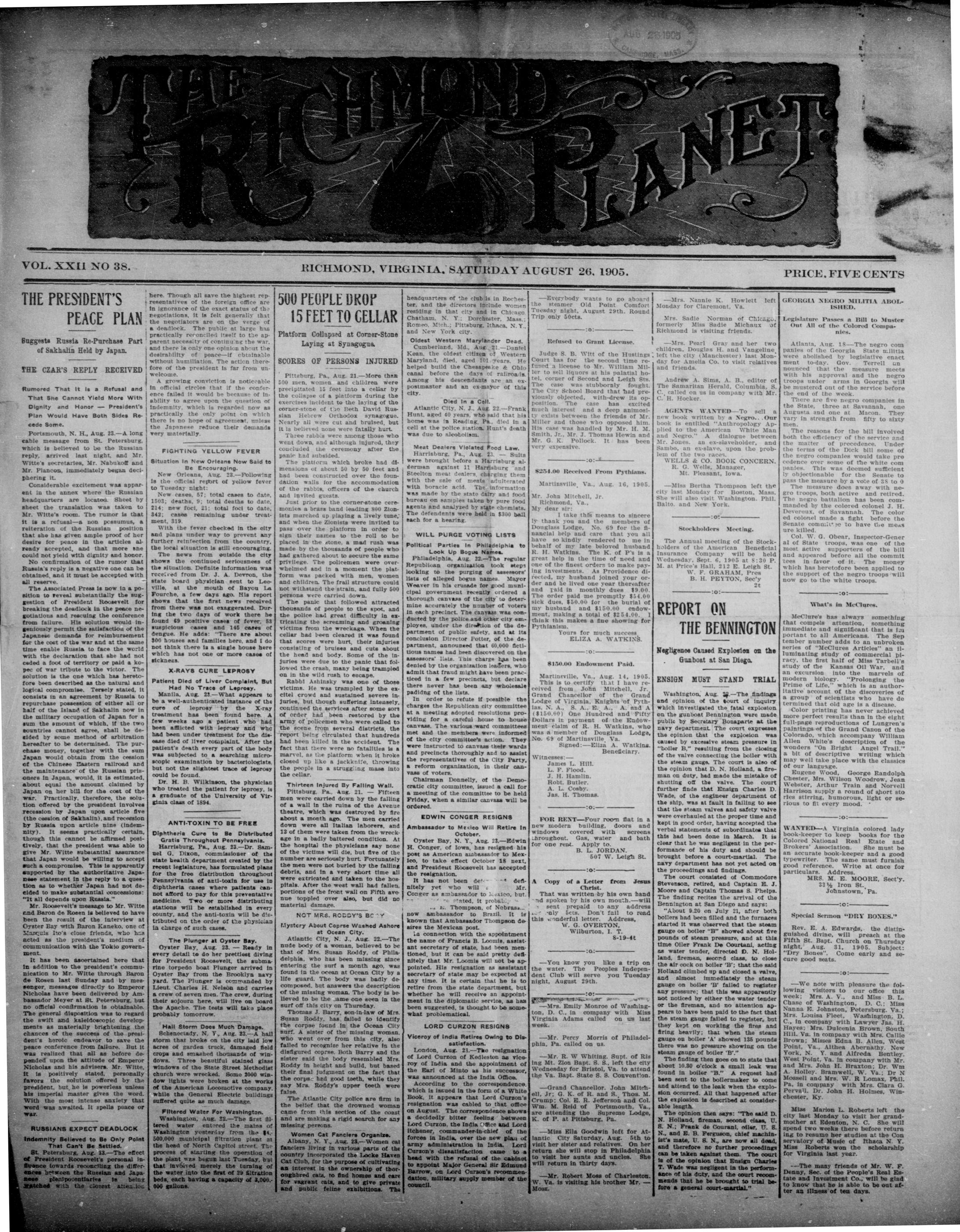
THE RICHMOND PLANET
VOL. XXII NO 38.
THE PRESIDENT'S PEACE PLAN
Suggesta Russia Re-Purchase Part of Sakhalin Held by Japan.
Rumored That It is a Refusal and That She Cannot Yield More With Dignity and Honor — President's Plan Would Have Both Sides Recede Some.
Portsmouth, N. H., Aug. 23.—A long cable message from St. Petersburg, which is believed to be the Russian reply, arrived last night, and Mr. Witte's secretaries, Mr. Nabukoff and Mr. Plancon, immediately began deciphering it.
Considerable excitement was apparent in the annex where the Russian headquarters are located. She by sheet the translation was taken to Mr. Witte's room. The rumor is that it is a refusal—a non possumus, a reiteration of the Russian position that she has given ample proof of her desire for peace in the articles already accepted, and that more she could not yield with dignity and honor. No confirmation of the rumor that Russia's reply is a negative one can be obtained, and it must be accepted with all reserve.
The Associated Press is now in a position to reveal substantially the suggestion of President Roosevelt for breaking the deadlock in the peace negotiations and rescuing the conference from failure. His solution would ingeniously permit the satisfaction of the Japanese demands for reimbursement for the cost of the war and at the same time enable Russia to face the world with the declaration that she had not ceded a foot of territory or paid a kopec of war tribute to the victor. The solution is the one which has heretofore been described as the natural and logical compromise. Tersely stated, it consists in an agreement by Russia to repurchase possession of either all or half of the island of Sakhalin now in the military occupation of Japan for a sum the amount of which, if the two countries cannot agree, shall be decided by some method of arbitration hereafter to be determined. The purchase money, together with the sum Japan would obtain from the cession of the Chinese Eastern railroad and the maintenance of the Russian prisoners in Japan, would it is estimated, about equal the amount claimed by Japan on her bill for the cost of the war. Practically, therefore, the solution offered by the president involves recession by Japan upon article five (the cession of Sakhalin), and recession by Russia upon article nine (indemnity). It seems practically certain, though this cannot be affirmed positively, that the president was able to give Mr. Witte substantial assurance that Japan would be willing to accept such a compromise. This is apparently supported by the authoritative Japanese statement in the reply to a question as to whether Japan had not decided to make substantial concessions: "It all depends upon Russia."
Mr. Roosevelt's message to Mr. Witte end Baron de Rosen is believed to have been the result of the interview at Oyster Bay with Baron Kaneko, one of Marquis Ito's close friends, who has acted as the president's medium of communication with the Tokio government.
It has been ascertained here that in addition to the president's communication to Mr. Witte through Baron de Rosen last Sunday and by messenger, messages directly to Emperor Nicholas have been delivered by Ambassador Meyer at St. Petersburg, but no official confirmation is obtainable. The general disposition was to regard the swift and kaleidoscopic developments as materially brightening the chances of the success of the president's heroic endeavor to save the peace conference from failure. But it was realized that all as before depended upon the attitude of Emperor Nicholas and his advisers. Mr. Witte, it is positively stated, personally favors the solution offered by the president, but he is powerless unless his imperial master gives the word. With the most intense anxiety that word was awaited, it spells peace or war.
RUSSIANS EXPECT DEADLOCK
Indemnity Believed to Be Only Point
That Can't Be Satisfied
That Can't Be Settled.
St. Petersburg, Aug. 23.—The effect of President Roosevelt's personal influence towards reconciling the differences between the Russian and Japanese plenipotentiaries is being matched with the closest attention
here. Though all save the highest representatives of the foreign office are in ignorance of the exact status of the negotiations, it is felt generally that the negotiators are on the verge of a deadlock. The public at large has practically reconciled itself to the apparent necessity of continuing the war, and there is only one opinion about the desirability of peace—if obtainable without humiliation. The action therefore of the president is far from unwelcome.
A growing conviction is noticeable in official circles that if the conference failed it would be because of inability to agree upon the question of indemnity, which is regarded now as practically the only point on which there is no hope of agreement, unless the Japanese reduce their demands very materially.
FIGHTING YELLOW FEVER
Situation In New Orleans New Said to Be Encouraging.
New Orleans, Aug. 23.—Following is the official report of yellow fever to Tuesday night:
New cases, 57; total cases to date, 1503; deaths, 9; total deaths to date, 214; new foci, 21; total foci to date, 342; cases remaining under treatment, 319.
With the fever checked in the city and plans under way to prevent any further reinfection from the country, the local situation is still encouraging.
The news from outside the city shows the continued seriousness of the situation. Definite information was received from Dr. J. A. Devron, the state board physician sent to Leeville, at the mouth of Bayou La Fourche, a few days ago. His report shows that the first news received from there was not exaggerated. During the two days of work there he found 69 positive cases of fever, 53 suspicious cases and 145 cases of dengue. He adds: "There are about 300 houses and families here, and I do not think there is a single house here which has not one or more cases of sickness.
X-RAYS CURE LEPROSY
Patient Died of Liver Complaint, But Had No Trace of Leprosy.
Manila, Aug. 22.—What appears to be a well-authenticated instance of the cure of leprosy by the X-ray treatment has been found here. A few weeks ago a patient who had been afflicted with leprosy and who had been under treatment for the disease died of liver complaint. After the patient's death every part of the body was subjected to a searching microscopic examination by bacteriologists, but not the slightest trace of leprosy could be found. Dr. H. B. Wilkinson, the physician who treated the patient for leprosy, is a graduate of the University of Virginia class of 1894.
ANTI-TOXIN TO BE FREE
Diphtheria Cure to Be Distributed
Cooktie Throughout Denmark
Grate Throughout Pennsylvania.
Harrisburg, Pa., Aug. 23—Dr. Samuel G. Dixon, commissioner of the state health department created by the recent legislature, has formulated plans for the free distribution throughout Pennsylvania of anti-toxin for use in diphtheria cases where patients cannot afford to pay for this preventative medicine. Two or more distributing stations will be established in every county, and the anti-toxin will be distributed on the order of the physician in charge of such cases.
The Plunger at Oyster Bay
Oyster Bay, Aug. 23. — Ready in every detail to do her prettiest diving for President Roosevelt, the submarine torpedo boat Plunger arrived in Oyster Bay from the Brooklyn navy yard. The Plunger is commanded by Lleut. Charles H. Nelson and carries a crew of seven men. The crew, during their sojourn here, will live on board the Apache. The tests will take place probably tomorrow.
Hall Storm Does Much Damage
Schenectady, N. Y., Aug. 23.—A hall storm that broke on the city laid low acres of garden truck, damaged field crops and smashed thousands of windows. Three beautiful stained glass windows of the State Street Methodist church were wrecked. Some 2000 window lights were broken at the works of the American Loocimetive company. while the General Electric buildings suffered quite as much damage.
Filtered Water For Washington
Washington, Aug. 22—The first filtered water entered the mains of Washington yesterday from the $4,500,000 municipal filtration plant at the head of North Capitol street. The process of starting the operation of the plant was begun last Tuesday, but that involved merely the turning of the water into the first of 29 filtration beds, each having a capacity of 3,000,000 gallons.
RICHMOND, VIRGINIA, SATURDAY AUGUST 26, 1905.
500 PEOPLE DROP 15 FEET TO CELLAR
Platform Collapsed at Corner-Stone Laying at Synagogua
SCORES OF PERSONS INJURED
Pittsburg, Pa., Aug. 21.—More than 500 men, women and children were precipitated 15 feet into a cellar by the collapse of a platform during the exercises incident to the laying of the corner-stone of the Beth David Russian Hebrew Orthodox synagogue. Nearly all were cut and bruised, but it is believed none were fatally hurt. Three rabbis were among those who went down, and although injured, they concluded the ceremony after the panic had subsided.
The platform which broke had dimensions of about 50 by 50 feet and had been constructed over the foundation walls for the accommodation of the rabbis, officers of the church and invited guests.
Just prior to the corner-stone ceremonies a brass hand leading 800 Zionists marched up playing a lively tune, and when the Zionists were invited to pass over the platform in order to sign their names to the roll to be placed in the stone, a mad rush was made by the thousands of people who had gathered about to secure the same privilege. The policemen were overwhelmed and in a moment the platform was packed with men, women and children. The frail structure could not withstand the strain, and fully 500 persons were carried down.
The panic that followed attracted thousands of people to the spot, and the police had great difficulty in extricating the screaming and grooming victims from the wreckage. When the cellar had been cleared it was found that scores were hurt, their injuries consisting of bruises and cuts about the head and body. Some of the injuries were due to the panic that followed the crash, many being trampled on in the wild rush to escape.
Rabbi Ashinsky was one of those victims. He was trampled by the excitel crowd and sustained severe injuries, but though suffering intensely, continued the services after some sort of order had been restored by the army of policemen who were called to the scene from several districts, the report being circulated that hundreds had been killed in the accident. The fact that there were no fatalities is a marvel, as the platform when it broke closed up like a jackknife, throwing the people in a struggling mass into the cellar.
Thirteen Injured By Falling Wall.
Pittsburg, Pa., Aug. 21. — Fifteen men were carried down by the falling of a wall in the ruins of the Avenue theatre, which was destroyed by fire about a month ago. The men carried down were all Italian laborers, and 13 of them were taken from the wreckage in a badly battered condition. At the hospital the physicians say none of the victims will die, but five of the number are seriously hurt. Fortunately the men were not buried by the falling debris, and in a very short time all were extricated and taken to the hospitals. After the west wall had fallen, portions of the front wall on Fifth avenue toppled over also, but did no material damage.
NOT MRS. BODRY'S BODY
Atlantic City, N. J., Aug. 22.—The nude body of a woman, believed to be that of Mrs. Susan Roddy, of Philadelphia, who has been missing since entering the surf a month ago, was found in the ocean at Ocean City by a life guard. The body was badly decomposed, but answers the description of the missing woman. The body is believed to be the same one seen in the surf off this city on Thursday.
Thomas J. Barry, son-in-law of Mrs. Susan Roddy, has failed to identify the corpse found in the Ocean City surf. A sister of the missing woman, who went over from this city, also failed to recognize her relative in the disfigured corpse. Both Barry and the sister said the body resembled Mrs. Roddy in height and build, but based their final judgment on the fact that the corpse had good teeth, while they say Mrs. Roddy's upper teeth were false.
The Atlantic City police are firm in the belief that the drowned woman came from this section of the coast and are making a rigid search for any missing persons.
Women Cat Fanciers Organize
Albany, N. Y., Aug. 23—Women cat fanciers living in various parts of the country incorporated the Locke Haven Cat Club, for the purpose of cultivating an interest in the ownership of thoroughbred cats, to find homes and care for vagrant cats, and to give private and public feline exhibitions. The
headquarters of the club is in Rochester, and the directors include women residing in that city and in Chicago. Chatham, N. Y.; Dorchester, Mass.; Romeo, Mich.; Pittsburg, Ithaca, N.Y. and New York city.
Oldest Western Maryland Dead. Cumberland, Md., Aug. 21.—Daniel Kean, the oldest citizen of Western Maryland, died, aged 101 years. He helped build the Chesapeake & Ohio canal before the days of railroads. Among his descendants are an ex postmaster and an ex-mayor of this city.
Died In a Cell.
Atlantic City, N. J., Aug. 22.—Frank Hunt, aged 40 years, who said that his home was in Reading, Pa., died in a cell at the police station. Hunt's death was due to alcoholism.
Meat Dealers Violated Food Law.
Harrisburg, Pa., Aug. 23.— Suils were brought before a Harrisburg alderman against 11 Harrisburg and Steelton meat dealers, charging them with the sale of meats adulterated with boracle acid. The information was made by the state dairy and food bureau on samples taken by pure food agents and analyzed by state chemists. The defendants were held in $300 ball each for a hearing.
WILL PURGE VOTING LISTS
Political Parties In Philadelphia to
Lark, Neo-Purus
Look Up Bog Names.
Philadelphia, Aug. 22.—The regular Republican organization took steps looking to the purging of assessors' lists of alleged bogus names. Mayor Weaver in his crusade for good municipal government recently ordered a thorough canvass of the city to determine accurately the number of voters in each precinct. The canvass was conducted by the police and other city employees, under the direction of the department of public safety, and at its conclusion Director Potter, of the department, announced that 60,000 fictitious names had been discovered on the assessors' lists. This charge has been denied by the organization leaders, who admit that fraud might have been practiced in a few precincts, but declare there never has been any wholesale padding of the lists.
In order to refute if possible the charges the Republican city committee at a meeting adopted resolutions providing for a careful house to house canvass. The various ward committees met and the members were informed of the city committee's action. They were instructed to canvass their wards and precincts thoroughly and to assist the representatives of the City Party, a reform organization, in their canvass of voters.
Chairman Donnelly, of the Democratic city committee, issued a call for a meeting of the committee to be held Friday, when a similar canvass will be ordered.
EDWIN CONGER RESIGNS
Ambassador to Mexico Will Retire In October.
Oyster Bay, N. Y., Aug. 23.—Edwin H. Conger, of Iowa, has resigned his post as American ambassador to Mexico, to take effect October 18 next, and President Roosevelt has accepted the resignation.
It has not been determined definitely yet who will Mr. Conger as ambassador to Mexico, but stated, it probably. H. Thompson, of Nebraska, now ambassador to Brazil. It is known that Ambassador Thompson desires the Mexican post.
In connection with the appointment the name of Francis B. Loomis, assistant secretary of state, had been mentioned, but it can be said pretty definitely that Mr. Loomis will not be appointed. His resignation as assistant secretary of state may be expected at any time. It is certain that he is to retire from the state department, but whether he will receive an appointment in the diplomatic service, as has been suggested, is thought to be somewhat problematical.
LORD CURZON RESIGNS
Viceroy of India Retires Owing to Dissatisfaction.
London, Aug. 21.—The resignation of Lord Curzon of Kedleston as viceroy of India and the appointment of the Earl of Minto as his successor, was announced at the India Office.
According to the correspondence, which is issued in the form of a White Book, it appears that Lord Curzon's resignation was cabled to that office on August. The correspondence shows a decidedly bitter feeling between Lord Curzon, the India Office and Lord itchener, commander-in-chief of the forces in India, over the new plan of army administration in India. Lord Curzon's dissatisfaction came to a head with the refusal of the cabinet to appoint Major General Sir Edmund Barrow, on Lord Curzon's recommendation, military supply member of the council.
—Everybody wants to go aboard the steamer Old Point Comfort Tuesday night, August 29th. Round Trip only 50cts.
Refused to Grant License
Judge S. B. Witt of the Hustings Court has for the second time refused a license to Mr. William Miller to sell liquors at his palatial hotel, corner of Second and Leigh Sts. The case was stubbornly fought. The City School Board that had previously objected, with-drew its opposition. The case has excited much interest and a deep animosity exists between the friends of Mr. Miller and those who opposed him. His case was handled by Mr. H. M. Smith, Jr., Mr. J. Thomas Hewin and Mr. G. K. Pollock. It has been very expensive.
$254.00 Received From Pythians.
Martinsville, Va., Aug. 16, 1905.
Mr. John Mitchell, Jr.
Richmond, Va.
My dear sir:
I take this means to sincere
ly thank you and the members of
Douglass Lodge, No. 69 for the finan-
cial help and care that you all
have so kindly rendered to me in
behalf of my late beloved husband
R. H. Watkins. The K. of P's is
a great help in the time of need and
one of the finest orders to make pay-
ings investments. As Providence direct-
ed, my husband joined your order
and he lived in year thereafter
and paid in monthly dues $9.00.
The order paid me promptly $54.00
sick dues, $50.00 for the burial of
my husband and $150.00 endow-
ment, making a total of $254.00.
I think this makes a fine showing for
Pythianism.
Yours for much success.
ELIZA A. WATKINS.
$150.00 Endowment Paid.
Martinsville, Va., Aug. 14, 1905.
This is to certify that I have received from John Mitchell, Jr.
Grand Chancellor of the Grand
Lodge of Virginia, Knights of Pythias, N. A., S. A., E. A., A. and A
($150.00) One Hundred and Fifty
Dollars in payment of the Endowment claim of R. H. Watkins, who
was a member of Douglass Lodge,
No. 69 of Martinsville, Va.
Signed:—Elliza A. Watkins.
Beneficiary.
Witnesses:—
James L. Hill.
L. F. Flood.
J. H. Hamlin.
Robt. Butler.
A. L. Cosby.
Jas. H. Thomas.
:0:
FOR RENT—Four room flat in a
new modern building, doors and
windows covered with screens
throughout. Gas, water and bath
for one rent. Apply to.
A Copy of a Letter from Jesus Christ.
That was written by his own hand and spoken by his own mouth.—will sent prepaid to any address only sets. Don't fail to read this wonderful letter. Address,
W. G. OVERTON,
Wilburton, I. T.
8-19-4t
:o:
—You know you like a trip on the water. The Peoples Independent Club will serve you Tuesday night, August 29th.
:o:
—Mrs. Emily Monroe of Washington, D. C., in company with Miss Virginia Adams called on us last week.
—Mr. Percy Morris of Philadelphia, Pa. called on us.
Mr. R. W Whiting. Supt. of Rising Mt. Zion Bapt. S. S., left the city Wednesday for Bristol, Va. to attend the Va. Bapt. State S. S. Convention.
—Grand Chancellor. John Mitchell, Jr; G. K. of R. and S. Thos. M. Crump; Col. E. R. Jefferson and Col. Wm. M. Reid of Portsmouth. Va., are attending the Supreme Lodge, K. of P. at Pittsburg, Pa.
—Miss Ella Goodwin left for Atlantic City Saturday, Aug. 5th to visit her sister and relatives. On her return she will stop in Philadelphia to visit her aunts and uncles. She will return in thirty days.
—Mr. Robert Moss of Charleston, W. Va. is visiting his brother Mr. — Moss.
—Mrs. Nannie K. Howlett left Monday for Claremont, Va.
Mrs. Sadie Norman of Chicago, formerly Miss Sadie Michaux of Richmond is visiting friends.
—Mrs. Pearl Gray and her two children, Douglas H. and Vangeline, left the city (Manchester) last Monday for Amelia Co. to visit relatives and friends.
Andrew A. Sims, A. B., editor of The Samaritan Herald, Columbia, S. C., called on us in company with Mr. C. H. Hocker.
AGENTS WANTED—To sell a new book written by a Negro... Our book is entitled "Anthropology Applied to the American White Man and Negro." A dialogue between Mr. Jones, an ex-slaveholder, and Sambo, an ex-slave, upon the problem of the two races.
WELLS & CO. BOOK CONCERN.
R. G. Wells, Manager,
Mt. Pleasant, Iowa.
—Miss Bertha Thompson left the
city last Monday for Boston, Mass.
She will also visit Washington. Phil.
Baltos, and New York.
Stockholders Meeting.
The Annual meeting of the Stock-
holders of the American Beneficial
Insurance Company will be held
Wednesday. Sept. 6, 1905 at 8:30 P.
M. at Price's Hall. 212 E. Leigh St.
REPORT ON THE BENNINGTON
Negligence Caused Explosion on the Gunboat at San Diego.
ENSIGN MUST STAND TRIAL
Washington, Aug. 24. The findings and opinion of the court of inquiry which investigated the fatal explosion on the gunboat Bennington were made public by Secretary Bonaparte at the navy department. The court expresses the opinion that the explosion was caused by excessive steam pressure in "boiler B." resulting from the closing of the valve connecting the boiler with the steam gauge. The court is also of the opinion that D. N. Holland, a fireman on duty, had made the mistake of shutting off the valve. The court further finds that Ensign Charles D. Wade, of the engineer department of the ship, was at fault in failing to see that the steam valves and safety valve were overheated at the proper time and kept in good order, having accepted the verbal statements of subordinates that this had been done in March. It is clear that he was negligent in the performance of his duty and should be brought before a court-martial. The navy department has not yet acted on the proceedings and findings.
The court consisted of Commodore Stevenson, retired, and Captain E. J. Moore and Captain Thomas S. Phelps. The finding recites the arrival of the Bennington at San Diego and says:
"About 9.20 on July 21, after both boilers were filled and the furnaces started it was observed that the steam gauge on boiler "B" showed about five pounds of steam pressure, and at this time Oller Frank De Courtani, acting as water tender, directed D. N. Holland, fireman, second class, to close the air cock on boiler 'B'; that the said Holland climbed up and closed a valve, and almost immediately the steam gauge on boiler 'B' failed to register any pressure; that this was apparently not noticed by either the water tender or the fireman, and no attention appears to have been paid to the fact that the steam gauge failed to register, but they kept on working the fires and firing heavily; that when the steam gauge on boiler 'A' showed 135 pounds there was no pressure showing on the steam gauge of boiler "B." The finding then goes on to state that about 10.30 o'clock a small leak was found in boiler "B." A request had been sent to the boilermaker to come and attend to the leak when the explosion occurred. All that happened after the explosion is described at considerable length.
The opinion then says: "The said D. N. Holland, fireman, second class, U. S. N.; Frank de Courani, officer, U. S. N., and E. B. Ferguson, chief machinist's mate, U. S. N., are now all dead, and therefore no further proceedings can be taken against them. The court is of the opinion that Ensign Charles T. Wade was negligent in the performance of his duty, and the court recommends that he be brought to trial before a general court-martial."
GEORGIA NEGRO MILITIA ABOLISHED.
Legislature Passes a Bill to Muster Out All of the Colored Companies.
Atlanta, Aug. 18—The negro companies of the Georgia State militia were abolished by legislative enactment to-day. Gov. Terrell unnounced that the measure meets with his approval and the negro troops under arms in Georgia will be mustered out of the service before the end of the week.
There are five negro companies in the State, three at Savannah, one Augusta and one at Macon. They vary in strength from fifty to sixty men.
The reasons for the bill involved both the efficiency of the service and the matter of precedence. Under the terms of the Dick bill some of the negro companies would take precedence over some of the white companies. This was deemed sufficient by objectionable for the Senate to pass the measure by a vote of 38 to 0.
The measure does away with negro troops, both active and retired. The negro battalion has been commanded by the colored colonel J. H. Devereux, of Savannah. The color colonel made a fight before the Senate committee to have the measure killed.
Col. W. G. Obear, Inspector-Gener al of State troops, was one of the most active supporters of the bill and appeared before all the committees in favor of it. The money which has heretofore been applied to the support of the negro troops will now go to the white troops.
What's in McClures.
McClure's has always something that compels attention, something immediate and significant that is important to all Americans. The September number adds to an unbroken series of "McClure's Articles" an illuminating study of commercial piracy, the first half of Miss Tarbell's study of the Kansas Oil War, and an excursion into the marvels of modern biology. "Prolonging the Prime of Life," which is an authoritative account of the discoveries of a group of scientists who have de termined that old age is a disease. Color printing has never achieved more perfect results than in the eight full-page reproductions of Lungreen's paintings of the Grand Canon of the Colorado, which accompany William Allen White's description of the wonders "On Bright Angel Trail." a bit of descriptive writing which may well take place with the classics of our language. Eugene Wood, George Randolph Chester, Mrs. Wilson Woodrow, Jean Webster, Arthur Train and Norvell Harrison supply a round of short stories stirring, humorous, light or serious to fit every mood.
WANTED—A Virginia colored lady book-keeper to keep books for the Colored National Real Estate and Brokers' Association. She must be an accurate book-keeper and a good typewriter. The same must furnish good reference. Write at once for particulars. Address. MRS. M. E. MOORE, Sect'y. $33 \frac{1}{2} $ Iron St. Johnstown, Pa.
Special Sermon "DRY BONES."
Rev. E. A. Edwards, the distinguished divine, will preach at the Fifth St. Bapt. Church on Thursday night, Aug. 31, 1905. Subject: "Dry Bones". Come early and secure good seats.
—We note with pleasure the following visitors to our office this week; Mrs. A. V., and Miss B. L. Chase of Washington, D. C.; Miss Nanna E. Johnston, Petersburg, Va.; Mrs. Louisa Fleet, Washington, D. C., in company with Lawyer Jas, H. Hayes; Mrs. Dulceenia Brown, South Hill, Va. in company with Mrs. Calle Brown; Misses Edna B. Allen, West Point, Va., Althea Abernathy, New York, N. Y. and Y. Alfreda Bentley, West Point, Va. in company with Mr. and Mrs. John H. Braxton; Dr. Wm A. Holley, Bramwell, W. Va.; Dr N. Mossell and Mrs. W. R Lomax, Phil. Pa. in company with Mrs. Clara G. Perva; Dr. John H. Holmes, Winchester, Ky.
Miss Marion L. Roberts left the city last Monday to visit her grandmother at Edenton, N. C. She will spend two weeks there before returning to resume her studies at the Conservatory of Music of Rhaca N. Y. Miss Roberts won the scholarship for Virginia last year.
—The many friends of Mr. W. F. Denny, Sec. of the People's Real Estate and Investment Co., will be glad to know that he is able to be out after an illness of ten days.
De RR eR IR one Le EE So aa oe - : ~
ian de tree oo ce i ed se eet
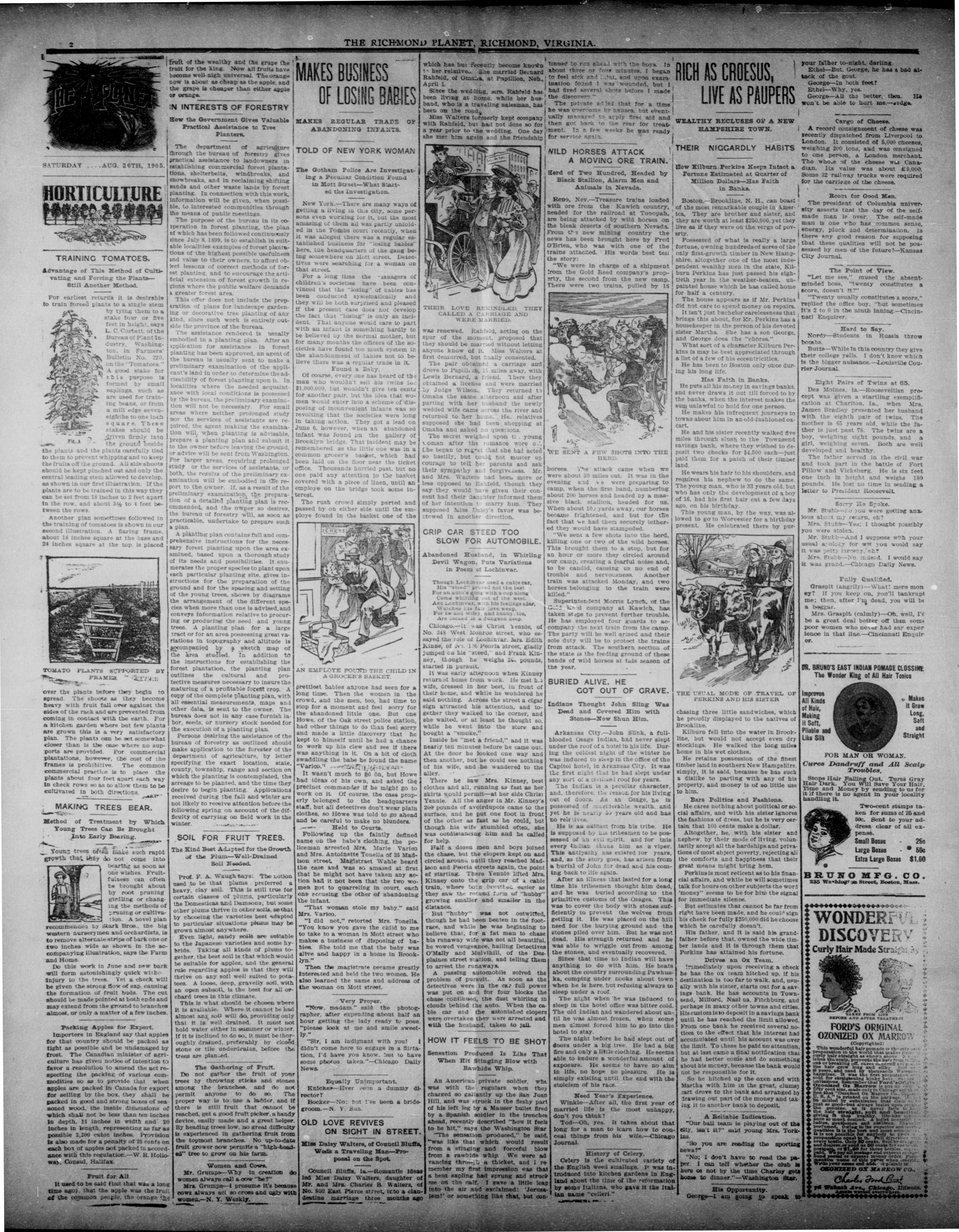
HORTICULTURE
For earliest returtis it is destrable
to train forced plants to a single stem
by tying them toe
: stake four of five
ay t, feet in height, says
LER ML. C. Corbett, of the
FAR We Bureau of PiantIn-
FRU custry, Washing-
. ton, in Farmers’
BAA reCA NAR, Bulletin No. 20,
PAS ERED NG on the “Tomatoes.”
Bee a SA good stake for
aH Se Yehis purpose ts
Meee. forme: by small
JE saplings, such as
SWteaco~ are used for train-
YRS inc beans, or from
Ag eer a mill edge seren-
eo ee eighths to one inch
sg Wei st auare These
ES stakes should be
ae" driven firmly inte
SS BS ie ee ee ee
EN.
eS Ea
ee — ne »
ae
y ¥ oh
AY ee
Mares
= —
oat 2
‘t ta caret 1
tween the rows
about 18 sq! att ’ axe and
‘ ea. Ik ee
ss ae ee RS
a a
A ees
Oe = Se
ee es
TOMATO PLANTS SUPFORTED BY
ae FRAMES. = Rrra:
‘over the plants before they begin to
spread. The shoots as they become
heavy with fruit fal] over against the
ides of the rack and are prevented from
coming in contact with the earth. For
a kitchen garden where but few planta
‘are grown this is a very satisfactory
plan. The plants can be set somewhat
closer than 1s the case where no sup-
Ports are provided. For commercial
Plantations, however, the cost of the
frames is prohibitive. The common
commercial practice is to pince the
plants about four feet apart each way
in check rows 90 us to allow them to be
ealtivated in both directions, 1.
; MAKING TREES BEAR.
— —_
‘Method of Treatment by Which
Young Trees Can Be Brought
* to Early Bearing.
2 ying ee
SOO
= Young trees offi iiaké such rapid
growth that thty do not come into
= bearing aa soon as
S one wishes, Fruit-
“| SPY fulness can often
Prt be brought about
Al \ah by root pruning
SEN) xirdling or chang.
ee] ins the methods of
a be pruning or eulttva-
heel! tion. A novel plan
[au Se on SOO
one wishes. Fruft-
34 fulness can often
7 be brought about
QUVEN t ty moO branine
Ae hr 4] wirdling or chang-
4 PE] ing the methods of
J = pruning or eultiva-
— tion. A novel plan
recommences by Sark Bros, the big
‘western urseryimen and orchardists, is
to remove alternate strips of bark one or
‘two inches wide as shown in the ac-
companying illustration, says the Farm
and Home.
Do this work in June and new bark
will form astonishingly quick withe
Anjury to the tree. Yet a check will
be given the strong flow of sap. causing
‘the formation of fruit buds. The cut
should be made pointed at both ends and
may extend from the ground to branches
almost, or only a matter of « few inches.
‘Packing Apples for Export.
Importers in Engiend say that applies
for that country should be packed as
tight as possible and be undamaged by
frost. The Canadian minister of agri-
culture has given notice of intention to
favor a resolution to amend the act re-
specting the packing of various com-
modities so as t0 provide that when
apples are packed in Canada for export
for selling by the box, they shall be
packed in good and strong boxes of sea.
soned wood, the inside dimensions of
‘which shall not be lese than ten inches
fn depth, 2 inches in width and. 20
inches in length, representing an far as
porsibie 2,200 cubie inches. Provision
4s also made for a penalty of 25 cents on
‘each box of apples not packed {n accord.
ance With this regulation.—W. R. Holio-
way, Consul, Halifax.
) Bruit for All.
‘It used to be said (but that was a long
cota har penn hehe
‘fruft of the wealthy and the grape the
fruit for the King. Now all fruits have
become well-sigh universal. The orang
now {s about as cheap as the spple, and
the grape is cheaper than either apple
oF orange.
IN INTERESTS OF FORESTRY
How the Government Gives Valuable
Practical Assistance to Tree
, Planters,
ject am $e iastownaa
Jpractical assistance to Ia mers in
commercial forest planta-
shelterbelts, windbreaks, and
and tn
}tands and other waste lands by forest
planting. In connection with this work,
jinformation will be given, when possi-
dle, to interested communities through
Mhe means of public meetings.
‘The purpose of the bureau in Its co
operation in forest planting, the plaa
of which has been followed continuously
tince July 8. 1899, is to establish in suit-
able localities examples of forest planta-
tions of the highest possible usefulness
and value to their owners, to afford ob-
feet lessons of correct methods of for-
est planting, and to encourage the art-
fclat extension of forest growth in re-
sions where the public welfare demands
@ greater forest area.
This offer does not include the prep-
aration of plans for landscape garden-
tug or decorative tree planting of any
kid, since such work {s entirely out-
side the province of the bureau.
The assistance rendered {s usually
embodied in a planting plan. After an
application for assistance in forest
planting has been approved. an agent of
the bureau Is usually sent to make a
preliminary examination of the appli-
cant’s land fn order to determine thead-
visability of forest planting upon ft. In
localities where the needed acquaint.
ance with local conditions is possessed
by the bureau. the preliminary examinc-
tion will not be necessary. For small
areas where neither projonged study
nor the services of assistants are re-
quired, the agent making the examina-
jtion will, when planting 1s advisable,
prepare a planting plan and submit it
to the owner before leaving the ground,
or advice will be sent from Washington,
For larger areas, requiring prolonged
study or the services of assistants, or
doth, the results of the preiiminary ex.
amination will be embodied In te re-
port to the owner. If, asa result of the
preliminary examination, the prepara-
Uon of a detailed planting plan is rec-
ommended, and the owper so desires,
the bureau of forestry will, as soon as
practicable, undertake to prepare such
® plan,
A planting plan contains full and com-
prehensive instructions for the neces-
Sary forest planting upon the area ex-
amined, based upon a thorough study
of Its needs and possibilities. It enu-
merates the proper species to plant upon
each particular planting site, gives in-
structions for the preparation of the
ground and for the spacing and setting
of the young trees, shows by diagrams
the arrangement of the different spe-
cies when more than one is advised, and
conveys information relative to procur-
Ing oF producing the seed and young
trees. A planting plan for a large
tract or for an area possessing great va-
tlations in topography and altitude is
egcompauied by g sketch map of
the irea studied. : Tn addition to
the instructions for establishing the
forest plantation, the planting plan
Outlines the cultural and — pro-
tective measures necessary to insure ths
maturing of a profitable forest crop. A
Copy of the complete planting plan, with
All essential measurements, maps and
other data, is sent to the owner. The
bureau does not in any case furnish 1a.
bor, seeds, or nursery stock needed for
the execution of a planting plan.
Persons desiring the assistance of the
bureau of forestry as outlived should
make application to the forester of the
department of agriculture, by letter
specifying the exact location, state
county, township, range and section on
which the planting {s contemplated, the
acreage to be planted, and the time they
desire to begin planting. Applications
received during the fall and winter are
not likely to receive attention before the
following spring on account of the dif-
ficulty of carrying on field work in the
winter. tn tenn
SOIL FOR FRUIT TREES.
The Kind Best Adapted for the Growth
of the Plum—Well-Drained
Soil Needed.
Prof. F. A. Waughtays: The rotton
‘used to be that plums preferred a
heavy, clay soil. This ts sul true for
certain classes of plums, particularly
the Domesticas and Damsons, but some
other plums thrive in other soils, se that
by choosing the varieties best adapted
to particular situations plums may be
grown almost anywhere.
Even light, sandy soils are suitable
to the Japanese varieties and some hy-
brids. Taking all kinds of plums to-
gether, the best soil ts that which would
be suitable for apples, and the general
rule regarding apples is that they will
thrive on any sol! well suited to pote
wes. A loose, deep, gravelly soil, with
an open subsoil, is the best for all or-
chard trees in this climate.
‘This is what should be chosen where
it ts available. Where it cannot de had
almost any, sol! will do, providing onl)
that it is well drained. It must no
hold water either in summer or winter
If ft ts inclined to 6o so, it must be thor
oughly drained, preferably by closé&
stone or tile underdrains, before th
trees are planied.
Gin Gathattae cf Brut.
Do not gather the fruit of your
trees by throwing sticks and stones
among the branches, and do not
permit anyone to do 9. The
proper way is to use a ladder, and if
there is still fruit that cannot be
reached, get « good fruft picker, a handy
device, easily made and a great heiper.
By heading trees low, no great difficulty
is experienced in gathering fralt from
‘the topmost branches. No up-to-date
frult grower now permite "high-bead-
40” tree to grow on his farm.
‘Women and Cows,
‘Mr, Grumps—Why in creation 40
‘women always call @.cow “he?”
‘Mrs. Grumpe—i presume it’s because
cows always ao( so cross and ugly with
a REGULAR TRADES OF
| ABANDONING INFANTS.
TOLD OF NEW YORK WOMAN
The Gotham Police Are Investigat-
ing a Pecuiiar Condition Found
| tm Mott Street—What Start-
46. the Savanieabon.
New York.—There are many ways of
‘Betting w living iu thus city, some per-
‘sons even working for it, but the most
‘Smazing of them ail was partly unfold-
ed in the Tombs court recently, when
it was alleged there was a regular es-
lablished business for “losing babies”
here, tae headquarters of the gang be
ing somewhere on Mott street Detec-
tives were searching for a woman op
that street
For a long time the -sanagers of
children’s societies have been con-
vineed that the “losing” of babies bas
been conducted systematically and
they wil! be Loth surprised and pleased
if the present case does not develop
‘the fact that “losing” is only ap inci-
dent. That anyone would care tw part
with an infant is something hardly to
be believed by the normal mother, but
for many months the officers of the so-
cleties have found too much system in
‘the abandonment of bables not to be-
lieve there was a regular trade in It
Found a Baty.
Of course, every one has heard of the
man who wouldn't sell bia iwins tuc
$1,600,000, but wouldn't give ten cents
for another pair. but the idea that wo-
men would enter Into a scheme of Wis-
posing of inconvenient infants was so
Tevolting that the societies were long
in taking action. They got a lead on
June 6, however, when an abandoned
infant was found on the gallery of
Brooklyn bridge. That Incident may be
Femembered. as the little ove was in &
common grocer's basket, which had
teen laid on the tloor near the ticket
office, Thousands hurried past, but no
one paid any attention to the basket
covered with a piece of linen, until an
employe on the bridge took ‘some in-
terest.
The rush crowd simply parted and
passed by on elther side until the em-
ploye found im the basket one of the
ey ees ‘%
Pras Ae’
1M @ NG Cp-
iS
BR fo pee
sie surtoee roc rae cm
prettieet babies anyone had seen for a
Jong time. Then the women in the
crowd, and the men, too, had time to
Stop for a moment and feel sorry for
the abandoned little one. But one
Howe, of the Oak street police station,
‘had other things to do than feel sorry
and made a little discovery that he
kept to himself until he had a chance
to work up bis clew and see if there
was anything in it. On a bit of cloth
swaddling the babe he found the name
Varloo ere 22 |p 4d nh M88 ~
It wasn't much to 20 On, but Howe
had ideas of his own, and asked the
Precinct commander if he might go to
work on it. Of course. the case prop-
erly belonged to the headquarters
staff, but all detectives don't wear plain
clothes, so Howe was told to go ahead
jand be careful to make no blunders.
“w= Held to Courts.
Foliowing up the faintly defined
bame on the babe's clothing, the po-
lceman arrested Mra. Marie Varloo
and Mrs. Antoinette Tonella of 25 Mad-
fson street Magistraet Wable heard
the case and was so amazed at first
that he might not have taken any ac
tion had it not been that the two wo
me& Kot to quarreling in court, eact
one rccusing the other of abandoning
‘the infant.
“That woman stole my baby,” sai
Mrs. Varico.
“I did not,” retorted Mrs. Tonella
“You know you gave the child to m
to take to a woman in Mott street whe
makes 0 business of disposing of ba
bies. She told me that the baby wa
aitve and happy in a home in Brook
yn”
‘Then the maztstrate pecame great!
Interesced and held the two women. Hi
also learned the name and addreas o
the woman on Mott street.
: ‘Very Proper.
| “Now, madam.” sala the photog-
rapher. after expending about half an
hour getting the lady ready ty pose.
“please look at me and smile sweet-
y.”
“Str, | am indignant with you! 1
@idn't come here to engage In a fiirta-
tion, I'd have you know, Sut to have
some photos takea."—Chicago Daily
News
Equally Unimportant,
Knicker—Ever vom a dummy db
rector?
Bocker—No; put 've been @ bride
eroom.—N. ¥, Sun.
OLD LOVE REVIVES
ON SIGHT IN STREET.
‘Miss Daisy Walters, of Council Bluffs,
‘Weds a Traveling Man—Pro-
Wa Posal on the Spot,
rectanen Bina, is—Romantle sess
‘Airs. Charles B. Waiters, of
4 rae
which has bur Feceatly become known
t> ber relative. She married Becnard
Rahteld, of Omaia, at Papilion, Neb,
April >
Since the wedding, ara, Rabteld has
been living at home. while ber bus-
dand, who is a traveling salesman, bas
been om the rondy
Miss Walters formerly kept company
with Rabfeld, but had not done so for
& year prior to the wedding. One day
she met him again and the friendship
TS
ay pe
PS aos _% Bi Be
EE a ©
) 9 Sq SAS,
Int faz + ys
Ges
(Miss i
RSS <i
=e me ‘I!
rap"),
aw Bish? fis
ee a
a }
THEIR LOVE RE<IN THEY
ALLE as
was renewed. Rah‘+ld, acting on the
Spur of the momext, proposed that
they should be mar-icd witaout letting
‘anyone know of it Miss Walters at
fGrst demurred, but ‘sally consented,
| The pair obtaines a carriage am
drove to PaptllB, i) miles away, with
Lewis Bernard, @ friend. ‘here they
obtained @ licemse and were married
by Judge Wilson, They returned to
Omaha the same a‘iernoon and after
parting with her husband the newly
wedded wife came across the river and
returned to her home. He. relatives
supposed she had been shopping at
Omaha and asked no questions.
‘The secret weighe upon ti. young
‘woman after the romance wore o-".
the began to regret ‘hat she had acted
so hastily, but could not muster up
courage to tell her parents and ask
thelr sympathy an‘ forgivesess. Mr.
and Mrs. Walters had bee. more or
less opposed to Kolifeld, though they
say they would have given their con-
sent had their dauchter Informed them
of her intentivm t marry him. They
Supposed Mise Daisy's favor was be-
‘stowed In another direction.
GRIP CAR STEED TOO
_ SLOW FOR AUTOMOBILE.
| =
‘Abandoned Hustond, in Whirling
| Devil Wagon, Puts Variations
; in Poem of Lochinvar,
SESUER BOSE A! 3808 & Came cae,
Come whiriig vt of the went
Ang acehinwar, wh tis feelings adar,
Watches Lis fair ove weep.
| Forbes wud wiley, and buvuy. too,
Are locaed it a dungeon deep.
Chicago.—it was Christ Lennie, of
No. 348 West Monroe street, who es-
sayed the role of Lochinvar. Murs. Edith
Kinne, of 4. 16 Peoria street, gladly
Jumped oa hig “steed,” and Frank Kin-
ney, though he weighs 2. pounds,
started im pursuit,
It was early afternoon when Kinney
returnad home from work. He met bs
wife, dressed in ber best, in front of
their home, and while he wondered he
said nothing. Across the street a cigar
sign attracted his attention, and to-
gether they walked to the corner, and
‘she waited, or at least be thought 80,
while be went into the store and
bought a “smoke.”
Inside be “met a friend,” and it was
nearly ten minutes before he came out.
At the door he looked one way and
then another, but he could see nothing
of his wife, and be wandered to the
alley. ——
There be Saw Mrs. Kinney, best
clothes and all, running ss fast as her
skirts would permit—at her side Chris
Yennie. All the anger ia Mr. Kinney's
20@ pounds of avoirdupois came to the
surface, and he put one foot in front
of the other as fast as be could, bu!
though his wife stumbled often, she
was outdistanciag him and he called
for help.
Balf a dozen men and boys joine:
the chase, but the elopers Kept on an
circled aroun until they reached Mad
Jeon and Peoria streets again, the poin'
of starting. There Yennie lifted Mrs
Kinney onto the grip car of a cabl
train, where totm bresthec easier a
they saw the rotemd torm of “hubby’
growing smaller and smaller in th
‘distance.
But “hebby” was Bot outwitted
though he had beem beaten in the foot
race, and while be was beginaing t
believe that, for @ fat man to chas
bis runaway wife was not all beautiful
he vowed vengeanee, hailing Detective
O'Maily and Mulvihill, of the Des
plaines street station, and telling then
to arrest the runaways
passing augpmobie sotved th
problem of pursuit. As soon ss
detectives were in the caz full powe
was put on and for four blocks th
chase continued, the dust whirling |
clouds behind the auto. When the c
‘dle car and the astonished eloper
‘Were overtaken they were arrested an
‘the hes! taken to jail
HOW IT FEELS TO BE SHOT
Sensation Produced Is Like That
When Hit Stinging Blow with
Rawhide Whip.
An American private soldier, whe
‘was with the regulars when they
charged so gallantly up the San Juan
‘Hill, and was «truck in the fleshy part
of his left leg by @ Mauser bullet fred
by a Spanish soldier in the trenches
ahead, recently described “how it feels
to be hit,” say tho Washington Star
“The sensation produced,” he sald
[was like that which would resul
from 4 stinging and forceful bow
from a rawhide whip. We were ad
Ronee Pompe ae Mere
my fh
ie ha 1 sprung rack otro
‘the onlt [¥ gave re Itt: toni
air ee ek eee
; oF fous imine “Desan
Ee cand Stat, and cant
found 1 was’ wor but |
Ahad fired several shots before 1 made
the discovery.” :
| The private atte? that for a time
he was Overcome by aguaea, but event-
‘ually managed to apply fire ald and
hen ot back to the rear for treab
ment. In 2 few weeks ready
for service again, -
WILD HORSES ATTACK
| A MOVING ORE TRAIN.
Herd of Two Hundred, Headed by
Black Stallion, Alarm Men and
Animals in Nevada.
"Reno, Nev.—Treasure trains loaded
with ore from the Kawich country,
Qeaded for the railroad at Tonopah,
are being attacked by wild horses on
the bleak deserts of southern Nevada
From ths new mining country the
uews has been brought here by Fred
O'Brien, who was with one of the
trains attacked. His words best ten
the story:
“We were in charge of a shipment
trom the Gold Reed company’s prop-
grty, the second from the new camp.
There were two trains, pulled by 15
a
| R ne iets x q
aig. mere
Mt = "4
igo AS oy ae
Rath Yo
3 af oe ¥
ey e : ae ms i
ea \ ae fen
horses. ‘The attack came when we
Were about 30 miles out. it was in the
evening aad ye were preparing to
camp, when the first band, numbering
about 200 horses and headed by a mas-
sive black stallion, headed for us.
When about 10, yards away, our horses
became frightened, and but for the
fact that we had them securely tether-
ed they would have siampeded,
“We sent a few shots into the herd,
Killing one of two of the wild horses.
This brought them to a stop, but for
an hour or more they circled around
our camp, creating a fearful noise and,
to be candid, causing vs no end of
trouble and nervousnesa Another
train was attacked Monday, and two
horses belonging to the train were
kilied.”
Superintendest Morris Lynch, ot the
Gold Kead company at Kawich, has
taken steps to prevent further trouble
He has employed four guards to ac
company the next train from the camp.
‘The party will be well armed and their
sole duty will be to protect the trains
trom attack. The southern section of
the state is the feeding ground of these
bands of wild horses at tuls season of
the year. <
BURIED ALIVE, HE
GOT OUT OF GRAVE.
Indians Thought John Sling Was
Dead and Covered Him with
‘Stones—Now Shun Him.
Arkansas City—Jobn Stink, a full-
Dlooded Osage Indian, had never slept
under the roof of a hotel in his life. Dur
ing the coldest night of the winter he
was induced to sleep in the office of the
Capitol hotel, in Arkausas City. It waa
the first night thet he bad slept under
any sort of a civilized roof for years,
The Indian is a peculiar character,
and, therefore, the reason for his living
out of doors. As an Osage, he is
possested of scueiierable wealth, and
yet he is nearly 3» years old and has
0 reir sives,
He {¢ ap outeast from bis tribe, He
fe supposed by lus tribesmen to be pos
sessed of un evil spirit, and for this
every Uadian skuns bim as a viper.
‘This antipathy bas existed tor years,
and, as the story goes, bas arisen from
burial of John for dead and his com-
tng back to life again.
After an illness that Iasted for a long
time his tribesmen thought him dead,
apd he was buried according to the
prinitive customs of the Osages. This
was to cover the body with stones suf.
ficiently to prevent the wolves from
getting it. He was placed on the bil
nsed for the burying ground and the
Stones piled over him, But he was not
dead. His strength returned and he
‘was able to wriggle out from among
the stones, and eventually recovered.
‘Since that time no Indian will have
anything to do with him He beats
about the country surrounding Pawhus
ka, comping under nooks about tows
when he {s here, ut refusing always t
sleep under a roof.
‘The night when “he was induced t
sleep in the hotel office waa bitter cold
‘The old Indian had wandered about un
til he was almost frozen, when som:
men almost forced him to go into th
hotel to stay. E
‘The night before he had slept out o
doors under a big tree. He had a bi
fire and only alittieclothing. He seem
able to endure » wonderful amount a
‘exposure. He seems to have no ain
4p Ife, no hope so pleasure. He
simply existing until the end with thi
| stoicism of his race.
Need Year's Experience,
Winkle—aAfter all, the first year of
married life ts the most unhappy,
don’t you think?
‘Tod—Oh, yes. It takes about that
Jong for a man to Iara how to con-
coal things from his wite.—Chicago
Journal.
Hinwory of Celery.
Celery Ig the cultivated variety of
the English weed smallage. 1 was tn-
troduced into kitchen gardens in Eng-
land about the time of the reformation
Dy wome [tallzns, who gave it the Ital-
AICH AS arn |
WEALTHY RECLUSES O¥ A NEW
HAMPSHIRE TOWN.
THEIR NIGGARDLY HABITS
Sow Kilburn Perkins Keeps Intact a
Fortune Estimated at Quarter of
Million Dollars—Has Faith
in Banks
} Boston, -Baookiine, :20, Hi. ifs phan
‘of the most remarkable couple in Amer-
‘fea, ‘They are brother and sister, and
they are worth at least $250,000, yet they
live as if they were on the verge of pov-
erty. 3
}, Possessed of what fs really a large
fortune, owning hundreds of acres of the
only first-growth timber in New Hamp-
‘shire, altogether one of the most inde
pendent wealthy men in the state, Kil-
burn Perking has just passed his elgh-
eth ‘year in the weather-beaten, ua-
painted house which be has called home
for half a century.
‘The house appears ae if Mr. Perkins
did not care to spend money on repairs.
_ It isn't just bachelor carelessness that
brings this about, for Mr. Perkins has a
housekeeper in the person of bis devoted
sister Martha. She has a son George,
and George does the “chores.”
‘What sort of a character Kilburn Per-
kins is may be best appreciated through
8 list of a few of his eccentricities.
He has been to Boston only once dur
ing his long life.
Has Faith in Banks.
He puts all his money in savings banks,
and never draws it out till forced to by
the banks, when the interest makes the
sum ublawful to hold for one person.
He makes his infrequent journeys to
towns about him in an old-fashioned ox-
cart,
He and his sister recently walked five
miles through slush to the Townsend
savings bank, where they wished to de-
posit two checks for $4,500 each—just
paid them for a patch of their timber
land.
He wears his hair to his shoulders, and
requires his nephew to do the same.
‘The young man, who is 33 years old. but
who has only the development of a boy
of 16, had his first balr cut a few days
ago, on his birthday.
This young man, by the way, was al-
lowed to go to Worcester for a birthday
Present. He celebrated there by pur-
Sh
s
Wen OD
NE so apy = Ss Lf a
hae Sh .
a |
S ae
Ese << aH. ef |
LSEN EN a Wk
us/ Fess) A
Nox Bh
— ei by nN
ay eres ay) \
ae WR RE
== ‘ A Vee A
Ee iv ¢
THE USUAL MODE OF TRAVEL OF
PERKINS AND 118 SISTER
chasing three little sandwiches, which
he proudly displayed to the uatives of
Brookline.
Kilbure fell tnto the water in Brook-
Wine, ut would not accept even dry
‘stockings. He walked the long miles
‘Rome in bis wet clothes.
He retains possession of the finest
Umber land in southern New Hampstire.
simply, it is sald. because he has such
a dislike to parting with any of his
property, aud money ts of so little use
to him.
Bars Politics and Fashions.
He cares nothing about political or so-
clal affairs, and with bis sister ignores
the fashions of dress, but he ts very cer-
tain that 100 cents make a dollar,
Altogether, he, with his sister and
nephew. by their mode of living. volun-
tarily accept all the hardships and priva-
tions of most abject poverty, rejecting ali
the comforts and happiness that their
great means might bring hem.
Perkins is most reticent as to his finan-
cial affairs. and while he will sometimes
talk for hours on other subjects the word
‘money" seems to be for him the signal
for immediate silence,
But estimates that cannot be far from
right have been made, and he coul” sign
his check for fully $250,000 did he choose
which he carefully doesn't.
‘His father, and it is said his grand-
father before that. owned the wide tim-
ber lands and it {s through them that
Perkins has attained his fortune.
Deives an Ox Team.
teomediately upon receiving a check
he has the ox team hitched up, {f his
destination ts too far to walk, and, usu-
| ally with bls sister, starts out for a sav-
| ings bank. He has accounts in Town-
send, Milford, Nas} us, Fitchburg, and
perhape in mauy other towns and cities.
Hiscustom isto deposit in a savings bank
until be has reached the limit allowed,
From one bank he received several no-
tees to the effect thet his interest had
accumulated until his account was over
the limit. To hese he pafd no attention,
but at last came a final notification that
he had better comie and do something
about his mcney, because the bank would
not be responsthle for it,
So he hitched up the oxen and with
Martha with him in the great, clumsy
cart drove to the bank and arranged by
drawing out part of the money and tak-
ing it to another bank to deposit,
. A Reliable Indication.
“Our ball team is playing out of the
a jau’t Mt?" said young Mra. Tork-
“So you are reading the sporting
news?"
“No; 1 don't have to read the pe
jer. 1 ean tell whether the club is
here o1 not by the time Charley goti
ine, So nese eee
ia ena ene ean
your father to-night, darling
Se bet Conk eee aa
ofthe gout
~~ George—It resi > leases
won't be able to bart mes! f
; --—
Cargo of Cheese,
A record consignment of cheese was
Fecently dispatched from Liverpool to
London. It consisted of 5,000 cheeses,
weighing 200 tons, and was consixned
to one perton, a London merchant
The who.e of the cheese wus Cana-
dian. Its value was about £9,000.
Some 32 railway trucks were required
for the carriage of the cheese.
E> Senha eae
Room for Good Men.
‘The president of Columbia univer.
sity asserts taat the day of the seif-
made man ir over, The self-made
man ts one who has common sense,
energy, pluck and determinadon. Is
‘there any good reason for supposing
that these qualities will not be pos-
sessed by mev of the future’~Kansas
City Journal.
The Point of View.
“Let me see,” mused the absent-
minded boss, “twenty constitutes a
score, doesn’t Ht?"
“Twenty usually constitutes a score.”
replied the office boy, “but sometimes
{t's 2 to 6 in the ninth tnning—Cincin-
nati Enquirer.
Hard to Say.
Nordy—Students in Russia throw
bombs.
Butts—While tn this country they give
their college yells. I don’t know which
fs the bleger nulsance.—Louisville Cou-
rier Journal,
Eight Pairs of Twins at 65.
Des Moines, Ia—Rooseveltian pro
cept was given a startling exemplifi-
cation at Chariton, Ia, when Mrs,
James Bradley presented her husband
with the eighth pair of twin. The
mother is 65 years old, while the fa-
ther Is just past 78. The twins are =
boy, welghing eight pounds, and
girl, weighing seven. Both are well
developed and healthy.
‘The father served in the ctril war
‘and took part In the battle of Fort
Pillow and Vicksburg. He Is six feet
fone inch in height and weighs 180
pounds. He lost no time fn sending @
letter to President Roosevelt,
Sorry He Spake,
Mr. Stubb—ro you were getting anz
fous abost my return, eh?
Mra. Stubb—Yea; I thought possfbly
you were stolea.
Mr. Stutb—And 1 suppose with your
usual apolocy for wit you would say
it was petty larceny,’ eh?
Mrs, Stubb—No indecd. I would say
i was grand.—Chicago Daily News.
Faliy Cunlifed.
Graspit (angrily)--What! more mon
ey? if you keep on, you'll bankrupt
me; then, after I'ty dead, you will be
a beggar.
Mrs. Graspit (calmly)—Oh, well, I'¢
be @ great deal better off than some
Poor women who never had any exper
Jenoe in that line.—Cincianati Enquir
aa
OR. BRUNO'S EAST INDIAN POMADE CLOSSINE
| ‘The Wonder King of All Hair Tonics
Improves
All Kinds —
ot Hak, srs
Making 4
it Soft, =
Pliable and
Lite Sik hegre
FOR MAN OR WOMAN.
Cures Dandruff and AU Scalp
Troubles,
Hair Dark. You Wil Suve Your Sint,
Wit there 1n'b0 eect ta pode looaliey
handling it - .
‘Two-cent stamps ta-
g ken for sums of 25 and
<A Se. Bent to your ad-
5 @resa) clear of all ex-
pense.
BP Small Bowe = -2o
SEF Large Boss = - © 500
; Extra Large Boxes $1.00
Ke oe
BRUNO MFG.CO.
235 Wenhing’ gn Strect, Boston, Maes,
eee
WONDER?
DISCOVERY
Curly Hair Made Straiss: 5 :
FORD'S ORIGINAL |
eee
geecrheating fa coeenteaere cs
eat
— that Ford’sirist>. *
ear gent mye Cuong oss 3
peeeree
Sacer aah
cox ae Pisegt nee
ase st
fla anklet |
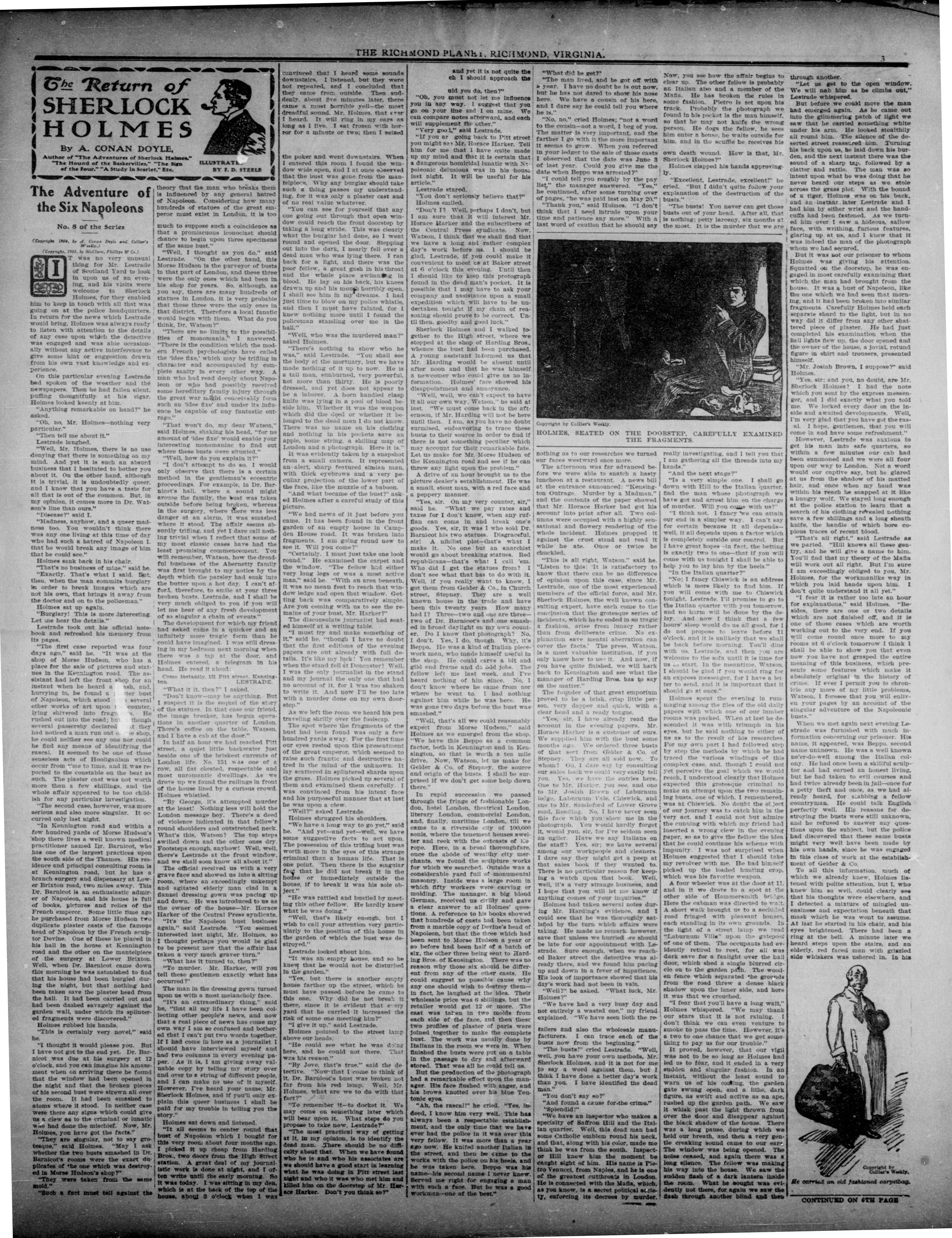
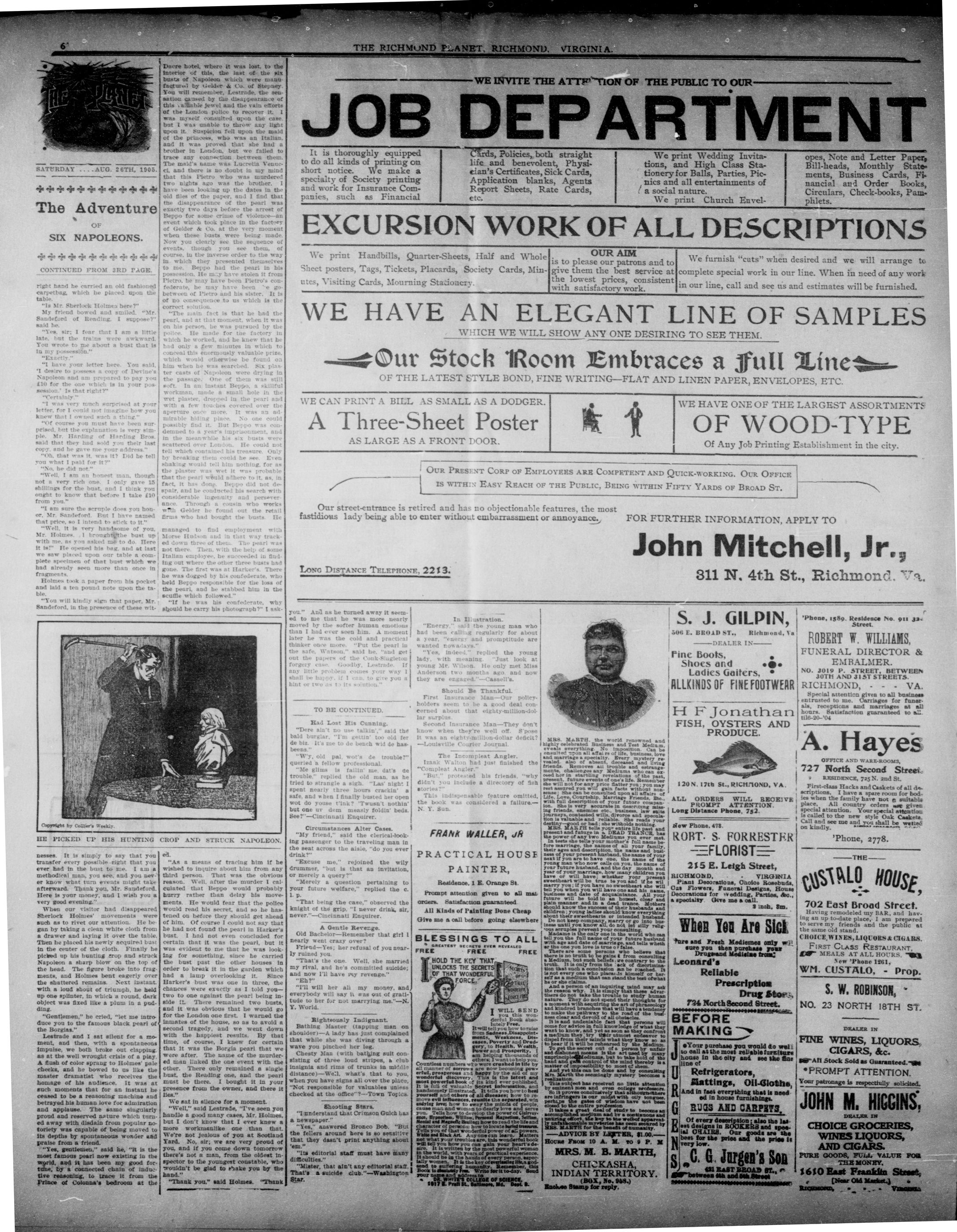
The Return of SHERLOCK HOLMES
theory that the man who breaks them is influenced by any general hatred of Napoleon. Considering how many hundreds of statues of the great emperor must exist in London, it is too much to suppose such a coincidence as that a promiscuous iconoclast should chance to begin upon three specimens of the same bust."
"Well, I thought as you do," said Lestrade. "On the other hand, this Morse Hudson is the purveyor of busts in that part of London, and these three were the only ones which had been in his shop for years. So, although, as you say, there are many hundreds of statues in London, it is very probable that these three were the only ones in that district. Therefore a local fanatic would begin with them. What do you think, Dr. Watson?"
"There are no limits to the possibilities of monomania," I answered. "There is the condition which the modern French psychologists have called the 'idee fixe', which may be trifling in character and accompanied by complete sanity in every other way. A man who had read deeply about Napoleon or who had possibly received some hereditary family injury through the great war might conceivably form such an 'idee fixe' and under its influence be capable of any fantastic outrage."
"That won't do, my dear Watson," said Holmes, shaking his head, "for no amount of 'idee fixe' would enable your interesting monomaniac to find out where these busts were situated."
"I don't attempt to do so. I would only observe that there is a certain method in the gentleman's eccentric proceedings. For example, in Dr. Barnicot's hall, where a sound might arouse the family, the bust was taken outside before being broken, whereas in the surgery, where there was less danger of an alarm, it was smashed where it stood. The affair seems absurdly trifling, and yet I dare call nothing trivial when I reflect that some of my most classic cases have had the least promising commencement. You will remember, Watson, how the dreadful business of the Abernetty family was first brought to my notice by the depth which the parsley had sunk into the butter upon a hot day. I can't afford, therefore, to smile at your three broken busts. Lestrade, and I shall be very much obliged to you if you will let me hear of any fresh development of so singular a chain of events."
The development for which my friend had asked came in a quicker and an infinitely more tragic form than he could have imagined. I was still dressing in my bedroom next morning when there was a tap at the door, and Holmes entered, a telegram in his hand. He read it aloud:
Come instantly, 131 Pitt street. Kensington.
LESTRADE.
"What it it, then?" I asked.
"Don't know—may be anything. But I suspect it is the sequel of the story of the statues. In that case our friend, the image breaker, has begun operations in another quarter of London. There's coffee on the table. Watson, and I have a cab at the door."
In half an hour we had reached Pitt street, a quiet little backwater just beside one of the briskest currents of London life. No. 131 was one of a row, all hat chested, respectable and most romantic dwellings. As we drove up we found the railings in front of the house lined by a curious crowd. Holmes whistled.
"By George, it's attempted murder at the least! Nothing less will hold the London message boy. There's a deed of violence indicated in that fellow's round shoulders and outstretched neck. What's this, Watson? The top steps swilled down and the other ones dry. Footsteps enough, anyhow! Well, well, there's Lestrade at the front window, and we shall soon know all about it."
The official received us with a very grave face and showed us into a sitting room, where an exceedingly unkempt and agitated elderly man clad in a flannel dressing gown was pacing up and down. He was introduced to us as the owner of the house—Mr. Horace Harker of the Central Press syndicate. "It's the Napoleon bust business again," said Lestrade. "You seemed interested last night, Mr. Holmes, so I thought perhaps you would be glad to be present now that the affair has taken a very much graver turn." "What has it turned to, then?" "To murder. Mr. Harker, will you tell these gentlemen exactly what has occurred?" "The man in the dressing gown turned upon us with a most melancholy face.
"It's an extraordinary thing," said he, "that all my life I have been collecting other people's news, and now that a real piece of news has come my own way I am so confused and bothered that I can't put two words together. If I had come in here as a journalist I should have interviewed myself and had two columns in every evening paper. As it is, I am giving away valuable copy by telling my story over and over to a string of different people, and I can make no use of it myself. However, I've heard your name, Mr. Sherlock Holmes, and if you'll only explain this queer business I shall be paid for my trouble in telling you the story."
"It all seems to center round that bust of Napoleon which I bought for this very room about four months ago. I picked it up cheap from Hardling Bros, two doors from the High Street station. A great deal of my journalistic work is done at night, and I often write until the early morning. So it was today. I was sitting in my den, which is at the back of the top of the house, about 3 o'clock when I was
The Adventure of the Six Napoleons
No. 8 of the Series
(Copyright 1904, by A. Cowan Doyle and Collier's Weekly)
(Copyright, 1905, by McClure, Phillips & Co.)
T was no very unusual thing for Mr. Lestrade of Scotland Yard to look in upon us of an evening, and his visits were welcome to Sherlock Holmes, for they enabled
It was no very unusual thing for Mr. Lestrade of Scotland Yard to look in upon us of an evening, and his visits were welcome to Sherlock Holmes, for they enabled him to keep in touch with all that was going on at the police headquarters. In return for the news which Lestrade would bring, Holmes was always ready to listen with attention to the details of any case upon which the detective was engaged and was able occasionally without any active interference to give some hint or suggestion drawn from his own vast knowledge and experience. On this particular evening Lestrade had spoken of the weather and the newspapers. Then he had fallen silent, puffing thoughtfully at his cigar. Holmes looked keenly at him. "Anything remarkable on hand?" he asked.
"Oh, no, Mr. Holmes—nothing very particular."
"Then tell me about it."
Lestrade laughed.
"Well, Mr. Holmes, there is no use denying that there is something on my mind. And yet it is such an absurd business that I hesitated to bother you about it. On the other hand, although it is trivial, it is undoubtedly queer, and I know that you have a taste for all that is out of the common. But, in my opinion, it comes more in Dr. Watson's line than ours."
"Disease?" said I.
"Madness, anyhow, and a queer madness too. You wouldn't think there was any one living at this time of day who had such a hatred of Napoleon I, that he would break any image of him that he could see."
Holmes sank back in his chair.
"That's no business of mine," said he. "Exactly. That's what I said. But, then, when the man commits burglary in order to break images which are not his own, that brings it away from the doctor and on to the policeman." Holmes sat up again. "Burglar! This is more interesting. Let me hear the details." Lestrade took out his official notebook and refreshed his memory from its pages.
"The first case reported was four days ago," said he. "It was at the shop of Morse Hudson, who has a place for the sale of pictures and statues in the Kennington road. The assistant had left the front shop for an instant when he heard a ash, and, hurrying in, he found a plaster bust of Napoleon, which stood in several other works of art upon the counter, lying shivered into fragments. He rushed out into the road; but, though several passersby declared that they had noticed a man run out of the shop, he could neither see any one nor could he find any means of identifying the rascal. It seemed to be one of those senseless acts of Hooliganism which occur from time to time, and it was reported to the constable on the beat as such. The plaster cast was not worth more than a few shillings, and the whole affair appeared to be too childish for any particular investigation.
The second case, however, was more serious and also more singular. It occu-
"In Kennington road and within a few hundred yards of Morse Hudson's shop there lives a well known medical practitioner named Dr. Barnicot, who has one of the largest practices upon the south side of the Thames. His residence and principal consulting room is at Kennington road, but he has a branch surgery and dispensary at Lower Brrixton road, two miles away. This Dr. Barnicot is an enthusiastic admirer of Napoleon, and his house is full of books, pictures and relics of the French emperor. Some little time ago he purchased from Morse Hudson two duplicate plaster casts of the famous head of Napoleon by the French sculptor Devine. One of these he placed in his hall in the house at Kennington road and the other on the mantelpiece of the surgery at Lower Brrixton. Well, when Dr. Barnicot came down this morning he was astonished to find that his house had been burgled during the night, but that nothing had been taken save the plaster head from the hall. It had been carried out and had been dashed savagely against the garden wall, under which its splintered fragments were discovered."
"This is certainly very novel," said he.
"I thought it would please you. But I have not got to the end yet. Dr. Barnicot was due at his surgery at 12 o'clock, and you can imagine his amazement when on arriving there he found that the window had been opened in the night and that the broken pieces of his second bust were strewn all over the room. It had been smashed to atoms where it stood. In neither case were there any signs which could give us a clew as to the criminal or inanimate who had done the mischief. Now, Mr. Holmes, you have got the facts."
"They are singular, not to say grotesque," said Holmes. "May I ask whether the two busts smashed in Dr. Barnicot's rooms were the exact duplicates of the one which was destroyed in Morse Hudson's shop?"
"They were taken from the same mold."
. "Such a fact must tell against the
ILLUSTRATED
BY F. D. STEELE
THE RICHMOND PLANE1. RICHMOND. VIRGINIA.
convinced that I heard some sounds downstairs. I listened, but they were not repeated, and I concluded that they came from outside. Then suddenly, about five minutes later, there came a most horrible yell—the most dreadful sound. Mr. Holmes, that ever I heard. It will ring in my ears as long as I live. I sat frozen with horror for a minute or two; then I seized
the poker and went downstairs. When
I entered this room I found the window
wide open, and I at once observed
that the bust was gone from the mantlepiece. Why any burglar should take such a thing passes my understanding, for it was only a plaster cast and of no real value whatever.
"You can see for yourself that any one going out through that open window could reach the front doorstep by taking a long stride. This was clearly what the burglar had done, so I went round and opened the door. Stepping out into the dark, I nearly fell over a dead man who was lying there. I ran back for a light, and there was the poor fellow, a great gash in his throat and the whole place swimming in blood. He lay on his back, his knees drawn up and his mouth horribly open. I shall see him in my dreams. I had just time to blow on my police whistle, and then I must have fainted, for I knew nothing more until I found the policeman standing over me in the hall."
"Well, who was the murdered man?" asked Holmes.
"There's nothing to show who he was," said Lestrade. "You shall see the body at the mortuary, but we have made nothing of it up to now. He is a tall man, sunburned, very powerful, not more than thirty. He is poorly dressed, and yet does not appear to be a laborer. A horn handled clasp knife was lying in a pool of blood beside him. Whether it was the weapon which did the deed or whether it belonged to the dead man I do not know. There was no name on his clothing and nothing in his pockets save an apple, some string, a shilling map of London and a photograph. Here it is." It was evidently taken by a snapshot from a small camera. It represented an alert, sharp featured simian man, with thick eyebrows and a very peculiar projection of the lower part of the face, like the muzzle of a baboon. "And what became of the bust?" asked Holmes after a careful study of this picture.
"We had news of it just before you came. It has been found in the front garden of an empty house in Campden House road. It was broken into fragments. I am going round now to see it. Will you come?" "Certainly. I must just take one look round." He examined the carpet and the window. "The fellow had either very long legs or was a most active man," said he. "With an area beneath, it was no mean feet to reach that window ledge and open that window. Getting back was comparatively simple. Are you coming with us to see the remains of your bust, Mr. Harker?"
The disconsolate journalist had seat ed himself at a writing table.
"I must try and make something of it," said he. "though I have no doubt that the first editions of the evening papers are out already with full details. It's like my luck! You remember when the stand fell at Doncaster? Well, I was the only journalist in the stand and my journal the only one that had no account of it, for I was too shaken to write it. And now I'll be too late with a murder done on my own doorstep."
As we left the room we heard his pen traveling shrilly over the foolscap.
The spot where the fragments of the bust had been found was only a few hundred yards away. For the first time our eyes rested upon this presentment of the great emperor, which seemed to raise such frantic and destructive hatred in the mind of the unknown. It lay scattered in splintered shards upon the grass. Holmes picked up several of them and examined them carefully. I was convinced from his intent face and his purposeful manner that at last he was upon a clew. "Well?" asked Lestrade. Holmes shrugged his shoulders. "We have a long way to go yet," said he. "And yet—and yet—well, we have some suggestive facts to act upon. The possession of this trifling bust was worth more in the eyes of this strange criminal than a human life. That is one point. Then there is the singular fact that he did not break it in the house or immediately outside the house, if to break it was his sole object."
"He was rattled and bustled by meeting this other fellow. He hardly knew what he was doing."
"Well, that's likely enough, but I wish to call your attention very particularly to the position of this house in the garden of which the bust was destroyed."
Lestrade looked about him.
"It was an empty house, and so he knew that he would not be disturbed in the garden."
"Yes, but there is another empty house farther up the street, which he must have passed before he came to this one. Why did he not break it there, since it is evident that every yard that he carried it increased the risk of some one meeting him?"
"I give it up," said Lestrade.
Holmes pointed to the street lamp above our heads.
"He could see what he was doing here, and he could not there. That was his reason."
"By Jove, that's true," said the detective. "Now that I come to think of it. Dr. Barnicot's bust was broken not far from his red lamp. Well, Mr. Holmes, what are we to do with that fact?"
"To remember it—to docket it. We may come on something later which will bear upon it. What steps do you propose to take now, Lestrade?"
"The most practical way of getting at it, in my opinion, is to identify the dead man. There should be no difficulty about that. When we have found who he is and who his associates are we should have a good start in learning what he was doing in Pitt street last night and who it was who met him and killed him on the doorstep of Mr. Harce Harker. Don't you think so?"
and yet it is not quite the ch I should approach the
nld you do, then?"
"Oh, you must not let me influence you in any way. I suggest that you go on your line and I on mine. We can compare notes afterward, and each will supplement the other."
"Very good," said Lestrade.
"If you ar going back to Pitt street you might see Mr. Horace Harker. Tell him for me that I have quite made up my mind and that it is certain that a dangerous homicidal lunatic with Napoleonic delusions was in his house last night. It will be useful for his article."
Lestrade stared.
"You don't seriously believe that?" Holmes smiled.
"Don't I? Well, perhaps I don't, but I am sure that it will interest Mr. Horace Harker and the subscribers of the Central Press syndicate. Now, Watson, I think that we shall find that we have a long and rather complex day's work before us. I should be glad, Lestraide, if you could make it convenient to meet us at Baker street at 6 o'clock this evening. Until then I should like to keep this protograph found in the dead man's pocket. It is possible that I may have to ask your company and assistance upon a small expedition which will have to be undertaken tonight if my chain of reasoning should prove to be correct. Until then, goodbye and good luck."
Sherlock Holmes and I walked together to the High street, where we stopped at the shop of Harding Bros., whence the bust had been purchased. A young assistant informed us that Mr. Harding would be absent until after noon and that he was himself a newcomer who could give us no information. Holmes' face showed his disappointment and annoyance. "Well, well, we can't expect to have it all our own way, Watson," he sald at last. "We must come back in the afternoon, if Mr. Harding will not be here until then. I am, as you have no doubt surmised, endeavoring to trace these bursits to their source in order to find if there is not something peculiar which may account for their remarkable fate. Let us make for Mr. Morse Hudson of the Kennington road and see if he can throw any light upon the problem." A drive of an hour brought us to the picture dealer's establishment. He was a small, stout man, with a red face and a peppery manner.
"Yes, sir. On my very counter, sir," said he. "What we pay rates and taxes for I don't know, when any rufian can come in and break one's goods. Yes, sir, it was I who sold Dr. Barnicot his two statues. Disgraceful, sir! A nihilist plot—that's what I make it. No one but an anarchist would go about breaking statues. Red republicans—that's what I call 'em. Who did I get the statues from? I don't see what that has to do with it. Well, if you really want to know, I got them from Gelder & Co., in Church street, Stepney. They are a well known house in the trade and have been this twenty years. How many had it? Three—two and one are three—two of Dr. Barnicot and one smashed in broad daylight on my own counter. Do I know that photograph? No, I don't. Yes, I do, though. Why, it's Beppo. He was a kind of Italian piecework man, who made himself useful in the shop. He could carve a bit and gild and frame and do old jobs. The fellow left me last week, and I've heard nothing of him since. No, I don't know where he came from nor where he went to. I had nothing against him while he was here. He was gone two days before the bust was smashed."
"Well, that's all we could reasonably expect from Morse Hudson," said Holmes as we emerged from the shop. "We have this Beppo as a common factor, both in Keenning and in Kensington, so that is worth a ten mile drive. Now, Watson, let us make for Gelder & Co. of Stepney, the source and origin of the busts. I shall be surprised if we don't get some help down there."
In rapid succession we passed through the fringe of fashionable London, hotel London, theatrical London, literary London, commercial London, and, finally, maritime London, till we came to a riverside city of 100,000 souls, where the tenement houses swelter and reek with the outcasts of Europe. Here, in a broad thoroughfare, once the abode of wealthy city merchants, we found the sculpture works for which we searched. Outside was a considerable yard full of monumental masonry. Inside was a large room in which fifty workers were carving or molding. The manager, a big blond German, received us civilly and gave a clear answer to all Holmes' questions. A reference to his books showed that hundreds of casts had been taken from a marble copy of Devine's head of Napoleon, but that the three which had been sent to Morse Hudson a year or so before had been half of a batch of six, the other three being sent to Harding Bros. of Kensington. There was no reason why those six should be different from any of the other casts. He could not give no possible cause why any one should wish to destroy them—in fact, he laughed at the idea. Their wholesale price was 6 shillings, but the retailer would get 12 or more. The cast was taken in two molds from each side of the face, and then these two profiles of plaster of paris were joined together to make the complete bust. The work was usually done by Itallans in the room we were in. When finished the busts were put on a table in the passage to dry and afterward stored. That was all he could tell us.
But the production of the photograph had a remarkable effect upon the manager. His face flushed with anger, and his brows knotted over his blue Teutonic eyes.
"Ah, the rascal!" he cried. "Yes, indeed. I know him very well. This has always been a respectable establishment, and the only time that we have ever had the police in it was over this very fellow. It was more than a year ago now. He knifed another Italian in the street, and then he came to the works with the police on his heels, and he was taken here. Beppo was his name—his second name I never knew. Served me right for engaging a man with such a face. But he was a good workman—one of the best."
Sherlock Holmes
HOLMES, SEATED ON THE DOORSTEP, CAREFULLY EXAMINED THE FRAGMENTS.
"What did he get?"
"The man lived, and he got off with a year. I have no doubt he is out now, but he has not dared to show his nose here. We have a cousin of his here, and I dare say he could tell you where he is."
"No, no." cried Holmes; "not a word to the cousin—not a word, I beg of you. The matter is very important, and the farther I go with it the more important it seems to grow. When you referred in your ledger to the sale of those casts I observed that the date was June 3 of last year. Could you give me the date when Beppo was arrested?"
"I could tell you roughly by the pay list," the manager answered. "Yes," he continued, after some turning over of pages, "he was paid last on May 20."
"Thank you," said Holmes. "I don't think that I need intrude upon your time and patience any more." With a last word of caution that he should say
Copyright by Collier's Weekly.
HOLMES, SEATED ON THE DOOR
THE FR.
nothing as to our researches we turned our faces westward once more.
The afternoon was far advanced before we were able to snatch a hasty luncheon at a restaurant. A news bill at the entrance announced: "Kensington Outrage. Murder by a Madman," and the contents of the paper showed that Mr. Horace Harker had got his account into print after all. Two columns were occupied with a highly sensational and flowery rendering of the whole incident. Holmes propped it against the cruet stand and read it while he ate. Once or twice he chuckled.
"This is all right, Watson," said he. "Listen to this: It is satisfactory to know that there can be no difference of opinion upon this case, since Mr. Lestrade, one of the most experienced members of the official force, and Mr. Sherlock Holmes, the well known consulting expert, have each come to the conclusion that the grotesque series of incidents, which have ended in so tragic a fashion, arise from lunacy rather than from deliberate crime. No explanation save mental aberration can cover the facts'. The press, Watson, is a most valuable institution, if you only know how to use it. And now, if you have quite finished, we will hark back to Kensington and see what the manager of Harding Bros. has to say on the matter."
The founder of that great emporium proved to be a brisk, crisp little person, very dapper and quick, with a clear head and a ready tongue.
"Yes, sir, I have already read the account in the evening papers. Mr. Horace Harker is a customer of ours. We supplied him with the bust some months ago. We ordered three busts of that sort from Gelder & Co. of Stepney. They are all sold now. To whom? Oh. I dare say by consulting our sales book we could very easily tell you. Yes, we have the entries here. One to Mr. Harker, you see, and one to Mr. Josiah Brown of Laburnum lodge, Laburnum Vale, Chiswick, and one to Mr. Sandeford of Lower Grove road, Rending. No, I have never seen this face which you show me in the photograph. You would hardly forget it, would you sir, for I've seldom seen an uglier. Have we any Italianons on the staff? Yes, sir; we have several among our workpeople and cleaners. I dare say they might get a peep at that sales book if they wanted to. There is no particular reason for keeping a watch upon that book. Well, well, it's a very strange business, and I hope that you will let me know if anything comes of your inquiries."
Holmes had taken several notes during Mr. Harding's evidence, and I could see that he was thoroughly satisfied by the turn which affairs were taking. He made no remark, however, save that unless we hurried we should be late for our appointment with Lestrade. Sure enough, when we reached Baker street the detective was already there, and we found him pacing up and down in a fever of impatience. His look of importance showed that his day's work had not been in valn.
"Well?" he asked. "What luck, Mr. Holmes?"
"We have had a very busy day and not entirely a wasted one," my friend explained. "We have seen both the retailers and also the wholesale manufacturers. I can trace each of the buns now from the beginning."
"The busts!" cried Lestrade. "Well, well, you have your own methods, Mr. Sherlock Holmes, and it is not for me to say a word against them. but I think I have done a better day's work than you. I have identified the dead man."
"You don't say so?"
"And found a cause for-the crime."
"Splendid!"
"We have an inspector who makes a specialty of Saffron Hill and the Italian quarter. Well, this dead man had some Catholic emblem round his neck, and that, along with his color, made me think he was from the south. Inspector or Hill knew him the moment he caught sight of him. His name is Pietro Venucci, from Naples, and he is one of the greatest couthrets in London. He is connected with the Mafia, which, as you know, is a secret political activity, enforcing its decrees by murder.
Now, you see how the affair begins to clear up. The other fellow is probably an Italian also and a member of the Mafia. He has broken the rules in some fashion. Pietro is set upon his track. Probably the photograph we found in his pocket is the man himself, so that he may not knife the wrong person. He dogs the fellow, he sees him enter a house, he waits outside for him, and in the scuffle he receives his own death wound. How is that, Mr. Sherlock Holmes?"
Holmes clapped his hands approvingly.
"Excellent, Lestrared, excellent!" he cried. "But I didn't quite follow your explanation of the destruction of the busts."
"The busts! You never can get those busts out of your head. After all, that is nothing; petty larceny, six months at the most. It is the murder that we are
ORSTEP, CAREFULLY EXAMINED
AGMENTS.
really investigating, and I tell you that
I am gathering all the threads into my
hands."
"And the next stage?"
"Is a very simple one. I shall go
down with Hill to the Italian quarter,
find the man whose photograph we
have got and arrest him on the charge
of murder. Will you come with us?"
"I think not. I fancy we can attain
our end in a simpler way. I can't say
for certain because it all depends—
well, it all depends upon a factor which
is completely outside our control. But
I have great hopes—in fact, the betting
is exactly two to one—that if you will
come with us tonight I shall be able to
help you to lay him by the heels."
"No: I fancy Chiswick is an address which is more likely to find him. If you will come with me to Chiswick tonight. Lestrade, I'll promise to go to the Italian quarter with you tomorrow, and no harm will be done by the delay. And now I think that a few hours' sleep would do us all good, for I do not propose to leave before 11 o'clock, and it is unlikely that we shall be back before morning. You'll dine with us. Lestrade, and then you are welcome to the sofa until it is time for us to start. In the meantime, Watson, I should be gind if you would ring for an express messenger, for I have a letter to send, and it is important that it should go at once."
Holmes spent the evening in rummaging among the files of the old daily papers with which one of our lumber rooms was packed. When at last he descended it was with triumph in his eyes, but he said nothing to either of us as to the result of his researches. For my own part I had followed step by step the methods by which he had traced the various windings of this complex case, and, though I could not yet perceive the goal which we would reach, I understood clearly that Holmes expected this grotesque criminal to make an attempt upon the two remaining busts, one of which, I remembered, was at Chiswick. No doubt the object of our journey was to catch him in the very act, and I could not but admire the cunning with which my friend had inserted a wrong clew in the evening paper, so as to give the fellow the idea that he could continue his scheme with impunity. I was not surprised when Holmes suggested that I should take my revolver with me. He had himself picked up the loaded hunting crop, which was his favorite weapon.
A four wheeler was at the door at 11, and in it we drove to a spot at the other side of Hammersmith bridge. Here the cabman was directed to wait. A short walk brought us to a secluded road fringed with pleasant houses, each standing in its own grounds. In the light of a street lamp we read "Laburnum Villa" upon the gatepost of one of them. The occupants had evidently retired to rest, for all was dark save for a fanlight over the hall door, which shed a single blurred circle on to the garden path. The wooden fence which separated the grounds from the road threw a dense black shadow upon the inner side, and here it was that we crouched.
"I fear that you'll have a long wait." Holmes whispered. "We may thank our stars that it is not raining. I don't think we can even venture to smoke to pass the time. However, it a two to one chance that we get something to pay us for our trouble."
It proved, however, that our vigil was not to be so long as Holmes had led us to fear, and it ended in a very sudden and singular fashion. In an instant, without the least sound to warn us of his cooling, the garden gate swung open, and a litle, dark figure, as swift and active as an ape, rushed up the garden path. We saw it whisk past the light thrown from over the door and disappear against the black shadow of the house. There was a long pause, during which we held our breath, and then a very gentle creaking sound came to our ear. The window was being opened. The noise ceased, and again there was a long silence. The fellow was making his way into the house. We saw the sudden flash of a dark lantern inside the room. What he sought was evidently not there, for again we saw the flash through another blind and then
through another.
"Let us get to the open window. We will nab him as he climbs out," Lestrade whispered.
But before we could move the man had emerged again. As he came out into the glimmering patch of light we saw that he carried something white under his arm. He looked stealthily all round him. The silence of the deserted street reassured him. Turning his back upon us, he laid down his burden, and the next instant there was the sound of a sharp tap, followed by a clatter and rattle. The man was so intent upon what he was doing that he never heard our steps as we stole across the grass plot. With the bound of a tiger, Holmes was on his back, and an instant later Lestrade and I had him by either wrist and the hand-cuffs had been fastened. As we turned him over I saw a hideous, sallow face, with writhing, furious features, glaring up at us, and I knew that it was indeed the man of the photograph whom we had secured.
But it was not our prisoner to whom Holmes was giving his attention. Squatted on the doorstep, he was engaged in most carefully examining that which the man had brought from the house. It was a bust of Napoleon, like the one which we had seen that morning, and it had been broken into similar fragments. Carefully Holmes held each separate shard to the light, but in no way did it differ from any other shattered piece of plaster. He had just completed his examination when the hall lights flew up, the door opened and the owner of the house, a jovial, rotund figure in shirt and trousers, presented himself.
"Mr. Josiah Brown, I suppose?" said Holmes.
"Yes, sir; and you, no doubt, are Mr. Sherlock Holmes? I had the note which you sent by the express messenger, and I did exactly what you told me. We locked every door on the inside and awaited developments. Well, I'm very glad that you have got the rasal. I hope, gentleman, that you will come in and have some refreshment." However, Lestrade was anxious to get his man into safe quarters, so within a few minutes our cab had been summoned and we were all four upon our way to London. Not a word would our captive say, but he glared at us from the shadow of his matted hair, and once when my hand was within his reach he snapped at it like a hungry wolf. We stayed long enough at the police station to learn that a search of his clothing revealed nothing save a few shillings and a long sheath knife, the handle of which bore coplous traces of recent blood.
"That's all right," said Lestrade as we parted. "Hill knows all these gentry, and he will give a name to him. You'll find that my theory of the Mafia will work out all right. But I'm sure I am exceedingly obliged to you, Mr. Holmes, for the workmanlike way in which you laid hands upon him. I don't quite understand it all vet."
"I fear it it is rather too late an hour for explanations," said Holmes. "Besides, there are one or two details which are not finished off, and it is one of those cases which are worth working out to the very end. If you will come round once more to my rooms at 6 o'clock tomorrow I think I shall be able to show you that even now you have not grasped the entire meaning of this business, which presents some features which make it absolutely original in the history of crime. If ever I permit you to chronicle any more of my little problems, Watson, I foresee that you will enliven your pages by an account of the singular adventure of the Napoleonic burs."
When we met again next evening Lestrade was furnished with much information concerning our prisoner. His name, it appeared, was Beppo, second name unknown. He was a well known neer-do-well among the Italian colony. He had once been a skillful sculptor and had earned an honest living, but he had taken to evil courses and had twice already been in jail—once for a petty theft and once, as we had already heard, for stabbing a fellow countryman. He could talk English perfectly well. His reasons for destroying the busts were still unknown, and he refused to answer any questions upon the subject, but the police had discovered that these same busts might very well have been made by his own hands, since he was engaged in this class of work at the establishment of Gelder & Co.
To all this information, much of which we already knew, Holmes listened with polite attention, but I, who knew him so well, could clearly see that his thoughts were elsewhere, and I detected a mixture of mingled uneasiness and expectation beneath that mask which he was wont to assume. At last he started in his chair, and his eyes brightened. There had been a ring at the bell. A minute later we heard steps upon the stairs, and an elderly, red faced man with griselled side whiskers was ushered in. In his
Copyright by Collier's Weekly.
He carried an old fashioned carpetbag.
THE PLANET
Published every Saturday by JOHN MITCHELL,
JR., at 311 North 4th Street, Richmond, Va.
JOHN MITCHELL, JR., - EDITOR.
All communications intended for publication
should be sent so as to reach us by Wednesday.
TERMS IN ADVANCE
POSTAGE STAMPS OF A HIGHER DE-
POSITION MAY BE RECEIVED ON SUBSCHIFFS.
THE PLANET is issued weekly. The subscription price is $1.50 per year in advance.
There are FOUR WAYS by which money can be sent by mail at our market.—In a Post Office Monetary Press Money Order, and when none of these can be procured, in a Registered Letter.
MONEY ORDERS.—You can buy a Money Order or a payment, by payment at the Milton-Donald Post Office, and we will be responsible for its safe arrival.
EXPRESS MONEY ORDERS can be obtained at any United States Express Company, the Wells Fargo and Co.'s Express Company. We will be responsible for money sent to us of these companies. Money Order or a payment is a safe and convenient way for forwarding money.
REGISTERED LETTER.—If a money Order Post Office or an Express Office is not within your town, you can send money to your Letter you wish to send us on payment of ten cents. Then, if the letter is lost or stolen, can send money in this manner at our risk.
We cannot be responsible for money sent in letters in any other way than one of the four ways mentioned above. If you send your monetary order in our way, you must do it as your own risk.
ENRIVES, KEWAL.—If you do not want THE MONEY ORDER, you may have your subscription has run out, you then notify your Post Card to discontinue it. The course has decided that subscribers to newspaper, who do not have a subscription, may be provision of time for which it has been paid are held liable for the payment of the subscription up to date when they order the paper discontinued.
COMMUNICATIONS.—When writing to us to renew your subscription or to discontinue your paper, you should give your name and address in full, otherwise we cannot find your name on our books.
CHANGE OF ADDRESS.—In order to change the address of a subscriber, we must be sent the former as well as the present address.
Entered at the Post-Office at Richmond, Va., as second-class matter.
SATURDAY . . . AUG. 26TH, 1805.
The recent Democratic primary which nominated officers for the city government has been the subject of investigation by the special grand jury of the Hustings Court. The legislature passed a law legalizing party primaries and it is as much a crime to defraud a voter in one of them as it would be in a general election. The investigation developed the fact that since the elimination of the colored voter as a factor, the ward heelers, and machine men have been doing some skillful work on even the "blue-bloods" of Franklin St. and the West End. As a result, some of the wealthiest and most prominent white men in the city have been just as much disfranchised as is the average citizen of color.
The city was polled by the grand jury as far as it was possible for them to do and the variation in the polled vote and the actual returns gave every evidence of systematic fraud in behalf of certain candidates. The indictments brought in July 25th were as follows:— L. K. Culberson, misdemeanor and felony, two counts. He has left, for parts unknown and his victims are longing to see his face again. Jackson Wise, misdemeanor one count. A. B. Williams, editor of the Richmond Va. News-Leader, who has been one of the most ardent advocates of pure elections. He paid Goldstein $25 for working for his candidate. Samuel Goldstein, misdemeanor, one count. Chris Manning, Jr., misdemeanor, one count. On August 11, 1905, the grand jury returned other indictments as follows:— J. H. Bevridge, Peter Krug, J. W. Percival indicted jointly on ten counts. L. K. Culberson and Jackson Wise on ten counts. L. K. Culberson, Jackson Wise and Lee Syrcle for conspiracy to permit Culberson to vote unlawfully. Syrcle has since left for parts unknown and Chris. Mann ing, Jr. for unlawfully paying the poll tax of Joe Edwards.
A sensation was caused by the ef fort of three of the grand jurors to present a minority report to the judge after having signed the other report. Judge Witt declined to permit this and there is a big row in the Democratic camp on account of this refusal. Mr. William L. Royall who was designated to assist the commonwealth's attorney, Mr. D. C. Richardson is outspoken in his con demation of the action of the judge and he has prepared a petition to be signed by the citizens, protesting a gainst the decision of Judge Witt not to permit the three grand jurors to publish anything in the pa
```markdown
```
pers or to give to the public any in formation as to what transpired in the jury room.
The fight has developed to the breaking point as those candidates, who have been robbed of votes do not feel disposed to be bound by the action of an election that has been vitiated by fraud. They want a new primary, and they do not know how to get it. It is evident that the Democratic Party leaders are determined to let matters stand as they are and take chances. Be that as it may, some of the Democrats in this city are angry to the point of open rebellion, while some others are threatening to vote for Judge L. L. Lewis, the Republican candidate for Governor and thus adminis ter a rebuke, to those Democratic bosses, who have been responsible for the robbing and deceiving of them.
"BOOKER T. WASHINGTON AND THE NEGRO."
Rev. Thomas Dixon, Jr., author of "The Leopard's Spots" has seen fit to contribute a very interesting article to "The Saturday Evening Post" of August 19th 1905. He pays the following tribute to Booker T. Washington, A. M.:—
For Mr. Booker T. Washington as a man and leader of his race I have always had the warmest admiration. His life is a romance which appeals to the heart of universal humanity. The story of a little ragged, barefoot piccanney who lifted his eyes from a cabin in the hills of Virginia, saw a vision and followed it, until at last he presides over the richest, and most powerful institution of learning in the South, and sits down with crowned heads and presidents, has no parallel even in the Tales of the Arabian Nights.
And again:—
The spirit of the man, too, has always impressed me with its breadth, generosity and wisdom. The aim of his work is noble and inspiring As I understand it from his own words, it is "to make Negroes producers, lovers of labor, honest, independent, good." His plan for doing this is to lead the Negro to the goal through the development of solid character, intelligent industry and material acquisition.
Only a fool or a knave can find fault with such an ideal. It rests squarely on the eternal yerities. And yet it will not solve the Negro problem nor bring us within sight of its solution. Upon the other hand it will only intensify that problem's dangerous features, complicate and make more difficult its ultimate settlement.
It is this tragic fact to which I am trying to call the attention of the nation.
It will be seen then that at the out-set that Mr. Dixon is making an assault upon the industrial education of the Negro. There is no question as to his opposition to the higher education of this same unfortunate. Despite all of this, he proclaims himself as being one of the best friends of a race that he continually misrepresents and essays to condemn to a condition of eternal servitude, em blazoned no where on the horizon by the dawn of a coming day.
It is gratifying to note that he has not been unmindful of the condemnation he has received at the hands of those intelligent, educated Negroes, who are qualified both by experience and learning to speak for themselves and to determine whether his caricatures of some of the unfortunate members of the race were unjust and overdrawn. But Mr. Dixon says:—
I have for the Negro race only pity and sympathy though every large convention of Negroes since the appearance of my first historical novel on the race problem has gone out of its way to denounce me and declare my books caricatures and libels on their people. Their mistake is a natural one. My books are hard reading for a Negro, and yet the Negroes, in denouncing them are unwittingly denouncing one of their best friends.
But Mr. Dixon is showing another phase of his character when he says:—
I have been intimately associated with Negroes since the morning of my birth during the Civil War. My household servants are all Negroes. I took them to Boston with me, moved them to New York, and they now have entire charge of my Virginia home. The first row I ever had on the Negro problem was when I moved to Boston from the South to take charge of a fashionable church at the Hub. I attempted to import my baby's Negro nurse into a Boston hotel. The proprietor informed me that no "coon" could occupy a room in his house in any capacity, either as guest or servant. I gave him a piece of my mind and left within an hour.
This is all very well, Mr. Dixon. We can show you here in this section hundreds, yea, thousands of the old F. F. V. stock, who would have scattered through-out the South done the same thing. They are land and their children are imbued with the same spirit. The visit of the writer to New York last September was upon the invitation of a southerner of the old school, who now resides within a stone's throw of New York's "four hundred" and whose ears are often attuned during business hours by the chimes from Trinity.
Our troubles here are not along the by-ways of a servant, sir, but
RICHMOND PLANET, RICHMOND, VIRGINIA
along the high-ways as a civil equal. If Mr. Dixon will say that the Negro on whose account he left that Boston hotel would have received similar treatment at his hands had she appeared there in her own right and with the money, education and man aers, necessary to entitle her to all of the consideration that Mr. Dixon demanded, we will concede his allegations of sincere friendship to the race and consider the case so far as he is concerned, closed for-ever more.
Nay, more, Mr. Dixon will hardly deny that had the hotel proprietor received the offspring of that same black mammy as a guest in that hotel, he would have left quicker than he did. He was in favor of a "coon" stopping in that hotel with him, but it was Mr. Dixon's "coon." We have known instances where white owners of dogs have left hotels and boarding houses for the reason that their pets were not wanted at the hostelry that they had selected as a place of journ.
Mr. Dixon will dine at the table with his baby's nurse, but it is hardly out of place to say that Mr. Dixon would not willingly dine at the same table with Prof. Booker T. Washington. Mr. Dixon frankly admits what we should have, but takes no steps towards the realization of this condition. On this score he says:—
As a friend of the Negro race I claim that he should have the opportunity for the highest, noblest and freest development of his full rounded manhood. He has never had this opportunity in America, either North or South, and he never can have it. The forces against him are overwhelming.
Mr. Dixon remarks: —
My books are simply merciless records of conditions as they exist, conditions that can have but one ending if they are not honestly and fearlessly faced. The Civil War abolished chattel slavery. It did not settle the Negro problem. It settled the Union question and created the Negro problem. Frederie Harrison, the English philosopher, declared that the one great shadow which clouds the future of the American Republic is the approaching tragedy of the irreconcilable conflict between the Negro and White Man in the development of our society. Mr. James Byrce recently made a similar statement.
Both of these distinguished gentle men were viewing the situation from its natural stand-point, unaffected by compromising conditions. But they were forgetful of conditions that have affected the situation seriously. We refer to the amalgamation of the two races. The army of mulatoes now living in the South land, many of whom are recognized by their white parents form the link that binds the white to black and the black to white in a way that defies a severance of the mutual relationship.
Mr. Dixon continues:—
If allowed to remain here the Negro race in the United States will number 60,000,000 at the end of this century by their present rate of increase. Think of what this means for a moment and you face the gravest problem which ever puzzled the brain of statesman or philosopher No such problem ever before confronted the white man in his recorded history. It cannot be whistled down by opportunists, politicians, weak-minded optimists or female men. It must be squarely met and fought to a finish.
Mr. Dixon should remember that it is about as much as we can do to deal with our own problems,witrout worrying ourselves about those of future generations. What does it matter to us whether the white race number (70,000,000) seventy million or (140,000,000) one hundred and forty million a century hence.
The same Creator that permitted them to increase will provide a way by which this mighty number of people will reach a normal channel without friction with those of other races. Gauged too by the intellectual progress of the races in the past and the present, we are of the opinion that the future generations of both races will be better able to settle these questions among themselves than to have their fathers and great-grand-fathers and great-great grand-fathers settle it for them.
But what does Mr. Dixon, a minister of the gospel and a professed follower of the good and lowly Jesus, mean by meeting the problem squarely and fighting it to a finish? What can he do about it? Can he exterminate a race in a night or even in a generation, especially one so prolific as the Negro? He is increasing himself and the white man is helping him in the business. But, pardon the diversion. Again we ask, what does Mr. Dixon mean by this remarkable declaration?
The distinguished pulpiteer leaves the high station in the forum and descends to little things when he says:—
Several classes of people at present obstruct any serious consideration of this question—the pot-house politician, the ostrich man, the poor-pooh man, and the benevolent old maid. The politician is still busy over the black man's vote in doubt States. The pooh-pooh man needs no definition—he was born a fool. The benevolent old mald con tributes every time the hat is passed and is pretty sure to do as much harm as good in the long run to any
cause. The ostrich man is the funniest of all this group of obstructionists, for he is a man of brains and capacity.
Certainly these people have a right to their opinions without belong made the objects of ridicule and such designations and references hardly be fit the calling of God's chosen leader.
But Mr. Dixon, in all of these assertions emphasizes the fact that there are many white people even among his own friends who do not agree with him in his most remarkable, anti-Christian dissertations.
Here is what he says: —
I have a friend of this kind in New York. He got after me the other day somewhat in this fashion: —
"What do you want to keep agitating this internal question for? There's no danger in it unless you stir it. Let it alone. I grant you that the Negro race is a poor, worth less parasite, whose criminal and animal instincts threaten society. But the Negro is here to stay. We must train him. It is the only thing we can do. So what's the use to waste your breath?" "But what about the future when you have educated the Negro?" I asked timidly. "Let the future take care of itself!" the ostrich man snorted. "We live in the present. What's the use to worry about Hell? If I can scramble through this world successfully I'll take my chances with the Hell problem!"
Mr. Dixon makes the following reply: —
My friend forgets that this was precisely the line of argument of our fathers over the question of Negro slavery. When the constructive statesmen of Virginia (called pessimists and infidels in their day) fore saw the coming baptism of fire and blood ('61 to '65) over the Negro slave, they attempted to destroy the slave trade and abolish slavery. My friend can find his very words in the answers of their opponents. "Let the future take care of itself! The slaves are here and here to stay. Greater evils await their freedom. We need their labor. Let the question alone. There is no danger in it unless you stir it."
The one proposition was to free the Negro. Mr. Dixon's proposition is to re-enslave him, for no slavery is more galling and oppressive than that of industrial slavery.
Mr. Dixon says further:—
The truth which is gradually forcing itself upon thoughtful students of our national life is that no scheme of education or religion can solve the race problem, and that Mr. Booker T. Washington's plan, however high and noble, can only intensify its difficulties. This conviction is based on a few big fundamental facts, which no pooh-poohing, ostrich-dodging, weak-minded pillanthropy or political rant can obscure. The first one is that no amount of education of any kind, industrial, classical or religious, can make a Negro a white man or bridge the chasm of the centuries which separate him from the white man in the evolution of human civilization.
Expressed even in the most brutal terms of Anglo-Saxon superiority there is here an irreducible fact. It is possibly true, as the Negro, Professor Kelly Miller, claims, that the Anglo-Saxon is "the most arrogant and rapacious, the most exclusive and intolerant race in history." Even so, what answer can be given to his cold-blooded proposition: "Can you change the color of a Negro's skin, the kink of his hair the bulge of his lip or the beat of his heart with a spelling-book or a machine?" But enough for this week. We shall deal with that phase of the question in our next issue.
A WEEK'S NEWS CONDENSED
Thursday, August 17.
The National Rescoprocity Conference held a two days' session at Chicago.
The Irish National Catholic Benevolent Union held its 25th biennial convention at Providence, R. I.
By water running down her windpipe while drinking, Mrs. Maggie Jones, of Camden, N. J., choked to death.
The German emperor has conferred the order of the Red Eagle on Waldoman Von Nostitz, editor of the Louisville, Ky., Anzeiger.
Walter S. Pullman, son of the late George M. Pullman, who was injured in a runaway accident at Redwood City, Cal., died of his injuries.
Friday, August 18.
President Roosevelt has appointed Marlon K. Lowrey collector of internal revenue for the second district of Virginia.
Martin Relmer, of Yerkes, Montgomery county, Pa., died of heart disease after ogging boarders for maltreating his horse.
Walter J. Kraft, transfer clerk of the Equitable Trust company, of Chicago, has disappeared with $20,000 of the company's money.
The body of Mrs. Katharino Scholl was found hanging at her home in Williamsburg, N. Y., with her husband's summons for divorce clutched in her hand.
Saturday, August 19.
Robert Murphy, a deputy sheriff, was shot from ambush and killed near Logan, W. Va.
James Norfleet, John Champlon and General Bone, three negroes, were hanged at Memphis, Teen.
While robbing a grocery store at Monongabella City, Pa., Edward Hollaran, aged 15 years, was shot and killed.
Henry D. Davis, of Cleveland, O., was elected president of the Fraternal Order of Eagles by the Grand Aerie at Denver.
F. V. Rockafellow, Wilkesbarres (Pa.) pioneer banker and first city treasurer died of a complication of diseases, aged 71 years.
Monday, August 21.
The Trans-Mississippi Congress voted to meet in Kansas City, Mo.
next year.
Emima, the 2-year-old daughter of Luther Noteshine, of Bloomsburg, Pa., was fatally burned while playing with matches.
Two armed men held up and robbed Assistant Treasurer H. G. Board, of the Press and Sign company, of $1025 on a crowded street in Chicago.
The plant of the Newcastle (Pa.) Forge and Bolt company was destroyed by fire, entailing a loss of $100,000 and throwing 600 men out of work.
While the "death watch" looked on, Lambert Nichans, who was to be hanged, killed himself in his cell at St. Louis by stabbing himself in the abdomen.
Tuesday, August 22.
C. H. Brall, a railroad employee, fell beneath a train at Jenukintown, near Philadelphia, and was beheaded.
The Western National Bank of Louisville, Ky., was closed by the comptroller of currency and a receiver appointed.
William Strickle and Edward Perk were killed at Wellington, O., by the breaking of a scaffold while painting a stand pipe 150 feet high.
Two children of Mrs. Henry Diller were burned to death and the mother so badly injured she will die. by the explosion of a gasoline stove at Toledo, Ohio.
Wednesday, August 23.
The 31st annual convention of the Catholic Young Men's National Union was held at Albany, N. Y.
Fire that started in a restaurant destroyed four blocks of buildings in Portland, Ore., causing a loss of $200,000.
Eighteen-months-old Mary McManus fell into a wash boiler half filled with water at her home in Philadelphia and was drowned.
President Roosevelt has been invited to attend the 22d anniversary of the battle of Lake Erie (Perry Day) at Newport, R. I., September 11.
The treasury department awarded the contract for the construction of the postoffice at McKeesport, Pa., to William Weber, of Huntington, W. Va., for $63,000.
PRODUCE QUOTATIONS
The Latest Closing Prices In the Principal Markets.
PHILADELPHIA — FLOUR steady; winter extras, $3.10@3.30; Pennsylvania roller, clear, $3.75@2.90; city mills, faxed, $4.50@5.75. RYE FLOUR firm; per barrel, $4.20. WHEAT firm; No. 2 Pennsylvania, red, new, $7.92@80c; yellow, local, $59@60c. DATS steady; No. 2 clipped, 31c; lower grades, $26.8A steady; No. 1 timothy, $15.50; PORK firm; family, 11.7BEE firm; beef hams, $23@24. POULTRY: Live firm; hens, $13½c; old roosters, 9c. Dressed steady; choice fowls, 13½c; old roosters; BICEF steady; creamy; 23c. EGGs steady; milk and pork, and Pennsylvania, 23c. POTATOES firm; 50@60c, per bushel.
BALTIMORE—WHEAT fair, No. 2
red, 81@181%c; steamer No. 2 spot,
74%@75c; southern, 62@82c; CORN
quiet, mixed spot, 59%c; steamer
74%@76c; OATS firm, white No. 3, 20c;
28%@29c; No. 4, 27@27c; mixed,
No. 2, 28c; No. 3, 27@27c; BUTTER
steady, creamy separator, extras,
22@22%c held, 17@19c; prints, 21
@24c; 16c, creamy and Pennsylvania
EGGS, Pennsylvania, Virginia,
Pennsylvania and Virginia, 21c
West Virginia, 20%c; southern, 29c
Live Stock Markets
PITTSBURG (Union Stock Yards)—
CATTLE steady; choice, $6.50@5.60;
prime, $5.20@5.35; HOGS active;
half, $4.20@4.50; heavy, $6.60;
and heavy Yorkers, $6.60@6.65; light
Yorkers, $6.65@6.70; gips, $6.20@6.40;
rougha, $6.50@5.40; SHEEP higher;
rougha, $6.50@5.75@9.00; common
$2; spring lambs, $4.40@7.00; veal
calves, $6.75@7.25
WOMAN SHOT BY ROBBER
Two New York Ladies Held Up On Street in Chicago.
Chicago, Aug. 23.—Mrs. S. E. Mize, of New York city, was shot and killed last night by a robber. Accompanied by Mrs. E. F. Wilson, also of New York. Mrs. Mize left the Del Prado hotel, where they were stopping, about 10 o'clock for a short walk. At 53th street and Washington avenue, a short distance from the hotel, they were stopped by two men, who demanded their valuables. Mrs. Mize started to run, when one of the men shot her in the head. Mrs. Mize died in a few minutes after being taken to the hotel.
Frost Hit South Jersey
Belleplain, N. J., Aug. 21.—Considerable damage was done by a heavy frost, which covered a large part of the farming district, Saturday night. Hundreds of acres of sweet potatoes have been injured, and in a number of fields the vines are black. Lima beans and melons felt the effect of the frost, but the other vegetables were not injured.
Will Fight the Beef Trust
Chicago, Aug. 22. — Chicago hotel men, wholesale butchers and restaurant keepers have formed a combination to fight the "beef trust." Two plants—one costing $150,000 and the other $300,000—are in course of erection and a third to cost $500,000 is contemplated.
Sale of Live Stock at Biltmore
Asheville, N. C., Aug. 23.—The most successful sale of imported stock ever held on the Blitmore estate of George W. Vanderbilt was held yesterday, $12,000 being realized. In all 58 head of Jersey cattle were sold, averaging $207 each.
Londenslager's Condition Unchanged. Camden, N. J., Aug. 23.—The condition of Congressman Henry C. Loudenalager, of the First New Jersey district, remains unchanged. His physicians are in almost constant attendance upon him and they state that there is no immediate danger of death.
WALKS AFTER SIX YEARS
Sudden Recovery of Invalid Whose Case Baffled Doctors.
York, Pa., Aug. 21.—For the first time in six years Miss Ethel Vandersoot, anghter of Mr. and Mrs. Edward M. Vandersoot, of this city, took dinner with her parents. Miss Vandersoot has been an invalid for 12 years, and not in six years had she
been out of the house. No money had been spared in the employment of specialists, one of Philadelphia having treated her for three years. None of the doctors, Mr. Vandersloot says, could tell what ailed his daughter nor do her any good. To the surprise of her parents and their delight she said she desired to get up and walk. She did so, and afterwards played on the piano and sang. Her father says the only cause to which he can ascribe his daughter's recovery is the pravers that have been offered by her numerous friends.
Didn't Know Plistel Was Loaded.
Wilmington, Del. Aug. 23. -- While playing together, Paul Rash, aged 12 years, accidentally slot Alice LaBarre, aged 11 years, with a 32-calibre revolver. The bullet entered the right side of the nose, passed through the palate and entered the back part of the neck. The attending physician announced that the little victim would probably recover. The children were playing in the lads' home, when the latter found the pistol in a desk.
Will Meet In Washington.
Narragansett Pier, R. L. Aug. 23. At a meeting here of delegates appointed from 15 states to a congress called by Governor Pennypacker, of Pennsylvania, to advocate uniform laws regulating marriage and divorce it was voted to hold a convention at Washington not earlier than February 15. 1906.
Child Fetally Injured By Fo
Bethlehem, N. H., Aug. 22.—Annie Bryan, the 10-year-old daughter of Mrs. J. T. Bryan, of Jacksonville, Fla., a prominent resident of that city, was probably fatally injured by falling from a hayloft in a barn. The girl's skull was fractured. The Bryans are guests at the Hotel Arlington.
Four Killed By Bursting Boller. Bosworth, Mo., Aug. 23.—Four men were killed by the explosion of a boller on a dredge boat near Norborne, Mo. The dead are: James Lynch, of Bosworth; Isaac Wade, of Norborne, and two unknown laborers. The bodies were terribly mutilated.
TWO MORE BODIES FOUND
folk, Va., Reaches Sixteen.
Norfolk, Va., Aug. 21.—The bodies of two more victims of the Kineton and Greenville excursion railway wreck of last Thursday were found in the western branch of the Elizabeth river near the scene of the accident. One of these was Thomas Ferguson, the drawbridge keeper, who was knocked off the bridge and drowned when the train plunged through the open draw, and the other is being held for identification. This makes 14 bodies in all that have been recovered from the river, with two injured dead in St. Vincent's hospital here, making 16 known dead up to this time.
The wrecked engine was raised and placed on board of the wrecking apparatus. The other wreckage is being rapidly cleared, and work upon the new draw to replace the old one will begin early in the week. It is believed that still more bodies are in the river. Some of the excursionists who returned home, not finding their friends there, have come back to Norfolk to make further search. It is thought that as many as seven people are yet missing.
Brant Offices and
Tommy Figgjam—Paw, what is the connection between "burnt offering" and "sacrifice?" Paw Figgjam—Close, my son, close. For instance, you will usually see the Wall streeter who has been burnt offering to sell his stock at a sacrifice.—Baltimore American.
Annotated by G. S.
"Do you really think I begin to show my years, Ella?" "Do you want me to answer frankly?" "Why, yes, of course." "Then let us change the subject."-- Cleveland Plain Dealer
One Advantage
Dr. Psaltz—Yes, Browning is an M. D., I believe, but he is an M. D. without practice.
Wellman—And so does not have his sleep disturbed by the ghosts of departed patients—Boston Transcript.
Might Change We Mind
Edna—Is Ethel going to send out invitations to her wedding?
May—No; she's going to send cards announcing the marriage. She says men are so slick she's not going to run any chances.—Detroit Free Press.
A Literary Distinction
"What is the difference between history and fiction?"
"Well," answered the unbelieving person, "one great difference is that fiction frankly owns up to being largely untrue."—Washington Star.
How to Cook Cabbage Delicately.
Persons who have always scorned cabbage often find it palatable when a part of its strong flavor is removed. Cut a head into pieces, parbull it in two waters, drain and rinse, turn on boiling water and cook it tender, Drain, cover with a cream sauce and serve hot. It is as delicate as cauliflower.
How to Clean Silver Jewelry.
When cleaning silver jewelry wash it in soap and water and rinse in clean water. Then apply a paste of powdered carbonate of ammonia, moistened with spirits of wine. When dry, brush off, rinse in tepid water and dry with a soft leather.
How to Make Harlequin Sherbet.
When making harlequin sherbet boll one quart of water and one pound of sugar tili a sipure is formed. Strain and add one pint of fruit juice and a very little lemon juice. Mix thoroughly and set aside to cool. Then freeze.
How to Improve Flavor of Vegetables.
Carrots, beans, onions, turnips, cabbage and cauliflower are improved in flavor by parbelling, draining the water off and putting to cook in fresh water.
Gems In Verse
Leaving the Little Ones.
I ain't so much in the gold!
Where time no longer runs.
From the respin an' the sowin';
It's leavin' the little ones!
I ain't so much in the sleepin'
Where the lonesome snow falls deep.
But when you are gone from the light of
the dawn
Where will the little ones sleep?
It's these little fellows around you
That give to the dark its alarms.
What shall we lean low in that day
when you go
To the clap of the loved little arms?
—Frank L. Stanton in Atlanta Constitu-
Immortality
When I was grass perhaps I may have wept
As every year the grass blades paled and
Or shrieked in aguish impetent beneath
The smooth, impartial cropping of great teeth-
I don't remember much what came to pass
When I was grass.
When I was monkey I am afraid the trees
Weren't always havens of contented caves.
Things kept us, and we never could tell
why;
No doubt we blamed the earth or sea or sky—
I have forgotten my rebellion's shape
When I was ape.
Now I have reached the comfortable skin
This stage of living is enveloped in
And hold the spirit of my mighty race
Self conscious prisoner under one white face
I'm awfully afraid I'm going to die—
Now I am I.
So I have planned a hypothetic life
To pay me somehow for my toll and strife.
Blessed or damned, I some way must contrive
When I was man no doubt I used to care About the little things that happened there
And fret to see the years keep going by
and nations families and persons die.
I didn't much appreciate life's plan
When I was a man.
—Charlotte Perkins Gilman.
Song.
You that have seen how the world and its
glory
Change and grow old like the love of a
friend.
You that have come to the end of the
story.
You that were tired are you came to the
end;
You that are weary of laughter and sorrow.
Beyond pleasure Ishar and sin.
Song.
Sick of the midnight and dreading the morrow—
Ah, come in; come in.
You that are bearing the load of the ages;
You that have loved overmuch and too late;
You that confute all the saws of the ages;
You that served only because you must wait.
Knowing your work was a wasted endeavor;
You that have lost and yet triumphed therein.
Add loss to your losses and triumph forever—
Ah, come in; come in.
—Blackwood's Magazine.
The Cowboy's Sanctuary
The thing I like about them purple hills
Is this no man has made them what
they are.
They was before they built this big ho-
lse.
They look out high beyond it, looking
far.
And they have handsome shades you nev-
tlepee.
A-smiling in the morning through the
haze.
At noontime, like a lion when he sleeps;
At sundown, watch the west with wish-
ful gaze.
No, pardiner, churches never catches me.
I've seen the starchy crowds drill out in
town
And shunned them looming steepes when I passed.
But here, like these, I pray as sun goes down.
I see them miles and miles of fire lit clouds,
The canyons and the ridges standing clear.
Big swaths of purple shadows lit with rose,
And think of things so deep they fetch a tear.
-A. B. Bennett in Out West.
Love.
I care not for love in a cottage,
Though love in a cottage be sweet,
But give me a love in the mountains,
Where earth and infinity meet.
Oh, give me the roar and the murmur
Of the cataract up near the dome,
Where jewels of God are a-sparkle,
And nature is home, sweet home!
I care not for love in the city,
Though love in the city be smart,
For canyons of stone, brick and mortar
Keep crowding the light from my heart,
While out in the glow of God's sunshine,
Away in my own border land,
With flowers and sunshine inviting.
I care not for love in the desert.
Though love in the desert be wild.
And, like the great slums of the city,
Would rather be in the desert.
But, whether in desert or city,
Look up to the star spangled blue.
Look deep in the true heart of nature,
And God will be smiling at you.
-Captain Jack Crawford in Philadelphia
A Song of Motherhood.
A Song of Motherhood.
As my own mother used to comfort me,
Kissing the tears away,
Hold me close - aye, all too close for
sobe.
I hold thee, little dear one, close today!
Calming my older pain by stilling thine,
As mothers only know.
My heartbreak lost in thine as hers in
mine-
Long ago, little dear one, long ago.
As thou in turn, a woman grown and
wise,
Shall kiss as I kiss now.
Finding the sunrise ever in thy child,
Even thou, little dear one, even thou!
-Martha Gilbert Dickinson in Scribner's.
It May Be.
It may be that we shall know in the here-
after
Why we, begetting hopes, give birth to
tears.
And the world's too beautiful for
laughter.
Too gross for tears.
-Percy A3d shaw.
It May Be.
How to Make SA2.
How to Make a salt
Make an ordinaire
Cream a cup of butter
of sugar, add a
two quarts of water
pinch of salt in a
over it a cup of
for a few minutes
the liquid to the
Work all into the
proceed as for ordinary
SATURDAY AUG. B0THL 1003
FARM~2GARDEN
C12 aS
te See
Se STACKING HAY.
Every season on account of Mmited
Storing capacity » large number of
farmers are compelled to stack a portion
of thetr hay crop. It has been a numbez
of years since we have been obliged to
Stack any of our own crops, but from
early experience we can fully appreci.
ate the posttiton the farmer is in who has
Bot the means to construct shelter suff.
‘ciently spacious to store his season's
crops. While it is not possible to make
arrangements as convenient when
stacking ax when storing under shel-
ter, we have observed many farmers
in our immediate locality who are using
their brains tom good advantage and
erecting derricks for the purpose of us-
ing the hay fork for traisferring the
t
JA \ |
eh
2 ee Veer,
Ee LOY,
bP eiged Mm Ae ZL
ft a = eu poe iy
fe tele t fs He
were fo
_—— ae
ROA SOR LOLoEIe cae
hay from ‘the load to the stack. We
have now observed the workiug of these
derricks for the past six seasons on ad-
jolning farms and conclude that when
properly erected and operated the work
of stacking can be made practically as
easy ax when the unloading is done un-
der shelter.
The fllustration clearly shows one
of these derricks in operation, says the
Ohio Farmer. For general-purpose
stacking this style of derrick has become
commonty used, first, becacse it an-
swers the purpose admirably, and sec-
‘ond, tt can be more easily transferred
from place to place. The first thing neo-
essary in the construction of a derrick
of this nature is three poles about 22
feet long. It is very desirable to have
the poles of as light timber as possible,
#0 that the derrick when constructed
Will not be so heavy but what two men
can easily handle It The poles are
fastened together at the top with a half-
inch bolt, the top end of each pole
being hewed somewhat triangularly so
4s to give freedom of movement for
transferring the derrick. The rope is
then fastened at one end to the top of the
derrick, passing down through a pulley
attached to the fork and back again toa
pulley at the top and from here to an-
other pulley fastened at the foot of the
derrick. With this method it is neces-
sary to use the single rope method, but
4{ will be found to operate satisfactorily.
It is very essential in stacking with
derrick to keep the middle of the stack
fall and firm. While the dropping of the
hay from the fork will greatly assist {n
this work this must not be entirely trust-
‘ed to maintain the proper condition. It
will be found @ great advantage not to
take too large forkfuls, because they
will not only make the work harder for
the stacker, but in addition to this it ts
impossible to build the stack properly.
‘When the stacking is done in the same
field where the grass is grown It is _ad-
Visable to build the stacks long and only
sufficiently wide to warrant resisting
winds. By so doing lees heavy labor
4s required in stacking and muth better
shaped stacks can be bullt.—Leo C.
Reynolds, Shiawasse County. Mich.
FARM NOTES,
Prevention is easier than destrue
tion.
Soot put around plants or over them
will keep insects away.
It beats all how many farmere have
& place for their tools, and that place
is—fust where they happen to have
used them last—E. L. V.
A pine stump is as tenacious as e
mortgage, but dynamits will raise ft
It takes more than dynamite to raise
@ mortgage.--Wisconsin Farmer.
Every farm should be an experiment
station on some point, no matter how
small; on some line, no matter how
narrow —N. Y. Farmer.
You can trust a woman's taste on
everything except men, and t's mighty
lucky she slips up on that or you'd
pretty nigh sll be old bachelors.—Ohio
Farmer.
Have you been too busy to seo the
‘Daguties that are all arcund you on
the farm to-day? Don't go to bed ul
you have stepped ovt and taken one
good Jong look at the world. It wil
Fou to sleep better—Farm Jour-
cae 3c
; Si agi Riek
“viaing every s f0 prepare to fur
rhe cn for farm ani fuel purposed.
The caiaipa is recommended as a tres
to plant for this purpose. It grows
rapidly, and the catalpa posts last.
THE CULTIVATION OF CORN
‘Experiments to Show the Most Effec-
tive and Economical
Methods.’
‘\ That system of: corm @ultivation ts
Most effective aud sconomical which
Sed acraiee the soll supe Dewi
‘says DeWitt C
‘Wing, in “The Improvement of Corn,”
ust Issued as bulletin No. 183 by the
Pennsylvania department of agricul-
‘ture.
__ To prevent the evaporation of soll! wa-
ter, is undoubtedly the most important
office of cultivation. After rains, if the
soll fe not stirred it bakes, cracks form
‘and moisture escapes rapidly. If the
oll ts stirred ax soon after rains as its
condtion permits the surface crust can-
‘not form. Capiliarity ts destroyed by
this operation. and iustead of the mols-
ture evaporating through the soll
tubes it Is retained for use by the
thirsty plants. The absence of weeds,
therefore, Is no excuse for the aban-
donment of cultivation.
| To prevent the formation of a hard,
baked or crusted surface, which cond!
ton facilitates the escape of soil wa-
ter, 1s the vital function of tillage.
| Deep and shallow culture expert-
ments, and the experience of all ob-
servant corn-growers who have given
the subject of intelligent attention, ind!-
cate that for practically all sotls adapt-
ed to corn surface cultivation best
‘serves the purposes of tillage. Ditter-
ences of from ten to twenty-five bushels
‘per acre in favor of shallow cukture as
against deep plowing of corn are not
uncommon in the corn belt, where the
two systems of cultivation have been
thoroughly tested and compared under
average conditions
Surface culture, which means that the
implement used shall not disturb the
soil to a greater depth (preferably less)
than four inches below the surface,
stirs the soll without pruning or in.
juring the foraging or feeding roots of
the plants and, by forming a mulch on
the surface, reduces very materially the
evaporation of moisture.
While deep culture does not acceler.
ate the evaporation of moisture, experi-
ments show that if practiced with
the same regularity as shallow tillage,
it conserves as much soil water as the
latter method: in nearly all cases the
yield of corn grain from shallow-tilled
fields have been appreciably in excess
of those obtained under identical soil
and elimatic conditions from deep-
plowed fields. The difference general.
ly ts attributed to the fact that deep cul-
ture injures the roots of the plants.
After the corn plants have attained
@ height of 18 inches or two feet the
elds from near the fret six or eight
inches of the surface sofl contain a net-
Work of.roots. These roots are so nu-
‘merous that nearly every square inch
\ NY
WW BS it ‘
Wy \ fi th
i f, : i
: BAD CULTIVATION.
No, 1 was not pruved: No. = prunad four
inches; No. 3 pruned six inches
of soll taken from a field in which corn
plapts are ten weekr old would show,
if examined, several tiny rootlets pass.
ing through it. All these roots are of
vital service to the plants. They are
‘the feeders supplying plant food and
imbibing water for the building up of
plant tissue, Most of these feeding root-
lets grow comparatively near the sur-
face, depending, however, upon the
character of the soil.
_ Investigations have shown that the
fourth inch of soll contains more cors
‘roots than the three inches above it or
the four inches below it. For this rea-
son any implement which works the
earth in their territory interferes with
‘the nourishment of the plants It
prunes the roots and thus decreases the
capacity of the plant to draw food and
water: from the soil. Fig. 1 shows the
‘effect of root pruning on the plants
composing the groups numbered 2 and
(3. No, 1 represents plants which were
‘Rot root-pruned, which is equivalent to
saying that shallow cultivation was
‘Practiced, The yields made by the fields
which the three groups of plants respec-
tively represent were 62 bushels per
‘acre for No. 1, 45 bushels far No. 2, which
was pruned or cultivated four inches,
and 30 bushels for No.3, which was
pruned or cultivated six inches deep.
‘The more roots @ piant has the greater
‘it power to nourish itself. Any system
of cultivation, therefore, which cuts of
roots is to be avoided.
Feed Idle Horses Lees,
‘The horse not only requires lees food
when idle than when at work but is
Retually injured if the sation fe! not
‘reduced on days-of idieness. "Some
feeders of high standing reduc’ the
feed of their work borses on Sundays
and holidays, in the belief that even
one day's feeding of « working ration
while the horse {s at rest is injurt-
ous. It Is now the belief of all who
have thoronghly studied the subject
that Idle horses are fed too heavily.
asa rule. But no fixed ration can be
mamed since the food requirements of
individual horses differ so widely.
Close observation will enable the fead-
er tw adapt quantity to the needs of
each animal
More Mystery.
Why do giris and men who have to be
on thelr feet all the week behind the
pec ersegebaghrarns bem b
‘whole day Sunday dancing on the lower
Sek ot gosian ent? out
Ta SS oom a ae ot ~ nn ha rAEOUATT: DT 4 kee we
mes __ THE RICHMOND PLANET, RICE-MOND, VIRGINIA
Srioon 2ot ong ago om a screen and] iQ DEER LE)
landed sarey in a flower bed without
& scratch.” The Chicago baby's escape A
from death was regarded as almost sce
miracu,ous, but what of the experience] ~™7*ued by Hound
of the fhree-monthsold Denver baby} 7¥#in Passing
which fell from the window of a Bur- Se ens,
Mngton nyer going a: the -ate of 45) ie
Sh eaees miles an hour. landed between two «, Momipelier, Vt —
THE VICIOUS BEAST HAD BEEN | piles of crossties and chon being picked | FO he sins
‘A PLAYPELLOW. Up and taxe~ to a honpital, where it] Passumpsic divisio:
Underwent a trepanning operation? .| Maine railroad.
| — ‘These are tbe more seriou incidental A feigat train
SHOOK HER LIKE A RAT | mies have beea crowed ‘nto the briet} TMRIOS easly do»
| apices Z Tea heard avove the o
Bullets Killed the Brute, But His Zg “Uy Ste rag
/ Gerrible Fangs Held Unmerci- A cade Ibis
fully to the Little Victim— 7 Vi | inseoe wena driving
Little One Torn to Pieces. a te ffi
Chicago.—Unconscious that there
could be peril for her in the dog which
had been her piayfellow singe she
could creep about the floor, Yvenne
Davis, 18 months old, toddied bravely
‘in pursuit of a rubber ball with which
she had been playing in her father’s
Yard at 1042 Otto street. Her life was
the penalty.
‘The ball rolled near where “Jack,” a
eavy-headed bulldog, lay crouched be-
neath a cherry tree, a stout chain lim-
iting the circle of nis movement. The
baby's thoughts were busy on the bail.
She did not notice how the wicked Lit-
tle eyes, red with rage, watched her.
Yvonne came nearer and stooped for
the ball.
‘With @ spring like a wild animal
the dog was upon her. The massive
Jaws closed with terrific force on the
baby’s head and bore her to the ground,
where the brute tore at the tiny form
a5 if mad. Despite beatings showered
on It and bullets fred into its body, it
clung to its prey.
Enraged by Boys.
At the eighth bullet the infuriated
animal fell lifeless. but an tron bar
was necessary to pry loose the cruel
white teeth from their desth grip. In
ten minutes the baby was dead passing
away while a physician worked over
her.
The dog. which had been purchased
by Leopold Davis, the father, about the
time little Yvonne was born, had been
enraged during the day by boys who
sought to steal cherries from the tree
to which he was chained.
Yvonne had been left in the care of
her two sisters, Jennie and Albertina
15 and 13 years old respectively. The
father was away at work and the
mother down town shopping. The two
sisters were in the house. Boys of the
neighborhood saw a chance to get at
some half-ripe cherries in a tree near
7 FEN ei
pte Kut} ’
ods 9) rg
Li i Wy
GF ieee ,
i rae. |
rh By aw
i ho 3
das A i
1G. ‘
ai
ers
a oS
. me =
yew "22 ‘|
ay Ze: !
O75 7H i
THE INFURIATED ANIMAL SUNK ITS
TEETH INTO THE CHILD WITH
‘ Deata oni
the fence, but found the dog menacing
them. They then teased the ‘animal
until {t was nearly {rantic.
Suddenly the rubber ball with which
Yvonne was playing rolled away from
her and intothe bare spot which
marked the limits of the dox’s chain
Before she could pick up the ball the
dog had seized her by the head and
was chewing viciously at her face. ‘He
shook her as he might a rat
ahd Genii taene
The screams of the two elder girls,
“who had come out of the house and had
witnessed the scene, attracted Mrs.
Paul Konertz, a neighbor living at No.
ae Herndon street. She ran to the
yard, saw the horrible scene and
shrieked for her husband. He came
and shot the dog.
‘Yvonne was still alive and Dr. Frank
J. Berger, who was called, cleaned 9°
cauterized the wounds. though he sald
it was useless. The child barely lived
ull the wounds were dressed. She bad
‘not regained consciousness nor uttered
sound since she went within reach of
the dog.
‘The father was notified and reached
home before the mother, who heard of
‘the accident just as she reached the
gate. She is sald to be in a dangerous
condition aa a result of the shock.
‘The bulldog had not beem regarded
as vicious and always had been friend-
ly with the children. There are several
cherry and other fruit trees im the
back yard, which are an attraction to
‘the boys of the neighborhood. It was
“to guard these trees dhat the dog was
bought. x
[ anes des aie eet
Paris.—The Prince de Vitaunal,
grand master of the Chevallers of St
Leo, who is now in Fontevrault prison,
where he is serving the sentence
passed upon him for awindiing, bas
just led to the shar Louise baure, the
actress. The marriage wok place in
the prison.
He wore a frock coat and carried in
his hand @ silk ha. After the civil
ceremony ‘the bride and bridegroom
were taken to the prison parlor for «
few minutes. Here, in the presence cz
the warden, they were allowed to con-
verse. Faithful to the order, the
warden permitted a kiss and a glass of
champegne Then the “prince and
princess” separated, he going vack to
bis cell, she leaving the prison with
the hope that her husband will soon
be Liberated conditionally.
GIRL BABY FALLS FROM
FLYING WESTERN TRAIN.
Infant Child of Denver Woman Meets
Peculiar Accident and
Lives to Coo.
Chicago.—Denver has © baby which
has discounted the feat of the South
side young.ter who floated from «
third-story window one summer's aft-
‘SfRoon not Jong ago om a screen and
landed sarey in a fower bed without
& scratch.” The Chicago baby's escape
from death was regarded as almost
miracu,ous, but what of the experience
of the three-months-old Deaver baby
which fell from the window of a Bur-
Ungton ayer going a: the vate of 45
miles an hour, landed between two
pites of crossties and then being picked
up and taxe~ to a honpital, where tt
underwent a trepanning operation?
‘These are the more serious incidents
which have been crowded {nto the brief
7 i a
es lel ee 4
Giese .
at |e 4
Fao vx 7
eats F ;
peek Beer e
re con
i aye Bigs Fi
Ss cS Bea |
e (Gime
z EAS)
VS ~~ =
a SS SS
THE BABY FELL FROM THE WINDOW
WHILE THE TRAIN WAS GOING
FORTY-FIVE MILES AN HOUR.
career of little Miss Bales, the three
months-old child of Mrs. Ophelia Bate
of the Colorado capital city. Mra. Bales
Jand ber babe were ia Chicaso on thei
way to Bar Harbor. where they will
spend the summer.
Mra. Bales us @ Deaver society wom
an. A stort time ago shc s.arted eas
for the summer season, accompanie:
by a nurse and her bavy a few mile
east of Denver, while te train wa
running at not less than «5 miles al
hour, the chile lost its balauce and fell
out of the window, The wind wa
blowing a gale and this probably saved
the life of the Iittle one, as tc caught
the clothing of the youngster and car.
‘ted it into a pile of railroad ties
‘The train was stopped anu a search
was made. Miss Bales Yas. uncon.
selous among the ties a mile west of
where the train came to a standstill
Mrs, Bales returned to Denver by the
[next train and the ehild was taken to
@ hospital, where the skull was. tre
panned. The baby bad sus:ained po
Internal Injuries and to-day it cooed
to its mother as she looked after (ts
comfort. Phyeicians of Denver pro
ounce the case one of the most re
markable on record because of the ten:
der age of the child.
PARADE OF BATHERS
SHOCKS NEW YORKERS
Residents Complain to the Police of
‘Men and Women in Streets in
Close Fitting Suits.
New York.—Residents of Bath Beach,
and especially those living In the vi
cinity of Cropsey avenue. are roused over
what they term the “omittigated serve"
ot women boarders ie the cottages an¢
‘hotels along the thoroughfare, in pa.
rading to and from the beach along the
side streets in close fitting bathing
suits and often accompanted by mex
wearing tights.
This part of Bath Beach ts the home
of many wealthy business men. and they
have complained to the police. asking if
& remedy cannot be applied to stop thi
nuisance.
Police Captain Summers. who bas
charge of the police station, has received
the following letter {rom a well-known
resident:
“Dear Sir: 1 would Itke to call your
attention to the very Indecent hatwt of
mem and women xolng through the
streets of Bensonhurst in an almost nude
state—big, husky men parading with
tights, exposing their supposed manly
forms; and also some very homely-
faced women, who parade up and dows
in their bathing suits,
“Now, I hope you will put a stop to
this offense, as the offenders are evi
dently boarders, who only come here to
stay for a few days, and who, I am sorry
to say, cause our own modest wives and
children to feel ashamed to be forced
to endure such sights.”
‘Last year a similar complaint was
made to the police, and it resulted in a
discontinuance of the nufsance. This
year It is a very common sight to see a
party of young women waiking along
the side streets to the beach. clad only
fo bathing suits. Many walk for sev-
eral blocks to reach the water from their
boarding houses and.hotels. Persons
‘sitting on thetr verandas and piazzas are
compelled to endure this sight almost
continuously all day, and they have ap-
pealed to the police tobave it stopped.
School in the Woods.
‘Berlin's educational and medical an.
thorities bave organized a wonderfu
forest school for schoo! children from
the crowded districts of Berlin. iz
a wide clearing !n the forest 150 chil
dren pursue the ordinary routine o!
school, varied by nature study at first
hand.’ The hours of work are short, and
‘fresh air and exerciseare given supreme
‘importance. The children cook thei
‘own dinner at a campfire and the desks
and seats and sheds were made from
| Umber felled from the clearing. at
‘one o'clock the childten take an hour's
sleep, for which each f# provided with
-@ blanket and a steamer chair.
Between Them,
“Pa said that. from the way he saw
@ sitting iast cight, he thought there
Foust be something between us.”
“My face must have given {t away.”
“Given what away?"
“That you were smashing my cigars.”
Houston Post
A Wusice] Medler
“Now's ovr chants,” whispered th
choir boy. when the organist fell asleep
“See uw you canticle the tenor,” sug
ested the soprano.
“You daren’t duet,” answered the cou:
traito.
“Tt would wake hymn,” growied thi
baritone
_“¥ou're alto bass to sing in a churot
‘eholr,” squeaked the falsetto.
Blow you all!" murmured the bellow
bor—bat solo that nobody heard him
ally Sloper.
BiQ DEER LEAPS ON
A FLYING TRAIN
Pursued by Hound, It Boards Freight
‘Trein Passing Through Cut,
im Effort to Escape.
‘Montpelier, Vt—aA deer story comes
om Tetford, a small village on the
Passunipsic division of the Boston &
‘Maine ratiroad.
A freight train. morth bound, wes
‘ramming easily down a slight grade att-
erleaving etford, when the eugineer
heard avove the coise of bis locomo-
tive the sharp baying of a hound, He
slowed down a little as be was ap-
Proaching a wooded cyt, and believed
3 Gog Was driving cows toward the
‘track.
As the train neared the fringe of
the wood the engiue driver caught a
glimpse of a big doe heading straight
for the cut. Evidently she was be-
ing chased by the houad, and. know-
img that she would not stop at any-
‘thing, and fearing that he could not
‘top his train, he opened the throttle
‘and shot ahead He was trying to
get by ahead of the doe, but the ant-
mal was too fieet of foot, and as the
trata shot through the cut both en.
gineer and fireman were astonished to
See the doe leap on an open flat car.
. “Keep ber going until | can get
Dack to her,” shouted the fireman, who
had already begun to scramble over
the tender. “Keep up speed, and she
‘won't jump.”
The engineer opened the throttle an-
other notch, and the train was soon
bumping along at the race of 30 miles
an hour. In the meantime the con-
ductor and rear brakeman, whose at-
tention had been attracted by the ta-
greased speed, climbed to the top of
the caboose to ascertain the reason
and Saw the doe irantically renuing up
jad down the car. She peered over
first one side and then the otter, and
as it was plain that she was going to
Jump, anyhow, the conductor signaled
‘the engineer to slow down.
The engineer put on the brakes, and
procuring a rope. the trainmen start-
ed to capture the deer alive. As soon
@s the now thoroughly terrified ant-
mal saw her new danger she pressed
forward over three flat cars and came
up short against a flour car with sun
foree that she fell to the floor. This
‘was the signal for the would-be cap-
tors, and the three men were soon on
top of her. They took care not to in-
dure the doe, but she was not so con-
eS
aes Bees
Dome ge
endl oS Pe fa
aaa Ss
ft
ie pos
a = aN
— aa Fi LW eS!
“i Soe a
a eZ ae
S ae
THE ANIMAL LEAPED ON AN EMPTY
eater
siderate. The rear brakeman was
kicked in the stomach, the conductor
Feceived a black eye, and the fireman
Was cut about the legs by the deer's
sharp fore hoofs,
They had just succesded in getting
the rope around the animai’s shoul
ders, and were waiting for the train to
come to a full stop, when the deer
made a final supreme effort to escape.
and leaped between the flour and flat
car. An instant later her neck was
broken. When the train finally came
to a stand the carcass was loaded
aboard and taken to Lyndonville, where
the matter was reported to State Fish
and Game Warden Thomas. The train-
men said that they intended to lib-
erate the deer, but first wanted the
fun of catching it alive.
ATTACKED BY WILD GEESE.
‘Man Is Beaten Black and Blue by the
Birds’ Wings Before
‘Sena
Tacoma, Wash.—Askel J. Jurgensen, of
Tacoma, was attacked by thousands of
wild geese in a nesting fleld in the up-
per Horse Heaven country, and had it
not been for the timely appearance of a
game warden it is doubtful whether he
could have escaped alive,
‘Jurgensen was making repairs on an
irrigation ditch and had occasion to go
down toward the Columbia river. Thou-
sands of wild geese make a nesting place
of the fields in the upper part of the
Horse Heaven country, and this is the
nesting season. Jurgensen stumbled
into a field where there were thousands
of the nests, and the birds set upon him.
He carried ‘no gun, and was forced to
run. He could not outstrip the geese,
and they beat him unmercifully with
their wings.
‘Ho was nearly exhausted when a game
warden, attracted by the commotion in
the field, drove up and took @ hand in
driving away the frantic birds. Accord-
ing to Jurgeuseu's friends, he was
Deaten biack and blue by the wings of
the big geese.
Baby Weighs 16 Pounds at Birth.
Centralia, Il—A daughter bas been
bora to Mr. and Mrs. Joseph Roberts,
of this city, which weighed 18 pounds
and is claimed to be the largest baby
born in this state. Residents of the
town, enthusiastic over the record
Dreaking arrival, showsred the couple
with congratulations. A telegram was
sent President Roosevelt telling him of
‘Contralis’s new claim to fame.
Angel Wisdom.
Young Husband (looking over
ey os ete ae ne
of money we are spending kindling
‘wood 1s perfectly terrible. You must do
something to prevent that girl from
using tt up so fast.
Young Wife (after tong thought)—t
lave it. When the gtri gore out to-night,
Tl sip tnto the kitchen and put the
‘wood to sonk.—N ¥. Weekly.
| to ee we ee ees
+
+ Coal! Coal! Coal!
——————[S[[[===_ Ty
{BUY YOUR WINTER SUPPLIES Now! +
+ All Kinds of Anthracite and Bituminous Coal at the
Lowest Market Rates. Will be Delivered now or &
% at Your Pleasure. Prompt Service. Our Pa- *
+ trons are our Best Advertisers. &
+3YSAWED WOOD OR UNSAWED WOOD.yye
+ EITHER OAK OR PINE. +
‘+ Summer Rates on Coal and the Best Kind Furnished. #
+} It is free from impurities and is the clean Article at
the right price. CALL OR PHONE +
: West Coal Co, +
+ Crump & West Coal (o.. +
} 1749 East Cary Street, RICHMOND, VA. %
+ Long Distance Bell Phone, No. 83. +
%KEManchester Orders Promptly Attended Also.
PEEL ELSE SESE EE ELLE
rosea ee
in’s HAIR GROWER &
The J_V. Hawkin’s BAIR GRower ¢
—— (TRADE MARK REGISTERED, | ——
sias proved to bea Soe r anteei ances
fortunates, who are to-day delighted with its
Wonderful results. The merits of this great
hair preparation naturally places it in a sphere
ail of iteown, and the glowing terms in which
our patrons speak of it reassures aa of its satis-
factory results. We can well boast of a large
Patronage throoghout this and othe: States aud
also enjoys the commendation of the very best
white and colored people in this immediate com-
munity. In order to convince the most skepti-
Gal readers of the merits and results of the J. V.
»Hawkin's Hair Grower and Restorer, we will
from time to time produce im print the photo-
graphs of those giving us permission to do #,
wah haieh ted cae eneiiinian ant be ee
Smong the many bearing witness of its genuine qualities. We do not desire the
correspondence of those expscting a iniracle or aaything direasonable, Oar prepa.
ration is a natural and pure compoand, the ingredients of which we would not
hesitate to put in print. We will just here remind the pablic that the United
States Govermment has placed national patent rights on cur hair preparation by
which it is protected and we are in tarn responsible to the goveraiment for how.
est methods and square dealings,
It will positively romove Dandraif, Ours Scalp
of all impurities, Restore Hair on lean Temples ————_—
or Bald Heads, where the roots are not dead Mics aoe.
Prices;—25 ‘cts. per box (local orders) 85 ors * es
out city: eight boxes, $2.50 express prepaid. } k
The Face Beautifier make the use of powder en- [f -
tirelv unnecessary, and is perfectly harmless. Sale eS:
Prices; 25, Sots and $1.00, we ee
Money can be sont by Post Office Money Order “ee |
or apres Money Ordse. } |
‘Address all communications to : |
MME. J. V. HAWKINS, oe i
GIZN. First Street, + Richmond, Va. ~G
*PRONK, 4601. Hl
(MF Correspondence strictly confidential. “Wayy,
’Phone, 577. Richmond, Va
A. D. PRICE,
——$ Kt
Funeral Director, Embaimer and Liveryman.
All orders promptly filled at short notice by telegraph or telephone.
Halls rented for meetings and nice entertainments. Plenty of room
with all necessary conveniences. Large pisnic or band wagons for
hire at reasonable rates and nothing but first-class carriages, buggies,
etc. Keeps constantly on hand fine funeral supplies.
212 East Leigh Street.
Residence Next Door.
OPEN ALL DAY & NIGHT.—Man on Doty All Night
REMEMBER:—AN “AD” IN THE PLANET PAYS.
<SPS. 5 eas]
age ag
Pass Sit
Ee i
ry i? it a
HOWARD UNIVERSITY MEDICAL
DEPARTMENT.
Including Medical, Dental and Phar-
maceutic Cotleges.— Incorpora-
ted 1867.
Thirty-eighth session wil’ begin
Oct. 2nd., 1905, and continue eight
months. Students matricula‘ed for
day instruction only.
Four-years’ Graded Course in Med
Three-years' Graded Course in
Dental Surgery.
Three-years’ Graded Course in
Pharmacy.
Instruction is given by Didactic
Lectures, Quizzes, Clinics and Prac-
tical Laboratory Demonstrations.
Well equipped laboratories in all de
partments. Unexcelled hospital fa-
cilities. All Students must register
before Oct. 14., 1905. For further
information or catalogue, apply to,
FP. J. SHADD. A M.. M.D.
Secretary.
901 R. St N. W. Washington, D. C.
7-705. 12t
GEORGE O. BROWN,
PHOTOGRAPHER, xy
608 N. 2nd Bt, Richmond, Va.
Fine
ee te a aa
pus ae Prometric, ae
The Greatest Clairvoyant &
Vortune Teller the World
ee? Ever Known.
sxe ge Love, Tiaipe Guickly ‘ats
Removes Bil Infinenoes, Oures My
terious Diseases, Gives Luck and So
cee. end Lock of Hair, Date of Birsh
aud 12o0nta. Ask three questions and
receive Horoscope and Lacky Birth
stone by mail. GONZALES, 296 Ber
gen 88., Brooklyn, New York.
8Si186m
Ss
ei " f c
ae i
‘ be ap
tis |
belie \
| Be a
aN
ee a4 MA
x i
Kao {ere J\
ee Cu
ee at > =
Fe b
Sy /F
VARIETY IS THE SPICE OF
Lire.
So call and see our large va-
riety of ———
rere Carriages,
Suites,
Toilet Tables
AND
Astomatic Refrigerators.
YOU can have the advan.
tage of our great stock and
pot values. We are of-
fering NO CF*AP VALUES,
but goods of such REAL VAL-
UE as will insure you con-
| fidence in us. Do not fail
to at least
INSPECT OUR GOODS.
ta a seis, agente for the Macey Seo.
MACET-WEENICKE 00.
TILING = CABINETS.
SYDNOR & HUNDLEY,
7EI-713-715-717 z Broad St,
Copyright by Collier's Weekly.
THE YACHT
SATURDAY ...AUG. 26TH, 1905.
The Adventure
OF
SIX NAPOLEONS.
right hand he carried an old fashioned carpetbag, which he placed upon the table.
"Is Mr. Sherlock Holmes here?"
My friend bowed and smiled. "Mr. Sandeford of Reading. I suppose?" said he.
"Yes, sir; I fear that I am a little late, but the trains were awkward. You wrote to me about a bust that is in my possession."
"Exactly."
"I have your letter here. You said, 'I desire to possess a copy of Devine's Napoleon and am prepared to pay you £10 for the one which is in your possession.' Is that right?"
"Certainly."
"I was very much surprised at your letter, for I could not imagine how you knew that I owned such a thing."
"Of course you must have been surprised, but the explanation is very simple. Mr. Harding of Harding Bros. said that they had sold you their last copy, and he gave me your address."
"Oh, that was it, was it? Did he tell you what I paid for it?"
"No, he did not."
"Well, I am an honest man, though not a very rich one. I only gave 15 shillings for the bust, and I think you ought to know that before I take £10 from you."
"I am sure the scruple does you honor, Mr. Sandeford. But I have named that price, so I intend to stick to it."
"Well, it is very handsome of you, Mr. Holmes. I brought the bust up with me, as you asked me to do. Here it is!" He opened his bag, and at last we saw placed upon our table a complete specimen of that bust which we had already seen more than once in fragments.
Holmes took a paper from his pocket and laid a ten pound note upon the table.
"You will kindly sign that paper, Mr. Sandeford, in the presence of these wits."
Copyright by Collier's Weekly.
HE PICKED UP HIS HUNTING
nesses. It is simply to say that you transfer every possible right that you ever had in the bust to me. I am a methodical man, you see, and you never know what turn events might take afterward. Thank you, Mr. Sandeford. Here is your money, and I wish you a very good evening.7
When our visitor had disappeared Sherlock Holmes' movements were such as to rivet our attention. He began by taking a clean white cloth from a drawer and laying it over the table. Then he placed his newly acquired bust in the center of the cloth. Finally he picked up his hunting crop and struck Napoleon a sharp blow on the top of the head. The figure broke into fragments, and Holmes bent eagerly over the shattered remains. Next instant, with a loud shout of trumpet, he held up one splinter, in which a round, dark object was fixed like a plum in a pudding.
"Gentlemen," he cried, "let me introduce you to the famous black pearl of the Borgias."
Lestrade and I sat silent for a moment, and then, with a spontaneous impulse, we both broke out clapping as at the well wrought crisis of a play. A flush of color sprang to Holmes' pale cheeks, and he bowed to us like the master dramatist who receives the homage of his audience. It was at such moments that for an instant he ceased to be a reasoning machine and betrayed his human love for admiration and applause. The same singularly proud and reserved nature which turned away with disdain from popular notoriety was capable of being moved to its depths by spontaneous wonder and praise from a friend.
"Yes, gentlemen," said he, "it is the most famous pearl now existing in the world, and it has been my good fortune, by a connected chain of inductive reasoning, to trace it from the Prince of Colonna's bedroom at the
---
Dacre hotel, where it was lost, to the interior of this, the last of the six busts of Napoleon which were manufactured by Gelder & Co. of Stepney. You will remember, Lestrade, the sensation caused by the disappearance of this valuable jewel and the vain efforts of the London police to recover it. I was myself consulted upon the case. but I was unable to throw any light upon it. Suspicion fell upon the maid of the princess, who was an Italian, and it was proved that she had a brother in London, but we failed to trace any connection between them. The maid's name was Lucretia Venucci, and there is no doubt in my mind that this Pietro who was murdered two nights ago was the brother. I have been looking up the dates in the old files of the paper, and I find that the disappearance of the pearl was exactly two days before the arrest of Beppo for some crime of violence—an event which took place in the factory of Gelder & Co. at the very moment when these busts were being made. Now you clearly see the sequence of events, though you see them, of course, in the inverse order to the way in which they presented themselves to me. Beppo had the pearl in his possession. He may have stolen it from Pietro, he may have been Pietro's confederate, he may have been 'e go-between of Pietro and his sister. It is of no consequence to us which is the correct solution.
"The main fact is that he had the pearl, and at that moment, when it was on his person, he was pursued by the police. He made for the factory in which he worked, and he knew that he had only a few minutes in which to conceal this enormously valuable prize, which would otherwise be found on him when he was searched. Six plaster casts of Napoleon were drying in the passage. One of them was still soft. In an instant Beppo, a skilful workman, made a small hole in the wet plaster, dropped in the pearl and with a few touches covered over the aperture once more. It was an admirable hiding place. No one could possibly find it. But Beppo was condemned to a year's imprisonment, and in the meanwhile his six busts were scattered over London. He could not tell which contained his treasure. Only by breaking them could he see. Even shaking would tell him nothing, for as the plaster was wet it was probable that the pearl would adhere to it, as, in fact, it has done. Beppo did not despair, and he conducted his search with considerable ingenuity and perseverance. Through a cousin who works with Gelder he found out the retail firms who had bought the busts. He
managed to find employment with Morsse Hudson and in that way tracked down three of them. The pearl was not there. Then, with the help of some Italian employee, he succeeded in finding out where the other three busts had gone. The first was at Harker's. There he was dogged by his confederate, who held Beppo responsible for the loss of the pearl, and he stabbed him in the scuffle which followed."
"If he was his confederate, why should he carry his photograph?" I ask.
CROP AND STRUCK NAPOLEON.
"As a means of tracing him if he wished to inquire about him from any third person. That was the obvious reason. Well, after the murder I calculated that Beppo would probably hurry rather than delay his movements. He would fear that the police would read his secret, and so he hastened on before they should get ahead of him. Of course I could not say that he had not found the pearl in Harker's bust. I had not even concluded for certain that it was the pearl, but it was evident to me that he was looking for something, since he carried the bust past the other houses in order to break it in the garden which had a lamp overlooking it. Since Harker's bust was one in three, the chances were exactly as I told you—two to one against the pearl being inside it. There remained two busts, and it was obvious that he would go for the London one first. I warned the inmates of the house, so as to avoid a second tragedy, and we went down with the happiest results. By that time, of course, I knew for certain that it was the Borgia pearl that we were after. The name of the murdered man linked the one event with the other. There only remained a single bust, the Reading one, and the pearl must be there. I bought it in your presence from the owner, and there it lies."
We sat in silence for a moment. "Well," said Lestrade, "I've seen you handle a good many cases, Mr. Holmes, but I don't know that I ever knew a more workmanlike one than that. We're not jealous of you at Scotland Yard. No, sir; we are very proud of you, and if you come down tomorrow there's not a man, from the oldest inspector to the youngest constable, who wouldn't be glad to shake you by the hand."
"Thank you," said Holmes. "Thank
THE RICHMOND PLANET, RICHMOND, VIRGINIA.
JOB DEPARTMENT
MISSION WORK C
Quarter-Sheets, Half and Whole
Sheets, Placards, Society Cards, Min-
ning Stationery.
is to please
give them
the lowest
with satis
WE AN ELEGANT
WHICH WE WILL SHOW AN
Our Stock Room
THE LATEST STYLE BOND, FINE WRITT
AS SMALL AS A DODGER.
Sheet Poster
AS A FRONT DOOR.
OUR PRESENT CORP OF EMPLOYEES ARE
IS WITHIN EASY REACH OF THE PUBLIS
retired and has no objectionable features, the
to enter without embarrassment or annoyance
E, 2213.
In Illustration.
EXCURSION
We print Handbills, Quarter-Sheet posters, Tags, Tickets, Placard utes, Visiting Cards, Mourning Stations
WE HAVE
Our St
OF THE LATE
WE CAN PRINT A BILL AS SMALL
A Three-Sheet
AS LARGE AS A FRO
Our street-entrance is retired and fastidious lady being able to enter w
EXCURSION WORK OF ALL DESCRIPTIONS
We print Handbills, Quarter-Sheets, Half and Whole Sheet posters, Tags, Tickets, Placards, Society Cards, Minutes, Visiting Cards, Mourning Stationery.
WE CAN PRINT A BILL AS SMALL AS A DODGER. A Three-Sheet Poster AS LARGE AS A FRONT DOOR. WE HAVE ONE OF THE LARGEST OF WOOD- Of Any Job Printing Establishment
Our street-entrance is retired and has no objectionable features, the most fastidious lady being able to enter without embarrassment or annoyance.
LONG DISTANCE TELEPHONE, 2213.
"Energy," said the young man who had been calling regularly for about a year, "energy and promptitude are wanted nowadays."
"Yes, indeed," replied the young lady, with meaning. "Just look at young Mr. Wilson. He only met Miss Anderson two months ago, and now they are engaged."—Cassell's.
Should Be Thankful.
First Insurance Man—Our policyholders seem to be a good deal concerned about that eighty-million-dollar surplus.
Second Insurance Man—They don't know when they're well off. S'pose it was an eighty-million-dollar deficit?—Louisville Courier Journal.
The Incompleat Angler.
Izaak Walton had just finished the "Compleat Angler."
"But," protested his friends, "why didn't you include a directory of fish stories?"
This indispensable feature omitted, the book was considered a failure.—N. Y. Sun.
PRACTICAL HOUSE
Prompt attention given to all mail orders. Satisfaction guaranteed.
BLESSINGS TO ALL
GREATEST SECRETS EVER REVEALED
FREE FREE FREE
HOLD THE KEY THAT
UNLOCKS THE SECRETS
OF THAT WONDERFUL
FORCE
SECRETS OF
THAT WONDERFUL
FORCE
I WILL SEND
you this wonderful book also
tell you the full name
with age and date
there are you love
There are no truth to
it. It is only fr
tion that such a coo
self as a medium
he or she claims.
of the reason why.
It is not take a coo
a moment with seq
and kindred branch
to make the pathw
its clear and eye
It is and undeni
Countless numbers who were crushed in life by all manner of sorrows are now becoming powerful women with wonderful discovery. This is the latest and most powerful book of its kind ever published. It is full of valuable Secret information, and helps you yourself and others of all diseases; how to remove evil influences, remit the separated, win enduring love, how to away the minds of people, and how to heal them. You tell how to develop the power of Clarity, Hypnotism, Willism, Personal Magnetism, Selfless, Mental and Magnetic Healing; how to read the life and teachings of that wonderful power of all powers, White and Black Art. Any one can learn. Matters not what your troubles are, this wonderful book will teach you how to overcome them. It is written by the most powerful woman in the world, with years of practical experience. It should be in the hands of every person, especially those who need the keys to send to suffering people. Remember, this Book is absolutely free. Write for it to-day. Send your name and address to us.
1017 E.
ANNOADE STAMP
It is thoroughly equipped to do all kinds of printing on short notice. We make a specialty of Society printing and work for Insurance Companies, such as Financial
you." And as he turned away it seemed to me that he was more nearly moved by the softer human emotions than I had ever seen him. A moment later he was the cold and practical thinker once more. "Put the pearl in the safe, Watson," said he, "and get out the papers of the Conk-Singleton forgery case. Goodby, Lostrule. If any little problem comes your way I shall be happy, if I can, to give you a hint or two as to its solution."
TO BE CONTINUED.
"Dere ain't no use talkin," said the bald burglar, "I'm gettin' too old fer de bliz. It's me to de bench wud de has-beens."
"Wy, old pal, wot's de trouble?" queried a fellow professional.
"Me glims is failin' me, dat's de trouble," replied the old man, as he tried to strangle a sigh. "Las' night I spent nearly three hours crackin' a safe, and when I finally busted her open wot do youse tink? "Twunsn't nothin' but one uvm dem mealy fold' beds. See?"—Cincinnati Enquirer.
Circumstances Alter Cases.
"My friend," said the clerical-looking passenger to the traveling man in the seat across the aisle, "do you ever drink?"
"Excuse me," rejoined the wily drummer, "but is that an invitation, or merely a query?"
"Merely a question pertaining to your future welfare," replied the c. l. p.
"That being the case," observed the knight of the grip, "I never drink, sir, never."—Cincinnati Enquirer.
A Gentle Revenge
Old Bachelor—Remember that girl I nearly went crazy over?
Friend—Yes; her refusal of you nearly ruined you.
"That's the one. Well, she married my rival, and he's committed suicide; and now I'll have my revenge."
"Eh?"
"I'll will her all my money, and everybody will say it was out of gratitude to her for not marrying me."—N. Y. World.
Righteously Indignant.
Bathing Master (tapping man on shoulder)—A lady has just complained that while she was diving through a wave you pinched her leg.
Chesty Man (with bathing suit consisting of three loud stripes, a club insignia and rims of trunks in middle distance)—Well, what's that to you, when you have signs all over the place, "Not responsible for valuables unless checked at the office?"—Town Topics.
Shooting Stars.
"I understand that Crimson Gulch has a newspaper."
"Yes," answered Bronco Bob. "But the fellers around here is so sensitive that they don't print anything about 'em."
"It's editorial staff must have many difficulties."
"Mister, that ain't any editorial staff. That's a suicide club."—Washington Star.
Cards, Policies, both straight life and benevolent, Physician's Certificates, Sick Cards, Application blanks, Agents Report Sheets, Rate Cards, etc.
RK OF ALL
OUR AIM
is to please our patrons and
give them the best service
the lowest prices, consisted
with satisfactory work.
LEGANT
ALL SHOW ANY ONE DESIRED
om Embra
FINE WRITING—FLAT AN
WHICH WE WILL SHOW ANY ONE DESIRING TO SEE THEM.
EMPLOYEES ARE COMPETENT AND
OF THE PUBLIC, BEING WITHIN
features, the most
or annoyance. FOR FU
Jo
OUR PRESENT CORP OF EMPLOYEES ARE COMPETENT AND QUICK-WORKING. OUR OFFICE IS WITHIN EASY REACH OF THE PUBLIC, BEING WITHIN FIFTY YARDS OF BROAD ST.
M. B.
MRS. M. B. MARTH.
CHICKASHA,
INDIAN TERRITORY.
(BOX 1, No. 983.)
Enclose Stamp for reply.
Should Be Thankful.
FRANK WALLER, JR
I WILL SEND
wonderful Book
hintely Free.
I will help you to
ride from Sadness, Disappoint-
ments, Weakness, Disse-
mption, gery to, Health, Wealth,
Power and Prosperity, I
want others to help you
want others to help you
DR. WHITE'S COLLEGE OF SCIENCE,
1917 E. Pratt St. Baltimore, Md. Deck B.
We print Wedding Invitations, and High Class Stationery for Balls, Parties, Picnics and all entertainments of a social nature. We print Church Envel-
ALL DESCRIPTION
We furnish "cuts" when do complete special work in our in our line, call and see us an
T LINE OF DESIRING TO SEE THEM.
Traces a full
AT AND LINEN PAPER, ENVELOP
WE HAVE ONE OF THE OF WOOD
Of Any Job Printing
T AND QUICK-WORKING. OUR OFFICE WITHIN FIFTY YARDS OF BROAD ST.
FOR FURTHER INFORMATION, AND
John Mitch
311 N. 4th St
FOR FURTHER INFORMATION, APPLY TO
John Mitchell, Jr.
John Mitchell, Jr.
Leonard's
Reliable
Prescription
Drug Store,
724 North Second Street.
a tendency
the busi-
ners will
what they
my confront
to know so 89
consulting becomes a attention professors. pubthere happens not becomes an income to Refrigerators, Mattings, Oil-Gloths, And in fast everything that is need ed in house furnishings. RUGS AND CARPETS.
S. C. G. Jurgen's Son
431 EAST BROAD ST.,
between 4th and 5th Street.
A
WE HAVE ONE OF THE LARGEST ASSORTMENTS OF WOOD-TYPE Of Any Job Printing Establishment in the city.
311 N. 4th St., Richmond, Va.
S. J. GILPIN,
506 E. BROAD ST., Richmond, Va
DEALER IN
Fine Boots,
Shoes and
Ladies Gaiters,
ALLKINDS OF FINE FOOTWEAR
H F Jonathan
FISH, OYSTERS AND
PRODUCE.
120 N. 17th St., RICHMOND, VA.
ALL ORDERS WILL BEOEIVE
PROMPT ATTENTION.
Long Distance Phone, 752.
ROBT. S. FORRESTER
FLORIST
215 E. Leigh Street,
RICHMOND, VIRGINIA
Plant Decorations, Choice Rosebuds,
Cas Flowers, Funeral Designs, House
Decorations for wedding, Parties, &c.,
a specialty. Give me a call.
Pure and Fresh Mediences only will cure you then purchase your Drugs and Medicine from
*Your purchase you would do well to call at the most reliable furniture house in the city and see the fine line of
Of every description; also the latest designs in ROCKERS and special OHAIRS. Our goods are the best for the price and the price is very low.
opes, Note and Letter Paper
Bill-heads, Monthly Statements,
Business Cards, Financial and Order Books,
Circulars, Check-books, Pamphlets.
SCRIPTIONS
resired and we will arrange to
line. When in need of any work
and estimates will be furnished.
SAMPLES
Line
PES, ETC.
LARGEST ASSORTMENTS
OD-TYPE
Establishment in the city.
APPLY TO
nell, Jr.,
., Richmond. Va.
'Phone, 1589. Residence No. 911 32
Street.
FUNERAL DIRECTOR &
EMBALMER.
NO. 3019 P. STREET, BETWEEN
30TH AND 315T STREETS.
RICHMOND, . . . VA.
Special attention given to all business
entrusted to me. Carriages for funer-
als, receptions and marriages at all
hours. Satisfaction guaranteed to all.
til6-20-704
A. Hayes
OFFICE AND WARE-ROOMS,
727 North Second Street
RESIDENCE, 725 N. 2nd St.
First-class Hacks and Caskets of all descriptions. I have a spare room for bodies when the family have not a suitable place. All country orders are given special attention. Your special attention is called to the new style Oak Caskets. Call and see me and you shall be wetted on kindly.
CUSTALO HOUSE,
702 East Broad Street.
Having remodeled my BAR, and having an up-to-date place, I am prepared to serve my friends and the public at the same old stand.
CHOICE, WINES, LIQUORS & CIGARS.
FIRST CLASS RESTAURANT,
MEALS AT ALL HOURS.
New Phone 1261.
WM. CUSTALO, - Prop.
S. W. ROBINSON,
NO. 23 NORTH 18TH ST.
DEALER IN
FINE WINES, LIQUORS,
CIGARS, &c.
All Stock Sold as Guaranteed.
*PROMPT ATTENTION.
Your patronage is respectfully solicited.
JOHN M. HIGGINS,
DEALER IN
CHOICE GROCERIES,
WINES LIQUORS,
AND CIGARS.
PURE GOODS, FULL VALUE FOR
THE MONEY.
1610 East Franklin Street,
[Near Old Market.]
RICHMOND. VIRGINIA.
ROAD AND FARM IMPROVEMENT
No Such Thing Known Among the Successful Farmers — Win by Hard Work and Foresight.
When a farmer through close calculation and well directed effort has been able to force his land to yield a goodly profit, it may be all very well for him to pass his success off as merely a bit of "luck," but the man who takes such an explanation seriously misses the meat of the reason and cheats himself accordingly. For everything that happens it is always a reason. Possibly it is sometimes obscure, but it exists none the less.
It is a wise man who can shake off the idea that "luck" rules the successes of another, remarks the Prairie Farmer. The sooner that the go-as-youple farmer rids himself of the idea the better, and the sooner he will be in a position to analyze the success of his competitor and apply the other's strong points in his own work.
If a farmer always gets a high price for his fruit when the market is glutted, realizes a few cents on top of the average price for his butter, secures the top of the day for his cattle, cuts hay that goes three tons to the acre, harvests oats that yield 60 bushels or cuts corn that hovers around the 80 bushel mark, it is not because he has had a little more "luck" than his neighbor, but that he has husbanded his facilities of production and brought forth the best in quality and quantity. For success the closest calculation and the execution of well-laid plans are necessary. Fully demonstrated in the business world, they have been found no less practical in the operations of the farmer. In commercial life the successful business man has forgotten that there is such a term as "luck" in the language.
INEXPENSIVE BATHROOM.
Farmhouse Convenience Which May Be Fitted Off from the Kitchen at Small Expense.
A long, narrow kitchen, 20 by 10 feet, is divided by a partition five feet from the end. The ceiling is eight feet high. The partition we decided to have six feet high; this will allow the hot air from the kitchen to pass over and heat the bathroom. The door we arranged directly in line with the stove, to furnish additional heat, and also to lessen the distance to carry the hot water for the bath, which has to be heated by
AN INEXPENSIVE BATHROOM
the stove. Our pump draws the water from the clistern. On one side a convenient arrangement for washing is shown, a tight box fitted to the wall with wooden brackets, the seams filled with putty and then painted with white enamel. A hole is made in the bottom of the box, and a two-inch drain pipe fitted into some. The waste water from this and also from the bath flows into a flowerbed, which is situated right at side of kitchen. The towel rack is made from a curtain pole painted white to matten the woodwork. The walls, four feet high, are covered with blue and white tiled paper. A rug in front of the bath, with all the other toilet accessories, completes the thoroughly practical, convenient and artistic bathroom, the expense for the comfort derived amounting to but little, says the Rural New Yorker. The bath chosen is one that requires little water on account of the long, narrow end. Bath cost six dollars; pump, 92 cents; plumbing, $6; other expenses, $1; total, $13.92.
A HANDY GARDEN HOE
Implement Which May Be Made at Home, and Which Will Prove Most Useful in Garden Work.
I have a combination of a push and pull hoe, which works very easily and
is not as tiresome
as either a Datch
or a common hoe,
says J. B. Welch,
in Farm and Home.
It is a flat piece of
steel, three inches
wide and eight
is not as tiresome as either a Dutch or a common hoe, says J. B. Welch, in Farm and Home. It is a flat piece of steel, three inches wide and eight inches long, sharpened on both edges. A handle is fixed to it in the manner shown. The steel blade lies flat on the ground and can either be pulled or pushed to stir the surface or cut off the weeds.
A Crop of Nubbins.
Here and there we run across a farmer that reports now and then from a certain field a crop of nubbins. If we ask him about the field on which such a crop was produced, we are certain of receiving the answer that the crop grew on a field that had borne nothing but corn for many years in succession. The more worn out the soil, the more is the crop of corn likely to be a crop of nubbins. Ten years ago, says the Farmers' Review, even some of our scientists were saying that corn could follow corn for long series of years, but they have changed their minds about that.
ROADS AND EDUCATION.
One of the most important problems for our rural communities has been how best to secure the benefits of a graded school system so as to enable the farmer to give his children instruction in the higher branches of learning without
waving the farm. The writer believes that the policy of consolidation and transportation of pupils furnishes a solution of the problem if the policy can be perfected. The next and most important question is: how can this be done; in what way, and after what preparation, can a perfect system be established or made possible of establishment? We are firmly of the opinion that the system of education outlined and which means so much for the country will never be perfected and become a fixed policy until there is national aid in the construction of good wagon roads, say along the line of bills introduced in the house of representatives by Hon. W. P. Brownlow of Tennessee, and in senate by Mr. Latimer, of South Carolina. In hearings on the good roads subject before the senate committee on agriculture it was shown that of all the roads in the United States there are only 5 per cent. good, 10 per cent. fairly passable and 85 per cent. bad; that is, stallers of teams in wet weather, and the creators of insufferable dust storms in dry weather. "Fifteen per cent. are roads, the remainder mere rights-of-way."
While striving after the best results in its own particular field and studiously seeking improvements under functions that belong to it alone, that very important branch of the public service known as the bureau of education has, in its investigations, gathered practical facts and detailed statistics that furnish irrefutable argument in favor of national aid for good roads, because no government can prosper save by the enlightenment of its people. President Roosevelt, in a speech at St. Louis in 1903, declared that the difference between the sembarbarianism of the middle ages and the civilization which succeeded it was the difference between poor and good means of communication. On Bedloe's island in New York narbor stands Liberty Enlightening the World. "Go ye into all the earth and preach the Gospel to every creature," means now, as when first communicated to man, that the highways and byways furnish a fruitful field for Godly work. Following the construction of good roads civilization expands, education increases and Christianity widens and broadens its field of operation. But education is not possible and Christianity is retarded where schoolhouses cannot be reached, and where the highways are not at all seasons passable. No fixed policy of consolidated schools will prevail until there is a systematized construction of wagon roads, and no fixed policy of road construction is possible except by federal cooperation with the states and the political divisions thereof.
The common or wagon roads are the primary means of transportation and communication. The railroads have their uses, and they are important, but people do not use them to reach church houses and school houses. Christian civilization and education call for better means of propagation. Public school work goes hand in hand with the spread of religion. It needs no argument to show that every church interest and every school interest is closely connected with the question of public road improvement throughout the United States. We are a Christian nation, and we are an educational people. The very life of the republic depends upon the influence of the churches and the schools, for these are the certain promoters of high ideals in citizenship and the inculators of that fine spirit of patriotism which enables good government and sustains it wherever established. If there were no other reasons why the government should at once adopt and put into practice a good-roads policy in cooperation with the states, it should do so in support of public education and the spread of the Christian religion.
We repeat that the United States bureau of education, while working in its own particular field, has supplied one of the most forceful arguments yet presented in favor of national aid to good roads, and we should much like to see every church and school journal in the land take up the question and discuss it for the benefit of the cause in which they are engaged.
HANGING A BARN GATE.
Manner of Attaching to Barn Which Will Prevent It from Sagging to the Ground.
Some time since a writer in an issue of the Michigan Farmer gave this
THE FARM GATE HUNG.
plan for hanging a gate attached to a barn. The cut is sufficient in detail to show the complete method of construction and hanging.
Hint in Regard to Bean Picking.
Pull beans on a hot day, and let them lie in the sun a little while in thin rows, beside where they grew; then thrash and clean, during the same day they were pulled. In this way, says the Farm journal, all green beans, and poor, wilted pods, will not thrash, and the crop will be almost equal to hand-picked.
Cast not good seed into poor soli; neither cast poor seed into good soli.
Poeicus-Have you read Shakespeare's "Love's Labor Lost?"
Cynicus—No; but I've taken a girl to the theater and had her talk to the man next her all through the show. Tit-Bits.
They Tingled
Small Tommy—The teacher wanted to box your ears this morning.
Grandma—How do you know he did?
Small Tommy—Cause he wouldn't have boxed 'em if he hadn't wanted to.
—Tt-Bits
That's Why He's Married.
The Wife (savagely)—Don't let me catch you flirting.
The Husband (meekly)—No, dear, never again. That's the way you did catch me, you know.—Yonkers Statesman.
THE RICHMOND PLANET, RICHMOND VIRGINIA
A LESSON IN MANUAL TRAINING
PRACTICAL POINTS FOR BOYS
WITH AMBITION AND
GENIUS.
Various Forms of the "Dovetail"
Joint — Directions for Practice
Work — Description of Dovetail
Connections Which Enter Into
Table Work—The "Plain Dovetail"
—The "Lap Dovetail" —Instruction in Detail.
BY JAMES RITCHEY.
(Instructor A Woodworking and Pattern-
Making, Arnold Institute of Tech-
nology, Chicago)
[Copyright, 1955, by Joseph B. Bowles.]
Among the many connecting joints used in carpentry none is of more importance than the dovetail in some of its many forms. In all its styles its useful feature is that it is always self-binding in one direction. In contrast, the half-lap joint shown in Fig. 96 does not bind in any direction. The piece A may be lifted out, or it may
FIG. 97.
be drawn out lengthwise from the recess into which it has been fitted in B.
In Fig. 97 is shown one of the two most used forms of the half-lap dovetail joints, in which it will be seen that C cannot be drawn lengthwise from D, and in Fig. 98 we illustrate a second form in which the piece E may be drawn but cannot be lifted out of F.
When making these joints for practice (and under no circumstances should they be omitted by anyone who wishes to succeed in this work), the pieces used may be 2 inches wide and from 3/4 to 1 1/4 inches in thickness.
The piece C, Fig. 97, must be made first just as A is made in Fig. 96. After the shoulder and face have been tested and made true, lay out the dovetail as shown at X, and cut away the surplus wood. Having finished C, lay it in its proper position on D, using the dovetail cut on it as a pattern by which to mark D. In this way any slight variations in C will be compensated for in D.
The same method must be followed when making the joint shown in Fig. 98. The saw must be used in both cases for cutting all shoulders, and the waste wood removed from the recesses in D and F with a chisel. In order to do this in F, at least two extra saw cuts must be made in the wood to be removed so as to allow the chips to come out freely without binding on and marring the sharp angels of the dovetail. The dovetail connections shown in Figs. 99 and 102 enter so largely into all table, case and other work hav-
A. B.
Plain Dovetail
Dovetail Tenons.
B.
Dovetail Morises.
FIG. 29.
ing drawers that a full description will be necessary. In Fig. 99 an illustration is given of the "plain dovetail", such as is used in the backs of drawers, or for boxes. All the pieces which are to enter into such dovetail work must have the ends dressed perfectly true and square, after which, it for a drawer, the drawer back and drawer sides have a marking gauge line made on both sides at a distance from each end just equal to the thickness of the drawer sides. This line is shown at X in Fig. 100. The line marks the length of the dovetail tenons, the depth for the mortises from the ends of the pieces, and serves also as a guide for cutting out the waste wood between the tenons. Special attention is called to the dovetail tenon as distinguished from the dovetail mortise. This is clearly shown in Fig. 99 and must be kept in mind to avoid confusion.
. On the outer or base side of all dove.
fall work the tenon should not be
flicker than ½ of an inch, as shown at Z in Fig. 101, but it is the custom to make the two outside tenons 3-16 of an inch, instead of ½ of an inch.
FIG. 100.
on the face side, as we have shown at A in Fig. 100; so that after the work is glued together the edges can be dressed true and even, without reducing the end tenons below the limit of $ \frac{1}{4} $ of an inch.
In the machine dovetailing so extensively used on factory-made furniture the tenons and spaces between are made of the same size. The reason for this is that the same cutter which is used to cut the mortises is also used to cut out the waste wood between the tenons, which makes it necessary to have all parts of the dovetail exactly the same size. On the contrary, when the dovetailing is done by hand the tenons are made very small, while the spaces between the tenons are made large—the object being to show as little end wood as possible, the tenon ends showing end wood on the side of the drawer. This is illustrated in the dovetailed pieces shown in Fig. 99 and 100.
The taper, or slant, on the sides of the tenons should be $\frac{1}{4}$ of an inch, that is, the first, or outside tenons, being 3-16 of an inch on the face side will be 5-16 of an inch on the opposite side, while the middle tenons, which are tapered on both sides, are $\frac{1}{4}$ of an inch on the face, and $\frac{1}{4}$ of an inch on the back, as shown at A in Fig. 106.
As regards the spaces between the tenons, the rule is to make four tenons on a piece four inches wide, as is shown on the 4-inch drawer back at A, and the drawer front of the same size at B, in which is given a space of $1\frac{1}{4}$ inches. If the drawer front is 3 inches or $3\frac{1}{4}$ inches the same number of tenons should be used, in which case the spaces will be correspondingly less, but as soon as the width of the drawer front becomes greater than 4 inches—say $4\frac{1}{4}$ to $5\frac{1}{2}$ inches, five tenons must be used, and when above $5\frac{1}{2}$ inches, six or more will be necessary. The examples we have given will serve the beginner as a guide. It must be remembered, however, that
N.
2
A.
FIG. 101.
the size of the tenons always remains
the same as given above, the spaces
between the tenons alone being vari-
able.
At A in Fig. 100 the thickness of
the piece is given at $ \frac{1}{2} $ of an inch,
and we wish here to call attention to
the fact that the size of the tenon on
the back does not change with the
thickness of the wood, which, if % or
% of an inch, will still remain 5-16
and % of an inch, but the bevel or
taper will be less. These rules were
inviably observed in all first-class
work made by hand before machine
dovetails came into use.
After the gauge lines have been made on each side of the piece on which the tenons are to be cut, it is placed end up in the bench vise and the two 3-16 of an inch distances for the end tenons are marked on the front edge of the end. Next space the remaining inside space into three equal parts with dividers, and from the points thus obtained mark the 1/4 of an inch dimensions for the two inside tenons. Then mark 5-16 of an inch for only one of the outside tenons, on the back edge of the end, as shown in the extreme right-hand tenon at A, and with great care set the bevel (Fig. 39) to a sharp line drawn from the 3-16 of an inch mark in front, to the 5-16 of an inch mark at the back. The angle thus obtained on the bevel will be the correct taper for the sides of all the tenons, which need be spaced, as directed above, on the front angle only. The bevel, if correctly set, will give the exact size at the back.
The back saw is used for cutting the sides of the tenons, after which the intervening wood is cut out, partly from opposite sides, with a chisel and mallet. Having compiled the tenons, the next step is to mark out the corresponding mortises on the opposite piece. This is done by placing the piece having the tenons, in the exact position required on A, as shown in Fig 101, and with a knife or very sharp awl each mortise is marked to fit its tenon.
The mortises are sawed in the same way as the tenons, from the end of the piece downward, and the waste wood removed, as in the case of the tenon piece, with chisel and mallet.
The "lap dovetail," used for drawer fronts, is shown in Fig. 102. This joint does not show the dovetail on the outside or front of the drawer. Instead of marking the gauge lines on opposite sides of the piece (for cutting through and through, as at A, Fig. 100) one of the gauge lines, Y, is made on the end, as shown at B. The tenons are then marked out just the same as on the former piece except
received on deposit and interest paid on a
$1.00 which remains 60 days and over.
used on Satisfactory Security.
accounts Handled Promptly.
taken cents and upwards received on deposit
that is fitted up in the most improved style, having a large
proof steel chest, electric lights and every modern conveni-
ence the accommodation of the public.
on concerning Stocks, Deposits, Loans, etc., apply to the
have been arranged for the special convenience of the work
9 A.M. to 4 P.M. Saturday, 9 A.M. to 3 P.M. W.
M. and open again at 5 P.M., remaining open until
come from work.
OFFICERS:
JR., President. H. F. JONATHAN, Vice-President
THOS. H. WYATT, Cashier.
BOARD OF DIRECTORS:
HAM, D. D., JNO. R. CHILES, B. P. VANDERVALL,
H. F. JONATHAN, THOMAS SMITH D. J. CHAVERS,
D. FABLEY, JNO. C. TAYLOR.
Money received on deposit amounts above $1.00 which re-
Money Loaned on Satisfaction
Business Accounts Handled
Amounts of ten cents and
This establishment is fitted up in the white vault, burlar-proof steel chest, ele lence for safety and the accommodation.
For all information concerning Stock Cashier.
Banking Hours have been arranged ing people as follows: 9 A. M. to 4 P. M. close Saturday at 2 P. M. and open again P. M. Call by as you come from work.
OFFICE
JOHN MITCHELL, JR., President,
THOS. H. W.
BOARD OF
REV. W. F. GRAHAM, D. D., JN.
E. B. JEFFERSON H. F. JONATHAN
J. O. FARLEY,
E. A. WASHINGTON, B. W. WHITING
JOHN MITCHELL, JR., PRES.
W. I. JO
FUNERAL DIRECTOR
Office & Warerooms, 207 N.
HACKS R.
Offices by Telephone or Te
pere and Entertainment
Old Phone, 686, Residence
Money received on deposit and interest paid on a amounts above $1.00 which remains 60 days and over.
Money Loaned on Satisfactory Security.
Business Accounts Handled Promptly.
Amounts of ten cents and upwards received on deposit
This establishment is fitted up in the most improved style, having a large white vault, burlar-proof steel chest, electric lights and every modern convenience for safety and the accommodation of the public.
For all information concerning Stocks, Deposits, Loans, etc., apply to the Cashier.
Banking Hours have been arranged for the special convenience of the work. People as follows: 9 A.M. to 4 P.M. Saturdays, 9 A.M. to 8 P.M. We close Saturday at 2 P.M. and open again at 5 P.M., remaining open until 9 P.M. Call by as you come from work.
OFFICERS:
JOHN MITCHELL, JR., President. H. F. JONATHAN, Vice-President. THOS. H. WYATT, Cashier.
BOARD OF DIRECTORS:
REV. W. F. GRAHAM, D.D., JNO. B. CHILES, B. P. VANDERVALL,
E. B. JEFFERSON H. F. JONATHAN, THOMAS SMITH D. J. CHAVERS,
J. O. FARLEY, JNO. C. TAYLOR.
I. JOHNSON,
DIRECTOR AND EMBALMER.
Rooms, 207 N. Foushee St. Corner Broad
HACKS FOR HIRE:
Telephone or Telegraph filled. Wedding, Sup
l Entertainments promptly attended.
6, Residence in Building, New Phone, 48
W. I. JOHNSON, FUNERAL DIRECTOR*AND EMBALMER.
Office & Warerooms, 207 N. Foushee St. Corner Broad HACKS FOR HIRE:
Offers by Telephone or Telegraph filled. Wedding, Suppere and Entertainments promptly attended.
Old Phone, 686, Residence in Building, New Phone, 14
KNIGHTS OF COLUMBUS OF T
TO WHOM IT MAY CONCERN:
This organization has been chartered and legally
situated under the laws and statute of the state of New
York, for the purpose of uniting together all acceptable
men on the Broad Bases of Charity. Beneficial
note the Social and Moral condition of humanity.
Military and uniform ranks will secure for this organization
of all sacred institutions of modern events, a grand oppo-
tion. Deputies wanted in all sections of the country to orga-
nize kindly address.
V. ALLEN Supreme voyager.
This organization has been chartered and legally situated under the laws and statute of the state of New York, for the purpose of uniting together all acceptable men on the Broad Bases of Charity - Beneficial
Fraternal and to promote the Social and
Its two distinct military and uniform
place in the front ranks of all sacred ins
tuity for active men. Deputies wante
lodge. Kindly address,
G. W. ALLEN S
Its two distinct military and uniform ranks will secure for this organization place in the front ranks of all sacred institutions of modern events, a grand opportunity for active men. Deputies wanted in all sections of the country to organize lodges. Kintly address. W. ALLEN Supreme voyager, 846 W. 87th Street, New York City.
That they terminate at the line Y. To saw the sides of these tenons the piece is placed in the vise in a slanting position similar to that shown in Fig 99, so that the lines on the end and
Lah Dovetail.
C. D.
FIG. 102.
front can be seen at the same time, the saw kerf terminating on the gauge lines A and Y. The intervening wood is cut out with chisel and mallet, but care must be taken to chisel out the opening so as to form a right angle. The corresponding mortise piece is marked out in the same way as already described, using the piece C, Fig. 102, as a pattern with which to lay out the mortises on D.
RELIC OF ANCIENT LONDON
Picturesque Ruins Which Give an Idea of Fourteenth Century Architecture.
All Hallows in the Wall is one of the London city churches which have a special interest for the antiquary, because adjoining it is a piece of the old wall of London. The church itself, however, is not a thing of beauty or interest. Dance, junior, who built it in 1765-67, not having been exactly a great architect, says the London Graphic.
The first church that stood on the site, its north wall probably resting, as the present one does, on the ancient wall of the city, was built, it is said, in the eighth century, the city wall being then 500 years old. Later the church, of course, became gothic, and an old print shows it as a small building with two aisles and a low tower of timber. Old Stowe evidently thought little of it, for in his Survey he merely mentions the fact that the church is called "Allhallowes in the Wall of standing close to the Wall of the Citie." After mentioning some monuments of his own period, and the fact that the bounds of the parish contain no great extent of ground, and are "heedless to be spoken of," he ends his brief account by recording the fact that Mr. Andrew Geneway, the person, used him there very kindly. The New View of London (1703) says that the church was of the Gothic and Tus-
[Portrait of a man in a crown]
```markdown
```
Savings Bank
OF RICHMOND, VA
511 North Third Street.
Capital, $25,000
WILL AM CUSTALO, J. J. CARTER
THOMAS M. CRUMP, SCC r.
V. P. & F. K. of W.
can orders, and "not having been consumed by the late fire, is not so beautiful as those that are wholly new erected." The really interesting part of the church is its vestry, which is formed in one of the bastions of the wall, and from which a flight of stairs leads through the north wall of the church into the p lit. Now there is exposed a part of the Gothic church of All Hallows in the Wall which is not mentioned by the guide books, old or new, so far as the present writer is aware. In New Broad street, behind the church, that is to say, beyond its north side, a row of nine fine old eighteenth century houses is being demolished to make way for new offices, and you can walk right through any of them and obtain a view of the north side of the church. There, in ruins, but of exceeding interest and high picturesqueness are some considerable remains of, apparently, the fourteenth century architecture of All Hallows.
No Fear
Bacon—You know King Alfonso of Spain had a bomb thrown at him while he was in Paris?
Egbert—Yes; that fellow doesn't seem to care what is thrown at him.
"He don't?"
"Don't seem to. I see he's going to be married!"
-Yonkers Statesman
DENTISTRY
PAINLESS EXTRACTION For beautiful Teeth, Comfort, Pleasure and Health.
Pleasure and Health.
OFFICE HOURS: From 8 A.M. to 6 P
M. Old Phone, 816.
DR. P. B. RAMSEY,
115 E. Leigh St., Richmond, Va.
SEABOARD AIR LINE RAILWAY
Short Line to the principal Cities of the South and Southwest, Florida, Cuba and Mexico.
TRAINS LEAVE RICHMOND, MAIN ST.,
STATION DAILY.—Scheduled effect
April 16th, 1905.
9:10 a. m.—Local for Norton, Raleigh, Hamle
and Charlotte
2:30 p. m.—SEABAARD Mast, composed of Pull-
ing hawsers, carrying cars to Atlanta,
Savannah, North Carolina, and
BOARD Care cars are also operated
on this train, they are maintained at
the highest degree of excellence; also
large comfortable day coaches,
10:00 p. m. ---SEABOARD EXPRESS, Commerce,
of Pulman slepers to Atlanta,
Ravannah, Jacksonville and Tampa,
SEABOARD to gare, and day
coaches, running to Florida without
change.
TRAINS ARRIVE RICHMOND, DAILY.
6:35 a. m. ---From Florida, Atlanta and the
4:25 p. m. ---From Florida, Atlanta and the
Southwest.
5:20 p. m. ---From local points.
Information as to rates, schedules
and connections apply to any SEABOARD
Agent, or to
H. S. LEARD W. M. TAYLOR,
District Passenger Agt City Ticket Agt
803 East Main St., Richmond, Va
SCENIC ROUTE
TO THE WEST
2 Hours and 25 Minutes to Norfolk
LEAVE RICHMOND-EASTBOUND
bure 9:35 a.m. Newport News 10:35 a.m.
bure 10:35 a.m. Norfolk 12:35 a.m.
4:00 p.m. Daily 12:35 a.m.
burg 3:50 p.m. Newport News 5:30 p.m.
Baltimore 6:30 p.m. Norfolk 6:25 p.m.
5:00 p.m.-DAILY 6:25 p.m.
MAIN LINE-WESTBOUND.
7:30 p.m.-Roanover, daily, to
Charlestonville. 8:30 p.m.
5:00 p.m.-Daily, with through Pullman to
印第安纳apolis, and Chicago
with Pullman service for
Louvilleville and St. Louis.
5:15 p.m.-Week days to Orange
10:35 p.m.-Week days with Pullman
service to Cincinnati, Louisville, St. Louis
and Chicago.
Glandstone FROM
TRAINS ARRIVE RICHMOND
Norfolk and Old Point 10 a.m. m. DAILY
11:45 a.m., daily, and 7:00 p. m. daily, Newport
local service 1.80 p. m. daily.
Cincinnati and West 7:30 a.m. m. daily from 8:30 a.m. Main Line Local from Clifton Forge 7:45 p.m. many days from stations between Clifton Forge and Charlotteville, Daily from Charlotteville
Orange Accommodation 8:20 a.m. except Sunday.
Miss River Line Local from Clifton Forge
6:35 - 8:35 Gliston Accom. 8:40 - 9:40
exc csp Sunday
C E DULEY W. O. WARTHEN
Gent L Manager Dass. Pass Agt
H. W. FULLER,
H. W. FULLER,
Norfolk and Western R. R.
LEAVE RICHMOND (DAILY), BYRD
STREET STATION.
ORFOLK LIMITED. Arrives at Norfolk 11-30. Shows only at Peersbury. Waverley and suffolk.
CHICAGO EXPRES Buffet Par "Ar
For Car Sleeper Lynchburg and Rondaike
Pulman Sleeper Lynchburg and Rondaike
Bunfield to Cincinnati, also Rondaike
and Knoxville to Chattanooga and Memphis
12:30 P M. Roonke Express for Farmville
Lynchburg and Rondaike
3:30 P.M. Ocean Shore Limited Arrives
Buffalo M. B. Buffalo stops only at Petersburg
Waverly and Suffolk, offices with Steamer
to Boston, Providence, New York, Baltimore
at Washington.
6:30 P.M. Norfolk
of Pensacoule, Norfolk and all stations east
9:35 P.M. M. NEW ORLEANS SHORT LINE. Pull-
in to respond to Lynchburg, Peters
burg to Roanoke; to Bogota,
Memphis and New Orleans. Gee Dining.
from the west 7:35 a. m., p.
m and 3:50 p. m. from 11:30 a. m.
11:32 a. m., m. and 6:50 p. m.
8:58 East Main Street.
W. B. REVILY
Gen. Pass, Arg
Div. Pensacoule.
SOUTHERN RAILWAY
Effective May 28th, 1905.
TRAINS LEAVE RICHMOND.
7 00 a.m. - Daily. Local for Charlotte.
13 30 a.m. - Buffet. Budget Pullman
1 to Atlanta and Ft. Morgan.
Chattanooga. Chattanooga and all the South
Thru coach for Chase City, Durham and
Ralghd.
6 00 p.m. - Ex. Sunday, Chase City.
9 30 p.m. - Limited. Pullman ready
9 20 p.m. for all.
YORK RIVER LINE
The favorite route Baltimore and eastern
points. Leave Richmond 4 20 p. Daily dally
except Sunday.
4:35 n m.—Except Sunday. Local mixed for West Point.
4:35 n m.—Except Sunday. Local mixed for West Point.
$15 p. m. — Daily except Sunday. Local for West Point.
$15 p. m. — Except Sunday. For West Point,
connect with steamers for Baltimore and river landings
and call at Yorktown and Clay Bank Mondays. West Point and
Fridays and at Gloucester Point and montebello
thursdays and saturdays.
TRAINS IN MONDAY.
$6.28 a. m. and $6.28 p. m. — From the south
$3.5 p. m. From Charlotte and Durham and
$4.0 a. m. — From Chester City.
B. WADWICK, Pam Traf. M'g r.
B. H. SPENCER, Pam Traf. M'g r.
C. W. WESTERBY, D. P. A., Richmond, V. a.
. week days. Riba. Ashland accom-
modation
8:40 a. daily. Broad. Broad.
8:40 a. m., daily Byrd st. Through
Local stops.
10:00 p. m., week days. Byrd st. Through.
4:00 p. m., week days. Byrd st. Fredericks
burg accommodation.
6:30 p. m., medally. Main st. Through.
5:30 p. m., week days. Elba. Ashland ac-
modation.
8:50 p. m., daily Byrd st. Through.
Trains Arrive Richmond——Southward.
6:40 a. m., week days. Elba Anchland ac-
modation.
8:20 a. m., week days. Byrd st. Fredericks-
burg accommodation.
410 a. m., week days, Byrd St. Through.
Local stops.
m. daily Main St. Through.
5:45 p. days. Elba Ashland accom
modations.
7:25 p. m., daily. Byrd St. Through.
8:30 p. m., daily. Byrd St. Through. Local stops.
8:30 p. m., daily. Main St. Through
NOTE·Pullman Sleeping or Parlor Cars on all above trains except train arriving Richmond 11:30 a. m. week days and local accommodations.
Train arrives and departures and connections not guaranteed.
W. B. DUKE. C. W. CULP. W. P. TAYLOR. Gen'l Man'r. A'st's Gen'l Man'. Trap Man.
ATLANTIC COAST-LINE
BYRD STREET STATION.
EFFECTIVE SUNDAY, APRIL 16TH.
9:00 a.m. Peterburg. Express to all points south
9:00 a.m. Peterburg.
12:10 p. m. Petersburg and N. & W. West.
12:10 p. m. Petersburg, z and Norfolk.
14:10 p. m. Goldberg.
14:10 p. m. Goldberg.
1:45 p. m. Peterburg local.
7:35 p. m. "Florida and West Indian Limited"
9:30 p. m. "Petersburg South"
11:30 p. m. "Petersburg & W. West"
11:30 p. m. "Petersburg local."
TRAINS ARRIVE RICHMOND—Daily
7:45 a. m. 7:12 a. m. 8:38 a. m. except Sunday
10:47 a. m. Sunday only. 11:40 a. m. 1 p. m.
2:05 p. m. 8:50 p. m. 7:45 p. m. 9:18 p. m.
2:05 p. m. 8:50 p. m. 7:45 p. m. 9:18 p. m.
W. J. CRAIG, BELL, Dv. Pass, Age
Out of Town Orders Solicited
and will Receive Prompt and
Careful Attention.
Isaac Straus and Co.,
Family Wife, Liquor and Cigar
Store, 422 East Broad, St.
Richmond, Va.
WE MAKE A LITTLE OFFICE
Mt. Vernon, Gibbon, Old Jamaica,
Mackay
Rye, Wilton, Old Henry, Old North
Cork, Cora Whitley and Mountain
Apple Browns.
IMPROVED AND SUGGESTIVE WINES, BRAND
DIRE, GINS AND RUMS.
Best and most popular brands of CIGAR
Goods Delivered Free to 'Phone 2234
all parts of the Orchard.
BUFFET IN REAL.
THE PLANET is a live,
up-to-date weekly journal.
SUBSCRIBE NOW.
THE PLANET
LIVE STOCK
How a Useful and Portable Loader May Be Built by the Farmer for Use on the Farm.
The illustration given herewith of the stock-loading truck shows a very useful and handy loader for farmers to use in loading bogs, sheep or cattle out of pens or yards. The bed pieces, as described by a correspondent in the Practical Farmer, are 2x6-inch scantling 11 feet long; crosspieces 2x4, 3 feet long, long on top of bed-pieces, one at each end. The upright pieces at front end are 2x4 inches 3 feet 6 inches high, center uprights 57
```markdown
```
PORTABLE LIVE-STOCK LOADER
inches high and the rear ones 72 inches high, each being bolted to bed-piece, also to the 2x4 which supports the floor on either side. The front or lower ends of these pieces rest on the bed-piece, while their rear ends are supported by a piece of 14x4x6-inch board nailed across the uprights 3 feet 6 inches above the bed-piece. There is also a board nailed across to support the center. The floor is made of 2-inch plank with striped nailed across to prevent stock from slipping. Four 1x6 boards are nailed to each set of uprights and form the sides of the chute. The wheels should be from 12 to 14 inches in diameter; 14x4-inch gas pipe would answer for the axle. The two levers, one on each side, should be 5 feet long, made similar to a pump handle, fastened by a bolt passing through the center of the middle uprights and a piece of iron 6 inches long bolted to the bed-piece. Levers are fastened to axle by a bent iron bolted to under portion of lever about 11 inches from where bolt passes through end of lever. Two hooks are required in the bed-piece for holding the levers down when wheeling the truck from one place to another in the farm yard.
COST OF MAKING BEEF.
Effort Being Made to Discover the Point Where Steer Feeding Should Stop.
It has been accepted as proved that the younger an animal the lower is the cost of putting on flesh and fat. Some experiments have been made to prove this, but the data are too meager to permit of the building of very strong arguments on them. Prof. Mumford, of the Illinois station, has taken up the question and is making an experiment that will at least add to the volume of the data if it does not settle the question, which it probably will not. Hords of various ages are being fed at the station, and these will be marketed as fast as ready and careful reports compiled of the cost of gain made on each lot. There is a point beyond which it does not pay a farmer to keep an animal, even though that animal is all the time gaining in weight. The station is trying to find the point at which steer feeding must stop, if a profit is to be made. Every day after that point the farmer is losing money and losing the time he is putting on the care of the animal.
PROFIT IN SHEEP.
Figure 9 Which Show How One Farmer Made a Handmade Profit on His Investment.
An illustration of the profits possible in growing sheep is given by a farmer of South Andover, Me., who says: "Here is my lamb and wool account from 16 sheep for the year 1904. These sheep were fed through the winter with good hay and no grain, with a ration of turnips at once a week and a good pasture to run in during the summer. The lambs came along from the first to the middle of May. "I sold 1 lambs. $3 each; $55; sold $0 lb of wool, 22 cts, a lb, $17.60; total gross $83.60; cost of wintering and summering $40, total net $43.60; average for each sheep $2.72%; capital invested, 16 sheep, $3 each; $48; net profit on a dollar wool per cent."
The Weight of a Sunbeam.
Prof. Poyating, of England, has been weighing sunbeams so as to find out the exact pressure of light, and he stated in a recent lecture that with the sun overhead and the air perfectly clear, the weight of a sunbeam is a millionth of a graft to the square inch, or about a pound on a 200-acre field. Farmers in Michigan remark the Farm and Larkest Journal are just warming over the weight of sun
beams; they are interested much more in the question of how to get a sufficient number of them to mature their crops.
BUYING THE FEEDER.
It Takes the Experienced Hand to Pick Cut the Raw Material That Will Make High-Pried Beef.
It takes a man that knows something about cattle to select the kind that will take the raw material and change it into high-priced beef that will be recognized as such when it comes into the hands of the man that is buying for immediate slaughter. In selecting an animal it should be viewed from all sides and not from one side niche. The animal selected should have good length, good width and be fleshy. If he is not of good length, the amount of high-priced cuts on him will be very limited in number and most of the feed put into him will go to make low-priced cuts. If he is not wide he has not good digestive powers and probably not a good constitution.
If the animal is not already fleshy the probability is that he has not the faculty of putting on meat at a good rate on fairly good food, says the Farmers' Review, else his first owners would have induced him to show what he could do in that line. He should have a short neck and broad head. The animal should also have a good back, which is one of the very important points in the feeder. The body should be deep, for without this it is not possible for him to take large quantities of food and change it rapidly into meat.
SHEEP ENRICH THIN SPOTS
Sheep are not only conservers of fertility but distributors of it where most needed if given an opportunity. They are averse to water, seeking elevations for their resting place and the low land of the pasture for the succulent growth. W. B. Loyd gives his experience in the Farm and Home as follows: "I turned a flock of sheep into a clover field, and they at once sought out the spots where the clover did not catch and eagerly devoured the weeds or pigeon grass that had taken possession of the open spages. Then they ate the weeds and succulent grass in low places and runs in the field, leaving the clover on the high land, where most needed to enrich the soil. After everything else in the field had been eaten, the sheep ate the clover blossoms and small portions of the plants, but left the bulk of the clover on the portions of the field where most needed."
RAISING MOTHERLESS PIGS
How an Ordinary Feeding Trough
Can Be Transformed Into a
Foster Mother.
Make an ordinary trough of the size
required for the number of pigs you
wish to feed. At each side and near
enough the bottom to drain the milk
out, directs the Farm and Home, bore
FOSTER MOTHER FOR SHOATE
inch holes six or eight inches apart.
In each hole insert a wooden plug with a hole in it, just large enough for the hilk to go through. Over each plug drain a rubber nipple and it is ready to pour milk in the trough.
After once or twice helping the pigs to get hold you need take no further trouble. Of course the trough must be put out of their reach when they are not eating.
FOR COMFORT AND SAFETY
How a High-Spirted Horse Can Be Prevented from Taking the Bit in His Teeth.
High spirted horses will sometimes hold the bit in their teeth and become
ir teeth and become
unmanageable. To
prevent this, take
a strap, a long
enough to pass
through ring of
it, over the head
and through ring
on a ring in each
ammunageable. To prevent this, take a strap, a long enough to pass through ring of it over the head and through ring on other side, have a ring in each end of strap and fasten reins to these instead of to bit. The strap, says the Farm and Home, will keep the bit up in place and make it impossible for horse to bite same.
LIVE STOCK HINTS
Keep dusty bay away from the horse.
The horse is man's invaluable helper and should be treated as a friend. Yelling and jerking the bit confuses a horse and advertises a block-head.
Blood is everything in animals when merit is the object in the offspring.
Your horse intends to please you, but does not always know your wishes.
Surplus horses are quite frequently the cause of the profits being small in farming.
Clean the hog house and change the bedding. Whitewash is excellent to apply at this time and will aid in keeping down lion.
Mrs. Blomfield--Miss Blank says she always puts lemon juice on her face; it's good for the complexion.
Miss Rose--I wondered what gave her that sour look--Cussell's.
THE RICHMOND PLANET, RICHMOND, VIRGINIA
A Poem for Today
CLAVERSE is a contraction for Claverhouse, the Scotch soldier, John Graham, Vlacount Dundee. He made himself the beat head man in Scotland by his armed and vigorous enforcement of the Episcopal church on the Covenanters. Despite his powerful hacking from the crown Claverhouse was defeated by the Covenanters, June 1, 1679. Sir Walter Scott has attempted to idealize a hard-cruel man who willingly helped a cruel government in its attempt to prevent freedom of religion. "Lang-hatted guillies" means "long handled sheath knives." To "gill" means to cut the throat or
O the lords of convention *twas Claverse* who spoke: "Ere the king's crown shall fall there are crowns to be broke:
So let each cavaller who loves honor and me
Come follow the bonnet of Bonny Dundee.
"Come fill up my cup, come fill up my can,
Come saddle your horses, and call up your men;
Come open the West Port and let me gang free,
And it's room for the bonnets of Bonny Dundee."
Dundee he is mounted, he rides
The bells are rung backward,
But the provost, douce man, s
The gude town is weel quit of
With sour featured wings the
As if half the west had set tr
There was spike in each look,
As they watched for the boun
These cowls of Kilmarnock ha
And lang-hefted guilies to gil
And they shrunk to close head
At the toss of the bonnet of B
"Away to the hills, to the caw
Ere I own an usurper I'll cou
And tremble, false Whigs, in
You have not seen the last of
WHY NOT
AND STRONG H
Como Lith
THE BEST WATER
FO
Kidney and Bladder, Trou
and Rheumatism, Phosph
tion of the Bladder, Dro
dust deposits, all forms of
arising from a disordered
Delivered Fresh F
he is mounted, he rides up the street.
alls are rung backward, the drums they are beat;
provost, douce man, said, "Just e'en let him be,
de town is weel quit of the de'll of Dundee."
our featured wings the Grassmarket was crammed,
half the west had set tryst to be hanged;
was spike in each look, there was fear in each ee,
my watched for the bounets of Bonny Dundee.
cowls of Kilmarnock had spits and had spears,
longhafted guillies to gill cavaliers;
they shrunk to close heads, and the causeway was free
toss of the bonnet of Bonny Dundee.
to the hills, to the caves, to the rocks!
own an usurper I'll couch with the fox;
emble, false Whigs, in the midst of your glee.
we not seen the last of my bonnets and me."
BY NOT GET WELL
AND STRONG BY DRINKING
mo Lithia Water
THE BEST WATER IN AMERICA.
FOR
and Bladder Troubles, Uric Acid, Gout
dumatism, Phosphoric deposits, Inflamma-
the Bladder, Dropsical affections, Brick-
osits, all forms of Dyspepsia and all ills
from a disordered stomach?
Delivered Fresh From Spring Daily.
Dundee he is mounted, be rides up the street.
The bells are rung backward, the drums they are beat;
But the provost, douce man, said, "Just e'en let him be,
The gude town is weel quit of the de'll of Dundee."
With sour featured wings the Grassmarket was crammed,
As if half the west had set tryst to be hanged;
There was spike in each look, there was fear in each oe,
As they watched for the bonnets of Bonny Dundee.
These cowls of Kilmarnock had spits and had spears,
And lang-hafted guilies to gill cavaliers;
And they shrunk to close heads, and the causeway was free
At the toss of the bonnet of Bonny Dundee.
"Away to the hills, to the caves, to the rocks!
Ere I own an usurper T'll couch with the fox;
And tremble, false Whigs, in the midst of your glee.
You have not seen the last of my bonnets and me."
Como Lithia Water
THE BEST WATER IN AMERICA.
Kidney and Bladder Troubles, Uric Acid, Gout and Rheumatism, Phosphoric deposits, Inflammation of the Bladder, Dropsical affections, Brickdust deposits, all forms of Dyspepsia and all ills arising from a disordered stomach?
COMO LITHIA WATER CO..
THE PEOPLE'S REAL INVESTMENT COM
PEOPLE'S REAL ESTATE AND STMENT COMPANY, 717 N. 2d St.
THE PEOPLE'S REAL ESTATE AND INVESTMENT COMPANY, 717 N.2d St.
Homes Paid for by the Month.
HUMOR OF THE HOUR
"And you told me, Reginaad," whispered the bride through her tears as the carriage whirled them away to the railway station, "that you had never before been married."
"Why, my angel, I never have," he asserted, albeit a guilt; rush swept to his forehead.
"And," she continued, her sobs becoming more evident, "I trusted you, although you were a stranger when I met you, but now your peridy is unmassed. Oh, why should things be so?" "What in the world makes you think such a thing?"
"If you never had been married, how could you keep step so perfectly with the wedding march? No man who hasn't bad lots of practice can walk down the mule and be self possessed while it is being played."—Chicago Tribune.
Even Then.
Just then the next came very near turning turtle.
"What on earth caused the commotion?" gaped Mr. Noah, "Earthquake under the water?"
"No," replied Noah. "One of the elephants just sighted a peanut floating by and made a lunge for it."
Which all goes to show it is always best to take a bag of peanuts along wherever one goes. -Chicago News.
Trying to Keep Up.
"Do you think there will be any serious trouble between Norway and Sweden"
"I hope not," answered the pallid man with blue glasses. "I've just got through struggling with Spanish, Russian and Japanese. I don't feel strong enough to tackle Scandinavian yet."—Washington Sum.
Of No Consequence.
After the silence had begun to be awkward he cleared his throat and
```markdown
```
T
PHONE, 2905.
Exposed.
DR. I. J.-HAWKES, PROP.
PHONE 4854.
RENTS COLLECTED.
HOMES FURNISHED FOR HOME-
SEEKERS. CALL AND SEE
US BEFORE GOING ELSE-
WHERE.
J. J. Carter,.....President
R. H. Thurston,.....Vice Pres.
P. H. Ford,.....Manager
Quinn Shelton,.....Treasurer.
W. F. Denny,.....Secretary
THE KLONDIKE FIDELITY BANK-
ING CO., Axell, Va.
P. O. Address: Howardsville, Va.
Incorporated, April 1905.
CAPITAL STOCK $15000
Agents wanted to sell our Capital
Stock. Terms furnished upon application.
R. H. COLES, Pres.; SAMUEL
SCOTT, Vice-Pres.; L. WASHINGTON, Cashier; T. H. COLES, Asst
Cashier
"Oh, I know you don't" she hastily replied, "but it doesn't really matter. Isn't the moon just lovely tonight?"—Chicago Record-Herald.
An Urgent
He-Yes, Dora trusts me. I am sure of it, because she admitted her age to me.
"That new poet is at last convinced that there's money in the literary business."
"Sold a poem, has he?"
"No; had his hair cut and sold it to the barber for a sofa pillow."—Atlanta Constitution.
Two Views.
Musician (ironically) — I am afraid my music is disturbing the people who are talking over there.
Howeves — Dear mel. I never thought of that. Don't play so loudly.—New York Weekly.
Jack- It to that quality in a wife that makes her husband discharge a pretty stenographer. -New York Press.
Knights of Pythias,
This organization's progress has been a diction over all of the are required to orig of its strongest fea else. Founded on nevolence, the resp worthy of their hea It pays an endow pays $4.00 per week absolutely necessary regalia. For the main office.
The Courts
female Department of the Order persons to organize a court. Its exercise Harmony and proveement and burial benefit of $1. the only expense for regalia is costing 25 cents for funeral of BANDS OF CALANTHE feature and persons cannot do The expense is nominal and the $1.50 sick dues and death benefit Court or Band in your neigh information concerning the
all information concerning sphip in the lodges and courts.
The Gr
JUST WHY
SIZE.
WILL SEND YOU A HANDY YOUR PICTURE HAND CON FREE OF CHARGE.
You can be worn by either male We have made special arrange with all new subscribers, who pendsome Medallion free of chap with a good Photograph of the and we will send the button 5 cents extra to pay postage refunded. Send us one yearly subscribers, two Medallions.
is the time to take advantage the subscription.
KNIGHTS OF PYTHIAST
CIVIL FEDERAL
1837
This organization is one of the most powerful in the country and its progress has been phenomenal. The Grand Lodge of Virginia has jurisdiction over all of the cities and counties in this state. Thirty males are required to organize a new lodge. The benefits paid constitute one of its strongest features, but the principles are greater than anything else. Founded on Friendship, based on Charity and established on Benevolence, the respectable, upright people of the state will find it an order worthy of their heartiest support.
It pays an endowment and burial benefit of of $200.00 for all ages. It pays $4.00 per week sick dues. The badge costing 75 cents each is the only absolutely necessary regalia. For information concerning the organization of lodges, apply at the main office.
only absolutely necessary apply at the main office.
The Co.
Is the Female Department thirty persons to organize Fidelity, exercise Harmony an endowment and burial dues. The only expense for a rosette, costing 25 cents is THE BANDS OF CASTITutes a feature and person circle. The expense is not $1.00 to $1.50 sick dues an Lodge or Court or Band in. For all information cone
For all information co membership in the lodges
The Courts of Calanthe
The Courts of Calanthe
Is the Female Department of the Order. It requires a membership of thirty persons to organize a court. Its members are pledged to exhibit Fidelity, exercise Harmony and prove Love one for the other. It pays an endowment and burial benefit of $150.00. It pays $3.00 per week sick dues. The only expense for regalia is the cost of the badge, 50 cents and a rosette, costing 25 cents for funeral occasions.
THE BANDS OF CALANTHE or Children's Department also constitutes a feature and persons cannot do better than to enter the little ones into this mystic circle. The expense is nominal and the benefits all that could be expected. It pays from $1.00 to $1.50 sick dues and death benefits of from $30.09 to $40.00. If you have 10 ythian Lodge or Court or Band in your neighborhood, orgrnize one.
For all information concerning the Children's Department address.
For all information concerning special rates of membership in the lodges and courts, address JOHN MITCHELL, JR. 311 N. 4th St., Richmond, Va.
The Greatest Offer Yet
JUST WHAT THE LADIES WANT
The Greatest Offer Yet
JUST WHAT THE LADIES WANT
Send B
WE WILL SEND YOU YOUR PICTURE THEREON FREE OF O
They can be worn by itsons. We have made speci- to furnish all new subscri- these handsome Medallions together with a good Photo colors and we will send the Enclose 5 cents extra to p will be refunded. Send us yearly subscribers, two Me
Now is the time to tax price of the subscription.
WE WILL SEND YOU A HANDSOME GOLD-PLATED BREAST-PIN WITH YOUR PICTURE HANDSOMELY COLORED AND REPRODUCED THEREON FREE OF CHARGE.
They can be worn by either male or female, being called either Button or Medallions. We have made special arrangements with one of the largest concerns in the country to furnish all new subscribers, who pay $1.50 cash in advance for the PLANET one of these handsome Medallion free of charge. Fill out the Coupon and send it with $1.50 together with a good Photograph of the person whose features you desire reproduced in colors and we will send the button or medallion. All photographs will be returned. Enclose 5 cents extra to pay postage on the same. If you are not satisfied, your money will be refunded. Send us one yearly subscriber and we will send one Medallion. Two yearly subscribers, two Medallions.
Now is the time to take advantage of the offer. The Medallion alone is worth the price of the subscription.
JOHN MITCHELL, JR.
Publisher, THE PLANET:
Please find enclosed $1.
to the following address:
NAME.....
STREET.....
CITY OR TOWN.....
COUNTY, STATE....
Please find enclosed $1.00
allowing address:
E.....
STREET.....
CITY OR TOWN.....
COUNTY, STATE....
Please find enclosed $1.50 for the Planz one year, which you will see in the following address:
closed photograph which I desire inserted in medallion or button.
DO YOU WISH TO Buy OR DO YOU WISH TO Rent?
a Reliable Firm, well-known throughout the State.
MONEY LOANED ON VERY SHORT NOTICE AND ALL
DEPARTMENTS OF THE REAL ESTATE BUSINESS LOOKED AFTER.
POLITE ATTENTION AND PROMPT SERVICE. IF
MONEY LOANED ON
VERY SHORT
NOTICE AND ALL
N. A., S. A., E. A., A. AND A.
organization is one of the most powerful has been phenominal. The Grand ducer all of the cities and counties in need to organize a new lodge. The burgest features, but the principles founded on Friendship, based on Charity, the respectable, upright people of their heartiest support. An endowment and burial benefit of $50 per week sick dues. The badge of regalia. For information concerning courts of Calantla of the Order. It requires a member court. Its members are pledged to and prove Love one for the other. Benefit of $150.00. It pays $300 per regalia is the cost of the badge, 50 funeral occasions. ANTHE or Children's Department cannot do better than to enter the final and the benefits all that could death benefits of from $30.09 to $40 our neighborhood, orgrize one. ning the Children's Department ad
120 W. Hi
verning special rates of
and courts. address
JOHN
31
of the most powerful in the co
cal. The Grand Lodge of Vir-
land counties in this state.
New lodge. The benefits paid
of the principles are greater
up, based on Charity and estab-
lary people of the state will
port.
a burial benefit of of $2co.co fo
es. The badge costing 75 cen-
tation concerning the organiza-
tion requires a membership of
s are pledged to exhibit
for the other. It pays
p pays $3 00 per week sick
of the badge, 50 cents and
men's Department also con-
chan to enter the little ones in-
its all that could be expected.
from $30.c9 to $40.co. If you
orgrize one.
s Department address.
Mrs. ANNA TAYLOR, W. M.
test Offer
THE LADIES W
Photography
FOR GOLD-PLATED BREAST
LY COLORED AND R
rule, being called either Butter
with one of the largest concerns,
cash in advance for the PLAN
will out the Coupon and send it
whose features you desire
million. All photographs will
come. If you are not satisfied
er and we will send one Medallion.
offer. The Medallion alone
ON.
the Planz one year, which
inserted in medallion or button
DEPARTMENTS OF THE REAL ESTATE BUSINESS LOOKED AFTER.
DEPARTMENTS OF THE
REAL ESTATE BUSINESS
LOOKED AFTER.
'Phone 2048
John H.
REAL ESTATE
Private Banker and
Loans negotiated on
Interest allowed on
Estates managed,
Rent collected and
Special attention to
RVICE. IF
IMOND, VA. Orders received by
MRS. BOOKER
PROFESSOR
816 N. 2nd St.
but also con-
tains the little ones into this mystic
and be expected. It pays from
440.co. If you have no yithian
address.
Offer Yet
ADIES WANT
photograph.
TED BREAST-PIN WITH
ED AND REPRODUCED
ed either Button or Medallion largest concerns in the country. Place for the PLANET one of your and send it with $1.50 unless you desire reproduced in photographs will be returned. Do not satisfied, your money send one Medallion. Two Medallion alone is worth one year, which you will send one Medallion or button.
"THE ECONOMY," 308 and 306 N. 31d St.,
CLEANING,
DYEING,
AND REPAIRING
TURNER & WHITE,
PROPRIETORS.
'Phone 2048 112 W. Leigh St
John H. Braxton
REAL ESTATE & LOANS
Private Banker and Broker,
Loans negotiated on Real Estate,
Interest allowed on Deposits,
Estates managed,
Rent collected and prompt returns
Special attention to repairs.
Notary With Seal.
BOARDING & LODGING
Rates Reasonable. All the Comforts
of Home
Orders received by letter or telegraph.
MRS. BOOKER LEFTWICH,
PROPRINTERS,
816 N. 2nd St.,
Richmond, Va.
C