Richmond Planet
Saturday, September 2, 1905
Richmond, Virginia
Page text (machine-generated)
THE RICHMOND PLANET
THE SUPREME LODGE MEETS
FINE DISPLAY-MANY DELEGATES.
Fine Showing. Great Progress Virginia Represented.
Pittsburg. Pa., August 22, 1905. This city is alive with Pythians. Wylie Avenue and the streets are decorated with flags and bunting. Companies arrived here from Ohio and Illinois and other sections arrived here yesterday and were conveyed via street-car route to Camp Jones that is under the admirable command of Major General R. R. Jackson. He is the hero of the hour and is everywhere greeted with enthusiasm.
VIRGINIANS ARRIVE.
The Virginia delegation, consisting of Gen. John Mitchell, Jr., Col. Thomas M. Crump and Col. E. R. Jefferson arrived here last Sunday night at 10:25. They have headquarters on Wylie Avenue. A large sign with Pythian coat of arms on both ends and the lettering. "Headquarters of the Virginia Delegation" will greet the view of the visitor and the citizen. Wm. M. Retd. Esq. came too.
Wm. M. Reid, Esq. came too.
Miss M. L. Chiles arrived here too, on Sunday at 7 o'clock. She was about three hours ahead of the other delegates, and is attending the session of the Supreme Court.
INTERESTING EXERCISES.
The exercises at Turner's Hall last night were highly interesting. The attendance was not as large as was expected. Rev. J. C. Taulton was introduced as Master of Ceremonies by Sir J. W. Terry. Prayer was offered by Rev. C. D. White. Supreme Prelate. Mr. John Francis (white) represented Gov. S. W. Pennpacker, who regretted that he could not be present. He made an admirable address. He was responded to in a happy style by S. A. T. Watkins, Esq. Mayor W. B. Hays sent Dr. W. D. Clinton (colored). He acted upon the assumption that he was a white man and was really the Mayor of Pittsburg. He created much amusement and caused more laughter when he stated that the colored people of Pittsburg dug coal, made iron and—steel for a living. The speaker was apparently not aware of the force of what he said, and that it would sound to the audience as the word "steal."
FINE ADDRESSES
Prof. J. Rupert Jefferson of West Virginia delivered a scholarly address. Grand Chancellor C. O. Hawkins delivered an address of wel come. The response was rendered by J. H. Ward, M. D. of Indiana in a most happy vein.
The welcome in behalf of the Supreme Court was extended by Mrs. E. F. Scott of the Supreme Court. Mrs. Jessie D. Robinson of Missouri delivered an admirable address and Mrs. W. C. Kelly of Kentucky was equally as flowery in her response. The welcome on behalf of the citizens was delivered by Hon W. H. Stanton and Dr. C. M Wade of Arkansas concluded the evening of addresses. Music was rendered and the meeting adjourned.
THE SUPREME LODGE OPENS.
The Supreme Lodge convened Tuesday morning at 11 o'clock, Supreme Chancellor S. W. Starks in the chair, Sir C. K. Robinson Supreme Keeper of Records and Seal. After the ritualistic services, the roll was called and the committee on Returns and Credentials appointed as follows; Dr. D. A. Smith. C. D Creswell and J. C. Duke. An adjournment was taken for three hours, 3 P. M. Camp Jones is a fine place. There are over 400 Tents and 200 more have been ordered. It has the appearance of an armed camp. The streets are kept up to the standard for neatness and the men are discharging their duties faithfully.
LADIES IN CAMP.
Mrs. R. R Jackson. wife of the accomplished Major-General, apends the time in camp with him. It is easy to get into the camp, but at times difficult to get out of it. except with a pass or when accompanied by an orderly.
There are many visitors to witness guard-mount and the various afternoon inspections. There are many Richmond people in Pittsburg.
—Dr. and Mrs. I. D. Burrell of Rcanoke, Va., in company with Mrs. Mary Gray called on us.
NEGRO BAPTISTS TO THE FRONT
$12000 the Battle Cry for 1906.
The six Boards of the Virginia Baptist State Convention met at the Virginia Seminary building in Lynch burg last week and put on foot some grand plans for a $12,000 rally next year. Never before in the history of the Baptists of this State has there been such a meeting. Dr. L. W. Wales presided, assisted by Dr. R. H. Bolling and Rev. C. E. Jones, B. D., was secretary.
The battle cry for next year was fixed at $12,000. $2,000 of which was subscribed at that meeting. Such men as Drs. W. F. Graham, R. H. Bolling, G. B. Howard, J. H. Jackson, W. T. Hall, Jas. H. Burkes, W. R. Ashburn, W. H. Moses, S. A. Moses, James Moses, A. A. Galvin, C. E. Green, L. W. Metz, Prof. G. W. Hayes and many others were full of enthusiasm and ready to march to the tune of $12,000 for next year when the Baptist State Convention meets in Norfolk.
Dr. W. F. Graham having been appointed as Educational Secretary of the Baptist from Virginia to Boston, Mass., was recognized as such and endorsed by all the Boards. He will hereafter look after that work in connection with his great Insurance Company, Dr. A. E. Edwards of Kentucky will succeed Dr. Graham as pastor of the Fifth St. Bapt. Church. There will be no formal resignation of the present pastor but between him and the church a mutual agreement has been made to allow him to turn the pastoral charge of the great Fifth St. Bapt. church over into the hands of Dr. Edwards. Dr. Edwards is a great preacher, a man of experience and of the highest recommendation. He and Dr. Graham are old friends; he is also a man after Dr. Graham's heart when it comes to the National Baptist Convention, the Virginia Baptist State Convention and Negro Enterprises. He has become a stockholder in the American Beneficial Insurance Company. Dr. Graham has been made one of the leading forces in the prosecution of the Baptist denominational work in this country.
Will Open Then.
The St. John School north First Street will re-open on Wednesday, September 6th.
New pupils will apply for admission on Tuesday, Sept. 5th between the hours of 10 A. M. and 12 M. at the School. A kindergarten training will be given to small children.
A Sewing Class of plain and fancy needlework will also be attached to the School.
Stockholders Meeting.
The Annual meeting of the Stock-
holders of the American Beneficial
Insurance Company will be held
Wednesday, Sept. 6, 1905 at 8:30 P.
M. at Price's Hall, 212 E. Leigh St.
Theban Anniversary.
The Theban Beneficial Club will have their anniversary sermon preached at Leigh St. M. E. Church next Sunday at 3:30 P. M. The pub lie is in invited. There will be a fine programme rendered.
$100.00 Endowment Paid.
Norfolk, Va. Aug. 24. 1905.
This is to certify that I have received from John Mitchell, Jr.
Grand Worthy Counselor of the Grand Court of Virginia, I. O. of Calanthe ($100.00) One Hundred Dollars in payment of the Endowment claim of Annis Riggs, who was a member of Victoria Court, No. 52 of Norfolk, Va.
Signed:—Gee. Riggs.
Beneficiary.
Witnesses:—
Cathrine Hawthorne, W. C
Cornellia Skinner, W. Inx.
Mrs. Annie Monroe R. of D
Mrs. Fannie Cooke.
D. D. G. W. C.
—Dr. Wm. H. Hughes and bride have arrived in the city. They are located at 306 E. Leigh St.
—Mr. Charles Stewart of Chicago called on us this week. Mr. Stewart is the leading Afro-American journ alist and reporter in the country. He has been delivering a series of lectures in this state.
—Mr. D. Wilder, secretary of the Y. M. C. A. of New Haven, who has been appointed principal of Washburn Seminary at Beaufort, N. C., called on us in company with with his Madame.
RICHMOND, VIRGINIA, SATURDAY SEPTEMBER 2, 1905.
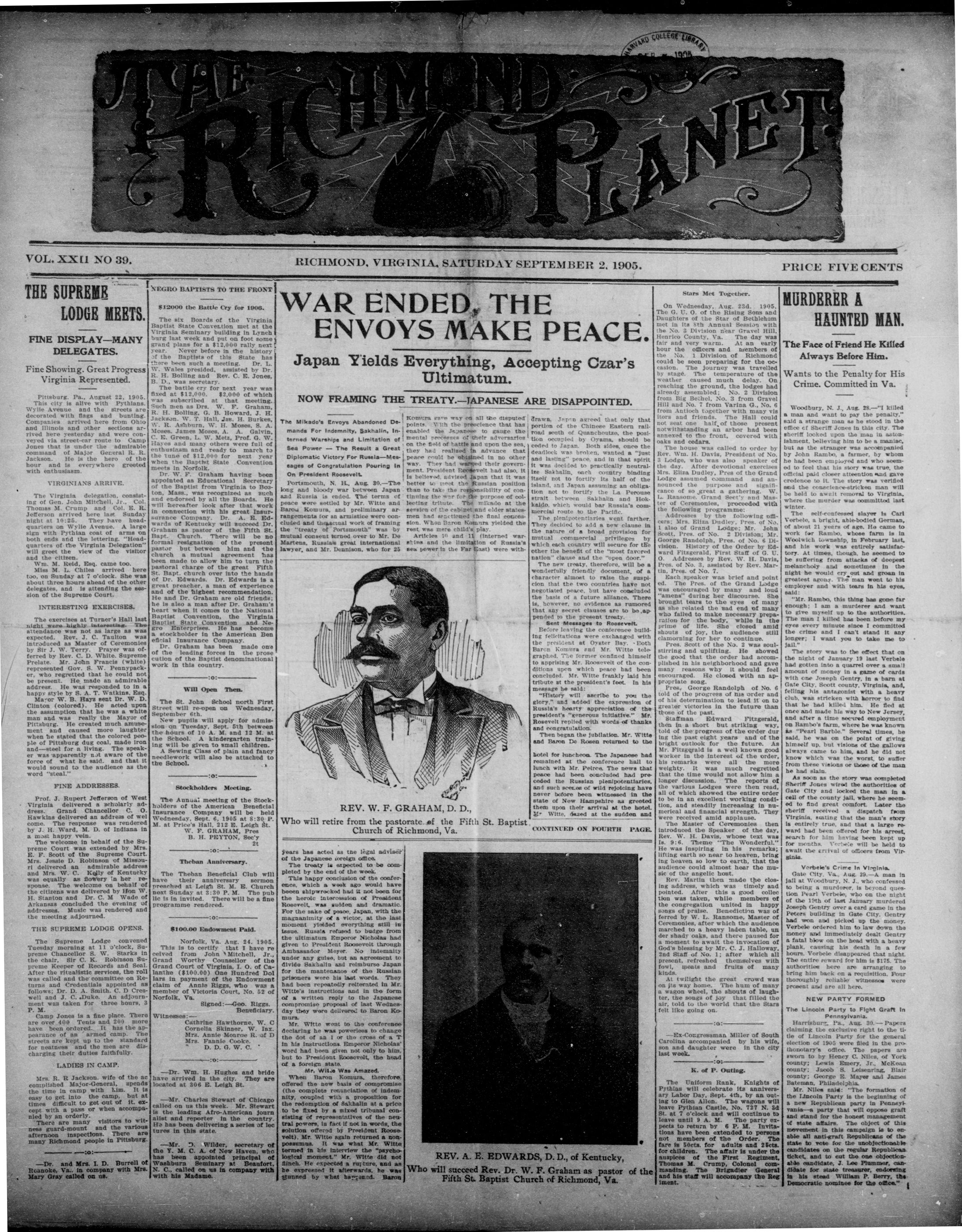
WAR ENDED. THE ENVOYS MAKE PEACE.
Japan Yields Everything, Accepting Czar's Ultimatum.
NOW FRAMING THE TREATY.—JAPANESE ARE DISAPPOINTED.
The Mikado's Envoys Abandoned Demands For Indemnity, Sakhalin, Interned Warehips and Limitation of Sea Power — The Result a Great Diplomatic Victory For Russia—Messages of Congratulation Pouring In On President Roosevelt.
Portsmouth, N. H., Aug. 30.—The long and bloody war between Japan and Russia is ended. The terms of peace were settled by Mr. Witte and Barou Komura, and preliminary arrangements for an armistice were concluded and the actual work of framing the "treaty of Portsmouth" was by mutual consent turned over to Mr. De Martens, Russias great international lawyer, and Mr. Dennison, who for 25
M.
KINN ROPER
1894
REV. W. F. GRAHAM, D. D.
Who will retire from the pastorate of the Fifth St. Baptist Church of Richmond, Va.
years has acted as the legal adviser of the Japanese foreign office.
The treaty is expected to be completed by the end of the week.
This happy conclusion of the conference, which a week ago would have been shipwrecked had it not been for the heroic intercession of President Rosevelt, was sudden and dramatic. For the sake of peace, Japan, with the magnanimity of a victor, at the last moment yielded everything still in issue. Russia refused to budge from the ultimatum Emperor Nicholas had given to President Roosevelt through Ambassador Meyer. No indemnity under any guise, but an agreement to divide Sakhalin and reimburse Japan for the maintenance of the Russian prisoners were his last words. They had been repeatedly reiterated in Mr. Witte's instructions and in the form of a written reply to the Japanese compromise proposal of last Wednesday they were delivered to Baron Komura.
Mr. Witte went to the conference declaring he was powerless to change the dot of an I or the cross of a T in his instructions. Emperor Nicholas' word had been given not only to him, but to President Roosevelt, the head of a foreign state.
Mr. Witte Wae Amazed.
When Baron Komura, therefore, offered the new basis of compromise (the complete resuscitation of indemnity, coupled with a proposition for the redemption of Sakhalin at a price to be fixed by a mixed tribunal consisting of representatives of the neutral powers, in fact if not in words, the solution offered by President Roosevelt). Mr. Witte again returned a nonpossumus. It was what Mr. Witte termed in his interview the "psychological moment." Mr. Witte did not finch. He expected a rupture, and as he expressed it afterwards, he was stunned by what happened. Baron
---
Komura was way on all the disputed points. With the precease that has enabled the Japanese to gauge the mental processes of their adversaries on the field of battle and upon the sea, they had realized in advance that peace could be obtained in no other way. They had warned their government. President Recevevelt had also, it is believed, advised Japan that it was better to meet the Russian position than to take the responsibility of continuing the war for the purpose of collecting tribute. The mikado at the session of the cabinet and elder statesmen had sanctioned the final concession. When Baron Komura yielded the rest was mere child's play.
Articles 10 and 11 (interned warships and the limitation of Russia's sea power in the Far East) were with-
JOHN H. HARRIS
orate. of the Fifth St. Baptist Richmond, Va.
1
REV. A. E. EDWARDS, D. D., of Kentucky, Who will succeed Rev. Dr. W. F. Graham as pastor of the Fifth St. Baptist Church of Richmond, Va.
drawn. Japan agreed that only that portion of the Chinese Eastern railroad south of Quanchoutze, the position occupied by Oyama, should be ceded to Japan. Both sides, once the deadlock was broken, wanted a "just and lasting" peace, and in that spirit it was decided to practically neutralize Sakhalin, each country binding itself not to fortify its half of the island, and Japan assuming an obligation not to fortify the La Perouse strait between Sakhalin and Hokkaldo, which would bar Russia's commercial route to the Pacific.
The plenipotentiaries went farther. They decided to add a new clause in the nature of a broad provision for mutual commercial privileges by which each country will secure for the other the benefit of the "most favored nation" clause and the "open door."
The new treaty, therefore, will be a wonderfully friendly document, of a character almost to raise the suspicion that the two countries have not negotiated peace, but have concluded the basis of a future alliance. There is, however, no evidence as rumored that any secret clauses are to be appended to the present treaty.
Sent Messages to Roosevelt.
Before leaving the conference building felicitations were exchanged with the president at Oyster Bay. Both Baron Komura and Mr. Witte telegraphed. The former confined himself to apprising Mr. Roosevelt of the conditions upon which peace had been concluded. Mr. Witte frankly laid his tribute at the president's feet. In his message he said:
"History will ascribe to you the glory" and added the expression of Russia's hearty appreciation of the president's "generous initiative." Mr. Roosevelt replied with words of thanks and congratulation.
Then began the jubilation. Mr. Witte and Baron De Rosen returned to the hotel for luncheon. The Japanese had remained at the conference hall to lunch with Mr. Pelrice. The news that peace had been concluded had preceded the Russian plenipotentiaries, and such success of wild rejoicing have never before been witnessed in the state of New Hampshire as greeted them upon their arrival at the hotel. Mr Witte, dazed at the sudden and
CONTINUED IN FOURTH PAGE.
Stars Met Together.
On Wednesday, Aug. 23d. 1905. The G. U. O. of the Rising Sons and Daughters of the Star of Bethlehem met in its 8th Annual Session with the No. 3 Division near Gravel Hill, Henrico County, Va. The day was fair and very warm. At an early hour the officers and members of the No. 1 Division of Richmond could be seen preparing for the occasion. The journey was travelled by stage. The temperature of the weather caused much delay. On reaching the ground, the lodges had already assembled; No. 2 Division from Big Behel, No. 3 from Gravel Hill and No. 7 from Varina G., No. 6 from Antioch together with many visitors and friends. The Hall could not seat one half of those present notwithstanding an arbor had been annexed to the front, covered with oaks and cedars.
The house was called to order by Rev. Wm. H. Davis, President of No. 3 Lodge, who was also speaker of the day. After devotional exercises Mrs. Eliza Dudley, Pres of the Grand Lodge assumed command and announced the purpose and significance of so great a gathering. W. L. Ransome, Grand Seet'y and Master of Ceremonies, proceeded with the following programme:
Addresses by the following officers; Mrs. Eliza Dudley, Pres. of No. 1 also of Grand Lodge; Mr. John Scott, Pres. of No. 2 Division; Mr. George Randolph, Pres. of No. 6 Division. History of the Order by Edward Fitzgerald, First Staff of G. U. O. Addresses by Rev. W. H. Davis, Pres. of No. 3, assisted by Rev. Martin, Pres. of No. 7.
Each speaker was brief and pointed. The Pres. of the Grand Lodge was encouraged by many and loud "amens" during her discourse. She brought tears to the eyes of many as she related the sad end of many who failed to make necessary preparation for the body, while in the prime of life. She closed amid shouts of joy, the audience still clawing for her to continue. Pres. of the No. 2 was soul-stirring and uplifting. He showed the good that the order had accomplished in his neighborhood and gave many reasons why it should feel encouraged. He closed with an appropriate song.
Pres. George Randolph of No. 6 told of the progress of his order and of his determination to lead it on to greater victories in the future than those of the past.
Staffman Edward Fitzgerald, then in a short but striking way, told of the progress of the order dur ing the past eight years and of the bright outlook for the future. As Mr. Fitzgerald is a well known good worker in the interest of the order, his remarks were all the more weighty. It was much regretted that the time would not allow him a longer discussion. The reports of the various Lodges were then read, all of which showed the entire order to be in an excellent working condition, and steadily increasing in numerical and financial strength. They were received amid applause. The Master of Ceremonies then introduced the Speaker of the day, Rev. W. H. Davis, whose text was Is. 9:6. Theme "The Wonderful." He was inspiring in his remarks; lifting earth so near to heaven, bringing heaven so low to earth, that the audience could almost hear the music of the angelic host. Rev. Martin then made the closing address, which was timely and pointed. After this a good collection was taken, while members of the congregation united in happy songs of praise. Benediction was of ferred by W. L. Ransome, Master of Ceremonies, after which the audience marched to a heavy laden table, un der shady oaks, and there paused for a moment to await the invocation of God's blessing by Mr. C. J. Halloway, 2nd Staff of No. 1; after which all present, refreshed themselves with fowl, meats and fruits of many kinds.
At twilight the great crowd was on jits way home. The hum of many a wagon wheel, the shouts of laughter, the songs of joy that filled the air, told to the world that the Stars felt like going on.
- Ex-Congressman Miller of South Carolina accompanied by his wife, son and daughter were in the city last week.
K. of P. Outing
The Uniform Rank, Knights of Pythias will celebrate its anniversary Labor Day, Sept. 4th, by an outing to Glen Allen. The wagons will leave Pythian Castle, No. 727 N. 3d St. at 7 o'clock and will continue to leave until 9 A. M. The party expects to return by 6 P. M. Invitations have been extended to persons not members of the Order. The fare is 50cts, for adults and 25cts for children. The affair is under the auspices of the First Regiment, Thomas M. Crump, Colonel commanding. The Brigadier General and his staff will accompany the Regiment.
PRICE FIVE CENTS
MURDERER A
HAUNTED MAN.
Wants to the Penalty for His Crime. Committed in Va.
Woodbury, N. J., Aug. 28.—"I killed a man and want to pay the penalty," said a strange man as he stood in the office of Sheriff Jones in this city. The sheriff looked upon the man in astonishment, believing him to be a maniac, but as the stranger was accompanied by John Rambo, a farmer, by whom he had been employed and who seemed to feel that his story was true, the official paid closer attention and gave credence to it. The story was verified and the conscience-stricken man will be held to await removal to Virginia, where the murder was committed last winter.
The self-fessed slayer is Carl Verbebe, a bright, able-bodied German, of about 21 years of age. He came to work for Rambo, whose farm is in Woolwich township, in February last, and his work was entirely satisfactory. At times, though, he seemed to be suffering from attacks of deepest melancholy and sometimes in the night he would cry out and groan in greatest agony. The man went to his employer and with tears in his eyes, said:
"Mr. Rambo, this thing has gone far enough; I am a murderer and want to give myself up to the authorities. The man I killed has been before my eyes every minute since I committed the crime and I can't stand it any longer; I want you to take me to fall."
The story was to the effect that on the night of January 19 last Verbele had gotten into a quarrel over a small amount of money in a game of cards with one Joseph Gentry, in a barn at Gate City, Scott county, Virginia, and, felling his antagonist with a heavy club, was stricken with horror to find that he had killed him. He fled at once and made his way to New Jersey, and after a time secured employment on Rambo's farm, where he was known as "Pearl Barble." Several times, he said, he was on the point of giving himself up, but visions of the gallows always came to him, and he did not know which was the worst, to suffer from these visions or those of the man he had slain.
As soon as the story was completed Sheriff Jones wired the authorities of Gate City and locked the man in a cell of the county jail, where he seemed to find great comfort. Later the sheriff received a dispatch from Virginia, seating that the man's story is entirely true, and that a large reward had been offered for his arrest, search for him having been kept up for months. Verbele will be held to await the arrival of officers from Virginia.
Verbele's Crime In Virginia
Gate City, Va., Aug. 29.—A man in jail at Woodbury, N. J., who confessed to being a murderer, is beyond question Pearl Verbele, who on the night of the 19th of last January murdered Joseph Gentry over a card game in the Peters building in Gate City. Gentry had won and picked up the money. Verbele ordered him to law down the money and immediately dealt Gentry a fatal blow on the head with a heavy plank, causing his death in a few hours. Verbele disappeared that night. The entire reward for him is $175. The authorities here are arranging to bring him back on a requisition. Four thoroughly reliable witnesses were present and are all here.
NEW PARTY FORMED
The Lincoln Party to Fight Graft in Pennsylvania.
Harrisburg, Pa., Aug. 30.—Papers claiming the exclusive right to the title of Lincoln Party for the general election of 1905 were filed in the prothonotary's office. The papers are sworn to by Henry C. Niles, of York county; Lewis Emery, Jr., McKean county; Jacob S. Lelsenring, Blair county; George E. Mayer and James Bateman, Philadelphia.
Mr. Niles said: "The formation of the Lincoln Party is the beginning of a new Republican party in Pennsylvania—a party that will oppose graft and stand for the honest management of state affairs. The object of this movement in this campaign is to enable all anti-graft Republicans of the state to vote for the unobjectionable candidates on the regular Republican ticket, and to cut the one objectionable candidate, J. Lee Plummer, candidate for state treasurer, endorsing in his stead William P. Berry, the Democratic nominee for the office."
THE PLANET
A LESSON IN MANUAL TRAINING
FRACTICAL POINTS FOR BOYS WITH AMBITION AND GENIUS.
Description of the "Miter Dovetail" Drawers as Made and Used by Cabinet Maker
(Instructor in Woodworking and Pattern-
Making, Armour Institute of Tech-
nology, Chicago.)
[Copyright, 1934, by Joseph B. Bowlee.]
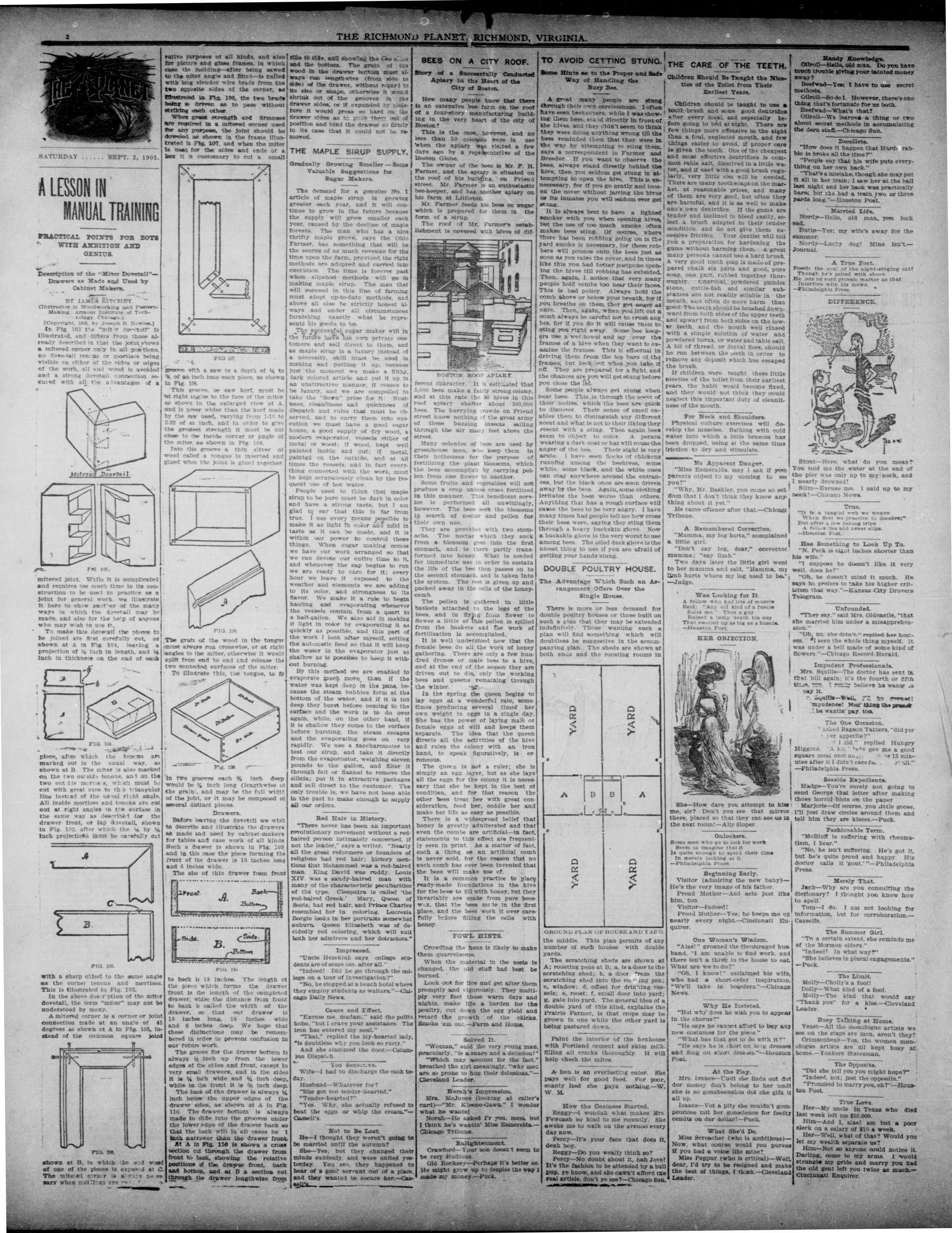
In Fig. 103 the "mitr r dovetail" is
illustrated, and differs from those al-
ready described in that the joint shows
a mitered corner only in all positions,
no dove-tail tenons or mortises being
visible on either of the sides or edges
of the work, all end wood is avoided
and a strong dovetail connection secured with all the advantages of a
Mitered Dovetail.
mitered joint. While it is complicated and requires too much time in its construction to be used in practice as a joint for general work, we illustrate it here to show another of the many ways in which the dovetail may be made, and also for the help of anyone who may wish to use it.
To make this dovetail the pieces to be joined are first carefully cut, as shown at A in Fig. 104, leaving a projection of 1/8 inch in length, and 1/8 inch in thickness on the end of each
piece, after which the tenons are marked out in the usual way, as shown at B. The miter is also marked on the two outside tenons, and on the two outside mortises, which must be cut with great care to this triangular line instead of the usual right angle. All inside mortises and tenons are cut out at right angles to the surface in the same way as described1 for the drawer front, or lap dovetail, shown in Fig. 102. after which the 1/4 by 1/4 inch projections must be carefully cut
FIG. 104.
A
C
B.
FIG. 105.
with a sharp chisel to the same angle as the corner tenons and mortises. This is illustrated in Fig. 103.
In the above description of the miter dovetail, the term "miter" may not be understood by many.
A mitered corner is a corner or joint connection made at an angle of 45 degrees as shown at A in Fig. 105, instead of the common square joint
```markdown
```
FIG. 106
shown at B, in which the end wood of one of the pieces is exposed at C. The mitered corner is always necessary when moldings are used.
rative purposes of all kinds, and also for picture and glass frames, in which case the molding—after being sawed to the miter angle and fitted—is called with long slender wire brads from the two opposite sides of the corner, as illustrated in Fig. 106, the two brads being so driven as to pass without striking each other.
When great strength and firmness are required in a mitered corner used for any purpose, the joint should be dovelled, as shown in the frame illustrated in Fig. 107, and when the miter is used for the sides and ends of a box it is customary to cut a small
L
groove with a saw to a depth of 1/4 to % of an inch into each piece, as shown in Fig. 108. This groove, or saw kerf, must be at right angles to the face of the miter, as shown in the enlarged view at A, and is never wider than the kerf made by the saw used, varying from 1-16 to 3-32 of an inch, and in order to give the greatest strength it must be cut close to the inside corner or angle of the miter, as shown in Fig. 108. Into this groove a thin sliver of wood called a tongue is inserted and glued when the joint is glued together.
FIG. 108.
The grain of the wood in the tongue must always run crosswise, or at right angles to the miter, otherwise it would split from end to end and release the two connected surfaces of the miter.
To illustrate this, the tongue, to fit
Fig. 109.
In two grooves each % inch deep would be % inch long (lengthwise of the grain), and may be the full width of the joint, or it may be composed of several distinct pieces.
Drawers.
Before leaving the dovetail we wish to describe and illustrate the drawers as made and used by cabinet-makers for tables and case work of all kinds. Such a drawer is shown in Fig. 109 and in this case the piece forming the front of the drawer is 16 inches long and 6 inches wide.
The size of this drawer from front
Front. A. Back Bottom
Side. B. Side Bottom
FIG 110
to back is 18 inches. The length of the piece which forms the drawer front is the length of the completed drawer, while the distance from front to back is called the width of the drawer, so that our drawer is 16 inches long, 18 inches wide and 6 inches deep. We hope that these distinctions may be remembered in order to prevent confusion in our future work.
The groove for the drawer bottom is always $\frac{1}{2}$ inch up from the lower edges of the sides and front, except in very small drawers, and in the sides it is $\frac{1}{4}$ inch wide and $\frac{1}{4}$ inch deep, while in the front it is $\frac{1}{4}$ inch deep.
The back of the drawer is always $\frac{1}{4}$ inch below the upper edges of the drawer sides, as shown at A in Fig. 110. The drawer bottom is always made to slide into the grooves under the lower edge of the drawer back so that the back will in all cases be 1 inch narrower than the drawer front.
At A in Fig. 110 is shown a cross section cut through the drawer from front to back, showing the relative positions of the drawer front, back and bottom, and at B a section cut through the drawer lengthwise from
sit to slide, and showing the two sides and the bottom. The grain of the wood in the drawer bottom must always run lengthwise (from side to side) of the drawer, without regard to its size or shape, otherwise it would shrink out of the grooves in the drawer sides, or if expanded by moisture it would press so hard on the drawer sides as to push them out of position and bind the drawer so firmly in its case that it could not be removed.
BEES ON A CITY ROOF.
Story of a Successfully Conducted Apiary in the Heart of the City of Boston.
How many people know that there is an extensive bee farm on the roof of a four-story manufacturing building in the very heart of the city of Boston?
This is the case, however, and no less than 50 colonies were in use.
TO AVOID Some Hints and Way of
A great mischief through their use have seen beekeeping them bees, the hives, and they were doing bees reminded
THE MAPLE SIRUP SUPPLY.
Gradually Growing Smaller—Some Valuable Suggestions for Sugar Makers.
The demand for a genuine No. 1 article of maple syrup is growing greater each year, and it will continue to grow in the future because the supply will grow smaller each year, caused by the decline of maple forests. The man who has a nice thrifty maple grove, says the Ohio Farmer, has something that will be the source of as much revenue for the time upon the farm, provided the right methods are adopted and carried into execution. The time is forever past when slipshed methods will go in making maple syrup. The man that will succeed in this line of farming must adopt up-to-date methods, and above all else be strictly honest always, and under all circumstances furnishing exactly what he represents his goods to be.
The successful sugar maker will in the future have his own private customers and sell direct to them, and as maple sirup is a luxury instead of a necessity, skill must be used in making and putting it up, because just the moment we make a filth, dark colored article and put it up in an unattractive manner, it ceases to be luxury, and we are compelled to take the "down" price for it: Neatness, cleanliness and quickness of dispatch and rules that must be observed, and to carry them into execution we must have a good sugar house, a good supply of dry wood, a modern evaporator, vessels either of metal or wood; if wood, kept well painted inside and out; if metal, painted on the outside, and at all times the vessels, and in fact everything connected with the work, must be kept scrupulously clean by the frequent use of hot water.
People used to think that maple strap to be pure must be dark in color and have a strong taste, but I am glad to say that this is far from true. I use every means possible to make it as light in color and mild in taste as it can be made, and it is within our power to control these things. When sugar making comes we have our work arranged so that we can devote our entire time to it, and whenever the sap begins to run we are ready to care, for it; every hour we leave it exposed to the weather and elements we are adding to its color, and strongness to its flavor. We make it a rule to begin hauling and evaporating whenever the vessels contain from a quart to a half-gallon. We also aid in making it light in color by evaporating it as quickly as possible, and this part of the work I look after myself, setting the automatic feed so that it will keep the water in the evaporator just as shallow as is possible to keep it without burning.
By this method we are enabled to evaporate much more, than if the water was kept deep in the pans, because the steam bubbles form at the bottom of the water, and if it is too deep they burst before coming to the surface and the work is to do over again, while, on the other hand, if it is shallow they come to the surface before bursting, the steam escapes and the evaporating goes on very rapidly. We use a saccharometer to test our sirup, and take it directly from the evaporator, weighing eleven pounds to the gallon, and filter it through felt or flannel to remove the silicic; put it in attractive packages and sell direct to the customer. The only trouble is, we have not been able in the past to make enough to supply all our orders.
Red Hair in History
"There never has been an important revolutionary movement without a red-haired person intimately concerned, if not the leader," says a writer. "Nearly all the great reformers or founders of religions had red hair; history mentions that Mohammed was a red-haired man. King David was ruddy. Louis XIV. was a sandy-haired man with many of the characteristic peculiarities of the type. Cleopatra is called the red-haired Greek.' Mary, Queen of Scots, had red hair, and Prince Charles resembled her in coloring. Lucrezia Borgio looks in her portraits somewhat auburn. Queen Elizabeth was of decidedly red coloring, which will suit both her admirers and her detractors."
Impressed.
"Uncle Hezekiah says, college students are of some use, after all."
"Indeed! Did he go through the college on a tour of investigation?"
"No, he stopped at a beach hotel where they employ students as waiters."—Chicago Dally News.
Cause and Effect.
"Excuse me, madam," said the polite hobo, "but I crave your assistance. The iron has entered my soul."
"That," replied the ice-hearted lady, "is doubtless why you look so rusty."
And she slammed the door.—Columbus Dispatch.
Too Sensitive.
Wife—I had to discharge the cook today.
Husband—Whatever for?
"She got too tender-hearted."
"Tender-hearted?"
"Yes. Why, she actually refused to beat the eggs or whip the cream."—Cassell's.
Not to Be Lost
He-I thought they weren't going to be married until the autumn?
She—Yes; but they changed their minds suddenly and were united yesterday. You see, they happened to hear of a good servant out of a place, and they wanted to secure her.—Casually.
BEES ON A CITY ROOF.
How many people know that there is an extensive bee farm on the roof of a four-story manufacturing building in the very heart of the city of Boston?
This is the case, however, and no less than 50 colonies were in use when the apiary was visited a few days ago by a representative of the Boston Globe.
The owner of the bees is Mr. F. H. Farmer, and the apiary is situated on the roof of his building, on Friend street. Mr. Farmer is an enthusiastic bee-keeper, and has another apiary on his farm at Littleton.
Mr. Farmer feeds his bees on sugar which is prepared for them in the form of a sirup.
The roof of Mr. Farmer's establishment is covered with blues of dif-
BOSTON ROOF APIARY
ferent character. It is estimated that 5,000 bees make a fairly strong colony, and at this rate the 50 hives in this roof aptery shelter about 500,000 bees. The hurrying crowds on Friend street know nothing of the great army of these buzzing insects sailing through the air many feet above the street.
Many colonies of bees are used by greenhouse men, who keep them in their hothouses for the purpose of fertilizing the plant blossoms, which the bees accomplish by carrying pollen from one flower to another.
Some fruits and vegetables will not produce a crop unless cross fertilized in this manner. This beneficial service is performed all unwittingly, however. The bees seek the blossoms in search of nectar and pollen for their own use.
They are provided with two stomachs. The nectar which they suck from a blossom goes into the first stomach, and is there partly transformed into honey. What is needed for immediate use in order to sustain the life of the bee then passes on to the second stomach, and is taken into the system. The rest is given up and packed away in the cells of the honeycomb.
The pollen is gathered in little baskets attached to the legs of the bees, and in flying from flower to flower a little of this pollen is spilled from the baskets and the work of fertilization is accomplished.
It is well understood now that the female bees do all the work of honey gathering. There are only a few hundred drones or male bees to a hive, and at the end of the season they are driven out to die, only the working bees and queens remaining through the winter.
In the spring the queen begins to lay eggs at a wonderful rate, sometimes producing several times her own weight in eggs in a single day. She has the power of laying male or female eggs at will and keeps them separate. The idea that the queen directs all the activities of the hive and rules the colony with an iron hand, to speak figuratively, is erroneous. The queen is not a ruler; she is simply an egg layer, but as she lays all the eggs for the colony it is necessary that she be kept in the best of condition, and for that reason the other bees treat her with great consideration, feed her, coddle her and make her life as easy as possible.
There is a widespread belief that honey is greatly adulterated and that even the combs are artificial—in fact, statements to this effect are frequently seen in print. As a matter of fact, such a thing as an artificial comb is never sold, for the reason that no such comb has ever been invented that the bees will make use of.
It is a common practice to place ready-made foundations in the hive for the bees to fill with honey, but they invariably are made from pure beeswax, that the bees make in the first place, and the bees work it over carefully before filling the cells with honey.
FOWL HINTS.
Crowding the hens is likely to make them quarrelsome.
When the material in the nests is changed, the old stuff had best be burned.
Look out for lice and get after them promptly and vigorously. They multiply very fast these warm days and nights, make life a burden for the poultry, cut down the egg yield and retard the growth of the chicks.
Smoke 'em out—Farm and Home.
Solved It
"Woman," said the very young man, pracularly, "is a snare and a delusion!" "Which may account for the fact," breathed the girl meaningly, "why mez are so prone to hug their delusions."—Cleveland Leader.
Norah's Impression.
Mrs. McJones (looking at caller's card)—"Mr. Kleene-Gawn." I wonder what he wants!
Norah—He asked fr you, mem, but I think he's wantin' Miss Merelda.—Chicago Tribune.
Enlightenment.
Crawford—Your son doesn't seem to be very studious.
Old Rockey—Perhaps it's better so.
He might grow up to despise the way I made my money.—Puck.
TO AVOID GETTING STUNG
Some Hints as to the Proper and Safe Way of Handling the Busy Bee.
A great many people are stung through their own carelessness. I often have seen beekeepers, while I was showing them bees, stand directly in front of the hives, and they didn't seem to think they were doing anything wrong till the bees reminded them that they were in the way by attempting to sting them, says a correspondent in Farmer and Breeder. If you want to observe the bees, always stand directly behind the hive, then you seldom get stung in attempting to open the hive. This is unnecessary, for if you go gently and loosen the cover without jarring the hives or its inmates you will seldom ever get stung.
It is always best to have a lighted smoker with you when opening hives, but the use of too much smoke often makes bees sting. Of course, where there has been robbing going on in the yard smoke is necessary, for these robbers will pounce the cover, and in times like this you had better postpone opening the hives till robbing has subsided. Then, again, I notice that very many people hold combs too near their faces. This is bad policy. Always hold the comb above or below your breath, for if you breathe on them they get angry at once. Then, again, when you lift out a comb always be careful not to crush any bees, for if you do it will cause them to sting you right away. Some bee keepers use a wet towel and iay over the frames of a hive when they want to examine the frames. This is effectual in driving them from the top bars of the frames, but look out when you take it off. They are prepared for a fight, and the chances are you will get stung before you close the lid.
Some people always get stung when near bees. This is through the scent of their bodies, which the bees are quick to discover. Their sense of smell enables them to distinguish any different scent and what is not to their liking they resent with a sting. Then again bees seem to object to color. A person wearing a dark coat or hat will rouse the anger of the bee. Their sight is very acute. I have seen flocks of chickens running among the beehives, some white, some black, and the white ones can stay anywhere around the entrances, but the black ones are soon driven away by the bees. Again, some clothing irritates the bees worse than others. Anything that has a rough surface will cause the bees to be very angry. I have many times had people tell me how cross their bees were, saying they sting them through a heavy buckskin glove. Now a buckskin glove is the very worst to use among bees. The oiled duck glove is the nicest thing to use if you are afraid of getting your hands stung.
DOUBLE POULTRY HOUSE.
The Advantage Which Such an Arrangement Offers Over the Single House.
There is more or less demand for double poultry houses or those built on such a plan that they may be extended indefinitely. Those wanting such a plan will find something which will doubtless be suggestive in the accompanying plan. The sheds are shown at both ends and the roosting rooms in
YARD YARD
A B B A
YARD
GROUND PLAN OF HOUSE AND YARD.
the middle. This plan permits of any number of such houses with double yards.
The scratching sheds are shown at A; roosting pens at B; a, is a door to the scratching shed; b, a door from the scratching shed into the roosting pen; c, window; d, offset for drinking vessels; e, roost; f, small door into yard; g, gate into yard. The general idea of a double yard of this kind, explains the Prairie Farmer, is that crops may be grown in one while the other yard is being pastured down.
Paint the interior of the henhouse with Portland cement and skim milk filling all cracks thoroughly. It will help check the mites.
A hen is an everlasting eater. She pays well for good feed. For poor, scanty feed she pays nothing.—W. W. M.
How the Coolness Started.
Reggy—I wondah what makes Mrs. Fewcash so kind to me recently. She awks me to walk on the avenoo every day now.
Percy—It's your face that does it, deah boy.
Reggy—Do you wealy think so?
Percy—No doubt about it, bah Jove!
It's the fashion to be attended by a bull pup, ye know, and she can't afford the real article, don't ye see?—Chicago Sun.
THE CARE OF THE TEETH.
Children Should Be Taught the Niceties of the Toilet from Their Earliest Years.
Children should be taught to use tooth-brush and some good dentifrice after every meal, and especially before going to bed at night. There are few things more offensive to the sight than a foul, neglected mouth, and few things easier to avoid, if proper care is given the teeth. One of the cheapest and most effective dentifrices is common table salt, dissolved in a little water, and if used with a good brush regularly, very little else will be needed. There are many tooth scabs on the market, at reasonable prices, and many of them are very good, but often they are harmful, and it is as well to make one's own dentifrice. If the gums are tender and inclined to bleed easily, select a brush adapted to their tender condition, and do not give them excessive friction. Your dentist will tell you a preparation for hardening the gums without harming them. A great many persons cannot use a hard brush. A very good tooth soap is made of prepared chalk six parts and good, pure soap, one part, rubbed together thoroughly. Enarcoal, powdered pumice stone, cuttle-fish and similar substances are not readily soluble in the mouth, and often do more harm than good. The teeth should be brushed downward from both sides of the upper teeth and upward from both sides on the lower teeth, and the mouth well rinsed with a simple solution of water and powdered borax, or water and table salt. A bit of thread, or dental floss, should be run between the teeth in order to remove any deposit which has escaped the brush.
If children were taught these little niceties of the toilet from their earliest pears, the habit would become fixed, and they would not think they could neglect this important duty of cleanliness of the mouth.
For Neck and Shoulders
Physical culture exercises will develop the muscles. Bathing with cold water into which a little benzoin has been dropped, using at the same time friction to dry and stimulate.
No Apparent Danger
"Miss Esmeralda, may I ask if your parents object to my coming to see you?"
"Why, Mr. Bashley, you come so seldom that I don't think they know anything about it yet."
He came oftener after that.—Chicago Tribune.
A Remembered Correction.
"Mamma, my leg hurts," complained a little girl.
"Don't say leg, dear," corrected mamma; "say limb."
Two days later the little girl went to her mamma and said, "Mamma, my limb hurts where my leg used to be."
—Judge.
Was Looking for It.
A fellow who had lots of muscle
Said: "Any old kind of a muscle
Suits me." Then a guy
Raised a jump "heath his euy
That swelled up as big as a buscle.
—Houston Post.
HER OBJECTION.
A woman in a large hat stands in front of a man, who is standing in front of a mirror. The woman is facing the man, who is looking at her. The woman's hat is large and has a wide brim. The man is standing in front of a mirror, looking at the woman. The mirror reflects the woman's face. The woman's hair is styled in a large, voluminous hat. The man's hair is styled in a short, wavy haircut. The background is a simple, dark wall.
She—How dare you attempt to kiss me, sir? Don't you see that mirror there, placed so that they can see us in the next room!—Ally Sloper.
Onlookers.
Some men who go to look for work
Seem to imagine that it
Is quite enough to spend their time In the office while at it.
—Philadelphia Press.
Beginning Early
Visitor—Indeed!
Proud Mother—Yes; he keeps me up
nearly every night—Cincinnati Enquirer.
One Woman's Wisdom.
"Alas!" groaned the discouraged husband, "I am unable to find work, and there isn't a thing in the house to eat. What are we to do?"
"Oh, I know!" exclaimed his wife, who had a short-order inspiration. "We'll take in boarders"—Chicago News.
Why Be Insisted
"But why does he wish you to appear in the chorus?"
"He says he cannot afford to buy any new costumes for the piece."
"What has that got to do with it?"
"He says he is short on long dresses and lung on short dresses."—Houston Post.
At the Play.
Mrs. Isaacs—Undt she finds out dot
der money don't belong to her undt
she is so gonsheenshus dot she gifs it
all up.
Isaacs—Vot a pity she couldn't gom-
promise mit her gonscience for feefty
cendts on der dollar—Puck.
What She'd Do
Miss Screacher (who is ambitious)—Now, what course would you pursue if you had a voice like mine?
Miss Peppur (who is critical)—Well, dear, I'd try to be resigned and make the best of things, I think—Cleveland Leader.
Ollroll—Hello, old man. Do you have much trouble giving your tainted money away?
Beefwad—Yes; I have to use secret methods.
Ollroll—So do I. However, there's one thing that's fortunate for us both.
Beefwad—What's that?
Ollroll—We learns a thing or two about secret methods in accumulating the dern stuff—Chicago Sun.
Decollete.
"How does it happen that Hards rabble is broke all the time?"
"People say that his wife puts everything on her own back."
"That's a mistake, though she may put it all in her train; I saw her at the ball last night and her back was practically bare; but she had a train two or three yards long." - Houston Post.
Married Life
Nordy—Hello, old man, you look sad.
Butts—Yes; my wife's away for the summer.
Nordy—Lucky dog! Mine isn't—Journal.
A True Post
Poetic the soul of the night-stinging cat
Though he's polled with shoes.
He lets no such proxic matter as that
Dietter with his mwea.
Philadelphia
DIFFERENCE
Stout—Here, what do you mean? You told me the water at the end of the pier was only up to my neck, and I nearly drowned!
Slim—Excuse me. I said up to my neck!—Chicago News.
True.
"It is a tangled web we weave
When first we practice to doceive!"
But first he a few nashing trips
A Rokie has slips and never slips.
—Houston Post.
Has Something to Look Up To.
"N. Peck is eight inches shorter than his wife."
"I suppose he doesn't like it very well, does he?
"Oh, he doesn't mind it much. He says he prefers to take his higher criticism that way."—Kansas City Drovers Telegram.
Unfounded.
"They say," said Mrs. Oldcastle, "that she married him under a misapprehension."
"Oh, no, she didn't," replied her hostess. "I seen the whole thing myself. It was under a bell made of some kind of flowers."—Chicago Record-Herald.
Impudent Professionals
Mrs. Squills—The doctor has sent in that bill again; it's the fourth or fifth time. I really believe he wants us pay it.
Squills—Well, I'll be dressed! Impudence! Now thing the president I be wantin' pay too.
The One Occasion.
"asked Ragson Tatters," "did yer yer appetite?"
"I did," replied Hungry Higgins.
"A kid, lady gey me a good square meal on an act." Or 15 minutes after it I didn't care fu. "all"
—Philadelphia Press.
Seaside Expedients
Madge. You're surely not going to send George that letter after making those horrid blots on the paper. Marjorie—Of course, you little goose, I'll just draw circles around them and tell him they are kisses.—Puck.
Fashionable Term
"McBluff is suffering with rheumatism, I hear."
"No, he isn't suffering. He's got it, but he's quite proud and happy. His doctor calls it 'gout.'"—Philadelphia Press.
Merely That
Jack—Why are you consulting the dictionary? I thought you knew how to spell.
Tom—I do. I am not looking for information, but for corroboration.—Cassells.
The Summer Girl
"To a certain extent, she reminds me of the Mormon elders." "Indeed! In what way?" "She believes in plural engagements." —Puck.
Molly—The kind that would say "Thank you" for a kiss.—Cleveland Leader.
yes. Are the monologue artists we see in the image are men, aren't they? Criminals and the women monologue artists are all kept busy at home. Yonkers Stateamap
The Opposite
"Promised to marry you, eh?"—Houston Post
True Love
Her—My uncle in Texas who died
last week left me $50,000.
Him-And I, alas! am but a poor
clerk on a salary of $10 a week.
Her—Well, what of that? Would you let my wealth separate us?
Him—Not so anyone could notice it.
Darling, come to my arms. I would strangle my pride and marry you had the old gent left you twice as much.—Cincinnati Enquirer.
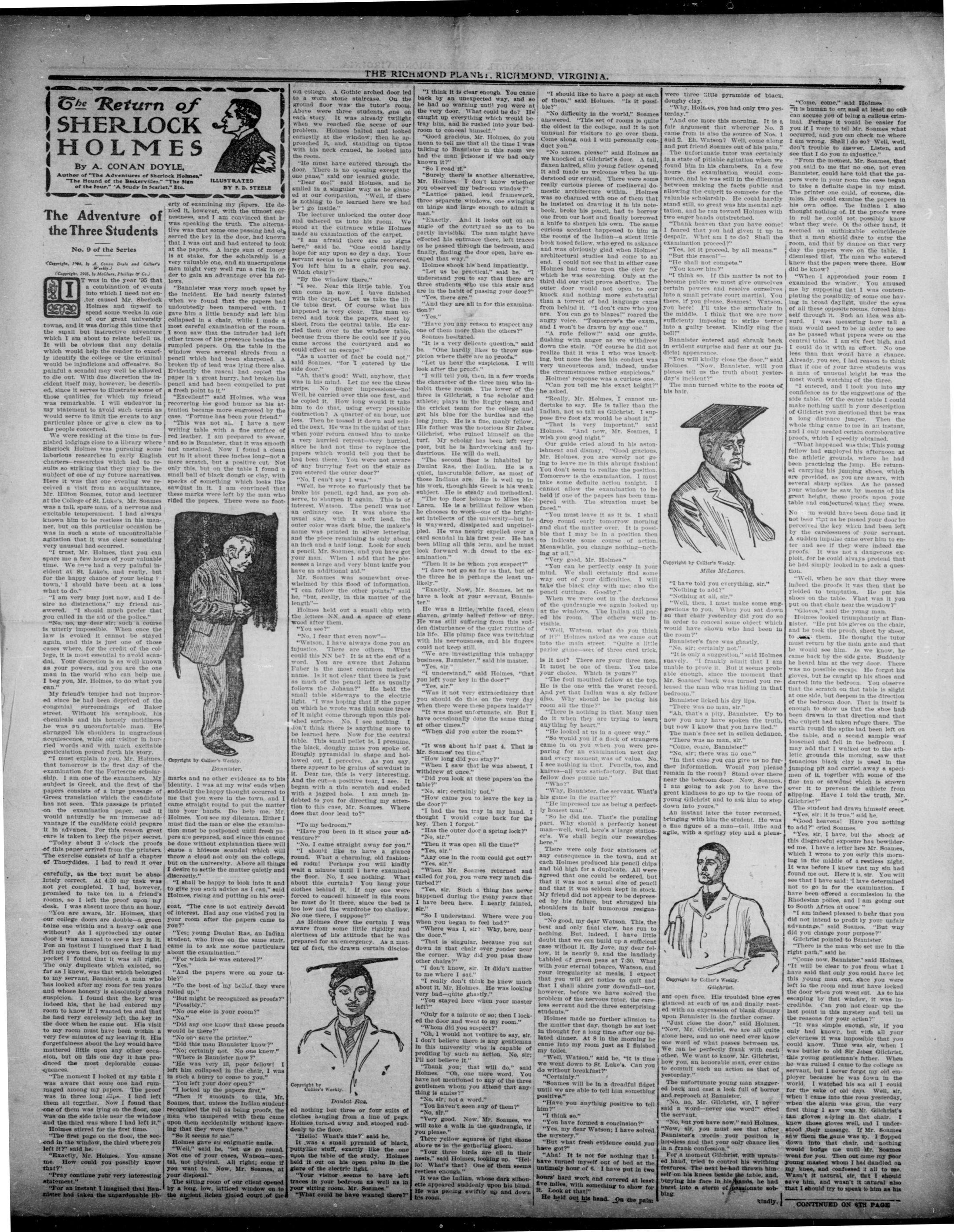
The Return of SHERLOCK HOLMES
Author of "The Adventures of Sherlock Holmes",
"The Hound of the Baskervilles," "The Sign
of the Four," "A Study In Scarlet," Etc.
erty of examining my papers. He denied it, however, with the utmost earnestness, and I am convinced that he was speaking the truth. The alternative was that some one passing had observed the key in the door, had known that I was out and had entered to look at the papers. A large sum of money is at stake, for the scholarship is a very valuable one, and an unscrupulous man might very well run a risk in order to gain an advantage over his fellows.
"Bannister was very much upset by the incident. He had nearly fainted when we found that the papers had undoubtedly been tampered with. I gave him a little brandy and left him collapsed in a chair, while I made a most careful examination of the room. I soon saw that the intruder had left other traces of his presence besides the rumpled papers. On the table in the window were several shreds from a pencil which had been sharpened. A broken tip of lead was lying there also. Evidently the rascal had copied the paper in a great hurry, had broken his pencil and had been compelled to put a fresh point to it."
"Excellent!" said Holmes, who was recovering his good humor as his attention became more engrossed by the case. "Fortune has been your friend."
"This was not al. I have a new writing table with a fine surface of red leather. I am prepared to sweat, and so is Bannister, that it was smooth and unstained. Now I found a clean cut in it about three inches long—not a mere scratch, but a positive cut. Not only this, but on the table I found a small ball of black dough or clay, with specks of something which looks like sawdust in it. I am convinced that these marks were left by the man who riffed the papers. There were no foot-
```markdown
```
marks and no other evidence as to his identity. I was at my wits' ends when suddenly the happy thought occurred to me that you were in the town, and I came straight round to put the matter into your hands. Do help me, Mr. Holmes. You see my dilemma. Either I must find the man or else the examination must be postponed until fresh papers are prepared, and since this cannot be done without explanation there will ensue a hideous scandal which will throw a cloud not only on the college, but on the university. Above all things I desire to settle the matter quietly and discreetly."
"I shall be happy to look into it and to give you such advice as I can," said Holmes, rising and putting on his overcoat. "The case is not entirely devoid of interest. Had any one visited you in your room after the papers came to you?"
"Yes; young Daulat Ras, an Indian student, who lives on the same stair, came in to ask me some particulars about the examination."
"For which he was entered?"
"Yes."
"And the papers were on your table?"
"To the best of my belief they were rolled up."
"But might be recognized as proofs?"
"Possibly."
"No one else in your room?"
"No."
"Did any one know that these proofs would be there?"
"No one save the printer."
"Did this man Bannister know?"
"No; certainly not. No one knew."
"Where is Bannister now?"
"He was very ill, poor fellow! I left him collapsed in the chair, I was in such a hurry to come to you."
"You left your door open?"
"I locked up the papers first."
"Then it amounts to this, Mr. Soames, that, unless the Indian student recognized the roll as being proofs, the man who tampered with them came upon them accidentally without knowing that they were there."
"So it seems to me."
Holmes gave an enigmatic smile.
"Well," said he, "let us go round. Not one of your cases, Watson—mental, not physical. All right; come if you want to. Now, Mr. Soames, at your disposal."
The sitting room of our client opened by a long, low, latticed window on to the ancient loft timed court of the
The Adventure of the Three Students
No. 9 of the Series
(Copyright, 1904, by A. Cannon Duple and Colter's Weekly.)
(Copyright, 1905, by McClure, Phillips & Co.)
I was in the year '95 that a combination of events into which I need not enter caused Mr. Sherlock Holmes and myself to spend some weeks in one of our great university
I was in the year '95 that a combination of events into which I need not enter caused Mr. Sherlock Holmes and myself to spend some weeks in one of our great university towns, and it was during this time that the snail but instructive adventure which I am about to relate befell us. It will be obvious that any details which would help the reader to exactly identify the college or the criminal would be injudicious and offensive. So painful a scandal may well be allowed to die out. With due discretion the incident itself may, however, be described, since it serves to illustrate some of those qualities for which my friend was remarkable. I will endeavor in my statement to avoid such terms as would serve to limit the events to any particular place or give a clew as to the people concerned.
We were residing at the time in furnished lodgings close to a library where Sherlock Holmes was pursuing some laborious researches in early English charters—researches which led to results so striking that they may be the subject of one of my future narratives. Here it was that one evening we received a visit from an acquaintance, Mr. Hilton Soames, tutor and lecturer at the College of St. Luke's. Mr. Soames was a tall, spare man, of a nervous and excitable temperament. I had always known him to be restless in his manner, but on this particular occasion he was in such a state of uncontrollable agitation that it was clear something very unusual had occurred.
"I trust, Mr. Holmes, that you can spare me a few hours of your valuable time. We have had a very painful incident at St. Luke's, and really, but for the happy chance of your being! town, I should have been at a loss what to do."
"I am very busy just now, and I desire no distractions," my friend answered. "I should much prefer that you called in the aid of the police."
"No, no, my dear sir; such a course is utterly impossible. When once the law is evoked it cannot be stayed again, and this is just one of those cases where, for the credit of the college, it is most essential to avoid scandal. Your discretion is as well known as your powers, and you are the one man in the world who can help me. I beg you, Mr. Holmes, to do what you can."
My friend's temper had not improved since he had been deprived of the congenial surroundings of Baker street. Without his scrapbook, his chemicals and his homely untidiness he was an uncomfortable man. He shrugged his shoulders in ungrateful acquiescence, while our visitor in hurried words and with much excitable gesticulation poured forth his story. "I must explain to you, Mr. Holmes, that tomorrow is the first day of the examination for the Fortescue scholarship. I am one of the examiners. My subject is Greek, and the first of the papers consists of a large passage of Greek translation which the candidate has not seen. This passage is printed on the examination paper, and it would naturally be an immense advantage if the candidate could prepare it in advance. For this reason great care is taken to keep the paper secret. "Today about 3 o'clock the proofs of this paper arrived from the printers. The exercise consists of half a chapter of Thucydides. I had to read it over carefully, as the text must be absolutely correct. At 4:30 my task was not yet completed. I had, however, promised to take tea in a friend's rooms, so I left the proof upon my desk. I was absent more than an hour.
"You are aware, Mr. Holmes, that our college doors are double—a green baize one within and a heavy onk one without? As I approached my outer door I was amazed to see a key in it. For an instant I imagined that I had left my own there, but on feeling in my pocket I found that it was all right. The only duplicate which existed, so far as I knew, was that which belonged to my servant, Bannister, a man who has looked after my room for ten years and whose honesty is absolutely above suspicion. I found that the key was indeed his, that he had entered my room to know if I wanted tea and that he had very carelessly left the key in the door when he came out. His visit to my room must have been within a very few minutes of my leaving it. His forgetfulness about the key would have mattered little upon any other occasion, but on this one day it has produced the most deplorable consequences.
"The moment I looked at my table I was aware that some one had rumaged among my papers. The proof was in three long slips. I had left them all together. Now I found that one of them was lying on the floor, one was on the side table near the window and the third was where I had left it." Holmes stirred for the first time.
"The first page on the floor, the second in the window, the third where you left it?" said he.
"Exactly, Mr. Holmes. You amaze me. How could you possibly know that?"
"Pray continue your very interesting statement."
"For an instant I imagined that Baulster had taken the unpardonable lib
ILLUSTRATED
BY F. D. STEELE
Bannister.
THE RICHMOND PLANE1. RICHMOND. VIRGINIA.
our college. A Gothic arched door led to a worn stone staircase. On the ground floor was the tutor's room. Above were three students, one on each story. It was already twilight when we reached the scene of our problem. Holmes halted and looked earnestly at the window; then he approached it, and, standing on tiptoe with his neck craned, he looked into the room.
"He must have entered through the door. There is no opening except the one pane," said our learned guide.
"Dear me!" said Holmes, and he smiled in a singular way as he glanced at our companion. "Well, if there is nothing to be learned we had beet go inside."
The lecturer unlocked the outer door and ushered us into his room. We stood at the entrance while Holmes made an examination of the carpet.
"I am afraid there are no signs here," said he. "One could hardly hope for any upon so dry a day. Your servant seems to have quite recovered. You left him in a chair, you say. Which chair?"
"By the window there."
"I see. Near this little table. You can come in now. I have finished with the carpet. Let us take the little table first. Of course what has happened is very clear. The man entered and took the papers, sheet by sheet, from the central table. He carried them over to the window table, because from there he could see if you came across the courtyard and so could effect an escape."
"As a matter of fact he could not," said Soames, "for I entered by the side door."
"Ah, that's good! Well, anyhow, that was in his mind. Let me see the three strips. No finger impressions—not! Well, he carried over this one first, and he copied it. How long would it take him to do that, using every possible contraction? A quarter of an hour, not less. Then he tossed it down and seized the next. He was in the midst of that when your return caused him to make a very hurried retreat—very hurried, since he had not time to replace the papers which would tell you that he had been there. You were not aware of any hurrying feet on the stair as you entered the outer door."
"No, I can't say I mean."
"Well, he wrote so furiously that he broke his pencil, ad had, as you observe, to sharpen it again. This is of interest, Watson. The pencil was not an ordinary one. It was above the usual size, with a soft lead, the outer color was dark blue, the maker's name was printed in silver lettering, and the piece remaining is only about an inch and a half long. Look for such a pencil, Mr. Soames, and you have got your man. When I add that he possesses a large and very blunt knife you have an additional aid."
Mr. Soames was somewhat overwhelmed by this flood of information. "I can follow the other points," said he, "but, really, in this matter of the length".
Holmes held out a small chip with the letters NN and a space of clear wood after them.
"You see?".
"No. I fear that even now"—
No, I feel that even now —
"Watson, I have always done you an injustice. There are others. What could this NN be? It is at the end of a word. You are aware that Johann Faber is the most common maker's name. Is it not clear that there is just as much of the pencil left as usually follows the Johann?" He held the small table sideways to the electric light. "I was hoping that if the paper on which he wrote was thin some trace of it might come through upon this polished surface. No. I see nothing. I don't think there is anything more to be learned here. Now for the central table. This small pellet is, I presume, the black, doughy mass you spoke of. Roughly pyramidal in shape and hollowed out, I perceive. As you say, there appear to be grains of sawdust in it. Dear me, this is very interesting. And the cut—a positive tear, I see. It began with a thin scratch and ended with a jagged hole. I am much indebted to you for directing my attention to this case. Mr. Soames. Where does that door lead to?"
"To my bedroom."
"Have you been in it since your adventure?"
"No, I came straight away for you."
"I should like to have a glance round. What a charming, old fashioned room! Perhaps you will kindly wait a minute until I have examined the floor. No, I see nothing. What about this curtain? You hang your clothes behind it. If any one were forced to conceal himself in this room he must do it there, since the bed is too low and the wardrobe too shallow. No one there, I suppose?"
As Holmes drew the curtain I was aware from some little rigidity and alertness of his attitude that he was prepared for an emergency. As a matter of fact, the drawn curtain disclos-
ed nothing but three or four suits of clothes hanging from a line of pegs. Holmes turned away and stooped suddenly to the floor.
"Hello! What's this?" said he.
It was a small pyramid of black, puttylike stuff, exactly like the one upon the table of the study. Holmes held it out on his open palm in the glare of the electric light.
"Your visitor seems to have left traces in your bedroom as well as in your sitting room, Mr. Sonmes."
"What could be have wanted there?"
"I think it is clear enough. You came back by an unexpected way, and so he had no warning until you were at the very door. What could he do? He caught up everything which would betray him, and he rushed into your bedroom to conceal himself."
"Good gracious, Mr. Holmes, do you mean to tell me that all the time I was talking to Bannister in this room we had the man prisoner if we had only known it?"
"So I read it."
"Surely there is another alternative, Mr. Holmes. I don't know whether you observed my bedroom window?" "Lattice paneed, lead framework, three separate windows, one swinging on hinge and large enough to admit a man."
"Exactly. And it looks out on an angle of the courtyard so as to be partly invisible. The man might have effected his entrance there, left traces as he passed through the bedroom, and finally, finding the door open, have escaped that way."
Holmes shook his head impatiently.
"Let us be practical," said he. "I understand you to say that there are three students who use this stair and are in the habit of passing your door?" "Yes, there are."
"And they are all in for this examination?"
"Yes."
"Have you any reason to suspect any one of them more than the others?" Sonames hesitated.
"It is a very delicate question," said he. "One hardly likes to throw suspicion where there are no proofs."
"Let us hear the suspicions. I will look after the proofs."
"I will tell you, then, in a few words the character of the three men who inhabit these rooms. The lower of the three is Gilchrist, a fine scholar and athlete; plays in the Rugby team and the cricket team for the college and got his blue for the hurdles and the long jump. He is a fine, manly fellow. His father was the notorious Sir Jabez Gilchrist, who ruined himself on the turf. My scholar has been left very poor, but he is hardworking and industrious. He will do well.
"The second floor is inhabited by Daulat Ras, the Indian. He is a quiet, inscrutable fellow, as most of those Indians are. He is well up in his work, though his Greek is his weak subject. He is steady and methodical.
"The top floor belongs to Miles McLaren. He is a brilliant fellow when he chooses to work—one of the brightest intellects of the university—but he is wayward, dissipated and unprincipled. He was nearly expelled over a card scandal in his first year. He has been idling all this term, and he must look forward with dread to the examination."
"Then it is he whom you suspect?"
"I dare not go so far as that, but of the three he is perhaps the least unlikely."
"Exactly. Now, Mr. Soames, let us have a look at your servant, Bannister."
He was a little, white faced, clean shaven, grizzly haired fellow of fifty. He was still suffering from this sudden disturbance of the quiet routine of his life. His plump face was twitching with his nervousness, and his fingers could not keep still.
"We are investigating this unhappy business, Barnister," said his master.
"Yes, sir."
"I understand," said Holmes, "that you left your key in the door?"
"Yes, sir."
"It was not very extraordinary that you should do this on the very day when there were these papers inside?"
"It was most fortunate, sir. But I have occasionally done the same thing at other times."
"When did you enter the room?"
"It was about half past 4. That is Mr. Sonames' tea time."
"How long did you star?"
"How long did you stay?"
"When I saw that he was absent, I withdrew at once."
"Did you look at these papers on the table?"
"No, sir; certainly not."
"How came you to leave the key in the door?"
"I had the tea tray in my hand. I thought I would come back for the key. Then I forgot."
"Has the outer door a spring lock?"
"No, sir."
"Then it was open all the time?"
"Yes, sir."
"Any one in the room could get out?"
"Yes, sir."
"When Mr. Soames returned and called for you, you were very much disturbed?"
"Yes, sir. Such a thing has never happened during the many years that I have been here. I nearly fainted, sir."
"So I understand. Where were you when you began to feel bad?"
"Where was I, sir? Why, here, near the door."
"That is singular, because you sat down in that chair over yonder near the corner. Why did you pass these other chairs?"
"I don't know, sir. It didn't matter to me where I sat."
"I really don't think he knew much about it, Mr. Holmes. He was looking very bad—quite ghastly."
"You stayed here when your master left?"
"Only for a minute or so; then I locked the door and went to my room."
"Whom did you suspect?"
"Oh, I would not venture to say, sir. I don't believe there is any gentleman in this university who is capable of profiting by such an action. No, sir; I'll not believe it."
"Thank you; that will do," said Holmes. "Oh, one more word. You have not mentioned to any of the three gentlemen whom you attend that anything is amiss?"
"No, sir; not a word."
"You haven't seen any of them?"
"No, sir."
"Very good. Now, Mr. Soames, we will take a walk in the quadrangle, if you please."
Three yellow squares of light shone above us in the gathering gloom.
"Your three birds are all in their nests," said Holmes, looking up. "Hello! What's that? One of them seems restless enough."
It was the Indian, whose dark silhouette appeared suddenly upon his blind. He was pacing swiftly up and down his room.
"I should like to have a peep at each of them," said Holmes. "Is it possible?"
"No difficulty in the world." Soames answered. "This set of rooms is quite the oldest in the college, and it is not unusual for visitors to go over them. Come along, and I will personally conduct you."
"No names, please!" said Holmes as we knocked at Gilchrist's door. A tail, flaxen haired, slim young fellow opened it and made us welcome when he understood our errand. There were some really curious pieces of mediaeval domestic architecture within. Holmes was so charmed with one of them that he insisted on drawing it in his notebook, broke his pencil, had to borrow one from our host and finally borrowed a knife to sharpen his own. The same curious accident happened to him in the rooms of the Indian—a silent little hook nosed fellow, who eyed us askance and was obviously glad when Holmes' architectural studies had come to an end. I could not see that in either case Holmes had come upon the clew for which he was searching. Only at the third did our visit prove abortive. The outer door would not open to our knock and nothing more substantial than a torrent of bad language came from behind it. "I don't care who you are. You can go to blazes!" roared the angry voice. "Tomorrow's the exam, and I won't be drawn by any one."
"A rude fellow!" said our guide, flushing with anger as we withdrew down the stair. "Of course he did not realize that it was I who was knocking, but none the less his conduct was very uncurious and, indeed, under the circumstances rather suspicious."
Holmes' response was a curious one.
"Can you tell me his exact height?"
he asked.
"Really, Mr. Holmes, I cannot undertake to say. He is taller than the Indian, not so tall as Gilchrist. I suppose five foot six would be about it."
"That is very important," said Holmes. "And now, Mr. Soames, I wish you good night."
Our guide cried aloud in his astonishment and dismay. "Good gracious, Mr. Holmes, you are surely not going to leave me in this abrupt fashion! You don't seem to realize the position. Tomorrow is the examination. I must take some definite action tonight. I cannot allow the examination to be held if one of the papers has been tampered with. The situation must be faced."
"You must leave it as it is. I shall drop round early tomorrow morning and chat the matter over. It is possible that I may be in a position then to indicate some course of action. Menwhile, you change nothing—nothing at all."
"Very good, Mr. Holmes."
"You can be perfectly easy in your mind. We shall certainly find some way out of your difficulties. I will take the black clay with me; also the pencl cuttings. Goodbye."
"When we were out in the darkness of the quadrangle we again looked up at the windows. The Indian still paced his room. The others were invisible."
"Well, Watson, what do you think of it?" Holmes asked as we came out into the main street. "Quite a little parlor game—sort of three card trick, is it not? There are your three men. It must be one of them. You take your choice. Which is yours?"
"The foul mouthed fellow at the top. He is the one with the worst record. And yet that Indian was a sly fellow also. Why should he be pacing his room all the time?"
"There is nothing in that. Many men do it when they are trying to learn anything by heart."
"He looked at us in a queer way."
"So would you if a flock of strangers came in on you when you were preparing for an examination next day and every moment, was of value. No. I see nothing in that. Pencils, too, and knives—all was satisfactory. But that fellow does puzzle me."
"Who?"
"Why, Bannister, the servant. What's his game in the matter?"
"He impressed me as being a perfectly honest man."
"So he did me. That's the puzzling part. Why should a perfectly honest man—well, well, here's a large stationer's. We shall begin our researches here."
There were only four stationers of any consequence in the town, and at each Holmes produced his pencil chips and bid high for a duplicate. All were agreed that one could be ordered, but that it was not a usual size of pencil and that it was seldom kept in stock. My friend did not appear to be depressed by his failure, but shrugged his shoulders in half humorous resignation.
"No good, my dear Watson. This, the best and only final cleat, has run to nothing. But, indeed, I have little doubt that we can build up a sufficient case without it. By Jove, my dear fellow, it is nearly 9, and the landlady babbled of green peas at 7:30. What with your eternal tobacco, Watson, and your irregularity at meals, I expect that you will get notice to quit and that I shall share your downfall—not, however, before we have solved the problem of the nervous tutor, the careless servant and the three enterprising students."
Holmes made no further allusion to the matter that day, though he sat lost in thought for a long time after our belated dinner. At 8 in the morning he came into my room just as I finished my toilet.
"Well, Watson," said he, "it is time we went down to St. Luke's. Can you do without breakfast?"
"Soames will be in a dreadful faget until we are able to tell him something positive."
"Have you anything positive to tell him?"
"I think so."
"You have formed a conclusion?"
"Yes, my dear Watson; I have solved the mystery."
"But what fresh evidence could you have got?"
"Aha! It is not for nothing that I have turned myself out of bed at the untimely hour of 6. I have put in two hours' hard work and covered at least five miles, with something to show for it. Look at that!"
He held out his hand. On the palm
were three little pyramids of black, doughy clay.
"Why, Holmes, you had only two yesterday."
"And one more this morning. It is a fair argument that wherever No. 3 came from is also the source of Nos. 1 and 2. Eh. Watson? Well, come along and put friend Soames out of his pain."
The unfortunate tutor was certainly in a state of pititable agitation when we found him in his chambers. In a few hours the examination would commence, and he was still in the dilemma between making the facts public and allowing the culprit to compete for the valuable scholarship. He could hardly stand still, so great was his mental agitation, and he ran toward Holmes with two eager hands outstretched.
"Thank heaven that you have come! I feared that you had given it up in despair. What am I to do? Shall the examination proceed?"
"Yes, let it proceed, by all means."
"But this raiscan?"
"He shall not compete."
"You know him?"
"I think so. If this matter is not to become public we must give ourselves certain powers and resolve ourselves into a small private court martial. You there, if you please, Soames! Watson, you here! I will take the armchair in the middle. I think that we are now sufficiently imposing to strike terror into a guilty breast. Kindly ring the bell!"
Bannister entered and shrank back in evident surprise and fear at our judicial appearance.
"You will kindly close the door," said Holmes. "Now, Bannister, will you please tell us the truth about yesterday's incident?"
The man turned white to the roots of his hair.
Copyright by Collier's Weekly.
Miles McLaren.
"I have told you everything, sir."
"Nothing to add?"
"Nothing at all, sir."
"Well, then, I must make some suggestions to you. When you sat down on that chair yesterday did you do so in order to conceal some object which would have shown who had been in the room?"
Bannister's face was ghastly,
"No, sir; certainly not."
"It is only a suggestion," said Holmes suavely. "I frankly admit that I am unable to prove it. But it seems probable enough, since the moment that Mr. Soames' back was turned you released the man who was hiding in that bedroom."
Bannister licked his dry lips.
"There was no man, sir."
"Ah, that's a pity, Bannister. Up to now you may have spoken the truth, but now I know that you have lied."
The man's face set in sullen defiance,
"There was no man, sir."
"Come, come, Bannister!"
"No, sir; there was no one."
"In that case you can give us no further information. Would you please remain in the room? Stand over there near the bedroom door. Now, Soames, I am going to ask you to have the great kindness to go up to the room of young Gilchrist and to ask him to step down into yours."
An instant later the tutor returned, bringing with him the student. He was a fine figure of a man—tail, lift and agile, with a springy step and a pleas-
ant open face. His troubled blue eyes glanced at each of us and finally rested with an expression of blank dismay upon Bannister in the farther corner.
"Just close the door," said Holmes.
"Now, Mr. Gilchrist, we are all quite alone here, and no one need ever know one word of what passes between us. We can be perfectly frank with each other. We want to know, Mr. Gilchrist, how you, an honorable man, ever came to commit such an action as that of yesterday."
The unfortunate young man staggered back and cast a look full of horror and reproach at Bannister.
"No, no, Mr. Gilchrist, sir, I never said a word—never one word!" cried the servant.
"No, but you have now," said Holmes. "Now, sir, you must see that after Rannister's words your position is hopeless and that your only chance lies in a frank confession."
For a moment Gilchrist, with uprised hand, tried to control his writhing features. The next he had thrown himself on his knees beside the table, and, burying his face in his hands, he had burst into a storm of passionate sobbing.
kindly.
"Come, come," said Holme.
It is human to err, and at least no one can accuse you of being a callous criminal. Perhaps it would be easier for you if I were to tell Mr. Soames what occurred, and you can check me where I am wrong. Shall I do so? Well, don't trouble to answer. Listen, and see that I do you no injustice."
"From the moment, Mr. Soames, that you said to me that no one, not even Bannister, could have told that the papers were in your room the case began to take a definite shape in my mind. The printer one could, of course, dismiss. He could examine the papers in his own office. The Indian I also thought nothing of. If the proofs were in roll he could not possibly know what they were. On the other hand, it seemed an unthinkable coincidence that a man should dare to enter the room, and that by chance on that very day the papers were on the table. I dismissed that. The man who entered knew that the papers were there. How did he know?
"When I approached your room I examined the window. You amused me by supposing that I was contemptulating the possibility of some one having in bread daylight, under the eyes of all these opposite rooms, forced himself through it. Such an idea was absurd. I was measuring how tall a man would need to be in order to see as he passed what papers were on the central table. I am six feet high, and I could do it with an effort. No one less than that would have a chance. Already, you see, I had reason to think that if one of your three students was a man of unusual height he was the most worth watching of the three.
"I entered, and I took you into my confidence as to the suggestions of the side table. Of the center table I could make nothing until in your description of Gilchrist you mentioned that he was a long distance jumper. Then the whole thing came to me in an instant, and I only needed certain corroborative proofs, which I speedily obtained.
"What happened was this: This young fellow had employed his afternoon at the athletic grounds, where he had been practicing the jump. He returned carrying his jumping shoes, which are provided, as you are aware, with several sharp spikes. As he passed your window he saw, by means of his great height, these proofs upon your table and conjectured what they were.
No man would have been done had it not been that as he passed your door he perceived the key which had been left by the carelessness of your servant. A sudden impulse came over him to enter and see if they were indeed the proofs. It was not a dangerous exploit, for he could always pretend that he had simply looked in to ask a question.
"Well, when he saw that they were indeed the proofs it was then that he yielded to temptation. He put his shoes on the table. What was it you put on that chair near the window?"
Holmes looked triumphantly at Banister. "He put his gloves on the chair, and he took the proof, sheet by sheet, to them. He thought the tutor must return by the main gate and that he would see him. As we know, he came back by the side gate. Suddenly he heard him at the very door. There was no possible escape. He forgot his gloves, but he caught up his shoes and darted into the bedroom. You observe that the scratch on that table is slight at one side, but deepens in the direction of the bedroom door. That in itself is enough to show us that the shoe had been drawn in that direction and that the culprit had taken refuge there. The earth round the spike had been left on the table, and a second sample was loosened and fell in the bedroom. I may add that I walked out to the athletic grounds this morning, saw that tenaculous black clay is used in the jumping pit and carried away a specimen of it, together with some of the fine tan or sawdust which is strewn over it to prevent the athlete from slipping. Have I told the truth, Mr. Gilchrist?
The student had drawn himself erect. "Yes, sir; it is true," said he. "Good heavens! Have you nothing to add?" cried Soames.
"Yes, sir. I have, but the shock of this disgraceful exposure has bewildered me. I have a letter here Mr. Soames, which I wrote to you early this morning in the middle of a restless night. It was before I knew that my sin had found me out. Here it is, sir. You will see that I have said: 'I have determined not to go in for the examination. I have been offered a commission in the Rhodesian police, and I am going out to South Africa at once.'" "I am indeed pleased to hear that you did not intend to profit by your unfair advantage,' said Soames. "But why did you change your purpose?" Gilchrist pointed to Bannister. "There is the man who set me in the right path," said he. "Come now, Bannister," said Holmes. "It will be clear to you from what I have said that only you could have let this young man out, since you were left in the room and must have locked the door when you went out. As to his escaping by that window, it was incredible. Can you not clear up the last point in this mystery and tell us the reasons for your action?"
"It was simple enough, sir, if you only had known, but with all your cleverness it was impossible that you could know. Time was sir, when I was butler of old Sir Jabez Gilchrist, this young gentleman's father. When he was ruined I came to the college as servant, but I never forget my old employer because he was down in the world. I watched his sca all I could for the sake of old days. Well, sir, when I came into this room yesterday, when the alarm was given, the very first thing I saw was Mr. Gilchrist's tan gloves a-lying in that chair. I knew those gloves well, and I understood their message. If Mr. Soames saw them the game was up. I stepped down into that chair, and nothing would budge me until Mr. Soames went for you. Then out came my poor young master whom I had danced on my knee, and confessed it all to me. Wasn't it natural, sir, that I should save him, and wasn't it natural also that I should try to speak to him as his
CONTINUED ON 6TH PAGE
Published every Saturday by JOHN MITCHELL,
J.K., at 311 North 4th Street, Richmond, Va.
JOHN MITCHELL, J.R., EDITOR.
All communications intended for publication
should be sent so as to reach us by Wednesday.
TERMS IN ADVANCE
ADVERTISING RATES
COMMUNICATIONS:—When writing to us to
renew your subscription or to discontinue your
paper, you should give your name and address
in full, otherwise we cannot find your name on
our books.
CHANGE OF ADDRESS:—In order to change
the address of a subscriber, we must be sent
the former as well as the present address.
Entered at the Post-Office at Richmond, Va.,
as second-class matter.
SATURDAY SEPT. 2. 1905.
"BOOKER T. WASHINGTON AND THE NEGRO."
Rev. Thomas Dixon, Jr. in his article in "The Saturday Evening Post" seems to be devoid of shame and careless of criticism, where his race is involved. He even appeals to the great Liberator, Abraham Lincoln coln and endeavors to utilize his uterances as a means of justification for his inhuman and un-christian propositions. He says:—
"No man has expressed this idea more clearly than Abraham Lincoln when he said: 'There is a physical difference between the white and black races which, I believe, will for ever forbid them living together on terms of social and political equalty.'"
Whence this physical difference? Its secret lies in the gulf of thousands of years of inherited progress which separates the child of the Aryan from the child of the African.
Buckle in his History of Civilization says: "The actions of bad men produce only temporary evil, the actions of good men only temporary good. The discoveries of genius alone remain; it is to them we owe all that we now have; they are for all ages and for all times; never young and never old, they bear the seeds of their own lives; they are essentially cumulative."
Rev. Dixon seems to forget that President Lincoln's opinions were not those of the Anti-Slavery leaders He was exceedingly conservative. So true was this that he was at one time fiercely assailed and charged with being "in league with Hell." Is it surprising then that he should have given voice to such expressions and to have finally issued the famous Emancipation Proclamation as a War Measure and as a military necessity? Mr. Lincoln expressed an opinion, but he did not place his opinion upon any high moral grounds neither did he express the opinion that this was as it should be.
Rev. Dixon tells of the Anglo-Saxon's progress and speaks of the white man's superiority, all unmindful of the fact that this country can not be truthfully said to be populated by the descendants of the great Anglo-Saxon race. He has read his tory, and he is aware of the fact that the Latin race is largely in evidence in this country.
Rev. Dixon ignores the fact that the Caucasian race is divided into three great branches; The Aryan, The Semitic and the Hamitic branches. The Ethiopian is the descendant of Ham and the Negroes are the descendants of the Ethiopian branch.
It has been said that we cannot claim such a distinction, but surely the Holy Bible justifies our contention and as the reverend gentleman
is an expounder of that inspired volume, he will hardly take issue with our contention.
We can only claim credit then for the achievements of the Egyptians and the Chaldaens, if we are to rest our case upon the truths of history and even from this position this distinguished pulpit orator and writer will attempt to dislodge us, alleging that we represent all that is ignorant, low and degrading and nothing that is elevating, pure and inspiring. He is not slow in proponing his questions for he says:—
Judged by this supreme test, what contribution to human progress have the millions of Africans who inhabit this planet made during the past four thousand years? Absolutely nothing. And yet. Mr. Booker T. Washington in a recent burst of eloquence over his educational work boldly declares: "The Negro race has developed more rapidly in the thirty years of its freedom than the Latin race has in one thousand years of freedom." Taink for a moment of the pitiful puerility of this statement falling from the lips of the greatest and wisest leader the Negro race has yet produced."
Rev. Dixon forgets that barring the record of the race, the Semitic branch to which we have referred, we have no claim to make for we were in the same condition as were his forefathers, the Angles, the Saxons and the Gauls. We were like the parents of us all and wore fig leaves alone to hide our nakedness. The climatic conditions are known to affect the intellectual development of some races.
But granting all that Rev. Dixon was unkind enough to say and dealing with the Negro in this country with a life of civilization, beginning in 1619, what has been his progress for that length of time? It should not be forgotten that England was invaded in the 5th Century by the Angles, the Saxons and the Jutes and that the name Anglo-Saxon embraces designations for the Low-Ger man stock of people that invaded Britain's shores, killed the native Celtic-Britons, enslaved and drove the rest of them to the mountain regions of Wales and North Britain. The primitive stock of the White race was as ignorant, as uncivilized, as uncouth, as were the Negroes inued by the Dutch slave traders on our shores. We were slaves 286 years. The White race was the victim of a similar experience.
During our sojourn in this country, we have attained a remarkable degree of culture and a surprising amount of finance. Rev. Dixon must admit that our progress dates from 1865 to the present time for at that time we were given an opportunity to display the result of our training under the white man's tuition. We have Negro mechanics, physicians, statesmen, orators, professors, college presidents, lawyers, surgeons, scientists, economists, bank presidents, bank cashiers, bank directors, office-holders, teachers, real-estate agents, merchants, farmers, wholesale-dealers, insurance solicitors, presidents of insurance companies, authors, editors, journalists, historians, poets, inventors, engineers, West Point Military Institute graduates, gulp captains, officers in the regular United States Army, theologians, capitalists, publishers, linotype operators, hair-dressers, dentists, pharmacists, chiropodists, specialists in all diseases, artists, sculptors, and experts in many other vocations of life.
Rev. Dixon asks what we done? Here is the answer: The Negroes of this country, number over nine million, according to United States Census Report. Bulletin No. 8. They produce ($172,128,000) one hundred and seventy-two million, one hundred and twenty-eight thousand dollars worth of cotton in one year, the profit on which goes to the White man in this country. These Negroes produce ($5,756,351) five million, seven hundred and fifty-six thousand, three hundred and fifty-one dollars worth of tobacco per year the profit on which goes to the white people of this country. These Negroes produce ($4,148,939.39) four million, one hundred and forty-eight thousand. nine hundred and thirty-nine dollars and thirty-nine cents worth of wheat per year, the profit on which goes to the white people of this country. These Negroes produce ($40,376.71) forty thousand, three hundred and fifty-six dollars and seventy-one cents worth of oats per year, the profit on which goes to the white people of this country.
These same Negroes produce ($215
926.43) two hundred and fifteen
thousand, nine hundred and twenty-
six dollars and forty-three cents
worth of rye per year, the profit on
which goes to the white people of
this country. These Negroes produce
($2,691,929.85) two million,
six hundred and ninety-one thousand,
nine hundred and thirty-nine
dollars and eighty-five cents, worth
of sweet potatoes per year, all of
the profit on which goes to the white
man of this country. These same
Negroes produce ($768,508.74) seven
hundred and sixty-eight thousand,
five hundred and eight dollars
and seventy-four cents worth of
potatoes, per year, the profit on which
RICHMOND PLANET, RICHMOND, VIRGINIA.
goes to the white people of this country.
These Negroes produce ($46,687,-
493,777) forty-six million, six hundred
and eighty-seven thousand
four hundred and ninety-three dollars and seventy-seven cents worth
of corn per year, the profit on which goes to the white people of this country.
We are not including the rice,
of which we produced in 1900 (26,-
574,750) twenty-six million, five hundred and seventy-four thousand,
seven hundred and fifty bushels,
or the hay, of which we produced
the same year (299,287) two hundred and ninety-nine thousand, two hundred and eighty-seven tons, or the buckwheat, of which we produced
in 1902, (29,059) twenty-nine thousand, and fifty-nine bushels.
We are not. Including the products raised in the trucking section the country. Its value has not been accurately estimated, but the leading markets of this country tell of the great value. The water-melon crop alone is enough to surprise even the skeptic along this line of reasoning. And yet Rev. Dixon asks what have we done? He wants to know what human progress have the millions of Africans, who inhab it this planet made during the past four thousand years. We are giving him an idea of what human progress they have made in this country during the past forty years. The aggregate producing power of this despised Negro is ($464.618, 748.64) four hundred and sixty-four million, six hundred and eighteen thousand, seven hundred and forty-eight dollars and sixty-four cents per year. If this is the record of the civilized Negro for one year, what would it have been under favorable conditions for one hundred years and what will it be for one thousand years?
We shall discuss this subject further in our next issue. Rev. Dixon says he is a friend to the Negro. If this be true, then God save us from our enemies.
"Some that smile have in their hearts, I fear, millions of mislef."
WAR ENDED.
Happy termination of the conference, was fairly overpowered by the tremendous ovation he received. He could only express his gratitude by shaking the hands of everybody, and in response to the volley of questions fired at him as to the terms, murmur: "We pay not a kopeck and we get half of Sakhaln."
Later in his room, when he had partially recovered himself, he declared that he could not have dreamed of such a victory—for that he regards it as a diplomatic triumph of the first magnitude he makes no attempt to conceal. And that is the general verdict here. The Russians are overjoyed at the result.
"We have had our Liao Yangs and Mukdens on land," they say, "and our Teushimas on sea, but the Japanese have had their Portsmouth."
Japanese Are Disappointed.
The Japanese correspondents, although they said little, plainly showed their dissatisfaction with the terms. They stood aloof, silent in the midst of the general jubilation, for as the afternoon advanced the air was filled with the sounds of rejoicing. Bells were ringing in Portsmouth and Newcastle, and the fleet in the harbor was adding to the din with their sirens and bells. One of the Japanese, however, gave the true note when he remarked: "Tell me that the mikado has approved it and I shall be satisfied."
In that sentence was compressed the Spartan heroism of the Japanese nation, and later, when Mr. Sato issued the official explanation of the reasons that moved the Japanese plenipotentiaries and it showed that the emperor had approved, there was a perceptible change in the feelings of the Japanese. Considerable disappointment, however, continued to be manifested. Daron Komura, following the rule he has set himself, declined to make any statement and Mr. Takahira would only say when asked to make a statement: "For the sake of humanity and civilization and as we believe, in the interest of both countries and the world we made peace." Despite the fact that neither the Japanese plenipotentiaries would talk for publication the Associated Press can present their line of reasoning in the words of another:
"The Russians may indulge in boastings now. They may call it a diplomatic victory, but we are confident that upon calm consideration the world will applaud our course. To yield upon the question of our demand for the expenses of the war was the only road to peace. We had attained the objects of the war, we had established our predominant position in Korea, we had obtained the leases to Port Arthur and the adjacent territory, we had obtained the Chinese Eastern railroad and the evacuation of Manchuria. We had even obtained important fishing rights along the Russian littoral. These covered the objects which we have kept steadily in view for 19 months of bloody war. Besides, in the final analysis there was the recognition of the fact that to obtain indemnity a country must hold the other by the throat. That is the lesson of history. We renounced such a purpose that our people might return to the peaceful work and that the commerce and normal life of the world might proceed."
The great Japanese demonstration did not begin until evening, as the Japanese plenipotentiaries and their official secretaries remained at the yard during the afternoon. When it
came it was even more remarkable than that for the Russians, for all present appreciated what sacrifices the heroic little nation had made for peace. The crowd which awaived them as they dashed up in an automobile was even larger than that which greeted Mr. Witte. The cheering came in volleys. Again and again the crowd hurried and waved their hats. Baron Komura and Mr. Takahira looked straight ahead and seemed almost embarrassed by the ovation. Only the gravity of the day's work seemed to impress them Neither plenipotentiary stopped to shakes hands, but accompanied by Mr. Sato, went immediately to their rooms.
Later Mr. Sato read the official announcement. Near him in a group stood the still incredulous Japanese correspondents. They waited for the last word to be read. It confirmed Mr. Witte's announcement that Japan received nothing for the cost of the war and gave up half of Sakhalin.
The incident was a striking illustration of that wonderful devotion of the Japanese for their sovereign and of the implicit confidence they place in his every action. Disposed at first to criticise Baron Komura and Mr. Takahira for yielding, when they reflected that this had been done by order of the emperor, their criticisms ceased, and a few moments later some of the more conservative of them were commending the emperor's magnanimous act.
THE PRESIDENT PLEASED
Highly Satisfied at Outcome of His Campaign For Peace.
Campaign For Peace.
Oyster Bay, N. Y. Aug. 30.—In his Library at Sagamore Hill President Roosevelt received the announcement that the Russian and Japanese plenipotentiaries at Portsmouth had reached an agreement and would proceed at once to conclude the terms of a treaty of peace.
The announcement had not been expected. The president at no time during the negotiations pending had abandoned hope of a successful issue of the conference, but he had realized more clearly than any other one man in the world the enormous difficulties which confronted the envoys in their deliberations. While he has not for a moment relaxed his earnest efforts to induce the confertees to continue their discussions with a view to securing a basis of agreement he had felt for 45 hours that the task he had set for himself in the interest of humanity and civilization was well nigh hopeless.
The president's final appeals to St. Petersburg and Tolko had been made. No response had been received from the Orient, but from Peterhof palace had come, in Emperor Nicholas' own words, Russia's ultimatum—"not a kopeck of indemnity, not a verst of territory."
The president's thought of this final appeal was interrupted by the tinkle of the bell of the telephone on his desk. Mr. Loeb, secretary to the president, who was engaged with him at the moment in work on the peace negotiations, answered the call.
"What?" he eagerly inquired as the message was given him. The message was repeated.
He manifested so much excitement and incredulity that the president inquired: "What is it?"
"It is announced in an official bulletin from Portsmouth," replied Secretary Loeb, "that the plenipotentiaries have agreed on all points of difference and will proceed at once to negotiate a treaty of peace."
"That is fine—splendid!" exclaimed the president. "But"—as a doubt passed through his mind—"do you think it is authentic?"
"It is a perfectly definite statement," Mr. Loeb responded.
"Good! Good!" the president declared.
Official confirmation of the historic littles reached the president in a cipher dispatch from Portsmouth. By authority and at the request of Baron Komura, the chief envoy of Japan, the dispatch stated:
"The plenipotentiaries of Japan have withdrawn their claim for reimbursement of war expenses, and an agreement has been reached as to the partition of the Island of Sakhalin. All main points have been definitely settled. The plenipotentiaries will now proceed with discussion of details."
Messages of congratulation by the score poured in upon the president from people both in America and in Europe. The great part he has played in bringing about the success of the conference and in promoting the interests of civilization is recognized throughout the world, as is indicated by the cordiality and wide range covered by the congratulatory dispatches. None of those messages was mad public.
Berlin Praises Roosevelt.
Berlin, Aug. 30.—Japan has won a great moral victory. Russia a great diplomatic one, and President Roosevelt has become the first figure in international statesmanship—that is what Berlin links of the result of the Portsmouth conference. The foreign office says unreservedly that without the president's personal exertions, supported by his unique position and the power of the United States, peace would not have been attained, and that Germany and the whole world will benefit by the statesmanship shown by the Washington government. The foreign office acknowledges the generosity and moderation of Japan and the steadfast spirit of the Russian government.
France Had Faith In President
Paris, Aug. 30. — The unwavering conviction of France that President Roosevelt's noble initiative would culminate in peace has received its reward. The news of the successful termination of the conference at Portsmouth produced a profound impression when it was communicated to the members of the diplomatic corps and the high officials of the government, who unanimously expressed the keenest satisfaction that the hoary strain and anxiety had been removed, and President Roosevelt's unrelenting persistence was generally considered to have been the main factor in bringing about the happy results.
A WEEK'S NEWS CONDENSED
Thursday, August 24.
Fifteen stables and five blooded horses were burned at the Butler, Pa. fair grounds.
Senator W. S. Clark, of Montana, who is recovering from a surgical operation, sailed for Paris.
Three persons were killed in a head-on collision between two Union Pacific freight trains near Rosville, KY.
The big breaker of the Greenough Red Ash Coal company, near Shamokin, Pa., was destroyed by fire, entailing a loss of $7,000 and throwing 500 men and boys out of work.
Friday, August 25.
W. C. Hardison, a Wadesboro, N.C. manufacturer, committed suicide while in poor health.
Contracts have been made at San Francisco for the shipment of 1,500,000 feet of redwood to New York.
In throwing a high inshoot, Frank Bonn broke his arm while pitching a game of hase ball at Louisville, Ky.
Fire destroyed the Farmer & Graham Tobacco company's warehouse at Paducah, Ky., causing $100,000 loss.
By the confession of Ralph Warner the $25,000 worth of jewels stolen from Mrs. Higginson, of New York, will be recovered from pawnshops. Warner got them from the thief, John Kadra, a Syrian boy.
Saturday, August 26.
As the result of a race war at Carlisle, Ind., the negro Baptist church was destroyed by dynamite.
Fisk & Robinson, of New York, were the highest bidders, at 101.64, for the sale of $1,500,000 Philippine bonds.
Despondent through illness, Mrs. Laura Oxford jumped from a train at St. Louis and was drowned in the Mississippi river.
Fire at Baltimore destroyed the plant of the Fred Bergner company, manufacturers of badges and novelties, entailing a loss of $125,000.
Dr. C. B. Bratt, of Allegheny, and Dr. G. W. Klump, of Williamsport, were reappointed members of the Pennsylvania board of dental examiners.
Monday, August 28.
The 10th biennial convention of the American Order of Foresters will be held in Chicago in 1907.
John M. Jones, for 30 years grand secretary of the Maryland Grand Lodge of Odd Fellows, died at Baltimore.
John Matthews, of Williamsport, Pa., was killed by a reading passenger train while on his way home from work.
While walking in his sleep, Joseph Hodges, colored, fell overboard from a vessel in Chester river at Chestertown, Md., and was drowned.
The first of the farmers' institutes for the autumn under the auspices of the Pennsylvania state department of agriculture will be held at Rutland Park, Lancaster county, on September 9.
Tuesday, August 29.
Consul General Lee has cabled the state department that there was one death from bubonic plague at Panama.
One man was killed and many injured, one fatally, in a collision on the Pennsylvania railroad near Logan port, Ind.
The 2-year-old daughter of James Rusinski, of Wilmington, Del., was burned to death while playing with matches.
Releasing his grasp on a trapeze attached to a parachute 1200 feet above the ground, John Williams was dashed to death at Gahokla, Ill.
John B. Berry, chief engineer of the Union Pacific railroad, has been appointed a member of the board of consulting engineers to build the Panama canal.
Wednesday, August 30.
The comptroller of currency has issued a call for the condition of national banks on August 25.
The 23d annual convention of the National Association of Newsdealers was held at Wilkes-Barre, Pa.
Nathan Lipsky, arrested for begging in New York, had $2000 in gold on him and is said to own real estate.
Crackens removed a safe from the Atlantic hotel, Long Branch, N. J., and blew it open at leisure on a vacant lot, getting $500.
J. P. Morgan will be created a commander of the French Legion of Honor in acknowledgment of a statue of Franklin he presented to the city of Paris.
PRODUCE QUOTATIONS
The Latest Closing Prices In the Principal Markets.
PHILADELPH' A-FLOUR steady;
winter extras, $3.10@3.30; Pennsylvania
roller clear, $3.75@3.85; city mills
fancy, $5@5.50. RYE FLOUR steady;
pur barrel, $4.20. WHBAT firm; No. 2
Pennsylvania red, new, $2@2.30; $2@3.10;
no local, new, 52% OATS steady; No. 2.10%
$1c; lower grades, 29% HAY firm;
No. 1 timothy, $14.50. PORK steady;
family, 17. BEEF steady; beef hams,
$22@24. POULTRY; Live steady;
hens, 12%@3.10; old roosters, 8½c;
Droesse steady; choice fowls, 13c;
croissant steady; creamery, 3c. BGGS firm; New York
and Pennsylvania, 23c. POTATOES firm;
50@60c. per bushel.
Live Stock Markets
PITTSBURG (Union Stock Yards)—
CATTLE steady; choice, $6.50; $5.75;
$5.20; OGS active;
prime horse, $6.50; $6.60; heavy
heavy Yorkers, $6.60; $6.60; light
Yorkers, $6.45; $6.55; plugs, $3; $6.25;
roughs, $5; $6.50; SHEEP slow; prime
horse, $6; $6.50; common sheep,
$2; $3.50; spring lambs, $2; $3; veal
calves, $7; $8.
DEPARTMENT STORE BURNED
Penn Traffic Company, at Johnstown,
Destroyed - Loss, $500,000.
Destroyed-Loss, $500,000.
Johnstown, Pa., Aug. 28.—The building and stock of the Penn Traffic company, which operates the largest department store in the city, are a total loss as the result of a fire that started among some refuse near the elevator shaft in one of the wings of the build-
ing. The estimated loss is $500,000, which is almost covered by insurance. The entire fire department of the city was called cut. For a time the Crystal hotel and other buildings across the street from the Penn Traffic store were threatening, but the fire department succeeded in confining the haws to the building in which it originated. Several firemen were slightly injured by falling glass.
MINERS' DEMANDS
John Mitchell Says They Will Be Recognition and Eight-Hours Day.
Tamaqua, Aug. 28.—John Mitchell, president of the United Mine Workers of America, in a speech at Manila Park, made an "nequivocal declaration that his organization will at the expiration of the present wage agreement in April next demand recognition of the union and an eight-hour day. President Mitchell said that he hoped by that time he would be able to go before George F. Baer, president of the Philadelphia and Reading Railway company, and, pointing to 150,000 men and boys who are employed in and about the mines, say: "We have fixed the price for our labor. You can take it or leave it."**
Killed Boy In Mistake For Burglar. Wilmington, N. C., Aug. 28.—Mistaking his 13-year-old brother-in-law for a burglar. Frank Hasty, of Bolton, N. C., shot and killed Wade Robinson, a son of Engineer J. J. Robinson, of the Seaboard Air Line. Hasty heard the other boy in an adjoining room, secured his pistol and fired. The boy cried out and Hasty discovered his mistake. The victim died in seven hours.
STEAMER SINKS. 20 DROWNED
The Peconic, Struck By Huge Wave
Goes Down Off Florida Coast
Goes Down Off Florida Coast.
Jacksonville, Fla., Aug. 29. — The American steamship Peconic encountered a fierce gale off the coast of Florida. Twenty of the crew of 22 were drowned. The ship was struck by an enormous wave, the cargo shifted and the ship sank. Two of the crew, an Italian and a Spaniard, secured the lifeboat and landed on Amelia Beach about noon and told the story of the disaster. The vessel was laden with coal from Philadelphia for New Orleans.
The account of the escape of the two men out of all the ship's crew was remarkable. One of these men was at the wheel at the time the order was given; the other was upon watch. As son of the ship began to care these two men rushed for one of the small boats, which they jumped into as the vessel began to go down. With their knives they severed the ropes as the waters level was reached, and the small boat was thrown far out on the waves. They furthermore say that they discovered through the blackness and storm the figures of part of the awakened crew, who some of them managed to crowd into another of the ship's boats. This was, however, caught in a trough of the sea, thrown violently against the ventilators and then wedged fast. Their pitiful cry for help could be heard as the ship went down into the sea which swallowed her up.
DROWNED BY WATER LILIES
Man Became Entangled In Stems
While Toward The
While Trying to Save Two Women.
Scranton, Pa., Aug. 28. — Rudolph Franz, owner of Mountain lake, was drowned in the lake by becoming entangled in the stems of water lilies while trying to save two women who had overturned the boat in which he was rowing them.
The women reached out to gather lilies, and the round-bottomed boat turned completely over. Franz, who was considered the strongest swimmer in these parts, started to swim to the women and took a short cut through a mass of water lilies. He became completely enmeshed, and before the two men who swam out to the rescue could land the women and return for him he was drowned. When his body was recovered it was found that his hands were firmly bound together by the illy stems.
LINCOLN'S BIRTHPLACE SOLD
110-Acre Kentucky Farm Brought $3600 at Auction.
Hodgenville, Ky., Aug. 29—Abraham Lincoln's birthplace, a 110-acre farm, was sold at auction to R. J. Collier, of New York, for $3600.
The property was sold by order of court in the bankruptcy case of A. W. Dennette, of New York, who had purchased it 15 years ago from the Great family, into whose hands it came at the time the Lincoln family removed from the state.
John M. Burton, of Philadelphia, and W. D. Frost, of Chicago, were also bidders at the sale.
WRECKEDTRAIN TO AVERT CRASH
Altoona, Pa., Aug. 36. — An east-bound freight train was wrecked at Tyrone to avert a collision with the New York and St. Louis express. The freight had orders to stop at Tyrone until the express passed, but failed to do so. Leverman Joshun Thompson, at the Tyrone tower, knowing the express was due, ran the freight onto a siding. The engine demolished the tower and plunged into a ditch. Ten cars were wrecked, but the express escaped.
Murder at Atlantic City.
Atlantic City, N. J., Aug. 30.—Mary L. Brock, colored, was murdered by her husband, Richard Allen Brock, also colored. Brock is in custody. He came here from Brooklyn to find his wife, and located her at a hotel on Virginia avenue. He followed her from the beach to Baltic avenue and threw her down. He first kicked, then punched and next stabbed her. She died before the ambulance reached the hospital. Brock accused his wife of being unfaithful.
Fined For Selling Adulterated Meat.
Harrisburg, Pa., Aug. 30.—Ten Harrisburg and Steelton merchants, against whom information was made by agents of the state dairy and food bureau recently, charging them with the sale of adulterated meats, were discharged on payment of a fine of $55 and costs.
DESERTED THEIR CHILDREN
Couple Abandoned Little Ones In Hotel at Albany
Albany, N. V., Aug 29—Evidence as to the identity of Mr. and Mrs. John W. Rogers, who went out of the Hotel Ten Eyck here Friday night, leaving their two little boys—one a baby of 6 months and the other 6 years old—in the care of a chambermaid, is steadily accumulating, but their whereabouts is as much a mystery as ever. The police are now working on a theory that Rogers and his wife are still in Albany or near at hand. There is nothing to show why they should wish to abandon their children deliberately; on the contrary, letters found in their rooms at the hotel and the behavior of the older boy, Rex, demonstrate that up to this time the children were tenderly cared for. One of these letters, evidently cherished by Mrs. Rogers, was written for the child to his mother by some grown person. In it Rex sends "loads of kisses." When one of the sympathetic housekeepers at the hotel wanted to kiss Rex, he exclaimed: "I never kiss anybody but my mamma," he explained. Both children are exceptionally attractive. Strategy had to be used to get Rex to leave his baby brother. Rex was taken to the Albany orphan asylum, while the baby went to St. Margaret's home for very young childreen. The older boy shed his first tears when he found his brother was to be taken from him.
A message from Providence, R. L., says Rogers and his wife are under arrest there. They will be brought here to answer the charge of deserting their children.
How to Make Cherry Jelly Pudding.
Soak half a box of gelatin in half a cup of cold water half an hour to make a jelly pudding with cherries; then let it stand ten minutes and add one pint of boiling water. Stir well and add one cupful of granulated sugar and the strained juice of ten lemons. Let the mixture cool and as it stiffens add the whites of two eggs beaten stiff and half a pint of cherries stoned and cut in halves. Turn into a mold and pack in ice. Serve with whipped cream.
How to Bake a Ham
Boil a ham and let it get cold in the liquor before taking off the skin. Pat dry with a clean towel, then rub the upper side of the ham with the white of an egg and soft cracker dust thickly over it. Sprinkle lightly with pepper and set in the oven until the coating is a golden brown. Set away until stone cold through and through.
How to Clean Carpets of Kerosene. Kerosene when spilled on a carpet can be readily removed by putting on Indian meal, then brushing out when it has lain a few hours. It may need more than one application if much has been spilled, but it will all come out by repeating application.
How to Seal Bottler
Mix together three parts rosin, one part castile soils and five parts water. Then add to this mixture half its weight of plaster of paris. This compound will set in about an hour and is most reliable.
A Copy of a Letter from Jesus Christ.
That was written by his own hand and spoken by his own mouth.—will he sent prepaid to any address for only Sets. Don't fail to read this wonderful letter. Address.
AGENTS WANTED—To sell a new book written by a Negro... Our book is entitled "Anthropology Applied to the American White Man and Negro." A dialogue between Mr. Jones, an ex-slaveholder, and Sambo, an ex-slavery, upon the problem of the two races.
WELLS & CO. BOOK CONCERN.
R. G. Wells, Manager,
Mt. Pleasant, Iowa
FARMERS NATIONAL CONGRESS RICHMOND VA.. SEPT. 12-22, 1905
Half rate via Southern Railway from all points south of the Potomac, East of the Mississippi and Ohio rivers for the above occasion. Special rate of one fare plus twenty-five cents from all points to Richmond and return will apply via Southern Railway. Tickets on sale Sept. 10th. 11th and 12th, with return limit Sept. 25th.
Side Trips The Southern Railway will also sell side trips from Richmond to holders of return portion of above tickets for this occasion, at one fare plus 25cts, for the Round Trip on Sept. 15 and 16th, with return limit Sept. 23d. to all points south of the Potomac and east of the Ohio and Mississippi rivers.
THE BEST WAY TO REACH BAL-TIMORE, PHILADELPHIA,
AND NEW YORK.
The best way to reach Baltimore,
Philadelphia, Atlantic City, New
York and all Eastern resorts, and
Commercial centers, via the popular
York River Line.
Leave Richmond 4:20 P. M.
daily except Sundays. Low rate one
way and Round Trip Tickets on sale
daily.
Stop off at Baltimore and Philadelphia on one way and round trip
tickets. 9-2 3t
SPECIAL LOW RATES TO RICHMOND, AND RETURN. VIA "SOUTHERN RAILWAY."
On Sept. 3, 4, 5. 6 Southern Railway will sell special tickets to Richmond and return at one fare, plus 25cts. Return limit Sept. 14. account "Grand United Order True Reformers"
For full information call on Agents. 9-2 2t
REET PLANET
OF
THE THREE STUDENTS
CONTINUED FROM 3RD PAGE.
dead father would have done and make him understand that he could not profit by such a deed? Could you blame me, sir?"
"No, indeed," said Holmes heartily, springing to his feet. "Well, Soames, I think we have cleared your little problem up, and our breakfast awaits us at home. Come, Watson. As to you, sir, I trust that a bright future awaits you in Rhodesia. For once you have fallen low. Let us see in the future how high you can rise."
TO BE CONTINUED
CAMPING OUTFITS.
How to Choose the Most Useful Articles For Comfort.
The length of time one is to spend in camp and nearness of a market should be considered carefully before the question of the outfit is necessary. If far in the forest more provisions must be provided. Then when this question is settled a calculation should be made of the number of persons to provide for and the number of meals per day and the days of encampment. Besides, one must allow one-third more provision for each meal than is required at home, for camping gives famous appetites. Besides, guests may appear, and weather may hinder the campers from returning to misery as soon as was expected. "Better be sure than sorry."
For those to whom expense is nothing there are sets of all imaginable implements made of aluminium, all pretty, light and durable, but an agate frying pan, a kettle, a coffeepot and a Dutch oven are all that are really necessary, though a small cool oil stove is a great convenience and, above all, useful in stormy weather, when it is difficult to keep a fire where the cook would not be soaked.
Game and fish are expected to furnish much for the table of campers. Bacon and a sort of thick pancake baked in a frying pan often form the staple of the camper's diet, and, though despised at home, it is good in camp. Those who camp out just for a good time and who can afford it take lots of canned food and many other things which experienced campers call bloated luxuries. But good canned things are good when eaten in the woods and always eaten as soon as taken out. Food of whatever kind left in cans is dangerous. Plenty of pepper, salt and mustard should be taken to camp; also sugar, coffee, tea, rice and beans. Pork—plain salt, ham and, above all, bacon—is the mainstay of camp cookery. Evaporated fruit of all kinds is also very good. The addition of water makes them as fine as fresh. All dried fruits should be soaked all night and boiled in the same manner half an hour in the morning.
Beans are fine baked all night in the Dutch oven.
How to Cook Parsnip.
Wash three parsnips and put them in boiling salted water, says the Boston Herald. Allow them to boil for half an hour. If large, three-quarters of an hour will be necessary. When cooked, remove the skin and cut them in slices three-quarters of an inch thick and fry in hot drippings. Sprinkle with a little pepper and serve very hot. Another method is to mash them with a wooden spoon and mix with a large teaspoon of butter, a tablespoon of milk or cream and a little pepper and salt. Stir the vegetables over the fire until hot, pile them high in a dish and serve very hot, or, after being boiled and mashed, mix with a teaspoon of butter, a teaspoon of milk and salt and pepper to taste, roll the parsnip into a round cake with a little flour and fry in hot dripping.
How to Remove Dish Marks.
To remove hot dish marks from mahogany first try camphorated oil, which can be had from any drugglest, says the Chicago News. Wring out a soft flannel cloth in it and rub the marks well and long. Polish with chamois skin when the oil has been on the table for an hour, blending the spots with the surrounding surface. If this does not suffice, rub it down with rotten stone and oil. After it is perfectly smooth it should be rubbed dry and then some of the plain oil added every week until a fine, dull finish is procured. This dull finish is considered by experts far superior to the high varnished surface seen in furniture shops. After a table has received the dull oil finish hot dishes will never mar its surface again.
Many people enjoy coffee as it is made by the Turks. The process is simple, though it requires special appliances—a hand mill to grind the coffee to a powder and a boiler of copper, says the New York Journal. Of any good quality pure coffee freshly roasted and passed through the hand mill take a heaped teaspoonful for each cup and add the same quantity of castor sugar. Put together into the boiler
with cold water and heat over a clear fire or spirit lamp till the mixture boils, being careful to avoid boiling over. When the froth rises remove from the source of heat, tap the boiler gently till the froth settles and boil up again. Repeat and after the third rising of the froth pour briskly into the cup or cups.
How to Make Clam Bouillon.
How to Make Clam Bouillon.
In making a clam bouillon chop fine two cupfuls of clams and put in the saucepan with half a cupful of hot water. Scald and skim and then add one and a half cupfuls of hot water, a tablespoonful of chopped celery, a little white pepper and a tablespoonful of minced parsley. Bring to a boil. Strain and serve in cups with whipped cream on top.
How to Drive Away House Flies.
To drive away the common house fly prepare the following mixture: One-half tablespoonful of black pepper, one teaspoonful of brown sugar, one teaspoonful of cream. Place the mixture on a plate and set it in the room where the flies are buzzing, and they will soon disappear.
---
How to Make Camphoranted Oil.
Here is a doctor's rule for making camphorated oil: Break rock camphor into small pieces, put it into a bottle and fill with olive oil. Half of three-penny worth of rock camphor will be enough for a four ounce bottle of oil Shake well.
How to Clean Colored Muslins.
To make colored muslins look like new boll one quart of wheat bran in six quarts of water for half an hour. Strain through a cloth and when cool wash the dress in this, using neither soap nor starch. Rinse lightly in clear water to which a little ox gall has been added. If colors are to be set, a tablespoonful of the gall is the usual amount. If there is no danger of fading a teaspoonful is enough. When nearly iron, iron. This preparation of bran both cleanses and stiffens the fabric.
Dingnosis.
Young Physician—Your lips are exceptionally large and peculiarly shaped.
You are doubtless a musician?
Patient—Correct.
Young Physician—And may I ask what instrument you play?
Patient—Bass drum!
He Doesn't Butt In
"Of course your wife always insists upon your doing her bidding."
Henpeck—Gracious, not! Whenever she takes me to an auction sale I have to sit perfectly still. — Philadelphia Ledger.
Willie's Expectations.
"Well, Willie," asked the preacher, "what are you going to be when you grow up?"
"A man."—Chicago Record-Herald.
Looking Better.
"Looking better than usual! Can't you see my face is covered with court plaster?"
"Yes, I noticed it."—Houston Post.
He Wanted No Help
The humor of a situation sometimes depends not merely on a spoken phrase, but may turn on the way it is used, the accent that marks the expression. One day recently a totering, peevish old man entered the lobby of a fashionable New York hotel and made a more or less labored advance toward the elevator used exclusively to reach the guest rooms. He was not a guest, but had been in the house on earlier occasions. One of the hall boys who had been but a little time on the force approached the old man and in a manner that should have indicated a disposition to be courteously helpful said to him, "Anything you want, sir?" The old man misinterpreted the hall boy's inquiry as a challenge. He halted for an instant, long enough to glare at the youth, then resumed his way, saying more to himself than in answer to the query, "Going up to see my mother." And, sure enough, he was on his way to see his mother, ninety-eight years old, who was younger in appearance then he and not so peevish by half.
A Heart to Heart Conversation
"It seems," he said, "to give her the greatest happiness just to sit and listen to her talented husband talk."
"Yes," she replied; "the silly little thing! Sometimes it seems to me that when a woman is foolish she can be about seven times more foolish than any other creature on earth"—Chicago Record-Herald
THE RICHMOND PLANET, RICHMOND, VIRGINIA
JOB DEPARTMENT
It is thoroughly equipped to do all kinds of printing on short notice. We make a specialty of Society printing and work for Insurance Companies, such as Financial
SION WO
Quarter-Sheets, Half and Whole
S, Placards, Society Cards, Mi-
ing Stationery.
VE AN E
WHICH WE WILL
er Stock Ro
THE LATEST STYLE BOND,
AS SMALL AS A DODGE
Sheet Poster
EXCURSION
We print Handbills, Quarter-Sheet posters, Tags, Tickets, Placard utes, Visiting Cards, Mourning Stati
WE HAVE
Our St
OF THE LATE
WE CAN PRINT A BILL AS SM
A Three-Shee
EXCURSION WORK OF ALL DESCRIPTIONS
We print Handbills, Quarter-Sheets, Half and Whole Sheet posters, Tags, Tickets, Placards, Society Cards, Minutes, Visiting Cards, Mourning Stationery.
OUR AIM is to please our patrons and to give them the best service at the lowest prices, consistent with satisfactory work.
We furnish "cuts" when desired and we will arrange to complete special work in our line. When in need of any work in our line, call and see us and estimates will be furnished.
WE HAVE AN ELEGANT LINE OF SAMPLES
WHICH WE WILL SHOW ANY ONE DESIRING TO SEE THEM.
OF THE LATEST STYLE BOND, FINE WRITING—FLAT AND LINEN PAPER, ENVELOPES, ETC.
Our street-entrance is retired and has no obj fastidious lady being able to enter without embark
OUR PRESENT CORP OF EMPLOYE
IS WITHIN EASY REACH OF
retired and has no objectionable
to enter without embarrassment
E, 2213.
Our street-entrance is retired and has no objectionable features, the most fastidious lady being able to enter without embarrassment or annoyance.
LONG DISTANCE TELEPHONE, 2213.
Looked Suspicious.
Mrs. Peckem—in am afraid my husband is planning some sort of mischief.
Mrs. Neighbors—Why do you think so?
"Yes, nu'am. What's the matter?"
"Is this the part where people get letters?"
Mrs. Peckem—Because of his anxiety to have me go to the seashore for a month.
"Yes, ma'am; please tell me your name."
"Is it necessary to tell my whole name when I want a letter?"
Mrs. Neighbors—And are you going? Mrs. Peckem—Am I going? Not in a hundred years!—Cincinnati Enquirer.
"I suppose not. Are you expecting a letter?"
Why She Feared Second Marriage.
Higgins—My wife says if I should die she would remain a widow until death.
Of course, she might change her mind, but it is kind of consoling just the same.
"Well, you don't need to be so cross about it! I've a good notion to report you."-Houston Post.
Sprigg—Evidently your wife thinks there is no other man in the world like you.
Scribbles—When you come to my new book, I hope you will not be too severe on me.
Higgins—On the contrary, she's afraid there is, and that she'd get him.—Tit-Bitts.
Criticism-I read it last week, and my criticism was certainly not detrimental.
(Overheard at the club) The Victim—The wife is spring dressmaking, and the noise of the bally sewing machine is simply distracting.
Scribbles—Why, I didn't see any notice of it in your column. Criticism—Of course not. We have always been friends, and for that reason I refrained from printing my candid opinion of it—Cincinnati Enquirer.
The Philosopher—It's a choice of evils, dear boy, and you mustn't forget that a noisy machine means a quiet wife.—Ally Sloper.
Sne—You are very depressed. I didn't know you cared so much for your uncle. He-I didn't; but I was the means of keeping him in an insane asylum the last year of his life, and now that he has left me all his money I've got to prove that he was of sound mind.—Tit-Bits.
PRACTICAL HOUSE
Prompt attention given to all mail orders. Satisfaction guaranteed
"No," said Mr. Henpeck. "it wouldn't be well for any man to talk against temperance in my presence."
All Kinds of Painting Done Cheap
Give me a call before going elsewhere
"Why?" asked Manley, "what would you do?" "I'd tell my wife on him."—Philadelphia Press.
-
I HOLD THE KEY THAT
UNLOCKS THE SECRETS
OF THAT WONDERFUL
FORCE.
SECRETS OF
THAT WONDERFUL
FORCE THAT
I WILL SEND
you this wond-
dish book abso-
lately free
it will tell you how to raise
from Sadness, Disappoint-
ments, Illness, Pain,
Poverty and Drugs,
to Health, Wealth,
Power and Prosperity. I
are helping thousands of
children.
Dr. Killem—What ever induced you to spread a report that I was a great mimic?
Countless numbers of who were crushed in life by all manner of sorrows are now becoming powerful women with wonderful discovery. This is the latest and most powerful book of its kind ever published. It is full of valuable Secret Information, and helps you to understand yourself and others of all diseases; how to remove evil influences, remite the separated, win undying love to how to swear the minds of people, and to help them to heal you. Tells how to develop the power of Clarity, Hypnotism, Willpower, Personal Magnesium, Selfless Mental and Magnetic Healing; how to read the life and stories of others; how to heal Tells you of that wonderful power of all powers, White and Black Art. Any one can learn. Matters not what your troubles are, this wonderful book will help you to overcome your fire. It is written by the most powerful woman in the world, with years of practical experience. It should be in the hands of every person, especially women. It should send to suffering humanity. Remember, this Book is absolutely Pre. Write for it to-day. Send your name and address to us.
Lawyer Capias—I never said that;
I merely said that you were always
taking somebody off!—Baltimore Herald.
Fooling Her.
"This pie is not made like those
My mother made—" he bit
A segment off and added, "that
is why I'm eating it."
—Houston Post.
Recklessly Indulgent.
"What a discontented, dissatisfied
look Mrs. Fullerton has!"
"Well, what could you expect? She
has a husband who gets her every-
thing she wants."—Town Topics.
Fortune at Stake
Then Look Out.
Cards, Policies, both straight life and benevolent, Physician's Certificates, Sick Cards, Application blanks, Agents Report Sheets, Rate Cards,
OUR PRESENT CORP OF EMPLOYEES ARE COMPETENT AND QUICK-WORKING. OUR OFFICE IS WITHIN EASY REACH OF THE PUBLIC, BEING WITHIN FIFTY YARDS OF BROAD ST.
The Unfair Sex
"No; I want a one-cent stamp."
"Next window."
FRANK WALLER, JR
PAINTER.
DR. WRITE'S COLLEGE OF SCIENCE,
2017 E. Pratt ST, Baltimore, MD. DEB. J.
ARK OF ALL
OUR AIM
is to please our patrons and
give them the best service
the lowest prices, consiste
with satisfactory work.
LEGANT
ALL SHOW ANY ONE DESIRE
com Embra
FINE WRITING—FLAT AN
EMPLOYEES ARE COMPETENT AND OF THE PUBLIC, BEING WITHIN features, the most or annoyance. FOR FU JO
P.
Madame is the only one in the world who can tell you the full name of your future husband with age and date of marriage, and tells whether or the one you love is true or false.
It takes a great deal of study to become an uncompromised medium and by a continuous and unchanging effort, it can become unfathomable mysteries has been secured by MRS. MARTH for the benefit of humanity.
ADVICE BY LEXTER, $1.00.
Hours from 10 A. M. to 9 P. M.
MRS. M. B. MARTH.
CHICKASHA,
INDIAN TERRITORY.
(BOX. No. 028.)
Enquire 8ths for reply.
We print Wedding Invitations, and High Class Stationery for Balls, Parties, Picnics and all entertainments of a social nature. We print Church Envel-
ALL DESCRIPTION
us and to
service at
consistent
work.
We furnish "cuts" when o
complete special work in our
in our line, call and see us a
T LINE OF
DESIRING TO SEE THEM.
braces a full
AT AND LINEN PAPER, ENVELOP
WE HAVE ONE OF THE
OF WOOD
Of Any Job Printing
NT AND QUICK-WORKING. OUR OFFICE
WITHIN FIFTY YARDS OF BROAD ST.
FOR FURTHER INFORMATION, A
John Mitch
311 N. 4th St
S. J. GILPIN,
506 E. BROAD ST., Richmond, Va.
DEALER IN
Fine Boots,
Shoes and
Ladies Gaiters,
ALL KINDS OF FINE FOOTWEAR
FOR FURTHER INFORMATION, APPLY TO
John Mitchell, Jr.,
New Phone. 478.
the past and
MANCE, has
ever had
all name be
your family,
and busi-
ness of your
name of the
name of your
mouth and
address
ROBT. S. FORRESTER
FLORIST
215 E. Leigh Street,
discrimina-
nished. It
self or her-
test of what
d may ask
these adva-
rived human
oughts or
phrasiology
a tendency
if the tu-
persons will
what they confront
investor to
know so as
Reliable
Prescription
Drug Store
724 North Second Street.
BEFORE
MAKING
Refrigerators,
Mattings, Oil-Cloths,
And in fact everything that is need-
ed in house furnishings.
RUGS AND CARPETS.
Of every description; also the la-
stest designs in ROCKERS and spe-
cial OHAIRS. Our goods are the
best for the price and the price is
very low.
C. G. Jurgen's Son
421 EAST BROAD ST.,
between 4th and 5th Street.
A man sitting in a chair and a man standing in front of him.
WE HAVE ONE OF THE LARGEST ASSORTMENTS OF WOOD-TYPE Of Any Job Printing Establishment in the city.
311 N. 4th St., Richmond, Va.
H F Jonathan
FISH, OYSTERS AND
PRODUCE.
120 N. 17th St., RICHMOND, VA.
LL ORDERS WILL RECEIVE
PROMPT ATTENTION.
Long Distance Phone, 752.
RICHMOND,
VIRGINIA
Plant Decorations, Choice Rosebuds,
Cas Flowers, Funeral Designs, House
Decorations for wedding, Farties, &o.
a specialty. Give me a call.
Pure and Fresh Medicines only will
sure you then purchase your
Drugbrand Medicine from;
Leonard's
*Your purchase you would do well to call at the most reliable furniture house in the city and see the fine line of
opes, Note and Letter Paper
Bill-heads, Monthly Statements,
Business Cards, Financial and Order Books,
Circulars, Check-books, Pamphlets.
SCRIPTIONS
desired and we will arrange to
line. When in need of any work
and estimates will be furnished.
SAMPLES
Line
PES, ETC.
LARGEST ASSORTMENTS
OD-TYPE
Establishment in the city.
PLY TO
nell, Jr.,
., Richmond, Va.
'Phone, 1589. Residence No. 911 32 Street.
FUNERAL DIRECTOR &
EMBALMER.
RICHMOND, . . . VA.
Special attention given to all business entrusted to me. Carriages for funerals, receptions rnd marriages at all hours. Satisfaction guaranteed to all t116-20-04
A. Hayes
OFFICE AND WARE-ROOMS,
727 North Second Street
9 RESIDENCE, 725 N. 2nd St.
First-class Hacks and Caskets of all descriptions. I have a spare room for bodies when the family have not a suitable place. All country orders are given special attention. Your special attention is called to the new style Oak Caskets. Call and see me and you shall be wetted on kindly.
CUSTALO HOUSE,
702 East Broad Street.
Having remodeled my BAR, and having an up-to-date place, I am prepared to serve my friends and the public at the same old stand.
CHOICE WINES, LIQUORS & CIGARS.
FIRST CLASS RESTAURANT,
MEALS AT ALL HOURS.
New 'Phone 1261.
WM. CUSTALO, - Prop.
S. W. ROBINSON.
NO. 23 NORTH 18TH ST.
DEALER IN
FINE WINES, LIQUORS
CIGARS, &c.
JOHN M. HIGGINS,
DEALER IN
CHOICE GROCERIES,
WINES LIQUORS,
AND CIGARS.
PURE GOODS, FULL, VALUE FOR
THE MONEY.
1610 East Franklin Street,
[Near Old Market.]
RICHMOND, VIRGINIA
RAD
US
MAIL
"Gee! Dats just like a woman. How am I to tell by dis if she's accepted me or not?"—N. Y. Sun.
No Cause for Jealousy.
Mrs. Wickwire—From the happy expression you had when Mra. Potts was singing, one might imagine that you enjoyed that sort of thing. You don't break out into happy smiles over my singing.
Mr. Wickwire—I wasn't smiling over her singh g. I was just thinking how lucky I was that she belonged to Potts, instead of myself—Tid-Bits.
Her Sensitive Point
A lady entered a railway station not 10 miles from Edinburgh the other day, and said she wanted a ticket for London. The pale-looking clerk asked, "Single?" "It can't any of your business," she replied. "I might have been married a dozen times if I'd like provided' for some poor, shiftless wreck of a man like you." -Tid-Bits.
Feminine Diplomacy
"I really can't afford more than one flower on my hat," said the fair customer.
"Very well," rejoined the milliner.
"Where will you have it?"
"As I invariably sit next to the wall in church," she answered. "I think I'll have you place it on the side next to the congregation."—Cincinnati Enquirer.
Two Opinions.
"As a rule," said the fair maid, as she proceeded to run the cards, "windows are selfish. They are always looking out for No. 1."
"On the contrary," rejoined the eligible bachelor, "I was under the impression they were on the lookout for No. 2, 3 or 4, as the case might be."—Cincinnati Enquirer.
Plaster Better for the Purpose.
Customer—Got those "Pillman's Popular Pellets" in yet?
Rural Drug Clerk—Yes; just come this morning.
Customer—Good. I've been asking for them for a week back.
Rural Drug Clerk—Gosh! I didn't s'pose they was good fur that.—Philadelphia Press.
DR. BRUMAO'S EAST INDIAN POMADE CLOSNINE
The Wonder King of All Hair Tonies
Improves
All Kinds
of Hair,
Making
it Soft,
Pillable and
Like Silk
FOR MAN OR WOMAN.
Stops Hair Falling Out. Turns Gray Hair Dark. You Will Save Your Hair, Time and Money by sending to us for it if there is no agent in your locality handling it.
Two-cent stamps taken for sums of 25 and 50c. Sent to your address clear of all expense.
```markdown
```
Small Boxes - 25c
Large Boxes - 50c
Extra Large Boxes $1.00
WONDERFUL DISCOVERY Curly Hair Made Straight By
TAKEN FROM LIFE
REPORT AND PRESENTATION.
FORD'S ORIGINAL
OZONIZED OX MARROW
"I think you had better take me at home at once."
"Why? You are not afraid of the auto, are you?"
"Yes, I am; there's something wrong about it."
"Well, I want to go home."
"Why?"
"Because its sparker is out of order."—Houston Poet.
Too Old-Fashioned.
Struggling Author—You say my book won't do?
Publisher—No, sir. It's too old-fashioned.
Struggling Author—How 'old-fashioned?
Publisher—Your plot is a plot, your characters have characteristics, and when they talk they say something.—N. Y. Weekly.
Where Ignorance "Is" Bliss.
First Sweet Young Thing—What did you think of Professor Snodelwinks?
Second Sweet Young Thing—Oh, isn't he awfully, shockingly clever?
First Sweet Young Thing—My dear, he's just crammed full of it! Why, he was talking to me for over a quarter of an hour, and I declare I couldn't understand a word he said. Oh, he's a wonder!—Ally Doper.
'Twas a Chain
Dr. Lockhart had just returned from a professional call at the home of Mr. and Mrs. Lynk.
"Well," inquired his wife, "what kind of Lynk is it this time?" "It isn't a link," was the quick reply, "it's a chain—triplets, and all girls."—Judge.
Waning of the Honeymoon.
They had been married three months.
"If I am not home by midnight, darling," he said as he started downtown, "don't be anxious."
"All right, dearest," she replied, "and if I'm not home when you return don't worry."—Chicago News.
Followed Instructions.
"Why didn't you put this watermelon in the icebox as I told you?"
"I did, mum."
"But it isn't cold."
"No, mum. Yee see. I had to take the ice out to get it in."—Cleveland Leader.
In India.
First Traveler—What makes those palms scratch against each other so?
Second Traveler—I don't know—unless—that is—
First Traveler—Well?
Second Traveler—Maybe they are itching palms.—Courier-Journal.
Didn't Try It.
Bacon—You had that horse in your family for 15 years, you say?
Egbert—Yes; and then he died.
Tough, wasn't it?
"Oh, I don't know. We didn't eat it ourselves; we sold it to a butcher, you know!"—Yonkers Statesman.
Smarty.
"Too bad smartness isn't catching."
"But it is."
"You'll have to show me." "The man who is smart usually makes other people smart, doesn't he?" —Houston Post.
Happy.
With the trusts, and I'm truly delicited."
-Houston Post.
TABLEAUX.
Papa—Not quarreling, I hope, children?
Tommy—O, no. We are playing at tableaux.
Papa—And what does this represent?
Tommy—Mamma asking you for a check.—Scraps.
Learning to Swim.
"Mother, may I go learn to swim?"
"Yes, my darling daughter.
Take a course at a correspondence school,
But don't go near the water."
→Yonker's Statesman.
What's in a Name?
"Yes, modesty keeps him ever in the background."
"I thought her name was Isabel."
"Whose?"
"His wife's."—Chicago Record-Her ald.
Good for Harold
"When your papa was courting me he always kissed me on the brow." "Harold usually kisses me on the steps," replied Evelyn, absentmindedly.—Houston Post.
Sure Thing.
She—Why, he's got all kinds of money!
He—Some of the tainted kind, too, I suppose?—Yonker's Statesman.
Lugging the Hand Organ.
"Your piano selections were delightful," said Miss Roxley, whose engagement to Count Spaghetti had just been announced, "the dear count was simply carried away by the music."
"Indeed?" replied Miss Brightley, resenting the other's patronizing air. "I suppose it would have seemed more natural for the music to be carried away by the coast."—Philadelphia Press.
---
The ostrich lay between the camels and the elephants, expiring with great pain.
"What's the matter with the ostrich?" inquired the pious-looking man with a boy holding to one hand and a girl to the other.
"Dying!" replied the circus employe.
"What's the matter?" asked the boy.
"Well, you see, it's this way," replied the circus man, "we run out of whestones, nails and scrap iron, and I run across the street and bought a couple of apple pies from the restaurant to tide the ostrich over."—Kansas City Drovers Telescope
Uncertain
"What are you doing now, Scribblets?"
"Why, I am just about to start a magazine."
"Under what name?"
"The Age of Woman. Do you think it will be a success?"
"Well, it is doubtful."—Chicago News.
Under the Machina.
Redd—Were you at the chauffeurs' dinner?
Greene—Yes; it was great. They had the table made to look exactly like an automobile.
"Is that right?"
"And say, that's not all that made it look realistic! Why, a lot of the chauffeurs were under the table!"—Yonkers Statesman.
Beyond His Limit
Percy—Why don't you give her two pins?
Harry—Because she meant diamondstudded hatpins.—Chicago News.
Bent Too Far.
"As the twig is bent," cautioned the old man to the young man at the race track, "the tree's inclined; you'd better keep away from these places."
"I ain't bent," replied the young man whose horse was rollicking along a lap behind the bunch, "I'm broke."—Houston Post.
In the Bunker
Mrs. Greene—You shouldn't be thinking of golf in church, dear.
Mr. Greene—Well, I really couldn't help it. You see, that Mrs. Styles, with her big hat, sat right in front of me, and I couldn't get the idea out of my head that I was in the bunker!—Yonkers Statesman.
Do It Right
And "Don't touch with Umbrellas or Canes."
Wash the sign that was fixed on with tacks.
To the base. And some cratic, whose brains.
Worked overtime, wrote with great pains.
Underneath, this "N. B.-Get an ax!"
*Cleveland, Leider*
Patience—She says she never made a mistake in her life.
Patrice—Well, neither have I; and
I don't believe her!—Portsmouth Herald.
What's the Use?
The women now who fume and about
And congregate in throng—
What would they have to fuss about
If we removed their wrongs?
-Courier Journal.
Where He Heard.
"Bobby, I am surprised to hear you
using such language! I hope you do
not hear that kind of language at
home?"
"Yessm, we've got a parrot."—Houston Post.
No Needless Delay.
"Do you believe there is anything in mind reading?"
"If there isn't, my wife's an awful good guesser. She never has to wait for me to do any confessing."—Chicago Record-Herald.
Long-Felt Want. Customer-I want a book that will do for hot weather reading. Bookseller-All right, sir. Here is a ghost story that is warranted to make pour blood run cold.-Chicago News.
Poor Man.
Friend—When are you going to take your vacation?
Mr. Meekun—I'm taking it now. My wife and daughters are at the seaside. —Chicago Tribune.
Narrow.
"Old Strab is a man of very broad views."
"That so? I hadn't noticed it; I thought he was cross-eyed."—Houston Post.
"One that makes you laugh when you know absolutely there is nothing to it."—Judge.
Patrice—No, not at all. You never find her occupying a hammock all by herself!—Yonkers Statesman.
Demonstration.
She—And did you ever propose to a girl in a canoe?
He—Yes; and I'll never do it again!
The girl jumped at my proposal, and upset the boat—Yonkers Statesman.
Millionaire—Can't give you that, but I could let you have a list of books that have helped.—N. Y. Sun.
They stood in the shadow of the pyramids.
"Oh, what," murmured the romantic maiden, "will the sphinx say, when, after centuries of silence, it finally speaks?"
"I don't know," responded the practical young business man. "But I'd be willing to pay big money to have it holler: 'Use Dingbat's Tooth Soap. It does not bite the tongue.'"—Courler Journal.
Early Training
"He is certainly a bouncing baby boy."
"Yes, and his mother hopes some day he may go to college and make a name for himself on the gridiron."
"You don't say. Is she teaching him to stand hard knocks already?"
"Yes, she grabs him by the wrist and pulls him through every bargain rush they have downtown."—Chicago News.
A Proviso.
"Don't you think that government ownership is a thoroughly practical proposition?"
"Certainly," answered Mr. Dustin-stax. "I haven't the slightest objection to the government's own property, provided it is willing to buy it at my price."—Washington Star.
When One Deports
Is sure to linger in the public mind. —Chicago Record-Herald.
Bug—Mr. Bee had so much hoppy juice the other day he began to see angleworms.—Chicago Journal.
Misunderstanding
The witch, firing low, called us to brow,
"I ordered a brougham, I'm sure,
But they gave me this broom."
She remarked, "I presume,
My enunciation was poor."
—My Fuck
"Tis Ever Thus
"You can't fool all the people all the time, you know."
"Yes, curse it," replied the man with the get-rich-quick scheme, "I know. Some reporter always comes along sooner or later and puts them next."—Chicago Record-Herald
Heartfelt
"Have you learned your duty toward God and your duty toward your neigh bor, my son?"
"How I wish you had gotten me in duty free!"—Life.
A Convincing Sermon.
Mr. Pewrent—Your sermon on economy this morning, doctor, was a very sensible discourse.
Dr. Churchmus—Thank you; it seems to have been appreciated, from the appearance of the collection bag.
—Tit Bit.
Just Double 'Em
"After consulting with the architect
I find that my new house will cost me
$10,000."
"Oh, you can't go by the architect's
figures."
"Yes, I can. He said it would cost me $5,000—Cleveland Leader.
To a Standstill
Mrs. Crimsonbeak—Oh. John, what's the matter with your phonograph? It won't go.
Mr. Crimsonbeak—I guess you've talked it to a standstill dear.—Yonkers Statesman.
In Doubt
"Is your son getting on nicely in college?"
"I don't know," answered Mr. Thoreau Bredd. "He stands so well in his studies that I am afraid he is neglecting his athletics." - Washington Star.
Small for Its Age
Patrice—it's not really five years old!
"Yes, it is."
"Small for its age, isn't it?"—Yonkers
Statesman.
"There goes Miss Letters. I understand she is quite Literary."
"A week's vacation means a year added to your life."
"It will have to mean more than that, if I am to live to pay for it."—N. Y. Sun.
Advantages.
"A man can live cheaper in Europe than he can in this country."
"Yes," answered the trust promoter, "and with less risk of being bothered by grand juries."—Washington Star.
Out of Order
"I hate to have anything on my conscience, don't you?" she mused.
"I never have," he replied, quickly;
"mine isn't working." -Detroit Free Press.
HIS WAYS ARE BEST.
I know not how we shall receive
What we must eat and drink and wear,
But I am Father's word believe,
As birds and flowers are His care,
Much more are we, His children dear;
And so I worry not, nor fear.
I know not what his Plan may be
For sheltering home for me and mine,
To shield us from inclement
Of storm, and cold, and hot sunshine;
But this I know, my Saviour's word,
To be not anxious, I have heard.
Capital, $25,000.
ted on deposit and interest paid on a
so which remains 60 days and over.
on Satisfactory Security.
unts Handled Promptly.
in cents and upwards received on deposit
fitted up in the most improved style, having a large
steel chest, electric lights and every modern conven-
commodation of the public.
uncorning Stocks, Deposits, Loans, etc., apply to the
been arranged for the special convenience of the work
A.M. to 4 P.M. Saturdays, 9 A.M. to 3 P.
We open again at 5 P.M., remaining open until 7
from work.
Money received on deposit amounts above $1.00 which re-
Money Loaned on Satisfaction
Business Accounts Handled
Amounts of ten cents and
This establishment is fitted up in the white vanit, burlar-proof steel chest, elec-
lence for safety and the accommodation.
For all information concerning Stock Cashier.
Banking Hours have been arranged in people as follows: 9 A. M. to 4 P. M. close Saturday at 3 P. M. and open again P. M. Call by as you come from work.
OFFICE
JOHN MITCHELL, JR., President.
THOS. H. W.
BOARD OF
REV. W. F. GRAHAM, D. D., JE
E. R. JEFFERSON H. F. JONATHAN
J. O. FARLEY,
E. A. WASHINGTON, R. W. WHITING
JOHN MITCHELL, JR., Pres.
W. I. JOY
FUNERAL DIRECTOR
Office & Warerooms, 207 N.
HACKS F.
Officers by Telephone or Te-
pers and Entertainment
Old Phone, 686, Residence
Money received on deposit and interest paid on a amounts above $1.00 which remains 60 days and over.
Business Accounts Handled Promptly.
Amounts of ten cents and upwards received on deposit
This establishment is fitted up in the most improved style, having a large white vault, burlar-proof steel chest, electric lights and every modern convenience for safety and the accommodation of the public.
For all information concerning Stocks, Deposits, Loans, etc., apply to the Cashier.
Banking Hours have been arranged for the special convenience of the working people as follows: 9 A. M. to 4 P. M. Saturdays, 9 A. M. to 3 P. W. We close Saturday at 3 P. M. and open again at 5 P. M., remaining open until 5 P. M. Call by as you come from work.
OFFICERS
President. H. F. JONATHAN, Vice-President.
THOS. H. WYATT, Cashier.
BOARD OF DIRECTORS:
D. D., JNO. R. CHILES, B. P. VANDERVALL,
F. JONATHAN, THOMAS SMITH D. J. CHAVERS,
ARLEY, JNO. C. TAYLOR,
W. WHITING, WILL AM CUSTALO, J. J. CARTER
R., PRES. THOMAS M. CRUMP, SEC'R.
JOHNSON,
DIRECTOR AND EMBALMER.
Lms, 207 N. Foushee St. Corner Broad
HACKS FOR HIRE:
phone or Telegraph filled. Wedding, Sup
entertainments promptly attended.
Residence in Building, New Phone, 48.
JOHN MITCHELL, JR., President. H. F. JONATHAN, Vice-President. THOS. H. WYATT, Cashier. BOARD OF DIRECTORS:
REV. W. F. GRAHAM, D. D., JNO. R. CHILES, B. P. VANDERVALL,
E. R. JEFFERSON H. F. JONATHAN, THOMAS SMITH D. J. CHAVERS,
J. O. FARLEY, JNO. C. TAYLOR.
W. I. JOHNSON FUNERAL DIRECTOR AND EMBALMER.
Office & Warerooms, 207 N. Foushee St. Corner Broad HACKS FOR HIRE:
Officers by Telephone or Telegraph filled. Wedding, Suppers and Entertainments promptly attended.
Old Phone, 686, Residence in Building, New Phone, 48
KNIGHTS OF COLUMBUS OF T
TO WHOM IT MAY CONCERN:
This organization has been chartered and legally instituted under the laws and statute of the state of New York, for the purpose of uniting together all acceptable men on the Broad Bases of Charity—Beneficial and the Social and Moral condition of humanity.
ry and uniform ranks will secure for this organization all sacred institutions of modern events, a grand oppose-puties wanted in all sections of the country to organi-ly address,
ALLEN Supreme voyager
W. 87th Street, New York City.
This organization has been chartered and legally situated under the laws and statute of the state of New York, for the purpose of uniting together all acceptable men on the Broad Bases of Charity. Beneficial and
Fraternal and to promote the Social and
Its two distinct military and uniform
place in the front ranks of all sacred ins
tunity for active men. Deputies wante
lodges
Kindly address,
G. W. ALLEN S
346 W. 87th Street
Its two distinct military and uniform ranks will secure for this organization a place in the front ranks of all sacred institutions of modern events, a grand opportunity for active men. Deputies wanted in all sections of the country to organize lodges. Kipindy address.
Where we would wish, we may not be;
What we would like, we may not do;
But, trusting us, we all shall see
Bible days have been happiest, too.
Let us be willing, day by day.
That He with us shall have His way.
-Sidney M. Youngs, in United Presbyterian.
TRUE TO HIS CONVICTIONS
Stephen Girard's Respect for the Religion That Made Men Faithful.
Stephen Girard made no pretense of religion himself, and showed scant courtesy for the religion of other men. And yet Stephen Girard had profound respect for religion that made men faithful.
One Saturday he ordered his clerks to come the following day and unload a vessel which had just arrived. It was no work of necessity or of mercy. It merely suited the millionaire's convenience that the vessel should be unloaded as quickly as possible, and sent to sea again. One of his clerks had strong convictions, and courage to act upon them.
"I am not accustomed to do unnecessary work on Sunday," said he, "and I cannot come."
Mr. Girard was astonished; he was not accustomed to disobedience, and had no mind to tolerate it. He told the young man that unless he could obey instructions he must give up his position, and the young man went.
Mr. Bacheler—And nothing in it!— Cleveland Leader.
DENTISTRY
For three weeks the discharged man walked the streets of Philadelphia looking for a position. His mother was perilously near want, and the question forced itself upon him repeatedly whether his convictions had required of him so great a sacrifice. When he was almost discouraged, he was surprised to receive a message from the president of a new bank, offering him the position of cashier. Very grateful, he accepted it, and later he learned that it was Stephen Girard who had nominated him for the situation. The bank president had asked Mr. Girard if he could find him a suitable man for the place, and Mr. Girard, after some reflection, named this young man. The banker was surprised that he should name a man whom he had lately discharged.
SEABOARD AIR LINE RAILWAY
"I discharged him," said Mr. Girard, "because he would not work on Sunday; but the man who will lose his situation from principle is the man whom you can trust with your money." Even men who have no religion of their own appreciate in others convictions that make them faithful.—Youth's Companion.
If you are poor and weak and helpless and little of little account, these are only extraordinary reasons why God should care for you.—John G. Stevenson.
For true religion comes not by violence, but chiefly, I think, from being brought up with good men, reverencing their ways and words.—S. R. Crockett.
In the intercourse of social life it is by little acts of watchful kindness recurring daily and hourly—and opportunities for doing kindnesses, if
---
[Picture of a man in a crown]
I
SAID IN BRIEF
511 North Third Street.
sought, are forever starting up—it is by words, by tones, by gestures, by looks, that affection is won and preserved.—Sala (Hindoo).
In Constant Demand
There is no station in life where there is not a constant demand for the exercise of charity. We cannot be in company an hour with any person without some such demand presenting itself to us. The daily intercourse of life places it constantly in our power to make some person more or less happy than he now is, and accordingly as we may choose between these two modes of action we are fulfilling or setting aside the law of charity. Many persons seem to suppose that charity consists entirely in alms-giving, while this is only its lowest form. Kind deeds and kind words are as truly works of charity as pecuniary gifts, and we do not lead lives of charity, unless we are as ready with those in the home circle and in our social relations as with these among the poor—Mary C. Ware.
Horrid Wretch!
Mrs. Hermann—I think the wedding ring is such a lovely type of the true wedded life—a golden thing without any end.
PAINLESS EXTRACTION
For beautiful Teeth, Comfort,
Pleasure and satisfaction
DR. P. B. RAMSEY,
115 I. Leigh St., Richmond, Va
Short Line to the principal Cities of
Northwest, Southwest,
Florida, Florida Keys
9:10 a. m.-Local for Norlina, Raleigh, Hamble
and Charlotte
2:20 p. m.-Manhattan Mall composed of Pull-
man sleeping cars and Jacksonville; SEA
BOAARD Cafe cars are also operated
on the street and they are maintained at
the highest degree of comfort so large comfortable day coaches,
running without change to Florida,
SEABOAARD Cafe cars are Composed of Pullman sleeping cars and Jacksonville, Savannah, Jacksonville and Tampa.
SEABOAARD Cafe cars, and day
trains, running to Florida without
change.
6:30 a.m. m.-Florida, Atlanta and the
Southwest
5:25 p.m. m.-Florida, Atlanta and the
5:30 p.m. m.-From local pints.
For all information as to rates, schedules
and connections apply to any SEABOARD
H. S. LEARD
W. M. TAYLOR,
District Passenger Agt City Ticket Agt
803 East Main St. Richmond, Va.
C&O
ROUTE
7:50 h. m. — DAILY — Local to Newport
News and way stations.
0:00
Newport News 5:00 p.m.
Old Points 6:00 p.m.
$500 p.m.
Newport News 6:00 p.m.
Old Points
MAIN LINES 6:00 p.m.
Orange
10:45 p. m.-Daily-Limited with
nat. lati, Louisville, St. Louis
and Chicago.
JAMES RIVER LINE
10:20 a. m. Daily—Express to Lynchburg, Lex-
ington, New Castle Clifton Forge and
principal stations.
From Chicago and West 7:30 a.m. m. daily
m. daily. Main Vine Local from
Clifton Fence and West 7:30 a.m. from
stations between Clifton Forge and Charlotte
Ville. Day from Charlotteville
City. Accommodation 8:20 a.m. m. ex-
cept Sunday.
Annever River Line Local from Clifton Forge
m. daily. Gladstone Accom. 8:40 a.m. m.
except Sunday.
C E. DOYLE
Gen'l Manager
H. W FULLER
G. P.A.
June 4, 1905.
Norfolk and Western R. R.
LEAVE RICHMOND (DAILY), BYRD
STREET STATION.
8:00 a.m. NORWICH LIMITED. Arrives at
Norfolk 11:30 a.m. M. Stops only at Peersburg,
laverly and Suffolk.
CHICAGO EXPRES Buffet Par
For Car Petroleum to Lynchburg and Roakole
Pulliam Street to Lynchburg andumbus and
Buffield to Cincinnati, also Roakole and
Fountain and Knoxville to Chattanooga and
Memphis.
12:30 P. M. Roakole Express for Farmville,
Lynchburg and Roakole.
12:30 P. M. Shore Limited Arrives
Norfolk 3:20 P. M. Roakole
Vaverly and Suffolk. Connects with Steam-
ing to Independence, New York, Baltimore
and Washington.
6:36 P. M. for Norfolk and all stations east
of Chicago.
6:38 P. M. NEW ORLANS SHORT LINE. Pulliam
Sleeper Richmond to Lynchburg to Chattanooga
burg to Roakole: Lynchburg to Chattanooga
Trains arrive new Orleans. Cafe Dining Car
p. m and a. 3:56 p. m. from Norfolk 11:30 a.
11:32 a. a. m and 6:36 p. m.
8:38 East Main Street.
W. B. REVILL
Gen. Pass. Arg
Dive. Pass. Arg
SOUTHERN RAILWAY
Effective May 25th, 1905.
TRAINS LEAVE RICHMOND.
7:00 a.m.-Daily. Local for Charlotte.
8:00 a.m.-Daily. Limited. Buget Pullman
1 to Atlanta. Knightingham, New Orleans
Memphis. Chattanooga, Nashville, the
South.
Through coach for Chase City, Durham and
Raleigh.
6:00 p.m.-Ex. Sunday, Chase City.
11:30 p.m.-Daily. Limited. Pullman ready
9:30 p.m. for all$^2$ south.
THE favorite to route Baltimore and eastern
points.
Leave Richmond 4:20 p. m. Daily ex-
change.
4:45 a.m.-Except Sunday. Local mixed for
West Point.
8:35 p. m.—Daily except Sunday. Local for West Point.
4:00 p. m.—Except Sunday. For West Point,
connecting steamers for Baltimore and river landings. Steamers at Yorktown and Clay Bank Mondays. West Point and Fridays and at Gloucester Point and All months. Thursdays and Saturdays.
TRAINS ARBOR MICHOND.
6:38 a. m. and 6:38 p. m.—From all the South.
8:35 p. m. from Charlotte and Durham and Raleigh.
0900 p. m., dally, Byrd St. Through. Local
stops.
Time of arrivals and departures and con-
nections not guaranteed. W
L. DUKE, C. W. CULP, W. P. TAYLOR,
Gen'l Man'r. Ass't Gen'l Man. Traf. Man.
ATLANTIC COAST-LINE
EFFECTIVE SUNDAY, APRIL 19TH.
8:36 a.m. a. C. L. Expedite and points south
9:00 a.m. Petersburg and Norfolk.
12:30 a.m. Petersburg and N. & W. West.
12:30 a.m. Petersburg and Norfolk.
14:10 a.m. Goldsboro local.
5:45 a.m. Petersburg local.
7:25 a.m. Florida and West-Indian Limited'
To Rail.
9:20 a.m. Petersburg and N. & W. West.
11:30 a.m. Petersburg local.
TRAINS ARRIVE RICHMOND-Daily
4:07 a.m. 7:12 a.m. 8:33 a.m. except Sunday
10:30 a.m. Sunday only. 11:30 a.m., 1 p.m.
2:05 p.m. 8:30 p.m. 1:45 p.m. 9:18 p.m.
C. S. CAREBEL Div. Pass. Apt.
W. J. CRAIG, Gen. Pass. Apt.
Out of Town Orders Solicited
and will Execute Prompt and
Careful Attention.
Isaac Straus and Co.,
Family Wine, Liquor and Cigar
Store, 422 East Broad, St.
Richmond, Va.
WE MAKE A SPECIALTY OFFICE at Mt. Warren, Gibson, Old Jasper, Pennbrook Rye, Wilkes, Old Henry, Old North Carolina Corn Whiskey and Mountain Apple Brandy.
IMPORTED AND DEMENTO WINES, BRAN DEES, GILS AND RUMS.
Best and most popular brands of CIGARS.
Goods Delivered Free to Phone 2234 all parts of the City.
BUFFET IN REAR.
THE PLANET is a live, up-to-date weekly journal.
SUBSCRIBE NOW.
THE PLANET
SATURDAY ..... SEPT. 2, 1905.
RELIGIOUS
MATTERS
THY SPOKEN WORD
A word was spoken by an evil tongue;
In wicked witch it whined its rapid flight;
Until a thousand hearts, in anguish wrong;
Lay crushful berries in its deadly, venomous blight.
A gentle word was spoken, from a heart illuminated by a radiance from above;
With tenderness and grace its magic art Revealed the power of sympathy and love!
Thy spoken word returneth nevermore;
Oh, stay it, if it save aught of wrong!
But speed the kindly word from shore to shore.
Till every land records with sweetest song.
- Emily Houseman Watson, in Ram's Horn.
GETTING NEAR TO THINGS
How to Realize the Transitoriness of
Earthly Things—The Eternal Realities.
We have been constituted that what is near to us appears larger and assumes undue importance, at any rate an importance out of proportion to its real value as compared with other things. For example, there may be near my house a brick wall and a poor one at that, and perhaps in the distance rises a beautiful range of mountains. Placed side by side the one is nothing but an insignificant and crumbling heap of rubbish, while the hills rise in eternal beauty and grandeur. And yet to me that brick wall may mean more attention and more thought than the far-away mountains. Because of its nearness it enters more into my life.
The same fact is noticed in our spiritual life. What is near looms large and seems important, but what is distant seems unreal and indistinct. This world with its prizes seems worth striving for, while eternal realities and joys seem too far away to influence our lives. Side by side, at their real valuation, this world is utterly, unthinkable, insignificant. How then are we to be freed from this evil mistake, this error of perspective? God has given us a power by which we may correct it, the power of imagination, writes A. H. Henderson, in Service. Not imagination wild and unruled, but imagination led by knowledge. I sit in my little room with its four bare walls alone; I close my eyes and instantly am a thousand miles away. I am at home with my arms about my wife and my children at my knee. I hear their voices and feel the little arms about my neck. My beautiful home is nearer to me than those four bare walls of my room. Distance is annihilated and I see things as they are.
Is such a power to lie dormant and the doors to the future life forever shut? Can we not at times shut our eyes to our puny business and look along the endless vistas of eternity until we realize the transitoriness of everything here? Cannot our eyes gaze upon that unspeakable glory, until as we look on the glitter of the world, we shall know it for the tinsel which shines but for a moment! Shall we not feed upon those overwhelming joys until we lose our taste for the comparatively impid and tasteless joys of earth? May we not live with our Saviour until His beautiful face shines fairer before us than all earth's beauty. His sweet voice claims more attention than any siren song. His almighty arm is more real than every difficulty, and His comfort thrills our soul deep below the reach of care or turmoil?
BLASTS FROM RAM'S HORN
Working is the best way of watching.
Success is not looking around for the man who sighs.
The largest results of any work are seen in the worker.
Better humility through adversity than pride through prosperity. You cannot tell much about a man's heart by the size of his hat.
This life would be impossible without the possibility of another life.
There is always a good reason for the other fellow's troubles—Ram's Horn.
The only things that give us happiness are those into which we put our hearts.
It takes a very little of the world to satisfy the man who is satisfied with God.
There's something wrong with a man when his piety provokes everyone else to profanity.
In the Valley of the Shadow
Silence and shadow there may be for the believer, standing in the thickening mists of the valley, with the chill of death upon his face, but he is not alone, nor is he in the dark, when the solemn hour comes, for the Great Companion is He who liveth, and was dead, and is alive for evermore, and He hath said: "I will not leave you desolate, I come unto you." And so we catch David's note in the Shepherd's Psalm: "Yea, though I walk through the valley of the shadow of death, I will fear no evil for Thon art with me." it is a veritable "ship of stars" in which the Christian voyager sails out upon the dark waters. We find one of John's singularly suggestive words in his account of the storm that overstock the disciples upon the sea: "It was now dark, and Jesus had not
-
yet come to them." It is surely suggestive of a Divine antithesis; there is light on all the bosom of the darkness when Jesus comes.—Rev. W. P. Elsdon.
THE PROMISES:
They Can Be Realized Only as We Prepare Ourselves to Receive Them.
The promise of nature in the spring-time is always contingent upon the purpose of man to realize its fulfilment; the silence of winter, the gentle opening of spring, the rising of the sun higher in the heavens, are the preparations of nature for the preparation of man. They ever work together. There is the promise of fruity, but the trees must be trimmed; there is the promise of rich, ripe classes, but the vine must be pruned; there is the promise of fields of wavgrain, but the ground must be plowed; there must be disc and harrow and seeder, before the promise of abundance can be realized. So it is with all the promises of God. There are few promises that permit us to sit down in order to their enquiry. That time may come but it is not now. Generally speaking, the promises of God are clarion calls to service, sometimes of the sternest sort. Know, My soul, the law that runs through the promises of God. Thou shalt realize them when thou hast prepared thyself to receive them. How astonishingly rich are His promises! There is nothing too hard for Him to do or to give, but thou hinderest Him by lack of life preparation for them. Hast thou prepared thyself for the great things of God? It was because the seed fell upon the roadside, the place of unprepared soil, that there was no growth or harvest. Fail not thou of the promises of God by reason of an unprepared life. Work up to the point of His promises, and thy blessing shall be abundant—Service.
WISE SAYINGS
Hunger is a hard master, but avarice and envy are worse. To live for appearances is to enrobe oneself in garlands for the grave.
What face is so hard that it will not soften into a smile when it looks into the sweet face in the cradle?
There are two Gospels which everyone should study; the Gospel of Jesus Christ and the gospel of common sense.
A man who lacks moral courage to face a great evil has always much to say about how impractical other people are.
In every Life, no matter how debased, you will find the gold nugget of a mother's love, if you will only dig deep enough.
Of all those who pace daily before our eyes, there is not one but has his place and purpose in the great plan of the infinite.
The mole in the earth may squeak and gibber at the eagle in the heavens, and as a mole it is entitled to its opinion. Men's outlook, like moles, is determined by their point of vision.
The Power of Gentleness.
After Mr. Harvey produced his wonderful steel plate armor, inventors of projectiles endeavored for some time in vain, to make a shot that would penetrate it. The hardest, toughest shots would be destroyed on impact with the face of the plate. By an extraordinary and paradoxical device a shell was finally rendered capable of passing through a ten-inch Harveyized plate. The inventor simply placed a cap of soft steel on the point of the shell.
It is a human impulse to meet wrath with wrath, hardness with hardness; but both in morals and physics experience proves that a little gentleness accomplishes more than unyielding rigidity — Ram's Horn.
The Great Miracle Worker
Love is the great miracle worker. In the storm of battle what multitudes have gladly died for king and country! Without the help of passionate, hot-blooded impulses, thousands and thousands of men and women have serenely accepted death in cruel and ghastly forms, because they loved One who first loved them. One who loved them when they could plead no loveliness of their own. One who loved them till love itself burst forth from unsealed fountains within and washed them clean. Selfishness is a great power, but love is a greater; it is the motive and interest of the highest life on earth and in Heaven—Rev. C. G. Ames.
The Usual Choice
Jinks—Let's go to one of the theaters to night.
Binks—All right. Which do you prefer—a good company with a poor play or a poor company with a good play?—N. Y. Weekly.
Too Good to Be True
Biggs—This paper states that the cigarette habit is gradually dying out. Diggs—Yes, I guess that's right. The cigarettes are slowly but surely killing off the flies who smoke them.—Chicago News.
Where It Is Useful
Patient—What do you think of this
sitch cure business, doctor?
Doctor—Oh, it's all right in some
area.
Patient—For example?
Doctor—Well, say when a person
imagines something ails him and then
imagines he is cured of it—Cincinnati
Enquirer.
A Natural Deduction
"I notice here, Mandy, that some Buffalo expert claims that working about a high voltage 'electric apparatus brings on serious disturbances of the digestive organs." "Is that so, Jirah? Then I guess there must be a lot o' high voltage in fresh oweumcets!"—Cleveland Plain Dealer,
Three Wishes
"You have served your country nobly," said the mikado. "Anything you may ask will be granted."
"I have but three requests," answered the Japanese naval hero; "don't erect a triumphal arch, don't present me with a house, and don't let the girls kiss me." —Washington Star.
THE RICHMOND PLANET, RICHMOND, VIRGINIA
A Poem for Today
By Schiller
JOHANN CHRISTOPHER FRIEDRICH VON SCHILLER was born at Marbach, Germany, Nov. 10, 1879, and died at Weimar May 8, 1898. He is famous as poet, dramatist and historian. The following adaptation is by Christopher Christian Cox, a physician, born in Baltimore in 1818. He was a surgeon in the United States army and was lieutenant governor of Maryland in 1895.
WITHOUT haste, without rest;
Bind the motto to thy breast;
Bear it with thee as a spell;
Storm or sunshine, guard it well.
Heed not flowers that round thee bloom;
Bear it onward to the tomb.
Haste not; let no reckless fleed
Mar for aye the spirit's speed.
Ponder well and know the right—
Forward then with all thy might!
Haste not; years cannot atone
For one reckless action done.
Rest not; time is sweeping by.
Do and dare before you die;
Something mighty and sublime
Leave behind to conquer time.
Glorious 'tis to live for aye
When these forms have passed away
Haste not, rest not; calmly wait.
Meekly bear the storms of fate.
Duty be thy polar guide—
Do the right whatever be beside!
Haste not, rest not; conflicts past,
God shall crown thy work at last!
GET WELL
ING BY DRINKING
Aethia Water
WATER IN AMERICA.
FOR
Troubles, Uric Acid, Gout
Phosphoric deposits, Inflamma-
Dropsical affections, Brick-
ness of Dyspepsia and all ills
fried stomach?
In From Spring Daily.
WHY NOT GET WELL AND STRONG BY DRINKING
Como Lithia Water
THE BEST WATER IN AMERICA.
Kidney and Bladder Troubles, Uric Acid, Gout and Rheumatism, Phosphoric deposits, Inflammation of the Bladder, Dropical affections, Brickdust deposits, all forms of Dyspepsia and all ills arising from a disordered stomach?
Delivered Fresh From Spring Daily.
COMO LITHIA WATER CO.,
PHONE, 2905.
DR. I. J. HAWKES, PROP.
REAL ESTATE AND
COMPANY, 717 N. 2d St.
Phone 4854
RENTS COLLECTED.
HOMES FURNISHED FOR HOME-
SEEKERS. CALL AND SEE
US BEFORE GOING ELSE-
WHERE.
J. J. Carter,.....President
R. H. Thurston,.....Vice Pres.
P. H. Ford,.....Manager
Quinn Shelton,.....Treasurer.
W. F. Denny,.....Secretary
THE KLONDIKE FIDELITY BANK-
ING CO., Axell, Va.
P. O. Address: Howardsville, Va.
Incorporated, April. 1905.
CAPITAL STOCK $15000
Agents wanted to sell our Capital
Stock. Terms furnished upon application.
R. H. COLES, Proc.; SAMUEL SCOTT, Vice-Pres.; L. WASHINGTON, Cashier; T. H. COLES, Asst. Cashier.
health, strength, vigor and energy are sure to come.
To youth and health the girl who wants to be attractive must add the grace of neatness and suitable dress, says the Chicago News. She should study herself-hor good points, that she may heighten; her bad points, that she may lessen their effect. A girl with red hair, for instance, may so dress herself that she will be delightful to look at. She must learn to choose the right shade and color. She must avoid purple, crude pinks and violet contrasts, but the bronze browns, creams, faint blues and delicate greens may suit her and bring out the loveliness of her complexion and the rich lights in her hair. A stout girl must not wear plaids or load herself with trimming and flounces. A slender girl, on the other hand, should avoid stripes, which add to her inches. Attention to shoes and gloves, to nicely in the matter of neckwear, to cuffs and collars and the trifles that give pretty finishing touches will make a girl seem beautiful when perhaps she has little claim to that distinction.
Told In Confidence
The Editor-The man who wrote that poem you printed yesterday didn't know what he was writing about.
The Editor-Of course not. Otherwise it wouldn't have been written. Chicago News.
M. B.
PHONE, 2905.
Homes Paid for by the Month.
ROUND SHOULDER8.
How One Can Easily Overcome the Deformity.
The round shouldered, flat chested person can become straight and symmetrical if she will go about it right, says the Pittsburgh Press. Standing upright and extending the arms on either side as far as possible and rotating them in large circles vigorously, at the same time breathing deeply, will help to strengthen the shoulders. Raising the hands above the head as far as they can be stretched and breathing a deep breath of air and still another breath and another, simply packing the lungs with air, will round out and expand the chest. Stretching the hands out on either side of the body as far as possible and well back till the shoulder blades almost touch, rotating the arms in very small circles, will help very much to straighten the shoulders.
What the round shouldered, flat chested person needs is to brace up, get some thought of energy and animation into the body. A stoop shouldered, flat chested person almost invariably indicates a purposeless life, lacking in ambition and void of energy. Brace up. Put the shoulders where they belong, expand the chest by breathing deeply and fully fresh air all the time. Get out of the lazy, slouchy habit of letting your shoulders drop in an ungainly posture. Throw out the arms and swing them in large circles around and around while the chest is held well up.
A normal position of the body means always that the chest is in the lead. Round shoulders and flat chest make not only an ungainly figure, but such a position cramps the lungs and depresses them and robs them of the pure air that is so necessary to health.
Go out doors. Expand the chest. Breathe in great drafts of pure, fresh air. Swing the arms, limber up the muscles, exercise the body, and by bringing it back to a normal shape
```markdown
```
How to Dress.
Knights of Pythias,
KNIGHTS OF PYTHIAST
CR. FCB.
1375
It pays an endowment and burial benefit of of $200.00 for all ages. It pays $4.00 per week sick dues. The badge costing 75 cents each is the only absolutely necessary regalia. For information concerning the organization of lodges, apply at the main office.
only absolutely I apply at the main
The
Is the Female D thirty persons to Fidelity, exercise an endowment and dues. The only is a rosette, costing THE BANDS stitutes a feature circle. The exp $1.00 to $1.50 sie Lodge or Court o For all inform
For all inform membership in t
The Courts
Female Department of the Orders us to organize a court. It exercise Harmony and provide payment and burial benefit of $ The only expense for regalia is costing 25 cents for funeral a feature and persons cannot be The expense is nominal and $1.50 sick dues and death be Court or Band in your neigh information concerning the all information concerning ship in the lodges and courts.
The Gu
JUST WHAT
SEND A G
WE WILL SEND YOU A HANDY YOUR PICTURE HANDY CON FREE OF CHARGE.
You can be worn by either male We have made special arrangement all new subscribers, who possess some Medallion free of charge with a good Photograph of the and we will send the button 5 cents extra to pay postage refunded. Send us one yearly subscribers, two Medallions.
is the time to take advantage the subscription.
MITCHELL, JR.
The Courts of Calanthe
Is the Female Department of the Order. It requires a membership of thirty persons to organize a court. Its members are pledged to exhibit Fidelity, exercise Harmony and prove Love one for the other. It pays an endowment and burial benefit of $150.00. It pays $3 00 per week sick dues. The only expense for regalia is the cost of the badge, 50 cents and a rosette, costing 25 cents for funeral occasions.
THE BANDS OF CALANTHE or Children's Department also con-
stitutes a feature and persons cannot do better than to enter the little ones into this mystic circle. The expense is nominal and the benefits all that could be expected. It pays from $1.00 to $1.50 sick dues and death benefits of from $30.09 to $40.00. If you have old yulian Lodge or Court or Band in your neighborhood, orgnize one.
For all information concerning the Children's Department address.
For all information concerning special rates of membership in the lodges and courts, address
The Greatest Offer Yet
JUST WHAT THE LADIES WANT
WE WILL BE YOUR THEREON FREE
They can be
tons. We have
to furnish all new
these handsome N
together with a g
colors and we will
Enclose 5 cents s
will be refunded.
yearly subscriber
Now is the t
price of the subse
JOHN MITCHE
WE WILL SEND YOU A HANDSOME GOLD-PLATED BREAST-PIN WITH YOUR PICTURE HANDSOMELY COLORED AND REPRODUCED THEREON FREE OF CHARGE.
They can be worn by either male or female, being called either Button or Medallion. We have made special arrangements with one of the largest concerns in the country to furnish all new subscribers, who pay $1.50 cash in advance for the PLANET one of these handsome Medallion free of charge. Fill out the Coupon and send it with $1.50 together with a good Photograph of the person whose features you desire reproduced in colors and we will send the button or medallion. All photographs will be returned. Enclose 5 cents extra to pay postage on the same. If you are not satisfied, your money will be refunded. Send us one yearly subscriber and we will send one Medallion. Two yearly subscribers, two Medallions.
Now is the time to take advantage of the offer. The Medallion alone is worth the price of the subscription.
Pollisher, THE PLANET:
Plea
to the following a
NAME.....
STREET.
CITY
close
DO YOU
WISH TO B
You Can Be
a Reliable F
Please find enclosed $1.0
allowing address:
E,.....
STREET,.....
CITY OR TOWN,.....
COUNTY, STATE,....
Please find enclosed $1.50 for the Plan one year, which you will be the following address:
closed photograph which I desire inserted in medallion or button.
DO YOU WISH TO Buy OR DO YOU WISH TO Rent?
a Reliable Firm, well-known throughout the State.
REAL ESTATE BUSINESS
LOOKED AFTER.
NOTICE AND ALL
POLITE ATTEN
YOU ARE A
BUSINESS
SIDE HERE, YOU
Remember the
Name and Place
No. 6 North Tent
L07
POLITE ATTENTION AND PROMPT SERVICE. YOU ARE A NON-RESIDENT, PLACE YOUR BUSINESS IN OUR HANDS. IF YOU RE-
No. 6 North Tenth St., RICHMOND, VA. LONG DISTANCE BELL 'PHONE. 354.
MONEY LOANED ON
VERY SHORT
NOTICE AND ALL
N. A., S. A., E. A., A. AND A.
organization is one of the most powerful has been phenominal. The Grand over all of the cities and counties in need to organize a new lodge. The longest features, but the principles founded on Friendship, based on Charity, the respectable, upright people of their heartiest support. An endowment and burial benefit of $0 per week sick dues. The badge of galla. For information concerning surts of Calantla of the Order. It requires a member court. Its members are pledged to and prove Love one for the other. Benefit of $150.00. It pays $300 per regalia is the cost of the badge, 50 funeral occasions. ANTHE or Children's Department cannot do better than to enter the final and the benefits all that could death benefits of from $30.09 to $40 our neighborhood, orgrize one. ning the Children's Department ad
This organization is one of the most powerful in the country and its progress has been phenominal. The Grand Lodge of Virginia has jurisdiction over all of the cities and counties in this state. Thirty males are required to organize a new lodge. The benefits paid constitute one of its strongest features, but the principles are greater than anything else. Founded on Friendship, based on Charity and established on Benevolence, the respectable, upright people of the state will find it an order worthy of their heartiest support.
120 W. Hi
erning special rates of
d courts, address
The Greatest Offer Yet
of the most powerful in the county. The Grand Lodge of Virginia and counties in this state. New lodge. The benefits paid on the principles are greater than, based on Charity and establishment people of the state will support. A burial benefit of of $200.00 foroses. The badge costing 75 centsation concerning the organizaition requires a membership of 10 are pledged to exhibit for the other. It pays 10 pays $300 per week sick of the badge, 50 cents and men's Department also con- man to enter the little ones into all that could be expected. from $30.09 to $40.00. If you ha- orgrize one. Department address.
Mrs. ANNA TAYLOR, W. M.
test Offer
THE LADIES W
Photography
GOLD-PLATED BREAST-
LY COLORED AND REAL
le, being called either Button
one of the largest concerns in
cash in advance for the PLAN
all out the Coupon and send it
whose features you desire re-
million. All photographs will
come. If you are not satisfied,
or we will send one Medallion
offer. The Medallion alone is
ON.
Plan2: one year, which y
usered in medallion or button.
DEPARTMENTS OF THE REAL, ESTATE BUSINESS LOOKED AFTER.
Phone 2048
DEPARTMENTS
AL ESTATE BU
LOOKED AFT
---
ment also con-
the little ones into this mysti-
uld be expected. It pays from
$40.00. If you have any yulian
address.
Offer Yet
ADIES WANT
photograph.
LITED BREAST-PIN WITH RED AND REPRODUCED
called either Button or Medallion largest concerns in the count.ance for the PLANET one coupon and send it with $1.50 unless you desire reproduced in photographs will be returned are not satisfied, your money to send one Medallion. Two
Medallion alone is worth the
one year, which you will s
dallion or button.
"THE ECONOMY," 303 and 305 N. Nrd St.
CLEANING,
DYEING,
AND REPAIRING
TURNER & WHITE,
PROPRIETORS.
'Phone 2048 112 W. Leigh St
John H. Braxton
REAL ESTATE & LOANS
Private Banker and Broker,
Loans negotiated on Real Estate,
Interest allowed on Deposits,
Estates managed,
Rent collected and prompt returns
Special attention to repairs.
BOARDING & LODGING
Rates Reasonable. All the Comforts
of Home
Orders received by letter or telegraph.
MRS. BOOKER LEFTWICH,
PROPRIETRESS,
816 N. 2nd St., Richmond, Va.
P