Richmond Planet
Saturday, September 9, 1905
Richmond, Virginia
Page text (machine-generated)
THE RICHMOND PLANET.
ENVOYS SIGN PEACE TREATY
PROVISIONS OF THE TREATY
Portsmouth, N. H., Spet. 6.—The treaty of peace between Russia and Japan was signed by the representatives of the two empires at 3.47 p. m. yesterday. On the instant of the consummation of the great historical act a salute was fired at the United States navy yard on Kittery Point.
The armistice already agreed upon goes into effect with the signing of the treaty. The troops will immediately be withdrawn from the fighting line to await the formalities of the ratification of the treaty, when they will be sent as rapidly as possible to take up the works of peace.
Both Russian and Japanese missions on their arrival at the navy yard were received at the entrance of the building by Admiral Mead, while two companies of marines, commanded by Major Moses, rendered military honors.
The copies of the treaty of peace brought to the navy yard had been carefully compared by the secretaries of the two missions in order to avoid the necessity of reading them before the signing, at which personages extraneous to the negotiations assisted. When the secretaries had ascertained the perfect exactness of the two copies of the treaty the plenipotentaries and the other members of the two missions entered the conference hall, accompanied by Assistant Secretary refrence, Governor McLane, Admiral Mead and the mayor of oPrtsmouth. Mr. Witte, the chief of the Russian plenipotentaries, was the first to sign his name to the treaty. After the ceremonies of the signing of the treaty Baron de Rosen delivered a short speech, pointing out the importance of the present event and the influence it will have in the relations between the two countries. He ended by expressing the satisfaction he felt at the good relations which have characterized the work of the plenipotentaries. Baron Komura replied, paraphrasing Baron de Rosen's speech, and expressed his thanks for the kind words addressed to himself and to the members of his mission. The entire Russian mission, headed by Mr. Witte, attended a thanksgiving service celebrated in Christ Episcopal church both by American and Russian clergymen.
Re-entering the hotel, one of the chief members of the Japanese mission said: "The treaty signed may be the most important historical feature of the twentieth century."
Provisions of Treaty.
The peace treaty opens with a preamble reciting that his majesty, the emperor and autocrat of all Russians, and his majesty, the emperor of Japan, desiring to close the war now subsisting between them and having appointed their respective plenipotentiaries, and furnished them with full powers, which were found to be in form, have come to an agreement on a treaty of peace and arranged as follows:
Article 1- Stipulates for the re-establishment of peace and friendship between the sovereigns of the two empires and between the subjects of Russia and Japan, respectively.
Article 2- His majesty, the emperor of Russia, recognizes the preponderant interest from political, military and economical points of view of Japan in the empire of Korea, and stipulates that Russia will not oppose any measures for its government, protection or control that Japan will deem necessary to take in Korea in conjunction with the Korean government, but Russian subjects and Russian enterprises are to enjoy the same status as the subjects and enterprises of other countries.
Article 3- It is mutually agreed that the territory of Manchuria be simultaneously occupied by both Russia and nand Japanese troops. Both countries are engaged in this evacuation, their situations being absolutely identical. All rights acquired by private persons and companies shall remain intact.
Article 4- The rights possessed by Russia in conformity with the lease by Russia of Port Arthur and Dalny together with the lands and waters adjacent shall pass over the territory of Russia. The properties and rights of Russian subjects are to be safeguarded and respected.
Article 6- The governments of Russia and Japan engaged themselves reciprocally not to put any obstacles to the general measures (which shall be allied for the development of China may take for the development of the commerce and industry of Manchuria.
Article 6- The Manchurian railway shall be operated jointly between Russia and Japan at Kouang-Cheng-Tae. The two branch lines shall be employed only for industrial purposes. In view of Russia's industrial purposes with all rights acquired by her convention with China for the construction of that railway, Japan acquires the mines in connection with such branch line which falls her. However, the rights of private companies are to be respected. Both parties to this agreement absolutely free to undertake what
they deem Fit on expropriated ground.
Article 7-Russia and Japan engage themselves to make a conjunction of the two branch lines which they own at Kouang Tcheng Tee.
It is agreed that the branch lines of the Manchurian railway shall be worked with a view to assure commercial traffic between them without obstruction.
Article 9-Russia cedes to Japan the southern part of Sakhukin Island as far north as the 20th degree of north latitude together with the islands depending thereon.
The right of free navigation is as in the bays of La Pouse and Tartare.
Article 10- This article recites the situation of Russian subjects on the southern part of Sokhalin island and stipulates that Russian colonists there shall be free to shall be free out changing their nationality. Per contra, the Japanese government shall have the right to force Russian convicts to leave the country which is ceded to her. Article 11- Russian subjects must make an agreement with Japan giving to Japan_subjects the right to fish in Russian territorial waters of the Sea of Japan, the Sea of Obstsk and Behring Sea.
Article 12-The two high contracting parties engage themselves to renew the commercial treaty existing between the two governments prior to the war in all its vigor with slight modifications in details and with a most favored nation clause.
Article 13-Russia and Japan reciprocally engage to restitute their prisoners of war on paying the real cost of keeping the same, such claim for cost to be supported by documents.
Article 14-This price treaty shall be divided into two languages, French and English, the French text being evidence for the Russians, and the English text for the Japanese. In case of difficulty of interpretation the French document to be final evidence.
Article 15-the ratification of this treaty shall be counter-signed by the sovereigns of the two states within 50 days after its signature. The French and American embassies shall be intermediaries between the Japanese and Russian governments to announce by telegraph the ratification of the treaty.
Two additional articles are agreed to as follows:
Article 1-The evacuation of Manchuria by both armies shall be complete within 18 months from the signing of the treaty, beginning with the retirement of troops in 18 months and the ratification of 18 months the two parties will only be able to leave as guards for the railway 15 soldiers per kilometro.
Article 2-The boundary which limits the parts owned respectively by Russia and Japan, and Sakhalin Islands shall be decided markedly not by a special limitographic commission.
REIGN OF TERROR IN CAUCASUS
Tartars Scouring the Country, Murdering and Pillaging.
St. Petersburg, Sept. 6.—A dispatch from Tiflis says: "The whole of the southeast Caucasus is now terrorized by Tartars. Refugees are pouring in here from Baku, Elizabethpol and Shusha.
"Details from Shusha show that several engagements were fought between Tartars and Armenians behind regular positions, and that a considerable part of the town was soon in flames.
"According to an official estimate more than 200 houses were destroyed."
Bioters Resort to Torch
Baku, Sept. 6.—Troops under the direction of the governor are acting with the utmost vigor, but they have not succeeded in restoring order, although there is rather less firing.
Armed rioters attacked the oil works in the suburb of Balakhan, and after a hot fight set fire to them. Tartar bands are scouring the country, murdering and pillaging. The country is in a state of wild panic, and houses and farms are being abandoned. The famine in many parts of the country renders the situation more terrible.
Wife Dead Husband Dying
Lynchburg, Va., Sept. 5. — Mrs. George W. Arnold was found dead and her husband dying at their home a short distance south of the city. Arnold died before medical aid reached him. A box of poison was found in the room and it is believed the case is one of murder and suicide, the police theory being that Arnold poisoned his wife and then committed suicide.
DASHED TO DEATH IN THEATRE
Fatal Accident In Life Saving Scene
In "Fighting the Flames."
Fighting the Flames.
Pittsburg, Pa. Sept. 5.—During the performance of "Fighting the Flames" at the Pittsburg Exposition, Miss Jeannette Lawrence, 25 years old, a vaudeville performer, was dashed to her death from a window 30 feet above the stage. The accident was witnessed by about 200 spectators crowded in the little theatre, but no panic ensued.
The scene in which Miss Lawrence met her death is where Pompier men, all of whom are former members of that section of the New York fire department, are rescuing the inmates of a supposedly burning building. The women are taken from the windows and carried to the ground. Miss Lawrence is said to have jolted John Hearan, the Pompier man effecting the rescue, causing her to slip from between his feet, which were wrapped about her body while he was clinging to the life rope. Hearan was saved from death only by the prompt action of other Pompier men.
RICHMOND, VIRGINIA, SATURDAY SEPTEMBER 9, 1905.
UNIFORM RANK'S ANNIVERSARY
The Uniform Rank, Knights of Pythias observed their anniversary Monday, Sept. 4th by a picnic to Glen Allen. Twelve large wagons were required to carry the crowd about eight miles in the country. The morning was cloudy and a light rain fell, but it only made the roads better and the day passed off without any disagreeable incident. The Knights of Pythias Band accompanied the party and discoursed livelyairs under the leadership of Sir E. P. Lee.
Pythian Cadet Co., No. 1, under the command of Capt. R. C. Mitchell attracted much attention in the morning as they paraded in heavy marching order with blankets rolled and tied around each boy, together with a tin cup and a box of provisions. The route was out Brook road. A stop was made just before Solomon's Store was reached. The men marched about a mile and then got into the wagons again. The band played lively airs.
Reaching Mr. Overton Harris' farm, a most enjoyable time was spent. Capt. John G. Smith, chairman, had charge of the refreshments. He was assisted by his faithful Madame.
The dress parade was an imposing affair and the command was carried through the regular army maneuvers by Major Wm. A. Robinson. The men acquitted themselves well and the boys surprised every-body. They obeyed orders with the regularity of the regulars.
Mitchell Reserve Co., No. 21 of Newport News arrived in time to participate and the satisfaction of all was evident. Five o'clock came and the home trip was begun, arriving in this city at 6:30.
The men disembarked at Brook Ave. and Leigh St. They were led by the K. of P. Band. Then came Brigadier General John Mitchell, Jr., Col. Jesse Scruggs, Assistant Commissary General; Col. Benjamin Scott, Assistant Inspector General; Col. Thomas Smith, Assistant Quarter-master General; Col. W. Henry Stokes, Brigade Signal Officer; Col. Thomas M. Crump, commanding First Regiment; Capt. Thomas H. Wyatt, Adjutant; Capt. J. Henry Jones, Capt. Willis Wyatt. Major Wm. A. Robinson, commanding First Battalion; Eureka Co. No. 1, Capt. R. G. Richardson, commanding; Pianet Co. No. 8, Lleut. Brown, commanding; Mitchell's Reserve Co. No 21, Capt. W. T. Bell, commanding; Pythian Cadet Co., No. 1, Capt. Roscoe C. Mitchell, commanding. The line of march was down Leigh to Second, to Third, to Broad, to Ninth to the C. & O. Depot, where Mitchell's Reserve Co. embarked for Newport News.
The home companies returned to the Pythian Castle, where remarks were made by the Brigadier General. Eureka Co., No. 1 wore their new regulation uniforms for the first time and presented a fine appearance. The members of Mitchell's Reserve Co., No. 21 who came up were as follows:—
Capt, W. T. Bell, 1st Lieut. L. H. Wilks, 2nd Lieut. S. Bell, 1st Sergt. G. E. Anderson, 2nd Sergt. C. G. Davis, 3rd Sergt. J. T. Branch, 4th Sergt. C. M Pertiller. Sir Knights; R. Timberlake. H. Whitehead, C. L. Goodman, A. Woodson, W. Wynn, J. Pierce, R. J. Jones, S. Rivers. W. Blue, G. L. Dickins, W. B. Brooks, G. Taylor. T. Jefferson, O. Brown.
$100,000 Job For Judge Parker
New York, Sept. 6.—Former Judge Alton B. Parker will succeed Professor Collins as chief counsel for the Brooklyn Rapid Transit company, at an annual salary of $100,000. Professor Collins has retired, and the firm of Collins & Sheehan, which has acted for years in an advisory capacity to the company, will now be known as Sheehan & Parker.
CHILD BRUTALLY MURDERED
Mother Arrested For Killing Baby Because it "Was in the Way."
New York, Sept. 5.—A confessed accomplice in the murder of her 2-year-old daughter, whose mutilated body was subsequently bathed and neatly clad in its best clothes and then tossed into the open doorway of a West Side tenement house, Agnes Hyland, aged 23 years, was locked up by the police.
Gustave Denser, a plumber, with whom the woman lived as a housekeeper, is also under arrest. The mother told the police that Denser killed her baby girl Gertrude because it "was in the way," and that she helped to dispose of the body.
The janitor of the tenement stumbled over the body, which was wrapped in a newspaper and lay in a corner of the dark stairway. Physicians found a mortal wound on the temple, while the face bore nine stab wounds, apparently made by a penknife.
The St. Luke's Meeting
The Right Worthy Grand Council of the L. O. of St. Luke of the State of Maryland, held its 41st Annual Session in Saluda, Middlesex Co., Va. Aug. 22-25 in Antioch Bapt. Church, the R. W. G. Chief, sister Elizabeth Smith, presiding; the R. W. G. S. Chief, Sister L. A. Vincent assisting. This grand old order of St. Luke of the State of Maryland was organized in the city of Baltimore in 1864 by a Christian lady named Miss Mary A. Pront, by whom the works, etc, were bequeathed to her niece, Miss L. A. Vincent, now known as Grand Supreme Chief of the Order. The following officers were elected for the ensuing term: R. W. G. Chief, Sister Catherine Smith, Phoebus, Va.; R. W. G. V. Chief, Brother James Frey, Baltimore, Md.; R. W. G. R. Sec, Sister H. E. Frey, Baltimore, Md.; R. W. G. F. Sec, Sister Emma V. Randolph, Baltimore, Md.; R. W. G. Treas., Brother Washington Diggs, Phoebus, Va.; R. W. G. Chaplain, Sister Mary Rivers, Phoebus, Va.; R. W. G. Sr. Con., Sister Elizabeth Pinn, Norfolk, Va.; R. W. G. Jr. Con., Sister Susan Smarks, White Stone, Va.; R. W. G. W. M., Sister Jane Richardson, Phoebus, Va.; R. W. G. K. of W., Sister Ade line Braxton, Urbanna, Va.; R. W. G. I. S., Sister M. J. Brokenborough, Urbanna, Va.; R. W. G. O. S., Sister Matilda Williams, Norfolk, Va.;
Appointed Officers: — R. S. to the R. W. G. C., Sister Eliza Howe; L. S. to the R. W. G. C., Sister Mary T son; R. S. to the R. W. G. V. C., Sister Ella Bantom; L. S. to the R. W. G. V. C., Sister Laura Banks. R. W. G. Past Chiefs; Sis. L. A. Vincent. R. W. G. S. P. C., Sis. Sarah E Crane, Bro. Thos. H. Halstead, Bro. Washington Diggs, Sis. Millie A Moors, Sis. Martha Carter, Sis. H. E Frey, Sis. Mary Harris, Sis. Padonia Hutebins, Bro. Wm. H. James, Sr., Bro. Joseph Pratt, Sister Elizabeth Smith.
The Grand Council closed in L. P. and C., next session to be held in Baltimore, Md., 4th Tuesday in Aug. 1906.
CATHERINE SMITH. R. W. G. C. H. E. FREY, R. W. G. R. S.
A Horrible Tragedy
A horrible tragedy occurred Tuesday afternoon. August 29th at Richmond Hotel, 9th and Grace Streets, Mrs. Atkinson (white) proprietor. Thomas Entzyminger drove a large carving knife into the breast of Geo. L. Herndon, killing him almost instantly. Both of the men are cooks at this hostelry and are colored men. After the killing Entzyminger ran to his room upstairs in the hotel and was afterwards placed under arrest. The men had been quarrelling. When first arrested Entzyminger made a statement.
He says the cause of the fatal quarrel was the jealousy of Herndon. Herndon hated him, he declares, because Paul Torrence, the chef, liked him and spoke well of him, while Herndon was not a favorite with the kitchen boss. For this reason Herndon lost no opportunity to annoy him. Last night while the two men were at work in the kitchen, about twenty feet apart, each standing at a broiler and dishing up orders as the waiters brought them in, he heard Herndon refer to him as a "yellow nigger," adding a vile epithet. He retorted with a similar epithet and Herndon walked over to him, cursing and abusing him. There was a hot exchange of oaths and curses and Herndon seized an iron poker, which had been in the fire but a few minutes before. Herndon had the poker uplifted and was advancing upon Entzyminger when the latter, anticipating the blow, buried the carving knife that he held in his right hand in Herndon's body. The long blade penetrated to the heart, piercing the upper part of that organ. Herndon fell, dying almost in stantly. Entzyminger says he struck in self-defense and that he is sure his skull would have been crushed by the poker but for the fortunate circumstance that he held the knife in his hand and used it just in time.
He said he came to Richmond about a year ago from Columbia, S.C., and had never been arrested before on any charge.
Where Herndon Lives.
The slayer of Herndon lives at 711 Preston St. He has a wife and three children. He was originally from Columbia, S. C. and he has a mother there, whose name is Caroline Jackson. His brothers Willie and Walter are in Washington and his sister, Kittie is also there. His other brothers, Johnnie, Henry and David are in Columbia, S. C. and he said Mr. I. J. Miller knew all of his people there well.
Herndon lived on St. John St. and left a wife and one child. The effort of the defense is now to prove that Herndon had a poker in his hand when he was killed by Entzyminger.
RESOLUTION OF RESPECT
Rural Retreat, Va., Aug. 31, 1905
Chas. Russell, Sr., died July 26th,
1905. He was a member of Summit
Lodge, No. 80, K. of P.
Whereas it has pleased Almighty
God to break a link in our Lodge
chain by removing from us our Bro.
and Father Charles Russell.
Be it resolved; first, that we submit to the will and act of our heavenly Father, believing that our loss is his eternal gain.
Resolved, second, that we extend to his sorely afflicted family our heartfelt sympathies and command them to God, who cares for all and who does not allow a sparrow to fall to the ground without his notice.
Resolved, third, that a copy of these resolutions be sent to the family as a token of our devotion, one to the Richmond PLANET and also spread on the minutes of Summit
Lodge, No. 80, K. of P.
S. S. HALL,
WM. HOWARD,
J. F. BENTLEY,
Committee
Remember the day and the date of the moonlight picnic by the People's Independent Club. Tuesday night. Sept. 12th.
RICHMOND MEDICAL COLLEGE.
Chartered June 14, 1905. Co-educational. The only Colored College in Virginia for a thorough course in Medicine, Dentistry and Pharmacy. Session: 1905—1906 begins Oct. 2, 1905.
r further information write
J. ALEX. LEWIS, I. SECRETARY
Do You Know Her?
I desire to know the whereabouts of Mrs. Georgianna Whiting, the mother of Miss Rebecca Whiting, or any of her people. She is now very sick and would be very glad to hear from her people. Address,
MRS. LEVY JOHNSON,
110 W. Front St.
Plainfield, N. J.
Do You Know Him?
I would like to find my brother,
Samuel Scott. The last time I saw
him he was at Farmville, Va. in the
employ of Mr. J. C. Adams as coachman.
His wife was named Rose
Scott. Any information will be
gladly received by his sister.
MISS LOTTIE SCOTT.
349 W. 37th St.
care Mrs. Thomas.
New York City
$150.00 Endowment Paid.
Stonega, Wise Co. Va.. Aug 13, 1905
This is to certify that I have received from John Mitchell, Jr., Grand Chancellor of the Grand Lodge of Virginia. Knights of Pythias, N. A., S. A., E. A., A. and A. (150.00) One Hundred and Fifty Dollars in payment of the Endowment claim of Dolph Womble, who was a member of Eye View Lodge, No. 54 of Stonega. Wise Co., Va.
Signed:—Janie X Womble, mark Beneficiary
Witnesses.—
D. H. Foster.
E. M. Robinson, D. D. G C.
Norton. Va
:o:
$100.00 Endowment Paid.
Petersburg, Va., Sept. 2. 1905.
This is to certify that I have received from John Mitchell, Jr., Grand Worthy Counselor of the Grand Court of Virginia, I. O. Calanthe ($100.00) One Hundred Dollars in payment of the Endowment claim of Indianna Crumpier, who was a member of Arneta's Court, No. 72 of Petersburg, Va.
Signed:—Gertrude Johnson,
Executrix.
Witnesses:
Emily Tartte,
Her
Adlay X Wilson,
mark
her
Elizabeth X Brown.
mark.
:o:
—A moonlight picnic is always enjoyable. Go on the one Tuesday night, Sept. 12th and be happy.
—Mr. R. H. Baylor of Boston. Mass., called on us.
—Miss Lucy V. Cabaniss was in the city last week, the guest of Miss Mabel Holmes. She left last Thursday day for South Boston, Va.
—Miss Sallie A. Randolph of New York, in company with Miss M. C. Trice visited our office last week.
—Mr. John D. Coleman of Grafton, W. Va., has returned home after a pleasant visit to his relatives in Manchester, Va.
—Dr. J. W. Madison, M. D. of Atlanta, Ga., called on us in company with Rev. G. D. Pinkney.
—Messrs. Warren W. Lee, Frederick Icksburg, Va., D. S. Alston Norfolk Va., F. E. Puryear, Norfolk, Va. were in the city this week to attend the meeting of the Stockholders of the United Aid Ins. Co.
—Prof. G. A. Newman, Harrisonburg, Va, and Mr. Patrick H. Quarles of Brooklyn, N. Y. are attending the session of the G. F. U. O. T. R.
—Mrs. S. M. Wilson of 1017 Hickory St., has returned home after a pleasant visit to friends in Petersburg and Dinwiddie Co., Va.
—It is a rare treat to be away from the dust and heat of the city if you are on the moonlight picnic of the Peoples Independent Club, Tues. day night, Sept. 12th. Only 50cts, for the round trip.
—Madam Jacob D. Davenport, Piano and Vocal Music Instructor of Germantown, Pa., called on us.
—Sir Peter T. Carter and Mr. W. J. Hollond of Winston, N. C., called on us. The railroad brought 22 cars loaded down with excursionists.
—G. W. Hayman, M. D. of Little Rock, Ark. and H. J. Eden, of Hot Springs, Ark. called on us.
—Mr. A. J. Scott of Pittsburg, Mr. Charles Banks of Amelia and Mrs. J. A. Caesar of East Orange, N. J., called on us. Mr. Scott had been attending the session of the Elks at Washington, D. C.
—Mr. and Mrs. Charles E. Bolden of Philadelphia, Pa., called on us. They are the guests of Mrs. Nannie C. Johnson, 819 St. John St.
—We have received a souvenir postal card showing one of the billboards in London of the well-known Cole and Johnson troupe, now starring in England.
Mr. and Mrs. W. H. Carter, of Washington, D. C. are in our city visiting their parents. They are stopping at the residence of Prof. James T. Carter, 509 St. James St.
Rev. R. B. Robinson of Alexandria, Va. has issued a call for a general congress of the Afro-American ministers of the United States and Canada to assemble at Washington, D. C. January 25th, 1906. It is to be undemnational. His object he says is to build up God's Kingdom on earth.
Dr. John H. Holmes, the skilled physician of Winchester, Ky., was in the city recently attending the convention of colored physicians. He called on us. He reports his business as being in a most flourishing condition. He stopped at the old homestead, 1000 N. 4th, St., the guest of his sister, Miss Mabel Holmes.
The steamer will be there for you on the noble James River, Tuesday, Sept. 12th. Price only 50cts.
A New Colored Company
The Mercantile and Insurance Co.
of Keystone, W. Va. has been recently
organized with a capital stock of
$10,000.
Dr. Wm. A. Holley, of Bramwell
is president, Mr. A. L. Calhoun, vice-
president, H. Lord, Treas. These
officers with five other members are
board of Directors individually are
worth over $200,000.
BOYD—Dr. James G. Boyd died at his residence, 903 St. John St. August 24th, 1905. His funeral took place Sunday evening at 4 o'clock from St. Phillip's P. E. Church. He leaves a widow and three children to mourn their loss. He died in full triumph of faith. We hope that our loss is his eternal gain.
Gone but not forgotten
Young Man Wanted—To clean,
press and dye men's old clothes.
Salary; $35.00 per month to reliable
man. Apply at once. Steady work.
DAVID SCHURMAN
Bluefield, W. Va.
PRICE FIVECENTS
STATEMENT OF THE FINANCIAL CONDITION OF
The Mechanics' Savings Bank, Located at Richmond, in the State of Virginia, at the close of business, Aug. 25th, 1905 made to the State Corporation Commission.
Loans and Discounts. $ 2,710.77
Overdrafts, 226.37
Stocks, bonds & mortages, 3,732.18
Other real estate, 70,016.46
Furniture and Fixtures, 2,160.62
Exchanges for clearing-house 278.72
Due from National Banks 7,259.11
Specie, nickles and cents, 492.22
Paper Currency 834.00
Total $87,710.45
Liabilities.
Capital Stock paid in $10,165.19
Surplus fund. 5,750.00
Undivided profits, less amount paid for interest.
expenses and taxes, 8,650.62
Dividends unpaid 103.36
Individual deposits subject to check 24,002.56
Time certificates of deposit 39,038.72
Total $87,710.45
I, Thomas H. Wyatt, do solemnly swear that the above is a true statement of the financial condition of the Mechanics' Savings Bank, located at Richmond, in the State of Virginia, at the close of business on the 25th day of August, 1905, to the best of my knowledge and belief.
Thomas H. Wyatt, Cashier.
Correct—Attest:
State of Virginia, City of Richmond.
S sworn to and subscribed before me this 31st day of August, 1905.
J. Thomas Hewin, Notary Public.
My commission expires April 11th, 1906.
$100.00 Endowment Paid.
Richmond, Va. . Sept. 1st, 1905.
This is to certify that I have received from John Mitchell, Jr.,
Grand Worthy Counselor of the
Grand Court of Virginia, I. O. C.
Canthae ($100.00) One Hundred Dollars in payment of the Endowment
claim of Sister Mary Fawleron, who was a member of Richmond
Court, No. 169 of Richmond, Va.
____;0:____
$100.00 Endowment Paid
Danville, Va., Aug. 16, 1905.
This is to certify that I have received from John Mitchell, Jr.,
Grand Worthy Counsellor of the Grand Court of Virginia, I. O. Calanthe ($100.00) One Hundred Dollars in payment of the Endowment claim of Roberta Clements, who was a member of Danville Court, No. 64,
of Danville, Va.
his
Signed:—Oliver X Clement
mark
Beneficiary
Witnesses:—
L. W. Holbrook.
J. W. Arndall.
J. M. Clark.
S. J. Holbrook, D. D. W. C
$100.00 Endowment Paid
Greensboro, N. C. Aug. 24th. 1905
This is to certify that I have received from John Mitchell, Jr.,
Grand Worthy Counselor of the Grand Court of Virginia, I. O. Calanthe ($100.00) One Hundred Dollars in payment of the Endowment claim of Elizabeth J. Washburn, who was a member of Danville Court, No. 64 of Danville, Va.
Signed:—Daisy L. Guy,
Maude M. Donnell,
Beneficiaries.
Witnesses
Clinton Gilmore,,
Bessie L. Donnell,
Minnie Donnell,
S. J. Holbrook, D. D. W. C.
$150.00 Endowment Paid.
Richmond, Va., Aug. 31, 1905.
This is to certify that I have received from John Mitchell. Jr.,
Grand Chancellor of the Grand
Lodge of Virginia, Knights of Pythias,
N. A., S. A., E., A., A., and A.
($150.00) One Hundred- and Fifty
Dollars in payment of the death-
claim of Augustus Williams who was a member of Royal Lodge, No. 26 of
Richmond, Va.
her
Signed:— Matilda X Williams.
mark
Administratrix
Witnesses:—
A. Hayes.
Mary Jefferson.
John R. Cogbill,
THE PLANET
SATURDAY.... SEPT. 9TH, 1905
Gems In Verse
The Quiet Man
While others prate he thinks and thinks
And works great problems out,
Quite willing only to discuss
The things he knows about.
The quiet man says little, but
He thinks an awful lot.
And when it comes to good advice,
He's Johnny-on-the-spot.
He seldom speaks, but when he breaks
His silence, just draw near.
He's likely to say something that
It's worth your whole to hear.
Society Journal
A Common Inference
A night--mysterious, tender, quiet, deep,
Heavy with flowers, full of life asleep.
Thrilling with insect voices, thick with
No cloud between the dewdrops and red
Mars.
The small earth whirling softly on her
The moonbeams and the waterfalls at
play.
A million million worlds that move in
peace.
A million mightly laws that never cease
And a small ant heap hidden by small
weeds.
Rich with eggs, slaves and store of millet
seeds—
They sleep beneath the sod.
And trust in God.
A day—all glorious, royal, blazing, bright.
Radiant with flowers, full of life and
light.
Great fields of corn and sunshine, cour-
teous trees.
Snow tinted mountains, earth embracing
seas.
Wide, golden deserts, slender silver
streams.
Clear rainbows where the tossing fountain
gleams.
And everywhere in happiness and peace
A million forms of life that never cease,
And one small ant heap, crushed by pass-
ing read.
Hath secrete enough alive to mourn the
dead!
They shriek beneath the sod,
"There is no God!"
—Charlotte Perkins Gilman in Woman's
Journal.
A Boy and a Girl
I saw them one day in the sunshine,
Out there where the clover blows—
A wee little tiny tow headed girl
And a boy with a freckled nose,
With an old straw hat without any brim
And a boy with a freckled nose,
A wee little girl with a pigtail braid
And a boy with two stubbed toes.
I saw them one even in the twilight,
Down there where the river flows.
The pigtail braid is a big braid now—
How a lad or a lasse grows!
The old straw hat is a new hat now,
And never a freckle shows.
On the back of the youth, who, bending
his head.
Gives a fair headed malden a rose.
I saw them again in the sunshine,
And whatever do you suppose?
Between them and about them there
touched
And run and clung to their clothes
A wee little tiny tow head girl
And a boy with two stubbed toes—
A wee girl with a pigtail braid
And a boy with a freckled nose.
—Maurice Smiley in Collier's Weekly.
Life's Tavern.
In this old tavern there are rooms so dear
That I would linger here.
I love these corners and familiar nooks
Where I have sat with people and with
books—
The very imperfections and the scars
About the wall and ceiling and the floor,
The screen of the windows and the door,
The staircase that runs.
The hearth and chimney and the wood
lain bare
Here from the window is a glimpse of sea
Enough for me
And every evening through the window
bars
Peer in the friendly stars.
And yet I know
That some day I must go and close the door
And see the house no more
-Mary Burt Messer in Current Literature.
And efforts incomplete!
No shaves of ripened grain my garners fill.
No barns with bursting store;
No happy hares contented roam at will
My empty pastures o'er.
And yet, O Lord, I have not shirked thy task
Nor path of dalliance trod;
A life set free from pain I did not ask
Nor shrink beneath thy rod.
Too well, alas, I know I have not gained
The ends for which I toiled;
I should throw the life untainted;
Hands empty, though untied.
Not mine to move amid the happy thros
Who won where I have lost.
But is there not some lowly nook, I pray,
Where I, unseen of them.
As thou dost pass on the triumphal way
May kiss thy grament's eye.
— Living Church.
The Dwellings
He wouldn't take a hatchet and go chopping at the doors.
He wouldn't think of hacking at the mantels or the floors.
He wouldn't break the windows or attempt to wreck the stairs.
For the house is his—he owns it—he must pay for all repairs.
So to keep the destruction, keeps the walls beneath it strong.
And by taking due precaution hopes to make it serve him long.
But he owns another structure that he doesn't always guard.
There are beams and braces in it that are he impairs its frail foundation with surprising lack of care.
He forgets that it may crumble, may succumb to wear and tear.
In his greed and in his hurry he ignores the priceless worth
Of the one and only dwelling that his soul may claim on earth.
-S. E. Kiser in Chicago Record-Herald.
FOOTPRINTS OF PEACE
The Various Treaties
That Have Marked
Her Onward
Way
WHEN General Grant won his battles he captured the world's imagination, but when he said, "Let there be peace," he captured its heart. Men love the peacemaker. War may fire their blood, but the ending of strife appeals to their better natures. So the poets and prophets have dreamed of a warless age, and so the Great Teacher has been called the Prince of Peace. With the ending of the war in the far east is the better day of perpetual peace about to dawn? Who can tell? Many have given voice to such a hope. But other fond hearts have cherished that faith when the world was younger. Whatever the future may hold in store, we at least can be glad in the ending of strife now. Russia and Japan have struck hands, and the sword is in its sheath. That they met to renew their friendship on American soil is one more mark set in the book of good deeds to the credit of the great republic.
Peace! May it last long! Under it may the world go forward to renewed triumphs of progress, enlightenment and brotherhood. A new era has opened in the orient. May the rising sun of Nippon be prophetic, the veritable symbol of a sunrise over all the far east. Nor should Russia be forgotten. A step toward constitutional government has been taken in the land of the czar. M. Wilte hails it as the greatest event in Russian history. His eyes have a long vision. Perhaps he is right.
The actual signing of the treaty of Portsmouth—for so it will be known—recalls other like happy events in other days. The fact that the ending of bloodshed has always been halted with acclaim shows that the world's heart is right. Perhaps some day its head may be as right as its heart.
Peace treaties of the present age are an outgrowth of the amenities of modern warfare. In the ancient days the negotiation of a treaty was a "stand and deliver" affair. Take, for example, the one made by Julius Caesar at the close of his eight years' campaign in Gaul, as told by himself in his famous "Commentaries." He admits frankly that he took everything that was movable and carried it into Italy, leaving peace behind him, but little else.
One of the most important of old time peace treaties was that of Westphalia, concluded Oct. 24, 1648. I ended the Thirty Years' war, in which Gustavus Adolphus fought so vallantly. This long and bloody conflict had its beginning in a religious controversy. The Protestants had begun to assert themselves and had seized church lands and converted them to their own purposes. Ferndim of Austria was a faithful son of the church and also a shrewd political schemer. He coaxed Spain to become his partner in a campaign to subjugate the small German states and restore the old religion. The trouble spread like a confugation, and all Europe was soon involved in it. Finally the emperor was beaten at his own game and was driven to sign the treaty of Westphalia. This document is the basis of the map of modern Europe. It recognized the independence
J.
M. H.
of Holland and Switzerland and established the religious equality of Catholics, Lutherans and Calvinists. Another long European quarrel was ended by the peace of Rwisch. Whatever else may be said of Louis XIV. of France it is certain that he had no especial preference for a quiet life. In his day he managed to come to blows with almost every power in Europe, and frequently he had several of them on hand at the same time. First he invaded Flanders, England, Holland and Sweden combined and forced him to sign the peace of Aix la Chapelle. He then invaded Holland. That war lasted about five years and ended with the treaty of Nimgeuen after the Dutch opened the water gates and let in the German ocean. Again tiring of inactivity, Louis began the war of the Palatinate, which lasted eleven years.
Little Jack—Where are you goin' this summer, Mr. Softchapp?
Mr. Softchapp—Um—why do you ask?
Little Jack—Sis said when she found out where you was goin', she'd know where to go, and I was wonderin' where sis was goin'.
Mr. Softchapp—Is your sister still in the city?
Little Jack—Yes; but she is goin' away for the summer as soon as she finds
From Rome to Ports mouth Runs Her Path Through the Ages
Treaty of Westphalia.
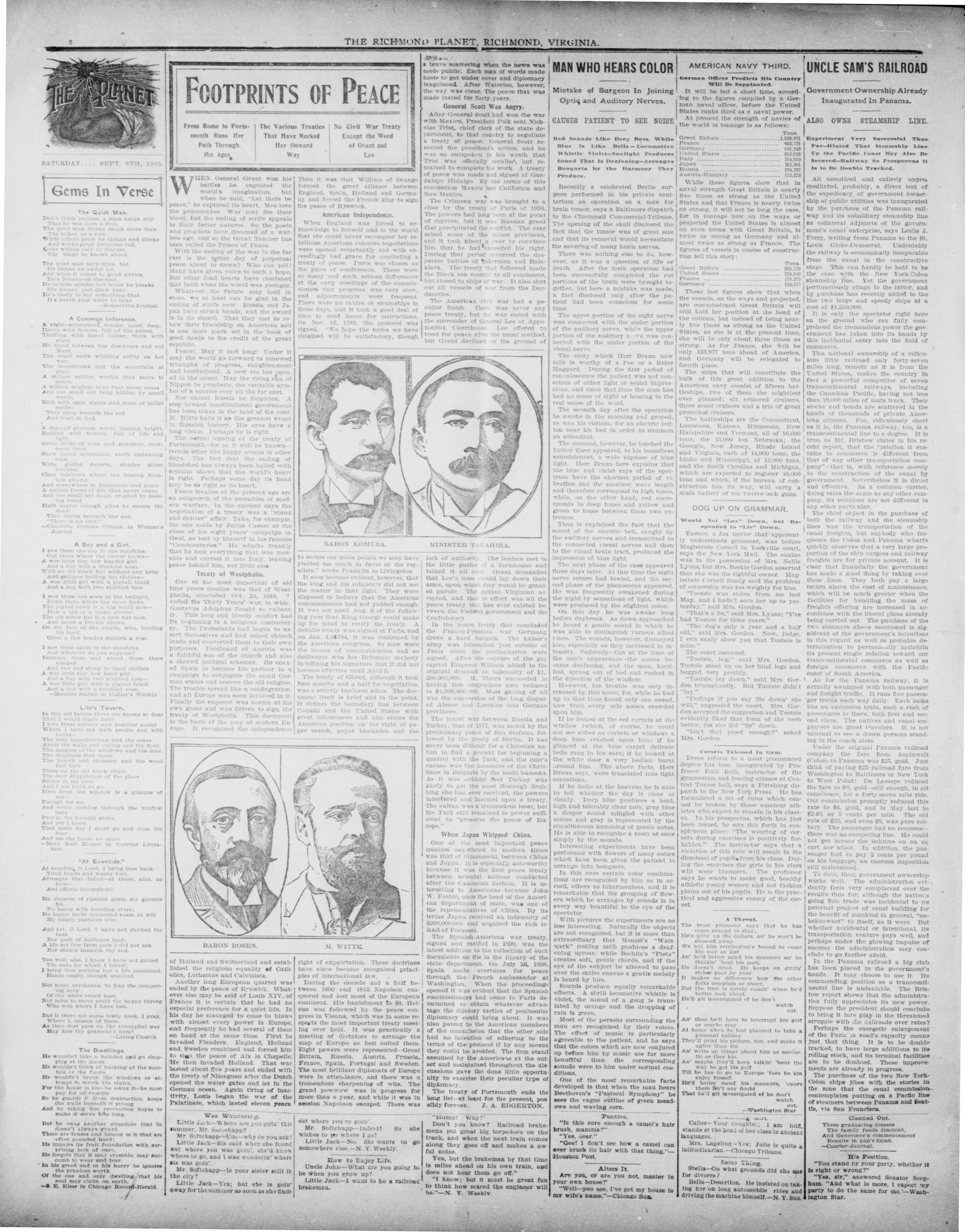
BARON ROSEN.
Was Wondering
Then it was that William of Orange formed the great alliance between England, Spain, Holland and Germany and forced the French king to sign the peace of Rywick.
American Independence.
When England was forced to acknowledge to herself and to the world that she could never reconquer her rebellious American colonies negotiations were opened reluctantly and with exceedingly bad grace for concluding a treaty of peace. Paris was chosen as the place of conference. There were so many and such serious differences at the early meetings of the commissioners that progress was very slow, and adjournments were frequent. There were no cables or steamships in those days, and it took a good deal of time to send home for instructions. On Nov. 13, 1782, the protocol was signed. "We hope the terms we have obtained will be satisfactory, though
```markdown
```
[Illustration of two men in formal attire, one with a mustache and the other with a full mustache. The man on the left has a full mustache and a bow tie, while the man on the right has a full mustache and a suit with a bow tie.]
to secure our main points we may have yielded too much in favor of the royalists," wrote Franklin to Livingston.
It soon became evident, however, that the king and his ministers did not see the matter in that light. They were disposed to believe that the American commissioners had not yielded enough. It was not until Aug. 6 of the following year that King George could make up his mind to ratify the treaty. A definite treaty was signed at Paris, and on Jan. 4, T84. It was confirmed by the American congress. So slow were the means of communication and so deliberate was his Britannic majesty in fixing his signature that it did not become effective until April 9.
The treaty of Ghent, although it took four months and a half for negotiation, was a strictly business affair. The document itself is brief and to the point. It defines the boundary line between Canada and the United States with great minuteness and also states the American position on the right of paper search, paper blockades and the
[Picture of a man with a long beard and a mustache, wearing a suit and a tie.]
right of expatriation. These doctrines have since become recognized principles of international law. During the decade and a half between 1800 and 1815 Napoleon conquered and lost most of the European continent. His banishment to St. Helena was followed by the peace congress in Vienna, which was in some respects the most important treaty meeting ever held. It was practically a meeting of dictators to arrange the map of Europe as best suited them. Eight powers were represented—Great Britain, Russia, Austria, Prussia, France, Spain, Portugal and Sweden. The most brilliant diplomats of Europe were in attendance, and there was a tremendous sharpening of wits. The grand powwow was in progress for more than a year, and while it was in session Napoleon escaped. There was
out where you're goin'.
Mr. Softchapp—Indeed! So she
wishes to go where I go?
Little Jack—No. She wants to go
somewhere else.—N. Y. Weekly.
How to Enjoy Life.
Uncle John—What are you going to
be when you grow up?
Little Jack—I want to be a railroad
brakeman.
THE RICHMOND PLANET. RICHMOND. VIRGINIA
No Civil War Treaty
Except the Word
of Grant and
Lee
American Independence.
BARON KOMURA.
M. WITTE
brave scattering when the news was made public. Each man of words made haste to get under cover and diplomacy languished. After Waterloo, however, the way was clear. The peace that was made lasted for forty years.
General Scott Was Angry.
After General Scott had won the war with Mexico, President Polk sent Nicholas Trist, chief clerk of the state department, to that country to negotiate a treaty of peace. General Scott represented the president's action, and he was so outspoken in his wrath that Trist was officially recalled, but remained to complete his work. A treaty of peace was made and signed at Guadalupe Hidalgo. By the terms of this convention Mexico lost California and New Mexico.
The Crimean war was brought to a close by the treaty of Paris of 1856. The powers had long been at the point of rupture, but it was Russian greed that precipitated the conflict. The czar seized some of the minor provinces, and it took about a year to convince him that he had exceeded his right. During that period occurred the desperate battles of Tinkerman and Balaikla. The treaty that followed made the Black sea neutral to all commerce, but closed to ships of war. It also shut out all vessels of war from the Dardanelles. The American civil war had a peculiar finish. There was never any peace treaty, but the war ended with the surrender of General Lee at Appomattox Courthouse. Lee offered to treat for peace after the usual method, but Grant declined on the ground of
G
lack of authority. The leaders met in the little parlor of a farmhouse and talked it all over. Grant demanded that Lee's men should lay down their arms, upon which they would be granted parole. The gallant Virginian accepted, and that in effect was all the peace treaty that has ever existed between the Federal government and the Confederacy.
In the peace treaty that concluded the Franco-Prussian war Germany drove a hard bargain. The kaiser's army was intrenched just outside of Paris when the preliminaries were signed. After the capture of the gay capital Emperor William added to the original demand an indemnity of $1,200,000,000. M. Thiers succeeded in having this stupendous sum reduced to $1,000,000,000. Most galling of all was the conversion of the long disputed Alsace and Lorraine into German provinces.
The latest war between Russia and Turkey, that of 1877, was ended by the preliminary peace of San Stefano, followed by the treaty of Berlin. It has never been difficult for a Christian nation to find a pretext for beginning a quarrel with the Turk, and the caesar's excuse was the massacre of the Christians in Bulgaria by the bashi bazouks. As it was evident that Turkey was likely to get the most thorough drubbing she hae not received, the powers interfered and insisted upon a treaty. The suitan was a tremendous loser, but the Turk still remained in power sufficient to "preserve the peace of Europe."
When Japan Whipped China.
One of the most important peace treaties negotiated in modern times was that of Simonosekl, between China and Japan. It is especially noteworthy because it was the first peace treaty between oriental nations conducted after the Caucasian fashion. It is interesting to Americans because John W. Foster, once the head of the American department of state, was one of the representatives of China. By its terms Japan received an indemnity of $200,000,000 and acquired the rich island of Formosa.
The Spanish-American war treaty, signed and ratified in 1899, was the latest addition to the collection of such documents on file in the library of the state department. On July 20, 1898, Spain made overtures for peace through the French ambassador at Washington. When the proceedings opened it was evident that the Spanish commissioners had come to Paris determined to obtain whatever advantage the dilatory tactics of peninsular diplomacy could bring about. It was also patent to the American members of the commission that the other side had no intention of adhering to the terms of the protocol if by any means they could be avoided. The firm stand assumed by the Americans at the outset and maintained throughout the discussions gave the dons little opportunity to exercise their peculiar type of diplomacy.
The treaty of Portsmouth ends the long list—at least for the present, possibly forever. J. A. EDGERTON.
Don't you know? Railroad brakemen put great big torpedoes on the track, and when the next train comes along they goes off and makes a awful noise.
Yes, but the brakeman by that time is miles ahead on his own train, and does not hear them go off."
"I know; but it must be great fun to think how scared the engineer will be."—N. Y. Weekly.
MAN WHO HEARS COLOR
MAN WHO HEARS COLOR
Mistake of Surgeon In Joining Optiq and Auditory Nerves.
CAUSES PATIENT TO SEE NOISE
Red Sounds Like Deep Bass, While Blue Is Like Bells—Locomotive Whistle Violet—Sunlight Produces Sound That Is Deafening—Arranges Bouquets by the Harmony They Produce.
Recently a celebrated Berlin surgeon performed in his private sanitarium an operation on a man for brain tumor, says a Baltimore dispatch to the Cincinnati Commercial-Tribune. The opening of the skull disclosed the fact that the tumor was of great size and that its removal would necessitate the severing of many brain nerves.
There was nothing else to do, however, as it was a question of life or death. After the main operation had been successfully completed the cut portions of the brain were brought together, but here a mistake was made, a fact disclosed only after the patient had been conscious for some time.
The upper portion of the sight nerve was connected with the under portion of the auditory nerve, while the upper portion of the auditory nerve was connected with the under portion of the visual nerve.
The story which Herr Braun now tells is worthy of a Poe or a Rider Haggard. During the first period of convalescence the patient was not conscious of either light or sound impressions, and since that time the man has had no sense of sight or hearing in the real sense of the word.
The seventh day after the operation he awoke in the morning and groped, as was his custom, for an electric button near his bed in order to summon an attendant. The moment, however, he touched the button there appeared, to his boundless astonishment, a wide expanse of blue light. Herr Braun here explains that the blue and violet rays of the spectrum have the shortest period of vibration and the smallest wave length and therefore correspond to high tones, while, on the other hand, red corresponds to deep tones and yellow and green to tones between these two extremes.
Thus is explained the fact that the sound of the electric bell, caught by the auditory nerves and transmitted to the connected visual nerves and then to the visual brain tract, produced the impression of blue light.
The next phase of the case appeared three days later. At this time the sight nerve suture had healed, and the second phase of the phenomena appeared. He was frequently awakened during the night by sensations of light, which were produced by the slightest noise.
On this day he was awake long before daybreak. As dawn approached he heard a gentle sound in which he was able to distinguish various allied tones. The sounds, however, dismayed him, especially as they increased in intensity. Suddenly—this at the time of the sun's appearance—the noises became deafening, and the man, horrified, spring out of bed and rushed in the direction of the window.
However, his trouble was only increased by this move, for, while he had up to that time heard only one sound, now from every side noises crowded upon him.
If he looked at the red curtain at the window (which, of course, he could not see either as curtain or window) a deep bass crashed upon him; if he glanced at the blue carpet delicate bells rang in his ears; if he looked at the white door a very bedlam burst around him. The above facts, Herr Braun says, were translated into light sensations.
If he looks at the heavens he is able to tell whether the day is clear or cloudy. Deep blue produces a loud, high and tolerably clear note, gray blue a deeper sound mingled with other noises and gray is represented by the simultaneous humming of gentle notes. He is able to recognize a room at once simply by the sounds.
Interesting experiments have been performed with flowers of many colors which have been given the patient to arrange into bouquets.
In this case certain color combinations are recognized by him as in accord, others as inharmonious, and it is remarkable that the grouping of flowers which he arranges by sounds is in every way beautiful to the eye of the spectator.
With pictures the experiments are no less interesting. Naturally the objects are not recognized, but it is more than extraordinary that Menzel's "Walzwerk" (rolling mill) produces a deafening uproar, while Bochlin's "Pleta" creates soft, gentle chords, and if the eye of the subject be allowed to pass over the entire canvas a gentle melody is heard by him.
Sounds produce equally remarkable effects. A shrill locomotive whistle is violet, the sound of a gong is translated by orange and the dropping of rain is green.
Most of the persons surrounding the man are recognized by their voices. The effect of music is particularly agreeable to the patient, and he says that the colors which are now conjured up before him by music are far more beautiful than the corresponding sounds were to him under normal conditions.
One of the most remarkable facts developed is that when the man hears Beethoven's "Pastoral Symphony" he sees the vague outline of green meadows and waving corn.
Puzzled.
"Is this sure enough a camel's hair brush, mamma?"
"Yes, dear."
"Gee! I don't see how a camel can ever brush its hair with that thing."—Houston Post.
Alters It.
Are you, or are you not, master in your own house?
"Well--you see, I've got my house in my wife's name."—Chicago Sun
AMERICAN NAVY THIRD.
German Officer Predicts His Country
Will Be Supplanted.
It will be but a short time, according to the figures compiled by a German naval officer, before the United States ranks third as a naval power.
At present the strength of navies of the world in tonnage is as follows:
Tons.
Great Britain 1,598,871
France 603,721
Germany 341,248
United States 318,523
Italy 254,510
Japan 362,861
Russia 254,637
Austria-Hungary 112,323
While these figures show that in naval strength Great Britain is nearly five times as strong as the United States and that France is nearly twice as strong, it will not be long the case, for in tonnage now on the ways or projected the United States is almost on even terms with Great Britain, is twice as strong as Germany and almost twice as strong as France. The figures of vessels in course of construction tell this story:
Tons.
Great Britain 330,123
United States 324,000
France 170,273
Germany 123,577
These last figures show that when the vessels, on the ways and projected, are commissioned Great Britain will still hold her position at the head of the column, but instead of being nearly five times as strong as the United States, as she is at the present time, she will be only about three times as strong. As for France, she will be only 133,977 tons ahead of America, and Germany will be relegated to fourth place.
The ships that will constitute the bulk of this great addition to the American navy consist of fifteen battleships, two of them the mightiest ever planned; six armored cruisers, three scout cruisers and a trio of great protected cruisers.
The battleships are the Connecticut, Louisiana, Kansas, Minnesota, New Hampshire and Vermont, all of 16,000 tons; the 15,000 ton Nebraska; the Georgia, New Jersey, Rhode Island and Virginia, each of 14,900 tons; the Idaho and Mississippi, of 13,000 tons, and the South Carolina and Michigan, which are expected to register 18,000 tons and which, if the bureau of construction has its way, will carry a main battery of ten twelve-inch guns.
DOG UP ON GRAMMAR
Would Not "Lay" Down, but Responded to "Lie" Down.
Tootsie, a fox terrier that apparently understands grammar, was before Magistrate Cornell in Yorkville court, says the New York Mall. The canine was in the possession of Mrs. Nellie Lyons, but Mrs. Beckle Gordon asserted that she was the rightful owner. Magistrate Cornell finally said the problem of ownership was too weighty for him.
"Tootsie was stolen from me last May, and I hadn't seen her up to yesterday," said Mrs. Gordon.
"That's a lie," said Mrs. Lyons; "I've had Tootsie for three years."
"The dog's only a year and a half old," said Mrs. Gordon. Now, judge, I can easily show you that Tootsie is mine.
The court assented.
"Tootsie, beg," said Mrs. Gordon. Tootsie stood up on her hind legs and begged very prettily.
"Tootsie, lay down," said Mrs. Gordon triumphantly. But Tootsie didn't "lay."
"Perhaps if you say 'lie down' she will," suggested the court. Mrs. Gordon accepted the suggestion and Tootsie evidently liked that form of the verb better, for she did "file" down. "Isn't that proof enough?" asked Mrs. Gordon.
Corsets Tahoeed In Gyr
Corsets Tabooed In Gym.
Dress reform to a most pronounced degree has been inaugurated by Professor Emil Rath, instructor of the gymnasium and fencing classes at Central Turner hall, says a Pittsburgh dispatch to the New York Press. He has formulated a set of rules which cannot be broken by those amateur athletes who expect to remain in his classes. In his prospectus, which has just been issued, he sets this forth in conspicuous place: "The wearing of corsets during exercises is positively forbidden." The instructor says that a violation of this rule will result in the dismissal of pupils from his class. During the exercises the girls in his class will wear bloomers. The professor says he wants to make good, healthy athletic young women and not fashion plates out of his pupils. He is the practical and aggressive enemy of the corset.
A. Threat.
The trust promoter says that he has come around to stay;
He's pillin' up the dollars, an' he won't be shoo-ed away.
He tell him retribution's bound to come his way at last
An' he look at his manners an' be thinkin' 'bout his past.
He doesn't mind. He keeps on gittin' richer year by year.
It makes no difference how the other folks complain or sheer.
But the time is surely comin' when he'd better talk about.
He'll git investigated if he don't watch out.
An' then he'll have to interrupt his goif or maybe stay
At home when he had planned to take a pleasant holiday.
They'll print his picture, too, and make it uglier than sin
An' write up things about him as sarcastic as they him.
An' maybe they'll keep talkin' 'bout the way he got his self
Till he has to go to Europe 'fore he kin enjoy bisself.
He'd better mend his manners, 'cause there isn't any doubt
That he'll git investigated if he don't watch out.
Caller—Your daughter; I am told, stands at the head of her class in ancient languages.
Mrs. Lapsling—Yes; Julie is quite a latitudinarian—Chicago Tribune.
Stella—On what grounds did she sue for divorce?
Bella—Desertion. He insisted on taking her on long automobile rides and driving the machine himself—N. X. Sun.
UNCLE SAM'S RAILROAD
Government Ownership Already Inaugurated In Panama.
Experiment Very Successful Thus Far-Hinted That Steamship Line Up the Pacific Coast May Also Be Secured-Railway So Prosperous It Is to Be Double Tracked.
All unnoticed and entirely unpremeditated, probably, a direct test of the expediency of government ownership of public utilities was inaugurated by the purchase of the Panama railway and its subsidiary steamship line as collateral adjuncts of the government's canal enterprise, says Leslie J. Perry, writing from Panama to the St. Louis Globe-Democrat. Undeniably the railway is economically inseparable from the canal in the constructive stage. This can hardly be held to be the case with the New York-Colon steamship line. Yet the government pertinaciously clings to the latter, and by purchase has recently added to the line two large and speedy ships at a cost of $1,350,000.
It is only the spectator right here on the ground who can fully comprehend the tremendous power the government has taken into its hands by this incidental entry into the field of commerce.
This national ownership of a ridiculous little railroad only forty-seven miles long, remote as it is from the United States, makes the country in fact a powerful competitor of seven transcontinental railways, including the Canadian Pacific, having not less than 18,000 miles of main track. Their stocks and bonds are scattered in the hands of thousands of private American citizens. For, ridiculously short as it is, the Panama railway, too, is a transcontinental line to a degree. It is true, as Mr. Bristow states in his recent report, that the "relation it sustains to commerce is different from that of any other transportation company"—that is, with reference merely to the construction of the canal by government. Nevertheless it is direct and effective. As a common carrier, fixing rates the same as any other company, its relations are not different in any other particular.
The chief object in the purchase of both the railway and the steamship lines was the transportation of the canal freights, but anybody who frequents the Colon and Panama wharfs quickly observes that a very large proportion of the ship cargoes and railway freights are for private account. It is clear that financially the government has made a good thing by taking over these lines. They both pay a large return above the cost of maintenance, which will be much greater when the facilities for handling the mass of freights offering are increased in accordance with the liberal plans already being carried out. The purchase of the two steamers above mentioned is significant of the government's intentions in this regard as well as probable determination to permanently maintain its present single relation toward our transcontinental commerce as well as foreign commerce with the Pacific coast of South America.
As for the Panama railway, it is actually swamped with both passenger and freight traffic. It runs five passenger trains each way daily. Each looks like an excursion train, such a rush of passengers is there, both first and second class. The natives and canal employees are great travelers. It is not unusual to see a dozen persons standing in the coach aisle.
Under the original Panama railroad company the fare from Aspinwall (Colon) to Panama was $25, gold. Just thinking of paying $25 railroad fare from Washington to Baltimore or New York to West Point! De Lesseps reduced the fare to $8, gold—still enough, in all conscience, for a forty-seven mile ride. Our commission promptly reduced this rate to $4, gold, and in May last to $2.40, or 5 cents per mile. The old rate of $25, and even $8, was pure robery. The passenger had no recourse—there was no competing line. He could not get across the isthmus on an ox cart nor afoot. In addition, the passenger had to pay 2 cents per pound on his baggage, an onerous imposition still maintained.
To date, then, government ownership works well. The administration evidently feels very complacent over the results thus far, although the nation's going into trade was incidental to its paternal project of canal building for the benefit of mankind in general, "unbeknownst" to itself, as it were. But whether accidental or intentional, its transportation venture pays well, and perhaps under the glowing impulse of success the administration may conclude to go farther afield.
In the Panama railroad a big club has been placed in the government's hands. It may choose to use it. Its commanding position as a transcontinental line is undeniable. The Bristow report shows that the administration fully appreciates its new power. Suppose the president should conclude to bring it into play in the threatened struggle with the railroads over rates? Perhaps the energetic enlargement of the Panama road's capacity means just that thing. It is to be double tracked, to have large additions to its rolling stock, and its terminal facilities are to be doubled. These improvements are already in progress. The purchase of the two New York-Colon ships jibes with the stories in the zone that the canal commission contemplates putting on a Pacific line of steamers between Panama and Seattle, via San Francisco.
Cleaned Out.
These graduating dresses
The family funds diminish,
And Genevieve's commencement
Results in pap's finish.
—Courier-Journal.
His Position.
"You stand by your party, whether it
is right or wrong?"
"Yes, sir," answered Senator Sorghum.
"And what is more, I expect my
party to do the same for me."—Washington Star.
Return of IERLOCK OLMES
7 A. CONAN DOYLE,
f "The Adventures of Sherlock Holmes"
round of the Baskervilles," The Sign
the Four," A Study In Scarlet," Ec.
a cigar, and the doctor has a prescription containing hot water and a lemon which is good medicine on a night like this. It must be something important which has brought you out in such a gale."
"It is indeed, Mr. Holmes. I've had a bustling afternoon, I promise you. Did you see anything of the Yoxley case in the latest editions?"
"I've seen nothing later than the fifteenth century today."
"Well, it was only a paragraph and all wrong at that, so you have not missed anything. I haven't let the grass grow under my feet. It's down in Kent, seven miles from Chatham and three from the railway line. I was wired for at 3:15, reached Yoxley Old Place at 5, conducted my investigation, was back at Charing Cross by the last train, and straight to you by cab."
"Which means, I suppose, that you are not quite clear about your case?"
"It means that I can make neither head nor tail of it. So far as I can see, it is just as tangled a business as ever I handled, and yet at first it seemed so simple that one couldn't go wrong. There's no motive, Mr. Holmes. That's what bothers me, I can't put my hand on a motive. Here's a man dead—there's no denying that—but, so far as I can see, no reason on earth why any one should wish him harm."
Holmes lit his cigar and leaned back in his chair.
"Let us hear about it," said he.
"I've got my facts pretty clear," said Stanley Hopkins. "All I want now is to know what they all mean. The story, so far as I can make it out, is like this: Some years ago this country house, Yoxley Old Place, was taken by an elderly man, who gave the name of Professor Coram. He was an invalid, keeping his bed half the time and the other half hobbling round the house with a stick or being pushed about the grounds by the gardener in a bath chair. He was well liked by the few neighbors who called upon him, and he has the reputation down there of being a very learned man. His household used to consist of an elderly housekeeper, Mrs. Marker, and of a malf, Susan Tariton. These have both been with him since his arrival, and they seem to be women of excellent character. The professor is writing a learned book, and he found it necessary about a year ago to engage
W UP AND WARM YOUR TOES."
Copyright by Collier's Weekly.
*NOW, MY DEAR HOPKINS, DRAW UP AND
Copyright by Collier's Weekly.
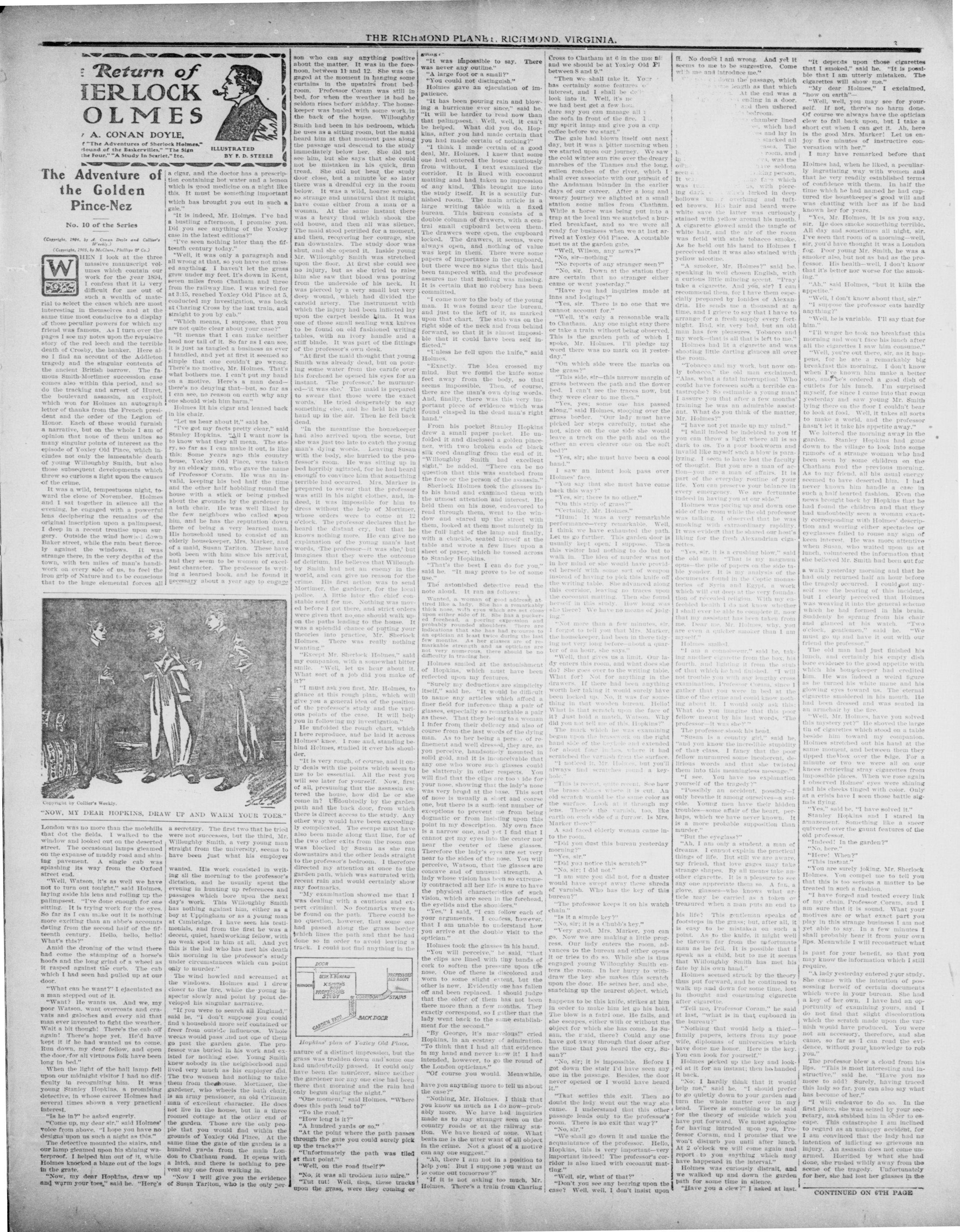
"NOW, MY DEAR HOPKINS, DRAW UP AND WARM YOUR TOES."
London was no more than the molehills that dot the fields. I walked to the window and looked out on the deserted street. The occasional lamps gleamed on the expanse of muddy road and shining pavement. A single cab was splashing its way from the Oxford street end.
"Well, Watson, it's as well we have not to turn out tonight," said Holmes, laying aside his lens and rolling up the palmsimpst. "I've done enough for one sitting. It is trying work for the eyes. So far as I can make out it is nothing more exciting than an abbe's accounts dating from the second half of the fifteenth century. Hello, hello, hello! What's this?"
Amid the droning of the wind there had come the stamping of a horse's hoofs and the long grind of a wheel as it rattled against the curb. The cab a secretary. The first two that he tried were not successes, but the third, Mr. Willoughby Smith, a very young man straight from the university, seems to have been just what his employer wanted. His work consisted in writing all the morning to the professor's dictation, and he usually spent the evening in hunting up references and passages which bore upon the next day's work. This Willoughby Smith has nothing against him, either as a boy at Uppingham or as a young man at Cambridge. I have seen his testimonials, and from the first he was a decent, quiet, hardworking fellow, with no weak spot in him at all. And yet this is the lad who has met his death this morning in the professor's study under circumstances which can point only to murder."
The wind howled and screamed at the windows. Holmes and I drew closer to the fire, while the young inspector slowly and point by point developed his singular narrative.
"If you were to search all England," said he, "I don't suppose you could find a household more self contained or freer from outside influences. Whole weeks would pass and not one of them go past the garden gate. The professor was buried in his work and existed for nothing else. Young Smith knew nobody in the neighborhood and lived very much as his employer did. The two women had nothing to take them from the house. Mortimer, the gardener, who wheels the bath chair, is an army pensioner, an old Crimean man of excellent character. He does not live in the house, but in a three roomed cottage at the other end of the garden. Those are the only people that you would find within the grounds of Yoxley Old Place. At the same time the gate of the garden is a hundred yards from the main London to Chartham road. It opens with a latch, and there is nothing to prevent any one from walking in.
"Now I will give you the evidence of Susan Taranton, who is the only per-
---
```markdown
```
The Adventure of the Golden Pince-Nez
No. 10 of the Series
(Copyright, 1904, by A. Conan Doyle and Collier's Weekly)
(Copyright, 1905, by McClure, Phillips & Co.)
HEN I look at the three massive manuscript volumes which contain our work for the year 1894.
I confess that it is very difficult for me out of such a wealth of mate-
W
rial to select the cases which are most interesting in themselves and at the same time most conducive to a display of those peculiar powers for which my friend was famous. As I turn over the pages I see my notes upon the repulsive story of the red leech and the terrible death of Crosby, the banker. Here also I find an account of the Addleton tragedy and the singular contents of the ancient British barrow. The famous Smith-Mortimer succession case comes also within this period, and so do the tracking and arrest of Huret, the boulevard assassin, an exploit which won for Holmes an autograph letter of thanks from the French president and the order of the Legion of Honor. Each of these would furnish a narrative, but on the whole I am of opinion that none of them unites so many singular points of interest as the episode of Yoxley Old Place, which includes not only the lamentable death of young Willoughby Smith, but also those subsequent developments which threw so curious a light upon the causes of the crime.
It was a wild, tempestuous night, toward the close of November. Holmes and I sat together in silence all the evening, he engaged with a powerful lens deciphering the remains of the original inscription upon a pallimpsest, I deep in a recent treatise upon surgery. Outside the wind howled down Baker street, while the rain beat fiercely against the windows. It was strange there, in the very depths of the town, with ten miles of man's handwork on every side of us, to feel the iron grip of Nature and to be conscious that to the huge elemental forces all
London was no more than the molehills that dot the fields. I walked to the window and looked out on the deserted street. The occasional lamps gleamed on the expanse of muddy road and shining pavement. A single cab was splashing its way from the Oxford street end.
"Well, Watson, it's as well we have not to turn out tonight," sald Holmes, laying aside his lens and rolling up the palmpests. "I've done enough for one sitting. It is trying work for the eyes. So far as I can make out it is nothing more exciting than an abbe's accounts dating from the second half of the fifteenth century. Hello, hello, hello! What's this?"
Amid the droning of the wind there had come the stamping of a horse's hoofs and the long grind of a wheel as it rasped against the curb. The cab which I had seen had pulled up at our door.
"What can he want?" I ejaculated as a man stepped out of it.
"Want? He wants us. And we, my poor Watson, want overcounts and cravats and galoches and every aid that man ever invented to fight the weather. Wait a bit thought! There's the cab off again! There's hope yet. He'd have kept it if he had wanted us to come. Run down, my dear fellow, and open the door, for all virtuous folk have been long in bed."
When the light of the hall lamp fell upon our midnight visitor I had no difficulty in recognizing him. It was young Stanley Hopkins, a promising detective, in whose career Holmes had several times shown a very practical interest.
"Is he in?" he asked eagerly.
"Come up, my dear slr," said Holmes voice from above. "I hope you have no designs upon us such a night as this."
The detective mounted the stairs, and our lamp gleamed upon his shining waterproof. I helped him out of it, while Holmes knocked a blaze out of the logs in the grate.
"Now, my dear Hopkins, draw up and warm your toes," said he. "He's
I
THE RICHMOND PLANE1. RICHMOND, VIRGINIA.
son who can say anything positive about the matter. It was in the forenoon, between 11 and 12. She was engaged at the moment in hanging some curtains in the upstairs front bedroom. Professor Coram was still in bed, for when the weather is bad he seldom rises before midday. The housekeeper was busied with some work in the back of the house. Willoughby Smith had been in his bedroom, which he uses as a sitting room, but the maid heard him at that moment pass along the passage and descent to the study immediately below her. She did not see him, but she says that she could not be mistaken in his quick, firm tread. She did not hear the study door close, but a minute or so later there was a dreadful cry in the room below. It was a wild, hoarse scream, so strange and unnatural that it might have come either from a man or a woman. At the same instant there was a heavy thud which shook the old house, and then all was silence. The maid stood petrified for a moment, and then, recovering her courage, she ran downstairs. The study door was shut, and she opened it. Inside young Mr. Willoughby Smith was stretched upon the floor. At first she could see no injury, but as she tried to raise him she saw that blood was pouring from the underside of his neck. It was pierced by a very small but very deep wound, which had divided the carotid artery. The instrument with which the injury had been inflicted lay upon the carpet beside him. It was one of those small sealing wax knives to be found on old fashioned writing tables, with an ivory handle and a stiff blade. It was part of the fittings of the professor's own desk.
"At first the maid thought that young Smith was already dead, but on pouring some water from the carafe over his forehead he opened his eyes for an instant. 'The professor,' he murmured—it was she.' The maid is prepared to swear that those were the exact words. He tried desperately to say something else, and he held his right hand up in the air. Then he fell back dead.
"In the meantime the housekeeper had also arrived upon the scene, but she was just too late to catch the young man's dying words. Leaving Susan with the body, she hurried to the professor's room. He was sitting up in bed horribly agitated, for he had heard enough to convince him that something terrible had occurred. Mrs. Marker is prepared to swear that the professor was still in his night clothes, and, indeed, it was impossible for him to dress without the help of Mortimer, whose orders were to come at 12 o'clock. The professor declares that he heard the distant cry, but that he knows nothing more. He can give no explanation of the young man's last words, 'The professor—it was she,' but imagines that they were the outcome of delirium. He believes that Willoughby Smith had not an enemy in the world, and can give no reason for the crime. His first action was to send Mortimer, the gardener, for the local police. A little later the chief constable sent for me. Nothing was moved before I got there, and strict orders were given that no one should walk up on the paths leading to the house. It was a splendid chance of putting your theories into practice, Mr. Sherlock Holmes. There was really nothing wanting."
"Except Mr. Sherlock Holmes," said my companion, with a somewhat bitter smile. "Well, let us hear about it. What sort of a job did you make of it?" "I must ask you first, Mr. Holmes, to glance at this rough plan, which will give you a general idea of the position of the professor's study and the various points of the case. It will help you in following my investigation." He unfolded the rough chart, which I here reproduce, and he laid it across Holmes' knee. I rose and, standing behind Holmes, studied it ever his shoulder.
"It is very rough, of course, and it only deals with the points which seem to me to be essential. All the rest you will see later for yourself. Now, first of all, presuming that the assassin entered the house, how did he or she come in? Undoubtedly by the garden path and the back door, from which there is direct access to the study. Any other way would have been exceedingly complicated. The escape must have also been made along that line, for of the two other exits from the room one was blocked by Susan as she ran downstairs and the other leads straight to the professor's bedroom. I therefore directed my attention at once to the garden path, which was saturated with recent rain and would certainly show any footmarks.
"My examination showed me that I was dealing with a cautious and expert criminal. No footmarks were to be found on the path. There could be no question, however, that some one had passed along the grass border which lines the path and that he had done so in order to avoid leaving a track. I could not find anything in the
DOOR
DIX K. BURIAU
X-SMITH'S
BODY
PROFESSORS
STUDY
CORRIDOR
STAIRS
GARDEN PATH
BACK DOOR
Hopkins' plan of Yoxley Old Place.
nature of a distinct impression, but the grass was trodden down and some one had undoubtedly passed. It could only have been the murderer, since neither the gardener nor any one else had been there that morning and the rain had only begun during the night."
"One moment," said Holmes. "Where does this path lead to?"
"To the road."
"How long is it?"
"A hundred yards or so."
"At the point where the path passes through the gate you could surely pick up the tracks?"
"Unfortunately the path was tiled at that point."
"Well, on the road itself?"
"No, it was all trodden into mire."
"Tut tut! Well, then, these tracks upon the grass, were they coming or
"It was impossible to say. There was never any outline." "A large foot or a small?" "You could not distinguish." Holmes gave an ejaculation of impatience. "It has been pouring rain and blowing a hurricane ever since," said he. "It will be harder to read now than that palimpsest. Well, well, it can't be helped. What did you do, Hopkins, after you had made certain that you had made certain of nothing?"
"I think I made certain of a good deal, Mr. Holmes. I knew that some one had entered the house cautiously from without. I next examined the corridor. It is lined with coconut matting and had taken no impression of any kind. This brought me into the study itself. It is a scantily furnished room. The main article is a large writing table with a fixed bureau. This bureau consists of a double column of drawers, with a central small cupboard between them. The drawers were open, the cupboard locked. The drawers, it seems, were always open, and nothing of value was kept in them. There were some papers of importance in the cupboard, but there were no signs that this had been tampered with, and the professor assures me that nothing was missing. It is certain that no robbery has been committed.
"I come now to the body of the young man. It was found near the bureau, and just to the left of it, as marked upon that chart. The stab was on the right side of the neck and from behind forward, so that it is almost impossible that it could have been self inflicted."
"Unless he fell upon the knife," said Holmes.
"Exactly. The idea crossed my mind. But we found the knife some feet away from the body, so that seems impossible. Then, of course, there are the man's own dying words. And, finally, there was this very important piece of evidence which was found clipped in the dead man's right hand."
From his pocket Stanley Hopkins drew a small paper packet. He unfolded it and disclosed a golden pince-nez, with two broken ends of black silk cord dangling from the end of it. "Willoughby Smith had excellent sight," he added. "There can be no question that this was snatched from the face or the person of the assassin." Sherlock Holmes took the glasses into his hand and examined them with the utmost attention and interest. He held them on his nose, endeavored to read through them, went to the window and stared up the street with them, looked at them most minutely in the full light of the lamp and finally, with a chuckle, seated himself at the table and wrote a few lines upon a sheet of paper, which he tossed across to Stanley Hopkins.
"That's the best I can do for you," said he. "It may prove to be of some use."
The astonished detective read the note aloud. It ran as follows:
Wanted, a woman of good address, attired like a lady. She has a remarkably thick nose, with eyes which are set close upon either side of it. She has a puckered forehead, a piercing expression and puffy cheeks. She has shoulders. There are indications that she had require an optician at least twice during the last few months. As her glasses are of remarkable strength and as opticians are not very numerous, there should be no difficulty in tracing her.
Holmes smiled at the astonishment of Hopkins, which must have been reflected upon my features.
"Surely my deductions are simplicity itself," said he. "It would be difficult to name any articles which afford a finer field for inference than a pair of glasses, especially so remarkable a pair as these. That they belong to a woman I infer from their delicacy and also of course from the last words of the dying man. As to her being a pers., of refinement and well dressed, they are, as you perceive, handsomely mounted in solid gold, and it is inconceivable that any one who wore such glasses could be slatternly in other respects. You will find that the clips are too iide for your nose, showing that the lady's nose was very broad at the base. This sort of nose is usually a short and coarse one, but there is a sufficient number of exceptions to prevent me from being dogmatic or from insisting upon this point in my description. My own face is a narrow one, and yet I find that I cannot get my eyes into the center nor near the center of these glasses. Therefore the lady's eyes are set very near to the sides of the nose. You will perceive, Watson, that the glasses are concave and of unusual strength. A lady whose vision has been so extremely contracted all her life is sure to have the physical characteristics of such vision, which are seen in the forehead, the eyelids and the shoulders."
"Yes," I said. "I can follow each of your arguments. I confess, however, that I am unable to understand how you arrive at the double visit to the optician."
Holmes took the glasses in his hand. "You will perceive," he said, "that the clips are lined with tiny bands of cork to soften the pressure upon the nose. One of these is discolored and worn to some slight extent, but the other is new. Evidently one has fallen off and been replaced. I should judge that the older of them has not been there more than a few months. They exactly correspond, so I gather that the lady went back to the same establishment for the second."
"By George, it's marvelous!" cried Hopkins, in an ecstasy of admiration. "To think that I had all that evidence in my hand and never knew it! I had intended, however, to go the round of the London opticians."
"Of course you would. Meannwhile."
have you anything more to tell us about the case?"
"Nothing, Mr. Holmes. I think that you know as much as I do now—probably more. We have had inquiries made as to any stranger seen on the country roads or at the railway station. We have heard of none. What beats me is the utter want of all object in the crime. Not a ghost of a motive can any one suggest."
"Ah, there I am not in a position to help you! But I suppose you want us to come out tomorrow?"
"If it is not asking too much, Mr. Holmes. There's a train from Charling
Cross to Chatham at 6 in the morning and we should be at Yokoyo Old Pl between 8 and 9."
"Then we shall take it. Your has certainly some features of interest, and I shall be deceived look into it. Well, it's ne we had best get a few hour. dare say you can manage all the sofa in front of the fire. I my spirit lamp and give you a cup coffee before we start."
The gale had blown itself out next day, but it was a bitter morning when we started upon our journey. We saw the cold winter sun rise over the dreary marshes of the Thames and the long, sulen reaches of the river, which I shall ever associate with our pursuit of the Andaman islander in the earlier days of our career. After a long and weary journey we alighted at a small station some miles from Chatham. While a horse was being put into a trap at the local inn we snatched a hurled breakfast, and so we were all ready for business when we at last arrived at Yoxley Old Place. A constable met us at the garden gate.
"Well, Wilson, any news?"
"No, sir—nothing."
"No reports of any stranger seen?"
"No, sir. Down at the station they are certain that no stranger either came or went yesterday."
"Have you had inquiries made at inns and lodgings?"
"Yes, sir. There is no one that we cannot account for."
"Well, it's only a reasonable walk to Chatham. Any one might stay there or take a train without being observed. This is the garden path of which I spoke, Mr. Holmes. I'll pledge my word there was no mark on it yesterday."
"On which side were the marks on the grass?"
"This side, sir—this narrow margin of grass between the path and the flower bed. I can't see the traces now, but they were clear to me then."
"Yes, yes; some one has passed along," said Holmes, stooping over the grass border. "Our lady must have picked her steps carefully, must she not, since on the one side she would have a track on the path and on the other an even clearer one on the soft bed?"
"Yes, sir; she must have been a cool hand."
I saw an intent look pass over Holmes' face.
"You say that she must have come back this way?"
"Yes, sir; there is no other."
"On this strip of grass?"
"Certainly, Mr. Holmes."
"Hunt! It was a very remarkable performance—very remarkable. Well, I think we have exhausted the path. Let us go farther. This garden door is usually kept open, I suppose. Then this visitor had nothing to do but to walk in. The idea of murder was not in her mind or she would have provided herself with some sort of weapon instead of having to pick this knife off the writing table. She advanced along this corridor, leaving no traces upon the cocoanut matting. Then she found herself in this study. How long was she there? We have no means of judging."
"Not more than a few minutes, sir, I forgot to tell you that Mrs. Marker, the housekeeper, had been in there tidying not very long before--about a quarter of an hour, she says."
"Well, that gives us a limit. Our lady enters this room, and what does she do? She goes over to the writing table, What for? Not for anything in the drawers. If there had been anything worth her taking it would surely have been locked up. No, it was for something in that wooden bureau. Hello! What is that scratch upon the face of it? Just hold a match, Watson. Why did you not tell me of this, Hopkins?"
The mark which he was examining began upon the brasswork on the right hand side of the keyhole and extended for about four inches, where it had scratched the varnish from the surface. "I noticed it, Mr. Holmes, but you'll always find scratches round a keyhole."
"This is recent, quite recent. See how the brass shines where it is cut. An old scratch would be the same color as the surface. Look at it through my lens. There's the varish, too, like earth on each side of a furrow. Is Mrs. Marker there."
A sad faced elderly woman came into the room.
"Did you dust this bureau yesterday morning?"
"Yes, sir."
"Did you notice this scratch?"
"No, sir; I did not."
"I am sure you did not, for a duster would have swept away these shreds of varnish. Who has the key of this bureau?"
"The professor keeps it on his watch chain."
"Is it a simple key?"
"No, sir; it is a Chubb's key."
"Very good. Mrs. Marker, you can go. Now we are making a little progress. Our lady enters the room, advances to the bureau and either opens it or tries to do so. While she is thus engaged young Willoughby Smith enters the room. In her hurry to withdraw the key she makes this scratch upon the door. He seizes her, and she, snatching up the nearest object, which
happens to be this knife, strikes at him in order to make him let go his hold. The blow is a fatal one. He falls, and she escapes, either with or without the object for which she has come. Is Susan, the raid, there? Could any one have got away through that door after the time that you heard the cry, Susan?
"No, sir; it is impossible. Before I got down the stair I'd have seen any one in the passage. Besides, the door never opened or I would have heard it."
"That settles this exit. Then no doubt the lady went out the way she came. I understand that this other passage leads only to the professor's room. There is no exit that way?"
"No, sir."
"We shall go down it and make the acquaintance of the professor. Hello, Hopkins, this is very important—very important indeed! The professor's corridor is also lined with cocoanut matting."
"Woll, sir, what of that?" Don't you see any being upon the casse. "I am."
ft. No doubt I am wrong. And yet it seems to me to be suggestive. Come with me and introduce me."
chamber lined
which had
and lay in
stacked all
cases. The
room, and
was the
have seldom
liking person,
the face which
with piece.
"A smoker, Mr. Holmes?" said he, speaking in well chosen English, with a curious little mincing account. "Pray, take a cigarette. And you, sir? I can recommend them, for I have them especially prepared by lionides of Alexandria. He sends me a thousand at a time, and I grieve to say that I have to arrange for a fresh supply every fortnight. Bad, sir, very bad, but an old man has few pleasures. Tobacco and my work—that is all that is left to me." Holmes had lit a cigarette and was shooting little darting glances all over the room.
"Tobacco and my work, but now only tobacco," the old man exclaimed. "Alas, what a fatal interruption! Who could have foreseen such a terrible catastrophe? So estimable a young man! I assure you that after a few months' training he was an admirable assistant. What do you think of the matter, Mr. Holmes?"
"I have not yet made up my mind." "I shall indeed be indebted to you if you can throw a light where all is so dark to us. To a poor bookworm and invalid like myself such a blow is paralyzing. I seem to have lost the faculty of thought. But you are a man of action—you are a man of affairs. It is part of the everyday routine of your life. You can preserve your balance in every emergency. We are fortunate indeed in having you at our side." Holmes was pacing up and down one side of the room while the old professor was talking. I observed that he was smoking with extraordinary rapidity. It was evident that he shared our host's liking for the fresh Alexandrian cigarettes.
"Yes, sir, it is a crushing blow," said the old man. "That is my magnum opus—the pile of papers on the side table yonder. It is my analysis of the documents found in the Coptic monasteries of Syria and Egypt, a work which will cut deep at the very foundation of revealed religion. With my enfeebled health I do not know whether I shall ever be able to complete it, now that my assistant has been taken from me. Dear me, Mr. Holmes, why, you are even a quicker smoker than I am myself."
"I am a connoisseur," said he, taking another cigarette from the box, his fourth, and lighting it from the stub of that which he had finished. "I will not trouble you with any lengthy cross examination, Professor Coram, since I gather that you were in bed at the time of the crime and could know nothing about it. I would only ask this: What do you imagine that this poor fellow meant by his last words, 'The professor—it was she?'
The professor shook his head.
"Susan is a country girl," said he, "and you know the incredible stupidity of that class. I fancy that the poor fellow murmured some incoherent, delirious words and that she twisted them into this meaningless message."
"I see. You have no explanation yourself of the tragedy?"
"Possibly an accident, possibly—I only breathe it among ourselves—a suicide. Young men have their hidden troubles—some affair of the heart, perhaps, which we have never known. It is a more probable supposition than murder."
"But the eyeglass?"
"Ah, I am only a student, a man of dreams. I cannot explain the practical things of life. But still we are aware, my friend, that love gages may take strange shapes. By all means take another cigarette. It is a pleasure to see any one appreciate them so. A fat, a glove, glasses—who knows what article may be carried as a token or treasured when a man puts an end to
his life? This gentleman speaks of footsteps in the grass; but, after all, it is easy to be mistaken on such a point. As to the knife, it might well be thrown far from the unfortunate man as he fell. It is possible that I speak as a child, but to me it seems that Willoughby Smith has met his fate by his own hand."
Holmes seemed struck by the theory thus put forward, and he continued to walk up and down for some time, lost in thought and consuming cigarette after cigarette.
"Tell me, Professor Coram," he said at last, "what is in that cupboard in the bureau?"
"Nothing that would help a thief—family papers, letters from my poor wife, diplomas of universities which have done me honor. Here is the key. You can look for yourself."
Holmes picked up the key and looked at it for an instant; then he handed it back.
"No; I hardly think that it would help me," said he. "I should prefer to go quietly to your garden and turn the whole matter over in my head. There is something to be said for the theory of suicide which you have put forward. We must apologize for having intruded upon you, Professor Coram, and I promise that we won't disturb you until after lunch. At 2 o'clock we will come again and report to you anything which may have happened in the interval."
Holmes was curiously distract, and we walked up and down the garden path for some time in silence.
"Have you a clew?" I asked at last.
"It depends upon those cigarettes that I smoked," said he. "It is possible that I am utterly mistaken. The cigarettes will show me."
"My dear Holmes," I excalmed, "how on earth."
"Well, well, you may see for yourself. If not, there's no harm done. Of course we always have the optician clew to fall back upon, but I take a short cut when I can get it. Ah, here is the good Mrs. Marker! Let us enjoy five minutes of instructive conversation with her."
I may have remarked before that Holmes had, when he liked, a peculiarly ingratiating way with women and that he very readily established terms of confidence with them. In half the time which he had named he had captured the housekeeper's good will and was chatting with her as if he had known her for years.
"Yes, Mr. Holmes, it is as you say, sir. He does smoke something terrible. All day and sometimes all night, sir. I've seen that room of a morning—well, sir, you'd have thought it was a London fog. Poor young Mr. Smith, he was a smoker also, but not as bad as the professor. His health—well, I don't know that it's better nor worse for the smoking."
"Ah," said Holmes, "but it kills the appetite."
"Well, I don't know about that, sir."
"I suppose the professor eats hardly anything?"
"Well, he is variable. I'll say that for him."
"I'll wager he took no breakfast this morning and won't face his lunch after all the cigarettes I saw him consume."
"Well, you're out there, sir, as it happens, for he ate a remarkably big breakfast this morning. I don't know when I've known him make a better one, and he's ordered a good dish of cutlets for his lunch. I'm surprised myself, for since I came into that room yesterday and saw young Mr. Smith lying there on the floor I couldn't bear to look at food. Well, it takes all sorts to make a world, and the professor hasn't let it take his appetite away."
We loitered the morning away in the garden. Stanley Hopkins had gone down to the village to look into some rumors of a strange woman who had been seen by some children on the Chatham road the previous morning. As to my friend, all his usual energy seemed to have deserted him. I had never known him handle a case in such a half hearted fashion. Even the news brought back by Hopkins that he had found the children and that they had undoubtedly seen a woman exactly corresponding with Holmes' description and wearing either spectacles or eyeglasses failed to rouse any sign of keen interest. He was more attentive when Susan, who waited upon us at lunch, volunteered the information that she believed Mr. Smith had been out for
a walk yesterday morning and that he had only returned half an hour before the tragedy occurred. I could not myself see the bearing of this incident, but I clearly perceived that Holmes was weaving it into the general scheme which he had formed in his brain. Suddenly he sprang from his chair and glanced at his watch. "Two o'clock, gentlemen," said he. "We must go up and have it out with our friend the professor."
The old man had just finished his lunch, and certainly his empty dish bore evidence to the good appetite with which his boudkeeper had credited him. He was indeed a weird figure as he turned his white mane and his glowing eyes toward us. The eternal cigarette smoldered in his mouth. He had been dressed and was seated in an armchair by the fire.
"Well, Mr. Holmes, have you solved this mystery yet?" He shoved the large tin of cigarettes which stood on a table beside him toward my companion. Holmes stretched out his hand at the same moment, and between them they tipped the box over the edge. For a minute or two we were all on our knees retrieving stray cigarettes from impossible places. When we rose again I observed Holmes' eyes were shining and his cheeks tinged with color. Only at a crises have I seen those battle signals flying.
"Yes," said he, "I have solved it." Stanley Hopkins and I stared in amazement. Something like a sneer quivered over the gaunt features of the old professor.
"Indeed! In the garden?"
"No, here."
"Here! When?"
"Here! When?"
"This instant."
"You are surely joking, Mr. Sherlock Holmes. You compel me to tell you that this is too serious a matter to be treated in such a fashion.
"I have forged and tested every link of my chain, Professor Coram, and I am sure that it is sound. What your motives are or what exact part you play in this strange business I am not yet able to say. In a few minutes I shall probably hear it from your own lips. Meanwhile I will reconstruct what is past for your benefit, so that you may know the information which I still require.
"A lady yesterday entered your study. She came with the intention of possessing herself of certain documents which were in your bureau. She had a key of her own. I have had an opportunity of examining yours, and I do not find that slight discoloration which the scratch made upon the varnish would have produced. You were not an accessory, therefore, and she came, so far as I can read the evidence, without your knowledge to rob you."
The professor blew a cloud from his lips. "This is most interesting and instructive," said he. "Have you no more to add? Surely, having traced this lady so far, you can also say what has become of her."
"I will endeavor to do so. In the first place, she was seized by your secretary, and stabbed him in order to escape. This catastrophe I am inclined to regard as an unhappy accident, for I am convinced that the lady had no intention of inflicting so grievous an injury. An assassin does not come unarmed. Horrified by what she had done, she rushed wildly away from the scene of the tragedy. Unfortunately for her, she had lost her glasses in the
CONTINUED ON 6TH PAGE
THE PLANET
Published every Saturday by JOHN MITCHELL
Jn., at 011 north 4th street, Richmond, n
All communications intended for publication should be sent so as to reach us by Wednesday.
TERMS IN ADVANCE
ADVERTISING RATES
REGISTERED LETTER—If a money Order Post-Office or an Express Office is not within the posted address, the Post-Office should register the Letter you wish to use on payment of the cents. Then, if the letter is lost or stolen, you must pay it out, but can send money in this manner if possible.
We cannot be responsible for money sent in letters in any other way than one of the four ways mentioned above. If you send your money in the other way, you must do it as your own risk.
REWARDS, ETA: If you do not want THE PLANET continued for another year after your money is sent, you should封存 it. The courts have decided that subscribers to newspaper, who do not send money for publication of time for which it has been paid, are held liable for the payment of the subscription. When they order the paper discontinued.
COMMUNICATIONS—When writing to us to renew your subscription or to discontinue your subscription, give your name and address in full otherwise we cannot find your name on our books.
CHANGE OF ADDRESS—In order to change the Post-Office address, we must be sent the former as well as the present address.
Entered at the Post-Office at Richmond, Va.,
as second-class matter.
SATURDAY... SEPT. 9TH. 1905
THE NEGRO."
---
Rev. Thomas Dixon, Jr., author of "The Leopard's Spots" seems never to tire in his attacks upon a practically defenseless people and his bitter attack upon us through the columns of the widely read "Saturday Evening Post" of Philadelphia was as unjust as it was uncalled for. He says:—
Education is the development of that which is. The Negro has held the Cobinent of Africa since the dawn of history, crunching acres of diamonds beneath his feet. Yet he never picked one up from the dust until a white man showed to him its light. His land swarmed with powerful and docile animals, yet he nev built a harness, cart or sled. A hunter by necessity, he never made an ax, spear or arrowhead worth preserving beyond the moment of its use. In a land of stone and timber, he never carved a block, sawed a foot of lumber or built a house save of broken sticks and mud, and for four thousand years he gazed upon the sea yet never dreamed a sail.
The above lines are from the pen of a white gentleman, who parades himself to the educational world as the friend of the Negro. He is the same kind of friend that a lawyer would be who would advocate the hanging of his client. To be a hypocrite is to be akin to a traitor and the world despises both. He would link the civilized Negro of America with the uncivilized one of Africa. And yet it is evident that he has not read African history, neither has he paid any attention to the testimony of the missionaries who have lived amongst the tribes of that so-called benighted land.
It is now known and admitted that tribes in Africa are in a state of civilization. They have their own courts. They weave cloth and use metal as a means of barter and exchange. Their intelligence is not to be despised and their courage is not to be questioned. History records this fact that every race has had its age of intellectual repose as well as its dawn of a more advanced civilization.
Nations rise and fall; they blossom and wither like the rose. There was a time when Rome looked upon Britain even as this distinguished theologian regards the African of to-day. Now all this is changed. Spain was,—what is she to-day? Greece was,—what is she to-day? Italy was,—what is she today?
The story is soon told in the "Rise and Fail of Nations." A few years ago, Japan was regarded with con-
tempt and spoken of in derision. To-day she stands forth as one of the greatest powers on the Eastern Hemisphere. Her achievements on land and sea have paled even the greatest achievements of the greatest warriors of the world. There are hordes of inhabitants living on the steppes of Russia that have no more civilization than some of the most degenerate tribes of Africa. And yet the Egyptians are Africans and the Moors are Africans and the Abyssinians are Africans. Rev. Dixon will be quick to charge up their accomplishments and achievements to the white race and he will no doubt find the history of the white man to sustain him.
Still biblical history tells of the sun done condition of the white race extending through periods of thousands of years. This showing is sustained also by profane history as well. It is no sign of greatness to belittle that race of people who may be cast down. On the other hand it has been demonstrated to be the work of small minds. But why discuss this phase of the subject further? He makes this fling at the dead over the shoulders of the living when he says:
Who is the greatest Negro that ever lived according to Mr. Booker T. Washington? Through all his books he speaks this man's name with bated breath and uncovered head—"Frederick Douglass of saint ed memory!" And what did Saint Frederick do? Spent a life in bombastic viveration of the men whose genius created the American Republic, wore himself out finally drawing his salary as a Federal office-holder, and at last achieved the climax of Negro sainthood by marrying a white woman!
Rev. Dixon evidently never read with care the life of Douglass, or if he did has purposely forgotten some of the most striking instances of his truly remarkable career. He went from the slave pen to the palace and his oratory and scholarship was the wonder of the civilized world. No man did more to sound the death knell of slavery than did Douglass and had he done naught else, his fame would have been secure.
That he married a white woman implies that a white woman married him and we cannot see that any more blame should attach to the husband than should attach to the wife. Certainly he chose the honorable course and conformed to the rules of civilized society. His Negro blood was uppermost in his youthful days when he married a colored woman and his white blood was uppermost in his old age when he married a white one.
It is needless to say that we admire the judgement of his youth white not condemning the choice of his maturer years. It was a personal matter with which we had not to do and we respect the sanctity of a man's matrimonial choice as much as we do the privacy of his home. But enough of that.
It will be well for our readers to ponder the following utterances, remembering that the author of them has proclaimed himself to be the friend of the Negro, whom he ridicules, vilifies and abuses:—
I repeat, education is the development of that which is. Behold the man whom the rags of slavery once concealed—nine millions strong! This creature, with a racial record of four thousand years of incapacity, half-child, half-animal the sport of impulse, whim and conceit, pleased with a rattle, tickled with a straw, a being who, left to his will, roams at night and sleeps in the day, whose native tongue has framed no word of love, whose passions once aroused are as the tiger's—equality is the law of our life!—when he is educated and ceases to fill his useful sphere as ser vant and peasant, what are you going to do with him?
Rev. Dixon should know that after a person is educated, be he Negro or white man, he should know what to do with himself. The proper education is designed to raise him from the stage of helplessness and to enable him to think and to act for himself.
Rev. Dixon says further:—
The second big fact which confronts the thoughtful, patriotic American is that the greatest calamity which could possibly befall this Republic would be the corruption of our national character by the assimilation of the Negro race. I have never seen a white man of any brains who disputes this fact. I have never seen a Negro of any capacity who did not deny it.
Rev. Dixon has limited his enquiry upon this all-important question to a narrow area and to few men of both races. Certain it is a fact that radical opinions are entertained on both sides of this question by both races. The way white men are marrying Negro women in the North and degrading Negro ones in the South, it seems to us that there are thousands of them, who take issue with Rev. Dixon relative to the great calamity which will befall the nation as a result of such legal and illegal co-habitations.
Rev. Dixon displays his venom when he says:
One thought I would burn into the soul of every young American (and who thinks of a Negro when he says "American?")—this: Our Republic is great not by reason of the amount of dirt we possess, or the size of our census roll, but because
RICHMOND PLANET, RICHMOND, VIRGINIA
of the genius of the race of pioneer white freemen who settled this continent, dared the might of kings, and blazed the way through our wilderness for the trembling feet of liberty.
The above is an appeal to passion, of a kind, unworthy of the expounder of the religion of the good and lowly Jesus. Surely this pulpiteer has forgotten all of his early training and has decided to continue the use of "the livery of heaven to serve the Devil in."
The Negro is not an American. He would blot it out of the Constitution of the United States. He would send us out of the country. He would do anything to rid this country of the ever-present evidence of its sin. But enough for this week. We shall deal further in our next issue with this remarkable ebullition of humanity, this new creature, this expounder of religion, this true "friend of the Negro" and the white man.
ROBERT BAGON
SUCCEEDS LOOMIS
New York Banker Appointed Assistant Secretary of State.
TO TAKE OFFICE IN OCTOBER
Oyster Bay, N. Y., Sept. 5.—President Roosevelt announced officially the appointment of Robert Bacon, of New York, to be first assistant secretary of state to succeed Francis B. Loomis.
The announcement was accompanied by a statement that Mr. Bacon would not assume the duties of his office for some time, perhaps not until about the middle of October, after Secretary Root and become settled in the office of secretary of state.
Mr. Loomis' resignation has been practically in the hands of President Roosevelt for several months. His desire to retire from the office of assistant secretary was known to the president at the conclusion of the Bowen-Loomis inquiry, which resulted in the forced retirement of Minister Bowen from the diplomatic service. The death of John Hay made it necessary for the president to select not only a secretary of state, but also a first assistant secretary who would be acceptable to the chief of the department. Practically immediately upon the acceptance by Elijah Root of the office of secretary of state he and the president determined upon the appointment of Mr. Bacon as assistant secretary.
For years Robert Bacon has been an important factor in the business equation of New York. Until within comparatively recent months he was a junior partner in the banking house of J. P. Morgan & Co. At the time of the settlement by President Roosevelt of the anthracite coal strike, Mr. Bacron represented Mr. Morgan in two conferences in Washington which made for an amicable adjustment of the trouble. Subsequently, when Mr. Bacron retired from the firm of J. P. Morgan & Co., the president determined to utilize his services if a suitable place for him could be found. Mr. Bacon was here as a guest of the President and Mrs. Roosevelt at luncheon.
It is expected that Mr. Loomis will relinquish his office in a short time and that his resignation will take effect at the conclusion of a leave of absence which he proposes to take. No statement is made concerning his possible future in official life, but, as heretofore noted in these dispatches his appointment to an important diplomatic post is problematic.
BURIED UNDER FALLING WALL
Seven Workmen Seriously Injured at Wilkes-Barre, Pa.
Wilkes-Barre, Pa. Sept. 6.—A serious accident occurred here at a new brewery being erupted for the Luzerne County Brewing company on Pennsylvania avenue. The third floor wall of the big structure collapsed and buried beneath the stone and blocks seven workmen, of whom three or four of the victims are thought to be fatally injured. The noise of the collapse was heard 'some blocks away, and the scene of the accident was soon rounded by a thousand or more persons. From the crowd a rescuing party of 40 persons was hurriedly organized and the work of removing the debris was quickly accomplished.
The injured are: James Hogan, Miners Mills, serious injury on head and back; James Clark, Scranton, both legs broken, skull fractured, may die; Leon Llewellyn, Parsons, legs broken fatally injured; Edward Llewellyn Parsons, head and body crushed, in a serious condition; Edward Durkin Parsons, cut about face and body, internally injured; Michael Surizer Brookside, skull fractured; Michael Linewiski, Brookside, internally injured, bruised about head and leg broken.
The cause of the accident has not as yet been determined.
TWO KILLED IN AUTO ACCIDENT
Machine Hit Bridge, Throwing Occu
pants 30 feet to Railway Tracks.
Philadelphia, Sept. 6. — While en route from Atlantic City to Philadelphia in an automobile, Neill Wolfe, secretary and treasurer of an automobile company of this city, and Miss Marie Hamill, daughter of a wealthy Germantown shoddy manufacturer, were thrown from an automobile on a bridge over the West Jersey & Shore railroad near Atco, N. J., and hurled 30 feet to the tracks below. Miss Hamill was almost instantly killed and Mr. Wolfe died soon after. The accident was witnessed by Dr. T. J. Martin and his wife, of Buffalo, who were in another machine a short distance behind the ill-fated car. Dr. Martin hurried to the aid of the vic.
tims, but could do nothing for them.
The car occupied by Mr. Wolfe and Miss Hamill was driven by F. G. Plummer. He was taken into custody and arraigned before Prosecutor Lloyd, in Camden N. J., who discharged him after hearing his statement. The accident was due to defective steering gear.
Mr. Wolfe and Miss Hamill were to have been married in December.
Decapitated Ex An Engine
Altona Pa., Sept 5 — Dominick Bocanto, aged 20, an Italian track hand, employed by the Pennsylvania railroad, had his head ground off by an engine in the railroad yard, and Marcell Tebora had his right arm cut off at the same time. They stepped out of the way of one engine into the path of another.
A WEEK'S NEWS CONDENSED
Luke Sanudera, 62 years old, was run ever and killed by a heavily loaded brick cart at Chester, Pa.
Major General Leonard Wood and Mrs. Wood sailed from New York on their way to the Philippines.
Edward R. Ladew, one of the most prominent leather manufacturers in the United States, died at Glen Cove, I., I.
The United States collier Marcellus, which wont aground near Baltimore was floated and was apparently uninjured.
The next meeting of the Southern Educational Association is to be held jointly with the Association of Colleges in Nashville, Teen., November 22-25.
Friday. September 1.
Fire destroyed the White Pine Lumber company's mill at Priest river, Idaho causing $275,000 loss.
Jordan Davis has been convicted of eavesdropping at Raleigh, N. C., the first offense of the kind tried in the state.
Juliet Fox, 17 years, old, and Frank Osz, of South Bethlehem, Pa., on the way to New York to be married, were arrested by order of the girl's father.
The new 16,000 ton battleship Vermont was launched at the Fore River Shipbuilding company's shipyard at Quincy, Mass.
Jacob Mouller, former consul general to Frankfort-on-the-Main, under President Cleveland, died at Cleveland O., aged 83 years.
Saturday, September 2.
Charles Dewey, brother of Admiral Dewey, died at Montpellier, Vt., aged 79 years.
In a railway accident at Witham England, 10 persons were killed and 20 injured.
The tannery plant of Henry Holliager, Columbia, Pa., was destroyed by fire, entailing a loss of $90,000.
The United Mine Workers in Montana and Wyoming have accepted the present scale of wages for another year.
James H. Clark, a former partner of John D. Rockefeller in the oil business, died at Madison, O., aged 72 years.
Monday, September 4.
Thousands of dollars in damages was done to tobacco crops about Janesville Wis. by hail and wind.
Joseph P. Killebrew, of Tennessee has been appointed to tobacco expert on the department of agriculture.
Fully 20,000 persons have visited Yellowstone National Park this summer, breaking all previous records.
John Segush and John Felcher were killed by an explosion of gas in the Henry colliery of the Lehigh Valley Coal company, near Wilkes-Barre, Pa.
After chasing her recreent lovor Gottlieb Gille, 10,000 miles, Julia Wexler, from Austria, overtook him a Coplay Lehigh county, and forced him to marry her
Tuesday, September 5.
J. F. Caldwell, a wealthy stockman was murdered and robbed in his home at Mertor, Kan.
The Iowa Odd Fellows' Home at Mason City, Ia., was destroyed by fire causing a loss of $75,000.
Tired of life, W. A. Lewis, aged 66 years hanged himself to a tree along a public road nea Chester, Pa.
Frank Smith, a 16-year-old boy, was drowned while crossing a swollen creek at Eckley, near Chester, Pa.
The newly completed $5,000 labor Temple at Seattle, Wash., was dedicated, following the largest labor pa rade ever seen there.
Wednesday, September 6.
An epidemic of typhoid fever pre valls at Nanticoke, Pa., over 100 cases having been reported.
Two persons were killed and 13 injured by a trolley car crash into a tree at Charlton, Mass.
Fire destroyed one of the finest business blocks of Madisonville, Ky., entailing a loss of $200,000.
Dr. William M. Late, a prominent physician of Bridgeport, W. Va., died at Bordentown, N. L., while on a visit Hezekiah Butterworth, the well-known author and historian, died of diabetes, aged 75 years, at Warren R. I.
Thomas Jordan, formerly one of the wealthiest cottlemen in the Indian Territory, is accused of having turned bank robber to get money which he asserts was due him.
PRODUCE QUOTATIONS
The Latest Closing Prices In the Principal Markets
PHILADELPHIA—FLOUR steady,
winter extras, $3.19 to $3.25, Pennsylvania
nailer roller, clear, $3.60 to $3.75, city mills
fancy $1.50, RYE FLOUR steady,
per barrel, $4.20, WHEAT firm; No
Pennsylvania red, new, $28; $28$29
cooler firm; no cooler local 62-
OATS firm; No 2 white lower
lower grades, $26, HAY firm; No
1 timothy, $14.50, PORK firm; family
17. BEEF firm; beef hams, $23@24
POULTRY Live steady; hens, 14c-
old roosters, $@9.25 Dressed steady,
choice fowls, 15c; old roosters 15c
fowls; old roosters 15c
fowls; New York and Pennsylvania 2
@25c per dozen, POTATOES steady
per bushel, $5.00
BALTNORE--WHEAT steady; No. 2 red, 75% @ 79%c; steamer No. 2 spot, 75% @ 72%c; southern, 70 @ 75%CORN sales; mix: 50% @ 59%c; southern, 55 @ 58%c OATS steady; white, 4 @ 27%c; mixed, No. 2 27%c; No. 2 27%c; No. 4, 26 @ 28c; BUTTER firm, creamy separator extras, 2 @ 22%c; held, 20%c; prints, 23 @ 21%c Pennsylvania, 21 @ 21%c Virginia and West, Virginia, 2 @ 21c southern, 18 @ 19c
PRESIDENT OUSTS PUBLIC PRINTER
Mr. Roosevelt Demanded Resignation of F. W. Palmer.
WILL REORGANIZE THE OFFICE
Washington, Sept. 6. — Public Printer P. W. Palmer practically has been ousted from office. It was learned authoritatively that the president had demanded Mr. Palmer's resignation, to take effect on the 15th inst. The demand of the president for Mr. Palmer's resignation was due primarily to the latter's action in trying to force Oscar J. Ricketts, foreman of printing, and L. C. Hay, a foreman of division, out of the government printing office Mr. Palmer naked for the resignations of Ricketts and Hay on the ground that they had been insubordinate. The public printer formulated a series of charges against the two men. These charges, it is known, were forwarded to Oyster Bey. As soon as President Roosevelt learned of the situation that had developed, he directed Public Printer Palmer to forward to him his resignation to take effect in two weeks.
The investigation made by the Keep commission into the letting of a contract for 72 Lanston type-setting machines for use in the government printing office disclosed a serious condition of affairs in the management of the office. Prominent men in the office force were divided into cliques. These cliques were so detrimental to the interests of use in the government that the standard of efficiency in the establishment was reduced materially.
The evidence adduced by the commission in the course of its inquiry created much bitter feeling among the men holding high positions in the office. One of the direct results of this feeling was the demand by Public Printer Palmer for the resignation of Rickettts and Hay. As the Keep commission inquiry, so far as known, developed nothing to the disadvantage of Rickettts or Hay, the president acted promptly in taking the whole matter out of Palmer's hands and placing it in the hands of the Keep commission for such further investigation as might be necessary. Compiled with this action of the president was the demand or Mr. Palmer for his resignation.
With the incoming of Mr. Palmer's successor—and there is ample authority for the statement that he has not been selected yet—it is expected thorough reorganization of the working force of the government printings office will take place. The office pays a salary of $4500 a year. The annual disbursements for the government printing office aggregate about $7,000,000.
OLEO TRUST HIT HARD
Profitable Law Breaking Stopped Pending Trials at Court.
Pittsburg, Pa., Sept. 4.—The most sweeping and significant victory won in recent years in the prosecution of rich dealers in oleoemargarine, who backed by the packers' trust in Chicago, have been hard to reach with any permanent effect, came through an injunction granted in this city. Judge Kennedy, in quarter sessions court, signed decrees restraining 21 accused dealers in oleoemargarine from further selling that commodity in this county. It has been the practice of those dealers in oleoemargarine here to go ahead selling after the indictment has been found, and it often happens that many months elapse before the case is reached, and in the meantime the profitable offense is continued. But this injunction prevents any further sale of the oleoemargarine pending the disposition of the cases already brought for the offense.
Consequently it was a jubilant telegram which Lawyer H. W. McIntosh attorney for Dr. B. H. Warren, sent to the latter as head of the state pure food department, follows:
"Rule absolute in 12 injunction proceedings. Twenty-one defendants sent to $160 each and costs, marking injunction permanent in all cases Agent Banzhoff remains here to clean up the work."
Bishop Spalding Has Reload4
Peoria, Ill., Sept. 6—Bishop John L. Spalding, of the diocese of Peoria, has suffered a relapse following his attack of paralysis three months ago. He has been in Lebanon, Ky., at his old home, for several weeks and telegrams received stated that his physicians and friends were alarmed at his condition. Stomach trouble, which was brought on by the first stroke of paralysis and which the doctors fear may cause another attack, is said to be the present difficulty.
Arranging Another Ocean Race.
Glassgow, Sept. 2—A newspaper here says that Emperor William is arranging for another trans-Atlantic yacht race, to be sailed in the summer of 1807.
1905 SEPTEMBER 1905
Su. Mo. Tu. We. Th. Fr. Sa.
1 2
3 4 5 6 7 8 9
10 11 12 13 14 15 16
17 18 19 20 21 22 23
24 25 26 27 28 29 30
How to Broil Fresh Mackerel.
In broiling fresh mackerel the clean fish, split it down the back and sprinkle with salt and lemon juice. Place it on a greased broiler and broil over a clear fire until the inside of the fish is white and the skin side is well browned. Open the broiler, leaving the skin side uppermost, put a platter over the fish and then invert and remove the broiler. Season with pepper, salt, butter and lemon juice.
The SPORTING WORLD
New Pitching Wonder.
Pitcher Renbach of the Chicago National league club is the latest base ball sensation. He is one of the great
1
PITCHER REULBACH OF CHICAGO NATIONAL LEAGUE.
est "finds" of recent years. He has tremendous speed and perfect control of his benders.
He shut out the heavy hitting New York Giants not long ago in Chicago. Had it not been for fielding errors he would have defeated them again shortly afterward in a ten inning game in New York. Reulbach formerly played in the Missouri Valley league.
Please Don't Make Large Bets!
Please Don't Make Large Bets!
The stewards of the Jockey club are so anxious not to give the enemies of racing a chance to plea a flaw or find fault in the way the sport is conducted that they have gone out of their way to ask the big turf operators to refrain from betting large sums of money on each race and to be moderate in their speculations.
It is known that the racing authorities have asked such plungers as John W. Gates, John A. Drake and others of that ilk to curtail their betting operations considerably.
The thing that the racing authorities most dread is publicity. They are afraid that if any of these big plungers gamble for high stakes the reports of such actions will be ventilated in the newspapers and that this may give rise to so much notoriety that it will cause unfavorable comment. They have asked that all sesquialongs be cut out for the good of the turf.
J. Davy has been operating very heavily of late in the Metropolitan ring. He is not known to the general racing public, but the bookmakers and the regular habitues of the track know him intimately. When Pittsburgh Phil was alive he was a great friend of that young plunger. Davy operates a book at various times.
Parachute Clay Pigeon.
Now that Hurlingham, England, has decided to give up pigeon shooting sportsmen are looking around for some new form of shooting that will afford good practice for the game preserves.
Mr. Watts, chairman of directors of the London Sporting park at Hendon, has invented a parachute clay pigeon which should form a good substitute for live pigeon shooting.
Inside the ordinary clay pigeon is placed the "parachute," a wad of organe worselt, to which is attached a lead weight. A round piece of cardboard is then pressed in to close it up. The dummy pigeon is fired at in the usual way, and directly a shot hits it it is shattered and the parachute falls to the ground, marking the exact place where the "pigeon" was hit.
Athletes Not Good Students
President William De Witt Hyde of Bowdow college, Brunswick, Me., in his annual report has presented statistics showing that the average rank of athletes at his college is 77.57 and of nonathletes 80.37. He declares that the fact that there is a difference of less than 3 per cent is "very welcome and satisfactory evidence that athletes at Bowdow are not a substitute for scholarship."
Query For Golf Managers
Why do some golf clubs persist in holding invitation tournaments instead of the usual open event? The reason is to keep down the field and at the same time have it high class. It's a noticeable fact, however, that practically the same fields compete in both.
A Poor Exchange
Manager Clark Griffith of New York gave Pitcher Harry Howell and $6,000 in cash for Jack Powell last season, and Howell has done by far the better work since.
Another Model Film
Jessie Pilot, dam of Newmarket, 2:25, by Pilot Medium, has foaled a chestnut filly by Mobel, 2:101. Mare and foal are owned by L. C. Webb. Mas. n. Mich.
Ames' Strike Out List
Red, Ames struck out ninety men in thirteen games early in the season. Ames is likely to beat Rube Waddell's record of 1903.
Money to Earn
President Charles H. Ebbets and
neuces that the Brooklyn club has
$15,000 to pay for good ball players
FURNISHING PIAZZAS
How to Make Them a Pleasure and Consistent Delight.
Of all parts of a house the piazza is the one devoted solely to rest and comfort, and it behooves the mistress of a country house to make the place attractive.
It wants green for restfulness, air for coolness and shade for the eyes from
the glare of the sun. Therefore the wise housekeeper will have seen to it that many vines are planted early. Falling this grateful shade, the screens of split bamboo are good, but the regular awnings are better, for no sunshine can penetrate them, they do not get out of order, and there is always plenty of air.
In case there are no vines and awnings are used the lady of the house will put plants all around in corners. The Boston fern set in the oxidized silver jardininess will give best satisfaction, as there is no color to detract from the harmony. They are made in all sizes, and some of them stand as high as one's head. With a fine Boston fern drooping over the edges, or a palm, or, in fact, anything green, they are very restful and pleasing to see. They are not hurt by wetting.
Small tables for work, strong chairs that can endure an occasional rain bath with a rug on the floor, a footstool or so and a few washable cushions will make a delightful retreat.
Many persons have wicker chairs, others bamboo or rustic ones, but those in demand just now are the dark green old fashioned furniture, with cushions of chintz to match or harmonize with the rest. Flowers should form the only point of color in the scheme beyond the greens and soft shades of the cushions.
Everything save the table covers and cushions is left on the plaza at night, and therefore it should be indestructible. Comfort first, last and always should be the keynote of plaza furnishing.
How to Keep Cool
If you would be well in warm weather heed the following rules, says the Rochester Herald:
Moderation in eating and drinking.
Pure air out of the house and within it.
Keep every vital organ in constant working order.
Take regular exercise every day in all weathers.
Sleep only from six to seven hours, going to bed early and rising early.
Daily baths, cold one day, warm the next.
Regular work and mental occupation.
Cultivate placidity, cheerfulness and hopefulness.
Control passion and nervous fear.
Strengthen the will in carrying out whatever is useful.
Check the craving for stimulants and anodynes.
How to Eat Fruit.
It is a mistaken idea that no fruit should be eaten at breakfast. Indeed, it would be far better if people would eat less bacon at breakfast and more fruit. The apple is one of the best fruits. Baked or stewed apples will generally agree with the most delicate digestion and are an excellent medicine in many cases of indisposition. Green or half ripe apples stewed and sweetened are pleasant to the taste, cooling and nourishing. Raw apples are better than liver pills. Oranges are very acceptable to most people, but the orange juice alone should be taken and the juice be reheated.
A Copy of a Letter from Jesus Christ.
That was written by his own hand and spoken by his own mouth.—will be sent prepaid to any address for only 5 cents. Don't fail to read this wonderful letter. Address,
W. G. OVERTON,
Wilburton, I. T.
8-19-4t
:0:
AGENTS WANTED—To sell a new book written by a Negro... Our book is entitled "Anthropology Applied to the American White Man and Negro." A dialogue between Mr. Jones, an ex-s slaveholder, and Sambo, an ex-slave, upon the problem of the two races.
WELLS & CO. BOOK CONCERN.
R. G. Wells, Manager,
Mr. Pleasant, Iowa
FARMERS NATIONAL CONGRESS
RICHMOND
SEPT. 12, 22,
1905
MIDDLE EAST
SEPT. 12, 22,
1905
Half rate via Southern Railway from all points south of the Potomac, East of the Mississippi and Ohio rivers for the above occasion. Special rate of one fare plus twenty-five cents from all points to Richmond and return will apply via Southern Railway. Tickets on sale Sept. 10th, 11th and 12th, with return Limit Sept. 25th.
Side Trips The Southern Railway will also sail side trips from Richmond to holders of return portion of above tickets for this occasion, at one fare plus 25cts, for the Round Trip on Sept. 15 and 16th, with return Limit Sept. 23d. to all points south of the Potomac and east of the Ohio and Mississippi rivers.
THE BEST WAY TO REACH BAL
TIMORE, PHILADELPHIA,
AND NEW YORK.
The best way to reach Baltimore,
Philadelphia. Atlantic City, New
York and all Eastern resorts, and
commercial centers, via the popular
York River Line.
Leave Richmond 4:20 P. M.
daily except Sundays. Low rate one
way and Round Trip Tickets on sale
daily.
Stop off at Baltimore and Philadelphia
on one way and round trip
tickets. 9-2 3t
SPECIAL LOW RATES TO RICHMOND, AND RETURN. VIA "SOUTHERN RAILWAY."
On Sept. 3, 4, 5. 6 Southern Railway will sell special tickets to Richmond and return at one fare, plus 25cts. Return limit Sept. 14. account "Grand United Order True Reformers"
For full information call on Agents. 9-2 2t
YELLOW FEVER,
ITS CAUSE AND
THE SYPTORS
Experts Claim the Stego-
myia Species of Mosqui-
toes Is the Only Trans-
mitter of the Disease
Now Rayaging
New Orleans.
Its Real Origin Is In a Warm Ch-
mate—First Recognized Dei-
initely In the West Indies
In K47#—Survivors Be
come Immune From
Further Attacks,
Details of Experiments In Cuba to De
termine Cause of the Fever—teroic
Martyrdom of Dr. Jesse W. Lae
pear—Surgeon General Wy-
man’s Views — how
Present Epidemic
Started.
FRUIT ship, « bunch of bananas,
‘@ weequtte and an Tallan
thew four agents, acconiing to
the deduuctlous of the health at
‘thorities of New Orleans, were pe
sponsible for im@educuig yellow fever
into New Orieams as long ago as inet
May, The firm appearance of the dis
as, securing to the ene deine
tions, was im the Italian quarter where
the Imelan labower who euloaded the
frust ship Lived.
From the ofiginally infected victutty
‘the fever spread ume! there had been
eoveral deathe. ‘The characteristic pe
cullarities of the Itelan when con-
fronted by an epidersic showed thean
A /
ef
|
XB
CH, x
) SNS
a eat aL:
selves In instinctive efforts to hide the
fever from the health authorities, and
the result was that the prevalence of
the diseaso was not known even to the
city health officer until the middle of
duly.
An attack of yellow fever comes on
with nevere chills or rigors when tt
comes suddenly. It may come on more
gradually with languor, headache and
malarial symptoms, ‘The temperature
oes to 105 degrees, sometimes higher.
‘The fever iasts fram three to five days,
attended with pain in the baek, limbs
and bead. There is nausea and vomit-
ing. The yellow tint of the skin, from
which the fever gets its name, begins
on the second or third day. Yellow
fever develops usually frem three or
four days after infection. Sometimes
it takes seven days. In severe cases
small hemorrhages take place Into the
skin and mucous memirane. The
vomit is at firet white. Later it be
comes very dark in appearance, Uke
coffee grounds, when it is known as
“black vomit.” There ts biesling at
the nose, mouth and gums, Delirium
usually follows, then unconsciousness
and death.
First Recognized In West Indies.
Although yellow fever has been oc-
castonally seen outside of the tropics,
its real origin is in a warm elimate. It
was first recognized definitely in the
‘Weet Indies in 1847, where it prevails,
a8 well as on the weet coast of Africa,
Central America and southwani along
both coasts of Routh America and
northward to the south Atlautic and
gulf states. It has been brought to
orth Atlantic seaports by vessels.
‘The coming of frost generally stops
yellow fever. Survivors of one attaak
of yellow fever become tmmune from
farther attack. The mortality varies.
In some epidemics it has been as high
as 85 per cent, in others as low as 10
per cout.
Experts seem to agree that the first
step to combat the spread of yellow
fever Is to attack the mosquito, In
this connection Dr. Walter Wyman,
surgeon general of the marine hospital
service, who is in charge of the cam-
paign against yellow fever in’ New
Orleans and to whom “belongs the
credit of encouraging and urging the
‘experiments leading to the acceptance
of the theory that the stegomyia mos-
48 practically the only carrier of
eibut causes yellow fever,
Fecehtly as fotlows'to the Wash:
———— ets
Dispated: X
‘“Sclentificlly M ts not true that the
stegomyia (female) is the only carrier
‘of yellow fever. For all practical pur-
poses the assertion ts true. Until we
Knew tho cause of yellow fever we
eannot truthfully nay that that mos.
quito ls the only disseminator. There
may be other carriers of tt, but we
never have found any trace of them.
Mosquito Only infection Agent.
“The best way in dealing with an ept
Gemie, or any other thing, for that mat-
ter, ls to proceed upon known facts
We know the stegomyia aries the
cause of yellow fever. Therefore the
‘order to all the men in the marine hoe.
Pital servic is “Kill tho mosquito? If
the fever pernists after the mosquito
has disappecrod we will know that
there Ie some other way for oarry.
ing Ht
“What bere we to show? Iavans,
After 15) yeers of anpunl visitation,
free from the disease. Laredo, Tex.
treated by meu bolleving in the mos.
qutto theory and treated accordingly,
with only about 10 per cent of the
Population attacked by the discase,
contrasted with Larnio, Mexico, across
the river, diabelieving the theory, 50
Per cont of the people attacked.
“The ptegomyin dors not lve north
of Maron and Dixon's line, He dose
hot Nive tn al) the territory south of It.
‘The mountains of North Cerolina are
too cokl for him. Before we knew any
thing about the work of that peet ob-
Servation taught us the country wns
Atvided Into two parts—the Infectibhe
terrhory and the noulnfectible. After
we g% to know about the stegomytn
We found that the Iimlts of bis babitat
Were coextensive with the Hmits of the
infectible domain”
“Next to killing the mosquito by
making tt Impossible for bim to breed
what le the bewt preventire?*
“The screening of every person with
8 fever for four days. Yellow fever
te bart to diagnose. It begins Mke
many other fevers,
“Screening during the fret four days
makes i Impossible for the insect to
become Infected from the patient.
Three days ia the time In which a
mosquito can get the potson from a
oman beng, but four makes assur.
ance doubly mre
“After a mosquito hes taken the
Diood fren a patient who bes hed ye
low fever for not mom than three
Gays it takes tweire days for the in
sect to become & source of infection,
So you can ese that if the first yellow
fever case te caught in the the cam-
Daigo againet the mosquitos wii! be
Denedicial Lf i ls vigorousty provacuted
Curing the next nine or ten days. Aft
er that K the insect that Dit the pa
tent ie ett] et large the obenons of tn.
fection are reey numerous. It takes
five days for the poleon deposited in a
Inman bedy by 2 mosiqukto to dewlop:
hence the fre day detention.
“The svegemyia le a slow moving
inpect. After a patient haa been re
moved te a doubly screened hospital
in a Goubly screened ambulance It ts
the business of the doctors to return
fo Ge house as quickly as possible and
| PLES
| — %
ee 2
ee \
AS o
a ry
et Kye py
ati fi
al SO
Seer
cam SRE ae Vier ele
chances are that the fasect that bit!
SepeeeN ai
‘The fact that mosquitoes convey yel-
Jow fever was estubiisha! by the late
Major Walter Keod, surveyor of the
United States army, when in 1900 and
1901 he mupervised the experiments
with yellow fever in Cuba after the
United States cume into control of
the island, ars the St. Louis Post
Dispatch. "These tests were thorough
and conrince! the army officer that
beyond a doubt the mosquito is the
only transmitter of the fever germ.
Following is the report of these ex
periments, and it should satisfy all lay-
men when {t i borne in mind that
all the subjects were Americans—
United States soldiers who bad volun-
toured:
Special Camp Baile,
“A camp was expecially constructed
for the experiments about four miles
from Havana. The inmates of the
camp were put into most rigid quar.
antine and ample time was allowed to
eliminate any possibility of the disease
being brought In from Havaua, The
Personnel consisted of three nurses and
nine tmiunes, all in the military serv.
fee, and ineluded two physicians,
“Prom time to time Spanish Imm.
grants, newly arrived, were brought in
from the linmigrant station. A person
not known to be immune was not al-
lowed to leave camp, or if he did was
foebidden to return. The most com
plete recor! was kept of the health of
every man to be experimental upon,
‘thus eliminating the possibility of any
other disease than yellow fever compli:
cating the ease
“The meesquitoes used were especial.
ly bred frem the eggs and kept in a
building screened by wire netting.
‘When an insect was wanted for an ex-
pertment It was taken Into 2 yellow
fever hospital and allowed to fill itself
‘with the bisod of « patient. Afterward,
at varying imtervals from the time of
this meal of blood, it was purposely
applied to Bonimmunes in camp.
“In December, 1900, fe cases of the
disease were developed as the result of
such applications, In January three
and in Pebruary two, making in all
ten, exclusive of the cases of Dr.
James Carrol and Dr. Jesse W. Lazear,
THE RICHMOND PLANET, RICEMOND, VIRGINIA.
Tounediacety upon the appearance of
the Ent recog ited symptoms of the
disease in way ons of these expertment-
AL cases the pastes’ waa taken from
Camp Lazene to a yellow fever hospi-
tal one mile distant. Every person in
camp Was rigidly protected from acci-
dente! mosquito bites, and not in a sin-
gle Instance did yollow fever develop
in the camp except at the will of the
experimenters. The experiments were
conducted at a season when there was
the least chance of naturally acquiring
‘the disease, and the niosquitoes used
were kept alive by maintaining them
At a summer temperature.
“A completely mosquito proof batkt-
ing was divided into two compart-
ments by a wire ecreen partition. In-
fected Inaccts were Itberated on one
alde only. A brave nonimmune entered
fal remained long enough to allow
himself to be bitten eeveral times. He
Was attacked by yellow fever, while
two susceptible men tn the other com-
partment ald not acquire the disease,
although sleeping there thirteen nights.
‘This demonstrates in the atinpleet amt
Tost certain manner that the Infec-
tlouspess of the buldiing was due only
to the prosence of the Insects. Everr
attempt was made to infect individ.
uals by means of bedding, clothes and
other articles that had been used and
‘soled by patients suffering with viru:
lent yellow fever.
“Naturally yellow fever ts transmntt-
ted by the monquito and always and
only by the mosquito, The barmless-
ness of fomttes bas been tally demon-
#trated by our experiments In 1900 and
1901, In which three young Americans
slept for twenty consecutive nights in
& room from which mosquttées were
exchxted garnished with articles solled
with discharges from fate! aud other
cases of yellow fever. Three and four
large boxes were packed and unpacked
each morning by these nontmmunes,
who suffered no Giaturbance of health
from these exposures. The room was
20 by 14 foot, double walled, tightly
Sealed, heated to above 90 decrees F.
sud dark
“Two other nontmmunes then occu
pled the room for twonty nights, whilo
additional articles of bedding and
clothing were added. They slept in the
garments and between the sheets that
covered cases of yellow fever, some of
Which wer fatal The rewuit of the
second attempt was all. A thint at
tempt was then made with two addi.
tional nonimmunes equally without
wnceess. Not te alightest inlisposition
followed close and intimate contact
with this repulsive material In apy
case, Temperatures and pulse rates
Were meconted at regular and frequent
intervals, Four of these seven nonim
munes were subsequantly infected by
blood in'actions and Ly means of tn
eckht demain
Dr. Lazear’s Slogular Death.
The fret death from the mosquito ex
periments wax that of Dr. Jesse W.
Lazear in November, 1001. Dr. Lazear,
an army surgeon, was one of an army
board, all of wtom submitted the
elves to the Dites of Infected most!
tors. ‘The death of Dr. Lazear was alt
gular. He had voluntarily been bitten
for the sake of experiment and suf
fored no effects, Afterwurt while be
was visiting the yellow fever ward at
eS ..
z STS
i Wee
My
Be
rm at
MSS Wa
pea. vj
ay
Ws
. PE
Said glen
7 - pee
i he
teediieies Sela: Neeeren:
Las Animas a mosquito lit on bis hand.
He allowed it to remain there and bite
him. Fire days afterward he was
taken ill and died.
A naval surgeon described some
incidents which occurred in Las Ant
mas hospital, Havana, during the
height of the yellow ‘fever epidemic in
the American interventicn days in
Cuba, when another physician and he
ran the institution, says the New York
Herald.
Bedlam at Night,
“We managed fairly well during the
day, but at night—imiduight—when we
were worn out, the bedlam produced
by the patients in their delirium was
awful They made all sorts of noises.
in ifferent languages, for there were
Aifrerent nationalities represented. The
uraemia which resulted from the char-
acteristic effect of the disease on the
kidneys caused convulsions and par.
eularly facial spasms,
“The sick woukl make the most dis-
trossing grimaces, which in the wee.
sma’ hotrs 0” morn would cause some
of the female nurses to tremble and.
ery and beg for a short vespite in the
open air. They would go out on the
verandas, steady themselves, then back |
to Business. But the most horrible of |
all was the hemorrhages, too horrible
to describe. And all this caused by the
bite of a particular kind of mosquito”
ahah idea ee Sc
‘The white of an egg applied with a
small camel's bair brush will remove
fiy traces and soll from gilt frames.
‘The water in which onions have been
dolled If rubbed over the frames will
Temove dust and epecks and b¥ighten
the gilding wonderfully.
ilien- tea tends Ge eee @
| To prevent light curtains from flying
out of the open windows or across the
Toom sew small weights in the hems at
the bottom of the draperies.
Past sorrows, let us mod'rately lament
them:
For thone to come, seek wisely to prevent
‘thera.
Webster.
_ Hinted.
Me (hot!y)=You ought to know bet-
ver than (o leave sour sealskin jack!
ta such an exposed place. The firs
thief that comes along would see ii
She (eatmly) — No self-respectins
Thief would be sea with a somiskit
20st co old-fasdioned as Uist thing is
Ceol i's,
Quick to Learn,
Mrs. Sububs—The hired girl who
stayed with us the longest was a Pole
who couldn't speak the language when
we got her.
Mrs. Mommuter—tHow long did she
stay?
Mrs. Sububs—Until she could speak
Englich weil exoveh ‘osay: “i'm going
to keave."—Town Topics
a
For ngentiens pojieies mishty reform,
We tondiy andehepet sy lock
Ant even bave trust (ia: tie fullness o
Aree
May kive us tke asentiees book.
HX. Yeon
A KNEP-DACCING Tr-IZ.
et wnt “3
BOG ors G ae
BO fen (OL
Vor lal
VR Se
ea
SFT, ua
~ OES
iT dea erags
it Wexoes« ' lae
I Ne ee 7 =
SE PY,
hig /% beee
i fh %, Ssrgs
t HA Ve
8 BU
Grace—Have you hed any proposals
this season?
Blanche —Fifters
Grace—My! I didn't meet that
number.
Bianche—Nor 1. They were all
from the same man Philadelphia
Bulletin.
The Epeech the Feller Said.
Laven of umplres oft remind us
Tha ther sether (hinas more awful
Kansas Gi betvers Telegram,
Si
“Wil you have atotber helping?"
eked the neighbor. “You seem very
fond of our chickin.”
“And why shouldn't | be?” responded
Subwrbman, who had been invited to
@ianer, “when I can detect the flavor
‘Of our flowers iu every morsel ?”"—Chi-
cage News,
Encouraging Him.
Mother—Well, wy dear, 1 see you are
engaged to Mr. Bash‘u! a: last.
Daughter—No; be hasn't proposed
ru
“What? Not eneave!? 1 saw you
hugging and kissing bom last night.”
“Y-e-s, Iwas trying 10 encourage
Bim a litte."—N, Y. Weekly.
Not Reason, Put Love.
Joe—Bet, my dear fellow, is your
income enough to justify you marry-
ing?
Fred—I'm afra'd not.
“Then what reason have you for
taking so serious a stepT”
“I have nojfeason. I'1 tn love."—
‘Tit Bit. {
Mot Squelched.
“What, in your judgment. ts the most
Srrepresstble thing In this country?”
“The lemon pie.”
“How do you make that out?”
“It keeps on going to plenics year after
Year, although everybody sits down on
it."—Kansas City Drovers Telegram.
>.
Sbe—Sir, I do bot know you.
He~But you smiled at me on the board
Welk just now,
She—Ob, is that it? Well, hereafter
when [ see an amusing object I shall
give vent to my natural emotions azd
laugh.—Chicago Sun,
‘The Only Remaining Remedy’
“It doesn’t seen: to do much good to
‘arrest either the chauffeur or owner ofa
Speeding automobile.”
“Well, wouldn't {t bea good idea if the
Police made a chiuge and arrested the
odor. That, at iast, would be a public
benesit."—Town Topics.
Always the System.
“Paw,” suid little Johnny, “we
Jearned to-day how all the stars are
controlled by the solar s; stem.”
“Great Scott!” ejaculated Mr. Law-
sing. “Are the hcavenly bodies in the
hands of a combination, to9?”—Cou-
rier-Journal.
Their “Function.”
cEey. pa”
“Yes; what is ic?”
“Why do we have bank examiners?”
“So we van be sure about the
amounts that wre stolen.”—Chicago
Keoord-Herald.
ie abou
Faggles—A xirl_ needs plenty of
ee
Waselie Tee, Saiomcet or thers
ruvGIxc BY SiS ERPERIENCR
| fom va cara
fess) @iane
BA(|| fection
Bess a
Be
Lise |S}
= Fi) ine gt
ES ont Say
SE
Sy/4- ea
i. a |e) ss
aie Ee
i
Hh \
| ,
Artist (waiting to see the art editress
Re ee apes therare att
ress
Office Boy (whose advances have been
Fejected)—No, sir; that’s the ‘eart
Dreaker!—Scraps. ca
; _LIFE’s comtmon way.
A bave wandered forth to-day
(On life's mighty common way.
Not a note of Triumphs song
Reached me as 1 walked along:
Not a stone my vision met
To prociaim how men forget
Only ‘Love ber radiance since
In the vale of common thiege
Bat T sawabh, woedrous signt!—
Gold rejected for the Right.
eet a rere Sor noe ati
Gn the paid nw oe Pain
Feet fo ear acaht Kicden be
feet doh ave ot teres seonia
Ratha nave ince vase
iearind ts evs esuite tae.
es tala Gottac Se Ain
Trpanent ake fee of Gol
feo cape inne gene
imi eee Series eee
Gree eae eae oe
teitenpesreecen wom sates:
Beat skreatay hiee tees
in lind feomncaors tap6n ces
mei chp Navicash 4 Wace
cg Aeterna
Micon a eric ane lee
Bblace tie Wing ert
pets ake rs tien ove
ucdgge Coe caine of aiten wsa ‘aoube
Racaee tus eet vera etcnes
Tm ton cals of coating tiikt
Eeuaraen Weoniers In Aavates, cusses
Tree,
Hab eeee seccet inwtacie
peers ers ber eis vas,
P egero iene eg imorapeht
Sees sowaiee ane ae fon
THEN THE RAIN A-BAIT-ED,
tt hel?
xe sk : Agata
a RES
GRR: N os)
yes OTE
NP SERA ERAS
PAN RR pe
WEL QUAN |
uae eS liegt
aR NE pin!
AYA cf cf ;
yee igi GS vd
wey cq phe
Dad P Bye —-
eo ES
» =
Seah ees ia all day with bated
breath and never canght a fish.
Bones—What did you bait your breath
wen?
From Season to Season,
Once more we hear the story kd
siareseceere copies
‘When noc comp: ing af the cold
We're sosiding ot tite tens
site as
ee tee ee eee eee.
‘You meet a man at every turn,
Siagucelneresener
; Behold you f him there
i eecaes
Minti vie kerer can
—Ciscloatt Ba
| A SORRY WINNER
x |
a || }
ee fy Pm 8 Ey
3 Wee aS
5 MEE A> 4
SS S47 ¢ death)
wg 3S ety |]: ||
Rese /
ae pee LE
Ee ya Bee Se /
, wee} 5 Hi
© ee "| |
“feseae-| eae | | |
‘Ar Fa ta, I\|
“S16 e Wh
Lem, iy ad
— Ao &
The Tall One—That sad-faced man
over there looks as though he bad loved
and Tost
The Short One—On the contrary; he
doved and won.—Cincinnati Enquirer.
ee eee
You may break ai! commantments tm the
ende,
Provided you do it a la mode
Lite,
Mean Trick.
“That was a mean trick that Cassie
played on Jack
‘Her refusal to marry him? It car-
tainly was
“No; hadn't you heard? She changed
her fuind aud told him she would
Houston Past. 2
‘A WISE BIRD.
ct ria
a CER
Sp 3
Ge
3
=> (
ney
Customer (in bird store, looking a
parrot)—Pretty Polly! Can Polly
talk?
‘The Parrot—if I couldn't talk better
than you I'd commit suicide —Phila-
éelphia Bulletin,
Revolutions.
The South American quite gayty
Baclalmed: “We bear (he earih, you ewm
Which has one revolution dally,
While we have sometimes two or three!”
+-Washington Scar
Making Talk.
“T want to do something that will draw
ut the conversational al ilies of my
friends.” said the hostess,
“That's very easy,” answered Mies
Cayenne, “Give a musicale.”-—Vash-
ington Star.
SE OR OR a oe oe a oe oe ea ob ob oo oh oh og
+ ' - 1 +
+ Coal! Coal! Coal! :
eee.
: BUY YOUR WINTER SUPPLIES NOW! z
& All Kinds of Anthracite and Bituminous Coal at the +
+t Lowest Market Rates. Will be Delivered now or
ob at Your Pleasure. Prompt Service. Our Pa- —
de trons are our Best Advertisers. +-
.3SAWED WOOD OR UNSAWED WOOD..3y@
+. EITHER OAK OR PINE. * +
‘t+ Summer Rates on Coal and the Best Kind Furnished,
y. It is free from impurities and is the clean Article at
y- the right price. CALL OR PHONE +
: 6 & West Coal Co, =
: Crump & West Coal Co,
}. 17149 East Cary Street, RICHMOND, VA. 4.
a: Long Distance Bell Phone, No. § +
2 WKS>Manchester Orders Promptly Attended Also +
Bs Oh 95> of Whe of nfo whe of af of ake ae ake oe whe ob oo oe oh a ok
h LVEF s HAIR GROWER &
he J. V_ Hawkin’s BAR GROWER
— | TKADE MARK REGISTERED.) ——_
Has proved to be a fortune to many of the an-
As r wonderfal results. The merits of this great
i oor patrons geak of it reassures as of its satis.
coal readers of the merits and results of the J. V.
4 y | Hawkin’s tar Grower and Restorer, we will
; oe from time to time predwce in print the photo.
N ataphs of thos giving us permission to do sc,
among the many bearing witness of its genuine qualities. We do not desire the
Correspouonoe uf those expectinga iniracle ot anyening aarewonable. Our peepa,
ration ia a natural and pare oompoand, the iwerediouss of which we would mot
hesitate to pnt in print, We will just here remiad the pablic that the Uaited
States Goverament has placed national patent rights on cur hair preparation by
whish it is protected and we are in tarn responsible to the governiuent, for hots
est methods and square dealings
It wlll positively ramove Dandruff, Cura Soal;
of all umparities, Restore Hair on Clean Tewples
* Bald tivads, where the roots are not dead a
PRices;—25 ota. per box (locu orders) 85 0"
mut city: eight boxes, €2.80 express prepaid
The Face Beauificr takes the ase of powder on. faa
tirolv unnecessary, and is perfectly harness. Sale [ia
prioae; $5, GOces sued $1.00, a com
Money ean be sent by Post Oifice Money Order Se
or Express Money Order —
‘Address all communications to -
MME. J. V. HAWKINS, yy
GZS, First Street, = Richmond, Va, «
“PRONE, 4601, —————
(OF Correspondence strictly confidential. “ey,
’Phone, 577. Richmond, Va
A. D. PRICE,
ee ee ee
Funeral Director, Embalmer and Liveryman.
All orders promptly filled at shortnotice by telegraph or telephone
Halls rented for meetings and nice cutertainments. Plenty of room
with all necessary conveniences. Large pisnic or band wagons for
hire at reasonable rates and nothing but first-class carriages, buggies,
ete, Keeps constantly on hand fine funeral supplies
212 East Leigh Street.
Residence Next Door.
OPEN ALL DAY & NIGHT.—Man on Duty All Night
—$—$—$—$—$<—_——————
REMEMBER:—AN “AD” IN THE PLANET PAYS.
HOWARD UNIVERSITY MEDICAL
DEPARTMENT.
Including Medical, Dental and Phar-
maceutic Cotleges.— Incorpora-
ted 1867.
Thirty-elehth session will begin
Oct. 2nd., 1905, and continue elght
months. ‘Students matriculated for
day Instruction only.
Four-years’ Graded Course in Med
lene.
Three-years’ Graded Course in
Dental Surgery.
‘Three-years’ Graded Course in
Pharmacy.
Instruction is given by Didactic
Lectures, Quizzes, Clinics and Prac-
tical Laboratory Demonstrations.
Well equipped laboratories in all de
partments. Unexceiled hospital fa-
cilities. All Students must register
before Oct. 14., 1905. For further
information or catalogue, apply to,
F. J. SHADD. A. M.. M. D.,
Secretary.
901 R. St. N. W. Washington, D. C.
7-7.'05. 12t
GEORGE O BROWN,
PHOTOGRAPHER,
603 N. 2nd St, Richmond, Va.
ine Photo rueto Life. High-class
wfyice, Latent protein Pastoral
ie Out door Wark exeracedReasonatin Be-
timates and Prompt service. Pictures Ealarg
Gd tevmnd cupaiven or Photogeaphe. 6a:
The Greatest Clairvoyant &
Fortune Teller the World
Has Ever Kvown
Unites Separated Brings back the
one you Love, Helps Quickly al! ir
Trouble.
‘Removes Evil Influences, Oures Mys
terious Diseases, Gives Lack and Suc
cess. Send Lock of Hair, Date of Birth
nnd 12 cents. Ask three questions ané
receive Horoscope and Lucky Birth
stone by mail. GONZALES, 236 Ber
gen St., Brooklyn, New York.
18-18-4m
=u
<.
ES es
TBs
| gx|iS\
| a
[<a
SUL
: as sl
C4 \ia
Sit a
eS
VARIETY IS THE Spr OF
Lire
So call and see our large va-
riety of —-
“aby Carriages,
Dressers,
Suites,
Chiffoniers,
Toilet Tables
AND.
Astomatic Refrigerators.
YOU can have the advan-
tage of our great stock and
great values. We are of-
fering No CHEAP VALUES,
but goods of such REAL VAL-
UE as will insure you con-
fidence in us. Do not fail
to at least
INSPECT OUR GOODS.
We are sole agents forthe Macey Seo
ieee Book-cases.
MACEY-WERNICKE CO.
FILING — CABINETS.
SYDNOR & HUNDLEY,
711-713-715-717 E. Broad St.
1. Introduction
2. Methods
3. Results
4. Discussion
Cormorant in his cellar
"YES, SIR, IT IS A CRUSHING BLOW," SAID THE OLD MAN
THE PLANET
SATURDAY.... SEPT. 9TH, 1805.
The Adventure OF THE GOLDEN PINCE-NEZ.
CONTINUED FROM 3RD PAGE.
scuffle, and as she was extremely short sighted she was really helpless without them. She ran down a corridor which she imagined to be that by which she had come-both were lined with cocoa matting—and it was only when it was too late that she understood that she had taken the wrong passage and that her retreat was cut off behind her. What was she to do? She could not go back. She could not remain where she was. She must go on. She went on. She mounted a stair, pushed open a door and found herself in your room."
The old man sat with his mouth open, staring wildly at Holmes. Amazement and fear were stamped upon his expressive features. Now with an effort he shrugged his shoulders and burst into insults laughter.
"All very fine, Mr. Holmes," said he, "but there is one little flaw in your splendid theory. I was myself in my room, and I never left it during the day."
Copyright by Collier's Weekly.
"YES, SIR, IT IS A CRUSHING"
"I am aware of that, Professor Corran."
"And you mean to say that I could lie upon that bed and not be aware that a woman had entered my room?"
Again the professor burst into high keyed laughter. He had risen to his feet, and his eyes glowed like embers. "You are mad!" he cried. "You are talking insanely. I helped her to escape? Where is she now?" "She is there," said Holmes, and he pointed to a high bookcase in the corner of the room. I saw the old man throw up his arms; a terrible convulsion passed over his grim face, and he fell back in his chair. At the same instant the bookcase at which Holmes pointed swung round upon a hinge and a woman rushed out into the room. "You are right!" she cried in a strange foreign voice. "You are right! I am here."
She was brown with the dust and draped with the cobwebs, which had come from the walls of her hiding place. Her face, too, was streaked with grime, and at the best she could never have been handsome, for she had the exact physical characteristics which Holmes had divined, with, in addition, a long and obstinate chin. What with her natural blindness, and what with the change from dark to light, she stood as one dazed, blinking about her to see where and who we were. And yet, in spite of all these disadvantages, there was a certain nobility in the woman's bearing, a gallantry in the defiant chin and in the upraised head, which compelled something of respect and admiration.
Stanley Hopkins had laid his hand upon her arm and claimed her as his prisoner, but she waved him aside gently and yet with an overmastering dignity which compelled obedience. The old man lay back in his chair with a twitching face and stared at her with brooding eyes.
"Yes, sir, I am your prisoner," she said. "From where I stood I could hear everything, and I know that you have learned the truth. I confess it all. It was I who killed the young man. But you are right--you who say it was an accident. I did not even know that it was a knife which I held in my hand, for in my despair I snatched anything from the table and struck at him to make him let me go. It is the truth that I tell."
"Madam," said Holmes, "I am sure that it is the truth, I fear that you are far from well."
She had turned a dreadful color, the more ghastly under the dark dust streaks upon her face. She seated herself on the side of the bed; then she resumed.
---
"I have only a little time here," she said, "but I would have you to know the whole truth. I am this man's wife. He is not an Englishman. He is a Russian. His name I will not tell."
For the first time the old man stirred, "God bless you, Anna!" he cried, "God bless you."
She cast a look of the deepest disdain in his direction, "Why should you cling so hard to that wretched life of yours, Sergius?" said she, "It has done harm to many and good to none, not even yourself. However, it is not for me to cause the frail thread to be snapped before God's time. I have enough already upon my soul since I crossed the threshold of this cursed house. But I must speak or I shall be too late.
"I have said, gentlemen, that I am this man's wife. He was fifty and I a foolish girl of twenty when we married. It was in a city of Russia, a university—I will not name the place."
"God bless you, Anna!" murmured the old man again.
"We were reformers, revolutionists, nihilists, you understand—he and I and many more. Then there came a time of trouble. A police officer was killed, many were arrested, evidence was wanted, and in order to save his own life and earn a great reward my husband betrayed his own wife and his companions. Yes, we were all arrested upon his confession. Some of us found our way to the gallows and some to Siberia. I was among these last, but my term was not for life. My husband came to England with his ill gotten galns and has lived in quiet ever since, knowing well that if the Brotherhood knew where he was not a week would pass before justice would be done."
The old man reached out a trembling hand and helped himself to a cigarette. "I am in your hands, Anna." said he. "You were always good to me."
"I have not yet told you the height of his villainy," said she. "Among our comrades of the order there was one who was the friend of my heart. He was noble, unseemish, loving—all that my husband was not. He hated violence. We were all guilty, if that is guilt, but he was not. He wrote forever dissuading us from such a course. These letters would have saved him. So would my diary, in which from day
BLOW," SAID THE OLD MAN.
to day I had entered both my feelings toward him and the view which each of us had taken. My husband found and kept both diary and letters. He hid them, and he tried hard to swear away the young man's life. In this he failed, but Alexis was sent a convict to Siberia, where now at this moment he works in a salt mine. Think of that, you villain, you villain—now, now, at this very moment, Alexis, a man whose name you are not worthy to speak, works and lives like a slave, and yet I have your life in my hands, and I let you go." "You were always a noble woman, Anna," said the old man, puffing at his cigarette. She had risen, but she fell back again with a little cry of pain.
"I must finish," she said. "When my term was over I set myself to get the diary and letters which, if sent to the Russian government, would procure my friend's release. I knew that my husband had come to England. After months of searching I discovered where he was. I knew that he still had the diary, for when I was in Siberia I had a letter from him once reproaching me and quoting some passages from its pages. Yet I was sure that, with his revengeful nature, he would never give it to me of his own free will. I must get it for myself. With this object I engaged an agent from a private detective firm, who entered my husband's house as a secretary. It was your second secretary, Sergius—the one who left you so hurriedly. He found that papers were kept in the cupboard, and he got an impression of the key. He would not go further. He furnished me with a plan of the house, and he told me that in the forenoon the study was always empty, as the secretary was employed up here. So at last I took my courage in both hands, and I came down to get the papers for myself. I succeeded, but at what a cost!
"I had just taken the papers and was locking the cupboard when the young man seized me. I had seen him already that morning. He had met me on the road, and I had asked him to tell me where Professor Coram lived, not knowing that he was in his employ."
"Exactly! Exactly!" said Holmes.
"The secretary came back and told his employer of the woman he had met. Then in his last breath he tried to send a message that it was she—the she whom he had just discussed with him."
"You must let me speak," said the woman in an imperative voice, and her face contracted as if in pain.
"When he had fallen I rushed from the room, chose the wrong door and found myself in my husband's room. He spoke of giving me up. I showed him that if he did so his life was in my
```markdown
```
THE RICHMOND PLANET, RICHMOND, VIRGINIA
JOB DEPARTMENT
EXCURSION
We print Handbills, Quarter-Sheet posters, Tags, Tickets, Placard utes, Visiting Cards, Mourning Stations
WE HAVE
Our S
OF THE LATE
WE CAN PRINT A BILL AS SMALL
A Three-Sheet
AS LARGE AS A FRO
Our street-entrance is retired and fastidious lady being able to enter w
PENSION WORK CO.
Quarter-Sheets, Half and Whole
Cards, Placards, Society Cards, Min-
ning Stationery.
is to please
give them
the lowest
with satisf
WE AN ELEGANT
WHICH WE WILL SHOW AN
Our Stock Room D
THE LATEST STYLE BOND, FINE WRITTEN
AS SMALL AS A DODGER.
Sheet Poster
AS A FRONT DOOR.
OUR PRESENT CORP OF EMPLOYEES ARE
IS WITHIN EASY REACH OF THE PUBLIC
retired and has no objectionable features, the
no enter without embarrassment or annoyance
E, 2213.
EXCURSION WORK OF ALL DESCRIPTIONS
We print Handbills, Quarter-Sheets, Half and Whole Sheet posters, Tags, Tickets, Placards, Society Cards, Minutes, Visiting Cards, Mourning Stationery.
OUR AIM is to please our patrons and to give them the best service at the lowest prices, consistent with satisfactory work.
We furnish "cuts" when desired and we will arrange to complete special work in our line. When in need of any work in our line, call and see us and estimates will be furnished.
WE HAVE AN ELEGANT LINE OF SAMPLES
WHICH WE WILL SHOW ANY ONE DESIRING TO SEE THEM.
Our Stock Room Embraces a Full Line
OF THE LATEST STYLE BOND, FINE WRITING—FLAT AND LINEN PAPER, ENVELOPES, ETC.
WE CAN PRINT A BILL AS SMALL AS A DODGER. A Three-Sheet Poster AS LARGE AS A FRONT DOOR.
Our street-entrance is retired and has no objectionable features, the most fastidious lady being able to enter without embarrassment or annoyance.
LONG DISTANCE TELEPHONE, 2213.
We then accepted to the room again, when, by upsetting the cigarette box, I obtained a very excellent view of the floor and was able to see quite clearly from the treasures upon the cigarette ash that the prisoner had in our absence force out from her retreat. Well, Hopkins, here we are at Charing Cross, and I congratulate you on having brought your case to a successful conclusion. You are going to headquarters, no doubt. I think, Watson, you and I will drive together to the Russian embassy."
Unanswerable.
Malden Aunt-Caroline, you don't know how to train children. I've been noticing how you deal with Johnny. Nine out of every ten injunctions you lay upon him are "don'ts."
Married Nice-Why. Aunt Abigall, nine of the Ten Commandments are "don'ts"—Chicago Tribune.
Small wants on children's hands when they appear in numbers can be got rid of certainly and painlessly by keeping them constantly moist with a lotion made by adding two drams of dilute nitric acid to a pint of water.
e ...
Enterprise Startup 10
It is thoroughly equipped to do all kinds of printing on short notice. We make a specialty of Society printing and work for Insurance Companies, such as Financial
hands. If he gave me to the law, I could give him to the Brotherhood. It was not that I wished to live for my own sake, but it was that I desired to accomplish my purpose. He knew that I would do what I said—that his own fate was involved in mine. For that reason, and for no other, he shielded me. He thrust me into that dark hiding place—a relic of old days, known only to himself. He took his meals in his own room, and so was able to give me part of his food. It was agreed that when the police left the house I should slip away by night and come back no more. But in some way you have read our plans." She tore from the bosom of her dress a small packet. "These are my last words," said she. "Here is the packet which will save Alexis. I confide it to your honor and to your love of justice. Take it! You will deliver it at the Russian embassy. Now, I have done my duty, and—"
"Stop her!" cried Holmes. He had bounded across the room and had wrenched a small vial from her hand.
watched a small van from her hand.
"Too late!" she said, sinking back on the bed. "Too late! I took the poison before I left my hiding place. My head swims! I am going! I charge you, sir, to remember the packet."
"A simple case, and yet in some ways an instructive one." Holmes remarked as we traveled back to town. "It hinged from the outset upon the plince-nez. But for the fortunate chance of the dying man having seized these I am not sure that we could ever have reached our solution. It was clear to me, from the strength of the glasses, that the wearer must have been very blind and helpless when deprived of them. When you asked me to believe that she walked along a narrow strip of grass without once making a false step I remarked, as you may remember, that it was a noteworthy performance. In my mind I set it down as an impossible performance save in the unlikely case that she had a second pair of glasses. I was forced, therefore, to seriously consider the hypothesis that she had remained within the house. On perceiving the similarity of the two corridors it became clear that she might very easily have made such a mistake, and that in case it was evident that she must have it on the alert, therefore, for whatever would bear out this supposition, and I examined the room narrowly for anything in the shape of a hiding place. The carpet seemed continuous and firmly nailed, so I dismissed the idea of a trapdor. There might well be a recess behind the books. As you are aware, such devices are common in old libraries. I observed that books were piled on the floor at all other points, but that one bookcase was left clear. This, then, might be the door. I could see no marks to guide me, but the carpet was of a dun color, which lends itself very well to examination. I therefore smoked a great number of those excellent cigarettes, and I dropped the ash all over the space in front of the suspected bookcase. It was a simple trick, but exceedingly effective. I then went downstairs, and I ascertained in your presence, Watson, without your perceiving the drift of my remarks, that Professor Coram's consumption of food had increased—as one would expect when he is supplying a second person.
Cards, Policies, both straight life and benevolent, Physician's Certificates, Sick Cards, Application blanks, Agents Report Sheets, Rate Cards, etc.
RK OF ALL
OUR AIM
is to please our patrons and
give them the best service,
the lowest prices, consiste
with satisfactory work.
LEGANT
SHOW ANY ONE DESIRE
room Embra
FINE WRITING—FLAT AN
EMPLOYEES ARE COMPETENT AND
OF THE PUBLIC, BEING WITHIN
features, the most
or annoyance. FOR FUN
Jo
OUR PRESENT CORP OF EMPLOYEES ARE COMPETENT AND QUICK-WORKING. OUR OFFICE IS WITHIN EASY REACH OF THE PUBLIC, BEING WITHIN FIFTY YARDS OF BROAD ST.
PETER
MRS. MARTH, the world renowned and highly celebrated Business and Test Medium, has been called upon all affairs of life, business, law and marriage a specialty. Every mystery revealed, also of absent accesses and living challenges, troubles and challenges, any Medians who can exceed her in starling revelations of the past, will be able to face without non-compliance. She will not for any price flatter you; you may rest assured you will face with grace without non-compliance. She will be the counsel for your Life, Love, Courtship, Marriage Friends, Eke, with her description of your future companion, will be the counsel for your missing friends, enemies etc., business, law, journeys, contested wills, divorce and special occasions, enemies etc., business, law, your destiny—good or bad; she withholds nothing.
MRS. MARHF tells your entire life past and present and future in the TRANCE, has been married andMedium in the MEDIAN. In tests she tells your mother's full name and fore marriage, the names of all your family, the business of your present husband, the name of his next if you are to have one, the name of the young man who now calls on you, the name of your wife, the name of your year of your marriage, how many children you have or will have, whether your present marriage or marry you; if you have no sweetheart she will tell you when you will have one and his name, business and date of acquaintance. All your friends and family will know everything about their sweethearts or infirm. Do not keep company, marry or go into business until you know all, do not tell silly relics, Madame is the only one in the world who can tell you the full name of your future husband and the one you love is true or false.
There are some persons who believe that there is no truth to be gained from consulting a person, and that it is only from the sick of discrimination that such a conclusion can be reached. It is not every one who placards himself or her claim, and that can stand the test of what he or she claim. And a person of an inquiring mind may ask a moment with acquiring the art of phrasology to discover the tendency to make the pathway to the road of the business clear and devoid of all obstacles. It is and undeniable fact that persons will want to know, and yet as soon as they confront a meum they try their utmost endeavor to impel from the minds what they know so as to know, and yet as soon as they confront to get the secret out of a person by unfair and dishonest means is the art used by many to gain control of the mind thereby to the hand and gaze control of the mind thereby is a matter of impossibility to most c$^2$ them. And yet this can be done and by consulting Matter the seemingly mystery becomes a realization.
This subject has received no little attention by prominent men and, even college professors, who have been interested in it. There are intrigues in our midst with oily tones, perhaps the gates of wisdom have not been closed, and the gates of wisdom have not been closed. It takes a great deal of study to become an accomplished medium and by a continuous and enturing effort, the key to the well of apparent success. It is the work of MRS. MARTH for the benefit of humanity.
CHICKASHA,
INDIAN TERRITORY.
(BOX, No. 958.)
Enclose Stamp for reply.
Unanswerable.
How to Cure Warts.
FRANK WALLER, JR
I WILL SEND
you this wonderful Book absolutely Free.
It will tell you how to raise from Sadness, Disappointments, Weakness, Disgust, Health, to Gear, Health, Wealth, Power, and Prosperity. I am helping thousands of people.
DR. WHITE'S COLLEGE OF SCIENCE,
1917 E. Pratt St, Baltimore, Md. Dept. B.
We print Wedding Invitations, and High Class Stationery for Balls, Parties, Picnics and all entertainments of a social nature.
ALL DESCRIPTION
We furnish "cuts" when a complete special work in our line, call and see us at
T LINE OF DESIRING TO SEE THEM.
Traces a full coat and linen paper, envelopes.
WE HAVE ONE OF THE OF WOOD
Of Any Job Printing
T AND QUICK-WORKING. OUR OFFICE WITHIN FIFTY YARDS OF BROAD ST.
FOR FURTHER INFORMATION, A
John Mitch
311 N. 4th St
FOR FURTHER INFORMATION, APPLY TO
John Mitchell, Jr.
506 E. BROAD ST., Richmond, Va
DEALER IN
Fine Boots,
Shoes and
Ladies Gaiters,
ALLK INDS OF FINE FOOTWEAR
specializes
your
wishing
past and
never met
name be-
r family,
and busi-
ness of one
of the
name of
children
and children
present
if you will
she will
this name,
your
dealer and
Mothers
bands and
everything
husband
into busi-
sity religio-
nal who can
New Phone, 478.
ROBT. S. FORRESTER
FLORIST
215 E. Leigh Street,
VIRGINIA
Plant Decorations, Choice Rossbuds,
Gas Flowers, Funeral Designs, House
Decorations for wedding, Parties, &c.
a speciality. Give me a call.
2 inch, 8m
When You Are Sick
Leonard's
Reliable
Prescription
Drug Store
724 North Second Street.
the busi-
pers will
what they
confront
devor to
again so
may ask
uses advers-
ly human
usage for
prescription
tendency
BEFORE
MAKING
consulting becomes a attention professors. though there touches, that been become an income and carpets.
S. C. G. Jurgen's Son
421 EAST BROAD ST.,
between 4th and 5th Street
A man sitting in a chair
WE HAVE ONE OF THE LARGEST ASSORTMENTS OF WOOD-TYPE Of Any Job Printing Establishment in the city.
811 N. 4th St., Richmond, Va.
S. J. GILPIN,
H F Jonathan FISH, OYSTERS AND PRODUCE.
ALL ORDERS WILL RECEIVE
PROMPT ATTENTION.
Long Distance Phone, 752.
Pure and Fresh Mediences only
sure you then purchase your
Drugs and Medicine from:
Your purchase you would do well to call at the most reliable furniture house in the city and see the fine line of
Of every description; also the las-
est designs in BOOKERS and speci-
tions. Our goods are the
best for the price and the price is
very low.
opes, Note and Letter Paper
Bill-heads, Monthly Statements,
Business Cards, Financial and Order Books,
Circulars, Check-books, Pamphlets.
SCRIPTIONS
resired and we will arrange to
line. When in need of any work
and estimates will be furnished.
SAMPLES
Line
PES, ETC.
LARGEST ASSORTMENTS
OD-TYPE
Establishment in the city.
PLY TO
nell, Jr.,
., Richmond, Va.
'Phone, 1589. Residence No. 911 322 Street.
ROBERT W. WILLIAMS.
FUNERAL DIRECTOR &
EMBALMER.
NO. 3019 P. STREET, BETWEEN
30TH AND 31ST STREETS.
RICHMOND, VA.
Special attention given to all business entrusted to me. Carringes for funerals, receptions and marriages at all hours. Satisfaction guaranteed to all. ttl6-20-04
A. Hayes
OFFICE AND WARE-ROOMS,
727 North Second Street
9 RESIDENCE, 725 N. and St.
First-class Hacks and Caskets of all descriptions, I have a spare room for bodies when the family have not a suitable place. All country orders are given special attention. Your special attention is called to the new style Oak Caskets. Call and see me and you shall be written on kindly.
'Phone, 2778.
THE
CUSTALO HOUSE,
702 East Broad Street.
Having remodeled my BAR, and having an up-to-date place, I am prepared to serve my friends and the public at the same old stand.
CHOICE WINES, LIQUORS & CIGARS.
FIRST CLASS RESTAURANT,
MEALS AT ALL HOURS.
New 'Phone 1261.
WM. CUSTALO, - Prop.
S. W. ROBINSON,
NO. 23 NORTH 18TH ST.
DEALER IN
FINE WINES, LIQUORS
CIGARS, &c.
All Stock Sold as Guaranteed.
*PROMPT ATTENTION.
Your patronage is respectfully solicited.
JOHN M. HIGGINS,
DEALER IN
CHOICE GROCERIES,
WINES LIQUORS,
AND CIGARS.
PURE GOODS, FULL VALUE FOR
THE MONEY.
1610 East Franklin Street
[Near Old Market.]
RICHMOND,
VIRGINIA
Be an
TAN
RP tN Es
bpp RP eee
SME ERS
BeHe ay Fa
Ei a SS We
SAG > ; 7
Sabie
Btn 5.
SATURDAY. ... SEPT. 9TH, 1905.
HEAT AND TANNED SKINS.
The Miracle That Natore Performs
‘There are certain arctic animals,
@ark coated In the short summer, that
in winter turn pure white, thas mateb-
Ing the snow covered landscape and
escaping notice and harm,
‘This change of color, this protection,
effected no one knows how, is wonder:
ful, us wonderful as a nilracle, and
yet a kindred change of color, a kin-
dred protection, happens among man-
Kind every summer, and nobody ever
notices it,
When the pate city people go out in
the sunuuer sun at the seashore or the
Mountains the light attacks them
flereely, first reddening thelr skin,
then swelling, blistering and scorching
Mt If they kept In the sun enough,
and if no miracle occurred, the light
Would kill them ually, burning off
the skin first and afterward attacking
the raw flexh. ¢
But a miracle does occur. The skin
changes from a pale color to a tan and
‘on this tun the sun has no effect. ‘The
sun may beat ch tan colored skin for
days and weeks, but such skin remains
always sound, unblistered, whole.
‘Thus nature works a miracle, The
white skin is. sufforing, and nature,
aware, somehow, that a tan skin is
sun proof, changes to tan the white,
How does sue do this? Where did she
Jearn that it was wise to do this? No
one knows. Only the fact of the
miracle remains,
To prove this miracte—to prove that
It is not the hardening of the skin,
but the change in its color which pro-
tects It from sunburn—is an easy mat-
ter.
Let a pale person, unused to the sun,
stain one side of his face yellow, and,
leaving the other side untouched, go
out iu the bright summer sun for a
couple of hours, The one side of his
face is uo tougher, no more hantened
than the other, yet the unstained side
will be inflamed, Dlistered, while the
tan colored one will be quite cool and
unhurt.
Sunburn 's a miracle, a protection
to mankind as nexplicable and as
wonderful as the miracle of the arctie
animals’ change in the winter from
dark coats to snow white ones.—New
York Herald.
MAKE YOURSELF KNOWN.
A Little Story That Shows the Valine
of Acquaintances,
How professional men make ac-
quaintances can be Hlustrated by the
story of two men whom i know. One
of them, a dentist, had a practical fa-
ther, who taught him how good an In-
vestment gool clothes and many
friends might te. ‘This doctor lived for
many yours at leading hotels and at
evening mingled socially with the
guesix. There was never a pleasanter
man than he at these leisure times, nor
@ man of better appearance, although
during the early years he was con-
stantly in debt to bis father, and in all
this social life he never mentioned his
Profession or his work unless such per-
sonal tlk came naturally juto the con
Yersation. Bach year he went to Eu-
rope and dined at the captain's table.
always in immaculate evening clothes.
Sometimes he went and returned by the
same ship, for there was little to gain
by staying abroad. Everybody lked
him, and today he has an immense
practice, a considerable proportion of
Which be admits frankly can be traced
to bis steamship acquaintance. One
day a year ago he met a lawyer of
about his own axe and degree of sue
cess at their elub,
“I'm going abroad Saturday,” sald
the lawyer. “Come along,” he’ added,
half in Jest. The doctor hesitated for 2
Moment in thought. “AN right,” he
said. “What boat?” The lawyer told
him and then asked with some surprise
how he could manage to be away’ on
such short notice, and if he had intend-
ed to take his vacation at that time.
“T've been over elghteon times,” said
the doctor, with a gental smile, “and
for the same reason that you have gone
and are going. We'll work"the boat to-
gether, you and I."—-Arthur Goodrich
in Leslie's Monthly Magazine.
The First Anthractte Coal.
When the first two tons of anthre
elte coal were taken tnto Philadelphia,
in 1803, the good people of that cits,
so the records state, “tried to burn
the stuff, but at length, disgusted, they
broke it up and made a walk of it”
Fourteen years later Colonel George
Shoemaker sold wight or ten wagon
Joads of tt in the same city, but war-
rants were soon Issued for bis arrest
for taking money under false pre-
tenses.
Tavatoadie.
“In what way could you be of any
use to an employment bureau?” sald
the proprietor.
“Simplest thing tn the world.” re-
plied the shiftless looking applicant.
“You are always In need of men to
fill positions, and I'm always out of a
Job."—Detroit Free Press.
A Step Too Par.
Author—It’s a wise man who knows
when he’s well off.
Friend—Yes?
“C. told me that everybody was
talking about my rew book.”
“And what then?”
_“I was foolish enough to ask what
‘they said.”
Pelltetion.
“We are going to give an amateur
Gramatic performance in aid of a
worthy charity,
“Why, that, of course, is an exten-
‘ating circumstance.” — New York
Press.
INDEPENDENCE DAY.
According to John Adama, It Should
‘Be Jar &
On the 3 of July, 1776, John Adams,
then one of the representatives of Mas.
sachusetts In the Continental congress,
wrote to his wife Abigail:
“Yesterday the greatest question was
decided which was ever debated in
America, and a greater perhaps never
‘Was nor will be decided among men,”
In a second letter, written the same
day, he said:
“But the day is past. The 2d of July
will be the most memorable epocha in
“the history of America. I am apt to be-
Neve that It will be celebrated by suc-
| ceeding generations as the great anni-
“versary festival. It ought to be com-
memorated as the day of deliverance
“by solemn acts of devotionyy God Al-
mighty. It ought to be #lemnized
with pomp and parade, with shows,
games, sports, guns, bells, bonfires and
Muminations from one end of this con-
tinent to the other from this time for-
ward, forevermore.”
When the resolution was taken up on
the 24, all the states, except New York,
Voted to accept it. Thus, on the 2d
day of July, 1776, the independence
of the thirteen united colonies from
the throne of Great Britain was det
nitely decided upon. The 24, and not
the 4th, may be called the true date of
the separation. We could with propri-
ety celebrate the Fourth two days ear-
lier. ‘That the participants in the work
considered the 2d as the true date is
shown by the letters written by Jobn
Adams, quoted at the beginning of the
article. The popular fancy, however,
selzed upon the 4th, the date of accept:
ance of Jefferson's more dramatic dec-
laration of the reasons for the sepa-
ration, as the proper day to celebrate.
The debate upon the document was
continued until the afternoon of the
4th,’and, says Jefferson, might have
run on interminably at any other sea-
son of the year. But the weather was
oppressively warm, and the hall in
Which the deputies ‘sat was close to a
stable, “whence the hungry files
swarmed thick and fierce, allghting on
the legs of the delegates und biting
hant through their thin silk stockings.
‘Treason was preferable to discomfort,”
and at last the delegates were brought
to such a state of mind as to agree to
the Declaration without further amend-
ment.
It Is a mistake to suppose that the
document was signed by the delegates
on that day. It 1s improbable that any
signing was done save by John Han
cork, the president of the congress, and
Charles Thomson, the secretary.—Paul
Leland Haworth’ in Harper's Maga:
ae“
ADAPTABILITY.
Adaptablilty’s sails are set to eatel
any wind that blows,
‘To the man with adaptation an emer.
gency is an opportunity,
Adaptability ts the ability to adapt
Yourself quickly to unexpected condi
tions,
‘The bankrupt law ts meant as au
asylum for men who are without adapt
ability,
When one plan fails the man with
adaptation has forty-nine untried oth
ers waiting.
Adaptability is always ready, Is nev-
er taken at n short, is the great Mght
ning change artist and ofven turns
hopelesstess Into victory
A genera! in battle, a etatermmn ks
Office of a fannekr Luding large en
terprises without ibe aulliy t> readily
adapt himscit to suddenly ehauged con:
ditions isu mistit.—Froa Cent Per Cent,
Tha Ghineereses
In Ireland oniy one shamrock is
known. It i# an indigenous species of
clover which tralls wicng the ground
Among the grass in meadows. ‘The tre
fold leaves are not more than one-
fourth the size of the smallest clover
usualiy seen in Amertea and are pure
green in color, without any of the
brown shading ‘of white and pink cto-
vers. The erveping stem ts bard and
Abrous and diffleult to dislodge fro:
the earth, Oa St. Patrick's day the
true shuiurock has to be searched out
among the grass, for, though compara
tively plentiful’ at’ that season, {t
grows close to the ground. Later {t
bears a tiny “wLite crown” blossom.
The tuformetion that chamrakh 1s the
Arabic word for trefold may be of
service to those Interested tn the origin
of the Irish tace,
Varled Commencement Addresses.
An auxlous inquirer was discussing
with Bishop Prendergast the complex
nature of some of his episcopal duties.
“L should think you would find giving
addresses at commencements partieu-
larly trying,” said the Inquirer ques:
tlontugly. “I do,” sighed the bishop,
“How can you manage to find anything
original to say year after year?” prob-
ed the inquirer, determined to get at
the root of ihe matter. “Ob, I don't,”
#aid the bishop, his face lighting up
and expanding fato a whimsical smile.
“I don't say anything original. Each
time I simply use different adjectives.”
—Philadelphia Record,
Playiew Her Cards,
Tommy—May stay up a little Jon.
ger? Ethe!—What do you want to stay
up for? Tommy—I want to see you
and Mr. Green playing cards. Mr.
Green—But we are not golng to play
cards. Tommy—Oh, yes, you are, for
I heard mamma saying to Ethel that
everything depended on the way in
which she played her cards tonight
Mis Past aed His Present.
“What do you know about his past?”
asked Mabel
“Just enougii to make me a little
saspicious about bis present,” said
Maud, examining with a magnifying
glass the diamond ring the young man
bad sent ber.
Quite « Dintinction,
“If you will be very carefal to eat
plain food,” said the physician, “you
will enjoy good health.” °
“If I have to eat plain food," an-
Swered the epicure, “I may bave good
health, but 1 won't enjoy it."—-Wash-
ington Star.
The way of the world is to make
laws, but follow customs.—Montaigne,
. THE RIGHMOND PLANET, KiCHMOND VIRGINIA,
Held Back. | Live Man Mistaken for Dead One. | a
Towne—Yes, he's impulsive. but] Kittanning. Pa.—A grewome nck | y
there isn't much liksllhood of his ever, gent occurred ‘here wien siz’ eee |
getting married; he stammers so, makers went across the river for the | ff =
Browne—What has that to do with purpose of having @ cood drink, Glate | f ws
ite E. Cochrane, white watking home, tet | ee
Towne—Well. you see he may start! dead. Jim Sweeney. a companion, ry Pei
to propose to a girl, but before he gets | much intexicaten over the boar || -aeimmmmanal
i out ihe has time 10 cool off —Phila- ‘and lay still. Word was telephoned to |\ ana
delphia Press {Kittanning for an undertaker's wazon, | \e
pg tt mae SEMIN Ath OdES Ae a
‘a kk See Sa wie
Mike had been appointed a commit-
tee of one to break the sad news to
the widow.
“Here.” asked Pat, “where are yez
goin’?
“To the tilesrapht office. I'll sind
her a dispatch and whin she gets it
she'll faint and the turrable shock’ll
be painless."—Chicago Record-Herald,
Seana Rare Geettmen,
Miss Wellalong (at the party)—Who
fs that scholarly looking man that has
‘deen eyeing me so persistently all eve-
ning?
Hostess—That’s Prof. Grimes, the
eminent paleontologist, I'll introduce
him in a moment. He says he is great-
ly interested in you.—Chicago Trib-
une.
Skeptical,
Farmer Ryetop—Thar be a lot of this
here “tainted money" going around
these days.
Farmer Wheatley—1 don’t belleve tt.
To make sure I bit every stiver dollar 1
got for my crop of wheat an’ I ain't
found one with a taint yet—Chicago
ews.
Fishing for the Facts.
“What's your father’s business?”
asked Mr. Packinham,
“Business?” exclaimed Lord Harry.
“My deah sir, my fathah has no busi
ness.”
“Oh, excuse me. I thought he might
be leading a timeless life. What's his
graft?"—Chicago Record-Herald.
She Was Stout.
“But if you marry my daughter on
your present income.” sald the girl's
father, “aren't you afraid von may Pave
an elephant on your hands?”
“Oh, I wouldn't mind that." replied
the ingenions youth; “I've had her on
my knees often.”——Philadelphia Press.
2 EZ
‘The confusion of tonsues had just
failsa Gatos Coec et tases
“E thought so!” caciatioed: an txn0-
meet ictantan thee oe taste
Thos emagh fer gue?
WIth a cry of daca hn Bea tuto the
wileeraen N.Y. Bom
The Iowa Iden.
eee es
gavommonge fog hte lowes
FEATHERING HIS OWN NEST,
#4. ee s
ee ak
BV GPs
ee
bie
ae ny
pis
SA
his Sas
LLANE
Dolly—Do you think the Duke of
Cashleigh intends to marry your sts-
ter Gladys?
Glaily’s Brother—Rather! Look at
the presents he's given her! A gold
inkstand, ditto igarette case, a
smoking’ cap, a hunting wateh, a
Gladstone bag, a gold-headed cane,
a
His Excuse.
“You eal! me fair, but I'm brunette:
What are sou thitking of?
He answered: “True, but don’t forget
That ait is fair in love!
Cleveland Leader
Well Trained,
Knicker—Jones has no trouble tinker
fog under his auto tu see why It doesn't
£0.
Bocker—Yes; he used to bea dentist
and got his practice on the upper jaw.—
N. ¥. Sun,
Clearly Ought to Be.
Maud—Who Was the best man at the
wedding?
Irene—The yours clergyman who
officiated—in my opinion, anyhow.
Chicago Tribune,
A Windsor Lark.
“What makes Blank so down on prac-
teal jokes?”
“Why, you see, he hes had a bitter ex-
perience along that line; he married fo.
fun.”"—Detroit Free Press,
‘ ‘Wasted. |
| An old Scotswoman, who, at constd:
Jerable personal inconvenience, ha
| gone a good way to visit a friend wii
| was il, learnt, on her arrival, that th
alarming symptoms had subsided.
| “An hoo are ye the day, Mrs. Craw.
ford?" she inquired, in breathless anxt
ety.
“Oh, I'm nearly well noo, thank ye
Mrs, Graham,”
“Nearly well! exclaimed the breath.
less visitor. “Aefter me comin’ sae far
to see ye, too?”"—Cassell’s.
Cold and Empty.
“I hear (hat in Germany they have
@ new invention called the ‘firolese
stove.’
“That's nothing. We've had a fire
fess stove in our kitchen for some
time.”
“Sinea when?”
“Since the cook went away."—Chi-
ago News.
A Sweet Delusion,
Friend of the Famtly—I saw your
son Charlie tast night.
Mother—Ah! he went to a political
meeting; toys are always hugging
ome delusion or other.
Friend of the Family—The delusion
he was husging last nicht had golden
hatr and a bisek picture hat—ally
Live Man Mistaken for Dead Ona
Kittanning, Pa.—A grewsome tnef
ent occurred here when six shoe-
makers went across the river for the
Burpose of having @ good drunk. Clark
E. Cochrane, while walking home, fell
dead. Jim Sweeney, a companion,
much intoxicated, fell over the body
‘and lay still, Word was telephoned to
Kittanning for an undertaker’s wagon,
and John Rhodes drove over. It was
his opinion and that of those who
gathered that Sweeney was really the
deat man and he was loaded on the
dead wazon. Rhodes did not discover
the misteke until he reachet his un-
dertaker shop. He then weit back to
eet the real dead man.
Sin dans
“What did that gentieman mean
when he asked you If your environment
‘wes pleasaut?” asked the younger sis-
tor,
“Oh, he meant the things which were
around me while I was ip the country,"
ceplied the older one.
. “Well, Julia. | never heard men’s arma
called by that name before!"—Tit-Bits,
‘Diplomacy.
“Well.” remarked Nupop, in rather a
loud tone of voice, “it’s pleasant to
think that we cam remain comfortabiy
at home this evening.”
“Why, George!” began Mrs. Nupop,
“you know we've got tickets for the—"
“"Sh! Can't you see she lady's lis-
tening? I said that for his beneft."—
Philadelphia Press.
Easy.
First Shipwrecked Mariner—This ts
a bully Island. We must get rid of these
natives as Soon aS possib!s, so we can
‘own it ourselves.
Second Shipwrecked Marinur—But
how?
“Easy. We've saved enough from the
wreck to feed them ali on health foods.”
Lite.
Mutual Sacrifice.
Fred—So you are really foing to
marry that young widow, eh?
Jou—Yes.
Fred—She tells me you hare prom-
ised to give up smoking.
Joe—Yes; sort of mutual sacrifice,
as it were. She agreed to give up her
weeds if 1 would give up mine—Tit-
Bit.
HISTORICAL NOTE
x Wes
FE |
4 AS
* hey S
Py
} Ey
rs ks
ROY BOM /
Ce get a)”
SRR A
of BS
“The first patr of suspenders."—Chi-
cago News.
enti ete ee |
“This paper says that a Chelsea wo-
man pat a hichwayman to fight and
saved her husband's valuables, by jab-
bing the wretch with her hat pin.”
“L can sec how the story enis. Hor
first words after she replaced the pin
were, ‘Is my hat on straight?" "—Cleve-
land Plain Dealer,
The Mistress’ Fault.
Mistress—Mary Ann, you have a new
beau in the kitchen wvery week. Now
this must stop.
Maid—Well, mum, if ye'd buy a bet-
ther quality ay food, { could keep ‘em
longer than a week. ua’ woulda’t have
to be gittin’ new ones all th’ time!—
Cleveland Leader.
Took No Chances.
He—If you loved me, why did you
at first refuse me?
She—I wanted to see how you would
act.
He—But I might have rushed off
without waiting for sa explanation.
She—I had the door loeked—N. Y.
‘Weekly.
Early Indications.
“T guess our boy Josh is goin’ to be
@ great statesman or suthin’ said
Farmer Corntossel
“Is he interested in the tariftt”
“No. Buy every time be runs acrost
‘a funny story he learns it by heart an’
tells it at the dinner table,—Washing-
ton Star.
| 1 Wined.
“Have you any fixe: opinions regard-
ing the proposed fra:chise?” asked the
interviewer.
“Before answering your question,”
responded the municipal offical, “I
should like to know precisely what you
mean by the word “ixed,’ ”—Washing-
ton Star.
‘inten s- Falnan:
| “fT don't know as | should eat these
Russian sardines 4 the guest, un-
decidedly. “You know I am a Japan-
ese sympathizer
| “Well, don’t worry.” whispered the
hotel proprietor. “They are labeled
‘Russia,’ but put up in Maine."—Tho
Sun.
ae
; The Way They Argue.
“My dear,” urged the old-fashioned
mother, “if you are going to marry,
You should know something about
housework.”
“That doesn't at al! follow,” replied
the modern maiden, airily. “We are
going to live in a flat.”--CourterJour-
nal.
Observing Society’s Conventionslities
Valet—Telephoue call, sir, :
Brummell—What time is it?
Valet—-Just six o'clock.
Brummell—Tell them to call agaia
later; I am not in evening dress. —Town
Topics.
“Unable to Enjoy Tt.
Carper—Too bad about Old Gotrox.
Askitt—What’s the matter with him?
Carper—While making his wealth he
developed so many thrifty meanuesses
that now be can’t enjoy K—Tows Top-
| Mechanics’
| a Savi Bank
eas avings anh
{ yn OF RICHMOND, VA
tige.2 my ——sir North Third Street.—
Sa Capital, $25,000
Afouey received on deposit and interest paid on »
amounts above $1.00 which remains 60 days and over.
Money Loaned on Satisfactory Security
Business Accounts Handled Promptly.
Amounts of ten cents and upwards received on deposit
‘This establishment is fitted up in the most improved style, having a large
white vault. burlar-proof steel chest, electric lights aud every’ modern conven
tence for safety and the accommodation of the publ
For all information concerning Stocks, Deposits, Loans, etc, apply to the
Cashier,
Banking Hours have been arranged for the specia! convenience of the work
ing people as follows: 9 A.M. to4P. M. Saturdays, 9AM. to SP. am” We
close Saturday at $ P.M. xz open again at 5 P. M., remaining open tatil ©
P. M.,Call by as you come fram work
. OFFICERS:
JOHN MITCHELL, JR., President. NH. FP. JONATHAN, Vice-President
THOS. H. WYATT, Cashier,
BOARD OF DIRECTORS
Rev. W.F.Grama,D.D., Jxo.R Cmi.es, _B. P. VaxDenvatt,
E. R. Jerrenson H. F. Jovarmas, ‘Thomas Saute D. J. Omavers
3. 0. Panuxy Iso. ©. TAYLon,
E. A. Wastxotox, R.W. Warnixo, Wii aw Oustaro, J. J, Cartan
JOHN MITCHELL, JK., Furs. THOMAS M. CRUMP, Sxo'e
*
W. I. JOHNSON,
°
FUNBRAL DIRECTOR° AND EBMBALMER.
‘Oiifiee & Warerooms, 207 N. Foushee St. Corner Broad,
HACKS FOR HIRE:
Onfsrs by Telephone or Telegraph filled. Wedding, Sup
pers cena Wenreriaciiuents promptly attended. +
a "Phone, 686, Residence in Building, New Phone, +#
QAreitek KNIGHTS OF COLUMBUS OF T
are tal
Ese wvay eA V.P. & F. K. of W.
) 3 i >. TO WHOM IT MAY CONCERN:
a f) This organization has been chartered and legally te
: te stituted under the laws and statute of the state of Hes
ale ae S onc tae Bed Recess ewe et oe
Traternal and to’ promote the Social and Moral condition of human! ty. i
Its two distinct military and uniform ranks will secure for this Grren'za‘tow
place in the front ranks of all sacred institutions of molem events. @ g-and cope
{agi foretive men, Deputicg wanted in alsections of the comaty to ren
% GW. ALLEN Sopreme voyager, __
446 W, 81th Street, New York Cite.
eee eee ee
WONDERFU: |
sa
DISCOVERY
$ Curly Hair Made Straight By |
: 2 Eee |
: gE
; e wy :
5 ey) :
: , 3
5 a i
Amp
FORD'S ORIGINAL
OZONIZED OX MARROW ;
tata womdactal bate paeeets ;
Fee Wesson conteericates Greer «
Ss recta bar roeeeteyo fe
Bare loe i te»
Serer oe meron Geen
Raster
Hactied erties (S's
Belg atatehs tat tnd vents
Ee seers Ct ene
See So eetas oid, 2
Seer areas eebecrt one
ee Wee eerste ‘
wagneearoc E
O©ONIZED OX MAKKOW CO,
Chiles Ford feat
76 Wabash Aven, Chicaio, Hllzots.
eeeOe COS OSoOCCOS
How to Take Care of Small Pratts,
If raspberries ure put in the refrig-
erator they will almost surely be smit-
ten with mold, and this means ruin,
says Good Housekeeping, The saga-
cous housekeeper comes to find out
that raspberries ar as certainly spolled
by a sojourn in the ice chest as they
would be by being dropped into the
garbage barret. Small fruit, such as
raspberries, strawberries, currants and
cherries, are much better kept on a
broad tray carefully spread out so that
the air can circulate through them.
Mow $6 Maus Water Gest.
Stone jars with tight covers are the
best kind of vessel to keep purified
water in, for they are easily filled and
handled, aud may be set in an ice
chest to cool, suys the New York Tele-
gram. Once cold the heavy ware keeps
cool for hours, even when taken from
the icebox. Almost the only objection
to boiled water for drinking purposes
is the difficulty of keeping it cool. This
is rather hard to accomplish in the
summer unless you put it in a porce-
lain lined cooler.
How ( Make Bisque of Crabs.
Pick into shreds the white meat from
the claws of one large hard shell crab
and set In the refrigerator until ready
to use. Take the body of the crab
with the white mest from the shell,
mince and add to It three tablespoon-
fuls of cooked rice. Now add a quart
of white stock, season with paprika,
add the shredded claw meat, heat thor.
oughly and serve at oace.
DR. BRUNO'S EAST INDIAN POMADE CLOSSINE
Tho Wonder King of All Hair Tonics
. Sp
Improves. Ce
SRR o Mates
can 2S es
ing a Me) Long,
Mating § ee as
itSott tos a \; 7
Pliable and \. Waseem
AN y Straight
Lite Silk : A
a
FOR MAN OR WOMAN,
Cures Dandruff and AU Sealp
Troubles,
Stops Hair Falling Out, Turns Gray
Hale Dark. You Wit Save Vout Hae,
Timo and “Money vy sending tr weet
eit there ts no ageat In your lounien
Mandling it
Two-cont stamps ta.
ken for sums of 23 and
ite. Sent to your ad-
Gress clear of all ex-
eS J pense.
5 SOP Small Bows = 260
: - Lage Bors - © 50¢
y Extra Largo Pores $1.00
er cee
BRUNO MFG. co.
235 Washing! gm Street, Boston, Maser
SNIP Ter :
DENTISTRY
pene
pe
180 @ anna
SAT
«.- PAINLESS EXTRACTION ...
For beautiful Teeth, Comfort,
Pleasure and Health,
Orrice Hours:—From 8 A.M. to 6 P
M. Old Phone, 816,
DR. P. B. RAMSEY,
ils E. Leigh St., Richmond, Va.
x
SEABOARD
Arr Line Ramway
Short Line to the principal Cities of
the South and Southwest,
Plorida, Cuba and Mexico.
TRAINS LEAVE RICHMOND, MAIN ST,
STATION DAILY-—Schedutotn ofeet
pelt You ts
910 m—Loval or Noting, Raleigh, Hamlet
2:30 p. m.—BEAOARD Mail, composed of Pall
Kirenneh anf setteontene ee:
BOARD Caleta are a eas
She highent degree ey cantante
Fett itera any Gaeckew
2000p m. SEAR AD Ex Pi Copel
ge :
a ie
SEABOARD Cafe ‘and. day
coaches, ranning to Florala without
Stee
RAINS ARRIVE RICHMOND, DAILY.
$450 m—From Florida, Atlanta and the
Bostic
#48» moire Viorkds, atlanta and the
6-9 p.m. "Fron a pinta
ail Information as to bea yr tis
and connections apply to any
eS W. M. TAYLOR,
ueiamp City Ticket Agt
808 East Main St, Richmond, Va' .
7
2 Hours and 25 Minutes to Norfolk
LEAVE RICKMOND—EASTBOUND.
783 & m——DAILY—Local to Newport
News apd way stations
9:00 9. m0"DatlyLismited=Artives Willams
Durg 054.0 'm.. Newport News Ieauac me
Old Point 11a mu Norfolk tay aan
4:00 p.m. Daily —‘Shechitendrriven Williams
burg 46 p m., Newhart News 5:30 p. m*
Ola Point 8 405. m Norfolk sase By”
5.00 b. m-—DATIY™ Ladle to. Old Paar
MALY LINE“WeSTROUND.
7:80 a. ‘m~ Local to” Roneewertarcaatly “to
Charlottesville, week days tayo
2 Goa os lin abrotch Belin to
Cincinnati,” Indiatapalie,. and. Chibas®
Pithout chanco” Pullman “servict tee
Touts ville and St. Lome
5:15 p. m.—Week dass—Local to Orange
102 ; m:—Dally—Limited with Pullman Ser-
vice to Cencinaatt, Louisville Br Leet
aod Chiesga,
JAMES RIVER LINE.
10:20 a. m-Dally—Exprees to Lynchburg, Lext
ington, New Castic’ Clfion’ Pores: Lek
5:15 p'm Week dare"Local to Gladstone
THAINS ATIVE RICHMOND) PROM
Norfolk ant Old Point Wits we Dee
Li -dSe, mally. nad 740-p. wer dalisy Mtoe port
News eal saps mn. del
From Cincinnati and Web 723) mm. daity
na5:a0 p.m. dally. Main Line Eocat Ay
Clitton Forge fas" po'm: Week-daee from
tations between Clitton Forme amd Charleen
Vite. Daily from Charicttestilie
Orange “Accommodation 820 mm. ex
Tames Kier Line Local from Clifton Forge
O35 "Dm. dally. Clndsione ees em) Fore
CE tori W. 0. WARTHEN,
Gen'l Manager Dist. Paw Age
HAW FULLER
Norfolk and Western R. R.
LEAVE RICHMOND (DAILY), BYRD
AIREET. STATION,
$,00 a.m. NORFOLK LIMITED. “Arrives at
Berek He a. Mt Stops ony aa Pecrsbarg,
FOWUALE CHICAGO EXPRESuatet Par
Tor Gar ietcasturg to beeen feat cn
Rpllman Sicepor Roanoke: tee ate tomas
Blucteld fo Clocinnatth aise Rowe ek ae
Jills ad Knoxville'to Chattancena suet Ses
Ua A Sia noeter hes eecie
Lynching and: Resa
eetak sp, Siena tore. mite, Arrives
Waperty and satone Gam tt hemes
te Boston, Providence, Som York aaa
and Washington
2268. Motor Norfolk and all stations east
4:85 Mew ORLEANS SHORT Line. Pull.
Pan Sleeper Richmond te Eycesbure paces
Pit nd New Oriente, "Cars Tsien oe
parte arires fromm the rome Ta ate?
‘ nond8'30 pins fron No foatn
fi2.m ead 3 page
amy. SREY” mt Man Ores
‘Gen. Paws. Agt Div. Pane Agent
Effective May Ysth, 1905,
‘TRAINS LEAVE RICHMOND.
EGP m—Dalty. Loon tor Charterte
1280p — Dally. Limited. Beek Stmam
Tyo Atlanta And 4 mingham. New cohen
| Memphis. Chattancoes and ‘al the Gena
Rr ysEh coach for Chace Cake, Teese
0p. m.—Ex. Sunday, Chase City.
Uhm Pale Chat Palla randy
av Ge aint aah
FoRREICEN Tie
‘The favorite t0 rote Paltiners and ensters
points “Inve Michmond 3) pr ar Deere
Tse ticept Sanday. Local mized for
we Phe Dally except Sunday, Local tor
30D. mi Exoept Sunder. For Went Potne
‘Commenting wih ceemeas: Re, Went Posy,
Civeedandlings. “Kteamert ‘exits tears and
SOd.Clay Manic Mondays, Wedhessere os
Poagentas Gigeedice Runt nat Si
mond: Tuesdays Tharalars ac ety At
gone HHATRE ARIS GR St
G25 &. m. and 6:42 p.m — From all. the Bouth
Rae,™ Pron Charlone anal ‘Doeieeetse
¥.40 8. t.—Frem Chase City
9 mi atttncee md Wewt Post,
‘209, Pron west ene
“BL HanDwicx, Pas Traf. ¢'r,
HUB, Stexcrk. Gat We RS. oa,
6. Ww. Westainy. D, Pease OP
Richmond, Freder-
. icksbucg. and Pote-
she Be he
‘Thins Leave Pichmond——Northward,
‘Ruins Leave Pichmond—Northward,
{iba nv dauys brea oe ton
$a 6's, day Main si Pee
725.6 mi. week Gavs, Kiba. Aomieed sreom-
} Sap km, dally Byrd at, Through
Lical stops
126 ion, week days. Byrd ot Through.
pest B wei days. Byrd nt. "Wrederiake:
rare accontmedat a
$35'p. mognily: Main st. Through.
oa F ioWeok days. Hite tana eccom:
S08 vst. dally, Byr st, Through.
| Trains Arrive Rehmont—aouthwar
6:40 n. mn Week days. Elba Ashland a-com:
miodatfon”
S30 mB. weak ayn, Byrd. St, Predericke-
‘arg meooniunclatine?
"Selim ms daily irra at, Papagh
AVE m week days, Byrd ae Htoagh,
Sapo Cialy Main 9 Thrvcgh
543 p.m week days, Bie Asking accom
"Fe pm daly Ded Ot, Throng,
aig Ds date Eyre be eee, Loca
S20 p.m. dally, Main 88. ‘Through
NOTE.-—Paliman Blecpine or Parlor Core om
ail shove trains eaceph tran striving Rae
atithogg, eK day hd Yat “acon:
Time of arrivals a departures and con
EERO UN Stue w. exayuon,
Gsm Man's” aw Gen! ane Paar Sees
ATLANTIC SOAST-LINE.
TRAINS LEAVE 31CHMOND DALLY
BYRD SYREET STATION.
| gPTECHIVE SUNDAY, APIO rn
Sam Ace Ropero pe
Gs eh ttre takai rain
Pier Raaeeaee Rare one
faim Reree' sand hee
ABER Rattan
PSEA EP Wiriaun Liniae
9:20 p.m. Petersburg and N. & W. Wy
gm Kicnargamait &¥ wae
TRAINS ARRIVE RICHMOND— Daily
semis masa m cpio
SOLES PA Na tom Paneer
ies ea aL ee
Ga eaxurlic be fo.
w. 3, Sais eet Pe
ree eregeebennecenen
Out of Town Orders Golicited
ané will Receive Prompt and
Carefal Attention.
Isaac Straus and Co.,
Family Wine, Liquor and Cigar
Store, 422 East Broad, St.
Richmond, Va,
“Fecceg pune ee Oe Mt,
% wees gitar Ou Soc
mPORTED ams ccemmc worms, BILAN.
via ois S50 aus
Best and moat popciar brands of C1GARS
| <ataPOEL LG whew 223s |
srosoosooenconosncennsecsceowesnsesent
THE PLANET is a tive,
up-to-date weekly journal.
SUBSCRIBE NOW.