Richmond Planet
Saturday, September 16, 1905
Richmond, Virginia
Page text (machine-generated)
THE RICHMOND LETTER
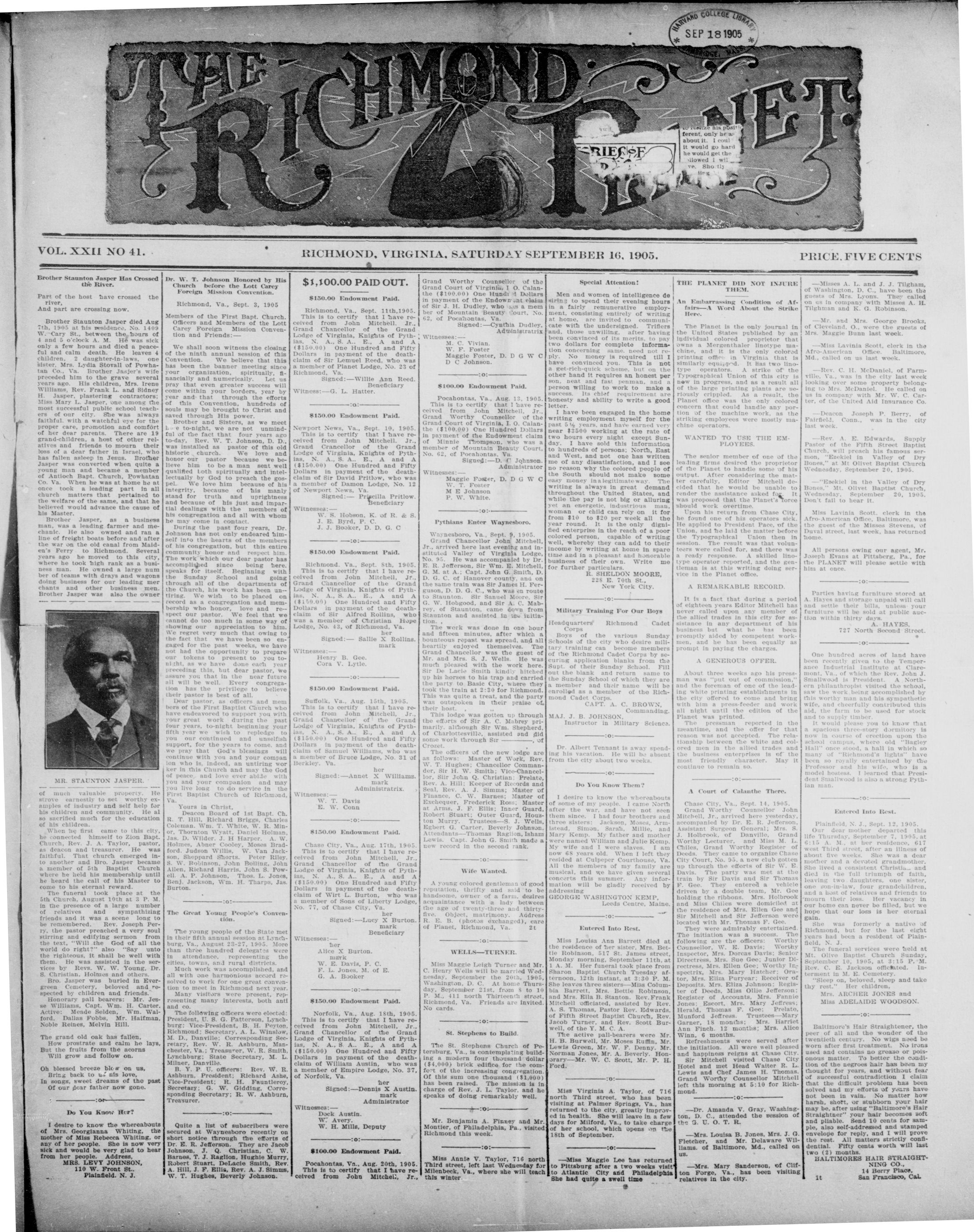
Brother Staunton Jasper Has Crossed the River.
Part of the host have crossed the river.
And part are crossing now.
Brother Staunton Jasper died Aug 7th, 1905 at his residence, No. 1409 W. Cary St., between the hours of 4 and 5 o'clock A. M. He was sick only a few hours and died a peaceful and calm death. He leaves 4 children, 2 daughter-in-laws, one sister, Mrs. Lydia Stovall of Powhatan Co., Va. Brother Jasper's wife preceded him to the grave several years ago. His children, Mrs. Irene Williams, Rev. Frank L. and Sidney H. Jasper, plastering contractors; Miss Mary L. Jasper, one among the most successful public school teachers of our city. She was always faithful, with a watchful eye for the proper care, promotion and comfort of her dear parents. There are 19 grand-children, a host of other relatives and friends to mourn their loss of a dear father in Israel, who has fallen asleep in Jesus. Brother Jasper was converted when quite a young man and became a member of Antioch Bapt. Church, Powhatan Co. Va. When he was at home he at once took a leading part in all church matters that pertained to the welfare of the same, and that he believed would advance the cause of his Master.
Brother Jasper, as a business man, was a leading farmer and mechanic. He also owned and ran a line of freight boats before and after the war on the old canal from Maiden's Ferry to Richmond. Several years ago he moved to this city, where he took high rank as a business man. He owned a large number of teams with drays and wagons doing business for our leading merchants and other business men. Brother Jasper was also the owner
of much valuable property. He strove earnestly to set worthy examples of industry and self help for his children and community. He all so sacrificed much for the education of his children.
When he first came to this city, he connected himself to Zion Bapt. Church, Rev. J. A. Taylor, pastor, as deacon and treasurer. He was faithful. That church emerged into another and Bro. Jasper became a member of 5th Baptist Church where he held his membership until he heard the call of his Master to come to his eternal reward.
The funeral took place at the 5th Church, August 10th at 3 P. M. in the presence of a large number of relatives and sympathizing friends and it was a scene long to be remembered. Rev. Joseph Perry, the pastor preached a very soul stirring and edifying sermon from the text, "Will the God of all the world do right?" also "Say unto the righteous, it shall be well with them. He was assisted in the services by Revs. W. W. Young, Dr. S. Christian, Holmes and others.
Bro. Jasper was buried in Evergreen Cemetery, beloved and respected by children and friends.
Honorary pall bearers: Mr. Jesse Williams, Capt. Wm. H. Carter. Active: Meade Selden, Wm. Walford, Dallas Fobbs, Mr. Haifman, Noble Reines, Melvin Hill.
The grand old oak has fallen,
How prostrate and calm he lays,
But the fruits from the acorns
Will grow and follow on.
Oh blessed breeze blow on us,
Bring back to us nfs love,
In songs, sweet dreams of the past
Of our dear father now gone.
Do You Know Her?
I desire to know the whereabouts of Mrs. Georgianna Whiting, the mother of Miss Rebecca Whiting, or any of her people. She is now very sick and would be very glad to hear from her people. Address,
MRS. LEVY JOHNSON,
110 W. Front St.
Plainfield, N. J.
Dr. W. T. Johnson Honored by His Church before the Lott Carey Foreign Mission Convention.
Richmond, Va., Sept. 3, 1905
Members of the First Bapt. Church.
Officers and Members of the Lott
Carey Foreign Mission Convention
and Friends:—
We shall soon witness the closing of the ninth annual session of this Convention. We believe that this has been the banner meeting since your organization, spiritually, financially and numerically. Let us pray that even greater success will come within your borders, year by year and that through the efforts of this Convention, hundreds of souls may be brought to Christ and saved through His power.
Brother and Sisters, as we meet love to-night, we are not unmindful of the fact that four years ago to-day, Rev. W. T. Johnson, D. D., was installed as pastor of this old historic church. We love and honor our pastor because we believe him to be a man sent well qualified both spiritually and intellectually by God to preach the gospel. We love him because of his integrity, because of his manly stand for truth and uprightness and because of his just and impartial dealings with the members of his congregation and all with whom he may come in contact.
During the past four years, Dr. Johnson has not only endeared himself into the hearts of the members of his congregation, but this entire community honor and respect him. The work which our dear pastor has accomplished since being here, speaks for itself. Beginning with the Sunday School and going through all of the departments of the Church, his work has been untiring. We wish to be placed on record as a congregation and membership who honor, love and respect our pastor. We feel that we cannot do too much in some way of showing our appreciation to him. We regret very much that owing to the fact that we have been so engaged for the past weeks, we have not had the opportunity to prepare our tokens to present to you tonight, as we have done each year preceding this, but dear pastor, we assure you that in the near future all will be well. Every congregation has the privilege to believe their pastor is best of all.
Dear pastor, as officers and members of the First Baptist Church who have endeavored to support you with your great work during the past four years, to-night beginning your fifth year we wish to repledge to you our continued and unselfish support, for the years to come, and we pray that God's blessings will continue with you and your companion who is, indeed, an untiring worker in this Church and may the God of peace, and love ever abide with you and your companion and may you live long to do service in the First Baptist Church of Richmond, Va.
Yours in Christ.
Deacon Board of 1st Bapt. Ch. R. T. Hill, Richard Briggs, Charles Coleman. Wm. T. White, W. R. Minor, Thornton Wyatt, Daniel Holman, Jas. D. Wilder. J. H Harper. A. W Holmes, Abner Cooley, Mosos Bradford. Judson Willis, W. Van Jackson. Sheppard Shorts. Peter Riley. S. W. Robinson, John Bolling, John Allen, Richard Harris, John S. Powell. A. P. Johnson, Thos. L. Jones, BenJ. Jackson, Wm. H. Tharps, Jas Burton.
The Great Young People's Convention
The young people of the State met in their fifth annual session at Lynchburg, Va., August 23-27, 1905. More than three hundred delegates were in attendance, representing the cities, towns, and rural districts. Much work was accomplished, and all with one harmonious accord resolved to work for one great convention to meet in Richmond next year. Many visitors were present, representing many interests, both ant and co.
The following officers were elected: President, U. S. G. Patterson, Lynchburg; Vice-President, B. H. Peyton, Richmond; Secretary, A. L. Winslow, M. D., Danville; Corresponding Secretary, Rev. W. R. Ashburn, Manchester, Va.; Treasurer, W. R. Smith, Lynchburg; State Secretary, M. L. Milner, Danville.
B. Y. P. u. officers: Rev. W. R. Ashburn, President; Richard Ashe, Vice-President; R. H. Fauntleroy, Secretary; G. W. Glding, Corresponding Secretary; R. W. Ashburn, Treasurer.
Quite a list of subscribers were secured at Waynesboro recently on short notice through the efforts of Dr. E. R. Jefferson. They are Jacob Johnson, J. Q. Christian, C. W. Barnes, T. J. Raglion, Hughie Murry, Robert Stuart, DeLacie Smith, Rev. A. Hill, J. F. Ellis, Rev. A. J. Slimms, W. T. Hurghes, Beverly Johnson.
$1,100.00 PAID OUT.
$150.00 Endowment Paid.
Richmond, Va., Sept. 11th, 1905.
This is to certify that I have received from John Mitchell, Jr.,
Grand Chancellor of the Grand
Lodge of Virginia, Knights of Pythias,
N. A., S. A., E., A and A
($150.00) One Hundred and Fifty
Dollars in payment of the death-
claim of Sir Lemuel Reed, who was
a member of Planet Lodge, No. 23 of
Richmond, Va.
Signed:—Willie Ann Reed.
Beneficiary
Witness:—G. L. Hatter
$150.00 Endowment Paid.
Newport News, Va., Sept. 10, 1905.
This is to certify that I have received from John Mitchell. Jr.,
Grand Cancellor of the Grand
Lodge of Virginia, Knights of Pythias,
N. A., S. A. E., A and A
($150.00) One Hundred and Fifty
Dollars in payment of the death-
claim of Sir David Pritlow, who was
a member of Damon Lodge, No. 12
of Newport News, Va.
Signed:— Priscilla Pritlow.
Beneficiary
Witnesses:—
W. S. Hobson, K. of R. & S.
J. E. Byrd, P. C.
J. J. Booker, D. D. G. C
$150.00 Endowment Paid.
Richmond, Va., Sept. 8th, 1905.
This is to certify that I have received from John Mitchell, Jr.,
Grand Chancellor of the Grand Lodge of Virginia, Knights of Pythias, N. A., S. A., E., A and A ($159.00) One Hundred and Fifty Dollars in payment of the death-claim of Sir Alfred Rollins, who was a member of Christian Hope Lodge, No. 43, of Richmond, Va.
her
Signed:— Sallie X Rollins.
mark
Witnesses:—
Henry B. Gee.
Cora V. Lytle.
$150.00 Endowment Paid.
Suffolk, Va., Aug. 15th, 1905.
This is to certify that I have received from John Mitchell, Jr.,
Grand Chancellor of the Grand Lodge of Virginia, Knights of Pythias,
N. A., S. A., E., A and A ($150.00) One Hundred and Fifty Dollars in payment of the deathclaim of Samuel Williams, who was a member of Bruce Lodge, No. 31 of Berkley, Va.
her
Signed:—Annet X Williams.
mark
Administratrix.
Witnesses:—
W. T. Davis
E. W. Conn
:0:
$150.00 Endowment Paid.
Chase City, Va., Aug. 17th, 1905.
This is to certify that I have received from John Mitchell, Jr.
Grand Chancellor of the Grand Lodge of Virginia, Knights of Pythias, N. A., S. A., E., A and A ($150.00) One Hundred and Fifty Dollars in payment of the death-claim of Wirt L. Burton, who was a member of Sons of Liberty Lodge, No. 77, of Chase City, Va.
her
Signed:—Lucy X Burton.
mark
Beneficiary
Witnesses:—
her
Alice X Burton.
mark
W. E. Davis, P. C.
F. L. Jones, M. of E.
G. A. Booker
:o:
$150.00 Endowment Paid.
Norfolk, Va., Aug. 18th, 1905.
This is to certify that I have received from John Mitchell, Jr.,
Grand Chancellor of the Grand
Lodge of Virginia, Knights of Pythias,
N. A., S. A., E., A and A
($150.00) One Hundred and Fifty
Dollars in payment of the death-
claim of William Austin, who was
a member of Empire Lodge, No. 37,
of Norfolk, Va.
Dock Austin.
W. Avery.
W. H. Mills, Deputy
$100.00 Endowment Paid.
Pocahontas, Va., Aug. 20th, 1905. This is to certify that I have received from John Mitchell, Jr.,
Grand Worthy Counselor of the
Grand Court of Virginia, I. O. Calan-
the ($100,00) One Hundred Dollars
in payment of the Endowment claim
of Sir J. H. Dudley, who was a mem-
ber of Mountain Beauty Court. No.
62, of Pocahontas, Va.
Signed:—Cynthia Dudley,
Administratrix
Witnesses:—
M. C. Vivian.
W. F. Foster
Maggie Foster, D. D G W C
D C Johnson.
$100.00 Endowment Paid
Pocahontas, Va., Aug. 13, 1905.
This is to certify that I have received from John Mitchell, Jr.
Grand Worthy Counselor of the Grand Court of Virginia, I. O. Calan-
the ($100.00) One Hundred Dollars in payment of the Endowment claim of Minnie Thompson, who was a member of Mountain Beauty Court,
No. 62, of Pocahontas, Va.
Signed:—D. C Johnson.
Administrator
Witnesses:—
Maggie Foster, D. D G W C
W. T. Foster
M E Johnson
P. W. White.
Pythians Enter Waynesboro.
Waynesboro, Va. Sept. 9, 1905.
Grand Chancellor John Mitchell,
Jr., arrived here last evening and instituted
Valley of Virginia Lodge,
No. 95. He was accompanied by Dr. E. R. Jefferson, Sir Wm. E. Mitchell,
G. M. at A.; Capt. John G. Smith, D.
D. G. C. of Hanover county, and on
the same train was Sir James H. Ferguson, D. D. G. C., who was an route
to Staunton. Sir Samuel Moore, Sir
G. W. Hobgood, and Sir A. C. Mabrey,
of Staunton, came down from Staunton and assisted in the initiation.
The work was done in one hour
and fifteen minutes, after which a
bountie repast was spread, and all
heartily enjoyed themselves. The
Grand Chancellor was the guest of
Mr. and Mrs. S. J. Wells. He was
much pleased with the work here.
Sir De Lacie Smith kindly hitched
up his horses to his trap and carried
the party to Basic City, where they
took the train at 2:30 for Richmond.
This was quite a treat, and the party
was outspoken in their praise of
their host.
This lodge was gotten up through
the efforts of Sir A. C. Mabrey primarily, although Sir Wm. Shepherd,
of Charlottesville, assisted and did
some work through Sir _____, of Crozet.
The officers of the new lodge are as follows: Master of Work, Rev, W. T. Hughes; Chancellor Commander, Sir H. W. Smith; Vice-Chancellor, Sir John Q. Christian; Prelate, Rev. A. Hill; Keeper of Records and Seal, Rev. A. J. Simms; Master of Finance, C. W. Barnes; Master of Exchequer, Frederick Ross; Master at Arms, J. F. Ellis; Inner Guard, Robert Stuart; Outer Guard, Houston Murry. Trustees—S. J. Wells, Egbert G. Carter, Beverly Johnson, Attendants—Thomas Ragilion, Isham Lewis, Capt. John G. Smith made a new record in the second rank.
Wife Wanted.
A young colored gentleman of good reputation, thrifty and said to be handsome, owner of a farm, desires acquaintance with a lady between the age of twenty-three and thirty-five. Object, matrimony. Address R. E. B. (photos exchanged), care of Planet, Richmond, Va. 2t
WELLS—TURNER
Miss Maggie Leigh Turner and Mr. C. Henry Wells will be married Wednesday, September the 20th, 1905 Washington, D. C. At home Thursday day, September 21st, from 8 to 10 P. M., 411 north Thirteenth street Richmond, Va. Friends are invited No cards.
St. Stephens to Build
The St. Stephens Church of Petersburg, Va., is contemplating building a modern four thousand dollar ($4,000) brick edifice for the comfort of the increasing congregation. Of this sum one thousand ($1,000) has been raised. The mission is in charge of Rev. J. L. Taylor, and he speaks of doing remarkably well.
Mr. Benjamin A. Finney and Mr. Montier, of Philadelphia, Pa., visited Richmond this week.
Miss Annie V. Taylor, 716 north Third street, left last Wednesday for Milenbeck, Va., where she will teach this winter
Special Attention!
Men and women of intelligence desire to spend their evening hours in a fairly remunerative employment, consisting entirely of writing at home, are invited to communicate with the undersigned. Trifers and, those unwilling, after having been convinced of its merits, to pay two dollars for complete information concerning same, need not reply. No money is required till I have convinced you. This is not a get-rich-quick scheme, but on the other hand it requires an honest person, neat and fast penman, and a person willing to work to make a success. Its chief requirement are honesty and ability to write a good letter.
I have been engaged in the home writing employment myself for the past 5½ years, and have earned very near $3500 working at the rate of two hours every night, except Sunday. I have sold this information to hundreds of persons; North, East and West, and not one has written me of any dissatisfaction, and I see no reason why the colored people of the South should not make some easy money in a legitimate way. The writing is always in great demand throughout the United States, and while the pay is not big or alluring yet an energetic, industrious man, woman or child can rely on it for from $10 to $20 per week all the year round. It is the only dignified enterprise in the reach of a poor colored person, capable of writing well, whereby they can add to their income by writing at home in spare time and in a pleasant and honorable business of their own. Write me for further particulars.
R. SHELDON MOORE,
228 E. 70th St.,
New York City.
Military Training For Our Boys
Headquarters Richmond Cadet Corps
Boys of the various Sunday Schools of the city who desire military training can become members of the Richmond Cadet Corps by securing application blanks from the Supt. of their Sunday School. Fill out the blank and return same to the Sunday School of which they are a member and their name will be enrolled as a member of the Richmond Cadet Corps.
CAPT. A. C. BROWN,
Commanding.
MAJ. J. B. JOHNSON,
Instructor in Military Science.
Dr. Albert Tennant is away spending his vacation. He will be absent from the city about two weeks.
Do You Know Them?
I desire to know the whereabouts of some of my people. I came North after the war, and have not seen them since. I had four brothers and three sisters: Jackson, Moses, Armilead, Simon, Sarah, Millie, and Mary Kemp. My father and mother were named William and Julie Kemp. My wife and I were slaves. I am now 68 years old. When I left they resided at Culpeper Courthouse, Va. All the members of my family are musical, and we have given several concerts this summer. Any information will be gladly received by addressing
GEORGE WASHINGTON KEMP,
Leslie Corme, Mia
Entered Into Rest
Miss Louisa Ann Barrett died at the residence of her sister, Mrs. Bettie Robinson, 517 St. James street, Monday morning, September 11th, at 1 A. M. Her funeral took place from Sharon Baptist Church Tuesday afternoon, 12th instant, at 3:30 P. M. She leaves three sisters—Miss Columbia Barrett, Mrs. Bettie Robinson, and Mrs. Ella B. Stanton. Rev.Frank Mitchell officiated, assisted by Rev. A. S. Thomas, Pastor Rev. Edwards, of Fifth Street Baptist Church, Rev. Jacob Turner, and Rev. Scott Burwell, of the Y. M. C. A.
The active pall-bearers were Mr. H. B. Burwell, Mr. Moses Ruffin, Mr. Lewis Green, Mr. W. F. Denny, Mr. Norman Jones, Mr. A. Beverly, Honorary—Mr. W. C. Scott, Mr. P. H. Ford.
Miss Virginia A. Taylor, of 716 north Third street, who has been visiting at Palmer Springs, Va., has returned to the city, greatly improved in health. She will leave in a few days for Milford, Va., to take charge of her school, which opens on the 18th of September.
—Miss Maggie Lee has returned to Pittsburg after a two weeks visit to Atlantic City and Philadelphia She had quite a swell time
THE PLANET DID NOT INJURE
THEM.
An Embarrassing Condition of Affairs—A Word About the Strike Here.
The Planet is the only journal in the United States published by an individual colored proprietor that owns a Mergenthaler linotype machine, and it is the only colored printing office in Virginia that is similarly equipped. It has two linotype operators. A strike of the Typographical Union of this city is now in progress, and as a result all of the large printing plants are seriously crippled. As a result, the Planet office was the only colored concern that could handle any portion of the machine work, as the striking employees were mostly machine operators.
WANTED TO USE THE EM
PLOYEES
The senior member of one of the leading firms desired the proprietor of the Planet to handle some of his output. After considering the matter carefully, Editor Mitchell decided that he would be unable to render the assistance asked for. It was proposed that the Planet's force should work overtime.
Upon his return from Chase City, he found one of his operators sick. He applied to President Pace, of the Union, and he laid the matter before the Typographical Union then in session. The result was that volunteers were called for, and there was a ready response. A skilled linotype operator reported, and the gentleman is at this writing doing service in the Planet office.
A REMARKABLE RECORD
It is a fact that during a period of eighteen years Editor Mitchell has never called upon any member of the allied trades in this city for assistance in any department of his business but what he has been promptly aided by competent workmen, and he has been equally as prompt in paying the charges.
A GENEROUS OFFER
About three weeks ago his pressman was "put out of commission," and the foreman of one of the leading white printing establishments in the city offered to come and bring with him a press-feeder and work all night until the edition of the Planet was printed.
The pressman reported in the meantime, and the offer for that reason was not accepted. The relationship between the white and colored men in the allied trades and the business enterprises is of the most friendly character. May it continue to remain so.
A Court of Calanthe There.
Chase City, Va., Sept. 14, 1905.
Grand Worthy Counselor John Mitchell, Jr., arrived here yesterday, accompanied by Dr. E. R. Jefferson, Assistant Surgeon General; Mrs. S. J. Holbrook, of Danville, Grand Worthy Lecturer, and Miss M. L. Chiles, Grand Worthy Register of Deeds. They came to organize Chase City Court, No. 95, a new club up through the efforts of Sir W. E. Davis. The party was met at the train by Sir Davis and Sir Thomas F. Gee. They entered a vehicle driven by a double team, Mr. Gee holding the ribbons. Mrs. Holbrook and Miss Chies were domiciled at the residence of Mrs. Ellen Gee and Sir Mitchell and Sir Jefferson were located with Mr. Thomas F. Gee. They were admirably entertained.
The initiation was a success. The following are the officers: Worthy Counselor, W. E. Davis; Worthy Inspector, Mrs. Dorcas Davis; Senior Directress, Mrs. Sue Gee; Junior Directress, Mrs. Ellen Gee; Worthy Inspectrix, Mrs. Mary Hatcher; Orator, Mrs. Eliza Puryear; Receiver of Deposits, Mrs. Eliza Johnson; Register of Deeds, Miss Ollie Jefferson; Register of Accounts, Mrs. Fannie Jones; Escort, Mrs. Mary Jeffress; Herald, Thomas F. Gee; Prelato, Munford Jeffress. Trustees—Mary Garner, 18 months; Mrs. Harriet Ann Finch, 12 months; Mrs. Alice Winn, 6 months.
Refreshments were served after the initiation. All were well pleased and happiness reigns at Chase City. Sir Mitchell visited Chase City Hotel and met Head Waiter R. L. Lewis and Chef James H. Thomas. Grand Worthy Counsellor Mitchell left this morning at 5:10 for Richmond.
:0:
—Dr. Amanda V. Gray, Washington, D. C., attended the session of the G. U. O. T. R.
—Mrs. Louisa B. Jones, Mrs. J. G. Fletcher, and Mr. Delaware Williams, of Baltimore, Md., called on us.
—Mrs. Mary Sanderson, of Clifton Forge, Va., has been visiting relatives in the city.
—Misses A. L. and J. J. Tilgham, of Washington, D. C., have been the guests of Mrs. Lyons. They called on us in company with Misses A. H. Tilghman and K. G. Robinson.
—Mr. and Mrs. George Brooks, of Cleveland, O., were the guests of Mrs. Maggie Bunn last week.
—Miss Lavinia Scott, clerk in the Afro-American Office, Baltimore, Md., called on us last week.
—Rev. C. H. McDaniel, of Farmville, Va., was in the city last week looking over some property belonging to Mrs. McDaniel. He called on us in company with Mr. W. C. Carter, of the United Aid Insurance Co.
—Deacon Joseph P. Berry, of Fairfield, Conn., was in the city last week.
—Rev. A. E. Edwards, Supply Pastor of the Fifth Street Baptist Church, will preach his famous sermon, "Ezekiel in Valley of Dry Bones," at Mt Olivet Baptist Church Wednesday, September 20, 1905.
—"Ezekiel in the Valley of Dry Bones," Mt. Olivet Baptist Church, Wednesday, September 20, 1905. Don't fail to hear it.
Miss Lavinia Scott, clerk in the Afro-American Office, Baltimore, was the guest of the Misses Stevens, of Duval street, last week, has returned home.
All persons owing our agent, Mr. Joseph Evans at Pittsberg, Pa., for the PLANET will please settle with him at once.
Parties having furniture stored at
A. Hayes and storage unpaid will call
and settle their bills, unless your
furniture will be sold at public auction
within thirty days.
A. HAYES,
727 North Second Street.
One hundred acres of land have been recently given to the Temperance Industrial Institute at Claremont, Va., of which the Rev. John J. Smallwood is President. A Northern philanthropist visited the school, saw the work being accomplished by this worthy man and his sympathetic wife, and cheerfully contributed this aid, the farm to be used for stock and to supply timber.
It would please you to know that a spacious three-story dormitory is now in course of erection upon the school campus, where old "Bagley Hall" once stood, a hall in which so many of "Richmond's lights" have been so royally entertained by the Professor and his wife, who is a model hostess. I learned that President Smallwood is also a strong Pythian man.
Entered Into Best
Plainfield, N. J., Sept. 12, 1905.
Our dear mother departed this life Thursday, September 7, 1905, at 6:15 A. M., at her residence, 617 west Third street, after an illness of about five weeks. She was a dear mother and a devoted grandmother. She lived a consistent Christia... and died in the two triumphs of faith, leaving two daughters, one sister, one son-in-law, four grandchildren, and a host of relatives and friends to mourn their loss. Her vacancy in our home can never be filled, but we hope that our loss is her eternal gain.
She was formerly a native of Richmond, but for the last eight years had been a resident of Plainfield, N. J.
"The funeral services were held at Mt. Olive Baptist Church Sunday, September 10, 1905, at 3:15 P. M. Rev. C. E. Jackson officiated. Interment in M. E. Cemetery.
"Sleep on, beloved, sleep and take thy rest." Her children,
Mrs. ARCHER JONES and
Miss ADELAIDE WOODSON.
Baltimore's Hair Straightener, the peer of all and the wonder of the twentieth century. No wigs need be worn after first treatment. No irons used and contains no grease or poisonous matter. To better the condition of the negroes hair has been my thought for years, and without fear of successful contradiction I claim that the difficult problem has been solved and my efforts of years have not been in vain. No matter how harsh, short, or stubborn your hair may be, after using "Baltimore's Hair Straightner" your hair becomes soft and pliable. Send 10 cents for sample, also self-addressed and stamped envelope for reply, and I will prove the rest. All matters strictly confidential. Fifty cents worth will last two (2) months.
BALTIMORES HAIR STRAIGHT-NING CO.,
14 Berry Place,
San Francisco, Cal.
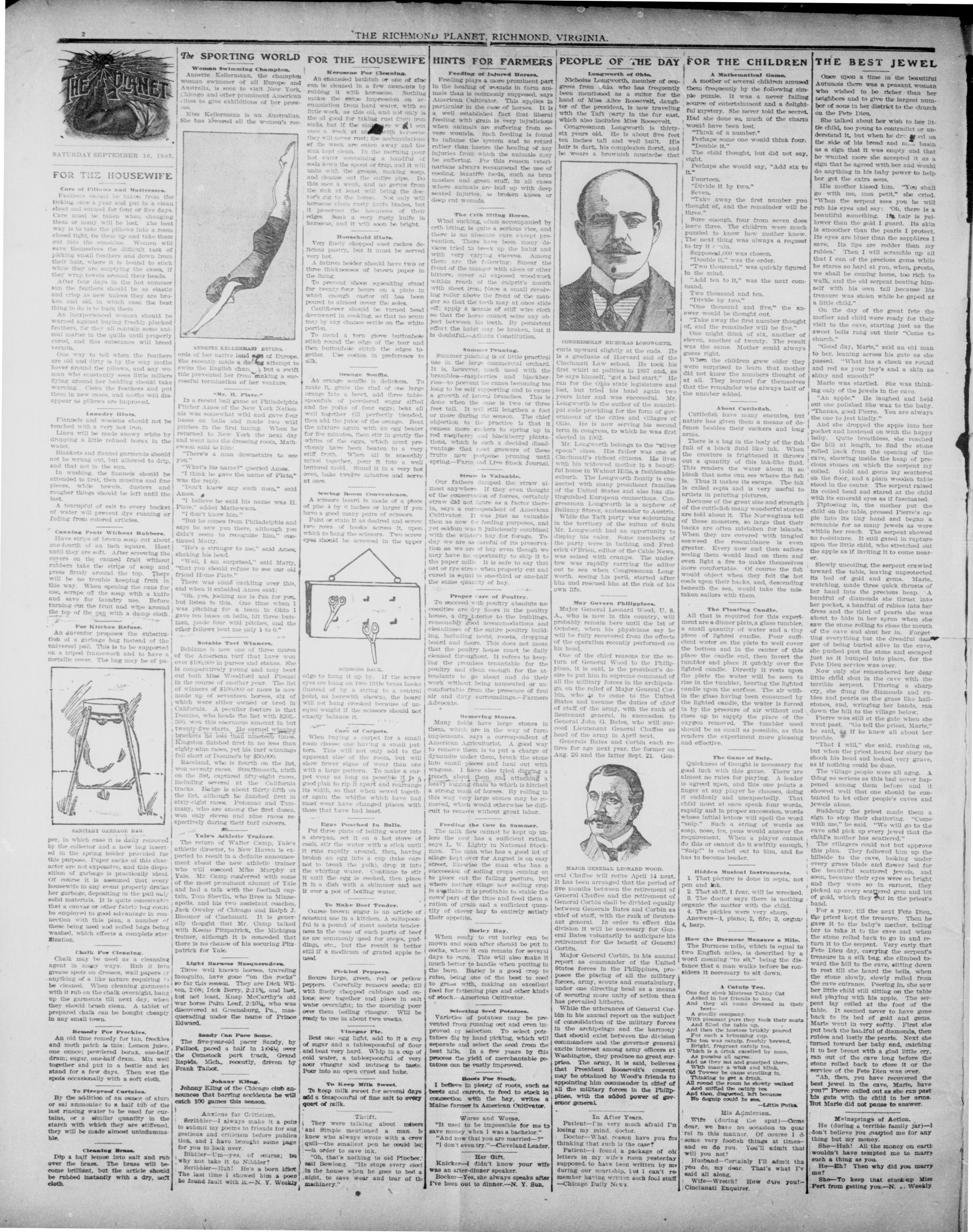
THE PLANET
SATURDAY SEPTEMBER 16, 1895
FOR THE HOUSEWIFE
Care of Pillows and Mattresses.
Feathers should be taken from the ticking once a year and put in a clean sheet and sunnel for four or five days.
Care must be taken when changing them or many will be lost. The best way is to take the pillows into a room closed tight, tie them up and take them out into the sunshine. Women will save themselves the difficult task of pleking small feathers and down from their hair, where it is bound to stick while they are emptying the cases, if they wrap towels around their heads.
After four days in the hot summer sun the feathers should be as elastic and crisp as new unless they are broken and old, in which case the best thing to do is to burn them.
An inexperienced woman should be warned against buying freshly plucked feathers, for they all contain some animal matter in the quills until properly cured, and this substance will breed vermin.
One way to tell when the feathers are old and dirty is by the way moths hover around the pillows, and any woman who constantly sees little millers flying around her bedding should take warning. Clean the feathers and put them in new cases, and moths will disappear as pillows are improved.
Laundry Hints
Flanbels and woolens should not be touched with a very hot iron. Linen will be made snowy white by dropping a little refined borax in the water. Blankets and flannel garments should not be wrung out, but allowed to drip, and that not in the sun. In washing, the flannels should be attended to first, then muslins and fine pieces, while towels, dusters and rougher things should be left until the last. A teacupful of salt to every bucket of water will prevent dye running or fading from colored articles.
Canning Fruit Without Rubbers.
Have strips of brown soap cut about one-fourth of an inch square. Heat until they are soft. After screwing the covers on the canned fruit without rubbers take the strips of soap and press firmly around the top. There will be no trouble keeping fruit in this way. When opening the cans for use, scrape off the soap with a knife and save for laundry use. Before turning cut the fruit and wipe around the can with a damp cloth.
For Kitchen Refuse.
An inventor proposes the substitution of a garbage bag instead of the universal pail. This is to be supported on a tripod framework and to have a metallic cover. The bag may be of na
SANITARY GARBAGE BAG.
per, in which case it is daily removed by the collector and a new bag inserted in the spring holder provided for this purpose. Paper sacks of this character are not expensive, and this disposition of garbage is practically ideal. Of course it is assumed that every housewife in any event properly dries her garbage, depositing in the pail only solid materials. It is quite conceivable that a canvas or other fabri bag could be employed to good advantage in connection with this plan, a number of these being used and soiled bags being washed, which effects a complete sterilization.
Chalk Pow Cleaning.
Chalk may be used as a cleansing agent in many ways. Rub it into grease spots on dresses, wall papers or anything of a like nature requiring to be cleaned. When cleaning garments with it rub on the chalk overnight, hang up the garments till next day, when they should brush clean. A tablet of prepared chalk can be bought cheaply in any small town.
Remedy For Freckles
An old time remedy for tan, freckles and moth patch is this: Lemon juice, one ounce; powdered borax, one-half dram; sugar, one-half dram. Mix well together and put in a bottle and let stand for a few days. Then wet the spots occasionally with a soft cloth.
To Fireproof Curtains.
By the addition of an ounce of alum or sal ammoniac to a half tub of the last rinsing water to be used for curtains, or a similar quantity in the starch with which they are stiffened, they will be made almost uninflammable.
Cleaning Brush.
Dip a half lemon into salt and rub over the brass. The brass will become brilliant, but the article should be rubbed instantly with a dry, soft cloth.
The SPORTING WORLD FOR THE HOUSEWIFE
Woman Swimming Champion.
Annette Kellermann, the champion woman swimmer of all Europe and Australia, is soon to visit New York, Chicago and other prominent American cities to give exhibitions of her prowess.
Miss Kellermann is an Australian she has powered all the women's rea
J. M. B.
ords of her native land of Europe.
She recently made a dating attempt to swim the English chan, but a swift tide prevented her from making a successful termination of her routine.
"Mr. H. Plato."
In a recent ball game at Philadelphia Pitcher Ames of the New York Nationals was somewhat wild and gave four bases on balls and made two wild pitches in the first inning. When he returned to New York the next day and went into the dressing room, Mathewson said to him:
"There's a man downstairs to see you."
"What's his name?" queried Ames.
"I think he gave the name of Plate," was the reply.
"Don't know any such man," said Ames.
"I believe he said his name was H. Plate," added Mathewson.
"I don't know him."
"But he comes from Philadelphia and says he saw you there, although you didn't seem to recognize him," continued Matty.
"He's a stranger to me," said Ames, shaking his head.
"Well, I am surprised," said Matty,
"that you should refuse to see our old friend Home Plate."
There was some cackling over this,
and when it subsided Ames said:
"Oh, yes, Joshing me is fun for you,
but listen to this. One time when I
was pitching for a team in Ohio I
gave ten bases on balls, hit three batsmen,
made four wild pitches, and the
other fellows beat me only 1 to 0."
Notable Turf Winners.
Boldame is now one of three mares of the American turf that have won over $100,000 in purses and stakes. She is comparatively young and may beat out both Miss Woodford and Firenzil in the course of another year. The list of winners of $100,000 or more is now made up of seventeen borses, six of which were either owned or bred in California. A peculiar feature is that Domino, who heads the list with $203,300, won this enormous amount in but twenty-five starts. He earned winning brackets no less than nineteen times. Kingston finished first in no less than eighty-sime races, yet his turf winsnings fell short of Domino's by $50,000.
Raceland, who is fourth on the list, won seventy races. Strathmouth, ninth on the list, captured fifty-eight races, including several at the California tracks. Badge is about thirty-fifth on the list, although he finished first in sixty-eight races. Potomac and Tammany, who are among the first dozen, won only eleven and nine races respectively during their turf careers.
Yale's Athletic Trainer
The return of Walter Camp, Yale's athletic director, to New Haven is expected to result in a definite announcement about the new athletic trainer who will succeed Mike Murphy at Yale. Mr. Camp conferred with some of the most prominent alumni of Yale and had a talk with the football captain, Tom Shevlin, who lives in Minneapolis, and his two assistant coaches, Jack Owsley of Chicago and Ralph J. Bloomer of Cincinnati. It is generally thought that Mr. Camp talked with Keene Pitzpatrick, the Michigan trainer, although it is conceded that there is no chance of his securing Pitzpatrick for Yale.
Light Harpess Magneraderm
Three well known horses, traveling incognito, have gone "on the rocks" so far this season. They are Dick Wilson, 2:08; Dick Berry, 2:11%, and last, but not least, Knap McCarthy's old war horse Palm Leaf, 2:10%, who was discovered at Greensburg, Pa., masquerading under the name of Prince Edward.
Sandy Can Pace Some.
The five-year-old pacer Sandy, by Palmot, paced a half in 1.04% over the Constock park track, Grand Rapids, Mich., recently, driven by Frank Talot.
Johnny Kling
Johnny King of the Chicago club announces that barring accidents he will catch 100 games this season.
Anxious for Criticism
Scribbler—I always make it a point to submit my poems to friends for sug gestions and criticism before publica tion, and I have brought some pege for you to look over.
Bibbler—Um—yes, of course; bu why not take it to Nibbler?
Scribbler—Huh! He's a born idiot The last time I showed him a poem he found fault with it.—N. Y. Weekly
THE RICHMOND PLANET, RICHMOND, VIRGINIA
Kerosene For Cleaning
Kerosene For Cleaning.
An enameled bath tub or one of zino can be cleaned in a few moments by rubbing it with kerosene. Nothing makes the same impression on accumulation from hard water, with so little oil, as this oil, and not only is the oil good for taking rust from iron sinks, but if the sinks are wilt out once a week at night, with kerosene they will never rust; the accumulations of the week are eaten away and the sink kept clean. In the morning pour hot water containing a handful of soda down the spout or trap, and it will unite with the grease, making soap, and cleanse out the entire pipe. Do this once a week, and no germs from the sink at least will bring the doctor's gig to the house. Not only will kerosene clean rusty knife blades, but it preserves the keenness of their edges. Soak a very rusty knife in kerosene, and it will soon be bright.
Household Hints
Very finely chopped suet makes delicious pastry, but it must be served very hot.
A fatron holder should have two or three thicknesses of brown paper in the lining.
Cauliflower should be turned head downward in cooking, so that no scum may by any chance settle on the white portion.
To mend a torn glove buttonhole stitch round the edge of the tear and then buttonhole stitch the edges together. Use cotton in preference to silk.
Orange Sortfile
An orange souffle is delicious. To make it, grate the rind of one large orange into a bowl, add three table-spoonfuls of powdered sugar sifted and the yolks of four eggs; beat all well together till perfectly blended, then add the juice of the orange. Bent the mixture again with an egg beater for five minutes, then stir in gently the whites of the eggs, which must previously have been beaten to a very stiff froth. When all is smoothly mixed together, pour it into a well buttered mold. Stand it in a very hot oven, bake twelve minutes and serve at once.
Sewing Boom Convenience.
A scissors board is made of a piece of phe 4 by 6 inches or larger if you have a good many pairs of scissors.
Paint or stain it as desired and screw two rows of hooks across it, upon which to hang the scissors. Two screw eyes should be screwed in the upper
SCISSOIRS BACK.
edge to hang it up by. If the screw
eyes are hung on two little brass hooks
(instead of by a string to a central
point, as herewith shown), the board
will not hang crooked because of unequal weight if the scissors should not
exactly balance it.
Care of Carpets
When buying a carpet for a small room choose one having a small pattern. This will not only add to the apparent size of the room, but will show fewer signs of wear than one with a large pattern. To make a carpet wear as long as possible it is good plan to rip it apart and rearrange its width, so that when sewed together again the widths which have had most wear have changed places with those that have had loos.
Eggs Poached In Balls
Put three pints of boiling water into a stewpan, set it on a hot stove of coals, stir the water with a stick until it runs rapidly around, then, having broken an egg into a cup (take care not to break the yolk), drop it into the whirling water. Continue to stir it until the egg is cooked, then place it in a dish with a skimmer and set it over a pot of boiling water.
To Make Beef Tender.
Course brown sugar is an article of constant use in a kitchen. A saltspoonful to a pound of meat assists tenderness in the case of such parts of beef as are commonly used for stews, puddings, etc., but the result is better still if a modicum of grated apple be used.
Pickled Peppers
Secure large, green, red or yellow peppers. Carefully remove seeds; till with finely chopped cabbage and onions; sew together and place in salt water overnight; in the morning pour over them boiling vinegar. Will be ready to use in about two weeks.
Vinegar Pie
Best one egg light, add to it a cup of sugar and a tablespoonful of flour and beat very hard. Whip in a cup of cold water, a tablespoonful of very sour vinegar and notmeg to taste. Pour into an open crust and bake.
To Keep Milk s
To keep milk sweet for several days add a teaspoonful of fine salt to every quart of milk.
Thrift.
They were talking about masters and Simple mentioned a man he knew who always wrote with a crow quill—the smallest pen he could buy—in order to save ink.
"Oh, that's nothing to old Pincher," said Bowlong. "He stops every clock in the house when he goes to bed a night, to save wear and tear of the machinery."
HINTS FOR FARMERS
Feeding of Injured Horses.
Feeding plays a more prominent part in the healing of wounds in farm animals than is commonly supposed, says American Cultivator. This applies in particular in the case of horses. It is a well established fact that liberal feeding with grain is very injudicious when animals are suffering from severe wounds. Such feeding is found to inflame the system and to retard rather than hasten the healing of any injuries from which the animals may be suffering. For this reason veterinarians always recommend the use of cooling, laxative foods, such as bran mashes and green stuff, in all cases where animals are laid up with deep seated injuries, as broken knees or deep cut wounds.
The Crib Biting Horse
Wind sucking, often accompanied by crib biting, is quite a serious vice, and there is no absolute cure except prevention. There have been many devices tried to break up the habit and with very varying success. Among them are the following: Smear the front of the manger with aloes or other bitters; cover all exposed woodwork within reach of the culprit's mouth with sheet iron; place a small revolving roller above the front of the manger so that the teeth may at once slide off; apply a muzzle of stiff wire cloth so that the horse cannot seize any object between his teeth. By persistent effort the habit may be broken, but it is doubtful—Athenta Constitution.
Summer Pruning.
Summer pinching is of little practical use in the large commercial orchard. It is, however, much used with the brambles—raspberries and blackberries—to prevent the canes becoming too long to be self supporting and to cause a growth of lateral branches. This is done when the cune is two or three feet tall. It will still lengthen a foot or more during the season. The chief objection to the practice is that it causes more suckers to spring up in red raspberry and blackberry plantations, which is such a decided disadvantage that most growers of these fruits now postpone pruning until spring—Farm and Live Stock Journal.
Straw Is Valuable.
Our fathers dumped the straw almost anywhere. If they even thought of the conservation of forces, certainly straw did not figure as a factor therein, says a correspondent of American Cultivator. It was just as valuable then as now for feeding purposes, and yet seldom was it judiciously combined with the winter's hay for forage. Today we are as careful of its preservation as we are of hay even though we may have no opportunity to ship it to the paper mills. It is safe to say that oat or rye straw when properly cut and cured is equal to one-third or one-half the same quantity of hay.
Proper Care of Poultry
To succeed with poultry absolute necessities are dry floors in the poultry house, a dry interior to the buildings, reasonably good accommodations and cleanliness of the entire poultry building, including nests, roosts, dropping board and floors. This does not mean that the poultry house must be daily cleaned throughout. It refers to keeping the premises tenantable for the poultry and clean enough for the attendants to go about and do their work without being nauseated or uncomfortable from the presence of foul air and dirty surroundings.—Farmers Advocate.
Removing Stones.
Many fields have large stones in them, which are in the way of farm implements, says a correspondent of American Agriculturist. A good way to remove them is to put a charge of dynamite under them, break the stone into small pieces and haul out with wagons. I have also tried digging arench about them and attaching aheavy logging chain to which is hitched a strong team of horses. By rolling in this way very large stones may be removed, which would otherwise be difficult to remove without great labor.
Feeding the Cow In Summer
The milk flow cannot be kept up unless the cow has a sufficient ration, says L. W. Lighty in National Stockman. The man who has a good lot of silage kept over for August is on easy street, likewise the man who has a succession of soiling crops coming on to piece out the falling pasture, but where neither silage nor soiling crop is available it is profitable to stable the cow part of the time and feed them a ration of grain and a sufficient quantity of clover hay to entirely satisfy their appetite.
Beeley Hay.
When ready to cut barley can be mown and soon after should be put in cocks, where it can remain for several days to cure. This will also make it much better to handle when putting in the barn. Barley is a good crop to raise, being one of the best to seed to grass with, making an excellent feed for fattening pigs and other kinds of stock.—American Cultivator.
Selecting Seed Potatoes
Varieties of potatoes may be prevented from running out and even improved by selection. To select potatoes dig by hand pickling, which will separate and select the seed from the best hills. In a few years by this process the yield of merchantable potatoes can be vastly improved.
Boots For Stock.
I believe in plenty of roots, such as beets and carrots, to feed to stock in connection with the hay, writes a Maine farmer in American Cultivator.
Worse and Worse
"It it used to be impossible for me to save money when I was a bachelor." "And now that you are married—?" "I don't even try."—Cleveland Leader.
Her Gift.
Knicker—I didn't know your wife was an after-dinner speaker. Bocker—Yes, she always speaks after I've been out to dinner—N, Y. Sun.
Longworth of Ohio
Nicholas Longworth, member of congress from Ohio, who has frequently been mentioned as a suitor for the hand of Miss Alice Roosevelt, daughter of the president, is now traveling with the Taft party in the far east, which also includes Miss Roosevelt.
Congressman Longworth is thirty-six years old. He is about five feet ten inches tall and well built. His hair is dark, his complexion florid, and he wears a brown mustache that
M.
CONGRESSMAN NICHOLAS LONGWORTIL curts upward slightly at the ends. He is a graduate of Harvard and of the Cincinnati Law school. He took his first whirl at politics in 1807 and, as he says himself, "got a bad start." He ran for the Ohio state legislature and lost, but tried his hand again two years later and was successful. Mr. Longworth is the author of the municipal code providing for the form of government of the cities and villages of Ohio. He is now serving his second term in congress, to which he was first elected in 1902.
Mr. Longworth belongs to the "silver spoon" class. His father was one of Cincinnati's richest citizens. He lives with his widowed mother in a beautiful home in Walnut Hills, a fashionable suburb. The Longworth family is connected with many prominent families of the United States and also has distinguished European connections. Congressman Longworth is a nephew of Bellamy Storm, ambassador to Austria.
While the Taft party was sojourning in the territory of the sultan of Sultu Mr. Longworth had an opportunity to display his valor. Some members of the party were in bathing, and Fredrick O'Brien, editor of the Cable News, was seized with cramps. The under-tow was rapidly carrying the editor out to sea when Congressman Longworth, seeing his peril, started after him and rescued him at the risk of his own life.
May Govern Philippines
Major General Leonard Wood, U. S. A., who is now in this country, will probably remain here until the lst of October, when his physicians say he will be fully recovered from the effects of the operation recently performed on his head.
One of the chief reasons for the return of General Wood to the Philippines, it is said, is the president's desire to put him in supreme command of all the military forces in the archipelago, on the relief of Major General Corbin, who 45 to come to the United States and assume the duties of chief of staff of the army, with the rank of lieutenant general, in succession to General John G. Bates, who will succeed Lieutenant General Chaffee as head of the army in April next.
Generals Bates and Corbin each retires for age next year, the former on Aug. 26 and the latter Sept. 21. Gen-
PETER H.
ERAL GENERAL LEONARD WOOD.
eral Chaffee will retire April 14 next.
It has been arranged that the period of
five months between the retirement of
General Chaffee and the retirement of
General Corbin shall be divided equally
between Generals Bates and Corbin as
chief of staff, with the rank of lieutenant
general. In order to effect this
division it will be necessary for General
Bates voluntarily to anticipate his
retirement for the benefit of General
Corbin.
Major General Corbin, in his annual
report as commander of the United
States forces in the Philippines, proposes
the placing of all of the military
forces, army, scouts and constabulary,
under one directing head as a means
of securing more unity of action than
has prevailed hitherto.
While the utterances of General Corbin in his annual report on the subject of consolidation of the military forces in the archipelago and the harmony that should exist between the division commanders and the governor general excite interest among army officers at Washington, they produce no great surprise. The army, it is said, believes that President Roosevelt's consent may be obtained by Wood's friends to appointing him commander in chief of all the military forces in the Philippines, with the added power of governor general.
In After Years
Patient—I'm very much afraid I'm losing my mind, doctor.
Doctor—What reason have you for thinking that such is the case?
Patient—I found a package of ok letters in my wife's room yesterday supposed to have been written by me during our courtship, but I can't remember having written such fool stuff—Chicago Dally News.
FOR THE CHILDREN
A mother of several children amused them frequently by the following simple puzzle. It was a never failing source of entertainment and a delightful mystery. She never told the secret. Had she done so, much of the charm would have been lost.
"Think of a number."
Perhaps some one would think four.
"Double it."
The child thought, but did not say, eight.
Perhaps she would say, "Add six to it."
Fourteen.
"Divide it by two."
Seven.
"Take away the first number you thought of, and the remainder will be three."
Sure enough, four from seven does leave three. The children were much puzzled to know how mother knew. The next thing was always a request to try it again.
Supposed 1,000 was chosen.
"Double it," was the order.
"Two thousand," was quickly figured in the mind.
"Add ten to it," was the next command.
Two thousand and ten.
"Divide by two."
"One thousand and five," the answer would be thought out.
"Take away the first number thought of, and the remainder will be five."
One might think of six, another of eleven, another of twenty. The result was the same. Mother could always guess right.
When the children grew older they were surprised to learn that mother did not know the numbers thought of at all. They learned for themselves that the remainder was always half of the number added.
About Cuttlefish
Cuttlefish have many enemies, but nature has given them a means of defense besides their suckers and long arms.
There is a bag in the body of the fish full of a black fluid like ink. When the creature is frightened it throws out a quantity of this ink-like fluid. This renders the water about it so black that none can see where the fish is. Thus it makes its escape. The ink is called sepia and is very useful to artists in painting pictures.
Because of the great size and strength of the cuttlefish many wonderful stories are told about it. The Norwegians tell of these monsters, so large that their backs are often mistaken for islands. When they are covered with tangled seaweed the resemblance is even greater. Every now and then sailors seeing them would land on them and even light a fire to make themselves more comfortable. Of course the fish would object when they felt the hot coals upon their backs, and, descending beneath the sea, would take the mistaken sailors with them.
The Floating Candle
All that is required for this experiment are a dinner plate, a glass tumbler, a small quantity of water and a thin piece of lighted candle. Pour sufficient water on the plate to well cover the bottom and in the center of this place the candle end, then invert the tumbler and place it quickly over the lighted candle. Directly it rests upon the plate the water will be seen to rise in the tumbler, bearing the lighted candle upon the surface. The air within the glass having been consumed by the lighted candle, the water is forced in by the pressure of air without and rises up to supply the place of the oxygen removed. The tumbler used should be as small as possible, as this renders the experiment more pleasing and effective.
The Game of Snip.
Quickness of thought is necessary for good luck with this game. There are almost no rules for playing. A leader is agreed upon, and this one points a finger at any player he chooses, doing it suddenly and unexpectedly. That child must at once speak four words, rapidly and in proper succession, words whose initial letters will spell the word "snip." Such a string of words as soup, nose, ice, peas would answer the requirement. When a player cannot do this or cannot do it swiftly enough, "Snip!" is called out to him, and he has to become leader.
1. That picture is done in sepia, not pen and ink.
2. That skiff, I fear, will be wrecked.
3. The doctor says there is nothing organic the matter with the child.
4. The pickles were very sharp.
Answers—1, piano; 2, fife; 3, organ; 4, harp.
How the Burmese Measure a Mile.
The Burmese mile, which is equal to two English miles, is described by a word meaning "to sit," being the distance that a man walks before he considers it necessary to sit down.
A Catain Tea
One day sleek Mistress Tabby Cat
Asked in her friends to tea.
And they all came dressed in their
best—
A goodly company.
With pleasant purs they took their seats
And then tried to cup.
And then the hostess briskly poured
For each a brimming cup.
The tea was catnip, freshly brewed,
Bright, fragrant catnip tea.
Which is a drink excelled by none,
As pussies all agree.
And then the catnip coated there.
With many a wink and blink.
Od Towser he came strolling in,
Thinking to get a drink.
All round the room he slowly walked
And sniffed the catnip tea.
And then, disgusted, left because
His Admission.
Wife (during the spat)—Come dear, we have no occasion to quarrel in this manner. Of course I do some very foolish things at times—and so do you. You'll admit that will you not?
Husband—Certainly I'll admit that you do, my dear. That's what I've said all along.
Wife—Wretch! How dare you!—Cincinnati Enquirer.
THE BEST JEWEL
Once upon a time in the beautiful Autunois there was a peasant woman who wished to be richer than her neighbors and to give the largest number of sous in her district to the church on the Fete Dieu.
She talked about her wish to her little child, too young to contradict or understand it, but when he dried on the side of his bread and milk basin as a sign that it was empty and that he wanted more she accepted it as a sign that he agreed with her and would do anything in his baby power to help her get the extra sous.
His mother kissed him. "You shall go with me, mon petit," she cried. "When the serpent sees you he will rub his eyes and say: 'Oh, there is a beautiful something. 11 hair is yellow than the gold I guard. Its skin is smoother than the pearls I protect. Its eyes are bluer than the sapphires I save. Its lips are redder than my rubles.' Then I will scramble up all that I can of the precious gems while he stares so hard at you, when, presto, we shall be coming home, too rich to walk, and the old serpent beating himself with his own tail because his treasure was stolen while he gaped at a little child." On the day of the great fete the mother and child were ready for their visit to the cave, starting just as the sweet bells rang out their "Come to church."
"Good day, Marle," said an old man to her, leaning across his gate as she passed. "What has a cheek as round and red as your boy's and a skin as shiny and smooth?" Marle was startled. She was thinking only of the jewels in the cave.
"An apple." He laughed and held out one polished like wax to the baby. "Thanks, good Pierre. You are always the one to jest kindly."
And she dropped the apple into her pocket and hastened on with the happy baby. Quite breathless, she reached the hill at length, to find the stone rolled back from the opening of the cave, showing inside the heap of precious stones on which the serpent lay coiled. Gold and gems lay scattered on the floor, and a plain wooden table stood in the center. The serpent raised its coiled head and stared at the child with its emerald eyes as if fascinated. Tiptoeing in, the mother put the child on the table, pressed Pierre's apple into its tiny hand and began a scramble for as many jewels as were within her reach. The serpent showed no resistance. It still gazed in rapture upon the little child, who stretched out the apple as if inviting it to come nearer.
Slowly uncolling, the serpent crawled toward the table, leaving unprotected its bed of gold and gems. Marle, watching, made three quick thrusts of her hand into the precious heap. A handful of diamonds she thrust into her pocket, a handful of rubies into her dress and the third of pearls she was about to hide in her apron when she saw the stone rolling to close the mouth of the cave and shut her in. Forgetting everything but the dreadful danger of being buried alive in the cave, she pushed past the stone and escaped just as it bumped into place, for the Fete Dieu service was over. Now only she remembered her dear little child shut in the cave with the terrible serpent. Uttering a sharp cry, she flung the diamonds and rubles and pearls on the grass like hallstones, and, wringing her hands, ran down the hill to the village below.
Pierre was still at the gate when she went past. "Go tell the priest, Marle," he said, as if he knew all about her trouble.
"That I will," she said, rushing on, but when the priest heard her story he shook his head and looked very grave, as if nothing could be done.
The village people were all agog. A thing so serious as this had never happened among them before and it showed well that one should be contented to let other people's caves and jewels alone.
Suddenly the priest made them a sign to stop their chattering. "Come with me," he said. "We will go to the cave and pick up every jewel that the child's mother has scattered."
the villagers could not but approve this plan. They followed him up the hillside to the cave, looking under the grass blade and flower bed for the beautiful scattered jewels, and soon, because their eyes were so bright and they were so in earnest, they plecked up every scattered gem and bit of gold, which they put in the priest's hand.
For a year, till the next Fete Dieu, the priest kept the treasure. Then he gave it to the baby's mother, telling her to take it to the cave and when the stone rolled back to go in and return it to the serpent. Very early that Fete Dieu day, carrying the serpent's treasure in a silk bag, she climbed toward the hill to the cave, sitting down to rest till she heard the bells, when the stone slowly, slowly rolled from the cave entrance. Peering in, she saw her little child still sitting on the table and playing with his apple. The serpent lay colled at the foot of the table. It seemed never to have gone back to its bed of gold and gems. Marie went in very softly. First she put back the handful of diamonds, then rubies and lastly the pearls. Next she turned toward her baby and, catching it to her breast with a glad little cry, ran out of the cave long before the stone rolled back to close it or the service of the Fete Dieu was over. "Ah, then, you have recovered the best jewel in the cave, Marie, have you?" Pierre called out as she ran past his gate with the child in her arms. But Marie did not pause to answer.
Mainsprings of Action
He (during a terrible family jar)—I don't believe you married me for any thing but my money.
She—Huh! All the money on earth wouldn't have tempted me to marry such a thing as you.
He—Eh? Then why did you marry me?
She—To keep that stuck-up Miss Pert from getting you—N. Weekly
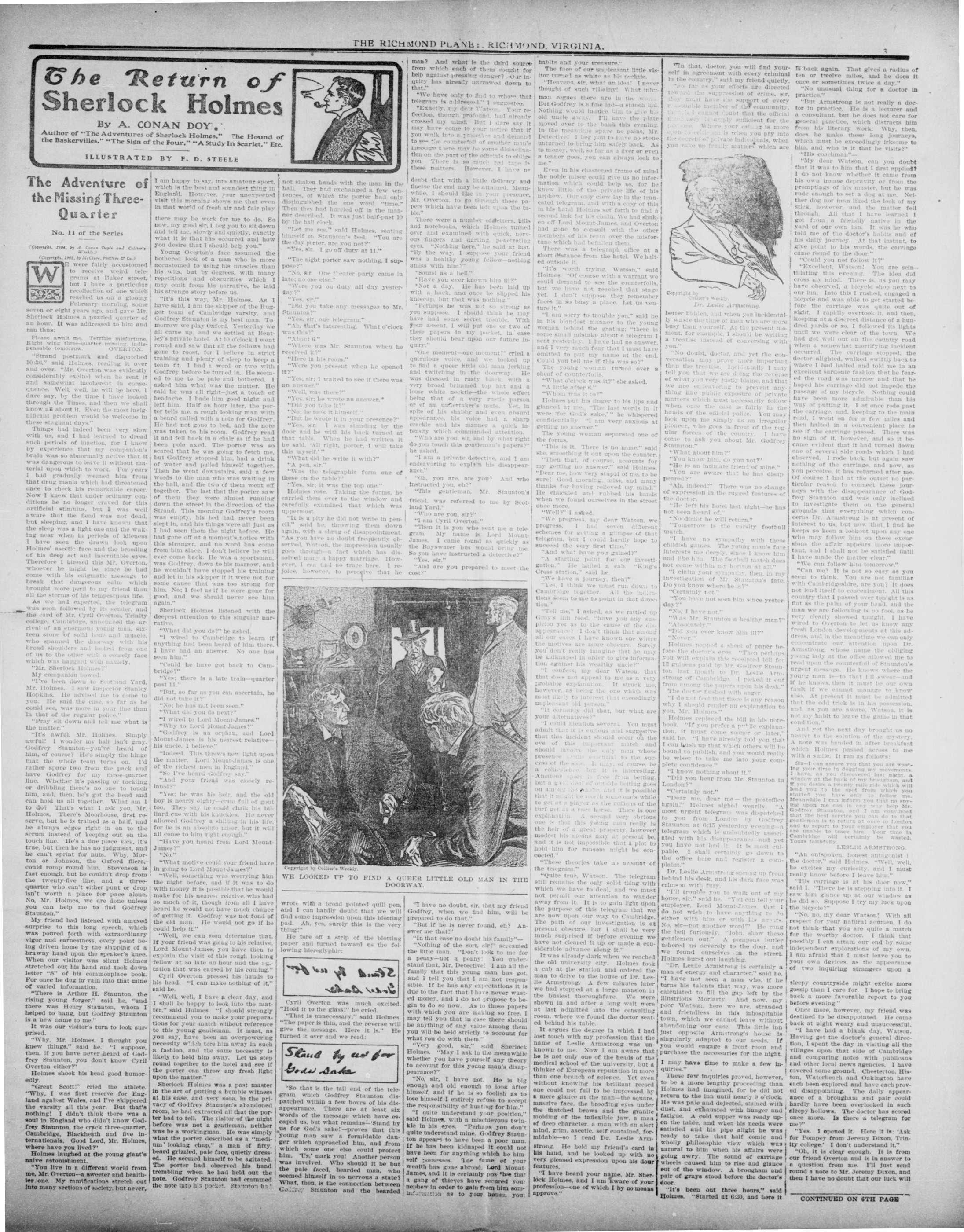
The Return of Sherlock Holmes
Author of "The Adventures of Sherlock Holmes," The Hound of the Baskervilles," "The Sign of the Four," "A Study In Scarlet," Etc.
ILLUSTRATED BY F. D. STEELE
The Adventure of the Missing Three- Quarter
No. 11 of the Series
(Copyright, 1904, by A. Cowan Doyle and Collier's Work)
(Copyright, 1903, by M. Clare, Philips & Co.)
E were fairly accustomed to receive weird telegrams at Baker street, but I have a particular recollection of one which reached us on a gloomy February morning, some seven or eight years ago, and gave Mr. Sherlock Holmes a puzzled quarter of an hour. It was addressed to him and ran thus:
Please await me. Terrible misfortune. Right wing three-quarter missing, indispensable tomorrow. OVERTON.
"Strand postmark and dispatched 10:36," said Holmes, reading it over and over. "Mr. Overton was evidently considerably excited when he sent it and somewhat incoherent in consequence. Well, well, he will be here. I dare say, by the time I have looked through the Times, and then we shall know all about it. Even the most insignificant problem would be welcome in these stargant days."
Things had indeed been very slow with us, and I had learned to dread such periods of inaction, for I knew by experience that my companion's brain was so abnormally active that it was dangerous to leave it without material upon which to work. For years I had gradually weaned him from that drug mania which had threatened once to check his remarkable career. Now I knew that under ordinary conditions he no longer craved for this artificial stimulus, but I was well aware that the fiend was not dead, but sleeping, and I have known that the sleep was a light one and the waking near when in periods of idleness I have seen the drawn look upon Holmes' ascetic face and the brooding of his deep set and inscrutable eyes. Therefore I blessed this Mr. Overton, whoever he might be, since he had come with his enigmatic message to break that dangerous calm which brought more peril to my friend than all the storms of his tempestuous life. As we had expected, the telegram was soon followed by its sender, and the card of Mr. Cyril Overton, Trinity college, Cambridge, announced the arrival of an enormous young man, sixteen stone of solid bone and muscle, who spanned the doorway with his broad shoulders and looked from one of us to the other with a comely face which was haggard with anxiety.
"I've been down to Scotland Yard, Mr. Holmes, I saw Inspector Stanley Hopkins. He advised me to come to you. He said the case, so far as he could see, was more in your line than in that of the regular police."
"Pray sit down and tell me what is the matter."
"It's awful, Mr. Holmes. Simply awful! I wonder my hair isn't gray. Godfrey Staunton—you've heard of him, of course! He's simply the hinge that the whole team turns on. I'd rather spare two from the pack and have Godfrey for my three-quarter line. Whether it's passing or tackling or dribbling there's no one to touch him, and, then, he's got the head and can hold us all together. What am I to do? That's what I ask you, Mr. Holmes. There's Moorhouse, first reserve, but he is trained as a half, and he always edges right in on to the scrum instead of keeping out on the touch line. He's a fine place kick, it's true, but then he has no judgment, and he can't sprint for nuts. Why, Morton or Johnson, the Oxford fliers, could romp round him. Stevenson is fast enough, but he couldn't drop from the twenty-five line, and a three-quarter who can't either punt or drop isn't worth a place for pace alone. No, Mr. Holmes, we are done unless you can help me to find Godfrey Staunton."
My friend had listened with amused surprise to this long speech, which was poured forth with extraordinary vigor and earnestness, every point being driven home by the slapping of a brawny hand upon the speaker's knee. When our visitor was silent Holmes stretched out his hand and took down letter "S" of his commonplace book. For once he dug in vain into that mine of varied information.
"There is Arthur H. Staunton, the rising young forger," said he, "and there was Henry Staunton, whom I helped to hang, but Godfrey Staunton is a new name to me."
It was our visitor's turn to look surprised.
"Why, Mr. Holmes, I thought you knew things." said he, "I suppose, then, if you have never heard of Godfrey Staunton, you don't know Cyril Overton either?"
Holmes shook his head good humorely.
"Great Scott!" cried the athlete.
"Why, I was first reserve for England against Wales, and I've skipped the varsity all this year. But that's nothing! I didn't think there was a soul in England who didn't know Godfrey Staunton, the crack three-quarter, Cambridge, Blackheath and five internationals. Good Lord, Mr. Holmes, where have you lived?"
Holmes laughed at the young giant's naive astonishment.
"You live in a different world from me, Mr. Overton—a sweeter and healthier one. My ramifications stretch out into many sections of society, but never.
W
My companion bowed.
I am happy to say, into amateur sport, which is the best and soundest thing in England. However, your unexpected visit this morning shows me that even in that world of fresh air and fair play there may be work for me to do. So now, my good sir, I beg you to sit down and tell me, slowly and quietly, exactly what it is that has occurred and how you desire that I should help you."
Young Overton's face assumed the bothered look of a man who is more accustomed to using his muscles than his wits, but by degrees, with many repetitions and obscurities which I may omit from his narrative, he laid his strange story before us.
“it’s this way, Mr. Holmes. As I have said, I am the skipper of the Rugger team of Cambridge varsity, and Godfrey Staunton is my best man. To morrow we play Oxford. Yesterday we all came up, and we settled at Bentley’s private hotel. At 10 o’clock I went round and saw that all the fellows had gone to roost, for I believe in strict training and plenty of sleep to keep a team fit. I had a word or two with Godfrey before he turned in. He seemed to me to be pale and bothered. I asked him what was the matter. He said he was all right—just a touch of headache. I bade him good night and left him. Half an hour later, the porter tells me, a rough looking man with a beard called with a note for Godfrey. He had not gone to bed, and the note was taken to his room. Godfrey read it and fell back in a chair as if he had been pole axed. The porter was so scared that he was going to fetch me, but Godfrey stopped him, had a drink of water and pulled himself together. Then he went downstairs, said a few words to the man who was waiting in the hall, and the two of them went off together. The last that the porter saw of them they were almost running down the street in the direction of the Strand. This morning Godfrey’s room was empty, his bed had never been slept in, and his things were all just as I had seen them the night before. He had gone off at a moment’s notice with this stranger, and no word has come from him since. I don’t believe he will ever come back. He was a sportsman, was Godfrey, down to his marrow, and he wouldn’t have stopped his training and let in his skipper if it were not for some cause that was too strong for him. No; I feel as if he were gone for good, and we should never see him again.”
Sherlock Holmes listened with the deepest attention to this singular narrative.
"What did you do?" he asked.
"I wired to Cambridge to learn if anything had been heard of him there. I have had an answer. No one has seen him."
"Could he have got back to Cambridge?"
"Yes; there is a late train—quarter past 11."
"But, so far as you can ascertain, he did not take it?"
"No; he has not been seen."
"What did you do next?"
"I wired to Lord Mount-James."
"Why to Lord Mount-James?"
"Godfrey is an orphan, and Lord Mount-James is his nearest relative—his uncle, I believe."
"Indeed. This throws new light upon the matter. Lord Mount-James is one of the richest men in England."
"So I've heard Godfrey say."
"And your friend was closely related?"
"Yes; he was his heir, and the old boy is nearly eight—cram full of gout too. They say he could chalk his biliard cue with his knuckles. He never allowed Godfrey a shilling in his life, for he is an absolute miser, but it will all come to him right enough."
"Have you heard from Lord Mount-James?"
"What motive could your friend have in going to Lord Mount-James?"
"Well, something was worrying him the night before, and if it was to do with money it is possible that he would make for his nearest relative, who had so much of it, though from all I have heard he would not have much chance of getting it. Godfrey was not fond of the old man. He would not go if he could help it."
"Well, we can soon determine that. If your friend was going to his relative, Lord Mount-James, you have then to explain the visit of this rough looking fellow at so late an hour and the agitation that was caused by his coming."
Cyril Overton pressed his hands to his head. "I can make nothing of it," said he.
"Well, well, I have a clear day, and I shall be happy to look into the matter," said Holmes. "I should strongly recommend you to make your preparations for your match without reference to this young gentleman. If must, as you say, have been an overpowering necessity which tore him away in such a fashion, and the same necessity is likely to hold him away. Let us step round together to the hotel and see if the porter can throw any fresh light upon the matter."
Sherlock Holmes was a past master in the art of putting a humble witness at his ease, and very soon. In the privacy of Godfrey Staunton's abandoned room, he had extracted all that the porter had to tell. The visitor of the night before was not a gentleman, neither was he a workingman. He was simply what the porter described as a "medium' looking chap," a man of fifty, beard grizzled, pale face, quietly dressed. He seemed himself to be agitated. The porter had observed his hand trembling when he had held out the note. Godfrey Staunton had crammed the note into his pocket. Staunton had!
THE RICHMOND PLANE: RICHMOND, VIRGINIA.
J.
WE LOOKED UP TO FIND A QUEER LITTLE OLD MAN IN THE DOORWAY.
not shaken hands with the man in the hall. They had exchanged a few sentences, of which the porter had only distinguished the one word "time." Then they had hurried off in the manner described. It was just half-past 10 by the hall clock.
"Let me see," said Holmes, seating himself on Staunton's bed. "You are the day porter, are you not?"
"Yes, sir. I go off duty at 11."
"The night porter saw nothing. I suppose?"
"No, sir. One theater party came in late; no one else."
"Were you on duty all day yester-day?"
"Yes, sir."
"Did you take any messages to Mr. Staunton?"
"Yes, sir; one telegram."
"Ah, that's interesting. What o'clock was this?"
"About 6."
"Where was Mr. Staunton when he received it?"
"Here in his room."
"Were you present when he opened it?"
"Yes, sir; I waited to see if there was an answer."
"Well, was there?"
"Yes, sir; he wrote an answer."
"Did you take it?"
"No; he took it himself."
"But he wrote it in your presence?"
"Yes, sir. I was standing by the door and he with his back turned at that table. When he had written it he said, 'All right, porter, I will take this myself.'"
"What did he write it with?"
"A pen, sir."
"Was the telegraphic form one of these on the table?"
"Yes, sir; it was the top one."
Holmes rose. Taking the forms, he carried them over to the window and carefully examined that which was uppermost.
"It is a pity he did not write in pencil," said he, throwing them down again, with a shrug of disappointment.
"As you have no doubt frequently observed, Wat-on, the impression usually goes through—a fact which has dissolved many a happy marriage. However, I can find no trace here. I rejoice, however, to perceive that
Copyright by Collier's Weekly.
WE LOOKED UP TO FIND A Q
DOOR
wrote with a broad pointed quill pen,
and I can hardly doubt that we will
find some impression upon this blotting
pad. Ah, yes, surely this is the very
thing!"
He tore off a strip of the blotting
paper and turned toward us the following hieroglyphic:
Cyril Overton was much excited.
"Hold it to the glass!" he cried.
"That is unnecessary." said Holmes.
"The paper is thin, and the reverse will
give the message. Here it is." He
turned it over and we read:
Skilled by us for
Gods Sake
"So that is the tail end of the telegram which Godfrey Staunton dispatched within a few hours of his disappearance. There are at least six words of the message which have escaped us, but what remains—"Stand by us for God's sake"—proves that this young man saw a formidable danger which approached him, and from which some one else could protect him. 'Us.' mark you! Another person was involved. Who should it be but the pale faced, bearded man, who seemed himself in so nervous a state? What, then, is the connection between Godfrey Staunton and the bearded
man? And what is the third source from which each of them sought for help against pressing danger? Our inquiry has already narrowed down to that."
"We have only to find to who that telegram is addressed." I suggested.
"Exactly, my dear Watson. Your reflection, though profound, had already crossed my mind. But I dare say it may have come to your notice that if you walk into a position and demand to see the counterell of another man's message it here may be some distinction on the part of the officials to oblige you. There is so much red tape in these matters. However, I have no doubt that with a little delicacy and finesse the end may be attained. Meanwhile, I should like in your presence, Mr. Overton, to go through these papers which have been left upon the table."
There were a number of letters, bills and notebooks, which Holmes turned over and examined with quick, nervous fingers and darting, penetrating eyes. "Nothing here," he said at last.
"By the way, I suppose your friend was a healthy young fellow—nothing amiss with him?"
"Sound as a bell."
"Have you ever known him fill?"
"Not a day. He has been laid up with a hack, and once he slipped his kneecap, but that was nothing."
"Perhaps he was not so strong as you suppose. I should think he may have had some secret trouble. With your assent, I will put one or two of these papers in my pocket, in case they should bear upon our future inquiry."
"One moment—one moment!" eried a querulous voice, and we looked up to find a queer little old man jerking and twitching in the doorway. He was dressed in rusty black, with a very broad brimmed top hat and a loose white necktie—the whole effect being that of a very rustic parson or of an unfortunetaker's mute. Yet, in spite of his shabby and even absurd appearance, his voice had a sharp crackle and his manner a quick intensity which commanded attention.
"Who are you, sir, and by what right do you touch this gentleman's papers?" he asked.
"I am a private detective, and I am endeavoring to explain his disappearance."
"Oh, you are. are you?" And who instructed you, eh?"
"This gentleman, Mr. Staunton's
friend, was referred to me by Scotland Yard."
"Who are you, sir?"
"I am Cyril Overton."
"Then it is you who sent me a telegram. My name is Lord Mount James. I came round as quickly as the Rayswater bus would bring me. So you have instructed a detective?"
"Yes, sir."
"And are you prepared to meet the cost?"
QUEER LITTLE OLD MAN IN THE
WAY.
"I have no doubt, sir, that my friend Godfrey, when we find him, will be prepared to do that."
"But if he is never found, eh? Answer me that!"
"In that case no doubt his family"—"Nothing of the sort, sir," screamed the little man. "Don't look to me for a penny—not a penny! You understand that, Mr. Detective! I am all the family that this young man has got, and I tell you that I am not responsible. If he has any expectations it is due to the fact that I have never wasted money, and I do not propose to begin to do so now. As to those papers with which you are making so free, I may tell you that in case there should be anything of any value among them you will be held strictly to account for what you do with them."
"Very good, sir," said Sherlock Holmes. "May I ask in the meanwhile whether you have yourself any theory to account for this young man's disappearance?"
"No, sir, I have not. He is big enough and old enough to look after himself, and if he is so foolish as to lose himself I entirely refuse to accept the responsibility of hunting for him."
"I quite understand your position," said Holmes, with a mischievous twinkle in his eyes. "Perhaps you don't quite understand mine. Godfrey Staunton appears to have been a poor man. If he has been kidnapped it could not have been for anything which he himself possesses. For some of your wealth has gone abroad. Lord Mount James, and it is certainly pos 'be that a gang of thieves have secured your nephew in order to gain from him some information as to your house, you
habits and your treasure."
Heheshes, so, with an earl, I never thought of such villainy! What inhuman regimes there are in the world. But Godfrey is a fine lad—a stanchad lad. Nothing will induce him to give his old uncle away. I'll have the plate moved over to the bank this evening. In the meantime spare no pain, Mr. Detective! I beg you to leave no stone unturned to bring him safely back. As to money, well, so far as a river or even a tenner goes, you can always look to me."
Even in his chastened frame of mind the noble miser could give us no information which could help us, for he knew little of the private life of his nephew. Our only clew lay in the truncated telegram, and with a copy of this in his hand Holmes set forth to find a second link for his chain. We had shaken off Lord Mount-James, and Overton had gone to consult with the other members of his team over the misfortune which had befallen them.
There was a telegraph office at a short distance from the hotel. We halted outside it.
"It's worth trying, Watson," said Holmes. "Of course with a warrant we could demand to see the counterfols, but we have not reached that stage yet. I don't suppose they remember faces in so busy a place. Let us venture it."
"I am sorry to trouble you," said he in his blandest manner to the young woman behind the grating; "there is some small mistake about a telegram I sent yesterday. I have had no answer, and I very much fear that I must have omitted to put my name at the end. Could you tell me if this was so?"
The young woman turned over a sheaf of counterfols.
"What o'clock was it?" she asked.
"A little after 6."
"Whom was it to?"
Holmes put his finger to his lips and glanced at me. "The last words in it were 'for God's sake'," he whispered confidentially. "I am very anxious at getting no answer."
The young woman separated one of the forms.
"This is it. There is no name," said she, smoothing it out upon the counter.
she smoothing it out upon the counter,
"Then that, of course, accounts for
my getting no answer." said Holmes.
"Dear me, how very stupid of me, to be
sure! Good morning, miss, and many
thanks for having relieved my mind."
He chuckled and rubbed his hands
when we found ourselves in the street
once more.
"Well?" I asked.
"We progress, my dear Watson, we progress. I had seven different schemes for getting a glimpse of that telegram, but I could hardly hope to succeed the very first time."
"And what have you gained?"
"A starting point for our investigation." He hailed a cab. "King's Cross station," said he.
"We have a journey, then?"
"Yes, I think we must run down to Cambridge together. All the indications seem to me to point in that direction."
"Tell me," I asked, as we rattled up Gray's Inn road, "have you any suspicion yet as to the cause of the disappearance? I don't think that among all our cases I have known one where the motives are more obscure. Surely you don't really imagine that he may be kidnapped in order to give information against his wealthy uncle?"
"I confess, my dear Watson, that that does not appeal to me as a very probable explanation. It struck me, however, as the being one which was most likely to interest that exceedingly unpleasant old person."
"It certainly did that, but what are your alternatives?"
"I could mention several. You must admit that it is curious and suggestive that this incident should occur on the eve of this important match and should involve the only man whose presence seems essential to the success of the side. It may, of course, be a coincidence but it is interesting. Amateur sport is free from betting, but a good deal of outside betting goes on among the able, and it is possible that it might be worth some one's while to get at a player as the rufians of the turf get at a race horse. There is one explanation. A second very obvious one is that this young man really is the heir of a great property, however modest his means may at present be, and it is not impossible that a plot to hold him for ransom might be concocted."
"These theories take no account of the telegram."
"Quite true, Watson. The telegram still remains the only solid thing with which we have to deal, and we must not permit our attention to wander away from it. It is to gain light upon the purpose of this telegram that we are now upon our way to Cambridge. The path of our investigation is at present obscure, but I shall be very much surprised if before evening we have not cleared it up or made a considerable advance along it."
It was already dark when we reached the old university city. Holmes took a cab at the station and ordered the man to drive to the house of Dr. Leslie Armstrong. A few minutes later we had stopped at a large mansion in the busiest thoroughfare. We were shown in and after a long wait were at last admitted into the consulting room, where we found the doctor seated behind his table.
It argues the degree in which I had lost touch with my profession that the name of Leslie Armstrong was unknown to me. Now I am aware that he is not only one of the heads of the medical school of the university, but a thinker of European reputation in more than one branch of science. Yet even without knowing his brilliant record one could not fail to be impressed by a mere glance at the man—the square, massive face, the brooding eyes under the thatched brows and the granite molding of the inflexible jaw, a man of deep character, a man with an alert mind, grim, ascetic, self contained, formidable—so I read Dr. Leslie Armstrong. He held my friend's card in his hand, and he looked up with no very pleased expression upon his dour features.
"I have heard your name, Mr. Sherlock Holmes, and I am aware of your profession—one of which I by no means approve."
"In that, doctor, you will find your self in agreement with every criminal in the country," said my friend quietly. "So far as your efforts are directed toward the suppression of crime, sir, they must have the support of every reasonable member of the community, though I cannot doubt that the official machinery is simply sufficient for the purpose. Where your calling is more open to criticism is when you pry into the secrets of private individuals, when you raise up family matters" which are
better hidden, and when you incidentally waste the time of men who are more busy than yourself. At the present moment, for example, I should be writing a treatise instead of conversing with you."
"No doubt, doctor, and yet the conversation may prove more important than the treatise. Incidentally I may tell you that we are doing the reverse of what you very justly blame, and that we are endeavoring to prevent anything like public exposure of private matters which must necessarily follow when once the case is fairly in the hands of the official police. You may look upon me simply as an irregular pioneer, who goes in front of the regular forces of the country. I have come to ask you about Mr. Godfrey Staunton."
"What about him?"
"You know him, do you not?"
"He is an intimate friend of mine."
"You are aware that he has disappeared?"
"Ah, indeed!" There was no change of expression in the rugged features of the doctor.
"He left his hotel last night—he has not been heard of."
"No doubt he will return."
"Tomorrow is the varsity football match."
"I have no sympathy with these childish games. The young man's fate interests me deeply, since I know him and like him. The football match does not come within my horizon at all."
"I claim your sympathy, then, in my investigation of Mr. Staunton's fate. Do you know where he is?"
"Certainly not."
"You have not seen him since yesterday."
"No, I have not."
"Was Mr. Staunton a healthy man?"
"Absolutely."
"Did you ever know him ill?"
"Never."
Holmes popped a sheet of paper before the doctor's eyes. "Then perhaps you will explain this receipted bill for 13 guineas paid by Mr. Godfrey Staunton last month to Dr. Leslie Armstrong of Cambridge. I picked it out from among the papers upon his desk."
The doctor fushed with anger.
"I do not feel that there is any reason why I should render an explanation to you, Mr. Holmes."
Holmes replaced the bill in his notebook.
"If you prefer a pot'le explanation, it must come sooner or later."
said he. "I have already told you that I can lash up that which others will be bound to publish, and you would really be wiser to take me into your complete confidence."
"I know nothing about it."
"Did you hear from Mr. Staunton in London?"
"Certainly not."
"Dear me, dear me — the postoffice again!" Holmes sighed wearily. "A most urgent telegram was dispatched to you from London by Godfrey Staunton at 6:15 yesterday evening—a telegram which is undoubtedly associated with his disappearance—and yet you have not had it. It is most culpable. I shall certainly go down to the office here and register a complaint."
Dr. Leslie Armstrong sprang up from behind his desk, and his dark face was crimson with fury.
"I'll trouble you to walk out of my house, sir," said he. "You can tell your employer, Lord Mount-James that I do not wish to have anything to do either with him or with his agents. No, sir—not another word!" He rang the bell furiously. "John, show these gentlemen out." A pompous butter ushered us severely to the door, and we found ourselves in the street. Holmes burst out laughing.
"Dr. Leslie Armstrong is certainly a man of energy and character," said he, "I have not seen a man who, if he turns his talents that way, was more calculated to fill the gap left by the illustrious Morlarty. And now, my poor Watson, here we are, stranded and friendless in this inhospitable town, which we cannot leave without abandoning our case. This little inn just opposite Armstrong's house is singularly adapted to our needs. If you would engage a front room and purchase the necessaries for the night, I may have time to make a few to
I may have time to make a few inquiries."
These few inquiries proved, however, to be a more lengthy proceeding than Holmes had imagined, for he did not return to the inn until nearly 9 o'clock. He was paired and dejected, stained with dust, and exhausted with hunger and fatigue. A cold supper was ready upon the table, and when his needs were satisfied and his pipe alight he was ready to take that half comic and wholly philosophic view which was natural to him when his affairs were going awry. The sound of carriage wheels caused him to rise and glance out of the window. A brougham and pair of grays stood before the doctor's door.
"It's been out three hours," said Holmes. "Started at 6:20, and here it
Is back again. That gives a radius of ten or twelve miles, and he does it once or sometimes twice a day."
"No unusual thing for a doctor in practice."
"But Armstrong is not really a doctor in practice. He is is a lecturer and a consultant, but he does not care for general practice, which distracts him from his literary work. Why, then, does he make these long journeys, which must be exceedingly irksome to him, and who is it that he visits?" "His coachman"— "My dear Watson, can you doubt that it was to him that I first applied? I do not know whether it came from his own innate depravity or from the promptings of his master, but he was rude enough to set a dog at me. Neither dog nor man liked the look of his stick, however, and the matter fell through. All that I have learned I got from a friendly native in the yard of our own farm. It was he who told me of the doctor's habits and of his daily journey. At that instant, to give point to his words, the carriage came round to the door."
"Could you not follow it?"
"Excellent, Watson! You are scintillating this evening. The idea did cross my mind. There is, as you may have observed, a bicycle shop next to our inn. Into this I rushed, engaged a bicycle and was able to get started before the carriage was quite out of sight. I rapidly overtook it, and then, keeping at a discreet distance of a hundred yards or so, I followed its lights until we were clear of the town. We had got well out on the country road when a somewhat mortifying incident occurred. The carriage stopped, the doctor alighted, walked swiftly back to where I had halted and told me in an excellent sardonic fashion that he feared the road was narrow and that he hoped his carriage did not impede the passage of my bicycle. Nothing could have been more admirable than his way of putting it. I at once rode past the carriage, and keeping to the main road, I went on for a few miles and then halted in a convenient place to see if the carriage passed. There was no sign of it, however, and so it became evident that it had turned down one of several side roads which I had observed. I rode back, but again saw nothing of the carriage, and now, as you perceive, it has returned after me. Of course I had at the outset no particular reason to connect these journeys with the disappearance of Godfrey Staunton and was only inclined to investigate them on the general grounds that everything which concerns Dr. Armstrong is at present of interest to us, but now that I find he keeps so keen a lookout upon any one who may follow him on these excursions the affair appears more important, and I shall not be satisfied until I have made the matter clear."
"Can we? It is not so easy as you seem to think. You are not familiar with Cambridgeshire, are you? It does not lend itself to concealment. All this country that I passed over tonight is as flat as the palm of your hand, and the man we are following is no fool, as he very clearly showed tonight. I have wired to Overton to let us know any fresh London developments at this address, and in the meantime we can only concentrate our attention upon Dr. Armstrong, whose name the obliging young lady at the office allowed me to read upon the counterfort of Staundon's urgent message. He knows where the young man is—to that I'll swear—and if he knows, then it must be our own fault if we cannot manage to know also. At present it must be admitted that the odd trick is in his possession, and, as you are aware, Watson, it is not my habit to leave the game in that condition."
And yet the next day brought us no nearer to the solution of the mystery. A note was handed in after breakfast which Holmes passed across to me with a smile. It ran as follows:
Sir-I can assure you that you are wasting your time in dogging my movements. I have, as you discovered last night, a walk to the back of my brougham, and if you were to be dogged in front of which will lead you to the spot from which you started you have only to follow me. Meanwhile I can inform you that no spying upon me can in any way help Mr. Godfrey Staunton, and I am convinced that the best service you can do to that gentleman is to report to your employer that you are unable to trace him. Your time in Cambridge will certainly be wasted. Yours faithfully.
LESLIE ARMSTRONG.
"An outspoken, honest antagonist! the doctor," said Holmes. "Well, well, he executes my curiosity, and I must really know before I leave him."
"His carriage is at his door now," said I. "There he is stepping into it. I saw him glance up at our window as he did so. Suppose I try my luck upon the bicycle?"
"No, no, my dear Watson! With all respect for your natural acumen, I do not think that you are quite a match for the worthy doctor. I think that possibly I can attain our end by some independent explorations of my own. I am afraid that I must leave you to your own devices, as the appearance of two inquiring strangers upon a sleepy countryside might excite more gossip than I care for. I hope to bring back a more favorable report to you before evening."
destined to be disappointed. He came back at night weary and unsuccessful.
"I have had a blank day, Watson. Having got the doctor's general direction, I spent the day in visiting all the villages upon that side of Cambridge and comparing notes with publicans and other local news agencies. I have covered some ground, Chesterton, Histon, Waterbeach and Oakington have each been explored and have each proved disappointing. The daily appearance of a brougham and pair could hardly have been overlooked in such sleepy hollows. The doctor has scored once more. Is there a telegram for me?"
"Yes. I opened it. Here it is: 'Ask for Pompey from Jeremy Dixon, Trinity college.' I don't understand it."
"Oh, it is clear enough. It is from our friend Overton and is in answer to a question from me. I'll just send round a note to Mr. Jeremy Dixon, and then I have no doubt that our luck will
CONTINUED ON 6TH PAGE
THE PLANET
All communications intended for publication should be sent so as to reach us by Wednesday.
TERMS IN ADVANCE
ADVERTISING RATES
There are FOUR ways by which money can be sent by mail at our risk—Invoice, Post Office Money Order, by Bank Check or Draft, or an Express Money Order, and when none of these methods is available, you can send money by Money ORDERS. You can buy a Money Order at your Post Office, payable at the Richmond Post Office, and we will be responsible for safe arrival.
The ORDERS can be obtained at any office of the American Express Co., the United States Express Co., and the Wells Fargo and Co.'s Express Company. We will be responsible for the payment of the Express Money Order is a convenient way for forwarding money.
REGISTERED LETTER—If a money Order Post Office or an Express Company is not within your jurisdiction, the Express Money Order is a convenient way for sending money to ten cents. Then, if the letter is lost or stolen, you can send money in this manner at our risk.
We cannot be responsible for money sent in letters in any other way than one of the four ways mentioned above. If you send your money in another way, you must do it at your own risk.
RENEWALS, ETC.—If you do not want THE PLANET continued for another year after your subscription, you can discontinue it. The courts have decided that subscribers to newspaper, who do not subscribe but run out, will notify the institution of time for which it has been paid are held liable for the payment of the subscription. When they order the paper discontinued.
COMMUNICATIONS!—When writing to us to renew your subscription or to discontinue your subscription, in full, all other we cannot find your name on our books.
ADDRESS!—In order to change the address of a subscriber, we must be sent the former as well as the present address.
Entered at the Post-Office at Richmond, Va., as second-class matter.
SATURDAY SEPTEMBER 16, 1905
We are pleased to note that Hon. H. C. Smith has been renominated for a fourth term in the Ohio Legislature by the Republicans of Cuyahoga county. He received the third highest vote of twenty-three candidates, twenty of whom were white. There are 60,000 voters in the county of which only about three or four thousand are Afro-Americans. This is a deserved recognition. We have known Mr. Smith for more than fifteen years and he has always been true to the people with whom he is identified. We hope that he may be elected, and if we were in his District would do all in our power to give him the largest vote ever vouchsafed any candidate in that legislative district.
:0:
We learn with genuine satisfaction of the action of the Norfolk (Va.) City Council in voting to erase the name of Prof. G. W. Hayes from the Geath record of that city as father of the deceased child of the daughter of Frank Gilliam. This girl was at one time a student at that institution, and Prof. Hayes alleges that she was induced to enter his name upon the death certificate as the father of the infant aforesaid. He brought suit in the court to have the name erased, but the judge decided that his court was without jurisdiction. Only the City Council could afford the relief prayed for.
The affair has done the gentleman in question untold damage, and his many friends will learn with pleasure of his vindication. It is unfortunate that he has no other redress.
"PROF. BOOKER T. WASHINGTON AND THE NEGRO."
Rev. Thomas Dixon, Jr., in his communication to the Saturday Evening Post of August 19, 1905, under the caption of "Prof. Booker T. Washington and the Negro," seems to have had a return of all of his venom and antipathy to the race that has never harmed him. He directs his attack upon the educated negroes and the ones who are attempting to separate themselves "from the body of this death" and rise "on their dead selves to higher things." Dealing with the question of the amalgamation of the races, he quotes Prof. DuBois, Mr. Charles W. Chestnut, and Prof. Kelly Miller, and asks;
What is the attitude of Mr. Booker T. Washington on this vital issue? You will search his books and listen to his lectures in vain for any direct answer. Why? Because if he dared to say what he really in his soul of souls believes, it would end his great
career, both North and South. In no other way has he shown his talent as an organizer and leader of his people with such consummate skill as in the dexterity with which he has for twenty years dodged this issue, holding steadily the good-will of the Southern white man and the Northern philanthropist. He is the greatest diplomat his race has ever produced.
This is a great compliment paid to Prof. Washington, but it is tendered with a purpose—that to destroy him. He says further:
Yet he who reads between the lines of his written and spoken words will find the same purpose and the same faith which his more blunt and fearless brethren have honestly and boldly proclaimed. He shows this in his worship of Frederick Douglass. In his book, The Future of the American Negro, we find this careful sentence:
"To state in detail just what place the black man will occupy in the South as a citizen when he has developed in the direction named is beyond the wisdom of any one."
Yet on page 69 he says:
"The surest way for the negro to reach the highest positions is to prepare himself to fill well at the present the basic occupations"—independent industries, of course—for, mark you. "Tuskegee Institute is not a servant-training school!"
Again on pages 83 and 85 we are told: "There is an unmistakable influence that comes over a white man when he sees a black man living in a two-story brick house that has been paid for. I need not stop to explain. Just in so far as we can place rich negroes in the South who can loan money to white men, this race question will disappear."
The conclusion is obvious: The negro who holds a mortgage on a white man's house will ultimately demand and receive social recognition from him.
Prof. Washington is in the embarrassing predicament of being between two fires. He is charged by Rev. Thomas Dixon, Jr., with going too far, and he is charged by some colored men of the "higher education" persuasion with not going far enough.
It is but fair to say that Prof. Washington has changed materially in his utterances during the last few years. He is more outspoken now, and his declaration that "Tuskegee is not a servant-training school" will be a revelation to 90 per cent. of the white Southerners. The idea of training negroes to be servants for the white people is popular in this section of the South, and the responses from all classes of white people are loud and deep in approval whenever the subject is broached by an industrial educator. Prof. Washington's declaration of fact, however, will meet the cordial approval of the best elements in both races. Rev. Dixon plays a remarkable game of "hide and seek" in some of his utterances. He continues:
On page 66 of his Future of the American Negro he says: "The Jew, who was once in about the same position as the Negro is to-day, has now recognition because he has entwined himself about America in a business and industrial way." Again his conclusion is obvious. The absurdity of the comparison, however, is the important point in this sentence, not only for the pathetic ignorance of history it displays, but for the revelation of the writer's secret hopes and dreams.
Rev. Dixon takes up the Jewish question, and says:
The Jew has not been assimilated into our civil and social life because of his money, but for a very different reason. The Jew belongs to our race, the same great division of humanity. The Semitic group of the white race is, all in all, the greatest evolved in history. Their children have ever led the vanguard of human progress and achievements. A great historian and philosopher once said: "Show me a man of transcendent genius at any period of the world's history and I'll show you a man with Hebrew blood in his veins."
He is in the business of claiming every race that has an historical record of its achievements,be its members as yellow as Confucius or as black as "the ace of spades." He has already laid claim to the Moors and the Egyptians, and he now grabs the celebrated descendants from the Old World. The latter part of his utterances upon this subject are surprising to say the least, and in them may be found, no doubt, some excuse for the very prejudice that exists against the Negro in this country. It is a new phase of a very interesting discussion, and may be designated as the prejudice against the intellectual Negro because of his genius. But here is what Rev. Dixon says:
Our prejudice against the Jew is not because of his inferiority, but because of his genius. We are afraid of him, we Gentiles who meet him in the arena of life, get licked and then make faces at him. The truth is the Jew had achieved a noble civilization—had his poets, prophets, priests and kings—when our Germanic ancestors were still in the woods cracking coconuts and hickory nuts with monkeys. We have assimilated the Jew because his daughter is beautiful and his son strong in mind and body!
Rev. Dixon is guilty of the grossest kind of inconsistency within nineteen lines of the columns of the Saturday Evening Post. He said, "The Jew has not been assimilated into our civil and social life because of his money, but for a very different reason," and then in another sentence he says: "We have assimilated the Jew because his daughter is beautiful
RICHMOND PLANET, RICHMOND, VIRGINIA
and his son is strong in mind and body!"
What does Rev. Dixon mean? Is it possible that in the mazes of inconsistent reasoning he has lost himself? It would seem so. It will be seen that Rev. Dixon has an insidious purpose in all that he says—that is, to arouse the worst passions of the Negro-haters of the South-land by portraying in the most lurid characters all of the imaginary horrors of the amalgamation of the races. He would fire the southern heart and the northern one too for that matter. He is worried about the "yallers" and the mullatoes. He says:
The trouble with Mr. Booker T. Washington's work is that he is silently preparing us for the future heaven of Amalgamation—or he is doing something equally dangerous, namely, he is attempting to build a nation inside a nation of two hostile races. In this event he is storing dynamite beneath the pathway of our children; the end "at last can only be in blood-shed.
Amalgamation may be a "heaven." but it is the White man's "heaven." Prof. Washington may be facing a "condition and not a theory." He did not bring about this amalgamation any more than Frederick Douglass did, when he found that he had white blood in his veins.
The race has become so bleached as a result of the white man's rascality that the white conductors on our "Jim Crow" street and railway cars are in constant fear and they make a mistake and assign a colored person to a white car and vice versa. Houses of doubtful reputation, supported by white men's money are maintained all over this fair land of ours for the purpose of bringing about this very amalgamation for which Prof. Booker T. Washington and other leading Negroes of the South-land are said by Rev. Dixon to be preparing. And yet there is not a half dozen of us in all this land, but what would check this amalgamation "business" if we could. Colored men have as wives the daughters of some of the best white men in the South, but, sir they are their illegitimate daughters. When Rev. Dixon treads on this ground he will find at every point enough private, social dynamite to bring about the greatest explosion. We are ready to take the matter up and discuss it with him. The Negro is opposed to amalgamation. He wishes, above all things, to keep his race, his women pure. This has been the cause of many a murder in this section of the country. Many a father has risked death to save a daughter and many brother has braved the stake to protect a sister.
Rev. Dixon need not discuss the amalgamation that is to come. He had better deal with that amalgamation that is already here. Rev. Dixon speaks truly when he says that we are attempting to build up a nation within a nation. We are doing all that we can to lessen the friction and to get from within the confines of the white man's endeavor. We do not ask for office in those corporations owned and controlled by white men, even though we have purchased stock therein. We organize with the cordial approval of the better class of Southern white men our own insurance companies. We elect our own directors and our own presidents and our own secretaries and our own treasurers.
We own and control our own banking institutions and industrial enterprises, and in the selection of our own officers there can be no reasonable question of color, for one in the eyes of the Negro haters is about as black as the other.
From the standpoint of color, we accept the popular melody, "All coons look alike to me," and we choose that one that has the most ability and is best qualified for the position that we wish him to occupy. Rev. Thos. Dixon, Jr., reads to Prof. Booker T. Washington his mission when he says:
Mr. Washington is not training Negroes to take their place in any industrial system of the South in which the white man can direct or control him. He is not training his students to be servants and come at the beck and call of any man. He is training them all to be masters of men, to be independent, to own and operate their own industries, plant their own fields, buy and sell their own goods, and in every shape and form destroy the last vestige of dependence on the white man for anything.
Will Prof. Washington accept this as his declaration of principles? Dare he do it? If he will there will be a practically unanimous acclaim on the part of every race-loving Negro in the United States. Rev. Dixon has stated our position exactly. We will meet him and discuss that issue at any place and at any time he may designate. We are in favor of building up a nation within a nation, and we subscribe to his declaration of principles a thousand times if need be in advocacy of the rights and privileges of a much persecuted and down-trodden people. We shudder at the prejudice against us because of inferiority; we defy and brave prejudice because of genius.
But even Rev. Dixon became astounded at his own utterances, for he made the following apologetic remarks:
I do not say this is not laudable;
I do not say that it is not noble. I only ask what will be its end for the Negro when the work is perfect? Every pupil who passes through Mr. Washington's hands ceases forever to work under a white man. Not only so, but he goes forth trained as an evangelist to preach the doctrine of separation and independence.
But enough for this week. We shall discuss Rev. Thomas Dixon, Jr., further in our next issue.
TOGO'S FLAGSHIP BURNED AND SUNK
The Mikasa Catches Fire and the Magazine Explodes.
CARRIED 599 MEN TO DEATH
Tokio, Sept. 13.—The navy department announced that the battleship Mikasa has been destroyed by fire and the explosion of her magazine, causing the loss of 599 lives, including men of other ships who went to the rescue. The fire started from an unknown cause at midnight on Sunday night. September 10. Before the officers could be rescued the fire reached the aft magazine, which exploded, blowing a hole in the port side of the vessel below the water line and causing the ship to sink.
An investigation is now being held to determine the cause of the fire. Admiral Togo was not on board the Mikasa when the disaster to the battleship occurred.
The disaster has cast gloom everywhere. The Mikasa was Togo's fangship, and was enforced to the hearts of the people. The ship was at anchor in Sasebo harbor when the fire started at the base of the mainmast at midnight. It spread with great rapidity, exploding the after magazine an hour after the fire had been discovered. The Mikasa sank in shallow water, and it is believed the ship can be repaired. Rescuing parties were sent from the various warships in the harbor, and there was heavy casualties among them. Various conjectures are current as to the cause of the fire. Some attribute it to an overcharge of electricity. Great relief was left throughout Japan when it was learned that Admiral Togo was not on board the ship at the time of the fire.
The Mikasa was a first class battleship of 16200 tons displacement. She was built in England and was launched in 1902. The battleship was 400 feet long, had a speed of over 18 knots, and carried a crew of 935 officers and men. She was heavily armored and carried four 12-inch guns, 14 6-inch guns, 20 12-pounders and a number of smaller rapid-fire guns. She had four submerged torpedo tubes.
In the battle of the Sea of Japan the Mikasa was the heaviest loser of all the Japanese ships, having 63 killed and wounded. She approached nearer to the Russians than any other battleship.
The Mikasa was also the f旗ship of Admiral Togo after the great naval battle fought off Port Arthur on August 10, 1904, on which occasion the Japanese f旗ship also suffered the most but continued in the fighting line. On that occasion the Mikasa had four officers and 29 men killed, six officers and 29 men severely wounded and four officers and 29 men silently wounded.
Still Skirmishing In Manchuria
Tokio, Sept. 12. A report from the Japanese headquarters says that in the direction of Hsing Ching, General Madrikoff, with about three regiments, opened an attack on Sushan on Monday, September 11, but was immediately repulsed by the Japanese. Madrikoff's force is said to have principally consisted of bandits.
Komuras Reported Slain.
Rome, Sept. 13.—The Tribuna published a rumor from Tien Tsin to the effect that the family of Baron Komura (the Japanese peace plenipotentiary, now in New York city) had been assassinated.
Baron Komura Improved
Baron Komura Improved.
New York, Sept. 13.—Baron Komura, the Japanese peace plenipotentiary, who is ill at the Waldorf-Astoria hotel, is somewhat improved, his fever being abated appreciably. He is still confined to his bed, and members of his suite said that he was in too weak and nervous a condition to be shown the report from Rome that his family had been assassinated. Notwithstanding his weakened condition, the baron is determined to leave New York tomorrow to begin his homeward trip as originally planned.
Witte Sails For Home.
New York, Sept. 13.—The Russian commissioners, who successfully concluded a truce of peace with the envoys of Japan at Portsmouth, N. H. have started on the return to St. Petersburg. The party, headed by Sergius Witte the chief Russian plenipotentiary sailed on the steamer Kaiser Wilhelm H. Before leaving the city Mr. Witte and Baron Rosen made a farewell call upon the Japanese diplomats who expect to leave for home later in the week. Baron Komura was unable to see the Russians because of his fitness, but through Minister Takahira he sent them a cordial message of farewell. Mr. Takahira and other members of the Japanese party entertained the Russians for half an hour.
NEGOTIATING AN ARMISTICE
General Oyama and General Linevitch
Appoint. Pliningintentia
Appoint Promotions.
Godzaydani, Manchuria, Sept. 11.—
At 1 o'clock Saturday afternoon a
Japanese commissioner bearing a
white flag and escorted by 50 soldiers,
arrived at a post near the railway and
handed to the Russian officers who
went to meet him a letter from Field
Marshal Oyama to General Litchvine,
congratulating him on the conclusion
of peace, and begging him to appoint
Russian plenibotentiaries to arrange an armistice. Field Marshal Oyama appointed General Fukushima as plenipotentiary for his side, the letter announced, and he suggested Chakhedza as the meeting place.
General Fukushima left Kai Yunn for the north to meet the Russian generals and arrange the details of an armistice. General Fukushima refused to allow the press correspondents to accompany him. The press representatives are still kept 16 miles in the rear of the army, which has not yet been informed of the signing of a peace treaty. The terms of the treaty will probably prove unpopular, but no demonstration is feared.
Will Arrange Armistice On Field.
Will Arrange Armistice On Field.
Gunshu Pass, Manchuria, Sept. 12—General Linevitch's answer to Field Marshal Oyama's letter requesting the arrangement of an armistice was dispatched by special messenger. In his answer the Russian commander-in-chief accepts the proposals of the Japanese commander-in-chief, which not only refers at considerable length to the question of an armistice, but also to neutral zones both on land and sea.
General Fukushima and General Ovanowsky, the respective plenipotentiaries, will meet tomorrow at Chakhedza, on the railway, as proposed by Field Marshal Oyama. The place is midway between the Japanese and Russian lines, separated by a ridge range. At the meeting all the questions at issue will be determined, except that referring to the delimination of the neutral zones, which will be left for the consideration of special delegates.
MOB RESPECTED AMERICA
No General Anti-Foreign Sentiment In Tokio, Plato
Oyster Bay, Sept. 12.—A definite resume of the conditions in Tokio is given in a cablegram from Minister Griscom to the secretary of stat e.S Griscom to the secretary of state, which was transmitted to President Roosevelt. Minister Griscom indicates that there is no general antiforeign or anti-Christian sentiment in Tokio, but points out that the recent rioting was due to sporadic antagonism to the Russian church and to some native Christians. Minister Griscom's cablegram, so far as it relates to the rioting in Tokio and the causes which led up to it, is in exact accord with the statements made by Baron Kaneko.
BAKU SITUATION WORSE
Tartars and Kurds Again Plundering.
Troops Kill 17 Workmen.
St. Petersburg, Sept. 12.—The latest private telegram to be received from Baku reports that the situation there is growing worse.
Other unconfirmed dispatches assert that the rioters are stubbornly continuing their attacks and that the Tartars and Kurds are plundering in the "Black Town" district. The dispatches say that on Sunday the soldiers fired into a crowd of Russian workmen, killing 17.
A dispatch to the Caucasus Oil company from Baku says that the fires in the oil fields are practically exhausted, and that the military authorities are stationing guards in the district.
During the night, the dispatch says, incendiaries tried to land at Biblebat from small boats, but were driven off by volleys from the Cossacks. They then attacked steamers in which the employees of two oil companies had taken refuge during the uprising, but the attack was repulsed.
CRANK AT OYSTER BAY
Wanted to Talk With President About the Price of Coal.
Oyster Bay, L. I., Sept. 13. — Isaac Schamus, a Russian Jew, 20 years old, was arrested here and after an examination before a justice of the peace was sent to Mineola, L. I., to be examined as to his sanity.
The arrest was made by a secret service agent, one of the personal guards of President Roosevelt. Schamus, who resides in New York city, had an interview with Mr. Barnes, assistant secretary to the president. He desired to see the president and talk with him about the price of coal. He said he was the general coal agent of Greater New York. There was imminent danger, in his opinion, of a general strike among the miners in the anthracite coal region of Pennsylvania, and the strike, he was assured, would result in great hardship to the people of the country. He wanted 10 minutes with the president to tell him to appoint a committee of three men who should regulate the output of the coal supply so as to provide the poor with fuel at reasonable prices, even in the event of a strike. He was unarmed.
CHARGED WITH "GRAFTING"
Warrants Out For Four Trustees of
Stauntonshire National School
Stroudsburg Normal School.
Stroudsburg, Pa., Sept. 12. — Warrants were issued for four trustees of the East Stroudsburg State Normal School on the charge of furnishing supplies to an institution receiving state aid, in violation of an act of assembly. The men for whom warrants were taken out are: Milton Yetter, president; P. F. Schwartz, secretary; George E. Stauffer and B. F. Morey, Stauffer was taken into custody and furnished ball. Yetter and Schwartz will probably be arrested today, but Morey, who is in the south, will not arrive home until next week. The men are charged with furnishing groceries, merchandise, plumbing supplies, books, pamphlets, etc., to the normal school.
Nelson Knocked Out.
San Francisco, Sept. 11.—In a fight that had many novel features, Battling Nelson, of Chicago, knocked out Edward Britt, of San Francisco, at Colma. The end came in the 18th round, and was a fairly won victory.
An Easy Job.
Mrs. Crawford -Why won't your husband buy you an auto?
Mrs. Crabshaw-He says we can run into debt fast enough now without employing machinery.-Puck.
FORCED TO TELL INSURANCE SEGRETS
Sensational Disclosure as to How Reports Are "Doctored."
PROBING THE NEW YORK LIFE
New York, Sept. 13.—Selling $800,000 in bonds one day and buying them back the next but one, a holiday intervening, in order to keep within statements made in the New York Life Insurance company's report to the superintendent of insurance, was the sensational disclosure made at the session of the legislative insurance investigating committee. The fact was drawn from Edmund D. Randolph, treasurer of the New York Life Insurance company, after Attorney Charles E. Hughes, of counsel to the committee, had labored for over an hour to get a direct answer from Mr. Randolph to a direct question.
Mr. Randolph had handed to Mr. Hughes a schedule of syndicate underwritings and transactions of the New York Life for the last 10 years. This statement was to show, and a foot note to the schedule so stated, that the company had participated in no syndicate transactions that had been closed out with a loss. Among these syndicate transactions was the underwriting of the Navigation syndicate, or International Mercantile Marine.
Mr. Hughes drew from the witness that there was an aggregate of $4,000,000 the New York Life paid J. P. Morgan & Co on this "joint account." Mr. Hughes then took up a sales item dated December 31, 1903, of $800,000 of International Mercantile Marine stock. Mr. Randolph, replying to Mr. Hughes, said this sale was made to J. P. Morgan & Co. Mr. Hughes continued his inquiry into the matter and asked:
"On January 2, 1904, there is an entry of a purchase of $800,000. From whom did you buy?"
"Why did you sell to J. P. Morgan & Co., then buy from J. P. Morgan & Co. on the next business day?"
"Because they desired to reduce it."
"Yes, but why, then, did you buy it back the next business day?"
Here Mr. Randolph began to explain and wandered several times from the subject. He was led back by the lawyer, who seemingly was unable to get a reply. Finally he asked:
"Who sold the shares for the New York Life?"
"Mr. Perkins."
"Who bought them again?"
"Mr. Perkins."
"As a matter of fact, there was a report to the superintendent of insurance on December 31, 1903?"
"Yes."
"Then the sole purpose of the transaction was that you might be able to tell the superintendent of insurance you held only $320,000 of international Mercantile Marine shares?"
The witness hesitated, and tried to evade a direct answer, but Mr. Hughes repeated the question, until finally Mr. Randolph said "Yes."
There was a momentary hush, followed by a murmur of suppressed excitement.
In discussing the syndicate to handle the New Orleans railroad securities, which transaction was closed out in 1904. Mr. Randolph referred to a receiver being appointed, which was unforeseen by the New York Life when the securities were taken up. Witness also said that some parties the company had expected to join in handling the securities had failed to do so, but when asked the names refused to give them.
POWDER EXPLOSION KILLS MANY
Disaster at Fairchance, Pa., Spread Death and Bulge.
Connellsville, Pa. Sept. 11. — The Rand powder mills at Fairchance, six miles south of Uniontown, were entirely wiped out by an explosion. Of the 52 men who went to work in the mill 13 are known to be dead. Of these 13 have been identified.
There were seven explosions in all. Every one of the 10 buildings was totally demolished. Not a vestige of them remains. The debris that was strewn over the 10 acres of ground where the plant was located took fire soon after the explosion and added its terrors to the disaster. The dismembered parts of the dead were burned in many instances. Identification of many was made by parts of clothing alone. The first three explosions were not as serious as the last four. Then the packing house, pressing room and mangazine blew up, followed by two cars of dynamite standing on a nearby railroad siding, which were set off by the concussion from the powder mill explosions.
All of the dead and injured, with the exception of C. M. W. Rand and Clyde Woods, lived in Fairance.
"Made Another Angel"
Montreal, Sept. 12.—J. Albert Martin, son of the junior parenter of Mayor Laporte, of this city, after playing with his three little children at his home, took the youngest daughter, 5 years old, into an adjoining room and strangled her. When the crime was discovered Martin appeared to be perfectly cool and composed. "I have made another angel for heaven," he said. He will be examined by alienists.
Was Granddaughter of Patrick Henry, Ithaca, N. Y., Sept. 12.—Mrs. Virginia Henry Beasley, aged 99 years, a granddaughter of Patrick Henry, died in the state hospital at Willard, where she had been a patient for the past few months.
Extending His Credit
"Burroughs has the happy faculty of making new friends wherever he goes."
"He has to. He owes all the old ones."-Philadelphia Press.
A Weighty subject
Muffins -Oh- er- doctor, when do you think that a man is heaviest?
Doctor -When he treads on my pet corn.- Ally Sloper.
Doomed to Bachelorhood.
Friend—I say, Jack, why don't you marry, and settle down?
"And your aunt left you a charm
ing house?"
"Yes."
"Then why don't you hunt up ;
wife?"
"Oh, a wife is easy enough to get
that isn't the trouble."
"Then what's the matter?"
"I can't find a servant girl."—N. Y
Weekly.
UNACCOMMODATING.
Vincent van Gogh
She (thinking to take his mind off)—How restless the waves are, dad. They always seem to be clamoring for something.
Dad—Well, they won't get it if I can help it.—Tattler.
The Devastator.
The hand that rocks the crib we pass,
We recognize its worth;
But the hand that rocks the boat, alas,
Depopulates the earth.
—Louisville Courier-Journal.
An Unnecessary Injunction.
"Ding-bat that drug store clerk! I
reckon he thinks he's smart, tryin' to
poke fun at me," said Farmer Korntop
examining his bottle of medicine.
"Why, St. wats the matter?" demanded
his wife.
"He's put a label on it. 'Shake be
fore taking' an' he must know I got
the ague."—Philadelphia Press.
What She Meant
Mrs. Blinks — That horrid Mrs. Winks says I'm a fool.
Mr. Blinks — I am sure she would not make such an ill-natured remark.
Mrs. Blinks — Well, she didn't say that in so many words, but that what she meant. She says I believe everything you tell me — N. Y. Weekly
Cruel Awakening.
Gritty George-Yes, pard, las 'night I went to sleep in de lumber yard i'an dreamt I was dis fellow Scotty, flyin' along at a great rate. Sandy Pikes-Yer don't say?' Gritty George-Yes, an' when i woke up I was flyin' along in a patro wagon.-Chicago Daily News.
Knew His Business
Liveryman (to applicant for a job)—Ever had any experience with horses? Applicant—Sure. Liveryman—On which side of a horse do you stand when you harness him? Applicant—On the—er—outside, sir—Cincinnati Enquirer.
Fastidious
"And why didn't Miss De Snip go into the water with the other bathers at the beach?"
"She said she couldn't bear to think of coming into contact with water that had been used by so many ordinary people."—Cleveland Plain Dealer.
Eclipsed.
City Lawyer—But you must admit the attorneys in the rural districts do not get fat fees like those in the city.
Country Lawyer—I don't know about that, stranger. Sometimes, when money is scarce, we take pork as a fee, and I guess that's pretty fat.—Chicago Daily News.
A Copy of a Letter from Jesus Christ.
That was written by his own hand and spoken by his own mouth.—will he sent prepaid to any address he wants? Do not read this wonderful letter. Address
FARMERS NATIONAL CONGRESS RICHMOND VA.. SEPT. 12-22, 1905.
Half rate via Southern Railway from all points south of the Potomac, East of the Mississippi and Ohio rivers for the above occasion. Special rate of one fare plus twenty-five cents from all points to Richmond and return will apply via Southern Railway. Tickets on sale Sept. 10th, 11th and 12th, with return limit Sept. 25th.
Side Trips The Southern Railway will also sell side trips from Richmond to holders of return portion of above tickets for this occasion, at one fare plus 25cts, for the Round Trip on Sept. 15 and 16th, with return limit Sept. 23d, to all points south of the Potomac and east of the Ohio and Mississippi rivers.
THE BEST WAY TO REACH BALTIMORE, PHILADELPHIA, AND NEW YORK.
The best way to reach Baltimore,
Philadelphia, Atlantic City, New
York and all Eastern resorts, and
Commercial centers, via the popular
York River Line.
Leave Richmond 4:20 P. M.
daily except Sundays. Low rate one
way and Round Trip Tickets on sale
daily.
Stop off at Baltimore and Philadelphia
on one way and round trip
tickets. 9-2 3t
THE PLANET
SATURDAY SEPTEMBER 16, 1905
HUMOR
JUST HIS LUCK.
The Woman In the Seat In Front
Had a Big Hat, But-
"Just my infernal luck!" growled
Smithers to himself. "Here I've paid
$2 for this seat, and now I won't be
able to see a blamed thing!"
The gentle reader has no doubt al-
ready guessed that the above remarks
were caused by a theater hat. Such
was indeed the case. It was a big hat,
and the lady who wore it was by no
means a dwarf. As Smithers is a
small man, his chances of viewing
the performance were extremely slim. He
dodged from side to side and stretched
his neck to the utmost, but all in vain.
He could not even see the stage.
"It's a downright swindle; that's what it is!" he muttered under his breath, for he lacked the nerve to voice his sentiments aloud. "The idea of charging a man $2 to sit and look at a hat. How a lady who pretends to be well breed can wear a thing like that to the theater beats me. Now, if I were to put on my high hat the people behind me would raise an awful kick, although it would merely shut off their view of that confounded mass of plumes and things. After this I shall stay at home and read about the plays in the newspapers. Ah, there goes the overture! I can hear that anyway. It's strange that the women don't invent some way of intercepting sound too. That would make their happiness complete. And yet they talk about giving women more rights! They'll want our poor men to get off the earth next. I wish we lived in the good old days of unlimited despotism and I were the lord high what you may call him. I'd"
But the world will never know what Smithers would do in that case, for at that moment the lady in front of him removed the offending headgear and placed it in her lap just as the curtain rose on the first act of the play.—New York World.
By the Aid of Science
"Ah," said the fair palmist at the church festival to the sweet young thing who presented her hand to be read for the benefit of the poor, be-nighted heathen, "I see be your hand that you are engaged to be married."
"Oh, how wonderful!" giggled the sweet young thing.
"And," continued the palmist, her voice taking on a cutting tone, "I see further that you are engaged to marry Mr. Poppoffen."
"Oh, how in the world could you discover that?"
"By my science."
"But surely the lines in my hand do not"
"Who said anything about the lines in your hand? You are wearing the engagement ring I returned to him last week."—Chicago Tribune.
Willing to Compromise
The poor but honest young man had bearded the millionaire in his den.
"Sir," he added, "I want to marry your daughter."
"Impossible, sir; impossible!" exclaimed the old man. "Why, I would rather give up every shilling I have than part with my only daughter."
"Oh, very well," calmly rejoined the diplomatic youth. "If that's the way you feel about it I won't be too heavy on you. Just write me out a check for half a million, and we'll let it go at that."-Town Tonics
Killing Her.
"No, she's worrying herself to death."
"I shouldn't think a woman in her circumstances would have a single care."
"But, you see, she's afraid she might die first and give her husband a chance to will most of his fortune to his relatives instead of hers."—Chicago Record-Herald.
Handicapped.
Father-I don't see why Willie is always stumbling and sprawling over the sidewalk. Why, even a cat always lands on its feet.
Mother (sarcastically)—well, if Willie had as many feet as a cat he could doubtless manage to land on at least two of them too—Detroit Free Press.
A Position of Responsibility.
"Does he occupy a position of trust and responsibility?"
"I should say he does! He is the man who weighs out the steak in the meat store!"
An Optimistic Lover.
Tom—You look happy today.
Dick—I feel that way. I proposed to
Miss Fickel last night—
Tom--Go easy, old man. She's very
changeable.
Dick--That's why I'm so hopeful. She
said "No" last night--Denver News.
A WEEK'S NEWS CONDENSED
Brigadier General Thomas T. Crittenden, of Indiana, died suddenly at East Gloucester, Mase.
The New Jersey Congress of Mothers will hold their annual session at Atlantic City on October 20 and 21.
The working hours of 250 men in the Reading railway's shops at Reading, Pa., were reduced to five days a week and nine hours a day.
Because he met Mrs. Mary Orris walking with a rival, Mack Murray in a jealous rage stabbed her to death on the street at New Kensington, Pa.
Francis B. Stevens, a member of the well-known Stevens family of New York, and grandson of the late Commodore Stevens, committed suicide by shooting himself at his home at Westbury, L. I.
Friday, September 8.
One man was killed and seven injured by a dynamite explosion at a sand plant near Butler, Pa.
Mrs. Bertha Martin, of Massillon, O., was elected president of the Daughters of Veterans at the Denver convention. Wallace W. Hunter, for many years city treasurer of Norfolk, Va., attempted suicide by shooting, and his recovery is impossible. Frederick C. Roesiter, a Chicago civil engineer, was struck and killed by a train as he was trying to get his chain from the track near Hammond.
Saturday, September 9.
Fire in the tobacco district of Danville, Va., destroyed three buildings, entailing a loss of $100,000.
Rear Admiral Charles J. Barclay has been retired on account of age, after serving 45 years in the navy.
Secretary of the Treasury Shaw delivered an address to the Vermont Fish and Game League at an outing held at Bluff Point, N. Y.
While bathing at Atlantic City, Theodore E. Trudell, of Philadelphia, was saved from drowning with great difficulty and taken to the hospital in an unconscious condition.
Monday, September 11.
Brakeman Calvin Miller, of Summitt Hill, Pa., fell under the car wheels at Lansford and was killed.
John Mock and Charles Rice were fatally burned by an explosion of gas in a colliery at Mahanoy City Pa.
For an attack with a knife upon a white man, John McDowell, colored, was lynched near Brandon, Miss.
The purchase of Lincoln's birthplace in Kentucky by the United Spanish War Veterans was referred to the council of administration. Dr. Sausuki, companion of Admiral Toge throughout the Russian war, reached San Francisco on his way to a convention of surgeons at Detroit. Tuesday, September 12. Mrs. Irwin Moyer, of Allentown, Pa., was crippled for life by a fall from a merry-go-round. The next convention of the American Confederation of Catholic Societies will be held at Buffalo, N. Y. William Van Brimer, of Leavenworth, Kan., who recently fell heir to $200,000, is dead of heart disease. Theodore A. Shurr, a well-known naturalist and taxidermist of Baltimore, committed suicide by shooting. James O'Brien, aged 52 years, died at Laporte, Ind., of a broken back, caused by falling from a Lake Shore train.
President Roosevelt had approved the dismissal by courtmartial of Commander B. O. Scott, of the cruiser Detroit.
Wednesday, September 13.
"Bud" Rogan, S feet 9 inches tall, the Tennessee negro giant, is dead at his home in Gallatin.
Former Queen Liliukokalani, of Hawaii, celebrated her 70th birthday on September 2 at Honolulu.
Judge T. S. Simmons, chief justice of the supreme court of Georgia, died at his home in Atlanta, aged 65 years.
Justice Merritt, of Brunswick, Va., says he will fine young men who kiss girls against their will $20 for each offense.
President Roosevelt has discharged Lawrence Brown, a government inspector, because of his marriage to a chorus girl after a champagne supper at Guthrie, Okla.
PRODUCE QUOTATIONS
The Latest Closing Prices in the Principal Markets.
PHILADELPHIA - FLOUR steady; winter extras, $2.10@3.25; Pennsylvania roller, clear, $3.60@3.75; city mills fancy, $6.50. RYE FLOUR steady; per barrel, $4.20. WHEAT firm; No. 2 Pennsylvania red new, $2.42@8cm firm; No. 2 white local, $6.2cm OATS roller, 2 white filled, lower grades, $2.90. HAY firm; No. 1 timothy, $14.50. PORK firm; family, $17. BEEF firm; beef hams, $23@24 POULTRY: Live steady; hens, 14c; old roosters, $9@9.14. Dressed steady; choice fowls, 15c; old roosters, 10c BUTTER steady; creamy, 3c. Eggs fancy, 10c Pennsylvania, 24 @25c per dozen. POTATOES steady; per bushel, 50@26.
BALTIMORE — WHEAT easier;
No. 2 red, 82% @ 80%c; steamer No.
2 spot, 80 @ 80%c; southern, 75 @ 80c;
steamer mixed, 75 @ 80c;
steamer mixed, 57 @ 57c; southern,
50 @ 58c; September, 59 @ 59c; OATS
steader; white, No. 2, 30 @ 30c;
No. 3, 30c; No. 4, 28 @ 28c; mixed,
No. 4, 28 @ 28c; No. 4, 26 @ 26c;
BUTTER creamery separator extras, 23% @ 23c;
hold, 20 @ 21c; prints, 24 @ 25c; Mary-
land and Pennsylvania dairy prints,
20 @ 21c; EGGS firm; fancy Maryland
prints, 20 @ 21c; Virginia,
21c; West Virginia, 20 @ 21c; southern,
19 @ 20c; per dozen.
Live Stock Markets
PITTSBURG (Union Stock Yards)—
CATTLE steady choice, $1.40@.60;
HOGS lower;
prime heavy @ 10.00;
Yorkers, $8.10@.60; light Yorkers,
$5.90@.60; pigs, $5.50@.75; roughs,
$5.20@.60; feces lower; prime
wethers, $5.20 @ common sheep,
$1.50@.80; spring lambs, $5.75;
veal calves, $7@.80
Cleaning Glass Articles.
For cleaning windows, mirrors and all glass articles nothing equals paste made of ammonia and whiting. Polish with crumpled clean tissue paper.
THE RICHMOND PLANET, RICEMOND, VIRGINIA
FOR THE CHILDREN
The frog's skin is breathing machine. The supply of air is necessary addition to that taken in by ordinary breathing. The skin is most remarkable for its powerful absorption of water, due to the numberless minute pores. He can soak up half his weight of water in an hour.
As the skin perspires quite as freely as it absorbs, we can comprehend why contact with moisture is necessary. Besides the loss from evaporation there is the stopping of skin breathing also, because the skin must be kept moist and soft to absorb fresh air and give off used air from the system. You have noticed the cold, clammy feeling of the skin of the frog when you have handled him. The soaking of water is the cause. If you put a redhot iron on a frog's flesh he will not feel it, simply because of the cold water in his skin, which the heat turns into vapor, escaping under the iron, but if hot water be dropped upon him he will instantly jump from pain, as it immediately strikes into the skin.
This moisture is a safeguard against drying up, and there is still another, which is an interior sack for storing water. Like the camel, it thus keeps a supply which carries the amphibian over many a dry place when it would otherwise lose all its moisture and die.
Animal Sextons.
How rarely do we meet with the dead body of an animal—a bird, a mouse or a mole—when we walk about in the woods or fields. This is because the beetles are always at work, and their work is to bury the dead. Indeed they are well called the sextons of the animal world. Though very small themselves, they bury bodies three and four times their own size—aye, and much larger than that. A beetle has been known to bury a whole rabbit. Four beetles were once watched for fifty days, and in that time they buried four frogs, four birds, two fish, a mole, some grasshoppers and some other things besides. Burying beetles abound mostly in temperate climates, because in these climates things decay most slowly and there is the most work for them to do.
It is the beetles that keep sweet and clean the meadows where cows and sheep feed, as they bury the dung and vegetable refuse by burrowing it into the soil and bringing up the soil that is underneath to the surface. In four days a meadow will be perfectly cleared if given over to the beetles' care.
The Dancing Pen.
Push a pin through a green pea, making the two ends as nearly as possible the same weight—that is, let the point come a little more than half way through. Then break the stem of a common clay pipe, and the toy will be complete.
To make the pea dance put it on top of the pipestem, the point of the pin sticking down the bore. Throw your head back so that the stem may be held vertically and blow gently. This will make the pea rise. Keep blowing harder until the pea rises entirely from the pipe and is supported in the air. It will now begin to spin around and turn over and over, all the while bobbing up and down as long as the current of air is kept up.
The dance may be changed by pushing the pin up to its head. The pea will now rise to the top of the pipe and dance slowly and with great dignity around the edge, or if the blower stops to laugh it is apt to fall into the open mouth below.
"Mother," said Bertie, "the puppy chased Mr. Brown's chickens, but I 'pologized."
"What did you say?" asked his mother.
"He was planting some flower seeds, and he didn't hear me coming. I went up close to him and said, 'Mr. Brown, will you please spooze me for my puppy chasing your chickens?'"
"And what did Mr. Brown say?"
"He said 'Ha, ha, ha,' more'n anything else."
As Maggie Expressed It
"I know 'at old lady' 'at jist went by," whispered little Maggie.
"Do you, dear?" asked her mother.
"Who is she?"
"Why, she's the little lame boy 'at I told you 'bout 'at' in my class in school's grandmother."—Catholic Standard and Times.
Surs of One Thing
"Are you happy now that you are rich?" asked the old time friend.
Comparing Records.
"No, indeed," she said. "I can never be your wife. Why, I had half a dozen offers before yours."
"Huh?" rejoined the young man in the case. "That's nothing. I proposed to at least a dozen girls before I met you."—Chicago News.
A Satisfied Man
"Ab," said the intense man in the frayed coat, "money does not buy happiness." "Well, the imitation brand of joy that it purchases suits me very well, thank you," said the solid citizen.—New York Press.
Inconvenient.
"Shadbolt has a wonderful memory."
"Yee; such a memory as his is a nuisance. Every time I meet him I can see he hasn't forgotten the dollar and a half I borrowed from him five years ago."—Chicago, Tribune.
Couldn't Account For It
Couldn't Account For It.
Dyer--You say it is conducive to
health to keep the mouth shut?
Doctor--Yes.
Dyer--And yet women are usually
healthy.--Tarrytown (N. Y.) News.
Corroborated
Mrs. Biffson—My husband is really the neatest man I ever saw!
Mr. Bangs-I should say he was! You ought to see the way he cleaned me up!-Detroit Free Press.
CLEVER THIEVES PREY ON SOCIETY
SOCIAL HIGHWAYMEN BOB
WEALTHY FRIENDS.
Dainty Jewel Pawned in San Francisco Purloberies in Neat Manner —Suicide Results from Another Theft.
New York.—They are talking about jewel robberies down on the Jersey coast just now because a small one occurred recently at Seabright and there were circumstances about it that recalled other robberies which were not the work of professional thieves, but were of the kind called inside jobs by the police. In these cases the thieves were persons of some social standing and were visitors in the houses where the robberies were committed.
Three men who know their New York well enough to recall the notable robberies of this kind that have taken place in recent years sat the other night on the plaza of a restaurant.
"When a certain New York woman was just beginning a social career that carried her further than she had ever hoped to go," one of the men began, "she was invited to a dinner given by a man who was important in several ways. He and his wife were very rich, and he had held a high post in the national government and knew the best in New York society.
"This was a rather rarefied social atmosphere for the amiable climber, but she was proud of the step forward. She met that night representative men and women in society and finance, and it was very flattering to her that a beautiful emerald she wore attracted much attention.
The admiration of the gem spread from her neighbors among the 30 guests present, and the ring passed from its owner's hand and started to make the tour of the table. What was more natural than that the person who had once admired it should pass it on and then begin to talk of something else. It never came back to its owner. "In vain the lady waited for it to be returned to her. But she said nothing. The dinner came to an end and the
A man drinking from a bottle.
HE KILLED HIMSELF.
guests departed. But the climber did not mention her missing ring.
"She told her friends about it, though. In this way her hostess learned of the matter. She called and learned with great difficulty the facts in the case as known to the climber. The latter implored her to start no investigation. The hostess promised to do no more in the matter and that night her husband engaged a detective.
"The search narrowed down soon. The waiters were all exonerated. Among the guests the only one who could be suspected was a foreigner recently an attache of a legation in Washington.
"This foreigner had left New York and gone west. The facts were mentioned to his ambassador, who was indignant at the imputation. The ring eventually turned up in San Francisco, where it had been pawned for $1,000 before the foreigner sailed for Japan. He was the boldest of his kind I ever heard of."
"It was not ten miles from this place that I went through a similar experience," the second said. "There was a dance there and a dozen or more men came down from town to stop at the house.
"After the outsiders had gone home we all sat about in the hall laughing and talking. A superb solitaire ring given by a southern girl to her betrothed was spoken of." The owner took it off to show to one of the girls. It was passed from one to the other.
"It was not until a week or two later that I heard about the loss of the ring. One of the girls had in her excitement handed it to a man just before the warning voice came from upstairs. She could not remember for the life of her who it was.
"I was asked about it as a matter of form just as the other had been. Every man but one had been questioned.
"The missing man was the least down to the family. He had left his hotel the day after the return to town and had paid a large bill of long standing. With some trouble he was located and questioned. He denied all knowledge of the ring.
The next day the news of his suicide in this little town was telegraphed to the New York papers. He had shot himself."
BOTH PLEASURE AND PROFIT
How a Minnesota Woman Successfully Handles a Large Number of Hives.
We have four aplars in and around the city, and two others in the northern part of the state. We take care of the four near by, ourselves, the home yard being a queen rearing
aplary, from which we supply the out apilaries with queens and nuclei, when needed. This aplary takes more time than all the others combined. We winter three apilaries in our house cellar, bringing the bees home late in the fall. In the spring we take out one aplary at a time, give the bees a chance to have a good fly, then take it to its summer location. The second one we treat in the same maner, after which we set out our home aplary, which usually fills all available space on a city lot. But I must add right here that we keep nearly 100 colonies in the space between the house and shop.
As soon as possible after having a good fly, each colony should be looked over and their condition noted, as sometimes queens are lost during this first flight.
Beekeeping is a very fascinating pursuit, as well as a profitable one, writes Mrs. H. G. Acklin, in the Orange Judd Farmer. Every farmer should keep a few bees, for the educating and elevating influence they have on all who work with them, as well as to supply his own table with honey. And they should not be set down in an out-of-the-way corner and no attention paid to them. No one would expect profits from other stock treated in this way; nor can we get it from the bee. But, given a fair share of attention at proper times, we soon find the beehive a source of revenue. The bees never fail, when in proper condition, to store honey, providing there is nectar within their reach. Hard times make no difference to them.
Mild flavored extracted honey is a very fine substitute for sugar. In our family we use honey in a great many ways. Canned fruit sweetened with honey is delicious. Also, jams, marmalades and jellies, the latter having to be boiled a few minutes longer than when made with sugar. Cakes sweetened with honey are rich in flavor and keep fresh several days. Caramels made from honey can be eaten with impunity. Honey vinegar is one of the best, if not the best vinegar made. It is perfectly pure, just honey and water, and can be eaten without fear of injuring the stomach. It will keep pickles, either plain or sweet, indefinitely. All the expense attached to honey vinegar is a little work. We wash our cappings, thereby putting them in better shape for the solar wax extractor, and use the water for vinegar.
I like the plan of setting them out on their summer stands in the evenings. They then have the benefit of the fresh air during the night, and as the morning light comes on, will seek the outside air gradually and not with such a rush as when taken out in the daytime.
OPEN SCRATCHING SHED.
Construction of One for Small Flock
Which Will Prove Serviceable
in Summer and Winter.
A poultry house for a small flock can
be constructed as in the illustration,
and this will prove very serviceable.
POULTRY HOUSE WITH SCRATCHING
SHED
POULTRY HOUSE WITH SCRATCHING
SHED.
The shed is covered with mesh wire,
and it is wise to have a door that
may be hooked on to it to cover it during
heavy snowstorms. This will prevent
the filling of the shed with snow.
This scratching shed proves a place for
exercise during the snowy months.
Chaff is scattered on the floor and the
grain thrown into it. The covering of
mesh wire is better than a covering of
glass.
Experiments at Cornell, says the
Farmers' Review, have shown better
results from hens in open scratching
yards like the one suggested by the
cut than in sheds that were covered in
front with glass and were kept warm.
A COVERED WATER PAIL.
Safety Device Which Will Save the
Lives of Many of the Little
Chicks in the Poultry Yard.
I always had more or less trouble
with small chickens drowning in deep
is drowning in deep vessels until I arranged a device shown in the cut, wint Utah farmer in the Farm and Home.
ranged a device such as is shown in the cut, writes a Utah farmer in the Farm and Home. I use any kind of a round vessel suitable for watering chicks. The circular piece is made to fit the inside of vessel and floats on the water. It has several holes. Should a chick get into the vessel the float will hold it out of the water until it is able to get out. The chicks reach the water through the holes in float.
Chicken Cholera
This disease is indicated by the white portions of the droppings assuming a yellowish green cast. However, a bad case of indigestion will give about the same appearance and thus this symptom is not a sure one. We are certain, however, that there are few cases of cholera to be found, most of the so-called cholera being indigestion due to the feeding of too much corn at a time of year when the fowl cannot get anything of a succulent nature to balance it up.
"Twas Ever Thus.
Plain Citizen—No, sir, I never look at the Sunday papers. They contain the most trivial allusions to the goings and comings of the most unin teresting people. It's silly. The Caller—Yes, I saw an item about your going on a vacation in yesterday's paper.
Plain Citizen—Is that so? Here Johnny, run across the street and buy me 50 copies of the Sunday edition!—Cleveland Leader.
How'd He Get 'Em?
Stranger-I'd like to sell you a few gross of burglar alarms I have on my hands.
Dealer-Are you a jobber or man facturer?
Stranger-Neither one. I'm a burglar-Cleveland Leader.
Coal! Coal! Coal!
BUY YOUR WINTER SUPPLIES NOW!
All Kinds of Anthracite and Bituminous Coal at the Lowest Market Rates. Will be Delivered now or at Your Pleasure. Prompt Service. Our Patrons are our Best Advertisers.
SAWED WOOD OR UNSAWED WOOD.
EITHER OAK OR PINE.
Summer Rates on Coal and the Best Kind Furnished.
It is free from impurities and is the clean Article at the right price. CALL OR 'PHONE
Manchester Orders Promptly Attended. Also.
The J. V. Hawkin's HAIR GROWER & RESTORER
- [TRADE MARK REGISTERED.]
Has proved to be a fortune to many of the unfortunate, who are to-day delighted with its wonderful results. The merits of this great hair preparation naturally places it in a sphere all of its own, and the glowing terms in which our patrons speak of it reassures us of its satisfactory results. We can well boast of a large patronage throughout this and other States and also enjoys the commendation of the very best white and colored people in this immediate community. In order to convince the most skeptical readers of the merits and results of the J. V. Hawkin's Hair Grower and Restorer, we will from time to time produce in print the photographs of those giving us permission to do so, who have used our preparation, and are to-day
among the many bearing witness of its genuine qua
correspondence of those expecting a miracle or anywi
ration is a natural and pure compound, the ingredi
haste to put in print. We will just here remind t
States Government has placed national patent right
which it is protected and we are in turn responsible
est methods and square dealings.
It will positively remove Dandruff, Cure Scalp
of all impurities, Restore Hair on Clean Temples
or Bald Heads, where the roots are not dead.
PRICES:- 25 cts. per box (local orders) 35 cts.
out city; eight boxes, $2.80 express prepaid.
The Face Beautifier makes the use of powder en-
tirely unnecessary, and is perfectly harmless. Sale
prices; 25, 50cts and $1.00.
Money can be sent by Post Office Money Order
or Express Money Order.
Address all communications to
MME. J. V. HAWKINS,
612 N. First Street,
Richmond, Va.
PHONE, 4601.
Correspondence strictly confidential.
less of its genuine qualities. We do not desire the anguish a miracle or anything reasonable. Our prepump, the ingredients of which we would not will just here remind the public that the United national patent rights on cur hair preparation by re in turn responsible to the government for hongs. druff, Cure Scalp
among the many bearing witness of its genuine qualities. We do not desire the correspondence of those expecting a miracle or anything unreasonable. Our preparation is a natural and pure compound, the ingredients of which we would not hesitate to put in print. We will just here remind the public that the United States Government has placed national patent rights on our hair preparation by which it is protected and we are in turn responsible to the government for honest methods and square dealings.
It will positively remove Dandruff, Cure Scalp of all impurities, Restore Hair on Clean Temples or Bald
The Face Beautifier makes the use of powder entirelly unnecessary, and is perfectly harmless. Sale prices; 25, 50cts and $1.00.
Money can be sent by Post Office Money Order or Express Money Order.
A. D. PR
Funeral Director, Embalmer and
All orders promptly filled at short notice by
Halls rented for meetings and nice entertainme
with all necessary conveniences. Large pi
hire at reasonable rates and nothing but first-c
etc. Keeps constantly on hand fine funeral sup
212 East Leigh
D. PRICE,
, Embalmer and Liveryman.
at short notice by telegraph or telephone.
and nice entertainments. Plenty of room
ences. Large pisnic or band wagons for
nothing but first-class carriages, buggies,
and fine funeral supplies.
St Leigh Street.
Funeral Director, Embalmer and Liveryman.
All orders promptly filled at short notice by telegraph or telephone. Halls rented for meetings and nice entertainments. Plenty of room with at necessary conveniences. Large pisic or band wagons for hire. hire baggage, large baggage carriages, buggies, etc. Keeps constantly on hand fine funeral supplies.
212 East Leigh Street.
Residence Next Door OPEN ALL DAY & NIGHT.—Ma REMEMBER:—AN "AD" IN THE
NIGHT.—Man on Duty All Night. "AD" IN THE PLANET PAYS.
OPEN ALL DAY & NIGHT.—Man on Duty All Night
REMEMBER:—AN "AD" IN THE PLANET PAYS
VARIETY IS THE SPICE OF LIFE.
So call and see our large variety of
Baby Carriages,
Dressers,
Suites,
Chiffoniers,
Toilet Tables
AND....
Automatic Refrigerators.
YOU can have the advantage of our great stock and great values. We are offering NO CHEAP VALUES,
but goods of such REAL VALUE as will insure you confidence in us. Do not fail to at least
INSPECT OUR GOODS
We are sole agents for the Macey Scotional Book-cases.
SYDNOR & HUNDLEY,
711-713-715-717 E. Broad St.
tl-8-18-6m 711-713-7
M.
'Phone, 577.
HOWARD UNIVERSITY MEDICAL DEPARTMENT.
Including Medical, Dental and Pharmacetic Colleges. — Incorporated 1867.
Thirty-eighth session will begin Oct. 2nd., 1905, and continue eight months. Students matriculated for day instruction only.
Four-years' Graded Course in Medicine.
Three-years' Graded Course in Dental Surgery.
Three-years' Graded Course in Pharmacy.
Instruction is given by Didactic Lectures, Quizzes, Clinics and Practical Laboratory Demonstrations. Well equipped laboratories in all de partments. Unexcelled hospital facilities. All Students must register before Oct. 14., 1905. For further information or catalogue, apply to F. J. SHADD. A. M., M. D., Secretary.
901 R. St. N. W. Washington, D. C.
7-7.05.12t
PHOTOGRAPHER.
Fine Photographs. True to Life. High-class service. Latest Improvements in Photographics. Latest Work executed. Reasonable estimates and Prompt Service. Pictures Enlarged from Old negatives or Photographs. 3-ms.
GONZALES
The Greatest Clairvoyant & Fortune Teller the World
Has Ever Known.
Unites Separated. Brings back the one you Love, Helps Quickly all in Trouble.
Removes Evil Influences, Cures Mysterious Diseases, Gives Luck and Success.
Send Lock of Hair, Date of Birth and 12 cents. Ask three questions and receive Horoscope and Lucky Birthstone by mail. GONZALES. 236 Borgen St., Brooklyn, New York.
t11-8-18-6m
A. B.
Richmond, Va
MACEY-WERNICKE CO.
FILING CABINETS.
THE EYELIST
The Adventure OF THE MISSING THREE-QUARTER.
turn. By the way, is there any news of the match? "Yes, the local evening paper has an excellent account in its last edition. Oxford won by a goal and two tries. The last sentences of the description say: 'The defeat of the Light Blues may be entirely attributed to the unfortunate absence of the crack international. Godfrey Stanton, whose want was felt at every instant of the game. The lack of combination in the three-quarter line and their weakness both in attack and defense more than neutralized the efforts of a heavy and hardworking pack."
"Then our friend Overton's forebodings have been justified," said Holmes. "Personally I am in agreement with Dr. Armstrong, and football does not come within my horizon. Early to bed tonight, Watson, for I foresee that tomorrow may be an eventful day." I was horrified by my first glimpse of Holmes next morning, for he sat by the fire holding his tiny hypodermic syringe. I associated that instrument with the single weakness of his nature, and I feared the worst when I saw it glittering in his hand. He laughed at my expression of dismay and laid it upon the table.
"No, no, my dear follow, there is no cause for alarm. It is not upon this occasion the instrument of evil, but it will rather prove to be the key which will unlock our mystery. On this syringe I base all my hopes. I have just returned from a small scouting expedition and everything is favorable. Eat a good breakfast, Watson, for I propose to get upon Dr. Armstrong's trail today, and once on it I will not stop for rest or food until I run him to his burrow."
"In that case," said I, "we had best carry our breakfast with us, for he is making an early start. His carriage is at the door."
"Never mind. Let him go. He will be clever if he can drive where I cannot follow him. When you have finished, come downstairs with me, and I will introduce you to a detective who is a very eminent specialist in the work that lies before us."
When we descended I followed Holmes into the stable yard, where he opened the door of a loose box and led out a squat, lop eared, white and tan dog, something between a beagle and a foxhound.
"Let me introduce you to Pompey," said he. "Pompey is the pride of the local dragbounds—no very great filer, as his build will show, but a stanch hound on a scent. Well, Pompey, you may not be fast, but I expect you will be too fast for a couple of middle aged London gentlemen, so I will take the liberty of fastening this leather leash to your collar. Now, boy, come along and show what you can do." He led him across to the doctor's door. The dog sniffed round for an instant and then with a shrill whine of excitement started off down the street, tugging his leash in his efforts to go faster. In half an hour we were clear of the town and hastening down a country road.
"What have you done, Holmes?" I asked.
"A threadbare and venerable device, but useful upon occasion. I walked into the doctor's yard this morning and shot my syringe full of aniseed over the hind wheel. A draghound will follow aniseed from here to John o'Groat's, and our friend Armstrong would have to drive through the Cam before he would shake Pompey off his trail. Oh, the cunning rascal! This is how he gave me the slip the other night."
The dog had suddenly turned out of the road into a grass grown lane. Half a mile farther this opened into another broad road, and the trail turned hard to the right in the direction of the town which we had just quitted. The road took a sweep to the south of the town and continued in the opposite direction to that in which we had started.
"This detour has been entirely for our benefit, then?" said Holmes. "No wonder that my inquiries among those villages led to nothing. The doctor has certainly played the game for all it is worth, and one would like to know the reason for such elaborate deception. This should be the village of Trumpington to the right of us. And, by Jove, here is the bromgham coming round the corner. Quick, Watson—quick, or we are done!"
He sprang through a gate into a field, dragging the reluctant Pompey after him. We had hardly got under the shelter of the hedge when the carriage rattled past. I caught a glimpse of Dr. Armstrong within, his shoulders bowed, his head sunk on his hands, the very image of distress. I could tell by my companion's graver face that he also had seen.
"I fear there is some dark ending to our quest," said he. "It cannot be long before we know it. Come, Pompey! Ah, it is the cottage in the field."
There could be no doubt that we had reached the end of our journey. Pompey ran about and whined eagerly outside the gate, where the marks of the brougham's wheels were still to be seen. A footpath led across to the lonely cottage. Holmes tied the dog to the
bedge, and we hastened onward. My friend knocked at the little rusty door and knocked again without response. And yet the cottage was not deserted, for a low sound came to our ears—a kind of drone of misery and despair which was indescribably melancholy. Holmes paused irresolute, and then he glanced back at the road which he had just traversed. A brougham was coming down it, and there could be no mistaking those gray horses.
"By Jove, the doctor is coming back!" cried Holmes. "That settles it. We are bound to see what it means before he comes."
He opened the door, and we stepped into the hall. The droning sound swelled louder upon our ears until it became one long, deep wall of distress. It came from upstairs. Holmes darted up, and I followed him. He pushed open a half closed door, and we both stood appalled at the sight before us.
A woman, young and beautiful, was lying dead upon the bed. Her calm, pale face, with dim, wide opened blue eyes, looked upward from amid a great tangle of golden hair. At the foot of the bed, half sitting, half kneeling, his face buried in the clothes, was a young man, whose frame was racked by his sobs. So absorbed was he by his bitter grief that he never looked up until Holmes' hand was on his shoulder.
"Are you Mr. Godfrey Staunton?" "Yes, yes. I am—but you are too late She is dead."
The man was so dazed that he could not be made to understand that we were anything but doctors who had been sent to his assistance. Holmes was endeavoring to utter a few words of consoiation and to explain the alarm which had been caused to his friends by his sudden disappearance when there was a step upon the stairs, and there was the heavy, stern, questioning face of Dr. Armstrong at the door.
"So, gentlemen," said he, "you have attained your end and have certainly chosen a particularly delicate moment for your intrusion. I would not brawl in the presence of death, but I can assure you that if I were a younger man your monstrous conduct would not pass with impunity." "Excuse me, Dr. Armstrong, I think we are a little at cross purposes," said my friend, with dignity. "If you could step downstairs with us we may each be able to give some light to the other upon this miserable affair." A minute later the grim doctor and ourselves were in the sitting room below. "Well, sir?" said he.
"I wish you to understand. In the first place, that I am not employed by Lord Mount-James and that my sympathies in this matter are entirely against that nobleman. When a man is lost it is my duty to ascertain his fate, but having done so the matter ends so far as I am concerned, and so long as there is nothing criminal I am much more anxious to hush up private scandals than to give them publicity. If, as I imagine, there is no breach of the law in this matter, you can absolutely depend upon my discretion and my co-operation in keeping the facts out of the papers."
Dr. Armstrong took a quick step forward and wrung Holmes by the hand. "You are a good fellow," said he. "I had misjudged you. I thank heaven that my compunction at leaving poor Staunton all in this plight caused me to turn my carriage back and so to make your acquaintance. Knowing as much as you do, the situation is very easily explained. A year ago Godfrey Staunton lodged in London for a time and became passionately attached to his landlady's daughter, whom he married. She was as good as she was beautiful and as intelligent as she was good. No man need be ashamed of such a wife. But Godfrey was the help to this crabbed old nobleman, and it was quite certain that the news of his marriage would have been the end of his inheritance. I knew the lad well, and I loved him for his many excellent qualities. We did our very best to keep the thing from every one, for when once such a whisper gets about it not long before every one has heard it. Thanks to this lonely cottage and its discretion, Godfrey has up to now succeeded. Our secret and to one excellent service, who has at present gone for assistance to Trumpington. But at last there came a terrible blow in the shape of dangerous illness to his wife. It was consumption of the most virulent kind. The poor boy was half crazed with grief, and yet he had to go to London to play this match, for he could not get out of it without explanations which would expose his secret. I tried to cheer him up by wire, and he sent me one in reply imploring me to do all I could. This was the telegram which you appear in some inexplicable way to have seen. I did not tell him how urgent the danger was, for I knew that he could do no good here, but I sent the truth to the girl's father, and he very injudiciously communicated it to Godfrey. The result was that he came straight away in a state bordering on frenzy and has remained in the same state, kneeling at the end of her bed, until this morning death put an end to her sufferings. That is all, Mr. Holmes, and I am sure that I can rely upon your discretion and that of your friend."
Holmes grasped the doctor's hand.
"Come, Watson," said he, and we passed from that house of grief into the pale sunlight of the wintry day.
HINTS ON PRESERVING.
How to Make Jams and Jellies Out of Fruit.
Now is the season when fruit is abundant, cheap and in the best condition for making jams, preserves and jellies. Preserves mean fruit that is cooked with sugar, equal weight, and left whole or nearly so. Jams are where the fruit is crushed and boiled with sugar to a thick mass. Jelly is where only the juice of the fruit is used, with an equal quantity of sugar, cup for cup full.
Blackberries, raspberries, plums, greengages and peaches are best for jam. Red currants, Concord grapes, apples, crab apples and quinces make the best Jelly, while all the fruits can be simply preserved, made into jam
THE RICHMOND PLANET. RICHMOND. VIRGINIA.
JOB DEPARTMENT
SION WORK C
Quarter-Sheets, Half and Whole
Sheets, Placards, Society Cards, Min-
ning Stationery.
is to please
give them
the lowest
with satisfaction
WE AN ELEGANT
WHICH WE WILL SHOW AN
Our Stock Room
THE LATEST STYLE BOND, FINE WRITTEN
AS SMALL AS A DODGER.
Sheet Poster
AS A FRONT DOOR.
OUR PRESENT CORP OF EMPLOYEES ARE
IS WITHIN EASY REACH OF THE PUBLIC
retired and has no objectionable features, they
no enter without embarrassment or annoyance
E, 2213.
EXCURSION
We print Handbills, Quarter-Sheet posters, Tags, Tickets, Placard utes, Visiting Cards, Mourning Stations
WE HAVE
Our St
OF THE LATE
WE CAN PRINT A BILL AS SMALL
A Three-Sheet
AS LARGE AS A FRO
Our street-entrance is retired and fastidious lady being able to enter w
EXCURSION WORK OF ALL DESCRIPTIONS
We print Handbills, Quarter-Sheets, Half and Whole Sheet posters, Tags, Tickets, Placards, Society Cards, Minutes, Visiting Cards, Mourning Stationery. OUR AIM is to please our patrons and to give them the best service at the lowest prices, consistent with satisfactory work. We furnish "cuts" when desired and we will arrange to complete special work in our line. When in need of any work in our line, call and see us and estimates will be furnished.
WE CAN PRINT A BILL AS SMALL AS A DODGER. A Three-Sheet Poster AS LARGE AS A FRONT DOOR. WE HAVE ONE OF THE LARGEST OF WOOD- Of Any Job Printing Establishment
Our street-entrance is retired and has no objectionable features, the most fastidious lady being able to enter without embarrassment or annoyance.
LONG DISTANCE TELEPHONE, 2213.
a light dessert, such as a tablespoonful of simple custard, boiled or baked, or the romnet card called "junket" or "slip," the fourth meal, bread and milk only.
Yankee dispatch characterizes the court rulings of a Toronto magistrate, of whom John Foster Fraser tells in his book. "Canada as it is." The magistrate, who is reported to have got through with forty cases in forty minutes, was once asked how he managed it. "You must have some system," was the suggestion.
"I never allow a point of law to be rused," was the magistrate's prompt reply. "This is a court of justice, not a court of law.
"Not so very long ago a young attorney wanted to quote law against my sending his man down for six months. He wanted to quote Mathews, I think.
"Well," said I. Mathews may be a great authority on law, but I guess he hasn't as much authority as I have in this court. Your man goes down for six months."
PRACTICAL HOUSE
Countless numbers who were crushed in life by all manner of sorrows are now becoming powerful museums and a daily subject and wonderful discovery. This is the latest and most powerful book of its kind ever published. It is full of valuable Secret Information, and can almost plausibly wield it. It deeply impedes your yourself and others of all diseases; how to remove evil influences, remit the separated, win enduring love; how to sway the minds of people, handlessly pliess; how to locate the dead you. Tells how to develop the power of Gleivroyance, Hypnotism, Willism, Personal Magnetism, Selfish Mental and Magnetic Healing how to read the life and handle every situation how to locate the dead you. Tells you of all powers, White and Black Art. Any one can learn. Matters not what your troubles are, this wonderful book will tell you. It is the most important and most useful to suffer humanity. Remember, this Book is absolutely Free. Write for it to-day. Send your name and address to
MRS. M. HOURS FROM 10 A.M.
MRS. M.
CHIC
INDIAN T
(BO)
Enolose Stamp for
---
It is thoroughly equipped to do all kinds of printing on short notice. We make a specialty of Society printing and work for Insurance Companies, such as Financial
or canned. But cunning is not considered here; it is too difficult to give certain rules for. But these three kinds of preserved fruits never spoil if made after these rules.
To make good jellies the housekeeper must have proper utensils. Jelly glasses with metal covers cost but little, and the smaller size gives the best satisfaction. Pint bottles for preserves and jam are better than larger ones. An eight quart agate kettle, an agate spoon, a skimmer, a wooden spoon, a dipper holding a pint, a measuring cup, a fruit funnel and a pair of scales to weigh sugar and fruit are needed; also a cheesecloth jelly bag.
Jelly cannot be made of strawberries alone, as they lack pectin. Apples, crab apples, currants and grapes have the most. So by adding the juice from any one of those fruits to the strawberries jelly can be made.
The jelly bag of cheesecloth should be wring out of hot water when the boiled fruit is put into it to drain. All fruits for jelly should be put into the kettle with just water enough to be visible at the top and then boiled long enough to cook the fruit. A few minutes suffice for all except pears and quinces. Apples and quinces should be washed and quartered without peeling or taking out the cores for jelly. For preserves quinches should be peeled and cored.
When cooked, fruit, juice and all are to be put in the jelly bag, hung up and left to drain all night. The clear juice is then measured, cup for cup of juice and sugar, which must have been dried so that it is hot in the oven. Boil it twenty minutes over a gentle fire, taking off the scum as it rises without stirring. Have the jelly glisses standing on wet cloths, each with a spoon in it. Fill and let the jelly stand all night and in the morning pour melted white wax over the surface. This keeps it from molding. Paste the name of each kind on the glass, cover and wrap in dark blue paper. It is better to have the fruit under rather than over ripe.
Preserved quinces, pears and other hard fruit should be pared, cored and quartered and put to boil with one quarter of a pound of sugar to each pint of water. Boll until a straw will pierce them. Take them out of the sipur and add three-quarters more of sugar to every pint of sipur and let it boil well, skimming it. Add the fruit and allow it to boil ten minutes. This will keep forever.
Jam of any kind requires that the fruit boll soft and then be mashed and returned to the fire with its equal weight of sugar and allowed to boil fifteen minutes. Peaches and all kinds of plums, being soft, should be dropped into boiling sipur when wanted whole or boiled and mashed first for jam. Peaches, apricots and cherries are better if a few of the pits are left in the sipur.
How to Feed Young Children.
A child of two years needs four meals—the first at 7:30, the second at 11 a.m., the third at 1:30 and the fourth at 5:30 p. m. The first meal should be of milk, bread and butter and perhaps well cooked oatmeal or wheaten food; the second meal, milk and bread; the third meal, meat (beef, mutton or chicken cut very fine or scraped), broth or instead baked potato, if permitted, and
Cards, Policies, both straight life and benevolent, Physician's Certificates, Sick Cards, Application blanks, Agents Report Sheets, Rate Cards, etc.
WORK OF ALL
OUR AIM
is to please our patrons and
give them the best service
the lowest prices, consisted
with satisfactory work.
LEGANT
ALL SHOW ANY ONE DESIRE
Room Embra
FINE WRITING—FLAT AN
R.
EMPLOYEES ARE COMPETENT AND
OF THE PUBLIC, BEING WITHIN
features, the most
or annoyance.
FOR FU
Jo
WHICH WE WILL SHOW ANY ONE DESIRING TO SEE THEM.
OUR PRESENT CORP OF EMPLOYEES ARE COMPETENT AND QUICK-WORKING. OUR OFFICE IS WITHIN EASY REACH OF THE PUBLIC, BEING WITHIN FIFTY YARDS OF BROAD ST.
PETER
And a person of an inquiring mind may ask the reason why. It is important that these advertisements nature. They do not spend their thoughts for a moment with acquiring the art of phraseology to make the pathway to the road of the business clear and devoid of all obstacles. These persons will come for advice in full knowledge of what they want to know, and yet as soon as they contour medium they try their utmost endeavor to hear it, and if it will be rehearsed by the Medium. To get the secret out of a person by unfair unprincipled Medium, but to take hold of the hand and gate control of the mind thereby is a matter of impossibility to most of them. Consulting Mrs. Marth the seemingly mystery becomes a realization. It has received no little attention by eminent men and even college professors. It so proves conclusively that although there are infringers in our mind with only tongues, we have not been closed to the entire profession. It takes a great deal of study to become an eminent effort, the key to the well-of apparently unfamiliar mysteries has open secured by MRS. MARTH for the benefit of humanity.
MRS. M. B. MARTH.
CHICKASHA,
INDIAN TERRITORY.
(BOX, No. 958.)
Enquiries Stamp for reply.
Raudl Fire Justice
FRANK WALLER, JR
I WILL SEND
you this wond-
ered book about
lately Free.
I will tell you how to raise
ments, Weekness, Dis-
gery, to Health, Wenht,
Power and Prosperity.
I want to help you.
others want to help you.
DR. WHITE'S COLLEGE OF SCIENCE
1917 E. Pratt St. Baltimore, Md. Ded. B.
We print Wedding Invitations, and High Class Stationery for Balls, Parties, Picnics and all entertainments of a social nature. We print Church Envel-
ALL DESCRIPTION
We furnish "cuts" when duly complete special work in our line, call and see us and to service at consistent work.
T LINE OF DESIRING TO SEE THEM.
Forces a full coat AND LINEN PAPER, ENVELOPES
WE HAVE ONE OF THE OF WOOD
Of Any Job Printing
MENT AND QUICK-WORKING. OUR OFFICE WITHIN FIFTY YARDS OF BROAD ST.
FOR FURTHER INFORMATION, AND
John Mitch
311 N. 4th St
FOR FURTHER INFORMATION, APPLY TO
New Phone, 478
ROBT. S. FORRESTER
FLORIST
215 E. Leigh Street,
Leonard's Reliable Prescription Drug Store 724 North Second Street. persons will what they confront endeavor to know so.
consulting becomes a attention professors.ough there yonges. a be born become an ennose and Refrigerators, Mattings, Oil-Gloths. And in fact everything that is need ed in house furnishings. RUGS AND CARPETS.
S. C. G. Jurgen's Son
421 EAST BROAD ST.,
between 4th and 5th Streets
WE HAVE ONE OF THE LARGEST ASSORTMENTS OF WOOD-TYPE Of Any Job Printing Establishment in the city.
311 N. 4th St., Richmond, Va.
S. J. GILPIN,
506 E. BROAD ST., Richmond, Va
DEALER IN
Fine Boots,
Shoes and
Ladies Gaiters,
ALLK NDS OF FINE FOOTWEAR
H F Jonathan
FISH, OYSTERS AND
PRODUCE.
ALL ORDERS WILL RECEIVE
PROMPT ATTENTION.
Long Distance Phone, 752.
BICHOND, VIRGINIA
Plant Decorations, Choice Rosebuds,
Cat Flowers, Funeral Designs, House
Decorations for wedding, Parties, &o.
a specialty. Give me a call.
Fure and Fresh Mediames only w
sure you then purchase your
Drugs and Mediames from.
Your purchase you would do well to call at the most reliable furniture house in the city and see the fine line of
Of every description; also the latest designs in ROCKERS and special OHAIRS. Our goods are the best for the price and the price is very low.
opes, Note and Letter Paper; Bill-heads, Monthly Statements, Business Cards, Financial and Order Books, Circulars, Check-books, Pamphlets.
SCRIPTIONS
resired and we will arrange to
line. When in need of any work
and estimates will be furnished.
SAMPLES
Line
PES, ETC.
LARGEST ASSORTMENTS
OD-TYPE
Establishment in the city.
APPLY TO
nell, Jr.,
., Richmond, Va.
'Phone, 1589. Residence No. 911 32 Street.
ROBERT W. WILLIAMS.
FUNERAL DIRECTOR & EMBALMER.
Special attention given to all business entrusted to me. Carriages for funerals, receptions and marriages at all hours. Satisfaction guaranteed to all t116-20-04
A. Hayes
OFFICE AND WARE-ROOMS,
727 North Second Street
9 RESIDENCE, 725 N. 2nd St.
First-class Hacks and Caskets of all descriptions. I have a spare room for bodies when the family have not a suitable place. All country orders are given special attention. Your special attention is called to the new style Oak Caskets. Call and see me and you shall be waved on kindly.
'Phone, 2778.
THE
CUSTALO HOUSE,
702 East Broad Street.
Having remodeled my BAR, and having an up-to-date place, I am prepared to serve my friends and the public at the same old stand.
CHOICE WINES, LIQUORS & CIGARS.
FIRST CLASS RESTAURANT,
MEALS AT ALL HOURS.
New 'Phone 1261,
WM. CUSTALO, - Prop.
S. W. ROBINSON
NO. 23 NORTH 18TH ST.
DEALER IN
FINE WINES, LIQUORS,
CIGARS, &c.
All Stock Sold as Guaranteed.
* PROMPT ATTENTION.
Your patronage is respectfully solicited.
JOHN M. HIGGINS,
CHOICE GROCERIES,
WINES LIQUORS,
AND CIGARS.
PURE GOODS, FULL VALUE FOR
THE MONEY.
1610 East Franklin Street
[Near Old Market.]
RICHMOND, VIRGINIA
THE BEST SELLER
SATURDAY SEPTEMBER 16, 1905
LIVE STOCK
CEMENT FLOOR FOR LIQUIDS
How a Serviceable One Can Be Laid
Right Over the Planking and
Great Saving Made.
The cut shows the arrangement of a
cement floor laid over an ordinary
board floor that will save all of the
liquid manure, the waste of which is
one of the dairyman's greatest losses says the Farm and Home. Cement is laid directly on the floor. Slope the cement back to the point a, from the manger, c, and from there let the surface rise again back to the rear wall. Bed the floor planks, b, of the stall directly in the wet cement and pour very thin cement over the top that all cracks may be filled. By placing such material as is used for absorbents at the point, a, all liquids will be taken up and saved.
FEEDING SHEEP TO MARKET
The Too Liberal Use of Grain Makes the Margin of Profit Too
The man who uses grain to put all or nearly all the gain of flesh on any kind of tock fed for market will not realize any great margin of profit. Every farmer knows that grass is the cheapest and usually the best feed for making growth and flesh. The most money I have made feeding sheep has been done by depending on grass for the most part in putting on flesh.
A few years ago, says E. P. Snyder, of Huron county, O., in writing to the Ohio Farmer, when sheep were very cheap, I had 50 fine wooled wethers that I offered for sale, just at the beginning of winter. They were in good condition, but the most the buyers would offer was $2.50 per head. Hay was a light crop, corn was scarce and high. I expected to have to buy both before spring, but felt that I ought not to sacrifice so much on the sheep. I had a large stack of wheat straw and by feeding this straw liberally once a day, and hay or cornstalks for the other feed, with a light feed of corn—one half pint each per day—I brought them through in very good shape. They were sheared and put on grass and it was remarkable what gains they made right from the start. They sheared a little over 10 pounds each, which sold at 25 cents per pound, so that the wool brought as much as was offered for the sheep in the fall. They were sold on the 20th of June at $4.50 per cwt., and they weighed 101 pounds each. This was a good profit for their feed and care, but the most of the gain was made on grass.
This spring I sold my weber lambs at six cents, clipped, to go about June 1. They were clipped April 4 and the 40 head turned on a timothy meadow of eight acres, April 22. Their grain feed was continued for two weeks and then gradually diminished till for the last four weeks they had none at all. They were at no time on full feed, just kept in a thriving condition. They put on flesh rapidly as soon as turned on grass. I offered these lambs for sale in the fall at $3 per head. Buyers thought them too small for the money. The lambs and wool brought me $7.30 each.
My sheep are high grade Merlinos. It pays me to keep them through the winter in thrifty condition, and, after getting their fleece, depend on grass to put on the flesh. I know that with rather large, coarse wooled, light shearing lambs, it usually pays better to crowd them with grain from late fall or early winter and sell in January or February with the fleeces on. One can't always pasture a meadow without loss, but in this case it was a decided advantage. The season has been so wet that the grass has made a wonderful growth and the pasturing delayed the ripening so it will be just right after all the other meadows are cared for. The yield will be nearly or quite two tons per acre of clean timothy. The sheep cleaned up the weeds completely, especially the white top.
Pays to Raise Colts
It will pay any farmer to raise one or two colts of the draft type each season, declares the Farmers' Voice. Breed the mares to heavy sires, and those of the colts that mature above 1,300 pounds should be disposed of and the lighter ones retained for farm use. Horses of the heavy type are and will be in good demand at remunerative prices for years to come.
At Noon Time
At noon on hot days lift the breeching upon the back (in case of a breeching harness) and push the collar forward on the neck, while the horses are resting and eating. Of course this is in case the horse reaches down to his food and not up, as in some cases. This is much quicker and fully as effective as unharnessing.
DO FLIES INJURE STOCK?
Experiments Which Seem to Prove
That They Do Not Are Not
Accepted as Final.
The results of a number of somewhat incomplete experiments carried out at the agricultural experiment stations seem to show that files do not cause any great detriment to the health, happiness or profit of farm animals, and, indeed, one writer on the subject hints that files may be a positive benefit, in that they remove exudates from the skin that may be considered a possible annoyance to the animal. All of which we prefer to take with a large grain of salt. We have all seen cattle get just as far away as possible from pestering files. They enter water not merely to cool themselves, but to protect themselves against fly attacks. They stampede when certain files buzz about them, and threaten to sting, suck or deposit their eggs. The cow does not stand quiet to be milked when files are attacking her body. She is peaceful in comparison when milked in a screened and darkened stable.
When it comes to horses we are ready to state confidently that flies are certain torture during the hot months. Turn a horse out in the timber where files abound and see if he loses not lose flesh and injure his feet by constant pawing and stamping. Flies to our mind are a nuisance and a detriment to all animals. It is quite possible that milk flow and flesh or fat formation are not very seriously retarded or lessened by fly annoyance, but the animal tells us as plainly as a dumb beast can say that flies make life miserable in many instances. We know, too, that disease germs are sread by the attacks of nites. Anthrax in the form of mallignant carbuncle is conveyed to man, and the same disease as well as some others is communicated in the same way, while the mosquito has been shown to carry the germs of yellow fever and malaria. Experiments to the contrary, says A. S. Alexander, in the Farmers' Review, we still believe that flies should be kept out of stables and from the backs of cattle, so far as possible. They congregate in millions about the barn, the manure pile and the feed and watering troughs. These attractions to flies should be as far as possible from the shade supplied in the pastures. Shade trees at the distant fence or corner of the fields should be seen on every farm, and an attempt should be made to keep the manure hauled out and the conditions clean and sanitary in and about the stables. The use of fly repellers is to be advised. By their use cattle may be effectively protected against the attacks of the ox warme fly and sheep against the similar annoyance and actual torture of the gad fly. We have nothing to say against the value of experiments—they should be made more complete. Meanwhile the fly should be considered a pest and treated as such.
SHADE FOR STOCK.
Shed Which Can Be Made from Old Lumber and Which Will Protect Stock During Hot Days.
It is cruelty to animals to pasture livestock during hot weather where no shade or shelter of any kind is provided. Hence, the wisdom of such a shed
A SHELTER FOR THE CATTLE
as shown in the accompanying cut, says Fred O. Sebler, in Farming. Any old lumber may be used for its construction, the most important part being to have good solid posts, on the top of which are spiked equally strong plates. Besides the protection from the scorching ray of the sun, such a shelter affords great relief from files, and from winds and storms. For the actual money invested, it is one of the cheapest and most practical structures that can be built on the farm.
THE FARM ANIMALS
Balking is very often caused by abuse, overloading or tight harness. You can get no more power from a horse than you give him in his food. A sow to raise a strong litter must be in good fleech and well nurtured. The principal advantage in cooking food for hogs is in making up a variety. The older the pigs grow, the more food it will take to make a pound of gain. The man who will whip a frightened horse ought to have a dose of his own medicine. Keep the brood sow in an isolated place, away from noise and disturbance. If not overfat or feverish, she should then farrow without loss of the litter. Some farmers object to working a mare in foal, but if they are not worked too much the mares and subsequent colts will do better than if the mares are left idle in the pasture.
Utilizing the Hog
N. A. Clapp says: "One of the most economical ways of feeding corn to cattle is in the shock. While at first thought this may seem like a slipshod method, with hogs to follow the cattle and to consume the undigested corn that passes the cattle, there is but little lost. Under this method the food consumed by the hogs would be well nigh valueless without them to consume it. Hogs fattened in that way yield a large profit."
He Is Said to Have Been Cured by a Relic of St. Ann in New York City.
New York.—It was rumored about the Church of St. Jean Baptiste, where the wife of St. Ann is being exposed to sufferers during a Novena, that a blind man
THE RICHMOND PLANET, RICHMOND VIRGINIA
Was cured recently. According to the story the man was led into the church by a boy. He said he had been blind for years and that he had great faith in the power of St. Ann to restore his eyesight. The relic, a bone, reposes in a case on the altar. The story goes that the blind man knelt before it in prayer for ten minutes or more. As he prayed he swayed with emotion. When he finished he bowed over the relic and kissed it fervently. Then, it is said, he opened his eyes and beheld the crowd. With an ex-
LOVERS DROWNED; LONE PAIR MARRY
STRANGE FATE DRINGS COUPLE TO THE ALTAR.
HUSBAND IS 55; WIFE 19.
HE OPENED HIS EYES WITH AN EXCLAMATION OF JOY
HE OPENED HIS EYES WITH AN EXCLAMATION OF JOY,
clamation of joy, he rushed into the street, says the rumor, and was dazed by his first glimpse of daylight in many years.
A man in front of the church said that he had heard the story and that Rev. Father Letellier, pastor of the church, knew all about it. Father Letellier said: "We make it a rule never to talk about these things for publication. We let the cures speak for themselves and there have been many remarkable cases."
The Novena lasted until the feast day of St. Ann. Thousands of cripples and other sufferers have visited the church and wonderful cures have been reported. At one side of the altar is a heap of crutches and bandages that have been cast aside by cripples, who said the holy reliic cured them. There are seven blind men from various parts of the country who attend the church every day during the Novena. James Trainer, of Brooklyn, who is paralyzed on his right side, has been coming every day since July 17 and believes he is being cured.
New York.—A team of phantom horses dashed over the Long Island railroad tracks near Winfield in front of the train that left Long Island City at 12:12 o'clock Saturday night, says the engineer.
The train was running at a good rate for Elmhurst. Engineer Tate was peering ahead as he rounded a curve beyond Woodside. Just as the engine reached Hoffman boulevard crossing the engineer saw a team of black horses cross the track just ahead of the locomotive. He applied the brakes, blew the whistle and the train came to a stop beyond the crossing.
Tate swung out of the cab and ran back, the rear brakeman having already started back with a red lantern. Half a dozen men jumped out of the cars and the engineer told of the horses rushing across the rails and said he feared he had struck something. The train was backed to the crossing, but no trace of anything could be found.
The flagman said the gates were lowered some time before the train reached there and he was positive that a team of horses could not have got across without his seeing them and without striking the gates. Engineer Tate insisted that he had seen the horses, their long tails flying, and that they snorted as they jumped away from the engine.
Fully 20 minutes' time was spent in trying to solve the mystery, and then the signal was given for "all aboard" and the train proceeded.
Wolves Roam Streets
Rutland, Vt.—The two wolves, the first seen in the state in more than half a century, which attacked Edward Harrington at Ripton, July 25, have since made their appearance at several places on the outskirts of the woods, and, although they are becoming exceedingly obnoxious, no hunter has been sharp enough to kill them. Visits from the animals in other parts of the county lead to the belief that the pack has been augmented since first seen.
Lions Devour Workingman
Blackpool, Eng—Two Jolns, the property of the city, were found loose one morning recently in the yard adjoining their cage, together with portions of the body of a workingman. It appears that the man on the previous night made the 'boast that he would enter the lions' cage. Evidently in an attempt to carry out his boast he opened the cage. The animals escaped and killed him, gorging themselves on his body.
Much Too Smart.
"This watch—" began the youth.
"Yes," interrupted the watchmaker seizing it and rapidly opening it, "see. It wants thorough cleaning, the mainspring's nearly worn out, and—" "Why," said the youth, "that's the new watch my father bought here yes terday, and I want to change it." "Oh—ah!—um!—or, yes! Certainly, sir." murmured the watchmaker.—Cassell's.
The Gallent Grocer
Mrs. Binks—My husband did not like
that tea you sent us last.
Grover (politically) Did you like it?
Grocer (politely)—Did you like it madam?
Mrs. Binks—Yes, I liked it.
Grocer (to clerk)—James! Send Mrs Binks another pound of the same tea she had last. Anything else, madam—N. Y. Weekly.
LOVERS DROWNED;
LONE PAIR MARRY
STRANGE FATE BRINGS COUPLE
TO THE ALTAR.
Though Oddly Match, Married Life Is Bliss to Them—Mother of Bride Strenuously Objects, But the Wedding Takes Place.
Mills, Neb.—Cupid played a queer trick on a ranch near here the other day and the result has been a marriage quite out of the ordinary, with no regard for age and no regard, either, for the objections and threats of an angry mother-in-law. Because two lovers had been trowned within a few days each of their wedding days was the foundation for the bond of sympathy with which the little matchmaker welded two hearts—one 15 years old and the other but 19 years young.
Seth McCooley has long been a ranch hand. He is now 55 years old, has never been married and has never either, acquired a great quantity of this world's goods. Along with a number of other ranch hands, Seth McCooley belonged to the board of directors for the district school which operates for three months each year. Long years ago McCooley was in love with a beautiful girl and their wedding day was set. The bride's trousseau had been completed, relatives from a distance had arrived for the simply planned ceremony, and the two young lovers were as happy as could be. Just one week before the day set for the wedding the two went boating. The boat upset and the bride-to-be was drowned.
True to the one whom he had loved and who had been lost, Seth McCooley carried her picture next to his heart and for 35 long winters and as many summers he looked at no woman. His hair turned gray, he came west and the mystery of his life was unknown to the community.
Last winter Miss Alice Wells came to this section from a place near Norfolk, Neb. She came to teach the district school. The young teacher was a high-
THE SYMPATHY OF SETH GREW
INTO A STRONGER TIE.
school graduate, and, more than that, was the daughter of one of the richest of Nebraska widows. Incidentally she was engaged to a young man in New York, and the wedding was to have taken place early in the year.
One day a telegram came for the teacher. It bore the news to her just a week before she was to have been his bride that her fiance was dead. He, too, had been drowned.
Sympathy went to the young woman from the countryside. But the sincerest of all the sympathy was from Seth McGooley. His life story and his own bitter disappointment had taught him to appreciate the situation as none others could. Sympathy grew into a stronger tie, and the mother of the mourning girl was asked to give her daughter to this lonely, sympathetic rancher, nearly three times as old as the girl he sought to wed.
The mother objected. She threatened to leave the erring daughter (as she expressed it) entirely out of her will. But the daughter persisted and the wedding took place. All of the old home bonds have been broken for the sake of the marriage, but the unevenly aged husband and wife appear to be enjoying life to the limit.
Bound to Tree by Snake
bound to tree by snake.
Altoona, Pa.—Bound fast to a small tree by the colls of a big snake, Maj. James H. Alport, a coal baron and trolley magnate of Cambria county, had an experience which he believes would have resulted in his death if he had been alone. Maj. Alport and his friend, Capt. W. L. Maline, were walking near Barnsboro when they were encountered by a big snake, which the major tried to kill. It started to climb a small tree, and when he struck at it it suddenly coiled itself about him and began to squeeze him against the tree. The major was almost breathless when his friend killed the reptile. The snake was ten feet seven and three-quarter inches long.
Oat Causee Divorce Suit
Gosehen, Ind.—A flea-bitten cat is exhibit "A" in the divorce suit of James H. Bostwick, aged 79. Bostwick alleges that his wife, who is 72, insisted every night on taking the oat to bed with her; that the felline was infested with fleas, causing him great and continued grief and anguish. He says that not only his physical health, but his mental well-being depend upon his getting away from home.
Raise Colts.
It costs but little more to raise a coil than a steer, while the coil, if a good one, will sell for several times as much.
The Uselessness of It
think of the—
The Professor—I presume R is.
Let us not think of R—Chicago Tribune
received on deposit and interest paid on a
$1.00 which remains 60 days and over.
used on Satisfactory Security.
Accounts Handled Promptly.
Ten cents and upwards received on deposit
it is fitted up in the most improved style, having a large
proof steel chest, electric lights and every modern conven
the accommodation of the public.
on concerning Stocks, Deposits, Loans, etc., apply to the
have been arranged for the special convenience of the work
9 A. M. to 4 P. M. Saturdays, 9 A. M. to 8 P. W.
M. and open again at 5 P. M., remaining open until
come from work.
OFFICERS:
JR., President. H. F. JONATHAN, Vice-President
THOS. H. WYATT, Cashier.
BOARD OF DIRECTORS:
CHAM, D. D., JNO. R. CHILES, B. P. VANDERVALL,
H. F. JONATHAN, THOMAS SMITH D. J. CHAVERS
D. FARLEY, TAYLOR
Money received on deposit amounts above $1.00 which rent
Money Loaned on Satisfaction
Business Accounts Handler
Amounts of ten cents and
This establishment is fitted up in the white vault, burlar-proof steel chest, elec-
ience for safety and the accommodation
For all information concerning Stock
Oasher.
Banking Hours have been arranged in
people as follows: 9 A.M. to 4 P.M.
close Saturday at 3 P.M. and open again
P.M. Call by as you come from work.
OFFIC
JOHN MITCHELL, JR., President.
THOS. H. W.
BOARD OF
REV. W. F. GRAHAM, D. D., JN
E. R. JEFFERSON H. F. JONATHAN
J. O. FARLEY.
Money received on deposit and interest paid on a amounts above $1.00 which remains 60 days and over.
Money Loaned on Satisfactory Security.
Business Accounts Handled Promptly.
Amounts of ten cents and upwards received on deposit
This establishment is fitted up in the most improved style, having a large white vault, burlar-proof steel chest, electric lights and every modern convenience for safety and the accommodation of the public.
For all information concerning Stocks, Deposits, Loans, etc., apply to the Oashier.
Banking Hours have been arranged for the special convenience of the work people as follows: 9 A.M. to 4 P.M. Saturdays, 9 A.M. to 8 P.M. We close Saturday at 3 P.M. and open again at 5 P.M., remaining open until 9 P.M. Call by as you come from work.
OFFICERS
JOHN MITCHELL, JR., President. H. F. JONATHAN, Vice-President
THOS. H. WYATT, Cashier.
BOARD OF DIRECTORS:
REV. W. F. GRAHAM, D. D., JNO. R. CHILES. B. P. VANDERVALL.
E. R. JEFFERSON H. F. JONATHAN, THOMAS SMITH D. J. CHAVERS
J. O. FARLEY. JNO. TAYLOR.
E. A. WASHINGTON. B. W. WHITING.
JOHN MITCHELL, JR., FRES.
W. I. JO
FUNERAL DIRECTOR
Office & Warerooms, 207 N.
HACKS F.
Officers by Telephone or Tele-
pers and Entertainment
Old Phone, 686, Residence
M. JOHNSON,
DIRECTOR AND EMBALMER.
Rooms, 207 N. Foushee St. Corner Broad
HACKS FOR HIRE:
Telephone or Telegraph filled. Wedding, Sup
Entertainments promptly attended.
6. Residence in Building, New Phone, 48
W. I. JOHNSON, FUNERAL DIRECTOR AND EMBALMER.
Office & Warerooms, 207 N. Foushee St. Corner Broad HACKS FOR HIRE:
Officers by Telephone or Telegraph filled. Wedding, Suppers and Entertainments promptly attended.
Old Phone, 686, Residence in Building, New Phone, 48
KNIGHTS OF COLUMBUS OF T
TO WHOM IT MAY CONCERN:
This organization has been chartered and legally instituted under the laws and statute of the state of New York, for the purpose of uniting together all acceptable men on the Broad Bases of Charity—Beneficial and note the Social and Moral condition of humanity. Military and uniform ranks will secure for this organization a list of all sacred institutions of modern events, a grand oppose. Deputies wanted in all sections of the country to organi- kindly address.
W. ALLEN Supreme voyager.
This organization has been chartered and legally situated under the laws and statute of the state of New York, for the purpose of uniting together all acceptable men on the Broad Bases of Charity - Beneficial
Fraternal and to promote the Social and
Its two distinct military and uniform
place in the front ranks of all sacred instu
unity for active men. Deputies wanted
lodges
Kindly address,
W. ALLEN S
Entertain and to promote the social and moral condition of humanity.
Its two distinct military and uniform ranks will secure for this organization a place in the front ranks of all sacred institutions of modern events, a grand opportunity for active men. Deputies wanted in all sections of the country to organize lodges.
W. ALLEN Supreme voyager.
846 W. 87th Street, New York City.
WONDERFUL DISCOVERY
Curly Hair Made Straight By
DR. BRUNO'S EAST INDIAN POMADE CLOSINGY
The Wonder King of All Hair Tonics
Improves
All Kinds of Hair,
Making it Soft,
Pliable and
Like Silk
Make it Grow Long,
Soft and Straight
FOR MAN OR WOMAN.
Cures Dandruff and All Seals.
This wonderful hair pomade is the only safe preparation in the world that makes kinky or curly hair shine the scalp, prevents the hair from falling and lifts the scalp, creates dandruff and makes the hair shine. It is made of 45 years and used by thousands. Warranted for 45 years and used by thousands. Warranted for 45 years and used by thousands. Original Ozonized Ox Mascarow is popular only in fifty cent size, made only in Chicago Charles Ford, Pixley's, on each package. To be just as good - but always upon request - our hair straight, soft and lifespan giving it that healthy, life-like appearance, gentleness and children. Elegant perfumed. Owing to its superior and lasting qualities, gentlemen and children. It is not possible for anybody to produce a preparation equal to it. Full directions with instructions and dealers, or send in 50 cents for one bottle, and paid. We pay all postage and express charges. Mail or express money order. Please mention your name and address clearly. Write your name and address plainly to
OZONIZED OX MARROW CO.,
(None genuine without my signature)
Charles Ford Print
76 Wabash Ave., Chicago, ILinois.
Agents wanted everywhere.
How to Cure Scalds and Burns.
Carbon oil is made of equal parts of linseed oil and limewater shaken together, and it is a most effectual remedy for burns and scalds. As these accidents generally occur in the kitchen, it is well to keep the remedy there.
The way to apply it is to saturate some lint or, failing that, any soft, clean cotton or linen cloth with the mixture and then to cover the injured part so as to exclude the air. It is astonishing how quickly the pain of the wound cpaces after this remedy has been used.
How to Make Andalusian Cream.
In making Andalusian cream pour into a porcelain vessel one pint of sweet cream and one of orange juice. Add to the mixture twelve ounces of sugar and half the peel of one orange. Infuse for one hour. Then strain through the muslin, add a little orange flower water and freeze.
Praying For Good Brushballs
A pictureque ceremony takes place every year in Hauto-Vienne. All the girls in the place on the day of St. Eutropius file in procession to St. Jundiennes-Combes on the cross which is erected near the church to the saint. Each girl hangs her left garter on the cross and prays that she may have a good husband and then gives way to the next girl. The cross is so smothered in garters of different colors that at a short distance it looks as though it were covered with flowers.
to be 5 miles
north of St. Louis
which is erect
to the saint. Each
letter on the cross
may have a good
way to travel
District Passenger Agt City Ticket Agt 803 East Main St., Richmond, Va!
---
TOMMY HENRY
```markdown
```
Savings Bank
OF RICHMOND, VA
511 North Third Street.
Capital, $25,000
WILL AM CUSTALO, J. J. CARTER
THOMAS M. CRUMP, SEC.
Improves All Kinds of Hair,
Making it Soft,
Pliable and Like Silk
FOR MAN OR WOMAN.
Cures Dandruff and All Scalp Troubles.
Stops Hair Falling Out. Turns Gray Hair Dark. You Will Save Your Hair, Time and Money by sending to us for it if there is no agent in your locality handling it.
Two-cent stamps taken for sums of 25 and 50c. Sent to your address, clear of all expense.
O
Small Boxes - 25c
Large Boxes - 50c
Extra Large Boxes $1.00
BRUNO MFG. CO.
235 Washington St. Boston Mass.
DENTISTRY
PAINLESS EXTRACTION ...
For beautiful Teeth, Comfort,
Pleasure and Health.
OFFICE HOURS:—From 8 A.M. to 6 P.
M. Old Phone, 816.
DR. P. B. RAMSEY,
115 E. Leigh St., Richmond, Vt.
SEABOARD
Short Line to the principal Cities of the South and Southwest, Florida.
9:10 a. m. - Local for Norlina, Raleigh, Hamlet and Charlotte
2:20 p. m. - BOARD Mall composed of Pullman, Atlanta, Savannah and Jacksonville, and BOARD Cafe car are also operated on this train, they are maintained at the highest degree of excellence; also large comfortable day coaches, running
10:00 p. m. — SEABOARD EXPRESS
— Pullman sleeps to Atlanta,
Roseau, Bismarck and Tampa
SEABOARD Cafe
boaches, running to Florida without
boaches, running to Florida without
information as to rates, schedules
and women who apply
Agents, or
M. J. M. TAYLOR
LEAVE RICHMOND—EASTBOUND.
7:35 a. m. —DAILY —Local to Newport
News and way stations.
Old Point 6:00 p. m. Norfolk 9:25 p. m.
5:00 p. m. Main LINE - WEST BREAST
4:00 p. m. Main LINE - WEST BREAST
7:80 a. m. - Local to Rocheverte, daily, to
Charlotteville, weekdays beyond.
7:80 a. m. - Daily, with through Pullman to
Charlotteville, weekdays beyond and Chicago
without change. Pullman service for
Louisville and St. Louis.
5:15 p. m. - Weekdays - Local to Orange
10:45 p. m. - Weekdays - Local with Pullman
service to Cincinnati, Louisville, St. Louis
and Chicago.®
JAMES RIVER LINE.
10.20 a. m.-Daily. Express to Lynchburg, Lep-
boro. Clifton Forge and
principal stations.
5.15 p. m.-Week day. Local to Gladstone
DINN 3 ARRIVE RICHMOND FROM
DINN 10 ARRIVE 10.20 a. m.-DAILY
11.35 a. m. daily. and 7.30 a. m. daily. Newport
News local 8.50 p. m. daily.
From Cincinnati and West 7.30 a. m. daily.
From Cincinnati and East 7.30 a. m. daily.
Clifton Forge 7.45 p. m. daily. From
stations between Clifton Forge and Charlotte
village from Charlotteville
Accommodation 8.20 a. m. ex-
cept Sunday.
James River Line Local from Clifton Forge
8.20 a. m. daily. Gladstone Accommod 8:30 a. m.
except Sunday.
C E DOYLE. W. O. WANTHEN,
Gen I Manager. Dist. Pass Agt
B. W FULLER.
G. P. A.
June 4, 1965.
Norfolk and Western R. R.
LEAVE RICHMOND (DAILY), BYRD
STREET STATION.
m. NOFOLK LIMITED. Arrives at
Norfolk and Suffolk only at Peersburg,
Norfolk and Suffolk.
**CHICAGO EXPRE Bufet Par**
For Car Peters, Lynchburg and Roanoke
Fullman Sleeper and Roanoke bus
and Bluefield to Cincinnati, also Roanoke
and Knoxville to Chattanooga and Memphis.
12 20 P. M. Roanoke Express for Farmville,
Lynchburg and Roanoke.
Ocean Shore Limited Arrives
Norfolk 5.3 M. Stop only at Petersburg
Waverly and Suffolk. Connects with Steamer
to Boston, Providence, New York, Baltimore
and Washington.
for Norfolk and all stations cast
of Petersburg.
9:38 P. M. NEW ORLEANS SHORT LINE. Pull
bark to Amond to Lynchburg, Peters
burg to Reanoke to Memphis.
Memphis and New Orleans. Cafe Dining C
trains from the west 7:38 a.m. m. f.
11:32 a.m. 6:30 p.m. 11:36 a.m.
11:32 a.m. m. a.m. 6:30 p.m.
Sos fast Main Street.
W. B. BEVILY
Gen. Pasg. Agt
Din BOSLEY
Main Street
SOUTHERN RAILWAY
Effective May 28th, 1905.
TRAINS LEAVE RICHMOND.
7:00 p.m.—Dai! Local for Charlotte.
12:00 p.m.—Dai! Bicet Pullman
1 to Atlanta and Fy min. for Clemson
Memphis. Chattanooga and all the south
Truck coach for Chase City, Durham and
Raleigh.
6:00 p.m.—Mex. Sunday, Chase City.
12:00 p.m.—Mex. Limited; Pullman ready
9:30 p.m. for all
YORK RIVER LINE
The favorite to route Baltimore and eastern
points Leave Richmond 4:20 p.m. Dally ex-
cept Sunday.
4:45 a. m. -Except Sunday. Local mixed for West Point.
9:45 a. m. -Except Sunday. Local mixed for West Point.
# 9:15 p.m.-Daily except Sunday. Local for
# 4:30 p.m.-Except Sunday. For West Point,
connecting with steamers for Baltimore and
landings. Steamers call at Yorktown
and Clark Street Steamers on Sundays
and Fridays and at Gloucester Point.
Steamers call at Yorktown and Saturdays.
TRAIN ABSENT
turtles.lays.
TRAINS ABBEY RICHMOND.
6.58 a. m. and 6.32 p. m. - From all the South
6.33 p. m. from Charlotte and Durham and
Raleigh.
H. HARDWICK, Pass Traf. Mgr'g.
H, B. SPACER, G. M. H, TAYLOE, G.P.A.
C. W. WESTHURY, D. P. A., Richmond, Va.
R. F. & P. Richmond, Frederick,
kburg, and Poleo-
8:40 a. m., daily Byrd st. Through
London st.
12:30 a.m. week days. Byrd st. Fredericks
4:00 p.m. week days. Byrd st. Fredericks
b. accommodation
5:30 a.m. Main st. Through.
6:30 p.m. , week days. Elba. Ahold geocom-
munity.
8:00 p.m. daily. Byrd st. Through.
8:20 a.m. week days, Byrd St. Frederick-
burg accommodation.
8:30 a.m. daily, Byrd St. Through.
11:30 a.m. Byrd St. Through.
11:40 stops.
2:14 a.m. daily Main St. Through.
5:43 p.m. week days, Elba Ashland accom-
modations.
5:43 p.m. daily, Byrd St. Through.
9:00 p.m. daily, Byrd St. Through. Local
stops.
9:20 p. m. daily, Main St. Through
NITE- Pulminant Sleeping or Stair Cars on
a truss except train arriving Richmond
11:30 a. m. weekdays and local accommodations.
of arrivals and departures and con-
nections guaranteed. CULP, W. P. TAYLOR,
W. D. DUKE, Ass't Gen'l Man. Traf. Man.
ATLANTIC COAST-LINE.
TRAINS LEAVE RICHMOND DAILY
BYRD STREET STATION.
EFFECTIVE SUNDAY, APRIL 10TH.
9:05 a. m. a. M. A. C. L. Express to all points south
9:00 a. m. Petersburg and Norfolk.
12:10 p. m. Petersburg and N. & W. West.
12:10 p. m. Petersburg and N. & W. West.
14:20 p. m. Goldberg and Norfolk.
14:20 p. m. Goldberg and Norfolk.
5:45 p. m. Petersburg social.
Out of Town Orders Solicited and will Receive Prompt and Careful Attention
WE MAKE A SPECIALTY OFFICE Mt. Vernon, Gibson, Old Jasper, Pembrook Bay, Wilson, Old Henry, Old North Carolina Owens, Whiskey and Mountain Apple Brandy.
IMPORTED AND DOMESTIC WINES, BRANDES, GINS AND REEFS.
Beet and most popular brands of CIGARS.
Goods Delivered Free to 'Phone 2234 all parts of the City.
BUFFET IN REAR.
THE PLANET is a live, up-to-date weekly journal.
SUBSCRIBE NOW.
THE PLANET
SATURDAY SEPTEMBER 16, 1905
12 DEAD IN WRECK ON NEW YORK "L" ROAD
Crowded Train Derailed and Car Pitched Into Street.
MORE THAN TWO SCORE HURT
New York, Sept. 12—The death list of the accident on the Ninth avenue elevated railroad, when a car crowded with workers on their way down town pitched headlong into the street, now stands at 12. Three men are in hospitals with fractured skulls. One of these, who as yet remains unidentified at Roosevelt hospital, is unconscious and not expected to live. More than two-score persons were injured, many of them seriously.
The dead are: Jacob M. Anspach, of the Newark (N. J.) board of trade; Ernest P. Scheible, Theodore Morris, John Cochrane, Solomon Neugass, Cornellus McCarthy, William Lees, Joseph Bach, James Cooper, Emma Conhoven, Albert Weilster and Louis Abel.
Of the dead the most frightfully mutilated was James Cooper, whose head was completely severed from his body.
The cause of the accident and the immediate responsibility remain to be settled. The motorman of the wrecked train is a fugitive, while a switchman, conductor and four guards are under arrest. The switchman is charged with manslaughter and the trainmen are held as witnesses.
Whatever may have caused the mistake, the accident, the worst in the history of the overhead railroads in New York, came when a southbound train on the Ninth avenue line was switched off to the Sixth avenue line at the 53d street junction. The motorman, expecting a clear track on the direct line of Ninth avenue, or disregarding the warning signal that the switch was open, rushed his train along at a high rate of speed. The first car swung around the right-angle curve, holding to the rails because of the weight of the train behind. Then the strain became too great. The couplings broke, the second car was whirled about almost end for end, and to the horror of those who looked on from below, pitched into the street.
The first indication people on the sidewalk had of the accident was a loud rumbling along the overhead structure. Looking up, they saw a shower of sparks, then followed splitters and the sound of splitting timbers. Suddenly the outer guard rail of the railroad structure gave way, a score of bodies were hurled through space, and with a deafening crash the car fell into the street. For an instant it stood fairly on end. Then the sides gave way as if they were made of pasteboard, belching out a mass of humanity.
Those passengers who had not jumped from platforms and windows before the plunge came were thrown into a mass at the forward end of the car. As the injured men and women were struggling to free themselves the heavy front trucks of the third car on the train fell almost in their midst as the car itself jumped partly off the elevated structure and was wedged against a building at the southeast corner of Ninth avenue and 53d street.
FIVE KILLED IN WRECK
Terrific Head-On Collision Between Trolley Cars Near York, Pa.
York, Pa., Sept. 11.—Pive persons are dead and over 40 are suffering from injuries received in a head-on collision between two suburban trolley cars on the York & Windsorville Electris railway near this city.
The lead: Elmer E. Shindler, Windsorville; Thomas Senft, York; Henry Sprenkle, Yoe; Peter Senft, Dallas-town; unidentified man.
The most seriously injured are; John E. Mars, Millersville, rib broken, hurt internally; John E. Foller, York, head lacerated; Mrs. John E. Foller, York, head and face injured; Carrie Norris, New Park, leg broken; Robert Boss, motorman of freight car, arm broken; Aaron Lehman, cut and bruised, hurt internally, wili likely die; Benjamin Mussel, Windsorville, internally injured, will die; Jerome Flinbach, Red Lion, pelvis broken, may die; Frank Ness, cut about head, badly injured.
A freight car used between York and Windsorville on the York County Traction company's line, running at a speed of 50 miles an hour, disregarded signals to wait for a passenger car from York, carrying 102 passengers, and crushed into the car as it rounded a curve near the small town of Spry. The cars were telescoped and few escaped without some injury, and it was considered fortune that so few persons were killed outright.
Boy Fell Sixty Feet to Death.
Columbia, S. C., Sept. 13. -- While writing his name with a piece of chalk upon the dome of the state capitol, Warren Scruggs, Jr., the 15-year-old son of Warren Scruggs, of this city, fell from the inside to the marble floor 60 feet below, being instantly killed. Young Scruggs had not finished the name, when the metal ceiling upon which he was standing gave way, the chalk making a long mark as he fell Some time ago strict orders were issued forbidding anyone going to the top of the building.
POT OF GOLD DISAPEARS
Was Found By Laborers, Who Hid I
Charlotte, N. C. Sept. 13.—An iron pot containing $50,000 in gold coin, the newest of which was 115 years old, was found on the farm of James Rivers, near Chesterfield, S. C., by Tyler Teal, a white laborer, and Will Edwards, a negro, while engaged recently in digging a ditch, according to the story by Edwards. The pot was carried to a point two miles away and buried near the bank of a stream. When, two days later, the finders went after the pot it had mysteriously disappeared. The negro charges that the white man has appropriated the money and has hidden it from him, while Teal declares that the story is all a joke and no pot was unearthed. Edwards sticks to his story. Detectives employed by the negro, and who have since been working on the case, say they have recured evidence confirming the discovery of the hidden wealth, but thus far no trace of the gold has been found.
TO ANNUL MINERS'CERTIFICATE8
Celebrated Case In Scranton Postponed
Until Next Term.
Scranton, Pa., Sept. 12.—On account of the inability of President Mitchell, of the United Mine Workers, to be present, the celebrated Shea case, in which the constitutionality of the miners' certificate act is attacked, was continued in equity court until the next term.
Should the operators succeed in annulling this act, it would make it possible for them to operate their mines in case of a strike with imported labor, which is now impossible, because every miner must be armed with a certificate that he has had two years' experience in the mines and is competent to handle explosives and deal with gases.
Ran Off With Winnings.
Rochester, N. Y., Sept. 12.—The police are searching for Frederick E. Rice, secretary of the Moore Brook stock farm, of Chester, Pa. A warrant has been sworn out by his employer, J. Charles Longbotham, of Boothwyn, Pa. for grand larceny in the first degree. Longbotham claims that Rice disappeared at the close of the circuit races here, taking with him about $500, representing the firm's winsings at the races.
Wanamaker's Brother-in-Law Dead, Atlantic City, N. J., Sept. 12.—George H. Brown, aged 76 years, brother-in-law of John Wanamaker, died here after a few days illness.
:0:
STATEMENT OF THE FINANCIAL CONDITION OF THE NICKEL SAVINGS BANK.
601 North Thirtieth Street.
Located at Richmond, in the State of Virginia, at the Close of business, August 25, 1905, made to the State Corporation Commission.
RESOURCES.
Loans and Discounts, $ 6,584.00
Other real estate, 3,150.75
Furniture and Fixtures, 1,591.00
Checks and other cash items, 302.57
Exchanges for clearing
house, 121.00
Due from National Banks, 1,275.00
Species, nickels and cents, 1,274.52
Paper Currency, 2,016.00
Total, $16,314.84
LIABILITIES.
Capital stock paid in, $6,075.00
Surplus fund, 1,250.00
Individual deposits subject to
check, 6,542.68
Time certificates of deposit, 2,447.16
Total, $16,314.84
I, E. A. Washington, cashier do solemnly swear that the above is a true statement of the financial condition of the Nickel Savings Bank, located at Richmond, in the State of Virginia, at the close of business on the 25th day of August, 1905 to the best of my knowledge and belief.
E. A. Washington, Cashier
Correct—Attest:
State of Virginia, City of Richmond. Sworn to and subscribed before me this 9th day of Sept. 1905. Jos. R. Pollard, Notary Public My commission expres. Feb. 21, 1907
RICHMOND MEDICAL COLLEGE,
406 E. Baker Street.
RICHMOND. VIRGINIA.
Chartered June 14, 1905. Co-educational. The only Colored College in Virginia for a thorough course in Medicine, Dentistry and Pharmacy. Session: 1905—1906 begins Oct. 2, 1905.
For further information, write.
J. ALEX. LEWIS, M. D..
Secretary.
Secretary
Do You Know Him?
I would like to find my brother,
Samuel Scott. The last time I saw
him he was at Farmville, Va. in the
employ of Mr. J. C. Adams as coach-
man. His wife was named Rose
Scott. Any information will be
gladly received by his sister.
When I last saw my brother I was
six years old. My mother was named
Louise Scott.
MISS LOTTIE SCOTT.
349 W. 37th St.,
care Mrs. Thomas.
New York City
Young Man Wanted—To clean, press and dye men's old clothes. Salary, $35.00 per month to reliable man. Apply at once. Steady work. DAVID SCHURMAN Bluefield, W. Va.
THE RICHMOND PLANET, RICHMOND, VIRGINIA
A Poem for Today
BETROTHED ANEW By Edmund Clarence Stedman
EDMUND CLARENCE STEDMAN, poet, critic, editor and banker, was born at Hartford, Conn., Oct. 8, 1833, and now resides in New York city. No living American possesses a higher reputation in his chosen field of literature, criticism than Mr. Stedman. He has edited, among other works, "A Library of American Literature," the Works of Edgar Allan Poe," "A Victorian Anthology" and "An American Anthology," all of high merit. Mr. Stedman was educated at Yale, entered journalism, became a war correspondent and later a banker. He retired from the last named field of activity in 1900 to devote his whole time to literary work.
EDMUND CLARENCE STEDMAN, poet, critic, editor and banker, was born at Hartford, Conn. Oct. 8, 1833, and now resides in New York city. No living American possesses a higher reputation in his chosen field of literature than Edgar Stedman. He has edited, among other works, "The American Anthology" Works of Edgar Allan Poe," "A Victorian Anthology" and "An American Anthology," all of high merit. Mr. Stedman was educated at Yale, entered journalism, became a war correspondent and later a banker. He received a degree in activity in 1800 to devote his whole time to literary work.
A. H. H.
THE sunlight fills the trembling air.
And balmy days their guardons bring;
The earth again is young and fair
And amorous with musky spring.
The golden nurtlings of the May
In splendor strew the spangled green
And hues of tender beauty play
Entangled where the willows lenn.
```markdown
```
Mark how the rippled currents flow!
What lusters on the meadows lie!
And, hark, the songsters come and go
And trill between the earth and sky.
Who told us that the years had fled
Or borne afar our blissful youth?
Such joys are all about us spread;
We know the whisper was not truth.
The birds that break from grass to grove
Sing every carol that they sung
When first our veins were rich with love
And May her mantle round us flung.
Oh, fresh lit dawn, immortal life!
Oh, earth's betrothal, sweet and true,
With whose delights our souls are rife,
And aye their vernal vows renew!
Then, darling, walk with me this morn.
Let your brown treasures drink its sheen.
These violets, within them worn.
Of floral days shall make you queen.
What though there comes a time of pain
When autumn winds forebode decay?
The days of love are born again;
That fabled time is far away.
And never seemed the land so fair
As now, nor birds such notes to sing,
Since first within your shining hair
I wove the blossoms of the spring.
WHY NOT GET WELL
AND STRONG BY DRINKING
Como Lithia Water
THE BEST WATER IN AMERICA.
FOR
Kidney and Bladder Troubles, Uric Acid, Gout
and Rheumatism, Phosphoric deposits, Inflammation
of the Bladder, Dropsical affections, Brick-
dust deposits, all forms of Dyspepsia and all ills
arising from a disordered stomach?
Delivered Fresh From Spring Daily.
THE BEST WATER IN AMERICA.
FOR
Kidney and Bladder Troubles, Uric Acid, Gout and Rheumatism, Phosphoric deposits, Inflammation of the Bladder, Dropsical affections, Brick-dust deposits, all forms of Dyspepsia and all ills arising from a disordered stomach?
Delivered Fresh From Spring Daily.
COMO LITHIA WATER CO.,
PHONE, 2905.
PHONE, 2905. DR. I. J. HAWKES, PROP.
THE PEOPLE'S REAL ESTATE AND
INVESTMENT COMPANY, 717 N. 2d St.
1
Homes Paid for by the Month.
RENTS COLLECTED.
HOMES FURNISHED FOR HOME-
SEEKERS. CALL AND SEE
US BEFORE GOING ELSE-
WHERE.
J. J. Carter,.....President
R. H. Thurston,.....Vice Pres.
P. H. Ford,.....Manager
Quinn Shelton,.....Treasurer.
W. F. Denny,.....Secretary
BUSINESS LOOKED AFTER PROMPTLY
THE JOHN A. DIX
INDUSTRIAL SCHOOL
An Active Woman
Husband (breathlessly)—I must rush off on very short notice, for an extended trip, and I can take you along if you can get ready. Do you think you can do it in two hours and a quarter?
DINWIDDIR, VA.
ADVANCED AND ELEMENTARY
ACADEMIC COURSES OF STUDY.
Instruction in the trades and domestic
Wife—Easily. I can pack the trunk in five minutes, and that will leave me two hours and ten minutes to dress.—N. Y. Weekly.
The Easier Way.
Early to bed and early to rise
May help you to make a strike.
But an easier way is to advertise other things to mas you like.
—Chicago Record-Harvard
JAS. M. COLSON,
Superintendent.
The Real Meaning
THE KLONDIKE FIDELITY BANKING CO. Axell, Va.
Little Clarence—What do people mean when they say a man is right in the prime of life?
Mr. Calipers—They mean, my son, to be considerate of an old man's feelings.—Puck.
CAPITAL STOCK $15000.
Agents wanted to sell our Capital Stock. Terms furnished upon application.
Tramp= Would you give er pore mæs
wot is starvin' somethin' to eat "I".
R. H. COLES, Pres.; SAMUEL SCOTT, Vice-Pres.; L. WASHINGTON, Cashier; T. H. COLES, Asst. Cashier.
Physician—Certainly. That is the proper thing to give him under the circumstances. Two dollars, please.—Chicago News.
R. H. COLES, Pres.; SAMUEL SCOTT, Vice-Pres.; L. WASHINGTON, Cashier; T. H. COLES, Asst. Cashier.
6-29-3mos
Knights of Pythias,
This organization progress has been a diction over all of its strongest feal else. Founded on nevolence, the respo worthy of their hea It pays an endow pays $4.00 per week absolutely necessary regalla. Re the main office.
The Courts
The female Department of the Order persons to organize a court. It exercise Harmony and prove payment and burial benefit of $ The only expense for regalia is costing 25 cents for funeral of a feature and persons cannot die The expense is nominal and $1.50 sick dues and death be Court or Band in your neigh information concerning the all information concerning sphip in the lodges and courts.
The Gr
JUST WHAT
Send A G
WILL SEND YOU A HANDY YOUR PICTURE HAND ON FREE OF CHARGE.
You can be worn by either male We have made special arrangement all new subscribers, who possess some Medallion free of chap with a good Photograph of the and we will send the button 5 cents extra to pay postage refunded. Send us one yearly subscribers, two Medallions.
is the time to take advantage the subscription.
KNIGHTS OF PYTHIAAS.
FCB
This organization is one of the most powerful in the country and its progress has been phenomenal. The Grand Lodge of Virginia has jurisdiction over all of the cities and counties in this state. Thirty males are required to organize a new lodge. The benefits paid constitute one of its strongest features, but the principles are greater than anything else. Founded on Friendship, based on Charity and established on Benevolence, the respectable, upright people of the state will find it an order worthy of their heartiest support.
It pays an endowment and burial benefit of of $200.00 for all ages. It pays $4.00 per week sick dues. The badge costing 75 cents each is the only absolutely necessary regalia. For information concerning the organization of lodges, apply at the main office.
pays $4.40 absolutely necessary to apply at the main office.
The Co.
Is the Female Department of thirty persons to organize a Fidelity, exercise Harmony, an endowment and burial b dues. The only expense for a rosette, costing 25 cents for THE BANDS OF CAR stitutes a feature and person circle. The expense is not $1.00 to $1.50 sick dues and Lodge or Court or Band in. For all information conce
For all information com membership in the lodges a
The Courts of Calanthe
The Courts of Calanthe
Is the Female Department of the Order. It requires a membership of thirty persons to organize a court. Its members are pledged to exhibit Fidelity, exercise Harmony and prove Love one for the other. It pays an endowment and burial benefit of $150.00. It pays $300 per week sick dues. The only expense for regalia is the cost of the badge, 50 cents and a rosette, costing 25 cents for funeral occasions.
THE BANDS OF CALANTHE or Children's Department also constitutes a feature and persons cannot do better than to enter the little ones into this mystic circle. The expense is nominal and the benefits all that could be expected. It pays from $1.00 to $1.50 sick dues and death benefits of from $30.09 to $40.00. If you have 1 ythian Lodge or Court or Band in your neighborhood, orgrize one.
For all information concerning special rates of JOHN MITCHELL, JR. membership in the lodges and courts, address 311 N. 4th St., Richmond, Va.
The Greatest Offer Yet
JUST WHAT THE LADIES WANT
The Greatest Offer Yet
Send B
WE WILL SEND YOUR
YOUR PICTURE
THEREON FREE OF CITY
They can be worn by en-
tions. We have made speci-
to furnish all new subscrib-
these handsome Medallion
together with a good Pho-
color and we will send the
Enclose 5 cents extra to pay
will be refunded. Send us
yearly subscribers, two Med
Now is the time to tak-
price of the subscription.
WE WILL SEND YOU A HANDSOME GOLD-PLATED BREAST-PIN WITH YOUR PICTURE HANDSOMELY COLORED AND REPRODUCED THEREON FREE OF CHARGE.
They can be worn by either male or female, being called either Button or Medallions. We have made special arrangements with one of the largest concerns in the country to furnish all new subscribers, who pay $1.50 cash in advance for the PLANET one of these handsome Medallion free of charge. Fill out the Coupon and send it with $1.50 together with a good Photograph of the person whose features you desire reproduced in colors and we will send the button or medallion. All photographs will be returned. Enclose 5 cents extra to pay postage on the same. If you are not satisfied, your money will be refunded. Send us one yearly subscriber and we will send one Medallion. Two yearly subscribers, two Medallions.
Now is the time to take advantage of the offer. The Medallion alone is worth the price of the subscription.
JOHN MITCHELL, JR.
Polluser, THE PLANET:
Please find enclosed $1.
to the following address:
NAME.....
STREET.....
CITY OR TOWN.....
COUNTY, STATE....
Please find enclosed $1.0
allowing address:
E.....
STREET.....
CITY OR TOWN.....
COUNTY, STATE....
Please find enclosed $1.50 for the Planet one year, which you will the following address:
CITY OR TOWN.....
closed photograph which I desire inserted in medallion or button.
You Can Be Accommodated in Either Way by a Reliable Firm, well-known throughout the State.
THE HOME OF THE METHODIST CHURCH
No. 6 North Tenth St., RICHMOND, VA. LONG DISTANCE BELL 'PHONE. 354.
Phone 4854
MONEY LOANED ON
VERY SHORT
NOTICE AND ALL
N. A., S. A., E. A., A. AND A.
BUTTERFLY
BUTTERFLY
Offer Yet
ADIES WANT
tograph.
TED BREAST-PIN WITH
ED AND REPRODUCED
led either Button or Medallion
largest concerns in the country
once for the PLANET one or two and send it with $1.50
res you desire reproduced in photographs will be returned
are not satisfied, your money
send one Medallion. Two
Medallion alone is worth the
one year, which you will
Medallion or buttons.
"THE ECONOMY,"
303 and 305 N. 3rd St.,
Fine Tailoring,
CLEANING,
DYEING,
AND REPAIRING
TURNER & WHITE,
PROPRIETORS.
'Phone 2048 112 W. Leigh St
John H. Braxton
REAL ESTATE & LOANS
Private Banker and Broker,
Loans negotiated on Real Estate,
Interest allowed on Deposits,
Estates managed,
Rent collected and prompt returns
Special attention to repairs.
Notary With Seal.
BOARDING & LODGING
Rates Reasonable. All the Comforts
of Home
Orders received by letter or telegraph.
MRS. BOOKER LEFTWICH,
PROPRIETRESS.
816 N. 2nd St., Richmond, Va.