Richmond Planet
Saturday, September 23, 1905
Richmond, Virginia
Page text (machine-generated)
THE RICHMOND PLANET
FROM AFRICA.
Rev. Check Writes—Will Not Return Now—Marrried to an African An Appeal from Macedonia.
Chtradzulo P. L. M.
Chiradzulu, P. I. M., Blantyre, B. C. A., May 1, 1905. To the Baptist Brotherhood: Having sought divine guidance and seriously considered my plans for coming home just now, under God I resolved to stand still and see the salvation of God on this spot. Reasons: (1) My God sent me here and keeps me, so that nothing keeps me from unfurling His banner. (2) If "Fret not thyself because of evil doors," I am laboring for a greater rest in heaven than you can give me there. "when a man's ways please God," etc. (3) That above all peace rules my heart. Better prepared now because I know the two principal languages of this people, and therefore can teach more, "rightly dividing the word of truth." (4) As superintendent of your work here, the church, school, and community cry out, "Do not leave us! We are now used to you, and you must stay. If you go, what shall we do?" (5) I sign (a regulation here) the ticket (enclosed sample) of every tax-payer who works for us, which saves the poor Africans 3—(75 cents), which standing the government only foreign men or Europeans are allowed.
(6) That my wife being really the only native woman in the Protectorate who takes the stand she does to help her fallen sisters and who speaks English, and loves civilization and its customs; is a true helper in reaching the women who need help. Baby Ella May is not old enough for the trip home. We must wait for her.
(7) People are waiting a hundred miles further in the interior to receive baptism at our hands where our sainted Aaron lies sleeping, the first to tell them of Jesus. We need money there to start a station. This is a true Macedonian cry.
(8) That I can stay here cheaper than elsewhere in S. A., and there is a better prospect of this station becoming self-supporting. A great need because more remote. Letters will slow that many things in the past which hurt the work are removed. fatholics are here and we cannot let them take Chiradzulo. God fight our battles. Send us some hot hearts and not hot-heads is Africa's need. Support the work, and we will be here this year.
In His name,
L. N. CHEEK.
New York, Sept., 13th, 1905
Miss Fannie Broadaddus, of our city, the only daughter of Mrs. Catherine and Mr. William Broadaddus, 628 N. 9th St., who has been the guest of her aunt Bessie Wilson, 406 W. 47th St., New York for the past summer, was quietly married to Mr. W. R. Johnson of Washington, D. C. last Wednesday afternoon. The groom is quite well known here and their marriage is no surprise to their friends for the acquaintance and courtship have existed the post fifteen years. They are expected here soon and will be at home to their many friends.
Y. M. C. A. Notes.
The Y. M. C. A. Conference met last Friday evening and added much to the strength of the Association.
General Sect'y. S. C. Burrell addressed the boys last Sunday. Subject: The Boys Who Want to Grow. Mr. Gee W. Gaskins gave the men an elbow talk last Sunday. Subject: The Directions of Charity. Every man was helped. The social by the women was an hour of help to the women who attended. All men for work Sunday are requested to be on time. Press. Clifton G. Cabell will conduct the boys' meeting Sunday 4 P. M. at the Y. M. C. A. Rooms. Mr. J. Y. Harris, Jr. (The butcher) will address the men Sunday 5:30 P. M. at the Y. M. C. A. Rooms. Come and bring the other man. Women's rally Sunday, Sept. 24th 3:30 P. M. at the True Reformers' Hall under the direction of the Woman's Anxillary of the W. M. C. A. Rev. W. H. White, pastor of the Mt. Carmel Bapt. Church will deliver a special address to women only. Mrs S. Alice Kemp Burrell will sing a special solo. The captains for this rally are pushing things. Do not forget to tell the other women. Bring one. Seats are free. The Y. M. C. A. Night School will open Sept. 25th, Monday 8 P. M. Everybody who wishes to be helped can apply to the General Sect'y at the Y. M. C. A. Rooms. All who
come must come to stay. This is a day for earnest work. Our teachers are ready for hard work.
The Bible Class and Training Class for men will open Sept. 26, Tuesday 8 P. M.
The social work and conference for the season will open Friday 8 P. M. Sept. 29th.
The Class on the explanation on the Sunday School lesson taught by Prof. B. F. McWilliams will open Saturday Sept. 30th, 5 P. M. at the Y. M. C. A. Rooms.
The Y. M. C. A. Campaign for the season will open Sunday October 1, 3:30 P. M. at the Rising Mt. Zion Bapt. Church. Rev. N. B. Brown, B. TH. Pastor will speak. Rev. A. D. Daly and others. Every father and mother should attend this meeting.
Every home is asked to have special prayer for the Y. M. C. A.
ROMAN—BAUGH
Mrs. Eliza Baugh and Mr. E. C. Roman will be married Thursday night, Sept. 28th, 1905 at No. 3101 Q St. at 9 o'clock. Reception Sunday, Oct. 1st from 4 to 10 P. M. at 810 N. 4th St. Friends are invited. No cards.
Very Rev. Donovan Hgre
Very Rev. Thomas B. Donovan, of Baltimore, called on us in company with Father Charles Evers of Montgomery, Ala. The latter is stationed here to assist Father Hannigan. Father Donovan will be in the city a week longer and may be seen at St. Joseph's by his many friends.
A Grand Musical Treat.
The Richmond Musical and Dramatic Association with its Choral Society of more than fifty voices will present Willard Spencer's American Spanish Comic Opera, "Princess Bonnie" in Two Acts, Monday evening Oct. 9th, at True Reformers, Opera Hall. For the benefit of Woman's Central League Hospital and Training School.
General admission 25cts., Reserved seats 35cts.
The Opera will be under the stage and musical direction of Mrs. Fannie Payne Walker and Mr. Thomas Hopkins, respectively. Reserved seats on sale at office of The Richmond Beneficial Insurance Company, 728 N. 2nd St.
One Among Many.
Richmond, Va., Sept. 14th, 1905.
This is to certify, that The Richmond Beneficial Insurance Company is one of the most prompt and reliable Companies of its kind. That for prompt payment they cannot be excelled. The gentlemen of that Company are high standing business men. If you fail to get your money, it's because you fail to pay your premiums. They have dealt fairly and squarely, during the illness of my sister Louisa Barrett, paying each week on the day the money was due her, and at her death, paying her policy of thirty-five dollars ($25.00) without question.
I commend them to the public in general as a good, reliable Company Thanking the gentlemen for their promptness in settling the claim.
I am yours respectfully.
MRS. ELLA B. STANTON,
1005 N. 4th, St., City.
A Prominent Citizen Gone
Henry C. Hill of Amelia Co., Va., departed this life Sept. 7th, 1905, at the age of 85. He was very prominent in both political and social life having twice been elected to the Legislature at Richmond, Va., which position he served with honor. He also held a responsible position in the Baptist Church. He was much beloved by his race and his white friends, of which he had very many. He leaves a wife, eight children, seventeen grand children and twelve great grand children to mourn their loss.
Do You Know Them?
I desire to know the whereabouts of some of my people. I came North after the war, and have not seen them since. I had four brothers and three sisters: Jackson, Moses, Armistead, Simon, Sarah, Millie, and Mary Kemp. My father and mother were named William and Julie Kemp. My wife and I were slaves. I am now 68 years old. When I left they resided at Culpeper Courthouse, Va. All the members of my family are musical, and we have given several concerts this summer. Any information will be gladly received by addressing GEORGE WASHINGTON KEMP, Leeds Centre, Malne.
RICHMOND, VIRGINIA, SATURDAY SEPTEMBER 23, 1905.
REV. DR. EDWARDS CALLED.
Rev. Dr. Graham No Longer Pastor
Harmonious Church-meeting
The regular monthly meeting of the Fifth St. Baptist Church took place last Monday night, 18th inst. at 8:30 P. M., Rev. W. F. Graham, D. D. presided, Brother J. H. Chiles, Church Clerk. Routine business was transacted. It was but a short while before Rev. Graham announced his final determination to retire from the pastorate of the church and requested that Rev. Edwards be named to succeed him. There was some discussion indulged in by Brother William A. Jordan and Brother W. W. Fields.
The Church finally voted to accept the resignation of the pastor and on motion of Brother J. Henry Crutchfield, the salary of the incoming divine was fixed at $85.00 per month. A committee was sent out to find Rev. Dr. Edwards and bring him before the church. This committee consisted of Deacon Edinborn Archer, Chairman; Deacon J. B. Page, Deacon Samuel P. Brown, Brother J. Henry Crutchfield, Brother Daniel Henderson.
The committee performed its duty, Rev. Edwards stated that he would not say at that time whether or not he would accept the call, but he would give the church an answer on Sunday morning.
Brother John Mitchell, Jr. was called for and asked to speak. He did so in well chosen words. The meeting adjourned.
Richmond, Va., Sept. 18th, 1905.
At the regular business meeting of the Fifth St. Bapt. Church held on the above date the following preamble and resolutions were adopted. Whereas our beloved pastor Dr. W. F. Graham has been in providence of God called to labor in another part of Christ's vineyard and in consequence thereof tendered his resignation as pastor of this church, and
Whereas a divine influence has guided in the circumstances which have induced our pastor to sever the ties which have connected him with this church and its people for over thirteen years; therefore be it
Resolved, that Dr. Graham has by courtesy and kindness, by purity of life and doctrine, and by faithful discharge of the duties of his holy office, secured the love and confidence of his people, which will follow and be with him in his new field of labor.
Resolved that Dr. Graham's sentiments have been elevating, inspiring and esteemed; they have had a softness that won affection. His elocation was handsome, his address easy, polite and inviting. By merit he has been instrumental in acquiring a proud victory for our church. We have added to our church since his pastorate 1233 members, cash collected, $44,961.27.
How aptly might this beautiful poem of one of our poets be addressed to him.
"The good begun by thee shall onward flow.
In many a branching stream and wider grow,
The seed that in these few and fleeting hours,
Thy hands, unsparing, and unwearied sow,
Shall deck thy grave with amaranthine flowers,
And yield the fruit divine in Heaven's immortal bowers."
Resolved that these resolutions be placed on the records of our church and published in all colored papers.
Done by order of Fifth St. Bapt. Church,
J. B. PAGE,
Chairman of Deacon Board.
J. H. CHILES,
Church Clerk.
Baltimore's Hair Straightener, the peer of all and the wonder of the twentieth century. No wigs need be worn after first treatment. No irons used and contains no grease or poisonous matter. To better the condition of the negroes hair has been my thought for years, and without fear of successful contradiction I claim that the difficult problem has been solved and my efforts of years have not been in vain. No matter how harsh, short, or stubborn your hair may be, after using "Baltimore's Hair Straightener" your hair becomes soft and plurable. Send 10 cents for sample, also self-addressed and stamped envelope for reply, and I will prove the rest. All matters strictly confidential. Fifty cents worth will last two (2) months.
—Don't worry, if you are sick.
If any of your relatives need a carriage drive or have become a candidate for a funeral car, Mr. A. D. Price is within easy reach and will solemnly serve you.
GIRL MURDERED AND BODY HIDDEN
GIRL MURDERED AND BODY HIDDEN
Was Assaulted and Robbed After a Desperate Struggla.
SUSPECT UNDER ARREST
New York, Sept. 18—The body of Augusta Pfeiffer, 22 years old, who had been criminally assaulted, robbed and strangled, was found in a clump of bushes on the Pelham road in the Bronx. Coroner O'Gorman issued a warrant for the arrest of Joseph Girard, a driver, charging him with the murder. Coroner O'Gorman said: "We have traced the movements of Girard up to the time of the murder and to within 200 feet of the place. We have also traced the movements of the girl up to 8.30 o'clock on Wednesday night, when she boarded a Throggs Neck car. The two undoubtedly met. The man's clothing has been found, and consist of overalls and jumper. These are smoaked with blood."
Miss Pfeiffer had been somewhat expensively dressed, but whee. the body was found the dress was torn into shreds. There was every indication that she had made a most desperate struggle before she was overcome. After she succumbed rings were torn off her fingers and the body was dragged from the spot where the crime was committed to a considerable distance and concealed in a tangle of briars.
The body was found by Mrs. A. H. Black. She had been visiting friends and passed along the road on her way home. As she neared the shed she was attracted by the red ribbon on a yellow straw hat lying on the grass. She went over to the spot and was horrified to find the young woman lying there, with her clothing disheveled and her features badly bruised. Mrs. Black ran screaming along until she met a bicycle policeman and told him her story. He immediately notified Captain Burfeld, and the machinery of the police was set in motion.
One of the victim's shoes was found about 12 feet from the body, and the white sole of the uncovered foot was solled by mud, showing the body had been dragged for some distance before being abandoned by the murderers.
Miss Pfeiffer was well known and respected in the neighborhood in which she lived. She left her boarding house about $ 0'clock on Wednesday evening to meet her brother, and carried a small dress suit case in which she intended to put her clothing. This case was found near her body. The walk from the street car to her home is a lonely one, and it was while on this that she was assaulted, according to the police theory. The autopsy showed that she had been dead about 12 hours when her body was discovered.
MISS ALICE IN SEOUL
of Royalty at Korean Capital.
Sept. 20, 2013. — Through streets crowded with white-robed Koreans and lined by the imperial bodyguard standing at "present arms," Miss Alice Roosevelt, riding in the imperial yellow palanquin, triumphantly progressed from the railroad station to the American legation. The roadways had been freshly paved and the shops draped with Korean and hastily hand-painted American flags.
Miss Roosevelt, Rear Admiral Train, Senator and Mrs. Newlands, the Misses Boardman and McMillinn and Congressmen Longworth and Gillette, arrived at Chemulpo last evening.
American Minister Morgan and staff and a number of high Koreans greeted the party, which proceeded to Seoul by a special train. The imperial car, which is only furnished to royalty, was placed at Miss Roosevelt's disposal.
On arriving at Seoul the party was hailed by a Korean hand, which played "The Star Spangled Banner." Korean policemen and Japanese gendarmes guarded the roadway and grotesquely clad retainers bore long lanterns. The passage of the party along the streets was everywhere heralded by the bulges of troops.
EMBEZZLED $20.000
Clerk In Marine Hospital Service Under Arrest
Washington, Sept 19. — James W. Boyd, a clerk in the public health and marine hospital service, was arrested on a warrant sworn out by Chief Clerk W. P. Worcester, of that office, charging him with embezzlement. The discovery of the facts leading to the charge was made last Thursday during Boyd's absence, and the amount abstracted will, according to Boyd's confession, reach not less than $20,000.
CZAR A PROMOTER OF PEACE
Issues Invitations to Second Conference at The Hague
ence at the Hague.
St. Petersburg, Sept. 13.—Emperor Nicholas again appears before the world as a promoter of universal peace. No sooner is the Russo-Japanese war over, and even before the peace treaty has been ratified, than his majesty issues invitations to a second peace conference at The Hague.
That the emperor has done so was learned from a source which leaves no shadow of doubt as to its authenticity.
The announcement created the greatest surprise here, and that Russia should plan a second conference, despite the steps already taken by President Roosevelt, was also heard with amazement. It is clear that the step could not be taken by Russia without first reaching a complete understanding with President Roosevelt. The fact that President Roosevelt is reported as being entirely in sympathy with the proposal, and that he is said to believe that to the initiator of the first Hague conference should belong the honor of convoking the second, and readily and even gladly acceded to the Russian proposal, is clear proof that the conference has already been called, and that President Roosevelt relinquished his part in it to the emperor.
It was impossible to learn the proposed date of the second conference or to gain even an approximate idea regarding it, but it probably will not be greatly delayed. Russia as the power convoking the conference will probably submit an official program, the other powers submitting suggestions.
WILL REJECT MINERS' DEMANDS
Operators Won't Grant 8-Hour Day, But Will Continue Present Agreement.
Scranton, Pa., Sept. 20.—One of the biggest coal operators in this region, who has just come from Philadelphia, where he had a conference with President Baer, of the Reading, declares unbesitigating and for publication that the operators will not, under any consideration, grant the demand of the mine workers for an eight-hour day, and that they propose to agree only that the present agreement shall be continued. Announcement to this effect will be made, he said, after the miners hold their convention in Shamokin, December 14.
"An eight-hour day," the operator continued, "would be equivalent to a 12 per cent increase in the miners' wages. If we granted that it would be necessary for us to raise the price of coal, and the public would not stand for that. We are willing, however, to readopt the present agreement with the miners, perhaps with some modifications that can be mutually decided upon.
"I was speaking to President Baer the other day. He said that nothing would be done until the miners finally formulate their demands at the Shamokin convention on December 14 and present them to us for our decision. The operators will not entertain the eight-hour day proposition that is a certainty."
HARMONY FOR DELAWARE
Call issued For Meeting of Warring Republicans.
Wilmington, Dol., Sept. 13—After a conference here between former United States Senator L. H. Ball, Colo. nel Henry A. Dupont and others, it was decided to issue a call for a meeting of the Regular Republican state committee on either Friday or Saturday for the purpose of bringing harmony among the warring factions of the state. Ever since United States Senator Allee repudiated J. Edward Addicks about two weeks ago efforts have been making to bring the Regulars and the Union Republicans together.
SEA CAPTAIN PUNISHED
Refused to Aid President's Yacht and Loses License.
Washington, Sept. 20.—The department of commerce and labor has revoked the license of the captain of the steamer Oterl, formerly one of the United Fruit company's vessels, lying between the West Indies and Baltimore, because of his alleged refusal to aid the president's yacht Sylph when she was disabled off the coast of North Carolina April 12 last after having conveyed Mrs. Roosevelt to Florida.
Nap Patteraen • Bridle
Washington, Sept 18. - Miss Nan Patterson, who was twice tried in New York for the murder of Caesar Young, the well-known bookmaker, was remarried to her former husband, Leon G. Martin. The ceremony, which was performed by Rev. George F. Dudley, of St Stephen's Episcopal church, occurred at the Patterson home, and was witnessed only by the members of the family and a few intimate friends. Miss Patterson and Mr. Martin were divorced three years ago.
PERSONALS AND BRIEFES.
—Mrs. James Patterson has been indisposed for nine weeks. She is improving.
Mr. J. P. Wood in company with his brother, Mr. Sydney Wood of Bluefield, W. Va., called on us.
—Mr. R. H. Hall of Pittsburg, Pa., returned home after a pleasant visit to his relatives and friends.
—Prof. J. M. Colson, Supt. of the John A. Dix Industrial School, Dinwiddie, Va., was in the city last week.
—Mr. Richard Pollard and Mr. Stephen Pettis of Blackstone, Va., called on us this week.
—For fish, oysters and game, remember Mr. H. F. Jonathan. When he cannot fill your orders, there is nothing in the market.
—Mr. Charles G. Jurgens' Son has the finest line of furniture and house furnishings to be found and he is quoting special prices. Call and see him.
—For fine bitters and the stimulant that aids digestion, call on Mr. William Custalo.
—The member of the Richmond Typographical Union, who assisted us last week completed his labors last Friday week and our regular force is in service now.
The Planet was late last week to the agents and the out-of-town subscribers.
Mr. J. Patrick Smith has returned from Watch Hill, R. I. and New London, Cohn. He will leave the city in a few days to spend his vacation in the country.
Rev. Dr. W. F. Graham will retain his membership in the Fifth St. Baptist Church and will worship there as a communicant.
Mrs. Mary E. Norrell of 1107 N. 5th St. has just returned home from her trip to White Sulphur Springs, W. Va., where she spent the summer. She is much improved and looking well.
Dr. Albert A. Tennant has returned to the city after a pleasant vacation.
Mr. C. C. Johnson, of Atlantic City, N. J., is in the city. He is looking well and reports matters as being in a flourishing condition. He will be here about ten days.
Mr. J. A. Moss has returned home from a visit to his relatives in Lynchburg, Bedford City and Charles ton, W. Va.
$150.00 Endowment Paid.
Franklin, Va., Sept. 17, 1905
This is to certify that I have received from John Mitchell, Jr.,
Grand Chancellor of the Grand
Lodge of Virginia, Knights of Pythias,
N. A., S. A., E., A and A
($150.00) One Hundred and Fifty
Dollars in payment of the death-
claim of Sir Washington Vaughan,
who was a member of Franklin
Lodge, No. 85 of Franklin, Va.
her
Signed:—Hannah X Vaughan
mark
Beneficiary.
Witnesses:—
E. R. Artist.
Landon Petty
W. W. Urquart, D. D. G. C
:0:
Special Reduced Rates to Raleigh,
N. C. and Return via "Southern
Railway."
Account North Carolina State Fair
Rate, one fare plus 50c for the round
trip including one admission to the
grounds. Very low rate for Military
and Brass Bands In parties of twenty
or more.
Tickets on sale October 13 to 21,
return limit October 23rd, from Rica
mond, Norfolk, Lynchburg, and all
intermediate stations in Virginia and
from all points in North Carolina.
Inquire of all Ticket Agents.
C. W. WESTBURY, D. P. A.
3t
Special Reduced Rates From all Points in State of Virginia via "Southern Railway."
Lynchburg Horse Show—Oct. 3-6
Tickets on sale October 2 to 6 inclusive. Limit Oct 7th.
Richmond Horse Show—October 10-14. Tickets on sale October 9 to 14 inclusive. Limit Oct. 16th.
Norfolk Horse Show—October 17-21. Tickets on sale October 16 to 21 inclusive. Limit Oct. 23rd.
Rate for all of the above occasions "one fare plus 50c for the round trip," which includes one admission to the Horse Show.
Inquire of all Ticket Agents.
C. W. WESTBURY, D. P. A.
Entered Into Rest.
Plainfield, N. J., Sept. 12, 1905.
Our dear mother, Mrs. Elizabeth Woodson, departed this life Thursday, September 7th, 1995 at 6:15 A.M., at her residence, 617 West Third street, after an illness of about five weeks. She was a dear mother and a devoted grandmother. She lived a consistent Christian and died in the full triumph of faith, leaving two daughters, one sister, one son-in-law, four grandchildren, and a host of relatives and friends to mourn their loss. Her vacancy in our home can never be filled, but we hope that our loss is her eternal gain.
She was formerly a native of Richmond, but for the last eight years had been a resident of Plainfield, N. J.
The funeral services were held at Mt. Olive Baptist Church Sunday, September 10, 1905, at 3:15 P. M. Rev. C. E. Jackson officiated. Interment in M. E. Cemetery.
"Sleep on, beloved, sleep and take thy rest." Her children,
Mrs. ARCHER JONES and Miss ADELAIDE WOODSON
Special Attention!
Men and women of intelligence desiring to spend their evening hours in a fairly remunerative employment, consisting entirely of writing at home, are invited to communicate with the undersigned. Triflers and, those unwilling, after having been convinced of its merits, to pay two dollars for complete information concerning same, need not reply. No money is required till I have convinced you. This is not a get-rich-quick scheme, but on the other hand it requires an honest per son, neat and fast penman, and a person willing to work to make a success. Its chief requirement are honesty and ability to write a good letter.
I have been engaged in the home writing employment myself for the past 54 years, and have earned very near $3500 working at the rate of two hours every night except Sunday. I have sold this information to hundreds of persons; North, East and West, and not one has written me of any dissatisfaction, and I see no reason why the colored people of the South should not make some easy money in a legitimate way. The writing is always in great demand throughout the United States, and while the pay is not big or alluring yet an energetic, industrious man, woman or child can rely on it for from $10 to $20 per week all the year round. It is the only dignified enterprise in the reach of a poor colored person, canable of writing well, whereby they can add to their income by writing at home in spare time and in a pleasant and honorable business of their own. Write me for further particulars.
R. SHELDON MOORE,
228 E. 70th St.
New York City.
"Help Wanted—Male and Female."
Trained and country help always wanted. Good paying positions. Call or write Eureka Employment Exchange, 1011 New York Ave., (est.1897.) Washington, D.C. J. T. C. NEWSOM, Prop. 9-23-3mos.
Wife Wanted.
A young colored gentleman of good reputation, thrifty and said to be handsome, owner of a farm, desires acquaintance with a lady between the age of twenty-three and thirty-five. Object, matrimony. Address R. E. B. (photos exchanged), care of Planet, Richmond, Va. 2t
Do You Know Her?
I desire to know the whereabouts of Mrs. Georgianna Whiting, the mother of Miss Rebecca Whiting, or any of her people. She is now very sick and would be very glad to hear from her people. Address,
MRS. LEVY JOHNSON,
110 W. Front St.
Plainfield. N. J.
RICHMOND MEDICAL COLLEGE.
406 E. Baker Street,
RICHMOND. VIRGINIA.
Chartered June 14, 1905. Co-educational. The only Colored College in Virginia for a thorough course in Medicine, Dentistry and Pharmacy. Session: 1905—1906 begins Oct. 2, 1905.
For further information, write.
J. ALEX. LEWIS, M. D..
Secretary.
THE PLANET
SATURDAY. SEPT. 23. 1905
HINTS FOR FARMERS
Professor Norman of the Indiana experiment station says of the care of dairy cows in summer: If it is possible to provide a dark shed, where the cows may go in the middle of the day to avoid the sun and files, it is a most profitable provision. Most dairymen find it desirable to continue the grain ration throughout the summer, reducing the quantity when grass is flush and lessening the proportion of corn and other heating feeds.
Most cow owners have something on the farm which they can feed to supplement pasture. The important thing is to do it. The professor says the farmer should not allow the cows to shrink, as a shrinkage of two or three pounds a day is not merely a loss for the time being, but is very great loss throughout the remainder of the season. Make your plans to prevent this loss. Have a patch of corn where it is the least trouble to get it to the cows. Chop the stalks up in bits an inch or two long, and the cows will eat both the leaves and the stalks with a relish
Study the Horse's Month
If owners would only lay out a little more money in the purchase of bits there would be fewer bad mouths and more comfort among their horses, says American Cultivator. As it is, most people appear to be wedded to one pattern of bit, and if so are extremely disinclined to adopt any other. The result is that the manners and mouths of their horses are permanently injured and accidents occur which might otherwise have been avoided. If horse owners, breakers and stud groomes would only remember that there is a vast difference in mouths and many a horse is driven half mad by an unnecessarily severe bit a good deal of money could be saved and many an equine reputation would be spared. It by no means follows that a horse which pulls will lose the habit if he is driven in a severe bit. Very often it is just the reverse, and therefore the study of their horses' mouths should be the care of every owner.
Fowls For the Farmer.
A Wisconsin correspondent of American Agriculturist writes: I do not advise crossbred fowls for the farmer who wishes to make the most out of his flock. I strongly advocate raising full bloods in preference to the common dunghill fowls or to the infusion of new blood each year or two into common stock. The farmer who will market all the culls will soon have his flock on a paying basis if properly housed and given necessary food and care. By culls I mean the inferior stock, small in size for the breed and too poor in laying powers to pay for feed and time.
Rogs In Summer.
If you want to raise hogs at a profit, you must first have a pasture and then keep your hogs in the pasture, said W. H. Beacham before the Calhoun county (IA.) farmers' institute. Through the summer feed but once a day, after the sun has gone down—that is, if you have a nice large pasture. After sundown your chickens have gone to roost and your hogs get the corn. They sleep all night, get up the next morning and go out in the pasture and eat grass with the cattle. Always keep water so that your hogs will have free access to it at all times.
Farm Fertility
I am earnestly in favor of cultivating any and all of the clovers because of their aid in keeping up the fertility of the farm, and this is a matter that farmers must continually be looking after, says a New York farmer in American Agriculturist. I even like to sprinkle in a little white clover seed when seedding down a field to grass. It adds somewhat to fineness to the hay and also to the bulk, while the quality is unsurpassed.—F. H. D., Steuben County.
Charcoal For Poultry
Charcoal is one of the most essential articles of food to successful poultry farming. The best way to secure this is to place cobs of corn in the oven until charred and then shell off the corn to the fowls. You will soon see an eagerness developed and a healthy condition brought about. All pide combs will become bright red, and the busy song which precedes laying will soon be heard and the average yield of eggs greatly increased—Inland Farmer.
Matling Horses.
When a brood mare is weak in any important quality be enecful to select a stallion with which to mate her that is strong in that particular quality and from a family which is noted for excelling in that quality. Rapid gaited, short striding mares should be mated with big gaited stallions, and vice versa.
Feeding: Chickens.
Giving the fowls too much corn results in weak bones. The fowl that has a ration rich in protein and has lime in some fount, with plenty of grit, will develop a bone that will stand almost any ordinary use. Jumping from a high perch will not then result in a broken leg—Farm Progress.
Bad'Butter Flavors.
Some of the trouble with bad flavor in butter comes from hay dust in the stable. Before cows are milked hay is thrown down and the air is filled with a fine dust. Much of this dust was formerly in the highway. It was blown by the wind over the hayfield before the grass was cut.
OLD WORLD NOTES.
Holland is the one European country where coffee can be imported free of duty.
In Bangkok you travel from the steamer to the hotel on the back of an elephant.
The exportation of ostriches from South Africa has practically been prohibited by an export tax of $487 each.
Zurbaran's portrait of Velasquez, which contemporary writers praised very highly and which was supposed to have been burned in the Retiro palace, has been discovered in the cathedral of La Seo, Saragossa, Spain.
Recent excavations in Egypt have revealed a bond, dated A. D. 100, apprenticing a slave for two years to the "semilograph" to be taught to read and write shorthand or "the signs that your son Dionysius knows," the teacher receiving 120 drachmas, about $23. The Vegetarische Worte, a vegetarian journal published at Hamburg, appeals to its readers not to attend Wagner's performances or play any of the master's music. It describes Wagner as "a gross flesh feeder", and a man who openly ridiculed vegetarian principles.
SHORT STORIES
New York policemen are to have twelve days' vacation, with pay, this year.
A Missouri judge has decided that a husband's putting his feet on a chair during meals and his shoes on the parlor table is not a cause for divorce.
Washington policemen have been warned to keep their helmets on straight, cease twirling their batons and "not under any circumstances to engage in conversation with coachmen, footmen or other like menials."
Since congress fixed a $200 penalty for people who open other people's mail the postmasters all say there is not one-tenth as many letters "opened by mistake" as there used to be. It seems that a whole lot of people are curious only when it doesn't cost anything.
The actual work of construction of the McKinley monument, for which the people of the nation have given about $500,000, has been commenced at Canton, O. The architect expects the memorial will be completed within two years. It has been decided to use granite for the structure.
IN NAPLES.
Street sweepers' brooms are of brush, short on one side, long on the other.
Men's vests are open in the back to the shoulder to permit of free use of arms and body.
Knitting is done by curved wire needles, the right one always slipped into a sheath that is fastened to the waist.
People who employ nursemaids supply them with their uniform, which is theirs when they leave, excepting the comb.
Horses are fed almost entirely with dried carob roots, sold by the peanuts in small bunches on the streets. When waiting for a fare, the coachman feeds it to his horse by the mouthful.
Stockings are worn rarely. When the women are clad in colors everything matches; their dresses and peti-cats are always full and exceeding short. If in mourning, everything is jet black—Chicago Tribune.
MODES OF THE MOMENT
A full grown white dove perches upon a pongee traveling hat.
Collars on small children's plaited frocks cross surplice fashion in front.
White horsehair makes the coolest of summer hats and the lightest. Many are trimmed with white feathers.
Pretty low shoes of morocco have a sharp pointed, tongue-like effect at the top and one strap buttoning at the side below it.
Leather belts are cut out in conventional flower designs showing the silk lining below. The lining is the color of the leather, and grays and white are popular.
Broad bands of lace insertion and embroidery are set in across the fronts of the prettiest shirt walsits, surplice fashion, the V at the neck being of the same material as are stock and cuffs.
—New York Times.
POINTED PARAGRAPHS
He who hopes for the best seldom expects it.
Marriage is always a serious step—or a more serious misstep.
Every time a man makes love to his wife he makes a profitable investment.
Most of the so called original ideas have been on the toboggan for centuries.
Success may come from hard work, but that does not prevent it being called luck.
The man who tries to kill two birds with one stone is lucky if he doesn't lose the stone—Chicago News.
THE COOKBOOK
A hot fire for roasting and a clear fire for broiling.
Eggs are easier to digest when slightly boiled than when eaten raw.
If dried or candied fruit has become too hard to be used to advantage in cake steam it for a f --- minutes.
Water is quite as desirable as milk in mixing batters, and in many instances cake is lighter if made with water rather than milk.
An English way of cooking potatoes is to peel them, boll them whole and then fry them in deep boiling lard, draining carefully and seasoning with salt and pepper.
Not to Blame
He—Your-er—father and another have noticed that I am-er—calling or you quite frequently, haven't they?
She—They couldn't very well help it.
"Are they angry?"
"Not a bit."
"Really?"
"Certainly. They know it's not my fault you come so often."—Cassell's.
THE RICHMOND PLANET, RICHMOND, VIRGINIA
SELECTIONS
HOOP SKIRTS.
A Plea For the Preservation of the Wireless Woman.
Two Pittsburg girls created a furore a few days ago when they appeared
MIXED LET
[Copyright, Jimmie Dudley letter before his
CURE BY HYPNOTISM
Treating the Liquor and Tobacco Habits by Suggestion.
A London hypnotist who says he is able to cure the appetite for liquor explains the method as follows: "I merely say, 'You will feel an intense antipathy to wine, beer and spirits,' but, of course this can't be done without their consent. One of our society told the son of a dipsomaniac that if he drank he would be sick, and for six years he has not touched liquor. It is the same with smoking. This same doctor had a patient who whenever he was not eating or sleeping was smoking. He therefore hypnotized him, saying, 'If you ever put a pipe or cigar into your mouth you will be sick.' He then awoke him and watched him fill his pipe. He put it between his lips, but he became sick immediately. The patient has not smoked since nor shown any wish to smoke.
"Dr. Jung of The Hague," says this hypnotist, "has treated forty-one drunkards and has had nineteen complete cures. The suggestion aids in establishing self control, not in establishing a mere negative feeling toward drink. Dr. Milne Bramwell has made twenty-eight cures, while Tokarsky of Moscow has treated 700 patients and had 80 per cent of cures. Fifteen to twenty suggestions are usually sufficient. Where drugs are believed in either by the patient or by the doctor improvement will follow.
"Suggestion in the treatment of disease," he asserts, "has been strangely neglected, but it is our aim to have it restored. How much of the benefit is derived from faith and how much from psychic force we have yet to learn. Five thousand years ago India knew more about it than we do now."—Chicago News.
Speed of a Prairie Chicken:
That a prairie chicken files with sufficient speed to propel itself through heavy plate glass was proved by a recent incident at the little town of Woisey, Beadle county. Professor Shepard of the village school, in the discharge of his duty, rang the school bell, when a couple of prairie chickens that had taken refuge in the schoolhouse tower from a storm were frightened from their place of shelter. They flew as straight and swift as an arrow for the plate glass front of a business house. The glass was five-eighths of an inch in thickness, but one of the prairie chickens went straight through it as though it were paper and dropped dead on the floor inside the building at a distance of about twenty feet from the window. The prairie chicken went through the plate glass with sufficient force to cut a hole six inches in diameter in it. Minneapolis Tribune.
Nolsy Fires.
In Indian Territory a fire is announced by the diring of guns and revolvers, and newcomers to the country are often frightened out of their wits at their first experience of this way of sounding the fire, alarm. The following extract from the Holdenville Tribune is a typical write-up of a fire in an Indian Territory town: "At 3 o'clock Monday morning the town was started by the sound of gunnery and the cries of fire. It seemed a reproduction of a Japanese-Russian engagement. The chief thing of surprise was the great number of firearms in the city. Every man must have had from one to three revolvers stored away under his coat tail. The occasion of this particular alarm was the burning of the old Hamilton Johnson building, occupied by Mayes' racket store."
Houses In Fashionable London
HOUSE IN FASHIONABLE LONDON.
In Park lane, the home of dukes and South African millionaires, it is impossible to buy a residence under £00,000, while for a house in Park street, which is not so "select," £30,000 is the minimum that is required. Berkeley square is another costly spot, and there is a house now for sale for which 40,000 guineas is being asked. In Mayfair and Belgravia there is scarcely a house that has not cost at least £10,000. Perhaps the district that combines both fashion and comparative cheapness in the matter of house value is Chelsea, where a good house can be bought for £3,000. But anywhere in Piccadilly or near Hyde park the would be house purchaser must be prepared to pay anything from £25,000 to £100,000.—London Mail.
Why Norse Folks Are Sober
Norway seems to be the one Caucasian country where prohibition really prohibits. And yet its modification of the oft described Gothenburg system of regulation of the liquor traffic is not strictly prohibition, but it effectually accomplishes the desired result. Norse folk are sober because there is simply no intoxicating drink to be had — nothing' stronger than the lightest kind of beer. A generation or *morga* Norway was the most drunken nation in Europe. Now, thanks to the new system, it is the most temperate.
Wanted-A Shop Fortener
"In some respects the boot trade has been sadly neglected by inventors," said a shoe dealer. "It certainly is remarkable that for ages we have been content with only two boot and shoe fasteners—buttons and lace—and yet there is a constant and growing demand for a more simple and a quicker device. There is a fortune waiting for the inventor of a really ingenious fastener, and the sooner one comes forward so much the better for the public and the trade."
Commits Suicide in Coffee
Sloux City, Ia.—Lars Peter on, a carpenter, committed suicide in a coffin which he made to order for himself according to measurements of his body. After attaching a rubber hose to a gas jet and passing it through a small hole in the lid, he laid down in the casket and was asphyxiated in a few moments.
HOOP SKIRTS
A Plea For the Preservation of the Wireless Woman.
Two Pittsburgh girls created a furor a few days ago when they appeared on the streets of that city wearing hoop skirts of the old fashioned variety. They undertook to make their way into a department store, but the door wasn't wide enough to admit them, and before they could get back to their carriage, they were surrounded by a howling mob of men who, we presume, never saw their grandmothers dressed up in their Sunday go to meetin's.
We are told that hoop skirts are to be worn again, and we anticipate their approach with something akin to the feeling that a man has when he sees another rushing at him with a wheelbarrow on a narrow sidewalk. We don't know whether to get mad and stand pat or crawl off into the gutter.
In the days when crinoline in all its glory had possession of the streets and part of the adjacent lots there were no street cars and no bargain counters. Women walked inside their wire cages with more or less freedom and attracted little attention because they all looked alike from the throat down. There was not much mugality in those days—that is to say, men did not, as they do today, travel up and down the town as they were in training for a foot race. They sauntered, and when they drew nigh to a tectering hoop skirt with a woman in the middle of it they respectively walked out of their way a quarter of a mile and it took nine
We doubt that men would be as considerate today. Time is money, and the course of business lies <strong>straightliness</strong> now than it did then, and we do not have to give ourselves up to lengthy and profound meditation in order to determine what would happen if a woman wearing a hoop skirt of the vintage of 1850 should deposit herself on the end seat of an open trolley car when that particular car was beaded for a baseball game. We can see the picture of the woman, after the crowd has become seated, in the privacy of her boudoir herocally struggling to extricate herself from the tangle of broken and twisted wires. We shudder as we contemplate what would happen at a mark down sale of three ply noo skirts on bargain day in the department stores.
It has been the tendency of fashion during the past ten years to crowd woman into as little space as possible, and great success has been achieved in that direction. In many instances far too little stands between woman and the cold, cold world, and most of that little she carries in one hand or the other as she makes her way to and fro through the community. She has been called immodest, brazen, shameless, charming, beautiful, irresistible, bewitching and all right because of her economy in dress from the standpoint of the yardstick, but she's still here, and we hope to stay so long as she stays on the outside of the hoop skirt. In this age of great invention and progress we plead for the preservation of the wireless woman.—Thomas Holmes in Treunton State Gazette.
The N Boys.
Blondiot of Nancy, an eminent physicist, in March, 1903, discovered the N rays while trying to polarize the X rays. He found that while giving off Roentgen rays the tube also radiates another sort of energy which renders a small electric spark more luminous. Maragliano found that his training in X ray work had given him exceptional acuteness of vision, which enabled him to see the effects of the N rays on Blondiot's phosphorescent screens, although he admits that he could not get all the results which have been claimed by the Nancy school, such as seeing the outlines of the heart and outlining the course of a nerve. In order to see the effects of the N rays one must have a sharp vision and a great deal of patience, but they exist in spite of the denials of many authors. The proof will come when mathematicians will give us a demonstration of the existence of these rays.—New York Medical Journal.
The Celt Monument
The widow of Colonel Samuel Colt, inventor of the revolver which bears his name, is about to put up in Hartford a monument to Colt, a bronze statue of herole size on a bronze pedestal, flanked by exedrae, each of which bears a bronze tablet, and all standing on a tier of granite steps, lifting it high in the air. In the midst of the granite steps before the pedestal a minor pedestal juts out, on which is to be a bronze figure of a sailor boy whittling the rough model of the revolver, as Colt actually did on board ship when he was fifteen years old in 1829. The tablets represent two moments in the history of Colt—that when he was admitted to address the house of commons (the only instance of the kind) and that when the czar of Russia, Nicholas I., presented him two gold rings. These scenes are understood to be the choice of Mrs. Colt.
The Club Idea In Restaurants
Many of the upstown restaurants in New York profit by an adoption of the club idea. When the regulars have established their financial solidity the diner simply signs his check as though he were in his club. Many young men who live well up to their incomes find the flea convenient, and the restaurant profits by the fact that a patron frequently orders a dollar and a half dinner when a third of that sum would have to suffice were an immediate payment expected. In one upstown restaurant four-fifths of the tables are reserved for regular patrons.
A New Wherze
A new wheeze is the latest definition of anything novel. The definition originated in London.
No Haircuts
"If that ever happens," replied the stranger in the smoking car, "I will starve."
"Indeed? What business are you in?"
"I'm a barber."—Chicago Daily News.
MIXED LOVE LETTERS
[Copyright, 1986, by T. C. McClure.]
Jimmie Dudley gazed blankly at the letter before him. It was the first time that any trouble had arisen between him and Mabel, and he could not quite grasp it.
"You needn't come up this evening," the letter ran. "I don't want ever to see you again. I supposed that you were manly and honest and true. I never supposed you were deceiving another girl just as you have been deceiving me. I shall keep the candy and the letter too. I suppose she has the candy intended for me, and you can easily write another letter. You seem to be quite apt at writing letters."
There was no signature, though it needed no name to tell Jimmie from whom the letter came. There was only one girl to whom he sent candy and wrote letters, and he had been anticipating such a pleasant evening with her. He always sent Mabel chocolates on Wednesdays and Saturdays, and a letter was always inclosed. He could not understand why the letter should have made her so angry. It had only contained a few tender messages and the announcement that he would be up Thursday evening as usual. He had hoped on this very evening to ask her the question that had been trembling upon his lips ever since he had been given that last raise in salary. Now he was forbidden to come, and he did not even know why!
Somehow he blundered along until lunch time, and when that relief came he wandered along the street trying to puzzle out the mystery. So engrossed had he become in his thoughts that he was ten minutes late in getting back to the office.
The moment he appeared Jim Tucker caught him by the throat and backed him up against the wall. The other clerks were out.
"What do you mean by writing a letter like that?" Tucker shouted as he flourished a paper under the astonished Dudley's nose.
"Where did you see Mabel?" demanded the under man.
"Mabel!" yelled the irate Tucker. "What have I to do with Mabel?"
"Nothing, I hope," said Jimmie Dudley fervently, "but you seem to have taken the matter up."
"Taken it up!" repeated Tucker. "Why shouldn't I take it up when it may cost me the sweetest girl in all the world?"
"I thought you were engaged to Belle Winchelle?" spluttered Dudley, who was beginning to find the pressure upon his throat decidedly unconvenient. "I was," hissed Tucker, tightening his grip upon his victim's throat, "until you, with your asinine ideas of comedy, broke it off!" "Then what about Mabel?" gasped Jimmie. "That," said Tucker, releasing his hold and spreading the paper before Jimmie's eyes.
"Why should you send it to Belle?" counterquestioned Tucker. Jimmie's glance fell upon Dave Bowen, who had entered. Dave was doubled up with laughter. Light dawned upon Jimmie's understanding. "Did you send Belle some candy yesterday?" he asked Tucker eagerly. "As though you didn't know," sneered Tucker. "Didn't you put this note in?"
"Did you get it at Croft's?" pursued Jimmie.
"Didn't you see the name on the box?" asked Tucker.
"Pound box?" continued Jimmie.
"You know it was," said Tucker.
"With a howl Jimmie precipitated himself upon Bowen and, taking him off his guard, promptly tripped him up and sat upon his chest.
"Did you get a letter accusing you of writing love letters to two girls?" demanded Dudley of Tucker.
"She said I was trying to disguise my handwriting, as if I ever would write as badly as you do."
"Dave, did you mix those boxes?" demanded Dudley.
"I cave!" admitted Dave ineglegantly.
"You see, the two boxes were just allike, and I knew they each held a letter. It was easy to mix things up."
"You did," said Jim Dudley and Jim Tucker feelingly, and Tucker added his weight to Dudley's.
They stopped just short of murder and then made Dave write elaborate explanations to both Mabel and Belle, detailing how he had seen that there were twin boxes of candy on the two desks and how he had changed them.
He was let off only after it was found that the explanations were accepted, but Dave declares that if he ever falls in love he is going to change his position to avoid misunderstandings. And Dudley and Tucker assure him feelingly that it would be the wiser course. Georgiana Griswold.
Sayings From Disraeli
The English papers print some good sayings from Disraeli: "One thing is clear, that a man may speak very well in the house of commons and fall very completely in the house of lords. There are two distinct styles: requisite. In the lower house 'Don Juan' may perhaps be our model; in the upper house, 'Paradise Lost.'" "To be harassed about money is one of the most disagreeable incidents of life. It ruffles the temper, lowers the spikes disturbs the rest and finally breaks up the health." "My idea of an agreeable person is a person who agrees with me." "Sympathy is the solace of the poor, but for the rich there is compensation." "There is a great deal of vice which really is sheer indiscretion."
He's Not in It
"I notice you never speak of your wife as your better half."
"I couldn't, and be accurate; she's the whole thing around our house!"—Detroit Free Press.
A New Variety of Hog
Nickler—He who laughs last laughs best.
Bocker—I know, but I always did hate the eed laugh laugh—M. Y. Sun.
THE HALL OF FAME.
James R. Garfield may be the candidate for congress next year from Cleveland.
Rear Admiral Uriu, who bore the brunt of the great naval battle in the strait of Korea, graduated from the United States Naval academy at Annapolis in 1881.
Alfred Tebo of Gloucester is claimed to be the champion woodcutter of Cape Ann, having cut fourteen cords of wood in five and one-quarter days of eight and one-half hours each.
Dr. Alonzo Garcelon, ex-governor of Maine, celebrated his ninety-second birthday recently. He still practices among his patients at Lewiston and Auburn, driving his fast Morgan mare Kitty with firm and unerring hand.
Louis Castro, right fielder of the Kansas City baseball team, is a native of Venezuela and a relative of the president of that scrappy republic. He was educated at Manhattan college, New York, where he learned to play baseball.
Senator Clark of Montana has furnished means to defray the expenses of an expedition to explore the unknown mountains of that state. It will be under the direction of Professor M. J. Elrod, who is attached to the biological station of the Montana university.
Angela R. Kilbourn and John F. Johnson of Winsted, Conn., schoolmates and sweethearts fifty years ago. They quarreled and separated, and each married another. Death broke in upon their domestic lives. One became a widow, the other a widower. Recently they met, "made up" the old quarrel and married.
John Randolph Cooke and Mary Elizabeth Cooke of Scranton, Pa., are believed to be the oldest twins in America. They were born near Buffalo eighty years ago and until their parents died in 1865 continued to live there. Then they moved to Scranton. Neither attempted to venture on the sea of matrimony. They trace their family back to the pilgrim fathers.
PLAYS AND PLAYERS
"Molly Malone," one of the song hits in "Kafoozelum," has taken Chicago by storm, it is said.
The funeral of Hiram Cronk, the last surviving veteran of the战冠 of 1812, is now shown in the biograph.
Henry W. Savage's "Prince of Pilsen" company has terminated its run at the Tremont theater, Boston.
Summer prices will govern the remainder of the engagement of "The Earl and the Girl" at the Boston theater.
Eleanor Robson will have the role of a Salvation Army girl in the play being written for her by George Bernard Shaw.
Fisher and Kyley have disposed of the western and southern rights of "Florodora" to Charles Riggs and C. F. de Long.
Elle Fay of "Kafoozelum" will become a full fledged star next season in a comic opera called "The Belle of Broadway."
EDITORIAL FLINGS
Jimmie Hyde will now have more spare time to devote to the study of French—Chicago Record-Herald.
Castro has been re-elected president of Venezuela. They must have a different opinion of him down that way.—Philadelphia Telegraph.
Justice Brewer says that the country is to have a woman as president. When that day dawns Washington gossip will simmer down to "fashion notes."—New York Herald.
One of the most grand, glowing, peculiar and tragic among the literary aspects of this war is the silent eloquence of Rudyard Kipling's neutrality.—Pittsburg Dispatch.
Cardinal Gibbons declares that the more woman mingles with public life the more she loses of her freshness. There are some people who believe that she acquires that quality through the same process.—Pittsburg Gazette.
HORSES AND HORSEMEN.
Alone, 2:09%, by Nearest, 2:22%
brother to John A. McKerron, 2:04%
will be raced this season by Jaci
Curry.
The new mile track to be built on
the state fair grounds at Detroit will
have a steel grand stand which will
seat 6,000 people.
Charles H. Douns of New Haven,
Conn., recently purchased the speedy
brown pacing mare Nellie R. from
E. M. Alender of the same city.
Thomas Collins of Germantown, Pa.,
owner of Toss, 2:29%, by Gail Boyle,
has purchased from E. T. Stotesbury
the trotter Mattie G., by Alcantara.
J. McFarland of Volga, S. D., has
purchased the pacing goldling Vyant
Star, 2:11%, from Claude Lent of Manson,
Ia., and will campaign him on the
Corn Belt circuit.
FACTS FROM FRANCE.
In France out of every 1,000 inhabitants 123 are old people of more than sixty years. The French government intends to make experiments in its Kongo colony in the cultivation of a wild coffee tree discovered by the explorer, M. Chevallier. New rules in the French postoffice: "Sorters are forbidden to read postcards and are requested to keep back any on which are insults or bad language."
Looked Like a Scandal
Bacon-I say Babbs out walking
with his wife's dressmaker to-day.
Egbert—Are you sure?
"Positive."
"What did his wife say?"
"His wife."—Yonkers Statesman.
FOR THE CHILDREN
Game of the Good Donkey
All the children stand in a half circle except two, who stand in the center of the group. One of these is the master and the other is the donkey. The two have the following conversation:
Master—Where wast thou, oh, donkey, where?
Donkey—In the mill, so fine and fair.
Master—And what didst thou in the mill?
Donkey—Carried full bags with a will.
Master—Pray what did those bags contain?
Donkey—Books, with printing large and plain.
Master-Donkey, what did the printing show?
Donkey - Beautiful songs I'd have you know.
Master—Quickly, donkey, sing us one!
Donkey—Oh, dear master, I know none!
Then the master says the rest:
And off he runs with all the rest after him. The one who catches him takes his turn as master, and the one who remains farthest behind in the race becomes the donkey.
Out of Joint
These proverbs appear to be familiar, but they don't read as they should. What can be the matter with them?
The mice will play 'twixt the cup and the lip.
A bird in the hand catches the first worm.
When the cat's away look not upon the wine.
Early to bed and early to rise maketh the heart sick.
He who fights and runs away is rather to be chosen than great riches.
Hope deferred makes a man healthy, wealthy and wise.
There's many a slip when it is red.
The early bird may live to fight another day.
A good name is worth two in the bush.
The Kindly Sparrow.
Owing to the loudness of its song a lady in Chelsea used to hang up the canary in its cage in the trees in her garden. She noticed one day a sparrow fly to the cage and, standing on the top of it, began twitching to the canary. By and by it flew away, but promptly returned with a worm, which it dropped through the wires for its newly found friend. It continued to be thus civil day by day until the canary would receive the worm directly from the sparrow's bill. The lady's neighbors observing this interesting display of courtesy, also hung up their cages and were gratified to see the sparrow attend to their birds, too, but it always made a point of ministering to the wants of its earliest chum first.
Walnuts and Butternuts
The city boy on a visit to the country is often puzzled in trying to distinguish black walnuts and butternuts in the green state. The leaves are almond-like, being compound and having a variable number of leaflets arranged on a long stem. The butternut stem has from nine to seventeen leaflets, and the black walnut from fifteen to twenty-three. The teeth on the latter are larger and sharper than those on the butternut and lack the fuzzy stem, but the real distinguishing feature is the odor. Having once smelled the crushed leaves of a butternut and a black walnut a person can never fall to know them thereafter.
Riddles
What is it that walks in the morning
On legs numbered precisely four.
At noon walks upright on two legs.
At night walks on three, but no more?
Man. (In infancy he walks on all
fours. At noon, in his prime, he walks
erect on two legs. At night, when
bent and old, he uses a staff.)
A riddle, a riddle, you may suppose,
a dozen eyes, but no mouth nor nose.
A potato.
Long legs, crooked thighs,
Bald bend and no eyes.
Tongs.
How Arabs Play Marbles
Arab boys shoot their marbles in a curious manner. They put the shooter between the middle and the forefinger of the left hand, placing the hand flat on the ground, the fingers closed. The forefinger of the right hand is pressed on the end joint of the middle finger, and the shooter is propelled with force and accuracy.
What Hills Are Good For
In an examination was the question,
"What are the benefits of hills to a country?"
Little Bess answered, "They are good to plant potatoes in."—Little Chronicle.
The Ball of the Insects.
The Syringa gave a party and invited friends to sup.
The insects all came gladly and drank from each tiny cup.
His royal highness Honeybee, and Ladybug so grand.
Blue Bottle Fly, attended by six Horse Flies, took command.
For music they had hired a band of Crickets dressed in brown in her black and yellow gown:
While the Grasshoppers, who danced about and did the highland fling.
Made such a noise the audience could hardly hear her sing.
The Hornet played the cello, which he carries 'nath his wings.
And the ladies hovered round him as he deftly plied the strings.
The gallant little Fireflies lit up the sum-
And so the revel lasted on until the morning's light.
An Aphorism Revived.
That poverty is no disgrace
Is an old-fashioned saying which
Pinds force anew when many men
Apologize for being rich.
-Washington Star.
Not the Kind She Meant.
Pretty Girl (to new grocery clerk)—Do you keep dates?
Clerk—Certainly. How would 8:36 at the southern entrance to the Common suit you?—Judge.
The Return of Sherlock Holmes
Author of "The Adventures of Sherlock Holmes," The Hound of the Baskervilles," "The Sign of the Four," "A Study In Scarlet," Etc.
ILLUSTRATED BY F. D. STEELE
The Adventure of the Abbey Grange
The Adventure of the Abbey Grange
No. 12 of the Series
(Copyright, 1904, by A. Conan Doyle and Collier's Weekly.)
(Copyright, 1805, by McClure, Phillips & Co.)
I was on a bitterly cold and frosty morning toward the end of the winter of '37 that I was awakened by a tugging at my shoulder. It was Holmes. The candle in his hand shone upon his eager, stooping face and told me at a glance that something was amiss.
"Come, Watson; come!" he cried.
"The game is afoot. Not a word! Into your clothes and come!"
Ten minutes later we were both in a cab and rattling through the silent streets on our way to Charing Cross station. The first faint winter's dawn was beginning to appear, and we could dimly see the occasional figure of an early workman as he passed us, blurred and indistinct in the opalescent London reek. Holmes nestled in silence into his heavy coat, and I was glad to do the same, for the air was most bitter, and neither of us had broken our fast.
It was not- until we had consumed some hot tea at the station and taken our places in the Kentish train that we were sufficiently thawed, he to speak and I to listen. Holmes drew a note from his pocket and read it aloud:
Abbey Grange, Marsham, Kent,
3:30 p.m.
My Dear Mr. Holmes. I should be very glad of your immediate assistance in what promises to be a most remarkable case. It is something quite in your line. Except for releasing the lady, I will see that everything is kept exactly as I have found it. I will not lose an instant, as it is difficult to leave Sir Eustace there. Yours faithfully.
STANLEY HOPKINS
"Hopkins has called me in seven times, and on each occasion his summons has been entirely justified," said Holmes. "I fancy that every one of his cases has found its way into your collection, and I must admit, Watson, that you have some power of selection,
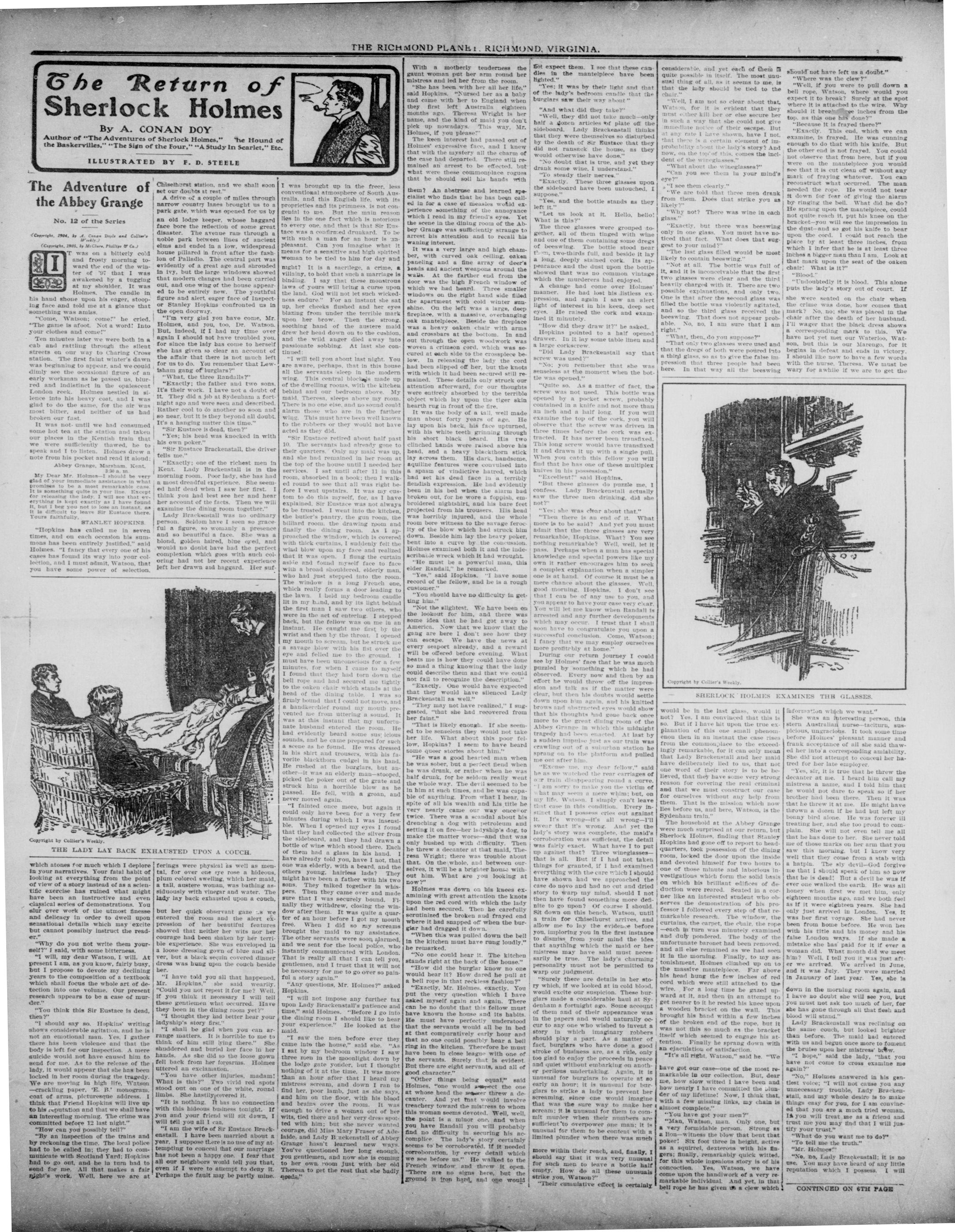
Copyright by Collier's Weekly.
THE LADY LAY BACK EX
Copyright by Collier's Weekly
which atones for much which I deplore in your narratives. Your fatal habit of looking at everything from the point of view of a story instead of as a scientific exercise has ruined what might have been an instructive and even classical series of demonstrations. You slur over work of the utmost fnesse and delicacy in order to dwell upon sensational details which may excite but cannot possibly instruct the reader."
"Why do you not write them yourself?" I said, with some bitterness.
"I will, my dear Watson, I will. At present I am, as you know, fairly busy, but I propose to devote my declining years to the composition of a textbook which shall focus the whole art of detection into one volume. Our present research appears to be a case of murder."
"You think this Sir Eustace is dead, then?"
ferings were physical as well, tal, for over one eye rose a plum colored swelling, which a tall, austere woman, was bad sudiously with vinegar and was lady lay back exhausted upon her quick observant gaze entered the room and the pressure of her beautiful showed that neither her wits courage had been shaken by his experience. She was envelop a loose dressing gown of blue, but a black sequin covered dress was hung upon the couch her.
"I have told you all that he Mr. Hopkins," she said. "Could you not repeat it for me if you think it necessary I these gentlemen what occurred they been in the dining room you I thought they had better he
"I should say so. Hopkins' writing shows considerable agitation, and he is not an emotional man. Yes, I gather there has been violence and that the body is left for our inspection. A mere suicide would not have caused him to send for me. As to the release of the lady, it would appear that she has been locked in her room during the tragedy. We are moving in high life, Watson —cracking paper, E. B.' monogram, coat of arms, picturesque address. I think that Friend Hopkins will live up to his reputation and that we shall have an interesting morning. The crime was committed before 12 last night."
"How can you possibly tell?"
"By an inspection of the trains and by reckoning the time. The local police had to be called in; they had to communicate with Scotland Yard; Hopkins had to go out, and he in turn had to send for me. All that makes a fair night's work. Well, here we are at
```markdown
```
I
Chiselhurst station, and we shall soon set our doubts at rest." A drive of a couple of miles through narrow country lanes brought us to a park gate, which was opened for us by an old lodge keeper, whose haggard face bore the reflection of some great disaster. The avenue ran through a noble park between lines of ancient elms and ended in a low, widespread house pillared in front after the fashion of Palladio. The central part was evidently of a great age and shrouded in ivy, but the large windows showed that modern changes had been carried out, and one wing of the house appeared to be entirely new. The youthful figure and alert, eager face of Inspector or Stanley Hopkins confronted us in the open doorway.
"I'm very glad you have come, Mr. Holmes, and you, too, Dr. Watson. But, indeed, if I had my time over again I should not have troubled you, for since the lady has come to herself she has given so clear an account of the affair that there is not much left for us to do. You remember that Lewisham gang of burglaries?"
"What, the three Randalls?"
What the three Randalls:
"Exactly; the father and two sons. It's their work. I have not a doubt of it. They did a job at Sydenham a fortnight ago and were seen and described. Rather cool to do another so soon and so near, but it is they beyond all doubt. It's a hanging matter this time."
"Sir Eustace is dead, then?"
"Yes; his head was knocked in with his own poker."
"Sir Eustace Brackenstall, the driver tells me."
"Exactly; one of the richest men in Kent. Lady Brackenstall is in the morning room. Poor lady, she has had a most dreadful experience. She seemed half dead when I saw her first. I think you had best see her and hear her account of the facts. Then we will examine the dining room together."
Lady Brackenstall was no ordinary person. Seldom have I seen so graceful a figure, so womanly a presence and so beautiful a face. She was a blond, golden haired, blue eyed, and would no doubt have had the perfect complexion which goes with such coloring had not her recent experience left her drawn and haggard. Her suf-
HAUSTED UPON A COUCH.
ferings were physical as well as mental, for over one eye rose a hideous, plum colored swelling, which her maid, a tall, austere woman, was bathing assiduously with vinegar and water. The lady lay back exhausted upon a couch, but her quick observant gaze as we entered the room and the alert expression of her beautiful features showed that neither her wits nor her courage had been shaken by her terrible experience. She was enveloped in a loose dressing gown of blue and silver, but a black sequin covered dinner dress was hung upon the couch beside her.
"I have told you all that happened, Mr. Hopkins," she said wearily. "Could you not repeat it for me? Well, if you think it necessary I will tell these gentlemen what occurred. Have they been in the dining room yet?"
"I thought they had better hear your ladyship's story first."
"I shall be glad when you can arrange matters. It is horrible to me to think of him still lying there." She shuddered and buried her face in her hands. As she did so the loose gown fell back from her forearms. Holmes uttered an exclamation.
"You have other injuries, madam! What is this?" Two vivid red spots stood on one of the white, round limbs. She hastily covered it.
"It is nothing. It has no connection with this hideous business tonight. If you and your friend will sit down, I will tell you all I can.
"I am the wife of Sir Eustace Brackenstall. I have been married about a year. I suppose there is no use of my attempting to conceal that our marriage has not been a happy one. I fear that all our neighbors would tell you that, even if I were to attempt to deny it. Perhaps the fault may be partly mine.
---
THE RICHMOND PLANE1. RICHMOND. VIRGINIA.
I
I was brought up in the freer, less conventional atmosphere of South Australia, and this English life, with its proprieties and its primness, is not congenial to me. But the main reason lies in the one fact which is notorious to every one, and that is that Sir Eustace was a confirmed drunkard. To be with such a man for an hour is unpleasant. Can you imagine what it means for a sensitive and high spirted woman to be tied to him for day and night? It is a sacrilege, a crime, a villainy, to hold that such a marriage is binding. I say that these monstrous laws of yours will bring a curse upon the land. God will not let such wickedness endure." For an instant she sat up, her cheeks fushed and her eyes blazing from under the terrible mark upon her brow. Then the strong, soothing hand of the austere maid drew her head down on to the cushion, and the wild anger dived away into passionate sobbing. At last she continued:
"I will tell you about last night. You are aware, perhaps, that in this house all the servants sleep in the modern wing. This central block is made up of the dwelling rooms, with the kitchen behind and our bedroom above. My maid, Theresa, sleeps above my room. There is no one else, and no sound could alarm those who are in the farther wing. This must have been well known to the robbers or they would not have acted as they did.
"Sir Eustace retired about half past 10. The servants had already gone to their quarters. Only my maid was up, and she had remained in her room at the top of the house until I needed her services. I sat until after 11 in this room, absorbed in a book; then I walked round to see that all was right before I went upstairs. It was my custom to do this myself, for, as I have explained, Sir Eustace was not always to be trusted. I went into the kitchen, the butler's pantry, the gun room, the billiard room, the drawing room and finally the dining room. As I approached the window, which is covered with thick curtains, I suddenly felt the wind blow upon my face and realized that it was open. I flung the curtain asbie and found myself face to face with a broad shouldered, elderly man, who had just stepped into the room. The window is a long French one, which really forms a door leading to the lawn. I held my bedroom candle lit in my hand, and by its light behind the first man I saw two others, who were in the act of entering. I stepped back, and the fellow was on me in an instant. He caught me first by the wrist and then by the throat. I opened my mouth to scream, but he struck me a savage blow with his fist over the eye and felled me to the ground. I must have been unconscious for a few minutes, for when I came to myself I found that they had torn down the bell rope and had secured me tightly to the oaken chair which stands at the head of the dining table. I was so firmly bound that I could not move, and a handkerchief round my mouth prevented me from uttering a sound. It was at this instant that my unfortunate husband entered the room. He had evidently heard some useless sounds, and he came prepared for such a scene as he found. He was dressed in his shirt and trousers, with his favorite blackthorn cudgel in his hand. He rushed at the burglar, but another—it was an elderly man—stooled, picked the poker out of the grate and struck him a horrible blow as he passed. He fell, with a groan, and never moved again.
"I fainted once more, but again it could only have been for a very few minutes during which I was insensible. When I opened my eyes I found that they had collected the silver from the sideboard, and they had drawn a bottle of wine which stood there. Each of them had a glass in his hand. I have already told you, have I not, that one was elderly, with a beard, and the others young, hairless lads? They might have been a father with his two sons. They talked together in whispers. Then they came over and made sure that I was securely bound. Finally they withdrew, closing the window after them. It was quite a quarter of an hour before I got my mouth free. When I did so my screams brought the maid to my assistance. The other servants were soon alarmed, and we sent for the local police, who instantly communicated with London. That is really all that I can tell you, gentlemen, and I trust that it will not be necessary for me to go over so painful a story again."
"Any questions, Mr. Holmes?" asked Hopkins.
"I will not impose any further tax upon Lady Brackenstall's patience and time," said Holmes. "Before I go into the dining room I should like to hear your experience." He looked at the maid.
"I saw the men before ever they came into the house," said she. "As I sat by my bedroom window I saw three men in the moonlight down by the lodge gate yonder, but I thought nothing of it at the time. It was more than an hour after that I heard my mistress scream, and down I ran to find her, poor lamb, just as she says, and him on the floor, with his blood and brains over the room. It was enough to drive a woman out of her wits, tied there and her very dress spotted with him; but she never wanted courage, did Miss Mary Fraser of Adelaide, and Lady Buckenstall of Abbey Grange hasn't learned new ways. You've questioned her long enough, you gentlemen, and now she is coming to her own room just with her old Theresa to get the rest that she badly needs."
With a motherly tenderness the gaunt woman put her arm round her mistress and led her from the room.
"She has been with her all her life," said Hopkins. "Nursed her as a baby and came with her to England when they first left Australia eighteen months ago. Theresa Wright is her name, and the kind of maid you don't pick up nowadays. This way, Mr. Holmes, if you please."
The keen interest had passed out of Holmes' expressive face, and I knew that with the mystery all the charm of the case had departed. There still remained an arrest to be effected, but what were these commonplace rogues that he should soil his hands with
them? An abstruse and learned specialist who finds that he has been called in for a case of measles would experience something of the annoyance which I read in my friend's eyes. Yet the scene in the dining room of the Abbey Grange was sufficiently strange to arrest his attention and to recall his waning interest.
It was a very large and high chamber, with carved oak ceiling, oaken paneling and a fine array of deer's heads and ancient weapons around the walls. At the farther end from the door was the high French window of which we had heard. Three smaller windows on the right hand side filled the apartment with cold winter sunshine. On the left was a large, deep fireplace, with a massive, overhanging oak mantelpiece. Beside the fireplace was a heavy oaken chair with arms and crossbars at the bottom. In and out through the open woodwork was woven a crimson cord, which was secured at each side to the crosspiece below. In releasing the lady the cord had been slipped off her, but the knots with which it had been secured still remained. These details only struck our attention afterward, for our thoughts were entirely absorbed by the terrible object which lay upon the tiger skin hearth rug in front of the fire.
It was the body of a tall, well made man about forty years of age. He lay upon his back, his face upturned, with his white teeth grinning through his short black beard. His two clinched hands were raised above his head, and a heavy blackthorn stick lay across them. His dark, handsome, aquiline features were convulsed into a spasm of vindictive hatred, which had set his dead face in a terribly flendifish expression. He had evidently been in his bed when the alarm had broken out, for he wore a foppish, embroidered nightshirt, and his bare feet projected from his trousers. His head was horribly injured, and the whole room bore witness to the savage ferocity of the blow which had struck him down. Beside him lay the heavy poker, bent into a curve by the concession. Holmes examined both it and the indescribable wreck which it had wrought. "He must be a powerful man, this elder Randall," he repressed.
"Yes," said Hopkins. "I have some record of the fellow, and he is a rough customer."
"You should have no difficulty in getting him."
"Not the slightest. We have been on the lookout for him, and there was some idea that he had got away to America. Now that we know that the gang are here I don't see how they can escape. We have the news at every seaport already, and a reward will be offered before evening. What beats me is how they could have done so mad a thing knowing that the lady could describe them and that we could not fall to recognize the description."
"Exactly. One would have expected that they would have silenced Lady Brueckenstall as well."
"They may not have realized." I suggested, "that she had recovered from her faint."
"That is likely enough. If she seemed to be senseless they would not take her life. What about this poor fellow, Hopkins? I seem to have heard some queer stories about him."
"He was a good hearted man when he was sober, but a perfect fiend when he was drunk, or rather when he was half drunk, for he seldom really went the whole way. The devil seemed to be in him at such times, and he was capable of anything. From what I hear, in spite of all his wealth and his title he very nearly came our way once or twice. There was a scandal about his drenching a dog with petroleum and setting it on fire—her ladyship's dog, to make the matter worse—and that was only hushed up with difficulty. Then he threw a decanter at that maid, Theresa Wright; there was trouble about that. On the whole, and between ourselves, it will be a brighter house without him. What are you looking at now?"
Holmes was down on his knees examining with great attention the knots upon the red cord with which the lady had been secured. Then he carefully scrutinized the broken and frayed end where it had snapped off when the burglar had dragged it down.
"When this was pulled down the bell in the kitchen must have rung loudly" he remarked.
"No one could hear it. The kitchen stands right at the back of the house."
"How did the burglar know no one would hear it? How dared he pull at a bell rope in that reckless fashion?"
"Exactly, Mr. Holmes, exactly. You put the very question which I have asked myself again and again. There can be no doubt that this fellow must have known the house and its habits. He must have perfectly understood that the servants would all be in bed at that comparatively early hour and that no one could possibly hear a bell ring in the kitchen. Therefore he must have been in close league with one of the servants. Surely that is evident. But there are eight servants, and all of good character."
"Other things being equal," said Holmes, "one would suspect the one at whose head the master threw a decanter. And yet that would involve treachery toward the mistress to whom this woman seems devoted. Well, well, the point is a minor one, and when you have Randall you will probably find no difficulty in securing his accomplice. The lady's story certainly seems to be corroborated. If it needed corroboration, by every detail which we see before us." He walked to the French window and threw it open. "There are no signs here, but the ground is iron hard, and one would
Not expect them. I see that these candles in the mantelpiece have been lighted."
"Yes; it was by their light and that of the lady's bedroom candle that the burglar's saw their way about."
"And what did they take?"
"Well, they did not take much—only half a dozen articles of plate off the sideboard. Lady Brackenstall thinks that they were themselves so disturbed by the death of Sir Eustace that they did not ransack the house, as they would otherwise have done."
"No doubt that is true, and yet they drank some wine, I understand."
"To steady their nerves."
"Exactly. These three glasses upon the sideboard have been untouched, I suppose."
"Yes, and the bottle stands as they left it."
"Let us look at it. Hello, hello! What is this?"
The three glasses were grouped together, all of them tinged with wine and one of them containing some dregs of beeswax. The bottle stood near them, two-thirds full, and beside it lay a long, deeply stained cork. Its appearance and the dust upon the bottle showed that was no common vintage which the murderers had enjoyed. A change had come over Holmes' manner. He had lost his listless expression, and again I saw an alert light of interest in his keen, deep set eyes. He raised the cork and examined it minutely.
"How did they draw it?" he asked. Hopkins pointed to a half opened drawer. In it lay some table linen and a large corkscrew.
"Did Lady Brackenstall say that screw was used?"
"No; you remember that she was senseless at the moment when the bottle was opened."
"Quite so. As a matter of fact, the screw was not used. This bottle was opened by a pocket screw, probably contained in a knife and not more than an inch and a half long. If you will examine the top of the cork, you will observe that the screw was driven in three times before the cork was extracted. It has never been transfixed. This long screw would have transfixed it and drawn it up with a single pull. When you catch this fellow you will find that he has one of these multiplex knives in his possession."
"Excellent!" said Hopkins.
"But these glasses do puzzle me. I confess. Lady Brackenstall actually saw the three men drinking, did she not?"
"Yes; she was clear about that."
"Then there is an end of it. What more is to be said? And yet you must admit that the three glasses are very remarkable, Hopkins. What? You see nothing remarkable? Well, well, let it pass. Perhaps when a man has special knowledge and special powers like my own it rather encourages him to seek a complex explanation when a simpler one is at hand. Of course it must be a mere chance about the glasses. Well, good morning, Hopkins. I don't see that I can be of any use to you, and you appear to have your case very clear. You will let me know when Randall is arrested and any further developments which may occur. I trust that I shall soon have to congratulate you upon a successful conclusion. Come, Watson; I fancy that we may employ ourselves more profitably at home."
During our return journey I could see by Holmes' face that he was much puzzled by something which he had observed. Every now and then by an effort he would throw off the impression and talk as if the matter were clear, but then his doubts would settle down upon him again, and his knitted brows and abstracted eyes would show that his thoughts had gone back once more to the great dining room of the Abbey Grange in which this midnight tragedy had been enacted. At last by a sudden impulse just as our train was crawling out of a suburban station he sprang on to the platform and pulled me out after him.
"Exuse me, my dear fellow," said he as we watched the rear carriages of our train disappearing round a curve. "I am sorry to make you the victim of what may seem a mere whim; but, on my life, Watson. I simply can't leave that case in this condition. Every instinct that I possess cries out against it. It's wrong—it's all wrong—I'll swear that it's wrong. And yet the lady's story was complete, the maid's corroboration was sufficient, the detail was fairly exact. What have I to put up against that? Three wineglasses—that is all. But if I had not taken things for granted, if I had examined everything with the care which I should have shown had we approached the case do novo and had no cut and dried story to warp my mind, should I not then have found something more definite to go upon? Of course I should. Sit down on this bench, Watson, until a train for Chiselhurst arrives, and allow me to lay the evidence before you, imploring you in the first instance to dismiss from your mind the idea that anything which the maid or her mistress may have said must necessarily be true. The lady's charming personality must not be permitted to warp our judgment.
"Surely there are details in her story which, if we looked at in cold blood, would excite our suspicion. These burglaries made a considerable haul at Sydenham a fortnight ago. Some account of them and of their appearance was in the papers and would naturally occur to any one who wished to invent a story in which imaginary robbers should play a part. As a matter of fact, burglaries who have done a good stroke of business are, as a rule, only too glad to enjoy the proceeds in peace and quiet without embarking on another perilous undertaking. Again, it is unusual for burglaries to operate at so early an hour; it is unusual for burglaries to strike a lady to prevent her screaming, since one would imagine that was the sure way to make her scream; it is unusual for them to commit murder when their numbers are sufficient to overpower one man; it is unusual for them to be content with a limited plunder when there was much
more within their reach, and, finally, I should say that that it was very unusual for such men to leave a bottle half empty. How do all these unusual strike you, Watson? "Their cumulative effect is certainly
Copyright by Collier's Weekly.
SHERLOCK HOLMES EXAMINES THR GLASSES
considerable, and yet each of them is quite possible in itself. The most unusual thing of all, as it seems to me, is that the lady should be tied to the chair."
"Well, I am not so clear about that, Watson, for it is evident that they must either kill her or else secure her in such a way that she could not give immediate notice of their escape. But at any rate I have shown, have I not, that there is a certain element of improbability about the lady's story? And now, on the top of this, comes the incident of the wineglasses."
"What about the wineglasses?"
"Can you see them in your mind's eye?"
"I see them clearly."
"We are told that three men drank from them. Does that strike you as likely?"
"Why not? There was wine in each glass."
"Exactly, but there was beeswing only in one glass. You must have noticed that fact. What does that suggest to your mind?"
"The last glass filled would be most likely to contain beeswing."
"Not at all. The bottle was full of it, and it is inconceivable that the first two glasses were clear and the third heavily charged with it. There are two possible explanations, and only two. One is that after the second glass was filled the bottle was violently agitated, and so the third glass received the beeswing. That does not appear probable. No, no, I am sure that I am right."
"What, then, do you suppose?"
"That only two glasses were used and that the dregs of both were poured into a third glass, so as to give the false impression that three people had been here. In that way all the beeswing
Copyright by Collier's Weekly.
SHERLOCK HOLMES E
would be in the last glass, would it not? Yes, I am convinced that this is so. But if I have hit upon the true explanation of this one small phenomenon then in an instant the case rises from the common place to the exceedingly remarkable, for it can only mean that Lady Brackenstall and her maid have deliberately lied to us, that not one word of their story is to be believed, that they have some very strong reason for covering the real criminal and that we must construct our case for ourselves without any help from them. That is the mission which now lies before us, and here, Watson, is the Sydenham train."
The household at the Abbey Grange were much surprised at our return, but Sherlock Holmes, finding that Stanley Hopkins had gone off to report to headquarters, took possession of the dining room, locked the door upon the inside and devoted himself for two hours to one of those minute and laborious investigations which form the solid basis on which his brilliant edifices of deduction were reared. Seated in a corner like an interested student who observes the demonstration of his professor I followed every step of that remarkable research. The window, the curtains, the carpet, the chair, the rope—in each turn was minutely examined and duly pondered. The body of the unfortunate baronet had been removed, and all else remained as we had seen it in the morning. Finally, to my astonishment, Holmes climbed up on to the massive mantelpiece. Far above his head hung the few inches of red cord which were still attached to the wire. For a long time he gazed upward at it, and then in an attempt to get nearer to it he rested his knee upon a wooden bracket on the wall. This brought his hand within a few inches of the broken end of the rope, but it was not this so much as the bracket itself which seemed to engage his attention. Finally he sprang down with an ejaculation of satisfaction.
"It's all right, Watson," said he. "We have got our case—one of the most remarkable in our collection. But, dear me, how slow witted I have been and how nearly I have committed the blunder of my lifetime! Now, I think that, with a few missing links, my chain is almost complete." "You have got your men?"
"Man, Watson, man. Only one, but a very formidable person. Strong as a Lion—witness the blow that bent that poker! Six foot three in height, active as a squirrel, dexterous with his fingers; finally, remarkably quick witted, for this whole ingenuous story is of his concoction. Yes, Watson, we have come upon the handiwork of a very remarkable individual. And yet, in that bell rope he has given a clew which
should not have left us a doubt."
"Where was the clew?"
"Well, if you were to pull down a bell rope, Watson, where would you expect it to break? Surely at the spot where it is attached to the wire. Why should it breeze? see inches from the top, as this one has done?"
"Because it is fraved there?"
"Exactly. This end, which we can examine, is frayed. He was cunning enough to do that with his knife. But the other end is not frayed. You could not observe that from here, but if you were on the mantlepiece you would see that it is cut clean off without any mark of fraying whatever. You can reconstruct what occurred. The man needed the rope. He would not tear it down for fear of giving the alarm by ringing the bell. What did he do? He sprung upon the mantlepiece, could not quite reach it, put his knee on the bracket—you will see the impression in the dust—and so got his knife to bear upon the cord. I could not reach the place by at least three inches, from which I infer that he is at least three inches a bigger man than I am. Look at that mark upon the seat of the oaken chair! What is it?"
"Undoubtedly it is blood. This alone puts the lady's story out of court. If she were seated on the chair when the crime was done, how comes that mark? No, no; she was placed in the chair after the death of her husband. I wager that the black dress shows a corresponding mark to this. We have not yet met our Waterloo, Watson, but this is our Marengo, for it begins in defeat and ends in victory. I should like now to have a few words with the nurse. Theresa. We must be wary for awhile if we are to get the
KAMINES THB GLASSES.
information which we want."
information which we want."
She was an interesting person, this stern Australian nurse—taciturn, suspicious, ungrateful. It took some time before Holmes' pleasant manner and frank acceptance of all she said thawed her into a corresponding ambiability. She did not attempt to conceal her hatred for her late employer.
"Yes, sir, it is true that he threw the decanter at me. I heard him call my mistress a name, and I told him that he would not dare to speak so if her brother had been there. Then it was that he threw it at me. He might have thrown a dozen if he had but left my bonny bird alone. He was forever ill treating her, and she too proud to complain. She will not even tell me all that he has done to her. She never told me of those marks on her arm that you saw this morning, but I know very well that they come from a stab with a hatpin. The sly devil-God forgive me that I should speak of him so now that he is dead! But a devil he was if ever one walked the earth. He was all honey when first we met him, only eighteen months ago, and we both feel as if it were eighteen years. She had only just arrived in London. Yes, it was her first voyage. She had never been from home before. He won her with his title and his money and his false London ways. If she made a mistake she has paid for it if ever a woman did. What month did we meet him? Well, I tell you it was just after we arrived. We arrived in June, and it was July. They were married in January of last year. Yes, she is
down in the morning room again, and
I have no doubt she will see you, but
you must not ask too much of her, for
she has gone through all that flesh and
blood will stand."
Lady Brackenstall was reclining on
the same couch, but looked brighter
than before. The maid had entered
with us and begun once more to foment
the bruise upon her mistress' brow.
"I hope," said the lady, "that you
have not come to cross examine me
again?"
"No," Holmes answered in his
gentle voice; "I will not cause you any
unnecessary trouble, Lady Brackenstall,
and my whole desire is to make
things easy for you, for I am convin-
ced that you are a much tried woman.
Is you will treat me as a friend and
trust me you may find that I will just
justify your trust."
"What do you want me to do?"
"To tell me the truth."
"Mr. Holmes."
"No, no, Lady Bracken-install; it is no use. You may have heard of any little reputation which I possess. I will
CONTINUED ON 6TH PAGE
THE PLANET
Published every Saturday by JOHN MITCHELL,
JR., at 311 North 4th Street, Richmond, Va.
JOHN MITCHELL, JR. • EDITOR.
All communications intended for publication should be sent so as to reach us by Wednesday.
TERMS IN ADVANCE
ADVERTISING RATES
MONEY ORDERS: You can buy a Money Order at your Post-Office, payable to the Richter and we will be responsible for its safe arrival.
EXPRESS MONEY ORDERS can be obtained at any office of the American Express Co. the Richter and we will be responsible for money sent by any of these companies. The Express Money Order is a safe deposit box and Goo Express Company. We will be responsible for money sent by any of these companies.
REGISTERED LETTER: If a money Order Post-Office or an Express Office is not within your reach, the Postmaster will Register the money in any other way than the bills. Then, if the letter is lost or misplaced can be traced. You can send money in this manner, cannot be responsible for money sent in letters in any other way than one of the four ways mentioned above. If you send your money in any other way, you must do it at your own expense.
ENRIGMENTS, ETC. You do not want the PLANET continued for another year after your subscription has run out, you then money is by mail to the Richter, which we decided that subscribers to newspaper, who do not order their paper, at the Richter, are held liable for the payment of the subscription up to date when they order the paper distribution.
COMMUNICATIONS: When writing to us to renew your subscription or to discontinue your paper, you should give your name and address otherwise we cannot find your name on our books.
CHANGE OF ADDRESS. - In order to change the address of a subscriber, we must be sent the former as well as the present address.
Entered at the Post-Office at Richmond, Va. as second-class matter.
SATURDAY, . . . . SEPT. 23, 1905.
"BOOKER T. WASHINGTON AND THE NEGRO."
Rev. Thomas Dixon, Jr., in his remarkable contribution to the "Saturday Evening Post" has done more to reflect upon the honesty and integrity of the white race than any man since the advent of Senator Benjamin R. Tillman of South Carolina.
Mr Tillman was a self-aggrandizing politician and no more was to be expected of him. Mr. Dixon is a minister of the gospel and is presumed to be actuated by great principles. His mission is to defend the weak in the right against the strong in the wrong, to comfort those who are cast down and to advance the kingdom of the Master in this world. How is he fulfilling his calling? He declares the purposes of the white man to be of the most mercenary character, when he says:
The Negro remains on this Continent for one reason only. The Southern white man has needed his labor, and therefore has fought every suggestion of his removal. But when he refuses longer to work for the white man, then what?
Yes, then what? Rev. Dixon seems oblivious of the plain provisions of the Federal Constitution or he would have had ere this his answer.
Article XIV, Section 1 of the Constitution of the United States reads:
"All persons born or naturalized in the United States and subject to the jurisdiction thereof, are citizens of the United States and of the state wherein they reside. No State shall make or enforce any law which shall abridge the privileges or immunities of citizens of the United States; nor shall any state deprive any person of life, liberty, or property, without due process of law; nor deny to any person within its jurisdiction the equal protection of the laws."
This would seem to answer Rev. Dixon's queries. The Negro is a citizen whether he works for the white man or himself and the Constitution says that in either event, he cannot be disturbed, and behind this is all of the power of the United States government.
When the Negro refuses to work for the white man, he will be let alone and he will have the dissatisfaction of hearing some of the white men growl, while the more liberal of them will assist him in his effort to make himself a self-producing citizen of the body politic. An industrious Negro in the South is of just as much value to that section as an industrious foreigner in the North is to the community in which he resides. He adds to the wealth of the body politic just as surely when
---
working for himself as he would do if working for the white man.
Rev. Dixon is so blinded with prejudice that we doubt if he could see this self-evident proposition if he looked at it through six pair of properly adjusted eye-glasses, or could be induced to look at it through the powerful lens of a telescope.
Rev. Dixon says:
The point I raise is that education necessarily drives the races further and further apart, and Mr. Washington's brand of education makes the gulf between them if anything a little deeper. If there is one thing a Southern white man cannot endure it is an educated Negro. What's to be the end of it if the two races are to live forever side by side in the South?
White men like Rev. Dixon, permeated as they are by race prejudice do not seem to know what they want. On the one hand they are arguing in favor of the separation of the Negro from the white man and the other in favor of the union of the races. He deplores the amalgamation of the races and then on the other breath condemns that very education which he admits is driving the races further apart. The Negro is getting away from the white man in everything social, because some of the white men told him to do so. He is endeavoring to prove that he is not hankering after a relationship that is said to be distasteful to a large proportion of the whites of the South-land. When he does this Rev. Dixon comes forward with the assertion that it goes to prove that the Negro must ultimately get out of the South.
When moving day comes, it will be found more convenient for the whites to use the wagons than the Negroes as there are fewer of them. Rev. Dixon speaks truly when he says that the average Southern white man cannot endure an educated Negro, but he will have to do so, Rev. Dixon. And right here is the cause of most of the pernicious legislation with which our statute books are enumbered. The educated, business Negro has no trouble with the better class of white people in the South land and they are oftener his defenders than they are his enemies.
It is this recognition of worth on the part of certain southern white men that makes Rev. Dixon and his kind frantic. There are no "Jim Crow" cars for the Negro as a servant. The best hotels in all the South-land are open to him and the finest theatres are at his disposal. He can sit anywhere and beside anybody, not excepting the beautiful wives and daughters of the flower of the sunny land.
An apron and a "granny's" bonnet is all that is necessary to stop all questioning and to secure a welcome. A waiter's jacket and a waiter's apron or a messenger's uniform will do for the Negro of the male per suasion all that the other wearing apparel will do for one of the female kind. But the "silk-hat Negro" the self-supporting specimen of humanity who can pay his own way and proclaim the employment and ownership of himself is the hob-gobblin that haunts the Negro-hating white man's dream. Booker T. Washington is more abominable to him than the Negro boot-black, who shuffles and fawns at his feet, and the latter is even preferred by His Excellency, James K. Vardaman of Mississippi.
It is difficult to conceive that Rev. Thomas Dixon, Jr. is a minister of the gospel. How can he give voice to such blood-thirsty utterances? He is fostering blood-shed and urging murder. Here is what he says:
Mr. Washington says: "Give the black man so much skill and brains that he can cut oats like the white man—then he can compete with him. And then the real tragedy will begin. Does any sane man believe that when the Negro ceases to work under the direction of the Southern white man, this "arrogant," "rapacious" and intolerant" race will allow the Negro to master his industrial system, take the bread from his mouth, crowd him to the wall and place a mortgage on his house? Com petition is war—the most fierce and brutal of all its forms. Could faculty reach a sublimer height than the idea that the white man will stand idly by and see this performance? What will he do when put to the test? He will do exactly what his white neighbor in the North does when the Negro threatens his bread—kill him!
We might well ask, Does any sane man believe that in the competition of finance, business or the industrial pursuits that the much-heralded inferior Negro could master the White man's industrial system, take the bread from the White man's mouth, crowd him to the wall and place a mortgage on his house? If such a thing is possible, what becomes of the superiority, of the White man? Rev. Dixon alleges that when the all-conquering Anglo-Saxon has been vanquished in the business and industrial field of labor, he will resort to the weapon of the thug, the robber, the outlaw, the murderer. He will kill his competitor for no cause other than that he has won the laurels on an honorable field of legitimate endeavor. Could any slanderer in the world have better accomplished his task in befouling the record of the white race than Rev. Dixon seems to have done?
The all-conquering race is in danger, he says and the clash will come when the Negro has outstripped it.
RICHMOND PLANET, RICHMOND, VIRGINIA.
Surely Rev. Dixon was beside himself, when he made this most remarkable contribution to that widely circulated journal of the Quaker city. Rev. Dixon is a great admirer of Lincoln, when he can find anything in his utterances that can be construed against the Negro; but he is unusually silent, when he is shown utterances from the same source that are nightly in the Negro's favor. This distinguished pulpit orator says:
Abraham Lincoln foresaw this tragedy when he wrote his *Emancipation Proclamation*, and he asked Congress for an appropriation of a billion dollars to colonize the whole Negro race. He never believed it possible to assimilate the Negro into our national life. This nation will yet come back to Lincoln's plan, still so eloquently advocated by the Negro Bishop, Henry M. Turner.
And again :
It is curious how the baldheaded assertion of a lie can be repeated and repeated until millions of sane people will accept the bare assertion as an established fact. At the close of the War, Mr. Lincoln, brooding over the insoluble problem of the Negro's future which his proclamation had created, asked General Benjamin F. Butler to devise and report to him immediately a plan to colonize the Negroes. General Butler, naturally hostile to the idea, made at once his famous, false and facetious report, "that ships could not be found to carry the Negro babies to Africa as fast as they are born!" The President was assassinated a few days later. This lie is now forty odd years old, and Mr Booker T. Washington actually repeats it as a verbal inspiration though entirely unconscious of its historic origin.
The above is rather strong language to be used by a minister of the gospel. He even makes an attack upon the dead and makes copious extracts from the grave of the sainted Lincoln in order to bolster up a bad cause. Was the statement of Gen. B. F. Butler untrue? Could ships have been obtained at that time to transport the babies of the Negroes who persistently arrived on schedule time.
They came too by white fathers as well as by black ones. The Negro population of the United States in 1860 was (4,441,830) four million, four hundred and forty-one thousand, eight hundred and thirty. In 1890, it was (7,638,360) seven million, six hundred and thirty-eight thousand, three hundred and sixty. It will be seen that the yearly rate of increase has been (106,551) one hundred and six thousand, five hundred and fifty one. It would take one hundred of the largest ocean liners, carrying one thousand passengers each to accommodate even the ordinary increase upon the basis cited. As the increase now averages about three hundred thousand souls per year, it would take three hundred ocean liners for the same purpose, without even hauling any of the ten million Negroes now in this country. A billion dollars would be a mere bagatelle of the cost of transportation.
Could trade be interfered with and the ships furnished by any transportation company in the world? To say that it could be is to believe facts and defy history. To seriously broach such a proposition would provoke ridicule and excite derision on the part of the steamship companies of the world.
There is a still greater objection to the deportation idea. Barring the fact that a large number of white people who would naturally desire to follow their Negroes and to look after their illegitimate off-spring, there is the all-powerful mandate of the law. To the Negro-haters who seriously broach such a proposition and make an effort to carry it into execution, it says, "Thou shalt not!" You cannot, Rev. Dixon, forcibly deport from these shores, a citizen of the United States. The Negro is a citizen. He came here by force, but it will take something else, other than force to carry him away.
Your visionary schemes with scarce by a dollar in your own pocket to bring about your realization of them will hardly be considered by the "safe and sane" people of this country. Rev. Dixon continues:
We have spent about $800,000,000 on Negro education since the War. One-half of this sum would have been sufficient to have made Liberia a rich and powerful Negro state. Liberia is capable of supporting every Negro in America. Why not face this question squarely? We are temporizing and playing with it. All our educational schemes are compromises and temporary makeshifts. Mr. Booker T. Washington's work is one of noble aims. A branch of it should be immediately established in Monrovia, the capital of Liberia. A gift of ten millions would do this, and establish a colony of half a million Negroes within two years. They could lay the foundations of a free black republic which within twenty-five years would solve our race problem on the only rational basis within human power. Colonization is not a failure. It has never been tried.
Rev. Dixon tells about what has been spent on Negro education since the war. Let him take note of what was spent from the product of the Negro's labor for whites' education before the war. It is a favorite doctrine of the labor unions that labor produces wealth, therefore wealth belongs to labor. Prior to the Civil War, the plantations teemed with its multitudes of
laboring blacks and the master and his family revelled in ease and luxury as a result of these black people's labor. Let us see:—The New York "Commercial and Financial Chronicle" published statistics showing that the number of bales of cotton produced from 1829 to 1862 was (82,870,778) eighty-two million, eight-hundred and seventy thousand, seven hundred and seventy-eight bales.
The value of this cotton for one year upon the basis of the $40 per bale was ($100,449,400) one hundred million, four hundred and forty-nine thousand, four hundred dollars. No conservative white man will deny that previous to the Civil War practically all of the cotton was produced by Negro labor. But we will give the Negro credit for only 80 per cent of it and the value for one year is ($80,359,520) eighty million, three hundred and fifty-nine thousand, five hundred and twenty dollars. Extending over the period from the year of 1829 to 1862, a period of thirty-three years, it would be ($2,651,864,160) two billion, six hundred and fifty-one million, eight hundred and sixty-four thousand, one hundred and sixty dollars. Rev. Dixon, we are not figuring upon the wheat, rye, oats, tobacco, sugar, molasses, corn and the products of the truck-farms produced by us. We are not figuring, sir upon the unrequited labor given by us from the year of 1619 down to the year of 1829. We take only thirty-three years of that time and before you send us all to Africa and thereby discharge us, we should like much to have a settlement of the old score and we would like for you to give us the proceeds for our own use on Africa's shores.
If you have expended eight hundred million dollars in educating us we find that you owe us only one thousand, eight hundred and fifty-one million, eight hundred and sixty four thousand, one hundred and sixty dollars in striking a balance on cotton alone.
It is only fair, Rev. Dixon, in figuring out what you have done for us to balance it with what we have done for you. The value of the cotton crop produced by the Negroes since 1865 to 1902, a period of forty-one years, is ($67,867,416) sixty-seven million, eight hundred and sixty-seven thousand, four hundred and sixteen dollars per year. This computation is giving the Negroes credit for only thirty per cent of the total cotton crop. Upon the same basis, the value for forty-one years was ($2,782,564,056) two thousand, seven hundred and eighty-two million, five hundred and sixty-four thousand and fifty-six dollars. We are not referring to the other products of the South-land.
Every country in the world is after laborers and fighting shy of laggards. Yet Rev. Dixon would take away from the South this wealth-producing element in order to satisfy a brutal and unreasoning race-prejudice. In disturbing the present industrial conditions, he would bank rupt the South and place it ten times further back than it was forty years ago after a ruinous and desolating war. Surely, no enemy of this section could make a more injurious offer, or submit a more damaging proposition.
There are sections in the Southland, where Rev. Dixon could not "roost" twelve hours if it were known that he came to bring about a practical realization of the conditions he portrays. In other sections, he would be treated as a lunatic with water on the brain and a commission of lunacy would be speedily called to pass upon his mental condition. Far be it from us to claim or even hint that Rev. Dixon is crazy. There is too much method in his madness.
He ventures the assertion that colonization has never been tried and we think that we have produced enough statistical information to demonstrate that it never will be.
Rev. Dixon concludes as follows:
We owe this to the Negro. At present we are deceiving him and allowing him to deceive himself. He hopes and dreams of amalgamation, forgetting that self-preservation is the first law of Nature. Our present attitude of hypocrisy is inhuman toward a weaker race brought to our shores by the sins of our fathers. We owe him a square deal, and we will never give it to him on this Continent.
Rev. Dixon seems to figure gingerly on what his people owe us. After all of the millions of dollars we have cited, he sums it up in the words, "a square deal." He is brutally frank when he says that we will never get it on this continent. He might as well have added, "or on any other." Certain it is, he will not live long enough to see even the beginning of his dream.
It is unfortunate that white men of the ability of Rev. Thomas Dixon, Jr. should lend themselves to the dissemination of such ideas. They will deceive the prejudiced white man, but it will drive closer to us and our cause that, liberty-loving contingent of the white race, that has championed human rights and taken up the cause of the oppressed in every clime. Colored men should not be cast down or believe that even the entire
white southern population share in the views so brilliantly expressed by this product of the southern soil. As compared with him, Mr. Thomas Nelson Page is an angel and Hon. B. R. Tilman, a heathen god. We know that God has always raised up friends for Israel and in this, our hour of trial, we believe that other white men will come forward and advocate our cause. We should press forward. We should be polite, obliging, industrious and thrifty. We must engage in business and foster industrial enterprises. We should not let these thunders of the Negro-haters distract us to the end that we miss step in our march of progress. Race prejudice has existed in all ages and like the clouds upon a foggy morning, it has lifted until God's sun has shone beyond.
In the midst of the gloom, the voice of the sweet singer in Israel is heard, counselling moureration and advising patience, knowing well that we are to wait but a little while,
"Until the day break, and the shadows flee away."
NO AUTHORITY FOR EQUITABLE LOAN
"High Finance" Disclosed in Report of President Morton.
ENTER SUIT TO RECOVER MONEY.
New York. Sept. 20. — That the Equitable Life Assurance Society paid out $218,264 to the Mercantile Trust company in connection with certain loans known as "the Turner loans," and that these payments were without authority, so far as the records of the society disclose, became known when Paul Morton, president of the society, made public a report on the subject submitted by him to the society's directors.
These transactions occurred in what Mr. Morton refers to as "the Turner loans." The "Turner loan." Mr. Morton's report sets forth, was carried in 1894 by the Western National Bank, which was controlled by the Equitable Life Assurance Society. The collateral for the loans was objected to by a bank examiner, and Henry B. Hyde then agreed to transfer the loan and collateral to the Mercantile Trust company. At that time, apparently, the loans amounted to $661,491. George V. Turner, in whose name the loan stood, was secretary to Louis Fitzgerald, then president of the Mercantile Trust company, and a close business associate of Henry B. Hyde. The loan was guaranteed by Marcellus Hartley, John E. Searles, Louis Fitzgerald, W. N. Coler, Jr. and H. B. Hyde. On March 21, 1895, the same guarantors renewed their guaranty, the loan having grown to $1,276,475, the increase being due to attempts to develop the property on which the collateral for the loan was made. This collateral proved to be of little value.
"The records of the society," said Mr. Morton, "disclose no authority whatever for these payments, and the cash entries in respect to them were very obscure."
Mr. Morton referred the matter to special counsel, who have assured him that the Equitable Life Assurance Society is not responsible for the loans. Mr. Morton has also notified the Mercantile Trust company that he will expect it to repay the $718,264 paid to it by the Equitable Life Assurance Society.
Mr. Morton found that $265,000 was paid by the Equitable Life Assurance Society to the Mercantile Trust company on the $685,000 loan, the nature of which loan has never been explained. Counsel have been instructed to begin proceedings for the return of this sum. This loan was carried on an account known as the "J. W. A. No. 3 account." Mr. Morton also reported to the directors that it would be necessary to charge off $86,488 unpaid balance of a loan to John E. Searles, who had gone through bank rupture. The collateral against this $86,488 Mr. Morton declares is without value.
CONSTITUTION LEAKING BADLY
First Ship of American Navy In Danger of Turning Turtle
Boston, Sept. 18.—The ancient frigate Constitution, familiarly known as "the first ship of the American navy," which has for many years been one of the most valued possessions of the Charlestown navy, is in danger of turning turtle, and it is learned that the good ship cannot last many years in its present state. The frigate is leaking badly and the hold fills so rapidly that it is necessary to use a power pump frequently. One of the attaches of the yard said that the officials did not care to risk placing the ship in dry dock to make repairs, as the vessel would crush with its own weight.
GOING TO NEW ORLEANS
President Roosevelt Will Visit City
Shelterlane Valley Trust
Stricken with Yellow Fever.
New York, Sept. 19. — President Roosevelt sent a message to Mayor Behrman, of New Orleans, in which he said that he had expected to arrive in that city on October 24, and that he should do so if the people wanted him to come then. If they wanted him to come later he would make a second trip to visit Louisiana and Arkansas. He intended to do whatever the people of New Orleans and Louisiana wished, subject to the quarantine regulations of other states through which he would afterward pass.
Areanumites to Go to Law
New York, Sept. 20.—A meeting of the representatives of the state committees from subordinate councils of the Royal Arcanum was held here. Resolutions were adopted for the appointment of an executive committee
of 15 with full power to act for the conference and to be instructed "to cause proceedings to be taken for injunction and other provisional relief as it may deem best calculated to secure an early adjustment of the illegality and invalidity of the new laws concerning assessments recently enacted by the supreme council and adjudging the previous laws of assessments in full force."
Jap Paymasters Embezzled $165,000.
Tokio, Sept. 18.—Information has been made public that three naval paymasters have embezzled $165,000 of government funds. The announcement has been calmly received by the public, but the knowledge that the commission of the crime extended over the period of a year without discovery may, it is said, cause a feeling of distrust and uneasiness toward the naval administration and furnish a weapon to the political parties that are opposing the government.
REVOLUTION IN COLOMBIA
President Reyes, Backed By Army, Declares Himself Dictator.
Claire Hinkel Dictator.
Panama, Sept. 20.—Unconfirmed reports reached here to the effect that General Rafael Reyes, president of
GENERAL BAFAEL REYES, PRESIDENT OF COLOMBIA.
Colombia, declared himself dictator on September 8 and imprisoned the members of the supreme court at Bogota. Mobs, angered by this action, attacked the presidential palace and were fired on by troops, who killed or wounded many of the rioters. The reports say that revolutions have been started in Antioquia and Santander.
FISHING TUG RIDDLED
Canadian Cruiser Fired Small Shella
at American Poacher.
Erie, Pa.; Sept. 18. The fourth of the fish tug incidents of the past week took place in mid-Lake Erie, when the Canadian cruiser Vigilant riddled the big steam tug Harry G. Barnhurst with small shells from the rifle on the patrol boat, Captain Nick Fasel, of the tug, admitted after he escaped that the Vigilant could have sent her to the bottom if Captain Dunn had so desired. They ran more than eight miles under full head of steam before they crossed the boundary line and escaped from the Canadians.
More than 30 shots struck the vessel, and of these 15 of the small shells landed with telling effect on the upper parts, so that the boat careened to one side with the mass of wreckage when she came into port. Having been used formerly for a pleasure steamer, the Barnhurst is of large size and well fitted with steam equipment. The fireman, Magnus Johnson, fainted in the hold from over-exertion in keeping the steamer going ahead. He was reported killed, but revived after reaching shore. Two fishermen were cut in the fact by splinters shot away by the bullets.
HEAVY STRIKE DAMAGES
Railroad Company Secures Verdict of $100,000 Against Chicago.
Chicago, Sept. 20. — A verdict of $100,000 against the city of Chicago was given the Panhandle railroad in a damage suit brought because of the burning of a number of freight cars belonging to the railway company during the American Railway Union strike of 1894. When the verdict was returned a motion made by the city to set aside the verdict was denied by the court. In the trial the railway company held that the city of Chicago was liable for damage because of its alleged inadequate protection of the company's property.
SORRY SHE IS SO SMALL
Mise Dickinson Awarded Stack of Sil-
ver Dollars Fulfilled Handwritten
Ver Denaal's equal to Her Height.
Scranton, Pa., Sept. 19.—Miss Susan H. Dickinson, the well-known newspaper writer, is for the nonce very disconsolete because of the fact that she is only 4 feet $2 inches in height. She received word from a Boston magazine that Admiral Dewey and Senator Allison, acting as judges in a literary contest inaugurated by the magazine, had awarded her first prize. The occasion of her being disconsolete is that the first prize is a stack of silver dollars equal to her height.
King to Give Bible to Virginia Church Richmond, Va., Sept. 19. — Bruton parish, the historical church at Williamsburg, Va., the second oldest church and the church longest in continuous use in the United States, has just received the offer of a Bible to be donated by King Edward VII., of Great Britain. Rev. W. A. R. Goodwin, rector of the church, is in receipt of a letter from the archbishop of Canterbury, in which the latter states that the king has consented to donate a Bible for lectern use in Bruton parish. This royal mark of esteem is to be given by the king in commemoration of the 200th anniversary of the establishment of Anglo-Saxon civilization and the English church on Virginia shores.
Found Murderer Insane In Cell. Roanoke, Va., Sept. 18. — At Rocky Mount, Franklin county, when the shar-
liff went to the jail to carry Chap Ramsey, who on September 2$ shot and killed his nephew, Willard Ramsey, before Judge Saunders for arraignment, he found the accused man almost a raving maniac. Ramsey escaped on the day of the killing and surrendered himself last Thursday night.
Snow In Colorado
Cripple Creek, Colo., Sept. 19.—Several inches of snow fell here. The snowfall was preceded by a high wind that blew down several buildings, including a large icehouse.
PRODUCE QUOTATIONS
The Latest Closing Prices In the Principal Markets.
PHILADELPHIA — FLOUR quiet;
winter extras, $3.10@2.25; Pennsylvania
nailer roller, clear, $3.60@3.75; city mills
fancy, $5@2.25; RYE FLOUR steady;
fancy, $5@2.25; Pennsylvania
Pennsylvania red, new, $2@2.25;
CORN steady; No. 2 yellow, local
61%c. OATS steady; No. 2 white,
clipped, 33%c.; lower grades, 31c.
HAY firm; No. 1 timothy, large bales,
firm; beef hams, $23@2.40; Poultry:
Live steady; hens, 14c; old roosters,
9@9%c. Dressed steady; choice fowls,
15c. old roosters, 10c. BUTTER firm;
creamery, 23c. per pound. EGGS firm;
New or Pottenville, 24@2.30;
down pottenville. POTATOES steady; per
pushel, 50@2.32
BALTIMORE - WHEAT firm; No. 2
red, 82½%@82½%; steamer No. 2, spot,
80%@80½%; southern, 75%@75%; CORN
steady; mixed spot, 59%@59%; mixed
steamer, 59%@59%; southern, 80%
OATS steady; will be used, 80%
@30%; No. 3, 30%; No. 4, 28%
@28%; mixed, No. 2, 28%@28%; No.
3, 27½%@28%; No. 4, 26%@28%; BUT-
TER steady; creamy separator extras,
22½%@22%; held, 20@21%; prints,
22½%@22%; held, 20@21%; eggs, ivan-
dary prints, 20@21%; EGGS separator
fancy Maryland and Pennsylvania, 21
@22%; Virginia, 21%; West Virginia,
20@21%; southern, 19%@20%.
Live Stock Markets.
PITTSBURG (Union Stock Yards)—
CATTLE dull; choice, $5.15@5.30; HOGS higher;
heavy; $5.15@5.30; HEAVY heavier; $5.80@5.85; light
Yorkers; $5.60@5.70; pigs, $4.50@5.50;
roughs, $5.40@5.5; SHEEP stendy;
prime worms; $5@5.25; common
worms; $1.50@5.25; lamb, $5@
1.75; yeal cows; $7@5.85
BACK TO BOYHOOD
Clubman Who Was Once a Boy
Finds Himself In Digress
Travers had been absent from his club for two days. When at last he appeared one evening with a light of victory in his face his fellow members crowded round him and demanded to know where he had been.
"I have been humillia.ed, deeply, painfully humiliated," he said.
"Let's hear about it," came in quick chorus.
"Well, the other afternoon I was walking up King street when I found a group of boys spinning tops on the sidewalk, or, rather, trying to spin tops. They were very small boys.
"Say, mister," said one of them to me, "can you spin a top?"
"Show us how!" they all demanded.
"I used to be a first class top spinner twenty years ago, so I pulled off my gloves and took the top and string. Then my troubles began. First, I could not wind the thing. The string kept slipping down. Then when I did get it wound I couldn't remember which fingers should hold the end of the cord. I put the button between the second and third fingers and threw. The top bounded into a mud puddle in the middle of the road. The boys said nothing.
"I tried again with the button between the first and second fingers, but still the top would not spin. I tried the first combination again with the same result.
"Ho," said one boy, 'Mike can do better 'n you, and he isn't only six.'
"I put on my gloves and came hastily away, but"—and Travers fumbled in his pocket and produced a top and string—"I have been practicing for two days in a secluded corner of the park, and next week I'm going back to King street and show those youngsters a thing or two."—New York Tribune.
A BOY AND A GIRL
He learned to play at tennis,
He had won full many a match;
On the ball ground he was famous,
He could pitch and bat and catch;
He could box and throw the hammer,
And at wrestling he was good;
He was thoroughly athletic—
But his father chopped the wood.
She was well informed on ethics,
She could formulate a plan
Which would show us all our duty
To our struggling fellow man.
She could write on household topics
a manner hard to beat;
She embroidered fancy patterns—
But her mother picked the meat
—Washington Star
A
Papa—Are you sure that you and mamma thought of me while you were away?
Gracie—Oh, yes! We heard a man kicking up an awful row about his breakfast at the hotel, and mamma said, "That's just like papa."
A Copy of a Letter from Jesus Christ.
That was written by his own hand and spoken by his own mouth.—will he sent prepaid to any address for only 56s. Don't fail to read this wonderful letter. Address,
W. G. OVERTON,
Wilburton, I. T.
8-19-4t
THE PLANET
SATURDAY, .....SEPT. 23, 1905.
The Difference:
A thousand men as one are slain—tis
naught;
No human brother must by thee be
slained.
Tis well 'Tis ill! It is as we are taught.
This act is glorious war; that, murder
plain!
A thousand men each side—they meet,
they clash.
They kill—for private vengeance all un-
fain.
-Edith M. Thomas in Collier's Weekly.
At Shottery.
Well, when we crossed the fields to Shottery-
God bless Anne Hathaway for living there!
For, oh, the grass, the trees, the sky, the air.
Where Anne, sweet Anne, lived peacefully,
no doubt.
And such a garden!—wallflowers I should
bog
If Anne were there—not now, that she is
out.
And so I sat down on the sweet, cool
grass
The rooms, the doors, the hinges and the rest.
And can sometimes, when left alone awhile—
Thoughts that the time can well and swift beguile.
And did I think of Shakespeare as he walked
Across the fields to Shottery and talked
To sweet Anne Hathaway out in her garden there
Or, in heavier mood, with thoughtful air
He stalked across these fields and back again
With his fairy wonders in his brain,
Or of his friend Ben Jonson did I think,
Or other wits and merry men.
To pluck the flowers of the brightest hue?
Did I think thus and ponder with a sigh?
I gave them not one single thought—not I
not them? my thoughts just validly, iidy
room—
I thought of you, my dearest love, and
home!
—Nell Kimberly McElhone in Chicago
Record-Herald.
My Merit
Dear friends, I am grateful and thank
you sincerely
Ever after
I boast not of speeches, addresses, orations.
Of verses I published or essays I burned,
But proudly I'll state in the face of the
nations
The books that I borrowed I always re-
turned.
My faults have been many—I sadly admit
it—
Deserving of censure to any amount.
Yet some folk may find when this scene
I have quitted
An item or two for a "contra" account; Some lovable soul touched with tender emotion. My guess is that the loss of such men should be mourned
And plead in defense of so startling a notion:
A. Mile With Me.
Oh, who will walk a mile with me
Along life's werry way?
A comrade blithe and full of glee.
Who dares to laugh out loud and loud
And let his frolic fancy play.
Like a happy child through the flowers
That fill the field and fringe the way
Where he walks a mile with me.
And who will walk a mile with me
Along life's werry way?
The heart of his heart; eyes to see
The stars shine out o'er the darkening lea
And the quiet rest at the end of the
day—
A friend who knows and dares to say
The brave, sweet words that cheer the
way
Where he walks a mile with me.
With such a comrade, a friend, I
fain would walk till journeys end
Through summer sunshine, winter rain
And then? Farewell! We shall meet
mainly
-Henry Van Dyke in Dominion Presbyterian.
The Egotist.
Whose joy 'tis to lead men aside
And prate of his deeds eulogistic
With far more than pardonable pride,
Since he's a type of no specified region,
The fellow whose surname is Legion,
Who uses no pronoun save "I."
I fancy in some future eon,
When scientists eagerly scan
His fossil remains, they'll agree on
The fact that they see him.
He was. Yet they'll sigh with distraction
And their theories put on the shelf
When his humerus shows the back action
Caused by throwing bouquets at himself.
While his form bent in labor's stern rack.
Not blowing he grew so hump shouldered
Through patting himself on the back.
-Roy Farrell Greene in New York Tribune.
Ophthalmic.
It is all very well, Bobby Burns, to declare.
Ophthalmic
That you wish that the power waq gie us
But methinks were the sight so wished for
voushafed.
We would some of us die of the shock.
While opticians and sich in a week would
Who lives to nature rarely can be poor.
Who lives to fancy never can be rich.
—Young.
The SPORTING WORLD
Britt Announces His Plans.
Jimmy Britt has expressed his intention of retiring from the ring. He has expressed it openly, but says he wishes to have his inning with a few more lightweights before his few remaining months of pugilism are up.
"I will fight the best man that can be found within a month," he said.
"That might be Hanlon, it might be Kid Sullivan, it might be Willie Lewis
B
I am ready and willing to fight any one the public wants me to fight, and I don't intend to let Nelson get away from me.
"I realise that the Dane and myself will pull the biggest house of any two fighters that could be matched anywhere in the world today.
"Don't think for a minute that I am overlooking that. But the time is not ripe.
"I will find some good man in San Francisco, and later I will fight in Los Angeles, probably Abe Attell.
"Then I may make a trip east, getting a number of fights in a short space of time, and then retiring from the ring.
"I want to retire an unbeaten champion, and I don't know of any one who will prevent me from doing this."
Dr. C. C. Mende of Cincinnati is getting together quite a fine lot of royally bred brood mares, and be is breeding them to the greatest sires. His mare Minnie McIlvain, 2:28%, by Hinder Wilke, 2:20%, recently foaled a fine colt by The Bondsman, size of the sensational trotter, Grace Bond (3), 2:09%, and will be bred to the great old sire, Alcantara. Consideration, by The Conqueror, 2:12%, has foaled a bay colt by Ashbow, 2:29%, and will be bred to Jay Bird, Vela, by McKinney, 2:11% dam by Wilkes Boy, has been bred to Crescens, 2:02%; Lady Red Leaf, by Red Wilkes, Jr., has been bred to Alcantara, and Maritana, by Allerton, 2:00%, to Paymaster.
This is a splendid collection of mares, and the class of stallions they are being bred to will give Dr. Mende a great lot of youngsters. Dr. Mende has started right in the establishment of his trotting stud, and he will within the next few years have one of the choice collections of trotters in Ohio.
The Junior Golfers
It is generally believed that the biggest spurt of the many young golfers throughout the country has been made. It would be next to impossible for them to keep up their showing of last year through another season. This belief is based on experience in the west, where they had their innings a year earlier than in the east. There the young players, or juniors, so nearly disrupted several organizations that narrow legislation was introduced, which for the time being shut them off from many links. Of course a little reflection showed the folly of this move, while nothing could keep down the real stars. The last took the invasion more philosophically and so has little to undergo. The best of the youngsters are sure to make a still further advance during the next few months, but they are not likely to dominate the season, as they did last year.
Stahl's New Collegian
Manager Jake Stahl has added another recruit to the Washington team by signing Outfielder Rothgeib, captain of the University of Illinois. Rothgeib is a college mate of Manager Stahl and has a great reputation in the west as a college ball player. He is a young giant, being more than six feet tall and weighing 200 pounds. He is well proportioned and suggests Bill Lange, the once famous center fielder of the old Chicago team.
Northwestern Wisconsin Circuit.
The Northwestern Wisconsin fair trotting circuit, which gives six weeks of racing, commencing at Eau Claire Aug. 28, offers a total of $22,700 in purses, and all shipments are easy over six trunk lines. The towns following Eau Claire are Chippewa Falls, Augusta, Nellville, Black River Falls and Lacrosse.
PEOPLE OF THE DAY
Naval Academy's New Head.
Bear Admiral James H. Sands, who has been detailed as superintendent of the Naval academy at Annapolis, comes of a distinguished naval family, his father, who died in 1884, having also be a rear admiral in Uncle Sam's navy. In the history of the United States navy there have been
but two instances of both father and son reaching the grade of rear admiral in the ordinary line of promotion. The other was the case of the two Thomas O. Selfridges, father and son, the latter now on the retired list.
Entering the service in 1859, Admiral Sands was graduated in 1863 and took an active part in the closing years of the civil war. His most notable experience was in the naval brigade which stormed Fort Fisher. During the assault "Fighting Bob" Evans, a class
FOR SUNDAY READING
TOO MUCH OF OUR FAULTS
Why Should We Increase Their
BEAR ADMIRAL JAMES H. SANDS.
mate of Sands, fell badly wounded. The latter stopped, bound up Evans' wound and pressed on. For his gallantry on this and other occasions he was recommended for advancement. After the war he was attached to the flagship Hartford. While serving on this ship off Higo, Japan, the admiral's barge was capsized. Sands, with a boat's crew, pushed into the raging surf and succeeded in rescuing a sailor. Admiral Bell, however, was drowned. Commodore Boldsborough in his report of the affair commended Ensign Sands for his gallant conduct. During the Spanish war he commanded the commerce destroyer Columbia and later was a member of the retiring board at Washington.
Dust on the Sea
Lew Fields, the comedian, was reading a western newspaper in his office the other day. Suddenly he burst into a roar of laughter. Turning to his partner, Fred Hamlin, he exclaimed: "What do you think of this for newspaper writing? How's this for a mixed metaphor?" And he read aloud from the account of a shipwreck: "We were clinging to the shrouds forty miles off Portland harbor, when suddenly a giant wave broke over us, and five poor sailors blit the dust." "Humph!" grunted Hamlin. "Somebody ought to have swept that ocean with a telescope." New York Times.
Honored by China.
John Barrett, United States minister to Colombia, on whom the Chinese government has conferred the Order of the Double Dragon, has traveled extensively in China and is an authority on matters pertaining to the far east. He was honored by China in recognition of his services with the Chinese exhibit at the St. Louis exposition. Minister Barrett recently sent out a warning to Americans not to seek work of their own accord on the Isthmus of Panama. He said: "No American white laborers should come to the Isthmus of Panama seeking employment unless previously engaged by the commission. At first, before the organization here was fully
A.
JOIN BARRETT.
completed and the civil service methods were applied, work could usually be found for ablebodied white laborers who might arrive from the United States or from any other part of the world. Now, however, the situation is changed. When laborers come are of their own accord the chances are against their employment."
A native of Vermont, Mr. Barrett has lived for many years on the Pacific coast. He was for a time city editor of the Tacoma Ledger and later associate editor of the Portland (Ore.) Telegram. In 1894 he was appointed minister to Siam, but resigned on the outbreak of the Spanish war and went to the Philippines as a war correspondent. He declined the post of minister to Japan in 1902, but the following year accepted that of minister to Argentina. Last year he was transferred to Colombia.
A Claim For Clemency.
Employer—What! You have the nerve to ask me to intercede for you with a view to securing a lighter sentence when you confessed having deliberately stolen my own money and then lent it to me at a high rate of interest?
Discharged Employee—Yes; but don't you remember once when one of your notes was due on this money I had stolen from you and loaned to you I refrained from pushing you for settlement?—Baltimore American.
Changeable Physlognomy.
"It is a strange physical fact that the two sides of a person's face are never exactly alike," remarked Mrs. Nudger. "Yes, I have noticed that. I saw you scowling at me and smirking at that silly Lieutenant Smith at the same time last evening."—Cincinnati Commercial Tribune.
FOR SUNDAY READING
TOO MUCH OF OUR FAULTS
Why Should We Increase Their Power Over Us by a Too Constant Dwelling Upon Them?
Carlyle was undoubtedly right when he made the statement: "On the whole, we make too much of faults. Faults? The greatest of faults, I should say, is to have none." A greater than Carlyle declared that if we deny our sins—and sins are faults—if we say we have none, the truth is not in us. The Master conceded the presence of grave faults in His followers, yet they were powerless to prevent Him from loving them. After all did not Carlyle merely voice the Master's thought expressed in Paul's admonition to "forget" the things that disturb our peace, that shadow the joy we hunger for? The things that discourage us and cause us to feel ashamed of our record, the depressing "things" we try to put out of our minds and out of our lives but which by long brooding over we have woven into our very being so it seems impossible to forget. Christ knew, and He gave Paul to understand that to be relieved from the dominion of any fault we must never consider it too great to be overcome, or of so fixed a character that we cannot put it from us and forget it ever held sway over our lives. The human mind is strangely tenacious. It clings to the things that have impressed it until they seem to leave their impress too deeply marked ever to be wholly erased.
It may be that it is because—in spite of certain beliefs—the heart naturally longs for and delights in the higher and nobler things of life, and the failure to reach them is so disheartening that we give too much anxious thought to our fallings, strengthening their power by believing in them and recognizing their hold upon us.
We always expect much from that which possesses our firm faith, and if it has power to harm us, our faith in that power takes away our strength to resist, and soon we are dominated by the very conditions against which we have been striving.
"Make too much of our faults." Yes, when we allow them to weaken and discourage us. When we remember that to be human means that we are shot through and through with tendencies that invite. if they do not in reality bring upon us, some stain of sin, why should we increase their power over us by a too constant dwelling upon them? Why grow so disheartened that we lose our faith, not only in ourselves, but in the Father's love, and His eagerness to lift us out of the depths into which we have fallen and start us anew on the right road? To live hopefully, to have faith in the final outcome of our efforts, says the Burlington Hawkey, we must recognize the fact that we are not alone in the struggle; others are finding it just as impossible to rid themselves of their faults, and if we can have faith for them why not for ourselves? If we can excuse them and think it not impossible that they should win eventually, why "make so much" of our own failings that we lose heart and declare it useless to try to overcome? Rather, "forgetting the things that are behind" we should press a little closer to the Master's side where He can more readily reach out and steady us when we stumble.
"Each sin I cast away shall make
My soul more strong to soar."
SENTENTIOUS SAYINGS
Self-canonization cannot make the saint.
There are no disciples without discipline.
Misfortune is hardest on the man who sets his heart on fortune.
Too many think that the church is only a nickel-in-the-slot elevator.
They only are satisfied with this world who are insensible to any other.
There are no prizes for those who will not pay for them with persistence.
It is better to fall at being an oak than to be satisfied with being a squash.
The devil has a fellow-feeling for any man who thinks he can fool the Almighty.
Satan is quite willing you should be rich; his only fear is lest you should be right.
Men do not reject the Bible because it contradicts itself, but because it contradicts them.
When you get to thinking that love is a lottery you are likely to prove it by drawing a blank.
You can tell a whole lot about a man's religion when you know what the children think about him.—Ram's Horn.
Influence of Belief
What we believe has more to do with life's good or ill than birth, station or culture. It is this that will influence us in any given circumstance, and decide for us what we will do or not do. Our associations will not lead us detray if we have clear-cut and well-defined convictions that they are wrong. When we come to the parting of the ways it is conviction, or the lack of it, that will lead us this way or that. The signboard may tell us that the city lies in a certain direction; but if we know that the signboard is wrong we will take the other road. Belief gives bias to life. It creates tendencies; it molds circumstances; it utilizes conditions; it controls impulses and sits us ampire over all temptations and perplexities.—United Presbyterian.
A Little Tip.
My hotel waiter seems to me
Too slow to catch a cold;
He seems to be assured that he
Is worth his weight in gold.
—Cleveland Leader.
He Also Was Married.
"When I got home the other nigh
my appearance struck my wife dumb."
"Tell me how you looked, old fel
low, I want to try it on my wife."—
Houston Post.
FARM AND GARDEN
THE CORN KERNEL.
How the Examination May Determine Much About the Quality of Corn One Is Growing.
By the kernel of the corn it is possible to tell much about the quality of corn one is growing. As a matter of instruction we publish the accompanying cuts, which were designed under the direction of Prof. Hopkins, of the University of Illinois. The first one shows a kernel of low protein corn. The proportion of crown starch in this kernel to the other portions is seen to be very large, as is also the horny starch
Crown
Starch
Hormy
Starch
Hormy
Gluten
Hull
Germ
Tip
Starch
Smbryo
Stem
Smbryo
Boot
Tip
Cap
LOW PROTEIN CORN
while the proportion of protein in all forms is seen to be small. This can be determined by taking a sharp knife and cutting open several kernels of corn and making comparisons.
The kernels having a large amount of protein will look like the second kernel shown here. The proportion of crown starch will be found to be comparatively small, while the horny gluten will be found in large supply. While a considerable portion of the
Crown
Starch
Horny
Starch
Horny
Gluten
Hull
Gorn
Embryo
Stem
Embryo
Root
Tip
Starch
Tip
Cap
HIGH PROTEIN CORN
horny matter is starch, yet this same horny matter is so rich in protein that it may be accepted as a rule that the greater the proportion of horny matter the greater the proportion of protein in the corn kernel. The size of the germ also indicates the comparative amount of protein.
Any man that expects to do much in the breeding of corn or even in the growing of corn must make a study of the plant and its seed. He must educate himself to be able to tell the value of different kinds of corn. This making a mechanical analysis the real sort of an education is not the work of a day or a week, but it requires much study, much thought and much comparison of different varieties of corn and of different ears of the same variety.
SUMMER HINTS
A few leaves in the hat may prevent sunstroke. Clean out the fence corners in hay and wheat field.
A splendid team: Young Courage and Old Caution.
Water allowed to remain in the soil keeps it cold.
Calloused hands are much to be preferred to calloused hearts.—Farm Journal.
Put in a few hours the next rainy day fixing up the frames for tomatoes. This will keep them clean and they will do better.
Few farmers yet are studying the questions relating to tillage and the garden. Study of this subject means money in the pocket of the farmer.
Something wrong when the boys don't whistle around the old farm. Noticeed any such failure at your house? If you have, isn't it time you began to do a little whistling yourself?—Farm Journal
A Hint for Potato Folk
A simple yet useful labor-saving device for potato raisers consists of a stick with a bag, made of cheese cloth, tied on the end. The cloth bag holds paris green and is knocked out of the bag by hitting the stick holding the suspended bag with another stick. By this method the labor of carrying water is saved, as the paris green can be sprinkled when the dew or other moisture is on the potato vines. None of the paris green is wasted as in sprinkling or spraying because the potson can be applied only when potato bugs are on the vines. London purple may also be used the same way, and is just as good as paris green to kill potato bugs.—Farmers' Voice.
"I'll bet a hundred dollars that scientist has false ones."—Chicago Record Herald.
The Spout.
"Diamonds have gone up again."
"Don't bother me. I put all min up long ago."—Cleveland Leader.
Coal! Coal! Coal!
All Kinds of Anthracite and Bituminous Coal at the Lowest Market Rates. Will be Delivered now or at Your Pleasure. Prompt Service. Our Patrons are our Best Advertisers. SAWED WOOD OR UNSAWED WOOD. EITHER OAK OR PINE. Summer Rates on Coal and the Best Kind Furnished. It is free from impurities and is the clean Article at the right price. CALL OR PHONE
Crump & West Coal Co..
The J. V. Hawkin's HAIR GROWER & RESTORER
[TRADE MARK REGISTERED.]
Has proved to be a fortune to many of the unfortunates, who are to-day delighted with its wonderful results. The merits of this great hair preparation naturally places it in a sphere all of its own, and the glowing terms in which our patrons speak of it reassures us of its satisfactory results. We can well boast of a large patronage throughout this and other States and also enjoys the commendation of the very best white and colored people in this immediate community. In order to convince the most skeptical readers of the merits and results of the J. V. Hawkin's Hair Grower and Restorer, we will from time to time produce in print the photographs of those giving us permission to do sc, who have used our preparation and are to-day ass of its genuine qualities. We do not desire the agira miracle or anything unreasonable. Our prepapound, the ingredients of which we would not ill just here remind the public that the United national patent rights on our hair preparation bye in turn responsible to the government for hondruff. Cure Scalp
among the many bearing witness of its genuine qualities. We do not desire the correspondence of those expecting a miracle or anything unreasonable. Our preparation is a natural and pure compound, the ingredients of which we would not hesitate to put in print. We will just here remind the public that the United States Government has placed national patent rights on our hair preparation by which it is protected and we are in turn responsible to the government for honest methods and square dealings.
It will positively remove Dandruff, Cure Scalp of all impurities, Restore Hair on Clean Temples or Bald Heads, where the roots are not dead PRICES: 35 cts. per box (local orders); 35 cts. on eight boxes; $3.80 express prepaid. The Face Beautifier makes the use of powder entirely unnecessary, and is perfectly harmless. Sale prices: 25, 50 cts and $1.00.
Money can be sent by Post Office Money Order or Express Money Order.
A. D. PRICE,
at shortnotice by telegraph or telephone. and nice entertainments. Plenty of room ences. Large pinnic or band wagons for nothing but first-class carriages, buggies, and fine funeral supplies.
Funeral Director, Embalmer and Liveryman.
All orders promptly filled at short notice by telegraph or telephone. Halls rented for meetings and nice entertainments. Plenty of room with all necessary conveniences. Large plasic or band wagons for large parties. Bundle baskets, carriages, buggies, etc. Keeps constantly on hand fine funeral supplies.
212 East Leigh Street.
& NIGHT.—Man on Duty All Night
IN "AD" IN THE PLANET PAYS.
OPEN ALL DAY & NIGHT.—Man on Duty All Night
REMEMBER:—AN "AD" IN THE PLANET PAYS.
VARIETY IS THE SPICE OF LIFE.
So call and see our large variety of——
Baby Carriages,
Dressers,
Suites,
Chiffoniers,
Toilet Tables
AND.....
Automatic Refrigerators.
YOU can have the advantage of our great stock and great values. We are offering NO CHEAP VALUES, but goods of such REAL VALUE as will insure you confidence in us. Do not fail to at least
INSPECT OUR GOODS.
We are sole agents for the Macey Sec-
tional Book-cases.
MACEY-WERNICKE CO.
FILING CABINETS.
SYDNOR & HUNDLEY,
711-713-715-717 E. Broad St.
A. B.
'Phone, 577.
HOWARD UNIVERSITY MEDICAL DEPARTMENT.
Including Medical, Dental and Pharmaceutical Colleges.— Incorporated 1867.
Thirty-eighth session will begin Oct. 2nd., 1905, and continue eight months. Students matriculated for day instruction only.
Four-years' Graded Course in Medicine.
Three-years' Graded Course in Dental Surgery.
Three-years' Graded Course in Pharmacy.
Instruction is given by Didactic Lectures, Quizzes, Clinics and Practical Laboratory Demonstrations. Well equipped laboratories in all de partments. Unexcelled hospital facilities. All Students must register before Oct. 14., 1905. For further information or catalogue, apply to,
901 R. St. N. W. Washington, D. C
7-7. 05. 12t
PHOTOGRAPHER.
Fine Photographs. True to Life. High-class service. Latest Improvements in Photographic Out-door Work executed. Reasonable Estimates and Prompt Service. Pictures Enlarged from Old negatives or Photographs. 3-ms.
GONZALES
The Greatest Clairvoyant & Fortune Teller the World
Has Ever Known.
Unites Separated. Brings back the one you Love, Helps Quickly all in Trouble.
Removes Evil Influences, Ours Mysterious Diseases, Gives Luck and Success.
Send Lock of Hair, Date of Birth and 12 cents. Ask three questions and receive Horoscope and Lucky Birthstone by mail. GONZALES, 236 Bergen St., Brooklyn, New York.
tl8-15-6m
A. B.
Richmond, Va
THE PACIFIC
The Adventure OF THE ABBEY GRANGE.
CONTINUED FROM 3RD PAGE.
stake it all on the fact that your story is an absolute fabrication."
Mistress and maid were both staring at Holmes with pole faces and frightened eyes.
"You are an impudent fellow!" cried Theresa. "Do you mean to say that my mistress has told a lie?"
Holmes rose from his chair.
"Have you nothing to tell me?"
"I have told you everything."
"Think once more, Lady Bracken-stall. Would it not be better to be frank?"
For an instant there was hesitation in her beautiful face. Then some new, strong thought caused it to set like a mask.
"I have told you all I know."
Holmes took his hat and shrugged
its shoulders. "I am sorry," he said,
and without another word we left the
room and the house. There was a
pond in the park, and to this my friend
and the way. It was frozen over, but a
single hole was left for the convenience
of a solitary swan. Holmes gazed
it and then passed on to the lodge
ate. Then he scribbled a short note
for Stanley Hopkins and left it with
the lodge keeper.
"It may be a hit or it may be a miss,
but we are bound to do something for
Friend Hopkins just to justify this second
visit," said he. "I will not quite
take him into my confidence yet. I
think our next scene of operations
must be the shipping office of the Adelaide-Southampton line, which stands
at the end of Pall Mall, if I remember
right. There is a second line of steamers which connect South Australia with England, but we will draw the larger cover first."
Holmes' card sent in to the manager insured instant attention, and he was not long in acquiring all the information he needed. In June of '95 only one of their line had reached a home port. It was the Rock of Gibbraitar, their largest and best boat. A reference to the passenger list showed that Miss Fraser of Adelala, with her maid, had made the voyage in her. The boat was now on her way to Australia somewhere in the south of the Suez canal. Her officers were the same as in '95, with one exception. The first officer, Mr. Jack Crocker, had been made a captain and was to take charge of their new ship, he Bass Rock, sailing in two days' time from Southampton. He lived at Jydenham, but he was likely to be in that morning for instructions, if we cared to wait for him.
No; Mr. Holmes had no desire to see him, but would be glad to know more about his record and character.
His record was magnificent. There was not an officer in the fleet to touch him. As to his character, he was reliable on duty, but a wild, desperate fellow off the deck of his ship -hot headed, excitable, but loyal, honest and kind hearted. That was the pith of the information with which Holmes left the office of the Adelaide-Southampton company. Thence he drove to Scotland Yard, but, instead of entering, he sat 'n his cab with his brows drawn down, ost in profound thought. Finally he drove round to the Charing Cross telegraph office, sent off a message and then, at last, we made for Baker street once more.
"No; I couldn't do it, Watson," said he as we re-entered our room. "Once that warrant was made out nothing on earth would save him. Once or twice in my career I feel that I have done more real harm by my discovery of the criminal than ever he had done by his crime. I have learned caution now, and had rather play tricks with the law of England than with my own conscience. set us know a little more before we ct."
Before evening we had a visit from inspector Stanley Hopkins. Things were not going very well with him.
"I believe that you are a wizard, Mr. Holmes. I really do sometimes think that you have powers that are not human. Now, how on earth could you know that the stolen silver was at the bottom of that pond?"
"I didn't know it."
"But you told me to examine it."
"You got it, then?"
"Yes. I got it."
"I am very glad if I have helped you."
"But you haven't helped me. You have made the affair far more difficult. What sort of burglaries are they who steal silver and then throw it into the nearest pond?"
"It was certainly rather eccentric behavior. I was merely going on the idea that if the silver had been taken by persons who did not want it—who merely took it for a blind, as it were—then they would naturally be anxious to get rid of it."
"But why should such an idea cross your mind?"
"Well, I thought it was possible. When they came out through the French window, there was the pond with one tempting little hole in the ice right in front of the noses. Could there be a better hiding place?"
"Ah, a hiding place! That is better!" cried Stanley Hopkins. "Yes, yes; I see it all now! It was early, there were folk upon the roads, they were afraid of being seen with the silver.
so they sank it in the pond, intending to return for it when the coast was clear. Excellent, Mr. Holmes! That is better than your idea of a blind."
"Quite so. You have got an admirable theory. I have no doubt that my own ideas were quite wild, but you must admit that they have ended in discovering the silver."
"Yes, sir—yes. It was all your doing. But I had had a bad setback."
"A setback?"
"Yes, Mr. Holmes. The Randall gang were arrested in New York this morning."
"Dear me, Hopkins, that is certainly rather against your theory that they committed a murder in Keut last night."
"It is fatal. Mr. Holmes—absolutely fatal. Still there are other gangs of three besides the Randalls, or it may be some new gang of which the police have never heard."
"Quite so. It is perfectly possible. What, are you off?"
"Yes, Mr. Holmes. There is no rest for me until I have got to the bottom of the business. I suppose you have no hint to give me."
"I have given you one."
"Which?"
"Well, I suggested a blind."
"But why, Mr. Holmes—why?"
"Ah, that's the question, of course. But I commend the idea to your mind. You might possibly find that there was something in it. You won't stop for dinner? Well, goodby, and let us know how you get on."
Dinner was over and the table cleared before Holmes alluded to the matter again. He had lit his pipe and held his slipped feet to the cheerful blaze of the fire. Suddenly he looked at his watch.
"I expect developments, Watson."
"When?"
"Now—within a few minutes. I dare say you thought I acted rather badly to Stanley Hopkins just now."
"A very sensible reply, Watson. You must look at it this way: What I know is unofficial; what he knows is official. I have the right to private judgment, but he has none. He must disclose all or he is a traitor to his service. In a doubtful case I would not put him in so painful a position, and so I reserve my information until my own mind is clear upon the matter."
"But when will that be?" "The time has come. You will now be present at the last scene of a remarkable little drama."
There was a sound upon the stairs, and our door was opened to admit as fine a specimen of manhood as ever passed through it. He was a very tall young man, golden mustached, blue eyed, with a skin which had been burned by tropical suns, and a springy step which showed that the huge frame was as active as it was strong. He closed the door behind him, and then he stood with clinched hands and heaving breast, choking down some overmastering emotion.
"Sit down, Captain Crocker. You got my telegram?"
Our visitor sank into an armchair and looked from one to the other of us with questioning eyes.
"I got your telegram, and I came at the hour you said. I heard that you had been down to the office. There was no getting away from you. Let's hear the worst. What are you going to do with me? Arrest me? Speak out, man! You can't sit there and play with me like a cat with a mouse."
"Give him a cigar," said Holmes. "Bite on that, Captain Crocker, and don't let your nerves run away with you. I should not sit here smoking with you if I thought that you were a common criminal, you may be sure of that. Be frank with me, and we may do some good. Play tricks with me, and I'll crush you."
"What do you wish me to do?"
"To give me a true account of all that happened at the Abbey Grange last night—a true account, mind you, with nothing added and nothing taken off. I know so much already that if you go one inch off the straight I'll blow this police whistle from my window, and the affair goes out of my hands forever."
The sailor thought for a little. Then he struck his leg with his great sunburned hand.
"I'll chance it," he cried. "I believe you are a man of your word and a white man, and I'll tell you the whole story. But one thing I will say first. So far as I am concerned I regret nothing and I fear noticing, and I would do it all again and be proud of the job. Dunn the beast, if he had as many lives as a cat he would owe them all to me! But it's the lady, Mary—Mary Fraser—for never will I call her by that accursed name. When I think of getting her into trouble, I who would give my life just to bring one smile to her dear face, it's that that turns my soul into water. And yet—and yet—what less could I do? I will tell you my story, gentlemen, and then I'll ask you, as man to man, what less could I do.
"I must go back a bit. You seem to know everything, so I expect that you know that I met her when she was a passenger and I was first officer of the Rock of Gibraltar. From the first day I met her she was the only woman to me. Every day of that voyage I loved her more, and many a time since have I kneed down in the darkness of the night watch and kissed the deck of that ship because I knew her dear feet had trod it. She was never engaged to me. She treated me as fairly as ever a woman treated a man. I have no complaint to make. It was all love on my side and all good comradeship and friendship on hers. When we parted she was a free woman, but I could never again be a free man.
"Next time I came back from sea I heard of her marriage. Well, why shouldn't she marry whom she liked? Title and money—who could carry them better than she? I didn't grieve over her marriage. I was not such a selfish hound as that. I just rejoiced that good luck had come her way and that she had not thrown herself away on a penniless sailor. That's how I loved Mary Fraser.
"Well, I never thought to see her again, but last voyage I was promoted, and the new boat was not yet launched, so I had to wait for a couple of months with my people at Sydenham. One day out in a country lane I met
THE RICHMOND PLANET, RICHMOND, VIRGINIA
JOB DEPARTMENT
SION WO
Quarter-Sheets, Half and Whole
S, Placards, Society Cards, M
ning Stationery.
WE AN E
WHICH WE WILL
r Stock Ro
THE LATEST STYLE BOND,
AS SMALL AS A DODGE
Sheet Poster
AS A FRONT DOOR.
OUR PRESENT CORP OF EMP
IS WITHIN EASY REACH
retired and has no objectionable
to enter without embarrassment
E, 2213.
EXCURSION
We print Handbills, Quarter-Sheet posters, Tags, Tickets, Placards, Visiting Cards, Mourning Stats
WE HAVE
Our St.
OF THE LATE
WE CAN PRINT A BILL AS SMALL
A Three-Sheet
AS LARGE AS A FRO
Our street-entrance is retired and fastidious lady being able to enter w
EXCURSION WORK OF ALL DESCRIPTIONS
We print Handbills, Quarter-Sheets, Half and Whole Sheet posters, Tags, Tickets, Placards, Society Cards, Minutes, Visiting Cards, Mourning Stationery.
Our Stock Room Embraces a Full Line
OF THE LATEST STYLE BOND, FINE WRITING—FLAT AND LINEN PAPER, ENVELOPES, ETC.
WE CAN PRINT A BILL AS SMALL AS A DODGER.
A Three-Sheet Poster
AS LARGE AS A FRONT DOOR.
WE HAVE ONE OF THE LARGEST ASSORTM
OF WOOD-TYPE
Our street-entrance is retired and has no objectionable features, the most fastidious lady being able to enter without embarrassment or annoyance.
LONG DISTANCE TELEPHONE, 2213.
so showing that she loved him. You see how easy it was for me to lay my hands upon you when once I had started upon the right trail."
"I thought the police never could have seen through our dodge."
"And the police haven't, nor will they, to the best of my belief. Now, look here, Captain Crocker, this is a very serious matter, though I am willing to admit that you acted under the most extreme provocation to which any man could be subjected. I am not sure that in defense of your own life your action will not be pronounced legitimate. However, that is for a British jury to decide. Meanwhile I have so much sympathy for you that, if you choose to disappear in the next twenty-four hours, I will promise you that no one will hinder you."
"And then it will all come out?"
"Certainly it will come out."
The sailor flushed with anger.
"What sort of proposal is that to make a man? I know enough of law to understand that Mary would be held as accomplice. For heaven's sake, Mr. Holmes, find some way of keeping poor Mary out of the courts."
Holmes for a second time held out his hand to the sailor.
"I was only testing you, and you ring true every time. Well, it is a great responsibility that I take upon myself, but I have given Hopkins an excellent hint, and if he can't avail himself of it I can do no more. See here, Captain Crocker, we'll do this in due form of law. You are the prisoner. Watson, you are a jury. I am the judge. Now, gentlemen of the jury, you have heard the evidence. Do you find the prisoner guilty or not guilty?"
"Not guilty, my lord," said I.
"Vox populi, Dox Dei. You are acquitted, Captain Crocker. So long as the law does not find some other victim you are safe from me. Come back to this lady in a year."
"What makes Jinks look so solemn? He gets his month's salary tomorrow." "That's just the trouble. His wife allows him 50 cents a week out of it, and he's trying to make up his mind to strike for a dollar."—Atlanta Constitution.
No Sleep After That.
"Did you get up with the chickens while you were in the country?" "No," replied the city man who had come back to town, for some sleep; "I got up with the roosters. They began to crow about 4 a. m."—Detroit Free Press.
PRACTICAL HOUSE
Residence, 1 E. Orange St.
Prompt attention given to all mail orders. Satisfaction guaranteed.
All Kinds of Painting Done Cheap
Give me a call before going elsewhere
Give me a
---
It is thoroughly equipped to do all kinds of printing on short notice. We make a specialty of Society printing and work for Insurance Companies, such as Financial
Theresa Wright, her old maid. She told me all about her, about him, about everything. I tell you, gentlemen, it nearly drove me mad. This drunken hound—that he should dare to raise his hand to her whose boots he was not worthy to lick! I met Theresa again. Then I met Mary herself, and met her again. Then she would meet me no more. But the other day I had a notice that I was to start on my voyage within a week, and I determined that I would see her once before I left. Theresa was always my friend, for she loved Mary and hated this villain almost as much as I did. From her I learned the ways of the house. Mary used to sit up reading in her own little room downstairs. I crept round there last night and scratched at the window. At first she would not open to me, but in her heart I know that now she loves me, and she could not leave me in the frosty night. She whispered to me to come round to the big front window, and I found it open before me, so as to let me into the dining room. Again I heard from her own lips things that made my blood boll, and again I cursed this brute who mishandled the woman I loved. Well, gentlemen, I was standing with her just inside the window, in all innocence, as God is my judge, when he rushed like a madman into the room, called her the vilest name that a man could use to a woman and welted her across the face with the stick he had in his hand. I had sprung for the poker, and it was a fair fight between us. See here on my arm where his first blow fell. Then it was my turn, and I went through him as if he had been a rotten pumpkin.
"She had screamed when he struck her, and that brought old Theresa down from the room above. There was a bottle of wine on the sideboard, and I opened it and poured a little between Mary's lips, for she was half dead with shock. Then I took a drop myself. Theresa was as cool as lee, and it was her plot as much as mine. We must make it appear that burglaries had done the thing. Theresa kept on repeating our story to her mistress while I swarmed up and cut the rope of the bell. Then I lashed her in her chair and frayed out the end of the rope to make it look natural, else they would wonder how in the world a burglar could have got up there to cut it. Then I gathered up a few plates and pots of silver to carry out the idea of the robbery, and there I left them, with orders to give the alarm when I had a quarter of an hour's start. I dropped the silver into the pond and made for Sydenham. And that's the truth and the whole truth, Mr. Holmes, if it costs me my neck."
Holmes smoked for some time in silence; then he crossed the room and shook our visitor by the hand.
"That's what I think," said he. "I know that every word is true, for you have hardly said a word which I did not know. No one but an acrobat or a sailor could have got up to that bell rope from the bracket, and no one but a sailor could have made the knots with which the cord was fastened to the chair. Only once had this lady been brought into contact with sailors, and that was on her voyage, and it was some one of her own class of life, since she was trying hard to shield him and
Cards, Policies, both straight life and benevolent, Physician's Certificates, Sick Cards, Application blanks, Agents Report Sheets, Rate Cards, etc.
WHICH WE WILL SHOW ANY ONE DESIRING TO SEE THEM.
OUR PRESENT CORP OF EMPLOYEES ARE COMPETENT AND QUICK-WORKING. OUR OFFICE IS WITHIN EASY REACH OF THE PUBLIC, BEING WITHIN FIFTY YARDS OF BROAD ST.
After a Raise.
FRANK WALLER, JR
PAINTER.
ARK OF AIM
OUR AIM
is to please our patrons and
give them the best service,
the lowest prices, consiste
with satisfactory work.
LEGANT
ALL SHOW ANY ONE DESIRE
room Embra
FINE WRITING—FLAT AN
EMPLOYEES ARE COMPETENT AND
OF THE PUBLIC, BEING WITHIN
the features, the most
or annoyance. FOR FU
Jo
M.
MRS. MARTH, the world renowned and highly celebrated Business and Test Medium, will be consulted upon all affairs of life, business, love and marriage a speciality. Every mystery reverberates upon her, and living friends. Removes all trouble and frustrations, challenges any Mediums who can exceed her in startling revelations of the past, and challenges any Mediums who she will not for any price flatter you. you may rest assured you will be consulted upon all matters of Life, Love, Companion, Marriage Friends, Etc. with her description of your future company. With her description of your special friends, enemies etc., business, law suits, journeys, contested wills, divorce and special occasions, she will be consulted upon her destiny—good or bad: she withholds nothing.
To get the secret out of a person by unfair and dishonest means is the art used by many to deceive someone. The hand and gaze control of the mind thereby is a matter of impossibility to most of them. And yet this can be done and by consulting Mr. Miyamoto the seemingly mystery becomes a realization.
This subject has received no little attention by omitted men and, even college professors, are infringers in our midst with oily tongues, perhaps due to the pity wisdom have not been able to the strictest limits of study to become an accomplished medium and by a continuous and uninterrupted supply of apparently unifiable mysteries has been pursued by MRS. MARTH for the benefit of humanity.
ADVIOE BY LETTER, $1.00.
Hours from 10 A. M. to 9 P. M.
MRS. M. B. MARTH.
CHICKASHA,
INDIAN TERRITORY.
(BOX, No.958.)
Enclose Stamp for reply.
We print Wedding Invitations, and High Class Stationery for Balls, Parties, Picnics and all entertainments of a social nature.
ALL DESCRIPTION
Ins and to service at consistent work.
We furnish "cuts" when our complete special work in our in our line, call and see us at
T LINE OF DESIRING TO SEE THEM.
Traces a full coat AND LINEN PAPER, ENVELOPING
WE HAVE ONE OF THE OF WOOD
Of Any Job Printing
INT AND QUICK-WORKING. OUR OFFICE WITHIN FIFTY YARDS OF BROAD ST.
FOR FURTHER INFORMATION, A
John Mitch
311 N. 4th St
FOR FURTHER INFORMATION, APPLY TO
John Mitchell, Jr.,
John Mitchell, Jr.,
506 E. BROAD ST., Richmond, Va
DEALER IN
Fine Boots,
Shoes and
Ladies Gaiters,
ALLK NDS OF FINE FOOTWEAR
New Phone, 478.
ROBT. S. FORRESTER
FLORIST
215 E. Leigh Street,
Reliable
Prescription
Drug Stores,
724 North Second Street.
persons will
what they confront
deevor to
know so as
BEFORE
MAKING
S. C. G. Jurgen's Son
421 EAST BROAD ST.,
between 4th and 5th Street
A
We furnish "cuts" when desired and we will arrange to complete special work in our line. When in need of any work in our line, call and see us and estimates will be furnished.
WE HAVE ONE OF THE LARGEST ASSORTMENTS OF WOOD-TYPE Of Any Job Printing Establishment in the city.
311 N. 4th St., Richmond, Va.
We print Church Envel-
S. J. GILPIN,
H F Jonathan FISH, OYSTERS AND PRODUCE.
ALL ORDERS WILL REEIVE
PROMPT ATTENTION.
Long Distance Phone, 752.
RIGHMOND,
Plant Decorations, Choice Rosebuds,
Cut Flowers, Faneral Designs, House
Decorations for wedding, Parties, &o.
a specialty. Give me a call.
Pure and Fresh Mediames only wi
eure you then purchase your
Druge and Medicine from;
Leonard?
*Your purchase you would do well to call at the most reliable furniture house in the city and see the fine line of
Of every description; also the lastes designs in BOOKERS and speciesties. Our goods are the best for the price and the price is very low.
opes, Note and Letter Paper
Bill-heads, Monthly Statements,
Business Cards, Financial and Order Books,
Circulars, Check-books, Pamphlets.
SCRIPTIONS
resired and we will arrange to
line. When in need of any work
and estimates will be furnished.
SAMPLES
Line
PES, ETC.
LARGEST ASSORTMENTS
OD-TYPE
Establishment in the city.
PLY TO
nell, Jr.,
., Richmond, Va.
'Phone, 1589. Residence No. 911 320 Street.
FUNERAL DIRECTOR &
EMBALMER.
NO. 3019 P. STREET, BETWEEN
30TH AND 315T STREETS.
RICHMOND, --- VA.
Special attention given to all business
entrusted to me. Carriages for funerals,
receptions and marriages at all
hours. Satisfaction guaranteed to all.
tilt 20-704
A. Hayes
OFFICE AND WARE-ROOMS,
727 North Second Street
RESIDENCE, 725 N. 2nd St.
First-class Hacks and Caskets of all descriptions. I have a spare room for bodies when the family have not a suitable place. All country orders are given special attention. Your special attention is called to the new style Oak Caskets. Call and see me and you shall be written on kindly.
'Phone, 2778.
THE
Custalo House,
Having remodeled my BAR, and having an up-to-date place, I am prepared to serve my friends and the public at the same old stand.
CHOICE WINES, LIQUORS & CIGARS.
FIRST CLASS RESTAURANT,
MEALS AT ALL HOURS.
New Phone 1261,
WM. CUSTALO, - Prop.
S. W. ROBINSON.
NO. 23 NORTH 18TH ST.
DEALER IN
FINE WINES, LIQUORS,
CIGARS, &c.
All Stock Sold as Guaranteed.
*PROMPT ATTENTION.
Your patronage is respectfully solicited.
JOHN M. HIGGINS,
DEALER IN
CHOICE GROCERIES,
WINES LIQUORS,
AND CIGARS.
PURE GOODS, FULL VALUE FOR
THE MONEY.
1610 East Franklin Street
[Near Old Market.]
RICHMOND. VIRGINIA.
THE CYCLER
POULTRY AND BEES
FLAT HONEY-KNIFE HANDLE
With It a Larger Amount of Honey
Can Be Raised Than with the
Ordinary Knife.
W. L. Coggshall writing to Glean-
ings in Bee Culture says: "It is impor-
tant to have a nat honey-knife handle.
Put the knife in a vise and plane the
FLAT HONEY-KNIFE HANDLE.
handle half oval or flat. Whittle it
with a jackknife. It is the best thing
I have discovered lately."
Mr. Coggshall suggested that we try the experiment, says the editor of Gleanings, and we found that much more could be raised with the square handle than with the round, and with much less effort. We believe that this new form of handle would meet with the approval of the majority of beekeepers.
NEWLY-PURCHASED BIRDS.
Care Should Be Taken to Be Sure That They Are Free from Disease.
The man that wants to keep his flock free from disease must avoid as far as possible purchasing fowls from all kinds of places. While disease exists on any farm in a neighborhood this promiscuous buying will result in spreading the disease. It is better to purchase birds only from men that are known to have a perfectly healthy stock, and, before purchasing, his premises should be visited for the purpose of ascertaining the truth about it. A representative of the Farmers' Review visited a well advertised poultry establishment where many hundreds of birds were kept and from which many were sold every year. The filthy conditions of the houses were astonishing. The pens had not been cleaned out for weeks and birds that had died of roup were seen lying unburied about the yards. Some of the birds were even then sick with the roup.
Only when newly-purchased birds are from the yards that have been found to be free from disease and vermin should the birds be put into the flock at once. In almost all cases the fowls should be put into separate places and kept in them for some weeks till diseases be given a chance to develop, if they are lingering about the birds. Poultry diseases are now so common that a quarantine is quite necessary in the case of most birds purchased.
NEW BEE DISEASE.
Reported to Have Made Its Appearance in Colorado and Is Contagious.
A comparatively new disease is reported to have appeared among the bees in Colorado. It is contagious and is said to spread even faster than foul brood, sometimes appearing suddenly ten miles from an infected locality. When a colony is vigorous the disease may be held in an aenecy. At other times a weak colony may be used up by the disease. The larvae die in the cells usually after nearly full grown, then the dead larvae gradually shrivel and dry up and when about the size of a common house fly the bees pick them out of the hive. The disease differs from foul brood in the lack of offensive odor and repiness in the brood and also in that the diseased larvae can with care be drawn whole out of the cell at any stage, which is not the case with foul brood. Like foul brood, it can be cured by transferring the bees into a clean hive on a new foundation. Sprinkling dry fine salt over combs, bees and brood is a remedy for this as well as other disease.
POULTRY YARD FACTS
A poor man can be a capitalist if he is able to own a hen.
Feed a variety of foods. Man would thrive poorly on just one kind of food, and its the same win fowls.
The first meal for the incubator chick should consist of a mixture of grains, ground to about the size of a pinhead.
While there is little nutriment in apples, the chicks relish them, and there is no reason why, they should not eat the fruit.
If the chick is backward in breaking through the eggshell, help it along. Sometimes the shell is too hard for the tender little beaks.
The hens should be kept in comfortable quarters. A good building need not be expensive, but it must be so made that it will be warm in win-
To destroy neas, scatter bits of fleece-wool where they have been found. After a few hours, gather the wool and drop it 'into boiling water. The fleas will have hidden in it.
ONE CROP PLAN UNSAFE.
Rational Diversification Has Proved to Be the Better Way for the Farmer.
Progressive farmers, ever alert for the newest and best, have discussed both sides of the question of diversification versus specialization. Each conclusion is doubtless based upon individual needs and capabilities. The spirit of the age—working through the law of the division of labor—points to the advantages accruing to him who "does one thing and does that well." Continuity of concentration counts. The man who finds his proper sphere, and sticks to it, succeeds. The man with two many irons in the fire often bursts his fingers.
On the other hand, nature seems to protest at over-production of any one of her species. Too many heats, for example, do not thrive together. Exclusive crops are followed by diseases and disaster. Nature strives always to preserve a balance and—as in international life—permits no husky member of the family too much power.
The eastern former divides his domain into ten-acre fields. He uses much chemical fertilizer. He practices rotation persistently and intelligently. He raises every year his small crop of clover, corn, wheat, barley and timothy (this being about the order of succession from year to year). He has a few pigs, a small flock of poultry, two or three cows, a truck patch, an orchard and a wood lot. He usually makes a living—comfortable or not as his temperament demands, but he seldom makes more.
The westerner aims also to make his homestead self-supporting and buys nothing he can profitably raise, but he generally selects some one feature, as wheat, corn, beef cattle, hogs, fine horses, or dairy cows, which he works for all he's worth. On his big money crop he concentrates his energies, Many Kansas and Iowa farmers are getting rich. This is a fact, whatever the causes.
The southerner grows one-half bale of ten-cent cotton to the mule and buys western corn for man and mule and loses money. A bale to the acre costs about six cents a pound, but two bales can be grown on an acre and afford a profit at five cents. Let the southern farmer on 20 acres raise five acres of cow peas and five acres of corn, when his cotton does not require his attention and on the remaining ten acres he can raise eight bales and he need buy no fertilizers. He would make money. The average cotton planter derives no benefit from his salubrious climate and his mules eat their heads off from July to December. The lesson of all these illustrations is to specialize along lines of rational diversity. The westerner has learned it; the eastern and southern agricultural problems must be solved along this direction.
For example, one man has a cucumber farm under glass and ships thousands of cucumbers to New York and Boston at $1.50 to $2.50 a dozen. He makes money in his specialty. Near Hastings more than 2,500 acres of Irish potatoes have been planted. A northern doctor who came to Florida for his health has a pineapple farm of more than an acre under a slate roof—no glass—and uses speckled sunshine or wood fires at will. One gardener sold from one acre last winter 20,000 heads of lettuce—12 inches across and solid as cabbages—for from three to five cents a head. Another specialist lost 20 acres of sugar cane by the January, 1905, cold wave.
Every tale has a moral, writes H. A. Bereman, in Farmers' Voice, and that of the practice of varied agriculture is, "Put not all thine eggs in one basket," which is as good now as in Ben Franklin's day, because too many eggs in one basket means havoc for some of them.
The motto of the specialist who can control his conditions is "Put all thine eggs in one basket and watch that basket!"
SWEET POTATO DIGGING.
Pool with a Roller Coulter on Each
Side of the Ridge and a Large
Central Knife Works Well.
To dig sweet potatoes a tool with a
roller coulter on each side of the ridge
to cut off the vines, and a large knife
which runs under the ridge to loosen
SWEET POTATO DIGGER
up the soil and potatoes, will work well. The hill of potatoes is listed out by hand and the potatoes snapped off at both ends. Three rows are thrown together in one row of piles. Dig them in the forenoon and let dry until afternoon, then plop up, put into crates holding about $1\frac{1}{2}$ bushels, haul to the cellar or house and place in bins the same day. The storehouse, suggests the Farm and Home, shoul die dry and kept about 60 degrees, fire being necessary almost all the time where sweet potatoes are stored.
Good Use of Axle Grease
You may tell your farmer folks that if they will apply axle grease to the mold board of plows and cultivator shovels, after finishing work with them, they will be able to hitch to them again without being first oblived to scour them.—I农 Journal.
Against Education
Jack--Does you father believe in a liberal education?
inheral education?
Do you always kick when
ask for money... Intro.
THE RICHMOND PLANET, KICHMOND VIRGINIA
FAIR MANIAC HOLDS A JAIL IN TERROR
MIND OF PRETTY MAID GIVES
UP TO LIQUOR
HAILS JUDGE AS CARNEGIE
Then Pleads for Cigarette—Mad Girl Attempts to Burn Kitten to Death in Gas Jet—Women Insane Flee Before Attacks.
Cleveland, O.—Liquor and dissipation are said to have caused the mind of pretty Bessie Flinn to give way to the strain placed upon it. Probate Judge Hadden ordered her committed to the Newburg state hospital, and she was taken to that institution.
The case of the girl is one of the strangest and most pathetic that ever came before the probate court. Traces of one time refinement still linger on her face. She is only 24, but five years of a wild life have added years to her appearance. Wild-eyed, fiendish at times, docile as a child at other moments, her mind is said to be utterly gone.
When the girl was brought to the county jail from the workhouse, where the police sent her for an ordinary offense. Taken before Judge Hadden she greeted him:
"Well, if there isn't Andrew Carnegie. Give me a cigarette, won't you?" The judge was forced to refuse her request, and she pleaded with spectators to hand her just one.
"Just one cigarette, just one. I haven't had one for days," she cried.
Back in the woman's ward of the jail, where she was taken from the courtroom she grew violent. Running through the corridor of the lower tier of cells she screamed and raved. The other prisoners were thrown into a panic and their screams mingled with those of the mad woman. Mrs. Chadwick, in the corridor on the third floor, heard the cries and started down the steps. She was pushed back into a chair and calmed.
Catching sight of a small kitten that had wandered through the bars in to the corridor, the woman, with a
SHE PUSHED THE LITTLE JAIL PET INTO A JET OF BURNING GAS.
SHE PUSHED THE LITTLE JAIL PET INTO A JET OF BURNING GAS.
wild shriek, pounced upon it. Reaching high above her head she pushed the little jail pet into a jet of burning gas. Three women prisoners, afraid for their own safety, attacked the mad girl and compelled her to relinquish her hold on the kitten. Dazed and suffering it slunk into a corner of the corridor and cried piteously until one of the prisoners gathered it up in her arms and eased its pain.
Finding herself unable to control the girl the jail matron gave the alarm and two deputy sheriffs rushed into the word. Seizing the girl they struggled and fought until the doors of a cell were closed and locked against her. While driving through the city to Newburg she would glance from the carriage window and call passers by distinguished names. Carnegie's name seemed to be a favorite and many an imaginative iron king was petitioned to give her "just one cigarette."
WITHIN INCH OF DEATH
DOWN IN A MINE
Visitors in a Colorado Shaft Stand on Crumbling Ledge Above Thirty Feet of Water.
Denver, Col.—To face death by drowning in the ice waters of a cavern 1,000 feet under ground, to feel a narrow strip of ground affording temporary safety crumbling away inch by inch into the black waters lapping at their feet, to see their only hope of rescue just an inch above their outstretched hands and, finally, to be saved after hope was gone, was the experience of Howard Wyndham and his companion, Sir George Berkeley, of London, in the Mohegan mine in Victor.
The visitors went to Victor to inspect the Mohegan mine, and were being lowered in the shaft when they saw water below them. They jerked the bell rope to signal the engineer, and broke it. The cage continued downward and when the water was up to their chins they jumped for a ledge and reached it.
The engineer puzzled by the one bell he had heard before the rope broke, began hoisting slowly, and the cage left them. Then they discovered that the clay ledge they were standing upon was breaking down. Barrel in time to save them, the cage was lowered again and stopped where they could reach it and they were hoisted in safety.
The shaft had filled to a depth of 30 feet or more from seepage.
IN A LONDON SHOP.
Losted for Airing, They Invade Candy and Flour Departments Instead of Kensington Gardens.
London. A London store where one can buy anything from a suspender button to an elephant, has added a department where anything living or dead which a naturalist collects from fox
spawn to an observatory hive of 40,000 bees, may be bought. The first hive of bees which arrived at Whiteley's almost caused a panic. On the evening of their arrival the bees were let loose for an airing, it being thought they would fly to Kensington gardens in quest of honey. But the bees proved themselves economists. They invaded the stores and took possession of the flower, candy and grocery departments and helped themselves to the sugar and other sweets about. It was
THE BEES CAUSED A PANIC IN THE STORE
hours before the last been returned home. Now the bees are kept in the hive until the store closes. Then they are released from the roof and wander in search of sweetness wherever they will until after dark. Already these hives, and the formicarums, or nests of living ants, are in great demand. A herd of the ant's cows—the common green fly—and about half a dozen of their domestic pets—the little white woodlouse, which is not as big as one letter of its terrific name, Platyarthus Hoffmannaeggil—are introduced into each nest. The ants may be seen building, laying out roads, boring tunnels, constructing cowsheds and milking their cows, playing with their pets, attending in state on their queen, storing away their eggs and food, feeding and washing their young and burying their dead in the cemetery each colony has built in one corner of its nest.
The greatest demand so far in the new department has been for Japanese waltzing mice, which come out of their nests and indulge in periodical mad whirls until they look like nothing but balls of black-and-white wool. There are lizards, frogs and newts alive and in spirit, aquaria Illustrating the development of pond life, and mounted moths and butterflies, as well as cases showing the life history of insects injurious to crops and cattle.
NORTH CAROLINA BOY
EATEN BY A SHARK.
Sixteen-Year-Old Sutton Davis Falls a Victim to Monster at Beaufort
Beaufort.
Beaufort, N. C.—Satton Davis, a boy of 16, while wading and playing in the water at Davies Shore, ten miles east of here, was attacked and eaten by a very large shark.
Davis and others were waist deep in the water, greatly enjoying themselves. The approach of the shark was not noticed. It threw the boy in the air, caught him in its mouth as he struck the water, pulled him under and disappeared into the deep water.
Davis' companions were too horror-stricken to do anything, even if they had had an weapons with them, which they did not.
Thorough search has been made, but not a particle of the unfortunate lad's body has been found.
Many fat-backs have been caught this month and a quantity of refuse matter has been thrown back into the water from the factories. The shanks have come in to feast on this, and many of them have been seen during the last two weeks. No one felt any alarm, as no one had been modested by a shark in Beaufort waters for nearly 50 years. Grown folks and children who daily enjoyed diving and swimming matches have discontinued this sport since the terrible death of young Davis.
Danced in His Nightshirt
Chicago.—An insane man dancing in his night shirt on the roof of a paint store, on Cottage Grove avenue, early the other day, was an apparition that shocked belated passers-by. The dancer took his position on the roof's dizzy edge and kicked rhythmic legs against the setting moon. Some of the witnesses called the police, but the terpsichorean artist leaped down from his perch by means of neighboring roofs and lost himself in the darkness. Later he repeated his performance, but this time he was in street clothes. The Hyde Park patrol wagon came on the scene at a gallop, but again the dancer escaped. His identity is unknown.
Pertinent Query
Snapshot—I invested in a magazine gun yesterday.
Inkerton—What are you going to do with a magazine gun—hunt poets?—Chicago Daily News.
Where the Laugh Comes In.
"He doesn't appear to have the least sense of humor?"
"He doesn't! You ought to hear him laugh at his boss' jokes."—Houston Post.
Still in Doubt.
"Ma, they ain't no doubt about it. Our William is either goin' to be a genius or a fool."
"Land sakes, pa, what makes you think so?" "I just ketched him tryin' to drownd the cat in the well to see if the story was true about it having nine Eyes." - Chicago Record-Herald.
Mrs. Passy—Indeed! May I ask what it was?
Fogg—I heard some one say how pretty you used to be.
Mrs. Passy—Used to be! Do you call that a compliment? I call it an obituary notice—Tit-Bits.
[Portrait of a man seated in a garden, holding a book and a fan.]
511 North Third Street. Capital, $25,000. Money received on deposit and interest paid on amounts above $1.00 which remains 60 days and over. Money Loaned on Satisfactory Security.
Money received on deposit and interest paid on amounts above $1.00 which remains 60 days and over.
Money Loaned on Satisfactory Security.
Business Accounts Handled Promptly.
Amounts of ten cents and upwards received on deposit. This establishment is fitted up in the most improved style, having a large white vault, burlar-proof steel chest, electric lights and every modern convenience for safety and the accommodation of the public.
For all information concerning Stocks, Deposits, Loans, etc., apply to the Cashier.
Banking Hours have been arranged for the special convenience of the work people as follows: 9 A.M. to 4 P.M. Saturdays, 9 A.M. to 3 P.M. We close Saturday at 3 P.M. and open again at 5 P.M., remaining open until 5 P.M. Call by as you come from work.
OFFICERS:
JOHN MITCHELL, JR., President. H. P. JONATHAN, Vice-President
THOS. H. WYATT, Cashier.
BOARD OF DIRECTORS:
REV. W. F. GRAHAM, D. D., JNO. R. CHILES. B. P. VANDERVALL,
E. R. JEFFERSON H. F. JONATHAN, THOMAS SMITH D. J. CHAVERS
J. O. FARLEY, JNO. O. TAYLOR.
Amounts of ten cents and upwards received on deposit This establishment is fitted up in the most improved style, having a large white vault, burlar-proof steel chest, electric lights and every modern convenience for safety and the accommodation of the public. For all information concerning Stocks, Deposits, Loans, etc., apply to the Cashier.
Banking Hours have been arranged for the special convenience of the work
ing people as follows: 9 A.M. to 4 P.M. Saturday, 9 A.M. to 3 P.M. We close Saturday at 3 P.M. and open again at 5 P.M., remaining open until 7 P.M. Call by as you come from work.
OFFICERS:
JOHN MITCHELL, JR., President, H. P. JONATHAN, Vice-President
THOS. H. WYATT, Cashier,
BOARD OF DIRECTORS:
REV. W. F. GRAHAM, D. D., JNO. R. CHILES, B. P. VANDERVALL,
E. R. JEFFERSON, H. F. JONATHAN, THOMAS SMITH, D. J. CHAVERS,
J. O. FARLEY, JNO. C. TAYLOR,
E. A. WASHINGTON, R. W. WHITING, WILLIAM CUSTALO, J. J. CARTER
JOHN MITCHELL, JR. FRES, THOMAS M. CRUMP, SEC.
W. I. JOHNSON,
FUNERAL DIRECTOR AND EMBALMER.
Office & Warerooms, 207 N. Foushee St. Corner Broad
KACKS FOR HIRE:
Officers by Telephone or Telegraph filled. Wedding, Sup
pers and Entertainment promptly attended.
Old Phone, 686, Residence in Building, New Phone, 48
W. I. JOHNSON, FUNERAL DIRECTOR AND EMBALMER.
Office & Warerooms, 207 N. Fowshee St. Corner Broad KACKS FOR HIRE:
Odure by Telephone or Telegraph filled. Wedding, Suppers and Entertainments promptly attended.
Old Phone, 686, Residence in Building, New Phone, 48
V
KNIGHTS OF COLUMBUS OF T
V. P. & F. K. of W.
TO WHOM IT MAY CONCERN:
This organization has been chartered and legally instituted under the laws and statute of the state of New York, for the purpose of uniting together all acceptable men on the Broad Bases of Charity—Beneficial and Praternal and to promote the Social and Moral condition of humanity.
Its two distinct military and uniform ranks will secure for this organization place in the front ranks of all sacred institutions of modern events, a grand oppose unity for active men. Deputies wanted in all sections of the country to orgain lodges. Kindly address,
This organization has been chartered and legally
stituted under the laws and statute of the state of New
York, for the purpose of uniting together all acceptable
men on the Broad Bases of Charity—Beneficial
Praternal and to promote the Social and Moral condition of humanity.
Its two distinct military and uniform ranks will secure for this organization
place in the front ranks of all sacred institutions of modern events, a grand oppor-
tunity for active men. Deputies wanted in all sections of the country to orga-
nize lodges
Kindly address
W. ALLEN Supreme voyager.
846 W. 87th Street, New York City
DR. BRUMO'S EAST INDIAN POMADE CLOSING
The Wonder King of All Hair Tonics
Improves
All Kinds
of Hair,
Making
It Soft,
Pliable and
Like Silk
```markdown
```
FOR MAN OR WOMAN.
Cures Dandruff and All Scalp
Troubles.
BEFORE AND AFTER TREATMENT.
FORD'S ORIGINAL
OZONIZED OX MARROW
Stops Hair Falling Out. Turtur Gear Hair Dark. You Will Save Your Hair. Time and Money by sending to us for it if it is no agent in your locality 'bringing it'.
This wonderful hair pomade is the only safe preparation in the world that makes kinky or curly hair look better. It prevents the hair from tearing the scalp, prevents the hair from tearing of breakout, cuts dandruff and makes it shine. It is available for $5 years, and used by thousands. Warranted for 5 years, it is the first preparation ever sold for straightening kinky hair. It is the "lord's Original Ozonized Hair Pomade" of the "lord's Original Ozonized Hair Pomade" made only in Chicago only in fifty cent size, made only in Chicago. It is the quatheque with the signature CHARLES FOND. Do not be misled by substitutes that claim it is not mixed by substitutes that claim it is straight and beautiful giving it a beautiful, healthy appearance so much desired. It is the only preparation so much desired. Owing to its superior and lasting qualities it is the best and most economical preparation equal to it. Full directions with preparation equal to it. Full directions with postage, or send as 30 cents for postage, or send free bottles for postage, or send all postage. Send postal or express money order. Please write your name and address on paper when ordering. Write your name and address on
Two-cent stamps taken for sums of 25 and 50c. Sent to your address clear of all expense.
O
Small Boxes - 25c
Large Boxes - 50c
Extra Large Boxes $1.00
BRUNO MFG. CO.
235 Washington Street, Boston, Mass.
DENTISTRY
OZONIZED OX MARROW CO<sub>2</sub>.
(None genuine without two signature)
```markdown
```
Charles Ford Inc. (for signature)
76 Wabash Ave., Chicago, Illinois.
Agents wanted everywhere.
PANLESS EXTRACTION
For beautiful Teeth, Comfort,
Sensitivity, and Comfort.
Pleasure and health.
OFFICE HOURS:—From 8 A. M. to 6 P.
M. Old Phone, 816.
DR. P. B. RAMSEY,
115 E. Leigh St., Richmond, Va.
SEABOARD
AIR LINE RAILWAY
I WILL SEND
you this won
derful Book also
Intrede Free.
Short Line to the principal Cities of the
South, Florida and Southwest,
Florida Compagnie
I will tell you how to raise from Sadness, Disappointments, Weakness, Disgust, Power, Destroyment, to Health, Wealth, Power, and Prosperity, I am helping thousands of people.
9:10 a.m. -- Local for Norlina, Raleigh, Haleigh
and Charlotte
2:30 p. m. SEABOARD Mast, composed of Pullman
mews, sleeping cars to Atlanta,
Savannah, Jacksonville and
BOARD Cafc cars are also operated
on this train, they are maintained at
the highest standards of excellence, al-
so large comfortable, easy
running without change to Florida
10:30 p. m. SEABOARD EMISS, Composed of
Pullman mews, sleeping cars to Atlanta,
Savannah, Jacksonville and Tampa
SEABOARD Cafc cars, and day
journeys, running to Florida without
change.
Countless numbers who were crushed in life by all manner of sorrows are now becoming powerful, prosperous and happy by the aid of my students. I am grateful to the most powerful book of its kind ever published. It is full of valuable Secret Information, and handsomely illustrated. It tells you how to heal and empower yourself, move evil influences, remit the separated, win undying love how to swain the minds of people, cause man and woman to dearly love and serve others, empower the power of delicacy, hypnosis, Hypnosis, Willism, Personality Mental and Magnetic Healing; how to read the life and character of persons; how to locate buried treasures, wonderful power of all powers, White and Black Art, not what your troubles are, this wonderful book will tell you how you can gain your heart's desire by the most powerful woman in the world, with your help. It should be in the hands of every person, especially womens. It is the key of everlasting life, a goddess to suffering humanity. Remember, this Book is designed for it to-day. Send your name and address to
TRAINS ARRIVE RICEMOND, DAILY.
6:35 a.m. - From Florida, Atlanta and the
Southwest.
4:55 p.m. - From Florida, Atlanta and the
Southwest.
5:20 p.m. - From local points.
For all information as to rates, schedules
and connections apply to any SEABOARD
Agent.
H. S. LEARD
W. M. TAYLOR,
District Passenger Agt City Ticket Agt
808 East Main St, Richmond, Va.
DR. WHITE'S COLLEGE OF SCIENCE,
1917 E. Pratt St., Baltimore, Md. Dept. B.
District Passenger Agt City Ticket Agt
808 East Main St., Richmond, Va.
SCENIC ROUTE
TO THE WEST
ROUTE
2 Hours and 25 Minutes to Norfolk
LEAVE RICHMOND-EASTBOUND.
7:35 a. m. — DAILY — Local to Newport
News and way stations.
9:00
9:00 a. m. --Daily --Limited-Arrives Williams
10:00 a. m. --News 10:30 a. m.
Old Point 10:10 a. m. Northeast
9:00 a. m. --Northeast
10:45 p. m.-Daily-Limited with Pullman Service to Cincinnati, Louisville, St. Louis and Chicago.
JAMES RIVER LINE.
10:20 a. m.-Rattles to Lynchburg, Lexington, New Castle Culver Forge and principal stations.
6:15 p. m.-Week days-Local to Gladstone RICHOMD FROM Norfolk and Old Pine Forest a. m. DAILY
11:35 a. m., daily. and 1:00 a. m., Newport News local 8:00 p. m., daily.
From Cincinnati and West 7:30 a.m. m. daily
to 3:30 p.m. m. daily. Main Line Local from
Chicago to Cincinnati. Week-days from
stations between Cincinnati and Charlottetville, Dale from Cincinnativille.
Orange Accommodation 8:20 a. m. except Sunday.
James River Line Local from Clifton Forge
6:35 p. m. daily. Gliston Accom. 8:30 a. m.
on Sunday.
C. E DOYLE W. O. WARTHEN,
Genl Manager Dist. Pass Agt
H. W FULLER,
G. P. A.
Norfolk and Western R. R.
LEAVE RICHMOND (DAILY), BYRD
STREET STATION.
LIMITED. Arrives at Norfolk 11-20 A. M. Stops only at Peersburg, Waverley and Suffolk.
CAGO EXPREBuffet Par *
Car Pet Carer Bison Roanoke
Pullman Sleeeper Roanoke
Wheelbed to Cincinnati, also Roanoks to Kendall
and Knoville to Chattanooga and Memphis.
12:20 P.M. Roanoke Express for Farmville, Lynchburg and Roanoke.
Ocean Shore Limited Arrives
Norfolk 5:30 P.M. Resumes only at Petersburg
Waverly and Racine, connects with Steamer to
Boston, Providence, New York, Baltimore
and Washington.
Norfolk and all stations east of
Petersburg.
NEW ORLEANS SHORT LINE. Pullman
Sleepers, Lynchburg, Lynchburg, Peters
burg to Roanoke; Lynchburg, Petersburg
Memphis and New Orleans. Cafe Dining:
Prairie and from the west 7:35 a. m.,
5:30 p. m. and 5:30 p. m. 11:10 a. m.
11:32 a. m.-a. m. and 6:56 p. m.
$88 East Main Street.
W. B. REVIL 30 H30LEY
Gen. Pass, Arg. Dairy
SOUTHERN RAILWAY
Effective May 28th, 1905.
TRAINS LEAVE RICHMOND.
7:00 m.—Daily. Local for Charlotte.
12:00 m.—Daily. Limited. Budget Pullman
1 to Atlanta and Ft. Lauderdale. New
Memphis. Chattanooga and the south.
Travel coach for Chase City, Durham and
Raleigh.
6:00 p.—Ex. Sunday, Chase City.
9:30 p.—Daily. Limited. Pullman ready
9:30 p. for hiatus.
YORK IVER LINE
The favours to route Baltimore and eastern
points Leave Richmond 4:20 p. M. Daily ex-
cept Sunday.
4. 15 a.m. — Except Sunday. Local mixed for West Point.
4. 15 a.m. — Except Sunday. Local mixed for West Point.
3:15 p. m.—Daily except Sunday. Local for
West Point.
4:30 p. m. —Except Sunday. For West Point,
drive with steamers for Baltimore and
river landings. Steamers call at Yorktown
and Clay Bank. Steamers call at McKinney
and Fridays and at Gloucester Park. All
monds Tuesdays, Thursdays and Saturdays.
BAIN'S ARIEVE RICHMOND.
6:35 a. p. —From all the South.
8:39 p. m. —From Charlotte and Durham
Raleigh.
300 b. m. daily, Main St. Through
NOV. 10-Pullman Sleeping or Porter Cars on
all streets in Richmond and arriving Rich-
mond 11:50 a. m. week days and in
connections of time arrived and departed and
connections not guaranteed.
Arrival to LEP. W. P. TAYLOR.
Gen'l Man·r. 'A. Gen'l Man·r. Tra·m. Man·r.
ATLANTIC COAST-LINE
TRAINS LEAVE JICHROND DAILY
BYRD SNEET STATION
EFFECTIVE SUNDAY, APRIL 16TH.
9:05 a. m. A. C. L. Express train points south
9:00 a. m. Petersburg and Norfolk.
12:10 p. m. Petersburg and N. & W. West.
12:10 p. m. Petersburg, 2 and Norfolk.
14:10 p. m. Golden Gate.
14:10 p. m. Golden Gate.
5:45 p. m. Petersburg local.
7:25 p.m. "Florida and West-Indian Limited"
To all points South.
9:30 p.m. & W. West.
11:30 p.m. Petersburg local.
TRAINS ARRIVE RICHMOND—Daily
4:37 p.m. m. 7:24 m. m. 8:33 m. m. except Sunday
10:45 p.m. sun only, 11:40 p.m. 1 p.m.
2:05 p.m. m. 6:50 p.m. m. 7:45 p.m. 9:18 p.m.
2:05 p.m. m. 6:50 p.m. m. 7:45 p.m. 9:18 p.m.
W. J. CRAIG, BELL, Div. Pass. Agt
Out of Town Orders Solicited
and will Rescive Prompt and
Careful Attention.
Isaac Straus and Co.,
Family Wine, Liquor and Cigar
Store, 422 East Broad, St.
Richmond, Va,
WE MAKE A SPECIALTY OFFICE at Mt.
Vernon, Gibson, Old Jasper, Peenbrook
Rye, Wilson, Old Harvey, Old North
Charlins Corn Whiskey and Memoirs
Apples Brandy.
REPORTED AND DESPOTTED WINE, BLANK
DIES, GLASS AND RUNS.
Best and most popular brands of CIGARS
Goods Delivered Free to
all parts of the City.
BUFFET IN REAR.
THE PLANET is a live,
up-to-date weekly journal.
SUBSCRIBE NOW.
THE PLANET
SATURDAY, .....SEPT. 23, 1905.
BIG TURN-OUT OF ODD FELLOWS
Over 15,000 March Before Multitude in Philadelphia.
REVIEWED BY THE GRAND SIRE
Philadelphia, Sept. 20.—A parade in which over 15,000 Odd Fellows from this and every state of the Union participated, brought to a climax the 51st annual communication of the sovereign grand lodge, I. O. O. F., now in session in this city. Local lodges and those from nearby cities and towns turned out in full strength. To view them as they passed down Broad street and countermarched north to Race, thousands of other Odd Fellows, the families and friends and the general public thronged the line of march.
A diversity of color in uniform, banner and regalia combined to make the whole line one undulating, beautiful scene, and, viewed in panorama, it was a sight that will be ever remembered by those who witnessed it. Every lodge in the long assemblage bore its own banner in the procession. Twenty-five bands, the beat from Pennsylvania, New Jersey and Delaware, and a few from New York, played every national air dear to the sart of an American.
The Patriarchs Millitant, 2500 strong, made a beautiful showing. Their handsomely decorated uniforms, braid bedecked caps, flashing swords and shining buttone combined to make them one of the most beautiful bodies in line.
But second to none in beauty and in attraction was the California Drill Corps. Captain Allie Parker and her 37 girls were the observed of all the observers. From one end of the route to the other they were the cynosure of all eyes. Their marching was splendid, and their uniforms more beautiful than any. It was composed of the regulation cap, short dark skirt, blouse shirtwaist, leggings and all bedded with shining buttons and gold braid. The line was reviewed by Robert E. Wright, of Allentown, grand sire of the sovereign grand lodge; its officers, General M. A. Raney, commanding Patriarcha Militant, and department commanders, opposite the Bellevue-Stratford. The reviewing stand for judges for prize awards. Odd Fellows of prominence and ladies of Rebekah lodges was opposite Odd Fellows Temple.
The judiciary committee of the sovereign grand lodge made a report approving a number of decisions upon questions of law and procedure made by the grand sire during the past year. One of these was a decision involving an interpretation of the present law dealing with the eligibility to membership of those engaged in the liquor business, to which a proposed amendment is now pending before the sovereign grand lodge. The decision made by the grand sire and approved with a slight modification by the judiciary committee has no bearing upon the proposed amendment, but simply places an official interpretation upon the present law. The judiciary committee's report was not made public. The proposed amendment will probably come up for consideration tomorrow. Toronto is in the lead for the place of meeting next year.
Annual reports of grand sire, Grand Secretary John B. Goodwin, Grand Treasurer M. Richards Muckle and General M. A. Raney, commanding the Patriarchs Militant, were the features of the session. After being presented they were referred to the committee on distribution of grand officers' reports.
The statistical information for the year included the following: Candidates initiated, 124,210; suspended, 54,235; died, 13,035. Since 1830 the order has initiated 2,927,265 candidates and 292,541 members have died. The total membership is 1,217,145 and number of subordinate lodges 14,345. Revenue last year was $13,638,791 and relief paid $4,633,649.05. Total relief expended from 1820 to 1904, $105,425,773.56.
The increase in membership of subordinate lodges was 65,724; in the encampment branch, 9990; in the Robekah branch, 26,391, making a total increase of 102,105. The report upon the various homes for the care of its orphans and aged brethren shows 38 institutions, seven of them in Pennsylvania.
GEN. ISAAC J. WISTAR IS DEAD
Distinguished Philadelphian Passed Away Suddenly at Summer Home. Philadelphia, Sept. 19.—Death has claimed General Isaac J. Wistar, one of Philadelphia's foremost citizens. General Wistar died at "Stockdale," his summer home in Claymont, Del. He was ill only one day.
General Wistar was in his 78th year, and during his lifetime distinguished himself as a soldier, railroad official penologist and philanthropist.
For years General Wistar occupied high positions of trust in the administration of the Pennsylvania railroad. Two years ago he retired from active duties, and devoted himself to the furthering of his educational undertakings.
Girl Scalped By Lathe.
Philadelphia, Sept. 20.—While work-
ing in the jewelry factory of Simons Brothers. 616 Chestnut street, Margaret Devine, 15 years of age, was scaled by one of the lattes. Her hair raught in the machine. The girl was taken to the Jefferson hospital and her scalp sowed on.
Dr. Harper Again Operated On.
Chicago, Sept. 19—President Harper, of the University of Chicago, has undergone another operation, and according to a statement issued by his family, he is resting comfortably. The operation, which was performed on Sunday night, is said to have been but a slight one to relieve intestinal retention, and although there is much apprehension felt over his condition at the university, members of his family are confident he will rally quickly. The statement of his physicians is that he will be up and about his usual affairs within a few days. This is the third time within the last year and a half Dr. Harper has been on the operating table.
Trenton Editor Dead
Trenton, N. J. Sept. 20—Joseph L. Naar, editor and publisher of The True American, of this city, died at his home as the result of a stroke of apoplexy received on Sunday. Mr. Naar was about 60 years of age and was one of the leading Democratic editors of the state. He never held any office, except that he was private secretary to Governor Ludlow; secretary of the constitutional commission of 1874, and at the time of his death was a member of the board of trustees of the Trenton public library. He leaves a widow and several children.
```markdown
```
Yellow Fever Report
New Orleans, Sept. 20.—Report of yellow fever up to last night: New cases, 34; total to data, 2639; deaths 4; total deaths, 345; new foci, 5; under treatment, 321; case discharged, 1973.
A WEEK'S NEWS CONDENSED.
Thursday, September 14.
Disappointed in a love affair Bertha
Platt, of Philadelphia, committed suicide
at Hamilton, Ont., by taking poison.
Vice President Fairbanks will make
the principal speech at the opening of
the Ohio Republican campaign at Bell-
fontaine, September 23.
Annie E. McKinley filed a petition
in the Somerset, Pa., court asking to be
relieved as executrix of the estate of
Abner McKinley, brother of President
McKinley.
The National Tobacco Growers Association,
representing Kentucky, Virginia,
Tennessee, North Carolina and
Wisconsin, will meet at Owensburg,
Ky., October 18.
Friday, September 15.
Isaac G. Leonard, said to be the oldest man in Chicago, died of paralysis, aged 102 years.
Will Adams, colored, was hanged at Raleigh, N. C., for the murder of a negro woman and her child.
Over 40 buildings in the business section of Grangeville, Idaho, were destroyed by fire. Loss $250,000.
Fire partially wrecked the plant of the Featherstone Foundry and Machine company, at Chicago, entailing a loss of $150,000.
Brigadier General George H. Weeks, retired, at one time quartermaster general of the army, died in Washington after a brief illness.
Saturday, September 16.
Field Marshal Lord Roberts, of Great Britain, has indefinitely postponed his visit to America.
John R. Roby, engineer of a steam barge, was burned to death by an explosion on the vessel at Lewes, Del.
Seventeen persons were injured, several seriously, in a collision between trolley cars at Kansas City, Mo. The 440-acre farm near St. Louis, the former home of General Grant, has been sold for $113,000 and will be converted into an amusement park. After a varied career as a lawyer, minister, author and army chaplain, Rev. John B. Rice killed himself at Louisville because of sufferings from a cancer. Monday, September 18. Soft coal interests in Ohio and Pennsylvania will raise prices 10 to 15 cents a ton at the mines. Miss Alice Hamilton, granddaughter of General Alexander Hamilton, died in New York, aged 60 years. The explosion of a defective boiler in Edward Jennings's stave mill, at Pinconning, Mich., killed five men and injured 10.
Twelve governors have called a southern states conference at Chattanooga, Tenn., to arrange a uniform quarantine.
From a fall from a third-story window of a St. Louis hotel, W. B. Walker, 60 years of age, of Staunton, Va., is dead.
Tuesday, September 19.
Daniel Leirde, a steel inspector for the Spring Valley Water company, of California, was found dead of apoplexy in Harrisburg, Pa.
James Booth, who broke his spine while bathing at Atlantic City and was taken to his home at Mauch Chunk on a water cushion, is dead.
The Northern Pacific railroad has purchased 23 acres of ground north of its present terminals in Portland, Ore, for $1,500,000, to be used for shops.
In smoking out bees, S. V. Reeves get fire to his barn at Haddonfield, N. J., and a $27,000 fire resulted, valuable stove patterns stored in the barn being destroyed.
Wednesday, September 29.
The National Purity Conference will be held in La Crosse, Wis., October 17-19.
The National Rural Letter Carriers' Association held their annual convention at Indianapolis.
H. W. Dennison and six members of the Japanese peace mission salted from Seattle for Japan.
The annual convention of the American Federation of Labor will be held at Pittsburg November 13.
Wade S. Stanfield has been appointed United States district attorney for the northern district of Indian Territory.
John Vercavage, of Pittsburg, who was arrested at Wilkes-Barre, Pa., for drunkenness, hanged himself in his cell and was dead when found.
THE RICHMOND PLANET, RICHMOND, VIRGINIA.
A Poem for Today
GETTYSBURG
By Eugene Field
Y
OU wore the blue and I the gray
On this historic field.
And all throughout the dreadful fray
We felt our muscles steeled
For deeds which men may never know
Nor page of history ever show.
My father, sir, with soul to dare,
Throughout the day and night
Stood on old Little Round Top there
And watched the changeful light,
And, with hearse, inspiring cry,
Heid up the stars and bars on high.
At last the flag went down, and then—
Ah, you can guess the rest—
I never saw his face again.
My father's loyal breast
Is strewn with these sweet flowers, I wot.
That seem to love this sacred spot.
The smoke of battle's cleared away,
And all its bathed, too.
And as I clasp your hand today,
Oh, man who wore the blue,
On younder hill I seem to see
My father smiling down to me.
A Poem for Today
A DEATH BED
By James Aldrich
JAMES ALDRICH was born in Suffolk county, New York, in 1810. He died in 1856. He early took up a mercantile career, but at twenty-six abandoned business for literature. In 1849 he established the Literary Gazette. Poe pointed out the striking resemblance of this poem to one by Hood on the same subject—namely, "The Death Bed."
A Poem for Today
By James Aldrich
JAMES ALDRICH was born in Suffolk county, New York, in 1810. He died in 1886. He early took up a mercantile career, but at twenty-six abandoned business for literature. In 1890 he established the Literary Gazette. Poe pointed out the striking resemblance of this poem to one by Hood on the same subject—namely, "The Death Bed."
HER suffering ended with the day,
Yet lived she at its close
And breathed the long, long night away
In statue-like repose.
But when the sun in all his state
Illumined the eastern skies,
She passed through glory's morning gate
And walked in paradise!
WHY NOT GET WELL
AND STRONG BY DRINKING
Como Lithia Water
THE BEST WATER IN AMERICA.
FOR
Kidney and Bladder Troubles, Uric Acid, Gout
and Rheumatism, Phosphoric deposits, Inflammation
of the Bladder, Dropsical affections, Brick-
dust deposits, all forms of Dyspepsia and all ills
arising from a disordered stomach?
Delivered Fresh From Spring Daily.
---
WHY NOT GET WELL AND STRONG BY DRINKING
Como Lithia Water
THE BEST WATER IN AMERICA.
FOR
Kidney and Bladder Troubles, Uric Acid, Gout and Rheumatism, Phosphoric deposits, Inflammation of the Bladder, Dropsical affections, Brick-dust deposits, all forms of Dyspepsia and all ills arising from a disordered stomach?
Delivered Fresh From Spring Daily.
COMO LITHIA WATER CO.,
PHONE, 2905.
PHONE, 2905.
DR. I. J. HAWKES, PROP.
THE PEOPLE'S REAL ESTATE AND
INVESTMENT COMPANY, 717 N. 2d St.
Homes Paid for by the Month.
Phone 4854.
RENTS COLLECTED.
HOMES FURNISHED FOR HOME-
SEEKERS. CALL AND SEE
US BEFORE GOING ELSE-
WHERE.
J. J. Carter, President
R. H. Thurston, Vice Pres.
P. H. Ford, Manager
Quinn Shelton, Treasurer
W. F. Denny, Secretary
HOMES FURNISHED FOR HOME
SEEKERS. CALL AND SEE
US BEFORE GOING ELSE-
WHERE.
J. J. Carter,.....President
R. H. Thurston,.....Vice Press.
P. H. Ford,.....Manager
Quinn Shelton,.....Treasurer.
W. F. Denny,.....Secretary
BUSINESS LOOKED
AFTER PROMPTLY.
VIRGINIA—In the Law and Equity Court of Richmond, Va., the 19th day of Sept. 1905.
THE JOHN A. DIX INDUSTRIAL SCHOOL
DINWIDDIE, VA.
ADVANCED AND ELEMENTARY
ACADEMIC COURSES OF STUDY.
Instruction in the trades and domestic
science given with special reference
to agriculture and the home.
Thirteen instructors. Terms, $42.00 per
session of eight months. Fall term
begins October 3, 1905.
For Catalogue or further information,
address,
JAS. M. M. COLSON,
Superintendent.
IN CHANCERY
The object of this suit is to obtain a divorce a vinculo matrimonii by the plaintiff from the defendant. An affidavit having been made and filed that the defendant is a non-relident of the State of Virginia, it is ordered that she appear here with in 15 days after due publication of this order and do whatever is necessary to protect her interest herein.
THE KLONDIKE FIDELITY BANK-
ING CO. Axell, Va.
P. P, WINSTON, Clerk
GEO. W. LEWIS, p. o.
P. G. Address: Howardsville, Va.
Incorporated, April. 1905.
CAPITOL.
And notice is hereby given said Isabella Taylor, that I shall proceed to take the depositions of Charles White and others at the office of Phil B. Shield, Commissioner of the Law and Equity Court, at Room 62 Chamber of Commerce Building, Richmond, Va., on Nov. 6, 1905 at 10 o'clock A. M., said depositions to be read as evidence in my behalf in the above styled cause.
Agents wanted to sell our Capital Stock. Terms furnished upon application.
R. H. COLES, Pres.; SAMUEL SCOTT, Vice-Pres.; L. WASHINGTON, Cashier; T. H. COLES, Asst. Cashier.
JAMES H. TAYLOR.
6-29-3mos
knights of Pythias,
This organization's progress has been made in the detection over all of the are required to organize of its strongest feats else. Founded on the nevolence, the respect worthy of their health. It pays an endowment pays $4.00 per week absolutely necessary regalia. For the main office.
The Courts
Female Department of the Order persons to organize a court. It exercise Harmony and provide treatment and burial benefit of $1. The only expense for regalia is costing 25 cents for funeral of BANDS OF CALANTHEA feature and persons cannot do. The expense is nominal and the $1.50 sick dues and death benefit Court or Band in your neighborhood information concerning the.
All information concerning specialship in the lodges and courts.
The Grief
JUST WHAT
Send A Gift
WILL SEND YOU A HAND IN YOUR PICTURE HAND IN YOUR PICTURE HAND IN FREE OF CHARGE.
You can be worn by either male. We have made special arrangements with all new subscribers, who possess some Medallion free of charge with a good Photograph of the hand we will send the button 5 cents extra to pay postage-refunded. Send us one yearly subscribers, two Medallions.
It is the time to take advantage of the subscription.
KNIGHTS OF PYTHIAAS
F.C.5
This organization is one of the most powerful in the country and its progress has been phenomenal. The Grand Lodge of Virginia has jurisdiction over all of the cities and counties in this state. Thirty males are required to organize a new lodge. The benefits paid constitute one of its strongest features, but the principles are greater than anything else. Founded on Friendship, based on Charity and established on Benevolence, the respectable, upright people of the state will find it an order worthy of their heartiest support.
It pays an endowment and burial benefit of of $200.00 for all ages. It pays $4.00 per week sick dues. The badge costing 75 cents each is the only absolutely necessary regalla. For information concerning the organization of lodges, apply at the main office.
only absolutely necessary to apply at the main office.
The Court
Is the Female Department of thirty persons to organize a Fidelity, exercise Harmony, an endowment and burial bides. The only expense for a rosette, costing 25 cents for THE BANDS OF CARE stitutes a feature and person circle. The expense is now $1.00 to $1.50 sick dues and Lodge or Court or Band in. For all information concen
For all information con membership in the lodges a
The Courts of Calanthe
The Courts of Calanthe
Is the Female Department of the Order. It requires a membership of thirty persons to organize a court. Its members are pledged to exhibit Fidelity, exercise Harmony and prove Love one for the other. It pays an endowment and burial benefit of $150.00. It pays $3.00 per week sick dues. The only expense for regalia is the cost of the badge, 50 cents and a rosette, costing 25 cents for funeral occasions.
THE BANDS OF CALANTHE or Children's Department also constitutes a feature and persons cannot do better than to enter the little ones into this mystic circle. The expense is nominal and the benefits all that could be expected. It pays from $1.00 to $1.50 sick dues and death benefits of from $30.09 to $40.00. If you have no Yythian Lodge or Court or Band in your neighborhood, orgrize one.
Actual Size.
WE WILL SEND YOUR
YOUR PICTURE
THEREON FREE OF CH
They can be worn by our
citons. We have made speci-
to furnish all new subscrib-
these handsome Medallion
together with a good Photo
colors and we will send the
5 cents extra to pay
will be refunded. Send us
yearly subscribers, two Med
Now is the time to take
price of the subscription.
WE WILL SEND YOU A HANDSOME GOLD-PLATED BREAST-PIN WITH YOUR PICTURE HANDSOMELY COLORED AND REPRODUCED THEREON FREE OF CHARGE.
They can be worn by either male or female, being called either Button or Medallions. We have made special arrangements with one of the largest concerns in the country to furnish all new subscribers, who pay $1.50 cash in advance for the PLANET one of these handsome Medallion free of charge. Fill out the Coupon and send it with $1.50 together with a good Photograph of the person whose features you desire reproduced in colors and we will send the button or medallion. All photographs will be returned. Enclose 5 cents extra to pay postage on the same. If you are not satisfied, your money will be refunded. Send us one yearly subscriber and we will send one Medallion. Two yearly subscribers, two Medallions.
Now is the time to take advantage of the offer. The Medallion alone is worth the price of the subscription.
JOHN MITCHELL, JR.
Postmaster, THE PLANET:
Please find enclosed $1.00 to the following address:
NAME.....
STREET.....
CITY OR TOWN....
Please find enclosed $1.0
allowing address:
E.....
STREET.....
CITY OR TOWN....
Please find enclosed $1.50 for the Planet for one year, which you will the following address:
COUNTY, STATE
closed photograph w
DO YOU
WISH TO Buy OR DO
WISH
You Can Be Accommodate
a Reliable Firm, well-know
closed photograph which TO Buy OR DO YOU WISH TO Can Be Accommodated in reliable Firm, well-known th
closed photograph which I desire inserted in medallion or buttons.
DO YOU Buy OR DO YOU Rent? WISH TO WISH TO
You Can Be Accommodated in Either Way by a Reliable Firm, well-known throughout the State.
MONEY LOANED O
VERY SHOR
NOTICE AND ALL
DEPARTMENTS OF THE
REAL ESTATE BUSINESS
LOOKED AFTER.
POLITE ATTENTION AND PROMPT SERVICE. IF
YOU ARE A NON-RESIDENT, PLACE YOUR
BUSINESS IN OUR HANDS. IF YOU RE-
No. 6 North Tenth St., RICHMOND, VA. LONG DISTANCE BELL 'PHONE. 354.
#
Phone 4854
MONEY LOANED ON VERY SHORT NOTICE AND ALI
N. A., S. A., E. A., A. AND A.
DEPARTMENTS OF THE REAL ESTATE BUSINESS LOOKED AFTER.
A
Offer Yet!
ADIES WANT
photograph.
TED BREAST-PIN WITH
ED AND REPRODUCED
led either Button or Medallion
largest concerns in the county
once for the PLANET one o
upon and send it with $1.50
res you desire reproduced in
photographs will be returned
are not satisfied, your money
send one Medallion.
Medallion alone is worth the
one year, which you will save
Medallion or buttons.
"THE ECONOMY," 303 and 305 N. Sid St.,
CLEANING,
DYEING,
AND REPAIRING
TURNER & WHITE,
PROPRIETORS.
'Phone 2048 112 W. Leigh St
John H. Braxton
REAL ESTATE & LOANS
Private Banker and Broker,
Loans negotiated on Real Estate,
Interest allowed on Deposits,
Estates managed,
Rent collected and prompt returns
Special attention to repairs.
Notary With Seal.
BOARDING & LODGING
Rates Reasonable. All the Comforts
of home
Orders received by letter or telegraph.
MRS. BOOKER LEFTWICH,
PROPRIETRESS,
816 N. 2nd St. Richmond, Va.