Richmond Planet
Saturday, September 30, 1905
Richmond, Virginia
Page text (machine-generated)
THE RICHMOND PLANET
Prof. Cromwell's Reminiscences.
This is a season of great interest to the thousands of Virginia Baptists now with their descendants living in Washington. Two of our largest and most prosperous churches have celebrated their anniversaries, one its forty-second; the other its forty-first. It was in the midst of the Civil War that refugees following the path opened by the victorious Union armies, coming largely from Fredericksburg where they were members of Old Shiloh Church, organized the Shiloh Church here, and in the following year in a distant section of the city, the Zion Baptist Church. For a time, Rev. William J. Walker was the pastor of both congregations. In 1868 Rev. William Gibbons of Charlottesville, Va. became pastor of Zion and continued until his death in 1885. He was succeeded by the present incumbent, Rev. William J. Howard, a native of Caroline Co., Va. To day Zion numbers more than two thousand members and is one of the most prosperous colored churches of the country as well as being noted for its vigorous spiritual life.
Late in the eighties Rev. Walker, pastor of Shiloh, closed his career after having seen his church develop from the small beginnings of 1863 and outgrow two meeting houses. As in the early days the bulk of the membership remains Virginia-born, with the traditions, the personality and the characteristics of the Old Dominion. It was not surprising that the mantle should have fallen on Rev. J. Anderson Taylor, whom the colored Baptists of Virginia and Virginians generally have known so well. Notwithstanding the orization by disaffected members, the Walker Memorial Church, Shiloh, under his administration has kept pace with population and the general progress of the colored Baptists of the National Capital. Its membership exceeds fifteen hundred, has twice during his pastorate remodeled its edifice at the cost of several thous and dollars on which there is a steadily diminishing indebtedness. The "Church of God and Saints of Christ," has held a four days' convention in the True Reformers' Hall, corner Twelfth and U. Streets. The doctrines and practices of this denomination are not only unique but decidedly peculiar and more in keeping with a state of primitive civilization than the twentieth-century. Their practices include foot-washing, title giving, keeping of the Jewish Sabbath and the recognition of a living prophet.
Sunday they paraded the streets to the number of 275, the women dressed elegantly in white, some of them wearing crowns ornamented in red and gilt. The men were in full and evening dress. Prophet William S. Crowdy, an octogenarian with "feeley looks and black complexion," rode at the head of the procession. At night a marriage and a feet washing ceremony were performed in the presence of a crowded house, after brief addresses by chiefs and evangelists enlivened by old time plantation songs. Every other religion is wrong, only the Church of God and Saints of Christ is the true religion. They have purchased a residence here for their prophet within one block of the True Reformers' Hall, which they have comfortably furnished for his use.
[To be Continued]
"PRINCESS BONNIE" True Re-
coverors Hall, Hall Evee, Oct. 9, 19
YANCEY—Benjamin Yancey died
Sept. 15th, 1955 at 9:30 c'clock.
He awoke in the night before he
held and sang "I am going to lay
down this world, shoulder up my
cross and carry it home to Jesus."
He said he had a letter checked for
Glory. He leaves a daughter, Mrs.
S. P. Robinson, and two sons to
mourn their loss, but we know our
loss is his eternal gain.
Dearest father, thou hast left us.
We our loss most deeply feel,
But 'tis God who has bereft us,
He can all our sorrows heal.
His daughter.
MORGAN—Mrs. Maggie Morgan died at her home in Auburn, N. C. last Friday evening, Sept. 22. The funeral services occurred at Good Hope Baptist Church of which she was a member, last Sunday afternoon. The deceased leaves five children, a husband and three sisters. Mrs. Morgan was a sister of Mrs. J. V. Hawkins of this city.
An Evening of Pleasure.
There will be a grand Parlor Social and Donkey Party at the Friend's Orphan Asylum on the nights of Oct. 5th and 6th, 1905, at 8 o'clock under the auspices of the Usher Board of the 1st Bapt Church for the bene fit of the Friend's Orphan Asylum.
Troupe Wanted the Planet.
There was a call for PLANETS at the news-stand of the Richmond Hotel in this city last Tuesday, and a 'phone message was received to send them at once. Rev. Thomas Dixon, Jr. and his troupe of "The Clansman" were stopping there and heard of the editorial article in the PLANET, entitled "Booker T. Washington and the Negro." The papers were furnished and the request was made for all copies that dealt with the same subject. Later an order came from another white news-stand.
Brilliant Marriage
The beautiful residence of Mr. and Mrs. Cardwell Wood, 1005 N. 4th St., was brilliantly lighted Wednesday night, Sept. 20th, the occasion being the marriage of Miss Jennie Wooten of Chase City and Mr. Samuel Watson of Farmville. The parls were artistically decorated with palms and cut flowers. The marriage ceremony was performed by Rev. D. W. Davis. Miss Addie Stanton acted as Maid of Honor. The groom came in on the arm of Mr. Carter and the bride, handsomely attired in a blue suit with hat to match, was attended by Mr. Cardwell Wood.
After the ceremony was performed the guest were invited to the dining room where the tables were laden with the delicacies of the season. Among the distinguished guest were Mr. and Mrs. Philip Clarke, Mr. and Mrs. W. P. Burrell, Mrs. George Aytes, Mrs Julia Robinson and others.
The bride and groom left on the morning train for Farmville, their future home.
HENRY—HALL
The marriage of Mr. Moses P. Henry and Miss Blanche Hall, both formerly of Richmond, Va., took place on Thursday evening, Sept. 14th at the home of the bride's mother, Mrs. Ella Hall, 1212 Drexel Ave., Atlantic City. The ceremony was performed by Rev. Henderson of Shiloh Baptist Church. The reception immediately followed the marriage, which was attended by a large number of friends who remained until the wee small hours of Friday morning. The pres ents were both numerous and costly. The bride was tastily attired in white dotted swiss over white taffeta. The groom wore conventional suit of black. The bride and groom left Friday, Sept. 15th for Sharon, Conn., spending Friday night in New York, leaving Saturday morning for their home in Sharon, Conn.
A Unique Scheme.
A colored news-dealer under the firm name of Foster & Co. writes that he wishes 25 copies of the PLANET. He has a store at 912 9th St. N. W. Washington, D. C. and that he went out on the street Sunday past with nothing to sell but colored papers and he claims that he did so well that he has decided to continue the experiment. The idea came to him because he had seen 100 colored men and boys with nothing but white papers to sell. He declares that there is no reason why colored people should not support their own papers. The Planet is sold on the streets of Richmond regularly and has held its
The October McClure's.
Drawing by Howard Chandler Christy, Frontpiece; reproduction in color, to illustrate "Old Dog Tray" Pioneer Transportation in America, Charles F. Lammis; Part one—illustrated by Fernand Lungen. A Brand from the burning Wet More Garryl illustrated by Everett Shinn. The Snubbing of Adnast, F. H. Lancaster. The Hinge, Mary Stewart Cutting, illustrated by Alice Barber Stephens, reproductions in tint The County Fair, Eugene Wood, illustrated by A. B. Frost. Kansas and the Standard Oll Company, Ida M. Tarbell, Part two—what Kansas did to the Standard Oll Company, illustrated with portraits. Old Dog Tray, Lloyd Osborne, illustrated by Howard Chandler Christy, America; A Story, Albert Kinross, illustrated by E. L. Blumenschein. A Visit at the White House, Charles Wagner, illustrated with portraits. Oil and Water Henry C. Rowland, illustrated by Charles Sarka. Wander Song, Horatio Winslow, A Poem. Miss Ethel's Dress, Jean Webster, illustrated by Charlotte Harding, reproductions in tint
Editorial: The New Declaration of Independence, with portrait of William Travers Jerome. Editorial Announcements: The Memoirs of Carl Schurz. A New Series by Ray Stannard Baker: The Railroads on Trial. A Poem. A. E. Housman.
RICHMOND, VIRGINIA, SATURDAY SEPTEMBER 30, 1905.
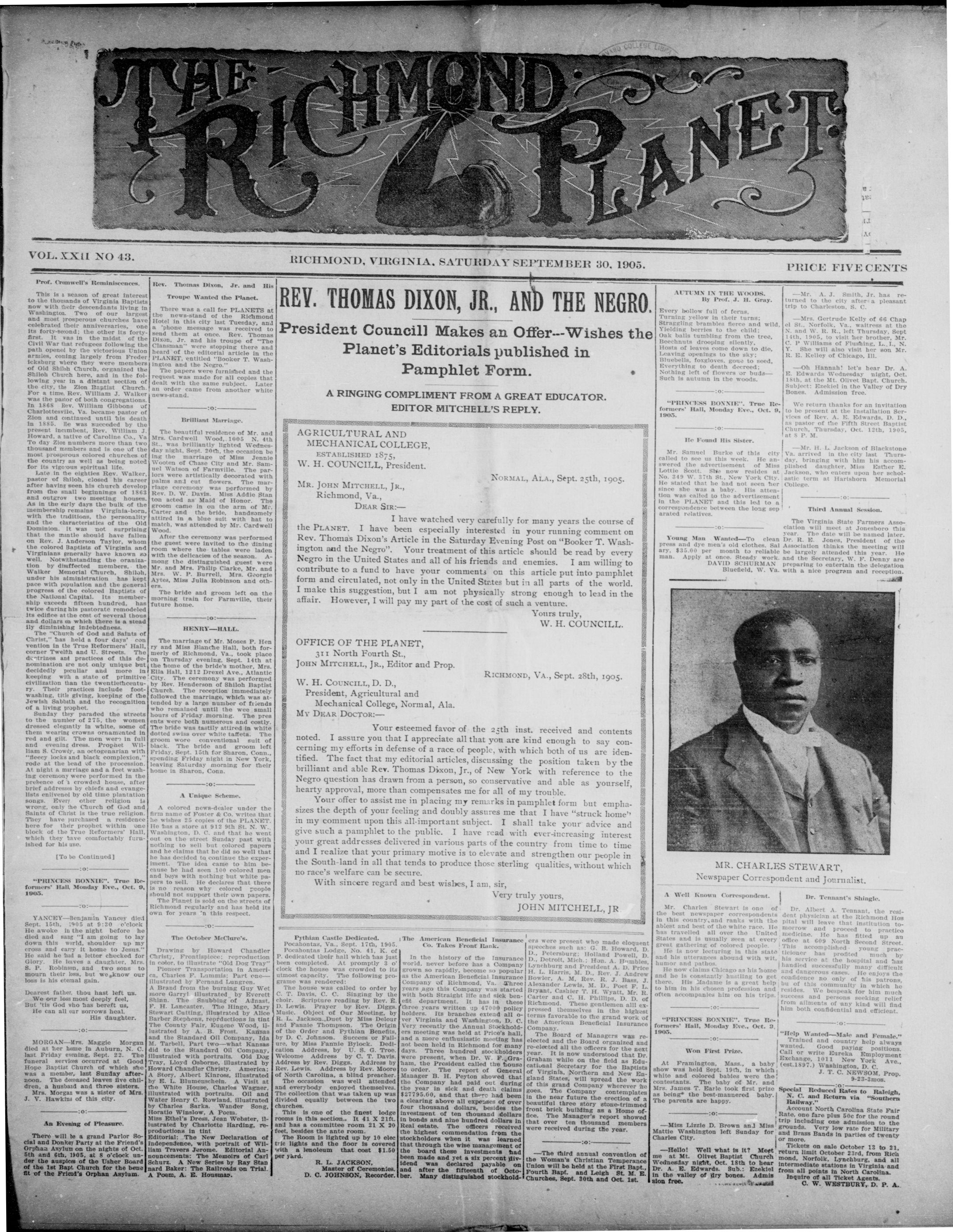
REV. THOMAS DIXON, JR., AND THE NEGRO.
President Councill Makes an Offer---Wishes the Planet's Editorials published in Pamphlet Form.
A RINGING COMPLIMENT FROM A GREAT EDUCATOR EDITOR MITCHELL'S REPLY.
AGRICULTURAL AND MECHANICAL COLLEGE ESTABLISHED 1875, W. H. COUNCILL, President.
I have waived the PLANET. I have been esp. Rev. Thomas Dixon's Article inington and the Negro". Your the Negro in the United States and contribute to a fund to have you form and circulated, not only in I make this suggestion, but I am affair. However, I will pay my
I have watched very carefully for many years the course of the PLANET. I have been especially interested in your running comment on Rev. Thomas Dixon's Article in the Saturday Evening Post on "Booker T. Washington and the Negro". Your treatment of this article should be read by every Negro in the United States and all of his friends and enemies. I am willing to contribute to a fund to have your comments on this article put into pamphlet form and circulated, not only in the United States but in all parts of the world. I make this suggestion, but I am not physically strong enough to lead in the affair. However, I will pay my part of the cost of such a venture.
OFFICE OF THE PLANET.
President, Agricultural and Mechanical College, Norman MY DEAR DOCTOR:—
Your esteemed noted. I assure you that I approve my efforts in defense of the fact that my editorial brilliant and able Rev. Thomas H. Negro question has drawn from a hearty approval, more than compris your offer to assist me in plus sizes the depth of your feeling and in my comment upon this all-important such a pamphlet to the public your great addresses delivered in and I realize that your primary in the South-land in all that tends to no race's welfare can be secure.
With sincere regard and best
Your esteemed favor of the 25th inst. received and contents noted. I assure you that I appreciate all that you are kind enough to say concerning my efforts in defense of a race of people, with which both of us are identified. The fact that my editorial articles, discussing the position taken by the brilliant and able Rev. Thomas Dixon, Jr., of New York with reference to the Negro question has drawn from a person, so conservative and able as yourself, hearty approval, more than compensates me for all of my trouble.
Your offer to assist me in placing my remarks in pamphlet form but emphasizes the depth of your feeling and doubly assures me that I have "struck home" in my comment upon this all-important subject. I shall take your advice and give such a pamphlet to the public. I have read with ever-increasing interest your great addresses delivered in various parts of the country from time to time and I realize that your primary motive is to elevate and strengthen our people in the South-land in all that tends to produce those sterling qualities, without which no race's welfare can be secure.
With sincere regard and best wishes, I am, sir.
---
MR. JOHN MITCHELL, JR.,
Richmond, Va.,
DEAR SIR:—
311 North Fourth St.
W. H. COUNCILL. D. D.
Pythian Castle Dedicated.
Pocahontas, Va., Sept. 17th, 1905.
Pocahontas Lodge, No. 41, K. of
P. dedicated their hall which has just
been completed. At promptly 3 o'clock the house was crowded to its utmost capacity. The following program was rendered:
The house was called to order by
C. T. Davis, C. C. Singing by the choir. Scripture reading by Rev. E. D. Lewis. Prayer by Rev. Diggs. Music. Object of Our Meeting, by R. L. Jackson, Duet by Miss Delour and Fannie Thompson. The Origin of the Order and Pythian Benefits, by D. C. Johnson. Success or Failure, by Miss Fannie Bylock. Dedication Address, by U. S. G. Tree.
Welcome Address by C. T. Davis. Address by Rev. Diggs. Address by Rev. Lewis. Address by Rev. Moore of North Carolina, a blind preacher.
The occasion was well attended and everybody enjoyed themselves. The collection that was taken up was divided equally between the two churches.
This is one of the finest lodge rooms in this section. It 41 X 21ft. and has a committee room 21 X 20 feet, besides the ante room.
The Room is lighted up by 10 electric lights and the floor is covered with a lenolemum that cost $1.50 per yard.
R. L. JACKSON,
Master of Ceremonies.
D. C. JOHNSON, Recorder.
carefully for many years the course of
rested in your running comment on
my Evening Post on "Booker T. Wash-
this article should be read by every
bonds and enemies. I am willing to
us on this article put into pamphlet
states but in all parts of the world.
Virtually strong enough to lead in the
cost of such a venture.
RICHMOND, VA., Sept. 28th, 1905.
and
Normal, Ala.
esteemed favor of the 25th int.
I appreciate all that you are
a sense of a race of people, with w
editorial articles, discussing t
homas Dixon, Jr., of New York
from a person, so conservati
an compensates me for all of my
me in placing my remarks in p
celing and doubly assures me that
is all-important subject. I sh
the public. I have read with
covered in various parts of the co
primary motive is to elevate and
t tends to produce those sterling
secure.
and best wishes, I am, sir,
Very tr
the 25th inst. received and contents
that you are kind enough to say con-
ple, with which both of us are iden-
ticussing the position taken by the
New York with reference to the
conservative and able as yourself,
for all of my trouble.
marks in pamphlet form but empha-
sures me that I have "struck home"
act. I shall take your advice and
read with ever-increasing interest
of the country from time to time
elevate and strengthen our people in
close sterling qualities, without which
m, sir,
Very truly yours,
JOHN MITCHELL, JR.
The American Beneficial Insurance Co. Takes Front Rank.
In the history of the Insurance world, never before has a Company grown so rapidly, become so popular as the American Beneficial Insurance Company of Richmond, Va. Three years ago this Company was started with both Straight life and sick benefit department. It has in these three years written up 47000 policy holders. Its branches extend all over Virginia and Washington, D. C. Very recently the Annual Stockholders meeting was held at Price's hall, and a more enthusiastic meeting has not been held in Richmond for many days. Three hundred stockholders were present, when Dr. W. F. Graham, the President called the house to order. The report of General Manager B. H. Peyton showed that the Company had paid out during the year in sick and death claims $27795.60, and that there had been a clearing above all expenses of over four thousand dollars, besides the investment of ten thousand dollars in bonds and nine hundred dollars in Real estate. The officers received the highest commendation from the stockholders when it was learned that through the wise management of the board these investments had been made and yet a six percent dividend was declared payable on and after the fifteenth of October. Many distinguished stockhold
---
---
Yours truly.
W. H. COUNCILL
ers were present who made eloquent speeches such as: G. B. Howard, D. D., Petersburg; Holland Powell, D. D., Detroit, Mich.; Hon. A. Humbles, Lynchburg and President A. D. Price, H. L. Harris, M. D. Rev, J. Andrew Bowler, A. M. Rev, R. J. Bass, J. Alexander Lewis, M. D. Poet F. L. Bryant, Cashier T. H. Wyatt, Mr. R. Carter and C. H. Phillips, D. D. of Richmond. These gentlemen all expressed themselves in the highest terms favorable to the grand work of the American Beneficial Insurance Company.
The Board of Managers was reelected and the Board organized and re-elected all the officers for the next year. It is now understood that Dr. Graham while on the field as Educational Secretary for the Baptists of Virginia, Northern and New England States, will spread the work of this grand Company wherever he goes. The Company contemplates in the near future the erection of a beautiful three story stone-trimmed front brick building as a Home office. The Manager's report showed that over ten thousand members were received during the year.
—The third annual convention of the Woman's Christian Temperance Union will be held at the First Bapt. Fourth Bapt. and Leigh St. M. E. Churches, Sept. 30th and Oct. 1st.
THE EDITOR
AUTUMN IN THE WOODS.
By Prof. J. H. Gray.
Every hollow full of ferns,
Turning yellow in their turns;
Strangling brambles fierce and will
Yielding berries to the child;
Oak balls tumbling from the tree,
Beechnuts drooping silently.
Hosts of leaves come down to die,
Leaving openings to the sky;
Bluebells, foxgloves, gone to seed,
Everything to death decreed;
Nothing left of flowers or buds—
Such is autumn in the woods.
"PRINCESS BONNIE". True Reformers' Hall, Monday Eve., Oct. 9, 1905.
He Found His Sister
Mr. Samuel Burke of this city called to see us this week. He answered the advertisement of Miss Lottie Scott. She now resides at No. 349 W. 37th St., New York City. He stated that he had not seen her since she was a baby. His attention was called to the advertisement in the PLANET and this led to a correspondence between the long sep arated relatives.
Young Man Wanted—To clean press and dye men's old clothes. Sary, $35.00 per month to reliable man. Apply at once. Steady work DAVID SCHURMAN Bluefield, W. Va
MR. CHARLE
Newspaper Correspo
A Well Known Correspondent
Mr. Charles Stewart is one of the best newspaper correspondents in this country, and ranks with the ablest and best of the white race. He has travelled all over the United States and is usually seen at every great gathering of colored people. He is now lecturing in this state and his utterances abound with wit, humor and pathos. He now claims Chicago as his home and he is constantly hustling to get there. His Madame is a great help to him in his chosen profession and often accompanies him on his trips.
"PRINCESS BONNIE". True Reformers' Hall, Monday Eve., Oct. 9, 1905.
Won First Prize.
At Framington, Mass., a baby show was held Sept. 19th, in which white and colored babies were the contestants. The baby of Mr. and Mrs. James T. Earle took first prize as being* the best-mannered baby. The parents are happy.
Miss Lizzie D. Brown anJ Miss Mattie Washington left Sunday for Charles City.
Hello! Well what is it? Meet me at Mt. Olivet Baptist Church Wednesday night, Oct. 18th to hear Dr. A. E. Edwards. Sub.: Ezekiel in the valley of dry bones. Admis slon free.
OY
TY
at
a
—Mr. A. J. Smith, Jr, has returned to the city after a pleasant trip to Charleston, S. C.
—Mrs. Gertrude Kelly of 66 Chap el St., Norfolk, Va. waitress at the N. and W. R. R. left Thursday, Sept 14th, 1905, to visit her brother, Mr. C. P Williams of Flushing, L., L. N. Y. She will also visit her son Mr. R. E. Kelley of Chicago, Ill.
—Oh Hannah! let's hear Dr. A. E. Edwards Wednesday night, Oct. 18th, at the Mt. Olivet Bapt. Church. Subject: Ezekiel in the Valley of Dry Bones. Admission free.
We return thanks for an invitation to be present at the Installation Services of Rev. A. E. Edwards, D. D., as pastor of the Fifth Street Baptist Church, Thursday, Oct. 12th, 1905, at 8 P. M.
—Mr. H. L. Jackson of Blackstone Va. arrived in the city last Thursday, bringing with him his accomplished daughter, Miss Esther E. Jackson, who enters upon her scholastic term at Hartshorn Memorial College.
Third Annual Session
The Virginia State Farmers Association will meet at Jonesboro this year. The date will be named later. Dr. R. E. Jones, President of the Association thinks the meeting will be largely attended this year. He and the Secretary, W. F. Denny are preparing to entertain the delegation with a nice program and reception.
ES STEWART,
respondent and Journalist.
Dr. Tennant's Shingle
Dr. Albert A. Tennant, the resident physician at the Richmond Hospital will leave that institution tomorrow and proceed to practice medicine. He has fitted up an office at 609 North Second Street. This accomplished young practitioner has profited much by his service at the hospital and has handled successfully many difficult and dangerous cases. He enjoys the confidence no only of his patrons, bu of this community in which he resides. We bespeak for him much success and persons seeking relief from ailments of any kind will find him both confidential and efficient.
"Help Wanted—Male and Female."
Trained and country help always wanted. Good paying positions. Call or write Eureka Employment Exchange, 1011 New York Ave., (est.1897.) Washington, D.C.
J. T. C. NEWSOM, Prop. 9-23-3mos.
Special Reduced Rates to Raleigh, N. C. and Return via "Southern Railway."
Account North Carolina State Fair Rate, one fare plus 50c for the round trip including one admission to the grounds. Very low rate for Military and Brass Bands in parties of twenty or more.
Tickets on sale October 13 to 21, return limit October 23rd, from Richmond, Norfolk, Lynchburg, and all intermediate stations in Virginia and from all points in North Carolina.
Inquire of all Ticket Agents.
C. W. WESTBURY, D. P. A.
LEYER
SATURDAY...SEPT. 30TH. 1905
TO PUNISH HERRICK
[Copyright, 1955, by K. A. Whitehead.]
"They tell me," said the girl softly,
"that Mr. Herrick has offered you the
place of superintendent of his vine-
yards."
"Yes," said Bob Corson shortly. "He
said something about it."
"I understand he urged you."
"Precisely," agreed Corson. "Urged
me to get out of the way."
"Of what?" she asked innocently,
though her face gawked redly.
"If you don't know," said Corson
shortly, "it's too long and dangerous to
tell."
"I should not be angry if some one
offered me a place like that," she be-
gan, taking another tack.
"It's quite likely Herrick will," cried
Corson bitterly, "that and his other
goods and chattels, including himself,
the thing of least value, attached to his
estate."
She held up her hand. "It isn't fair
to speak like that," she cried in a hurt
voice. "He is a good sort at heart."
"This wasn't offered out of the goodness of his heart," retorted Corson, "but out of the narrowness of his intellect. He knew that after the crash in G. & W. I was fat done for. He was afraid that I would still have the check to ask the sweetest girl in the world to be my wife, and he offered me the place to get me out of the way because he wants the girl for himself."
"See here, Bob Corson, I think you are going to be foolish. I think Mr. Herrick offered you the place because he knew It would be a good one for you. He has none of the selfish motives you imagined. You are merely jealous. I have always found him a most delightful] man. I don't think he ever thought of sending you away because he imagined that I'd marry him if you were not here."
Corson was about to retort, but the curtains were drawn aside and the butler entered with a card. Helen flushed slightly, but her voice was even as she told the servant to show the caller in. It was Herrick himself, and as he entered the room and greeted them both Helen's quick eye caught a glance of triumph in Herrick's, responding to Corson's look of hate. She had never supposed that his offer to Corson was induced by anything other than a desire to be of service to a friend whose fortune had been wrecked by unstable securities. Now she could see that Corson had been quicker to grasp the motive. "We were just talking of your offer to Mr. Corson" she said. "I think it is a most excellent thing." Herrick flashed a book of triumph at his rival. "A most excellent thing for us both," he agreed.
"Mr. Corson does not appear to fancy the idea," she continued, "and I have been trying to induce him to accept."
Herrick's eyes brightened. He had been afraid that after all he could not dispose of his rival easily. He had never supposed that Miss Erving would help him.
"You see," she said steadily, "Mr. Corson does not like to leave all of his friends behind."
"He can easily make others out there," suggested Herrick.
"Just what I think," she agreed. "It is easy to make friends anywhere if one is so incited."
"I am delighted to find that you agree with me," beamed Herrick. If Helen Erving wanted him out of the way there could be but one explanation—that she was willing to accept himself and wanted to get Corson out of town.
"The pay is a little small," she went on calmly, "but then I suppose that could be accounted for on the ground of lessened expense."
"As for that," interposed Herrick, "if $10,000 a year would prove more of an inducement I would be willing to raise it to that."
"I think that would be better," agreed Helen. "What do you think?"
Corson, to whom her last appeal was made, evidently thought as did Herrick, for his face was white and drawn.
"I think," he said slowly, "that since you both are agreed there is nothing to be done but to accept."
Herrick fairly beamed. "I have the papers here," he cried gaily. "I expected to see you at the club this evening. Let's sign them now and get it over with."
It was characteristic of the man that he carried a fountain pen even in his evening clothes, and five minutes later the document was signed and witnessed, whereby Chariton Corson agreed for the sum of $10,000 a year to serve for five years to the best of his ability the interests of Henry Hamilton Herrick as superintendent of the latter's vineyards on the other side of the continent.
“There,” said Herrick cheerfully, “It’s all done. Not a bad income, Bob, for a single man.”
“He won't have that advantage,” broke in Miss Erving sweetly. “You see, I was so interested in the matter because Mr. Corson is going to take me out with him as his wife.”
EUGENE ORTON.
Vacations For Horse
Give all horses on the place at least a three weeks' vacation in the fields. The grass will be good for their feet and as a feed will help to get all the old grain out of their systems, beside giving them a good rest. Horses that are worked every day must be given a diet of grain. On Sundays and days when not in use turn work horses into the fields - Philadelphia Ledger.
Cuckoos' Eggs.
Mr. Hart of Christchurch, Hampshire, who has made a lifelong study of British birds, has in his fascinating collection a large number of cuckoos' eggs, each in the nest and with the clutch in which they were deposited, and in almost every case the intruder's egg is an exact imitation of the rightful eggs, only a size larger. Mr. Hart is convinced that the female cuckoo inspects the eggs in the nest she has chosen before laying her own egg and that her retinal impression affects the coloration of the egg. In one instance the cuckoo chose the nest of a small bird, the name of which I have forgotten, whose nest was a closely woven ball with a tiny hole for entrance. In this case the alien egg was pure white, the cuckoo being unable to see into the bottom of the nest and her mind on the subject being therefore a blank. The plumage of the adult cuckoo is very much like that of hawks, while the young are indisputably speckled and blurred, the supposed reason being that no small bird would dare to feed what it took to be a young hawk in its nest. So the cuckoo has still another charge of mean duplicity against it in addition to the familiar ones—London Outlook.
Wealth of an Indian Rajah
It is believed that Sayaji Joo, the rajah of Baroda, is the possessor of wealth equal if not superior to that of John D. Rockefeller. He was educated in an English university, and his people are well governed. Much of his vast riches is in the form of precious stones. His wife owns the most famous diamond necklace in the world. It is made up of 200 stones, each the size of a hazelnut. She also has a collarette of 500 perfect diamonds, none less than twenty carats. In the treasure chamber is a carpet four square yards in surface made up entirely of ropes of diamonds, pearls and rubles. It required $4,000,000 worth of gems and three years of labor. The long corridors of the palace are lined with marbles and onyx of incalculable value. The palace is steam heated, and electric elevators are placed at frequent intervals. Bronzes, paintings, statuary, all imported and worth many millions of dollars, are scattered throughout the royal dwelling.
Forcing Spiders to Spin
Certain green ants in Queensland, which also make their nests of leaves and flowers spun together, are said to keep spiders to spin for them. Whether these latter do it spontaneously or require to be held as the larvae of the other species does not seem to have been determined. In the devices of these ants there is surely one of nature's hints to human inventors. Since the days of the spider artist in the University of Lagado, spider silk has been a dream. The difficulty of its realization has been chiefly the pugnacious nature of the spider, which prevents their being kept together. But a machine has been invented which seems to overcome the difficulty. It is described as a sort of frame containing twenty-four miniature guillotines, the blunt knives of which descend on the waist of the spiders and hold them fast. A number of the threads are secured together on a hook and slowly drawn out—London Globe.
Demands on a Portfolio
Demands on a Postoffice.
The postoffice at Chester, Pa., is regarded by some people as an accommodation bureau. One man last week asked for a letter carrier's pouch, saying he wanted it for a game bag, while another could not comprehend why he should be refused the use of the night collector's horse and wagon. A kay or two ago Postmaster John A. Wallace was called from his private office into the corridor of the building and was confronted by a strange woman, who asked for the loan of 50 cents. "But why do you come to me for such a favor?" asked the surprised official. "Why don't you see some of your friends? You are an entire stranger to me." "That may be," replied the caller, with rare naivete, "but I came to see you because I'm a regular customer of this office." This was too much for the postmaster, who reached into his pocket for the half dollar.—Philadelphia Record.
Unloading Coal Cars In Cleveland.
The gondolas are brought direct to the coal dock and are then hoisted to a great height, trucks and all, the giant crane first lifting the heavy car to the proper position and then quickly turning it over, as a mother turns over her small boy for a spanking. The coal is instantly dropped into the hold of the waiting vessel, the car returned to the rails and sent to the ore dock to be filled with Lake Superior iron.
These unloaders, under ordinary conditions, can unload 500 cars of coal every day. The No.1 machine handled the biggest tonnage of coal of any machine on the great lakes during the season of 1903. The coal was transferred at an average cost of 4 cents a ton, including the cost of maintenance and depreciation of the plant.—Erie Railroad Employees' Magazine.
"Ragging" In the British Army. A recent case of "ragging" on board the British cruiser Kent has been promptly followed by the supersession of Captain Douglas A. Gamble, her commander, who has been compulsorily retired on half pay for allowing such an occurrence on his ship, and by the punishment of others concerned in the affair. The "ragging" occurred in the gun room, where the midshipmen attempted to strip and flog an unpopular comrade. The latter promptly drew a revolver and shot one of the midshipmen in the mouth. The admiralty announces that it is determined to put down "ragging."
COWS AND THEIR MILK.
The matter of quality of the milk of cows has been pretty well settled by tests in this country, and English authority is in agreement with us, as shown by deductions from their own experiments, as follows:
THE RICHMOND PLANET, RICHMOND, VIRGINIA
NEW SHORT STORIES
An Effective Retort.
Judge Emory Speer, who presides over the United States circuit and district courts for the southern district of Georgia, is the possessor of a nimble and facile wilt, says the Philadelphia Saturday Evening Post. In earlier days, before he had attained the errine, Judge Speer was a politician and a power on the stump.
Shortly after reconstruction he ran against Allen D. Candler for congress. Speer was a Republican, and his politics sufficed to bring him unpopularity among a large majority of the white population. It was his wilt, his good humor and his unfalling courage that carried him through the campaign without a serious difference and finally brought him to victory.
On one occasion when the young candidate was addressing a very Demo-
MARCO C.
"SIR, YOU ARE A DEMAGOGUE!" cratic and hostile audience a brawny countryman was observed fighting his way through the crowd to the speaker's rostrum. It was evident that he had spent the preceding night with John Barleycorn, for his clothes were rumpled, his hair disheveled and his face of a fiery red that rivaled the noonday sun in brilliance. Shaking a belligerent fist under the nose of the orator, he exclaimed: "Sir, you are a demagogue!" The crowd howled, but Speer was not disturbed. He waited for the noise to subside and then, with a smile and in a tone of entire good humor, rejoined: "And you, sir, if you would wrap a few wispes of straw about you, would be a demilion."
The delighted audience roared with appreciative laughter, and the discomfited patriot slunk away. It is said that in no voting precinct of the district was Speer's majority larger than that in which this happy retort was made.
Said In Washington.
At one of the recent White House receptions there was a little case of rapier thrusting between two ladies, and it was delightfully entertaining to those who saw and heard.
There is a famous man in Washington, one who came from the plain people and who continues as one of them. He has a beautiful daughter of aristocratic tendencies who has dug up a family tree somehow or other and who affects superiority which she does not possess in any sense.
The wife of a congressman from a western state was introduced to the young lady and pleasantly said:
"I have met with your distinguished father, Miss ——"
"I dare say," replied the young lady languidly. "Papa in his position meets all sorts of people."
The western lady flushed and flushed back instantly. "I should suppose so, especially when he is at home."—Lippincott's.
The Dominic's Mare.
Senator Deboe of Kentucky tells an interesting story concerning a schoolteacher in his state who was also a preacher, says the Pittsburgh Dispatch. He loved horses and dogs, and he was the owner of a trotter with a good record for speed. One Friday afternoon before dismissing the school he addressed the boys thus:
"Now, boys, I suppose you all know that there will be some horse racing tomorrow. Now, don't you go to the races. The track is no place for boys. But, boys, if you do go to the races don't you do any betting. It is not right to wager money on horses. But, boys, if you do go and if you do bet—mind what I tell you—be on Deacon Abernathy's mare. This is a straight tip."
And the mare won too. She was the old preacher-schoolteacher's thoroughbred under another name.
"The lamented Fitz-Hugh Lee had a good sense of humor," remarked his warm personal friend, General Jack Hayes, at the Shoreham.
"When General Lee, a few weeks prior to his death, as president of the Jamestown Exposition association, got a telegram from Governor Pennypacker of Pennsylvania that the legislature of that state had made a generous appropriation to that enterprise General Lee wired him back as follows:
"Sincere thanks. I solemnly promise never more to draw my sword on the soil of Pennsylvania except in its defense."—Washington Post.
1. That when a cow is in full milk and full flesh she will give her normal quality of milk for at least a limited time, even though the quality and quantity of food be very deficient.
2. That when in good condition a cow will take off her body whatever is deficient in food, in order to give her normal quality of milk.
3. That an extra supply of nutritious food, at all times increases the quan-
WOMAN AND FASHION
An Attractive Negligee.
Negligents are in demand at all seasons of the year, but especially so during the summer months, when the need for relaxation is great. Illustrated is a most attractive one made of pretty lawn with simple trimming of emboldered banding, which allows a
225
SURPLICE NEGLIGE
choice of puffed or loose sleeves. The slightly open neck means comfort, coolness and style all in one, and it can be belted with a ribbon or left free, as preferred. Whether made with the full or puffed sleeves, it is eminently simple and can be laundered with case, for which reason it is especially well adapted to cotton and linen materials.
The quantity of material required for the medium size is $4\frac{1}{2}$ yards 27, 4 yards 32 or 3 yards 44 inches wide, with 4 yards of banding and 2 yards of embroidery for frills.
Concerning Blue
Delft is very much liked this summer. Steel blue is a becoming shade to many. China blue is one of the good strong blues. Saxon, Alice and Dresden express the new clear medium blue.
Fashionable Linen Colors.
Linen holds its own, especially in the long coat suits, which are practical and becoming. The plaited skirts are popular and pretty, but the circular skirt with rows of very narrow stitched bands around the bottom is growing in favor on account of its greater durability. The favorite color is of course white, but gray, blue, pink, mauve, green and the natural color are seen in good models. Most of the separate coats are in plain tailored styles, with colored velvet collars.
The Vogue of Ribbon.
Ribbon forms one of the important items in the dress question now. The plain styles are quite as effective on fancy stuffs as are the fancy on the plain materials. They are shirred and plaited unmercifully and are used in the most unique forms, but nevertheless they are pretty.
For a Small Girl
The design here shown should be useful by way of suggestion as well as example as to how trimmings should be the expression of character in clothes without overdoing it. The yoke is tucked in sunburst effect, and the fullness at the waist is
244
TUCKED PROCK.
taken up in tiny tucks in front and back. The addition of a sash fastening with little rosettes where the tucks end is quite a pretty idea, although a belt or a strap similar to that on the shoulder would be as effective on wash dresses.
city of milk, but the percentage of fat is not in any way improved by it; if anything, the tendency is the other way.
4. That an extra supply of nitritious food almost invariably very slightly increases the solids not fat of the milk. That a ration poor in food ingredients has a very slight tendency to reduce the solids not fat in milk, but has little appreciable effect on the
FACTS IN FEW LINES
FACTS IN FEW LINES
Cotton is the principal line of manufacture in Mexico.
It is said that 1,500 Greeks arrive at New York each month.
This year Tasmania will export 1,500,000 bushel cases of apples. Most of them will go to England and Australia.
The exports of Australia in 1904 were $280,042,056, an increase of $38,195,636 over those of 1901, the banner year previously.
Professor John C. Olsen of the Brooklyn Polytechnic institute reports 4,000,000 bacteria in one sample of milk bought in Brooklyn.
Japan has one of the largest steamship companies in the world, with service to the United States and to England by way of Suez.
The London Academy tells of an old woman who walked into a shop and asked to buy a "circulating library." Inquiry revealed that she wanted a revolving bookcase.
The first bullfight in Madrid after the repeal of the Sunday law was witnessed by 20,000 persons, and 80,000 more waited outside the ring to get prompt news of the result.
So fashionable is appendicitis in British society circles that, says London Opinion, many women would rather have it "than a three-quarter length photograph in a magazine."
An institute for the treatment of sufferers from chest complaints, neuralgia, catarrh and other maladies by means of opium smoking has been opened by London physicians.
The Hawaiian legislature has passed over the governor's veto a law allowing baseball and similar amusements on Sunday and permitting cigar and many other stores to remain open on that day.
The superior board of health of Mexico informs dealers in food products, especially milk dealers, that the use of preservatives in food is prohibited and punishable by the board as food adulteration.
A recently discovered manuscript written by a schoolmate indicates that Napoleon I. knew so little of the French language when he was sent to the military school at Brienne that a private teacher was engaged for him.
A psalter which belonged to Boswell was sold at Sotheby's, in London, recently for £15. It contained the inscription: "James Boswell, 1763. I bought this for 2d at Greenwich, when I was working there with Mr. Samuel Johnson."
The value of shells, tortoise and others, gathered in Cuba last year amounted to about $75,000 and of sponges $500,000. Of the latter the United States received about 35 per cent and Europe the remainder, France being the principal buyer. Dr. A. D. Nash of Townshend, Vt., has a pair of shears which were handed down from his great-grandfather. They were made by a blacksmith and used in the war of 1812 to cut the hair of soldiers. They are much larger and heavier than those in use nowadays.
Captain Freeman H. Murray of Lynn has an old cent which he found some years ago while digging in his garden. It is an Irish coin, dated 1723. On its face it bears the likeness of King George L., while on the reverse side Hibernia is seen with her harp and distaff.
Sam White of Riverside, Cal., has a boy born on Feb. 20, and in addition has one who was born on Washington's brbday, one on inauguration day and two on All Fools day, April 1; one on Thanksgiving day and one on Feb. 2, ground hog day; also three more boys born on other dates.
Golf is greatly indulged in by the naval officers and European residents in China. In consequence the Chinese boys have grasped some idea of the game, and they are frequently seen amusing themselves with an old stick converted into a club and a real golf ball which some golfer has lost.
A hotel which cost the builder $13,000 six years ago at Kettle Falls, Wash., has been sold for $200, and a number of town lots were sold at from 5 cents to $25 each. The sale was made by the county commissioners on foreclosure for delinquent taxes and marked the end of a boom town.
Thomaston, Mc., is probably one of the towns that will not be asking for a new depot. The one there is the old General Knox mansion, 112 years old, and is the only building left of the once great Knox estate. For that reason it is a memorial that the town will probably be glad to have preserved. The most voluminous report ever filed with the United States supreme court is that of Frank S. Bright, commissioner appointed to take testimony in the suit instituted by Missoul to enjoin Illinois from emptying the Chicago drainage canal into the Mississippi river. The report contains 4,484,000 words and covers 7,575 pages.
London will soon put on its streets a motor street cleaning machine that will do the work of 500 men. It operates rakes for caked mud, "squeegees" for wet weather, a revolving brush and a set of overlapping scrapers to complete the cleaning operation. All the refuse goes into a box. It works at the rate of eight miles an hour.
A bell has been imported by the Swedish Lutheran church at New Britain, Conn. The bell is inscribed as follows: "Maria Swedish Evangelical Lutheran church, New Britain, Conn., from the congregation's Sunday school. The first Swedish church bell in America, cast in the year 1905 at Gothenburg, mechanical factory in Sweden. Bell weight 1,120 kilograms."
fat.
5. That with a poor ration, a cow in full weight will lose carcass weight, while on a rich diet she will gain weight.
6. That although the percentage of fat in a cow's milk may vary daily, we at present seem unable to control these variations or to account for them.
7. That for limited periods, up to one month or thereabouts, all ordinary
WASHINGTON LETTER
[Special Correspondence.]
The mackereler of the New England coast are changing their habits so much that the New England people are alarmed and have appealed to the president to direct the fish commission to make an investigation to determine what is the matter with the fish. Migration has become a fad with the fish, which now go away and stay at some unknown place for a good part of the year. The New England people want to keep in touch with the fish. The matter was presented to the president by W. H. Jordan, the collector of the port of Gloucester, Mass., and Benjamin A. Smith of the board of trade at Gloucester. It is feared by some of the Gloucester fishermen that the mackereler may finally disappear and find some other home besides the New England coast.
Silver Service For the Tennessee.
The battleship Tennessee, which Representative Gaines of Tennessee said the president regarded as the most powerful battleship in any fleet in the world, will receive a handsome silver service at a southern port. President Roosevelt wrote a brief note to the navy department directing that when the Tennessee is completed and is ready to receive the silver service it be sent to New Orleans for this purpose.
The note was given to Representative John Wesley Gaines of Tennessee, who called on the president to ask that the vessel be sent to a southern port to receive the service. New Orleans was preferred, but any southern port would have answered. Mr. Gaines said the service to be presented to the ship is to be one of the finest in the navy. There will be engraved upon the silver a brief history of the state.
The Army Uniform.
The law officers of the war department have recently discovered, to their surprise and disgust, there is no law in which they can prohibit any person from wearing the regulation uniform of the army or navy if such person cares to wear it.
The war department has been wrestling with the case of an army officer who was permitted to resign "for the good of the service," but who still persists in wearing the uniform of his rank. It was first believed that he would be compelled to discard the honorable shoulder straps, but after the law was carefully studied it was found there was no provision under which such action could be taken.
As the matter now stands any civilian with the bad taste so to do and the money with which to pay for it can wear the uniform of the lieutenant general of the army, although there is but one man in the country entitled to wear that particular dress.
The Pension Office.
Commissioner Warner of the pension bureau has under contemplation an innovation—that of changing the present method of keeping the records of claimants for pension in large, cumbersome books to the card system. The magnitude of this change can in a measure be understood when it is known that the names of more than a million soldiers, with the companies and regiments in which they served, must be copied from the old books upon cards by hand. These cards will be placed in the latest improved file cases in alphabetical order, thereby enabling the bureau to find a claim when only the name of the claimant is known. This transfer of the records can be carried on without interfering in any way with the current work of the bureau. The services of clerks writing plain and legible hands will be utilized, and the actual extra expense will be the small amount of money to be expended for cards and file cases.
Chief Justice Not to Reign
Chief Justice Not to Resign.
It is stated that Chief Justice Fuller has no intention of resigning his position. He has frequently told friends and neighbors that no chief justice of the supreme court has ever resigned and that he does not intend to do so, his duties not being so onerous as to require the rest that would come from complete severance of official ties. If this attitude is maintained Secretary Taft may never become chief justice.
Tuskegee Institute.
The president will spend the best part of Oct 23 at Tuskegee institute, and a great exhibition of the institution and its students will be arranged for. A long procession of floats and other displays will pass before the president, representing the work of the institution. A similar exhibition was given upon the occasion of the visit to Tuskegee made by President McKinley in December, 1897.
Fireproofing of Books.
An interesting experiment was made recently in the blank division of the bindery of the government printing office in the fireproofing of books. The treasury department was responsible for the initial order, which consisted in the substitution of a prepared asbestus for the binders' boards and backing, the edges being coated with a fireproof liquid.
Extension of the Capitol.
Extension of the Capitol.
Every patriotic American citizen will hope that no obstacle will intrude in the path of an extension of the east front of the capitol at Washington in accord with the plans which have been reported favorably by a joint commission of the senate and house. For several generations this has been a project dear to the heart of almost every congress and always dear to the heart of every lover of art in architecture who could not look at the grand building on "the hill" without a feeling of profound regret that so imposing a pile should be conspicuous in one great defect, that the magnificent dome should seem, from the eastern point of view, to be toppling over for lack of a proper and harmonious pedestal.
CARL SCHOFIELD.
quantities and qualities of food seem to have no material effect on the quality of the milk.
8. That some foods exercise a material effect in raising the melting point of butter.
9. That the aim of all producers of milk, butter or cheese should be to feed what will give quantity, in moderate amount and of a mixed nature, and the produces will be the best that
Fats are the greatest food generators of heat, hence the natural distaste to them which the hot weather brings. One can conscientiously minimize one's allowance of buffer and eat as little starch as possible; hence potatoes and porridge are not the prime favorites for summer they are in winter.
Meat, which is most highly nutritive, is too stimulating to be taken in large quantities in the hot weather; hence it is best to choose eggs, milk and the least starchy of the carbohydrates.
Vegetables rich in legumes, such as peas, beans and lentils, are also useful in diminishing the necessity of getting our nitrogenous food solely from meat. There is no process of losing heat so rapidly as by evaporation; hence in summer to keep cool one has to encourage evaporation.
Rapid evaporation means the loss of much water, which must be replaced; hence green vegetables and salads, which contain little else than water, are general favorites and can hardly be taken in too large quantities.
Some people say to pass over unmercifully the cravings of thirst. They are sterner than wise, for thirst is generally a sign that the means of evaporation are exhausted, and if one needs the cooling process to continue one must replenish them. Frequent drafts of water do not harm, but alcohol closes up the pores.
Bolled Chocolate Icing
Boil together in a porcelain lined saucepan a third of a cup of boiling water and a cupful of granulated sugar and do not stir while cooking. When it threads pour the sirup gradually upon the beaten white of an egg to which has been added a pinch of cream of tartar. Whip the egg steadily as you add the sirup; then add immediately two heaping tablespoonfuls of grated chocolate, two tablespoonfuls of cream, a half teaspoonful of butter and a little vanilla flavoring. When lukewarm pour over the cake.
Washing Black Muslim.
In washing black muslins and lawns a tablespoonful of turpentine should be added to each palful of rinsing water. Use gum arable water instead of starch for black cottons. This gum arable water is useful to freshen muslins of all colors which have become limp. Sprinkle the gown and turn it wrong side out while drying. Sprinkle with clear water and iron on the wrong side.
Door Knob Burglar Alarm
An ingenious inventor has worked out a contrivance intended for attachment to a door knob by which the manipulation resulting from an attempt
RINGS WHEN KNOR IS TURNED.
to open a door gives an alarm, notifying those interested of the presence of the incomer. It consists of a spring attachment to grasp the knob, from which is suspended a gong casing containing a clockwork mechanism, which is set in operation by the release of a trip bar, effected whenever the knob handle is turned.
To Remove Wrinkles
Here is an old recipe, easily prepared and said to remove wrinkles; Take equal parts of bean and barley meal and mix with raw egg. When the mass is thoroughly hard and dry it should be ground to a fine powder and made into an ointment with melted tallow and honey. A thick layer of this applied to the face every night is warranted to smooth out all wrinkles.
Care of the Dining Table
Where the top of the table is polished it is well to use a thicker first cover—felt is a good material—over which the ordinary colored table cover can be spread. This last is, of course, removed when the dinner hour approaches, and the white cloth is substituted. The thick felt will as a rule protect the polished surface from all injury.
Care of the Open
When the oven smells bad take a vessel of hot water and a handful of washing soda, take the shelves out and wash well in hot water, then finish them in cold and next wash the oven well out with the soda water and brush it over with whiting. It will then be clean and sweet and bake beautifully.
Polished Leather
To clean and restore the polish to leather, wash the leather with a soft cloth dampened with a little warm water. Dry it carefully and then brush it over with the whites of eggs whipped to a froth.
Cloth Test.
In testing a piece of cloth to see if it is a cotton mixture, if you cut a small piece off and put a match to it, if it is all wool it will only sing, but if cotton is there it will fare up.
the cow can give.
10. That extra quality must be looked for by improving the breeds, and judicious selection, rather than by any special foods or methods of feeding.
11. That the variations in the percentage of fat in a cow's milk are caused by something, but what that something is we at present do not know, though if we did we might be able to influence the quality.
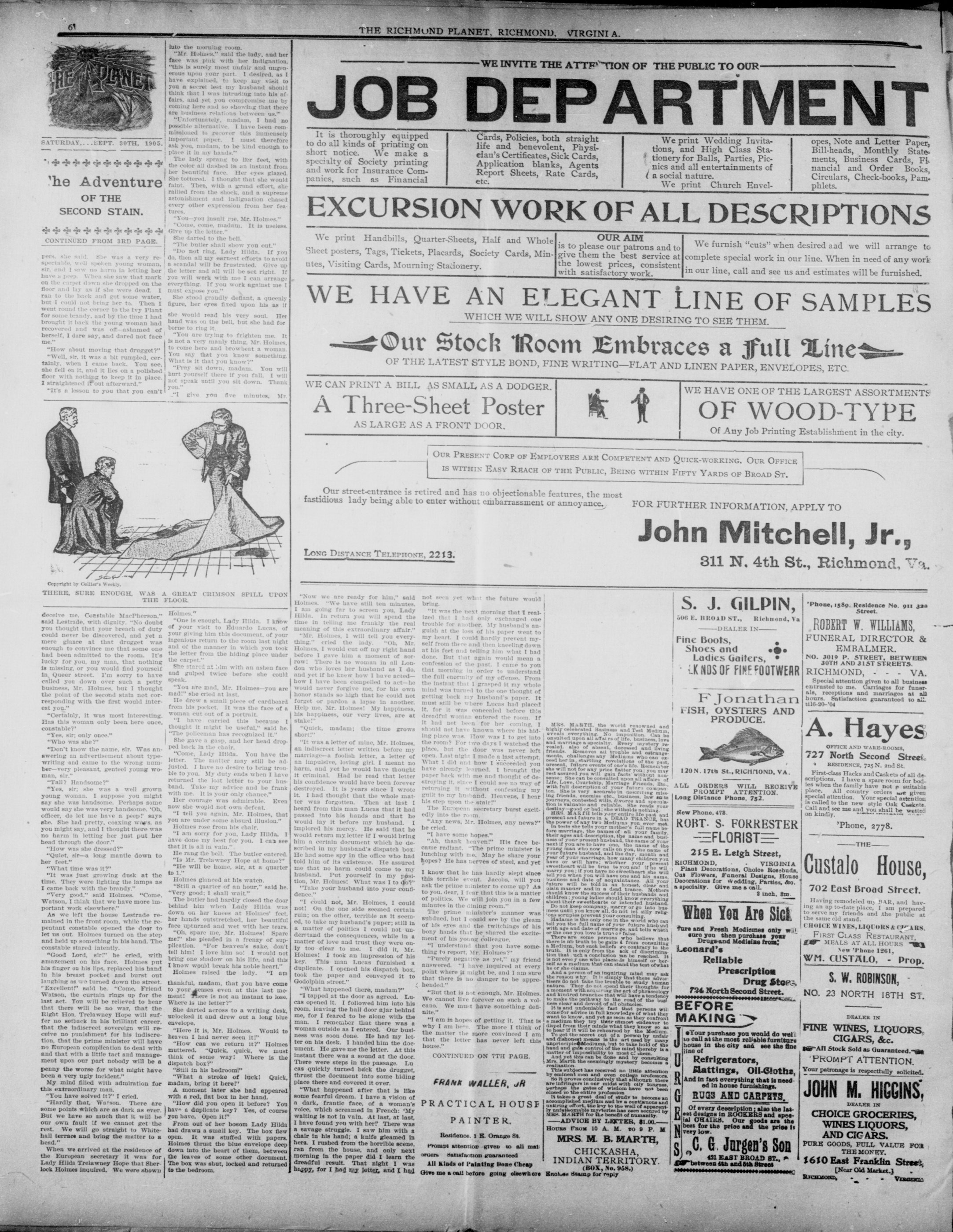
The Return of Sherlock Holmes
By A. CONAN DOY
Author of "The Adventures of Sherlock Holmes," the Hound of the Baskervilles," "The Sign of the Four," "A Study In Scarlet," Etc.
ILLUSTRATED BY F. D. STEELE
The Adventure of the Second Stain
The Adventure of the Second Stain
(Copyright, 1808, by A. C. Conan Dye, Collier's Weekly
and McClure, Phillips & Co.)
HAD intended "The Adventure of the Abbey
Grange" to be the last
of those exploits of my
friend, Mr. Sherlock
Holmes, which I should
ever communicate to the
public. This resolution of mine was not due to any lack of material, since I have notes of many hundreds of cases to which I have never alluded, nor was it caused by any waning interest on the part of my readers in the singular personality and unique methods of this remarkable man. The real reason lay in the reluctance which Mr. Haskes has shown to the continued publication of his experiences. So long as he was in actual professional practice the records of his successes were of some practical value to him, but since he has definitely retired from London and beaten himself to study and bee farming on the Sussex downs notoriously have become hateful to him, and he has peremptorily requested that his wishes in this matter should be strictly observed. It was only upon my representing to him that I had given a promise that "The Adventure of the Second Stain" should be published when the times were ripe and pointing out to him that it is only appropriate that this long series of episodes should culminate in the most important international case which he has ever been called upon to handle that I at last succeeded in obtaining his consent that a carefully guarded account of the incident should at last he laid before the public.
It was, then, in a year, even in a decade that shall benameless, that upon one Tuesday morning in autumn we found two visitors of European fame within the walls of our humble room in Baker street. The one, austere, high nosed, eagle eyed and dominant, was none other than the illustrious Lord Bellinger, twice premier of Britain. The other, dark, clean cut and elegant, hardly yet of middle age and endowed with every beauty of body and of mind, was the Right Hon. Trekawney Hope, secretary for European affairs and the most rising statesman in the country. They sat side by side upon our paper littered settee, and it was easy to see from their worn and anxious faces that it was business of the most pressing importance which had brought them. The premier's thin, blue veined hands were clasped tightly over the ivory head of his umbrella, and his gaunt, ascetic face looked gloomily from Holmes to me. The European secretary pulled nervously at his mustache andidgeted with the seals of his watch chain.
endowed with ev-
ery and of mind, was
relawney Hope, sec-
ean affairs and the
man in the country.
inside upon our paper
and it was easy to see
and anxious faces that
of the most pressing
had brought them.
a. blue veined hands
totally over the ivory
vela, and his gaunt,
sliced gloomily from
The European secre-
nly at his mustache
with the seals of his
covered my loss. Mr.
was at 8 o'clock this
informed the prime
at his suggestion that
to you."
named the police?"
the prime minister,
decisive manner for
ous. "We have not
it possible that we
to inform the police
run, mean to inform
what we particular-
document in question
the importance that its
very easily—I might
only—lead to European
the utmost moment.
to say that peace or
"When I discovered my loss, Mr. Holmes, which was at 8 o'clock this morning, I at once informed the prime minister. It was at his suggestion that we have both come to you."
"Have you informed the police?"
"No, sir," said the prime minister, with the quick, decisive manner for which he was famous. "We have not done so, nor is it possible that we should do so. To inform the police must, in the long run, mean to inform the public. This is what we particularly desire to avoid."
"Because the document in question is of such immense importance that its publication might very easily—I might almost say probably—lead to European complications of the utmost moment. It is not too much to say that peace or war may hang upon the issue. Unless its recovery can be attended with the utmost secrecy then it may as well not be recovered at all, for all that is aimed at by those who have taken it is that its contents should be generally known."
"I understand. Now, Mr. Trelawney Hope, I should be much obliged if you would tell me exactly the circumstances under which this document disappeared."
"That can be done in a very few words, Mr. Holmes. The letter—for it it was a letter from a foreign potentate—was received six days ago. It was of such importance that I have never left it in my safe, but I have taken it across each evening to my house in Whitehall terrace and kept it in my bedroom in a locked dispatch box. It was there last night. Of that I am certain. I actually opened the box while I was dressing for dinner and saw the document inside. This morning it was gone. The dispatch box had stood beside the glass upon my dressing table all night. I am a light sleeper, and so is my wife. We are both prepared to swear that no one could have entered the room during the night, and yet I repeat that the paper is gone."
"How long was it before you went to bed?"
"My wife had gone to the theater. I waited up for her. It was half past 11 before we went to our room."
"Then for four hours the dispatch box had lain unguarded?"
"No one is ever permitted to enter that room save the housemaid in the morning and my valet or my wife's maid during the rest of the day. They are both trusty servants and have been with us for some time. Besides, neither of them could possibly have known that there was anything more valuable than the ordinary departmental papers in my dispatch box."
"Who did know of the existence of that letter?"
right—we will
No.13 of the Series
I
"What time did you dine?"
THE WOMAN IN THE CHAIR
SHE SEATED HERSELF WITH HER BACK TO THE WINDOW
"No one in the house."
"Surely your wife knew?"
"No, sir. I had said nothing to my wife until I missed the paper this morning."
The premier nodded approvingly.
"I have long known, sir, how high is your sense of public duty," said he.
The European secretary bowed.
"You do me no more than justice, sir. Until this morning I have never breathed one word to my wife upon this matter."
"Could she have guessed?"
"No, Mr. Holmes, she could not have guessed, nor could any one have guessed."
"Have you lost any documents before?"
"Who is there in England who did know of the existence of this letter?" "Each member of the cabinet was informed of it yesterday, but the pledge of secrecy which attends every cabinet meeting was increased by the solemn warning which was given by the prime minister. Good heavens, to think that within a few hours I should myself have lost it! Besides the members of the cabinet there are two or possibly three departmental officials who know of the letter. No one else in England, Mr. Holmes, I assure you." "But abroad?" "I believe that no one abroad has seen it save the man who wrote it. I am well convinced that his ministers—that the usual official channels have not been employed." Holmes considered for some little time. "Now, sir, I must ask you more particularly, what this document is, and why its disappearance should have such momentous consequences?"
The two statesmen exchanged a quick glance, and the premier's shaggy eyebrows gathered in a frown.
"Mr. Holmes, the envelope is a long, thin one of pale blue color. There is a seal of red wax stamped with a crouching lion. It is addressed in large, bold handwriting to"—
"I fear, sir," said Holmes, "that, interesting and, indeed, essential as these details are, my inquiries must go more to the root of things. What was the letter?"
Copyright by Collier's Weekly.
"That is a state secret of the utmost importance, and I fear that I cannot tell you, nor do I see that it is necessary. If by the aid of the powers which you are said to possess you can find such an envelope as I describe, with its inclosure, you will have deserved well of your country and earned any reward which it lies in our power to bestow."
Sherlock Holmes rose with a smile. "You are two of the most busy men in the country," said he, "and in my own small way I have also a good many calls upon me. I regret exceedingly that I cannot help you in this matter, and any continuation of this interview would be a waste of time."
The premier sprang to his feet with that quick, fierce gleam of his deep set eyes before which a cabinet has covered. "I am not accustomed, sir"—he began, but mastered his anger and resumed his seat. Then the old statesman shrugged his shoulders.
"We must accept your terms, Mr. Holmes. No doubt you are right, and it is unreasonable for us to expect you to act unless we give you our entire confidence."
"I agree with you," said the younger statesman.
"Then I will tell you, relying entirely upon your honor and that of your colleague, Dr. Watson. I may appeal to your patriotism also, for I could not imagine a greater misfortune for the country than that this affair should come out."
"You may safely trust us."
"The letter, then, is from a certain foreign potentate who has been ruffled by some recent colonial developments of this country. It has been written hurriedly and upon his own responsibility entirely. Inquiries have shown that his ministers know nothing of the matter. At the same time it is couched in so fortunate a manner and certain phrases in it are of so provocative a character that its pub-
THE RICHMOND PLANE1, RICHMOND, VIRGINIA
lication would undoubtedly lead to a most dangerous state of feeling in this country. There would be such a ferment, sir, that I do not hesitate to say that within a week of the publication of that letter this country would be involved in a great war."
Holmes wrote a name upon a slip of paper and handed it to the premier. "Exactly. It was he. And it is this
letter—this letter which may well mean the expenditure of a thousand millions and the lives of a hundred thousand men—which has become lost in this unaccountable fashion."
"Have you informed the sender?"
"Yes, sir; a cipher telegram has been dispatched."
"Perhaps he desires the 'publication of the letter."
"No, sir; we have strong reason to believe that he already understands that he has acted in an indiscreet and hot headed manner. It would be a greater blow to him and to his country than to us if this letter were to come out."
"If this is so, whose interest is it that the letter should come out? Why should any one desire to steal it or to publish it?"
"There. Mr. Holmes, you take me into regions of high international politics. But if you consider the European situation you will have no difficulty in perceiving the motive. The whole of Europe is an armed camp. There is a double league which makes a fair balance of military power. Great Britain holds the scales. If Brits a were driven into war with one confederacy it would assure the supremacy of the other confederacy, whether they joined in the war or not. Do you follow?" "Very clearly. It is then the interest of the enemies of this potentate to secure and publish this letter, so as to make a breach between his country and ours?"
"Yes, sir." "And to whom would this document be sent if it fell into the hands of an enemy?" "To any of the great chancelleries of Europe. It is probably speeding on its way thither at the present instant as fast as steam can take it. Now, Mr.
HER BACK TO THE WINDOW.
Holmes, you are in full possession of the facts. What course do you recommend?
Holmes shook his head mournfully.
"You think, sir, that unless this document is recovered there will be war?" "I think it is very probable."
"That is a hard saying, Mr. Holmes."
"Consider the facts, sir. It is inconceivable that it was taken after 11:30 at night, since I understand that Mr. Hope and his wife were both in the room from that hour until the loss was found out. It was taken, then, yesterday evening between 7:30 and 11:30, probably near the earlier hour, since whoever took it evidently knew that it was there, and would naturally secure it as early as possible. Now, sir, if a document of this importance were taken at that hour, where can it be now? No one has any reason to retain it. It has been passed rapidly on to those who need it. What chance have we now to overtake or even to trace it? It is beyond our reach."
"What you say is perfectly logical, Mr. Holmes. I feel that the matter is indeed out of our hands."
"Let us presume, for argument's sake, that the document was taken by the maid or by the valet"—
"They are both old and tried servants."
"I understand you to say that your room is on the second floor, that there is no entrance from without and that from within no one could go up unobserved. It must, then, be somebody in the house who has taken it. To whom would the thief take it? To one of several international spies and secret agents whose names are tolerably familiar to me. There are three who may be said to be the heads of their profession. I will begin my research by going round and finding if each of them is at his post. If one is missing—especially if he has disappeared since last night—we will have some indication as
to where the document has gone."
"Why should he be missing?" asked the European secretary. "He would take the letter to an embassy in London, as likely as not."
"I fancy not. These agents work independently, and their relations with the embassies are often strained."
The prime minister nodded his acquiescence.
"I believe you are right. Mr. Holmes. He would take so valuable a prize to headquarters with his own hands. I think that your course of action is an excellent one. Meanwhile, Hope, we cannot neglect all our other duties on account of this one misfortune. Should there be any fresh developments during the day we shall communicate with you, and you will no doubt let us know the results of your own inquiries."
The two statesmen bowed and walked gravely from the room.
When our illustrious visitors had departed Holmes lit his pipe in silence and sat for some time lost in the deepest thought. I was reading the morning paper when my friend gave an exclamation, sprang to his feet and laid his pipe down upon the mantelpiece.
"Yes," said he, "there is no better way of approaching it. The situation is desperate, but not hopeless. Even now, if we could be sure which of them has taken it, it is just possible that it has not yet passed out of his hands. After all, it is a question of money with these fellows, and I have the British treasury behind me. It is conceivable that the fellow might hold it back to see what bids come from this side before he tries his luck on the other. There are only those three capable of playing so bold a game—there are Oberstein, La Rothiere and Eduardo Lucas. I will see each of them."
I glanced at my morning paper.
"Its that Eduardo Lucas of Godol phin street?"
paint street.
"Yes."
"You will not see him."
"Why not?"
"He was murdered in his house last night."
My friend has so often astonished me in the course of our adventures that it was with a sense of exultation that I realized how completely I had astonished him. He stared in amazement and then snatched the paper from my hands. This was the paragraph which I had been engaged in reading when he rose from his chair:
"Well, Watson, what do you make of this?" asked Holmes after a long pause. "It is an amazing coincidence."
"A coincidence! Here is one of the three men whom we had named as possible actors in this drama, and he meets a violent death during the very hours when we know that that drama was being enacted. The odds are enormous against its being coincidence. No figures could express them. No, my dear Watson, the two events were connected—must be connected. It is for us to find the connection."
"But now the official police must know all."
"Not at all. They know all they see at Godphin street. They know—and shall know—nothing of Whitehall terrace. Only we know both events and can trace the relation between them. There is one obvious point which would in any case have turned my suspicions toward Lucas. Godphin street, Westminster, is only a few minutes' walk from Whitehall terrace. The other secret agents whom I have named live in the extreme west end. It was easier, therefore, for Lucas than for the others to establish a connection or receive a message from the European secretary's household—a small thing, and yet it may prove essential. Hello! What have we here?"
Mrs. Hudson had appeared with a lady's card upon her salver. Holmes glanced at it, raised his eyebrows and handed it over to me.
"Ask Lady Hilda Trelawney Hope if she will be kind enough to step up," said he.
A moment later our modest apartment, already so disaligned that morning, was further honored by the entrance of the most lovely woman in London. I had often heard of the beauty of the youngest daughter of the Duke of Belminster, but no description of it had prepared me for the subtle, delicate charm and the beautiful coloring of that exquisite head. And yet as we saw it that autumn morning it was not its beauty which would be the first thing to impress the observer. The cheek was lovely, but it was paled with emotion; the eyes were bright, but it was the brightness of fever; the sensitive mouth was tight and drawn in an effort after self command. Terror—not beauty—was what sprang first to the eye.
"Has my husband been here, Mr. Holmes?"
"Yes, madam, he has been here."
"Mr. Holmes, I implore you not to
tell him that I came here." Holmes bowed and motioned her to a chair.
"Your ladyship places me in a very delicate position. I beg that you will sit down and tell me what you desire, but I fear that I cannot make any unconditional promise."
She swept across the room and seated herself with her back to the window. It was a queenly presence-tall, graceful and intensely womanly.
"Mr Holmes," she said, and her white glooved hands clasped and unclasped as she spoke. "I will speak frankly to you in the hopes that it may induce you to speak frankly in return. There is complete confidence between my husband and me on all matters save one. That one is politics. On this his lips are sealed. He tells me nothing. Now, I am aware that there was a most deplorable occurrence in our house last night. I know that a paper has disappeared. But because the matter is political my husband refuses to take me into his complete confidence. Now it is essential-essential, I say—that I should thoroughly understand it. You are the only other person, save only these politicians, who knows the true facts. I beg you then, Mr. Holmes, to tell exactly what has happened and what it will lead to. Tell me all, Mr. Holmes. Let no regard for your client's interests keep you silent, for I assure you that his interests, if he would only see it, would be best served by taking me into his complete confidence. What was this paper which was stolen?"
"Madam, what you ask me is really impossible."
She groaned and sank her face in her hands.
"You must see that this is so, madam. If your husband thinks fit to keep you in the dark over this matter, it is for me, who have only learned the true facts under the pledge of professional secrecy, to tell what he has withheld? It is not fair to ask it. It is him whom you must ask."
"I have asked him. I come to you as a last resource. But without your telling me anything definite, Mr. Holmes, you may do a great service if you would enlighten me on one point."
"What is it, madam?"
"Is my husband's political career likely to suffer through this incident?"
"Well, madam, unless it is set right it may certainly have a very unfortunate effect."
"Ah!" She drew in her breath sharply, as one whose doubts are resolved.
"One more question, Mr. Holmes. From an expression which my husband dropped in the first shock of this disaster I understood that terrible public consequences might arise from the loss of this document."
"If he said so I certainly cannot deny it."
"Of what nature are they?" 4
"Nay, madam; there again you ask me more than I can possibly answer."
"Then I will take up no more of your time. I cannot blame you, Mr. Holmes, for having refused to speak more freely, and you on your side will not, I am sure, think the worse of me because I desire, even against his will, to share my husband's anxieties. Once more I beg that you will say nothing of my visit."
She looked back at us from the door, and I had a last impression of that beautiful, haunted face, the startled eyes and the drawn mouth. Then she was gone.
"Now, Watson, the fair sex is your department," said Holmes, with a smile, when the dwindling froufrou of skirts had ended in the slam of the front door. "What was the fair lady's game? What did she really want?"
"Surely her own statement is clear and her anxiety very natural."
"Hum! Think of her appearance, Watson—her manner, her suppressed excitement, her restlessness, her tenacity in asking questions. Remember that she comes of a caste who do not lightly show emotion."
"She was certainly much moved."
She was certainly much moved." "Remember also the curious earnestness with which she assured us that it was best for her husband that she should know all. What did she mean by that? And you must have observed, Watson, how she maneuvered to have the light at her back. She did not wish us to read her expression." "Yes, she chose the one chair in the room."
"And yet the motives of women are so inscrutable. You remember the woman at Margate whom I suspected for the same reason. No powder on her nose—that proved to be the correct solution. How can you build on such a quicksand? Their most trivial action may mean volumes, or their most extraordinary conduct may depend upon a hairpin or a curling tongs. Good morning, Watson."
"You are off!"
"Yes, I will while away the morning at Godolphin street with our friends of the regular establishment. With Eduardo Lucas lies the solution of our problem, though I must admit that I have not an inking as to what form it may take. It is a capital mistake to theorize in advance of the facts. Do you stay on guard, my good Watson, and receive any fresh visitors. I'll join you at lunch if I am able."
All that day and the next and next Holmes was in a mood which his friends would call tecturn and others morose. He ran out and ran in, smoked incessantly, played snatches on his violin, sank into reveries, devoured sandwiches at irregular hours and hardly answered the casual questions which I put to him. It was evident to me that things were not going well with him or his quest. He would say nothing of the case, and it was from the papers that I learned the particulars of the inquest and the arrest, with the subsequent release, of John Mitton, the valet of the deceased. The coroner's jury brought in the obvious "willful murder," but the parties remained as unknown as ever. No motive was suggested. The room was full of articles of value, but none had been taken. The dead man's papers had not been tampered with. They were carefully examined and showed that he was a keen student of international politics, an indefatigable gossip, a remarkable linguist and an untiring letter writer. He had been on intimate terms with the leading politicians of several countries, but nothing sensational was discovered among the documents which filled his drawers. As to
his relations with women, they appeared to have been promiscuous, but superficial. He had many acquaintances among them, but few friends, and no one whom he loved. His habits were regular, his inductive possessor. His death was an absolute mystery and theory to remain so.
As to the arrest of John Mitten, the valet, it was a council of despair as an alternative to absolute inaction. But no case could be sustained against him. He had visited friends in Hammersmith that night. The alibi was complete. It is true that he started home at an hour which should have brought him to Westminster before the time when the crime was discovered, but his own explanation that he had walked part of the way seemed probable enough in view of the fineness of the night. He had actually arrived at 12 o'clock and appeared to be overwhelmed by the unexpected tragedy. He had always been on good terms with his master. Several of the dead man's possessions, notably a small case of razors, had been found in the valet's boxes, but he explained that they had been presents from the deceased, and the housekeeper was able to corroborate the story. Mitten had been in Lucas' employment for three years. It was noticeable that Lucas did not take Mitten on the continent with him. Sometimes he visited Paris for three months on end, but Mitten was left in charge of the Godophin street house. As to the housekeeper, she heard nothing on the night of the crime. If her master had a visitor he had himself admitted him.
So for three mornings the mystery remained, so far as I could follow it in the papers. If Holmes knew more, he kept his own counsel, but as he told me that Inspector Lestrade had taken him into his confidence in the case I knew that he was in close touch with every development. Upon the fourth day there appeared a long telegram from Paris which seemed to solve the whole question.
"A discovery has just been made by the Parisian police," said the Daily Telegraph, "which raises the vell which hung round the tragic fate of Mr. Eduardo Lucas, who met his death by violence last Monday night in Godolphin street, Westminster. Our readers will remember that the deceased gentleman was found stabbed in his room and that some suspicion attached to his valet, but that the case broke down on an alibi. Yesterday a lady, who has been known as Mme, Henri Fournaye, occupying a small villa in the Rue Austerlitz, was reported to the authorities by her servants as being insane. An examination showed she had indeed developed mania of a dangerous and permanent form. On inquiry the police have discovered that Mme, Henri Fournaye only returned from a journey to London on Tuesday last, and there is evidence to connect her with the crime at Westminster. A comparison of photographs has proved conclusively that M. Henri Fournaye and Eduardo Lucas were really one and the same person and that the deceased had for some reason lived a double life in London and Paris. Mme. Fournaye, who is of creole origin, is of an extremely excitable nature and has suffered in the past from attacks of jealousy which have amounted to frenzy. It is conjectured that it was in one of these that she committed the terrible crime which has caused such a sensation in London. Her movements upon the Monday night have not yet been traced, but it is undoubted that a woman answering to her description attracted much attention at Charling Cross station on Tuesday morning by the wildness of her appearance and the violence of her gestures. It is probable, therefore, that the crime was either committed when insane or that its immediate effect was to drive the unhappy woman out of her mind. At present she is unable to give any coherent account of the past, and the doctors hold out no hopes of the re-establishment of her reason. There is evidence that a woman, who might have been Mme, Fournaye, was seen for some hours up on Monday night watching the house in Godolphin street."
"What do you think of that, Holmes?"
I had read the account aloud to him while he finished his breakfast.
"My dear Watson," said he as he rose from the table and paced up and down the room, "you are most long suffering, but if I have told you nothing in the last three days it is because there is nothing to tell. Even now this report from Paris does not help us much."
"Surely it is final as regards the man's death."
"The man's death is a mere incident, a trivial episode, in comparison with our real task, which is to trace this document and save a European catastrophe. Only one important thing has happened in the last three days, and that is that nothing has happened. I get reports almost hourly from the government, and it is certain that nowhere in Europe is there any sign of trouble. Now, if this letter were loose—no, it can't be loose—but if it isn't loose where can it be? Who has it? Why is it held back? That's the question that beats in my brain like a hammer. Was it, indeed, a coincidence that Lucas should meet his death on the night when the letter disappeared? Did the letter ever reach him? If so, why is it not among his papers? Did this mad wife of his carry it off with her? If so, is it in her house in Paris? How could I search for it without the
French police having their suspicions aroused? It is a case, my dear Watson, where the law is as dangerous to us as the criminals are. Every man's hand is against us, and yet the interests at stake are colossal. Should I bring it to a successful conclusion it will certainly represent the crowning glory of my career. Ah, here is my latest from the front!" He glanced hurriedly at the note which had been handed in. "Hello! Lestrade seems to have observed something of interest. Put on your hat, Watson, and we will stroll down together to Westminster." It was my first visit to the scene of the crime—a high, diggy, narrow cheated house, prim, formal and solid, like the century which gave it birth. Lestrade's bulldog features gazed out at us from the front window, and he greeted us warmly when a big constable had opened the door and let us in. The room into which we were shown
was that in which the crime had been committed, but no trace of it now remained save an ugly, irregular stain upon the carpet. This carpet was a small square drugget in the center of the room, surrounded by a broad expanse of beautiful, old fashioned wood flooring in square blocks highly polished. Over the fireplace was a magnificent trophy of weapons, one of which had been used on that tragic night. In the window was a sumptuous writing desk, and every detail of the apartment, the pictures, the rugs and the hangings, all pointed to a taste which was luxurious to the verge of effeminacy.
"Seen the Paris news?" asked Lestrade.
Holmes nodded.
"Our French friends seem to have touched the spot this time. No doubt it's just as they say. She knocked at the door—surprise visit, I guess, for he kept his life in water tight compartments—he let her in, couldn't keep her in the street. She told him how she had traced him, reproached him; one thing led to another, and then with that dagger so handy the end soon came. It wasn't all done in an instant, though, for these chairs were all swept over yonder, and he had one in his hand as if he had tried to hold her off with it. We've got it all clear as if we had seen it."
Holmes raised his eyebrows.
"And yet you have sent for me?" "Ah, yes, that's another matter; a mere trifle, but the sort of thing you take an interest in—queer, you know, and what you might call freakish. It has nothing to do with the main fact—can't have, on the face of it."
"Well, you know, after a crime of this sort we are very careful to keep things in their position. Nothing has been moved. Officer in charge here day and night. This morning, as the man was buried and the investigation over—so far as this room is concerned—we thought we could tidy up a bit. This carpet—you see, it is not fastened down, only just laid there. We had occasion to raise it. We found"—"Yes? You found"—Holmes' face grew tense with anxiety.
"Well, I'm sure you would never guess in a hundred years what we did find. You see that stain on the carpet? Well, a great deal must have soaked through, must it not?" "Udoubtedly it must."
"Well, you will be surprised to hear that there is no stain on the white woodwork to correspond."
"No stain! But there must"—"Yes, so you would say. But the fact remains that there isn't."
He took the corner of the carpet in his hand, and, turning it over, he showed that it was indeed as he said.
"But the underside is as stained as the upper. It must have left a mark."
Lestrade chuckled with delight at having puzzled the famous expert.
"Now, I'll show you the explanation. There is a second stain, but it does not correspond with the other. See for yourself." As he spoke he turned over another portion of the carpet, and there, sure enough, was a great crimson spill upon the square white facing of the old fashioned floor. "What do you make of that, Mr. Holmes?" "Why, it is simple enough. The two stains did correspond, but the carpet has been turned round. As it was square and unfastened it was easily done."
"The official police don't need you,
Mr. Holmes, to tell them that the carpet
must have been turned round.
That's clear enough, for the stains lie
above each other—if you lay it over
this way. But what I want to know is,
who shifted the carpet, and why?"
I could see from Holmes' rigid face
that he was vibrating with inward excitement.
"Look here, Lestrade," said he, "has
that constable in the passage been in
charge of the place all the time?"
"Well, take my advice. Examine him carefully. Don't do it before us. We'll wait here. You take him into the back room. You'll be more likely to get a confession out of him alone. Ask him how he dared to admit people and leave them alone in this room. Don't ask him if he has done it. Take/it for granted. Tell him you know one has been here. Press him. Tell him that a full confession is his only chance of forgiveness. Do exactly what I tell you!"
"By George, if he knows I'll have it out of him!" cried Lestrade. He darted into the hall, and a few moments later his bullying voice sounded from the back room.
"Now, Watson, now!" cried Holmes with frenzied eagerness. All the demoniacal force of the man masked behind that listless manner burst out in a paroxysm of energy. He tore the drugget from the floor and in an instant was down on his hands and knees clawing at each of the squares of wood beneath it. One turned sideways as he dug his nails into the edge of it. It hinged back like the lid of a box. A small black cavity opened beneath it. Holmes plunged his eager hand into it and drew it out with a bitter snarl of anger and disappointment. It was empty.
"Quick, Watson, quick!" Get it back again!" The wooden lid was replaced, and the drugget had only just been drawn straight when Lestrade's voice was heard in the passage. He found Holmes leaning languidly against the mantelpiece, resigned and patient, endearing to conceal his irrepressible yawns.
"Sorry to keep you waiting, Mr. Holmes. I can see that you are bored to death with the whole affair. Well, he has confessed, all right. Come in here, MacPherson. Let these gentlemen hear of your most inexcusable conduct."
The big constable, very hot and penitent, sidled into the room.
"I meant no harm, sir, I'm sure. The young woman came to the door last evening; mistook the house, she did. And then we got talking. It's lonely when you're on duty here all day."
"Well, what happened then?"
"She wanted to see where the crime was done—had read about it in the pa-
CONTINUED ON 9TH PAGE
> |
pos ar C ~
° | | ee
ies ial
Aig NET.
- * Yas <
q Vy a‘
Pio
JOHN MITCHELL, JR, © EDITOR.
aed wantemoshenin' Wietesman
= ‘TERMS IN ADVANCE
= z Fa . in
For oneinch,one insertion, + +. §
For one inch sack eabeeguin’ insertion, * 3
For twoinehes, three monthy ==" 00
For two tnoken, xix ton! aes nee
For two inches, nine mont a = Sane
Epr tro inches, twelve ++ 30
Marriage and Notices, oneinch, 80
‘Standing aud Transient Notices per line, 20
PRCPOSTAGE STAMPS OF A HIGHER DE-
‘NOMINATION THAN TWO: ‘NOT
~~ RECEIVED ON SUBSCRIPTIONS.
‘CRE PLANer ts imued weekly. The:
ssoagcets sper peat in wleanee
eee reer
Sonia wreeese™
Srerigiaey Bane Chak ot Draco s
Ene erie
See ae ene.
ax gt pone Foe Otios. payelle ab tae Ree
ee Sete Oot Sear eee
machina
Seat recites aca i
Ea
chee ane trys
Ss he meme eee eed
Seog rege enya tee So
Ets. e es
pee seen sree a
parse ere Hae Dey Ontee
pen ae:
reek gee Pore, ll Meme fhe
ioe gore Er eas & erect
ean be traced. You can send money in this
Siero he
soe ns Ca crac sek
ass taraes Saeeemeasatoe menor te
mi ser ciige vein, pent Uae eer
Saas sea
ee gat as Gi etic
saree mae ieee ce
ocrber maces ae eee
Soe ae
ete eget a
ee ceeree Sores hess
Soot hee ren rape
ene eee:
Seem aiacsSast oan tla wd
sey Fon Soong tis ce oeeermaa goer
ERiceoroa ais greretres
ne ;
Pa saci es cca anes
gSUseE oy Avgmens sede to chanes
Sessse ce
Bina aee nicer
Saismhe 5
SATURDAY,...SEPT. 30TH, 1905.
We have received a pamphlet,
entitled “As to Leopard's Spots,”
‘an open letter to Thomas Dixon, Jr.”
by Prof. Kelly Miller of Howard Unt
versity. It is indeed unfortunate
that this most able and eloqueat
plea could not be placed in the hands
of every white and colored citizen tn
the land. Rev. Dixon is not onjy
answered, but his arguments are de
molished. Coples of the dissertation
may be obtained for. 15 cts by ad
dressing the author at Howard Uni
versity, Washington, D. C. You'll
never regret the money.
We received a copy of resolutions
passed by the Young Men's Catego
rical Club of Williamsport, Pa., con
demping the Negro Baptist State
Convention in session at Dallas, Tex
during the week ending August 26,
1905 which refused to pass resolu-
tions condemning lynching, but on
the contrary adopted resolutions
commending the action of a mob In
Ddurning a colored man, named Thom-
as Williams at the stake. Rev. Mr.
Jackson of Dallas, Texas was also
denounced, and declared to be unfit
to advocate the principles of Jesus
Christ.
The resolutions are signed by
Chas. O'Brien, Calvin Anderson, Bur
yell Harris and F. B. Brewington.
‘The condemnation is unquestionably
decerved, but the committee should
remember that these Negroes, who
stumbled over themselves in endors-
murder live in Texas, and it is cur-
rently reported that the gates of
Hell are somewhere in that neigh-
borhood.
‘They evidently belong to the black
‘Texan contingent and are according-
ly products of the community and
like some others have not become
thoroughly civilized. There ts not
even a step between a black fiend,
who rapés & white woman and the
white fiends, who burn and torture
a fellow being at the stake. White
men and colored ones too who con-
done either atrocity are in a great
measure blamable and deserving
of the condemnation of right-think-
ing people everywhere.
* FROM PULPIT TO STAGE.
Rey. Thomas Dixon, Jr., the bril-
lant New York divine has left the
pulpit and entered the stage. He Is
the author of a theatrical play called
The Clans-man,” and its aim . to
stir up prejudice between ‘the races
and to glorify the assassin's orgaul-
zation, Known in years past as the
“Ku Klux Klas.”
at the hands of otier white men
_ While there are radical points of
econ upon some subjects,
n fare many others on which
they cordially agree.
Tt must be conceded that any man,
be he white or biack, who would sow
seeds of discord and stir up strife
between the white and black men of
this section is the’ enemy vf both.
He strikes at the vitals of the South's
prosperity, for it ts only by a union
of effort and a singleness of purpose
that the best results can be secured.
Instead of indulging in visionary
dreams of the separation of the ra-
ces, it is far better to evolve plans
by which they can better get along
together, each in his proper sphere,
While there is increasing friction
‘between some Negroes and some
white folks, there is increasing friend
ship between some others and, if we
‘mistake not, the latter moro than
off-sete the former.
| We are not going out of this coun-
‘try and the better class of white
folks, both North and South do not
want us to go. The fuss-breeding,
quarrelsome, insulting Negroes and
white folks should be similarly dealt
with and if they #0 desire, placed
upon an island to themselves. The
days of the Crusades have passed
and the wholesale condemnation by
all classes, both white and colored
Thomas Dixon, Jr. and his kind to
disturb the unity and the kimi fee!
ing among the races Is gratifying to
every right-thinking colored man in
the Southtand.
Rey. Thomas Dixon. Jr. should not
forget his calling. He owes some-
thing to the chilvarie southerner as
well as to the fair daughters of this
‘sunny clime. When he attempts to
show that the better class of the
‘white South countenanced and apen-
ly abetted murder, even for the pur
‘pose of maintaining white aupremacy
he over-steps the mark and awakens
indignation,
‘The F. F. V. white man of Recon
struction days was chivalric, He
was brave, fearless, but withal, a
gentleman, They could not be tn-
duced to hide behind the mask of an
assassin. These white men fought
‘in the open. They were opposed to
tue Northerner and they told him 59.
They backed up their opposition with
thelr means and emphasized it with
their blood. When defeated at Ap-
pomattox, they went home to take
up the burden of the eftizen where
they had left of. ‘There was nothing
under-handed and there is nothing
under-handed about a true-blooded
southerner. When he went to his
farm, he found his faithful Negro
slave, then a citizen awaiting him.
He showed no sign of resentment
and he labored for the “old Master”
as faithfully as he did in the past.
| When Rev. Dixon attempts to por-
tray “Old Master's" former slave as
a rapist. he overshoots the mark and
there are sections in Virginia and
other portions of the southland,
where Rey, Dixon would meet with
seant courtesy at the very. mention
of such a thing.
Aristocratic southerners have sent
even young Negroes with thelr
daughters to visit the neighbors, be-
Heving them safer under the protect
ing care of the boy 0: the old family
servant than they would be with
white youths of the same age. There
may have been here and there one
or more exceptions to a general rule,
but the old slaveowner could not be
induced to join any organization
that had for its purpose the maltreat
ing or murder of any helpless Negro
or white man.
The men who induigea in this kind
ce ee
stock. They belonged to the kind
often contemptuously referred to as
“poor-white” traxh and they were
heartily detested by the better class
of white men and the well-bred Ne-
groes. Rev. Dixon should continue
his tour and he will yet be convinced.
Before he again reaches the northern
clime, he will be condemned by both
white folks and Negroes.
We, cannot understand why any
‘one Ifting in the North should deem
it to be his duty to come South to
disturb the friendly relationship ex-
isting between the races... Rev. Dis
on should take his play and himselt
back to the clime from which he
‘nails. He seems to be a fanatic, well
la daa ia a ee
RICHMOND PLANET. RICHMOND. VIRGINIA.
ee dts eee ey
God is raising up numbers of | |
in our favor. This slanderous play|
is but the beginning of the end. 1
will have theopposite effect from that|
intended. Just in proportion as it
arouses some white people against us|
it will awaken sympathy in others,
‘who will not be slow to speak in our
favor. Let us have patience, be po!
lite aud obliging and continue to.
make friends with the white people
amongst whom we live. This should
‘not be done, however, at the expense
of our man-hood, but it should be ac-
companied with that old-time Ches-
terfieldan dignity that we were
taught by the old slave-owners of
other days.
Colored men, we can win out this
way and it will take the combined
efforts of teh thousand Dixons and
a million of followers to even shake
our hold upon the good-will of the
better class of southerners of this
sunny soil,
‘The suntifit of material progress
will yet shine in all of its pristine
splendor upon us and it will at once
be realized that we haye come
through hard trials and great teiba
lation, trusting God and leaning up-
on His everlastiog arm. Out of the
Good Book, we read the divine an-
nouncement. It speaks in clarion
tones to the gentleman of the sacred
cloth, the advocate of the Master,
who has actually taken the livery of
Heaven to serve the Devil in.
He denied to us charity and he si-
lenced our lps, which for the mo
ment were dumb. Say the Serip-
tures
“Though I speak with the tongues
of men and angels, and have not
charity, I become as sounding brass,
or a Unkling cymbal.
And though I have the gift of
prophecy, and understand all myste-
ries, and all knowledge; and though
I have all faith, so that T could re-
move nrountains, and have not (Lar-
its, Iam nothing
And though I bestow all my goods
to feed the poor, and though I give
my body to be burned, and have not
charity, it profiteth me nothing.
Charity suffereth long, and is kind;
charity envieth not; charity vaunteth
not Itself, 1s not puffed up.
Doth not behave itself unseemly,
seeketh not her own, fs not easily
provoked, thinketh no evil;
Rejoiceth not in iniquity, but re-
Joleeth In truth;
Beareth all things, believeth all
things, hopeth all things, endureth
all things. .
Charity never faileth: but whether
there be prophecies, they shall fail;
whether there be tongues, they shall
cease; whether there be knowledge,
it shail vanish away.****
For we know in part, and we
prophesy.
But when that which is perfect 14
come, then that which is in part
shall ‘be done away.
‘Aud now abideth faith, hope, chay-
{ty, these three; but the greatest of
these is charity.”
So readeth the thirteenth chapter
of the first epistle of Paul to the
Corinthians. It reads like a special
message to Rev. Thomas Dixon, Jr.
Well says Mrs. Heard:
"We are rising, rising, rising,
‘And our progress is surprising,
With our brawny muscles earning
dally bread.
Though our wages be a pittance,
Still, each week, a small remittance
Builds a shelter for the weary,
tolling head.
We are coming, coming boldly.
‘Though the nation greets us coldly.
We are coming from the hill-side
and the plain.
With our scars, we tell the story
Of the cane-brake wet and gory,
Where our brothers’ bones lie
bleaching with the slain.
We are coming; we are coming.
| Listen! You can hear the humming
Of the thousands, who are falling
into line.
We have lawyers, doctors, preach-
ers.
We have poets, sculptors, teachers,
Men and women, who with honor
yet shall shine.
We are coming, coming singing.
Our thanke-giving hymn is ringing,
For the night is slowly breaking
now away.
And there comes a brighter dawn-
ing;
It fs liberty’s fair morning.
We are coming, surely coming,
clear the way.
Yes, we come, our stepping’s steady,
) “And our power is felt already.
God has heard the lowly ery of the
| oppressed.
And beneath His mighty frown,
Every wrong shall crumble down,
‘And the right sball triumph and
the world be blessed."
eae ee aes
NE THERN WHITE FOLKS AND
We made no mistake in. forming
our opinion of the attitude of the
better class of white people with re-
ference to Rev. Thomas Dixon's ef-
fort to stir up race prejudice and a-
waken antagonism between the races
‘This gentleman has lived too long
in the North to fully understand and
appreciate the conditions here, He
evidently took his cue from the Ne-
gro-hating journals and from polit
cians of the Gov. Vardaman and
Senator Tillman stripe.
Rev. Dixon is not only getting 2
“roast” so to speak, but a regular
“ox-roast” at the hands of thos
whom he presumed would throw ur
thelr hats and cheer him as the di
vine deliverer while others would be
‘shovelling dollars into the coffers of
his depleted treasury. |
: ae ans
se ee ees Fore c. Aan
Jot: NASR Ean ae tn
ne a ee we
for a while in a ri way, hoping:
chat we = tagger on an idea or
‘two while we go along. All ideas
are not on the straight, smooth path
of logic or of direct purpose to ex
press oman:
“Rey."" is a contraction for “rever
end” or “revered.” Mr. Dixon was the
“Rey.” Thomas Dixon. He never was
the “reverend” or the “revered;” he
never reached the end of being rever
end. In his ease the “Rev.” was an
amputation and not an abbreviation.
It was the mere trademark and sign
of @ profession and never the expres-
sion of @ egndition. He leaped from
the Baptist pulplt into the show bus-
iness, hurdting Mterature with a light
touch. It was quite a bound, but.
acrobatic feats are natural and de-
ligutful to him. Now tte is an “ex-
Rey.” and is making « sensation and
some money, two operations in which
Lis soul delights, and we assume that
he is happy.
‘He indicates that “The Clansman”
as a play was written and staged
with serious moral and instructive
purpose. The author of “The Dan-
cing Doll.” which was so. nastily
suggestive that even New York city
would not have it, made the same
claim. With a litile ingenuity and
sufficient Inducenent, we can work
a high purpose into anything. In
the interests of deceney and morality
and public policy, certaln parts of
the human body are kept covered.
For the same reasons, certain ele-
ments of human character should be
likewise kept ont of view as much
as possible. ‘They ought nat to be
intruded on the public notice in
books or om tie stage. “The
Dancing Doll” and “The Clansman”
parade before us ‘he same thing, the
same primal passion, at its two ex-
tremes of deveiopment—the one
gilded, refined and artistically sur-
rounded, the otier in the lowest
stages of bestiali'y. Nothing is to
be learned and no good Is to be
gained by elther and harm must be
done by both,
So much for this pen-pleture of
Rey. Dixon. It says further:
Did you sever eco a lynching?
We can aay of it, a8 we cannot say
of “The Clansmu,” that Jt Is-an el
evating performance iz one sense of
the word, at Teas: but It is not pret
ty or nice or mti-tic, although some-
times necessary and improving. 1t|
is a horrible thicg, done usually for
horrible reasons and there is no ro-_
mance or alleyiation about it. It 13.
@ savage assertion of the primal law
of self-defense—of defense of life or
something deare:—and of vengeance
which can be accomplished only by.
the death of the offender. It ts a1
transaction with which the pubile is
unhappily familiar through the news
papers, but it should not be thrust
before the people of staid and well
ordered communities, wearing the r
good clothes and seeking an evening.
of pleasant amusement and instruc:
tion, |
It “wipes the earch” with Brother
Dixon ani! emphasizes all that we:
claimed coucerning the character of
the men composing the Ku Klux
Klan when It suys:
Mr. Dixon {fs not even Correct hia-
torically, and if, as may possibly
have been, any old Ku-Klux members
present at any of the performances
of his play, they were amused at the
wide difference between the thing as
{t really was and as it is presented on
the stage. The Ku Klux Klan
sprang into life mysteriously and
spread silently and in darkness. It
was what it called itself an Invisible
Empire, born suddenly, obediently to
@ great stress of necessity. It was,
a huge, hidden, in many respects
beantiful, conspitacy of a whole peo-
ple against 2 government attempting
& grotesquely impossible, a tragically
absurd experiment. It was largely
composed of rough, rude men banded
together for rough, stern and neces-
sary work. It included every class
and condition of Ife in the States
where it was strong, and those who
were not in active membership were
in close sympathy. There were no
elaborate white linen robes with red
crosses and suggestions of the millin
er's art worn by fancy young men
with stage accents and inflections.
It was intended for ugly business and
it was an ugly outfit. A handker-
chief mibre or less soiled with slits
cut for the eyes was the mask, proba
bly in a majority of cases, and there
was more cotton bagging than mus-
lin in the uviforms. Many of the
men who rode at night plowed or
hoed all day and there was a good
deal of drinking of corn whiskey,
chewing of tobacco and country side-
swearing and the Klan on an expedi-
Uon was sweaty, hot, reeking and
intent. Some of the more elaborate
disguises were made by the women
of families wnd occasionally one was
really ingenious, but they expressed
even in these cases crude fancies and
untrained tastes and their purpose
letats. ‘ies? Geen aieiiiasetaatealdl niaietaien
ogee co iri aay
$e Means, Of “Delvaie malic snd
kee ent
United States ament wan
: it until tt
cove ie dignity ana force and ‘eat
ors were developed within its own
ranks. In South Carolina the radi-
cal government was not even brought!
into order by the Ku Kinx Klan.
on the contrary, it made the exis-
tence of the Klan the excuse for re~
newed outrages and imposts on the
people and for arming more negroes.
If Mr. Dixon intended his play to
teach history he should have studied
history., In South Carolina the rad
feal government was finally over-
thrown in 1876, seven years after the
Klan had vanished, and the work
was done by Wade Hampton's Red
Shirts who operated very much un-
der the same system as the Kian,
only substituting for grips, signs
and passwords a general understand
ing so that it was but necessary for
a courier speeding at night along
lonely country roads to rein his
horse at a white man’s gate, hail
and shout the one word, “Wanted!”
for every male thing within capable
of riding a horse and firing a pistol
to go pelting out to saddle up and
make for the rendezvous at top
speed. On one occasion more than
elght thousand armed men were
gathered in Columbia at an emergen
cy call between ten o'clock of a Sun
day night and midday of Monday,
The Richmond, Va. Times-Dis-
patch's comment of Thursday, Sept.
28th, 1905 while short and to ihe
point, was no less emphatic when it
sald
A New York manager has had
several experts in Richmond watch-
{ug Mr. Dixon's new play, “The
Clansman.” We hope that they
like it. if the North takes to it we
shall be more than pleased. It may
have a mission up there. Down
here it can but arouse the worst
passions in both races and produce
Geviltry on the one hand and revenge
on the other. Let “The Clansman”
go to the North and joy go with it.
Oh, it is encouraging to every lov
er of fair-play and advocate of
Justice. It leads the conservative,
peace-loving law-abiding Negro to
hope and believe that the friendship
now existing in the Southland be-
tween the better classes df white
and colored people will last forever-
more.
CONTROLS WEALTH
OF THE NATION
Life Insurance Pool Wields Sta
pendous Power.
EXTRAVAGANT EXPENSE ITEMS
New York, Sept. 25.—How stupem
dous is the power of the little coterte
of men who govern life insurance
conditions, and how helpless the real
owners of the great lie Insurance
companies are to prevent wasteful and
criminal use of their wealth was dem-
onstrated by John W. Ryckman, the
owner and editor of the Era’ Maga
zine, who for a year has been Invest
gating and exposing the corrupt allt
ance of the great Iife insurance com-
panies with the Wall street gamblers,
and who has kept on in his work in
the teeth of an organized effort to
drive bim to the wall and silence
bim.
“In his testimony before the legis
lative committee,” said Mr. Ryckian,
“George W. Perkins made a statement
fo astonishing that even bis shrewd
inquisitor, Lawyer Hughes, stood for
@ moment amazed and apparently un-
able to grasp its, gravity. Mr. Perkins
said, in an off-hand way, and appar.
ently in defense of the methods of in-
surance companies, that in 10 years
from now, if it should not write an-
other dollar of insurance, the New
York Life Insurance company would
alone control more than $1,009,000,-
000. The other two big companies
would control another $1,000,000,000,
“Now, think what this means. The
Mutual ‘Life Insurance company and
the Equitable Society are each approx.
imately in the same position as their
great corporate ally, and thelr accu-
mulations fn the next 10 years will
amount to as much. if not more; #0
that these three mstitutions are bound
in an Indissoluble alliance.
“Can you concelve a greater danger
to the republic than that a sum
grater than the whole money supply
of all the 80,900,000 population in
actual dollars should be controlled and
handled without recourse by a small
coterle of men under a system of or
ganized audacity and cunning, for
which ft woul’ be dificult to cite a
parallel in history?
“Phe fact that the ‘Big Three’ lite
“fnsurence companies disbursed in 1904
the enormons sum of $40,000,000 for
“management expenses 1s alone suff
clent to convict these companies o}
recklessness.
"The entire expenses of the whole
“consular and diplomatic service of the
“United States amounted last year tc
| Jess than $2,000,000; the entire inter
est on the public debt in the United
States {n 1908 was less than $28,000,
000, and the cost of the entire Ameri
can navel establishment in 1896 was
only $27,147,732.
“Nothing can more strongly {ius
trate the awful extravagance of these
misdirected institutions than a com
parison of the steady growth of thei
management expenses with the rela
tively small increase in the volume of
their new business. For instance, tn
1904 the total premiums on new bust
ness of the Equitable alone were $12,
$25,527, while the management ex
penses were $14,846,258; the tote
premiums on new business of the Mu
tual were $14,676,052, while the man
‘agement expenses were $16,656,182;
the total premiums on new business
of the New York Lite were $16,133,
—_ Bi
~ *it is very ee
the logisiative committee bring
out aan all the facts as to how
millions of che trust funds of policy-
holders were used directly by the ‘Big
‘Three’ combine, in league with certain
rofiroads end rich Wall stroet gam-
Dlers, in-forming the tronclad coal
trust, which has so robbed the people,
among them the very poilcyhonters,
who have been unconscious cont:tbu-
tors of the funds which has mae it
possible for the coal+ barons to exact
‘unjustly $50,090,000 annually from the
public.”
PAID CVER $24,000,000
Equitable Paid Beneficiaries Vast Sum
Since January 1.
New York. Sept. 27.—A statement
was given out from the office of Prest-
dent Pani Morton of the Equitable
Life Aseurence Society, to the effect
that at a meeting of the directors of
the society Mr. Morten reported that
the Equitable Society has paid out
from January 1 until August 31, 1993,
in death claims, annuities, endow.
ments, purchased policies and other
benefits the sum of over $24,000,000.
“This,” the statement declares, “ts
an average of more than $118,500 for
every working day, and has boon done
in the regular course of busisess. The
money all went to the benefic!+ries of
the society, and In many instances
was the sole reliance of those recely
Ing it.”
acas Staion Mike
New York, Sept. 26.—Baron Kaneko,
who has been {n this country as the
confidentia! agent of the emperor of
Japan, has been recalled. He will re
turn to Japan with Baron Komura,
one of the peace envoys, the party
starting tomorrow and going by way
‘of Montreal to Vancouver, and sailing
for the Orlent on the Empress of In-
dia October 2.
Lost His Job and Shot Himself.
Millville, N. J.. Sept. 26. — Peter
Smith, 35 years old, a well-known glast
worker of this city, when informed by
‘a loca! glass company that there would
de no more work for him, procured a
gun and, going into the yard in the rear
of his home he shot himself in the
breast. Death was instantaneous.
CHINESE KILLED BY BOMB
Was Exptoded in Railway Car—Wu
Ting Fang Injured.
Pekin, Sept, 25.—At the Pekin rail-
‘way station, as a train carzying one of
the four missions ordered abroad to
study foreign political methods was
leaving, a domb was exploded inside a
privete car, killing four minor officials
end wounding over 20 other persona.
‘The wounded include Prince Tsal Tehe,
who heads the most important of the
missions, and Wu Ting Fang, former
minister to the United States, both of
whom received slight Injuries. The
Perpetrator of the outrage, who was in
the car, was blown to pieces.
‘The affair bas created a profound
sensation and causes apprehension ‘re-
garding the safety of the members of
the court and leading oM@als of the
government.
The government offices and the rail-
‘ways are now strongly guarded.
{The edict appointing the missions
mentioned in the foregoing dispatch
was issued June 16. A dispatch from
Pekin August 29 said thet the missions
were appointed to study foreign sys-
tems of government because the dow-
Ager empress intended to issue a de-
‘cree at the new year for the establish-
‘ment of a parliament 12 years hence.)
WATCHMAN FATALLY SHOT
Attempted to Eject Man From Hospl-
tal In Philadeiphia.
Philadelphia, Sept. 27. — Samuel
Barr, a watchman at the Pennsylvania
Hospital for the Insane, in West Phil-
adelphia, was shot four times and per
haps fatally wounded while attempting
to eject a man who {s said to have had
no right in the institution. Fred W.
Long, according to the police, con-
fensed the crime and said that he had
gone to the institution with the inten.
tion of committing suicide in case he
should fail to persuade a young woman
attendant at the hospital to recon:
sider her refusal to marry him. Long
secured admittance to the institution,
and claims he was talking to the girl
when Barr approached and ordered
him from the place. Barr tried to
efect him, and in the scuffle Barr was
shot four times.
ROBBED OF $4000 IN JEWELS
Woman's Satche! Stolen In Broad
Street Station, Philadelphia.
Philadelphia, Sept. 26.—Mrs. Albert
M. Markley, of Wayne, a suburb of this
city, has notified the police that she
was robbed of $4000 worth of jewelry
in the womens waiting room of the
Broad street station of the Pennsyl
vania railroad. Mrs. Markley, who up
to a few weeks ago was a resident of
New York, had just returned from that
city, where she superintended the
moving of her household effects. She
entered the waiting room and placed
the satchel on the floor to fix her veil.
When she went to pick ft up the
satchel was gone. There is no clue to
the thief.
SECRETARY SHAW’S RETIREMENT
lowa Man Will Leave the Cabinet On
Pebvonry 1.
Des Moines, la, Sept. 27.—Secretary
of thé Treasury Leslie M. Shaw will
leave the cabinet February 1, 1096, He
makes the definite announcement tn
a letter to the Polk County Republican
Club.
In him letter, answering a request
for an address, Secretary Shaw stated
that he would be busy preparing for
the coming session of congress and
would be unable to return to Iowa un
til February 1, upon which date he ex
pected to retire from the cabinet,
An Order For 180,000 Barrels of Flour.
Seattle, Wash. Sept. 27.—An order
for 180,000 barrels of flour, to be de.
Uvered Immediately, has been placed
‘with @ local flour mill by Viadivostok
flour merchanis. This is the largest
single order ever placed on the Pa
cific coast. New orders for Hong Kons
and Shanghai delivery are being re
cetved, and all orders placed before
the bovestt ‘was proclaimed have been
FIVE KILLED IN
REAR-END GRASH
Express Train on Pennsy Collides
—Phfiadetpbia, Sept. 26-—A rear-end
collision between the cast-pound New
York limited express from St. Louls
and a local passenger train, which was
‘standing at the Paoli station of the
‘Pennsylvania railroad, 19 miles wost
‘of this city. resulted in the death of
five men and the injuring of morc than
20 others. The dead are:
Frank A. Brastow, of Haverford, gon-
‘eral agent at Philadelphia of the Safety
Car Heating and Lighting company.
George M. Pennypacker, of Philadel-
phla, foreman of car inspector,
8. 8, Walton, of Altoona, Pa,
Richard Y. Garland, of Narberth, a
suburb of this city.
‘Carl Dunhaur, of Philadelphia, a rail-
road empioye.
Among the injured are the following:
Mra, J. H. Voorhees, Haverford, Injured
back; Mra. A.C. Riengier, New York,
shock: Miss B. K. Spangler, Merchant
ville, N, J,, back hurt; Mrs. Clinton D.
Fisk, New York, leg briused; 0. Mi-
lentz, St. Louis,"back injured; J. ‘Tra-
vis, Mont Clair, N. J, porter, face
bruised; Mrs. Lamotte, Ursona hotel,
St. Louls, ear cut and shock; €. 0.
Denolst, 8-year-old boy, St. Louis, back
cut; D. M. Perrine, Philadelphia, arm
and two ibs broken; M. F. Elliott,
Philadelphia, face cut and arm broken.
‘All those who met death were in the
private car of General Manager Atter-
bury, which was attached to the rear of
the local train. Mr. Atterbury is on bis
vacation in Maine. He expected to re-
turn about October 1, and his car had
been overhauled preparatory to sending
it to Maine to bring him bome. It was
sent out for a test run and was at-
tached to a local train from Paoli for
this city. In the car at the time of the
collision were about a dozen men who
had been engaged in overhauling the
car. Those who were not killed were
injured.
‘The local train was made up in the
Paolt yard on the north side of the
railroad and switched across to the
east-bound track No. 1, on the south
“aide, and came to a stop at the station.
Before the switches could be set the
New York limited came along at mod-
Verate speed on the No, 2 east-bound
track, took the cross-over switch and
crashed into the local train. The force
of the collision was so great that the
engine of the Itmited ploughed 10 feet
into the private car, and the latter was
forced half way thfbugh the day coach
ahead.
Hungreds of ratiroad men from the
|yarda ‘came quickly to the rescue
| Nearly all the injured were at once
placed on the forward cars of the local
train, which was run to this clty as a
special. It stopped at Brwn Mawr,
‘where half a dozen of the injured were
taken fo the Bryn Mawr hospital, and
the others were brought here and sent
to various hospitals. Some of the slight-
ly Injured on the Itmited did not leave
the train, which also proceeded as soon
| a8 another locomitive could be obtained
Preteagypapelnd- ogy
AT WORK ON HIS MESSAGE
President Roosevelt Will Return to
Washington Next Saturday.
Oyster Bay, Sept. 26.—President
Roosevelt will complete his summer
sojourn at Sagamore Hill and return
to Washington next Saturday. The
president, Mrs. Roosevelt and mem-
bers of their family, Secretary and
Mrs. Loeb and the members of the
executive force will leave here about
11 o'clock Saturday morning on a spe
celal train.
The president is devoting consider
able time each day now to work on
his annual message to congress. For
some time he has been assembling
data for the message, but since the
adjournment of the peace conference
he has been writing the data into defi-
alte form. The message will not be
completed until some time early in
November, because each member of
‘the cabinet will have to supply mate-
rial for discussion of the work of bis
department.
The Strongest Midshipman.
Annapolis, Md., Sept. 25.—General
strength tests which have been applied
by the medical authorities of the naval
academy to the 230 new midshipmen
show that Charles I. Chambers, of
Steubenville, O., is the strongest mem.
ber of the class, his total streugth
being represented by 1106 kilos. Lee
Carey, of Snow Hill, Md. is second,
with 1054 kilos. Both are members of
the football squad.
This Policeman Can Run.
New York, Sept. 27.—Jow J. Joyce,
the well-known distance runner, re-
ported for duty a8 a police patrolman.
In 1901 Joyce won the Metropolitan
Cross Country Championship at Long
Island City, and in the three sueceed-
ing years’ won honors at Travers
Island in five and 10-mile events. This
year he won the indoor championship
10-mile run at Madison Square Garden.
Boys Ate Poisonous Weed.
Pentwater, Mich, Sept. 27. — Rex
Riley, aged 6 years, is dead, and his
brother John, @ged 8, is dying, from
the effects, thelr physician says, of
some poisonous weed the little fellows
ate while on ao excursion in the woods
last Sunday. Both boys were sick
when they returned from the trip to
the woods, and Rex died in 24 hours.
$3,000,000 Fire at Butic, Mont,
Butte, Mont, Sept. 26. —- Fire de-
stroyed the Auditorium, the public I
brary and a number of business blocks,
The loss 1s $1,000,000.
A Copy of a Letter from Jesus
‘That was written by his own hand
‘and spoken by his own mouth.—will
ve vent prepaid, to any address
tor only ‘Don’t fail to read
this wonderfal letter. Address,
~ W. G. OVERTON,
‘Wilburton, I. T.
yn LTT cao
THERE, SURE ENOUGH, WAS A GREAT CRIMSON SPILL UPON
‘THE FLOOR.
_6t
—_—_————
cS = Sap Ra ae
Hoan;
AER
“aes Ys
SATORDAY. SEPT. SOTH, i005.
oh hee eee ee ee
‘he Adventure
OF THE
SECOND STAIN.
Pers, she sald. She was a very re
spectabie, well spoken young woman,
sir, end I saw no barm in letting her
have wu peep. When she saw that mark
on the carpet down she dropped on the
floor and lay as if she were dead. 1
ran to the back and got some water,
but T could not bring her to. Then ¥
‘went round the corner to the Ivy Plant
for some brandy, and by the time I had
brought it back the young woman had
recovered and wus off—ashamed of
herself, I dare say, and dared not face
me.”
“How about moving that drugget?”
“Well, sir, it was a bit rumpled, cer-
tainly, when I came back. You see,
‘she fell on it, and it Les on a polished
floor with rae to keep it in place.
A straightened (Pout afterward.”
“It’s a lesson to you that you can't
Gecetve me, Corstable MacPherson,”
said Lestrade, with dignity. “No doubt
you thought that your breach of duty
could never be discovered, and yet a
mere glance at that drugget was
enough to convince me that some one
had been admitted to the room. It's
lucky for you, my man, that nothing
is missing, or you would find yourself
in, Queer street. I'm sorry to have
eniled you down over such a petty
business, Mr. Holmes, but I thought
the point of the second stain not cor-
respouding with the first would inter.
est you.”
“Certalnly, It was most interesting.
Has this woman only been here once,
constable?”
“Yes, sir; only once.”
“Who was she?”
“Don't know the name, sir. Was an
awering an advertisement about type
writing and came to the wrong num-
ber—very pleasant, genteel young wo-
man, sir.”
“Tall? Handsome?”
“Yes, sir; she was a well grown
young woman. I suppose you might
Say she was handsome. Perhaps some
‘would say she was very handsome. ‘Ob,
officer, do let me have a peep! says
she. She had pretty, coaxing wags, as
you might say, and I thought there was
no harm in letting her just put her
head through the door.”
“How was she dressed?”
“Quiet, sir—a long mantle down to
her feet.”
“What time was it?”
“It was just growing dusk at the
time. ‘They were lighting the lamps as
T came back with the brandy.”
“Very good,” said Holmes. “Come,
‘Watson, I think that we have more im.
portant work elsewhere.”
As we left the house Lestrade re-
inained In the front room, while the re-
pentant constable opened the dovr to
Jet us ont. Holmes turned on the step
and held up something in his hand. The
constable stared intently.
“Good Lord, sir! he erled, with
amazement on his face. Holmes put
his finger ou his lips, replaced his hand
fm his breast pocket and burst out
longhing as we turned down the street.
Excellent! said he. “Come, Friend
‘Watson, the curtain rings up for the
last act. You will be relieved to bear
that there will be no war, that the
Right Hon. Trelawney Hope will suf-
fer no setback in his brilliant career,
that the Indiscreet sovereign will re-
ceive no punishment for his Indiscre-
tion, that the prime minister will have
no Ruropean complication to deal with
and that with a little tact and manage-
ment upon our part nobody will be a
penny the worse for what might have
been a very ugly Incident.”
My mind filled with admiration for
this extraordinary man.
“You have solved it?" I eried.
“Hardly that, Watsou. There are
some points which are as dark as ever.
But we bave so much that {i will be
our own fault if we cannot get the
rest. We will go straight to White-
‘hall terrace and bring the matter to a
Bens we arrived at the residence of
‘European it was for
Hey Hid Rreiwaey Hope tat Ser
Jock | inquired, We were shown
pois" sal he lad, and be
Was pink with her indignation,
“this Is surely most baste Sop
‘erous upon your part. 1 ast
Dave explained, to Keep my visit to
Fou A secret lest my husband shonid
‘think that 1 was intrading into his af-
fairs, and yet you compromise me by
coming here and so showing that there
are business relations between us."
“Unfortunately, madam, 1 had no
Possible alternative. I bave been com-
missioned to recover this immensely
important paper. I must therefore
ask you, madam, to be kind enough to
Place it in my hands.”
‘The lady sprang to ier feet, with
‘the color all dashed in an instant from
her beautiful face. Her eyes glazed.
She tottered. 1 thought that she would
faint. Then, with a grand effort, she
rallied from the shock, and a supreme
astonishment and indignation chased
every other expression from her fea:
tures.
“You—you Insult me, Mr. Holmes.”
“Come, come, madam, It is useless.
Give up the letter.”
She darted to the bell.
“The butler shall show you out.”
“Do not ring, Lady Hilda. If you
do, then all my earnest efforts to avoid
a scandal will be frustrated. Give up
the letter and ali will be set right. If
you will work with me I ean arrange
everything. If you work against me I
must expose you.” +
She stood grandly defiant, a queeniy
figure, her eyes fixed upon bis as if
she would read bis very soul, Her
band was on the bell, but she had for
borne to ring it
“You are trying to frighten me. It
is not 4 very manly thing, Mr. Holmes,
to come here and browbeat a woman.
You say that you know something.
What ts it that you know?"
“Pray sit down, madam. You will
hort yourself there if you fall. I will
not speak until you sit down. Thank
you.”
“t give you five minutes, Mr.
Holmes.”
“One ts enough, Lady Hilda. 1 ktlow
of your visit to Eduardo Lucas, of
your giving him this document, of your
ingenious return to the room last night
and of the manner in which you took
the letter from the hiding place under
the carpet.”
She stared at Zim with an ashen face
and gulped twice before she could
speak.
“You are mad, Mr, Holmes—you are
mad2” she cried at last
He drew a small plece of cardboard
from his pocket. It was the face of a
woman cut out of a portrait
“I have carried this because 1
thought it might be useful,” said he
“The policeman has recognized It."
} She gave a gasp, and her head drop
ped back In the chair,
“Come, Lady Hilda. You have the
letter. ‘The matter may still be ad.
Justed. I have no desire to bring trou.
ble to you. My duty ends when I have
returned the lost letter to your bus-
band. ‘Take my advice and be frank
with me. It is your only chance.”
Her courage was admirable. Even
now she wopld not own defeat
“L tell you again, Mr. Holmes, that
You are under some absurd illusion.”
Holmes rose from his chair,
“I am sorry for you, Lady Hilda. 1
have done my best for you, 1 caa see
that it ts all in vain,”
He rang the bell. ‘The butler entered.
“Is Mr. Trelawney Hope at home?"
“He will be home, sir, at a quarter
to 1.”
Holmes glanced at his waten.
“Still a quarter of an hour,” sald he.
“Very good; I shall wait.”
‘The butler had hardly closed the door
behind him when Lady Hilda was
down on her knees at Holmes’ feet,
her hands outstretched, her beautiful
face upturned and wet with her tears.
“Oh, spare me, Mr. Holmes! Spare
me!” she pleaded in a frenzy of sup-
plication. “For heaven's sake, don't
tell him! I love him so! 1 would not
bring one shadow on his life, and this
know would break his noble heart.”
Holmes raised the lady. “I am
thankful, madam, that you have come
fo your getses even at this last mo
meat! Mere is not an instant to lose.
‘Where is the letter?”
She darted across to a writing desk,
urlocked it and drew out a long blue
envelope.
“Here it is, Mr. Holmes, Would to
heaven I had never seen it!”
“How can we return it?" Holmes
muttered. “Quick, quick, we must
think of some way! Where is the
dispatch box?”
“Still in his bedroom?
“What a stroke of luck! Quick,
madam, bring it here!"
A moment Iater she had appeared
with a red, flat box in her band.
“How did you open it before? You
jhave @ duplicate key? Yes, of course
youhave, Open it!”
From out of her bosom Lady Hilda
had drawa a small key. The box flew
open. It was rented wits papers
‘Holmes thrust envelope deep
down into the heart of them, between
the leaves of some document.
to the bedroom. ‘a
THE RICHMUND PLANET, RICHMOND. ¢
: : : ‘
—_——. WE INVITE THE ATTF™TION OF THE PUBLIC TO OUR——-————_-——_
.
qe ———E———E— wr
It is thoroughly equipped Cards, Policies, both straight We print Wedding Invita- opes, Note ani er Paper,
to do all kinds of printing on life and benevolent, Physic tions, and High Class Sta- Bill-heads, Monthly State
short notice. We make a eian’s Certificates, Sick Cards, # tionery for Balls, Parties, Pic- ments, Business Cards, Fi
specialty of Society printing Application blanks, Agents nics and all entertainments of nancial and Order Books,
and work for Insurance Com: Report Sheets, Rate Cards, (a social nature. Circulars, Check-books, Pam.
panies, such as Financial etc. We print Church Envel- phlets.
ar ee ae
We print Handbills, QuarterSheets, Half and Whole|,, ¢, 51.00% Cea a We furnish “cuis” when desired aad we will arrange te
Sheet posters, Tags, Tickets, Placards, Society Cards, Min-lgive them the best service at{complete special work in our line. When in need of any work
utes, Visiting Cards, Mourning Stationery. Sih eee eee in our line, call and see us and estimates will be furnished.
WE HAVE AN ELEGANT LINE OF SAM PLES
WHICH WE WILL SHOW ANY ONE DESIRING TO SEE THEM.
== e I ~ £14 CO m_
—=< Our Stock Room Embraces a Full Diness—
OF THE LATEST STYLE BOND, FINE WRITING—FLAT AND LINEN PAPER, ENVELOPES, ETC
a ee eee :
WE CAN PRINT A BILL AS SMALL AS A DODGER. WE HAVE ONE OF THE LARGEST ASSORTMENTS
\ Three-S Fi f OF WOOD-TYPE
A Three-Sheet Poster * -]
AS LARGE AS A FRONT I IR. i Of Any Job Printing Establishment in the city.
Se ee ee ee
Our Present Corp or Emriovres Are CoMPETENT AND QUICK-WORKING. OUR Orrice |
—_ | 8 wrrmy Easy Reacu oF Tae Pustic, BEING witHix Firty Yarns o Ree ON
7 zit ea ci ed cae peeee ane cs es oe =
Our street-entrar is re d and ha: objectionable features, the most
fastidious lady being able to enter without eiiibarrassment or annoyance. FOR FURTHER INFORMATION, APPLY TO
a
John Mitchell, Jr.,
Lone Distance Texrrnoxr, 2243. 48 Ar Aan ee ee ee
Lone DISTANCE TELEPHONE, 2243,
“Now we are ready for him,” sald
Holmes. “We have still ten minutes
Iam going far to screen you, Lady
Hilda, In return you will spend the
time in telling me frankly the real
meaning of this extraordinary affair.”
“Mr. Holmes, 1 will tell you every:
thing.” cried ‘the lady. “Ob, Mr.
Holmes, 1 would cut off my right hand
before 1 gave him a moment of sor-
row! There is no woman in all Lon
dou who loves her husband as I do,
and yet if he knew how I have acted—
how I have been compelled to act—he
would never forgive me, for his own
honor stands so high that he could not
forget or pardon a lapse in another.
Help me, Mr. Holmes! My happiness,
his happiness, our very fives, are at
stake?
“Quick, madam; the tlme grows
short
“It was a letter of mine, Mr. Holmes,
an indisereet letter written before my
marriage—a foolish letter, a letter of
an Impulsive, loving girl. I meant no
harm, and yet he would have thought
it criminal. Had he read that letter
his confidence would have been forever
destroyed. It is years since I wrote
it. Thad thought that the whole mat
ter was forgotten. ‘Then at last I
heard from this man Lucas that it had
passed into bis hands and that he
would lay it before my husband. I
implored his merey. He said that he
would return my letter If 1 would bring
him a certain document which he de-
scribed in my husband's dispatch box.
He had some spy in the office who bad
told hit of its existence, He assured
me that no harm could come to my
husband, Put yourself in my p6si-
tlon, Mr. Holmes! What was T to gov"
“Take your husband into your conf-
dence.”
“I could not, Mr. Holmes, I could
not! On the one side seemed certain
ruin; on the other, terrible as it seex-
ed, to take my husband’s paper; still in
a ‘matter of politics 1 could not un-
deretand the consequences, while In a
matter of love and trust they were on-
ly too clear to me. I did it, Mr.
Holmes! I took an Impression of his
key. This man Lucas furnished «
duplicate. I opened his dispatch box,
took the paper and conveyed it to
Godolphin street.”
“What happened there, madam?’
“I tapped at the door as agreed. Lu-
cas opened {t. I followed him into his
room, leaving the hall door ajar behind
me, for I feared to be alone with the
man. I remember that there was a
‘woman outside as I entered. Our bust-
ness was soon done. He had my Iet-
ter on his desk. I handed him the doc-
ument. He gave me the letter. At this
instant there was a sound at the door.
‘There were steps in the passage. Lu
cas quickly turned bick the drugzet,
thrust the document into some hiding
place there and covered it over.
“What happened after that 's Ike
‘some fearful dream. I have a vision of
‘© dark, frantic face, of a woman's
volee, which screamed in French: ‘My
waiting is not in vain. At last, at last,
I bave found you with her? rhere was
‘savage straggie. I saw him with a
chair in bis hand; a knife gleamed in
‘hera, I rushed from the horrible scene,
ran from the house, and only next
‘morning in the paper ote a the
‘dreadful result. Se was
happy, for I bad my Thad
not seen yet whet the future would
bring.
“It was the next morning that T real-
ized that T Nad only exchanged one
trouble for another. My husband's an
Kulsh at the loss of his paper went to
my heart. 1 could hardly prevent my-
self from there and then kneeling down
At his feet and telling him what Thad
done. But that again would mean a
confession of the past. T came to yon
that morning in order to understand
the full enormity of my offense, From
the tnstant that T grasped it my whole
mind was turned to the one thought of
getting back my husband's paper. It
must still be where Lucas had placed
It, for It was concealed before this
dreadful woman entered the room. If
it had vot been for her coming, T
should not have known where his hid-
ing place was. Tlow was I to get into
the room? For two dass I watched the
place, but the door was never left
open. Last night Tmade a last attempt.
What ! did and how I Suecested you
have already learned. 1 brought the
Paper hack with me and thought of de-
stroying It, siice Peould see no way of
Teturning It without confessing my
gulit to my husband. Heavens, I hear
Lis step pon the stair!”
The European seeretary burst exelt-
ediy into the room,
“Any news, Mr. Holmes, any news?”
he cried.
“I have some hopes.”
“Ab, thank heaven!" His face be-
came radiant. “The prime minister is
Junching with me. May be share your
hopes? He has nerves of steel, and yet
I know that he has hardiy slept since
this terrible event. Jacobs, will you
ask the prime minister to come up? As
to you. dear, I foar that this fs a matter
Of polities. We will Join you in a few
mluutes in the dining room.”
‘The prime minister's manner was
subdued, but 1 comld see by the gleam
of bis eyes and the twitchings of his
bony hands thit he shared the excite-
ment of his young éolleazue.
“I understand that you have some-
thing to report, Mir. Holmes?"
“Purely negative as yet,” my friend
answered. “I have inquired at every
point where it might be, and T am sure
that there { no danger to be appre-
hended.”
“But that is not enough, Mr. Holmes.
‘We cannot live forever on such a vol
cano, We must have something defi
nite.”
“Lam in hopes of getting it. ‘That is
why Tam hen», ‘Phe more I think of
the matter the more convinced I am
that the letter has never left this
house.” 5
CONTINUED ON 7TH PAGE.
FRANK WALLER, uA
PRACTICAL HOUSF
PAINTER,
Residence. 1 BE. Orange St.
Prompt attention given w all mat
orders = Satisfaction guarantecd
All Kinds of Painting Bons Cheap
Give me acai! before going elsewhere
VIRGINIA.
fmeks ais of absent, doce a deine
ments, challenges any Mediams whocan tr
Fest assaret you will gain facts withdat sony
Life, Love, Courtship, Marriage Friends, its
SiR EG sean eae
eee phe sane tt
qn tore shetelis Four imother's fail naasee
Secir'ages and desorption, tae mates snd Ba
Seow of your present beseaads teaseneay best
fevreemacnecey aes
sweathonrt wall be true. te you and. ithe wil
seers Vem wanresre ae oh
Shzed cen dae pemsinces sates
Renate crimes Au at
Say creates dearenee seat
Sue ety carmen
Sigal shed sweethearts or intended anband,
eee ae ee
ness uae you know all, do not lef ‘lly’ reli
eee
‘Madinine is tbo only One in the world who can
Heree Al use nec omen
ree tesraaran Crete
Spneeeeerrie
ihre are. petwons "wh0" bellows thas
mpebareieict pe Creates te
ieiear tae bier f fon corte
‘ruth. It ls only from the ack of discriminn.
Setecres teen eae,
salt matin Vat 'onn sand the fem twins
“And a perwon of an Inqairing mind may ask
ghee eam, id ay,
Rreere, teehee oe
nature. aoe ‘not ee tea aek cinerea for
See teas are oe
Dean cloar mill dewald of all chekaclen
en airs
meberiarinet vies ot x
Feito arene eee
ietetd Secor eee S
: :
ethour if will ue rehoureed byr7ike Modine
stants eae Sees
and means te eee, many
ae Fe Sana Pat
Eos Geemineaamrs ta &e
wa eincens ae cracy celine
ec
Peewee cred este meas
opener Stee socoee
Soren ice ean
ieee
3 ne and by = i} ond
a re
sfscaasin |
—-ADVIOCE BY LEXTER, $1.00,
‘Hours From 10 A.M. ro 9 P.M |
_ MRS. M. B. MARTH,
CHICKASHA,
| INDIAN TERRITORY.
(BOX, No. 958.)
Bnokse Stamp for ropiy
S. J. GILPIN,
506 BE. BROAD ST., Richmond, Va
———DEALER IN———
Fine Boots, e
Shoes and *@e
Ladies Gaiters, *
~ LK NDS OF FINE FOOTWEAR
F Jonathan
FISH, OYSTERS AND
PRODUCE.
120N. 17th St., RICHMOND, vA.
AUL ORDERS WILL REOKIVE
PROMPT ATTENTION.
Long Distance Phone, 752.
Sew Phone, 478. fd
ROBT. S. FORRESTER
| =FLORIST=—
215 B. Leigh Street,
RIOHMOND, - VIRGINIA
Pisut Decorations, Oholos Rosebuds,
fener
2 moh, 8m
When You Are Sick
‘ture and Fresh Modicmes only wii!
«"Diugeend Medisine fas’
Leonard’s
Reliable
Prescription
Drug Stor:
724 North Second Street.
2O900SSSOPOTCCOO SEER OEE HOO BBEMIE Es.
BEFORE
MAKING —>
Jicsteteeeresmacar,
pe the city and see the fine
| Refrigerators,
Blattings, Oil-Gloths,
Blanton ering met
(| BUGS AND CARPETS,
Of every desert; also the las-
Bis ae Sper
(best for the price the price ts
Nive tow :
g| ,0. G. Jurgen’s Son
inc LOD *
82O900000000000000090000004 00CCEROR
"Phone, 1889. Residence No. git 320
Street.
FUNERAL DIRECTOR &
EMBALMER.
‘NO. 3019 P. STREET, BETWEEN
30TH AND 31ST STREETS.
RICHMOND, - - - VA.
Special oe to all business
entrusted to me. iages for faner-
als, receptions and marriages at al
hours. Satisfaction guaranteed to all.
1116-20-06
a
A, I layes
OFFICE AND WARE-KoOMS,
727 North Second Streei.
* RESIDENCE, 725 N. 2nd St.
First-class Hacks and Caskets of all de
scriptions, I have a spare room for bod.
tes when the family have not @ suitable
place, All country orders wee gives
Special attention. Your special avtention,
is called to the new style Oak Caskets,
Call and see me and you shall be wetted
on kindiy, te eee ss
*Phone, 2778.
| ——THE——
Custalo House,
| 702 East Broad Street.
ig an ip forte pace, pre
Holds WINES, LIQU ORS & CFARS
First Cass Restaurant,
ab acme ee
ae CUSTALO, - Prop.
5. W. ROBINSON, -
NO. 23 NORTH 18TH St.
FINE WINES, LIQUORS,
CIGARS, &c.
B@-AN Stock Sold as Guaranteed.-we
| ‘PROMPT ATTENTION,
Your patronage is rully solicited.
| a PNY ete
JOHN M. HIGGINS,
ahaa
CHOICE GROCERIES,
WINES LIQUORS,
AND CIGARS.
PURE GOODS, FULL VALUE FoR
‘THE MONEY.
4610 East Franklin Street,
Old Market} .
romeo - + Veneoas
SATURDAY, ...SEPT. 30TH, 1905.
RELIGIOUS MATTERS
A Little Figuring That May Surprise and Please You When "Down in the Dumps."
When we sit under the juniper tree and imagine that the world has all gone wrong and that we might as well just give up and die, suppose we take our pencil and tablet and do a little figuring. Suppose we examine our lives in all their lights and shades. Let us think of the many good things that we have seen and heard; the things that have been pleasant and lovely in our lives; the mercies and favors of every day; the breath we have breathed, the clothes we have worn, the slumbers we have enjoyed the food we have eaten, the friends we have known, the thousand and one blessings which, because so common we think of so little. Then let us write down the advantages of schools and what they have done for us; chnreshes, and the good they have been to us; books and how they have enlightened us. Let us put down all we can think of that has been pleasant in our lives. Take a day, a week a year, if need be, then draw a line under the column and add it up Over against it set down all the mean we have heard or said; all the unpleasant and sad things, all the dark things and the perplexing; anything that has made the hours of life less hopeful or filled them with less or cheer—the crooked things, the hateful things, the vile, the abominal and the wicked things, set them all down, ther add them up and see how few they are as compared with those of the happier column. Compare one list with the other and we will be compelled to add one more item to the disreputable column, and that is, our ingratitude for all the abounding and manifold mercies of God. If there are adversities in our lives, and our Heavenly Father knows there are, let us not shut all the doors, pull down the shades and lament that there is no good on earth. But kindly remember in our grief that the whole world is full of the glory of God and His presence is a guarantee that we shall have our share of it.-United Presbyterian.
SUGGESTIVE THOUGHTS.
A man shows his real self in the way he treats a child.—Ram's Horn.
There is nothing in all the world more interesting than a boy.—United Presbyterian.
There is no better way to show our trust than to busy ourselves with the things He asks us to do.—Maltble D Babcock.
It is while you are patiently toiling at the little tasks of life that the meaning and shape of the great whole of life dawns upon you. It is while you are resisting little temptations that you are growing stronger.—Phillips Eros. s.
Tears are the dew on the flower of the skies called hope. Weep, my son, but hope, dare to hope. Hoping is the finest sort of courage, and you can never have enough of it. It is not possible to expect too much of God; every anticipation will be infinitely surpassed.—Charles Wagner.
Little self-denials, little honesties, little passing words of sympathy, little nameless acts of kindness, little silent victories over favorite temptations—these are the silent threads of gold which, when woven together, gleam out so brightly in the pattern of life that God approves—Canon Farrar.
The only wealth is life; the only way to make the best of this world is to make the best of the other. For the two are one. The highest gleams over through this lower. The pilgrim to the better country is the man who, living or dying, knows the bliss of perpetual youth.—J. Brierley.
The best things are nearest—breath in your nostrils, light in your eyes, flowers at your feet, duties at your hand the path of God just before you. Then do not grasp at the stars, but do life's plain, common work as it comes, certain that daily duties and daily bread are the sweetest things of life.—Impressions.
"One great value of thinking about others is that we thereby get a rest from thinking about ourselves, which is the chief cause of personal unhappiness. The less a man thinks about himself, the happier, mathematically and inevitably, he is bound to be. To love somebody, to help somebody, even to worry over somebody, is a far more cheerful business than to be shut up to 'His Majesty, myself.' Selfishness always means unhappiness."
Ye Shall Live Also
Can you affirm the fact of Christ? If so, you have everything. It is unreasonable to suppose that Christ is not king of immortality. He is not less in Heaven than He was on earth; it is not rational to suppose that the fact of Christ means less in Heaven than it means on earth, and means now; indeed, its power on earth is only the effect and result of its power in Heaven. Do you not think that the name of Jesus would have been dead and buried long ago but for one thing—He is not dead? The fact of Christ and its importance in the testimonies
and the experiences of men to lay spiritual and unspiritual alike is the reflex and the expression of the un doubted truth that the Christ behind it is living still - R. J. Campbell.
LIVING DEATH FOR BRIDE AND GROOM
CURSE OF A LEPER'S SKULL
FALLS ON YOUNG COUPLE.
TRAGEDY OF LOVE AND WAR
American Soldier and His Pretty Filipino Wife Will Spend Their Remaining Days on Island In-
Chicago.—A strange and grewsome tragedy of love and war, as it entered into the lifes of Philip J. Alling-dean, a young American soldier, is related by Capt. Edward H. White, who returned to Chicago recently after five years' military service in the Philippines.
"Phil was one of the most daring and dashing boys that wore Uncle Sam's uniform in the archipelago," said Capt. Whites. "After some hard fighting we were one day resting near an abandoned burying ground. Phil picked up one of those bleached, homeless skulls, thrown upon the ground near the cemetery, made the inevitable quotation from Shakespeare, and, in callous exuberance, began to laugh and crack jokes. Suddenly a Spanish soldier, whom we had released from the natives, became excited and horror stricken. This Spanish could speak tolerable English.
"Drop it, senor, drop it; what you do is evil. It is unlucky; O, so unlucky to handle a leper's skull and to laugh. Abajo, camba—porque esta muy malo." "Unlike the other skulls, this one showed a kind of roughness, a feathery sloughing off of the bone. Phil dropped the horrible thing in double quick time. "But we had small time to bother about omens or superstition of any
HE WAS BANISHED WITH HIS BRIDE
TO THE LEPER COLONY.
kind, and we continued our march. The natives in general, men, women and children, fled at our approach into the woods and thickets, whence it took some pains to coax them back again, for the Spaniards had given them a most uncompilimentary account of us, painting us as ferocious monsters. Sometimes the retreating enemy would line up and show fight, usually with disastrous results to themselves; for their white garments against the green background made them easy marks for our sharpshooters, and they fell in rows.
"At the close of one hotly contested action we found a young woman lying amid a row of shain, a beautiful mestizo girl, who had fainted on the corpse of her brother, a young officer, killed in the engagement. On our approach she recovered consciousness and regarded us with looks of horror, then frantically sought to recall her dead brother to life. It was a sad scene, many of the men were deeply moved, and the girl's beauty and distress seemed to make a special impression on Sergt. Phil Allingdean. That evening some of her friends ventured within our lines, and the body of the young mestizo here was interred in the jungle.
"Besides being beautiful, the girl was intelligent, and also well educated. Her home, which was large and comfortable, was only a short distance from the scene of fight, and there, when we pushed on, a small guard was left under charge of Sergt. Allingdean. It was the last I saw of the sergeant for three years.
"There is no need to tell how, in pursuance of some mysterious military tactics, we received orders to evacuate the towns we had taken at the cost of some lives and many wounds (towns which had to be retaken afterwards at cost of a great many lives and wounds)—and retire to Calamaa, to join the large column.
"Our invasion of the southern district entailed the capture of fortified bridges and several large and important towns. Often, however, it was lucky that the natives could not shoot straight, ran short of match heads to make gun powder, or placed too much reliance on their ludicrous bamboo cannon.
"One day, walking on the Luneta at Manila, to my surprise and pleasure I met sergt. Allingdean with a fine young woman, whom he introduced as his wife. She was the former mestizo girl. They had been married nearly a year, living happily in the hill country north of Manila amid groves of bamboo and cocoanut, enjoying the brimming measure of domestic happiness in the tropics. Of late, however, the wife had displayed some symptoms of illness, and her devoted husband had taken her to the big city to consult a leading physician. I wished them all happiness, and they went on their way.
"Two hours later-Allingdean called
on me at my quarters. I was appalled at the sudden change in the man. He was haggard and trembling, wilted and collapsed. I asked him what had happened, but for minutes his emotion kept him speechless, as between great sobs he endeavored to speak.
"My wife—a leper," were the words I at length distinguished, and I felt a thrill of horror at mention of the terrible disease. There flashed on me the memory of the heap of skulls in the Philippine cemetery, of Allingdean's act, and the Spaniard's warning. 'Alas, poor Yorick, I knew thee well,' sergeant had quoted. Poor fellow, I thought, he found a Yorick that now he knows with a vengeance. But I dismissed the matter from my mind as a stupid fancy and a mere coincidence.
Fill this pen full of straw and let the stock eat what they want from it—Farm and Home.
TO LEAD THE COW.
How It May Be Tied to the Side of the Wagon So as to Avoid Dragging Behind.
To lead a cow, have two ropes, a and b, fastened to wagon as shown in cut, and tie these to her halter. If she jumps ahead, it will only help pull. The driver can sit in the back of wagon and with a whip touch her lightly when she tries to stop. I have led many cows this way and had no trouble—Farm and Home.
"They have taken her away from me," he moaned; 'they have shut her up in the pesthouse, Saint Lazarc hospital, to be sent to the leper island Culion. We are to be parted forever, unless I have the disease developing in myself, as they tell me I may have, and,' he cried, desperately, 'as I hope I have.' "In vain I tried to console him. The man's sorrow was deep, and deeper yet next day, when his wife, apparently a picture of health and strength, was conducted on the ship that was to bear her to the leper colony, that dreadful place of living death, from which none return. "It was not their last parting, however. Since returning home I have heard that Allingdean, having be trayed unmistakable symptoms of the disease, has gone to join his wife on the lepers' island."
WEAR BATHING SUITS
FAR FROM THE SURF.
Lawn Sprinkler Played the Part of Neptune at a Novel Ninety-Six Degree Party.
New York.—Bathing suits filled with pretty girls, on a lawn with not a grain of sea sand nor a drop of sea water nearer than the ocean—that made commuters sit up and take notice. It was at an informal lawn party at the home of John Dorhandt, on South street, Jersey City Heights, one night recently, "Is it hot enough?" had about been exhausted as a bright saying.
"The happiest people in this kind or weather are the children on the East side of New York," said one guest. "In warm weather they stand out in the street and have water played or them from a hose."
"That's almost as good as a swim," said a young woman.
"I wouldn't mind having a hose played on me for awhile," said another. "Bat what would people say?" suggested another.
"Oh, bother what people would say."
HE TURNED THE HOSE ON THEM.
answered the girl in the white or gandie.
"Let's do it, girls," said the girl in the white linen suit.
"But you're all afraid," taunted the young man with white shoes.
"Not enough that you can tell it," chorused they all. "We'll put on the bathing suits if you turn the water on us."
In a few minutes half a dozen or more young women appeared from Mr. Dorhandt's house wearing bathing suits.
Mr. White Shoes coupled up the hose and for half an hour he played it or the young women, who seemed to enjoy it. There were "Ohs" and "Ahs" when the cold water first struck them but not one quit.
Before it was over a crowd had gathered in front of Mr. Dorhandt's house.
"It was a jolly lark, and I'm not afraid to do it again." the girl in the blue bathing suit with red facing said a few days later. "Girls wear bathing suits at the seashore, and why can't we wear them on the Heights if we want to?"
Snake Under Girl's Pillow
Gettyburg, Pa. - While Miss Margaret Deardorf was making up her brother's bed a large blacksnake crawled out from under the pillow and colled itself around her right arm. The terrified girl attempted to tear the snake away with her left hand, but in an instant the writhing colds of the reptile had circled her left wrist also. Screaming for help, she ran from the house into the garden, where her brother was working. Mr. Deardorf could not kill the snake with a club for fear of hurting his sister, but he cut off its head with a knife.
STACKING STRAW IN YARD.
Convenient Feed-Rack from Which the Stock May Help Themselves as They Want It.
Where one has a large amount of straw to be worked up into manure the cut shows a convenient way to feed it out in the yard. It is simply a small pen six or
the cut shows a convenient way to feed it out in the yard. It is simply a small pen six or seven feet square. Set four strong posts into ground and nail two good boards on each side, or better still use 2x6 or 2x8-inch stuff in place of boards.
Fill this pen full of straw and let the stock eat what they want from it.— Farm and Home.
TO LEAD THE COW.
How It May Be Tied to the Side of the
Wagon So as to Avoid Drag-
ging Behind.
To lead a cow, have two ropes, a
and b, fastened to wagon as shown
in cut, and tie
these to her
halter. If she
jumps ahead, it
will only hem
in cut, and the these to her halter. If she jumps ahead, it will only help pull. The driver can sit in the back of wagon and with a whip touch her lightly when she tries to stop. I have led many cows this way and had no trouble.—Farm and Home.
The Whole Milk Creamery
The whole Milk creamery.
The creamery that uses whole milk still has the advantage over every other kind of creamery in being able to control, to a considerable extent, the quality of the material out of which butter is to be made. This is of greatest importance in the summer time when cream is likely to be too acid at time of churning. The gathered cream is more often too acid than the cream that is taken from whole milk in the creamery. It is the butter made by the whole milk creamery that generally scores the highest in the markets, though here and there are to be found establishments making good butter from gathered cream.—Farmers Review.
A Link That Binds
The silo is the link that binds out seasons of grass together and makes it possible to keep up the supply of succulence, even though we have severe droughts and short pastures. So well is this known to dairymen, that many have ceased to depend on the grasses and draw the supply of succulent food from the silo, at a saving of dollars and the amount of land necessary to maintain their herds, at the same time making the yield from their herds more uniform.
Color in Butter
The coloring matter of milk is not necessarily associated with the butter fat, so that the richness of color does not always indicate the proportion of butter fat. Without some accurate means, such as the Babcock test, for determining the quality of the milk from each cow, a dairyman can never be sure as to which are his best and which his poorest cows.
```markdown
```
The Rule Didn't Work
Fair Girl Graduate—I have an essay to write. I do so wish you'd give me a few pointers.
Eminent Editor—The first thing is to get full of your subject.
Fair Girl Graduate (doubtfully)—My yes!
Eminent Editor—If you fairly saturate yourself with it, the essay will, so to speak, write itself.
Fair Girl Graduate—I'm afraid it wouldn't.
Eminent Editor—What have you to write about?
Fair Girl Graduate—Alcohol: in Health and Disease
THE ADVENTURE OF THE SE COND STAIN.
CONTINUED FROM 6TH PAGE.
"Mr. Holmes!"
"If it had it would certainly have been public by now."
"But why should any one take it in order to keep it in this house?"
"I am not convinced that any one did take it."
"Then how could it leave the dispatch box?"
"I am not convinced that it ever did leave the dispatch box."
"Mr. Holmes, this joking is very ill timed. You have my assurance that it left the box."
"Have you examined the box since Tuesday morning?"
"No. It was not necessary."
"You may conceivably have overlooked it."
"Impossible, I say."
"But I am not convinced of it. I have known such things to happen. I presume there are other papers there. Well, it may have got mixed with them."
"It was on the top."
"Some one may have shaken the box and displaced it."
"No, no; I had everything out."
"Surely it is easily decided, Hope," said the premier. "Let us have the dispatch box brought in."
"Jacobs, bring down my dispatch box. This is a farcical waste of time, but still, if nothing else will satisfy you, it shall be done. Thank you, Jacobs; put it here. I have always had the key on my watch chain. Here are the papers, you see—letter from Lord Merrow, report from Sir Charles Hardy, memorandum from Belgrade, note on the Russo-German grain taxes, letter from Madrid, note from Lord Flowers— Good heavens! What is this? Lord Bellinger! Lord Bellinger!"
The premier snatched the blue envelope from his hand.
"Yes, it is it—and the letter is intact. Hope, I congratulate you."
"Thank you! Thank you! What a weight from my heart! But this is inconceivable—impossible. Mr. Holmes, you are a wizard, a sorcerer! How did you know it was there?"
It will tell you how to raise
from Sadness, Disappoint-
ments, Weakness, Disse-
glement, to Health, Wealth,
Power and Prosperity,
I am helping thousands of
people.
"Because I knew it was nowhere else."
"I cannot believe my eyes!" He ran wildly to the door. "Where is my wife? I must tell her that all is well. Hilda! Hilda!" we heard his voice on the stairs.
The premier looked at Holmes with twinkling eyes.
"Come, sir," said he. "There is more in this than meets the eye. How came the letter back in the box?"
Holmes turned away smiling from the keen scrutiny of those wonderful eyes.
"We also have our diplomatic secrets," said he, and, picking up his hat, he turned to the door.
THE END.
1820
C O O
ROUTE
SCENIC ROUTE
TO THE WEST
LEAVE RICHMOND-EASTBOUND.
7:35 a. m.----DAILY----Local to Newport
News and way stations.
511 North Third Street.
p.m.
Old Points 6:30 p.m. m. Norfolk 6:25 p.
5:30 p.m. MAIL Locals to Old Points
6:30 p.m. MAIL
7:20 a. m. Local to Reneeverte, daily to
Charlotteville, week days beyond.
7:30 a. m. Local to Reneeverte, daily to
Money received on deposit and interest paid on amounts above $1.00 which remains 60 days and over.
through Pullman to
Cincinnati. Indiana and Chicago
without change. Pullman service for
Louisville and St. Louis.
5:18 p. m. - Weekdays - Local to Orange
10:30 p. m. - Participated with Pullman Service
to Cincinnati. Louisville, St. Louis
and Chicago.
Business Accounts Handled Promptly.
Amounts of ten cents and upwards received on deposit This establishment is fitted up in the most improved style, having a large white vanit, burlar-proof steel chest, electric lights and every modern convenience for safety and the accommodation of the public.
10:30, k. m.-Daily.-Express to Lynchburg, Lex-
ington, Culton Cliff Forge and
principal instruction.
6:15, p. m.-Week days-Local to Gladstone
TRAINS ARRIVE RICHMOND FROM
Nashville at 4:00 a.m. Point 10:30 a. m. DAILY
11:45 a. m., daily m. daily, Newport
Newport 8:30 a. m. m. daily
For all information concerning Stocks, Deposits, Loans, etc., apply to the Cashier.
Banking Hours have been arranged for the special convenience of the work people as follows: 9 A. M. to 4 P. M. Saturdays, 9 A. M. to 3 P. M. We close Saturday at 3 P. M. and open again at 5 P. M., remaining open until 9 P. M. Call by as you come from work.
From Cincinnati and West 7:30 a.m. m. daily
3:30 b.m. m. daily Main Line Local from
Chicago to Cincinnati m. week-days from
stations between Clinton t. m. and Charlottet
ville, Daily from Charlottetown.
OFFICERS
Orange Accommodation 8:20 a. m. except Sunday.
JOHN MITCHELL, JR., President. H. F. JONATHAN, Vice-President
THOS. H. WYATT, Cashier.
June 4. 1965.
E. A. WASHINGTON, R. W. WHITING,
JOHN MITCHELL JR. FRES.
WILL AM CUSTALO, J. J. CARTER
THOMAS M. C. MURPUN SEC. c
Norfolk and Western R. R.
LEAVE RICHMOND (DAILY), BYRD
STREET SITATION.
9:00 a. m. NORFOLK LIMITED. Arrives at
Norfolk 11:30 A. M. Shops only at Peersburg,
Waverly and Suffolk.
W. I. JOHNSON, FUNERAL DIRECTOR AND EMBALMER.
12 P.O. M. CHICAGO EXPRES Buffet Par "Ar-
t" Lymboree to Lynchburg and Roanoke
Pulman Hill and Columbus and Columbus and
Bluefield to Cincinnati, also Roanoke
ville and Knoxville to Chattanooga and Mem-
phis.
12 P.O. M. Roanoke Express for Farmville,
Lymboree and Roanoke
Sea Shore Limited Arrives
Norfolk 5:30 P.M. only at Petersburg
Waverly and Suffolk
Steamer to Boston, Providence, New York, Baltimore
to Washington
6:50 P.M. and all other
Office & Warerooms, 207 N. Foushee St. Corner Broad
HACKS FOR HIRE:
636 P. M., for Norfolk and all stations east of Petersburg.
Dresses by Telephone or Telegraph filled. Wedding, Suppers and Entertainments promptly attended.
6355 P. M. NEW ORLEANS SHORT LINE. PULL man Sleeper Richmond to Lynchburg, Petersburg to Roanoke; Lynchburg to Chattanooga Memphis to New Orleans. Cafe Dining Car Trains arrive at West 735. a. m., f. p, m and 5.5 p. m., from West 11.10 a. m. 11.32 a. m. a. m. and 6.56 p. m.
Old Phone, 686, Residence in Building, New Phone.
East Main Street.
W. B. BEVILY
NORLEY
G. Pen. Assg.
Dly, Pkwy.
KNIGHTS OF COLUMBUS OF T
SOUTHERN RAILWAY
TO WHOM IT MAY CONCERN:
This organization has been chartered and legally
situated under the laws and statute of the state of New
York, for the purpose of uniting together all acceptable
men on the Broad Bases of Charity — Beneficial
Effective May 28th, 1905.
BURY, Limited, Buffet Pullman
1 to Atlanta Ft. uningham, New Orleans
Memphis, Chattanooga and all the South.
Through coach of Chase City, Durham and
Raleigh.
Its two distinct military and uniform ranks will secure for this organization place in the front ranks of all sacred institutions of modern events, a grand copper unity for active men. Deputies wanted in all sections of the country to organize lodges. Klindly address.
11:30 p.m. m.-Daily, limited, United, United ready
9:30 p.m. for all 12 South,
10:30 a.m. for all 12 South
848 W. 37th Street, New York City.
points Leave Richmond 42.0 p. 10. Dally excep
t Sunday.
4;45 a.m.-Except Sunday. Local mixed for West Point
;15 p. m.—Daily except Sunday. Local for West Point.
DR. BRUUNO THE EAST INDIAN POMADE CLOSINE
The Wonder King of All Hair Tonios
WONDERFUL
DISCOVERY
Curly Hair Made Straight By
Except Sunday. For West Point,
connecting seaweas. Baltimore and
river landings. Bank Mondays, Wednesdays and
Fridays. Bank Mondays, Wednesdays and
All Mondays Tussledays. Thursdays.
Improves
All Kinds
of Hair,
Making
It Soft,
Pliable and
Like Silk
Makes
It Grow
Long,
Soft
and
Straight
and also 52 p. m. -- From all the South.
32 p. 3p. from Charlotte and Durham and
Ridgley.
# Chaco City
a. m. From West Point.
b. m. From West Point.
c. m. From West Point.
$10.00
```markdown
```
HEDWICK, Pass Traf. M's' s,
B. S. SPENNEL, Pass Traf. M's' s,
C. W. WESTERNH, D. P. A., Richmond,
Cures Dandruff and All Scalp
Troubles.
Stops Hair Falling Out. Turns Gray
Hair Dark. You Will Save Your Hair,
Time and Money by sending to us for
it if there is no agent in your locality
*Trains Leave Richmond* — North ward.
*4:15 a.m., daily, Byrd St. Through.
*8:30 a.m., daily Main St. Through.
*7:25 a.m., weekdays, Ella. Ashland & accommodation.
8:40 a. m., daily Byrd st. Through Local stops.
Two-cent stamps taken
taken for sums of 25 and
50c. Sent to your
address clear of all
expense.
Small Boxes - 25c
Large Boxes - $ 50c
Extra Large Boxes $1.00
13:10 noon, week days. Byrd st. Through
13:30 noon, week days. Byrd st. Fredericks
bring accommodation
bring accommodation
10
8 p.m., weck days. Elba. Ashland accom-
modation
8 p.m., daily. Bird at Tennesse.
8:00 b. m., daily, Byrd st. Through.
Trains Arrive Richmond — Southward.
6:40 a. m., week days. Elba Ashland acco
modation.
8:20 a.m., week days, Byrd St. Frederick*
burg accommodation.
8 a.m., daily, Byrd St. Through.
11:30 a.m., week days, Byrd St. Through.
local stops.
BRUNO MFG. CO.
235 Washington St, Street, Boston, Mass.
2:54 p. m., daily Main St. Through.
2:54 p. m., week days. Ella Ashland accom
modifications.
7:35 p. m., daily Byrd St. Through.
7:35 p. m., daily, Byrd St. Through. Local
stop.
9:20 p. m., daily Main St. Through.
NOTE—Pullman Sleeping or Parior Cars on
trains except train arriving Richmond
11:50 p. m., week days and local accom
modifications.
DENTISTRY
OZONIZED OX MARROW CO.
(None genuine without signature)
```markdown
```
arrivals and departures and con-
nexions to the mall. W. CULP, W. F.TAYLOR,
Gerl'M Man J W. ACSL, W. W.
... PAINLESS EXTRACTION ...
For beautiful Teeth, Comfort,
Sensitivity, and Relaxation.
ATLANTIC COAST-LINE
Pleasure and Health.
OFFICE HOURS: From 8 A.M. to 6 P.
M. Old Phone, 816.
DR. P. B. RAMSEY,
115 E. Leigh St., Richmond, Va.
EFFECTIVE SUNDAY, APRIL 15TH
9:05 a.m. a. C. L. Express to all points south
9:05 a.m. Petersburg and Norfolk
9:05 a.m. Petersburg and N. & W. Wost.
9:00 p.m. Petersburg and Norfolk.
9:00 p.m. Goldsboro soach.
9:25 p.m. Petersburg and Norfolk.
9:25 p.m. "Florida West Indian Limited"
To all points South.
9:20 p.m. Petersburg and N. & W. Wost.
9:10 p.m. Petersburg
SEABOARD AIR LINE RAILWAY
TRAINS ARRIVE RICHMOND—Daily
10:34 p. m., 8:33 a.m., except Sunday
10:34 a.m., 8:33 a.m., except Sunday
2:05 p. m., 8:50 p. m., 7:45 p. m., 9:38 p.
m., 6:50 p. m., CAMBELLE, Div. Pass, Aga
W. J. CRAIG
I WILL SEND
I you this
durful Book abso-
lently free.
Short Line to the principal Cities of the South and Southwest, Florida, Cuba and Mexico. TRAINS LEAVE RICHMOND, MAIN ST., STATION DAILY.-Schedule in effect April 16th, 1905.
Salt For Sheen
If there is such a thing as a universal remedy for all lilies that sheep are heir to we should say it was salt—American Sheep Breeder.
9:10 a. m.-Local for Nordina, Raletgh, Hamlet
and Charlotte
2:20 p. m.—SEABAARD Mall, composed of Pullman
sleeping cars to Atlanta,
Savannah, Jacksonville and
BOARD Cafe cars are also operated on
this train, they are maintained at
the highest degree of excellence; alia-
large care centers, running without change to Florida.
10:00 p. m.—SEABAARD Mall, composed of Pullman sleeping cars to Atlanta,
Savannah, Jacksonville and Tampa,
BOARD Cafe cars, and day
coaches, running to Florida without
change.
Countless numbers who were crushed in life by all manner of sorrows are now becoming powerful, prosperous and happy by the aid of my name. I am the most powerful book of its kind ever published. It is full of valuable Secret Information, and illustrated. It tells you how to heal yourself and to heal others. It moves evil influences, remitutes the separated, undyingly how to away the minds of people, come man and woman to dearly love and serve each other. It teaches us the nature, hence, Hypnotism, Willism, Personal Magnification, Sellism, Mental and Magnetic Healing to how to read the life and the persons; how to locate buried treasures. Tells you how to save your life. White and Black Art. Any one can learn. Matters not what your troubles are, this wonderful book tells you you can gain your heart's desire. It is written for the world in the world, with years of practical experience. It should be in the hands of every person, especially as is the key of everlasting a good soul to suffice to fulfill your Book is absolutely Pre. Write for it to-day. Send your name and address to:
Feeding the Ram
Feed your rams generously, but not too well. An overfed, pampered ram is of no earthly use anywhere.
Pasture For Hogs
Any man who raises hogs and keeps them on dry food most of the time or a grain diet fed in any way would be astonished to see how the hogs will go for anything green. At this season of the year the hog will be almost wholly a grazing animal if allowed to. There is nothing better to furnish permanent pastures than clover. Alfalfa has become very popular, but something easier to have on many farms is a mixture of clover and orchard grass.
TRAINSARRIE RICHMOND, DAILY.
6:35 a.m. m--From Florida, Atlanta and the
Southeast.
4:55 p.m. m--From Florida, Atlanta and the
Southeast.
5:59 p.m. m--From Florida, Atlanta and the
Southeast.
OH. WHITE'S COLLEGE OF SCIENCE
1617 E. Pratt St. Baltimore, MD. Dept. 8.
‘Pupils’ of Miss Annex Walker, for
more than 40 years a public school
teacher, presented her with a rurse
Gontaining $250, Miss Walker t- till
teaching school, and expects to servo
many years yet. She taught her Orst
27 years without missing a day.
The Latest Closing Prices in the
Principal Markets.
PHILADELPHIA — FLOUR quiet;
Winter extras, $3. tea Pennsylva-
Bia roller, clear, $3. anes; city mills
Fancy. $695.29. RYE FLOUR sendy:
barrel, $3.90. WHEAT steady:
Re. 2" Pecntvivanta red nee 3%
S3%c. CORN steady; No. 2 yellow,
local, 61c. OATS steaily; No. f white.
clipped, S3igc;, lower * gradea, Se
HAY firm; No. 1 timothy “Tacge bales,
$19. Pork’ stoudy; family, $17, BEEF
rm; beet hams, $230 24. POULTRY:
Live steady: hens, 141gc; old roos-
ters S@rdizc. Dressel stoadys choles
fowls, 15g. old roosters, oe, BUTTER
firm; creamery, 23c. per pound, EGGS
firm: New York an Pennevivanias 23
@2tc. per dozen. es: steady;
Hasee. por bushel
BALTINONE—WHEAT firm: No. 2
red, 83% A2igc.: steamer No. 2 spot
TeG@7e; scuchern, Toh t56. CORN
drmer,” ined at Ss Oia:
Sper ORTH wane sees
gale setee NOS Magaes No
29@20iec mixed, No 2, $1G2 ter
No. 3, 20G29%Ge: No. 4, eSgantee,
BUTTER fem: crermory separator ex
trae. Seta fara: hid. Shen she, prints,
Sees. Marviand ant Pennahren
dairy prints. 2o@c2e. EGGS meadys
fancy Marsiand and. Pennestvane 33
a 23e.; Virginia, 216 22c.; Weat Vie |
Soin bic: cuatro
PITTSBURG (Union Stock Yards)—
CATTLE lower: cholee, $8.20G$00;
prime, $5.15@8 39. HOGS were actives
rime heavy, $5.80485.85: - maflumns,
femes 73; heavy Yorkers, 5.60@
ji Hehe Torkors, $2.40 8:38" pian,
$5655.25, roughs, $4@5. STEED drm?
Breen, s2t0q 3: sods taming
a 00G3: spring lamba, §ogp
Wier veel cates rake @
Men and women of intelligence de
siring to spend thelr evening hours
in a fairly remunerative _employ-
ment, consisting entirely of writing
at home, are invited to communt-
cate with the undersigned. Triflers
and, those unwilling, after having
been convinced of its merits, to pay
two dollars for complete tnforma-
ton concerning same. need not re-
ply, No money is required till I
‘have convinced you. This ts not
a get-rich-quick scheme, but on the
other hand it requires an honest per
son, neat and fast penman, and a
person willing to work to make a
success. Its chief” requirement are
Ronesty and ability to write a good
letter.
I have been engaged in the home
writing employment myself for the
past 5% years, and have earned very
near $2500 working at the rate of
two hours every night except Sun-
day. I have sold this information
to hundreds of persons; North, East
and West, and not one has written
‘me of any dissatisfaction, and I see
no reason why the colored people oi
the South should not make some
easy money inalegitimateway. The
writing Is always in great demand
throughout the United States, and
While the pay is not big or alluring
yet an energetic. industrious man,
woman or child can rely on it for
from $10 to $20 per week all the
year round. It is the only digni-
fied enterprise in the reach of a poor
colored person, capable of writing
well, whereby they can add to thelr
income by writing at home in spare
(me and in a pleasant and honorable
business of their own. Write me
for further particulars.
R. SHELDON MOORE,
228 E. 70th St.
New York City.
I desire to know the whereabouts
of some of my people. I came North
after the war, and have not seen
them since. I had four brothers and
three sisters: Jackson, Moses, Arm-
latead, Simon, Sarah, Millie, and
Mary Kemp. My father and mother
were named William and Julie Kemp.
My wife and I were slaves. I am
now 68 years old. When I left they
resided at Culpeper Courthouse, Va.
All the members of my family are
musictl, and we have given several
concerts this summer. Any infor-
mation will be gladly received by
addressing ¥
GEORGE WASHINGTON KEMP,
‘Leeds Centre, Maine.
I desire to know the whereabouts
of Mrs. Georgianna Whiting, the
mother of Miss Rebecca Whiting, or
any of her people. She fs now very
sick and would be very glad to hear
from her people. Address,
MRS. LEVY JOHNSON,
110 W. Front St..
Plainfield. N. J.
———:0:____
Special Reduced Rates From all
Points in State of Virginia via
“Southern Railway.”
Lynchburg Horse Show—Oct. 3-6
Tickets on sale October 2 to 6 inclu-
sive. Limit Oct 7th.
Richmond Horse Show—October
10-14. Tickets on sale October 9 to
14 inclusive. Limit Oct. 16th.
Norfolk Horse Show—October 17-
21. Tickets op malo October 16 te
21 inclusive. “Limit Oct. 23rd.
Rate for all of the above occasions
“one fare plus 50c for the round
trip,” which includes one admission
to the Horse Show.
Inquire of all Ticket Agents.
C. W. WESTBURY, D. P. A
0: —___
RICHMOND MEDICAL COLLEGE.
406 E. Baker Street,
RICHMOND, — ‘VIRGINIA.
Chartered June 14, 1905. Co-ed-
ucational. The only Colored Col-
lege in Virginia for a thorough
course in Meficine, Dentistry and
Pharmacy. — Session: 1905—1906
begins Oct. 2, 1905.
For further information, write.
J. ALEX. LEWIS, M. D.,
‘Secretary.
8
hte ET.
wy -
eee
HIGH PRAISE FOR
JOHN ROCKEFELLER
Cleveland, Sept. 37, — Several hun-
dred representative men of Cleveland
¢alled upon John D. Roekefeller at bis
tome in Forest Hill, and through An-
drew Squire, a prominent attorney, and
LE. Holden, proprietor of the Cleve-
land Plain Dealer, expressed to Mr.
Rockefelier their esteem for him as a
citteen and as a great business man.
There were personal statements of
good will from those who greeted Mr.
Rockefeller, who in response thanked
each person for their kindly expree-
tions and esteem. Mrs. Rockefeller was
Present.
« Mn Squire made an address to Mr.
Rockefeller, elving expression to words
of eulogy and regard for the man,
whom he said had boon a resident of
the city for 50 years. Continuing, Mr.
Squire referred to the question of rail-
road rate legislation, saying that {t waa
@ subject, which like many others bad
Deen discussed glibly, and that the
Joudest declamations came from those
who knew the least about the subject
He said that the competttion between
Producers, cohaumers and transporters
did more to regulate ratea-than all else.
He asked if it was not a question
whether the men engaged in great com-
mercial enterprises were not more en-
titled to monuments than to indtecrtm-
nate condemnation.
Mr. Squire aid the principle of the
“survival of the fittest” Is a law too
firmly satablighed to be overturned ot
Jong delayed even by logisiative enact-
ments, He said that since the organiza-
tion of the Standard O11 company there
has been 20 water in ite stock. Ita ad-
vent and history, he said, have taught
& mighty lesson in keeping accurate
account of costs and in turning te
Profits all seemingly waste products,
and {n quietly, harmoniously and con-
Unuously devsloping tte great enter-
Prise and supplying its product at rea-
sonable prices. Mr. Squire anid It te
doubtful {f the world has produced a
Sreater man than Mr. Reckefeller. |
Mr, Rockefeller mate a brief addrese
4n response to the greetings which had
deen spoken. His remarks were almost
entirely reminiscent of his residence in
Cleveland and of the growth of the
city. He said. speaking eopectally to the
younger men prevent, that there is
something more to life than mere
money getting.
“Turn your thoughts upon the higher
things of life,” sald Mr. Roskefoiler
“Be of service to humanity. Turn your
thoughts into channels of usefulness;
Jook forward to a determination that
something useful shall come out of you!
ucceea. Let your quoation be: “What
shall be the fruttage of my oarcor?
Shall it be the endowment of hospitals
churches, schools and asylums! De
everything you can for the betterment
of your fellow man, and in doing this
you will enjoy iife the better.”
RODDY MYSTERY DEEP AS EVER
Woman Returns Home After Being
Mourned As Dead.
Philadelphia, Sept. 26.—The mystery
surrounding the return of Mrs. Susan
Roddy to her family tn this city, after
she had beeu mourned as dead and
Fequiem mase sald'for the repose nt
her soul, remains as deop as ever. All
the membors of the family refuse to
give any clue as to her whoreaboute
during the months sho was missing.
Two morths ago {t was thought
Mrs. Roddy had been drowned in the
surf at Atlantic City. Last weok there
were rumors that sho was still altve
and in this city. Sunday she appeared
at the Church of the Transfiguration
with her husband. What she was do
ing In tho time intervening between
her reported drowning and her public
Teturn as one of the family 1s what is
causing the gossips in the neighbor
hood of her bome, at 600 South 624
Street, much perploxity.
Preacher Gets “Black Hand” Letter.
Scranton, Pa, Sept. 26.—A “black
hand” letter, dated ‘and postmarked
Brooklyn, N.'¥., was recolved by Rev
Joseph De Monte pastor of the Ital
fan Catholic church of Dunmore. It
with $600 in casb and keep It on hi
person, ready to be turned over on
demand to an ageat of the society
who, the letter said, would meet him
unexpectedly. Father De Monte turned
the letter over to the local police. He
Delieves the letter was sent at the
instance of some of the members of
the Italtan coliny at Dunmore, who
do not take kindly to his crusade
against lawlessness among them.
Crop Reports Not Exaggerated.
Washington, Sept. 27. — Secretary
‘Wilson, of the department of agricul-
ture, returned to Washington from
Visit to the middie west. He says that
the glowing reports of enormous crops
have not been exaggerated. In the Da-
‘kotas the small grain has surpassed
4m yield and quality the crops of the
lest six or seven years, and in these
states and Nebraska, Kansas, Iowa and
Milinols the corn crop is the best he
has aver known. He says the entire
erop is beyond the danger of frosts.
Gedditind ieee banana ie
Seo O68. 66.
Special Attention!
Do You Know Them?
Do You Know Her?
THE RICHMOND PLANET, RICHMOND, VIRGINIA,
SERENE Ene! hs BAe l
ie ee
v WHY NOT GET WELL rs
> AND STRONG BY DRINKING a
= Como Lithia Water ®
c THE BEST WATER IN AMERICA.¢>~ &
SEES T WATER IN_AMERICA
——_—_——_ FoR—_____—
Kidney and Bladder Troubles, Uric Acid, Gout
and Rheumatism, Phosphoric deposits, Inflamma-
tion of the Bladder, Dropsical affections, Brick.
dust deposits, all forms of Dyspepsia and. all ills
arising from a disordered stomach?
WS"Delivered Fresh From Spring Daily =a
e COMO LITHIA WATER CO., 8
+ 2905. DR. I. J. HAWKES, “eo
333333555553595553DD:
== THE PEOPLE’S REAL ESTATE AND
s- INVESTMENT COMPANY, 717 N. 2d St. -
Homes Paid for by the Month. Phone 4854.
RENTS COLLECTED.
f <> \. HoMES FURNISHED FoR HomE-
3 aN = SEBKERS CALL AND SEE
—— fe DS BEFORE NG ELSE-
eee > 5 a ae Waren 60
ema 53. carter, ov... Proton
“SEP § i eS
a RBS Salts Siete. 0222 MERE
s > W. F. Denny,..........Secretary
ks> BUSINESS LOOKED AFTER PROMPTLY.<27
4 WEEK’S NEWS CONDENSED,
Tieariiies tabbaniion wh:
Autumn Arbor Day in Pennsylvania
ee ee
Admiral Dewey has returned to
Weahington from Hot Springs, Va.
‘The Mrothernood of Hallway. Car
Brotherhood
men of America will hold their next
bicrnial convention in Chicago.
Frederic Laurence Knowles, the
poet, author of “On Life’s Stairway”
and “Love Triumphant,” died at Rox-
bury, Mass., of typhoid fever.
Te Noel Construction company, of
Baltimore, was awarded the contract
to erect the administration building at
the U. S. Naval Academy, Annapolis,
MAL, at their bid of $59,000.
| Friday, September 22.
| Baron Nathaniel Rothschild'’s will
was probated in London, He leaves $5,
000,069 to charity.
‘Three men were fatally injured in
‘the old county court house, Chicago,
‘which is being torn down.
Two hundred persons were hurt,
three seriously, by the collapse of @
band stand at Bolleville, I.
From Idaho and California 29,000
ears of oranges have been sent east
@uring the season Just closed.
Andrew Carnegie will give Smith
College, Northampton, Mass., $125,000
if ap equal amount is raised.
Saturday, September 23.
‘The University of Chicago has es
tablished a four-year course in “rail-
way education.”
Fifty children engaged im a race
riot in Pittsburg and 15 colored boys
were badly beaten.
Derby & Co., Now York jewellers, in
Maiden Lane, wore robbed of $1000 in
silver plate by burglars.
Former Governor Charles T. O’Far-
rell, of Virginia, died at Richmond
from nervous prostration
Rufus Binyon, a nogro, was executed
at Ardmore, I. T., for beating his §-
yearold stepdaughter to death.
John Reid, 17 yoars old, who fatally
shot a man at Sulzer’s Harlem River
Park, New York, camo near being
lynched. He was Intoxicated.
Monday, September 25.
A Bloomsburg, Pa., concern has just
ahipped 400 schoo! desks to Cape Town,
Bouth Africa.
Mayor Tom L. Johnson has been
nominated for a third term by Cleve
land Democrats.
For assault on a woman and the mur-
fer of her baby, Frank Brown, colored,
was lynched at Conway, Ark.
‘The Commercial Club at Topeka,
Kan. is planning a world’s fair for
VIRGINIA—In the Law and Equity
Court of Richmond, Va., the 19th
aay of Sept., 1905,
James H. Taylor, Platntif.
vs
Isabella Taylor, Defendant.
IN CHANCERY.
The object of this suit is to obtain
a divorce a vinculo matrimonii by
the plaintiff! from the defendant.
An affidavit having been made and
filed that the defendant is a non-res
ident of the State of Virginia, it is
ordered that she do appear here with
in 16 days after due publication of
this order and do whatever is neces-
sary to protect her interest herein.
‘A Copy—Teste,
F P. P. WINSTON, Clerk
GEO. W. LEWIS, p. a.
_ And notice is hereby given said
Isabelle Taylor, that I shall proceed
to take the depositions of Charles
White and others at the office of Phil
B. Shield, Commissioner of the Law
and Equity Court, at Room 62 Cham
ber of Commerce Building, Rich-
mond, Va., on Nov. 6, 1905 at 10 0°
jefock’ A. Mf,, said depositions to be
read as evidence in my behalf in the
above styled cause.
“JAMES H. TAYLOR.
911 to mark t state's oem Sealicks
asl ot pana aa
‘Thouwh 92. en a on ce -
Jacks to, Sell ‘Walter My-
rs, he was unhurt, but his shoos were
in pieces. ~
Tuesday, September 26.
| Jn a quarrel over a girl at Mays
‘Ville, Ky., Henry Edwards was shot
‘and killed by Clarence Turner,
Fifty Filipino students arrived in
Chicago. preparatory to entering vari-
ous western colleges and universities.
‘The biennial convention of the su-
preme lodge of the Improved Order of
Knights of Pythias was held at Wasb-
ington,
James P. Hennessy, who confessed
to stealing $40,000 from the estate of
D. Percy Morgan in Now York, was
sent to prison for seven years,
‘Tho congregation of a cojored church
at Clayton, Mo, tried to lynch a col
ored man who was shot after an at.
tempted assault on a white woman.
Wednesday, September 27.
George F. Baor, president of the
Reading Railway company, colebrated
his 63d birthday Tuesday.
Secretary Hitehoock has returned to
‘Washington from Monadnock, N. H,
where he spent the summer.
Captain Martin L. Haines, who was
known as the “Cranberry King” of New
Jersey, died at his home near Mount
Holly. .
Angustus S. Miller, mayor of Provi-
dence, R. L, fell dead trom heart dis-
ease while chatting with soveral of his
friends.
Because bia house had beon sold and
he was compelled to vacate, Fred Rit-
ter, an Altoona, Pa. drayman, com:
mitted suicide by shooting.
BACON QUITS STEEL TRUST
Becomes First Assistant Secretary of
State On October 1.
New York, Sept. 27.—It was an.
nounced that Robert Bacon, who be
comes first assistant secretary of state
at Washington October 1, has resigned
from the directory and finance com:
mittee of the United States Steel Cor
poration. His successor in the board
and on tho committee ts George F.
Baker, president of the First National
Bank of this elty, and prominently
{dentified with the Morgan interests.
Civil Service Commissioner to Retire.
Bloomington, Ill, Sept. 27, — Bx.
Governor Joseph W. Fifer announced
that he will retire as tnterstets com-
merce commisisoner as soon as cer-
tain important matters before he
‘commission are set!iod, probably about
Saeere 4. Se
DO YOU OR DO YOU
WISH Buy WISH TO Rent?
You Can Be Accommodated in Either Way by
a Reliable Firm, well-known throughout the State.
Ze Fr
ck ree =~"
c=. Zz ees
B n a SS ~ 5S ors
cs | 225
HEA eee fae’ Bos
> |i m OSs
22 PES
5 Pan
°° ce
Re
= "8
POLITE ATTENTION AND PROMPT SERVICE. IF
YOU ARE A NON-RESIDENT, PLACE YOUR
BUSINESS IN OUR HANDS. IF YOU RE-
SIDE HERE, YOU ARE ACQUAINTED WITH ,THE
WF IRM’S RELIABILITY.
Remember the
Name and Plice. Ay J, CHEWNING CO.,
No. 6 North Tenth St., > RICHMOND, VA.
LONG DISTANCE BELL *PHONE, 854,
THE JOHN A. DIX
INDUSTRIAL SCHOOL,
DINWIDDIE, VA.
ADVANCED AND ELEMENTARY
ACADEMIC COURSES OF STUDY.
Instruction in the trades and domestic
science given with special reference
to agriculture and the home,
Thirteen instructors, Terms, $42.00 per
session of eight months. Fall tern
begins October 3, 1905.
For Catalogue or farther information,
address,
JAS. M. COLSON,
Superintendent.
THE KLONDIKE FIDELITY BANK-
ING ©0.. Axtell, Va.
P. O. Address: Howardsyille, Va.
Incorporated, April. 1905.
a STOCK ean $15000.
‘Agents wanted to sell our Capital
Stock. Terms furnisheg upon ap-
pease =
R. H. COLES, Pres; SAMUEL
SCOTT, Vice-Pres.; L. WASHING-
TON, Cashier; T. H. COLES, Asst.
Cashier.
5 ae il ee
Knights of Pytbias, —
N.A.,S.A,E. A., A. AND A.
CED This organization isone of the most powerful in the country andf its
SY ae Progress has been phenominal. ‘The Grand Ledge of Virginia has juris-
: diction over all of the cities and ceunties in this state. Thirty males
<Y * are required to organize a new lodge. The benefits paid constitute one
5. gf } of its strongest features, but the principles are greater than anything
Carts else. Founded on Friendship, based on Charity and established on Be-
eo gf nevolence, the respectable, upright people of the state will find it an order
x sf _ worthy of their heartiest support. —
5 re It pays an endowment and burial benefit of of $2c0.00 for all ages. It
- pays $4.00 per week sick dues. The badge costing 75 cents each is the
only absolutely necessary regalla. For information concerning the organzaiticn of lodges,
auiply at the diiie: Atak:
The Courts of Calanthe
Is the Female Department of the Order. It requires a membership of
thirty pers ms to organize a court. Its members are pledged to exhibit
Fidelity, exercise Harmony and prove Love one for the other. It pays
an endowment and burial benefit of $150.00. It pays $3 00 per week sick
dues. The only expense for tegalia is the cost of the badge, so cents and
arosette, costing 2 cents for funeral occasions.
THE BANDS OF CALANTHE or Children’s Department also con-
stitutes a feature and persons cannot do better than to enter the little ones into_this [mystic
circle. The expense is nominal and the benefits all that could be expected. It pays frem
$1.00 to $1.50 sick dues and death benefits of from ¢30.c9 te $40.co, If you Lave re Fythiew
Lodge or Court or Band in your neighborhcod, orgrnize one.
For all information concerning the Children’s Department address;
Mrs. ANNA TayLor, W. M.,
120 W. Hill St., Richmond, Va.
For all information concerning special rates of | JOHN MITCHELL, JR.,
membership in the lodges and courts, address arr N. 4th St, Richmond,Va.
_ v
, ~ \
gam, Uhe Greatest Offer Yet
See JUST WHAT THE LADIES wa NT,
Actuat Size.
Send H Good Photograph.
ta WILL SEND YOU A HANDSOME GOLD-PLATED BREAST-PIN WIT?
YOUR _ PICTURE HANDSOMELY COLORED AND REPRODUCE!
‘THEREON FREE OF CHARGE.
“ They can be worn by cither male or female, being called either Botton or Meé
fons. We have made special arrangements with one of the largest concerns in the couct:.
o furnish ail new subscribers, who pay $1.50 cash in advance for the PLANET one c
these handsome Medallion free ofcharge. Fill out the Coupon andsend it with $1.90
together with a good Photograph of the Person whose features you desire roduced ix
ee and wewill send the betton or medallion. All photographs wil be returned
Enclose 5 cents extra to pay postage on the same. If youare not satisfied, your mone»
will be refunded. Send us one yearly subscriber and we will send one Medailion. Twe
yearly subscribers, two Medalltons.
Now is the time to take advantage of the offer. The Medallion alone is worth “be
price of the subscription.
“7 COUPON. ===
saeweweereree rT ne treet eteeeeeeeneweeenwmeseet vue tS
yOHN MITCHELL, JR..»
PotPsher, THE PLANET:
Please find enclosed $4.50 for the Plax2’ =. one year, which you al ¢
oe the following address:
Pi ee
CCTV OR TOWN nner
FOUNTY, STATE ees entree ene .
closed photograph which I desire inser‘ed in medallion or betta: i
“THE ECONOMY,”
803 and 205 N. ard St,
Fine Tailoring,
CLEANING,
DYEING,
AND REPAIRING
TURNER & WHITE,
PROPRIETORS,
"Phone 2048 12 W. Leigh St
John H. Braxton
REAL ESTATE & LOANS
Private Banker and Broker,
Loans negotiated on Real Estate,
Interest allowed on Depesita,
Estates managed,
Rent collected and Prompt retarns
Special attention to repairs.
Notary With Seal.
BOARDING & LODGING
Rates Reasonable. All the Comforts
% % ottome «4
Orders received by letter or telegraph.
«MRS. BOOKER LEFT WICH,
816 N.2ud St, Richmond, Va,