Richmond Planet
Saturday, October 7, 1905
Richmond, Virginia
Page text (machine-generated)
THE RICHMOND PLANET
A DROP OF WATER.
It formed upon the shingle's end,
Ere from the eaves it dropped.
It swelled and did so much portend.
That it to view I stopped.
I gazed and gazed and still it swelled,
It fascinated me
Until the lore which in it welled
I could most plainly see.
It flashed with radiant spangles
Like a diamond all aglow.
Which throws from all its angles,
Sparks forming a rain-bow.
In that bright crystal drop I read
Some thoughts which seemed divine.
Methought this world was but a drop
In the universe of God,
And when it in its course shall stop,
Obedient to his nod—
Eventually 'twill fall and blend
As drops on ocean's breast,
Find in the sea of worlds its end
And on its bosom rest .
—O. M. STEWARD.
Prof. Cromwell's Reminiscences
Continued from last week.
Leadership and leaders is revived by a timely article in the New York Age. There is no ignoring the fact that there must be leaders, especially among a people striving for equality of opportunity and against organized and determined opposition in church and state. Mr. G. recognizes three well defined ideals and movements. They who stress indus trial education; they who think the training of leaders the most important means and those who contend that through political agitation lies the path of racial progress. These different ideals are not necessarily antagonistic and there should be no hostility in the aims and purposes of those at the head of the various movements that have been in the public eye, yet the followers of Booker T. Washington, who heads those who believe the redemption of the race is through industrial education and the growth and development of industrial and business opportunities see in the plans and doctrines of those who follow William E. B. DuBois vital opposition to the realization of their own aims and methods.
The work of the National Business League is the organic expression of the "industrialists." The Afro-American League, now headed by Bishop Alexander Walters, naturally typifies political agitation, but its latter day identification with the republican party destroyed its influence as an independent political instrumentality. "The Niagara Movement" in its platform and personnel, the higher education, social and political agitation in the higher planes. This new movement, when its scope and purpose are better understood by the development of plans not yet publicly formulated, promises to take first place of recent movements for the betterment of the American Negro.
JOHN W. CROMWELL
"Princess Bonnie." True Reformers' Hall Monday Evening, Oct. 9th, 1905. General Admission, 25cts. Reserved Seats 35cts. Reserved Seat Tickets on sale at the office of The Richmond Beneficial Insurance Company, 728 N. 2nd St.
Miss Jackson's Funeral.
The funeral of Miss Lily Jackson, daughter of Mr. and Mrs. Giles B. Jackson took place last Monday afternoon, 3 P. M. at the Mt. Carmel Baptist Church. The edifice was packed to over flowing. Miss Jackson had been a sufferer for a long time. She died Friday, Sept. 29th, at 4:30 P. M. She was a teacher in Henrico county. The Scriptures were read and prayer offered. Miss Margaret Tinsley sang with charming sweetness, "We shall meet beyond the River." Testimonials and resolutions were read. Those from the Henrico county authorities were read by Rev. D. W. Davis, A. M. Rev. W. H. White the popular pastor preached the sermon from John 9:4. The floral designs were numerous and costly and presented a magnificent sight to the audience. The casket was of white plush and is called the drop-side couch. It was as beautiful as it was expensive. Funeral Director W. Isaac Johnson officiated. Interment was in Evergreen.
Story- "The Lincoln Tomb Robbers." This week. 2nd page.
$150.00 Endowment Paid.
Norfolk, Va., Sept. 28th, 1905.
This is to certify that I have received from John Mitchell, Jr. Grand Chancellor of the Grand Lodge of Virginia, Knights of Pythias, N. A., S. A., E. A. and A. ($150.00) One Hundred and Fifty Dollars in payment of the death-claim of Sir Henry O. Lindsey who was a member of Empire Lodge, No. 37 of Norfolk, Va.
Signed:—J. E. Diggs.
Administrator
Witnesses:—
Robt. C. Stith.
Jas. E. Mills.
W. H. Mills, Deputy.
$100.00 Endowment Paid.
Portsmouth, Va. Sept. 25th, 1905.
This is 'o certify that I have received from John Mitchell, Jr. Grand Worthy Counselor of the Grand Court, of Virginia ($100.00) One Hundred Dollars in payment of the death claim of Sister Evelyn Gordon who was a member of Ruth Court, No. 191 I. O. Calanute of Portsmouth Va.
Signed:—C. H. Gordon.
Administrator.
Witnesses:—
M. E. Coles, R. of D.
Cornelia Drew, P. W. C.
Wm. M. Reid.
"Princess Bonnie." True Reformers' Hall Monday Evening, Oct. 9th, 1905. General Admission, 25cts. Reserved Seats 35cts. Reserved Seat Tickets on sale at the office of The Richmond Beneficial Insurance Company, 728 N. 2nd St.
Amelia Co., Va., Oct. 1st, 1905. A grand sermon was delivered at Rising Sun of Peace Hall by Rev. R. J. Wilson. The text was from Mark 5:15. Benediction was announced by Deacon Wm. Wells. Many people were present and heartily enjoyed the exercises.
WM, H. GREEN
Story—"The Lincoln Tomb Robbers." This week, 2nd page.
Do You Know Them.
Wanted to know the whereabouts of one Henry Anderson, Jacob Anderson or heirs. These men are sons of Robert Anderson and Jane Anderson, deceased. They left Salem, Va., about 30 years ago. One of them was heard from in Texas a number of years ago. Any information will be gladly received by A. B. CAMPBELL, Administrator. Box 261, Salem, Va.
The Organ Recital.
The organ recital at the Fifth St. Bapt. Church last Monday night was a success. The new organ was shown at its best under the skillful touch of accomplished white performers. Mr. H. M. Phillips demonstrated that he was at home with all of the intricate keys, stops and levers of this costly new musical instrument. The Arion Glee Club gave entire satisfaction in their soul-string renditions. Mr. J. H. Stokes was fine in his rendition of "I heard the Voice of Jesus Say." Mr. Victor Manzel was at his best in his renditions.
Mrs. Walter C. Mercer has a voice of charming sweetness and silo used it with marked effect.
The church edifice was brilliantly illuminated and the first visit to the auditorium since the remodeling was completed was especially gratifying.
Dr. Tennant's Shingle
Dr. Albert A. Tennant, the resident physician at the Richmond Hospital has left that institution and will proceed to practice medicine. He has fitted up an office at 609 North Second Street. This accomplished young practitioner has profited much by his service at the hospital and has handled successfully many difficult and dangerous cases. He enjoys the confidence no only of his patrons, bu of this community in which he resides. We bespeak for him much success and persons seeking relief from ailments of any kind will find him both confidential and efficient.
"Princess Bonnic," True Reformers' Hall Monday Evening, Oct. 9th, 1905. General Admission, 25cta, Reserved Seats 35cts. Reserved Seat Tickets on sale at the office of The Richmond Beneficial Insurance Company, 728 N. 2nd St.
RICHMOND, VIRGINIA, SATURDAY OCTOBER 7, 1905.
Washington, Oct. 3. — President Roosevelt will go to New Orleans despite the yellow fever epidemic. This official announcement was made at the White House by Mr. Loeb, after a conference with the president, at which the arrangements for Mr. Roosevelt's trip through the south were arranged finally.
In order to avoid any complications over the quarantine regulations of the various states in the south, the president has decided to make New Orleans the final stop on his trip. He will be in New Orleans on the 26th instant. After the ceremonies in that city he will go aboard a cruiser of the Cleveland type and make the journey from New Orleans to Washington by water. He is expected to arrive here either on the 30th or 31st instant.
Forty-four Ounce Baby Lusty. Lebanon, Pa., Oct. 2. — A son, weighing two and three-quarter pounds, was born to Mr. and Mrs. William Schaefer, of Hebron. The baby is perfectly formed, and the attending physician says he will live.
CLERK CONFESSES WALL ST. THEFT
Got $359,000 in Securities by Forgery to Show How Easy It Was.
EVERY DOLLAR OF ITRETURNED
New York, Oct. 3.—By the confession of Henry A. Leonard, a young clerk in the employ of Haile & Stieglitz, brokers at 30 Broad street, the mystery of the robbery on Wednesday last of $359,000 worth of securities from the National City Bank, was cleared up. Leonard, who lives with his parents at 586 East 136th street, was arrested and kept in close confinement while the detectives continued their search for the missing securities, every dollar of which was recovered.
The prisoner, who is only 24 years old, and who had previously borne the reputation of an industrious and thoroughly reliable clerk, made the astounding statement in his confession that he had planned and carried out his scheme of forgery and robbery, not from any criminal motive, but solely to show by what a simple device the elaborate safeguards of New York banks could be set at naught. That this statement is true is in a measure corroborated by the facts in the case and is the bolst of the young man's employers, by whom he was highly esteemed.
Soon after the thee Leonard mailed a package containing $300,000 in securities to the residence of Dyer Pearl, senior member of the firm of Pearl & Co., by whom they were owned. The package was received by Mr. Pearl. Yesterday Leonard's father turned over to the police the remaining $59,000 in stocks and bonds, which he said had been found in a wardrobe in his house, where his son had said after his arrest he had secreted them. The first clew that led to Leonard's arrest was obtained when the detectives traced the rubber stamp maker whom Leonard had employed to make the imitation certification stamp used on the check he presented at the National City Bank. As a model for the stamp he gave the maker an old certified check bearing a fragment of the signature of Halle & Stieglitz and also a memorandum in his own handwriting, which was identified by fellow clerks. Leonard was held in the Tombs police court in $50,000 ball for further examination. On leaving the court room on his way to prison he said, in response to a question, "I did it on a bet."
It was reported that Leonard was engaged to Miss Lulu Schrader, a daughter of Park Commissioner Schrader, of the Bronx borough. Commissioner Schrader said that Leonard had called at his home frequently, but that there was no engagement between the young people so far as he knew. He declared that he believed Leonard was honest, and that he would aid him in any way he could.
REGULATES SALOONS
Danville, Va., Council Passed Sweeping Restrictions.
Danville, Va., Oct. 4. — The city council passed sweeping restrictions governing the regulations of saloons, which were recently voted back after two years of local option. The use of blinds, screens or obstructions of any nature are prohibited, and the opening and closing hours fixed at 6 a. m. and 7 p. m. respectively. No entrances to saloons except through the trfront door are allowed, and no one is permitted in a bar after closing hours. The right of wife or mother to forbid a barkeeper selling her inebriate husband or son intoxicants is recognized by the council. It is also against the law to purchase intoxicants for inebriates or minors. Heavy punishment and forfeiture of license is fixed for any violation of these ordinances.
The majority of the council is composed of "dry" men, and the "wets" claim that the wishes of the people as expressed at the polls in favor of saloons have not been carried out.
U. S. CUTTER LEYTE WRECKED
That Swept the Philippines.
Washington, Oct. 3. - In a cablemag given out at the war department the governor-general of the Philippines gives the latest reports on the disastrous storm that swept those islands September 26. The dispatch says that 27 men perished on the coast guard cutter Leyte, and that the reports of damage wrought by the storm are generally discouraging. The governor-general cables that as all the wires were down reports have only been coming in for the last day or two. These reports, he says, are very discouraging. Crops are practically all destroyed, including coconuts, hemp
and rice.
The coast guard cutter Loyte was wrecked off Samar, and all on board were lost except nine members of the crew. She had a crew of 36.
Rockefeller's Gift Paid in Cash.
New York, Oct. 3.—The $10,000,000 gift of John D. Rockefeller to the General Education Board, which was announced last June, has been paid to the board by Mr. Rockefeller in cash.
In his letter of last June Mr. Rockefeller announced that this gift would be forthcoming on the 1st of October in cash or securities at his option and the cash was turned over to the board.
Coffee Scalds a Girl to Death.
Connellsville, Pa., Oct. 3.—Antoinette Brahao, aged 10 years, pulled a pot of boiling coffee from a stove at her home and died of her scalds later.
BLACK HAND LEADER ARRESTED
Vito Laduca Is In Baltimore Jail,
Chaosed With Abduction
Charged With Abduction.
Baltimore, Md., Oct. 4.—Vito Laduca, an Italian, who is declared by representatives of the Brooklyn police department to be the leader of the Black Hand, is under arrest here on the charge of abduction. The warrant under which the arrest was made charges Laduca with the kidnapping of Tony Manineno, the year-old son of Vincent Manineno, a contractor of Brooklyn, on August 4, 1904. The Brooklyn detectives hoped to find Tony Marentino, 6 years of age, the son of Michael Marentino, kidnapped in Brooklyn a few days ago, when they arrested Laduca, but in this they were disappointed, nor indeed were they able to connect Laduca positively with the last-named crime.
Laduca declares that he is innocent. He is 35 years old and lived for many years in Brooklyn, but he really has been keeping a butcher shop in the eastern section of this city.
ADDICKS WINS FROM ALLEE
Harmony with Regulars.
Dover, Del, Oct. 3. J. Edward Addicks, fighting for political life, was able to effect a draw. After days of missionary work the Union Republican state committee of 18 members was divided evenly between followers of the gas man and of United States Senator Allee. Both factions of the Union Republican faction were intent on fusion with the Regular Republicans, and after a stormy meeting a committee was appointed to make a deal if possible.
Addicks won out in opposing the appointment of this committee by Allee, the state chairman. His own list—Layton, Allee, Addicks, Groves and Marshall—was accepted. In so far as he drew in his horns sufficiently to serve on a committee with Allee when he declared he never would, the result is considered a compromise. Layton is considered an Allee man and Groves an Addicks man, with Marshall on the fence.
19 YEARS FOR BIGAMIST
Fred Carlton, Who Married Many Women, Sentenced.
New York, Oct. 3. — Frederick E. Carlton, who was convicted of three charges of bigamy and one of grand larceny in Brooklyn, was sentenced to an aggregate term of 19 years in state prison. On the first indictment, that of marrying Mary Gorman while his first wife was alive, sentence was suspended. For marrying Mary J. Smith while he had another wife living a sentence of five years was imposed, and for bigamy in marrying Luui Kettering, of Rochester, a sentence of four years was given. On the charge of grand larceny, in drugging and robbing Henry Schaub, a machinist in the United States navy, Carlton was sentenced to 10 years.
FEVER CAN'T STOP PRESIDENT
Will Go to New Orleans October 26
Despite Epidemic There
Forty-four Ounce Baby Lusty
GROWDS GREET THE PRESIDENT
People of Washington Turn Out to Cheer His Return.
GIVEN CONTINUOUS OVATION
Washington, Oct. 2.—Thousands of his fellow citizens turned out to welcome President Roosevelt to the national capital and made his hemecoming an occasion for an ovation from the time he was sighted on the platform of his car until he passed within the doors of the White House. There was no band of music, but the sweeter melody of the cheers of the assembled people made the air ring with "Hurraha!" as his carriage passed slowly up the avenue. The president was deeply touched by the welcome, and especially by its spontaneity. "It was awfully kind of them to come out to greet me," he remarked to some friends at the White House. "and I was deeply, deeply touched by their welcome."
A mighty cheer went up as the crowd inside the depot caught sight of the president, which was taken up by the crowds outside of the station and passed along the line as the president was recognized. He shook hands first with the cabinet members and other officials. He then gave Mrs. Roosevelt his arm and walked slowly to his carriage, which was waiting at the Sixth street entrance. As he reached the encline, the president thanked the engineer for his safe trip and stepped up to take his hand.
In the carriage were Mrs. Roosevelt, Ekhel, Keermit and Quentin, Quentin sat on the box with the coachman.
The cabinet and the other members of the party followed in carriages, accompanying the president to the White House. The president frequently arose and bowed to the cheering crowds on both sides of the avenue, and during the latter part of the drive the "Hurrahs!" became an enthusiastic that the president stood up most of the time. Mrs. Roosevelt was greatly pleased with the greeting, and her face was radiant as he bowed to the right and left.
Not since last inauguration day has Pennsylvania avenue held such a crowd as lined it from the station to the White House. Heavy cables stretched the whole length on both sides, kept the crowds on the sidewalks. Street cars were stopped and vehicles were halted in the sido streets as the party came up the avenue. From every flag pole and from many windows flags were flopping in the cool evening breeze.
A brilliant scene greeted the president's eye as he reached the White House. The mansion was illuminated from basement to attic, bathing the whole white structure in a soft, radiant glow.
Boy Electrocuted.
New York, Oct. 4.—Samuel Howard, 14 years old, was instantly killed by a Ive wire on the grounds of the Sacred Heart Academy, Unionport. A line of 50 boys, in charge of Brother Henry, the head of the academy, was passing to the dormitory to retire for the night. The boys had to pass an electric light pole which was held in place by four steel cables and supported a cluster of electric lights. As they passed the supporting guy cable, Samuel asked one of the boys if he would like to see him do a "new stunt." Then he jumped from the line, intending to make a swinging circle on the cable. As he touched it there was a blinding flash, a shriek and the boy's body stood out from the cable rigid in death. Herbert Howard leaped to his brother's rescue and was himself hurled 20 feet away by the shock. Samuel by finally extricated, but the physician said death had been instantaneous.
Professor William D. Tonry Dead.
Baltimore, M., Oct. 4.—Professor
William D. Tonry, M. D., Ph.D.
widely known as a chemist and toxic
cologist, died of heart disease. He was
65 years old. Professor Tonry had
given expert testimony in more than
40 trials for murder and in over 100
other cases in which testimony rela-
ting to chemistry figured prominently.
His wife, who died about a year ago,
was the daughter of the Mrs. Surrat
who was executed for complicity in
the assassination of President Abraham
Lincoln.
Mother of H. C. Erick Dead
Wooster, Ohio, Oct. 2.—Mrs. Elizabeth Frick, aged 86 years, mother of Henry C. Frick, the Pennsylvania coke king, died here. The immediate cause of death was paralysis, the fatal attack coming on Saturday night. Mr. Frick reached this city a few hours before his mother died, but was not at the bedside.
KNIGHTS OF PYTHIAS.
Another New Lodge Here—Sir Dandridge's Effort—Good Times at
The Pythian Castle.
Ben Hur Lodge, No. 96 Knights of Pythias, N. A., S. A., E., A. A, and A. was instituted last. Wednesday night, 4th at, the Pythian Castle by Grand Chancellor John Mitchell, Jr. The initiation took just one hour and fifty minutes for the thirty five candidates who applied for membership. A large number of Knights were present and a good time was enjoyed. Capt. Charles Steward filled the station of Grand Vice Chancellor, while Past Chancellor George W. Dandridge held the station of Past Grand Chancellor. Grand Master at Arms Wm. E. Mitchell assisted by Past Chancellor S. S. Baker discharged the duties and Capt. Jno. G. Smith was "at home" in the Second Rank. Col. Thomas M. Crump was an interested and active spectator. Some of those who assisted were Sir J. D. Pearman, Sir J. H. Smith, Sir Lewis Porter, Sir W. R. Robinson, Sir Lewis Bland, Sir R. L. Dandridge, Sir S. M. Wilson, Sir George Thomas, Sir Edmund Lucas, Sir T. Everett Johnson, Sir Sydney Johnson, Sir A. L. Walton, Sir D. J. Mason, Sir Herbert Conaway, Sir Lewis Frayser, Sir Samuel Johnson, Sir Willie Hayes, Sir Scott C. Burrell.
The officers of the new lodge were installed by the Grand Chancellor. They are as follows:—Chancellor Commander, Sir Samuel J. Leffridge; Master of Work, Sir F. J. Johnson; Vice Chancellor, Sir James Faukner; Prelate, Sir George Liggons; Master of Finance, Sir George Jackson; Keeper of Records and Seal, Sir Walter Chiles; Inner Guard, Sir Joseph Pollard; Outer Guard, Sir L. Carrington; Trustees, Sir J. R. Green, Sir Sim Duncan, Sir George Meade.
Refreshments were served and all heartily enjoyed themselves.
This lodge was organized through the persistent but persuasive efforts of Sir George W. Dandridge and the Grand Chancellor commended him highly. An address was delivered by Capt. John G. Smith, Dr. Wm. E. Atkins, Grand Medical Director, of Hampton examined the candidates being assisted by Dr. E. R. Jefferson Assistant Surgeon General.
"Princess Bonnie." True Reformers' Hall Monogay Evening, Oct. 9fa, 1905. General Admission, 25cts. Reserved Seats 35cts. Reserved Seat Tickets on sale at the office of The Richmond Beneficial Insurance Company, 728 N. 2nd St.
Raised $459.00
The Leigh St, M. E. Church, Rev. W. H. Dean, Pastor, raised at the rally July 21st 1905, $459.00. This was indeed a fine showing, and members and pastor feel greatly encouraged.
From Bluefield, W. Va.
Rev. W. M. Brown, Pastor of the Graham Bapt. Church, baptised 15 believers Sunday, Sept. 24th, 1965. Among them was an old father 55 years old. L. H. Vaughan is doing much good in the Y. M. C. A. D. Davis, the well known shoemaker, says that all colored people should take the Planet. Moore and Gentry will furnish you with fine groceries and provisions. Last Sunday was rally day at Mt. Zion Bapt. Church.
Six Months for Man-slaughter
Luther Miller, who shot and killed Mrs. Adelaide Logan, the wife of Emmett Logan in the St. James settlement of Varlina district was convicted of involuntary manslaughter in the Circuit Court last Wednesday and given six months in jail. He contended that it was an accident while the commonwealth claimed that the killing was the result of jealousy on account of Paul Fields.
Special Low Rates to Raleigh, N. C. and Return "Via Southern Railway."
Account North Carolina Industrial Fair (colored) Oct. 30 to Nov. 3, 1905. Rates will apply from Richmond, Lynchburg, Norfolk and inter mediate points in Virginia, as well as from points in North Carolina. Tickets on sale October 29 to Nov. 2, inclusive. Return limit Nov. 6th "Half Rates." For detailed information apply to agents. 10-7-4t
PERSONALS AND BRIEFES.
Story. "The Lincoln Tomb Robbers." This week, 2nd page.
—Rev. T. B. Banks, Fair Oaks, Va., called on us this week.
—Rev. T. P. Harris of Michaux, Va., called on us.
—Mr. D. J. Chavers has returned to the city from about a three months stay in Springfield, Ohio.
—The Peoples Real Estate and In vestment Company will serve you faithfully. Call and see them and give them your patronage.
—The place to carry your money is the Mechanics' Savings Bank. Interest paid on deposits. Call and see the Cashier.
—Como Lithia Water is good for the system. You will not have any of the fevers if you drink it. See advertisement.
—Dr. Hughes is fitting up his residence at 502 N. Second St. He will render prompt and efficient service.
—Rev. E. S. Williams, B. D. of Roanoke, Va., will preach at Leigh St. M. E. Church Sunday, Oct. 5th, 1905, at 11 A. M.
—Mrs. C. H. Lewis, 711 1/2 N. 7th St., has returned after a pleasant visit to friends at Cincinnati, O. and Hinton, W. Va.
—For fine photographs, strictly up-to-date, call and see Mr. George O- Brown. He will give you satisfaction.
—Old papers are furnished at 15 cents per hundred.
—We return thanks to the subscribers who have remembered us and sent in their subscriptions.
—This is the season of the year to visit Messrs. Turner and White. You'll save money and get satisfaction.
—For fine furniture, Messrs. Sydnor and Hundley will lead the procession. They know how to please and they do it. All of the fads and fancies in up-to-date house-furnishings. Call and see them. See advertisement.
—Mrs. W. T. Carter of Pittsburg, Pa. has returned home, after visiting friends in Washington, D. C. While in Richmond, she was the guest of Mrs. Zemoria Wood. She also visited Rev. G. B. Howard and family of Petersburg, Va.
—Oh Hannah! let's hear Dr. A. E. Edwards Wednesday night, Oct. 18th, at the Mt. Olivet Bapt. Church. Subject: Ezekiel in the Valley of Dry Bones. Admission free.
—Mr. S. J. Gilpin is making special offers in shoe specialties. He knows how to make shoes and he knows how to sell them. Give him your patronage.
—We do the finest kind of job work at reasonable prices. We also furnish engraved plate wedding invitations and visiting cards. Satisfactory service guaranteed.
—Mr. J. H. Braxton offers the ben eft of his experience to the public. He handle your business and render prompt returns. See advertisement.
—Mr. S. W. Robinson will furnish you with the necessary cold-weather stimulant. You will get what you pay for there. Call and see him.
“Princess Bonnie,” True Reformers’ Hall Monday Evening, Oct. 9th, 1905. General Admission, 25cts, Reserved Seats 35cts. Reserved Seat Tickets on sale at the office of The Richmond Beneficial Insurance Company, 728 N. 2nd St.
Story—“The Lincoln Tomb Robbers.” This week, 2nd page.
—Rev. Father Morgan, late pastor of the St. Philips P. E. Church, will deliver a lecture at the True Reformers’ Hall Oct. 10th, 8 P. M. for the benefit of the Old Folks Home. Subject: “My Travels and Observations through the European Countries.”
—Hello! Well what is it? Meet me at Mt. Olivet Baptist Church Wednesday night, Oct. 18th to hear Dr. A. E. Edwards. Sub.: Ezekiel in the valley of dry bones. Admission free.
—The Very Reverend T. J. Donovan, who has been in the city for a week or more has left for Baltimore. During his stay here he met many friends who were glad to greet him. He is as jovial as ever and full of energy with all. The colored people have never had a better friend than this great representative of the Catholic Church.
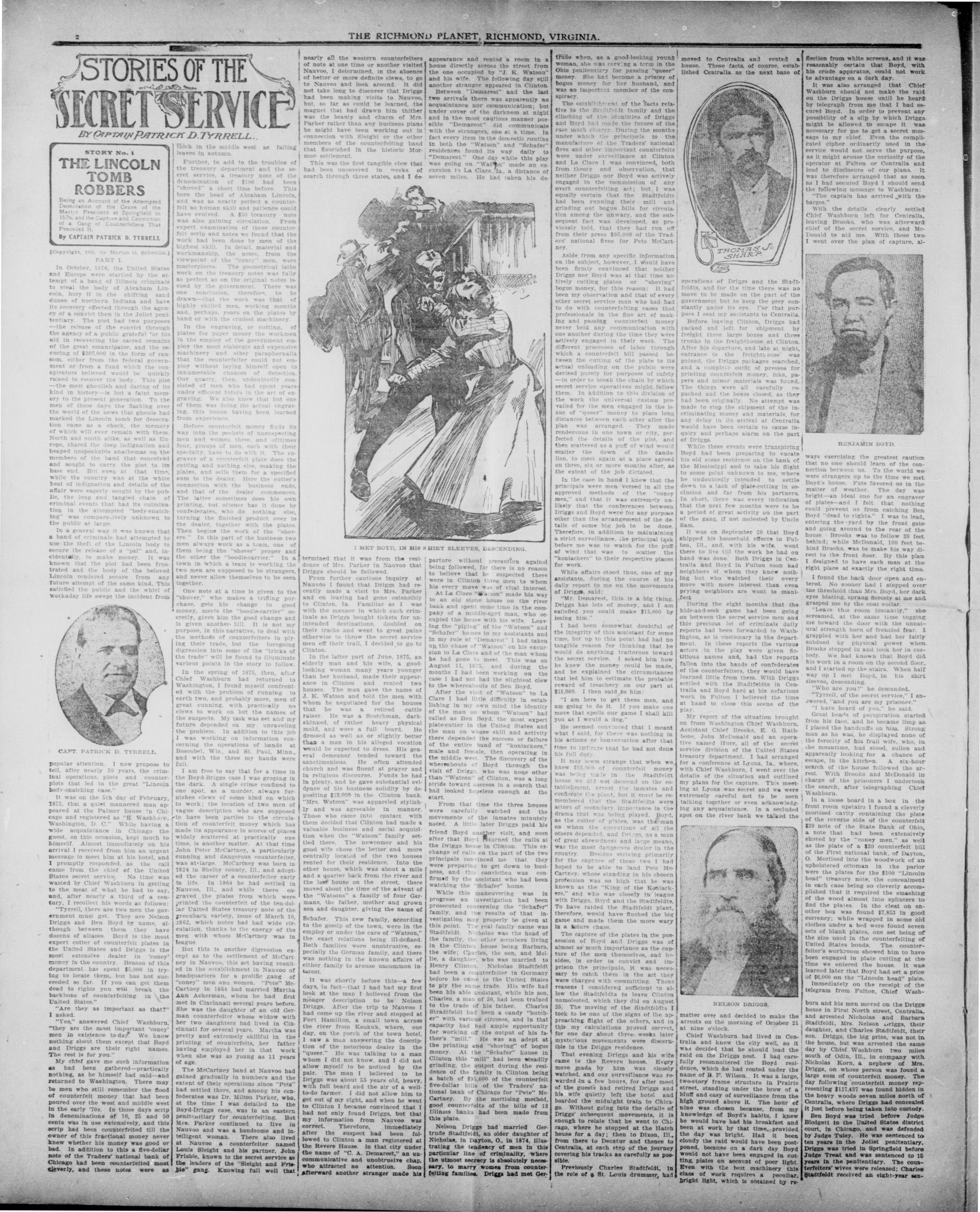
STORIES OF THE SECRET SERVICE
BY CAPTAIN PATRICK D.TYRRELL.
STORY No.1
THE LINCOLN
TOMB
ROBBERS
Being an Account of the Attempted Desecration of the Grave of the Martyr President at Springfield in 1876, and the Capture and Conviction of a Gang of Counterfeiters That Preceded It.
By CAPTAIN PATRICK D. TYRRELL
[Copyright, 1965, by Marion G. Scheitling]
PART I
In October, 1878, the United States and Europe were startled by the attempt of a band of Illinois criminals to steal the body of Abraham Lincoln, bury it in the shifting sand dunes of northern Indiana and have its recovery effected through the agency of a convict then in the Joliet penitentiary. The plot had two purposes—the release of the convict through the agency of a public grateful or his aid in recovering the sacred remains of the great emancipator, and the securing of $200,000 in the form of ransom, either from the federal government or from a fund which the conspirators believed would be quickly raised to recover the body. This plot—the most ghoulish and daring of its kind in history—is but a faint memory to the present generation. To the men of those days the flashing over the world of the news that ghouls had marked the Lincoln tomb for desecration came as a shock, the memory of which will ever remain with them. North and south alike, as well as Europe, shared the deep indignation and heaped unspeakable anathemas on the members of the band that conceived and sought to carry the plot to its base end. But even at that time, while the country was at the white heat of indignation and details of the affair were eagerly sought by the public, the long and tangled chain of criminal events that had its culmination in the attempted "body-snatching" was comparatively unknown to the public at large.
In a general way it was known that a band of criminals had attempted to use the theft of the Lincoln body to secure the release of a "pal" and, incidentally, to make money. It was known that the plot had been frustrated and the body of the beloved Lincoln rendered secure from any future attempt of the same kind. This satisfied the public and the whirl of workaday life swept the incident from
CAPT. PATRICK D. TYRRELL
popular attention. I now propose to tell, after nearly 30 years, the criminal operations, plots and counter-plots that led to the great "Lincoln body-snatching case."
It was on the 5th day of February, 1875, that a quiet manned man appeared at the Palmer house in Chicago and registered as "E Washburn, Washington, D. C." While having a wide acquaintance in Chicago the guest, on this occasion, kept much to himself. Almost immediately on his arrival I received from him an urgent message to meet him at his hotel, and I promptly responded, as the call came from the chief of the United States secret service. No time was wasted by Chief Washburn in getting to the meat of what he had to say, and, after nearly a third of a century, I recollect his words as follows:
"Tyrrell, there are two men the government must get. They are Nelson Driggs and Ben Boyd by name, although between them they have dozens of aliases. Boyd is the most expert cutter of counterfeit plates in the United States and Driggs is the most extensive dealer in 'coney' money in the country. Benson of this department has spent $5,000 in trying to locate them, but has not succeeded so far. If you can get them dead to rights you will break the backbone of counterfeiting in the United States."
"Are they as important as that?" I asked.
"Yes," answered Chief Washburn, "they are the most important 'coney' men in existence to day. We know nothing about them except that Boyd and Driggs are their right names. The rest is for you."
My chief gave me such information as had been gathered—practically nothing, as he himself had said—and returned to Washington. There may be men who still remember the flood of counterfeit money that had been poured over the west and middle west in the early '70s. In those days script in denominations of 10, 25 and 50 cents was in use extensively, and this script had been counterfeited till the owner of this fractional money never knew whether his money was good or bad. In addition to this a five-dollar note of the Traders' national bank of Chicago had been counterfeited most cleverly, and these notes were as
thick in the middle west as falling leaves in autumn.
Further, to add to the troubles of the treasury department and the secret service, a treasury note of the denomination of $100 had been "shoved" a short time before. This bore the head of Abraham Lincoln, and was as nearly perfect a counterfeit as human skill and patience could have evolved. A $50 treasury note was also gaining circulation. From expert examination of these counterfeit script and notes we found that the work had been done by men of the highest skill. In detail, material and workmanship, the notes, from the viewpoint of the "coney" men, were masterpieces. The geometrical lathe work on the treasury notes was fully as perfect as on the original notes issued by the government. There was one conclusion, therefore, to be drawn—that the work was that of highly skilled men, working months and, perhaps, years on the plates by hand or with the crudest machinery.
In the engraving, or cutting, of plates for paper money the workmen in the employ of the government employ the most elaborate and expensive machinery and other paraphernalia that the counterfeiter could not employ without laying himself open to innumerable chances of detection. Our quarry, then, undoubtedly consisted of men who had spent years under efficient tutors in the art of engraving. We also knew that but one of them was doing the actual engraving, this lesson having been learned from experience.
Before counterfeit money finds its way into the pockets of unsuspecting men and women three, and oftimes four, groups of men, each with their specialty, have to do with it. The engraver of a counterfeit plate does the cutting and nothing else, making the plates, and sells them for a specified sum to the dealer. Here the cutter's connection with the business ends, and that of the dealer commences. The latter sometimes does his own printing, but often has it done by confederates, who do nothing else, turning the finished product over to the dealer, together with the plates. Then begins the work of the "shovers." In this part of the business two men always work as a team, one of them being the "shover" proper and the other the "boodle-carrier." In a town in which a team is working the two men are supposed to be strangers, and never allow themselves to be seen together.
One note at a time is given to the "shover," who makes a trifling purchase, gets his change in good money, meets the "boodle-carrier" secretly, gives him the good change and is given another bill. It is not my purpose, in this narrative, to deal with the methods of counterfeiters in plying their trade, but the foregoing digression into some of the "tricks of the trade" will be found to illuminate various points in the story to follow.
In the spring of 1875, then, after Chief Washburn had returned to Washington, I found myself confronted with the problem of running to earth two, and probably more, men of great cunning, with practically no clews to work on but the names of the suspects. My task was set and my future depended on my unraveling the problem. In addition to this job I was working on information concerning the operations of bands at Boscobel, Wis., and St. Paul, Minn., and with the three my hands were full.
I am free to say that for a time in the Boyd-Brigges case I was groping in the dark. A single crime confined to one spot, as a murder, always furnishes clews of some kind on which to work; the location of two men of vague description who are supposed to have been parties to the circulation of counterfeit money which has made its appearance in scores of places widely scattered at practically one time, is another matter. At that time John Peter McCartney, a particularly cunning and dangerous counterfeiter, was at-large. McCartney was born in 1824 in Shelby county, Ill., and adopted the career of a counterfeiter early in life. In 1864 he had settled in Nauvoo, Ill., and while there engraved the plates from which were printed the counterfeit of the ten-dollar United States treasury note of the greenback variety, issue of March 10, 1862, which notes had had wide circulation, thanks to the energy of the men with whom McCartney was in league.
But this is another digression except as to the settlement of McCartney in Nauvoo, this act having resulted in the establishment in Nauvoo of headquarters for a prolific gang of "coney" men and women. "Pete" McCartney in 1864 had married Martha Ann Ackerman, whom he had first met in Cincinnati several years before. She was the daughter of an old German counterfeiter whose widow with her two daughters had lived in Cincinnati for several years. Martha was pretty and extremely skillful in the printing of counterfeits, her father having employed her in that work when she was as young as 11 years of age.
The McCartney band at Nauvoo had gained gradually in numbers and the extent of their operations since "Pete" had settled there, and among his confederates was Dr. Milton Parker, who, at the time I was detailed to the Boyd-Driggs case, was in an eastern penitentiary for counterfeiting. But Mrs. Parker continued to live in Nauvoo and was a handsome and intelligent woman. There also lived at Nauvoo a counterfeiter named Louis Sleight and his partner, John Frisble, known to the secret service as the leaders of the "Sleight and Frisble" gang. Knowing full well that
THE RICHMOND PLANET, RICHMOND, VIRGINIA
DANCE
I MET BOYD, IN HIS SHIRT SLEEVES, DESCENDING.
nearly all the western counterfeiters of note at one time or another visited Nauvoo, I determined, in the absence of better or more definite clews, to go to Nauvoo and look around. It did not take long to discover that Driggs had been making visits to Nauvoo, but, so far as could be learned, the magnet that had drawn him thither was the beauty and charm of Mrs. Parker rather than any business plans he might have been working out in connection with Sleight or the other members of the counterfeiting band that flourished in the historic Mormon settlement. This was the first tangible clew that had been uncovered in weeks of search through three states, and I d-
I MET BOYD, IN HIS
termined that it was from the residence of Mrs. Parker in Nauvoo that Driggs should be followed.
From further cautious inquiry at Nauvoo I found that Driggs had recently made a visit to Mrs. Parker and on leaving had gone ostensibly to Clinton, Ia. Familiar as I was with the manner in which such criminals as Driggs bought tickets for unintended destinations, doubled on their tracks and went to great pains otherwise to throw the secret service men off their trail, I decided to go to Clinton.
In the latter part of June, 1875, an elderly man and his wife, a good-looking woman many years younger than her husband, made their appearance in Clinton and rented two houses. The man gave the name of J. K. Watson and told the men with whom he negotiated for the houses that he was a retired cattle raiser. He was a Scotchman, dark-skinned, of rather heavy physical mold, and wore a full beard. He dressed as well as or slightly better than a man in his alleged vocation would be expected to dress. His general demeanor tended toward the sanctimonious. He often attended church and was fluent in prayer and in religious discourse. Funds he had in plenty, and he gave substantial evidence of his business solidity by depositing $23,000 in the Clinton bank. "Mrs. Watson" was appareled stylishly and was agreeable in manner. Those who came into contact with them decided that Clinton had made a valuable business and social acquisition when the "Watson" family settled there. The newcomer and his good wife chose the better and more centrally located of the two houses rented for their residence. Into the other house, which was about a mile and a quarter back from the river and the last house on the street, there moved about the time of the advent of the "Watson's" a family of four Germans, the father, mother and grown son and daughter, giving the name of Schafer. This new family, according to the gossip of the town, were in the employ or under the care of "Watson," the exact relations being ill-defined. Both families were unobtrusive, especially the German family, and there was nothing in the known affairs of either family to arouse uncommon interest.
It was shortly before this—a few days, in fact—that I had had my first look at the man I believed from the meager description to be Nelson Driggs. After the trip to Nauvoo I had come up the river and stopped at Fort Hamilton, a small town across the river from Keokuk, where, one day, on the porch of the town hotel, I saw a man answering the description of the notorious dealer in the "queer." He was talking to a man whom I did not know, and I did not allow myself to be noticed by the pair. The man I believed to be Driggs was about 55 years old, heavy, with full beard and the air of a well-to-do farmer. I did not allow him to get out of my sight, and when he went to Clinton I became convinced that I had not only found Driggs, but that my information from Nauvoo was correct. Therefore, immediately after the suspect had been followed to Clinton a man registered at the Revere House. in that city under the name of "C. A. Demarest," an uncommunicative and unobtrusive chap, who attracted no attention. Soon afterward another stranger made his
appearance and rented a room in a house directly across the street from the one occupied by "J. K. Watson" and his wife. The following day still another stranger appeared in Clinton. Between "Demarest" and the last two arrivals there was apparently no acquaintance nor communication; but under cover of the darkness at night and in the most cautious manner possible "Demarest" did communicate with the strangers, one at a time. In fact every item in the domestic routine in both the "Watson" and "Schafer" residences found its way dally to "Demarest." One day while this play was going on "Watton" made an excursion to La Clare Ja, a distance of seven miles. He had taken his de
HIRT SLEEVES, DESCENDING.
parture without precaution against being followed, for there is no reason to believe that he suspected there were in Clinton three men to whom his every move was of vital interest. At La Clare "Watson" made his way to an old stone house on the river bank and spent some time in the company of a middle-aged man, who occupied the house with his wife. Leaving the "piping" of the "Watson" and "Schafer" homes to my assistants and in my role of "demarest" I had taken up the chase of "Watson" on his excursion to La Clare and of the man whom he had gone to meet. This was on August 11, 1875, and during the months I had been working on the case I had not had the slightest clew to the whereabouts of Ben Boyd.
After the visit of "Watson" to La Clare I had little difficulty in establishing in my own mind the identity of the man on whom "Watson" had called as Ben Boyd, the most expert plate-cutter in the United States and the man on whose skill and activity there depended the success or failure of the entire band of "konackers", male and female, then operating in the middle west. The discovery of the whereabouts of Boyd through the visit of Driggs, who was none other than "Watson" of Clinton, was a long stride toward success in a search that had looked hopeless enough at the start.
From that time the three houses were carefully watched and the movements of the inmates minutely noted. A little later Driggs paid his friend Boyd another visit, and soon after that Boyd returned the calls at the Driggs home in Clinton. This exchange of calls on the part of the two principals convinced me that they were preparing to get down to business, and this conviction was confirmed by the assistant who had been watching the "Schafer" home.
While this maneuvering was in progress an investigation had been prosecuted concerning the "Schafer" family, and the results of that investigation may properly be given at this point. The real family name was Stadtfeldt. Nicholas was the head of the family, the other members living in the Clinton house being Barbara, the wife; Charles, the son, and Mollie, a daughter, who was married to Henry Clinton. Nicholas Stadtfeldt had been a counterfeiter in Germany before he came to the United States to ply the same trade. His wife had been his able assistant, while his son, Charles, a man of 30, had been trained to the trade of his father. Charles Stadtfeldt had been a candy "butcher" with various circuses, and in that capacity had had ample opportunity for working off the output of his father's "mill." He was an adept at the printing and "shoving" of bogus money. At the "Schafer" house in Clinton this "mill" had been steadily grinding, the output during the residence of the family in Clinton being a batch of $95,000 of the counterfeit five-dollar bills of the Traders' national bank of Chicago for "Pete" McCartney. By the mortising method, good counterfeitures of the bills of 13 Illinois banks had been made from this plate.
Nelson Driggs had married Gertrude Stadtfeldt, an older daughter of Nicholas, in Dayton, O., in 1874, illustrating the tendency of men in this particular line of criminality, where the utmost secrecy is absolutely necessary. to marry women from counterfeiting families. Driggs had met Ger-
trude when, as a good-looking young woman, she was serving a term in the Ohio penitentiary for passing "queer" money. She had become a printer of bogus money for her husband, and was an important member of the conspiracy.
The establishment of the facts relative to the Stadtfeldt family and the clutching of the identities of Driggs and Boyd had made the future of the case much clearer. During the months under which the principals to the manufacture of the Traders' national fives and other important counterfeitings were under surveillance at Clinton and La Clare I was convinced, both from theory and observation, that neither Driggs nor Boyd was actively engaged in the commission of any overt counterfeiting act; but I was equally certain that the Stadtfeldtss had been running their mill and grinding out bogus bills for circulation among the unwary, and the subsequent fact was developed, as previously told, that they had run off from their press $95,000 of the Traders' national fives for Pete McCartney.
Aside from any specific information on the subject, however, I would have been firmly convinced that neither Driggs nor Boyd was at that time actively cutting plates or "shoving" bogus money, for this reason: It had been my observation and that of every other secret service man who had had to do with counterfeiting cases that professionals in the fine art of making and passing counterfeit money never held any communication with one another during the time they were actively engaged in their work. The different processes of labor through which a counterfeit bill passed between the cutting of the plate to its actual unloading on the public were devised purely for purposes of safety—in order to break the chain by which secret service operatives might follow them. In addition to this division of the work the universal custom prevailed for the men engaged in the issue of "queer" money to place long distances between each other after the plan was arranged. They made rendezvous in one town or city, perfected the details of the plot, and then scattered as a puff of wind would scatter the down of the dandelion, to meet again at a place agreed on three, six or more months after, as the extent of the job dictated.
In the case in hand I knew that the principals were men versed in all the approved methods of the "coney men," and that it was extremely unlikely that the conferences between Driggs and Boyd were for any purpose other than the arrangement of the details of some big job to be done. Therefore, in addition to maintaining a strict surveillance, the principal task before me was to watch for the puff of wind that was to scatter the "konacklers" to their respective places for work.
While affairs stood thus, one of my assistants, during the course of his daily report to me on the movements of Driggs, said:
"Mr. Demarest, this is a big thing. Driggs has lots of money, and I am satisfied you could make $15,000 by losing him."
I had been somewhat doubtful of the integrity of this assistant for some time, but up to this point had had no tangible reason for thinking that he would do anything traitorous toward the secret service. I asked him how he knew the money could be made, and he explained the circumstances that led him to estimate the probable reward of treachery on our part at $15,000. I then said to him:
"I am here to get these men, and am going to do it. If you make one move that spoils our game I shall kill you as I would a dog."
He seemed convinced that I meant what I said, for there was nothing in his actions or conversation after that time to indicate that he had not done his full duty.
It may seem strange that when we knew $95,000 of counterfeit money was being made in the Stadtfeldt house we did not descend on the establishment, arrest the inmates and confiscate the plant, but it must be remembered that the Stadtfeldts were actors of secondary importance in the drama that was being played, Boyd, as the cutter of plates, was the man on whom the operations of all the others depended, and Driggs, as a man of great shrewdness and large means, was the most dangerous dealer in the country. Besides striving primarily for the capture of these two I had hoped to be able to land Pete McCartney, whose standing in his chosen profession was so high that he was known as the "King of the Komlackers," and who was closely in league with Driggs, Boyd and the Stadtfeldts. To have raided the Stadtfeldt plant, therefore, would have flushed the big game and made them the more wary in a future chase.
The capture of the plates in the possession of Boyd and Driggs was of almost as much importance as the capture of the men themselves, and besides, in order to convict and imprison the principals, it was necessary to catch them in the act they were charged with committing. These reasons I considered sufficient to allow the Stadtfeldts to leave Clinton unmolested, which they did on August 25. The moving of the Stadtfeldts I took to be one of the signs of the approaching flight of the others, and in this my calculations proved correct, for one day about three weeks later mysterious movements were discernible in the Driggs residence.
That evening Driggs and his wife came to the Revere house. Every move made by him was closely watched, and our surveillance was rewarded-in a few hours, for after most of the guests had retired Driggs and his wife quietly left the hotel, and boarded the midnight train to Chicago. Without going into the details of Driggs' subsequent movements, it is enough to relate that he went to Chicago, where he stopped at the Hatch house for a day; then to Dixon, Ill., from there to Decatur and thence to Centralia, at each step of the journey covering his tracks as carefully as possible. Previously Charles Stadtfeldt, in the role of a St. Louis drummer, had
moved to Centralia and rented a house. These facts, of course, established Centralia as the next base of
THOMAS J.
SHARP.
operations of Driggs and the Stadtfelds, and for the time there was no move to be made on the part of the government but to keep the prey constantly under its eye. For that purpose I sent my assistants to Centralia. Before leaving Clinton, Driggs had packed and left for shipment by freight three large boxes and three trunks in the freighthouse at Clinton. After his departure, and late at night, entrance to the freighthouse was gained, the Driggs packages searched, and a complete outfit of presses for printing counterfeit money, inks, papers and minor materials was found. The things were all carefully repacked and the boxes closed, as they had been originally. No attempt was made to stop the shipment of the incriminating money and materials, for any delay in its arrival at Centralia would have been certain to cause inquiry and perhaps alarm on the part of Driggs.
While these events were transpiring Boyd had been preparing to vacate his old stone residence on the bank of the Mississippi and to take his flight to some point unknown to me, where he undoubtedly intended to settle down to a task of plate-cutting in seclusion and far from his partners. In short, there was every indication that the next few months were to be a period of great activity on the part of the gang, if not molested by Uncle Sam.
It was on September 20 that Boyd shipped his household effects to Fulton, Ill., and, with his wife, went there to live till the work he had on hand was done. Both Driggs in Centralia and Boyd in Fulton soon had neighbors of whom they knew nothing but who watched their every move with more interest than even prying neighbors are wont to manifest
During the eight months that the hide-and-seek game had been going on between the secret service men and this precious lot of criminals daily reports had been forwarded to Washington, as is customary in the department. In these reports the various actors in the play were given fictitious names and, had the reports fallen into the hands of confederates of the counterfeiters, they would have learned little from them. With Driggs settled with the Stadtfeldts in Centralia and Boyd hard at his nefarious work in Fulton I believed the time at hand to close this scene of the play.
My report of the situation brought on from Washington Chief Washburn, Assistant Chief Brooks, E. G. Rathbone, John McDonald and an operative named Hurr, all of the secret service division of the United States treasury department. I had arranged for a conference at Lyons, Ia, where, with Chief Washburn, I went over the details of the situation and outlined my plans for the capture. This meeting at Lyons was secret and we were extremely careful not to be seen talking together or even acknowledging any acquaintance. In a secluded spot on the river bank we talked the
[Name]
NELSON DRIGGS.
matter over and decided to make the arrests on the morning of October 21
at nine o'clock.
Chief Washburn had lived in Centralia and knew the city well, so it was decided that he should lead the raid on the Driggs nest. I had carefully reconnoitered the Boyd residence, which he had rented under the name of B. F. Wilson. It was a large, two-story frame structure in Prairie street, standing under the brow of a bluff and easy of surveillance from the high ground above it. The hour of nine was chosen because, from my knowledge of Boyd's habits, I knew he would have had his breakfast and been at work by that time, provided the day was bright. Had it been cloudy the raid would have been postponed, because on a dark day Boyd would not have been engaged in cutting plates on account of poor light. Even with the best machinery this class of work requires a peculiar, bright light, which is obtained by re-
flection from white screens, and it was reasonably certain that Boyd, with his crude apparatus, could not work to advantage on a dark day.
It was also arranged that Chief Washburn should not make the raid on the Driggs house until he heard by telegraph from me that I had secured Boyd. In order to prevent any possibility of a slip by which Driggs might be allowed to escape it was necessary for me to get a secret message to my chief. Even the complicated cipher ordinarily used in the service would not serve the purpose, as it might arouse the curiosity of the operator at Fulton or Centralia and lead to disclosure of our plans. It was therefore arranged that as soon as I had secured Boyd I should send the following message to Washburn: "The captain has arrived with the barges."
With the details clearly settled Chief Washburn left for Centralla, leaving Brooks, who was afterward chief of the secret service, and McDonald to aid me. With these two I went over the plan of capture, al-
```markdown
```
BENJAMIN BOYD.
ways exercising the greatest caution that no one should learn of the connection between us. To the world we were strangers up to the time we met Boyd's house. Fate favored us in the matter of weather. The day was bright—an ideal one for an engraver of plates—and I felt that nothing could prevent us from catching Ben Boyd "dead to rights." I was to lead, entering the yard by the front gate and going around to the rear of the house. Brooks was to follow 20 feet behind; while McDonald, 100 feet behind Brooks, was to make his way direct to the front door. By this plan I designed to have each man at the right place at exactly the right time.
I found the back door open and entered. No sooner had I stepped over the threshold than Mrs. Boyd, her dark eyes blazing, sprang fiercely at me and grasped me by the coat collar.
"Leave this room instantly," she screamed, at the same time tugging me toward the door with the unnatural strength born of frenzied fear. I grappled with her and had her fairly subdued by physical power when Brooks stepped in and took her in custody. We had known that Boyd did his work in a room on the second floor, and I started up the stairs. When half way up I met Boyd, in his shirt sleeves, descending.
"Who are you?" he demanded.
"Who are you?" he demanded.
"Tyrrell, of the secret service," I answered, "and you are my prisoner."
"I have heard of you," he said.
Great beads of perspiration started from his face, and he became limp as I placed the handcuffs on him. Strong man as he was, he displayed none of the ferocity of his frail wife, who, in the meantime, had stood, sullen and apparently looking for a chance of escape, in the kitchen. A six-hour search of the house followed the arrest. With Brooks and McDonald in charge of the prisoners I undertook the search, after telegraphing Chief Washburn.
In a loose board in a box in the front room upstairs I found a cleverly mortised cavity containing the plate of the reverse side of the counterfeit $20 note of the State Bank of Ohio, a note that had been extensively shoved by the "coney men," as well as the plate of a $20 counterfeit bill of the First national bank, of Dayton, O. Mortised into the woodwork of an upholstered ottoman in the parlor were the plates for the $100 "Lincoln head" treasury note, the concealment in each case being so cleverly accomplished that it required the smashing of the wood almost into splinters to find the plates. In the cleat on another box was found $7,853 in good currency; while wrapped in some old clothes under a bed were found seven sets of blank plates, one set being of the size used in the counterfeiting of United States bonds. The counterfeiter's workroom showed him to have been engaged in plate cutting at the time we entered the house. It was learned later that Boyd had set a price of $6,000 on the "Lincoln head" plate. Immediately on the receipt of the telegram from Fulton, Chief Wash-
burn and his men moved on the Driggs house in First North street, Centralia, and arrested Nicholas and Barbara Stadtfeldt, Mrs. Nelson Driggs, their daughter, and Charles Stadtfeldt, their son. Driggs, the big prize, was not in the house, but was arrested the same day by Chief Washburn two miles south of Odin, Ill., in company with Nicholas Korn, a nephew of Mrs. Driggs, on whose person was found a large sum of counterfeit money. The day following counterfeit money representing $117,437 was found hidden in the heavy woods seven miles north of Centralia, where Driggs had concealed it just before being taken into custody.
Ben Boyd was tried before Judge Blodgett in the United States district court, in Chicago, and was defended by Judge Tuley. He was sentenced to ten years in the Joliet penitentiary. Driggs was tried in Springfield before Judge Treat and was sentenced to 15 years in the penitentiary. The counterfeiters' wives were released; Charles Stattfeld received an eight-year sen-
THE PLANET
SATURDAY. . . . OCT. 7TH. 1905
SECRET SERVICE
force, Nicholas Lange, a helper on the printing press, was sentenced to four years, and old man Stadtfeldt was released. The "backbone of counterfeiting" in the country was broken.
PART II
In order to give the actors in the Lincoln tomb robbing plot their proper places before my readers it will be necessary again to wander briefly from the straight path of my story. In the early '70s it was as easy for a secret
MRS GERTRUDE
DRIGGS.
service operative to find traces of counterfeiters as it is for a fisherman to get a bite in a Wisconsin fish lake. It was sometimes as difficult to land the "konlacker" as it is for the fisherman to land his bass; but the central west teemed with "coney men," more or less known to the secret service. The custom of intermarriage among counterfeiting families had bound a large number of the most proficient criminals in this line into a league cemented not only by a common purpose and common danger, but by ties of consanguinity. I have told how Pete McCartney married Martha Ann Ackerman, the daughter of an accomplished pair of counterfeiters, and herself an expert. Ben Boyd had married Mrs. McCartney's sister, Almiranda, also proficient in the printing of bogus currency. The mother of the Ackerman girls, after the death of her first husband, married another counterfeit-
er, John B. Trout, a desperate "coney man," who at one time was the terror of the secret service men operating in the Mississippi valley. It will be remembered that Nelson Driggs married Gertrude Stadtfeldt, whose father, mother, brother, sister and nephew were all counterfeiters, and who herself was a valuable assistant to her husband.
These marriages are mentioned to set forth the closeness of the ties binding the different bands which, in effect, were one band. There were many other such marriages, but reference to these will suffice.
Besides this bond of intermarriage there was a strong property tie connecting the counterfeiting principals. Nelson Driggs, whose brother kept a hotel in Jersey City which was a rendezvous for "coney men," had $40,000 in cash, 28,000 acres of land in Texas and other property. Ben Boyd had means in plenty, as did McCartney and several others. They were men of good habits in point of abstemiousness, and many of them lived Jekyll and Hyde lives with such success that in their respective communities they were respected members of society while making and shoving the "queer." Many of them were men of education. Boyd had a magnificent library and was a student. Few of them, during the reputable periods of their careers, engaged in business that was not honorable, among them being farmers, contractors, professional men and an editor.
To this rule, however, there were two or three exceptions. One of these was James Kinealy, who, at the time of this narrative, kept the "Hub" saloon at 294 West Madison street, Chicago, with Terrence Mullen as a partner. Both Kinealy and Mullen had for years held close communion with the counterfeiters of the central west, and their saloon, while orderly enough, was the general Chicago rendezvous of dozens of the most desperate and accomplished counterfeiters in the country. In St. Louis a saloon of similar character was run by Fred Blebusch, one of the most extensive dealers in bogus currency in the world, of whose career and final capture I shall tell in a subsequent narrative.
The same men that frequented the "Hub" in Chicago were at home in Biebusch's in St. Louis. The halfway station was the saloon in Lincoln, Ill., kept by Robert Spline, a headquarters for the large band of "konlackers" that lived in and near Lincoln at that time. The principal members of the Lincoln band were Benjamin T. Sheridan, farm owner; James L. Fox, Sr. and Jr., contractors; Joseph de Haven, farmer; Thomas J. Sharp, editor of the Statesman, published in Lincoln; Nathan L. Curtis, Sharp's outside man; Robert Spline, saloon keeper, and Vine G. williams, a bartender. All of these men were intimately associated with Kinealy and Mullen in Chicago and Biebusch in St. Louis, as well as with Nelson Driggs, Ben Boyd, Fete McCartney and many other somewhat
```markdown
```
THE FLARE OF A BULL'S-EYE LANTERN SHOT THROUGH THE BARS
less prominent. Another member of the band was John Hughes, an all-around criminal and booled carrier for Charles Stadtfeldt while the latter was shoving the "queer" made from Boyd's plates.
The incarceration of Ben Boyd in the penitentiary had seriously crippled the counterfeiting industry of the country, and especially among the devotees of the calling who were operating in Illinois. Nearly all the bogus currency shoved in the middle west had been printed from Boyd's plates and handled by Driggs. During the winter of 1875-76, when it became apparent that the evidence against these two arch-conspirators was sufficient to bring about their incarceration, there began a series of conferences of the "konnackers" in Chicago, St. Louis and Lincoln, at which was discussed the prospective serious effect on the counterfeiting business of the locking up of its best plate cutter. The different bands which had been fed from the Boyd plates became more desperate as the cutting off of their source of supply became more certain, and when, finally, Boyd passed behind the gray stone walls of the Joilet penitentiary there was much wailing and gnashing of teeth among the precious lot of criminals that infested the Mississippi valley.
To add to their woes, eight months after the capture of Boyd in Fulton, Irvine White, another expert engraver of counterfeit plates, had been arrested in New Jersey, stopping this secondary source of supply. The dealers of Chicago, St. Louis and Lincoln could, therefore, secure no "coney" money worth the handling, and the smaller dealers, from the Canadian line to the gulf of Mexico, were sending in orders for bad money that could not be filled. The only plate available for use at the time was the one of a $10 note of the Bank of Richmond, Ind. This was what was known as a skeleton plate—that is, so made that the part bearing the name of the bank was mortified in, allowing the insertion of the name of another bank, the rest of the note being the same. Counterfeits of the Lafayette and Muncie, Ind., banks had been printed from this plate, but this counterfeit had become worthless on account of the worn condition of the plate. The Richmond "10s" were so well known as to be practically unpassable.
Peter McCartney was at large, but was not inclined to divide the fruits of his labors with the Lincoln crowd. Charles F. Ulrich, another cutter, had been released from the Ohio penitentiary, but his release was not generally known and he was not disposed immediately to resume operations. With a knowledge of these facts it can readily be understood why the straits to which the counterfeiters were reduced were desperate. The release of Boyd was an absolute necessity, to be accomplished at any cost.
THE FLARE OF A BULL'S-EYE LA
For months the members of this most cunning and desperate band had been whipping their brains for feasible plans to effect the release of their pal. None that passed master in the criminal council had been suggested. The secret service, knowing that every energy of the criminals would be strained to free Boyd, but having no knowledge of the plans suggested, worked diligently to enmesh the known members at large on counterfeiting charges and in so doing made a special effort to trap John Hughes, who for a dozen years had successfully passed and dealt in counterfeit money, besides taking side excursions into other paths of crime. Sufficient evidence against Hughes had been gathered to secure an indictment by the federal grand jury in 1874, but for a year and a half he had eluded the shrewdest men in the secret service.
At that time I often secured information from a man named Lewis C Swegles. He was what we then termed a "roper" or stool pigeon. Swegles was the son of the first auditor of the state of Michigan—the black sheep in a fine family—but a man who had been of considerable value to the secret service on account of his intimacy with criminals.
I had been working to locate Hughes, but had been unsuccessful until August, 1876, when Swegles informed me of his whereabouts. Starting with the information given by Swegles, I soon found and arrested Hughes In the "Hub" saloon at 294 West Madison street, previously mentioned as having been kept by Jim Kinealy and Terry Mullen. Hughes was arraigned and deposited $2,000 to secure his appearance for trial the following January.
In the meantime Swegies, whose identity and connection with the secret service was a most carefully guarded secret, was working to ingratiate himself into the confidence of the counterfeiting band that made its headquarters at the "Hub" while in Chicago. He confided to Hughes that he had served time in a western prison for horse stealing, but that he was anxious to forsake the crudities of horse steal-
THE RICHMOND PLANE1, RICHMOND, VIRGINIA
Ing and other common lines of crime for the refinements of dealing in counterfeit money. Swegles, by clever dissembling, was successful in convincing Hughes that he was promising material for an addition to the ranks of the "coney men."
I was fully aware that Swegless was working to win the confidence of the counterfeiters that met at the "Hub," but it was about two months before I had any other communication from my "roper" that was of importance. He then confided to me that the band had under way a sensational plot—not along counterfeiting lines—but to steal the body of Abraham Lincoln and hold it for a large ransom. Accustomed as I was to the daring operations of these men, the audacity of this plot started me. Swegless mentioned $200,000 as the amount the conspirators had fixed as the price of the return of the body. For a time I found it difficult to convince myself that these men, cunning and daredevil as they had proved themselves to be in other crimes, would actually attempt to carry out a plot so bold and which struck so deeply at the roots of one of the country's deepest sentiments—its love for Lincoln and its reverence for all of him that was earthly.
But the situation permitted the indulgence of no sentiment. The information given me by Swegles had in previous instances been accurate, and I had no reason even to surmise that he was playing me false in this case or that he had allowed himself to be gulled by Hughes and Mullen. Besides, my informant had given as one of the motives for the proposed crime the desire for the release of Ben Boyd, which I knew to be a consideration of the utmost importance to the men whose operations had been so abruptly curtailed by the plate cutter's incarceration.
The moment was one for action, even at the risk of finding later that the secret service had been led into unnecessary activity by misinformation. My informant had learned that certain St. Louis men, whose names he did not know, were parties to the plot. Previously a similar plot, emanating from the same sources, had been revealed to Chief of Police Wilkinson, of Springfield. In this plan James Kineley had evidently been the promoter, and had decided to use the Lincoln counterfeiting contingent as his agents. Thomas J. Sharp, editor of the Statesman; Nathan L. Curtis, his assistant, and Vive G. Williams, a bartender of Lincoln, as the first step, opened a saloon in Springfield, which they made their counterfeiting headquarters as well as the place from which they could gather, without exciting suspicion, such information as they needed to aid them in their work of stealing the body of Lincoln.
From the facts that the sum of ransom money proposed in this plot and the later sum were the same and that
NTERN SHOT THROUGH THE BARS.
the interests of all the men in Boca plots were closely allied, there was little doubt that one man had conceived the scheme to release Boyd, and there was also little doubt that the one man was James Kincaly. He was capable of concocting and trying to carry out such a plot.
The dream of the easy acquisition of $200,000 led the counterfeiters who had opened the saloon in Springfield into the lavish expenditure of money and dissipation. In one of these bouts Thomas Sharp confided to a woman of the town of Springfield that he expected soon to become one of the beneficiaries of the $200,000 ransom fund and intimated to her the plan by which the money was to be secured. This woman informed Chief Wilkinson of the drunken boasts of her admirer. Wilkinson immediately took steps to place additional guards over the Lincoln tomb and took such other precautions as indicated to the conspirators that their plan could not be carried out. It was in this first plot that the leaden casket containing the body of Lincoln was to be sunk in the Sangamon river till its hiding place should be revealed by Ben Boyd.
After coming into possession of the information concerning the second plot I sent Swieges back to Hughes to keep in touch with the movements of the conspirators as closely as possible. He succeeded so well in this that he was chosen to be one of the men to engage actively in the work, and the details of the plan were intrusted to him without reservation. He was to furnish the light spring wagon in which the casket was to be conveyed from Springfield. The plan to sink the casket in the Sangamon river, proposed in the first plot, had been abandoned, and instead the body was to be hauled swiftly from Springfield by relays of horses into the sand dunes of northern Indiana and buried. The conspirators calculated that the shifting of these dunes due to the action of the wind would soon obliterate all trace of wagon tracks and signs of burial and mace a hiding place absolutely past the power of any man to
---
The ghouls were to keep track of the place of burial by taking measurements from some natural object, such as a tree, transmitting the key to the burial spot to Ben Boyd in Joliet. The negotiations for the return of the body, in exchange for his own release and the payment of $200,000 ransom, were to be conducted by Boyd on behalf of the counterfeiters. In order to render the opening of these negotiations the easier, the conspirators calculated, a plan would have to be devised by which the federal authorities could be easily convinced that Boyd could actually furnish the information concerning the location of the body—in short, they foresaw that Boyd would have to be in position to prove to the authorities that he had accurate knowledge of its whereabouts.
In order to overcome this obstacle it was decided that a copy o. an English or some other foreign newspaper should be secured, a foreign paper being decided upon so that Boyd could convince the government representatives that the copy of the paper of which he had a part was not one that could have been obtained in any other way than the one claimed by him. This newspaper was to be torn into two pieces, in an irregular fashion. One piece was to be left in the Lincoln tomb, where it was certain to be found when the discovery of the loss of the body was made, and the other piece was to be sent to Boyd in prison. After the discovery of the work of the ghouls Boyd was to let it be known that he could solve the mystery and, to prove he told the truth, could produce the missing part of the foreign paper which, of course, would demonstrate to the authorities that the tomb robbers had sent Boyd the paper and with it the key to the location of the body.
In its details the plot was carefully worked out. So far had Swerker
wormed himself into the confidence of the conspirators that on the night of the first of November they met in his room to complete the details of the plot. Five days later I learned that Tuesday, November 7, had been chosen as the night to commit the crime, this date being chosen on account of its being presidential election day, on the night of which, the criminals judged, the excitement incident to the receiving of the returns would serve to shield them from any attention they might attract under ordinary circumstances. Hughes, Mullen and Swegles were to open the tomb, extract the casket and load it into the waiting wagon. Swegles' part of the preliminaries was to secure the wagon and driver, which he assured his coconspirators had been done, and after the work at the tomb had been done he was to accompany the contractor furnishing the conveyance into Indiana. It had also been decided that the trio should go to Springfield on the night of November 6, in order to be able to make such preliminary surveys and arrangements as might be found necessary.
On the theory that, with the information in hand, there could be no difficulty in preventing the conspirators from carrying out their plan, there had been no disarray among the government employees as to the wisdom of going further and permitting the tomb robbers to progress far enough with their work to enable the law officers to capture the criminals red-handed. Robert T. Lincoln, son of the martyr president, and Leonard Swett had been kept fully informed of the conception and development of the plot and had agreed that the capture of the counterfeiters in their initial grave-robbing effort would be preferable merely to frighten them out of the attempt, a course that had been pursued in the instance of the plot of eight months before. At a conference at which Mr. Lincoln was present the services of Elmer Washburn, who had in the meantime been superseded in the chiefship of the secret service; John McDonald, who had assisted in the capture of Ben Boyd, and John McGinn and George Hay, Pinkerton men, were provided for to assist in the capture of the vandals. Owing to the importance of the case Allan Pinkerton had assigned his best two men.
Mr. Lincoln protested against the plot being allowed to proceed to the point where profane hands might actually be laid on his father's coffin, but Mr. Swett insisted that an overt act must be committed by them before the vandals could be successfully prosecuted, and our plans were not changed.
This conference was held in the afternoon, and at nine o'clock the evening of the same day Mullen, Hughes and Swegles swung aboard the front platform of the front coach of the Alton train just as it moved out of the Chicago station. McGinn. Hay and I boarded the last sleeper of the same train, after having satisfied ourselves by careful shadowing that the professional counterfeiters, now amateur tomb robbers, were aboard. Washburn and McDonald were to go to Springfield on the next train and arrive there. a four o'clock on the afternoon of the day set for the robbery. We arrived at Springfield two hours late and registered at the St. Nicholas hotel under assumed names. We found that Mullen and Hughes, also under false names, had registered at the St. Charles hotel, a small house not far from the St. Nicholas. They had retired to gain rest before eating on their bold work and had left orders to be called at ten o'clock in the morning.
An hour before that time I received a call by appointment from John T. Stuart, of the Lincoln guard of honor, in whose office Abraham Lincoln had read law. We proceeded at once to the Lincoln monument, in Oak Ridge cemetery, where I was introduced to John C. Power, custodian o. the Lincoln tomb, with whom I made a thorough examination and mental survey of the monument structure and surrounding grounds. A spot was selected at which one of the detectives could be stationed from which he could hear the robbers at work on the sarcophagus. Custodian Power was told that during the afternoon two men whose descriptions were given would appear at the tomb and that any questions asked by them should be answered with the customary courtesy accorded visitors to the monument.
It was about three o'clock in the afternoon that Hughes and Swieges appeared, paid the usual fee and entered false names in the visitors' register. Hughes asked many questions, which were fully and truthfully answered. Mullen, as we found later, had remained in the city to collect such tools as he thought necessary for forcing open the tomb and marble sarcophagus. At five o'clock Detective Hay was dispatched to the cemetery to inform Custodian Power that the other officers were coming, and two hours later, after a conference in the hotel where the work of each man had been assigned to him, we reached the monument.
The day had been dark, and at six o'clock all daylight had faded from the cemetery. Inside Memorial hall the darkness was intense. By those of my readers who have seen the burial place of Abraham Lincoln it will be remembered that Memorial hall is at the south end of the monument structure and the catacomb containing the body at the north end. 175 feet away. I had selected Memorial hall as the best hiding place for our men. Swegles having promised to inform us in our hiding place when the right moment was at hand for us to appear at the door of the catacomb and thereby entrap the ghouls at their work. Swegles was to work with Hughes and Mullen until the sarcophagus was opened and the casket ready to be loaded into the wagon. Then he was to go for the conveyance, which was supposed to be hidden near by. While on this mission he was to make his way around the base of the hill, come to the door of Memorial hall and give the signal that the time for action had come. That there might be no mistake in the darkness a countersign, the word "Wash," had been agreed upon.
We had been concealed in Memorial hall in almost breathless quiet for about two hours, when suddenly the flare of a bulls-eye lantern was shot through the bars of the iron door leading into the hall, and we knew that the conspiracy was rapidly being put into actual execution. From their hurried examination of the hall by the aid of the lantern the ghouls evidently satisfied themselves that no one was inside. At any rate, they departed in a moment and made around the base of the monument to the north end, where lay the body they were running such desperate risks to secure. We knew that the next few minutes would be fraught with events that might mean death to any of us. I now had more reason than ever before to believe in the truthfulness of Swegles and that he would keep his promise to signal us when the right time arrived. So we waited for this signal, and at last it came.
If this story were a fancy of my brain instead of a narrative of facts the current of it would here take a sudden turn from the lines I am compelled to pen. For more than a year I had plotted to outwit the shrewd and desperate criminals with whom we were dealing and, up to this point, had been successful. As soon as Swegles had given the signal we moved cautiously out of Memorial ball and I ordered the others to follow me.
At the giving of this order every man drew his revolver, to be prepared for the fight that we all believed inevitable. In doing so Detective Hay, of the Pinkerton force, accidentally discharged a percussion cap in the old-style Colt's revolver he carried. As the detonation was not loud I paid little attention to it, and ran swiftly around to the door of the catcomb, with the others behind me. The staple containing the lock of the iron door had been sawed and filed off, and the door stood a few inches ajar.
I called on whomsoever was within to surrender. There was no response. I called again and then listened. Not even the sound of breathing was audible. I then struck a match. The tools used by the ghouls lay scattered over the floor and the sarcophagus was battered to pieces in such a way as to allow the casket to be moved lengthwise toward the door. The vandals had fled.
There is but one word that adequately describes the sensation that
THE LINCOLN TOMB AT SPRING-
FIELD
came over me, and that is "cheapness." After weeks of careful planning to catch red-handed the men whose criminality had taken on so depraved a turn that they would resort to the theft of the body of the most beloved American, we found that they had outwitted us. As quickly as I could recover my presence of mind after the shock of surprise over finding the catacomb empty except for the desecrated sarcophagus, I ordered my assistants to separate and scour the shrubbery surrounding for the ghouls. Going back, it occurred to me that the ghouls might have sought concealment on the upper parts of the structure. In the shadow I saw the figures of two men whom I could not discern clearly enough to identify them. It never occurred to me that they might be other than Hughes and Mullen, and I called out for the men below to come up. I fired at them, and they returned the fire, running at the same time to the northeast corner of the terrace. I fired again and again. The shot was answered, the bullets whistling past my head. Then one of the men shouted:
"Tyrrell, is that you?"
I made no answer, believing that
one of the men was Hughes and knowing he would recognize my voice. Again the excited question was asked, and I still kept silent. It took but a moment, however, for the pursued men to make themselves known as McGinn and Hay, the Pinkerton men, who had mounted the steps in the hope of finding the ghouls hidden there.
Thus for a time was the most serious and dastardly plot ever devised turned into a farce. Our prey had escaped, and in order to justify ourselves against the ridicule that would be heaped on us when the events of the night became known I immediately took up the trail of Hughes and Mullen. After finding they had breakfasted at a farmhouse about seven miles from Springfield the next morning, they were again lost to us. There could now be no rest till the men were run to earth. Ten days later they were located in the saloon at 294 West Madison street and arrested by Detectives Simmons, of the Chicago city force; McGilln, of the Pinkertons, and Elmer Washburn and myself, of the secret service.
They were taken to Springfield, indicted and tried on the charges of robbery and larceny, there being no specific statute at that time against grave robbing, and sent to the penitentiary for a year. Their counsel, in the trial of the case at Springfield, raised the cry that the secret service had "put up a job" on his clients in order to get them out of the way for counterfeiting operations, but the absurdity of that defense was too apparent to save the counterfeiters from prison.
This is the true record of a plot that failed. It is not known to this day why Hughes and Mullen left the tomb after Swieges went after the team he was supposed to have, but which, in fact, did not exist. One theory is that they heard the detonation of Hay's revolver and fled. Another is that they left the tomb to meet Swieges and the driver, and instead saw the officers rushing on them. Whatever may be the correct theory, their escape from the tomb before we reached it was merely one of the innumerable breaks in the plans of all detectives—except in story books.
Story No. 2 Will Be "The Bothamley Murder Mystery."
SOME BUTTER TESTS
SOME BUTTER TESTS
METHODS BY WHICH TO DISTINGUISH
THE GENUINE ARTICLE.
The Use of Preservatives With Fresh
Meat-Coloring Matter In Many Sausages-How to Detect Boric Acid In Meat Products.
It is a matter of common information that oleomargarine is sometimes substituted for butter and that rancid and badly made butter is frequently melted, washed with soda and churned with milk for the preparation of renovated or process butter.
Methods are available which, with a little practice, may be employed to distinguish between fresh butter, renovated or process butter and oleomargarine.
The "spoon" test has been suggested as a household test and is commonly used by analytical chemists for distinguishing fresh butter from renovated butter or oleomargarine. A lump of butter two or three times the size of a pea is placed in a large spoon and it is then heated over an alcohol burner. If more convenient, the spoon may be held above the chimney of an ordinary kerosene lamp, or it may even be held over an ordinary illuminating gas burner. If the sample in question be fresh butter it will boil quietly with the evolution of a large number of small bubbles throughout the mass which produce a large amount of foam, Oleomargarine and process butter, on the other hand, sputter and crackle, making a noise similar to that heard when a green stick is placed in a fire. Another point of distinction is noted if a small portion of the sample is placed in a small bottle and set in a vessel of water sufficiently warm to melt the sample. The sample is kept melted from half an hour to an hour, when it is examined. If renovated butter or oleomargarine, the fat will be turbid, while if genuine, fresh butter the fat will almost certainly be entirely clear.
To manipulate what is known as the Waterhouse, or milk, test about two ounces of sweet milk is placed in a wide mouthed bottle, which is set in a vessel of boiling water. When the milk is thoroughly heated a teaspoonful of butter is added and the mixture stirred with a splinter of wood until the fat is melted. The bottle is then placed in a dish of ice water and the stirring continued until the fat solidifies. Now, if the sample be butter, either fresh or renovated, it will be solidified in a granular condition and distributed through the milk in small particles. If, on the other hand, the sample consists of oleomargarine it solidifies practically in one piece and may be lifted by the stirrer from the milk.
Many persons believe that the great mass of the fresh meat sold on the market is preserved chemically. This impression is entirely unfounded. The cold storage facilities of the present day make the use of preservatives with fresh meat unnecessary, and the larger packing houses do not employ them. It sometimes happens that local butchers sprinkle preservatives over a cut of meat in order that they may keep it exposed on the block or hanging in a show window as an advertisement. The use of chemical preservatives with fresh meat is confined to this practice alone.
Preservatives are very commonly used with chopped meats and sausages, especially fresh sausage. They are always employed with canned Vienna and Frankfurter sausages inclosed in casings with the ends tied. Where the ends are cut preservatives may be absent. The reason for this is that the temperature required for the complete sterilization of sausages will either burst or distort the skins when the ends are tied, whereas sausages with cut ends afford an opportunity for the escape of the water and steam.
With many varieties of sausages,
both fresh and smoked, and with chop-
ped meats of all descriptions, coloring matter is sometimes employed. This is done partly for the purpose of satisfying an unnatural demand for a high colored article and partly sometimes to conceal the grayish color characteristic of old meat, which should not be used at all.
The preservatives employed with meat products are boric acid, borax and sulphites. To detect boric acid about a tablespoonful of the chopped meat is thoroughly macerated with a little water, pressed through a bag and two or three tablespoonfuls of the liquid placed in a sauce dish with fifteen or twenty drops of strong hydrochloric acid for each tablespoonful. The liquid is then filtered through filter paper and a piece of tumeric paper dipped into it and dried near a lamp or stove. If boric acid or borax were used for preserving the sample the tumeric paper should be changed to a bright cherry red color. If too much hydrochloric acid has been employed a dirty brownish red color is obtained, which interferes with the color due to the presence of boric acid. Now, if a drop of household ammonia be added to the colored tumeric paper and it turns a dark green, almost black color, then boric acid is present. If the reddish color, however, was caused by the use of too much hydrochloric acid, this green color does not form.
The corrosive nature of hydrochloric acid must not be lost sight of. It must not be allowed to touch the flesh, clothes or any metal.—New York Tribune.
HINTS FOR FARMERS
Rye as a Cover Crop.
Farmers used a half century ago to sow rye among their corn and work it in at the last hooting, says American Cultivator. Now the custom has been almost abandoned, as few of them care to eat much rye bread, and if they wish to seed down the land they do so without grain or with some other grain than rye. Yet it would be well for many of them to sow rye not only among the corn, but among many other crops or where other crops have been taken off. It prevents the surface soil from washing and also the fertilizing elements in the soil from leaching down and stores up the fertility in an available form to be taken up by the next crop if the rye is plowed under in the spring. A crop of rye plowed under will supply much humus or vegetable matter to the soil when it decays, and that is needed by many of our light soils in New England. The farmer who tries it will be well repaid for his seed and jabor.
Chicken In the Orchard
Chickens are quite fond of the curculio as an article of diet, and this can be profitably taken advantage of by the plum grower, writes a practical fruit grower, who continues that some years ago he planted a grove of twenty wild goose plum trees. They throve and in due course blossomed and bore fruit, but the little turk was on hand and for three seasons affixed his crescent shaped insignia to almost every plum which set. Then I made a chicken yard of the plum orchard, and the chickens in scratching around for smaller particles of food thrown under the trees have almost put the curculio out of a job.—Farm and Live Stock Journal.
Feeding Poultry.
On some farms all kinds of poultry are fed together, old and young, and geese, ducks, turkeys and chickens. There are always domineering individuals in all barnyards; hence it will be an advantage to separate the older from the younger stock when feeding. The natural consequence of promiscuous commingling of fowls is that the largest and strongest take their choice and leave the refuse to be eaten by the weaker, wherens the best should be given to the poorest in order to help them to a condition of thrift and growth. It is also more economical to make some distinction when feeding, especially when a profit is desired.
Care of Currants and Gooseberries
For the first two or three years no work in the way of trimming is necessary with the currants and gooseberries. As they thicken up it is well to have an ideal bush in mind and to have the bushes come as near to that ideal as possible. We may differ in what constitutes an ideal bush, but one on which some five or six bearing canes are steadily kept up is one that will give good results. This can be easily attained by cutting out the new canes each fall and leaving only enough of the best to keep up our ideal number of good, thrifty bearing canes.
1
Farm Must Be Fed.
Professor Henry of the Wisconsin station in his talk on feeding live stock says that the manure value of a ton of clover hay is about $8, of corn $5.25, of bran $10.50 and of oilmeal $15.50, and that these facts show how important the feeding problem is to the farm. He says: "Every pound of feed you put into your farm animals feeds not only your live stock, but your farm as well. And it is just as necessary to feed your farm as to feed your cows. Starve the one and the other will have to starve."
He Wanted to Know
Scotchmen are fond of an argument, and delight to find flaws in an opponent's logic. Two blacksmiths were once conversing as to which was the first trade in the world. One insisted that it must have been gardening, and quoted from Genesis "Adam was put into the garden of Eden to dress it and keep it." "Aye, John," retorted the other, who had stood up for his own trade, "but who made the spades?"
Must Hays Been Ice
Mammu—No, dear, the Atlantic ocean never freezes over. Elsie—Oh, but it must. I heard papa telling Mr. Gayley that when he was coming across from Europe the last time he had his skates on all the time.
Unnecessary.
"The schoolhouse burned during the night, Johnny."
"Jist my luck! It wouldn't burn till vacation!" - Houston Post.
~~“ “ £ Rey
EAs
Ane He r
[We AG ANC
ie Yoo ‘
3 sana
JOHN MITCHELL, JR, + EDITOR.
Bi pee ae eae
Ore ‘TERMS IN ADVANCE
Por one inch, one: ae a
Ber soe ins ses abecgate’ inceetise, * “33
Rifwolmnarcce mate “MS ig
tessa. 7. 88
Fee fweinpessnine mont,” =" 7 JCB
Rirriagean’ Funeral Neteee oncinct, 8
Baditcctevc Messe,
UCPOSTAGE STAMPS OF A INGUER DR
ToMEAMON ATA Two CECT
NOM ATTSD Gi cone Roe e OE
(PME PLawer ts faeurd weekly. Thesutecrip-
siete PE per rato leases
ei gtan tine
cp SnyISUR ase Pa heh srzar este
Seer eens Beene
Seorkgaey Beak, Cesk ot, Dratcor ps
Bi meatinieates mae
eee
Pape ee RS
for its enfe arrival.
Reena Grint 3 base
ae ae et
oh ae Reyes, ee aye
Sic erg mernooaaee entre
Seems erent ezony a ae a
and convenieut way er ing money. 7
en eee
sires Larrm—if a mency Suse
ee eet rare
ei poo e ees
ier are teeta ie Ea t
SS eed HS ed owes Th
Sirti
We eannot be responsible for went
tte Preah foe money at tn
Samet ioe eae
Se a
ent naka es ee ope oe
pRamersns, Bear 700 Go ot wand Tee
Sesteeeie ree
Senteregneanen ee cele
Seeeegie oeaneeer re i
ser tecrye seers ese
Seer eae ae
= Gaheies mee
Nene rice o cane te ss
eee erate ute
Peieee noanete ee
(te Re Re
Staton oy Apne. onder, to change
Seerssssws ae
mings Winn ee WAT
Tutor atibe Rexto ;
SATURDAY, .....OCT, 7TH, 1905.
Iti gradually dawntag upon
some white people In this country
that Negroes do not belong to a race
of loafers.
We should teach our children po-
Mteness. Good breeding is a valua-
ble asset in Itself,
:
No practical, reliable person need
travel far to find employment. Op-
Portunities await him which-ever
way he turns.
‘
Sitti down with your mouth o-
pen, waiting for God to fill it ts
mighty poor business, no matter how
tech religion you may have.
regen
Some people rest all the week and
then complain because they draw no
pay on Saturday night.
We haye recived an invitation to
the laying of the corner-stone of the
First Baptist Church of Norfolk of
which Rgy. R. H, Bowlipg, D. D. is
pastors ME sill te tle evel ohare
owned by any colored congregation
in the United States.
———_o___
We have received “Pleasant Com-
pantonship” a prospectus of the Col-
ered Men's Branch Young Men's
Christian Association of New York.
It is handsomely flustrated. Rev.
W. H. Brooks, D. D. is chairman of
the Committee of Management. Mr.
‘Thomas J. Bell is secretary.
The News-Leader knows how to
take caro of Self. The following
from {ts issue of Oct. 5th is rich
reading.
Go from home to heur news. We
find in a North Carolina contempora-
Ty an Intervigw, with the | ex Te.
‘Thomas Dixom, in which he under-
takes to explain why the criticisms
in The News-Leader of his play “The
‘Clansman,” were hostile. Like most
narrow and vain men, Mr. Dixon is
incapable of understanding that hos-
tile criticism of himself and his pro-
ductions may be a matter of honest
opinion, even if it does not rest on
@ basis of solid truth. The cheerful
way in which he invents facts for the
information of his North Carolinas
hearers as he goes along is fine evi
fence of his powers of imagination
and of his ability in improvising
works of fiction and reeling them out
offhand. He tells the Nozth Carolt-
na newspaper that The News Leader
4s hostile to him because he has been
‘an opponent Ogden movement
for improved education in the South.
, The Times and
ee
view “The Clansman™ with the
assertion that the two papers are
‘owned by the same man. He fur-
ther declares that the editor of’ The
News Leader has in pross a book at-
tacking him (Dixon) because of his
apposition to the Ogden movement
and defending that undertaking.
This is a curious jumble of un-
fruth. The News Leader and the
Times-Dispatch are not owned by the
same man and no man or assdeiation
vf men owns a dollar of Interest In
both pagers. The editor of The
News Leader had forgotten entirels
the attitude wf Mr. Dixon toward
the Ogden movement, having a goo!
‘Many important things to think
bout, The editor of The News Lea¢
er never has written a book, is not
‘writing one and has no purpose o'
writing one, and $f he did perpetrate
that offense, certainly would select
some more opportime and interest
‘ing subject than the Rev. Thoma:
Dixon and the Oxden movement.
Rev. Dixon is not only charged
with making untrue statements but
pmething worse. If the divine’
worst enemy could wish for him 3
‘worst Journalistic thrashing than the
one he is now receiving at the hands
of his white critics, he is devoid of
pity and a stranger to merey. Fare-
well, Brother Dixon!
MORE ABOUT REV. DIXON.
| We sive our readers other ex-
tracts from the breezy article of the
Richmond, Va. News-Leader of Sept
27th, 1905.
| The News-Lender asks pointes
questions when it says:
| But why should all these old hor
tors of a long-forgotten crime be pa
raded and distorted in fanciful gark
before the people of to-day? | What
good can it do? Knowledge of them
as of any other historical episode,
can be found In various books, giv.
ing actual facts and figures and not
the fancies of a playright of a novel-
ist. Mr. Dixon contends that his book
and play are answers to “Uncle Tom's
Cabin"; but “Unele ‘Tom's Cabin”
did its work fifty years ago and {t is
hot regarded as useful or instructive
jin this day. If Mra. Stowe saw ft
to invent facts and to distort actuall-
ties hideously “to fire the Northern
heart for a political purpose, what 1s
the sense of Southern people encour.
aging a similar performance now for
no purpose at all but to make some
money for Mr. Dixon and some ac:
tors and theatrical speculators?
Tt dismisses all allegations of the
play's popularity while at the same
ime “announcing a self-evident
(rath when It saya:
The play itself is melodrama. It
Is strong in aome respects because
it deals with a strong and stirring
time of which little is known and
with awful and horrible things. ‘The
bite loves the morbid, the tragic,
the mysterious, the thrilling and the
Jonusual. If Mr. Dixon could arrange
to have a man actually lynched om
the roof of the capitol here, he would
All the square with people at two
dollars a head. Crowds ‘will Inger
for hours, fascinated by the grew-
some remains of a man ent to death
by the wheels of a train. It is no
tribute to the merit of the useful-
nest of a play that people rush to
see it. In Texas last year excursion
trains were run, crowded with eager
citizens, to see a negro burned to
death. “The chamber of horrors at
the Eden Musee is the most popular
feature of that entertainment. Mr.
Dixon has struck a new veln of sen
sationalism for this part of the
country; but we doubt if “The Clans-
man" will succeed better inthe
North than “Unele Tom's Cabin"
with its blood-hounds and whipping-
post would go in the South,
THE TIMES-DISPATCH AND THE
NEGRO.
We have repeatedly called atten-
tion to the fact that the designing
politicians persistently stir up race
prejadice and keep alive the feeling
of animosity noted among some of
the members of the white and col-
ored races. The colored voter has
been eliminated as a factor in poll-
tics and the Richmond, Va, Times-
Dispatch was one of the first journals
to rejoice over the fact that the at-
mosphere had been cleared, 0 to
speak and that white men were
able to discuss the great Issues of
the day without lugging into the
campaign the much despised Negro
bugaboo.
This view of the situation was
communicated to the North. What
is the result? A white man’s cam-
paign is now under way and the
first thing this same journal pro-
coeds to do is to discuss the Negro,
who is “as dead as Julius Caesar,”
so far as his voting strength in the
campaign is concerned. While noth
ing more is to be expected of the
ayerage ward-hevler, it 18 a source
of surprise that a’ Journal of the
scope and influence of the Times-
Dispatch, owned and edited as it is
by Christian gentlemen should de-
scend to this level of campaign
warfare, thereby stultifying — iteelf
and shaking the confidence In it of
every reputable colored citizen in
the state.
Why fs it that the “dead” cannot
be permitted to rest in peace, with-
out having gymnastic exercises and
clownish performances taking place
‘on their tombstones?
In Its issue of the Sth inst., Mt
says:
So far as the negro ts concerned,
‘there is no new Republicanism. The
‘Republicans are up to thelr old trick
with him. He was conspicuous in
the poe convention by his ab-
sence. Republicans called our
particular attention to it at the time
‘and have done so since. It was ey-
‘em announced that the sable broth-
RICHMOND PLANET, RICHMOND. VIRGINIA
= ae
ae had been sung
fo us The neETO was not at
Roanake; he was in the Republican
by his ee ‘ot Rapes meet
ines. Hf you doubt Tt. look at the
picture we print of Bat MeCaul's
meeting at Culpeper. ‘The Republi-
cans aro not calling our attention to
this, however . If the colored bro-
ther felt #0 badly about being anubb
‘ed at Roanoke, why ts he flocking to
the Republican meetings and voeif+
eronsly applauding every attack on
the Democratic party and every men
tion of free books? The answer ts
plain.
‘The negro knows that the Repub-
Nica party cannot do without him;
that it is powerless to elect its ticket
;without ‘him, and that in the full-
ness of time ft will take him by the
hand and toad him to 2 good seat at
the political dining table. His mem
‘ory is very wien short. He may
forget the dollar he borrowed trom
you, but his memory for a political
Job in everlasting; and he remembers
that Col. Campbell Slemp, the head,
body, hands and feet of the “New
Republicanism” tn Virginia, Is the
same “Mister” Slemp who voted to
kick a one-legged Confederate sol-
dier out of his place as doorkeeper
in the Lecisiature, and put a negro
in his place. He knows that you
can't teach an old dog new tricks,
and he feels down In his heart that
he will be treated all right If the Re
publicans win and a new era of Ma-
honeism falls on the State.
‘This may be regarded as honora-
ble political warfare, but those peo-
ple, who have studiously seanned the
columns of this journal in the past
noted its pledges and promises will
be doubly surprised to note {ta
change of policy as well as Its re-
turn to those old habits which charac
terized at least one half of it CRich-
mond Dispatch) in days past and
gone.
Refore the coalition of the Rich-
mond Times and the Richmond
Dispateh, the former was liberal and
the latter Negro-hating. ‘The ol4
story of the religious parrot and the
“cussing” one is vividly brought to
mind as well as the peculiar predic-
ament of the minister, who endeay-
ored to bring about the reformation
of the erring parrot by the caging uf
the two birds together. The result
is the same. Both are “cussing”
now. Oh, the rancorous deception
of some of these Nogro-hating white
men. But we plead for the “dead.”
Let them rest in peace in the polit-
ieat grave-yard of the Democrats.
Selah.
DR. LANDRUM ANSWERS.
quent, God-fearing divine. Res. J
B. Hawthorne of this city wrote an
oven letter to that prince of Baptiat
and great principles, Rev. gr. W. W,
Lendrum of Atlanta with refere..ce
to the recent World's Congrest of
Baptists held in London, Eng
‘The article was all the more re
markable for its allusions to the
much abused Negro. Rev. Dr. Haw
thorne has always been regarded as
fa liberal on this question, but his
present attitude would indicate that
he has decided to join the army of
Negro-haters, That Rev. Dr. Lan
drum has anawered him, and that
he has answered him plainly hardly
admits of a question. Our readers
wilt no doubt enjoy the rich sarcasm
and sledge-hammer blows contained
in the extracts which we cite as fol-
lows
| Let me say that while the monu-
mental cathering of our people might
have teen better, it far surpassed
what I expected. ‘It Is true some of
our greatest men were absent. Gen
eral Stephen D. Lee commander-in-
chief of the Confederate Veterans,
Was not present; nor General Miles,
lately the head of the United States
army. Mr. John D> Rockefeller, the
richest man in the world, did not go,
nor John D. Rockefeller, Jr., his son.
Our greatest educational genius and
organizer, President Harper, of Chi-
cago University, was not on hand:
nor Noah K. Davis of the University
of Virginia. Governor Terrell, _ of
Georgia: Governor Montague, of Vir-
ginia; Governor Joseph Folk, of
Missourl, and a long catalogue of
eminent laymen in the denomination,
which 1s increasingly rich In national
nd international celebrities, for some
reason Tailed to be among the might-
y throng. Every one of them, I be-
lieve, was present in spirit.¢*#
‘The negroes in the congress num-
dered forty-eight, in a total Ame- ‘van
representation of seven hundre ad
Atty. | They werggtreated with uily
as much considefation as they ever
receive on the floor or platform of
the Southern Baptist convention. As
a matter of fact our brother in black
was accorded perfect religious equal-
ity such as Southern Baptists, even
in the days of slavery, were delighted
to yield him on all proper occasions.
Beyond question the negro was a cu-
rlosity to Europeans almost to the de
gree that a Chinaman is to an Amer-
ican audience. Over the protest of
& number of modest and self-respect-
ing colored brethren, a few negroes
were urged to speak several times
as a special favor to Englishmen who
wished to be assured that they were
Intelligent, sensible, sound in the
faith, and capable of talking to the
edification of the brotherhood. It
la my belief that the negro brethren
behaved about as well as could be
expected under the conditions which
pressed them into an unsought and
unexpected prominence.
‘There are no negro hotels in Lon
don. There are no negro private
residences in London. How unreas
onable, therefore, to charge that be-
cause negroes were compelled to be
entertained by white people that they
Shae che eaeich wore roti. seth
Baptists to approve and
pri relations met
social mtercourse and ‘not
eS ee et
one Southern negro known
a —— me —— other
erner in London in any way
different from what is usual bere at
home.
———t 9: —__.
JERRY SIMPSON DYING
Condition of Former Kansas Congress-
man te Critical.
Wichita, Kan, Oct. 4—Former Com
@ressman Jerry Simpson, who was
ca
f; "4
Be ey
OKs
eT
Ye Qt Z2
al CN aa
Vag \ Rane
“3 5 Sy
Wy s\ |S
iS i
Senet enero.
brought here Monday from Roswell,
N. M., and placed in a hospital, is In a
eritical condition and ts mot expectod
to live throdgh the day.
witcha cc ce PRESIDENT
Urged Appointment of Lovis Hammer
ling As Internal Revenue Collector.
Washington, Oct. 4—John Mitchel,
president of the United Mine Work
ers of Amerteay had an interview with
President Roosevelt by appointment
He remained with the president about
half an hour, At the conclusion of his
interview My. Mitchell said he had
come to Washington to see the presi
dent, not at the latter's request, but
of his own volition, to talk with him
about “a parsonal matter.” Pressed
for information ns to the nature of his
mission, he said tbat he had urged the
president to appoint Louis Hammer
Ung, editor of the official organ of the
United Mine Workers, as collector of
Internal revenue for the Scranton, Pa.
(istrict. He dcoclined to indicate
whether the appointment would be
made or not. lammerting ts opposed
by some members of the Pennsylvania
congressional ¢viegation.
“f did not discuss with the prest-
dent the Tabor «ituation im the anthra
cite coal fields.” sald Mr. Mitchell
“My business with him was purely on
this personal matter.”
OBJECTS TO CHILD LABOR LAW
Mines to Close If Enforced.
Scranton, Pa, Oct. 3—In an inter
view a prominent coal operator de.
clared that if the new child labor law
Which goes into effect October 15, f1
Jentorced as strictly interpreted it wil
mean that half the mines will be fore:
ed to close down,
‘The operators. he said, are agree
able to the provision of the law which
Falsos the age limit to 14 years fo
outside work and 16 years for inside
work, but characterizes an drastic an¢
impracticable the clause which re
quires that no one under 21 years o:
Age will be permitted to work in 0}
‘round a mine who cannot pass ar
educational teat {n the common Eng
lish branchos including mathematic:
up to and including fractions. It i
contended that not more than two ow
of every 10 boys under 21 employee
at collieries ‘understand fractions, anc
@ large percentage of them, being o
foreign birth or parentage, canno:
write their own names tn Engitsh.
THE MKINLEY MEMORIAL
Cornerstone Will Be Laid at Canton
Gs Bovershér 16.
Canton, (0%, Oct. 2—At the conclu
sion of a maeting of the executive com
mittee of the McKintey National Mem.
orial Association held here it was an
nounced that the corner-stone of th
monument will be laid November 16
at 11 o'clock A.M. by Justice Day
Preeldent of the association. ‘The trux
tees of the association are expected t
be present, but there will be no for
mal demozstration. That will be re
served for the dedication of the mont
ment, when President Roosevelt, anc
other notable men are expected to be
present.
SENATOR MITCHELL INJURED
Fell and Broke a Rib While Watchic
the Dry Docking of a Steamer.
Portland, Ore, Oct. 8. — United
States Senator Jobn H. Mitchell was
taken to « local hospital suering
from # broxea Fib. He slipped on some
loose earth while watching the. dry
docking oF the steam#hip Oceano. Seri
ous complications are not apprehend.
‘ef, but on account of the senator's
advanced age bis physician thinks it
will bo tome time before he will be
able to leave the hoxpital.
eles itn TE Porat
Boston, Oct. 4.—At a meeting of a
sub-committee of 14 of the committee
of 100, orranized by business men tn
the interests of the reciprocity policy,
it was decided to contest the issues in
the state Republican convention on
Friday, if the committee on resolutions
doea not incorporate a reciprocity
plank in the platform. The ‘coramittee
Om resolutions, which waa chosen by
the executive committee of the state
committes, fs said to be largely op-
posed to the attitude of the reciprocity
element of the party.
Found Fortune In Street.
Cincinats, Oct. 3—Certificates of de
Dosit, notes and securities, apparently
belonging to some person in Brandon
or Evansville, Minn. and valued at
over $50,000, “were picked up on the
street in this city by Raymond Schilo,
aged 15 years. The securities wore
turned over to the Western German
Bank, anq the officials are trying to
find the owner. The papers wero in
‘two small boxes.
Meld Her Audience.
Diggs—My wife is a wonderful vo-
x. ‘Why, I have anes ee
audience for hours, out!
ee abe would lay it tn
‘the Tock it te sleep.
A Riddle.
‘Who can tell the answer to this rid.
die, which was made up over 100 Fears
ago by the famous Dean Swift?
We are iiktte atry creatures,
Ai of aifterent voles nnd Teaturea;
One'of ue in lass Is set.
Sine of ws Soe tad be fet.
Trother vou may see tn din:
‘And the fourth box with.
Te the Atth sou should puree,
It oan never Ay from son,
Answer—The vowels.
4 WEEK'S KEWS CONDENSED.
‘Thureday, Sestember 28.
Five children were cremated in a
fire which doatroyed their home at Fort
Dore, Iowa.
‘The First National Bank of Orrville,
Ohio, has deen closed by the comp-
| troller of currency.
James McHale, a rivoter at Cramps"
shipyard, Phitsdelphia, was killed by
failing 60 feet from a ship,
| Jobn Fowler, the alleged ‘slayer of
| Dr. B. W. Ridings, at Dickson, ‘Tenn,
committed sufeide in jail by hanging
himeelt.
| ‘The law passed py the Inst Michigan
|egisiature providing ceparate courts
[for juvenile offenders has been de-
clared null and vold.
Friday, September 29.
Burglars blew open the vault tn the
private bank of C. B. Burnett & Sons
at Eldorado, Ill, and carried off $20,-
000.
Walter B. Currley, of Reading, a
brakeman on the Reading railroad,
[was struck by en engine and instantly
killed at Allentown,
While protecting his Ifyearotd in-
valid daughter from assault, W. R.
Harrington beat Charles Martin to
death With a base bail bat at Detroit
William J. Hussey, the noted
astronomer of Lick Observatory, has
accepted the chatr of astronomy tn
the University of Michigan at Ann
Arbor.
Saturday, September 30,
H. Stonley Ulrich, the “father™ of
the Lebanon, Pa, bar, died of ‘cancer,
aged 79 year.
Over 300 Iron workers on three
large buildings in Baltimore went on
ttrike for an increase in wages.
Frank Beard, the well-known {Mlus-
trator, willely known as the originator
of “Chalk Talk,” died in Chicago, aged
63 years.
‘Owners of the schooner Job H. Jack-
fon, which was sunk in Chesapeake
Bay by the’ steamer Bayport, bave
Ubelled the Bayport at Norfolk, Va,
for $10,000 damages.
President Roosevelt has named Dr.
Lawrence F. Flick, Philadelphia;
Henry B. Jacobs, Baltimore, and 8. A.
Knopp. New York, to represent the
United States at the tuberculosis com
gress in Paris.
Monday, October 2. |
Congressman John Sharp Williams
will stump Maryland and Virginia in
the coming campaign.
The strike of mall wagon drivers tn
New York hes been compromised by a
slight increase in wages.
A pig owned by Georgo Brothers, of
Allentown, Pa, fell into a butchor's
scalding vat, then swam the cool Jor-
dan creek and escaped.
Sutherland M. Prevost, third vice
president of the Pennayivania Rail-
Toad company, died In Philadelphia of
& compilcation of diseasca, aged 69
years,
John Dickey, of Lancarter, Pa, ne
sued Marry J. Martuion and Maztia
Campbell for $60,000 damages for per-
manent trjurles to Ris minor eo
whom they ran down while out driy-
ing.
‘Tuesday, October 3.
‘The big game season has opened in
Maine and hunters are going into the
woods in large numbers. .
Postmaster General Cortelyou has
concluded his vacation and assumed
charge at the postoffice department.
Ex-Judge Henry Hice, aged Tl, one
of the most prominent lawyers in
Western Pennsylvania, died at Beaver
from paralysis,
Michael Zimmer, a farmer, commit-
ted suicide at Paterson, N. J., by
jumping from a window of the Cos-
mopolitan hotel.
‘Wednesday, October 4.
Baron Komura, the Japanese peace
envoy, sailed from Vancouver, B. C.,
for Yokohama.
John T. Pearce, for 25 years curator
‘of Racine (Wis.) College, wae found
dead in bed from apoplexy.
‘The Norvelle hotel, at Jackson,
Miss., one of the best known in the
state, was destroyed by fire. Loss,
$175,000.
‘The estimated loss in the hemp
growing districts in the Philippine
Islands from the recent typhoon ts
$5,000,000 in gold,
‘The postoftice department announces
that 1431 rural free delivery routes
were established during September,
making a total of $3,486. ~
‘The Latest Closing Prices in the
Principal Markets.
PHILADELPHIA — FLOUR quiet;
Winter extras, $3.1003.25; Pounsylve:
pia roller, claar, $3.50@3.68; city ‘mills
fancy” $295.25. RYE FLOUR steady;
per Carrel, $3.90. WHEAT. stoudy:
No. 2 Pennsylvania red, new, 82%
82%c. CORN’ steady; No, 2 yellow.
local le, OATS frm: ‘No. a "white
clipped, “334c.; lower grades,” Bie
Si teat Ne’, Str eee al
$15. PORK steady; family, $17. BREF
firm; beef hams, $23g24. POULTRY:
Live steady; héns, 14%gc.; old rooe
ters, 10c. Dressed firm: cholce fowls,
1be.; old roosters, 10c. BUTTER firm,
ereamery, 23c. per pound. EGGS Arm:
New York and Pennsylvania, 23@24c
dozen. POTATOES steady; por
Suansl, s5@58e
BALTIMORN—WHEAT quiet: No.
2rd, $2082 i4c.; steamer Nos apot
Erbe. southern, 68@82%c. CORN
quiet; "tiled spot STR G87 4c.;
Seamer mixed, 55% @bS%c.; southers,
S8@60°, OATS steady; white, No. 2
33% @3ic; No. 8, 2h gate: No. 4,
$ORGRIc. mized. No E, Sumaziic.
No. 8.31% @21Kc.; No. 4, 30@30 "sc.
BUTTER steady; creamery separaor
HSM Pej held, ide; "prin,
Bote: Maryland Pénnsylva:
Be Gay pints, 8c. Bags stetdy:
faryland, Pennsylvania and Virginie
Tic; West Virginie, 20%¢.; south:
ern, 20. per dozen.
Live Stock Markets.
PITTSBURG (Union Stock Yards) —
CATTLE steady, Waeto:
eee Reet ee: cos
Wy and mediu 905
15.800 5.85; Yorkers,
: a §
a amon, abt if, spina
A NEW SERIAL
T
FULTON
He Ce ea
Me Ss: Ng ‘a
ae ee
CH-MONTAGUE “Gj
CW-DYAR NL:
A Detective Masterpiece
| IT WILL ee IN
Watch for the Opening Chapters
Story of a
Freidy Cat
| “I'll tell you what I wixh, Georgie—I
‘wish the Woods between here sind our
| house were just full of boars—great big
once, tov—and then Td take iy gun,
and first thing you'd know a bear
would come from behind a tree. ‘Then
Td bang away, and off would go his
head, and another 'd come up, and T'd
shoot bim. Bang, bang! And may
be one of the bears would come up
from behind and he'd bite my arm so
{t would bleed, but I’ go on shooting
the rest just the same, and the blood
would keep coming until I'd walk into
thehouseand say to mamma: ‘Here's my
Uttle brother and sister. I've saved
them’ ‘Then maybe I'd faint dead
away, like papa told us Ivanhoe did
after he fought all of the knights.”
Georgie’s eyes opened wide with ad-
miration as he looked at his brother.
“Wouldn't you be ‘fraid at all?" he
asked.
“"Frald? No, of course I wouldn't!
Do you suppose I'm # coward? Would
you be "frald of a bear?”
“I don't know,” said Georgie doubt-
fully, “but if tt was @ big one I might
bam
“Fraidy cat, fraidy cat!” sung out
Stanley. “I'd be ashamed to be a
fraidy cat if I was you.”
“Children!” called grandma from the
open door. “I've got Susie ready now,
and you'd better start immediately.
It’s later than I thought it was, and
T'm afraid it will be dark before you
get home. I wish your grandpa were
here to go home with you!"
“Ob, I ain't afraid of the dark,
grandma,” said Stanley, “but I suppose
George ‘ll be. He is a fraidy cat!”
By the time they reached the middle
of the woods ft had grown dark. Lit-
tle Susie looked at the strange shadows
and tn fear crept close to Stanley,
ust then the children heard the
cracking of twigs ‘near them.
“Hark! What's that?” cried Stan-
ley.
Not far from them they saw a large
anime] coming toward them. It came
tm great bounds, tts eyes giaring lkb
balls of fire.
Stanley dropped Susie's hand and
sprang toward the nearest tree, shout-
tng as he ran: “It’s a boas! Come on,
Georgie! Quick, Suste, climb a tree!”
But little Susie stood still, crying pttt-
fully with terror. Georgie, his face
‘white, stepped in front of her and with
clinched fists awaited the approach of
‘the monster.
‘The creature bounded up and began
to lick Georgie’s face.
“Ob, Bruno, you dear old fellow, did
You come to meet us?" Georgie called
out, half crying and half laughing.
ahitnley, climbed down from the tree
slowly rejoined ths group. _
“Georgie,” be said presently, “you're
‘not a fraidy cat, but I am one my-
self, When we get home I'm going to
ask mamma to give you all the jam
you want on your bread, and T'll go
‘without any for a long, long timer”
‘The Seerctary Bird.
‘The secreiary bint is a South African
Decke. U-oosh cis found es far yarth
Ge Abyssinia. It builds tts huge nest of
sticks In low bustes or tangied under-
brush. While sitvng the female #ecre-
tary Is fed by her mate, The young ma-
ture In «i-ength very slowly, seldom
leaving the nest tll six wonths old.
‘The secretary bind diifers from the
other members of the hawk tribe In its
exceedingly long legs. It 1s a bird of
prey, feeding on fusects, small animals
and repUles, snakes belug ite favorite
food. ‘These reptiles are often of the
most venomous kind, but of them the
secretary feels no fear, attacking them
with its great and powerful wings
and beating them to helplessness, after
which it swallows the victims whole
and headforemost.
HENRY LEAR FOUND GUILTY
Doylestown, Pa., Banker Convicted of
Misapplication of Funds.
Philadelphia, Oct. 2—after deliber
ating for more than 24 hours, the jury
im the case of Henry Lear, ox-president
of the Doylestown National Bank, ot
trial for the third time in the United
States court, returned a verdict of
gullty on the count charging him with
misapplying the funds of the institu:
tion. This count was one of 150 against
him. The first two related to a note for
$10,000, and charged misappropriation.
‘These were set aside In the light of
Judge McPherson's charge. The third
count is the one on which he was
found guilty. All the rest are similar,
each one representing an overdraft on
the bank.
‘Lear's attorneys immediately moved
for a new trial, and Judge McPherson
increased the defendant's bail from
$7500 to $10,000. He was given a rea
sonable time in which to enter so
curity pending the filing of reasons for
& new trial by his attorneys and the
argument on the motion.
Accidentally Shot By Son.
Allentown, Pa., Oct. 4.—Returning
from a squirrel gunning trip the first
day of the season, Harry Ruth, a
wealthy farmer near Limeport, was
fatally shot by his son Harry. The
son was loading the gun, when both
barrels were accidentally discharged
‘The double charge practically tore off
Mr. Ruth’s right leg, and he bas since
been unconscious.
Murder Neat Weet Cheater.
Marious, an Italian, slabbed Abele Su
villa, a fell countryman, to death on #
public road. The murderer escaped
and has not yet been captured, Both
men spent the night in West Chester,
and on their way home got into a dis-
pute which ended in the stabbing.
1905 OCTOBER 1905
Bu.| Mo Tu. We, Th.| Fr. | Ba.
A] 2] 3] 4] Bf 6 7
} 8] 9/10/11 /12/13/14
15/16) 17/18/19 20/21
22/23/24/25/26/ 27/28
29) 30/31
THE PLANET
SELECTIONS
NEW CEREALS.
They Can Be Made Out of Grasses if the Necessity Arises.
Agricultural explorers in the employ of the government have been ransacking the world for new kinds of grasses, some of which, it is thought, may be susceptible of development into cereal grains of value. Of course wheat is a grass, and so likewise is rye. Oats and barley are grasses, and the same remark applies to maize, or Indian corn. To be useful for human food a grass must bear large seed heads containing good sized seeds, and this is a matter depending to a great extent upon cultivation.
If all the cereal grains now existing were to vanish from the earth in the present year others could be brought into being in a surprisingly short time by the scientific propagation and improvement of species of grasses which at present are neglected. Several of our native grasses might, it is believed, be made to serve in this way—notably three or four of the "prairie grasses" (genus panicum), which are related not distantly to the broom corn millet grown largely for human food in Russia.
It is wonderful what can be accomplished in the development of a grass for the production of a cereal grain simply by the application of well understood methods of selection and propagation. Maize originally, it is supposed, looked not so very much different from any ordinary grass. Where it had its origin is not known with certainty, though probably it was in the highlands of Central America and in a restricted area. The aboriginal people took it up and cultivated it, selecting from year to year plants that bore the largest ears, and hundreds of years before Columbus landed on the shores of America Indian corn had become much like what it is today and was grown for food all over the eastern part of the United States.
Some of the most promising of the new grasses have been obtained from the arid plains of central Asia. They are now being cultivated in this country under the direction of government experts, and before long they will be made available for use by American farmers through the free distribution of their seeds.-Pittsburg Press.
An Interrupted Wedding
A curious incident is reported from Colchester, England. Owing to various delays a wedding did not start until some time after the hour set for it. The officiating clergyman hastened the ceremony as much as possible, but was unable to finish it before 3 o'clock in the afternoon, after which hour weddings cannot legally be performed in that country. The ceremony had to be stopped in the middle, and the pair remained unwed for the day. The London Globe says, "Instances of marriages being interrupted in this manner are naturally very rare, now that the legal limit has been altered from 12 o'clock, but before that weddings had very often to be postponed owing to there not being sufficient time to finish the essential part of the service."
Why Nicholas II. Does Net Know.
The Count Schouvaloff, who was recently assassinated at Moscow, was given a post of vital importance to the well being of the empire because he was a good lawn tennis player, and whenever he played with the czar he allowed his majesty to beat him. The czar's ministers do not venture to tell him the real position of the country, and were they to do so he would not believe them, for he is convinced that, no matter what evidence there may be of a fact, such evidence is worthless if its existence conflicts with what he considers it ought to have been. If one day he does yield to ministerial advice it is almost certain that he will ignore it the next day—London Truth.
The Shah In Misery.
Persia's shah had several bad quarters of an hour when in Paris recently during a terrible storm which burst over that city. His Persian majesty fears nothing so much as this. When it thunders in Teheran he locks himself up in an underground chamber of the palace and rocks himself to and fro in misery while a priest administers prayerful comfort. A terrific clap of thunder, preceded by a flash of lightning, seemed to burst right over the hotel where the shah was quartered. The rain feil in sheets. The shah remained terror stricken in his room, while a priest babbled prayers at every thunder clap.
Kansas Corn.
Kansas is proud of its corn crop. New stories are printed in the state papers daily to show its wonders. Here is a little baffle from a Kansas City paper: "I never would have believed that Kansas was so heavily timedered," said an easterner who was riding through the state on a Santa Fe train the other day. "Guess you all bettah look ag'in, boss," said the porter as he glanced out of the window. "That's cawn, an' you all's got about a hundred miles of it to go through."
Origin of a Libel Suit
A lbel suit in Louisiana grew out of an error of the telegraph. A correspondent of a New Orleans paper wrote of one of the speakers at a Baton Rouge meeting, "The Rev. Thomas J. Upton is a cultured gentleman." The dispatch came over the wires "colored
gentleman." An editor, with an eye to saving space, changed the words to "negro," so that the paper next morning said, "The Rev. Thomas J. Upton is a negro."—New York Tribune
TWO LOAFERS
Where arching trees above the stream
Sent flickered shadows flying.
A man with rod and reel and bait
Upon the bank was lying.
He dozed the drowsy day away.
His tackle scarcely swishing.
And then went home and told his wife
How hard he had been fishing.
Within a cool and shady nook,
His day dreams to unravel.
A dripped sweat himself
Above the golden gravel.
He tolled all day in sweet content,
The surface idly seasuring.
And then went home and told his wife
How hard he had been manning.
-McLandburgh Wilson in New York
The True Reason.
Mr. Faultfinder—Why don't women read politics?
Mrs. Faultfinder—For the same reason that men don't read bargain announcements. It's not their business.
Mary of the Bure Feet.
Mary was a raw German girl, but seemed anxious to learn, so Mrs. Herbert undertook the task of instructing her as to her duties in answering the door.
Mrs. Herbert's first "at home" day arrived, and as she was a stranger and very anxious to make a good impression on those friends to whom her letters of introduction had been sent she gave Mary a special drill at the last moment.
When the first callers arrived, the most exclusive and stylish ladies of the little town, Mary ushered them in gracefully and then presented herself to her mistress upstairs, cap, kerchief, white apron, silver tray, card, all in correct array, and with bare feet.
It had struck her that it would be cooler this warm day, and nothing had been said about feet. Good Housekeeping.
Rain Much Better
A certain campaign speaker visited a central Massachusetts town last fall for the sole purpose of winning over to his candidate a certain rich and influential old farmer. This farmer was persuaded to attend the meeting, and at the close a local politician sounded him as to his opinion of the speech by the imported orator.
The farmer was noncommittal. "Really, now, that was a good three hour talk, a beneficial speech, wasn't it? Don't you think it helped the country?" persisted the politician.
"Waal, maybe," drawled the old farmer, "but I think a three hour rain would have done more good."—Philadelphia Ledger.
Considerate Husband.
"George, dear," said the bride of three short months as the freight payer of the combine was about to start for his office, "I wish you would let me have a little pin money. I want to go shopping today."
"Never mind, Nellie," replied the other half of the sketch. "It's going to be an awful hot day, and you had better not venture downtown. So instead of giving you the money I'll bring home half a dozen papers of pins tonight."
The Hitch.
"So your wife has resigned from the society organized to demonstrate the superiority of woman?" "Yes," answered Mr. Meekton, "there was some little dispute as to the presidency. They were entirely agreed as to the superiority of all women over men, but couldn't allow any one woman to be superior to the rest."—Washington Star.
No Indication Yet
"And are you going to make a musician of your boy?" asked the friend as he patted the professor's baby on the cheek.
"I don't know yet," repiled the musical man.
"Oh, no, of course you don't! I forgot. He hasn't any hair yet, has he?"
The Eaterful Book
Tess—Jack Hanson pulled the petals of a daisy for Belle Mainchant, and it came out "she loves me."
Jess—And did she pluck a daisy for him?
Tess—Not exactly. She turned the leaves of Bradstreet," and it came out "I love him not." Philadelphia Press.
Theater Horror
"You'll lose your job in this company," said the first walking gentleman, "if you continue to go out driving with that pretty soubrette." "Why?" asked the heavy villain.
Mosquito Bites
Bills--You don't mean to say that mosquito bites caused those lumps on your head?
Wills--No. That is where I hammered myself batting at them.-Philadelphia Telegraph.
District Attorney Jerome Nominated.
New York, Oct. 4.-District Attorney William J. Jerome was nominated for the office of district attorney of New York by the filing of a petition bearing 4000 signatures.
THE RICHMOND PLANET, RICKMOND, VIRGINIA
THE HALL OF FAME
King Edward of England owns at least a thousand walking sticks, presented by friends and admirers. H. P. Mallan, a Boer colonel who served in the South African war, is a conductor on a street car line in Kansas City. Joseph Potter, who settled on the present site of Potter, Kan., fifty-one years ago, has lived constantly in sight of the place since that time. The late C. J. Hamlin of Buffalo, the veteran trotting horseman, left an estate of $1,543,000, mostly in gilt edged bonds, to his wife and three sons. Ex-Governor Frederick Roble of Maine is eighty-three years old. He is still enjoying good health and attends to business every day, being the oldest bank president in Maine. Dr. Hosato W. Parker, dean of the Yale Musical school, is to provide the musical setting for the drama founded on the late General Lew Wallace's novel, "The Prince of India."
William Henry Goodyear, curator of the Brooklyn Museum of Fine Arts, has been elected a member of the committee of international artists' congress, which will shortly meet in Venice.
King Oscar of Sweden has never allowed the political opinions of the Norwegian poet Bjornson to affect his attitude toward his writings. The poet has always striven for political independence for Norway.
When Henry Fielding Dickens, the well known K. C., was twelve years old he wrote and published single handed a magazine entitled Gad's Hill Gazette, which chronicled the movements of his famous father's household.
The youngest king in the world is Daudi Chun, king of Uganda, who is now about eight. He holds his court seated on a scarlet throne, with a leopard skin mat under his feet, and bearing in his hand a toy gun. The British exercise a protectorate over the young king and his kingdom. The Hon. J. W. Lowther, M. P. and now speaker of the house of parliament, has a peculiar mannerism. He says his eyeglasses, which he only uses for reading, on a little table at his right hand side. Then he balances them on their edge, only to lay them flat on their face and repeat the operation.
MODES OF THE MOMENT.
The elbow sleeve and the long glove will hold its vogue.
Waists will be made either with or without yokes, either style being popular.
Sleeves will be big at the shoulders, but they will positively not be crinolined.
Hand embroidery will hold its own, but will be simple, a few sprays of this or a few sprays of that being sufficient.
The late summer shirt waist suit resembles the wash suit but little. It is more neatly tailored, and the skirt is fuller and is more elegantly finished.
Crepe de chine and all sorts of colored novelty crapes will be worn. They will be durable, and they will be of varying weights, from very light and thin to heavy and stately.—Brooklyn Eagle.
BLOCK ISLAND
The natives are the purest of New Englanders. There are about 1,200 of them.
For transportation the island is vp to New York. It still sticks to horse cars—has two of them.
The men live and die on the sea. "Lost in sight of home and loved ones" is a line on a recent tomb.
Modern wrecks are of steel vessels, and they refuse to break up. There is little in a wreck nowadays for the populace except excitement.
There is a grave marked 1687 in the ancient cemetery. The birth date—that of a woman—is of the year before Shakespeare died. The first citizen of Block Island was born the year of Shakespeare's death and lived to be 102 years old.—New York World.
RUSSIAN BRIEFS
It is stated that the name of the Russian battleship Kniaz Potemklue, on which the mutiny occurred, is to be changed.
Promotion in the Russian army is exceedingly slow. It takes sixteen seventeen years for a captain to become a lieutenant colonel and fourteen years for a lieutenant colonel to become a colonel.
The thirty-three Russian grand dukes own 350 castles and palaces in Russia and abroad and support an army of about 20,000 servants. One-fortieth of the best lands in European Russia belong to these grand dukes. Of the thirty-three six, it is stated, have so little education that they can hardly read and write.
FACTS FROM FRANCE.
A century ago France had 26 per cent of the population of Europe. Now it has only 11 per cent of it.
It is estimated that there are in Paris and the department of the Seine 30,000 persons—chiefly women—engaged in the various washing and ironing establishments which abound in that district.
The crop of geraniums in southern France now reaches 3,300,000 pounds. One hectare, 2.47 acres, produces from 55,000 to 60,000 pounds of leaves, worth from $1.14 to $1.33 per 220 pounds.
Holds Two Positions
In charge of one of the Pennsylvania railroad trains that run from southern Delaware into Philadelphia in Isaac Thomas Parker. He is the conductor, and he is lieutenant governor of Delaware and quartermaster general of the national guard of that commonwealth. In the thirty-five years General Parker has acted as conductor of Delaware trains he has become acquainted with nearly every one in the state. The lieutenant governorship pays no salary, and its functions do not prevent the railroad man from running his train—New York Tribune.
Iowa Husband Did Not See the Joke and Sent the Sheriff After Her.
Laramie, Wyo.—Mrs. Katherine Clark, who appears to be the champion marrying woman of the state, has been arrested here and taken back to West Union City, Ia., by Sheriff C. L. Culver, of Fayette county, who came here with requisition papers in his pocket. For two weeks she has been keeping house for Albert Severson.
It is said that the woman has at least four living husbands and was preparing to marry a fifth. She left New York four years ago and has acquired all her husbands in the meantime, so far as they are known. The
IN THIS
N THIS ISSU
IN THIS ISSUE
You will find the opening chapters of the series of stories we have promised our readers, entitled:
STORIES
OF THE
SECRET
SERVICE
By CAPT. PATRICK D. TYRRE
STORIES OF THE SECRET SERVICE CAPT. PATRICK D. TYRRE
By CAPT. PATRICK D. TYRRELL
THE STORIES OF THIS SERIES ARE:
THE LINCOLN TOMB ROBBERS
THE BOTHAMLEY MURDER MYSTERY
THE MISSOURI LAND LEAGUERS
THE BIEBUSH BAND
THE BOSCOBEL KONIACKERS
You will not want to miss an installment of any of them.
They are stranger than any fiction ever written, and all are absolutely true. Read the opening installment to-day.
THE LINCOLN TOMB ROBBERS
THE BOTHAMLEY MURDER MYSTER
THE MISSOURI LAND LEAGUERS
THE BIEBUSH BAND
THE BOSCOBEL KONIACKERS
I will not want to miss an installment of any of the
they are stranger than any fiction ever written, and all
ultimately true. Read the opening installment to-day.
THE LINCOLN TOMB ROBBERS
THE BOTHAMLEY MURDER MYSTERY
THE MISSOURI LAND LEAGUERS
THE BIEBUSH BAND
THE BOSCOBEL KONIACKERS
You will not want to miss an installment of any of them.
They are stranger than any fiction ever written, and all are
absolutely true. Read the opening installment to-day.
[Image of a man in a suit with a bow tie].
STOR OF THE SECRET SERV
STORIES OF THE SECRET SERVICE
STORIES OF THE SECRET SERVICE
By CAPTAIN PATRICK D. TYRRELL
Captain Tyrrell is an old secret service operator, prominent in the service during the years that the God brought to justice some of the greatest criminals this country ever known, and it is of these criminals, their method of and their capture that Captain Tyrrell is to tell our readers too, he is not telling of what someone else accomplishes what he did, and he relates it with an interest that is sure to vate his audience. We are to print five of these stories in following titles:
The Lincoln Tomb Robbers The Missouri Land L
The Bothamley Murder Mystery The Biebush Band
The Boscobel Konlackers
CURL-I-CURL
A CURE FOR CURLS
Captain Tyrrell is an old secret service operator. He
diment in the service during the years that the Govern-
rant ought to justice some of the greatest criminals this countr-
y known, and it is of these criminals, their method of open-
ing their capture that Captain Tyrrell is to tell our readers. The
he is not telling of what someone else accomplished, but
he did, and he relates it with an interest that is sure to
his audience. We are to print five of these stories under
the Lincoln Tomb Robbers The Missouri Land Leag
Bothamley Murder Mystery The Biebush Band
The Boscobel Konlackers
URL-I-CUR
A CURE FOR CURLS
Captain Tyrell is an old secret service operator. He was prominent in the service during the years that the Government brought to justice some of the greatest criminals this country has ever known, and it is of these criminals, their method of operation and their capture that Captain Tyrell is to tell our readers. Then, too, he is not telling of what someone else accomplished, but of what he did, and he relates it with an interest that is sure to captivate his audience. We are to print five of these stories under the following titles:
The Lincoln Tomb Robbers The Missouri Land Leaguers
The Bothamley Murder Mystery The Biebush Band
The Boscobel Konackies
CURL-I-CURE
M
When you meet a person your first impression is governed largely by his or her appearance. When you meet a person you appreciate it. Nothing adores a person from a laity or gentleman's appearance to much as the hair. Nothing indulges a person's gentility, good breadth, their taste. We all know how much care is taken of the hair by all the leading society ladies in all the large cities. We all know how pride a successful man takes in his person's appearance.
If you have no individuality you enjoy no advantage. You can wear and say only one way in which you can overcome the great handicaps and make your hair as beautiful, rich and ad attractive as the finest head of hair you ever wished for.
Curli-One, a cure for hair, will do it.
It is different from anything you have ever heard of or seen. It is not to you but old in itself.
Curli-One is an excellent cure for one of the greatest and most wonderful preparations which has ever been invented. It has been used by the leading doctors all over the world to cure years as a private formula for hair and scalp defects and brittle hair perfect results.
Remember, the hair you brush the hair with a stiff hair brush.
CURL-I-CURL
This is the only procedure you can use.
DIRECTIONS FOR DENING. With the hair with corn and water and let it dry.
DIRECTIONS FOR DENING. With the hair with corn and water and let it dry.
DIRECTIONS FOR DENING. With the hair with corn and water and let it dry.
Cinnabar helps where dew and moisture hit is absolutely needed.
LINCOLN CHEMICAL WORK
more you branch the hair with a self hair brush, the adder you will obtain also.
For protection that will
be necessary that will
be necessary that will
FOR USING. When the hair with some and some adder is thoroughly dry. In this order before the first
adder a jar for a worm or a few days, respectively the hair and the adder
become more hair and less hair. After the hair in straightness and
where divinities and straight hair is absolutely matted.
INCOLN CHEMICAL WORKS, Aurora, Illinois
Remember, the more you brace the hair with a stiff hair brace, the shorter your hair will remain in the desired routine.
This is the only procedure that will work.
CURL-I-CURE
It is necessary to use a hair grower to grow a hair in a soft and silky texture.
DIRECTIONS FOR USING: With the hair with wax and not in the thermally dry. Do this early before the first application. Then apply CURL-I-CURE to hair for a few minutes and then wash, dry, blow dry and then brush the hair to the desired result. After the hair is stranded, use a hair volume with hair percussion rollers to brace the hair to the desired result.
Generally, hair percussion rollers will be suitable medium.
You owe it to yourself, as well as to others who are interested in you, to make yourself as attractive as possible. Attractiveness will contribute much to you.
plan on which the woman worked was to advertise for a husband and get some man to send her the money to come to him, when she would marry him, live with him about a year and in that time hunt up another by means of advertising. Mrs. Clark, as she was known here, was traced by the Iowa sheriff by means of a letter written by her 13-year-old daughter, who accompanied her, to a friend in West Union City.
Too Much Wit
Jokesmith—Do you like my joke better than you did at first?
Editor—Yes; they are much better.
Jokesmith—Then I'd like to ask that you pay me more for them.
Editor—You can quit. You're getting altogether too funny.—Cleveland Leader.
RIES
THE
RET
VICE
ICK D. TYRRELL
OMB ROBBERS
MURDER MYSTERY
AND LEAGUERS
AND
KONIACKERS
installment of any of them.
action ever written, and all are
enning installment to-day.
Truth That Is Stranger Than Fiction
Truth That Is Stranger Than Fiction
That is what we are going to give our readers in the series of stories we have arranged to print, entitled:
RIES
THE
RET
VICE
secret service operator. He was the years that the Government greatest criminals this country has criminals, their method of operation errell is to tell our readers. Then, someone else accomplished, but of an interest that is sure to capti- n five of these stories under the
The Missouri Land Leaguers
by The Biebush Band
el Konlackers
Curt-I-Cure is an ideal, safe preparation and makes
curture hair straight. We guarantee it absolutely.
It is a strap teal, cleans and softens the many fibers of the hair, cleans them soft, silky, pliable and easily managed. Positively prevents the hair from drying off, harsh, brittle and keeps it from breaking off.
No matter what you have tried, no matter what you are doing yourself as injustice if you do not curl Turtles.
We guarantee it positively to do the work better,
but we don't guarantee it to be better than anything the kind in the world.
Similarly, we don't guarantee it to be better than anything the kind in the world.
Gard-Clure is manufactured only by the Lincoln Chemical Works, Aurora, Illinois. Our reputation is a guarnancy that our associates proudly prove and harmless and will elevate the hair without the use of hot water. We are an institution will be to break off and become dry and brittle. Price is not cheap. We may pay express charges. Send post office or express money as we do all good goods C. O. D. Write name and address Mainly to:
LINCOLN CHEMICAL WORKS, Aurora, IL.
In brush, the adiors you will obtain the desired CURE is because and will make the hair grow, and is dry. In this before the first application. Then in after the first application. After the last is straightened upon a work to finish.
WORKS, Aurora, Illinois
success-both socially and commercially. Positively nothing detracts so much from your appearance as short, matted unattractive curly hair.
Coal! Coal! Coal!
All Kinds of Anthracite and Bituminous Coal at the Lowest Market Rates. Will be Delivered now or at Your Pleasure. Prompt Service. Our Patrons are our Best Advertisers. SAWED WOOD OR UNSAWED WOOD. EITHER OAK OR PINE. Summer Rates on Coal and the Best Kind Furnished. It is free from impurities and is the clean Article at the right price. CALL OR 'PHONE
Manchester Orders Promptly Attended Also.
- [TRADE MARK REGISTERED.]
Has proved to be a fortune to many of the unfortunate, who are to-day delighted with its wonderful results. The merits of this great hair preparation naturally places it in a sphere all of its own, and the glowing terms in which our patrons speak of it reassures us of its satisfactory results. We can welt boast of a large patronage throughout this and other States and also enjoys the commendation of the very best white and colored people in this immediate community. In order to convince the most skeptical readers of the merits and results of the J. V. Hawkman's Hair Grower and Restorer, we will from time to time produce in print the photographs of those giving us permission to do so, who have used our preparation and are to-day asses of its genuine qualities. We do not desire the ariquette or anything unreasonable. Our prepapound, the ingredients of which we would not just last here remind the public that the United national patent rights on our hair preparation by us in turn responsible to the government for hom.ndruff, Cure Scalp
among the many bearing witness of its genuine qualities. We do not desire the correspondence of those expecting a miracle or anything unreasonable. Our preparation is a natural and pure compound, the ingredients of which we would not hesitate to put in print. We will just here remind the public that the United States Government has placed national patent rights on our hair preparation by which it is protected and we are in turn responsible to the government for honest methods and square dealings. It will positively remove Dandruff, Cure Scalp of all impurities, Restore Hair on Clean Temples or Bald Heads, where the roots are not dead
PRICES:-25 cts. per box (local orders): 35 cts.
out city: night house; $2.80 per room, paid.
out city; eight boxes, $2.80 express prepaid.
The Face Beautifier makes the use of powder entirely unnecessary, and is perfectly harmless. Sale prices; 25, 50cts and $1.00.
Money can be sent by Post Office Money Order or Express Money Order.
A. D. PRICE,
Embalmer and Liveryman.
at shortnotice by telegraph or telephone. and nice entertainments. Plenty of roomences. Large pismic or band wagons for nothing but first-class carriages, buggies, and fine funeral supplies.
At Leigh Street.
Funeral Director, Embalmer and Liveryman.
All orders promptly filled at short notice by telegraph or telephone. Halls rented for meetings and nice entertainments. Plenty of room with all necessary conveniences. Large plasic or band wagons for large parties. Large baskets for carriages, buggies, etc. Keeps constantly on hand fine funeral supplies.
212 East Leigh Street.
212 East Leigh Street.
Residence Next Door.
& NIGHT.—Man on Duty All Night
IN "AD" IN THE PLANET PAYS.
OPEN ALL DAY & NIGHT.—Man on Duty All Night
REMEMBER:—AN "AD" IN THE PLANET PAYS.
VARIETY IS THE SPICE OF LIFE.
So call and see our large variety of
Baby Carriages,
Dressers,
Suites,
Chiffoniers,
Toilet Tables
AND .....
YOU can have the advantage of our great stock and great values. We are offering NO CHEAP VALUES, but goods of such REAL VALUE as will insure you confidence in us. Do not fail to at least
INSPECT OUR GOODS.
We are sole agents for the Macey Sec-
tional Book-sales.
MACEY-WEENICKE CO.
FILING CABINETS.
SYDNOR & HUNDLEY,
711-713-715-717 E. Broad St.
A. B.
'Phone, 577.
PURE WHISKEY
Will Satisfy the lover of the right kind of stimulant. Special prices. We have all grades of good liquors, Cigars and Tobacco. Call and see us.
ISAAC STRAUS & CO.,
422 E. Broad St.,
Richmond, Virginia.
GEORGE O. BROWN,
PHOTOGRAPHER,
603 N. 2nd St., Richmond, Va.
Fine Photographs. True to Life. High-class
service. Improvements in Photographs
ic Out-door. Work executive. Pictures Enlarged
timate and Proof service. Pictures Enlarged
ed from old negatives or Photographs. 3-ms.
GONZALES
The Greatest Clairvoyant &
Fortune Teller the World
Has Ever Known.
Unites Separated. Brings back the
one you Love, Helps Quickly all in
Trouble.
Removes Evil Influences, Ourses
Mysterious Diseases, Gives Luck and
Success. Send Lock of Hair, Date of Birth
and 12 cents. Ask three questions and
receive Horoscope and Lucky Birth
stone by mail. GONZALES, 236 Bergen St., Brooklyn, New York.
t1-8-18-6m
A. B.
Richmond, Va
6
ae
Ee SUN ES
Hee AeANeh
¥ ee WE
eee
SATURDAY, .....0CT. 7TH, 1905.
Gems In Verse
Bow should a gentiewoman be defined?
As one it doth uplizt the heart to set,
Go manifestiy pure and womanly:
Refinement leavening all her acts: be
mi
vail poised, her soul by prayer ennobled
‘To petty flaws tn others; gracious, free
From pride and envy, full of sympathy:
In trouble brave—still hoping, though re
Rigned.
Rejoice thou, thanking God for being
shown
Bo many sweet embodiments of ruth,
Faith, courage, love and—sternest virtue
—trut
Met ave to mercy more than Justice prone:
Light to direct man's wayward steps in
‘youth,
Comforting abiding when that youth ts
flown?
“Maurice C. Hime in London Opinion.
Gut im the Ale,
‘Jer gittin’ out in the air’s a boon,
‘Jes’ gittin” out in the air,
When the Peace 0° God in the mornin
‘time
Lies roun’ you everywhere,
An’ the breath of the flowers an’ i
tke = _
An incense an’ a prayer,
‘The smell an’ the feel an’ the sense o
things,
‘The mong, the shine an’ the hue
Seem to sort o° git In a fellers soul
An’ to wash ft clean an’ new.
Fou feel like you “uz a part o them
‘An’ they ‘uz a part 0” you.
‘They ain't no use o° misery
‘An’ they ain't no use 0° wrong:
‘They're both Jes’ discords, a2" they don't
‘To the skeem 0” things belong.
Git your soul in tune with the world an’
Goa.
An’ lite grows like a song.
‘The bills an’ the trees to him on high
‘ing one eternal palm;
‘The great wide reaches 0° earth an’ aky
Are filled with a nameless calm,
An’ the scent an” freshness out o° the
fields
‘Breathe over the soul a balm.
‘The cup 0° blessin’ overfows:
‘They’s gladness encugh to apare
‘To every creetur beneath the aun—
‘Why rob yourself of a share?
Bo, drink your fill tn the mornin’ time
By gittin’ out in the alr.
3A. Bagerton in Christian Endeavor
“World.
a
Tis the mpicit that docs tt, my deur, my
ear
*Tis the spirit that Goon tt ever,
‘And "the power of the will tn resatiem
am
As Use rush of @ mighty river.
*Ts the spirit that moves the mountains
‘That cannels in awesome wonder
‘Til the steam nteed's npray Gnd tt Drazen
ay
Are merged in yaults of thunder.
“There shail be no Alps!” Napoleon cried.
“Unconditional aurrender!™
Gallant words, indeed, that prove our need
(Of detier—and defender!
‘Tis the spirit that plans, creates and
Geiven:
“Tin the mpirit that, often cheated
And lashed by the flail of adversity’s halt,
Ta ne'er conquered, though of defeated.
"Tia the apr that doce tt, my dear, my
ent
*Tin the spirit that does tt ever.
Bo here's to the will that’s reristiens atitl
‘As the rush of & mighty river!
“Rate'M. Cieary ta Philadelphia Press,
ae te a
A prodigal, he said. “I will arise
‘And seek my people cre they end thelr
days.”
jut When he came unto his native place,
Win Wenrt that feared thot ail’ would
recognize
The wayward son, he found tt otherwise,
And “none aid mark hm with a "eon
mus gaze.
‘The “opie sun had ewarthed the ence
iF face,
And time had mapped its walls around his
eyes,
And then the fear that all would know
him grew
‘To fear that none might know him, and
he sought
‘His home with faltering steps and found
‘uiere one
Whose eyes had lost the brightness of
their hue
In weeping for him, but who stralght-
way caught
‘The wanderer to her heart and cried,
“My son!"
—Brooktya Eagle.
“De 1t Now.”
‘This life's a garden foil o' weeds—
‘We've got to pall ‘ein ail
Before they fli the field with seeds
fives they are Gry end tall
‘wihts we complain the Geld gota foll—
Thom ete with trownier brow
Ant fret because you've got to pull—
Tea best to nao He now
‘The job a fellow soldiers on
Re cee taaty mover Goeth
mach Guy's nother change that's gone
"An" leit us moore to de.
sobody eles can 30. your work
Like you can anyhow.
‘The tack grows bigger while you shirk
Tes best to "a0 ft now”
‘Theres always lots of time to spare
ime tall your Wok my con?
‘The hardest work ot all to bear
Ts-that that's never done.
‘The “put of man, he doce things twlo
Tn epite of all his row.
Doert watt to atk oF give advice
“Get out_and “ao tt new."
—W. D. Nesbit in Chicago Tribune.
. Sowing and Reaping.
+ What we sow
Will surey grow,
‘Though the harvest may be slow.
Teeny be
Froitage in eteraity
age in eters
From wore deed
Drorped. tike seed,
For a soul that was in need!
Let un strive
Wane we live
‘Worthy things to do and give;
‘Striving still
aun eae
isrenaries to
‘For what we sow
Wilt wurely grow,
‘Trough the harvest may be slow!
—Josephine Pollard
‘Molirese.
One fought to serve his God.
Bout lost all gentleness n might;
One thought to serve hia God,
But walked all lonely on the height;
Cap sourht to serve bis Ged.
ae — In thé rite
‘A tenth nnd ener fond scant ine te
_War or dream oF prey.
Because his hours were full of love and
Kindness here today.
Warwick James Price n Criterion,
No Doubt of Itty Moneaty,
Deputy Sheriff and Chief of Pollce
Alf Church of Woonsocket was known
Inbis day asa man who was straight-
forward and blunt in ail his dealings.
One day a grocer went to Alf for in-
formation about a certain Joe White,
who bad applied for credit and a book
at bis store, and the following dia-
logue ensued:
“Good moraing, Mr. Church."
*Mornin’."
“Do you know Joe White?*
“Fes.”
“What kind of a feller is he?
“Putty fair.”
“Is be honest?”
“Honest? I shonld say 99, Been ar-
Tested twice for stealin’ and acquitted
both times.”
i) Pete kere
Rest Not Always Ment,
It ts a mistuke to have the best. The
Feasons are two—one is that directly
you bave the best’ of anything you
have closed an avenue to enjoyment,
the enjoyinent of waiting for a wish
to be realized; the other is that one
becomes sorry for those persons whom
one sees stumbling along with the in
terior articie.—E. V. Lucas,
Wes dak de ae ee
Dressmakers will not “ft” with
Diack pins, and regan? it as unlucky te
tack with green cotjon, 3iMiners re
gard as of happy augury the drop of
blood falling ona hat from a pricked
finger.—London Notes and Queries.
‘The Hair Reatorers,
Dollie—He promised to send back
my lock of halr, but he hasn't done I
yet. Mollie—That's the wey witt
these hair resterers—all promise and
ho performance.
‘To manage men one ought to have 2
sharp mind in a velvet sheath —George
Eliot
A FIERCE MERMAN.
Brand of Marine Monster Virginia
Beent S snorieg, te hare
B. H. Blackwell of Oxford has pub-
Mshed a careful reprint of “An Account
of Virginia; Its Situation, Tempera-
ture, Productions, Inhabitants and
Thelr Manner of Planting and Order.
Ing Tobacco.” It 1s, in brief, a pam.
phiet communicated to the Royal so
ciety In 1670 by one ‘Thomas Glover,
“an ingenious Chirargion,” who had
lived for some years in the province.
Mr. Glover would seem to have reckon-
ed the sea serpent among the inhabit-
ants of the colouy to judge from the
minute accuracy of the following de
scription:
“A most prodigious Creatura mad
resembling a man, ouly somewbat lar-
‘ger, standing right up In the water
with his head, neck, shoulders, breast
and wast, to the cubits of his arms,
‘aboxp.water; bis skin was tawny, such
Uke that of an Indian; the figure of
his head was pyramidal, and slick,
‘Without hair, his eyes large and black,
and so were his eyebrows; his mouth
yery wide, with a broad, black streak
on the upper lip, which turned upward
at each end like moustachoes; his eoun-
tenance was grim and terrible; bis
“neck, shoulders, arms, breast and wast
Were like unto the neck, arms, shoul-
‘Gers, breast and wast of a man; his
hands, if he had any, were under wa-
‘ter. He seemed to stand with his eres
fixed on me for some time, and after
ward dived down, and a little after ris
eth at somewhat a farther distance and
turned his head toward me again, and
then immediately fatleth a Uttle under
water and swimmeth away so near the
top of the water that I could discern
Dim throw out his arms and gather
them In hs a man doth when he swim
meth, At last he shoots with bis bead
downward, by which means Be cas
tayl above the water, which exactly re
sembled the *ay! of a fish, with a broa¢
Dina ub the Guero.
NAMES OF ANIMALS.
‘The Meaning of Some of Those Whose
Origin We Can Trace.
Some of the names of the common-
est animals are lost In the dimness
of antiquity, such es fox, weasel,
sheep, horse, dog and baboon. Of the
origin of these the clew Is forever lost.
With camel one cannot go further
back than the Latin word camel and
oo word elph, which means an ox
The old root of the word wolf meant
one who tears of revs.
Lynx is from the same Latin root
as the word lux (light) and probably
was given to these wildeats on ac
count of the flerce brightness of thelt
eyes. Lion {s, of course, from the
Latin leo, whieh word, In turn, ix lost
far back in the Egyptian tongue
where the word for the king of beast:
was labu. ‘The compound word
leopard 1s first found tn the Persian
language, where pars stands for pan
ther. Seal, very appropriately, was
once a word meaning of the sea; clos
to the Latin sal, the sea,
Puma, jaguar, tapir and peccary
(from paquires) are al names from
South American Indian languages
The coyote and ocelet were called
coyot! and ocelote by the Mexicans
long before Cortes landed on thett
shores.
Moose is from the Indian word
mouswab, meaning wood eater
skunk, from seganke, an Algonquir
term; wapiti in the Creek language
means white deer, and was originally
applied to the Rocky mountain goat,
but the name ts now restricted to the
American elk. Caribou Is also a na.
tive Indian word; opossum {s from
ossowne, and raccoon s from the In
Gian arrathkune (by further aphere
ais soon).
Rhinoceros is pure Greek, meaning
nose horned, but beaver has indeod
had a rough time of it in its travel
‘through various languages. It is hard.
ly recognizable as bebrus, babru and
bru. The latter is the ultimate root
of the English word brown. The orig
tal application was doubtless on ac
count of the color of the creature's
fur. Otter goes back to Sanskrit,
‘where It is udra. The significance of
| this word Is in its close kinship te
adam meaping water, at
THE RICHMUND PLANET RICHMON?D. VTRGINTA.
; Qe wv? ° Se ; 3
; c= WE INVITE THE ATTF "TION OF ‘THE PUBLIC TO OUR————————_______—____
It is thoroughly equipped Cards, Policies, both straight We print Wedding Invita- ‘opes, Note and Letter Paper,
to do all kinds of printing on life and benevolent, Physi- tious; and: High Class Sta. Bill-heads, Monthly State:
short notice. We make a cian’s Certificates, Sick Cards, tionery for Balls, Parties, Pic- ments, Business Cards, Fi
specialty of Society printing Application blanks, Agents nics and all entertainments of nancial and Order Books,
and work for Insurance Com. Report Sheets, Rate Cards, (a social nature. Circulars, Check-books, Pam:
panies, such as Financial ete. We print Church Envel- phlets,
a ee ee
We print Handbills, QuarterSheets, Half and Whole], . iaueoe pores andto| We furnish “cuts” whent desired and we will arrange to
Sheet } Tags, Tickets, Placards, Society Cards, Min-Jgive them the best service at[complete special work in our line, When in need of any work
utes, Visiting Cards, Mourning Stationery. Si oe in our line, call and see us and estimates will’be furnished.
WE HAVE AN ELEGANT LINE OF SAMPLES
‘is WHICH WE WILL SHOW ANY ONE DESIRING TO SEE THEM. Fact
ue Oe , braces i117 etme
=< Our Stock Room Embraces a Full Lines
OF THE LATEST STYLE BOND, FINE WRITING—FLAT AND LINEN PAPER, ENVELOPES, ETC.
a ee i
WE CAN PRINT A BILL AS SMALL AS A DODGER. s WE HAVE ONE OF THE LARGEST ASSORTMENTS
A” 5 ost OF WOOD-TYPE
A Three-Sheet Poster -]
AS LARGE AS A FRONT DOOR. | Of Any Job Printing Establishment in the city.
| Our Present Corp of EMPLOYEES ARE CoMPETENT AND QuicK-w paciael Oux Orricg
po + | os Wrrnin Easy Reacu oF THe Pustic, Bense wiraiy Fiery Yarns or Braap Sr. | z Aa
Our street-entrance is retired and has 1 bjectionable features, the most
fastidious lady being able to enter without cmbarrassment or annoyance. FOR FURTHER INFORMATION, APPLY TO
®
John Mitchell, Jr.,
Lone Distance Terernoxn, 2213. nee tee eae le ee hace os pei
‘The little mouse hands ite name
down through the years from the old,
old Sauskrit, the root meaning to steal.
‘The word rat may bave heen derived
from the root of the Latin word va
dere, to scratch, ur caters, to gnaw,
Rodent is derived from the latter term.
Cat i leo tn Gontt, ba ta fret rec:
oguized in catulus, a dimtnntive of
canis, a dog. It was applied to the
Foung of almost any animal, as the
English wonls pup, kitten, cub, ete.
Bear $s the result of tongue twisting,
from the Latin fera, a wild beast.
Deer is of obscure origia, but may
have been an adjective, meaning wiki.
Elk is derived from the same root as
eland, and the history of the latter
word is an interesting one. Tt meant
& sufferer, and was applied by the
Tentons to the elk of the old world
on account of the awkward gait and
stiff movements of this ungainly ant-
mal.
Squirrel has a poetic origin In the
Greek language, its original meaning
being shadow tall. Tiger ts far more
intricate. The old Persian word tir
meant errow, while tighra signified
sharp. The application to this great
animal was In allusion to the swiftnem
with which the tiger leaps upon its
prey.—Detroit News-Tribune.
SHORT STORIES.
| Four hundred and ten gallons of fine
1d wine was spilled by the police of
Barre, Vt, the other day. The wine
was valued at $4,000.
The latest count against the automo.
bile Js that it Is helping to spread the
Pestiferous gypsy moth beyond ite
Present abiding places in Massachu-
setts.
There have been more visitors at the
Longfellow house, Portland, Me. so
far this season than in any previous
Season since the house was opened te
the publi
‘The banner oats yield so far reported
this season comes from Smith couaty,
Ken. Robert Hein, a prosperous Ger-
man farmer, thrashed 997 bushels of
oats from eighteen acres, an average of
Sfty-eix bushels to the acre.
‘The great yellow fever epidemics tn
the United States were in 1798, 1798,
1802, 1888, 1867, 1873 and 1878. The
last ove was the worst, and the fever
then spread to 132 towns snd killed
15,984 out of the 74,000 who bad tt.
‘The birthplace of Benjamin Harri-
Son, one of the signers of the Deciara-
tion of Independence, bas just been
sold to J. W, Willis of Newport News.
It was In this house that William Hen-
ry Harrison, presideut of the United
Btates, was born,
PLAYS AND PLAYERS.
| ‘Mr. Mansfield’s first production next
season will be of ao unusually brililant
character, “Don Carlos,” by Frederick
Yon Schiller.
Flossie Crane, the singer, has re
celved ap offer from the theatrical firm
of Sullivan, Harris & Woods to star In
@ piece to be called “The Girl From
Coney Isinnd.”
Mme. Bertha Kalish, the well known
‘Yiddish actress, who recently appeared
with marked success in English drama,
bas signed a contract to appear under
the management of Harrison Grey
Fiske. 2%
nned
A new drama by Alicia Ramsay and
Rodolyh De Cortova, entitled “The
Shadow Betind the Throne,” will soo
de presented. ‘The acenes are lakt tn
China in the stirring time of the Boxer
upriniuss.
Henry B. Horris bas obtained the
Ligule Of Gib Givert Parker's group of
stories “Piene and His People” and
will present Robert Edeson in a dram-
atization of them season after next.
Mr. Edeson will retain “Strougheart”
ll next season.
HORSES AND HORSEMEN.
Senator Philnnier C. Knox recently
Purchased the (rotting mare Attire,
224%, at Valley Forge, Pa.
John J. Winkior haa a two-year-old
filly by Barow Dillon that bas shown
quarters on the trot in 42 seconds,
Mike Dwyer bas in his stable at
Pittsburg Relwood, 2:10% winner of
‘the Welnnt Mai! eup race at Lexing-
ton, Ky., last fell,
Frank Spelkerinan of the Cedar Park
(Pa) Driving clu) has a very promis-
ing trotter in Covitte, a good golng son
of Allerton, 2.0014.
‘The Major, 2.12%. a seven-year-old
bay gelding, by Dr. Hooker, dam by
Red Wilkes, was purchased Im New
York by Williaw Du Bols of Philadet-
phia,
Dvr, J. ©. McCoy of Kirkwood, Del.
has another Wiiteen In Avenue, by
Mendocino, dam Avena, by Palo Alto.
‘The mare will start in the three-year-
old classes,
EDITORIAL FLINGS.
Japan seems to have mastered the
New Testament as far as “ask and ye
shall receive."—Chieago Post.
No, the name of Pullman has not
died With the death of the Inst Pull.
man, The Fullnan porter will keep it
fresh in the ruexory of af mankind.—
St, Louis Post-Dispatch,
When Ewperor William wants to vis-
{ta fellow monarch be does not walt to
be Invited. And see how be gets along.
His case shows how foolish it is to be
Aiffident.—Chiea co Record-Heraid,
Sir Patriek Munson expresses the
fear that the co:pletion of the isthint.
an canal will result in the introduction
of yellow fever into Asia. Stull, Asia
Reed not get into an immediate panic.
—Philadelphia North American.
Accomplished.
“Don't yon thi De Ritzke, the plan.
Ist, has an exquisite touch?”
“Superb! He got ten out of me the
other day almcst before I knew it
Milwaukee Sentinel.
FRANK WALLER, JR
PRACTICAL HOUSE
PAINTER,
‘Residence, 1 B. Orange St.
Prom? attention given to all mai)
orders Satisfaction guaranteed
All Kinds of Painting Bone Cheap
Give me a call before going elsewhere
| MES. MARTE, she world renowned and
highly ovletrated’Bueaee ‘and’ Rosy’ Meus
Sfeelesgrecrane's Soy tmponiom. MGS
See aos UR amin foe
Fealed. elas” of abenu\,” decguded Sad Heine
Friends. “Remover ail trosste and" oauntes
Sernie, challongis an. Mellame whgecn st
Sect Bas acafiting’ revelaitses ‘of tise past
Brovweh, future evwsts of ane’ life. Remade er
STwillnee foamy price Mateer Youre yan wes
Feuneearet gon wilt goin teres “rnbsen med
Sipie Shs oda be ronseland apen ail nataieg oe
Tlie" Love; Courtusip, Marriage Preenda, fas,
grits (Qi Uneorition of four farses Sota
ion, thee very. accurate in Goncrinung wai
tng tried, "enaaloe e- Vastnom int, oa
journeys, couvested wills, Aivoree wad ayers
toate valabin and ‘rollsble. Bie reate your
Seiny spot bea she whine Sotaing
a ME 2a ie Fo tre ie puck
Ereeiand fasamin p'DeAD Pano, hn
Rxpomerat sag two Modine yantever' mat
iaverirabe tl Four monser? fut tate
fore tearringn, the names of all your tasuty,
Sicirager and deworiptice, the nas wal bus
ees offroar presnat husbands thems 3 oct
BIEL sot are totave. pao. the mame of tee
Four future husband. nnd the day, monte nad
Ease ok Peay marines ony cacy ohn foe
sweetheart will bs tran te fou dnd. ie hormet
Sarry you: if you hare no swesthourt nis Sch
SSUyod whan Jou will hawe Sao wed hus neat
Bustnees snd date of scquainianse. "Au" you
Raters willbe told in tn Goueeh, clemraca
Bisitradoner’ ad ia = dand tenance.” Montene
children: young ties thoult knows eversite ag
Figat thaewectbeact or voted aba
eer ta youeaoe LBS ea ik wll wg
{Sgr anrapiae prevent yout oonealt
‘Weinme te the oaly one in the surf who oan
rind sgeund date of mardiege, Coal tetas eters
= martin ge, wo
Sie sne you love a tras oF falen, es
sangre no tenth to Be pm €Pooct ecaalth
S'iteaiugn, bat each boliste' we'sonteecy te ast
Srath“itis-oniy from the sok of Gisceiminn
Hon thatch « conclusion ‘nbs romsiten fh
inmot evey cine who, pinem is Mmneif thet
stale ite ote mand tbo tae Swan
kde rem stan tngiring mind may sn
the reescn why. Ihe tino fat thee Maver
sey do mat ape tel “Sheaehts for
Stern” Bey do wot spend thelr teenie for
Smorant wi the art of
Sd kindred branches tant wil haven tenauet?
iWieakee naa fetes a ae ta
eae clear and Sevels of all soskecicn
Ty cd undeniaile fact that persone wit
come for ndvice in full knowlege Sf what shay
fran fo kote aa rp an cm a bey comes
Timetinm they “try” Uintr whneet enchenvor te
itpal from Wiede inde wins they Know "ss
SReecigh malltrrohewr fy”, Madi
ges the necret out if n_ parmnn by wats
sEorianipGdedtnme: pet so aseoty of th?
Siti aod gale control ofthe mind whores, tes
Set ot fispomabiiy to mont wher
‘And yot this can be done ant by consulting
ary arth the seemingly mystery becores'S
wyemineat'men ad even, cclegt eseteanes
yeminent met a8 eee ce
rent Ta oar juldet wit ot tou,
areintHingers im oor soidat wit <
Fortes See esi of winam have! ws) >
Siete grees foal oe to ecm as
opines ant W's eonunons ane
* teithe wailaf srmrent
‘Penn secured vy
for Ka boned of bumaalty,
haa oe tom oa.
Hours Fuom 10 A.M. to 9 PL Mw
MRS. M. B, MARTH,
CHICKASHA,
INDIAN TERRITORY.
(BOX, No. 958.)
Backes Stamp for repiy
A Harmony and a Contrast.
| (Overheard outside the free library,
—Skinner—Good afternoon, Miss di
Fashion, Been getting a book?
Miss de Fashion—Yes, awfully jolly
convenient, isn't it?
Skinner (who has been looking al
the title)—Great Scott! “Blodger or
the Anatomy of Atoms?” 1 didn’
know you went in for science.
Mise de Fashion (carelessly)—Is 1
Science? I dida't know. You see, s
girl must carry something, and this
cover harmonizes so sweetly with my
frock, that’s why 1 chose it!
S. J. GILPIN,
506 BE. BROAD ST., Richmond, Va
—— DEALER Iy¥——
Fine Boots, °
Shees and eee
Ladies Gaiters, *
ALL KINDS OF FINE FOOTWEAR
{ F Jonathan
FISH, OYSTERS AND
PRODUCE. |
120N.17t St., RICHTIOND, VA.
ALL ORDERS WILL REOKIVE
PROMPT ATTENTION.
Long Distance Phone, 752.
Sew Phone, 473. =
RORT. S. FORRESTER
—=FLORIST=—
215 &. Leigh Street,
RICHMOND, - VIRGINIA
Plant Decorations, Gnolos Rossbads,
9 ipob, m_
When You Are Sick
Pareand Fresh Mediomes onty wil!
See ieetteecen ae
Leonard’s
Reliable
. Prescription
Drug Store,
724 North Second Street,
sseoonsesearoevereesessenee tins cas.
BEFORE
MAKING —~>
>:
Josteramiom
fr the city ana see the fine
J} Retrigerators,
Blattings, Oil-Cloths,
Racin tnt everysniog that te need
(| 2UGS_AND CARPETS,
a
Ot every Geseription ; also the lat-
ut donigne in ROOKRRS end apes:
ie ‘ion sal’ tas ‘ates
4,
§) 00 &. dargen’s Son
(Gar-botween dan and tes tees”
Redreseseocooscoeeqoecesess peteeebenes”
"Phone, 1589. Residence No. gt 322
Street.
ROBERT W. WILLIAMS,
FUNERAL DIRECTOR &
EMBALMER.
NO. 3019 P. STREET, MET Wie
NO STH AND BIST SEREETS,
RICHMOND, - - - VA.
ven to all business
ee eg
‘als, receptions and marringes at all
hours.” Satisfaction guaranteed to ait
1116-20704
ee
A. Ha yes:
OFFICE AND WARE-RooMS,
727 North Second Street.
% RESIDENCE, 725 N. and St.
Pirst-class Hacks and Caskets of all de-
scriptions. “T have a spare room for boa
fes when the family have not ¢ smitabls
Place, All country orders we gives
special attention. Your special artention
iscalled to the new style Oak Cuskets
Call and see me and yor shall be wetted!
on kindiy. —
*Phone, 2778.
oe De ee er ee
re
Custalo House,
702 East Broad Street.
Having remodeled my BAR, and hav-
ing an up to-date place Iam prepara
torseree iny friends ad the pubic. at
CHorcr W INES, LIQUORS & CIGARS,
First Class Restaurant,
(08 MEALS AT ALL HOURS. “OQ
New ’Phone 1261,
WM. CUSTALO, - Prop.
eee tn ORS
S. W. ROBINSON, -
NO. 23 NORTH 18TH ST.
oo
FINE WINES, LIQUORS,
CIGARS, &c.
B@F-AMl Stock Sold as Guarantecd.-ae
*PROMPT: ATTENTION.
‘Your patronage is seepecttully. soliced.
JOHN M. HIGGINS,
CHOICE GROCERIES,
‘WINES LIQUORS,
AND CIGARS,
PURE GOODS, FULL VALUE For
THE MONEY.
3610 East Franklin Street,
mea. e Be eo
SATURDAY, OCT. 7TH, 1905.
FOR
SUNDAY
READING
A REAL FAITH CURE.
One Man's Struggle With and Triumph Over Illness, Discourage-ment and Sore Temptation.
He was sick, hopelessly slek, and his illness was not the only hopeless thing about him. He had fallen, and his enfeebled will had lost power to resist the hold of appetite upon it. He left the city where he had made his home, and moved with his family to a new place, remote from the memories of the past, and with the promise made to his wife that with the removal he would turn over a new leaf. His friends all hoped it would be as he promised, for no one wished him ill, but few expected him to succeed.
His wife trusted him, and she mapped out the way by which he might find help. First of all it was important, as she believed, that her husband should find the help which came from trust in God; and after that it was important that he should find the best surroundings and companionships which their new life afforded. And with these it was important that he should find what temporary relief he could from his probably fatal illness.
He trusted her and did as she desired. Their first acquaintances in the new town were made through the church which they began at once to attend, and with which she proposed that they should unite. For a time he resisted this suggestion. It involved a humiliating confession of his own past; it involved so much of uncertainty for his future. But she was tactful, and had proved her right to influence his judgment by her unfaltering love, and so she had her way.
"You have done the manly thing," said the pastor, when the whole story had been told. "We will help you; and there will be ways in which you can help us. Do not think that you are here only to be helped. You have learned, I hope, not to overestimate your strength; now learn not to underestimate it. Be strong in the help of God, in the love of your true wife, and of the friends to whom you have come."
It was as brave a struggle as is often seen, says Youth's Companion. Months went by with success apparently uncertain. But the tempted man was true. He had to struggle for daily bread, for the maintenance of a reputation as yet unsuilled, and for physical strength for his daily work. But he triumphed. The force of will with which he fought temptation gave him physical vigor for the conquest of bodily weakness. He grew stronger daily, not through the skill of men, for medicine could do little for him. It was through the strength of God and the influence of good friends.
At last physicians, who had all along predicted his death, decided that he had so far conquered his immediate danger that with care and a change of climate he could enjoy some years of comparative strength. And the man and his family went forth from the community where they had lived for three years—went forth honored and beloved. Few knew the struggle which had been going on in the man's soul, or how much he meant when, on leaving, he testified to the good which he had received in his association with friends in the church and the community. Although still a frail man in his bodily strength, and still subject in hours of fatigue to sore temptation, he has fought and won his battle. His faith has made him whole.
WISE SAYINGS
No man walks alone through life who walks alone with Christ.
There is no statute of limitation to the memory of an evil deed.
No man need apologize for his Christianity, but for the lack of it.
He wins the friendship of Heaven who conquers the eunity of time.
No man can long retain the love of men who has not the love of God.
God has placed difficulties in our path that we might gain strength by overcoming them.
If we see little good in humanity we may depend upon it humanity will see little good in us.
In proportion as we have the love and gentleness of God revealed in us will we be loved by our fellowmen.
Error grows in the next field to truth and the seeds frequently blow across the line, so that the gleamer sometimes mistakes a lie for the truth.
There is a reciprocity in human nature and each heart is quick to recognize a kindred spirit and give and take and grant a blessing as occasion serves.
If we will travel the world over in search of the richest thing it holds for us we will find at the end of the journey that we have carried it with us all the way—our own immortal soul.—United Presbyterian.
Should Elevate, Not Hold Down.
All business and all work should lift up, and not hold down; should make free, and not enslave; should ennoble and not degrade. It is as honorable to make shoes or anchors as to paint pictures or write books. The sheoaker should learn the secret through his work of finding the sandals of manhood
for his own feet. The blacksmith should learn, through the making of an anchor for his great ships, to find the anchor that is to hold his own soul to the truth amid the storms of life. — Rev. J. W. Lee, D. D.
Two of Simple Construction Which Are Durable and Present a Neat Appearance.
There are numerous patterns in farm gates, from the simple slide device on down the line to the more ostentatious patent affairs. We say "on down the line," for the more simple in device and pattern the more easy they are to keep in repair. We find but few farms over our fence and improved country that cannot show from two to a half dozen different patterns in gates. Two of these styles of gates are shown in our illustration, patterns which we have noted as being in use many years and possessed of good qualities, easily kept in repair, durable as well as neat
GOOD STYLES OF FARM GATES
in appearance. It is frequently convenient to have a gate so located that it may be readily opened in either direction for convenience in passing through with certain classes of farm machinery. Fig. 1 shows such a style of gate. Being bung alike from both gate posts allows it to be opened out or in from either end, a very desirable feature. When closed, this gate rests upon cleats securely nailed or spiked to the posts. It is well made, boiled and braced and never sags until worn out. If danger from being lifted from its bearings by unruly stock is imminent a second cleat may be nailed in the proper position above the bearing cleat and not interfere materially with opening and closing.
Fig. 2 represents a gate which should be in more common use upon farms where slide gates are preferred While this is a slight improvement over the old pattern slide gate yet its good features are readily recognized from the fact that it can be easily opened and closed over the top of quite a heavy snow, as the sliding bars which are attached as shown in the illustration allow the rear end of the gate to rise gradually. When drawn to a balanced center it is easily thrown over the top of a foot or more of snow. The lower bar is simply attached in order to hold the gate from leaving its bearing while in operation or in case of wind or unruly stock. The cut at a illustrates the style of hinge used in fastening gate upon pulley bearing. This is easily made by a blacksmith from a discarded hay-rope pulley and a few bits of waste iron.
In making up farm gates, says the Ohio Farmer, it is always well to see that the material used is good quality and not liable to decay or warp out of shape. A codat or two of good paint will add greatly to the gate's durability and appearance. The best length for all farm gates where the various machinery now in use is expected to be admitted is 14 feet and small bolts are preferable to nails in making them up.
WOODEN CAUSEWAY.
Passageway Under the Roadway for
Cattle and How It May Be
Constructed.
Where stones suitable for causeway
walls are not at hand, a passageway
for cattle may be made under a road
PASSAGE FOR CATTLE UNDER A
ROADWAY
by using timbers for the sides as shown in the cut. The timbers are spiked or toenailled together to keep them firmly in place. Cross pieces at the bottom hold the sides from pressing together, while the timbers at the top serve the same purpose, says the Farm and Home. Such a wall is much more easily constructed than one made of stone, is a great deal cheaper and of great durability.
WORTH CONSIDERING
Slacken the pace a little these hot days.
They that stand high have many blasts to shake them.
Nobody cries "Foul!" if an idea hits a man when he's down.
The road which leads to success is macadamized with grit and sand.
More nitrate of potash has been used for fertilizer this year than ever before.
Always think well of the old farm and never speak of it. That means that you must have a farm worth thinking and speaking the very best things about.
A dough of wheat bran or cornmeal well poisoned with arsenic or paris green sweetened with molasses is good bait for cutworms. It will kill chickens as well if they get at it.
Why He Married Her.
"Did he marry her for money?" asked the girl in white.
"Well, let's be charitable and say he did," answered the girl in gray. "There's no use in casting aspersions on his taste and judgment."—Tit-Bits.
Another Fool Question.
"Why, hello, Jones! What are you wearing glasses for?"
"For—weak ankles, of course. How silly of you not to guess!"—Cleveland Leader.
HORTICULTURE
Force recently by Justice Walker al Sydney, New South Wales.
Herbert Crocker, solicitor, petitioned against his wife Matilda Maud, naming a man named Harry Bedford.
According to Mr. Crocker's evidence his wife had for two years, totally without his knowledge, led a double life, being married to himself and to Bedford. The latter was also igno
OVER-CULTIVATION.
It May Be Done in the Orchard and the Trees Killed Off—What Happened to a Plum Orchard.
There is such a thing as cultivating an orchard too much. This is the case with orchards that have never been accustomed to being cultivated. It is safest to begin cultivation in the spring as soon as the buds begin to open, and continue the cultivation until the end of July. By that time the branches will have made their annual growth, and the fruit buds will have developed for the fruit crop of the following year. When that has been accomplished growth stops, and the rest of the season the tree spends in hardening up the wood that has been developed, and in filling the fruit buds with material for the development in the following spring. If cultivation is continued during the latter part of summer and in the fall, there is danger that a fall growth of wood will be started, and also that many of the fruit buds will expand and blossom appear in the fall. Many a good orchard has been spoiled by over cultivation, says the Farmers' Review. One man in Illinois tells the story that when he was a young man, his father being away, he thought to surprise him by thoroughly cultivating an orchard of 400 plum trees. It was early fall. The trees took on new growth. When his father returned, instead of being pleased he said: "You have killed all these trees." His prophecy proved true, as most of the trees died during the following winter.
BUFFALO TREE HOPPER
One of the Insects Which Causes Damage to the Orchard-When and How to Fight Him.
The Buffalo tree hopper is a light-green, three-cornered insect, about one-third of an inch in length. What appears to be the head, really the thorax, is large and broad and terminates abruptly, having on either side a short, sharp spine or thorn, some-
THE BUFFALO TREE HOPPER.
(a, female much enlarged; b, foot; c same enlarged; e, antenna or feeler; d wing; f and g, last segments of the female abdomen; i, last ventral segments of the male. Marlatt, Circular 33, U. S. Dept. of Agr., Div. of Entomology.)
what resembling the horn of a buffalo and from this comes the common name of the insect. This insect feeds upon a great variety of plants. It does its chief injury while depositing its eggs in August. These are deposited in the limbs of various trees, including the apple. Clean culture of orchards will do much to keep down these insects, says the Farmers' Review. Where many eggs are deposited on a limb, the only remedy is to cut off the limb and burn it, but this may be done in the late fall or early spring, at which times it is easier than at the present time to discover the eggs.
GRAPES FRESH ALL WINTER
How the French Manage to Supply Choice Fruit to the Rich During the Cold Weather.
A clever French process by which vine growers in France are able to market fresh outdoor grapes all though the winter is thus described. Bunches of the finest grapes when ripe in autumn are cut in such a way that to each bunch a piece of the vine five or six inches long remains attached. From this piece the stems of the bunch hang, an arrangement vitally necessary to the success of the operation. A large number of wide-mouth bottles, filled with water, is ranged in a cellar and in the open end of each is inserted the piece of vine stem, the bunch of grapes hanging outside. The grapes do not touch the water, but are thus supplied with moisture through the vine stem, which is immersed in water. By this process choice varieties of table grapes are kept in perfect condition for the whole winter. The temperature of the celer is uniform and moderately low and care is taken daily to supply the bottles with the water lost by evaporation. Fruit thus carefully tended is somewhat costly, but there are many patrons who willingly pay two dollars a bunch for the delicacy of fresh grapes in midwinter.
All trees are divided naturally into two groups, the useful and the ornamental. The useful trees are those that bear fruit. These must be severely trimmed and pruned to keep down the volume of wood so that fruit production may be encouraged. It is useless to attempt to use a fruit tree as an ornamental, with rare exceptions. The amount of pruning required disfigures it, and if such pruning is neglected a small crop of fruit will be the result. Therefore the practice sometimes followed of planting fruit trees on lawns should not be encouraged.
WOMAN LIVES DUAL
LIFE FOR TWO YEARS;
Was Wife of Two Men at the Same Time—Taught Children to Call Her "Aunt."
London.—Extraordinary revelations of a woman's double life were made during the hearing of a suit for di
Force recently by Justice Walker al
Sydney, New South Wales.
Herbert Crocker, solicitor, petitioned against his wif Matilda Maud,
naming a man named Harry Bedford.
According to Mr. Crocker is evidence his wife had for two years, totally without his knowledge, led a double life, being married to himself and to Bedford. The latter was also ignorant of her marriage with Crocker. In summing up, the judge remarked that the details of the story he had
HE LOITERED AROUND AND PEERED
IN THE WINDOW.
heard surpassed anything of the kind he had heard in fiction. For years after their marriage the petitioner and the respondent had lived together most happily. From some caprice she had taught their two children to call her aunt, and she represented herself to Bedford as being merely the guardian of her deceased sister's children.
In answer to a matrimonial advertisement she made the acquaintance of the co-respondent, with whom she went through the form of marriage. She admitted that on several occasions she had compromised herself with Bedford, but denied that she had gone through the ceremony of marriage with him. "I am perfectly satisfied, however," said the judge, "that she did so."
During the winter of 1902 Crocker found a letter addressed to "Miss Maud Marks," and as it was couched in the warmest terms he questioned his wife about it. She admitted that the letter was intended for her, but maintained that it was only written in jest, and promised that such a thing should never occur again.
Shortly afterward the respondent complained to her husband that Bedford was haunting her, that he was continually peering through windows at her, and acting altogether in a most mysterious way.
On account of this she was medically treated for hysteria, and was ordered frequent change of scene. "This," remarked the judge, "showed with what cleverness the respondent had taken advantage of her husband's credulity." The frequent changes of scene enabled the respondent to be at one and the same time mistress of two homes.
Ultimately a decree nisi was granted, the petitioner being awarded the custody of the two children.
FIND GIGANTIC SKELETONS.
Remains of Prehistoric Indians Discovered Along Banks of a Maryland River.
Baltimore, Md.—A number of gigantic skeletons of prehistoric Indians, nearly eight feet tall, are reported to have been discovered along the banks of the Choptank river, in this state, by employees of the Maryland Academy of Sciences, and are now at the academy building, where they are being articulated and restored.
The collection comprises eight skeletons, of which some are those of women and children. They are not all complete, but all the larger bones have been found, and there is at least one complete specimen of a male adult. It is believed the remains are about 1,000 years old. Signs of the camps of later Indians also were revealed about ten feet above the graves which contained the skeletons. At the point on the Choptank where the remains were found there are steep shelving cliffs of sand and gravel that extend to the water's edge. Beneath this bank is a layer of marl. The graves are in the sand a few feet above the hard marl, and were covered by deposits of between 20 and 30 feet of sand and gravel.
Bites Captors as an Apt
New York.—Claiming that he was "a petrified ant" and that the only way he could move was on all fours, Max Fogel crawled into a police court, under guard of several policemen, the other day, after he had been arrested for terrorizing tenants at the house where he lives. He bit Sergt. Ivory and Patrolman Long on their hands. After Fogel had kept them awake and alarmed all night by smashing windows, howling frightfully, and threatening to kill everyone he saw, his fellow tenants called in the police. In court he tore off all his clothing, except his trousers and a high celluloid collar.
When Cash Was Demanded.
Merchant Tailor—I am sorry to say it, Mr. Goodheart, but as is to be your wedding suit, I must demand cash on delivery.
Mr. Goodheart. Eh? Why, I've had an account with you for years, and I've always paid promptly to the hour, sir. Merchant Tailor-Yes, Mr. Goodheart; but you were a bachelor and had the handling of your own money — Tit-Bits.
After a Fashion.
"Senator, I congratulate you. I understand you have been xylidated."
understand you have been vindicated." "Triumphantly, Johnson. At the first trial the jury disagreed. At the second trial my lawyers found a flaw in the indictment, and the case was thrown out of court."—Chicago Tribune.
[Pictorial portrait of a man in a crown, holding a sword, surrounded by foliage and flowers].
Capital, $25,000.
Money received on deposit and interest paid on a amounts above $1.00 which remains 60 days and over.
Money Loaned on Satisfactory Security.
Business Accounts Handled Promptly.
Amounts of ten cents and upwards received on deposit.
This establishment is fitted up in the most improved style, having a large white vanity, burlar-proof steel chest, electric lights and every modern convenience for safety and the accommodation of the public.
For all information concerning Stocks, Deposits, Loans, etc., apply to the Cashier.
Banking Honors have been arranged for the special convenience of the working people as follows: 9 A.M. to 4 P.M. Saturdays, 9 A.M. to 8 P.M. We close Saturday at 8 P.M. and open again at 5 P.M., remaining open until 5 P.M. Call by as you come from work.
OFFICERS:
JOHN MITCHELL, JE., President. H. F. JONATHAN, Vice-President
THOS. H. WYATT, Cashier.
BOARD OF DIRECTORS:
REV. W. F. GRAHAM, D. D., JNO. R. CHILES, B. P. VANDERVALL,
E. R. JEFFERSON, H. F. JONATHAN, THOMAS SMITH, D. J. CHAVERS
J. O. FARLEY, JNO. TAYLOR.
Business Accounts Handled Promptly.
Amounts of ten cents and upwards received on deposit.
This establishment is fitted up in the most improved style, having a large white vault, burlar-proof steel chest, electric lights and every modern convenience for safety and the accommodation of the public.
For all information concerning Stocks, Deposits, Loans, etc., apply to the Oashier.
Banking Hours have been arranged for the special convenience of the work
ing people as follows: 9 A.M. to 4 P.M., Saturdays, 9 A.M. to 8 P.M. We
close Saturday at 3 P.M. and open again at 5 P.M., remaining open until
P.M. Call by as you come from work.
OFFICERS:
JOHN MITCHELL, JR., President. H. F. JONATHAN, Vice-President
THOS. H. WYATT, Cassier.
BOARD OF DIRECTORS:
REV. W. F. GRAHAM, D. D., JNO. R. CHILES, B. P. VANDERVALL,
Z. R. JEFFERSON H. F. JONATHAN, THOMAS SMITH D. J. CHAVERS
J. O. FARLEY, JN. O. TAYLOR,
Z. A. WASHINGTON, R. W. WHITING, WILLIAM CUSTALO, J. J. CARTER
JOHN MITCHELL, JR. FRES. THOMAS M. CURPUM, SRC.
W. I. JOHNSON,
FUNERAL DIRECTOR AND EMBALMER.
Office & Warerooms, 207 N. Foushee St. Corner Broad
HACKS FOR HIRE:
Offer by Telephone or Telegraph filled. Wedding, Sup
pers and Entertainments promptly attended.
Old Phone, 686, Residence in Building, New Phone, 18
W. I. JOHNSON FUNERAL DIRECTOR AND EMBALMER
Office & Warerooms, 207 N. Fooshee St. Corner Broad HACKS FOR HIRE:
Odium by Telephone or Telegraph filled. Wedding, Suppers and Entertainments promptly attended.
Old Phone, 686, Residence in Building, New Phone, 14
KNIGHTS OF COLUMBUS OF T
```markdown
```
TO WHOM IT MAY CONCERN:
This organization has been chartered and legally
stituted under the laws and statute of the state of New
York, for the purpose of uniting together all acceptable
men on the Broad Bases of Charity—Beneficial and
Fraternal and to promote the Social and Moral condition of humanity.
It two distinct military and uniform ranks will secure for this organization
place in the front ranks of all sacred institutions of modern events, a grand oppo-
unity for active men. Deputies wanted in all sections of the country to organ-
lodge.
G. W. ALLEN Supreme voyager.
This organization has been chartered and legally
situated under the laws and statute of the state of New
York, for the purpose of uniting together all acceptable
men on the Broad Bases of Charity—Beneficial
Praternal and to promote the Social and Moral condition of humanity.
Its two distinct military and uniform ranks will secure for this organisation
place in the front ranks of all sacred institutions of modern events, a grand oppor-
tunity for active men. Deputies wanted in all sections of the country to organ-
lodge.
G. W. ALLEN Supreme voyager,
546 W. 87th Street, New York City.
DR. BRUNO'S EAST INDIAN POMADE CLOSING
The Wonder King of All Hair Topics
Improves
All Kinds
of Hair,
Making
It Soft,
Pliable and
Like Silk
Makes
It Grow
Long,
Soft
and
Straight
```markdown
```
Cures Dandruff and All Scalp
Troubles.
AREN FROM LIFE
BEFORE ADAPTATION.
FORD'S ORIGINAL
OZONIZED OX MARROW
Stops Hair Falling Out. Turns Gray
Hair Dark. You Will Save Your Hair,
Proof, and Money by sending to us for
If it is no agent in your locality
bundling it.
This wonderful hair pomade is the only safe preparation in the world that makes kinky or curly hair look like the scalp, prevents the hair from falling out or breaking off, curtses dandruff and makes it shine for 6 years, and used by thousands. Warranted is the special preparation ever sold for straightening hair. This hair pomade is the only hair pomade that Ford's Original Ozonic size, made only in Chicago only in fifty cent size, made in Chicago Charles Fond's signature hair pomade has the signature Ozonic. Do not be misled by substitutes that claim getting Ford's as it never fails to keep stiff hair beautiful, giving it that healthy, beautiful, smooth so much desired. A toilet necessity for those who like it, beautifully perfumed. Owing to its superior and lasting qualities it is the best and most economical preparation equal to it. Full directions with preparation equal to it. Postpaid, or send us 58 cents for a postpaid, or send us three bottles, express and dealers, or send us all posts. Send postal or express money order. Please write your name or address plainly to: Write your name and address plainly to:
1
Small Boxes - 25c
Large Boxes - 50c
Extra Large Boxes $1.00
BRUNO MFG. CO.
235 Washington Street, Boston, MA
DENTISTRY
OZONIZED OX MARROW CO<sub>2</sub> (
(None genuine without my signature)
```markdown
```
Charles Ford Street
76 Wabash Ave., Chicago, Illinois.
Agents wanted everywhere.
... PAINLESS EXTRACTION ...
For beautiful Teeth, Comfort,
Wear a Pressure and Health.
OFFICE HOME FORM 8 A.M. to 6 P.M.
M, Old Phone: 8161
BLESSINGS TO ALL
GREATEST SECRETS EVER REVEALED
FREE FREE FREE
DR. P. B. RAMSEY,
115 I. Leigh St., Richmond, Va
SEABOARD
I WILL SEND you this wonderful Book absolutely Free.
Short Line to the principal Cities of
the South and Southwest, West
and East of the Coast.
I will tell you how to raise
from Sadness, Disappoint-
sases, Poverty, and Drudg-
ery, to Health, Wealth,
Power and Prosperity. I
others, I want you to.
TRAINS LEAVE RICHMOND, MAIN ST.,
STATION DAILY.—Schedule in effect
April 18th, 1966.
9:10 a. m.—Local for Norlina, Raleigh, Hamlet
Savannah and Jacksonville.
2:20 p. m.—SEABOARD Mall, composed of Hamlet
m sleeping cars to Atlanta,
Savannah and Jacksonville; SEABOARD Cafe cars are also operated on this train service, at the highest degree of excellence; also large comfortable day coaches,
running without change to Florida.
10:00 p. m.—SEABOARD Mall, of Puliman sleepsers to Atlanta,
Savannah, Jacksonville and Tampa.
SEABOARD Cafe. car, and day
coaches, running to Florida without
change.
Countless numbers who were crushed in life by the horrors of sorrow and the cruelty of the press, perplexed and happy by the mid of my wonderful discovery. This is the latest and most powerful book of its kind ever published. It is a book of power, handsomely illustrated. It tells you how to heal yourself and others of all diseases; how to reconstruct and heal yourself; how to away the minds of people, cause man and woman to dearly love and serve each other, Hypnosis, Willism, Personal Magnetism, Selfish Mental and Magnetic Healing; how to read the life and teachings of Jesus Christ; Teach you of that wonderful power of all powers, White and Black Art. Any one can learn. Matters of the mind and body will tell you how you can gain your heart's desire. It is written by the most powerful woman. It should be in the hands of practical experience. It should be in the hands of a truly women. It is the key of everlasting life, a godsend to suffering humanity. Remember, this book will help you to it-day. Send your name and address to
TRAINSARRIVE RICHMOND, DAILY.
6:35 a.m. -- From Florida, Atlants and the
Southwest.
4:35 p. m. -- From Florida, Atlants and the
5:29 p. m. -- From local pints.
For all information as to rates, schedules
and connections apply to any SEABOARD
Agency.
H. S. LEARD W. M. TAYLOR,
District Passenger Agt City Ticket Agt
603 East Main St., Richmond, Va
DR. WHITE'S COLLEGE OF SCIENCE,
1817 E. Pratt St., Baltimore, Md. Dept. B.
District Passenger Agt City Ticket Agt
803 East Main St., Richmond, Va!
C & O ROUTE SCENIC ROUTE TO THE WEST
LEAVE RICHMOND-EASTBOUND.
7:35 a.m. m—DAILY—Local to Newport
News ard way staions.
9:00 a.m. Limited-Arrived Williams
burg 8:59 a.m. News ard way 10:30 a.m.
Old Point 110 a.m.
4:00 p.m. Special-Arrived Williams
burg 4:59 p.m. p.m.
Old Point 6:00 p.m. m, Norfolk 6:25 p.
5:00 p.m. LIFLY-Local to Old Point
MADISON
:
7:30 a. m.- Local to Renevieve, daily to Charlestonville, weekdays beyond. 8:00 a. m.- Local through Fullenan to Cincinnati, Indiana and Chicago without change. Pullman service for Louville and St. Louis. 5:15 a. m.- Daily to Orange 10:45 p. m.- Daily-Limited with Pullman Service to Cincinnati, Louisville, St. Louis and Chicago. SEE RIVER LINE. 10:30 a. m.- Daily-Express to Lynchburg, Lexington, New Castle Clifton Forge and Bristol. 8:15 p. m.- Week-day-Local to Gladstone MAIN ARRIVE RICHEMON FROM Cincinnati and West 7:30 a. m.- DAILY 11:45 a. m., daily and 7:45 a. m., daily Newport News local 8:00 p. m. daily from Cincinnati and West 7:30 a. m., daily from Cifton Forge 7:45 p. m. daily from stations between Clifton Forge and Charlotteville, daily from Cliftonville. Accommodation 8:20 a. m. except Sunday. James River Line Local from Clifton Forge 6:30 a. m., Gladstone Account 8:40 a. m. except Sunday. C E. DOYLE. W. O. WAHTHEN. Genl Manager. Lest. Pass Agent. H. W. FULLER. H. W. PULLER.
Norfolk and Western R. R.
LEAVE RICHMOND (DAILY), BYRD
STREET STATION.
OFOLK LIMITED. Arrives at
Norfolk 11:20. Dowses only at
Pearlsburg. Waverly and Suffolk.
CHICAGO EXPRESS Buffet Par "ar
car Let Vet, Lynchburg and Roakole
Pullman Sleeper Lynchburg andumbus
Blufffield to Cincinnati, also Roanoke
ville and Knoxville to Chattanooga and Memphis
12.20 P.M. Roanoke Express for Farmville,
Lynchburg and Roanoke
Ocean Shore Limited Arrives Norfolk 5-20 P. R. S. connects only at Petersburg Waverley and Suffolk connects with Steamer to Boston, providence, New York, Baltimore and Washington
of Petersburg.
2355 M. NEW ORLEANS SHORT LINE. Pull
bear Sieber Richmond to Lyndonburg, Peters
bear Sieber to Lynchburg to Chattanooga,
Memphis and New Orleans. Dining Car
Trains arrives from the west 7:30 a.m., m.
7 p.m. and 8:56 p.m. from Norfolk 11:30 a.m.
13 a.m. and 6:36 p.m.
8:58 East Main Street.
W. B. BEVILLE
East Doylestown.
Gen. Pass. Agt
SOUTHERN RAILWAY
Effective May 28th, 1905.
TRAINS LEAVE RICHMOND.
7:00 a.m.—Daily. Local for Charlotte.
12:30 p.m.—Daily. Limited. Buffet Pullman
11:40 a.m. and Ft. miningham. New Orleans
Memphis. Atlanta and Montana and all the south.
Through coach for chase City, Durham and
Raleigh.
7:00 a.m.—Eat Sunday. Chase City.
11:30 p.m.—Daily. Pullman ready
9:30 p.m. for all the South.
YORK EVER LINE
The favorite to route Baltimore and eastern
points. Leave Richmond 4:20 p.m. M. daily except Sunday.
4:00 p.m.—Except Sunday. Local mixed for
West Point.
2:15 p.m.—Daily except Sunday. Local for
West Point.
4:30 p. m. - Except Sunday. For West Point
connective with steamers for Baltimore and
Hampton Steamers call at Yorktown
and Clay Bank Steamers on Tuesday and
Fridays and at Gloucester Bank Steamers.
All mounds Tuesdays Thursdays and Saturdays.
RAINS ARRIVE RICHMOND.
6:55 a. m. From Charlotte p. m. - From all the South.
8:35 p. m. From Charlotte and Durham
Raleigh.
5. 40 a. m. — From Chase City.
6. 41 a. m. — Baltimore and West Point.
10.
10 35 a. m. - From West Point.
510 p. m. - From West Point.
S H LA POWDER TRAFF. Mig'r.
H. B. SPENCER, G. M. W. H. TATLOE, G. P. A.
C. W. WESTBURY, D. P. A. Richmond, Va.
R. F. & P. Richmond, Fredericksburg, and Potio-
3.50 p. m. d. mally, Main St. Through NOTE-Pullman Sleeping or Porter Cars on all trains except train arriving Richmond 11.50 a. m. week days and local accommodations.
Time of arrivals and departures and con-
nctions not guaranteed.
W. P. DIEK, G. C. GULP, W. P. TAYLOR,
Gen'l Man'r. Ass't Gen'l Man. Traf. Man.
ATLANTIC COAST-LINE.
TRAINS LEAVE RICHMOND DAILY
BYRD STREET STATION.
EFFECTIVE SUNDAY, APRIL 18TH.
9:05 a.m. m. A. C. L. express to all points south
9:00 a.m. m. Petersburg and Norfolk.
12:30 p.m. Petersburg and N. & W. West.
5:00 p.m. Petersburg, 2 and Norfolk.
14:10 p.m. Goldboro local.
5:45 p.m. Petersburg local.
7:35 p. m. "Florida and West Indian Limited"
8:30 p. m. points South.
9:30 p. m. W. West.
11:30 p. m. Petersburg local.
TRAINS ARRIVE RICHMOND—Daily
4:97 a. m. 7:12 a. m. 8:38 a. m. except Sunday
10:45 a. m. Sunday only. 11:40 a. m. 1 p. m.
2:05 p. m. 8:59 p. m. 7:45 p. m. 9:18 p. m.
BAMBELL, Div. Pass. Agt
W. J. GRAZEL
Mamma (at breakfast table)—You should always use your napkin, George.
George—I am using it, mamma. I've got the dog tied to the leg of the table with it—Golden Days.
The Bruins' Call.
Mr. and Mrs. Bruin went
To make a party call.
Mr. B. was rather big.
But Mrs. B. was small.
They might, indeed, have hired a cab,
But they preferred to walk.
And so they did and passed the time
In edifying talk.
Said Mrs. B. "That coat, my dear,
Is just the thing you need."
"Thank you, my love," said Mr. B.
"Your furs are fetching too."
"Twas six o'clock and very late,
But the friends they went to see
Were all there and polite
The Bruins staved to you."
---
8
A
aw _=_-
eau ate
At ey -
1S aan ass We
J \)
)
Sa’ oO 1, T30
JAMES H. HYDE
WILLING TO TESTIFY
New York, Oct. 4—Samuel Unter-
meyer, counsel for James H. Hyde,
gave cut for publication a letter ad-
dressed by him to Charles B. Hughes
of the insurance investigating commit
tee, in which he says:
“Referring to your request that Mr.
Hyde voluntarily appear as a witness
before the joint committee appointed
by the defunct legisiature of 1905 to
investicate the affairs of life insur-
ance companies, I have advised Mr.
Hyde that your committee is without
power or jurisdiction to make the tn-
vestigation in which you are engaged.
“You have no doubt observed that
the resolution authorizing the inveatt
gation directs that the committee
shall after the adjournment of the ex
tmordinary session at which it was
passed and afer the body of which
it is a part has ceased to exist, pro-
ceed with the Investigation for the
purpose of reporting ‘to the next ses
sion of the legislature.”
“My opinion ts based on the propo
sition that the assembly at least has
no power to direct an investigation
Q) to be held after its adjournment
and (2) for the express purpose of re
porting to a future legisiature not yet
selected and which can bave no exist:
ence vntil 1906.
“We appreciate, however, that the
pending inquiry, though unauthorized
and irregular, will prove wholesome
and in the public interest, and that it
continued on the same lines much of
‘the responsibility for existing condt.
tions which bas been most unjustly
placed upon Mr. Hyde, will be fixed
Where {t properly belongs.
“Mr. Hyde instructs me to say that
be is willing to assist the inquiry by
voluntarily appearing as a witness and
fn any other way that may be found
desirable, provided its rights and those
Of his father's estate can be reason
ably safeguarted.
“Civil suite have been begun and
are now pending by the attorney gen-
eral and private citiens against Mr.
Hyde, and others are threatened
against him and gzatnst the estate in
whlch his mites ond alster are inter:
ested, baxed upon some of the trans-
actions which have been made the sub-
Sect of your inquiry |
“He ts prepared to waive ali leg
Objections to apeparing. and to tell
Your committee fully and frankly
everything he knows, except as to mat:
ters that are embraced In pending Lith
gation, on condition that your com
mittee will in common fairness ac
cord him the right of being represent
ed, advised and reexamined by coun
eel.
“If therefore Mr. Hyde may have the
Denefit of counsel at the hearing and
on your assurance that his examina
tion will not include the subject ‘mat
ter of @e pending suits, he will ap
Bear for examination any time next
‘week that may be fixed by your.”
SUIT AGAINST MeCALL
Policyhoiders After Permission to Sue
Him For Campaign Gifts.
New York, Oct. 4.—Permission to
begin sult against John A. McCall
President, and George W. Perkins
vice president, of the New York Life
Insurance company, for the restitution
of $150,000 contributed to Renublican
campaign funds, was asked of Attor
ney General Mayér by William Hep
burn Russell, acting as attorney for
several policyholders:
Under the laws of this state the
sanction of the attorney general Is
Fequired tn order to bring a suit of this
character. Mr. Russell said the suit
‘Would be based on the contention that
the money paid to the national Repub
Iican committee was expended by Me
Call and Perkins without corporate au
thority.
He declared that he intended also
to sue for the restitution of $235,000
which Mr. McCall testified had been
placed in the lands of Andrew Hamil
ton, of Albany. The policyholders
Fepresented by Mr. Russell are Walter
Goodyear, Lemuel D. Lily and Wil
Mam b. Winslow.
NEVADA BARS NEW YORK LIFE
License Wil! Be Reissued When Presi-
dent McCall and Perkins Resign.
Carson, Nev., Oct. 4—State Con.
troller and Insurance Commissioner
8. P. Davis revoked the license of the
New York Lise Insurance company in
this state. The following telegram
was forwarded to the New York home
‘office by the controller
“Jobn A. McCall—Pending the in
Vestigation of the corrupt management
and fraudulent disposal of funds en.
trusted to your company, and as long
as yourself and George W. Perkins re-
tain offices of trust in the management
of the New York Life Insurance com-
pany, the license of the company to
do business in the state of Nevada is
hereby revoked. Upon advice of a
change of management and satisfac.
tory proof of honest management the
Acense will be reissued,”
A notice has beem forwarded
throughout the state warning all
agents of the fact of the order and
giving the agents two weeks to clos:
the records.
eee In the Law and
(ms
Jobn Carr, Plaintif’
ve
Elenora Carr, Defendant.
IN CHANCERY.
_ The object of this suit is to obtain
@ divorce a vinculo matrimonil by
the plaintiff from the defendant. An
aM@davit having been made and filed
that the defendant is a non-resident
of the State of Virginia, it is ordered
that she appear here within 15 days
after due publication of this order
and do whatever is necessary to pro-
tect Her interest herein.
A COPY—Teste,
P. P. Winston, Clerk.
P. A. L. Smith, p. 4
And ‘notice is hereby given said
Eleanora Carr that I shall proceed to
take depositions of David Harris and
others at the Law office of P. A. Le
Smith, 2 North 11th Street, Rich
mond, Va., before Jackson Guy, Com
missioner of the Law and. Equity
Court, on Nov. 23d. 1905 ut 100
clock "A. M., sald depositions to be
JOHN CARR
By counsel
P. A. L. Smith p. a.
Special Reduced Rates to Raleigh,
N. C. and Return via “Southern
Railway.”
Account North Carolina State Falr
Rate, one fare plus 50c for the round
trip including one admission to the
grounds. Very low rate for Military
and Brass Bands in parties of twenty
or more.
Tickets on sale October 12 to 21,
return limit October 23rd, from Rica
mond, Norfolk, Lynchburg, and alt
intermediate stations in Virginia and
from all points in North Carolina.
Inquire of all Ticket Agents.
C. W. WESTBURY, D. P. A.
——<—o:—____
Special Attention!
Men and women of Intelligence de
siring to spend their evening hours
in « fairly remunerative employ-
ment, consisting entirely of writing
at home, are invited to communt
eate with the undersigned. Trifiers
and, those unwilling, after having
been convinced of its morits, to pay
two dollars for complete informa-
tion concerning eame. need not re-
ply. No money fs required ti I
have convinced you. This fs not
a get-rich-quick scheme, but on the
other hand it requires an honest per
son, neat and fast penman, and a
‘person willing to work to make a
Bitecess, Is chief requirement are
Donesty and ability to write a good
letter.
1 have been engaged in the home
writing employment myself for the
past 54 years, and have earned very
near $3500 working at the rate of
two hours every night except Sun-
day. I have sold this information
to hundreds of persons; North, Bast
and West, and not one bas geitten
me of any dissatisfaction, an® I see
no reason why the colored people ef
the South should not make some
easy money Inalegitimateway. Tue
writing ts always in great demand
throughout the United States, and
while the pay is not big or alluring
yet an energetic. industrious man,
woman or child can rely on {t for
from $10 to $20 per week all the
year round. It is the only’ digni-
fied enterprise in the reach of a poor
colored person, capable of writing
well, whereby they can add to thelr
income by writing at home in spare
time and fn a pleasant and honorable
business of their own. Write me
for further particulars.
R. SHELDON MOORB,
228 EB. 70th St,
New York City.
A Copy of a Letter from Jesus
Christ.
That was written by his own hand
and spoken by his own mouth.—will
be gent prepaid to any address
sor sply Bets. Don't fail to read
this wonderful letter. Address,
W. G. OVERTON,
‘Wilburton, I. T.
B-19-4t
—:0: —___
Story—“The Lincoln Tomb Rob-
bers." | ‘This week, 2nd page.
——— 6: —___
Special Reduced Rates From all
Points in State of Virginia via
“Southern Railway.”
Lynchburg Horse Show—Oct. 3-6
Tickets on sate October 2 to 6 inclu-
sive. Limit Oct 7th.
Richmond Horse Show—Octobor
10-14. ‘Tickets on sale October 9 to
14 inclusive. Limit Oct. 16th.
Norfolk Horse Show—October 17-
21, Tickets on sale October 16 to
21 inclusive, Limit Oct. 23rd.
Rate for all of the above occasions
“one fare plus 50c for the round
trip," which includes one admission
to the Horse Show.
"Inquire of all Tieket Agents.
| ¢. W. WESTBURY, D. P. A.
400 E. Baker Street,
RICEDOND, vimarera
lege In Virginia for a thorough
Soro in Ueee ween
Pharmacy. Session: 1906—1906
Fe ine Sores: “wars
J. ALEX. LEWIS, M. D.,
penkary
$10 Cash and
$5 per month.
NICE LEVEL LOTS ON
33d and 34th Streets, near
S Street.
POLLARD & BAGBY,
5 and 7 N. $ 4th St.
mE RICHMOND PLANET, RICHMOND, VIRGINIA,
H Poem for Today Rn
DARD RES REESE Ree eee ee eee eee eee eo Ss Seren Se
MAY MARGARET | °
By Theophile Morzials | £GEREAS.
E Faye ase i ita ay aaruet yo te ot ay aaron ax
That lived on Kendal As yet you swear to me, fof <
c (1) Green Then where's that proud, eold -—) :
E _2isccowted urs gon? THA et a oe tat NR) ) |
Fant sang hale is The proud cold heert bas bled es
Et . or all te Sees teonid ; Qa .
: If you be Marg Then Margaret, my Margaret, | only absolutely nec
E you say be t z x apply at the main c
ous yak Aapneaten Hae ot >
; meee ee £1 Is the Female Dey
ras a oe) a i rea, Sea ai a
get SEECCESESTECHSESECSE, ig
: WHY NOT GET WELL a
. AND STRONG BY DRINKING g
OMO LUNA Waler =
THE BEST WATER IN AMERICA. 2
i THE BEST WATER IN AMERICA.
g ——— FOR = ow a
& Kiduey and Bladder Troubles, Urie Acid, Cont
& and Rheumatism, Phosphoric deposits, Inflamm: a
tion of the Bladder, Dropsical effections, Brick-
@ cust deposits, all forms of Dyspepsia ond. all ils
arising from a disordered stomach?
s WS Delivered Fresh From Spring Daily. <q :
°° : f
= COMO LITHIA WATER Co., a
@ rnoxe, 00s, DR. I. J. HAWKES, i)
3 THE PEOPLE'S REAL ESTATE AND
INVESTMENT COMPANY, 717 N. 2d St. ©
Homes Paid for by the Month. Phone 4854.
eee \- HOMES FURNISUED FoR HoMmE-
oN eek ott Can ake
ones ey Ps Were spans
ae ee
GgeCPT VR SMacaMMA ge Tutt oo ice Tree
me Wem bey. or, eee
WS BUSINESS LOOKED AFTER PROMPTLY.
[Soren
ea
1
<< Loge i.
SS SG
B@ Biel)
Tan IC BAN!
wee eC x
SPINS OD
- ge? ae Gory |
7? fax PO
| if key — \
| & a hs
ane =
| Quige—The plan for Improving the
ronds and sidewalks was voted on at
the meeting last night, and Stokes wa
Root—Unt Stoker te in the boot and
shoe business. Hrooklsn Life,
Onty Naterats
‘rhat man tigsine is always getting
into troue.
“What eee Guid you expect: He's
always looting for ft°--Chlcago ee
re
VIRGINIA—In the Law and Equity
Court of Richmond, Va., the 19th
| Gay of Sept, 1905.
James H. Taylor, Plaintim,
ve
Isabella Taylor, Defendant.
IN CHANCERY.
The object of this suit is to obtain
a divorce a vinculo matrimonil by
the plaintiff from the defendant.
An aifidavit having been made and
filed that the defendant ts a non-res
ident of the State of Virginia, it 1s
ordered that she do appear here with
in 15 days after due publication uf
this order and do whatever is neces-
sary to protect her interest herein.
‘A Copy—Teste,
P. P. WINSTON, Cierk
GEO. W. LEWIS, p. a.
And notice is hereby given said
Isabella Taylor, that I shall proceed
to take the depositions of Charles
White and others at the office of Phil
f= Shield, Commissjoner of the Law
and Equity Court, at Room 62 Cham
ber of Commerce Building, Rich-
mond, Va., on Nov. 6, 1906 at 10 0°
clock A. M., sald ore to be
read as evidence in my in the
above styled cause.
JAMES H. TAYLOR.
‘The Vicious Mare.
A vicious mare that {s inclined to
kick and bite other horses should never
be permitted to ran at pasture with val-
uable brood mares or young stock.
Stranse.
Faddy—Grimes tellx mo he ts not a
candidate for any office. All he wants,
he says, is to make an honest Itving.
Duddy—tf that ts all he wants, of
course be isn't a candidate for office
Strange that a man will waste his
breath uttering self evident trutha—
Boston ‘Transcript.
Young Man Wanted—To — clean
press and dye men’s old clothes. Sal
ary, $35.00 per mouth to reliable
man. Apply at once. Steady work.
DAVID SCHURMAN
Bluefield, W. Va.
ey: — ee
“Help Wanted—Matc and Female.”
Trained and country help always
wanted. Good paying positions.
Call or write Eureka Employment
Exchange, 1011 New York Ave.
(est.1887.) Washingcon, D, ©,
J.T. C. NEWSOM, Prop.
9-23-3mos.
DO YOU OR DO YOU
WISH robBsUy WISH TO Rent?
You Can Be Accommodated in Either Way by
a Reliable Firm, well-known throsghout the State.
Ze E
oS PP dae eee oS. Sa ae] oo
=, ee ee oe
<o= (wae : r H ODE
Ceo F Oe] tn Ags
“24 tia ae : A See
<= ie ete e nares ad
~ 2 eee, poe
‘1\ 0 |Reaaahnone = mod
W) o . ee et | ' BGe
i § a ne
Zo fe ‘ 223
IS : &
5
| POLITE ATTENTION AND PROMPT SERVICE. IF
YOU ARE A NON-RESIDENT, PLACE YOUR
BUSINESS IN OUR HANDS. IF YOU RE-
SIDE HERE, YOU ARE ACQUAINTED WITH THE
WE FIRM’S RELIABILITY. <q
Renfember the
Name and Piece. Ay d, CHEWNING CO.,
No. 6 North Tenth St., = RICHMOND, vA
LONG DISTANCE BELL *PHONE, 854, :
THE JOHN A. DIX
INDUSTRIAL SCHOOL,
DINWIDPIR, VA.
| ADVANCED AND ELEMENTARY
ACADEMIC COURSES OF STUDY.
Instruction in the trades and domexcic
science given with special reference
0 agricultn:: apd the home
hirtece levtractoris Lethon Ate co per
session of eight months, Feil tere
bewins October $ 1905.
| Por Catalogue or fume? information,
address,
JAS. M. COLSON,
‘Superintendent,
THE KLONDIA® FIDELITY BANK-
ING CO... Axtell, Va.
P. 0. Adéress: Howardsvilie, Va.
Incorporated, April. 1905.
CAPITAL STOCK $1500.
Agents wanted to sell our Capital
Stock, ‘Terms furnished upon’ ap-
lice ti~n.
BH COLES, Pres.; SAMUEL
PON, Gaahiser Fo . Cones. Ane
fe T
Cashier.
> 6-29-8mos
th ee Oe pO eee
~ Rnights of Pythi
— Rnights o ias,
;
N. A.,S. A,E, A., A. AND A.
. ee
This organization is one of the most powerful in the country and. its:
2, Progress has been phenominal. ‘The Grand Lodge of Virginia bas juris:
Ss S) diction over all of the cities and ceunties in this State. Thirty males.
~ Ge are required to organize a new lodge. The benefits paid constitute cne
EC: of its strongest featurts, but the principles are greater than anything
F oe else. Founded on Friendship, based on Charity and established on Be
hai es el nevolence, the respectable, upright people cf the state will find it ar order
SS & worthy of their heartiest support. —
Sere? It pays an endowment and burial benefit of of $200.00 for all ages. It
ape ) : g
—_ Pays $4.00 per week sick dues. ‘The badge costing 75 cents each is the
only absolutely necessary regalla. For information concerning the organzaitien of lodges,
pply at the main office.
The Courts of Calanthe
|Is the Female Department of the Order. It requires af membership of
thirty pers ms to organize a court. Its members are pledged to exhibit ®
Fidelity, exercise Harmony and prove Love one for the other. It pays
an endowment and burial benefit of $150.00. It pays $3 00 per week sick
dues. The ouly expense for regalia is the cost of the badge, so cents and
a rosette, costing 25 cents for funeral occasions.
| THE BANDS OF CALANTHE or Children’s Department also con-
stitutes a feature and persons cannot do better than to enter the little ones into this mystic
circle. The expense is nominal and the benefits all that could be expected. It Fays frem
$1.90 to $1.50 sick dues and death benefits of from $30.c9 te $4o.co. If yen Lave nc Tythice
Lodge or Court or Band in your neighborhcod, orgrnize one.
For all information concerning the Children’s Department address,
Mrs. Anna Tayror, W. M.,
120 W. Hill St., Richmond, Va.
For all information concerning special rates of JOHN MITCHELL, JR.,
membership in the lodges and courts, address arr N. ath St, Richmond,{Va.
PELE PAGERS AOSTA ENE SS SIN ree
FS i st Offer Y
Pom, Che Greatest er Yet.
es gy 2 ag gee
Sige’ JUST WHAT THE LADIES wa NT,
Actual ‘Size.
Ca
Send H Good Photograph.
Ta WILL SEND YOU A HANDSOME GOLD-PLATED BREAST-PIN wit
YOUR PICTURE HANDSOMELY COLORED AND REPRODUCE
‘THEREON FREE OF CHARGE.
= They can be worn by either male or female, being called either Betton or Med
fons. We have made special arrangements with one of the largest concerns in the count
9 furnish ail new subscribers, who pay $4.50 cash in advance for the PLANET one
shese handsome Medallion free of charge. Fill out the Cowpon and send it with $1.50
cogether with a good Photograph of the person whose features you desire reproduced tx
sakes and we will send the or medallion. All photographs wili pe returned
Enclose 5 cents extra to pay postage on the same. If youare not satisfied, your mone»
will be refunded. Send us one yearly subscriber and we will send one Bedailion. ‘Twe
yearly subscribers, two Medallions.
Now is the time to take advantage of the offer. The Medallion alone is worth ‘he
price of the subscription.
—< COUPON. w=
eit feos rasnerr escent sienna oa ie
sOEIN MITCHELL, JR...
PotPshes, HE PLANET:
Please find enclosed $4.50 for the Plax2’ “one year, which you wW er
to the following address:
OI ee cic meer eg Ri Beh
STEIN cae ersten lore ts
ITY oR CROW Ra Se eat See ea
COUNTY, STAT Byes nee tn,
closed photograph which I desire inser‘ed in medallion of bution. /
“THE ECONOMY,” 5
B08 and C5 N. ad St,
Fine Tailoring,
CLEANING,
DYEING,
AND REPAIRING
TURNER & WHITE,
PROPRIETORS.
"Phone 2048 112 W. Leigh st
John H. Braxton
REAL ESTATE & LOANS
Private Banker and Broker,
Loans negotiated on Real Estate,
Interest allowed on. Deposits,
Estates managed,
Rent collected and Prompt returns:
Special attention to repairs,
Notary With Seal.
BOARDING & LODGING
Rates Reasonable, All the Comforts
2% oftiome 4 @
MRS, BOOKRE LEFTWICH,
816 N. 2nd St, Richmond, Ya,