Richmond Planet
Saturday, October 14, 1905
Richmond, Virginia
Page text (machine-generated)
THE RICHMOND PLANET
AMERICAN BANKERS' ASSOCIATION MEETS.
Great Gathering at Washington—A Scene of Resplendent Beauty Savings Bank Section-Rich mound Bank Represented.
Washington, D. C., Oct. 10, 1905. The American Bankers' Association will hold its sessions in this city commencing to-day, and the capital of the nation is at its disposal. Delegates are crowding in and every train brings its quota of the financiers of the country. The New Willard, the finest hotel in the city is the headquarters of this powerful organization. It is a magnificent place, with its gilded frescoed walls and ceiling, its numerous electric lights and its magnificent fittings of every description. No where within the confines of that palatial edifice is there to be seen a colored man, not even as a servant. To-day one only was admitted and stood in line with the "army" of white bankers, awaiting their turn to register and to secure Bankers' buttons and all of the oth'r invitations accorded the members of the American Bankers' Association. This coined man, was John Mitchell, Jr., president of the Mechanics Savings Bank.
Now and then he was regarded with curiosity, but the steady stare was absent and after securing the necessary credentials he left for the Shore ham Hotel where the sessions of the Savings Bank Section of the American Bankers' Association took place at 10:30 A. M. The invitations extended by the local committee embraced trips to Mt. Vernon, Fort Myer, a play at the palatial New National Theatre, Reception at the Corcoran Art Gallery, Reception of the Secretary of the Treasury and Mrs. Leslie M. Shaw and a Reception at the White House.
Money is not being spared and the cost of the entertainment is estimated at ($18,000) eighteen thousand dollars. The Savings Bank Section was called to order at 10:30 this morning by the Chairman, Col. Charles E. Sprague, president of the Union Dine Savings Bank Institution of New York. Many white ladies were present, being wives of the bankers. Prayer was offered by Rev. J. M. Schlek pastor of the Grace Reformed Church of which President Roosevelt is a communicant. A felicitous but brief address was delivered by B. F. Saul, Esq., president of the Home Savings Bank and chairman of the Savings Bank Committee of Washington Bankers.
The response by Chairman Sprague was timely and appropriate. He delivered a most practical annual address. Owing to the meeting of the Cabinet at that hour Hon. Leslie M. Shaw was unable to be present. Hon. W. B. Ridgely, Comptroller of Currency discussed the subject of Bank Supervision. It was decided to urge Congress to pass a law placing Savings Banks of the District of Columbia under the Comptroller of Currency.
Mr. G. Byron Latimer, chairman made the report for the Executive Committee. A vote of thanks was tendered the Comptroller of the Currency for his address. Secretary William Hanhart made an excellent report. He stated that the present membership of the Savings Bank Section was 734, and that it represented capital aggregating ( $2,750,000,000) two thousand, seven hundred and fifty million dollars. An address entitled, "Proposed Legislation in Ohio," by Mr. N. Henchman Davis, owing to the unavoidable absence of the writer was read by Secretary Hanhart. A recess was taken at 12 o'clock.
The body reconvened at 2 P. M. The discussion of the subject of "Accounts opened in two names" folowed, Mr. Peyton of New York explained the mater, while gentlemen from Ohio, Pennsylvania and other sections expressed opinions. The speech of John Mitchell, Jr., the only colored delegate present created a most favorable impression and caused much laughter by his quantit humor in discussing the subject, and was loudly applauded at the close of his remarks. His concluding advice, "When you do not know what to do, do nothing" was followed by the Section and the recommendations of the committee were accordingly not adopted.
After the election of officers the body adjourned and the delegates were invited to the front of the Shoreham Hotel where the group was photographed.
Among the delegates were Mr. C. C. Parksdale, Assistant Cashier First National Bank of South Boston, Va. and Mr. William E. Fowler, president of the American National Bank of Graham, Va.
Washington, D. C., Oct. 11, 1905
The American Bankers' Association met this morning at 10 o'clock at the New National Theatre. The falling rain made the city dreary, but the inside of this magnificent play house was a scene of transcon dant beauty and perfect loveliness.
The stage was decorated with
palms, ferns and flowers. Above and around this was the scenery of the stage. In the centre was the photographer's expensive outfit for the purpose of taking a flash light photograph of the Association. United States flags were festooned and made to drape and ornament the upper fringe of the curtain and the boxes were similarly treated. When it is stated that this is the finest theatre in Washington and one of the finest in the country, the scene can be better imagined than described. The golden appearance symbolic of value added to the picturesqueness of the scene. The incandescent lights with their golden flood of light tended to increase the magnificent, and emphasize the glory of the scene.
Bankers, many of whom are worth millions, accompanied by their ladies crowded the main floor of the theatre It was a scene of bewildering loveliness. Money has not been spared and it is estimated that the cost of the local entertainment by the com mittee will approximate $18,000.
In the midst of all of this aggregation of wealth and ability sat the only colored delegate, John Mitchell, Jr., president of the Mechanics Savings Bank of Richmond. Now and then a delegate would start at the innovation look and pass on, but the great majority paid no more attention to him than to any other member, again, a friendly delegate would greet him and ask for an exchange of cards. The question of color did not figure and the fact that he was there for information has been accepted by the members and officers of this great financial institution.
At the session this morning seats were at a premium.
President Swinney called the body to order and prayer was offered.
Chairman Mac Farland of the District Committee delivered the ad dress of welcome in a most felulous manner. The response was delivered by President Swinney of Kansas City, Mo., who afterwards delivered his annual address.
Hon. Leslie M. Shaw, Secretary of the Treasury was a general favorite and his appearance was the notice for an outburst of applause. His speech was devoted to a discussion of trade and commerce and was an able plea for the encouragement and re-establishment of American shipping on the high seas. He was frequently applauded and at the conclusion of the speech was the recipient of repeated and long continued applause. The Protective Committee made its report. A feature of the meeting this morning was the introduction of a resolution commending President Roosevelt for his position in promoting the peace of the world by the re-establishment of peace between Japan and Russia. It was adopted by a rising vote of the Association. The report of the Executive Council was read. It contained a resolution providing for the dropping from mem borship in the Ass'n of any Bank upon the two third vote of the Executive Council. It was adopted. The officers of the Savings Bank Section as elected yesterday are as follows:
President, Mr. Edward D. Duff,
vice-president of the People's Savings
Bank of Pitsburg, Pa.; Vice-president,
Mr. G. Byron Latimer, Secretary of Irving Savings Institution of
New York; Secretary, Mr. Wm. Hanhart of New York. Members of the
Executive Committee: Mr. John F.
Flack, president of the City Savings
Bank, Omaha, Neb.; Mr. J. H. Johnson,
Cashier Pennsylvania Savings
Bank of Detroit; Mr. C. C. Purves,
president of Philadelphia Savings
Fund Society.
Mr. James R. Branch, formerly of Richmond, Va. and now Secretary of the American Bankers' Association is one of the handsomest members in the convention and all things equal is unquestionably the most popular. His systematic discharge of the duties of his office is largely responsible for the surprising growth and remarkable success of the organization.
Dr. Tennant's Shingle.
Dr. Albert A. Tennant, the resident physician at the Richmond Hospital has left that institution and will proceed to practice medicine. He has fitted up an office at 609 North Second Street. This accomplished young practitioner has profitted much by his service at the hospital and has handled successfully many difficult and dangerous cases. He enjoys the confidence no only of his patrons, bu of this community in which he resides. We bespeak for him much success and persons seeking relief from aiments of any kind will find him both confidential and efficient.
The new home of the St. Luke Emporium is nearing completion.
Mrs. Callie D. Brown's club led in the amount of money raised at the rally at the Fifth St. Baptist Church.
RICHMOND, VIRGINIA, SATURDAY OCTOBER 14. 1905.
THE VISIT TO THE WHITE HOUSE
Hundreds of Bankers There—A Brill
Hant Scene—President Roosevelt Greets Them.
Washington, D. C., Oct. 11, 1905. The reception to the American Bankers' Association by President Roosevelt at the White House was a grand affair. It is impossible to say just how many were present, despite the heavy down pour of rain. It looked like three thousand. The long line of carriages drove up to the East entrance to the W House and their wealthy occupied. Two white men with 1 aphones called out the number of carriages desired by those who passed in and were ready to go to their residences again.
ENTERING THE PRESIDENTIAL MANSION.
The invitations were presented at the door by an attendant of the White House. A walk to the left on either side were tiers presided over by colored attendants who checked hats, overcoats and umbrellas for the visitors. Two colored females assisted the bankers in getting their property attended. This service performed. It was a march a head in a line two abreast. In the hall way were pictures of the wives of former Presidents of the United States. There was also a bust of President Martin Van Buren.
MECHANICS SAVINGS BANK
PRESIDENT.
John Mitchell, Jr., president of the Mechanics Savings Bank was in line and attracted much attention. One white gentleman accompanied by another and both being on their way out, and looked at him in won dorment. "It is the first one I ever saw" he remarked in a low tone as he passed on.
The passageway was brilliantly lighted. To the right the steps were to be seen and up the left hand side this mass of financial human marched. At the top there was turn to the left.
MUSIC FOR THE VISITORS
In the hall way or vestibule was the red-coated band discoursing lively airs. Two colored attendants and several white ones were there ready to do service. The walls were adorned with the oil paintings of the ex-presidents. One room was passed through and then another. At the entrance to the famous East room an uniformed attendant stood.
PRESIDENT ROOSEYLT GREETS
THEM
"Announce your names," he said. This done, he repeated in a loud voice the sur-names only and President Roosevelt standing to the right of him grasped the hand of the visitor in that peculiar winning way. At his right stood Mrs. Roosevelt, the mistress of the White House, who with a winning smile equaled only by that of the President himself, repeated the name.
Another uniformed attendant was also present.
A PALATIAL EDIFICE.
The costly chandellers and handsome d'apery and luxurious furnishings of this East room is the wonder of the visitor. For the first time John Mitchell, Jr., had met personally this great head of the nation and the greeting was most agreeable.
A few moments later the long aisle was again traversed, the hat and umbrella were handed to its own er, and the visitor found himself gazing at the Treasury Department building while on his way to his room at his hotel.
FREE SERVICE FOR BANKERS
The telegraph service and telephone service both long distance and local are free to the bankers and members are conversing with their friends as far north as Maine, as far west as San Francisco, and as far south as Texas.
Grand Times at the Fifth St. Baptist Church
The exercises at the Fifth St. Bapt Church last Sunday were a success. At 11. a. m. Rev. W. F. Graham, D.D preached a soul-stirring sermon. The new organ was the attraction. It presents a finer appearance than any in the city. The arch is lighted with electric lights and the effect at night was dazzling and beautiful. At 3 P. M. Rev. D. Webster I vis, A. M. preached and at night B.W. T. Johnson, D.D. held for The First Bapt. Church choir was its best and the effect was prairie. The amount realized during the day was slightly in excess of six hundred and eleven dollars. The services have been continued during this week and Rev. Dr. Edwards was formally installed as pastor last Thursday night.
MUTUAL GAVE TO CAMPAIGN FUNDS
Contributed $90,000 to Republican Committee Since 1896.
$40.000 WAS GIVEN LAST YEAR
New York, Oct. 11.—The sessions of the institute investigating committee were constituted for the week because of the birth of S. Fred Nixon, speaker of the chamber of the legislature, of New York, at his home in Westfield. The testimony did not elicit any information of a sensational nature beyond what had been discounted in the testimony of previous witnesses. The feature was the presence of witnesses of the executive officers of the Mutual Life Insurance company. These were President Richard A. McCurdy and Vice Presidents Granniss and Gillette. While it had been hinted last week that some expenditures charged to legal expenses might have been contributions to campaign committees, it was announced definitely by Dr. Gillette that the Mutual Life Insurance company contributed $40,000 to the Republican national committee last fall, that in 1900 $55,000 was contributed and in 1896 $15,000 was given for campaign purposes.
An interesting statement was made by Robert Olyphant when he was on the stand early in the day, Mr. Olyphant is chairman of expenditures, and he could not tell what the $25,000 items drawn to his order were for beyond that they were for legal expenses. He said the company maintained a confidential fund for expenditures for which no voucher was taken and no receipt was received. These payments were made upon the assurance of an executive officer that "they were all right."
Vice President Granniss knew little about the contributions to campaign activities them on the same ground as President John A. McCall, of the New York Life, that the free silver plank in the Democratic platform was a mence to the interests of the policyholders.
When Mr. Crimmins was called to the stand he assumed the entire responsibility for the terms of the contracts with C. H. Raymond & Co. by which that firm made such large profits. When the method of the expenditure of the $250,000 items was inquired into Mr. Granniss admitted that the general solicitor could get $25,000 any time he wanted it without disclosing for what purpose he wanted it and without rendering any account of it. He further said that he never knew where a cent of the money spent by the general solicitor went.
In taking up a detailed list of the company's expenses, Dr. Gillette said that the company last year paid $72,000 for luncheons for the employees. It is a custom for the company to furnish its clerks with luncheon. This is at the rate of about $250 a day.
President McCurdy made the startling statement that an insurance company was not an institution founded to make money for the policyholders, but was, or should be, a great philanthropic enterprise founded to increase and spread its benefits over the entire earth.
“There has been a great mistake made,” he said, “about the real province of life insurance companies in these latter years. People have been led to believe that the main purpose was to make money for its policyholders. In my view that is not the purpose of such companies. They are elemsonym. When a man insures in a company he should take into consideration the fact that he has entered a great philanthropic concern that is in duty bound to spread itself, even though this growth prevents him from realizing as much as he expected.”
Speaker Nixon Dies of Appendicitis.
Westfield, N. Y., Oct. 11.—S. Fred
Nixon, speaker of the assembly, died
at his home here. He was taken ill
a short time ago with appendicitis. Simple methods relieved the trouble temporarily, but a sudden turn for the worse came, and an operation was performed. The wound failed to heal, however, and a second operation was performed yesterday. From this he did not rally.
HUGHES HAS DECLINED
New York Republicans Are Now With
60% a Candidate For Mayor.
New York, Oct. 10. — Charles E. Tigheau, counsel for the insurance-industry committee, declined the republican nomination as candidate for mayor of New York, giving as his reason that he could not spare the time from the insurance inquiry now under way.
Mr. Hughes said: "In this dilemma I have simply to do my duty as I see
it. In my judgment I have no right to accept the nomination. A paramount public duty forbids it. The non-political character of the insurance investigation and its freedom from bias, either of fear or favor, not only must exist, they must be recognized. I cannot permit them, by any action of mine, to become matters of debate."
97 Indietamento Against De
97 Indictments Against Dougherty.
Pooria, Oct. 10.—The grand jury reported 84 indictments against Newton C. Dougherty in addition to the 13 already found. Forty-five of these are for forgery, each containing eight counts. The amounts involved are from $14.40 to $600. Bonds are fixed in the sum of $1000 on each indictment for forgery and for $500 on each for embezzlement, making a total ball of $84,500.
FOOTBALL INJURIES FATAL
John Summersgill Dies In Chester Hospital
pital of Hemorrhage.
Chester, Pa., Oct. 9.—John S. Summersill, aged 21 years, a member of the Franklin football team, of this place, died in the hospital here from injuries received during a game Saturday. Summersill was rendered unconscious by a blow in the abdomen. He revived and resumed playing. Later he was accidentally kicked in the head and again became insoluble. He was resuscitated and watched the game from the side lines. On the way home he fell to the ground and was removed to the hospital. His death was due to hemorrhage.
Summersill was married three months ago.
Municipal Ownership Plan Defeated.
Chicago, Oct. 10.—Mayor Dunne placed his "contract plan" for municipal pal ownership before the city council and it was defeated by a vote of 48 to 18. The plan provided for the or organization of a corporation and the issuance of certificates under what is known as the Mueller law. Out of the sale of these certificates the first 90 miles of street railway was to be constructed, paralleling existing lines. It is expected that the mayor will now abandon this pltn and bring in its place his alternative or "city plan."
Princeton Sophomore Missing
Princeton Sophomore Missing.
Princeton, N. J., Oct. 10.—The university authorities are seeking to obtain tidings of Percy Kutroff, of New York city, a sophomore, who came to Princeton on September 18 last and was last seen here about a week later. His brother, who learned of his disapearance last week, came here, but could find no trace of him and employed a private detective, who is working on the case in conjunction with the university proctor. Kutroff sent his trunk here by express but never claimed it and also failed to register at the office of the university.
Another Football Victim
Richmond, Va., Oct. 10—Howard C. Montgomery, of Montgomery, W. Va., a student at Hampden Sidney College, who was injured in a football practice game at the college last week, died here. His spine was so badly hurt as to cause paralysis of the lower part of the body. He was operated on Saturday. His remains were taken to his home in West Virginia.
Thee, F. Ryan Prepares His Sepulchre Richmond, Va., Oct. 9—It is understood that Thomas F. Ryan of New York and Virginia, is to have constructed in the $500,000 cathedral he has given to the Roman Catholic diocese of Richmond, now nearing completion, a vault to be the place of sepulchre of himself, Mrs. Ryan and the bishops of this diocese, to cost about $10,000.
—Pres. J. Hugo Johnston of V. N. and I. L. Petersburg, Va was in the city last week. He reported the school in excellent condition, the enrollment at the opening exceeding that of former years. There are already 400 students enrolled.
—Mr. Thomas Braxton Jones and sister, Mrs. W. T. Williams of New York, passed through the city this week enroute to Amelia Co., Va., to attend the funeral of their brother, Mr. N. Haskins Jones, who died Sunday, Oct. 8th, 1905.
New Organization, Public Installa tion.
The officers of the Grand Solar Star of the Independent Mechanics Star Association will have a public Installation on next Tuesday night, Oct. 17th, at the St. Lukes Hall at S P. M. This organization was recently chartered by the Corporation Commission. Among the speakers will be Mrs. Patsie K. Anderson and Lawyer J. Henry Crutchfield. The Mechanic Star Choir will furnish music under the instruction of Prof. O. A. Carter. The public is cordially invited to be present.
The Negro and Public School Educa
tiou in the South.
Tuskegee Institute, Ala..Oct 7, '05 To the Colored People in the Southern States;
A great many questions relative to our progress as a race, it is important for us to consider and to keep clearly before us, one of the questions just now of fundamental importance is that of securing facilities for a sound common school education of the masses of our children, especially in small towns and country districts. The large majority of our children will never have, perhaps, the opportunity to receive any school education except what they eet between the ages of five and fourteen years and will nev er have the opportunity to attend any other than common public schools. And yet here in our South land hardly more one-fifth of the Negro children five to nine years of age and hardly more than one-half from ten to fourteen years of age were reported by the U. S. Census to have attended school at all in 1800. And of all our children who did attend school during that school year, over three-fifths attended ed less than six months. In many cases while the schools are open, parents are careless about seeing that their children attend school each day. This fault should be rem eded. I use these figures because they express compactly—though, of course, not exactly—a condition of utmost gravity. And remember that such figures give no hint of the squalor of so many of our schools and the incompetence of so many of our teachers.
I wish, through this letter, to urge upon our ministers, teachers and leaders of whatever character, to put forth special and immediate effort to see to it that the school facilities in each community are improved and brought up to a high standard of efficiency. If this is not done, many thousands of our children will grow up in ignorance. Whatever the reason may be, the plain fact is that in many communities our people are not being provided with education in the public schools. I have recently heard of several communities where only $15 per month were appropriated from the public fund for the colored school, and this for only a term of four months. We must face the fact that the public schools in many sections are not being improved, and, in some parts of the South, they have gone backward. It is probable that the children of the race have increased faster than the facilities for their education in some places.
At the basis of our educational opportunities, I say, is the public school, and I think it wise to make that school, the center of our interests and activities. We should not fail to make prominent at all times and cling to the fundamental ideal of the American common school—that all of the property of the State should educate impartially all the children of all the people. It is not merely the man who enters the tax office who really pays the taxes; the laborer, who pays one mill more to the pound for a commodity because of a license tax, really pays the tax, however indirect the payment. By close examination, I find that in many communities the small amount of money received for the public schools is in large degree wasted and dissipated by reason of denominational differences and wrangles over the school. For example I know of one community that has three small schools of weak character, when there should be only one, and that one good. The Baptists have a school in one part of the town, the African Methodists a school in another part, and the Zion Methodists a school in still another part. Denominationalism has no place in public school education, and our people should crush that tendency to let denominationalism divide and overcome the public school. We should concentrate our efforts wherever possible, preferring one good school to two or three poor ones.
Our leaders should lay special emphasis upon the following points.
1st. See to it that a good and efficient teacher is provided. If any qualification is lacking, it should not be moral character. The teacher may be weak in other matters, but if he is morally wholesome, he may greatly help the people.
2nd. A good teacher cannot be kept in a community from year to year without a reasonably good salary. A poor salary means a poor teacher in most cases, one who re mains only a few months and then goes to some other community. It is cheaper in the long run to pay a large salary for a good teacher than to pay a small salary for a poor teacher.
3rd. If the public school authorities do not provide a decent and comfortable school house, and every effort of the people to stimulate them to do so has failed, the people in the community should tax themselves in order that a good, comfortable school house may be built. Some of the school houses in which our
children are taught are fitter for cat the than for human beings.
4th. We should get the public of ficers to provide for as long as school term as possible. But no people can be educated when the schools are in session only four or five months durings the pear. No community should be satisfied until its school is in session seven or eight months during each year. If our people will save some of the money that they no w throw away, especially during the fall of the year, for whiskey, snuff, and cheap jewelry they can with little difficulty add two or three months to the public school term.
5th. Let us make up our minds that despite difficulties and many disadvantages, our children in every section of the South shall have a decent education. We should never cease to agitate in every locality for proper school facilities. If our children are not educated now, they and their children, and their children's children, will grow up in ignorance. I repeat, the entire race will suffer. Now is the time for ministers, teachers and parents to act quickly and vigorously, and we shall not regret the result.
BOOKER T. WASHINGTON
President Mitchell in Washington.
John Mitchell, Jr. President of the Mechanics' Savings Bank, left last Tuesday morning for Washington, where he will attend the sessions of the American Bankers' Association. During his absence, Vice President H. F. Jonathan will be acting President.
____:0:____
—Messrs. Moore and Archer are being generally complimented for the excellence of the work done at the Fifth St. Bapt. Church. They were the contractors.
—Col. E. A. Washington, who has been indisposed is improving somewhat. His friends hope for his speedy recovery.
—The Sixth Mt. Zion Baptist Church, Rev. R. V. Peyton, pastor is undergoing repairs.
—The Peoples Real Estate and Investment Company is an eye of opener. The Secretary, Mr. W. F. Denny, is kept very busy answering letters from all parts of this country and Africa.
All comes from an ad with the Richmond PLANET. It pays to advertise. That's all!!
A Grand Revival at Third St. A. M. E. Church.
Rev. J. W. Terry, D. D., the noted evangelist of Huntington, W. Va. is holding a grand revival at the above named church. Rev. Terry is the leading divine in this meeting and is meeting with much success. His subject for next Sunday 3 P. M. will be "Eternity." All are invited. Come early and get a good seat.
KNIGHTS OF PYTHIAS.
The First Court in South Boston
South Boston, Va., Oct. 17, 1905.
Grand Worthy Counselor John Mitchell, Jr. arrived here from Richmond monday afternoon and Mr. and Mrs. L. W. Holbrook and Dr. R. A. Reynolds reached here at about the same time from Danville. They came to organize Zion Travellers' Court I. O. of Calanthe. The party were comfortably quartered at the residence of Mr. and Mrs. H. C. White.
The initiation took place at Rag lands Hall. The following are the officers, who were installed by the Grand Worthy Counselor; W. C. Mrs. Lucien Crawley; W. L. Mrs. Isabella Bailey; W. O. Mrs. Mary Pate; W. Inspector, Mrs. Fanny L. Coleman; S. D. Mrs. Frances Morton; J. D. Mrs. Lula Lewis; E. Mrs. Judith Morton; R. of D. Mrs. A.LEASE Canada; R. of A. Mrs. Anna L. Ragland; R. of Dep. Mrs. Kate Chappell; C., Miss Rosa Moon; A. S., Miss Onie Pate; Herald, Miss Sallie Wattkins; P., Mrs. Lula Majors. Trustees; Mrs. Rebecca Tuck. er. Mrs. Mary W. Canada, Mrs. Winnie Walker.
Refreshments were served and all enjoyed themselves. The visitors left here this morning. The newly made members are much pleased this morning.
The Richmond Colored Society at St. Lukes Hall, Nov. 6th.
Messrs. L. X. Graham and Frank Mayo will present to the public on Nov. 6. a great musical fantasy "The Richmond Colored Society." Mr. Leroy Edmonds takes the leading character as "Comedian Happy." Pretty Girls, Bright Costumes. Late Songs.
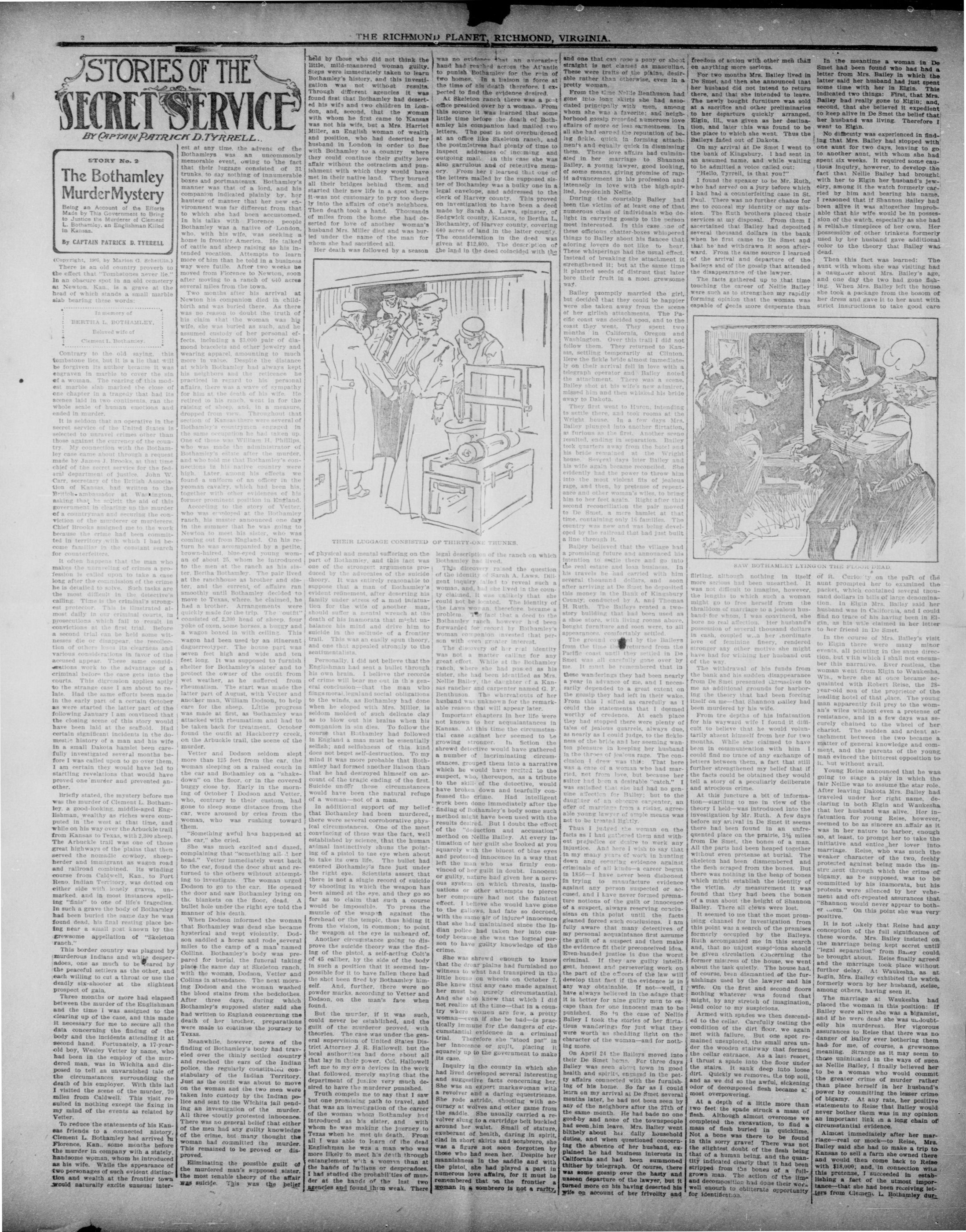
SECRET SERVICE
2
STORY No.2
The Bothamley
MurderMystery
bees
By CAPTAIN PATRICK D. TYRRELL
Contrary to the old saying, this!
Aombstone ties, but it is a lic that will
de forgiven Its author because tt wa
engraven in marble to cover the sin
ef a woman, earing of this mod
one chapter in a tragedy that had its
acenes laid in two continents, ran th
Whole seale of human emotious and
ended In murder.
It is seldom that nn operative in the
secret service of the United States is
selected to: unravel crimes other than
those against the currency of the coun
try. My ¢ n with the Botham:
ley case came through a reque
mate by J J. Brooks, at that time
chief of the eccret service for the fed-_|
tral department of justice. John W
Catt, secr of the British Associa
tion of Kassas, had written to the
Britichs am at Waekington
asking that Melt the aid of this
goverament in clearing up the murder
©f a countryma uring the con
Wickiou of the" wiisturee cy aaiateacen
Chief Brooks assizned me t work
becauts rime had heen commit~
ted tn terr with which T had be
come fa constant search
for count r
It often that the man who
makes t 6 of crimes a pro.
long after the commission of the crime
he is detalles to solve. Such tasks are
the most dificult tn the detective's
calling. Time |s tho eriminal’s strong
est protector. Th nstrated al-
most daily rimtnal courts, {a
Prosecutions which fail to result. In
convictions 9 first trial. Before
a second tri be held some wit
nesses die ar. the recollee-
than of 0 its clearness and
various considerations in favor of the
aceused appear. These same consid-
ations work to the advantage of a
€riminal before the cave gets into the
courts. This dicression applies aptly
to the strange case I am about to re-
Tate. Had the same efforts been made
fn the early part of a certain October
as were started the latter part of the
following Janvary 1 am conviaced that
the closing scene of this story would
have been Inid at the scaffold. Had
certain significant incidents In the do-
mestic history of a man and his wife
4m a small Dakota hamlet been care-
fully investigated several months be-
fore I was called upon to go over them,
I am certain they would have led to
startling revelations that would have
proved one'murder and prevented an-
other. :
Briefly stated, the mystery before me
‘was the murder of Clement L, Botham.
ley, @ good-looking, middle-aged Eng-
Ushman, wealthy as riches were com-
puted in the west at that time, and
while on his way over the Arbuckle trail
from Kansas to Texas, with 2,300 sheep.
‘The Arbuckle trail was one of those
great highways of the plains that then
aerved the nomadic cowboy, sheep-
herder and immigrant as wagon road
and railroad combined. Its winding
course from Caldwell, Kan. to Fort
Reno, Indian Tervitory, was dotted on
elther side with lonely graves, un-
marked. and in most Instances spell-
ing “finis” to one of life's tragedies.
In such a grave the body of Bothamley
had been buried the same day he was
found dead, his final resting place be-
fing near 2 small post known by the
‘rewsome appellation of “Skeleton
ranch.”
This border country was plagued by
(murderous Indians and whip desper-
jadoes, one as much to ve Weared by
‘the peaceful settlers as the other, and
yeach willing to cut a throat or use the
deadly six-shooter at the slightest,
Prospect of gain,
‘Three months or more bad elapsed
Detween the murder of the Englishman
and the time i was assigned to the
‘clearing up of the case, and this made
it necessary for me to secure all the
ata concerning the finding of the
‘body and the incidents attending it at
‘Second hand. Fortunately, a 17-year-
‘old boy, Wesley Vetter by name, who
had been in the employ of the mur-
dered man, was in Wichita and dis-
Posed to tell an unvarnished tale of
the circumstances surrounding the
death of his employer. With this lad
I visited the scene of the murder, 70
miles from Caldwell. This visit’ re-
sulted in nothing except the fixing in
my mind of the events as related by
Vetter.
‘To reduce the statements of his Kan-
friends to @ connected nistory,
‘Clement L. Bothamley had arrived
prence, Kan. some months before
Sones mPAny with 6 a
ath ond we ee
aa bis wife. While appearance ot
Sos cad wash hares’ ae
en. pe Arontier ts
an Nae ay ee oo eek
trunks, to say nothing of innumerable
‘Doxes and portmanteaux. Bothamley’s
manner was that of a lord, and his
companion Indicated plainly by. her
hanteur of manner that her new en-
‘vironment was far different from that
to which she had been accustomed.
In his talks with Florence people
Bothamley was a native of London,
who. with his wife, was seeking =
home in fronticr America, He talked
of cattle and sheep raising as his in-
tended vocation. Attempts to learn
more of him than he told In a business
way were futile. After two weeks be
moved from Florence to Newton, soon
after moving to a ranch of iO’ acres
several miles from the town,
‘Two months after his arrival at
Newton his companion died in child-
birth and was buried there. As there
was no reason {o doubt the truth of
bis claim that the woman was hig
wife, she was buried as such, and he
assumed custody of her personal ef-
fects, including a $3,000 pair of dia~
mond bracelets and other Jewelry and
wearing apparel, amounting to much
more in value. Despite the distance
at which Bothamley had always kept
his neighbors and the reticence he
practiced In resard to bis personal
affairs, there was a wave of sympathy
for hin at the death of his wife. He
Fetifed to his ranch, went in for the
raising of sheep, and, in a measure,
dropped from Throushout that
section of Kansa were several of
Bathamley’s countrymer aged fm
the sam don he fied waked ap.
One of these was William H. Phillips
who was made the a strator of
Bothamiey’s estate after the murder,
Righ. Later, anong his effects we
found a uniform of an officer in the
yeoman cavalry. which had keen his,
toxether with other evidences of bf
former prominent position in England
Accoriing to the story of Vetter.
who was ermloyed at the Bothamiey
ranch, his master announced one day
in the simmer that he was golng to
Newton to meet his sister, who was
coming out from England. ‘On his re-
turn he was accompanied by a petite,
brown-haired, blue-eyed young wom-
an of about 25, whom he introduced
to the mien at the ranch as his eis-
ter, Bertha Rothamtey. The pair Ived
at the ranchhouse as brother and sis-
ter, and the current of affairs ran
smoothly unt! Bothamley decided to
move to Texas, where, he claimed, he
had a brother. Arrangements were
quickly made for the trip. The “ontftt”
‘ consisted of, 2,200 head of sheep. four
yoke of oxen, some horses. a busgy and
‘@ wagon boxed in with ceiling. This
wagon had been used by an itinerant
aguerreotyper. The house part was
seven fect high and wide and ten
feet long. It was supposed to furnish
shelter for Bothamley’s sister and to
protect the owner of the outfit from
wet weather, as he suffered from
rheumatism. ‘The start was made the
latter part of August, with Vetter and
another man, William Dodson, to help
care for the sheep. Little progress
Was made at first, as Bothamley was
"attacked with rheumatism and had to
| be taken back for treatment. October
‘found the outfit at Hackberry creek,
‘on the Arbuckle trail, the scene of the
| murder,
Vetter and Dodson seldom slept
more than 126 feet from the car, the
| Woman sleeping on a raised couch in
‘the car and Bothamley on a “shake-
| down” on the floor, or in the covered
buggy close by. Barly tn the morn-
ing of October 7 Dodson and Vetter,
who, contrary to their custom, had
Bone to sleep some distance from the
ear, were aroused by cries from the
/woman, who was rushing toward
‘them.
| “Something awful has happened at
the car,” she cried.
She was much excited and dazed,
complaining that “something ail... bee
head.” Vetter immediately went back
to the car, found the door shut and re~
turned to the others wihtout attempt-
ing to Investigate. The woman urged
Dodson to go to the car. He opened
the door and saw Bothamley lying on
the blankets on the floor, dead, A
bullet hole under the right eye told the
manner of his death
‘When Dodson informed the woman
that Bothamley was dead she became
hysterical and wept violently. Dod-
son saddled a horse and rode, several
miles to the camp of a man’ named
Collins. Bothamley’s body was pre-
pared for burial, the funcral taking
place the same day at Skeleton ranch,
with the woman, Dodson, Vetter and
Collins in attendance. The next morn-
ing Dodson and the woman washed
the blood stains from the bedclothes.
After three days, during which
Bothamley's suppoxed sister said she
had written to Englana concerning the
death of her brother, preparations
were made to coatinue the journey to
Meanwhile, however, news of the
finding of Bothamley's body had trav-
eled over the thinly settied country
and reached the ears of the Indian
Seabolaly ofits tsdlen Tees
‘Territory.
Just as the outit was about to move
on the woman aad the two men were
THE RICHMONY PLANET, RICHMOND, VIRGINIA.
ee » |
A ah a } = il,
| iN pact
a Sr]
Bo UU 2
THEIR LUGGAGE CONSISTED OP THIRTY-OX) TRUNKS.
held by those who did not :
Uittle, mild-mannered woman
Steps were immediately taken to.
Bothamley's history, and this
gation was not without resulta,
Through different agencies it was
found first that Bothamley had desert-
ed his wife and two children in Lon-
don, and, second, that the
with whom he zat came t Kansas
was not his wife, but a Mrs. Harriet
‘Miller, an English woman of wealth
and position, who had deserted her
Dusband in London in order to flee
with Bothamley to a country where
they could continue their guilty love
affair without the ostracism and pun-
ishment with which they would have
met in their native land. ‘They burned
all their bridges behind them. and
started their new life in a spot where
it-was not customary to pry too deep-
ly into the affairs of one’s neighbors.
Then death took a hand. Thovsands
of miles from the home she had de-
serted for love of another woman's
husband Mrs. Miller died and was bur-
fed under the mame of the man for
whom she had sacrificed all.
Her death was followed by a season
of physical and mental suffering on the
part of Bothamiey, and this fact was
one of the strongest arguments pro-
duced dvocates of the suicide
theory. It was entirely reasonable to
suppose that a man of Eothamley’s
evident rednement, after deserting bis
family under stress of a mad infatua-
tion for the wife of another man,
should suffer @ mental wrench at the
death of bis inamorata that mézht un-
balance bis mind and drive him to
suicide in the soiltude of a frontier
trail. ‘This was an easily spun theory,
and one thst appealed strongly to the
sentimentalists
Personally, I did not believe that the
Englishman had sent a bullet through
his own brain. I bellove the records
of crime will bear me out in th's gen-
eral conclusion—that the man who
Sings morai,legaland social obligations
to the winds, as Bothamley had done
when he eloped with Mrs, Miller, ta
seldom molded of such delicate clay
4s to blow ont his brains when hig
companion in sin dies. To follow the
course that Bothamley had followed
in England a man must be essentially
Selfish; and selfishness of this. kind
does not beget self-destruction. ‘To my
mind it was more probable that Both-
amley had formed another laison than
that he had destroyed himself on ac-
count of the tragic ending of tho first.
Suicide undér these circumstances
would have been the natural refuge
of a woman—not of a man,
In additional support of my belief
that Bothamley had been murdered,
there were several corroborative phys.
teal circumstances. One of the most
convincing of these was the fact, well
established by science, that the human
animal instinctively shuns the point-
ing of a pistol to tne eye when about
to take its own life. The bullet had
entered Bothamley’s face just under
the right eye. Scientists assert that
there is not a single record of suicide
by shooting in which the weapon has
been aimed at the eye, and they go 80
far as to claim that such a course
would be impossible. To press the
muzzle of the weapyA against the
forehead or the tempic, thus hiding it
‘from the vision, in common; to point
the weapon at the eye is unheard of.
Another circumstance going to dis-
prove the suicide theory was the find-
ing of the pistol, a self-acting Colt’s
of 45 caliber, by the side of the body
In such a position that it seemed im-
possible for it to have fallen there had
the shot been fired by Bothamley him-
self. And, further, there were no
powder marks, according to Vetter and
Dodson, on the man's face when
found,
But the murder, if it was such,
could mever be established, and the
guilt of the murderer proved, with
‘theorles. The case as under the gen-
eral supervision of United States Dis-
trict Attorney J. R. Hallowell. but the
local authorities had done shout all
‘that lay in their power. Col. Hallowell
left me to my own devices in the work
that followed. merely saying that the
department of fusiice very much de
sired to have the murderer punished.
| Truth compels me to say that 1 saw.
but one promising path to travel, and
Logs i 7a an: tavestinstion of the Gamer
woman whom Bothamley hart
Introduced as his sister, and with:
Whom he was making the journey to
‘Texas when he met als death. From
tw ae oe a of the dead.
more tkely aie an ier wee
more iMkaly th mest bis devth. through
entanglement w'th & won than at.
ee eee
was no ‘eridense dhs
two homes. tH a tia! aie
the time of nig death therefore. 1 ex-
pected to find the evidenre desired.
At Skeleton, there was a post
office presided over by a woman. From
‘this source it learned that some
little time the death of Both-
amley his companion had matled two
letters. The post is not overburdened
at an office like Skeleton ranch, and
‘the postmistress hat plenty of time to
inspect addresses of incoming and
outgoing mail. im this case she was
also garrulous and of reteative mem-
ory. From her { learned that one of
the letters malted by the supposed sis-
ter of Bothamley was a bulky one in a
legal envelope, and addressed to the
clerk of Harvey county. This proved
on investigation to have been a deed
made by Sarah A. Laws, spinster, of
Sedgwick county, Kansas, to Bertha L,
Bothamley, of Harvey county, covering
640 acres of land in the latter county
The consideration in the deed was
given at $12,800, The descr'ption of
the land In the deed coincided with the
legal deseriptios of the ranch on whien
Bothamley ba *
This discovery raised the question
of the idontit rah A, Laws. Dili
gent inquiry. ‘alle! to reveal such a
woman, and, Lived in the coun
ty claiined, ‘1 nilkely that she
could not Be lovated, The Wentity of
the Laws wor an, therefore. became
problem. "Ie fact that a deed to the
Bothamley rapch however hod been
forwarded for recor Bothamitey's
woman corpanion invested that per-
son with oven greater interest
The ¢ ry of her real identity
was mot a matter calling for any
great effort. While ot the Bothamley
ranch, where she had pased as his
sister, she had been identified as Mrs.
Nellie Bailey, the davghter cf a Kan-
Sas rancher and carpenter named G. F.
Benthuson. Th» whereatouts of her
husband was unknown for the remark-
able reason that will appear later.
Important chapters In her lite were
not known to her acquaiantances in
Kansas. At this time the circumstan.
tlal case against her seemed to be
growing stronger. I fiction the
shrewd detective would have gathered
@ number of incriminating circum-
stances, grouped them into a narrative
which he would have recited to the
suspect, who, thereupon, as a tribute
}to the skill: of the detective, would
have broken down and tearfully con-
fesse the crime. Had {ntelligent
yrork been done immediately after the
finding of Nothamley’s body some such
‘method mistit have been used with the
| Fesults desired. But 1 doubt the effect
of the “deduction and accusation”
method on Nellie Balley. At every {n-
timation of her guilt she looked at you
squarely with the bluest of blue eyes
And protested Innocence In a way that
Jeft the man whe was firmly con-
Yinced of her guilt in doubt. [anocent
or guilty, nature had given her a nerv-
ous system on which threats, insin-
uations or other attempts to. pierce
her composure had not the faintest
effect. 1 Lelieve she would have gone
to. the gallows, had fate so decroed,
with the same gir of injure? innocence
that she bad maintained siace the In-
dian police had tuken her into cus
tody because she was the logteal per-
son to have guilty knowledge of the
crime.
Bhe was shrewd enough to know
that the cr arplains had furnished no
witness what bad transpired in the
ttle hous» om wheels on October 7.
She knew (hat any case made Against
her must be purely circumstantial.
And she «\so knew that which I did
‘Rot realir« at the time—that in a coun-
try where women are few, a pretty
woman—<ven if she be bad—is prac-
teally immune for the dangers of cir-
Cumstantial evidence in a criminal
trial. ‘Therefore she “stood pat” in
her Innocence or gust, placing it
squarely up to the government to make
its case.
naltauiry in the county in which she
. ved developed several interesting
and suggestive facts concerning her.
‘She was an markswoman wit
& revolver and a daring equestrieane.
‘She rode a shooting with ac-
curacy at wolves and other game from
ee She usually tra! oa & re-
Bosca ing te = buckled
around her | Rens meas of stature,
ee Faire sek pecaies
ras 8 fcure not = pee by
those who ad soon her. Despite her
‘oistol, she kee aie cane
nerous Jove affairs, for it must be
pan in @ sombr not @ rartt
es 54 -
pene, San Sine tee
On, nt a MES ss
‘ated principally with ‘men,
iecease oie arent ang neigh-
faltuife of merece tae ante oe
SE ehehaa cancel L Sesrased Sareea <a:
ie aoc ee
gals aabieataily Gciex te manatee
ated in her marriage to .on
Balley, a young lawyer, good looking,
of some means, giving promise of rap-
Ad advancement in hls profession and
Antensely in love with the high-spir-
‘ited, hoydenish Nellie.
During the courtship Bailey bad
‘been the victim of at least one of that
numerous class of individuals who de-
light In carrying gossip to the person
most interested, In this case one of
these officious chatter-boxes whispered
things to Balley abont his flancee that
adoring lovers do not lke to hear,
‘These whisperings had the usual effect.
Instead of breaking the attackment it
‘Strengthened it; bat at the same time
It planted seeds of distrust that tater
bore their fruit in a most grewsome
way.
Batley promptly married the girt,.
but decided that they could be happier
were she taken away from the scene
of her girlish attechments. The Pa-
cific coast was decided upon, and to the
coast they went, They spent two
months in California, Oregon and
Washington. Over this trail I did not
follow them. They returned to Kan-
sas, settling temporarily at Clinton.
Here the fickle bride almost tmmedintes
ly on thelr arrival fell in love with a
telegraph operator and” Batley noted
the attuchment. ‘There was a scene,
Bafley shot at bis wife's new admirer,
missed bim and then whisked his bride
eway to Dakota
They first went to Huron, intending
to settle there, and took rooms at the
Wright house. In a few days Mra.
Bailey plunged Into another flirtation,
a furious as the firet, Another scene
remnlted, ending in separation. Bailey
took quarters away from tho Kote? and
his bride remained at the Wright
house. Several days ister Bailey and
Lis wife again became reconciled. She
evidently kad the power to throw him
into the most violent fits of Jealous
rage, and then, by pretense of repent-
ance and other woman's wiles, to bring
him to her fest azain.” Right after this
second reconciliation the palr moved
to De Smet, a mere hamlet at that
time, containing only 16 families. ‘Tho
country wes new and was being devel-
oped by the railroad that bad Jast built
a line through It.
Railey Deijieved that the vitiage bad
a promising future and annownced iis
futention to settle there and go into
the real estate and loan business, In
Lis travels be ad carried with him
several thousand dollars, and soon
after arriving at De Smet he deposited
this money In the Bank of Kingsbury
County; conducted by A. and Thomas
H. Ruth. The Baileys rented a two-
story bullding that bad been used as
& shoe store, with living rooms above,
Bought furniture and soon were, to all
appearances. comfortably settled
The ground coyfied by the Batlova
Pacific coast until they settied In De
Smet was al carefully gone over by
me, It oust be remembered that im
‘these wanderings they had been nearly
a year in advance of mo, and I neces-
sarily depended to a great extent on
the goastp they had left in theit wake,
From this 7 sifted as carefully as I
could the statements that I deemed
worthy of credence, At each place
they had stopped there were plenty of
tales of jealous quarrels, always. due,
as nearly ax I could Judge, to the fickle.
Ress of the bride an her seeming wan-
ton pleasure in keeping her husband
in the thraes of joa'ons rage. ‘The con-
clusion 1 drew was thi: That here
Was a cave of a woman who had mar-
ried, not from love, but because her
sultor bad beon a desirable “cateh.” I
was satisfied that abe bad had no gen-
uine wfection for Bailey: but to the
daugster of an ob-cure ca-penter, an
offer of marrisr> from a risiag, agree:
able young lewyer of emple means was
‘net to be treated Nghtly.
| Thus I jutred eke woman on the
facts as I had gethered them and with-
Out prejudice or desire to work any
Injustice. And here I wish to say that
ta my many years of work in hunting
down and securing evidence against
criminals of al! kinds—a career begun
in 1856—I have never been dishonest
fn trying to manufacture evidence
against ary person suspected or ac-
cused, and I Lave never formed prema-
ture notions of the guilt or innocence
‘of & suspect, always reserving conclu-
sions on this point until the facts
gleaned forced such conclusions. 1 am
fully aware that many detectives of.
my personal acquaintanes first assume
‘the guilt of a suspect and then make
the evidence ft their preconceived idea.
Bren-handed justice 1s due the worst
criminal. If they are guilty intellt-
gent, honest and persevering work on
the part of the o7cora of the law will
develop that fact if the evidence is in
any way obtainable. If not—well, I
have always believed in the adage that
ae oe nase dDelleved In the adage that:
Freedom of action with other mea that
be earthing iaigy wien. Ges
or ‘Mra. Batley lived in
her id did not Intend to retur
there, and that she {ntended to leave.
‘The uewly bought furniture was sold
at a sacrifice and other preliminaries
to her departurs quickly arranged.
Eigin, UL, was given as her destina-
tion, ‘and later this was found to be
the place to which she went. ‘Thus the
Baileys faded out of Dakota.
‘On my arrival at De Smet I went to
the bank of Kingsbury. 1 bad sent in
n assumed name, and while waiting
to be admitted a yolce called out:
“Hello, Tyrrell, is that you?”
I found the speaker to be Mr. Ruth,
who had served on a jury before which
I bad had @ counterfeiting case in St.
Paul. There was no further chance for
me to conceal my identity or my mls.
sion, ‘The Ruth brothers placed thelr
services at my disposal. From them I
ascertained that Bailey had deposited
several thousand dollars in the bank
when he first came to De Smet and
that he'had withdrawn {t soon after-
ward. From the same source I learned
of the arrival and departure of | the
alleys and of the gossip that attended
the disappearance of the lawyer
The tacts gathered up to that time
touching the career of Nelile Bailey
were such as to strengthen my rapidly
forming opinion that the woman, was
Gaxable of gosta snare: deiperate tak
r uy |:
eas
Ce) ee 5) 2 3 Dae
Gs ncaa ge fie sis
1s fine 4 || Tee Toe eee
yaa ee E cs Y "
Pea ee S. sas
a / — ey |
ren AX a
“ir Jeg ‘wu
eg pany Hi Y fr? Tf
==
firting, although nothing in Itself
more « 1 Been unearthed. It
Was not difficult to Imagine, however,
the | © which such 'a woman
might go to free herself from the
thralldom of marriage to a jealous bus-
band:for whom, T was coavineed, #he
| bor no real a Mer husband's
possession of 1 thousand dollars
in cash, coupled wat her snordinate
iove of f finery, rendered
Stronger any other motive she might
have had for wiuing her husband out
of the wa
‘The whhdreeal of his fuude trom
the bank and his sudden dleappearance
‘from De Smet presented Uhemnelves to
me as additional grounds for harbor
ing the theory that had been foreing
itself on me—that Shannon wailey had
been murdered by his wife
} From tre depths of his tnfatuation
for his wayward wife I found it ditt
cult to believe that he would volun-
tarily absent himself from her for two
months, While she clatmed to have
beon in communteation with him I
could find no trace of any exchange of
letters between them, a fact that still
further strengthened ‘my belief that if
‘the facts could be obtained they would
tell a story of a peculiarly deliberate
‘and atrocious crime
| At this juncture a bit of informa-
tion—startiing to me In view of the
‘theory I held—was introduced into the
} investigation by Mr. Ruth. A few days
before my arvival in De Smet it seems
there had been found in an unfre-
quented place on the prairie, 3% miles
from De Smet, the bones of a man.
All the parts had been heaped together
without even pretense at burial. The
‘skeleton had been dismembered and
the flesh scraped from the bones, But
there was nothing in the heap of bones
which might establish the identity of
‘the victim. ay measurement it was
‘found that they had been the bones
‘of @ man about the height of Shannon
Bailey. There all clews were lost,
/ It seemed to me that the most prom-
ising channel for investigation from
this point was a search of the premises
formerly occupied by the Baileys,
Ruth accompanied me in this search
and, that no unjust suspicions should
be given circulation concerning the
former misiress of the house, we went
. about the task quietly. The house had,
of course, been dismantied of the fur-
Rishings: used by the lawyer and his
} wife: On the first and second floors
Rothing whatever was found that
‘might, by any stretch of imagination,
‘lend color to my suspicions.
| Armed with spades we then descend-
ed to the cellar, Carefully testing the
condition of the dirt floor, we again
‘met with failure. But one spot re-
‘mained unexplored, the small area un-.
der the wooden etairway that formed
the cellar entrance. As a last resort,
4 thrust a spade into the floor under
the stairs. It sank deep into loose
dirt. Quickly we removeu the top soil,
and as we did so the awful, sickening
odor of decomposed flesh became a!
most overpowering. '
, At a depth of @ little more than
two feet the spade struck a masa of
flesh. almost overcome woe
complied ihe ate gzeavation, to ud a
ee were, ee ee
hat of in | RS eee
HY tnaleated clearly that it hea na |
etrloped: from tea Gane eee ee
siripped. ‘rag fe bones of x full
Ta 1 he 3 ‘woman oman
letter from Mrs. | in
latter said her husband had just
some time with her in Elgin. This
indicated two things: First, that Mrs.
‘Bailey bad really gone to Elgin; and,
second, that she believed it expedient
to hep alive in De Smet the bellef that:
her husband was living. Therefore I
went to Elgin. ;
No diMeuty was experienced In find-
‘ng that Mrs. Balley had stopped with’
one aunt for two days, leaving to go)
to ancther aunt, with whom she had
Spent six weeks. It required some cau-
tious inquiry, however, to develop the
fact that Nellie Bailey had brought,
with her to Elgin her husband's jew-
elry, among it the watch formerly car-'
ried by him and bearing his name,
I reasoned that if Shannon Hailey had
been alive it was altogether Improb-
able that hie wife would be in posses-
sion of the watch, especially as she had
A reliab.e timepiece of her own. Her
possession of other trinkets formerly
used by her husband gave additional
color to the theory that Bailey was
dead.
Then this fact was learned: The
aunt with whom she was visiting haa
& daugucer about Mrs. Bailey's age,
and one day the two had gone figh-
ing. When Mra. Bailey left the house
she took a package from the bosom of
her dress and gave It to her aunt with
strict insuructions to take good cate
ot i Curt on the paFt of thé
aunt prompted her to examined the
packet, which contained snvepal thou-
and dollars in bills of large denomina=
tion. In Elgin Mrs, Balley sald her
husband was in California, and { could
find no trace of his having been in El-
sin, as his wie clatmed in her letter
to her friend in De Smet
In the course of Mrs. Bafley’s visit
to Elgin t were many minor
tion, but vith which I shall not eneum-
ber this narrative. Ever restless, the
woman Went from Elgin to Waukesha,
Wis., where she at ouce became ac
quainted with Robert Reise, the 28
year-old son of the proprietor of the
wading hotel of that lace. The young
| man apparently fell prey to the wom-
}an's wiles without even a pretense of
resistance, and in a few days was s6-
curely chained to the wheel of her
chariot. ‘The sudden and ardent at-
tachment between the two became @
| miatter of general knowledge and com
/ment, and the parents of the young
man evinced the bitterest opposition to
ik. Sut without avail
Young Reise announced that he was
going to siage a play in which the
fair Nellie was to assume the star role.
After leaving Dakota Mrs. Bailey had
traveled under her right name, de-
clariag in both Elgin and Waukesha
that her husband was alive. Hor in—
/fatuation for young Reise, however,
| seemed to bo as sincere an-affair as {t
was in her nature to harbor, enough
0, at least, to prompt her to take the
tateaave and entice her lover {nto
marriage. Reise, who was much the
weaker character of the two, feebly
Protected against being made the in-
Stre.aent through which the crime of
bigamy, as te supposed, was to be
committed by his inamorata, but his
Protests were silenced by her vehe-
[ment and oft-repeated assurances thet:
“Shannon would never appear to both=
¢r vem.” On this point she was very”
positive,
It ts not ukely that Reise had any
conception of the full significance of
these words. Mrs. Bailey insisted om
the marriage being kept secret unti¥
“legal separation” from Bawey could,
be brought about. Reise flually agreed
and the marriage took place without
further delay, At Waukesha, as at
‘Hugin, Mrs. Bailey exhibited the wateb.
formerly worn by her husband, seise,
among others, having seen it. ‘
| ‘The marriage at Waukesha bad
placed the woman tn this position: If
Bailey were alive she was a Bigamist,
and if he were dead she was w.doubt-
edly his murderess. Her vigorous.
assurances to Reise that there was no
danger of Baitey ever bothering them
had for me, of course, a grewsome.
meaning. Strange as it may seem to
thage uninitiated in the ways of suen.
as Nellie Bailey, I finally believed her
to be a woman who would commit
the greater crime of murder rather
than place herself in her husband's.
Power by committing the lesser crime,
of bigamy. At any rate, her positive.
Statements to Reise that Batley 4
never bother them was in my :
an important link in a long chain off
cireumatantial evidence, es
ey eee rip |
sod ‘would, then ne tack to R
Son Sees eee ee
Fee eeeien, ARG. te comapution
ere ee
Ushing a fact of the é.
. ‘be had been res
THE PETER
SATURDAY....OCT. 14TH. 1805
4 SECRET SERVICE
"The Bothamley Murder Mystery."
ling her stay in Wisconsin. It was not my good fortune to secure any of these letters, but the fact that such a correspondence had been carried on was well established. Her statement to Reise that she was going to Kansas to sell a farm was clearly a subterfuge to escape unsuspected from the man whom she professed to love so deeply to go to another admirer.
She left Waukee she still protesting the liveliest affection for Reise and went to Newton, Kan., sending to her Wisconsin lover from several points en route messages of undying love. Bothamley had evidently been advised as to the exact time of her arrival, for he met her at the train and later took her to his ranch under the name of Bertha Bothamley, his sister.
From her journeying of thousands of miles subsequent to her marriage with Shannon Bailey there seemed to be nothing more obtainable in the form of evidence against Nellie Bailey, or Nellie Reise, than I have related. Any additional evidence must be obtained in Kansas near the scene of the Bothamley crime. The sending by her from Skeleton ranch of the "Sarah A. Laws" deeds to the Bothamley ranch should prove a valuable bit of information if the mystery of the identity of "Sarah Laws" could be solved. The key to this puzzle finally was found in Michita.
Two days before Bothamley and the woman had started to Texas they appeared at the office of a lawyer in that city and solicited his services in the drawing of a seed to the 640 acres of land in question. To this lawyer the woman was introduced by Bothamley as h a wife. Ber ha L. Bothamley, and they desired to convey the ranch property to one "Sarah A. Laws." The instrument was drawn, the fee paid, and the couple dearrived, leaving no suspicion that either was other
```markdown
```
than as represented. In the transaction the grantee did not put in an appearance, but there was nothing in this circumstance to arouse suspicion.
Knowledg e of this visit to the lawyer enabled me to see what the plan might have been. Further investigation revealed the fact that within an hour from the time Bothamley and the woman had left the office where the deed was drawn in favor of "Sarah Laws" they had visited the office of another lawyer, and asked him to draw a deed to the same land, "Sarah A. Laws" being the name given as the grantor, and Bertha L. Bothamley as the name of the grantee. In the office of this lawyer, Bothamley introduced the woman as Sarah A. Laws. This was the deed that was afterward sent by the woman from Skeleton ranch to the clerk of Harvey county for record, the character of "Sarah A. Laws" having been purely fictitious. This was the most convincing circumstantial evidence developed, going to show that the flight to Texas had been planned weeks, and possibly months prior to the start, and that Bothamley had fallen so completely under the spell of the woman that he had been induced by her to convey his ranch to her, the roundabout method described being used for the purpose of forestalling the comment a direct conveyance undoubtedly would have caused.
come to Kansans to attend and immediately after the appeared with the women to be his wife, and who ful wife, if the bones and in Dakota had been those Bailey.
I found afterward this jurors almost unanimously themselves as believing guilty, they had applied their sense of rough from reasoning that Bothamley a man whose early advenience should have a different life, and this death at the hands of a after he had led another her home for him, besides his own wife and child meeting with no more than he deserved. As a no quarrel with this revered an officer of the law at felt much disappointment the hard work of most naught, especially as that had developed what to n a sound case.
So far as I have been a Shannon Bailey has never of since the day he desis have recently written to who formerly lived in Oceeceived no answer. I wif reputation that we found mortal of him on the Daks
With the facts as here related in my possession I conferred with Col. Hallowell, and we took an inventory of the evidence in our possession. Of its circumstantial character there was, of course no doubt. The outline of the facts I have related was strengthened by a search of the personal effects belonging to Bothamley at the time of his death, and of the contents of the car in which he died. In a box in the car, besides a large quantity of jewelry which had belonged to the woman with whom Bothamley had come to America, was found a bottle of morphine. I tried to establish the identity of the purchaser of the drug, but was unsuccessful, for, after locating the drugist who sold it, I found him unable to recollect the person who had bought it. The facilities for the exhumation and examination of bodies on the frontier were not such as to make an analysis of the Bothamley stomach feasible, and the part played by the drug in the death of the Englishman, if any, was left in doubt.
When we had finished taking stock of our evidence Col. Hallowell, known throughout Kansas as "Prince Hal," and I decided that we could go into court with a circumstantial case of
---
great strength. Personally I was confident of being able to present such evidence as would convince any unprejudiced juror of the guilt of Nellie Bailey or Reise.
The physical circumstances surrounding the death of Bothamley, had the accused been a man, would have gone far of themselves toward convicting. These circumstances, considered in connection with the history of Nellie Bailey from the time of her marriage, the disappearance of her husband, the finding of the human bones and flesh, her possession of his jewelry and money, her marriage to Reise and her confidence that Bailey would never bother them, the evident attempt on her part to secure title to Bothamley's ranch—all these things and many minor circumstances seemed to me to constitute a case of much merit from the legal viewpoint. In this view Col. Hallowell agreed with me. The genial United States district attorney and I differed, however, on one material point—the chance of securing a conviction.
"Remember, Tyrell," he said, "that it's a woman on trial, and a pretty woman."
The trial of this remarkable woman was one of the most memorable in the history of Kansas. She had ample means ar 1 had retained able counsel, Col. Hallowell, in his capacity as United States attorney, represented the prosecution, as the crime had been committed in the Indian territory, where there were no local courts. The government's array of circumstantial evidence was marshaled before the jury with much skill and force by Col. Hallowell, and a display of correlated facts produced that would have caused an ordinary defendant to weaken. But the little blue-eyed woman remained as calm, as the incriminating circumstances were piled up against her, as she had been from the first. Counsel for the defense made the best of the somewhat meager case they had, but when the evidence was all in there was a wide margin in favor of the prosecution. After the summing up by the lawyers Col. Hallowell said to me:
"We are up against it. Every man on that jury knows she is guilty, and not one of them will vote for conviction."
His knowledge of western juries in cases where women were the defendants was accurate. After due deliberation the jury filed into the room and submitted to the court its verdict: "Not guilty." Judge Foster, who heard the case, said after the trial that there was not the slightest doubt in his mind of the woman's guilt. But she was free. Robert Reise had
come to Kansas to attend the trial, and immediately after the verdict disappeared with the woman I believed to be his wife, and who was his lawful wife, if the bones and flesh found in Dakota had been those of Shannon Bailey.
I found afterward that while the jurors almost unanimously expressed themselves as believing the prisoner guilty, they had applied to the case their sense of rough frontier justice, reasoning that Bothamley had been a man whose early advantages and intelligence should have led him into a different life, and that if he met death at the hands of one woman, after he had led another to desert her home for him, besides deserting his own wife and children, he was meeting with no more punishment than he deserved. As a man I have no quarrel with this reasoning. As an officer of the law at that time I felt much disappointment at seeing the hard work of months go for naught, especially as that hard work had developed what to my mind was a sound case.
So far as I have been able to learn, Shannon Bailey has never been heard of since the day he disappeared. I have recently written to his brother, who formerly lived in Ohio, but received no answer. I will stake my reputation that we found all that was mortal of him on the Dakota plain and in the cellar of his former home in De Smet.
STORY No. 3 WILL BE "THE
MISSOURI LAND LEAGUERS."
"Yes, I agree with George in everything."
"Of course George believes you are the sweetest thing that ever happened."
—Cleveland Plain Dealer.
The Modern Sphinx.
First Correspondent—It's no use trying to get any news out of the Japs.
Second Ditto—I should say not.
Why, those fellows even smile in cipher—Town Topics.
Inartistic
"Doesn't Miss Dash look Like a peach to night?"
"Yes, but she didn't get the bloom evenly distributed."—Cleveland Plain-Dealer.
Katherine Perfect.
Teacher—John may give me a definition of
a definition of
Johnny—It's
loves his team
and Leader.
THE RICHMOND PLANET, RICHMOND, VIRGINIA.
FIERCE STRUGGLE WITH A "MUSKY"
REMARKABLE EXPERIENCE OF
A WISCONSIN ANGLER.
DESPERATE FIGHT FOR LIFE
Latest News from Jag Lake Where
Jag Lake, Wils.—Muskellunge fishing is begin to pick up.
Tom Miller, a guide, was lightly paddling his birch bark canoe through Jag lake the other day. He trailed a spoon book, holding the line in his mouth. A big muskellunge struck the book, the sudden shock tearing out three of Mr. Miller's lower teeth.
After a hard fight Miller got the fish alongside, shot it in the head, and lifted it in the canoe. The fish was only stunned and commenced to knock the ribs loosely right and left. Mr. Miller took another shot at his prize, forgetting in his excitement that the bottom of the canoe was directly under the fish.
Water commenced to pour through the hole, which Miller finally stopped by using the index finger of his left hand as a plug. Doing the best possible with the paddle, the exultant fisherman crawled slowly shoreward. However, just as he was passing a pond-fly patch, a hungry muskellunge, doubtless attracted by the* ring on Miller's finger plug, rose to the digit and struck. Fortunately the fish let go instanter.
Mr. Miller transferred the lacerated finger to his mouth, forgetting in the poliant agony that there was a hole in the bottom of the canoe.
With the water washing around his feet, he started to recalc. The sudden
HE GRAPPLED WITH THE FISH.
withdrawal of the finger from his mouth jerked loose the gold plate of false teeth with which his upper jaw was fitted. They fell overboard, and in endeavoring to grasp them before they reached the water Mr. Miller followed suit, diving as he did so for his disappearing crockery molars.
Again a muskellunge proved his undoing, beating him to the teeth by a nose, the finny monster evidently thinking the gold plate was a new kind of spoon.
As Mr. Miller is a hearty eater, his loss made him frantic. He grappled with the fish and tried to choke the teeth—his teeth—loose. But they had stuck crossways in the muscle's gills. The fish fought frantically. So did Miller. The teeth interfered with the fish's breathing, and he rose to the top of the water, half drowned. The battle was going against the man when assistance came in the shape of Wellington II. Miller's canine companion. The faithful dog had seen his master dive from the canoe, and, swimming the famous crawl (or Australian) stroke, had hurried to the rescue. Miller had trained the animal to carry a rope to persons struggling in the water and the intelligent beast arrived at the scene of combat, dragging a boom cable which he had picked up on shore.
Miller grabbed the free end and took a half hitch around the muscle's neck. Then, with dog and man hauling, the big fish was yanked ashore.
Mr. Miller recovered his teeth, built a fire, and, while drying his clothes, broiled, and subsequently ate, a steak from his late antagonist. As Mr. Miller lost his scales, he cannot say how much the fish weighed.
Fishing is fairly good here now, but it is expected to be better later in the fall.
Drape Statue of Nude Woman
St. Louis, Mo.—"The Awakening Nymph," better known as "Carrie Kingsbury," a statue of a nude woman whose graceful lines have stirred artists to praise, but whose fully exposed charms have caused the prudish to protest, wore a pink kimono and a picture hat when St. Louis awoke the other morning. Thousands of persons went to see the novel sight, and hundreds of photographs were taken. Who provided the clothes is a mystery.
Teamster's Horse a Toper
Pittsburg, Pa.-Jacob Schrader, a teamster of McKeesport, has a horse that frequents barrooms and drinks beer out of a glass, just like a human being. Visitors are entertained by seeing the horse taken into a saloon and treated to a schooner of beer. The act is so popular that the horse usually gets a number of drinks before leaving the bar.
SOME PICKLE POINTERS.
By H. E. stockbridge.
The growing of cucumbers for pickles is greatly on the increase, and the produce of the picklers of securing the supplies by making contract for the crop, before the latter are produced has become nearly universal, however, is not only a ver- tribute, but it is produced by a large number of small growers.
many of them necessarily with little experience in the business. A few of the more important facts demonstrated in the experience of successful growers should prove useful. The crop for this year is already planted, but the character of the harvest, the profits, may still be very largely controlled by the method of practice followed by the grower. It should be remembered that the cucumber belongs to the melon family. It is therefore naturally adapted to light, mellow, early loam soils. The crop should be grown in hills. The distance of planting is extremely important. Not only does the number of hills which the land can be made to maintain chiefly influence the quantity of crop, but it is extremely important that the surface of the soil be entirely covered by vines during the fruiting season. The reason for this fact lies in the importance of prolonging the fruiting season as late as possible. For this purpose the vines must be kept growing; they should not be allowed to ripen and die. The surest way to secure this object is to keep the ground covered with vines. They will thus serve as an effective mulch, retaining moisture during the hot dog day season, and prevent the severe drying out of the surface soil, which is so commonly followed by yellowing and dying of the vines. Rows six feet apart and hills four feet apart in the row will best meet the requirements of average soils.
As August and September form the fruiting season, it will be easily seen that the crop need not be planted till early June. It is therefore easily used as a second crop, following early garden crops, or as a large crop requiring attention after earlier crops have been attended to, and is therefore a crop of convenience well adapted to the successive use of labor.
In the general fertilizing of cucumber lands it must be borne in mind that this crop is distinctly an intensive one. High fertilizing and culture are demanded for success. It is a vine crop, and, therefore, a liberal user of nitrogen. It is, practically, a fruit crop, and demands potash in proper proportion. These two are the chief food requirements of the cucumber. Phosphoric acid is of less importance particularly, as ripening of weeds is not desired.
With soils in good state of fertility the application before planting should on the average, consist of 1,000 pounds per acre of a complete fertilizer having an approximate composition of six per cent. phosphoric acid; three per cent. nitrogen and eight per cent. potash.
Of varieties there are many well adapted to pickle making. The only point to be insisted on is that a green variety be planted. The early whitish or white spined kinds, should be carefully avoided.
Three points are aimed at by the pickle grower; and his success will be measured by the degree to which he succeeds in controlling them.
The hardiness and crispness sought by pickle makers is only partly secured by the process of pickling. The character of the cucumbers themselves largely influences results. This is in a considerable degree within control of the grower. Liberal potash fertilising is indispensable to the perfection of quality in pickles. In many cases, particularly on lands rich in humus, an application of 50 pounds of sulphate of potash at the last cultivation will greatly improve the character of the product.
Continued growth of vines alone however, will not assure continued and abundant fruiting. It is only the first essential to this end. The other essential is frequently overlooked by growers. It consists simply in regular and continuous picking of all fruit after it once begins to set. The first and second pickings are likely, in themselves, to prove unprofitable, on the plea that the fruit secured, at the price paid by the contractor, does not pay for the time required. They forget, or are ignorant of, the fact that all future setting of fruit depeals on the closeness with which all first fruit is removed. Other things being equal, the first crop will be proportional to the completeness and care with which all the first cucumbers are picked. It should be the rule to pick every cucumber as soon as it reaches pickle size, even if it be thrown away. The final yield will justify all labor thus expended.
DRIP FOR GRINDSTONE.
Simple Device Which Will Help When
the Work of Grinding the Tools
Is Being Done.
Place a tin can above end of grind-
stone, attached to upper end of a bent
iron brace, a
which is ½xl
inch by 24 inches
long and is
fastened by lower
end to wood frame
by a set bolt. At
upper end it is
iron brace, a which is $ \frac{3}{8} $ inch by 24 inches long and is fastened by lower end to wood frame by a set bolt. At upper end it is bent as indicated to hold tin can, b, above the grindstone. Make a silt an inch wide into upper end of can, from which it should be suspended upon iron brace. At lower end on front side of tin can, as indicated by c, punch a small hole to allow water to drip out upon stone- Farm and Home
A Logical Inference
"No," said the business man; "I don't want a man in my employ who plays the races."
"Then you think gambling is wrong?"
"It isn't so much that. But I am convinced that a man who would make the loose, one-sided contract required by a Lookmaker is not competent to take care of his own interests or those of anybody else."—Washington Star.
The Retort Courtsons
"Is anyone waiting on you?" finally asked the haughty saleslady, condescending at last to notice the shipping person.
"I'm afraid not," replied the latter
"My husband was—I left him outside
--but I'm afraid he's become disguised
and gone home."—Philadelphia Press.
HINTS ON COOD BREEDING
It Is the Small Things That Show Whether One Has or Has Not Been Gently Reared.
One's alliments are never matters of public interest, and one's troubles annoy those whom they do not sadden, tersely remarks Mrs. Burton Kingsland, in Success Magazine.
Guests should not allow their hosts to incur needless expense on their behalf. When visiting city friends they should pay their own cab hire, car fares, express charges and telephone tolls, if messages are sent at long distances, but, if the host will not permit, it is in better taste to yield the point than to prolong a discussion.
In order that children may learn politeness, they must be treated with courtesy—thanked when they do little services, and spoken to in a controlled voice when reprimanded. Above all else, parents and elders must treat one another with well-bred politeness before them, for children are very imitative little creatures.
The behavior of father and mother toward each other sets an example that will probably serve as the standard of conduct in the households of which the children in their turn will be the heads.
It is no longer customary at the tables of those socially well-placed to serve the hostess first. It is an old fashion, a survival of the times when for the hosts to taste wine or food first was the assurance to the guests that it was not poisoned.
At church weddings every woman, including the bride should wear a hat—unless she wears a veil. This is according to custom and precedent.
In well-regulated households no caller is ever told at the door that the servant "will see whether the mistress is at home or not." Instructions to that effect should be given in advance so that a caller's time may not be wasted in such investigation.
In going upstairs a woman is given precedence by a man, but in descending a staircase he goes first, to avoid the risk of stepping upon her gown, or, in case of a misstep, to afford her support.
In nothing does a girl show herself underbred so much as when lacking in respect and defence to her mother, except when such affront is offered to her father. If such a one had the gift of seeing herself as others see her, she would feel nothing but disgust.
It is very bad form not to return a first call, unless the caller be a really objectionable person to know. But the first call returned, none other need follow and the acquaintance may be allowed to drop. For the person, however, who mails the first call, not to make a second after the former one has been courteously returned would be indefensible unless for some very cogent reason. Why begin an acquaintance only to drop it?
MONOGRAM EMBROIDERY.
This Is a Bold Design and Is to Be Used When Distinct Letters Ars Required.
This is a bold monogram worked entirely in satin-stitch; it may be used for any purpose when a distinct and not too ornamental monogram is needed. After tracing upon the material, run out between the lines with soft cot.
NEW STYLE MONOGRAM.
ton; the widest parts should be really padded by running out several times, then the whole is worked closely and evenly over in satin-stitch, silk, gold tinsel thread, flax thread, or soft embroidery cotton may any of them be used according to the material to be worked upon.
China-Silk Suit
"For genuine comfort and economy, commend me to the shirt-waist suit of dark china silk," said the woman who wore one. "They are the nest inventions in the world for business women. China silk is not hot, lace taffeta. I find it infinitely cooler than linen, and more comfortable on a hot day than anything else I have ever worn. Dark blue or black do not sell like the light wash suits that need constant tubbing. Besides these two qualities of coolness and economy, which mean a great deal to the working woman, a china silk suit is neat and even quietly elegant, and, with fresh white collar and cuffs, it makes the business woman presentable for travel or any emergency."
Almond Meal
Four ounces of powdered orris root, four ounces of wheat flour, one ounce of powdered castile soap, one ounce of powdered borax, ten drops of oil of bitter almonds, two fluid ounces of oil of bergamot, one fluid driet of tincture of musk. Mix well and pass through a sieve. Use with warm water when bathing the face. Wonderfully fine for hands that chap.
Those Little Cafes.
Mrs. Malagrop—I've grown simply delectable about these Italian restaurants. They have such queer dishes.
Dr. Johnson—Variety, my dear madam, makes life endurable. What dishes do you like best?
Mrs. Malagrop—Well, I like the spaghetti and the ravioli, but I just note on the certiorari.
Dr. Johnson—it's a dish that lawyers do much favor.—Chicago Sun.
Zita and the Squirrel
Zita was the young child of a woman who grew up to own any man she could care for, earned a scant interest in the herds of her mongolors. She up on the mountain side was a hiker in a cottage which these two called their home. No home is so simple that greatness of future greatness may not be dreamed there, and many wee the happy ones which Zita's mother wove about her child. Zita should go into the household of the king, there to learn the ways of gentlefolks, and when she grew up to marry — perhaps a stableman with work a plenty and wages enough to give her a new frock at Christmas time.
began to ring. The peasants curried from their homes and labors to learn what was the cause, for the bells never rang except on Sundays and holy days. Some danger must threaten their loved king, or perhaps some sickness had seized Prince Otto, the fair, manly lad in whom the country had its dearest hopes. Zita's mother, who was working in the village, made her way with the test and learned that Prince Otto was grieving over the loss of his pet squirrel—grieving so seriously that he had brought himself to a fever serious enough to threaten his life. The king in telling this to the people knew that any one who had found the squirrel would for Otto's sake return it, but as
How the pretty Zita was to get into the royal household was more than her good mother knew.
One Saturday evening a neighbor who was gosperous enough to own a donkey and cart asked Zita if her mother was going to church on the morrow. As Zita's mother was very devout, her daughter told him "Yes," whereupon he told them both to be ready by 6 o'clock in the evening. Zita's mother was glad to be thus saved the long walk and did not mind in the least sitting all the night through on the steps of the great cathedral. The sexton, however, knew them and hospitably told them that he would leave the door leading to the beffry open, and if they cared to they could spend the night inside instead of outside the building. Zita's mother thanked him, and on the steps they prepared to spend the night. In a
OUT BOUNCED FRISKY ON
KING
short time the regular breathing of her mother told Zita that she was enjoying restful sleep. Try as she would, her eyes opened wider and wider because of her unusual surroundings, and, hearing the soft flapping of what sounded like an imprisoned bird, Zita started out to find out what caused the noise. Up, up, she climbed until her feet had measured 200 steps. She found herself in the beliefry of the cathedral, and before her were bells of different sizes giving out the different sounds—the musical chimes of which the village people were so justly proud.
Again and again the flapping sounds continued. When her eyes became accustomed to the darkness she saw that a pair of beautiful white wings extended from the sides of each bell. They were swaying from side to side, but no sound other than the motion of the wings was heard. The reason for this was that clinging to the clapper of the bell a white clad fairy was swinging, looking like the pictures of angels Zita had seen in the shop windows. The largest of these angel fairies addressed her, saying:
the audience room. He said: "I hear, my child, that you found my son's squirrel. How do know that it is the right one?" Be Zita could reply there was a vivise scratching at the basket. If Zita not know who Frisky was, Fri knew who the king was. As soon he heard the voice he struggles hard to get out that the king badly remove the lid. Out bounced Fri and bounded on the shoulder of highness, deliberately and most pertinently biting his ear as if it longed to the poorest peasant. Ins of being angry the king was delightful. Also he saw the sorrow in Zira face and the unshied tears in her as she realized that if the princess won his plaything she had lost Patting her golden curls, the king was "Cheer up, little maid. Remember reward. What shall it be?" Zita did not have to wait to the She told him it was that she might come the humbest serving maid in household. The king, however, was "Nay, nay, not in the kitchen. I are too fair and too gentle. I create a new office for you. You
"Zita, this is the night when the fairies enter into the church bells, and if any one is willing to cling to the ring in the top he may travel with us to the realms where the fairies dwell and as a reward have the dearest wish of his heart gratified. Come. Do not fear. Trust in me, and what I tell you is the first thing necessary." Before Zita realized it she was clinging to the ring on top of the bell, and with a gently swinging motion she was out of the beltry soaring through the village high over the heads of the people and the houses, with the stars and breezes for company. In a short while fairyland was reached, which was so wonderful and beautiful that Zita was dazzled. All she remembered was that as they passed other churches they were joined by other bells, white winged, as were hers, and clinging to each was a man or woman or perchance a brave hearted boy or girl. All were told that as a reward for their faith they should have their dearest wish granted. The queen herself asked what these wishes might be, and Zita confessed that hers was that some day she might be permitted to enter the service of the king—in a very humble capacity, of course.
The week following Zita was alone on the mountain side, with nothing but her thoughts for company. She heard a slight scratching at her feet and on looking down discovered what had caused it. There, standing upright, with bushy tail crest, was the handsomest squirrel she had ever seen. She named her new found treasure Drisky, and many a romp and merry day had he and Zita as the days sped up.
One morning a week later the belis all the churches in the village at the spot of the mountain where Zita lived
began to ring. The peasants hurried from their homes and labors to learn what was the cause, for the bells never rang except on Sundays and holy days. Some danger must threaten their loved king, or perhaps some sickness had seized Prince Otto, the fair, manly lad in whom the country had its dearest hopes. Zita's mother, who was working in the village, made her way with the rest and learned that Prince Otto was grieving over the loss of his pet squirrel—grieving so seriously that he had brought himself to a fever serious enough to threaten his life. The king in telling this to the people knew that any one who had found the squirrel would for Otto's sake return it, but as a further inducement said that he would give the finder anything asked as his reward. Zita's heart was sore when she knew that Frisky must leave her, for the two were inseparable companions. She bravely said, "I shall take him to the prince tomorrow," but when her mother had fallen asleep Zita cried out her sorrow with none but the stars to hear.
The following morning Frisky was put in a basket, and the soldiers guarding the entrance gate to the royal palace at first thought that the woman and child were two beggars. When they were told that they had the prince's squirrel they admitted them to the kitchen and bade them wait for ordews from his majesty.
Soon the page who carried their message to the king returned and said that the king would see the child in
TO THE KING'S SHOULDER.
the audience room. He said:
"I hear, my child, that you have found my son's squirrel. How do you know that it is the right one?" Before Zita could reply there was a violent scratching at the basket. If Zita did not know who Frisky was, Frisky knew who the king was. As soon as he heard the voice he struggled so hard to get out that the king bade her remove the lid. Out bounced Frisky and bounded on the shoulder of his highness, deliberately and most importantly biting his car as if it belonged to the poorest peasant. Instead of being angry the king was delighted.
Also he saw the sorrow in Zita's face and the unshied tears in her eyes as she realized that if the prince had won his plaything she had lost hers. Patting her golden curls, the king said: "Cheer up, little malt. Remember the reward. What shall it be?"
Zita did not have to wait to think. She told him it was that she might become the humbliest serving maid in his household. The king, however, said: "Nay, nay, not in the kitchen. You are too fair and too gentle. I shall create a new office for you. You shall have apartments near my son and become the mistress of the squirrel, with nothing to do but to play with the prince and help him to grow strong."
And so it came about Zita was installed in the palace, and her mother was given a position as well. As the years went on it was whispered throughout the klingdom that the prince and Zita were sweethearts/ and the wonderful part of it all was that the king was pleased. The squirrel discovered this condition of affairs himself and gave us his opinion that he would not be in the least surprised if the story would end as the fairy stories always do—that "she married the prince and lived happily forever after." -Boston Herald.
Age and Brain Work
The belief of Sir James Crichton-Browne that brain workers achieve their best work in later middle age is easily confirmed by glancing at the careers of a few of the grand old men who are still with us, many of whom are as busy as in their younger days. Lord Roberts at seventy-three is still worth 55,000 a year to the nation as one of our imperial defenders, Lord Kelvin at eighty-one may startle us with further generalizations on the mysteries of science, Sir William Huggins at the same age still explores interstellar spaces, while the activity of the octogenarian Duke of Rutland and Lord Wemyss is as effective as ever in preserving the privileges of our old nobility.—London Chronicle.
Two Killed By Premature Blast.
Mahanoy City, Pa., Sept. 12.—John Adams, a miner, and John Gelinsky, a laborer, were instantly killed by a premature blast at the Park Place colliery of Lentz & Co.
THE PLANET
Published every Saturday by JOHN MITCHELL,
JR., at 811 North 4th Street, Richmond, Va.
JOHN MITCHELL, JR. • EDITOR.
All communications intended for publication
should be sent so as to reach us by Wednesday.
TERMS IN ADVANCE.
ADVERTISING RATES
REGISTERED LETTER.—If a money Order Post Office or an Express Office is not within reach, you should send it on payment cards. Then, if the letter is lost or stolen, it can be traced. You can send money in the manner specified on your book.
We cannot be responsible for money sent in letters in any other way than one of the four ways mentioned above. If you send your money in another way, you must do it at your own risk.
RENEWALS.—If you do not want THE MONEY continued for another year after your subscription ends, you should联系to newspaper, who do the printing of their subscribers for payment of time for which it has been paid are held liable for the payment of the subscription up to date when they order the paper disclosure.
COMMUNICATIONS.—When writing to us to renew your subscription or to discontinue your paper, you should give your name and address to the person we cannot find your name on our books.
CHANGE OF ADDRESS.—In order to change the address of a subscriber, we must be sent a copy of the letter.
Entered at the Post-Office at Richmond, Va. as second-class matter.
SATURDAY,....OCT. 14TH, 1905.
DR. BLYDEN AND ISLAM
We have received "West Africa before Europe," and other addresses delivered in England in 1901 and 1903 by Edward Wilmot Blyden, LL.D. D. It is published by C. M. Phillips, 23 Southampton building, W. C. London, Eng. It contains a fine half-tone portrait of the author. The work will be of peculiar interest when it is remembered that Dr. Blyden is the foremost African scholar in the world to-day. He is a student in political economy and a linguist of rare ability. His worth is recognized both in Africa and England as well as in Europe.
The startling information was given out not long since that he had become a convert to Islamism and a follower of Mohammed. This work deals with that phase of the question and while he draws a sharp contrast between Christianity and Islamism, with the balance on the sheet largely in favor of the latter, he no-where declares his conversion to the Mohammedan faith. Mr. Casey Hayford is an enthusiastic admirer of Dr. Blyden and speaks of him in this manner:
Apart from the magnetism of his personality, the great influence of Dr. Blyden over the rising thinking youth of the race, lies in the fact that he has revealed in his writings and utterances the true motive power which shall carry the race on from victory, unto victory. And all he has to say to his people, summing up his teaching in one word is: "Man, know thyself." The voice that was aforetime crying solitarily in the wilderness has suddenly become the voice of a nation and of a people, calling unto their kindred across the Atlantic to come back to their way of thinking. We notice with a pang the "strivels after the wind" in which our brethren in America are engaged and we ask them to-day to return to first principles and to original and racial conceptions—to those cooling streams by the fountains of Africa, which would refresh their souls.
To leave no possible doubt as to my meaning, Afro-American must bring themselves into touch with some of the general traditions and institutions of their ancestors, and though sojourning in a strange land endeavor to conserve the characteristics of the race. Thus and only thus, like Israel of old will they be able metaphorically, to walk out of Egypt in the near future with a great and real spoil.
Edward Wilmot Blyden is a leader among leaders of African aboriginal thought; and lest a prophet should be without honor among his own kindred, I am happy in this introductory note to have, among others, the privilege and the opportunity of giving him the recognition that is his due."
Mr. Hayford is a resident of Axim, Gold Coast, West Africa. Among other things, Dr. Blyden says:
For thousands of years Africa
has been the object of European curiosity and effort, but with results so little satisfactory to the ancients that, notwithstanding the great conquests of Rome on that continent, in spite of her overthrow of the might ist State tha. ever held sway over the destinies of that land, Augustus Caesar, who reigned during the most flourishing period of the Eternal City in his last will and testament advised the Romans never to invade Africa.
But it is with Christianity and Islamism that we wish to deal.
Dr. Blyden says:
At the "Parliament of Religions," held in Chicago in 1893, there were no representatives of Negrate Mohammedanism to tell the story of their faith. Two years ago, an Educational Missionary Conference was held in New York, at which there were delegates from every part of the mission held, and all the contemporary religions of the world were discussed in their echeves upon their votaries. But no information was given as to Islam in Souqan. No fewer than one dozen speakers, missionaries and secretaries of Missionary Societies, dealt with the general question, but no one attempted to describe Islam as it exists in Negro land.
And aga:
Mohammed then is, according to the teachings of the Koran, a messenger, one of the Messengers, of the Supreme and Universal God. The graft of Islam is neither hedonism nor Sacerdotalism. It is not the worship of one God as exclusively the God of the Arabs adapted to all others, in the sense in which Ciscero said, "Every State has its own god, and we have ours;" or as Elomim was at one time regarded by the Jews. Islam is monotheism, not only as contrasted with polytheism, but also as expressing the idea of universal, unapproachable, incomparable, and solitary supremacy. It is the worship of a Being without name or place or sex, not to be defined by human speech—the altogether Unknown. The Nazamiyan sect of Muslims believe that it is lawful to speak of the Almighty as a thing, Paul the spoke of "that which (the thing which) ye ignorantly worship." "The Power that makes for righteousness" is Arnold's well-known phrase, not who makes, etc.
He says further:
The anthropomorphic tendency which would change the which in the Lord's Prayer to who to agree with its antecedent Father—a male Being—would probably be correct grammar, but, I venture to think, not sound science or philosophy, science begins and ends with agnosticism. The process is, Non sciwl, non scio, non sciam. I did not know, I do not know, I shall not know. To call a man distinguished for his knowledge a scientist or sciftic man is from his standpoint a description of the lucus a non lucendo kind. "I suppose," said Darwin, "I must write myself down as an Agnostic." The Divine revelations, according to Islam, have no prescriptive or exclusive channels; no class are special intermediaries for the conveyance of Divine Truth to man kind. No place is the chosen spot for the Divine teachings or worship.
He continues:
The essence of the creed is not to be judged by the utterances of its ordinary votaries. There is a native dogmatism in human nature caused by fancying for one's self or one's teachers a private monopoly of God. Hence there are Mohammedansas there are Christians and Jews and Buddhists, who, inferior to the true teachings of their creed, cannot believe that God is where He is not reached by such paths as those they have been taught are the only paths that lead to Him.
But enough for this week. We shall pursue the sujet further in our next issue.
A PECULIAR PETITION.
Texas has always been noted for its large number of lawless citizens. It is just now attracting the attention of the country on account of the petition of a number of white citizens of San Marcos, who asked Governor Lanham of that state to permit the lynching of Negroes who assault white women.
These open-hearted, brazen-faced would be murderers do not make their plea so as to apply to white men who assault Negro women or to white men who assault white women, but only to Negro men who as sult white women.
The laws of Texas are so framed that every Negro rapist is just as sure of the gallows as though he was there at the time the crime was committed. If you searched Texas from one end of it to the other, Negroes included, you could not find a jury that would acquit an Afro-American guilty of criminal assault and if it did, such an acquittal would be a death-warrant just the same with burning at the stake as the mode of annihilation of the victim.
There was therefore no excuse for such an application. It is surprising that a journal of the influence and standing of the Richmond, Va. Times-Dispatch in comment on the subject says:
We can at least say for these men that they have the courage of their convictions. There are many who hold that lynching is the only remedy for this crime and that it is justifiable. Men who are of that way of thinking must, consistently, be in favor of "legalizing lynching."
For our part we do not hesitate to say that if the people of any State are determined to justify lynching for any crime it would be decidedly better to "legalize" it. Better do
RICHMOND PLANET, RICHMOND, VIRGINIA
it according to law than in defiance of law.
We confess that this is a code of ethics, not yet adopted by the Christian people of any country. As the matter now stands, only lawless citizens are parties to the murderous crime of lynching. The Times-Dispatch would embroil even the law in this crime against humanity and thereby make the degradation of the state complete.
We are at a loss to understand how any journal, laying claim to respectability and advocating high morals and eternal justice can permit itself to subscribe to any such code of reasoning. Because the law legalized murder would not better the situation any, although it might tend to case some people's conscience. It would be murder just the same. Moreover, the people who framed such a petition to Gov. Lanham, were either ignorant or prejudiced. - They should have known that the legislative branch of the government was the proper authority to grant the relief prayed for.
The reply given that the request could not be granted was the only one to be made or expected. Under his oath of office, the Governor could not have answered otherwise. Gradually, the people of the country are getting an insight into the character of the people guilty of these brutal lynchings, stake-burnings and the like. Lynching has never stopped crime and it never will. History has demonstrated that in the supremacy of the law rests the hope of the Republic.
Men of the kind who made such a plea and framed such a petition cannot be argued with. The only way to deal with them is to use force and that force should be rigidly used and energetically enforced, backed up by all of the power of the state and national government. Then lynch-law will go, and the lynchers with it.
CONFEREEED ON FOOTBALL
President Tries to Eliminate Much of Its Brutality.
Washington, Oct. 10. — President Reeve entertained at lunchroom Dr. D. H. Nichols and W. T. Reid, of Harvard, Arthur T. Hillebrand and John B. Pine, of Princeton, and Walter Camp and Mr. Owlesley, of Yale. The six guests of the president constitute the athletic advisors of the respective colleges named. The president desired to consider with them particularly the morale of the game of football, with a view to eliminating much of its brutality if possible. A general discussion of college athletics was had, but the talk centered around the game of foot ball. It is hoped by the president that with the cooperation of the college authorities and the athletic advisors the rules of the game may be sc amended as practically to do away with much of the brutality which makes the game objectionable to many people. It is understood that no definite conclusions were reached. Indeed, none was expected, the idea of the president being simply to start the ball rolling in the direction of a modification of the rules of the game.
MUST BE VACCINATED
School Teachers Who Think It
"Bluff" May Lose Positions.
Harrisburg, Pa. Oct. 11.—A dispute between the teachers and school directors of South Middleton township Cumberland county, wherein it was reported to State Health Commis sioner Samuel G. Dixon, the directors have threatened to discharge teachers who enforce the state vaccination law, and characterizing Dr. Dixon's circ lar letters on this subject as a "bluff," has elicited a communication from Dr. Dixon to the secretary of the school board stating that the law will be enforced. To a representative of the teachers who visited him the health commissioner said that teachers who disobey the law will be prose cuted, and that if the school directors resist carrying out department's instructions they will ... rested on view.
WILL MEET IN PHILADELPHIA
Choose Quaker City For Convention.
St. Louis, Oct. 11.—The executive committee of the National League of Republican Clubs decided that the next convention of the league shall be held in Philadelphia on June 7, 18 and 10, 1966. Out of 14 votes cast, Philadelphia received 10 and St. Louis 4. The holding of the convention in Philadelphia next year will commemorate the 50th anniversary of the convening of the first national Republican convention, held in Philadelphia on June 17, 18 and 19, 1856.
FELL FROM FEARFUL HEIGHT
Painter in Washington Monument
Dashed 270 Feet to Death.
Washington, Oct. 11. - While engaged in painting the elevator shaft of the Washington monument with two other men, at a distance of 270 feet from the bottom, Joseph G. Owings, through the collapse of the scaffolding upon which he and his companions were working, was preciated to the ground and met with instant death. His body was badly mangled. His two companions saved themselves by catching the iron work of the shaft.
Bought Interest In Washington Post,
Washington, Oct. 10. - John R. McLean,
owner of the Cincinnati Enquirer,
purchased from the Wilkins estate
an even half interest in the Washington Post. The amount of the purchase money is not stated, but it is understood to be in the neighborhood of $600,000. Mr. McLean will be made president of the Post company, and will take an active part, in connection
with John F. Wilkins, in the management
of the paper.
SENATOR FORAKER WON'T SPEAK
Cancels an Engagement to Address Philadelphia Mass Meeting.
MIGHT BE MISINTERPRETED
Cincinnati, Oct. 10. — Because of troubles at Philadelphia and the impropriety of his participating therein, United States Senator Foraker has canceled his engagement to speak in Philadelphia October 18, having sent the following letter in explanation:
"Hon. W. R. Andrews, Chairman, Philadelphia—I am satisfied from reports I am receiving from Philadelphia that if I go there to speak at this time it will be interpreted as having direct reference to your local troubles and differences, with which I cannot with propriety have anything to do. instead of national politics, about which and in behalf of your state ticket alone I was invited to speak. While I think this is unreasonable, and while I dislike exceedingly to recall an appointment that has been announced, yet I am unwilling to be put in such attitude, and therefore, cancel my engagement for the 18th.
In an interview Senator Foraker said: " The telegram from New York to the effect that the administration is offended because I accepted an invitation to speak in Philadelphia is ridiculous throughout. Where I shall speak and what I shall say are questions that I answer for myself, and no one concedes my right to do so more thoroughly or cheerfully and cordially than President Roosevelt.
"Neither in accepting the invitation or in cancelling the engagement did I have any thought of the administration one way or another, and would not be influenced thereby one lota if I had. I have not made any attack upon the administration. I have supported the administration in all its propositions and policies, agreeing with it thoroughly, excepting the proposition to remedy railway evils by conferring the rate making power on the interstate commerce commission. I believe in remedying these evils and that the administration is to be commended for calling attention to them and asking congress to legislate on the subject, but I do not believe the best way to do this is to confer the rate making power on the interstate commerce commission or any other governmental agency."
TO FIGHT FOR CERTIFICATE LAW
Miners' Leaders Fear Attempt to Be
peal the Pennsylvania Act.
Chicago, Oct. 11.—Leaders of the Pennsylvania and Illinois miners are in Chicago for consultation over the fight now being waged by the anthracite coal operators to repeal the miners' certificate laws of Pennsylvania. In the party, are John Fahy, T. D. Nichols and William H. Detry, the presidents of three district unions in Pennsylvania, representing 160,000 mine workers. The miners are accompanied by Attorney John R. Jones, of Scranton, Pa., who is here to take depositions from Illinois miners. The miners suspect that the operators are planning to defeat the certificate law in order to permit the importation of inexperienced men next April should a strike be declared.
HEIR TO $50,000 A SUICIDE
Death of Mother and Unrequited Love
Made Frank Houghton Melancholy,
Philadelphia, Oct. 9—Heir to a fortune
estimated at $50,000, Frank
Houghton 32 years old, of Charles W.
Houghton, a wealthy physician,
committed suicide by inhaling gas.
After the death of his mother, about
18 months ago, he became melancholy,
and this, added to brooding over his
unrequited love for Mrs. Horace
Houghton, his sister-in-law, is said to
have prompted the deed. Houghton
was at one time engrossed to the young
woman, who married his brother, and
he had several times threatened to
end his life. A few weeks ago a
wealthy relative died, and Houghton's
share of the estate would, it is said,
have been $50,000.
Close of Portland's Exposition
Portland, Ore., Oct. 10.—This week will mark the close of the Lewis and Clark Exposition after a successful career not anticipated by even the most enthusiastic supporters of the project. Before the closing day is over the fair will have recorded an attendance of practically 2,250,000 persons, which, considering the fact that the combined population of the old Oregon Territory is hardly equal to that number, is almost phenomenal.
Deputy Sheriff Shot By Negro.
Hagerstown, Md., Oct. 11.—Thomas W. Hardy, of this county, a deputy under Sheriff H. A. Downin, was shot and killed near Weverton. The murder is supposed to have been committed by a negro who was on a freight train which Hardy was trying to board, presumably to arrest the negro.
Mount Vernon, O., Oct. 11. Dr. Abisha S. Hudson, 86 years old, is dead. He choked to death on a fig. He founded the Keokuk Medical College and contributed much to medical science. He was known widely over the country. A wife survives him. Mike Superintendent Veith Dead. Pottsville, Pa., Oct. 9.—John Veith, for 25 years general mining superintendent of the Philadelphia & Reading Coal and Iron company, died suddenly here from a stroke of parelysis. He was 70 years of age.
LAWYER ARRESTED FOR BRIBERY
Storey Cotton Company Promoter.
Philadelphia, Oct. 10—Shortly after the jury had been selected to try Stanley Francis, alleged partner in the Storey Cotton company, United States postal inspectors placed William C. Byram, a lawyer, of Bradley Beach, N. J., with offices at Belmar, under arrest on the charge of attempting to
unlawfully influence witnesses summoned to appear at the trial. Byram was in the court room when taken into custody and was given a hearing. The principal witnesses against Byram were Goetrade Sundheim and Margaret Hoke, who were formerly employed as bookkeepers by the Storley Cotton company. They testified that Byram attempted to have them eliminate "local color" from their testimony and make it as mild as possible without telling an untruth. They were to be rewarded, they sold, by being given incursive positions in other cities. He told them he came in the interests of a Mr. Harper who, Miaz Sundheim explained, was no other than Franklin Stone or Marin, a fugitive from justice. He believed Francis to be an innocent man, and all he wanted was to see him free, so that Harper could return to this country.
Byram made a statement in his own defense, in which he said he meant to do nothing wrong, that he only wanted the witnesses to eliminate bluest testimony. Byram was held in $1500 bail for court.
CLERK AND
$101,000 GONE
CLERK AND
$101,000 GONE
Edward Cunliffe Robs Adams Express Company at Pittsburg.
DETECTIVES ARE AFTER HIM
Pittsburg, Pa., Oct. 11.—The startling discovery was made that the Adams Express company has been victimized to the extent of $101,500, supposedly through the peculations of an employee.
The following official statement of the affair is given out for publication: "At 4:15 p. m. Monday, October 9, a bank of Pittsburg, Pa., delivered to the Adams Express company at their office a package of currency containing $100,000. Of this amount $80,000 was in $100 bills, $10,000 in $50 bills and the remaining $10,000 was in $5,10 and $20 bills. The $100 and $50 bills, issue of the Farmers' Deposit National Bank of Pittsburg and the Bank of Pittsburg, N. A., were in the main entirely new; some had been slightly used. The $5, $10 and $20 bills were old currency. The package containing this large sum of money was consigned to a bank in Cincinnati, O. "This package was received and received for by Edward George Cunliffe, who was then acting in the place of the regular money clerk, who was slick.
"Cunliffe left the office at the usual time, and when he failed to report for duty a hurried examination was made of his department and it was learned that about $1000 of funds entrusted to his care were missing. General Agent Hiner, of the Adams Express company, immediately called in detectives and placed the matter in their hands. Later developments brought to light the fact that in addition to the $1000 missing, the bank package containing the $100,000 had not been received at the money forwarding office at Union Station, this city.
"Inquiry made at his residence showed that Cunliffe arrived home at the customary time and after changing his clothes, bade his family goodbye, saying to his wife that he was going out for the evening, and nothing further has been heard from him.
"Cunliffe has been employed by the Adams Express company since March 1, 1904, and bore a good reputation. He was methodical, accurate and an excellent clerk."
Mrs. Cunliffe, wife of the missing man, was visited by the detectives. She readily answered all questions concerning her husband. She said that he came home at the usual time. After eating his supper he prepared his toilet, and upon leaving the house he hade her good-bye, as he was in the habit of doing. She then asked the detectives if anything had happened to him, and when told that her husband was not working at the Adams Express office and that a large sum of money was missing, she went into hysterics and is in a serious condition. The detectives learned nothing of importance at the home.
Every detective in the city has been put to work on the case, and hopes are entertained that Cunliffe will be arrested soon. The authorities are of the opinion, however, that Cunliffe left the city immediately after bidding his wife good-bye. Telegraph descriptions have been sent to all parts of the country, and pictures of the man were mailed to the important cities.
HIS ANGELS WERE FEMALES
Eculptor Destroys Figures to Settle Discussion of Sex.
New York, Oct. 11.-Gutzon Borglum, sculptor of the Angel of the Annunciation and of the Angel of the Resurrection, which were intended to have adorned the walls of the great cathedral of St. John the Divine at Morningside Heights, announced that he had destroyed the two figures. Mr. Borglum did so because of a dispute which had arisen as to whether the figures should be masculine or feminine. The sculptor had created his conceptions of the two angels in the form of women and his work had been sharply criticised on that score.
Mr. Borglum said that he had received a final opinion of one of the church authorities that the figures must be masculine, and he added:
"I went to the cathedral and with a chisel and mallet smashed the angels into bits. I felt like the veriest vandal in this completely wrecking what I knew to be works of beauty and power. I did so to put a stop to a useless discussion and to prevent any use being made of the figures other than had been originally intended.
"I am absolutely astounded that any clergyman could stand in the presence of 30 or 40 images of a purely religious and spiritual character and see nothing in them but sex. And now that the whole unpleasant matter is over, I am just as sure as ever that the feminine side of our race must be our chief
A NEW SERIAL
Written
in
Red
BY
CH·MONTAGUE
CW·DYAR
IT WILL BEGIN IN THIS PAPER IN A SHORT TIME Watch for the Opening Chapters
source of artistic inspiration and will so remain, absolutely unaltered by all pedantic controversies."
CAN'T HANG THIS MURDERER
Suffering From Cessation. It Is Im
possible to Break His Neck.
Chicago, Oct. 10—Because of a peculiar freak of nature, Robert Gardiner, a prisoner in the county jail here, charged with the murder of Agnes Morrison, may escape the death penalty. When he was arraigned in court his attorney, William Buckner, startled the court by turning to Assistant States Attorney Barbour and saying: "This is a case where it won't do you any good to ask for the death penalty. They can't break this man's neck if they do try to hang him and you may lose him altogether by hanging him and failing to execute the sentence in full." It appears that the prisoner is suffering from ossification of the vertebrae and tissues of the neck. According to Professor Steffenson, of Rush Medical College, only five cases similar have ever come to the notice of the medical profession.
Attorney Buckner declares that the hardening of bone and tissue has proceeded so far that it would be impossible to bring any strain upon the patient's neck that would be sufficiently severe to cause any discomfort other than a slight straining of the muscles.
ONCE WEALTHY NOW A PAUPER
Jefferson Raplie, Associate of Jay Gould, Goes to Rockwells
Gould, Goes to Poorhouse.
New York, Oct. 10. — Jefferson P. Raplee, once a wealthy New York banker and business associate of Jay Gould, Commodore Vanderbilt and John P. Blair, went to the poorhouse here.
Raplee was one of the best-known men along Broadway in his day. His father, who was Judge Raplee, of Yates county, N. Y., left him a large fortune. In 1856 he opened a banking house at 137 Broadway, which was capitalized at $200,000, and did a yearly business of $500,000, which was a large sum at that time. Since 1867, when this bank made an assignment after some unfortunate speculation, Mr. Raplee's fortune, although invested in a new banking venture, steadily diminished. Three years ago he closed his last offices and began to live on the remnants of his former wealth. He was unmarried.
A WEEK'S NEWS CONDENSED
Bishop Henry C. Potter and Mrs. Potter sailed for Europe on the steamship Oceanic.
Secretary of the Navy Bonaparte paid his first visit to the Annapolis Naval Academy Thursday.
In a wreck on the B. & O. railroad near Connellsville, Pa., 18 people were injured, several seriously.
Rear Admiral Sterling cannot vote in Baltimore by reason of a Maryland law which classifies him as a "foater." Mrs. Martha Fannon, of Kansas City, Mo., almost cut out the tongue of James Green, her divorced husband, with a butcher knife, for alleged stander.
Friday, October 6.
A sent on the New York Stock Exchange sold for $35,600, a new high record.
The annual convention of the Maryland Bankers' Association was held at Annapolis. Robbers blew open the vault in the national bank at Springfield, S. D., and escaped with $5200. N. C. Dougherty, superintendent of schools at Peoria, Ill., is under arrest for forgeries amounting to $75,000. While returning from church, Emmett W. Roach, a prominent citizen of Hickman, Ky., was shot and killed from ambush. Saturday, October 7. President Roccevett has appointed Charles W. Russell assistant attorney general. Robert McLaurin, champion checker player of Canada, died at Windsor, Ont., aged 54 years. Falling asleep on the trolley track near York, Pa., Clayton Wallace was struck by a car and ground to pieces.
Charged with violating the Pennsylvania laws by fishing with three lines, Harry L. Scherf, of Roxborough, was fined $25 and $2.50 costs.
William Stuckenholt, who beat his wife to death with a hammer at Quincy, Ill., was convicted of murder and sentenced to life imprisonment.
Monday, October 9.
Dan Patch lowered his own world's pacing record of 1.56 at Lexington, Ky. covering the mile in 1.55%.
The Mississippi state board of health has forbidden boarding schools and colleges to open before November 1.
The state convention of the Pennsylvania Woman's Christian Temperance Union was held at Washington, Pa.
A thousand Erie freight cars are to be destroyed at the American company's car "morgue" in Bloomburg, Pa.
Lord Inverclyde, chairman of the Cunard Steamship company, died at Wemysy Bay, Scotland, of pneumonia.
Accused of larceny of $1500 in jewelry from employers in Washington, D.C., George H. Ripple, colored, has been arrested in New York.
Tuesday, October 10.
Pat Crowe, the Cudahy kidnapper, has been taken to Omaha for trial.
The supreme court of the United States has convened for the term of 1905 and 1906.
Thomas Wrench, 15 years old, was killed near Smyrna, Del., by being dragged several miles by a colt he was trying to break.
Dr. M. E. Hornbeck, of Catasauqua, Pa., a member of the Pennsylvania and American Medical Associations, died of apoplexy, aged 63 years.
Mrs. Lucy Parsons, widow of one of the men hanged after the Haymarket riots, was prevented by the police from making a speech at a dance in Chicago.
Wednesday, October 11.
Admiral Saso, Japanese inspector general of naval construction, died at Tokyo.
Next year's convention of the Grand Lodge, Knights of Honor, will be held at Harrisburg, Pa.
President Acrostic
My first is in reap, but not in sow. My second in known, also in grow. My third is in long, but not in short. My fourth is in knife, also in fork. My whole is the name of a form presi-
dent. Answer Folk
THE PLANET
PEOPLE OF THE DAY
A Russian Statesman.
Sergius Yulevitch Witte, the head of the czar's commission to the peace conference, is generally regarded by the world as the greatest living Russian statesman. Witte—he is a count now and can place a "de" before his name—is a large man, tall and heavily built, rather stiff and awkward, cold in manner, bluff of speech and withal quick tempered. But he is honest, a master of intrigue and has a thorough grasp of Russian and world affairs. He is a reformer who has worked wonders with the railway system and the finances of his country, but has gained the undying hatred of the grafting and reactionary element.
Witte overruled in all these things, and his attitude on the far eastern question had much to do with his downfall as prime minister. Now
[Portrait of a man with a beard and mustache, wearing a military uniform with a cap and a sash.]
REMEMBERS YULEVICH WITTE,
that the war has come and has resulted
so disastrously for Russia, fulfilling
all Witte's predictions, the caesar, though
he is said to hate him, is forced to turn
to his greatest statesman to extricate
the country from the hole into which
the reactionaries have driven it.
Count de Witte was born at Tiflis, in the Caucasus, in 1840. His father was a small merchant of Dutch extraction, but his mother was a daughter of one of the provincial governors and was thus connected with one of the oldest and noblest Russian families. The son graduated from the new university at Odessa, engaged in journalism for a short time, then entered the railway service, where a daring act of insubordination saved the troops being shipped over his line and started him on his career of promotion. He was successively minister of railways and minister of finance. In the last named portfolio his great fame was made. His last noteworthy act prior to his present appointment was to seek to prevent the slaughter of Russian citizens at St. Petersburg last January.
Envey of the Mikado.
Kogora Takahira, the associate member of the Japanese commission to the peace conference, is now the Japanese minister to the United States. In personal apprehension he is said to resemble Rudyard Kipling. He is rather large for a Japanese, stockily built, with the manner of a European or American business man. He talks little, but is keen, alert and a thorough diplomat. He is fifty-two years of age and was educated at the University of Tokyo. Mr. Takahira says Washington is "the cradle of his diplomatic career," as his first foreign appointment was that of attaché to the embassy to this country. Afterward he was secretary of legation and charge d'affaires at Washington, for several years was consul general at New York and in 1900 succeeded Baron Komura as minister to the United States. His service was not confined to America, however
KOGORA TAKAHIRA.
In the intervals between these appointments he was secretary of the foreign ministry at Tokyo, charge d'affaires at Seoul, Korea; consul general at Shanghai, minister to Holland, minister to Italy, minister to Austria and assistant minister of foreign affairs at Tokyo. Takahira is very popular at Washington, where he has labored so long and successfully to cement the friendship between Japan and America. He is tactful, amilable and cultured, speaks several languages, his command of English being perfect, keeps thoroughly abreast of the news of the day and
is more like an American or European than an oriental. He is dignified and discreet, knows Japanese and world politics thoroughly and is a diplomat to his finger tips.
BIGGEST GOLD BRICK.
Exhibit From Nome, Alaska, at Lewis and Clark Fair.
WEIGHS ABOUT NINETY POUNDS.
It Is a Foot Long, Four Inches Deep and Fire Wide-Nuggets That Attract Attention-Displays of Other Minerals Which Tell of Nome's Untold Wealth.
The biggest gold brick ever cast, nearly as large as two building bricks placed end to end, which contains $25,000 worth of gold that is purer than the gold in a twenty dollar coin, recently arrived at the Lewis and Clark exposition in Portland, Ore., and is being exhibited by the Nome district of Alaska as evidence that Nome is still a great gold producing country, says W. E. Brindley. The gold brick is a foot long, four inches deep and five inches wide, and it weighs approximately ninety pounds.
The city of Nome, on the Seward peninsula, in the extreme north of Alaska, beyond the string of islands that stand out like the bill of a snake, contains a population of from 2,500 to 3,000 people in the winter time and ten times as many people in the summer. The town has an enterprising chamber of commerce, which in fifteen days got together the most wonderful mineral exhibit ever displayed by one region.
While the gold brick which Nome is showing has attracted more attention than any other single article in the United States government building at the fair, three nuggets, worth in the aggregate $8,000, stand second in popularity. These are exhibited in a small wire cage, and a man who wears in his belt a revolver of the size common to melodrama and wild west shows stands guard over them. The biggest nugget of the three, which weighs 182 ounces, is worth $3,276. There is a hole in one side of the cage big enough for one to put his hand through it, but not large enough to enable him to take out the nugget. Over the chunk of gold there is a legend which reads, "You can lift the nugget, but don't take it away," and all day long people crowd one another for a chance to hold $3,276 worth of gold for just a fraction of a minute.
The nuggets and the gold bricks constitute Nome's most interesting gold display. They are owned by the Pioneer Mining company and were found in Anvil creek, near Nome. Near the nugget cage is a table on which, under glass, are small boxes of pay dirt. This display is not so spectacular as that in the nugget cage—which, by the way, includes a host of smaller nuggets in addition to the three big ones—but it is remarkably interesting. The pay dirt shows no gold and looks like ordinary gravelly soil. One box of it is labeled: "Pay dirt from Anvil creek. Average value $1.20 per bucket." One at once begins to figure how many buckets an ordinary man could fill in a day, and the figures are startling. Another box contains broken rock and is labeled, "Portion of bedrock from Portland bench claim-$421,000 result of work of seven men for sixty days."
But gold is not the only mineral resource of the country round about Nome. Some 150 miles from Nome, at a place called Cape York, on Buck creek, there is a mountain of tin, where $25,500,000 worth of the metal is in sight. The tin is found in a substance called cassiterite crystals, which contains 72 per cent of metallic tin, and from 40 cents to a dollar's worth of gold to the ton. There is a whole mountain top, ten miles long by two miles wide, of this cassiterite, which is worth $441 a ton at the present price of tin, 30 cents a pound. Last winter 500 tons of the ore were taken out, and the magnitude of the industry is hardly to be conceived. Then, again, at Ears mountain, on Shismaroff inlet, 180 miles northwest of Nome, there is a ledge of cassiterite. The ledge is exposed to a width of 15 feet and runs 1,000 feet up the mountain, reaching an elevation of 400 feet. From this it is presumed that the ore vein is 400 feet deep.
And then there is quicksilver, another new proposition and a very profitable one from all appearances. Quicksilver ore is found on the Kuskokwil river, distant 800 miles southeast of Nome. Some of it runs $400 worth to the ton, but $100 is probably the average. The ore is found on the surface. It is burned in an immense caldron, so that the quicksilver vapors rise and are afterward precipitated or condensed into liquid quicksilver by being immersed in cold water. At the exposition the richness of the ore is demonstrated by a piece from which the quicksilver has been smelted. The rock is honeycombed like a pumice stone.
It costs 20 cents a pound on the average to transport coal from the mines in British Columbia to Nome; hence the importance of the discovery of a coal mine which produces a fairly good grade in the far north. The coal mine is located on Chicago creek, which flows into the Kugruk river, which in turn flows into Kotzebue sound. At the surface three tons of coal were found to be equal in heat producing power to one ton of Wellington coal. Now a shaft has been sunk 300 feet, and two tons of the coal at that depth are worth one of Wellington. By means of this coat, which is essential to winter mining in the far north, $250,000 worth of gold was taken out last winter. The discovery of the coal thus opens up immense possibilities in winter mining. It assures a regular year round population for Nome. Such are a few of the things exhibited by the enterprising city of Nome.
KISSED BY WITTE.
"No one could have been more surprised than I was when M. Sergius Witte threw his arms about me and
kissed me on the cheek," said Conductor E. P. Therlen, who had the distinction of having received this European salutation from Russia's envoy extraordinary to the peace conference a few days ago, says a Boston dispatch to the New York American. Conductor Therlen is himself a European—a Frenchman. As an employee of the New York, New Haven and Hartford railroad, he had had charge of the special train which transported the distinguished foreigner from Newport to Boston, after he had been induced to leave the Mayflower and go overland to Portsmouth. While relating the details of the incident recently he said:
NICE CASE FOR SCISSORS.
This Convenience Designed for Bedroom and Has Compartments for Shoe-Lift and Button-Hook.
This is a useful and ornamental case to hang on the wall for holding scissors, shoe-lift, buttonhook, etc. It is composed of a piece of dark-colored cloth for the back, with embroidered silk for the pockets. The back should be cut about nine inches long and five and one-half inches wide, and should be mounted on cardboard to make it firm; the top is a trifle wider than the end, and is rounded.
out should feel like to accept an invite the call that she
Ha
When the hat from loss of with more of the proper shampoo disease, anxiety, work and the restoratives or with eggs every with the use of grower, will use of change, altit should look care
"It is the custom in Europe for men to salute each other by kissing, although in this country it appears strange. I must say that I was surprised, but it was all right. It was M. Witte's manner of showing his appreciation for the courtesies extended to him during his first ride on an American railroad.
"All during the run from Newport to Boston the members of the party conversed in French. I am a Frenchman myself and understood all that was said perfectly. In fact, I talked with members of the party during the trip, though not with M. Witte. You can imagine my surprise then, when, upon reaching Boston, the big Russian smacked me full on the cheek.
"I did not know what to do for a moment. The situation embarrassed me. I have been among Americans so long that I have almost forgotten European customs. When I realized, however, the sincerity with which the salutation had been given by the Russian nobleman I felt greatly honored. You see, it all happened in this way: "When we stopped at Back Bay M. Witte did not follow the other members of the party to the elevator, but strode off in the direction of the engine. When he reached the cab he motioned to Engineer J. E. Magoun and put his hand out for a handsbake. Magoun leaned out of his cab and the two men shook hands. The fireman was honored in the same way. "As M. Witte turned to join his party I touched him on the elbow to direct him to the elevator, and spoke to him in French. It was then that he threw open his arms, and, with a hearty embrace, kissed me on the cheek."
Conductor Therlen is very popular on the Newport line. He has a wife, who says she does not care how many men kiss her husband.
PASTORS WHO LIKE WORK
Building Fences, Cleaning Streets and Carrying Mall at Winstead.
The Rev. Newell M. Calhoun, pastor of the Second Congregational church at Winsted, Conn., and member of the Yale corporation, is building a rustic stone wall in front of Pine Bank, his summer residence on the shores of Highland lake, says a Winsted special to the New York World. His artistic work with the trowel is attracting mason contractors. The Rev. George Remington, a Baptist clergyman, formerly of Colebrook, is employed by the town raking stones on the highways. The Rev. F. S. Francis of New Hartford, a methodist clergyman nearly seventy years old, is toiling seven days a week. He carries the mail six days in the week between Collinsville and Torrington and preaches on the seventh.
Sleeve Booys For Girl Swimmers.
One mystery that has been baffling spectators at Bailey's beach in Newport has rested in the fact that many girls who profess they are unable to swim manage to glide through the water in a manner that suggests proficiency in the matrial art, says the New York Press. Apparently they carried no life preservers to keep them from sinking. Now the secret has been revealed. It appears that the surprising skill of the girls is due to a contrivance they carry up their sleeves. The sleeves, which are decidedly puffy, are fitted up with rubber bags, which are blown up before the garment is donned. Thus the wearers are enabled to strike out in supreme confidence that Davy Jones won't drag them down to his locker.
Teenagers of Glam
Glass teapots are coming into favor, says the Detroit News-Tribune. They are made of strong, tempered glass, and are delicately trimmed with bands of silver. Inside the teapot a hollow ball of silver rolls about and, by prompt absorption of the heat of the boiling water, prevents the glass from cracking. The charm of the crystal teapot lies not wholly in its beauty, for there is the additional advantage that the teammaker can see just what quantity she has on hand.
Dresser of Flowers.
Hairdressers for flowers is the latest device in the horticultural realm. Just prior to an exhibition of flowers the artist, or professor, takes in hand such specimens as chrysanthemums, with filament petals, and trims them, cutting them, to equal lengths and combing them. He also knows how to coax buds to open, smoothing out the petals and making them resemble flowers that are full blown.
Mark Twain and the Dry Book
Haper's Weekly of a recent issue contains a column of entertaining "persoals"—lively anecdotes and observations on persons and events in the public eye. In one paragraph is quoted a new witticism of Mark Twain's, Mr. Clemens is quoted as defining a dry dock as "a thil'ry physician."
A Chemical Experiment.
When Isaac Hopper, the Quaker, met a boy with a dirty face or with dirty hands he would stop him and inquire if he had ever studied chemistry. The boy, with a wondering stare, would answer, "No." "Well, then, I will teach thee how to perform a curious chemical experiment," said friend Hopper. "Go home, take a piece of soap, put it in water and rub it briskly on thy hands and face. Thou hast no idea what a beautiful froth it will make and how much whiter thy skin will be. That's a chemical experiment.
I advise thee to try it."
A person suffering from chronic rheumatism should avoid dried fish, cooked oysters, pork, veal and turkey.
NICE CASE FOR SCISSORS.
This Convenience Designed for Bedroom and Has Compartments for Shoe-Lift and Button-Hook.
This is a useful and ornamental case to hang on the wall for holding scissors, shoe-lift, buttonhook, etc. It is composed of a piece of dark-colored cloth for the back, with embroidered silk for the pockets. The back should be cut about nine inches long and five and one-half inches wide, and should be mounted on cardboard to make it firm; the top is a trille wider than the end, and is rounded.
The silk that forms the pockets is six inches deep and nine inches wide;
A HANDY RECEPTACLE.
the top is cut into two scallops with a half scallop at each side. Three repetitions of the design at right-hand side are worked upon the silk, the length being increased by repeating the bow below the flowers for the sides, and the flowers the other side of the bow for the center. The embroidery is worked in long and cording-stitch with silk. Arrange the silk on the back so that it forms three long pockets that are divided by a row of stitching. Braid the edge all round with a piece of ribbon, and sew a loop at the top to hang it up.
BREAD-AND-BUTTER DUTY.
Certain Letters and Calls Obligatory on Guest to Show Appreciation of Accepted Courtesies.
The "bread-and-butter letter" is the note of acknowledgment written by one to his hostess after a visit. True "bread-and-butter" call is the call which one pays after having been entertained at dinner or luncheon or at any other regular meal. Plenty of persons know the thing who do not recognize the name for it. A good many persons apparently do not appreciate the necessity of either the letter or the call, remarks Success Magazine.
Perhaps it is a little harsh to say that this is one of the ways in which a well-bred person can be distinguished from an underdressed man or woman. Such a distinction throws too many persons who are otherwise all they should be into the outer darkness of the ill-bred. There are depressingly few who do not belong to one class or the other.
Nearly everyone, however, unless he be an impossible sort of creature, acknowledges that the bread-and-butter letter is indispensable. Most transgressions in this line are found in the delays that are shown in writing. The first thing a guest should do after his return from a visit is to write his note of appreciation to the friends by whom he has just been entertained. Often the guest seems to think that any time within a month or so will answer for it. That is the way in which it occasionally comes about that the note is never written, and that the quondam visitor puts himself down a hopelessly underbred. Sinners of this sort are few compared with those who neglect their luncheon or dinner calls. Busy women are often remiss in this respect, but they are angels of light when contrasted with men.
It is abominably rude when anyone, man or woman is so lacking in a sense of society obligation as to accept an invitation, and then, from laziness or indifference, neglect to pay a call afterwards. Allowances may be made for the very much overworked man or woman who seldom has a spare hour to give to such things—or to anything else, but the ordinary luncher or diner-
CURL-I-CURE
You owe it to yourself, as well as to others who are interested in you, to make yourself as attractive as possible. Attractiveness will contribute much to your TAKEN FROM LIFE AFTER TWO WEEKS' USE OF CURL-L-CURE When you most a person your first impression is governed largely by or her appearance. The same applies to you. Notching ades to or derates from a lady's or gentleman's appearance so much as the hair. Nothing indicates the their gentility, good breeding, hair taste, so much as the hair. It is a scalp tonic, cleanse and fibers of the hair, making them and easily manicured, dry, harsh, brittle
you have no individuality you enjoy no adventure
you have no individuality you enjoy no adventure
you can overcome the great handicap and which
you can overcome the great handicap and which
hand of hair you have and attractive as the finest
hand of hair you have and attractive as the finest
Corti-Corea, a corn for cereal, will do it.
Corti-Corea, a corn for cereal, will do it.
It is now to you but old in itself.
It is now to you but old in itself.
of the greatest and most wonderful preparations which
of the greatest and most wonderful preparations which
doctors all over the world have been used by the leading
doctors all over the world have been used by the leading
doctors as a private formula for hair and scalp defects
and scalp defects.
You owe it to yourself, as well as to others who are interested in you, to make yourself as attractive as possible. Attractiveness will contribute much to your
out should feel it a breach of decency to accept an invitation and then omit the call that should follow.
Hair Tonic.
When the hair persistently suffers from loss of vitality it is from one or more of the following causes: Improper shampooing, use of harsh soaps, disease, anxiety, want of exercise, overwork and the application of harmful restoratives or tonics. A shampoo with eggs every fortnight, together with the use of a simple, harmless grower, will usually bring the miracle of change, although every woman should look carefully after her health when her hair shows evidence of being ill. Hair tonic: Forty-eight grains of resorcin, one-fourth ounce of glycerine, diluted alcohol to fill a two-ounce bottle. Apply to scalp every night with friction.
Cold Cream.
Take a lump of white wax as big as a walnut. Add to it an equal amount of white vaseline. Melt together and add as much pure almond oil as would fill an after-dinner coffee cup. Beat well and, as it cools, stir in a teaspoonful of glycerin.
Dead.
"Deacon Kidder has just answered my letter," said the country editor's assistant. "You know I wrote to him and told him his subscription had expired."
"What does he say?" asked the editor.
"Hanged if I understand him. He just sent my letter back with 'requescat in pace' scrawled on the bottom of it."—Philadelphia Press.
The Reason Why
The wedding ceremony was at an end. Mamma sniffed convulsively, and the bride dabbed at her pretty eyes with a filmy handkerchief. One of the bridesmaids was also affected to tears. "Why do you weep?" asked a groomsman. "It's not your wedding." The girl looked at him scornfully. "That's the answer!" she snapped.—Cleveland Leader.
At Baron Ridge
Mrs. Kale "I hear that Mandy, the pretty postmistress, is sick"
pretty postmistress, is sick?
Mrs. Ryetop-Yes. The poor thing is broken down from overwork. Since them summer boarders began to receive all them postal cards Mandy has been straining her eyes way in the night trying to read them—Chicago News.
Imagines He Sees Then
Imagines He Seees Then.
Newtt—It's too bad that his per-
mitted his business to go to smash the
way it has, because of the booze.
Newitt--No, he has developed into a snake fancier.—Philadelphia Press.
A Good Beginning
Mr. Shyman (the new Sunday school teacher)—Now. I don't want to make any alteration in—er—er—course of study, but shall go on exactly as Miss Sweetlips, your last teacher, did. How used she to commence?
Miss Pertsy—By kissing us all round sir. (Collapse of Shyman.)
Very Considerate.
Mistress (midnight)—I don't intend to come downstairs to let you in this time of night again.
New Girl (reassuringly)—You don't have to, mum. One of me friends took an impression of your lock, and he's making a nice key for me.—N. Y Weekly.
"A good name is rather to be chosen than great riches."
The congressman who had voted for the mileage grab perused this sentence mournfully.
"And I ain't got either of 'em. he sadly murmured—Louisville Journal.
Lost Opportunity.
Newton had just discovered the law of gravitation.
Think of what a politician I might have been had it only been a plum tree," he murmured to himself, as he dodger another apple.—Cincinnati Enquirer.
Two Kinds
The Young Thing—What kind of a husband would you advise me to choose?
The Old Thing—If you can't get a bachelor, get a widower—Cleveland Leader.
Curve-Curve is an ideal, safe preparation and makes
Curve-Curve hair straight. We guarantee it absolutely.
It is a a scalp tonic, clean and softens the many
hair, hair, making them soft, silky, pliable
and easily manicured from becoming dry, hard, brittle and keeps it from
becoming dry, hard, brittle and keeps it from
not matter what you have tried, no matter what
you want, you are doing yourself an injustice if you
do not. We guarantee it positively to do the work better,
quicker and with less effort (no frost, absolutely
nothing else) than anything the kind in the world,
and it works.
Dead.
Whipsawed.
success-both socially and commercially. Positively nothing detracts so much from your appearance as short, matted unattractive curly hair.
All Kinds of Anthracite and Bituminous Coal at the Lowest Market Rates. Will be Delivered now or at Your Pleasure. Prompt Service. Our Patrons are our Best Advertisers.
* Summer Rates on Coal and the Best Kind Furnished. *
* It is free from impurities and is the clean Article at *
* the right price. CALL OR 'PHONE
Crump & West Coal Co.
1719 East Cary Street, RICHMOND, VA. Long Distance Bell 'Phone No. 82
The J. V. Hawkin's HAIR GROWER & RESTORER
[TRADE MARK REGISTERED.]
Has proved to be a fortune to many of the unfortunate, who are to-day delighted with its wonderful results. The merits of this great hair preparation naturally places it in a sphere all of its own, and the glowing terms in which our patrons speak of it reassures us of its satisfactory results. We can well boast of a large patronage throughout this and other States and also enjoys the commendation of the very best white and colored people in this immediate community. In order to convince the most skeptical readers of the merits and results of the J. V. Hawkins' hair Grower and Restorer, we will from time to time produce in print the photographs of those giving us permission to do so, who have used our preparation and are to-day
has proved to be a fortunate, who are wonderful results, hair preparation neat all of its own, and our patrons speak of factory results. Patronage through also enjoys the colour white and colored immunity. In orderical readers of the n Hawkin's hair Gri from time to time graphs of those giv who have used our among the many bearing witness of its ginnia quic correspondence of those expecting it attracts or any ration is a natural and pure compound, the ingredi nesitate to put in print. We will just here remind States Government has placed national patent right which it is protected and we are in turn responsible est methods and square dealings. It will positively remove Dandruff, Cura Scalp of all impurities, Restore Hair on Clean Temples or Bald Heads, where the roots are not dead
bearing witness of its ginnia qualities. We do of those expecting a uterus or anything unreasonable and pure compound, the ingredients of which we print. We will just here remind the public that has placed national patent rights on our hair and we are in turn responsible to the govern square dealings. We only remove Dandruff, Cure Scalp s, Restore Hair on Clean Temples where the roots are not dead.
less of its genine qualities. We do not deserve the right to exploit or anyvine unreasonable. Our prepay-appoint, the ingredients of which we would not ill just here remind the public that the United national patent rights on our hair preparation by me in turn responsible to the government for honours. Cure Scalp
among the many bearing witness of its genuine qualities. We do not desire the correspondence of those expecting a curtain or anything unreasonable. Our preparation is a natural and pure compound, the ingredients of which we would not hesitate to put in print. We will just here remind the public that the United States Government has placed national patent rights on our hair preparation by which it is protected and we are in turn responsible to the government for honest methods and square dealings. It will positively remove Dandruff, Cure Scalp of all impurities, Restore Hair on Clean Temples or Bald heads, where the roots are not dead
PRICES:—35 cts. per box (local orders) 35 cts.
out city; eight boxes, $2.80 express prepaid.
The Face Beautifier makes the use of powder entirely unnecessary, and is perfectly harmless. Sale prices; 25, 50cts and $1.00.
Money can be sent by Post Office Monay Order or Express Money Order.
Address all communications to
MME J. V. HAWKINS,
612 N. First Street,
'PHONE, 4601.
Correspondence strictly confidential.
A. D. PRICE,
Funeral Director, Embalmer
All orders promptly filled at short notice by Halls rented for meetings and nice entertainments with all necessary conveniences. Large pire at reasonable rates and nothing but first etc. Keeps constantly on hand fine funeral su
212 East Leigh
Director, Embalmer and Live
promptly filled at short notice by telegraph on
for meetings and nice entertainments. Plen-
sary conveniences. Large pismic or band-
able rates and nothing but first-class carriage
instantly on hand fine funeral supplies.
2 East Leigh Street
Embalmer and Liveryman.
at short notice by telegraph or telephone. and nice entertainments. Plenty of roomences. Large picnic or band wagons for nothing but first-class carriages, buggies, and fine funeral supplies.
At Leigh Street.
Funeral Director, Embalmer and Liveryman.
All orders promptly filled at shortnotice by telegraph or telephone. Halls rented for meetings and nice entertainments. Plenty of room with all necessary conveniences. Large piscic or band wagons for hire at reasonable rates and nothing but first-class carriages, buggies, etc. Keeps constantly on hand fine funeral supplies.
212 East Leigh Street.
Residence Next Door.
OPEN ALL DAY & NIGHT.—Ma
REMEMBER:—AN "AD" IN THE
STRAUS' SPECIAL!
Old Yacht Club,
L DAY & NIGHT.—Man on Duty
BER:—AN "AD" IN THE PLANE
NIGHT.—Man on Duty All Night
"AD" IN THE PLANET PAYS.
OPEN ALL DAY & NIGHT.—Man on Duty All Night
REMEMBER:—AN "AD" IN THE PLANET PAYS
PURE WHISKEY
Will Satisfy the lover of the right kind of stimulant. Special prices. We have all grades of good liquors, Cigars and Tobacco. Call and see us. ISAAC STRAUS & CO., 422 E. Broad St., Richmond, Virginia.
GEORGE O. BROWN,
PHOTOGRAPHER,
Fine Photographs. True to Life. High-class service. Latest Improvements in Photographic Out-door Work executed. Reasonable Pertimates and Prompt Service. Pictures Enlarged from Old negatives or Photographs. 3 ms.
GONZALES
The Greatest Clairvoyant &
Fortune Teller the World
INSPECT OUR GOODS.
Unites Separated Brings back the one you Love. Helps Quickly all in one.
We are sole agents for the Macey Sectional Book case s.
MACEY-WERNICKE CO.
FILING CABINETS.
Removes Evil Influences, Cures Mysterious Diseases, Gives Luck and Success. Send Lock of Hair, Date of Birth and 12 cents. Ask three questions and receive Horoscope and Lucky Birth stone by mail. GONZALES. 236 Bergen St. Brooklyn, New York.
SYDNOR & HUNDLEY, 711-713-715-717 E. Broad St.
tl-8-18-6m | 711-713
---
```markdown
```
'Phone. 577.
Richmond.
W. E. H.
VARIETY IS THE SPICE OF LIFE.
So call and see our large variety of
Baby Carriages,
Dressers,
Swites,
Chiffoniers,
Toilet Tables
AND .....
YOU can have the advantage of our great stock and great values. We are offering NO CHEAP VALUES, but goods of such REAL VALUE as will insure you confidence in us. Do not fail to at least
Richmond, Va
THE APELLE
SATURDAY,....OCT. 14TH, 1905
A squaw left her two boys to care for her papoose while she worked inside the tent. She did not notice what the boys were doing with the papoose until it began to cry. The squaw was unable to find the miscreants until their distrust voices told her they were down by the river. Not coming when she called them, the squaw found that they were unwillingly disobedient. Their feet were struck in the wet clay of the river bank. With great difficulty she got them back to the tent. Then they all laughed at their footprints in the clay, for deep holes remained wherever they had stepped.
The band of Indians left camp before sunrise the next morning. The squaw, with her boys and papoose, were soon far away. During the hot summer that followed the same band returned to the river they had left. The two little boys ran down to the river bank. No rain had fallen since their last visit, and they easily found their footprints in the clay. These had dried until they were as hard as stone. They called their mother to look at the holes. She took some clay in her hands, wet it in the river, then shaped it like the hollow stone she used for cooking. She dried it in the sun and when it was hard proudly showed her "dish" to the old chief. He then ordered all the squawts to "go and do likewise," but they all soon realized that their dishes would not hold water and broke easily.
One day a squaw wanted to save some fire, which was very hard to get. Not having anything to keep it in, she seized one of the clay dishes which had been abandoned as useless. The hot coals baked the dish, and she later discovered that it would not break. Wonder of wonders, it also held water! Calling the chief and the other squaws around her, the Indians realized that they had learned how to make clay dishes in the right way.
The Game of Clubs.
Clubs is a capital game and one in which old and young may join. The company divides into two parts as nearly equal as possible and then selects one from each side. These two retire into another room, while the two "clubs" decide on some special object the nature of which must be guessed by those outside. Having decided, the other two people are called in and proceed to question in turn the members of the "clubs" as to what object may have been decided on. The reply to every question is only to be "Yes" or "No." The one who questions is from the opposite camp or club. Whoever guesses the object first retires to his own club and takes the vanquished one with him, who must then transfer his allegiance to his new chief. All answers must be truthful, but must not exceed the mono-ovisyllables.
Thus the questioner will naturally first want to classify the object, so his first question will be, "Does it belong to the animal kingdom?" If the answer is "Yes," he proceeds to find out if it is a human being or of a lower species. The next leading question would be as to whether the person, animal or article is in that room, etc. It may seem a little difficult that the answers are limited to "Yes" and "No," but there is no evading a question. The clubs must endeavor to fix on some subject as difficult as possible, so as to give ample scope to the ingenuity of the questioners. When either of the first two has succeeded, two others are selected until all have had a turn or until the game lags. Whichever side is the more numerous at the end has won the game.
The Queen of Skill.
The Queen of Skill invited me
To come to tea at 4.
"Alas," I said, "your majesty,
I fear your reign is o'er!"
"Oh, yes," quoth she; "today, you see,
I do not reign. I pour."
New Type of Anchor.
Experiments have recently been made at Triest with a new type of anchor known as the Langston, from the name of the inventor. In connection with the anchor is a tube and pump connected with the ship, and water is pumped into the tube till the anchor has reached bottom, descending at the rate of twelve feet per minute. Some time after it had had time to "grip" a steamer with engines of 500 horsepower could not drag it—London Globe.
Teaching Blind Fish to See
In the poe of teaching blind fish to see some interesting experiments are being carried out at the New York aquarium. A large consignment of blind fish has been received there from the Mammoth cave of Kentucky, and Mr. Spencer, director of the aquarium fish hatchery, expects that under his care the blind fish will in time evolve eyes and see like other fish. The fish are natives of Echo river, the deepest subterranean stream in the world.
England's Curse:
Betting has become the curse of England. The Neapolitan passion for the lottery is nothing compared with the English horse racing fever, to which severelgans, lords, members of parliament, workmen, ladies, old men and children succumb. It is a criminal frenzy. - Milan Secolo.
When you go in to collect a bill, the man at the counter is less apt to inquire about the health of your family than when you go in to pay one
"Oh, dear," sighed Jeannette, "why do the boys always want to play games that we cannot join in? Here they are spending the whole afternoon pitching quoits, running races, jumping hurdles, boxing and doing all kinds of rough things that girls are not supposed to do. I really don't believe they want us around anyway."
Jeannette purposely spoke so clearly that the boys who were pitching quoits could hear her.
"I'll tell you," suggested Mildred. "We'll run away and let them have their fun to themselves."
All four agreed to this and, gathering up their hats, prepared to go flower hunting.
Suddenly the boys came to their senses. They had to coax well before the girls consented to stay in the park, and they only did so at all on condition that some games should be found at which all could play.
Joe finally thought of the pebble race and showed how it was run. First, two lines are marked on the ground parallel to each other and about a hundred feet apart. One of these is the base line, the other the goal. Each contestant, provided with two small pebbles the size of a bickory nut, toes the base line. A pebble is laid on each toe well up toward the instep. At a signal the race begins. Everybody shuiles along in the easiest way possible, lifting the feet carefully so as not to joggle the pebbles. If a pebble rolls off, the racer has to go back to the base line and commence all over. To reach the goal took a great deal of skill, and the awkward movements created plenty of amusement.
All decided that these races were worth knowing about, because girls and boys had about equal chances of winning.
A Pet Grazelle.
Up the Shat-el-Arab river, lying off Bussorb, whence Sinbad the Sailor set forth on his journeys, we had given us as a great table delicacy a young gazelle. The little fallow was not more than two feet in height; his eyes were large and brown and lustrous; his little horns and hoofs were as black and shining as ebony; his ebony colored skin was like silk; his movements were the embodiment of grace. No one had the heart to contemplate killing such a beautiful creature, so when some men came aft to beg that they might have him to care for he was at once given to them. Sinbad was a name not quite suited to him, but the sailors chose it from associations with the place. He was beloved by every one.-St. Nicholas.
Puzzle Picture.
Try to find the animal hidden in the head of the donkey.
Asked to say what he knew about "corporal punishment in the army," a schoolboy explains that it means "the punishment of corporals. Sergeants and higher officers are rarely flogged."
PITH AND POINT.
It is easy to make money in your mind. Bravery is knowledge of the cowardice of the enemy. The man who seldom reads loves to have his picture taken in a library scene. The world feels sorry for the man in continual bad luck, but it has no respect for him. You might as well take your medicine bravely. If you do not, somebody will hold your nose and make you take it. If you tell a friend your trouble and he weeps with you it is not for your trouble he weeps, but at the recollection of his own—Atchison Globe.
SODA WATER IN LONDON
Increasing Popularity of American Hot Weather Drinks.
Another American invasion of the old world is reported from London, where the popularization of the American soda water fountain and American ice drinks is going on rapidly. Ten years ago a soda fountain in England was a rarity. Now they are to be found everywhere, though, alas, the American girl who flocks to London in greater numbers every spring for the "season" rather scorns the English substitute for the refreshing Broadway oasis.
The average London soda fountain is a rather primitive marble cabinet, such as in America has long since been relegated to the crossroads country store for the refreshment of the summer boarder and the occasional native. Its product in comparison with the fizzy mixture sold on Broadway is as primitive as the old fashioned fountain itself. Except at one or two large confectioners' and chemists' shops in the Strand, the average London fountain boasts of only one fruit flavor, lemon squash, in addition to ginger beer, ginger ale and kaola tonic. The glass of soda containing a lump of ice cream is much sought for by American travelers in London, but is still unt familiar to the native palate.
The American ice cream saloon is still in its infancy in the British metropolis, but all tea and "quick lunch"
THE RICHMOND PLANET RICHMOND. VIRGINIA
JOB DEPARTMENT
EXCURSION
We print Handbills, Quarter-Sheet posters, Tags, Tickets, Placard utes, Visiting Cards, Mourning Stations
WE HAVE
Our S
OF THE LATE
WE CAN PRINT A BILL AS SMALL
A Three-Sheet
AS LARGE AS A FRO
Our street-entrance is retired and fastidious lady being able to enter w
PENSION WORK
Quarter-Sheets, Half and Whole
S, Placards, Society Cards, M
ning Stationery.
WE AN E
WHICH WE WILL
Our Stock Ro
THE LATEST STYLE BOND,
AS SMALL AS A DODGE
Sheet Poster
AS A FRONT DOOR.
OUR PRESENT CORP OF EM
IS WITHIN EASY REACH
retired and has no objectionable
no enter without embarrassment
E, 2213.
EXCURSION WORK OF ALL DESCRIPTIONS
We print Handbills, Quarter-Sheets, Half and Whole Sheet posters, Tags, Tickets, Placards, Society Cards, Minutes, Visiting Cards, Mourning Stationery.
Our Stock Room Embraces a Full Line
OF THE LATEST STYLE BOND, FINE WRITING—FLAT AND LINEN PAPER, ENVELOPES, ETC.
WE CAN PRINT A BILL AS SMALL AS A DODGER.
A Three-Sheet Poster
AS LARGE AS A FRONT DOOR.
WE HAVE ONE OF THE LARGEST ASSORTM
OF WOOD-TYPE
Our street-entrance is retired and has no objectionable features, the most fastidious lady being able to enter without embarrassment or annoyance.
LONG DISTANCE TELEPHONE, 2213.
To prevent the skin discoloring after a blow or fall take a little starch or arrowroot and merely moisten it with solid water and lay it on the injured part. This should be done immediately, but may be applied some time afterward with effect.
IN THE W
NO DOGS
ALLOWED
E WAY
IN THE WAY
NO DOGS
ALLOWED
PRACTICAL HOUSE PAINTER,
Residence, 1 E. Orange St
Prompts attention given to all man
orders. Satisfaction guaranteed
All kinds of Painting Done Cheap
in a call betors going elsewhere
---
```markdown
```
It is thoroughly equipped to do all kinds of printing on short notice. We make a specialty of Society printing and work for Insurance Companies, such as Financial
rooms and most restaurants, even of the better class, have placards on their windows announcing icees. The London "ice" is a tiny bit of cream or real "ice" as we know it, with fruit flavoring. A plate of Delmonico ice cream would seem like a feast in Itself to the Londoner, who pays 12 cents for what looks no more than a tablespoonful to an American. Icees in the better class of London restaurants are hardly larger than a walnut.
Along with the increasing popularity of the soda fountain in London go a corresponding increase in the consumption of mineral waters at hotels and clubs and a decrease in the use of alcoholic beverages. -New York Tribune
I love my dog so dearly!
When I feel just like a run
He's always standing ready
And is always full of fun.
Cakes Made of Flies.
In the Lake Nyassa region there is a pest called the koungo. These small files appear in millions after nightfall. The natives catch them with hoop nets and make cakes of them. They are said to taste like cavalier--Frank H. Sweet in Children's Visitor.
Natural Thought
"This milk is warm, mamma," said the city boy, tasting milk in the country for the first time.
"Yes, my son," replied the parent. "I suppose it is just fresh from the cow."
"Oh, I thought they'd made a mistake and put hot water instead of cold in it!" -Yonkers Statesman.
Cards, Policies, both straight life and benevolent, Physician's Certificates, Sick Cards, Application blanks, Agents Report Sheets, Rate Cards, etc.
N WORK C
, Half and Whole Society Cards, Ministry.
is to please give them the lowest with satisfaction.
AN ELEGANT
WHICH WE WILL SHOW AN
Rock Room D
STYLE BOND, FINE WRITE.
AS A DODGER.
Poster
DOOR.
ENT CORP OF EMPLOYEES ARE
IN EASY REACH OF THE PUBLIC
is no objectionable features, the least embarrassment or annoyance.
OUR PRESENT CORP OF EMPLOYEES ARE COMPETENT AND QUICK-WORKING. OUR OFFICE IS WITHIN EASY REACH OF THE PUBLIC, BEING WITHIN FIFTY YARDS OF BROAD ST.
Dolly Lumberks.
There once was a lady named Abby.
Whose body of sandwust was shabby.
And the worst of her woes.
Was the fact that her clothes
Were always so fearfully shabby!
Another wax doll named Louisa
Just had to have children too her;
She would close her eyes tight
In a terrible fright.
And we found it quite hard to appease
her!
How to Clear Bruises
To get the secret o
and dishonest means
unprincipled means
maint and gale concern
matter of impossibility
And yet this can be
Mrs. Marsh the seem
realization.
But, though he's nice and jolly
For many kinds of play.
Sometimes I can't help thinking
He's a little shy.
- Youth's Companion
FRANK WALLER, JK
---
WORK OF AIR
OUR AIM
is to please our patrons and
give them the best service
the lowest prices, consisted
with satisfactory work.
LEGANT
WILL SHOW ANY ONE DESIRE
Room Embracer
FINE WRITING—FLAT AND
ER.
EMPLOYEES ARE COMPETENT AND
OF THE PUBLIC, BEING WITHIN
e features, the most
t or annoyance. FOR FU
Jo
MRS. MARPH tells your entire life past and present and nature in a DEAD TRANSE, has the power to change your life. In tests she tells your mother's full name, care marriage, the names of all your family, business of your present husband, and business of your present husband, next if you are to have one, the name of the young man who now calls on you, the name of the young man who now calls on you, the name of the year of your marriage, how many children you have or will have, whether your present marry you, if you have no sweetheart she will tell you when you will have one and his name, business and date of acquaintance. All your business and date of acquaintance should know the success of their husbands and should know the success of their husbands and know everything about their sweetheart or in what business they do. Do not keep company, marry or go into business until you know all you can tell her. Madame is the only one in the world who can tell you the full name of your future husband with what she knows, and tells whisher or the one you love is the one.
There are some persons who believe that there is no truth to be gain 4 from consulting with a person who is contrary to the truth. It is only from the sick 4 that such a conclusion can be reached. It is also that a person who placas himself or herself as a mediator can stand the test of whether he or she claims. And a person of acquiring mind may ask the mediator to acquire the art of phrasiology and kindred brevity to tendency to make the pathway to the road of necessity clear and devoid of all obstacles. These persons will come for advice in full knowledge of what they want to know, and yet as soon as they confront their minds with the most endeavor to dispel from their minds what they hear if it will be rehearsed by the Medium, the secret out of a person by unfair and dishonest means unpriased mediums, but to take hold of the hand and gale control of the mind thereby is a matter of impossibility to most of them. Consulting Mrs. the seemingly mystery becomes a revolution. This project has received no little attention by eminent men and even colonists, so it proves conclusively that through there are infringers in our minds with only tongues, not been closed to the entire profession.
has a great deal of study to become an accomplished person and by a continuous and attentive effort, the killer will apparently unfathomable mysteries has persisted by MRS. MARTH for the benefit of humanity.
— ADVICE BY LEFTER, $1.00.
Hours FROM 10 A. M. TO 9. H.
MRS. M. B. MARTH.
CHICKASHA,
INDIAN TERRITORY
(BOX, No. 958.)
Enchobe Stamp for rice.
Night in Mern anville.
"Did you put out the catfish?" asked Mrs Merman.
"Yes." replied Mr. Merman, "but if that dogfish doesn't quit baying at the moonfish I'll never get any sleep."—Judge.
"I know he does; but the truth is that he caught just 000,000 fish, 000 of which were 00 inches long."—Town "Tarifa"
FOR FURTHER INFORMATION, APPLY TO
WE HAVE ONE OF THE LARGEST ASSORTMENTS OF WOOD-TYPE Of Any Job Printing Establishment in the city.
811 N. 4th St., Richmond, Va.
We print Wedding Invitations, and High Class Stationery for Balls, Parties, Picnics and all entertainments of a social nature.
ALL DESCRIPTION
and to service at consistent work.
We furnish "cuts" when complete special work in our line, call and see us at
ST LINE OF DESIRING TO SEE THEM.
traces a full TEXT AND LINEN PAPER, ENVELOPING
WE HAVE ONE OF THE OF WOOD
Of Any Job Printing
T AND QUICK-WORKING. OUR OFFICE IS IN THIN FIFTY YARDS OF BROAD ST.
FOR FURTHER INFORMATION, A
John Mitch
311 N. 4th St.
S. J. GILPIN,
506 E. BROAD ST., Richmond, VA
DEALER IN
Fine Boots,
Shoes and
Ladies Gaiters,
ALL KINDS OF FINE FOOTWEAR
F Jonathan
FISH, OYSTERS AND
PRODUCE.
120 N. 17th St., RICHMOND, VA.
ALL ORDERS WILL RECEIVE
PROMPT ATTENTION.
Long Distance Phone, 752.
New Phone, 478.
ROBT. S. FORRESTER
FLORIST
215 E. Leigh Street,
RICHMOND, VIRGENIA
Plant Decorations, Choices Rosebuds,
Oak Flowers Funeral Designs, Houses
Decorations for Wedding Parties, &c.,
a specialty. Give me a call.
Pure and Fresh Medicines only will
sure you then purchase your
Drugs and Medicine from:
Leonard's
Reliable
Prescription
Drug Store,
724 North Second Street.
BEFORE
MAKING
Your purchase you would do well
to call at the most reliable furniture
house in the city and see the fine
line of
Refrigerators,
Mattings, Oil-Cloths,
And in fact everything that is need-
ed in house furnishings.
RUGS AND CARPETS.
Of every description; also the la-
est designs in ROCKERS and speci-
ial CHAIRS. Our goods are the
best for the price and the price is
very low.
C. G. Jurgen's Son
421 EAST BROAD ST.,
between 4th and 5th Street
opes, Note and Letter Paper
Bill-heads, Monthly Statements,
Business Cards, Financial and Order Books,
Circulars, Check-books, Pamphlets.
RIPTIONS
desired and we will arrange to
or line. When in need of any work
and estimates will be furnished.
SAMPLES
Line
OPES, ETC.
LARGEST ASSORTMENTS
OD-TYPE
Establishment in the city.
PPLY TO
hell, Jr.,
., Richmond, Va.
1'Phone, 1589. Residence No. 911 32 Street.
FUNERAL DIRECTOR &
EMBALMER.
NO. 3019 P. STREET, BETWEEN
30TH AND 31ST STREETS.
RICHMOND, --- VA.
Special attention given to all business
entrusted to me. Carringages for funerals,
receptions and marringes at all
hours. Satisfaction guaranteed to all.
r116-20-704
A. Hayes
OFFICE AND WARE-ROOMS,
727 North Second Street
RESIDENCE, 725 N. 2nd St.
First-class Hacks and Caskets of all descriptions. I have a spare room for bodies when the family have not e suitable place. All country orders are given special attention. Your special attention is called to the new style Oak Caskets. Call and see me and you shall be watted on kindly.
'Phone, 2778.
Custalo House.
Having remodeled my BAR, and having an up to-date place, I am prepared to serve my friends and the public at the same old stand.
CHOICE WINES, LIQUORS & CIGARS.
FIRST CLASS RESTAURANT,
MEALS AT ALL HOURS.
New 'Phone 1261,
WM. CUSTALO, - Prop.
S. W. ROBINSON,
NO. 23 NORTH 18TH ST.
DEALER IN
FINE WINES, LIQUORS,
CIGARS, &c.
All Stock Sold as Guaranteed. PROMPT ATTENTION. Your patronage is respectfully solicited.
JOHN M. HIGGINS,
DEALER IN
CHOICE GROCERIES,
WINES LIQUORS,
AND CIGARS.
PURE GOODS, FULL VALUE FOR
THE MONEY.
1610 East Franklin Street
[Near Old Market.]
RICHMOND
THE PULNER
SATURDAY,....OCT. 14TH, 1905.
RELIGIOUS MATTERS
Heaven Experienced Below Wherever Devout and Prayerful Christian Faith Pervades the Home.
If there be a paradise on earth it is the Christian home, writes Rev George Shipman Payson, D. D., in the New York Observer. There heart is bound to heart by those imperishable bonds which are wrought not of human affection alone, but of human affection inspired and blest through perpetual union with that love which is eternal—the love of God, the grace of our Lord, Jesus Christ, and the communion of the Holy Spirit. This is Heaven below. And this is experienced wherever devout and prayerful Christian faith pervades the household. The sacred ties which bind our hearts in Christian fellowship links Heaven with earth, eternity with time. And for those who have lost some treasure from the home circle whose memory to-day rests fondly upon the precious reliefs of a companion whom we fain would have kept beside us all the way, the lonelier pilgrim road is gladdened by the comforting assurance: "Them that are asleep will Christ bring with Him;" and our hearts are soothed and quieted, and our grief is turned into holy peace, while our tears fall on the empty place.
O. how rich are the consolations of Divine mercy! How blest are the homes in which the vacant chair today is garlanded with a sober but confident hope, and where the irrepressible yearnings for but one "touch of a vanished hand, And the sound of a voice that is still," are answered by the Saviour's comfort words: "Let not your heart be troubled, in My Father's house are many manSIONs."
"There is no death; what seems so is transition." The life to come is linked with this life here. Thanksgivings mingle with our deepest griefs, and most tender reminiscences, while we abide with God. Hopes spring anew from out the chastening memories which each domestic feast awakens. And with a new and deeper meaning, born of our sorest bereavements, we may repeat the devout words of a reverent soul who sang long years ago: "All that is in Heaven and earth is Thine, O Lord; therefore, O God, we thank Thee, and praise Thy holy name."
EPIGRAMMATIC SAYINGS
There is something wrong with a man when he hates boys.—Ram's Horn.
The enduring pedestal of fame is built out of lowly deeds done in a lofty spirit.—United Presbyterian.
No large, generous soul was ever a worrier. Calmness, serenity, poise and power to move through life rhythmically, without jar or tret, are characteristic of greatness and true nobility.—Success.
Fairness and charity are sure fruits of heart communion with Heaven, and these perfumes of the soul cannot be long preserved unless we come sometimes into a desert place and rest awhile.—T. K. Cheyne.
It has been well remarked: It is not said that after keeping God's commands, but in keeping them there is great reward. God has linked these two things together, and no man can separate them—obedience and peace.—Robertson.
If there be not a heavenly world to heal the wounds of earth; if beyond the indefinite boundary of life there lies no land where wrongs are righted and sorrows borne away, then is life a tragedy indeed and the sweet solace of hope a mockery to us all—United Presbyterian.
' Love is not getting, but giving; not a wild dream of pleasure and a madness of desire—oh, no, love is not that—it is goodness and honor and peace and pure living—yes, love is that; and it is the best thing in the world and the thing that lives longest.—Henry Van Dyke.
It may be taken as a foregone conclusion that he is a good man whose intimate friends are all good, and whose enemies, so far as he has them, are men of bad character. When a man has an irregular character he may have friends among those who are good and friends among those who are not good. The former will grieve over his wrong course, and the latter will help to pull him down.—Methodist Protestant.
At One's Best.
One is naturally anxious to ever appear at his best. There are some music teachers who say to their pupils: "Never sing unless you know you are going to do your best." Perhaps this is one reason why some singers are so finicky; they never know when they are going to do their best. Be that as it may, there is but one way always to appear at one's best: to live at one's best. It is folly to try to appear other than we are. Company manners are always awkward for the reason that we are not always in company, and the manners are not ever the same. To be entirely natural under all circumstances, and at one's best, is the secret, not of
oling wisely, because we wish
whose life is ever to the mark of
true and noble character has little need
of thinking of himself as he appears
to others. He is living on the level of his
seeming - Service.
POWER TO SUFFER.
It Comes with the Exercise of Will and the Faith That Sees God's Care and Love.
We may not all know the secret of real happiness, but who has not sounded the deep or shallow waters of pain? Why suffering is so universal, why there is no escape, we may not fully understand, but that every soul must feel its touch sometimes, and, it may be, many times, is certain.
There may be sufferings that may be remedial, that are after all kindly in their results, but while we are under their sway we can think of nothing but the pain of the now, and the future is darkened by the shadow of the present.
There are tempests of sorrow and of anguish which sweep over some hearts, leaving them barren as the desert swept by the burning winds that bring desolation to every living thing they touch. And sometimes the heart soil ever after refuses to bring forth the old sweet fruit of happiness.
It is well that the world is turning to-day with eagerness toward those who are preaching the gospel of "cheerfulness;" who are trying to teach the dependent and suffering the fact that by force of will, by a persistent effort to see the beauty of the flowers of life, through a storm be hidden in their depths, they may overcome very much of their despondency and suffering. The eyes that are uplifted catch the first glint of sunshine through the clouds, and it is true that the touch of blue, or the glitter of the star, seen through the rift of the blackest cloud, somehow takes something away from the fury of the storm that threatens. So the little bright things of life will make us glad if we will only value them for them, and, finding them, value them at their true worth. But after we have carefully studied, and, in a measure, have mastered this "gospel of cheerfulness," still our greatest need is the "power to suffer" and do it bravely. It isn't so much whether we are called upon to face a danger as it is how we face it.
To some natures the capacity for happiness and misery seems wonderfully intensified, says the Burlington Hawkeye, and unless they learn the secret of overcoming by pure force of will, the "ministry of pain" is buried deep under the heavy weight of an exaggerated despondency. Life never meant entire freedom from suffering for any soul, but neither does it mean freedom from happiness. The two join hands when we determine to keep bravely on the lookout for whatever of brightness the Father has waiting us at every turn of the road. After all, why should anything discourage us when we remember that it is He who
"Knows the truth that we bear. The weary knight for a devilent fate. The daily struggle and the anxious care. He knows, and we can wait."
HELPFUL THOUGHTS
Purposing has much to do with prospering.
Heaven has a smile for the man who struggles.
The inward gives significance to the outward.
The better the eye the clearer the vision. The stronger the faith the nobler the courage.
Leisure is pleasure to the man who is busy, but to the man who is lazy there is no pleasure in leisure.
Profession can never take the place of possession, nor can public pretense answer for personal plety.
Truth adds dignity to him who wears it; it is becoming to the lowly and the lofty and is an emblem of the Redeemer.
Sincerity, wisdom and good judgment form a strong partnership. Either without the other is likely to go into bankruptcy.
The men who make wars ought to fight them. Let cars and autocrats go to the front and there will be fewer wars.
It is a strange thing about happiness — it is scarcely ever in sight when we are looking for it, but slips quietly in at the door when one's back is turned.
It is a noble ambition so to live that good people will love you; it is a better ambition to live for the good of the people whether they love you or not.— United Presbyterian.
Our Work a Part of Our Life
Our Work a Part of Our Life.
Everything we do, whether by hand or brain, shows a part of our life. We build ourselves into our product. It is wrought into our day's work, whether it be building a fence, digging a ditch, carving a statue, painting a picture, writing a book, fighting a battle or forming a government. Willingly or unwillingly, for good or ill, our works reflect us, illustrate us, live after us. The beautiful home is no more a part of the provident man's life than the beggarly shack of the improvident. Each is a photograph of the man. No man dies when his spirit leaves his body. He lives in what he has done. The singer will be singing his songs through other lips long after he has passed into the songless temple of dust. The mechanic will live in the work of his hands which shelters his loved ones when his hands have lost their cunning. The orator will thrill multitudes as his quoted words fall from the lips of other speakers, though his ears are deaf to his own persuasion. We are more immortal than we think. -United Presbyterian.
DOUBT NOT ALWAYS A SIN
It Sometimes May Lead One Into a Deeper and Better Knowledge of God and His Ways.
There are some people greatly troubled over their doubts; they naturally mourn a feeble faith, and wish they did not have so many questions rising in their hearts. But it should be said to them that doubts are not sins if—! And about that "if" rests the secret of it all. When doubts are
THE RICHMOND PLANET, RICHMOND VIRGINIA
alt to themselves, that it is when doubts arise and there is no eloquent made to solve them, then doubt is likely to result in wrong. But if doubts are questions, urging us on to seek right answers, then doubts may be blessings in disguise. There are not a few people who swallow everything that is given to them. They take their religion upon the say so of other folks; they follow certain prescribed lines and end in accepting everything that is taught to them. They have not enough virility to ask questions; they have not wit enough to doubt. Such stagnation of intellect may be called unbounded faith, though it is anything but that. One may believe mightily and yet have some serious doubts upon other things. He may even question some of the dealings of God with men, wonder at the way. He does things, have difficulty in reconciling things—and what sensitive soul has not done that again and again?-and all the while be a devoted follower of Jesus. When one says gibby: "I am sure of it," and another says: "I am not so sure of it," it is quite likely that the latter is the safer of the two. Not that there is a blessing on the doubter because he doubts, says Service, but because his doubts lead him to get deeper into the mysteries of God. So, do not mourn over your doubts—if you will allow them to drive you into further investigation. Sometimes faith is another word for laziness, and some people do not seem to know the difference between the two. Happy is he whose attitude is after the spirit of Browning, having
"Just so much of doubt
Ask me me plant a surfer foot upon
The sea."
A POOR SOUL.
Not Known by Christ at the Judgment Because Never at Home to Him Here.
It was on the Day of Judgment. A risen soul went up to the Lord in quiet confidence; not that she was bold or proud or vain. O, no; all her earthly life long she had pictured herself standing by the Lord's side on the latter day. But the Lord looked carnely into her face and said: "Who art thou?" Then the soul was startled by this question, and said, imidily: "O, my dear Lord knowest Thou me not?" "No," said the Lord. "I know thee not."
"O, my Lord and God," said now the poor soul, "dost Thou not, remember how I went every Monday Thou gavest to the sewing meeting, and Tuesdays to the temperance meeting, and Wednesdays to the Band of Hope, and Thursdays to the missionary meeting, and Friday to the choir practice, and Saturdays to the free and easy for working girls, and Sundays to the Guild—" Sobbing and fluttered she repeated the last words twice, and added in despair: "O Lord, rememberest Thou really nothing at all?" "Soul," said the Lord. "whenever I came and knocked at thy door, thou wast not at home." -Herman Oeer
BLASTS FROM RAM'S HORN
Faith does not eliminate foresight.
To find His face is to lose our fears.
Freedom only leaves a man free to climb up.
They share His triumph who shrink not from His trials.
Mansions in the skies are not built out of mud slung at others.
The higher life always begins with the death of the lower.
A sensible man knows he cannot trust his senses all the time.
Wisdom is like money, it never grows so long as it is hoarded.
The heart that is full of joy always has room for another's sorrows. Many men are praying for more faith who need to ask for less folly.
He Met the Test
It is said that when F. B. Meyer held the first meeting in his church for workingmen he said: "Men, we won't call one another brethren, but we will call each other brother." The next day as Mr. Meyer was walking on the streets a scavenger shouted to him: "Good morning, Brother Meyer." He replied: "Good morning, my brother." Then the scavenger got down from his cart and went over where Mr. Meyer was and respectfully saluted him. But when Mr. Meyer attempted to take his hand the man drew back, saying: "Exuse me, my hand is not fit for the likes of you to take." But the preacher said: "There is lots of soap and water at Christ church. Give me your hand." Later in the day, the scavenger, meeting four of his comrades, said, holding up his right hand: "Say, fellows, the new parson over to Christ church has shaken hands with that hand." "Well," they said, "if he has done that, he'll do."—Ram's Horn.
BUDDING.
How the Operation of Shield Budding and Ring Budding Is Performed
The two chief kinds of budding are the T, or shield budding, and ring budding, a description of which as given by the Farm and Live Stock Journal is as follows:
T, or Shield Budding.—This is the most common method of budding and is used almost exclusively with woody stemmed plants such as trees. The buds which are of the desired variety are taken from what is called a bud stick (Fig. 1, a) which is a twig or shoot of the present year's growth
FIG. 7.
unless the operation is performed in early spring before the new growth has started, in which case the buds of last year's growth are used. Budding is generally performed, however.
later in the summer after the new buds have formed, but the leaves are still on and the bud stick is trimmed so that the petiole or stem of the leaf is left to serve as a handle by which to insert the bud (Fig. 1, b). The illustration also shows the bud and the piece of bark to which it is at tached and which is to be slipped beneath the bark of the stock. Fig. 1, c shows somewhat the shape of this piece of bark as cut from the bud stick. The cut is made deep enough to include just a thin bit of the outer wood, or cambium. The bud sticks
should be cut but a short time before the buds on them are to be used, or if they must be sent some distance or kept for a time should be wrapped in moist cloth or moss.
The stock in which the bud is to be inserted should generally be of one year's growth whether from seed or cutting, and before inserting the bud the branches of the stock should be trimmed off for several inches above the ground to give a smooth place for the bud. The bark is now cut with a horizontal and a vertical cut the shape of a T as shown in Fig. 2. a This is best done with a budding knife, but the amateur will find that a sharp jackknife blade will answer the purpose very well.
This cut is made as near the ground as one can work conveniently (two tc six inches) and on the side opposite the hottest rays of the sun. It is made just deep enough to cut through the bark, and the blade is then inserted beneath the corners and the bark raised, as shown in Fig. 2. b. The stock is now ready for the bud. A bud is now cut from the bud stick leaving a half or three-fourths inch of bark attached, and using the petiole of the leaf as a handle, it is slipped down behind the raised bark on the stock until the upper tip of the bark is just below the horizontal cut on the stock (Fig. 2. c).
A
The raised bark is now pressed down tightly about the bud and held
down by wrapping as shown in Fig 2, d. Raffla or narrow strips of waxed cloth will answer the purpose. The aim is to hold the bark of the stock and bud firmly together so they can unite and to exclude the air and prevent the bud drying out.
The operation is now complete except to watch the tree and see if the bud "takes," or starts to grow or unite with the stock. When this is accomplished, which should be in three weeks or less, the wrapping should be removed to prevent binding the tree and growing bud. When the bud has grown into a shoot the stock may be cut off a fourth to a half inch above the base of the shoot, leaving the latter to continue the growth and produce a tree of its variety. When budding is performed in the late summer the stock is cut off the following spring after the bud has formed a vigorous shoot. Sometimes two buds are inserted to provide for possible failure, and when they have well started one is removed, or if the operation was not a success it may be repeated the same season.
Ring Budding—This method of budding which is illustrated in Fig. 3, is used only in propagating thick barked trees, as the nut trees, and ornamental plants, hence the farmer will have little use for it.
The bud, as removed from the bud stick, is shown at (a), the inserted bud at (b) and the same wrapped at (c). In cutting the bud a semicylinder of bark is removed with it and a similar section from the stock. The bud with its bark is now set in the place where the bark was removed and wrapped as in T budding.
He-I see Dan Dictionary is engaged to Miss "Western Queen" and that his folks are opposed to it.
She—Why shouldn't they be? She is nothing but a dime novel.—Chicago Journal.
If a chaperon's distasteful when you're on an ocean pier, and you want to be alone with Mr. Man,
You shouldn't be ungrateful, or show that you're put out, just push her off as gently as you can.
A Relief.
"Hello, old man!" exclaimed Bull, at the Literary club reception. "I tell you, it's a delightful surprise to see you here."
"So good of you to say so," replied Brown.
"Yes, you see I was afraid I wouldn't find anybody but bright and cultured people here." - Philadelphia Press.
SIR JOHN HENRY BURTON
SCENIC ROUTE
TO THE WEST
2 Hours and 25 Minutes to Norfolk
LEAVE RICHMOND-EASTBOUND.
7:28 a. m. — DAILY — Local to Newport
news and way stations.
9:00 a. m. — Newport Arrives Williams
burg 9:55 a. m. Newport News 10:30 a. m.
Old Point 11:00 a. m. Norfolk 11:25 a. m.
4:00 a. m.
Capital, $25,000
```markdown
```
Money received on deposit and interest paid on amounts above $1.00 which remains 60 days and over.
Money Loaned on Satisfactory Security
7:300 m.- Local to Rochester, daily to
Chicago. 8:300 p.- Daily to Fulton
2:100 p.- Daily with through Fulton
to Chicago. Indianapolis, and Chicago
service for
Wilmington and St. Louis.
5:150 p.- St. Louis.
m.—Friday days—Limited to Orange
10:45 p.—Daily—Limited with Pullman
service to Cincinnati, Louisville, St. Louis
and Chicago.
JAMES RIVER LINE
Business Accounts Handled Promptly.
Amounts of ten cents and upwards received on deposit
This establishment is fitted up in the most improved style, having a large white vanit, barlar-proof steel chest, electric lights and every modern convenience for safety and the accommodation of the public.
# AMSIER RIVER LINE
10:20 a. m. Daily Express to Lynchburg, Lexington, Newton, New York, and principal stations.
5:15 a. m. Daily to Gladstone and Trains ARIRE RICHMOND FROM
11:44 a. m., daily. Old Point 10:04 a. m. DAILY
11:46 a. m., daily. Newport, Newport news 1:08 a. m., daily.
For all information concerning Stocks, Deposits, Loans, etc., apply to the Cashier.
Banking hours have been arranged for the special convenience of the work people as follows: 9 A.M. to 4 P.M. Saturdays, 9 A.M. to 3 P. We close Saturday at 3 P.M. and open again at 5 P.M., remaining open until 9 P.M. Call by as you come from work.
7. 20 a.m. Daily from Charleston to West 7. 20 a.m. m. daily
and 8:30 p. m. daily West 8:30 a.m. m. daily
stations. Farge 7. 45 p. m. Week-days
stations. Farge 7. 45 p. m. Week-days
ville. Daily from Charleston to
ville. Daily from Charleston to
Accommodation 8. 20 a. m. ex
except St. Augustine.
JOHN MITCHELL, JK., President. H.F. JONATHAN, Vice-President
THOS. H.W. WYATT, Cashier.
Clinton Forge
6:35 p.m. daily. Gladstone Accoun. 8:30 a.m.
except Sunday.
REV. W. F. GRAHAM, D. D., JNO. R CHILES. B. P. VANDERVALL,
E. R. JEFFERSON H. F. JONATHAN, THOMAS SMITH D. J. CHAVERE,
J. C. FARLEY, JNA. TAYLOR.
June 4. 1965.
E. A. WASHINGTON, R. W. WHITING,
JOHN MITCHELL, JR. FRES.
WILL AM CUSTALO, J. J. CARTER
THOMAS M. CRUMP, SEC. K.
Norfolk and Western R. R.
LEAVE RICHMOND (DAILY), BYRD
STREET STATION.
ORFOLK LIMITED. Arrives at Norfolk 11-20. Knows only at Peer-burst, Waverley and Suffolk.
W. I. JOHNSON, FUNERAL DIRECTOR AND EMBALMER.
CHICAGO EXPRE;Buffet Par "ar Car Peterville to Lynchburg and Roanoke Pullman Sleeper to Cincinnati, also Roanoke and Bluffet to Cincinnati, also Roanoke and Knoxville to Chattanooga and Memphis. 12.2) P. M. Roanoke Express for Farmville, Lynchburg and Roanoke
M Ocean Shore Limited Arvines
Norfolk's Saffron Stoops only at Petersburg
Waverly and Suffolk Connects with Steamer
to Boston, "providence, New York, Baltimore
and Washington
Office & Warerooms, 207 N. Foushee St. Corner Broad
HACKS FOR HIRE:
U.S. P. M., for Norfolk and all stations east of Petersburg.
Officers by Telephone or Telegraph filled. Wedding, Suppor and Entertainments promptly attended.
M. Sleeper M. M. NEW ORLEANS SHORT LINE. PULL
nastier Sleeper Richmond to Lynchburg, Peters
burgh to Annapolis; Lynchburg to Chattanooga,
Memphis to Omaha; Omaha to Beans. Cafe Dining Car.
Trans arrives from New York to 7:35 a. m. 1. m.
p. m and 8:56 p. m. from Norfolk 11:32 a. m. m. and 6:56 p. m.
Old Phone, 686, Residence in Building, New Phone, 48
A. YRSS East Main Street.
W. B. BELLEY
C. H. BOBLEY
Fenn, Pass, Agn
KNIGHTS OF COLUMBUS OF T
SOUTHERN RAILWAY
TO WHOM IT MAY CONCERN:
This organization has been chartered and legally situated under the laws and statute of the state of New York, for the purpose of uniting together all acceptable men on the Broad Bases of Charity — Beneficial and the Serial and Moral condition of humanity.
Effective May 28th, 1905.
TRAINS LEAVE RICHMOND.
7:00 a. m.—Daily. Local for Charlotte.
12:30 p. m.—Daily. Limited. Bc Set Fullman.
1:30 p. m.—Canta and Fh mingham. New Orleans
Memorial Cattanooga and all the south.
Through coach for Closse City, Durham and
Raleigh.
Its two distinct military and uniform ranks will secure for this organization place in the front ranks of all sacred institutions of modern events, a grand oppo- tunity for active men. Deputies wanted in all sections of the country to serve as lodges. Kindly address.
11:30 p. m.-Daily, Limited, Pullman ready
9:30 p. m., for all it’s South,
W. ALLEN Supreme voyager.
a vortex to route Baltimore and eastern
points to Richmond 420 p. m. Daily ex-
cept Sunday.
846 W. 87th Street. New York City.
12:5 p. m. — Daily except Sunday. Local for West Point.
DR. BRUUNO THE EAST INDIAN POMADE CLOSING
THE Wonder King of All Hair Tonics
4200 m.—Except Sunday. For West Point,
steamers for Saltwater and river
landings, and Clay Mound Mondays, West
Friday and at Gloucester Point and All
UNITED STATES OF AMERICA
1869
Improves
AIK Ninds
of Hair,
Making
It Soft,
Pilable
and Like
Silk
Makes
It Grow
Long.
Soft
and
Straight
22 a. m. - From West Point.
22 a. m. - From Chase City.
22 a. m. - From Pittsburgh and West Point.
22 a. m. - From West Point.
```markdown
```
N. W. BARDWICK, Pass Traf 'M'y' w.
H. B. BURKE, Pass Traf 'M'y' w.
H. B. W. CHESTER, D. P. A., Rickwood, W.
FOR MAN OR WOMAN.
R. F. & P. Richmond, Frederickburg, and Poto-
Cures Dandruff and All Scalp Troubles.
BEFORE AND AFTER TREATMENT.
FORD'S ORIGINAL
OZONIZED OX MARROW
Stops Hair Falling Out. Turns Gray
Hair Dark. You Will Save Your Hair,
Hair Strips. Money by sending to us for
it if there is no agent in your locality
bundling it.
trains Leave Richmond — Northward.
4 a.m. m. daily byd st. through
4 a.m. m. daily byd st. through
4 a.m. m. week days. Ella. Ashla. accom-
modated.
8 a.m. m. daily byd st. Through
8 a.m. m. daily byd st. Through
Two-cent stamps taken for sums of 25 and 50c. Sent to your address clear of all expense.
O
week days. Byrd st. Through
4:00 p. m. Main st. Byrd st. Fredericks
burg accommodation.
5:30 p. m. daily. Main st. Through.
5:30 p. m. daily. Main st. Elba. Ashland accom
modation.
8:00 p. m., daily, Byrd st. Through.
Small Boxes - 25c
Large Boxes - 50c
Extra Large Boxes $1.00
Trains Arrive Richmond — Southward.
6:40 a.m., week days, Riba Ashland accommodation.
8:40 a.m., week days, Byrd St. Frederickburg accommodation.
a. m., daily. Byrd st. Through.
11 a.d., week days. Byrd st. Through.
Local stops.
BRUNO MFG. CO.
235 Washougain Street, Boston Mass.
5:43 p.m. week days. Elba Ashland accom-
modations.
p. m., daily, Byrd St. Through.
9:30 p. m., daily, Byrd St. Through. Local stops.
9:30 p. m., main St. Through
NOTE - Pullman Sleeping or Porter Cars on all trains except train arriving Richmond 11:30 a.m. week days and local accommodations.
DENTISTRY
OZONIZED OX MARROW CO.
(None genuine with my signature)
```markdown
```
sections not guaranteed, departures and con-
nections not guaranteed.
Gen'l Man T. Asc's Gen'l Man T.
Gen'l Man T. Asc's Gen'l Man T.
PAINLESS EXTRACTION
For Painless Comfort,
Pleasure and Health
ATLANTIC COAST-LINE
OFFICE HOURS:—From 8 A. M. to 6 P.
M. Old Phone. 816.
BLESSINGS TO ALL
GREATEST SECRETS EVEN REVEALED
FREE FREE FREE
DR. P. B. RAMSEY,
115 E. Leigh St., Richmond, Va
EFFECTIVE SUNDAY, APRIL 15TH.
9:05 a.m. a. M. C. I. Express to all points south
9:00 a. m. Petersburg and Norfolk.
12:10 p. m. Petersburg and N. & W. Wass.
14:10 p. m. Petersburg and Norfolk.
14:10 p. m. Goldsboro local.
5:45 p. m. Goldsboro local.
725 p. m., Florida and West Indian Limited
725 p. m., Peter. Jorg and N. & W. West.
725 p. m., Peter. Jorg and N. & W. West.
SEABOARD
TRAINS ARGIVE RICHMOND-Daily
4.36 p. m., 7.12 m. , 8.38 m. , m. except Sunday
5.15 p. m., 7.12 m. , 8.38 m. , m. except Sunday
2.05 p. m., 8.56 p. m., 7.15 p. m., 9.18 p.
C. S. CAMBEL, D. Pass. Ass.
M.
AIR LINE RAILWAY
I WILL SEND
you this won
dertful Book abso-
lutely Free.
Short Line to the principal Cities of the South and Southwest, for the purposes of the Survey.
It will tell you how to raise from Sadness, Disappointments, Weakness, Disgust, Health, to Health, Wealth, Power and Prosperity. I am helping thousands of people.
TRAINS LEAVE RICHMOND, MAIN ST.
STATION DAILY.—Schedule in effect
April 16th, 1905.
John T. Morgan.
One of the most wonderful men in the United States senate is John T. Morgan of Alabama. He is eighty-one years old, and two years from this time he will complete thirty years' continuous service in the senate. During the recent short session he spoke for more than four hours for two successive days. The physical effort of speaking for four hours on one day is more than many senators care to attempt. On every foreign subject he knows all there is to know and has the knowledge at command without reference books or documents. No other man knows so much about the isthmian canal. Once some one asked how long he could talk. "It depends upon the subject," he replied. "If it were a matter that I thoroughly understand I could talk for two or three days. If it were a matter I knew nothing about I could talk for two or three weeks."—Argonaut.
9:10 a. m. --Local for Norlins, Raleigh, Hamlet
and Charlotte
Countless numbers of sorrows are now becoming powerful and wonderful discovery. This is the latest and most powerful book of its kind ever published. It is full of valuable Secret Information, and abundantly illustrated images how you to heal your sorrow, move evil influences, reshape the separated, winaying level how to away the minds of people, cause man and woman to dearly love and serve each other, Hypnosis, William, Personal Magnification, Selfish, Mental and Magnetic Healing how to read the life and character of persons; how to locate buried treasures. White and Black Art. Anyone can learn. Matters not what your troubles are, this wonderful book will tell you how you can gain your heart's desire in the world, with years of practical experience. It should be in the hands of every person, especially women. It is the key of everlasting life, a goddess. Remember, this Book is absolutely Fine. Write it for it to-day. Send your name and address to.
10:00 p. m. --SEABOARD EXPRESS, Composed of Pullman sleepers to Atlanta, Savannah, Jacksonville and Tampa, SEABOARD Academy, and day coaches, running to Florida without change.
TRAINS, ARRIVE RICHMOND, DAILY.
6:28 p. m. --From Florida, Atlanta and the 4:55 p. m. --From Florida, Atlanta and the Southwest.
5:20 p. m. --From local points.
For more information as to rates, schedules and connections apply to any SEABOARD Agent, or to H. S. LEARD
W. M. TAYLOR, District Passenger Agt City Ticket Agt 803 East Main St, Richmond, Va?
DR. WHITE'S COLLEGE OF SCIENCE
1017 E. Pratt St., Ballimore Md., Dont. R.
THE PLANET
LESSONS DISLIKED
CONQUER INERTIA AND STUDY WITH ZEAL.
How School-Girls May Become Interesting Women—Dorothy enjoys English, But Hates Mathematics—The Girl Who Never Can Remember—The Girl Who Can't Reason—How One Miss Acquired a Foreign Vocabulary—School Prizes—If You've Too Many Studies, Drop the Ones You Like.
BY MARGARET E. SANGSTER.
(Copyright, 1955, by Joseph R. Bowles.)
Some girls dislike all lessons. They would shed no tears if they never again had to memorize or recite; if lessons were left wholly out of their calendar from this time onward. I hope you do not belong to their company, or that if you do, you will make haste to leave it.
There was Molly Sue, a girl I knew when she was 16, pretty, soft-mannered, sweet-voiced, but, oh! so lazy! She drifted through successive schools without learning anything always playing the role of a "good natured, irresponsible" shirk. Her kittenish ways and dainty sweetness won her far too many excuses from her teachers, and among her friends the feeling was well expressed by an artist, who said: "Molly Sue does not need to know anything. It is quite enough to look at her, as one looks at a perfect flower."
But Molly Sue did not stay 16! She grew out of girlhood as you will, too, and after awhile people forgot to notice her when she was in the room with those who had brains and ideas. The perfect beauty faded. She became a withered rose. The vacant mind was like a dusty lumber-room full of rabbit. It was all the greater pity, for if somebody had taken Molly Sue by the shoulders and shaken her out of her indolence when she was a school-girl, she might have grown up an interesting woman. It is your positive duty, dear girl, to so train mind, heart, will and disposition that you shall be neither stupid, silly, insipid nor tedious when you are older. An interesting woman, clever, enthusiastic, keen and responsive, is more to be desired than a beautiful woman; and is more attractive in her home. She will more deeply impress society.
Of course this girl was an exception. Most girls conquer their inertia and study after a fashion; fortunately most girls have a share of common sense. Even reluctantly acquired knowledge is better than none at all.
What I want to urge upon you is to put the emphasis of your efforts on the studies you don't like. We all have studies we love, and it is easy to pursue them. For instance, Dorothy, who on oys her Engl sn work, finds no directness in keeping at the head of her class, but when the question is of mathematics she gropes about in the data. If you will glance over your classmates, you will have no trouble in picking out a half dozen Dorothys. Some of them come out splendidly in history and are dull in physics; some shine in Latin, and cannot tackle the simplest algebra problem. The point for every such girl, don't you think, is to spend strength and time and really hard work on the book, the subject, the situation, that she has no particular aptitude for? The things one likes one acquires without painstaking, but it is painstaking that rewards one in the end.
I don't think there is a pleasure in the world that can be compared with an honest joy in conquering a difficult task. it is by hard work over what one does not enjoy that one gains that mastery of the will and facility of the mind that make the true distinction between the educated and the uneducated person. Natural cleverness is a good quality. But a better one is downright, sturdy, dogged perseverance, that never lets go, once it has started on any nice or work.
A schoolgirl should take stock of her own capacity. There is an old story of a preceptress who wrote to the rich parent of a very dull pupil, that his daughter lacked capacity. "Buy her one immediately," telegraphed the man of affairs. Alas! gold cannot buy capacity. No outsider can give it you. But you can buy it for yourself.
You, Edith, who complain that you cannot remember, that what you learn to-day is forgotten to-morrow, may change all that, if you will give your attention to one thing at a time, and let nobody disturb you. Some girls are scatter-brained. Don't be like them. Fix your mind on a single word, a single sentence, a single paragraph, and compel it to understand that, and to remember it. Memory is a slave to those who know how to command it and make it obey.
You, Rosamond, who have no trouble about memorizing, but whose hardship is that you cannot reason, that you do not see into things clearly, must take the same prescription. Be contented if you do not make very rapid progress, but concentrate your thoughts on the in hand. "Nothing can stand before the day's work," said a great teacher. Each day's work, carefully told, tells wonderful-
ly on the work of a month or a term. This is what happens to you, my dear girl, whoever you are. It has happened to me many a time, so I know whereof I speak. Never mind the locality; a girl in the district school in the woods, a girl in a town, a girl with every appliance, or a girl with few helps may have the same experience. You tug along dauntlessly. It is uphill work. You slip back sometimes, but you plant your feet again firmly, and take a new start. You gain a little ground to say; a little more to-morrow. Suddenly, you can't explain how or why, the difficulties vanish, the husk of trouble falls away, and out comes the perfect flower, white, fragrant, salivating. You could not see yeserday, but you see to-day. You had no vocabulary last week, but words crowd on you now.
A girl I know was studying a new language. She kept waiting over and over: "I have no words. I have no words. I have to find out every word I want in the lexicon. It is an endless task. I shall never understand, never catch up." All at once, words began meeting her with friendly faces. They were no longer strangers. She knew their inflections, th ir cadences; the vocabulary of another language was her own. Hard work had brought its reward. "Never" is a word to be turned away from one's door. There need be no such word.
School honors and prizes are worth striving for. The girl who can win her teacher's approval is always enviable. But on the whole, the dull girl who wins it with e ort is more enviable than the bright one who did not try hard. And I believe that it is much more pleasant to have the full approval of one's personal conscience, to know that let happen what may, one has done can't very best, than to carry off marks and medals and certificates.
Some of you are hand-dipped by having too many studies at one and the same time. It is unwise to attempt too much. If the class work includes more lessons than you can assimilate, ask to have some of them dropped. Teachers are willing to aid an earnest pupil who is doing what she can to overcome her own deficiencies. But if you drop some bird let it be the thing you are fond of, not the thing you idolize. The study you care for may be taken up at any time in the future. The other must be faced and conquered now or it will never give you the joy of victory.
Yes, I love the youthful willirr.
With the medal and the mark;
He has gained the prize he sought for;
He is joyous as a lark.
Every one will hate to praise him;
He is on the honor list.
I've a tender thought, my darlings,
For the one who tried, and missed.
One? Ah, me! they count by thou
sands.
Those who have not gained the race
Though they did their best and fair
Striving for the winner's place.
Only few can reach the laurel;
Many see their chance fit by.
I've a tender thought, my darlings,
For the earnest band who try.
Tis the trying that is noble.
All will praise the happy winners;
But when they have hurried by,
I've a song to cheer, my darlings.
The great company who try.
POINT AND HONITON LACE.
The Vogue of Hand-Work Brings to
the Fore Products Turned Out
by Skillful Needlewoman.
Fine muslin braid and a small patterned Henion are used in making this lace, which is an easily worked and effective design.
Materials required for one yard of
TWO BRAIDS USED.
lace: Nine yards muslin braid, two yards Honton, two yards purl edge, three skeins thread.
No more charming present could be bestowed at Christmas than a bit of this exquisite hand-work.
Children's Hair.
The reason that children's hair darkens as the children grow older is because the hair pigment changes, the sulphur of iron increasing and becoming more powerful than the magnesium. The condition may be kept away to a certain extent by shampooing the little one's glory halo every week with eggs and hot water, a suggestion of sates of tartar being added to the first water, Dandruff cannot exist when the scalp is kept perfectly clean. Twenty-four hours before the shampoo apply puri olive oil to the child's head, rubbing it in well. This will act as a tonic, and when your little girl is a big one, wearing trailed gowns and enduring other afflictions of the mature life, she will have a fine, healthy, thick head of hair.
Formal Dining
The guest of honor should be seated at the right of the host. The servant should present the dishes at the left hand of every guest in turn, beginning the first course with the guest of honor and passing in regular order around the table.
Modern.
Ene, mene, mina, mo,
Catch a gratter by the toe,
If he rollers, let him go,
Ene, mene, mina, mo.
THE RICHMOND PLANET, RICHMOND, VIRGINIA.
Como Lithia Water
THE BEST WATER IN AMERICA.
Kidney and Bladder Troubles, Uric Acid, Gout and Rheumatism, Phosphoric deposits, Inflammation of the Bladder, Dropsical affections, Brickdust deposits, all forms of Dyspepsia and all ills arising from a disordered stomach?
---
BUSINESS LOOKED AFTER PROMPTLY
NO WONDER.
Daisy—Mr. Knowsitt is a delightful conversationalist.
Maisy—What did he talk about?
Daisy—Me—Cincinnati Enquirer
A Strange Case.
My wife's peculiar in some ways.
That elevate my dander-
For instance, half the time find
I don't misunderstand her.
—Life.
Rather Hopeless
Gus—Did you make an impression on that pretty girl you got so wild about? George—I'm afraid not. When I called, she summoned her chaperon, and then the two spent the evening arguing the points of a new costume, with me as umpire—N. Y. Weekly.
Among a Jury
"I like to see people get along in concordance and harmony, don't you?" "Not always," replied Senator Smoothguy. "A little disagreement is not altogether displacing at times." —Chicago Sun.
Do You Know Them
Wanted to know the whereabouts of one Henry Anderson, Jacob Anderson or heirs. These men are sons of Robert Anderson and Jane Anderson, deceased. They left Salem, Va., about 30 years ago. One of them was heard from in Texas a number of years ago. Any information will be gladly received by
A. B. CAMPBELL,
Administrator.
Box. 261, Salem, Va.
Special Low Rates to Raleigh, N. C.
and Return "Via Southern Rail-
way."
Account North Carolina Industrial Fair (colored) Oct. 30 to Nov. 6. 1905. Rates will apply from Richmond, Lynchburg, Norfolk and intermediate points in Virginia, as well as from points in North Carolina. Tickets on sale October 29 to Nov. 6. 2. Inclusive, Return Limit Nov. 6th "Half Rates." For detailed information apply to agents.
Special Reduced Rates From all
Polemons in Virginia via
the Railway Railway
Southern Railway.
Lynchburg Horse Show—0ct. 3-6
Tickets on sale October 2 to 6 inclusive.
Limit Oct 7th.
Richmond Horse Show—October
10-14. Tickets on sale October 9 to
14 inclusive. Limit Oct. 16th.
Norfolk Horse Show—October 17-
21. Tickets on sale October 16 to
21 inclusive. Limit Oct. 23rd.
Rate for all of the above occasions
"one fare plus 50c for the round
trip," which includes one admission
to the Horse Show.
Inquire of all Ticket Agents.
C. W. WESTBURY, D. P. A.
WHY NOT
AND STRONG
Como Little
THE BEST WATER
Kidney and Bladder Tran-
and Rheumatism, Phosp-
tion of the Bladder, Dru-
dust deposits, all forms
arising from a disordered
Delivered Fresh I
COMO LITHI
PHONE, 2905.
Homes Paid for by the Month.
BUSINESS LOOKED
VIRGINIA: In the Law and Equity Court of Richmond, the 4th day of October, 1905. John Carr, Plaintiff vs Elenora Carr, Defendant.
The object of this suit is to obtain a divorce a vinculo matrimonii by the plaintiff from the defendant. An idifavit having been made and filed that the defendant is a non-resident of the State of Virginia, it is ordered that she appear here within 15 days after due publication of this order and do whatever is necessary to protect her interest herein.
A COPY—Teste,
P. P. Winston, Clerk.
P. A. L. Smith, p. q.
And notice is hereby given said Eleanora Carr that I shall proceed to take depositions of David Harris and others at the Law office of P. A. L. Smith, 2 North 11th Street, Richmond, Va., before Jackson Guy, Commissioner of the Law and Equity Court, on Nov. 23d, 1905 at 10 o'clock A. M., said depositions to be read as evidence in my behalf in the above styled cause.
JOHN CARR.
By counsel.
Special Attention!
Men and women of intelligence desire to spend their evening hours in a fairly remunerative employment, consisting entirely of writing at home, are invited to communicate with the undersigned. Trifers and, those unwilling, after having been convinced of its merits, to pay two dollars for complete information concerning same, need not reply. No money is required till I have convinced you. This is not a get-rich-quick scheme, but on the other hand it requires an honest person, neat and fast penman, and a person willing to work to make a success. Its chief requirement are honesty and ability to write a good letter.
I have been engaged in the home writing employment myself for the past 5½ years, and have earned very near $3500 working at the rate of two hours every night, except Sunday. I have sold this information to hundreds of persons; North, East and West, and not one has written me of any dissatisfaction, and I see no reason why the colored people of the South should not make some easy money in legitimate way. The writing is always in great demand throughout the United States, and while the pay is not big or alluring yet an energetic, industrious man, woman or child can rely on it for from $10 to $20 per week all the year round. It is the only dignified enterprise in the reach of a poor colored person, capable of writing well, whereby they can add to their income by writing at home in spare time and in a pleasant and honorable business of their own. Write me for further particulars.
R. SHELDON MOORE,
228 E. 70th St.,
New York City.
:o:
A Copy of a Letter from Jesus
Christ.
That was written by his own hand
and spoken by his own mouth—will
be sent prepaid to any address
for only bills. Don't fail to read
this wonderful letter. Address,
W. G. OVERTON,
Wilburton, I. T.
8-19-4t
:o:
"Help Wanted—Male and Female."
Trained and country help always
wanted. Good paying positions.
Call or write Eureka Employment
Exchange, 1011 New York Ave.,
(est.1897.) Washington, D. C.
J. T. C. NEWSOM, Prop.
9-23-3mos.
GET WELL
BY DRINKING
Ohia Water
WATER IN AMERICA.
FOR
Voubles, Uric Acid, Gout
Ionic deposits, Inflamma-
copical affections, Brick-
of Dyspepsia and all ills
and stomach?
From Spring Daily.
WA WATER CO.,
R. I. J. HAWKES, PROP.
REAL ESTATE AND
COMPANY, 717 N. 2d St.
Phone 4854.
RENTS COLLECTED.
HOMES FURNISHED FOR HOME-
SEEKERS, CALL AND SEE
US BEFORE GOING ELSE-
• WHERE.
J. J. Carter,.....President
R. H. Thurston,.....Vice Pres.
P. H. Ford,.....Manager
Quinn Shelton,.....Treasurer.
W. F. Denny,.....Secretary
AFTER PROMPTLY.
Knights of Pythias,
N. A., S. A, E. A., A. AND A.
organization is one of the most powerful has been phenominal. The Grand Court all of the cities and counties in need to organize a new lodge. The longest features, but the principles are founded on Friendship, based on Charity, the respectable, upright people of their heartiest support. An endowment and burial benefit of two per week sick dues. The badge of regalia. For information concerning Courts of Calantla.
Of the Order. It requires a member court. Its members are pledged to and prove Love one for the other. Benefit of $150.00. It pays $3.00 per regalia is the cost of the badge, 50 funeral occasions.
ANTHE or Children's Department cannot do better than to enter the normal and the benefits all that could death benefits of from $30.09 to $40our neighborhood, orgrnize one.
Mrs. ANNA TAY 120 W. Hill
perning special rates of JOHN H.
d courts, address 311
The Greatest One
WHAT THE LAST
Good Photo
A HANDSOME GOLD-PLATE HANDSOMELY COLORED LARGE.
Other male or female, being called in arrangements with one of the larger, who pay $1.50 cash in advance of charge. Fill out the Coupon graph of the person whose features are button or medallion. All photos postage on the same. If you are the yearly subscriber and we will send millions.
advantage of the offer. The Medal.
COUPON.
LANET:
Closed $1.50 for the Plan.
ATE:
which I desire inserted in medal.
This organization is one of the most powerful in the country and its progress has been phenomenal. The Grand Lodge of Virginia has jurisdiction over all of the cities and counties in this state. Thirty males are required to organize a new lodge. The benefits paid constitute one of its strongest features, but the principles are greater than anything else. Founded on Friendship, based on Charity and established on Benevolence, the respectable, upright people of the state will find it an order worthy of their heartiest support.
It pays an endowment and burial benefit of of $2c0.00 for all ages. It pays $4.00 per week sick dues. The badge costing 75 cents each is the only absolutely necessary regalia. For information concerning the organization of lodges, apply at the main office.
pays $4.00 per week only absolutely necessary regalla. I apply at the main office.
The Courts
Is the Female Department of the Ordinary thirty persons to organize a court. 10 Fidelity, exercise Harmony and prove an endowment and burial benefit of $ dues. The only expense for regalia is a rosette, costing 25 cents for funeral.
THE BANDS OF CALANTHE stitutes a feature and persons cannot a circle. The expense is nominal and $1.00 to $1.50 sick dues and death be Lodge or Court or Band in your neigh For all information concerning the
For all information concerning s membership in the lodges and courts.
The Courts of Calanthe
Is the Female Department of the Order. It requires a membership of thirty persons to organize a court. Its members are pledged to exhibit Fidelity, exercise Harmony and prove Love one for the other. It pays an endowment and burial benefit of $150.00. It pays $300 per week sick dues. The only expense for regalia is the cost of the badge, 50 cents and a rosette, costing 25 cents for funeral occasions.
THE BANDS OF CALANTHE or Children's Department also constitutes a feature and persons cannot do better than to enter the little ones into this mystic circle. The expense is nominal and the benefits all that could be expected. It pays from $1.00 to $1.50 sick dues and death benefits of from $30.09 to $40.00. If you have no Egyptian Lodge or Court or Band in your neighborhood, orgrnize one.
For all information concerning the Children's Department address,
Mrs. ANNA TAYLOR, W. M.,
120 W. Hill St., Richmond, Va.
For all information concerning special rates of JOHN MITCHELL, JR.,
membership in the lodges and courts, address
311 N. 4th St., Richmond, Va.
The Greatest Offer Yet
WE WILL SEND YOU A HAND YOUR PICTURE HAND THEREON FREE OF CHARGE.
They can be worn by either maleitors. We have made special arrangement to furnish all new subscribers, who possess these handsome Medallion free of colors and we will send the button. Enclose 5 cents extra to pay postage will be refunded. Send us one yearly subscribers, two Medallions.
Now is the time to take advantage price of the subscription.
WE WILL SEND YOU A HANDSOME GOLD-PLATED BREAST-PIN WITH YOUR PICTURE HANDSOMELY COLORED AND REPRODUCED THEREON FREE OF CHARGE.
They can be worn by either male or female, being called either Button or Medallion. We have made special arrangements with one of the largest concerns in the country to furnish all new subscribers, who pay $1.50 cash in advance for the PLANET one of these handsome Medallion free of charge. Fill out the Coupon and send it with $1.50 together with a good Photograph of the person whose features you desire reproduced in colors and we will send the button or medallion. All photographs will be returned. Enclose 5 cents extra to pay postage on the same. If you are not satisfied, your money will be refunded. Send us one yearly subscriber and we will send one Medallion. Two yearly subscribers, two Medallions.
Now is the time to take advantage of the offer. The Medallion alone is worth the price of the subscription.
Pollster, THE PLANET:
Please find enclosed $1.00
in the following address:
NAME.....
STREET.....
CITY OR TOWN.....
COUNTY, STATE.....
closed photograph which
$10 Cash and
$5 per month.
Please find enclosed $1.50 for the Planz one year, which you will be in the following address:
closed photograph which I desire inserted in medallion or button.
---
```markdown
```
KNIGHTS OF PYTHAS
F.C.E.
Actual Size.
JOHN MITCHELL, JR.
NICE LEVEL LOTS ON
33d and 34th Streets, near
S Street.
POLLARD & BAGBY,
5 and 7 N. 13th St.
RICHMOND MEDICAL COLLEGE
406 E. Baker Street.
Chartered June 14, 1905. Co-educational. The only Colored College in Virginia for a thorough course in Medicine, Dentistry and Pharmacy. Session: 1905—1906 begins Oct. 2, 1905. For further information, write. LALEX LEVY, M.D.
Special Reduced Rates to Raleigh,
N. C. and Return via "Southern
Railway."
Account North Carolina State Fair
Rate, one fare plus 50c for the round
trip including one admission to the
grounds. Very low rate for Military
and Brass Bands in parties of twenty
or more.
Tickets on sale October 13 to 21,
return limit October 23rd, from Rica-
mond, Norfolk, Lynchburg, and all
intermediate stations in Virginia and
from all points in North Carolina.
Inquire of all Ticket Agents.
C. W. WESTBURY, D. P. A.
THE KLONDIKE FIDELITY BANKING CO. Axelte, Va.
P. O. Address: Howardsville, Va.
Incorporated, April. 1905.
CAPITAL STOCK $15000.
Agents wanted to sell our Capital
Stock. Terms furnished upon application.
R. H. COLES, Pres.; SAMUEL SCOTT, Vice-Pres.; L. WASHINGTON, Cashier; T. H. COLES, Asst.
Cashier.
VIRGINIA—In the Law and Equity Court of Richmond, Va., the 19th day of Sept., 1905.
James H. Taylor, Plaintiff.
vs
Isabella Taylor, Defendant.
IN CHANCERY.
The object of this suit is to obtain a divorce a vincio matrimonii by the plaintiff from the defendant. An affidavit having been made and filed that the defendant is a non-rident of the State of Virginia, it is ordered that she do appear here with in 15 days after due publication of this order and do whatever is necessary to protect her interest herein.
A Copy—Teste,
P. P. WINSTON, Clerk
GEO. W. LEWIS, p. q.
And notice is hereby given said Isabella Taylor, that I shall proceed to take the depositions of Charles White and others at the office of Phil B. Shield, Commissioner of the Law and Equity Court, at Room 62 Chamber of Commerce Building, Richmond, Va., on Nov. 6, 1905 at 10 o'clock A. M., said depositions to be read as evidence in my behalf in the above styled canse.
JAMES H. TAYLOR.
```markdown
```
Offer Yet
ADIES WANT,
photograph.
LITED BREAST-PIN WITH
ED AND REPRODUCER
led either Button or Medallion
largest concerns in the country
for the PLANET one
upon and send it with $1.50
times you desire reproduced in
photographs will be returned
are not satisfied, your money
send one Medallion. Two
Medallion alone is worth be
one year, which you will
Medallion or button.
"THE ECONOMY," 303 and 305 N. S. N.
CLEANING,
DYEING,
AND REPAIRING
TURNER & WHITE,
PROPRIETORS.
Phone 2048 112 W. Leigh St.
John H. Braxton
REAL ESTATE & LOANS
Private Banker and Broker,
Loans negotiated on Real Estate,
Interest allowed on Deposits,
Estates managed,
Rent collected and prompt returns
Special attention to repairs.
Notary With Seal.
BOARDING & LODGING
Rates Reasonable. All the Comforts
of Home
Orders received by letter or telegraph.
MES. BOOKER LEFTWICH,
PROPRIETRESS,
816 N. 2nd St., Richmond, Va.