Richmond Planet
Saturday, October 21, 1905
Richmond, Virginia
Page text (machine-generated)
THE RICHMOND PLANET
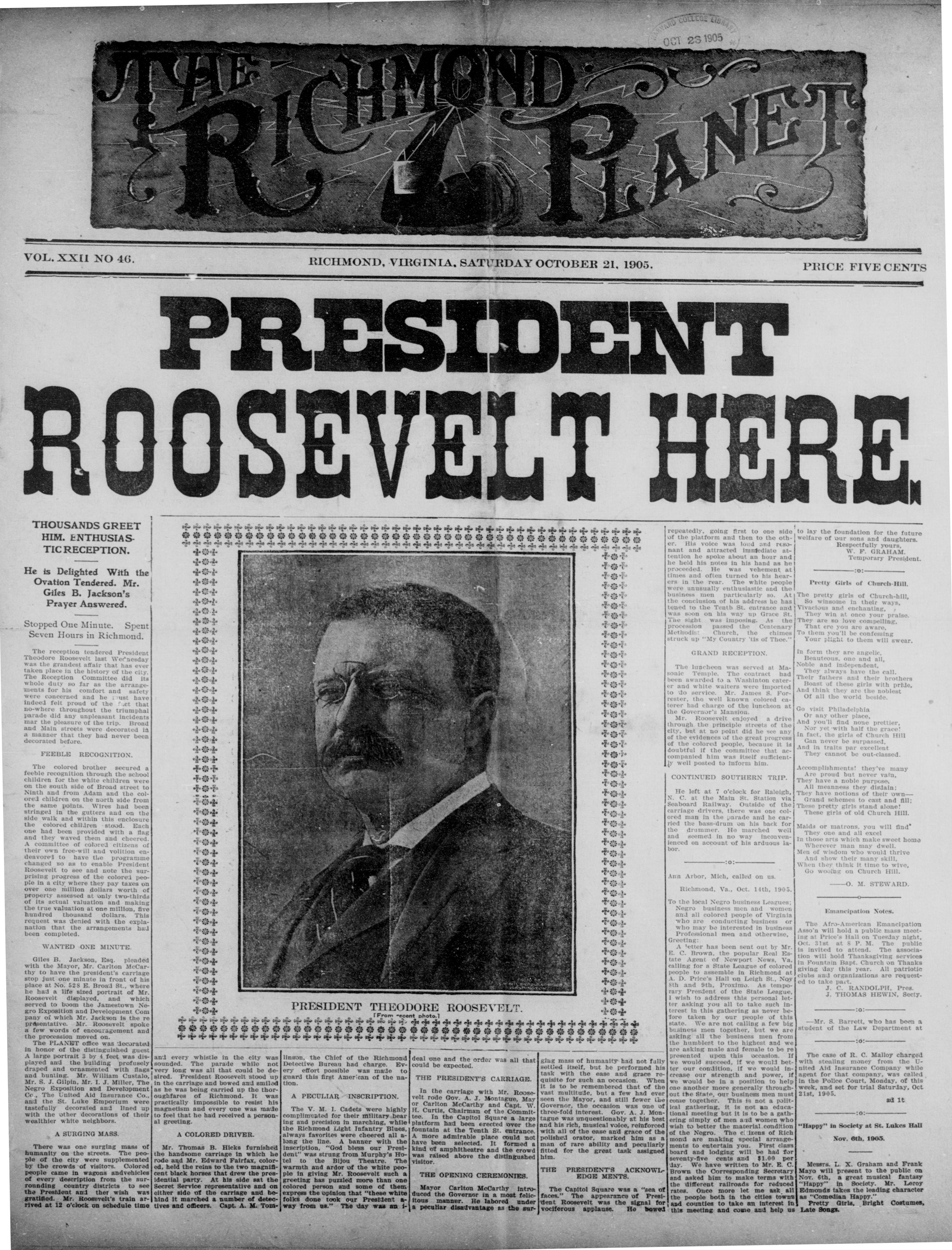
PRESIDENT ROOSEVELT HERE.
VOL. XXII NO 46.
THOUSANDS GREET
HIM. ENTHUSIAS-
TIC RECEPTION.
He is Delighted With the
Ovation Tendered. Mr.
Giles B. Jackson's
Prayer Answered.
Stopped One Minute. Spent
Seven Hours in Richmond.
The reception tendered President
Theodore Roosevelt last Wednesday
was the grandest affair that has ever
taken place in the history of the city.
The Reception Committee did its
whole duty so far as the arrangements
for his comfort and safety
were concerned and he must have
indeed felt proud of the fact that
no-where throughout the triumphal parade did any unpleasant incidents mar the pleasure of the trip. Broad and Main streets were decorated in a manner that they had never been decorated before.
FEEBLE RECOGNITION
The colored brother secured a feeble recognition through the school children for the white children were on the south side of Broad street to Ninth and from Adam and the colored children on the north side from the same points. Wires had been stringed in the gutters and on the side walk and within this enclosure the colored children stood. Each one had been provided with a flag and they waved them and cheered. A committee of colored citizens of their own free-will and volition endeavored to have the programme changed so as to enable President Roosevelt to see and note the surprising progress of the colored people in a city where they pay taxes on over one million dollars worth of property assessed at only two-thirds of its actual valuation and making the true valuation at one million, five hundred thousand dollars. This request was denied with the explanation that the arrangements had been completed.
WANTED ONE MINUTE
Giles B. Jackson, Esq. pleaded with the Mayor, Mr. Carlton McCarthy to have the president's carriage stop just one minute in front of his place at No. 528 E. Broad St., where he had a life sized portrait of Mr. Roosevelt displayed, and which served to boom the Jamestown Negro Exposition and Development Company of which Mr. Jackson is the re presentative. Mr. Roosevelt spoke a few words of encouragement and the procession moved on.
The PLANET office was decorated in honor of the distinguished guest A large portrait 3 by 4 feet was displayed and the building profusely draped and ornamented with flags and bunting. Mr. William Custalo, M. S. J. Gilpin, Mr. I. J. Miller, the Negro Exposition and Development Co., the United Aid Insurance Co., and the St. Luke Emporium were tastefully decorated and lined up with the other decorations of their wealthier white neighbors.
A SURGING MASS
There was one surging mass of humanity on the streets. The people of the city were supplemented by the crowds of visitors. Colored people came in wagons andvehicles of every description from the surrounding country districts to see the President and their wish was gratified. Mr. Roosevelt's train arrived at 12 o'clock on schedule time
```markdown
```
PHOTO BY
S. W. RITCHIE BURDEN
WASHINGTON
the photo
```markdown
```
and every whistle in the city was sounded. The parade while not very long was all that could be desired. President Roosevelt stood up in the carriage and bowed and smiled as he was being carried up the thoroughfares of Richmond. It was practically impossible to resist his magnetism and every one was made to feel that he had received a personal greeting.
A COLORED DRIVER.
Mr. Thomas B. Hicks furnished the handsome carriage in which he rode and Mr. Edward Fairfax, colored, held the reins to the two magnificent black horses that drew the presidential party. At his side sat the Secret Service representative and on either side of the carriage and behind it marched a number of detectives and officers. Capt. A. M. Tom-
RICHMOND, VIRGINIA, SATURDAY OCTOBER 21.1905.
linson, the Chief of the Richmond Detective Bureau had charge. Every effort possible was made to guard this first American of the nation.
A PECULIAR INSCRIPTION.
The V. M. I. Cadets were highly complimented for their military bearing and precision in marching, while the Richmond Light Infantry Blues, always favorites were cheered all along the line. A banner with the inscription, "God bless our President" was strung from Murphy's Hotel to the Bijou Theatre. The warmth and ardor of the white people in giving Mr. Roosevelt such a greeting has puzzled more than one colored person and some of them express the opinion that "these white folks done took our President away from us." The day was an i-
deal one and the order was all that could be expected.
THE PRESIDENT'S CARRIAGE.
In the carriage with Mr. Roosevelt velt rode Gov. A. J. Montague, May or Carlton McCarthy and Capt. W. H. Curtis, Chairman of the Committee. In the Capitol Square a large platform had been erected over the fountain at the Tenth St. entrance. A more admirable place could not have been selected. It formed a kind of amphitheatre and the crowd was raised above the distingushed visitor.
THE OPENING CEREMONIES
Mayor Carlton McCarthy introduced the Governor in a most felicitous manner. He labored under a peculiar disadvantage as the sur-
```markdown
```
ging mass of humanity had not fully settled itself, but he performed his task with the ease and grace requisite for such an occasion. When it is to be remembered that of the vast multitude, but a few had ever seen the Mayor, and still fewer the Governor, the occasion was one of three-fold interest. Gov. A. J. Montague was unquestionably at his best and his rich, musical voice, reinforced with all of the ease and grace of the polished orator, marked him as a man of rare ability and peculiarly fitted for the great task assigned him.
THE PRESIDENT'S ACKNOWL- EDGE MENTS.
The Capitol Square was a "sea of faces." The appearance of President Roosevelt was the signal for vociferous applause. He bowed
repeatedly, going first to one side of the platform and then to the other. His voice was loud and resonant and attracted immediate attention he spoke about an hour and he held his notes in his hand as he proceeded. He was vehement at times and often turned to his hearers in the rear. The white people were unusually enthusiastic and the business men particularly so. At the conclusion of his address he has tened to the Tentb St. entrance and was soon on his way up Grace St. The sight was imposing. As the procession passed the Centenary Methodist: Church, the chimes struck up "My Country 'tis of Thee."
GRAND RECEPTION.
The luncheon was served at Masonic Temple. The contract had been awarded to a Washington caterer and white waiters were imported to do service. Mr. James S. Forrester, the well known colored caterer had charge of the luncheon at the Governor's Mansion. Mr. Roosevelt enjoyed a drive through the principle streets of the city, but at no point did he see any of the evidences of the great progress of the colored people, because it is doubtful if the committee that accompanied him was itself sufficiently well posted to inform him.
CONTINUED SOUTHERN TRIP.
He left at 7 o'clock for Raleigh, N. C. at the Main St. Station via Seaboard Railway. Outside of the carriage drivers, there was one colored man in the parade and he carried the bass-drum on his back for the drummer. He marched well and seemed in no way inconvenienced on account of his arduous labor.
Ann Arbor, Mich, called on us
To the local Negro business Leagues; Negro business men and women and all colored people of Virginia who are conducting business or who may be interested in business Professional men and otherwise, Greeting:
A letter has been sent out by Mr. E. C. Brown, the popular Real Estate Agent of Newport News, Va, calling for a State League of colored people to assemble in Richmond at A. D. Price's Hall on Leigh St. Nov 9th and 9th, Proximo. As temporary President of the State League, I wish to address this personal letter asking you all to take such interest in this gathering as never before taken by our people of this state. We are not calling a few big business men together, but we are asking all the business men from the humblest to the highest and we are asking male and female to be presented upon this occasion. If we would succeed, if we would better our condition, if we would increase our strength and power, if we would be in a position to help one another more generally throughout the State, our business men must come together. This is not a political gathering, it is not an educational meeting but it is to be a gathering simply of men and women who wish to better the material condition of the Negro. The citizens of Richmond are making special arrangements to entertain you. First class board and lodging will be had for seventy-five cents and $1.00 per day. We have written to Mr. E. C. Brown the Corresponding Secretary and asked him to make terms with the different railroads for reduced rates. Once more let me ask all the people both in the cities town and counties to take an interest in this meeting and come and help us
PRICE. FIVE CENTS
to lay the foundation for the future
welfare of our sons and daughters.
Respectfully yours,
W. F. GRAHAM.
Temporary President.
Pretty Girls of Church-Hill.
The pretty girls of Church-hill,
So winsome in their ways,
Vivacious and enchanting,
They win at once your praise.
They are so love compelling,
That are you are aware,
To them you'll be confessing
Your plight to them will swear.
In form they are angelic,
Beauteous, one and all,
Noble and independent,
They always have the call.
Their fathers and their brothers
Boast of these girls with pride,
And think they are the noblest
Of all the world beside.
Go visit Philadelphia
Or any other place,
And you'll find none prettier,
Nor yet with half the grace!
In fact, the girls of Church Hill
Can never be surpassed,
And in traits par excellent
They cannot be out-classed.
Accomplishments! they've many
Are proud but never vain,
They have a noble purpose,
All meanness they dislain;
They have notions of their own—
Grand schemes to cast and fill;
These pretty girls stand alone!
These girls of old Church Hill.
Malds or matrons, you will find* They one and all excel In those arts which make sweet home Wherever man may dwell. Men of wisdom who would thrive And show their many skill, When they think it time to wive, Go wooing on Church Hill.
-O. M. STEWARD
Emancipation Notes.
The Afro-American Emancipation Asso' will hold a public mass meeting at Price's Hall on Tuesday night, Oct. 31st at 8 P.M. The public is invited to attend. The association will hold Thanksgiving services in Fountain Bapt. Church on Thanks giving day this year. All patriotic clubs and organizations are requested to take part. J. C. RANDOLPH, Pres. J. THOMAS HEWIN, Secty.
—Mr. S. Barrett, who has been a student of the Law Department at
The case of R. C. Malloy charged with stealing money from the United Aid Insurance Company while agent for that company, was called in the Police Court, Monday, of this week, and set for trial Saturday, Oct 21st, 1905. ad 1t
"Happy" in Society at St. Lukes Hall
Messrs. L. K. Graham and Frank Mayo will present to the public on Nov. 6th, a great musical fantasy "Happy" in Society. Mr. Leroy Edmonds takes the leading character as "Comedian Happy." Pretty Girls, Bright Costumes, Late Songs.
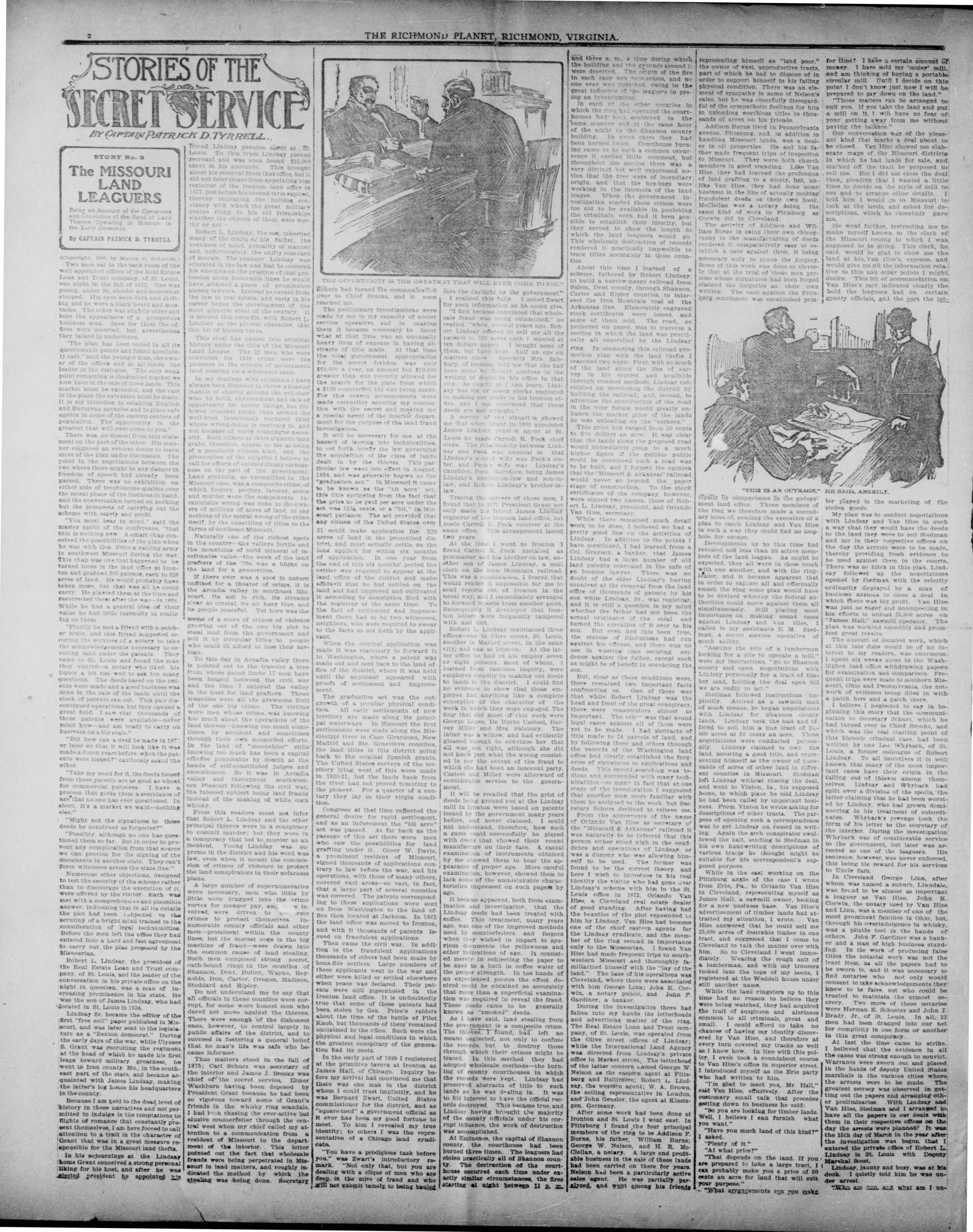
STORIES OF THE SECRET SERVICE
STORY No. 3 The MISSOURI LAND LEAGUERS
Being an Account of the Operations and Conviction of the Band of Land Thieves Operating in Missouri in the Early Seventies.
By CAPTAIN PATRICK D. TYRRELL
(Copyright, 1868, by Marton G. Scheitlin.) Two men sat in the back room of the well-appointed offices of the Real Estate Loan and Trust company, of St. Louis, one night in the fall of 1872. One was young, under 30, slender and somewhat stooped. His eyes were dark and shifting and he wore a black beard and musache. The other was slightly older and bore the appearance of a prosperous business man. Save for them the offices were deserted, but nevertheless they talked in undertones.
"The plan has been tested in all its questionable points and found absolutely safe," said the younger man, the owner of the offices and at all times the leader in the dialogue. "The only weak point remaining is the limited market we now have in the sale of these lands. This market must be extended, and the cast is the place the extension must be made. It is my intention to establish English and European agencies and to place safe agents in some of the eastern centers of population. The opportunity is the greatest that will ever come to you."
There was no dissent from this statement on the part of the other. His manner suggested an evident desire to learn more of the plan under discussion. The point in the negotiations between the two where there might be any danger in freedom of speech had already been passed. There was no exhibition on either side of troublesome qualms over the moral phase of the business in hand, and the conversation turned on nothing but the prospects of carrying out the scheme with safety and profit.
"You must bear in mind," said the master spirit of the conference, "that this is nothing new. A smart chap conceived the possibilities of the plan when he was with Gen. Price's raiding army in southwest Missouri during the war. This chap was one that happened to be turned loose in the land office at Ironon and grabbed 300 patents, each to 320 acres of land. He would probably have taken more, but that was all he could carry. He planted them at the time and resurrected them after the war—in 1888. While he had a general idea of their value he had little ingenuity in realizing on them.
"Finally he met a friend with a quicker brain, and this friend suggested souring the services of a notary to take the acknowledgements necessary to souring land under the patents. They came to St. Louis and found the man they wanted—a notary who liked his liquor a bit too well to ask too many questions. The deeds based on the patents were made and a good business was done in the sale of the lands until the stock of patents ran out. This pair discontinued operations, but they opened a great field. I saw that thousands of these patents were available—never mind how—and am ready to carry on business on a big scale."
"But how can a dead be made in 1877 or later so that it will look like it was made a dozen years before, when the patents were issued?" cautiously asked the other.
"Take my word for it, the deeds issued from these patents are as good as wheat for commercial purposes. I have a process that gives them a semblance of age that no one has ever questioned. In short, it's a market we want—nothing else."
"Might not the signaturee to these deeds be construed as forgeries?"
"Possibly, although no one has questioned them so far. But in order to prevent any complication from that source we can provide for the signing of the documents in another state. They can't force witnesses across the state line."
Numerous other objections, designed to test the security of the scheme rather than to discourage the execution of it, were offered by the visitor. Each was met with a comprehensive and plausible answer, indicating that in all its details the plot had been subjected to the scrutiny of a bright mind trained to the consideration of legal technicalities. Before the men left the office they had entered into a hard and fast agreement to carry out the plan proposed by the Missouriian. Robert L. Lindsay, the predeceident of the Real Estate Loan and Trust company, of St. Louis, and the leader of the conversation in his private office on the night in question, was a man of increasing prominence in his state. He was the son of James Lindsay, who had located in St. Louis in 1834.
Lindsay Sr. became the editor of the first "free soil" paper published in Missouri, and was later sent to the legislature as a "Benton democrat." During the early days of the war, while Ulysses S. Grant was recruiting the regiment at the head of which he made his first leaps toward military greatness, he went to Iron county, Mo., in the southeast part of the state, and became acquainted with James Lindsay, making the latter's log house his headquarters in the county.
Because I am held to the dead level of history in these narratives and not permitted to indulge in the temptations to flights of romance that constantly present themselves, I am here forced to call attention to a trait in the character of Grant that was in a great measure responsible for the Missouri land thefts.
In his sojournings at the Lindsay home Grant conceived a strong personal liking for his host, and after he was elected president he appointed his
Friend Lindsay pension agent at St. Louis. To this trust Lindsay proved recruit and was soon found $22,000 short in his accounts. This brought about his removal from that office, but it did not deter Grant from appointing him registrar of the fronton land office in 1877, just before his second term expired, thereby indicating the buildup constancy with which the great military genius clung to his old friendships whether the objects of them were worthy or not.
Robert L. Lindsay, the son, inherited many of the traits of his father, the keenness of mind, geniality of manner and, unfortunately, the shifty standard of morals. The younger Lindsay was educated in the law and had he centered his energies on the practice of that profession along honorable lines he would have attained a place of prominence among lawyers. Instead he turned from the law to real estate, and early in his career began the development of the most gigantic steal of the century. It is around this swindle, with Robert L. Lindsay as the pivotal character, that this bit of history turns.
This steal has passed into criminal history under the title of the Missouri Land League. The 22 men who were convicted for this crime were the pioneers in the science of government land stealing on a wholesale basis.
In my dealings with criminals I have always been disposed to throw a heavier mantle of charity around the evil-doer who, by birth, environment and lack of opportunity for better things, has followed criminal paths, than around the well-bred, luxuriously nurtured thief whose wrong-doing is contrary to, and not because of, early training or necessity. Such crimes as these gigantic land grabs, therefore, appeal to me as being of a peculiarly vicious kind, and the prosecution of the culprits I believe to call for efforts of extraordinary earnestness on the part of the government. Land grabbing, as exemplified in the Missouri case, was a composite crime, of which forgery, perjury, larceny, arson and murder were the components. Incalculable wrong was done to the owners of millions of acres of land, to say nothing of the moral wrong of the crime itself, by the unsettling of titles to the farms of southeast Missouri.
Naturally one of the richest spots in the country—the valleys fertile and the mountains of solid mineral of inestimable value—the work of the land grafters of the '70s was a blight on the land for a generation.
If there ever was a spot in nature unfited for a theater of orime, it is the Arcadia valley in southeast Missouri. Its soil is rich, its streams clear as crystal, its air hazy blue, and its people peaceful. Yet here was the scenes of a score of crimes of violence growing out of the one big plot to steal land from the government and sell it by irregular titles to people who could ill afford to lose their savings.
To this day in Arcadia valley there is pointed out to the traveler a tree from whose gaunt limbs 17 men have been hanged between the civil war and the time I entered the valley in the hunt for land grafters. These tragedies were all the grewsome fruit of the one big crime. The victims were men whose crime, was knowing too much about the operations of the land thieves—knowing too much sometimes by accident and sometimes through their own misguided efforts. In the land of "moonshine" still knowing too much has been a capital offence punishable by death at the hands of self-constituted judges and executioners. So it was in Arcadia valley and throughout southwestern Missouri following the civil war, the tabooed subject being land frauds instead of the making of white corn whisky.
From this readers must not infer that Robert L. Lindsay and the other principal thieves were in a conspiracy to commit murder; but they were in a conspiracy that led to murder as an incident. Young Lindsay was supreme in the district and his word was law, even when it meant the commission of crimes of violence to protect the land conspirators in their nefarious plans.
A large number of supernumeraries were necessary, men who little by little were dragged into the crime vortex for meager pay, and more involved, were driven to userate crimes to protect themselves. Innumerable county officials and other men—prominent within the county lines, but the most cogs in the big machine of fraud—were drawn into the common cause of land stealing. Such men composed strong secret, oath-bound rings in the counties of Shannon, Dent, Butler, Wayne, Reynolds, Iron, Carter, Oregon, Madison, Stoddard and Ripley.
Do not understand me to say that all officials in these counties were corrupt, for some were honest men who dared not move against the thieves. There were enough of the dishonest ones, however, to control largely in public affairs of the district, and to succeed in fostering a general belief that no man's life was safe who became informer.
Thus matters stood in the fall of 1875; Carl Schurz was secretary of the interior and James J. Brooks was chief of the secret service, Elmer Washburn having been deposed by President Grant because he had been so vigorous toward some of Grant's friends in the whisky ring scandals. I had been chasing the ever-active but elusive counterfeiter through the central west when my chief called my attention to a communication from a resident of Missouri to the department of the interior. This letter pointed out the fact that wholesale frauds were being perpetrated in Missouri in land matters, and roughly indicated the method by which the stealing was being done. Secretary
THE RICHMOND PLANET, RICHMOND, VIRGINIA
THE JUDGE
THE OPPORTUNITY IS THE GREATE ST THAT WILL EVER COME TO YOU"
Echurz had turned the communication over to Chief Brooks, and it soon reached me.
The preliminary investigations were made by me in my capacity of secret service operative, and in making them it became necessary to incur what at that time was an unusually heavy item of expense in having abstracts of title made. At that time the total government appropriation for the secret division was only $60,000 a year, an amount but $10,000 greater than was recently allowed for the search for the plate from which a $100 counterfeit bill was made. For this reason arrangements were made ostensibly severing my connection with the secret and making me a special agent of the interior department for the purpose of the land fraud investigation.
Into the daylight by the government."
I realized this fully. I asked Zwart for such information as he could give. "I first became convinced that wholesale fraud was being committed," he replied, "when several years ago. Robert Lindsey offered to sell me all the patients to 320 acres each I wanted at ten dollars apiece. I bought none of them, but have kept half an eye on matters since. Recently Mrs. Salbury, of Ironton, told me that she had been hired by Robert Lindsey in the writing of deeds in his office in that city. As nearly as I can learn, Lindsey has six or seven clerks employed in making out deeds in his Ironton office, and I am convinced that these deeds are not straight."
A survey of the situation showed me that when Grant in 1869 appointed James Lindsey engrant at St
It will be necessary for me, at the hazard of leaping into technicalities, to set forth briefly the law governing the acquisition of the class of lands dealt in by the thieves. This particular law went into effect in August, 1854, and was generally known as the "graduation act." In Missouri it came to be known as the "bit acre" act, this title sprouting from the fact that the price to be paid per acre under the act was 12 1/2 cents, or a "bit," in Missouri parlance. The act provided that any citizen of the United States over
21 could make application for 320 acres of land in the prescribed district, and must actually settle on the land applied for within six months of application. In one year from the end of this six months' period the settler was required to appear at the land office of the district and make affidavit that he had settled on the land and had improved and cultivated it according to description filed with the registrar at the same time. To the fact of settlement and improvement there had to be two witnesses, neighbors, who were required to swear to the facts as set forth by the applicant. When the original application was made it was customary to forward it to Washington, where a patent was made out and sent back to the land office of the district, where it was held until the applicant appeared with proofs of settlement and improvement.
The graduation act was the outgrowth of a peculiar physical condition. All early settlements of new territory are made along its principal waterways. In Missouri the first settlements were made along the Mississippi river in Cape Gardeau, New Madrid and Ste. Genevieve counties, the land titles in this district going back to the original Spanish grants. The United States surveys of the territory lying west of this were made in 1820-21, but the lands back from the river had not proved tempting to the pioneer. For a quarter of a century they lay in their virgin condition.
Congress at that time reflected the general desire for rapid settlement, and as an inducement the "bit acre" act was passed. As far back as the passage of this act there were men who saw the possibilities for land grafting under it. Greer W. Davis, a prominent resident of Missouri, signed thousands of applications contrary to law before the war, and his operations, with those of many others, covered vast areas—so vast, in fact, that a large part of several counties was covered. The patents corresponding to these applications were sent on from Washington to the land office then located at Jackson. In 1861 the land office was moved to Ironon, and with it thousands of patents issued on fraudulent applications.
Then came the civil war. In addition to the fraudulent applications thousands of others had been made by bona-fide settlers. Large numbers of these applicants went to the war and either were killed or settled elsewhere when peace was declared. Their patients were still pigeonholed in the Ironton land office. It is undoubtedly true that some of these patents had been stolen by Gen. Price's raiders about the time of the battle of Pilot Knob, but thousands of them remained unclaimed in the office. Such were the physical and legal conditions in which the greatest conspiracy of the generation had its roots.
In the early part of 1880 I registered at the primitive tavern at Ironon as James Hall, of Chicago. Inquiry before my arrival had convinced me that there was one man in the district whom I could trust implicitly, and he was Bernard Zwart, United States commissioner for the district, and as "square-toed" a government official as it ever has been my good fortune to meet. To him I revealed my true identity; to others I was the representative of a Chicago land syndicate.
"You have a prodigious task before you." was Zwart's introductory remark. "Not only that, but you are dealing with a clique of men who are deep in the mire of fraud and who will not submit tamely to being hauled
into the daylight by the government."
I realized this fully. I asked Zwart for such information as he could give. "I first became convinced that whole-sale fraud was being committed," he replied. "when, several years ago, Robert Lindsay offered to sell me all the patents to 320 acres each I wanted at ten dollars apiece. I bought none of them, but have kept half an eye on matters since. Recently Mrs. Salbury, of Ironton, told me that she had been hired by Robert Lindsay in the writing of deeds in his office in that city. As nearly as I can learn, Lindsay has six or seven clerks employed in making out deeds in his Ironton office, and I am convinced that these deeds are not straight."
A survey of the situation showed me that when Grant in 1869 appointed James Lindsay pension agent at St. Louis he made Carroll R. Peck chief clerk. The relationship between Lindsay and Peck was unusual in that Lindsay's second wife was Peck's sister, and Peck's wife was Lindsay's daughter, Peck therefore, being James Lindsay's brother-in-law and son-in-law, and Robert Lindsay's brother-in-law.
Tracing the careers of these men, I found that in 1877 President Grant not only made his friend James Lindsay registrar of the fronton land office, but made Carroll R. Peck receiver at the same office. This arrangement lasted two years.
At the time I went to Ironton I found Carroll R. Peck installed as postmaster and his brother-in-law, another son of James Lindsay, a mail clerk on the Iron Mountain railroad. This was a combination, I feared, that would render it impossible for me to send reports out of Ironton in the usual way, and I immediately arranged to forward reports from another point. Subsequently it developed that Ironton letters were frequently tampered with and lost.
Robert L. Lindsay maintained three offices—one in Olive street, St. Louis, another in Market street, in the same city, and one at Ironon. At the latter office he had in his employ seven or eight persons, most of whom, I learned from cautious inquiry, were employed steadily in making out deeds to lands in the district. I could find no evidence to show that these employees had anything like a complete conception of the character of the work in which they were engaged. The four that did most of this work were George Lopez, De Burns Casteel, Harvey Miller and Mrs. Salsbury. The latter was a widow, and had evidently gleaned enough to convince her that all was not right, although she did not know just what the wrong consisted in nor the extent of the fraud to which she had been an innocent party, Casteel and Miller were afterward of considerable service to the government.
It will be recalled that the grist of deeds being ground cut at the Lindsay mill in Ironton were based on patents issued by the government many years before, and never claimed. I could not understand, therefore, how such a game could successfully be played with deeds that showed their recent manufacture on their face. A casual examination of instruments obtained by me showed them to bear the appearance of proper age. More careful examination, however, showed them to lack some of the unmistakable characteristics impressed on such papers by age.
It became apparent, both from examination and investigation, that the Lindsay deeds had been treated with coffee. This treatment, many years ago, was one of the improved methods used by counterfeiters and forgers when they wished to impart to spurious documents the yellowness and other indications of age. It consisted merely in subjecting the paper to be aged to a bath in coffee water of the proper strength. In the hands of an experienced person the effect desired could be obtained so accurately that more than a superficial examination was required to reveal the fraud. These deeds came to be generally known as "smoked" deeds.
As I have said, land stealing from the government is a composite crime. The thieves, I found, had left no means neglected, not only to confuse the records, but to destroy those through which their crimes might be traced. In this method they had adopted wholesale methods—the burning of county courthouses in which the records were kept. Lindsay had preserved abstracts of title to such lands as he was dealing in. It was to his interest to have the official records destroyed. This became true, and Lindsay having brought the majority of the county officials under his corrupt influence, the work of destruction was accomplished.
At Eminence, the capital of Shannon county, the courthouse had been burned three times. The leaguers had stolen practically all of Shannon county. The destruction of the courthouse occurred each time under exactly similar circumstances, the fires starting at night between 11 p. m.
and three a. m., a time during which the building and the grounds around it were deserted. The origin of the fire in each case was mysterious, and no one ever was punished, owing to the great influence of the leaguers in preying an investigation.
In each of the other counties in which the ring had operated the court-houses had been destroyed. In the same manner and at the same hour of the night as the Shannon county building. In some cases they had been burned twice. Courthouse burning came to be such a common occurrence it excited little comment, but throughout the section there was a very distinct but well suppressed notion that the fires were of incendiary origin, and that the nire-bugs were working in the interests of the land league. When the government investigation started these crimes were too old to be available in punishing the criminals, even had it been possible to establish their identity, but they served to show the length to which the land leaguers would go. This wholesale destruction of records rendered it practically impossible to trace titles accurately in these counties.
About this time I learned of a scheme, fathered by Robert Lindsey, to build a narrow-gauge railroad from Salem, Dent county, through Shannon, Carter and Ripley counties, to intersect the Iron Mountain road at the Arkansas line. Elaborately engraved stock certificates were issued, and some of them sold. The road, as projected on paper, was to traverse a section in which the land was practically all controlled by the Lindsay ring. In connecting this railroad promotion plan with the land thefts I reasoned two ways: First, with so much of the land along the line of survey in his control and available through crooked methods, Lindsay calculated on developing the district by building the railroad; and, second, to advertise the construction of the road in the near future would greatly enhance the market price of the lands he was unloading on the "suckers."
This price had ranged from 50 cents to five dollars an acre. It was clear that the lands along the proposed road would immediately jump to a much higher figure if the guiluble public could be convinced such a road was to be built, and I formed the opinion that the "Missouri & Arkansas" railroad would never go beyond the paper stage of construction. To the stock certificates of the company, however, were signed two names, those of Robert L. Lindsay, president, and Orlando Van Hise, secretary.
While there remained much detail work to be done, I believed we had a pretty good line on the activities of Lindsay. In addition to the points I have mentioned, I had learned from a Col. Grayson, a banker, that James Lindsay had a large number of old land patents concealed in the safe of an ironon lawyer. There was no doubt of the elder Lindsay's having connived at the removal from the land office of thousands of patents by his son while Lindsay, Sr., was registrar, and it is still a question in my mind whether the father had not been the actual originator of the steal and turned the execution of it over to his son. But even had this been true, the statute of limitations had run against his offense, and there was no use in wasting time securing evidence against the father, except such as might be of benefit in convicting the son.
But, clear as these conditions were, there remained two important facts confronting us. One of these was that while Robert Lindsey was the head and front of the great conspiracy, there were conspirators almost as important. The other—was that sound legal cases against all of them were yet to be made. I had abstracts of title made to 24 parcels of land, and by following these and others through the records of the Washington land office had clearly established the forgeries of signatures to applications and deeds. This record searching was tedious and surrounded with many technicalities—so many in fact that at one stage of the investigation I suggested that another man more familiar with them be assigned to the work, but Secretary Schurz declined to relieve me.
From the appearance of the names of Orlando Van Hise as secretary of the "Missouri & Arkansas" railroad it was naturally to be inferred that this person either stood nigh in the confidence and operations of Lindsay, or was a dummy who was allowing himself to be used. The former was found to be the correct theory, and here I wish to introduce in his real identity the visitor who had gone over Lindsay's scheme with him in the St. Louis office in 1872, Orlando Van Hise, a Cleveland real estate dealer of good standing. After having had the beauties of the plot expounded to him by Lindsay, Van Hise had become one of the chief eastern agents for the Lindsay syndicate, and the member of the ring second in importance only to the Missouriian. I found Van Hise had made frequent trips to southwestern Missouri and thoroughly familiarized himself with the "lay of the land." The base of his operations was Cleveland, where there were associated with him George Linn; John K. Corwin, a notary public, and John F. Gardiner, a banker.
During the investigation there had fallen into my hands the letterheads and advertising matter of the ring. The Real Estate Loan and Trust company, of St. Louis, was operated from the Olive street offices of Lindsay; while the International Land Agency was directed from Lindsay's private office in Market street. The letterhead of the latter concern named George W. Nelson as the eastern agent at Pittsburg and Baltimore; Robert L. Lindsay, the western agent; W. A. Brown, the selling representative in London, and John Gensaler, the agent at Kissingen, Germany.
After some work had been done at Ironton and St. Louis I went east. In Pittsburg I found the four principal members of the ring to be Addison F. Burns, his father, William Burns; George W. Nelson, and H. R. McClellan, a natery. A large and profitable business in the sale of these lands had been carried on there for years. Nelson had been a particularly active sales agent. He was partially paralyzed, and went among his friends
representing himself as "land poor," the owner of vast, unproductive tracts, part of which he had to dispose of in order to support himself in his failing physical condition. There was an element of sympathy in some of Nelson's sales, but he was cheerfully disregardful of the sympathetic feelings for him in unloading worthless titles to thousands of acres on his friends. Addison Burns lived in Pennsylvania avenue, Pittsburgh, and, in addition to handling Missouri landa, was a dealer in oil properties. He and his father made frequent trips of inspection to Missouri. They were both church members in good standing. Like Van Hise, they had learned the profession of land grafting to a nicety, but, unlike Van Hise, they had done some business in the line of actually making fraudulent deeds on their own hook. McClellan was a lottery doing the same kind of work in Pittsburgh as Corwin did in Cleveland.
The activity of Addison and William Burns in using their own chirnography in the manufacturing of deeds rendered it comparatively easy to establish a case against them, it being necessary only to prove the forgery. Some of this work was done so cleverly that at the trial of these men persons whose signatures had been forged claimed the forgeries as their own writing. The case against the Pittsburg contingent was established prin-
A
A
"TITLE IS AN OUTRAGE," HE SAID, ANGRILY.
clipally by comparisons in the government land office. These members of the ring we therefore made a secondary issue of, pending the execution of a plan to catch Lindsay and Van Hise in such a way they could find no loophole for escape. Developments up to this time had revealed not less than 20 active members of the land league. As might be expected, they all were in close touch with one another, and with the ring-leader, and it became apparent that in order to capture all and effectually smash the ring some plan would have to be devised whereby the federal authorities could move against them all simultaneously. Still placing most importance on making sound cases against Lindsay and Van Hise, I called to my assistance E. M. Stedman, a secret service operative of much ability.
"Assume the role of a lumberman looking for a site to operate a mill," were my instructions, "go to Shannon county and open negotiations with Lindsay personally for a tract of timber land, holding the deal open till we are ready to act."
Stedman followed instructions implicitly. Attired as a sawmill man of much means, he began negotiations with Lindsay for Shannon county lands. Lindsay took the bait and offered to sell him a fine tract of 23,000 acres at 50 cents an acre. These negotiations were conducted personally. Lindsay claimed to own the land, assuring a good title, and representing himself as the owner of thousands of acres of other land in different counties in Missouri. Stedman left Lindsay without closing the deal, and went to Vinton, Ia., his supposed home, to which place he told Lindsay he had been called by important business. From Vinton he wrote asking for descriptions of other tracts. The purpose of opening such a correspondence was to get Lindsay on record in writing. Again the arch conspirator swallowed the bait, sending to Stedman in his own handwriting descriptions of various tracts he thought might be suitable for his correspondent's supposed purpose.
While in the east working on the Pittsburg angle of the case I wrote from Erie, Pa., to Orlando Van Hise in Cleveland, representing myself as James Hall, a sawmill owner, looking for a new business base. Van Hise's advertisement of timber lands had attracted my attention, I wrote. Van Hise answered that he could sell me 25,000 acres of desirable timber in one tract, and suggested that I come to Cleveland to talk the matter over with him. So to Cleveland I went immediately. Wearing the rough suit of a lumberman, and with my trousers tucked into the tops of my boots, I registered at the Weddell house under still another name.
While the land ringsters up to this time had no reason to believe they were being watched, they had acquired the trait of suspicion and alertness common to all criminals, great and small. I could afford to take no chances of having my identity discovered by Van Hise, and therefore at every turn covered my tracks as well as I knew how. In line with this policy, I even took a roundabout course to Van Hise's office in superior street. I introduced myself as the Erie party who had written to him.
"I'm glad to meet you, Mr. Hall," said Van Hise, effusively. After the customary small talk that precedes getting down to business he said:
"So you are looking for timber lands. Well, I believe I can furnish what you want."
"Have you much land of this kind?" I asked.
"That depends on the land. If you are prepared to take a large tract, I can probably make you a price of 50 cents an acre for land that will suit your purpose."
"What arrangements can you make
"At what price?"
for time? I have a certain amount of money. I have sold my 'muler' mill, and am thinking of buying a portable circular mill. Until I decide on this point I don't know just how I will be prepared to pay down on the land."
"Those matters can be arranged to suit you. If you take the land and put a mill on it, I will have no fear of your getting away from me without paying the balance."
Our conversation was of the pleasant kind that marks a deal about to be closed. Van Hise showed me elaborate maps of the Missouri districts in which he had lands for sale, and marked off the treat he proposed to sell me. But I did not close the deal then, pleading that I wanted a little time to decide on the style of mill to use and to arrange other details. I told him I would go to Missouri to look at the lands, and asked for descriptions, which he cheerfully gave me.
He went further, instructing me to make myself known to the clerk of the Missouri county to which I was supposed to be going. This clerk, he said, would be glial to show me the land at his, Van Hise's, expense, and would give me all the information relative to this and other points I might desire. This bit of accommodation on Van Hise's part indicated clearly the hold the leaguers had on certain county officials, and the part the lat-
A
ter played in the marketing of the stolen goods. My plan was to conduct negotiations with Lindsay and Van Hise in such a way that they would have the deeds to the land they were to sell Stedman and me in their respective offices on the day the arrests were to be made, thereby providing fresh evidence to be used against them in the courts. There was no hitch in this plan. Lindsay followed up the negotiations opened by Stedman with the celerity ordinarily displayed by a man of businesses anxious to close a deal in which there was big profit. Van Hise was just as eager and unsuspecting in his efforts to unload 25,000 acres on "James Hall," sawnill operator. The plan was working smoothly and promised great results.
The amount of detailed work, which at this late date would be of no interest to my readers, was enormous. I spent six weeks alone in the Washington land office withdrawing papers for examination and comparison. Frequent trips were made to southern Missouri, Ohio and Pennsylvania, the network of evidence being filled in with a patch here and a patch there.
I believe I neglected to say in beginning this story that the communication to Secretary Schurz, which he had turned over to Chief Brooks, and which was the real starting point of this historic criminal case, had been written by one Leo Whybark, of St. Louis, a former colleague of Robert Lindsay. To all detectives it is well known that many of the most important cases have their origin in the falling out of thieves among themselves. Lindsay and Whybark had split over a division of the spoils, the latter claiming that he had been worsted by Lindsay, who had grown domineering in his treatment of subordinates. Whybark's revenge took the form of his letter to the secretary of the interior. During the investigation Whybark was of considerable service to the government, but later was arrested as one of the leaguers. His sentence, however, was never enforced, this being his reward for his services to Uncle Sam.
In Cleveland George Linn, after whom was named a suburb, Linnaldale, was found to be almost as important a leaguer as Van Hise. John K. Corwin, the notary used by Van Hise and Linn, was a member of one of the most prominent families in Ohio, but, through his overindulgence in whisky, was a pliable tool in the hands of others. John F. Gardiner was a banker and a man of high business standing. In the work of producing false titles the notarial work was not the least item, as all the papers had to be sworn to, and it was necessary to find notaries who not only would consent to take acknowledgements they knew to be false, but who could be trusted to maintain the utmost secrecy. Two more of these notaries were Herman E. Schuster and John J. Brady, Jr., of St. Louis. In all, 22 men had been dragged into our net for complicity in one form or another in this great conspiracy.
At last the time came to strike. I believed that the evidence in all the cases was strong enough to convict. Warrants were sworn out and placed in the hands of deputy United States marshals in the various cities where the arrests were to be made. The greatest secrecy was observed in getting out the papers and arranging other preliminaries. With Landsey and Van Hise, Stedman and I arranged to have all the papers in our deals with them in their respective offices on the day the arrests were planned. It was the 15th day of March in the year after the investigation was begun that I entered the private office of Robert L. Lindsay in St. Louis with Deputy Marshal Soest. Lindsay, jaunty and busy, was at his desk. I quietly told him he was under arrest.
"Who are you and what am I un-
LIGHT PLANET
SECRET SERVICE.
"The Missouri Land Leaguers."
der arrest for the demabed.
I told him who I was, and, briefly, what he was wanted for.
"All right," he said, coolly, reaching for his hat, "but you came just in time to spoil a big trade for me."
Then he became indignant.
"This is an outrage," he said, angerly, "a plot put up by Carl Schurz to ruin me. It's the work of the d—d reformers in the republican party, and is going to hurt the party."
As nearly at the same instant as was physically possible, the arrests of a score or more of the leaguers was made in St. Louis and other cities. All were placed under Londes, the furnishing of ball being a comparatively easy matter for men of such prominence and means as most of them were.
Then began a most desperate fight for freedom on the part of the land leaguers—a fight in which was employed every agency from the influence of the highest dignitaries in the republican party to the intimidation of even minor witnesses by threats of lynching. Among the men who had been carelessly let into possession of incriminating information against Lindsay was Frank Smith, an employee of President Thompson, of the Boatmen's bank, of St. Louis, who had a country seat at Ironton. One day the following notice was sent to Smith from a mysterious source:
* Frank Smith, Ironton, Mo.
* Prepare with your maker—he will want you to come to him very soon.
* We will on August 16, at 12 o'clock, nightly, come to your house and hang up your coat, you are dead. May you be ready to die!
* BEWARE.
* PARTY OF THE WEEKS.
With the history of the tree of death in Arcadia valley in their minds the persons upon whom such notices were served did not look upon them as jests or idle threats. Seventeenth corpses had dangled from the limbs of this tree in mute testimony of the sincerity of purpose of the land leaguers; and the receipt of such a notice after the leaguers had been brought to bay was not a pleasant incident. The government maintained surveillance over the criminals and their suspected allies, however, and prevented the execution of any throats. The notice sent to Smith I found to be in the hand-writing of Robert Lindsay.
It was in high political places that the most telling fight was made by the leaguers to escape the penalty of their crimes. To explain this fight I must revert for a moment to the national political situation of that year. Grant had completed his globe-circuling tour and was being urged for a third presidential term. Among the 300 delegates to the Chicago convention that stood by him to the last were James Lindsay and Carroll R. Peck. Grant was defeated for nomination by the unexpected launching of the name of James A. Garfield, around whom the anti-Grant forces rallied. The achism in the party preceding the convention was widened by the nomination and election of Garfield, and the bitterness of feeling was nowhere more intense than in Missouri.
Robert Lindsay was prominent in the Grant faction of that state, being an officer in a large political organization with such stanch republicans as Chaucey I. Filley and others of equal prominence. His father was Grant's personal friend and political beneficiary, and the relations between the former president and the Lindsay family were very warm, as indicated by James Lindsay's appointment to one responsible position after he had proved a defaulter in a previous one.
United States Attorney Bliss, upon whom fell the chief burden of prosecution of the leaguers in the courts, was appointed by President Grant, and other government officials, the weight of whose influence should have been on the side of the prosecution, were found lukewarm in the cause. I do not mean to imply that there was any overt neglect of duty on the part of the government prosecutors nor that any of the Grant politicians used their influence corruptly; but I do say that from mysterious sources and in the most mysterious manner there came strange happenings—all in favor of the defendants. It did not take me long to see that at the rate matters were going the land leaguers would soon be free without trial.
At the time of his arrest Robert Lindsay charged his trouble to Carl Schurz. In the newspapers he charged that Secretary Schurz had discharged James Lindsay from the Ironton land office without cause, and that he, Robert, had issued a circular attacking Schurz for this act. In order to get revenge for the issuance of this circular Schurz had concocted this plot against the Lindsays, according to those worthies. The secretary of the interior was a member of the anti-Grant faction, and this gave some color, with the uninformed, to the cry of his political plotting against the Lindsays. This is the first time since the celebrated land fraud cases came before the public that the exact truth concerning their origin has been made public. The starting point, as I have related, was the falling out of Robert Lindsay and his lieutenant, Whybark, and not any desire on the part of Secretary Schurz to punish his political adversaries in the republican party.
To raise the cry of political persecution, however, was to put forward the strongest available defense. James Lindsay came forward with a newspaper interview in defense of his son and in condemnation of the federal authorities. Carroll R. Peck, in the Ironton paper owned by him, charged me with having involved the government in an
expense of $80,000 to satisfy the political enmities of my superiors. As a matter of fact, about $1,000 had been spent up to that time. The strongest political forces in the state were being pushed to their utmost capacity to bring about the release of Lindsay, especially, and the bitterest of feuds were fomented. After the 19th of September, 1881, when the word flashed across the
After the 19th of September, 1881, when the word flashed across the land that the shot fired by Gulteau on the railway platform at Washington had proved fatal, a prominent government official said to me:
"Now that Garfield is dead there is little chance of convicting the land leaguers."
This statement was made on the assumption that President Arthur was friendly to the Grant element; but this turned out to be an erroneous surmise. In answer to it I said:
"The republican party cannot afford to stand sponsor for these men."
Fully as I realized the strength of the political movement in favor of the criminals I was scarcely prepared for the sudden turn which affairs took
The cases had been brought in the United States court. Suddenly it became whispered about that the federal law governing land patents had been construed in such a way as to release the conspirators. This construction was to the following effect: That a land patent once issued was valid so far as the government was concerned without reference to the manner in which it had been obtained—in other words, if the fraud was not discovered before the patent was issued it could not be used to nullify the patent nor punish the guilty.
Here was a pretty how'd-ye-do. After a year's hard work had revealed a crime involving the clear theft of from 6,000,000 to 8,000,000 acres of valuable land from the government and thousands of individuals had been robbed, the promoters of the plot were to be restored to liberty and their former places in society because a judge claimed to have discovered a possible construction of the federal law that would attain this result. There was no claim that the land leaguers had not committed the acts with which they stood charged, but their friends claimed—and unfortunately they found ready support among government officials—that the discovery of this technicality justified the dismissal of the cases.
My position was that merely of the officer who had been largely instrumental in planning and carrying out the investigation at the orders of my superiors. But I was determined that the criminals should not escape if it was in my power to prevent. I had seen all the august power of government arrayed against malefactors whose crimes had been infinitesimal compared with that of these kid-gloved conspirators, and to me it seemed a violation of every tenet of eternal right to allow these men to go free because they were strong in the councils of their political party.
I was also convinced that the judge in question was in error legally, and in support of my view I had a letter written by Assistant Secretary of State Bell to John Sherman, secretary of the treasury, calling attention to section 5403 of the statutes, which provided that any person stealing or destroying any paper, record or document from any federal office could be fined and imprisoned. This section covered fully the thefts of land patents. Besides, it had been held by the supreme court that the actual delivery of a patent, as with a deed, was necessary to pass title. So far as the use of their technicality was concerned the defendants gained their point. On the construction referred to the cases were allowed to die in the federal court by the judge who had made the strange construction of the law.
There was but one recourse. In the perpetration of the big crime numerous individual offenses against state laws had been committed, such as forgery, perjury and obtaining money under false pretenses. We might find justice in these state courts. This was suggested, but any superiors in Washington doubted the probability of our being able to convict in the state courts on the theory that they were even more subject to influence than the federal courts. Most fortunately there came to the rescue of justice at this critical moment a man with splendid fighting ability and a deep sense of duty—Circuit Attorney Harris, of St. Louis. He possessed in a marked degree the qualifications that the federal prosecutors lacked. With him I went over the evidence. He leaped into the breach with a vim that was refreshing. He was invulnerable to political or other influences and soon mastered and marshaled for use the great mass of evidence.
In the meantime a touch of romance had been added to the drear details of the case in Cleveland. In the office of Orlando Van Hise there had been employed a clerk named Mary A. Johnson. Her sister had married George Linn, another member of the ring. She was also a notary public, and had taken many fraudulent acknowledgments for her employer. The government had intended to use Mary Johnson as a witness against Van Hise, but Cupid took a hand soon after the arrest and Van Hise and the girl were married, thus giving the government a serious setback in the prosecution of Van Hise, for a wife could not be used as a witness against her husband.
The dismissal of the cases in the federal courts and the institution in the state courts of course necessitated the rearresting of the defendants and the furnishing of new bonds. When we went to Cleveland we found that Van Hise and Linn had decamped for parts unknown, presumably Europe. The others were secured, however, and the trials were held in St. Louis, Mo.; Steubenville, Mo.; and Clarion, Pa.
Circuit Attorney Harris had mastered the evidence so thoroughly and had all the cases so well in hand that he went to Steubenville to assist in the prosecution of the Ohio conspirators. Robert Lindsey retained the most able lawyers he could find and every artifice known to them was employed. At the end of the first battle in court Robert L. Lindsey was sentenced to serve nine years in the penitentiary. This term he served, minus the time allowance for good behavior. I do not know if he be alive or dead. Far be it from me in these narratives to seek to follow any man past the point where he explated his crime in the manner prescribed by the courts. I hope he served well the les-
THE RICHMOND PLANE1, RICHMOND, VIRGINIA.
son that education, a good position in society and powerful political affiliations do not palliate crime. Crime in broadcloth is still crime.
The entire 22 were convicted and were sentenced to serve from two to nine years. These were the conspirators, big and little:
Robert L. Lindsay, Addison F. Burus, William Burns, Orlando Van Hise, George Linn, John K. Corwin, John F. Gardiner, Samuel L. Carter, David S. Bingham, J. F. Richards, Benjamin F. Picker, Herman E. Stuster, Charles Vassell, Charles Newman, John F. Norrish, H. R. McClellan, George W. Nelson, Cyrus Smith, J. S. Wolfe, John Brady, Jr.; George L. Brown, Samuel C. Clark and Leo Whybark. There were 61 indictments against Lindsay, 52 of which Attorney Bliss nolle prosequed in St. Louis while Lindsay was on trial in Steubenville.
In the courtroom at Clarion, Pa., was laid the pathetic closing scene of this memorable crime. William Burns, the gray-haired father, and Addison, his son, in the prime of manhood, were tried together. Their lawyers fought a good fight but lost. After they had been found guilty by a jury they were called before the bar for sentence. I can give the exact language of the judge, for it was stenographically preserved—not a general custom in those days:
"The offense committed by you is a very grave one. It was committed under very remarkable circumstances and seldom is crime committed which is so deeply imbedded in perjury as this crime has been. In order to make this forgery effectual, to impose upon the persons victimized, it was necessary to resort to falshood, to impose upon notaries public and to impose forged papers upon the officials of the United States in the land office. The evidence showed that this single transaction was interwoven with many others of the same kind. That these several transactions have extended over a period of several years during which falsehood was continually resorted to; that one or the other of you have repeatedly forged instruments, imposed upon the officers of the land office and that you have repeatedly victimized the citizens of this commonwealth is proved. In the history of the crimes of this country, there is no one that I know of that has developed so complete a system and so skillful an intertwining of falsehood, perjury and forgery.
"You had abundance of time to reflect; you are both men of mature years. You knew the effect of your conduct. You knew that you were imposing upon the men who indicted you. You knew that you were reaping gains in this unlawful way and that you were imposing on the department at Washington and deceiving the officials in Missouri. You knew you were unsettling the land titles in that state and giving to the citizens of this commonwealth an entirely worthless title and were getting from them as much money as you could by a system of false dealing. We regret the position you are in, and that the evidence was not such as would have warranted the jury in doing otherwise than they have. We do not desire to continue our remarks in a way to lacerate your feelings, but it is our duty to administer the law as faithfully as we can. William Burns, I sentence you to pay a fine of $500 and to serve seven years at hard labor in the Allegheny penitentiary, and Addison Burns, the same sentence is imposed on you."
Father and son were led away to solitary confinement and the curtain was rung down on the greatest conspiracy of its kind of the century.
STORY No. 4 WILL BE
"THE BIEBUSH BAND."
How She Knew
Mother—I'm afraid that young man who called on you last evening isn't much of a society man.
Pretty Daughter—He seems to be very intelligent.
Mother—Yes; that's the trouble.—Cincinnati Examiner.
Quite Different
Bacon—I saw Jimout with his new machine this morning.
Egbert—Why, I didn't know he could afford to own an automobile.
"I guess he can't. This was a lawn mower I saw him out with."—Yonkers Statesman.
Merely Suppositions
Cordelia—I suppose a man sometimes wants to marry because he loves her.
Clarence—Yes; and I suppose a woman sometimes loves a man because she wants to marry him.—Cincinnau. Enquirer.
A Candid Friend
M'Cush—Is this true that I hear—? De Mush—That I'm engaged? Yes. Congratulate me! M'Cush—I can't congratulate you on marrying any girl who is fool enough to want you. — Cleveland Leader.
Tough
Gunner--You don't seem to have much faith in Dr. Lance as an appendicitis expert.
Guyer--Faith? Why, I wouldn't let him cut the appendix out of my dictionary.-Judge.
His One Concern
"What will be the verdict of posterity about us?" asked the parson earnestly.
"I don't know, and I don't care much," replied Senator Smoothguy.
"What will be the verdict of the forthcoming jury? That's what bothers me."—Louisville Courier.
Hazarding a Guest
Dumley—Say, do you know, anything about golf?
Pepprey—Not much. Why?
Dumley—What's a "bunker," do you know?
Pepprey—I suppose it's one of those cranks that simply live on the links.
—Philadelphia Press.
Would Soil Her Chance
Molly—Papa. I wish you'd close the door of your room when gentlemen are calling on me. Your snores are something fierce.
Dad—Well, it won't hurt 'em.
Molly—Perhaps not; but they might think it's hereditary.—Tit-Bits.
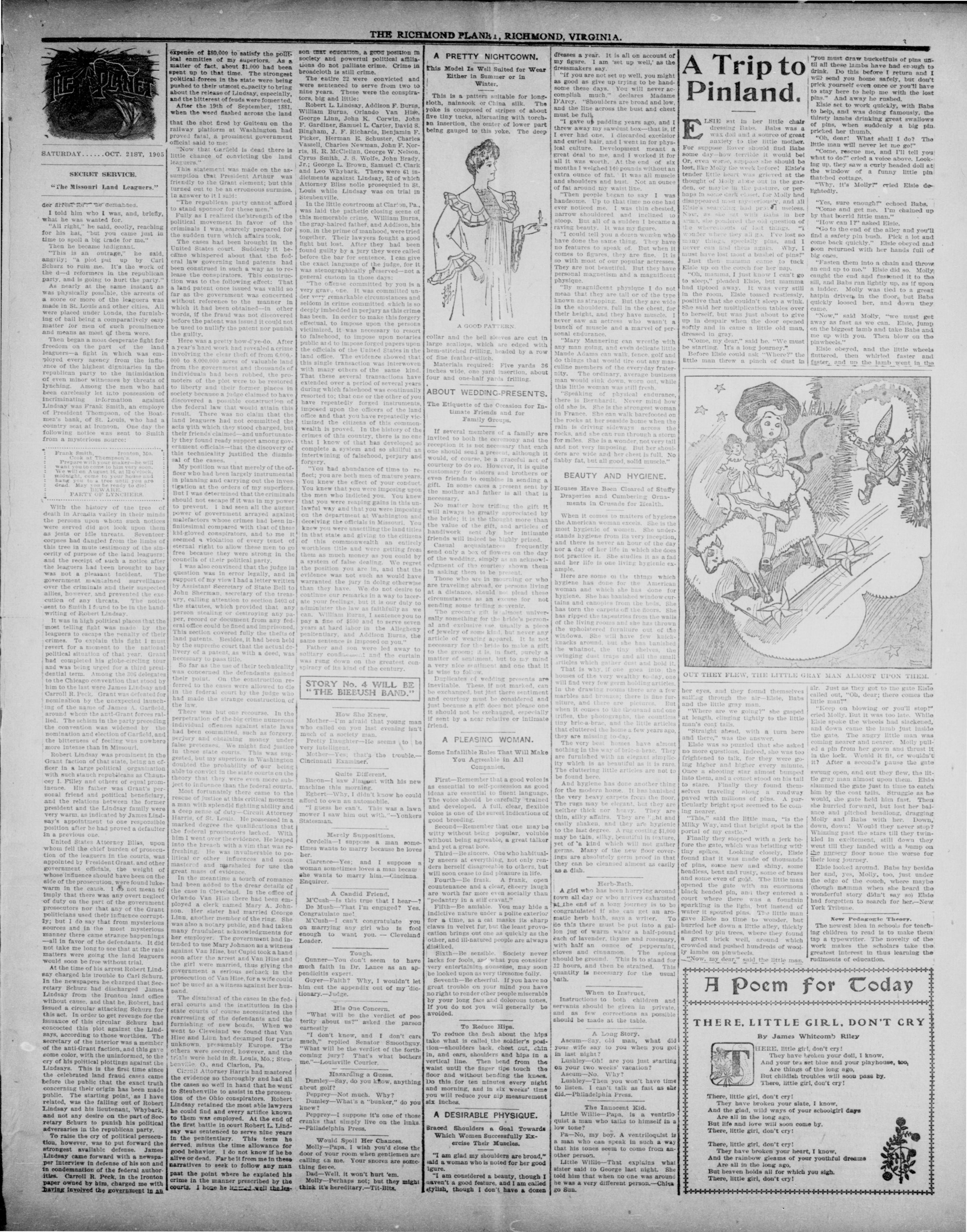
A PRETTY NIGHTGOWN.
This Model Is Well Suited for Wear Either in Summer or in Winter.
This is a pattern suitable for longcloth, nainook or China silk. The yoke is composed of stripes of about five tiny tucks, alternating with torches in insertion, the center of lower part being gauged to this yoke. The deep
搭
A GOOD PATTERN.
collar and the bell sleeves are cut in large scallops, which are edged with hem-stitched frilling, headed by a row of fine feather-stitch.
Materials required: Five yards 26 inches wide, one yard insertion, about four and one-half yards frilling.
ABOUT WEDDING-PRESENTS.
The Etiquette of the Occasion for Intimate Friends and for Family Groups.
If several members of a family are invited to both the ceremony and the reception it is not necessary that each one should send a present, although it would, of course, be a graceful act of courtesy to do so. However, it is quite customary for sisters and brothers or even friends to combine in sending a gift. In some cases a present sent by the mother and father is all that is necessary.
No matter how trifling the gift it will always be greatly appreciated by the bride; it is the thought more than the value of the gift, and articles of handiwork sent by her intimate friends will indeed be highly prized.
Casual acquaintances frequently send only a box of flowers on the day of the wedding, simply as an acknowledgment of the courtesy shown them in asking them to be present.
Those who are in mourning or who are traveling abroad, or persons living at a distance, should not plead these circumstances as an excuse for not sending some trifling souvenir. The groom's gift is almost universally something for the bride's personal and exclusive use, usually a piece of jewelry of some kind, but never any article of wearing apparel. It is not necessary for the bride to make a gift to the groom; it is, in fact, purely a matter of sentiment, but to my mind a very nice sentiment and one that it is wise to follow.
Duplicates of wedding presents are inevitable. These, if not marked, can be exchanged, but just there sentiment and courtesy must be considered and just because a gift does not please one it should not be exchanged, especially if sent by a near relative or intimate friend.
A. PLEASING WOMAN.
Some Infallible Rules That Will Make You Agreeable in All Companies.
First—Remember that a good voice is as essential to self-possession as good ideas are essential to fluent language. The voice should be carefully trained and developed. A full, clear, flexible voice is one of the surest indications of good breeding.
Second—Remember that one may be witty without being popular, voluble without being agreeable, a great talker and yet a great bore.
Third—Be sincere. One who habitually sneers at everything, not only renders herself disagreeable to others, but will soon cease to find pleasure in life.
Fourth—Be frank. A frank, open countenance and a clear, cheery laugh are worth far more even socially than "pedantry in a stiff cravat."
Fifth—Be amable. You may hide an inductive nature under a polite exterior for a time, as a cat masks its sharp claws in velvet fur, but the least provocation brings out one as quickly as the other, and ill-natured people are always disliked.
Sixth—Be sensible. Society never lacks for fools, and what you consider very entertaining nonsense, may soon be looked upon as very tiresome folly.
Seventh—Be cheerful. If you have no great trouble on your mind you have no right to render other people miserable by your long face and dolorous tones. If you do not you will generally be avoided.
To Reduce Hips
To reduce the flesh about the hips take what is called the soldier's position—shoulders back, chest out, chin in, and ears, shoulders and hips in a vertical line. Then bend from the waist until the finger tips touch the floor and without bending the knees. Do this for ten minutes every night and morning, and in six weeks' time you will reduce your hip measurement six inches.
A DESIRABLE PHYSIQUE.
Braced Shoulders a Goal Towards Which Women Successfully Exercise Their Muscles.
"I am glad my shoulders are broad," said a woman who is noted for her good figure.
"I am considered a beauty, though I haven't a good feature, and I am called stylish, though I don't have a dozen
dresses a year. It is all on account of my figure. I am 'set up well,' as the dressmakers say.
"If you are not set up well, you might as good as give up trying to be hand-some these days. You will never accomplish much." declares Madane D'Arcy. "Shoulders are broad and low, and the line across the bust and chest must be full.
"I gave up padding years ago, and I threw away my sawdust box—that is, if I ever had one. I discarded exoskeleton and curled hair, and I went in for physical culture. Development meant a great deal to me, and I worked it for all it was worth. At the end of six months I weighed 140 pounds without an extra ounce of fat. It was all muscle and shoulders and bust. Not an ounce of fat around my waist line.
"Then people began to say I was handsome. Up to that time no one had ever noticed me. I was thin chested, narrow shoulder and inclined to stoop. But all of a sudden I became a raving beauty. It was my figure.
"I could tell you a dozen women who have done the same thing. They have no features to speak of. But when it comes to figures, they are fine. It is so with most of our popular actresses. They are not beautiful. But they have personal magnetism and a magnificent physique.
"By magnificent physique I do not mean that they are tall or of the type known as strapping. But they are wide in the shoulders, full in the chest, for their height, and they have muscle. I never saw an actress who wasn't a bunch of muscle and a marvel of personal endurance.
"Mary Mannering can wrestle with any man going, and even delicate little Maude Adams can walk, fence golf and do things that would tire out any masculine members of the everyday fraternity. The ordinary, average business man would sink down, worn out, while this little woman was still fresh.
"Speaking of physical endurance, there is Bernhardt. Never mind how old she is. She is the strongest woman in France. She can walk barefooted on the rocks at her seaside home when the rain is driving sideways across the rocks, and she can run through a storm for miles. She is a wonder, not very tall and not very imposing. But her shoulders are wide and her chest is full. No flabby fat, but all good, solid muscle."
BEAUTY AND HYGIENE.
Houses Have Been Cleared of Stuffy Draperies and Cumbering Ornaments in Crusade for Health.
When it comes to matters of hygiene the american woman excels. She is the most hygienic of women. She understands hygiene from its very inception, and there is never an hour of the day nor a day of her life in which she does not practice it. She studies it as a fad and her life is one living hygienic example.
Here are some o) the things which hygiene has done for the American woman and which she has done for hygiene. She has banished window curtains and canopies from the beds. She has torn the carpets off the floors. She has ripped the tapestries from the walls of the living rooms and she has thrown the upholstered furniture out of the windows. She will have few knickknacks around, but she has banished the whatnot, the tiny shelves, the swinging dust traps and all the small articles which gather dust and hold it. That is why, if one goes into the houses of the very wealthy to-day, one will find very few germ holding articles. In the drawing rooms there are a few marbles and bronzes; there is one furniture, and there are pictures. But when it comes to the thousand and one trifles, the photographs, the countless tiny bric-a-brac, and the little articles that cluttered the home a few years ago, they are missing to-day.
The very beat homes have almost nothing in the way of briac-a brac. They are furnished with an elegant simplicity which is as beautiful as it is rare. The cluttering little articles are not to be found here.
And hygiene has done another thing for the modern home. It has banished the very heavy carpets from the floor. The rugs may be elegant, but they are neither thick nor heavy. They are thin, silky affairs. They are light and easily shaken, and they are hygienic to the last degree. A rug coating $1,000 may be thin, silky, beautiful in texture, yet of 'a kind which will not gather germs. Many of the new floor coverings are absolutely germ proof in that they can be cleansed almost as easily as a dish.
Herb-Bath
A girl who has been hurrying around town all day or who arrives exhausted at the end of a long journey is to be congratulated if she can get an aromatic herb bath, says a writer. To do this there must be put into a gallon jug of warm water a half-pound each of lavender, thyme and rosemary, with half an ounce of peppermint, cloves and cinnamon. The spices should be ground. This is to stand for 12 hours, and then be strained. This quantity is necessary for the usual bath.
When to Instruct
Instructions to both children and servants should be given in private, and as few corrections as possible should be made at the table.
A Long Story.
Ascum—Say, old man, what did your wife say to you when you got in last night?
Lushley—Oh! are you just starting on your two weeks' vacation?
Ascum—No. Why?
Lushley—Then you won't have time to listen. I can't talk as fast as she did.—Philadelphia Press.
The Innocent Kid.
Little Willie—Papa, is a ventriloquist a man who talks to himself in a low tone?
Pa—No, my boy. A ventriloquist is a man who can speak in such a way that his tones seem to come from another person.
Little Willie—That explains what sister said to George last night. She told him that when no one was around he was a very different person.—Chiva go Sun.
A Trip to Pinland.
ELSIE sat in her little chain dressing Babs. Babs was a wax doll and a source of great anxiety to the little mother. For suppose Rover should find Babs some day—how terrible it would be, Or, even worse, suppose she should be lost, like Molly the week before! Elsie's tender little heart was grieved at the thought of Molly alone out in the garden, or maybe in the pasture, or perhaps in some dark closet, for Molly had disappeared most mysteriously, and all Elsie's searching had pro- useless. Now, as she sat with Babs in her arms, she pondered the old question of the whereabouts of lost things. "I wonder where they all go. I've lost so many things, specially pins, and I never can find them again. Why. I must have lost most a bushel of pins!" Just then mamma came to tuck Elsie up on the couch for her nap.
"Oh, mamma, I just know I can't go to sleep," pleaded Elsie, but mamma bad tiptoed away. It was very still in the room. Elsie tossed restlessly, positive that she couldn't sleep a wink. She said her multiplication tables over to herself, but was just about to give up in despair when the door opened softly and in came a little old man, dressed in gray.
"Come, my dear," said he. "We must be starting. It's a long journey."
Before Elsie could ask "Where?" the little man threw a pinch of dust in
OUT THEY FLEW, THE LITTLE G
THE LITTLE GRAY MAN ALMOST UPON THEM.
THE GIRL RIDING THE MOON
her eyes, and they found themselves sailing through the air—Elsie, Babs and the little gray man.
"Where are we going?" she gasped at length, clinging tightly to the little man's coat tails.
"Straight ahead, with a turn here and there," was the answer.
Elsie was so puzzled that she asked no more questions. Indeed, she was too frightened to talk, for they were going higher and higher every minute. Once a shooting star almost bumped into them, and a comet stood on his tail to stare. Finally they found themselves traveling along a roadway paved with millions of plus. A particularly bright spot seemed to be coming nearer.
"This," said the little man, "is the Milky Way, and that bright spot is the portal of my castle."
air. Just as they got to the gate Elsie called out, "Oh, dear; there comes the little man!" "Keep on blowing or you'll stop crled Molly. But it was too late. Whil Elsie spoke the wheels had slackened and down came the lamb just inside the gate. The angry little man was coming nearer and nearer. Molly pulled a pin from her gown and thrust it in the lock. Would it fit, or wouldn't it? After a second's pause the gate swung open, and out they flew, the little gray man almost upon them. Elsie slammed the gate just in time to cate him by the coat tails. Struggle he hould, the gate held him fast. The she hurried forward, but lost her balance and pitched headlong, dragging Molly and Babs with her. Down down, down! Would they never stop Whizzing past the stars till they twin
Finally they stopped with a jerk before the gate, which was bristling with tiny spikes. Looking closely, Elsie found that it was made of thousands of pins, some new and shiny, some headless, bent and rusty, some of brass and some even of gold. The little man opened the gate with an enormous black headed pin, and they entered a court where there was a fountain sparkling in the light, but instead of water it spotted pins. The little man gave Elsie no time to wonder, but hurried her down a little alley, thickly shaded by pin trees, where they found a great brick well, around which crowded and pushed hundreds of woolly lambs on pinwheels.
"Now, my dear," said the little man.
poem for Today
ITTLE GIRL, DON'T CRY
A Poem
THERE, LITTLE
---
A Poem for Today
By James Whitcomb Riley
HERE, little girl, don't cry!
They have broken your doll, I know,
And your tea set blue and your playhouse, too,
Are things of the long ago,
But childish troubles will soon pass by.
There, little girl, don't cry!
There, little girl, don't cry!
They have broken your slat
And the glad, wild ways of you
Are all in the long ago.
But life and love will soon con
There, little girl, don't cry!
There, little girl, don't cry!
They have broken your heart
And the rainbow gleams of you
Are all in the long ago.
But heaven holds all for which
There, little girl, don't cry!
I, don't cry!
broken your slate, I know,
wild ways of your schoolgirl days
we long ago,
we will soon come by.
I, don't cry!
I, don't cry!
broken your heart, I know,
new gleams of your youthful dreams
we long ago,
ids all for which you sigh.
I, don't cry!
---
T
"you must draw buckettrails of pins until all these lambs have had enough to drink. Do this before I return and I will send you home safely, but don't prick yourself even once or you'll have to stay here to help me with the lost pins." And away he rushed. Elsie set to work quickly, with Babs to help, and was doing famously, the thirsty lambs drinking great swallows of pins, when suddenly a big pin pricked her thumb.
"Oh, dear! What shall I do? The little man will never let me go!" "Come, rescue me, and I'll tell you what to do!" cried a voice above. Looking up, they saw a curly headed doll at the window of a funny little pin thatched cottage.
"Why, it's Molly!" cried Elsie delightedly.
"Yes, sure enough!" echoed Babs.
"Come and get me. I'm chained up by that horrid little man."
"How can I scold Elsie?"
"Go to the end of the alley and you'll find a safety pin bush. Pick a lot and come back quickly." Elsie obeyed and soon returned with her hands full of big ones.
"Fasten them into a chain and throw an end up to me." Elsie did so. Molly caught the end and fastened it to the sill, and Babs ran lightly up, as if upon a ladder. Molly was tied to a great hitpin driven, in the floor, but Babs quickly loosed her, and down they came.
"Now," said Molly, "we must get away as fast as we can. Elsie, jump on the biggest lamb and take Babs and me up with you. Then blow on the pinwheels."
Elsie obeyed, and the little wheels fluttered, then whirled faster and faster, and up the lamb went in the
alr. Just as they got to the gate Elsie called out, "Oh, dear; there comes the little man!" "Keep on blowing or you'll stop!" crled Molly. But it was too late. While Elsie spoke the wheels had slacked, and down came the lamb just inside the gate. The angry little man was coming nearer and nearer. Molly pulled a pln from her gown and thrust it in the lock. Would it fit, or wouldn't it? After a second's pause the gate
swung open, and out they flew, the little gray man almost upon them. Elsie slammed the gate just in time to catch him by the coat tells. Struggle as he would, the gate held him fast. Then she hurried forward, but lost her balance and pitched headlong, dragging Molly and Babs with her. Down, down, down! Would they never stop? Whizzing past the stars till they twinkled in excitement, still down they went till they landed with a bump on the nursery floor none the worse for their long journey. Elsie looked around. Babs lay beside her and, yes, Molly, too, just under the edge of the couch, where maybe (though mamma when she heard the wonderful story didn't say so) Elsie had forgotten to search for her.—New York Tribune.
New Bidonovich Theorem
The newest idea in schools for teaching children to read is to make them tap a typewriter. The novelty of the work makes the scholars take the greatest interest in thus learning the rudiments of education.
```markdown
```
THE MYLLIET
Published every Saturday by JOHN MITCHELL,
JR., as 811 North 4th Street, Richmond, Va.
JOHN MITCHELL, JR., - EDITOR.
All communications intended for publication should be sent so as to reach us by Wednesday.
TERMS IN ADVANCE
ADVERTISING RATES
EXPRESS MONEY ORDERS can be obtained at any office of the American Express Co. on the phone or by mail to go and Co.'s Express Company. We will be responsible for money sent by any of these companies. The Express Money Order is a safe and secure way to pay for any goods and Co.'s Express Company. REGISTERED LETTER—If a money Order Post-Office or an Express Office is not within your reach, your Postmaster will Register the money order for you. If the letter is lost, a number of ten cents. Then, if the letter is lost, you can be traced. You can send money in this manner at our risk. We cannot deliverible* money sent in any other way than one of the four ways mentioned above. If you send your money in any other way, you must do it at your office. RENEWALS, ETC—If you do not want THE PLANET continued for another year after your subscription has run out, you then notify us by Post Card to discontinue it. The counts have not ordered their paper discontinued at the expiration of time for which it has been paid. We do not order their paper discontinued at the subscription up to date when they order the paper discontinued. COMMUNICATIONS—When writing to us to renew your subscription or ordercontinue your subscription, in full otherwise we cannot find your name on our books. OR ADDRESS—In order to change the address of a subscriber, we must be sent the former as well as the present address.
The visit of President Theodore Roosevelt to this city marks the dawning of a new epoch for this section. Whether it is for our weal or woe, we are unable to state. The Reception Committee did its work superbly, despite the fact that Ham was forgotten and only remembered one minute as a result of an almost grovelling appeal for recognition. It may be that there are other agencies at work and that this out-burst of enthusiasm on the part of the southerners who but a few months ago were abusing the distinguished visitor is the result of a change of heart.
Certain it is that they have won the occupant of the White House and his attitude will be more in keeping with the wishes of the residents of this sunny clime, unless all signs fail. That Mr. Roosevelt has given some kind of gratifying assurances to the Southerners will hardly admit of a doubt on the part of those Americans, who have been close students of human nature. Virginians could not have done bet ter from their standpoint of view and to our minds the effort was worth all of the cost to them.
They know Theodore Roosevelt as they never knew him before. Save for the binding effect of his oath of office, they now believe, what we have known all the time that he is a white man first. Because a man will not discriminate against a man on account of his race or color, when he is sworn not to make such a discrimination is no evidence of his o-weening love for the citizen in whose favor he rules.
Mr. Roosevelt's address was a gem and it could not be criticized by any fair-minded person, who advocates great principles and who has recognized and understood Mr. Roosevelt's position upon the great questions which he was discussing. He was consistent. We listened to his speech and we have carefully scanned the stenographic reports of his utterances under the light of a glorious day and no where do we detect a false note. If Mr. Roosevelt at Richmond is other than the Mr. Roosevelt at the White House, we have failed to see evidences of it. The attitude of the Virginians on the eve of a gubernatorial campaign is all the more inexplicable unless we remember that the Jamestown Exposition is a thing to be considered and that an appropriation of several million dollars from the United States Government is absolutely necessary to make the project a success upon Virginia's soil. Mr. Giles B. Jackson of the Negro Department
had his lightning rod up when he succeeded in stopping the presidential carriage in front of his company's office for one minute and who knows but in this he received the cue by seeing the elevation of the lightning rods of his fellow white associates of the Jamestown Exposition?
CRIMINALS ON POLICE FORCE
Sensational Evidence at Investigation of Philadelphia Offices. MAYOR WEAVER TURNED DOWN
Philadelphia, Oct. 18—The special committee of seven of select councils to investigate the affairs of the various departments of the city as conducted by Mayor Weaver and his directors began the taking of testimony. The meeting of the committee was not without its sensations, chief of which was the request to Mayor Weaver and three of his directors to leave the hearing room, and the statement of John B. Taylor, superintendent of police, that David J. Smyth, former director of public safety, had told him not to molest election repeaters. Superintendent Taylor's statement was made despite the vigorous efforts of Milton C. Work, the chairman of the committee, to confine him to the questions propounded by the committee's attorneys. The committee brought out statements from witnesses that policemen attended a meeting of a political club when they should have been on duty. Mayor Weaver and the City party insist that the police are not In politics, while the leaders of the Republican organization claim the policemen are as much in politics now as ever they wore.
The first witness called was Superintendent Taylor. He testified that he was president of the 24th Ward Republican club and that the greater number of the policemen of the district in which the club is located were members of the organization. In answer to questions he said on the last meeting night of the club 40 or 50 policemen attended the meeting, some of them leaving their beats to do so. He said the absent policemen's beats were covered, but refused to answer in what manner. The policemen attended the meeting by permission of the lieutenant of the district, who had received orders from former Director of Public Safety Smyth that policemen were to be permitted to attend political meetings if they wanted to. This order, he said, had not been rescinded by the present director.
The superintendent was pressed so hard by counsel regarding police in politics that he became angry and starred to make statements that startled the committeemen. He said if the committee wanted to know the whole truth about the police business he could tell them how Director Smyth told him to take care of repeaters and how he had to take from the rogue's gallery the photographs of men who were on the police force. In vain the chairman tried to check him and threatened to eject him, but he kept right on.
One of the attorneys said the committee did not want to know anything about that, but wanted to know how the homes of the people were protected. "I'll tell you," exclaimed the witness. "By men who have spent three and four years in the penitentiary, and whose pictures were taken from the rogue's gallery by Director Smyth."
Leutenant Thomas Campbell confirmed Superintendent Taylor's statement that the men were permitted to leave their beats under an order of Director Smyth. After the hearing Superintendent Taylor in explanation of his statement on the witness stand regarding repeaters said that Director Smyth when in office told him not to let the policemen molest repeaters on election day
JOSEPH FOLK ON CORRUPTION
Governor of Missouri Makes Reform Speech In Philadelphia. Philadelphia, Oct. 17. — The great battle between the local Republican organization and the City Party, the municipal reform organization recently formed here, was enlivened by the visit of Governor Joseph Folk, of Missouri, who came to lend his voice in the interest of good government. The Missouri governor addressed a large and enthusiastic audience in the Academy of Music. He spoke under the auspices of the City Club, which claims no connection with the City Party. Governor Folk said in part:
"The most conspicuous fact of municipal governments in the United States today is that they are governments by the few and not by the people. There is more aggressive rottenness and less aggressive patriotism in our large cities than anywhere else. If the patriotism can be made as aggressive as the rottenness, the problem of good government would be solved by the people taking the government into their own hands. If corruption exists in Philadelphia, the people are to blame; if corruption is to be eradicated the people alone can do it. The fight you are making here is a battle which will be felt by every town, city and state in the land. The benefit of a victory for good government will be universal, and the evil efforts of a defeat will demoralize those who believe in good government by the people. The average man does not appreciate the solemn duty he owes his city, state and his country.
"I have spoken of corruption, bribery and grafting, using the terms as they are commonly used synonymously. While the effect on the public may be as injurious from grafting as from boodling there is a distinction between them. The boodler sells his vote and prostitutes his trust for bribe money contrary to law, but the grafter is not always a boodler. The remedy for corruption, bribery and grafting of every kind is to enforce the law. If the system is working an illegal game instead of trying to bent the game, the better way is to stop the game."
RICHMOND PLANET, RICHMOND, VIRGINIA
HORRORS OF SHIPWRECK
Secem Crazed by Sufferings Threw
Themselves Into the Sea.
ONLY TWO OF CREW SAVED
Boston, Oct. 17.—A story of a North Atlantic shipwreck, in which eight scamened so fearfully from exposure, hunger and thirst that some either died outright, were washed away or, crazed by their fearful experience, threw themselves into the sea, was told by the two slurvivors of the coasting schooner Van Name and King, of New Haven, which was beaten to pieces by a gale off the South Carolina coast on October 6.
The two men who lived through five days and were rescued by the schooner Stillman F. Kelly, which arrived here, are William Thomas and William G. Warner, both about 29 years old, and hall from Antigua, British West Indies. The six who, one by one, succumbed were: Captain William A. Maxwell, of New Jersey; Mate E. A. Chase, home unknown; engineer, a German, name unknown; colored steward, name unknown; colored seamen, William Grizzell and Alfred Arthur, both of Jamaica.
The Van Name and King left Charleston, S. C., for New York, with a cargo of hard pine. Two days later she ran into a heavy gale, and after wallowing about in the great seas for several hours sprang a leak. The pumps were started, but within a short time the engine room was flooded and the pumps choked.
At 8 o'clock on the morning of October 6, with her hold nearly full of water, the little schooner was hove down on her beam ends. The crew clambered on the weather side and lashed, themselves to the bulwarks. There they remained, washed by the seas that broke mercilessly over them, all day Friday. That night the storm increased in fury, and one great wave crashed aboard, breaking both legs of Seaman Arthur and sweeping Grizzle from his fastenings. Arthur's companions could do nothing to cause his sufferings, but when on Saturday the schooner turned completely over, they managed to cut his lashings and drag him on a piece of the after house. It was several hours before they were all huddled together on their little raft. That night Arthur died in the arms of Captain Maxwell, and his body was dropped overboard.
Sunday night the waves subsided and a little rain fell, which was eagerly caught in a tarpaulin and brought some slight relief. It was only temporary, and not long after Mate Chase's mind gave way entirely, and the craft was again lightened when he jumped into the sea.
The next victim was Captain Maxwell, who on Monday forenoon became violently insane and followed his mate's example of self-destruction as a relief to his sufferings.
The spectacle of two men throwing themselves into the sea proved too much for the German engineer, and a few hours after Captain Maxwell's he, too, leaped to his death.
The last victim was the colored steward, who died Monday night, and whose body was consigned to the watters by the two remaining seamen.
Relief came 12 hours later, when the schooner Stillman F. Kelly sighted the little craft and hove to alongside Both Thomas and Warner had to be taken off in slings, and for two days were unable to move.
CHARGED WITH SHOPLIFTING
Stylishly Dressed Woman Under Arrest in Philadelphia
Test in Philadelphia.
Philadelphia, Oct. 18—A handsomely gowned woman, who gave her name as Mrs. Rebecca Barr, of San Francisco, was arrested here, charged with the theft from a department store of a coat valued at $275. She was held in $500 ball for a further hearing. She entered her own security, handling the police magistrate $500, which she took from her handbag. The accused woman broke down and spoke of the humiliation her act would bring to her husband and children. She said her husband had given her $1000 to spend on her trip east. The woman is at a local hotel, and if she proves her identity the magistrate says he will discharge her.
Virginia Needs Immigrants
Richmond, Va., Oct. 18.—The state board of agriculture adopted a recommendation that in order to supply the farm labor so much needed in Virginia, the board exert every effort toward federal legislation for the establishment of state immigration agencies at Ellis Island, so as to give people seeking laborers better access to the source of supply, and that the state department of agriculture establish agencies in those foreign countries from which the most desirable immigrants are to be obtained.
Airships to Destroy Forte
Tonl, France, Oct. 18.—In the course of further experiments with the huge Lebaudy dirigible balloon, constructed under the patronage of the war office, the aeronauts succeeded in dropping dummy projectiles upon the forts, demonstrating the possibility of airships being able to completely destroy military works during hostilities.
Hid Himself In Burning Barn.
Norfolk, Va., Oct. 17.—John J. Dawley, 22 years old, shot and killed William H. Davis, 30 years old, and then hid himself in and set fire to his father's barn. He is seriously burned. Davis died.
CHARGED WITH CONSPIRACY
Startling Testimony Brought Out In
Philadelphia Hospital Care
Philadelphia Hospital Case.
Philadelphia, Oct. 16.—Evidence further establishing the fact that graft was a feature of the new small-pox hospital contract was developed at the continued hearing of ex-Director A. L. English, Architect Philip H. Johnson, Contractors John W. Henderson and Henry E. Baton and ex-Inspector John
D. Finley. So startingly conclusive was this evidence that ex-Judge Gordon, acting in the matter for Mayor Weaver, abruptly stopped the calling of witnesses and each of the defendants was heid in $5000 bail for court.
Sensational developments came with the testimony of Assistant Director Sunderland, of the Department of Henith and Charities, and Frank Miles Day, the eminent architect, proved the skimping that had been done to increase the profits of the contractors, but it was the active man of Henderson & Co., James Duffy, who furnished the information most desired by Judge Gordon. It was this evidence, a tacit admission that there was a division of the profits with persons not members of the firm, that made it unnecessary to call Israel W. Durham and James P. McNichol, partners in the filtration contract already ventilated, as witnesses.
BURTON'S DEMURRER SUSTAINED
Special Grand Jury to Hear Evidence
Against United States Senator.
St. Louis, Oct. 18- Judge Willis Vandeventer in the United States court of appeals announced that he had sustained the demurrer to the indictment of United States Senator Burton, of Kansas, on the ground that the indictment was faulty. He ordered that another indictment be returned at once. Judge Vandeventer coincided with the attorneys for the defense in their contentions that if their client had entered into an agreement to appear before the postoffice department for compensation he was entitled to know who he had entered into this alleged compact with. Judge Vandeventer then set November 9 as the date for a special grand jury to meet to hear witnesses for the government against Senator Burton. Senator Burton gave bond in the sum of $6000 assuring his appearance on that date and thereafter at the call of the government officers.
BURNED WITH HER CHILDREN
Mother and Five Little Ones Meet Death in Flaming Home
St. Louis, Oct. 18—Mrs. Alice Hartman and her five children were burned to death and their home was destroyed by fire at Port Royal, a village in Franklin county. The husband escaped from the burning dwelling, but was unable to save any members of his family. The dwelling was a two-story frame building and burned like tinder. The family was aroused from sleep by dense smoke. Hartman and his wife and baby were sleeping on the first floor, while the other four children slept upstairs. Mrs. Hartman, carrying her baby, rushed upstairs to arouse the children and before Hartman could follow the building suddenly burst into flames throughout and he was forced to leave his entire family to perish.
TRIED TO CORRUPT WITNESSES
Another Arrest In Connection With
Stormy Cotton Co. Case.
Philadelphia. Oct. 17.—James E. DeMar, manager of the National Automobile company, of New York, was arrested on the charge of conspiring to interfere with and corrupt witnesses in the case of Stanley Francis, who is alleged to be one of the principals in the collapsed Storey Cotton company, and who is now on trial charged with using the mails for fraudulent purposes. DeMar entered ball for a hearing. Last week William C. Byram, a lawyer of Bradley Beach, N. J., was arrested in the United States court room here while the Francis trial was in progress on the charge of attempting to tamper with witnesses in the case. The postal inspectors say they intend to show that DeMar sent Byram to see the witnesses.
Football Player Badly Injured
New York, Oct. 16.—Caught beneath a score of athletes in a football acrimmage, Stinclair Power, 19 years old, of the Imperial A. C., Brooklyn, was so badly injured that surgeons in the Williamsburg hospital fear that if he recovers he will be crippled for life. Examinations of the injured boy show that he has suffered a concussion of the brain and internal injuries. He was unconscious.
Pennsy Orders 500 Locomotives
Pennsylvania Railroad company announced that it has placed orders for 500 locomotives and will shortly let contracts for the building of 15,000 freight cars. Half of the locomotives will be built by a locomotive company of this city and the other half will be constructed at the Pennsylvania railroad shops at Altoona.
Caisson Fell On Soldier:
Fort Still, Okla., Oct. 18. — Roy George, of Pennsylvania, a private of the 13th battery of artillery, second provisional regiment, was killed, when a calsson fell on Nim. The battery was returning from field practice, when the calsson struck a stone, upsetting it. George had been in the army only four weeks.
Struck Monster Gas Well
Parkersburg, W. Va., Oct. 17.—The Philadelphia Gas company, operating in Lewis county, has struck a monster gas well. The gas is beyond all control, and its roar can be heard for five miles. Every effort to control the gas has no far failed.
Charged With Stealing State Bonds. Columbia, S. C., Oct. 18.—A warrant was issued for the arrest of Daniel Zimmerman, former bookkeeper and confidential clerk in the state treasurer's office, upon an affidavit sworn to by State Treasurer R. H. Jennings, charging him with a breach of trust with fraudulent intention and the theft of state bonds of the value of $12,500 which, with accrued interest, aggregates $16,403.75.
Two Asphyxiated By Gas.
Philadelphia. Oct. 16.—William Vogel, aged 43 years, and Gottlieb Burkhard, 68 years old, German bakers, who shared a room in a lodging house here, were asphyxified by gas. A gas jot in their room was found half turned on, and it is believed their death was due to accident. Neither man had any relatives in this country.
M'GURDY SMARTS UNDER THE PROBE
Refuses to Tell Why Policyholders' Dividends Were Reduced.
SAYS THEY WANT TO RUIN BIM
New York, Oct. 18.—Testimony in the insurance investigation, which was resumed after a week's adjournment of the legislative committee, was most exciting throughout the entire day, and only the repeated threats of Senator Armstrong, chairman of the committee, to clear the room, prevented violent demonstrations of disapprobation of the witness, who was Richard A. McCurdy, president of the Mutual Life insurance company.
An attempt was made to obtain from Mr. McCurdle the reason for reducing the dividends on policies as the business increased and the assets piled up. This question was prompted by the large number of letters received from policymakers by the committee, and cited facts as examples. These letters came from all over the country, Mr. Hughes explained, but he read a number from policymakers who lived in this city. The examples cited were principally on the policies of the 10 payment life plan. One in particular for $3000, that in 1876 drew a dividend of $55.76, had been gradually cut, until in 1904 it received only $3. The writer included tables and statements from the company's reports, and said this was in the face of the reserve increasing year after year.
To all the questions on this matter the witness said he was not fortified with the information required; that these were actuarial matters; and, when pressed for his opinion, replied that he refused to discuss the question or to enter any discussion. He would proffer a witness, his actuary, whose business it was to know these things, but as for himself, he "would not discuss the question." Mr. McCurdy's demeanor was so insistent and at times defiant that the spectators bent forward to catch every word, and stood on tiptoe, expecting every moment to hear him directed by counsel to answer the question. His proffer of another witness was all that prevented steps being taken toward his indictment.
Mr. McCurdy also, during the effort to induce him to answer the questions as to the reduction of dividends, launched forth into a protest as to the manner in which the investigation was being conducted. He said the committee was going beyond the scope intended when it was appointed by the legislature, and that the investigation had assumed the proportions of an inquisition.
He was asked by Senator Armstrong how he would conduct the investigation, and told that if he had any better method the committee would be glad to know of it. Mr. McCurdy thought that putting a witness under oath made him feel he was on the rack. He said his answers were published in a distorted form, that appeared like an attempt to ruin him.
After taking up the questions of the reduction of dividends, Mr. Hughes read a long list of policy numbers, with the amounts of the face of the policy, what had been paid in, and the dividends received by the policy holders. Asked what he had to say to these, Mr. McCurdy said, "figures don't lie, but liars can figure." He then hastily explained that he meant that facetiously, and that he would be glad to verify the figures. The only explanation for a specific instance of a reduction of dividends Mr. McCurdy gave was that he supposed the policy holder had a reduced rate policy.
Pennsy Succ For $200,000 Damages
New York, Oct. 17. —The parents of Sam Shubert, the theatrical manager, who was mortally injured in the wreck of the Pennsylvania railroad's Chicago express at Harrisburg, Pa., last May, brought suit in the United States circuit court for $200,000 against the railroad company, alleging that negligence caused their son's death. This suit is one of several others aggregating $600,000 and growing out of the same wreck.
Army Officers at Gettysburg
Gettyburg, Pa., Oct. 18.—Prominent United States army officers, headed by Lieutenant General Chaffee and Chief of Staff General J. C. Bates, with survivors of United States commands in the battle of Gettyburg, are here to locate positions of the regular army commands in the battle and to select designs for monuments to mark the same. The veterans are here at the invitation of the war department, and will confer with the battlefield commission.
A WEEK'S NEWS CONDENSED.
Gold shipments from the Yukon Territory for the season of 1905 will amount of $6,000,000.
The Pen.sylvania Daughters of the American Revolution held a three days' State Convention at Reading.
George W. Murray, colored, a former member of Congress, was sent to prison for three years for forgery at Columbia, S. C.
Robert Bacon, of New York, has taken the oath of office as assistant secretary of State, vice Francis B. Loomis, resigned.
Amanda Herkimer, great-granddaughter* of General Herkimer, of Revolutionary fame, died at Janesville, Wis., aged 72 years.
Friday, October 13.
Henry Sturgis Drinker has been installed as president of Lehigh University, Bethlehem, Pa.
General William T. Clark, chief of staff of General Grant's Army of the Tennessee, died of cancer in New York.
Rev. John Long, aged 90 years, a retired Episcopal minister, who served charges in Delaware, Philadelphia, Wilkes-Barre and many other places, died in Reading, Pa.
Several days ago William Eldridge
A NEW SERIAL
Written
in
Red
BY
C·H·MONTAGUE
C·W·DYAR
IT WILL BEGIN IN THIS PAPER IN A SHORT TIME Watch for the Opening Chapters
a well-known pilot of Cape May, N. J., predicted that he would die on the night before his daughter's wedding, and Tuesday night all the conditions of the prophecy were fulfilled.
Saturday, October 14.
Four prisoners confined in the Lorain, O., jail cut their way through a 10-inch wall and escaped.
Mrs. John Salinsott, of Millville, N. J., who was scalded with boiling coffee while preparing dinner, died after great suffering.
Lyman G. Bloomingdale, founder of the Bloomingdale department store in New York, died of heart disease at Elberon, N. J.
W. E. Brown, president of the failed First National Bank, of Storm Lake, Iowa, was sent to prison for five years for fraudulent banking.
Calvin C. Lines, for 51 years bookkeeper and director of the closed Peoria, Ill., National Bank, died heart broken of the event.
The total registration of students at Princeton University, Princeton, N. J., is 1245, a decrease of 41.
Joseph Hartman, a lineman, fell 50 feet from the top of a telephone pole in Philadelphia and was killed.
The Union Central Life Insurance Company, at Cincinnati, O., was sued by the state for $2,358,481, alleged arrears of taxes.
Domestic troubles led Margaret Williams, employed in McAllister Hall, to kill herself at State College, Pa., by drinking poison.
Four of a party of six Grand Trunk Pacific surveyors were drowned in Winnipeg river by their canoe upsetting near Kenera, Man.
Tuesday, October 17.
Harvey E. Boyle, of Harrisburg, Pa., committed suicide by drinking carbolic acid.
By the falling of a scaffold at Bloomington, Ind., six workmen were injured, two fatally.
Rev. Dr. D. M. Gilbert, of Harrisburg, Pa., one of the foremost Lutheran clergymen in the country, died suddenly after a brief illness.
A hundred Christian Brothers in a monastery at Pacantico Hills, N. Y., fought a big barn fire and saved a large herd of bows and horses.
Mayor Belcher, of Paterson, N. J., who embezzled $200,000, has been located at the home of James Robertson, another fugitive Patersonian, at Yebri, Queensland, Australia.
Wednesday, October 18.
Mahon Clark Mercur, one of the best citizens of Northern Pennsylvania, died at Towanda, aged 90 years.
Mr. and Mrs. Marzall Field, who were recently married in London, arrived in New York on the stoamer Kronprinz Wilhelm.
During a flight at a "beer farm" near Bridgeton, N. J., William Duffield was shot in the leg and a man named Robbins was terribly beaten.
A hand car on which were eight railroad lab. ers was struck by a Wabash train at Cecil, Pa., and two were killed and one fatally injured.
PRODUCE QUOTATIONS
The Latest Closing Prices In the Principal Markets.
FLOUR quiet;
winter extras, $3.50 @ 3.65; pennsylvania roller, clear, $3.50 @ 3.65; city mills fancy, $5 @ 5.10; RYE FLOUR steady; per barrel, $3.90; WHEAT steady; No. 2 Pennsylvania red, new, $22½ local; no steady. No. 2 yellow, local; 2@62½ $15; TTS steady; No. 2 white, clipped, 42c; lowers gears, 32c. HAY firm; MAY 1, no 1 timothy, large bales, $14.50 @ 15. PORK steady; family, $17. BEEF firm; beef hams, $2 @ 24. POULTRY: Live steady; hens, 14c; old roosters, 10c. Dressed firm; fowls, 15c; old roosters, 10c. BUTTER fowls, 15c; pearled gears, 10c. pearled. EGGS firm; New York, pennsylvania. $24 @ 25c. per dozen. POTATOES firm; per bushel, $60 @ 63c
BALTIMORE—WHEAT firm; No. 2
red, 85%lc; steamer No. 2 spot, 76%lc;
red spot, 57%lc; steamer mixed, 55%lc
southrn, 52%c OATS firm; white No. 2
33%lc@32%c; No. 3, 32%lc@32%c; No. 4,
32%lc@32%c; No. 3, 32%lc@32%c; No. 4%
@31%lc@31%c; No. 3, 32%lc@32%c;
BUTTER steady; creamy sorghum
extras, 21%lc@22%c; held, 20%c; prints,
25%lc@24%c; Maryland and Pennsylvania
extras, 21%lc@24%c EGGS easy;
fancy Maryland, Pennsylvania and
Virginia, 21%c; West Virginia, 20%;
southern, 19%c dozen.
Live Stock Markets
PITTSBURG (Union Stock Yards).
- LATT: 10 steady, choice $5.40@
LATT: 10 steady, choice $5.40@
active; prime heavy, $5.85@5.90@
dium, $5.75@5.80; heavy Yorkers, $7.75@
5.75; light Yorkers, $5.55@5.65;
plgs, $5.50@5.50; roughs $4.50@5.HEEP
plgs, $5.50@5.50; roughs $4.50@5.25;
common, $1.80@3; spring lamb, $4.50@
7.50; veal calves, $7.50@8.
His Idea.
First American Millionaire—What in the world are you going over to see all the English cathedrals for?
Second American Millionaire—I'm putting up an automobile stable and I'm looking for something handsome in design. Life.
He Made a Mistake
"Prisoner at the bar," said his honor,
"you have been tried and convicted of
the crime of burglary. Have you any-
thing to say why sentence should not be
passed on you?"
"It was a mistake, your honor."
"How do you mean?"
"Why, I figured it out that burglary
would bring me in more money than be-
ing connected with a big life insurance
company, and so I went into it. I've
been at it a year and lost at least $20,000
as compared with the other. Please take
this into consideration in sentencing me."—Cherger Sun.
"Of course you know they say, dearest, that the course of true love never runs smooth." "But what do we care for that, darling? Haven't we rubber tires on our auto?"—Cleveland Plain Dealer.
The Explanation
"What do you think of the Norwegian revolution?"
"Oh, it is just an advertising scheme worked up by the press agents of Nansen, Ibsen, Bjornson and Sven Hedik."-Town Topics.
"Why are you going back to town in such a rush?" "I just received a letter from my husband." "Is he ill?" "No, he sent me a big check and told me to stay as long as I wished." —Houston Post
HEAT PLANET
COAL TAR DYE IN BUTTER
Chemist Wiley Makes Report on League Island Case. Washington, Oct. 17. — That samples of butter submitted as portions of a large quantity supplied to the League Island navy yard at Philadelphia, prove to be colored with coal tar is the substance of a report which Chief Chemist Wiley, of the department of agriculture, will submit to Secretary Wilson. Specimens were recently taken for analysis from the League Island hospitals, kitchens and barracks, from the United States receiving ship Lancaster and other navy craft by representatives of the Pennsylvania dairy and food commission, who are said to have obtained similar samples from the men who sold the product. Secretary Wilson will refer the report to President Roosevelt, who will call the attention of the department of justice to the matter.
MARKLE MINERS $TRIKE
Men Demand Reinstatement of Discharged Driver.
Hazleton, Pa., Oct. 17—All efforts to adjust the differences between the employees of G. B. Markle & Co., of Jeddo, have failed, and one of the most stubborn strikes since the big strike of 1902 was inaugurated, as the entire operations of this firm were tied up, throwing idle between 2500 and 3000 men and boys. The miners' local union of Jeddo met, and while opinion was divided on the question of strike, the motion finally prevailed, and unless some wiser counsel prevails the struggle will be a long and bitter one, as Superintendent Smith, of the firm, asserts that under no consideration will the discharged driver, John Kardisko, be reinstated. Kardisko's restatement was one of the points in dispute.
SIR HENRY IRVING CREMATED
Body of Famous Actor Reduced to Ashes.
London, Oct. 18.—At an early hour this morning the body of Sir Henry Irving was removed in great secrecy to a crematorium, the name of which is not given, where it was cremated. The secrecy surrounding the event was due to the desire of the family to avoid publicity. Thursday night the ashes will be taken to Westminster Abbey, where, in accordance with custom, they will lie in St. Faith's chapel until the funeral ceremony on Friday. The funeral cortege will start from the residence of Baroness Burdett-Coutts, in Stratton street, Plecadilly, which the baroness has placed at the disposal of the family. A deputation of French actors is coming to attend the funeral.
DEFENDED HIS MOTHER
Son Kills Father, Who Was About to Attack Her With a Knife.
Attack Her With a Knife.
Trenton, N. J., Oct. 17.—William T. Bevins, Jr., aged 23 years, in defense of his mother shot and killed his father in a houseboat on the Delaware river.
The father and mother had not been living together lately, having been obliged to give up housekeeping because of the father's drinking habits. The father visited the son's houseboat, where the mother was stopping. The father had a butcher knife with him and according to the statement made by the son was about to attack Mrs Bevins when the young man rushed out and fired his revolver. The father fell and was at once taken ashore by the son. The father died in an ambulance while being taken to a hospital. The son was arrested.
AIDED VENEZUELAN REBELS
Former President of Asphalt Company Admits it.
New York, Oct. 18.—General Francis V. Greene, former president of the National Asphalt company, was examined before United States Commissioner Gilchrist as a witness in behalf of the Venezuelan government in the action instituted by the latter against the New York and Bermudez company to recover about $11,000,000 because of the latter organization's alleged assistance of the Matos revolution in 1901.
General Greene was asked but one question, his reply being to the effect that the defendant company did materially aid the revolutionists, giving them $100,000.
Moors' Bullets Pierced Her Funnel,
But There Were No Casualties.
Gibraltar, Oct. 18.—The British torpedo boat destroyer Cherwell reports that while anchored between Coats and Ceres she was fired at by Moors, whose bullets pierced her funnel. The Cherwell threw her searchlight on the assailants. There were no casualties.
Two Boys Run Down By Engine.
Scranton, Pa., Oct. 18.—Stanley Tubbs and Vincent Morgan, 18-year old boys, of Taylor, were run down by an engine on the Lackawanna road near the Taylor depot. Tubbs was instantly killed and Morgan is dying. The former's father is a prominent contractor, and Morgan is the son of the burges. The engineer says they were getting out of the way of a train on the opposite track and stepped in front of his engine.
Fles Spread Cholera
Paris, Oct. 18—Professor Chantemisse, head of the Pasteur Institute, lecturing at the Academy of Medicine, said that files were the greatest disseminators of cholera in the towns and that his experiments had proved this fact.
TEMPERANCE NOTES
How the Closing of the Saloons at St. Louis Has Lowered the Criminal Cases.
Since Gov. Folk clapped the lot on the saloons of St. Louis, the sentiment
of the people for and against the Sunday saloon, and the lid in its various phases -ethical, moral, financial and sociological -have been a burning entity in St. Louis, stirring the community to such feeling of resentment and indorsement that it has overshadowed all other locally public questions.
BEFORE
THE "LID."
In the fervor of this debate St. Louis has heard everything but the
lid's argument for itself. It is an argument of figures.
The lid's argument is the record of police arrests in St. Louis through the period that the lid has been on, compared with the arrests made in this same period through three prior years. The figures are those of the police. They are unprejudiced.
They show that during the period that the lid has been on the Sunday behavior
of the city has greatly improved, Drunkenness on Sunday has decreased 38 per cent. Disturbances of the peace on Sunday have decreased 13 per cent. Assaults with intent to kill have decreased 50 per cent. That is, there have been 50 per cent. fewer arrests for assault with intent to kill, 38 per cent. fewer arrests for drunk-
of the city has greatly improved. Drunkenness on Sunday has decreased 38 per cent. Disturbances of the peace on Sunday have decreased 13 per cent. Assaults with intent to kill have decreased 50 per cent. That is, there have been 50 per cent. fewer arrests for assault with intent to kill, 38 per cent. fewer arrests for drunkenness, and 13 per cent. fewer arrests for disturbances of the peace in the time that the lid has been on than there were in these same four months of the three years prior to this, with the lid off.
This is the arithmetical side of the Id, as set forth by the St. Louis Post-Dispatch. It could not be presented before because the time has been insufficient to furnish a fair comparison. Four months is time enough to make possible an important and comprehensive test. The Post-Dispatch has gathered these statistics from the police, and now publishes them for the first time. Here are the comparisons of arrests for various offences before and after the Id:
DRUNKENNESS
from April 16 to July 30, 1905. 8 13-15
Average decrease per Sunday in favor of
their favorite.
from April 16 to July 20, 1966.....29 2-15
Average decrease per Sunday under the
lid, 5 2-15, or 13 per cent.
ASSAULT WITH INTENT TO KILL*
Average per Sunday for 15 Sundays
from April 20 to July 29, 1962.....8-15
Average per Sunday for 15 Sundays
from April 20 to July 29, 1962.....11-15
Average per Sunday for 15 Sundays
Average decrease per Sunday in favor of the lil, 7-15, or 50 per cent.
These offenses cover pretty well the misbehavior of a community in so far as
drinking has anything to do with it. Drunkenness, of course, is a direct product of the saloon. Disturbance of the peace may be due to drink or it may not, but the figures show that such disturbances are more frequent with the saloon open than they are with the saloon closed. Assaults with intent to kill cannot always be laid at the door of
drinking has anything to do with it. Drunkenness, of course, is a direct product of the saloon. Disturbance of the peace may be due to drink or it may not, but the figures show that such disturbances are more frequent with the saloon open than they are with the saloon closed. Assaults with intent to kill cannot always be laid at the door of the saloon, but the statistics prove that the number of them is diminished just 50 per cent, when the saloon door is closed.
The advocate of the enforcement of the Sunday law will naturally feel that, in view of the revelations of comparative figures, the law and the enforcement of it are justified, because of their moral value to the community. Those members of the community that have upheld the governor in his position will feel that, although it is undeable that Sunday drinking is harmless with the majority of people that indulge in it, it is the duty of all to desist in order that what is a harmless privilege to many may not be made a dangerous privilege to that limited element which abuses its opportunity to the extent of drunkenness, disturbance of the peace, and, in exceptional but not always infrequent cases, in attempts to take human life.
Letting Him Down.
"She said I was one man in a mil-
lion."
"Were you under an impression
that you were more than one?"—
Houston Post.
Worse Than Death.
Excited Wife—Wake up, Henry!
The house is on fire.
Sleepy Husband—Great heavens!
Now we'll have to move again!—Tit-
Bits.
THE RICHMOND PLANET, RICEMOND, VIRGINIA
TRUE GRACIOUSNESS
THE GIFT IS BENEFICENT AS
A SUMMER'S DAY.
A Woman's Strength Lies in Tact—The Gracious Woman "Nice" to Everybody—She Ignorees Her Friends' Petty Fallings—Some Say She Lacks Character—To Acquire the Gift, Cultivate a Smiling Expression—Seem Interested in Others, Not Yourself—Tact, Like Charity, Should Begin at Home.
BY MARY TAYLOR ROSS.
(Copyright, 1965, by Joseph B. Bowles.)
"Sweetheart, thou art a summer's day; a summer's day!"
Extravagant words of a lover? Yes, and yet, even her woman friends could see that the simile was a happy one—that the girl, with her tact and unselfishness, a heart that must have been full of the golden sunshine of a summer day, deserved the actual words of the lover's phrase, as well as the love that prompted them.
Full of life, serve and sunshine, she has been all her life, and now, after long years as a wife, she is still, to her husband, and children, and friends, "a summer's day," with her Milaz touching every commonplace happening of everyday life into the gold of happiness, and making everyone who comes into her presence more sure that life is worth the living, after all.
Surely, the fairies were kind when the little girl was born, for few of us possess naturally so fine a gift of tact and graciousness, but this woman insists that the gift may be cultivated, if one cares enough to possess it. But most of us go through life trying to wrest from Fate by main strength the gifts we would have a kind fortune bestow; blindly selfish women fail to realize that the strength of a woman lies in graciousness, in a tact that will make those around us strain every effort to lay at our feet whatever we wish to possess, and the girl who wishes, as all womanly women must wish, to possess the love of at least one fine, manly man, must first begin with herself, and deserve that love. But, first of all, a girl must understand that there is just one thing that will keep her from acquiring the gift, and that is selfishness.
Most unhappy of all the less desirable physical traits is selfishness, for it generates an indifference for anything but one's own comfort, that makes it difficult for even those bound by ties of blood to go on loving us, and even though a girl may possess many charming traits that will attract love to her, the faculty of keeping hearts as well as winning them cannot exist with a selfish disposition.
A sympathy for the world's sorrow a kindly desire to make the happiness of those with whom we come in contact either in our homes, in society, or in the world of business, and a wish to "be nice" to everyone, ignoring the unpleasant duties nearly every one has in a greater or less degree, and recognizing, only the better qualities of our friends, is the first step to attain the gift of trajudious steps.
There are those who think and speak of the tattest gracious woman as wanting in strength of character, else she could not be nice to everyone. Or we bellittle its presence by saying: "Oh, that is her disposition; it is natural for her to be pleasant with everyone." But, since our every act and thought makes for character, either good or bad, so the kindness of the gracious woman, be it natural or assumed, has its sure and lasting effect.
The gracious woman sees only the best in those with whom she comes in contact, because we are prompted to be at our best when in her presence; our better nature is stimulated, and we leave her with a more comfortable feeling of our own worthiness.
There are girls who do not hesitate to speak of tact as deceit—a kind of hypocrisy, and it is sometimes difficult to tell just where the line may be drawn—where tact leaves off and deceit commences. But even so—a pleasing, harmless deceit is not to be estimated as wholly bad. The really gracious and tactful woman does not recognize only the good traits of a friend, and then, in that friend's absence, speak of the ignoble ones that may exist. So far from speaking of them, she, even in her own heart, ignores them, and, surely, the happiest people in all the world are those who go through life ignoring as much as may be all unpleasant things, and setting their faces resolutely toward the best and most pleasing.
If one would acquire the gift of graciousness, let her commence by cultivating a smiling expression—not a distortion of the features and a loud "ha-ha," but the suggestion of an upward tilt at the corners of the mouth, and a soft, smiling expression in the eyes. The mere effort of replacing the droop of the mouth—which droop is almost invariably an indication of selfishness—of brooding over troubles and envying the possessions of others, is sure to make the world seem pleasant. Few human beings can resist the influence of a smile, and the girl who acquires the habit of slightly tilting the corners of her mouth will soon find that it has had an effect upon her disposition. One instinctively thinks of pleasant things, and the eyes that always look at the world through the rose-colored medium of a smile will find it a pretty good place to live in after all.
Then commence with the older people, and the very young ones of your acquaintance. Try to make the shy boy or girl feel more comfortable by saying something kindly, and showing an appreciation of something in which either may be interested. To tell a timid girl that her hair is arranged in a most becoming manner—that she has a very pretty head of hair, anyway, that her gown is pretty or becoming, is sure to make her feel good for some time to come. Show an interest in the collection the boy may be making, make very light of his awkwardness in dancing, assuring him
that he is learning quickly, and he will almost worship you in his heart. Remember that the very young and the very old are good champions to have on one's side, since they feel privileged to speak of likes and dislikes, and, at the same time, these very same very old and very young friends, especially if one of the latter is a young boy, can become most exasperating and annoying, and prove a stumbling block to one's progress in a most disconcerting way.
Be frank and pleasant with those of your own age, showing an interest and even assuming it if it does not exist, in whatever they may be engrossed with at the time. Assuming an interest will counteract any tendency to indifference you may have, and keep you out of the glitches of selfishness—that horrible octopus that slowly winds its tentacles around every happy trait one may possess, counteracting and crushing it to nothing, and leaving in its place the stuff of which meanness and unattractiveness is made.
The first place to acquire graciousness is in one's home. One family known to the writer has a small room that is known as "the growlery." When any of the children become disagreeable and threaten to spill the atmosphere of pleasant kindness that should exist in all homes to make them worthy the name, he or she is requested to retire to the growlery; the adults, too, first as a sort of joke, began to retire when selfishness showed itself in the form of exhibiting a disagreeable grouch (to make use of a little language), and as each one very soon recovered when left alone by himself it was easy to come out with a smile on the face. Indeed, it is hard to help smiling at the very idea.
There is no place like home, in which to cultivate the gift of graciousness. If father comes to the table with his "before breakfast grouch," remember only that he may not have slept last night; he may have business worries and difficulties you know nothing of, and may be worrying because he cannot secure for his family some wished for pleasure or possession; assume a pleasant expression and keep still until he has his breakfast well under way, then, if you have some pleasant thing to talk about, some bit of news or a bit of knowledge he may be interested in, broach the subject in a tactful way, and the breakfast table will soon become a most pleasant meal. Father will start downtown with a far lighter heart; he may not know just why, but he will have a particularly kind heart for his daughter. "She's a fine girl, anyhow," he will say to himself, perhaps consciously, and he will surely take a new grip on his business affairs and may even come out successful, and all because of a gracious daughter. Mother will forget for a time her "nerves" and the responsibilities of the household and for school with light hearts and home will meet to them the very best place on earth. There are little acts to perform in the effort to acquire the gift of graciousness; ask mother if she has any errands; do not wait till she must ask it as a favor from you, and of all things, never say you haven't any time for any of these little acts; remember it is the busiest in the world who always can make time for something extra; it is the busy ones who do the world's work. Do not refuse the small requests of the little brother or sister.
Not only is the gift of graciousness for young girls, although it is more easily cultivated in youth; it is really a "must have" for the woman who is leaving youth behind. Selfishness and indifference leave their sure mark on the face of any woman, and do more than any other one thing to help the years trace the flues of age on that face. A mother has particular need to be gracious, for young people of the better sort love to enter a home where the mistress is tactful and gracious. A little tact goes far in rearing children to be what we would have them, and the children of a tactful mother have far more opportunity to meet the right sort of companions, and make their selection of a life comrade among the most eligible and desirable of their friends.
Value of Sunshine
It is quite impossible for a thoroughly healthy person to have too much daylight. One might as well say it is possible to have too much fresh air. Daylight does not mean the direct
CURL-I-CURE
You owe it to yourself, as well as to others who are interested in you, to make yourself as attractive as possible. Attractiveness will contribute much to your TAKEN FROM LIFE AFTER TWO WEEKS' USE OF CURL-LICURE.
When you meet a person your first impression is governed largely by his or her appearance. The ear applies to you.
Mistlethorn leaves from a hairy or euphorbia's appearance so much as the hair. Notching indicates their character. Only good grooming, good breadth, and a neat hair.
It is a scalp tool, cleans and fibers of the hair, making them and easily managed. Positively from becoming dry, harsh, little reeking off.
Curtice Cure has long held safe preparation for hair, curly hair, straight hair.
We all know how much care is taken of the hair by
We are now here to prove cash is taken of the hair by
the hand. We have already seen that much pride a successful man takes
in his personal life.
glare of the sun. And a healthy person is not one whose eyes demand darkness. Whether the house furnishing is rich or mean does not matter in the least. There are mansions in which one feels gloomy, despite the evidences of wealth, and there are cottage homes that make one sing from lightness of heart. Let the light into the rooms. See that stairways and passages are bright as the garden outside. Shun the "dim religious light" as you would the plague. It has much dimness and precious little religion about it.
Be Amiable
If the cleaners spoil your favorite dress don't get angry about it. An cutbreak of hot temper will take away much more of your attractiveness than your dress could supply.
Carried Out.
Police Magistrate—With what instrument or article did your wife inflict these wounds on your face and head?
Michael—Wid a motty, yer annef "A what?"
"A motty—wan o' these frames wid 'Happy Be Our Home' in it."—Cassell's.
SHE KNEW.
Tommy—Mamma, what's a volume of sound?
Mamma—Usually a book of speeches—Washington Star.
She Got It
"I long for rest from this grinding toil," The cook to herself confessed. Then she lighted the fire with kerosen
Scribble—What kind of poetry is that?
Dribbles—The kind that always comes back—Cincinnati Enquirer
"You would advise a young man in politics to start out boldly as a reformer?"
"Certainly," answered Senator Sorghum. "It is getting so that the public won't give anybody a chance at the plum tree unless he claims to be a reformer."—Washington Star.
A MILD AND BITTER REQUEST
Guide—At this spot there's the most wonderful echo in the world to be heard. Try it. Tourist (shouting)—What will you take to drink?
Echo—To drink—to drink—to drink—
to drink—
Tourist—By Jove! that's good! Let's
try it again. What will you take
to drink?
Echo (suddenly appearing)—Well, If
you insist, sir, mine's bitter, thank
you.
Cost-Clue is an ideal, safe preparation and makes curly hair straight. We guarantee it absolutely.
costs it is a scalp toile, cleans and softens the many
skin problems, making them soft, silky, pliable,
and easily manicured. It is also cost-effective from
becoming dry, harsh, brittle and keeps it from
breaking. No matter what you have tried, no matter what
no matter what you have tried, no matter what
No matter what you have tried, no matter what
you do yourself your own identity if you
do not use Cock-Up.
We guarantee it positively to do the work better, not worse, and not worse than anything the kind in the world, nothing else.
Curt-Cool is manufactured only by the Lincoln Chemical Works, Aurora, Illinois. Our reputation is that we are the best hair care and hairmassage and hairstretching and hairmassage and hairstretching and will not cause it to break off. We offer a price. In exile. We pay an express charge. Send proof of receipt to Lincoln Chemical Works. Shipping goods C. G. D. Write name and address plainly.
Advice.
```markdown
```
success-both socially and commercially. Positively nothing detracts so much from your appearance as short, matted unattractive curly hair.
---
Coal! Coal! Coal!
All Kinds of Anthracite and Bituminous Coal at the Lowest Market Rates. Will be Delivered now or at Your Pleasure. Prompt Service. Our Patrons are our Best Advertisers. SAWED WOOD OR UNSAWED WOOD. EITHER OAK OR PINE. Summer Rates on Coal and the Best Kind Furnished. It is free from impurities and is the clean Article at the right price. CALL OR PHONE
Crump & West Coal Co.,
1719 East Cary Street, RICHMOND, VA. Long Distance Bell 'Phone, No. 83. Manchester Orders Promptly Attended Also.
The J. V. Hawkin's HAIR GROWER & RESTORER
[TRADE MARK REGISTERED.]
Has proved to be a fortune to many of the unfortunate, who are to-day delighted with its wonderful results. The merits of this great hair preparation naturally places it in a sphere all of its own, and the glowing terms in which our patrons speak of it reassures us of its satisfactory results. We can well boast of a large patronage throughout this and other States and also enjoys the commendation of the very best white and colored people in this immediate community. In order to convince the most skeptical readers of the merits and results of the J. V. Hawkin's Hair Grower and Restorer, we will from time to time produce in print the photographs of those giving us permission to do so, who have used our preparation and are to-day asses of its genuine qualities. We do not desire the ragi miracle or anything unreasonable. Our prepapound, the ingredients of which we would not ill just here remind the public that the United national patent rights on our hair preparation by e in turn responsible to the government for honours. Cure Scalp
among the many bearing witness of its genuine qualities. We do not desire the correspondence of those expecting a miracle or anything unreasonable. Our preparation is a natural and pure compound, the ingredients of which we would not hesitate to put in print. We will just here remind the public that the United States Government has placed national patent rights on our hair preparation by which it is protected and we are in turn responsible to the government for honest methods and square dealings.
It will positively remove Dandruff, Cure Scalp of all impurities, Restore Hair on Clean Temples or Bald trends, where the roots are not dead. Prices:—25 cts. per box (local orders) 35 cts. out city; eight boxes, $2.80 express prepaid. The Face Beautifier makes the use of powder entirely unnecessary, and is perfectly harmless. Sale prices; 25, 50cts and $1.00. Money can be sent by Post Office Money Order or Express Money Order. A charge of 10cts, extra is imposed on all out of city orders.
612 N. First Street. Richmond, Va. PHONE, 4601. Correspondence strictly confidential.
A. D. PRICE,
Embalmer and Liveryman.
at short notice by telegraph or telephone. and nice entertainments. Plenty of roomences. Large pismic or band wagons for nothing but first-class carriages, buggies, and fine funeral supplies.
At Leigh Street.
Funeral Director, Embalmer and Liveryman.
All orders promptly filled at short notice by telegraph or telephone. Halls rented for meetings and nice entertainments. Plenty of room with all necessary conveniences. Large pissic or band wagons for large parties. Large bungalows, carriages, buggies, etc. Keeps constantly on hand fine funeral supplies.
212 East Leigh Street.
Residence Next Door. & NIGHT.—Man on Duty All Night IN "AD" IN THE PLANET PAYS.
OPEN ALL DAY & NIGHT.—Man on Duty All Night
REMEMBER:—AN "AD" IN THE PLANET PAYS.
VARIETY IS THE SPICE OF LIFE.
So call and see our large variety of
Baby Carriages,
Dressers,
Suites,
Chiffoniers,
Toilet Tables
AND.....
Automatic Refrigerators.
YOU can have the advantage of our great stock and great values. We are offering NO CHEAP VALUES,
but goods of such REAL VALUE as will insure you confidence in us. Do not fail to at least
INSPECT OUR GOODS.
We are sole agents for the Macey Seo-
tional Book-eases.
MACEY-WERNICKE CO.
FILING CABINETS.
SYDNOR & HUNDLEY,
711-713-715-717 R. Broad St
A.
'Phone, 577
Will Satisfy the lover of the right kind of stimulant. Special prices. We have all grades of good liquors, Cigars and Tobacco. Call and see us. ISAAC STRAUS & CO. 422 E. Broad St. Richmond, Virginia.
GEORGE O. BROWN,
PHOTOGRAPHER,
603 N. 2nd St., Richmond, Va.
Fine Photographs. True to Life. High-class
service. Improves best images in Photographs.
Estimates and Prompt Service. Pictures Enhanced
from old negatives or Photographs. 3mms
GONZALES
EVER KNOWN.
Unites Separated, Brings back the one you Love, Helps quickly in all Trouble.
Removes Evil Influences, Cures Mysterious Diseases, Gives Luck and Success through her wonderful psychic power and advice. Located permanently in Brooklyn for the past 19 years, and will be glad to see you all when in doubt or trouble.
236 Bergen St.
Brooklyn, N. Y.
WILLIAMS
Richmond, Va
JOB DEPARTMENT
EXCURSION WORK OF ALL DESCRIPTIONS
We print Handbills, Quarter-Sheets, Half and Whole Sheet posters, Tags, Tickets, Placards, Society Cards, Minutes, Visiting Cards, Mourning Stationery. OUR AIM is to please our patrons and to give them the best service at the lowest prices, consistent with satisfactory work. We furnish "cuts" when desired and we will arrange to complete special work in our line. When in need of any work in our line, call and see us and estimates will be furnished.
Our Stock Room Embraces a Full Line OF THE LATEST STYLE BOND, FINE WRITING—FLAT AND LINEN PAPER, ENVELOPES, ETC
★
A Poem for Today
By George Walter Thornbury
GEORGE WALTER THORNBURY was born in London in 1838. At the age of seventeen he became a contributor to periodicals. He studied art and occasionally practiced painting, but devoted himself to literature and produced some twenty-five volumes. He died in London June 11, 1858. "Crum-well" is a pun on the name of Cromwell the celebrated lord protector, who ruled England for several years after the death of Charles I.
NTO the Devil tavern
Three booted troopers strode,
From spur to feather spotted and splashed
With the mind of a winter road.
In each of their cups they dropped a crust
And stared at the guests with a frown.
Then drew their swords and roared for a toast,
"God send this Crum-well down."
NTO the Devil tavern
Three booted troopers strode,
From spur to feather spotted and splashed
With the mud of a winter road.
In each of their cups they dropped a crust
And stared at the guests with a frown,
Then drew their swords and roared for a toast,
"God send this Crum-well down."
A blue smoke rose from their pistol locks;
Their sword blades were still wet;
There were long red smears on their jerkins of buff
As the table they overset.
Then into their cups they stirred the crusts
And cursed old London town.
Then waved their swords and drank with a stamp,
"God send this Crum-well down."
The prentice dropped his ear of beer;
The host turned pale as a cloat;
The ruby nose of the tooping squires
Grew white at the wild men's shout.
Then into their cups they flung the crusts
And showed their teeth with a frown;
They flashed their swords as they gave the toast,
"God send this Crum-well down!"
The gambler dropped his dog's cured cards,
The waiting women screamed.
As the light of the fire like stains of blood
On the wild men's sabers gleamed.
Then into their cups they splashed the crusts
And cursed the fool of a town
And leaped on the table and roared a toast,
"God send this Crum-well down"
color of the next horse to round the corner or the same of the conductor that will bring in the next Saratoga special.
Gates and Drake Play Golf at $1,000 a Hole.
And every bet is a big one.
Saratoga is not the home of the piker,
although that variety of gambler is
plentiful about her streets.
Since the death of William C. Whitney,
Gates is the most important personage
in the village, ranking even
higher than Canfield, George Wheelock
and other prominent citizens in the
summer colony.
CADDIES GROWING PROSPEROUS.
Wall Street Man Idol of the Crowds,
but Drake Is the Better Player.
When Tired of Golf They Play Tennis
at $100 a Point-Whims of
Rich Visitors at Summer Resort.
When he makes bets, the crowd watch him adoringly as he sits on the rail of the clubhouse and looks over their heads as they gather on the lawn. If he races down to the lake in an automobile before dinner, the crowd that can support automobiles follow after. And even when in pursuit of health and recreation, as well as the ever needful exhilaration of a little stake, he and Drake beat little rubber balls over bunkers on the golf course, there is a big gallery to see and applaud, for the Saratoga crowd knows that Gates is playing for big stakes, and they like to see any kind of gambling where real money is at issue.
Golf at a thousand dollars a hole, tennis at a hundred dollars a point, poker with no limit and side bets on every street as to the number of the next trotley car that comes along or tomorrow's weather—that is the kind of money madness that has got a death grip on Saratoga, says a special dispatch to the New York Journal. Plungers like John W. Gates and John A. Drake, not content with gigantic stakes on the races and poker games, made their mornings interesting by playing golf for a thousand dollars a hole. Now and then they switch to tennis at a hundred dollars a point, which runs up into the thousands for a set. And the rest of the crowd follows according to their means.
Franklin's Elcenteenary.
It is certainly discreditable the one of the three Americans who would by popular acclaim be pronounced to be the greatest the country has produced should have so little formal recognition, says the Philadelphia Record. The birthday of Washington is practically a national holiday, Lincoln's birthday is a red letter day in many states, but Franklin, the third in this triumvirate of America's greatest, is denied the honor of a public testimonial to his superlative merits. An opportunity is at hand to make good this neglect. On Jan. 17 next will be the blecentennial of Franklin's birth. The day ought to be celebrated in an appropriate manner to the furthest ends of the country. It would be becoming for Philadelphia to take the lead in doing honor to her adopted son.
The flush times in California when men played poker for gold mines, the feverish nights at Monte Carlo, where aristocrats gamble away princely birthrights, are both eclipsed by the money mania that has broken out at Saratoga this season. The craze follows the clock all the way around.
Get up in the morning and go down to the springs, and you will find a couple of millionaires betting each other that the first car to come along will have an odd or even number.
Walk out to the golf links, and you will see John W. Gates and John A. Drake, his substantial shadow, making tracks on the dewy grass and cutting divots out of the fair green with prodigious strokes of brassies and irons.
And every one of those strokes means about a hundred dollars, for when Drake and Gates play they lay a thousand dollars a hole.
Just as Skal-lal-a-toots finished his story there came a flash of lightning. Then the thunder rolled, and the people hurried to their homes. Skal-lal-a-toots and Samoset hurried with the old chief to his round topped house to fasten the bearskins across the door so that the rain should not come in. The lightning flashed brighter and brighter, and the thunder rolled heavier and heavier. Then the wind came up like a hurricane and swept across the plain. Trees were blown down, and the old chief's corn lay flat upon the ground.
If either should get eighteen straight holes the sum of $18,000 would change hands, but as they are tolerably matched it is rare that more than three or four thousand dollars is won or lost. Of the two, Drake plays the better game, but Gates gets a handicap which squares things up. The caddies on the course are growing prosperous, and as soon as the golf craze spreads to the bookmakers, gamblers and the other elite of the place a job as a caddy will be worth purchasing.
"The wind never blows like that in my land," said Samoset.
On the tennis courts, which are numerous in the handsome gardens of retired plungers along the elm shaded avenues, tennis is indulged in every morning before begins the respledent parade to the race track.
"There was a time, long, long ago, when the wind blew so fiercely in my land that it destroyed our cornfields, it rocked the hills, and it laid the forests low. But the good Glosskap would not permit it to harm his people, so he punished the Wind Bird, and this is the story as my grandfather used to tell it to me:
Here money changes owners almost as fast as it does at the track, while spectators on the streets pause to make side bees as to the outcome of the particular game they happen to be watching.
"Away up in the north, in the region of snow and ice, the Wind Bird lives.
"His wigwam is at the end of the sky, and he sits upon a great white rock watching the moons go by.
If you walk from the United States or the Grand Union hotel down the main street after dinner you will see knots of men grouped around pairs of plungers who are betting on the population of the town, the age of the nearest elm tree, the hour the sun sets, the
"Sometimes he sits quietly and sleeps;
then there is peace upon the waters.
Sometimes he raises his wings, rustles
his feathers, moves from place to place.
THE RICHMOND PLANET, RICHMOND, VIRGINIA
EXCURSION
We print Handbills, Quarter-Sheet posters, Tags, Tickets, Placard notes, Visiting Cards, Mourning Stats
WE HAVE
OF THE LATE
WE CAN PRINT A BILL AS SMALL
A Three-Sheet
AS LARGE AS A FRO
Our street-entrance is retired and fastidious lady being able to enter w
VISION WORK
Quarter-Sheets, Half and Whole
Sheets, Placards, Society Cards, Mailing Stationery.
WE AN E
WHICH WE WILL
Our Stock Room
THE LATEST STYLE BOND,
AS SMALL AS A DODGE
Sheet Poster
AS A FRONT DOOR.
OUR PRESENT CORP OF ENTRY
IS WITHIN EASY REACH
retired and has no objectionable
to enter without embarrassment.
WE CAN PRINT A BILL AS SMALL AS A DODGER. A Three-Sheet Poster AS LARGE AS A FRONT DOOR.
Our street-entrance is retired and has no objectionable features, the most fastidious lady being able to enter without embarrassment or annoyance.
LONG DISTANCE TELEPHONE, 2213.
vertiser. ____
A Ten Party.
"Come, Puss," said Sue; "now be my gues
And take a seat here close by me."
Miss Pussie moved and then confessed
That this would suit her to a tea!
Kittens at the
Some had a ride on the elephant, and one g
ostrich.—St. Louis Star.
at the Zoo
and one got its tall pinched by the
FRANK WALLER, JR
PRACTICAL HOUSE
PAINTER,
ANTELOPC
Some had a ride on the elephant, and one got its tall pinched by the ostrich-St. Louis Star.
Residence, 1 E. Orange St.
Prompt attention given to all mail
orders. Satisfaction guaranteed.
All Kinds of Painting Bone Cheap.
n e call before going elsewhere
It is thoroughly equipped to do all kinds of printing on short notice. We make a specialty of Society printing and work for Insurance Companies, such as Financial
and then there is a great noise in the air.
"The waves wrinkle, toss and roll, and the clouds scurry across the sky.
"One day Glooskap went out to fish. But a great wind arose, and the canoe rocked and rolled. The waves rolled up against the sky, and the fish harried down into the deep waters.
"It is the Wind Bird that is doing this!" Glooskap cried.
"Then to the Wind Bird he called: 'Drop your wings, O Wind Bird!' You are tearing up the trees and rocks. You are laying low the cornfields. You are frightening even the fish of the sea.'"
"But the Wind Bird answered: 'I was here even before Glooskap was created. Here from this white rock I rule the winds and the seas. My wings made the first sound that ever was. My voice was the first that ever spoke to the earth. Therefore I shall do as I will to do. Neither the children of the earth nor Glooskap shall blinder me.'"
"Then Gloosak rose in a fury and stood high in his cane. His head
reached to the clouds and his arms reached from shore to shore.
"He seized upon the Wind Bird, tied his wings with a strong withe and threw him into a deep chasm.
"For days and days he lay in the chasm, and there was calm upon the sea and land.
"Then, because the waters were growing stagnant and because there was need in the land for rain, Glooskap lifted the Wind Bird and placed him again on his white rock at the end of the sky.
"But he unbound only one of the Wind Bird's wings, and since that day the storms have never been so terrible and the waves have never lifted themselves so high."—New York Commercial Ad-
Cards, Policies, both straight life and benevolent. Physician's Certificates, Sick Cards, Application blanks, Agents Report Sheets, Rate Cards, etc.
IN WORK C
is, Half and Whole
Society Cards, Min-
istry.
is to please
give them
the lowest
with satisfi
AN ELEGANT
WHICH WE WILL SHOW AN
Rock Room D
STYLE BOND, FINE WRITE
AL AS A DODGER.
Poster
DOOR.
SENT CORP OF EMPLOYEES ARE
MIN EASY REACH OF THE PUBLIC
as no objectionable features, the
but embarrassment or annoyance
OUR PRESENT CORP OF EMPLOYEES ARE COMPETENT AND QUICK-WORKING. OUR OFFICE IS WITHIN EASY REACH OF THE PUBLIC, BEING WITHIN FIFTY YARDS OF BROAD ST.
RK OF ALL
OUR AIM
is to please our patrons and
give them the best service
the lowest prices, consiste
with satisfactory work.
LEGANT
ALL SHOW ANY ONE DESIR
om Embra
FINE WRITING—FLAT AN
EMPLOYEES ARE COMPETENT AND
OF THE PUBLIC, BEING WITHIN
the features, the most
or annoyance. FOR FU
Jo
MRS. MARTH, the world renowned and highly celebrated Business and Tech Medium, evals everything. No imposition. Can be life, business, love and marriage a speciality. Serve. Vaulted also of absent, deceased and living friends. Remove all trouble and estrangement. Many Mediums who can exert her in starting a business present, future events of one's life. Remember she will not for any price matter you; you may take a trade without nonuse. She can be consulted for Life, Love, Courtship, Marriage Friends, etc. with full description of your future companion. She is very accurate in describing missees, misunderstands, misuses, misuses journeys,含羞ed walks, divorce and operation is valuable and reliable. She reads your destiny—good or bad; she withholds nothing.
And a person of an inquiring mind may ask the reason why. It is stupify that these advertisements nature. They do not spend their thoughts for a moment with acquiring the art of phraseology and kindred branches that will have a tendency to the business clear and devoid of all obstacles. It is and undeniable fact that persons will notice in fall knowledge of what they want to know to acquire a medium they try their utmost endeavor to dispel from their minds what they know so as to obtain the medium. To set the secret out of a person by and dishonest means is the art used by many unprincipiate mediums, but to take hold of the secret by a boy is a matter of impossibility to most of them.
And yet this can be done and by consulting the seemingly mystery becomes a realization.
This subject has received no little attention by eminent men and even college professors. But the realization that these are infringers in our midst with only some perhaps the gates of wisdom have not been opened for the profession.
It takes a great deal of hardy to become an accomplished medium and by a continuous and untiring effort, the key to the well of appearance by MRS. MARTH for the benefit of humanity.
MRS. M. B. MARTH.
CHICKASHA,
INDIAN TERRITORY.
(BOX, No. 958.)
Enclose Stamp for reply.
Man's Weak Point.
Mrs. Newed—Are you sure you love me as much as ever?
Mr. Newed—Perfectly.
"And you will never, never love anyone else?"
"Never."
"And there isn't anything you would not do for my happiness?"
"Nothing. That is, of course, nothing within the bounds of reason."
"Hum! I thought so. You are just like all the rest. You've begun to reason."—N. Y. Weekly.
We print Wedding Invitations, and High Class Stationery for Balls, Parties, Picnics and all entertainments of a social nature.
ALL DESCRIBE
us and to
service at
consistent
work.
We furnish "cuts" when do
complete special work in our
in our line, call and see us a
T LINE OF
DESIRING TO SEE THEM.
traces a full
AT AND LINEN PAPER, ENVELO
WE HAVE ONE OF THE
OF WOO
Of Any Job Printing
T AND QUICK-WORKING. OUR OFFICE
IN THIN FIFTY YARDS OF BROAD ST.
FOR FURTHER INFORMATION, A
John Mitch
311 N. 4th St
FOR FURTHER INFORMATION, APPLY TO
John Mitchell, Jr.,
Fine Boots,
Shoes and
Ladies Gaiters,
ALL KINDS OF FINE FOOTWEAR
New Phone, 478.
eleva that
consulting
try to the
descrimina-
nched. It
is on her
best of what
may ask
see adver-
ly human
215 E. Leigh Street,
When You Are Sick
Sure and Fresh Mediames only will
sure you then purchase your
Drugs and Medicine from:
Leonard's
Reliable
Prescription
Drug Store
724 North Second Street.
BEFORE
MAKING
U R G you love Refrigerators, Mattings, Oil-Cloths, And in fast everything that is need ed in house furnishings. RUGS AND CARPETS.
S. C. G. Jurgen's Son
431 EAST BROAD ST.,
between 4th and 5th Street
A
WE HAVE ONE OF THE LARGEST ASSORTMENTS OF WOOD-TYPE Of Any Job Printing Establishment in the city.
311 N. 4th St., Richmond, Va.
S. J. GILPIN.
506 E. BROAD ST., Richmond, Va
——DEALER IN——
F Jonathan
FISH, OYSTERS AND
PRODUCE.
120 N. 17th St., RICHMOND, VA.
ALL ORDERS WILL RECEIVE
PROMPT ATTENTION.
Long Distance Phone, 752.
RICHMOND, VIRGINIA
Plant Decorations, Choice Rosebuds
Cat Flowers, Funeral Designs, House
Decorations for Wedding, Parades, &o
specialty. Give me a call.
*Your purchase you would do well* to call at the most reliable furniture house in the city and see the fine line of
Of every description; also the latest designs in ROCKERS and special CHAIRS. Our goods are the best for the price and the price is very low.
opes, Note and Letter Paper
Bill-heads, Monthly Statements,
Business Cards, Financial and Order Books,
Circulars, Check-books, Pamphlets.
SCRIPTIONS
desired and we will arrange to
or line. When in need of any work
and estimates will be furnished.
SAMPLES
Line
OPES, ETC.
LARGEST ASSORTMENTS
OD-TYPE
Establishment in the city.
PPLY TO
hell, Jr.,
., Richmond, Va.
'Phone, 1589. Residence No. 911 324 Street.
ROBERT W. WILLIAMS,
FUNERAL DIRECTOR &
EMBALMER.
NO. 3019 P. STREET, BETWEEN
30TH AND 315T STREETS.
RICHMOND, . . . VA.
Special attention given to all business
entrusted to me. Carriages for funer-
als, receptions and marriages at all
hours. Satisfaction guaranteed to all.
til16-20-'04
A. Hayes
First-class Hacks and Caskets of all descriptions. I have a spare room for bodies when the family have not suitable place. All country orders are given special attention. Your special attention is called to the new style Oak Caskets. Call and see me and you shall be waited on kindly.
'Phone, 2778.
THE
Custalo House,
702 East Broad Street.
Having remodeled my BAR, and having an up-to-date place, I am prepared to serve my friends and the public at the same old stand.
CHOICE WINES, LIQUORS & CIGARS.
FIRST CLASS RESTAURANT,
MEALS AT ALL HOURS.
New 'Phone 1261,
WM. CUSTALO, - Prop.
S. W. ROBINSON,
NO. 23 NORTH 18TH ST.
DEALER IN
FINE WINES, LIQUORS,
CIGARS, &c.
All Stock Sold as Guaranteed.
*PROMPT ATTENTION.
Your patronage is respectfully solicited.
JOHN M. HIGGINS,
DEALER IN
CHOICE GROCERIES,
WINES LIQUORS,
AND CIGARS.
PURE GOODS, FULL VALUE FOR
THE MONEY.
1610 East Franklin Street,
[Near Old Market.]
RICHMOND, VIRGINIA
MEAN JULYNET
SATURDAY.....OCT. 21ST, 1905
A NEWSBOY'S PLUCK.
Prize Story Written by Maxwell Friedland, Thirteen Years of Age
Walking along one of the important streets of New York was a ragged newsboy, known by his fellow merchants as "Skippy" Dingley. He had finished selling papers and was walking toward what he called "home". Now and then one could hear above the noise of the street: "Here's yer evening paper! All about de bank robbery! One thousand dollars reward for the recovery of de money!"
Skippy was tall and slim, and had an expression of intelligence and determination of purpose. As for his clothing, it was ragged from head to foot. His cap was one of linen which he had procured free of charge. On it was printed the name of a paint establishment. He wore a shirt made of different colored pieces of cloth, a coat made of a meal sack with holes cut, in which were sewed sleeves, and a pair of trousers many sizes too large.
Skippy turned into a side street from where he plunged into a dark alley. He scrambled over boxes and tin cups until he reached a large box which formerly had been used for dry goods. He then took out of his pocket a candle, which dimly lighted the small, humble "home." The bottom of the box was covered with straw. A little stool minus a leg, and a soap box, evidently used as a table, constituted the furniture. The utensils were a battered tin cup and pail and a couple of tin cans procured from the brush heap. This box stood at the back of a small dilapidated house.
Skippy put the candle on the soap box and was on the point of lying down to sleep when he heard low voices in the direction of the house. Excited by curiosity, he blew out the light and tip-toed softly toward the window of the house. Here an interesting sight met his eyes. Sitting around a table were three rough-looking men conversing in low tones.
Never done a better job in my life.
"But we'll have to hide the boodle till the affair kind o' cools off," said the one addressed as Bill.
"Well, I think we might as well bury it in the back yard. Nobody
HE TIP-TOED SOFTLY TOWARD THE WINDOW.
would ever think of it being there," replied the other.
So saying, he drew from under the table a large wallet and, followed by the other men, he opened the door and entered the yard.
Meantime Skippy had hidden behind a rubbish heap in the alley. Bill dug a hole in the ground and therein deposited the walt, covering it carefully with earth. The men then walked back to the room.
"Here's a chance to get that reward," Skippy muttered to himself.
He ran through the alley and into the street to a telephone. Here he explained matters and soon a patrol wagon with two policemen was driven up. After whispered information from Skippy, they entered the house by force and took the men prisoners.
"Where's the money?" demanded an officer of the newsboy.
In reply Skipy ran to the yard, dug up the wallet and held it in full view of the policemen. When the patrol wagon reached the station the bank president, who had been notified, handed Skipy a check for $25. He also found a home for him with a kind old gentleman, and deposited $1,000 in the bank to be used in educating the newsboy and fitting him for a place in the business world.—Detroit Free Press.
The Traveler's Tree
In the island of Jamaica there is a tree that is greatly admired by all visitors, hence its name - traveler's tree. It is similar to the palm tree, but in shape is like a fan. A curious feature of this tree is that its plume-like leaves sway and bend with the sun and the rain. In rainy weather the leaves bend almost to the ground, but in sunshine they raise themselves to their upright and more graceful position. The effect is very curious, for the leaves of this tree are immense. Any place of consequence in Jamaica has one or more of these specimens, but it is necessary to travel there for a sight of them, for they will not grow in any other climate—Philadelphia Press.
A FISH STORY.
There's a great ado down in the ocean,
You can hear it from Gath clear to Goshen.
For the big fishes all
Ent up those that are small;
At least that is the popular notion.
—Philadelphia Press.
OUR BOYS AND GIRLS
A STIRRUP RACE.
New Athletic Pastime Which Provides
a Very Amusing Event for
a Field Day.
This new athletic pastime is a very
amusing "event," and is "run off" with
one leg hobbled to the broomstick,
which takes its place. A look at the
accompanying drawing will show you
how to prepare for the stirrup race.
Procure a long, thin pole. Then attach the leather or rope stirrup, which
READY FOR THE STIRRUP RACE
can be easily prepared by making a noose in one end and tying the other end to the upper part of the stick. The stirrup should be about four feet long, so you will have no difficulty in throwing it over your shoulder.
The rules are very simple, explains Good Literature. The suspended foot in the stirrup must not touch the ground nor the stirrup length be removed from its position over the shoulder. A hundred-yard "dash" will be plenty long for the course.
SWIMMIN' IN THE SEA.
Patsy, Peter, Lou and me
All went swimmin' in the sea.
With our suits of red and blue;
Don't you wish you'd been there, too?
Me and Pats and Peter we
Went k-plunge right in the sea.
We thought Lou was coming, too
Every time she saw a wave.
Every time she saw a wave.
Coming in she and gave
Little screams. She didn't get
Even her red stockings wet.
Then she sat down in the sand,
Scooped out quite a bole there and
Put her feet down in it; then
the bole stuck again.
By and by, Pete, Pats and
Came, all dripping, back to see
Lou, half buried in the sand,
Having run to beat the hand.
That's bow Pats, Pete, Lou and me
Went a swimmin' in the sea;
We went in swimmin' and
Lou went swimmin on the land.
-Philadelphia Press
Jackknives.
The word "jack" is applied to any contrivance which does the work of a boy or servant. In French the name "Jacques" is a term used for a youth of mental condition. The term "country jake" is of kindred sense. Jack-lord, Jack-a-napes, Jack Tar, Jack-o-Lantern, Black Jack, Jack Rabbit, the term Jack applied to the knave in playing cards. Jack-in-the-box, and Jack-at-all-trees show the derivative meaning. Hence jackknife means a boy's knife. In early days the jackknife headed the list of a boy's toys, and, with his skates, gave him the greatest pleasure. His skates were made of—what do you suppose? Beef bones, fastened to the soles of his feet!
Unhappy Medium
Visitor—How old are you, Johnny? Johnny—I'm too big to cry and not big enough to make anybody else cry. N.-Y. Sun.
SHALLOW WATER BOAT.
Craft Which May Be Built by the Handy Boy Out of Old and Discarded Lumber.
Many a boy who would like to build a boat is kept from doing so by a lack of lumber suitable for the purpose. It takes a lot of boards to build even the roughest kind of flat-bottomed
craft, and if one has not a good store of old material to draw upon an outlay of several dollars is necessary.
Here is a style of boat which will carry you perfectly, provided you are willing to "barefoot" so as not to spoil your shoes. It has the added advantage that it draws much less water than the ordinary boat; in fact, it will go "wherever it is a little damp."
Almost any boy who lives near enough to free water to use a boat can find about the place two old boards or planks about seven feet long or longer six or eight inches wide, and in Fig. 2, and your work is near half done. Nail the second box to the second board.
Now get four boards one-half in thick, or saw one board into four parts, each two feet long. These are to be nailed firmly to the long board connecting them, but leaving as much space as possible between them, shown in Fig. 4. This figure also shows a board nailed across the two boxes making the seat. Fig. 3 shows the simplest form of paddle, which you elaborate on if you wish, but which will do its work well enough to a swer all your purposes.
"Here," said the young author, "is a story that I think you will find to be original and striking."
"That's what I'm looking for," replied the publisher. "What, if I may ask, is the new idea that you have introduced?"
"The hero is bright enough to see that the girl loves him as soon as the reader discovers it."—Chicago Record-Herald.
NEW HOMEMADE TOY.
Fun Which May Be Had with a Magnet, and a Top with a Metallic Surface.
Everyone knows that a magnet attracts iron, and does not attract anything else—that is, not to any appreciable extent. As a matter of fact, the metals, nickel and cobalt and some other things are also attracted by the magnet, but the effect is very small, indeed. Now, if the iron is in the form of a top it will, of course, be attracted by a magnet as strongly as if it were in any other form, so long as the top is at rest. But suppose that the top is spinning? Will its rapid motion make any difference in the way the magnet acts on it? Well, let us make an iron top and find out. Take a round, flat piece of sheet iron or tin, about three inches in diameter, and provide it with a pointed axis to spin on. (What we call "tin," you know, is really sheet iron plated with tin.) The top of a baking powder box will do, or you can cut the disk, with strong outs, out of a sheet of tin. With a big nail and a hammer punch a hole through the center of the disk and fit to the hole a round, pointed stick of hardwood, a little longer than the width of the disk. Put the stick through the hole, exactly perpendicular to the disk, which should be an inch or two above the point, and fasten the two together with sealing wax, if necessary. The top may be spun with the finger and thumb, or, better, by a string wound round the stem, the top of which is held, during the pulling of the string, in a spool with a coin slipped over it. If you can find in the toy-shops a nearly flat tin top, either humming or silent, with cord reel and handle, you may spare yourself the trouble of making the top.
In any case, assure yourself that the top, when not spinning, is strongly attracted by a small but strong
THE MAGNET AND THE TOP.
horseshoe magnet, such as you can buy in any toy shop.
Now spin the top and hold the magnet horizontally near its edge. It is still attracted, no matter how rapidly it may be spinning.
But if you hold the magnet above the disk with its poles pointing straight down you will be surprised to see that the top is no longer attracted. On the contrary, it is repelled, and crawls away from the magnet, at least so long as it is spinning rapidly. As the top runs down, however, there comes a time when this repelling action, which depends on its speed, is overcome by the natural attraction. Then the top is again attracted by the magnet. If you are observing you may notice that when the magnet repels the top, it also acts on it like a brake, so that it runs down sooner than it would otherwise. Both the repulsion and the slowing up occur because there are electric currents flowing through the top, says a writer in Good Literature, and these currents are due to the spinning and the presence of the magnet.
Now when currents are caused by moving a piece of metal near the magnet the metal is repelled by the magnet and at the same time its motion is impeded as if by friction, and so our little top both slows up and moves away from the magnet.
two inches thick. If not they can be bought for 50 cents from any carpenter, and that is all the money you need spend on your boat.
Here are the directions given by the Chicago Inter Ocean for the building of the boat: Saw the ends of the boards to a point, as the diagram shows in Fig. 1. Get two strong boxes the same size, nail one to the center of the boards, as shown
in Fig. 2, and your work is nearly half done. Nail the second box to the second board.
Now get four boards one-half inch thick, or saw one board into four parts, each two feet long. These are to be nailed firmly to the long boards connecting them, but leaving as much space as possible between them, as shown in Fig. 4. This figure also shows a board nailed across the two boxes, making the seat. Fig. 3 shows the simplest form of paddle, which you can elaborate on if you wish, but which will do its work well enough to answer all your purposes.
He Wondered Why
"I just love the smell of tobacco smoke," she declared. "It keeps reminding me of the fact that there is a man around."
"Yes," he answered, "but I'm afraid you'd soon get tired of it if you had to inhale it often."
Yet he wondered why she turned her back on him—Chicago Record-Herald
THE RIGHMOND PLANET, RICHMOND VIRGINIA
FIRELESS FIREARMS
Gun Which May Be Made Out of an Elder Stick—Other Types of Spring Guns.
Longer ago, then I can remember I was taught by some playmates to make an elder-gun, a simple contrivance, made of a piece of elder or any other hollow stick. A long notch cut in one side admits a spring made of whalebone (Fig. 1). By pushing the spring back the short arrow shown in the illustration can be propelled quite a distance. If instead of the awkward whalebone spring a piece of elastic is used, a much neater gun can be made. Fig. 2 shows a pistol made with a barrel of elder and a stock of pine. A plunger, similar in many respects to
FIG.1 ARROW
FIG.2 TRIGGER
FIG.3 ARROW
FIG.4 DIFFERENT TYPES OF GUNS
the kind used in squirt guns, is made with an edge to catch the trigger. An elastic band is bound to the barrel with string and the loop fastened to the butt end of the plunger. When the latter is drawn back to the trigger it stretches the elastic. By pulling the trigger toward you it loosens the plunger, which files back with a snap, sending the arrow out with considerable force. The barrel of the pistol may be fastened to the stock by two strips of tin or leather. The diagram shows the form of the trigger, which should be made so as to move readily backward or forward upon the screw that fastens it to the stock. Fig. 3 shows how a pistol can be made to work without a plunger. In this case the barrel is partly cut off from A to B. The arrow should be made to fit the groove, so that when the elastic is loosened it will strike the arrow in the same manner that the string of a crossbow does. Both these pistols, if made with good strong elastic, will shoot quite a distance, and if the arrows are armed with a tack or plin in the head, they can be used in target practice.
The spring shotgun uses neither powder nor explosive, nor does it possess stock, trigger, or sights, but simply consists of a stick of whalebone or any other elastic material, one end of which is armed with a large quill, corked at its lower end.
When the quill is filled with fine birdshot and the end of the stick grasped by the left hand the contents of the quill can be thrown an amazing distance by bending the quill end back and allowing it suddenly to fly forward, upon the principle of the whip bow. If, instead of a small piece of whalebone, a large and very elastic rod is used, with a tin tube in place of the quill, an effective weapon will be produced useful for hunting purposes.
But remember, cautions the Chicago Inter Ocean, that a true sportsman has the greatest respect for his weapons and handles them with scrupulous care. Never aim a bended bow with an arrow set at a companion or friend, for a little slip may cause harm.
A DOMESTIC TRAGEDY.
10
My doll, my doll, my Annabel!
She's really feeling far from well-
Her wig is gone, her eyes are out,
Her legs were left somewhere about,
Her arms were stolen by the pup,
The hene ate all her sawdust up;
She's gone.
The hene ate all her sawdust up;
So all that're really left of her
Is just her clothes and character!
-Lucy F. Perkins, in Congregationalist.
The Crescent-Shaped Roll
The Crescent-Shaped Roll.
The little horseshoe shaped rolls to be seen in every baker's shop in the world have an interesting history. In 1687 Vienna was besieged by the Turks. They were about to enter the town by an underground passage that they had dug, when the bakers (who work all night in order to deliver hot bread in the morning) gave the alarm. The authorities were so grateful they allowed them to manufacture a breakfast roll in the shape of the crescent moon, which is a device of the Turkish banner.
RIDE FAST
If you wish to ride fast you must know
that the old saddles move thats slows
Well, the old saddles
You have heard, I suppose,
It is money that makes the mare go.
It is money that makes the mare go.
Both Wanted Her
Mrs. Homer—I wonder where Mrs. Weeds will make her home now that both of her daughters are married—with her son-in-law in London or with her son-in-law in Brighton?
Homer—I don't know, I'm sure. They both want her.
"Indeed! What dutiful sons-in-law!"
"Oh, not necessarily. The one in London wants her in Brighton and the one in Brighton wants her is London."
M.
511 North Third Street.
Capital, $25,000
Money received on deposit and interest paid on a amounts above $1.00 which remains 60 days and over.
Money Loaned on Satisfactory Security.
Business Accounts Handled Promptly.
Amounts of ten cents and upwards received on deposit
This establishment is fitted up in the most improved style, having a large white vault, burlar-proof steel chest, electric lights and every modern convenience for safety and the accommodation of the public.
For all information concerning Stocks, Deposits, Loans, etc., apply to the Cashier.
Banking Hours have been arranged for the special convenience of the work people as follows: 9 A.M. to 4 P.M. Saturdays, 9 A.M. to 8 P.M. W. close Saturday at 8 P.M. and open again at 5 P.M., remaining open until 7 P.M. Call by as you come from work.
OFFICERS:
JOHN MITCHELL, JR., President.
H. F. JONATHAN, Vice-President
THOS. H. WYATT, Cashier.
BOARD OF DIRECTORS:
REV. W. F. GRAHAM, D.D., JNO. R. CHILES, B. P. VANDERVALL,
E. R. JEFFERSON, H. F. JONATHAN, THOMAS SMITH, D. J. CHAVBES,
J. C. FARLEY, JNO. J. TAYLOR.
Money received on deposit and interest paid on a amounts above $1.00 which remains 60 days and over.
Money Loaned on Satisfactory Security.
Business Accounts Handled Promptly.
Amounts of ten cents and upwards received on deposit
This establishment is fitted up in the most improved style, having a large white vault, burlar-proof steel chest, electric lights and every modern convenience for safety and the accommodation of the public.
For all information concerning Stocks, Deposits, Loans, etc., apply to the Cashier.
Banking Hours have been arranged for the special convenience of the work people as follows: 9 A.M. to 4 P.M. Saturdays, 9 A.M. to 3 P.M. We close Saturday at 3 P.M. and open again at 5 P.M., remaining open until 7 P.M. Call by as you come from work.
OFFICERS
JOHN MITCHELL, JR., President. H. F. JONATHAN, Vice-President
THON, M. WYATT, Cashier.
BOARD OF DIRECTORS:
REV. W. F. GRAMAM, D. D., JNO. R. CHILES. B. P. VANDERVALL,
E. R. JEFFERSON H. F. JONATHAN, THOMAS SMITH D. J. CHAVRE
J. C. FARLLEY JNA. TAYLOR,
E. A. WASHINGTON, R. W. WHITING, WILL AM CENTAUL, J. J. CARTER
JOHN MITCHELL, JR. FRES. THOMAS M. CRUMR, SNO.
WILL AM CUNTALO, J. J. CARTER
THOMAS M. CRUMP, SECK
W. I. JOHNSON,
FUNERAL DIRECTOR AND EMBALMER.
Office & Warerooms, 207 N. Foushee St. Corner Broad
KACKS FOR HIRE:
Officer by Telephone or Telegraph filled. Wedding, Sup
pere and Entertainments promptly attended.
Old Phone, 686. Residence in Building, New Phone, 18
KNIGHTS OF COLUMBUS OF T
V. P. & F. K. of W.
W. I. JOHNSON FUNERAL DIRECTOR AND EMBALMER
Office & Warrooms, 207 N. Foushee St. Corner Broad HACKS FOR HIRE:
Officer by Telephone or Telegraph filled. Wedding, Suppare and Entertainments promptly attended.
Old Phone, 686, Residence in Building, New Phone, 48
```markdown
```
TO WHOM IT MAY CONCERN:
This organization has been chartered and legally instituted under the laws and statute of the state of New York, for the purpose of uniting together all acceptable men on the Broad Bases of Charity—Beneficial and Fraternal and to promote the Social and Moral condition of humanity.
Its two distinct military and uniform ranks will secure for this organization place in the front ranks of all sacred institutions of modern events, a grand opportunity for active men. Deputies wanted in all sections of the country to organi-lodge.
W. ALLEN Supreme voyager.
846 W. 87th Street, New York City.
This organization has been chartered and legally
attributed under the laws and statute of the state of New
York, for the purpose of uniting together all acceptable
men on the Broad Bases of Charity - Beneficial and
Fraternal and to promote the Social and Moral condition of humanity.
It is two distinct military and uniform ranks will secure for this organization
place in the front ranks of all sacred institutions of modern events, a grand oppor-
tunity for active men. Deputies wanted in all sections of the country to organ-
lize. Kindly address.
G. W. ALLEN Supreme voyager.
DR. BRUNO'S EAST INDIAN POMADE CLOSINE
The Wonder King of All Hair Toning
Improves
All Kinds
of Hair,
Making
it Soft,
Pliable and
Like Silk
```markdown
```
FOR MAN OR WOMAN.
Cures Dandruff and All Scalp
Troubles.
Stops Hair Falling Out. Turns Gray
Hair Dark. You Will Save Your Hair.
Time and Money by sending to us for
it if there is no agent in your locality
handling it.
Two-cent stamps taken for sums of 25 and 50c. Sent to your address clear of all expense.
10
Small Boxes - 25c
Large Boxes - 50c
Extra Large Boxes $1.00
BRUNO MFG. CO.
235 Washington Street, Boston, Mass.
DENTISTRY
OZONIZED OX MARROW CO₂
(None genuine without its signature)
```markdown
```
Charles Fortress
76 Wabash Ave., Chicago, Illinois.
Agents wanted everywhere.
... PAINLESS EXTRACTION ...
For beautiful Teeth, Comfort,
Pleasure and Health.
OFFICE: From 8 A. M. to 6 P.
M. Old Phone-811
BLESSINGS TO ALL
GREATEST SECRETS EVER REVEALED
FREE FREE FREE
DR. P. B. RAMSEY,
115 I. Leigh St., Richmond, Va
SEABOARD
I WILL SEND
you this wonderful Book absolutely free.
Short Line to the principal Cities of the South and Southwest, Florida, Cuba and Mexico.
I will tell you how to raise from Sadness, Disappointment, Disappointment, Disappointment, Poverty, Drug Density, to Health, Wealth, Power and Prosperity, I will help others to help you.
TRAINS LEAVE RICHMOND, MAIN ST.
STATION DAILY.-Schedule in effect
April 16th, 1965.
9:10 a. m.-Local for Norlina, Raleigh, Hamlet
Countess numbers who were crushed in life by all manner of sorrows are now becoming powerful prosperous and happy. You can be the latest and most powerful book of its kind ever published. It is full of valuable Secret information, and handsomely illustrates how you can heal your body from all of the diseases move evil influences, reanimate the separated, win laying eyes how to away the minds of people, cause man and woman to dearly love and serve each other, Hypnosis, Willism, Personal Magnetism, Selfish, Mental and Magnetic healing how to read the life and character of persons; how to locate buried treasures. White and Black Art. Any one can learn. Matters not what your troubles are, this wonderful book will ill you how you can gain your heart's desire in the world, with years of practical experience. It should be in the hands of every person, especially women. It is the key of everwining a god-like being. Book is simply Poem. Write for it to day. Send your name and address to
10:00 p. m. - SEABOARD EXPRESS, Composed of Pulman slepers to Atlanta, Seaboard and Florida, SEABOARD Cafe cars, and day coaches, running to Florida without change.
TRAINING ARRIVE RICHMOND, DAILY.
For all information as to rates, schedules and connections apply to any SRABOARD Agent, or to
H. S. ILEARD
W. M. TAYLOR,
District Passenger Agt City Ticket Agt
803 East Main St, Richmond, Va
District Passenger Agt City Ticket Agt
1917 E. Pratt St., Baltimore, Md. Dept. S.
903 East Main St., Richmond, Va.
C & O ROUTE
SCENIC ROUTE
TO THE WEST
7:35 a. m.—DAILY—Local to Newport
and way stations.
Orange Accommodation 8:30 a. m. except Sunday.
James River Line Local from Clifton Forge
James River Line Local from Gladstone accom. 8:40 a.m.
eccu sctan Day.
C E. DOYLE W. O.WARTHEN,
Geal Managor H. Pass Act
H. W. FULLER
Norfolk and Western R. R.
LEAVE RICHMOND (DALLY), BYRD
STREET STATION
0:00 A. m. NORFOLK LIMITED. Arrives at
Norfolk 11:20 A. M. Shops only at Piersburgh,
Waverley and Suffolk.
CHICAGO EXPRESS Buffet Par "Ar
or Car Petri the Lynchburg and Roanoke
Pullman Sleeper the Lynchburg and Columbus
Bluefield to Cincinnati, also to Kendall
ville and Knoxville to Chanticoona and Memphis
12.29 P.M. Roanoke Express for Farmville,
Lynchburg and Roanoke
330 P. M. Ocean Shore Limited Arrives
Waverly and Suffolk. Stops only at Petersburg
Waverly and Suffolk. Connects with Steamer
to Boston, Providence, New York, Baltimore
and Washington.
for Norfolk and all stations east of Petersburg.
9:35 P. M. N. ORLEANS SHORT L. Pullman, Richmond to Lynchburg, Petersburg to Boonahburg to Lynchburg to Chicoaca, Memphis and New Orleans.
Travel arrives from the west 7:35 a. m. 11:30 a. m. Travel from Norfolk 11:30 a. m. 11:30 a. m. and 888 East Main Street.
W. B. BEVILLE
Gen. Pass, Agt
D. P. Dugent
SOUTHERN RAILWAY
Effective May 28th, 1905.
TRAINS LEAVE RICHMOND.
7:00 a. m.-Daily. Local for Charlotte.
12:30 p. m.-Daily. Limited,BUtget Pullman
13:00 p. m.-Fairingham, New Orleans
Membels, (Chastain) Banking the South.
Through coach for Chase City, Durham and
Ralston.
8:30 p. m.-Ex. Sunday, Chase City.
11:30 p. m.-Daily. Limited, Pullman ready
9:30 p. m.-Township to South.
WORK VIEW LINN
The favorite to route Baltimore and eastern
point. Leave Richmond 4:20 p. m. Dally ex-
Sunday. Work Baltimore 4:45 a. m.-Except Sunday. Local mixed for
West Point.
7:38 p. m.—Daily except Sunday. Local for west point.
4:45 p. m.—Except Sunday. For West Point, campus with steamers for Bay Area river landings. Steamers call at Yorktown and at Green Bay. Steamers call at Fridays and at Green Bay. Steamers call all Mondays thursdays. Thursdays and Saturday.
Makes it Grow Long, Soft and Straight
THANK YOU FOR YOUR WORK. THANK YOU FOR
6,284 apples. From Charlotte and Durham and
South
apples.
H. HARDWICK, PPM Tran, M'g'r.
H. B. HARDWICK, PPA, P.A.
C. W. WESTBURY, D. P. A., Rickson, S.
R. F. & P. Richmond, Frederick sburg, and Poten-
Trains Leave Richmond—Northward.
1:15 a.m. m daily. Byrd st. Through.
1:25 a.m. m daily Main St. Through.
7:25 a.m. week days. Elba Ashland accommodation.
8:00 a.m. m daily Byrd st. Through
8:40 a.m. noon. week days. Byrd st. Through.
4:00 p.m. week days. Byrd st. Fredericksburg accommodation.
6:30 p.m. m daily St. Through.
6:30 p.m. m, week days. Elba Ashland accommodation.
8:35 p. m., daily, Byrd st. Through.
Trains Arrive Ricmond—Southward.
8:40 a. m., week days. Elba Askland accommodation.
8:20 a. m., week days. Byrd St. Fredericksburg accommodation.
8:15 a. m., Byrd st. Byrd St. Through.
11:50 a. m., week days. Byrd St. Through.
Local stops.
8:14 p. m., daily Main st. Through.
8:15 p. m., week days. Ela Asham1 accom-
modations.
7:15 p. m., Byrd St. Through.
7:30 p. m., daily, Byrd St. Through. Local
accommodations.
8:30 p. m., daily, Main St. Through
NOTE—Pullman Sleeping or Pursuit Care on
all above trains except train arriving Rich-
mond 11:50 a. m., week days and local accom-
modations.
8:30 p. m., arrivals and departures and con-
nections not guaranteed.
B. W. DUKE, C. W. CULP, W. P. TAYLOR,
Gen'1 Man'1. Asse'1 Gen'1 Man'. Traf. Man.
TRAINS LEAVE MICHOND DAILY
BYRD STREET STATION.
EFFECTIVE SUNDAY, APRIL 10TH.
9:05 a.m. A. C. L. Express to all points south
9:00 a.m. Petersburg and Norfolk.
12:10 p.m. Petersburg and N. W. Wear.
14:10 p.m. Goldsboro and Norfolk.
14:10 p.m. Goldsboro local.
8:45 p.m. Petersburg local.
7:35 p.m. "Florida and West Indian Limited"
pointe South.
9:30 p.m. Petersburg and N. W. Wear.
11:30 p.m. Petersburg local.
TRAINS ARRIVE RICHMOND—Daily
4:07 a.m. 7:12 a.m. 8:53 a.m. except Sunday
10:45 a.m. Sunday only, 11:45 a.m. 1 p.m.
2:05 p.m. 8:50 p.m. 7:45 p.m. 9:38 p.m.
C. S. CAMBELL, Div. Pass. Agt.
Visitor—You don't know who I am do you, Jimmy? Jimmy—Naw. Visitor—Aha! I know who you are though. Jimmy—Aw, that ain't nothin'—I know that myself!—Cleveland Leader.
A Modern Comparison.
"Young Do Gull is very fond of boasting of the wealth of his late grandfather."
"And yet I'm told that the old gentleman was found to be a mere Croesus when they inventoried his estate."—Cleveland Plain Dealer.
Wanted to Surprise Him
Crawford—What makes you think his wife hasn't full confidence in him?
Crabshaw—Several times every summer she returns home from the country unexpectedly—Town Topics.
THE PLANET
THE VISIT TO THE WHITE HOUSE
Hundreds of Bankers There—A Brilliant Scene—President Roosevelt Greets Them.
Washington, D. C., Oct. 11, 1905
The reception to the American Bankers' Association by President Roosevelt at the White House was a grand affair. It is impossible to say just how many were present, despite the heavy down pour of rain. It looked like three thousand. The long line of carriages drove up to the East entrance to the White House and their wealthy occupants alighted. Two white men with meg aphones called out the number of the carriages desired by those who had passed in and were ready to go to their residences again.
ENTERING THE PRESIDENTIAL MANSION
The invitations were presented at the door by an attendant of the White House. A walk to the left on either side were tiers presided over by colored attendants who checked hats, overcoats and umbrellas for the visitors. Two colored females assisted the bankers in getting their property attended. This service performed it was a march a head in a line two abreast. In the hall way were pictures of the wives of former Presidents of the United States. There was also a bust of President Martin Van Buren.
MECHANICS SAVINGS BANK
PRESIDENT.
John Mitchell, Jr., president of the Mechanics Savings Bank was in line and attracted much attention. One white gentleman accompanied by another and both being on their way out, and looked at him in won derment. "It is the first one I ever lighted." To the right the steps were to be seen and up the left hand side this mass of financial humanity marched. At the top there was a turn to the left.
MUSIC FOR THE VISITORS
In the hall way or vestibule was the red-coated band discoursing lively airs. Two colored attendants and several white ones were there ready to do service. The walls were adorned with the oil paintings of the ex-presidents. One room was passed through and then another. At the entrance to the famous East room an uniformed attendant stood.
PRESIDENT ROOSEVELT GREETS THEM.
"Announce your names," he said. This done, he repeated in a loud voice the sur-names only and President Roosevelt standing to the right of him grasped the hand of the visitor in that peculiar winning way. At his right stood Mrs. Roosevelt the mistress of the White House, who with a winning smile equaled only by that of the President himself, repeated the name.
Another uniformed attendant was also present.
A PALATIAL EDIFICE
The costly chandeliers and handsome drapery and luxurious furnishings of this East room is the wonder of the visitor. For the first time John Mitchell, Jr., had met personally this great head of the nation and the greeting was most agreeable.
A few moments later the long aisle was again traversed, the hat and umbrella were handed to its own ear, and the visitor found himself gazing at the Treasury Department building while on his way to his room at his hotel.
FREE SERVICE FOR BANKERS.
The telegraph service and telephone service both long distance and local are free to the bankers and members are conversing with their friends as far north as Maine, as far west as San Francisco, and as far south as Texas.
KNIGHTS OF PYTHIAS
Another New Lodge in Danville Capt. Keen at Work Again.
Danville, Va., Oct. 17th, 1905.
Grand Chancellor John Mitchell,
Jr. arrived here last evening for the
purpose of instituting a new lodge of
the Order of Knights of Pythias. He
came in fatigue uniform and was
met at the station by Capt.H. S.
Keen, District Deputy Grand Chancellor W. A. Milner, Sir L. W. Holbrook, Sir George W. Rison, Sir Jno.
Reynoids, Sir W. W. Manns, Major W. H. Cunningham and others.
He spent his time at the residence of Sir A. Morton where he was most cordially entertained by the Madame. The initiation took place at the Pythian Castle and a large crowd was out to witness the ceremonies and to wel come the visitor. Dr. R. A. Reynolds discharged the duty of Grand Medical Director.
The following assisted: Grand Vice Chancellor, George W. Rison; Grand Master of Work.W.H. Cunningham; Grand Prelate; B. J. Watkins; Grand Outer Guard, T.A. Smith; Grand Inner Guard, C.N. Smith; Grand Keeper of Records and Seal, W.W. Manns; G.M. of Ex., L.W. Holbrook; Grand Master at Arms, H.S. Keen. W.A. Millner was assistant. Among those who also aled were N.H. Clark, S.R. Rogers, W.J. Hubbard, John Day, Moses Wheaton, R.H. Hooper, T.C. Williams, C.C. Smith, George Neal, Jas. Stokes, Joshua Williams, John Jackson, George Woods, Tom Burton.
Robert Withers, Saul Sutherland.
The initiation was a success in every particular. The new body will be known as Morning Glory Lodge, No. 97. The Grand Chancellor installed the following officers: Chancellor Commander, George Williams; Vice Chancellor, William Coleman; Prelate, Thomas White; Master of Work, Walter Wooton. Keeper of Records and Seal, C. H. Carrington; Master of Finance, Wesley Holland; Master of Exchequer, Robert Foster; Master at Arms, Edward C. Miller; Inner Guard, Garland Anderson; Outer Guard, E. D. Coles. Trustees; Doctor Peters, Wesley Holland, Garland Anderson.
Attendants: Polk Wilson, Haywood Luck, Lewis Corbett, Scott Lip scumb.
Refreshments were served. Grand Chancellor Mitchell dined at the restaurant of Mrs. George W. Rison. He left this morning at 2:18 for Richmond, being accompanied to the train by a large number of his friends and admirers.
Those who subscribed to the PLANET are Charles Carrington, Munford Oliver, Moses Weeden, H. W. Logan, Edward C. Miller, G. S. Burton, Haywood Luck, Wesley Holland, Robert Foster, Scott Lipscomb, J. Peters, S. G. Edmunds, George Williams, Coleman Howard, Walter Wooton, W. J. Hubbard, J. W. Ludlow Brady, Polk Wilson, Samuel Irvin, S. R. Rogers, William Coleman and Garland Anderson.
The new lodge was gotten up through the efforts of Capt. H. S. Keen and it was a surprise to the Grand Chancellor.
A Great Colored Composer at Third
St. A. M. E. Church, Oct. 30th.
L. Xenophon Graham, one of the
youngest and most talented composers in America white or colored,
will give a piano recital for the ben eft of No. 1 club at Third St. A. M.
E. Church, Oct. 30th. He will explain all of his compositions.
Admission 15ets.
FRANK MAYO, Mgr.
The Union Magazine, The Working
Peoples friend 5 cents a month, 50
cents a year and the Richmond Planet
et $1.50 a year. Special offer.
Both for $1.50 a year. Send 3cts in
stamps for sample copy of each.
The Afro-American News Co.
423 W. 35th St.
—Grand Vice Chancellor T. J. Pree and District Deputy Deputy Chancellor J. J. Booker of Newport News, Va., were in the city last Sun
From Bluefield, W. Va.
Rev. B. P. Watkins, Pastor of Mt. Zion Bapt. Church organized a B. Y. P. u. yesterday. The announcement was made at the 11 o'clock service and at 3:30 P. M. the young and old people who seemed interested in the work attended in large numbers. The officers are President, W. C. Mitchell; Vice President, G. E. Smith; Treasurer, S. B. Moore; Secretary, E. Dudley; Cor Secretary, W. A. Robinson; Messenger, John B. Hill; Board; Ed Harvey Jim Smith, John B. Hill, Paul Dickerson and T. E. Dudley. The Public School Teachers were present at Mt. Zion Sunday School last Sunday. Bluefield Colored Institute is doing much good. Rev. B. P. Watkins is indeed a race man, an orator as well as a preacher. He has a larger attendance at his church than any church in the flat top regions. If such a man stay in this section 5 years longer all the colored people will learn how to patronize their race.
John B. Hill visited the public schools yesterday and say they are getting along nicely. Prof. Douglas is the most polite gentleman I have ever met. If the scholars were to copy after him I think and am positive that our younger pupils are more imitative. Of the teachers seem to be interested in the pupils. The roll of scholars at present numbers 233.
Court Anniversary
Planet Court observed its eighth Anniversary Friday evening, Oct. 13 Many visitors were present. Members of the Court presented the Worthy Counsellor, Sir J. W. Thompson with a handsome Pythian pin. The committee was composed of Mrs. Lucy Cross, Miss Bettie Dobson, Miss Lucy Reed, C. Booker, Mrs Ida Adams, and E. L. Thompkins.
$150.00 Endowment Paid.
Richmond, Va., Oct. 9th, 1905
This is to certify that I have received from John Mitchell, Jr.
Grand Chancellor of the Grand
Lodge of Virginia, Knights of Pythias, N. A., S. A., E., A., A. and A.
($150.00) One Hundred and Fifty
Dollars in payment of the death-
claim of Sir Thornton Nelson, who was a member of Richmond Lodge,
No. 1.
Signed:—Nora Nelson.
Beneficiary
esses:—
R. G. Richardson.
J. M. Christian.
Robert Gray.
$100.00 Endowment Paid.
Richmond, Va., Oct. 17th, 1905
This is to certify that I have received from John Mitchell, Jr.,
Grand Worthy Counsellor of the Grand Court of Virginia, I. O. Calan the ($100.00) One Hundred Dollars in payment of the death-claim of Travis, who was a member of Mildred's Court, No. 242 of Richmond, Va.
Signed:—Simon Travis.
Guardian for Rosa Richardson,
Beneficiary
Witness:—
E. M. Roscher.
THE RICHMOND PLANET, RICHMOND, VIRGINIA.
From Bluefield, W. Va.
The great Mt. Zlon Bartliss
Church was crowded Oct. 1st all day
to hear the Rev. R. J. Perkins D. D.
of Red Star W. Va. preach.
The Doctor preached an able sermon.
After the sermon the collection
for the day was $140.80. This
Church in three years has raised $5,
000. The pastor only serves half
of his time. The degree of Doctor
of Divinity was conferred on the
pastor of that church, Rev. V. P.
Watkins.
Rev. R. W. Winston of S. W. Va.
is conducting a meeting for Rev. Dr.
Watkins.
The V. M. C. A. is doing good
work. The doctors are kept busy
day and night.
—District Deputy Grand Chanc-
color, A. B. Betts called to see us
this week.
FOSTER AND COMPANY.
912 9th St. n. w. Washington, D. C.
LITERATURE AND MUSIC.
As to the Leopard Spots, By Kelly Miller.
Music of the following authors:
J. Coleridge-Taylor, Wm. Marlon Cook, Cole and Johnson, Clarence White, Harry Burleigh, Alex. Rogers, Ernest Hogan, Billy Johnson, Williams and Walker.
Write and enclose 2 cts. for catalogue.
"Help Wanted—Male and Female."
Trained and country help always wanted. Good paying positions.
Call or write Eureka Employment Exchange, 1011 New York Ave.,
(est.1897.) Washington, D.C.
J. T. C. NEWSOM, Prop.
9-23-3pm.
Special Low Rates to Raleigh, N. C.
and Return "Via Southern Rail."
Account North Carolina Industrial Fair (colored) Oct. 30 to Nov. 8, 1905. Rates will apply from Richmond, Lynchburg, Norfolk and intermediate points in Virginia, as well as from points in North Carolina. Tickets on sale October 29 to Nov. 2, inclusive. Return limit Nov. 6th "Half Rates." For detailed information apply to agents.
Special Reduced Rates From all
Points in State of Virginia via
"Southern Railway."
Lynchburg Horse Show—Oct. 3-6
Tickets on sale October 2 to 6 inclusive.
Limit Oct 7th.
Richmond Horse Show—October
10-14. Tickets on sale October 9 to
14 inclusive. Limit Oct. 16th.
Norfolk Horse Show—October 17-
21. Tickets on sale October 16 to
21 inclusive. Limit Oct. 23rd.
Rate for all of the above occasions
"one fare plus 50c for the round
trip," which includes one admission
to the Horse Show.
Inquire of all Ticket Agents.
C. W. WESTBURY. D. P. A.
Wanted
LABORERS ON WORK AT SETTLING BASINS, NEAR RICHMOND, VA. WAGES, $1.25 TO $1.50 PER DAY. WINSTON & COMPANY.
P. O. Box, 632.
Richmond, Virginia.
WHY NOT
AND STRONG
Come Litl
THE BEST WAT
Kidney and Bladder Tr
and Rheumatism, Phosp
tion of the Bladder, Dr
dust deposits, all forms
arising from a disordered
Delivered Fresh
THE BEST WATER IN AMERICA.
Kidney and Bladder Troubles, Uric Acid, Gout and Rheumatism, Phosphoric deposits, Inflammation of the Bladder, Dropsical affections, Brickdust deposits, all forms of Dyspepsia and all ills arising from a disordered stomach?
Delivered Fresh From Spring Daily.
COMO LITHIA WATER CO..
THE PEOPLE'S RE
INVESTMENT COM
Homes Paid for by the Month.
BUSINESS LOOKED
way."
10-7-4t
'PHONE, 2905.
$150.00 Endowment Paid.
Richmond, Va., Oct. 9th, 1905.
This is to certify that I have received from John Mitchell, Jr. Grand Chancellor of the Grand Lodge of Virginia, Knights of Pythias, N. A., S. A., E. A, and A. ($150.00) One Hundred and Fifty Dollars in payment of the death-claim of Sir Gabriel Smith, who was a member of Virginia Lodge, No. 6, of Richmond Va.
VIRGINIA: In the Law and Equity
Court of Richmond, the 4th day of
October, 1905.
John Carr, Plaintiff
vs
Elenora Carr, Defendant.
IN CHANCERY
The object of this suit is to obtain a divorce a vinculo matrimonii by the plaintiff from the defendant. An affidavit having been made and filed that the defendant is a non-resident of the State of Virginia, it is ordered that she appear here within 15 days after publication of this order and do whatever is necessary to protect her interest herein.
A COPY—Teste,
P. P. Winston, Clerk.
P. A. L. Smith, p. q.
And notice is hereby given said Eleanora Carr that I shall proceed to take depositions of David Harris and others at the Law office of P. A. L. Smith, 2 North 11th Street, Richmond, Va., before Jackson Guy, Commissioner of the Law and Equity Court, on Nov. 23d, 1905 at 10 o'clock A. M., said depositions to be read as evidence in my behalf in the above styled cause.
JOHN CARR.
By counsel.
P. A. L. Smith p. q.
Special Attention!
Men and women of intelligence desire to spend their evening hours in a fairly remunerative employment, consisting entirely of writing at home, are invited to communicate with the undersigned. Trifers and, those unwilling, after having been convinced of its merits, to pay two dollars for complete information concerning same, need not reply. No money is required till I have convinced you. This is not a set-tich-quick scheme, but on the basis it requires an honest person, near the best penman, and a person willing to make a success. Its chief requirement are honesty and ability to write a good letter.
I have been engaged in the home writing employment myself for the past 5½ years, and have earned very near $3500 working at the rate of two hours every night except Sunday. I have sold this information to hundreds of persons; North, East and West, and not one has written me of any dissatisfaction, and I see no reason why the colored people of the South should not make some easy money in legitimate way. The writing is always in great demand throughout the United States, and while the pay is not big or alluring yet an energetic, industrious man, woman or child can rely on it for from $10 to $20 per week all the year round. It is the only dignified enterprise in the reach of a poor colored person, capable of writing well, whereby they can add to their income by writing at home in spare time and in a pleasant and honorable business of their own. Write me for further particulars.
R. SHELDON MOORE,
228 E. 70th St.
New York City.
DR. I. J. HAWKES, PROP.
Knights of Pythias,
This organization is one of the most powerful in the country and its progress has been phenominal. The Grand Lodge of Virginia has jurisdiction over all of the cities and counties in this state. Thirty males are required to organize a new lodge. The benefits paid constitute one of its strongest features, but the principles are greater than anything else. Founded on Friendship, based on Charity and established on Benevolence, the respectable, upright people of the state will find it an order worthy of their heartiest support.
It pays an endowment and burial benefit of of $200.00 for all ages. It pays $4.00 per week sick dues. The badge costing 75 cents each is the only absolutely necessary regalia. For information concerning the organization of lodges, apply at the main office.
The Courts of Calanthe
Is the Female Department of the Order. It requires a membership of thirty persons to organize a court. Its members are pledged to exhibit Fidelity, exercise Harmony and prove Love one for the other. It pays an endowment and burial benefit of $150.00. It pays $300 per week sick dues. The only expense for regalia is the cost of the badge, 50 cents and a rosette, costing 25 cents for funeral occasions. THE BANDS OF CALANTHE or Children's Department also con-
stitutes a feature and persons cannot do better than to enter the little ones into this mystic circle. The expense is nominal and the benefits all that could be expected. It pays from $1.00 to $1.50 sick dues and death benefits of from $30.09 to $40.00. If you have no ythian Lodge or Court or Band in your neighborhood, orgnize one.
For all information concerning the Children's Department address.
For all information concerning special rates of JOHN MITCHELL, JR. membership in the lodges and courts, address 311 N. 4th St., Richmond, Va.
Send A Good Photograph.
WE WILL SEND YOU A HANDSOME GOLD-PLATED BREAST-PIN WITH YOUR PICTURE HANDSOMELY COLORED AND REPRODUCED THEREON FREE OF CHARGE.
They can be worn by either male or female, being called either Button or Medallions. We have made special arrangements with one of the largest concerns in the country to furnish all new subscribers, who pay $1.50 cash in advance for the PLANET one of these handsome Medallion free of charge. Fill out the Coupon and send it with $1.50 together with a good Photograph of the person whose features you desire reproduced in colors and we will send the button or medallion. All photographs will be returned. Enclose 5 cents extra to pay postage on the same. If you are not satisfied, your money will be refunded. Send us one yearly subscriber and we will send one Medallion. Two yearly subscribers, two Medallions.
Now is the time to take advantage of the offer. The Medallion alone is worth the price of the subscription.
Please find enclosed $1.50 for the Planzi one year, which you will be the following address:
closed photograph which I desire inserted in medallion or button.
KNIGHTS OF PYTHAS
F.C.H.
only absolutely necessary regularly apply at the main office.
The Court
Is the Female Department of the thirty persons to organize a court Fidelity, exercise Harmony and an endowment and burial benefits dues. The only expense for rega a rosette, costing 25 cents for fun
THE BANDS OF CALANT stitutes a feature and persons can circle. The expense is nominal $1.00 to $1.50 sick dues and dead Lodge or Court or Band in your.
For all information concerning
For all information concerning membership in the lodges and co
Actual Size.
WE WILL SEND YOU A
YOUR PICTURE
THEREON FREE OF CHAR
They can be worn by either
tions. We have made special ar-
to furnish all new subscribers, w
these handsome Medallion free o
together with a good Photograph
colors and we will send the bu
Enclose 5 cents extra to pay po
will be refunded. Send us one
yearly subscribers, two Medallion
Now is the time to take adv
price of the subscription.
JOHN MITCHELL, JR.
Publisher, THE PLAN
Please find enclosed
the following address:
NAME.....
STREET.....
CITY OR TOWN.....
COUNTY, STATE.
Do You Know Them.
Wanted to know the whereabouts of one Henry Anderson, Jacob Anderson or heirs. These men are sons of Robert Anderson and Jane Anderson, deceased. They left Salem, Va., about 20 years ago. One of them was heard from in Texas a number of years ago. Any information will be gladly received by A. B. CAMPBELL, Administrator. Box. 261, Salem, Va.
RICHMOND MEDICAL COLLEGE,
406 E. Baker Street,
RICHMOND, VIRGINIA.
Chartered June 14, 1905. Co-educational. The only Colored College in Virginia for a thorough course in Medicine, Dentistry and Pharmacy. Session: 1905—1906 begins Oct. 2, 1905.
r further information, write
J. ALEX. LEWIS, M. D.
Secretary
Special Reduced Rates to Raleigh, N. C. and Return via "Southern Railway."
Account North Carolina State Fair Rate, one fare plus 50c for the round trip including one admission to the grounds. Very low rate for Military and Brass Bands in parties of twenty or more.
Tickets on sale October 13 to 21, return limit October 23rd, from Richmond, Norfolk, Lynchburg, and all intermediate stations in Virginia and from all points in North Carolina.
Inquire of all Ticket Agents.
C. W. WESTBURY, D. P. A.
N. A., S. A., E. A., A. AND A.
organization is one of the most powerful has been phenominal. The Grand Dame over all of the cities and counties in order to organize a new lodge. The strongest features, but the principles founded on Friendship, based on Charity, the respectable, upright people of their heartiest support. Is an endowment and burial benefit of 50 per week sick dues. The badge of regalia. For information concerning courts of Calantla of the Order. It requires a member court. Its members are pledged to and prove Love one for the other. Benefit of $150.00. It pays $300 per regalia is the cost of the badge, 50 for funeral occasions. ANTHE or Children's Department cannot do better than to enter the final and the benefits all that could death benefits of from $30.09 to $4 your neighborhood, orgnize one. turning the Children's Department ad
of the most powerful in the con-
trol. The Grand Lodge of Vir-
land counties in this state.
New lodge. The benefits paid
at the principles are greater
up, based on Charity and esta-
right people of the state will
support.
A burial benefit of of $200.00 fo-
res. The badge costing 75 cen-
tation concerning the organiza-
tion requires a membership of
are pledged to exhibit
for the other. It pays
pays $3.00 per week sick
of the badge, 50 cents and
men's Department also con-
man to enter the little ones int
s all that could be expected.
from $30.09 to $40.00. If you
organize one.
s Department address.
Mrs. ANNA TAYLOR, W. M.
The Greatest Offer
WHAT THE LAST
Good Photo
YOU A HANDSOME GOLD-PLATTER
THE HANDSOMELY COLORED
MARGE.
Either male or female, being called
special arrangements with one of the large
ers, who pay $1.50 cash in advance
three of charge. Fill out the Coupon
graph of the person whose features
the button or medallion. All photo
postage on the same. If you are
one yearly subscriber and we will send
allions.
The advantage of the offer. The Me
COUPON.
LANET:
Closed $1.50 for the Planz.
STATE:
Graph which I desire inserted in medal.
test Offer
THE LADIES W
Photograph
GOLD-PLATED BREAST
LY COLORED AND RE
le, being called either Butter
one of the largest concerns
cash in advance for the PL
all out the Coupon and send it
whose features you desire
iffion. All photographs will
me. If you are not satisfied
er and we will send one Medallion.
Offer. The Medallion alone
ON.
e Planz one year, which
inserted in medallion or button
THE KLONDIKE FIDELITY BANK-
ING CO., Axtell, Va.
P. O. Address: Howardsville, Va.
Incorporated, April, 1995.
CAPITAL STOCK
$15000.
Agents wanted to sell our Capital
Stock. Terms furnished upcn application.
R. H. COLES, Pres.; SAMUEL
SCOTT, Vice-Pres.; L. WASHING-
TON, Cashier; T. H. COLES, Asst.
Cashier.
VIRGINIA—In the Law and Equity Court of Richmond, Va., the 19th day of Sept., 1905.
aintiff. Phone 2048
endant. John H.
ERY.
The object of this suit is to obtain a divorce a vinculo matrimonil by the plaintiff from the defendant. An affidavit having been made and filed that the defendant is a non-ridident of the State of Virginia, it is ordered that she do appear here with in 15 days after due publication of this order and do whatever is necessary to protect her interest herein.
A Copy—Teste,
P. P. WINSTON, Clerk
GEO. W. LEWIS, p. q.
And notice is hereby given said Isabella Taylor, that I shall proceed to take the depositions of Charles White and others at the office of Phil B. Shield, Commissioner of the Law and Equity Court, at Room 62 Chamber of Commerce Building, Richmond, Va., on Nov. 6, 1955 at 10 o'clock A. M., said depositions to be read as evidence in my behalf in the above styled cause.
JAMES H. TAYLOR. 81
---
James H. Taylor, Plaintiff.
vs
Isabella Taylor, Defendant.
sent also con-
the little ones into this mystic
did be expected. It pays from
$40.co. If you have no ythian
address.
Offer Yet!
ADIES WANT
photograph.
TED BREAST-PIN WITH
ED AND REPRODUCED
led either Button or Medallion largest concerns in the country for the PLANET one upon and send it with $1.50 res you desire reproduced in photographs will be returned are not satisfied, your money send one Medallion. Two
Medallion alone is worth one year, which you will send
Medallion or button.
"THE ECONOMY,"
303 and 305 N. 3rd St.,
Fine Tailoring,
CLEANING,
DYEING,
AND REPAIRING
TURNER & WHITE,
PROPRIETORS.
'Phone 2048 112 W. Leigh St
John H. Braxton
REAL ESTATE & LOANS
Private Banker and Broker,
Loans negotiated on Real Estate,
Interest allowed on Deposits,
Estates managed,
Rent collected and prompt returns
Special attention to repairs.
Notary With Seal.
BOARDING & LODGING
Rates Reasonable. All the Comforts
of Home
Orders received by letter or telegraph.
MES. BOOKER LEFTWICH,
PROFRIETRESS,
816 N. 2nd St.,
Elchmond, Va.
MINT