Richmond Planet
Saturday, November 18, 1905
Richmond, Virginia
Page text (machine-generated)
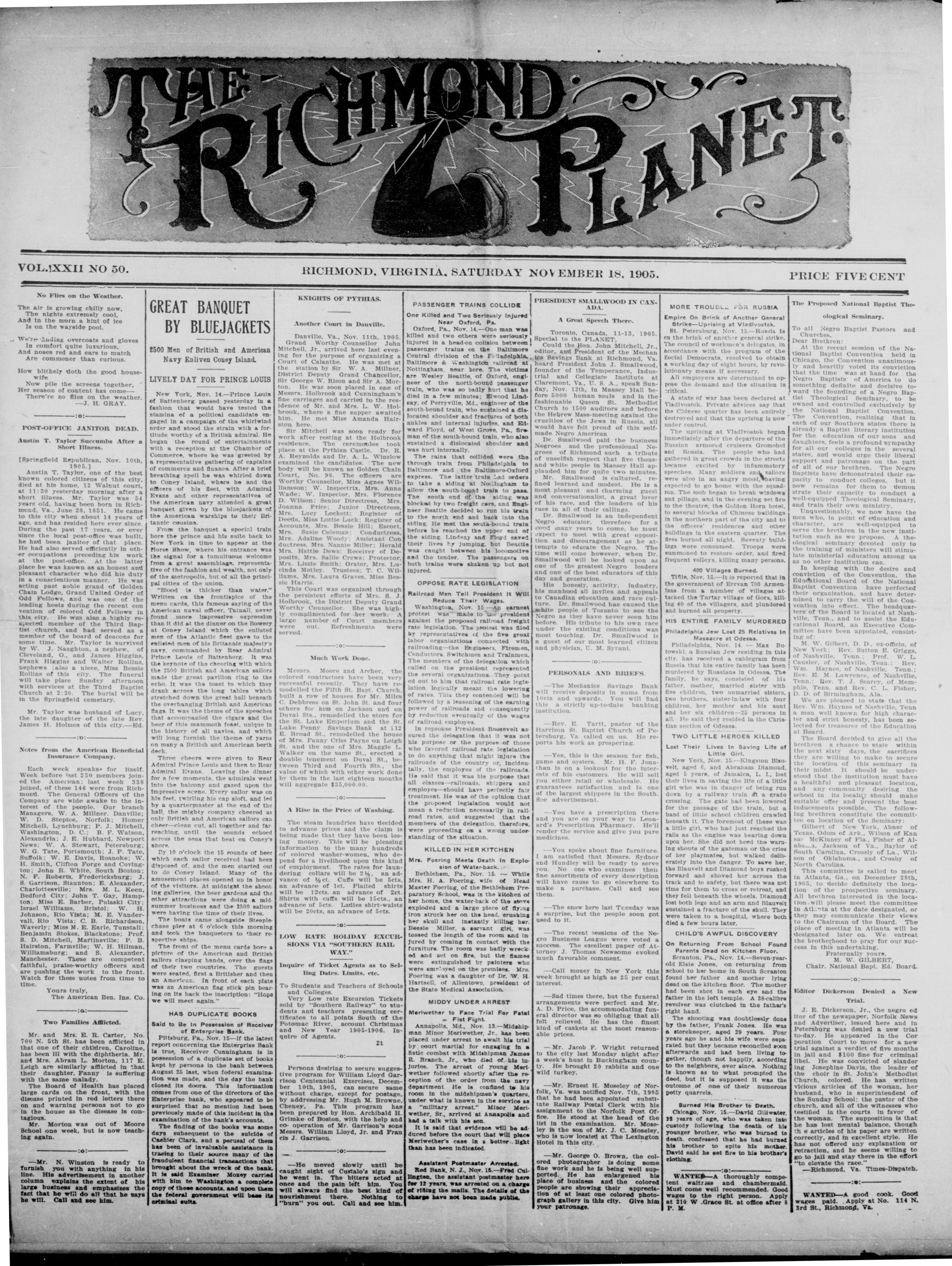
THE RICHMOND PLANET
No Flies on the Weather.
The air is growing chilly now,
The nights extremely cool,
And in the morn a hint of ice
Is on the wayside pool.
We're finding overcoats and gloves
In comfort quite luxurious,
And noses red and ears to match
Are commoner than curious.
How blithely doth the good house-
wife
Now pile the screens together.
Her season of content has come—
There're no flies on the weather.
—J. H. GRAY.
POST-OFFICE JANITOR DEAD.
Austin T. Taylor Succumbs After a Short Illness.
[Springfield Republican, Nov. 10th, 1905.]
Austin T. Taylor, One of the best known colored citizens of this city, died at his home, 12 Walnut court, at 11:30 yesterday morning after a short illness. Mr. Taylor was 54 years old, having been born in Richmond, Va., June 28, 1851. He came to this city when about 14 years of age, and has resided here ever since. During the past 17 years, or ever since the local post-office was built, he had been Janitor of that place. He had also served efficiently in other occupations preceding his work at the post-office. At the latter place he was known as an honest and pleasant character who did his duty in a conscientious manner. He was acting past noble grand of Golden Chain Lodge, Grand United Order of Odd Fellows, and was one of the leading hosts during the recent convention of colored Odd Fellows in this city. He was also a highly respected member of the Third Baptist church, and had served as a member of the board of deacons for some time. Mr. Taylor is survived by W. J. Naughton, a nephew, of Cleveland, O., and James Higgins, Frank Higgins and Walter Rollins, nephews; also a niece, Miss Bessie Rollins of this city. The funeral will take place Sunday afternoon with services at the Third Baptist Church at 2:30. The burial will be in the Springfield cemetery.
Mr. Taylor was husband of Lucy, the late daughter of the late Rev. James H. Holmes of this city.-Ed.
Notes from the American Beneficial Insurance Company.
Each week speaks* for itself.
Week before last 250 members joined the American; last week 338 joined, of the 146 were from Richmond. The General Officers of the Company are wide awake to the interest of the people. Our branch Managers, W. A. Milner, Danville; W. D. Steptoe, Norfolk; Homer Mitchell, Lynchburg; P. J. Mitchell, Washington, D. C.; B. F. Watson, Alexandria; J. E. Hubbard, Newport News; W. A. Stewart, Petersburg; W. G. Tate, Portsmouth; J. P. Tate, Suffolk; W. E. Davis, Roanoke; W. H. Smith, Clifton Forge and Covington; John R. White, South Boston; N. F. Roberts, Fredericksburg; J. S. Garrison, Staunton; E. Alexander, Charlottesville; Mrs. M. L. Keen, Bedford City; John T. Gay, Hampton; Miss E. Barber, Pulaski City; Israel Williams, Bristol; W. H. Johnson, Rio Vista; M. E. Vanderdell, Vrio Vista; C. B. Richardson, Waverly; Miss M. E. Earle, Tunstall; Benjamin Stokes, Blackstone; Prof. S. D. Mitchell, Martinsville; P. B. Hairston, Farmville; W. H. Hilman, Williamsburg; and S. Alexander, Manchester. These are competent faithful, praise-worthy officers and are pushing the work to the front. Watch for these notes from time to time.
Yours truly,
The American Ben. Ins. Co.
Two Families Afflicted.
Mr. and Mrs. E. R. Carter, No. 700 N. 5th St. has been afflicted in that one of their children, Caroline, has been ill with the diphtheria. Mr. and Mrs. Abram L. Morton, 117 E. Leigh are similarly afflicted in that their daughter, Fanny is suffering with the same malady.
The Board of Health has placed large cards on the front, with the disease printed in red letters there on and warning persons not to go in the house as the disease is contagious.
Mr. Morton was out of Moore School one week, but is now teaching again.
—Mr. N. Winston is ready to furnish you with anything in his line. His advertisement in another column explains the extent of his large business and emphasizes the fact that he will do all that he says he will. Call and see him.
GREAT BANQUET BY BLUEJACKETS
2500 Men of British and American Navy Enliven Coney Island.
LIVELY DAY FOR PRINCE LOUIS
New York, Nov. 14.—Prince Louis of Battenberg passed yesterday in a fashion that would have tested the stamina of a political candidate engaged in a campaign of the whirlwind order and stood the strain with a fortitude worthy of a British admiral. He began the round of entertainments with a reception at the Chamber of Commerce, where he was greeted by a representative gathering of captains of commerce and finance. After a brief breathing spell he was whirled down to Coney Island, where he and the officers of his fleet, with Admiral Evans and other representatives of the American navy attended a great banquet given by the bluejackets of the American warships to their Britannic cousins. From the banquet a special train bore the prince and his suite back to New York in time to appear at the Horse Show, where his entrance was the signal for a tumultuous welcome from a great assemblage, representative of the fashion and wealth, not only of the metropolis, but of all the principal cities of the union.
"Blood is thicker than water." Written on the frontispice of the menu cards, this famous saying of the American naval officer, Tatnall, never found more impressive expression than it did at the dinner on the Bowery at Coney Island which the enlisted men of the Atlantic fleet gave to the enlisted men of his Britannic majesty's navy, commanded by Rear Admiral Prince Louis of Battenberg. It was the keynote of the cheering with which the 2500 British and American sailors made the great pavilion ring to the echo. It was the toast to which they drank across the long tables which stretched down the great hall beneath the overhanging British and American flags. It was the theme of the speeches that accompanied the cigars and the beer of this mammoth feast, unique in the history of all navies, and which will long furnish the theme of yarns on many a British and American berth deck.
Three cheers were given to Rear Admiral Prince Louis and then to Rear Admiral Evans. Leaving the dinner for a few moments, the admirals went into the balcony and gazed upon the impressive scene. Every sailor was on his feet, twirling his cap aloft, and led by a quartermaster at the end of the hall, the mighty company cheered as only British and American sailors can cheer—clean cut, all together and far-reaching, until the sounds echoed across the sens that beat on Coney's shore.
By 10 o'clock the 15 rounds of beer which each sailor received had been disposed of, and the men started out to do Coney Island. Many of the amusement places opened up in honor of the visitors. At midnight the shooting galleries, the beer gardens and the other attractions were doing a midsummer business and the 2500 sailors were having the time of their lives. The boats came alongside Steeplechase pier at 6 o'clock this morning and took the banqueters to their respective ships. The front of the menu cards bore a picture of the American and British sailors clasping hands, over the flags of their two countries. The guests were seated, first a Britsher and then an American. In front of each plate was an American flag stick pin bearing on its back the inscription: "Hops we will meet again."
HAS DUPLICATE BOOKS
Said to Be In Possession of Receiver of Enterprise Bank
Pittsburg, Pa., Nov. 15—If the latest report concerning the Enterprise Bank is true, Receiver Cunningham is in possession of a duplicate set of books kept by persons in the bank between August 25 last, when federal examination was made, and the day the bank closed its doors. This information comes from one of the directors of the Enterprise bank, who appeared to be surprised that no mention had been previously made of this incident in the examination of the bank's accounts.
The finding of the books was some days subsequent to the sulicide of Cashier Clark, and a perusal of them has been of invaluable assistance in tracing to their source many of the fraudulent financial transactions that brought about the wreck of the bank. It is said Examiner Moxey carried with him to Washington a complete copy of these accounts, and upon them the federal government will base its criminal suits.
RICHMOND, VIRGINIA, SATURDAY NOVEMBER 18, 1905.
KNIGHTS OF PYTHIAS.
Another Court in Danville
Danville, Va., Nov. 11th, 1905. Grand Worthy Counsellor John Mitchell, Jr., arrived here last evening for the purpose of organizing a Court of Calanthe. He was met at the station by Sir W. A. Millner, District Deputy Grand Chancellor, Sir George W. Rison and Sir A. Morton. He was soon placed in one of Messrs. Holbrook and Cunningham's fine carriages and carried to the residence of Mr. and Mrs. L. W. Holbrook, where a fine supper awaited him. He met Miss Amanda Hairston here.
Sir Mitchell was soon ready for work after resting at the Holbrook residence. The ceremonies took place at the Pythian Castle. Dr. R. A. Reynolds and Dr. A. L. Winslow examined the candidates. The new body will be known as Golden Chain Court. No. 98. The officers are Worthy Counsellor, Miss Agnes Williamson; W. Inspectrix, Mrs. Anna Wade; W. Inspector, Mrs. Florence D. Wilson; Senior Directress, Mrs. Joanna Price; Junior Directress, Mrs. Lucy Lockett; Register of Deeds, Miss Lottie Luck; Register of Accounts, Mrs. Bessie Hill; Escort, Mrs. Susie Coleman; Conductress, Mrs. Adaline Woody; Assistant Conductress, Mrs. Nannie Miller; Herald Mrs. Hattie Dews; Receiver of Deposits, Mrs. Sallie Creews; Protector, Mrs. Lizzie Smith; Orator, Mrs. Lucinda Motley. Trustees; T. C. Williams, Mrs. Laura Graves, Miss Bessie Harris.
This Court was organized through the persistent efforts of Mrs. S. J. Holbrook, the District Deputy Grand Worthy Counselor. She was highly complimented for her work. A large number of Court members were out. Refreshments were served.
Much Work Done
Messrs. Moore and Archer, the colored contractors have been very successful recently. They have remodelled the Fifth St. Bapt. Church, built a row of houses for Mr. Miles C. Debbress on St. John St. and four others for him on Jackson and on Duval Sts., remodelled the store for the St. Luke Emporium and the St. Luke Penny Savings Bank at 112 E. Broad St., remodelled the house of Mrs. Fanny Cris Payne on Leigh St. and the one of Mrs. Maggie L. Walker on the same St., erected a double tenement on Duval St., between Third and Fourth Sts., the value of which with other work done by them in the last eighteen months will aggregate $35,000.00.
A Rise in the Price of Washing
The steam laundries have decided to advance prices and the claim is being made that they have been losing money. This will be pleasing information to the many hundreds of colored washer-women, who depend for a livelihood upon this kind of employment. The rates for laundering collars will be $2\frac{1}{2}$, an advance of $1\frac{1}{2}$ ct. Cuffs will be 5cts, an advance of 1ct. Plaited shirts will be 12cts. an advance of 2ct. Shirts with cuffs will be 15cts, an advance of 5cts. Ladies shirt-walstes will be 20cts, an advance of 5cts.
LOW RATE HOLIDAY EXCURSIONS VIA "SOUTHERN RAIL WAY."
Inquire of Ticket Agents as to Selling Dates. Limits, etc.
To Students and Teachers of Schools and Colleges.
Very Low rate Excursion Tickets sold by "Southern Railway" to students and teachers presenting certificates to all points South of the Potomac River, account Christmas and New Year 1905-1906. Inquire of Agents.
Persons desiring to secure suggestive program for William Lloyd Garrison Centennial Exercises, December 10th, 1905, can secure same without charge, except for postage, by addressing Mr. Hugh M. Browne, Cheney. Pa. This program has been prepared by Hon. Archibald H. Grimke of Boston, with the help and co-operation of Mr. Garrison's sons Messrs. William Lloyd, Jr. and Francks J. Garrison.
—He moved slowly until he caught sight of Custalo's sign and he went in. The bitters acted at once and the pain left him. You will always find the best kind of nourishment there. Nothing to "burn" you out. Call and see him.
PAS3ENGER TRAINS COLLIDE
One Killed and Two Seriously Injured
Near, Oxford, Pa.
Oxford, Pa., Nov. 14.—One man was killed and two others were seriously injured in a head-on collision between passenger trains on the Baltimore Central division of the Philadelphia, Baltimore & Washington railroad at Nottingham, near here. The victims are Wesley Beattie, of Oxford, engineer of the north-bound passenger train, who was so badly hurt that he died in a few minutes; Elwood Lindsay, of Perryville, Md., engineer of the south-bound train, who sustained a dislocated shoulder and fractures of both ankles and internal injuries, and Edward Floyd, of West Grove, Pa., fireman of the south-bound train who also sustained a dislocated shoulder and was hurt internally.
The rains that collided were the through train from Philadelphia to Baltimore and the Baltimore-Oxford express. The latter train laid orders to take a sliding at Nottingham to allow the south-bound train to pass. The south end of the sliding was blocked by two freight cars, and Engineer Beattie decided to run his train to the north end and back into the sliding. He met the south-bound train before he reached the upper end of the sliding. Lindsay and Floyd saved their lives by jumping, but Beattie was caught between his locomotive and the tender. The passengers on both trains were shaken up but not injured.
OPPOSE RATE LEGISLATION
Railroad Men Tell President It Will Reduce Their Wages.
Washington, Nov. 15 — An earnest protest was made to the president against the proposed railroad freight rate legislation. The protest was filed by representatives of the five great labor organizations connected with railroading—the Engineers, Firemen, Conductors, Switchmen and Trainmen. The members of the delegation which called on the president represented the several organizations. They point ed out to him that railroad rate legislation logically meant the lowering of rates. This they contended will be followed by a lessening of the earning power of railroads and consequently by reduction eventually of the wages of railroad employees.
In response President Roosevelt assured the delegation that it was not his purpose or the purpose of those who favored railroad rate legislation to do anything that might injure the railroads of the country or, incidentally, the employees of the railroads.
He said that it was his purpose that all classes—railroads, shippers and employees—should have perfectly fair treatment. He was of the opinion that the proposed legislation would not mean a reduction necessarily in railroad rates, and suggested that the members of the delegation, therefore, were proceeding on a wrong understanding of the situation.
KILLED IN HER KITCHEN
Mrs. Poering Meets Death In Explosion of Waterhack
Bethlehem, Pa., Nov. 15. - While Mrs. H. A. Foering, wife of Head Master Foering, of the Bethlehem Preparatory School, was in the kitchen of her home, the water-back of the stone exploded and a large piece of flying iron struck her on the head, crushing her skull and instantly killing her. Bessie Miller, a servant girl, was tossed the length of the room and injured by coming in contact with the furniture. The room was badly wrecked and set on fire, but the flames were extinguished by painters who were employed on the premises. Mrs. Foering was a daughter of Dr. W. H. Hartseld, of Allentown, president of the State Medical Association.
MIDDY UNDER ARREST
Meriwether to Face Trial For Fatal
Fist Flight
Annapolis, Md., Nov. 13.—Midshipman Minor Meriwether, Jr., has been placed under arrest to await his trial by court martial for engaging in a fistic combat with Midshipman James R. Branch, Jr., who died of his injuries. The arrest of young Meriwether followed shortly after the reception of the order from the navy department. He is confined to his room in the midshipman's quarters, under what is known in the service as a "military arrest." Minor Meriwether, Sr., arrived at Annapolis and had a talk with his son. It is said that evidence will be adduced before the court that will place Meriwether's case in a better, light than has been indicated.
Assistant Postmaster Arrested
Red Bank, N. J., Nov. 15.—Fred Cullington, the assistant postmaster here for 12 years, was arrested on a charge of riling the mails. The details of the charge have not been made public.
PRESIDENT SMALLWOOD IN CANADA.
A Great Speech There:
Toronto, Canada, 11-13, 1905. Special to the PLANET.
Could the Hon. John Mitchell, Jr., editor, and President of the Mechanics Savings Bank at Richmond, Va. heard President John J. Smallwood, founder of the Temperance, Industrial and Collegiate Institute at Claremont, Va., U. S. A., speak Sunday, Nov. 12th, in Massey Hall before 5000 human souls and in the fashionable Queen St. Methodist Church to 1500 auditors and before the Hebrew Mass-meeting against the cruelties of the Jews in Russia, all would have felt proud of this self-made Negro American.
Dr. Smallwood paid the business Negroes and the professional Negroes of Richmond such a tribute of unselfish respect that five thousand and white people in Massey Hall applauded him for quite two minutes.
Mr. Smallwood is cultured, refined learned and modest. He is a most pleasant and charming guest and conversationalist, a great lover of his race, and the leaders of his race in all of their callings.
Dr. Smallwood is an independent Negro educator, therefore for a good many years to come, he must expect to meet with great opposition and discouragement as he attempts to educate the Negro. The time will come however, when Dr. Smallwood will be looked upon as one of the greatest Negro leaders and one of the best educators of this day and generation.
His honesty, activity, industry, his manhood all invites and appeals to Canadian education and race culture. Dr. Smallwood has caused the white people of Toronto to see the Negro as they have never seen him before. His tribute to his own race has the most satisfactory was most touching. Dr. Smallwood a guest of our most learned citizen and physician, U. M. Syrani.
PERSONALS AND BRIEFES
—The Mechanics Savings Bank will receive deposits in sums from 10cts and upwards. You will find this a strictly up-to-date banking institution.
—Rev. E. Tartt, pastor of the Harrison St. Baptist Church of Petersburg, Va. called on us. He reports his work as prospering.
—Yes, this is the season for fish, game and oysters. Mr. H. F. Jonathan is on a lookout for the interests of his customers. He will sell you either retail or wholesale. He guarantees satisfaction and is one of the largest shippers in the South. See advertisement.
—You have a prescription there and you are on your way to Leonard's Prescription Pharmacy. He'll render the service and give you pure medicines.
—You spoke about fine furniture. I am satisfied that Messrs. Sydnor and Hundley will be ready to serve you. No one who examines their fine assortments of every description will have cause to go elsewhere to make a purchase. Call and see them.
—The snow here last Tuesday was a surprise, but the people soon got used to it.
The recent sessions of the Negro Business League were voted a success. The excellent paper of Attorney J. Thomas Newsome evoked much favorable comment.
Call money in New York this week brought as high as 25 per cent interest.
Sad times there, but the funeral arrangements were perfect and Mr. A. D. Price, the accommodating funeral director was so obligating that all felt relieved. He has the finest kind of caskets at the most reasonable prices.
Mr. Jacob F. Wright returned to the city last Monday night after a week's hunt in Buckingham county. He brought 20 rabbits and one wild turkey.
Mr. Ernest H. Moseley of Norfolk, Va. was notified Nov. 7th, 1905 that he had been appointed substitute Railway Post Clerk with his assignment to the Norfolk Post Office. He stood at the head of the list in the examination. Mr. Moseley is the son of Mr. J. C. Moseley, who is now located at The Lexington Hotel in this city.
—Mr. George O. Brown, the colored photographer is doing some fine work and he is being well supported. He has enlargened his place of business and the colored people are showing their appreciation of at least one colored photograph gallery in this city. Give him your patronage.
St. Petersburg, Nov. 15.—Russia is on the brink of another general strike. The council of workmen's delegates, in accordance with the program of the Social Democrats, resolved to obtain a working day of eight hours, by revolutionary means if necessary. All employers are determined to oppose the demand and the situation is critical.
A state of war has been declared at Vladivostok. Private advices say that the Chinese quarter has been entirely destroyed and that the uprising is now under control.
The uprising at Vladivostok began immediately after the departure of the Russian armored cruisers Gromobol and Rossia. The people who had gathered in great crowds in the streets became excited by inflammatory speeches. Many soldiers and sailors were also in an angry mood, having expected to go home with the squadron. The mob began to break windows and pillage, and in the evening set fire to the theatre, the Golden Horn hotel, to several blocks of Chinese buildings in the northern part of the city and to the officers' residences and other buildings in the eastern quarter. The fires burned all night. Seventy buildings were consumed. Troops were summoned to restore order, and fired frequent volleys, killing many persons.
400 Villages Burned.
Tiflis, Nov. 15.—it is reported that in the government of Errvan 700 Armenians from a number of villages attacked the Tartar village of Gors, killing 40 of the villagers, and plundered and burned all property.
HIS ENTIRE FAMILY MURDERED
Philadelphia Jew Lost 25 Relatives in Massacre at Odessa.
Philadelphia, Nov. 14. — Max Butowski, a Russian Jew residing in this city, has received a cablegram from Russia that his entire family has been murdered by Russians in Odessa. The family, he says, consisted of his father, mother, married sister with five children, two unmarried sisters, two brothers, sister-in-law with four children, her mother and his aunt and her six children—25 persons in all. He said they resided in the Christian section of Odessa.
TWO LITTLE HEROES KILLED
Lost Their Lives In Saving Life of Little Girl.
New York, Nov. 15.—Kingston Blauvelt, aged 6, and Abraham Diamond, aged 5 years, of Jamaica, L, lost their lives in saving the life of a little girl who was in danger of being run down by a railway train a grade crossing. The gate had been lowered for the passage of the train, but a band of little school children crawled beneath it. The foremost of these was a little girl, who had just reached the rails as the engine was bearing down upon her. She did not heed the warning shouts of the gateman or the cries of her playmates, but walked deliberately into the danger. To save her, the Blauvelt and Diamond boys rushed forward and shoved her across the track and to safety, but there was not time for them to cross or retreat, and they fell beneath the wheels. Diamond lost both legs and an arm and Blauvelt sustained a fracture of the skull. They were taken to a hospital, where both died a few hours later.
CHILD'S AWFUL DISCOVERY
On Returning From School Found Parents Dead on Kitchen Floor. Scranton, Pa., Nov. 14—Seven-year-old Elsie Jones, on returning from school to her home in South Scranton found her father and mother lying dead on the kitchen floor. The mother had been shot in each eye and the father in the left temple. A 38-calibre revolver was clutched in the father's right hand.
The shooting was doubtlessly done by the father, Frank Jones. He was a storekeeper, aged 29 years. Four years ago he and his wife were separated, but they became reconciled soon afterwards and had been living together, though not happily, according to the neighbors, ever since. Nothing is known as to what prompted the deed, but it is supposed it was the outcome of one of their numerous petty quarrels.
Burned His Brother to Death
Chicago, Nov. 15.—David Gillwater,
18 years of age, who was taken into
custody following the death of his
younger brother, who was burned to
death, confessed that he had burned
his brother to spite his mother.
David said he set fire to his brother's
clothing.
:0:
WANTED—A thoroughly competent waitress and chambermaid.
Must come well recommended. Good wages to the right person. Apply
at 210 W. Grace St. at office after 8 P. M.
ological Seminary.
To all Negro Baptist Pastors and Churches, Dear Brethren:
At the recent session of the National Baptist Convention held in Chicago, the Convention unanimously and heartily voted its conviction that the time was at hand for the Negro Baptists' of America to do something definite and decisive toward the founding of a Negro Baptist Theological Seminary, to be owned and controlled exclusively by the National Baptist Convention. The Convention, realizing that in each of our Southern states there is already a Baptist literary institution for the education of our sons and daughters, feels a profound sympathy for all our colleges in the several states, and would urge their liberal support and patronage on the part of all of our brethren. The Negro Baptists have demonstrated their capacity to conduct colleges, but it now remains for them to demonstrate their capacity to conduct a well-equipped Theological Seminary, and train their own ministry.
Unquestionably, we now have the men who, in point of education and character, are well-equipped to serve the brethren in the new institution such as we propose. A theological seminary devoted only to the training of ministers will stimulate ministerial education among us as no other institution can.
In keeping with the desire and conviction of the Convention, the Educational Board of the National Baptist Convention have perfected their organization, and have determined to carry the will of the Convention into effect. The headquarters of the Board is located at Nashville, Tenn., and to assist the Educational Board, an Executive Committee have been appointed, consisting of:
M. W. Gilbert, D. D., ex-officio, of New York; Rev. Sutton E. Griggs, of Nashville, Tenn.; Prof. W. L. Causler, of Nashville, Tenn.; Rev. Wm. Haynes, of Nashville, Tenn.; Rev. E. M. Lawrence, of Nashville, Tenn.; Rev. T. J. Searcy, of Memphis, Tenn. and Rev. C. L. Fisher, D. D. of Birmingham, Ala.
We are pleased to state that the Rev. Wm. Haynes of Nashville, Tenn. a man well known for high character and strict honesty, has been selected for treasurer of the Education al board.
The Board decided to give all the brethroach a chance to state within the next sixty days, the sacrifices they are willing to make to secure the location of this seminary in their midst. It should be understood that the institution must have a healthful and pleasant location, and any community desiring the school in its locally should make suitable offer and present the best inducements possible. The following brethren constitute the committee on location of the Seminary.
Gilbert of New York, Abner of Texas, Odom of Ark., Wilson of Kansas McKinney of Fla., Fisher of Alabama., Jackson of Va., Baylor of South Carolina, Crossly of La., Wilson of Oklahoma, and Crosby of North Carolina.
This committee is called to meet in Atlanta, Ga., on December 28th, 1905, to decide definitively the location of the prospective seminary. All brethren interested in the location will please meet the committee in Atlanta at the date designated, or they may communicate their views to the Chairman of the Board. The place of meeting in Atlanta will be designated later on. We entreat the brotherhood to pray for our success in this undertaking.
Fraternally yours,
M. W. GILBENT
Chair, National Bapt. Ed. Board.
Editor Dickerson Denied a New Trial
J. E. Dickerson, Jr., the negro editor of the newspaper, Norfolk News and Advertiser, issued here and in Petersburg was denied a new trial to-day. He appeared in the Corporation Court to move for a new trial against a verdict of five months in jail and $100 fine for criminal libel. He was convicted of slandering Josephine Davis, the leader of the choir in St. John's Methodist Church, colored. He has written vicious articles of the woman, her husband, who is superintendent of the Sunday School; the pastor of the church, and all of the witnesses who testified in the courts in favor of the woman. The supposition is that he has lost mental balance, though the articles of his paper are written correctly, and in excellent style. He has not offered any explanation or retraction, and he seems willing to go to jail and stay there in the effort "to elevate the race."
—Richmond, Va. Times-Dispatch.
WANTED—A good cook. Good wages paid. Apply at No. 114 N. 3rd St., Richmond, Va.
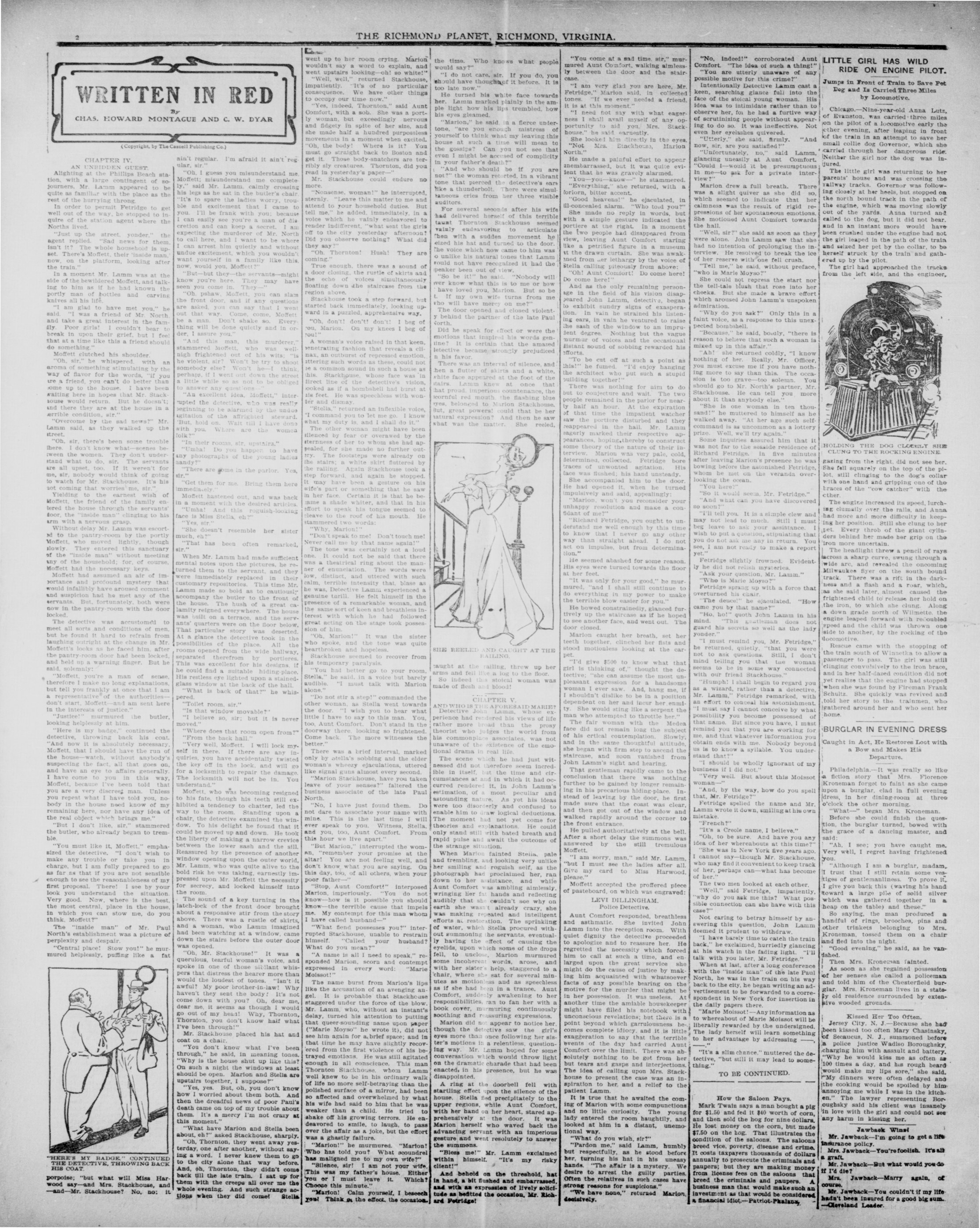
WRITTEN IN RED
BY
CHAS. HOWARD MONTAGUE AND C. W. DYAR
(Copyright, by The Cassell Publishing Co.)
AN UNBIDDEN GUEST
IN UNGUIDEN GUEST
Alighting at the Phillips Beach station, with a large contingent of sojourners, Mr. Lamm appeared to be quite as familiar with the place as the rest of the hurrying throng.
In order to permit Fetridge to get well out of the way, he stopped to inquire of the station agent where the Norths lived.
"Just up the street, yonder," the agent replied. "Sad news for them, isn't it? The whole household is upset. There's Moffett, their 'inside man,' now, on the platform, looking after the train."
In a moment Mr. Lamm was at the side of the bewildered Moffett, and talking to him as if he had known the portly man of bottles and carving knives all his life.
"I am glad to have met you," he said. "I was a friend of Mr. North, and take a great interest in the family. Poor girls! I couldn't bear to break in upon their grief, but I feel that at a time like this a friend should do something."
Moffett clutched his shoulder.
"Oh, sir," he whispered, with an aroma of something stimulating by the way of flavor for the words, "if you are a friend, you can't do better than some up to the house. I have been waiting here in hopes that Mr. Stackhouse would return. But he doesn't; and there they are at the house in a terrible condition, sir."
"Overcome by the sad news?" Mr. Lamm said, as they walked up the street.
"Oh, sir, there's been some trouble there. I don't know what—seenes between the women. They don't understand what to do, sir. The servants are all upset, too. If it weren't for me, sir, nobody would think of going to watch for Mr. Stackhouse. It's his lot coming that worries me, sir."
Yielding to the earnest wish of Moffett, the friend of the family entered the house through the servants' door, the "inside man" clinging to his arm with a nervous grasp.
Without delay Mr. Lamm was escorted to the pantry-room by the porty Moffett, who moved lightly, though slowly. They entered this sanctuary of the "inside man" without meeting any of the household; for, of course, Moffett had the necessary keys.
Moffett had assumed an air of importance and profound mystery that would infailibly have aroused comment and suspicion had he met any of the servants. But, fortunately, both were now in the pantry-room with the door locked.
The detective was accustomed to meet all sorts and conditions of men, but he found it hard to refrain from laughing outright at the change in Mr. Moffett's looks as he faced him, after the pantry-room door had been locked, and held up a warning finger. But he said, solemnly:
"Moffett, you're a man of sense, therefore I make no long explanations, but tell you frankly at once that I am a representative of the authorities—don't start, Moffett—and am sent here in the interests of justice."
"Justice!" murmured the butler, looking helplessly at him.
"Here is my badge," continued the detective, throwing back his coat. "And now it is absolutely necessary. Moffett, that I should have the run of the house—watch, without anybody's suspecting the fact, all that goes on, and have an eye to affairs generally. I have come to you in this way, Moffett, because I've been told that you are a very discreet man. Unless you repeat what I have told you, nobody in the house need know of my remaining here, nor have any idea of the real object which brings me." "But I don't like, sir," stammered the butler, who already began to tremble.
"You must like it, Moffett," emphasized the detective. "I don't wish to make any trouble or take you in charge, but I am fully prepared to go as far as that if you are not sensible enough to see the reasonableness of my first proposal. There! I see by your look you understand the situation. Very good. Now, where is the best, the most central, place in the house, in which you can stow me, do you think, Moffett?" The "inside man" of Mr. Paul North's establishment was a picture of perplexity and despair. "Central place! Stow you!" he murmured helplessly, puffing like a fat
A
"HERE'S MY BADGE." CONTINUED
THE DETECTIVE, THROWING BACK
HIS COAT.
porpoise; "but what will Miss Har-
wood say—and Mrs. Stackhouse, and
—and Mr. Stackhouse? No. no; it
CHAPTER IV.
ain't regular. I'm afraid it ain't regular, sir."
"Oh. I guess you misunderstand me, Moffett; misunderstand me completely," said Mr. Lamm, calmly crossing his legs as he sat in the butler's chair. "It's to spare the ladies worry, trouble and excitement that I came to you. I'll be frank with you; because I can easily see you're a man of discretion and can keep a secret. I am expecting the murderer of Mr. North to call here, and I want to be where I can arrest him quietly and without undue excitement, which you wouldn't want yourself in a family like this, now, would you, Moffett?"
"But—but they—the servants—might know you're here. They may have seen you come in. They—"
"Oh. pshaw, Moffett, you can slam the front door, and if any questions are asked, you can say that I went out that way. Come, come, Moffett be a man. Don't shake so. Everything will be done quietly and in order, I assure you."
"And this man, this murderer," stammered Moffett, who was well-night frightened out of his wits; "is he violent, sir? Won't he try to shoot somebody else? Won't he—I think perhaps, if I went out down the street a little while so as not to be obliged to answer any questions—"
"An excellent idea, Moffett," interrupted the detective, who was really beginning to be alarmed by the undue irritation of the affrigrated steward. 'But, hold on. Wait till I have done with you. Where are the women folk?'
"In their rooms, sir, upstairs."
"Umha! Do you happen to have any photographs of the young ladies handy?"
"There are some in the parlor. Yes, sir."
"Get them for me. Bring them here immediately."
Moffett hastened out, and was back in a moment with the desired articles.
"Umhah! And this roguish-looking face is Miss Stella, eh?"
"Yes, sir."
"She doesn't resemble her sister much, eh?"
"That has been often remarked, sir."
When Mr. Lamm had made sufficient mental notes upon the pictures, he returned them to the servant, and they were immediately replaced in their customary repositories. This time Mr. Lamm made so bold as to cautiously accompany the butler to the front of the house. The hush of a great calamity reigned everywhere. The house was built on a terrace, and the servants' quarters were on the floor below. That particular story was deserted. At a glance the detective took in the possibilities of the place. All the rooms opened from the wide hallway, separated therefrom by portieres. This was excellent for his designs. If he could find a suitable hiding-place, his restless eye lighted upon a stained-glass window at the back of the hall.
"What is back of that?" he whispered.
"Toilet room, sir."
"Is that window movable?"
"I believe so, sir; but it is never moved."
"Where does that room open from?"
"From the back hall."
"Very well, Moffett. I will lock myself in there. If there are any inquiries, you have accidentally twisted the key off in the lock, and will go for a locksmith to repair the damage. The locksmith will not be in. You understand."
Moffett, who was becoming resigned to his fate, though his teeth still exhibited a tendency to chatter, led the way to the room. Standing upon a chair, the detective examined the window. To his delight he found that it could be moved up and down. He took the liberty of making a narrow crevice between the lower sash and the sill. Reassured by the presence of another window opening upon the outer room, Mr. Lamm, who was quite alive to the bold risk he was taking, earnestly impressed upon Mr. Moffett the necessity for secrecy, and locked himself into the room.
The sound of a key turning in the latch-lock of the front door brought about a responsive stir from the story above. There was a rustle of skirts, and a woman, who Lamm imagined had been watching at a window, came down the stairs before the outer door was opened.
"Oh, Mr. Stackhouse!" It was a querulous, tearful woman's voice, and spoke in one of those siliant whispers that distress the hearer more than would the loudest of tones. "Isn't it awful? My poor brother-in-law! Why haven't they sent the body? It's not come down with you? Oh, dear me, dear me, it seems as though I would go out of my head! Why, Thornton, Thornton, you don't know half what I've been through!
Mr. Stackhouse placed his hat and coat on a chair.
"You don't know what I've been through," he said, in meaning tones. "Why is the house shut up like this? On such a night the windows at least should be open. Marion and Stella are upstairs together, I suppose?" "Yes, yes. But, oh, you don't know how I worried about them both. And then the dreadful news of poor Paul's death came on top of my trouble about them. It's a mercy I'm not crazy at this moment." "What have Marion and Stella been about, eh?" asked Stackhouse, sharply. "Oh, Thornton, they went away yesterday, one after another, without saying a word. I never knew them to go to the city alone that way before. And, oh, Thornton, they didn't come back till the late train. I sat up for them with the creeps all over me the whole evening. And such strange actions when they did come! Stella
THE RICHMOND PLANET, RICHMOND, VIRGINIA
went up to her room crying. Marion wouldn't say a word to explain, and went upstairs looking—oh! so white!" "Well, well," returned Stackhouse, impatiently. "It's of no particular consequence. We have other things to occupy our time now." "Yes, indeed, Thornton," said Aunt Comfort, with a sob. She was a portly woman, but exceedingly nervous and fidgety in spite of her size, and she made half a hundred purposeless movements in a moment when excited. "Oh, the body! Where is it? You must go straight back to Boston and get it. Those body-snatchers are terribly sly creatures. Thornton, did you read in yesterday's paper—" Mr. Stackhouse could endure no more.
"Nonsense, woman!" he interrupted, sternly. "Leave this matter to me and attend to your household duties. But tell me," he added immediately, in a voice which he vainly endeavored to render indifferent. "what sont the girls off to the city yesterday afternoon! Did you observe nothing? What did they say?"
"Oh, Thornton! Hush! They are coming."
True enough, there was a sound of a door closing, the rustle of skirts and the echo of voices simultaneously floating down the staircase from the region above.
Stackhouse took a step forward, but started back immediately, looking upward in a puzzled, apprehensive way.
"Oh, don't! don't! don't! I beg of you, Marion. On my knees I beg of you!"
A woman's voice raised in that keen, penetrating fashion that reveals a climax, an outburst of repressed emotion, uttering such words as these, could not be a common sound in such a house as this. Stackhouse, whose face was in direct line of the detective's vision, looked as if a bombshell had burst at its feet. He was speechless with wonder and dismay.
"Stella," returned an inflexible voice, "I command you to let me go. I know what my duty is, and I shall do it."
The other woman might have been silenced by fear or overawed by the sternness of her to whom she had appealed, for she made no further outtry. The footsteps were already on the stairs; a white skirt fluttered on the railing. Again Stackhouse took a step forward, and again he stopped. It may have been a gesture on his wife's part or something that he saw in her face. Certain it is that he became a shade whiter, and that in his effort to speak his tongue seemed to cleave to the roof of his mouth. He stammered two words:
"Why, Marion!"
"Don't speak to me! Don't touch me! Never call me by that name again!"
The tone was certainly not a loud one. It could not be said that there was a theatrical ring about the manner of enunciation. The words were low, distinct, and uttered with such calm, terrible intensity that, blase as he was, Detective Lamm experienced a genuine turil. He felt himself in the presence of a remarkable woman, and the same sort of koen and breathless interest with which he had followed great acting on the stage took possession of him.
"Oh, Marion!" It was the sister who spoke, and the tone was quite heartbroken and hopeless.
Stackhouse seemed to recover from his temporary paralysis.
"You had better go to your room, Stella," he said, in a voice but barely audible.
"I must talk with Marion alone."
"Do not stir a step!" commanded the other woman, as Stella went towards the door. "I wish you to hear what little I have to say to this man. You, too, Aunt Comfort. Don't stand in the doorway there, looking so frightened. Come back. The more witnesses the better."
There was a brief interval, marked only by stella's sobbing and the elder woman's wheezy ejaculations, uttered like signal guns almost every second.
"Marion Stackhouse, have you taken leave of your senses?" faltered the business associate of the late Paul North.
"No, I have just found them. Do not dare to associate your name with mine. This is the last time I will ever speak to you. Witness, Stella, and you, too. Aunt Comfort. From this hour we live apart."
"But Marion," interrupted the woman, "remember your promise at the altar! You are not feeling well, and don't know what you are saying. On this day, too, of all others, when your poor father—"
"Stop, Aunt Comfort!" interposed Marion, imperiously. "You do not know—how is it possible you should know—the terrible cause that impels me. My contempt for this man whom I have called husband—"
"What fiend possesses you?" interrupted Stackhouse, unable to restrain himself. "Called your husband? What do you mean?"
"A name is all I need to speak," responded Marion, scorn and contempt expressed in every word: "Marie Moissot!"
The name burst from Marion's lips like the accusation of an avenging angel. It is probable that Stackhouse staggered under the force of the blow. Mr. Lamm, who, without an instant's delay, turned his attention to putting that queer-sounding name upon paper ("Marie Moyo") he wrote it), did not see him again for a brief space; and in that time he may have slightly recovered from the first violence of his betrayed emotions. He was still agitated enough in all conscience. This man Thornton Stackhouse, whom Lamm well knew to be in his ordinary walk of life no more self-betraying than the polished surface of a mirror, had been so affected and overwhelmed by what his wife had said to him that he was weaker than a child. He tried to shake off his growing terrors. He endeavored to smile, to laugh, to pass over the affair as a joke, but the effort was a ghastly failure.
"Marion!" he murmured. "Marion!
Who has told you? What soundrel
has maligned me to my own wife?"
"Marton! Calm yourself, I besech you! Think $g$, the effect, the occasion.
the time. Who knows what people would say?"
"I do not care, sir. If you do, you should have thought of it before. It is too late now."
He turned his white face towards her. Lamin marked plainly in the ample light how his lips trembled, how his eyes gleamed.
"Marion," he said, in a fierce undertone, "are you enough mistress of yourself to think what my leaving this house at such a time will mean to the gossips? Can you not see that even I might be accessed of complicity in your father's death?"
"And who should be if you are not?" the woman retorted. In a vibrant tone that pierced the detective's ears like a thunderbolt. There were simultaneous cries from her three visible auditors.
For several seconds after his wife had delivered herself of this terrible taunt Thornton Stackhouse seemed vainly endorsing to articulate then with a sudden movement he elized his hat and turned to the door. the voice which now came to him was o unlike his natural tones that Lamm could not have recognized it had the speaker been out of view. "So be it!" he said. "Nobody will ever know what this is to me or how 'have loved you, Marion. But so be t. If my own wife turns from me who will have mercy on me?" The door opened and closed violently behind the partner of the late Paul North. Did he speak for effect or were the emotions that inspired his words genuine? It is certain that the amazed letective became strongly prejudiced n his favor.
There was an interval of silence, and then a flutter of skirts and a white, white face appeared at the foot of the stairs. Lemm knew at once that that proud, imperious countenance, the coffernal red mouth, the flashing blue eyes, belonged to Martion Stackhouse, Sut, great powers! could that be her natural expression? And then he saw what was the matter. She reeled.
M.
SHE REELED AND CAUGHT AT THE BAILING.
caught at the railing, threw up her arms and fell like a log to the floor.
So indeed this stolical woman was made of flesh and blood!
CHAPTER V
AND WHO IS THE AFORESAID MARIE? Detective John Lamm, whose experience had rendered his views of life rather more broad than the prosy theorist who judges the world from his commonplace associates, was not unaware of the existence of the emotional drama in real life. The scene which he had just witnessed did not therefore seem incredible in itself, but the time and circumstances at and in which it had occurred rendered it, in John Lamm's estimation, of a most peculiar and astounding nature. As yet his ideas were too disorderly and confused to enable him to draw logical deductions. The moment had not yet come for theories and explanations. He could only stand still with bated breath and rapid pulse and await the outcome of the strange situation.
When Marion fainted Steina, pale and trembling, and looking very unlike her smiling and roguish self, as the photograph had proclaimed her, ran down to her assistance, and while Aunt Comfort was ambling aimlessly, wringing her fat hands and reflecting audibly that she couldn't see why on earth she wasn't already crazy, she was making repeated and intelligent efforts as restoration. The sprinkling of water, which Stella procured without summoning the servants, eventually having the effect of causing the eyelids, upon which some of the drops fell, to unclose, Marion murmured some incoherent words, arose, and with her sister's help, staggered to a chair, where she sat for several minutes as motionless and as speechless as if she had been in a trance. Aunt Comfort, suddenly awakening to her responsibilities, ran to fan her with a book cover, murmuring continuously soothing and reassuring expressions.
Marion did not appear to notice her, though the detective saw the girl's eyes more than once following her sister's motions in a relentless, questioning way. Mr. Lamm hoped for some conversation which would throw light on the dramatic charade that had been enacted, in his presence, but he was disappointed.
A ring at the doorbell fell with startling effect upon the silence of the house. Stella had precipitately to the upper regions, while Aunt Comfort, with her hand on her heart, stared apprehensively at the door. It was Marion herself who waved back the advancing servant with an imperious gesture and went resolutely to answer the summons.
"Bless me!" Mr. Lamm exclaimed within himself. "It's my risky client!"
And behold on the threshold, hat in hand, a bit flushed and embarrassed, and with an expression of lively solitude an befitted the occasion, Mr. Richard Petridge!
"You come at a sad time, sir," murured Aunt Comfort, walking almessly between the door and the staircase.
"I am very glad you are here, Mr. Fetridge." Marion said, in collected tones. "If we ever needed a friend, it is at this moment."
"I need not say with what eagerness I shall avail myself of any opportunity to aid you, Mrs. Stackhouse." he said earnestly.
She looked him directly in the eyes, "Not Mrs. Stackhouse, Marion North."
He made a painful effort to appear anembarrassed, but it was quite evident that he was gravely alarmed.
"You—you—know—" he stammered.
"Everything," she returned, with a orlorn, bitter accent.
"Good heavens! he ejaculated, in ill-concealed alarm. "Who told you?" She made no reply in words, but with a simple gesture indicated the portiere at the right. In a moment the two people had disappeared from view, leaving Aunt Comfort starring like a petrified figure in a museum at the drawn curtain. She was awakened from her lethargy by the voice of stella calling piteously from above: "Oh! Aunt Comfort! Do come here!
"Oh! Aunt Comfort! Do come here!
Do come here!"
And as the only remaining personage in the field of his vision disappeared John Lamm, detective, began to exhibit sundry signs of exasperation. In vain he strained his listening ears, in vain he ventured to raise the sash of the window to an imprudent degree. Nothing but the vague murmur of voices and the occasional distant sound of sobbing rewarded his morts.
"To be cut off at such a point as this!" he fumed. "I'd enjoy hanging the architect who put such a stupid building together!"
There was nothing for him to do but to conjecture and wait. The two people remained in the parlor for nearly half an hour. At the expiration of that time the impatient watcher saw the portiere disturbed and they reappeared in the hall. Mr. Lamm sagely marked their respective appearances, hoping, thereby to construct some theory of the nature of their interview. Marion was very pale, cold, determined, collected. Fetridge bore traces of unwonted agitation. His face was flushed; his hand unsteady. She accompanied him to the door. He had opened it, when he turned impulsively and said, appealingly: "Marion, won't you reconsider your unhappy resolution and make a confidant of me?" "Richard Fetridge, you ought to understand me well enough by this time to know that I never go any other way than straight ahead. I do not act on impulse, but from determination."
He seemed abashed for some reason. His eyes were turned towards the floor at her feet.
"It was only for your good," he murmured, "and I shall still continue to do everything in my power to make the terrible blow easier for you."
He bowed constrainedly, glanced furtively up the staircase as if he hoped to see another face, and went out. The door closed.
Marlon caught her breath, set her teeth together, clinched her fists and stood motionless looking at the carpet.
"I'd give $500 to know what that girl is thinking of," thought the detective; "she can assume the most unpleasant expression for a handsome woman I ever saw. And, hang me, if I shouldn't dislike to be in a position dependent on her and incur her empathy. She would sting like a serpent the man who attempted to throttle her."
The fair woman with the Medea face did not remain long the subject of his critical contemplation. Slowly, and in the same thoughtful attitude, she began with firm step to ascend the staircase, and soon vanished from John Lamm's sight and hearing.
That gentleman rapidly came to the conclusion that there was nothing further to be gained by longer remaining in his precarious hiding place. Instead of leaving by the door, he first made sure that the coast was clear, and then got out of the window and walked rapidly around the corner to the front entrance.
He pulled authoritatively at the bell. After a short delay the summons was answered by the still tremulous Moffett.
"I am sorry, man," said Mr. Lamm, "but I must see the ladies after all. Give my card to Miss Harwood, please."
Moffett accepted the proffered piece of pasteboard, on which was engraved:
LEVI DILLINGHAM Police Detective.
Aunt Comfort responded, breathless and asthmatic. She invited John Lamm into the reception room. With quiet dignity the detective proceeded to apologize and to reassure her. He regretted the necessity which forced him to call at such a time, and enlarged upon the great service she might do the cause of justice by making him acquainted with whatsoever facts of any possible bearing on the motive for the murder that might be in her possession. It was useless. At another time the amiable housekeeper might have filled his notebook with unconscious revelations; but there is a point beyond which garrulousness becomes complete idiocy, and it is little exaggeration to say that the terrible events of the day had carried Aunt Comfort over the limit. There was absolutely nothing to be got from her but tears and gasps and interjections. The idea of calling upon Mrs. Stackhouse to present the case was an inspiration to her, and a relief to the patient Lamm.
It is true that he awaited the coming of Marion with some compunctions and no little curiosity. The young lady entered the room haughtily, and looked at him in a distant, unemotional way.
"What do you wish, sir?"
"Pardon me," said Lamm, humbly but respectfully, as he stood before her, turning his hat in his uneasy hands. "The affair is a mystery. We desire to arrest the guilty parties. Often the relatives in such cases have strong reasons for suspicions."
"We have none," returned Marlon decisively.
"No, indeed!" corroborated Aunt Comfort. "The idea of such a thing!" "You are utterly unaware of any possible motive for this crime!" Intentionally Detective Lamm cast a keen, searching glance full into the face of the stocal young woman. His idea was to intimidate rather than to observe her, for he had a furtive way of scrutinizing people without appearing to do so. It was ineffective. Not even her eyes lashes quivered. "Utterly," she said, firmly. "And now, sir, are you satisfied?" "Unfortunately, no," said Lamm, glancing uneasily at Aunt Comfort. "Could I—would it be presumptuous in me—to ask for a private interview?" Marion drew a full breath. There was a slight quiver as she did so, which seemed to indicate that her calmness was the result of rigid repressions of her spontaneous emotions. She motioned Aunt Comfort towards the hall.
"Well, sir?" she said as soon as they were alone. John Lamm saw that she had no intention of prolonging the interview. He resolved to break the ice of her reserve with one fell crush.
"Tell me," he said, without preface, "who is Marie Moyoo?"
She could not repress the start nor the tell-tale blush that rose into her cheeks. But she made a brave effort which aroused John Lamm's unspoken admiration.
"Why do you ask?" Only this in a faint voice, as a response to this unexpected bombshell.
"Because," he said, bodily, "there is reason to believe that such a woman is mixed up in this affair."
"Ah! she returned coldly, "I know nothing of her. Really, Mr. Officer, you must excuse me if you have nothing more to say than this. The occasion is too grave—too solemn. You should go to Mr. North's partner, Mr. Stackhouse. He can tell you more about it than anybody else."
"She is one woman in ten thousand!" he muttered to himself as he walked away. "At her age such self-command is as uncommon as a lottery prize. Well, we'll try again."
Some inquiries assured him that it was not far to the seaside residence of Richard Fetridge. In five minutes after leaving Marion's presence he was bowing before the astonished Fetridge, whom he met on the veranda overlooking the ocean.
"You here?"
"So it would seem, Mr. Fetridge."
"And what can you have discovered so soon?"
"I'll tell you. It is a simple clew and may not lead to much. Still I must beg leave to ask your assistance. I wish to put a question, stipulating that you do not ask me any in return. You see, I am not ready to make a report yet."
Fetridge slightly frowned. Evidently he did not relish mysteries.
"Ask your question, Mr. Lamm." "Who is Marie Moyso?" Fetridge sprang up with a force that overturned his chair.
"The deuce!" he ejaculated. "How came you by that name?"
"Ho, ho!" quoth John Lamm in his mind. "This gattleman does not guard his secrets so well as the lady yonder."
"I must remind you, Mr. Fetridge," he returned, quietly. "that you were not to ask questions. Still, I don't mind telling you that the woman seems to be in some way connected with our friend Stackhouse."
"Humph! I shall begin to regard you as a wizard, rather than a detective, Mr. Lamm." Fetridge remarked, with an effort to conceal his astonishment. "I must say I cannot conceive by what possibility you become possessed of that name. But since you have, I must remind you that you are working for me, and that whatever information you obtain ends with me. Nobody beyond us is to know a syllable. You understand that?"
"I should be wholly ignorant of my business if I did not."
"Very well. But about this Moissot woman—"
"And, by the way, how do you spell that, Mr. Fetridge?"
Fetridge spelled the name and Mr. Lamm wrote it down, smiling at his own mistake.
"French?"
"It's a Creole name, I believe."
"Oh, to be sure. And have you any idea of her whereabouts at this time?"
"She was in New York five years ago. I cannot say—though Mr. Stackhouse, who may find it convenient to keep track of her, perhaps can—what has become of her."
The two men looked at each other.
"Well," said Fetridge, impatiently, "why do you ask me this? What possible connection can she have with this case?"
Not caring to betray himself by answering this question, John Lamm deemed it prudent to withdraw.
"I have barely time to catch the train back," he exclaimed, hurriedly glancing at his watch in the fading light. "I'll talk with you later, Mr. Fetridge."
When at last, after a long conference with the "inside man" of the late Paul North, he was in the train on his way back to the city, he began writing an advertisement to be forwarded to a correspondent in New York for insertion in the daily papers there.
"Marie Moissot!—Any information as to whereabout Marie Moissot will be liberally rewarded by the undersigned. The lady herself will learn something to her advantage by addressing ____."
"It's a slim chance," muttered the detective, "but still it may lead to something."
TO BE CONTINUED.
How the Saloon Pays.
Mark Twain says a man bought a pig for $1.50 and fed it $40 worth of corn, and then sold the hog for nine dollars. He lost money on the corn, but made $7.50 on the hog. That illustrates the condition of the saloons. The saloons breed vice, poverty, disease and crime. It costs taxpayers thousands of dollars annually to prosecute the criminals and paupers; but they are making money from license fees on the saloons that breed the criminals and paupers. A business man that would make such an investment as that would be considered a financial idiot — Patriot-Phalanx.
LITTLE GIRL HAS WILD
RIDE ON ENGINE PILOT.
Jumps in Front of Train to Save Pet Dog and Is Carried Three Miles by Locomotive.
Chicago.—Nine-year-old Anna Lutz, of Evanston, was carried three miles on the pilot of a locomotive early the other evening, after leaping in front of the train in an attempt to save her small collie dog Governor, which she carried through her dangerous ride. Neither the girl nor the dog was injured.
The little girl was returning to her parents' house and was crossing the railway tracks. Governor was following closely at her heels, but stopped on the north bound track in the path of the engine, which was moving slowly out of the yards. Anna turned and called to the dog, but it did not hear, and in an instant more would have been crushed under the engine had not the girl leaped in the path of the train and seized her pet by the collar, to be herself struck by the train and gathered up by the pilot. The girl had approached the tracks from the left side, and the engineer.
HOLDING THE DOG CLOSELY SHE CLUNG TO THE ROCKING ENGINE
gazing from the right, did not see her. She fell squarely on the top of the pilot, still clinging to the dog's collar with one hand and gripping one of the braces of the "cow catcher" with the other. The engine increased its speed, lurching clumsily over the rails, and Anna had more and more difficulty in keeping her position. Still she clung to her pet. Every throb of the giant cylinders behind her made her grip on the iron more uncertain.
The headlight threw a pencil of rays across a sharp curve, swung through a wide arc, and revealed the oncoming Milwaukee flyer on the south bound track. There was a rift in the darkness and a flash and a roar, which, as she said later, almost caused the frightened child to release her hold on the iron, to which she clung. Along a down grade north of Wilmette, the engine leaped forward with rebounded speed and the child was thrown one side to another, by the rocking of the locomotive. Rescue came with the stopping of the train south of Winnetta to allow a passenger to pass. The girl was still clinging convulsively to the iron brace, and in her half-dazed condition did not yet realize that the engine had stopped when she was found by Fireman Frank Schultz. She quickly was revived and told her story to the trainmen, who gathered around her and who sent her home.
BURGLAR IN EVENING DRESS
Philadelphia.—It was really so like a fiction story that. Mrs. Florence Kroneman forgot to faint as she came upon a burglar, clad in full evening dress, in her dining-room at three o'clock the other morning.
"What—" began Mrs. Kroneman.
Before she could finish the question, the burglar turned, bowed with the grace of a dancing master, and said:
"Ah, I see; you have caught me. Very well, I regret having frightened you.
"Although I am a burglar, madam, I trust that I still retain some vestiges of gentlemanliness. To prove it, I give you back this (waving his hand toward a large pile of solid silver which was gathered together in a heap on the table) and these."
So saying, the man produced a handful of rings, brooches, pins and other trinkets belonging to Mrs. Kroneman, tossed them on a chair and fled into the night.
"Good evening," he said, as he vandalized.
Then Mrs. Kroneman fainted.
As soon as she regained possession of her senses she called a policeman and told him of the Chesterfield burglar. Mrs. Kroneman lives in a state-old residence surrounded by extensive wooded grounds.
Kissed Her Too Often
Jersey City, N. J.—Because she had been kissed too often Mary Chasinsky, of Secaucus, N. J., summoned before a police justice Wadiso Boroughsky, charging him with assault and battery. "Why he would kiss me as often as 100 times a day, and his rough beard would make my lips sore," she said. "My dinners were often delayed and the cooking would be spoiled by him annoying me while I was in the kitchen." The lawyer representing Boroughsky said his client was insanely in love with the girl and could not see any harm in kissing her.
Jawback Wins!
Mr. Jawback—But what would you do if I'd die?
Mrs. Jawback—Marry again, of course.
Mr. Jawback—You couldn't if my life hadn't been insured for a good big sum.
-Cleveland Leader.
THE PLANET
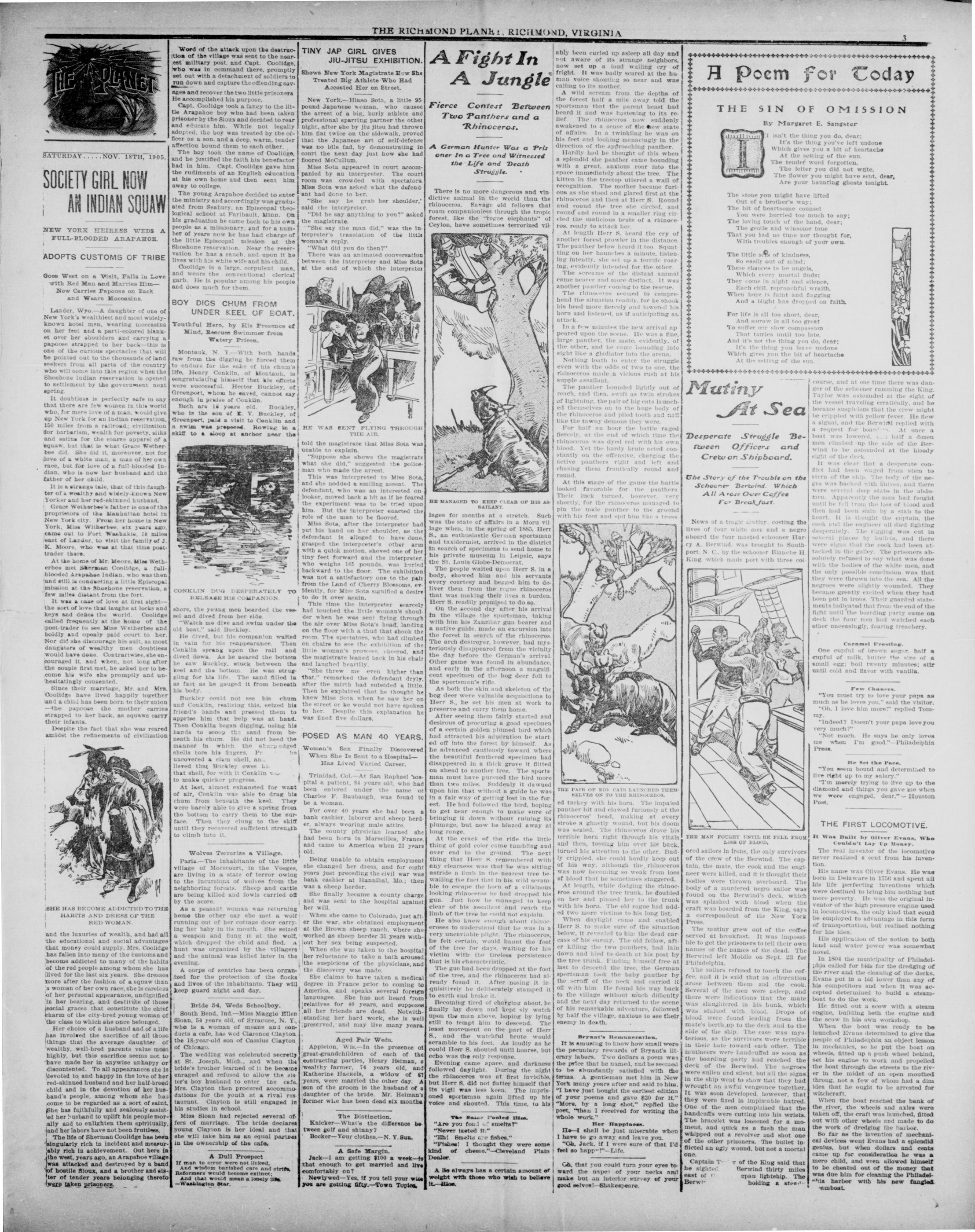
SOCIETY GIRL NOW AN INDIAN SQUAW
NEW YORK HEIRESS WED$ A
FULL-BLOODED ARAPAHOX.
Goes West on a Visit, Falls in Love with Red Man and Marries Him—Now Carries Papoose on Back and Wears Moccasins.
Lander, Wyo.—A daughter of one of New York's wealthiest and most widely-known hotel men, wearing moccasins on her feet and a parti-colored blanket over her shoulders and carrying a papoose strapped to her back—this is one of the curious spectacles that will be pointed out to the thousands of land seekers from all parts of the country who will come into this region when the Shoshone Indian reservation is opened to settlement by the government next spring.
It doubtless is perfectly safe to say that there are few women in this world who, for mere love of a man, would give up New York for an Indian reservation, 150 miles from a railroad; civilization for barbarism, wealth for poverty, silks and satins for the coarse apparel of a squaw, but that is what Grace Wetherbee did. She did it, moreover, not for love of a white man, a man of her own race, but for love of a full-blooded Indian, who is now her husband and the father of her child.
It is a strange tale, that of this daughter of a wealthy and widely-known New Yorker and her red-skinned husband.
Grace Wetherbee's father is one of the proprietors of the Manhattan hotel in New York city. From her home in New York, Miss Wetherbee, six years ago, came out to Fort Washakie, 18 miles east of Lander, to visit the family of J. K. Moore, who was at that time post-trader there.
At the home of Mr. Moore, Miss Wetherbee met Sherman Coolidge, a full-blooded Arapaho Indian, who was then and still is conducting a little Episcopal mission at the Shooseh reserve, a few miles distant from the fort.
It was a case of love at first sight—the sort of love that laughs at locks and keys and deserves the world. Coolidge called frequently at the home of the post-trader to see Miss Wetherbee and boldly and openly paid court to her. Nor did she discourage his suit, as most danglers of wealthy men doubtless would have done. Contrariwise, she encouraged it, and when, not long after the couple first met, he asked her to become his wife she promptly and unhesitatingly consented.
Since their marriage, Mr. and Mrs. Coolidge have lived happily together and a child has been born to their union—the papose the mother carries strapped to her back, as squaws carry their infants.
Despite the fact that she was reared amidst the refinements of civilization
SHE HAS BECOME ADDICTED TO THE HABITS AND DRESS OF THE RED WOMAN.
and the luxuries of wealth, and had all the educational and social advantages that money could supply, Mrs. Coolidge has fallen into many of the customs and become addicted to many of the habits of the red people among whom she has lived for the last six years. She dresses more after the fashion of a squwth than a woman of her own race; she is careless of her personal appearance, undignified in her hearing, and destitute of those social graces that constitute the chief charm of the city-bred young woman of the class to which she once belonged.
Her choice of a husband and of a life has involved the sacrifice of all those things that the average daughter of wealthy, well-bred parents value most highly, but this sacrifice seems not to have made her in anywise unhappy or discontented. To all appearances she is devoted to and happy in the love of her red-skinned husband and her half-breed child and in the devotion of her husband's people, among whom she has come to be regarded as a sort of saint. She has faithfully and zealously assisted her husband to uplift his people morally and to enlighten them spiritually, and her labors have not been fruitless.
The life of Sherman Coolidge has been singularly rich in incident and measurably rich in achievement. Out here in the west, years ago, an Arapahoe village was attacked and destroyed by a band of hostile Sioux, and a brother and sister of tender years belonging thereto wars taken prisoners.
Word of the attack upon the destruction of the village was sent to the nearest military post, and Capt. Coolidge, who was in command there, promptly set out with a detachment of soldiers to run down and capture the offending savages and recover the two little prisoner He accomplished his purpose.
Capt. Coolidge took a fancy to the little Arapahoe boy who had been taken prisoner by the Sloux and decided to rear and educate him. While not legally adopted, the boy was treated by the officer as a son, and a deep, warm, tender affection bound them to each other.
The boy took the name of Coolidge, and he justified the faith his benefactor had in him. Capt. Coolidge gave him the rudiments of an English education at his own home and then sent him away to college.
The young Arapahoe decided to enter the ministry and accordingly was graduated from Seabury, an Episcopal theological school at Faribault, Minn. On his graduation he came back to his own people as a missionary, and for a number of years now he has had charge of the little Episcopal mission at the Shoshone reservation. Near the reservation he has a ranch, and upon it he lives with his white wife and his child.
Coolidge is a large, corpulent man, and wears the conventional clerical garb. He is popular among his people and does much for them.
BOY DIGS CHUM FROM
UNDER KEEL OF BOAT.
Youthful Hero, by His Presence of Mind, Rescues Swimmer from Watery Prison.
Montauk, N. Y.—With both hands raw from the digging he forced them to endure for the sake of his chum's life, Henry Conklin, of Montauk, is congratulating himself that his efforts were successful. Hector Buckley, of Greenport, whom he saved, cannot say enough in praise of Conklin.
Both are 18 years old. Buckley, who is the son of E. V. Buckley, of Greenport, paid a visit to Conklin and a swim was proposed. Rowing in a skiff to a loop at anchor near the
CONKLIN DUG DESPERATELY TO RELEASE HIS COMPANION.
shore, the young men boarded the vessel and dived from her side.
"Watch me dive and swim under the old boat," said Buckley.
He dived, but his companion waited in vain for his reappearance. Then Conklin sprang upon the rail and dived down. As he neared the bottom he saw Buckley, stuck between the keel and the bottom. He was struggling for his life. The sand filled in as fast as he gouged it from beneath his body.
Buckley could not see his chum and Conklin, realizing this, selzed his friend's hands and pressed them to apprise him that help was at hand. Then Conklin began digging, using his hands to scoop the sand from beneath his chum. He did not heed the manner in which the sharp-edged shells tore his fingers. Prey he uncovered a clam shell, and lied that Buckley owes him that shell, for with it Conklin was to make quicker progress.
At last, almost exhausted for want of air, Conklin was able to drag his chum from beneath the keel. They were barely able to give a spring from the bottom to carry them to the surface. Then they clung to the skiff until they recovered sufficient strength to climb into it.
Wolves Terrorize a Village
Paris.—The inhabitants of the little village of Morecourt, in the Vosges, are living in a state of terror owing to the incursions of wolves from the neighboring forests. Sheep and cattle are being killed and fowls carried off by the score.
As a peasant woman was returning home the other day she met a wolf running out of her cottage door carrying her baby in its mouth. She seized a weapon and flung it at the wolf, which dropped the child and fled. A hunt was organized by the villagers and the animal was killed later in the evening.
A corps of sentries has been organized for the protection of the flocks and lives of the inhabitants. They will keep guard night and day.
Bride 54. Weds Schoolboy
South Bend, Ind.—Miss Maggie Ellen Sloan, 54 years old, of Syracuse, N. Y., who is a woman of means and conducts a cafe, has wed Clarence Clayton, the 18-year-old son of Cassius Clayton of Chicago.
The wedding was celebrated secretly at St. Joseph, Mich., and when the bride's brother learned of it he became enraged and refused to allow the sister's boy husband to enter the cafe Mrs. Clayton then procured accommodations for the youth at a rival restaurant. Clayton is still engaged in his studies in school.
Miss Sloan had rejected several offers of marriage. The bride declares young Clayton is her ideal and that she will take him as an equal partner in the ownership of the cafe.
A Dull Prospect
A Dull Prospect
If man to error were not linked,
And wisdom banished care and strife
Reformers would become extinct;
And that would mean a lonely life.
-Washington Star.
THE RICHMOND PLANE1, RICHMOND, VIRGINIA
TINY JAP CIRL GIVES
JIU-JITSU EXHIBITION.
Shows New York Magistrate How She Treated Big Athlete Who Had Accosted Her on Street.
New York.—Hlaso Sota, a little 95-pound Japanese woman, who caused the arrest of a big, burly athlete and professional sparring partner the other night, after she by jiu jitsu had thrown him flat twice on the sidewalk, proved that the Japanese art of self-defense was no idle fad, by demonstrating in court the next day just how she had floored McCullum.
Miss Sota appeared in court accompanied by an interpreter. The court room was crowded with spectators. Miss Sota was asked what the defendant had done to her.
"She say he grab her shoulder," said the interpreter.
"Did he say anything to you?" asked the magistrate.
"She say the man did," was the interpreter's translation of the little woman's reply.
"What did you do then?" There was an animated conversation between the interpreter and Miss Sota at the end of which the interpreter
HE WAS SENT FLYING THROUGH THE AIR.
told the magistrate that Miss Sota was unable to explain.
"Suppose she shows the magistrate what she did," suggested the police-man who made the arrest.
This was interpreted to Miss Sota, and she nodded a smiling assent. The defendant, who was an interested onlooker, moved back a bit as if he feared the experiment was to be tried upon him. But the interpreter enacted the role of the man to be floored.
Miss Sota, after the interpreter had put his hand on her shoulder, as the defendant is alleged to have done, grasped the interpreter's other arm with a quick motion, shoved one of her tiny feet forward and the interpreter, who weighs 165 pounds, was hurled backward to the floor. The exhibition was not a satisfactory one to the pain from the Land of Cherry Blossoms, evidently, for Miss Sota signified a desire to do it over again.
This time the interpreter scarcely had touched the little woman's shoulder when he was sent flying through the air over Miss Sota's head, landing on the floor with a thud that shook the room. The spectators, who had climbed on chairs to see the exhibition of the little woman's prowess, cheered, and the magistrate leaned back in his chair and laughed heartily.
"She threw me even higher than that," remarked the defendant dryly, after the mirth had subsided a little. Then he explained that he thought he knew Miss Sota when he saw her on the street or he would not have spoken to her. Despite this explanation he was fined five dollars.
POSED AS MAN 40 YEARS
Woman's Sex Finally Discovered
When She Is Sent to a Hospital—
Has Lived Varied Career.
Trinidad, Col.—At San Raphael hospital a patient, 84 years old, who had been entered under the name of Charles F. Baubaugh, was found to be a woman.
For over 40 years she had been a bank cashier, laborer and sheep herder, always wearing male attire.
The county physician learned she had been born in Marselles, France, and came to America when 23 years old.
Being unable to obtain employment she changed her dress, and for eight years just preceding the civil war was bank cashier at Hannibal, Mo.; then was a sheep herder.
She finally became a county charge and was sent to the hospital against her will.
When she came to Colorado, just after the war, she obtained employment at the Brown sheep ranch, where she worked as sheep herder 35 years without her sex being suspected.
When she was taken to the hospital her reluctance to take a bath aroused the suspicions of the physicians, and the discovery was made.
She claims to have taken a medical degree in France prior to coming to America, and speaks several foreign languages. She has not heard from relatives for 40 years, and supposes all her friends are dead. Notwithstanding her hard work, she is well preserved, and may live many years.
Aged Pair Weds.
Appleton, Wis.—In the presence of great-grandchildren of each of the contracting parties, Henry Heiman, a wealthy farmer, 74 years old, and Katherine Haskels, a widow of 67 years, were married the other day. A son of the groom is the husband of a daughter of the bride. Mr. Heiman's former wife has been dead six months.
The Distinction.
Knicker—What's the difference between golf and shinny?
Bocker—Your clothes—N. Y. Sun
A Safe Margin
A Sate marigl.
Jack—I am getting $100 a week—is that enough to get married and live comfortably on?
Newlywed—Yes, if you tell your wife you are getting fifty—Town Tonga.
A Fight In A Jungle
A German Hunter Was a Prisoner In a Tree and Witnessed the Life and Death
There is no more dangerous and vindictive animal in the world than the rhinoceros. Savage old fellows that roam companionless through the tropic forest, like the "rogue elephants" of Ceylon, have sometimes terrorized vil
A man in a long coat is climbing a tree, while a dog is sitting on the ground below him, looking up at him.
HE MANAGED TO KEEP CLEAR OF HIS AS-SAILANT.
lages for months at a stretch. Such was the state of affairs in a Mora village when, in the spring of 1885, Herr S., an enthusiastic German sportsman and taxidermist, arrived in the district in search of specimens to send home to his private museum in Leipzig, says the St. Louis Globe-Democrat.
The people waited upon Herr S. in a body, showed him and his servants every courtesy and begged him to deliver them from the rogue rhinoceros that was making their lives a burden. Herr S. readily promised to do so.
On the second day after his arrival in the village the sportsman, taking with him his Zanzibar gun bearer and a native guide, made an excursion into the forest in search of the rhinoceros. The arch destroyer, however, had mysteriously disappeared from the vicinity the day before the German's arrival. Other game was found in abundance, and early in the afternoon a magnificent specimen of the hog deer fell to the sportsman's rifle.
As both the skin and skeleton of the hog deer were valuable acquisitions to Herr S., he set his men at work to preserve and carry them home.
After seeing them fairly started and desirous of procuring a good specimen of a certain golden plumed bird which had attracted his admiration he started off into the forest by himself. As he advanced cautiously toward where the beautiful feathered specimen had disappeared in a thick grove it flitted on ahead to another tree. The sportsman must have pursued the bird more than two miles. Suddenly it dawned upon him that without a guide he was in a fair way of getting lost in the forest. He had followed the bird, hoping to get near enough to make sure of bringing it down without ruining its plumage, but now he blazed away at long range.
At the crack of the rifle the little thing of gold color came tumbling and over end to the ground. The next thing that Herr S. remembered with any clearness was that he was sitting astride a limb in the nearest tree be-wailing the fact that in his wild scramble to escape the horn of a villainous looking rhinoceros he had dropped his gun. Just how he managed to keep clear of his assailant and reach the limb of the tree he could not explain.
He also knew enough about rhinoceroses to understand that he was in a very unenviable plight. The rhinoceroses, he felt certain, would haunt the foot of the tree for days, waiting for his victim with the tireless persistence that is his characteristic.
The gun had been dropped at the foot of the tree, and the rhinoceros had already found it. After nosing it inquisitively he deliberately stamped it to earth and broke it.
Becoming tired of charging about, he finally lay down and kept sly watch upon the man above, hoping by lying still to tempt him to descend. The least movement on the part of Herr S., and the watchful brute would scramble to his feet. As loudly as he could Herr S. shouted until horese, but echo was the only response.
Evening came apace, and darkness followed daylight. During the night the rhinoceros was at first invisible, but Herr S. did not flatter himself that its vigil was less keen. The imprisoned sportsman again lifted up his voice and shouted. This time, to his
"Flashes! I thought they were some kind of cheese."—Cleveland Plain Dealer.
A lie always has a certain amount of weight with those who wish to believe it.—Bloe.
ably been curled up asleep all day and not aware of its strange neighbors, now set up a loud walling cry of fright. It was badly scared at the human voice shouting so near and was calling to its mother. A wild scream from the depths of the forest half a mile away told the sportsman that the parent beast had heard it and was hastening to its relief. The rhinoceros now suddenly awakened to a sense of the new state of affairs. In a twinkling he was on his feet and looking menacingly in the direction of the approaching panther. Hardly had he thought of this when a splendid she panther came bounding with a great, anxious roar into the space immediately about the tree. The kitten in the treetop uttered a wall of recognition. The mother became furious as she stood and glared first at the rhinoceros and then at Herr S. Round and round the tree she circled, and round and round in a smaller ring circled the malicious brute of a rhinoceros, ready to attack her. At length Herr S. heard the cry of another forest prowler in the distance. The panther below heard it too. Squatting on her haunches a minute, listening intently, she set up a terrific roaring, evidently intended for the other. The screams of the distant animal came nearer and more distinct. It was another panther coming to the rescue.
The rhinoceros seemed to comprehend the situation readily, for he shook his head more fiercely and lowered his horn and listened, as if anticipating an attack.
In a few minutes the new arrival appeared upon the scene. He was a fine, large panther, the mate, evidently, of the other, and he came bounding into sight like a gladiator into the arena.
Nothing loath to enter the struggle even with the odds of two to one, the rhinoceros made a vicious rush at his supple assailant.
The panther bounded lightly out of reach, and then, swift as twin strokes of lightning, the pair of big cats launched themselves on to the huge body of the rhinoceros and piled tooth and nail like the tawny demons they were.
For half an hour the battle raged fiercely, at the end of which time the rhinoceros was dyed red with his own blood. Yet the hardly brute acted constantly on the offensive, charging the active panthers right and left and chasing them frantically round and round.
At this stage of the game the battle looked favorable for the panthers. Their luck turned, however, very shortly, for the rhinoceros managed to pin the male panther to the ground with his foot and shut him like a truss.
A
THE PAIR OF BIG CATS LAUNCHED THEM-SELVES ON TO THE RHINOCEROS.
ed turkey with his horn. The impaled panther bit and clawed furiously at the rhinoceros' head, making at every stroke a ghastly wound, but his doom was sealed. The rhinoceros drove his terrible horn right through his vitals and then, tossing him over his back, turned his attention to the other. Badly crippled, she could hardly keep out of his way, although the rhinoceros was now becoming so weak from loss of blood that he sometimes staggered.
At length, while dodging the rhinoceros around the tree trunk, he doubled on her and pinned her to the trunk with his horn. The old rogue had added two more victims to his long list.
When daylight came and enabled Herr S. to make sure of the situation below, it revealed to him the dead carcass of his enemy. The old fellow, after killing the two panthers, had lain down and bled to death at his post by the tree trunk. Finding himself free at last to descend the tree, the German sportsman took the baby panther by the scruff of the neck and carried it off with him. He found his way back to the village without much difficulty and the next day returned to the scene of his remarkable adventure, followed by half the village, anxious to see their enemy in death.
Bryant's Remuneration.
It is amusing to know how small were the peculiary rewards of Bryant's literary labors. Two dollars a poem was the price that he named, and he seemed to be abundantly satisfied with the terms. A gentleman met him in New York many years after and said to him, "I have just bought the earliest edition of your poems and gave $20 for it." "More, by a long shot," replied the poet, "then I received for writing the whole work."
Her Happiness.
He-I shall be just miserable when I have to go away and leave von.
Gh, that you could turn your eyes toward the napes of your necks and make but an interior survey of your good selves!-Shakespeare.
A Poem for Today
THE SIN OF OMISSION
By Margaret E. Sangster
I isn't the thing you do, dear;
It's the thing you've left undone
Which gives you a bit of heartache
At the setting of the sun.
The tender word forgotten,
The letter you did not write.
The flower you might have sent, dear,
Are your haunting ghosts tonight.
The stone you might have lifted
Out of a brother's way;
The bit of heartsome counsel
You were hurried too much to say;
The loving touch of the hand, dear;
The gentle and winsome tone
That you had no time nor thought for,
With troubles enough of your own.
The little acts of kindness,
So easily out of mind;
These chances to be angels,
Which every mortal finds;
They come in night and silence,
Each chill, reproachful wraith.
When hope is faint and flagging
And a blight has dropped on faith.
For life is all too short, dear,
And sorrow is all too great
To suffer our slow compassion
That tarries until too late.
And it's not the thing you do, dear;
It's the thing you leave undone
Which gives you the bit of heartache
At the setting of the sun.
The little acts of kindness,
So easily out of mind;
These chances to be angels,
Which every mortal finds;
They come in night and silence,
Each chill, reproachful wreak.
When hope is faint and flagging
And a blight has dropped on faith.
For life is all too short, dear,
And sorrow is all too great
To suffer our slow compassion
That tarries until too late.
And it's not the thing you do, dear;
It's the thing you leave undone
Which gives you the bit of heartache
At the setting of the sun.
course, and at one time there was danger of the sebehorn ramming the King, Taylor was astounded at the sight of the vessel traveling erratically, and he became suspicious that the crew might be crippled with yellow fever. He flew a signal, and the Berwil replied with a request for board. At once a boat was lowered, half a dozen men climbed up the side of the Berwil to be astounded at the bloody sight of the Deck.
It was clear that a desperate conflict had been waged from stem to stern of the ship. The body of the negro was hacked with knives, and there were several deep stains in the abdomen. Apparently the man had fought until he fell from the loss of blood and then had been slain by a stab to the heart. It is thought the enpain, the cook and the engineer all died fighting desperately. The rigging was cut in several places by bullets, and there were signs that the cook had been attacked in the galley. The prisoners absolutely refused to say what was done with the bodies of the white men, and the only possible conclusion was that they were thrown into the sea. All the negroes were slightly wounded. They became greatly excited when they had been put in irons. Their guarded statements indicated that from the end of the fight until the boarding party came on deck the four men had watched each other unceasingly, fearing treachery.
Caramel Frosting
One cupful of brown sugar, half a cupful of milk, butter the size of a small egg; boil twenty minutes; stir until cold and flavor with vanilla.
Few Chances.
"You must try to love your papa as much as he loves you," said the visitor. "Oh, I love him more!" replied Tommy. "Indeed? Doesn't your papa love you very much?" "Not much. He says he only loves me when I'm good."—Philadelphia Press.
He Set the Pace.
"You seem bound and determined to live right up to my salary."
"I'm merely trying to live up to the diamond and things you gave me when we were engaged, dear." - Houston Post.
THE FIRST LOCOMOTIVE
It Was Built by Oliver Evans, Who Couldn't Lay Up Money.
The real inventor of the locomotive never realized a cent from his invention.
His name was Oliver Evans. He was born in Delaware in 1756 and spent all his life perfecting inventions which were destined to bring him nothing but more poverty. He was the original inventor of the high pressure engine used in locomotives, the only kind that could be employed to advantage in this form of transportation, but realized nothing for his idea.
His application of the notion to both land and water power was somewhat novel.
In 1804 the municipality of Philadelphia called for bids for the dredging of the river and the cleaning of the docks. Evans put in a bid lower than any of his competitors and when it was accepted determined to build a steamboat to do the work.
He fitted out a scow with a steam engine, building both the engine and the scow in his own workshop.
When the boat was ready to be launched Evans determined to give the people of Philadelphia an object lesson in mechanics, so he put the boat on wheels, fitted up a push wheel behind, set his engine to work and propelled the boat through the streets to the river in the midst of an open mouthed throng, not a few of whom had a dim idea that he ought to be arrested for witchcraft.
When the boat reached the bank of the river, the wheels and axles were taken off, the craft was launched, fitted out with other wheels and made to do the work of dredging the harbor. So far as the invention of mechanical devices went Evans had a splendid genius, but when dollars and cents came up for consideration he was a mere child, and even allowed himself to be cheated out of the money that was due him for cleaning the Philadelphia harbor with his new fangled boat.
I
Mutiny At Sea
Desperate Struggle Between Officers and Crew on Shipboard.
The Story of the Trouble on the Schooner Berwind. Which All Arose Over Coffee For Breakfast.
News of a tragic mutiny, costing the lives of four white men and a negro aboard the four masted schooner Harry A. Berwind, was brought to Southport, N. C., by the schooner Blanche H. King, which made port with three col
P. LAMBERT
THE MAN FOUGHT UNTIL THE FELL FROM LOSS OF BLOOD.
ored sailors in frons, the only survivors of the crew of the Berwind. The captain, the mate, the cook and the engineer were killed, and it is thought their bodies were thrown overboard. The body of a murdered negro sailor was found on the Berwind's deck, which was splashed with blood when the craft was boarded from the King, says a correspondent of the New York Press.
The mutiny grew out of the coffee served at breakfast. It was impossible to get the prisoners to tell their own names or the names of the dead. The Berwind left Mobile on Sept. 23 for Philadelphia.
The sailors refused to touch the coffee, and it is said that an altercation arose between them and the cook. Several of the men were asleep, and there were indications that the mate was slaughtered in his bunk, which was stained with blood. Drops of blood were found leading from the mate's berth up to the deck and to the side of the ship. The case was mysterious, as the survivors were terrible in their hate toward each other. The nauteurs were handcuffed as soon as the boarding party had reached the deck of the Berwind. The negroes were sullen and silent, but all the signs in the ship went to show that they had wrought an awful vengeance together. It was soon developed, however, that they were fixed in implacable hatred. One of the men complained that the handcuffs were cutting into his wrists. The bracelet was loosened for a moment, and quick as a flash the man whipped up a revolver and shot one of the other prisoners. The bullet inflicted an ugly wound, but not a mortal one.
Captain T. of the King said that he sigged. Berwind thirty miles east of the span lightship. The Berwind holding a steed.
```markdown
```
THE PLANET
Published every Saturday by JOHN MITCHELL,
Jr. as 311 North 4th Street, Richmond, Va.
JOHN MITCHELL, JR., - EDITOR
All communications intended for publication
should be sent so as to reach us by Wednesday.
TERMS IN ADVANCE.
There are FOUR ways by which money can be sent by mail at our risk—in a Post Office Monetary Money Order, or an Express Money Order, and when it must be可可 be procured, in a Registered Letter.
MONEY ORDERS.—You can buy a Money Order on your Post Office payable to the Richmond Monetary Company we will be responsible for its safe arrival.
EXPRESS MONEY ORDERS can be obtained at our office of the American Express Co. the Richmond Monetary Company we will be responsible for money sent by any of these companies and convenient way for forwarding money.
REGISTERED LETTER.—If a money Order post Office or an Express Office is not within your jurisdiction, then you wish to send us on payment of ten cents. Then, if the letter is lost or stolen, you can send money in this manner at our risk.
We cannot be responsible for money sent in letters in any other way than one of the four ways mentioned above. If you send your money in another way, you must do it at your own risk.
RENEWALS, ENG. If you do not want THE PLANET continued for another year after your money has been sent to the Post Office card to discontinue it. The courts have decided that subscribers to newspaper, who do not send money for the subscription of time for which it has been paid are held liable for the payment of the subscription up to date when they order the paper discontinued.
COMMUNICATIONS:—When writing to us to renew your subscription or to discontinue your paper, you should give your name and address in full otherwise, we cannot find your name on our books.
CHANGE OF ADDRESS:—In order to change the address of a subscriber, we must be sent the former as well as the present address.
Entered at the Post-Office at Richmond. Vs. be second-class matter.
SATURDAY... NOV. 18TH, 1905.
People who will not work should not eat.
Good time young folks make hard time old ones.
To live within one's income is the past-master's art.
Riotous living in youth leads to painful living in old age.
An itching palm leads first to the jail and then to the poor-house.
Every colored man should read a race newspaper and pay for it.
A person too proud to work is seldom too honest to steal. Don't forget that.
An illmannered person is an abomination and a draw-back to his own progress.
Some people are always hard up and they spend everything in sight and keep themselves hard up.
Some colored folks do not know what it is to support colored folks until they go into business for them selves.
If colored people do not patronize and support each other, they cannot expect other people to patronize and support them.
Hon. H. C. Smith, candidate for legislator in Ohio seems to have gone down in defeat on election day. "More's the pity."
Some people are poor, because they never had the opportunity to be otherwise. Other people are poor, because they threw away the opportunity to be otherwise.
It pays to be honest. Business is risky and it takes the best kind of skill to handle it. This is just as true of an individual enterprise as it is of one run for other people.
Some colored folks have been
charged with stealing, but the recent evidence furnished by the white folks themselves shows that they know nothing about the business.
If the present disclosures made in New York and elsewhere continue to enlighten the country, the average citizen will come to the conclusion reached by Rev. Dr. Harvey Johnson of Baltimore that the white man's government is a failure.
Ohio did not land in the Democratic column after all. The entire Republican ticket was elected with the exception of the Governor. The lower branch of the legislature is Republican by a majority of two and the state Senate is claimed by a majority of one, there being a contest now pending to decide it.
We regret to learn of the predicament of Editor J. E. Dickerson, Jr. of the Norfolk Va. News and Advertiser. He must serve a term of five months in jail and pay a fine of $100 for criminal libel. It is reported that he has taken an appeal to the Supreme Court, but he will be required to stay in jail pending its decision. We are not well posted as to the merits of the case.
If President Roosevelt desires to know just how far a Virginia greeting goes when it comes to politics and "Lily-white Republicanism", he has but to look at the latest Virginia election returns. These people down here were under the impression that they were making Mr. Roosevelt a good Democrat and not that he was engaged in the work of trying to make them good Republicans.
The Negroes of this state have been disfranchised and yet the Rich mond, Va. Times-Dispatch never loses an opportunity to discuss the Negro. It is very unfortunate that it has on its editorial staff a gentleman, who is constantly seeing "blood on the moon" and is not content to let the "dead" rest. These discussions of us can do no good. We are going our way, increasing our revenues and engaging in business. The white man is succeeding. Why not follow the advice given to the North and let the Negro down here alone?
MARYLAND! MY MARYLAND!
The colored people of Maryland need to be congratulated upon their most remarkable and successful fight against the Poe Suffrage Amendment. It was intended to wipe out the colored man as a voting factor while entrenching Hon. Arthur Pue Gorman in power. The liberal Democrats would not stand for it and the result was that Mr. Gorman's hopes have gone a glimmering with the "might have beens." It will be a long time before the fight will be renewed.
We are of the opinion that the northern border line of Virginia forms the boundary of the Negro-hating South and that all kinds of Negro-hating disfranchising laws will die if left for any length of time to breathe in that climate.
MR. ROOSEVELT AND THE RAIL ROADS.
That the attitude of President Roosevelt in championing the cause of rate regulation of the railroads of the country will meet with determined opposition on the part of the corporations affected was never more forcibly emphasized than when an earnest protest was filed with him last Tuesday by the representatives of five great labor organizations representing the engineers, firemen, conductors, switchmen and trainmen of all of the big railroad lines in the country.
This was an attack from the rear and no doubt astounded many who had never conceived of any such protest being launched in defense of the great net-work of railroad systems now covering the country. Mr George Huntley, the spokesman of the delegation is quoted as follows:
"One million and a quarter railway employees have noted with concern the tendency toward Federal legislation on railroad rates. As there has appeared no hint that any general increase in the prevailing rates was contemplated, we are forced to believe that the other alternative must follow, and a general reduction in the earning power of our railway lines would result."
The speaker declared with emphasis that railroad employees were sat isified that any legislation tending to reduce the earning capacity of railroad lines will, in the same measure, interfere with the prosperity and generally satisfactory conditions of the railroad employees.
Mr. Huntley stated that it had come to be the attitude of the administration and of prominent Republicans generally that when a revision of the tariff is made the changes should be by its friends, and not by its enemies. "We suggest," said Mr. Huntley, "that a similar course be followed in railway rate legislation."
This was a veritable "bomb-shell"
RICHMOND PLANET. RICHMOND. VIRGINIA
exploded in the rear of President Roosevelt. He was shrewd enough to meet the issue as presented and his reply was as adroit as it was timely. He is quoted as follows:
In response, President Roosevelt assured the delegation that it was not his purpose or the purpose of those who favored railroad rate regulation to do anything that might injure the railroads of the country, or incidentally the employees of the railroads. He said that it was his purpose that all classes—railroads, shippers and employees—should have perfectly fair treatment. He was of the opinion that the proposed legislation would not mean a reduction necessarily in railroad rates, and sug gested that the members of the delegation, therefore, were proceeding on a wrong understanding of the situation.
Mr. Roosevelt is a politician and a statesman. It may be that the colored people of the South-land will now be able to realize that his trip to this section had a mighty purpose behind it and that the colored people of this sunny land were not even of a third-rate interest, when he consummated his plans in making it.
Those of us who cannot see it in this way may be likened to those, "which have eyes to see, and see not; they have ears to hear, and hear not."
MR. FORTUNE AND HIS POEMS
We received the "Dreams of Life," a most interesting and handsomely bound volume of poems by that able and accomplished journalist T. Thomas Fortune of New York. Messrs. Fortune and Peterson are named as the publishers.
We have perused this work with increasing interest and we have been tempted to reproduce extracts from some of the poems that have impressed us. "Dreams of Life" is on the highest order and its extended length shows Mr. Fortune to be a master of verse as well as the comander of prose. "Emanuel" is fine. The only misfortune is that the subject is too personal to win lasting favor with a critical public "Slavery to the Slave" is musical and "catchy." It will be popular where ever produced, if the Afro-American is the listener. "Mary Conroy" is a gem. Its length alone is against it.
What is more musical than the following from "Mutations Voiceless Night"?
"Nothing lives but loves sweet essence,
And the soul's all quenchless light;
All else sinks its forms and presence
In mutation's voiceless night."
"Sadie Fontaine is another fine effort, which will never be popularized owing to its length. Mr. Fortune is nothing if not brave. Who else would have dared to say:
"What is life but love, devotion!—What is woman but a song—But a lyric caught from nature—But an echo sounding long—Filling all the earth with gladness—Filling all the earth with madness—What is woman but a song?"
"Fah-Fah" is a gem of charming sweetness and the story is well-conceived and admirably related. Mr. Fortune is seen again in a state of sadness and memories of the past and gloom as to the future seemed to have been his portion when he wrote the following musical and soul-stirring lines:
Each vanished year its own sad tale
Of disappointment, wee and wall,
Adds to the score, until we fail,
Since we grow old! We must grow
old.
The broken links of life's short chain
Can never find their place again;
The heart will bleed when pierced
with pain,
When loved ones die, and we grow
old.
Into the dark unknown we take
The hopes misfortune could not
shake,
Pure as the mountain's snowy flake,
Where all is well—when we are
old."
But we have not the space to continue this review of this most interesting work. We can hardly refrain though from giving our readers another extract from this most pleasing volume:
"High above the wrecks of ages, Brightening all of history's pages, Love has shone.
Planet-like, in life's dark heaven,
'Sweetest boon to mortals given,' Sweet alone!
Life is brief, but Love's eternal,
Always young, as Spring is vernal,
Always strong:
Is my song."
Mr. Fortune has rendered the race a service in giving this magnificent literary effort to the public. The student, the professor, the author, the business man, the minister and the journalist will find within its pages a source of literary delight and a place for thoughtful meditation.
It will pay our readers to secure a copy of this volume. Address
Fortune and Peterson, No. 4 Cedar St. New York, N. Y.
LYNCHED THREE IN TEXAS.
The lynching in Texas, Sunday morning, Nov. 12th, 1905 at Henderson, Tex. was without a shadow of excuse and the officers of the law appear in a light that brands them as false to every duty and thoroughly disqualified to hold office in the Lone Star State. Ellias Howell, a white man, was murdered Thursday Nov. 9th, 1905 and five colored men were arrested. The mob went to the jail and one of the colored men, named Williams was placed upon a dry-goods box and forced to state that John Reese, Robert Askew and Henry Schorrow killed Howell.
Williams was released and the three men thus accused were immediately hanged to a sycamore tree. These are the ways of the mob. There was no attempt to verify William's statement, but three human lives were at once offered up by these people who are deaf to reason and blind to every rule of right. To offer a reward for the lynchers would cause a laugh of derision in Texas. Human life is too cheap. A colored man would be sure of death before a Texas jury, if he be guilty. No one who is at all acquainted with the conditions in that state will doubt this and therefore argument in favor of lynching is unnecessary. We have repeatedly called attention to the fact that a colored man accused of crime in Texas had far better die fighting than to submit to being placed in jail and then led forth like a sheep for the slaughter and executed whether guilty or innocent. Texas has a red record and it may be that it will yet pay in blood for every execution made by the decree of "Judge Lynch." Lynch law must go!
GEORGIA JUSTICE.
Jim Walker alias Will Brice, colored, was convicted in the Superior Court of Atlanta, Georgia, Monday, November 13th, 1905 of having criminally assaulted Mrs. Alice Moore at Brookwood, a suburb of Atlanta, October 26th, 1905. A mob of white men were about to lynch the prisoner and had a rope around his neck just as the sheriff arrived. The brute was removed to Atlanta. It is well to state that the husband of the lady pleaded with the mob not to lynch the prisoner.
Walker is an ex-penitentiary convict from South Carolina. He was ignorant and illiterate. He pleaded guilty and was sentenced to hang December 8th, 1905. Judge Roan appointed three ex-Judges to defend the prisoner and these gentlemen stated that they were ready and willing to perform the service expected of them by the Court. They went so far as to decide to draw on their personal funds in order to secure the attendance of witnesses, by whom the prisoner alleged that he could esablish that he was somewhere else at the time the crime was committed. His subsequent confession put an end to all of this. The action of this Atlanta jurist is worthy of the highest commendation and will prove to be an exhibition of sterling justice, to which white and black south enners can point with pride. The majesty of the yaw will be respected and the brute will be made to dangle from a rope's end as a reminder to all evil-doers. No one will be more gratified at the execution of the law's decree than will the respectable, law-abiding colored citizens of Georgia and the other states. It is well that criminals of this breed be exterminated. Every one less will make the right-thinking people of both races feel more secure.
A man who would criminally assault a white woman will criminally assault a colored one and vice versa. We were disposed to believe that the report of the crime was exaggerated, but now that the man has openly confessed, the sooner he mounts the gallows and be sent out of this world, the better for all concerned. The law is amply sufficient, through its sworn officials to punish criminals of this character. In our judge ment, a jury of colored men would have convicted him as surely and as promptly as a jury of white ones. Hang him high and hang him quickly. The sooner he is off the face of the earth the better. Lynch law must go!
Shot Farmer For a Rebhlt
Norristown, Pa., Nov. 13. — White husking corn in a field, Jesse Stetler, a Lower Providence farmer, had a part of his left ear shot off and narrowly escaped instant death at the hands of a party of hunters. Observing the partly covered head of the farmer protruding from behind a shock of cornstalks, one of the hunters fired, believing that he was shooting at a rabbit.
Town Destroyed By Fire.
Huntington, W. Va., Nov. 15. — A dispatch from Burke, McDowell county, is to the effect that the entire town has been destroyed by fire. Burke is a mining town of 2000 population, about 150 miles from here. More than 100 buildings were destroyed.
EXTRA SESSION PENNA. ASSEMBLY
called by Governor Pennypacker to
Enact Reforms.
GREAT SURPRISE TO POLITICIANS
Harrisburg, Pa., Nov. 13.—Governor
Pennypacker has called an extra session
of the legislature, to convene on
January 15. The governor's action was
a great surprise to his official associ-
ates, although it had been rumored
that he would reconvene the legislature
in extra session. Those who pro-
fess to have the governor's confidence
ridiculed the report. The legislation
which the governor suggested should
be considered has been urged by the
reform parties in the state for some
time.
Following is a copy of the governor's
proclamation:
"By virtue of the authority wested in me by article 4, section 12, of the constitution, I, Samuel W. Pennypacker, governor of Pennsylvania, do hereby convene the general assembly of the commonwealth in extraordinary session, to meet in the capitol at Harrisburg, on Monday, January 15, A. D. 1906, at 2 o'clock p. m. of that day, to consider legislation upon the following subjects:
"First—To enable contiguous cities in the same counties to be united in one municipality, in order that the people may avoid the unnecessary burdens of maintaining separate city governments.
"Second—To increase the interest paid by banks, trust companies and similar institutions for the use of state moneys; to impose proper limitations upon the amount of such moneys to be held by each of such institutions; to make it a misdemeanor to pay or receive, to offer or request any money or valuable thing or promise for the use of such moneys other than the interest payable to the state; and to adopt such other measures as may be necessary for the protection of the public money.
"Third—To reapportion the state into senatorial and representative districts.
"Fourth—To provide for the personal registration of voters.
"Fifth—To provide for the government of cities of the first class and the proper distribution of the power exercised by such municipalities.
"Sixth—To designate the amount to be expended each year in the erection of county bridges, and to take such other measure in regard to them as safety may require.
"Seventh—To abolish fees in the offices of the secretary of the commonwealth and the insurance commissioner.
"Given under my hand and the great seal of the state, at the city of Harrisburg, this 11th day of November, in the year of our Lord, one thousand nine hundred and five, and of the commonwealth the one hundred and thirteth. By the governor.
"SAMUEL W. PENNYPACKER."
The first subject which the governor mentions is the Greater Pittsburg bill, for the consolidation of the cities of Pittsburg and Allegheny. A bill of this kind was passed by the last legislature and was declared unconstitutional by the supreme court.
The governor has been giving careful thought to the state treasury management ever since the failure of the Enterprise National Bank, of Allegheny, in which there was $1,030,000 state money. Should the legislature adopt the suggestion of the governor for a reapportionment of the state it will make a remarkable change in the present senatorial and legislative districts, and would also increase the representation in the house of representatives from Allegheny and certain other counties and decrease the representation in others. Other legislation mentioned by the governor is the bill known as the Philadelphia "ripper," taking away from the mayor of Philadelphia the authority to appoint a director of public safety and a director of public works and authorizing these appointments to be made by councils.
The governor's omission of ballot reform and improvement of primary elections was somewhat mystifying to prominent citizens who were gratified by his proclamation as far as it went
Aged Woman Burned to Death
Aged Woman Burned to Death.
St. Louis, Nov. 15.—Under the impression that her grandchildren were in danger, Mrs. Catherine Haverlick, aged 66 years, re-entered the burning home of her daughter and was incinerated before assistance could reach her. Mrs. Haverlick's daughter and grandchildren had escaped by another entrance and were searching for her when she braved the flames to rescue them.
Elephant Not Destroyed
Atlantic City, N. J., Nov. 15.—It has been found that the big wooden elephant at South Atlantic City was not so badly damaged by Saturday night's fire as Sunday's reports indicated. The fire started in the barn of the Mansion house and quickly spread to the hotel, which was extensively damaged. The tin hide of the big wooden elephant was badly scorched, but the damage is not great.
Noted Scout Dying.
Cody, Wyo., Nov. 14.—Colonel D. Frank Powell, the noted scout, who has been ill at the irma hotel here for several weeks, is in a critical condition and his death is expected to occur at any time. Colonel Powell is a friend and business partner of Colonel William F. Cody.
Negroes Tried to Lynch White Man. Atlanta, Ga., Nov. 14.—T. Z. Justice, a white man, was captured by a mob of negroes here charged with the criminal assault of a negro girl. Justice was threatened with violence and the mob increased to more than 100 demanding that he be lynched. A strong force of police rescued Justice and took him to police headquarters.
JAMES H. HYDE MAKES CHARGES
Former Vice President of Equitable Creates Sensation.
WHY ODELL SUIT WAS SETTLED
New York, Nov. 15.—James Hazen Hyde, former vice president of the Equitable Life Assurance Society, whose resignation followed the sensational disclosures in that company last spring which led to the investigation of insurance company methods by the Armstrong committee of the legislature; the man whose presence as a witness before this committee has been looked forward to in the expectation that it would produce the greatest sensation of the investigation, appeared before the committee.
Mr. Hyde cleared up the matter of the $685,000 loan of the Mercantile Trust company, which appeared on the books of the Equitable Life under the caption of the "J. W. Alexander No. 3 account." This account has been under investigation on several previous sessions, but none of the witnesses heretofore examined has been able to explain it.
Mr. Hyde first heard of this account in the fall of 1902, when it was called to his attention by President Alexander, who said that he and Mr. Jordan had incurred the loan to take up stock that was being bid up to fictitious values, to the detriment of the company, to settle suits that were hampering the business of the company, and for campaign contributions. This contribution was the one to the last campaign, and was asked by Mr. Frick, who suggested it for the benefit of the society. To procure this money, Mr. Alexander had Mr. Hyde write a letter to the president of the Mercantile Trust company, and this letter practically placed him in the position of a guarantor.
Later, when the settlement of the loan was forced, Mr. Alexander and Mr. Jordan raised all they could toward it. The stock purchased with part of the loan was sold to Thomas F. Ryan for $212,000, and the balance, $212,500. Mr. Hyde paid personally. He did this because he understood that Mr. Alexander was financially embarrassed, and in a bitter tone said: "Not withstanding the strained relations with these two gentlemen (Alexander and Jordan), I felt bound to see that the debt was liquidated by reason of the letter Mr. Alexander extracted from me."
The syndicate operations of J. H. Hyde and associates was gone into very thoroughly, and it was shown that in 23 syndicates Mr. Hyde sustained personal loses of $28,615. Mr. Hyde ascribed the apportionment of the Equitable's allotment of bonds in syndicates to officers of the Equitable Life to the customs and usages of Wall street.
Eclipsing all this sensational testimony, however, were the statements of Mr. Hyde concerning former Governor Odell and Mr. Harriman relative to the settlement of the shipbuilding company suit by the Mercantile Trust company. Mr. Hyde said that Mr. Harriman came to him and advised the settlement of Odell's suit, as he feared that powerful influence at Albany would be invoked in retaliatory measures. Mr Harriman suggested as one of these measures the revocation of the charter of the Mercantile Trust company. Mr. Hyde knew of no actual steps that were taken, nor of any bill that was introduced, but he was beset with rumors that such steps were about to be taken by legislation. The Equitable Life, he said, was not interested beyond the connection it had with the Mercantile Trust company.
Mr. Hyde was under the impression that the Mercantile in settlement retained the bonds and paid Mr. Oddell about $75,000. The original claim of Oddell was about $180,000. The bonds subsequently netted about 50 cents on the dollar. Mr. Hyde said Mr. Harriman suggested the settlement of the suit, and that the counsel and members of the executive committee of the Mercantile Trust advised it, and he recommended it.
Charges of conspiracy to get him out of the country were made by Mr. Hyde against Henry C. Frick and E. H. Harriman, in connection with the reported aspirations of Mr. Hyde to become ambassador to France. He said Mr. Frick inspired the idea, and witness took it as a joke at first, but when Mr. Frick brought it up later Mr. Hyde was flattered, and both Mr. Harriman and Mr. Frick promised to use their influence to secure the appointment. Again Mr. Hyde waxed bitter in his explanation of the extraordinary interest these gentlemen had in his absence from the country. He said he thought their idea was "that they would acquit themselves of their friendly stewardship with great profit to themselves," and added that the nature of their interest had since become very obvious.
Mr. Hyde charged Mr. Frick with breach of faith in leading him to believe that the Frick committee was "friendly" to him and with doing all he could to dissuade witness from selling his stock, "at the same time," as Mr. Hyde said, "doing everything on that committee he could to knife me and destroy the value of that stock." Mr. Hyde's attention was called to the seriousness of these charges on several occasions by Charles E. Hughes, counsel to the committee, but he said he made the statements after many sleepless nights and long, sad days of reflection.
Want Tariff On Hides Removed
Washington, Nov. 15—Leading shoe, hide and leather manufacturers of the country, including Governor William L. Douglas, of Massachusetts, will call on the president and ask that he recommend the removal of the duty on hides under the Dingley tariff. At a meeting of these manufacturers it was the unanimous opinion that all should unite in a request for the removal of the duty on hides.
WEEK'S NEWS CONDENSED
Newton E. Noblet was appointed fourth class postmaster at Halifax, Pa. One person was burned to death and two fatally burned in a fire which destroyed a boarding house at Kansas City, Mo. Alfred Buck, former assistant cashier of a bank at Mankato, Minn., was sent to prison for six years and four months for embezzling $17,000. In a pistol duel on the streets of Norris City, Ill., Postmaster Henry Wakeford and Marshal Jesse Buthey were fatally injured. In Chicago, by the use of a voting machine, the election returns of the precinct were announced 30 seconds after the polls closed. Friday, November 10. King Edward, of Great Britain, celebrated his 64th birthday Thursday. During a quarrel between Italians at Greensburg, Pa. John Forsham was stabbed to death by Nicholas Jolly, who escaped.
The widow of James C. King, of Chicago, who left $2,000,000 to old men who failed in business, will try to break his will.
Seven persons were injured, three seriously, when a trolley car jumped the track and ran over a 20-foot embankment at Pittsburg.
Miss Carroll Richmond, sister of a wealthy manufacturer of Providence, R. L. died of asthma on a train at Colorado Springs, Colo.
Saturday, November 11.
While working in a trench at York, Pa. Bankratz Geubtner, a laborer, was suffocated by illuminating gas.
Herman G. Norgaard, a member of a high school football team of Council Bluffs, Ia., died of injuries received in a game.
While playing near a bonfire the clothing of Bernard McGuire, aged 5 years, of Philadelphia, took fire and he was burned to death.
The convention of the American Hardware Manufacturers at Washington endorsed President Roosevelt's plan for railroad rate legislation.
A saw mill boiler at Midvale, N. J., exploded because of the failure of the safety valve to operate, and Daniel Beatty was instantly killed and two others injured.
Monday, November 13.
The dairy and food department of Ohio has started a crusade against alleged patent medicines.
The Morning Post, of Raleigh, N. C., has suspended publication, having been absorbed by the Evening Times.
Twenty union miners have been arrested at Whitwell, Tenn., for complicity in the murder of a non-union man.
After shooting his wife, but not seriously wounding her, William Adams, a car cleaner, killed himself at Washington, D. C.
For collecting and retaining illegal fees in office, Justice of the Peace William Francis has been found $200 and sent to the workhouse for 20 days at Cleveland, O.
Tuesday, November 14.
William J. O'Brien, Sr., chief judge of the orphans' court of Baltimore, Md., is dead.
The Japanese government has decided to issue a new foreign loan of $250,000,000 at 4 per cent.
Jim Walker, a negro, was sentenced to be hanged December 8 at Atlanta, Ga., for criminal assault on a white woman.
In a collision between a passenger train and a work train at Bonner Springs, Kan., two persons were killed and several injured.
Caught in a belt of a monster wheel at a power house at Ogontz, near Philadelphia, Percy Arkenatall was whirled to death in the presence of his horror-striken fellow employees.
Wednesday, November 15.
The output of the anthracite coal mines is seriously decreased by the scarcity of cars.
Robert Whitehead, inventor of the torpedo which bears his name, died at Shrivenham, England.
Rev. Dr. Dunlop Moore, aged 80 years, dropped dead at a meeting of the Pittsburg Presbytery.
While despondent from illness, Mrs. Benjamin Fothergill, of Philadelphia, committed suicide by inhaling illuminating gas.
The comptroller of currency has made a call for the condition of national banks at the close of business Thursday, November 9.
PRODUCE QUOTATIONS
The Latest Closing Prices In the Principal Markets.
PHILADELPHIA — FLOUR firm;
winter extras, $3.10% @ 3; Pennsylvania
roller, fancy, $5@10. $3.6% @ 3.75;
cily steal, $5@10. $4.9% FLOUR
steal; No. 2 Pennsylvania red;
$8@33% @ 3. CORN firm; No. 2 yellow,
local; $5@16. OATS steal; No. 2
white, clipped; $7@3% @ 3; lower
grades; 356 HAY firm; No. 1 timothy,
356 HAY firm; No. 1 PORK firm;
family, 11; BEEF firm; beans,
$33@24. POULTRY Live firm; No. 2
12@3%; old roosters; 8@3%; Dressed
firm; choice fowl;s 15%; old roosters,
9%c BUTTER steal; cream-
EGGS steal; New York
and Pennsylvania red;
TOAES steal; per bushel, 70@75
BALTIMORE-WHEAT firm; No. 2
red, 85c; steamer no. 2 spot, 76%c;
southern, 71@22; CORN firm; mixed
spot, 60c; steamer mixed, 56c; OATS
@ 36c; No. 4, 34% @ 3; No. 3, 35%
@ 35c; No. 4, 34% @ 3; No. 2, 24%
@ 35c; No. 3, 33% @ 3; No. 4,
32% @ 33c; BUTTER firm; creamy
creamery extras, 23% @ 24c; held,
22c; prints, 24 @ 28c; Maryland and
Eggs dairy; dairy prints, 20 @ 22c
pennsylvania; Virginia and West, Virginia,
26%c; southern, 26@26
Live Stock Markets.
PITTSBURG (Union Stock Yards)—CATTLE slow; choice, $5.25@5.50; prime, $4.90@5.15. HOGS active; prime heavy, medium and heavy Yorkers, $5.15@5.10; Light Yorkers and $5.10@5.16; roughs, $4.60@5.10; SHEEP steady; prime wethers, $5.10@5.10; common, $2@2.50; lambs, $4.50@7.40; calves, $7.50@8.
Mahanoy City, Pa., Nov. 15.—The body of George Hughes, aged 45 years, a mine foreman for the Philadelphia & Reading Coal & Iron company, was found on the mountains near St. Nicholas. He had been missing since he quit work Monday afternoon, and it is supposed that he had been murdered.
HEY PLANET
SATURDAY.....NOV. 18TH, 1905.
Defied An Army
Unique Siege Established by French Infantry and Gendarmes.
It Took Several Thousand Men to Capture Francois Roy, a Gamekeeper and Ex-Soldier.
Since the three musketeers held their bastion against a whole army France has witnessed some novel sieges, but never a sturdier defense than that made by Francois Roy, the gamekeeper who recently kept 700 gendarmes and troops at bay for ten days, says the Paris correspondent of the Chicago Tribune.
Roy is a peppery tempered old fellow of seventy, but still remarkably spry on his legs and tough as bickory. He had been a soldier in his earlier
THE BOMBING
2 DEEPENING EXPLOISION FOLLOWED.
days. Later he bad become a gamekeeper and was suspected of using that office to facilitate his own exploits as a poacher. Anyhow, he was accused of preying on the game he was paid to protect and lost his situation in consequence. He swore to be revenged on those who had caused him to be deprived of his situation. At the first chance he fired on one of the men who had lodged information against him. That brought the law down on him, and a warrant was issued for his arrest.
Roy declared that, like the Old Guard, he might die, but never would surrender. He retired to his little cottage and prepared it to withstand a slege. Standing alone on a slight eminence in the village of Esseau near Chatelle-raut, it was well situated for defense.
Roy is laid in a stock of ammunition and provisions, pierced the four walls with iopholes and took pot shots at all emissaries of the law who approached within range. The discreet civilian authorities thereupon turned over the job of capturing him to the military.
No fewer than 600 infantry and three brigades of gendarmes surrounded the old fellow's improvised fort. Such formidable measures to subdue one man would have excited ridicule in any other country, but Gallic sense of humor is a queer thing.
Railway companies ran excursion trains to the village to enable visitors from afar to witness the imposing spectacle. At one time there were several thousand of them present. When there was no shooting going on they entertained themselves with open air dances to the music of fiddles and gramophones.
A French general of division-General Badin, one of the Tonquin heroes—was put in charge of the siege operations. He concluded them in accordance with the latest methods of scientific warfare, which is opposed to all needless risk of life. A cordon of troops was posted around the house to keep civilians from crossing the fire zone. Sniping went on at long range for several days without anybody getting hurt, but it was quite as lively as the average French duel.
It was first intended to starve the ex-soldier into surrender, but it was concluded after the lapse of more than a week that that process would take too long. As an experienced campaigner and forager Roy had laid his plans to keep hunger at bay for an indefinite period. He made it apparent to the besiegers that he was well provisioned by the liberality with which he scattered food from the windows of his fort among the birds and the fowls in his yard. And the spectators began to murmur that they were not getting their money's worth.
A council of war was held. The idea was seriously entertained of bombarding the cottage with artillery, but to
that the civil authorities objected unless the military forces were prepared to give a guarantee that no other property would be injured. Then it was decided to blow up the dwelling with melenite. The railway companies declined to transport so dangerous an explosive on their roads. They had a pecuniary interest in prolonging the show. Arrangements were then made for transporting the bombs by motor cars. They were accompanied by a detachment of sappers.
On the tenth day after the beginning of the military siege, at 1 o'clock in the morning, an intrepid heutenant of engineers, accompanied by two sergeants and five sappers protected by steel breastplates, crawled up to the cottage and laid something like a hundred pounds of melenite against one of the walls. So steadily did they do their work that Roy did not hear them. With equal success a long fuse was laid to the explosives.
Two hours later a general bugle call sounded. It was the signal for all sentries to scoot out of danger. A few minutes later, at a distance of several hundred yards, the lieutenant ignited the fuse. A deafening explosion followed. When the smoke had cleared away it was found that one end of the building and part of the roof had been blown away. But the door still held fast. Some cartridges were placed against it, and it was speedily shattered.
A hasty search of the ruins failed to reveal any signs of the law defying Roy, who had been apprised of its might and majesty, in this stern fashion. But the vigilant better half of the mayor of the town was on the watch with a pair of field glasses. She espied a figure gliding through a field of corn some 200 yards distant and raised the alarm. An excited crowd made a rush for the spot. Roy, for it was he started to run. With a yell the mob sped after him. The explosion left him in no condition for a sprint race, and they soon overtook him. Kicked, buffeted and spat upon, there would soon have been an end of him if some gendarmes had not galloped up and taken him in charge.
When he recovered consciousness some hours later he said that he had been asleep with a rifle by his side when the explosion had occurred and, taking advantage of the pull of smoke that overhung the place, had bolted through the breach in the wall.
HUNTS RATTLERS FOR SKINS
Precarious Occupation of the Keeper of a Snake Farm.
Hunting rattlesnakes for their skins has furnished a new and hazardous occupation for many men who reside among the hills and rocky bluffs of the upper Missouri valley in Wisconsin, where the rattler attains perfection as to size and color. The snake must be taken alive and decapitated before he has an opportunity to strike himself, for once the deadly poison is injected the skin loses juster and value. The price paid for perfectly tanned skins is about $1 each, and, in addition, the oil obtained from the snake commands a high price from its supposed value as a cure for rheumatism and kindred diseases. Each rattler captured alive means about $1.50 to the hunter.
Among the most successful hunters is Alfred Johnson, who possesses many
P.
MR. JOHNSON AND HIS SNAKES MAY BE SEEN TAKING A STROLL.
large and beautiful skins. His latest capture was nearly seven feet long and carried nineteen rattlers. Mr. Johnson has succeeded in domesticating a large number of young rattlers, which allow him to handle them as he will and follow at his call like well trained puppies.
He has now a colony of nearly thirty rattlers, all of which seem to bid him a welcome whenever he appears, but they have no welcome for strangers.
On bright sunshine afternoons Mr. Johnson and his snakes may be seen taking a stroll in the vicinity of his home, and it is needless to add that they are given entire possession of the immediate neighborhood and are undisturbed. In fact, these outings are becoming the source of considerable complaint from citizens who fail to see any attraction in the colony, and the probabilities are that he will soon be obliged to seek a more secluded spot for his snake farm.
Anything to Please.
Mudge- See here, what did you mean by saying I wasn't half witted? Yabsley—What shall I say? That you are half witted?
THE RICHMOND PLANET, RICHMOND, VIRGINIA
HABITS OF HARES.
Making the Toilet Is a Long and Careful Process.
A clever observer writes: "A good many hares find a secure retreat in the sand hills during the daytime and feed on the marshes in the morning and evening. The hour at which most of them leave the marsh varies, but it is any time before 9 o'clock. All the hares, however, do not return, some preferring to lie out all day and make their "forms" in any standing clumps of grass in the inclosures. I found this out one day while taking shelter among the fir trees from a downpour of rain. As soon as the rain got really heavy I saw first one and then another hare appear, as it were, out of the ground in the middle of the fields and race for the shelter of the sand hills.
"On their return to the hills in the morning many of them take up their station on the sunny side of a fir tree, generally on a slope, and sit there, elther among the fir needles or else on the bare ground or sand, without any sort of form apparently. They like a warm, sunny seat, out of the wind, or, in wet weather, sheltered from the rain. Here they sit and sleep, unless disturbed, until an hour or two past midday.
"At some time between 1:30 and 3 o'clock they wake up and begin their toilet, which is a long and very careful process. I have seen them roll in the sand, then get up, shake themselves and finally lick their bodies all over, for the most part directly with their tongues, but those parts of their bodies which they cannot reach so face, back of head, ears and nape of neck—are dressed by the fore limbs exactly in the same way that a cat does it.
"These toilet operations often take half or three-quarters of an hour. When complete, there is a short time of rest, then a long stretch and a yawn, fore legs first, then the hind legs; finally, the whole body is raised into an arch, after which the animal begins to move off for another feed."
BUSY INSECT EATERS.
What One Day's Hunting Brought to
a Brood of Pied Wartails.
A close student of bird life writes: "Observation of several species of insectivorous birds has shown that the parent birds will, when their family is growing up, make between them in the neighborhood of 500 visits to the nest in the course of a day, carrying on each occasion a whole beak load of gnats or spiders or larvae. For the birds which feed on gnats or other small life generally take to their youngest not single insects, but a whole collection at a time. On one occasion I spent an hour in taking the record of a pled wagtail which had its brood of newly fledged young ones in an old disused punt that had settled down at its moorings into the mud at the side of the pond. During the hour the male bird alone was looking after the family the female amused herself by running about on the bank catching insects for her own consumption and varying the occupation with long spells of attention to her toilet. The male bird, on the other hand, was rested for one minute from his work of breadwinning. As his hunting ground was the open surface of the pond, above which he fitted, he was never out of my sight.
"In the course of the hour he made twenty-eight trips, the shortest absence from the young lasting one and a half minutes and the longest nearly six minutes. On no occasion did he remain at the punt for more than fifteen seconds or just long enough to turn over the food collected on the last trip to the proper youngster and be off again. Myriads of gnats were dancing above the water, and at each dip the bird struck at one, but one could not see whether he always caught his quarry or not. As far as it was possible to guess he always did. On his shortest absence he made over forty shots, and from that the number ran up to considerably over 200.
"Supposing that he missed his alm half the time or afterward dropped or swallowed the insects, so that half of them were wasted and failed to reach the family at home, there must have been from 1,500 to 2,000 gnats brought back to the punt in the course of that one hour. Later in the day both parent birds were hawking simultaneously, each returning methodically to the young every two or three minutes. What the gross consumption of insects was in the course of the day it is impossible to guess, but it can hardly have been less than 10,000 or 15,000 and was probably twice as many."
RULES FOR A HOME.
Remember that home begins with charity.
Remember that open windows make health epidemic.
If you must worry, take a big thing. The little things will knock you out.
Keep your children, your dogs and your troubles away from your guests.
The dining room should always be sacred. That is the one room where no scraps should be allowed.
Have the same standard of morals for yourself as for your children. You need it as much as they do.
There are three standpoints to every home—your own, your wife's and the cook's. Try and forget your own.
Put over the front door for every member of the family to read, "He who enters here leaves satire behind."
Buy everything on the installment plan by paying for it all in one installment—the first—Tom Masson in Judge.
A Japanese Rabbit Hunt.
"There is a Japanese rabbit hunting story," says a Japanese authority, "which runs as follows:
"One Jap meets another in the hunting season with a gun over his shoulder.
"Aha! Been shooting?" he says. "You look upset."
"I am upset," replied the huntsman, 'and with good reason. I started a rabbit. Cherry Blossom, my dog, ran after it. I fired, and Cherry Blossom fell.' "Too bad. And the rabbit?" "The rabbit? It brought Cherry Blossom back and laid her at my feet."
The Bear Boys at School
---
DUNCE
DUNCE
"YOU WILL BE DUNCES, BOTH OF YOU."
YES, sir; progress was arriving at Happy Hollow. As far back as the oldest animal could remember a wolf had been a wolf, a fox had been a fox, a bear had been a bear. There was no such thing as a youngster becoming wiser than his daddy. There never had been any trying to do things except in the good old fashioned ways. And so the seasons came and went. If blackberries were plentiful or if Daddy Bear changed to find a bee tree richly stocked with honey, why, then the little bears and the big bears all fared well. In poor seasons they ate plainer food—still it was Happy Hollow.
But now progress was coming. There was one sure sign of it. An overbearing young bear who had traveled and of course had seen something of the world was trying to convince the bears of Happy Hollow that they were far behind the times. He, for one, was going to start a school. Then the bears who did wish to be up to date might come and get some ideas through their woolly pates.
The way this upstart talked to bears who were old enough to be his great-grandparents was most astonishing. It was worse than that—it was disrespectful, for didn't they know more in a forenoon than he did all summer—that is, more about things that bears really need to know?
If there had been a vote on the question, the older ones, to a bear, would
"YOU WILL BE DUN
have voted against the school, but this wiseacre didn't ask for a vote; he didn't even ask advice. He just sent around word that the school would be opened, and of course all the young bears were simply wild to go.
"It is a sure sign of progress," said the old bears as they doubtfully and dolefully shook their heads. They had heard a very old story of how some monkeys who once set about to improve themselves had become human beings. They sincerely hoped no such unhappy disaster would overtake these reckless bears and their newfangled schoolteacher.
And did the young bears listen to the advice and wisdom of their elders? Not for an instant! Go to school they would and go to school they did. They were really what you might call headstrong and ill behaved. The mothers had awful times getting them ready, for of course they must all have clothes. Who ever heard of their going to school just in their bear skins?
Among the youngsters of Happy Hollow were Jason Bear and Jerry Bear. Two more lively creatures it would be difficult to scare up in the woods anywhere. Like all their neighbors, they were going to school. Their mamma had been coaxed and teased until she made them a sailor suit aplace. Really, they did look cute as they started off down the path hand in hand, little round sailors hats on their heads, their suits all spike and span. We must excuse their mamma if she felt just a little proud of her two boy bears.
School was to commence at 9 o'clock, so the master had said.
"Just think!" growled Jerry and Jason's pera. "Now we shall all have to get clocks and watches to know when it is time to start these little rascals to school. I tell you, this progress is an expensive thing. I never had a suit of clothes in my life. If Jason and Jerry are as hard on clothes as I think they will be, a suit will not last them one summer."
Well, the two bears went along for awhile like two little Sunday school boys, so proper and careful were they. Suddenly Jason caught a glimpse of Betsy Bunny, sitting up with her hind legs and staring with all her might at the two young dandles. Betsy Bunny usually knew a bear when she saw it and also knew enough to keep out of its way. But these queer animals, walking on two legs—what were they? Bunny was trying hard to make out.
"Wah!" growled Jason Bear. And with a nimble spring he was down on all fours in a chase after the rabbit. Bunny soon led him into a dense thicket, where he not only lost track of her, but tore his new clothes almost into ribbons. "Oh, my!" exclaimed Jerry when he
saw Jason. "You won't catch a thing when you go home tonight!"
"I didn't catch a thing this morning, either," replied Jason, with some wit. They ambled along until they came to a fine blackberry patch. The berries were ripe and juicy, and the two chaps were soon smacking their chops as they ate. They were there much longer than they thought, for a little bear, you know, has a very large tummy. Jerry got his white and pink waist covered with stains all down the front.
At last they reached the school, over an hour late. The master looked so stern, wearing glasses and a skullcap, that their teeth fairly chattered. They had run themselves out of breath to make up for lost time, and their tongues, which were lolling out, were stained purple from the blackberries. If there had only been others who were late Jerry and Jason would not have been so terribly scared. And this was their first day too.
entered: "Come forward, you scamps! How dare you enter school at this late hour?" He raised himself halfway out of the big revolving chair where he sat, and the boy bears could see that he had a good sized club in one hand. They could find no words to explain, for they knew they had no excuse.
"You will be dunces, both of you, as long as you live," growled the angry master. "I have no place for such as you except on the dunce's stool." And
DUNCE
DUNCE
ICES, BOTH OF YOU."
lie whacked his desk such a blow that Jerry and Jason jumped three feet straight up into the air. Then handing them each a dunce cap he commanded them both to sit on the one dunce stock all day.
Very nimbly they scampered to the high stool, for the sight of the club was terrible to them. So provoked was the master that he did not hear their lessons once.
When Jason and Jerry reached home that evening—but no matter. The boys certainly learned several things the first day they went to school.—Washington Star.
Lost Her Baby.
The sheep is usually set down for a model of stupidity, but a gentleman who has just returned from a three years' trip in the west tells the following story: "I was on horseback a great part of the time and often visited large sheep ranches. One day while riding along a mother sheep trotted up to my horse bleating pitiful. At last I made out that there was something wrong off toward the left. I followed the sheep in that direction, and soon found the cause of her distress. Her lamb had fallen into a shallow pit and could not get out. I lifted the little thing up, and the gratitude in the mother sheep's eyes will always be a source of consolation to me."
A Riddle.
Why is a kiss like a scandal? Be
cause it goes from mouth to mouth.
**Looking Backward.**
My, when vacation time began
It seemed long as could be,
But now that it's all over it
Seems awful short to me.
If I could only have it all
To do all over, say,
I bet you that I'd have some fun
Planned out for every day!
Glossmaking.
Much mystery has in times past attached to the art of glassmaking. It was formerly the custom for the workmen in setting pots in the glass furnace to protect themselves from the heat by dressing in the skins of wild animals from head to foot. To this queer garb were added glass goggle eyes, and thus the most hideous looking monsters were readily presented to the eye. Show was made of themselves in the neighborhood, to the infinite alarm of children, old women and others.
Used to Begging.
Graspit (angrily)—What! More money? If you keep on you'll bankrupt me. Then, after I'm dead, you will be a beggar. Mrs. Graspit (calmly)—Oh, well, I'd be a great deal better off than some poor woman who never had any experience in that line.
CURL-I-CURE
You owe it to yourself, as well as to others who are interested in you, to make yourself as attractive as possible. Attractiveness will contribute much to your
TAKEN FROM LIFE AFTER TWO WEEKS' USE OF CURL-L-CURE
When you meet a person your first impression is governed largely by his or her appearance. The same applies to goats.
Nothing adds to or detracts from a lady's or gentleman's appearance so much as the hair. Nothing thematic as such facilitates, good breeding, their taste, so much as the hair.
Curl-L-Cure is an ideal safe prehinky, curly hair straight. We hardly it is a scalp tool, cleans and fibers of the hair, making them and easily managed. Positively from becoming dry, harsh, brittle
We all know how much care is taken of the hair by all the leading society ladies in all the large cities. We know how much pride a successful man takes in his personal appearance.
If you are not a healthy you enjoy on advenetages. There is one way and only one way in which hair can be effective this great hardicup and make your hair as beautiful, rich and attractive as the finest head of hair you have ever wished for.
Curious, a cure for our hair will do it.
It is different from anything you have ever heard of or seen. It is not to you but old in itself.
The best time to get a new one is just a little one of the greatest and most wonderful preparations which has ever been discovered. It has been used by the leading years as a private formula for hair and scalp defects and always brings perfect results.
I am the only one who has to be a stiff hair break, it is about the straightest hair.
CURL-I.CUR
DIRECTIONS FOR USING. Wash the hair with soap and water and let them out of the water.
The best time to get a new one is just a little one of the greatest and most wonderful preparations which has ever been discovered. It has been used by the leading years as a private formula for hair and scalp defects and always brings perfect results.
The J.V. Hawkin's
with a stiff hair brush, the sooner you will abrasion the desired result.
CURL-I-CURE
It is harmless and will make the hair grow,
shine and water and let throughly dry. In this only before the first application. Then
hair relaxes into the hair and moist. Then brush the hair for five or six minutes with
a stiff hair brush and rest. After the hair is strengthened apply a week in
MICAL WORKS, Aurora, Illinois
hawkin's HAIR GROWER &
RESTORER
CURLI-CURE
It is a treatment and will make the hair grow.
ABSOLUTELY STRAIGHTEN AND
STREAKLESS.
It is a treatment and will make the hair grow.
ABSOLUTELY STRAIGHTEN AND
STREAKLESS.
It is a treatment and will make the hair grow.
ABSOLUTELY STRAIGHTEN AND
STREAKLESS.
After the hair is straightened twice a week in
perfect condition, directions and straight hair is absolutely assured.
LINCOLN CHEMICAL WORKS, Aurora, Illinois
The J. V. Hawkin's HAIR GROWER & RESTORER
[TRADE MARK REGISTERED.]
Has proved to be a fortune to many of the fortunate, who are to-day delighted with its wonderful results. The merits of this great hair preparation naturally places it in a sphere all of its own, and the glowing terms in which our patrons speak of it reassures us of its satisfactory results. We can well boast of a large patronage throughout this and other States and also enjoys the commendation of the very best white and colored people in this immediate community. In order to convince the most skeptical readers of the merits and results of the J. V. Hawkins's Hair Grower and Restorer, we will from time to time produce in print the photographs of those giving us permission to do so, who have used our preparation and are to-day
A. B.
among the many bearing witness of its genuine
correspondence of those expecting a miracle or an
ration is a natural and pure compound, the ingre
haste to put in print. We will just here remit
States Government has placed national patent r
which it is protected and we are in turn respon-
est methods and square dealings.
It will positively remove Dandruff. Cure S.
of all impurities, Restore Hair on Clean Temp
or Bald Heads, where the roots are not dead.
PRICES: -25 cts. per box (local orders) 35
out city; eight boxes, $2.80 express prepaid.
The Face Beautifier makes the use of powder
truly unnecessary, and is perfectly harmless.
prices; 25, 50sts and $1.00.
Money can be sent by Post Office Money Or
or Express Money Order. A charge of 10
extra is imposed on all out of city orders.
Address all communications to
MME. J. V. HAWKINS,
612 N. First Street.
'PHONE, 4601.
Correspondence strictly confidential.
loss of its genuine qualities. We do not desire the maga miracle or anything unreasonable. Our preparation, the ingredients of which we would not till just here remind the public that the United national patent rights on our hair preparation by use in turn responsible to the government for honors.
druff. Cure Scalp
among the many bearing witness of its genuine qualities. We do not desire the correspondence of those expecting a miracle or anything unreasonable. Our preparation is a natural and pure compound, the ingredients of which we would not hesitate to put in print. We will just here remind the public that the United States Government has placed national patent rights on our hair preparation by which it is protected and we are in turn responsible to the government for honest methods and square dealings.
It will positively remove Dandruff. Cure Scalp of all impurities, Restore Hair on Clean Temples or Bald Heads, where the roots are not dead.
PRICES: -25 cts. per box (local orders) 35 cts.
out city: eight boxes. $2.80 express prepaid.
The Face Beautifier makes the use of powder entirely unnecessary, and is perfectly harmless. Sale prices; 25, 50cts and $1.00.
Money can be sent by Post Office Money Order or Express Money Order. A charge of 10cts, extra is imposed on all out of city orders.
A. D. PRICE,
Funeral Director, Embalmer
All orders promptly filled at shortnotice by
Halls rented for meetings and nice entertain-
ment with all necessary conveniences. Large
hire at reasonable rates and nothing but fi-
etc. Keeps constantly on hand fine funeral
212 East Leigh
Embalmer and Liveryman.
at shortnotice by telegraph or telephone.
and nice entertainments. Plenty of room
enches. Large pisnic or band wagons for
nothing but first-class carriages, buggies,
and fine funeral supplies.
At Leigh Street.
Funeral Director, Embalmer and Liveryman.
All orders promptly filled at shortnotice by telegraph or telephone. Halls rented for meetings and nice entertainments. Plenty of room with all necessary conveniences. Large piscic or band wagons for hire at reasonable rates and nothing but first-class carriages, buggies, etc. Keens constantly on hand fine funeral supplies.
212 East Leigh Street.
Residence Next Door.
OPEN ALL DAY & NIGHT.—Ma
STRAUS' SPECIAL!
Old Yacht Club,
PURE WHISKEY
OPEN ALL DAY & NIGHT.—Man on Duty All Night
Will Satisfy the lover of the right kind of stimulant. Special prices. We have all grades of good liquors, Cigars and Tobacco. Call and see us.
ISAAC STRAUS & CO.,
422 E. Broad St.,
Richmond, Virginia.
GEORGE O. BROWN.
PHOTOGRAPHER,
603 N. 2nd St., Richmond, Va.
Fine Photographs. True to Life. High-class service. Latest Improvements in Photograph-ic Out-door Work executed. Seasonal Estimates and Product Reviews. Flicks Enlarge from Old negatives or Photographs. 3-ms.
POINTED PARAGRAPHS
Don't abuse your rival. Behave better than he does.
Every one has an excuse for drinking. None of them is good.
How many people are you "comfortable" with? Not very many probably.
When it comes to romance, the kind found in books is very superior to the real thing.
It is stated there is an exception to every rule, but don't hope you will be one to the rule of old age.
A good many people are like little birds in a nest. When you praise them they lie still with their mouths wide open for more.
Engines are very much like people.
The switch engine makes more fuss around the depot than the engines on the through trains. The cheaper the person, the more trouble he causes.
Atchison Globe.
---
---
to yourself, as well as to others who are interested in you, to make yourself as attractive as possible. Attractiveness will contribute much to your
'Phone. 577.
Curt-Cure is an ideal safe preparation and makes
hinky, curly hair straight. We guarantee it absolutely.
It is a scapular tote, clean and soften the many sheets of the hair, making them soft, silky, alike and angled. Positively prevents the hair from becoming cold, harsh, brittle and keeps it from breaking off.
No matter what you have tried, no matter what you want, you are doing yourself an injustice if you do.
We guarantee it positively to do the work better, quicker and with less effort an iron, absolutely in the world. Regular retail price, $50, not yet available. Curt-Iure is manual; only by the Lincoln Curt-Iure is a guarantee that our preparation is absolutely pure and hardness and will straighten the hair without causing it to break off and become dry and irritant. $50, cents. We pay all express charges. Send goods to LINCOLN C. O. D. Write name and address platy to LINCOLN CHEMICAL WORKS, Aurora, 401-750-2222.
WILLIAM H.
VARIETY IS THE SPICE OF LIFE.
So call and see our large variety of
Baby Carriages,
Dressers,
Suites,
Chiffoniers,
Toilet Tables
AND.....
Automatic Refrigerators.
YOU can have the advantage of our great stock and great values. We are offering NO CHEAP VALUES,
but goods of such REAL VALUE as will insure you confidence in us. Do not fail to at least
INSPECT OUR GOODS.
We are sole agents for the Macey Seo-
tional Book-cases.
MACEY-WERNICKE CO.
FILING CABINETS.
SYDNOR & HUNDLEY,
711-713-715-717 H. Broad St.
success-both socially and commercially. Positively nothing detracts so much from your appearance as short, matted unattractive curly hair.
Richmond, Va
1 1/4 3 1/4 1 3/4 7 3/8 1 3/4 4 8
2"
1
```markdown
```
upper strips for back.
PRACTICAL POINTS FOR BOYS
WITH AMBITION AND
GENIUS.
More About Making Bookshelves—
Stock List for a Three-
Shelf Rack.
BY JAMES RITCHE'
(Instructor in Wood Working and Pattern-
making, Armour Institute of
Technology, Chicago.)
(Copyright, 1905, by Joseph B. Bowles.)
MAKING BOOK-SHELVES—CONTINUED.
In Fig. 114 at B is illustrated another
method for connecting the two shelves
to the sides, which consists in extending
the ends of the shelves through
mortises in the sides, the shelf tenons
1 1/4 3 1/4 1 3/4 7 3/4 2
shelf
FIG. 118.
being keyed on the outside, as there shown, and as has been fully described in a former article under Fig. 70, parts A, G and E.
A much simpler pattern for the sides of this book shelf is given in Fig. 118, which may be used if desired. In place of the one illustrated in Fig. 115. The two holes X at the large end of the openings
FIG. 120.
are one and one-quarter inches in diameter, and should be bored with a center bit such as is shown in Fig. 119. This bit, while not having a screw center point, is without exception the smoothest boring tool of any of the many styles of boring bits. The lip on the outer edge must be kept very sharp so as to cut the fibers before the chisel-like lifting edge
begins to remove the wood in shavings from the intended hole.
Care must be taken also to see that the outside corner of the lifting lip does not extend beyond the circle formed by the cutting spur, as is sometimes the case in new tools of this kind. When us-
FIG. 121.
Road 4
FIG 122.
ing the center bit considerable pressure will be needed to force the bit into hard wood, and as soon as the center point comes through the piece it must be turned over to the hole completed from the groove of the board. After
No Such Luck.
"Eat, drink and be merry, for to-morrow you die."
"Oh, no, you don't—you only feel like it."—Life.
Gerald—I am a self-made man.
Geraldine—You are relieving your ancestors of a fearful responsibility.—Town Topics.
boring the holes X and X the remainder of the opening is cut out with the compass saw, or a scroll saw, as most convenient. The mortises for the shelves are made by first boring two or three nine-sixteenth inch holes in each and then trimming out the mortises with a chisel and mallet, and to prevent splintering, the mortises must be laid out and cut from both sides of the board. The stock list differs from that already given for Fig. 115 only in that the shelves are four inches longer, and the sides are 19% inches instead of 21 inches in length.
In Fig. 120 a larger wall book-shelf is shown, having three shelves instead of two. The lower space is also higher for the accommodation of larger books. The two small outside shelves may be omitted if desired, and the shelves connected to the sides by round head brass screws, or dowels, as described for Fig. 114. In this case, however, the three strips which form the ledge on the back of the shelves should extend past the sides (as in Fig. 114), which will add greatly to its strength. The recesses for these
64
\(1\frac{3}{4} + 4\frac{3}{4} = \)
\(2\frac{1}{2} + 2\frac{1}{2} = \)
\(3\frac{1}{2} + 4\frac{1}{2} = \)
FIG. 118.
strips are shown, together with all distances and dimensions, in Fig. 121. The length of the three shelves will, of course, depend on the width of the wall space over which it is to be hung, and may be varied at the pleasure of the workman. We will assume that they are to be 30 inches between the sides, and to be made as illustrated in the drawing.
120.
in which case the stock list will be as
follows:
2 pieces, 31%x%x%x%, sides.
2 pieces, 20%x%x%, upper and middle
shelves.
1 piece, 24%x%x%, lower shelf.
1 piece, 31%x%x%, upper step for back.
1 piece, 20x1%x%, steps for back edges of
shelves.
2 pieces, 0.5% x%, outside shelves.
2 pieces, 3½ x 3½ x%, braces under ouside
shelves.
1½ ← 7 → 2 1½ ← 1¼ 1
10 → 4¼
8⅛ → 1¾ 4½ →
6 ¼
ips for back.
121.
In Fig. 122 A represents the middle shelf, B the small outside bracket shelf and C a cross section of the side. B is bored for four five-sixteenths inch dowels, which must be of sufficient length to pass through the side C and into corresponding holes in the shelf A.
10°
E
8 7/8
1 3/4
3
10°
11 2/4
F
8 7/8
1 3/4
3 5/8
122.
thus firmly connecting the whole, and to add to the support of B a small brace E is gued to the lower side of B and connected to C by means of a short dowel three-eighths inch long as shown at X. At E and at F in Fig. 123 two additional patterns for the sides of wall bodk-shelf are given. That shown at E is simple and will be easily shaped, but, as in the case of more complicated patterns, it is always best to draw the pattern full size on heavy drawing paper, which, after being cut to shape, will serve as a pattern by which to lay out the sides. The style shown at F will be found more desirable than either of the others, but it will require more skill to lay it out symmetrically. The holes at
THE RICHMOND PLANET. RICHMOND. VIRGINIA.
JOB DEPARTMENT
VISION WORK
arter-Sheets, Half and Whole
Placards, Society Cards, Minu-
ing Stationery.
WE AN EL
WHICH WE WILL
Stock Root
LATEST STYLE BOND, F
AS SMALL AS A DODGER.
Sheet Poster
A FRONT DOOR.
OUR PRESENT CORP OF EMPLOYE
IS WITHIN EASY REACH OF
tired and has no objectionable
enter without embarrassment
, 2213.
EXCURSION
We print Handbills, Quarter-Sheet posters, Tags, Tickets, Placards, Visiting Cards, Mourning Stations
WE HAVE
Our St
OF THE LATES
WE CAN PRINT A BILL AS SMALL
A Three-Sheet
AS LARGE AS A FRO
Our street-entrance is retired and fastidious lady being able to enter w
EXCURSION WORK OF ALL DESCRIPTIONS
We print Handbills, Quarter-Sheets, Half and Whole Sheet posters, Tags, Tickets, Placards, Society Cards, Minutes, Visiting Cards, Mourning Stationery. OUR AIM is to please our patrons and to give them the best service at the lowest prices, consistent with satisfactory work. We furnish "cuts" when desired and we will arrange to complete special work in our line. When in need of any work in our line, call and see us and estimates will be furnished.
WE CAN PRINT A BILL AS SMALL AS A DODGER. A Three-Sheet Poster AS LARGE AS A FRONT DOOR. WE HAVE ONE OF THE LARGEST OF WOOD-T Of Any Job Printing Establishment
Our street-entrance is retired and has no objectionable features, the most fastidious lady being able to enter without embarrassment or annoyance.
LONG DISTANCE TELEPHONE, 2213.
"We can put up a pair or a dozen of little chicks, or of ducks, in a package that you can carry as handily as any package of merchandise. We have boxes of various sorts and sizes expressly made for that purpose. Here, for instance, is a paper box with perforations for ventilation, in which you can carry a pair of chicks.
"They are bought mostly by dwellers in the suburbs or the country who want a few chickens. At the Easter season we sell thousands of little chicks. Of their final fate I would not undertake to say, but that of the greater number of those taken into the suburbs and the country may be happy enough.
"Of small chicken raisers there are hundreds doing business in New York, and living in the suburbs or the country, who bring to the city with them daily eggs from their chickens, which they sell to dealers or, it may be, to friends or acquaintances. We sell boxes for just that use; paper boxes that knock down flat, and that by the hundred cost less than a cent apiece. There are some small poultry raisers who make more money on eggs than they earn at their business.
"There is a fair higher intelligence displayed nowadays in poultry farming than ever before. Poultry raisers are getting rid of their mongrel stock and putting in good thoroughbred stock, to the immense advantage not only of themselves but of everybody else. The improved breeds yield better meat, and they lay more and better eggs; and as the fowls of any one breed are more nearly uniform in size, they pack and ship better.
"We speak of small change as 'chicken feed,' and we are accustomed to think of chickens and eggs as small, if not minor things. But the poultry products of the United States annually exceed in value that of the country's wheat and corn crops combined; and the country's poultry products have in the past five years annually increased in value 20 per cent, with the supply not yet equal to the demand."
"No; but the magazine has."—Life.
Judge.
---
It is thoroughly equipped to do all kinds of printing on short notice. We make a specialty of Society printing and work for Insurance Companies, such as Financial
FIG. 18
the large end of the two openings near the top may be three-quarters or seven-eighths inch in diameter, and after boring these holes the lower parts of these
openings are sawed out as in the case of Fig. 118. The upper shelf strip for the sides marked F should be two and three-quarters inches wide from end to end, having no center rise, as shown in Fig. 121.
DEMAND FOR DUCKLINGS.
New York Poultry Dealer Explains
the Ramifications of His
Business.
Standing two or three deep outside the
window of a dealer in poultry supplies
in a busy downtown street was a bunch
of people watching with great interest
a flock of restless ducklings, says the
New York Sun.
"What will finally become of the little
ducks?" repeated the poultry dealer.
"They will all be sold to go out of the
city, to the suburbs or the country. We
sold six out of this brood this morning
to a man who lives on Long Island. We
shall sell the rest to people who see the
ducks in the window and take a fancy to
them. We sell in this way, right here,
in the course of a year, thousands of
ducks and little chicks.
Cards, Policies, both straight life and benevolent, Physician's Certificates, Sick Cards, Application blanks, Agents Report Sheets, Rate Cards, etc.
OUR PRESENT CORP OF EMPLOYEES ARE COMPETENT AND QUICK-WORKING. OUR OFFICE IS WITHIN EASY REACH OF THE PUBLIC, BEING WITHIN FIFTY YARDS OF BROAD ST.
There is no meat trust in Australia. There mutation sometmes sells for as little as two cents a pound.
The Vicar—How is it, Giles, that you've given over coming to church since you were married?
Giles—Why, sur, I 'as nothin' again you, sur, but I gits preached to at 'ome now.
After Them.
"When a woman takes a man's place in an office or factory she ought to get a man's wages."
"Yes; and if she can't get them that way she ought to marry him."—Houston Post.
What's in a Name?
Cousin Jack—Well, I've just heard the details of uncle's will. He leaves everything to the heathen.
Cousin Jane—Oh, well, never mind what he calls us, so long as we get it.—Judge.
WORK OF ALL
OUR AIM
is to please our patrons and to
give them the best service at
the lowest prices, consistent
with satisfactory work.
LEGANT I
SHOW ANY ONE DESIRI
om. Embra
INE WRITING—FLAT AN
LOVEES ARE COMPETENT AND QUALIFIED OF THE PUBLIC, BEING WITHIN THE
features, the most
or annoyance. FOR FUR
JO
M.
MRS. MARTH, the world renowned and highly celebrated Business and Test Medium, will be visiting all of us, consulted upon all affairs of life, business, love and marriage a speciality. Every mystery relayed to us by our friends. Removes all trouble and estrangements, challenges any Mediums who can exceed her in startling revelations of the past. She will not for any price flatter you, you may res assume you will be consulted upon all affairs of life. Love, Love, Marriage, Marriage Friends, Etc. She will describe of your future companion. She will consult upon all friends, enemies etc., business, law suits journeys, contested with divorce and specialised friends, enemies etc., business, law suits destiny—good or bad; she withholds nothing.
MRS. MARTHINE YOUL ENTER THE PEST and the power of the life of the AME, the most important of the power of any two Mediums you ever met.
In tests she tells your mother's full name before marriage, the names of all your family, their age and description, the name and bust of their name, and the name of the most important of the name of the next if you are to have one, the name of the young man who now calls on you, the name of your future husband, and the day, month and year, your marriage, the many children you have of, will have whelsels of your love, if they are to have a sweet heart will be true to you and if he will marry you; if you have no sweetheart she will tell you when you will have one and his name, if you are to have a certain actuality of your future will be told in an honest, clear, plain manner and in a dead trance. Mothers should know the success of their husbands and children; young ladies should know everything about the life of their children.
De not keep company, marry or go into business until you know all, do not let silly religious scruples prevent your consulting. Made in the only form of the world who can tell you the full time of the husband with age and date of marriage, and tells wheels of the one you love is true or false.
There are some persons who believe that the world is the only one of the best learning of the medium, but such beliefs are contraindicational. It is only from the sick of discrimination that I such a conclusion can be reached. It is not every one who places us himself or herself in the world that can stand the test of what he or she claims.
And a person of an inquiring mind may ask the reason why it is simply that these advertisers do not take the right to make the use of the nature. They do not spend their thoughts, for a moment, with inquiringly the art of phraseology and kindred branches that will have a tendency to make the use of the business, the year and devoid of all obstacles of the life.
It is and undeniable fact that persons will come for advice in full knowledge of what they want to know, and yet as soon as they confront a problem, they will be more likely to dispel from their minds what they know to hear if it will be rehearsed by the Medium.
To get the secrets out of a person by unfair and dishonest means is the art used by many companies to make the use of the mind. The hand and gate control of the mind thereby is a matter of impossibility to most cf. shem. And yet this can be done and by consulting Mr. M. Mish in the seemingly mystery becomes a realisation.
This subject has received no little attention by eminent men and even college professors. So it proves conclusively that although there are many other ways of use with only tongues, perhaps the gates of wisdom have not been closed to the entire profession.
It takes a great deal of study to become an accomplished medium and by a continuous and unfeasible way of learning. It is not only unleashing my화제 has been secured by MR. MANTH for the benefit of humanity.
MRS. M. B. MARTH.
CHICKASHA,
INDIAN TERRITORY.
(BOX, No. 958.)
Enclose Stamp for reply.
We print Wedding Invitations, and High Class Stationery for Balls, Parties, Picnics and all entertainments of a social nature.
ALL DESCRIPTION
We furnish "cuts" when desired complete special work in our line in our line, call and see us and
T LINE OF S
DESIRING TO SEE THEM.
oraces a full
AT AND LINEN PAPER, ENVELOP
WE HAVE ONE OF THE OF WOOD
Of Any Job Printing E
NT AND QUICK-WORKING. OUR OFFICE WITHIN FIFTY YARDS OF BROAD ST.
FOR FURTHER INFORMATION, A
John Mitch
311 N. 4th St
Frank Waier, Jr
PRACTICAL HOUSE
PAINTER,
Residence, 1 E. Orange St.
Prompt attention given to all mail orders. Satisfaction guaranteed.
All Kinds of Painting Done Cheap.
Give me a call before going elsewhere.
FOR FURTHER INFORMATION, APPLY TO
nothing.
life past and
MARUO, has
on ever met
full name be-
your family,
name and build
name of your
name of the
name of the
month and
children you
presents to
if he will
New 'Phone, 473.
ROBT. S. FORRESTER,
—FLORIST—
212 E. Leigh Street,
RICHMOND, VIRGINIA.
library to the discriminative. Resciled. It itself or her- test of what and may ask these adversary brands thoughts for phraseology are tendency of the business persons will of what they they confront endorbor to know so as Leonard's Reliable Prescription Drug Store 724 North Second Street. BEFORE MAKING
y consulting
becomes a
table attention
the professors.
there再 there
only comes,
we not been
become an
timious and
U
R
G
Refrigerators,
Mattings, Oil-Cloths.
And in fact everything that is need-
ed in house furnishings.
RUGS AND CARPETS.
C. G. Jurgen's Son
421 EAST BROAD ST.,
between 4th and 5th Street
---
WE HAVE ONE OF THE LARGEST ASSORTMENTS OF WOOD-TYPE Of Any Job Printing Establishment in the city.
311 N. 4th St., Richmond, Va.
We print Church Envel-
F Jonathan
FISH, OYSTERS AND
PRODUC .
ALL ORDERS WILL RECEIVE PROMPT ATTENTION. Long Distance Phone. 752.
Plant Decorations, Choice Rosebuds, Cut Flowers, Funeral Designs, House Decorations for Wedding Parties, &c. a specialty. Give me a call.
Fare and Fresh Mediences only will
cure you then purchase your
Drugs and Mediences from;
Your purchase you would do well to call at the most reliable furniture house in the city and see the fine line of
Of every description; also the latest designs in ROCKERS and special CHAIRS. Our goods are the best for the price and the price is very low.
opes, Note and Letter Paper, Bill-heads, Monthly Statements, Business Cards, Financial and Order Books, Circulars, Check-books, Pamphlets.
SCRIPTIONS
sired and we will arrange to
line. When in need of any work
estimates will be furnished.
SAMPLES
Line
YPES, ETC.
LARGEST ASSORTMENTS
OD-TYPE
establishment in the city.
PLY TO
nell, Jr.,
Richmond, Va.
Phone, 1589.
Residence. No. 911-32d St.
ROBT. W. WILLIAMS,
FUNERAL DIRECTOR &
EMBALMER.
NO. 3019 P. STREET, BETWEEN
30TH AND 31ST STREETS.
RICHMOND, . . . VA.
Special attention given to all business entrusted to me. Carriages for funerals, receptions and marriages at all hours. Satisfaction guaranteed to all.
A. Hayes
OFFICE AND WARE-ROOMS.
727 North Second Street
RESIDENCE, 725 N. 2nd St.
First-class Hacks and Caskets of all descriptions. I have a spare room for bodies when the family have not a suitable place. All country orders are given special attention. Your special attention is called to the new style Oak Caskets. Call and see me and you shall be wanted on kindly.
Custalo House,
702 East Broad Street.
Having remodeled my BAR, and having an up-to-date place, I am prepared to serve my friends and the public at the same old stand.
CHOICE WINES, LIQUORS & CIGARS.
FIRST CLASS RESTAURANT,
MEALS AT ALL HOURS.
New 'Phone 1261,
WM. CUSTALO, - Prop.
S. W. ROBINSON,
NO. 23 NORTH 18TH ST.
FINE WINES, LIQUORS CIGARS, &c.
JOHN M. HIGGINS,
DEALER IN
CHOICE GROCERIES,
WINES LIQUORS,
AND CIGARS.
PURE GOODS, FULL VALUE FOR
THE MONEY.
1610 East Franklin Street
[Near Old Market.]
RICHMOND, VIRGINIA
its head knowingly when the alarm spreads in America over the Chinese boycott.
We have offended, and offended deeply, a people that prize courtesy and ceremoniousness. Not alone have we turned back the coolie from our shores, but we have shown an inhospitable front to members of the privileged class of China. Two Americans, well acquainted with the Chinese character, both former ministers to China, Mr. Conger and Col. Denby, assert that the present trouble has not arisen because of the attitude of the United States toward the coolie importation, but because of the want of respect shown by us toward traveler, merchant and student. Col. Denby is quoted thus by the Seattle Post-Intelligence "In his view, the Chinese government has no objection to the Chinese exclusion laws, so far as they are limited to keeping out of this country laborers of the coolie
THE HISTORY OF THE MUSEUM
class. Indeed, in his opinion, if the exclusion laws were repealed, the Chinese government would itself pass laws for bidding coolies to come to this country. The government has a contract to furnish laborers for the mines of South Africa, and has difficulty in securing men enough to fill these contracts." Mr. Conger, whom the president has appointed special commissioner to go to China for the purpose of arresting the boycott, says: "I firmly believe there would have been no boycott declared against American goods in China had the immigration service itself
Imports from China to the United States in the ten months corresponding with the above.
taken a year or two ago the measures now directed by the president for a liberal and just administration of the Chinese exclusion law. These Chinese do not object, and I believe will not object, to the exclusion of coolie labor. What they do object to is the treatment of the privileged or exempt class."
An opposite view is held by a foreign paper, the Singapore Free Press. It refers to the wording of the protest drawn up at Shanghai, wherein Americans are accused of severe restriction against all Chinese "laborers." The Singapore paper thinks the use of the word laborers shows plainly that the exclusion of coolies is cause for complaint; and goes on to speak of the growing democracy in China, the rise of the knowledge that a man's a man even if he is a coolie. If this be the true view, the question is put whether it will be possible for this country to obtain another treaty excluding coolies.
The other day at the trans-Mississippi congress, held at the Portland exposition, the president of the congress, Theodore K. Wilcox, came out openly for coolie admission in limited numbers. But the governor of Oregon declared we must have a stringent law excluding Chinese coolies, in spite of the threatened boycott.
Stephen Bonsal, in a forceful article in the New York Herald, tells us something of the character and strength of the merchant gilds in the Flowery Kingdom, and as it is the merchants of the treaty ports that have sprung the boycott, the question of the gilds is a matter of timely interest. Mr. Bonsal asserts that the gilds are stronger than any provincial or imperial power, and that
RE PLANET
SATURDAY.....NOV. 18TH, 1905.
TEMPERANCE NOTES
THE INEVITABLE.
CLITTENT
The man with a taste of husks
must associate with hogs.
TOBACCO.
The Law in Japan Which Protects Persons Under Twenty Years of Age from the Weed.
We are told that in Japan a fine is imposed on dealers who sell tobacco to persons under 20 years of age, and also upon parents or guardians who permit their children under 20 to use it. Those Japs are bound to be heard from in peace as well as in war. They have many genuine virtues of which apparently more favored nations cannot boast. It is to be hoped that their law of holding parents responsible for the tobacco habit of their children will be transplanted to this country.
We went to Australia for a civilized ballot system, why not go to Japan to learn how to save our boys from the curse of tobacco? asks an exchange. American youths are to-day going down before this filth and abominably harmful weed like stubble before the plowshare. And the worst of it is we abet and aid in the destruction. If not actively, then at least quietly and by our silence. There is scarcely a boy of 20 years to-day who does not know of the harm he does himself in the use of tobacco. He has been taught the truth if he has attended any public school in the land in the last ten years. Yet, we seem to have the habit growing rather than abating. This is to be attributed mainly to the easy access the young of the day have to the stuff. It is in their sight at every turn, for "revenue only." They begin the use of it most frequently through the influence of others and then they begin to buy it because it is on sale, at some good fellow's store. Spon habit has its fangs sunk into them and they have no will to resist it. Go out into the streets of our city any evening when the people are moving in crowds, either doing their shopping or in search of pleasure, count the men and boys of all ages, sizes and conditions who have not an active smokestack in operation in their faces, or whose breaths do not smell like an old Virginia "drying house," and you will be astonished, if in no worse frame if mind. If boys will not practice what they know to be for their best interests, and if dealers will sell to them against the condemnation of their own consciences, give us the law of the Japs.
How Drink Habits Are Acquired.
How Drink Habits Are Acquired.
The dismal life histories of some 60 male and female prisoners are given in a report issued by the prison commissioners of Scotland, and a connection is drawn in them between drunkenness and crime. Drinking habits existed in all but three cases; often the prisoners came of drinking families. But the answers given by the prisoners to the question of "Why and when they took to drink," have special interest. The male prisoners had usually got into the habit when lads of 16 or 17, doubleless regarding it as a proof of manhood and independence. It is noteworthy how many of these prisoners stated that they had attended Sunday school, and equally evident that any influence it may have exercised over them ceased at the age it was most needed. The women had not, as a rule, begun to drink so young as the men. "Soon after marriage," was the answer given by many, too often in company with their husbands, and sometimes with neighbors. Others had not acquired the habit till much later in life, and wildows frequently explained that they only began drinking on the death of their husbands, "through grief."—Temperance.
No Moral Excuse for Saloon.
There never was, is now, nor ever can be a moral excuse for a saloon. Intoxicating liquor corrupts the morals, ruins the character and destroys the reason of its victims. It furthermore deceive, pauperizes and damns. The true servant of God cannot, dare not, will not compromise in any way with this monstrous evil. It is the enemy of the home, the state and the church, and every enlightened Christian is the enemy of the saloon. Brother, you cannot countenance the saloon without betraying the cause. On which side is your influence? Think of it. Pray over it. Follow directions.—Heredal of Truth.
Is This Perjury?
She—Under the new California marriage certificate law, the young couple must swear that they are not insane. He—And yet, no doubt, both of the parties are crazy to get married. Yonkers Statesman.
The Usual Way.
Dyer—Gotrox has a magnificent estate, but there are a lot of tumbledown cottages in the vicinity that detract from it.
Ryer—That's where his poor relations live...Judge.
Chinese Exclusion and Chinese Boycott
Does China Object Only to the Indignities Offered Her Privileged Class?—Powerful Guilds and Their Weapon.
FTEN high handedness goes on its way secure for a long time, unknowing that ever the security is false, that some day there comes a reckoning. The whole world thinks on this now and wants
THE COURT HOUSE
ENGLISH HONG OR BUSINESS HOUSE
1905
$40,667,829
1903
$16,730,959
1903
$0,477,022
Exports from the United States to China
In the ten months ending with April on
the years indicated on the diagrams.
It is apparent that our exports to China
were nearly four times as great in 190
as they were in 1904.
1903
$23,924,776
1904
$24,783,446
1905
$23,508,086
Heard at the Water Tank.
Sandy Pikes—What do yer tink of
Gritty George havin' de nerve to tell
dat lady in de wayside cottage he was
a sport and never ate anytling but club
sandwiches.
Gritty George—And did he get one
dere?
Sandy Pikes—Well, he got de club.
but not de sandwich—Chicago Daily
News.
Q
the Chinese government would find little success in trying to force a different attitude on the boycott on America, even if the government were anxious to appease this country, which just at the moment seems a rather uncertain thing. As Mr. Bonsal remarks: Japan is enforcing the doctrine of Asia for the Asiatics, and Japan is installed in Peking. Once we may have entered our goods into their ports with smallest of import charge, and, backed by fleets and armies, on this side, charged duties ranging from 40 to 100 per cent, ad valorem; but those good old days are past and gone, conciliation now must be our effort.
The Chinese gilds are ancient, the Chinese boycott likewise old. There are varieties of gilds; some mere trusts; some what the author we are quoting speaks of as commercial tribunals.
"Their weapon is the boycott and the taboo, carried on with a relentlessness which neither the Irish nor the South Sea islanders have ever dreamed even in their stern philosophy."
(It may be in place here to recall that the word boycott originated in Ireland, when one Capt. Boycott, land-agent of an Irish landlord in Connemara, was made the first prominent victim of the
THE HISTORY OF THE CITY OF BALI
system. The Century Dictionary states the word was introduced in Ireland in 1880, and soon became (like the practice) common throughout the English speaking world. But it seems the Chinamen, who appear to have known everything a thousand or two years before most peoples, had wily knowledge of the system long, long ago.)
Mr. Bonsal tells of a happening in China a short time since, when merchants and officials came in clash in the province of Swatow. The viceroy and his associates put on an extra transit tax and sent forth an army of collectors throughout the land. The gilds objected to the increase of tax, and established a boycott against the unwelcome collectors, pursued a policy so rigid the collectors were not admitted to intercourse with the dealers; they could find no houses to live in. There was a great uproar, and agents were sent to Peking on both sides. It was more than probable that the authorities at Peking were to have shared in the benefits, but when they found the strength of the gilds arrayed against them they yielded with what grace they could.
Other instances of the boycott are given. Transportation companies are made to pay claims for damaged goods to an extent considered very unjust, but if they were refused, immediately a boycott would be passed on them, and they would have no cargoes to carry. The boards of trade at various ports are showing a different attitude to the foreigner from that formerly obtaining, impose restrictions which the "white devil" may accept or refuse, at pleasure, but if he refuse presently there is nothing doing in business his way. Once the great exporters were foreigners, to-day the Chinese are bringing their goods to the ships and sending them forth themselves.
It is thought the boycott will spread to the furthermost parts of the king-
Cotton cloth exported in April of 1900 and 1905.
1904
1905
$ 21,125,820
Cotton cloth exported from the United States to China in the ten months ending in April.
dom. The Brooklyn Eagle thus speaks of the strong anti-American feeling: "Opposition has developed to various railway enterprises in which American capital has been invested; work has been forbidden on buildings that had been begun by Americans, and American ships cannot discharge their loads; contracts with American firms are annulled or not received."
Collier's Weekly recently gave some diagrams which graphically present statistics of the trade between the United States and China. It goes without saying that the loss of this trade and of a near future increase, would be a very serious matter to this country.
Polly—Oh, no! My honeymoons are always short—Detroit honey Free Press.
Only One Left.
Benham—This is a one-horse place
Mrs. Benham—Well, so please the automobiles have displaced the horse—Judge.
THE RICHMOND PLANET, RICHMOND VIRGINIA
ALFRED WHITEHOUSE
Used to Them
Only One Lett.
CONVICT DESTROYS HIS OWN EYESIGHT
FORMER OFFICE MAN REBELS
AT HARD LABOR.
DASHES DRUG INTO OPTICS
Prisoner Uses Terrible Means to Escape Service—Warden About to Promote Him—Sent to Prison for Embezzlement.
Huntsville, Tex.—"I'll bet my sight that I won't be doing this kind of work much longer," whispered No. 1,186 in the Huntsville penitentiary to a fellow convict. No. 1,186 is K. R. Smith, and he is now in the penitentiary hospital totally blind.
He put some powerful drug in his eyes in order that he might render himself unable to perform the back breaking labor imposed upon him, and, either by design or accident, he made the dose so strong that the optic nerves were paralyzed. Smith is serving two years. He was convicted last August of a $600 shortage while he was cashier and confidential man in the employ of an electric light company of El Paso. The evidence brought out at the trial indicated that Smith had taken the money, not for himself, but for the benefit of friends who, from time to time, besieged him for loans. He lacked the courage to say no. It was clearly established that various personal loans made by Smith around El Paso more than aggregated the total of his alleged peculations. At one time he had a fortune of his own and he gave it away. Smith seemed to have a manla for helping others.
On Christmas it was his habit to send wagons loaded with provisions into the poorer districts, and many a starving family has been helped by him without ever knowing the source of their manna.
Children of El Paso followed Smith about the streets and looked upon him as their Santa Claus, for he never failed to open his purse and gratify whatever childish whim they might express within his hearing. If there was a church debt to be lifted Smith was always one of the first to contribute.
Stranded travelers and consumptives roaming the southwest, only to die by slow stages, were special objects of
HE DASHED A SIGHT-DESTROYING DRUG IN HIS EYES.
sympathy in the eyes of the big-hearted Smith. The electric light company of El Paso is a rich corporation, and Smith reasoned that it would after all, not be for wrong him to divert some of the earnings of the corporation to be nevulent purposes. But electric light companies in El Paso, as well as elsewhere, hold opposite views to Smith, consequently the philanthropic purposes to which the defaulting cashier applied his irregularly-gotten funds was not even a mitigating circumstance in the eyes of the prosecution. Smith was what the world calls a "good fellow"—that is, the world says "good fellow" so long as the good fellow's money lasts and he doesn't get into trouble.
So Smith went to the penitentiary, where, in accordance with the usual rule, he was set at hard labor. He had been an office man since he struck out in the world to make his own way. His hands were as soft as a woman's. He felt that he could not stand the hard labor. The glare of the semi-tropical sun beat down upon his head and his heated brain evolved the idea that blindness would be preferable to such drudgery. Then by some means Smith obtained some kind of drug with which to ruin his eyes. If the unhappy Smith had only known, the warden of the penitentiary never had intended to keep him perma nently at hard labor. The prison man agement was in need of an accountant and it had been decided from the beginning to give the place to Smith.
For reasons of discipline, soft snaps are never given to any convict when he first enters. He is "immediately set to extremely hard labor and is led to suppose that he is to remain there. Then, according to the prison theory, when promotion does come, it is doubly appreciated. Had Smith stayed the hand that dashed the poison in his eyes just one week he would have been sitting at a desk in the warden's office intrusted with his habitual line of work.
No Contribution.
Bill—Did Phil contribute to the evening's entertainment?
Jill—No, he went in on a free pass.—Yonkers Statesman.
Money received on deposit amounts above $1.00 which receive Money Loaned on Satisfaction Business Accounts Handled Amounts of ten cents and This establishment is fitted up in the white wavl. burlar-proof chest, elec ieience for safety and the accommodation is For all information concerning Stock Osahier. Banking Honors have been arranged in people as follows: 9 A.M. to 4 P.M. Close Saturday as 3 P.M. and open again P.M. jCall by as you come from work. OFFICE JOHN MITCHELL, JR., President. THOS. H. W. BOARD OF REV. W. F. GRAHAM, D. D., JN E. R. JEFFERSON H. F. JONATHAN J. O. FARLEY.
received on deposit and interest paid on $1.00 which remains 60 days and over.
used on Satisfactory Security.
accounts Handled Promptly.
ten cents and upwards received on deposit
it is fitted up in the most improved style, having a large
good steel chest, electric lights and every modern conven
the accommodation of the public.
in concerning Stocks, Deposits, Loans, etc., apply to the
have been arranged for the special convenience of the work
9 A.M. to 4 P.M. Saturdays, 9 A.M. to 8 P. W.
M. and open again at 5 P.M., remaining open until
come from work.
OFFICERS:
MR., President. H. F. JONATHAN, Vice-President
THOS. H. WYATT, Cashier.
BOARD OF DIRECTORS:
NAM, D. D., JNO. R. CHILES, B. P. VANDERVALL,
H. F. JONATHAN, THOMAS SMITH, D. J. CHAVERS
J. FARLRY, JN. TAYLOR
Money received on deposit and interest paid on amounts above $1.00 which remains 60 days and over.
Money Loaned on Satisfactory Security.
Business Accounts Handled Promptly.
Amounts of ten cents and upwards received on deposit.
This establishment is fitted up in the most improved style, having a large white vault, burlar-proof steel chest, electric lights and every modern convenience for safety and the accommodation of the public.
For all information concerning Stocks, Deposits, Loans, etc., apply to the Cashier.
Banking Hours have been arranged for the special convenience of the working people as follows: 9 A.M. to 4 P.M. Saturdays, 9 A.M. to 8 P.M. We close Saturday at 3 P.M. and open again at 5 P.M., remaining open until 5 P.M.Call by as you come from work.
OFFICERS:
JOHN MITCHELL, JR., President. H. F. JONATHAN, Vice-President.
THOS. H. WYATT, Cashier.
BOARD OF DIRECTORS:
REV. W. F. GRAMAH, D. D., JNO. R. CHILLES, B. P. VANDERVALL,
E. R. JEFFERSON H. F. JONATHAN, THOMAS SMITH D. J. CHAVERS
J. O. FARLEY, JNO. TAYLOR.
E. A. WASHINGTON, R. W. WHITING,
JOHN MITCHELL, JR., PRES.
W. I. JOE
FUNERAL DIRECTOR
Office & Warerooms, 207 N.
HACKS F.
Officers by Telephone or Tele-
pers and Entertainment
Old Phone, 686, Residence
M. JOHNSON,
DIRECTOR AND EMBALMER.
Rooms, 207 N. Foushee St. Corner Broad
HACKS FOR HIRE:
Telephone or Telegraph filled. Wedding, Sup
Entertainments promptly attended.
6, Residence in Building, New Phone, 14
W. I. JOHNSON, FUNERAL DIRECTOR AND EMBALMER
Office & Warrooms, 207 N. Foushee St. Corner Broad HACKS FOR HIRE:
Officer by Telephone or Telegraph filled. Wedding, Suppers and Entertainments promptly attended.
Old Phone, 686, Residence in Building, New Phone, 44
KNIGHTS OF COLUMBUS OF T
TO WHOM IT MAY CONCERN:
This organization has been chartered and legally instituted under the laws and statute of the state of New York, for the purpose of uniting together all acceptable men on the Broad Bases of Charity—Beneficial and note the Social and Moral condition of humanity.
Military and uniform ranks will secure for this organization of all sacred institutions of modern events a grand oppose. Deputies wanted in all sections of the company to organize Kindly address.
V. ALLEN Supreme voyager.
This organization has been chartered and legally
attributed under the laws and statute of the state of New
York, for the purpose of uniting together all acceptable
men on the Broad Bases of Charity—Beneficial
caternal and to promote the Social and a
Its two distinct military and uniform
place in the front ranks of all sacred instu
tuality for active men. Deputies wanted
lodgea Kindly address.
W. ALLEN Su
It is two distinct military and uniform ranks will secure for this organization place in the front ranks of all sacred institutions of modern events, a grand opportunity for active men. Deputies wanted in all sections of the company to organize Kindly address.
W. ALLEN Supreme voyager,
848 W, 87th Street, New York City.
THE PROFESSOR'S DREAM.
Prehistoric Beast—No. I'm not going to eat you up, but the next time you catalogue me with the dinosaurs, I see your finish.—N. Y. Sun.
They Are.
All kinds of winds and weather
And dark and shiny days
Are jumbled up together
And humble by obscured ways
Are stretched out for our knowing
But skies are always blue
For him who sings a going
And hollers: "Whoop-de-door"
-Houston Post.
Not Exactly.
Stranger (in Outsomehurst)—I am trying to find the railway station. Is this the way?
Resident—Not if you want to get there in time for the only train that stops. You'll have to walk a good deal faster than that—Chicago Tribune.
Her Unsexy Perversity.
Mrs. Hunks... wish you wouldn't be so positive. There are two sides to every question.
Old Hunks (with a roar)—Well,
that's no reason why you should
always be on the wrong side!—Chicago
Tribune.
The Maid—They're always talking about making football a more open game, and yet—
The Man—Yes?
The Maid—And yet they keep on having those horrid secret signals.—Puck.
Unconsciousness.
"She's the must unconscious girl I ever saw."
"Well, why shouldn't she be? She's pretty and knows it; she's clever and knows it, and she's good and knows it. What has she to be conscious of?"—Puck.
"We raised Ned last night," boasted
the would-be devilish boarder, "and
the night before we raised Cain."
"You believe in a diversification of
crops, eh?" observed the humorous
boarder, with a loud guffaw.—Chicago
Sun.
An Empty Assurance.
"Mike," said Plodding Pete, "did you
hear dat stump speaker say de world
owes us a living?".
"Yee. But dere's no harder job on
earth data collectin' bad debts."—Washington Post.
1910
9
Her Unseonly Perseverity
Inconsistency.
Unconsciousness
Boarding House Wit
An Empty Assurance
Saving Bank OF RICHMOND, VA 511 North Third Street. Capital, $25,000
WILI AM CUSTALO, J. J. CARTR
THOMAS M. C ORUMP, SEC.
V. P. & F. K. of W.
A SHOCK TO HIS SYSTEM.
"What's that—you're hungry? Why don't you go and look for work?"
"Well, miss, a few months ago I did, and found some; but not fairly upset me wos—they actually wanted me to do it."
The Candidate
He speaks on themes of every kind,
He argues and he quotes.
But the real question in his mind,
is what he votes
"Before Mabel Locuti's father struck oil, she had only one dress to her back."
"And now I see she has none."—Cleveland Leader.
BLESSINGS TO ALL
GREATEST SECRETS EVEN REVEALED
FREE FREE FREE
HOLD THE KEY THAT
UNLOCKS THE SECRETS
OF THAT WONDERFUL
FORCE.
I WILL SEND
you this wonderful Book abso-
lately Free.
It will help you to raise
from Sadness, Disappoint-
ments, Weakness, Dis-
satisfaction, Poverty, and
Gregery, to Health, Wealth,
Power and Prosperity.
I am helping thousands of
people of all ages to
become more successful.
Countless numbers who were crushed in life by all manner of sorrows are now becoming powerful and wonderful discovery. This is the latest and most powerful book of its kind ever published. It is full of valuable Secret Information, and most powerful book of its kind can help you heal yourself and others of all diseases to move evil influences, reunite the separated, win and endley how to wai the minds of people, cause man and woman to dearly love and serve each other, help to save lives, hypothese, William, Personal Magnification, Seilman, Mental and Magnetic Healer; how to read the life and character of persons; how to locate buried treasures, and how to find the lost White and Black Art. Any one can learn. Matters not what your troubles are, this wonderful book will tell you how you can gain your heart's desire in the world, with years of practical experience. It should be in the hands of every person, especially women. It is the key of everlasting like a god, suffering humanity. Remember, this Book is providing humanity. Remember, this Book is providing humanity for it to-day. Send your name and address to
DR. WHITE'S COLLEGE OF SCIENCE
1917 E. Pratt St., Baltimore, Md. Dent, R.
SCENIC ROUTE
TO THE WEST
2 Hours and 25 Minutes to Norfolk
LEAVE RICHMOND-EASTBOUND.
7:25 a. m.—DAILY—Local to Newport
News and way stations.
$ 300.00 Limited-Arrives Williams
burg 855 212-2122 300.00 a.m.
Old Point 11:00 a.m. Norfolk 11:00 a.m.
1:30 a. m.- Local to Renooverie, daily to
Renooverie, week-days beyond.
2:00 P. m.
10:40 p. m.-Daily -days-Local to Orange
p. m.-Cochrane, Louisville 89. Louil
and Chicago
MASS RIVER LINE
10:20 n. m.-Daily -Express to Lynchburg, Lex
ington, New Castle Clifton Forge and
Baltimore
8:15 p. m.-Week days-Local to Gladstone
11:35 n. m.-INS ARRIVE RICHMOND FROM
Northport, Oyster Bay 8:30 n. m.-DAILY
11:45 n. m., and daily 7:30 n. m., Newport
News local 8:50 p. m., daily
Northport and West 7:20 n. m., daily
and 8:30 n. m., daily Clifton Forge 7:45 p. m., Week-days from
stations between Clifton Forge and Charlotte
yield 10:40 p. m.
Orange Accommodation 8:20 n. m. expe
cted Sunday.
6:35 p. m. daily. Gladstone Accom. 8:40 a. m.
except Sunday.
C E DOYLE. W. O. WARTHEN.
Genl Manager. Ust. Pass Agt
H. W. FULLER.
G. P. A.
June 4. 1906.
Norfolk and Western R. R.
LEAVE RICHMOND (DAILY), BYRD
FREET STATION.
6:00 a. m. Norfolk LIMITED. Arrives at
Norfolk 11:30 a. M. Stops only at Peersburg,
Waverly and Suffolk.
CHICAGO EXPREBUFF Par "Ar-
pair Car Peterson, Lynchburg and Roadoke
Pulman Sleeper Bed, Columbus and
Binfield to Cincinnati, also Roadoke, Knox-
ville and Knoxville to Chattanooga and Mem-
伯 12:30 P.M. R. Mo. Roanoke Express for Farmville,
Lynchburg and Roanoke
Ocean Shore Limited Arrives
Norfolk 5:30 P.M. Stops only at Petersburg
Wavley and Puffin, connects with Steamer to Boston, Providence, New York, Baltimore and Washington.
for Norfolk and all stations east of
Petersburg.
9:35 P. M. N. NEW ORLEANS SHORT LINE. Pul-
lina. M. B. Richmond to Lynchburg, Peters-
burg to Roanoke and Maconga.
Memphis and New Orleans. Cafe Dining.
Trains arrive from the west 7:35 a. m. t.
m. from Norfolk 11:10 a. m.
11:32 a. m.-m. 11:58 East Main Street.
W. B. BEVILY B. HOSLEY
Gen. Pass Act
SOUTHERN RAILWAY
Effective Oct. 15th, 1905.
TRAINS LEAVE RICHMOND.
7:00 a.m.—Daily. Local for Charlotte.
12:30 p.m.—Daily. Limited. Buffet Pullman
1 10:00 a.m. and Fu mingham. New Orleans
Memorial Kavvyr Kavvyr and the South.
6:00 p.m. Ex. Sunday. Limited. Pullman ready
11:30 p.m.—Daily. Limited. Pullman ready
9:30 p.m. for all a's South.
NINE
The favorite route Baltimore and eastern
points. Leave Richmond 4:30 p.m. Daily except
Sunday.
4:45 a. m. — Except Sunday. Local mixed for West Point.
? 15 p. m.—Daily except Sunday. Local for West Point.
4:30 p. m. —Except Sunday. For West Point,
connective with steamers for Baltimore and
connective with steamers call at Yorktown
and Clay Bank Moors and Yorktown and
Fridays and at Gloucester Point and
monds Tuesday. Thursdays and Saturdays.
UNIVERSITY RICHMOND.
6:58 a. m. —2:52 p. m. —From all the South
$3:3p. m. From Durham and Raleigh.
B. H. HARDWICK, Pass Tran' Mg'r.
B. H. HARDWICK, Pass Tran' Mg'r.
P. A. WESTBRIGHT, D. P. A. Richmond,
C. W. WESTBRIGHT, D. P. A. Richmond,
Trains Leave Richmond—Northward.
4:15 a.m. daily, Byrd st. Through.
4:15 a.m., daily Main St. Through.
7:25 a.m., week days, Elba. Ashland accommodation.
m., daily Byrd st. Through
Local stops.
12:05 noon, week days, Byrd st. Through
4:00 p.m., week days, Byrd st. Fredericksbury accommodation.
m., daily Main St. Through.
5:05 p.m., week days, Elba. Ashland accommodation.
m., daily Byrd st.
8:00 p.m.,daily, Byrd st. Through
8:20 a.m., week days, Byrd St. Fredericksburg accommodation.
8:25 a.m., daily, Byrd St. Through.
11:25 a.m., week days, Byrd St. Through.
Local stops.
2:14 p.m., daily Main St. Through.
4:43 p.m, week days, Elba Ashland accommodation.
7:15 p.m., Byrd St. Through.
9:00 p.m., daily, Byrd St. Through. Local stops.
9:50 p.m., daily, Main St. Through.
NOPL p.m., pullman Sleeping or Parlor Cars on all above trains except train arriving Richmond 11:50 a.m. week days and local accommodations.
Time of arrivals and departures and common guarantees.
D. W. DUKE, W. NOLP, W. P. TAYLOR, Gen'l Man r. Asst' Gen'l Man, Traf Man.
ATLANTIC COAST-LINE
TRAINS LEAVE RICHMOND DAILY
BYRD STREET STATION.
EFFECTIVE SUNDAY, APRIL 10TH
9:05 a.m. m. A.C.L. Express to all points south
9:00 a.m. Petersburg and Norfolk.
10:00 a.m. Petersburg and N. & W. West.
11:00 a.m. Petersburg and Norfolk.
14:10 a.m. p. Goldsboro local.
15:00 a.m. Petersburg oak.
17:30 a.m. p. Indian West Indian Limited
To all points South.
9:30 a.m. p. Petersburg and N. & W. West.
11:30 a.m. p. Petersburg and N. & W. West.
TRAINS ARRIVE RICHMOND—Daily
4:00 a.m. m. 7:12 a.m. m. 8:35 a.m. exceeds Sunday
10:45 a.m. m. Sunday only. 11:40 a.m. 1 p. m.
20:55 a.m. p. 8:55 a.m. p. 7:55 a.m. 9:18 a.m.
C. S. CAMBELL, Div. Pass. Agt
W. J. CRAIG, Gen. Pass. Agt
SEABOARD AIR LINE RAILWAY
Short Line to the principal Cities of the South and Southwest, Florida, Cuba and Mexico.
TRAINS LEAVE RICHMOND, MAIN ST.
STATION DAILY—Schedule in effect
April 16th, 1966
2:50 p. m. m. BED Mail, composed of Pullman, Savannah and Jacksonville; SEABOARD Cafe cars are also operated on this train, they are maintained at the highest level, so large comfortable day coaches running without change to Florida.
10:00 p. m. m. BED EXPRESS, Composed of Pullman, Savannah, Jacksonville and Tampa. SEABOARD Cafe cars, and day coaches, running to Florida without change.
TRAINS ARRIVE RICHMOND, DAILY.
6:26 a. m.-From Florida, Atlanta and the
Southwest.
4:55 p. m.-From Florida, Atlanta and the
Southwest.
5:30 p. m.-From local pets.
For all information as to rates, schedules
and connections apply to any SEABOAR
Agent, or to
H. S. LEARD
District Passenger Agt City Ticket Agt
905 East Main St, Richmond, Va
THE PLANET
SATURDAY.....NOV. 18TH, 1905
POULTRY AND BEES
BEES IN PORCH PILLAR.
Are Busily Storing Up Sweets for Winter. Which Aiton (Ill.) Family Hopes to Enjoy.
A swarm of bees paid a visit to the residence of E. A. Clement, or No. 720 Grove street, Aiton, Ill., last Sunday and immediately proceeded to take possession of the back part of the house. Mr. Clement's sweet tooth began to wafer, and he made prenara-
QUEER BEE HIVE
tions to hive the little visitors. The bees, however, had already selected their new quarters, and began moving through an aperture in the base of a hollow column on the veranda. The entire swarm was soon inside and at work preparing to store up their next winter's supply of honey, "Oh, very well," said Mr. Clement, "why doth the busy bee, anyhow? Stay where you are, and next winter I will remove a section of the post and revel in the accumulated sweetness." And in the meantime visions of milk and honey fit through the peaceful dreams of the Clement household.
POULTRY SOMETIMES FAILS
Twelve Ways in Which the Keeping of Chickens May Prove Anything But Profitable.
Here are some of the reasons according to P. H. Jacobs, the well-known poultryman and editor, why some men fail to make poultry pay:
1. Endeavoring to keep two fowls where room for one only can be obtained; that is, saving expenses by cheapening the cost of houses and space.
2. Buying fowls from other farms and thus bringing disease and lice into the flock.
3. Overfeeding, the fowls being supplied with the greatest abundance under the supposition, "the more feed the more eggs."
4. Cold drafts over the fowls at night, with a view to supplying fresh air, when the thermometer is low.
5. Wasting time with suck fowls, instead of destroying all birds that cannot be quickly cured.
6. Disregarding the breeds by keeping anything that is a fowl.
7. Lack of exercise, the fowls being idle, discontented and consuming food because they have nothing to do.
8. Failure to provide sufficient warmth in winter, a season when eggs are highest.
10. Feeding three times a day, the result being indigestion and the introduction of disease in the flock.
11. Lice, both mites and the large lice that are found only on the bodies of the fowls and at all seasons of the year.
12. Failure to keep the houses and yards clean. Labor is withheld at the most important periods.
Success, therefore depends upon the observance of certain rules, a negligence of the one being almost equivalent to disregard of the whole.
Feeding the Heng
They need variety.
Don't feed too heavily.
See that they have protein or muscle-making material.
Too much corn and too little exercise makes fat, lazy hens.
Wheat teems with the elements that repair the waste to which laying hens are subject.
Remember that oats are excellent food for egg production, but should be fed with other grain.
Feed your laying hens on a mixed diet or balanced ration, for hens can starve on one kind of grain.
Breaks All Records
Tom Erickson's lady goose has broken all records in the egg line. She has laid 24 eggs in 30 days, and is still laying. Tom, who is a student of "Macbeth," calls her Macduff, because she is laying on. About 15 eggs is an average setting, but this lady goose challenges all other lady goose to do half as well as she will. Bring on your goose.—Chinook Observer.
of the hive many times a day; thousands more swarm over the combs, each untrammeled by rules, and with no set task. No bee works for itself; the multitude works as though it were one bee.
A LAYING FLOCK.
Thorough Feeding and the Weeding
Out of the Old Hens and Scrubs
Will Increase Profits.
I once heard a good horseman say
that a man has no means of knowing
the power and endurance there is in
a team until he has, easier good care,
fed and worked on a lot of hard
muscle—the very utmost that horse-
flesh is capable of putting on. He said
that it is possible to add 100 per cent.
to the strength and endurance of
horses in this way. I was reminded
of this when, after disposing of one
third of my flock of hens, I find that
I am getting about as many eggs from
50" as I did from 75. Of course, only
the old hens and the "scrubs" were
sold. The remainder are now helping
themselfs to some ripening grain
and besides get a good mess of meal
twice each day. They have squared
up and brightened up remarkably.
An underfed horse lets his rigs grin at the owner and the owner can either do something to cover them up or bear the sight of them. If a hen's ribs could show through her feathers I fear they would be too often visible, says the Michigan Farmer. Other signs, just as plain as the ribs in a poor horse, indicate an underfed condition in the hens. Hens would keep easier afterward, if once put in good condition, and the feed then consumed would be used to a good purpose. I am therefore forced to the conclusion that too large flocks are kept on many farms.
If there are too many in the flock when running at large, and feed only is the deficient element, how about it next winter when both feed and room will have to be considered? I am inclined to think that crowded poultry houses and scant feeding have much to do with making hens a tax in winter instead of a source of income. With many it will be necessary to diminish the flock or enlarge the winter quarters before cold weather comes. Many will be disinclined to do any lessening of the flock for fear of lessening the egg product in the same ratio. This, however, is not apt to be the case. In fact the effect is apt to be the opposite.
Last winter I had 75 hens in a building 16x16 feet, and although I worked faithfully with them, they held back their eggs much longer than I wished, and much longer than they ought. In winters when only 60 hens were in the same building eggs came without so much labor on my part.
Whether the flock shall be diminished or the winter room increased, depends. If the flock consists of choice young hens the space for keeping them next winter should be increased, unless it is already adequate. If the flock contains a lot of old or "scrub" hens, these had better be sold pretty soon—before the market is crowded as it generally is every autumn.
No invariable rule can be given in answer to this question. One's ability, taste and good judgment must govern in the matter Lumber that has served a purpose in a barn will be all right if put together with a good admixture of building paper or some other material to shut out the cold and wind. Dryness, light and warmth must be secured at any rate. Filling the walls with six or eight inches of buckwheat hulls will insure dryness much better than two thicknesses of inch lumber with building paper squeezed between. Windows set in rather high will give more light than lower ones. The earth makes a good floor if free from surface water
BEDSTEAD POULTRY HOUSE
How a Discarded Article of House-
hold Furniture Was Utilized
for the Chickens.
A house suitable for ducks, geese or
a small flock of poultry can be made
from an old bedstead, as shown in the
cut, says Mrs. Charles Cotter, of Mon-
POULTRY HOUSE MADE FROM BED-
STEAD.
roe county, Michigan, in writing to the Farm and Home. I made one out of a discarded bedstead. Inside the footboard at each corner I fastened a post the same height of the headboard and nailed boards on these. The roof is supported by 1x4 inch rafters and an old drinking trough is used for a ridge pole. Odd pieces of lumber were used for the siding and the shingles were some that had been taken off the house when that was repaired. A small window provided with wire netting was put in each gable end.
CONDENSED HINTS
Season your care with kindness and no more affectionate friend you'll find than the horse, nor more faithful.
If the mother and her chicks can be permitted to run at large, do not worry them with too much grain food. Make them scratch. They need the exercise.
Hen will lay as many eggs in a year, and likely more, if one let's the hatch a brood or two, than if none at all. It is more natural. A hen is stubborn. Doesn't pay to contrary her very much.
Not Sure.
"Did you ever contribute to a campaign fund?"
"Not consciously, but I have paid premiums on a life insurance policy."
—Washington Star.
THE RICHMOND PLANET, RICHMOND, VIRGINIA.
MiNER ATTACKED BY THREE BEARS
DESPERATE BATTLE IN CALIFORNIA GOLD COUNTRY.
MAN ESCAPES WITH HIS LIFE
Is Badly Wounded, But Slays One of the Big Grizzlies—Found by a Companion and Nursed Back to Health.
Boston—Charles Chubbuck, of Scituate, Mass., an old California miner, the only man living who, attacked by three grizzly bears, fought them single-handed, killing one, and escaping with his life.
Becoming reminiscent the other day, he told the story of his escape to a reporter.
"In the autumn of 1857," he said, "a lot of us gold miners were encamped near French gulch not far from the foot of Scott mountain, in northern California. One Sunday, while out hunting, we climbed the mountain by following the rocky bed of a gulch till we reached Table Rock, a ledge of rock, flat as a mortar board, that caps the mountain and is covered with stunted trees, bushes and briars. I had separated from my companions and gone a third of a mile, keeping close to the overhanging rock on my left, watching for game down the mountain, when a partridge whirred past and disappeared.
"I looked up, hearing a slight rustling of leaves and saw a big grizzly standing on a rock 12 feet above me. Instinctively I jumped back, crouching. He leaped and swept my riffle out of my reach. Realizing that in another second the brute would be upon me, I whirled about and made tracks for the gulch, with the bear a few feet behind.
"As bears are unable to run fast down hill I had gained on him about 20 feet, when, issuing from the gulch immediately in front of me, came two other grizzlies. One struck me a tremendous blow, which dislocated my hip and hurled me down the mountain slide. I knew now flight was impossible, so I straightened myself out, face down in the leaves, playing 'dead man.' "I had lain absolutely still for a minute only when I felt on my head the hot breath of one of the bears, and the sensation of his jaws slipping down on either side of my neck came together with a crunch. He dragged me for several feet; then he rooted me in the
"I PLUNGED THE KNIFE BETWEEN
THE ANIMALS FORELEGS."
"I PLUNGED THE KNIFE BETWEEN THE ANIMAL'S FORELEGS"
side and licked the blood that trickled down my face, finally getting on top ot me and pressing down his entire weight till i heard my ribs snap, felt my breath stop and the blood ooze from my ears and nose.
"I had given up all hope, for all life was leaving my body, when the three bears began to quarrel among themselves, and I managed to roll over and draw my bowle knife from its sheath. They had noticed my movements and instantly ceased fighting. The big fellow then came to me and stood over me, and, exerting all my remaining strength, I plunged the blade clear up to the hilt between the creature's forelegs. He gave unearthly squeal, raised himself on his hind legs, lifting me with him, and for a moment we were face to face.
"Then I felt his claws as they tore off some of my face and a second later a bear in the rear scalped me and I lost consciousness. Whether the bears were attracted by some object, or went to fighting among themselves, I cannot say, but when I revived it was dark and I was alone.
"I tried to move, but the action caused me so much pain that I cried aloud in my agony.
"A hunting companion of mine heard my voice, and, following it, stumbled over me. I was deprived of speech and so mutilated that he did not recognize me, but picked me up and carried me down the mountain, back to the camp, where, after eight months of suffering, I was at last able to sit up, but it was a full year before I could walk."
Naps on High Window Sill
New York.—Morris Spencer, weary of window cleaning, calmly sat down and fell asleep on the narrow ledge of the twelfth story of a Wall street skyscraper. For three hours he slept on his narrow bed, unconscious of the peril, and 135 feet above the street. Then a policeman, summoned by a horror-striken crowd below, gently raised the window, and, first getting a firm grasp on the sleeping man's arm, awoke him. He seemed indignant at the policeman's disturbing his nap. He resumed his window cleaning.
Pa's Boot
Two lids must not air from the Calum-
ter. Both he had been fishing.
"Who else?"
"I'll catch the old boot when I get home."—Chicago News.
may lurk in the dim and unknown future, but when with you, dearest. I think of nothing but the present—the happy, the beautiful present.
Loved One—Yes, George; so do I. But take me with you to buy it—you men have such odd tastes in rings.—Tit Dits.
A Maiden's Yearn
Graye--No. I've never met a man who really interested me.
Gladys—What sort of a man do you want?
Grayce—Oh, the kind who'd do things that would make it necessary for me to write to the heart-to-heart department of some ladies' magazine for advice—Chicago Sun.
Music Unappreciated
"Music has charm to soothe the savage beast," quoted the young lady with a simper as she seated herself at the plano.
"That may be," muttered a crusty bachelor; "but there are some of us in this crowd who are civilized and deserve a little consideration."—Tit-Bits
Terms of Peace
Stubb—So you and your wife have decided to cease quarrelling?
Penn—Yes, and now she wants $20 for a new fall hat.
Stubb—Asked you for it, eh?
Penn—Yes, she said as long as I admitted I was in the wrong she expect an indemnity of war.—Chicago News.
A Disagreeable Turn
Senator Shugar—I see it now. I made a mistake in grinding down my private secretary.
Senator Steele—The worm turned eh?
Senator Shugar—Yes, and, consarn him, he turned state's evidence.—Chicago Sun.
Not in Her Class
Jack—The photograph you sent me is just like you, dear. I kissed it ever so many times.
Virginia—Did it return the kisses?
Jack—No; of course not.
Virginia—Then how can you say it is like me?—Judge.
Strenuous Days.
"Yes, senator," remarked the reporter. "I suppose you sometimes find it necessary to dodge issues?"
"Issues?" snorted Senator DeGraft. "Why, young man. It keeps me busy dodging prison bars."—Chicago News.
The Modest Neighbor.
I often envy my neighbor
On the adjacent lot.
Not his wealth nor wife nor
But the neighbor he has got
—Puck.
SHE KNEW HIM
He—Foogle says he's deeply in love with Miss Thomas.
She—Don't you believe it. He's too shallow to be deeply in love with anyone—Cincinnati Enquirer.
Great ShakeUp
Rodrick—You didn't shake that medicine before taking?
Van Albert—That's all right. It will shake enough in me. I'm going automobile riding.—Chicago News.
Love at First Sight.
Emily—she says her was a case of love at first sight.
Bessie—I should say it was—at her first sight of his rating in Bradstreet's.—Judge.
:0:
STATEMENT OF THE FINANCIAL CONDITION
Of the Mechanics Savings Bank, located at Richmond, in the State of Virginia, at the close of business, 9th day of Nov., 1905, made to the State Corporation Commission.
Resources.
Loans and Discounts..... $6,929.32
Overdrafts..... 124.60
Stocks, bonds and mort
gages..... 3,617.18
Other real estate..... 70,016.46
Furniture and fixtures..... 2160.62
Exchanges for clearing
house..... 278.75
Due from National Banks 10,253.78
Specie, nickels and cents. 555.14
Paper Currency..... 1,260.00
Total..... $95,195.85
Liabilities.
Capital Stock paid in..... $10,290.19
Surplus fund..... 5,750.00
Undivided profits, less a-
mount paid for interest,
expenses and taxes..... 1,391.19
Dividends unpaid..... 100.51
Individual deposits subject
to check..... 32,749.69
Time certificates of deposit
..... 44,914.27
Total..... $95,195.85
I, Thomas H. Wyatt, do solemnly
swear that the above is a true
statement of the financial condition
of the Mechanics Savings Bank, located
at Richmond in the State of Va.,
at the close of business on the 9th
day of Nov., 1905, to the best of my
knowledge and belief.
Thomas H. Wyatt, Cashier.
Correct—Attest:
State of Virginia, City of Rich-
Richmond.
State of Virginia, City of Rich-
Richmond.
Sworn to and subscribed before me this 16th day of Nov. 1905.
this 10th day of Nov., 1908.
J. Thomas Hewin Notary Public.
My Commission expires 11th day of
April, 1906.
GO TO Reformers This week for Groceries
N. WIN
Confec
ICE-CREAM, any shape
private receptions, ente
vals, furnished o
Fruits and Delicacies.
OYSTERS IN EV
and S
to Tab
Etc., Etc. Open Until On
'PHONE, 2253.
WINSTO
THE PEOPLE'S REA
INVESTMENT COM
hts of Py
Knights N.A.
Knights of Pythias,
N. A., S. A., E. A., A. AND A.
This organization is one of the most powerful has been phenominal. The Grand Master all of the cities and counties is needed to organize a new lodge. The longest features, but the principles is founded on Friendship, based on Charity, the respectable, upright people of their heartiest support. It an endowment and burial benefit of two per week sick dues. The badger galla. For information concerning
This organization is one of the most powerful in the country and its progress has been phenominal. The Grand Lodge of Virginia has jurisdiction over all of the cities and counties in this state. Thirty males are required to organize a new lodge. The benefits paid constitute one of its strongest features, but the principles are greater than anything else. Founded on Friendship, based on Charity and established on Benevolence, the respectable, upright people of the state will find it an order worthy of their heartiest support.
It pays an endowment and burial benefit of of $200.00 for all ages. It pays $4.00 per week sick dues. The badge costing 75 cents each is the only absolutely necessary regalia. For information concerning the organization of lodges, apply at the main office.
only absolutely necessary regalla. He apply at the main office.
The Courts
Is the Female Department of the Order thirty persons to organize a court. Its Fidelity, exercise Harmony and prove an endowment and burial benefit of $ dues. The only expense for regalia is a rosette, costing 25 cents for funeral of THE BANDS OF CALANTHE stitutes a feature and persons cannot do circle. The expense is nominal and a $ 100 to $ 10 to sick dues and death be
The Courts of Calanthe
Is the Female Department of the Order. It requires a membership of thirty persons to organize a court. Its members are pledged to exhibit Fidelity, exercise Harmony and prove Love one for the other. It pays an endowment and burial benefit of $150.00. It pays $3.00 per week sick dues. The only expense for regalia is the cost of the badge, 50 cents and a rosette, costing 25 cents for funeral occasions.
THE BANDS OF CALANTHE or Children's Department also constitutes a feature and persons cannot do better than to enter the little ones into this mystic circle. The expense is nominal and the benefits all that could be expected. It pays from $1.00 to $1.50 sick dues and death benefits of from $30.09 to $40.co. If you have no Pythian Lodge or Court or Band in your neighborhood, orgrimize one.
For all information concerning special rates of membership in the lodges and courts, address JOHN MITCHELL, JR., 311 N. 4th St., Richmond, Va.
grim. He's got a wife who knows how to keep the servants amused while she does the work.—N. Y. Weekly.
The Odd's Against Him.
"Is there a chance for me. Gladys?" "There is. George—one in a million." George was a young man of some experience.
"That's too long a shot!" he exclaimed, picking up his hat.—Chicago Tribune.
"There Was a Man." Etc.
There was a man in our town.
And why that man war there.
Is because a town without a man.
Is something very rude.
—Judge
Do You Know Them?
I am anxious to find my aunt, Mrs Matilda Fegans, who lives in the city of Vicksburg, Miss. Her native home is in Buckingham, Va., Glenmore P. O. She has two sons, Mr. Charles Patterson and Mr. William Fegans.
Any information respecting them will be gladly received.
Truly yours,
SALLY ANN COLES
Daughter of Stephen Perkins.
Axtell, Buckingham Co. Va.
Wants to Find Them.
I would like to know the whereabouts of Mrs. Sarah Jefferson. When last heard of she was living on St. James St. or near 6th Mt. Zion Bapt Church. Mr. Jefferson, her husband was employed at the R. and D. R. r depot handling trunks. My aunt Mrs. Prior Randolph resided at 605 W. Leigh St. Any information concerning either will be gladly received. Address,
J. C. TRACY,
care Box 7,
Deer Lodge, Mont.
A GREAT CUT
IN PRICES
We Give Full Weight
And the Best Quality .....
Pure Lard (This wk. only) lb $ .09
Dunhop Flour, sk. .32
Best Coffee, lb. .15
Tea (Excellent quality) lb. .35
Sugar (Pure American) lb. .05
Baking Powders, per box. .04
Lump Starch, lb. .04
Package Starch 3pkgs. .10
Apple Butter (2 1/2 lb cans) per
can .07
Canned Beans (10ct size) per
can.....05
Gelatine per pkg.....04
Flavoring Extracts per bottle.....03
All Goods Delivered
Promptly. Give Us Your
Patronage.....
Reformers' Store
6th and Clay Street.
Phone, 1299.
WE WILL SEND YOU BY MAIL ORDER YOUR MUSIC CHEAPER THAN YOU CAN BUY ELSEWHERE. OUR SPECIALTY OF TWELVE SHEETS, POPULAR AIR IS A LEADER FOR ONE DOLLAR; SIX FOR FIFTY CENTS. NO RAGTIME EXCEPT MENTIONED IN ORDERING. S. E. THOMPSON, 18 Woodworth Ave. Yonkers, N. Y.
KNIGHTS OF PYTHIAST
F.C.B.
N. WINSTON, Confectioner
ICE-CREAM, any shape and style, public and private receptions, entertainments and festivals, furnished on short notice.
Fruits and Delicacies. Tobacco and Cigars.
OYSTERS IN EVERY STYLE. Private and Special Attention Given to Table Trade. Hot Drinks, Etc., Etc. Open Until One o'clock Nightly.
'PHONE, 2253.
WINSTON'S, 537 Brook Ave.
Whereabouts Wanted.
Wanted to find my two sisters
I have not seen them for eighteen
years. They resided at 608 or 896
N. 2nd St with Easter Brooks. Address all information to
MISS EMMA DANIELS,
207 Green St,
New Castle, Pa.
"Help Wanted—Male and Female."
Trained and country help always wanted. Good paying positions. Call or write Eureka Employment Exchange, 1011 New York Ave. (est.1897.) Washington, D. C.
J. T. C. NEWSOM, Prop.
9-23-3mos.
The Union Magazine, The Working
Peoples friend 5 cents a month, 50
cents a year and the Richmond Planet
$1.50 a year. Special offer.
Both for $1.50 a year. Send 3cts in
stamps for sample copy of each.
The Afro-American News Co.
439 W. 35th St.
New York City
ATLANTIC CITY.
UNFURNISHED HOUSES
UNFURNISHED HOUSES
FOR
SALE OR RENT. WRITE
ME TO-DAY,
WM. R. PAGE,
REAL ESTATE AGENT,
NO. 116 N. CONN. AVE.
Wanted
LABORERS ON WORK AT SETTLING BASINS, NEAR RICHMOND, VA. WAGES, $1.25 TO $1.50 PER DAY. WINSTON & COMPANY,
P. O. Box, 632.
Richmond. Virginia.
Homes Paid for by the Month.
BUSINESS LOOKED
Chartered June 14, 1905. Co-educational. The only Colored College in Virginia for a thorough course in Medicine, Dentistry and Pharmacy. Session: 1905—1906 begins Oct. 2. 1905. For further information, write. J. ALEX. LEWIS, M. D. Secretary.
WANTED—At once a first class, all-around colored tailor. Address Stamps Tailoring Co. Stamps, Ark.
"THE ECONOMY,"
303 and 305 N. 81d St..
Fine Tailoring,
CLEANING,
DYEING,
AND REPAIRING
TURNER & WHITE,
PROPRIETORS.
'Phone 2048 112 W. Leigh St.
John H. Braxton
REAL ESTATE & LOANS
Private Banker and Broker,
Loans negotiated on Real Estate,
Interest allowed on Deposits,
Estates managed,
Rent collected and prompt returns
Special attention to repairs.
Notary With Seal.
BOARDING & LODGING
Rates Reasonable. All the Comforts
or Home
Orders received by letter or telegraph.
MRS. BOOKER LEFTWICH,
PROPRIETRESS.
816 N. 2nd St. Richmond, Va.
ISTON,
actioner
e and style, public and
entertainments and festi-
on short notice.
Tobacco and Cigars.
EVERY STYLE. Private
Special Attention Given
Table Trade. Hot Drinks,
one o'clock Nightly.
ISTON'S, 537 Brook Ave.
REAL ESTATE AND
COMPANY, 717 N. 2d St.
RENTS COLLECTED.
HOMES FURNISHED FOR HOME-
SEEKERS. CALL AND SEE
US BEFORE GOING ELSE-
WHERE.
J. J. Carter.....President
R. H. Thurston.....Vice Press.
P. H. Ford.....Manager
Quinn Shelton.....Treasurer.
W. F. Denny.....Secretary
AFTER PROMPTLY
ythias,
powerful in the country and its
and Lodge of Virginia has juris-
in this state. Thirty males
the benefits paid constitute one
s are greater than anything
marity and established on Be-
of the state will find it an order
of of $200.00 for all ages. It
age costing 75 cents each is the
ing the organization of lodges,
```markdown
```
ment also con-
the little ones into this mystic
d be expected. It pays from
$40.co. If you have no Pythian
address,
TAYLOR, W. M.,
Hill St., Richmond, Va.
N MITCHELL, JR.,
311 N. 4th St., Richmond, Va.