Richmond Planet
Saturday, November 25, 1905
Richmond, Virginia
Page text (machine-generated)
THE RICHMOND PLANET
The Apple Tree.
In my garden an apple tree
To'ard heaven reared its head,
In praise of God, as all could see,
Its arm-like boughs it spread.
A silent sermon preached that tree,
As plain as e'er I heard,
And as it seemed addressed to me,
I drank in every word.
The God of nature I proclaim:
The tree went on to say—
The Sole Creator is His name,
The universe owns His sway;
He made the worlds as now they
stand:
Obedient to His will,
He holds them in His mighty hand,
His law they all fulfill.
In me His law's exemplified,
As all who will may know.
Each year I've lived I've also died,
So far as outward show;
Each winter finds me stiff and stark,
To all intents I'm dead.
The streams of life beneath my bark
Doth there no longer spread.
But spring-time comes and by His
power
I from the dead arise,
My fruit is latent in each flower
Which breaks forth from my eyes;
The birds sing in my boughs again,
'Tis resurrection morn!
And I rejoice in teaching men
Of resurrection's dawn.
—— O. M. STEWARD.
A WHITE MAN SACRIFICES HIS LIFE
To Save That of a Negro—His Co-
laborer and Friend.
(Shreveport, La. News Enterprise).
Mr. W. J. Walker, a white man, who was employed by the Shreveport, Gas Electric Light, and Power Co., and whose business it was to keep the arc lights in the city in good order, in company with (Mr. Emanuel Sherman—a Negro—on making their daily round, came to the light on Hamilton Terrace.
Mr. Emanuel Sherman went to the pole to let down the lamp for the purpose of trimming it. As he took hold of the suspension wire, his body was jerked from the ground and while he was hanging by the electric charged wire, Mr. Walker, who was in his buggy, ran and grabbed the wire with one hand and Sherman with the other, thus forming a complete circuit and causing deadly volts to pass through his body which produced death almost instantly.
Mr. Sherman was badly burned about the hands and it was sometime before he could use his muscles.
Everything was done by physicians and friends to resuscitate Mr. Walker, but all in vain. The colored man, while in agony, looked and saw the fate of his white friend asked those present to try and save Mr. Walker.
The colored man is doing fairly well and will recover, but the white man has ended his career in life, and has gone to appear before his Maker.
A great crowd of both colored and white assembled on the scene and every one showed that they sorrowed for the young white man who had performed such a heroic deed. While the unfortunate occurrence cannot be remedied now, we might say a word, for the benefit of others: Don't get too careless with your job The man who had everything with him to prevent just such happening, but, being careless, and on to the job, allowed himself to venture without them. What is the use of companies furnishing their employees with the necessary preventives, and they not use them? Don't get too old with your job. He done as directed by the company, the white man would, no doubt, be living, and he would not have been shocked, almost to death. The Negroes of this city ought to erect a monument over this young white man; if allowed to do so. Let us show to the white people, that we appreciate heroic deeds performed by them for any member of our race.
Mr. Johnson's Trip
Mr. J. W. Johnson, the "Navy-Hill financier" will leave this week for a trip through the South-land. He will be absent about sixty days, visiting Raleigh, N. C., Charleston, S. C., Atlanta, Ga., Tuskegee, Ala., Jacksonville, Fla. and other southern cities.
Mr. Johnson has made remarkable progress in this city by his large dealings in real estate. He is one of the wealthiest colored men in the state and is most favorably known among the financial institutions of this city. We cordially recommend him to the favorable, consideration of those influential people with whom he may come in contact during his travels.
ATLANTIC CITY HAS A MYSTERY
Attempts to Wreck Pennsylvania Flyer May Bring Arrests.
GOODRICH'S STORY DOUBTED
Atlantic City, Nov. 21.—Two attempts to wreck a Pennsylvania railroad train and what may have been an attempt to murder the man who says he frustrated the first effort are the salient features of one of the most baffling mysteries that has ever come to the attention of the police of this city.
As the scene of the would-be crime is out of the jurisdiction, the police here are not bound to make an investigation, but they are, nevertheless, paying great attention to the case and Captain of Detectives Maxwell says that the developments promise a sensational climax. Captain Maxwell freely admits that he has some startling evidence in his possession which to divulge now would defeat the ends of his examination, which will probably result in an arrest.
In the tangle of peculiar circumstances only one thing is certain and that is that the train for Philadelphia was saved from a disastrous and unquestionably fatal wreck by the merest chance.
The remainder of the case hinges on the truthfulness of Lloyd Goodrich, a young man 22 years old, who is staying with Dr. W. H. Walling, at 1209 Pacific avenue. Goodrich tells in detail a narrative of a remarkable experience when he was bound to a pile of railroad ties and left on the tracks to be killed. He says he escaped by cutting the ropes with his pocket knife. Certain discrepancies in his statements have led the police to be skeptical of their entire truth and they mean to question him more closely.
When seen at Dr. Walling's residence the young man exhibited both wrists, which were chafed as though by cords, and a long red welt on the back of his neck was just such a mark as would have been made by a rope. On his forehead there were marks of a severe blow.
Goodrich has not yet been catechised by the police, but will be closely questioned after they have secured what other evidence they can and it will then be seen how closely his version fits the known facts.
The second attempt was made at exactly the same spot where Goodrich says he had his battle. The position was so chosen that had the ties not been removed they would have plunged the locomotive into the stream and there would have been a fearful wreck. It was Charles Adams, a bay fisherman, and William Hackett, an employee of the railroad, who averted the disaster.
Adams was on his way to visit his stoop when he saw what looked like a man lying across the tracks. On investigation he saw that five ties had been laid there, one across both rails and the other four across the outside rail. Ag he was wondering who could have attempted such a crime he heard the whistle of the train and calling for help to a man who was approaching he set to work to clear the tracks. The other, who was Hackett, assisted in the work. The two had not removed the obstructions a minute before the train dashed by. While the young man's account by no means explains the case satisfactorily, it is nevertheless the only plausible explanation thus far advanced which accounts for everything.
AIMS OLD GUN—KILLS SISTER
Pathetic End of Childish Prank On
Patching Form School
Returning From School.
Carlisle, Pa. Nov. 22—Beautiful Agnes Best, the 17-year-old daughter of Samuel Best, a farmer, was shot and killed by her 14-year-old brother, Samuel, who in a boyish prank took aim at her head with an old shotgun he had found hidden away in a cupboard.
The boy found the gun after they had returned from district school, and immediately conceived the idea of making a target of Agnes, who stood in the doorway. The girl was killed.
Russian Refugees Arrive.
Philadelphia, Nov. 21.—Among the 671 passengers who arrived here on the British steamship Marion from Liverpool and Queenstown were a number of the sailors of the Russian battleship Potemkine, whose crew was in mutiny in the Black Sea last summer. The men were met by friends and taken to New York. About 200 Jews from various parts of Russia were also passengers on the Merion. Some of them were refugees from cities where outrages against the Jews had been committed.
RICHMOND, VIRGINIA, SATURDAY NOVEMBER 25, 1905.
Alabama Penny Savings Bank Build-
ing Destroyed.
The fine-new three story brick building of the Alabama Penny Savings Bank at Birmingham, Ala., one of the leading colored banking institutions in the South, was destroyed by fire shortly after midnight. Monday morning. About a half-block of buildings, entailing a loss estimated at $150,000 was wiped out. The amount of insurance is not stated.
Rev. W. H. Brooks, D. D. Here.
Rev. W. H. Brooks, D. D. of Washington, D. C., will conduct services at the Sharon Baptist Church, Sunday Nov. 26th, 1905 at 8 o'clock C
The Lott Carey Convention.
The Lott Carey Convention of the United States has been absorbed by the National Baptist Convention and will hereafter recognize it as the supreme head. For the present it will maintain its autonomy in the shape of a District Convention. The compact recommends the union of the two state bodies, the Virginia Baptist State Convention and the General Association. It is a far off cry to the time of the consummation of this hope and recommendation. Here is the agreement:
At the recent session of the National Baptist Convention the following compact was entered into between the National Baptist Convention and the Lott Carey Baptist Foreign Missionary Convention of the United States, of America.
"For a more perfect unification of the Negro Baptist forces of the United States of America, and for the better promotion of missions at home and abroad, the following agreement was entered into between the National Baptist and the Lott Carey Foreign Mission Conventions respectively:
(1) For the present fiscal year we favor the Lott Carey Convention maintaining its organic identity in the capacity of a District Convention under the following provisions, to which your Foreign Mission Board and the Commissioners of the Lott Carey Convention have agreed, viz:
(a) The Lott Carey Convention Missionaries are to be enrolled as missionaries of the National Baptist Convention for this present fiscal year.
(b) Receipts and expenditures of monies by its officers should be regularly reported to the Foreign Mission Board of the National Baptist Convention.
(c) While we do not interfere with local organizations in the several states, yet we venture to express the hope that the day will soon come when there will be only one state organization in each state, and it working in harmony with the National Baptist Convention.
(d) And as to the territory now occupied by the recently organized first District Convention and the Lott Carey Convention, as a District or any other organization that may now be occupying the same territory, we leave any matter of difficulty to be adjusted by them. And we re spectfully suggest and recommend that all Baptist churches cordially and generously receive representatives of our National and District or organizations who come with a view of advancing denominational growth, both at home and abroad.
(e) If at any time during the pres-
ent conventional year representatives of either the Foreign Mission Board of the National Baptist Convention or the Lott Carey District Convention shall be in need of immediate funds for the maintenance of their respective financial obligations, mutual helpfulness shall obtain, and so far as possible the wish es of both organizations shall be respected.
(f) Upon the adoption of this preamble and agreement between the National Baptist Convention and the Lott Carey Convention herein effected a consolidation between the two bodies is formed and we pray that the great head of the church may bless them both, in this happy consummation.
(Signed)
John H. Frank,
Chairman Foreign Mission Board
P. F. Morris.
J. A. Whitted,
W. T. Johnson,
A. W. Pegues,
C. S. Brown,
Representing the Lott Carey Foreign Mission District Convention of the United States of America.
FOR SALE.
1003 & 1005 St. John St. Rent $16
a month.. Price $1500.
935 & 935½ Hickory St. Rent $21
a month. Price $1800.
POLLARD & BAGBY,
5 N. 11th St.
REV. DR. WILLIAM TROY LAID TO REST
DIED AT CAMDEN, N. J.
Imposing Ceremonies Here. Large Crowd at Funeral.
Rev. William Troy, D. D. died Friday night 10:55 at Camden, N. J. in the 77th year of his age. He was a great sufferer. He had been struck en with paralysis for some time and this with Bright's disease of the kidneys and other complications hastened the end.
Camden is across the river from Philadelphia, Pa. He lived with his daughter, Mrs. Annie Walker. Services were held in Philadelphia and the Ministers' Conference of which he was a member he'dologistic services over the remains. Mr. John B. Harris, the Funeral Director had charge of the remains and prepared them for burial.
THE REMAINS REACH HERE
On this end of the line Funeral Director A. D. Price had charge of them. Mrs. Oliver (his daughter) and her daughter, Zenobia left Saturday evening for Philadelphia. The funeral party reached this city last Wednesday morning at 8:20 and consisted of the widow, Mrs. Annie Walker. Mrs. Fannie E. Oliver and Miss Zenobia Oliver. The remains were conveyed to the Sharon Baptist Church, where they laid in state until 2 P. M. They were then conveyed to the Second Baptist Church where the services took place. Rev. Z. D. Lewis, D. D. officiating.
BORN IN VIRGINIA.
Rev. William Troy was born in Essex county, Va. March 10th, 1829. His mother was free, her mother being of English parentage. He married Miss Sidney Blackburn, October 24th,1848. He professed religion at the age of twelve years and joined the Baptist Church. In 1848 he located in Cincinnati, O., where he joined the Zion Baptist Church. He was at one time pastor of the church at Amherstburg, Canada, remaining there three years, after which time he went to Windsor, Canada. He travelled in Europe, Cana- and the United States. He visited the islands of Jamaica, Hayti.
CALLED TO THE SECOND BAP
TIST CHURCH
He came to Richmond in 1866 and for nine months lectured and preached to the people. In 1867 he accepted the call to the pastorate of the Second Baptist Church of this city. In 1874, he resigned the pastorate and organized the Industrial School and Church known as the Moore St. Industrial and Mission School. In 1880, he was recalled to the pastorate of the Second Baptist Church. He subsequently again resigned the pastorate of the Second Baptist Church and organized the Sharon Baptist Church of which Rev. A. S. Thomas is now pas tor. He later removed to Pennsylvania and finally located at Camden, N. J., the place of his death. He is survived by his children as follows: Fannie E. (Mrs. Oliver), Dr. William Troy of Franklin, Va., Joshua W., Nannie (Mrs. Walker), and one other son located at Newport News, Va.
A Plea for Colored Orphans
The season of Thanksgiving is nearing, and that the orphans of the Friends Asylum for Colored may, like others, join in the good cheer; we apply to the generous public for donations of what ever kind can be given to us—of money, clothing, food, fuel, etc. Any donations will be thankfully received.
Grand Chancellor Creswell Here.
Grand Chancellor C. D. Creswell of Georgia was in the city for a short while last Sunday. He was shown the property of the Order and he visited the Mechanics' Savings Bank and the residence of Grand Chancellor Mitchell. He was accompanied also by Grand Master of Exchequer H. F. Jonathan and Sir S. S. Baker. He was met by Grand Keeper of Records and Seals Thomas M. Crump. Dinner was arranged for the party at the residence of Fast Chancellor William Custalo, 729 N. 9th St. Sir Creswell was scheduled to leave however earlier and accordingly his fare was eaten by those who accompanied him. A most enjoyable time was spent at Sir Custalo's residence
HORRIBLY BURNED.
A Colored Woman Loses Her Life
On last Sunday morning flames destroyed a shanty on Church Hill and caused the death of a colored woman and the serious, if not fatal injury of a colored man, and burned up the house watch-dog, which is supposed to have caused the blaze by upsetting an oil lamp which had been left to burn through the night. The fire was discovered shortly after 5 o'clock Sunday morning. The shanty, consisting of two rooms, was located in the rear of No. 115 North Twenty-ninth Street, and was occupied by Lena Price, who is about 24 years old, and Louis Archer. The lamp had been burning during the night, and no other origin can be assigned for the blaze.
CHARGED THE TROUBLE TO THE DOG.
It is supposed that the lamp exploded, or, more likely, was knocked over by the dog, who was a famous rat-catcher, and spent the quiet hours prowling about the rooms in search of prey. The flames were discovered by white residents nearby, and an alarm was turned in.
The little hut was practically destroyed. The man and woman were asleep, and were aroused by the fire. The Price woman was burned to a crisp, the body being horribly charred. After making a vain attempt to rescue her. Archer escaped, seriously injured. His arms, hands, face and back were badly burned, and his recovery is doubtful. The dog was killed by the fire.
Archer was taken to the Colored Almshouse, where his condition is as yet very serious.
Dr. Still Weds Here.
A quiet home wedding took place at the home of Mr. and Mrs. E. R. Giles, on Wednesday Evening, Nov. 15th, 1905. At prompt 7 o'clock Miss Caroline E. Cole, daughter of Hamilton D. Cole a caterer, of Philadelphia and Dr. I. Thomas Still were married.
The groom is a Dermatologist, having practised in the states of Pennsylvania and New Jersey and is now practicing in Richmond.
The house was handsomely decorated with palms, growing plants and chrysanthemums. The ceremony was performed by the Rev. Charles Somers, Rector of St. Phillips Protestant Episcopal Church.
The bride was attired in a blue broadcloth trimmed with lace and silk.
The bride is a native of Philadelphia and a graduate trained nurse from the Lincoln Home and Hospital, New York. The couple will reside with Mr. and Mrs. E. R. Giles, No. 742 N. 3rd St. City.
The guests were Mrs. L. Cole, of Philadelphia, mother of the bride; Miss Desdemona Phylisoque, aunt of the bride, of Philadelphia, Miss. M. E. Conway of Philadelphia; Mr. and Mrs. E. R. Giles and Mr. Walter West.
Dr. Still is a native of Boston, Mass, and nephew of William Still of Philadelphia, of underground railroad fame.
—Mrs. Callie D. Brown has been indisposed this week.
—Mrs. W. F. Graham has been confined to her room but is now much improved.
—Mrs. Claude Brown has been seriously indisposed, but is now much improved.
—Mr. Royall Davis is in the city. He will return to Hot Springs, Va. shortly.
—Mr. J. F. Smith, who has been ill for several months is out again attending to business.
—Cadet Willie Thomas, of Pythian Cadet Co. No. I, is indisposed at his home No. 813 N. St. James St.
—Rev. W. H. Brooks, D. D. will preach at Ebonezer Baptist Church Sunday Nov. 26th, at 11 A. M.
—The St. Luke Emporium will open for business on the 27th inst. at 112 E. Broad St. The Bank has been placed in the dry-goods department and the office railing from the former bank headquarters reset at the new quarters. The old vault will be used principally for the safety of the books of the organization and for such branch banking business as may come from that section of the city
President G. W. Hayes of Virginia, Theological Seminary and College was in the city this week. He came on account of the death of his aunt's husband, Mr. D. W. Branch, who departed this life Thursday, Nov. 16th, at his residence, 624 N. 9th St. Mr. Hayes reports his school in a most prosperous condition.
$150.00 Endowment Paid.
Newport News, Va., Nov. 16, 1905.
This is to certify that I have received from John Mitchell, Jr.,
Grand Chancellor of the Grand
Lodge of Virginia, Knights of Pythias, N. A., S. A., E., A., A. and A. ($150.00) One Hundred and Fifty
Dollars in payment of the death-
claim of William McNealy of Rose of Sharon Lodge, No. 63 of Newport News, Va.
Signed:—C. H. Warden.
Administrator.
Witnesses:—
C. H. Brown.
C. J. Gray, C. C.
Rose of Sharon Lodge,
J. J. Booker, D. D. G. C.
$150.00 Endowment Paid
Newport News, Va., Nov. 16, 1905.
This is to certify that I have received from John Mitchell, Jr. Grand Chancellor of the Grand Lodge of Virginia, Knights of Pythias, N. A., S. A., E., A. and A. ($150.00) One Hundred and Fifty Dollars in payment of the death-claim of Charles Hughes, who was a member of Daton Lodge, No. 12 of Newport News, W.
W. G. Bell, C. C.
J. E. Byrd, P. C.
W. S. Hobson, K. of R. and S.
J. J. Booker, D. D. G. C.
$150.00 Endowment Paid.
Norfolk, Va., Nov. 16th, 1905.
This is to certify that I have received from John Mitchell, Jr.,
Grand Chancellor of the Grand
Lodge of Virginia, Knights of Pythias,
N. A., S. A., E., A., A. and A.
($150.00) One Hundred and Fifty
Dollars in payment of the death-
claim of Sir Bruce Black, who was
a member of Pythias Lodge, No. 21
of Richmond, Va.
Signed:—Indiana Black
Administratrix.
Witnesses:—
J. J. Corprew.
F. E. Puryear.
W. H. Mills, Deputy.
$150.00 Endowment Paid.
Norfolk, Va., Nov. 16th, 1905.
This is to certify that I have received from John Mitchell, Jr.
Grand Chancellor of the Grand Lodge of Virginia, Knights of Pythias, N. A., S. A., E., A., A. and A.
($150.00) One Hundred and Fifty Dollars in payment of the death-claim of the late Sir Wm. B. Durham who was a member of Friendship Lodge, No. 3 of Norfolk, Va.
Signed:—Carrie Durham
Witnesses:—
J. C. Wilson.
F. E. Puryear.
W. H. Mills, Deputy.
$150.00 Endowment Paid.
Richmond, Va., Nov. 20, 1905.
This is to certify that I have received from John Mitchell, Jr.,
Grand Chancellor of the Grand Lodge of Virginia, Knights of Pythias, N. A., S. A., E., A. A. and A. ($150.00) One Hundred and Fifty Dollars in payment of the deathclaim of Sir Anderson Johnson, who was a member of Virginia Lodge, No 6 of Richmond, Va.
Signed:—Emma Johnson,
Administratrix.
Witnesses:—
A. Hayes.
Eva G. Davis.
$100.00 Endowment Paid.
Richmond, Va., Nov. 17, 1905.
This is to certify that I have received from John Mitchell, Jr.,
Grand Worthy Counsellor of the Grand Court of Virginia, I. O. Calan the ($100.00) One Hundred Dollars in payment of the death-claim of Sister Alice Grammar, who was a member of Rosetta's Court, No. 173 of Richmond, Va.
his
Signed:— Dennis X Grammar,
mark
Beneficiary
Witness:—
Eva G. Davis.
:0:
The Court of Calanthe gave a grand banquet and anniversary at Martinsville, Va. Friday night, Nov. 17th at the High St. Hall. A most entertaining programme had been arranged. Committee; Miss Bertha A. Hamlin and Miss Vina Hairston. Ushers; Mary A. Cahill, Sallie Jones, Lucy Hickman. On Reception: E-Lizabeth Flood, Winnie Dandridge, Alice Bowe. Mistress of Ceremonies, Mrs. V. M. Early. Organist, Miss Vina A. Flood.
Property For Sale.
The Peoples Real Estate and Investment Co. is certainly forging to the front. The following is a list of some of their property listed with items and any of which can be obtained on reasonable terms.
608 N. 6th St. $ 3500.
610 N. 6th St. 3500.
612 N. 6th St. 3500.
614 N. 6th St. 3500.
1400 N. 1st St. 1750.
1402 N. 1st St. 1350.
737 N. 9th St. 1250.
1003 St. John St. 1500.
1005 St. John St. 1500.
506 N. 3rd St. 2000.
508 N. 3rd St. 2000.
514 N. 3rd St. 2000.
5 W. Duval St. 1500.
3 W. Duval St. 1150.
919 N. 7th St. 1100.
206 E. Duval St. 1100.
824 St. Paul St. 1050.
707 St. James St. 1400.
1212½ St. James St. 1100.
1204 St. Paul St. 1500.
720 Munford St. 900.
808 Williams St. 900.
601 Crouch St. 900.
923 N. Buchanan St. 850.
731 N. 3rd St. 850.
33 W. Jackson St. 800.
210 E. Duval St. 750.
1010 St. James St. 1250.
202 W. Federal St. 700.
610 James St. Maddox Hill. 700.
612 James St. Maddox Hill. 700.
614 James St. Maddox Hill. 700.
616 James St. Maddox Hill. 700.
400 Cabell St. 625.
402 Cabell St. 625.
806 Graham St. 400.
VACANT LOTS
25ft by 117 ft, Oak St. near
Moore St. ..... 375.
31ft by 90ft, Jackson between
4th and 5th Sts. ..... 700.
75ft by 100ft, 5th St. between
Jackson and Baker
36 acres on 9 Mile road near
Varina P. O. ..... 1800.
Rev. F. L. Hall Hongred—The Degree of la D. Conferred.
The second Sunday, Nov. 12th, 1905, was a great day with St. Michael Baptist Church, Drakes Branch, Va. Rev. S. A. Moses, A. B., Field Sec. of Virginia Baptist State Convention was present and preached an able sermon from the text, Gen. 1st Chapter: "And God said let there be light." The sermon was delivered with pathos and power, deeply impressing the audience. After the sermon, Rev. F. L. Hall was presented a diploma from Guadalupe College, Segiun, Texas by Rev. Moses, which conferred the degree of Doctor of Divinity. The following churches were represented by delegates and members, viz: Forest Church of Prince Edward, Va. Henry Watkins and J. B. Doswell; Morrisson Grove, Wm. Shepherdson and A. Harris; Shiloh, Grief Elam; Mossingford, Harrod Johnson and Pleasant Lee; Organ Hill, Thaddeus Daniel and Landon Hicks; Beautiful Plain, Thomas Rend and Samuel Hamlet.
The deacons were asked to say a word in reference to Rev. Hall's work among the people for 31 years. J. B. Doswell said that Rev. Hall has been our pastor for 20 years and we as a church think that he is as worthy of honor as any minister in the United States. A. Harris said, "Bro, Hall is worthy of the confidence of the Baptists of America. Grief Elam said our church was the first to call Bro. Hall when he was a mera lid. He served us seven years and resigned for a larger field. We would like to have him serve us again. Harrod Johnson said "He has spent the greater portion of his time as a teacher and preacher in our community and we would not like to be without him. Thaddeus Daniel reported that he had known Rev. Hall from a boy having lived at one time in his family and that there was none such as a worker for the good of the people. Thomas Rend said that Rev. Hall was a fighter for the right of no mean quality, having been tested on many occasions.
Rev. S. A. Moses made a touching speech and presented the diploma. Mrs. Fannie Smith presented Rev. Hall with a bouquet just as he was about to respond. Bro. Hall said in part "I shall try to bloom in my work just as these flowers and go on from least to more and strive to make the world better. I had no idea that the Baptists of Virginia were noticing my work among the people at all. Will try to wear the honor with dignity. "I am pressing on the upward way," was sung by the audience and a collection of $21.11 was taken.
Rev. Moses preached also at s o'clock from the text, Matt. 27-63, "Saying sir, we remember that that deceiver said while he was yet alive." Bro. Moses handled the subject well. The choir sang several selections and collection of $5.24 was taken. Total collection for the day was $26.35. The Church gave Rev. S. A. Moses for State Missions, $17.38.
F. L. HALL, D. D. Pastor.
A. H. KEYTON, Clerk.
<a
WRITTEN IN RED
CHAPTER VI.
euiees “ik ieee, sakaratied
“Upon making a careful and complete
examination of the body of the man
named Paul North, I find that a bail
Probably fired from a revolver of 52
caliber, at am angie of probably 20 de-
grees, and from a distance not exceed
ing three feet, entered his back near the
spinal column at the seventh intercostal
‘Space on the right side, and passed inan
inward and upward direction, going
through the upper portion of the ver
and completely through the lower lobe
Of the right lung.
“The path of the ball was not arrest-
4, showing that it was fired in the di
rection indicated. It plerced the lung
nearly opposite the third rib and left!
the body on the front side, just above
the rib named.
“1 do not find that the said Paul North
could have committed suicide. ‘The po-
sition of the entrance of the ball, and
Its direction, seemed to deny this pos-
sibility.
“There was ample external hemor-
rhage to have permitted the man to
have written the words on the wall of
the room in which he was found. If so,
immediately the writing was concluded,
he no doubt died
“Death was painiess, and resulted
from internal hemorrhage, caused by
the opening of an artery in the right
lung.”
‘The ringing of the office bell suspend-
ed the report of the autopsy over Paul
North's body at thia point
Dr. Jarrett rose to meet his caller,
Fecognizing him at once as the reporter
whom he had met a few hours previous-
ly at the house in Marlboro street
“Ab, Thomas.” he said, “still on the
case, eh? A very ood story, that of
yours in the afternoon paper—very
Judicious indeed ”
“Thanks,” che reporter answered.
“And now I want you to help me get ottt
an equally good story, or a better one,
for the morning. The autopsy was per-
formed at the City Hospital morgue, of
course. Can't you give me the report?”
Dr. Jarrett shook his head and rubbed
Bis chin
“There isn’t a man 1 would sooner
sive out the report to than you, Thomas,
but it wouldn't do to have it published
before it’s submitted. All I can say
at this point really is that I have no
doubt whatever that murder has been
committed.”
Mr. Thomas fingered his watch chain,
“Not a word more?” he queried
“L'il tell you what I'l! do, Thomas,”
the medica! examiner answered, after a
meditative turn up and down the hall
“You have™kept a good many important
secrets when (he work of the authorities
couldn't have been done without your
ailence. I'll tell you who assisted In the
autopsy. You coulg interview him
without mentiouing my name in the
matter.”
A brow smile illumined the reporter's
face, and he presented the medical ex-
aminer with a very comprehensive
wink.
“Dr. Francis Huntress is the man,”
continued the examiner, confidentially.
“He has an office where he lives, at No,
— Greenwich Park.”
“I know him well,” said Mr. Thomas,
as he parted from the doctor; and there
was full justification for the words in
the friendly greeting accorded to him
at the surgeon's door.
Two “minutes after he had pulled at
‘the bell handle, Thomas was comfort-
ably ensconced in an easy-chalr in the
doctor's study, the physician sitting op-
posite to him at his desk, where a drop
light burned.
“You are the most extraordinary fel-
low,” the surgeon exclaimed, admiring-
ly, after Thomas bad stated bis mission.
“Some of the morgue people must have
told you | was called in. No? Well,
never mind—we'll assume you divined
it, a you have a hundred other matters
supposed to be the most profound of
secrets. But I'll tell you one thing, my
black-haired friend. This is one of the
most curious and remarkable cases that
‘ever came to my attention!”
“You have no dowbt it was a case of
murder?” questioned Mr. Thomas, busy
with his watch charm.
“Teun find no other explanation. You
saw the wound; you noticed how the
man lay? Now the bullet was @ 32 cal-
iber pistol ball. it entered at an angle
of certainly no less than 26 degrees, ana
went upwards and inwards in that di-
rection. I don't know whether you ob-
served any traces of powder on the
‘man’s clothing?”
“No.”
“They were there, nevertheless, And
‘that means that the pistol from which
the fatal shot was fired couldn't have
been held more than three feet away.
At the same time we concluded it must
Rave been more than two. And this,
you see, effectually disposes of the the-
‘ory of suicide.” ;
“And now, doctor, I want to ask you
gwo or three questions, In the firat
place, isn't it within the possibilities of
medical science to determine just how
Jong a man has bren dead?" |
“Anywhere within 24 or 36 hours,
probably yes.”
“With how much accuracy?”
“Well, possibly within an hour.”
“As close as that?”
“I believe that most surgeons and
physicians accept the proposition of an
eminent surgeon and chemist who
3
induce overrapia decomposition. The
length of time which has elapsed since
the beart ceased to beat may be deter-
mined by the amount of life in the red
corpuscles, The samie test Is also ap-
plied to the contents of the other ves-
sels.”
“Have those tests been applied in this
‘ease, doctor?”
“Yes; but merely as an experiment
to compare with the other tests applied.
1am bappy to say they showed, in a
measure, the probable reliability of the
theory.”
“And what were those other tests?”
“Most bodies become quite cold in
from eight to twelve hours after death.
In the cases of bodies which present cor-
tain signs that I need not detail, we
know that death has not been present
more than 12 hours. In from 12 to 18
hours, however, the eyeballs become
soft and inelastic and feel flaccid. The
last sign of the earliest stage of death is
the rigor mortis. This is, perbaps, the
most dependable of the signs we have
to guide us at present. Of course, the
rigidity of the body may continue be-
youd a week, but the circumstances
Which would occasion this would be too
extraordinary to be unnoticed. Consid-
ering all these things, I should repeat
‘that the length of time which Mr. North
has been dead {s tolerably certain.”
“Aud from this, when did you deter-
mine that Mr. North had died?"
“Perhaps Dr. Jarrett would object to
my giving that information to the
Press,” said the surgeon, hesitatingty.
“Then don't give it to the press, Give
it to me.”
Thomas smited insinuatingly.
“And you—what will you do with it?”
“Compare it with such other informa-
tion as I already possess, wo see if my
Suspicions are correct.””
“You suspect somelody?*
“Everybouy.”
“Then 1 understand that this com-
munication is confidential?” he asked.
“Decidediy, for the present
“In that ease, 1 don't mind telling you
that we came to the conclusion that Mr.
North was shot between eight and nine
O'clock last night.”
“Of course, you know about that
strange writing on the wall?”
“Yes.” was the answer; “Dr. Jarrett
said there was no doubt that a name was
scrawled there, and that the writing
‘was in blood.”
“Do you think Mr. North could have
written tt himself?”
“Weill, that’s a leading question,” an-
Swered the surgeon, as he leaned back
im his chair. “I did not see the writing.”
“Not said Thomas. He unrolied the
photographer's proof. “Well, there it
is—natural size, just as it looks.”
‘The surgeon scrutinized the scrawl
‘with great interest.
“Well, this ts most extraordinary,”
he said. “Why, you can plainly mark
how many times he was obliged to dip
bis finger by the corresponding heavi-
ness of outline. Observe the S, the a,
‘the bh, and finally the letter foliowing
the u, where bis strength seems sud-
denly to have deserted him and the fin-
ger dracged downwards. That makes
four times.“
“Yen, if he wrote it,” said Thomas.
“But how about that, doctor?”
“There ts, at least, no conclusive rea-
son why he might not have written it
himself. It was certainly done with bis
7 fel, \\. CO
aay. “~
Vt 1 RY wy
( 4 Ue) A
xi ae ay
- Ga: ri
4 ie nN,
fr <a,
THE SURGEON SURUTINIZED THE
SCRAWL WITH GREAT INTEREST.
forefinger. A careful examination of
the end of that finger convinces me that
it had not only been dipped in blood, but
thereafter drawn over a surface while
wet. The difference in the degree of
the stain at different parts of the finger
indicates that. How far above the floor
fe this writing?”
“Just about a foot and a half. Itisa
tinted wall, and the writing is imme-
diately above the footboard.”
“Was the writing horizontal? Did
it ran just parallel with the footboard?”
“Just about.”
“If @ man had directed this writing
from a higher point, Thomas, he would
have written back handed. How was
the slope of the letters?”
“Natural.”
“And baye you seen any specimens
of North’s handwriting? Does he form
his letters that way?" ‘
“Yes; as nearly as could be expected
under the circumstances.”
“Then i should say,” said the surgeon,
rising, “that it is more than probable
that North wrote it."
“But with a wound Uke that,” ang-
gested the reporter, “death must have
been instantaneous.”
“Ah, there you have failed to distin-
guish between speedy death and in-
atantaneous death. What is common-
ly called irstantaneors death—from =
shot in the heart, for instance—is by
RO means such. A second ts an hour to
& dying man. On the other hand, the
severing of the spinal cofursn by a bu!-
let would aetually cut a thought in two.
THE RICHMOND PLANET, RICHMOND, VIRGINIA.
ARE ER TROT S We AS ee Se eee
sideration (he power of the human will
to prolong lite,”
“But this writing on the wall was not
an act of memory.” 2
“No. But with thought in a man of
strong purpose would come quick deter-
mination gy the power to act, even at
that moment. You must bear in mind
that Mr. North's death was caused by
the filling of bis lungs with blood in-
stead of air. It was @ painless death,
and Mr. North’s will power would have
enabled him to prolong his life 60 see
onds—perhaps even 180 seconds—ample
time for the writing of this name on the
wail, as you can see, Take the name
Paul North; trace it sloWly, as if you
had to dip your finger in the writing
fluid four times, There. Now time
Yourself. How long did it take you?”
“Just 20 seconds,” said Mr. Thomas.
“Exactly. NowSyou understand the
Possibilities in this matter of the writ-
ing; and I tell you, Thomas, thts talk
with you only confirms and emphasizes
my belief that here you have a great
cass—one of the most extraordinary in
my experience. If you can put what I've
told you to good use, I shall be glad;
Dut mind, I shall not look to see it in
the morning papers.”
‘The surgeon had arisen and was ac:
companying the reporter ¢o the duor.
Thomas stopped him oy a restraining
gesture,
“By the way. doctor, stand just as you
are. Now will you put your finger on
‘that part of your body corresponding
to that where Paul North was shot?”
‘The surgeon obliged him. Thomas,
standing behind him, made several
Fapid measurements and calculations
with bis eye and hana.
“There ig-something decidedly curious
here, doctor,” he said. “Stand behind
me, please. Suppose me your intended
Victim, if {t's not too great « strain on
your imagination. Now sce where you
must hold your pistol to comply with
all conditions—within three feet, point-
ed upward at an angle of 20 degrees!”
‘The surgeon, who hastened to attempt
the experiment, yttered an exclamation
of surprise
“Curious how much a man may miss
when he thinks he has observed the
whole, sometimes,” he said. “Why, 1
never thought of this before.”
“What, doctor?”
“The man who fired that ball must
have been upon his knees.”
“Precisely! Precisely!" exciatmed
Thomas, “Just my thoughts exactly.
| What sane person would fire a pistol at
[Aman ip any such direction in an erect
Attitude? It would be almost equally
absurd if the assassin had heen seated,”
“You are right,” returned the surgeon,
thoughtfully. “Ho might have been
crouching behind some article of fur-
piture—"
“Or been previously kaocked down!"
‘Thomas interposed, turning a very
meaning look upou the gurgcon’s face.
| "So, indeed! That wbuld indicate,
then, a struggle to your mind!"
esa inet ees
fired in self-defense, or from momentary
Passion induced by North's treatment
of him.”
| When Thomas found himself tn the
cool air of the June night again, he
hastened at a round pace in the direc-
tion of Newspaper Row. He was near
the door of his own office when a man
dumped fromi a horse car and tapped
him upon the shoulder. It was Detec-
tive John Lamm, direct from Swamp-
scott
“What's your hurry, Kingman?” he
inquired, with the easy assurance of a
familiar acquaintance. “Come up into
my office a few minutes. I want to talk
with you.”
Reporter Thomas consulted his wateh.
“The fact is, old man," he said, with a
frank smile, “I'm rather driven to-night.
It’s that North mystery, you under-
stand.”
“How do you know that isn’t the very
matter I wanted to talk with you
about?” returned Mr, Lamm, taking the
Feporter's arm with good-humored in-
aistence, and escorting him, half-re~
luctantly, to his own private den, as he
called it.
| “Kingman, I know you, and you know
mo,” said the detective, after they were
fairly settled in thelr chairs. “It came
to me when I saw you just now that wa
might work this case together. It
‘wouldn’t be the first case we have haa-
dled together, eh?”
“You're right,” sald Thomas,
“Now, I'm interested in this North
mystery very particularly, you under-
stand,” pursued Mr. Lamm, qhie warm-
ing to his subject, now that he was
closeted with a tried friend, and at an
hour when he was reasonably secure
from interruption, “Not for the goy-
erument, of course. Private parties,
And my opinion, gathered from all I
have been able to ascertain about the
case, is that it is very mysterious, very
complicated, and may bamfe oven the
most thorough investigation.”
Thomas pursed up his lips, and re-
errded the gas jet doubtfully.
“You don’t think so, eh?"
“When I hear what Thornton Stack-
house's alibi is, I ean answer you bet-
ter.”
“Alibi, eh? So you have the medical
examiner's report? Good! Just what
‘was after. Whea 4id North alee”
Se Seer Dein sae
ae 4 a aes
Ra cee Retin
“Very ‘that you do say neth-
ing, for the. ts and mine at
present. Dad wees hase cilyasy ak
‘victed the poor fellow?"
John Lamm took one of the cigars
‘which stood upright in the upper pocket
‘of is vest, and drew a maten against
the under side of bis chair, which was
‘Upped back against the wall.
“I iaust coatess,” Thomas replied,
that it looks to me someting that
way.”
| “Oh, Indeed, yes. The evidence is
Mtropg—even stronger, probably, than
you know—against him. But then—"
| In lieu of continting, Lamm lighted
bis cigar.
| “Thomas, what is your definition of
& good theory of a mystery?” he sud-
‘dgply inquired, as he threw the match
from him.
“I don’t know that I ever thought cf
defining it.”
“Well, I'll tell you what mine ts. A.
good theory tone which thoroughly
explains all the facts in the case.”
| “Short aud comprehensive,” said
‘Thomas.
| “I subseribe to it. That's my idea,
Now, is there any fact in the case, 20
far known, inconsistent with Thornton
Stackhouse being the man?”
| “None at all.”
| “Ah! And yot I can see plainly enough
‘that you don’t subscribe to my opinion.
Is there any fact waich the supposition
of bis guilt leaves unexplained?”
| “There is one fact which the suppo-
sition of bis guilt does not explain.”
| “Well, now we are coming to the
point. What is it?
Prd ies ea oats Wine uae
certain tudividual of my acquaintance
should be so anrious to convict him.”
“Name the mai
“It would be a breach of professional
etiquette. But as youand Iare old
friends, Thomas, and never betray each
other's confidences. 1 don’t mind saying
to you that, if you can get hold of any
facts tonding to explain Mr. Richard
Fetridge’s strong interest in this case
I shail be exeeediogly obliged if you
will pring them to me.”
“Jupiter!” exclaimed Thomas, open
ing his eyes; “there is more in this case,
chen, than I thoutt!”
| And when Be iit the room after a
half-hour's further conversation, it w
with the conviction that, unless sont
unexpected thing happened to deter
mine otherwise, the North mystery
would turn out to be a complication
worthy of his best thought and bis most
ekiliful treater:
CHAPTER wr
THE INSPECT VERS NEW
BV DENCE
| The Friday w he body of Paul
North was disc and the day fol
lowing, were two oxceedingly busy day
for the police department, under the
active auperintentonce and guidance
of Inspector Appictee.
Again and asain he had examine
every nook and corner, turning bis
dull's-eye upon the recesses of every
trunk and box, soundiie every cask and
receptacle, making sure that nowhere
within the four walls of Paul North's
dome was hidden the weapon which had
@aused Paul Nor'h’s death.
| It was whD"vather @ puzsied counte.
mance and a mind unsettled and ill at
ease that about noon on Saturday he
sought a conference with his chief at
headquarters: for even Inspector Ap:
plebee had his superior officer.
“Well, Appiebee!” sald the chief in
spector, as the door was closed, and the
two men found themselves alone in the
Uttle office; “are you prepared to make
ay arrests? What's on your mind?
Have you found out anything?”
“Found out anything? I've found out
too much. There's just the trouble.
When I woke up this morning my mind
Was settled. Four hours’ work and it's
allatsenaga'n Fully prepared to make
an arrest to-ay, I've now reached a
point where I don't xnow whom to sus
pect, or what to think
“Well, take this morniug for a start-
ing polut. When we separated Inst
night, you wore sure the partner was
our man.”
| “L was. In the frst place, North
aeemed to have written his name on the
wall in bis own blood. Now, it strikes
me that an accasation made at the mo
ment of death is a very soiemnine. A
man isn't likely at such a time to in-
dulge in feolings of petty spite or prac
teal Joking. is he, now?"
T should say not, decidedly, But
way Were you so sure that he wrote it?
“Because the doctors say he could
Ihave done it, and that there are few cir
cumstances of death like that under
which such a thing could happen. And
it strikes me that to assume somebody
else did it tn face of such a report. is
taking too much advantage of what
must be in tha! case a remarkable coin
cidence.”
| “Coincidences happen,” said the chief.
shortly
| “So they do But tn nine hundred and
ninety-nine chances out of a thousand,
fm murderss endeavored to throw us
‘Off by such a rise, the medical examiner
‘would discover the trick at a glance,
and denounce the writing as a fraud.”
“Even so. How do you know what
North had in his mind to write? He
‘might have started im to declare ‘Stack-
house la my -xeeutor,’ or ‘Stackhouse
inherits my property,’ or “Stackhouse
is—' anything else you may piease to
Imagine.”
“True,” said Applebee, doubtfully.
ememtare. eon aeerenee unques-
tionably sure ‘at the writing is intend-
ed for Stackhouse, are we?”
| “After two hours of inspection and
experiment, [ am fully persuaded that it
eannot be anything else.”
| “And how does Stackhouse himself
tmpress you?
“Comfound the man! He puzzles me.
T had a long talk with him this morn-
ing. He carries a 32 caliber pistol.
‘There are no signs of its having been
‘Feeantly discharged.”
| “L presume he krows how to clean
St," said the chiet inuyector, dryly.
"No doubt and how to fire it, too.
But what goot does that do us? T put
the case to him plainly. I said: “Stack-
house, this 1s no time for conventionall-
tes. People are beginning totalk. Bet-
ter clear it up at once by giving me an
alibi.” Shoot me, if he didn’t say that
between cight and nine, when Jarrett
says North ee
the Carden alone, - ®
RS Se hy Fea
a peed edi s! fg r
province to do either,’ she sald, with a
deflant look in her eye. ‘I shall let jus-
tice take tts course.’ I can forgive a
young woman with plenty of money
for doing « great deal, but there's such
a thing as overdoing the high and
mighty. I couldn't imagine what made
her seem so unmoved by her father's
death till [ learned that she’s not bis
daughter after all.”
nore -
“An adopted child.”
“Adopted at what age?"
“Took her out of the Temporary Home.
in Charles street when she was a year
old.”
“Watch that woman.”
“You may be sure I shall.”
“How about the other daughter?"
“She's his own daughter, but I didn’t
see her. { was given to understand she
was completely prostrated by her fa-
ther's death. She is between 17 and TS
years old, and I doubt if she could help
us at all.”
“But all this doesn’t explain what has
unsettled your ideas about Stackhouse.
So far you have oniy confirmed your
owa suspicions.”
“Ab, but there have been several new
facts. At an early hour this morning,
I deputed two men to make a thorough
canvass of the neizhborhood for the pur-
pose of ascertaining whether anybody
had been seen going in or coming out of
the North house on the night of the
murder. Unfortunately the people who
live directly opposite, who would be
more ltkely to have observed than any-
body else, left for Newport yesterday
morning. Still, we have found aservant
girl, Hannah Doyle, who lives several
houses further down. ‘This woman
positively declares that when she was
returning home after dark about half-
past nine on PhursdayMPight. she saw
&@ woman—a young woman, she believes
—come down the steps of the North
house and walk away.”
“The deuce she did! Can she not be
mistaken in the house?”
“She says not. What made her notice
the woman and remember the circum-
stance was the peculiar fact that any-
body should be coming out of a house
boarded up for the summer. And no
other house for several doors except the
North house ts boarded up.” .
“This is important, Applebee.”
“T think so.”
“‘Half-past nine must have been later
than the murder. Consequently the
woman must have beeu the criminal or
an accnmplice.”
“She could not have failed to know
that North bad been killed even if she
had no part in the deed. The fact that
she avo no alarm—has not spoken a
word since—declares her complicity.”
“Another fact, if you please. I have
iacovered that North bad somewhere
in bis possession a 32 cailber pistol.
That pistol was presumably in the
Marlboro street house on the night of
the murder. I have searched the prem-
ses from top to bottom without finding
a trace of it."
“That has an odd look, too.”
“But.” continued Applebees, with a
meaning emphasis, “I did find the box
of cartridges—nearly filled—in a drawer
of the writing desk in the library where
the man was shot. The drawer was
closed, but the box was open.”
“Important,” said the chief inspector,
quickly. “Important. Now, how thor.
ough has been your search of the prem-
ise?”
“I did not take any chances. 1 took
two men with me, We even visited the
coal bins and examined the ash barrels
In detail. Stackhouse has been eager to
afford us any help. He has even given
us every key we asked for. The search
has been thorough. The pistol is not
there.”
“So then it only remains to discover
who that woman was.”
“So it seems.”
“Have you no clow?*
“Just one.” |
“Of what nature?”
“A perfume. To be sure, there Is a
handkerchief, but it is unmarked and I
have inquired at the stores where they.
sell such things, to no purpose. 1 toht
you where and when I fourd that bit ar
lace. It was upon the stairs, between
the second and third floors. not a great
many steps from the door of the library,
and it had not been lying there any ff-
teon days, which is the length of ume
the family have been away.”
“How do you know?”
“Bless you, I took it to a chemist. He
assured me that to be as fresh as that
the perfume must have been applied
within two days at the longest. Itisone
of those volatile preparations that soon
lose their strength.”
“E don't see but your chain 1s com-
plete, then, so far as it goes. No man
ever carried that handkerchief. It must
have been dropped by a woman. The
woman was seen coming away after the
hour at which the ertme was committed.
You waven't forgotten that perfume, 1
trust.” .
“Assuredly not. If I ever get near
enough to the who uses It—but
that’s the trout I'm afraid she's not
apt bbepndees call
“You must then, Meanwhile,
what about the threatening letter which
hurried to the office of Morth & Stack-
house, where he hoped to tind the junior
Disregarding the crape on the door,
which Best atway dota aapptaat rinttors
Inspector Applebee rattled at the han-
die, aud was quietly admitted by old
Jobson, who seemed to have the ou’ er
office all to himself.
“Mr. Stackhouse?” sald the inspector.
‘The old clerk covered hts eyes with his
left hand and pointed to the door of the
inner office, Applebes understood the
unspoken premonition of tae old man.
“Poor old fool!” ho thought; “he
thinks; the hour of the firm's disgrace
has come, and that I am here to arrest
his employer. Well, may be I shall,
some day. But not yet—not yet.”
He pushed open the door and went in
without ceremony. Thornton Stack-
house started up from the desic at which
he had been writing, his face flushed,
his manner agitated.
The inspector expected some word of
greeting—a grunt or a nod, if nothing
more. But Stackhouse drew a full
oly
D Tm se
oer
Ps
eS sr a
ME HASTILY TRANSFERRED THE
CONTENTS OF THE WASTE BASKET
TO HIS HAT.
breath, set his teeth, and seemed to be
‘waiting.
“Bless me,” thought the inspector.
“He expects it too.
“Well, Stackhouse,” be said, with a
Teassuring smile; “ia there anything
new in the ease?
Stackhouse sizhed and shook his head
weartly. His dry lips murmured
“Nothing.
He evidently understood that there
was stil.a respite, but It did not seem to
comfort him. is aye suddenly fell upon
the paper on whirl he bad been recently
writing. He furtively seized it in his
hand and crumpied tt
‘The tnapector, who observed this, im-
mediately bean to appear indifferent
to Stackhouse’s actions, and, pretend-
ing to turn toward Jobson, stated his
purpose in calling,
Stackhouse, falling into the trap,
seized the opportunity to tear the writ-
ing paper lato strips, and cast it into the
waste basket
“May I be shot!” was the Inspector's
inward ejaculation, “if that basket goes
@ut of my sight Ull I have gathered up
those bits of tora paper.”
Meanwhile he continued to talk about
the threatening letter to North, which
he held in his hand.
“It’s altogether probable, Mr. Stack-
house,” said the inspector, “that we have
4 very important plece of evidence here.
It will require a most careful examina-
tion. Plainly, this is largely a matter
of handwriting that we have to deal
with. You have your stock books and 80
on available? I supposed as much. Be
good enough to have the books, with all
the correspondence of the firm that you
can secure, brought here. [will havean
expert in handwriting secured at once
Of course, until after the funeral, your
office will be closed? Very good; we
shall be able to work uninterruptedly
for a day or two,”
Gradually all traces of Stackhouse's
azitation disappeared. He accom-
panied the inspector into the outer of-
fice. The tooks were got out, Jobson
‘was sent after by the writing expert, and
Stackhouse seemed to be eager and ab-
sorbed in the new quest. Applebee's op:
portunity came at last. Going into the
inner office upon the first reasonable pre-
text, he hastily transferred the contents
of the waste basket to his hat, Fortun.
ately he bad a large head and his hat
was capacious,
After the arrival of the writing expert
the inspector did not linger tong at tho
office, He suddenly discovered an er-
rand. In five minutes he was locked ina
private office atone, excitedly compar-
tng, arranging, searching and pasting,
As the writing was only on one side of
the sheet, patience and a little
muctlage soon effected @ restoration of
the whole, And this was the inspec-
tor’s reward: ’
“Oh, Marion! Oh, my beautiful and
eruel wife! 1 will not ask you to have
pity on me, for I know you hate and de-
spise me. I will not ask you to think of
my suffering and despair, for I know
you have made up your mind that I de-
serve the worst misfortune that a guilty
consctence can infiict. But, ob, for your
own sake, [ beg of you to tell me what:
that wicked and unscrupulous woman,
Whose name was upon your lips when
‘We parted, has told you! If you knew
what her purpose is, how she exists by
blackmail and crime, you would be care-
ful how you put faith in her. Perhaps
she presented what seemed to be
proofs, Remember proofs can be
manufactured.”
“Pshaw!” grumbled the inspector,
hugely disappointed; “it's nothing buta
‘wheedling love letter to bis wife!”
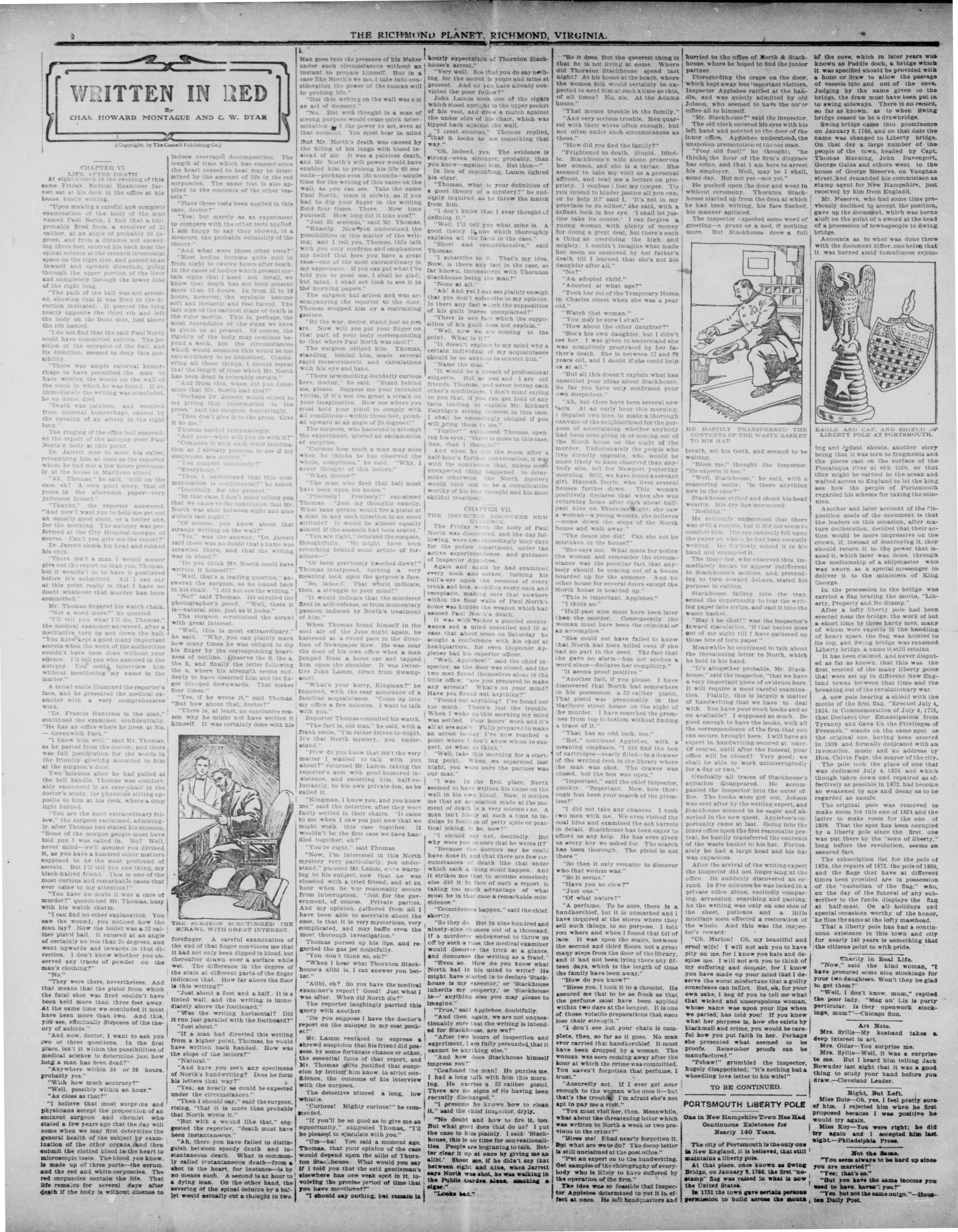
PORTSMOUTH LIBERTY POLE
One in Now Hampshire Town Has Had
Oontinuous Existence for
| Nearly 140 Years,
‘The ofty of Portsmouth is theonly one
fa New England, it is beileved, that still
maintains a liberty pole.
At that place, once known as Swing
Bridge, on January 9, 1766, the first “no-
stamp” flag was raised jn what is now
the United States,
fe 1731 the town gave certain persons
‘permission to bulld across the mouta
‘OF the cove, which in later years was
known as Puddle dock, # bridge which
{t was specified should be provided with
@ hoist or draw to allow the passage
of vessels {eto and out of the cove,
Judging by the name given 10 the
bridge, the draw must have been putin
to swing sideways. There {s no record,
so far as known, as to when Swing
bridge ceased to be a drawbridge.
Swing bridge came into prominence
‘on January 9, 1766, and ov that date the
mame was changed to Liberty bridge.
On that day a large number of the
people of the town, headed by Capt.
‘Thomas Manning, John Davenport,
George Gains and others went to the
house of George Meserve, on Vaughan
streetAnd demanded bis commisison as
stamp agent for New Hampshire, just
received by him from England.
Mr. Meserve, who had some time pre-
viously declined to accept the position,
gave up the document, which was borne
aloft on the point of a sword at the head
of a procession of townspeople to Swing
bridge.
Accounts as to what was done there
with the document differ, one being that
{t was burned amid tumultuous rejote-
a > fh)
Nahe, 7
PS ost \ rN earteaeh
Ay
YI) Ppa Sesed
aes
a) Sry
Ke Wee
8
>
iva
anets porn ie SOnrennOt
tng and dgflant shouts, another story
being that it was torn to fragments and
the pieces cast on thy surface of the
Piscatagua river at ebb tide, so that
timey might be carried to the ocean and
wafted across to England to let the king
tee how the people of Portsmouth
regarded his scheme for taxing the colo~
nies.
Another and later account of the ¢is-
position made of the document is that
the leaders on this occasion, after ma-
ture deliberation, decided that their ac-
tion would be more impressive on the
crown, if, instead of destroying It, they
should return it to the power that is-
sued It, which later was done, through
the mediumsbip of a shipmaster who
was sworn as a special messenger to
deliver it to the ministers of King
Gvorge.
In the procession to the bridge was
carried a flag bearing the motto, “Lib-
arty, Property and No Stamp.”
After a lofty liberty pole had been
erected near the bridge, the work of but
a short time by these hardy men, many
of whom were experts In the handling
‘of heavy spars, the flag was hoisted to
its top, and Swiog bridge was renamed
Liberty bridge, a name itstill retains.
It bas been claimed, and never disput-
ed as far as known, that this was the
first erected of the many liberty poles
that were set up tn different New Eng-
land towns between that time and the
breaking out of the revolutionary war.
A new pole bearing a shield with the
motto of the first flag, “Erected July 4,
1824, in Commemoration of July 4, 1776,
that Declared Our Emancipation from
Tyranny and Gave Us the Privileges of
Freemen,” stands on the same spot as
the original one, having been erected
in 1899. and formally dedjcated with am
{nvocation, muste and au address by
Hon. Calvin Page, the mayor of the city.
‘The pole took the place of one that
was dedicated July 4, 1824. and which
though taken dowa and repaired as ef-
fectively as possible {n 1872, had become
80 weakened by age and decay as to be
regarded as unsafe,
The original pole was removed to
make room for this one of 1824 and the
latter to make room for the one of
1899, That the spot has been occupied
by a Liberty pole since the first one
was put there by the “sors of lbeety,”
Jong before the revolution, seems am
assured fact.
The subscription Ist for the pole of
1824, the repairs of 1872. the pole of 1899,
and the flags that have at different
‘times been provided are in possession
wot the “custodian of the fing.” who,
on the day of the funeral of any sub-
ieriber to the funds. displays the flag
at half-mast. On all holidays and
“special occasions worthy of the honor,
‘he flies the same at the lofty masthead.
That a liberty pole bas bad a contin-
— oo in this town and city
for near! years s something that
|the citizens point to with pride.”
Charity in Real Life
“Now,” said the kind woman, “I
Rave procured some nice stockings for
your two daughters. Won't they be giad
w get them?”
“Well, I don’t know, mum,” replied
the poor lady. “Mag an’ Liz is purty
Perticular. Is they openwork stock-
ings, mum?"—Chicago Sun.
‘Art Note.
Mrs. Syllie—My husband takes a
deep interest in art.
Mrs. Oldar—You surprise me.
Mra. Syllie—Weill, It was a surprise
te me. But I heard him telling Jack
Rownder last night that it waa « g00d
thing to study your hand before you
draw.—Cleveland Leader.
Right, But Left.
Miss Bute—Oh, yes, | feel pretty sure
of him. I rejected him when he first
Proposed because I was positive he
would try again.
Miss Koy—You were right; he di@
try again and 1 sccepted him last.
Right—Philadelphia Press.
‘Mot the Same
“You seem always to be hard up since
you are married?”
“Yes; that’s 50,”
“But you have the same tacome you
Reed hewn. havea": your”
“Yes. but not the same outgo."—-Hous-
tem Daily Post.
THE PLANET
SATURDAY.....NOV. 25TH, 1905.
LIVESTOCK
PLAN FOR A HOG HOUSE.
Two-Story Structure Comparatively
Easy to Construct—Second-Story
Used for Corn Storage.
The accompanying illustration shows
the ground plan of a hog house, 24x50
feet. in use on the farm of J. G. Palmer.
12 x 18"
CEMENT FLOOR
BROOD SOWS & PIGS
12 x 18"
CEMENT FLOOR
BROOD SOWS & PIGS
CEMENT TROUGH
CEMENT TROUGH
8 x 24"
FEED ROOM
CEMENT FLOOR
24 x 24"
CEMENT FLOOR
FATTENING. HOGS
GROUND PLAN FOR HOG HOUSE.
GROUND PLAN FOR HOG HOUSE.
Jackson county, Mich. The plan as submitted in a late issue of the Michigan Farmer needs no further description. The hog house forms the basement of a two-story building. The upper portion is used for storage of corn.
CARE OF MANES AND TAILS
Some Valuable Suggestions for the Improvement in Appearance of the Horse.
In response to an inquiry as to what to do to improve rough, uneven and unsightly manes and tails, a leading horse authority gives its readers the following suggestions:
"Cleanliness is the first thing to be looked after. If dirt is suffered to accumulate at the roots of the long hair the horse will rub and destroy it. Therefore, good, honest soap and water is a mighty aid to keep manes and tails looking well. A little sheep dipzenoleum is excellent, used periodically at the roots of the long hair will stimulate growth measurably and kill or repel vermin that may have found or seek a lodgment. When a horse is rubbing his tail, which he always is when anything is wrong, the first thing to be done is to discover the cause. Then apply plentifully soap and water and the solution described. One part of the dip in 50 parts of warm water is right as to strength. Then the mane and tail should be kept clean by the use of comb and brush and more or less frequent washing. The long hair should be dried as well as possible after each scouring, and when the dip solution is applied there is no need to stop it over so that it runs down or away from the skin where it is needed. It should be rubbed in briskly for a few moments. The mane and tail should be handled gently. It is very easy to tear out great quantities of the long hair with a common currycomb, and in that very way much damage is done. A currycomb should never be used on a mane or tail. Use the comb specially designed for the purpose. The tail should never be plaited to make it look crinkly. To plait it is to break off the hair and in time to spoil the looks of the tail."
THE LIVE STOCK
Whatever you may feed your horse, feed judiciously and regularly. Use system.
While it is always an item to feed well, young pigs may easily be stunted by overfeeding.
Keep breeding sows by themselves, and feed them according to the demands of the condition.
Hogs furnish one of the best mediums for marketing the bulky products of the farm in a concentrated shape.
When stabled for the neon feed, it is comforting and cooling to the tired, sweating horse to be relieved of all harness.
It is the hogs that make the best growth in the shortest time and upon the smallest amount of food that return the best profit.
A tablespoonful of copper sulphate dissolved in hot water and given with a gallon of milk to the brood sow will stop scours in little pigs.
Owners of waste, brushy land would find a flock of Angora goats a very valuable acquisition. They are money makers as well as land clearers. In selecting a young animal for breeding purposes one with a gentle and tractable disposition should be chosen as nearly as can be judged.
Feeding of Brood Sow.
If the sow is fed on a cooling or
succulent ration before farrowing with a predominance of protein, the pigs should be strong and healthy, and reach the teats without becoming chilled.—Farm Journal.
FEEDING WESTERN LAMBS.
Suggestions by an Eastern Stockman for Profitable Rearing of Lambs for Meat.
I wish to give some facts about the insue of an industry new to this country and in which are the least possible risks, with the hope of interesting capitalists.
I believe, writes W. I. Armstrong, of New Jersey, in the Country Gentleman, I may claim to be the original advocate of the English system of sheep farming as suited to the American soil and climate. My views in this branch of farming have been supported by the foremost authorities in this country. My remarks refer to a system of feeding, etc., which will result in the development of a thick, lean, juicy mutton carcass of finest quality and digestibility, having a peculiar turnip flavor, pleasing to the palate, the epicure's delight.
The questions may be asked: what are the requirements? Will the cost exceed present western systems of feeding? How can the sheep be procured?
Ordinary farm land; about one-third of the farm or farms, should be planted with turnips, yielding 10 to 20 tons per acre, according to quality of the soil, costing about 50 cents per ton to grow. Roots are the mainstay, about 15 pounds each day per head being led, with a very small quantity of hay, alsoran, peas, linsseed and cotton cake, oats, etc., all or part mixed in bulk—estimating one pint or so each day per head, with about two quarts of hay chaff, possibly a little water and rock salt. Movable fences are necessary to enclose the flock in a new patch of roots each day, passing over the field bit by bit, leaving the land richly buttered with humus.
The corn in the west is cisearable than the above-named mixed feeds corn, but the turnips, which play so important a part, will fully make good on the side of economy. Feeding sheep on arable land affords an additional item of return equal to many tons of city manure per acre, enriching the depleted soil and saving expensive fertilizer bills. The English grow their fine quality malting barley after sheep, and it may yet be discovered that a finer quality of tobacco can be grown in this country after such a preparation. Western lambs can be bought in the Buffalo market or shipped direct from the costing about three dollars per head. The feeding period may range over two to three months, during which time the animal will thicken and grow.
LAMB'S CARCASS, SHOWING PARTS.
The wool or pelt is an item of return.
The butchers who cater to fancy trade will be compelled to fill orders for the special goods, whatever the price may be. A slaughter house on the farm and a method of crating the whole or part of a sheep to each of the thousands of rich families in and around New York city should be easily arranged. Advertising is unnecessary to make known such a commodity; once established, the only difficulty will be to supply the demand.
In this billion-dollar age in the most extravagant country under the sun, a duplicate English saddle flap and juicy leg of mutton should command a handsome return, easily doubling present prices. The English-fed mutton continues always to hold up a high price against all imports. The best informed can show no reason adverse to the production of equally good mutton in close proximity to New York city, and this branch of farming will work favorably in conjunction with the usual routine of the farm; once started even in a small way. It can be developed to enormous proportions.
It must not be supposed that the uninitiated can make a success by following the above statements, neither do the American stockmen grasp the possibilities that await them. The numerous details necessary to conduct successfully this special branch of farming are understood by the best English sheep feeders only, who often have cold or wet to contend with during the winter months, necessitating shed-covering as protection. It is not generally known that a succulent turnip is heating to the system of a western lamb, in the absence of duly preparing the animal. The question of fencing and protection from dogs should be fully understood; the cost of attendance is a small item of expense. In support of my right to speak with authority in sheep husbandry, I beg to say that my father was occupier of several farms, about 2,000 acres, near the county town of Bedford, England, for over 50 years, and for 20 years I have taken an active part in the business and in the management of large flocks of sheep, supplying the London market with No. 1 mutton and lamb. On these farms, the first iron plow was used, and with it we took first premiums at plowing matches throughout the country. We were also designers and inventors and makers of numerous agricultural implements still in use. The most prominent sheep farmer in the whole country, Charles Howard, whose name in the past often appeared in the press of this country, received his farming education with my father. It was on this large holding that the leading farmers and stockmen congregated to see our progressive methods.
"I should say was. He couldn't have been kinder if he had been an insurance president."—Cleveland Piair Dealer
THE RICHMOND PLANE1. RICHMOND. VIRGINIA
ABOUT WINTERING BEES.
Hlves, If Packed Warm Enough, Will Winter the Beas as Well as the Cellar.
The beekeeper who has kept himself within the safe beaten paths of his own experience, and who has avoided the many new forms and fancies that spring up and seem to flourish for a day, may congratulate himself that he is not thrown off his base or led into temporary disaster by following some line of manipulation or some plan of management that is not practical or progressive. I would not discourage experiment nor lay a straw in the way of progress. Thought, theory, experiment, each is a key that unlocks the door to hidden truth. We may fall into error at times, but the success attained is the reward of investigation and experience; and this leads me to say, in regard to wintering bees in this northern climate, that a plan or a practice that has proved itself true for a period of years without a failure is a safe plan to follow for the one making the trial, if not for others.
In this locality, writes a Hillsdale (Mich.) correspondent of Gleanings in Bee Culture, the temperature often goes down from zero to 20 below; and one great reason, and perhaps the chief reason, why some have failed in outdoor wintering of bees is that they are not packed warm. I formerly wintered my bees in the cellar, and lost them in the spring by the score. I then tried an outside repository with about the same percentage of loss. I have also packed them in chaff, and still lost a large number; but for the past several years I have lost no bees of any account.
I now place them in winter cases, three hives in a case. These cases are made of good lumber, and papered with thick building-paper all around the sides and bottom. I placed 91 colonies in these winter boxes last fall, and every one of them is in fine condition except one in a single box that I overlooked in packing. Since I have adopted my present plan I have not been troubled with spring dwindling. What I wish to emphasize in this connection is, that bees must be packed warm, and here is where the secret lies.
The chaff hives made by the different firms are all right provided there is sufficient packing of the right material on the top. My argument is that they must be packed so warm that the moisture will not condense—so warm that the bees can move to any part of the hive without any danger of being caught in a "bizzard," so warm that they just laugh when they hear the winds blow with the temperature going down below zero. But some will say: "Pack your bees so very close, and there will be no upward ventilation, and the hives will become damp, and the combs will become moldy, and the bees diseased; and, as a result, they will come out in bad condition in the spring."
It occurs to me that this bad state of things which some seem to fear is not the result of close packing and warm hives, but the result of loose packing, too much cold, and too much upward ventilation. Absorbents are all right if warm. However, the only absorbent that I use is the propolized canvas, flat on the frames, and then two thicknesses of heavy building paper, and then a large chaff cushion, loose chaff or forest leaves, as the case may be, then the three hive-covers on top with the tight cover to the winter box, which completes the job.
The most of my hives are seven- eighths of an inch deeper than the standard L., making the frame just ten inches from top to bottom. I think it is true that this deeper hive will generate more heat than a more shallow one. I run my bees for comb honey, and I like this deeper frame. It gives me more depth of brood and more bees, and it is bees that make honey. The whole surplus energy and warmth and odor from this deeper and more populous hive flows up into the super above, warming the sections and the foundation, so that I have very little trouble in forcing bees into the sections. There is such an up ward push that they must go above.
EXTRACTING BEESWAX
Simple Apparatus Which Will Enable the Apiarist to Separate Comb from the Honey.
Wax, as produced by the bees and worked into comb, is almost pure white, but on being melted and cooled is yei.
SOLAR WAX EXTRACTOR AND COVER
low. I advise every bee keeper to use the solar wax extractor. All that is necessary is to have a box with glass to fill over it, as shown in cut. To melt combs, put in the box an old dripping pan, having a chole at one corner, and that corner the lowest, with some kind of a dish set under to catch the wax. To get the most out, says the Farm and Home, break up the combs into fine pieces, then soak in water for a day or two longer before rendering.
Extra Combs
Now arrange to have the bees fil and seal several extra combs, to have on hand when any colony runs short of stores during winter or early spring.
FIRED ON BY JAP CRVISER
Steamers recently in the port of New York were concerned directly or indirectly in the battle of the sea of Japan. The German steamer Pisa, Captain Fendt, of the Sloman line, took the part of a Japanese transport, and the British steamer Erroil, Captain Graham, had a night adventure with the Japanese cruiser Takachino in Tusshma strait.
The Erroil was on her way from Shanghai to Kobe or Moji with a carriage of contraband cotton. Only because she got stuck in the Shanghai river just above Woosang bar for two days she escaped capture by the Russian volunteer steamer Smolensk.
About 9:45 Sunday night, after sliding over the Woosang bar, Acting Chief Officer MacKenzie saw a steamer's light right ahead. He ported and altered his course five degrees, expecting the stranger to do the same, and the light still headed for the Erroil.
When the stranger was about half a mile away she ported slightly, so as to pass about 300 yards off, and turned an electric searchlight on the Erroll. The man-of-war, for such she evidently was, was still invisible.
The chief officer called the captain, who put on his uniform cap and coat and took the bridge. The electric light was kept on for eight minutes, and then the warship stood on his course. His hull was now visible, and close behind him, trailing like a couple of bloodhounds, were two torpedo boats showing no lights except astern. The captain went below again.
At 11:45 o'clock a single white light came up on the starboard quarter, flashing the Morse code signal "M. N," which means "Stop instantly." Before the captain came up again two searchlights were playing on the Erroll, one full on the bridge and the other flashed all over the ship and her deck cargo of cotton. The chief officer drank his coffee with perhaps hundreds of eyes upon him, the second officer coming to relieve at midnight.
Captain Graham paid no heed to the signals, keeping steadily on at full speed.
At 2 o'clock the stranger fired a gun, but the Erroll still held on. At 3:45 o'clock, daylight fast coming on, the war vessel was on the port quarter. She was seen to be a Jap cruiser flying the signal "D. V." (Show your distinguishing signal). Captain Graham complied. Then appeared again the "M. N." and the Erroll stopped. A
MARIE
THE STRANGER FIRED A GUN.
lieutenant, a middy, several other officers and two signalers boarded the Erroll. Captain Graham showed them his manifest. The lieutenant then asked Captain Graham why he had not stoped, saying Captain Mori was very angry. Captain Graham replied:
"We don't understand Morse signals. Why didn't you fire a gun?"
"We did," said the Jap.
"Didn't hear it; must have been a popgun," said Captain Graham.
"I thought you were a Russian, and I kept on, hoping you would put about and leave us alone."
The Japs returned to their own ship, the cruiser Takachino, and the Erroll was compelled to follow the cruiser back on the road for more than half an hour, when she was allowed to proceed.
The Goto islands were passed that afternoon, and when Mr. Mackenzie came on the bridge at midnight Tsushima light was just beam. The first object to attract attention was a warship, playing constantly a searchlight upon the cotton ship and running rings around the Erroll. The man-of-war was shouting something indistinctly, and the Erroll hoisted her signal. Shouting again, the unknown cruiser disappeared in the dark. The Erroll went on at half speed, but in two minutes there were several vessels signaling to her to stop instantly, which she did. She remained motionless until 4:30 a. m. A chain of warships was stretched clear across Tsushima strait during the darkness, but when daylight broke there wasn't one to be seen. So the cotton laden steamer pushed on, entering the harbor of Moll at noon.
ANALYZING MILK
The Process Is Neither Difficult Nor Complicated.
The chemical analysis of milk is not complicated nor difficult. First the chemist weighs a small dish, cup or saucer and carefully notes down the results in ounces, grains and fractions of grains. Next he pours in some milk to be analyzed and again carefully
notes down the result. By subtracting the weight of the dish from that of both the weight of the milk is found and recorded. Next the receptacle is placed over a steam jet, which evaporates the water of the milk, leaving only the residue or "solids." Again the dish and its contents are weighed, and by a simple calculation the percentage of solids is ascertained.
The "solids" of the milk have been found by numerable analyses to average about 13 per cent, and while the fat varies in milk from different cows the solids left after extracting the fat are found to be a very constant quantity, seldom falling below 10 per cent or over 14. This gives the chemist a positive basis for his calculations and enables him to state with great certainty whether or not the milk has been watered.
The fat or oil in milk is determined by dissolving it by means of ether, the residue remaining after such test being termed "soldies other than fat." The average fat or oil found in milk from cows is 3 per cent, and any amount less than 3 per cent indicates almost to a certainty that the milk has been skimmed. If analysis shows a decrease of fat it indicates that the milk has been watered, while if fats and other solids together are low you may infer that the skimmer has done its worst.
ANCIENT SEA WALLS
Punishment That Was Inflicted For Neglecting Their Repair,
W. H. Wheeler in his "History of the Fens of South Lincolnshire" quotes Harrison as saying, in his preface to Holinshel's "Chronicle," that "such as, having walls or banks near unto the sea, do suffer the same to decay, after convenient admonition, whereby the water entereth and drowneth up the country, are by a certain ancient custom apprehended, condemned and staked in the breach, where they remain forever a parcel of the new wall that is to be made upon them, as I have heard reported."—P. 40.
Harrison, so far as I am at present able to make out, is the earliest authority for this, and he only speaks of it as a report.
In a paper by the Rev, F, C, J. Spurrell in "The Archaeologia Cantiana" relating to Dartford, I find the following, which, though it is by no means a proof of what Harrison had heard, tends to make the statement less improbable than it otherwise would be:
"In early times the Roman way crossed the marsh untroubled by the tide. Afterward, the tide having advanced further inland, the road was raised, becoming a causeway. In mediaeval times this bank was heightened against the tide, the road running inside, as at present. During a section made a few years ago through this road, near Stidolph's house, I saw a human skeleton extended across the bank about two feet below the present surface. This is, of course, a strange situation; but, looking to the fact that it was a tide wall, it is possible that the once owner of the skeleton had the duty of repairing the bank and, having let the tide through by his neglect, was placed in the breach, thus helping to repair it while suffering punishment. S. Smiles has mentioned that such a mode of dealing was a mediaeval custom. However, I know not how far the ancient graveyard extended hereabout, so that the body, which showed no signs of burial, might yet have been buried in sacred ground."—London Notes and Queries.
EARLY BOOKMAKERS
THE FINE ART OF THE MONKS OF
THE MIDDLE AGES.
Written and Illuminated Works
That Were Marvels of Skill and
Industry-Anglo-Saxon Monks Origi-
nated the Roman Letter.
There is scarcely any error so popu-
lar, yet so unfounded, as that which
invertely attributes unbounded indol-
ence to the monastic orders of former
days. To them we owe the preservation
of literature, both in the pains they
took to perpetuate history by their labors in transcribing and by their diligence in the education of youth.
In the large monasteries a chamber was always set apart for writing, allowing space in the same apartment for other quiet employments also. The transcribers were superintended by the abbot, prior, subprincipal and precentor of the convent and were distinguished by the name of "antiquariol." These industrious persons were continually occupied in making new copies of old manuscript books for the use of other monasteries, and by the means many were educated and our most valuable historical records were preserved.
The Anglo-Saxon monks were most celebrated as writers and were the originators of the small roman letter used in modern times. The greatest delicacy and nicety were deemed essential in the transcribing of books, whether for the purpose of general instruction or for the use of the convents. Careless and illegible writing is therefore but seldom to be met with among the remains of monastic industry, and when erasures were made they appear to have been done with the utmost care and skill. For this purpose the monks used pumice stone, and they were also provided with a puncturum, or awl, to make the dots and with metal pens for writing until after the seventh century, when quills were brought into use, they being far better than the metal pens then in use.
The inks were composed of lamp-black soot mixed with water and gum for use upon the vellum, paper not being introduced until the fourth century; hence the beautiful distinctness, as well as durability, of very ancient manuscript books. So important was the art of writing in those days that it is conceded as many as 100 different styles were in vogue among the learned.
With so many impediments to the multiplication of books as were attendant upon their slow production in this manner, it is not a matter of surprise that the monks enjoyed almost a monopoly of this kind of labor, as in truth they were the only body of men who could properly conduct it. The
A Poem for Today
By Susn Coolidge
F youth could know what age knows without teaching,
Here's instability and Love's dear folly,
The difference between practicing and preaching,
The quiet charm that urks in melancholy,
The after bitterness of tasted pleasure;
That temperance of feeling and of words
Is health of mind, and the calm fruits of teisure
Have sweeter taste than feverish zeal affords;
That reason has a joy beyond unreason;
That nothing satisfies the soul like truth;
That kindness conquers in and out of season--
If youth could know—why, youth would not be youth.
Is health of mind,
Have sweeter taste than
That reason has a joy bee
That nothing satisfies the
That kindness conquers it
If youth could know—w
If age could feel the unease
The pulse of life that be
And with its swift, resist
Make light of difficulties
Could once, just once, ret
That lovely, foolish zeal
Which bids defiance to al
And flashes in quick eye
Which, counting dress for
And, reckoning moons n
And, having naught, has
If age could do all this,
If age could feel the uncalculating urgence,
The pulse of life that beats in youthful veins,
And with its swift, resistless ebb and surgence
Make light of difficulties, sport and pains;
Could once, just once, retrace the path and find it,
That lovely, foolish zeal, so crude, so young,
Which bids defiance to all laws to bind it
And flashes in quick eye and limb and tongue,
Which, counting dross for gold, is rich in dreaming,
And, reckoning moons as suns, is never cold,
And, having naught, has everything in seeming—
If age could do all this, age were not old
expense of preparing books was provisorily great, and large estates were frequently set apart for the purpose of purchasing them. In addition to the cost of transcribing, the materials of which books were composed were sources of great expense. The leaves in many instances were composed of purple vellum for the purpose of showing off to more advantage letters of gold and silver. The binding was often very gorgeous, although of rude construction. The prevailing covering for books was a rough white sheepskin pasted on a wooden board, with immense bosses of brass, but the exterior of those intended for church service was inlaid with gold relics or silver embossed on ivory plates. Some books had leaden covers and some had wooden leaves, but even as early as this bindings in velvet with silver clasps and studs were made as presents for exalted personages.
Illuminating manuscripts was also another occupation of the monks of the middle ages, although not confined to them, for the greatest painters of the day disdaind not to contribute to these cumbrous and sometimes confused decorations. The art of correct drawing and a knowledge of perspective cannot, however, be ascribed to the generality of the fantastic pictures by which illuminated books are adorned. Coloring and gilding appear to have been the chief points to which the attention of the illuminations was directed. The neutral tint was first laid on somewhat in the same mode as in the present day, some portions being left untouched in order to be afterward imbedded in gold and silver. The pictures represented different subjects, according to the nature of the book which they were intended to embellish. The title on the pages was formed of capital letters of gold and azure mixed. Illuminated pictures are of a dazzling brightness, the white predominating, which, not being an oil color, reflects the rays of light and does not absorb them. So much custom had the monks in their labora of transcribing and illuminating that they were sometimes obliged to introduce hired limners, although contrary to the monastic rule in general, but such aids were seldom resorted to, the monks being usually the only laborers. The invention of printing diminishes the importance and annihilated the profits of writing, and in 1400 that of engraving superseded the art of illuminating.—New York Herald.
THE PUEBLO INDIANS
Their Religion Is In a Way in a Species of Water Worship.
Eagle feathers are much used in the ceremonials of the Pueblo Indians, and in order to make sure of a supply the Zuni keep the birds in cages, plucking a few feathers whenever they happen to want them. On the other hand, the Moki have eagles' nests located at various spots within thirty or forty miles of their towns, which are considered the property of different clans among them. The eagle lays its eggs in the same nest year after year, and the clans inherit rights to certain nests from generation to generation.
The eagles are not killed, but the new fledged young ones are taken from the nest—that is to say, all but one or two, which must be left. To remind the eagle god to encourage the laying of more eggs by the birds an egg carved out of wood is placed where the divinity will be sure to see it; also, after being plucked, the eaglets are carefully buried in a certain cleft in the rocks, which is the eagle cemetery. Here the eagles have been interred for centuries, and the place is very sacred.
The Pueblo Indians have a tradition of the flood, and they say that the turkey is marked in commemoration of that event, its tail being black at the end where it was dragged through the mud after the water had subsided. The duck is another sacred bird, being associated with water. From the Pueblo point of view, anything that is related to the all precious water in any way is an object of worship. Their religion is made up to a great extent of aquatic divinities and might be called a species of water worship.
How to Clean Old Book Plates.
To restore old book plates that have been injured by age and damp proceed as follows: Place upon a flat surface a sheet of white paper somewhat larger than the print to be cleaned. Carefully dampen the print on both sides with a soft, wet sponge and then saturate it with a mixture of chloride of time and oxalic acid dissolved in about equal proportions in a pint of cold water. You can tell when the mixture is right by its turning magenta color. Continue to apply it until every stain or spot has disappeared and then with a clean sponge wash the print freely with cold water.
I
The Enemy Was the Sea, and the Colored Troops Won.
No engagement of the civil war was carried on with more heroism and endurance than that fought by the Fortyninth United States colored troops after hostilities were over. The Magazine of American History contains an account of the tussle in which the black soldiers bore themselves so bravely. The steamer Merrimac, loaded with cotton, left New Orleans for New York carrying, besides her regular passengers, thirty officers and 900 colored privates.
For several days all went well. Then the vessel sprung sleak, fires were dampened and the alarm spread. It was found that the iron supply pipe through which the water for the condenser was taken from the sea was broken, and the place of leakage could not be reached. The passengers were panic stricken. One small, fat German went about wringing his hands and crying:
"Ach, we are at the bottom of the seal! If we gets pack to New Orleans will dey gif me pack my monish?" The water gained fast. The only hope lay in keeping about until a vessel could be sighted. The colored troops were pressed into service and proved themselves the heres of the occasion. A line of men was established from the hold to the deck, and buckets were passed as rapidly as hands could move. On deck another line stepped back and forth with well trained military tread. The work below was most exhausting. The men at the bottom could not hold their position more than three minutes at a time. They were blinded and half strangled by the washing sea water and bruised by the lumps of coal which dashed about.
But no one faltered, and high above the noise rose the clear, sweet voices of the workers, now singing an army song, now a cheery negro melody. The music brought new hope to the hearts of the passengers. Hour after hour the men worked and sang, and the sea did not gain on them.
Two days passed, and the drinking water gave out. Then they could no longer sing, and their parched throats were eased only by a scanty supply of oranges and lemons, but still they worked. On the third day the lights of a steamer were seen only half a mile away. Rockets were sent up, and with great difficulty, on account of her wet ammunition, a gun was fired. To the dismay of all, the steamer passed on. Quickly the soldiers formed a line once more, and the wearisome lubor began again.
After sixty-five hours of bucket passing a steamer was sighted which responded to the call for help, and the waterlogged Merrinrina was towed into harbor.
The men who had sung so cheerly in the midst of hard labor and in the face of death were thoroughly exhausted, but they had not lost their light hearted gayety.
Gladstone's Early Joys
When Mr. Gladstone was quite an old man it chanced that he and Mr. Chaplin were staying at the same country house together on a visit. One night after dinner the Grand Old Man asked Mr. Chaplin whether his grandmother had not lived in a certain street in Mayfair. Mr. Chaplin replied that she had done so. "Well," said Mr. Gladstone, "I remember it distinctly. I lived next door to her for awhile when I was a child. She used to give evening parties. When the carriages were assembled to take up, my brother and I used to creep out of bed—it was in the summer time—softly open the window, get out our squirts and discreetly fire away at the coachmen on the boxes. I remember the intense delight with which we used to see them look up to the sky and call out to ask each other whether it wasn't beginning to rain."
When a young man on a small salary and with the future very uncertain gets married we claim he is as reckless as if he jumped into water and couldn't swim. The romantic may call it courage, but it is pure recklessness.—Atchison Globe.
All Broke Up.
"She was very much affected, was she not, at the bad news?"
"I should say so. Her eyes dropped, her voice broke, her face fell, and finally she burst into tears."—Baltimore American.
Courtesy to Strangers.
If a man be gracious and courteous to strangers it shows he is a citizen of the world and that his heart is no island cut off from other lands, but a continent that joins to them.—Bacon.
3
*
A HEROIC BATTLE.
Brave or Beckleast
All Broke En
Courtesy to Strangers.
THE PLANET
Published every Saturday by JOHN MITCHELL
JR., at 311 North 4th Street, Richmond Va.
Al. communications intended for publication should be sent so as to reach us by Wesminay,
TERMS IN ADVANCE.
ADVERTISING RATES
For one inch, one insertion, . . . $ 50
For one inch, each subsequent insertion, . . . $ 50
For two inches, three months, . . . $ 10.00
For two inches, nine months, . . . $ 14.00
For two inches, twelve months, . . . $ 30.00
Hurricane and Financial Notices, one inch,
Standing and Transient Notices per line, . . .
POSTAGE STAMPS OF A HIGHER DEFINITION THAN TWO CENTS NOT RECEIVED ON SUBSCRIPTIONS.
THE PLANET is issued weekly. The subscription price is $1.50 per year in advance. Money can be sent by mail or our rule is: a Post Office Money Order, by Bank Check or Draft, or an Express Money Order, and when more of those money orders are received, we will be responsible for the safe arrival.
EXPRESS MONEY ORDERS can be obtained at any office of the American Express Co., the Bank of New York, the Bank of Canada, and Goya Express Company. We will be responsible for money sent by any of those companies. The Express Money Order sata
REGISTERED LETTER.-If a money Order, Post-Office or an Express Office is not within your address, you must send a Letter you wish to send us on payment of ten cents. Then, if the letter is lost or stolen it can be traced. You can send money in other ways at the Post-Office.
We cannot be rudely, insistent for money sent in letters in any other way than one of the four ways mentioned above. If you send your money to other way, you must do it at your own risk.
RUNEWALKS. ETC. If do, you not want THE PLANET continued for another year after your subscription has run out, you then notify by mail or by phone that you have decided that subscribers to new-paper, who do not order their paper discontinued at the cost of the subscription, are held liable for the payment of the subscription up to date when they order the paper discontinued.
CANCELATIONS.-When writing to us to renew your subscription or to discontinue your paper, you should give your name and address in full otherwise we cannot find your name on our address.
CHANGE OF ADDRESS.-In order to change the address of a subscriber, we must be sent the former as well as the present address.
Entered at the Post-Office at Richmond. Vs second-class matter.
SATURDAY...NOV. 25TH, 1905.
DR. COUNCILL AND THE NEGRO.
We have received a pamphlet, entitled "Industrialism plus Industriousism and Good-will" by W.H. Councill, D. D., President of the A. and M. College for Negroes at Normal, Alabama.
It contains much information and the advice given is on the highest order. We are persuaded to give a few extracts from this most interesting document. It tends to bridge the chasm and it is a powerful plea for mutual helpfulness between the races. Sometimes, Dr. Council goes so far on the other side that he leaves us on the opposite bank of the stream wondering, but in this case, we can keep step with him and applaud vigorously all that he is kind enough to say.
All fair and intelligent discussion of the emancipated life of the Negro, divides the race, in the South, into two distinct classes—as distinct as the currents of the ocean and air. * * *
The more than one or a hundred thousand educated and trained Negroes, forming the post-bellum class of mechanics, farm and home owners, doctors, lawyers, preachers, teachers, make a separate and distinct citizenship, as does a like class among other peoples in all lands, and in all times. Unfortunately and unfairly, prejudice knows but one class of Negroes. Therefore this superior class of a few hundred thousands has to overcome the severest hardships that have ever come against a race in the history of the human family—prejudice, biting, withering, blasting in its tendency. A prejudice which helps to create, but does not excuse or extenuate crime in the ignorant masses; a prejudice that helps to make weak, and curses the weakness which it makes in the weak and would undervalue and depreciate the strength which comes in spite of itself—that strength of human character which looks to the stars, instead of to dark, black, mismatic, deadly swamps; that strength which seeks life in life-giving atmosphere.
And again:
That class of Negroes by their labor and influence cultivate thirty-two fortieths of the cotton of the South, own nearly 400,000 homes and farms, maintain the Negro churches, schools, Negro newspapers authors, inventors, banking institutions, insurance companies, (although many of these enterprises are young, as those of the whites were less than two hundred years ago) still are forging their way to the top dragging the entire Negro race upward. There is a good Negro element, and this element should be studied. If men go round looking for bad Negroes, they will find them; if they look for good Negroes, they will find them. It depends upon what a man wants to see. It is unkind to take the small criminal
---
element in the race as representing the whole race.
Who will not agree with him
when he says?
At this point I wish to say that we must be as fair toward the white South as we want it to be toward us. We must not put all white men in the same class, for there are ministers of the Gospel, lawyers, farmers, doctors, merchants, bankers, writers and even some politicians who advocate and maintain in private and in public that friendship for the Negro, amicable relations between the races, and who have assisted in producing that material and spiritual prosperity, of which I have just boasted.
The following definition of prejudice will be appreciated by all who take the time to think or admire those who think for them:
Prejudice is but the cylinder or steam trunk which confines the expanding water, until the particles of steam have accumulated power to drive forward the mighty engine with its load to civilization and to God. Industrial intelligence plus intelligent industry must be the lever by which all of this shall be done; upon a foundation of racial respect, for no race can rise in this world which does not maintain its racial identity. The man who does not emphasize the importance of this soon becomes insane and recognizes himself as anybody else but himself.
Dr. Councill sounds a warning that is as true as Holy Writ when he says:
To say that all of this and more must be done for the young of our race, or they will go down in the general crash of races who do not meet the requirements of higher civilization, is the expression of no pessimistic prophecy. History repeats itself. All people who do not come up to the general requirements of mankind, fall behind and out of the onward march of the human race. It is not a matter of race or color, but an inexorable law of God. Progress is the law of the world and all things go on to life, or fall back to death. Usefulness is the mark of adaptation to this inalterable law of nature. Only that race which is useful in the world has continued existence. Regardless of our views about this or that people, if that people in its development comes within the scope of the "fore-ordained" plans of a good God for the development of the human family, then that race continues to live. If any member of the human body ceases to be of use, it dies. So with every racial member of the human family.
As I have just said, usefulness is the standard of measurement. Men often measure by power, wealth, col or but the great God who sees the growth of the human family from Adam to the present, and on, shows that use alone is His crierion in the selection of material for the everlasting building of humanity.
It is related that a city preacher who was very much wrought up over the liquor question although somewhat of an exhorter, had aroused a country congregation up to a point of great religious fervor and excitement. Suddenly he launched out against the whiskey traffic and condemned all who even took a drink of whiskey. An old gray-headed deacon who was better acquainted with the proclivities of not only the deacon-board, but the congregation as well, blurted out, "Be keerful! Mind how you ride that horse, sah, for he'll certainly throw you!"
While recognizing the wisdom and truthfulness of all that Dr. Councill says, we felt like that open-hearted but nervous deacon, when we noticed all of these straight-haired, nappy-headed folks, who quietly patronized the straightening remedies now placed upon the market.
But here is what Dr. Councill says:
Some of our Southern Journals complain that Negroes are deluded by white fakirs and swindlers from the time of the "forty acres and a mule," on through other damnable swindles, and shrewd devices such as "Black Skin Removers," "Hair Straighteners," "Pensions," and the like. These swindles are unblushingly advertised and sold throughout the South. I submit in all canard, if the South had the right which it did have and exercised before the war to prohibit, suppress, and abate the sale of obnoxious literature and such things among the white population of the South as well as Negroes, it has even a greater moral right now, to abate nulsance, if it would see its real interests now as then. Politicians find tenable grounds on which to base "jim crow" laws and other Legislation. Why not prohibit these hellish practices and the criminal intermingling of races, by day and night, off the cars and on, in the public places and out; which are not only injurious to the Negro but a sapping the very foundation of Southern institutions and are a blot upon the civilization of mankind? The white South owes it to the ex-slaves and their descendants as well as to its civilization to drive out these swindlers.
Dr. Councill speaks the whole truth when he says:
You may reasonably and accurately conclude that the white man who is most extreme and cruel in his denunciation of the Negro, is like all other extremes. There is a meeting place somewhere. But the white man who is cool, quiet, but determined in advocacy of racial social separation can always be counted upon as honest, fair, just, and an advocate in word and practice of racial social separation and the supremacy of the law of the land. He is the superior—the man who obeys the criminal laws of the state in regard to saloons, gambling hells, dens of
RICHMOND PLANET, RICHMOND, VIRGINIA
crime, and all lawless acts—an example for the inferior—the Negro. The best white people of the South, from the governor down, except the little politician, are overpowered by the mob spirit. Many of these best white people no more dare to speak their true sentiments than the weakest Negro, but the little politician is with the mob, because it gives him temporary prosperity but he is sure to go down when truth and justice get a hearing. You cannot afford to notice every "low flung" expression, articles in public print, breathing maledictions nor give any heed to discouraging prophesies; but go forward, make yourself the best citizen in the land, buy property, own homes, have bank accounts and in all ways possible be counted on the side of industry and the law; so that the best white man and the best black man will be ready to stand sponsor for your recitude, when wicked men rise up against you in the serious hours and the serious days which must come into every man's life.
This distinguished writer speaks truly when he says:
American prejudice, which draws a line on Negro patronage, is a blessing in disguise. The refusal of a meal at a restaurant, or the entrance into a theatre is nothing but the voice of God calling the Negro to establish these concerns for his own good and amusement; patronize himself, put his own girls and boys into positions, and make himself rich. No glass of soda water shall stand between me and mankind. The refusal of the right to vote can not keep me from being a man. I have the right to hold a deed for land, to have a bank account, build up a good character and a good name, and stand as high as any other man for right and truth in the community.
We have realized this during all of these years and every colored business man will bear eloquent testimony to the facts herein contained. This pamphlet may be read with profit by every Negro in the United States. Dr. Councill has struck the key note and it is with pleasure that we are able to present extracts from his eloquent remarks to the public.
The following extract from the Richmond, Va. Times-Dispatch of Nov. 17th, 1805 will explain itself and give a slight idea as to the treatment of some of our people on the "Jim Crow" street-car of this city:
George Strickland, a negro laborer employed at Stumpf's brewery, was arrested last night by Officer C. J. Stockmar for creating a disturbance and using bad language on Clay Street car, No. 214.
Strickland boarded the car, and after riding for some distance refused to pay his fare, saying he would leave the car.
Conductor J. Long placed him un der arrest, but the negro attempted to bolt. Conductor Long, a small man, jumped on his back and called upon Mr. E. M. Eppes for assistance. The negro was held a prisoner on the platform. Another negro stand ing by opened the iron gate of the platform and yelled to the prisoner to run. This he did, but Mr. Eppes pursued, knocked him down and sat upon him until Officer Stockmar ap peared. The case will come up in the Police Court this morning.
We do not know of a railroad in the country that does otherwise than put off a passenger when he refuses to pay his fare and that is usually the end of the matter. Just for five cents two white men sit on top of a colored one, knock him down and then place him in the station-house for the night simply because he tried to leave the street-car. If the Receivers of the Virginia Passenger and Power Company continue to employ these kind of white men as conductors to the delay and embarrassment of other passengers who desire to get to their destination, the time is not far distant when white and colored citizens will unite to cause a cessation of the outrages. With the running down and killing of white and colored citizens and the beating and persecution of others who patronize the street-car service, the record of this corporation is not an enviable one and it calls for an investigation at the hands of our City Fathers. The man treated in this manner was a laborer and not a loafer and it seems to us was entitled to some consideration at the hands of that conductor and the citizen whom he called to assist him.
Walking is good for us and we stay off the street-cars.
FAVOR SEA LEVEL CANAL
Work to Take 20 Years and Cost Over
$100,000,000 More. Tireless Sound
$100,000,000 More than Lock Canal.
Washington, Nov. 20.—Another crisis in the history of the Panama canal undertaking was reached, when the board of consulting engineers by a vote of 9 to 5 reached the momentous decision that the great waterway should be of the sea level type.
If this action of the board is approved by the president, as it is condently expected to be, it will precipitate a new and probably prolonged and acrimonious debate on the whole question of the canal in congress where the report embodying the action of the engineers goes to that body.
This may be looked for, because the digging of a sea level canal will take from 15 to 20 years and perhaps longer, while conservative estimates of the difference in cost between a lock and sea level canal run from $105,000,000 to $200,000,000.
STEAMER WRECKED
OVER 100 LOST
The Hilda Foundered on North Coast of France in a Fog.
ONLY SIX PERSONS WERE SAVED
London, Nov. 21.—One hundred and twenty-eight persons lost their lives in the wreck of the London and Southwester Railway company's steamer Hilda off the northern coast of France Saturday night, according to an official estimate given out by the officers of the company. This death roll includes 21 saloon passengers, 80 French onion sellers and 27 of the crew.
The Hilda left Southampton on Friday night for St. Malo. Her passage was greatly delayed by a fog in the channel, and when nearing St. Malo she ran into a severe snow storm, apparently missed her course and foundered on the rocks off Jardin lighthouse, three miles from St. Malo.
The company's steamer Ada, outward from St. Malo, rescued five of the passengers and one of the crew. They are the only survivors.
A telegram from St. Severn, all joining the town of St. Malo, gives the few particulars yet available. The Hilda was near St. Malo Saturday morning. She struck the rocks yesterday morning in the roadstead off the island of Czezebre, having missed the tide owing to bad weather and the fog.
The majority of the crew and passengers were asleep at the time of the accident. A lifeboat was picked up empty at St. Cast, where 13 bodies were washed ashore. The top of the Hilda's funnel and her mast are visible at low tide, according to the telegram from St. Servan.
The disaster was first suspected through the washing ashore of a body, and the port authorities immediately sent out a tug. It was then learned that the Hilda was wrecked on a treacherous reef close to the Island of Cezembre, called Les Portes. She had apparently struck, broken her back and immediately sunk, leaving no time to launch the boats. The Jardin light is quite close to the spot. It cannot be explained as yet at what time or how the disaster occurred. The entrance to St. Malo is dangerous, the currents and rocks needing the exercise of considerable caution at all times, but more especially in bad weather. Many bodies have been washed ashore at different points, some wearing life belts. Six of the survivors, according to a report in circulation here, were rescued by the Ada from the rigging.
[The Hilda was built at Glasgow in 1882, and registered 848 tons. She was a screw steamer, of iron construction, and was 235 feet in length.]
STEAMER WRECKED, CREW LOST
The Turbin Dashed to Pieces On
Rocks Off Nova Scotia Coast.
Clarks Harbor, N. S., Nov. 21.—The Norwegian steamer Turbin, with her captain and crew of about 16 men, is thought to have foundered in a terrific gale which swept over Nova Scotia last Friday. The coasting steamer Edaa R., which arrived here from Mud Island, brought news that on Friday a large steamer, supposed to be the Turbin, struck Black Rock Ledge, off the south coast of the province, backed off in a few minutes and then disappeared in the raging sea. Persons on the island who saw the steamer strike on the ledge were a considerable distance away, and owing to the tremendous sea running it was impossible to launch a boat.
No person could be discerned aboard the craft, and so quickly did the steamer go down that no opportunity was given the crew to fight for their lives. No boat could have lived an instant in the sea that was running. While the craft hung on the rocks the seas made a clean breach over her. Suddenly a giant camel lifted her from her resting place, and the next instant she took the fatal plunge, carrying. it is believed, all on board down with her.
VICTIM OF AUTO CRASH DIES
ies Received at Atlantic City.
Atlantic City, N. J., Nov. 22.—C. W.
Greenwaid, who was injured in the
wreck of the Everard automobile on
the eVntmor speedway, died at the
city hospital, without regaining
consciousness. William Williams and
Isaac Bennett, who were hurt in the
crash, are recovering.
The automobile, containing the three
men and the chauffeur, was speeding
along the speedway, and in trying to
avoid a collision with a wagon the auto
collided with a trolley pole, throwing
the men out.
Friedrich Mies
Wilmington, Del, Nov. 22.—C. Preston Hering, who shot and killed Moses Bullock last month, was freed of guilt when the grand jury ignored the bill against him. Hering and his wife were proceeding along a lonely road, on their way to the house where Mrs. Hering lived, and were followed by Bullock. The latter pursued Mrs. Hering as she fled, and Hering fired at him, killing him instantly.
Died After Eleven Operations
New York. Nov 21. — Charles H. Lease, a son of Mary Ellen Lease, the well-known Populist advocate, died at his mother's home here. His death was the result of 11 operations, which commenced with an operation for appendicitis. Mr. Lease, who was a customs house inspector, was first operated on 11 months ago.
Succeeds Dr. Salmon.
Washington, Nov. 22. — Secretary Wilson appointed Dr. A. D. Melvin, of Illinois, as chief of the bureau of animal industry, to succeed Dr. Salmon, who resigned some time ago.
Clam Produced $100 Gem
Bridgeton. N. J., Nov. 20.—While opening clams, William R. Shaw, a local business man, found a pearl as largs as a pea and in perfect form. He refused $100 for it.
BURIED IN 40-TON STEEL INGOT
Ddd Funeral of Workmen Who Were
Overwhelmed In Molten Steel
Overwhelmed in Molten Steel.
Philadelphia, Nov. 20. — A funeral without a parallel in this city took place at the Midvale Steel works, where a 40-ton ingot of steel, permeated with the flesh, blood and bones of two workmen, was buried with the solemn rites of the Roman Catholic church. The workmen who were so strangely laid away were John Forkin and Joseph Gazda, two foreign-speaking laborers, who met a horrible death a week ago. They were in a pit near a cupola containing many tons of molten steel. A plug gave way and 80,000 pounds of the flery fluid poured from the cupola and overhemlmed them. The men were completely incinerated and not a trace of themselves nor their clothing was left.
The Midvale Steel company was averse to selling the steel or using it for the purpose it was intended, and it was decided to bury it with the rites of the church to which the unfortunate men belonged. Accordingly the 40-ton ingot, oval in shape, 28 feet long, 6 feet wide and 5 feet thick, was moved by a travelling crane to the rear of the machine shop, where a grave 10 feet deep had been made. Heads were bared and flags lowered to half staff while two priests conducted the services. After the sisters of Gazda had been led away the great ingot was covered with earth and the funeral party dispersed. The grave of the men will be appropriately marked by the company.
SHOT WHILE LYING ON COUCH
Cooper Fired Four Bullets Into Father
in-law and Then Killed Himself.
Philadelphia, Nov. 22.—Lying on a couch at his home in West Philadelphia, helpless from paralysis, David F. Rowe, an elderly man, was shot four times by Casper Cooper, his son-in-law, who then fled from the house and killed himself by sending a bullet through his head. The father-in-law's wounds are so serious that he had to be removed to a hospital. It is believed he will recover. Cooper had been married to Rowe's daughter for three years, but the wife left him about eight months ago because of ill-treatment. The husband returned to his father-in-law's house and asked to see his wife. Rowe gald she was out earning her living. The father-in-law reproached the son-in-law for ill-treating his daughter, and a quarrel followed, which ended by Cooper shooting his wife's father while he lay on the couch. Before anyone could interfere Cooper ran from the house and, entering a building two blocks from the scene of the shooting, sent a bullet crashing into his brain. He was dead when picked up.
GRANGERS FAVOR TEMPERANCE
ered to Vote Saloon From Its Midst."
Atlantic City, N. J., Nov. 21. The National Grange, Patrons of Husbandry, went on record in favor of temperance and the curtailing of saloons, declaring "that they should be abridged until they are abolished." A resolution says: "Every community should be empowered by law to vote every saloon from its midst or its borders." The grange strongly condemned all influences brought to win legislation by lobbyists or others, and deplored the use of money in campaigns. "The recent agitation," says a resolution, "and investigations in regard to extravagance in the management of our great financial institutions, the exposure of graft in high places and the enormous power exercised by great transportation companies through combined arrangements have aroused the people to a realization of the necessities of vigorous action if they would protect themselves against the inordinate desires of wealth."
FOUR MEN BLOWN TO PIECE
Explosion In Laboratory of Smokeless Powder Company
South River, N. J., Nov. 22. — Four men were blown to pieces by an explosion at the laboratory of the International Smokeless Powder and Chemical company, at Parlin. They were: John Pierce, Frank Spratford, John Applegate and J. W. Redpath, superintendent of the laboratory.
What caused the explosion will never be known, as only the four men were in the building at the time. The building was a one-story frame structure, and because of the liability to explosions was separated from all others in the plant, except on- by a space of several hundred feet. The next building was a store house, in which supplies used in the other were stored. This caught fire and was burned.
Favor Larger Battleships.
Washington, Nov. 22—The board of construction of the navy department held an important meeting, at which the recommendations of the general board of the navy on new construction were carefully considered. The general board is in favor of ships of much larger tonnage, 18,000 tons displacement being regarded as minimum for battleships. The board on construction inclines to the belief that there are other important factors which should be considered along with increased tonnage, and its report to the secretary, although not yet prepared, will contain some important modifications of the general board's program.
TO PURIFY NEW JERSEY
Governor Stokes Determined to Put An End to Election Frauds
Trenton, Nov. 22—It was authoritatively stated at the state house that Governor Stokes in his message to the next legislature would treat exhaustively the question of corrupt practices in connection with elections, and that he would make radical and in some respects original recommendations in an endeavor to put an end to vote buying. The governor has made a complete study of the laws of other states on the subject.
Held For Conspiracy
Philadelphia, Nov. 22—W. D. Elliott, alias Count Du Lanley, who was taken into custody here a few days ago, was given a hearing by United States Commissioner Craig and held in $2500 bail to await his removal to Baltimore, where he is wanted to answer a charge of conspiracy with Edwin L.
Parker and Samuel J. Long to use the mails in a scheme to defraud. Parker is under arrest in Baltimore. Postal inspectors at the hearing testified that the men had been operating an illegal stock brokerage concern.
ROUSING THE LEGANTS
Russian Revolutionists Inciting Rebellion in the Villages.
St. Petersburg, Nov. 22.—It develops that revolutionary agents are traveling from village to village dressed in the uniforms of army generals instructing the peasants to rise against their landlords, such actions being declared to be the wish of the czar.
The Poles have carried their case to the Moscow congress. The situation in Finland is still a source of danger. There are signs that the Hebrews are preparing for an enormous emigration to America.
Private advices received from Gomel, in the government of that name, say that a battalion of reservists, 1000 strong, mutinied, following a demand for better food.
Peasants Looting Estates.
Borisoglyebsk, Russia, Nov. 22. — Many panic-stricken persons are seeking refuge here from the peasants, who are taking possession of the estates, removing the grain, burning the buildings and ordering the proprietors to relinquish their rights and depart, under penalty of death. The excitement has assumed such dimensions that the vice governor has ordered the troops to desist from making arrests. In encounters with marching bands of peasants the troops have killed 100 and have wounded many more. The residents of Borisoglyebsk are afraid that the peasants will attack the town, but their fears appear to be unwarranted.
HOLOCAUST IN GLASGOW
Thirty-nine Dead and Thirty-two Hurt
In Fire In Lodging House
In Fire In Lodging House.
Glasgow. Nov. 20.—The most terrible fire that has occurred in Great Britain for many years broke out here in a cheap lodging house for men in Watson street and resulted in the loss of 32 lives and the severe injury of 32 others.
The flames were first noticed on the fourth floor of the building, which was occupied by 330 men. An alarm was raised, and the firemen responded quickly, but flames and smoke were then issuing from most of the windows on the fourth floor. An extraordinary scene was created by a procession of almost naked men rushing out of the entrance to the building, and against their frantic efforts to escape the firemen had actually to fight for admission.
The deed men were mostly workmen in the prime of life. They presented a horrible spectacle, their blackened faces bearing evidence of the terrible struggle to escape.
BAN ON PLURAL MARRIAGES
President of Mormon Church Refused
Sanction and Caused Couple's Arrest
Sanction and Caused Couple's Arrest.
El Paso, Tex., Nov. 22—The arrest here of E. H. Conger and Pearl Gurrin, of Utah brings out the fact that President Smith, of the Mormon church, absolutely refuses to sanction plural marriages. Conger declares he fell in love with Miss Gurrin, and being refused a license in Utah, he went to the Mormon colonies in Mexico, expecting to marry there, send for his first wife and make a home there with both. He says President Smith was visiting the colony and flatly refused to permit the marriage, and the couple started back home and were arrested here. Conger being charged with abduction of the girl. Conger says both have been expelled from the church by President Smith.
Dowle Denles He Is Ill.
El Paso, Tex., Nov. 22—John Alexander Dowie and Zion party have reached Tampaco after inspecting the offerings for a proposed Zion colony, and are ready to take the steamer for Chicago, via New York and Havana. Dowie has wired Zion City denying that he is ill. He says 20,000,000 acres of land have been offered for his colony.
Accidentally Killed Box
Wilmington, Del., Nov. 20—At the Fairview club, where there were a number of boys, George Kelly in handling a gun accidentally shot and killed William Fisher, a 17-year-old Polish boy. Kelly surrendered to the police. They believe the shooting was accidental.
Oldest Yale Graduate Dead
Lansing, Mich., Nov. 21—Rev. J. S. Lord, aged 97, said to have been for many years the oldest living alumnus of Yale University, died at the home of his daughter, Mrs. W. J. Tillotson, of Lalingsburg. Rev. Mr. Lord graduated from Yale in the class of 1831.
A WEEK'S NEWS CONDENSED.
THURSDAY, November 16.
Mrs. Ann Bumbolow, aged 108 years, the oldest white woman in the south, died at Greenville, S. C.
The 71st annual communication of the Grand Lodge of Delaware, I. O. O. F., was held at Wilmington.
Harry C. Campion, a wholesale drug-gist of Philadelphia, fell under a trolley car and received injuries from which he died.
While temporarily deranged by illness, H. Frank Weed, a New York cotton merchant, committed suicide at his home at Norotton, Conn.
While playing around fodder stacks with matches, on her father's farm, near Dover, Del., Eliza Seeney, aged 7 years, set them on fire and was burned to death.
Friday, November 17.
Albert J. Pitkin, president of the American Locomotive Works, died at his home in New York.
Samuel M. Schellenger, a well-known Delaware river pilot, died at his home in Cape May, N. J., of typhoid fever.
Harry B. Thomas, business manager of the Wilkes-Barre, Pa., Evening Times, died of tuberculosis, aged 37 years.
While gunning for rabbits near Smyrna, Del., Clifton Turner, aged 19 years, ran against a companion's gun and was fatally shot.
While starting a fire with kerosene oil, Mrs. August Scalise, of Warren;
Pa., was burned to death and her husband seriously injured in an explosion. Saturday, November 18. Mrs. Ida E. Fernsworth, of Harrisburg, Pa., was found dead in her home, with the gas turned on. The population of Rhode Island is 480,082, according to a census taken by the state board of statistics. President Roosevelt will re-appoint William Henkel as United States marshal for the southern district of New York. The Riverside Bridge Works, at Martin's Ferry, O., was completely destroyed by fire, entailing a loss of $200,000. James Artiman was killed and Martin Kyle and Steven Carlo were fatally injured by being run down by a freight train at West Leechburg, Pa. Monday, November 20. On a charge of criminal libel, preferred by Clarence W. Barron, Thomas W. Lawson has been released in $2000 ball at Boston.
The accidental discharge of a gun in a hunting party near Knoxville, Tenn., killed James Maloney and wounded Wallis Carter.
Miscreants at night scratched and disfigured over 20 large plate glass windows of leading business houses in Allentown, Pa., causing over $1200 damage.
After coming from a Turkish bath, Fred Secord, a wealthy merchant of Kanakek, Ill., found that he had been robbed in Chicago of $5000 in drafts and $25 in cesh.
Tuesday, November 21.
The British cruiser squadron, under command of Prince Louis of Battenberg, sailed from New York for Glbaltar.
J. Preston Thomas, aged 63 years, one of the best known men in financial circles in Eastern Pennsylvania, died at his residence near West Chester, Pa.
After kissing her mother good-bye,
Mrs. Floy Anderson, while mentally
deranged, ran from the house at Des
Moines, Ia., jumped into a well and
was drowned.
Ira N. Terill, a life convict for murder
at Guthrie, Okla., is suing Theore
dore Roosevelt, Attorney General
Moody et al., for $800,000 damages for
conspiracy to deprive him of his libe-
ry.
Wednesday, November 22.
Theodore S. Mohr has been appointed
postmaster at Stockton, N. J.
George Van L. Meyer, American ambassador at St. Petersburg, sailed from
New York for Russia.
Dr. W. A. Bickers, 69 years old,
of Madison, Va., died suddenly from a paralytic stroke in the Astor House,
New York.
Mrs. Betty Green, of New York, said
to be the wealthiest woman in the
United States, celebrated her 70th
birthday Tuesday.
A. S. Rushby, former assistant financial agent of the state of Texas, was sent to prison for three years for misappropriating state funds.
PRODUCE QUOTATIONS
The Latest Closing Prices In the Principal Markets
PHILADELPHIA — FLOUR firm;
winter extr s., $3.10@3.25; Pennsylvania
roller, clear, $3.60@3.75; city
mills, fancy, $5@5.10; RYE FLOUR
steady; per 2 Perlman; $3.90 WHEAT
steady; per 2 Perlman; new 82$2@2;
$22@2; CORN firm; No. 2 yellow
local, 50@51%2; OATS steady; No. 2
white, clipped, 63%@37%; lower
grades, 35% HAY firm; No. 1 timothy,
large bales, 63%@15; PORK firm;
beams, 63%@15; BEAM beefs, 63%@24;
POULTRY Live fish, 12%@13%; old rooster, 8@9; Dressed
firm; choice fowl, 13%@1; old rooster,
9%2c BUTTER steady; creamery
28c. EGGs steady; New York
TAOES steady; per bushel, 70%@TAO-
TES steady; per bushel, 70%@TAO-
TES steady; WHEAT firm; No. 2
red, 85c; steamer No. 2 spot, 76%c;
southern, 71@72% CORN firm; mixed
spot, 60c; steamer mixed, 55c; OATS
@36c; No. 3 44%@24; No. 3 55%@36c;
No. 4 34%@24; No. 2 31%@5c; No. 3 34%@24;
No. 4 32%@33c BUTTER firm; creamery
separator extras, 22%@24c; held,
2c; prints, 24@25c; Maryland and
Eggs steady; fancy Maryland, Penn-
sylvania, Virginia and West, Virginia,
28%c; southern, 25@26c
Live Stock Markets.
PITTSBURG (Union Stock Yards)—
CATTLE slow; choice, $5.25@5.55;
prime, $4.90@5.15. HOGS active; prime
heavy, $5.10@5.15; mediums, $5.10;
heavy Yorker, $5.10@6.10; light York-
er, $5.10@6.10; roughs, $4@4.00;
SHEEP steary; common, $4.25@
5.50; common, $2@2.60; lambs, $5.25
7.50; veal calves, $7@7.75.
The smallest bound book in the great collection of miniature books owned by the New York Library society is a campaign document issued in 1852. It bears not only the distinction of being the smallest volume in the great collection referred to, but has been pronounced by experts in bookstore to be one of the tiniest books in existence. It contains but fourteen leaves, each of which is closely printed on both sides in microscopic type. Each leaf is one and one-half inches in length and seven-eighths of an inch in width. The title page bears the following inscription: "Life and Public Services of General Pierce. Respectfully Dedicated to General Lewis Cass. Concord Press, 1852."
A Cheerful View
Walter's mamma was very sick with rheumatism, and he was rubbing her arms when she said, "Walter, it is too bad that mamma is such a trouble to you."
Walter repiled cheerfully: "Never mind, mamma. If you are only just alive we don't care how much you suffer."
How to Serve Apple Sense
If a roast big graces your Christmas table, a very pretty way to serve the necessary apple sauce is as follows: Select a number of smooth roos, well flavored Baldwin pipkins, polish them to the last stage of ruddiness cut a slice off the top and scoop out the inside, leaving a wall of perhaps half an inch, enough to keep the apple in shape. Make a nice apple sauce seasoning, flavoring it appetizingly and fill the hollowed apples with it. Insert the stem of an apple or any bit of twig by way of a stem, and serve one to each person on a pretty dish or like a sorbet on a dolly laid on a pretty plate. Very finely minced orange rind is a delightful flavoring for apple sauce
it STAY, i
AG VOU
Ls Se
Ay
. a
SATURDAY. ....NOY. 26TH, 1906.
PESTS is kd tal @ |
fay WOMAN'S
~ ry WORLD |
pa gS,
OO ELE
TeN@S MILERED DOWELLE
EP SE ae
Few artists achieve fame at op ten-
der age of eleven years, but such was
‘Me good fortune of Miss Mildred How-
ells, the Dyly daughter of William Dean
Howells, the famous American novel-
Ist. A decade ago Mr. Howells wrote
@ charming book calied “A Little Girt
Among the Old Masters.” The little
girl was Miss Mildred, and the book
was illustrated by sketches she made
of the famous pictures her father took
her to see in the old world’s galleries
and churches. When the tiny artist
‘was busy with ber penci} her father
aC
had no ‘dea of using her sketches, and,
in fact, the book was an afterthought.
Miss Mildred loved the works of art
abe saw and in her childish zeal en-
deavored to make copies of them. She
had quaint opinions of her own con-
cerning them, and her bright com-
ments form one of the pleasing fea-
tures of the book. She even went so
far as to originate a Madonna of her
own—"“the Madonna of the orphans,”
because there were “so many other
kinds of Madonnas.” Miss Mildred ts
now a young lady, but she {s still de
yoted to her art and bas done a nom-
ber of very clever things. She Is a
slender, spirituelle girl, very much tn
terested in art and literature and with
Uttle love for “society” in the fashlon-
able sense of the word. She Is not pret.
ty, but bas an interesting face and
charming manners,
jihad a deen
Most young mothers, says a special.
Ast, need to learn that more babies cry
Decause of thirst than because they are
hungry.
‘MiIK does not serve to quench thirst
in the body. It is a solid, virtually,
and many Infants suffer keenly from
‘thirst, especially in warm weather.
For the small infant, who should
spend most of the time sleeping, the
specialist Las classified the causes for
crying in the order of their likelihood.
Colic is first of these, due to the dis-
position of so many parents to over
feed the baby. Thirst Is next in rank,
and after this in their onder come bun-
ger, tight bands, pins, need of chang-
ing garments, change of position and
perhaps the need of more “mothering.”
‘When the baby is older there are
teething and earache, both of which
have marked symptoms.
When @ baby has a well developed
case of colic It devolves upon almost
everybody in the house to be up and
doing. There are agouized intonations
in the cries, and the child’s legs draw
‘Up convulsively, as if Its knees would
point out the seat of the pain. Not all
‘the ‘arts of the nurse will distract it.
Bouncing st up and down and walking
the floor with tt are useless. The face
‘of the child may appear blanched and
the sound of gaseous rumblings in the
abdomen may be heard or the move-
meats may be even felt.
It is always a safe and sensible
thing to strip the baby to the akin
when it Is crying and will not stop. In
the Grst place an infant's clothing is all
about as unnatural as tt could be
made, and it offers many opportunities
at the best for torturing the little ones.
‘Tight bands are especially likely to
give pain to the baby, and one of the
best ways for determining whether a
band Is too tight Is to strip the babe.
‘The Children's Hour With Mother,
“Oue of the happiest memories of my
Uitte girlhood,” said a mature woman,
“ts of that hour between the dusk and
the daylight, when the night was be-
ginning to lower, when we all sat
around my mother in the sitting room
waiting for lamplight time and telling
stories. Sometimes mother told them
to us; often we children took turns and
told them to each other. Sometimes we
‘had contests in making original conun-
drums and little verses. This was lots
of fun. But the nicest ‘hours’ were
when mother told us tales of her giri-
hood. We looked forward to that
Gasky hour before supper—for we call-
ed it supper then—when school was
‘over and lessons, tco; for in those days
we somehow kne’ our lessons without
Daving to spr: baif the night over
them. Ah, then a mother could get
close to her children. Neither school
‘Ror social duties nor fashionable din-
‘ner hours came between them. I think
the youngsters of this generation who
‘Dave no children's bour with mother
are te be vastly pitied.”
_ Paraishings and the Light.
Don't buy furnishings that will aot
stand the light. There are plenty that
will,-and they are quite as pretty as
more perishable articles. We do not
seem to be able to distinguish between
good things of small cost and cheap
things that are expensive at ang price,
There are the prettiest homes imagina-
ble without an expensive article in
them, but everything has been chosen
with care. An Inexpensive copy of a
famous picture, says the Philadelphia
Bulletin, is better than a crude paint:
Ing from unskilled bands, but you can.
not make some women believe it.
Cheap silk and velvet Maye more virtue
in their eyes than the finest cotton, and
tt ts the cause for so much bad dressing,
#0 many tawdry homes. Excluding the
sunshine to preserve these monstrost
ties is a crowning plece of folly.
iinet 2 eee ce
A good wardrobe may be improvised
by taking two strips of wood, as long
‘as desired, four inches wide and one
inch thick, and screw them in the angle
of the wall, six feet from the floor. Cut
boards to fit in the corner, and rest
them on the strips to form the top or
roof of the closet. If preferred, a heavy
piece of goods may be drawn across
from the top, tacking it to the strips.
A wooden pole is put across in front,
resting the ends from wall to wall on
the strips. This is for curtains, Cre-
toune, chintz or any such material will
serve the purpose. Now screw upon
the strips as many hooks as wanted,
and if the top is wood put books into It
also. A shelf may also be put in.
Measuring Medicine.
It Is useful to know how to give
medicine In drops, half drops and even
Smaller quantities, because sometimes
one is uervous lest the hand should
shake and an overdose be given. The
plan is simplicity itself. Suppose that
you wish to give a half drop. You
Place one dram of the medicine in a
marked sixteen ounce bottle, and fill
up with water or other fluid to fifteen
ounces. ‘This will contain 120 tea-
spoonfuls, and each of these will bold
half a drop of the drug. If one uses a
measuring glass, it is quite easy to
pour fifteen drops correctly, and in
such case one may mlx one-fourth of
the quantities stated above.
‘Wensn tae Wenn
Surgeon General Rixey of the navy
has made a strong plea for the employ:
ment of women nurses In the naval
medical service, “Women mirses are
by natural endowment and aptitude,”
be says, “superior to male nurses for
much of the duty required in the care
of the sick and injured men.” He calls
attention to the fact that trained wom-
en nurses are in the army, and declares
that their services would be more use-
ful In the navy, securing for the sail
‘ors the same care that is given to the
soldiers.
Loose Picture Nails,
As soon as a nail driven in the wall
gets loose and the plaster begins to
break around it, It can be made solid
and firm by the following process: Sat-
urate a bit of wadding with thick glue,
Wrap as much of It around the nallas
Possible and reinsert the latter in the
hole, pressing It home as strongiy a8
possible. Remove the excess of glue,
wiping it cleanly off with a rag dipped
in water, then leave to dry, saya Wo-
man's Life, The nail will thus be firm-
ly fastened in its place.
SSR
Acids should never be employed to
clean tinware, because they attack the
metal couting and remove it. ‘This re-
fers to articles made of tin plate, which
consists of Iron covered with tin. Rub
‘the article first with rotten stone and
sweet oll, then finish with whiting and
@ plece of soft leather. Articles made
wholly of tin should be cleaned in the
same manner. In a dry atmosphere
planished tinware will remain bright
for a long period, but will soon become
tarnished in moist air.
“Simmered” Eewe.
Eggs which are to be hard bolled
should be simmered for at least half
an hour. This insures a yolk which is
mealy Instead of soggy. After boiling
and shelling they are often quartered
and served in a hot cream sauce or
sliced, placed in layers in a dish, cov-
ered with cream sauce and buttered
crumbs and baked in a quick oven.
Grated cheese Is sometimes added.
Unstarched Linen,
The French have a way of making
even an inferior quality of table Unen
Jook well without the aid of starch.
When the napkins are washed and
Feady to be ironed they are dipped into
Doiling water and partially wrung out
Detween cloths. They are then rapidly
froned with as hot a flatiron ag possible
without burning them.
"Vigan ian”
In using face creams remember that
whatever nourishes'skin nourishes hair.
‘To that rule there Is no possible excep-
tion, But skin foods may be confi-
dently used below the eyes, at the eye
corners and upon the brow, for here
superfluous hairs do not grow.
Belgian women take a pride in doing
‘their own work, If asked why they en-
gage no help they are very apt to reply
that servants are kept only by lagy, tn-
competent, extravagant or sick per-
sons.
‘The tidy girl will make a tidy wife
and a tidy mother, and her influence
goes far, like the ripples that spread tn
water after a stone has been thrown
into it.
For the flower holier in the center of
the table a plain glass goldfish globe is
attractive, showing the stems through
‘the clear giass, _
As patent leather does not stretch
Teadily, never try too small a shoe of
‘that leather.
How to Wash Currants.
‘When washing the currants for
mince meat and the Christmas pud-
ding, bear in mind that if left at all
damp they canse heaviness, end If they
are dried in a hurry before a quick fire
thelr Saver te dulled: » 7
Se ee LLANES SICEMOND. VIRGINIA
The SPORTING WORLD
meauten Taba Adee wes | 9
Hackenschmidt, the “Russian Lion,” e Ss ic
and Alexander Munro, the champion
Scio wrath “mst kc Ghammawe te
cently In a catch-as-catch-can ‘match, |
rT HEN mamma asked who Sumber of persoi
Wey mE Would keep house while of the players is
Hy ANT ria, three voices called out #fter the different
Nf A! : “If" all at cuce—Poily’s, Benny's and Sccouterments of
MN * ( “Who'll amuse Betty?” asked mam- ‘e shot, shot be
ill niennh:. mtn ask, dog and ¢
Wi 3 a a wa. There wan a putee. Hetty was BK JO and &
HAW A IIIIII} | the baby.cand babies were sometimes *hPUrtenance bel
ALN RRS HP | za to tense en tere are pl
VN igs {1H HN Hi “V'll answer the telephone,” said Ben- puntamnn, show
WAIT MTA TH mind the doorbell,” said Bob, | tWo TOWS back
Wy Wit i “I'l take @re of Betty, mamma,” Players must seat
| WA uate Tad ee Caters
: WA We'll help,” sald Renny and Bob to- Pound the sitters:
Hi Ree ALINTHITI| | cMeit sou mast be very carer ana. SeBe®, "Gun"
Aa | Pouarastcs Muse Rewsit tut Lams sure the coat arts of
UA SHANA | Fee test sou. Kit come back as 00m continues his w
4 | How very exciting und important 1¢ 2tHeF Players one
s - — = i Ane teeethllace: ware very pee eens
GEORGE HACKENSCHMIDT. eee ae em
best two out of three falls, for $500 a
side and the championship of the world
at that style of wrestling.
Hackeaschmidt won the first fall in
twenty-two minutes and forty seconds
and the second in eleven mimutes ana
fifty seconds, his strength wearing
Munro out despite the latter's clever-
ness.
‘The Once Great Caprara.
‘The famous brood mare Caprara, by
Daniel Lambert, dam Fanny, register-
ed as untraced, but believed to have
been by a horse called Stevens’ Gari-
baldi, died recently near Louisville,
Ky., aged twenty-six, As the dam of
Dandy dim, 2:00%, by Young Jim, end
Jolin Me, 2:00%, by Rex Americus, she
ranked as one of the very greatest
brood mares In the stud book, as the
mares that have produced two trotters
with race records below 2:10 can be
counted upon the fingers of one hand.
‘There are, in fact, but three others—
namely, Nell, by Estill Eric, dam of
Tom Axworthy, 2:07, and Belle Vara,
2:08%; Lucy Homer, by Homer, dam
of puthoress, 2:04, and Lecco, 2:00%
and Emma T., 2:171 dam of Miss Ad-
dell, 2:09%, and Emma Book, 2:00%.
Besides her 2:10 trotters, Caprara also
produced Captain Wade, 2:24%, and
Capilee, 2:25,
‘Sian diliaenen fn: niesia ie.
At a meeting of the basket ball com-
mittee of the Metropolitan association
of the A. A. U. heid at the New York
office of Dr. Luther Halsey Gullck,
chairman of the committee, It was prac-
tically decided, though no formal ar-
Fangements have been made, to hold
two classes in the basket ball champion-
ships, a senior and a fupior. The senior
fs to be men of walimfted weight and
the junior men under 120 pounds. ‘The
weighing im shall take place fimmediate-
ly before each game. The champion-
ship is to be decided in February.
Not In These Days.
Professor Charles 8, Schlecter, the
University of Wisconsin's faculty su-
bervisor of athletics, bas resigned, to
the unfelgned satisfaction of many
students, It was Professor Schlecter
who procured evidence that Schreiber,
@ star football man, had coached for
money and secured his disqualification.
Such eagerness in pursuit of duty ap-
pears not to be relished by the Badger
undergraduates,
Captor In Shape Again.
Charles Marvin bas been devoting a
ood deal of time and care to Captor,
2:09%4, the fast gelding that he won 80
well with several seasons past and sold
to Mr. Billings, soon after which he
broke down, Mr. Billings presented
Captor to Marvin a year ago, and the
latter now has the son of Electric Bell
sound and hopes to get him to the races
nna.
Lou Dillon's Retirement.
‘The news that Lou Dillon, 1:58%, the
trotting queen, is to be retired from
the turf and bred to John A. MeKer-
ron, 2:05%, is not much of a surprise to
horsemen. Her owner, C. K. G. Bil-
lings, is to be abroad for two years and
as he has stated that he should never
sell the mare it is no surprise that he
should have decided to breed her.
Murphy Still After MeGoverm,
Tommy Murphy still believes he can
defeat Terry McGovern and wants an-
other match with him, Murphy will
have a hard time getting one with Mc-
Govern, as the latter is now sot
matches with Nelson and Britt, wl
Would bring him more money,
Manager Jack Dena.
There is some talk that Jack Dunn,
who managed the Providence club,
which won the pennant in the Eastern
league, will be in one of the big leagues
Rext season as a manager. And John-
hy would just about make good.
Runs and Jap Worked Together.
Levine, one of the University of
Pennsylvania's football subs, 1s a Ros-
flan. Recertly when he made a’ run
for the scrub team another candidate,
a Japanese, Takakt, toterfered for him,
to the delight of the crowd,
ieee aE
Manager Sam Solomon is anxious to
arrange a go between Kid Sullivan and
Tommy Lowe. He will back the latter
with a big bet.
Wnintivee he Mein Qamees
Umpires O'Day, Bauswine and Kiem,
ft ts said, are ready to quit the Nation-
al league staff.
Boyw Stockings.
4 mother whose family of boys made
the darning of stockingy a terror avoid-
4 part of the trouble when the knees
of the stockings wore out by cutting
the feet off at the ankle and turning
them front to back. Thus the worn
place was In the bend of the knee, and
with careful sewing there was no dis-
comfort from the seam at the ankle—
Good Housekeeping.
Baby Betty’s Benefit
would keep house while
she went to see Aunt Ma-
ria, three voices called out
“If all at cuce—Poily’s, Benny's and
Bob's.
| “Who'll amuse Betty?” asked mam-
‘ma. There wax a pause Betty was
the baby,-and babies were sometimes
hard to please.
| “TM answer the telephone,” said Ben-
“ny, as If he had not heard mamma,
“T'N mind the doorbell,” said Bob.
“Ill take @re of Betty, mamma,”
said Po!'y.
“We'll help,” sald Renny and Bob to-
gether.
“Well, you must be very careful and
not let her hurt herself—but Tam sure
Teau trust you, T'lt come back as soon
as Lean. Goodby!”
| How very exciting und important it
was to be Teft at home to keep the baby
and the house without any grownup
people to tell them how and when to
‘do things! And the children were very
fee ee:
Ve ie ==
VW) / A \ APA ed =
V 74 eee se
NE FRIED
re >
rp
+
Proud and happy. Even Baby Betty
Seemed to feel that something very un-
usual was going on.
Benny took down the messages that
came for papa on the telephone with a
Yery businesslike air, and Bob took the
vegetables from the greengrocer’s boy
when he came and answered the door,
Dut there were not'many messages,
and nobody rang thé doorbell except
the man who meaded broken umbrel-
Jas, and after awhile the house began
to neem a little ionely.
Polly played “Willlam-Come-Tripple-
ton was a fisherman” with Betty and
picking nosegays out of the fowers in
the carpet for a long time, but Baby
Betty always wanted & mew game. Of
course she was the dearest, sweetest,
cunningest baby iu the whole world,
but— well, babies are unreasonable
and mother did stay.
Suddenly a bright thought came to
Polly. “Benny and Bob, come bere!”
she called. “I'm going to give a mu-
sicale. I'll sing, and you can play, and
Bob can muke the pedals go, so it'll
sound loud, and it'll be Betty's benefit!
Bob, you play with Betty while I dress
up and bring the audience. Benny,
put the chairs in a row of preserved
seats.”
Polly liked to use nice, big words,
and she turned red when Benny laugh-
ed very loud and said, “You mean re-
served seats.”
“Very well,” said Polly stiffly, “but
it's most the same.” And then she went
upstairs. When she came dows she
had mamma's longest housekeeping
apron tied ou so that it made a long
train in the back, and In ber hair a
trailing plume that used to be om one
of mamma's old bats, and in her arms
a dozen dolls.
“Here's the audience! she sald
breathlessly. She seated the dolls In
the chair quite primly, all facing the
plano.
“Now let's besin the eoncert.”
Benny sat down on the piand stool
and pounded the Lers with quite a pro-
fessional bang, and Dolly stood up and
made a little bow and sang:
“captain Ping
‘Was a pirate king:
He walled the broad seas o-ver,”
while Bob worked the pedals very fast.
Really, it was quite a concert, The
dog sat in a chair and bowl loudly.
Baby Betty sald, “Goo, goo, goo!” and
Benny said that was an encore and
meant Polly must sing another song,
and then they all sang:
“Did you ever see a rabtM climb a treet
And all the time the atidicnce was as
staid and proper as an audience should
be and sat very still and gazed earnest-
ly at the singers
Baby Betty shrieked~with delight
and eame creeping to where the polite
“audience” sat, and nobody knows
what would have happened to the pink
sitk dolly if in the midst of It all the
door had not sudden!y opened and
mamma walked ip, laughing
“Here is something Aunt Maria sent
tay little honsekeepers.”" <) eald, emp:
tying out a paper bag of sugar sprin-
Kled cookies.
“Hurrah!” cried Benny and Bob,
“Hurrah for Polly and Betty and the
concert and Aunt Maria!”
And everybody agreed that Betty's
benefit had been in every way a tre
mendous success.—Youth's Companion,
ee ee ae Sy
‘The Game of Huntsman. *
‘This game is one of the liveliest wim-
ter evening's pastimes. that can be
.Magined. It may be played by any
number of persois abdve four. One
of the players is styled the “bunts-
man” and the others must be called
after the different parts of the dress or
Accouterments of = sportsman. ‘Thus
one is the coat, another the hat, while
the shot, shot’ belt, powder, powder
flask, dog and gun and every other
appurtenance belopging to a huntsman
has its representative. As many chairs
as there are players, excluding the
huntsman, should next be ranged In
two rows, back to back, and all the
players must seat themselves, and, be
ing thus prepared, the huntsman walks
Found the sitters and calls out the as-
sumed name of one of them—for in-
stance, “Gun"—when that player iin-
mediately gets up and takes hold of
the coat skirts of the buntsman, who
continues his walk and calls out the
other players oue by one. Each must
take hold of the skirts of the player
before him and when they are all sum-
moned the huntsman sets off running
round the chairs as fast as he can, the
other players holding on and rnnning
after Lim. \Wwuen be has run round
two or three times he shouts out
“Bang” and immediately sits down on
one of the chairs, leaving his followers
to scrambie to the other seats as they
best can. Of course one must be left
standing, there being one chair less
than the number of players, and the
player so left must pay a forfelt. ‘The
huntsman Is not changed throughout
the game unless he gets tired of his
post.
| aie: Seana aaah eal
There was once a cat named Queenie.
She had three kittens who were yery
young. ‘They lived happily with Mr.
Holmes iu a pretty house in the city.
They were very inquisitive Mutle tel-
lows, and they went on journeys
through the house sniffing around snd
peeping into rooms that were new to
their eyes. One day the youngest kit-
ten was nosing around in the cellar
when he beard a sound that made his
fur stand ont like a porcupine’s quills.
He was so frightened, A little anfmal
Jumped out of a hole in the wall aud
ran across the cellar and disappeared
into another hole. The kitten dashed
upstairs as quick as he could and told
his mother of the adventure. The
mother cat explained that the little an-
imal was a mouse. She sald it was
great fun to go hunting for mice She
said she would teach them to catch
mice, 80 she took them to the cellar
and gave them their first lesson.—
Marion McCormick, Aged Eleven.
Whien te Greatert
Are they similar, or which ts the
most—six doren dozen or half a dozen
flozen? Be qaick.
Sar ate eee AR asta aa ee
I hardly know exactly just what [4 ike
to be—
A soldier in the army or @ sallor boy at
sea,
T love the noise the drum makes, the
horse the colonel rides,
‘The flag the sergeant carries and the sol.
dier's Jerky strides,
But when the tide turns seaward and up
the anchors come
I forget the flying banners and the bugle
and the drum.
‘Oh, then '@ be a sailor with rough and
tarry hands,
Bound out for’ Yokohama or “India’s
coral strands.”
And yet, although I'm fairly brave and
hot ‘afraid to roam,
I shouldn't Ike to find myself too tas
away from home.
Go, If T get the chance, some day I'll give
the folks the ellp
And get to be the bugler on @ transat-
lantic ship.
St. Nicholss,
‘Ghote So Witenes & Dintlhece een)
A Christmas bam should be prepared
as follows’ Let the ham soak in tepid
water over night. allowing at least
twelve hours, then wipe it dry and
trim away any rusty places under.
Beath. Make a flour and water crust
and cover the ham evenly with it, wet-
ting the edges so as to secure them
tightly and keep in the gravy. Place
in a moderately. heated oven and bake
for nearly four hours. Then take off
the crust and skin the ham. Cover
thickly with dark brown raspings and
Serve as required.
Tn cooking beets they should be trim-
‘med as little as possible before boiling,
great care being taken not to cut off
the little rootie’= or fibers fp order that
they may 1 and oe Jenson
reat dea! ~e end brilliant
coloring : chnear tptes-
Bifes, tho for medicinal
Durpones * omitted,
‘Sis Gills Ot ce
GURLTCURE
A CURE FOR CURLS
You owe it success—both
to yourself,as fs F. socially and
well as to others By y commercially.
who are inter- = Positively noth-
ested in you, to 4 ing detracts so
make yourself as ¢ s m fy much from your
attractive as pos- : appearance as
sible. Attractive 4 short, matted un-
ness will contrib- > attractive curly
ute much to your hair.
aris? | CURL-I-CURE -
i LINCOLN CHEMICAL WORKS, Aurora, Hlinais gS
er
he J. V. Hawkin’s HAIR GROWER &
Snes neiemniaieeieee tee eee FES T ORE 6324
—| TRADE MARK REGISTERED.) ——
Has proved to be a fortune to many of the un-
- fortunates, who are to-day deligivied. with ite
re wonderfal results, The merits of this great
ie : hair preparation naturally places it in a artiers
4 all of ieown, aod tho glowing torus in hice
; Our patrons speak of it Feassuree us of its watiee
* factory resulta. Wecan well boast of a large
. s patronage throaghout this and other States and
4 2 a also enjows the commendation of the very best
BEEN) «hice cud colared poonie ta thie iuumedinns some
4 mantty. In order to convince the: most skeutt:
Ne <a cal readers of the merits and results of the J. V.
af” Sas he Hawkin's Hair Grower and Restorer, we will
5 from time € Ume produce fa print the photo
A) us of thone yivinge us percniemion to Ro se,
ahaa utinlhae sd nba Rea lh + coagyane gallate eph and
among the many bearing witness of its genuine qualities. We do not desire the
correspondence of this» expecting a miracte or anveniug unreasonable. Oar prepa
ration ts a natural and pare compound, the inaredionts of which we would uot
hesitate to pat in print. We will jast here remiad the pablic that the United
States Government has placed national pateut rights on our hair preparation by
| whith it is protectedand we are im tar responsible to the goverainent for hon
est methods and square dealings.
Tt will positively ramove Dandraff, Cure Scalp
of all impurities, Restore Hair on Glean Temples
or Bald Heads, where the roots are not dead 7
Prices;—25 ote. per box (local orders) 85 3th, s
out city; eight boxes, §2.50 express prepaid. Let il
‘The Face Beaarificr makrs the use of powder en fj
tirely unnecessary. and is perfectly harmicss. Sale
Prices; 25, Svte and $1 00.
Money can be sent by Post Office Money Order
or Express Money Order? fa-A charge of Mets,
extra is impoxed ou all out of city anders. “Ba, ;
Aditress ail commanications to -
MME J. V. HAWKINS, im .
GIZN. Piet Street, - Richmond, Va [Vil Aah: He
"PHONE, 4601. -
(OT Oorrespondence si notiy confidential. "BQ
"Phone,577. = = «~ + _ Richmond, Va
_A. D. PRICE,
Funeral Director, Embalmer and Liveryman.
All orders promptly filled at ahortnotice by telegraph or telephone.
Halls rented for meetings and nice entertainments. Plenty of room
with all necessary conveniences. Large pisnic or band wagons for
hire at reasonable rates and nothing but first-class carriages, buggies,
ete. Keeps constantly on hand fine funeral supplies.
212 East Leigh Street.
Residence Next Door.
OPEN ALL DAY & NIGHT.—Man on Dsaty Alf Night
Pa
Aare
STRAUS’ SPECIAL!
Old Yacht Club,
Will Satisfy the lover of the right
Mio exist srammee Special prio:
Rae een ants cx esse beeorss
Cigars and Tobacco. Call ang seo
so
ISAAC STRAUS &CO.,
422 E. Broad St.,
Riztmal, Virginia.
GEORGE O. BROWN,
PHOTOGRAPHER,
608 N. 20d St, Richmond, Va.
608 N. 2nd St, Richmond, Va.
Fine Ph True to Lite. Hiigh-olem
service, Latest lrprovenente te Puoterrant
fe Outdoor Work executed Hemsonahie Be
timaten td Prompt mervice, Pictures Enlare
ex from Old negatives oF Photographs. Sine
le Ni lead did ante.
| Of the many ways of decorating the
[Christmas diuner table .perbaps the
Most appropriate Is the tiny tree all
‘decked out in Santa Claus array with
its candies and tinsels and many bright
colored bails. These may be bought at
different prices, from 50 cents up,
‘ready to put upon the table. But it you
prefer you can make one yourself out
of a branch of a fir tree. This you can
‘Purebase for # vers small sum, and
then you eah put whatever you choose
on it in the way of gifts. There is an
other idea. though. that might be sug-
gested. Make a red rosé of something
that ix orm enough to wold a candie,
say a stiffer red paper. and set Ormly
on @ stem with green wound around,
Or some Ieaves would make it more
natural. You perbaps couid take some
from the fowers on your summer bat.
With a red candle stuck in the middie
You could not Lave a prettier decora-
ton.
Ss
ALS)
ea
EN | 7
4 »
| h) Sod MA
Kao SEAT JU
iy Se <a
ees SS
{4 \TaI
\, BS iF
Sater fT)
VARIETY IS THE SPicE oF
Lire.
So call and see our large va-
riety of ———
saby Carriages,
Dressers,
Stites,
Chiffoniers,
Toilet Tables
AND
Astomatic Refrigerators.
YOU can have the advan-
tage of our great stock and
| great values. We are of-
fering NO CHEAP VALUES,
but goods of such REAL VAL-
UE as will insure you con-
fidence in us. Do not fail
to at least
INSPECT OUR GOODS.
Pal 4 -o ly apariaa omnes dae
| MACEY-WERNICKE CO.
FILLING — CABINETS.
SYDNOR & HUNDLEY,
'711-713-715-717 _E. Broad St.
BUILDS SCENIC RAILWAY.
David Beattie, 13 Years Old, of St. Louis, Displays Remarkable Inventive Genius.
"David Beattie is just a natural born inventor," declared a score of Webster Groves boys, who were enthusiastic in their praise of their playmate's talent. David, who is 13 years old, is the son of William J. Beattie, No. 429 Maple avenue, Webster Groves, a suburb of St. Louis.
He has built a scenic railway 200 feet long at his father's home, and by virtue of this railway the boys of Webster Groves declare they have the larger scenic railways beaten.
David is a manly lad, small for his age, but with a quick and well-developed brain and a fertile imagination.
Last summer, says the St. Louis Republic, he spent all of his spare time at
SCENIC RAILWAY IN OPERATION
the world's fair and most of that time was spent in the Machinery hall, the Palace of Electricity, Transportation building and on the scenic railway. He spent most of his dimes for rides on the scenic railway, and while riding he evolved the plan of building a scenic railway of his own.
He selected a location on the side lawn, which has considerable slope, thus taking advantage of the natural gravitation. Then with the assistance of his two cousins he dug post holes in two rows for 200 feet.
Into these holes he put posts, the first set standing ten feet above the ground, the next set a little lower and so on until the posts extend only about three feet above the ground. Then they begin to ascend until they reach the ten-foot mark, and then to descend.
Two parallel beams are placed upon the tops of the posts, and ties are then fitted to the beams. Two parallel strips o weather boards form the rails.
"I built the railway out of an old fence," explained the young inventor. "I was going to build a loop so we could turn the car and come back. As it is, we can ride down, but have to push the car back. But papa stopped me. You see my car does not have the right kind of axles to make a turn, and papa was afraid we would meet with an accident. "Some day I am going to reconstruct the car and put on the right sort of axles, and then I will make a loop. I have the stiff axles now. It took a long time to build the railway, but it was
MAKING A BU
MAKING A BUBBLE WHEEL
Here is a soap bubble experiment trick that is not very easy to perform, but it can be done with patience, and the result is worth the trouble.
The wheel and its frame may be made of straws or fine wire, or of a combination of both. As shown in the picture it is made of straws.
First, explains the Cincinnati Com-
BILLIARD
A
THE BUBBLE WHEEL IN FULL OPERATION.
mercial Tribune, take a long straw and bend it twice at right angles to form the two uprights and the brace over the top. Fasten the ends of the straw with sealing wax to the board and stiffen it by four diagonal braces, two on each side, which are also fastened with wax to the board and uprights. Now make three rectangles, or oblong figures, by bending long straws four times at right angles. The oblongs should be equal in length, but should differ very slightly in breadth.
Put the narrowest one inside and the widest one outside of the third one. Arrange them so that they make equal angles with each other, like spokes of a wheel, and fasten them together with sealing wax, at the same time laying a fine but rathertiff wire across the junctions and
you do not need the d for the ends of the of stouter wire than be driven firmly into board.
Now cut out six little board. Hang one of the hook from each of the oblongs, and attach a tie. This is the difficult trick. You must use the soap solution that gives long-lived bubbles, and the cardboard disk will before you try to make here to it. But with car you can succeed, and the bubbles, which should be in size, have a very which becomes still pre-turn the wheel by mea crank.
This Flirting Age.
Perte—Do you know, love reminds me of radium.
Flirte—Why?
Perte—There's so little of it.
Flirte—It reminds me of the old stage-coach.
Perte—How's that?
Flirte—There is always room for one more.—Judge.
6
more difficult to construct the car. I had trouble with the brake. This is the second car I have built.
"We have lots of fun with the railway. All the boys and girls like to ride on it, and even the grown folks enjoy it."
David was graduated from the Webster Groves school last spring and received his certificate admitting him to the Central high school in St. Louis, but he is going to the manual training school of Washington university. When he finishes the manual training course he expects to take up mechanical and civil engineering. He inherits his inventive genius from his father, who is an inventor of considerable skill.
"I don't know what I will be when I am grown," said David. "I am a boy now and I am going to have a good time and when I am grown I will do whatever I think is best.
"I don't like to study spelling or grammar, but I like history and arithmetic. I like history the best, and I like to read boys' books, the kind that tell about adventure and travel."
WHAT A PENNY CAN DO.
Most of the talk is about "millions" these days, and I notice that young people, like older ones, are beginning to look down on the pennies and to imagine that saving pennies is too slow altogether for this age.
Let me tell you a true story about a recent, big engineering contract that shows the value of pennies.
A great firm, well known through the country, figured on an engineering contract a few years ago. They had everything calculated to the last cent, except the cost of some dredging. On this they couldn't quite figure within half of one cent per cubic foot without getting more facts.
"We'd better investigate," said the elder partner, "and find out just how much we'll have to dredge."
"Nonsense," said the younger and more active partner. "It is only half a cent, and it's not worth bothering about."
So they signed the contract.
After they had worked six months it developed that the firm would have to dredge away 10,000,000 cubic feet of material. It also turned out that it would cost them exactly "only half a cent" per cubic foot more to do it than they were getting for it. Ten million cubic feet, at that half a cent each, which the younger partner had said was "not worth bothering about," amounted to just $50,000.
The firm has been working three years now to fulfill a contract at a heavy loss simply because a man didn't consider that half a cent was worth bothering about.
In a Safe
Beatrice's papa had gone to the country on business. Each night when she said her prayers her mamma taught her to say: "God bless papa and send him home safe." Beatrice misunderstood her mamma, and, instead of saying that she would say: "God bless papa, and send him home in a safe." One day as the bottom feil out of an old safe down in the cellar Beatrice came to her mamma and said: "Mamma, I wonder what God will send papa home in now."
UBBLE WHEEL
making that fast, also, with the sealing wax. Now you have the wheel and axle.
Next slip a perforated bit of card or thin wood over each end of the wire axle, fasten three cards to the uprights about half way up, and bend one end of the wire into the form of a crank.
If you make the whole thing of wire
MATHEMATIC
you do not need the diagonal braces, for the ends of the uprights, made of stouter wire than the rest, may be driven firmly into holes in the board.
Now cut out six little disks of cardboard. Hang one of them by a wire hook from each of the ends of the oblongs, and attach a soap bubble to it. This is the difficult part of the trick. You must use the glycerin and soap solution that gives tough and long-lived bubbles, and you must wet the cardboard disk with the solution before you try to make the bubble adhere to it. But with care and patience you can succeed, and the six hanging bubbles, which should be nearly equal in size, have a very pretty effect, which becomes still prettier when you turn the wheel by means of the little crank.
Rare Prize.
Rare Prize.
"Is he not a cute little boy baby? He was raised in an incubator."
"Yes; and when he grows up all the girls will be fighting to become his wife."
"Why so?"
"Because he can never brag about the pies that mother made."—Chicago Daily News.
THE RICHMOND PLANET RICHMOND. VIRGINIA.
JOB DEPARTMENT
EXCURSION
We print Handbills, Quarter-Shirt Sheet posters, Tags, Tickets, Placards, Notes, Visiting Cards, Mourning Stations
WE HAVE
Our St
OF THE LATE
WE CAN PRINT A BILL AS SMALL
A Three-Sheet
AS LARGE AS A FRO
Our street-entrance is retired and fastidious lady being able to enter w
EXCURSION WORK OF ALL DESCRIPTIONS
We print Handbills, Quarter-Sheets, Half and Whole Sheet posters, Tags, Tickets, Placards, Society Cards, Minutes, Visiting Cards, Mourning Stationery. OUR AIM is to please our patrons and to give them the best service at the lowest prices, consistent with satisfactory work. We furnish "cuts" when desired and we will arrange to complete special work in our line. When in need of any work in our line, call and see us and estimates will be furnished.
WE CAN PRINT A BILL AS SMALL AS A DODGER. A Three-Sheet Poster AS LARGE AS A FRONT DOOR. WE HAVE ONE OF THE LARGEST OF WOOD- Of Any Job Printing Establishme
Our street-entrance is retired and has no objectionable features, the most fastidious lady being able to enter without embarrassment or annoyance.
LONG DISTANCE TELEPHONE, 2213.
It is thoroughly equipped to do all kinds of printing on short notice. We make a specialty of Society printing and work for Insurance Companies, such as Financial
Beyond Doubt.
"You sign this deed of your own free will, do you, madam?" asked the lawyer, merely as a precaution.
"What do you mean by that?" demanded the large, red-faced woman.
"I mean there has been no compulsion on the part of your husband, as there."
"Him?" she ejaculated, turning to look at the meek little man sitting behind her. "I'd like to see him try to compulse me."—Cassell's.
"I see that scientists have unearthed the skeleton of a preh. orcic hog ten feet high in Oregon."
"That's pretty high; I saw a living one six feet high when I was away on my vacation."
"You're foking."
"No. I'm not; he occupied two seats in a crowded coach I was on."—Houston Post.
Why He Walks.
Bacon—Don't you remember when he had his coach and horses? Egbert—Why, certainly I do. "Well, he has to get out and walk now." "You don't mean to say he's lost all his money." "No; but he's bought an automobile."—Yonkers Statesman. Boasting. "Didn't Bragley speak at the meeting?" "Yes, and he gave a good account of himself." "Why, I heard he was very tiresome." "Of course. What else would you expect an account of himself to be?"—Philadelphia Press.
"So you have decided not to apply your millions to the establishment of libraries?" "Yes," answered Mr. Dustin Stax; "the chances are that if I did a lot of people would go to them and read books about the danger of concentrated wealth."—Washington Star.
Mnemonics
"How is the new memory system you are studying?" "It's like all the rest," said the man who struggles to improve his mind. "It goes on the theory that it is easier to remember a whole lot of things you are not interested in than one that you are." —Washington Star.
A Delay.
Parke—I hear your boy is a great athlete. Which colleges are you going to send him to?
Lane—Can't tell yet. We are waiting to see which college offers him the most. Life.
Whistler—Naw, empty. I'll have it filled to suit myself.—Cleveland Leader.
Not for Her Health.
Ella—There are microbes in kisses.
Stella—Well. I don't have callers just for my health.
Cards, Policies, both straight life and benevolent, Physician's Certificates, Sick Cards, Application blanks, Agents Report, Sheets, Rate Cards, etc.
ION WORK
arter-Sheets, Half and Whole
Placards, Society Cards, Min-
ing Stationery.
E AN EL
WHICH WE WILL
Stock Roo
LATEST STYLE BOND, FI
AS SMALL AS A DODGER.
sheet Poster
A FRONT DOOR.
OUR PRESENT CORP OF EMPLOY
IS WITHIN EASY REACH OF
fired and has no objectionable f
enter without embarrassment o
2213.
WHICH WE WILL SHOW ANY ONE DESIRING TO SEE THEM.
OUR PRESENT CORP OF EMPLOYEES ARE COMPETENT AND QUICK-WORKING. OUR OFFICE IS WITHIN EASY REACH OF THE PUBLIC, BEING WITHIN FIFTY YARDS OF BROAD ST.
DEMORALIZING
Stranger—So you don't think much of college boys as harvest hands?
Kansas Farmer—No, sirree. Why they come out here and cuss at the mules in Latin and Greek and the mules don't understand English again for six months—Chicago News.
"One Touch of Nature."
One fact my wife for men a little cools; Another fact, though, dearly makes me love them.
The first fact is that men are mostly fools The second is I am one of them.
-Life.
A Condensed Proposal.
"Blinks has a perfect mania for condensing everything. Did you hear how he proposed?"
"No."
He held up a engagement ring before the girl's eyes and said: "Eh?"
"And what did she say?"
The raven was sitting on the pallid bust of Pallas.
"If Poe wasn't so frightfully fone of alliteration I could sit in a much more comfortable place," he croaked.
Thus, indeed, do we see that genius claims her martyrs even from the lowly—Judge.
Joshua's Service to the Summer Girl.
Joshua had just commanded the moon to stand still in Ajalon.
"How perfectly sweet of him," exclaimed 210,864 young couples on hotel plazas.
Thus indeed did he prove himself a benefactor to the race.—N. Y. Sun
Merely a Suggestion.
"Here's a letter from a woman," sale the answer-to-correspondence editor "who wants to know what to use in cleaning carpets."
"If she's a married woman," suggested the snake editor, "tell her to use her husband."—Chicago Dally News.
Charity's Usual Stunt
"Our society just gave away 2,000 pairs of stockings."
"Ah, charity covers a multitude of shins!"—Chicago Sun.
A Cinch.
"Why do you believe theirs will be an exceptionally happy marriage?"
"They are both orphans."—Houston Post.
WORK OF ALL
OUR AIM
is to please our patrons and to
give them the best service at
the lowest prices, consistent
with satisfactory work.
ELEGANT D
SHOW ANY ONE DESIRING
from Embrace
ONE WRITING—FLAT AND
LOYEES ARE COMPETENT AND Q
THE PUBLIC, BEING WITHIN F
features, the most
or annoyance. FOR FUR
Jol
A.
MRS. MARTH, the world renowned and highly celebrated business and Test Medium, will be presenting us on all affairs of life, business, love and marriage a speciality. Every mystery revered, insulted upon all affairs, business, love and marriage. Removes all trouble and hurdles, challenges any Mediums who can exonerate her in starting revelations of the past, and she will not for any price faster you; you must rest assured you will gain facts without non-essure. She can explain affairs of affair, marriage, Marriage, Fresh Exemplars with full description of your future comrade. She is very accurate in describing a man's journeys, contested wills, divorce and speculation is valuable and reliable. She reads your MRS. MARTH tells your entire life past, and present and future in a DEAD TRANS, has
MRS. M. B. MARTH.
CHICKASHA,
INDIAN TERRITORY.
(BOX, No. 958.)
Bucharest Stamp for reply.
We print Wedding Invitations, and High Class Stationery for Balls, Parties, Picnics and all entertainments of a social nature.
ALL DESCRIB
ons and to service at consistent work.
We furnish "cuts" when desi complete special work in our line in our line, call and see us and
T LINE OF S
DESIRING TO SEE THEM.
oraces a full
AT AND LINEN PAPER, ENVELOP
WE HAVE ONE OF THE OF WOOD
Of Any Job Printing E
NT AND QUICK-WORKING. OUR OFFICE WITHIN FIFTY YARDS OF BROAD ST.
FOR FURTHER INFORMATION, AP
John Mitch
311 N. 4th St.
FOR FURTHER INFORMATION, APPLY TO
John Mitchell, Jr.
is nothing.
life peace and
FRANCIS, has
ou ever met.
fu name be-
your family,
name and busi-
name of your
name of the
name of the
x, mouth and
children you
you please,
if he will
New 'Phone, 473.
ROBT. S. FORRESTER,
FLORIST
212 E. Leigh Street,
RICHMOND, VIRGINIA.
Leonard's
Reliable
Prescription
Drug Store
724 North Second Street.
persons will
of what they
they confront
endeavor to
know so as
to
become a
business.
by consulting
ery becomes a
tittle attention
ge professors.
there are
only two houses.
we have not been
become an
ontanous and
Refrigerators,
Mattings, Oil-Cloths.
And in fact everything that is need
ed in house furnishings.
BUGS AND CARPETS.
S. C. G. Jurgen's Son
421 EA81 BROAD ST...
between 4th and 6th Street
WE HAVE ONE OF THE LARGEST ASSORTMENTS OF WOOD-TYPE Of Any Job Printing Establishment in the city.
811 N. 4th St., Richmond, Va.
We print Church Envel-
Frank Waller, Jr
PRACTICAL HOUSE
PAINTER.
Residence, 1 E. Orange St.
Prompt attention given to all mall
ers. Satisfaction guaranteed.
! Kinds of Painting Done Cheap.
Give me a call before going else-
where.
1 F Jonathan
FISH, OYSTERS AND
PRODUCE.
120 N. 17TH St., RICHMOND, VA.
ALL ORDERS WILL RECEIVE PROMPT ATTENTION. Long Distance Phone. 752.
Plant Decorations, Choice Rosebuds, Cut Flowers, Funeral Designs, House Decorators for Wedding Parties, &c. a speciality. Give me a call.
fure and Fresh Medicines only wi
eure you then purchase your
Drugs and Medicine from.
*Your purchase you would do well
to call at the most reliable furniture
house in the city and see the fine
line of
E Of every description; also the latest designs in ROCKERS and spee-
cies. Our goods are the best for the price and the prices it
very low.
opes, Note and Letter Paper
Bill-heads, Monthly Statements,
Business Cards, Financial and Order Books,
Circulars, Check-books, Pamphlets.
SCRIPTIONS
sired and we will arrange to
line. When in need of any work
estimates will be furnished.
SAMPLES
Line
YPES, ETC.
LARGEST ASSORTMENTS
OD-TYPE
establishment in the city.
PLY TO
nell, Jr.,
Richmond, Va.
'Phone, 1589.
Residence. No. 911-32d St.
ROBT. W. WILLIAMS,
FUNERAL DIRECTOR &
EMBALMER.
NO. 3019 P. STREET, BETWEEN
30TH AND 31ST STREETS.
RICHMOND, --- VA.
Special attention given to all busi-
ness entrusted to me. Carriages
for funerals, receptions and marriages at all hours. Satisfaction guaranteed to all.
A. Hayes
OFFICE AND WARE-ROOMS,
727 North Second Street
RESIDENCE, 725 N. 2nd St.
First-class Hacks and Caskets of all descriptions. I have a spare room for bodies when the family have not suitable place. All country orders gives special attention. Your special attention is called to the new style Oak Caskets. Call and see me and you shall be waited on kindly.
'Phone, 2778.
THE
Custalo House,
702 East Broad Street.
Having remodeled my BAR, and having an up-to-date place, I am prepared to serve my friends and the public at the same old stand.
FIRST CLASS RESTAURANT,
MEALS AT ALL HOURS.
new Phone 1261,
WM. CUSTALO, - Prop.
S. W. ROBINSON,
NO. 23 NORTH 18TH S1.
DEALER IN
FINE WINES, LIQUORS,
CIGARS, &c.
JOHN M. HIGGINS,
DEALER IN
CHOICE GROCERIES,
WINES LIQUORS,
AND CIGARS.
PURE GOODS, FULL VALUE FOR
THE MONEY.
1610 East Franklin Street
[Near Old Market.]
RICHMOND, VIRGINIA
/ *
AAA
Serena ay
ae hay se sae
(EARSUNSS)
pan EM BND ESS
Eerie
et ~ 5
, te \ aS
Che 0 Ss
Ch Sr yy 3) 2
THEY SAVED THEIR SCALPS
Thrilling Experience of Capt, Benham
and One of His Men at
aca xe Fania:
Modern methods of locomotion offer
many risks, but at least the traveler of
to-day does not know what it is to jour-
ney in dread of the tomahawk. The
anger of « misplaced switch cannot
Present itself with such insistent bor-
Tor as did the ever-present possibility
of the lurking enemy of the forest. The
‘Magazine of American History gives an
account of a thrillig experience which
Occurred in 1779.
In the fall of that year about 70 men,
in two large boats, endeavored to make
thelr way up the Mississippi from New
Orleans toward Fort Pitt with stores
f provisions. At the mouth of the Lit-
tle Miam{ the Indias attacked them,
‘The waite men nolselessly landed and
tried to elude the enemy, but the sav-
Ages seemed to spring out of the very
ground. Nearly all the party were
Killed, although a few escaped into the
forest.
During the slaughter Capt. Benham,
second in command, fell, pierced by a
bullet. Although he felt confident ‘his
scalp was doomed, he lay perfectly still,
putting off the evil moment as long as
possible. In their eager pursuit the
Indians passed him by. When he was
sure they fad gone. the captain pain-
fully ratsed his bead to see if he could
better his hiding, for he knew the sav-
ages would be back for trophies, Near
by was 2 newly fallen tree with unwith-
ered foliage, With much anguish the
‘wounded man managed to crawl into
this shelter,
The next day, according to thelr cus-
tom, the Indians returned to strip and
scalp their victims. The captain lay.
expecting every moment to feel the cold
edge of the tomahawk. ‘The prospect
‘of death by slow starvation did not seem
half so terrible as that at the Indians’
hands. When the savages had accom-
plished thelr task, they went of, leav-
ing Benham undiscovered.
The captain's chance of life was poor.
He had nothing to eat, nothing todrink.
and the slightest movement caused hira
excruciating pain from his wound. On
the evening of the necond day he heard
& slight movement n the tree near him.
He managed to reach his gun and shoot
& raccoon. But it was of no good to
him; he could not even reach it.
Soon after this the, captain heard a
ery in the forest. He thought it must
de an Indian device to discover his
whereabouts, and lay still. But the
call came nearer, and was unmistakably
that of a white man. Capt. Beniiam an-
‘swered {t, and John Watson appeared,
‘one of the company’s men who had
eluted the Indians. Both of Watson's
arms were broken by bullets,
A partnership was immediately
formed. one providing hands, the other
feet. When game appeared the captain
‘would load and fire, while Watson would
secure the prize by kicking It to his com:
rade,» The captain cooked the food and
fed Watson. ‘The greatest. gimeulty
was to get water. At last Benham took
his skin cap and placed {t in Watson's
teeth. The latter then walked Into the
river deep enough to fill the receptacle.
‘and brought it back to the captain, who
drank, and held the cap for Watson to
satisfy his thirst.
Thus the two wounded men helped
each other until they were able to travel
a little. ‘They reached a fork in the
river, where they built a little hut
‘and waited for a possible boat. One
‘whole month they waited, and then a
flatboat appeared. At first the party
in the boat would not respond to the
frantic appeals of the men, because
they feared some trick of the Indians,
Finally jhey cautiously approached,
and discvering the plight of the two
Almost helpless men, took them on
board and cared for them,
Capt. Benham lived to a good age,
and his granddaughter married George
Prentice, the well-known writer and
Journalist.
RECOVERS LOST CANTEEN.
Indiana Man Given Memento of Dead
Brother by the Latter’s
Comrade,
To have the old and battered can-
teen which he gave to his brother in
‘the last year of the war returnei to
him 40 years afterward, by a com-
rade who took the canteen from the
ead body of the soldier, was the ex-
perience of J. H. Bock. of the Eighth
Indiana Infantry, who attended the
G. A. R. encampment. at Denver, ‘ol
During thé last month of the war
William Bock was sent with a detau
and the elder brother, who is now
alive, gave him his canteen. He
never saw bis brother again, and the
canteen unexpectedly came to him re
ceatly, having been picked up’ by a
eomrade of the dead soldier,
Ss Eeienneseranes ;
3 A Predicament. ,
A British army officer in India was
wmwakened one morning by feeling the
Servant of a brother officer pull-
‘at bis foot. “Sahib,” whispered
the man, “sahib, what am I to do?
es master told me to wake him at
1:30, but he did not goto bed till 7.”
STORIES OF
THE FAKIRS
HAIR DRESSING AND OTHER
“GRAFTS.”
New York Establishment Fleeces
Lady Patron—Impostor Adver-
tises Free Patent Medicine For-
mulas—One Ingredient Obtainable
Thro’ Him Only—Magazine Can-
vassen Endeavors to Outwit Sub-
scribers—Breaks Down and Con-
fesses.
(Copyright, 15, by Joneph B. Bowles)
Among my acquaintances is a govern-
Ment official, who travels all over the
United States with his wife. A short
REE. orem,
JER OFA AY
| ae er
if iy 7g A 1s <4 see as f
| AGREES ae — ie
ty | i} Ne 7 All
TC
\a\I Nl Mw oa i
Wall Wy ee ye
“Oh! Yah! Das Ist Allerecht.”
time ago this lady told me of her exper-
ence with a hair dressing graft. It was
as follows:
She had called at a New York hatr-
dressing establishment, Being ushered
{nto a booth, she was placed in the hands
ee aoa
Kell 2327 I
| 4 red a aie if E | Mi
i Si 7
i} ie ie = =r Wi
| GAG i ae
ee i
Y ie eS
\\\ a oc Wa a cn ‘ff
<r a
u Sy fF @) i NS,
Ns wae SAS
A Wie
“Let's Seo; What Is Your Name?”
of @ German, whose wretched English | switches or portio
she could not understana, nor apparent- | hair.”
ly could she make him comprehend a| In his disappoint
word she uttered. er forgot himself,
While washing and cleaning her hair, | ously, in as good j
he kept chattering in broken English | care to bear.
and German. apparently making this} One morning, s!
Suggestion and that, while working like | graft stories, the m
4 trooper. She explained to him, or] man was at the si
tried to, that all she wanted wasasham-| to see the lady of
poo and a plain, ordinary hair dressing. | taking orders for ¢
“Ob! Yah. yah; Ich versteb,” washis| Before Mrs, Job:
ready reply. said: “Show him
———————————
FOOLING GENERAL SHERMAN 220cc cic.
—— aloud laugh and si:
How the Georgia Farmer Brought } s0 tickled that he «
Bitter Disappointment to the two minutes,
Union Officer. “Excuse me, strs
ae “but whenever {
About six miles out of Savanoah || Gineral Sberman i
came across a farmer who accepted a| “Did you fool hi
plug of tobacco,.and was ready toatt) “Well, I rather r
dowd on a log and answer all ques-| “How?”
tions, says a correspondent of the De} “Wail. you ese,
troit Free Press. When | asked bin | thar on the rise.
- Having finished the shampoo, be
turned of the electric fan, a necessary
adjunct for drying the hair, at the same
time getting it tangled in such a man-
ner that it would be necessary to drag
‘out a fair portion of it to straighten it
out.
He then"began combing it, and, she
observed, that unlike other hair dress-
ers, each time he pulled the comb
through her hair he managed to add «
few more tangles, until at last he was
raking it out by the combful.
Finally she protested.
“Oh! Yah, yab; das ist all recht,” he
said, and kept raking it out, and piling
It In a bunch on the stand in front of
her. iS
She pointed to the hair on the stand,
and again protested, but he affected to
understand that she referred to the
quality of the hair.
Finaily, although all she wanted was
@ plain hair dressing with a shampoo,
to cost possibly 75 cents, he managed to
give her a“marceiline wave” (whatever
that is), a German hair dressing,” with
tonics and other extras.
Upoy completing the job, he was able
to write, in very good English, a bill
for $5.50.
Of course, she was indignant, and
made no effort to conceal her displeas-
ure at such ovtrageous treatment,
whereupon the German, as if still mis-
understanding her, rubbed his hands
with enthusiasm, and said, with a broad
smile:
“Es Ist sehr gut; es ist reizend.”
When ready to leave the booth, she
noticed the bunch of hair lying on the
stand. and instantly picking it up she
Placed it in her hand satchel,
“You have robbed me," she exclaimed,
“and you shall not manufacture any
Switches or portions of them from my
hair.”
In his disappointment, the hair dress.
er forgot himself, and protested vigor-
‘ously, in as good English as one would
care to hear.
One morning, since beginning these
graft stories, the maid announced thata
man was at the site door, and wished
to see the lady of the house. He was
taking orders for a weekly magazine.
Before Mrs, Johnston could refuse, I
said: “Show him in.” As I was in the
————
RRO asian a minwnremees ic watega ol
aloud laugh and slappes his leg. and was
| so tickled that he did ot calm dows for
two minutes,
“Excuse me, stranger.” he finally sald
“but whenever I chidk of how I foole
Gtnoral Sherman {1 tickles me all over.
“Did you foo! him?"
“Well, I rather reckon.”
“How?”
“Wail. you eee. that's my place uy
thar on the rise. Wher ch war bros.
THE RIMEWORI FI ANF. &KiCHMOND VIRGINIA.
“brary, and Mrs. Jonnston was in the
sitting-room, I partially closed the slid-
Ing door between us, and said: “Let
‘Rim canvass you, while I listen, and see
what kind of a worker he is.”
| He made a proposition to send the
magazine for a year at ten cents a week,
50 cents of which must be paid to him,
cash in advance.
After making @ rapid canvass on the
magazine, he produce! a Haviland china
plate, and said: “As a special induce-
Ment to get subscribers, we send as a
premium, within three days from the
time you subscribe, an 88-piece set of
this Limoges." ‘
| “How ean your frm afford to send a
$50 set of dishes with a $5.50 subscrip-
tion?”
He explained that the publishers had
Fecelved $200,000 worth of advertising
contracts, and had indiscreetly given a
Sworn statement to the advertisers that
the paper had a paid-up circulation of
‘over 350.000 copies per week, whereas,
im reality, it only hai a paid circulation
of about 250,000, and 'n order to increase
its circulation and avoid exposure, was
making th!= wonderful offer.
“But,” said Mra. Johnson, “what
Security have [ for my money? What
evidence have tha: ‘he dishes, or even
the magazine will ever be delivered to
me?” j
“Why,” said he, “I Will give you a
receipt for your 50 cents.”*
“Signed by whom?” asked Mrs. Johns-
ton.
“By me,” he replied.
“But, how do I know you are responsi-
dle?” was the next query. “Let me see
your blank form of receipt.”
On looking it over carefully, she said:
“How does {t happen that the name of
Your publishing house doesn't appear
on this receipt? It acems very strange
that you should be ott collecting money
for a large concern, and giving your per-
Sonal receipt for moneys paid in. How
does this happen, and how would I know
‘who to address in case the dishes failed
to arrive? Not ever your home address
is given here."
“But,” said he, “every one knows this
firm,”
“No, not everyone,” said Mrs, Johns-
ton. “I am a constant reader of maga-
zines and newspapers, yet I never heard
of such a firm, and I dare say there are
many others who are ignorant of its ex-
istence."
At this juncture I pushed open the li-
brary door and appeared on the scene.
“Lat’s see, what is your name?” I
said.
“Mr. —.” be replied
“And where is your home, Mr, ——?"
“Pittsburg.” he answered.
“Well, now, Mr. —." said I, “you
evidently have a pretty smooth litte
graft here, and I guess it’s all your own,
too, isn’t 1?"
“It depends,” he coolly replied, “what
you call a graft, sir.”
“What I call a graft,” I answered, “is
anything whore a man resorts to trick-
ery to inveigie people into pacronizing
him, and then gives them nothing for
their money.”
“How can this be a graft, if we send
them the magazine and the dishes?”
“If.” I put in; “but you don’t, and you
know it; you have already admitted
that the publishers of your magazine
are perjurers; that they swore to afalse-
hood, and therefore committed a peni-
tentiary offense, in an effort to swindle
advertisers."
At this he beran to “hedge” a lttle,
and after clearing his throat a moment
sald:
“Well, I didn’t mean that they had
Sworn toit. Imeant that tuey had mere-
ly made false statements.”
“Young man,” I sald, “make a clean
breast of this, or I shal! instantly ‘phone
for the police patrol, and have you
locked up.”
He became furried at once, and be-
gan talking at random.
“How long have you been in this
business?” T interrupted, ‘and what
were you previously engaged in?”
“This is my first week in this work."
“You mean this ‘graft,’ I put in.
“Well, yes, ‘graft,’ he continued,
“and it has been paying so well that I
have stuck to it. although I am in con-
stant fear of getting into trouble.”
He had confined his canvassing to
doth the middle and better class of citi-
zens, and had experienced no trouble
in finding plenty of victims among
them. He had been {n college for some
time, and being anxious to go through,
and possessing no funds, had hit upon
this scheme to make money rapidly.
He said it didn't matter what maga-
zine he introduced. that the “suckers”
always bit on the china proposition, and
that Mrs. Johnston was the first person
im the city to critically investigate his
Proposition. I let Rim go, with a warn-
ing. on his promise that he would at
_ UNKINDNESS REWARDED.
Baby Thrown Out Found Later to
Have $10,000 Pinned to
| Clothing.
A smart motor car with a young man
and a pretty woman in it drove up to
a tiny fishing village on the Brittany
coast this week and stopped at a road
mender’s cottage, which was empty
for the time being. The young man
sprang out with a large bundie, left it
in the house, jumped into the car
again and drove off rapidly in the dl-
rection of Brest. The road mender’s
wife, on reaching home opened the
bundle and four therein a healthy
Daby about cisnt days old. Having
bables enough of her own, she put the
unwelcome Infant out of doors and
calmly left {t there. A peasant wom-
an passing by, hearing the child cry,
took pity on it and carried it to her
home. Undressing. the baby, she
found $10,000 in bank notes pinned to
its clothes, but not tho slightest indi-
cation as to its identity. She is going
to be a devoted second mother to the
child, while tho road mender’s wife
bitterly repents hereuncharitableness
out I was the wus. castazkerous reps
Zou SOF saw. 1 swore Ta tent and
mat and fit ti!l we lick the Yanks i
t took a hundred years. 1 reckon
Ginerai Sherman heard of t.”
“Probably he did.”
“And after he took Atlanta 11> made
ap bis mind to gobble me. He knew
T'd swore to die before ['¢ surrender,
and he came siong dows from Atlanta
~ < oe?
: Mechanics
ss
% a) ‘ -
Re a Severe ‘r Henne
| ae moa OF RICHMOND, VA
\ fost re GS :
Bayes! 8 —s:' North Third Street. —
eee ee
Seo ah ree :
Sees Capital, 825,000
ddvsey received on deposit and interest pad on
amounts above $1.00 which remains 60 days and over
Money Loaned on Satisfactory Security.
Business Accounts Handled Promptly
Amounts of ten cents and upwards received on deposi
‘This establishment is fitted ap in the moe improved etyic, hanng a iare
white vaalt. barlar-proof steel cheat, electric Lights and every meiern conven
sence for safety and the accommodation of the public.
For all information concerning Stocks, Deposits, Loans, eto. apply to thy
‘Onshier.
Banking Hours have been arranged for the apecta! conventeuce of the work *
ing people as follows: 9 A.M w4P. M Satardaya,9A Moto 8 Po 2 OW
close Saturday at $ PM. aziopen gain at 6 P.M. remaining open ~v1til
B. M. Call by as you come trom work
OFFICERS
JOHN MITCHELL, IK., President. H.-F. JONATHAN, Vice-Presiaen
THOS. HM. WYATT. Casbier.
BOARD OF DIKECTORS
Ray. WF Gaamam.D D., two K Ontues BP. Vawpanvat.,
&. BR. Jarrenson H. F. Joxatnan, ‘THOMAS Sinn D J. Omavens
J. 0. Fanury, J TaYLon,
%. A. Wasmneorox, RW. Wrttwe, Wo. om Ovstao, J J. Oar
JOHN MITCHELL, JR. Pres. THOMAS M_ ORUMP, Sec
W. I. JOHNSON,
FUNBRAL DIRECTOR AND EBMBALMER.
|. Fe St. Corner Broad
Offies & ees WN, Hecate St er
QeRes by Telephone or Telegraph filled. Wedding, Sup
. ere esd Raeerainwaits promptly attended.
Nd "Phone, 686, Residence in Building, New Phone, ¢&
QA Alee KNICHTS OF COLUMBUS OF T
ee FS)
ecm V.P. & F.K. of W.
=) | i Py TO WHOM IT MAY CONCERN:
is 1 eg YD slitsect malar the lnmcciet storie of tie cette
ME oe he a
EIN taney ehhary sad caloen GaSe Coe eae seaman
eel, Yorstve men,” Deities wate i all wetnins of the sy Te epee
Peg GW AIDEN Scetse veveuan
Bee Saniora, a
wath over 70,000 men, to surround mé.
Nighty cute old man, that Gineral
Sherman.”
“Yea.”
“Wall, they got here one night about
ten o'clock. I reckon that nigh on to
80,000 of them surrounded my house
up thar and called for me to come out
and surrender and end the war.”
“And of course you did?”
“And of course [ didn’t! That's
whar the fun comes in. I wasn’t
‘home at all but was down in Virginny
with Lee. They entered the house
and sarched and sarched and went to
the barn and called and called, and
when the old woman finally told ‘em
I wasn’t home they was the maddest
crowd you ever sot eyes on. They
had hoofed {t all the way from At-
Janta to get their paws on me, and
had had their long march for nothing.
I expect Sherman was ready to burst
with madness, and I recken he won't
Mever quite forgive me. It tickles the
old woman wuss than it tickles me,
‘and you'd better come up to the house
and hear her tell what them 70,000
Yankees said when they got here and
found me gone.”
PRIZED AS RELIC.
‘The Original Document That Resulted
in the Organization of the Ninety-
Third New York Regiment.
Hanging tn the office of Col. R. 3.
Robertson, in Berry street, Fort
Wayne, Ind., 1s a “call to arms” that
hs a history. It is printed on a ~heet
of white paper about the size of a page
of the Indianapolis News. It was
published in Whitehall, ... ¥., during
the civil war, and was a call for the
organization of a regiment to come
exclusively from Washington county,
of that state. Gen. J. S. Croker, who
organ‘zed the regiment, which was
known as the Ninety-third New York,
rose from the rank of colonel to
brevet major general and after the
war was made warden of the federa:
prison at Washington. As warden he
conducted the hanging of Charles
Guiteau, the murderer of President
Garfield. Gen. Croker has been dead
only a few years,
Col. Robertson came into possession
of the call to arms in a gingular way.
‘When he enlisted his mother took «
copy of the call and folded it, then
tucked tt away in a drawer contain-
ing precious mementoes. Years
assed, the war ended and the call to
arms was forgotten. Not long ago
Col. Robertson happened to be rum-
maging through the relic drawer and
saw a folded sheet lying among the
cther xeepsakes. He unfolded it.
Imagine his surprise when bis old
regiment's call unfolded before him.
‘The folds were broken by age, but
he carefully pasted the old call on a
Piece of muslin and then framed it.
It mow occupies a conspicuous place ia
his office, and money will not buy it.
BRANDED WITH A HOT IRON
‘The Fate of Evansville Soldier of
Civil War—Marked for De-
sorting the Army.
Robert McReynolds, formerly of
Evansville, ind., in writing from Colo-
tado Springs, Colo., to the Ametes
‘Tribune, recently, tells of the fate ot
an Evansville soldier during the civil
war that bas never before appeared
fo print.
Alex Jordan was a young man liv-
Ing near that city, the sou of Jerry
Jordan, a well-known plasterer. The
young man enlisted {a the union army
and after remaining in service a short
thme became sick, deserted and came
home. The news of Jordan's deser-
on was sent to his regiment, then
stationed at Murfreesboro, Teun., and
he was immediately arrested and sent
there to be tried by court-martial He
was branded, according to the story
of McReynolds. A hot tron, made in
the shape of the letter D was used in
branding the deserter and he bore the
scar until his death, which soon fol-
lowed.
Jordan came home and pined away
fn shame for the terrible way In which
he had been punished, avoiding every-
body and dying in a few months of a
broken heart. The branding of de-
‘serters never went any fugther. It
was stopped a short time after this
on an order from Gen. Grant, as he
contended the punisument was too
brutal. It ts said Jordan was the first
deserter In the arity to be branded,
Jordan's grave is a few miles from
vansville and no soldier's slab marke
the last resting place of the man whe
jied from xvief and shame,
PS ae
“Terrible about Gladys Astorbilt's
marriage.”
“What dit she do? Marry her coach-
man?”
“Something nearly as bad—married
man right in her own set.""—Chicago
Sun.
BLESSINGS TO ALL
FREE FREE FREE
HOLD THE KEY THAT;p
UNLOCKS THE SECRETS WS
OF THAT WONDERFUL! b ?
MR FORCE. ~ iz,
3 oo fy ippee
fe eG J wit, sexo
Gi See Ry oat aes
I Wi ee ie eo ratee
: ee cris Wesincon bus:
Sence, Poverty and Dred-
SBPBINAA Eowériot'broscenty. i
PPRMCA om helping thousands of
Countless numbers who were crushed Ia life by
tifmianner of sorrows pre f0w taconite pow
Srtais prosperous ant happy by the aid of tay
Sanderfel “dlecovery:, "Tule is’ the intest cod
Bog perrerfal ok ots tind Prov putin
Ble Foil o¢ waluabie, Secret: taformnation. nei
Reodsomely Slustrated. it tells you how's beal
Yourself ad others of all diacescry how to se.
Save evil taftuences. reunite the separated. wis
ier Torey howe to way tne ind of peovie,
Sate tat and roman tc desig ve anf acre
sou ee seaeriaa —
Ryrostom, Witton, Pormaal Mayoetiom.
Mwia ena Rageate lealings Now to fend thee cord
ele yor of fant wondertal power ofall pores
ron .
Witte dad bak hrs Ay one Baw eure Banos
Bot what your roubiea are, this wenderfal ook
"i tall you how you can Gaia Your hearts de:
Eig, ie lnercien by the moet dovertel woman
fear eee
oer, ima ed:
"epetering a Remensber, this
‘Sook is wn Witt forth day, ‘Sed
. oF
108 nppence.
a
2 Hours and 25 Minutes to Norte
_«LSAVE RICHMOND—EASTBOUND.
7:85 9. gm {DAILY —Leeal to Newpor
News ard wav ste fone
9:0 n- » —"Da ly—t united Arrives Williame
burg 9:5 am Newport Nowa Teaver
0 fl a Os Noll 8m
400 pm. Daily — Special Areiven Wil inne
borg ten ms News Rises oie
Oli Po nt 40 p.m", Norfolk G35 eos"
8:00 D. te “DAILY Lean ter Old om
WAIN LINE WERTBOUND,
7:20 g, lm Local to Reneerenter daily to
Charlottesville, week-dnya bey ones
2:00 p.m. —Daily—with through Pulls'an to
Cannan, Tndlanapeling and (Boag
[ithont change” Pullman “service Me
ignited Se. Louie.
5:18 p.m Week daystncal $0 Grange
W485 p.m —Daile—Limited with Palle Ber.
Tice to «Sacinanti, Louinvilie, @8. Leet
fod Chiengo.
JAsRS RIVER LINE,
1020 5 m_-Daliv=Rrvieee te Lynehbarg, Lan
ington, “New Castle’ Cifion Forge’ Lad
rinerhinl a toe
$5 pm Week daeLecal tn ‘laden ne
hates aihivs RICH MORD, Pete
1 Scots and OM Pott em Death
Nowe ioral si pm. daily Slt» Sewpors
regains and eet 7-20 5m: day
TUB pm dally. Mate Ties Cock $y
Ciition ree Tas pea Wecknen om
tations between Clitton Forge and Charkeete
“ilie. Daily Trem Charl ttemilie
Orance “Accommodation 62) a. m. ax
James niver Line Looe Clifton Fi
0:35 ©. dally. Gladstone “Accoa bane ee
ta eept Renday?
Cr DOLE W. 0 WARTHEN,
Gest Managor O Pase kat
HW FULLER,
GPa
Petey y
Noriolk and Western R. R.
LEAVE RICHMOND (DAILY), BYRD
STREET STATION.
20.0% NORFOLK LIMITED. “arrives ab
Sortietl BRR Bowe oniy ae Hees
2.04. M’'CHTICAGO EXPRE Bnftet
Jor Car Petersburg to Lanchbure ted Retloke
Pullman Sieeper oan'ke t9: Colwaken ot
Minefield to Cincinnati, also Ronsoe oe Kane
tike and Knoxville to Ceattanonge ane Sie,
ores P.M Roanoke Expres for Farmville,
Lyncliteire and Honnene
Su? PM Grean Bore Limited Arrives
Borterk 6.20 b. Mt Stope onty ae Pease
Waverly and Sudtotn. Connects witht Sect
fo Netin, "rovidence, New Yorm Baltes
nd Waalington
{26 v. M.'tcr Norfolk and all stations east
of Petersburg.
£39 (Al SEW ontaane enone tame, Pub
gine Sleeper Richmond to. Egnektare Paces
Sarg te Koahoke. Lenchbari to chattansces:
“amphic and New Orleana. “(nts Disine Cee
‘Traine arrives from the wont 7 20 neo,
FB Mee mons Novfour Ti Toes
ee Omics BaP Rta parees
| wR ore hoeLRy
‘ten. Pam Aw Div: Pan agent
ee
SOUTHERN RAILWAY
Effective Oct. 15th, 1905,
TRAINS LEAVE RICHMOND.
4% "Dally. Local tor Churiotte,
"2p Daily Cimited” Brees Sattmam
U yy Atlanta and 58 ‘ringham, New Orleass
Somonie. ‘hattanco-reand ‘at the cies
1180 om —Paliy eT
9:15. Ba for wien, “Ulman ready
YORK sivEu Lim
The favorite 33 route Baltiware and eastern
pointe « Leave Richmond «30 p.m" ‘Deliy ee
‘igs: tee tizcept Sanday. Local mined. tor
West toing DM *xeept Sunday. Local for
‘Weat Vins,
“Saat MamN Caney. «op Wat Poiny
inne-ti with steamers for Batitroren
river la.tings “Steamers eal. at Tormtoes
gna,Cur 1 Sak Mondays, Wednemigns eee
Romi ruatysh, Giweator Poise and, ‘all
monds Tuesdays, Thursdays and’ Sasardaee,
Tae eae we NOR
TELE Weaken From afl the koasn
uhh," From Charlotte and ‘Durkan "and
seein From Keyevite,
J Be Bonetnonrwnia Woes Potns,
19 G8. m.—From Weat Point
8:10 B, m — From West Points
SH Manowicr. Pase Frat er,
4H, Byprencem, G.t" Wel. Tarton®. Poa,
©. W. Wameainy. D. PLAN Richmond Ve.
——_—_—_________.
Richmond, Freder-
k, k @ P.ccsrerst.s Pote
abe eye, *tebinond—— Northward.
{iba ac "dsny, Berd “t Three
$4) & mide’ Main St Thevagh,
Be Bs weed Gaye, ibe. Ashind scoom:
midation
Ser 8 om, daily Byrd wt. Tarough
ee lai 74 oh 9
£00 p meek days. Byrd th "wreaecabe:
oh acon matin
$46)" mm. ewig, Main st. Th
S41p m., Week day Elbe Ashinna accom:
“SAG m..dally, Ryrd et. Throngt,
‘Trains Arrive Kienmona—soothward.
$40.0. m., week days. Riba Ashland sceom-
TASH ts. week days, Byrd. 86, Frederteks-
“SS nn dally: ved a8. Throngh
Hail a'ta. week days, Hyd 8 Through.
Seal atone
24h. m, dally Math st. Through,
5:43 ps tweak Gaya Rite Anktsmd. aceom
TiN ym. dally, Byrd Gt, Through.
$40 p.m. dally, Byrd Be Teeth. Local
S120 p.m. dally, Mala 8. Through
Hedhecthlime Meepine or Parior Cure ga
Alinbove train except train rriving ice
mond 120m ta. Week days and local “aceoe,
mudations
Time’ of arrivals and departures and com
nections not wunranteet.
wi DUKE UW CULM, W. F TATLOR,
Geni ane.” Ast Gen'l Man Trae ae
.
ATLANTIC “OAST-LINE,
TRAINS LEAVE "ICHMOND DAILY
; RVRO STReeT eritine
EFFECTIVE SUNDAY, APRIL 16TH.
2:06 & AC. Le xyrene ty ail pout 200
02a A. ws. Petersburg ane Notiow!
12h pw Petershnty aud Sa W. Were
$0 Bm Ferersbe aug Nostale
HEIDE & Gonna” Sen.
$.6 bm. Fetersoury wren
736 5. “Fichan thd Went Indian Lisstted
vamp atyei mau mouiee pn
30d. m. Fetereburg nas ~
120 bm: Petersburg toc
VHAINS ARKIVE RICHMONB— Dally
+f S712 0. m. 8:98 m3, except Yanaay
10:45 om. Munuay only itd a ey
28 Dm oD Ts Dm bt Be
C8 CAMBELL. Div, Pas. a,
r: Rt S ARE Pm ae
eS
| Aire Line Ratuwway
Short Line to the principal Cities of
the Soath and southwest,
Florida, Cuba and Mexico.
TRAINK LEAVE RICHMOND, MAIN 8T.,
S14TION DAILY —Scheriolein effect
April 10th, 1906,
904. m—Looal tor No line, Raleigh, Hamlet
1:20p, m—BEABOARD Mail componed of Pull:
Ruan tloeping’ care "te Atlante,
Savannah "and Jecksonvilies AEs?
Se hla tent Seay ers aaron
Me guess dogree'of eavelience: alt
Fagniug without case, Sessa
10:00 p.m SPEAUDENOES Ria: compeacd
Soetrllman | Secpery to. atlanta,
Sarees te and tome
coaches, running to Florida without
chan.
‘TRAINS ARRIVE RICHMOND, DarLy.
$286 m—From Fiorids, Atianta and
<a oir the
633» marr "Ficrite, Atlanta and the
tes Se ae
a to
1 SRS east
88S kam W.M. TAYLOR,
District Passenger Agt City Ticket Ag
8 Kast Moin #1, Richmend, Ya
8
—_———_—_EEae— ee
seh Ries
qf AeNET
ei ie
te REESE +
AF Seal = Z|
mes
IN FLORENC PRISON
I surrender to the contagion affect-
ing us old Vets of fighting our battles
o'er again, and ihe :pirit moves me to
make public, by the editor's kind per-
mission, some reminiscences of my
Florence (5. C.) prison experience in
1864, and to depict to the best of my
ability my emotions upon Onding my-
self again beneath the old flag in
Charleston harbor on the 11th day of
Pecember, 1864, after more than seven
fmonths’ experience in several south-
era military prisons, inciuding Ander-
sonville, Ga. during the summer of
1864, writes a correspondent of the Na-
tonal Tribune.
At Florence one of my most hair
Taising adventures occurred during
September, my first month there,
On the day the stockade was com-
pleted aad the prisouers marched {ato
it from the outside camp, four of us,
including myself? had an excavation
Drepared of four-man capacity, into
Which we packed ourselves, our friends
‘above covering the opening with ralis|
and earth and remoring all suspiclous|
traces, The rebel guamis having un-
garther @ similar outiit, were not long
dn resurrecting us.~
We could bear their approaching
tramp, which presently stopped above
‘They stepped upon the cover, and the|
found was suspicious, Then a sword
point came working through, and ‘hen
the covering was torn way and a con-
federate officer, peering down, ex-
claimed: “Why, hero's a whole nest
of them.” A valiant son of chivalry
thrust the muzzle of his cocked musket
amongst us, but was prevented from
firing by bis superior. Being the last
man in, I bad wedged Into the outfit
|
ye ae
ex Kot =<
4 ke bine ) /-pe
vas
—— .
SSS
“WHY, HERE'S A WHOLE NEST oF
Uke the keystone of an arch, and nee-
essarily | must be the first man out.
“Give me a hand,” I requested, extend.
fing my arms toward the guard of the
socked gun. “No, I'll be hanged if 1
40." Get out the way you got in,” be
feplied. My three comrades were able
to furnish some assistance, and being
more of a gazelle in '64 than I am now,
at G1, I managed to reach the exit, and
4x extricating myself quadruped fash-
fon. ‘This same fellow delivered a vol-
Jey of rapid-fire kicks from an inch
hoe sole, and being an unprotected
eruiser, as Jt were, bless me if the im-
pact did not shiver my anatomy from.
atem to gudgeon, and the full extent
lof the disaster did not develop for a
couple of days, from which time for
pearly three months I was unat.> to
maintain an even keel in sitting, but
was forced to list heavily to either port
or starboard
Jollying me along with his cocked
rifle and « couple of bayonet prods in
fy back, he commanded: “Now run,
you Yankee ——, run or I'll blow a
hole through yo:.” and I said here's
where I get my finish, and I ran the
Bauntlet in jig time between two lines
of guards, extending to the stockade
ate, a distance of 100 yards, perhaps,
feach man who chose taking a swipe at
ime as “I passed by,” but none was as
ferce as this fellow, and J saw him 20
more. I am wind-broken to-day, which
T attribute to the ewect of that ee
\ rete
: A Relic of the War.
Mrs. M. W. Fogarty. of Yankton, 8.
WD., writes to the National Tribune as
‘follows: 1 have @ Bible which was
given to my husband while he was
sick in hospital at Annapolis, Md. It
bas the femily record of Thomas Ran-
@olph Harrison and Julia Leigh.
Thomas Randolph Harrison was a
json of Thomas R. Harrison and Eliza
(Cunningham. Julia Leigh was daugh-
iter of Benjamin Watkine-Leigh and
Julia Wickham,
I have long cherished this precious
rar relic in behalf of my husband's
emory, but according to the Golden
and having no children to hand
down to, I have felt for some time
that It was my duty to retura
to the owners or ir heirs.
This Bible has in my posses-
itton since July 10, 18], the year after
\we were married. It was taken from
Mbrary at White House Landing att-
the battle of Seven Pines, and was
the lot that fell to my hus
te |
( A Soldier's Bpttach.
Fe ae ee
Lin (he onurchyard of Weotwich)
Kent, England. ts the epitaph: "Ba
cred to the memory of Maj. James
Brush, Roya) artillery, who was killed
by the accidental discharge of a pistol
by his orderiy, isth April, 1831. Well
done, good and faithful servant”
LIGHTNING INSTEAD OF LEAD
One of the Elements Which Helped to
Reduce the Fighting Force
‘The Major’s Reminiscence |
_* wonder, sald the major, “if ang
of the Seventy-sixth Ohio men living
im Chicago can ei! what became of the
‘boys of Company B s.ruck by lightaing
stor near Youngs Point, La in Feb-
tuary, 1863. The story was wld me 30
Or more years ago, and 4 nave torgot-
ten the detatis. { remember, however,
‘that a member of Company B said that
on the sight of February 14. 1863, the
tent of the noncommissioned officers
was struck by lightaing.
“Two of the men in the tent were
killed by the bolt anc four others were
disabled. The lightning in fact, caused
@s much commotion in camp as an at-
tack by the enemy, and there were all
sorts of rumors as to thé sensations
of those who recovered from the
shock. The question of interest now
is, were any of those struck by Ught-
ning permanently disabled, and if so,
did they have as many queer experi-
ences as men disabled by wounds?
‘Thre records show that a good many
soldiers were injured by lightning dur
ing the war. What became of them?
“Twenty years ago a Twenty-third
Titnols man told me the story of a
man severely wounded at the battle
of Lexington, Mo. which that story
of the ‘Checkess battery’ reminded me
of. This comrade of the Twenty-third
Ulinots was severely wounded early
im the day. He remained in the works,
however, and fired as he had strength
and opportunity. Im the afternoon the
confederates opened a furious fire on
the union works and the men on the
firing line were ordered to move out of
the way so that the little sixpounder
on the advagce line could open on the
enemy.
“All got out of the way except the
‘wounded man, who was not able to
move far enough to escape the suc-
tion of the wind after each discharge.
The result was that Wefore the other
men realized what was going on the
muscles were shredded from the
wounded man’s arm above *he elbow.
‘The poor fellow made no protest or
‘complaint and was not rescued from
his trying situation until the gun had
been discharged several times. Now
‘I would Ike to know what became of,
that man.”
“One of the regiments im that bat-
tle of Lexington,” said the captain,
“had been in service not more than
& hundred days, but the men fought
Mike veterans. It ts true they were
informal and trregular at times, but
they stood by their guns. For ex-
ample, there way a llttle Dutchman
of company A. First Illinols cavalry,
who on the third day. after all the men
who bad manned the six-pounder had
Deen shot. swabbed. loaded and fired the
gun himself. He was precision itself
and as unexctted as {f on drill.
“after the white flag had been oF-
dered up for the third time by the
commander of the home guards, and
had been taken down as often by in-
dignant men, most of the boys In our
part of the works in front of the hos-
pital cut out for the main works
around the collese. E. A. Jellison,
however, remained with the little
Dutchman and bis six-pouncer, firing
his old musket ax rapidly as ctreum-
stances would permit. After firing all
his own cartridges and all that he
could fine in the cartridge boxes of
the dead within his, reach, Jellison
ted a handkerchief to his ‘ramrod
and went over to the movable hemp
‘bale breastworks of Gen. Rains, con-
federate commander of the investing
force.
“Jellison was received by Gen. Rains
himself, who asked eagerly if Col.
Mulligan had surrenuc.cd or was
ready to surrender. Jellison replied
that he didn't know, he didn’t come
from Col, Mulligan, and couldn't speak
for him. He represented only himself,
and as he was out of ammunition’
and was occupying an exposed posi-|
tion he was ready to surrender.
Scarcely noticing the explanation,
Rains wrote out a forma! demand
for the surrender of the unfon forces
and sent it to Col. Mulligan by Jelli-
son.
“The latter delivered the message
to Mulligan, secured another gun and
more ammunition, and again opened}
on the johnnies. in later days Jellison
admitted this was very irregular, but
he contended that Gen. Rains did not
formally accept bis surrenaer, did not
take his parole, did not even ask him
to return. So he felt free, after he
bad delivered Rains’ message to Mul-
gan, to resume business at the old
stand. He always insisted that Rains
didn't know any more about the eti-
quette of the occasion than the little
Dutchman did, or than Jeilison him-
self did.
“Those movable breastwor!:s of.
emp bales used Ly the confederates
at Lexington seemed very formidable
to most of our men. ue confederates:
pushed them forward,’ throwing wa:
ter on them to prevent them tak-
ing fire when struck by shells,
and there was a belief in the
ranks that nothing could stop
euch an advance. Mulligan himself.
depressed by the wet hemp
Rates more taan be was by the en-
emy's guns. Therefore the coolness
‘of the 30 or 40 men who had charged
Ren ak a eee! ee Seer
Hew Mnchine Gun.
The Wrench wat department ts ex
perimeating with a machine gun
Which Je to fre 209 bullets im less
than « secend.
Beomw Lammas c6.
Wey de iwey on ouidy Italy?
Per enye boo reotict was? propor.
ten of CHP poms coupled in dis.
pensing Mime. ago Sun
THE RICHMOND PLANET, RICHMOND, VIRGINIA,
PIGEONS FOR PROFIT.
The Ins and Outs of Squab Raising
for Market of Special Inter-
et to Women.
There fs a growing demand for
squabs.
Keep plenty of fine sand on the floor.
“Any old building” may be made to
‘answer for a pigeon loft, and yet be
far from suitable.
‘The pigeon loft must be free from crev-
ices, and substantially windproof.
Mice in the loft disturb the birds
when hatching, doing considerable
damage in that way.
‘The pigeon house should be perfectly
‘Gry. Pigeons cannot stand dampness.
Buy young birds in preference to old
‘ones.
Bear In mind that the large; vigorous
ben pigeons produce the fine, large
squabs, and that the undersized ones
must necessarily produce squabs of
small size and {nferior quality.
Lack of experience and sufficient en-
rey to succeed, 18 quite too often the
cause of failure.
When too neligent to keep your
plant in a clean condition, never look
for hope of success.
Supply salt to pigeons by laying «
small bag on the floor. With a knife cut
‘a hole im the site of the bag and the
Pigeons help themselves.
_Every market wants plump, fat, weil-
filled-out squads.
‘The demand for good squabs Is prac-
tleally unlimited,
It will not pay to breed from common
Figeons that are only capable of rais-
ipg a squab weighing half a pound,
‘and poorly fed at that.
A lack of vigor offers an inducement
for all the discasea of pigeons,
Do not buy pigeons until you have per-
manent quarters for them, urges the
Farm Journal. Moving them from a
temporary to a permanent place is apt
to give them a setback in their work.
A well-known pigeon fancier says he
used more millet in his lofts this year
than ever before. ond with the best re
sults. He says it keeps the birds busy
and contented: and the youngsters come
‘out of the nest In a better condition
Young birds, while fed by the par.
entet, and confined to the nest, are
“equabs;" after they leave it and be-
Ein to pick up food and flutter about,
they are “squeakers;" when six months
of age, they become pigeons. After that
they will mate and breed until about
four years old
Pigeous prefer to roost upon shelves
rather than on regular perches.
The difference in price between dark
and white sqi sts, in market, is about 15
to 25 cents a pair.
PLATFORM FOR ROOSTS.
It Is Set Up on Four Legs and Stands
About Eighteen Inches
‘Above Ground.
In those poultry houses where a
platform for roosts is desirable the ac-
companying plan will doubtless be sug.
Sestive of a scheme that will be valuable
hen eens»
a |
A DESIRABLE ROOST PLATFORM.
to many. It consists of a platform set
8p on four legs raised sothatitis abouy
18 inches from the ground. This ts hizh
enough for the heavy breeds, though the
lighter fowls may be made to use a
higher platform without trouble. On
two 2x4's are placed the roosts. The rear
of the 2x4's, explains the Prairie Farmer
are attached to the platform by hinges
‘80 that the roost may easily be raised to
clean the platform
: BEE AND HEN LORE
|, Skim milk is excellent for laying
hens.
| Dacks should not be kept longer
‘than two seasons.
| The young geese should have ons
meal dally, even though they are on
ic
| Extracted honey has this advantag
lover comb, there is less risk in ship
iping and it 1s not troubled with moth
| Neatness is a characteristic of th
poultry equipment of the successfu
‘poultry raiser. Carelessness seldox
(wins,
|_A few drops of gasoline will remove
‘propolis from the hands. Kerosene is
jas good, cutting all waxy substance:
instantly.
| “If small details are not strictly at
[tended to,” once said ine late William
Kk. of Engitnd, “poultry farming
will be an utter failure.”
‘The pullets will lay earlier and ac
much better if the cockerels are sorte¢
out and yarded by themselves. ‘The
cockerels will also fatten quicker.
Hens like hay in the nest boxes
Imuch better thaa they do sand, and
a fowls are more comfortable ta ho.
Iweather when they have plenty of
‘shade.
2 Rye ee
Sescnwes onthe Mes
When your bee-smoker becomes in
rusted all over the inside with @ tmcl
carbonacgous deposit, pour a lth
Kerosene™ over it and set it om fire
with the top of the smoker tilted
back. ‘This will soften the deposit s
that ft can be easily scraped off; o1
if you wait until ft has burned out {
}will shrink into a scale that will readi
Hay come loose from the tin,
P Got Back at Him,
Algernon—I hean that you and Claw.
rence had an altahcation lawst night.
and he called youh evahything.
Percival—Yaws; but I got even with
him, deah boy. [ called bim nothing
dencher keow.—Chicago Daily News.
‘ More Trifle.
“Whee treatimony, mamma?” asked
the Intle boy of his grasewidow
mother.
“Altmeay, my son, is the plu money
© woman gets after sho leaves her
husbaad."—Yowkers Statesman.
: ‘he Disidrence.
* Smewch—isn't that @ Beethoven so
sete which thar young lady Us play.
oe =
Growch—It would be if some ome else
played it.—Cleveland Leader.
oo
CATERERS.
—————-
JOSHUA BANKS & SONS.
Every Facility Consistent With Fine
Catering. Spectal Attention
Paid to
Suppers, Balls, Installations
and Smokers——
‘ON THE SHORTEST NOTICE. ||
Address all communications to
ELAM L. BANKS, 511 N. Third St.,
Residence, 1312 N. 26th St.
Richmond, Va. *
Thought It Fitted Him.
“Woman!” he crie¢—“woman! 40
you thus spura my heart after leading
Slivhen 4id Filed jou'dk: en. ptnent
Did you not tei! me that fortune-
eller had told you that you were to
wed a handsome. blonde young man.
with the grace of a Greek god and the
voice of an Aeloian harp?"—Tit-Bit
Vaultine Ambition.
“I suppose, Willie, when you are a
man you are going to be an auctioneer,
lke you papa,” remarked the caller.
“I expect to be an auctioneer,” said
the little boy with the large head, “but
not one lke father. He has neither
the vocabulary, nor the faculty of
unique and orfginal expression that a
man of his yora'ion should possess.”
—Chicago Tribune. |
Bluffed the Blut.
‘And old man with a ruft
Once made a grest bluft
‘At ing a mule (na stall,
Rut when he had tied her
He wasn't bemide ber.
Oh, ‘twas rough on the ruff, that ts alb |
—Citicinnatl Enquirer,
WHY SHE REJECTED HIM
=
SO
he, “y
ee ‘ 2
Le te si
oe 4
i i rn
39 =
= )
“Mr ES
| \ \ a
WS rT? ~
PEN ee
Miss Caustique—Kidnaping ts
erime that they punish very heavily ta
thie state,
Cholly Youngley—What of that?
Miss Caustique—it 1 married yor
your relatives: might cause trouble.
Pailadelpbia Press.
St iar Skp'd Suc.
A perso: whose first name was Jno.
Bald he mist a street car get upno.
Bur Kt sidopaae hie st
With « notlen so ft
That before he bait saw It "twas gno
—Judee.
A Mean Man.
“These aco my frst Liscuits, dear,”
said the young marred woman,
“Are the), indeed?" be answered,
looking eri\ieally at one. “Go get me
my pistol, Love."
“What do you Want yotlr pistol for?”
“I'm golnto see Ht they are bullet
proof!"—Yorkers Statesman. .
Away from the Misses, |
Friend—s9 you've been away tn the
country for s week. Did you enjoy your,
self?
Penhecker—Immensely!
Friend—raey make you feel at home,
en?
Penhecker—Lor’, no, man! Dien'y
I tell you that Lesjoyed myself?
; The Only One.
‘When I marry, I want a woman
who Is not all the time looking for a
husband, aud who does not consider
‘marriage te only object in life.”
“But you can’t OgFrY & married wo
man, you ksow.”- eland Leader.
i Couldn't Be Prejudices
The Father—I want you to under.
stand, sir, that my daughter is one of
the omamcnts of the staart set.
The Sultor—Don’t try to disparage:
her, sir. Im willing to take her just
as she {s.—Cleveland Plain Dealer. |
Preved.
Parke—y the way, whatever be
eame of our old friend Grigsby?
Lane—Wry, he's gone into the grave
stone business.
“Well, I always knew he was a mon
umental lar.’ —anse,
Accounted For. |
He—Five years ago. when I married
you, I believe you claimed you were 18,
She—That ts quite correct. |
“And now { find you are 38."
“Yes; I have aged very much since}
married you."—Youkers Statesman,
‘Worse Than « Snub. |
“Tou say you think your girl \s going
back op yout What leads you to suen
‘supposition; aid she anub yeu?” |
“No; but she called her little sister
into the parlor last night and had her
recite for me."—Hovaton Post. |
£ Pluribus Unum. .
| “Who ts that tall chap te whom
everybody \s p@yimg so much atten-
tion? What has he done?”
. “Nothing. Hie distinction Mes in Ux
‘fact that no university Ras ever effesed
him a degree.”"—Puck.
| tance: ime Giese Sea,
latience-ashe observina?
Geet ain en. dae
| Patrice—h, very; why, when shi
meets & man she always does something
to fimd out whether ho is right or lett
banded. “
“What fort”
“Bo she'll know whieh wide of him t
ait on.”"—Youkers Statesman.
Rnights of P thi
nights of Pytbias,
: N.A.,S.A,E. A., A. AND A. .
——_
oF This organization is one of the most’ powerful in the country and its
ix © progress han bee pheMen na? Slo Goro Lodge of Virginia has juris.
ff = G\ diction over all of the cities and ccunties in this state. 1 hirty males
nef CY Ware required to organize a new lodge. The benefits paid constitute one
Nee; a of its strongest features, but the principles are greater than anything
eee <¥, cise. Founded on Friendship, based on Charity and established on Be
ee ay nevolence, the respectable, upright people of the state will find it an order
om Sahl) worthy of their heartiest support.
ens It pays an endowment and burial benefit of of $2c0.00 for all ages. It
. <3 pays $4.00 per week sick dues. ‘The badge costing 75 cents cal is the
only absolutely necessary regalla. For information concerning the organzaition of lodges,
apply at the main office.
The Courts of Calanthe
Is the Female Department of the Order. It requires a membership of \
thirty pers ms to organize a court. ]tsmempers are pledged to exhibit
Fidelity, exercise Harmony and prove Love one for the other. It pays
an endowment and bu -ial benefit of $150.00. It Pays $3 00 per week sick
dues. The only expense for regalia is the cost of the badge, so cents and
arosette costing 25 cents for funeral occasions.
THE BANDS OF CALANTHE or Children’s Department also con-
stitutes a feature and persons cannot do better than to enter the little ones into this mystic
circle. The expense is nominal and the benefits all that could be expected. It pays from
$1.00 to $1.50 sick dues and death benefits of from $30.c9 tc $40.co. Mt yeu have ncPythian
Lodge or Court or Band in your neighborhood, orgrnize one.
For all information concerning the Children’s Department address,
Mrs. ANNA Taytor, W. M.,
120 W. Hill St, Richmond, Va.
For all information concerning special ratesof JOHN MITCHELL, JR.,
membership in the lodges and courts, address 31x N. 4th St, Richmond, Va.
LOW RATE HOLIDAY EXCUR-
SIONS VIA “SOUTHERN RAIL
way.”
Inquire of Ticket Agents as to Sel-
. ling Dates. Limits, etc.
To Students and Teachers of Schools
and Colleges.
Very Low rate Excursion Tickets
sold by “Southern Railway” to stu-
dents and teachers presenting cer-
tifleates to all points South of the
Potomac River, account Christmas
and Now Year 1905-1906. In-
quire of Agents.
2t
| Do You Know Them?
Tam anxious to find my aunt, Mrs
Matilda Fegans, who lives in the city
of Vicksburg, Miss. Her native
home ts in Buckingham, Va., Glen-
more P. O. She has two sons, Mr.
Charles Patterson and Mr. William
Fegans.
Any information respecting them
will be gladly received.
‘Truly yours,
SALLY ANN COLES
Daughter of Stephen Perkins.
Axtell, Buckingham Co. Va.
—:0:____
Wants to Find Them.
I would like to know the where-
abouts of Mrs. Sarah Jefferson. When
last heard of she was living on St.
James St. or near 6th Mt. Zion Bapt
Church. Mr. Jefferson, her husband
was employed at the R. and D. R. R.
depot handling trunks. My aunt
Mrs. Prior Randolph resided at 605
W. Leigh St. Any information con-
cerning elther will be gladly recely-
ei. Address,
J. C. TRACY,
care Box 7,
Deer Lodge, Mont.
|
} IN PRICES
oe
| GO TO
|Reformers
| This week for ze
;
|
Groceries
[eee eee
| We Give Full Weight
| And the Best Quality .....
Pure Lard (This wk. oxly) Ib $.09
Dunlop Flour, sk..-...-.-. 32
Best Coffee, Tb. --. 222222222 a8
‘Tea (Excellent quality) Ib.. .35
Sugar (Pure American) Ib.. .05
Baking Powders, per box... .04
Lump Starch, Ib............. O4
Package Starch 3pkgs....... .10
Apple Butter (2% Ib cans) per
porbeeal aia ish seh ne «|
Canned Boans (10ct size) por
GOR. eee eee ween eee OS
Geiatine ‘per pigs... 2.22... loa
Flavoring Extracts per bottle .03
Was All Goods Delivered
Promptly. Give Us Your
Patronage......
Reformers’ Store
6th and Clay Street.
Phone, 1299.
reppin tage
RABNNR acne 9 esa es
MUSIC DEPOT.
WE WILL SEND YOU BY MAIL
ORDER YOUR MUSIC CHEAP-
ER THAN YOU CAN BUY ELSE-
WHERE. OUR SPERUIALTY Ov
TWELVE SHEETS, POPULAR
AIR IS A LEADER FOR ONE
DOLLAR; SIX FOR FIFTY
CENTS. NO RAGTIME EXCEPT
MENTIONED IN ORDERING.
8. E. THOMPSON,
18 Woodworth Ave.
Yonkers, N. Y.
Re ee
N. WINSTON
————— 9
Confectioner
ICE-CREAM, any shape and style, public and
private receptions, entertainments and festi-
vals, farnished on short notice.
Freits and Delicacies. Tobacco and Cigars.
Fruits and Delicacies. Tobacco and Cigars.
’ , 1 IN EVERY STYLE. Private
0) STERS and Special Attention Given
to Table Trade. Hot Drinks,
Etc., Etc. Open’ Until One o'clock Nightly.
| uent ess. WINSTON’S, 537 Brook Ave. |
» THE PEOPLE'S REAL ESTATE AND
. INVESTMENT COMPANY. eum,
WHY NOT CALL ON US? When renting,
{opel = When buying,
one al — When tending money,
Se FETs tn borrowing money,
nt. When you want an estate managed,
} Lt Kant Lae MEE, §= When you have Real Estate for sale
AE suse call Phono No. 4854.
J. J. CARTER, Ptestdeat. is
W. F. DENNY, Secretary. No. 747 N. 2nd St.
‘Whereabouts Wanted.
Wanted to find my two sisters.
I have not seen them for eighteen
years. They resided at 608 or 806
N. 2nd St with Easter Brooks Ad-
an mss BNA DANIELS,
‘MISS EMMA
207 Green St,
New Castle, Pa.
——_:0:____
“Help Wanted—Male and Female.”
Trained and country help always
wanted. Good paying positions.
Call or write Eureka Employment
Exchange, 1011 New York Ave.,
(est.1897.) Washington, D. C.
J. T. C. BEWSOM, Prop.
9-23-3mos.
ge
The Unton Magazine, The Working
Peoples friend 5 cents a month, 50
cents a year and the Richmond Plan-
et $1.50 a year. Special offer.
Both for $1.50 a year. Send icts in
stamps for sample copy of each.
The Afro-American News Co.
439 W. 35th St.,
New York City
| ATLANTIC CITY.
| UNFURNISHED HOUSES
__ ee
SALEORRENT. Ware
—_——
ME TO-DAY,
‘WM. R. PAGE,
REAL ESTATE AGENT,
NO. 116 N. CONN. AVE.
LABORERS ON WORK
AT SETTLING BASINS,
NEAR RICHMOND, VA.
WAGES, $1.25 TO $1.50
PER DAY.
WINSTON & COMPANY,
P. O. Box, 632.
Richmond, § - «Virginia.
400 E. Baker Street,
RICHMOND, ‘VIRGINIA.
cations The only’, Colores Cot
lege in Virginia for 2 thorough
course in Medicine, Dentistry and
Pharmacy. Session: 1905—1906
begins Oct. 2, 1905.
For further Information, write.
J. ALEX. LEWIS, M. D.,
Secretary.
———::_____
WANTED—At once a first class, all-
arvund colored tailor. Address
Stamps Talfloring Co.
Stamps, Ark.
““THE ECONOMY,” —
BOS and £05. 81a St,
Fine Tailoring,
CLEANING,
DYEING,
AND REPAIRING
TURNER & WHITE,
PROPRIETORS.
oe 2048 ua W. Leigh St
John H. Braxton
REAL ESTATE & LOANS
Private Banker and Broker,
Loans negotiated on Real Estate,
Interest allowed on Deposits,
Estates managed,
Rent coliected and prompt retarns
Special attention to repairs.
Notary With Seal,
Se wt es
BOARDING & LODGING
Rates Reasonsble. All the Comforts
2 ct tome 6 4
Orders received by letter or telegraph -
MRS. BOOKER LEPTWICH,
PROPRUFTRNAS.
‘S16 N.2nd St, ile va.