Richmond Planet
Saturday, December 9, 1905
Richmond, Virginia
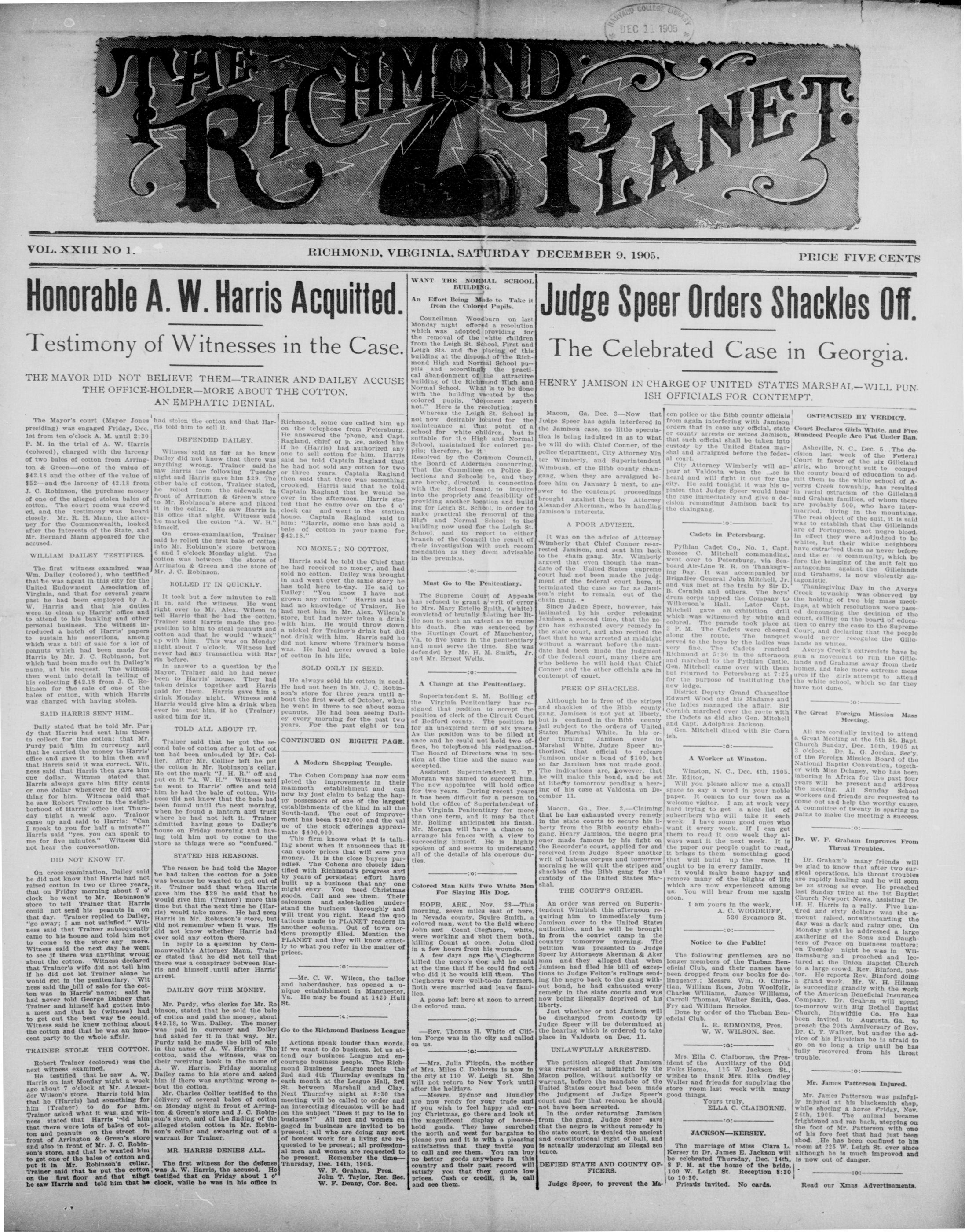
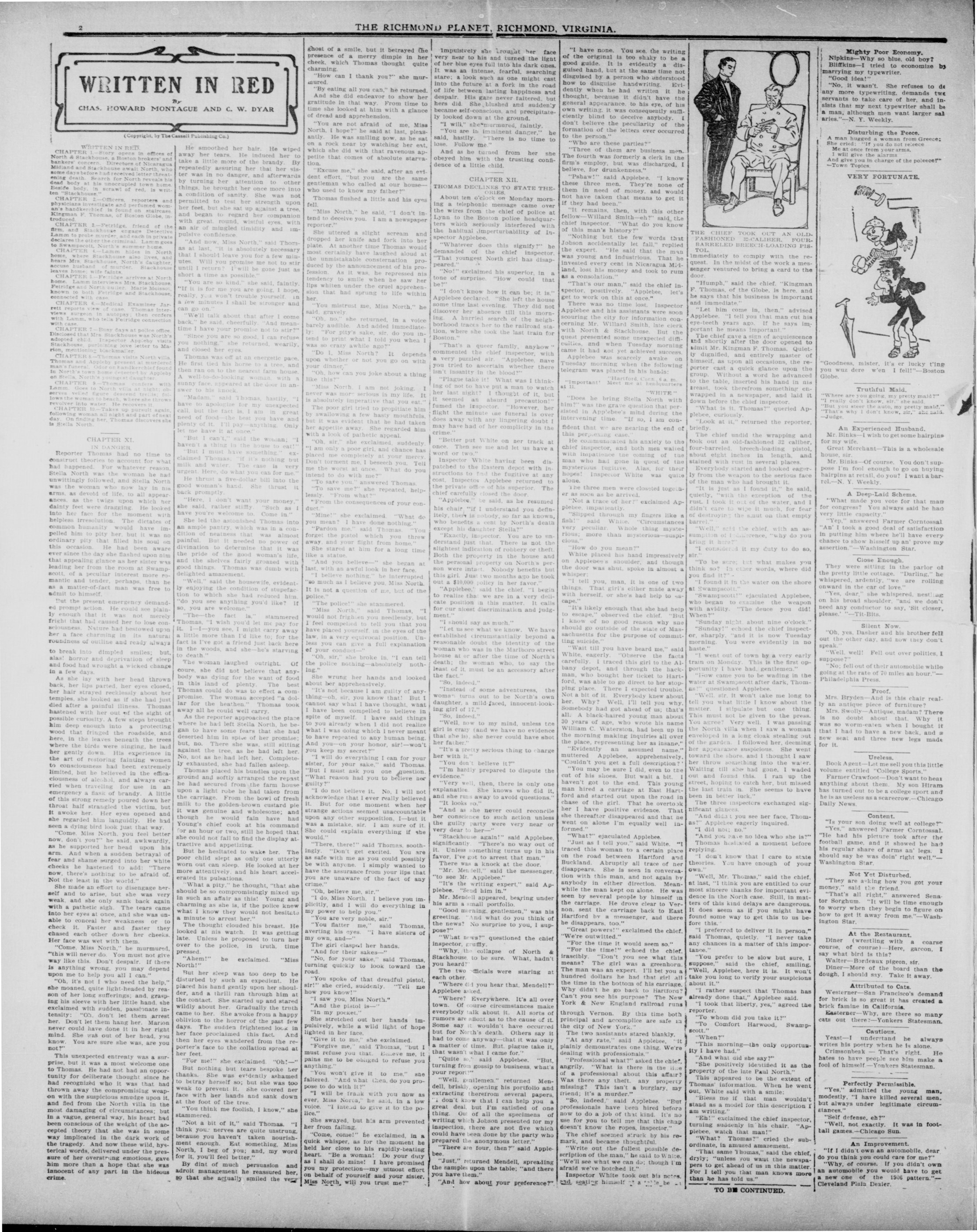
Page text (machine-generated)
THE RICHMOND PLANET
Honorable A. W. Harris Acquitted.
THE MAYOR DID NOT BELIEVE THEM—TRAINER AND DAILEY ACCUSE THE OFFICE-HOLDER—MORE ABOUT THE COTTON.
VOL. XXIII NO 1.
Honorable
Testimony
THE MAYOR DID NOT
THE OFFICE-
The Mayor's court (Mayor Jones presiding) was engaged Friday, Dec. 1st from ten o'clock A. M. until 2:30 P. M. in the trial of A. W. Harris (colored), charged with the larceny of two bales of cotton from Arrington & Green—one of the value of $42.18 and the other of the value of $52—and the larceny of 42.18 from J. C. Robinson, the purchase money of one of the alleged stolen bales of cotton. The court room was crowd el, and the testimony was heard closely. Mr. R. H. Mann, the attorney for the Commonwealth, looked after the interests of the State, and Mr. Bernard Mann appeared for the accused.
WILLIAM DAILEY TESTIFIES.
The first witness examined was Wm. Dailey (colored), who testified that he was agent in this city for the United Endowment Association of Virginia, and that for several years past he had been employed by A.W. Harris and that his duties were to clean up Harris' office and to attend to his banking and other personal business. The witness introduced a batch of Harris' papers to sustain his assertions, among which was a bill of sale for a lot of peanuts which had been made for Harris by Mr. J. C. Robinson, but which had been made out in Dailley's name, at his request. The witness then went into detail in telling of his collecting $42.18 from J. C. Robinson for the sale of one of the bales of cotton, with which Harris was charged with having stolen.
SAID HARRIS SENT HIM.
Daily stated that he told Mr. Purdy that Harris had sent him there to collect for the cotton; that Mr. Purdy paid him in currency and that he carried the money to Harris' office and gave it to him then and that Harris said it was correct. Witness said that Harris then gave him one dollar. Witness stated that Harris always gave him fifty cents or one dollar whenever he did anything for him. Witness said that he saw Robert Trainer in the neighborhood of Harris' office last Thursday night a week ago. Trainer came up and said to Harris: "Can I speak to you for half a minute?" Harris said "yes, you can speak to me for five minutes." Witness did not hear the conversation.
DID NOT KNOW IT.
On cross-examination, Dalley said he did not know that Harris had not raised cotton in two or three years, that on Friday morning about 7 o'clock he went to Mr. Robinson's store to tell Trainer that Harris could not send his peanuts in on that day. Trainer replied to Dalley, "go away; I am not satisfied." Witness said that Trainer subsequently came to his house and told him not to come to the store any more. Witness said the next day he went to see if there was anything wrong about the cotton. Witness declared that Trainer's wife did not tell him if he did not let Trainer alone he would get in the penitentiary. Witness said the bill of sale for the cotton was in Harris' name; said he had never told George Dabney that Trainer and himself had gotten into a mess and that he (witness) had to get out the best way he could. Witness said he knew nothing about the cotton and that he was an innocent party to the whole affair.
TRAINER STOLE THE COTTON
Robert Trainer (colored) was the next witness examined.
He testified that he saw A. W. Harris on last Monday night a week ago about 7 o'clock at Mr. Alexander Wilson's store. Harris told him that he (Harris) had something for him (Trainer) to do for him. Trainer asked what it was, and witness stated that Harris told him that there were lots of bales of cotton and peanuts on the street in front of Arrington & Green's store and also in front of Mr. J. C. Robinson's store, and that he wanted him to get one of the bales of cotton and put it in Mr. Robinson's cellar. Trainer said that he put the cotton on the first floor and that nihgt he saw Harris and told him that he
had stolen the cotton and that Harris told him to sell it.
DEFENDED DAILEY
Witness said as far as he knew Dalley did not know that there was anything wrong. Trainer said he saw Harris the following Tuesday night and Harris gave him $29. The other bale of cotton, Trainer stated, he rolled from the sidewalk in front of Arrington & Green's store to Mr. Robinson's store and placed it in the cellar. He saw Harris in his office that night. Witness said he marked the cotton "A. W. H." himself.
On cross-examination, Trainer said he rolled the first bale of cotton into Mr. Robinson's store between 6 and 7 o'clock Monday night. The cotton was between the stores of Arrington & Green and the store of Mr. J. C. Robinson.
ROLLED IT IN QUICKLY
It took but a few minutes to roll it in, said the witness. He went right over to Mr. Alex. Wilson to tell Harris that he had the cotton. Trainer said Harris made the proposition to him to steal peanuts and cotton and that he would "whack" up with him. This was on Monday night about 7 o'clock. Witness had never had any transaction with Harris before.
In answer to a question by the Mayor, Trainer said he had never been to Harris' house. They had taken drinks together and Harris paid for them. Harris gave him a drink Monday night. Witness said Harris would give him a drink when ever he met him, if he (Trainer) asked him for it.
TOLD ALL ABOUT IT.
Trainer said that he got the second bale of cotton after a lot of cotton had been unloaded by Mr. Collier. After Mr. Collier left he put the cotton in Mr. Robinson's cellar. He cut the mark "J. H. R." off and put on it "A. W. H." Witness said he went to Harris' office and told him he had the bale of cotton. Witness did not know that the bale had been found until the next morning, when he found a lantern and truck where he had not left it. Trainer admitted having gone to Dalley's house on Friday morning and having told him not to come to the store as things were so "confused."
STATED HIS REASONS
The reason he had told the Mayor he had taken the cotton for a joke was because he wanted to get out of it. Trainer said that when Harris gave him the $29 he said that he would give him (Trainer) more this time but that the next time he (Harris) would take more. He had seen Harris in Mr. Robinson's store, but did not remember when it was. He did not know whether Harris had ever sold any cotton there.
In reply to a question by Commonwealth's Attorney Mann, Trainer stated that he did not tell that there was a conspiracy between Harris and himself until after Harris' arrest.
DAILEY GOT THE MONEY
Mr. Purdy, who clerks for Mr. Robinson, stated that he said the bale of cotton and paid the money, about $42.18, to Wm. Dalley. The money was paid in currency and Dalley had asked for it in that way. Mr. Purdy said he made the bill of sale in the name of A. W. Harris. The cotton, said the witness, was on their receiving book in the name of A. W. Harris. Friday morning Dalley came to his store and asked him if there was anything wrong about the cotton.
Mr. Charles Collier testified to the delivery of several bales of cotton on Monday night in front of Arrington & Green's store and J. C. Robinson's store, and of the finding of the alleged stolen cotton in Mr. Robinson's cellar and swearing out of a warrant for Trainer.
MR. HARRIS DENIES ALL.
The first witness for the defense was A. W. Harris, the accused. He testified that on Friday about 1 o'clock, while he was in his office in
RICHMOND, VIRGINIA, SATURDAY DECEMBER 9, 1905.
Richmond, some one called him up on the telephone from Petersburg. He answered the 'phone, and Capt. Ragland, chief of police, asked him if he (Harris) had authorized any one to sell cotton for him. Harris said he told Captain Ragland that he had not sold any cotton for two or three years. Captain Ragland then said that there was something crooked. Harris said that he told Captain Ragland that he would be over in the afternoon. Harris stated that he came over on the 4 o'clock car and went to the station house. Captain Ragland said to him: "Harris, some one has sold a bale of cotton in your name for $42.18."
NO MONEY: NO COTTON
Harris said he told the Chief that he had received no money, and had sold no cotton. Dalley was brought in and went over the same story he has told here to-day. He said to Dalley: "You know I have not grown any cotton." Harris said he had no knowledge of Trainer. He had met him in Mr. Alex. Wilson's store, but had never taken a drink with him. He would throw down a nickel for Trainer's drink but did not drink with him. Harris said he did not know where Trainer's home was. He had never owned a bale of cotton in his life.
SOLD ONLY IN SEED.
He always sold his cotton in seed. He had not been in Mr. J. C. Robinson's store for three years until about the first week of October, when he went in there to see about some peanuts. He had been seeing Dalley every morning for the past two years. For the past eight or ten
CONTINUED ON EIGHTH PAGE.
A Modern Shopping Temple.
The Cohen Company has now com-
pleted the improvements in their
mammoth establishment and can
now lay just claim to be the happy
possessors of one of the largest
establishments of the kind in all the
South-land. The cost of improvement
has been $102,000 and the valu
e of the stock offerings approxi-
mate $400,000.
This firm knows what it is talk-
ing about when it announces that it
can quote prices that will save you
money. It is the close buyers par-
adise. The Cohens are closely iden-
tified with Richmond's progress and
by years of persistent effort have
built up a business that any one
might envy. You need Christmas
goods. Call and see them. Their
salesmen and sales-ladies under-
stand the business thoroughly and
will treat you right. Read the quo-
tations made to PLANET readers in
another column. Out of town or-
ders promptly filled. Mention the
PLANET and they will know exactly
to what you refer in the matter of
prices.
—Mr. C. W. Wilson, the tailor and haberdasher, has opened a unique establishment in Manchester, Va. He may be found at 1420 Hull St.
Go to the Richmond Business League
Actions speak louder than words. If we want to do business, let us attend our business League and encourage business people. The Richmond Business League meets the 2nd and 4th Thursday evenings in each month at the League Hall, 3rd St. between Marshall and Clay. Next Thursday night at 8:30 the meeting will be called to order and an interesting discussion will be had on the subject "Does it pay to lie in business?" All men and women engaged in business are invited to be present; all who are doing any sort of honest work for a living are requested to be present; all professional men and women are requested to be present. Remember the time—Thursday, Dec. 14th, 1905. W. F. Graham, Pres. John T. Taylor, Rec. Sec. W. F. Denny, Cor. Sec.
WANT THE NORMAL SCHOOL
BUILDING.
An Effort Being Made to Take it from the Colored Pupils.
Councilman Woodburn on last Monday night offered a resolution which was adopted providing for the removal of the white children from the Leigh St. School, First and Leigh Sts. and the placing of this building at the disposal of the Richmond High and Normal School pupils and accordingly the practical abandonment of the attractive building of the Richmond High and Normal School. What is to be done with the building vacated by the colored pupils, "deponent sayeth not." Here is the resolution:
Whereas the Leigh St. School is not now desirably located for the maintenance at that point of a school for white children, but is suitable for the High and Normal School, maintained for colored pupils; therefore, be it
Resolved by the Common Council, the Board of Aldermen concurring, That the Committee on Police Elections and Schools be, and they are hereby, directed in connection with the School Board, to inquire into the propriety and feasibility of providing another location and building for Leigh St. School, in order to make practical the removal of the High and Normal School to the building now used for the Leigh St. School, and to report to either branch of the Council the result of their investigation with such recommendation as they deem advisable in the premiss.
Must Go to the Penitentiary
The Supreme Court of Appeals has refused to grant a writ of error to Mrs. Mary Estelle Smith, (white) convicted of brutally killing her little son to such an extent as to cause his death. She was sentenced by the Hustings Court of Manchester, Va. to five years in the penitentiary and must serve the time. She was defended by Mr. H. M. Smith, Jr. and Mr. Ernest Wells.
A Change at the Penitentiary.
Superintendent S. M. Bolling of the Virginia Penitentiary has resigned that position to accept the position of clerk of the Circuit Court of Bedford county. The position is for an unexpired term of six years. As the position was to be filled at once and he could not hold two offices, he telephoned his resignation. The Board of Directors was in session at the time and the same was accepted.
Assistant Superintendent E. F. Morgan was named to succeed him. The new appointee will hold office for two years. During recent years it has been difficult for a person to hold the office of Superintendent of the Virginia Penitentiary for more than one term, and it may be that Mr. Bolling anticipated his finish. Mr. Morgan will have a chance to arrange his fences with a view to succeeding himself. He is highly spoken of and seems to understand all of the details of his onerous duties.
Colored Man Kills Two White Men
For Slaying His Dog.
HOPE, ARK., Nov. 28—This morning, seven miles east of here, in Nevada county, Squire Smith, a colored man, went to the field where John and Count Cleghorn, white, were working and shot them both, killing Count at once. John died in a few hours from his wounds.
A few days ago the Cleghorns killed the negro's dog and he said at the time that if he could find out who did it he would kill them. The Cleghorns were well-to-do farmers. Both were married and leave families.
A posse left here at noon to arrest the colored man.
—Rev. Thomas H. White of Clifton Forge was in the city and called on us.
:o:
Mrs. Julla Flippin, the mother of Mrs. Miles C. Debbress is now in the city at 110 W. Leigh St. She will not return to New York until after the holidays.
Messrs. Sydnor and Hundley are now ready for your trade and if you wish to feel happy and enjoy Christmas, go there and look at the magnificent display of household goods. They have searched the north and west for bargains to please you and it is with a pleasing satisfaction that they invite you to call and see them. You can buy no better goods anywhere in this country and their past record will satisfy you that they quote low prices. Cash or credit, it is, call and see them.
Judge Speer Orders Shackles Off.
HENRY JAMISON IN CHARGE OF UNITED STATES MARSHAL—WILL PUNISH OFFICIALS FOR CONTEMPT.
Macon, Ga. Dec. 3—Now that Judge Speer has again interfered in the Jamison case, no little speculation is being indulged in as to what he will do with Chief Conner, of the police department, City Attorney Minter Wimberly, and Superintendent Wimbush, of the Bibb county chalang-g, when they are arraigned before him on January 2 next, to answer to the contempt proceedings brought against them by Attorney Alexander Akerman, who is handling Jamison's interests.
con police or the Bibb county officials from again interfering with Jamison orders that in case any official, state or county arrests or seizes Jamison, that such official shall be taken into custody by the United States marshal and arraigned before the federal court.
City Attorney Wimberly will appear at Valdosta when the case is heard and will fight it out for the city. He said tonight it was his opinion that Judge Speer would hear the case immediately and give a decision remanding Jamison back to the chalang-g.
OSTRACISED BY VERDICT.
Court Declares Girls White, and Five Hundred People Are Put Under Ban.
Asheville, N. C., Dec. 5. The decision last week of the Federal Court in favor of the six Gilleland girls, who brought suit to compel the county board of education to admit them to the white school of Avery Creek township, has resulted in racial ostracism of the Gilleland and Graham families, of whom there are probably 500, who have intermarried, living in the mountains.
A POOR ADVISER
It was on the advice of Attorney Wimberly that Chief Conner re-arrested Jamison, and sent him back to the chain gang. Mr. Wimberly argued that even though the mandate of the United States supreme court had not been made the judgment of the federal court here, it terminated the case so far as Jamison's right to remain out of the chain gang. Since Judge Speer, however, has intimated by his order releasing Jamison a second time, that the negro has exhausted every remedy in the state court, and also recited the fact that he was arrested at midnight without a warrant before the mandate had been made the judgment of the federal court, many there are who believe he will hold that Chief Conner and the other officials are in contempt of court.
FREE OF SHACKLES
Although he is free of the stripes and shackles of the Bibb county gang, Jamison is not yet at liberty, but is confined in the Bibb county jail subject to the orders of United States Marshal White. In his order turning Jamison over to Marshal White, Judge Speer authorized that official to release Jamison under a bond of $100, but so far Jamison has not made good. The indications are, however, that he will make this bond, and be set at liberty tomorrow pending a hearing of his case at Valdosta on December 11.
Macon, Ga., Dec. 2.—Claiming that he has exhausted every remedy in the state courts to secure his liberty from the Bibb county chang-g Henry Jamison, the negro prison made famous by his fight on the Recorder's court, applied for and received from Judge Speer another writ of habeas corpus and tomorrow morning he will quit the stripes and shackles of the Bibb gang for the custody of the United States Marshal.
THE COURT'S ORDER.
An order was served on Superintendent Wimbish this afternoon requiring him to immediately turn Jamison over to the United States authorities, and he will be brought in from the convict camp in the country tomorrow morning. The petition was presented to Judge Speer by Attorneys Akerman & Aker man and they alleged that when Jamison had filed his bill of exceptions to Judge Felton's rulings sending the negro back to the gang without bond, he had exhausted every remedy in the state courts and was now being illegally deprived of his liberty.
Just whether or not Jamison will be discharged from custody by Judge Speer will be determined at the hearing which is ordered to take place in Valdosta on Dec. 11.
UNLAWFULLY ARRESTED
The petition alleged that Jamison was rearrested at midnight by the Macon police, without authority or warrant, before the mandate of the United States court had been made the judgment of Judge Speer's court and for that reason he should not have been arrested.
In the order returning Jamison from the gang, Judge Speer says that the negro is without remedy in the state court, is denied the ancient and constitutional right of ball, and is actually undergoing an illegal sentence.
DEFIED STATE AND COUNTY OF FICERS.
Judge Speer, to prevent the Ma-
con police or the Bibb county officials from again interfering with Jamison orders that in case any official, state or county arrests or seizes Jamison, that such official shall be taken into custody by the United States marshal and arraigned before the federal court.
City Attorney Wilmberly will appear at Valdosta when the case is heard and will fight it out for the city. He said tonight it was his opinion that Judre Speer would hear the case immediately and give a decision remanding Jamison back to the chalang.
Cadets in Petersburg.
Pythian Cadet Co., No. 1, Capt. Rossoe C. Mitchell commanding, went over to Petersburg, via Seaboard Air-Line R. R. on Thanksgiving Day. It was accompanied by Brigadier General John Mitchell, Jr. and was met at the train by Sir D. B. Cornish and others. The boys' drum corps tapped the Company to Wilkerson's Hall. Later Capt. Mitchell gave an exhibition drill which was witnessed by white and colored. The parade took place at 3 P. M. The Cadets were cheered along the route. The banquet served to the boys by the ladies was very fine. The Cadets reached Richmond at 5:30 in the afternoon and marched to the Pythian Castle. Gen. Mitchell came over with them but returned to Petersburg at 7:25 for the purpose of instituting the new lodge.
District Deputy Grand Chancellor Edward Wood and his Madame and the ladies managed the affair. Sir Cornish marched over the route with the Cadets as did also Gen. Mitchell and Capt. Adolphus Jackson.
Gen. Mitchell dined with Sir Cornish.
A Worker at Winston.
Winston, N. C., Dec. 4th, 1905.
Mr. Editor.
Will you please allow me a small space to say a word in your noble paper. It comes to our town as a welcome visitor. I am at work very hard trying to get a nice list of subscribers who will take it each week. I have some good ones who want it every week. If I can get them to read it one week they always want it the next week. It is the paper our people ought to read, it brings to them something good that will build up the race. It ought to be in every family.
It would make home happy and remove many of the blights of life which are now experienced among us. You will hear from me again soon.
I am yours in the work.
A. C. WOODRUFF,
530 Sycamore St.
Notice to the Public!
The following gentlemen are no longer members of the Theban Beneficial Club, and their names have been dropped from our books for delinquency.; Messrs. Wm. O. Christian, William Ross, John Woolfolk, Charles Williams, James Williams, Carroll Thomas, Walter Smith, Geo. Fry and William Brooks.
Done by order of the Theban Beneficial Club.
L. R. EDMONDS, Pres.
W. W. WILSON, Sec.
Mrs. Ella C. Claiborne, the President of the Auxiliary of the Old Folks Home, 115 W. Jackson St., wishes to thank Mrs. Ella Ondley Waller and friends for supplying the store room last week with many good things. Yours truly, ELLA C. CLAIBORNE.
JACKSON—KERSEY
The marriage of Miss Clara L.
Kersey to Dr. James E. Jackson will
be celebrated Thursday, Dec. 14th,
8 P. M. at the home of the bride,
100 W. Leigh St. Reception 8:30
to 10:30.
Friends invited. No cards.
PRICE FIVE CENTS
hackles Off.
in Georgia.
ES MARSHAL-WILL PUN-
MPT.
OSTRACISED BY VERDICT
Court Declares Girls White, and Five Hundred People Are Put Under Ban
Asheville, N. C., Dec. 5. The decision last week of the Federal Court in favor of the six Gilleland girls, who brought suit to compel the county board of education to admit them to the white school of Averys Creek township, has resulted in racial ostracism of the Gilleland and Graham families, of whom there are probably 500, who have intermarried, living in the mountains. The real object of the suit, it is said was to establish that the Gillelands are of Portuguese, not negro blood. In effect they were adjudged to be whites, but their white neighbors have ostracised them as never before and the entire community, which be fore the bringing of the suit felt no antagonism against the Gillelands and Grahams, is now violently antagonistic.
Thanksgiving Day in the Averys Creek township was observed by the holding of two big mass meetings, at which resolutions were passed denouncing the decision of the court, calling on the board of education to carry the case to the Supreme Court, and declaring that the people would never recognize the Gillelands as whites.
Averys Creek's extremists have be gun a movement to run the Gillelands and Grahams away from their homes, and take more extreme measures if the girls attempt to attend the white school, which so far they have not done.
The Great Foreign Mission Mass Meeting.
All are cordially invited to attend a Great Meeting at the 5th St. Bapt. Church Sunday, Dec. 10th, 1905 at 3 o'clock. Dr. L. G. Jordan, Secy. of the Foreign Mission Board of the National Baptist Convention, together with Miss Delaney, who has been laboring in Africa for the past four years will be present and address the meeting. All Sunday School workers and friends are requested to come out and help the worthy cause. A committee of twenty is sparing no pains to make the meeting a success.
Dr. W. F. Graham Improves From Throat Troubles.
Dr. Graham's many friends will be glad to know that after two surgical operations, his throat troubles are rapidly healing and he will soon be as strong as ever. He preached last Sunday twice at the 1st Baptist Church Newport News, assisting Dr. H. H. Harris in a rally. Five hundred and sixty dollars was the amount raised, notwithstanding the day was a dark and rainy one. On Monday night he addressed a large gathering of the Sons and Daughters of Peace on business matters; on Tuesday night he was in Williamsburg and preached and lectured at the Union Baptist Church to a large crowd, Rev. Binford, pastor. He reports Rev. Binford doing a grand work. Mr. W. H. Hilman is succeeding grandly with the work of the American Beneficial Insurance Company. Dr. Graham will spend to-morrow with Big Bethel Baptist Church, Dinwiddie Co. He has been invited to Augusta, Ga, to preach the 20th Anniversary of Rev. Dr. C. T. Walker, but under the advice of his Physician he is afraid to go on so long a trip until he has fully recovered from his throat trouble.
Mr. James Patterson Injured
Mr. James Patterson was painfully injured at his blacksmith shop, while shooting a horse Friday, Nov. 24th, 1905. The animal became frightened and ran back, stepping on the foot of Mr. Patterson with one of his fore feet that had just been shod. He has been confined to his room at 225 W. Leigh St. ever since although he is much improved and is now out of danger.
Read our Xmas Advertisements.
WRITTEN IN RED
(Copyright, by The Cassell Publishing Co.)
CHAPTER 1—Story opens in offices of North & Stackhouse, a Boston brokers' and bankers' concern. Directors of Nicaragua Miñard and Stackhouse await North, who had informed of had received letter threatening death. Seven North & Stackhouse dead body at his unoccupied town home. Beside body, in scrawl of red, is written "Stackhouse." CHAPTER 2—Officers, reporters and physician assistants perfumed woman's handkerchief is found on staircase. Kingman F. Thomas, of Boston Globe, introduced. CHAPTER 3—Fetridge, friend of the fighter. Stackhouse engages Detective Lamm to probe mute. Stackhouse in private declares the other the criminal. Lamm leaves to Swampscott, North's summer home. CHAPTER 4—Lamm hides in North home, where Stackhouse also lives, and hides North's daughter, accuse husband of murder. Stackhouse leaves home; wife faints. CHAPTER 5—Fetridge arrives at North home. Lamm interviews Mrs. Stackhouse, Stackhouse North builer. Marie Moissot, known to be Fetridge and Stackhouse, connected with case.
CHAPTER 6- Medical Examiner Jarrett reports view of case. Thomas interviews in autopsy, then confers with Lamm, who tells Pellridge connection with case. CHAPTER 7- Busy days at police office. Disclosed that Mrs. Stackhouse was North's apple boy. Apple boy visits Stackhouse, purporting to letter to Marion, mentioning blackmailer. CHAPTER 8- Thomas visits North willa Thomas and Appleboy present at murdered man's funeral. Odor on handkerchief found in apple boy's pouch. Appleboy on Stella, North's young daughter.
CHAPTER 10—Takes up pursuit again
following woman all night and part of next
day. On finding her, Thomas discovers she
is Stella North.
Reporter Thomas had no time to construct theories to account for what had happened. For whatever reason, Stella North was the woman he had unwittingly followed, and Stella North was the woman who now lay in his arms, as devoid of life, to all appearances, as the twigs upon which her dainty feet were dragging. He looked into her face for the moment with helpless irresolution. The dictates of common humanity would have impelled him to pity her, but it was no ordinary pity that filled his soul on this occasion. He had been aware ever since the day she flashed upon him that appealing glance as her sister was leading her from the room at Swamp-scott, of a peculiar interest more romantic and tender, perhaps, than he as a matter-of-fact man was free to admit to himself.
to break into dimpled smiles; but, alas! horror and deprivation of sleep and food had wrought a wicked change in a few days.
As she lay with her head thrown back, her lips parted, her eyes closed, her hair strayed recklessly about her temples, she looked as if she had just died after a painful illness. Thomas hastened with her out of the sight of possible curiosity. A few steps brought him deep enough into a protecting wood that fringed the roadside, and here, in the leaves beneath the trees where the birds were singing, he laid her gently down. His experience in the art of restoring fainting women to consciousness had been extremely limited, but he believed in the efficaciousness of alcohol, and always carried when traveling for use in an emergency a flask of brandy. A little of this strong remedy poured down her throat half strangled the victim, but it awoke her. Her eyes opened and she regarded him languidly. He had seen a dying bird look just that way.
"Come, Miss North, you feel better now, don't you?" he said, awkwardly, as he supported her head upon his arm. And when a sudden betrayal of fear and shame surged into her white cheeks he hastened to add: "There now, there's nothing to be afraid of. Not the least in the world."
She made an effort to disengage herself and to arise, but she was very weak, and she only sank back again with a pathetic sigh. The tears came into her eyes at once, and she was unable to conceal her weakness or to check it. Faster and faster they chased each other down her cheeks. Her face was wet with them.
"Come, Miss North," he murmured, "this will never do. You must not give way like this. Don't despair. If there is anything wrong, you may depend upon me to help you all I can."
"Oh, it's not I who need the help," she moaned, quite light-headed by reason of her long sufferings; and, grasping his sleeve with her little hand, she exclaimed with sudden, passionate intensity: "Oh, don't let them arrest her. Don't let them hang her. Marion never could have done it in her right mind. She was out of her head, you know. You are sure she was, are you not?"
This unexpected entreaty was a surprise, but it was a most welcome one to Thomas. He had not had an opportunity for deliberate thought since he had recognized who it was that had thrown away the compromising weapon with the suspicious smudge upon it, and fled from the North villa in the most damaging of circumstances; but in a vague, general way, his heart had been conscious of the weight of the accepted theory that she was in some way implicated in the dark work of the tragedy. And now these wild, hysterical words, delivered under the pressure of her overstrung emotions, gave him more than a hope that she was innocent of any part in the hideous crime.
WRITTEN IN RED
CHAPTER X1
IN DANGER
He smoothed her hair. He wiped away her tears. He induced her to take a little more of the brandy. By repeatedly assuring her that her sister was in no danger, and afterwards by turning her attention to other things, he brought her once more into a condition of sanity. She was not permitted to test her strength upon her feet, but she sat up against a tree, and began to regard her companion with great round, wistful eyes, with an air of mingled timidity and impulsive confidence.
"And now, Miss North," said Thomas at last, "it is absolutely necessary that I should leave you for a few minutes. Will you promise me not to stir until I return? I will be gone just as short a time as possible."
"You are so kind," she said, faintly. "If it is for you you are going, I hope, really, you won't trouble yourself, in a few minutes I shall be stronger and can go on."
"We'll talk about that after I come back," he said, cheerfully. "And meantime I have your promise not to stir?" "Since you are so good, I can refuse you nothing," she returned, wearily, and closed her eyes.
Thomas was off at an energetic pace. He first tied his horse to a tree, and then ran on to the nearest farm house. A well-to-do-looking woman, with a sunny face, appeared at the door in answer to his knock.
"Madam," said Thomas, hastily. "I have to apologize for my unexpected call, but the fact is, I am in great need of food—the best you have and plenty of it. I'll pay—anything. Only let me have it at once."
"But I can't," said the woman; "I haven't a thing in the house to eat!" "But I must have something," exclaimed Thomas, "if it's nothing but milk and water. The case is very urgent. Here, do what you can for me."
He thrust a five-dollar bill into the good woman's hand. She thrust it back promptly.
"Here, I don't want your money," she said, rather stiffly. "Such as I have you're welcome to. Come in."
She led the astonished Thomas into an ample pantry, which was in a condition of neatness that was almost painful. But it needed no power of divination to determine that it was the pride of the good woman's life, and the shelves fairly groaned with good things. Thomas was dumb with delighted amazement.
"Well," said the housewife, evidently enjoying the condition of stupefaction to which she had reduced hitm. "do you see anything you'd like? If so, you are welcome."
"The—the fact is," stammered Thomas, "I wish you'd let me pay for it. I—I—you see, I might carry away a little more than I'd like to; for the fact is I've got a friend just back here in the woods, and she—he's starving to death."
The woman laughed outright. Of course, she did not believe that anybody was dying for the want of food in this land of plenty. The best Thomas could do was to effect a compromise. The woman accepted "a dollar for the heathen." Thomas took away all he could well carry.
As the reporter approached the place where he had left Stella North, he began to have some fears that she had deserted him in spine of her promise; but, no. There she was, still sitting against the tree, as he had left her. No, not as he had left her. Completely exhausted, she had fallen asleep.
Thomas placed his bundles upon the ground and softly arranged the repast he had secured from the farm house upon a light robe he had taken from the carriage. From the bowl of fresh milk to the golden-brown custard pie it was genuine and wholesome; and though he would fain have had Young's chief cook at his command (or an hour or two, still he hoped that she could not fall to find the display attractive and appetizing.
But he hesitated to wake her. The poor child slept as only one utterly worn out can sleep. He looked at her more attentively, and his heart accelerated its pulsations.
"What a pity." he thought, "that she should be so compromising mixed up in such an affair as this! Young and charming as she is, if the police knew what I know they would not hesitate a minute to arrest her."
The thought clouded his breast. He looked at nis watch. It was getting late. Unless he proposed to turn her over to the police, in truth, time pressed.
"Ahem!" he exclaimed. "Miss North!"
But her sleep was too deep to be disturbed by such an expedient. He placed his hand gently upon her shoulder, and a thrill ran through him at the contact. She started up and stared wildly about her. Gradually the truth came to her. She awoke from a happy oblivion to the horror of the past few days. The sudden frightened look in her face proclaimed this fact. And then her eyes wandered from the reporter's face to the collation spread at her feet.
"For me!" she exclaimed. "Oh!—"
But nothing but tears bespoke her thanks. She was evidently ashamed to betray herself so; but she was too weak to prevent it. She covered her face with her hands and sank down at the foot of the tree.
"You think me foolish, I know," she stammered.
"Not a bit of it," said Thomas. "I think you: nerves are quite unstrung, because you haven't taken nourishment enough. Eat something. Miss North, I beg of you; and, my word for it, you'll feel better."
By dint of much persuasion and adroit management he reassured her, so that she actually smiled the very
ghost of a smile, but it betrayed the presence of a merry dimple in her cheek, which Thomas thought quite charming.
"How can I thank you?" she murmured.
"By eating all you can," he returned. And she did endeavor to show her gratitude in that way. From time to time she looked at him with a glance of dread and apprehension.
"You are not afraid of me, Miss North, I hope?" he said at last, pleasantly. He was smiling now, as he sat on a rock near by watching her eat, which she did with that ravenous appetite that comes of absolute starvation.
"Excuse me," she said, after an evident effort, "but you are the same gentleman who called at our house—who used to know my father."
Impulsively she brought her face very near to his and turned the light of her blue eyes full into his dark ones. It was an intense, fearful, searching stare; a look such as one might cast into the future at a fork in the road of life between lasting happiness and despair. His gaze never faltered, but hers did. She blushed and suddenly became self-conscious, and precipitately looked down at the ground.
"I will," she murmured, faintly. "You are in imminent danger," he said, hastily. "There is no time to lose. Follow me."
And as he turned from her she obeyed him with the trusting confidence of a little child.
CHAPTER XII. THOMAS DECLINES TO STATE THE CRIES
"I have none, of the original good guide. It is guised hand, but disguised by a pencil how to disguise dently when he thought, because general appearance own writing. It is ciently blind to don't believe the formation of the to the person."
"Who are these? Three of the Fourth was my firm's employ, I believe, for drunken Pashaw!" said these three men them in need of
Thomas fushed a little and his eyes fell.
"Miss North," he said, "I don't intend to deceive you. I am a newspaper reporter."
She uttered a slight scream and dropped her knife and fork into her plate. At another time Thomas would most certainly have laughed aloud at the unmistakable consternation produced by the announcement of his profession. As it was, he repressed his tendency to smile when he saw her lips whiten under the cruel apprehension that had sprung to life within her.
"You mistrust me, Miss North," he said, gravely.
"Oh, no." she returned, in a voice barely audible. And added immediately: "For pity's sake, sir, do you intend to print what I told you when I was so crazy awhile ago?"
"Do I, Miss North? It depends upon whether or not you go on with your dinner."
"Oh, how can you joke about a thing like this?"
"Miss North. I am not joking. I never was more serious in my life. It is absolutely imperative that you eat."
The poor girl tried to propitiate him by swallowing a few hasty mouthfuls, but it was evident that he had taken her appetite away. She regarded him with a look of pathetic appeal.
"Oh, sir," she exclaimed, suddenly. "I am only a poor girl, and chance has placed me completely at your mercy. Don't torment me, I beseech you. Tell me the worst at once. What do you intend to do with me?"
"To sate you," answered Thomas. "To save me?" she repeated, helplessly. "From what?"
"From the consequences of your conduct."
She stared at him for a long time like a statue.
"The police!" she stammered.
"Miss North," said Thomas, "I would not frighten you needlessly, but I feel compelled to tell you that you have placed yourself, in the eyes of the law, in a very equivocal position. Unless you can give a full explanation of your conduct—"
"Oh, sir," she broke in. "I can tell the police nothing—absolutely nothing."
She wrung her hands and looked about her apprehensively.
"It's not because I am guilty of anything—oh, sir, you know that! But I cannot say what I have thought, what I have been compelled to believe in spite of myself. I have said things to you already when I did not realize what I was doing which I never meant to have repeated to any human being. And you—on your honor, sir!—won't you keep my secret?"
"I will do everything I can for your sister, for your sake," said Thomas. "But I must ask you one question, "What reason had you to believe nor guilty?" "I do not believe it. No, I will not acknowledge that I ever really believed it. But for one moment when her strange actions seemed unaccountable upon any other supposition,—I but it was a mistake, sir. I am sure of it. She could explain everything if she would." "There, there!" said Thomas, soothingly. "Don't get excited. You are as safe with me as you could possibly be with anyone. I simply wanted to have the assurance from your lips that you are unaware of the fact of any crime." "Oh, believe me, sir." "I do, Miss North. I believe you implicitly, and I will do everything in my power to help you."
"You are very noble, sir."
"You flatter me," said Thomas, averting his eyes. "I have sisters of my own, and—"
The girl clasped her hands.
"And for their sakes—"
"No, for your sake," said Thomas, turning quickly to look toward the road.
"You spoke of that dreadful pistol, sir!" she cried, suddenly. "Tell me how you know!"
"I saw you, Miss North."
"And the pistol is—"
"In my pocket."
She stretched out her hands impulsively, while a wild light of hope lighted in her face.
"Give it to me," she exclaimed.
"Forgive me," said Thomas, "but I must refuse you that. Believe me, it pains me to be obliged to refuse you anything."
"You won't give it to me," she faltered. "And what then, do you propose to do with it?"
"I will be frank with you now as ever, Miss North," he said, in a low voice. "I intend to give it to the police."
She swayed, but his arm prevented her from falling.
"Come, come!" he exclaimed, in a quick whisper, as for the moment he held her close to his rapidly-beating heart. "Be a woman! Do your duty as I shall do mine! I have promised you my protection—my utmost effort on behalf of yourself and your sister. Miss North, will you trust me?"
Impulsively she brought her face very near to his and turned the light of her blue eyes full into his dark ones. It was an intense, fearful, searching stare; a look such as one might cast into the future at a fork in the road of life between lasting happiness and despair. His gaze never faltered, but hers did. She blushed and suddenly became self-conscious, and precipitately looked down at the ground.
"I will," she murmured, faintly.
"You are in imminent danger," he said, hastily. "There is no time to lose. Follow me."
And as he turned from her she obeyed him with the trusting confidence of a little child.
CHAPTER XII
THOMAS DECLINES TO STATE THE-ORIES.
About ten o'clock on Monday morning a telephonic message came over the wires from the chief of police at Lynn to the Boston police headquarters which seriously interfered with the habitual imperturbability of Inspector Applebee.
"Whatever does this signify?" he demanded of the chief inspector. "That youngest North girl has disappeared."
"No!" exclaimed his superior, in a tone of surprise. "How could that be?"
"I don't know how it can be; it is." Applebee declared. "She left the house some time last evening. They did not discover her absence till this morning. A hurried search of the neighborhood traces her to the railroad station, where she took the last train for Boston."
"That's a queer family, anyhow" commented the chief inspector, with a very puzzled air. "Applebee, nave you to try to ascertain whether there isn't insanity in the blood?" "Plague take it! What was I thinking of not to have put a man to watch her last night? I thought of it, but it seemed an absurd precaution!" fumed the inspector. "However, her flight the minute we funeral is over does away with any lingering doubt I may have had of her complexity in the crime." "Better put White on her track at once. Then see me and let us have a word or two." Inspector White having been dispatched to the Eastern depot with instructions to find the fugitive at any cost. Inspector Applebee returned to the private office of his superior. The chief carefully closed the door.
"Applebee," he said, as he resumed his chair. "If I understand you definitely, then is nobody, so far as known, who benefits a cent by North's death except his daughter Stella."
"Exactly, inspector. You are to understand just that. There is not the slightest indication of robbery or theft. Both the property in the house and the personal property on North's person were intact. Nobody benefits but this girl. Just two months ago he took out a 10,000 policy in her favor."
"Applebee," said the chief. "I begin to realize that we are in a very delicate position in this matter. It calls for our nicest discrimination and judgment."
"I should say as much."
"Let us see what we know. We have established circumstantially beyond a reasonable doubt the identity of the woman who was in the Marlboro street house at or after the time of North's death; the woman who, to say the least of it, must be an accessory after the fact."
"So, indeed."
"Instead of some adventures, the woman turns out to be North's own daughter, a mild faced, innocent-looking girl of 17."
"So, indeed."
"Well, now to my mind, unless the girl is crazy (and we have no evidence that she is), she never could have shot her father."
"It's a pretty serious thing to charge her with it."
"You don't believe it?"
"I'm hardly prepared to dispute the evidence."
"Very well, then, there is only one explanation. She knows who did it, and she runs away to avoid questions." "It looks so." "And as she never could reconcile her conscience to such action unless the guilty party were very near or very dear to her—" "Stackhouse again!" said Applebee, significantly. "There's no way out of it. Unless something turns up in his favor, I've got to arrest that man." There was a knock at the door. "Mr. Mendell," said the messenger, "to see Mr. Applebee."
Mr. Mendell appeared, bearing under his arm a small portfolio.
"Good morning, gentlemen," was his greeting. "And what do you think of the news? No surprise to you, I suppose?"
"What news?" questioned the chief inspector, grumly.
"Why, the collapse of North & Stackhouse to be sure. What, hadn't you heard?"
The two officials were staring at each other.
"Where did you hear that, Mendell?" Applebee asked.
"Where? Everywhere. It's all over town. Of course circumstances make everybody talk about it. All sorts of rumors are about as to the cause of it. Some say it wouldn't have occurred but for North's death. Others say it had to come anyway—that it was only a matter of time. But plague take it, that wasn't what I came for."
"Quite so," said Applebee. "But, turning from gossip to business, what's your report?" "Well, gentlemen." returned Mendell, briskly opening his portfolio and extracting therefrom several papers, "I don't know that I can help you a great deal but I'm satisfied of one thing. Out of all the specimens of writing which Jobson presented for my inspection, there are not five which could have been done by the party who prepared the anonymous letter." "There are four, then?" said Applebee. "Just," returned Mendell, spreading the samples upon the table; "and there you have them." "And how about your preference?"
"I have none. You see, the writing of the original is too shaky to be a good guide. It is evidently a disguised hand, but at the same time not disguised by a person who understood how to disguise handwriting. Evidently when he had written it he thought, because it didn't have the general appearance, to his eye, of his own writing, it was consequently sufficiently blind to deceive anybody. I don't believe the peculiarity of the formation of the letters ever occurred to the person."
"Who are these parties?"
"Three of them are business men. The fourth was formerly a clerk in the firm's employ, but was discharged, I believe, for drunkenness."
"Pshaw!" said Applebee. "I know these three men. They're none of them in need of money, and would not have taken that means to get it if they had been."
"It remains, then, with this other fellow—Willard Smith—eh?" said the chief inspector. "What do you know of this man's history?" "Nothing but the few words that Jobson accidentally let fall," replied the expert. "He said that the man was young and industrious. That he invested every cent in Nicaragua Midland, lost his money and took to rum as a consolation." "That's our man," said the chief inspector, positively. "Applebee, let's get to work on this at once." There was no time lost. Inspector Applebee and his assistants were soon scouring the city for information concerning Mr. Willard Smith, late clerk with North & Stackhouse. But the quest presented some unexpected difficulties, and when Tuesday morning came it had not yet achieved success. Applebee was scarcely awake on Tuesday morning when the following telegram was placed in his hands:
"Hartford, Conn. 6 a.m. "Important! Meet me at headquarters at 11.
"WHITE."
"Does he bring Stella North with him?" was the grave question that persisted in Applebee's mind during the intervening time. "If so, I am confident that we are nearing the end of this perplexing case."
He communicated his anxiety to the chief inspector, and both men wailed with impatience the coming of the man who had gone in quest of the mysterious ingenuity. Alas, for their hopes! Inspector White was quite alone.
The three men were closeted together as soon as he arrived.
"Not a trace of her!" exclaimed Applebee, impatiently.
"Slipped through my fingers like a fish!" said White. "Circumstances very peculiar. Whole thing mysterious; more than mysterious—suspicious."
"How do you mean?"
White placed his hand impressively on Applebee's shoulder, and though the door was shut, spoke in almost a whisper:
"I tell you, man, it is one of two things. That girl's either made away with herself, or she's had help to escape."
"It's likely enough that she had help to escape," observed the chief. "But I know of no good reason why she should go outside of the state of Massachusetts for the purpose of committing suicide."
"Wait till you have beard me," said White, eagerly. "Observe the facts carefully. I traced this girl to the Albany depot, and through the hackman, who bought her ticket to Hartford, was able to go direct to her stopping place. There I expected trouble. Not a bit of it. Everybody knew about her. Why? Well, I'll tell you why. Somebody had got ahead of us; that's all. A black-haired young man about 30 years of age, who wrote his name William C. Waterston, had been up in the morning making inquiries all over the place, representing her as insane."
"Evidently an assumed name," muttered Applebee, apprehensively,
"Couldn't you get a full description?"
"You may be sure I did, even to the cut of his shoes. But wait a bit. I haven't got to the end. This young man hired a carriage at East Hartford and started up upon the road in chase of the girl. That he overtook her I have positive evidence. That she thereafter disappeared and that we went on alone I'm equally well informed."
"What?" ejaculated Applebee.
"Just as I tell you," said White. "I traced this woman to a certain place on the road between Hartford and Buckland. Abruptly all trace of her disappears. She is seen in conversation with this man, and not again by anybody in either direction. Meanwhile the man kept on alone. He was seen by several people by himself in the carriage. He drove clear to Vernon, sent the carriage back to East Hartford by a messenger, and there he disappears, too."
"Great powers!" exclaimed the chief. "We're outwitted."
"For the time it would seem so." "For the time!" echoed the chief. irasbely. "Don't you see what this means? The girl was a greenhorn. The man was an expert. I bet you a hundred dollars he had that girl all the time in the bottom of his carriage. Why didn't he go back to Hartford? Can't you see his purpose? The New York & New England railroad runs through Vernon. By this time both principal and accomplice are safe in the city of New York."
The two assistants stared blankly. "At any rate," said Applelee, "it plainly demonstrates one thing. We're dealing with professionals."
"Professional what?" asked the chief, angrily. "What is there in the life of a professional about this affair? Was there any theft, any property missing? This isn't a burglary, my friend; it's a murder."
"So, indeed," said Applebee. "But professionals have been hired before now to do a job of that kind. It's no use for you to tell me that this chap doesn't know the ropes, inspector." The chief seemed struck by his remark, and became thoughtful. "Write out the fullest possible description of the man," he said to White. "We'll see what we can do; though I'm afraid we've botched it." Inspector White took out his notes, and seating himself at a table be
A man in a suit stands behind a seated man in a coat, who is holding a gun.
THE CHIEF TOOK OUT AN OLD FASHIONED Z-CALIBER. FOUR-BARRELED BREECH-LOADING PISTOL. immediately to comply with the request. In the midst of the work a messenger ventured to bring a card to the door.
"Humph," said the chief, "Kingman F. Thomas, of the Globe, is here, and he says that his business is important and immediate."
"Let him come in, then," advised Applebee. "I tell you that man cut his eye-teeth years ago. If he says important he means important."
The chief gave a sign of acquiescence and shortly after the door opened to admit Mr. Kingman F. Thomas. Quilty dignified, and entirely master of himself, as upon all occasions, the reporter cast a quick glance upon the group. Without a word he advanced to the table, inserted his hand in his breast, took therefrom something enwrapped in a newspaper, and laid it down before the chief inspector.
"What is it, Thomas?" queried Applebee, curiously.
"Look at it," returned the reporter, briefly.
The chief undid the wrapping and took out an old-fashioned 32 caliber, four-barreled, breech-loading pistol, about eight inches in length, and stained with rust in several places.
Everybody started and looked eagerly from the weapon to the serious face of the man who had brought it.
"It is just as I found it," he said, quietly, "with the exception of the rust. I took it out of the water, and I didn't care to wipe it much, for fear of destroying the smut on that empty barrel."
"Well," said the chief, with an assumption of a conference, "why do you bring it here?"
"I considered it my duty to do so, sir."
"To be sure; but what makes you think so? In other words, where did you find it?"
"I found it in the water on the shore at Swampscoott."
"Swampscoott!" ejaculated Applebee, who began to examine the weapon with avidity. "The deuce you did! When?"
"Sunday night, about nine o'clock."
"Sunday!" echoed the chief inspector, sharply, "and it is now Tuesday morning. You were evidently in no haste."
"I went out of town by a very early train on Monday. This is the first opportunity I have had, gentlemen."
"Iow came you to be wading in the water at Swampscoott after dark, Thomas?" questioned Applebee.
"Well, sir, it won't take me long to tell you what little I know about the matter. I stipulate but one thing. This must not be given to the press. You agree? Very well. I was passing the North villa when I saw a woman enveloped in a long cloak stealing out of the garden. I followed her, deeming her appearance suspicious. She went toward the shore and I thought I saw her throw something into the water. Waiting till she had gone, I waded out and found this. I ran up the street, hoping to catch her, but missed the last train in. She seems to have been in better luck."
The three inspectors exchanged significant glances.
"And didnt you see her face, Thomas?" Applelee eagerly inquired.
"I did not; no."
"And you have no idea who she is?" Thomas hesitated a moment before replying.
"I don't know that I care to state theories. You have enough of your own."
"Well, Mr. Thomas," said the chief, at last, "I think you are entitled to our most sincere thanks for important evidence in the North case. Still, in matters of this kind delays are dangerous. It does seem as if you might have found some way to get this to us before this."
"I preferred to deliver it in person," said Thomas, quietly. "I never take any chances in a matter of this importance."
"You prefer to be slow but sure, I suppose," said the chief, smiling. "Well, Applebee, here it is. It won't take you long to verify your suspicions about it."
"I rather suspect that Thomas has already done that," Applebee said. "I took that liberty, yes," agreed the reporter.
"To whom did you take it?"
"This morning—the only opportunity I have had."
"And what did she say?"
"She positively identified it as the property of the late Paul North."
This appeared to be the extent of Thomas' information. When he went out, White said with a smile:
"Bless me if that man wouldn't stand as a model for this description I am writing."
"Eh!" exclaimed the chief inspector, turning suddenly in his chair. "Applebee, watch that man!"
"What? Thomas?" cried the subordinate, in amused amazement.
"That same Thomas," said the chief, dryly, "unless you want the newspapers to get ahead of us in this matter. For I tell you that man knows more than he has told us."
TO B CONTINUED.
Mighty Poor Economy.
Nipkins—Why so blue, old boy?
Bliffkins—I tried to economize by marrying my typewriter.
"Good idea!"
"No, it wasn't. She refuses to do any more typewriting, demands two servants to take care of her, and insists that my next typewriter shall be a man, although men want larger salaries."—N. Y. Weekly.
Disturbing the Peace
BUTTERING the Piece.
A man hugged a woman from Greece;
She cried: "If you do not reevee
Me at once from your arms,
I will give the alarms.
And give you in charge of the polecee!"
-Town Topics.
VERY FORTUNATE.
A
"Goodness, mister, it's er lucky ting
you wuz dere w'en I fell!"—Boston
Globe.
Truthful Maid
"Where are you going, my pretty maid?" "I really don't know, sir," she said. "But you steer the auto, my pretty maid." "That's why I don't know, sir," she said—Judge.
An Experienced Husband.
Mr. Binks—I wish to get some hairpins for my wife.
Great Merchant—This is a wholesale house, sir.
Mr. Binks—Of course. You don't suppose I'm fool enough to go on buying hairpins at retail, do you? I want a barrel—N. Y. Weekly.
A Deep-Laid Scheme.
"What made you vote for that man for congress? You always said he had very little capacity."
"Yep," answered Farmer Corntossal. "An' I took a good deal of satisfaction in putting him where he'll have every chance to show himself up an' prove my assertion."—Washington Star.
Close Enough
They were sitting in the parlor of the pretty little cottage. "Darling," he whispered, ardently, "we are rolling onward in the car of love."
"Yes, dear," she whispered, nestling on his broad shoulder. "and we don't need any conductor to say, 'Sit closer, please.'" "—Tit-Bits.
Silent Now.
"Oh, yes, Dasher and his brother fell out the other day, and now they don't speak."
"Well, well! Fell out over politics, I suppose?"
"No; fell out of their automobile while going at the rate of 70 miles an hour."—Philadelphia Press.
Proof.
Mrs. Bryden-And is this chair really an antique piece of furniture?
Mrs. Swolly-Antique, madam? There is no doubt about that. Why it was so worm-eaten when I bought it that I had to have a new back, and a new seat and three new legs made for it.
Useless.
Book Agent—Let me sell you this little volume entitled "College Sports." Farmer Crawfoot—Don't want to hear anything about them. My son Hiram has turned out to be a college sport and he is as useless as a scarecrow.—Chicago Daily News.
Content
"Is your son doing well at college?" "Yes," answered Farmer Corntossal. "He had his picture took after the football game, and it showed he had his regular share of arms an' legs. I should say he was doin' right well."—Washington Star.
Not Yet Disturbed
"They are asking how you got your money," said the friend.
"That's all right," answered Senator Sorghum. "It will be time enough to worry when they begin to figure on how to get it away from me."—Washington Star.
At the Restaurant
Diner (wrestling with a coarse course, of course)—Here, garcon, I say what bird is this?
Walter—Bordaceux pigeon, sir.
Diner—More of the board than the dough. I should say. Take it away.
Attributed to Cats
Westerner—San Francisco's demand for brick is so great it has created a brick famine in California.
Easterner—Why, are there so many cats out there? Yonkers Statesman.
Cautious.
Crimsonbeak — That's right. He hates to have people see him make a fool of himself — Yonkers Stateman
Perfectly Permissible
"Yes," admitted the young man, modestly. "I have killed several men, but always under legitimate circumstances."
"Self defense, eh?" "Well, not exactly. It was in football games.—Chicago Sun.
An Improvement.
"If I didn't own an automobile, dear do you think you could care for me?"
"Why, of course. If you didn't own an automobile you would have to get a new one of the 1906 pattern."—Cleveland Plain Dealer.
THE PLANET
SATURDAY....DEC. 9TH, 1905.
SATURDAY....DEC. 9TH. 1905.
MORE SAMPLES OF HIGH FINANCES
Equitable Sold Stock to Officers at $174 and Bought It Back at $310.
NEW YORK LIFE LOANED BONDS
New York, Nov. 29.—Before the insurance investigating committee Charles E. Hughes, counsel for the committee, produced a policy written by the Mutual Reserve Life insurance company upon the life of an unknown man, which policy stipulated upon the first page that the insured should pay fixed and stated premiums, "subject to other benefits and requirements elsewhere stated." On page two of the policy Mr. Hughes read a clause that the executive committee of the company could require the holder of the policy to pay any multiple of the amount of the premium stated on the first page which the committee saw fit. George D. Eldredge, vice president and actuary of the company, to whom Mr. Hughes read the policy, said that the number of such policies issued was small.
Previously Edmund D. Randolph, treasurer of the New York Life Insurance company, said that it was true that he removed $700,000 worth of New York city stock from the vaults of the company and put a check of the Central National Bank for that amount in the place of it on January 5, 1801. Mr. Randolph understood that the bank wanted the stock for clients, one of which was the Merchants' Trust company. He promised to give the committee later the names of any officers of the New York Life Insurance company then in the Merchants' Trust company. The New York Life received for the transaction $60,000, besides interest, said the witness.
The deposition of George H. Squire, formerly financial manager of the Equitable Life Assurance society, in which he described some of the operations of the syndicates which included officers of that society, was read to the committee. Mr. Squire said in it that in 1901 the Equitable Society bought 2000 shares of the stock of the Lawyers' Title Insurance company and resold 1500 shares to several of its officers and directors at the purchase price—$174. Some of the Equitable men sold their stock later, said Mr. Squire, and subsequently large blocks of the stock were sold back to the Equitable Society at $310 to $350 by the firm of Williamson & Squire. That firm might have bought it from the officers of the Equitable Society. Mr. Squire said, but he did not know.
Mr. Hughes also brought out that a profit of $22,000 had been paid to Mr. Squire from the sales of stock of the Lawyers' Mortgage company to the Equitable Society, and that Mr. Squire had divided profits from an unknown operation, aggregating $18,960, among four officers of the Equitable Society—James W. Alexander, James H. Hyde, Thomas D. Jordan and W. H. McIntyre.
The fact that the New York Security and Trust company paid $18,000 to Andrew Hamilton, the legislative agent, out of moneyes belonging to the New York Life Insurance company was also brought out by Mr. Hughes.
AGENT ARRESTED FOR REBATING
Harold Peirce, of Philadelphia, Held In Bail For Court.
Philadelphia, Nov. 29. — Charged with unlawful discrimination in favor of Benjamin C. Warnick, of this city, in connection with the issuance of a life insurance policy for $100,000, Harold Pelrice, the general agent in Philadelphia for the New York Life Insurance company, was given a hearing before Magistrate Ternan and held in $2500 ball for his apearance in court, Pelrice, it is charged, caused to be issued a policy on the life of Warnick, for which the latter did not have to pay the first year's premium, which amounted to $2505.
The principal witness in the case is Warnick. He said a man named E. A. Reilly came to him and told him that he could get Warnick a $100,000 policy in the New York Life Insurance company through Peirce without Warnick having to pay a cent of the first year's premium. Reilly explained, Warnick said, that by obtaining this policy Peirce would be able to get a special bonus from the company and thus get more commissions than he could otherwise obtain.
SENATOR BURTON CONVICTED
Found Guilty, for Second Time, on All Counts Against Him.
St. Louis Nov 27.—United States Senator J. Ralph Burton, of Kansas, was found guilty in the United States circuit court on all six counts against him, charging that the senator practiced before the post-office department at Washington while a United States senator to prevent the issuance of a fraud order against the Rialto Grand and Securities company, of St. Louis. The jury convicted only two hours.
No Flowers In Congress
Washington, Nov. 27.—There will be no flowers in either house on the opening day of congress. Two years ago, soon after Speaker Cannon was sworn in, and attempt was made to bring in large floral pieces and place them upon the desks of members, the speaker issued positive orders to stop the proceeding, and the banks of flowers remained untill they were
sent to the homes of the members. A standing resolution of the senate was adopted during the last session of congress barring flowers from the senate chamber.
Kept Dead Body in House for Years.
Los Angeles, Cal., Nov. 28.—Following the death of Mrs. Liora Thompson, an aged and eccentric woman, a search of her cottage on Boyle Heights was made and in a store room was found a box containing the corpse of her daughter, who died 27 years ago. The body of the young woman had been dismembered. When the box was opened a disinterment certificate signed F. R. Boutelle, undertaker, Amherst, Mass., November 7, 1881, was found. The body had been shipped from the east.
COLUMBIA QUITS FOOTBALL
New York University Abollashes Game as at Present Played
New York, Nov. 29.—Columbia University has abolished the game of football, as at present played, as one of the sports in which students of the university will be permitted to engage.
This action was taken at a meeting of the Columbia University committee en student organizations. The following preamble and resolutions were adopted:
"Under the authority conferred by the university council on student organizations to supervise and control all student organizations, athletic and other, which in any way represent the university before the public, it is
"Resolved. That from and after December 31, 1905, the football association of Columbia University shall be disbanded, before which date all its accounts shall be settled to the satisfaction of the comptroller of student organizations.
"Resolved. That in the opinion of this committee the present game of football shall be abolished, and the committee respectfully recommend to the university council that the game be prohibited at Columbia University." The action of this committee is final. The students are not permitted to play without the consent of the committee, and if they do so they render themselves liable to expulsion.
KILLED IN FOOTBALL GAME
New York, Nov. 27.—William Moore, right halfback of the Union college football team, died from injuries received in a game with New York University. He was 19 years of age, and lived at Odgenburg, N. Y. Moore was knocked unconscious by a blow on the head while he was carrying the ball and buckling the line. He died about six hours after receiving the injury from cerebral hemorrhage.
Rib Driven Through Heart.
Rockville, Ind., Nov. 27.—Carl Osborne, 18 years of age, was instantly killed in a football game between Marshall and Bellmore high schools, at Bellmore. He staggered after a tackle and was picked up dead. One rib had been broken and driven through the heart.
Paralyzed and Speechless
Sedalia, Mo., Nov. 27. — Robert Brown, aged 15 years, was probably fatally injured in a football game. His body is paralyzed, and he is unable to sneak.
MRS. ROGERS MUST HANG
U. S. Supreme Court Affirms Decision of Lower Courts.
Washington, Nov. 28.—The supreme court of the United States affirmed the decision of the United States district court of Vermont in the case of Mrs. Mary Mabel Rogers, who is under sentence of death in Vermont for the murder of her husband. The effect of the decision will be to again place the responsibility of dealing with the case in the hands of the state authorities, and if in the meantime neither the governor nor the state courts take action in Mrs. Rogers' behalf her execution must occur on the day set, which is December 8 next.
The court held, in effect, that it was without jurisdiction in all the points raised.
THREE-CENT FARE IN CLEVELAND
Columbus, O., Nov. 29.—By a decision of the supreme court, Mayor Tom J. Johnson, of Cleveland, wins a victory in his fight for three-cent fares. On one ground or another all the other franchise ordinances granted by the Cleveland city council, proposing three-cent fares, have been set aside by the courts in litigation inspired by the opposition companies. The court has reversed the judgment of the circuit court of Cuyahoga county in the case of the Forest City Railway company and E. A. Greene vs. W. J. Day, and dismissed the petition of the plaintiff below. This is final.
MARSHALL FIELD, JR., DEAD
Only Son of Multi-Millionaire Succ
cums to His Injuries
Chicago, Nov. 28.—Marshell Field Jr. died, at the Mercy hospital
Jr. died at the Mercy hospital. Mr. Field, who was the only son of Marshall Field, the multi-millionaire of this city, was accidentally shot on the afternoon of Wednesday. November 22. He was examining a new revolver which he had purchased, when it was discharged, the bullet striking him in the right side, perforating the liver and spleen and injuring the spinal cord. He was hurried to the Mercy hospital, where an operation was at once performed and the bullet removed. The physicians from the first entertained but slight hopes of ultimate recovery, although the patient for two days seemed to hold his own. Yesterday morning a decided change for the worse took place and Mr. Field grew rapidly weaker until his death.
How Cumberland Reduced Light Bill.
Cumberland, Md., Nov. 29.—The annual report of the electric light board shows a cost to the city of $34.06 per light per year, as compared with an average cost of about $0 prior to the establishment of municipal ownership of the Lighting plant.
THE RICHMOND PLANE1. RICHMOND. VIRGINIA
A WEEK'S NEWS CONDENSED
Thursday, November 23.
President Judge John H. Welss, of the Dauphin county (Pa.) court, died at his home in Harrisburg, of paralysis.
Dave Sims, the negro who shot and killed R. F. Jones, at Coahoma, Miss., was taken from jail and lynched by a mob.
Joseph Bulhack and John Pinisek, miners, were killed by a fall of rock in the Mineal Spring mine at Wilkes-Barre, Pa.
Mayor Johnson, of Cleveland, O., is enforcing the city smoke ordinance against railroad locomotives within the city limits.
Friday, November 24
Robbers broke into the Japanese bank at Los Angeles, Cal., and stole $15,000 in cash.
The National Grange, Patrons of Husbandry, will hold their next convention at Denver, Colo.
Two men were killed and six injured, two fatally in a head-on collision on the B. & Q. railroad at Albion, Ind., during a fog.
Henry White, American ambassador at Rome, and Minister Gummere, of Tangier, will represent this country at the approaching Morocco conference.
The Maltese Cross ranch, near Dickinson, N. D., owned and occupied by President Roosevelt during his residence in North Dakota, was sold to O. J. Delendrecle for $15,000.
Saturday, November 25.
President Roosevelt has appointed Herbert J. Hagerman governor of New Mexico.
Fire destroyed the business section of Dickson, Tenn., entailing a loss of $125,000.
Sylvester J. Abbott, of Delaware, has been appointed deputy auditor of the treasury department.
August Belmont has been appointed treasurer of the Democratic national committee, to succeed George Foster Peabody, resigned.
Thomas H. Mitchell, a Chicago bricklayer, is reported to have fallen heir to $9,500,000 by the death of relatives in Australia.
Great Britain has accepted an Invitation to participate in the naval and military displays at the Jamestown (Va.) Exposition in 1907.
Monday, November 27.
The American Federation of Labor will hold their next meeting at Minneapolis, Minn.
Thomas L. Patterson, said to have been the oldest active civil engineer in the United States, died at Cumberland, Md., aged 90 years.
After saving two little girls from death, Wallace Phillips, a wealthy lumber dealer, was killed by an express train at Brazil, Ind.
Mrs. Francis Burton Harrison, wife of former Congressman Harrison, of New York, was killed in an automobile accident at Long Island City, L. L. Surrounded by 100 women, some of them angry, others weeping. Mayor Dunne, of Chicago, met their demands that saloons be closed on Sunday by reiterating that it was not up to him to do it.
Tuesday, November 23.
The American National Bank of Boston, with deposits of $267,520, has closed its doors.
Roger Britt, of Enfield, N. C., committed suicide in the Y. M. C. A. building at Jamestown, N. Y.
Samuel M. Clemens ("Mark Twain") was a guest Monday at President and Mrs. Roosevelt at luncheon.
Pension Attorney John W. Eighly, of Amsterdam, N. Y., was arrested on a charge of forging pension papers.
Theodore Nicholson, aged 72 years, who has been ill for some time, committed suicide at Harrisburg, Pa., by hanging.
Wednesday, November 29.
George Ackerman was sent to prison for 14 months in New York for illegal voting.
Charles A. Stillings, of Boston, was sworn in as public printer at Washington and assumed his duties.
The large shoe factory of the Landis Shoe company, at Palmyra, Pa., was destroyed by fire, entailing a loss of $100,000.
Several buildings at the United States proving grounds at Sandy Hook, N. J., were destroyed by fire of unknown origin.
While suffering from delirium tremens, John F. Carr, of Philadelphia, committed suicide by stabbing himself 15 times.
PRODUCE QUOTATIONS
The Latest Closing Prices In the Principal Markets
PHILADELPHIA — FLOUR firm;
winter extras, $1.10@29; Pennsylvania
roller, clear, $3.60@3.75; city
mills, fancy, $5.19@3.75; YEAR FLOUR
steady, $4.29@3.75; NYEAR FLOUR
steady, No. 2 Pennsylvania red, new
82@82%c; CORN firm, No. 2 yellow,
local, 50@51%c; OATS steady; No. 2
white, clipped, 36@37%c; lower
grades, 35c Hair firm; No. 1 timothy,
45@46%c; OOK firm; family,
71, BEEF steady; beer, $23@24;
POULTRY; Live firm; hens,
12@13%; old roosters, 8@9; Dressed
firm; choice fowls, 12@3%; old roosters,
9@4%; BUTTER steady; cream-
and Pennsylvania, 32@33; NEW OAT-
TOFS steady; per bushel, 70@75c
BALTIMORE — WHEAT firm; No. 2
red, 81c; steamer No. 2 spot, 76%c;
southern, 71%2c; CORN firm; mixed
spot, 56c; steamer mixed, 53c; OATS
@35c; steamer mixed, 53c; OATS
@35c; No. 4, 34%@35c; No. 3, 35%
@35c; No. 4, 34%@35c; No. 3, 35%
2, 34%@35c; No. 5, 33%@33c; No. 4,
32%@33c; BUTTER firm; creamery
separator extras, 30%@31; heid, 28c;
prints, 26@27c; Maryland and Penns-
yliana dairy prints, 24@28c; EGGS
Virginia and West Virginia, 31@32c;
southern, 36%3c per dozen.
Liv. Stock Markets
PITTSBURG (Union Stock Yards)—
CATTLE, sow; choice, $5.25@5.55;
prime, $4.90@5.15. HOGS active; prime
heavy, $5.10@5.15. mediums, $5.10;
orkers and pigs, $5.05@5.10; light York-
ers and pigs, $5.05@5.10; SHEEP steady, prime wethers, $5.25@
5.50; common, $26@2.50; lambs, $5@
7.50; veal calves, $7@7.75.
OFFERS CUP FOR YACHT RACE
King Edward Offers Trophy For
Trans-Atlantic Context
New York. Nov. 28.—King Edward it was announced has offered a cup for a trans-Atlantic yacht race to be sailed in 1907. The race is to be from Sandy Hook to the Needles. The race is to be under the management of the New York Yacht club and open to yachts of the world. A special meeting of the
club will be held to accept the offer which was presented by Prince Louis of Battenberg at his recent reception at the club.
Policeman Shot by Burglar
Policeman Shot by Burglar.
Philadelphia, Nov. 27. — Alexander Montgomery, a policeman, wsa probably fatally shot in the abdomen in the foreign quarter of the city by Harry Smith, a negro, who had been arrested by the policeman for attempted burglary. Montgomery had captured Smith, after the latter had been pursued by a crowd of italians, who had detected him entering a house. As the negro was being led to the police station he turned on the policeman and shot him in the abdomen. The negro attempted to escape, but the crowd held him until other policemen arrived on the scene.
Postal Clerk Arrested
Harrisburg, Pa., Nov. 28.—John T. Waters, of Jersey City, a railway mail clerk between Jersey City and Pittsburg, was arrested at Pittsburg charged with robbing the mails. Waters was brought to Harrisburg and committed to jail by United States Commissioner Wolfe in default of $1000 ball for trial.
BELONGS TO CUBA
Secretary Root Says We Have No Claim to Isle of Pines.
Washington, Nov. 29.—The administration dashed the hopes of the little band of American colonists on the Isle of Pines, who have been working toward the separation of the island from Cuba and its inclusion in the United States, when Secretary Root, after consultation with the president, made public the text of a letter which he had addressed to Charles Raynard, president of the American Club, of the Isle of Pines, defining the attitude of the United States government toward the proposed formation of a territorial government in the island as a part of the United States. The secretary was most pointed in the statements in his letter which in part is as follows:
"There is no procedure by which you and your associates can lawfully establish a territorial government in that island. The island is lawfully subject to the control and government of the Republic of Cuba, and you and your associates are bound to render obedience to the laws of that country so long as you remain in the island. If you fall in that obedience you will be justly liable to prosecution in the Cuban courts and to such punishment as may be provided by the laws of Cuba for such offense as you commit. You are not likely to have any greater power in the future. The treaty now pending before the senate, if approved by that body, will relinquish all claim of the United States to the Isle of Pines. In my judgment, the United States has no substantial claim to the Isle of Pines. The treaty merely accords to Cuba what is hers in accordance with international law and justice."
RUSSIA FEARS REVOLUTION
To Meet Mutiny By Force Would Spread, Sedition.
St. Petersburg, Nov. 29—The last day of grace accorded the mutineers at Sebastopol expired at midnight, with no signs of surrender on the part of the men. The hills towering above the harbor of the Russian stronghold in the Black Sea may resound, as they did in the days of the Crimean war, with the roar of musketry and cannon should the government attempt to carry out its announced intention of crushing the revolt with the mailed list.
The rebellious sailors are playing a wafting game and apparently have full confidence that the guns of the fleet will not be turned against them. If they have not actually disregarded the summons to haul down the red flag they seem determined to make the authorities show their hand.
Whether General Nephloh, the commandant of the fortress, will dare to accept the challenge of the mutineers and stake the discipline and loyalty, not only of the troops at his disposal, but of the whole army on the cast is, however, doubtful. Dispatches from a score of garrisons in Russia show that the land forces of the empire are in a state of discontent, and any order to the troops to fire upon their comrades in the sister branch of the service might possibly precipitate a general and widespread mutiny.
Shrewd Man
Mrs. Hoyle—Mrs. Royle's husband meant that she should remember him for at least two years.
Mrs. Doyle—Why?
Mrs. Doyle—In his will he directed that his funeral should cost $100 and that his wife should pay $50 down and two dollars a month until the bill was paid.—Town Topics.
Misnamed
Giffle—McPompous is always butting in with what he calls his humble opinion.
Spinks—Yes, and that ain't the worst of it.
Giffle—What do you mean?
Spinks—His humble opinion is too derned arrogant to suit me.—Chicago Sun.
A Good Guess
"I see by the papers," remarked Dinsmore. "that European manufacturers of shoes are imitating American makes."
"That," added the Sagacious Observer, "is for the purpose of putting their own trade on a better footing."—Town Topics.
Keeping Things Straight.
"Somebody left the faucet of the vinegar barrel open last night," said the grocer's clerk, "and there ain't a drop left."
"Hm! That's too bad. Tell the book-keeper to enter it under the head of running expenses."—Chicago Record-Herald.
No Need in Her Case
Notary—You acknowledge, madam,
that the signing of this paper is your
own voluntary act, and without compul-
Mrs. Meekun (hastily interrupting)—
I do.—Chicago Tribune.
Knights of Pythias,
This organization is one of the most powerful in the country and its progress has been phenomenal. The Grand Lodge of Virginia has jurisdiction over all of the cities and counties in this state. Thirty males are required to organize a new lodge. The benefits paid constitute one of its strongest features, but the principles are greater than anything else. Founded on Friendship, based on Charity and established on Benevolence, the respectable, upright people of the state will find it an order worthy of their heartiest support.
The Courts of Calanthe
Is the Female Department of the Order. It requires a membership of thirty persons to organize a court. Its members are pledged to exhibit Fidelity, exercise Harmony and prove Love one for the other. It pays an endowment and burial benefit of $150.00. It pays $300 per week sick dues. The only expense for regalia is the cost of the badge, 50 cents and a rosette, costing 25 cents for funeral occasions.
THE BANDS OF CALANTHE or Children's Department also constitutes a feature and persons cannot do better than to enter the little ones into this mystic circle. The expense is nominal and the benefits all that could be expected. It pays from $100 to $150 sick dues and death benefits of from $30.09 to $40.00. If you have no Pythian Lodge or Court or Hand in your neighborhood, orgnize one.
For all information concerning the Children's Department address.
For all information concerning special rates of JOHN MITCHELL, JR., membership in the lodges and courts, address 311 N. 4th St., Richmond, Va.
It's a Fact.
"It doesn't make any difference if a woman is six feet high and weighs 355 pounds," said the home-grown philosopher.
"Well?"
"Sooner or later some man will come along who's willing to call her "little girl.""—Chicago Sun.
BEST WAY TO LOOK AT IT.
Drather Sitdown—What's de matter
wit' yer patent leathers. Easy?
Easy Walker—I guess de patent's expired.—Chicago Daily News.
Still Looking
I saw men excitedly searching the sky—
A more frantic course I never had
seen.
I said to a man with a telescope: "Why
is all this commotion, sir—what does it
mean?"
"We're looking for," said he, with tremu-
ulous sigh,
"A woman who kindled her fire with ben-
gine."
-Judge.
Horse Sense.
"Pop."
"Yes, my son."
"What is horse sense?"
"Horse sense, my boy, is shown
when the animal turns his nose the
other way as a gasoline machine passes
on the road."—Yonkers Statesman.
Delayed Haircut
Damocles saw the sword suspended by a hair.
"I would have given a million dollars for that once," he observed; "you see my mother made me wear long curls."
Then indeed the king perceived it had no terrors for him.—N. Y. Sun.
A Great Deficiency
"What makes you so skeptical about the airship?"
"Because there's nothing that can be devised in the way of an aerial ambulance and repair wagon that is any more reliable than the original vehicle."—Washington Star.
Not Rich.
"I understand that Miss Pert told you I was rich?"
"Well, you were mistaken; she said you had more money than brains."—Houston Post.
RICHMOND MEDICAL COLLEGE
406 E. Baker Street.
VIRGINIA
Chartered June 14, 1905. Co-educational. The only Colored College in Virginia for a thorough course in Medicine, Dentistry and Pharmacy. Session: 1905—1906 begins Oct. 2, 1905.
further information, writer
J. ALEX. LEWIS, M. D.,
Secretary.
Wanted
Wanted
LABORERS ON WORK
AT SETTLING BASINS,
NEAR RICHM ND, VA.
WAGES, $1.25 TO $1.50
PER DAY.
WINSTON & COMPANY,
P. O. Box, 632.
Richmond, Virginia.
KNIGHTS OF PYTHIAE
IN GREAT BRITAIN
1616
pays $4.00 only absolutely necessary reg. apply at the main office.
The Court
Is the Femal. Department of the thirty persons to organize a co Fidelity, exercise Harmony and an endowment and burial benefits. The only expense for a rosette, costing 25 cents for a THE BANDS OF CALA stitutes a feature and persons circle. The expense is nomi-
GREAT CUT
IN PRICES
GO TO
Reformers
This week for
Groceries
We Give Full Weight
And the Best Quality .....
Pure Lard (This wk. only) lb $.09
Dunlop Flour, sk.....32
Best Coffee, lb.....15
Tea (Excellent quality) lb.....35
Sugar (Pure American) lb.....05
Baking Powders, per box.....04
Lump Starch, lb.....04
Package starch 3pkgs.....10
Apple Butter (2 ½ lb cans) per
can.....07
Canned Beans (100t size) per
Canned Beans (100cc size) per
can.....05
Gelatine per pkg.....04
Flavoring Extracts per bottle .03
All Goods Delivered
Promptly. Give Us Your
Patronage.....
Reformers' Store 6th and Clay Street. Phone, 1209.
Working Peoples' Friend
The Union Magazine, The Working
Peoples friend 5 cents a month, 50
cents a year and the Richmond Plan-
et $1.50 a year. Special offer.
Both for $1.50 a year. Send 2cts in
stamps for sample copy of each.
The Afro-American News Co.
439 W. 35th St.
New York City
"Help Wanted—Male and Female."
Trained and country help always wanted. Good paying positions.
Call or write Eureka Employment Exchange, 1011 New York Ave. (est.1897.) Washington, D. C.
J. T. C. NEWSOM, Prop.
9-23-3mps.
N. WINS
Confec
ICE-CREAM, any shape
private receptions, ente
vals, furnished o
Fruits and Delicacies.
OYSTERS IN EV
and S
to Tab
Etc., Etc. Open Until On
'P.O.IVE, 2253. WINSTO
THE PEOPLE'S REAL
INVESTMENT COMP
WHY NOT CALL ON US?
WINSTON
infection
M, any shape and style, pu
ceptions, entertainments an
als, furnished on short notice.
Delicacies. Tobacco and
ERS IN EVERY STYLE
and Special Attention
to Table Trade. How
Open Until One o'clock Night
WINSTON'S, 537 Br
OPLE'S REAL ESTATE A
MENT COMPANY.
N. WINSTON, Confectioner
ICE-CREAM, any shape and style, public and private receptions, entertainments and festivals, furnished on short notice.
Fruits and Delicacies. Tobacco and Cigars.
OYSTERS IN EVERY STYLE. Private and Special Attention Given to Table Trade. Hot Drinks, Etc., Etc. Open Until One o'clock Nightly.
'P.O.N.E. 2253.
WINSTON'S. 537 Brook Ave.
THE PEOPLE'S REAL ESTATE AND INVESTMENT COMPANY.
J. J. CARTER, President.
W. F. DENNY, Secretary.
ots of Pythia N.A., S.A, E.A., A. AND A.
organization is one of the most power
has been phenomenal. The Grand
er all of the cities and counties is
led to organize a new lodge. The
largest features, but the principles
handed on Friendship, based on Cha-
the respectable, upright people of
their heartiest support.
An endowment and burial benefit
o per week sick dues. The badge
galla. For information concerning
curts of Calant
of the Order. It requires a mem-
court. Its members are pledged
and prove Love one for the other.
benefit of $150.00. It pays $300 per
regalia is the cost of the badge, 50
funeral occasions.
ANTHE or Children's Department
cannot do better than to enter the
final and the benefits all that could
death benefits of from $30.09 to $.
your neighborhood, or organize one.
forming the Children's Department a
of the most powerful in the col-
onial. The Grand Lodge of Vir-
land and counties in this state.
new lodge. The benefits paid
for the principles are greater
up, based on Charity and esta-
right people of the state will
port.
burial benefit of of $200.00 for
less. The badge costing 75 cen-
tration concerning the organiza-
tion.
Calanthe
requires a membership of
s are pledged to exhibit
for the other. It pays
p pays $3.00 per week sick
of the badge, 50 cents and
men's Department also con-
chan to enter the little ones in
its all that could be expected.
from $30.09 to $40.00. If you
organize one.
s Department address.
Mrs. ANNA TAYLOR, W. M. 120 W. Hill st., Richmccerning special rates of JOHN MITCHELL and courts, address 311 N. 4th St.,
120 W. Hill st., Richmoes of JOHN MITCHELL 311 N. 4th St.,
CATERERS.
JOSHUA BANKS & SONS.
Every Facility Consistent With Fine
Catering. Special Attention
Paid to
Suppers, Balls, Installations
and Smokers
ON THE SHORTEST NOTICE.
Address all communications to
ELAM L. BANKS, 511 N. Third St.,
Residence, 1312 N. 26th St.
Richmond, Va.
"THE ECONOMY,"
808 and 845 N. Eriod St.,
Fine Tailoring,
CLEANING,
DYEING,
AND REPAIRING
TURNER & WHITE,
PROPRIETORS.
'Phone 2048 112 W. Leigh St
John H. Braxton
REAL ESTATE & LOANS
Private Banker and Broker,
Loans negotiated on Real Estate,
Interest allowed on Deposits,
Estates managed,
Rent collected and prompt returns
Special attention to repairs.
Notary With Seal.
BOARDING & LODGING
Rates Reasonable. All the Comforts
of Home
Orders received by letter or telegraph.
MRS. BOOKER LEFTWICH,
PROPRIETRESS,
816 N. 2nd St., Richmond, Va.
ISTON,
actioner
e and style, public and
entertainments and festi-
on short notice.
Tobacco and Cigars.
EVERY STYLE. Private
Special Attention Given
Table Trade. Hot Drinks,
One o'clock Nightly.
ISTON'S, 537 Brook Ave.
REAL ESTATE AND
COMPANY.
When renting,
When buying,
When lending money,
When borrowing money,
When you want an estate managed,
When you have Real Estate for sale,
Just call Phone No. 4854.
No. 717 N. 2nd St.
ythias,
A.
powerful in the country and its
and Lodge of Virginia has juris-
in this state. Thirty males
the benefits paid constitute one
s are greater than anything
charity and established on Be-
of the state will find it an order
t of of $200.00 for all ages. It
lce costing 75 cents each is the
ing the organization of lodges,
ment also con-
the little ones into this mystic
uld be expected. It pays from
$40.00. If you have no Pythian
address,
TAYLOR, W. M.,
Hill st., Richmond, Va.
N MITCHELL, JR.,
311 N. 4th St., Richmond, Va.
FLOWER
THE PULLET
Published every Saturday by JOHN MITCHELL
JR., at 311 North 4th Street, Richmond Va.
JOHN MITCHELL, JR., - EDITOR
All communications intended for publication
should be sent so as to reach us by Wednesday.
TERMS IN ADVANCE
One Copy, one year, $1.50
One Copy, eight months, 1.00
One Copy, six months, 0.75
One Copy, four months, 0.40
One Copy, three months, 0.20
Single Copy, $0.05
ADVERTISING RATES
There are FOUR WAYS by which money can be seen or made available. In a Post Office Money Order, you make a Bank Check or press Money Order, and when none of these can be procured, in a Registered Letter. Money Order is a Post Office Money Order at your Post-Office, payable at the Rich and we will be responsible for its safe arrival.
REGISTERED LETTER.—If a money Order Post-Office or an Express Office is not within your address, you must send the letter you wish to send on payment of ten cents. Then, if the letter is lost or stolen it can be traced. You can send money in this manner at our office. The cents we cannot be responsible for money sent in letters in any other way than one of the four ways mentioned above. If you send your money to another way, you must do it at your own risk.
RENEWALS, EFO.—If you do not want THE PLANET continued for another year after your subscription has run out, you then notify by mail or by phone that subscribers to newspaper, who do not order their paper discontinued at the expiration date, are decided that subscribers to newspaper, who are held liable for the payment of the subscription up to date when they order the paper discontinued.
INVITATIONS.—When writing to us to renew your subscription or to discontinue your paper, you should give your name and address in full otherwise we cannot find your name on the CHANGE OF ADDRESS.—In order to change the dress of a subscriber, we must be sent the former as well as the present address.
Entered at the Post-Office at Richmond, Va., as second-class matter.
SATURDAY....DEC. 9TH, 1905.
PRESIDENT ROOSEVELT'S MES-
SAGE.
President Roosevelt's Message to the Congress of the United States shows the "ear-marks" of careful preparation and is a most bewitching plea for all of the reforms that he advocates. It is far more conservative than we had been led to believe that it would be. He does not retreat from any position that he has taken, but he virtually admits that he is open to argument and that he is ready to accept such modifications of his outlined policy as will leave his pet measures in some sort of a condition, so that they may be recognized by their father.
Mr. Roosevelt makes a strong plea for the investigation of labor conditions in this country. He shows the distinctive character of the politician when he calls for a governmental regulation of the number of hours a railroad employee should labor and makes a most eloquent plea for the reduction of the number. He might with equal force advocate an increase of pay for this same class of people. In this and many other statements he is invading Mr. W. J. Bryan's territory and lending special force to his arguments.
President Roosevelt emphasized his recent trip through the Southland by his recommendation that the national government care for the graves of the Confederate dead. This proposition was made by President McKinley. He emphasizes it further by the reference to federal elections. He says
The power of the government to protect the integrity of the elections of its own officials is inherent and has been recognized and affirmed by repeated declarations of the supreme court.
One reading this without consulting what followed would think he referred to the election fares in the South as well as the election frauds in the North. He says further:
There is no enemy of free government more dangerous and none so insidious as the corruption of the electorate. No one defends or excuses corruption, and it would seem to follow that none would oppose vigorous measures to eradicate it. I recommend the enactment of a law directed against bribery and corruption in Federal elections. The details of such a law may be safely left to the wise discretion of the congress, but it should go as far as under the constitution it is possible to go, and should include severe penalties against him who gives or receives a bribe intended to influence his act or opinion as an elector;
and provisions for the publication not only of the expenditures for nominations and elections of all candidates, but also of all contributions received and expenditures made by political committees.
He modifies his assertions and explains his views when he continues:
I desire to repeat this recommendation in political campaigns in a country as large and populous as ours it is inevitable that there should be much expense of an entirely legitimate kind. This, of course, means that many contributions, and some of them of large size, must be made, and, as a matter of fact, in any big political contest such contributions are always made to both sides. It is entirely proper both to give and receive them, unless there is an improper motive connected with either gift or reception. If they are exorted by any kind of pressure or promise, expressed or implied, direct or indirect, in the way of favor or immunity, then the giving or receiving becomes not only improper but criminal.
The above statement is notice to the campaign contributors that they may be ready for the next assessment. The legality or illegality of their action is to be determined by the motive for which the contribution is made. As man is above all things selfish and nine and a half times out of ten has an "axe to grind," the above dissertation would do well to be placed in a book of humor.
Mr. Roosevelt is past-master in the art of explaining away embarrassing propositions and of getting himself out of embarrassing predicaments in which his strenuousness has placed him. He means well, but the average colored brother will wonder why his reference to honest elections were so worded as to paralyze the North, while making no implied references to the South. The Negro is forgotten and also a free ballot and a fair count, one of the issues that was buried years ago with the Supreme Court of the United States discharging the duties of National Funeral Director. But then, great is the President of the United States and Theodore Roosevelt is his name.
JEV'S FEAR FRESH MASSACRE
Implore Civilized Nations to Prevent Catastrophe in Odessa.
Catastrophe in Odessa.
Odessa, Dec. 3, sent by special courier by way of Podolocryska, Gallica, Dec. 4. This dispatch is sent at the request of the Jewish community, which fears a fresh massacre by the local garrison.
It is asserted that a proclamation is being circulated in almost every regiment, calling on the soldiers to exterminate the Jews and to destroy the newspaper offices in revenge for groundless accusations against the troops of their participation in massacres and pillage and in the protection of rowdies.
This is exciting the population against the army.
The Jews assert that the officers deliver anti-semitic speeches in the barracks after removing the Jewish soldiers, and that Governor General Kaulibars himself has confessed that the officers are burning for revenge on the Jews, and that he is unable to guarantee the preservation of order. In view of the fact that this city is entirely cut off from St. Petersburg and thus is altogether in the hands of the local authorities, the Jewish community implores all civilized nations and their governments to take all possible measures at St. Petersburg to prevent a catastrophe which may exceed anything that has yet occurred.
FAMILY OF THREE MURDERED
John Simonton, Wife and Son Killed
and Robbed in Mexico.
Altoona, Pa., Dec. 5. 5.-Information was received here by John Simonton, of this city, that his brother, Samuel T. Simonton, and wife and son had been waylaid, murdered of robbed of $2000 at a point in Mexico, the place not being mentioned. Samuel Simonton is said to have been superintendent and paymaster of a gold mine in Mexico, said to be operated by Philadelphia, of whom Morris Enyeart is the chief. No details of the circa have been received and no confirmation of the story is obtainable here.
John Mitchell Recovers.
Indianapolis, Dec. 5. — President John Mitchell, of the United Mine Workers of America, presided at the meeting of the national executive board, in session at headquarters. Business transacted was routine. Mr. Mitchell has recovered from his sickness.
Well-Known Minister Killed By Train. Richmond, Va., Nov. 28. — While crossing the tracks of the Chesapeake & Ohio railway at Culpepper, Professor H. S. Alexander, a well-known Presbyterian minister and educator, was struck by a train and instantly killed. He was a native of Pennsylvania.
Turkey for the President
Westerly, R. I., Nov. 28.—The producer who has made it a practice for years to send a Thanksgiving turkey to the president shipped a fowl weighing 31 pounds to the White House.
How to Cook Catfish
Most lovers of catfish like it fried in cormeal and boiling lard, with adjuncts of corn bread and hot coffee, but stuffed and baked a la redfish the meat has hardly a superior among fresh water fish, says Outing. Sliced and broiled, with a basting of butter, black pepper and is simply delicious, or, if one's taste runs to court bouillon or stew, it is equally good. Catch a few and try them and see if this opinion is not correct.
RICHMOND PLANET, RICHMOND, VIRGINIA
MUTUAL RESERVE
HELD UP FOR $20,000
Vice President Eldredge Tells Prob-
ers of Instances.
PAID $15,000 TO AVOID SUIT
New York, Dec. 6. — Instances in which the Mutual Life Insurance Company paid an aggregate of about $20,000 in what Vice President George D. Eldredge, of that company, called "hold-ups," were related to the life insurance investigating committee by Mr. Eldredge. In one case, in 1898, Mr. Eldredge testified the company paid $15,000 to John McDonald, a Philadelphia lawyer, who had been active in organizing the policy holders of the Mutual Life Insurance Company into a movement which charged President Frederick A. Burnham, of that company, with mismanagement and demanded his removal. The charges also reflected upon Mr. Eldredge's management as vice president, and threat was made to ask for the appointment of a receiver for the company. Engaged in this movement of the policy holders also was J. S. Hoffecker, a former auditor of the company, who had been dismissed, or who had resigned. Before leaving the company Hoffecker informed President Burnham that he resigned because their ideas as to common honesty differed so much, and because he knew of so many questionable transactions of which President Burnham had approved. Mr. Eldredge declared that Hoffecker was not dismissed until he had demanded an increase in salary from $35 to $100 a week, and practically had said it was safer for the company to keep him than to let him go. in view of what he knew about the company.
Another instance of a "hold-up," Mr. Eldredge said, was in 1890, when Max Behler, "a so-called examiner" of the Iowa insurance department, came to New York with his son as an assistant, examined the Mutual Reserve Life Insurance Company and presented to it a bill for $489 for the examination. Rather than pay the bill, the company withdrew its business from Iowa, but a little later paid that bill and another of $346 to Max Behler for a verification of his previous examination, in order to get permission again to do business in Iowa.
Mr. Eldredge told also how he tried to secure a license for his company to do business in Missouri in 1898, and found that it would have to employ W. H. Phelps as attorney before it could do so. Phelps got the license for the company in three days, and was paid $3500 "as illegal fees," Mr. Eldredge said.
Mr. Eldredge testified also that he was certain there was no truth in the statement made to a Canadian investigating committee by James D. Wells, former vice president of the Mutual Reserve, that President Burnham had told Wells he had to raise $40,000 to pay to the New York insurance department in 1899, when Louis F. Payn was superintendent of insurance.
AGAINST SEED DISTRIBUTION
Leading Dealers Protest to President
Reagan Against Bush
Roosevelt Against Practice.
Washington, Dec. 4. Thirty of the leading seed dealers of the country have sent President Roosevelt a petition protesting against the free distribution of seeds by members of congress and urging him to include in his message a paragraph disapproving the present practice and recommending that only the intent of the original act authorizing seed distribution be the future policy. This intent, the petition says, was that the seeds should be obtained from remote corners of the earth and be unknown to the people of this country, and be for the purpose of increasing the wealth of the nation.
The petitioners allege that the present practice is a "grievous restraint of trade" and that the United States should abolish the practice as unfair, as a class legislation, antagonistically so against a branch of commerce unbecoming a great government.
MIDDIES "CODE" ATTACKED
BILL In Congress to Dismiss Those Guilty of Hazing.
Washington, Dec. 5.—The Annapolis "Code," which has figured so prominently in the courtmartial of Midshipman in a bill introduced in the house by Representative Butler, of Pennsylvania. The bill stipulates that peremptory dismissal shall be the punishment for any midshipman implicated in hazing, and it provides:
"That any midshipman who shall in any manner or by any means whatever make or prescribe, or who shall join with others in making or prescribing any rule, practice or custom, the object of which is to regulate the conduct, deportment or behavior of any midshipman, or which tends to dominate, humiliate, degrade or embarrass him, or which tends to deprive him of his freedom of action, or to restrain, impede, alter, interrupt or disturb him in the exercise of his lawful performances, or in the full and complete enjoyment of his rights and privileges as a midshipman, shall be guilty of the offense commonly known as hazing."
Killed By His Own Gun.
Toledo, O., Dec. 2.—Floyd Smith, aged 17, of Bucyrus, was killed while hunting by the accidental discharge of his gun. Smith was standing on a stump, when the gun fell from his hand and was discharged. The load took effect in his body and tore his heart to pieces.
No More Free Passes On Pennsy. Philadelphia, Dec. 6. — In view of the general agitation on the subject of legislation on railroad rates and the abolition of all forms of rebates and concessions, it has been decided by the management of the Pennsylvania Railroad that all forms of free transportation will be discontinued after the end of the present year.
Crowds of Spectators Attend the Opening.
CANNON RE-ELECTED SPEAKER
Washington, Dec. 5 — The assembling of the members of congress for their first session was marked by no unusual incident, but it attracted to the capitol crowds of spectators, who took unusual interest in the proceedings. Society was out in force and filled the reserved galleries, while visitors, unable to find seats, roamed the corridors to catch glimpses of public men. In the senate the proceedings were brief.
The house was in session for more than three hours, and while the proceedings followed the program that has marked the opening of congress for many years, there was enough of interest to hold an exceptionally large audience during the entire time.
Senators Allison and Morgan were appointed by Vice-president Fairbanks as a committee to notify the president that congress was ready to receive any communication he desired to make. The senate was in session only 20 minutes. Senators Aldrich (R. I.), Knox (Penna), Warner (Mo.) and Frazier (Tenn.) took the oath of office, and an adjournment was taken as a mark of respect to the late Senator Platt, of Connecticut.
The preliminary steps to organization were taken by the house. Joseph G. Cannon, of Illinois, was re-elected speaker; the members of the house took the oath of office; the officers and floor employees of the body were re-elected; the rules of the last congress were adopted and members went through the formality of drawing for seats, all of which was enlivened by the presence of the crowds in the galleries, the animation of the reunion of veteran members and the interest of new ones.
A committee was appointed to act with the senate committee in notifying President Roosevelt that congress was ready to transact business, the rules committee and the committee on mileage were appointed, and the house adjourned.
A large number of bills and joint resolutions were introduced in the house. They cover a large variety of subjects, including Philippine tariff, statehood, pensions, regulation of the hours of employment in the executive departments, merchant marine, increase of salaries of the vice president and members of the cabinet, requiring corporations to make full reports of their affairs to the commissioner of corporations, increasing the powers of the interstate commerce commission, investigation of campaign funds, of expenditures on the Panama canal, of insurance companies doing an interstate business, of cotton reports and of the condition of child labor, provision for a six-year term for the president and the election of senators by a direct vote of the people.
Admission of Oklahoma and Indian territory as one state was the subject of the first bill introduced in the house. The bill was prepared by Delegate McGuire, of Oklahoma, and is almost identical with the point statehood bill of the last session.
HIT ROOSEVELT'S TRAIN
Miscreant at North Philadelphia
Hurled Pumb-boh
Philadelphia, Dec. 4.—As President Roosevelt's special train was passing through North Philadelphia from Princeton on its way to Washington, some person hurled a mason's plumb-bob through one of the windows of the combination car Salvius. The implement was of iron and weighed about two and a half pounds. It fell at the feet of Major Webb Hayes, a son of the late President Hayes, who was a passenger on the train.
Fragments of broken glass fell on Major Hayes, but fortunately he was in no wise injured. The car Salvius was the forward car of the train and might easily have been mistaken for the president's private car. Major Hayes was sitting at the window reading. A profile view of him is not unlike that of the president.
No clew to the thrower of the missile was obtained, although the incident was reported to the officials of the Pennsylvania railroad, and the statement was made that it would be investigated thoroughly. The president himself knew nothing of the matter until nearly an hour after it occurred.
Railway officials are inclined to the belief that the plumb-bob was thrown by some boy, as incidents of a similar character have occurred before at about the same point.
Tried to Burn Herself to Death
Tried to Burn Herself to Death.
New York, Dec. 5—Several score of women prisoners locked in their cells in the workhouse on Blackwell's island were thrown into a panic when Lena Hoffman, 28 years old, attempted to burn herself to death by setting fire to her clothing, which she had thrown into a corner of her cell. The Hoffman woman was removed to the hospital after the prison attendants had succeeded in extinguishing the blaze. She was suffering from severe burns about the head and body.
Drowned While Skating.
Beloit, Wils, Dec. 5—Orla Morey, of Rupert, Vt., 25 years old, captain and pitcher of Beloit's base-ball team, was drowned in Rock river while skating. Miss Fannie Foster, a college senior, who was with Morey, was rescued unconscious.
Steamer Italia Disabled at Sea. Horta, Azore Islands, Dec. 6.—The British steamer Etonian has arrived here, having in tow the Italian steamer Italia, from New York, November 25. The Italia lost her propeller, and was picked up 50 miles off Corvo Island. All her passengers, numbering 850, are in good health. The Italia was bound to Genoa and Naples.
DOCTOR CHARGED WITH MURDER
Said to Have Killed Hie Wife With
Stroyhning and Marshine
Strychnine and Morphine.
Greensbite, N. C., Dec. 2.—Dr. J. B. Mathews, a well-known physician, was arrested here on a warrant charging him with the murder of his wife, who died after suffering excruciating agony for more than 12 hours. Her death, according to Dr. J. P. Turner, the coroner, who was called to her bedside, resulted from a dose of strychnine, followed by a potion of morphine, which Coroner Turner alloges was administered to the woman by her husband.
Dr. Turner alleges that after suffering for hours the dying woman directed her 10-year-old son to seek another physician, her husband, according to the coroner's story, having refused to summon another. Dr. Turner was the first to reach the stricken woman's bedside, diagnosed the case as one of poisoning and at once administered antidotes, which failed to have the desired effect. As the end approached, Dr. Turner alleges, the husband entered the wife's bedroom and asked Dr. Turner if he might kneel at the bedside and pray with his wife, requesting Dr. Turner to meantime leave the room, which Dr. Turner refused to do. Dr. Mathews knelt at his wife's bedside and, clasping one of her hands in his, prayed in a voice plainly audible throughout the room. Continuing, Dr. Turner says he discovered his patient was writhing in pain, and approaching the bed, he threw back the coverlets, and charges that he discovered that a hypodermic syringe had been plunged into the woman's leg. He says he seized the syringe and ordered Mathews from the room. Mrs. Mathews died a few moments later.
ELEVEN LOST IN SHIPWRECK
Steamer Lunenburg Went On Rocks During Violent Storm
Meat Cove, C. B., Dec. 6.—Eleven lives were lost as a result of the striking of the steamer Lunenburg on the rocks off Amberst harbor, near the Magdalen Islands. When the steamer struck there were 17 persons on board, including a crew of 16 and R. J. Leslie, of Hallifax, one of the firm owning the steamer, and a member of parliament.
The accident occurred in a violent storm, the dangers of a terrific sea being increased by blinding snow. After the steamer struck the storm abate sufficiently for five of those on board to row to land. The others decided to remain on the vessel until calm weather, but later in the day, under the beating of the tremendous waves, the steamer began to go to pieces, and it became necessary for them to leave in one of the ship's boats. When the 12 men were about half way to the shore a great wave swamped their craft, and the only one to escape death in the turbulent waters was Captain Pride, of the Lunenburg, who managed to cling to the boat until help reached him.
BIG FIRE AT MANASSAS, VA.
Principal Business Section of the Town Destroyed.
Manassas, Va., Dec. 6.—Fire destroy ed the principal business section of the town. Among the buildings destroyed was the post office and the Journal office. Lipscomb & Co.'s large general store caught fire, as did also the People's National Bank building and a number of other buildings, but they were saved by hard work. The lack of water greatly handicapped the fire department at the point where the fire started, and but for the supply of water from the Southern Railroad standpipe, on South Main street, the whole square bounded by Main and Centre streets and Railroad avenue, and east of Main street, would have been destroyed. The estimated loss is considerably over $100,000, only partly covered by insurance. There was no loss of life.
PERKINS WILL RETIRE
To Resign From Vice Presidency of New York Life.
New York, Dec. 5.—George W. Perkins, of the firm of J. P. Morgan & Co., will retire from the vice presidency of the New York Life Insurance Company, and from the chairmanship of its finance committee at the coming election next April. A friend of Mr. Perkins declared that this step has been taken at the suggestion of Mr. Morgan himself, and that the decision would be formally announced very soon.
KILLED BY A VICIOUS RAM
Aged Woman Attacked and Her Skull Broken by Animal's Horns.
Broken by Animals Horns.
Hagerstown, Md., Dec. 5—Mrs. Ann Reed, an old woman, died at her home, near Two Locks, from injuries sustained in an attack by a ram. Mrs. Reed was crossing a field when the ram knocked her down. When found two hours later her face was covered with blood, and there were half a dozen breaks in her skull where the ram had butted her. Locks her hair were found on the ram's horns.
RECEIVERS FOR BAILROADS
Cincinnati, Hamilton & Dayton and
Pere Marquette Insolvent.
Pere Marquette Involvent.
Cincinnati, Dec. 4. **The Cincinnati, Hamilton & Dayton and the Pere Marquette railroads were ordered placed in the hands of a receiver by United States Circuit Judge Lurton, and Judson Harmon was appointed receiver, giving bond for $200,000. Application for receiver was made by Attorney Maxwell on behalf of Walter B. Horn, of New York, a creditor of both roads.
The defendant company was declared to have been solvent prior to July 7, 1904, when it came under a different controlling influence, and assumed large obligations, one of these being the purchase of 110,000 shares of Pere Marquette stock for $125,000,000; second, a tripartite agreement between the defendant, the Pere Marquette and the Toledo Terminal company involving large obligations for terminals at Toledo, and, third, an agreement to carry $3,500,000 bonds issued by the Pere Marquette to cover its purchase of the Chicago, Cincinnati & Louisville railway.
STATEMENT OF THE FINANCIAL CONDITION
Of the Nickel Savings Bank, located at Richmond, in the State of Virginia, at the close of business, Nov 9th, 1905, made to the State Corporation Commission.
RESOURCES
Loans and Discounts..... $6855.00
Other real estate..... 3150.75
Furniture and fixtures..... 1591.00
Checks and other cash items 150.00
Exchanges for clearing house 248.00
Due from National Banks 1378.00
Specie, nickels and cents..... 1374.22
Paper Currency..... 2230.00
Total..... $16976.97
LIABILITIES
Capital stock paid in..... 6240.00
Surplus fund..... 1560.00
Individual deposits subject to
I. R. F. Tancil, do solemnly swear that the above is a true statement of the financial condition of the Nickel Savings Bank, located at Richmond in the State of Virginia, at the close of business on the 9th day of Nov., 1905, to the best of my knowledge and belief.
R. F. TANCIL, Pres.
Correct—Attest:
State of Virginia, City of Richmond,
Sworn to and subscribed before
me this 29th day of Nov. 1905.
Jas. R. Pollard, Notary Public
My commission expires Feb. 21, '07
—You need not have stumbled in that cellar. Mr. I. J. Miller is right there in the door, ready to sell you that Christmas suit. He has a special line of overcoats at reduced prices. It's chilly these nights, you know.
KNIGHTS OF PYTHIAS.
A New Lodge in Petersburg.
Petersburg, Va., Dec. 1st, 1905.
Grand Chancellor John Mitchell.
Jr. instituted Zion Lodge. No. 102
here last night in one hour and
thirty-nine minutes. He was assisted
by Sir Chas. E. T. Steward, Sir
Geo. W. Dandrish, Sir Thomas M.
Crump, Sir W. E. Mitchell, Sir S. S.
Baker, Capt. John G. Smith, Sir D.
B Cornish, Sir Richard H. Jones
and the following local members:
Sirs Robert Warden, C. M. Washington,
C. W. Johnson, John Washington,
W. H. Branch, W. A. Green,
W. H. Harris, James Batts,
Walter Stokes, Edward Branch,
Jesse Macklin, Frank Pegram, Geo.
Jones, Thomas Pegram, W. E. Jones.
The officers of the new Lodge are
Chancellor Commander, Albert D.
D Jones; Vice Chancellor, J. W. Harris;
Master of Work, Rev. Joseph Ruffin;
Prelate, John C. Hatchett;
Master of Exchequer, Jos. White;
Keeper of Records and Seal, Henry Isbell; Master of Finance, Frank F. Hill; Master at Arms, Henry F. Gee; Inner Guard, John Thomas; Outer
Guard, Drewey Scott; Attendants:
George Mayes, Frank Pegram,
Frank Campbell, George Gray,
Trustees; William Rose, Andrew
Fields, James A. Bailey.
The initiation concluded, a bounteous repast was spread. The lodge was gotten up through the efforts of District Deputy Grand Chancellor Edward Wood. The Grand Chancellor complimented him. The decorations were made by Mr. William Alexander assisted by Mr. W. T. Stokes.
Col. D. A. Ferguson, Col. E. R. Jefferson and Grand Medical Director Wm. E. Atkins were present.
:0:
—He doesn't get left often. That's why he is making this cut in the prices of clothing. You'd better call and see him before purchasing elsewhere. Mr. I. J. Miller will treat you right.
Died of Football Injuries
Sldney, Iowa, Dec. 5.—Harry Rowe, 18 years of age, died of internal ruptures sustained in a football game three weeks ago. He did not tell of his injury until dying, saying that he did not want his death to be charged to football.
BALFOUR CABINET QUITS
British Premier Tendered Resignations to King Edward. London, Dec. 5.—The political crisis in the United Kingdom reached a climax when Arthur J. Balfour, the premier, formally tendered the resignations of himself and the members of his cabinet to King Edward, who accepted them. His majesty has invited Sir Henry Campbell Bannerman to an interview, when he will offer him the mission of forming a new cabinet. Sir Henry will accept the task, and within a few days, even within a few hours, a new government will be formed.
Pensions For the Lonely
Washington, Dec. 6.—Pensions for the lonely are provided for in a petition laid before the senate by Vice President Fairbanks. The petition is signed by Miss Sarah Miranda Clymer, of Bridgeton N. J., who asks that a bill be passed, instructing the United States treasurer to make monthly payments of not less than $39, nor more than $50, to all persons "alone in the world when they cannot maintain themselves." The petition was referred to the committee on education and labor.
Smoked In Bed and Died For It.
Smoked in Bed and Died For It. West Chester, Pa. Dec. 4.—Because he took his lighted pipe along as a bedfellow, Thomas Tyndale, of Northbrook, died in the Chester county hospital here, to which he had been taken after being terribly burned. Tyndale went to bed with the pipe in his mouth, and the contents fired the bed clothing after he had fallen asleep, burning his lower extremities to a crisp before he was pulled out of his house by neighbors who were attracted by his cries.
CANDLE SHADES.
They Are Charging Ornaments When Used With Discretion.
Candle shades are lovely things when used discreetly. Table candles demand shades always, but mantel candles and bedroom candles do not invariably need them, and a great deal of good judgment must be used to avoid millinery displays. Some woman said that candle shades were a necessity on the table because they nearly always caught on fire and thus gave people something to talk about. There is a deal of truth in her statement that they nearly always catch on fire, but if shades are justified at all the first duty of the housekeeper is to see that all such dangers are removed. The filmy paper shades and even the silk shades ordinarily seen are menaces in this direction and should not be tolerated. Plain satin and satin paper shades properly protected by isinglass screens are not dangerous, and some exquisite little models are for sale in the shops. There are also to be had fluted paper shades treated with a composition which makes them look like semitransparent glass and renders them nearly fireproof. Pierced brass shades are good, but are a little heavy for light candlesticks. The little gelshun shades are as safe as paper shades can be. If the purse is unlimited the most beautiful shades to be had are of mosaic glass, made and designed by artist craftsmen. Satin shades covered with Bruges and Brussels lace have been seen, but the effect is too frivolous to be admired. Lace is not meant for such utilitarian uses as that. Be very careful how you deck out the candelabra, three and seven branch of Russian brass. Some of these are strictly ecclesiastical in design, and shades of any kind are inappropriate, as a general rule—New York Post.
HOMEMADE DIVAN.
The Good Use to Which an Old Discarded Bedstead Was Put.
The accompanying illustration shows a divan made from a discarded bedstead, an idea conceived and executed by a bright Nebraska girl. The back is the headpiece of an old bedstead with no change except the shortening of the legs. The footboard was a trifle too
DIYAN MADE FROM OLD BEDSTEAD.
long to be divided in the middle for arms, so her father took out a piece about ten inches long. The iron pieces that always fasten the side rails to the head and foot pieces of a bedstead were removed and used to unite the ends of the seat to the back, while the upper portions of these arm pieces are fastened to the back by long screws put in from the back.
An old set of bed springs, cut down to fit, was upholstered with art denim, then placed on slats as if in a bedstead. One of the side rails was shortened, and now forms the front of the seat. Casters were put in, and the finished divan received a coat of mahogany stain.—American Agriculturist.
The Complexion
With perseverance, any woman, whether she works at home or in business, can keep and improve her complexion. At night when work is over the face should be cleansed with a good cold cream. Rub it all over the face with a rotary motion, wipe it off at once with a soft towel, and you will be astonished at the amount of dirt you will remove. If desired, a good face powder can be dusted over this, but always cleanse the face with the cream just before retiring. In the morning bathe the face with cold water and pat it for several minutes. This induces firmness. When you wish to cleanse the face with soap and water, choose a pure soap and use warm water, but not hot. If evidences of a double chin appear, cold water used on it freely and patting will be found helpful.
Spoiled Children
What a difference there is among our little ones in times of sickness! The spoiled, wayward child becomes more self willed when ill, and, as a rule, the thought of a doctor or the very suggestion of a remedy or medicine throws it into a passion. We are not exaggerating at all in saying that many children's lives have been sacrificed because they were not obedient. This is specially noticed in throat cases, such as diphtheria and scarlet fever, when applications to the tonsils are imperative. We have seen cases where a spoiled child was so frightened and fought with his nurses that the exhaustion consequent on the application and struggle did really as much harm as the omission of the treatment.
Woman's Happiest Moment
Woman's Happiest Moment.
Which is the happiest moment of a woman's life? Is it when she is first engaged, when she receives her husband's first kiss, when she smooths her first baby's tiny hand with her own, so weak and trembling, or is it when she sits, her work finished, her hands folded, her patient soul waiting and listening for the good angel, death? If we could only know! If we could! But the engaged girl thinks, "How happy I'll be when I'm his wife!" The young wife is looking forward to the happiness that is just ahead, the young mother to the time when the baby can say "mamma," and I have heard grandma say, "The happiest time was when the children were all tucked in bed."—Exchange.
"It was a tedious job, but Mr. L. J. Miller accomplished it and his counters are now loaded with bargains for the man with small means as well as the one with large ones. Everybody wants to save money, when it comes to buying and Miller's Emporium will afford you the opportunity. You'd better read his announcement carefully. It's in another column.
RE PLANET
CZAR'S FAMILY READY TO FLEE
German Squadron Sighted in Baltic Sea Near Russian Coast.
WITTE PLAYING LAST CARDS
St. Petersburg, via Eydtkuhnen,
East Prussia, Dec. 5—it is reported
that a German squadron has been
sighted in the Baltic sea, near the Rus-
ian coast. Rumor attributes the ap-
pearance of the squadron as prepara-
tory to the flight of the Russian im-
perial family.
Agrarian and anti-Jewish outbreaks
are reported to have occurred in the
governments of Chernigoff, Terek,
Kurks and Kasen.
The garrison has now been reinforc-
ed by 42 battalons of infantry, 15
squadrons of cavalry and 12 machine
gun batteries. The city is divided
into four districts, under Generals Osa-
roff, Dubenski, Sterma and Trodski
respectively. The troops now in the
city number over 20,000.
The government, it is reported, narrowly frustrated a plot whereby 1000 armed men had arranged to raid the state treasury. One of the conspirators, it is said, betrayed his fellows, whereupon the leaders, knowing that their attack could be repulsed by the troops with great slaughter, abandoned it. The existence of this conspiracy led to a report that marital law would be proclaimed tomorrow (Tuesday), but this is authoritatively denied.
The extension of the strike of the telegraphers to the postal system is complete, and the paralysis of business is increasing the danger of a financial crisis.
The strike of the Moscow telephone operators, who cut the wires and tore up the poles, has severed the last means of communication with the ancient capital.
Count Wilte is now convinced that the emperor, by acceding to the demand for universal suffrage, may still find a common ground on which the government and the moderates and the extreme elements can stand. If this fails to stay the headlong march of events, the proclamation of a ready-made constitution might be tried as the last card. Then nothing would remain except the proclamation of a dictatorship. Competent judges of the situation believe that a dictatorship, while it might restrain the rising flood temporarily, would only increase the dimensions of the cataclysm, and when the dam goes sweep the government and dynasty away to common ruin.
Protection of Life and Property Has Ceased to Exist.
Bellin, Dec. 6.—The Ost-Preussische Teilung of Koenigsberg says:
"Upon information gained from Russian fugitives complete anarchy prevails in the Russian Baltic provinces. The government has wholly lost its power, and the military are beginning to fraternize with the revolutionists. One frequently sees drunken soldiers parading the streets with Socialists, waving red handkerchiefs.
"The ferment among the sailors at Libau continues. The peasants have declared the clergy and officials deposed, and are installing new local officials. They also prevent the estate owners from selling grain or wood, declaring that the forests are communal property.
"The protection of life and property has wholly ceased to exits. Bands of criminals are scouring the provinces and numerous seats of estate owners have been pillaged, their arms, horses and money have been seized, and their cattle burned to death in the stables. "The stream of fugitives crossing the frontier is daily increasing. Noblemen from the Baltic provinces are arriving at Konigsberg to place their women and children in safety."
Peasants, Rob and Kill
Koenigsberg, East Prussia, Dec. 5.—The Ostpreussische Zeitung prints reports received from Libau, saving that several of the nobility officials and other residents of Livonia and Courland have been attacked by peasants, killed and terribly mutilated. Baron Campenbausen was severely wounded. Bands of several hundred peasants are roving about, robbing and killing. A general insurrection of the peasants and laborers is expected.
The Finns Arming.
Stockholm, Sweden, Dec. 5.—Great quantities of arms and ammunition are being imported to Finland. Every steamer departing for Finland from Sweden carries 100 pounds of ammunition, the limit allowed under Swedish law for passenger steamers. Every available revolver has been shipped, as well as large quantities of discarded Swedish army guns.
Strike In Warsaw
Warsaw, Dec. 4. — Seven hundred postal and telegraph officials are on strike here. About 100 of the officials refused to join in the strike.
The strikers pour vitriol into the letter boxes.
Two hundred bags of foreign mail are lying here unopened.
Twenty-six Hunters Killed
Twenty-six Hunters Killed.
Milwaukee, Wis., Dec. 6. The total number of hunters killed by accident so far this year in Wisconsin and northern Michigan is 26. Fifty-one have been wounded. More hunters
A Handsome Doll Absolutely FREE!!
Just ask for the CASH tickets with your purchases and when they have aggregated $25 bring them to our store and get this Doll FREE. No limit to this offer—each $25 spent entitles you to a Doll and it is good until January 1, 1906.
WEDNESDAY we will offer you some bargains that should enable you to get several Dolls, and at the same time save money, as OUR CASH SYSTEM MAKES EVERYTHING LESS THAN FULL PRICE. The following are just a few of the many bargains offered:
Be sure and visit our DOLL DEPARTMENT and don't forget to bring the children—it will be really a trip to wonderland for them. We bought these for CASH and can sell them for about one-half their real value.
```markdown
```
TABLE OIL CLOTH.
White and fancy, 1½ yards
wide, 25c value, on
Wednesday for ... 12 1-2C
DRESS GOODS SPECIALS.
FOULA CLOTH, fine twill,
broadcloth finish, 26 inches wide;
only blue and black. As this
was a special lot, others get 59c
for it; on Wednesday here 480
for . . .
FLANNELETTE SPECIAL
NOVELTY FAN PATTERN.
We priced this goods a few days ago and found it was higher at wholesale than we are offering this for Wednesday; the regu-
only
lar 15cent ktd 131-2c
BLANKET SPECIAL
An extra heavy, extra large size
Wool Blanket, a special lot which
came to us by mistake, to save re-
shipping we bought them at a sac-
riffice and are able to offer you
a $5 Blanket Wednes-
day $3.95
MOTHERS ATTENTION!
BOYS'S SCHOOL HOSE, extra
heavy ribbed, will wear like
iron; 17c value, Wed.
for 12 1-2C
were killed this year by the accidental discharge of their own guns than ever before. Many were shot by mistake by hunters, who took them for deer.
A WEEK'S NEWS CONDENSED
Friday, December 1.
The board of health of San Francisco has condeined 4000 pounds of eastern turkeys, owing to poor refrigeration en route.
The body of John N. Tinsdale, a wealthy mining operator, who disappeared in New York on November 5, has been found in the river.
Cella Tarbox, aged 15 years, was arrested at Biddeford, Me., charged with stealing $400 worth of jewelry from a family in Perth Amboy, N. J., by whom she was employed.
While the street was crowded with pedestrians, burglars broke the window of the Baumann Jewelry company's store in Chicago and escaped with $9000 worth of diamonds.
Saturday, December 2.
Henry M. Smith, a Philadelphia sewer inspector, dropped dead on the street from a stroke of apoplexy.
Three children of Fortunat Trepanier were burned to death in a fire which destroyed their home at St. Tite, Quebec.
Henry Gresham, an employee of the Norfolk & Southern railroad, was found murdered at Munden's Point, in Princess Anne county, Va.
Mrs. Anna Merrill, widow of the late Bishop Stephen M. Merrill, who died in New Jersey November 1, died in Chicago, of paralysis of the heart.
Monday, December 4.
Three laborers were killed and four injured in the Erie railroad tunnel at Jersey City, N. J., by being run down by a train.
Lockjaw killed Walter A. Sims, a young Lancaster county (Pa.) farmer, after he had caught his hand in a shredding machine.
Mrs. Sarah M. Perkins, aged 81 years, one of the best-known woman suffragists in Ohio, was run down and killed by a wagon in Cleveland.
Falling 38 feet from a loft in his barn, near Lineboro, York county, Pa., W. H. Masemore, a well-known retired farmer, 63 years old, fractured his skull and died.
Tuesday, December 5.
George M. Ballard, commissioner of public works of Newark, N. J., died as the result of an operation.
The Hamburg Virtified Brick Works, at Hamburg, Pa., was destroyed by fire, entailing a loss of $60,000.
The assets of the suspended Catholic Bank of Mexico are $2,856,194, and liabilities $915,043, about $800,000 belonging to poor citizens being tied up. Ellison G. Waite, grandson of Justice Walte, of the United States Supreme Court, was found dead in bed at Columbus, O., from a stroke of apoplexy.
The New York Central Railroad Company has forbidden Sunday card playing or serving of drinks on all limited express trains, and porters hereafter must brush off passengers' coats in the vestibule.
Wednesday, December 6.
Edward Fehr, of Stockertown, near Allentown, Pa., committed suicide by throwing himself under a train. Woodbury Kane, widely known in social yachting and club circles, died suddenly at his home in New York. In an explosion at the International Harvester Company's plant, in Chicago, 15 men were burned, three fatally. Miss Alice Ormsby, of Emmettburg, Ia., was married in Florence, Italy, to Captain Pietro Andreani, of the ar
THE RICHMOND PLANET, RICHMOND, VIRGINIA
Druggets, Curtains, &c., in Abundant Variety.
For HOLIDAY and NEW YEARS GIFTS many very attractive FURNITURE specialties have been provided for you to select from.
WHITE LAWN.
40 inches wide. These 3,000 yards were bought four months ago and lost in transit is the reason you get 8 1-3c value for ..... 50
SPECIAL UNDERWEAR
LADIES' JERSEY RIBBED
Vests and Pants, French pattern;
big lot just come in; at credit
stores 50c; here on Wednes
day 390
HOSE SPECIAL
BOY'S SCHOOL HOSE, extra
heavy ribbed, all sizes, were
bought before the advance in cotton;
they are worth 25c and 30c
but on Wednesday as many
as you want for..... 190
DESIRABLE DRESS GOODS
DOTTED GRANITE, French
Venetians, Worsted Plaida and
Fancy Mixtures; jobber cut price
in half to unload and we got them
to sell at 50c, but Wednes-
day they go at. 390
LKNER CO.,
PUT ON YOUR
SYDNOR & HUNDLEY, 709
Rice
est and choicest select
in the South. P
Druggets, Cum
Abundant
BRIDAL OUTFITS A S
For HOLIDAY and
many very attractive FUR
been provided for you to se
fillery.
tillery.
Seven men were suffocated in a mine at Horton, W. Va., by smoke from a burning wooden stack of the ventilating furnace.
PRODUCE QUOTATIONS
The Latest Closing Prices In the Principal Markets.
PHILADELPHIA — FLOUR firm;
winter extras, $3@3.25; Pennsylvania
roller, clear, $2.50@3.70; city
mills, fancy, $4.90@6. RYE FLOUR
steady; parcel, $3.90; WHEAT
steady; no. 2 Pennsylvania roller
84% @41%c. CORN firm; No. 2 yellow,
local, 50@51c. OATS steady; No. 2
white, clipped, 63% @37%c; lower
grades, 35c HAY firm; No. 1 timothy,
family, 11 BEEF steady; boot firm
$23@24. POULTRY: Live firm; hens
12@12%c; old roosters, 8@8%c
Dressed firm; choice towls, 13%c;
old roosters, 9%c. BUTTER steady;
York and Pennsylvania, 33%@4c. PO
TATOES steady; per bushel, 70@75c
BALTIMORE — WHEAT steady;
fair receipts; No. 2 spot, 84% @48%c;
old roosters, 9%c. BUTTER steady;
southern, 70%@73c. CORN firm;
demand; mixed spot, 50% @50%c;
steamer mixed, 47% @47%c; southern,
45@50c; OATS firm; white No.
2, 35%@35%c; No. 3, 35%@35%c; No.
4, 33%@33%c; EGGS firmer;
No. 3, 33%@33%c; No. 4, 23%@23%c
BUTTER firmer; creamy separator
24% @25%c; held, 23%; prints,
26@27c; Maryland and Pennsylvania
dairy prints, 20@21c; EGGS firmer;
No. 3, 33%@33%c; No. 4, 23%@23%c
29@30c; Virginia, 29c; West Virginia,
29c; southern, 27@28c
Live Stock Markets.
PITTSBURG (Unlon Stock Yards)—CATTLE—Supply fair, market firm; choice, $5.38 @ 5.60; prime, $5 @ 5.30. Prime heavies, medium Yorkers and ulgs, $5.20; roughs, $4 @ 4.60. SHEEP—Supply fair, market lower; prime weters, $5.50 @ 5.75; common, $2 @ ambs, $5 @ 7.75; calve vales, $8 @ 5.0
1905 DECEMBER 1905
Su. Mo. Tu. We. Th. Fr. Sa.
1 2
3 4 5 6 7 8 9
10 11 12 13 14 15 16
17 18 19 20 21 22 23
24 31 25 26 27 28 29 30
---
A SPECIAL QUILT
This is a white one, extra large size, and if we bought them today we would have to sell for $2 but they were bought three months ago and all we ask is ..... $1.48
LADIES' COAT SPECIAL.
Coverts, Grays and Blacks;
some three-quarters and others
50 inches long; worth from
$12.50 to $14.00; on Wednesday
they are marked $9.95
KID GLOVE SALE
AN EXTRAORDINARY VALUE
in Tan, Mode and White; they
are worth 79c, but on Wed.
they are yours for... 65C
USEFUL XMAS PRESENTS.
COLLAR, CUFF, HANDKERCHIEF and GLOVE BOXES, MANICURE SETS, COMB and BRUSH SETS, SMOKING SETS, LEATHER GOODS, JEWELRY, NECKWEAR, UMBRELLAS.
FIRST AND
BROAD STREET.
THINKING CAP.
19—11—13 E. Broad Street
Richmond, Va., have the larg-
tion of FURNITURE
prices are moderate.
Furnitains, &c., in
at Variety.
SPECIALTY.
And NEW YEARS GIFTS
FURNITURE specialties have
elect from.
HINTS FOR FARMERS
One of the most successful alfalfa fields in the north is at the Wisconsin experiment station, where the four cuttings obtained this year gave 32,370 pounds of green fodder, or 10,800 pounds of hay, nearly five and a half tons per acre, says American Cultivator. The weight of green forage obtained was twice that of clover and three times that of timothy. The analysis showed that alfalfa yielded nearly three times as much protein per acre as clover and nine times as much as timothy, while the dry matter and fat were also greatly in favor of alfalfa. The crop is being tested quite extensively throughout Wisconsin. Of 125 farmers reporting to the station 110 advocated using the alfalfa with a nurse crop, ninety-nine of them using oats for that purpose. Twenty pounds of seed per acre was the amount generally preferred. The variety was the common alfalfa, which succeeded better than the Turkestan variety.
The Late Fall Pigs.
These on some farms are considered valuable property. A November pig makes a desirable feeder for the next summer on pasture, or one sought after to follow cattle that are being finished with corn on grass. With the refuse that comes to the hog after cattle on good bluegrass or clover pasture he should make wonderful gains. But to make the late fall pig useful for this purpose he must be well wintered. He should be kept growing all the time. There is no more wasteful plan to winter pigs or hogs of any kind, excepting brood sows, than to feed simply to make them hold their own. The fall pig in limited numbers can be safely handled and with some profit on every farm where grain is grown—John N. Jamison in National Stockman.
Bedding Down Dairy Cows
The question of bedding down the dairy cows during the winter season, when the cows are so closely confined, is a serious problem recognized by every dairy cow owner. The Maryland station reports carefully conducted tests with various bedding material, such as hay, sawdust, straw, shavings, etc., and concludes that as an ideal bedding stuff sawdust stands first and shavings second. It recommends the use of hay and straw on farms when they are to be had conveniently and cheaply, but if the bedding is to be purchased it is well to buy shavings
The only Store of its kind in the city of Richmond, owned and managed entirely by Colored People.
100 Overcoats for Men, Youths and Boys from $2.00 to $18.00
UNDERWEAR.
100 Suits of Underwear for Men Women and Children
from 50 cts. to $3.00 per Suit
We also make Suits to order on short notice,
From $12.50 to $35.00
Please give us a call and be convinced. All goods guaranteed for prices that sold or money refunded. Special discounts to Ministers and Students. Mail orders promptly filled.
The New Enterprise Store
528 E. Broad St. Near Corner of 6th St.
'Phone, 4467. I. J. MILLER, Prop.
GEORGE O. BROWN.
PHOTOGRAPHER.
603 N. 2nd St., Richmond, Va.
Fine Photographs. True to Life. High-class
service. Latest Improvements in Photograph-
tography. Executed. Reasonable
Kostumes and Promptness. Photographs
from Old negatives or Photographs. 8-ma.
Old Yacht Club.
Will Satisfy the lover of the right kind of stimulant. Special prices. We have all grades of good liquors, Cigars and Tobacco. Call and see us.
ISAAC STRAUS & CO.,
422 E. Broad St.,
Richmond, Virginia
at $6 or $7 per ton. One cow will need
1,100 pounds of shavings in twelve
months.—Inland Farmer.
Grinding the Grain.
The comparative digestibility of different ground and unground feeding stuffs was tested at the Maryland station. It appeared that ground corn and oats were more thoroughly digested than the unground grain. In this connection it may be noted that similar results have been obtained in tests with other farm animals, but it is commonly believed that the difference in digestibility is often not sufficient to pay for the cost of grinding. From all the American tests and those which have been made in Europe it appears fair to say that there is no very marked advantage in grinding grain for healthy horses with good teeth.
Grinding Corn For Steers
Experience shows that whole corn is better than ground corn to be fed to steers during the first part of the feeding period. Later on it is best to chop the ears or crush them, and after that a great many like to feed shelled corn for a time. When, however, steers are on full feed and it is desired to push them as rapidly as possible then it will, without doubt, in a great majority of cases, pay to grind corn for them and to feed with it more or less oilmeal or other concentrated products rich in protein.-Tribune Farmer.
Feeding Turkeys.
Barley and corn soaked or boiled for a short time constitute the major portion of the ration used in fattening turkeys at the Minnesota experiment station. Excellent results have been obtained from the use of these grains in this manner. It has also been found that if the turkeys are kept in a slightly darkened room and fed heavily for about three weeks the quality of the flesh will be very much improved, and they will generally pay for the feed in extra weight.-Michigan Farmer.
Why Winter Chicks Die.
The English poultry expert, E. Brown, after several seasons of experiment has concluded that the broiler chicks die chiefly during the first twenty days from want of exercise. By using dry feeds instead of wet feeds and making the chickens scratch for what they eat the deaths were reduced to a small number.
Men's and Youths' Pants from the Pants, . . . from the HATS.
Boys and Men . . . from the SHOES.
Des for Men, Women and Children from 50 cts. to OVERCOATS.
Des for Men, Youths and Boys from UNDERWEAR.
Underwear for Men Women and from 50 cts. to Take Suits to order on short notice From $12.50.
Is a call and be convinced. All that sold or money refunded. Spend Students. Mail orders promo New Enterprise Broad St. Near Corner of I. J. M.
THE WONDER
THE 20TH CENT
The above named book had Negro blood in his veins, both married black women, Was Built by a Negro, that led by a Negro, that the first under Heaven was a black man married as high up in society to go, and many other suites to be found in this wonderful cents. Cas1 with order. Go terms, etc., send three 1-cent and be first to sell this book in
THE WONDER OF THE 20TH CENTURY!
The above named book proves that Jesus Christ had Negro blood in his veins, that David and Solomon both married black women, that Solomon's Temple Was Built by a Negro, that Free Masonry was founded by a Negro, that the first righteous priest recorded under Heaven was a black man, and that the black man married as high up in society as was possible for man to go, and many other such wonderful things are to be found in this wonderful book. Price, prepaid, 50 cents. Cas 1 with order. Good agents wanted. For terms, etc., send three 1-cent stamps. Write to-day and be first to sell this book in your town.
Send all orders to
W. G. OVERTON, Wilburton, I. T.
The J. V. Hawkin's HAIR GROWER RESTORER
Hawkin's HAIR GROWER & RESTORER
The J. V. Hawkin's HAIR GROWER & RESTORER
[TRADE MARK REGISTERED.]
Has proved to be a fortune to many of the unfortunate, who are to-day delighted with its wonderful results. The merits of this great hair preparation naturally places it in a sphere all of its own, and the glowing terms in which our patrons speak of it reassures us of its satisfactory results. We can well boast of a large patronage throughout this and other States and also enjoys the commendation of the very best white and colored people in this immediate community. In order to convince the most skeptical readers of the merits and results of the J. V. Hawkins's Hair Grower and Restorer, we will from time to time produce in print the photographs of those giving us permission to do so, who have used our preparation.
who have
mong the many beering witness of its gerr
respondence of those expecting a miracle
cause is a natural and pure compound, the
situate to put in print. We will just here
rates Government has placed national
pall it is protected and we are in turn re
methods and square dealings.
It will positively remove Dandruff, o
all impurities, Restore Hair on Olean
Bald Heads, where the roots are not de
Prices;—25 cts. per box (local orders,
it city; eight boxes, $2.80 express prepaid
The Face Beautifier makes the use of po-
vely unnecessary, and is perfectly harmle
mices; 25, 50 cts and $1 00.
Money can be sent by Post Office Mon-
Express Money Order. A charge
extra is imposed on all out of city order
Address all communications to
MME J. V. HAWKINS
2 N. First Street.
PHONE, 4601.
Correspondence strictly confidential.
Phone, 577.
A. D. P
Funeral Director, Embassy
All orders promptly filled at shortne
falls rented for meetings and nice e
with all necessary conveniences
are at reasonable rates and nothing be
tc. Keeps constantly on hand fine f
212 East Le
witness of its genuine qualities. We do not desire the
pesting a miracle or availing unreasonable. Our prepa-
re compound, the ingredients of which we would not
we will just here remind the public that the United
laced national patent rights on our hair preparation by
we are in turn responsible to the government for home-
elings.
we Dandruff. Cure Soap
among the many bearing witness of its genuine qualities. We do not desire the correspondence of those exposing a miracle or availing unreasonable. Our preparation is a natural and pure compound, the ingredients of which we would not hesitate to put in print. We will just here remind the public that the United States Government has placed national patent rights on our hair preparation by which it is protected and we are in turn responsible to the government for honest methods and square dealings.
It will positively remove Dandruff, Curse Soalp of all impurities, Restore Hair on Olean Temples or Bald Heads, where the roots are not dead.
Prices:—25 cts. per box (local orders) 35 cts.
ont city: eight boxes. $280 express paid.
out buy; eight boxes; $8.50 express prepain.
The Face Beautifier makes the use of powder entirely unnecessary, and is perfectly harmless. Sale prices: 25.00 sts and $ 100.
Money can be sent to Post Office Money Order or Express Money Order<sup>3</sup>.
extra is impounded on all out of city orders.
Address all communications to
MME J. V. HAWKINS,
612 N. First Street, Richmond, Va.
PHONE, 4601.
Correspondence's strictly confidential.
D. PRICE,
actor, Embalmer and Liveryman.
filled at shortnotice by telegraph or telephone.
ings and nice entertainments. Plenty of room
convenences. Large pissie or band wagons for
s and nothing but first-class carriages, buggies,
on hand fine funeral supplies.
East Leigh Street.
Funeral Director, Embalmer and Liveryman. All orders promptly filled at short notice by telegraph or telephone. Halls rented for meetings and nice entertainments. Plenty of room with all necessary conveniences. Large pincer or band wagons for hire at reasonable rates and nothing but first-class carriages, buggies, etc. Keeps constantly on hand fine funeral supplies.
212 East Leigh Street.
Residence Next Door. OPEN ALL DAY & NIGHT.—Ma
& NIGHT.—Man on Duty All Night
OPEN ALL DAY & NIGHT.—Man on Duty All Night
SUITS.
PANTS.
Send all orders to
A. B.
A.
Richmond, Va
THE PLANET
FARM AND GARDEN
AMERICAN GRAIN WANTED.
Big Demand Promised by Other Countries for the Crops of American Farmer.
The grain farmer of the United States is particularly fortunate this year in having a large crop, and also a prospect of a good demand from the rest of the world. The natural demand for wheat increases year by year, the grain becoming increasingly popular at the expense of rye, etc., in certain countries of Europe. The demand for outside wheat in England will be about the same as last year, according to official estimates, and considerably larger than for 1903.
The various countries of continental Europe are increasing their demands, and the yearly consumption in France it now about eight bushels, in Belgium, 7.2 bushels, and in other countries of Europe from a little over two bushels to about six bushels per inhabitant. The other exporting countries which last year offset the exports of this country are likely to show a shortage this year. These countries are Russia, Australia and Argentina. It is thought these, except Argentina, will have a small crop for export this year. The Argentina crop is not far enough along for reliable estimate. Its product is an uncertain factor, varying from year to year, but the high price of wheat the world over will, no doubt, stimulate quite a large acreage this year. The shortage in Russia will be very pronounced, approaching almost famine conditions in certain sections. It is evident, also, that a broad demand is being created in China and adjacent countries for American wheat and flour. In the opinion of the American Cultivator, all these sources of demand are likely to take good care of the American record-breaking crop, including that of Canada, and the behavior of the grain market indicates fair prices for the producer.
THE CHICK PEA
A Legume of Ancient Origin Which Has Been Grown Experimentally in This Country.
This is known also as Gram and daho pea. It did not, however, originate in Idaho, but in the east, probably in Asia Minor. It was the first leguminous crop to be cultivated and was well-known to the ancient Greeks
GRAM (CICER ARISTINUM).
and Romans. It is rather strange that this once best known legume should now be so little known in this country. It is, however, largely cultivated in Asia, and in India 5,000,000 acres of land are devoted to its culture. There this pea is a staple article of horse feed. The yield of peas there is put at about ten bushels per acre, though as high as 25 bushels are grown under exceptional circumstances, says the Farmers' Review. It has been grown experimentally by the United States department of agriculture and by several stations of the Rocky mountain states. Whether it is more valuable than other legumes in any location is not yet apparent.
VARIOUS HINTS
Ask the rats what they are doing just now!
Mark the grain bags and label the seed packages.
To destroy garden snails and slugs, sprinkle air-slaked lime over plants which are being eaten. Slugs will be killed in a short time if a small amount of the lime strikes them.
Lettuce, spinach, kale, mustard and onions can be row in early October in open ground and with a little protection will live over and come out in the spring away ahead of spring sown seed. Try it.
Hang on old bran sack on a nail in an out-of-the-way place in the barn and put into it all the stray bits of cloth, streps and scraps of all sorts.
The rag man will be glad to get that sack when it is full and pay you enough to get all the currycombs and brushes you will need.
Do you pour the potatoes into a deep bin, rattle-tangl when you bring
them in from the field? If you do, do not be surprised if they have black and brushed spots and do not keep well A potato is a tender root and will not stand such treatment. Handle with care if you wish them to come out good, by and by.
ROOTS OF CANADA THISTLE
Discussion by Experts as to Theory That They Have Hibernating Qualities.
The experiment stations have done practically nothing along the line of investigating the hibernating qualities of the root stalk of certain plants. Therefore, no one cares to assume the responsibility of clearly declaring that the root stalk possesses no hibernating quality. On account of the tenacity of the root stalk of the Canada thistle, and the difficulty with which farmers succeed in eradicating it from the soil it is generally admitted by authorities that there is no evidence that
```markdown
```
ROOT STALKS OF CANADA THISTLE will warrant a clearly defined denial of the supposition that the root stalks of the Canada thistle have bibernating qualities. In reference to this matter Lyster H Dewey, borough of plant industry, Washington writes:
"It is a well-known fact that when conditions are unfavorable for growth the roots and root stalks of many plants remain practically dormant. This is true of the Canada thistle, as of many other plants prepared in a similar manner, I do not think we could state, however, with certainty that one portion of the rootstalk or one set of roots remains dormant while others continue to grow. It is sometimes thought that while roots and root stalks are dormant they are weaker in vitality and this is the best time to attack them, with a view of exterminating the plants. In general, however, this is an erroneous supposition. When these underground parts are dormant they can withstand cultivation and other rough treatment; that would kill them if they were more active and in a condition to send up roots at every opportunity."
Dr. L. H. Pammel, botanist Iowa experiment station, Ames, considers that the life of the root stalk is limited. He writes:
"The length of time that the Canada thistle may retain its vitality under conditions mentioned has not been definitely determined. I am of the opinion, however, that it cannot be for a great length of time.
"The case of the hibernating conditions of the cockle burr is quite a different thing. The cockle burr seed is protected by a very hard coat, which prevents the moisture .rom getting into the plant. 'the root stalk of the Canada thistle is neshy, and hence cannot protect itself from unfavorable conditions in the same way as the cockle burr. However, this is a subject worthy of investigation."
Prof. A. M. Ten Eyck, agriculturist of the Kansas experiment station, after calling attention to the hibernating qualities of seeds in general, goes on to say:
"Whether portions of the Canada thistle root stalk lie dormant in this way waiting for a favorable condition to grow I am unable to say. Certain it is that the roots of the Canada thistle have a great deal of vitality and are able to start again and again, even when the plants are cut off almost as rapidly as the shoot appears at the surface of the ground. Canada thistles may be destroyed, however, by hoeing them frequently and keeping up the practice until the plants fail to start. I think that the reason that they have not been fully killed in some cases is due to the fact that they are neglected occasionally and allowed to grow sufficiently to revitalize the roots."
G. W. Churchill, agriculturist of the New York experiment station at Geneva, says:
"I do not know of any experimental data that would warrant definite conclusions regarding the propagation on the Canada thistle. What practical knowledge we have, however, it seems to me would be adverse to the theory propounded. We know that by keeping the Canada thistle cut off so that no growth is allowed for a season they are practically exterminated.
"In the case of the cockle burr mentioned, I questioned if the fact that some of the seeds grow one season and others do not, but vegetate in succeeding years, is due to their being structurally different. I think that it is simply due to the fact that part of the of the seed has been placed where conditions are favorable to growth and others in unfavorable conditions. The same may be true with the Canada thistle, except that it is propagated by root stalks as well as seeds. I am sorry that I cannot refer you to some definite experiment that would settle this question."
Sorrows of Science
They tell me germs are everywhere
In earth and water and the air.
I'm filled with a dismay complete,
Adrift to drink or breathe or eat.
POULTRY AND BEES
In the windows look bad, and, worst of all, may cause conds and roop. These cool, damp nights the owner of a fine flock is incurring grave risks by keeping his birds in a loosely-built house with a leaky roof. Fine, healthy poultry and cold, damp, hithy houses are not found in the same firm. Never pick geese later than the last
HOUSE FOR FOWLS.
Arrangement of Building by Which
Old and Young Can Be Conveniently Sheltered.
I have a poultry house that beats all others, writes an Indiana man. It is arranged for old fowls and to raise young fowls in without coming in contact with each other.
I got out sills 7x7 inch, put on stone at corners, then made a fill of 6 inches of rough stone, then put on a layer of clay and tamped it. The building is 12x24 feet, 12 feet high in front and 6 feet at rear, fronting the south, and roof slanting to the north. I used refuse lumber left from building a house. Used 4x4 inch posts and 1 inch siding, and stripped cracks all round except south side. I cut out a door in middle of building and two windows side by side on each side of door, making four in all.
I took the west half for roosts and dusting room and cut off a 3-foot space at north side by setting up 2x4 inch scantling at each end for roosts
PLAN OF POULTRY HOUSE.
to rest on at D, and to make a box at bottom 8 inches from ground to catch droppings. I took two pieces of 2x4 inch for roosts, one end resting on post at D, other end supported by No. 10 wire from rafter. The roosts are 11 feet long, so they don't touch building at either end. To give more clean ground space I made a tight floor to catch droppings which roll down into box.
In February I set my hens in dusting room under roosts. This room is partitioned off from other room, so the sitters are not bothered by the other fowls. I give young chicks range of dust room by tying the mother hens. After two weeks old I give them range of other room, which had been used for laying and feeding room for old fowls. From thence I move laying boxes to dropping room opposite roosts against the wall—Farm and Home.
POINTS FOR DUCK RAISERS
Some Don'ts and Other Things
Which Will Be Worth Your
Remembering.
Don't attempt to catch the ducks by
their legs. It is much safer to handle
them by the neck.
Don't reduce their weight by taking a
lamp among them at night.
Never select the largest duck eggs for hatching; they are usually infertile. Never set a hen on duck eggs in a dry shed unless you moisten the nest twice weekly.
Always provide plenty of carbonate and phosphate of lime to assist shell making. This is found in oyster shell.
Keep plenty of coarse sand, old mortar and a little charcoal in a box for laying ducks.
Keep ducks away from the brook at nighttime, otherwise you will lose many eggs.
Ducks should always be locked in at night, and kept on an absolutely dry, soft floor. They lay best, and the eggs are easily gathered.
To breed the most healthy ducklings, avoid the heavy, fattened show birds which lay but few eggs, and those are usually infertile. Show ducks are almost useless to breed from. It spoils them for that purpose.
Never hurry the laying ducks. It usually injures them; sometimes seriously. When handling ducks, never hold them by the wing.
When sickness attacks ducks, it is useless to doctor. The best remedy for duck plants is plenty of sliced raw onion in the mash, and an absolutely dry, soft bed.
When you desire Runner ducks for egg production, have four to five ducks with an unrelated drake; two ducks and one drake usually produce too large a percentage of drakes, and they don't pay to fatten.
Feed well your market ducks; let them have their fill—up to ten weeks.
It costs about five cents for each pound of duck flesh.
Ducks should never be permitted to run with fowls. They both do best in pens by themselves.
When fowls and ducks are allowed to drink from the same vessel, look out for disease.—H. V. Hawkins.
Hens for the Boy
If you want the boy to become interested in farming fix up a yard somewhere and let him see what he can do with a few hens. Let him have what he makes and show him the business side of farming. Study the work with him and furnish plenty of literature on the subject.
Close Study of Breeds
A close study of the breeds is not only interesting but profitable. Get acquainted with your fowls and let them get acquainted with you. Good time and place to study breeds is at fairs and poultry shows.-Michigan Farmer.
PRACTICAL POINTERS
Make the Quarters Snug and Comfortable for the Chickens for the Winter.
The moving of young fowls to snug quarters is one of the autumn duties the poultryman must not forget. See that the houses are clean, light and comfortable. Broken panes of glass
in the windows look bad, and, worst of all, may cause colds and roup. These cool, damp nights the owner of a fine coil is incurring grave rises by keeping his birds in a loosely-built house with a leaky roof. Fine, healthy poultry and cold, damp, nitty houses are not found in the same firm. Never pick gesees later than the last of October, so they will have a warm coat at the beginning of winter. it will pay to feed these owls liberally on corn a month before time to eat. They show by their actions how much they enjoy a dry litter on the floor of their shed. They can stand the cold, but damp quarers they do not like at all when they return from a pilgrimage through the cold and wet.
There are many reasons why ducks are profitable. They are less liable to become diseased than any towl in existence. Little ducks are easy to raise, and after they get well started are likely to reach maturity, unless they get out where the hogs are. I have known the old mother hogs to develop quite a fondness for young ducks. The silly little things will stumble right into a hog's mouth. Some people maintain that a duck will eat its head off. This is true of any fowl if you give it all it will eat. Ducks are good foragers; they will hunt a great deal of their living, and all of it when insects are plentiful. But it is best to throw them a little feed when they come in from an exploring expedition. They are rather inclined to wander, and feeding them a little when they come up gives them an idea as to where home is.
Have you marked your turkeys so they will not get mixed with your neighbors' and cause hard feelings? It is not a good plan to feed young turkeys with the chicks. Feed these wild fowls regularly in one corner by themselves and don't forget to give them drinking water. The better you treat them the more likely they are to come home to roost.
The hens need a heap more than some of the folks that care for them, and by their actions they tell us clearly what they want. Some folks feed regularly, which is the proper ting to do, but neglect to supply the drinking water at regular intervals. It is possible for poultry to live if watered just when the owner thinks about it, but they nevertheless suffer greatly from thirst, says Fannie M. Wood, in the Farm Journal. It is their nature to drink often, and if they can have water clean and fresh at will, they are more certain to be comfortable, healthy and profitable. You would hardly like to drink water that stood out in the sun for hours. The chickens do not relish warm water any more than you do, and it does not agree with them. Find a shady location for the drinking vessels, and take time to rinse and scald them once in awhile. The latter precaution helps to prevent cholera and other troubles.
A SECURE HIVE COVER
Suggestion of a Bee Keeper Which
Editor of Bee Journal Declares
Objectionable.
I have sent you two drawings illustrating what seems to me to be an ideal cover. You will readily see its good qualities. The beveled edge underneath permits of its being "wedged on" the hive-body, so to speak, making it firm, and secure from blow-
THE HIVE COVER.
ing off in a windstorm—Harry W. Craven, Evanston, Ill.
Your form of cover would be every objectionable, in my opinion, replies the editor of Gleanings in Bee Culture, in that, in damp weather, it would have to be knocked off with a blow. Almost any telescope cover will not blow off if the rim sticks on two inches and allows one-eighth-inch of play all around.
CACKLES
It is more profitable to have the hens in laying condition for the period when prices are high than it is to attempt to "preserve" the eggs until that time.
It pays to select breeders; the farmer who depends upon random selection of his breeding stock is not striving for the best at his command.
Grade the eggs, before sending them to market, not only as to color, but as to size. Keep the big ones and the little ones at home and never send dirty ones to market.
Exterminate the vermin by burning sulphur in the poultry house. Besure that all fowls are outside and the house closed tightly so that none of the good effects are lost.
About the best remedy for "scaly legs," which is the work of minute parasites, is an application of sulphur and melted lard once a week.
Provide a good open shed for the young turkeys to roost in and don't allow them to wander off. Their value is too great to allow them to take up with the neighbor's flock. Assort the eggs on the farm, save the dealer the trouble and you will not only get better prices for them, but will have a customer for your stock who will always await your coming.
Same Child?
"The paper tells of a town where a child is born every five minutes?" "They ought to give him a rest and let him have a chance to grow up."— Judge.
Hauled Back
Shorte-Chugger is just carried away with his automobile.
Sharpe--Yes; and were it not for Hank Hibbley and his two horses he wouldn't be back for several days.— Judge.
Suspicious.
Mr. Crimsonbeak—You are being called on the telephone. John.
Mr. Crimsonbeak—Just please put your ear to the receiver and hear what I'm being called before I answer. Yonkers Statesman.
[Portrait of a man in a robe, seated in a chair, with a landscape in the background].
Mechanics' Savings Bank
OF RICHMOND, VA.
511 NORTH THIRD STREET
Capital, $25,000.
Money received on deposit and interest paid on amounts above $1.00 which remains 60 days and over.
Money Loaned on Satisfactory Security.
Business Accounts Handled Promptly.
Amounts of ten cents and upwards received on deposit
This establishment is fitted up in the most improved style, having a large white vault, burlar-proof steel chest, electric lights and every modern convenience for safety and the accommodation of the public.
For all information concerning Stocks, Deposits, Loans, etc., apply to the Cashier.
Banking Hours have been arranged for the special convenience of the work people as follows: 9 A.M. to 4 P.M. Saturdays, 9 A.M. to 3 P.M. We close Saturday at 3 P.M. and open again at 5 P.M., remaining open until P.M. Call by as you come from work.
OFFICERS
JOHN MITCHELL, JR., President. H. F. JONATHAN, Vice-President
THOS. H. WYATT, Cashier.
BROOKLYN, NY.
W. I. JOHNSON FUNERAL DIRECTOR AND EMBALMER
Office & Warerooms, 207 N. Foushee St. Corner Broad HACKS FOR HIRE:
Officer by Telephone or Telegraph filled. Wedding, Suppers and Entertainments promptly attended.
Old Phone, 686, Residence in Building, New Phone.
```markdown
```
V. P. & F. K. of W.
TO WHOM IT MAY CONCERN:
This organization has been chartered and legally
stituted under the laws and statute of the state of New
York, for the purpose of uniting together all acceptable
men on the Broad Bases of Charity—Beneficial and
caternal and to promote the Social and Moral condition of humanity.
Its two distinct military and uniform ranks will secure for this organisation
place in the front ranks of all sacred institutions of modern events, a grand open-
unity for active men. Deputies wanted in all sections of the country to organ-
lize.
Kindly address,
W. ALLEN Supreme voyager,
846 W. 87th Street, New York City
Away She Went
Inferior at Best
Mr. Subbubs—What's the matter?
Where's the new servant girl?
"The self-made man is on the wane." He is, and no mistake. But then, he never was so good As "mother used to make."
Mrs. Subbubs—Oh, George, it was all a misunderstanding. I told her she had better dust this morning, and the first thing I knew she had dusted.—Philadelphia Press.
Killed.
"Doesn't Stubbs write poetry any more? I haven't seen any of his work for a long time."
Experience Warned Him.
Mrs. Nuwed (in alarm) - John, dear,
you're very pale. What can be the matter
with you?
"You don't say! What's the trouble?"
"Married," -Milwaukee Settler.
Mr. Nuwed (feebly)—Oh, nothing, darling. I thought that was a new cookbook you were reading. —Judge.
Where the Money Comes From.
"It takes a lot of patience to run an automobile, does it not?" asked the man.
FEARFUL NUISANCE
"Yes, lots of patients," replied the doctor; "and I've got 'em."—Yonkers Statesman.
A
Couldn't Say
"Are you in favor of forest preserves?" inquired Mr. Giffle.
"Well, I don't know," replied Mr. Spinks. "I don't remember ever having eaten none."—Chicago Sun.
Correct.
bank examiner?**
"A ban examiner, Oh, he's the man who goes around and examines the bank after the cashier has loot it."—Chicago Sun.
Col. Highfyer—What are your rates per column?
Editor of Swell Society—For insertion or suppression?—Life.
First Johnnie—The acoustic properties of this house are very good, don't you think?
A Clean Sport
Greene - he goes in for clean sport.
Kevin - swimming. is he?
Yonkers Sunsman
Second Johnnle—No, I think they are beastly rotten. I could hardly hear myself speak in our own box, and I had to positively strain my ears to hear what they were saying in the next one!
BLESSINGS TO ALL
GREATEST SECRETS EVER REVEALED
FREE FREE FREE
Probably Not.
Mobberly—Is your picture going to be hung?
Mobberly—I don't know. I heard a member of the committee say that hanging was too good for it.—Cleveland Leader.
Claimed an Alibi
"Why do folks say that the first year of married life is the most unhappy?" queried Mrs. Henpeck. "You never heard me say it, my dear," meekly responded Henpeck.—Houston Daily Post.
It will tell you how to raise
from Sadness, Disappoint-
ments, Disappointment,
Disgrace, Powerlessness,
danger, to Health, Wealth,
Power and Prosperity,
others; I want to help you.
Swindled.
"Thought you said that auto you sold me was a 20-horsepower?"
"Well, it isn't; the first horse I ran over put it out of business."--Houston Daily Post.
Self-Denial
"Did you ever make a personal sacrifice?" asked the visiting parson. "Yes, indeed." replied Mrs. De Style. "I once declined to be interviewed by a society reporter." — Chicago Daily News.
Not a Stickler
Wille—In what month were you born, Miss Runnatouse?
Miss Runnatouse—It makes no difference, dear boy—the appropriate stone is a cannah—Puck.
DR. WHITE'S COLLEGE OF SCIENCE
1917 E. Pratt St. Baltimore, MD. Dept. B.
SCENIC ROUTE TO THE WEST
2 Hours and 25 Minutes to Norfolk
LEAVE RICHMOND-EASTBOUND.
7:35 a. m.—Week days-Local to Newport
News and way staions.
9:00 a. m.-Daily-Limited-Arrives Williams
m. b. m.-Newport News 10:30 a. m.
Old Point 11:30 a. m.-Norfolk 11:30 a. m.
4:00 p. m.-Daily-Special-Arrives Williams
b. m. 3:30 p. m.-Newport News 5:30 p. m.
Old Point 8:30 p. m.-Norfolk 8:30 p. m.
5:00 p. m.-Week days-Local and Point
MAIN LINE-WESTBOUND.
7:00 a. m.—Week days Local to Clifton Forge.
8:00 p. m.—Brough through Pullman to
Chennai, Indianapolis, and Chicago
without change Pullman service for
Louisville and St. Louis.
5:15
Week days - Local to Gondonsville
11:00 p. m. - Limited with Pullman service
to Cincinnati, Louisville, St. Louis
and Chicago.
JAMES RIVER LINE
10:20 a. m. - Local to Lynchburg, Lex
ington, New York, Clifton Forge
and principal stations.
Week days - Local to Emont
TRAINS AND AMMOND FROM
Nortok and Old Point 10:20 a. m. week days
11:34 a. m. and 7:00 p. m. week days.
News local 8:50 p. m. week days.
Nortok and Cincinnati and West 7:30 a. m. daily
and 8:30 p. m. daily from
Clifton Forge 7:45 p. m. Week days
8:30 a. m. except Sunday from Gordonville.
Week Local Line from Clifton Forge
8:30 p. m. except Acount 8:40 a. m.
except Sunday
C.E. DOYLE. W. O. WARTHEN.
Gen 1 Manager. Lst Pass Agt
H. W FULLER.
G.P. A.
Norfolk and Western R. R.
LEAVE RICHMOND (DAILY), BYRD
STREET STATION.
4:00 a.m. NORFOLK LIMITED. Arrives at
Norfolk 11:30 A. M. Stops only at Peersburg.
Waverly and Suffolk.
AAGO EXPRE Buffet Par
for car Peterstown and Roadoke
Pullman Sleeper Roanoke and Roadoke
Bluefield to Cincinnati, also Roadoke
and Knoxville to Chattanooga and Memphis.
12:20 P M Roanoke Express for Farmville,
Lynchburg and Roanoke
Sea Shore Limited Arrives
Norfolk 5:20 P M Roanoke only at Peterstown
Waverly and Suffolk, with Steamer to
to Boston, providence, New York, Baltimore
and Washington.
6:20 P
Ger. Norfolk and all stations east of Petersburg
2050 M. NEW ORLEANS SHORT LINE. Pullman
chmord to Lynchburg, Petersburg
burg to Keenan, Lynchburg
Memphis and New York. Dining At
Trains from the west 7:30 a.m. ?
Trains to and from Norfolk 11:10 a.m.
1:32 a.m.-a.m. Main Street
W. B. BEVILLE H. BOSLEY
Gen. Pass, Act
SOUTHERN RAILWAY
Effective Oct. 15th, 1905.
TRAINS LEAVE RICHMOND.
7:00 a.m.-Daily. Local for Charlotte.
12 9 p.m.-Daily. Limited. Best Pullman
1 to Atlanta and Ft. uxingham, New Orleans
Memphis. Chattanooga and all the south.
6 00 p.m.-Ft. sunday. Keysville.
Limited, *pulilan ready*
2:30 p.m. for all
YORK & VEER LINE
The favours are route Baltisore and eastern
points. Leave Richmond 4:20 p.m. Daily except
Sunday.
4.45 a. m. -- Except Sunday. Local mixed for West Point.
1.45 a. m. -- Except Sunday. Local mixed for West Point.
115 p. m.—Daily except Sunday. Local for West Point.
8:30 p. m. daily, Byrd St. Through.
Trains Arrive Richmond — Southward.
6:40 a. m. week days, Eiba Ashland acco-
modation.
8:30 a. m. week days, Byrd St. Fredricks-
burg accommodation.
8:35 a. m. daily, Byrd St. Through.
11:30 a. m. week days, Byrd St. Through.
Local stops.
11:30 a. m. daily Main St. Through.
5:48 p. m. week days, Eiba Ashland acco-
modations.
7:15 p. m., daily, Byrd St. Through.
5:15 p. m., daily, Byrd St. Through. Local
stops.
8:20 p. m. daily, Main St. Through.
NOTE — Pullman Sleeping or Parior Cars on
trains except train arriving Rich-
mond 11:30 a. m. week days and local acco-
modations.
Time of arrivals and departures and con-
nections not guaranteed.
ATLANTIC COAST-LINE
EFFECTIVE SUNDAY, APRIL 16TH.
9:05 a.m. M. A. C. L. Express to all付票 son
8:30 a.m. Petersburg and Norfolk.
12:10 p.m. Petersburg and N. & W. West.
12:10 p.m. Goldsboro and Norfolk.
14:10 p.m. Goldsboro.
8:45 p.m. Petersburg local.
7:25 p.m. Florida and West Indian Limited
8:30 p.m. Petersburg South.
9:00 p.m. Petersburg N. & W. West.
11:30 p.m. Petersburg local.
TRAINS ARRIVE RICHMONB—Daily
4:07 a.m. 7:12 a.m. 8:38 a.m. except Sunday
10:45 a.m. Sunday only. 11:40 a.m. 1 p.m.
205 p.m. 8:50 p.m. 7:45 p.m. 9:18 p.m.
205 p.m. 8:50 p.m. 7:45 p.m. 9:18 p.m.
DAMBELL, DIV. Pass. Agn.
W. J. CREAMBLE
SEABOARD
I WILL SEND
you this wonderful Book absolutely free.
Short Line to the principal Cities of the South and Southwest, Florida, Cuba and Mexico.
TRAINS LEAVE RICHMOND, MAIN ST.,
STATION DAILY—Scheduled in effect
April 19th, 1966
2:50 p. m. — BOARD Mall, composed of Fullman, Savannah and Jacksonville. BOARD Cafe cars are also operated on this train, they are maintained at the highest level of excellence; all so large comfortable day coaches, running without change to Florida.
10:50 p. m. — SEABOARD EXPRESS, composed of Fullman, Savannah, Jacksonville and SEABOARD Cafe cars, and day coaches, running to Florida without change.
TRAINS ARRIVE RICHMOND, DAILY.
6:25 a. m. — From Florida, Atlanta and the Southwest.
4:56 p. m. — From Florida, Atlanta and the Southwest.
5:90 p. m. — From Florida, pinnate.
For all information as to rates, schedule and connections apply to any SEABOAR Agent, or to H. S. LEARD
W. M. TAYLOR,
District Passenger Age City Ticket Age
803 East Main St, Richmond Fla.
LEM TT RESETS SSeS ee hee tee eee
+ +
+ +
- +
& &
+ : +
& *
: GREETINGS! :
* To the Readers of the Planet:
fo ie ae Te ee ee %
4 WE WISH TO ADVISE THAT OUR BIG CHRISTMAS SALE OF FINE #
+ +
*PIANOS AND ORGANS:
> +
- Is now on. PRICES have heen reduced and TERMS on every instrament made ©
reasonable and within the reach of every customer. It is hardly necessary
+ for us to say there is nothing that will add so largely to the enjoyment >
+ and pleasure of Home Life during the Holidays than a beautiful, ie
+ sweet toned PIANO. We have THEM HERE at every price +
+ and have them placed on our floor for your selection, and +
+ will deem it a special favor to have you call and exam- +
+ ne our stock, which is by far the +
- *
- — bagi ae
* —-Largest and Best= :
4 Assorted we have ever exhibited during our large annual sales. x
+ P-RIGHT PIANO from $150.00 up. Terms from $1.00 per week up.
< 1 Square Pianos from $25.00 up, sold on terms from $3.00 cash and $3.00
= pec coenth: IMasoa 8 Hani and Chicago Octtawe Os nant mugen ©
¥ pric from $40:00 ur Terms, $1.00 per week :
+ tee DEPARTMENT:—Here is an instrument that will afford
terms of $1.00 per week. We have in stock all the s up-to-date &
. Recor *
+ MALL MUSICAL INSTRUMENT DEPARTMENT:—This Department
2% iwith beautiful Guitars, M ns, Violins, Banjos and 4
. Buee aca ear pret engin sie for tuesoecicveldg
+ GIVE US A CALL; IT WILL NOT REQUIRE MUCH OF YOUR TIME, *
+ AND YOU WILL BE WELL REPAID FOR YOUR TIME BY A 3
- VISIT TO OUR LARGE MUSIC EMPORIUM +
eS +
+ es
: , ae
2 J. G. CORLEY, MANAGER. xu
fhe wE ve ne he oe oe ob we we ope nk fe of of ob of nf ob als od bak wk obs we ae obs obs ak ok ade ake of ae a
s
HON. A. W. HAR
RIS ACQUITTED.
CONTINUED FROM FIRST PAGE.
years Dailey had been in his employ,
and Dailey knew he never had any
cotton. Harris said he did not have
the slightest idea that Trainer was
at his office on Thursday night. He
did not know anything on earth a-
bout Trainer. Harris indignantly
denied the charges that had been
brought against him.
DABNEY'S TESTIMONY.
George H. Dabney (colored) tes-
tified that he resided on Wilcox St.
He knew William Dailey fairly well,
Dut had never had any direct asso-
ciation with him. On Sunday wit-
ness ‘spoke to Dailey on Sycamore
street and asked him “what was
all this about Harris.” Dailey said
something that witness did not un-
derstand. Witness met him again
under Deedman’s shed near Oak St.
when Dailey told him that they had
him (Dailey) straight as that, and
he had to do something. Witness
said Dailey again on Monday asked
him about the matter, and he safi
he was not in a position to be inter-
viewed BOW.
DAILEY IN A MESS.
James Chappele (colored) _testi-
fied that Dafley asked him on Satur-
day afternoon if he had heard of
the mess Trainer and himself had
gotten into. Dailey said that he
and Trainer had been together
and had had a talk and_ that
they were together. —_ Dailey
said: “Don’t you think two men’s
word Is better than one’s.” Witness
replied: ‘That depends on who the
men are.”
After the examination of two or
three other witnesses for the de-
fence, whose testimony was {mma-
terial, Chief of Police Ragland was
called and testified that to-day a
week ago he hat a conversation with
Harris and Dailey, on Friday morn-
ing ; said the witness, he received
information about the bale of cot-
ton, and commenced to look into the
matter. When he went to dinner
he called. up the revenue office in
Richmond, but Harris was not in.
While witness was at dinner he was
called up over the telephone by Har
ris.
KNEW NOTHING ABOUT THE
COTTON.
‘Witness told Harris who he was
and asked him if he had authorized
any one to sell cotton for him. Hat
ris replied “no.” Witness then told
of Harris’ coming to Petersburg that
afternoon and coming to the police
station. While at the police statior
Chief Ragland asked Dailey to make
in the presence of Harris the same
statement he had made to him.
Dailey then said Harris told him
that he would have a bale of cotton
at Mr. J.C. Robinson's store on
‘Tuesday and to collect for it. Dat!-
ey stated that he collected the mon-
ey and carried it up to Harris’ office
and gave it to Harris. Harris de-
nied it. Chief Ragland said he ask-
ed Harris if he gave Trainer a drink
at Wilson's on Monday night, and he
said “yes.” Chief Ragland ‘said he
asked Harris if ue saw Trainer at
his office on Thursday night, and he
replied “No, sir.”
‘This concluded the testimony,
when the case was argued.
After hearing the testimony and
argument the Mayor discharged Har
ris.
—Intlex-Appeal.
On Sat. 2d. inst. Commenwealth's
Attorney R. H. Mann requested
Judge J. M. Mullen, of the Hustings
Court, to summon ‘a special grand
Jury to consider the case of A. W.
Harris (colored), who had been ex-
amined in the Mayor's Court and ac-
quitted of two charges of larceny
and one of felony, the Common-
wealth's Attorney not being satis-
fied with the decision of the Mayor.
Judge Mullen took the matter un-
der advisement until yesterday,
when he determined not to summon
@ special grand jury, for the reason
that the case is one in which the
charge is an ordinary felony.
JUDGE MULLEN’S REASONS.
If the charge was murder or an
offense of equal magnitude, says the
Judge, a special grant jury would
be considered necessary. Another
reason is the present condition of
the courthouse, there being no ac-
commodations for a grand jury.
Still another reason assigned is that
there is no reason to belfeve that
Harris will leave the city, and if ne-
cessary he could be arrested and put
under bond.
—Index-Appeal.
MR. HARRIS RESIGNS.
Hon. A. W. Harris has resigned
his position in the Internal Reve-
nue office in this city.
As the Depertment had tssued or
ders some time ago to reduce the
force by one man, there will be no
vacancy to fill at this time.
It ts probable that some one elze
would have been dropped if this un-
fortunate affair had not taken place,
and yet he might have been dropped
anyway. The affair looks funny.
———:0: —____
VIRGINIA: In the Law and Equity
Court for the City of Richmond,
Dee. 6th, 1905.
Robert Segar, Plaintift
vs
Cynthia Segar, Defendant.
| IN CHANCERY.
The object of this suit is to obtain
a Divorce, a Vinculi Matrimonti by
the plaintiff from the defendant.
Cynthia Segar, and an affidavit hav-
ing been made and filed that the de-
fentant is a non-resident of the
State of Virginia, it is ordered that
she appear here within fifteen days
after due publication of this order
and do what is necessary to protect
her interest herein.
| A Copy Teste:
P. P. Winston, Clerk,
J. Henry Crutchfield, pq.
‘To Cynthia Segar:
You will take notice that I shall
on the 18th day of January 1906, at
the office of Phil. B. Shields, room
No. 60, Chamber of Commerce Bufld
ing situated on Southwest corner
9th and Main streets, in the City of
Richmond, Virginia, between the
hours of 9 o'clock A. M. and 6 o°
THE RICMMOND PLANET, RICHMOND, VIRGINIA
A Fur Store Nota
Dry Goods Store.
take the depositions of Witnesses to
clock P . M. of that day proceed to
be read as evidence In my behalf in
4 certain suit In Chancery depending
in the Law and Equity Court for the
City of Richmond, Virginia, wherein
you are defendant and J am platntif,
and if from any cause the taking of
the said depositions be not com-
menced on that day, or, if com-
menced be not concluded on that day
the taking of the same will be ad-
journed and continued from day to
day or from time to time, at. the
same place and between the same
hours until same shall have been
‘completed.
| Respectfully,
. Robert Segar,
By Counsel.
ql: Henry Crutchfield, pa.
Office 1211% E. Broad St, Rich-
mond, Va.
—— 0: —____
—The E. T. Faulkner Co. ts gtv-
ing away cash tickets and the doll
is a “beaut.” Call and take advan-
tage of the offer. This is one of
the most progressive stores of the
size in the city and the firm has won
its way by its indivitual care of its
customers. Read their advertise-
ment and purchase your goods there.
| —No, mules don’t laugh, but cus-
tomers do after they have gotten a
bargain from Mr. I. J. Miller. Call
and see him.
TO BE SOLD AT cost.
600 Gg Srvtiss TULLINERY,
cece
Ladies. call at 316 and 318 BE.
Broad and see the beautiful line of
stylish millinery, all to be sold at
cost to make room for Xmas goods.
Come antl see, is all X ask. You
will not leave without a hat of some
kind.
MRS. M.D. CHAMLER,
316-318 E. Broad st.
THIOPIA SHALL STRETCH
Woo Forti net wae CeCe oy
SIOO worth tmrrmancn tor DE
By the Rev. C. F. Checizzli, B. Se
A. M. a graduate of Oxford, Lon-
don, England. Bend 2c stamps.
The only true and authentic his-
torical facts of the Negro race yet
published told by the native born
African, and reads like a romance.
‘TO READ THIS BOOK is to ac-
quaint yourself with the nobles of
bygone ages—to clothe yourself in
intellectual garb, surmount the char-
jot of antiquarian fame; drawn by
fiery Antedilavian steed—held in
check—by philosophical reins—seat-
ed with Homer, Hannibal and Coper-
nicus—View the world of antiquity
in its once splendour and extensive
Geographical domain—taking an as-
‘tronomical vision of the Planetary
system of inhabited beings—return
again to the banqueting house of
Ethnological research and_ scientific
lore and learn once for all the true
authentic history of the highly digni-
fied ETHIOPIAN RACE.
| Agents Waited.
W. R. PAYNE, Pubiisher,
5638 Penn. Ave., B. B.,
Pittsburg, Pa.
GURENS
GREATER IN STOCK.
Nearly $400,000.00 in new Go
Over a third of a million dollars invested in goods to be sold here in Richmond. There never has been such a chance for
shrewd shoppers in this city.
We give below a few departments from the sixty which make up this congress of stores.
A Fur Store Nota | Sale of
: .
Dry Goods Store. | Waist
ak US CLOTS.
Patterns.
Eastern Mink Scarfs, not sold New shape Pelerine of Genuine ———
elsewhere for less than $10. Our Baum Marten, worth $96 for 850. | Some of the handsomest goods
price, $6.50. Black Marten, double scarfs, o
Large blended brook mink scarfs, $9.50. made across the water; cream, pon-
heavy satin ned, $9.60 value fer Pelerine of dark blended brook gee, and white and cream with col-
$5.75. mink, $8 value for $4.50. ors.
Genuine Mink Throw Scarfs, dark White Mouffion fs one of the pret- | Also, Hand-Embroideret Linen
Selected skins, a $38 value for $25. test Furs; the new shape in scarf Waists Fronts from Ireland.
Large double Fox Boas, with and muff $22.50 a set. Mexican Drawn Waist Patterns,
large brushes, $23.50 the value; our White Ermine Throw Scarfs, $3.45 j Yarious designs. Entire lot at one-
price $15. satin lined; the most stylish scarfs fourth their value.
Fox Scarfs that usually cost to of the season, $5 Mexican Waists, $1.08,
$10 for $3.98 to $5. All with large Real Ermine sets for $85 to $125. | Irish Linen Fronts, $1.50 and $2.
brushes. Sale of 60 Squirrel Muffs; large, | Imported Embroidered Waist Pat-
Novelty Shaw] Shape Cape Collar new shape; value, $10; price, $5.75. | terns will be $1.50; values are to $5.
of Sable Fox, 80 inches long, $45 Severa’ hundred Chihiren’s Fur In this same department you will
value for $25. Sets will go on sale Monday at spe- | find some 4,000 yards of Embroid-
Five stripe shawl shape long mink clal prices. | ered Flouncings, ful 18 inches
shoulder shape scarf, with muff to See the Sets we sell at 98c, and | wide, value 50c, for 25c, a yard.
match, value $150, for $110 a set. they are ax good values. | (Main floor, centre left aisle.)
mde rook mink scart $9.50.
heavy al, $9.60 value for Polerine of dark blended brook
$5.75. mink, $8 value for $4.50.
Mink Throw Scarfs, dark White Mouffon fs one of the pret
s ing, a $38 value for $25. t Furs: the new shape In sca:f
double Fox Boas, with nd muff $22.50 a set
1 $ the value; our White Ermine Throw Scarfs, $3.45
price $15. ; n lined; the most stylish’ scarfs
$ F $3.08 to $5. All with large "Real Ermine sets for $85 to $125.
brushe Sale of 60 Squirrel Muffs; large,
Novelty Shawl Shape Cape Collar w shape; value, $10; price, $5.75.
ts Fox, 80 in long, $45 y hundred Chiktren’s Fur
value for $25. Sets w @ je Monday at spe-
¥ pe Shawl shape long mink clal price
ae at f ‘with maf to he Sets we sell at 98c, and
match, value $150, for $110 a set a good value
rian erchiefs. .
ee
Cohen’s Xmas Handkerchief Story is an old and well-known one
and is never beaten
There are usually hundreds of Handkerchiefs to dozens else-
where. Ovr buyer has tried himself this year, enough almost to fill
this immense store.
s box: worth 25c.; for 12%¢ each.
12346 each buys a counter full of Women’s Hematitched Initial
mported embroidered — Handker- Handkerchicts Se each
chiefs; some are linen; some are not Tite Busy — tasdioeibiees tor
Ze each buys another counter full children; ver: handsome printing:
of imported embroidered Handker- 4 book of six for 25e.
chiefs Women’s all-linen sheer Hem-
Best. 12340 Handkerchiefs are 0c stitched Handkerchiefs; usually 10¢
each for Be.
Pure linen initial Hemstitehed 112 dozen Men’s All Linen Hem-
Hantkerchtefs, hand embroidered vtitched Handkerchiefs, the kind
wreath, 10c each. that you always pay 25¢ for; special
Men’s pure linen Initial Hem- Monday, 12%¢ each; not’ over a
stitched Handkerchiefs, 6 to the dozen to a customer.
HikS for Neara Malt.
———
Plaid Taffetas 9c for 98¢ quality Black Peau de Sole, 65e for 98¢
4 variety of bright colorings for chil- quality, 27 Inches wide, guaranteed ‘
dren's dresses or waists. pure dye; heavy enough for coats.
Black Liberty Satins, 50c for 98¢ Solid ‘Colored Taffetas, 25 for
quality; new this season for shirt 39¢ quality; a variety of ‘colors, al-
waists. 80 black and white.
Solid Colored Satins, $9c for 59¢ Black Louisines, 89¢ for 65¢ qual-
quality; all colors, including white, ity; every thread pure silk, has a
cream and black. splendid lustrous finish.
Crepe de Chines, 50¢ for 95c qual- Black ‘Taffeta, 36 inches wide
ity; this season's new light and dark $1.19 for $1.59 quality; from a cel-
shades; exquisite lustre, soft and ebrated maker, guaranteed pure
clingy. Lyons dye; has a finish like soft kid.
New Motre Velour Silks, 69¢ for Solid Colored Messalines, 75e for
$1 quality; some of these are over $1.19 quality; all the finest colorings
colored. with narrow stripes ant f- in this popular silk fabric.
gures. Colored Faille Brilliants, 89¢ for
Black Taffeta Silk, 60¢ for $1 $1.25 quality; a very durable silk
quality; close, even weave, heavy for evening coats, waists or linings,
and rustling for skirts. 27 inches wide.
Goods Read a
e old people, middl
and even the infa
The largest line of Dolls, Toys; Bric-a-brac| Calendars an
Fancy Goods, Candies that were ever exhibited in COM
Richmond. !
e
ISSSSSSSSSSSSEESESEESESESSESAABSEA
Neckwear Department
is Much Larger.
While this sale is going on we
want you to see the hundreds of
new Neckwear this season. There
are Cohen's prices on dozens and
dozens,
75 dozen linen Etamine Collar-
ettes, French embroidery, imported
to sell at 25c, are 10¢ each.
Another lot of hant! embroidered
neck wear on linen or cotton; made
to sell from 25¢ to 42c. About 170
dozen, choice, 15¢ each. Some col-
ored ones among them,
Large lace collars in new designs,
worn over coats and dresses, 69c
and $1.25. Some are worth $2.50.
The Sechwerm Holstein Coat Sets;
entirely new idea; worth to $5; our
price, $1.98 a set.
Plauen Lace Chemisettes, 10 inch-
es long; worth 59c., for 25e.
This portion of the store fs the
glory spot for women.
New Feather Boas and Muffs of
Coque Feather and Marabout, all
the Parisian novelties, tn white,
black and colors. Call for them at
the Neckwear counter,
Manufacturers’ Lengths
of Allover Laces.
A Wonder Sale.
ough for coats. We purchased a manufacturer's en
ffetas, 25e ol tire lot of short lengths of All-over
oe Sean mt | Laces. The lengths are from 8 to
be for 65¢ qual- | 5 yards. We will start the sale of
ure silk, has a them Montlay like this:
sh. }
6 Inches wide 50c, 60c and 75c Oriental Lace
ity; from a cel- Net Allovers, in white, ecru and but-
aranteed pure ter shades, 30c a yard.
sh like soft kid. Another lot, of Allover Laces, cont
salines, 75e for ing to $1.25, will be in these lengths
' finest colorings | Bc a yard.
abric. ‘These will be sold, as they run in
iiliants, 80 for full lengths of 3 to 5 yards.
ry durable site A counter full of wide Torchons
aists or linings, In almost endless desigas, that sold
to 19; choice, Ge a yard.
——__
You never saw such a collection of books of all kinds for
old people, middle age people, young men and women, children
and even the infant in arms.
Calendars and Xmas cards are here in profusion also,
COME EVERYBODY