Richmond Planet
Saturday, December 30, 1905
Richmond, Virginia
Page text (machine-generated)
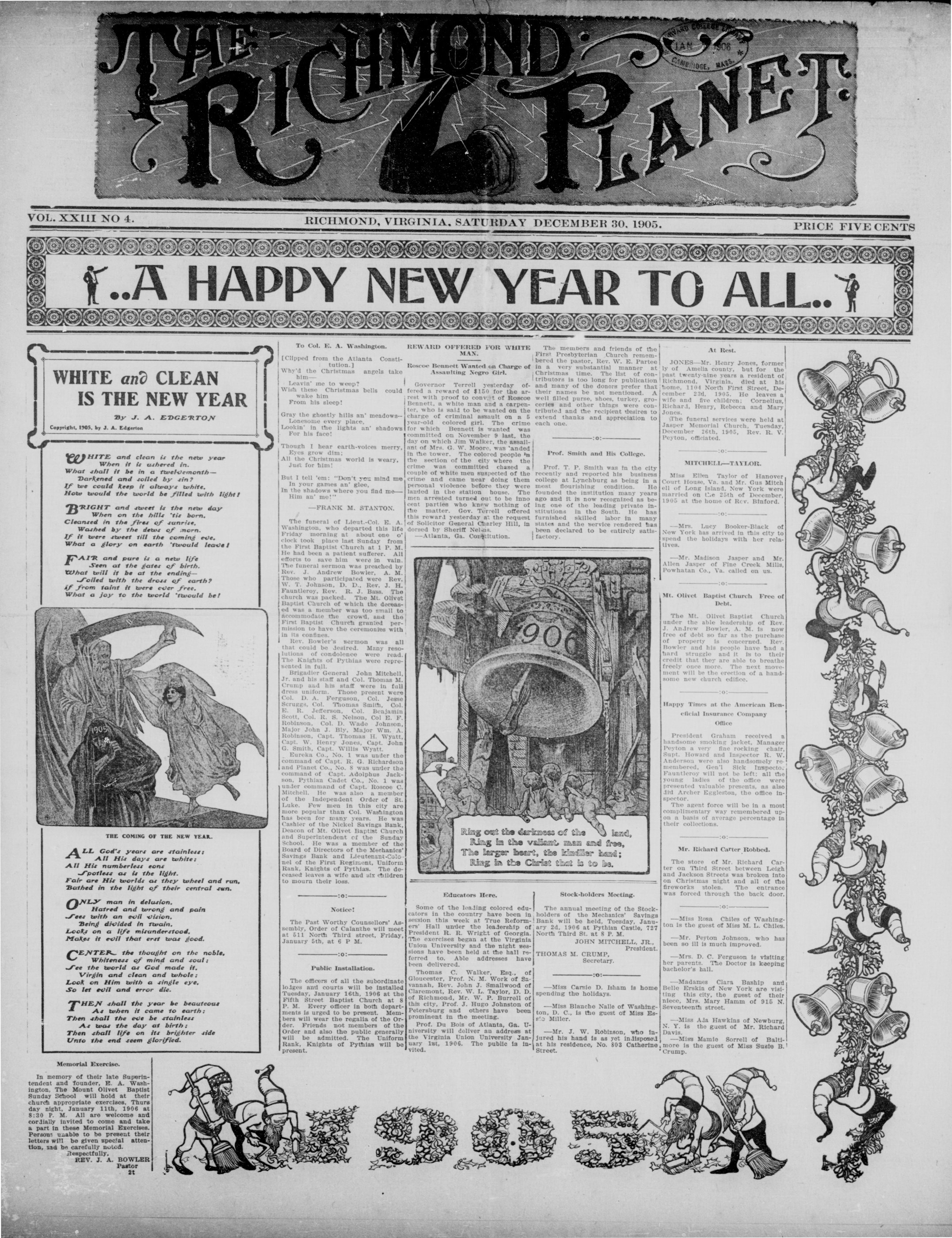
THE RICHMOND PLANET
..A HAPPY NEW YEAR TO ALL..
1905
VOL. XXIII NO 4. .A H WHITE and CLEAN IS THE NEW YE
WHITE and CLEAN IS THE NEW YEAR
By J. A. EDGERTON
WHITE and clean is the new year
When it is ushered in.
What shall it be in a twelfemonth—
Darkened and soiled by sin?
If we could keep it always white.
How would the world be filled with li
BRIGHT and sweet is the new day
When on the hills 'tis born.
Cleansed in the fires of sunrise.
Washed by the dews of morn.
If it were sweet till the coming eve.
What a glory on earth 'twould leave
WHITE and clean is the new year
When it is ushered in.
What shall it be in a twelfemonth—
Darkened and soiled by sin?
If we could keep it always white.
How would the world be filled with light!
BRIGHT and sweet is the new day
When on the hills 'tis born.
Cleansed in the fires of sunrise.
Washed by the dews of morn.
If it were sweet till the coming eve.
What a glory on earth 'twould leave!
FAIR and pure is a new life
Seen at the gates of birth.
What will it be at the ending—
Soiled with the dross of earth?
If from taint it were ever free.
What a joy to the world 'twould be!
1905
THE COMING OF THE NEW YEAR.
ALL God's years are stainless;
All His days are white;
All His numberless eons
Spotless as is the light.
Fair are His worlds as they wheel and
Bathed in the light of their central su
ALL God's years are stainless;
All His days are white;
All His numberless eons
Spotless as is the light.
Fair are His worlds as they wheel and run,
Bathed in the light of their central sun.
ONLY man in delusion,
Hatred and wrong and pain
Sees with an evil vision,
Being divided in twain.
Looks on a life misunderstood,
Makes it evil that erst was good.
CENTER the thought on the noble,
Whiteness of mind and soul;
See the world as God made it,
Virgin and clean and whole;
Look on Him with a single eye,
So let evil and error die.
THEN shall the year be beauteous
As when it came to earth;
Then shall the eye be stainless
As was the day at birth;
Then shall life on its brighter side
Unto the end seem glorified.
Memorial Exercise.
In memory of their late Superintendent and founder, E. A. Washington, The Mount Olivet Baptist Sunday School will hold at their church appropriate exercises. Thursday night, January 11th, 1906 at 8:30 P. M. All are welcome and cordially invited to come and take a part in these Memorial Exercises. Persons unable to be present their letters will be given special attention, and be carefully noted.
Respectfully,
REV. J. A. BOWLER
Pastor
2t
RICHMOND, VIRGINIA, SATURDAY DECEMBER 30, 1905.
To Col. E. A. Washington.
[Clipped from the Atlanta Constitution.]
Which of the following is true?
Why'd the Christmas angels take him—
Gray the ghostly hills an' meadows-
Lonesome every place.
Lookin' in the lights an' shadows
For his face!
Though I hear earth-voices merry
Eyes grow dim:
All the Christmas world is weary,
Just for him!
But I tell 'em: "Don't you mind me
In your games an' glee,
In the shadows where you find me—
Him an' me!"
—FRANK M. STANTON
The funeral of Lleut-Col. E. A. Washington, who departed this life Friday morning at about one o'clock took place last Sunday from the First Baptist Church at 1 P. M. He had been a patient sufferer. All efforts to save him were in vain. The funeral sermon was preached by Rev. J. Andrew Bowler, A. M. Those who participated were Rev. W. T. Johnson, D. D., Rev. J. H. Fauntleroy, Rev. R. J. Bass. The church was packed. The Mt. Olivet Baptist Church of which the deceased was a member was too small to accommodate the crowd, and the First Baptist Church granted permission to have the ceremonies with in its confines.
Rev. Bowler's sermon was all that could be desired. Many resolutions of condolence were read. The Knights of Pythias were represented in full.
Brigadier General John Mitchell, Jr. and his staff and Col. Thomas M. Crump and his staff were in full dress uniform. Those present were Col. D. A. Ferguson, Col. Jesse Scruggs, Col. Thomas Smith, Col. E. R. Jefferson, Col. Benjamin Scott, Col. R. S. Nelson, Col E. F. Robinson, Col. D. Wade Johnson, Major John J. Bly, Major Wm. A. Robinson, Capt. Thomas H. Wyatt, Capt. W. Henry Jones, Capt. John G. Smith, Capt. Willis Wyatt.
Eureka Co., No. 1 was under the command of Capt. R. G. Richardson and Planet Co., No. 8 was under the command of Capt. Adolphus Jackson, Pythian Cadet Co., No. 1 was under command of Capt. Roscoe C. Mitchell. He was also a member of the Independent Order of St. Luke. Few men in this city are more popular than Col. Washington has been for many years. He was Cashier of the Nickel Savings Bank, Deacon of Mt. Olivet Baptist Church and Superintendent of the Sunday School. He was a member of the Board of Directors of the Mechanics' Savings Bank and Lieutenant-Colonel of the First Regiment, Uniform Rank, Knights of Pythias. The deceased leaves a wife and six children to mourn their loss.
Notice!
The Past Worthy Counsellors' Assembly, Order of Calanthe will meet at 511 North Third street, Friday, January 5th, at 6 P M.
Public Installation.
The officers of all the subordinate lodges and courts will be installed Tuesday, January 16th, 1906 at the Fifth Street Baptist Church at 8 P. M. Every officer in both departments is urged to be present. Members will wear the regalia of the Order. Friends not members of the Order and also the public generally will be admitted. The Uniform Rank, Knights of Pythias will be present.
Ring out the darkness of the land,
Ring in the valiant man and free,
The larger heart, the kindlier hand;
Ring in the Christ that is to be.
REWARD OFFERED FOR WHITE MAN.
Roscoe Bennett Wanted on Charge of
Assaulting Negro Girl.
Governor Terrell yesterday offered a reward of $150 for the arrest with proof to convict of Roscoe Bennett, a white man and a carpenter, who is said to be wanted on the charge of criminal assault on a 5 year-old colored girl. The crime for which Bennett is wanted was committed on November 9 last, the day on which Jim Walker, the assailant of Mrs. G. W. Moore, was 'landed in the tower. The colored people in the section of the city where the crime was committed chased a couple of white men suspected of the crime and came near doing them personal violence before they were landed in the station house. The men arrested turned out to be innocent parties who knew nothing of the matter. Gov. Terrell offered this reward yesterday at the request of Solicitor General Charley Hill, in dorsed by Sheriff Nelms.
Atlanta, Ga. Constitution.
Ring out the dar
Ring in the v
The larger heart
Ring in the C
Educators Here.
Some of the leading colored educators in the country have been in session this week at True Reformers' Hall under the leadership of President R. R. Wright of Georgia. The exercises began at the Virginia Union University and the night sessions have been held at the hall referred to. Able addresses have been delivered.
Thomas C. Walker, Esq., of Gloucester, Prof. N. M. Work of Savannah, Rev. John J. Smallwood of Claremont, Rev. W. L. Taylor, D. D. of Richmond, Mr. W. P. Burrell of this city, Prof. J. Hugo Johnston of Petersburg and others have been prominent in the meeting.
Prof. Du Bois of Atlanta, Ga. University will deliver an address at the Virginia Union University January 1st, 1906. The public is invited.
The members and friends of the First Presbyterian Church remembered the pastor, Rev. W. E. Partee in a very substantial manner at Christmas time. The list of contributors is too long for publication and many of the donors prefer that their names be not mentioned. A well filled purse, shoes, turkey, groceries and other things were contributed and the recipient desires to extend thanks and appreciation to each one.
Prof. Smith and His College.
Prof. T. P. Smith was in the city recently and reported his business college at Lynchburg as being in a most flourishing condition. He founded the institution many years ago and it is now recognized as being one of the leading private institutions in the South. He has furnished skilled labor in many states and the service rendered has been declared to be entirely satisfactory.
kness of the land,
valiant man and free,
t, the kindlier hand;
christ that is to be.
Stock-holders Meeting
The annual meeting of the Stock-
holders of the Mechanics' Savings
Bank will be held, Tuesday, Janu-
ary 2d, 1906 at Pythian Castle, 727
North Third St. at 8 P. M.
JOHN MITCHELL, JR.,
President.
THOMAS M. CRUMP,
Secretary.
Miss Carsie D. Isham is home spending the holidays.
Miss Blanche Nalle of Washington, D. C., is the guest of Miss Essie Miller.
Mr. J. W. Robinson, who injured his hand is as yet in disposed at his residence, No. 803 Catherine Street.
At Rest.
JONES-Mr. Henry Jones, formerly of Amelia county, but for the past twenty-nine years a resident of Richmond, Virginia, died at his home, 1104 North First Street, December 23d, 1905. He leaves a wife and five children; Cornelius, Richard, Henry, Rebecca and Mary Jones. The funeral services were held at Jasper Memorial Church, Tuesday, December 26th, 1905, Rev. R. V. Peyton, officiated.
MITCHELL—TAYLOR
Miss Ellen Taylor of Hanover Court House, Va. and Mr. Gus Mitch ell of Long Island. New York were married on the 25th of December, 1905 at the home of Rcv Binford.
—Mrs. Lucy Booker-Black of New York has arrived in this city to spend the holidays with her relatives.
—Mr. Madison Jasper and Mr. Allen Jasper of Fine Creek Mills, Powhatan Co., Va. called on us.
Mt. Olivet Baptist Church Free of Debt.
The Mt. Olivet Baptist Church under the able leadership of Rev. J. Andrew Bowler, A. M. is now free of debt so far as the purchase of property is concerned. Rev. Bowler and his people have had a hard struggle and it is to their credit that they are able to breathe freely once more. The next movement will be the erection of a handsome new church edifice.
:0:
Happy Times at the American Beneficial Insurance Company
Office
President Graham received a handsome smoking jacket, Manager Peyton a very fine rocking chair, Supt. Howard and Inspector R. W. Anderson were also handsomely remembered, Gen'l Sick Inspector Fauntleroy will not be left; all the young ladies of the office were presented valuable presents, as also did Archer Eggleston, the office inspector.
The agent force will be in a most complimentary way remembered upon a basis of average percentage in their collections.
Mr. Richard Carter Robbed.
The store of Mr. Richard Carter on Third Street between Leigh and Jackson Streets was broken into on Christmas night and all of the fireworks stolen. The entrance was forced through the back door.
Miss Rosa Chiles of Washington is the guest of Miss M. L. Chiles.
Mr. Peyton Johnson, who has been so ill is much improved.
Mrs. D. C. Ferguson is visiting her parents. The Doctor is keeping bachelor's hall.
Madames Clara Bashlp and Belle Erskin of New York are visiting this city, the guest of their niece, Mrs. Mary Hamm of 915 N. Seventeenth street.
Miss Ada Hawkins of Newburg, N. Y. is the guest of Mr. Richard Davis.
Miss Mamie Sorrell of Baltimore is the guest of Miss Susie B. Crump.
PRICE FIVE CENTS
JINGLE BELL
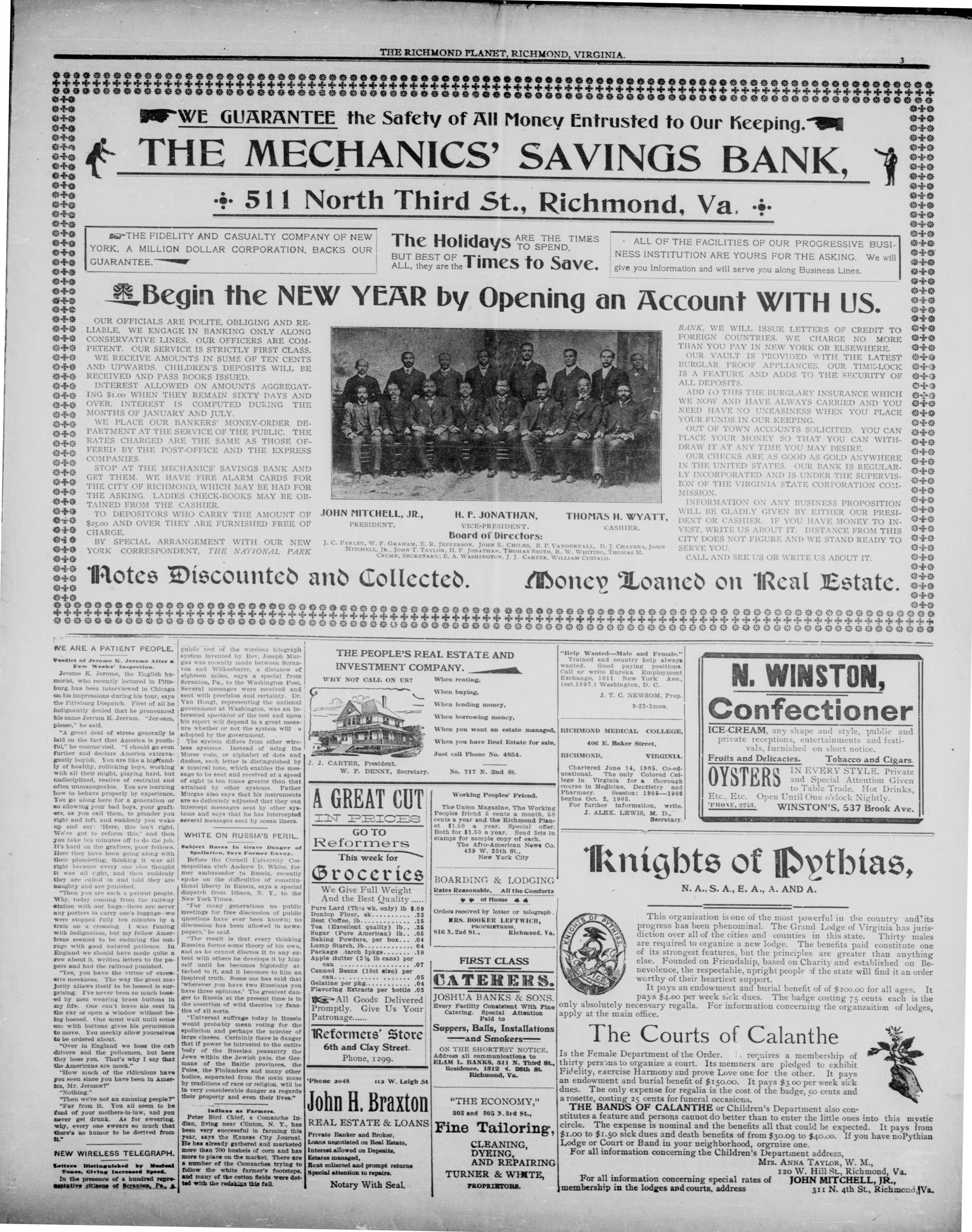
THE MECHANICS' SAVINGS BANK.
Begin the NEW YEAR by Opening an Account WITH US.
```markdown
```
THE FIDELITY AND CASUALTY COMPANY OF NEW YORK, A MILLION DOLLAR CORPORATION, BACKS OUR GUARANTEE.
OUR OFFICIALS ARE POLITE, OBLIGING AND RELIABLE. WE ENGAGE IN BANKING ONLY ALONG CONSERVATIVE LINES. OUR OFFICERS ARE COMPETENT. OUR SERVICE IS STRICTLY FIRST CLASS. WE RECEIVE AMOUNTS IN SUMS OF TEN CENTS AND UPWARDS. CHILDREN'S DEPOSITS WILL BE RECEIVED AND PASS BOOKS ISSUED. INTEREST ALLOWED ON AMOUNTS AGGREGATING $1.00 WHEN THEY REMAIN SIXTY DAYS AND OVER. INTEREST IS COMPUTED DURING THE MONTHS OF JANUARY AND JULY. WE PLACE OUR BANKERS' MONEY-ORDER DEPARTMENT AT THE SERVICE OF THE PUBLIC. THE RATES CHARGED ARE THE SAME AS THOSE OFFERED BY THE POST-OFFICE AND THE EXPRESS COMPANIES.
STOP AT THE MECHANICS' SAVINGS BANK AND GET THEM. WE HAVE FIRE ALARM CARDS FOR THE CITY OF RICHMOND, WHICH MAY BE HAD FOR THE ASKING. LADIES CHECK-BOOKS MAY BE OBTAINED FROM THE CASHIER. TO DEPOSITORS WHO CARRY THE AMOUNT OF $25.00 AND OVER THEY ARE FURNISHED FREE OF CHARGE. BY SPECIAL ARRANGEMENT WITH OUR NEW YORK CORRESPONDENT, THE NATIONAL PARK
Notes Discounted and Collected.
```markdown
```
WE ARE A PATIENT PEOPLE.
Werdict of Jerome K. Jerome After a Few Weeks' Inspection.
Jerome K. Jerome, the English humorist, who recently lectured in Pittsburg, has been interviewed in Chicago on his impressions during his tour, says the Pittsburg Dispatch. First of all he indignantly denied that he pronounced his name Jerrum K. Jerrum. "Jer-oam, please," he said.
"A great deal of stress generally is laid on the fact that America is youthful," he commented. "I should go even further and declare America extravagantly boyish. You are like a big family of healthy, rolllicking boys, working with all their might, playing hard, but undisciplined, restive of restraint and often unmanageable. You are learning how to behave properly by experience. You go along here for a generation or so allowing your bad boys, your graffers, as you call them, to plunder you right and left, and suddenly you wake up and say: 'Here, this isn't right. We've got to reform this,' and then you take ten minutes off to do the job. It's hard on the graffers, poor fellows. Here they have been going along with their plundering, thinking it was all right because every one else thought it was all right, and then suddenly they are called in and told they are naughty and are punished.
"Then you are such a patient people. Why, today coming from the railway station with our bags—there are never any porters to carry one's luggage—we were stopped fully ten minutes by a train on a crossing. I was fuming with indignation, but my fellow Americans seemed to be enduring the outrage with good natured patience. In England we should have made quite a row about it, written letters to the papers and had the railroad punished. "Yes, you have the virtue of excessive meekness. The way the great majority allows itself to be bossed is surprising. I've never been so much bossed by men wearing brass buttons in my life. One can't leave his seat in the car or open a window without being bossed. One must wait until some one with buttons gives his permission to move. You meekly allow yourselves to be ordered about.
"Over in England we boss the cab drivers and the policemen, but here they boss you. That's why I say that the Americans are meek."
"How much of the ridiculous have you seen since you have been in America, Mr. Jerome?"
"Nothing."
"Then we're not an amusing people?"
"Far from it. You all seem to be fond of your mothers-in-law, and you never get drunk. As for swearing, why, every one swears so much that there's no humor to be derived from it."
NEW WIRELESS TELEGRAPH.
Setters Distinguished by Musical
Tones, Giving Increased Speed.
In the presence of a hundred representa-
tive citizens of Scranton, Pa.,
511 North Third St., Richmond, Va.
public test of the wireless telegraph system invented by Rev. Joseph Murgas was recently made between Scranton and Wilkesbarre, a distance of eighteen miles, says a special from Scranton, Pa., to the Washington Post. Several messages were received and sent with precision and certainty. Dr. Van Hoagt, representing the national government at Washington, was an interested spectator of the test and upon his report will depend in a great measure whether or not the system will be adopted by the government.
The system differs from other wireless systems. Instead of using the Morse code, or alphabet of dots and dashes, each letter is distinguished by a musical tone, which enables the message to be sent and received at a speed of eight to ten times greater than that attained by other systems. Father Murgas also says that his instruments are so delicately adjusted that they can intercept messages sent by other systems and says that he has intercepted several messages sent by ocean liners.
WHITE ON RUSSIA'S PERIL.
Subject Races in Grave Danger of Spoliation, Says Former Envoy.
Before the Cornell University Cosmopolitan club Andrew D. White, former ambassador to Russia, recently spoke on the difficulties of constitutional liberty in Russia, says a special dispatch from Ithaca, N. Y., to the New York Times.
"For many generations no public meetings for free discussion of public questions have ever been known; no discussion has been allowed in newspapers," he said.
"The result is that every thinking Russian forms some theory of his own, and as he cannot discuss it to any extent with others he develops it by himself until he becomes bigotedly attached to it, and it becomes to him an inspired truth. Some one has said that 'wherever you have two Russians you have three opinions.' The greatest danger to Russia at the present time is in the assertion of wild theories by fanatics of all sorts.
"Universal suffrage today in Russia would probably mean voting for the spiolation and perhaps the murder of large classes. Certainly there is danger that if power be intrusted to the entire body of the Russian peasantry the Jews within the Jewish pale, the Germans of the Baltic provinces, the Poles, the Finlanders and many other bodies, separated from the main mass by traditions of race or religion, will be in very considerable danger as regards their property and even their lives."
Indians as Farmers.
Peter Bird Chief, a Comanche Indian, living near Clinton, N. Y., has been very successful in farming this year, says the Kansas City Journal. He has already gathered and marketed more than 700 bushels of corn and has more to place on the market. There are a number of the Comanches trying to follow the white farmer's footsteps, and many of the cotton fields were dotted with the redskins this fall.
THE RICHMOND PLANET, RICHMOND, VIRGINIA
The Holidays ARE THE TIMES TO SPEND, BUT BEST OF ALL, they are the Times to Save.
[Name of the group]
J. C. FARLEY, W. F. GRAHAM, E. R. JEFFERSON, JOHN R. CHILES, B. P. VANDERVALL, D. J. CHAVERS, JOHN MITCHELL, JR., JOHN T. TAVLOR, H. F. JONATHAN, THOMAS SMITH, R. W. WHITING, THOMAS M. CRUMP, SECRETARY; E. A. WASHINGTON, J. L. CARTER, WILLIAM CUSTALO
THE PEOPLE'S REAL ESTATE AND INVESTMENT COMPANY.
JOHN MITCHELL, JR.,
PRESIDENT.
J. C. FARLEY, W. F. GRAHAM, E.
MITCHELL, JR., JOHN T. TAY
CRUMP, SECRETARY
and Collect
THE PEOPLE'S REAL
INVESTMENT COM
WHY NOT CALL ON US?
J. J. CARTER, President.
W. F. DENNY, Secretary.
A GREAT CUT
IN PRICES
GO TO
Reformers
This week for
Groceries
We Give Full Weight
And the Best Quality .....
Pure Lard (This wk. only) lb $.09
Dunlop Flour, sk.....32
Best Coffee, lb.....15
Tea (Excellent quality) lb.....35
Sugar (Pure American) lb.....05
Baking Powders, per box.....04
Lump Starch, lb.....04
Package tarch 3pkgs.....10
Apple Butter (2 1/2 lb cans) per
can.....07
Canned Beans (10ct size) per
can. .05
Gelatine per pkg. .04
Flavoring Extracts per bottle. 03
All Goods Delivered
Promptly. Give Us Your
Patronage.....
Reformers' Store
6th and Clay Street.
Phone, 1299.
John H. Braxton
REAL ESTATE & LOANS
Private Banker and Broker,
Loans negotiated on Real Estate,
Interest allowed on Deposits,
Estates managed,
Rent collected and prompt returns
Special attention to repairs.
Notary With Seal.
H. F. JONATHAN,
VICE-PRESIDENT.
Board of Directors:
R. JEFFERSON, JOHN R. CHILES, B. P. W.
FELOR, H. F. JONATHAN, THOMAS SMITH,
BURY; E. A. WASHINGTON, J. J. CARTER, W.
REAL ESTATE AND
COMPANY.
When renting,
When buying,
When lending money,
When borrowing money,
When you want an estate managed,
When you have Real Estate for sale,
Just call Phone No. 4854.
No. 717 N. 2nd St.
Working Peoples' Friend.
The Union Magazine, The Working
Peoples friend 5 cents a month, 50
cents a year and the Richmond Planet
$1.50 a year. Special offer.
Both for $1.50 a year. Send 3cts in
stamps for sample copy of each.
The Afro-American News Co.
439 W. 55th St.
New York City
BOARDING & LODGING
Rates Reasonable. All the Comforts
of Home
Orders received by letter or telegraph.
MRS. BOOKER LEFTWICH,
PROPRIETRESS,
816 N. 2nd St.
Richmond, Va.
FIRST CLASS
CATERERS.
JOSHUA BANKS & SONS.
Every Facility Consistent With Fine
Catering. Special Attention
Paid to
Suppers, Balls, Installations
and Smokers
ON THE SHORTEST NOTICE.
Address all communications to
ELAM L. BANKS, 511 N. Third St.
Residence, 1312 N. 26th St.
Richmond, Va.
"THE ECONOMY,"
303 and 305 N.8rd St.,
Fine Tailoring,
CLEANING,
DYEING,
AND REPAIRING
TURNER & WHITE,
PROPRIETORS.
ALL OF THE FACILITIES OF OUR PROGRESSIVE BUSINESS INSTITUTION ARE YOURS FOR THE ASKING. We will give you Information and will serve you along Business Lines.
Knights of Pythias,
This organization is one of the most powerful in the country and its progress has been phenominal. The Grand Lodge of Virginia has jurisdiction over all of the cities and counties in this state. Thirty males are required to organize a new lodge. The benefits paid constitute one of its strongest features, but the principles are greater than anything else. Founded on Friendship, based on Charity and established on Benevolence, the respectable, upright people of the state will find it an order worthy of their heartiest support.
It pays an endowment and burial benefit of of $200.00 for all ages. It pays $4.00 per week sick dues. The badge costing 75 cents each is the only absolutely necessary regalia. For information concerning the organization of lodges, apply at the main office.
The Courts of Calanthe
The Courts of Calanthe
Is the Female Department of the Order. It requires a membership of thirty persons to organize a court. Its members are pledged to exhibit Fidelity, exercise Harmony and prove Love one for the other. It pays an endowment and burial benefit of $150.00. It pays $300 per week sick dues. The only expense for regalia is the cost of the badge, 50 cents and a rosette, costing 25 cents for funeral occasions.
THE BANDS OF CALANTHE or Children's Department also constitutes a feature and persons cannot do better than to enter the little ones into this mystic circle. The expense is nominal and the benefits all that could be expected. It pays from $1.00 to $1.50 sick dues and death benefits of from $30.09 to $40.00. If you have no Pythian Lodge or Court or Band in your neighborhood, orgrnize one.
For all information concerning the Children's Department address.
For all information concerning special rates of JOHN MITCHELL, JR., membership in the lodges and courts, address 311 N. 4th St., Richmond Va.
THOMAS H. WYATT,
CASHIER.
ANDERVALL, D. J. CHAVERS, JOHN
R. W. WHITING, THOMAS M.
WILLIAM CUSTALO.
Honey Loane
"Help Wanted—Male and Female."
Trained and country help always wanted. Good paying positions.
Call or write Eureka Employment Exchange, 1011 New York Ave.,
(est.1897.) Washington, D. C.
J. T. C. NEWSOM, Prop.
9-23-3mos.
RICHMOND MEDICAL COLLEGE
Chartered June 14, 1905. Co-educational. The only Colored College in Virginia for a thorough course in Medicine, Dentistry and Pharmacy. Session: 1905—1906 begins Oct. 2, 1905.
For further information, write
J. ALEX. LEWIS, M. D.,
Secretary.
KNIGHTS OF PYTHIAST
CIVIL ECB
It pays a
pays $4.00
only absolutely necessary rega
apply at the main office.
The Cou
Is the Female Department of t
thirty persons to organize a co
BANK. WE WILL ISSUE LETTERS OF CREDIT TO FOREIGN COUNTRIES. WE CHARGE NO MORE THAN YOU PAY IN NEW YORK OR ELSEWHERE. OUR VAULT IS PROVIDED WITH THE LATEST BURGLAR PROOF APPLIANCES. OUR TIME-LOCK IS A FEATURE AND ADDS TO THE SECURITY OF ALL DEPOSITS. ADD TO THIS THE BURGLARY INSURANCE WHICH WE NOW AND HAVE ALWAYS CARRIED AND YOU NEED HAVE NO UNEASINESS WHEN YOU PLACE YOUR FUNDS IN OUR KEEPING. OUT OF TOWN ACCOUNTS SOLICITED. YOU CAN PLACE YOUR MONEY SO THAT YOU CAN WITHDRAW IT AT ANY TIME YOU MAY DESIRE. OUR CHECKS ARE AS GOOD AS GOLD ANYWHERE IN THE UNITED STATES. OUR BANK IS REGULARLY INCORPORATED AND IS UNDER THE SUPERVISION OF THE VIRGINIA STATE CORPORATION COMMISSION.
INFORMATION ON ANY BUSINESS PROPOSITION WILL BE GLADLY GIVEN BY EITHER OUR PRESIDENT OR CASHIER. IF YOU HAVE MONEY TO INVEST, WRITE US ABOUT IT. DISTANCE FROM THIS CITY DOES NOT FIGURE AND WE STAND READY TO SERVE YOU.
N. WINSTON,
Confectioner
ICE-CREAM, any shape and style, public and
private receptions, entertainments and festi-
vals, furnished on short notice.
Fruits and Delicacies. Tobacco and Cigars.
OYSTERS IN EVERY STYLE. Private
and Special Attention Given
to Table Trade. Hot Drinks,
Etc., Etc. Open Until One o'clock Nightly.
'PHONE, 2253.
WINSTON'S, 537 Brook Ave.
CALL AND SEE US OR WRITE US ABOUT IT
N. A., S. A., E. A., A. AND A.
```markdown
```
THE PLANET
JOHN MITCHELL, JR. - EDITOR.
All communications intended for publication
should be sent so as to reach us by
Wednesday.
TERMS IN ADVANCE
COMMUNICATIONS...-When writing to us to renew your subscription or to discontinue your paper, you should give your name and address full otherwise we cannot find your name on our books.
CHANGE OF ADDRESS...-In order to change the address of a subscriber, we must be sent the former as well as the present address.
Entered at the Post-Office at Richmond. Va as second-class matter.
HOWARD UNIVERSITY AND ITS TROUBLES.
The brilliant Mr. P. S. Twister has sent us a letter, courteous in tone and argumentative in details. We did not intend to publish it, but as he has seen fit to request us so to do, we are of the opinion that it is right and proper that we should make comments in the premises and emphasize our position in the light of the facts admittedly true by both parties to the controversy. Mr. Twister writes as follows:
Washington, D. C., Dec. 23, 1905.
Dear Mr. Mitchell:
I have just read your editorial on Howard University. And in part have to agree with you. But I desire to call your attention to the error you have made by saying the students were mistaken in the revolt of December 8th. The students were forced to resort to the revolt to disprove a falsehood told by Dr. Gordon to the investigating committee. The day before the revolt Dr. Gordon appeared before the committee and said that the students all liked him and would cry if he would leave the institution, when the students heard this they planned to disprove it by an open demonstration. And on the 8th of December, at the Chapel service, the students arose, hissed Dr. Gordon and marched out of the Chapel. I have stated just what happened. I was present and know whereof I speak. I will state that the students have not apologized, have no one to whom they owe an apology. They, in a dignified way, gave the lie to Gordon, for which all true men should thank them.
You say that Howard University needs a man with executive capacity rather than a man who has the proper qualities of mind and heart. In this you are mistaken. Gordon's shortcoming is due to lack of capacity of mind and heart, to which may be added his utter lack of executive ability. What we need in Howard University to-day is a man of superior intellectual powers, moral excellence, and above all, one who believes in the equality of man as man looking toward the highest moral, spiritual and intellectual development within the gift of genius. Howard University is the great beacon light of liberty to the man in black, and whatever threatens her should appeal to the highest and best there is in every true Negro American, and spur him on to make every effort to save her from destruction.
I will thank you if you will publish this letter.
Very sincerely,
P. S. TWISTER.
Before discussing the subject further, it would be well to consider the phase of the situation criticised. The Washington, D. C. Post, in its issue of the 9th inst. said:
"As Dr. Gordon came in to open the exercises, he was greeted by tisses, cat-calls, howls and groans, as such only Negro students, 700 strong could give vent to Dr.
Gordon exhibited a determination to hold his ground and a scene of wild excitement followed, in which it is said school-books were hurled miscounsely, some of them going close to the president's head. There was excitement for several minutes, when the students, moved by common impulse, marched out of the chapel, hooting and singing songs."
These facts were published in the same issue of the PLANET in which appeared the editorial comment that Mr. Twister criticises. We presume then that he accepts the statements as true.
It may be well to state here that we are opposed to Dr. John Gordon and we believe that a mistake was made in placing in charge of Howard University, a gentleman who knew at the time and who has found out since that the surroundings were uncongenial to him. He is opposed to the higher education of the Negro and Howard University was not intended to be an industrial school. Students seeking that kind of education should attend Hampton Normal and Agricultural Institute, Tuskegee Institute or our own state institution at Petersburg.
We can understand too how people who on the ground, swayed by the impulses of passion can attempt to justify such outrageous conduct. But there are colored men elsewhere who will not stand for such a species of lawlessness. Mr. Twister is in error when he states that we are of the opinion that the students were mistaken in the revolt of December 8th, 1905. We think the method was all right, but that the manner of execution was all wrong. Organized protest against outrage or tyranny can always be justified, but when the methods of the mob are countenanced and practiced the students will have against them the united opposition of every conservative man of color in the United States. Lawlessness and mobocracy are two-edged swords that cut both ways. We stated that qualification and adaptability were the characteristics most needed in a president of an institution of the kind referred to and that executive ability was more essential than scholastic training.
We are of that opinion now. We do not mean to infer that a man without scholastic training could succeed, but we mean that of the two qualifications, executive ability should be predominant. We believe that the universal opinion of those men in this country regardless of color, who are qualified to judge will side with us in this statement of the case. Learned professors and educational geniuses are often the poorest presiding officers both in church and state. They are so wrapped up in the cocoons of their own wisdom that they can see naught else and their horizon is limited.
We beg leave to state that there are many brilliant exceptions. Mr. Twister's assertion that "Howard University is the great beacon light of liberty to the man in black, and whatever threatens her should appeal to the highest and best there is in every true Negro American and spur him on to make every effort to save her from destruction" justifies all that we have said and emphasizes the necessity for a race journal of the PLANET'S kind to state its disapproval of all methods that bring shame upon the institution and disgrace upon the students participating in such a discreditable war-fare.
Before leaving this phase of the discussion, it may be well to observe that the treachery of some kind of Negroes is proverbial It was one of the legacies handed down from slavery. Who knows but what some of these kind of citizens of color did tell and lead Doctor Gordon to believe that they and more like them would cry if he should leave? Who knows but what they impressed upon him the fact that the opposition to him was promoted and backed up by a small number of agitators? "They bended the supple hinges of the knee that favor might follow fawning."
They will cry should he leave because the day of favoritism for them will have passed perhaps. But the students went too far in their efforts to disprove the statements and they will now merit the criticism of their friends as well as the condemnation of their enemies. While a few may have made the blunder, all will suffer in the conservative mind as a consequence of it. There are too many colored men—Afro-Americans—Negroes in Washington, who do not take a position upon any question, until they are assured that some other Negro to whom they are opposed has taken the other side.
It may be that there are more than one Dr. John Gordon at Howard University. The fight should be made now to the finish and if racial inferiority of the Negro and rank in dutrialism versus higher education is to be made the corner-stone in the future, let the professors and students backed by the conservative American citizens of color in this country, moving along conservative and orderly lines raze the institution to the ground and leave to the Negro-haters the work of laying a new corner-stone and erecting a new
RICHMOND PLANET, RICHMOND, VIRGINIA
structure in which Dr. Gordon and his kind can preside and in which those kind of Negroes who favor his plans and purposes can be suprame in their arrant servility and in their sycophant surrender to every de-oding command issued from the headquarters of the Negro-haters of this country. Dr. Gordon has resigned. Who will take his place? Let us hope that we have not "swapped the devil for the witch" and that the Board of Trustees will act in keeping with the best interest of the institution and place a man at the head, who understands existing conditions and who will be able to start the institution upon the high road to success and keep it in the direction its founder started it.
Such a president, determined to look to the future, with no friends to reward or enemies to punish would bring about a satisfactory condition of affairs and rescue the institution from a state of anarchy in to which this unthinking Dr. Gordon has plunged it.
TROOPS CRUSH
MOSCOW REVOLT
Insurgente Making LostStand Against Artillery Fire of Soldiers.
THOUSANDS OF CASUALTIES
St. Petersburg, Dec. 27. — Emperor Nicholas and Count Witte received a report from General Doubassoff, governor general of Moscow, saying that the revolt there had failed, that the military had the situation in hand, and that whatever defection may have existed among the troops had been overcome by the attacks on them with bombs and revolvers to which they had been subjected from the windows and roofs of houses, which had so enraged them that they could hardly be restrained.
Although rebellion may flare up immediately elsewhere and although there is an indication of an upheaval at Odessa if the attempt at armed rebellion in Moscow should be crushed the leaders of the "reds" will receive a blow from which they cannot quickly recover. Last night the correspondent of the Associated Press at Moscow telephoned that there seems to be no longer any doubt that the revolution was collapsing, insurgents still held the quadrangle in which the workmen's council was sitting as a revolutionary committee, but only because Governor General Doubassoff was not yet ready to give the coup de grace. Firing continued intermittently throughout the day. At 5 o'clock automatic guns were being used in Stratner Square, but the insurgents were becoming exhausted after their four days' efforts, and the fighting was rapidly degenerating into guerilla warfare.
The insurgents were defending themselves with revolvers and bombs as they were being hunted down from house to house.
The correspondent says that the entire population of the city is terror-stricken and that after dark the back streets present a wreed and uncanny appearance. As he drove to the telephone station he saw only a few civilians who were slinking along by the side of the walls so as to avoid the police and cavalry patrols who fire without challenging. The windows of the houses are stuffed with mattresses and blankets and no lights are showing. The police carry rifles with bayonets fixed.
The correspondent predicts that the crushing of the rebellion is likely to be followed by the most horrible atrocities if the "Black Hundreds" are let loose. A telephone message just received by the Associated Press from Moscow says the fighting in the streets continued throughout the day. The soldiers are hemming in the main body of the insurgents in the quadrilateral near the Brest railroad station bounded by Tverskala street and the Tversakol, Sadovia and Bronnia boulevards. In this quadrilateral the insurgents have fortified every inch of their lines with felled trees and telegraph poles and street cars, in front of which they have constructed a network of entanglements. Artillery is being used mercilessly. The mortuaries of Moscow are filled with the dead, the hospitals are unable to find room for the wounded, and many private houses are filled with wounded persons.
The Bourse Gazette says it is reported that General De Dloulin, prefect of police of St. Petersburg, has been informed by telephone that the number of dead or wounded at Moscow number 15,000, and that when questioned the general did not deny that such a report had been received.
Marched In Face of Death.
Preparations for the struggle were made on an elaborate scale. Twenty-five thousand troops were massed, machine guns were placed on the high walls of the Kremiln, and even in the steeples of churches. Massive towers of the Chinese wall bristled with weapons. Troops of Cossacks clattered through the streets.
Into this very hell of death marched a procession of revolutionists. They carried red flags and chanted those revolutionary dirges that one day will be the dirges of the Russian nation. When this mass of patriots had reached a point in Red Square where their position could be swept by the machine guns, and where Cossacks could charge advantageously, the mailed fist struck.
Thousands Slaughtered.
The ensuing slaughter was diabolical. Casualties numbered thousands. Dead men were piled high. Among these were many of the caar's fighting men, for the revolutionists had come
prepared to resist attack.
This was Saturday. As night approached the populace grew more bold. The rattle drumming of machine guns and the booming of cannon were answered by the clatter of muskety. Shrapnel was responded to with bombs. Buildings were toppling into ruin on all sides. Among the first to be split asunder by a bomb was the headquarters of the police.
Sunday's dawn witnessed a renewal of the carnage. Barricades, consisting of boxes, barrels, and even furniture hauled from the mean little homes of the rebels, were thrown up at many strategic points. It was apparent from the outset that the fighting movements of the rebels were directed by some man trained in the ways of warfare.
At each repulse the ranks of the in surges seemed to be re-populated as if by magic. Grim-faced, bare-headed men, with brawny arms and bushy beards, sprang from cellarways, drop-
ped from upper windows and seemed to rise out of the very ground. Every gap in the ranks of the rebels was filled in the twinkling of an eye. One of the most desperate conflicts took place at the Triumphal Arch, scene of so many gorgeous spectacles of state in the glorious old days when Moscow was the seat of monarchy. Students Mowed Down. Here the soldiers, backed by machine guns perched in steeples of nearby cathedrals, charged upon a body of student militia. These young fellows were well armed and perfectly trained, so that it was not surprising that after a ferocious encounter they were able to drive back the czar's butchers. But their victory was won at awful cost, as the ranks of the students were well nigh depleted.
Cossacks meanwhile were resorting to the customary tactics in endowing to keep the streets clear. They used their knouts freely, respecting neither age nor sex. Old men were beaten to insensibility and women lashed to the earth. Children were dragged about by their hair.
The other side was not to be outdone, however, in the excess to which cruelties might be carried. Repeatedly they stripped Jewish women and forced them to march through the streets, pelting them with stones and offering every describable insult.
MITCHELL TO THE OPERATORS
Communicates With Them Regarding Demands of Mine Workers
Philadelphia, Dec. 26. — The Press says:
"President John Mitchell, of the United Mine Workers' Union, has communicated with the presidents of the anthracite coal producing companies in regard to the demands the miners will make for the continuance of work in the hard coal fields.
"It is understood the letter is in regard to holding a conference between the committee representing the United Mine Workers and the operators. As to what the operators will do, it has not definitely been decided upon.
"Besides asking for an eight-hour day, there are also to be presented other demands. The most important, and one that if adopted will mean the complete recognition of the union, is the request that an entire new conciliation board be formed, one that will always be in session and will go from place to place to settle disputes.
"This request will meet with considerable opposition from the operators.
"The proposed new board is to be composed of three members representing the miners and the same number representing the operators, and a seventh member, to be chosen by the other six."
BORN FOUR MONTHS APART
Young Mother Gave Birth to Daughter
116 Dave After Birth of Son
116 Days After Birth of Son.
Albany, N. Y., Dec. 27.-Mrs. Alfred Wiltse, of $15 Central avenue, this city, is the mother of a three-days-old daughter which she insists was born 116 days, or less than four months, after she had given birth to a son. Her story is partially vouchered for by Dr. George T. Moston, a reputable physician, who attended her. Both parents are a few months over 20 years of age. Dr. Moston said that he believed the woman's story.
"The child is normal," he said, "and I saw the other child, who is apparently not more than four months old, showing as yet no sign of a tooth. Mrs. Wiltse told me that no physician attended the other birth, though one was sent for, and her only attendant was a woman with whom she boarded, but whose present address she does not know. Mrs. Wiltse's mother and family vouch for the truth of her story, and share in the surprise occasioned by the phenomenon."
8ANGBAGGED AND ROBBED
Diamond Merchant Found Unconscious
Is Forbidden Backed By Philosophy
In Fashionable Part of Philadelphia.
Philadelphia, Dec. 27. — William Heeren, a diamond merchant of 612 South avenue, Plainfield, N. J., was found unconscious at 17th and Walnut streets, in the heart of the fashionable section of the city. He was immediately taken to the Polyclinic hospital, where the doctors announced that he had a concussion of the brain. An abrasion was found on his head. After the doctors had worked on him for an hour he revived sufficiently to tell them who he was. He said that he went into a saloon, purchased a drink and left the place. A few minutes later he said he became bewildered, after which he remembered nothing. An examination of his clothes showed that all his valuables were missing, including $600 worth of diamonds which he had in a small case in an inside pocket of his coat. The police believe that he was given knock-out drops and that he was followed by a footpad and sand-bagged. Heeners is still in a serious condition.
Druggiat's Mistake Killie Girl
New Haven, Conn., Dec. 26—Coroner Mix handed down a finding in the case of Minnie Evelyn Killingbeck, of Ansonia, who died on Saturday under circumstances that looked suspicious. He finds that the girl's death was due to the mistake of her sweetheart. Frank Tucker, a drug clerk, who sent a pill bag labeled "headache tablets"
to her, which really contained bichloride of mercury tablets. When Miss Killingheck sent for headache medicine the box containing the poisonous pelts was sent to her, and she took one of the pills, which caused her death in a few hours.
Two Men Blown to Atoms.
Bluefield, W. Va., Dec. 27.—John K. Grested and Kenton W. Atwell were blown to atoms at Cedar Bluff by the explosion of 12 cans of dynamite they were attempting to thaw.
A WEEK'S NEWS CONDENSED
Hursday, December 21.
George H. Conley, superintendent of schools of Boston, died suddenly of hear disease, aged 52 years.
Edward Bastian, a farmer, was struck by an express train at Middletown, Del., and fatally injured.
Will Carter, a negro, was hanged at Kenansville, N. C., for a criminal assault upon a 6-year-old white girl.
A gas explosion at Decatur, Ill., wrecked a saloon, rendered the bartender permanently blind and seriously injured three other men.
While playing on the Reading railway tracks, Clyde Young, 11 years old, of Philadelphia, fell under a train and had both legs cut off.
Friday, December 22.
Thursday, December 22.
The safe in the Corinth Deposit Bank, at Corinth, Ky., was robbed of $2500.
Both branches of congress have adjourned until January 4 for the Christmas holidays.
Secretary of the Interior Hitchcock is confined to his Washington home with a severe cold.
A leak in a kitchen gas stove in a New York grocery store caused the death of two men and so overcome a woman that she will die.
It is said in Washington that Lloyd Griscom will not return to Japan as the American minister, but will be appointed ambassador to Brazil.
All the Italians and foreigners employed as gatemen at crossings of the Pennsylvania railroad west of Pittsburg will be replaced by Americans.
Saturday, December 23.
Three nuns were painfully burned in a fire at St. Benedict's Academy, Erie, Pa.
The furniture factory of the Warren
Woodworking company, at Belvidence,
N. J., was destroyed by fire, entailing
a loss of $60,000.
Judge O'Gorman, of the New York
supreme court, decided that a South
Dakota divorce decree confers no pro-
tection in New York.
W. H. Moorehead, a guard in the
Ohio penitentiary at Columbus, O.,
was fatally wounded in a fight bet-
ween five guards and a convict.
John C. New, former consul general
to London, and John C. Wright were
acquitted at Noblisville, Ind., of fraud
in the sale of stock involving $892,
000 in the First National Bank of
Indianapolis.
Tuesday, December 28.
Mrs. S. B. Dibble, first president of the National Christian Temperance Union, died at her home at Grass Valley, Cal.
John McCall, J. H. Wells and James Bester were suffocated in a lodging house at New Orleans by blowing out the gas.
Irvin Baxter, United States district attorney for Nebraska, has been removed by President Roosevelt for malfeasance in office.
While returning from work, Charles Echoff, of Coatesville, Pa., was run down by a locomotive and had a log cut off and his skull fractured.
Seven masked men held up three armed watchmen and a dispatcher in the Toledo (O.) Traction company's car barn and escaped with over $1000.
Wednesday, December 27.
Fire gutted the Exchange Hotel, of Unontown, Pa., entailing a loss of $100,000.
Mrs. D. Stuart Null, of Wellsboro, Pa., was killed and her husband and Miss Emma Mathers badly injured in a runaway accident.
After playing Santa Claus for neighbors, George Reege, of near Coshocton, O., set fire to the long cotton whiskers and was fatally burned.
Louis N. Megargee, editor and publisher of "Seen and Heard," and a well-known journalist, died at his home in Philadelphia, aged 50 years.
In a fit of jealousy, Ashby Willis, colored of Wheeling, W. Va., crushed the skull of his white wife with an aze and then cut his own throat.
Miss Roosevelt Names Wedding Day,
Washington, Dec. 23. — Miss Alice
Roosevelt announced to a few personal
friends, including one of her prospective
bridesmaids, the date of her wedding,
which has finally been fixed for
Saturday, February 17. The hour is
yet to be determined. Several dates
were under consideration. The 22d
was the favorite, but it was found that
other plans had been made for that
day at the White House.
Epidemic of Meningitis Among Horses New York, Dec. 27.—Afflicted with spinal meningitis, more than a score of horses dropped in the streets of Williamsburg, and at least half of them succumbed to the disease before a veterinary could reach them. Every veterinary surgeon in Williamsburg was called into service, and they were busy from before daylight until late at night trying to check the spread of the disease. One veterinary had been called to attend 18 cases, nine of which were fatal. All the animal hospitals are crowded with horses which have only a slight chance to recover from the disease.
Luke Wright Won't Resign.
Memphis, Tenn. Dec. 26.—Luke E. Wright, governor general of the Philippines, arrived here to spend the holidays at his home. Regarding reports that he would resign his office and return to Memphis, he said nothing further than that he had board the rumors, but was unaware of the source from which they came.
Interest Paid to Convicts
Jeffersonville, Ind., Dec. 26. — For the first time in the history of penal institutions, the inmates of the Jeffersonville reformatory were paid interest on money due them for extra work. The payments were made from a special fund.
WILD RIDE WITH INSANE FATHER
Five Children Driven About in Wagon For Six Days.
ALL SUFFERED TERRIBLY
Clinton, Conn, Dec. 27.—Taken suddenly with a fit of intolerance while recovering from the measles, Hayden Watrous, a middle-aged man living in Mystic, gathered his five small children together end, putting them on a box wagon, starred six days ago on a wild ride about the state, begging food from house to house and not allowing the children to leave the wagon at any time. The father and children slept on the wagon every night, and as the days passed the sufferings of the little ones increased, so that when they wore overtaken near here by Watrous' brother the youngest of the lot, a 2-year-old boy was nearly dead.
The insane man's brother started in pursuit of Watrous a day or two after Watrous left home and found traces of him in several towns throughout the state, but just as he seemed to be in a position where he could overtake him the trail was lost, and the insane man was not caught until Tuesday night. When he saw his brother he started to fight, and it was only after a desperate struggle that Watrous was subdued. He was bound with ropes, put in a carriage and brought to the station here and later taken to his home, his brother going with him. The children were suffering terribly from the lack of food and clothing, and some of them are said to be in a critical condition.
DEFENDED HIS MOTHER
Father Attempted to Strike Her When Son Interfered.
Philadelphia, Dec. 26. — Defending his mother against her quarrelsome husband, Joseph Pollock, aged 22, of 138 West Cumberland street, struck his father in the face, which resulted in his death. William Pollock, the husband, who had been drinking, was called to Christmas dinner by his wife. He became angry because his sleep had been disturbed, and was in the act of striking his wife when the son stopped the blow. This interference enraged the husband, who struck the son and the latter retaliated by hitting his father. The elder Pollock fell backward and sustained a fracture of the skull by his head striking the kitchen stove. He died on the way to a hospital. The son has been arrested, charged with murder, and his mother is held as a witness. Another son, who is a lay preacher, was absent from home conducting a Christmas entertainment.
A DOUBLE LYNCHING
Helpless Prisoners Shot to Death at Barnwell S. C.
Columbia, S. C., Dec. 27.—News of a double lynching at Barnwell has been received here. Sheriff Creech has wired Governor Heyward that the affair was brutal murder; that the helpless prisoners were butchered in open daylight, and that officers were guilty of dereliction of duty. H. S. Craddock, a well-known white merchant, was killed by Frank and John Deloache, negroes, who were arrested by the constable and placed in a lockup. The men were taken out and shot to death with guns and pistols. The news of the lynching was suppressed. Sheriff Creech is preparing to make arrests, and Governor Heyward announces he will sustain the sheriff.
TEAM RAN INTO PENNSY FLYER
Two Killed and One Severely Injured
at Delphos, O.
Fort Wayne, Ind., Dec. 26.—A horse attached to a buggy "flyer" into the Pennsylvania 18-hour "flyer" at Delphos, O., and Henry Henhorst and his daughter Rose were instantly killed, and Mrs. Barney Wahomhok, also a daughter of Mr. Henhorst, was severely injured. The rig struck the front end of the baggage car, immediately behind the engine, and the accident was not known by the trainmen until the car inspectors in this city discovered a buggy curtain fastened in the door of the car, and an inquiry down the line was made.
CHRISTMAS AT THE WHITE HOUSE
How President Roosevelt and Family Spent the Day.
POOR OF NEW YORK FED
Washington, Dec. 26.—Official Washington celebrated Christmas by a general suspension of governmental business. Only matters of urgent importance were considered, no routine business being taken up. All of the government departments were closed to public business, but some of the cabinet officers were at their desks for a time attending to important mall and telegraphic advices.
President Roosevelt appeared at his office for only a short time—just long enough in fact to dispose of a few matters which demanded his attention. He did not attend church service, remaining during the morning hours with the members of his family. Intimate personal friends called at the White House in the morning hours, but for the most part no visitors were received.
During the morning there was a general gift-giving it the White House. This exchange of presents was confined practically to members of the family. The president's third son, Archie, as usual, had a Christmas tree in his own room, and from that he distributed his gifts to the family and the household people. Mrs. Cowles, the president's sister, entertained the members of the family with a gift-giving at her home.
During the afternoon the President and Mrs. Roosevelt went for a long ride. A family dinner was given at the White House later in the day. Among the guests was Representative Nicholas Longworth, the flance of Miss Roosevelt. The president has notified the members of his cabinet that during the present week there will be no regular meetings of the cabinet. He will take up during the week only matters of the most urgent importance and will receive no callers or visitors unless their business is imperative. It is his purpose to make this truly a holiday week, and he will spend a little time as possible in the transaction of routine business.
THOUSANDS FED IN NEW YORK
Christmas Cheer Lavishly Distributed By Renewal Societies
New York, Dec. 28. —Christmas Day in New York was marked by the customary suspension of business and the usual family reunions and generous outpouring of public and private charity. Fully 200,000 poor persons partook of the bountiful Christmas fare provided in all the city hospitals and asylums, in missions and other benevolent institutions supported by private charity and at the annual distribution of dinners by the Salvation Army and the Volunteers of America. At the Grand Central Palace the distribution of Christmas dinner baskets by the Salvation Army began early in the morning and continued until the needs of nearly 5000 families had been relieved. In addition to this numerous bundles of clothing for children and adults were distributed.
At the Bowery mission more than 2000 human derelicts were weared and as many more were entertained at the city lodging house. Five thousand newboys feasted at the expense of Randolph Guggenheimer at the Newsboys' Clubhouse in East Fourth street, and the usual dinner for the little fellows was served at the newsboys' lodginghouse.
PRESIDENT LEAVES WASHINGTON
Mr. and Mrs. Roosevelt and Younger Children Go to Virginia Home. Washington. Dec. 27. — President and Mrs. Roosevelt accompanied by several of their younger children, left Washington for a visit of some days to their country place, "Plain Dealing," in Albemarle county, Virginia. This is the place purchased by Mrs. Roosevelt some time ago as a place where the members of the family could go at frequent intervals if they desired without extensive travelling. The president and the members of his family will return to Washington Sunday night. The negro caretaker and his wife at the country home will do the cooking for the president and his family.
CHLORQFORMED AND ROBBED
Burglar's G Got Away With Loot Worth
$400. But Overlooked $500 Cash.
Mahanoy City, Pa., Dec. 27.—Burglaries broke into the home of Dr. F. L. Donahue, at Mahanoy Plane, near here, and after chloroforming the doctor, his wife and two children, got away with cash, jewelry and wearing apparel to the value of $400. In a handbag in a bureau drawer was $500 in cash. This was recovered on the floor with the money intact. The doctor's loaded revolver, which lay on a chair by his bed for emergency, was taken. Before departing the burglars raised the windows in all the bedrooms.
Killed While Decorating Tree.
Washington, Pa., Dec. 26.—Just as she was hanging a doll for her little sister on a Christmas tree at her home in Hazel Kirk, Mary, the 9-year-old daughter of James Kannedy, received a bullet in the head from a revolver fired through the door from outside. She died from the effects of the wound. One report is that a man was seen to deliberately fire through the door, but the general belief is that during a quarrel in the street a shot intended for one of the belligerents killed the girl. Four arrests have been mande, pending an investigation.
TWO KILLED BY TRAIN
Father and Daughter Meet Death After Distributing Christmas Gifts.
Philadelphia. Dec. 26. — Returning home after gladdening the hearts of neighbors with Christmas gifts, Charles H. Hansen, a well-to-do farmer, and his 8-year-old daughter Edna were instantly killed by being struck by a Reading railway express train at Camp Hill, 15 miles north of this city. Father and daughter were riding in a runabout and were crossing the railroad tracks when the fast train came upon them. Their view of the approaching express was obstructed by a high embankment. The accident occurred within sight of their home.
PRODUCE QUOTATIONS
The Latest Closing Prices In the Principal Markets.
PHILADELPHIA—FLOUR steady;
water extras, $3@28.26 Pennsylvania viano-
lity mills, $4@28.26 mills, fancy, $4@9.25 EGGS steady,
per barrel, $3.80 WHEAT steady; No. 2,
Pennsylvania red, new, $4@8.86
CORN firm; No. 2 yellow, local, 50% cice,
white chipped, white chipped, lower grades, 50%
cice; lower grades, 50%
No. 1 timothy, $15.80 PORK steady;
family, $17 BEEF steady; beef hams,
$22@24 Poultry; Live firm; hens,
$24 oysters, $8@9 Dressed firm;
chicken, $8@9 Dressed firm,
9% cice BUTTER steady; New and
Pennsylvania, $32@32 POTATOES firm;
70@73 cice, bushel.
BALTIMORE—WHEAT firm; No. 2
tortilla, southern, 72% c Corn firm;
mixed spot, 49% cice; steamer mixed,
46% GATS steady; white, No. 2, 38e,
No. 3 37%@37%cice; No. 4 35%@38e,
No. 3 37%@37%cice; No. 4 35%@38e,
No. 4 34%@38e; creamery separator, extras,
25@28%cice; held, 23%; prints, 25@28%
Maryland and Pennsylvania dairy
firm; 20@22 EGGS steady; fancy
cice; West Virginia, 26@27cice;
southern, 24@28cice; Ohio, 27cice.
Live Stock Markets.
PITTSBURG (Union Stock Yards)—CATTLE active and higher; choices, $5.40@5.60; prime, $5.10@5.30; common, $5.40@3.40. HOGS active and higher; prime heavies, $5.50@5.55; medium and heavy Yorkers, $5.50; light Yorkers and plugs, $5.40@5.45; roughs, $4.90; and either prime wethers, $5.79@7.90; good lamb, $5.40@5.66; spring lambs, $6.08; veal salves, $6.875 per 100 pounds.
THE PLANET
SATURDAY....DEC. 30TH, 1905
RELIGIOUS MATTERS
DO I A BATTLE FIGHT?
If Thou, my Christ, to-day
Should'st speak to me and say:
What battles hast thou fought for Me?
Show me thy scars; I fain would see
Love's depth of victory.
If Thou shouldst speak, my Christ;
My Leader and my King;
And bid me lay my wounds in sight,
The scars borne just for Thee in sight,
What love-scars could I bring?
Do I a battle fight;
Do I a stainless shield;
Bear where I tread, in sacred trust
Trampling si's every birth to dust,
Along the battlefield?
—George Klingle, in Christian Work.
MAN'S OWN WAY.
It Has Led Away from God, But Christ's Sacrifice Brings Us Back Again.
All we like sheep have gone astray;
we have turned, every one, to his own way;
and the Lord hath laid on him
the iniquity of us all. Isaiah 53:6.
The Bible shows that God loved and
still loves men. The natural condition
of men is sad and awful.
Gone astray: Gone away from God,
our rightful owner. Wanderers in
paths of error! We are wrong! Heed-
less, thoughtless, giddy, ourselves wander-
ing. Out of the way for the sake
of being out of the way. Nothing is
made by it. Inclined to backslide from
God, and altogether unable of ourselves
to return to Him again.
Turned to his own way! What a
comment on man's independence and
free thinking and free agency! Man's
"own way" is the way in which man
pleases to go, and it is going astray;
it is setting up for ourselves to be our
own masters, to do what we will, and
have what we will.
God has a plan of procedure to save us from this fatal course. He laid on Christ "the iniquity of us all" and he carries the weight of those who accept Him. He has become Saviour, Redeemer of guilty men—the propitiation for sin. God chose Him. Laying the iniquity on Him is God's way of salvation, and there is no other. Our sins are made to meet upon Him.
O spotless Lamb of God,
So holy, good and pure,
On Thee our guilt is "said!"
In Thee we are secure!
Teach us to cling to Thee,
And never "go ast, ay!"
O keep us, guard us all
Till life shall pass away,
Then when on earthly scenes
We close our dying eyes.
Give us, with Thee, a "place"—A "mansion" in the skies.
THE WISH OF THE HEART.
Such Is the Truly Uttered Prayer— Story of the Shepherd Boy and His Prayer.
A story is told of a little shepherd boy who was obliged to keep watch over the sheep, and so could not go to church. But in his heart there grew up a longing to pray to God, as they were doing in church. He had, however, never been taught any prayer, and so, kneeling down, he began with closed eyes and folded hands saying the alphabet, "A, B, C, D," and so on to the end.
"What are you doing, my little man?" asked a gentleman passing by "Please, sir, I was praying," replied the boy.
"But why are you saying your letters?"
"Why," said the little fellow, "I did not know any prayer, only I felt I wanted God to take care of me and help me to take care of my sheep. So I thought if I said all I knew he would put it together and spell all I wanted."
"Bless your heart, my little man!
He will. When the heart speaks right
the lips can't say wrong," said the gentleman.—The Christian.
SENTENCE SERMONS
Attempt something; be something.
Unattempted means unaccomplished.
Evil must be conquered, not merely defeated.
Many a soul has been dimmed by the shadow of a dime.
God may forgive, but He does not always take away the power of memory.
To an active nature idleness is intolerable, but rest is pleasant to a man given to industry.
He who would walk in his garden in the cool of the day must first have his garden to walk in.
The ark of brushes was for an individual; the ark of gopher wood was for a family; but the ark of the covenant is for all.
Works without faith are like garlands of flowers on a statue—they may add to its beauty but they do not change its character.
A man of God is one who does the will of God, who lives on the high level of his profession, who prays and keeps the receiver to his ear waiting for the answer.
Many a life is transformed under the power of religion as the windows of a dwelling are made to glow under the light of the setting sun. They are luminous only as the light from above falls upon them.—United Presbyterian.
STORIES OF THE FAKIRS
Author of "Twenty Years of Hus'ling," "What Happened to Johnston." Etc.
A CLEVER DEFRAUDING NOTE
"Horse Hay Fork" Grafter Imposes on Country Farmers—Makes Big Money—Ingeniously Devised Combination Contract and Promissory Note—Tries the Game Once Too Often.
(Copyright, 1905, by Joseph B. Bowles.)
When I was engaged in the fire insurance business, at Clyde, O., a handsome well-dressed young man, about 23 years of age, came to the Nichols house where I was stopping.
He was establishing agencies among the farmers, for the sale of a horse hay fork, to be used in the unloading of hay by means of a horse. His method was to appoint farmers as his sub-agents, and sell them each a dozen forks outright, for which, if necessary, he would take their notes, payable six months from date.
He spent three or four days reconnetering before visiting the farmers, but when he finally started out, he did a lively business. In order to make his territory last longer, he allotted usually one, never more than two, townships to each agent.
He traveled with the finest carriage and pair of horses which he could procure in the town, and for several days in succession reported the appointment of one agent a day, with the sale to each of one dozen of the hay forks. He had plenty of money, was thoroughly up to date, very sociable, and a good "mixer."
Very shortly, all the boys in town were his friends, and soon many of them were regretting having introduced him into their set of girls, as his curly locks, and winning ways, were capturing them right and left.
How he could find so many farmers, all eager to buy a dozen forks, and give their notes with interest, was a problem hard to solve. However, he seemed to have no trouble in doing so. When he had about 50 or 60 notes, all due on the same date, he began negotiating with the different money loaners and note shavers in town. After disposing of $8,000 or $10,000 worth, he suddenly left town, and no doubt located for a few weeks in some other section.
As soon as each farmer was notified that his note for $180 and interest was at the bank for collection, a vigorous protest was raised all over the county. In every instance the dupes declared that they had simply signed a contract, acknowledging the delivery of one dozen forks and agreeing to pay the agent $90 on December 1, provided they had succeeded in selling $180 worth of horse hay forks before that date; otherwise, they were to pay nothing, and the contract would be null and void.
Of course they could not deny their signatures, and when they were confronted with a plain promissory note for $180, drawing seven per cent. interest, and with a clause, acknowledging the delivery of the one dozen forks as the consideration, they could do nothing but pay the notes.
The manner in which the notes were drawn, and their clean-cut appearance, caused those who purchased them from the grafter to suspect nothing irregular about them, and as it was generally known that he was delivering hay forks no inquiries were made by the purchasers.
The following summer I made a trip into Wood county, O., and called upon a farmer relative whose home was at a small town, called Freeport, and whose farm of several acres was very near the place.
The day following my arrival I made a visit to Bowling Green, the county seat, and there I encountered our horse hay fork man and made up my mind to find out the method of his graft.
I therefore made no reference to the complaints of his victims in Sandusky county, but talked as though I believed in him. I gave him the name of my relative at Freeport and assured him that he was not only perfectly responsible financially, but would be quite likely to take the agency for his forks.
He asked whether I intended remaining with my uncle for any length of time, and when told that I did not, he agreed to go over to Freeport and interview him, requesting me to speak a good word for him.
On our way back to Freeport that evening I explained matters to my uncle and asked him to help me get on the inside of the scheme, which he promised to do.
He was to let the grafter make out the contract, and after carelessly reading it over, to sign it, and then hesitate, put it into his pocket and remark: "Before I give you this document, I want to have my lawyer look it over."
The next morning I went farther west in the county, promising to return in a week, when I hoped he would be in possession of what I wanted.
Judge—Have you anything to say, prisoner at the bar, before sentence is passed upon you?
Prisoner—I hope that your lordship will take into consideration the youth and inexperience—
Judge (in interrupting) — Wha-a-at? You who have been convicted 17 times?
Prisoner—Oh, no, my lord, I was alluding to my counsel.
THE RICHMOND PLANET, RICHMOND, VIRGINIA.
C
"Before I Sign This Document I Want to Have My Lawyer Look It Over."
A week later my uncle had a very interesting story to relate.
The grafter's strong talk was that the sub-agent, appointed by him, took no responsibility whatever. He, as general agent, had invested his own money in the forks and would leave them with the agent on sale. When the farmer had sold 12 forks at $15 each, he was to retain one-half the amount as his commission, which
tion and bad English would have at once attracted the attention of a close observer.
It was so ingeniously constructed, as to make it a combination promissory note and contract. When read by the unwary farmer, it had the appearance of being a safe document to sign, and one that covered in detail the ground gone over by the general agent.
But when one end of the paper was cut
Many of Them Were Regretting Ha
Them Were Regretting Having Introduced of Girls.
ting Having Introduced Him Into Their Set of Girls.
HARDWARE
Many of Them Were Regretting Having Introduced Him Into Their Set of Girls.
would be $90, and then pay the other $80 on his contract. Of course it would naturally follow that if he didn't sell the forks he had nothing to pay. The contract, as my uncle had signed it, was indeed a novelty. The man who arranged it must have spent considerable time and thought in doing so. However, its poor construc-
off there was left a promissory note for $180, with seven per cent. Interest together with an acknowledgment that one dozen hay forks had been delivered as a consideration.
An exact copy of the form is here given. The original, although badly worn, I still have in my possession and shall always keep as a novelty.
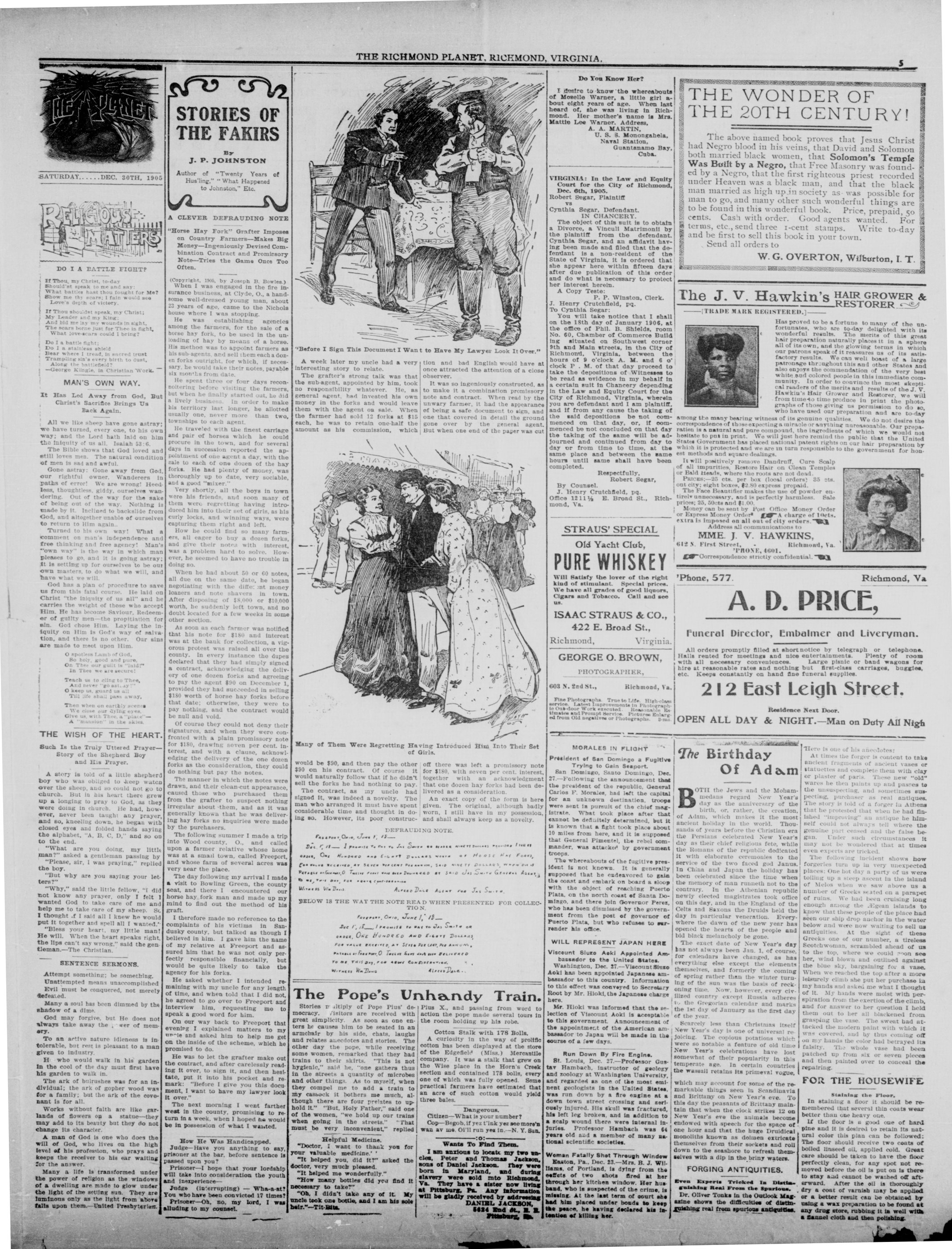
DEFRAUDING NOTE.
Freeport, Ohio, June 1, 183
Dec. 1, 183 — I promise to pay to Jes Smith or beher ninety dollars provided in order, One Hundred and Eighty Dollars worth of House Hay Forks, for values received, at Seven Percent Premium, said ninety dollars, when this is delivered, at Seven Percent Premium, said Jes Smith General Agent, to me this day, for advice consideration.
Witness Win Doe.
Alfred Dale Agent for Jes Smith.
BELOW IS THE WAY THE NOTE READ WHEN PRESENTED FOR COLLECTION.
DEFRAUDING NOTE.
PORT, OMIO, JUNE 1, 183
I PROMISE TO PAY TO JAE SMITH BE BEER NINETY
HUNDRED AND EIGHTY DOLLARS WORTH OF
RECEIVED, AT SEVEN POPCENT PICANUM, SAID NINETY
FORT, O TWELVE FOOT HAVE BEEN DELIVERED BY SAID JAS
DON, FOR ABOVE CONSIDERATION.
EFRAUDING NOTE.
On Jas Smith be reader ninety dollars provided 1128
forty dollars worth of Horse Hay Forks,
cent Preamium, said ninety dollars when due
been delivered by said Jas Smith General Agent,
sation.
Dec. 18, 1818 — I PROMISE TO PAY TO JAS SMITH BE BEING NINETY DOLLARS PROVIDED IMMEDIATELY
ORDER, ONE HUNDRED AND EIGHTY DOLLARS WORTH OF HOUSE HAY FORKS,
CONVOLVED RECEIVED, AT SEVEN PERCENT PREMIUM, SAID NINETY DOLLARS, IMPORTS
PACKAGE OF FURNITURE, TWO TWENTY FOOT WAS BEEN DELIVERED BY SKID JAS SMITH GENERAL AGENT,
TO ME THIS DAY, FOR HOME CONFIDENTIALITY.
Witness Wm Davis.
Alfred Dale Agent for Jas Smith.
BELOW IS THE WAY THE NOTE READ WHEN PRESENTED FOR COLLECTION.
Foreport, Ohio, June 18, 1818.
DEC F, 19_____ I PROMISE TO PAY TO JAS Smith OR
ORDER, ONE HUNDRED AND EIGHTY DOLLARS
FOR VALUE ENTERED, AT SIXEES PENT, PER ANNUUM.
PATENTED AT FOREPORT. O TWELVE HOURS HAVE BEEN DELIVERED
TO THIS DAY, FOR ABOVE CONSIDERATION.
Witness Wm.Davis.
Alfred Dale.
The Pope's Unhandy Train.
The Pope's Unhandy Train.
Stories multiply of Pope Plus' democracy. Visitors are received with great simplicity. As soon as one enters he causes him to be seated in an armchair by his side, chats, laughs and relates anecdotes and stories. The other day the pope, while receiving some women, remarked that they had trains to their skirts. "This is not hygienic," said he, "one gathers thus in the streets a quantity of microbes and other things. As to myself, when they compel me to add a train to my cassock it bothers me much, although there are four prelates to uphold it." "But, Holy Father," said one of the women, "we hold up our trains when going in the streets." "That must be very inconvenient." replied
Helpful Medicine
"Doctor, I want to thank you for your valuable medicine."
"It helped you, did it?" asked the doctor, very much pleased.
"It helped me wonderfully."
"How many bottles did you find it necessary to take?"
"Oh, I didn't take any of it. My uncle took one bottle, and I am his sole heir."-Tit-Bita.
tion and bad English would have at once attracted the attention of a close observer. It was so ingeniously constructed, as to make it a combination promissory note and contract. When read by the unyairy farmer, it had the appearance of being a safe document to sign, and one that covered in detail the ground gone over by the general agent. But when one end of the paper was cut
off there was left a promissory note for $180, with seven per cent, interest, together with with an acknowledgment that one dozen hay forks had been delivered as a consideration.
An exact copy of the form is here given. The original, although badly worn, I still have in my possession, and shall always keep as a novelty.
Plus X., and passing from word to action the pope made several tours in the room holding up his robe.
Cotton Stalk with 175 Bells
A cotton stalk with 178 bolls.
A curiosity in the way of prolific cotton has been displayed at the store of the Edgefield (Miss.) Mercantile company. It was a stalk that grew on the Wise place in the Horn's Creek section and contained 178 bolls, every one of which was fully opened. Some practical farmers have estimated that an acre of such cotton would yield three bales.
Dangerous.
Citizen—What is your number?
Cop—Begob, if you t'ink yez see more'n wan ay me. Oll' run yez in... N. Y. Sun.
Wants To Find Them.
I am anxious to locate my two uncles, Peter and Thomas Jackson, sons of Daniel Jackson. They were born in Maryland, and during slavery were sold into Richmond, Va. They have a sister now living at Pittsburg, Pa. Any information will be gladly received by addressing DANIEL JACKSON.
5624 End St., B. R.
Pittsburg, N.
Do You Know Her?
I desire to know the whereabouts of Moselle Warner, a little girl about eight years of age. When last heard of, she was living in Richmond. Her mother's name is Mrs. Mattle Lee Warner. Address,
A. A. MARTIN,
U. S. S. Monongahela,
Naval Station,
Guantanamo Bay,
Cuba.
VIRGINIA: In the Law and Equity
Court for the City of Richmond,
Dec. 6th, 1905.
Robert Segar, Plaintiff
vs
Cynthia Segar, Defendant.
IN CHANCERY.
The object of this suit is to obtain
a Divorce, a Vincull Matrimonil by
the plaintiff from the defendant.
Cynthia Segar, and an affidavit having
been made and filed that the defendant is a non-resident of the
State of Virginia, it is ordered that
she appear here within fifteen days
after due publication of this order
and do what is necessary to protect
her interest herein.
A Copy Teste:
P. P. Winston, Clerk.
J. Henry Crutchfield, pq.
To Cynthia Segar:
You will take notice that I shall on the 18th day of January 1906, at the office of Phil. B. Shields, room No. 60, Chamber of Commerce Building situated on Southwest corner 9th and Main streets, in the City of Richmond, Virginia, between the hours of 9 o'clock A. M. and 6 o'clock P. M. of that day proceed to take the depositions of Witnesses to be read as evidence in my behalf in a certain suit in Chancery depending in the Law and Equity Court for the City of Richmond, Virginia, wherein you are defendant and I am plaintiff, and if from any cause the taking of the said depositions be not commenced on that day, or, if commenced be not concluded on that day the taking of the same will be adjourned and continued from day to day or from time to time, at the same place and between the same hours until same shall have been completed.
By Counsel.
J. Henry Crutchfield, pq.
Office 1211½ E. Broad St., Rich-
mond, Va.
STRAUS' SPECIAL
Old Yacht Club,
PURE WHISKEY
Will Satisfy the lover of the right
kind of stimulant. Special prices.
We have all grades of good liquors,
Cigars and Tobacco. Call and see
us.
ISAAC STRAUS & CO.,
422 E. Broad St.,
Richmond, Virginia.
GEORGE O. BROWN.
PHOTOGRAPHER.
603 N. 2nd St.
603 N. 2nd St., Richmond, Va.
Fine Photographs. True to Life. High-class
service. Latest Improvements in Photographs
and Images. Excited Presentations. Estimates
and Prompt Images. Pictures Enlarged
from Old negatives or Photographs. 3-ms
President of San Domingo a Fugitive Trying to Gain Seaport.
Trying to Gain Seaport.
San Domingo, Santo Domingo, Dec. 27.—Following the announcement that the president of the republic, General Carlos F. Morales, had left the capital for an unknown destination, troops were sent in pursuit of the chief magistrate. What took place after that cannot be definitely determined, but it is known that a fight took place about 10 miles from here, and it is supposed that General Pimentel, the rebel commander, was attacked by government troops.
The whereabouts of the fugitive president is not known. It is generally supposed that he endeavored to gain the coast and embark on board a ship with the object of reaching Puerto Plata, on the north coast of Santa Domingo, and there join Governor Perez, who has been dismissed by the government from the post of governor of Puerto Plata, but who refuses to surrender his office.
WILL REPRESENT JAPAN HERE
Viscount Siluro Aoki Appointed Ambassador to the United States. Washington, Dec. 27.—Viscount Siluro Aoki has been appointed Japanese ambassador to this country. Information to this effect was conveyed to Secretary Root by Mr. Hioki, the Japanese charge here. Mr. Hioki was informed that the selection of Viscount Aoki is acceptable to this government. Announcement of the appointment of the American ambassador to Japan will be made in the course of a few days.
Run Down By Fire Engine
St. Louis, Dec. 27.—Professor Gustav Hambach, instructor of geology and zoology at Washington University, and regarded as one of the most eminent geologists in the United States, was run down by a fire engine at a down town street crossing and seriously injured. His skull was fractured, his left leg broken, and in addition to a scalp wound there were internal injuries. Professor Hambach was 64 years old and a member of many national scientific societies.
Woman Fatally Shut Through Window
Easton, Pa., Dec. 23.—Mrs. B. J. Williams, of Portland, is dying from the effects of two shots fired at her through her kitchen window. Her husband, who is suspected of the crime, is missing. At the last term of court she had him placed under bonds to keep the peace, he having declared his intention of killing her.
THE WONDER OF THE 20TH CENTURY!
The above named book proves that Jesus Christ had Negro blood in his veins, that David and Solomon both married black women, that Solomon's Temple Was Built by a Negro, that Free Masonry was founded by a Negro, that the first righteous priest recorded under Heaven was a black man, and that the black man married as high up in society as was possible for man to go, and many other such wonderful things are to be found in this wonderful book. Price, prepaid, 50 cents. Cash with order. Good agents wanted. For terms, etc., send three 1-cent stamps. Write to-day and be first to sell this book in your town.
Send all orders to
W. G. OVERTON, Wilburton, I. T.
The J. V. Hawkin's HAIR GROWER RESTORER
The J. V. Hawkin's HAIR GROWER & RESTORER
[TRADE MARK REGISTERED.]
Has proved to be a fortune to many of the unfortunate, who are to-day delighted with its wonderful results. The merits of this great hair preparation naturally places it in a sphere all of its own, and the glowing terms in which our patrons speak of it reassures us of its satisfactory results. We can well boast of a large patronage throughout this and other States and also enjoys the commendation of the very best white and colored people in this immediate community. In order to convince the most skeptical readers of the merits and results of the J. V. Hawkinson's Hair Grower and Restorer, we will from time to time produce in print the photographs of those giving us permission to do so, who have used our preparation.
among the many bearing witness of its genuine qu
correspondence of those expecting a miracle or anyi
ration is a natural and pure compound, the ingredi
haste to put in print. We will just here remind
States Government has placed national patent right
which it is protected and we are in turn responsible
est methods and square dealings.
It will positively remove Dandruff. Cure Scall
of all impurities, Restore Hair on Clean Temple
or Bald hairs, where the roots are not dead.
Prices:-25 cts. per box (local orders) 35 cts
out city; eight boxes, $2.80 express prepaid.
The Face Beautifier makes the use of powder en
trelly unnecessary, and is perfectly harmless. Sal
prices; 25, 50 cts and $1.00.
Money can be sent by Post Office Money Order
or Express Money Order A charge of 10cts
extra is imposed on all out of city orders.
Address all communications to
MME. J. V. HAWKINS,
612 N. First Street,
Richmond, Va.
PHONE: 4601.
among the many bearing witness of its genuine qualities. We do not desire the correspondence of those expecting a miracle or anything unreasonable. Our preparation is a natural and pure compound, the ingredients of which we would not hesitate to put in print. We will just here remind the public that the United States Government has placed national patient rights on our hair preparation by which it is protected and we are in turn responsible to the government for honest methods and square dealings.
It will positively remove Dandruff, Cure Scalp of all impurities, Restore Hair on Clean Temples or Bald Heads, where the roots are not dead. Prices:—25 cts. per box (local orders) 35 cts. out city; eight boxes, $2.80 express prepaid. The Face Beautifier makes the use of powder entirely unnecessary, and is perfectly harmless. Sale prices; 25, 50cts and $1.00. Money can be sent by Post Office Money Order or Express Money Order. A charge of 10cts, extra is imposed on all out of city orders.
Correspondence strictly confidential.
A. D. PRICE,
Funeral Director, Embalmer
All orders promptly filled at short notice by Halls rented for meetings and nice entertain with all necessary conveniences. Large hire at reasonable rates and nothing but first etc. Keeps constantly on hand fine funeral
212 East Leigh
Funeral Director, Embalmer and Liveryman.
All orders promptly filled at shortnotice by telegraph or telephone. Halls rented for meetings and nice entertainments. Plenty of room with all necessary conveniences. Large pisic or band wagons for hire at reasonable rates and nothing but first-class carriages, buggies, etc. Keeps constantly on hand fine funeral supplies.
212 East Leigh Street.
Residence Next Door.
The Birthday Of Adam
BOTH the Jews and the Mohammedans regard New Year's day as the anniversary of the birth, or, rather, the creation, of Adam, which makes it the most ancient holiday in the world. Thousands of years before the Christian era the Persians celebrated New Year's day as their chief religious fete, while the Romans of the republic dedicated it with elaborate ceremonies to the service of the two faced god Janus. In China and Japan the holiday has been celebrated since the time when the memory of man runneth not to the contrary. In the Athenian republic newly elected magistrates took office on this day, and in the England of the Celts and Saxons the Druids held the day in particular veneration. Everywhere the dawn of the new year has opened the hearts of the people and bid black melancholy be gone.
The exact date of New Year's day has not always been Jan. 1, of course, for calendars have changed, as has everything else except the elements themselves, and formerly the coming of spring rather than the winter turning of the sun was the basis of reckoning time. Now, however, every civilized country except Russia adheres to the Gregorian calendar and marks the 1st day of January as the first day of the year.
Scarcely less than Christmas itself New Year's day is one of universal rejoicing. The copious potations which were so notable a feature of old time New Year's celebrations have lost somewhat of their popularity in this temperate age. In certain countries the wassail retains its primeval vogue,
which may account for some of the remarkable things seen in Scandinavia and Brittany on New Year's eve. To this day the peasants of Brittany maintain that when the clock strikes 12 on New Year's eve the animals become endowed with speech for the space of one hour and that the huge Druidical monoliths known as dolinen extricate themselves from their sockets and roll down to the seashore to refresh themselves with a dip in the briny waters.
In staining a floor it should be remembered that several thin coats wear better than one heavy one.
If the floor is a good one of hard pine and it is desired to retain its natural color this plan can be followed: The floor should receive two coats of boiled linseed oil, applied cold. Great care should be taken to have the floor perfectly clean, for any spot not removed before the oil is put on is there to stay and cannot be washed off afterward. After the oil is thoroughly dry a coat of varnish may be applied or a better result can be obtained by using a wax preparation to be found at any drug store, rubbing it in well with a flannel cloth and then polishing.
FORGING ANTIQUITIES.
Even Experts Tricked In Distinguishing Real From the Spurious. Dr. Oliver Tonks in the Outlook Magazine shows the difficulties of distinguishing real from spurious antiquities.
A. B.
'Phone, 577.
---
A. B.
Richmond, Va
There is one of his anecdotes:
At times the forger is content to take ancient fragments of ancient vases or statuettes and complete them with clay or plaster of paris. These new "old" wares he then paints up and passes to the unsuspecting, and sometimes suspecting, purchaser as real antiques. The story is told of a forger in Athens that he protested that when he had finished "improving" an antique he himself could not always tell where the genuine part ceased and the false began. Under such circumstances it may not be wondered that at times even experts are tricked.
The following incident shows how forgeries turn up in very unexpected places; One hot day a party of us were toiling up a steep ascent in the islands of Melos when we saw above us a number of Greeks seated on a parapet of ruins. We had been cruising long enough among the Aegean islands to know that these people of the place had seen our ship anchor in the water below and were now waiting to sell us antiquities. At the sight of these Greeks one of our number, a tireless Scotchwoman, scrambled ahead of us to the top, where we could soon see her, wind blown and outlined against the blue sky, bargaining for a vase. When we reached the top after a more leisurely climb she put her purchase in my hands and asked me what I thought of it. My hands were moist with perspiration from the exertion of the climb, and for answer to her question I held them out to her all blackened from grasping the vase. The sweat had attacked the modern paint with which it was covered, and by thus coming off on my hands the color had betrayed its falsity. The whole vase had been patched up from six or seven pieces and then painted over to conceal the repairing.
FOR THE HOUSEWIFE
Staining the Floor.
The RESULT of A NEW YEAR'S VISIT
By ALICE LOUISE LEE
THE cat, indeed! Aunt Mary, you have told me a dozen times that you detest that cat."
Mrs. Spud leaned over her traveling bag and tightened a strap, saying energetically, "Niece Mary, a cat's a cat, whether I detest it or not, and I can't see it starve."
"But, Aunt Mary," protested her niece helplessly, "I've been years getting you here, and the next day you burry home to feed an old, whiskerless cat."
Mrs. Spud's eyes smiled, but her lips were firmly set. She tied her bonnet ribbons carefully beneath her chin.
"I've noticed," she said, "that a cat's appetite and its whiskers have no connection."
"But there is Uncle Jack," expostulated her niece, holding up a long fur lined cloak.
Mrs. Spud drew it over her shoulders. A softened expression came into her eyes at the name, but her tone was still grim. "Why, child, his patient keeps Jack that busy he will never think of the cat. No; it's my duty to go home. Give my love to John and hand me my umbrella, please." Later Mrs. Spud's niece explained her aunt's departure to John. "Isn't it horrid?" she cried with tears in her eyes. "Think of that old cat's cutting her first visit down to a day and a night!" John laughed and laid down the carving knife. "It isn't the cat, Mary. Re-
```markdown
```
THE WEEKLY PRESS
HE LED HER TO THE SAFE.
member this is the first time she and Uncle have been separated twenty-four hours in their married life."
The reason contained in John's remark was the truth, but Mrs. Spud, fairly pushing the train along, did not like to admit it because it seemed so childish. Therefore she repeated persistently to herself that if she kept cats she owed it to them not to let them starve.
As the train drew into Shemung station Mrs. Spud's eyes lightened. She sent out a silent welcome to the old station, to the village planted against the snowy hillside, to the return train waiting on the other side of the platform, the train which had carried her to her niece's the previous evening.
As the brakeman eased her descent she curbed her joy and pushed the cat to the foreground of her thoughts. "It shall have an extra saucer of milk," she remarked firmly to herself.
Just then a familiar voice behind her exclaimed in surprise, "My dear, is this possible?"
Mrs. Spud turned as rapidly as her rotundity permitted, and there before her stood Dr. Spud. He was dressed as if for a journey, but this wife did not notice. His white head was crowned by a tall silk hat. He wore his heavy overcoat and carried in one neatly gloved hand a small grip and umbrella. The other hand he held out in formal greeting, although his face beamed as he looked down at his wife. Her face beamed also, but she shook hands with no show of eagerness and immediately took her husband's proffered arm. Together they trudged up the snow covered path, one tall, straight and white headed, the other short, plump, with glistening silvery hair.
Mrs. Spud, climbing with two steps to the doctor's one, was suddenly thrown into confusion by the question, "Mary Anne, why didn't you finish your visit?"
She took a fresh hold on her husband's arm. "Why, I forgot to tell you. Jack, what to feed the cat."
The doctor smiled a little in the darkness. He made no comment until he had opened the front door of their home and stood aside for his wife to enter. Then he said hesitatingly, "You have forgotten, my dear, that the cat died in a fit last week."
Mrs. Spud made an inarticulate sound. She felt foolish, but hid it under a deal of unimportant bustle through the house. She sought to banish the memory of cats in fits by viewing every corner with the sharp eyes of a good housekeeper. Nothing escaped her—the bread jar left uncovered, the dishpan hung on the wrong nail, the table spread creased into awkward folds.
"That man, that man!" she softly exclaimed. "If I hadn't come tonight, where would he have had things by to-
morrow? And if here isn't the study
door open, letting in all that cold."
door open, letting in the light.
She burried across the floor to close the offending door and glanced within. It was Dr. Spud's old time private office and study. It was almost abandoned, its safe rusty, its books unused, for in place of the dozen of patients once crowding it there remained only one who seemed to have absorbed the complaints of the previous dozens.
Mrs. Spud, with her hand on the door knob, glanced at the large, old fashioned fireplace. She had left it empty and clean. There were now some ashes and charcoal in the grate.
"How came you to build a fire in here?" she asked wonderingly.
"I had a little work to do in there, my dear," was all the reply he made.
"When?" asked Mrs. Spud, closing the door.
"Both yesterday and today," he answered and, to Mrs. Spud's wonder, added no explanation.
Suddenly an idea occurred to her. She leaned forward. "Jack," she said quickly, "how did you happen to meet that train tonight?" He played with the poker a moment. "Why, Mary Anne, I found something you had forgotten to take with you. I was afraid you'd need it, and I intended to take that up train to your niece's, but"— He ended lamely and searched his pockets. Presently he produced a long article wrapped in tissue paper. His wife took it in surprise, removed the
THE BOOKS
A.H.
MBS. SPUD TURNED AS RAPIDLY AS HEE
ROTUNDLY PERMITTED.
MRS. SPUD TURNED AS RAPIDLY AS HEER ROTUNELY PERMITTED.
paper and held up—her best black gauze fan! She fell back in her chair.
"A gauze fan on the 2d of January." was all she said, but she felt better about the cat.
Several times the following morning Mrs. Spud's thoughts recurred to the unusual circumstance of the study fire and the work which had necessitated it. She wondered, but asked no questions. That was her way. By dinner time she had forgotten the matter. After tea she was singing over her dishpan when Dr. Jack appeared from the wood shed, his arms full of kindlings.
He paused on the living room threshold and said simply, "I think I'll work awhile in the study this evening, my dear."
She did not allow herself to speak, but nodded at him brightly. Later her lips set themselves firmly as she heard the study door close. She felt hurt at the apparent lack of confidence on her husband's part even in a slight matter. A tear rolled over her still rounded cheek. Then she took herself to task. She rattled the dishes and said aloud to divert her thoughts, "I hope Nicee Mary will never learn about that cat." "My dear," came a voice from the study, "are you speaking?" She appeared, her hands full of dishes, and smiled loyally at the doctor in the study door opposite. "Yes, Jack, I was speaking to myself about—well, about Nicee Mary." Dr. Spud smiled and, closing the door, quietly turned the key. This was
THE RICHMOND PLANET, RICHMOND, VIRGINIA
JOB DEPARTMENT
EXCURSION
We print Handbills, Quarter-Sheet posters, Tags, Tickets, Placards, Visiting Cards, Mourning Stations
WE HAVE
Our St.
OF THE LATE
WE CAN PRINT A BILL AS SMALL
A Three-Sheet
AS LARGE AS A FRO
Our street-entrance is retired and fastidious lady being able to enter w
MISSION WORK
Charter-Sheets, Half and Whole
Placards, Society Cards, Mini-
ing Stationery.
WE AN ELE
WHICH WE WILL
Stock Roof
THE LATEST STYLE BOND, F
AS SMALL AS A DODGER
Sheet Poster
A FRONT DOOR.
OUR PRESENT CORP OF EMPLOYE
IS WITHIN EASY REACH OF
tired and has no objectionable
enter without embarrassment
, 2213.
EXCURSION WORK OF ALL DESCRIPTIONS
We print Handbills, Quarter-Sheets, Half and Whole Sheet posters, Tags, Tickets, Placards, Society Cards, Minutes, Visiting Cards, Mourning Stationery.
WE CAN PRINT A BILL AS SMALL AS A DODGER. A Three-Sheet Poster AS LARGE AS A FRONT DOOR. WE HAVE ONE OF THE LARGEST OF WOOD-T Of Any Job Printing Establishment
Our street-entrance is retired and has no objectionable features, the most fastidious lady being able to enter without embarrassment or annoyance.
LONG DISTANCE TELEPHONE, 2213.
She returned to the living room with quivering lips and sat down in her chair. Then she noticed that the study door was open and the lamp placed on the writing desk was flaring in the draft. For a long time she sat and watched that lamp. It was her duty to remove it, yet her feet almost refused to carry her into that room.
He paused a moment. His wife gave a half sob, "Jack!" and the name came straight from a heart which was whole and sweet again.
"That day I was so strongly impressed that it will doubtless be my turn first to take the long journey"—he raised his seventy-year-young face reverently—"and that it will be your turn to be left alone."
His voice broke, and there was a brief silence. Mrs. Spud slipped her other hand between her husband's. The tears were slowly dropping on her cheeks, but they were not tears of pain.
"And so, my dear," the doctor continued, "I did this." He looked down at their feet. "There will be a little message for you each day in the year
It is thoroughly equipped to do all kinds of printing on short notice. We make a specialty of Society printing and work for Insurance Companies, such as Financial
the straw that broke the camel's back. Mrs. Spud stood bewildered. She had never heard that key turned against her before. She went back to the kitchen and remained there a long time. She no longer conversed with herself about the cat.
But an hour later, when Dr. Spud unlocked the study door and backed up to the living room stove in his favorite attitude, his nearsighted eyes saw an apparently placid Mrs. Spud comfortably seated in her big rocker, and while he stood, his hands clasped behind him, she read the "locals" aloud, as usual.
The next morning she awoke early and began wondering with an uncomfortable heaviness of heart whether the study fire would be built that day. It was. Directly after tea Dr. Jack again appeared with his arms full of wood and said in his mild, affectionate voice, "My dear, I think I shall occupy the study awhile tonight," and his wife whispered to herself over the dishpan, "Why did I go to Nice Mary's on New Year's day?" and her lip quivered pitifully with the whisper. Whatever the work was, it proved to be a daily task. Until a warm June sun heated the study Dr. Spud carried his arm full of kindling from the wood shed directly after tea. If he noticed that his wife gradually busied herself in other parts of the house at that time he made no comment, and the subject, after a few weeks, was never mentioned by either.
As the year wore itself out the people of Shemung began to remark to each other that at last Mrs. Spud was beginning to show her age. If this were true, it was due to the daily turning of the key in the study door. That represented the only sore spot her heart held.
To Dr. Jack she was the same loyal, loving wife that he had always known. Not a shadow from the study door did she allow to fall across her manner with him. Otherwise she would have scorned herself.
But to herself she acknowledged that it was the longest year she had ever spent. This thought was uppermost in her mind as she sat on New Year's eve beside the stove in the living room reading the daily paper. She was alone and had been for a longer time than usual, for the study door was closed. Suddenly the outside doorbell rang. Mrs. Spud laid aside the paper and arose to respond. Before she had reached the door, however, it opened, and a young man came tramping in. "Where's the doctor?" was his unceremonious greeting. "Mr. Brown is dying."
Mr. Brown was Dr. Spud's last patient.
"Dying!" cried Mrs. Spud, aghast. She started toward the study door. Her hand was on the knob before she recalled herself. She stopped. She had not once during the year approached that locked door.
"The doctor is in his office," she said in a low tone. "Will you step in and tell him?"
The young man gave her a surprised glance, but obediently rapped on the door, while Mrs. Spud retreated into the kitchen. There she remained only until the sounds indicated that the doctor had reached the front hall. Then
Cards, Policies, both straight life and benevolent, Physician's Certificates, Gick Cards, Application blanks, Agents Report Sheets, Rate Cards, etc.
WORK C
Half and Whole Society Cards, Ministry.
is to please give them the lowest with satisfaction.
AN ELEGANT WHICH WE WILL SHOW A Rock Room D STYLE BOND, FINE WRITING
AS A DODGER.
Poster DOOR.
PRESENT CORP OF EMPLOYEES ARE IN EASY REACH OF THE PUBLIC.
has no objectionable features, the out embarrassment or annoyance.
OUR PRESENT CORP OF EMPLOYEES ARE COMPETENT AND QUICK-WORKING. OUR OFFICE IS WITHIN EASY REACH OF THE PUBLIC, BEING WITHIN FIFTY YARDS OF BROAD ST.
she followed him and put him into his greatcoat, tucking him in and patting the corners as she used to do when he faced the storms of a winter night. With his tall hat in his hand, Dr. Spud stooped suddenly and kissed his wife's forehead. Although affection for her showed in every word and action, such demonstrations on his part were rare, and that kiss seemed to deepen the sore spot in Mrs. Spud's heart.
Finally she forced herself to the door. There she stopped. A chill air struck her. The fire had died down. "Jack ought not to work here in the cold," she said softly, looking about her. Her eyes traveled slowly around the room, coming to a surprised halt at the safe. It was open. Evidently Dr. Spud had been interrupted in the midst of some unusual task. In the safe and heaped before it on the floor lay a pile of clean white envelopes. From where she stood Mrs. Spud saw they were sealed. She did not go nearer because her sense of honor forbade. She did not retreat because surprise weighted her feet. The firing lamp and the chill air were forgotten. She was finally aroused by her husband's voice. He stood beside her. "My dear, you have discovered a little secret of mine." His wife started guiltily and looked up into the strong old face which shone down on her tenderly. She could not speak.
Dr. Spud raised her plump left hand and held it in his. "I had not intended you should know until"—He paused abruptly and led her to the safe. An envelope lay face up on the pile. In a large, irregular, scarcely familiar hand was written, "For my Wife." and following was the date of the previous New Year's day.
"Jack!" said Mrs. Spud tremulously. Her husband patted her hand lovingly, the hand that had worn the old fashioned wedding ring so long.
"This may have been a foolish idea, my dear. It came to me last New Year's day after you had gone to your niece's. You had gone on such a little journey, such a short time, yet I was lonely."
RK OF ALL
OUR AIM
is to please our patrons and to
give them the best service at
the lowest prices, consistent
with satisfactory work.
LEGANT I
SHOW ANY ONE DESIRING
om Embrace
NE WRITING—FLAT AND
ELOYEES ARE COMPETENT AND QUALIFIED THE PUBLIC, BEING WITHIN F
features, the most or annoyance. FOR FUR
Jol
when the Journeying time comes to me. I had intended to keep it all from you—as a surprise then—but this is as well that you should know that they are here for you".
Dr. Spud did not go on. He stood with moist eyes smiling down at his wife, and she smiled back with the tears raining over her cheeks.
"Jack," she began. She had so much to tell him about that year, yet the words seemed to bank up against her lips, and all that reached Dr. Spud's ears was that old incongruous, affectionate name: "Jack! Oh, Jack!"
Frank Waller, Jr
PRACTICAL HOUSE
PAINTER.
Residence, 1 E. Orange St.
Prompt attention given to all mailers. Satisfaction guaranteed.
1 Kinds of Painting Done Cheap.
Give me a call before going else
where.
New 'Phone, 478.
ROBT. S. FORRESTER,
FLORIST
212 E. Leigh Street,
RICHMOND, VIRGINIA.
Plant Decorations, Choice Rosebuds, Cut Flowers, Funeral Designs,
House Decorations for Wedding Parties,
&c. a specialty. Give me a call.
Pure and Fresh Mediomes only will cure you then purchase your Drugs and Medicine from: Leonard's Reliable Prescription Drug Store 724 North Second Street. BEFORE MAKING Your purchase you would do well to call as the most reliable furniture house in the city and see the fine line of
Refrigerators,
Mattings, Oil-Cloths,
And in fact everything that is need-
ed in house furnishings.
RUGS AND CARPETS.
Of every description also the la-
stest designs in ROOKERS and spe-
cial CHAIRS. Our goods are the
best for the price and the price is
very low.
C. G. Jurgen's Son
421 EAST BROAD ST.,
between 4th and 5th Street
We print Wedding Invitations, and High Class Stationery for Balls, Parties, Picnics and all entertainments of a social nature.
ALL DESCRIBE
ions and to service at consistent work.
We furnish "cuts" when desired special work in our line, call and see us an
T LINE OF S
DESIRING TO SEE THEM.
braces a full
AT AND LINEN PAPER, ENVELOP
WE HAVE ONE OF THE OF WOOD
Of Any Job Printing B
NT AND QUICK-WORKING. OUR OFFICE WITHIN FIFTY YARDS OF BROAD ST.
OR FURTHER INFORMATION, A
John Mitch
311 N. 4th St
FOR FURTHER INFORMATION, APPLY TO
John Mitchell, Jr.
A
WE HAVE ONE OF THE LARGEST ASSORTMENTS OF WOOD-TYPE Of Any Job Printing Establishment in the city.
811 N. 4th St., Richmond, Va.
PETER
MRS. MARTH, the world renowned and highly celebrated business and Test Medium, has no impositions. Can be consulted upon all aspects of business and marriage a speciality. Every mystery revealed, also of absent, deceased and living members, challenges any Medians who can exceed her in starting a business of the past, she will not for any price fatter you, you may rest assured on you what facts without non-confidence. Life, Love, Courtship, Marriage Friends, Ec., with full description of your future com pan friends, enemies etc., business, law wits journeys, contested wills, divorce and specialised friends, enemies etc., business, law wits your destiny—good or bad: she withholds nothing.
world who叫 tell you the full name of your job,
the name of your mourn go, and tells whoh
the one you love mourn go.
It takes a great deal of study to become an astronaut, and unanticipated effort, the key to the success of unfathomable mysteries has been secured by MRS. MARTH for the benefit of humanity.
CHICKASHA,
INDIAN TERRITORY.
(BOX, No. 958.)
Smoke Stamp for reply.
opes, Note and Letter Paper
Bill-heads, Monthly Statements,
Business Cards, Financial and Order Books,
Circulars, Check-books, Pamphlets.
SCRIPTIONS
Iresired and we will arrange to
line. When in need of any work
and estimates will be furnished.
SAMPLES
Line
PES, ETC.
LARGEST ASSORTMENTS
OD-TYPE
Establishment in the city.
PLY TO
nell, Jr.,
Richmond, Va.
'Phone, 1589.
Residence. No. 911-32d St.
ROBT. W. WILLIAMS,
FUNERAL DIRECTOR &
EMBALMER.
NO. 3019 P. STREET, BETWEEN
30TH AND 31ST STREETS.
Special attention given to all business entrusted to me. Carriages for funerals, receptions and marriages at all hours. Satisfaction guaranteed to all.
A. Hayes
OFFICE AND WARE-ROOMS,
727 North Second Street.
RESIDENCE, 725 N. 2nd St.
First-class Hacks and Caskets of all descriptions. I have a spare room for bodies when the family have not a suitable place. All country orders are given special attention. Your special attention is called to the new style Oak Caskets. Call and see me and you shall be waited on kindly.
'Phone, 2778.
THE
Custalo House,
702 East Broad Street.
Having remodeled my BAR, and having an up-to-date place, I am prepared to serve my friends and the public at the same old stand.
CHOICE WINES, LIQUORS & CIGARS.
FIRST CLASS RESTAURANT,
MEALS AT ALL HOURS.
New 'Phone 1261,
WM. CUSTALO, - Prop.
S. W. ROBINSON,
NO. 23 NORTH 18TH ST.
DEALER IN
FINE WINES, LIQUORS,
CIGARS. &c.
SATURDAY....DEC. 30TH. 1905
BRUTALITIES ATODESSA
Eyewitness Tells of Massacre of Jews by Russians.
THREE DAYS AT MEROY OF MOBS
Perrible Scenes of Carnage That Followed the Proclamation of the Oar's Grant of a Constitution—Cruelty of the Hooligans and Police Was Unspeakable.
Solomon Brodsky, a Jewish watchmaker of Odessa, who recently arrived in London from that town, gave a London Telegraph representative a graphic description of the terrible scenes of bloodshed which occurred there a few days ago. Mr. Brodsky is a prominent member of the revolutionary party in Odessa, and it was because he took a prominent part in the defense of his conglionists and thereby became a marked man that he fed from the town in fear of his life, being provided with funds by the revolutionary party to enable him to go to London to assist in raising funds for the revolutionary movement.
Mr. Brodsky attributed the commencement of the attack upon the Jews to the issue of a proclamation inspired by the police asserting that Jewish revolutionaries were plotting to take the life of the czar. At the time the proclamation was issued great moos of loyalist holligans were parading the streets, rejoicing over the czar's manifesto promising a constitution. The holligans at once raised the cry of "Down with the Jews!" attacks on the Jewish quarters began, and for three days the whole city was given up to scenes of indescribable horror.
"Early on Wednesday morning (Oct. 20)," continued M. Brodsky, "I was awakened by a terrible uproar in the street. Arming myself with a revolver, I went out and found a great mob of hooligans and disguised policemen, armed with swords and revolvers, attacking a house where several families of Jews resided, their object being murder and robbery. The Jews tried to defend themselves, but they were soon overpowered, and nearly every person in the house was killed or wounded and the place pilled.
"Then a body of the Social Democratic league came upon the scene and called upon the people to bring out as many arms as possible to fight the police and hooligans. Returning to my house, I brought out two large daggers, one of which I gave to another person, keeping the other myself. A desperate fight then took place, and I was in the thick of it, revolvers, daggers and sticks being freely used. Hearing a cry for help, I turned round and saw a young girl of about fourteen or fifteen being struck on the head by a hooligan with a huge stick. This got my blood up, and, aiming my revolver at the man, I shot him dead. My act was witnessed by the police. Several of them made a rush for me, and one of them tried to fell me with a rifle. I ran away, with the police in hot pursuit, but after they had chased me through two or three streets I managed to enter a house unnoticed by them and hid there for two hours. As soon as I ventured out, however, I was arrested, but a number of revolutionaries attacked the police and set me free.
"Scenes similar to that in which I took part were enacted in every part of the city. It was as though thousands of wild beasts had been let loose. The authorities made no attempt to maintain order. It was absolutely anarchy, and the Jews were in a state of fearful terror, fully expecting to be completely annihilated. The scenes on Thursday were, if possible, even worse, the greatest bloodshed occurring in two streets, Moldavanka and Preobrazhenskaya. To describe the horrible slaughter which took place here is quite impossible. Bodies of the dead and dying lay on the ground literally in hundreds, and the gutters ran ankle deep in blood, the sounds of the firing, the fierce shouts of the fighters and the groans of the wounded making it a perfect pandemonium. Fathers saw their sons and daughters killed before their eyes, and sons saw their mothers ruthlessly slaughtered by the hooligan mob. What wonder that everybody lost his humanity and fought like a wild beast!
"The cruelty of the hooligans and the police was unspeakable. I myself saw a policeman stamp savagely on the face of an old woman who was lying on the ground badly wounded and saw others who were wounded "finished off" by the police with the butt end of rifles. The bodies of horses and dogs lay mid-up indiscriminately with the bodies of men and women. So numerous were the victims—it was impossible to count them, for there were thousands—that the police could not cart them away quick enough, and during the night dogs and cats and rats actually fed upon the corpses. The bodies were taken away in thirties and forties in dust carts, and there was no attempt at proper burial. They were all thrown together into huge holes, irrespective of nationality, and covered over with lime.
"I became as one insane with the horrible scenes which I witnessed on every hand, and during Thursday evening, when I was attacked by several disguised policemen who were assisting a band of hooligans who were ill treating a number of students, I again lost my head and killed one of them by stabbing him in the eye with my dagger. Again I was obliged to flee into hiding, and the next day, knowing that I was now a marked man, I took the advice of the revolutionary leaders and fled."
CORPORATION PROBLEM
How Judge Peter S. Grosscup Would Solve It.
Chicago Jurist Favors Actual Control by Stockholders Under National Supervision—Regards Two Classes of Securities as Sufficient—Would Interest Labor.
Judge Peter S. Grosscup of the United States circuit court of appeals of Chicago believes he has found the solution for the control of great corporations. He proposes a plan for their "peopleization"—that is, their actual control by stockholders—under the supervision of the government. In an elaborately developed argument in the December number of the American Illustrated Magazine, from which this summary of the article is compiled by the Chicago News, he shows that corporations are gradually not only adding to their great holdings of property, but are practically owners of the immense wealth of the country.
"The butcher of today," he says, "is a corporation. The loaf of bread as it comes to us on the table is almost exclusively a corporation product. From whatever point of view, visual to the mind and eye, we may look at it, the domain of property, covered by the corporations, stands out as the great central fact in the industrial life of the century that is just opened."
Judge Grossecup does not hesitate to say frankly that the corporation of today is not a safe field for the small investor. It is its tremendously complex organization that makes it particularly unsafe, for, he says, there never was any need for the labyrinthian constructions that seem to be the order of the day—securities so overlying each other and often so involved that no one not an expert in buying a security can locate his claim. It is this state of affairs—this fear of being bunked—that leads the small investor to put his money in a savings bank.
Judge Grosssup points out the way whereby the corporations can be made not only safe, but so simple that the average investor can understand their organization and see clearly what he is getting for his money when he invests. He also places corporations in their proper light. He shows how they are the creatures of the law—a line or two in the statute books—and then puts forward his "peopleization" plan. The conclusions arrived at by the jurist are as follows:
First. The beginning of the way out is national incorporation.
Second.—The new corporation must be constructed on simple lines. Two classes of securities ought in every case to be constructed in such security that represents actual cash paid to the corporation and the security that may be issued from time to time as the value of the property actually increases and to cover such increased value. The corporation must then sell all such appurtened lines thus plainly put before the corporation not to be launched at all, for here, as elsewhere, mystery means not something essential to success, but something open to success. Third.—Provision for corporation's success. Third.—Provision for the terest labor in ownership. The securities issued on account of increased value should be issued only as the increase is made in prediction or expectation, but by such experience and provision should be made that such securities may be divided equitably between the capital invested and the labor put in and expeditents be adopted to enlarge corporations formed on that basis.
Fourth.—The corporation being trustees for its owners, the government must be given opportunity to exercise a constant watch supervision, something like the watch the government holds over the national banks, personal schemes would be reduced to a minimum. And, what is more, corporate activity would be limited to the name of personal and moral responsibility.
Fifth.—Provision should be made for a government exchange, or a private exchange under government supervision, through which the securities of national corporations could be bought and sold. His way would be drawn a distinctly visible border between securities of national corporations and national corporations that refuse to nationalize a line that would soon be understood as the boundary between corporations that were willing to be faithful trustees of the owners, faithful at the same time to their duties to the people, and corporations that own the interior designs. My own opinion is that this border differentiation of the national from the hybrid corporation would in time lead every corporation engaged in interstate commerce voluntarily to incorporate under the national law. A just plan of organization and supervision be offered, the people would permit the bank and insurance accumulations to be absorbed in corporations that refused the plan.
Throughout the article Judge Grosse-cup stands for individualism. He shows the benefit which the country received from the method of distributing lands in the west.
---
Fast Walking of Kansas Girls.
On a wager laid by W. W. Watson, president of a wholesale house in Salina, Kan., Miss Clara Hageman, Miss Mildred Hageman and Miss Ada Harris, society girls in Salina, recently walked four miles against time, says a Salina dispatch to the Kansas City Times. Mr. Watson at the table of a fashionable boarding house declared that it is impossible for a woman to walk four miles in one hour unless she is a trained athlete. The three girls immediately asserted that they could walk that distance in less than one hour. A wager of five pounds of candy was made with each girl, and at noon the party went to the race track at the fair grounds. Each girl won a box of candy, two walking the four miles in fifty-five and a half minutes and two in fifty-five and three-fourths minutes.
Scented Mattresses
In Paris it is the fad, it seems, to seek repose on scented mattresses, says the New York Press. Bags of different colored silks are made and filled with violet, hellotrope or lavender and sewed on the sides of the mattress. These bags, which impart to the bed a delicious fragrance, are tied with satin ribbons. Some of the scented mattresses are most elaborate affairs, and, though the dealers urge that they are sold for a mere song, it strikes most women that they must be those "songs" which are sung by high class opera birds for society's edification.
THE RICHMOND PLANET, RICHMOND, VIRGINIA
CHICAGO YOUTH
HAS QUEER BED
DRUNK. HE CHOOSES FLAG-STONE FOR REPOSE.
LAYS CLOTHES ABOUT HIM
Young Man of Good Family Is Aroused by Home-Going Party Late at Night — Residents Shocked by Incident.
Chicago.—The sidewalk in front of the Marine hospital, near Graceland, is a broad, level and altogether pleasant promenade, much frequented by nurses with their charges in the afternoons and by strolling couples in the evenings.
Its flagstones are of a whiteness which distinguishes this promenade from all others in the vicinity. And near the entrance of the hospital there is one particular flagstone that is whiter than all the last.
One night recently a party of Buena Park residents, one of whom is a physician in the public eye, were returning to their homes in Bittersweet place. The party here had their attention directed to the marble white flagstone, on which reposed an object not at first identified in the deep shadow of the great building.
"It's a man!" cried one of the women, venturing closer. So it was. Stretched on the white stone lay a young man clad only in a suit of pink underclothing.
Surrounding the reposeful young man was the clothing of which he had divested himself or been divested. A gray Newmarket coat lay neatly folded beneath a derby hat and a pair of smart yellow gloves. A natyc cane lay alongside. Close at hand were a sack coat and fancy waistcoat, also neatly folded, and at the edge of the white flagstone, laid out flat in strict conformance with the creases, was a pair of trousers. A little farther on a trim little pile of effects became, on examination, a delicately figured shirt, a collar, a flowing silk tie, and a handkerchief. Close by but not on the snowy flagstone, stood a pair of shoes, beside which reposed a pair of socks and garters.
"He's drunk," said one of the men, starting to lead the women from the embarrassing spot.
"But maybe he's been robbed—maybe he's hurt—he looks like a good sort," persisted one of the women.
At this the physician stepped forward and gently shook the young man.
CLAD ONLY IN HIS UNDERCLOTHES
HE SLEPT PEACEFULLY.
by the arm. The speaker-stirred uneasily.
"s time, get up?" came an unsteady voice.
But the young man didn't open his eyes.
"Can't shit let fellow sleep little while longer?" he murmured.
The doctor shook the form more violently, and at last brought it sitting upright. The young man looked around in a dazed way, rubbing his eyes.
"Why, 't ain't morning ye—"
At sight of the group of people the young man stopped in the middle of a word. With opened mouth his eyes traveled from one face to another and then perplexedly down his own pink costumed figure.
"Wha' sh matter?" he finally managed to say.
The company told the young man what appeared to them to be the matter, and the young man agreed with the diagnosis. He was induced to arise and con his clothes, the women at this point strolling on and the men remaining as the young man's valets. Durinq the robbing he confided to them his name, which is that of a family resident on the South side and distinguished as rich and socially elect. By the time the young man was dressed a cab was waiting at the curb.
"Have you any money?" asked the physician.
The young man, after a pocket to pocket search, produced a bulky roll of bills. He started to get into the cab.
"One moment, please," said the doctor. "Would you mind telling me why you happened to choose this particular spot for a bed?"
The young man steadied himself and gazed long and thoughtfully down at the glistening white flagstones.
Plunges Into Ocean and Gets Aboard
British Schooner After Fight
with Fierce Maneater.
Philadelphia.—After being chased by a
shark in West Indian waters in a
desperate attempt to reach a Philadelphia-bound vessel anchored a mile of
shore, Charles Stanley, a native of St.
Croly, succeeded in carding the craft, only to be debarred from landing when the boat reached this port. Dangers that would have caused brave men to hesitate were overcome by this 16-year-old boy in his desire to set foot on Uncle Sam's soil. The British schooner Lean A. Whilden, on which Stanley took refuge as a stowaway, was anchored about a mile
STANLEY BEAT A RAPID RETREAT
WITH THE SHARK IN PURSUIT
from the coast of St. Croix awaiting favorable weather to proceed to Baracoa to take on a cargo of cocoanuts. The boy learned that the vessel was destined for Philadelphia and he at once resolved to get aboard. Sharks were plentiful off the shore of St. Croix but young Stanley did not fear them. With a knife tightly gripped between his teeth, the boy waded into the water and struck out vigorously for the ship at anchor. He had covered nearly 100 yards when he saw not 20 feet ahead of him one of the dreaded man-eaters. Stanley turned on the instant and beat a rapid retreat, with the shark in pursuit. Swimming with his knife in one hand, the boy finally gained the shore unharmed.
During an attempt later he was not molested until he had nearly reached the ship's side. Then his old enemy appeared again, but by good swimming he got to the ship in safety. As he climbed over the stern he was nearly detected, as the vessel's commander, Capt. McKeown, was on deck.
Stanley made his way below, and hidden underneath sand ballast was carried to sea. At Baracca the ship ran into a gale and the stowaway had to show himself on deck. After the storm he was put to work loading cocoanuts. He proved such an efficient helper that the captain granted his request to be taken to Philadelphia.
The boy thought that once here his pleadings with the immigration inspectors would enable him to land.
He was debarred, however, and is brokenhearted at the thought that he must return to St. Croix. As a safeguard against possible escape, Stanley was taken from the vessel at Brown street wharf and locked up in the Third and Fairmont avenue police station until the schooner leaves for the West Indies.
FIRST BATH IN 80 YEARS
Octogenarian Fears for Awful Result and Admits He Had Never Been "Scrubbed."
Binghamton, N. Y.-Charles Furlow, aged 80 years, was taken to the county farm from the town of Chenango. As is customary at the admission of an inmate to that institution a bath was given him. The old man hesitated to accept the kind offices of Keeper Pollard. "I vum! Ain't it peksy risky?" he added. "Never was in a bathtub in my born days; leastwise haven't been scrubbed since I was a boy, and we used to swimmin' in the old sheep washin' hole in the crick. It's dangerous. Might get a chill and turn into ammonia." After the scrubbing and rinsing process the old man looked pleased, and said to the attendant: "If I'd a-known that baths hurt I'd a-taken one before this. Like to get in that tub twice a day while I stay here, if you're sure t'ain't dangerous and ammonia won't set in."
Entire Town Hunts Bear
Wellaboro, Pa.—Pifty citizens of Little Hickory, the male population of the town, participated in a bear hunt and bagged an animal weighing 347 pounds. The bear appeared as the village school was dismissed and the children spread the news. At the first shot the bear charged the hunters, who fled to a nearby barn. Bruin tore down barbed wire fences and overturned wagons, while the hunters fired from points of safety. After more than 100 shots had been fired a bullet pierced the bear heart. That night there was a barbe
Weds Seventh Wife at 80
Richmond, Va.—Ninety years old, six times married and the father of 44 children, with grandchildren galore, Jacob Kinney, of Henrico county, has secured a license to take a seventh bride. The woman of his choice is Ann Green, a widow, who admits having passed the sixtieth mile post. The old man has been a widower for some time. He says now that he feels the need of a helpmate, although he is as spry as he was 20 years ago, and is able to do considerable work on his farm.
"How was Honker so terribly burned?" "He looked his gift auto in the gasoline tank."—Town, Tonks
Nervy Willie.
Mrs. So-and-so—I hear you have taken little Willie out of the office where he is working.
Mrs. Rodd—We really had to, he was acquiring such bad habits. Why, do you know, only last week we borrowed $3,500,000 from the firm.—Town Topics.
Why the Blush Crept
"Why do you say, "A blush creep over the face of the fair plaintiff?" asks the city editor.
"Because," explains the reporter, "there was so much powder on her face the blush had to creep or else if would raise too much dust."—Judge.
```markdown
```
511 NORTH THIRD STREET
Money received on deposit amounts above $1.00 which receive Money Loaned on Satisfaction Business Accounts Handled Amounts of ten cents and This establishment is fitted up in the white vanit, burlar-proof steel chest, elecence for safety and the accommodation is For all information concerning Stock Oshaker. Banking Hours have been arranged in people as follows: 9 A.M. to 4 P.M. close Saturday at 3 P.M. and open again P.M.Call by as you come from work. OFFICE JOHN MITCHELL, JR., President. THOS. M. W. BOARD OF REV. W. F. GRANAM, D. D., JN E. R. JEFFERSON H. F. JOSATHAN J. C. FARLBY.
in deposit and interest paid on which remains 60 days and over.
Satisfactory Security.
Handled Promptly.
bits and upwards received on deposit up in the most improved style, having a largest, electric lights and every modern conveniodation of the public.
ing Stocks, Deposits, Lonns, etc., apply to the arranged for the special convenience of the work to 4 P. M. Saturdays, 9 A. M. to 3 P. W. wen again at 5 P. M., remaining open until work.
Money received on deposit and interest paid on amounts above $1.00 which remains 60 days and over.
Money Loaned on Satisfactory Security.
Business Accounts Handled Promptly.
Amounts of ten cents and upwards received on deposit
This establishment is fitted up in the most improved style, having a large white vanit, burlar-proof steel chest, electric lights and every modern convenience for safety and the accommodation of the public.
For all information concerning Stocks, Deposits, Lonna, etc., apply to the Oashier.
Banking Hours have been arranged for the special convenience of the work people as follows: 9 A. M. to 4 P. M. Saturdays, 9 A. M. to 3 P. M. W. close Saturday at 3 P. M. and open again at 5 P. M., remaining open until 3 P. M.Call by as you come from work.
OFFICERS
Indent. H. F. JONATHAN, Vice-President
N. M. WYATT, Cashier.
ORD OF DIRECTORS:
JNO. R. CHILES, B. P. VANDERVALL,
JONATHAN, THOMAS SMITH D. J. CHAVERS
JNO. R. TAYLOR.
JOHN MITCHELL, JR., President. H. F. JONATHAN, Vice-President
THOS. M. WYATT, Cashier.
BOARD OF DIRECTORS:
REV. W. F. GRANAM, D. D., JNO. R. CHILES, B. P. VANDERVALL,
E. R. JEFFERBOH H. F. JONATHAN, THOMAS SMITH D. J. CHAVERS,
J. O. FARLING, JA. TAYLOR,
E. A. WASHINGTON, R. W. WHITING, WIL. AM CARTALO, J. J. CARTER
JOHN MITCHELL, JR. PERM. THOMAS M. PRUMME
W. I. JO
FUNERAL DIRECTOR
Office & Warerooms, 207 N.
HACKS F
Others by Telephone or Tele-
pers and Entertainmen
Old Phone, 686, Residence
OHNSON,
VECTOR AND EMBALMER.
207 N. Foushee St. Corner Broad
KES FOR HIRE:
For Telegraph filled. Wedding, Sup
tainments promptly attended.
Residence in Building, New Phone,
RIGHTS OF COLUMBUS OF T
V. P. & F. K. of W.
W. I. JOHNSON FUNERAL DIRECTOR AND EMBALMER
Office & Warerooms, 207 N. Foushee St. Corner Broad HACKS FOR HIRE:
Officer by Telephone or Telegraph filled. Wedding, Suppers and Entertainments promptly attended.
Old Phone, 686, Residence in Building, New Phone.
TO WHOM IT MAY CONCERN:
This organization has been chartered and legally
situated under the laws and statute of the state of New
York, for the purpose of uniting together all acceptabl
men on the Broad Bases of Charity—Beneficial as
the Social and Moral condition of humanity
y and uniform ranks will secure for this organization
all sacred institutions of modern events a grand oppo-
petitions wanted in all sections of the country to orga-
nity address.
ALLEN Supreme voyager,
This organization has been chartered and legally
attributed under the laws and statute of the state of New
York, for the purpose of uniting together all acceptable
men on the Broad Bases of Charity—Beneficial
external and to promote the Social and a
its two distinct military and uniform
place in the front ranks of all sacred instu
tility for active men. Deputies wanted
lodge. Kindly address,
G. W. ALLEN Sc
Its two distinct military and uniform ranks will secure for this organization place in the front ranks of all sacred institutions of modern events a great opportunity for active men. Deputies wanted in all sections of the country to organize lodges. G. W. ALLEN Supreme voyager, 846 W. 87th Street, New York City.
She—If you could have one wish, what would it be?
He—It would be that—that—oh! if I only dared to tell you what it would be!
She—Well, go on. Why do you suppose I brought up the wishing subject?
Appreciation of Art
First Little Girl (showing work of art)—Take care 'ow you touch it that's 'and-painted, that is. Second Little Girl (contemptuously)—That ain't nothink, so's our front door.
Deadened the Sound
"When I kissed you why did you clap your hands?" "I knew that Brother Willie was listening at the folding doors."—Cleveland Plain Dealer.
"I'll hand you your hat," said her father.
"Don't put yourself out," said her caller.
"It's you I'm putting out," said her father—Houston Post.
Vibrant.
Gnip—I'm always reading in love stories about voices "vibrating with intensity." How can a voice vibrate? Tuck—Why, sure. Did you never listen to a phonograph?—Louisville Courier-Journal.
His Nerve.
She—Faint heart never won fair lady.
He—Oh, I don't know. Many a man gets married because he hasn't the nerve to back out.—Judge.
(None genuine without my signature)
Charles Ford Post
70 Wainah Ave., Chicago, Ill.
Agents wanted everywhere.
Was This in Boston?
Ella—You shouldn't say "consumption of food."
Stella—What should I say?
Ella—Tuberculosis of edibles—Town Topics.
GREATEST SECRETS EVEN REVEALED
FREE FREE FREE
HOLD THE KEY THAT
UNLOCKS THE SECRETS
OF THAT WONDERFUL
FORCE.
Enpec—Matrimony is a sea of trouble. Nagger—Yes, the wife is often overcome by waves of emotion. Town Topics.
Be sure the pigs have a trough for themselves that cannot be reached by the mother or the other hogs. It teaches them to eat and prevents any shrinkage during weaning. It is a self-weaner.
Fired.
When papa gets his temper up
Young men plunge toward the sky;
And thus they prove the adage old
That sparks will upward fly.
-Judge.
Accountable.
Dick—I don't know why it is, but I always feel sheepish when I go sailing with you.
Helen—Perhaps it's because the boat has a mutton-leg sail.—Chicago Daily Dally News.
Reversing It.
Eminent Professor (to housemaid, who is dusting his model globe)—Stop, Mary. You are upsetting everything. The earth moves from left to right—Cassell's.
---
---
#
Twc Souls, Etc.
Out.
Vibrant.
His Nerve.
Matrimony
Trough for Piggy
Fired
Reversing It.
Mechanics' Savings Bank
OF RICHMOND, VA.
Capital, $25,000.
WILL AU CUSTALO, J. J. CARTER
THOMAS M. C. CRUMP, SEC.
FORD'S
HAIR POMADE
Formerly known as
"OZONIZED OX MARROW"
SO
STRAIGHTENS
KINKY or CURLY HAIR that it can be put
up in any style desired consistent with its
plethora.
The Ozonized Ox Marrow Co.
BLESSINGS TO ALL
I WILL SEND you this wonderful Book absolutely Free.
It will tell you how to raise from Sadness, Disappointments, Disappointment, Disgery, Power, Danger, to Health, Wealth, Power and Prosperity. I am helping thousands.
C & O ROUTE SCENIC ROUTE TO THE WEST
7:35 a. m. — Week days—Local to Newport
News and way stations.
7:35 a. m. — Limited Arrives Williams
burg 9:30 a. m.
Old Point 11:00 a. m. Norfolk 10:30 a.
m.
4:00 p. m. Special—Arrives Williams
7:35 a. m. Newport News 5:20 p. m.
Old Point 11:00 a. m. Norfolk 6:25 p. m.
5:00 p. m. Week days—Point
MAIN LINE—WESTBOUND.
7:35 a. m. days Local to Clifton Forge.
2:30 p. m. Daily Highfallman to
Chestnutman. Indianapolis. a. m.
without change Pullman service to
Louisville and St. Louis.
5:15 a. m.
11:20 p.m. — Daily, local to Londonville
2:00 p.m. — Daily, local to Montreal, Louisville, Louis
and Chicago.
JAMES RIVER LINE
10.20 a. m. daily to Lynchburg, Lexington, New Castle Clifton Forge and principal stations.
6.15 a. m. daily to Equestrian TRAINS ARRIVE LINE FROM Norfolk and Old Point 10.20 a. m. daily, daily, and 7.30 a. m. daily, Newport 11.20 a. m. daily to Newport News Local from Cincinnati and West 7.30 a. m. daily to 8.30 p. m. daily. Main Line Local from Clifton Forsyth, Week days. 8.20 a. m. except Sunday from Clifton Forsyth. James River Line Local from Clifton Forsyth, Equestrian Accom. 8.30 a. m. except Sunday.
C.E. DOYLE
Gen'l Manager
W. O. WARTHEN,
Dist. Pass Agt.
H. G. FULLER,
G. H. P. A
Norfolk and Western R. R.
LEAVE RICHMOND (DAILY), BYRD
STREET STATION.
8:00 a. m. NORFOLK LIMITED. Arrives at
Norfolk 11:30 A. M. Stops only at Peersburg.
Waverly and Suffolk.
CAGO EXPRES BUFFet Par-
car Car Peterstown to Richmond and Roakoe
Pullman Sleeper Richmond andumbus and
Bluefield to Cincinnati, also Roakoe to
Lynchburg and Knoxville to Chattanooga and Mum
plus.
12:20 P. M. Roakoe Express for Farmville,
Lynchburg and Roakoe.
M. M. Ocean Shore Limited Arrives
Norfolk Suffolk Stops only at Petersburg
Waverly and Suffolk Connects with Steamer
to Boston, "providence, New York, Baltimore
and Washington.
for Norfolk and all stations east of
Petersburg.
9:35 P. M. N. ORLEANS SHORT LINE. Pull
bouchonchord to Lynchburg. Peters
burg to Roanoke to Omaha.
Memphis and New Orleans. Cafe Dining.
Trains from the west 7:35 a. m.
from Norfolk 11:10 a. m.
11:32 a. m.-a. m. and 1888 East Main Street.
W. B. EBVILI
Gen. Pas. Arg. Dale
SOUTHERN RAILWAY
Effective Dec. 23rd, 1905.
TRAINS LEAVE RICHMOND.
7:00 a.m. - Daily. Local for Charlotte.
12:30 p.m. - Sunday. Bucket Pullman
1 to Atlanta and Ft. Smith and Orleans
Membals. Chattanooga and all south.
6:00 p.m. - Ecka Sunday. Koysville.
11:30 p.m. - Sunday. Pullman
1 for all south. The VERLINE
The favorite to round up and eastern
points. Leave Richmond 4:20 p.m. in
Montgomery, connecting with boat for
Sallisaw Monday, and Fridays.
4:45 a.m. - Except Sundays and Fridays.
2:15 p.m. on Mondays, Wednesdays and
Fridays. Local for West Point.
4:30 p. m. - Except Sunday. For West Point,
Baltimore and river landings for Steamers for Baltimore and river landings for Steamers for Baltimore and Fridays. Steamers at Glencoe Point, Atlanta. Trains at BRIEW RICHMOND.
TRAINS ARE BRIEW RICHMOND.
4:30 m. and 4:30 p. m. - From all the South.
8:30 p. m. from Charlotte and Durham and Raleigh.
8 40 a.m. —From Keysville.
9226 a. m. From West Point with Baltimore
and Washington Sundays, Wednesday and
Fridays.
10 a. m. - 10 p. m.
10 a.m. — From West Point Wednesdays and
Friday.
5:30 p.m. — From West Point.
8 H. HARDWICK, Pass Traf. M'g r.
H. SPENKER, G. M. W. HATTLON, G. P. A.
C. W. WESTBURY, D. P. A., Richmond, Va.
R. F. & P. Richmond, Frederick,
kburg, and Potomac Railroad.
Trains Leave Richmond — Northward.
4:25 a.m. daily Byrd St. through.
6:25 a.m. daily M. St. Through.
4:25 a.m. weekdays, Elba. Ashland secon-
dation.
a.m. daily Byrd St. Through
Local stops.
12:00 noon, week days. Byrd st. Through.
4:00 p.m. week days. Byrd st. Frederick's
accommodation.
5:50 p.m. daily, Byrd st. Through.
6:30 p.m. daily, Byrd st. Elba andac
accommodation.
8:30 p.m. daily, Byrd st. Through.
Trains Arrive Ricmond—Southward.
6:40 a.m. week days. Elba andac
accommodation.
8:20 a.m. week days. Byrd St. Frederick's
burg accommodation.
11:50 a.m. week days. Byrd St. Through.
Local stops.
12:00 daily, Daily st. Through.
5:48 p.m. week days. Elba andac
accommodations.
Through
9:30 p. m. daily, Byrd St. Through. Local
stops
9:30 p. m. daily, Byrd St. Through. Local
stops
p. m. daily, Mally. Through
NOTE----Pullman Sleeping or Partor on
all trains except train training in
Richmond 11:50 a. m. weekdays and local accom-
mation
Time of arrivals and departures and con-
nections not guarantee.
W. W. CULP, W. P. TAYLOR,
W. G. Man'r. W.
Asst' G. Man'r. W.
Traf. Man'r.
EFFECTIVE SUNDAY, APRIL 15TH.
9:05 a.m. M. A. C. L. Express to all polls sou.
9:30 a.m. Petersburg and Norfolk.
12:10 p.m. Petersburg and N. & W. West.
12:10 p.m. Petersburg and Norfolk.
14:10 p.m. Goldsboro local.
5:45 p.m. Petersburg local.
7:25 p.m. Florida and West Indian Limited
9:20 p.m. Petersburg and N. & W. West.
11:30 p.m. Petersburg local.
TRAINS ARRIVE RICHMOND—Daily
4:05 a.m. m. 7:12 a.m. m. 8:33 a.m. except Sunday
4:05 a.m. Sunday only. 11:40 a.m. 1 p.m.
4:05 a.m. 8:50 p.m. m. 7:45 p.m. 9:18 p.m.
C. S. C. D. Div. Pass. Agt.
W. J. CRAIG, Gen. Press.
SEABOARD
Short Line to the principal Cities of
the South and Southwest,
Florida, Cuba and Mexico.
TRAINS LEAVE RICHMOND, MAIN ST.,
STATION DAILY.-Schedule in effect
April 16th, 1906.
9:10 a.m.-Local for Nortina, Raleigh, Hamlet
and Charlotte
10:00 p. m. — SEABOARD EXPRESS, Connexed of Pilman sleepers to Atlanta, Savannah, Jacksonville and Tampa, SEABOARD Cafe cars, and day coaches, running to Florida without change.
TEAINS ARRIVE RICHMOND, DAILY.
6:35 a. m. — From Florida, Atlanta and the Southwest.
4:35 p. m. — From Florida, Atlanta and the Southwest.
5:20 p. m. — From local points.
For all information as to rates, schedule and connections apply to any SEABOAR Agent or to H. S. LEARD W. M. TAYLOE, District Passenger Agt City Ticket Agt 908 East Main St., Bishmond, Va
THE PLANET
SATURDAY....DEC. 30TH. 1905
PRETTY CHURCH WEDDING
The Largest Ever Known in the State of Delaware and one of the Most Prominent Colored Weddings in the United States.
DELAWARE CITY, DEL., Oct. 20th, 1905—On Wednesday evening September 20th, 1905 St. Peters M. E. Church at this place was the scene of a very pretty wedding the contracting parties being Miss Laura E. Ennis and Mr. Samuel T. Henry, both of Delaware City.
To the strains of Mendelssohn wedding march, played by Miss Elea nor C. Pinkett, of Chester, Pa., the bridal party entered the church at 8 o'clock.
Miss Honora B. Ennls, a sister of the bride was Mald of Honor. The Brides Maids were Misses Mary E. Henry, of Wilmington, Del., sister of the groom and Miss Amelia Johnson of Phila, Pa. Mr. Charles A. Henry of New York, N. Y., a brother of the groom acted as Best Man, Mr. Wesley P. Henry, of Wilmington, Del., a brother of the groom, Mr. Ralph E. Brock, of Mont Alto, Pa., and Mr. Auto U. Scott, of New York, N. Y., were ushers. The bride was attired in silk collared dresses and rosees, the maid of honor wore white habu-tal silk and carried pink asters. The bridesmaids, Misses Henry and Johnson wore light blue china silk and Crepe de chene, respectively and each carried white asters.
The bride was given away by her father, Mr. W. H. O. Ennis. After the ceremony, which was performed by Rev. E. O. Parker, of Smyrna, Del., assisted by Rev. F. T. Johnson, of Still Pond, Md., the bride and groom were tendered an elaborate reception in the home of the bride's husband. The bride was tasteful decorated with flowers and fall flowers.
Those present were: Mrs. W. H. O. Ennis, of Delaware City, Del., mother of the bride, Mrs. Ellen E. Henry, Wilmington, Del., mother of the groom, Misses Sadie J. Henry, Gertrude J. Henry, and Alice P. Henry, of Wilmington, Del., all sisters of the groom, Miss Mary F. Ennis, of Delaware City, Del., sister of the bride, Messrs. Wm. H. O. and Armstead, Ennis, of Delaware City, Del., both brothers of the bride, Master Clifford D. Henry, of Wilmington, a brother of the groom, Misses Lavinia G. Queen, Adeline Brooks, Annie & Marg丽琴 Brown, Ella Webb, Jennie Spencer, May Richardson, and Francis Spencer, all of Wilmington, Dr. Mr. and Mrs. George H. Morris, Messrs. P. Edwin Carroll, J. Corbitt Hinson, Spencer Wright, George Wright, Charles A. Camper, David Murray, Isiah Richardson, and wife of Wilmington, Mrs. Harry B. Lynch, of Washington, D. C. (who had charge of arranging for the ceremony and with great honor) performed that part of her duty) Miss Gertrude Holcomb, Burlington, N. J. Mrs. F. Johnston, Still Pond, Md., an aunt of the bride, Mrs. Charles Bradley, Miss Flora Williams and Mrs. Anna Elzy, of Philadelphia, Pa., Mr. Mr. Jones, Mrs. and Mrs. Charles Stafford, of Port Penn., Captain Louis F. Garrard, Jr., Q. M. Dept. U. S. A. Mr. and Mrs. H. C. Clark and mother, Miss Georgia Clark, Mr. and Mrs. T. B. Heilson, Lieut. C. F. Fernival, Artillery Corps, U. S. A. Dr. and Mrs. Church Criswald Med. Dept. U. S. A., Captain and Mrs. Henry Wicks, Med. Dept. U. S. A., Captain and Mrs. Knowlton, Artillery Corps, U. S. A., Lieut. James M. Fulton, Artillery Corps, U. S. A., Mrs. Anna Fulton, Miss Virginia Fulton, Misses Emma Clark, Julia Clark, Julia Newton, Lucy Chears and Miss Fannie Reeves, Mrs Annie Pennington, Miss Jia Saddler, Mr. and Mrs. James Saddler, Mr. and Mrs. Thomas Saddler, Mrs. Frank S. Dunlap, Dr. and Mrs. Frank Belville, Mrs. George Reybold Isaiah Richardson and wife, of Will Miss Alice Cragg, Mr. and Mrs. C. W Jefferson, Mr. & Mrs. W. U. Reybold, Messrs. Frank Davidson. Fred. edSilver, Mr. and Mrs. R. M. Moore and daughter, Mr. F. H. Husted, all of Delaware City and Fort DuPont, Del. Rev. J. H. Nutter, Middletown, Del. and hundreds of others whose names could not be had by the reporter.
Many valuable and useful presents were received.
The bride was a resident of Delaware City, having taught in the public school for about four years or more. She has a host of friends and is extensively known as being one of the most accomplished young ladies in the State.
The groom was formerly a resident of Wilmington, Del., until he entered the Army in 1898, during the Spanish-American War, when he served with the 24th U. S. Infantry, both in the United States and Philippines, being last discharged in May, 1904, in order to accept a Civil Service position in the Quartermaster's Department with temporary station at Delaware City, Del., where he still remains under the direction of Captain Louis F. Garrard, Jr., Constructing Quartermaster.
They left Sept. 21st, for a short wedding trip to Still Pond. Md., visiting Rev. and Mrs. F. T. Johnson (relatives of the bride) remaining there until the 26th when they returned to Delaware City and occupied their new home on Fifth Street near Hamilton, where they will be glad to meet their many friends after October 15th
—Mr. Isaac Waidron of Powhatan county was in the city enroute to Pittsburg to visit his daughters. He was looking well.
Should we celebrate our freedom on the third day of April each and every year? The question has been answered by the Afro-American Emancipation Association which was organized March 1st, 1904 for the purpose of celebrating our freedom on April 3rd, each and every year. Not to stir up strife or to create animosity in the hearts of any person but to build a monument of gratitude in the hearts of the Negro race to God for our freedom, and that it might be continued from generation to generation by acting as a man shall be left to read the year or the sun to cross the meridian, or until the proudest monument has crumbled into dust.
How can this be done? By a perfect union among our people. Unity is the foundation of success to any and all nations. "Together we stand; divided we fall... This should be the motto of every Negro who desires to do what is right. Our being so conspicuous in the world necessitates a unity of forces. On our part we have grown to be the bone of contention, beginning from the first transportation of Negroes to this country in 1619-20 in Virginia, and in order for our progress in life we should teach and encourage union that it may be the instrumentality of our children and grand-children, abiding therein. I say that union should be taught from the sanctum-sanctorium to the field of military arts and sciences and if this is done there would be no division among our people. We should unite heart and hand to promote our race. The future destiny of our race depends largely upon the teaching which they receive.
Let our motto be race pride; our corner-stone, union; and our pass word, race interest and God our Heavenly Father will smile on us the hope of prosperity.
J. C. RANDOLPH,
President Afro-American Emancipation Association.
Y. M. C. A. Notes.
The Y. M. C. A. begun Christmas by going out to make others happy. The meetings in the city jail last Sunday were conducted by Brother E. T. Trent. Prof. James H. Rhorer conducted the boys' meeting last Sunday. Prof. John J. Smallwood addressed the men last Sunday. Subject: Decision. Solos were sung by Mr. C. C. Williams. Only thing to do is to put in practice what the Professor said and much good fruit will be produced. Early meeting Christmas morning was conducted by General Secretary S. C. Burrell. Meetings were held in the city jail Christmas Morning. Committee: Rev W. H. Stokes, A. M., Prof. John J. Smallwood, Rev A. D. Daly and General Secretary S. C. Burrell. The meetings were very impressive Twelve men accepted Christ.
It has pleased our Heavenly Father to take another one of our faithful workers unto Himself in the person of Director E. A. Washington. We humbly bow.
The Act of a Vandal.
Mr. A. D. Price has purchased two fine carriages, lighted with electricity and ranking with the best in the city. He has had one of the other carriages fitted up in the latest style. Some time Friday night, 22d inst. some one deliberately scratched one side of all three of them and faced them badly. Mr. Price is not in good humor over it, but up to this time has been unable to ascertain the name of the vandal. Mr. Price now owns sixteen carriages. He keeps at least one of them in the shop to be renovated and thus his actual working number is fifteen, enough to handle any ordinary sized funeral without outside assistance.
Dr. Vaughan's Good Wishes
Manchester, Va., Nov. 23, 1905.
Friend Mitchell.
Enclosed please find check for
$3.00 as per bill rendered. Please
acknowledge receipt.
Keep the editors of the PLANET warm, as they usually are. I enjoy them and wish everybody would read them.
Yours in F. C. and B.,
J. M. VAUGHAN, M. D.
The following are the contents of the Cosmopolitan Magazine for January, 1996.
Let us take Charge of Our Own Property by Ernest Crosby; illustrated by F. T. Richards.
Frontispiece The Fire Eater Raised His Arms to the Thunder Bird. by Frederick Remington.
Out with a Moving-Picture Machine, by Theodore Waters, illustrated.
Song of the Storm-Petrel (Poem) by Maxim Gorky; illustrated by George T. Tobin.
In the Days of the Comet, by H. G. Wells, illustrated by Henri Lans Germanizing the World, Charles Edward Russell; illustrated.
Her Uncle, W. W. Jacobs, illustrated by Will Owen.
Problem of the Tolstoy Household by W. T. Stead; illustrated.
New York Conferrer Alba.
Mother and Daughter. A Picture Cycle, by Emilie Benson Kniple.
The Way of an Indian, by Frederick Remington; illustrated by the Author.
The Cannibals and Mr. Buffum; by Charles Battell Loomis; illustrated by Peter Newell.
Electricity's Farthest North, by George H. Guy; illustrated.
Where does Shaw Leave You? by Robert Loraine; illustrated.
Story of Paul Jones, by Alfred Henry Lewis.
Confessions of a New York Detective, Made by an Ex-Captain of Police; illustrated by Henry Raleigh Gold. (Poem), Edward Robeson Taylor.
The Passing Show, by Ambrose Bierce.
Magazine Shop-Talk, illustrated.
Lackeys out of livery, by Bailey, Millard.
THE RICHMOND PLANET, RICHMOND, VIRGINIA
JUDGE SPEER AND GEORGIA
JUDGE SPEER AND GEORGIA
Because Henry Jamison, the Macon negro who has brought into question the legality of the Macon changing, is not now in the custody of E. A. Wimbish, superintendent of the gang and defendant in error in Jamison's suit, the supreme court of Georgia yesterday declined to hear the appeal in his habeas corpus proceedings from Bibb superior court.
When the Jamison appeal was called in the supreme court yesterday, Minter Wimberly, Macon's city attorney, who is handling the city's side of the case moved to dismiss the appeal on the ground stated, because a habeas corpus proceeding applies only in case the plaintiff is in custody or control of the party from whom relief is sought.
The supreme court seemed to take this view of the case, and called on the plaintiff in error to show cause on January 15, next, why the appeal should not be dismissed.
Following is the order which the supreme court passed in the case:
"It being brought to the knowledge of the court that the plaintiff in error is no longer in the custody of the respondent to the writ of habeas corpus issued by the judge of the superior court of Bibb county which fact, while not admitted, is not controverted by the plaintiff in error:
"It is ordered that the hearing of this case on its merits and on the motion to dismiss the writ of error be postponed until the 15th day of January, 1996, and that the plaintiff in error show cause on that day why the writ of error should not be dismissed."
The defendant in error is hereby given leave on or before that day, to file in the office of the clerk of this court a complete transcript of the record in the district court of the United States, for the western division of the southern district of Georgia, under which it is claimed that the plaintiff in error has voluntarily secured his release from the custody of the defendant in error by an application for a writ of habeas corpus since the rendition of the judgment complained of."
BRIEF HISTORY OF THE CASE
After Jamison's first release from the Bibb county chaiangby order, of Judge Speer, of the southern district of Georgia, an appeal was taken to the supreme court of the United States, that court holding that Jamison should first exhaust all remedies afforded by the state courts. Before the remittitur arrived from the supreme court of the United States Jamison was a gain taken into custody and returned to the Bibb county chain gang.
A writ of habeas corpus was applied for before Judge Felton, of Bibb superior court, and Judge Felton denied the petition. Before an appeal could be had to the supreme court of Georgia, Judge Speer again released Jamison upon habeas corpus proceedings on the ground that as Judge Felton declined to release Jamison pending the habeas corpus proceedings in the superior court, Jamison had in effect, exhausted all the remedies afforded by the state courts.
This last action of Judge Speer's of whom the proceeding was brought, and it is for this reason that the state supreme court passed the foregoing order with regard to the case. This is the latest development in the hard fight that is being made against the legality of the chaining system. After it has gone through the state courts, the matter will no doubt, again be taken to the supreme court of the United States for a decision on its merits. In the hearing yesterday Henry Jamison, the plaintiff in error, was represented by Alex Akerman, of Macon and the state by Minter Wimberly of Macon.
THE PEARSON CASE.
The Rufus Pearson case, which is identical with the Jamison case in the legal questions involved, was taken directly to the state courts as a test case without the intervention of the United States court. Pearson applied to Judge Felton for writ of habeas corpus and also carried his case up to the superior court from the recorder's court by certiorari. On the certiorari he was released on bond. Judge Felton, however, refused to make the habeas corpus absolute, and Pearson, through his attorney, Alex Akerman, appealed to the state supreme court.
Practically on the same ground as was expressed in the Jamison case, the supreme court refused to hear the Pearson case. It was held that Pearson must first be in the custody of the person from whom he seeks release before habeas corpus can apply. In other words, Pearson will have to surrender himself to superintendent Wimbish of the Macon chaingang before the supreme court can consider his case. This course will be pursued, and Pearson will go back to the chaingang. It is likely the same course will be pursued in the Jamison case. Jamison will doubtless surrender himself to the chaingang authorities the day before the hearing in the supreme court in order to give his appeal the proper standing. In this way the case cbn ae passed on by the state courts on its merits.
WANTED—Position in drug store as clerk; graduate in Pharmacy. For particulars address,
J. E. GREEN,
604 N. Market St.,
Staunton, Va.
$100.00 Endowment Paid.
Lynchburg, Va., Nov. 7, 1905.
This is to certify that I have received from John Mitchell, Jr.,
Grand Worthy Counsellor of the Grand Court of Virginia, I. O. of
Calanthe ($100.00) One Hundred Dollars in payment of the death-
claim of Nannie L. Wells, who was a member of Meridian Court, No.
57 of Lynchburg, Va.
Signed:—W. J. Wells,
Beneficiary.
Witness:—
Minnie N. Allen.
$100.00 Endowment Paid.
Danville, Va., Dec. 23, 1905.
This is to certify that I have received from John Mitchell, Jr.,
Grand Worthy Counsellor of the
Grand Court of Virginia, I. O. of
Calanthe ($100.00) One Hundred
Dollars in payment of the death-
claim of Sister Susan Venable, who
was a member of Hermione Court,
No. 127 of Danville.
his
Signed:—Horace X Venable.
mark
Beneficiary.
Witnesses:—
George W. Rison.
L. W. Holbrook.
S. J. Holbrook.
$100.00 Endowment Paid.
Richmond, Va., Dec. 22d, 1905
This is to certify that I have received from John Mitchell, Jr.,
Grand Worthy Counselor of the Grand Court of Virginia, I. O. of Calanthe ($100.00) One Hundred Dollars in payment of the deathclaim of Sister Louisa Barrett, who was a member of Mildred's Court, No. 242 of Richmond, Va.
Signed:—Addie Lena Stanton.
Beneficiary.
Witnesses:—
Martha J. Hall.
Eva G. Davis.
$150.00 Endowment Paid
Lynchburg, Va., Nov. 7, 1905.
This is to certify that I have received from John Mitchell, Jr.
Grand Chancellor of the Grand
Lodge of Virginia, Knights of Fyth-
las, N. A., S. A., E., A., A. and A.
($150.00) One Hundred and Fifty
Dollars in payment of the death-
claim of William Percival Allen,
who was a member of New Era
Lodge, No. 36 of Lynchburg, Va.
Signed:—Minnie N. Allen.
Beneficiary.
Witness:—
W. J. Wells.
:0:
Mr. and Mrs. H. H. Reid and
family of 1008 Moore St. and Mr.
and Mrs. Edward Knight of Henrico
Co., have gone to Atlanta, Ga. to
spend the holidays. They will also
visit Birmingham, Ala.
To Whom it May Concern:
This certifies that my mother, Caroline Bolling, No. 206 East Canal street had a Straight Life policy in the American Beneficial Ins. Co. ($122.00) and that as soon as the papers were presented the General Manager Mr. B. H. Peyton closed up the account and paid me in a most cheerful manner. I want to thank the Company for their promptness and wish them success always in their work.
Respectfully,
MARY F. COX.
Good for the Doctors
Wilkins—I wonder why it is that the medical journal are beginning to take an interest in the improvement of the country roads.
Bilkins—I don't know, but I have heard that bicycling has produced half a dozen new diseases.—N. Y. Weekly.
How It Began.
"You do not make the Kind of bread.
My mother made," said he;
"And you'll never make the kind of man
My father made," said she.
—Houston Post.
LITTLE RUNT HIMSELE.
Little Bilthers—Oh, you should have seen the pygmies when you were in town. The oddest little beggars you ever saw in your life, don't you know!—Punch.
Insulted.
Do you think one meal 2 day is enough?"
"Enough for what?"
"Enough for the average man?"
"Go and ask the average man and find out."—Cleveland Plain Dealer.
Avoiding the Storm.
Mrs. Hoyle—Does your husband ever swear?
Mrs. Boyle—I have never heard him, but I always go out of the room when he is shaving himself.—Judge.
"Nope; he came home sober at night."-Houston Post.
"Are tramp steamers afraid of po lire boats?"—Louisville Courier-Journal.
TEMPERANCE
THE SALOON MUST GO.
I walked the streets of the city,
A earliest dawn of day;
I breathed the air from the mountains,
Not many miles away.
I gazed on the show-capped Rockies,
With miles of untold wealth,
Their grandeur a source of pleasure,
To one in quest of health.
"God made the country, man the city,"
A saying wise and true,
Portrayed itself before my mind,
Spread out before my view:
The mountains made by hand divine,
His perfect works proclaim;
From age to age they ever stand,
Eternally the same.
I paused and gazed around me,
To see what man had made—
A city great spread o'er the plain,
Overwhelmed with every trade;
With vice and sin on every hand,
The sun shines tittle tittle;
With sorrow deep in many a home,
Caused by the curse of rum.
I looked for a panacea—
Twas said I had gone by,
When women have the right to vote.
Saloons must surely die.
Here women have the franchise free,
And exercise their right,
But strongest drink is raging still,
The lives of men to blight.
We ask our representatives
For legislation new,
To establish prohibition
Our country through and through,
But alas! this dreadful evil
Mens' law cannot efface,
The stature of the Lord alone
Can save us with grace.
When men accept the Saviour's love
His law will make them free;
The law of God will save from rum.
To all eternity.
When sinners turn to serve the Lord,
We learn His law to know.
We will prohibit the
Then the saloon must go.
-United Presbyterian.
A CONVICT'S MESSAGE.
What One Man Who Has Drained the Bitter Cup of Sin Has to Say to Young Men.
A popular, happy-go-lucky business man, who had just been sentence 1 to Joliet penitentiary on an indeterminate sentence, as the result of selling bogus real estate mortgages, gave this warning to other young men who may be tempted to lead a sinful life:
“Remember, young man, ‘that your sin will find you out.’ Be sure of it. You cannot escape it. I thought when I first sold a small mortgage of $400 that I could easily repay this by a lucky strike or a commission on some real estate deal, but when I found that I could not do this, and the person owning the mortgage asked for her money, then I had to sell another larger one to ‘make good.’ Then I thought it was so easy that I could keep up the crime forever.
"But, 'Be sure your sin will find you out.' Boys and young men, don't play poker. Don't start when you are young, sneaking back of the barn with other small boys and friends and use corn for poker chips and learn to play. Don't, for God's sake, smoke cigarettes. Don't drink your first glass of beer or whisky. Don't, because you hear of some neighbor making some money at the races, bet on horses. 'Be sure your sin will find you out.'
"There is the trouble, boys. Your first crime. It leads you on and on until you surely land where I am, and where I will be for the next number of years. Boys, remember this, 'Be sure your sin will find you out.' There is no getting around it. If one could only get rid of his conscience; but you can't. How many times in the past ten months have I stayed awake and thought and thought and thought. How many nights have I laid awake until two and three o'clock thinking and thinking and thinking of the sorrow, poverty and privation I was the means of making. It did not matter whether I was in the Red sea Indian ocean, Australia or the United States, there was still that conscience calling, calling and calling again.
"Boys and young men, if you knew the suffering I have gone through the past ten months you would shun crime, untruthfulness and deceit as you would poison. A person is talking to you now who has gone through the mill. Not one who talks to you from theory or books, but one who has sinned and is getting ready now to pay for that sin, and pay very dearly." —Ram's Horn.
A Doctor's Opinion
Dr. Charles Gilbert Davis, the eminent physician, says: "For more than 15 years I have pursued my professional work in hospital and private practice, and while within the bounds of civilization have not found it necessary to administer alcohol. I am not at all prejudiced against its use. Beyond scientific medical associations, I belong to no temperance society. My action is based entirely upon scientific thought, observation and experience. I believe that in most, and probably all, cases disease can be better removed and surgical operations more successfully performed without its employment."
Whisky's Blight.
A missionary to the Indians in British Columbia took a keg of whisky and poured it over the grass in the presence of the young people. It destroyed all the herbage. The chief then told them that just as it burbed the grass it would burn them if they drank it. This ex-periment has become a yearly ceremony with the Indians, and there has been very little trouble with the liquor question since.
He Was Incorrigible
Mrs. Underdone—My husband is complaining again of your cooking, Mary.
Mary (reassuringly)—Oh, mum, I don't take any notice of him, for 'tis the nature of him to find fault. Ain't he forever complainin' of you, mum?—Life.
:0:
SUBSCRIBE TO THE PLANET.
THE PLACE TO BUY YOUR USEFUL PRESENTS.
Library a
Lamps, C
Lights E
Cooking
Coal Va
COAL &
Heaters.
Stoves a
N. Klein
620 E. B
PUT ON YOUR
SYDNOR & HUNDLEY, 709
Ric
est and choicest select
in the South. Pr
Druggets, Cur
Abundant
BRIDAL OUTFITS A S
For HOLIDAY and
many very attractive FUR
been provided for you to se
Library and Table Lamps, Gas Drop Lights Enamelled Cooking Utensils, Coal Vases. Oil, COAL & WOOD Heaters.
Stoves and Ranges. N. Klein & Son, 620 E. Broad St.
SYDNOR & HUNDLEY, 709-11-13 E. Broad Street Richmond, Va., have the largest and choicest selection of FURNITURE in the South. Prices are moderate. Druggets, Curtains, &c., in Abundant Variety. BRIDAL OUTFITS A SPECIALTY.
For HOLIDAY and NEW YEARS GIFTS many very attractive FURNITURE specialties have been provided for you to select from.
At Sunday School.
Sabbath School Teacher—How many Commandments are there?
Bobby Thickneck—Ten, ma'am.
Sabbath School Teacher—Do you know what would be the result if you should break one of them?
Bobby Thickneck—Sure! There'd be nine—Town Topics.
The Doctor's Blunder.
"Is it true," asked the caller, "that your husband ordered Dr. Smoother out of the house?"
"Yes. Poor Jack had been carrying the baby all night for a week, and was run down to a thread. I called the doctor and he told Jack that he must take more exercise."
Made Her Anxious.
Husband (impatiently)—If the foolkiller would strike this town he would find plenty of work to do.
Wife—Is there such a person, dear?
Husband—Of course there is.
Wife (with anxiety)—Well, I do hope, John, that you will be very careful.
DON'T LIKE WRINKLES
T. J.
Tom—Jones, the new ladies' tailor, advertises all the new wristles. Tess—Then he won't get a woman in his shop—Cincinnati Enquirer.
Liked the Other Side.
"You don't appear to care," said she,
"To keep on the right side of me."
"Ah, no," said he—his wilt was deft—
"You see, your heart is on the left."
—Cleveland Lender.
Not a Cockneyite.
Mother—What! Do you intend to marry a foreigner?
Son—She is a very highly cultivated English girl, mother.
"How do you know she is highly cultivated?"
"She speaks the same sort of English that I do."—N. Y. Weekly.
Remedied.
Playwright—I have just dramatized the "want" columns of yesterday's newspapers.
"When you declined my last play you complained it was lacking in situations." -Cassell's.
Spinster—Yes; but so awfully sad.
Bachelor—Not so sad as it might have been.
Spinster—Really! Why?
Bachelor—Suppose they'd been married?
and Table
Gas Drop-
namelled
Utensils,
ases, Oil,
& WOOD
and Ranges.
n & Son,
Broad St.
THINKING CAP.
—11—13 E. Broad Street
Richmond, Va., have the larg-
ion of FURNITURE
ices are moderate.
Attains, &c., in
t Variety.
SPECIALTY.
NEW YEARS GIFTS
FURNITURE specialties have
lect from.
DOLLAR PACKAGE FREE
Man Medicine Free.
You can now obtain a large dollar size free package of Man Medicine—free on request.
Man Medicine cures man-weakness.
Man Medicine gives you once more the gusto, the joyful satisfaction, the pulse and throb of physical pleasure, the keen sense of man-sensation, the luxury of life, body power and body comfort—free. Man Medicine does it.
Man Medicine cures man-weakness, nervous debility, early decay, discouraged manhood, functional failure, vital weakness, brain fag, backache, prostatitis, kidney trouble and nervousness.
You can cure yourself at home by Man Medicine, and the full size dollar package will be delivered to you free, plain wrapper, sealed, with full directions how to use it. The full size dollar package free, no payments of any kind, no receipts, no promises, no papers to sign. It is free.
All we want to know is that you are not sending for it out of idle curiosity, but that you want to be well and become your strong natural self once more. Man Medicine will do what you want it to do; make you a real man, man-like, man-powerful. Your name and address will bring it; all you have to do is to send and get it. We send it free to every discouraged one of the man sex. Interstate Remedy Company, 263 Luck Building, Detroit, Mich.
THIOPIA SHALL STRETCH FORTH HER UNTO GOD
$100 worth of information for 25c.
By the Rev. C. F. Checkzall, B. Se A. M. a graduate of Oxford, London, England. Sehd 2e stamps. The only true and authentic historical facts of the Negro race yet published told by the native born African, and reads like a romance. TO READ THIS BOOK is to acquaint yourself with the nobles of bygone ages—to clothe yourself in intellectual garb, surmount the charisot of antiquarian fame; drawn by fiery Anteidiluvian steed—held in check—by philosophical reins—seated with Homer, Hannibal and Copernicus—View the world of antiquity in its once splendour and extensive Geographical domain—taking an astronomical vision of the Planetary system of inhabited beings—return again to the banqueting house of Ethnological research and scientific lore and learn once for all the true authentic history of the highly dignified ETHIOPIAN RACE.
Agents Wanted.
W. R. PAYNE, Publisher,
5638 Penn. Ave., E. E.,
Pittsburg, Pa.
H F Jonathan
FISH, OYSTERS AND
PRODUCE.
ALL ORDERS WILL RECEIVE PROMPT ATTENTION. Long Distance Phone. 752.