Richmond Planet
Saturday, January 6, 1906
Richmond, Virginia
Page text (machine-generated)
THE RICHMOND PLANET
PRICE FIVE CENTS
hmond, W
. Harmoni
or One Year
nd, Va.
rmonious
Year
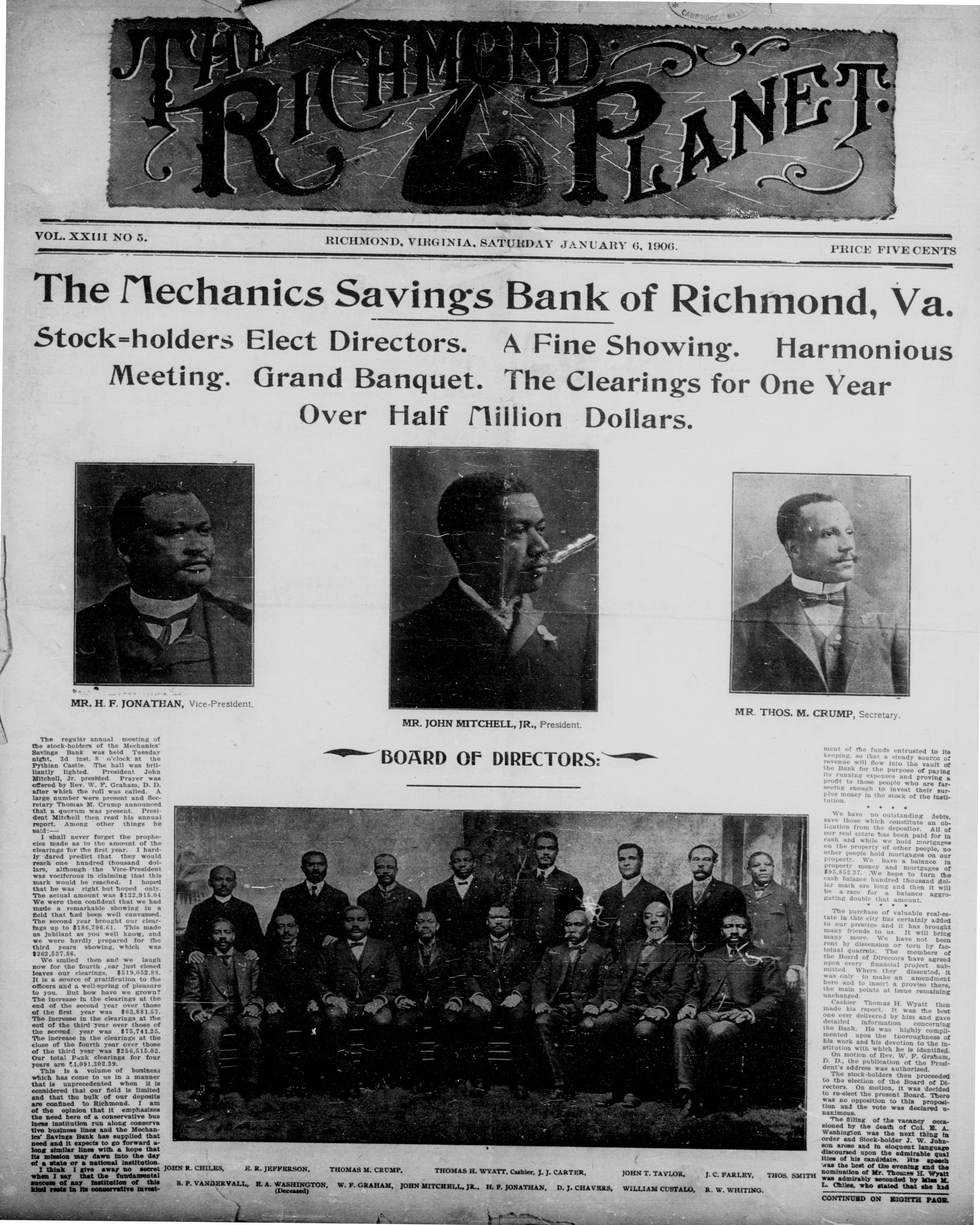
The Mechanics Savings Bank of Richmond, Va. Stock=holders Elect Directors. A Fine Showing. Harmonious Meeting. Grand Banquet. The Clearings for One Year Over Half Million Dollars.
MR. THOS. M. CRUMP, Secretary.
ment of the funds entrusted to its keeping, so that a steady source of revenue will flow into the vault of the Bank for the purpose of paying its running expenses and proving a profit to those people who are farseeing enough to invest their surplus money in the stock of the institution.
We have no outstanding debts, save those which constitute an obligation from the depositor. All of our real estate has been paid for in cash and while we hold mortgages on the property of other people, no other people hold mortgages on our property. We have a balance in property money and mortgages of $95,852.37. We hope to turn the cash balance hundred thousand dollar mark ere long and then it will be a race for a balance aggregating double that amount.
The purchase of valuable real-estate in this city has certainly added to our prestige and it has brought many friends to us. It will bring many more. We have not been rent by dissension or torn by factorial quarrels. The members of the Board of Directors have agreed upon every financial project submitted. Where they dissented, it was only to make an amendment here and to insert a proviso there, the main points at issue remaining unchanged.
Cashier Thomas H. Wyatt then made his report. It was the best one ever delivered by him and gave detailed information concerning the Bank. He was highly complimented upon the thoroughness of his work and his devotion to the institution with which he is identified. On motion of Rev. W. F. Graham, D. D., the publication of the President's address was authorized.
The stock-holders then proceeded to the election of the Board of Directors. On motion, it was decided to re-elect the present Board. There was no opposition to this proposition and the vote was declared unanimous.
The filling of the vacancy occasioned by the death of Col. E. A. Washington was the next thing in order and Stock-holder J. W. Johnson arose and in eloquent language discoursed upon the admirable qualities of his candidate. His speech was the best of the evening and the nomination of Mr. Thomas H. Wyatt was admirably seconded by Miss M. L. Chiles, who stated that she had
CONTINUED ON EIGHTH PAGE.
VOL. XXIII NO 5.
The Mo
Stock=ho
Mee
MR. H. F. JONATI
MR. H. F. JONATHAN, Vice-President,
The regular annual meeting of the stock-holders of the Mechanics' Savings Bank was held Tuesday night, 3d inst. 8 o'clock at the Pythian Castle. The hall was brilliantly lighted. President John Mitchell, Jr. presided. Prayer was offered by Rev. W. F. Graham, D. D. after which the roll was called. A large number were present and Secretary Thomas M. Crump announced that a quorum was present. President Mitchell then read his annual report. Among other things he said:—
I shall never forget the prophecies made as to the amount of the clearings for the first year. I hardly dared predict that they would reach one hundred thousand dollars, although the Vice-President was vociferous in claiming that this mark would be reached. I hoped that he was right but hoped only. The actual amount was $122,915.04 We were then confident that we had made a remarkable showing in a field that had been well canvassed. The second year brought our clearings up to $186,796.61. This made us jubilant as you well know, and we were hardly prepared for the third years showing, which was $262,537.86.
We smiled then and we laugh now for the fourth year just closed leaves our clearings, $519,052.88. It is a source of gratification to the officers and a well-spring of pleasure to you. But how have we grown? The increase in the clearings at the end of the second year over those of the first year was $63,881.57. The increase in the clearings at the end of the third year over those of the second year was $75,741.25. The increase in the clearings at the close of the fourth year over those of the third year was $256,515.02. Our total Bank clearings for four years are 7,109,1302.39. This is a volume of business which has come to us in a manner that is unprecedented when it is considered that our field is limited and that the bulk of our deposits are confined to Richmond. I am of the opinion that it emphasizes the need here of a conservative business institution run along conservative business lines and the Mechanics' Savings Bank has supplied that need and it expects to go forward along similar lines with a hope that its mission may dawn into the day of a state or a national institution. I think I give away no secret when I say that the fundamental success of any institution of this kind rests in its conservative invest-
JOHN H. HARRIS
MR. JOHN MITCHELL, JR.. President
BOARD OF DIRECTORS:
JOHN R. CHILES, E. R. JEFFERSON, THOMAS M. CRUMP, THOMAS H. WYATT, Cashier, J. J. CARTER, JOHN T. TAYLOR, J. C. FARLEY, THOS. SMITH
B. P. VANDERVALL, E. A. WASHINGTON, W. F. GRAHAM, JOHN MITCHELL, JR., H. F. JONATHAN, D. J. CHAVERS, WILLIAM CUSTALO, R. W. WHITING.
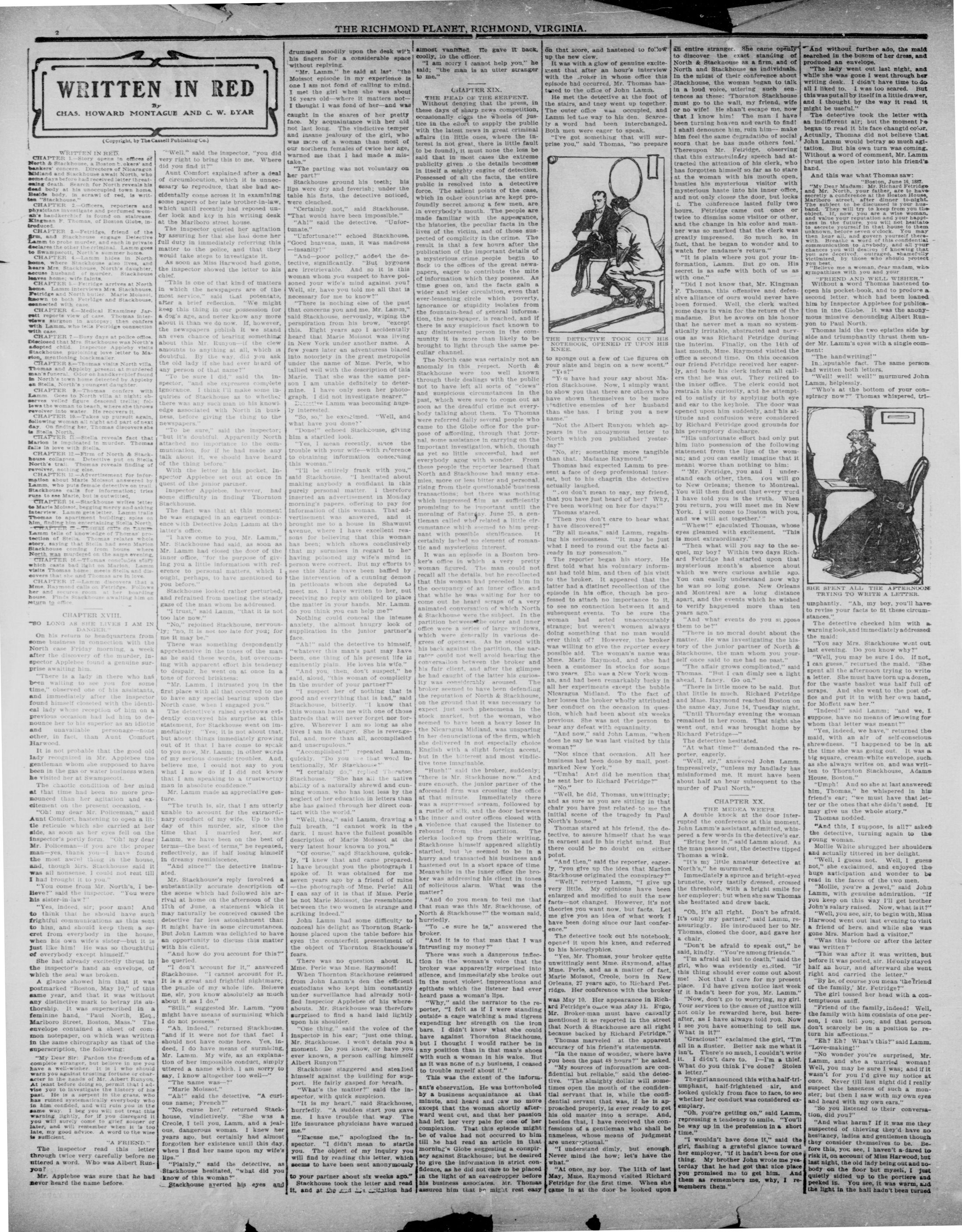
WRITTEN IN RED
(Copyright, by The Cassell Publishing Co.)
"Well," said the inspector, "you did very right to bring this to me. Where did you find it?" Aunt Comfort explained after a deal of circumlocution, which it is unnecessary to reproduce, that she had accidentally come across it in examining some papers of her late brother-in-law, which until recently had reposed under lock and key in his writing desk at the Mariboro street house. The inspector quieted her agitation by assuring her that she had done her full duty in immediately referring this matter to the police, and that they would take steps to investigate it. As soon as Miss Harwood had gone, the inspector showed the letter to his chief.
"This is one of that kind of matters in which the newspapers are of the most service," said that potenate, after a brief reflection. "We might keep this thing in our possession for a dog's age, and never know any more about it than we do now. If, however, the newspapers publish it we stand an even chance of hearing something about this Mr. Runyon—if the clew amounts to anything at all, which is doubtful. By the way, did you ask the old lady if she had ever heard of any person of that name?" "To be sure I did," said the inspector, "and she expresses complete ignorance. I think I'll make some inquiries of Stackhouse as to whether there was any such man to his knowledge associated with North in business, before giving the thing to the newspapers."
"To be sure," said the inspector; "but it's doubtful. Apparently North attached no importance to the communication, for if he had made any talk about it, we should have heard of the thing before."
With the letter in his pocket, Inspector Applebee set out at once in quest of the junior partner.
Inspector Applebee, however, had some difficulty in finding Thornton Stackhouse.
The fact was that at this moment he was engaged in an earnest confluence with Detective John Lamm at the latters office.
"I have come to you, Mr. Lamm," Mr. Stackhouse had said, as soon as Mr. Lamm had closed the door of the inner office, "for the purpose of giving you a little information with reference to personal matters, which I ought, perhaps, to have mentioned to you before."
Stackhouse looked rather perturbed, and refrained from meeting the steady gaze of the man whom he addressed.
"I trust," said Lamm, "that it is not too late now."
"No," rejoined Stackhouse, nervously; "no, it is not too late for you; for me it may be."
There was something despondently apprehensive in the tones of the man as he said these words, but overcoming with apparent effort his tendency to despair, he went on at once in a tone of forced briskness:
"Mr. Lamm, I intrusted you in the first place with all that occurred to me to have any special bearing upon the North case, when I engaged you."
The detective's raised eyebrows evidently conveyed his surprise at this statement, for Stackhouse went on immediately: "Yes; it is not about that, but about things immediately growing out of it that I have come to speak to you now, Mr. Lamm; in other words of my serious domestic troubles. And, believe me, I could not say to you what I now do if I did not know that I am speaking to a trustworthy man in absolute confidence."
Mr. Lamm made an appreciative gesture.
"The truth is, sir, that I am utterly unable to account for the extraordinary conduct of my wife. Up to the day of this murder, sir, since the time that I married her, air. Lamm, we have been on the best of terms—the best of terms," he repeated, reflectively, as if half losing himself in dreamy reminiscence.
"And since?" the detective insinuated.
Mr. Stackhouse's reply involved a substantially accurate description of the scene which had followed his arrival at home on the afternoon of the 17th of June, a statement which it may naturally be conceived caused the detective far less astonishment than it might have in some circumstances. But John Lamm was delighted to have an opportunity to discuss this matter with his client.
"And how do you account for this?" he queried.
"I don't account for it," answered Stackhouse. "I cannot account for it. It is a great and frightful nightmare; the puzzle of my whole life. Believe me, sir, you know absolutely as much about it as I do."
"Still," suggested Mr. Lamm, "you might have means of surmising which I do not possess."
"Ah, indeed," returned Stackhouse,
"and if it were not for that fact:
I should not have come here. Yes,
indeed, I do have means of surmising,
Mr. Lamm. My wife, as an explanation of her impossible conduct, simply uttered a name which, I am sorry to say, I know altogether too well—"
"The name was—"
"Marie Moissot."
"Ah!" said the detective. "A curious name, French?"
"No, curse her," returned Stackhouse, vindictively. "She was a Creole, I tell you, Lamm, and a jealous, dangerous woman. I knew her years ago, but certainly had almost forgotten her existence until this day, when I find her name upon my wife's lips."
"Plainly," said the detective, as Stackhouse hesitated, "what did you know of this woman?"
Stackhouse averted his eyes and
WRITTEN IN RED
CHAPTER 1—Story opens in offices of North & Stackhouse, a Boston bankers' and bankers' concern. Directors of Nicaragua Milda and Stackhouse await North, who one day before had received letter threatening that he would be North. North reveals dead body at his unoccupied town home. Beside body, in scrawl of red, is written "Stackhouse." CHAPTER 2—Officers, officers and physicists investigate and report man's handkerchief is found on staircase. Kingman F. Thomas, of Boston Globe, introduced. CHAPTER 3—Fetridge, friend of the Lamm, engages Detective Lamm to probe murder at North's daughter declares the other the criminal. Lamm goes to Swampscott, North's summer home. CHAPTER 4—Lamm hides in North home, where Stackhouse also lives, and Lamm is North's daughter, accuse husband of murder. Stackhouse leaves home; wife falls. CHAPTER 5—Fetridge arrives at North home. Lamm interviews Mrs Stackhouse, Baldwin and North butler Marie Moissot, known to be Fetridge and Stackhouse, connected with case.
CHAPTER 6—Medical Examiner Jarrett reports view of case. Thomas interviews aurgeon in autopsy; then confers with mmm, who tells Fellridge connection with case.
CHAPTER 7—Busy days at police office. Disclosed that Mrs Stackhouse was North's adopted child. Inspector Appleby visits stackhouse, purging love letter to Marjorie smaller.
CHAPTER 8—Thomas visits North's villa. Thomas and Appleby present at murdered man's funeral. Odor on handkerchief found in North's town home detected by Appleby on Stella, North's youngest daughter.
CHAPTER 9—Thomas confers with Linda, Appleby presents veiled figure descend trellis; follows the woman to beach, where she throws revolver into water. He recovers it.
CHAPTER 10—Takes up pursuit again, following woman all night and part of next day in her home, Thomas discovers she in Stella North.
CHAPTER 11—Stella reveals fact that Marlon is implicated in murder. Thomas falls in love with Stella.
CHAPTER 12—Firm of North & Stackhouse collapses. Detective put on Stella North. Thomas reveals finding of revolver, nothing else.
CHAPTER 12—Advertisement for information about Marle Lammoss answered by Lamm, who puts female detective on trail. Lamm, who is a detective, tries ruse to see Marle, but is outwitted.
CHAPTER 14—Stackhouse writes letter to Marle Lammoss, begging mercy and asking interview. Lamm gets letter. Lamm trails interview. Lamm finds him. Lamm finds him entertaining Stella North.
CHAPTER 16—*Thomas concludes story which casts bad light on Marion. Lamm visits Thomas home; meets Stella and discovers that she and Thomas are in love.*
CHAPTER 17—*Lamm discovers that a man named Petrillo on Petrillo, her and secures room in a boarding house. Finds Stackhouses awaiting him on return to office.*
CHAPTER XVIII
"SO LONG AS SHE LIVES I AM IN DANGER."
On his return to headquarters from some business in connection with the North case Friday morning, a week after the discovery of the murder, Inspector Applebee found a genuine surprise awaiting him.
"There is a lady in there who has been waiting to see you for some time," observed one of his assistants, and immediately after the inspector found himself closeted with the identical lady whose reception of him on a previous occasion had led him to denounce her to his superior as an idiotic and unavailable personage—none other, in fact, than Aunt Comfort Harwood.
It is not probable that the good old lady recognized in Mr. Applebee the gentleman whom she supposed to have been in the gas or water business when he visited her at Swampscott.
The chaotic condition of her mind at that time had been no more pronounced than her agitation and excitement on the present occasion.
"Oh! my dear Mr. Policeman," said Aunt Comfort, hastening to open a little reticule which she carried at her side, as soon as her eyes fell on the inspector's portly form. "Oh! my dear Mr. Policeman—if you are the proper man—yes, thank you—I have found the most awful thing in the house, and, though Mrs. Stackhouse said it was all nonsense, I could not rest till I had brought it to you."
"You come from Mr. North'a, I believe," said the inspector. "You were his sister-in-law?"
"Yes, indeed, sir; poor man! And to think that he should have such frightful communications as this sent to him, and should keep them a secret from everybody in the house, when his own wife's sister—but it is just like him! He was so thoughtful of everybody except himself."
She had already excitedly thrust in the inspector's hand an envelope, of which the seal was broken. A glance showed him that it was postmarked "Boston, May 10," of this same year, and that it was without any distinctive mark to betray its authorship. It was superscribed in a feminine hand, "Paul North, Esq., Mariboro Street, Boston, Mass." The envelope contained a sheet of common notepaper, on which was written in the same chirography as that of the superscription, the following:
"My Dear Sir: Fardon the freedom of a complete stranger, but believe in me you have a well-wisher. It is I who should warn you against trusting fortune or charm, and I should warn you against doing so, permit that I advise you to investigate the history of his past. He is a serpent in the grass, who has ruined systematically everybody who in him confided, and will ruin you in the process. I may warn you about warning lightly, for if you disregard it you will surely come to grief sooner or later, and will remember when it is too late, my good advice. A word to the wise is sufficient.
"A FRIEND."
The inspector read this letter through twice very carefully before he uttered a word. Who was Albert Runyon? Mr. Applebee was sure that he had never heard the name before.
THE RICHMOND PLANET, RICHMOND, VIRGINIA
drummed moodily upon the desk with his fingers for a considerable space without replying.
"Mr. Lamm." he said at last. "the Moissot episode in my experience is one I am not fond of calling to mind. I met the girl when she was about 16 years old—where it matters not—I thought I was fond of her—and was caught in the snares of her pretty face. My acquaintance with her old not last long. The vindictive temper and insane jealousy of the girl, who was more of a woman than most of our northern females of twice her age, warned me that I had made a mistake."
"The parting was not voluntary on her part?"
Stackhouse ground his teeth; his lips were dry and feverish; under the table his fists, the detective noticed, were clenched.
"Certainly not," said Stackhouse.
"That would have been impossible."
"Ah!" said the detective. "Unfortunate."
"Unfortunate!" echoed Stackhouse.
"Good heavens, man, it was madness—insanity!"
"And—poor policy," added the detective, significantly. "But bygones are irretrievable. And so it is this woman whom you suspect to have polished your wife's mind against you? Well, sir, have you told me all that is necessary for me to know?"
"There is nothing else of the past that concerns you and me, Mr. Lamm," said Stackhouse, nervously, wiping the perspiration from his brow, "except this. Eight years ago I accidentally heard that Marie Moissot was living in New York under another name. A few years later an adventures blazed into notoriety in the great metropolis under the name of Mme. Perle, who tallied well with the description of this Marie. That she was the same person I am unable definitely to determine. I have only seen her photograph. I did not investigate nearer." Extensive Lamm was becoming hugely interested.
"So, so," he exclaimed. "Well, and what have you done?"
"Done!" echoed Stackhouse, giving him a startled look.
"Yes, I mean recently, since the trouble with your wife—with reference to obtaining information concerning this woman."
"I'll be entirely frank with you," said Stackhouse. "I hesitated about making anybody a confidant in this purely personal matter. I therefore inserted an advertisement in Monday morning's papers, offering to pay for information of this woman. That advertisement was answered, and it brought me to a house in Shawmut avenue, where I have excellent reasons for believing that this woman has been; which shows conclusively that my surmises in regard to her having poisoned my wife's mind in person were correct. But my efforts to see this Marie have been baffled by the intervention of a cunning demon in petticoats whom she deputed to meet me. I have written to her, but receiving no reply am obliged to place the matter in your hands. Mr. Lamm, do you think you can help me?" Nothing could conceal the intense anxiety, the almost hungry look of supplication in the junior partner's face.
"Ah!" said the detective to himself,
"whatever this man's past may have been, one thing of his present life is eminently plain. He loves his wife."
"And you, then, don't suspect," he said, aloud, "this woman of complicity in the murder of your partner?"
"I suspect her of nothing that is good and everything that is bad," said Stackhouse, bitterly. "I know that this woman hates me with one of those hatreds that will never forget nor forgive. Wherever I am so long as she lives I am in danger. She is revengeful, and more than all, accomplished and unscrupulous."
"Accomplished!" repeated Lamm, quickly. "Do you use that word intentionally, Mr. Stackhouse?"
"I certainly do," replied Thoruton Stackhouse. "She has all the native ability of a naturally shrewd and cunning woman, who has lost less by the neglect of her education in letters than she has gained through her direct contact with the world."
"Well, thea," said Lamm, drawing a full breath, "I cannot work in the dark. I must have the fullest possible description of Marie Moissot at the very latest hour known to you."
"Of course," said Stackhouse, quickly, "I knew that and came prepared. I have brought you the photograph I spoke of. It was obtained for me seven years ago by a friend of mine—the photograph of Mime. Perle! All I can say of it is that if Mime. Perle be not Marie Moissot, the resemblance between the two women is strange and striking indeed."
John Lamm had some difficulty to conceal his delight as Thornton Stackhouse placed upon the table before his eyes the counterfeit presentment of the object of Thornton Stackhouse's fears.
There was no question about it. Mme. Perle was Mme. Raymond!
When Thornton Stackhouse reissued from John Lamm's den the efficient custodians who kept him constantly under surveillance had already notified Inspector Applebee of his whereabouts. Mr. Stackhouse was therefore surprised to find a hand laid lightly upon his shoulder.
"One thing," said the voice of the inspector in his ear; "just one thing, Mr. Stackhouse. I won't detain you a moment. Do you know, or have you ever known, a person calling himself Albert Runyon?"
"What's the matter?" said the inspector, with quick suspicion.
"It is my heart," said Stackhouse, hurriedly. "A sudden start you gave me. I have trouble that way. The life insurance physicians have warned me."
"Excuse me," apologized the inspector. "I didn't mean to startle you. The object of my inquiry you will find by reading this letter, which seems to have been sent anonymously to your partner about six weeks ago."
Stackhouse took the letter and read it, and at the end is citation had
almost vanished. He gave it back, coolly, to the officer.
"I am sorry I cannot help you," he said; "the man is an utter stranger to me."
CHAPTER XIX.
THE HEAD OF THE SERPENT.
Without denying that the press, in these days of sharp news competition, occasionally clips the wheels of justice in the effort to supply the public with the latest news in great criminal affairs (in little ones, where the interest is not great, there is little fault to be found), it must none the less be said that in most cases the extreme publicity given o the details becomes in itself a mighty engine of detection. Possessed of all the facts, the entire public is resolved into a detective force. The salient points of the case, which in other countries are kept profoundly secret among a few men, are in everybody's mouth. The people are made familiar with the appearance, the histories, the peculiar facts in the lives of the victim, and of those suspected of complicity in the crime. The result is that a few hours after the publication of the important details of a mysterious crime people begin to flock to the offices of the great newspapers, eager to contribute the mite of information which they possess. As time goes on, and the facts gain a wider and wider circulation, even that ever-lessening circle which poverty, ignorance or stupidity isolates from the fountain-head of general information, the newspaper, is reached, and if there is any suspicious fact known to any disinterested person in the community it is more than likely to be brought to light through the same peculiar channel.
The North case was certainly not an anomaly in this respect. North & Stackhouse were too well known through their dealings with the public not to have left all sorts of "clews" and suspicious circumstances in the past, which were sure to come out as soon as the dreadful crime set everybody talking about them. To Thomas were referred daily several people who came to the Globe office for the purpose of affording, through that journal, some assistance in carrying on the important investigation, which, though as yet so little successful, had set everybody agog with wonder. From these people the reporter learned that North and Stackhouse had many enquiries, more or less bitter and personal, rising from their questionable business transactions; but there was nothing which impressed him as sufficiently promising to be important until the morning of Saturday, June 25, a gentleman called who related a little circumstance which seemed to him pregnant with possible significance. It certainly lacked no element of romantic and mysterious interest.
It was an episode in a Boston broker's office in which a very pretty woman figured. The man could not recall all the details, but he recollected that this woman had preceded him in the occupancy of an inner office, and that while he was waiting for her to come out he heard scraps of a very animated conversation of which North & Stackhouse were the subject. In the partition between the outer and inner office were a series of large windows, which were generally in various degrees of openness. As he stood with his back against the partition, the narrator could not well avoid hearing the conversation between the broker and his fair client, and after the glimpse he had caught of the latter his curiosity was considerably aroused. The broker seemed to have been defending the reputation of North & Stackhouse, on the ground that it was necessary to expect just such phenomena in the stock market, but the woman, who seemed to have been a heavy loser in the Nicaragua Midland, was unsparing in her denunciations of the firm, which she delivered in not especially choice English with a slight foreign accent, but in the bitterest and most vindictive tone imaginable.
"Hush!" said the broker, suddenly; "there is Mr. Stackhouse now." And sure enough, the junior partner of the aforesaid firm was crossing the office at that minute. Immediately there was a suppressed scream, followed by a rustle of silk, and the door between the inner and outer offices closed with a violence that caused the listener to rebound from the partition. The clerks looked up from their writing, Stackhouse himself appeared slightly startled, but he seemed to be in a hurry and transacted his business and hastened out in a short space of time. Meanwhile in the inner office the broker was addressing his client in tones of solicitous alarm. What was the matter?
"And do you mean to tell me that that man was this Mr. Stackhouse, of North & Stackhouse?" the woman said, hurriedly.
"To .e sure he is," answered the broker.
"And it is to that man that I was intrusting my money?"
There was such a dangerous inflection in the woman's voice that the broker was apparently surprised into silence, and immediately she broke out in the most violent imprecations and epithats which the listener had ever heard pass a woman's lips.
"Why," said the narrator to the reporter, "I felt as if I were standing outside a cage watching a mad tigress expending her strength on the iron bars. I didn't know what she could have against Thornton Stackhouse, but I thought I would rather be in any position than in that man's shoes with such a woman in his wake. But as it was none of my business, I ceased to trouble myself about it."
This was the extent of the informant's observation. He was buttonholed by a business acquaintance at that minute, and heard and caw no more except that the woman shortly afterward went cut, and that her passion had left her very pale for one of her complexion. That this episode might be of value had not occurred to him till he had read an article in that morning's Globe suggesting a conspiracy against Stackhouse; but he desired to give the information in strict confidence, as he did not care to be placed in the light of an eavesdropper before his business associates. Mr. Thomas assured him that he might rest easy
on that score, and hastened to follow up the new clew.
It was with a glow of genuine excitement that after an hour's interview with the roker in whose office this episode had occurred, Mr. Thomas hastened to the office of John Lamm.
He met the detective at the foot of the stairs, and they went up together. The outer office was occupied, and Lamm led the way to his den. Scarcely a word had been interchanged. Both men were eager to speak.
"I've got something that will surprise you," said Thomas, "so prepare
10
THE DETECTIVE TOOK OUT HIS NOTEBOOK, OPENED IT UPON HIS KNEE.
to sponge out a few of the figures on your slate and begin on a new scent."
"Yes?"
"You have had your say about Marion Stackhouse. Now, I simply want to show you that there are others who have shown themselves to be more vindictive enemies of her husband than she has. I bring you a new name."
"Not the Albert Runyon which appears in the anonymous letter to North which you published yesterday?"
"No, sir; something more tangible than that. Madame Raymond."
Thomas had expected Lamm to present a face of deep professional interest, but to his chagrin the detective actually laughed.
".ou don't mean to say, my friend, that you have just heard of her? Why, I've been working on her for days!" Thomas stared. "Then you don't care to hear what I have discovered?" "By all means," said Lamm, regaining his seriousness. "It may be just what I need to round out the facts all ready in my possession."
The reporter began his story. He first told what his voluntary informant had told him, and then of his visit to the broker. It appeared that the latter had a distinct recollection of the episode in his office, though he professed to attach no importance to it, to see no connection between it and subsequent events. To be sure the woman had acted unaccountably strange; but weren't women always doing something that no man would ever think of? However, the broker was willing to give the reporter every possible aid. The woman's name was Mme. Marie Raymond, and she had been a customer in stocks for some two years. She was a New York woman, and had been remarkably lucky in all her experiments except the bubble Nicaragua Midland. To the fact of her losses the broker wholly attributed her conduct on the occasion in question, which had been about six weeks previous. She was not the person to bear any defeat with equanimity.
"And now," said John Lamm, "when does he say he was last visited by this woman?"
"Not since that occasion. All her business had been done by mail, post-marked New York."
"Umhah! And did he mention that he sent her to Richard Fetridge?"
"No."
"Well, he did, Thomas, unwittingly; and as sure as you are sitting in that chair you have just related to me the initial scene of the tragedy in Paul North's house."
Thomas stared at his friend, the detective, to assure himself that he was in earnest and in his right mind. But there could be no doubt on either point.
"And then," said the reporter, eagerly, "you give up the idea that Marlon Stackhouse originated the conspiracy."
"Well," returned Lamm, "I give up very little. My opinions have been enlarged and modified to suit the new facts—not changed. However, it's not theories you want now, but facts. Let me give you an idea of what work I have been doing since our last conference."
The detective took out his notebook, opened it upon his knee, and referred to his hieroglyphics.
"Yes, Mr. Thomas, your broker quite unwittingly sent Mme. Raymond, alias Mme. Perle, and as a matter of fact, Marie Molsot, Creole, born in New Orleans, 27 years ago, to Richard Fetridge. Her conference with the broker was May 10. Her appearance in Richard Fetridge's once was May 11. Ergo, Mr. Broker-man must have casually mentioned it as reported in the street that North & Stackhouse are all right because backed by Richard Fetridge." Thomas marveled at the apparent accuracy of his friend's statements.
"In the name of wonder, where have you been the past 48 hours?" he asked.
"My sources of information are confidential but reliable," said the detective. "The almighty dollar will sometimes open the mouth of the confidential servant that is, while the confidential servant that was, if he is approached properly, is ever ready to get his old master into a scrape. And, besides that, I have received the confessions of a gentleman who shall be nameless, whose means of judgment are unexeptional."
"I understand dimly, but enough. Never mind the how; let's have the what."
"At once my boy. The 11th of last May, Mme. Raymond visited Richard Fetridge for the first time. When she came in at the door he looked upon
an entire stranger. She came openly to discover the exact standing of North & Stackhouse as a firm, and of North and Stackhouse as individuals. In the midst of their conference about Stackhouse, the woman began to talk in a loud voice, uttering such sentences as these: "Thornton Stackhouse must go to the wall, my friend, wife or no wife! He shalt escape me, now that I know him! The man I have been turning heaven and earth to find! I shall denounce him, ruin him—make him feel the same degradation of social scorn that he has made others feel." Thereupon Mr. Fetridge, observing that this extraordinarily speech had attracted the attention of his clerk, who has forgotten himself so far as to stare at the woman with his mouth open, hustles his mysterious visitor with mysterious haste into his inner office, and not only closes the door, but locks it. The conference lasted fully two hours. Fetridge came out once or twice to dismiss some visitor or other, and the change in his color and manner was so marked that the clerk was greatly impressed. So much so, in fact, that he began to wonder and to watch for madame's return."
"It is plain where you got your information, Lamm. But go on. His secret is as safe with both of us as with one."
"Did I not know that, Mr. Kingman F. Thomas, this offensive and defensive alliance of ours would never have been formed. Well, the clerk waited some days in vain for the return of the madame. But he avows on his honor that he never met a man so systematically irritable, abstracted and nervous as was Richard Fetridge during the interim. Finally, on the 14th of last month, Mme. Raymond visited the office a second time. On this occasion our friend Fetridge received her eagerly, and bade his clerk inform all callers that he was out. They retired to the inner office. The clerk could not restrain his curiosity, and he attempted to satisfy it by applying both eye and ear to the keyhole. The door was opened upon him suddenly, and his attitude and confusion were considered by Richard Fetridge good grounds for his peremptory discharge.
"His unfortunate effort had only put him into possession of the following statement from the lips of the woman; and you can easily imagine that it meant worse than nothing to him:
"Mr. Fetridge, you and I understand each other, then. you will go to New Orleans; thence to Montreal. You will then find out that every word I have told you is the truth. When you return, you will meet me in New York. I will come to Boston with you, and we will act together."
"Whew!" ejaculated Thomas, whose eyes gleamed with excitement. "This is most extraordinary."
"Then what will you say to the sequel, my boy? Within two days Richard Petridge had started upon that mysterious month's absence about which we were curious awhile ago. You can easily understand now why he was so long gone. New Orleans and Montreal are a long distance apart, and the events which he wished to verify happened more than ten years ago."
"And what events do you suppose them to be?"
"There is no moral doubt about the matter. He was investigating the history of the junior partner of North & Stackhouse, the man whom you yourself once said to me had no past."
"The affair grows complicated," said Thomas. "But I can dimly see a light ahead, I fancy. Go on."
"There is little more to be said. But that little is much. Richard Fetridge and Mue. Raymond reached Boston on the same day, June 14, Tuesday night. "Until Thursday evening the woman remained in her room. That night she went out, and was brought home by Richard Fetridge—" The detective hesitated. "At what time?" demanded the reporter, eagerly. "Well, sir," answered John Lamm. impressively, "unless my landlady has misinformed me, it must have been about half an hour subsequent to the murder of Paul North."
CHAPTER XX
A double knock at the door interrupted the conference at this moment. John Lamm's assistant, admitted, whispered a few words in the detective's ear. "Bring her in," said Lamm aloud. As the man passed out, the detective tipped Thomas a wink. "It's my little amateur detective at North." he murmured. Immediately a spruce and bright-eyed brunette, very tasty dressed, crossed the threshold, with a bright smile for her employer; but when she saw Thomas she hesitated and drew back. "Oh, it's all right. Don't be afraid. It's only my partner," said Lamm, reassuringly. He introduced her to Mr. Thomas, closed the door, and gave her a chair. "Don't be afraid to speak out," he said, kindly. "You're among friends."
"I'm afraid all but to death," said the girl, who was evidently excited. "If this thing should ever come out about me! Not that I care for my present place. I'd have given notice last week if it hadn't been for you, Mr. Lamm." "Now, don't go to worrying, my girl. Your services to the cause of justice will not only be rewarded here, but here-after, as I have always told you. Now I see you have something to tell me. What is it?" "Gracious!" exclaimed the girl, "I'm all in a fluster. Better ask me what it isn't. There's so much, I couldn't write it. I didn't dare to. I—I'm a thief. What do you think I've done? Stolen a letter." Thegirl announced this with a half-trilumphant, half-frightened air, and looked quickly from face to face, to see whether her conduct was considered exemplary.
"Oh, you're getting on," said Lamm, repressing a tendency to smile. "You'll be way up in the profession in a short time."
"I wouldn't have done it," said the girl, flashing a grateful glance toward her employer. "If it hadn't been for one thing. My brother John wrote me yesterday that he had got that nice place you promised me to get him. And them as remembers me, why, I remembers them."
And without further ado, the maid searched in the bosom of her dress, and produced an envelope.
"The lady went out last night, and while she was gone I went through her writing desk. I didn't have time to do all I liked to. I was too scared. But this was putall by itself in a little drawer, and I thought by the way it read it might be useful."
The detective took the letter with an indifferent air; but the moment he began to read it his face changed color. Actually, Thomas did not believe that John Lamm would betray so much agitation. But his own turn was coming. Without a word of comment, Mr. Lamm thrust the open letter into his friend's hand.
And this was what Thomas saw:
"My Dear Madam, Boston, June 14th and Mr. North, your father, are to have secretly a conference at the Boston House, Marlboro street, after dinner to-night. Marlboro band, you and your band. They will try to keep from you the object. If, now, you are a wise woman, and value your reputation and your happiness, you will secrete yourself in that house to them unknown, before seven o'clock. You may then hear all, and govern this confidential communication to anybody, and all your chances you will deserve of knowing that you are deceived, outraged, shamefully and by those who should protect you best.
"Believe me a woman, dear madam, who sympathizes with you and your
"FRIEND AND WELL WISHER."
Without a word Thomas hastened to open his pocket-book, and to produce a second letter, which had been loaned him by Inspector Applebee for publication in the Globe. It was the anonymous missive denouncing Albert Runyon to Paul North.
Thomas laid the two epistles side by side and triumphantly thrust them under Mr. Lamm's eyes with a single comment:
"The handwriting!"
Insiputable fact. The same person had written both letters.
"Well! well! well!" murmured John Lamm, helplessly.
"Who's at the bottom of your conspiracy now?" Thomas whispered, tri-
-
SHE SPENT ALL THE AFTERNOON
TRYING TO WRITE A LETTER.
umphantly. "Ah, my boy, you'll have
to revise your facts to fit these circu-
stances."
The detective checked him with a
warning look, and immediately addressed
the maid:
"You say Mrs. Stackhouse went out
last evening. Do you know why?"
"Well, you may be sure I do. If not,
I can guess," returned the maid. "She
spent all the afternoon trying to write
a letter. She must have torn up a dozen,
for the waste basket was half full of
scraps. And she went to the post office
and put it in with her own hand,
for Moffett saw her."
"Indeed!" said Lamm; "and we, I
suppose, have no means of knowing for
whom that letter was meant."
"Yes, indeed, we have," returned the maid, with an air of self-conscious shrewdness. "I happened to be in at the time she was going out. It was a big square, cream-white envelope, such as she always writes on, and was written to Thornton Stackhouse, Adams House, Boston."
"Umph! And so she at last answered him, Thomas" he whispered in his friend's ear; "we must have that letter or the ones that she didn't send. It may give us the whole story."
Thomas nodded.
"And this, I suppose, is all?" asked the detective, turning again to the young woman.
Mollie White shrugged her shoulders and actually tittered in her delight.
"Well, I guess not. Well, I guess not," she exclaimed, and enjoyed the huge anticipation and wonder to be read in the faces of the two men.
"Mollie, you're a jewel," said John Lamm, with genuine admiration.
"If you keep on this way I'll get brother John's salary raised. Now, what is it?"
"Well, you see, sir, to begin with, Miss Harwood went out last evening to visit a friend of hers, and while she was gone Mrs. Marion had a visitor."
"Was this before or after the letter was written?"
"This was after it was written, but before it was posted, sir. He only stayed half an hour, and afterward she went right and carried the letter."
"By he, of course you mean 'the friend of the family', Mr. Fetridge?"
The girl tossed her head with a contemptuous sniff.
"Friend of the family, indeed! Well, the family with him consists of one person, I can tell you; and that person don't scarcely be in a position to return his affections."
"Eh? Eh? What's this?" said Lamm.
"Love-making!"
"No wonder you're surprised, Mr. Lamm, and she a married woman! Well, you may be sure I was; and if it wasn't for you I'd give my notice at once. Never till last night did I really suspect the baseness of such a monster; but then I saw with my own eyes and heard with my own ears."
"So you listened to their conversation, did you?"
"And what harm? If it was me they suspected of thieving they'd have no hesitancy, ladies and gentlemen though they consider themselves to be. Before this, you see, I haven't a dared to risk it, on account of Miss Harwood, but last night, the old lady being out and nobody on the floor but myself, I just quietly sidied up to the portiere and peeked in. You see, it was warm, and the light in the hall hadn't been turned
THE PLANET
SATURDAY.....JAN. 6TH. 1906.
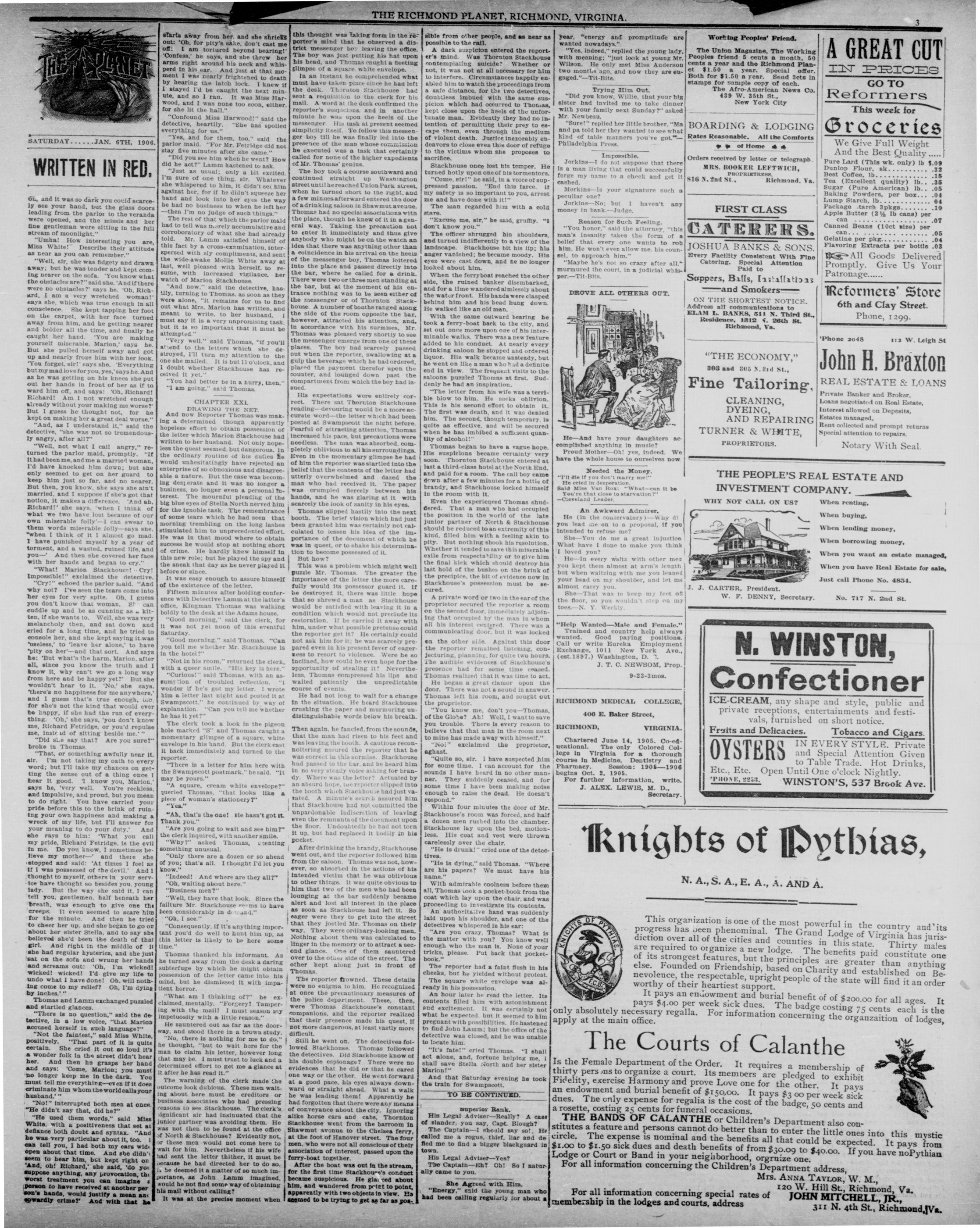
WRITTEN IN RED.
oh, and it was so dark you could scarcely see your hand, but the glass doors leading from the parlor to the veranda were opened, and the missis and her fine gentleman were sitting in the full stream of moonlight."
"Umah! How interesting you are, Miss White! Describe their attitude as near as you can remember."
"Well, sir, she was fidgery and drawn away; but he was tender and kept coming nearer on the sofa. 'You know what the obstacles are?' said she. 'And if there were no obstacles?' says he. 'Oh, Richard, I am a very wretched woman!' says she, which was true enough in all conscience. She kept tapping her foot on the carpet, with her face turned away from him, and he getting nearer and bolder all the time, and finally he caught her hand. 'You are making yourself miserable, Marion,' says he. But she pulled herself away and got up and nearly froze him with her look. 'You forget, sir!' says she. 'Everything but my mad love for you, yes,' says he. And as he was getting on his knees she put out her hands in front of her as if to ward him off, and says: 'Oh, Richard! Richard! Am I not wretched enough already without your making me worse?' But I guess he thought not, for he kept on making her a great deal worse."
"And, as I understand it," said the detective, "she was not so tremendously angry, after all?" "Well, not what I call angry," returned the parlor maid, promptly. "If it had been me, and me a married woman, I'd have knocked him down; but she only seemed to get on her guard to keep him just so far, and no nearer. But then, you know, she says she ain't married, and I suppose if she's got that notion, it makes a difference. 'And ah, Richard!' she says, 'when I think of what we two have lost because of our own miserable folly'—I can swear to them words miserable folly—says she, "when I think of it I almost go mad. I have punished myself by a year of torment, and a wasted, ruined life, and you—" And then she covered her face with her hands and began to cry." "What! Marion Stackhouse! - Cry! Impossible!" exclaimed the detective.
Impossible!" exclaimed the detective. "Cry!" echoed the parlor maid. "And why not? I've seen the tears come into her eyes for very spite. Oh, I guess you don't know that woman. She can cuddle up and be as cunning as a kitten, if she wants to. Well, she was very melancholy then, and sat down and cried for a long time, and he tried to console her, and she kept saying it was 'useless,' to 'leave her alone,' to have 'pity on her'—and that sort. And says he: 'But what's the harm, Marion, after all, since you know the truth and I know it, why can't we go a long way from here and be happy yet.' But she wouldn't hear to it. 'No,' she says, 'there's no happiness for me anywhere,' and I guess that's true enough, too, for she's not the kind that would ever be happy, if she had the run of everything. 'Oh,' she says, 'you don't know me, Richard Fetridge, or you'd repulse me, instead of sitting beside me.' "Did she say that? Are you sure?"
"Did she say that? Are you sure?" broke in Thomas.
"That, or something awfully near it. air. I'm not taking my oath to every word; but I'll take my chances on getting the sense out of a thing once I hear it good. 'I know you, Marion,' says he, 'very well. You're reckless, and impulsive, and proud, but you mean to do right. You have carried your pride before this to the brink of ruining your own happiness and making a wreck of my life, but I'll answer for your meaning to do your duty.' And she says to him: 'What you call my pride, Richard Fetridge, is the evil in me. Do you know, I sometimes believe my mother—' and there she stopped and said: 'At times I feel as if I was possessed of the devil.' And I thought to myself, others in your service have thought so besides you, young lady. But the way she said it, I can tell you, gentlemen, half beneath her breath, was enough to give one the creeps. It even seemed to scare him for the minute. And then he tried to cheer her up, and she began to go on about her sister Stella, and to say she believed she'd been the death of that girl. And right in the middle of it she had regular hysteries, and she just sat on the sofa and wrung her hands and screams out: 'Oh, I'm wicked! wicked! wicked! I'd give my life to undo what I have done! Oh, will nothing come to my relief? Oh, I'm dying by inches.'"
Thomas and Lamm exchanged puzzled and startled glances.
"There is no question," said the detective, in a low voice, "that Marion accused herself in such language?"
"Not the faintest," said Miss White, positively. "That part of it is quite certain. She cried it out so loud it's a wonder folk in the street didn't hear her. And then he grasps her hand and says: 'Come, Marion; you must no longer keep me in the dark. You must tell me everything—even if it does criminate him whom the world calls your husband.'"
"No!" interrupted both men at once. "He didn't say that, did he?"
"He used them words," said Miss White. with a positiveness that set at defiance both doubt and syntax. "And he was very particular about it, too. I can tell you, I had both my ears wide open about that time. And she didn't seem to hear him, but kept right on 'And, oh! Richard,' she said, 'do you suppose anything, any provocation, the worst treatment you can imagine a person to have received at another person's hands, would justify a mean and cowardly crime?' And with that he
starts away from her, and she shrieks out: 'Oh, for her's sake, don't cast me off! I am tortured beyond bearing!' 'Confess,' he says, and she threw her arms right around his neck and whispered in his ear. And just at that moment I was nearly frightened to death by hearing the latch lock. I knew if I stayed I'd be caught the next minute, and so I ran. It was Miss Harwood, and I was none too soon, either, for she lit the hall."
"Confound Miss Harwood!" said the detective, heartily. "She has spoiled everything for us."
"Yes, and for them, too," said the parlor maid. "For Mr. Fetridge did not stay five minutes after she came."
on he does. Lamm hastened to ask.
"Just as usual; only a bit excited. I'm sure of one thing, sir. Whatever she whispered to him, it didn't set him against her, for if he didn't squeeze her hand and look into her eyes the way he had no business to when he left her —then I'm no judge of such things."
The rest of that which the parlor maid had to tell was merely accumulative and corroboratory of what she had already told. Mr. Lamm satisfied himself of this fact by a cross-examination, interspersed with sly compliments, and sent the wide-awake Mollie White away at last, well pleased with herself, to resume, with increased vigilance, her watch of Marion Stackhouse.
"And now," said the detective, hastily, turning to Thomas, as soon as they were alone, "it remains for us to find what Mrs. Marion has written, and meant to write, to her husband. I must say it is a very unpromising task, but it is so important that it must be attempted."
"Very well," said Thomas, "if you'll attend to the letters which she destroyed, I'll turn my attention to the one she mailed. It is but I'll o'clock, and I doubt whether Stackhouse has received it yet."
"You had better be in a hurry, then," "I am going," said Thomas.
CHAPTER XXL
DRAWING THE NET.
And now Reporter Thomas was making a determined though apparently hopeless effort to obtain possession of the letter which Marion Stackhouse had written to her husband. Not only hopeless the quest seemed, but dangerous. In the ordinary routine of his duties he would unhesitatingly have rejected an enterprise of so obnoxious and disagreeable a nature. But the case was becoming desperate and it was no longer a business, no longer even a personal interest. The mournful pleading of the big blue eyes of Stella North nerved him for the ignoble task. The remembrance of some tears which he had seen that morning trembling on the long lashes stimulated him to unprecedented effort. He was in that mood where to obtain success he would stop at nothing short of crime. He hardly knew himself in this new role; but he played the spy and the sneak that day as he never played it before or since.
It was easy enough to assure himself of the existence of the letter.
Fifteen minutes after holding conference with Detective Lamm at the latter's office, Kingman Thomas was walking boldly to the desk at the Adams house.
"Good morning," said the clerk, for it was not yet noon of this eventful Saturday.
"Good morning," said Thomas. "Can you tell me whether Mr. Stackhouse is in the hotel?"
"Not in his room," returned the clerk, with a queer smile. "His key is here."
"Curious!" said Thomas, with an assumption of troubled reflection. "I wonder if he's got my letter. I wrote him a letter last night and posted it at Swampscott," he continued by way of explanation. "Can you tell me whether he has it yet?"
The clerk took a look in the pigeon hole marked "S" and Thomas caught a momentary glimpse of a square, white envelope in his hand. But the clerk cast it back immediately and turned to the reporter.
"There is a letter for him here with the Swampscott postmark," he said. "It may be yours."
"A square, cream white envelope?" queried Thomas, "that looks like a piece of woman's stationery?"
"Yea."
"Ah, that's the one! He hasn't got it. Thank you."
"Are you going to wait and see him?" the clerk inquired, with another smile.
"Why?" asked Thomas, centing something unusual.
"Only there are a dozen or so ahead of you; that's all. I thought I'd let you know."
"Indeed! And where are they all?"
"Oh, waiting about here."
"Business men?"
"Well, they have that look. Since the failure Mr. Stackhouse seems to have been considerably in demand."
"Oh, I see."
"Consequently, if it's anything important you'd do well to hunt him up, as this letter is likely to be here some time."
Thomas thanked his informant. As he turned away from the desk a daring subterfuge by which he might obtain possession of the letter came into his mind, but he dismissed it with impatient horror.
"What am I thinking of?" he exclaimed, mentally. "Forgery! Tampering with the mail! I must season my impetuosity with a little reason."
He sauntered out as far as the doorway, and stood there in a brown study. "No, there is nothing for me to do," he thought. "but to wait here for the man to claim his letter, however long that may be. I must trust to luck and a determined effort to get me a glance at it after he has read it."
The warning of the clerk made the outcome look dubious. These men waiting about here must be creditors or business associates who had pressing reasons to see Stackhouse. The clerk's significant air had insinuated that the junior partner was avoiding them. He was not then to be found at the office of North & Stackhouse? Evidently not, or these men would not come here to wait for him. Nevertheless if his wife had sent the letter thither, it must be because he had directed her to do so. If he deemed it a matter of so much importance, as John Lamm imagined, would he not find some way of obtaining his mall without calling?
It was at the precise moment when
THE RICHMOND PLANET, RICHMOND, VIRGINIA
this thought was taking form in the reporter's mind that he observed a district messenger boy leaving the office. The boy was just putting his hat upon his head, and Thomas caught a fleeting glimpse of a square white envelope. In an instant he comprehended what must have taken place since he had left the desk. Thoraton Stackhouse had sent a requisition to the clerk for his mail. A word at the desk confirmed the reporter's suspicions, and in another minute he was upon the heels of the messenger. His task at present seemed simplicity itself. To follow this messenger boy till he was finally led into the presence of the man whose commission he executed was a task that certainly called for none of the higher expedients of Mr. Thomas' genius.
The boy took a course southward and continued straight up Washington street until he reached Union Park street, when he turned short to the right, and a few minutes afterward entered the door of a drinking saloon in Shawmut avenue. Thomas had no special associations with the place, though he knew of it in a general way. Taking the precaution not to enter immediately and thus give anybody who might be on the watch an idea that there was anything other than a coincidence in his arrival on the heels of the messenger boy, Thomas loitered into the place and passed directly into the bar, where he called for a drink. There were two or three men standing at the bar, but at the moment of his entrance nothing was to be seen either of the messenger or of Thornton Stackhouse. A number of booths ranged along the side of the room opposite the bar, however, attracted his attention, and, in accordance with his surmises, Mr. Thomas was pleased very shortly to see the messenger emerge from one of these places. The boy had scarcely passed out when the reporter, swallowing at a gulp the beverage which he had ordered, placed the payment therefor upon the counter, and lounged down past the compartment from which the boy had issued.
His expectations were entirely correct. There sat Thornton Stackhouse reading—devouring would be a more accurate word—the letter which had been posted at Swampscott the night before. Fearful of attracting attention, Thomas increased his pace, but precautions were needless. The man was absorbed, completely oblivious to all his surroundings. Even in the momentary glimpse he had of him the reporter was startled into the belief that the contents of the letter had utterly overwhelmed and dazed the man who had received it. The paper was crumpled fiercely between his hands, and he was glaring at it with scarcely the look of sanity in his eyes. Thomas slipped hastily into the next booth. The brief vision which had just been granted him was certainly not calculated to lessen his idea of the importance of the document of which he was in quest, or to shake his determination to become possessed of it.
This was a problem which well might puzzle Mr. Thomas. The greater the importance of the letter the more carefully would its possessor guard it. If he destroyed it, there was little hope that so shrewd a man as Stackhouse would be satisfied with leaving it in a condition which would not preclude its restoration. If he carried it away with him, under what possible pretense could the reporter get it? He certainly could not ask him for it; he was scarcely prepared even in his present fever of eagerness to resort to violence. Were he so inclined, how could he even hope for the opportunity of stealing it? Nevertheless, Thomas compressed his lips and waited patiently the unpredictable course of events.
He had not long to wait for a change in the situation. He heard Stackhouse crushing the paper and murmuring undistinguishable words below his breath.
Then again, he fancied, from the sounds, that the man had risen to his feet and was leaving the booth. A cautious reconnoitering assured the reporter that he was correct in this surmise. Stackhouse had passed to the bar, and he heard him in no very steady voice asking for brandy. Where was the letter? Actuated by an absurd hope, the reporter slipped into the booth which Stackhouse had just varated. A minute's search assured him that Stackhouse had not committed the unpardonable indiscretion of leaving even the remnants of the document upon the floor. Undoubtedly he had not torn it up, but had replaced it bodily in his pocket.
After drinking the brandy, Stackhouse went out, and the reporter followed him from the saloon. Thomas was not, however, so absorbed in the actions of his intended victim that he was oblivious to other things. It was quite obvious to him that two of the men who had been lounging at the bar suddenly became alert and lost all interest in the place as soon as Stackhouse had left it. So eager were they to get into the street that they jostled Mr. Thomas on their way. They were ordinary-looking men. Nothing about them was calculated to linger in the memory or to attract a second glance. One of them sauntered over to the other side of the street. The other kept along just in front of Thomas.
The reporter frowned. These details were no enigma to him. He recognized at once the precautionary measures of the police department. These, then, were Thomas Stackhouse's constant companions, and the reporter realized that their presence made his quest, if not more dangerous, at least vastly more difficult.
Still he went on. The detectives followed Stackhouse. Thomas followed the detectives. Did Stackhouse know of his double espionage? There were no evidences that he did or that he cared one way or the other. He went forward at a good pace, his eyes always downward or straight ahead. What a walk he was leading them! Apparently he had forgotten that there were any means of conveyance about the city. Ignoring alike horse cars and cabs, Thornton Stackhouse went from the barroom in Shawmut avenue to the Chelsea ferry, at the foot of Hanover street. The four men, who were not all conscious of their association of interest, passed upon the ferry-boat together.
After the boat was out in the stream, for the first time Stackhour's conduct became suspicious. He glanced about him, and wandered from print to point, apparently with two objects in view. He assumed to be trying to get as far as pos-
sible from other people, and as near as possible to the rail.
A dark suspicion entered the reporter's mind. Was Thornton Stackhouse contemplating suicide? Whether or not, it was not at all necessary for him to interfere. Circumstances happily enabled him to watch the proceedings from a safe distance, for the two detectives, doubtless imbued with the same suspicion which had occurred to Thomas, kept close upon the heels of the unfortunate man. Evidently they had no intention of permitting their prey to escape them, even through the medium of violent death. Justice inexorably endeavors to close even this door of refuge to the victims whom she proposes to sacrifice.
Stackhouse once lost his temper. He turned hotly upon one of his tormentors. "Come, sir!" he said, in a voice of suppressed passion. "End this farce. It my safety is so important to you, arrest me and have done with it!"
The man regarded him with a cold stare.
"Excuse me, sir," he said, gruffly. "I don't know you."
The officer shrugged his shoulders, and turned indifferently to a view of the landscape. Stackhouse bit his tip; his anger vanished; he became moody. His eyes were cast down, and he no longer looked about him.
When the ferryboat reached the other side, the ruined banker disembarked, and for a time wandered almlessly about the water front. His hands were clasped behind him and his head hung down. He walked like an old man.
With the same outward bearing he took a ferry-boat back to the city, and set out once more upon one of his interminable walks. There was a new feature added to his conduct. At nearly every drinking saloon he stopped and ordered liquor. His walk became unsteady, but he went on like a man who had a definite end in view. The frequent visits to the saloons puzzled Thomas at first. Suddenly he had an inspiration.
"The letter from his wife was a terrible blow to him. He seeks oblivion. This is his second effort to obtain it. The first was death, and it was denied him. The second, though temporary, is quite as effective, and will be secured when he has imbibed a sufficient quantity of alcohol!"
Thomas began to have a vague hope. His suspicions became certainty very soon. Thornton Stackhouse entered at last a third-class hotel at the North End, and paid for a room. The call boy came down after a few minutes for a bottle of brandy, and Stackhouse locked himself in the room with it.
Even the experienced Thomas shuddered. That a man who had occupied the position in the world of the late junior partner of North & Stackhouse should be reduced to an extremity of this kind, filled him with a feeling akin to pity. But nothing shook his resolution. Whether it tended to save this miserable exile from respectability or to give him the final kick which should destroy his last hold of the bushes on the brink of the precipice, the bit of evidence now in Stackhouse's possession must be secured.
A private word or two in the ear of the proprietor secured the reporter a room on the second floor, immediately adjoining that occupied by the man in whom all his interest centered. There was a communicating door, but it was locked on the other side. Against this door the reporter remained listening, conjecturing, planning, for quite two hours. The audible evidences of Siackhouse's presence had for some time ceased. Thomas realized that it was time to act. He began a great clamor upon the door. There was not a sound in answer. Thomas left his room, and sought out the proprietor.
"You know me, don't you—Thomas, of the Globe? Ah! Well, I want to save you trouble. There is every reason to believe that that man in the room next to mine has made away with himself."
"No!" exclaimed the proprietor, arhast.
"Quite so, sir. I have suspected him for some time. I can account for the sounds I have heard in no other manner. They suddenly ceased, and for some time I have been making noise enough to raise the dead. He doesn't respond."
Within four minutes the door of Mr. Stackhouse's room was forced, and half a dozen men rushed into the chamber. Stackhouse lay upon the bed, motionless. His coat and vest were thrown carelessly over the chair.
"He is drunk!" cried one of the detectives.
"He is dying," said Thomas. "Where are his papers? We must have his name."
With admirable coolness before them all, Thomas took a pocket-book from the coat which lay upon the chair, and was proceeding to investigate its contents.
An authoritative hand was suddenly laid upon his shoulder, and one of the detectives whispered in his ear:
"Are you crazy, Thomas? What is the matter with you? You know well enough who the man is. None of your tricks, please. Put back that pocket-book."
The reporter had a faint flush in his cheeks, but he yielded without protest. The square white envelope was already in his possession.
An hour later he read the letter. Its contents filled him with astonishment and excitement. It was certainly not what he expected, but it seemed to him pregnant with possibilities. He hastened to find John Lamm; but the office of the detective was closed, and he was unable to locate him.
"It's fate!" cried Thomas. "I shall act alone, and, fortune helping me, I shall save Stella North and her sister Marion!"
And that Saturday evening he took the train for Swampscott.
TO BE CONTINUED.
Superior Bank
His Legal Adviser—Really? A case of slander, you say, Capt. Blough?
The Captain—I should say so! He called me a rogue, thief, liar and defiled me to find a bigger blackguard in town.
His Legal Adviser—Yes?
The Captain—Eh? Oh! So I naturally came to you.
She Agreed with Him.
"Energy," said the young man who had been calling regularly for about a
Knights of Pythias,
This organization is one of the most powerful in the country and its progress has been phenominal. The Grand Lodge of Virginia has jurisdiction over all of the cities and counties in this state. Thirty males are required to organize a new lodge. The benefits paid constitute one of its strongest features, but the principles are greater than anything else. Founded on Friendship, based on Charity and established on Benevolence, the respectable, upright people of the state will find it an order worthy of their heartiest support.
It pays an endowment and burial benefit of of $200.00 for all ages. It pays $4.00 per week sick dues. The badge costing 75 cents each is the only absolutely necessary regalla. For information concerning the organization of lodges, apply at the main office.
The Courts of Calanthe
Is the Female Department of the Order. It requires a membership of thirty persons to organize a court. Its members are pledged to exhibit Fidelity, exercise Harmony and prove Love one for the other. It pays an endowment and burial benefit of $150,00. It pays $3 00 per week sick dues. The only expense for regalia is the cost of the badge, 50 cents and a rosette, costing 25 cents for funeral occasions.
THE BANDS OF CALANTHE or Children's Department also constitutes a feature and persons cannot do better than to enter the little ones into this mystic circle. The expense is nominal and the benefits all that could be expected. It pays from $1.00 to $1.50 sick dues and death benefits of from $30.09 to $40.00. If you have noPythian Lodge or Court or Band in your neighborhood, orgrnize one.
For all information concerning special rates of membership in the lodges and courts. address
year, "energy and promptitude are wanted nowadays."
"Yes, indeed," replied the young lady, with meaning: "just look at young Mr. Wilson. He only met Miss Anderson two months ago, and now they are engaged."—Tit-Bits.
Trying Him Out
"Did you know, Willie, that your big sister had invited me to take dinner with your family next Sunday?" asked Mr. Newbeau.
"Sure!" replied her little brother, "Ma and pa told her they wanted to see what kind of table manners you've got."—Philadelphia Press.
Impossible.
Jorkins—I do not suppose that there is a man living that could successfully forge my name to a check and get it cashed.
Morkins—Is your signature such a peculiar one?
Jorkins—No; but I haven't any money in bank—Judge.
Reason for Such Feeling.
"You honor," said the attorney, "this man's insanity takes the form of a belief that every one wants to rob him. He won't even allow me, his counsel, to approach him."
"Maybe he's not so crazy after all," murmured the court, in a judicial whisper—Tit-Bits.
He—And have your daughters act complished anything in music? Proud Mother—Oh! yes, indeed. We have the whole house to ourselves now.
Needed the Money.
"I'll die if you don't marry me!"
He cried in desperation.
Sald Miss Van Rox: "What—can it be
You're that close to starvation?"
—Cleveland Leader.
An Awkward Admirer.
He (in the conservatory)—Why do
you lead me on to a proposal, if you
intended to refuse me?
She—You do me a great injustice.
What have I done to make you think
I loved you?
He—In every waltz with other men
you kept them almost at arm's length
but when waltzing with me you leaned
your head on my shoulder, and let me
almost carry you.
She—That was to keep my feet off
the floor, so you wouldn't step on my
toes. N. Y. Weekly.
"Help Wanted—Male and Female."
Trained and country help always wanted. Good paying positions. Call or write Eureka Employment Exchange, 1011 New York Ave., (est.1897.) Washington, D. 7.
J. T. C. NEWSOM, Prop.
9-23-3mos.
RICHMOND MEDICAL COLLEGE,
406 E. Baker Street,
RICHMOND, VIRGINIA.
Chartered June 14, 1905. Co-educational. The only Colored College in Virginia for a thorough course in Medicine, Dentistry and Pharmacy. Session: 1905-1906 begins Oct. 2, 1905.
For further information, write.
J. ALEX. LEWIS, M. D.,
Secretary.
KNIGHTS OF PYTHIAAS
F.C.B.
only absolutely necessary rega
apply at the main office.
The Court
Is the Female Department of the
thirty persons to organize a court
Fidelity, exercise Harmony and
an endowment and burial benefit
dues. The only expense for rea
rosette, costing 25 cents for fu
THE BANDS OF CALAN
stitutes a feature and persons ca
circle. The expense is nomina
$1,50 to $1,50 sick dues and do
THE PEOPLE'S REAL ESTATE AND INVESTMENT COMPANY.
ICE-CREAM, any shape and style, public and private receptions, entertainments and festivals, furnished on short notice.
Fruits and Delicacies. Tobacco and Cigars.
OYSTERS IN EVERY STYLE. Private and Special Attention Given to Table Trade. Hot Drinks, Etc., Etc. Open Until One o'clock Nightly.
'PHONE, 2253.
WINSTON'S, 537 Brook Ave.
Working Peoples' Friend.
The Union Magazine. The Working
Peoples friend 5 cents a month, 50
cents a year and the Richmond Planet
$1.50 a year. Special offer.
Both for $1.50 a year. Send 3cts in
stamps for sample copy of each.
The Afro-American News Co.
439 W. 35th St.,
New York City
BOARDING & LODGING
Rates Reasonable. All the Comforts
of Home
Orders received by letter or telegraph.
MRS. BOOKER LEFTWICH,
PROPRIETRESS,
816 N. 2nd St., Richmond, Va.
FIRST CLASS
CATERERS.
JOSHUA BANKS & SONS. Every Facility Consistent With Fine Catering. Special Attention Paid to
ON THE SHORTEST NOTICE.
Address all communications to
ELAM L. BANKS, 511 N. Third St.
Residence, 1812 N. 26th St.
Richmond, Va.
"THE ECONOMY," 303 and 305 N.3rd St.
Fine Tailoring.
CLEANING,
DYEING,
AND REPAIRING
TURNER & WHITE,
PROPRIETORS.
THE PEOPLE'S REAL
INVESTMENT COMP
J. J. CARTER, President.
W. F. DENNY, Secretary.
N. WIN
Confec
ICE-CREAM, any shape
private receptions, enter-
vals, furnished o
Fruits and Delicacies.
OYSTERS IN EVEN
and S
to Tab
Etc., Etc. Open Until On
'PHONE, 2253.
WINSTO
N. A., S. A., E. A., A. AND A.
organization is one of the most power has been phenominal. The Grander over all of the cities and counties in need to organize a new lodge. The longest features, but the principles ended on Friendship, based on Charity the respectable, upright people of their heartiest support. An endowment and burial benefit of per week sick dues. The badge of galla. For information contact
IN PRICES
GO TO
Reformers
This week for
Groceries
We Give Full Weight
And the Best Quality
Pure Lard (This wk. only) lb .09
Dunlop Flour, sk .32
Best Coffee, lb .15
Tea (Excellent quality) lb .35
Sugar (Pure American) lb .05
Baking Powders, per box .04
Lump Starch, lb .04
Package tarch 3pkgs .10
Apple Butter (2½ lb cans) per
can .07
Canned Beans (10ct size) per
can .05
Gelatine per pkg .04
Flavoring Extracts per bottle .03
All Goods Delivered
Promptly. Give Us Your
Patronage......
Reformers' Store
6th and Clay Street.
Phone, 1299.
John H. Braxton
REAL ESTATE & LOANS
Private Banker and Broker,
Loans negotiated on Real Estate,
Interest allowed on Deposits,
Estates managed,
Rent collected and prompt returns
Special attention to repairs.
Notary With Seal.
REAL ESTATE AND
PANY.
When renting,
When buying,
When lending money,
When borrowing money,
When you want an estate managed,
When you have Real Estate for sale,
Just call Phone No. 4854.
No. 717 N. 2nd St.
HISTON,
actioner
and style, public and
entertainments and festi-
on short notice.
Tobacco and Cigars.
EVERY STYLE. Private
Special Attention Given
Table Trade. Hot Drinks,
one o'clock Nightly.
HISTON'S, 537 Brook Ave.
rythias,
A.
powerful in the country and'its
and Lodge of Virginia has juris-
in this state. Thirty males
the benefits paid constitute one
is greater than anything
clarity and established on Be-
f the state will find it an order
of of $200.00 for all ages. It
the costing 75 cents each is the
ing the organization of lodges,
C
nt also con-
e little ones into this mystic
il be expected. It pays from
40.00. If you have noPythian
address,
AYLOR, W. M.,
Hill St., Richmond, Va.
MITCHELL, JR.,
11 N. 4th St., Richmond, Va.
AC PLANET
Published every Saturday by John Morrill
JR., at 311 North 4th Street, Richmond, KA
Published every Saturday by JOHN MURTHY
Jk., at 811 North 4th Street, Richmond, Va.
All communications intended for publication should be sent so as to reach us by Wednesday
TERMS IN ADVANCE
One Copy, one year.
One Copy, six months.
One Copy, six months.
One Copy, four months.
Three months.
Single Copy.
ADVERTISING RATES
For one inch, one insertion, .50
For one inch, each subsequent insertion, .50
For two inches, three months, .60
For two inches, four months, .60
For two inches, five months, .14
For two inches, twelve months, .20
Marriage and Funeral Notices, one inch, .50
Standing and Transient Notices per line, .10
RE POSTAGE STAMPS OF A HIGHER DE NOMINATION THAN TWO CENTS NOT RECEIVED ON SUBSCRIPTIONS.
THE PLANET is issued weekly. The subscription price is $1.50 per year in advance.
There are FOUR ways by which money can be sent by mail at our risk—In a Post Office Monetary Order, In a Draft, or an Express Money Order, and When draft, or these can be procured, in a Registered Letter.
MONEY ORDERS—You can buy a Money Order at your Post-Office, payable at the Richmond and we will be responsible for its safe arrival.
EXPRESS MONEY ORDERS can be obtained at any office of the American Express Co., the United States Express Co., and the Wells Fargo Company, and will be responsible for money sent by any of the panies. The Express Money Order is a safe and convenient way for forwarding money.
REGISTERED LETTER—If a money Order is registered, your Postmaster will Register your resch, your Postmaster will Register the Letter you wish to send us on payment of ten cents. Then, if the letter is lost or stolen you can send money in this manner at our risk.
We cannot be responsible for money sent in letters in any other way than one of the four ways mentioned above. If you send your money in another way, you must do it at your own risk.
REWENHA, ETC.—If you do not want THE PLANET continued for another year after your subscription has run out, you then notify by mail that you should discontinue. The company has decided that subscribers to newspaper, who do not order their paper discontinued at the expiration of time for which it has been paid, would be eligible for the subscription up to date when they order the paper discontinued.
COMMUNICATIONS.—When writing to us to renew your subscription or to discontinue your subscription, give your name and address in full, otherwise we will notify your name on our books.
CHANGE OF ADDRESS.—In order to change the address of a subscriber, we must be sent the former as well as the present address.
Entered at the Post-Office at Richmond, VA as second-class matter.
Texas seems to be determined to lead in the matter of flendish crimes The following telegraphic report explains itself:
PARIS, TEX., Dec. 14.—A band of armed and mounted whitecaps visited the home of a man named Asa Flood, near Glory, Tex., this morning between midnight and day, and murdered him by first shooting him and then cutting off his head.
After killing Flood, the whitecaps fired several times at his wife, who had rushed to him when she heard the first shot, and wounded her fatally, leaving her lying across her husband's body.
About a half hour before the visit of the whitecaps a man named Allen Young, returning home late from Glory, was passed on the road by a band of mounted men, who rode close together with their faces masked. Young thought nothing of this circumstance until he learned of the murder this morning, although he could give no clew to the identity of the men by whom he was passed.
Mrs. Flood was still alive when found this morning and able to give an account of the murder. She said that Flood had heard a noise about the woodpile and went out to investigate it. Hardly had he reached the spot when she heard what sounded to her like a volley of musketry. She sprang out the door and stumbled over her husband's body, then heard a crash and knew no more until morning.
A bloody ax was found near the woodpile. It is thought it was used in cutting off the colored man's head.
Flood's wife was a half-breed Indian while he was the man who had a difficulty with a white man on the streets of Paris last Saturday and who fled, pursued by a mob. He had been in hiding since that time.
There is no allegation that Flood killed the white man or that he committed or attempted to commit a heinous offense upon a white female. The fiendish manner in which he was murdered and the horrible treatment accorded his wife, who is said to be fatally wounded beggars description. A man would be safer in the midst of roving bands of Indians than he apparently is in this "civilized" section of Texas. The account tells its own story. The wiping out in blood of this entire family is a closed chapter, so far as the officers of the law are concerned. We cannot understand how it is that colored men will not realize and understand that in communities where no protection is afforded, they must protect themselves. All colored men must know that when the lynchers are on their trail, be the offense alleged, trivial or heinous, their end has come and it remains for them to fight to the death, giving no quarter and asking none.
If they lie, go at the stake, fire all but one charge and let that one be for the defender of himself and family. Colored men are too afraid of sacrificing their hope of heaven by self-destruction. A man who is ready to die by his own hand after he has killed as many as he can of his would-be murderers will hardly ever find it necessary to perform this job.
The liberal minded white men of the South are against this species of butchery. They are in many instances unable to afford the protection that the situation demands. They search in vain for the midnight assassin and when he is found in an exceptional case, they are unable to secure a unanimous jury to convict him. How much better would it be for conservative, thinking colored men to save them the trouble?
Aim "middling" and a thorough search for lynchers will be unnecessary. They will be found stretched out full length in your front yard or the the trail of blood will enable the authorities to track them. Once more we warn you; every conservative colored man should own a shot gun and a repeating rifle. The hoodlum elements amongst us should be discouraged in the use of fire-arms. They will do more harm than good. If we will imitate the better class of white men, and avoid those of the lower type, God will smile upon us and all will be well. Lynch-law must go!
If the feminine of Negro is Negress, then we are against the use of both designations. It seems that some of our daily journals, that number a large number of colored people among their supporters delight in calling their females "negresses." Some folks will stand and take any thing and some others will submit to a very little. Will the white press of Richmond respect the feelings of those colored people in this community who respect themselves? We hope go.
NEW YEAR AT THE WHITE HOUSE
President Gave Reception to Diplomats, Officials and Public.
GREAT CROWD WAS PRESENT
Washington, Jan. 2. — New Year's Day at the nation's capital was observed with all the traditional brilliance which time and custom have decreed shall characterize the official greeting of the new year, and another was added to the long line of receptions at the White House, where the President and Mrs. Roosevelt received the people of the world, whatever their race or creed, of station high and low, who filed past till their numbers reached up into the thousands, each of them bringing a "Happy New Year."
By actual count 9052 people shook the president's hand. Last year 7115 were received. Mrs. Roosevelt remained until the end of the reception. A feature of the public reception was the large number of children who passed the receiving line.
Mrs. Roosevelt wore a gown of pale blue chiffon built over white silk. The bell skirt was trimmed with rows of ruffles, which fell from a shirred girdle. The waist was trimmed with white lace, and her only ornaments were a few diamonds. She carried a bouquet of roses anr illies-of-the valley.
Miss Roosevelt and Mr. Longworth mingled with the guests in the east room. Miss Roosevelt wore a gown of slate chiffon over pink silk, cut low. She also wore a diamond necklace and pendant and a huge bunch of orchids.
The President and Mrs. Roosevelt, preceded by the military and naval aides to the president and the several White House aides, all in special full dress, descended the marble stairway leading from the second floor. Entering the blus room they took up their position to the right of the door leading from the red room. The first to wish them a Happy New Year were Vice President and Mrs. Fairbanks, who passed behind the receiving line and stood to the right of Mrs. Roosevelt. Next came Secretary and Mrs. Root. In the order named there follow the Secretary of the Treasury and Mrs. Shaw, the Secretary of War and Mrs. Taft, Attorney General Moody, the Postmaster General and Mrs. Cortelyou, the Secretary of the Navy and Mrs. B-naparte; also new-comers at the White House on New Year's, the Secretary of the Interior and Mrs. Hitchcock, the secretary of agriculture and the Secretary of Commerce and Labor and Mrs. Metcalf.
All took up their position in the receiving line to the right of the President and Mrs. Roosevelt. At the president's left was his military ala, Colonel Charles S. Bromwell, superintendent of public buildings and grounds, who made the presentations to the president. Then came the ambassadors, the supreme court justices, senators, representatives and delegates in congress and the public.
PATIENT LEAPED TO DEATH
Jumped Cut of Second-story Window of Private Hospital.
Philadelphia, Jan. 2. — James Kittridge, a patient in the private hospital of Dr. William Pickett, at 124 South 18th street, jumped from a second-story window on the side of the house into Moravian street. His head
RICHMOND PLANET, RICHMOND, VIRGINIA
struck the curb, and he was instantly killed.
The young man had risen and partially dressed himself. Then he had gone to the bathroom. The window was locked. He plunged through the glass in his desperate purpose to end his life. A moment later he struck on the curb and his brains were literally dashed out.
Kittridge's home was in Tunkhannock, Pa., a town near Scranton. His father is a wealthy business man of that place.
COMMANDER YOUNG GUILTY
Sentenced to Reprimand For Neglect of Duty on the Reprimand
of Duty on the Bennington.
Washington, Jan. 3. — Secretary
Bonaparte has acted upon the proceedings of the court-martial in the case of Commander Lucien Young, of the Bennington, who was tried on charges connected with the fatal explosion on that vessel at San Diego last summer.
The court found Commander Young guilty of a part of the specifications, alleging negligence of duty, and sentenced him to receive a letter of reprimand, which sentence will be carried out.
The case of Ensign Wade, who was associated with Commander Young in this matter, has not yet been disposed of.
Virginia Wants London's Poor.
Richmond, Va., Jan. 3.—The state commissioner of agriculture, Mr. Kohner, is corresponding with the lord mayor of London with a view to bringing some of the starving people of the British capital to Virginia and establishing them on farms here. He wrote the lord mayor some time ago, saying that 30,000 persons could be provided for in Virginia if they could be brought here.
In Houseton
New York, Jan. 1.—In what the police declare was a prearranged duel between two Italians, fought on the roof of a six-story tenement, at 174 Prince street, Antonio Mazza was shot through the head and killed, but no trace has been found of his alleged antagonist, Antonio Valeo.
RUSSIA QUIETS DOWN
Witte May Yet Be Able to Steer Way Through Empire's Troubles
Through Empire's Troubles.
St. Petersburg, Jan. 2.—The Russian government is breathing free, with a fighting chance that Count Witte will yet be able to steer a way through the rocks which beset his path. The Svet, which is often well informed on court news, declares the emperor favors the creation of an advisory council of moderate zemstvolists, such as Gutchkoff, Shipoff and others of their class to act in conjunction with the cabinet.
A close friend of the premier predicted that the struggle at court would end in the granting of a constitution or Witte's resignation.
The threat of a general strike in the near future has disappeared, and the telegraph strike, being without support, is fast going to pieces, in spite of the mild appeals of the union to stand firm.
The members of Count Witte's cabnet distinctly deny that the government has entered on the path of reaction, but they say that the present anarchy cannot continue and that persons amenable to the law will be tried in the courts. There can be no question of arbitrary methods, they say, and they add that if the government should really enter on the path of reaction it must end in a dictatorship, the first evidence of which will be that the premier will step down and out.
CASUALTIES IN MOSCOW
Final Figures WILL Reach 2500, Innocent Persona Suffering Most.
Cent Person Survival Most.
Moscow, Jan. 3.—It is impossible to ascertain the total losses resulting from the 10-day's revolt, as many of the dead and wounded have not been reported to the hospitals, public or private, and some of the bodies were incinerated. But a personal tour of the hospitals shows that there were 548 killed and 1065 wounded. Among the killed or wounded were a number of children, the returns generally showing that innocent persons suffered the heaviest. The final figures of the casualties will closely approximate 2500, the original estimate made in these dispatches.
The stories of the discovery of great heaps of dead in the Prezna district, as well as many other sensational stories printed by the local papers, like the statement that over 400 revolutionists are still holding the Prokharov mills, turn out after an investigation to be untrue.
CHARLES YERKES' WILL
Many Public Bequests Made By the Railway, Magnate.
New York, Jan. 8.—In his will, read by Charles A. Knight, his attorney, the late Charles T. Yerkes makes many public bequests, including $100,000 in trust, the income to be paid to the University of Chicago for the maintenance of the Yerkes Observatory at Lake Geneva, Wis. Provisions are made for the disposal of his New York home, after the death of his wife, to a corporation organized for the maintenance of his art gallery, the sum of $750,000 to be given this project upon Mrs. Yerkes' death. Mr. Yerkes also provides for a hospital to be erected in New York. An epitome follows.
To Mary Adelaide Yerkes, his wife,
$200,000. To his wife the homestead at
the corner of Sixty-eighth street and
Fifth avenue, together with all the
paintings and works of art, statuary,
bronzes, tapestries and bric-a-brac
therein contained, and all other paint-
ings, works of art, statuary, bronzes,
tapestries and bric-a-brac that may
be located elsewhere which are to be
placed in the house and galleries.
To Charles E. Yerkes, son, $200,000.
Also provided that Charles can dispose
of by will $300,000 of the estate.
To Bessie L. Rondinella, daughter,
$200,000. Also provided that Bessie L.
Rondinella can dispose of by will
$300,000 of the estate.
In trust for Ethel Link Yerkes,
daughter of his nephew Clarence Yerkes,
$100,000, the income to be paid to
Ethel Link Yerkes; upon her death said $100,000 to become part of the residuary estate, if she leaves no children.
Louis S. Owsley, of Chicago, Ill., $50,000.
The income of sums from $20,000 to $50,000 to various relatives.
The remainder of the estate to be invested and divided into four equal shares, the income from two of the shares to be paid to Mrs. Yerkes during her lifetime and the income from one share to be paid to his son Charles E. Yerkes during his limetime, and the income from the remaining one share to be paid to his daughter, Bessle L. Rondinella, during her lifetime.
11.399 Vessels Arrived at New York.
New York, Jan. 2.—During the year
1905 the total number of vessels that
arrived in the port of New York, accord-
ing to the books of the government
at the barge office, was 11.399
of which 6064 were steamers and 5335
were sailing vessels. The arrivals at
New York for the past year show an
increase of 120 vessels over the year
1904. There was an increase of 175 in
the number of steamers which entered
the port, but the arrivals of sailing
vessels decreased by 55 as compared
with the arrivals in 1904.
Boy Killed While Coasting in Wagon,
Floral Park, L. L., Jan. 3.—A small
soap box wagon, with two small boys
coasting in it down hill, collided with
an automobile, killing one boy, prob-
ably fatally injuring another and
knocking a tire off the automobile. The
accident occurred on Jericho turnpike,
the road on which the Vanderbilt auto-
mobile cup races have been held. The
boys were both Poles, about 12 years
of age.
FARMER KILLS WIFE AND CHILDREN
Murdered Three With an Axe and Then Killed Himself.
HE WAS PROBABLY INSANE
Rochester, Mitch., Jan. 3. —Alarmed by the deserted appearance of the farm house of Clarence A. Barnum, who recently located near here, neighbors broke into the house and found Barnum, his wife, his daughter Louise, aged 23, and his son Clinton, aged 16, all lying dead. The wife and the son and daughter had apparently been killed with an axe. A single-barreled shotgun lying near his corpse, and the fact that his head was almost entirely blown off, showed how Farmer Barnum himself had met his end. Mrs. Barnum's body lay in the woodshed. It appeared that she had been able to resist the murderer for a brief time, or at any rate had succeeded in eluding him long enough to reach the shed. But here she was struck down and met the same fate that had fallen her son and daughter.
The appearance of the house indicated that the family had just finished breakfast when the insane and murderous frenzy of the father broke out. Evidently there had been a terrific struggle as the mother and children battled for their lives. The dining room was all bespattered with blood, even the ceiling. Under the dining room table lay the father's body, a gun across his knee. Apparently he had taken the muzzle into his mouth before pulling the trigger. Three extra cartridges stood on the slideboard, as if in readiness to overtake any member of the family who might succeed in escaping the murderer's axe. There was blood on the handle of the axe, but the blade had been washed. In the dining room where the body of the father was found lay also that of the daughter. The son's corpse was found in the kitchen. It is thought that the boy was the first attacked, that the mother was killed in the woodshed next, and that the father turned last to the daughter imprisoned in the dining room, where the disturbance had apparently begun. The wife and son and daughter all had their heads terribly cut and crushed with the axe.
Barnum sold a farm near Homer, Mich., only a few months ago and located here late in the season. It is said that the harvest in his new home did not meet his expectations and that he had become despondent. This was made very evident in a letter he had written to a brother in Waterloo, N. Y. Two other sons and a daughter were away from home when the tragedy occurred.
TWO DROWN IN DELAWARE
Tragedy Near Burlington Follows New Year's Merrymaking.
Burlington, N. J., Jan. 3.—Two of a party of three Bristol, Pa., men were drowned, while the third narrowly escaped, by the swamping of a small row-boat in the Delaware river, near the head of Burlington Island. The men drowned were William Smith, 38 years old, and Phillip Jones, 45 years old, Samuel Bell, aged 42 years, was saved. The three men were at a hog-killing at a farm on the river shore a few miles above Bristol. They were compelled to row down the river in the darkness. According to Bell, when nearly opposite the island the boat sprang a leak. It soon filled with water, and, despite the frantic efforts of the men at the oars, it careened before they could pull ashore.
Smith and Jones soon became exhausted, and sank. Bell clung to the bottom of the partly submerged boat, and was rescued by parties who heard his cries for help. He was almost exhausted when taken from the icy water, but was soon resuscitated.
Double Tragedy On Lonely Farm.
Double Tragedy On Lonely Farm. Erie, Pa., Jan. 2.—A murder and suicide at a lonely farm house near East Springfield, 15 miles west of here, was reported to the county officials. After an investigation County Detective Frank Watson believes that Elizabeth Manssell, aged 75, shot and killed her sister Deborah, a couple of years younger than herself, and then turned the gun upon herself, blowing
out her brains. The bodies were discovered by a brother who had just come on a visit from his home in Michigan. The impoverished condition of the women and their old age is believed to have mentally unbalanced Elizabeth, who apparently executed the terrible air.
$12,000 JOB FOR CLEVELAND
Former President to Settle Debate Disputes In Life Insurance Companies
putes In Life Insurance Companies.
New York, Jan. 3.—An agreement to abolish rebating on premiums has been entered into by the New York Life Insurance Company, the Equitable Life Assurance Society and the Mutual Life Insurance Company. Announcement was made that Grover Cleveland has been appointed referee to decide all questions in dispute that may arise in such matters, and that his salary referee will be $12,000 per annum, to be paid jointly by the three companies. Mr. Cleveland has accepted, with the understanding that the officers of the three companies are to second him in his efforts to stop rebating. A similar appointment was held by the late Thomas B. Reed. Any agent who gives rebates will be dismissed from service, and will not be re-employed by any of the companies that are parties to the agreement.
INSURANCE PROBE END8
Companies Present Statements at Last Day's Session
New York, Dec. 30.—With the adjournment of the legislative committee on insurance investigation Friday night, the investigation of the last of the old-line companies was completed. Today, the last day of the committee's session, was given over to the presentation of exhibits that have not heretofore been prepared by several companies, and these are so numerous that they will not be read for the record, but after introduction by the witnesses will be marked for identification.
JUDGE PAYNTER NOMINATED
Will Succeed Joe Blackburn As U. 8.
Senator from Kentucky.
Frankfort, Ky., Jan. 3. — Judge
Thomas H. Payter, of the Kentucky
court of appeals, was nominated on
the first ballot taken in joint caucus
to select a Democratic candidate for
United States senator to succeed J. C.
S. Blackburn. The nomination carries
with it the certainty of election, as the
Democrats have more than two-thirds
of the combined membership of both
branches of the legislature.
Judge Payter's nomination ends
one of the hardest fought senatorial
struggles waged during the past 20
years of Kentucky politics. His nearest
opponent was J. C. S. Blackburn,
the incumbent, who represented Kentucky
in the house and senate, with
but one intermission, for nearly a
quarter of a century.
Killed Trying to Save Her Doll.
New York, Jan. 2.—Police reserves were called out to disperse a mob that was threatening Charles Krepp, a motorman, whose car had killed 7-year-old Anna Owens in Brooklyn. The child was crossing the street with her Christmas doll, when she dropped the plaything. In turning to pick it up she stepped in front of the car. In a few minutes several score of people had gathered, and when they learned that the girl was dead their tried to drag Krepp from the front of the car. He took refuge inside, locking front and back doors. Stones and sticks were hurled through the windows at him. Finally the police reserves were called out, but it was only after using their clubs that they succeeded in dispersing the angry mob.
Nervy Burglar Walked Out of Jail
New York, Jan. 3. After being in Raymond street jail, Brooklyn, an hour, Frank Brown, alias "Bud" Norton, alias Dick McGuire, said to be one of the most expert burglars in the country, walked out of the prison and is now being searched for by the police. Raymond street jail was turned over to the new borough administration New Year's Day. It was during a shift in the guard, when the prisoners were exercising, that Brown picked up his overcoat and nonchalantly walked out through the office and street door, thanking the officials for their courtesy in having allowed him to visit a friend confined in the jail.
Lovera Skated to Death
Wakefield, Mass., Jan. 2.—The finding of the bodies of John A. Ritchie, aged 21, of Stoneham, and Grace Holden, aged 19, of this town, in Lake Quannapowitt disclosed a double drowning which occurred during the night. Ritchie and Miss Holden, his sweetheart, went to the lake to skate. Their failure to return to their respective homes during the night caused searching parties to drag the lake.
$150,000 Fire at Hogwarts
$150,000 Fire at Hagerstown, Md.
Hagerstown, Md., Jan. 2.—Fire destroyed the large four-story brick plant of the Hagerstown Storage and Transfer company, entailing a loss of between $125,000 and $150,000. Among the largest losses were $50,000 on yarn and underwear belonging to the Roulette Knitting Co. and a like amount on yarn and hosiery belonging to the Blue Ridge Knitting Co., of Hagerstown, and the Block Rock Knitting Co., of Mechanicsburg, Pa. The origin of the fire, which started in the office, is not known.
Insane Woman Throws Baby Into Well
Utica, N. Y., Jan. 3.—Mrs. Herbert
Aldrich, 30 years old, residing near
McDonough, arose near midnight and
threw her sick baby into a well. Then
she threw herself in also, but some
how saved herself from drowning. Her
husband was asleep in another room
when she returned to the house in
her dripping garments and told him
what she had done. She is insane.
Received Medal From the Kelso
Received Medal From the Kaiser.
Menominee, Mich., Jan. 3.—Joseph Stang, of this city, has received from Emperor William, of Germany, a silver medal bearing the emperor's likeness, in recognition of an act of heroism in saving the lives of an old man and his daughter a number of years ago, when Stang was a soldier in Germany.
MIDDY DENIES HAZING CHARGES
Decatur's Trial is a Question of Veracity Between Classmen.
THE COURT WILL DECIDE
Annapolis, Md., Jan. 3.—The court-martial proceedings against Midshipman Stephen Decatur, of Portsmouth, I. H., charged with the hazing of Midshipman Isaac N. McCrary, of Texas, and Gaylord Church, of Pennsylvania, both fourth class men, were continued here, Decatur going on the stand in his own defense.
Decatur denied absolutely all the statements of McCrary and Church which incriminated him. The court is thus left to decide between the testimony under oath of the upper and lower class men. Other witnesses were introduced to bear out the defense's theory that the prosecuting witnesses were mistaken as to who had hazed them.
McCrary had testified positively during the first day's session that Decatur had ordered him on his head and to do "Number 16," and Church also said that Decatur had given him a similar order.
The cross-examination brought from Decatur the admission that he had ordered Church to report to his room, and that some one there had compelled the under classman to perform "Number -6." As Decatur was the ranking cadet officer present, the prosecution will contend that this fact is sufficient to fix the offense of hazing on him. The defense contends that under the charge, as well as the act of 1874, the mere countenancing of or allowing hazing is insufficient and that active participation must be proved.
Finally Decatur was asked if he had ever hazed either McCrary or Church, and his answer was a positive negative.
The most interesting testimony, next to that of Decatur, was given by Midshipman F. B. Marzoni, of Florida, who is also under charges for hazing and will be tried shortly. Marzoni was the first witness, other than the fourth class men, to state that any fourth class men were in the room with Decatur, and in that particular his testimony corroborated that of Midshipman Church. He said that while he was in Decatur's room, Church had come in and had been told to do "Number 16" in the closet and afterward had been told to stop. He could not remember who had given the order, but was positive it was not Decatur. His evidence was in strong contradiction to other evidence produced by the defense, as he said that a person could easily be in the closet undergoing hazing and not be seen, while all the others said that if a person had been hazed in the closet while they were in the room they would certainly have seen him. Marzoni mentioned Midshipmen Graves and Lowe, of the first class, and Cox, Nagle and Keller, of the second, as being in the room during the hazing of Church. The first two named will also be tried for hazing shortly, it is understood.
Decatur's case is attracting great attention, and a desperate effort is being made to save him. He is a great-grandson of the famous naval hero of the same name, and stands No. 6 in the studies in the class which will graduate next month. He has some very powerful friends, who are willing to help him in every way. Admiral Dewey is a relative, but little help can be expected from this source if Decatur is convicted of the charges against him.
HUNDREDS KILLED IN MINES
Dropping of Cages and Falling Rock
Most Prolific Causes of Fatality.
Pottsville, Pa., Jan. 2.—Last year's record of accidents in the anthracite region was 610 killed in and about the mines. The men thus killed left 145 widows and 480 orphans.
The non-fatal accidents number about 1500. The death rate last year was largely increased by a series of accidents caused by cages loaded with miners falling down shafts.
The falling of 'top rock' was the most prolific source of fatalities, there being over 200 deaths from this cause alone.
Killed While Hunting.
Elmira, N. Y., Jan. 2.—William Mantpin, of Sayre, Pa., was killed while hunting near that place by the accidental discharge of his gun. He was a Lehigh Valley engineer and widely known.
A WEEK'S NEWS CONDENSED
Thursday, December 28.
The 25th anniversary of the Y. P. S. C. E. will occur on February 2 next.
George B. McClellan was sworn in on Wednesday as mayor of New York city for the next four years.
Henry Potter, a wealthy lumber dealer of Dunkirk, O., was found on the railroad with his throat cut from ear to ear.
Miss Anna Randolph, an American, 29 years old, committed suicide in Rome by jumping from a third-story window while temporarily insane.
Claude Stillman, who was sentenced to the New Jersey state prison in Trenton in 1902 for embezzling $40,000 from the Murphy Varnish company, has been paroled by the board of pardons.
Friday, December 29.
Judge William L. Penfield has resigned as solicitor for the United States state department.
Louis Dalrymple, the famous New York cartoonist, died at his home in Amityville, L. L., of paresis.
Despondent from a long spell of illness, Charles Tenore, of Camden, N. J., attempted to commit suicide by cutting his throat.
Prof. Edwin Leidfreed, of Philadelphia, has been elected dean of the American Commercial schools to be located at Washington, D. C.
Playing with matches at his home during the absence of his mother, Alfred Wagner, 3 years old, of Philadelphia was burned to death.
Saturday, December 20.
William Beach, his wife and mother
in-law were fatally injured by the collapse of their home at Wheeling, W. Va.
Jack Hunter and Vance Garner, colored, were hanged at Gadsen, Ala. for the murder of Mrs. Jane Smith, a white woman.
Three trafman were killed in a wreck caused by spreading of the rails on the Chicago & Erie railroad at Fort Wayne, Ind.
Mrs. Hattie Sweenoy was fatally burned and eight others were seriously injured by a natural gas explosion in their home at McKeesport, Pa.
Monday, January 1.
Emma Durand, a cook, lost her life by the burning down of a wooden shanty, at New London, Conn.
General George W. Davis, of the Panama canal commission, has sailed for Europe from New York in connection with the isthmian work.
Joseph Bishop, freight brakeman, was run down by a passenger train and terribly mangled, dying instantly, on the Pennsylvania railroad, near Fostoria, Pa.
Andrew Carnegie has pledged $1000 toward a pipe organ for Emanuel Evangelical Lutheran Church, at Souderton, Pa., of which Rev. George S. Fegley is pastor.
Tuesday, January 2.
Fire destroyed a city block in Brockton, Mass., entailing a loss of $300,000.
Daisy Thomas, colored, 3 years old, was burned to death in her home at Wilmington, Del., while playing with fire.
Terry McGovern and Battling Nelson have signed articles of agreement to fight six rounds in Philadelphia on March 16.
General Theodore A. Bingham, U. S. A., retired, recently appointed police commissioner of New York, has assumed command of the police force. M. C. Palmer, former president of the American Exchange National bank, of Auburn, N. Y., was convicted of misappropriating funds and sentenced to five years in prison.
Wednesday, January 3.
Elmer Spore, of Newark, Pa., was drowned as the result of a fainting fit while taking a bath.
The American Institute of Architects will hold its 39th annual convention in Washington, January 8-11.
The brick warehouse and oil house, with their contents, in the Reading railway yards at Rutherfords, Pa., were destroyed by fire. Loss, $20,000.
Kenyon L. Butterfield, of Rhode Island, has been elected president of the Massachusetts Agricultural College at Amherst, vice Henry Goodelle, deceased.
Sulcide and homicide are on the increase in America, 9982 persons taking their own lives in 1905, as compared with 9240 in 1904, while homicides total 9212, as against 8482 last year.
PRODUCE QUOTATIONS
The Latest Closing Prices In the Principal Markets.
PHILADELPHIA—FLOUR steady; winter extras, $3 @ $2.35; Pennsylvania roller clear, $3.50 @ 3.70; city mills, fancy, $4.7 @ 4.80. RYE FLOUR firm; No. 2 Pennsylvania roller, new, $3 steady; No. 2 Pennsylvania firm; No. 2 yellow, local, $0.50 CATS steady; No. 2 white, clipped, $3c; lower grades, $3c. HAY steady; No. timothy, $15.50 for large bales. PORK steak, $15.50 for beef. BEEF steady; beef ham, $2 @ 24.4. TRY. Live firm; hens, $1 @ 14c; old roosters, 8 @ 9c. Dressed firm; choice fowls, 13c, old roosters, 9.1c% EGG firm. New York and Pennsylvania, 9.1c% FHR steady; creamery, 30c, per pound. POTATOES firm; per bushel, @ 73c.
BALTIMORE-WHEAT firm; No. 2
spot, 83%c; steamer No. 2 spot,
73%c; southern, 72%c; CORN firm;
mixed spot, 49%c; steamer mixed,
46c; OATS steady; white, No. 2, 38c;
No. 3, 27%@37%c; No. 4, 35%@6c;
mixed, No. 2, 36%@38c; No. 3, 35%
@6c; No. 4, 34%@34c; DUTYER
steamer; crenewal separator extras,
25%@25%c; held, 28%@25%c,
26%@26%c; Maryland and Pennsylvania
dairy prints, 20@23c. BGGS steady;
fancy Maryland, Pennsylvania and
Virginia, 27c; West Virginia, 26@
27c; southern, 24@28c; Ohio, 27c.
Live Stock Markets
PITTSBURG (Union Stock Yards)—
pittsburg, choice, $5.75@4.60;
prime, $1.10@3.90;
heavies, mediums, Yorkers and pigs
$5.60@4.65; roughs, $4@5. SHEEP
meady, prime wethers, $5.75@6; com-
panions, prime wethers, $5.75@6;
lambs, $5.79; veal silks, $4.60@
McCALL PAYS UP
Hamilton's Debt of $235,000 to New York Life Settled.
New York, Jan. 8.—John A. McCall, president of the New York Life Insurance Company, has paid to the company the $235,000 advanced to Andrew Hamilton and so far not accounted for by Mr. Hahimton. Thomas P. Fowler, chairman of the company's investigating committee appointed by the board of trustees, received a check from Mr. McCall for $85,000 and a note for $150-00. Mr. McCall some time ago promised to make good this sum, unless Hamilton, who was legislative agent for the big insurance companies, rendered an accounting. While no official statement on the subject was obtainable, it was accepted as a fact that Mr. McCall's resignation as president will be presented to the trustees very soon.
At a conference of a number of trustees, Alexander E. Orr was requested to accept the presidency of the company. Mr. Orr said he would prefer that some one else be selected for the place permanently, but he offered to act as president until some one else is named. Others mentioned for the presidency are John Claflin, Norman B. Ream and Hiram R. Staele.
1906 JANUARY 1906
Su. Mo. Tu. We. Th. Fr. Sa.
1 2 3 4 5 6
7 8 9 10 11 12 13
14 15 16 17 18 19 20
21 22 23 24 25 26 27
28 29 30 31
[Picture of a woman in a dress with a high collar and a necklace. She is looking slightly to the side.]
MRS. JOSEPHINE GRAHAM
No lady has become more popular and more endeared to the christian community in the city of Richmond than has Mrs. Josephine Graham, the wife of Dr. W. F. Graham. In the circles of the Pythian Courts of Calanthe she plays a most important part, being the founder of several Courts, a recognized leader among them and the Grand Worthy Receiver of Deposits of the State body. In church society she is well known for her good works. As a member of the Fifth Street Baptist Church for years she has led the Willing Workers Club, and under her leadership they have raised for the Fifth Street Baptist Church nearly $4000.00. On New Year's night, while a most successful entertainment was being given at that church under her management, a large number of friends and members were on their way to her home with most valuable presents and New Year Happy Greetings.
The Macedonia Club were the leaders in this movement. They presented among other things a costly cannelabrum of silver, which
Memorial Exercise
In memory of their late Superintendent and founder, E. A. Washington, The Mount Olivet Baptist Sunday School will hold at their church appropriate exercises, Thursday night, January 11th, 1906 at 8:30 P. M. All are welcome and cordially invited to come and take a part in these Memorial Exercises. Persons unable to be present their letters will be given special attention, and be carefully noted.
Respectfully,
REV. J. A. BOWLER
Pastor
2t
Public Installation.
The officers of all the subordinate lodges and courts will be installed Tuesday, January 16th, 1906 at the Fifth Street Baptist Church at 8 P. M. Every officer in both departments is urged to be present. Members will wear the regalia of the Order. Friends not members of the Order and also the public generally will be admitted. The Uniform Rank, Knights of Pythias will be present.
HUGE ELEPHANT IN A CHINA SHOP
HER INTENTIONS ARE GOOD,
BUT ROOM IS SCARCE.
EVERY MOVE DISASTROUS
Girl Clerks Give One Look and De-
part in Haste—Animal Finally
Lured Back to Lodgings by
Peanut Bait.
Worcester, Mass.—Zenobia, one of
the four elephants belonging to a trave-
ling showman who recently exhibited
here, while her attendant was away
one morning ripped up the iron ring
to which she was chained and, wander-
ing over to the back of the stage,
leaned against a door. There came a
ripping of planks, and the elephant
found herself in an alley, the other
end of which communicated with the
wagon delivery entrance of Sid Hop-
per's china and glassware store.
Zenobia shuffled her course along the narrow way, upsetting an ash can in her progress. Painfully she turned around and put the can in its proper position, for part of Zenobia's training had been to put things right after they had been upset by Topsy, the baby clown.
The noise occasioned by the ash can incident had attracted the attention of one of the young women clerks in the store, and she looked out of a back window in time to see Zenobia once more reverse and head for the ch.nn shop. The clerk gave her pompadour one frightened push and fled out the front door, not stopping to tell her fellow employe the cause of her departure.
The other young woman clerk was watching the front door in wide-eyed amazement, speculating as to the reason for the flight, when she heard a crash and turned to see a huge bulk filling the doorway, the ponderous head swaying and two absurdly small eyes regarding her with an expression that she was unable to interpret, not being up on elephants.
Now this young woman had no pompadour to push, so she was able to save time when she started flight. With absolutely no lost motion, she fol
burns five canales stating that "In appreciation of your faithfulness as our Church worker and the respect in which you are still held by our members, we present you this gift, hoping we may ever live in the mind of you and our beloved ex-pastor, as you both are in the minds of the people."
Respectfully,
Sisters Sallie Jonathan, Sallie Lewis, Ella Hill, Mary Scott, Mary Hamm, Sarah Powell, Cora Shepherd, Henrietta Brown, Rosa Lovings, Jermima Moss, Caroline Clemings, Annie Ware, Lucinda Ware, Susan Harris, Alice Robinson, Mary Eps, Sallie Rolls, Georgia Williams, Lucy Gray, Virginia Cheatham, Calle D. Brown, Henrietta Brown, Virginia Randolph, Annie Booker. Brothers: Deacon James Page, Deacon S. P. Brown, Near Pearson, B. H. Peyton, R. H. Fauntleroy, Lewis Cheatham, William Nicholas.
Having spent a most pleasant evening Happy Greetings were exchanged and neat little speeches were made by Mr. R. H. Fauntleroy and Mrs. Graham.
SHE TURNED TO SEE A HUGE BULK
FILLING THE DOORWAY
door just as a more resounding crash announced the progress of the beast in her general direction. When she reached the street she found Harry Hawkins, a linenan, and William Howard, a teamster, leaning against a telephone pole.
"One of you fellows go in there and chase that elephant!" she shrilled as she sped up the street.
The lineman and the teamster stopped the discussion about small game and advanced cautiously toward the door. They saw the elephant, still in the back of the store. She was standing in a wreckage of china, carefully picking up fragments of bowls and water pitchers, and restoring them to the shelves. She was the most orderly elephant ever seen in a china shop, the great trouble, however, being that each time she put up a fragment she knocked down a complete set.
"Bill, you go in and ketch 'er," suggested Harry. "If she won't be ketched you've a team outside to get away in." "No, slr-ree," declared Howard. "Elephants can outrun horses—at least my horses. You've got your climbin' spurs on, and can run up that pole outside. You try ketchin' her." Just then Zenobia trumpeted and Hawkins cut off further debate by a sprint up the street, his climbing spurs making a noise like flat wheels on a trolley car. Howard stood his ground, and seeing that the energies of Zenobia, however misunderstood, were not malicious, hurried to a neighboring peanut stand, bought a bag of the dainties and, reenforced by a curious crowd, ventured boldly into the store.
Zenobia was still busy. Indeed, she was working with feverish energy to get things straightened out, and there was a continuous smash as she replaced good articles with bad. Howard put three peanuts on the side of a broom and held them out to her. Zenobia wagged her tall with gratitude and did $6.72 more damage.
Emboldened, Howard fed her from hfs hand, and, walking past her, induced her to turn around. That was a disastrous but necessary maneuver. She followed him into the alley, up to the wrecked stage door, into the theater. The attendant had just arrived, and was speculating as to the whereabouts of Zenobia.
“There, take your dinged old elephant!” said Howard, and he beat a retreat.
Ella—If I loved a man, I would follow him to the ends of the earth.
Stella—And he would have to get off the earth to escape you.—Town Topics.
English.
"Have you lunched yet?"
"Oh, yes. I shall supper before long."—Chicago Record-Herald.
Respectfully.
THE RICHMOND PLANET, RICHMOND, VIRGINIA
GHOST OF A GIRL GUARDS CROSSING
DEAD GIRL HAUNTS THE PLACE WHERE SHE WAS KILLED.
MYSTERY OF VERMONT ROAD
Engineer of Limited Which Caused Her Death Meets Fate in Collision Near Spot Where Fatal Accident Occurred.
Boston.—This is a story of a factory girl's ghost which has been haunting a matter-of-fact, superstition-hating New England community for two years. It is a ghost that many God-fearing folk swear they have seen and their reports of the shadowy shape have made the whole of commercially centered, unimaginative, cotton-manufacturing Lakeside, on the outskirts of Burlington, Vt., believe it.
It was in the spring two years ago that Josephine Ladue received employment in the Queen City Cotton company's mill at Lakeside.
Whence the girl came nobody knew. From the beginning there was a shadow of mystery on Josephine Ladue. She had no relatives in Lakeside nor anywhere else so far as anybody was able to learn. She lived alone. She did not mix with the women and girls of the mill and none of them ever knew her to permit any man to press his attentions to her. She had a happy, care-free, sympathetic disposition, and she had a smile that rippled forth infectiously.
Josephine Ladue had been at the Queen City less than two months when she disappeared. Whither she went nobody knew, and when she took her
JOSEPHINE
LADIE
HER GHOST GUARDS THE CROSSING
place at the looms a few days later she didn't consider it necessary to enlighten anybody as to her movements. A week after that the girl dropped out of sight again, and the whispering which had started with her first appearance grew in volume and point. These mysterious comings and goings of Josephine Ladue continued, with periods varying from two weeks to a month between them. Her qualities as a worker had been the thing that stood between her and being discharged. Finally her example began to bear fruit in the ranks of her fellow workers in broken discipline and disregard for the regulations governing the employees of the Queen City mill. Josephine Ladue was warned that if she ever went away again from the mill without being excused she need not return.
It was only a week later that the girl, defying, the warning she had received, disappeared. Three days later she was back and the foreman told her her place had been filled.
"You can't send me away," she threw at him. "I'm going to work at these looms and at seven o'clock tonight, when you have all gone home, I'll be at my looms."
The girl's words mystified the foreman. That evening as the village hall bell was ringing out seven o'clock big Denis Mahoney. at the throttle of the Rutland railroad's Burlington flyer, reeled through Lakeside, southward bound. He knew he was on time, but from force of habit he looked up from his cab window at the clock on the Queen City mill. For an instant his eyes were held by a girl in a window working deftly at a loom. The light in the mill was so bright that he saw every feature plainly. He saw that she was good-looking and he noticed, too, that her lips were parted in laughter.
Mahoney brought his eyes back to the singing rails ahead and in that moment something happened—something that had happened to a good many engineers before him and to many since—something that had often been described to him, and he knew as he caught his breath what he had done. As the great machine had flung the thing it had killed aside, Mahoney caught the shape of it out of the tail of his eyes and he knew that it was a woman.
When the flyer's engineer brought her to a stop he leaped from the cab and was the first to reach the dead. He picked up the poor little crushed corpse in his arms and carried it into a cottage beside the road. A woman brought a light to see if she knew who it was that the train had killed. Denis tried not to look, but something impelled him to bend over the face of the dead and he staggered back, shaking as one with the palsy. The dead girl was the girl he had seen at the looms in the cotton mill window. The woman told him it was Josephine Ladue. Mahoney didn't take the flyer through Lakeside the next night, but
Easily Explained.
Mistress (engaging cook)—Well, I must say you're the first girl whom I ever had come to me with a five years' character. A six months' character is the rule nowadays. Whatever did your mistress do to keep you so long?
Cook—She died, marm, when I'd bin there about a month. So you see there wasn't nothin' to put up with till master got married about a couple of months back.
the man who did took back to Denis a story that made him quake.
"The girl you killed last night," he told Denis, "was in the mill window when we came through. I saw her and others saw her and the mill watchman, they say, swears she was at the looms at midnight. When we struck the crossing where you hit her the headlight went out. I don't like it, Denis."
Mahoney didn't take the flyer out for nearly a month, and when he did the tales that came to him of the headlight being extinguished every night at the crossing where he killed Josephine Lade and of her being seen in the mill and by trainmen as they went by the Queen City, took the sand out of him—the little that was left.
The first night Mahoney's headlight was blown out at the crossing and he saw the smiling face of Josephine Ladue at the mill window just as he had seen it on the night the flyer killed her. At the end of the run he spoke of it as "a fancy," but nevertheless he ordered a new headlight, which was the third that had been put on the flyer since the Lakeside killing. Other engineers had found fault with it, too.
But the next night the new headlight failed at the Lakeside crossing and Denis Mahoney saw Josephine Ladue in the mill window. He called the girl's face "a fancy" and cussed the headlight. The "fancy" was in the window every night, however, when he went by, and one day he laid off his run end went to Lakeside. It was the day he met William Dugan, the old watchman of the Queen City mill. Dugan had resigned. He told Mahoney that it was because he couldn't stand seeing Josephine Ladue at the looms at night when he knew that she was dead and buried.
A few weeks ago Denis Mahoney "got his," as his kind says, in a head-on collision only a few hundred feet from the spot where Josephine Ladue was killed by the Burlington flyer and where his "fancy" sat in a mill window. He went out just as he had expected for a year that he would go—quick and violently. He had prayed against it, but it was of no use.
Since Mahoney's death an appeal has been made to the state board of railroad commissioners to change the grade crossing of the Rutland railroad. Those with whom the petition originated live near the railroad track and some of them accept the ghost as a matter of faith and others profess to have seen it, but whatever the motives of the petitioners as a whole may be they are known as "the Lakeside ghost layers."
TOOK HIS WEDDING
TRIP IN A TRUNK
Bridegroom in Baggage Car While His Bride Was Comfortable in in a Sleeper.
Omaha.—Lacking money for railroad fare, and wishing to take his bride to see his father, in Chicago, George Francis, married in Denver, traveled inside a trunk. Mrs. Frances traveled in a sleeper with the key to the trunk in her pocketbook.
The trunk was bought at a second-hand store in Denver. A hole was bored in one end, and strong cross-pieces were placed on the inside for the inmate to cling to when the trunk was tossed around by the baggage smashers. After putting in bread and meat and a can of water, Frances crawled inside and his wife locked and strapped the trunk.
When nearing Omaha the baggageman checking the articles in his care noticed through the hole, something move, and made a closer examination. Suspecting that there was a man inside he called out: "Do you want a drink?" Finding he was discovered. Frances begged the baggageman not to give him away, and explained the reason for his strange mode of travelling.
HE BEGGED TO BE ALLOWED TO
CONTINUE THE JOURNEY
When taken out Frances was so stiff he could hardly walk, but begged hard to be allowed to continue his journey. "It was the most remarkable ride I ever had," Frances said. "The food gave out before I was found, and I do not know how I could have stood it if I had been left in the trunk until we reached Chicago."
How It Affects 'Em
"He was of a most happy disposition until he got that fortune, and now he never smiles."
"He is afraid to look pleasant, for fear some one will try to borrow a dollar."—Houston Post.
Of Course Not.
Grogan—Sure, Dan Kelly can't rade.
Hartligan—How do yez know Dan Kelly can't rade?
Grogan—He's just after takin' out a loife insurance policy.—Puck.
Had to Have Them.
Husband—What d'ye call these things?
Wife—Those are brand-new 1905 X unlaundered Duke of Mariborough shirts, which I got for you at Jobb, Lott & Co.'s great fire sale.
Husband—They are three sizes too small.
Wife—There was nothing larger left, and I had to take them, or lose a big bargain—N. Y. Weekly.
Do You Know Her?
I desire to know the whereabouts of Moselle Warner, a little girl about eight years of age. When last heard of, she was living in Richmond. Her mother's name is Mrs. Mattie Lee Warner. Address,
A. A. MAKTIN,
U. S. S. Monongahela,
Naval Station,
Guantanamo Bay,
Cuba.
VIRGINIA: In the Law and Equity Court for the City of Richmond, Dec. 6th, 1905.
Robett Segar, Plaintiff
vs
Cynthia Segar, Defendant.
IN CHANCERY.
The object of this suit is to obtain a Divorce, a Vincul Matrimonil by the plaintiff from the defendant.
Cynthia Segar, and an affidavit having been made and filed that the defendant is a non-resident of the State of Virginia, it is ordered that she appear here within fifteen days after due publication of this order and do what is necessary to protect her interest herein.
A Copy Teste:
P. P. Winston, Clerk.
J. Henry Crutchfield, pq.
To Cynthia Segar:
You will take notice that I shall on the 18th day of January 1906, at the office of Phil. B. Shields, room No. 60, Chamber of Commerce Building situated on Southwest corner 9th and Main streets, in the City of Richmond, Virginia, between the hours of 9 o'clock A. M. and 6 o'clock P. M. of that day proceed to take the depositions of Witnesses to be read as evidence in my behalf in a certain suit in Chancery depending in the Law and Equity Court for the City of Richmond, Virginia, wherein you are defendant and I am plaintiff, and if from any cause the taking of the said depositions be not commenced on that day, or, if commenced be not concluded on that day the taking of the same will be adjourned and continued from day to day or from time to time, at the same place and between the same hours until same shall have been completed.
By Counsel.
J. Henry Crutchfield, pq.
Office 1211½ E. Broad St., Richmond, Va.
STRAUS' SPECIAL
Old Yacht Club,
PURE WHISKEY
Will Satisfy the lover of the right kind of stimulant. Special prices.
We have all grades of good liquors,
Cigars and Tobacco. Call and see us.
ISAAC STRAUS & CO.,
422 E. Broad St.,
Richmond, Virginia.
GEORGE O. BROWN,
PHOTOGRAPHER,
603 N. 2nd St., Richmond, Va.
Fine Photographs. True to Life. High-class service. Latest Improvements in Photograph-
cut-outs and Work executed. Reasonable Estimates and Product Service. Pictures Enlarged
from Old negatives or Photographs. 2095
THE WEEK END VISIT.
How to Prepare For One and Accept an Invitation.
A week end visit to the home of an out of town friend has become one of the most popular and delightful forms of entertainment for the invited guest, says the Brooklyn Times. The centering of interests in big cities keeps the busy people of the twentieth century away from the beauties of nature, and to many the suburban home offers the only means of breathing in the freedom and luxury of pure country air and then only for a few brief hours at the end of the week.
The usual form of invitation for the week end is a short note from the lady of the house, the answer to which should be something as follows:
My Dear Mrs. Flagg-Your kind note inviting me to spend the Sunday of the 12th with you and your family reached me this morning, and I shall be delighted to accept. Awaiting the pleasure of seeing you all, I am, very much, of your invitation. JOHN JONES.
Should a previous engagement prevent the acceptance of the invitation, an immediate reply is most courteous. If the invitation comes in the form of an unsealed note brought by an employer or some friend from his wife, a prompt answer should be sent by mail. A verbal invitation demands a decisive and polite acceptance or refusal.
For a girl correct attire is represented in a smart tailored suit with dainty shirt waist for traveling to and from the friend's house, while a best hat which is not too perishable in its makeup is none too good for this short Sunday trip. At a very fashionable week end each girl brings a steamer trunk, with four or more appropriate costumes for outdoor sports, dancing, etc. The girl of small allowance, however, requires simply a dress suit case containing a light, fluffy dress for wear at dinner and during the evenings of Saturday and Sunday, a silk dress, if she possesses one, for church, etc., on Sunday, or a silk or other dainty separate waist.
A man's clothes consist of the well pressed business suit which he wears and plenty of immaculate linen in a hand bag, with a number of changes in neck scarfs and a good warm overcoat. The man who is fortunate enough to possess one also carries his dress suit, with clawhammer coat. Before retiring at night ascertain at what hour the family breakfasts. It is the height of rudeness to keep any meals waiting for you to put in an appearance. If the family attend church you should accompany them, appearing at breakfast in the costume you are to wear for the day.
THE WONDER OF THE 20TH CENTURY!
The above named book proves that Jesus Christ had Negro blood in his veins, that David and Solomon both married black women, that Solomon's Temple Was Built by a Negro, that Free Masonry was founded by a Negro, that the first righteous priest recorded under Heaven was a black man, and that the black man married as high up in society as was possible for man to go, and many other such wonderful things are to be found in this wonderful book. Price, prepaid, 50 cents. Cash with order. Good agents wanted. For terms, etc., send three 1-cent stamps. Write to-day and be first to sell this book in your town.
Send all orders to
W. G. OVERTON, Wilburton, I. T.
The J V Hawkin's HAIR GROWER & RESTORER
-[TRADE MARK REGISTERED.]—
Has proved to be a fortune to many of the unfortunates, who are to-day delighted with its wonderful results. The merits of this great hair preparation naturally places it in a sphere all of its own, and the glowing terms in which our patrons speak of it reassures us of its satisfactory results. We can well boast of a patronage throughout this and other States, and also enjoys the commendation of the very best white and colored people in this immediate community. In order to convince the most skeptical readers of the merits and results of the J. V. Hawkin's Hair Grower and Restorer, we will from time to time produce in print the photographs of those giving us permission to do so, who have used our preparation, and are
fortunates, who are to-day delighted with its wonderful results. The merits of this great hair preparation naturally place it in a sphere all of its own, and the glowing terms in which our patrons speak of it reassures us of its satisfactory results. We can well boast of a large patronage throughout this and other States and also enjoys the commendation of the very best white and colored people in this immediate community. In order to convince the most skeptical readers of the merits and results of the J. V. Hawkin's Hair Grower and Restorer, we will from time to time produce in print the photographs of those giving us permission to do so, who have used our preparation and are to-day among the many bearing witness of its genuine qualities. We do not desire the correspondence of those expecting a miracle or any nining unreasonable. Our preparation is a natural and pure compound, the ingredients of which we would not hesitate to put in print. We will just here remind the public that the United States Government has placed national patent rights on our hair preparation by which it is protected and we are in turn responsible to the government for honest methods and square dealings.
It will positively remove Dandruff, Oure Scalp of all impurities, Restore Hair on Clean Temples or Bald heads, where the roots are not dead.
A.
Prices:—25 cts. per box (local orders) 35 cts.
ont city: eight boxes. $2 80 express prepaid.
The Face Beautifier makes the use of powder entirely unnecessary, and is perfectly harmless. Sale prices; 25, 50cts and $1.00. Money can be sent by Post Office Money Order or Express Money Order. A charge of 10cts, extra is imposed on all out of city orders. Address all communications to
MME. J. V. HAWKINS,
612 N. First Street, Richmond, Va.
PHONE, 4601.
Correspondence strictly confidential.
Richmond, Va
'Phone, 577.
A. D. PRICE,
Funeral Director, Embalmer and Liveryman. All orders promptly filled at short notice by telegraph or telephone. Halls rented for meetings and nice entertainments. Plenty of room with all necessary conveniences. Large pisnic or band wagous for hire at reasonable rates and nothing but first-class carriages, buggies, etc. Keeps constantly on hand fine funeral supplies.
212 East Leigh Street.
Residence Next Door. OPEN ALL DAY & NIGHT.—Man on Duty All Nigh
---
How to Wash Chamois Gloves.
To wash chamois gloves make a strong suds with white castile soap or any other kind of good white soap and to two quarts of suds add one teaspoonful of borax dissolved in half a pint of hot water, says the Philadelphia Bulletin. When the suds are cold put the gloves on the hands and wash them slowly and gently, as if washing the hands. Rinse in the same manner in clear water; then draw off gently and hang in a shady place to dry, drawing them into shape when they are almost dry. When perfectly dry rub between the hands to soften them.
A gracious form for the note of thanks is this:
My Dear Mrs. Flagg-My short stay with you was extremely pleasant, and I returned to town feeling greatly refreshed. Kindly accept my thanks for the outing and, with remembrances to your family, believe me, sincerely.
JOHN JONES.
How to Make a Paper Picture Frame.
To make a paper picture frame take sixteen small squares of colored paper. Fold one in four parts, then open. Put the pointed edges in the middle, where the four creases meet, says a correspondent of the Brooklyn Eagle. Turn the next corners back to the center. Pull one corner out and likewise the other four and let them hang so as to look like a table. Pull the middle of the four sides to the center of the square. Flatten down to make four small squares on a large square. When this has been accomplished turn in the edges on the four small squares from the two side points. Do the same with each one of the other sixteen squares. When each one is finished insert into each other, the first being placed as a square, the second as a diamond, each being alternated. If two colors of papers are used, one color should be used for the squares and the other for the diamonds.
How to Apply Lotions to the Face.
One very good way to apply a lotion to the face when time is not taken into account is to pour as much as is needed into a clean saucer and use sterilized, absorbent cotton or gauze, which can be purchased for a trining sum of the chemist. Make some little balls or pads of the cotton and keep them in a clean, wide mouthed jar with a screw top and use as needed. Dip them into the lotion and gently wash it over the face, using fresh ones from time to time during the process.
How to Get Nut Meats Out Whole.
Pecan and hickory nut meats can be easily removed without breaking by pouring boiling water over the nuts and letting them stand until cold, says the National Magazine. Then crack with a hammer, striking the small end of the pecan.
How to Take Care of Shoes.
A shoe should be washed every now and then with a wet rag and oiled overnight. In this case a fresh application of blacking restores the brilliancy to the leather. A wet shoe must never be placed too near the fire, for it will become hard and stiff. The way to save a shoe that is wet from an early grave is to wipe it off and then apply an oil or cream by means of a soft piece of flannel or cloth. Wear old shoes in bad weather. Patent leather should never be handled until warmed, and they can be made smooth and bright by cream rubbed in by a cloth or by the palm of the hand, which is better.
Soiled white plumes may be easily and cheaply cleaned at home by purchasing a gallon of gasoline and placing the soiled plumes in it overnight. In the morning shake the feathers well, and they look as good as when new.
How to Keep Cheese Fresh.
Wet a cloth in vinegar, wring it out as dry as possible with the hands and wrap it around cheese; then put the whole in a paper bag and leave in a cool place. Under such treatment the cheese will not mold and will keep as moist and fresh as though uncut.
How to Clean Oak.
To clean old oak, whether furniture or panelling, dust it thoroughly and then wash it with warm beer, using a soft brush for the carving, says the St. Louis Republic. Meanwhile boil together two quarts of beer, one ounce of beeswax and one ounce of coarse moist sugar till the latter are perfectly dissolved; then apply this with a large soft brush, and when this is quite dry rub it till bright with clean, soft cloths. Some people after washing the oak as above when dry polish it with a cloth slightly sprinkled with paraffin.
How to Develop the Chest
A young girl's chest will naturally grow full and strong if she will remember to draw long, deep breaths that inflate it and draw in the abdomen. Particularly when she is out walking in the clear, cool air should she remember to breathe deeply.
THE PLANET
SATURDAY.....JAN. 6TH, 1906.
WROTE HIS OWN EPITAPH.
Gen. Daniel W. Benham Makes Certain of His Grave and Tombstone Before Death.
Gen. Daniel W. Benham, U. S. A., retired, who died at Tiffin, O., recently, was buried at Arlington cemetery under peculiar circumstances. His tomb has stood for some time where he now rests, and in the officers' section, a few yards to the left of the main west gate, as one enters the cemetery. This tomb was designed, inscribed and erected under the personal direction of Gen. Benham. The epitaph was written by him and carved on the granite under his supervision.
There are many "tombstones" in Arlington cemetery which have never, so to speak, been occupied. Many of-
IN MEMORY OF CAMPAIGN BENHAM BRUSSELS U.S.A.
BENHAM
GEN. BENHAM'S TOMB.
ficers of the army and navy have selected the sites for their graves, and some have caused to be erected over these sites "tombstones," duly inscribed with the exception of the date of death.
Gen. Benham two or three years ago caused such a monument to be erected over a grave which he had selected. It is inscribed as follows:
He was a good citizen, a brave soldier and a professed Christian. His earthly here in peace under the shade and soil the revelie shall sound for the dead.
Drinkers Shut Out
Men who use intoxicating liquors for any other than medicinal purposes need not apply for positions as guards at the federal penitentiaries. The civil service commission so decided upon the request of Attorney General Moody. The commission also directed that the papers of all persons now on the register whose applications show that they use intoxicating liquors should be canceled.
NEWSPAPERS IN. COOTLAND.
It Is Sometimes a Very Difficult Matter to Bur One.
The American custom of glancing over the morning paper as you slip your coffee at breakfast goes with you abroad, but it is no simple thing always to get a morning paper. On coming down to breakfast the first morning in Edinburgh, I found there was no paper to be had, but, thinking it was a simple matter to buy a Scotman on the street, I went out on Princes street and walked three blocks without the sight of a newsboy. "Where can I get the morning Scotman?" I said to a policeman. He thought for a moment. "Weel," said he, "there's a great news shop about three blocks up, and ye might find one there." I followed the direction and found in a large news distributing depot. There were stacks and stacks of newspapers and magazines all about. "I would like the morning's Scotman," I said. The man in charge looked bewildered. "I'll see," he said, "if we have one." He fumbled around a little while, and then went back into the rear of the store for three minutes. At last he came back, saying, "We haven't one." "Well," I said, "this is about the strangest thing you seen. Can't get the morning paper here in Edinburgh." "No," he said, "ye'll find it diffecult." "What do they publish papers here for, anyway?" I rejoined. "Do they want to keep them out of the hands of the people? Don't they want people to read them? Do they print papers to keep the news secret?" He bridled at once. "I want ye to understand," he said, "that the Scotman is not published for the general publicek; it's published for the subscreeers."
The Scottsman, you know, probably ranks next to the London Times. "Well," I said, "this is all new to me. In my country publishers want to have their newspapers read. They want to sell all they can. They don't try to keep them out of the hands of the 'general publeek.' Can you tell me where I can get one, for I want to see the morning paper, though perhaps I shall have to get a letter of introduction to buy one?" "Weel," he answered, "there's a woman about a hundred yards from here that takes the Scottsman. She might sell you hers." I took the direction carefully, found the woman who took the Scottsman—she kept a thread and needle store—I bought her copy, and reached the hotel a half hour late for breakfast, which I had ordered before going out on the difficult quest of buying a morning paper in the great city of Edinburgh—Boston Watchman.
CARE OF WOMEN'S FEET.
How to Keep Them Pretty as Well as Comfortable.
One's general health depends largely upon the comfort of one's footwear and the judgment used in the selection. If young women are sensible about choosing out of door shoes I think some lenency must be permitted them in house shoes, says a writer in McCall's Magazine. Have some pretty slippers if you can afford them. Have one pair if no more. The young woman who is employed all day will take much pleasure in pretty slippers with which to replace her shoes when she comes home in the evening. It is well to make a shoe bag for one's room and have the slippers where they are easily at hand. Even if you are tired you will find the change of footwear to be infinitely restful. It is well to have more than one pair of walking shoes too. By alternating these one throws into play different muscles which aid in resting the feet.
Do not wear shabby shoes in rainy weather. Even if they are covered by "rubbers" these must be removed during office hours, and nothing is a surer indication of one's neatness than the shoes. If they are worn, see that they are blackened. Wear the best shoe you can afford. They will last longer and hold their shape.
To go back to house slippers—a much daintier subject—be sure to discard them when they show a tendency to become worn. It is a temptation to wear old slippers when they have grown comfortable. Have them comfortable in the beginning and avoid the unfidleness of down at the heel footwear. A woman's heel is almost always attractive when daintily dressed and never more so than at home. The feet should always be bathed at night, and by removing any weariness this treatment is an excellent sleep producer. The water should be salted, allowing two tablespoonfuls of salt to a quart of water, and let it be hot or cold, according to individual constitution.
The feet should be scrubbed all over with a nailbrush, which will often prevent a formation of corns, and hard spots on the soles may be reduced by using a fine piece of emery paper or a fine file before the feet are placed in the water.
The brine may be made by dissolving a pint of sea salt in two quarts of water, pouring it into a covered jar or bottle and allowing it to stand for twenty-four hours. As the brine is used, the bottle may be filled with clear water, repeating the process until all the salt is gone.
A powder used in the German army for sifting into the shoes and stockings of foot soldiers is called "fusstreupulver," and consists of three parts of salicylic acid, ten parts of starch and eighty-seven parts of pulverized soapstone. It prevents chafing.
How to Avoid a Danger.
In large markets, where every scrap has a value, says Good Housekeeping, you often see hamburg steak of a good red color piled up in a neat dish and marked "10 cents a pound." If people only stopped to think of it, they must know that no market can buy good meat a cent less than 10 cents a pound—skin, bones and all—so that meat which sells for that money has something wrong with it, and, as a matter of fact, that meat is the very worst leavings, chopped up with old fat, and with it an acid is mixed which will keep it from spoiling or becoming discolored for two or three days. Of course no honest market does that, but the women go where things are cheapest, and they feed their husbands and children on such stuff. The acid, of course, is just as effective to keep the meat from digesting as it is to do the rest, and so the family get no good from it even if it doesn't actually poison them.
How to Make Pickled Cabbage
When pickling cabbage shave or cut fine good, firm cabbage to measure four quarts, chop fine one large onion and two red and two green peppers and mix all well together. In a stone jar place alternate layers of the mixture and a level tablespoonful of salt; let it stand in a cool place for twenty-four hours, then drain, pressing out all the liquid. Mix together one-half cupful of white mustard seed, one quarter cupful of whole cloves, as much allspice and one tablespoonful of whole peppercorns. Pack the cleaned jar with alternate layers of the cabbage and spices. Pour in slowly sufficient elder vinegar to cover and set aside in a cool place. This will keep for some time if kept cool.
VENTURED ON THIN ICE
Two Young Women Drowned After Escorts Fought Hard to Save Them. Parnassus, Pa., Dec. 26. — May Freund and Cecilia Koeffler were both drowned while skating on Puckey creek, near this place. Their companions, Edward Southworth and William Coughey, were rescued in an exhausted condition, but both will recover.
The young people (all aged 18 years) came from Arnold, their home, for a skate, but after getting on the ice they decided it was not strong enough and started to return to shore. One of the boys fell and Miss Freund stumbled over him. The strain on the ice was too much, and the whole party went into the water. Miss Freund was carried under the ice, and her body was not recovered until four hours later. Southworth and Coughey, with the aid of people on shore, who threw planks to them, did everything in their power to save Miss Koeffler and succeeded in getting her through 15 feet of ice, which broke at almost every move, but when the young lady was finally carried to shore it was discovered that she was dead. The young ladies were highly connected in Arnold, and the whole party were high school pupils at that place.
Removing Stains.
Glycerin rubbed over coffee stains will remove them from woolen and other materials. Wash the place afterward with lukewarm water and iron on the wrong side until it is dry. Blood spots may be removed from the most delicate articles by dropping cold water quickly over the stains and
THE RICHMOND PLANET, RICHMOND, VIRGINIA
JOB DEPARTMENT
VISION WORK
Charter-Sheets, Half and Whole
Placards, Society Cards, Min-
ing Stationery.
WE AN EL
WHICH WE WILL
Stock Roof
LATEST STYLE BOND, FI
AS SMALL AS A DODGER.
Sheet Poster
A FRONT DOOR.
OUR PRESENT CORP OF EMPLOYE
IS WITHIN EASY REACH OF
tired and has no objectionable in
enter without embarrassment o
, 2213.
EXCURSION
We print Handbills, Quarter-Sheet posters, Tags, Tickets, Placards, Notes, Visiting Cards, Mourning Stations
WE HAVE
Our St
OF THE LATE
WE CAN PRINT A BILL AS SMALL
A Three-Sheet
AS LARGE AS A FRO
Our street-entrance is retired and fastidious lady being able to enter w
We print Handbills, Quarter-Sheets, Half and Whole Sheet posters, Tags, Tickets, Placards, Society Cards, Minutes, Visiting Cards, Mourning Stationery.
OUR AIM is to please our patrons and to give them the best service at the lowest prices, consistent with satisfactory work.
We furnish "cuts" when desired and we will arrange to complete special work in our line. When in need of any work in our line, call and see us and estimates will be furnished.
WE HAVE AN ELEGANT LINE OF SAMPLES
WHICH WE WILL SHOW ANY ONE DESIRING TO SEE THEM.
WE CAN PRINT A BILL AS SMALL AS A DODGER. A Three-Sheet Poster AS LARGE AS A FRONT DOOR. WE HAVE ONE OF THE LARGEST OF WOOD- Of Any Job Printing Establishment
Our street-entrance is retired and has no objectionable features, the most fastidious lady being able to enter without embarrassment or annoyance.
LONG DISTANCE TELEPHONE, 2213.
charged from it under seventy-five pounds pressure through valves working automatically. The water is then forced into a generating plant and runs through a motor directly connected with a small dynamo. In this way there is a steady pressure, and enough electricity is generated to provide ample light. The cost of the windmill and electrical apparatus does not exceed $200, and Mr. Wilson asserts that every farmhouse can be easily supplied. The plant once established runs comparatively without cost.
It is thoroughly equipped to do all kinds of printing on short notice. We make a specialty of Society printing and work for Insurance Companies, such as Financial
Then covering with a thick layer of common laundry starch, finely powdered. When dry brush off, and it will be found the stain has gone. This must be applied at once.
Cabbage Soup.
For cabbage soup, chop the cabbage quite fine and cook in boiling salted water until quite tender. Just before serving pour off most of the water, add milk, pepper, butter and more salt, if necessary, and thicken with a table-spoonful of flour stirred smooth with a little milk. This is a staple article of diet among the Adirondack guides, where they cannot always get fresh meat or other vegetables. It is both delicate and nourishing.
Chestnut Pudding.
Boil one pound of chestnuts until soft, remove the skins and run through a wire sieve. Dissolve two ounces of butter and mix with the chestnuts, also two ounces of castor sugar, a wineglassful of milk and three eggs, the whites and yolks beaten separately, and flavor with a little essence of vanilla. Mix all well together, put into a greased mold and steam for a quarter of an hour, or, if preferred, bake it in a buttered ple dish.
Mittens For the Kitchen.
These are just mittens, without any thumbs, to be used for taking hot dishes out of the oven or off the stove. They may be made of tennis flannel or other similar material. Line them with
MITTENS COMPLETED.
cotton wadding, both the outside and the pocket. Bind with red calco and make a little strip across the middle to hang them up by. These pockets are just large enough for the hand to slip in easily. Keep hanging near the stove.
Hunting and Rest Cure.
Several young married women in England ticketed as "smart" have adopted a simple form of rest cure, which they practice when settled in their winter hunting quarters, says the London Ladies' Field. After a hard day's run (and they often hunt five times a week) they ride home, have tea and a bath, go straight to bed and eat their dinners safely tucked up in their "downies." This means rest and sleep for perhaps fourteen hours.
WIND MADE ELECTRICITY.
Indiana Man Perfects a Device of Easy Adaptability.
R. W. Wilson of Westfield, Ind., is lighting his house and workshop with wind made electricity through a device of his own, on which he has secured letters patent, says a special dispatch from Crawfordsville, Ind., to the Chicago Inter Ocean. A windmill is used in pumping water into a hydraulic regulator, built on the principle of a hydraulic lift. The pressure is regulated by weights, and the water is admitted to the hydraulic chamber, and it is dis-
Cards, Policies, both straight life and benevolent, Physician's Certificates, Sick Cards, Application blanks, Agents Report Sheets, Rate Cards, etc.
IS, Half and Whole Society Cards, Ministry.
is to please give them the lowest with satisfaction.
AN ELEGANT WHICH WE WILL SHOW AND ROCK ROOM D STYLE BOND, FINE WRITING AS A DODGER.
Poster DOOR.
PRESENT CORP OF EMPLOYEES ARE IN EASY REACH OF THE PUBLIC.
has no objectionable features, the out embarrassment or annoyance.
OUR PRESENT CORP OF EMPLOYEES ARE COMPETENT AND QUICK-WORKING. OUR OFFICE IS WITHIN EASY REACH OF THE PUBLIC, BEING WITHIN FIFTY YARDS OF BROAD ST.
CONCERNING DREAMS
Often Indicate a Serious Illness—The Blind See In Dreams.
Harvey, who discovered the circulation of the blood, is said to have recorded a dream in which a bumblebee stung him in his left thigh, on a place where a couple of days later appeared an ugly ulcer. Malesherbe, the renowned French author, found himself in a dream attacked by a rowdy, who stabbed him in his left breast with a dagger in an area where the following evening he felt the first attack of severe pneumonia. "The archives of medical reports," says Dr. Axel Emil Gibson, "are heavy with cases of a similar character, which have either received no explanation at all or else have been explained away entirely."
Dr. Gibson calls attention to the fact that dreams depend on some other media than those known as the five senses. A conclusive evidence in favor of this view is found in the circumstances that even the blind are able to see in dreams, as witness experiences recorded by Helen Keller, "Blind Tom," the poet Milton and others; hence the conclusion seems to be unavoidable that it is only as far as physical vision is concerned that the optic nerve guides and limits the field of vision.
This same author arrives at the deduction that dreaming and waking differ in degree and form of manifestation only, not in principle and essence. "Like waking consciousness," he avers, "the dream reveals, but does not create. The same world that surrounds the waking individual surrounds the dreaming, only the viewpoints and media of observation are changed."—Chicago News.
Soluble Glass.
Soluble glass, or water glass, as it is sometimes called, is an artificial silicate of sodium or potassium or a double silicate of both of these alkali, and thus in its essential ingredients the same as ordinary glass. But ordinary glass is to a slight extent soluble in water, owing to the alkali which it contains, and by varying the proportion of the alkaline constituents the compound becomes readily soluble to any desired degree. Attention was first directed to it by Fuchs, a German chemist, about 1824. It has been used to some extent, and quite successfully, in preventing the decay of stone walls and edifices under the action of the weather. The surface is covered with a coating of a suitable solution, and, the water soon evaporating, a thin, transparent glaze is left over the stone.
WORK OF ALL
OUR AIM
is to please our patrons and to
give them the best service at
the lowest prices, consistent
with satisfactory work.
LEGANT P
SHOW ANY ONE DESIRING
from Embrace
ONE WRITING—FLAT AND
LOYEES ARE COMPETENT AND Q
THE PUBLIC, BEING WITHIN F
features, the most
or annoyance.
FOR FUR
Jol
effectually protecting it from the disintegrating action of the atmosphere. Several public buildings in various parts of the world have been successfully treated in this way.
Mrs. Devoe—I'd be ashamed to be seen in it.
Then she put on a sleeveless affair cut four inches lower in the neck and went.—Judge.
Frank Waller, Jr
PRACTICAL HOUSE
PAINTER,
Residence, 1 E. Orange St.
Prompt attention given to all mail
ers. Satisfaction guaranteed.
1 Kinds of Painting Done Cheap.
Give me a call before going else-
where.
New 'Phone, 473.
ROBT. S. FORRESTER,
FLORIST
212 E. Leigh Street,
RICHMOND, VIRGINIA.
Plant Decorations. Choice Rose-
buds, Cut Flowers, funeral Designs,
House Decorators for Wedding Part-
ties, &c. a specialty. Give me a call.
Fure and Fresh Mediames only will
sure you then purchase your
Drugs and Medicine from;
Leonard's
Reliable
Prescription
Drug Store
724 North Second Street.
BEFORE
MAKING
Your purchase you would do well
to call at the most reliable furniture
house in the city and see the fine
line of
Refrigerators,
Mattings, Oil-Cloths.
And in fast everything that is need-
ed in house furnishings.
RUGS AND CARPETS.
Of every description; also the la-
test designs in ROOKERS and special
OHAIRS. Our goods are the
best for the price and the price is
very low.
S. C. G. Jurgen's Son
421 EAS (BROAD ST.,
between 4th and 6th Street.
We print Wedding Invitations, and High Class Stationery for Balls, Parties, Picnics and all entertainments of a social nature. We print Church Envel-
ALL DESCRIBE
ans and to
service at
consistent
work.
We furnish "cuts" when de-
complete special work in our
in our line, call and see us an
T LINE OF S
DESIRING TO SEE THEM.
braces a full
AT AND LINEN PAPER, ENVELOP
WE HAVE ONE OF THE
OF WOOD
Of Any Job Printing E
NT AND QUICK-WORKING. OUR OFFICE
WITHIN FIFTY YARDS OF BROAD ST.
OR FURTHER INFORMATION, AP
John Mitch
311 N. 4th St
FOR FURTHER INFORMATION, APPLY TO
John Mitchell, Jr.,
Of Any Job Printing Establishment in the city.
311 N. 4th St., Richmond, Va.
MRS. MARTH, the world renowned and highly celebrated business and Test Medium, will everything. no impoison. Can be consulted upon all affairs of life, business, love and marriage a speciality. Every mystery revealed, of absent, deceased and living friends. Recognize all trouble and estrangements, challenges all Mediums who can exceed her in starling revelations of the past, present, future events of one's life. Remember she is in need of you, then you may rest assured you will gain facts, without assistance; She can be consulted upon all affairs of Life, Counsel, Marriage Friends, Rec. with full description of your future, can panion. She is very accurate in describing friends, enemies etc., business, law acts journeys, contested wives, divorce and speculation is valuable and reliable. She will your destiny—good or bad; she withholds nothing.
MRE. MARIFH tells your entire life past and present, and future in DEAD TRADANCE has your name. In tests she tells your mother's full name before marriage, the names of all your family, their ages and description, the name and business of your future husband, and the next if you are to have one, the name of the young man who now calls on you, the name of your future husband, and the day, month and year of your future marriage, and have or will have; whether your present sweetheart will be true to you and if he will marry you if you have no sweetheart she will marry you if you have a sweetheart she will business and date of acquaintance. All your future will be told in an honest, clear and honest manner, you should know the success of their husbands and children; young ladies should know everything about their sweethearts or intended husband, their company, marry or go into business until you have a real, real, real 'escrap' prevents your consulting.
Madame is the only one in the world who can tell you the full name of your future husband and wife, the one you love is true or false. There are some persons who believe that there is no truth to be gained from consulting a professor, and that it is only from the ack of discrimination that; such a conclusion an be reached. It is not every one who places himself or her hands on that can stand the test of what he or she claims.
And a person of an inquiring mind may ask the reason why. It is simply that these advantages nature. They do not spend their thoughts for a moment with acquiring the art of phrasology and kindred branches that will have a tendency to be clear and devoid of all obstacles. It is and undeniable fact that persons will come for advice in full knowledge of what they know, and kindred branches that will have a medium they, try their utmost endeavor to dispel from their minds what they know so as to hear if it will be rehearsed by the Medium, and dishonest means is the art used by many unprincipled Mediums, but to take hold of the hand and gale control of the mind thereby is a mistake. And yet this can be done and by consulting Mrs. Marth the seemingly mystery becomes a reality. Mrs. Marth has received no little attention by eminent men and even college professors. So it proves conclusively that although there are hurriers in our mids with only tongues, they have not been closed to the entire profession.
It takes a great deal of study to become an accomplished raadium and by a continuous and uninterrupted effort, it is possible to unite able mysteries has been secured by MRS. MARSH for the benefit of humanity.
MRS. M. B. MARTH.
CHICKASHA, INDIAN TERRITORY. (BOX, No. 958.) Enchase Stamp for reply.
opes, Note and Letter Paper
Bill-heads, Monthly Statements,
Business Cards, Financial and Order Books,
Circulars, Check-books, Pamphlets.
SCRIPTIONS
insired and we will arrange to
line. When in need of any work
estimates will be furnished.
SAMPLES
Line
PES, ETC.
LARGEST ASSORTMENTS
OD-TYPE
Establishment in the city.
PLY TO
nell, Jr.,
Richmond, Va.
'Phone, 1589.
Residence. No. 911-82d St.
ROBT. W. WILLIAMS,
FUNERAL DIRECTOR & EMBALMER.
RICHMOND, VA.
Special attention given to all business entrusted to me. Carriages for funerals, receptions and marriages at all hours. Satisfaction guaranteed to all.
A. Hayes
OFFICE AND WARE-ROOMS,
727 North Second Street
RESIDENCE, 725 N. 2nd St.
First-class Hacks and Caskets of all descriptions. I have a spare room for bodies when the family have not suitable place. All country orders are gives special attention. Your special attention is called to the new style Oak Caskets. Call and see me and you shall be waited on kindly.
'Phone, 2778.
THE
Custalo House,
702 East Broad Street.
Having remodeled my BAR, and having an up-to-date place, I am prepared to serve my friends and the public at the same old stand.
CHOICE WINES, LIQUORS & CIGARS.
FIRST CLASS RESTAURANT,
MEALS AT ALL HOURS.
New 'Phone 1261,
WM. CUSTALO, - Prop.
S. W. ROBINSON,
NO. 23 NORTH 18TH ST.
DEALER IN
FINE WINES, LIQUORS,
CIGARS, &c.
All Stock Sold as Guaranteed.
*PROMPT ATTENTION.
Your patronage is respectfully solicited.
JOHN M. HIGGINS,
PEELE L EES PEGE PERE ET SATE EEE EERE,
WHEN THERE'S LOVE AT HOME
Anonymous
HERE is beauty all mround =—All the carth’s « garden sweet,
‘When there's love at Making life a bliss conpiete
home; When there’s love at homet
‘There is joy in every sound —_Love at howe! Love at homet
When there’s Jove at home. Making Ife a bliss complete
Peace and plenty here abide, ‘When there's love at home!
Smiling sweet on every side,
‘Time doth softly, eweetly site Kindly heaven smiles above
Wide Gindéueen at Somat When there's love at home;
Léveiat beast Love'er home! All the earth ts filled with love
‘Time doth softly, sweetly glide When there's love at home!
Whee thantikcioet hone! Sweeter sings the brooklet by,
Pere. Brighter beams the azure sky,
In the cottage there is Joy ‘Ob, there's one who smiles on high
‘When there's love at home; When there's love at homet
‘Hate and envy ue’er annoy Love at home! Love at home!
When ‘o at home, Ob, there's one who smiles on high
Rosen bsnoees est oar Boke ‘When there's love at home!
Ris area
i ta RWS
Swe a a
wert ee a”
Ny
ee Ws ,
: Loe
: ge?
SATURDAY......JAN. 6TH, 1906.
HINTS FOR ORATORS.
wow 40 alll kins uenide 1eeoune
‘When in the course of human events
ft becomes necessary to get up and
make a speech do not forget that pub-
Me speaking is good conversation.
‘Don't yell and, therefore, talk over the
heads of your auditors. Do not talk
at them, but to them, When practica-
dle a good idea fs to sean the faces of
your hearers, beginning at the front
on your left and proceeding from left
to right, back and forth, until you
have observed the occupant of the last
seat on your right in the reer of your
audience. People are flattered by the
Speaker noticing them. Besides, it
helps to “hypnotize” your audience.
Gesture is the only universal Ian-
guage. Combined with the language
‘of countenance it is understood by the
entire world, for it is the language of
nature. Prepare a few sentences with
‘appropriate gestures, and your audl-
ence will believe you to be a past mas-
ter in the art of gesticulation. To thrill
an audience you must arrange sen-
tences and accotapanying gestures so
that both at the same time shall reach
the climax in your eloquence.
On stepping to the front of the plat-
form heve a full breath as you greet
your audience. Surely never meet it
with all your batteries run out. The
most eminent orators and actors stim-
ulate their emotional nature by daily
rill in vocal exercises. A good prac-
tice is the repeating of the alphabet
and its various sounds in different
tones, pitch and force. Constant prae-
tice clears and strengthens the vocal
Powers, as observed in newsboys, train
callers and auctioneers, says Elmer B.
Rogers, a well known Chicago lawyer,
in the Chicago Tribune.
The most difficult of all oratory ts
the campaign political speech, and he
on whom the politicians agree as a
first class “spellbinder” may by prep-
aration put up a good speech on any
topic.
Outdoor speaking is perplexing, as In
the attempt to reach all hearera the
speaker Is lable to pitch his voice too
high, which then does not carry so well
‘as a more natural tone. If convenient
speak towant the noise or music.
‘The less 4 speaker knows the longer
ft takes him to say it. ‘Therefore cut
your speeches short.
Public speaking 1s a profession. Ant-
mal food promotes eloquence, and the
orator ought to have a good sleep Just
Defore his appearance to speak. No
one except a political candidate ts
‘obliged to shake bands and accept hos-
pitality. Avoid this physical drain be-
fore speaking.
The orator of today must be a stu-
Gent, reader, thinker and writer, In
olden times the orator was a dissemina-
tor of knowledge, but now the public
{itself is quite well informed.
How to Pack Dress Skirts.
When you fold your skirts to pack
them In either a sult case or a trunk
holt the skirt up In front of you, clos-
ing the band and placket, and foid the
center back of the skirt to the center
front, then fold the sides of the skirt
over backwari, says the Ladies’ Home
Journal. When you place the skirt in
the trunk, to. make It short enough to
ft turn the top portion under and put
elther a’ roll of tissue paper or some
ef your underclothes In the fold to
keep the skirt from creasing too deep-
ly, Then, before you put your waist
‘oF coat In, pack in some more of your
underclothes to fill in the corners and
crevices. Little things lke collars,
sashes and the smaller underclothes
can be rolled and put into the body of
your coat and into the sleeves. Atten-
tion to small details like these Is the
way to keep your clothes fresh and
clean and to prevent them from show-
ing that they have been on a journey.
Bow ts Walk Grasatalte.
i never occurs to some women to
ascertain whether they look graceful
oF the reverse when they walk’ zutil
perhaps they catch a glimpse of them-
selves in passing a shop with a mirror
in the window, and then they are prob-
ably surprised, agreeably or other-
wise. To walk gracefully, the body
must be held erect, with the shoulders
thrown back and the chest expanded;
the head should be slightly raised and
the knees should be kept straight and
the legs moved from the hips. Any roll-
ing movement of the body should be
carefully guarded against, stiffness
must be avoided and an erect and yet
easy attitude cultivated,
POTASH IN COMMON ROCKS.
Becretary Wilson Tells of Dincovery
‘ob eo. Gas Ghanies:
“Where do you suppose we would
get our supply of potash if there should
happen to be a war with Germany?”
asked Secretary Wilson of the depart-
ment of agriculture the other day, says
&® Washington special dispatch to the
New York Times.
“The only deposit of potash tn the
world that can be mined Is at Stass-
fort, Germany, Our supply comes from
there. Our geologists have searched
the country over high and low to find
Potash deposits free from other min-
‘erals. We go to Germany still for the
immense supply of potash we need.
‘The naval writers tell you that the next
great war we bave will be with Ger-
many. The moment that war with Ger-
many comes, if It Is ever to come, we
should be cut off from our supply of
potash, and it would go soaring up to
ten times its present price.
“Now the government has discover-
ed,” continued the secretary, “that we
have in this cou.try all the potash we
can ever possibly need, and it is not
So very fer to seek. It lies about us on
almost every hillside and in every
rocky field. The discovery we owe to
the work of the good roads bureau of
our department.
“Dr. Cushman, one of our brightest
and ablest scientists, has given a great
deal of time and study to the problem
and has found that in a large class of
orthoclase rocks there Is as high as 8
Per cent of potash. It has therefore
Suggested itself that we can mine pot-
ash very much as we do any other
mineral if we work out process sult-
ed to the conditions under which pot-
ash bearing rocks of the kind named
are found,
“Dr, Cushman has demonstrated that
by stamping such rocks and employing
an electrolytical process the potash can
be got out of these rocks profitably. It
4s believed that sooner or Inter a proc-
ess will be brought out that will make
{t possible to extract the potash from
the common granitic rocks of the or-
inary hiliside and mountain farm of
the eastern states, so that the farmer
can enjoy the fertility that ts now
locke’ up in them and with the use
of nitrogen gathering leguminous crops
gradually enrich his land xo that only
now and then at long, comparative tn
tervals will ft be necessary for him
by the purchase of phosphates to pro-
vide any fertilizer whatever from the
commercial fertilizer market.”
Government Won't Interfere.
Washington, Dec, 27.—For the pres-
ent there will not be any Interference
by the United States in the difficulty
which has arisen in San Domingo. The
trouble ts regarded by the state depart-
ment officials as entirely an internal
one, and so long as outside interests
are not menaced this attitude of non-
intervention will be maintained. If,
however, conditions should change ma-
terially and lawless acts should be
committed against Americans and
American {nterests and involving the
collection of the Dominican customs
by this government, or other acts of
violence occur which In the opinion of
the oMcials here would make {t proper
for this government to interfere, this
step will be Laken and measures adopt-
ed to quell the trouble.
Blew Himeelf te Places en Grew.
Pottsville, Pa, Dec. 27.—Despondent
over the recent death of his daughter,
George Auman, 50 years old, threw
himself upon her grave and then ex
ploded a stick of dynamite on his
chest. The dynamite blew him tnto
pieces. He was a section foremae for
the Reading raflway.
Ethel’s New Leat,
aphee
BSE
a ind a EE
ee
tna” A
cg A a ; rs
Be Pe dl
= eS ae
Ke Bs 1 3
rane us| s
f ig
(ae
7 toe
Ee é
fs ,
eee EaenOR ORE: cover gine 4
sak (or more than tures pieces at anta:
THE RICHMOND PLANET, RICHMOND, VIRGINIA.
NA
Se surprise of it yet. [ was acaplanr
FA 1 on the suaiof Gea. Lmory, commanlng
1 1 the Nineteenth army corps. Gu the
morning of the 19h of October. 18i4,
| fi we were roused up belore daylight by
¥ the heavy firing over on the leit. ‘Some-
thing was evidently wrong, and we bad |
our horses saddied at once. We occu- |
ied, with Sherida taf, the stone
JOHANNESBURG RESIDENT IW } house the “Hite House,” i have sluce |
PERILOUS ADVENTURE. | heard it called—in rear of our first di- |
es vision. 1 was dispatched over to the |
pike” to see what the trouble was and |
NARROWLY ESCAPES DEATH | report. 1 did not reach the “pike” im- |
Fz mediately; there was a great deal be- |
tween mie and it to prevent, and as for | :
Seasing Over 8 Nundred Feet Below | “reporting,” I never saw the Nineteenth | Biouey
| Surface of Earth Saves Unfortun- | corps again till the next spring. | mounts abe
ate—Faced Drowning—Works ‘The morning was fosxy, and it was
Bis Way to Safety. } The mo ee a et Money
| London.—It is doubtful if any of the
‘competitors at Bisley rifle meeting has
experienced an adventure more grew-
some or periious than one that befell
Mr. Menzies, one of the members of
the Transvaal team. As most persons
‘know who have lived in or about Jo
hantesburg, there is a disquieting
large number of death traps on “the
elds” in the shape of abandoned mine
shafts, which have been left without
cover and without being railed off.
“I was walking from the mine to my
home,” sald Mr. Menzies, in telling
the story, “on a dark evening. I
thought T'was keeping to the road, but
I must have turned aside a few fect,
Twas going along briskly enough,
when T lost my foothold. I felt a fear
ful blow, and then another. I had
fallen down a disused shaft. I fell
ow an inclined shaft, 70 feet, as I
afterward measured. ‘Then came a
‘second fncline, 20 fect or more, and
‘then @ third section, this time vertl-
al, 20 feet more. Finally I landed
a-straddle a couple of pieces of wattle
‘staging Init across the last section of
the shaft.
About a hundred feet below this
‘again was the bottom part of the work:
ings, full of water. Had I fallen to
either side, instead of in the middle
on the timbering, | must of course have
fallen in to the water and drowned. As
far as [ thought at all, I wondered
what had happened and what would
happen next. When I came to myself
a Uttle 1 put my band to my head,
where there was an overwhelming
pain, and my han®& became sticky,
whence I concluded that I had struek
any head against the side in falling
and was bleeding.
For a long time I remained there,
clinging desperately to the staging, and
not knowing whether I should become
so week and giddy as to fall again
to my death. I had no matches, and
of course, was in total darkness; but
I felt my way to the side timbers and
to some piping, and by these | man
‘aged that night to climb up to where
GF TR J y @
ve i i
esd!
ines vill
Rs
it | | i |
f FALL. SRADUONG INTO THe De.
the second section of the shaft began,
20 fect above.
“How I got through the next day I
have scarcely a notion. I know I clung
there, and listened desperately for any
sound which might hint of coming
help; but as the hours passed and no-
body came I had to recognize that no-
body was likely to come near the work-
Ings, much less down them, and that
unless I could save myself there was
Ro prospect of being saved.
“Several times I heard people pass
within a short distance of the mine,
and then I cried out as loud as I
could, but I got no reply. Once I felt
sure I heard my little daughter calling
to me, and I called back with all my
might; but nobody came. I found
afterward that my little girl had been
there, but though I heard her she could
not hear me. I suppose my voice was
weak, and that the sound when it
reached the surface was dissipated in
the upper air, and so could not be made
out.
“Early the next morning—the sec-
ond morning of my imprisonment—
partly by ‘shinning’ up pieces of tim-
berings, partly by ‘clawing’ and dig-
ging into the sides with my hands—
for I had not even a knife with me—
I managed to clamber to the top. It
was 10:30—38 hours from the tme
when I had fallen.
“I shall not forget my first look at
the upper world again. I was, of
course, shaken ell to pieces, and when
I got home I felt more dead than alive.”
Held at Bay by Wolves.
Crystal Falls, Mich.—Hemmed in by
@ pack of 20 or more wolves and armed
only with small woodmen’s axes, Roy
Sullivan and Stephen Lowney, land-
lookers, passed three nights in tne
wilds of Iron county. Only a circle
of fires maintained until daybreak kept
the animals at bay. The constant vig-
flance, without sleep or rest, wore the
men out and they were forced to break
camp without completing their work
The wolves would disappear at dawn,
only to return at dusk. It is supposed
they had killed off all deer in sur-
rounding country and were in a fam
mbing condiion.
ABOUT BEING CAPTURED.
Two Thrilling Incidents of the War
as Related by Eye Witnesses
of Them.
‘My account of how 1 was made a
prisoner (sald a comrade) will be a
brief oue. The auais was exciting
nee bul it besan and ended so
that i have auruiy ga over
MO Sry toe oan tee Gaylight by,
the heavy firing over on the leit. Some-
thing was evidently wrong. aud we bad
our horses saddied at once. We occu-
pied, with Sheridan’s staf, the stone-
house—the “Hite House,” I have siuce
heard it called—in rear of our first di-
vision. 1 was dispatched over to the
“pike” to see what the trouble was and |
report. 1 did not reach the “pike” im-
mediately; there was a great deal be~
tween me and it (o prevent, and as for
“reporting.” I never saw the Nineteenth
corps again till the next spring. j
‘The morning was fogxy, and it was
impossible to see a man at that hour
more than a few rods off, but I could
see the flashes of the muskets of some
of the regiments of our corps, and I met
fugitives from the Eighth ir large pum-
bers guing to the rear. A great noise
of shooting, and a yell that was never
made by any but southern soldiers, was
heard from the left, and I saw enough,
besides what these fugitives told me, to
be sure that there was an attack anda
panic in the Eighth. It would have
been well for me if I had been satisfied
with what I had thus far discovered,
and had gone back to headquarters with
‘the report. I should certainly have
found “headquarters Im the saddle,” and
they were never so near to me again that
Morning. But I wanted to do my whoie
duty. I was anxious to see the whole
trouble with my own eyes, that I might
make a faithful report, and on 1 went.
To avoid the streams of fugitives, I
bore well off to the feft, intending to
reach the pike rather below the line of
their hasty retreat. I had not ridden
half way to the pike when 1 came slap
on four soldiers. The meeting was so
sudden, in the obscurity of the fog, that
they seemed to rise out of the ground.
At a glance I saw that they wore gray,
and that each of them had a musket.
T can see now that if I had acted with
the greatest promptness I might have
wheeled and galloped back uninjured
before a fine alm could have been taken
at me; and then again I might have
deen knocked dead off my horse trying
it. I was not quick enough to take the
risk. I pulled up, and their muskets
quickly covered me. ~
They saluted me as a “Yank,” order-
ing me to dismount, promising to “let
daylight through” me if I did not, and
conveying their wishes to me in other
explicit Ianguage. They had the con-
troversy ail their own way, aod I yielded
without trying to argue the question. 1
got down, and was taken to the pike,
and up it toward Fisher's hill, toa place
where many union prisoners had al-
ready been collected, The number was
swelled to 1,200 by might, and we were
started up the valley on the long way to
Richmond before Sheridan's cavalry
could overtake us.
‘That (said another comrade) reminds
me of what happened in plain sight of
our picket line, off on the left, near
Hatcher's Run, before that battle had
been fought.
Our major was in command of that
part of the line. He had come out from
the reserve with a sergeant, and took the
notion to go beyond the line and see
what he could see. It would not have
een a wise thing for a horseman to do.
‘Ther were afoot, and it was positively
foolish. But they went—full of big head,
to tell the truth.
The country was clear in front, there
being nothing but some scattering tim-
ber to break the view for perhaps 300
yards. I was one of the pickets, and I
‘watched the major and sergeant as they
strolled along out to the front, prob-
ably suspecting no danger. We had
seen to a picket line, even in daylight,
and their presence never be suspected,
‘What followed I got partly from my
own observation and partly from the
account of the major when he came tn,
As he and the sergeant approached a
low stone wall, being not more than 20
feet from it, three muskets were thrust
over it at them and a voice shouted:
“Surrender, Yanks, or we'll shoot!”
‘The sergeant at once threw down his
gun. He was captured, of course, and
sent to the Libby.
Not so the major.
I know the man pretty well, and I
think I can tell what flashed through
his mind on that stern hati, and the dis-
covery of what was before him.
It probably occurred to him that he
‘was where he had no business to be;
that the months of weary captivity be-
fore him would be followed by an off
cial Inquiry as to what he was doing out
there, and that some severe punishment,
if not cashiering, awaited his exchange.
He resolved to run for it. He must
have appreciated the fact that the
chances were nine to one against him;
Dut the reasons that ! have stated made
“hima desperate.
-_ 1 saw bim whirl and rush for our line
I heard the reports of three muskets to-
gether, and they were aimed so low that
one of the balls plowed the dirt in front
of me.
I saw the major’s hat fall from hit
head. I supposed it was blown off by
the wind, in his fiight, but I learned bet
ter a few months later.
We opened fire, of course, to cover his
retreat. The confederate scouts got off
_with the sergeant as a prisoner; we did
“pot dare to leave our posts to pursue,
Instead.
She—Cuthbert, today is the annf-
versary of the most important event
in my whole life; 25 years ago to-day
I promised to be yours. Have you for
gotten it?
He—No, not forgotten—but forgiven.
—Casselt's,
| Wire In.
Simple--I can't understand why all
‘the girls are so fond of that beastly
Uttle tinkly instrument—what do you
call it?—the mandoline?
The Cynic—Plain enough, dear boy;
It’s because there’s a man in tt.
Perfectly Fresh.
“Well, Tommie, [hear that you have
& new baby at your house.”
“Sure, it's new. My pa wouldn't
buy anything that was «bop worn”—
Judecen
Mechanics’
: :
Savings Bank
OF RICHMOND, VA.
511 NORTH THIRD STREET.
Capital, $25,000.
Money received on deposit and interest paid on
amounts above $1.00 which remains 60 days and over.
Money Loaned on Satisfactory Security.
Business Accounts Handled Promptly.
Amounts of ten cents and upwards received on deposit
‘This establishment is fitted up in the most improved style, having a larg
white vault, burlar-proof steel chest, electric lights and every modern conven
fence for safety and the accommodation of the public.
For all information concerning Stocks, Deposits, Loans, ete, apply to thr
Onshier.
Banking Hours have been arranged for the special convenience of the work
ing people as follows: 9A.M.to4 P.M. Saturdays,9 A.M. to 8 P. = We
close Saturday at 3 P.M. ardopen again at 5 P. M., remaining open -atil *
P. M..Oall by as you come from work.
OFFICERS:
JOHN MITCHELL, IR., President. H. FP. JONATHAN, Vice-President
THOS. WH. WYATT, Cashier,
BOARD OF DIREOTORS:
Rey. W. F. Granam, D. D., Jyso. R Cries, B. P. Vawprrvatt,
E.R. Jurrenson H. F. Jozatman, ‘Tromas Sxite D. J. Onavers
J. 0. Fartey, Tro. TayLor,
E. A. Wammnoron, R, W. Warrrsa, Wii am Ousrato, J.J. Oantan
JOHN MITOHELL, JR., Pues. THOMAS M. ORUMP, Sc’.
W. I. JOHNSON,
e
FUNERAL DIRECTOR” AND EMBALMER.
Oiffiee & Warerooms, 207 N. Foushve St. Corner Broad
KACKS FOR HIRE:
Maines by Telephone or Telegraph fil'~4, Wedding, Sup
pers and Entertainments proniptly attended.
%d "Phone, 686, Residence in Building, New Phone, ¢#
o dveltésk KNIGHTS OF COLUMBUS OF T
ESO )
ee poe
ea Tmah YA V.P. & F. K. of W.
i 4 i fa TO WHOM IT MAY CONCERN:
‘ i.) This orgasization has been chartered and legally
ose Seah tox (ix prion ot bute eeeiee atic
a men ‘on the Brond Bases of Charity Beneficial ww
Sraternal and to promote the Social and Moral cons|ition of human
Wek ws toe teat reais oll secret font lecttoes or otis event a reed apes
ful for aeive men, Deputies wanted tn alisections of We coor) to arzene
® — &.W. ALLEN Supreme voyager
846 W. 87th Street, New York City,
The Figures Correct.
Railroad OMcial—I must say you put
rather a high value on that trunk.
‘What's tn it?
_ Passenger—I don't know. My wife
packed it.
Official—H'm! Perhaps your esti-
mate fs correct. If a woman did the
packing, everything in the house is in
It—N. ¥. Weekly.
Expensive.
Jack—Yes; I had a little balance in
the bank, but I became engaged two
months ago, and now—
Tom—Ah! love makes the world go
round.
Jack—Yes; but I didn’t think it
would go round so fast as to cause
me to lose my balance.—Tit-Bits.
Wo to Him.
Wifey—James, what is this white
Huby—Why—er—that's chatle from
a billlard tuc—been playing at the
club,
Witiy—Ana do they use violet
Leader.
All That's Needed
Sarasooate ah
THE PIPE DREAM CAME TRUE.
CEE age
BZ sa Wea
Wii; ey
Ad y
a OR
CH +See
eee os =a eS Sal
3£28. es i
@ heirs,
San é \
J mY See Be i
(a0 ~y <«
y AS NW ao
ce
pe = an
ee Sion
“Don’t reckon that oldest boy of the
Doss’ turned out to amount to shucks,
did he? He seemed to be one of those
poet fellers. ‘Stead of gettin’ out
whackin’ steers he used to set around
talking of the pipes o’ Pan.”
“Yes, he turned out all right. His
pipes o” Pan turned out to be clay
pipes of hardpan. Runs a big factory
and makes more money in a day than
he could whacking steers in a year.”
—Kansas City Star.
Preparing for the Worst.
Behold the iittie cxareviteh
How fant his prospects fade:
If things keep at their present piteh
Hed better tearn a trade
—Cleveiand Piain Dealer,
Every Bit as Good.
“Have you a@ belt that will go about
my waist?" asked the young lady with
‘a smile, as she entered the dry goods
store,
“No, but I have something just as
good,” replied the young man who for-
merly worked ir a drag store.—Yonkers
Statesman.
ne ee ee a a
- FORD'S
Formerly known a
> “OZONIZED OX MARROW”
fellas °°
_ ES
; = me
; 5
ermarorrexs
ISK of CUMLY MAtiLiat It can bone
Eord’s, Hale Pomade was jonas!
tnakse Titky Yor curly "helt stenigines as
harms harsh. Kinky “oF curiy baie setts
y SRLS nad can eS coms bees wemnies
Setecee cr re Sees gern as
BS SAW Peiaeete ne” vcreces ae
Sead tatiwes Woking’ vigarahts Se cat
So SRS Tg
, Resengity for lation, ensictesn antichildrens
) Ford's tinie romade | OLONIZED OX ¢
mepeip aueeanaue soe Set intel “OLORTEED |
; BPALAMHG War reahauerea in the Uninet
parted sf'timne taote Nas weet? Neves Rac
, Fetarnedl trom ober Kontrads SY Otoasawce oe
Rare ata HoAtes WATR FOMADE eouatns
ES Sa cars to gee Parag ast hen
P makes “the hair STRAIGHT, BOPT, and ¢
fies Borate. Hite Pomnde {°GrONTEED
, SE VARED $i but cpm dy Roce sie,
Eenalon Nae tha ggasare, Charles Ford Peat
Stents 6 foots nis jtte See erSecia tna
itor care ietea’ or Bike oP uate
eherce rl einer S RU” Wa et
> Shiteer viens oo Write your same =
} The Ozonized Ox Marrow Co. |
(Won genuine without my senatre)
NC Aigo Bak
76 Wabash Ave., Chicago, ttt, ;
Agentewanted overywineres
POOOSS 309 00000000066'
BLESSINGS TO ALL
FREE FREE a FREE
HOLD THE KEY THAT,
UNLOCKS THE SECRETS) Stans}
OF THAT WONDERFULIB [yore
FORCE.” ae
th
$ ot
es j
(yan ][ Wit, sexp
CSRS toch 3
a ais Frees,
Ye tent eeeitte toraice
¥ AM} 0 from Sadness Disappoint-
Som Weakness Dis:
facta woos,
eR) a . Wealth,
Ji aa
_ others; L want to help you.
Creatans weraboes wis were reseed ate tr
Siitieprereereer'end Bappy bv tne aid ef ty
wonderful discovery. This is tho tstest and
Boe pomerfed book St fr Kind srovipettnnes
its fal ot vette’ decree eformtions ae
Eentacrely Siuteutsd’ feteunpoe rete
Sours 2d ohare ofall ioeanee? bow {oe
andyteg love; how to sway the minds of pons;
you ‘Palabra develon tne owe. Uaioe”
Hsia ena Mageedc Brutags how tossea’ tite ad
Stara of ferent fol catbiad women
Felbies gl Bxtwvodertatrower ofa powers
and Black Art. Anyone can learn. Matters
Battrhat your totles are hla wonderta Sot
‘wil tell you how you ca gain your heart's de-
& enya we me ReecerwssreL nee
Saeed bebe the ue Jeneienl emacs,
OF.
- (LTRS: 5
ze
2 Hours and 25 Minutes to Norfolk
LEAVE RICHMOND—EASTBOUND.
135 a. m——Week days—Local to Newport
Sows and way sta'lone,
9:00. 'm~"Daliy~-Limnited- Arrives Williame
bag 9.918 m.Newnort News Iniuar mt
Old Point 1100 me, Norfolk ts aan
400 p.m. Daily — Syeciai— Areiven Willian
bure 420 ma. Newport News Sa) sae
s.a0 Sia eee Ib on Nortlk 6 pa
00 p. mm. Week dareLocais ts Ger Bains
MAIN LINE WesTRouNT
7 Boa. m~ Week days Local to Cliften Forge,
290 p.m —Dally—with through: Pullees SS
Cincinnati,” Indianapolis,” and Chicas
Pilthout’ change Pullman “nervice tee
Touisville and St. Lown
§:15 p. m.—-Week days—Local to Gondonsyitle
11X0'p. 'm—Dally —Limited with Pullases Boe
Fioe te Cincinnati. Louisville, Be eet
sand Chieage.
1040 a m-BAMOSRIVER LINE
1020 a. m—Dally—Rxprees to Lynchburg, Lew
ington, "New Canto’ Olition Forse’ Lad
Drineinial ses tions.
6:25 Pm Weth Gnre—Lcal to Ramone
thains aRniVE RICHMOND FROM
Norfolk an‘ Old Point 10 e's: te were tare,
Yam. iahy. and 100. edly Seyegarh
News local 830 p.m. werk days
From Cincinnatl and “Wet 1730 mm. daily
290 3:80 pm. dally. Main’ Tine Local $20
Glisten Forwe Tas p.m, Werkidant
820e m. cacept Sunday from Gontounvilia
Jamon itiver Line Leen! from Chiten Fore
635 ‘Dm. dally. ,Homont “Accom Sa eee
execpt Sunday
Se borne W. 0. WanTae,
Gen'l Manager Dist: Pass Ags
1 W_ FULLER,
ara
Nov 28, 1906.
Norfolk and Western R. R.
LEAVE RICHMOND (DAILY), BYRD
ROMEO Lane. tone
2:90 A. m. NORFO! ITED. “A ”
Hortolk 11:20 A.M. “Giope only as Pecreours,
Waverly and Butfolt”
9.0 © Me. CHICAGO EXPRE Bufot Par ~
Jor Car Petersburg to Lynehture ted Reetoko
Pullman Siceper ‘Koanake ty Coltaken eat
Bluefield to Cincinnati, slso Romwoke te Kine
Fille and Knoxville to Chattancorn aud Shox
eee Rosnoke Exprew for Farmvitie,
Lgnchiuirg and iosmoe
Fim PW Goce Bore Limited. Arrives
Rorfolk 5.20 PM. stops only. we Petachane
Waverly ond Sarvotk. Conese with Sees
fo Benton, Vrovidence, New York, Bonin
Ra Washington
S28 F. M..er Norfolk and all stetions cast
of Petersburg.
8:20PM. NEW OMLRAX® auoRT Line Pall.
Binh Sleeper Richmond to Lynchbuty Paes
Gare to leanoke:Livnchburg to churkarseen
Memphis and New Crisnns. “Gate Dintny Gee
‘Traine arvives from the went Fa en
BiB mae miro Norfolk 110 a ms
‘Often Np 698 Haat Minin Biroet.
Wow Bevitr. Cre BOBLEY
“Fen. Pann At Div. Pase Agent
—
SOUTHERN RAILWAY
Effective Dee. 28rd, 1905,
‘hadteihe +. Te
A m—Dally. Local for Charlotta,
12 95 Daly: Limited Sees Salta
14g Atlanta nod wings New eee
Memphis. ‘Chattanoown and i! the Bontn.
item eh reming ey tle
Pem—Deliy Curtiied alioan ready
¥:30'p. m., for slithy South
too MEAIB Lin
‘The favorite to route Haitians and eastern
eng tats Neko cre
lay, conteating with bast fe Hall.
iubre Stondasn, wedinesiay tana ae oe
aie ma keept Sanday Le oe toe
paace Wetien Wetwnsars ana Friday
Saal for West Beant i . pa ea -
‘Seboting wake, «25, West, Pointy
Fiver landings Bondage, ‘Wetec nd,
Fridays Steamers call at Gloucester Point,
Nim wa lay Hat
THAIEY AAV icHMoND,
438 0 mand 6.28pm OE MN wont,
1li2G,= Brom Charlotte ant "Dunne ta
igh
3, m.—Frem Kesveilto
Oia. me From Woe Tent with Baltimore
Gummections Sundays, Welneaday eee
wee m.—From Went Point Wednestays and
sida
S20 92% Prom Went Point.
"Bit Hanowlon Pers Trae. M’e’r,
HB, Brexcem, 00 Wei hone. Pa.
|. Ww. Wasrniier, D. PA aceon ye
oe
Richmond, Freder-
R icksburg, and Poto-
ae © s mac Relleaa’
028 en dei on —Northward.
{258° m0 daily, Bera St, Throwet
#30 & dang Mala oe Tee,
1.38 & m., wees days, Miva’ Ausiee@ aceon:
modatton
Lestatte, ™ daily Byrd st. Through
peal stope.
TEAC neon, week days. Byrd s, Through.
ity Bamerweek aye "hyed st "Prederes:
dep mm daily: Main at, Through.
0B. my. week Gays. Rib: Asktana mocom-
So. dally, Byrd st. Throcgh,
‘Trains Arrive Itietmona—southwant.
: ede m., week days. Kiba Ashland accom:
mndation
S20 a i, Wenk Gays, Byrd St, Fredericks:
burg seeonintadition. ” ™
Taha nl fred. Trough.
Tila he, week dag Byrd Si Thtongh.
2: 2g Ds, Gaity Maén at. rh
Sens we days. Kiba land accom
“Tab pm. daily.Byrd 8, Through.
BD tay daly, Byrd Bee Tenstah, Load
S10 p.m. dally, Main 8. Through
NOTE -Talinan tceping or Parle Garg. ga
Sitabave tratne escepe Whats
prone ilasa i oct tl oe ne
“Time of arrivals ind departores and con
nections not ad
Wo DURE CW CULP, W.P.TAYLOR,
Geo'intan'e.” ‘Ann's Gent Man. TAR Meet
| Sec ees Kay
ATLANTIC XOAST-LINE.
TRAINS LEAVE 31CHMOND DAILY
BYRD Svueeer oe DP
EFFECTIVE SUNDAY, APRIL isTH.
2:06 8m. A.C. L. Kxprem to all pointe soa
930 a. wi. Petersburg aud Nortou.
5.00 Boe Patersbu Sand Nastots. Y*
5.0 pm: Petersty. $ si
fob Qaida Som
3:6 bcm. Petersoury wore.
735. m. "Florida thd Weet Indien Limited
0:0 p.m: Besecsbare nee. Wr, Wren
110 p.m Petersburg focus” © W> Wee
YRAINS ARRIVE RICHMOND—Daily
wee m. 712 a. ee me aeetay
45 a wa. Bunday only. La aoa
200 Dm 609 mds Dm bb Be
£:8 CANBELL, Div. Pass. A
W. J. CRAIG. Gen Pass. Age. =
—————
} Arr Lint Ranway
Short Line to the principal Cities of
the South ant Southwest,
Plorida, Cuba and Mexico, ==
TRAINS LEAVE RICHMOND, MAIN BT,
STATION DAILY.—Scheduloin eftet
‘Apeit Yeth, tous
9:10 a. m.—Local for Nortina, Raleigh, Hamlet
aod Curie
2:20 0. w.~BEABOARD Mall, composed of Pull-
fan theping seen reeset Pall
BOARD Onis cavare series
secticres ex Antes
the highont dagete ef constine at
fo large comfortable day coaches,
cing without changes Picea
wap m SRR Era ee
* beeen aes
Soaches, running to Florida withoes
Stee
‘TRAINS ARRIVE RICHMOND, DAILY,
63a m—From Florids, Atlante and the
435 Dp. m—From Florida, Atlanta and the
6 00 p.m. ~From loo petnte, 3
Fur all information as to
a a apy
WSCEARD | W.a. Ta
District Passenger Agt Oity Ticket
08 East Main St, Richmond, Va"
Mississippi Lynching Record.
The Curse of the Twentieth Century. Many Colored People the Victims.
A DETAILED ACCOUNT OF THE LAWLESSNESS-THE AUTHORITIES ACTIVE
8
NEW ORLEANS, LA., Jan. 1.—While the lynching record for Mississippi in 1905 exceeded that of 1904, three encourage phases stand out clear and bold—the determination of Gov. Vardaman, backed by the State National Guard, to curb the spirit of mob law, even to the extent of rushing militia on special trains to the aid of the threatened culprit and conveying him to a place of safekeeping; second, the conviction before a white jury of a white man who took the law into his own hands and executed a negro (the first instance in the history of Mississippi); third, the violent spirit as affecting the negro race when one of their girls falls victim to a fellow-black.
It is more than probable that the Mississippi legislature, at the Session which convenes January 2, will provide a more severe penalty for the crime of attempted rape. The limit for this offense is ten years under the present laws. This punishment is a bagatelle, and has no terrors for the evil-inclined. It is argued that to this light penalty is due the great number of lynchings in Mississippi each year, the offended people realizing that the culprit, even, if convicted will soon be at liberty to again prey on victims.
There were just an even twenty lynchings in Mississippi during the twelve months ending yesterday, as compared to eighteen for the year 1904. These twenty who were all colored men, paid the penalty for: Criminal assault, 2; attempted criminal assault, 3; entering lady's bedroom, 2; author of insulting letter to lady, 1; murder, 4; attempted murder, 2; accessories to murder, 2; assault and battery, 2; firing on officers, 1; and threats, 1.
Three of the twenty lynchings ocurred in Bolivar County, two each in Tallahatchie, Perry, Wilkinson, and Yazoo counties, and one each in Washington, Winston, Yalobusha, Kemper, Copiah, De Sota, Clay, Rankin and Cohoma counties.
MORE IN THE WARM MONTHS
The first lynching during the year occurred on January 2; the last in the year December 9. This was an average of one lynching every 18 days. During August when the temperature is highest in Mississippi, there were five lynchings; in September, 4; in July, 3; in June 2; in December, 2; in November, 1; in January, 1; in March, 1; No lynchings occurred during the months of February, April, May or October. The midst temperature of the year is generally experienced in Mississippi during the period of these four months.
Eighteen of the twenty victims of mob law were put to death by organized mo. and two by one man in each car. There were three instances ofuble executions. Sixteen colored . in were hanged and four were shot to death. Six were taken from the officers, spirited away, and put to death; one was shot to death in the presence of the officer in charge, and while the prisoner was manacled and being conveyed on board a train to the penitentiary to serve ten years for attempted criminal assault; one was hanged with the handcuffs on his wrists; two were taken from trains while in the custody of officers, and hanged from the same limb; another was taken from a train, the officer being overpowered, and hanged by the side of the track; one was captured and conveyed to the scene of his crime aboard a train, the mob accompanying, and there strung up after a confession had been obtained.
In one case a colored man who criminally assaulted a colored girl was hanged by a mob composed exclusively of colored men. In another case a mixed posse of whites and blacks shot to death a colored man who had attempted criminal assault on a colored girl. In another case Gov. VarJaman offered $150 reward for the delivery of Elmer McGee, a young white man who had attempted criminal assault on a nine-year-old colored girl near Lake. The reward has been standing two months and the fugitive is still at liberty.
LAW TOOK ITS COURSE IN ONE
CASE.
In one case—and only one—of attempted criminal assault the law took its course, and the convict is now serving his ten years in the pen itenitary. Steve Scott, colored, had confessed at Meadville to entering the bedroom of Mrs. J. W. Jones, on the night of May 28. He was spirited away to a distant point, and a month later, after the excitement had subsided, was tried and given the maximum of ten years.
Perhaps the most notable case during the year was the illegal execution of Frank Collins, colored, by Robert Young, white, who subsequently, after a mis-trial of his case before a white jury pleaded guilty to murder and was sentenced to the penitentiary for life. It is likely that Young will be pardoned. Collins, on June 15, attempted criminal assault on Miss Ada Hogg, near Hazlehurst. On July 11 a special term of court was convened, and in two hours and ten minutes the session had been concluded, and the colored man, Collins, had pleaded guilty and been sentenced to ten years in the penitentiary. The convict was hustled aboard a train, and a few hours later, while manacled and in the custody of an officer em route to the penitentiary, was shot to death by Robert Young. William Hogg, brother of the young lady, alleged to have been an accessory in the execution of the colored
man, was acquitted before a jury after Young had been sentenced.
In one of the three double executions, the two colored men hanged were accessories to murder, and the real culprit is still unhung, although he has been convicted and sent to the gallows, the execution being delayed because of an appeal to the Supreme Court.
CALLLED OUT THE MILITIA
This was one of the instances where Gov. Vardaman called out the military to protect the fugitive. Will Horn, a colored prisoner working on the chain gang at Hattiesburg, overpowered and murdered Convict Guard J. G. Smith, white, on August 4. He was assisted in escaping by "Kid" George, and Ed. Brock, colored, both of whom after being lodged in jail at Hattiesburg, were taken from their cells and hanged from a bridge the same night of the murder of Smith. Two weeks later Horn the murderer, was captured and conveyed to Jackson, the state capital, by Adjutant General Fridge and a detail of the Mississippi National Guard, on a special train. The colored man was recently tried at Gulfport. Harrison County, on a change of venue from Hattiesburg, Perry County, where it was alleged the colored man could not secure an impartial trial. He was convicted after a week's trial and given the death penalty, which will not be carried out until the Supreme Court has passed upon the case. Four prominent citizens of Hattiesburg were indicted for participation in the mob that lynched George and Brock. They were released on $1,000 and $3,000 bonds, and their cases are yet to be disposed of.
Another case where the military was called out is recorded at Lexington, October 5, when ten picked men from the Greenwood Military Company, under command of Maj. Gen. S. R. Keeser, escorted Jesse Randall, colored, who shot and killed E. H. Roland and Hugh Roland white brothers, at Minter, safely to Jackson. The colored man, disguised as a woman had been fleeing from a posse for a week. His case is yet to be tried.
A case where a mob intent on lynching a white prisoner killed instead the sheriff who was guarding his man occurred at Senatobia, Tate County. James Whitt, a white man convicted and given the death penalty for the murder of a white neighbor named Thompson, was in jail at Senatobia awaiting a new trial, the Supreme Court having reversed the case. Six men, armed and masked, entered the jail April 12. Sheriff J. M. Poag, of Tate County refused to surrender the prisoner, and in an encounter with the mob the officer was shot and killed. Four of the members of the mob—Thomas Vincent, J. H. Thompson, R. T. McConnell, and S. E. Howell—were later arrested, and on a change of venue to Holly Springs were acquitted after a long and bitter trial.
THE CHRONOLOGICAL RECORD
Following are the twenty lynchings in Mississippi during 1905, arranged in chronological order:
January 2, Benoit Miss.—Unidentified colored man, who attempted criminal assault on a young white girl, hanged by an organized mob.
March 5, Elizabeth Station, Miss. Unidentified crazy colored man, who murdered a prominent white physician, hanged by an organized mob.
June 3, Louisville, Miss.—Essie Bostic, colored, who twice attempted in one night to enter a lady's bedroom, taken from officers by an organized and roasted mob and hanged.
June 8, Watervalley, Miss.—Runk Tolliver, colored, who sent an insulting letter to the daughter of J. F. Smith, white, shot to death by the latter.
June 22, Oak Grove, Miss.—Prince Mobley, colored, who shot and killed Ed. C. Jones, a young white farmer, hanged by an organized mob and the body riddled with bullets.
July 11, Crystal Springs, Miss.—Frank Collins, colored, convicted at Hazlehurst, Miss., and given ten years in the penitentiary for attempted criminal assault on Miss Ada Hogg, June 15; shot to death aboard a train, while handcuffed and in the custody of an officer, en route to the penitentiary, by Robert Young, white.
July 11, Sumner, Miss.—Henry Harris, colored, shot to death by an organized mob for attempt to murder F. E. Allen and J. T. Barksdale, white.
July 25, Glendora, Miss.—Will Harris, colored, brother of Henry taken from a train and hanged by an organized mob for attempt to murder F. E. Allen and J. T. Barksdale, white.
August 4, Hattiesburg, Miss. (double lanching)—"Kid" George and Ed. Brock, colored, accessories to murder of J. G. Smith, convict guard, white, who was killed by Will Horn, colored; subsequently captured and conveyed to Jackson, the State capital, under military escort; hanged within the city limits by an organized mob.
August 16, Lake Comorant, Miss. Henry Young, colored who killed Edward C. Perry, white; taken from officers and hanged by an organized mob.
August 25, Griffiths, Miss.—Cleve land McBee, colored, who criminally assaulted an eleven-year-old white girl; hanged by an organized mob and body riddled with bullets.
August 30, near Rosetta, Miss.
Bees, colored, who entered the bed-
THE RICHMOND PLANET, RICHMOND, VIRGINIA
room of Miss Leak; captured by a posse after several day's chase and hanged.
September 2, Silver City, Miss. (double lynching)—Arthur Woodward and Talcum Woodward, colored brothers, who assaulted and beat Andrew White, a white farmer; taken from a train while in the custody of officers and hanged from the same limb. They had been tried at Silver City on the charge of assault and sentenced to sixty days and a fine of $50 each, and were en route to the convict farm when lynched.
September 7, near Pisgar, Miss.—John McDowell, colored, who threatened a planter named Joe Holmes, white; taken from officers, after accused had been committed to a higher court under $500 bond, and hanged by an organized mob while the colored man was manacled.
September 28, near Woodville, Miss.-John James, colored, who attempted criminal assault on Mabel Foley, a seventeen-year-old colored girl; refused to surrender and attempted to fire on pursuers, when he was shot to death by a posse composed of both white and black men.
November 22, Baugh Station, Miss.-Dave Sims, colored, who murdered R. F. Jones, prominent planner, in cold blood; captured after several days' chase; conveyed to the scene of the crime aboard a train, accompanied by the mob, and there hanged before the planner's home after a confession had been obtained.
December 6, near Cleveland, Miss. Lewis Scott, colored, who fired at officers who attempted to arrest him for securing goods on false pretenses; taken from officers and hanged by an organized mob at midnight.
December 9, Boyle, Miss.—Jim Green, colored, who criminally assaulted a colored girl eight years old; hanged by a mob composed only of colored men.
CALLS DIXON'S BOOK A LITER
ARY LYNCHING.
Dr. Silverman Denounces "The Clansman" as Novel and Play.
"The Clansman," both as a book and as play was denounced severely by the Rev. Dr. Joseph Silverman yesterday morning at the Temple E manu-El. He said that as a novel it possessed neither merit nor interest, and was neither history nor fiction. As a play, he said it was without a redeeming feature, and had proved neither amusing nor instructive. The review was at the suggestion and request of several members of Dr. Silverman's congregation, who had read the book and witnessed the play in the South. Dr. Silverman said that the book was meretricious and pernicious, and that he blushed for the author, who lacked the shame for his prejudice and bigotry that should have impelled him to remain silent. It was born of inherited prejudices and acquired hatred against the Negro, he declared and reeked with unfairness and injustice to ten million citizens.
After having read the book, Dr. Silverman, said he felt as though he had participated in a literary lynching of the Negro, and that an attempt had been made to arouse the old sectional hatred, long since dead The book he called an attempt to interfere with providence and to turn back the wheels of progress. The production of the play, Dr. Silverman characterized as a prostitution of the stage and drama.
FIVE YEARS FOR A PREACHER
NEWPORT NEWS, VA., Jan. 2.—Rev. H. W. H. Chiles, colored, formerly of this city, but now pastor of one of the largest colored churches in Pennsylvania and Rev. W. C. Lively, a colored preacher of this city are to be tried in the Corporation Court to-morrow for forgery. The preachers are alleged to have forged the names of several well known colored people of the Peninsula to notes for various amounts. A special grand jury sat in the Corporation Court this afternoon to reindict Chiles because of a flaw in the original indictment.
NEWPORT NEWS, VA., Jan. 3.—In the Corporation Court to day, Rev. W. C. Lively, a colored preacher of this city, was sentenced to five years in the penitentiary for forgery. The minister was indicted on half a Jozen different forgery charges, but was tried on only one. He was convicted of forging the names of W. H. Grant and W. H. Dinkens, colored real estate and loan agents, to a note for $21
The Commonwealth nolle prosequed the case of Rev. H. W. Chiles, a colored preacher of Pennsylvania, who was accused of being an accomplice of Lively.
—Mr. C. G. Richardson and wife of Marion, Va., who are stopping at the home of Rev. J. Andrew Bowler, called at this office.
—Mr. William E. Giles, Jr., formerly of Richmond, but now of New York City is in the city. He is the guest of his uncle, Mr. G. W. Howe, 110 E. Contus St.
Gone Before.
In memory of our dear mother,
Adeline Harris, who departed this
life Thursday, Dec. 21st, 1905 at
her residence 1016 St. John Street.
The funeral was preached Sunday,
December 24th, 1905 at Ebenezer
Baptist Church of which she was a
member for 38 years. She leaves
four sons, three daughters, twelve
grand children, two great grand-
children and a host of friends to
mourn their loss.
When 'round the winter fireside,
I again with loved ones meet,
There'll be one dear form missing
There'll be one vacant seat.
When 'round the once bright table
Those loved ones I shall greet
There'll be one sweet face absent,
There'll be one vacant seat.
When 'round the family altar
We kneel in commune sweet,
There'll be one loved voice silent
There'll be one vacant seat.
When 'round God's throne we gather
There close at Jesus feet.
We'll see the blessed one sitting
Who left this vacant seat.
Done by her children,
MRS. PINKY WILSON.
MRS. BETTIE GRAVES.
MRS. ROSANNA SCOTT.
Wit, Humor, Wisdom Crystalized in a Free Lecture.
Subject: Uncle Ned and Son. By Rev. D. Webster Davis, D. D. at the Fifth Street Baptist Church Tuesday night, January 9th, 1906, 8 o'clock P. M., under the aupacies of the B. Y. P. U. of said church. Pub. invited. Bring an offering for the Literary Fund of the B. Y. P. U. J. H. CRUTCHFIELD, Press. Miss MARY L. BOOKER. Sec.
Mr. and Mrs. John H. Braxton on
tertained the Sunday-School
class.
Tuesday evening, Dec. 26 at their home 1110 Tyler St., Mr. and Mrs. Braxton gave an informal reception to their classes; and a pleasant evening in keeping with the hollidays was spent. The parlers were brilliantly lighted and the young misses presented quite a picture. The guests were served by the hospitable host and hostess and all seemed to enjoy themselves.
Among the guest were Rev. W. H Stokes, pastor of the Ebenezer Bapt Church and wife, Mr. W. P. Epps, Supt. of the Ebenezer School, Rev. W. T. Johnson, pastor of the First Bapt Church, Misses Mary Dabney and Mildred Price of the V. N. and I. L., Miss Laura Randolph of the H. I. M. Nessrs. R H Thurston, Oscar Johnston, William Evans, Leo Phillips, Joseph Bass and William Turner of the V. N. and I. L., A. L. Meyers, Arthur Chatman, W H. Easley, Misses Susie Jackson and Eva Fisher, Misses Burgesan Kemp, Myrtle Monroe, Belle Morris, Nannie Taylor Hattie Booker, Irene Brown, Mary Scott, and Mildred Boiling of Mrs. Braxton's class; and Misses Julia A. Epps, Bessie Holmes, Bertha Carter, Maggie Baker, Nellie Fisher, Henrietta C. Braxton, Mattie C. Underwood, Nannie Tinsley, Hannah L. Mason, Georgia Gray, Maggie Gray, Bessie Bolsscuau, Mary Jackson, Besie Anderson, Olivia Lewis, Julia Johnson and Addie Jackson of Mr. Braxton's class.
Lieut.-Col. E. A. Washington was insured in the Fidelity Insurance Co. of Philadelphia for $2,000. The amount will be paid shortly.
—Rev. J. H. A. Cyrus of Port Royal, Va. was in the city and called on us.
—Messrs. W. C. Venable, W. F. Grasty and N. B. Coleman of Danville, Va.; Rev. J. F. Jordan, Mr. W. T. Tucker of Blackstone, Va., and Mr. I. S. P. Robinson of West Point, Va., called on us.
Dropped Dead
E. Martin, a colored man, dropped dead in a barber shop at No. 322 N, Seventh Street Thursday evening, December 28th at 7:30. He was standing in the barber shop, apparently in good health, when he was seen to throw up his hands and gasp for breath. When those near him reached his side he was dead. Death was due to heart failure.
Lynched Him.
ATHENS, ALA., December 28.—Abe meDonald, a Birmingham colored man, who attempted the life of Policeman Henry Nichols at Elkmont. this county, injuring him slightly, yesterday was pursued by a hundred men and brought back to the town with a rope around his neck and his body riddled with bullets, more than a hundred slots being fired into him. The body disappeared mysteriously after the affair.
Emancipation Celebration:
The Afro-American Emancipation Association will hold a public mass meeting at Price's Hall on January 18th at 8 P. M. to perfect arrangements for the celebration of Emancipation on April 3rd next. All ex-union soldiers, the G. A. R., clubs, organisations and business men of the city are requested to attend, or send representatives to this meeting in order that they may be enrolled and positions in the line of march may be assigned.
It is the desire of the Association that the progress of the race in business will be represented this year, and for that reason all business men of our city are requested to join us.
J. THOMAS HEWIN, Sec.
J. C. RANDOLPH, Pres.
Rev R. V. Peyton, D. D. Chaplain.
Rev W. T. Johnson, D. D. Master of Ceremonies.
Rev Thomas A. Green, D. D., Orator.
Joe N. Milne, Boca Tortoise.
MECHANIC'S SAVINGS BANK, RICHMOND, VA
CONTINUED FROM FIRST PAGE.
hoped to have the pleasure of nominating Mr. Wyatt, Mrs. Clara G. Pervall, Mrs. Rosa D. Bowser, Rev. S. C. Burrell, Dr. P. B. Ramsey. The latter suggested that Vice-President H. F. Jonathan be authorized to cast the unanimous vote of the stock-holders for Mr. Wyatt as a Director of the Mechanics' Savings Bank and it was agreed to.
The stock-holders then repaired to the dining hall below, where Messrs. Joshua Banks & Sons, the caterers had prepared an excellent repast.
The table presented a magnificent appearance, being appropriately decorated with cut flowers, while the row of incandescent lights above showered their rays upon a scene of indescribable beauty.
Rev. Dr. W. F. Graham blessed the table and then the courses were served, while the toasts were responded to as follows: — "The Afro-American Financier," by Rev. W. F. Graham, D. D. "Our Women in Finance," Dr. P. B. Ramsey, "The Stock-holder," Mr. E. F. Johnson, "Our Wives and Children," Mr. J. W. Thompson, "Real Estate," Col. John R. Chiles, "Our Business Institutions," Mr. H. F. Jonathan, "From A Woman's View-Point," Miss M. L. Chiles, "The Colored People of Richmond," Mr. B. P. Vandervall, "The Way to Win," Mr. W. F. Denny, "The Outlook," Mr. H. L. Jackson, Mr. John Mitch ell, Jr. was Master of Ceremonies.
The toasts were received with enthusiasm and applause. It was 12:30 when the exercises were concluded. The menu cards were the finest ever seen in this city, and they were kept as souvenirs by the guests. The stock-holders were truly representative of the community and the entire affair was voted a success.
The members of the Board of Directors are well-known in this city. Mr. J. C. Farley is proprietor of The Jefferson Fine Art Gallery and is conceded to be one of the leading photographers of the country. Rev. W. F. Graham, D. D. is president of the American Beneficial Insurance Company, one of the largest corporations of its kind in the United States. E. R. Jefferson, M. D. is a successful practicing physician here and is a large property-owner. Col. John R. Chiles is a letter-carrier in the Richmond Post-Office and owns much property in this city, Newport News, Phoebus and Maryland. Mr. B. P. Vandervall is a property owner and is junior partner in the dining parlor firm of Thompson and Vandervall.
Mr. D. J. Chavers is superintendent of the East End Cemetery and is also a property-owner. Mr. John Mitchell, Jr. is proprietor of the PLANET and owns the large job printing plant run in connection therewith. Mr. John T. Taylor is General Manager of the Richmond Beneficial Insurance Co., one of the largest corporations in this city. He is a property-owner. Mr. H. F. Jonathan is one of the largest wholesale fish dealers and shippers in the South He is a property owner. Mr. Thomas Smith is one of the largest retail fish dealers in the city. He is a property owner. Mr. R. W. Whiting is engaged in the brick-making business and is also a man of sound judgment. He is a property-owner. Mr. Thomas M. Crump is Secretary and Manager of the Southern Ald Society, a corporation that has made wonderful strides in recent years. He is a property owner. Mr. J. J. Carter is Cashier of the Richmond Beneficial Insurance Company. He is also a property owner. Mr. William Custalo is proprietor of the Custalo House, one of the best known hostelries in the state. He is a property owner.
We present our readers with the "cut" of the Directors. Mr. Thomas H. Wyatt, the Cashier, who has recently been elected a director may be seen there as will also Mr. E. A. Washington since deceased. Mr. Wyatt is a property owner.
Richmond, Va., Jan. 1st, 1906
Editor, The PLANET:—
I desire to thank the Provident Relief Association for their prompt attention to me and the payment to me of the full amount of sick benefits as specified on the policy, which I hold.
I heartily recommend the company to all who wish a safe and reliable insurance.
(MRS.) LAURA A. JOHNSON.
From Purcell.
Miss Willie Jones and Mr. William Dorsey were married at the bride's home on the 25th inst. The bride wore a cream silk suit which made her quite attractive. The groom wore a black suit and came up beyond expectations. Both the bride and groom are of the highest type of character and in leading ranks in Purcell society. Dr. J. J. Chappell officiated in an elegant manner. Some of the best talent, white and colored witnessed the affair. Dr. Chappell was on the rostrum last Sunday night and many quaked and trembled.
A COLORED HOSPITAL
A Long Needed Institution
Dr. Richard B. Jackson, an eminent physician formerly of New York City who has recently located in Bluefield has succeeded in establishing a hospital. This institution is a long felt want, not only in Bluefield but the entire South-west section of the state of West Virginia for the colored people. All patients will no doubt receive the best of care both surgically and medically, according to modern science governing their cases. Dr. Jackson has had a most remarkable success in treating diseases. He has the record of treating over 800 patients since May without a single death. Dr. A. M. Curls and Charles I. West ex-Surgon-in-Chief of Freedman Hospital.
Madame Allen's Famous 20th Century Hair Grower.
HUNDREDS have used it, and if you should ask them that have used it, why they have those beautiful locks when they were once bald, they would say MADAME ALLEN'S HAIR GROWER Did it. Many years on the market, it is the guardian of youth, the key of beauty. It cures all kinds of Scalp Trouble, Dandruff, Falling Out of Hair, Dry, Ashy-look. Makes it grow Long, Soft, Glossy and Wavy. One Jar will tell the difference.
Manufactured By Madame Allen Post Office Box, 458, Lexington, Va.
PUT ON YOUR THINKING CAP.
SYDNOR & HUNDLEY. 709-11-13 E. Broad Street Richmond, Va., have the largest and choicest selection of FURNITURE in the South. Prices are moderate. Druggets, Curtains, &c., in Abundant Variety.
For HOLIDAY and NEW YEARS GIFTS many very attractive FURNITURE specialties have been provided for you to select from.
Washington, D. C. will render their valuable aid to Dr. Jackson from time to time.
Carpenter Hines Injured.
Mr. R. H. Hines, carpenter, was painfully injured by a fall at the Pythian Castle, 727 N. Third street last Monday, 1st inst. He was glazing one of the windows when the board on which he was standing slipped and he fell on the stairs below, going head-formost. His right eye was badly bruised and his head cut. He is able to walk around the room. No bones were broken.
REV. GLENN AFRAID OF LYNCH ING.
Charged With a Heinous Crime—A Colored Girl the Victim.
PITTSBURG, PA., December 30.--Howling with terror and beeching the officers who had arrested him that they wouldn't send him back to North Carolina, where he declared he would certainly be lynched M. L. Glenn, a colored evangelist, was taken into custody here to-day. The request came from the authorities of Winston-Salem, N. C., where Glenn is wanted to answer a charge of assaulting a fourteen-year-old colored girl. When brought to the central police station here, Glenn, who had just arrived in the city, declared that unless he was guaranteed protection he wouldn't go back South, and repeated his declaration that he would be lynched if not protected.
A deputy sheriff of Winston, in a letter to Acting Superintendent of Police Edward Kennelly, says he has four more warrants for like crimes for the arrest of Glenn. Glenn will be held to await the arrival of an officer for him.
$150.00 Endowment Paid.
Danville, Va., Dec. 26, 1905.
This is to certify that I have received from John Mitchell, Jr.,
Grand Chancellor of the Grand
Lodge of Virginia, Knights of Pythias,
N. A., S. A., E., A., A. and A.
($150.00) One Hundred and Fifty
Dollars in payment of the death-
claim of Calvin Donerson, who was
a member of Nehemiah Lodge, No.
68 of Danville, Va.
Mary V. White,
W. W. Manns.
L. E Hunt
L. C. McCaine, C. C.
W. A. Millner, D. D. G. C
$100.00 Endowment Paid.
Norfolk, Va., Dec. 28th, 1905.
This is to certify that I have received from John Mitchell, Jr.
Grand Worthy Counselor of the Grand Court of Virginia, I. O. Calanthe ($100.00) One Hundred Dollars in payment of the death-claim of Sister Mollie Poole, who was a member of Victoria Court, No. 152.
Signed:—Frank Poole,
Lucy Merritt.
Beneficiaries.
Witnesses:
C Skinner, W. C
Galley, P. W C.
Soke, D. G. W. C.
DOLLAR PACKAGE FREE
Man Medicine Free.
You can now obtain a large dollar size free package of Man Medicine—free on request.
Man Medicine cures man-weakness.
Man Medicine gives you once more the gusto, the joyful satisfaction, the pulse and throb of physical pleasure, the keen sense of mansensation, the luxury of life, body power and body comfort—free. Man Medicine does it.
Man Medicine cures man-weakness, nervous debility, early decay, discouraged manhood, functional failure, vital weakness, brain fag, backache, prostatitis, kidney trouble and nervousness.
You can cure yourself at home by Man Medicine, and the full size dollar package will be delivered to you free, plain wrapper, sealed, with full directions how to use it. The full size dollar package free, no payments of any kind, no receipts, no promises, no papers to sign. It is free.
All we want to know is that you are not wending for it out of idle curiosity, but that you want to be well and become your strong natural self once more. Man Medicine will do what you want it to do; make you a real man, man-like, man-powerful. Your name and address will bring it; all you have to do is send and get it. We send it free to every discouraged one of the man sex. Interstate Remedy Company, 263 Luck Building, Detroit, Mich.
$100 worth of information for 25c.
By the Rev. C. F. Checizzli, B. Se A. M. a graduate of Oxford, London, England. Send 2c stamps.
The only true and authentic historical facts of the Negro race yet published told by the native born African, and reads like a romance.
TO READ THIS BOOK is to acquaint yourself with the nobles of bygone ages—to clothe yourself in intellectual garb, surmount the charlot of antiquarian fame; drawn by fiery Antediluvian steed—held in check—by philosophical reins—seated with Homer, Hannibal and Copernicus—View the world of antiquity in its once splendour and extensive Geographical domain—taking an astronomical vision of the Planetary system of inhabited beings—return again to the banqueting house of Ethnological research and scientific lore and learn once for all the true authentic history of the highly dignified ETHIOPIAN RACE.
Agents Wanted.
W. R. PAYNE, Publisher,
5628 Penn. Ave., E. E.,
Pittsburg, Pa.
H F Jonathan
FISH, OYSTERS AND
PRODUCE.
120 N. 17TH St., RICHMOND, VA.
ALL ORDERS WILL RECEIVE
PROMPT ATTENTION.
Long Distance Phone, 768.