Richmond Planet
Saturday, January 13, 1906
Richmond, Virginia
Page text (machine-generated)
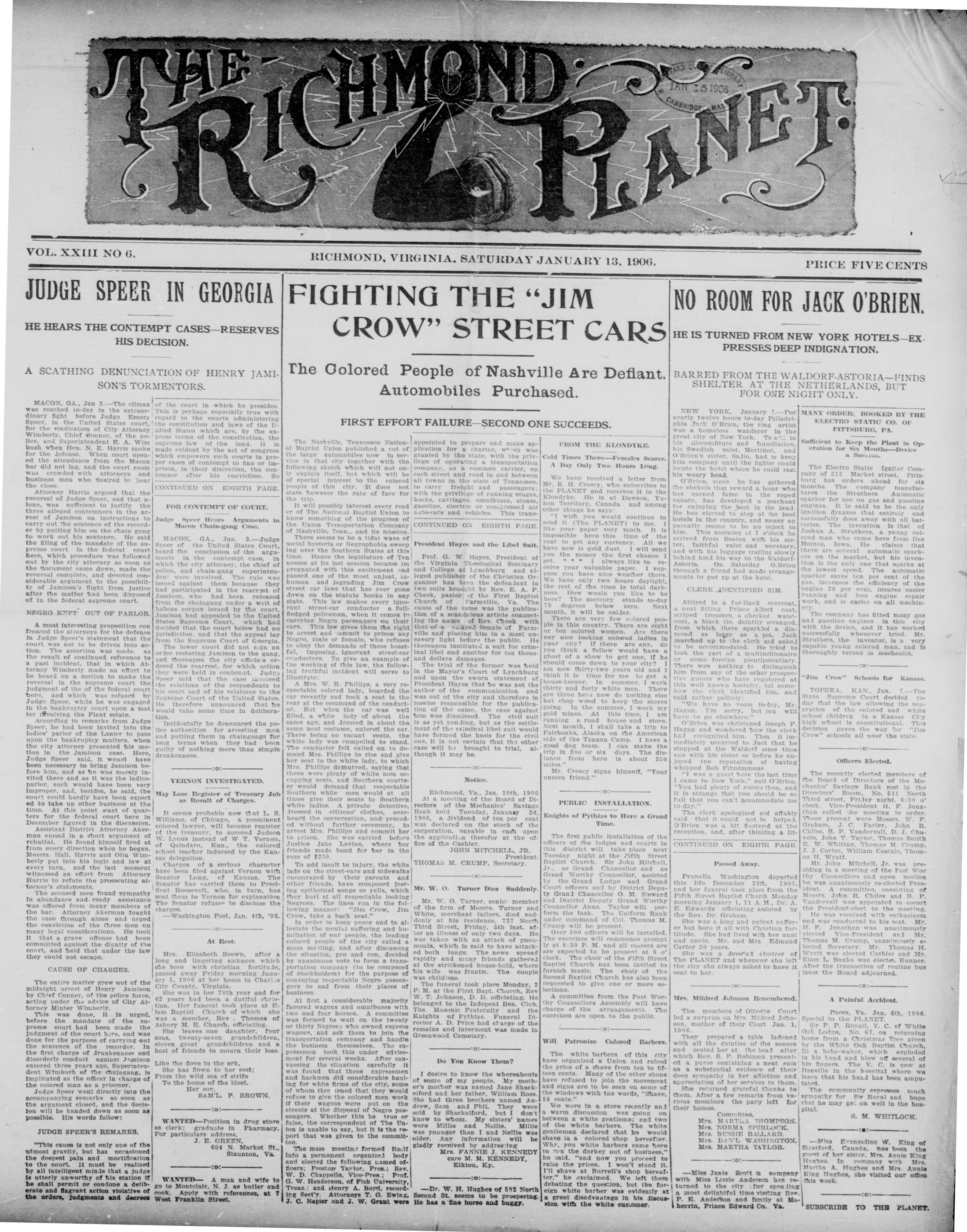
THE RICHMOND PLANET
JUDGE SPEER IN GEORGIA
HE HEARS THE CONTEMPT CASES--RESERVES HIS DECISION.
A SCATHING DENUNCIATION OF HENRY JAMISON'S TORMENTORS.
VOL. XXIII NO 6.
JUDGE SPEECH
HE HEARS THE CONTENT
HIS DE
A SCATHING DENUNCIA
SON'S TOR
MACON, GA., Jan 3.—The climax was reached to-day in the extraordinary fight before Judge Emory Speer, in the United States court, for the vindication of City Attorney Wimberly, Chief Conner, of the police, and Superintendent E. A. Wim bush when Hon. N. E. Harris spoke for the defense. When court opened the attendance from the Macon bar did not lag, and the court room was crowded with attorneys and business men who desired to hear the close.
Attorney Harris argued that the reversal of Judge Speer, and that alone, was sufficient to justify the three alleged contenders in the arrest of Jamison on instructions to carry out the sentence of the record by putting him on the chain gang to work out his sentence. He said the filing of the mandate of the supreme court in the federal court here, which procedure was followed out by the city attorney as soon as the document came down, made the reversal complete, and devoted considerable argument to the possibility of Jamison's flight from justice after the matter had been disposed of in the federal supreme court.
NEGRO KEPT OUT OF PARLOR
A most interesting proposition confronted the attorneys for the defense in Judge Speer's statement that the court was not to be driven into action. The assertion was made, as the result of continued reference to a past incident, that in that Attorney Wimberly made an effort to be heard on a motion to make the reversal in the supreme court the judgment of the of the federal court here, and which was refused by Judge Speer, while he was engaged in the bankruptcy court upon a matter involving the Plant estate. According to remarks from Judge Speer, he had been invited into the ladies' parlor of the Lanier to pass upon the bankruptcy matters, when the city attorney presented his motion in the Jamison case. Here, Judge Speer said, it would have been necessary to bring Jamison before him, and as he was merely invited there and as it was the ladies' parlor, such would have been very improper, and, besides, he said, the court could hardly have been expected to take up other business at the time. At this point want of quarters for the federal court here in December figured in the discussion.
Assistant District Attorney Akerman closed in a short argument of rebuttal. He found himself fired at from every direction when he began. Messrs. Hall, Harris and Olin Wimberly put into his logic and law at every turn, and the last moment witnessed an effort from Attorney Harris to refute the prosecuting attorney's statements.
The accused men found sympathy in abundance and ready assistance was offered from many members of the bar. Attorney Akerman fought the case through alone and urged the conviction of the three men on many legal considerations. He took it that a grave offense had been committed against the dignity of the court, and held that under the law they could not escape.
CAUSE OF CHARGES
The entire matter grew out of the midnight arrest of Henry Jamison by Chief Conner, of the police force, acting under the advice of City Attorney Minter Wimberly. This was done, it is urged, before the mandate of the supreme court had been made the judgment of the court here, and was done for the purpose of carrying out the sentence of the recorder. In the first charge of drunkenness and disorderly conduct against Jamison entered three years ago, Superintendent Wimbush of the chaining, is implicated as the officer in charge of the colored man as a prisoner. Judge Speer went directly into the accompanying remarks as soon as the argument closed, and the decision will be handed down as soon as possible. His words follow:
JUDGE SPEER'S REMARKS
"This cause is not only one of the utmost gravity, but has occasioned the deepest pain and mortification to the court. It must be realized by all intelligent minds that a judge is utterly unworthy of his station if he shall permit or condone a deliberate and flagrant action violative of the orders, judgments and decrees
of the court in which he presides. This is perhaps especially true with regard to the courts administering the constitution and laws of the United States which are, by the express terms of the constitution, the supreme law of the land. It is made evident by the act of congress which empowers such courts in proper cases of contempt to fine or imprison, in their discretion, the contemnor after his conviction. So CONTINUED ON EIGHTH PAGE.
FOR CONTEMPT OF COURT.
Judge Speer Hears Arguments in Macon Chain-gang Case.
MACON, GA., Jan. 3.—Judge Speer of the United States Court, heard the conclusion of the arguments in the contempt case, in which the city attorney, the chief of police, and chain-gang superintendent were involved. The rule was issued against them because they had participated in the rearrast of Jamison, who had been released from the chaianggung under a writ of habeas corpus issued by the court. Jamison had appealed to the United States Supreme Court, which had decided that the court below had no jurisdiction, and that the appeal lay from the Supreme Court of Georgia. The lower court did not sign an order restoring Jamison to the gang, and thereupon the city officials ordered the rearrast, for which action they were held in contempt. Judge Speer said that the case involved the relations of the respondents to his court and of his relations to the Supreme Court of the United States. He therefore announced that he would take some time in deliberation. Incidentally he denounced the police authorities for arresting men and putting them in chaianggangs for long terms when they had been guilty of nothing more than simple drunkenness.
VERNON INVESTIGATED.
May Lose Register of Treasury Job as Result of Charges.
It seems probable now that L. S. Williams, of Chicago, a prominent colored lawyer, will become register of the treasury, to succeed Judson W. Lyons instead of W T. Vernon, of Quindaro, Kan., the colored school teacher indorsed by the Kansas delegation. Charges of a serious character have been filed against Vernon with Senator Long, of Kansas. The Senator has carried them to President Roosevelt, who, in turn, has sent them to Vernon for explanation The Senator refuses to disclose the charges. Washington Post, Jan. 4th, '06.
At Rest
Mrs. Elizabeth Brown, after a long and lingering sickness which she hore with Christian fortitude, passed away Friday morning January 5, 1906 at her home in Charlsea City County, Virginia.
She was in her 78th year and for 62 years had been a dutiful Christian. Her funeral took place at Elam Baptist Church of which she was a member. Rev. Thomas of Asbury M. E. Church, officiating.
She leaves one daughter, four sons, twenty-seven grandchildren, eleven great grandchildren and a host of friends to mourn their loss.
Like the dove to the ark,
She has flown to her rest;
From the wild sea of strife
To the home of the blest.
WANTED—Position in drug store as clerk; graduate in Pharmacy. For particulars address.
J. E. GREEN.
604 N. Market St.,
Staunton, Va.
:o:
WANTED—A man and wife to go to Montclair, N. J. as butler and cook. Apply with references, at 7 West Franklin Street.
RICHMOND, VIRGINIA, SATURDAY JANUARY 13, 1906.
FIGHTING THE "JIM CROW" STREET CARS
The Colored People of Nashville Are Defiant. Automobiles Purchased.
FIRST EFFORT FAILURE—SECOND ONE SUCCEEDS.
The Nashville, Tennessee National Baptist Union published a cut of the large automobiles now in service in that city together with the following sketch which will not only explain itself, but which will be of special interest to the colored people of this city. It does not state however the rate of fare for the trip.
It will possibly interest every reader of The National Baptist Union to know something of the progress of the Union Transportation Company of Nashville, Tenn., and its mission. There seems to be a tidal wave of social hysteria or Negrophobia sweeping over the Southern States at this time. Hence the legislature of Tennessee at its last session became impregnated with this excitement and passed one of the most unjust, inhuman and degrading Jim Crow street car laws that has ever gone down on the statute books in any state. This law makes every ignorant street-car conductor a full-fledged policeman, when it comes to carrying Negro passengers on their cars. This law gives them the right to arrest and commit to prison any Negro, male or female, who refuses to obey the demands of these boastful, imposing, ignorant street-car conductors. To give an example of the working of this law, the following truthful incident will serve to illustrate:
appointed to prepare and make application for a charter, which was granted by the state, with the privilege of operating a transportation company, as a common carrier, on each street and road in and between all towns in the state of Tennessee, to carry freight and passengers; with the privilege of running stages, hacks, carriages, omnibuses, steam, gasoline, electric or compressed air auto-cars and vehicles. This trans-
CONTINUED ON EIGHTH PAGE.
President Hayes and the Libel Suit.
Prof. G. W. Hayes, President of the Virginia Theological Seminary and College at Lynchburg and alleged publisher of the Christian Organizer has been the defendant in two suits brought by Rev. E. A. P. Cheek, pastor of the First Baptist Church of Farmville, Va. The cause of the same was the publica-tion of a scandalous article connecting the name of Rev. Cheek with that of a colored female of Farmville and placing him in a most unsavory light before the public. He thereupon instituted a suit for criminal libel and another for ten thousands damages.
The trial of the former was held in the Mayor's Court of Lynchburg and upon the sworn statement of
FROM THE KING
Cold Times There—A Day Only Two
We have received Mr. R. H. Creecy, and the PLANET and the Klondyke. He is on con Territory, Canada other things he says.
"I wish you would send it (The PLANET) like your paper very impossible here this year to get any coin have now is gold due you the money they. **** I allowceive your valuable pose you have nice. We have only two, the rest of the time. How would you here? The mercury 78 degrees below month, it will be o
There are very ple in this country, or ten colored woy any nice looking o your city? If the you think a fellow ghost of a show to should come down on an now thirty-two think it is time for
A Mrs. W. B. Phillips, a very respectable colored lady, boarded the car recently and took a seat in the rear at the command of the conductor. But when the car was well filled, a white lady of about the same age, and dressed in about the same neat costume, entered the car. There being no vacant seats, the white lady was compelled to stand. The conductor felt called on to demand Mrs. Phillips to rise and give her seat to the white lady, to which Mrs. Phillips demurred, saying that there were plenty of white men occupying seats, and Southern courtesy would demand that respectable Southern white men would at all times give their seats to Southern white ladies. A private detective, Jressed in citizens' clothes, overheard the conversation, and proceeded without further ceremony, to arrest Mrs. Phillips and commit her to prison. She was carried before Justice Jake Levine, where her friends made bond for her in the sum of $250.
To add insult to injury, the white lads on the street-cars and sidewalks encouraged by their parents and other friends, have composed jeering epithetical songs or yellls, which they hurl at all respectable looking Negroes. The lines run in the following manner: "Jim Crow, Jim Crow, take a back seat."
In order to keep peace and to alleviate the mental suffering and humiliation of our people, the leading colored people of the city called a mass meeting, and after discussing the situation, pro and con, decided by unanimous vote to form a transportation company (to be composed of stockholders) for the purpose of conveying respectable Negro passengers to and from their places of business.
At first a considerable majority favored wagons and onnibuses with two and four horses. A committee was formed to wait on the twenty or thirty Negroes who owned express wagons, and ask them to join the transportation company and handle the business themselves. The expressmen took this under advisement for several weeks. After canvassing the situation carefully it was found that these expressmen and hackmen did considerable hauling for white firms of the city, some of whom threw cedet that they would refuse to give the colored men work if their wagons were put on the streets at the disposal of Negro passengers. Whether this be true or false, the correspondent of The Union is unable to say, but it is the report that was given to the committee.
The mass meeting; formed itself into a permanent organized body and elected the following named officers: Prestor Taylor, Pres.; Rev. W. D. Chappelle, Vice-Pres.; Prof. G. W. Henderson, of Fisk University, Treas.; and Henry A. Boyd, recording Sect'y. Attorneys T. G. Ewing, J. C. Napier and J. W. Grant were
appointed to prepare and make application for a charter, which was granted by the state, with the privilege of operating a transportation company, as a common carrier, on each street and road in and between all towns in the state of Tennessee, to carry freight and passengers; with the privilege of running stages, hacks, carriages, omnibuses, steam, gasoline, electric or compressed air auto-cars and vehicles. This trans-
CONTINUED ON EIGHTH PAGE
President Hayes and the Libel Suit
Prof. G. W. Hayes, President of the Virginia Theological Seminary and College at Lynchburg and alleged publisher of the Christian Organizer has been the defendant in two suits brought by Rev. E. A. P. Cheek, pastor of the First Baptist Church of Farmville, Va. The cause of the same was the publication of a scandalous article connecting the name of Rev. Cheek with that of a cared female of Farmville and placing him in a most unsavory light before the public. He thereupon instituted a suit for criminal libel and another for ten thousand dollars damages.
The trial of the former was held in the Mayor's Court of Lynchburg and upon the sworn statement of President Hayes that he was not the author of the communication and was out of the city and therefore in nowise responsible for the publication of the same, the case against him was dismissed. The civil suit is as yet pending, but as the settlement of the criminal libel suit would have formed the basis for the civil one, it is not certain that the other case will be brought to trial, although it may be.
Notice.
Richmond, Va., Jan. 10th, 1906
At a meeting of the Board of
Directors of the Mechanics' Savings
Bank held Tuesday, January 2d,
1906, a dividend of ten per cent
was declared on the stock of the
corporation, payable in cash upon
the application therefor at the office of the Cashier.
JOHN MITCHELL, JR.
President.
THOMAS M. GRUMD, Sr.
THOMAS M. CRUMP. Secretary.
Mr. W. O. Turner Dies Suddenly
Mr. W. O. Turner, senior member of the firm of Messrs. Turner and White, merchant tailors, died suddenly at his residence, 737 North Third Street, Friday, 5th inst. after an illness of only two days. He was taken with an attack of pneumonia, which is said to have attacked both lungs. The news spread rapidly and many friends gathered at the strickened house-hold, where his wife was frantic. The couple was childless.
The funeral took place Monday, 3 P. M. at the First Bapt, Church, Rev W. T. Johnson, D. D. officiating. He belonged to the Independent Ben. Club, the Masonic Fraternity and the Knights of Pythias. Funeral Director A. D. Price had charge of the remains and interment was made in Greenwood Cemetery.
Do You Know Them?
I desire to know the whereabouts of some of my people. My mother's mother was named Jane Shackelford and her father, William Ross. She had three brothers named Andrew, Sam and Phil. They were sold by Shackelford, but I don't know to whom. My sisters' names were Millie and Nellie. Millie was younger than I and Nellie was older. Any information will be gladly received by addressing Mrs. FANNIE J. KENNEDY care M. M. KENNEDY, Elkton, Ky.
Dr. W. H. Hughes of 502 North Second St. seems to be prospering. He has a fine horse and buggy.
FROM THE KLONDYKE
Cold Times There—Females Scarce
A Day Only Two Hours Long.
We have received a letter from Mr. R. H. Creech, who subscribes to the PLANET and receives it in the Klondyke. He is at Dawson, Yukon Territory, Canada and among other things he says:
"I wish you would continue to send it (The PLANET) to me. I like your paper very much. It is impossible here this time of the year to get any currency. All we have now is gold dust. I will send you the money the first chance I get. * * * I always like to receive your valuable paper. I suppose you have nice weather there. We have only two hours daylight, the rest of the time is total darkness. How would you like to be here? The mercury stands to-day 78 degrees below zero. Next month, it will be colder.
There are very few colored people in this country. There are eight or ten colored women. Are there any nice looking colored ladies in your city? If there are any, do you think a fellow would have a ghost of a show to get one, if he should come down to your city? I am now thirty-two years old and I think it is time for me to get a house-keeper. In summer, I work thirty and forty white men. There are three hers now do nothing else but chop wood to keep the stoves going. In the summer, I work my gold mines. At this time, I am running a road house and store. Next month, I shall take a trip to Fairbanks, Alaska on the American side of the Tanana Camp. I have a good dog team. I can make the trip in five or six days. The distance from here is about 350 miles."
Mr. Creecy signs himself, "Your unseen friend."
PUBLIC INSTALLATION
Knights of Pythias to Have a Grand Time.
The first public installation of the officers of the lodges and courts in this district will take place next Tuesday night at the Fifth Street Baptist Church. Sir John Mitchell, Jr., as Grand Chancellor and as Grand Worthy Counsellor, assisted by the Grand Lodge and Grand Court officers and by District Deputy Grand Chancellor O. M. Steward and District Deputy Grand Worthy Counsellor Anna Taylor will perform the task. The Uniform Rank under command of Col. Thomas M. Crump will be present.
Over 500 officers will be installed. The exercises will commence promptly at 8:30 P. M. and all officers are expected to be present at 8 o'clock. The choir of the Fifth Street Baptist Church has been invited to furnish music. The choir of the Second Baptist Church has also been requested to give one or more selections.
A committee from the Past Worthy Counsellors Assembly will have charge of the arrangements. The exercises are open to the public.
Will Patronize Colored Barbers.
The white barbers of this city have organized a Union and raised the price of a shave from ten to fifteen cents. Many of the other shops have refused to join the movement and signs are to be seen on some of the windows with the words, "Shave, 10 cents."
We were in a store recently and a warm discussion was going on between a white gentleman, and two of the white barbers. The white gentleman declared that he would shave in a colored shop hereafter. Why, you white barbers came here to run the darkey out of business," he said, "and now you proceed to raise the prices. I won't stand it. I'll shave at Burrell's shop hereafter," he exclaimed. We left debating the question, but the foreign white barber was evidently at a great disadvantage in his discussion with the white customer.
NO ROOM FOR JACK O'BRIEN.
HE IS TURNED FROM NEW YORK HOTELS—EXPRESSES DEEP INDIGNATION.
BARRED FROM THE WALDORF-ASTORIA—FINDS SHELTER AT THE NETHERLANDS, BUT FOR ONE NIGHT ONLY.
NEW YORK, January 7.—For nearly twelve hours to-day Philadelphia Jack O'Brien, the ring artist was a homeless wanderer in the great city of New York. To add to his discomfiture and humiliation, his Swedish valet, Mortimer, and O'Brien's sister, Sadie, had to keep him company until the lighter could locate the hotel where he could rest his weary head.
O'Brien, since he has gathered the shekels that reward a boxer who has earned fame in the roped square, has developed a penchant for enjoying the best in the land. He has elected to stop at the best hotels in the country, and money ap parently seems to be no object to him. This morning at 7 o'clock he arrived from Boston with his sister, faithful valet and secretary, and with his luggage trailing slowly behind hied his way to the Waldorf-Astoria. On Saturday O'Brien through a friend had made arrangements to put up at the hotel.
MANY ORDER: BOOKED BY THE ELECTRO STATIC CO. OF PITTSBURG, PA.
Sufficient to Keep the Plant in Operation for Six Months—Device a Success.
The Electro Static Igniter Company of 213 Market street, Pittsburg has orders ahead for six months. The company manufactures the Struthers Automatic sparker for use on gas and gasoline engines. It is said to be the only ignition dynamo that entirely and successfully does away with all batteries. The invention is that of Joshua A. Struthers, a young colored man who came here from Des Moines, Iowa. He claims that there are several automatic sparkers on the market, but his invention is the only one that sparks at the lowest speed. The automatic sparker saves ten per cent of the
CLERK IDENTIFIED HIM
Attired in a fur-lined overcoat, a neat fitting Prince Albert coat, striped trousers, a checked waist-coat, a black tie, daintily arranged, from which there sparkled a diamond as large as a pea, Jack marched up to the clerk and asked to be accommodated. He tried to look the part of a multimillionaire or some foreign plentipetentiary. There was nothing to distinguish him from any of the other prospective guests who have registered at this well known hostelry, but somehow the clerk identified him, and said rather politely:
"We have no room to-day, Mr. Hagan. I'm sorry, but you will have to go elsewhere."
O'Brien was christened Joseph F. Hagan and wondered how the clerk had recognized him. Then it immediately occurred to Jack that he stopped at the Waldorf some time ago with his sister or before he enjoyed the reputation of having whipped Bob Fitzsimmons.
"I was a guest here the last time I came to New York," said O'Brien. "You had plenty of rooms then, and it is strange that you should be so full that you can't accommodate me to day."
The clerk apologized and affably said that it could not be helped. O'Brien was a bit flustered at the reception, and, after thinking a lit-
Passed Away
Prunella Washington departed this life December 29th, 1905, and her funeral took place from the Fifth Street Baptist Church Monday morning January 1, 11 A.M., Dr. A. E. Edwards officiating assisted by the Rev. Dr. Graham.
She was a long and patient sufferer but bore it all with Christian fortitude. She had lived with her aunt and uncle, Mr. and Mrs. Edmund Carter 20 years.
She was a devoted admirer of The PLANET and whenever she left the city she always asked to have it sent to her.
Mrs. Mildred Johnson Remembered.
The members of Olivette Court led a surprise on Mrs. Mildred Johnson, mother of their Court Jan. 1, 1906.
They prepared a table ladened with all the dainties of the season and seated her at the head after which Rev. S. P. Robinson presented a purse containing a neat sum as a substantial evidence of their deep sympathy in her affection and appreciation of her services to them.
She returned grateful thanks to them. After a few remarks from various members the party left for their homes.
Committee,
Mrs. MARTHA THOMPSON.
Mrs. NORMA SPURLOCK.
Mrs. BESSIE BALLARD.
Mrs. DANL WASHINGTON.
Mrs. MARTHA TAYLOR.
—Miss Janie Scott m company with Miss Lizzie Anderson has returned to the city after opening a most delightful time visiting Rev. P. E. Anderson and family at Meherrin, Prince Edward Co. Va.
PRICE FIVE CENTS
JACK O'BRIEN.
NEW YORK HOTELS—EXP INDIGNATION.
OLDORF-ASTORIA—FINDS NETHERLANDS, BUT LIGHT ONLY.
MANY ORDER. BOOKED BY THE
ELECTRO STATIC CO. OF
PITTSBURG, PA.
Sufficient to Keep the Plant in Operation for Six Months—Device a Success.
The Electro Static Igniter Company of 213 Market street, Pittsburg has orders ahead for six months. The company manufactures the Struthers Automatic sparker for use on gas and gasoline engines. It is said to be the only ignition dynamo that entirely and successfully does away with all batteries. The invention is that of Joshua A. Struthers, a young colored man who came here from Des Moines, Iowa. He claims that there are several automatic sparkers on the market, but his invention is the only one that sparks at the lowest speed. The automatic sparker saves ten per cent of the gas, increases the efficiency of the engine 20 per cent, insures easier running and less engine repair work, and is easier on all machinery.
The company has fitted many gas and gasoline engines in this city with the device, and it has worked successfully whenever tried. Mr. Struthers, the inventor, is a very capable young colored man, and is thoroughly versed in mechanics.
"Jim Crow" Schools for Kansas.
TOPEKA, KAN., Jan. 7. —The State Supreme Court decided today that the law allowing the separation of the colored and white school children in a Kansas City high school is constitutional. This decision paves the way for "Jim Crow" schools all over the state.
Officers Elected.
The recently elected members of the Board of Directors of the Mechanies' Savings Bank met in the Directors' Room. No. 511 North Third street, Friday night. 6:30 o'clock. Vice-President H. F. Jonathan called the meeting to order. Those present were Messrs. W. F. Graham, J. C. Farley, John R. Chiles, B. P. Vandervall, D. J. Chavers, John T. Taylor, Thomas Smith R. W. Whiting, Thomas M. Crump, J. J. Carter, William Custalo, Thomas H. Wyatt.
Mr. John Mitchell, Jr. was presiding in a meeting of the Past Worthy Counsellors and upon motion he was unanimously re-elected President. A committee, consisting of Messrs. John R. Chiles and B. P. Vandervall was appointed to escort the President-elect to the meeting.
He was received with enthusiasm and was conducted to his seat. Mr. H. F. Jonathan was unanimously elected Vice-President and Mr. Thomas M. Crump, unanimously elected Secretary. Mr. Thomas H. Wyatt was elected Cashier and Mr. Elam L. Banks was elected Runner. After the transaction of routine business the Board adjourned.
A Painful Accident
Paces, Va. Jan. 6th, 1906. Special to the PLANET.
Sir P. P. Royall, V. C. of White Oak Lodge, No. 67, on returning home from a Christmas Tree given by the White Oak Baptist Church, lit a baby-waker, which exploded in his hand and blew off several of his fingers. The V. C. is now at Danville in the hospital where we learn that his hand has been amputated.
The community expresses much sympathy for Sir Royal and hope that he may get on well in the hospital.
S. M. WHITLOCK
—Miss Evangeline W. King of Stratford, Canada, has been the guest of her sister, Mrs. Annie King Hughes. In company with Mrs. Martha A. Hughes and Mrs. Annie King Hughes, she visited our office this week.
SUBSCRIBE TO THE PLANET.
THE PLANET
SATURDAY.....JAN. 13TH. 1906
WRITTEN IN RED
By
CHAS. HOWARD MONTAGUE
AND C. W. DYAR
(Copyright, by The Cassell Publishing Co.)
WRITTEN IN RED
CHAPTER 1—Story open in offices of
Nicaragua & Stackhouse, a Boston brokers' and bankers' concern. Directors of Nicaragua
Midland and Stackhouse awalt North, who some days before had received letter threat-
ing death. Search for North reveals his
dead body, at his unoccupied town home.
Beside body, in scrawl of red. 12 WRIT-
ten "Stackhouse."
CHAPTER 2—Officers, reporters and
physicians investigate and perfumed wom-
ants handkerchief is found on staircase.
Kingman F. Thomas, of Boston Globe, in-
CHAPTER 2. JEWEDGE, friend of the firm, and Stackhouse engage Detective Lamm to probe murder, and each in private Lamm goes to Swansea, North Swansea, and Lamm goes to Swansea, North Swansea.
CHAPTER 4 — Lamm hides in North home, where Stackhouse also lives, and bears M. Stackhouse, North's daughter, accuse husband of murder. Stackhouse leans on faults.
CHAPTER 5 — Fetish arrives at North home. Mam interviews Mrs. Stackhouse, Petridge and North butler. Marie Molesst, known to both Petridge and Stackhouse, connected with case.
CHAPTER 6 — Medical Examiner Jarvis reports view of case. Thomas interviews view of autopsy; then confers with Lamm, who tells Petridge connection with case.
CHAPTER 7 — Busy day at police office. Disclosed that Mrs. Stackhouse was North's adopted child. Inspector Appleby visits stackhouse, purging love letter to Maxton mailler.
CHAPTER 8 — Thomas visits North wife, Thomas and Appleby present at murdered man's funeral. Oder on handkerchief found in North's town home detected by Appleby on Stella, North's youngest daughter.
CHAPTER 9 — Thomas confers with Lamm. Goes to North villa at night; observes descent treills; follows the woman to the house; throws revolver into water. He recovers it.
CHAPTER 10—Takes up pursuit again,
following woman all night and part of next
day. On finding her, Thomas discovers she
kills on her bed.
CHAPTER 11—Stella reveals fact that
Marlon is implicated in murder. Thomas
kills in love with Stella.
CHAPTER 12—Firm of North & Stack-
house collapses. Detective put on Stella
North's trail. Thomas reveals finding of
revolver, nothing else.
CHAPTER 13—Advertisement for information
about Marie Molosset answer by
Marleton. Marie detective on trail.
Stackhouse calls for information; tries
to see Marlette, but is outwitted.
CHAPTER 14—Stackhouse writes letter
to Marie Molosset, begging mercy and asking
interview Lamm gets letter. Lamm trails
Thomas to apartment building; spies on
him finding him entertaining Stella North.
CHAPTER 15—Marleton calls on Lamm,
edge of Thomas' protection of Stella. The
story, saying that Stella had seen Marlon
Stackhouse coming from house where
North was murdered on the same evening.
CHAPTER 16—Thomas concludes story which casts bad light on Marion. Lamm visits Thomas home; meets Stella and discovers that she and Thomas are in love.
CHAPTER 17—Lamm discovers that a Mme Raymond calls on Fetridge. Follows the room at her boarding house. Finds Stackhouse awaiting him on return to office.
CHAPTER 18—Stackhouse tells Lamm trouble with wife, holding Mme Molssot responsible! Discovery made that Marie Molssot is probably Mme. Perle, an adventures. From photograph, Lamm easily concludes that Mme Perle is Mme Raymond.
CHAPTER 19—Thomas goes to tell Lamm of Mme Raymond, but finds that Lamm already has facts. Emily of Mme Nuremond against Stackhouse explained. Lamm tells of Fetridge's trip of a month; of return to Boston with woman and return of woman home with Fetridge shortly after hour of North murder.
CHAPTER 20—Mme R. Molle White, a Lamm colleague in North inner home, brings letter written to Marion to Lamm. Girl tells of scene in North parlor in which Marion and Fetridge figured.
CHAPTER 21.—Thomas sets out to get letter which Marion wrote to her husband, Stackhouse. Latter found drunk in hotel. Thomas gets letter. LatterStackhouse calls on Lamm. Asks permission to write letter and when alone commits suicide by shooting. Officers hurry to scene, and Thomas rushes in as Fetridge is being arrested for complicity.
CHAPTER 22.—Fact that Stackhouse had a last discovered. He was known as Albert Runyon. Thomas brings facts of Marion North, containing unraveling whole case. Reads document, telling how North was loading revolver which accidentally exploded, killing him. This happened after the attempt of Stackhouse to Marie Moisset, one of his dutches and house, under name of Runyon, had a wife and children in New Orleans. In revenge North wrote name of Stackhouse in blood on wall before he died, while Marion for same audience kept secret. Immediately Thomas confession Marion dies by poison. Thomas ends tase by marrying Stella.
CHAPTER XXII
Monday morning, 11 days exactly from that last and memorable meeting of the directors of the Nicaragua Midland, when Paul North's coming was awaited in vain, Thornton Stackhouse staggered into the office of Detective Lamm.
A few hours had wrought a great change in the man—a change for the worst. Careworn before, he was now absolutely haggard. But one look was needed to assure Mr. Lamm that his visitor had passed a sleepless, wretched night.
Unmistakable signs of debauch, too, were to be observed. His lips twitched strangely; the lines of his anxious face were more deeply drawn; an unhealthy blotched redness had taken the place of once healthy color, and there was an incessant trembling of the hands, unusual and ominous.
Mr. Lamm, with a good deal of concern expressed in his look, sprang up to greet him, and assisted the man to a chair.
"Why, Mr. Stackhouse," he exclaimed, "you are not well. Why did
you come down town this morning?
You should have sent for me. You are in no condition to be out in the street on such a warm day. Let me call a carriage. I will go down to your room at the Adams house and talk with you there, if you like."
Thornton Stackhouse shook his head and put out a trembling hand.
"No—no," he said, huskily. "You are very good to think of it. Perhaps I should not have left my room. But the hotel is a horror to me, sir. I cannot set foot in the hall without meeting the scowling face of some creditor of North & Stackhouse. People point after mc as I walk along, and talk under their breath about me. Fools! They think I do not see these things. I am followed here, there, and everywhere, hounded like an escaped convict. Saturday I lay down on a bed, and they broke open my room to make sure I had not escaped them! I thank you, Mr. Lamm, for all that you have done and meant to do for me. But I have made up my mind not to endure this life any longer. I am going away."
"Nonsense!" returned Mr. Lamm.
A
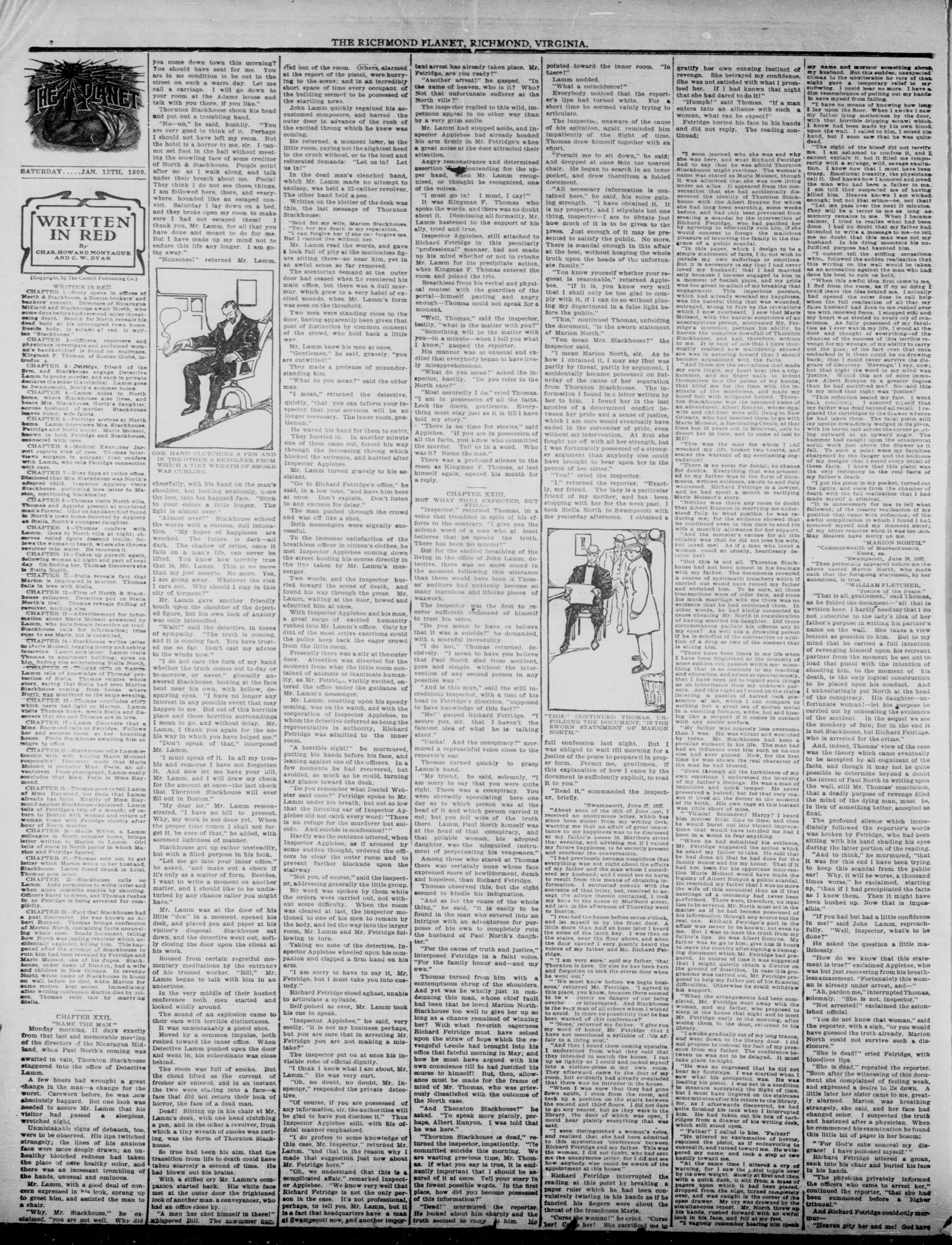
ONE HAND CLUTCHING A PEN AND
IN THE OTHER A REVOLVER FROM
WHICH A TINY WREATH OF SMOKE
WAS CURLING.
ONE HAND CLUTCHING A PEN AND IN THE OTHER A REVOLVER FROM WHICH A TINY WREATH OF SMOKE WAS CURLING.
cheerfully, with his hand on the man's shoulder, but looking anxiously, none the less, into his haggard face. "Stick to your colors a little longer. The fight is almost over."
"Almost over!" Stackhouse echoed the words with a curious, dull intonation. "My hopes of happiness are wrecked. The future is dark—all dark. The shadow of crime, once it falls on a man's life, can never be lifted. You know how terribly true that is, Mr. Lamm. This is no more than my just deserts. No more. Yes, I am going away. Whatever the risk I care not. Why should I stay in this city of torment?" Mr. Lamm gave another friendly touch upon the shoulder of the dejected figure, but his own look of anxiety was only intensified.
"Walt!" said the detective, in tones of sympathy. "The truth is coming, and it is coming fast. You have trusted me so far. Don't cast my advice to the winds now."
"I do not care the turn of my hand whether the truth comes out to day or to-morrow, or never," gloomily answered Stackhouse, looking at the face bent near his own, with hollow, despiring eyes. "I have no longer any interest in any possible event that may happen to me. But out of this horrible place and these horrible surroundings I mean to go, and without delay. Mr. Lamm, I thank you again for the noble way in which you have helped me."
"Don't speak of that," interposed Mr. Lamm.
"I must speak of it. In all my trouble and remorse I have not forgotten it. And now let me have your oll, Mr. Lamm, and I will draw my check for the amount at once—the last check that Thornton Stackhouse will ever fill out in Boston."
"My dear sir," Mr. Lamm remonstrated, "I have no bill to present. Why, my work is not done yet. When the proper time comes I shall not forget it, be sure of that," he added, with assumed lightness of manner.
Stackhouse got up rather unsteadily, but with a filled purpose in his book.
but with a need purpose in his look.
"Let me go into your inner office."
he asked, "and make out a check if it's only as a matter of form. Besides, I want to write a moment on another matter, and I should like to be undisturbed by any chance caller you might have."
Mr. Lamm was at the door of his little "den" in a moment, opened his desk, and placed pen and paper at his visitor's disposal. Stackhouse sat down, and the detective went out, softly closing the door upon the client at his work.
Roused from certain regretful momentary meditations by the entrance of his trusted worker, "Bill," Mr. Lamm began to talk with him in an undertone.
In the very middle of their hushed conference both men started and looked wildly around.
The sound of an explosion came to their ears with terrible distinctness.
It was unmistakably a pisor shoe.
Moved by a common impulse, both rushed toward the inner office. When Detective Lamm pushed open the door and went in, his subordinate was close behind.
The room was full of smoke. But the cloud lifted as the current of fresher air entered, and in an instant the two were staring into a face—a face that did not return their look of horror, the face of a dead man.
Dead! Sitting up in his chair at Mr. Lamm's desk, with one hand clutching a pen, and in the other a revolver, from which a tiny wreath of smoke was curling, was the form of Thornton Stack-house.
So true had been his aim, that the transition from life to death could have taken scarcely a second of time. He had blown out his brains.
With a stifled cry Mr. Lamm's companion started back. His white face met at the outer door the frightened look of another man. a conveyancer, who had an office close by.
"A man has shot himself in there!" whispered Bill. The newcomer hur-
THE RICHMOND PLANET, RICHMOND, VIRGINIA.
fled out of the room. Others, alarmed at the report of the pistol, were hurrying to the scene; and in an incredibly short space of time every occupant of the building seemed to be possessed of the startling news.
John Lamm quickly regained his accustomed composure, and barred the outer door in advance of the rush of the excited throng which he knew was coming.
He returned, a moment later, to the little room, paying not the slightest heed to the crush without, or to the loud and reiterated demands: "Let us in! Let us in!"
In the dead man's clenched hand, which Mr. Lamm made no attempt to unclasp, was held a 32-caliber revolver. The other hand held a pen.
Written on the blotter of the desk was this, the last message of Thornton Stackhouse:
"Send for my wife, Marion Stackhouse,
"Tell her my death is my repiration,
"I can forgive her if she can forgive me,
But I cannot live without her."
Mr. Lamm read the words, and gave
$look full of pity at the motionless figure
sitting there—so near him, yet in
awful sense so far removed.
The stentorian demand at the outer
door had ceased when he reentered his
main office, but there was a dull murmur which grew to a very babel of excited sounds, when Mr. Lamm's form was seen on the threshold.
Two men were standing close to the
door, having apparently been given that
post of distinction by common consent
of the crowd, who held back a little wav.
Mr. Lamm knew his men at once.
"Gentlemen," he said, gravely, "you are outwitted!"
They made a pretense of misunderstanding him.
"What do you mean?" said the older man.
"I mean," returned the detective, quietly, "that you can inform your inspector that your services will be no longer necessary. The inner room, gentlemen."
He waved his hand for them to enter.
They hurried in. In another minute one of them came out, forced his way through the increasing throng which blocked the entrance, and hurried after Inspector Applebee.
Mr. Lamm turned gravely to his assistant.
"Go to Richard Fetridge's office," he said, in a low tone, "and have him here at once. Don't explain. Don't listen to any excuses for delay."
The man pushed through the crowd and was off like a shot.
Both messengers were signally successful.
To the immense satisfaction of the breathless officer in citizen's clothes, he met Inspector Applebee coming down the street holding his course directly in the line taken by Mr. Lamm's messenger.
Two words, and the Inspector hurried toward the scene of death, and found his way through the press. Mr. Lamm, waiting at the door, bowed and admitted him at once.
With Inspector Applebee and his man, a great surge of excited humanity rushed into Mr. Lamm's office. Only by dint of the most active exertions could the police keep back the eager crowd from the little room.
Presently there was a stir at the outer door. Attention was diverted for the moment from what the little room contained of animate or inanimate humanity, as Mr. Fetridge, visibly excited, entered the office under the guidance of Mr. Lamm's messenger.
Mr. Lamm, counting upon his speedy coming, was on the watch, and with the cooperation of Inspector Applebee, to whom the detective deferred as being the representative in authority, Richard Fetridge was admitted to the inner room.
"A horrible sight!" he murmured, putting his hands before his face, and leaning against one of the officers. In a few moments he had recovered, but avoided, as much as he could, turning any glance toward the desk.
"Do you remember what Daniel Webster said once?" Fetridge spoke to Mr. Lamm under his breath, but not so low that the listening ear of Inspector Applebee did not catch every word: "There is no refuge for the murderer but suicide. And suicide is confession!"
Hardly was the sentence uttered, when Inspector Applebee, as if aroused by some sudden thought, ordered the officers to clear the outer room and to prevent further blockade upon the stairway.
"Not you, of course," said the inspector, addressing generally the little group. No word was spoken by them while the orders were carried out, not without some difficulty. When the room was cleared at last, the inspector motioned to one of his men to remain by the body, and led the way into the larger room, Mr. Lamm and Mr. Fetridge following in turn.
Taking no note of the detective, Inspector Applebee wheeled upon his companion and clapped a firm hand on his arm.
"I am sorry to have to say it, Mr. Fetridge, but I must take you into custody."
Richard Fetridge stood aghast, unable to articulate a syllable.
Self-poised as ever, Mr. Lamm took his cue to speak.
"Inspector Applebee," he said, very coolly, "it is not my business, perhaps, but you are sure that in arresting Mr. Fetridge you are not making a mistake?"
The inspector put on at once his invisible robe of official dignity.
"I think I know what I am about, Mr. Lamm." He was very curt.
"Oh, no doubt, no doubt, Mr. Inspector," responded the private detective.
"Of course, if you are possessed of any information, sir, the authorities will be glad to have you disclose it." Thus Inspector Applebee still, with his official manner emphasized.
"I do profess to some knowledge of this case, Mr. Inspector." returned Mr. Lamm. "and that is the reason why I made that suggestion just now about Mr. Fetridge here."
"Oh, we understand that this is a complicated affair," remarked Inspector Applebee. "We know very well that Richard Fetridge is not the only person in the case. It's not professional, perhaps, to tell you, Mr. Lamm, but it is a fact that headquarters have a man at Swampscott now, and another impor-
tant arrest has already taken place. Mr. Fetridge, are you ready?"
"Another arrest!" he gasped. "In the name of heaven, who is it? Who? Not that unfortunate sufferer at the North villa?"
The inspector replied to this wild, impetuous appeal in no other way than by a very grim smile.
Mr. Lamm had stepped aside, and Inspector Applebee had already hooked his arm firmly in Mr. Fetridge's when a great noise at the door attracted their attention.
Angry remonstrance and determined assertion contending for the upper hand, when Mr. Lamm recognized, or thought he recognized, one of the voices.
"I must go in! I must, I say!"
It was Kingman F. Thomas who spoke the words, and there was no doubt about it. Dismissing all formality, Mr. Lamm hastened to the support of his ally, tried and true.
Inspector Applebee, still attached to Richard Fetridge in this peculiarly "professional" manner, had not made up his mind whether or not to rebuke Mr. Lamm for his precipitate action, when Kingman F. Thomas entered the room and joined the trio.
Breathless from his verbal and physical contest with the guardian of the portal—himself panting and angry enough—Thomas could not speak for a moment.
"Well, Thomas," said the inspector, testily, "what is the matter with you?" "Something will be the matter with you—in a minute—when I tell you what I know," gasped the reporter.
His manner was so unusual and excited that everybody began to have lively misaprehensions.
"What do you mean?" asked the inspector, hastily. "Do you refer to the North case?" "Most assuredly I do." eried Thomas. "I am in possession of all the facts. Lock the doors, gentlemen. Everything must stay just as it is till I have told my story." "There is no time for stories," said Applebee. "If you are in possession of all the facts, you know who committed the murder. Tell us in a word. Who was it? Name the man." There was a profound silence in the room as Kingman F. Thomas, at last himself again, opened his mouth for a reply.
CHAPTER XXIII
NOT WHAT THEY EXPECTED, BUT STILL
"Inspector," returned Thomas, in a voice that trembled in spite of his efforts to the contrary. "I give you the solemn word of a man who at least believes that he speaks the truth. There has been no murder!"
But for the excited breathing of the living in the office of John Lamm, detective, there was no more sound in the moment following this utterance than there would have been it Thomas' auditors had suddenly become so many ingenious and lifelike pieces of waxwork.
The inspector was the first to recover sufficient command of himself to trust his voice.
"Do you mean to have us believe that it was a suicide?" he demanded, with a scornful incredulity.
"I do not," Thomas returned, decisively. "I mean to have you believe that Paul North died from accident, pure and simple, without the intervention of any second person in any possible way."
"And is this man," said the still incredulous inspector, with a toss of his head in Fetridge's direction, "supposed to have knowledge of this fact."
"Me!" gasped Richard Fetridge. "I assure you, sir, that I haven't the faintest idea of what he is talking about."
"Umh! And the conspiracy?" murmured a reproachful voice close to the reporter's ear.
Thomas turned quickly to grasp Lamm's hand.
"My friend, he said, solemnly, 'I am sorry to say that you were quite right. There was a conspiracy. You were shrewdly speculating here one day as to which person was at the head of it and which person carried it out; but you fell wide of the truth there. Lamm, Paul North himself was at the head of that conspiracy, and that pitiable woman, his adopted daughter, was the misguided instrument of perpetuating his vengeance." Among those who stared at Thomas there was certainly none whose face expressed more of bewilderment, dumb and hopeless, than Richard Fetridge. Thomas observed this, but the sight seemed to kindle his indignation.
"And as for the cause of the whole thing," he said, "it is easily to be found in the man who entered into an intrigue with an adventurer for purposes of his own to completely ruin the husband of Paul North's daughter."
"For the cause of truth and justice," interposed Fetridge in a faint voice. "For the family honor and—and my own."
Thomas turned from him with a contemptuous shrug of the shoulders. And yet was he wholly just in condemning this man, whose chief fault had been that he loved Marion North-Stackhouse too well to give her up so long as a chance remained of winning her? With what feavish eagerness Richard Fetridge must have seized upon the straw of hope which the revengeful Greole had brought into his office that fateful morning in May; and how he must have argued with his own conscience till he had justified his course to himself! But, then, allowance must be made for the frame of mind of Mr. Thomas, who was grievously dissatisfied with the outcome of the North case.
"And Thornton Stackhouse?" he asked. "To speak more plainly, perhaps, Albert Runyon. I was told that he was here."
"Thornton Stackhouse is dead," returned the inspector, impatient. "He committed suicide this morning. We are wasting precious time, Mr. Thomas. If what you say is true, it is eminently important that I should be assured of it at once. Tell your story in the fewest possible words. In the first place, how did you become possessed of this information?"
"Dead!" murmured the reporter. He looked about him sharply and the truth seemed to come to him. He
pointed toward the inner room. "In there?"
Lamm nodded.
"What a coincidence!"
Everybody noticed that the reporter's lips had turned white. For a short time he seemed vainly trying to articulate.
The inspector, unaware of the cause of his agitation, again reminded him impatiently of the flight of time. Thomas drew himself together with an effort.
"Permit me to sit down," he said; and dropped at once into the nearest chair. He began to search in an inner pocket, and drew therefrom a folded document.
"All necessary information is contained here," he said, his voice gaining strength. "I have obtained it. It is my property, and I stipulate but one thing, inspector—I am to dictate just how much of it is to be given to the press. Just enough of it may be presented to satisfy the public. No more. There is scandal enough in this affair at the best, without heaping the whole truth upon the heads of the unfortunate family."
"You know yourself whether your request is reasonable," returned Applebee. "If it is, you know very well that I shall only be too glad to comply with it, if I can do so without placing my department in a false light before the public."
"This," continued Thomas, unfolding the document, "is the sworn statement of Marion North."
"You mean Mrs. Stackhouse?" the inspector said.
"I mean Marion North, sir. As to how I obtained it, I may say that was partly by threat, partly by argument. I accidentally became possessed on Saturday of the cause of her separation from Thornton Stackhouse. The information I found in a letter written by her to him. I found her in the last agonies of a determined conflict between her pride and a sense of justice, which I am sure would eventually have ended in the surrender of pride, even without my intervention. At first she fought me off with all her strength, but I was fortunately possessed of a stronger argument than anybody else could have brought to bear upon her in the person of her sister."
"You!!" cried the inspector.
"I," returned the reporter. "Exactly, my friend. The lady is a particular friend of my mother, and has been stopping with her for the week past. I took Stella North to Swampscott with me yesterday afternoon. I obtained a
A
"THIS," CONTINUED THOMAS, UNFOLDING THE DOCUMENT, "IS THE SWORN STATEMENT OF MARION NORTH."
"THIS, CONTINUED THOMAS, UN-FOLDING THE DOCUMENT, "IS THE SWORN STATEMENT OF MARION NORTH."
full confession last night. But I was obliged to wait till morning for a justice of the peace to prepare it in proper form. Permit me, gentlemen, if this explanation of how I came by the document is sufficiently explicit, to read it to you."
"Read it," commanded the inspector, briefly.
"Swampscott, June 27, 1877.
"About noon of the 16th of June last, I received an anonymous letter, which since been stolen from my writing desk warning me that an affair of great importance to my happiness was to be discussed at my father's house in Mariboro street, enclosing, and advising me, if I valued my future business to be secretly present and overhear the conversation."
"I had previously become suspicious that everything was not right about the affairs of my father and the man whom I considered my husband; and I could see no harm information. I entrusted no one with contents of that letter, but, resolved to accept the advice therein contained, I took my keys to the house in Mariboro street, and arrived at the afternoon of Thursday went to Boston. "I reached the house before seven o'clock, and let myself in by the front door. A little more than half an hour later I heard the noise of the latch key. I was then on stairs, near the floor above, and when the door opened, I heard the voices of my father and Mr. Richard Fetridge.
"I am very sure," said my father, "that Thornton is here. Or else he has been here and forgotten, to lock the storm door when he leaves." "We must know before we begin business," returned Mr. Fetridge. "I agreed to this place, you know, because there seemed to be a minutely no danger of our being alone, or interrupted. And Stackhouse in the house I was in I wished to avoid. Is there no possibility that he has been warned of this conference?"
"None," returned my father. "I give you my word of honor, Mr. Fetridge that I have not mentioned a syllable of this affair." And then I heard them coming upstairs. I understood from what they said that they intended to search the house. I ran up as lightly as I could and locked myself into a clothes-press in my own room. They afterward came to the door of my room, evidently had already concluded that there was something to be done. "When I was sure that they had gone down again, I stole from the room, and took up a position on the stairs between the second and third floors. I did not dare to go any nearer, but as they were in the harry, the door of which was open, I could hear plainly everything that was said. "I soon distinguished a woman's voice, and realized that she had been admitted to this mysterious 'conference' between Richard Fetridge and my father. This was the woman, I did not doubt, who had sent me to the house. For I did not see how anybody else could be aware of the appointment at this house."
Richard Fetridge interrupted the reading at this point by breaking a paper ruler which he had been convulsively twisting in his hands as if he fancied his fingers were about the throat of the treachable Marie.
"Curse the woman!" he cried. "Curse her! Curse her! She sacrificed me to
gratify her own cunning instinct of revenge. She betrayed my confidence. She was not satisfied with what I promised her. If I had known that night that she had dared to do it!" "Humph!" said Thomas. "If a man enters into an alliance with such a woman, what can he expect?" Fetridge buried his face in his hands and did not reply. The reading continued:
"I soon learned who she was and why she was here, and what Richard Fetridge had to say that he was afraid Thornton Stackhouse might overhear. The woman's name was stated as Marie Moissot, though it was admitted that she was now living under an almana. It appeared from the conspiracy that he had indelibly discovered the identity of Thornton Stackhouse with the Albert Runyon for whom she had long been searching, some weeks before, and had only been prevented from creating a scandal by the intervention of Richard Fetridge, who had pacified her by agreeing to effectually ruin him, if she were to be indelibly malicious pleasure of involving the family in the disgrace of a public scandal.
"In this paper, which I design to be a simple statement of facts, I do not wish to parade my own sufferings or emotions. I am necessary to say that I had never loved my wife, nor did I only because I became engaged to him in a moment of foolish plque, and my pride was too great to admit of my breaking that engagement. This imperious passion, great love, was the hateful thing that was wounded, outraged, stung to fury by the revelations which I now overheard. I saw that Marle Molissot, with the natural suspicions of an intolerant person, mistrusted M. Pet-Fridge's intentions, and his hasten the complete downfall of Thornton Stackhouse, and had, therefore, written to me. It is only of late that I have thoroughly realized how maliciously shrewd I am, and should become acquainted with the facts.
"And these are the revelations that made my ears tingle, my heart beat like a trihammer, and my finger nails to indent themselves into the palms of my hands; that filled me for the time with the indulgence in the indulgence in the blood boil with indignant hatred. Thornton Stackhouse was the assumed name of an adventurer, Albert Runyon, whose legal wife and children were still living in New Orleans, who had deserted them to go with Marie Moissot, a fascinating Greco, at that time but 16 years old, to Montreal, only to meet her in turn, and to come at last to ME!
"This was the man for whom I had wrecked my life, broken two hearts, and sealed the warrant of my everlasting degradation! There is no room for denial, no chance for me! Everything that was presented to my father's writings, written evidence, sworn to and duly witnessed. Richard Fetridge is a lawyer, and he had spent a month in verifying Marie Moissot's story.
"Notether was there any room to doubt that Albert Runyon in marrying me underestimated only to what position he was reducing the power of his wife he continued even to this date to send his wife a monthly allowance for her support.
"And the monster's excuse for all this villainy was that he did not love his wife, but loved me! As if z man who loved a wife did so cruelly, heartily deliver a deceit her!"
"But this is not all. Thornton Stackhouse had not been honest in his dealings with my father. The documents revealed a course of systematic treachery which if I were to believe in my father and enclosed him. To be sure, these transactions were of older date, and since his mock marriage with me there was no evidence that he had continued them. In fact, he was clearly conscient to cease cheating Mr. Northwick of having married his daughter. Did these circumstances paligate his offense any in my eyes? As well ask a drowning person of the subtraction or addition of a drop or two of the element that is killing him.
"There have been times in my life when I have been frightened at the intensity of some sudden evil passion within me—something that is so contrary to my teaching and education, and arises so spontaneously, and such things as an inheritance from my unknowings. And this right as I stood on the stairs listening, a passion of hatred took possession of me, which I can compare to nothing but a great sea of molten metal on a surface, surface, hot and hissing like a serpent, comes in contact with any cooler surface.
"My father was scarcely less overcome than I was. He was violent and wretched by turns. Mr. Stackhouse had been a peculiar element in his life. The man had had an influence over him such as no one else had. Now, for the first time he was shown the real character of the man he had trusted.
"Even through all the turbulence of my own emotions I understood the intensity of my father's feelings. He was a man of impulsive and quick temper. He never preserved a hatred; but for that very real, and fiercer at the moment of its birth. His own anger at this instant was little short of mine.
"Villain! Soundreel! Harpy!" I heard him mutter from time to time, and then he turned to a silent, silent impression that would have terrified me I had been in a mood to fear anything.
"When he had submitted his evidence, Mr. Fetridge suggested the action which he had done to my father to take. He said that he had done it for the family honor and for my honor. If he had not been for his opportune intervention Marle Molssot would have made the bigamy of Albert Runyon a public scandal, the wife of his father that I was no more the wife of his father than any source but the real one. Richard Fetridge part in the affair was not to be known; me. But I was to learn the truth from my father's lips. So was Albert Runyon. My mother to go to him; give him 24 hours to leave the office; then signing a damaging document which he had prepared. In course of time it was prepared. In course of time it was prepared. That I might quietly obtain a divorce on the ground of desertion. In case this program carried out, Mr. Fetridge proposed to help my father out of his financial difficulties. Otherwise he could withdraw his support.
"When the arrangements had been completed, Mr. Fetridge went away with the woman, and my father, who proposed to me, house that night and to meet Mr. Fetridge in the morning, after seeing them to the door, returned to his library.
"I awoke gradually out of my long trance, and went down to the library door. I did not present to conceal the fact of my presence from my faction. The conference between us was not to be delayed. It must take place to night.
"He was so engrossed that he did not hear my footsteps. I was startled when I heard his occupation was. He was loading his suitcase, but it was not in a condition to measure accuracy of time, but I must have lingered on the desk some minutes after his return to the library, for as I afterwards discovered, he had taken his task when I interrupted him. He had taken out his box of cartridges from a drawer of his writing desk, which still stood open.
"Father! I called to him. Father!"
"He uttered an exclamation of horror, repulsed the plaster, as if endeavoring to cover himself and turned toward me. He whispered my name, and took a step or two hastily toward me."
"At the same time I uttered a cry of warning, for I saw the pistol topple over its own weight. Slowly at first and then with a mass of papers upon which it had dropped from the sage, turned completely over, and was caught in the corner of the open drawer. My cry was drowned by the simultaneous report. Mr. North threw up his feathers for ward with an awful look in his face. I saw him look in his face. "I waguely remember hearing him speak
my name and murmur something about my husband. But this sudden, unexpected max to the unutterable hors rors of that man, I could not help but suffer. I could bear no more. I have a dim remembrance of putting out my hands to save myself from falling. I have no means of knowing how long I have been lying motionless in my father lying motionless by the door, with that horrible dripping scrawl which I knew had been made by his own blood, upon the wall. I called to him, I seized his hand, but I soon saw that he was quite dead.
"The sight of the blood did not terrify me. I am ashamed to confess it, and I cannot explain it, but it filled me temporarily with a strange, wild, savage exultation. I know now that I must have been tainted with the evil call it. God knows how I honored and loved the man who had been a father to me. I am told they suspected me of having killed him. Heaven knows I am wicked enough; but not that erime—no, not that!" "Let me pass over the next 15 minutes. They will be a terror to me as long as men are not afraid of me calmer, I tried to realize what had been done. I had no doubt that my father had intended to write a message to me—to tell me no doubt that this man was not my husband. In his dying moments his unfulfilled purpose had haunted him. I cannot tell the stifling sensations which followed the sudden realization that this writer was not my beak as an accusation against the man who had done his best to ruin us both.
"When this awful idea first came to me, I fled from the room, as if by doing I could leave the idea behind me. I actually could have the idea behind me, when the full realization of all that my false husband had done to me rushed over me with renewed force. I stopped still and my heart was steeled to every cry of concience. I never possessed of my faculties. I ever was afraid of door and thought of everything—of the chances of the success of this terrible revenge for my wrongs; of my ability to carry out the plan; of the fact even that once I had been saved, I was back; that I could never survive the disgrace of discovery. 'Revenge,' I say, now; but that night the word in my mind was 'justice. Would this act of mine immortalize me? I agree than he had sacrificed me. No—and this to my mind that night was 'justice!'
"This reflection sealed my fate. I went back resolutely. I assured myself that my father was dead beyond all recall. I replaced the cartridges in the drawer whence I had taken the knife. I still upside down firmly wedged in its place with its barrel laid across the corner pointing outward at an upward angle. The hammer had caught upon the ornamental scroll work above the drawer as it fell. To such a point were my faculties so strong that I could not resist of my designs that I noted every detail of these facts. I knew that this platoi was the only testimony to the real facts of my father's death.
"I put the platoi in my pocket, turned out the lights and stole from the chamber of death with the full realization that I had made it. It was necessary for me to tell what followed; of the clearer realization of my position that came with reflection; of the awful complication in which I found I had involved myself and my innocent slater; of my bitter remorse when it was too late. May Heaven have given me the MARION NORTH."
"Commonwealth of Massachusetts, Essex, as."
Swampscott, June 26, 1887.
"Then personally appeared before me the above named. Mamed. I oathed oath that the foregoing statement, by her submitted, is true. ILLAM FLETCHER.
"Justice of the Peace."
"That is all, gentlemen, said Thomas, as he folded the document—"all that is written here. I hardly need say that I do not subscribe to the lady's idea of her father's purpose in writing his partner's name on the wall. She takes a view lenient as possible to him. But to my mind that he carried a full intention of revenging himself upon his recurrent partner from the moment he set out to load that pistol with the intention of shooting him, to the moment of his death, is the only logical construction to be placed upon his conduct. And I unhesitatingly put North at the head of the conspiracy. His daughter—unfortunate woman!—let his purpose be carried out by concealing the evidences of the accident. In the sequel we see the mockery of fate; for in the end it is not Stackhouse, but Richard Fetridge, who is arrested for the crime."
And, indeed, Thomas' view of the case was the theory which came eventually to be accepted by all cognizant of the facts, and though it may not be quite possible to determine beyond a doubt the intent of Paul North in writing upon the wall, still Mr. Thomas' conclusion, that a deadly purpose of revenge filled the mind of the dying man, must be, in lieu of something better, accepted as final.
The profound silence which immediately followed the reporter's words was broken by Fetridge, who had been sitting with his hand shading his eyes during the latter portion of the reading. "And to think," he murmured, "that it was for this end I have been trying to keep this scandal from the public ear! Why, it will be worse, a thousand times worse," he exclaimed, starting up, "than if I had precipitated the facts as I knew them. Then it might have been hushed up. Now that is impossible."
"If you had but but had a little confidence in me!" said John Lamm, reproachfully. "Well, inspector, what's to be done?" He asked the question a little maliciously. "How do we know that this statement is true?" exclaimed Applebee, who was but just recovering from his breathless amazement. "Fortunately this woman is already under arrest, and—" "Ah, pardon me," interrupted Thomas, solemnly. "She is not, inspector." "Not arrested!" exclaimed the astonished official. "You do not know that woman," said the reporter, with a sigh, "or you would have guessed the truth already. Marion North could not survive such a disclosure." "She is dead!" cried Fetridge, with bloodless lips.
"She is dead," repeated the reporter. "Soon after the witnessing of this document she complained of feeling weak, and expressed a desire to He down. A little later her sister came to me, greatly alarmed. Marion was breathing strangely, she said, and her face had changed color. I suspected the truth and hastened after a physician. When he commenced his examination he found this little bit of paper in her bosom: "For God's sake conceal my disgrace! I have poisoned myself." Richard Fetridge uttered a groan, sank into his chair and buried his face in his hands. "The physician privately informed the officers who came to arrest her," continued the reporter, "that she had been summoned before a higher tribunal." And Richard Fetridge could only murmur— "Heaven pity her and me! God have
c
At ante
be WS
o. aN) S
\
SATURDAY one JAN, 18TH, 1906.
WRITTEN IN RED.
‘mercy on us both.”
And s0 the great case came to an end.
Thomas succeeded in xeeping all but
‘the most meager details from ‘the curi-
oy gaze of the public. It was not in
Province to suppress news, but, as
John Lamm said:
“A man will do a great deal for the
sake of the woman he thinks enough of
to marry.”
(THE END.)
I anh
; PSALM C.
O ye lands now to Jehovah
‘Make ye ail a Jos ful noise;
Gjadiy serve im, and before im
‘Come with singing and rejoice,
Know the Lord Is God, He only
Fle hath made us, His we are;
We the flock of His own pasture,
We the peopie of His care.
‘win your thanks His gates now enter,
4 ta Mls courts His praise procialm:
‘Unto Him 0 be ye thanktul,
‘And forever bless His name,
For the Lord is quod; His mercy
Is to everiasting sure;
UAnd to endiean generations
Shall His faithfulness endure,
Rev. Kaward A. Colller, in N. ¥. Ob
+ erver,
4 BLOOMLESS.
‘The Lesson of the Rosebush—Let It
| Bes Warning to Bloomless and
: Senitheens Shen.
'_ “It has served me right,” said the
Tose bush, as it lay in a heap of rub-
Dish, where it had beca thrown be
cause of its long failure t put forth
Gny rosea. “It eeems like a hard fate
to one who has been as delicately nour-
dished as I to be cast aside where I
must die without hope of even another
opportunity. And yet I cannot com.
plain. For years my master has cared
for me. He gave me the best of atten.
tion. He studied my nature, my char
acter, my needs, and what he saw
‘Would be good for me he gave; and yet
fn all these years I gave bim not one
Diossom for his thoughtfulness and
fare, Several times I gave him to
‘understand that I would reward him
when I put forth the tiniest pink bud,
@nd I remember how he looked at it
and said, “1uere will be roses by the
garden path this year.’ But I always
Alsappointed his expectation. The bud
Rever came to the bloom. And then I
have been a disappointment to the
reat world that nourished me. I have
‘sent my roots into the earth and have
drawn freely from it, I have spread
forth my leaves and have reveled in
the luxury of sunbeams. I have held
‘up my arms to the clouds and have not
‘Wanted of the rains from heaven. And
yet I have given no expression of my
Gratitude for it all. I have given to the
ir, which has fanned me, no fra
grance; to the clouds which gave me
abundance to drink of the wine of
heaven, uo incense; to the luxuriant
earth which has fed me no return, ex-
cept the dead leaves of the autumn
Which the gardener burned; and to the
gardener himself I have not given the
Poor satisfaction, which he craved, of a
Single smile. I have been both un-
Profitable and ungrateful. It has
ferved me right. It is a hard fate to
le without hope of another opportun-
ity, but I cannot complain. It is the
fate of those who promise and never
fulfil, of those upon whom great
Diessings have been conferred and|
have misimproved them, who have
been endowed with fine talents yet
have been @ disappointment to God
and man.” And as I heard the pitiful
confession, I said: “If your life has
deen wasted, your death-bed confession
may prove a blessing; for, in the hope
that it may be a warning to men who
are wasting their Ifves, I shall publish
ft to the world.” And when again I
passed by the rose bush was withered
and dead, but there seemed to be about
Mt the peace of one who has accom,
plished more good by his death than]
by his life—United Presbyterian.
SWORD THRUSTS.
A true soul does not worry about
‘an arena.
‘The joy of service 1s the secret of
Joy.—Ram’s Horn.
It takes more than curiosity to make
® good neighbor—Ram’s Horn.
1 cannot sweep the darkness out, but
T can shine it out—John Newton,
Opportunity, sooner or later, come
to all who work and wish—Lord Stan
y.
He need nefer despair who face
@imenty under Divine direction.
Ram's Horn.
Yor cannot find the blessing of the
‘upper room on the first floor.—United
Presbyterian.
To him who gathers up the frag-
‘ments the whole loat of opportunity
4s finally given--Z. H.
4. in the Bible there is more that finds
‘me than I have experienced in al
other books put together.—Coleridge,
Ic is @ good thing to strike when we
fron is hot, but it is a better thing to
make the iron hot by striking.—Olive
Cromwell.
Christians should resemble frefites
or glowworms; their brightness draw
fing eyes upward, not downward—
Christina Rossettt.
A tender heart and a sympath-tk
Voice are more to be desired in the
chamber of sickness than precious
‘otntment.—United Presvyterian.
‘We do not observe that the soul’
vicwries are gained on trifles, an
‘that the great figld Gays rest on Jp
\_ ‘TheScriptures are not a quarry where
men nay dig with unsanctified hands of
‘blast away the strata with scnolarly
guesses. He who assails the Word of
God vill grow morally weaker with
exery stroke of the pick; but he upon
whom this stone shall fall shall be
ground to pieces. It is an unfortunate
quarry for the iconoclast.—United Pres.
byterian,
INDICTS ALCOHOL.
Lunacy Commission of England Is-
sues Statistics Which Are
Startling.
_ & remarkable statement as to the
tonnection between alcoholic intem-
perance and lunacy is the most strik-
Ang point made in the annual report
of the lunacy commission of England,
Just issued. The commissioners say:
Intemperance as an assigned cause
of Insanity appears in 22.7 per cent.
of the male admissions, and 9.4 per
cent of the female, the rates for pr!-
vate patients being: Males, 16.7; fe-
males, 8.6, and for pauper patients,
‘male, 23.6, and females, 9.6.
_ Itshould be borne in mind that such
‘intemperance is frequently as much
an effect of brain weakness as a cause,
and the intermingling of these cen:
‘Gers it impossible to arrive at precise
conclusions.
In any case, it cannot be denied that
alcool is @ brain poison, and it {s
‘therefore Incumbent to show what
‘Part it plays in insanity.
It is interesting to observe, as re-
an intemperance being associated
With Insanity, that the counties where
‘the proportion of such cases was large
are mainly those in which, from the
criminal statistics, crimes associated
with drunkenness prevail.
The counties in which the largest
amount of fnsanity was ascribed to
| alcoholism were Northumberland, Lan-
cashire, Staffordshire and Glamorgan.
| The causes of insanity during the
last five years are summarized as /ol-
presi
ek beret
ret. 2
Demestic trouble ves 86 a
Adverse cireumatances (busi-
Bie Ges sieerripsecnss EAS EE
Mia anxiety and “worry... 68 BS
Religious excitement vesecrwsc ld | LE
Hane Sars Cocveeerneeccereengy ® ET
Inlemperance <.c.200cs.ssccessse82! :
Gwrexertion cE
Privation and'siarvation:.s..... 9 a
Hereditary influence .ecwscIS8 08
The commissioners give a startling
chart showing the Increase in the
total number of Insane persons in
England and “Wales “reported to be
under care,” in periods from 1859 to
105. Here are some of the figures:
‘eumber or Number of
Year. fonane, Year, ‘insane.
TES ccasnesnescens BATHE IRD. cesssesones 84000
We. poo age Secon
wT 000 1906 220s
‘The distribution of the Insane ws
ae ini ae Tee eral a
‘Je country and borough agylums..,.. 87,091
i fegiotered horpltals ez sress Tt
In licensed hounem veve-tsvicccseciccces Seat
Wi naval and miltary aayiumicccs. "Sa
Th Broadmoor ssccsereerresesssstsccccoes 18
Im workhouses ..o000000022 TIT ater
1h Ietropoilian asyjumeswcccciccs Cee
Private aingie patientare icici
Outdoor paupers vrcsecccusiiee Bae
SRARY oy essences Abtcisdi cia Seo ER
“Paupers” constitute 91.7 per cent.
of the total, and they increased by
2506, oF 471 less than the increase in
1903, The proportions of the two
sexes were:
en,
Private patients ssccsscssee tht ok Oe ES
Pauper patents ccciewswccs-O0 tM Geir
Criminal patients 122s. aoe ne
wIn the tast 60 years the distribution
of the insane has largely altered,
showing a notable decline in the
Prejudice against asylums. For {n-
stanee, there were:
18S 1906.
Tn asylums, ete......58 percent 78 percent
Ia Workhotises...-.. 35 percent If per cent
Living with relaitvends per cacy 7s Ber coat
Curiously enough, the comm’s:ton-
ers point out that “there fs no appar-
ent relationship between the deus ty
of population and the ratio of insa;e.”
‘The highest proportion of insane was
in counties which are among the least
densely populated.
‘The ratio of pauper insane for Mid-
dlesex was from 2 to 2.5 per 1,000 of
population, as against over 4 per cent.
in Wiltshire and three other counties.
‘The smallest proportion was in Dur-
ham, the west riding of Yorkshire and
Derbyshire.
Among the large towns, the follow-
ing have lower insane ratios than the
average: Leeds, Sheffield, Bradtord
and Hull, while Liverpool, the most
Populous city outside London, has a
rate which is lower than that of Ex-
eter, Bath, Uereford, Brighton, Stock-
port, Norwich, Nottingham, Dudley
and Bristol.
‘Taking the country as a whole, the
following comparison is made:
Jan 1 Jan. 1
Number of insane to popula
ewe isc eed tas 3a te
Proportish ‘per i600 persone “aear SS
Increase I ‘population fa alae
Increase in insane in nine yeare.. dna be &
Actual increase in insane, 1904, ae
Sie cases bases apo.
Of county boroughs 71 had a net in-
crease in insane, amounting to 912
cases; 19 had a net decrease, amount-
ing to 18%, and four (Reading, Black-
pool, West Bromwich and Tynemouth)
had the same number.
‘The report calls attention to the in-
creasing number of senile persons ad-
mitted to asylums. Eighteen persons
over 90 years of age were admitted, of
whom five were from West Ham
union, including a woman aged 100
sent to the West Ham asylum, and
another, aged 99, sent to the Hanis
county asylum.
Could Give Fits, Too.
‘The Bachelor—Say what you please,
but I don’t believe there was ever a
man that could size a woman up,
‘The Benedict—My brother can,
‘The Bachelor—How do you know?
The Benedict—Because he is a ladies’
tajlor.
Regard for Appearances.
Mrs, Gotham—Why do you alway
earry that tin pail with you when yor
go fishing on Sunday?
Mr. Van Blunt, of Hoboken—I pu
me mein fish vat I catch in dis pall
mit de cover on, wnd den ven [ go m
home de neighbor dink it is nodding
but a kettle off beer.—N. Y. Weekly.
a | ote
YER CRS Se
LER S a x
es? Pintle yey
I ett
Ce eo Saal t
dio Selle
“BE THOU STRONG.”
G. Kings 2:2)
} ‘The battie rages; terror
| “is over ait the Held
Some one must sink and perish,
Some one to-day must yield.
The resolute and wary
‘Whose weapons forward press,
May ina moment shudder
Ta Utter helpieosnenss
©, “Be Thou strong.” my brother!
‘This Gay forget thou not
‘That glory hovers over
The field with danger fraught.
Btrosg in the Ged of battles,
For right take firm thy stand,
And “Be thou strong,”" to conquer
With courage, 0, how grand!
—B. P.M. Sours, in Unived Presbyterian,
THREE CORDS OF LOVE.
‘This Greatest of Things Manifests
Itself Through the Heart and
Soul and Mind.
‘There are three kinds of love—per.
‘haps, rather, I should say, three instru.
ments on which love plays. It may
manifest itself through the heart,
through the soul, or through the mind
‘My love for you may he either practt-
cal, admiring or communing. The love
of the heart is practical; it ministers
in common things. The love of the
soul ts admiration; it looks upon a far.
off glory and longs to be near it. ‘The
love of the mind is communion; It has
touched a point of equality with ite
object; it can listen and respond. A
mother’s love for her child is that of
the heart; it is helpful. A poet's love
for nature ts that of the soul; it Is
wondering, admiring. A friend's love
for a friend is that of the mind; it fe
intellectual sympathy—communion. 1
think our love for God plays succes-
sively each of these tunes. We degin
with the heart; we say “Our Father;*
we try to work for our Father. By and
by the vision of wonder breaks upon
us—the love of the soul: we bow with
admiration before the mysteries of the
universe. At last comes the glad morn-
ing—the love of the mind; we begin
to know God, to commune with Him,
to speak with Him face to face as a
man speaketh with his friend; that fs
the manhood of our love—George Ma-
theson, in the Watchman.
HANDS TIED WITH LILIES.
‘How the Most Attractive and Fra-
grant Things in Lifo May Be-
j come a Suare,
A young man lost his life on one ot
the Jakes in castern Pennsylvania re.
cently in a very strange way. He had
taken several persons out on the lake
to gather lilies. Im reaching for the
flowers the nurse of the family, who
‘was one of the party, upset the boat
and all were precipitated into the wa-
ter. The young man was an expert
Swimmer and atiempted to save the
Burse and baby, but became enmeshed
4m the lilies and sank. When his body
was recovered his hands were found
bovnd together by lily stems.
So even the charming lily, the purest
of flowers, the emblem of virtue, may
become an instrument of death, So
Bays tho New York Observer in com
Bieuting on this, there are many pleas.
‘ures tn life, in themselves as pure and
attractive as the lily, but indulged tn
to excess they entwine tnemseives
About the soul and drown it in world.
liness. Blessings are good, but God
may give so many of them that a soul
Might be destroyed by them. As ap
abundance of lilies may tie the hands
of a swimmer that he perish by them,
80 indeed the pleasures of Mfe may
bind the soul that it sink into perdi.
ton by them.
RAM’S FORN PUNGENCIES.
Limitations lead to liberty.
Love calls no service degrading.
Deeds are the only dependable
creeds.
Fetters of silk may bind as fast as
cotton,
Blindness banishes some of our best
blessings.
Sin‘s foothold depends on our afin.
ity for it.
Many a problem comes as a test o!
our prayers.
Christ cannot get in where charity
eannot get out.
It is easier to analyze one another's
burdeus than to bear them,
The steps are few from dalliance
with sin to defiance of God.
It Is better to seem green to men
than not to be fruitful to God.
The more of man gets into religion
the more religion will get into men.
‘The mightiest force for good 1s faith
in the goodness of the Almighty.
God does not ask about man's attl-
tude toward Him; He wants his rela.
‘tionship. 1
Many a man who would make a first.
rate candle is making a grand fizzle
as an arc-light.
The love of God Is the only thing
that will way > you love all kinds of
People all the time.
It is no use praying for the salva.
tion of your grocer when he is siiting
up nights thinking about your old
bills.
As We Give.
A little fellow, who had noticed that
bis mother put only five cents into the
contribution box on Sunday, said to her,
on the way home, as ehe was finding
fault with the sermon: “Why, mamma,
what could you expect fora nickel?”
| There was sound philosophy in the
criticism.
COL. ROGERS’ GRAVE.
Resting Place of Hero on Corinth
Battlefield as It Appears at
‘Present Time.
Since the publication of my recent
article on Corono college, says Maud
¥. Morrow, in the National Tribune,
I bave received a letter from a genile-
man in Illinois, statiug that he, in
So of Col. Rogers was in
anything but a well-kept condition;
that two. or three half-starved calves
were near, and a haif-starved yellow
dog was the only mark on the grave
{tself, and seemed to be the only friend
Col. Rogers had in Corinth. He also
said there hed been a very nice monu-
ment crected in the city in memory
of Col. Rogers and confederate sol-
Giers, but that {t is now cracked and
moss-grown, and in Its present condi-
tion is no credit to Corinth. This
seems to call for @ statement from
me, lest this comrade and others think
4 drew upon my imagination for the
information given in my published let-
ter of August 31. In the year 1900
Dr. Joseph F. Berry, then editor of the
Epworth Herald, now a bishop of che
Methodist Episcopal church, visited
the battlefield of Corinth, and on his
return published a brief article, to-
gether with a picture of the Rogers
monument down in town. He stated
Be eee
pees ARES
aS 20 ome bite
“Se
that Mr. James E. Gift had been his
host while in Corinth. Now, I had
long wished to find a name of some
resident of that historic place, as I
had written to one of the town officials
some years before for information, but
received no reply. I at once wrote Mr.
Gift, asking him a number of ques-
tions, to all of which he very courte.
ously and promptly replied, and later
Sent me a photograph of the grave and
that portion of the battlefield in which
it ts located, with the statement that
“it was owned and kept up by the
Daughters of the Confederacy.” He
made no mention of its being kept tn
Any especial state of repair, nor did Tin
my recent communication. i do not
wish any of those comrades who have
visited the scene in later years to think
that I am making any assertions with-
out due authority; therefore 1 send
you the picture. ‘True, some grasses
and probably weeds have grown up
about It, but It does not have the ap-
Pearance of extreme neglect. It has
nohighinclosure and nothing to prevent
calves and dogs wandering about at
their own sweet wills, as was the case
when the Illinois comrade end his
friends visited the spot. And, after all,
there is nothing so tad in a yellow
dog's lying upon one's grave. Sena-
tor Vest once said that the dog was
man’s truest friend; that you might
beat him, kick bim, starve him, and he
would still follow you about and Mek
the hand that abused him. That good
and not {ll may come out of this little
iscussion. I would suggest (ha: chose
having the mati-: in aand erect a wire
fence about the grave of thelr hero
(whose bravery the nation admires),
and ree that ii is kept green and cov.
ered with flowers.
A DISLOYAL ROOSTER.
It Crowed for Jeff Davis and as Pen-
alty Had to Go Into the
Soldiers’ Pot.
Here was a private soldier who would
have made a good judge. He would
have known how to “construct the law,"
as the phrase is, s0.as to get justice done.
Two men were cooking a fat fowl at
thelr camp-fre, when a corporal sniffed
the unaccustomed odor.
“Hello, boys! Where did you get that
chicken?”
“Ob, we confiscated him for talking
treason.”
“Talking treason! What do you
mean? Chickens can't talk.”
“No, but they can crow; and as sure
as you live we caught this rooster, this
Very afternoon, crowing with all’ bis
might for Jeff Davis.”
‘The corporal passed on.
Rife Range on Roof.
A London firm has constructed on the
roof of its warehouse a rifle range, 80
that its employes may have practice
without going far or being put to trav-
eling expenses. Lord Roberts will open
the range.
‘Wietiaitl tami Medien.
‘The tallest soldier in the German
army, who was enlisted recently, is
seven feet ten inches in heigat, and his
weight is 255 pounds. He adorns the
ranks of the First regimeat of foot
guards.
Bad Effect of Bitters.
Luckily absinthe s not mueh drunk in
this country, but other bitters are only
Jess injurious. Your readers should
know that all bitter tonies, habitually
indulged ta, are apt to do harm—to de-
press, not exhilarate. Such tonics
should be taken rather as medicines than
as everyday drinks. You could bring
yourself to melancholy by means of
gentian, quassia or columba as well as
by wormwood.—London Mail.
| Possibly.
“Yes, I was defeated, and he didn’t
make a speech, while I spoke in every
county in the state. I can’t account
for it.”
“Perhaps that accounts for it"—
Houston Post.
| Likes It Even Above Himself.
| Eugenia—Jack says he loves his av-
tomobile above everything else.
Randolph—Yes; I've noticed he
spends most of his time under it—
—
: Near a Match.
Tom—I've been taking in phosphorus
during vacation.
Dick—Well, you’! soon meet your
match —Town Topics.
Knights of Pythi
inigbts of Pytbhias,
N. A.,S. A.,E. A., A. AND A.
—————
5 This organization is one of the most powerful in the country and its
KS SA, Progress has been phenominal. The Grand Lodge of Virgiuit has juris:
% \ diction over all of the cities and counties in this state. Thirty eaves
Cy \ are required to organize a new lodge. The benefits paid constitute one
tae a of its strongest features, but the principles are greater than anything
PS e ho else. Founded on Friendship, based on Charity and established on Ba
ei Ae), nevolence, the respectable, upright people of the state will find it ae order
S Stes s/ worthy of their heartiest support.
Qa It pays an endowment and burial benefit of of $200.09 for all ages. Tt
4 Pays $4.00 per week sick dues. The badge costing 75 ceuts each is the
only absolutely necessary regalla. For information concerning the organzaition of lodges,
apply at the main office.
| lhe Courts of Calanthe -
Is the Femal- Department of the Order. It requires a membership of 9 A
thirty pers ms to organize a court. lismembers are pledged to exhibit =
Fidelity, exercise Harmony and prove Love one for iie other. It pays A
an endowment and burial benefit of $10.00. It pays $3 00 per week sick ~ i
dues. The only expense for regalia is the cost of the badge, so cents and Bw
arosette, costing 25 cents for funeral occasions. ~
| THE BANDS OF CALANTHE or Children’s Department also con-
stitutes a feature and persons cannot do better than to enter the little ones into this mivstic
circle. The expense is nominal and the benefits all that could be expected. It pays from_
$1.00 to $1.50 sick dues and death benefits of from $30.09 te $40.00. If you have noPythian
Lodge or Court or Band in your neighborhood, orgrnize one.
! For all information concerning the Children’s Department address,
1 Mrs. Anna Taytor, W. M.,
120 W. Hill St., Richmond, Va.
For all information concerning special rates of JOHN MITCHELL, JR.,
‘membership in the lodges and courts, address 3t1 N. 4th St, Richmond, Va,
A TOUCHING tNuwent.
How Old Hannah Saved the Life of
One Suffering Soldier Given
Up te Die.
‘The hospitals in Jefferson City were
{nm a fearful condition owing to being
80 crowded. I cannot stop to tell of
all the scenes I saw. It is enough
to say that one poor fellow had lain
there sick, on the hard boards, and
seen five men carried away dead, one
‘after another, from his side. He was
worn to a skeletoz, worn through so
that great sores were all over his back
and filthy beyond description. One
day a little before my visit, old Han-
nah, a black woman, who bad some
washing to do for a doctor, went down
the ward to hunt him. She saw this
dying man an took pity on him, She
said: “Oh, wctor, let me bring this
man to my bed amd get him off the
hard floor!” The doctor saiu: “The
man is dying: he will be dead to-
morrow.”
‘The morrow came and old Hannah
could not rest till she went down to
see the man, and he was still alive.
She got some help, took her bed, put
the man on ft and carried him to her
shanty. She then washed him all
over as she would a baby, and fed
him with a spoor Thus she fought
death day and wight until she beat
him back and saved the soldier's life.
‘The day before I went to Jefferson
City the man had gone on a fectough
to his home in Indiana. He begged
old Hannah to go with him, but she
said she could not spare the time.
There was all the washing to do.
When she bade him goo@-by at the
steamboat, after seeing him comfort-
ably fixed for bis journey, he wept like
achild, We have grown noble in our
suffering. — Loyal Woman's Scrap
Book.
‘The Baboon Was Happy.
‘When a battalion of infantry was leav-
ing England the other day for South
Africa, a baboon, the regimental mas-
cot, showed an aniount of joy that was
in striking contrast with the demeanor
of most of his military friends. “He
knows he’s going back home,” sald a
sergeant.
‘Wants Britain to Pay.
A grandson of Gen. Shrapnel, who in-
vented in 1894 the missile that has cut
such a figure in the Russo-Japanese war,
is endeavoring to obtain from the Brit-
ish government a part of the $30,000
septn by him for the benefit of his
country.
Soldier's Severe Punishment.
For picking up an apple while on a
march and not dropping it immediate-
ly when ordered to do so by u sergeant,
& soldier of the Sixty-ninth (German)
infantry has been sentenced to. eight
months’ tmprisor ment at Treves
Two Debts.
By diligence and economy a man may
get all his debts pald save two. But, let
him strive as he may, he will still owe
God more love and the world more serv-
ive than he can ever discharge.
“Help Wanted—t.tc-eid Female.”
| Trained and country help always
wanted. Good paying positions.
Call or write Eureka Employment
Exchange, 1011 New York Ave.
| (est.1897.) Washington, D. C.
J. T. C. NEWSOM, Prop.
9-23-3mos.
RICHMOND MEDICAL COLLEGE,
406 E. Baker Street,
RICHMOND. ——
RICHMOND, VIRGINIA.
Chartered Jene 14, 1905. Co-ed-
ucational. The only Colored Col-
lege In Virginia for a thorough
course In Medicine, Dentistry and
Pharmacy. Session: 1905—1906
begins Oct. 2, 1905.
For further {nformatton, write.
J. ALEX. LEWIS, M. D.,
Secretary.
THE PEOPLE'S REAL ESTATE AND
INVESTMENT COMPANY. A
WHY NOT CALL ON US? When renting,
foe When buying,
EL <> a “I = When lending money,
—— site c When borrowing money,
See Nees inc soa want on ecto meangee,
PGE EAETSE Wren you nave teat Knate tor ue,
I sun call Phone No. 4854.
J. J. CARTER, President. ——
W. F. DENNY, Secretary. No. 717 N. 2nd st.
he aan, a eee
N. WINSTON, |
5 ‘ 3
oo
Confectioner
ee ee ee ee
ICE-CREAM, any shape and style, public and
private receptions, entertainments and festi-
vals, furnished on short notice.
Fruits and Delicacies. Tobacco and Cigars
Eruits and Delicacies. Tobacco and Cigars.
Al ) NY IN EVERY STYLE. Priv ate
STERS and Special Attention Given
to Table Trade. Hot Drinks,
Ete., Ete. Open Until One o'clock Nightly.
} ‘EMONE.#253. WINSTON’S, 537 Brook Ave. |
Peoples friend § cents ‘month,
cents a year and the Richmond ‘Plan-
et $1.50 a year. Special offer.
Both for $1.50 a year. Send Sots in
stamps for sample copy of each.
‘The Afro-American News Cv.
439 W. 35th St,
New York City
BOARDING & LODGING
Rates Reasonable. All the Comforts
‘© © cttome oe
Orders recetved by letter or telegraph
MRS. BOOKER LEPT WICH,
poached
SIG N.2nd St, Richmond, Va,
Ce eae ies or
FIRST CLASS
————————
=
CATERERS.
JOSHUA BANKS & SONS.
Every Facility Consistent With Fine
Catering. Special Attention
Paid to
Sspp2rs, Bills, [astallattoas
“and Smokers——
ON THE SHORTEST NOTICE,
Address all communications to
ELAM L. BANKS, 511 N. ‘Third &t.,
Residence, 1812 ¥. 26th Bu
Richmond, Va.
“THE ECONOMY,”
803 and 805.514 St.,
Fine Tailoring,
CLEANING,
DYEING,
AND REPAIRING
TURNER & WHATE,
PROPRIETORS.
IN PRICES
Seen
| GO TO
|Reformers |
| This week for :
| ,
Groceries
| eee ee Se
| We Give Full Weight
| And the Best Quality .....
Pure Lard (This wk. only) Ib 3.09
Dunlop Flour, sk.......... .38
Best Coffee, Ib............. .18
Tea (Excellent quality) Ib.. .35
Sugar (Pure American) Ib.. 05
Baking Powders, per box... 0%
Lump Starch, Ib. .........000 o«
Package tarch 3pkgs....... 10
Apple Butter (2% Ib cans) per
OUD eesetsescccsccecce MO
Canned Beans (16ci size) per
CAR. we cece cee cccecee O85
Getatine per pie..... 2222221 lee
Flavoring Extracts per bottle 08
WS All Goods Delivered
Promptly. Give Us Your
Patronage...... :
> LOS
Reformers’ Store
‘Phone 2048 ta W. Leigh St
John H. Braxton
REAL ESTATE & LOANS
‘Private Banker and Broker,
Loans negotiated on Real Estate,
Loterest allowed on Deposits,
Estates managed,
Baca Concer cca pssst
Meuisnaee noe
Notary With Seal.
a a
eS
For one inch, one tnsertion, - 8
For one inch! eeeh subsequent insertion,” 4v
{85 inehies, three months, 6D
twoinckes, wiemontha, = + = 1000
fkolnches, pine mvuthm, + = 4
twoinches: twelve months "=". 2000
mase wnt Noticws, oneinch, “30
‘Standing and Notioes per ins, It
Se POSTAGE STAMTSOF A IIGHER DE
NOMINATION THAN TWOCENTs NOT ~
RECEIVED ON SUBSCRIPTIONS.
she PLANE ts tamed weekly. ‘The:
Mae rere eee
acetal ieia e
pcre oR rae pre eng ou
‘ey Order, by Bank Check or Draft, or an Ex-
songs by Bonk, Cueto, Drator pes
Seog, inet Green eres eas,
eer ee
seen toes Oe eae
for tte aateareival .
iki a eT ETE
eesrae wane, unease be obtained
Steen seeenee aes
Bilas Rng Reon Ongar iy fa Pe
ees ies
Ec, ee eeey me, ee,
pares rere Hie men Orc
oe ear
ron amram, wll avi
Ter Sieh ats ge fares
San be traced. You can send mouey in. this
Seen i
aire eseeits ictal
sce cee emesiancs
pectin nee
Se aaa et en ae eae
Ere.
Sr ei ees mies
pauesemann Brag itr, do net, wane
aoe aetna oe
Seater ioeeere eect
Sot order thear paper Giecatinned at ths. >
Seared pe Sees
Betta chunactns mee toe oot
foe ee renee
EERE
rm cosentcagroms When ering too
ER ee nanan
BR
TOnaron oy Amemnen.fa onder, to hans
hintaan Sys
Sree earma ask mae
Jbomiastete
SATURDAY.....JAN. 13TH, 1906.
Friendship that is bought with
money lasts a mighty short time.
——
‘The chicken stealing Negro has re
tired in favor of the bank-stealing
white man.
———0:___
Many folks who wore white
breeches in the summer are unable
to buy woolen ones in the wiater.
—:0:____
While you are making money,
save some of it. These are good
times although you may not think
80.
———:0:____
In the good old times grafting
was called stealing. Now, In these
brand new times stealing ta called
grafting.
A whining individual places a
premium upon contempt, for every
oze regards him with @ contempt-
uous simile.
pence ge ais
No, we do not think the out-look
is dark for the Negro. We think
the out-look and the “tn-look” ts
better now than it has ever been.
Love is a good article, but ft will
be a much better one if !t has a
good thick lining of green-backs.
At least that is the way the young
girls view the mziter now-a-days.
Sane
President Roosevelt is having a
stormy time with congress and con-
gress is no doubt of the opinion
that it is having a stormy thae with
President Roosevelt.
Every colored person siould sub-
seribe to and pay for oa good race
Journal. Some people think it to
be their bounden duty to subseribe
to and not pay for tt. Dot be num
bered among the latter class.
We received “Financial Facts
Concerning Richmond, Va.” through
the kindness of City Attorney H. R.
Pollard, Jr. It {s an adimirable
presentation of facts and is oue of
the best advertisements of this
commurity thet we have ever seen.
We hope that this venture may be
‘amplified and enlarged in the fu-
ture. The monsy expended in this
‘way was well spent.
Since the resignation of Dr. John
Gordon and the acceptance of the
same by the Board of Trustees,
peace reigns at Howard University.
Prof. Frederick D. Fairfieht, dean
of the collegiate department is act-
ing president.
‘The confirmation by the United
States Senate of Judge R. H. Ter
rell as one of tho Justices of Wash-
ington, D. C. has given satisfaction.
He is popular with all classes. The
failure to reappoint Judge E. M.
Hewlett is generally regretted.
it Is proposed to ship the Negro
laborers from Louisiana and Missis-
sippl and the southern representa.
tives in congress have announced
that they will enter their protest
It isas muchas aman‘s life fs
worth to attempt to take the colored
people away from the white folks
of those two states. Oh, how they
do like the Negro!
‘The Charleston, West Virginia Ad
vocate published a fine report of
the Pythlan Mutual Investment As-
sociation. The handsome Pythian
Castle haa been erected at a cost of
$18,000. The lot upon which it
stands cost $7,008. This is Indeed
an admirable showing and the Or-
der in West Virginia has our con-
gratulations.
We have repeatedly insisted that
the discriminations made against
colored men would lead to similar
@iscriminations against white ones.
We were hardly prepared though
for the rather remarkable happen-
ing in New York, where Mr. Jack
O'Brien of Philadelphia was denied
admission to the Waldorf-Astoria
and finally Invited into the street at
the Hotel Netherlands. We pub-
lsh the account In another column
and will prove interesting reading
to well-nigh every colored man, and
every white one too, for that mat-
ter, in the United States.
i
PROP. WASHINGTON AS A PO-
LITICAL REFEREE.
‘The announcement by the Asso-
clated Press that Prof. Booker T.
Washinton, A. M. had endorsed
Rey. W. T. Vernon of Kan. and At-
torney S. Laing Williams of Ill, for
the position of Resister of Treasury
has caused much unfavorable com-
ment bf the politicians and it has
also tended to sigger some of the
the country, not one of whom we
have yet ecen deigning to youch-safe
editorially a defense of this rather
remarkable predicament im which
this able diplomat and educator
finds himself.
We were disposed to belleve the
report to be a newspaper canard
antl we have looked In vain for a
denial of the condition of affairs s0
emphatically proclaimed by many of
Prof. Washington's opposers. The
New York Age, one of the ablest if
not the ablest of the Afro-American
Journals tn this country In ite Issue
of the 4th Inst. publishe? a commun
feation from {ta correspondent at
Washington which defends Prot.
Washington and says: *
| WASHINGTON, Dec. 28.—The
Washington local papers _ recently
contained a news item to the effect
that Dr. Booker T. Washington re-
cently spent an hour and a quarter
here in conference with President
Roosevelt. The writer happens to
know that this statement Ia true.
Not only fs ft true, but it Is equally
ee that Dr. Washington spende
much time in consultation with the
President while passing through
Washington. It ts not known to
many Afro-Americans that no Pres-
ident of the United States has ever
given so much time to consultation
with a member of our race as is
trne in the case of President Roose-
= with Dr. Washing‘on. In this
manner President Roosevelt not on-
ly honors an individual, but he hon-
ors the race as no other Presttent
has ever honored it
‘That may be true so tar as honox
ing the race is concernea, but when
it comes to giving the race substan-
cial recognition im the matter of
the number of increased political ap-
pointments to office, there is a
“screw loose" somewhere and nat.
urally, the gentleman to whom he
looks for advice in these matters is
[sea responsible for the policy of re
moving three colored men from of
fice and appointing two colored mer
to office.
Our knowledge of arithmetic
so far as it relates to adding anc
subtracting convinces us that th
race 1s one short whenever thes
‘operations are resorted to.
As these facts are not as yet an
cient history, we recall the remova
of Hon. John C. Dancy from the po
sition of the Collector of the Por
at Wilmington, N C. and the ap
pointment of a white man to suc
ceed him, while Mr. Dancy wa
nameé for the position of Recorde
of Deeds of the District of Colum
bia, a position formerly held by 1
jctizen ‘of color. Mr. Dancy ts stil
tb. office, but the race lost one firs
RICHMOND PLANET, RICHMOND, VIRGINI!
rell was confirmed after a struggte. |
There were eight white Justices and
two colored ones. The usual tac-
tics were resorted to and four heads
went into the basket, three white!
and one colored. There was no!
racial discrimination in this case,’
but the colored brether “got it in
thd neck” just the same,
President Roosevelt appointe’
five white justices and one colored.
Of course this appears to be a fair
distribution on the face of things
and if you limit to the appointment
of justices alone it is a falr “even-
ing up” among those appointed.
But do not look at the judiciary of
the District of Columbia, every mem
ber of which belongs to the white
race. If you do, this appointment
will dwindle down to the size of a
mustard seed. Still we are thankful
for this recognition and Presitent
Roosevelt is being rightly commend-
ed for his “square deal” in this case.
| Hf the white brother lives up to
his past record, he will discover in
a few months that the work is too
great for wix Justices and proceed
to increase the number to ten again,
with the objectional Afro-American
justice left out. This is what the
white folks call “political diploma-
cy.” an easy way to dispose of a
man, witheut making him “feel
too bad.”
It seems then that we have
swapped the real government jobs
for “honors to the race” and that
white Republican frientls at the
White House were able to “land
more positions for us than Prof.
Washington has been able to bring
within our grasp. There shovld be!
no surprise then that all manner of
abuse and villification are levelled
at his devoted head. Every public
man, who fas been in politics has
felt the venom of the politician and
he knows that truth Is not the fa-
vorite ‘weapon with which he at-
tacks those agaInst whom he may
have a real or Imaginary grudge. —
| ‘The correspondent continues:
| ‘The point of this letter, however,
ix to state and emphasize the fact
that the reason why the President
consults so freely with Dr. Washing-
ton and why his suggestions carry
weight with tim fs that Dr. Wash-
Ington has never permitted himself
to become an office broker or a
a particular Individual. Should
}Dr. Washington permit himself to
become the endorser of a special in-
Uividual or individuals, at that min-
jute would his usefulness to the
President cease,
| This entertaining correspondent
is very unfortunate at this point tn
bree declarations for this is the very
thing that Prof. Washington ts
/enarged with doing and no denial
has been made of the charges. It
is alleged that he did endorse Mr,
W. T. Vernon, a special individual.
It is alleged that he did endorse Mr.
S. Laing Williams, a special tndi-
vidual. The question narrows {t-
self down to, Did Prof. Washington
endorse Mr. Vernon? Did he en-
dorse Mr. Williams? Did he sim-
ply carry out the rule laid down by
the correspondent when he says:
| The writer happens to be fn pos-
session of information which ena-
bles him to state that from the first
there has been a complete under-
standing between the President and
Dr. Washington to the effect that
Dr. Washington 1s not to endorse
sre for office, but to hold him-
self In position, when called into
consultation, to give facts concern-
ing the character and qualifications
of the Indivitual or individuals
‘whom the President ts considering
for appointment to office.
We can nee no harm fn this last
position which the Age's - corres-
| pondent assures us that Mr. Wash-
ington has assumed. The reason
that follows is no reason. Ho says:
Another reason Dr. Washington Is
consulted and has influence with
the President Is that he does not
seek an office for himself, as many
of our public men have done.
President Roosevelt has no posl-
tion within bis gift of appointment
that would pay Prof. Washington
80 well as the one he now holds
We speak advisedly, knowing that
‘the range of appointment of Prof.
“Washington's calivre and color 1s
limited. In our opinion, he has
the best job eld by any colored
man on earth. He bas won his way
| ey ee ees
tion within bis gift of appointment
that would pay Prof. Washington
so well as the one he now holds.
We speak advisedly, knowing that
the range of appointment of Prof.
Washington's calivre and color 1s
Umited. In our opinion, he has
the best job held by any colored
man on earth. He bas won his way
by persistent effort and by rare
skill and judgment and he deserves
all of the honor that has been con-
ferrei upon him. We do not con-
test his leadership and we do not
intend In this article so to do, but
we do Insist that if he has yielded
to the tempter and listened to the
siren by interfering in politics, ‘he
is in & large measure responsible
for the storm that has gathered a.
bout and for the Ugbtning that
| plays about his head.
But the correspondent unwitting.
ly gives his case away, woen be
concludes:
| In seeing the President in this
manner Dr. Washingion ia fre
| quently consulted concerning pol
(cles and individnals and sometimes
makes suggestions concarming poll
cles and individual withouc bens
asked. Further, fu not a lew cases
‘he Is asked to give his opinion con:
cerning the .serits of one or tw
such honor, and I question if any
peer ee Face has been
ae mere fact that Dr. Washington
‘Woes not tie himself to any one per
son placos him im a position to be
of more real service to the race
than he could possibly be in any
other position.
We cannot see it In that light.
For twenty yeats or more, Prof.
Washington has advised the race
to eschew politics and to shun all
avenues leading to it. To be con-
sistent, he must do the same thing.
He cannot therefore “meddle” by
giving advice in political matters
without appearing to stultify him-
self. This task should be left to the
Lyons, the Dancys, the Pinchbacks,
the Greens, the Hewletts, the
Smiths, the Fortunes, the Terr...
the Cheathams, the Whites, the An-
dersons, the Adams's, the Cumming”
and a host of pulitical leaders that
we might name. These men un-
derstand political conditions, with
which Prof. Washington is not and
cannot be acquainted.
‘The character of the Negro polit-
ieal office-holiers under their re-
gime will compare favorably with
any made im later years. This’ then
fs the cause of the outcry against
this great educational leader and
reformer. He has his sphere and
he has gone out-side of it to meddle
in the muddy waters of political
appointment. No additional honor
can come to him as a result of it.
We are frank to say that we be-
lieve that Prof. Washington's mo-
tives are pure and that he means to
uplift and help onward the race
with which he Is {Jentified.
We have spoken as we felt in
this matter and it may be that the
words uttered had been better ieft
unsaid. Still as a journalist, who*¢
duty it is to give an opinion upon
public affairs, we have ventured
this far in the discussion now being
waged upon the newspaper hustings.
‘TROUBLE AT NEWPORT NEWS.
fof Newport News, Virginia are re-
ported to have Jeclded to Introduce
‘the “Jim . Crow” street-car system
in that locality, Attorney J. Thom
as Newsome has apparently taken
the lead In the movement against tt.
He is pursuing the proper course.
|Every honorable and legitimate
means should be resorted to in or-
der to defeat the pernicious meas-
fr It is a nuisance and in this
eit , thousands of white people are
ax bitterly opposed to the innovation
as colored people.
It Is one of the greatest means of
breeding strife and ll-feeling be-
itween the races that has ever been
proposed. Strange to say, more
beon arrested as a result of its op-
eration in this city. The number
would be doubled if the conductors
enforced its provisions to the letter.
The company here had to advise
discretion and insist upon leniency
before even temporary peace could
be obtalnet.
As it 1s since the utreet-car com-
panies put this plan into operation
in this city, the receipts fell off to
isuch an extent that the street-car
company was unable to pay interest
on its bonds and {t was forced into
becd hands of receivers. These re-
‘ceivers are atill in cic->> and there
j!8 no immediate prospect of the
street-car company's property be-
ing released from the hands of the
United States District Court.
‘The colored people of Newport
News should be careful of their con
duct and utteraaces. Conduct the
fight along honorabie itaes and dis-
countenance laxYessness of every
kind. When the bnttons come bear
ing the inscription, “I will walk,”
live up to that imscription. With
the level ground in that neighbor-
hood and the numberiess carriages,
private and public owned by colores
people, It seems to us that some
|body’s pocket will feel the effect o!
the crusade.
| When a colored person rides or
a car here, it is strictly bustness and
no pleasure. More colored people
|in Richmond own their horses, bug:
gies, wagons and bicycles than ev-
er before. It has been so long
since we had our feet on a street
car in Richmond that we have well
nigh forgotten the feeling of elec
| trie travelling. God ha been kind
and good to us and we find that wi
‘can make as good time footing 1
as we can going over a given ronti
, OM @ Street-car with its numberles:
| stoppages for passengers.
) «Except in case of sickness or ai
) ability, street-car travel is a luxu
) Ty anyway, whea At comes to a cit}
the size ox Richmond. Countr
. people walk five and six miles anc
[they don't even grunt about |
- while persons with money and hig!
) ideas moan f they have six block
jto walk. Every time you want t
ride on a street-car, put five cent
‘in a bank and at the close of tb
"year, count the fund and see hov
, happy you will be.
- Walking cures Insomnia, sleeples
| Ress, indigestion, headache, stiffnes
| in the imbs, constipation. dizzines
) and sometimes reducer swelliog tt
+ the joints, It increases tho weekl;
earnings by saving stroet-car fares
and helps the Negro portion of the
eommunity by increasing their velf-
respect. Attorney Newsome is all
right. Colored people of Newport
News, rub your feet and legs with
buzzards of! and witch-hazel, and
get ready to stay off the street-cars.
PROP. WASHINGTON ON EMAN-
CUPATION.
Prof. Booker T. Washington, A.
M. is certainly at home upon the
rostrum. His speech at Mobile, Al-
abama, January 1, 1906 fully justi-
fied the expectations of the vast
throng thet was out to hear him.
Among other things, he sald:
“One of the questions that ts, day
by day, presenting Itself for’ our
jconsideration is that of getting the
most out of any field of endeavor
that we may oceupy. We ‘have got
to learn to get the most out of the
soil, the most out of labor; if we
do hot the years will only be a few
when others will prove to the world
that the nest which we now squat
upon can better be occupled by peo-
ple with more intelligence, thrift
and skill. ‘They will occupy the
soil that we now cultivate, and they
will control the labor that is now
& our bands.
jane made, Oia Sancta convincing
defense of a condition when le re-
| marked:
“As 1 think you know, during the
recent months there has been much
| discussion in the Southern press
land throughout the South as to
|what is referred to as the inefficten-
‘ey of Negro labor. While I have
never failed to eriticise frankly any
[weakness of the race in this or any
other respect, I think the public
‘has in some particular been greatly
misinformed on this subject. While
[there is too large a class of idlers in
(the large cities; and this I have sald
‘before, the great mass of our peo-
‘ple, especially those In the country
|district work hard. It will be hard
to find any other class to take their
‘places. It is not so much the tnef-
|ticlency of colored labor as it is the
scarcity of it. Many overlook the
‘fact in discussing the subject,
‘that during the last twenty years
the South as more than trebled {ts
industrial growth, and while this
‘immense increase has been taking
place, in its industrial operations,
\the South, unlike the North and
West, has depended almost wholly
|upon'the natural Jnerease of ity pop-
julation to man these increased in-
dustries. The North and West re-
ceive thousands c/ immigrants each
lyear, while Immigration Into the
‘South has been exceedingly small,
|hence, we have the condition pre-
|vailing that there are three Jobs
|seeking one man fnstead of threa
jmen secking one job. It is the scar
city of labor which confronts us
more than the inefficiency of labor.
He was equally as happy and for-
tunate In his utterances when he
sald:
“We must not confuse the work
that is before us. Slavery present-
lea a problem of destruction. Free-
ddm presents a problem of construc-
tion. A tree may be destroyed Im a
few minutes; it requires years to
[stow a tree. We cannot construct
‘something by mere complaining,
whining, faultfinding and cursings.
Construction is the result of | pa-
tience, persistency, industry, wisiom
applied day by day to the tasks that
|are nearest to us.
|" “it ean always be depended upon
that the man who is trying to build
up something wil always keep a-
head of the ones who are trying
to tear down something. No one
can put forth effort in the tearing
down of race without pulling down
| building up of a race without at
jhimself. No one can assist In the
the same time elevating himself.
‘Thess are trulsms that elevat:
and benefit us the more we ponder
them.
Dr. Washington ‘has grown ans
Yaeveloped and it rests with him
whether his career shall continue a:
}iong the lines he has marked out
and upon the high plane he has set
|tor himself. Certain it ts, that bi
| questionable interference in the ma!
ter of political appointments ha:
{tended to cause many of his ad
||mirers to view with apprenensios
this departure and wish that he ba¢
| confined his efforts to the elevation
‘lof the race and himself along edu
,jcational and business lines.
—_—_._—_—__
| REFUSED THEM PERMISSION
‘The section-owners of the city,
who own the colored cemetaries In
Barton Heights have been working
faithfully to Improve the condition
of these places and had hoped shat
permission would be given for them
to use those portions of the ground
that had not been used for graves.
‘They enlisted the serrvices of some
of the leading white people of the
city. These people appealet before
the Citizens’ Committee of Barton
Heights last Tuesday night and re-
quested them to grant permission to
them to use the cemetaries under
the proper restrictions.
Eloquence and ayr:pathy did not
‘avail aud they were answered by
the following resolutions:
“The Citizens’ Association of Bar
ton Heights has heard with the sin
cerest respect and the deepest sym-
pathy the petition which has beer
Presented for the repeal of the ordir
ance oi the town concerning bnrials
in the colored cemetaries in the lim
its of Barton Heights and the at
Gresses which lave been delivere¢
: support of this petition.
“We recognize the spirit and the
eoonie ated ee Pe ee
SE cea” SROREEET commana eae
convenience and probable peril to
the health of the community we
would gladly favor some modifica-
tion of the existing law. In view of
all the circumstances, however, we
are reluctantly compelled to decline
to recommend to the Couneil the Te-
eal or any modification of the or-
dinance as it now stands. The
reasons which influence us in this
action are as follows:
“First. All the testimony avail-
able goes to snow that already too
many are buried in these grounds.
It seems to be unquestioned that
again and again two or three bodies
are in the samo graye. It 1s estl-
mated that between 50,000 and 60,
900 are interred within the limits
of these grounds.
“Second. The admitted and long
cdatinued mismanagement of the
cometaries makes It impracticable
to determine with any Wegree of
certainty just what, if any, portions
of the cemetaries are free of graves.
‘There are no available records of
burial, no plats or maps; and we
must rely almost wholly ‘upon the
testimony of sextons and grave dig-
gers, which has been found tn the
past efforts of the town of Barton
Helghts to regulate the burial whol-
ly unsatisfactory and untrustworthy.
‘Third. Even if we could identity
beyond question any portion of these
grounds which has not been alread-
y used for sepulchres and could o-
pen such portion, this would afford
& very limited, partial and tempora-
ry rellef, for the territory thus un-
occupied’ must be extremely limited
and we would soon be confronted
with the necessity of taking action
similar to that aiready taken.
“We recognize the excellent
work which the Section Holders’ As-
sociation, whose petition we have
been considering has taken for the
improverient and protection of the
cometary grounds and deeply regret
that the way does not seem open
to us to respond favorably to thelr
request.”
Those resolutions read well on
paper, but it Is a fact that Shockoe
Hill Cemetary, which is almost with
|in a stone's throw of these colored
cemetaries and certainly does not
contain as many acres is a white
cometary in the centre of the color-
cd population apd has been used
continuously for burial purpose for
upwards of seventy-five years 01
}more and it is being used now, for
funeral processions pass to it regu:
}larly. We are of the opinion that
lover one hundred thousand white
people are buried there.
| No man has as yet been able ta
compute the capacity of a grave
yard, It never fills, White folks
who own cemetaries know this. The
secret will be disclosed judgment
‘day we presume. The colored cem-
letary has not been well kept, but
jit is not a nuisance, There are in
four Judsment deep-seated reason
‘for the action of these citizens of
Barton Heights and we Wo not be-
Meve that they have been all stated.
We think it Is about time to stop
cringing to these people of this It.
tle town. It ia best to accept the
Inevitable and give up the effort. I
would be to throw time and money
away to go to the legislature, If there
‘4s no remedy in the Courts, the end
jis in sight. There are some people
|in Barton Helghts and in this city,
who we belleve could bring abou
ja change In the condition of things
with reference to these colored com
etaries and {t will take something
more than persuasion and Richmon¢
elty influence to do it.
| If we are not able to bring te
bear the necessary machinery to ac
complish the result, we had bette
quit and go ‘way back and rest our
selves. Selah,
OER SS ee See
THAT FLOGGING AT SUFFOLK
The following account of the bru-
tal flogging at Suffolk, Va. will sur-
prise many people in the country,
who did not believe that such pun-
ishment was permissible within the
confines of this commonwealth. It
is as follows:
SUFFOLK, VA., January 10th—
Spencer Thornton, a 15-year-old
colored boy, was cowhided in the
mayor's court last evening by Chief-
of-Police Brinkley at the order of
Mayor Kit. Thirty lashes was the
punishment.
Thornton was found guilty of shop
lifting from :he Thompson Company
Mayor Kilby refused to impose a
fine and ordered the chief to give
thirty licks.
"The mayor defined the ordinance
on the matter, saying, at the discre-
tion of the mayor, offeuders under
16 years old can be whipped. He
said he did not caro to punish a pov
erty-stricken parent for the boy's of-
tense.
‘The mother of Thornton was pre:
ent when the .police chief adminis:
tered the punisiment. She begged
to pay a fine and not have her boy
whipped, but to no avail. The boy
writhed ‘under the pain of the lash
and before the punishment was over
a stout officer was detailed to hol
fim. The chief of police statel hé
hated to whip the prisoner, but the
example was good. The boy was
then exhausted. The mayor fav.
warning that boys would be whippet
hereafter instead of being fined
‘There was much shoplifting ber
feue the holidays by boys.
If this boy was exhausted afte
this brutal treatment, what ts thi
nature? conclusion as to the nature
oft ture? If the mother wer
present, -ynat must heve been he:
feelings in the matter and yet Mayor
Kilby refused to accept the fine be
cause, a8 he alleges, he did not car
to punish the poverty-stricken par
Metta earth easton
of the white office-holders in this
country, Every cut of that lash,
Mayor Kilby, left a streak in that
mother’s heart. You brutalized her
doy and attempted to make an hon-
‘est urchin out of a thief and by the
rope’s end route. You will never do
it, sir.
‘The work must be done in the
heart and not upon the skin.
It Is evident that the punishment
Was carried to the point of brutality.
It was scandalous business and
there is no doubting the truthful-
‘ness of the Chief of Police, when he
[announced that he did not desire to
execute the decree of His Honor,
Are we to understand that all of
the thieves in Suffolk are to be sim-
ilarly treated? Are we to believe
|thac white girls and colored ones,
that white boys as well as colored
‘ones are to be offered up to the par
alyzing tortures of the lash? We
shall see. We believe that Suffolk
is now under a new political regime.
If it has brought with it the whip-
ping post, with all of its horrors,
the time for mourning ts at hand.
‘The lash fs a relic of barbarism. It
brutalizes the victim and hardly ev-
ie reforms him. It must be visited
bee all alike in order to have even
‘@ semblance of justice in its admin-
stration.
As the matter now stands, Suf-
folk has advertised itself as having
within its confines the worst class
‘of thieves in the United States. Oth
er sections do without it and let us
hope that no other elty in this com-
monwealth will proceed to imitate
Suffolk's outrageous example.
We wish all of the thieves were
Yead or in prison, and we feel sure
that there would be more vacant
seats around some of our white
folks firesides than there would be
around some colored folks firesides
that we know, but thon we have to
condone with them and not lash
them into insensibility because of
thelr thelving tendencies.
j Thank God, there are thousands
of justice-loving white people, who
(will note with regret this remarka-
ble ebullition of the distinguished
Mayor of Suffolk and who will mild-
ly condemn and kindly advise him
to pursue a different course in the
Lrature.
{ Spencer Thornton has been pun-
Ished, but in doing 10 many more
members of that community have
had their merciful instincts blunted
and their sense of justice outraged.
| These are indeed sad times in
one of the most liberal towns in old
| Virginia.
'
Shot His Bride of Two Weeks,
Bridgeport, Conn. Jan. 9. — Mra
Btophen Leonard, a bride of twe
weeks, is dyine from 9 bullet wound
inflicted by her husband. during what
the police aver wan a quarrel. ‘The
husband fs nner nrrest. He declares
that the revolver way accidentally die
charset cleaning It
Leorerd J o ove. He has not
worked © Tis wife
peeved rest factory
and has becn at her husband,
| Farity ef reur Bernee w Oeatn,
Hee vo. Jon 9—In the de
ers oof their home at Cove
this county, Rebert Adams, his wife
ant two children were burned te
death. The fire resulted from a de
fective fue.
URGES MORE REFORMS
Governor Pennypacker Issues Addb
tional Call For Legislature.
Harrisburg, Pa, Jan. 10.—Governor
Pennypacker issued a supplementary
proclamation to bis call for the extra
session of the Pennsylvania legislature,
which convenes next Monday, so as to
include a uniform primary election
system, @ civil service for state offices
and the regulation of campaign ex-
penses.
He also amends his original bill so
as to enable the legislature to pass a
Dill for the consolidation of the elties
of Pittsburg and Allegheny: eminent
lawyers having contended that it was
imposaible to pass such a bill under his
original proclamation,
‘The governor's supplementary call
Was a great surprise to his official ad-
visers, none of whom thought he would
make any change in his original call,
despite the pressure for a uniform pri-
mary election system and a new ballot
law.
All of the subjects mentioned fm the
supplementary cail will be considered
‘at the coming extra session and will
naturally prolong the session.
Among the subjects mentioned in the
original call are personal registration,
state treasury reform and senatorial
| and legislative reapportionment,
| Soldier Died of Expceure.
‘Washington, Jan. 10.—Private Mur
nane, of the 47th company of coast
artillery, was found dead, and Ser
geant Burroughs, of the some com-
pany, in a serious condition In a row-
boat lodged against the bank below
Fort Washington, a few miles south
of this city. The men had lost the
oars, and Murnane presumably died
As a result of exposure to the wind and
cold wavé. Burroughs was removed to
‘& hospital.
Pauper Hangs Himself.
Allentown, Pa.. Jan. 8.—John Stanf-
fer, aged 68 years, of Lanark, an ip.
mate of the Lehigh county home since
1900, committed suicide by hanging.
Eluding his guards, he slipped away
to an obscure place on the farm and
hanged himself from a tree. His wite,
who {s blind, is also at the county
‘home.
THE PLANET
WAKES FROM EIGHT MONTHS' SLUMBER
NEW YORK GIRL FINALLY ENDS
LONG SLEEP.
CASE PUZZLING DOCTORS
Miss Ryan of Syracuse Suffers Severe
Injuries from a Fall Then Lapses
Into Remarkable State
of Coma.
Syracuse, N. Y.—After having been
dead to the world for eight months,
beautiful Florence Ryan, 20 years old,
whose long and seething natural
slumber has puzzled physicians in this
country and in Europe, is awake and
appears to be in the possession of all
her mental faculties. When she fell
asleep eight months ago, after suffering
terrible injuries from a fall, her
last words were:
And when she awoke early one recent morning her first request was that her sister should read to her from a newspaper the news of the day. Apparently she had no idea that during her sleep the world had been moving along and making history. The young woman seemed to think that she had been asleep only a few hours, and she was not told that for two-thirds of a year her relatives had watched over her night and day, hoping that some time the sleep which at times promised to be the sleep of death would come to a happy end. Neither was she informed that while her slumber lasted specialists had been studying her case, endeavoring to fathom the mystery of her sleep. The change for the better had been coming on for about a week, but nobody dreamed that when the sleep broke she would have a clear mind.
That she is in full possession of her mental faculties compensates her relatives for their long vigil, they say, even though she may remain a cripple for life in consequence of her fall. Miss Ryan, who was one of the gayest girls in her set, was walking along the street in March, when she slipped and fell. Everything was done to relieve her suffering. While the surgeons were working paralysis super-
A
vensl, and with a low wall that "she was so tired," she laced into alumbrer
vessel, and with a low wall that "she was so tired," she lays up in slumber. Local physicians exhausted their efforts to bring her out of her outburst. Then they sent to New York and Philadelphia for specialists.
The case was discussed in medical journals and at conventions. Every expedient known to medical science was used to restore the young woman to consciousness, but all the experiments failed.
Artificial nourishment had to be used. Miss Ryan having lost the power of mastication and swallowing. All that Dr. F. O. Donahue, the family physician could do was to prevent his patient from starving to death as she slept.
Not once did she open her eyes or say a word. Members of the family sat beside the bed.
Until a week ago the members of the family despaired that she would ever awake. Then came a change Miss Ryan become restless. She moved about more and more and seemed to be making efforts to shake off the lethargy. Early one morning her sister was sitting at the bedside. To while away the hours she was reading a newspaper. She leaped from her chair in fright and joy when her sister said: "Is that the paper, Kathleen? Read me some of the news, won't you?" Miss Kathleen compiled, reading several articles. "You are tired. Let me read it awhile myself," said the patient. Taking the paper, she read it with interest, while her sister slipped out of the room to break the news to the family.
Solid nourishment was administered to her in small quantities, and now there is every indication that the sleep of eight months is broken for good. The only grief that remalus to the family is that one of the girl's limbs is still paralyzed and there is little likelihood that it will be restored to its proper function.
Bear's Two Babes in Two Weeks.
Basin, Wyo.—A remarkable case of obstetric has occurred in this county. The wife of a well-known ranchman or Ten Sleep creek gave birth to a large
and healthy baby. Just two week later she gave birth to a second child The last arrival lived only a short time but the case is attracting considerable attention among physicians.
Sounds Like It.
Boston Teacher—Waldo, you may define "propaganda."
Boston Pupil—Why, it's—it's—B. T—Well?
B. P—Why, I guess it's the masculine of "proper goose."—Cleveland Leader.
His Future.
Nurse—Please, ma'am, every time little Pobby can't have his own way he runs at me and pushes me and kicks me like everything.
Fond Mother—Bless his little heart! He'll be a famous football player some day.
A Wedding Present
Old Gent—Have you vanishing ink?
Tradessman—Yes. Going to make
sure of no breach of promise suits?
Old Gent—Oh, no; going to give my
daughter a cheque for a thousand
pounds as a wedding present.
C. A. EDWARDS KILLED HIMSELF
Man Found Dead in Bed at New Havan, Conn., a Suicide.
HE USED BULLET AND POISON
New Haven, Conn., Jan. 9. —Suicide by means of boa bullet and poison is the explanation given by Coroner Ell Mix of the death of Charles A. Edwards, of New York city, at the Abigail Hiller homestead. This finding is contained in a preliminary report to State Attorney Williams, and is based in part by the discovery of morphine in the body of Mr. Edwards by Medical Examiner Bartlett and the surgeons who performed the autopsy. The finding is supported by some portions of the evidence taken at the inquest, which extended through five days and which is not yet completed.
The preliminary report is made at this time to relieve the public suspense, and Coroner Mix adds that Mr. Edwards' death probably was one of the most remarkable on record. The theory of suicide, however appears not to have been held by the coroner until Saturday, when detectives unearthed in the shrubbery near the Hiller house a 22-calibre revolver and a half-pint bottle containing a quantity of laudanum. Until that time, and in the absence of a report on the chemical analysis of the viscera the weight of evidence taken by Mr. Mix was that Mr. Edwards had been murdered. The first action taken by Coroner Mix after reaching a conclusion in the case was to order the release from surveillance of A. Maxcy Hiller, brother-in-law of Mr. Edwards, who on Thursday evening last was placed in charge of a police officer.
The coroner's brief report does not dispel the mystery in the death of Mr. Edwards, and until the complete finding is ready, probably no public solution can be found as to why Mr. Edwards, as Coroner Mix describes his actions, "at 2 o'clock on Wednesday morning last, clad in his under, others left his chamber and descended to the basement, lighted the gas, unbotted and opened the rear door, twice charged a revolver at himself, one bullet going into the ear; then, falling to kill himself, threw the weapon away, drank laudanum and tossed the bottle after the pistol, and with blood flowing from a wound in the head, dragged himself back to his chamber, got into bed, drew the bedclothes over his shoulders, and after placing a handkerchief under his head to staunch the flow of blood, lapsed into unconsciousness, death coming six hours later."
In discussing some of the facts obtained on which the suicide theory was confirmed, Coroner Mix says that one bullet went wild, being imbedded in the door, while the other made the wound.
The hand rail on the stairs and the wall show bloody hand marks as if Edwards had first put his hand to the wound, smearing it with blood, before startling upstairs. That Edwards had partially disrobed before going downstairs is shown by the care taken in folding his outer garments. Beeside, according to Charles Hiller, he retired about midnight. The time of the shooting is fixed by a maid servant next door and by the watchman at the Graduates' Club in the rear, both of whom heard two pisol shots at 2 o'clock. Charles Hiller slept through this noise.
VICTIM OF SUICIDAL MANIA
Doctor Took Poison Because He Could Not Suffer Longer.
New York, Jan. 9-Dr. R. W. Steger, said to be a graduate of Vanderbilt and Columbia Universities, and of a family prominent in Nashville, Tenn., attempted to commit suicide in the Union hotel by taking a mixture of chloroform and morphine. He was removed to Bellevue hospital, where physicians san he cannot recover.
Dr. Steger took the poison, after leaving a note saying that he had suffered from suicidal and homicidal mania for years, and that he could not bear the suffering longer. He willed his body to the College of Physicians and Surgeons, Columbia University.
NEGRESS DEAD AT 135
Mary McDonald Remembered Washington's Camp at Valley Forge. Philadelphia, Jan. 8.—Mary McDonald, a negress, who claimed to be 135 years of age, is dead at the Home for Aged and Inflamed Colored Persons in this city. According to Mrs. McDonald and her surviving relatives, she was born November 14, 1770, in a settlement known as Frogtown, near Valley Forge*. Pa. She often told of the scenes in and about the camp of Washington's soldiers at Valley Forge during the winter of 1777-78. Mrs. McDonald was of robust physique and was an inveterate smoker up to a short time before her death.
THE RICHMOND PLANET, RICEMOND, VIRGINIA
CAN THEY MAKE ROGERS ANSWER?
Oil Magnate Ordered Before New York Supreme Court.
MAY BE HELD IN CONTEMPT
New York, Jan. 10.—The question whether Henry H. Rogers can be compelled to tell Attorney General Herbert S. Hadley, of Missouri, whether the Standard Oil Company of New Jersey owns or controls three oil companies which are selling oil in Missouri as separate companies will be placed before the supreme court of New York state. All the important questions which Mr. Rogers has declined to answer by advice of counsel in the last three days of the hearing in this city were presented to the supreme court by counsel acting in behalf of Attorney General Hadley, and the court was asked to order Mr. Rogers to show cause why he should not answer them. The court issued the order, and it was served on William V. Rowe, counsel for Mr. Rogers.
The questions are in a diversity of form, but in substance they all are: "Does the Standard Oil Company of New Jersey, either through itself or any other person or corporation, own, hold or control a majority of the stock of the Waters-Pierce Oil Company of Missouri, the Standard Oil Company of Indiana and the Republic Oil Company of New York?" No matter in what form the question has been put, Mr. Rogers has declined to answer it. The commissioner before whom the evidence is being taken is without power to compel an answer, but the suprema court possesses the authority to order Mr. Rogers to be punished for contempt of court if he declines to answer after being ordered to do so by that court.
Mr. Hadley wants this information to show that the three alleged subsidiary or confederated companies are monopolizing the oil trade of Missouri in combination, and to induce the Missouri courts to order them ousted from that state.
An interesting feature of the hearing was an invitation sent by Mr. Hadley to Thomas W. Lawson, of Boston, requesting him to come to New York and testify, if he can give any information, as to the three companies Mr. Hadley is trying to drive out of Missouri.
The subpoena server who has been trying for several days to summon H. Clay Pierce to testify before the commissioner in this case, notified Mr. Hadley that he has been unable to get Mr. Pierce, who, he said, had sailed away on a steam yacht. Mr. Pierce is chairman of the board of directors of the Waters-Pierce Oil Company of Missouri and father of the president of that company. The subpoena server said that he had pursued Mr. Pierce and his valet through a suite of rooms in the hotel occupied by Mr. Pierce, but that the oil man had locked himself in his chamber. The server then desisted
BATTLESHIP DAMAGED
The Kentucky Collided With Alabama While Letter Was Angered
New York, Jan. 8.—While the battleship squadron, under command of Rear Admiral Robley D. Evans, was proceeding to sea, the battleships Kearsarge and Kentucky ran aground in the lower harbor off the West Bank light. The Alabama and Illinois were following next in line, and before they could alter their course the Alabama collided with the Kentucky, striking her a glancing blow. Two hours later the Kentucky and Kearsarge both were floated and started for sea.
A wireless message was received at the Brooklyn navy yard from the Kentucky stating that the starboard side of the vessel, above the water line, had been quite badly damaged in the collision with the Alabama. It also was stated that the Kentucky will come up to the navy yard for repairs.
Miners' Wages For January
Mahunoy City, Pa., Jan. 10.—Commissioner Charles P. O'Nell notified the miners and operators that the wages of the former for January, computing on the selling price of coal at tidewater at $4.82 per ton, will be 6 per cent. above the basis fixed by the strike commission. This is the same as the December scale.
Shows Tremendous Increase of $840,
000,000 During Past Year.
New York. Jan. 9.—The tremendous
increase of $840,000,000 in the value
of New York real estate during the past
year was shown by the assessments
of the tax commissioners just issued.
The total value of real estate is fixed
at $5,400,000,000. Personal property is
assessed at more than $3,400,000,000,
which is an increase of over $30,000,
000 during the past year.
100,000 Hebrews to Parade
New York, Jan. 8.—Arrangements were made for a parade of more than 00,000 Hebrews through the streets of the East Side on January 22 in honor of the memory of those killed during the riots in St. Petersburg a year ago. The parade will mark the first anniversary of the massacre. A mass meeting will be held after the parade.
Court Upholds the Color Line
Topeka, Kan., Jan. 8.—The state supreme court decided that the law passed by the last legislature, providing for separate high schools for whites and negroes at Kansas City, is valid. The decision paves the way for the legislature to pass an act separating the whites from the negroes in all the schools of the state.
Killed by Fall Down Elevator Shaft. Harrisburg, Ua., Jan. 8.—Lowell Williams, an expert electrician, of Philadelphia, fell from a ladder on the top floor of the eight-story Union Trust company building headlong through an open elevator shaft to the basement, receiving injuries from which he died.
WEEK'S NEWS CONDENSED
The resignation of Captain R. O. Richard, of the signal corps of the United States army, has been accepted by President Roosevelt.
Alfred J. George, a horseman, of Alentown, Pa., remarried Margaret Erb, a New York actress, after having been divorced from her 10 years ago.
While playing with toys, the clothing of 4-year-old Willie Sturgess, of Philadelphia, caught fire at the kitchen range and he was burned to death.
James H. Peabody, former governor of Colorado, and his adjutant, General Shuman Bell, both believe they are marked by miners for assassination.
The first National Greek Letter college fraternity to be founded by colored students was organized at the Ohio State University, at Columbus.
Friday, January 5.
A storm which struck Josie, Ala., wrecked the school house, killing two pupils and injuring 14 others.
Fire destroyed the Bennett & Morgan rectifying plant at Marion, N. C., the largest in the south, Loss, $250,000.
Joseph Kift, Sr., one of the most widely known florists in the country, died at his home in West Chester, Pa., aged 79 years.
The safe in Albaugh's store at Shoals, Ind., was blown open with dynamite and $2000 in cash and $11,000 in government bonds stolen.
Saturday, January 6.
Two trainmen were killed and three injured in a freight collision on the Burlington road near St. Louis.
Mrs. Mamie Dasch of Philadelphia, took a dose of carbolic acid in mistake for medicine and may not recover.
The bursting of an 18-ton dywheel completely wrecked the plant of the Morgan Engineering company at Alliance, O.
Mrs. Cora Cutshall, a retired Methodist missionary from Africa, died at her home in Franklin, Pa., from African fever after a short illness.
The colnage at the mints of the United States during the year 1905 amounted to 170,892,472 pieces, of which nearly 21,000,000 pieces were for other countries.
Monday, January 8.
A dynamite explosion at a stone quarry at Gary, Ill., killed five men and fatally injured four others.
Ellas Johnson, a negro cart driver of York, Pa., was kicked in the heart by a horse and died of his injuries.
Three women were burned to death and one was injured in a fire which destroyed a boarding house in St. Louis.
Nine to ten years' hard labor in prison was the sentence given Leonard B. Imboden and James A. Hill, wreckers of the Denver Savings Bank.
The new chair of Japanese history and literature at Notre Dame university, South Bend, Ind., will be occupied by Francis Sugita, of the University of Tokyo.
Tuesday, January 9.
Tuesday, January 9.
John M. Pattison, Democrat, has been inaugurated governor of Ohio.
While sitting beside the sick bed of a brother-in-law, George Stevens, of Cincinnati, O., took poison by mistake and died within an hour.
Frank Freedley, a farmer, of Jeffersonville, near Norristown, Pa., fell from the roof of his barn and received injuries that resulted in his death.
J. Cabell Breckinridge, son of John C. Breckinridge, vice president of the United States during James Buchanan's administration, died at Yonkers, N. Y.
The torpedo boat destroyer Worden was damaged in a collision with the Lawrence in Hampton Roads and was taken to the Norfolk navy yard for repaira.
Wednesday, January 10.
In a pistol duel on the streets of Durango, Colo., Sheriff W. J. Thompson was killed and Policeman Stensel fatally wounded.
Jewelry valued at $10,000 was stolen from the home of Dr. A. Ravogil, at Clinton, N. Y., during the absence of the family.
Both Samuel Gompers and John Mitchell are scheduled to make addresses at the national convention of miners at Indianapolis, January 16.
Hugh McLennes, a retired paper manufacturer, of Norristown, Pa., dropped dead while playing cards at a reception.
The sword of Robert E. Lee, which he carried in the Mexican War, was destroyed in the fire at Joseph Bryan's residence near Richmond Va.
PRODUCE QUOTATIONS
The Latest Closing Prices In the Principal Markets
PHILADELPHIA—FLOUR steady; winter extras; $3@2.35; Pennsylvania roller clear, $2.50 @ 3.70; city mills, fancy $7.45 @ 4.80; RYE FLOUR firm; 2 Pennsylvania reef, $1.00; WHEAT steady; No. 2 Pennsylvania reef, $1.00; CORK firm; No. 2 yellow, local, 50% OATS steady; No. 2 white, clipped, 35c.; lower grades, $35c. HAY steady; timothy, $15.50 for large bales. NORK steep, $15.50 for BEEF steady; beef ham, $23@24. PRTY: Live beef, hens, 13@14; old roosters, 8@9c. Dressed firm; choice fowls, 13c., old roosters, 91c. EGGS New York and Pennsylvania, 2@29c. POTATO TERRY steady; creamery, 30c. per pound POTATOES firm; per bushel 70@73c.
Live Stock Markets
PITTSBURG (Union Stock Yards)—
CATTLE steady; choice, $1.50@5.40;
prime, $5.10@5.30. FOGS active; prime
heavies, mediums, Yorkers and
$5.60@5.65; roughs, $4@5. SHEEK
steady; prime wethers, $5.75@6; common
sheep, $2.50@3.50; spring lambs,
$5@5; veal calves, $8.50@9.25.
At 10 O'clock
He—Who do you consider the coming man?
She—I don't know; I'm looking for the going man—N. Y. Sun.
EMBEZZLED TO
KEEP UP STYLE
J. Frank Challenger Confesses Stealing $10,600 From Trust Co.
LIVED BEYOND HIS MEANS
Chester, Pa., Jnn. 9.—J. Frank Challenger, secretary of the Delaware County Trust company, was arrested on the charge of embezzling the funds of the institution. An examination of the books of the company showed a shortage of $10,600.
When charged with the misuse of the funds, Challenger confessed. He said no person was to blame but himself, and that his peculiations were due to the fact that he lived beyond his income.
Challenger's family is prominent in Chester, and he had risen from the position of office boy to one of trust.
The arrest of Challenger came as a shock to a great many people in this county, as he had a large circle of friends and was a more than ordinarily popular man. The discovery of the shortage was made at the annual balancing of the books at the first of the year. At that time some of the other clerks noted discrepancies, and after satisfying themselves there was something wrong notified the president, James A. G. Campbell.
Mr. Campbell immediately instituted a most searching investigation, with the result that it was shown that, through a system of his own, Challenger had been abstracting money. Immediately every account in the bank was scrutinized and balances taken in every department and all of the securities of the institution and the collateral deposited were examined, with the result that it was shown that every other employee's account in the institution was correct and that Challenger had operated entirely by himself.
Confronted with the evidence, Challenger admitted his wrong-doing, and gave such assistance as he could in clearing matters up. He said he had been a victim of his extravagant habits, but denied that he had speculated with the stolen money.
Challenger had nothing to do with the savings fund department of the bank, and his peculiations were from the commercial department, his plan being to destroy the deposit slips after the deposits had been properly entered on the depositor's and the bank's books, and manipulate the accounts to avoid detection, although he did not alter figures on the books of the bank. Of course the records showed the amount of customers' deposits, and there would have been no loss to the depositors, even had the shortage not been detected, the loss coming out of what would otherwise have been the profits of the bank.
Challenger was given a hearing before Magistrate Smith, charged with embezlement and was held in $10,000 ball for court. In default of ball he was taken to fail. He was under bonds for more than twice the amount stolen and the loss will fall upon his sureties.
HUNT FOR SMUGGLED DIAMONDS
Inspectors Cut Open Eatables In the Search For Precious Stones
Search For Precious Stones.
New York, Jan. 10.—In a hunt for amuggled diamonds on the steamer Vaderland, customs inspectors cut open and examined several kinds of entails. No diamonds were found. Charles Roemaet, chancellor of the Belgian consulate at New York, who arrived on the steamer, was among those whose effects were searched. A cake found in his trunk was sliced into strips, but the inspectors unearthed nothing there except raisins. Several pieces of chocolate candy and some oranges were then cut open. Finally the inspectors interested themselves in a small, compact-looking roll of paper, and at their request Mr. Roemaet opened it. The contents proved to be his credentials from the Belgian government to this country.
Eighteen Revolutionists Executed.
London, Jan. 10.—The Moscow cor-
respondent of the Times says it is re-
ported that 18 revolutionists were
executed Saturday last, and that among
them was Mr. Schmidt, the owner of
the celebrated furniture factory in the
Presna district.
Do You Know Her?
I desire to know the whereabouts of Moselle Warner, a little girl about eight years of age. When last heard of, she was living in Richmond. Her mother's name is Mrs. Mattle Lee Warner. Address,
A. A. MARTIN,
U. S. 3. Monongahela,
Naval Station,
Guantanamo Bay,
Cuba.
STRAUS' SPECIAL
Old Yacht Club,
PURE WHISKEY
Will Satisfy the lover of the right kind of stimulant. Special prices. We have all grades of good liquors, Cigars and Tobacco. Call and see us.
Richmond
Virginia.
GEORGE O. BROWN.
PHOTOGRAPHER.
603 N. 2nd St..
603 N. 2nd St., Richmond, Va.
Fine Photographs True to Life. High-class
service. Latest Improvements in Photographs
Out-door Ports executed. Reasonable Ease
in Photographing. Enlarged
from Old negatives or Photographs
The above named book proves that Jesus Christ had Negro blood in his veins, that David and Solomon both married black women, that Solomon's Temple Was Built by a Negro, that Free Masonry was founded by a Negro, that the first righteous priest recorded under Heaven was a black man, and that the black man married as high up in society as was possible for man to go, and many other such wonderful things are to be found in this wonderful book. Price, prepaid, 50 cents. Cas 1 with order. Good agents wanted. For terms, etc., send three 1-cent stamps. Write to-day and be first to sell this book in your town.
Send all orders to
W. G. OVERTON, Wilburton, I. T.
The J V. Hawkin's
[TRADE MARK REGISTERED.]
Hawkin's HAIR GROWER & RESTORER
REGISTERED.
Has proved to be a fortune to many of the unfortunates, who are to-day delighted with its wonderful results. The merits of this great hair preparation naturally places it in a sohore all of its own, and the glowing terms in which our patrons speak of it reassures us of its satisfactory results. We can well boast of a large patronage throughout this and other States and also enjoys the commendation of the very best white and colored people in this immediate community. In order to convince the most skeptical readers of the merits and results of the J. V. Hawkin's Hair Grower and Restorer, we will from time to time proounce in print the photographs of those giving us permission to do so, who have used our premises.
among the many bearing witness of its gonquine quail correspondence of those expecting a miracle or avalanche is a natural and pure combo and, the ingredient hesitate to put in print. We will just here remind States Government has placed national patent right which it is protected and we are in turn responsible est methods and square dealings. It will positively remove Dandruff, Cure Soap of all impurities, Restore Hair on Clean Temples or Bald treads, where the roots are not dead.
witness of its genuine qualities. We do not desire the
pettigging a miracle or causing unreasonable. Our prepara-
ce compound, the ingredients of which we would not
We will just here remind the public that the United
need national patent rights on our hair preparation by
we are in turn responsible to the government for hon-
ailings.
We Dandruff, Care Scalp
among the many bearing witness of its genuine qualities. We do not desire the correspondence of those expecting a uteracle or aurantium unreasonable. Our preparation is a natural and pure compound, the ingredients of which we would not hesitate to put in print. We will just here remind the public that the United States Government has placed national patent rights on our hair preparation by which it is protected and we are in turn responsible to the government for honest methods and square dealings.
It will positively remove Dandruff, Care Scalp of all impurities, Restore Hair on Clean Temples or Bold Heads, where the roots are not dead.
PRICES: -25 cts. per box (local orders) 35 cts.
out city; eight boxes. $2.80 express freight.
The Face Beautifier makes the use of powder entirely unnecessary, and is perfectly harmless. Sale prices; 25, 50s and $1.00. Money can be sent by Post Office Money Order or Express Money Order. A charge of 10cts, extra is imposed on all out of city orders. Address all communications to
MME J. V. HAWKINS,
612 N. First Street. Richmond, Va.
PHONE, 4601. Correspondence is strictly confidential.
A. D. PR
Funeral Director, Embalmer
All orders promptly filled at short notice by Halls rented for meetings and nice entertainment with all necessary conveniences. Large p hire at reasonable rates and nothing but first etc. Keeps constantly on hand fine funeral su
212 East Leigh
D. PRICE,
for, Embalmer and Liveryman.
filled at short notice by telegraph or telephone.
ings and nice entertainments. Plenty of room
veniences. Large pisnic or band wagons for
and nothing but first-class carriages, buggies,
on hand fine funeral supplies.
East Leigh Street.
A. D. PRICE,
Funeral Director, Embalmer and Liveryman. All orders promptly filled at short notice by telegraph or telephone. Halls rented for meetings and nice entertainments. Plenty of room with all necessary conveniences. Large pisic or band wagons for hire at reasonable rates and nothing but first-class carriages, buggies, etc. Keeps constantly on hand fine funeral supplies.
212 East Leigh Street.
Residence Next Door
OPEN ALL DAY & NIGHT.—M
PENN
OPEN ALL DAY & NIGHT.—Man on Duty All Night
$1,319 In Charge of 32,352 Teachers
Who Got $14,142,470 Last Year.
Harrisburg, Pa., Jan. 8.—The annual report of Dr. Nathan C. Schaeffer, superintendent of public instruction, for the fiscal year ending June 5, 1995, shows that there are 31,319 schools in Pennsylvania. The report shows also that there are 8028 male and 24,324 female teachers in Pennsylvania, and the average salary of the male teachers is $1.81 per month and of the female teachers $29.14. There was paid in teachers' wages $14,142,470.84 during the year. The total expenditures for the year were $28,565,475.15.
Paris, Jan. 10.—It is stated in well informed quarters, though it has not yet been officially announced, that the negotiations between M. Kokovlev, the former Russian minister of finance, and the French bankers have resulted in the latter agreeing to advance to the Russian government $50,000,000 at 5½ per cent. interest, plus 2 per cent. commission. The state railroads are offered as a guarantee for the money advanced, which is to be reimbursed from the proceeds of the proposed new loans should the latter be floated within a year.
New York. Jan. 9—C. C. Meir, of San Francisco, a prisoner on the steamer Carmanla, shot and killed himself in his cabin just as the big liner was entering New York harbor. Meir was charged with embezzling $20,000 from a San Francisco wine merchant, and was returning from London to answer the charge. He shot himself at daylight as the outlines of the American shores became visible. Meir was arrested in London at the request of the state department at Washington.
Newburgh, N. Y., Jan. 10.—William Bruyn, a negro coachman, and Frances Courter, a white girl, returned to Washingtonville from Newburgh and announced that they had been married. The girl's father knocked them both down and the angry villagers attacked Bruyn and threatened to lynch him. He escaped, but later he and the girl were placed in jail.
101 Persons Burned to Death.
London, Jan. 8.—A dispatch from Tokio to the Deily Telegraph says that on January 4 an explosion set fire to a mine at Akita, on the main island of Japan, and that 101 persons were burned to death.
Send all orders to
WILLIAM H. HARRIS
'Phone. 577.
17 DEAD IN LANDSLIDE
Thirteen Houses Topple Into Clay Pit
at Haverstraw, N. Y.
Haverstraw, N. Y., Jan. 10.—Seventeen persons are missing and are believed to have gone to their death when 13 houses on Rockland street in Haverstraw toppled over into a pit 60 feet deep which had been cut by clay diggers in connection with the brickmaking industry here. Twelve of the persons missing were occupants of the fallen houses; five were among the rescuers who went to the aid of neighbors after the first house fell, and were carried down when the 12 other houses went crashing over the precipice. The wreckage quickly caught fire, and those who were in the mass were either crushed or burned to death.
When the breakage occurred in the long line of land which formed the ragged edge of Rockland street, one house toppled over into the pit with all who were living within its walls. The other occupants of the houses prepared to leave their homes in the face of a blinding snow storm. A number of people who lived nearby rushed to their aid and were assisting them in getting them out when 12 more houses went down, carrying with them not only the families who occupied them, but also several of those who had gone to their assistance. Overturned stoves set fire to the buildings, and firemen came from miles around, but when the landslide occurred it broke the water main, thus cutting off the entire supply.
SEVEN BURNED TO DEATH
Man, Woman and Five Children Cremated In Burning House.
Hated in Burning House.
Lewistown, Pa., Jan. 9. — information was brought here that Isaac Saylor, his daughter, Mrs. Peter Martin, and her five children were burned to death at their home in Pleasantview, Junlata county, Charles Saylor and his wife, of Altoona, who were visiting at the Saylor homestead, escaped. Charles Saylor and his wife occupied a room on the first floor, while Isaac Saylor, his daughter and the five children slept on the second floor. During the night Charles Saylor was awakened by screams and found the house in flames. He and his wife escaped through a window, but were unable to render aid to the seven members of the family upstairs. The children who fell victims to the flames were: Edna aged 12 years; Earl, 10; Alice, 9; Stella, 6, and Charles, 10 months.
A.
Richmond, Va
```markdown
```
PENNSYLVANIA SCHOOLS
Russia Gets $50,000,000 Loan
Kills Himself On Lines
ie OR.
TAA.
ee
% AD AN? @
GROARM ar
jMPROVEMEN;
The law of Minnesota calls for a pub-
Uc highway four rods wide and it has
Deen the genera! practice to ieave the
full four rods uncultivated. In most)
cases this space bas been overgrowr
With weeds oaly, that were not ever
eut down once a year. In this way
many of the most obnoxious weeds
bave filled the adjoining fleids and
Been spread over the adjoining coun
@y by sticking to the wagon wheels
Whenever ive roads were wet. This
has not been the only trouble—there
were thousands of acres lying idie ev.
ery year, because overgrown by weeds
But Lewls Olsen writes to tae Farm
and Home that a gradual change fot
the better is being worked out by the
rapidly growing tendency among farm
ers to utilize ali waste land along the
roadsides by cultivation and growing
Srain or grass up to the very road
track actually in dally use. As the law
Soba ek eaeael
ee ees
TWO METHODS OF WORKING A
ROADSIDE,
lows the cultivation of all the land
‘Bot in actual use for the road, it has by
experience been found that roads are
improved by having all the land, tn-
luding the shallow ditches on te
sides, plowed and cultivated. The ac-
companying sketch shows a public
highway where one side of it was left
without cultivation or care for years
and all is overgrown with coarse weeds,
while on the other side, even the ditch
is carefully plowed and cultivated with
‘& good stand of wheat, growing up to
the wheel track. Of course the farmer
could not collect any damages if the
Strain thus grown on the right of pub-
Me highway should be destroyed, but
there is an unwritten law which all
Will respect, that no one will wantony
@estroy any of the grain so grown.
Where this practice is continued for a
Sumber of years, the roadbed will be
Sradually raised unl it becomes high
and dry and little or no grading ts re-
quired.
GRAVEL OR HARD ROADS.
Too Expensive in Some Localities—
Not Necessary If King Drag
Is Used.
Something like a year ago there was
Quite an excitement in our county on
the road question. The farmers of
Knox county, llinois., writes the cor-
Fespondent of the Farmers’ Review,
want good roads, but gravel or hard
Foads are out of the question. We
Bave no gravel or rock, and to ship
stone would break up all the small
farmers in the country. Our soil te
Guch that if the roags are graded prop-
erly we will have good roads nine or
ten months in the year. There are
Places in the United States where such
Foads can be built. Even oiled roads
may be built in some places. But in
this part of Illinois the frost goes so
deep that the expense would take the
big end of little farms to pave the
Foads it contains. (The use of the King
@rag has shown how the difficulties
mentioned may be overcome and a
B00d road obtained. —Ed.]
A HOT DINNER. |
Arrangement for Retaining the Heat
ef Food and Drink on the
Coldest Days.
To keep your dinner hot in cold
Qeather, while working away from
home, have a box
just large enough
to hold the dinner
box and coffee can,
Make a tght cov-
er, put some bay
in the bottom of
box, then a large
hot soapstone. Set
your dinner box
Bome, BAve & DOE
just large enough
to hold the dinner
box and coffee can.
Make a tight cov-
er, put some bay
in the bottom of
box, then a large
hot soapstone. Set
your dinner box
and coifee can on that, pack hay in
the corners and lay two or three tick-
esses of cloth on top. This, declares
Farm and Home, will keep your dinner
Warm in the coldest weather.
A WORD TO THE WISE,
Give the hen meat.
A scent (tainted) spoils the face of
& dollar.
Of course the hotbed soil has been
made ready.
New land or sod land should be
lowed at the first opportunity,
The farmer who uses the poorest
Part of his place for pasture is likely
to lose by it
You can raise the frame of a calf
‘without milk, but not the Picture of a
00d animal.
Hold the red-hot tongs on a rusty
bolt to loosen it. Heating screwa ta
the same way will make them come
easily.—E. BL
Don't leave the plows or other farm
machinery exposed to the weather. A
Hittle ordinary care now will save
money and trouble in future,
Gopher Dope. |
~To destroy gophers, dissolve strych.
‘nine in water, to which a litle vine
kar bas been added. Soak corn in thie
and place tree or four kernals dowt.
all the holes. Repeat every few days
until you have the pest eradicated
ICEHOUSE AND COOLER.
Plan for the Building Which Will
Prove a Wise Addition to
Any Ferm,
An ice house and cool room may be
‘Qituhel ts Sie: Wades a
ee aos) Soe ee
half cellar ir a
rT T cartestiy ary
res place, from
Which the surface slopes (or ‘may be
made to slope) in all directions, s0 as
to prevent daager of moisture from
want of drainage. A stone or brick
wall fs built around this and tad in
hydraulic cement. The floor is ce-
mented. A frame or other building
fs built upon this basement to contain
the ice. Twelve fect square will be
a
Path -
FIG. LICE HOUSE AND COOL ROOM,
large enough for a moderate family,
as an ice house of that size will hold
about 20 loads or tons of ice.
The main point is the division be
tween the ice house and the room be
low it This must be perfectly alr-
tight, and a moderately good conduc
tor of heat. The floor may be laid in
the following manner:
Beams of sufficient strength are Iatd
‘across and the ends well bedded in ce-
ment. A floor of zine sheets 1s then
Jaid upon the beams, the sheets being
closely nailed to the beams upon
strips of rubber sheeting, to make the
Joints water and air tight. The beams
should be dressed smoothly. The zine
sheets are bent, as shown in the illus
tration (Fig. 2). ‘This Is for the par
Dose of causing the moisture, which
‘will condense upon the under side of
this celling, to flow downward to the
lower angle, where tt will drip. The
Arty is caught in the little gutters of
zine chown in the ficure, attached to
the ceiling. and is carried off by a
‘broper drain,
aoove the zinc cefiing, a thin layer
of dry, fresh sawdust should be laid
smoothly, and a floor of matched pine
Doards should be inid upon that, and
thoroughly coated with melted plteh.
This floor should slope a little to one
corner, so ax to draw the waste water
from the ice there, and an 8 trap
drain should be laid from that to
carry off the water into the drain
above mentioned. The usual layer of
saydust fs laid upon this floor to pre
vent too rapid conveyances of heat
TC
oe
ah eS
lead <5 45
Setieener
Ba), Gemoco ee
Be
Th
SAR nati rntnreee te
FIG. 3—ANOTHER PLAN OF Ice |
HOUSE,
from below to the {ce above. Small
double windowe should be used In the
cool chamber below, to prevent access
of heat from the outside, and they
should be fitted airtight. Ventilation
should be provided for by means of
& wooden pipe witlr a silde, by which
the opening can be regulated.
‘We add another design, on the
same general principles, says the
Country Gentleman, but more fa do
tall, furnished by a New Jersey cor-
respondent from a building in sue
cessful operation.
The drainage of the tce fs carried
off by a series of V-shaped tin or iron
troughs, which run between the joists,
all of which carry the water to one
‘point, where it is conveyed outside by
a trap pipe. These troughs reach over
to the center of the top of the joists,
and are soldered together, so that no
eater will drip on the floor below. It
will be seen that in this plan there
is no sawdust or other preservative
in contact with the Ice, and the air
of the room circulates around and
over the fce. As long as the temper.
ature of the goods stored fs above the
temperature of the room, there will be
fA gentle draught around the mass of
fee, and of course all the moisture fn
the alr, vapors and odors from the
goods, will condense on the ice and
pass off, so that you ean keep mutlk,
cream, butter, fruit and meat all in
the same chamber without danger of
injuring the flavor of either. The at-
mosphere of the room is always dry,
sweet and pure,
‘The ice does not rest directly on the
Joists; bat there is a bed of oak lath,
about 1%x3 inches, laid across the
‘Joists, about four or five inches apart,
‘on which the ice is laid. The opening
for putting in the ice, shown just
under the pulley in the cut (Fig.
3), has two doors, with a space be-
tween—each door a foot thick. The
window in the cold room has three
sets of sash, well packed or cemented.
‘The walls are 13 inches thick, Hned
with 17 inches of sawdust. Thirtq-
six Inches of sawdust are put on the
floor over the ice. The building shown
ts 25 feet square, inside measure, and
22 feet from floor of cold room to cell-
ing over the ice. The {ce room 1 12
feet high, and the cold room nine feet.
Pillars are required under the center
of the ice.
Best He Could Afford,
“Aren't you ashamed to go aroun¢
begging with @ breath like that?”
“It's the best I can sfford. Beggar:
can’t use champagne for a breath per
tume.”—Judge.
THE RICHMCND PLANET, RICHMOND, VIRGINIA
cos I ee ee ia oe ae ee eT ee
= paris! cme Pot = = eae thee 3 ates See
a wer nvr E THE ATT TION OF THE PU Ic TOOL _———— ae — ier
It is thoroughly equipped Cards, Policies, both straight We print Wedding Invita- are Note and Letter Paper,
to do all kinds of printing on life and benevolent, Physi- tions, and High Class Sta- ill-heads, Monthly State
short notice. We make a elan’s Certificates, Sick Cards, tionery for Balls, Parties, Pic- i Business Cards, Fk
specialty of Society printing Application blanks, Agents nics and all entertainments of nancial and Order Books,
and work for Insurance Com- Report Sheets, Rate Cards, ( a social nature. Circulars, Check-books, Pame
panies, such as Financial ete. We print Church Envel- philets.
a EO ee ee tS
eee
We print Handbills, QuarterSheets, Half and Whole]; ._ sce eee ao andto} We furnish “cuts” when desired and we will arrange to
Sheet posters, Tags, Tickets, Placards, Society Cards, Min-Jgive them the best service at{complete special work in our line. When in need of any work
utes, Visiting Cards, Mourning Stationery. a reteset comment cree Mfuccall and ucetiey and cattinates all be Fae age
WE HAVE AN ELEGANT LINE OF SAMPLES
WHICH WE WILL SHOW ANY ONE DESIRING TO SEE THEM.
—_ WHICH WE WILL SHOW. y THEM.
=< Our Stock IR Emb Ul Di
ae WLI OCR Khoom Embraces a Tu nes
OF THE LATEST STYLE BOND, FINE WRITING—FLAT AND LINEN PAPER, ENVELOPES, ETC.
rn =
WE CAN PRINT A BILL AS SMALL AS A DODGER. WE HAVE ONE OF THE LARGEST ASSORTMENTS
A Three-Sheet Poster i ‘ OF WOOD-TYPE
AS LARGE AS A FRONT DOOR ; Of Any Job Printing Establishment in the city.
Our Present Corr of EMPLOYEES ARR COMPETENT AND QUICK-WORKING. OUR OrFicx |
— | 3 wrrnin Easy Reacu or THe Pusric, Berne wrenr Fiery Yarns or BRoaD St. | fee ee
Our street-entrance is retired and has no objectionable features, the most
fastidious lady bein, able to enter without embarrassment or annoyance, FOR FURTHER INFORMATION, APPLY TO
John Mitchell, J
*
ohn Mitchell, Jr.,
Lone Distance ‘TELEPHONE, 2213,
Little Mildred had had a nightmare
‘and was telling the family about it the
next morning.
“When I woke up,” she said, “I was
still frightened, and my heart was beat
Ing’ tattoo—*
Here her elder sister Interrupted.
“How could your heart beat a tat
too?"
“On the drum of my ears, of course,"
retorted Mildred, indignantly.—Cas
sell’,
Finances Very Low.
Wite—I hear that the last number
of the Weekly Humor has a lot of
Jokes about donation parties. 1 think
it would please the congregation If you
should write the editor an indignant
letter on the subject.
Strugeling Minister—I can't afford
the stamp my dear. You forget that
We have just been through a donatior
party ourselves.—N. Y. Weekly.
__ Stern Father—So you wish to marry
my daughter, eh?
Young man—That's what I said.
“Do you think you will be able to
Provide for her in the style to which
‘she has always been accustomed?”
| “I'm certain or it. Why, last week
she refused to accompany me to the
theater because she had no clothes fit
ee went” temee
: They Got Thera
John (sheepishly)—I—1 s'pose you'll
be gittin’ married some time.
Betty (with a frightened air)—Oh, }
1 guess not.
“Mebby I'll git married some time.”
“Mebby.”
“Mebby we might both git married
at the same time.”
“Wouldn't it be awful, John, tf the
minister should make a mistake an
marry us to each other?”
“I—1 shouldn't mind.”
“No—neither should L"—N. Y,
Week!y.
‘The Doctor's Sad Blunder.
First Young Doctor (to second ditto)
Halloa, old man, what's the matter!
You're looking very glum.
“No wonder," was the reply. “I'm
attending that wealthy Mr, Golding,
you know, and I've sent him the wrong
medicine.”
“Indeed! Is it @ very serious blun.
der?”
“Very serious. The medicine I've
sent him will cure him in two days.”
Wctcteaes anaetetine
Mr. Citiman—Why in creation do you
Pucker your face over those sour,
green grapes, when you can get beau.
tles at the fruitman’s for a mere
song?
Mr. Suburb—They wouldn't taste
‘8 good as these.
“Why not?”
“I raised them myself."—N. Y.
‘Weekly.
/ How Americans Travel.
‘Whene'er we take a little trip through lands
Mibe France ec Syste,
Tt te cur foremcst wish ts have a record
We do not care to-eve the towne or peoples
De eetes aires
Our nove desire is but to beat some other fat-
A KicK ComMING.
| +
| Hf
| g
of ;
f ed
ie a
\) ef
y~ /\
Mr. Jackeon—I understand that that
young man who comes to see you so
often is anxious to become an actor?
His Daughter—Yes, sir. He wants to
appear before the footlights,
Mr. Jackson—Well, he'd better dis
appear before the foot lights —Phile
Gelphia Press.
Overtook Him,
Hetty—So George 1s actually em
Baged to Mabel? I thought Charlie
‘was ahead of him there.
Ethel—So be was until Ueorge got
motor car.—Cassells.
‘astie Done.
Finances Vervy Low.
She Had Kissed Others.
First Sweet Young Thing—What did
you and young De Vere quarrel about?
Second Sweet Young Thing—Ob, he's
too finicky fer anything.
First Sweet Young Thing—What was
Mt, dear?
Second Sweet Young Thing—Why,
kre actually took offense because I told
im that I liked his kisses better than
any man's I ever met.
ary
‘Trade Secret.
“Are you the little boy whose paps
writes so many cute sayings of chit
Gren?”
“Yes, ma'am.”
“I suppose your papa is always en
couraging you to talk.”
“No, ma'am. He threatens to whip
me ff I even whisper when he ts writ-
ing bis bright sayings the children
have sald."—Judge.
No Poetry in His Soul.
Patrick—Phat's thot yes dug ‘=D,
Moltke?”
Mike—Only a clothespin.
Patrick (indignantly) —Only a
Clothespin, is it! Och! But it's little
Poetry yez have in y'r soul, Motke.
‘Tink av (by scores av swate mouths
thot same clothespin may have been
into.—N. Y. Weekly.
ian
Qeprebable at Leset.
Hewitt—1 want to tell you about as
adventure I had last night.
Jewitt—Is this a true story?
Hewitt—Sure.
Jewett—Then go ahead.
Hewitt—I stopped to pay a bill,
and—
Jewett—I thought you said it was a
true story.
Would Be Dangerous,
“The professor's wife can't hold s
candle to him.”
“Ot course not. He wears celluloi¢
eollara."—Town Topica,”
Easier Than me Thought.
George (nervously)—I'd like ever so
much to marry you, Kitty, but I don’t
know how to propose.
Kitty (promptly and practicaily)—
‘That's all right, George. You've fix
ished with me; now go to papa,
A Good Dead Buffetea_
Old Gentleman (as the train gets a
Frank Waller, Jr
PRACTICAL HOUSE
PAINTER,
Residence, 1 B. Orange St.
Prompt attention given to all mail
ders. Satisfa.tion guaranteed.
| Kinds of Painting Done Cheap.
Give me a call before going else
os
New ‘Phone, 473.
ROBT. S. FORRESTER,
—=FLORIST—
212 E. Leigh Street,
RICHMOND, VIRGINIA.
Plant Decorations, Choice Rose-
buds, Cut Flowers, Funeral Designs,
House Decoratons for Wedding Par-
Ues, &c. a speciality. Give me « call,
When You Are Sick
“are and Fresh “aodiomes only wi!
Droge and Modisine roses
Leonard’s
Reliable
Prescription
Drug Stor:
724 North Second Street.
POCOPPES PEDO OOO SEEREOES BOE EBLE. 4
BEFORE
MAKING ~~
Jesters.
oe the city ana see the fue
J] Refrigerators,
“| Blattings, Gil-Gioths,
Uae ire Se te
(jj 309S_AND CARPuTs
Of every deseri also she lat-
Bis ase Moorea,
‘best for the prices ‘tne price t:
Nos
g\ ,6. €. durgen’s Son
(Gm vetweon sin ede Binean
¥ ea
: way
if Die
am) eae
ae B ad x
. ANN cy
SANA e
" a
MRS. MARTH. the world renowned and
Righty celebrated unas and Test” Metta
Sveals everything New impouition. “Can be
Gnsaied sosn allstar offer vuniaem lore
and marriage a specialty. “Wrery saystery Ce
Yenled. algo of Soment,” deceased ded Tving
Friends “Removes sit trouble and’ estrange
Menta, challenges any Miiume whocan ox
Sond her in stafiling’ reerintivme "of the past
Bivens future evente of one's fe. emenoee
Exe will'not for any price Satter pou; you ma
Fest nerured you will gain facts ‘withaat won,
Sonses She can be consulted pon sil affairs of
Tite: Love, Courtasip, Marringe Frieda, Wis
$s Fail dowerition oft pour future com pa
Ton. the fe very accurate in Gencr ting "et
ing friends, “onsmice eto-, Dosines, Ie site
fesraeye, cintentad wile ttvorue ai apecala
on ts valontie wad, rela. te reads” your
Sewtin: or bad rahe wiiholda nothing.
Mik aPaie si tolls your entire hive pon and
Rien fates BRAD TRANCE, he
‘power of any two Mediums, you ever met
‘aliens se tals Four moter? fans te
fore marriage, the names of all your faraiy
Scie ages and description, the naine and bust
ew of your present husband, the name st your
Bextif you are tohave one, ‘the name af tas
tan who pow calls cn yok, the name of
Four favare husband, and the Gay, romt "wed
Zine of Jour marriage, how many chikdren you
wre oF will haves whether: your. presen
swocthoart will be true te yoo anc’ it be wit
Garry you: if you have uo twectheart ahs. wil
Sel'you when you will bave one and his mame
Fiinthem and date ‘of acyusintancs. "Al" yout
Fature willbe fold in an -howest: clear”cne
Pints manner and'in « dead trance "Motters
Skouid know tie racoom of their trusbands und
Shildren: young ladiee should know everytin
Shout tueir sweethearts or intended ‘husband
‘Be not Kear company, marry or fo into bus
{now untii you know all, do aot let willy relig
‘cgproranit prevent your onpealting:
“Madame in the only éme in the world who can
tell you the full name of your fwture husband
with age and date af marvie fe, aud fells wet
Srmne one you love ls trav ct false:
‘Phere are mone, persons gh believe tha
mere ts no truth to be aim @ from consulting
SWieiinn, but wack bellete' we contrary to. th
froth. itis only from the sch of distetmins
Sion that woh a conclasion wn be remced.
innot every one who places himself of her
self nes tedium that can stand the test ofwha
Bethe tat ctr
fe pemon of an mind may asi
herrea wg "ite staniy fant thece "eaves
Miners do not take the trouble to. study: Numan
hatare.” Fhe to not snead their thoughts to
moment with acquiring the are of parasccloy}
Soimate the patuway to the road’ ot" the toa
w =
‘Sees ear and dowd of all Chetaclon
sand ‘unden! that persone wit
‘come for advice in fall knowledge of what thes
fra foo and ut an se an they contro
Simediam they try thelr wimowt endeavor te
npel from thir inde what they Knowe 30
torkear if ft will be rehearsed by" "whe. Median
"Toveet the secret ot “of ©. perenn by untal
anit dlthoneat canst he’ art md Uy ‘nary
Gaprivtpled Mediama, Dut to take held of th
Bad and gain coms of the mind thereby te
matter of 3y to. moat ¢: sem.
“Ling yet sb cam be Sawe and Sy nea
Mrs. Marth the seening!> “¥ becomes
Feglizanon.
tails mableot hag received no, tle atheros
smuineat me and. even Sollee ‘onto
reinthingersin cur midst with oly tontnes
are, ‘our ‘Olly ‘wonues
Ponape, See se of inn hae” et ne
, Blond’ to the entire profeeaton
(°1V takes n prent dai of stud to. become a:
ndicrh he hay to'tne well of coverens
Se Nring ote
Bren ehageantie myers on pane soc!
Gian iawn for ko toneds of semmaaiye
ae a tOE BY LETTER 81 00
Hours From 10 A. M. 709 P. M
MRS. M. 8. MARTH,
CHICKASHA,
INDIAN TERRITORY,
(BOX, No. 958.)
Haches Stamp for reply.
"Phone, 1589.
Residence. No, 911-824 6t
ROBT. W. WILLIAMS,
FUNERAL DIRECTOR &
EMRALMER.
NO. 3019 P. STREET, BETWEEN
SOTH AND 315T STREETS.
RICHMOND, - - - VA.
Special attention given to all bue
{ness entrusted to me Carriaxes
for fraerals, receptions and mar
riages at all hours. Satisfaction
guaranteed to all.
$$ _______
A. Hayes
OFFICE AND WARE-RooMS,
727 North Second Street.
\ RESIDENCE, 725 N. and St.
First-class Hacks and Caskets of all de
scriptions. £ dave a spare room for bod.
jes when the family have not » snitable
place. All country orders we gives
Special attention. Your special aca tion
iscalled to the new style Ouk Casketa
Call and see me and you shall be wasted
on kindiy, ee eee
*Phone, 2778.
ea
Custalo House,
702 East Broad Street.
Heving remodeled ay BAU: and tav-
Sper tnaeder pet oe eee
Sree uyibcer eed ae eee
Rececceeeel one
CHOICE WIVES, LIQUORS & CIGARS,
| First Cass RESTAURANT,
@ MEALS ATALL HOURS “WM
Sew "hone 1261,
WM. CUSTALO, -' Prop.
l
S. W. ROBINSON, -
|
NO. 23 NORTH 18TH $i
FINE WINES, LIQUORS,
CIGARS, &c.
\earant Stock Sold as Guaranteed. -ge
| FRUMErl ATTENTION
| Your Patronage is respecttully solicite!.
| ~
JOHN M. HIGGINS,
Seas ae
CHOICE GROCERIES,
‘WINES LIQUORS,
AND CIGARS.
PURE GOODS, FULL VALUE FO
THE MONEY,
361G East Franklin Street
[Near Old Market.)
Ricamom, =~ Vireo
THE PLANET
SATURDAY...JAN. 13TH. 1906.
BEAUTIFYING TABLECLOTHS.
How to Embroider and Mark Fine Linen.
It is no longer the style to use round cloths, even on round tables. It has been settled that they did not launder well; pulled out of shape, and so have been abandoned.
The woman that is clever with her needle can embroider lunch cloths herself that will be hard for any but a very full purse to duplicate. One that is extremely handsome has linen medallions made into the square with an equal number of insets of clung. This makes the cloth lacy, and to increase the delicate transparency the linen squares are embroidered in open eyelets of English embroidery.
Another cloth that is almost too lovely to use is made of a center of linen with English hand embroidery with a circle of cluny around it and one of fillet, which is a lace background with figures darned in. Around this, again, is a circle of embroidered linen, and the whole cloth is framed of these alternating rows of lace and embroidered linen. The edges are scallops of lace, making the cloth square, says the St. Louis Globe-Democrat.
Letters on fine tablecloths should be three inches long, and just now these are put on top of the border above the plate line, where they are plainly visible. The letter of the surname should be a trifle larger, to make it the more conspicuous. For plain linen cloths these letters are severe in their simplicity, without decoration and in straight lines, whereas for elaborate cloths there are monograms, surrounded with a wreath of laurel and small bits of ribbon worked through the design.
Two monograms are now placed in opposite corners in place of one, as formerly. This is simply a detail, however, as there are constant changes in the placing of the marking devices. On napkins the letters are from an inch and three-quarters to two and one-half inches long. They should always be in a corner where they will show, no matter how the napkin is folded. Of course these must correspond with the style of letter on the cloths, but smaller in proportion. Napkins are usually to be had in several sizes, the largest measuring thirty-two inches for dinner napkins and those for breakfast about fifteen. Many women of taste use the perfectly plain, handsome damask with the elaborate cloths for dinner.
How to Keep Plants From Freezing.
"In placing plants for the winter season I should try to get a window with a southeasterly exposure, where they will always have plenty of light and most of the morning sun, and put them about six inches from the glass, so that during the severe weather they will not be close enough to the glass to become nipped," says a writer in the New York Telegram, "On especially bitter days a piece of paper wrapped around them might protect them and prevent a chill that would retard the growth. If a plant should be frozen, the best treatment is ice water applied with industry continuously from twenty to thirty minutes, when it should be wrapped in a heavy cloth previously wring through cold water and put in a cold, dark room, preferably the cellar or an outdoor shed, where it can be laid on the ground. Little by little the cloth is made warmer and the plant is allowed more light, so that at the end of a week it should have entirely recovered and be ready to resume its natural course of living. Yellow leaves or dead ones should be removed, so that they will not sap the life of the plant. I believe in cutting them off with a sharp knife, giving the instrument a quick upward movement that will result in a clean cut."
How to Lighten Mourning.
The rules concerning deep mourning, says the Philadelphia Ledger, are not as strict as they used to be, particularly for young women. After the first month you may wear very plain white ruching. It depends very much upon the feelings of the individual when white may be introduced, but after wearing very deep mourning with a long veil, according to strict etiquette the mourning should be first lightened by wearing a short veil and less severe garb. The rules for deep mourning are as follows:
A widow for a husband: The full period is two years. Black trimmed with crape during the first year. During the second year black is worn for nine months and half mourning for three months.
A daughter for parents: Crape six
A Poem for Today
FTEN I have heard it said
That her lips are ruby red.
Little heed I what they say;
I have seen as red as they.
Ere she smiled on other men
Real rubles were they then.
When she kissed me once in play,
Rubles were less bright than they.
And less bright were those which shones
In the palace of the sun.
Will they be as bright again?
Not it kissed by other men.
O
months, black for three months and half mourning for three months.
For a sister or brother: Crape for three months, plain black two months and half mourning for one month.
How to Dry Clean White Corduroy.
To dry clean white corduroy cover with equal quantities of flour and salt and rub this over the whole garment, kneading with the hands as you would if you were using soap and water.
Throw away the flour and salt and cover with plain flour. Keep covered in a box or where it will be in darkness for twenty-four hours. Then shake off the flour. There is another way to clean corduroy—with turpentine. Be sure that you get it pure and with plenty of clean cloths sponge a portion of the garment, then wipe with one or more cloths. When the entire garment has been cleaned, hang in the air and afterward, if possible, in a hot room.
CLEANING FINE LACES.
How an Expert Renovates the Finest Kinds.
"It is really very simple to clean the sheerest and finest of laces if you understand how," says a woman in the Pittsburgh Dispatch who has made it a practical business for fifteen years and who regularly cleans laces for wealthy society women. "I always soak laces overnight in cold water after carefully soaping them with white or castile soap. At the end of twelve or fourteen hours I lift them carefully from the first water and drop them into lukewarm in which I have previously made the suds. With the tips of my fingers I move the laces gently up and down so that the soapy water runs through the meshes and carries out the dirt. As soon as this water looks dark I repeat the process until with the last washing the lace looks clean and the water is not discolored.
"A clean cold water is used to rinse them in, and if desired I dip the laces through a blue water that helps to whiten those that have become yellow with age. If the laces are very old and look lifeless I put them through a thin starch made from gum arabic and water that is sure to give the coveted freshness of even new laces.
"Throughout the cleaning I do not once rub the nets. Once the lace is pinned in shape on the drying board it should be put in the sun, where it will dry and whiten as it dries. When removed from the drying board the lace should be crisp and fresh looking. If it is not to be used immediately I would advise rolling and wrapping carefully in blue tissue paper, which helps to keep it white.
"Occasionally laces look yellow after the washing, and to take out this undesirable discoloration I rub them all over with white soap after putting through the blue water and lay them flat on a white china plate in the sum. In most cases I have found that this treatment bleaches successfully. If it does not the first time I repeat it until they are whitened."
One way to clean black lace at home after thoroughly brushing it with a soft whisk to get out the loose dust is to dip it through ordinary drinking tea in which a little melted white soap has been poured. It is then rinsed through clear tea and soaked in a tea preparation for several hours.
This last washing of tea is made from one teaspoonful of gum arabic, the same amount of dry tea, to which is added a pint of boiling water. After these ingredients have been well cooked over a slow fire into a kind of thin jelly it is strained through a cloth and is ready for use.
The lace is dipped in and out of this preparation for several minutes and should then be put to dry, stretching out the edges and figures in the pattern with pins on a smooth backing. When dry the lace should be perfectly clean and free from all spots and crisp like new.
How to Relieve Earache
Many young babies suffer greatly from earache without the cause being suspected, says the Washington Post. This is often the case after a cold or an attack of bronchitis or pneumonia and sometimes takes place when the child is teething. If the child screams sharply, presses his head against his mother or nurse or pulls at his ear as if it hurt him, then earache may be suspected. If pressure just in front of the ear causes the baby to jump as if in great pain and to cry out, there is probably something wrong with the ear.
Heat is by far the best remedy for earache. Let the child lie with his ear against a covered hot water bag or heat a flannel over a lamp and place it against his ear, changing it often so as to keep it very hot. If this does not help, try syringing the ear with very hot water of a temperature of 105 degrees to 110 degrees F. Do not use a poulce or blister unless the doctor especially orders it. As soon as possible after the first attack of pain the baby should be taken to a doctor, and a careful examination of his ears should be made. Much unnecessary deafness would be avoided if this were done by all young mothers.
#
figent workman, drenched with rain
"Mr. Phillips, sir?" "Yes, I am Mr.
Phillips. What can I do for you?"
"I want you to come to my house,
sir; I am in trouble, and I want your
advice, sir."
Out in the rain and wind; off from
the nash of the lights and the buzz
of the cars; down a dark dreary
street we tramped silently together.
THE GIANT FLED.
An Incident of the Civil War Which
Created a Good Deal of Surp
rise and Amusement.
The old Second New York regiment
was formed at a time when there was
an urgent appeal made to save the
city of Washington, writes an old soldier to the National Tribune. Well do I remember how I forsook my contract to drive the horses of a Shumung scow to enter the service and serve under the old flag, and how we left our beds on the scow to sleep on the bare floor of the old fair ground shed; how many of our boys thought good swine meat, bean soup and half a loaf of bakers' bread was a small meal; and afterwards how they would have rejoiced to have been furnished with the old fair ground ration. I was with the regiment about three months.
RAN LIKE A FRIGHTENED DEER
when I was mustered out because I was too young. But I had the honor to be the first sentinel to go on post outside the works at Fortress Monroe, and I wore one shirt for three months, and was a pretty ragged looking soldier. I, too, well remember the poor show we made fighting the battle of Big Bethel. One of the men of Company A was a giant, nearly seven feet tall. He was a powerful fellow, and used to pick up us boys and swing us about and say he would smash the rebels right and left. But it was later proven that while his body was big his bravery was small. He seized a gate at the entrance to a lane and carried it as though it was but a feather. As the regiment entered a field through the lane there came a rebel shell which stunned him. Then there caem another, and the giant turned and ran away like a frightened deer, and I don't know that he was seen afterwards.
REACHED THE FLAG
The Soldier Who Escaped from the Enemy's Lines Never Stopped Until He Grasped Old Glory.
"I heard," said the doctor to the Chicago Inter Ocean reporter, "a very simple, pathetic little story the other day about a soldier passing through the lines under fire. Comrade Bradish, who related the incident, said that one of the men of his regiment who had been captured escaped from the confederates directly in front and ran at full speed toward the lines of his own regiment. The confederates opened a furious fire on the escaping prisoner, and no one expected him to come out of such a rain of bullets alive. But he came on and on in spite of the bullets, and at last leaped over the works of his own company, to be received with cheers.
"He did not stop, however, as the men expected, but ran on to where the flag was placed, and, dropping exhausted, caught the edge of the flag in his hand and kissed it again and again. He was so wrought up by his tremendous experience that he could not speak, could not reason, but, as he said afterward, instinct led him to the flag, which never seemed to him so radiant and precious as when he fixed his eyes upon it as he raced with the enemy's bullets. He had no sense of comradeship in his distraughtness, but saw only the flag and went to it. Other soldiers, overwhelmed in battle, wounded and dazed, have felt, I know, the same wild desire to reach the flag."
Girl Soldiers.
A military company composed of the daughters of Boone county farmers has been organized, with headquarters at Englewood, 11 miles southeast of Columbia, Mo. The first public drill took place at a log-rolling at Englewood, where, in the presence of a crowd of curious visitors from all parts of the country, the girl soldiers gave a striking exhibition, going through the manual of arms like veterans.
Had Words Erased
The London News calls attention to the fact that when the building that is now Wellington Barracks, Dublin, was a jail it had the words: "Cease to do Evil—Learn to do Well," chisled over the gateway. When it became a barracks the authorities, perhaps realizing the uselessness of such advice in some cases, had the words removed.
Where Firearms Are Made.
The Bosnian is as celebrated in Europe for the firearms, sabers and knives which he manufactures as the inhabitants of Spanish Toledo are for their fine-edged blades.
SOLVING A PROBLEM.
How a Workingman Was Helped in Winzing His Wife from Her Intemperance.
I was working late at the office and the rain best on the windows and the wind blew in wild November gusts. I was just settling down to work when
ligent workman, drenched with rain
"Mr. Phillips, sir? " "Yes, I am Mr. Phillips. What can I do for you?" "I want you to come to my house, sir; I am in trouble, and I want your advice, sir."
Out in the rain and wind; off from the nash of the lights and the buzz of the cars; down a dark, dreary street we tramped silently together. Suddenly the man stopped outside an unlighted house, pushed open the door, and said: "Just a minute, sir. Willie, bring a light. Come in, sir. Mind how you come." And there, lying like a heap of rags in the passage, was a woman. As I knelt down close to smell her breath the man said: "Yes, that's it, sir; drunk—dead drunk! I heard you speak on 'Social Problems.' That's my problem. I want to know how you would deal with that? If that woman was your wife, how would you deal with it, sir?"
And there, in the back room, were two little mites in their night clothes, shivering and sobbing. "I left those children in bed, and left that woman you see in the passage two dollars for the day's food, and I come here and find this. That's what makes men murderers. What's your answer, sir? If it was your wife, what would you do?" "Well," I said, "first of all send the big boy for some supper, get these two little mites to bed, and then we can discuss the social problem." Having done this, we closed the door on the children, and still the woman lay out there in the passage. "Well, Scott," I said, "we had better get her up and bring her in here. You know she is not always like this—was not like this when you married her—and we must just bring her back to what she was."
"What she was, sir. She was housemald at the vicarage when I married her and I was groom at the hall. No couple in all God's world started better than we did ten years ago, sir, and now look at her—and she's not 30 yet."
"Well, let us bring her in." and together we brought her in and laid her on the couch. "Now, Scott, my man; this a case for an expert. We are powerless. I can't solve this problem alone. Let us pray." Unconsciously he dropped on his knees by my side and we placed that drunken woman in the presence chamber of the living Christ, and asked for His advice, guidance, and as we rose to our feet we felt the power of hope and confidence come into our hearts. We felt somehow the crisis was passed. "Now, Scott, if that was my wife, what should I do? First, prayer; second, get her out of the street and away from those women who are dragging her down—at all costs out of the street; lastly feed her on apples at every meal—apples, fruit, milk. Good night, old chap; be patient with her; no kicking, you know, and I will get my wife to come round and see her to-morrow."
Three months had passed by. I was going through the market when a hand was laid on my shoulder, and a voice greeted me: "Hullo, Mr. Phillips, when are you coming round to see us? No. 10, just off Newmarket road. She's going on grand, sir; I haven't got a care in the world. It's heaven now. But talk about apples; what it costs me for apples! I shall want to grow an orchard soon out in the backyard. Ah, guv'nor, that was the best day's temperance work you ever did in your life when you came round that night and studied my social problem. Don't forget it—any time you or the missus is passing, call in, and if we know you are coming we will have apple dumplings for supper. Good night, sir; here's my car."—Harry Phillips.
Drink Kills Soldiers.
According to the Advance a Filipino student at the University of Chicago says that "45 per cent. of the deaths of American soldiers which have occurred in the army hospital in Manila during the last five years have been due to the liquor habit. There were no saloons, strictly speaking, in the Philippines prior to the advent of the American soldiers." He says: "Since the American invasion over 1,200 saloons have been established and all are enjoying a prosperous trade."
Liquor Traffic a Cancer
The liquor traffic is a cancer in society, eating out its vitals and threatening destruction, and all attempts to regulate it will aggravate the evil. There must be no attempt to regulate the cancer; it must be eradicated, not a root must be left behind, for until this is done all classes must continue in danger of becoming victims of strong drink.—Abraham Lincoln.
Kaiser's Têtotal Chauffeurs
All the drivers of the kaiser's motor cars before their appointment are required to bind themselves not to touch a drop of alcohol, whether on or off duty, so long as they are in his majesty's service.
Uncle Hiram's Mistake.
Uncle HI—I've read a good dea about th' humane way you're treating your law-breakin' classes, John, but I'll be dummed if I think it's right for you to let your imbeciles wander 'round th' streets in any such free an reckless fashion.
His City Host—Great Caesar, Uncle John, those fellows are not imbeciles—that's a college fraternity initiating a new member—Cleveland Plain Dealer
She'd Jump
"Mr. Humley is becoming quite at tentive to you," remarked Miss Cutting.
"Yes," replied Miss Hautty, "but really, you don't suppose that I'd consider for a minute a proposal from him, do you?"
"O! no. Of course I know you wouldn't take that long."—Philadelphia Press.
More Coming.
Church—You think it surprising the amount of money the life insurance companies appear to have? Wait until they investigate the fire insurance companies!
[Picture of a man in a military uniform, seated in a chair, with a sword in his hand.]
Mechanics' Savings Bank
OF RICHMOND, VA.
511 NORTH THIRD STREET
Capital, $25,000
received on deposit and interest paid on a
1.00 which remains 60 days and over.
used on Satisfactory Security.
accounts Handled Promptly.
stored cents and upwards received on deposit
is fitted up in the most improved style, having a large
of steel chest, electric lights and every modern convex
accommodation of the public.
in concerning Stocks, Deposits, Loans, etc., apply to the
we have arranged for the special convenience of the work
9 A. M. to 4 P. M. Saturday, 9 A. M. to 8 P. M. W.
M. and open again at 5 P. M., remaining open until
some from work.
Money received on deposit amounts above $1.00 which rent
Money Loaned on Satisfaction
Business Accounts Handle
Amounts of ten cents and one
This establishment is fitted up in the white wavl. burl-proof steel chest, elec lence for safety and the accommodation of
For all information concerning Stock Ocahler.
Banking Hours have been arranged for people as follows: 9 A. M. to 4 P. M. close Saturday at 8 P. M. and open again P. M., Call by as you come from work.
OFFIC
JOHN MITCHELL, JR., President.
THOS. H. W. BOARD OF F.
REV. W. F. GRAHAM, D. D., JKO
E. R. JEFFERSON H. F. JONATHAN,
J. O. FARLEY,
Money received on deposit and interest paid on amounts above $1.00 which remains 60 days and over.
Money Loaned on Satisfactory Security.
Business Accounts Handled Promptly.
Amounts of ten cents and upwards received on deposit. This establishment is fitted up in the most improved style, having a large white vanit, burlar-proof steel chest, electric lights and every modern convenience for safety and the accommodation of the public.
For all information concerning Stocks, Deposits, Loans, etc., apply to the Oreshier.
Banking Hours have been arranged for the special convenience of the work people as follows: 9 A.M. to 4 P.M. Saturdays, 9 A.M. to 8 P.M. We close Saturday at 8 P.M. and open again at 5 P.M., remaining open until 9 P.M. Call by as you come from work.
OFFICERS:
R., President. H. F. JONATHAN, Vice-President
THOS. H. WYATT, Cashier.
BOARD OF DIRECTORS:
JAM, D. D., JNO. R. CHILES, B. P. VANDERVALL,
H. F. JONATHAN, THOMAS SMITH D. J. CHAVERS
FARLEY, JNO. TATLOR.
JOHN MITCHELL, JR., President. H. F. JONATHAN, Vice-President
THON, H. W. WYATT, Cashier.
BOARD OF DIRECTORS:
REV. W. F. GRAHAM, D. D., JNO. R. CHILES, B. P. VANDERVALL,
E. R. JEFFERSON H. F. JONATHAN, THOMAS SMITH D. J. CHAVERS
J. O. FABLRY, J. N. TAYLOR,
E. A. WASHINGTON, R. W. WHITING, WILM AM CUSTALO, J. J. CARTER
JOHN MITCHELL JR., FREES, THOMAS M. CRUMP, SNC.
WILM A CUSTALO, J. J. CARTER
THOMAS M. CRUMP, SRC'
W. I. JOE
FUNERAL DIRECTOR
Office & Warerooms, 207 N.
HACKS FO
Officers by Telephone or Tele-
pers and Entertainmen
Old Phone, 686, Residence
N. JOHNSON, DIRECTOR^ AND EMBALMER. Rooms, 207 N. Foushee St. Corner Broad KACKS FOR HIRE: Telephone or Telegraph filled. Wedding, Sup Entertainments promptly attended. 6, Residence in Building, New Phone,
W. I. JOHNSON, FUNERAL DIRECTOR AND EMBALMER.
Office & Warerooms, 207 N. Fooshee St. Corner Broad HACKS FOR HIRE:
Officers by Telephone or Telegraph filled. Wedding, Suppers and Entertainments promptly attended.
Old Phone, 686, Residence in Building, New Phone.
KNIGHTS OF COLUMBUS OF T
19
TO WHOM IT MAY CONCERN:
This organization has been chartered and legally
situated under the laws and statute of the state of New
York, for the purpose of uniting together all acceptable
men on the Broad Bases of Charity—Beneficial and
note the Social and Moral condition of humanity
ilitary and uniform ranks will secure for this organization
of all sacred institutions of modern events a grand oppo-
pulation hunted in all sections of the country to orga-
nize kindly address,
V. ALLEN Supreme voyager.
This organization has been chartered and legally
situated under the laws and statute of the state of New
York, for the purpose of uniting together all acceptable
men on the Broad Bases of Charity - Beneficial
internal and to promote the Social and
its two distinct military and uniform
place in the front ranks of all sacred inst
unity for active men. Deputies wanted
lodges
Kindly address,
W. ALLEN S.
Its two distinct military and uniform ranks will secure for this organization place in the front ranks of all sacred institutions of modern events a great opportunity for active men. Deputies wanted in all sections of the country to orgaize lodges Kindly address. W. ALLEN Supreme voyager. 846 W. 87th Street, New York City.
FORD'S
HAIR POMADE
Formerly known as
"OZONIZED OX MARROW"
so
Not to Be Frightened.
Employer—Well, what did he say to you?
Clerk—That he'd break some bone in my body and throw me out of the window if I showed my face in his office again!
"Then go back and tell him that he needn't think he can intimidate me by his violence."—Cassell's.
Made the Dog Ill
"I am inexpressibly sorry, Mr. Smithers," she said, "to learn that when you called the other day Tiger bit you."
**STRAIGHTHATS**
KINKY or HIGH HAIR that it can be put
up in any style, especially with its
luxury.
"Oh, that's all right," he said, with a forced effort to be cheerful.
"No, it isn't," she sobbed; "the poor little fellow has been ill ever since.
Why He Didn't Read
Boswell--Do you ever read anybody else's novels?
Eminent Novelist—No; I don't. I've tried to do so, but I found that if they were worse than mine they bored me; while if they were better, they made me savage. So I leave them alone.
Why She Lost
Fred—And you mean to say that Jack has not married Miss Payn? Why the girl was just throwing herself at him the last time I saw them. Ted—My dear fellow, did you ever know a woman who could throw straight?—Cassell's.
The Rounder.
When the moon rises pale and dry,
He takes the dipper from the sky
And, flitting it with night's dark wine,
He sees that he may shine.
—Town Topics.
The Ozonized Ox Marrow Co.
THE LADIES—GOD BLESS THEM
(None genuine without my signature)
Charles Ford Ford
76 Wabash Ave., Chicago, Ill.
Agents wanted everywhere.
A
BLESSINGS TO ALL
GREATEST SECRETS EVEN REVEALED
FREE FREE FREE
I HOLD THE KEY THAT
UNLOCKS THE SECRETS
OF THAT WONDERFUL
FORCE.
I WILL SEND
you this won-
derful book abso-
lately Free.
It will tell you how to raise
from Sadness, Disappoint-
ment, Wardness, Diseases,
Poverty and Drudgery,
to Health, Wealth,
Knowledge, Property.
I am helping thousands of
others; I want to help you
"This is our fighting deck!" "Ah, but where is your dancing deck?"—N. Y. Herald.
Leading Up to It
Leading Up to It.
Mrs. Sharpe—There are certain times when I wish I were a man.
Mr. Sharpe—For instance?
"When I pass a milliner's shop window and think how happy I could make my wife by giving her a new hat."—Cassell's.
Fierce.
Miss Steno—Why did Grace leave her last place?
Miss Typist—Oh, she made a fierce mistake!
Miss Steno—Gracious! What was it?
Miss Typist—Why she married the
C & O SCENIC ROUTE TO THE WEST ROUTE
LEAVE RICHMOND—EASTBOUND.
7:85 a. m — Week days—Local to Newport
News and way stions. 8:90
9:50 p.m. Daily - Limited Arrives Williams
burg burg News 5:30 a.m.
01 Point St. m. nort. News 5:30 a.m.
04 Point St. m. nort. News 5:30 a.m.
4:00 p.m. Daily - Special Arrives Williams
4:30 p.m. p.m. Newport News 5:30 p.m.
5:00 p.m. Norfolk 6:30 p.m.
5:00 p.m. Week-day - Lester Point
MAIN LINK - WESTBOUND,
2:00 p.m. Weekdays Local to Clifton Forge
2:00 p.m. Through Pullman an
Channett. Indianapolis
without change Pullman service for
Louisville and St. Louis.
11 p. m. — Week days — Local to Gondonville
11:30 p. m. — Daily — Limited with Pullman
Services to Cincinnati, Louisville, St. Louis
and Chicago.
JAMES RIVER LINE
10:20 a.m. m. weekdays, L昂堡, New Castle Clinton, L昂堡, New Castle Clinton, Forsge and principal instaples.
5:15 a.m. m. weekdays, Local to Traina 3 ARRIVE RICHEMOND FROM Norfolk and Old Point 10 a.m. m. weekdays
11:40 a.m. m. weekdays, Newport News local 8.50 a.m. m. weekdays
From Ghectnati and Weet 7.30 a.m. m. daily
and 8.30 a.m. Main Line Local from
Clifton Furge 45 p. a.m. m. daily
8.30 a.m. m. except Sunday from Gordonville.
June River Lane Local from Clifton Furge
8.30 a.m. daily. Emont Accom 8.40 a.m. m.
except Sunday
C.E. DOYLE W. O. WARTHEN,
Genl Manager Dist. Pass Agt
Genl Manager H. G. FULLER,
H. G. P.W.
Norfolk and Western R. R.
LEAVE RICHMOND (DAILY), BYRD
STREET STATION.
ORFOLK LIMITED. Arrives at
Norfolk 11. WA, only on Peersburg,
Waverley and Suffolk.
CHICAGO EXPRE Buffet Par
Jar Car Petite Lynchburg and Roanoke
Pullman Sleeper Lynchburg, Columbus and
Bainfield to Cincinnati also Roanoke
ville and Knoxville to Chattanooga and Men's
12:39 P.M. Roanoke Express for Farmville,
Lynchburg and Roanoke
8:40 M. Ocean Shore Limited Arrives
Nassau Bay. Stops only at Petersburg
Waverly and Suffolk. Connects with Steamer
to Boston, providence, New York, Baltimore
and Washington.
SOUTHERN RAILWAY
Effective Dec. 23rd, 1905.
TRAINS LEAVE RICHMOND.
7:30 a.m.-M daily. Local for Charlotte.
12:30 p.m.-M daily. Bcfet Pullman
1 to Atlanta and Fw wingham. Oriental
Memphis. Chattanooga and all the South.
9:30 p.m.-M daily. Keysville.
11:30 p.m.-M daily. Pullman ready
9:30 p.m. for all the South.
LINE
The favorite route is Barkley and eastern
points. Leave Richmond 42 p.m. in Daily
exceed schedule, connecting with boat for Sallam
More Mountain holidays and Fridays.
4:30 a.m.-M except Santa. Local mixed for
2:15 p.m. Mondays, Wednesdays and Fridays
Local for West Point.
4:30 p. m. - Except Sunday. For West Point,
connecting with steamers for Baltimore and
river landings Mondays, Wednesdays and
Fridays. Steamers call at Gloucester Point,
Almaden. TRAIN ABBE RICHMOND.
6:38 a. m. and 6:2 p. m. - From all the South.
4:30 p. m. From Charlotte and Durham and
Raleigh.
8 C A M. — From Keysville.
9:20 a.m. From West Point with Baltimore
conferences Sundays, Wednesday and Fridays
P. - From West Point Wednesdays and Fridays.
5:10 p. - From West Point.
S.H.HARDWICK, Pass Traf. M'g r.
H.R. SPENNER, G.M W.H.TATLOE, G.P.A.
C.W. WESTBURY, D.P.A., Richmond, Va.
R. F & P Richmond, Frederick'sburg, and Potomac Railroad.
Trains Leave Richmond, Neward.
4:25 a.m. daily, Byrd St. Through.
4:25 a.m. daily, Main St. Through.
4:25 a.m. weekdays, Riba. Ashland accommodation.
4:00 a.m. daily, Byrd St. Through.
12:08 noon, weekdays, Byrd St. Through.
4:00 p.m. weekdays, Byrd St. Frederick'sburg accommodation.
5:05 a.m. daily, Main St. Through.
6:30 p.m. weekdays, Riba. Ashland accommodation.
8:20 p. m., daily. Byrd st. Through.
Trains Arrive Ricmond — Southward.
6:40 a. m., week days. Elba Ashland accom-
modation.
8:20 a. m., week days. Byrd st. Frederick-
burg accommodation.
1 yrd St. Through.
9:30 p.m., daily. 1 yrd St. Through. Local stops.
p. m. daily. Main St. Through.
NOTE-Pullman Shipping or Porter Cars on all above trains except
30 a.m. week days and local accommodation.
Time of arrivals and departures and con-
nections not guaranteed.
we do not guarantee LLP, W. P. TAYLOR,
Gen'l Man. r., Asc. Gen'l Man. r., Trat. Man.
ATLANTIC COAST-LINE
TRAINS LEAVE RICHMOND DAILY
BYRD STREET STATION.
EFFECTIVE SUNDAY, APRIL 18TH.
9:05 a. m. A. C. L. Express to all points 1
9:00 a. m. Petersburg and Norfolk.
2:10 p. m. Petersburg and N. & W. West.
3:00 p. m. Petersburg and Norfolk.
14:10 p. m. Gokaboro local.
5:45 p. m. Petersburg local.
7:25 p. m. West Indian Limited
To all points local.
9:20 p. m. Petersburg and N. & W. West.
11:50 p. m. Petersburg local.
TRAINS ARRIVE RICHMOND—Daily
4:07 a. m. 7:32 a. m. 8:23 a. m. except Sunday
10:45 a. m. Sunday only. 11:40 a. m. 1 p. m.
10:55 p. m., 6:50 p. m., 7:45 p. m., 9:18 p. m.
C. S. CANBELL, Div. Pass. Ags.
W. J. CRAIG, Gen Pass. Ags.
SEABOARD
AIR LINE RAILWAY
I WILL SEND you this wonderful Book absolutely Free.
Short Line to the principal Cities of the South and Southwest, Florida, Cuba and Mexico.
TRAINS LEAVE RICHMOND, MAIN ST.
STATION DAILY - Schedule in effect
April 18th, 1936.
9:10 a. m. - Local for Northeast, Raleigh, Hamlet and Charlotte
2:20 p. m. - SEABOARD Mall, composed of Pullman sleeping cars to Savannah and Jacksonville BOARD Company; ville; SEA on this train, they also operated the highest degree, maintained as so large company of excellence alr. ability to coach
10:30 p. m. - SEABOARD Mall, change to Florida of Pullman sleeper to Atlanta man sleeper to Jacksonville and Savannah BOARD Company and day sleeper running to Florida without
NS ARRIVE RICHMOND, DAILY.
m.—From Florida, Atlanta and the
Southwest.
m.—From Florida, Atlanta and the
Southwest.
p.—From local points.
For all information as to rates made
by the authorities apply to any SEABOAR
THE SPANET
SATURDAY.....JAN. 13TH, 1906.
HEWLETTS NOTES.
A China Wedding—Brilliant Mar
riage—Personals and Briefs.
Dec. 27th. 1905
Mr. and Mrs. J. A. Thompson celebrated the Twentieth Anniversary of their marriage. Cards were out announcing the same.
The spacious parlor artistically decorated with holly, evergreen and artificial flowers were brilliantly lighted and at $ o'clock the many friends were seen wending their way to their residence.
The ladies booked charming in the beautiful gowns of white, pink and cream with profusion of laces and ribbons. Mrs. Thompson wore a beautiful gown of white crepe-de-chine, trimmed with satin ribbons.
The gentlemen were all at their best. The dining room, under the skillful management of Messrs. William Lawrence of New York, Thomas Reed of Richmond and Mrs. Mattie Berkley of Washington, D. C., presented a beautiful spectacle. The menu consisted of creamed oysters and crackers, turkey and white bread, coffee, angel cake, fruit cake, gold and silver cake, marble cake, pound cake, bananas, oranges, rains, nuts, candies and jelly. The evening was pleasantly speeet. Mr. Lawrence sang two solos, and little Miss Marion Thompson entertained the guest with several pieces from the organ. Every one seemed happy and at the wee hour of the night departed leaving their best wishes for Mr. and Mrs. Thompson's success and long life.
Following is the list of donors:—Rev. W. J. Thompson, Mrs. W. J. Thompson, Rev. and Mrs. Gray, Mr. and Mrs. Mason, Mr. C. Johnson, Mr. H. Maddox, Mr. G. Carter, Mr. and Mrs. C. Mickens, Miss Ridley, Mr. T. Jackson, Mrs. C. L. Taylor of Richmond, Mr. Lewis Berkley, Mr. P. Fox, Mr. T. Redd, Mr. L. Thompson, Mrs. Woofinger, Mrs. M Berkley, Mrs. C. Williams, Mrs. J. Thompson Doswell, Mr. W. Lawrence, Miss R. Lightfoot Doswell, Miss A. M. Robinson of Beaver Dam Mr. B. Lunford, Mr. W. H. Stevens, Mr. S. C. Ware, Mr. D. Johnson, Mr. B. Robinson, Mrs. J. Williams Mrs. S. Mickens, Mrs. Jones of Washington, D. C., Miss M. Fox Mrs. Straus, Mr. R. Jackson, Mr. E. Fox, and Mrs. Murrell, Mr. C. Williams, Mrs. Rosa Glory, Mr. E. Minon of Washington, Mr. and Mrs. C. Brown, Mr. W. G. Page, Miss E. Page, Mr. H. Petis, Mr. T. Petis, Mrs. I. B. Marrow, Mr. J. Harris, Mr. R. Cosby, Mrs. B. T. Stevens, Mrs. James Terrell.
A BRILLIANT MARRIAGE
The marriage of Miss Winnifred Williams to Mr. Rufus Murrell was solemnized by the pastor, Rev. W. J. Thompson on December 27, 1905 at 7:30 o'clock. The Rev. P. H. Graves offered prayer. Other friends from Louisa were present. The supper was served at the residence of their relatives Mr. and Mrs John Williams. All seemed to enjoy themselves and the guests retired at the usual hour.
Miss Martha G. Taylor, our public school teacher, has returned to her post after spending her holidays at her home, 734 North Fifth street, Richmond, Va. We all missed her during the holidays, but we wish her a successful term.
Rev. W. J. Thompson was kindly remembered by his many members of his several churches as usual. Mrs. S. A. Strause, who always remembers the pastor with a turkey, presented to him and wife a fine piece of beef instead.
On Christmas day Rev. and Mrs. W. J. Thompson received a fine dressed turkey and a cooked one also, and many other useful things and they wish to thank their many friends. May God bless them.
M. G. T
Y. M. C. A. Notes.
The chairmen of the several committees had a special meeting last Friday Evening and much business was accomplished. The Y. M. C. A. Conference followed this meeting. Prof. B. F. McWilliams made the Sunday School Lesson very helpful to the class last Saturday. No one should lose this opportunity.
Prof. J. H. Rhrorer conducted the Boys' Meeting last Sunday and a large crowd was present.
The man from Washington, Mr. J. E. Moorland, International Secretary gave the men a start last Sunday at the True Reformers' Hall. Right from the shoulder. Subject: The Young Men of City Are its Best Assets. One man accepted Christ. Prof. Walter D. Jones conducted the music. Men put into practice what you heard and you will hit the mark.
Come to the explanation on the Sunda. School Lesson to-day 5 P. M. at the. Y. M. C. A. Rooms.
All men for committee work are requests. to be on time Sunday for hard work.
Boys'
the Y. M
Open 1
5:30 P. M
Subject: I
Pray for
Rev. D. W
open them.
Come Eleve
Quartette wi
date.
FIGHTING THE "JIM CROW" STREET CARS
CONTINUED FROM FIRST PAGE.
portation company was capitalized at $25,000. The following were elected Board of Directors: J. C. Napler, Preston Taylor, R. H. Boyd, T. G. Ewing, W. T. Hightower, J. W. Grant, William Beckham, G. W. Henderson, J. G. Merrill, Robert Roberson, W. D. Chappelle, Luke Mason, Evans Tyree, C. V. Roman, H. T. Noel, A. T. Landers, H. A. Bowl.
The Board of Directors, after receiving the charter, proceeded to draw np laws, and elected J. C. Napler, Chairman of Board of Directors; Preston Taylor, General Manger; and R. H. Boyd, Chairman of the Committee on Management. The capital stock was divided into 2,500 shares at $10.00 each. All citizens are allowed to take any numb of shares not exceeding 1,000. The larger portion of the stock was subscribed for almost immediately. Washerwomen, servant girls, and day laborers joined in with business and professional men until 400 people had already subscribed for stock.
The Committee on Management proceeded at once to correspond with different motor vehicle companies, both in Europe and America. The Recording Secretary, Henry A. Boyd was sent to New York, Philadelphia, Pittsburg, Detroit, Columbus, Cleveland and other leading cities to confer with manufacturers. On his return the Committee on Management decided to try steam wagonettes manufactured by a locomobile company of Massachusetts. At once an assessment on the stockholders was made, and Rev. R. H. Boyd, chairman of the Committee of Management, was selected as purchasing agent for the company, and sent to New York with power to act. After seeing the locomobiles successfully operated on the streets of New York, he purchased five of these steam wagonettes of 14-passenger capacity, for which he paid cash, and had them shipped to Nashville. In the meantime the company decided to build for the reception of these cars a two-story brick garage; with repair shops, and an amusement hall above; also to prepare a waiting room, and put in a cafe for the accommodation of passengers.
To the surprise of the company, and the regret of all the colored citizens of Nashville, it was found, after the wagonettes arrived in Nashville and were put upon the streets, that on account of the unusual grades, high tills on every street in Nashville, and on account of the rough sandstone rocks, the steam wagonettes were not a success. These wagonettes would run at a speed of from twelve to fifteen miles per hour on level and well-paved streets, but when striking long grades it was necessary to stop from three to five minutes to raise an extra pressure of steam in order to ascend the grades. This was very quickly decided to be unsuccessful.
After a careful consultation it was decided to employ a civil engineer of experience and skill to survey the grades of the city, and estimate the energy necessary to operate a motor vehicle on the streets of Nashville. A man from Detroit, Mich., representing the Gasoline Mo tor Vehicle Company consulted with the Committee on Management. Later a Mr. William Fay, special engineer and manager of the World's Fair Automobile Transportation Co. who was so successful in managing the auto cars during the Fair at St. Louis, made two trips to the city and spent from three to five days each trip in looking over the situation. He then met the Board of Directors and made a proposition to furnish electric storage battery auto cars of twenty-passenger capacity guaranteeing that these cars would successfully run on the streets, at a speed of from six to eight miles per hour. But he further informed the directors that on account of the unusual high grade and rough sandstone paved streets, the cars would have to be equipped with large doub le Westinghouse motors, with two storage batteries, weighing from 1,800 to 2,000 lbs. These storage batteries were to be interchangeable, so that one set of batteries could be charged while the other set was operating the cars. A contract was entered into with Mr. Fay for fourteen of these auto cars with twenty-eight large storage batteries. Two of these auto-cars arrived in Nashville recently.
On the 19th day of December, everything being in readiness, the Board of Directors and a number of stockholders, male and female, to the number of forty-two, boarded these cars at the garage and made successful trips all over the seven routes laid out by the company. Each of the round trips required from thirty to forty-five minutes. On our return to the garage, a vote of thanks was tendered the President, General Manager, and Committee on Management, and the project was decided to be a success, so far as the ability of the cars to operate was concerned. The first installment of this contract was paid, and the remaining twelve cars will now be ordered at once, and the Union Transportation Company is now a living reality.
The Directors, stockholders, and Committee on Management of the Transportation Company deserve great credit for their uniring efforts, and the stockholders are to be praised for their readiness to put up the cash. The Committee on Management has spent more than $1,500 in cash without having as yet received $1.00 income for the great outlay. But it is thought that by January 1, all the lines will be in operation, although the work will be slow and the receipts small during the three cold winter months. It is believed that next spring and summer the Union Transportation Company will do a "land office" business, as the colored citizens and loyal taxpayers of Nashville feel that they have been outraged by the infamous law which now prevails. They have had insults heaped upon injury by the slurs and epithets that are being constantly hurled at them by some of the less-informed white citizens that feel called upon to vent their spleen of race-hatred upon the Jefenseless self-respecting Negroes of this city.
Your correspondent was given
THE RICHMOND PLANET, RICHMOND, VIRGINIA
a seat on one of these cars on its final trial, and the only regret that he can express is that he is neither a Rockefeller nor Carnegie in finance, nor J. Pierpont Morgan in organizing ability. If he were either, he would organize Transportation Companies and equip them with electric motor cars in every Southern city where this infamous Jim Crow street-car law is in practice, and say to the Negroes, Ride! Pay! Sing! and Pray! to their heart's content.
CONTINUED FROM FIRST PAGE.
great is the usefulness of these courts in our national economy that this gigantic power has been entrusted by that congress to the judges to maintain the authority, effectiveness and sanction of their judgments and decrees. We are told by the poet-
"It is excellent
To use it like a giant."
"It is in harmony with the truth of this sentiment that I have been impressed by the argument of the respondent's counsel that the court while in its judicial capacity has been offended by the action of one of its counsellors, will be slow to ascribe to it such criminality as will demand the imposition of a fine or imprisonment. In no event could either alternative of the penalty be light. It is conceded by counsel both sides that the conduct of the respondents here, and particularly that of the principal respondent is either not contempt at all or is a grave and serious contempt. This must be true, for of that respondent it may be said that he is an officer of the court, as preliminary to his admission to practice at this bar where he earns a large part of his livelihood, he was solemnly sworn to support the constitution and laws of the United States. This obviously includes obedience and respect to the orders, decrees and judgments of the United States courts.
INDEPENDENCE OF THE BAR.
"Much has been said by the respondents' counsel about the independence of the bar, and no judge has or will go further in the proper maintenance of such independence. It is, however, not difficult to distinguish between proper independence and license, disobedience or disrespect. The former elevates the counsellor and court as well, the latter would drag down the judiciary and with it the bar, who, when proper relations are observed, are its chief ornament and support. Besides such independence seems best manifested when exerted in favor of liberty, the downtrodden and oppressed, and seems scarcely worthy of the noblest traditions of our noble profession when it is exerted in favor of liberty, but at the midnight hour to drag to the vilest punishment a poor and helpless man whose offense was simple drunkenness, who had been arrested without warrant, tried without process and imprisoned in chains without judgment to many months of involuntary servitude, not for crime, but merely for misbehavior, a punishment which to the majority of men death itself would seem preferable.
"The grave and momentous character of the charge, a lively sense of my obligations to that great judicial system of which I am a member and to the authority of the national laws coupled with an appreciation equally lively of what the determination here must import, not only to that respondent at present, but, perhaps, to his future at this bar and elsewhere, obliges the most careful solicitude for examination and decision of the issues before the court. In other words, the court requires time for consideration, but will make a decision at a day as early as our other pressing engagements will permit."
JAMISON HEARING POSTPONED
The hearing on the second writ of habeas corpus for Henry Jamison in the federal court was postponed today. When the case was up Judge Speer said he desired the benefit of the decision of the state supreme court in the Rufus Pearson case, which is to be heard January 15. This writ was issued after Jamison had appealed to Judge Felton and was remanded to the chain gang. Pearson's case must go to the state supreme court so that a full test of all procedure might be had. The motion to make the reversal of Judge Speer in the United States supreme court the order of the lower court was allowed today, and this completed the procedure which caused the contempt cases.
___:0:
EDITOR CHASE SPEAKS PLAINLY.
Newspaper Beats.
[ Washington, D. C. Bee. ]
It is strange that people who subscribe for newspapers and often have read them for weeks and months, and memorize the collector calls for the subscription is either told that the bill is wrong or call again, or why did you allow the bill to get so high.
These beats finally conclude that it is easier to have their papers discontinued than to pay an honest subscription bill. We have another class of beats. The subscribers who have suggestions to make and if you refuse to adopt them they want their paper discontinued. They have taken your paper for a number of months, and they begin to find fault with it the moment that the collector presents his bill. Another class of beats are those whose names seldom or never appear in your paper. They become angry if their neighbors' names appear and their names do not. This foolishness only obtains among colored people. Some of them would rather see their names in print than to read an article in their defense. Now the old year is about to disappear and a number of subscribers
for The Bee have not as yet paid the collector. He will make his appearance again; in the event that he cannot reach you, will those who are indebted to the company call or send to the office? Let each and every subscriber take this notice to himself and send to the office the amount of his subscription. Don't delay. The new year is about to appear and before it does, will you be honest enough to send your subscription to the office?
PERSONALS AND BRIEFS
—We sympathize with Sir W. W. Urquhart in the loss of his daughter, who died suddenly at his residence in Franklin, Va.
—Deacon Samuel P. Brown had a narrow escape from serious injury one day last week. He was driving across the track at Clay Street, when without warning a street-car ran into his wagon, throwing him out, knocking the horse down and breaking the shaft cross tree. Luckily, the animal was only slightly bruised and the deacon suffered a slight abrasion on his hand.
—Mr. N. Winston is in the business and will serve all entertainments. He is polite and obliging and his ice-cream is all that the appetite could wish.
—Mr. Endom Jones is slowly improving in Colorado, although he is yet unable to come home to retain, on account of the warning of als physician.
The Mechanics' Savings Bank is the place for you to visit when you draw your money. Twenty-five cents per week is a small investment but it will pay you to make it, when you can draw it whenever you desire.
Mr. A. D. Price has ordered a new device, with which caskets are lowered into the grave or raised out of it by simply pressing a button.
Mr. Peter Chandler, a well-known character in this city died last Wednesday night at 8:45 at his residence, 913 North Third Street. He had been in poor health for a long time. He was a prominent member of Lone Star Lodge, G. U. O. of Odd Fellows.
NO ROOM FOR JACK O'BRIEN.
CONTINUED FROM FIRST PAGE.
tle, came to the conclusion that it would be best to try elsewhere. The secretary, the valet, and Miss Hagan left the place and sought quarters at some of the other hotels.
At six o'clock the story got abroad that O'Brien had been turned down at the Hotel Astoria, the Marlborough, the St. Regis, and the Normandie. O'Brien afterward denied this, but the fact remained that he was not discovered until 8 o'clock comfortably enconced at the Hotel Netherlands.
O'Brien's troubles did not end here. When O'Brien and his party reached the Netherlands, he registered as Hagan. He and his retinue were shown to rooms 668 and 670. Everything seemed to be rosy, and O'Brien was speculating on taking a warm bath and changing his clothes when he received word that his presence was withhold demanded at the hotel office. Jack hastened below and Manager Whitaker wanted to know whether it was true that he was the noted puglist. "Jack O'Brien, of Philadelphia." The young mitter immediately admitted the impeachment."
"DON'T HARBOR PRIZE FIGHT ERS."
"Well," Mr. Whitaker is said to have remarked, "you'll have to leave this hotel at once. This is a family hotel and we don't harbor prize fighters. I'm sorry, sir, and all that. You may be a gentleman and all that, but we cannot have you as a guest. Your presence will bring unnecessary notoriety to our house, which we do not care to have. So if you please, take up your baggage and depart."
Jack has received many hard thumps in his battles, but this was the toughest smash of them all.
"Joseph F. Hagan is my right name," said the Philadelphia man when he recovered his composure. "I have not concealed my identity, and as long as you have accepted me I will not submit to the indignity of being ejected. I am a prize fighter, as you call it, and Jack O'Brien is my professional name. But I am a man, and just as honorable and worthy as any of your other guests. I wish you goodnight, sir."
SOON TO BE ADMITTED TO BAR.
O'Brien, who expects to be admitted to the bar some time next June, when he will graduate from a law school, must have convinced the manager that he was not so very wicked, for Whitaker relented and said that he would allow O'Brien to remain for the night.
In order to avoid any complications O'Brien will leave the hotel to-morrow morning. O'Brien was seen in his rooms after the trouble. The fighter seemed to be very perturbed over his treatment, and dictated the following statement:
"I shall leave the Hotel Netherlands to-morrow. I have decided upon this step for reasons which will surely appeal to every man of honor.
"I do this not for the management of this hotel, but in justice to myself as a gentleman. My friend" will understand the motives that prompt me in the seeming surrender of my rights.
"To the general public, it may bring home the imperfectly understood fact that a man may be a self respecting gentleman and still engage in my profession."
Touching a little further on his day's experiences, the Philadelphia sald.
"I cannot understand why I
should have been barred by the hotel people. I have never done anything that was not manly or just. A colored man has his rights, and I think I am entitled to mine. Probably Mr. Whitaker has his orders, and perhaps Mr. Boldt, of the Waldorf, knows what he is about. But I can't see the equity in the matter, especially at the Waldorf, when I was a guest once before. I understand that a brother professional of mine, Jimmy Britt, was refused a room recently. I'm not taking up Mr. Britt's troubles, but I consider him just as good a man even if he is a fighter.
"This is the first time since I have been traveling that I have been hustled out of a hotel, I have stopped at the Touraine, in Boston, the Palace, in San Francisco; the Iroquois, in Buffalo; the Hollanden, in Cleveland, and the Southern Hotel, in St. Louis. I have attended functions and private gatherings at the Bellevue-Stratford Hotel, in Philadelphia, which, by the way, is managed by Mr. Boldt. Still, I suppose this is one of the penalties of popularity and fame."
JIM CROW BILL STIFF MEASURE
Barrett's Measure for Segregation of Races Excites Wild Interest.
Delegate W. E. Barrett's "Jim Crow" car bill is the subject of much comment. It is designed to put into operation as a State law practically the same system of segregating the races now in operation in Richmond.
Mr. Barrett represents Newport News in the lower house. In the shipbuilding city, where a "Jim Crow" ordinance is about to be passed, a howl of protest has arisen from the colored people. The people are wearing buttons bearing the declaration, "We will walk." As sentiment among the whites on the Virginia peninsula is overwhelmingly in favor of separation of the races, the colored people will in all probability be given an opportunity to put their threat into execution.
Discussing his measure to-day Mr. Barrett said he had intended to offer it at the opening of the session, but since coming to Richmond and learning from other legislators of the conditions and sentiment elsewhere in the State he has concluded that the bill should be more stringent than he has drawn it. He will offer the measure later in the session.
Mr. Barrett has received so many assurances of support for the new "Jim Crow" car bill that he is confident of its passage.
The Newport News member is a prominent lawyer and real estate man on the peninsula. He was one of the leaders in the fight that resulted in the overthrow of the Moss administration in Newport News and the establishment of a local reform government.
The street railway interests in most of the Virginia cities are opposed to the Barrett bill, but if any active operations are in progress the fight has not yet been made in the open. It is not at all probable, however, that the measure will be permitted by the street railway interests to slip through to its passage uncontested.
—Richmond, Va. News-Leader, Jan. 10, 1906.
Public Installation.
The officers of all the subordinate lodges and courts will be installed Tuesday, January 16th, 1906 at the Fifth Street Baptist Church at 8 P. M. Every officer in both departments is urged to be present. Members will wear the regalia of the Order. Friends not members of the Order and also the public generally will be admitted. The Uniform Rank, Knights of Pythias will be present.
Will Give Miss Alice Handsome Gift,
Ardmore, I. T., Jan. 9.—The Rough
Riders will send to Miss Alice Roosevelt on the occasion of her marriage to Congressman Longworth next month a handsome present. United States Marshal Colbert, secretary of the Rough Riders' Association, has made a request on each Rough Rider, including President Roosevelt, for a donation toward the present.
Rural Carriers May Use Autos.
Washington, Jan. 9. — Postmaster
General Cortelyou approved a recommendation of Fourth Assistant Dewgr for the use by rural carriers of automobiles in serving their routes. The postmaster general, however, expressly reserves the right to require rural carriers to discontinue the use of such vehicles and assume the service of their routes in the ordinary vehicles prescribed by the regulations, if complaint is made of unsatisfactory service arising from the use of automobiles.
Shot Wife's Paramour.
Salem, N. J., Jan. 10:—'Information was received here that Charles Roberts, colored, shot and instantly killed Harry Moore, also colored, while the latter was driving about two miles from Salem with the former's wife. The murderer and his wife then walked along the road, leading the horse and buggy containing the dead man to a friend's house, where they awaited the authorities from here to come for them. Both are in custody.
DR. ALFXANDER A. CFINS.
NATUTE'S GREATEST HERBIST
The World's Wonder and Greatest. Acknowledged by Hundreds and Thousands of Cures; and for the Benefit of Suffering Humanity Treats all Cases with Natures Remedies. I use nothing but Natures Remedies; Roots, Herbs, Gums, Barks, Vines and Flowers. Thirty years experience.
Madame Allen's Famous 20th Century Hair Grower.
HUNDREDS have used it, and if you should ask them that have used it, why they have those beautiful locks when they were once bald, they would say MADAME ALLEN'S
Did it. Many years on the market, it is the guardian of youth, the key of beauty. It cures all kinds of Scalp Trouble, Dandruff, Falling Out of Hair, Dry, Ashy-look. Makes it grow Long, Soft, Glossy and Wavy. One Jar will tell the difference.
For HOLIDAY and NEW YEARS GIFTS many very attractive FURNITURE specialties have been provided for you to select from.
Husband of Woman Ejected Glives Out
a Statement.
Washington, Jan. 9.—Dr. Minor Morris, whose wife was ejected from the White House last Thursday, gave out a public statement in which he severely arraigns those responsible for her removal, denounces the imposition of a fine in her case as adding to her humiliation, and replies to the statement of her brother, Representative Hull, of Iowa, regarding the will and codicil of her father. The statement is addressed "To whom it may concern," and begins as follows:
"A woman of the highest culture, of the rarest attachments, who has devoted her life to her home, her family and her ideals, whose only thought has been to do good, and who has always considered others before herself, a wife and mother, has been seized from behind, in the waiting room of the White House, and maltreated with a brutality which humanity would revolt at seeing accorded to its lowest type. The details of this sickening thing, unnamable, are known to the whole country."
Dr. Morris alleges that an effort was made to hold Mrs. Morris at the house of detention until his arrival two days later, to make "it appear that she was friendless and insane." He says that the physicians sent to examine her manifested their indignation, and that as "it became dangerous to press the insane charge, she stands today recorded as the disturber of the peace to the extent of five dollars."
HAZING DEFINED
Naval Court Saves Any Kind of Annoyance or Maintence in Hazing
ince of maltreatment is Hazing.
Annapolis, Md., Jan. 10. — Several legal questions of importance arose during the trial of Midshipman Stephen Decatur on charges of hazing before the court martial in session at the naval academy. On a motion to strike out certain specifications as not constituting hazing, the court was led to substantially define the term hazing as it is understood by the members of the court.
In denying the motion to strike out the first two specifications the court ruled that maltreatment of a fourth classman by the infliction of direct physical cruelty was not the only kind of hazing, but that any annoyance or molestation, such as the requirement of menial services, making ridiculous and such like were also hazing.
This ruling is expected to lead to many more convictions.
DIED OF HYDROPHOBIA
Bite From Pet Dog Caused Terrible Death of Young Woman.
DEATH of Young Woman.
Philadelphia, Jan. 10.-Hydrophobia, resulting from the bite of a pet dog six weeks ago, caused the death of Miss Julla Curtin at the home of her parents in this city. Miss Curtin was 21 years old. When all hope was gone and when she and her family knew that death could not be far off she bade them farewell in one of her lucid moments and was then locked in the room with four physicians to meet her terrible end beyond the gaze of her relatives, who could not bear to look upon her sufferings.
Five Years For Land Fraud
Salem, Orc., Jan. 9.—A. T. Kellher, of Chicago, convicted last week of forgery in connection with land frauds in this state, was sentenced to imprisonment in the penitentiary for a term of five years. Kellher gave notice of an appeal to the supreme court.
DOLLAR PACKAGE FREE
Man Medicine Free
You can now obtain a large dollar size free package of Man Medicine—free on request.
Man Medicine cures man-weakness.
Man Medicine gives you once more the gusto, the joyful satisfaction, the pulse and throb of physical pleasure, the keen sense of man-sensation, the luxury of life, body power and body comfort—free. Man Medicine does it.
Man Medicine cures man-weakness, nervous debility, early decay, discouraged manhood, functional failure, vital weakness, brain fag, backache, prostatitis, kidney trouble and nervousness.
You can cure yourself at home by Man Medicine, and the full size dollar package will be delivered to you free, plain wrapper, sealed, with full directions how to use it. The full size dollar package free, no payments of any kind, no receipts, no promises, no papers to sign. It is free.
All we want to know is that you are not sending for it out of idle curiosity, but that you want to be well and become your strong natural self once more. Man Medicine will do what you want it to do; make you a real man, man-like, man-powerful. Your name and address will bring it; all you have to do is to send and get it. We send it free to every discouraged one of the man sex. Interstate Remedy Company, 263 Luck Building, Detroit, Mich.
THIOPIA SHALL STRETCH FORTH HER UNTO GOD
$100 worth of information or 25c.
A. M. a graduate of Oxford, London, England. Send 2c stamps. The only true and authentic historical facts of the Negro race yet published told by the native born African, and reads like a romance. TO READ THIS BOOK is to acquaint yourself with the nobles of bygone ages—to clothe yourself in intellectual garb, surmount the charlot of antiquarian fame; drawn by fiery Antebiluvian steed—held in check by philosophical reins—seated with Homer, Hannibal and Copernicus—View the world of antiquity in its once splendour and extensive Geographical domain—taking an astronomical vision of the Planetary system of inhabited beings—return again to the banqueting house of Ethnological research and scientific lore and learn once for all the true authentic history of the highly dignified ETHIOPIAN RACE.
Agents Wanted.
W. R. PAYNE, Publisher,
5638 Penn. Ave., E. H.
Pittsburg, Pa.
H F Jonathan FISH, OYSTERS AND PRODUCE.
120 N. 17TH St., RICHMOND, VA.
ALL ORDERS WILL RECEIVE
PROMPT ATTENTION.
Long Distance Phone, 752