Richmond Planet
Saturday, February 10, 1906
Richmond, Virginia
Page text (machine-generated)
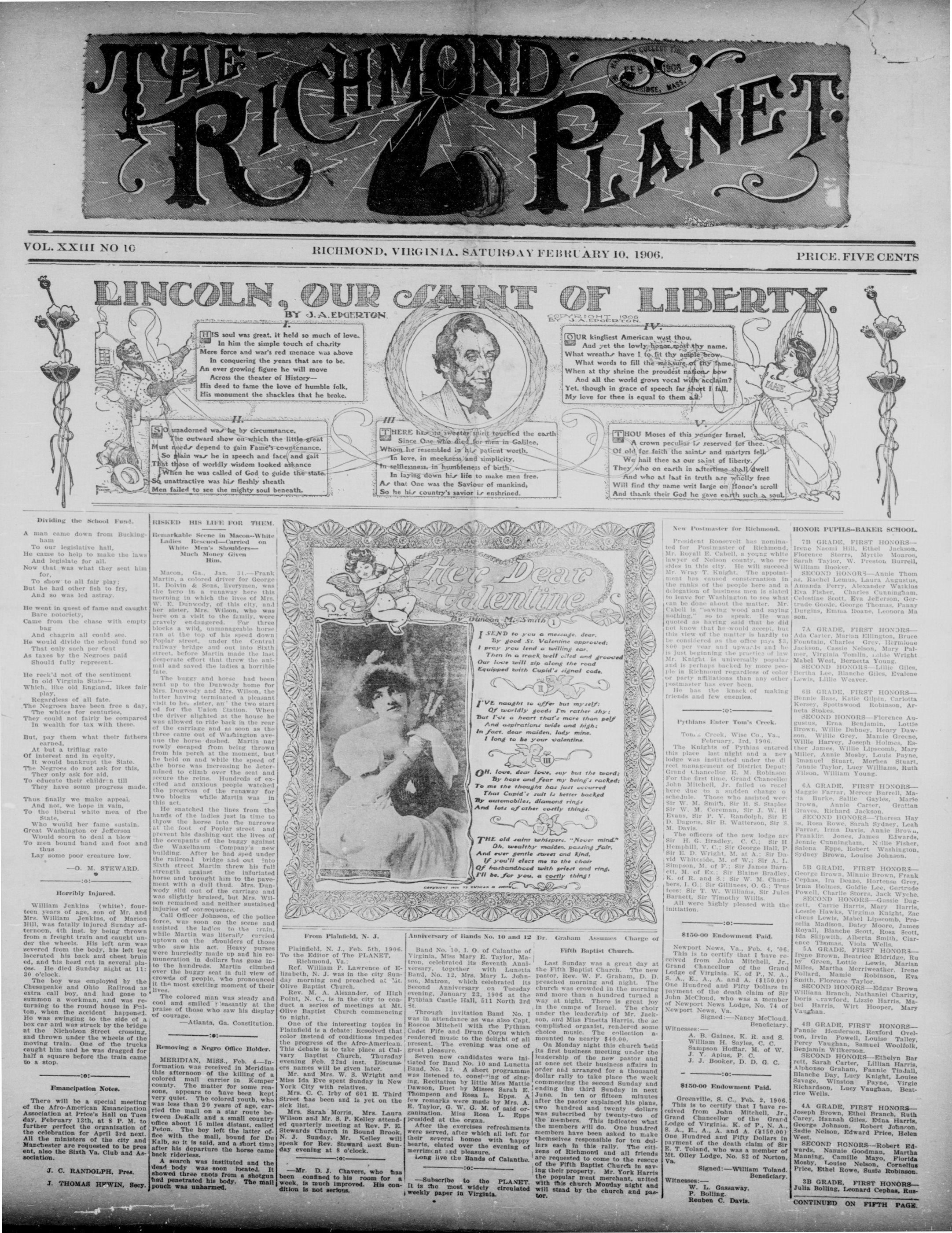
THE RICHMOND PLANET
A man came down from Buckingham
To our legislative hall,
He came to help to make the laws
And legislate for all.
Now that was what they sent him
for,
To show to all fair play;
But he had other fish to fry,
And so was led astray.
He went in quest of fame and caught
Bare notoriety,
Came from the chase with empty
bag
And chagrin all could see.
He would divide the school fund so
That only such per cent
As taxes by the Negroes paid
Should fully represent.
He reck'd not of the sentiment
In old Virginia State—
Which, like old England, likes fair
play,
Regardless of all fate.
The Negroes have been free a day,
The whites for centuries,
They could not fairly be compared
In wealth for tax with these.
But, pay them what their fathers earned.
At but a triling rate
Of interest and in equity,
It would bankrupt the State.
The Negroes do not ask for this,
They only ask for aid,
To educate their children till
They have some progress made.
Thus finally we make appeal,
And not, we hope in vain,
To the liberal white men of the
State,
Who would her fame sustain.
Great Washington or Jefferson
Would scorn to deal a blow
To men bound hand and foot and
thus
Lay some poor creature low.
—O. M. STEWARD.
Horribly Injured.
William Jenkins (white), fourteen years of age, son of Mr. and Mrs. William Jenkins, of Marion Hill, was fatally injured Sunday afternoon, 4th inst. by being thrown from a freight train and caught under the wheels. His left arm was severed from the body, his left leg lacerated his back and chest bruised, and his head cut in several places. He died Sunday night at 11:30 o'clock.
The boy was employed by the Chessapeake and Ohio Railroad as extra call boy, and had gone to summon a workman, and was returning to the round house in Fulton, when the accident happened. He was swinging to the side of a box car and was struck by the bridge at the Nicholson Street crossing, and thrown under the wheels of the moving train. One of the trucks caught him and he was dragged for half a square before the train came to a stop.
Emancipation Notes.
There will be a special meeting of the Afro-American Emancipation Association at Price's Hall on Tues day, February 13th, at 8 P.M. to further perfect the organization of the celebration for April 3rd next. All the ministers of the city and Manchester are requested to be pres ent, also the Sixth Va. Club and Association.
J. C. RANDOLPH. Pres.
J. THOMAS HEWIN, Secy.
HIS soul was great, it held so much of love
In him the simple touch of charity
Mere force and war's red menace was above
In conquering the years that are to be.
An ever growing figure he will move
Across the theater of History—
His deed to fame the love of humble folk.
His monument the shackles that he broke.
II.
SO unadorned was he by circumstance.
The outward show on which the little great
Must need depend to gain Fame's countenance.
So plain was he in speech and face and gait
That those of worldly wisdom looked askance
When he was called of God to guide the state.
So unattractive was his fleshly sheath
Men failed to see the mighty soul beneath.
SO unadorned was he by circumstance.
The outward show on which the little great
Must need depend to gain Fame's countenance.
So plain was he in speech and face and gait
That those of worldly wisdom looked askance
When he was called of God to guide the state.
So unattractive was his fleshly sheath
Men failed to see the mighty soul beneath.
RISKED HIS LIFE FOR THEM.
Remarkable Scene in Macon-White Ladies Rescued—Carried on White Men's Shoulders—Much Money Given Him.
Macon, Ga., Jan. 31.—Frank Martin, a colored driver for George H. Dolvin & Sons, liverymen, was the hero in a runaway here this morning in which the lives of Mrs. W. E. Dunwody, of this city, and her sister, Mrs. Wilson, who was here on a visit to the family, were gravely endangered. For three blocks a wild, unmanageable horse ran at the top of his speed down Poplar street, under the Central railway bridge and out into Sixth street, before Martin made the last desperate effort that threw the animal and saved the ladies a horrible fate.
The buggy and horse had been sent up to the Dunwody home for Mrs. Dunwody and Mrs. Wilson, the latter having terminated a pleasant visit to he, sister, an' the two start ed for the Union Station. When the driver alighted at the house he was allowed to ride back in the rear of the carriage and as soon as the three came out of Washington avenue the horse dashed. Martin nar rowly escaped from being thrown from his perch at the moment, but he held on and while the speed of the horse was increasing he determined to climb over the seat and secure the reins. Hundreds of excited and anxious people watched the progress of the runaway for two blocks while Martin was in this act.
He snatched the lines from the hands of the ladies just in time to throw the horse into the narrows at the foot of Poplar street and prevent his dashing out the lives of the occupants of the buggy against the Waxelbaum Company's new building. After he had sped under the railroad bridge and out into Sixth street Martin threw his full strength against the infuriated horse and brought him to the pavement with a dull thud. Mrs. Dunwody slid out of the carriage and was slightly bruised, but Mrs. Wilson remained and neither sustained injuries of consequence.
Call Officer Johnson, of the police force, was soon on the scene and assisted the ladies to the train, while Martin was literally carried uptown on the shoulders of those who saw his act. Heavy purses were hurriedly made up and his remuneration in dollars has gone into the hundreds. Martin climbed over the buggy seat in full view of crowds of people, who pronounced it the most exciting moment of their lives.
The colored man was steady and cool and smiled pleasantly at the praise of those who saw his display of courage.
—Atlanta, Ga. Constitution.
Removing a Negro Office Holder.
MERIDIAN, MISS., Feb. 4—Information was received in Meridian this afternoon of the killing of a colored mail carrier in Kemper county. The matter for some reasons, appears to have been kept very quiet. The colored youth, who was less than 20 years of age, carried the mail on a star route between DeKalk and a small country office about 15 miles distant, called Peton. The boy left the latter office with the mail, bound for DeKalb, so it is said, and a short time after his departure the horse came back riderless.
A search was instituted and the dead body was soon located. It showed three snots from a shotgun had penetrated his body. The mail pouch was unharmed.
RICHMOND, VIRGINIA, SATURDAY FEBRUARY 10, 1906.
ance,
the little great
countenance,
face and gait
and askance
side the state.
with
eneath.
THE
S
Whom
In l
In self
In l
As the
So he
FROM PLAINFIELD, N. J.
Her Dear Valentine
By Duncan M. Smith
I SEND to you a message, dear.
By good St. Valentine approved;
I pray you lend a willing ear.
Then in a track well oiled and grooved
Our love will zip along the road
Equipped with Cupid's signal code.
I'VE naught to offer but myself;
Of worldly goods I'm rather shy;
But I've a heart that's more than pelf
And aspirations wide and high;
In fact, dear maiden, lady mine,
I long to be your Valentine.
OH, love, dear love, say but the word;
By hope and fear my being's racked;
To me the thought has just occurred
That Cupid's suit is better backed
By automobiles, diamond rings
And lots of other costly things.
THE old saint whispers. "Never mind."
Oh, wealthy maiden, passing fair,
And ever gentle sweet and kind,
If you'll elect me to the chair
Of husbandhood with priest and ring,
I'll be, for you, a costly thing!
Plainfield, N. J., Feb. 5th, 1906. To the Editor of the PLANET, Richmond, Va.:
Ref. William P. Lawrence of Elizabeth, N. J. was in the city Sunday morning and preached at Mt. Olive Baptist Church.
Rev. M. A. Alexander, of High Point, N. C. is in the city to conduct a series of meetings at Mt. Olive Baptist Church commencing to night.
One of the interesting topics in Plainfield is a debate: Resolved that color instead of conditions impedes the progress of the Afro-American. This debate is to take place at Calvary Baptist Church, Thursday evening Feb. 22nd inst. Discussers names will be given later.
Mr. and Mrs. W. S. Wright and Miss Ida Eve spent Sunday in New York City with relatives.
Mrs. C. C. Irby of 601 E. Third Street has been and is yet on the sick list.
Mrs. Sarah Morris, Mrs. Laura Wilson and Mr. S. P. Kelley attended quarterly meeting at Rev. P. E. Stewards Church in Bound Brook, N. J. Sunday, Mr. Kelley will speak for Rev. Steward next Sunday evening at 8 o'clock
—Mr. D. J. Chavers, who has been confined to his room for a week, is much improved. His condition is not serious.
THERE has no sweeter spirit touched the earth
Since One who died for men in Galilee,
Whom he resembled in his patient worth.
In love, in meekness and simplicity,
In selflessness, in humbleness of birth.
In laying down his life to make men free.
As that One was the Saviour of mankind,
So he his country's savior is enshrined.
Anniversary of Bands No. 10 and 12
Dr. Graham Assumes Charge of
Band No. 10, I. O. of Calanute of Virginia, Miss Mary E. Taylor, Matron, celebrated its Seventh Anniversary, together with Lunetta Band, No. 12, Mrs. Mary L. Johnson, Matron, which celebrated its Second Anniversary on Tuesday evening, January 23, 1906 at the Pythian Castle Hall, 511 North 3rd St.
Through Invitation Band No. I was in attendance as was also Capt. Roscoe Mitchell with the Pythian Cadet Fife and Drum Corps which rendered music to the delight of all present. The evening was one of great pleasure.
Seven new candidates were initiated for Band No. 10 and Lunetta Band, No. 12. A short programme was listened to, consisting of singing. Recitation by little Miss Mattie Dawson, Duet by Misses Sarah E. Thompson and Rosa L. Epps. A few remarks were made by Mrs. A. E. Taylor, G. W. G. M. of said organization. Miss Rosa L. Epps presided at the organ.
After the exercises refreshments were served, after which all left for their several homes with happy hearts, elated over the evening of merriment and pleasure.
Fifth Baptist Church.
Last Sunday was a great day at the Fifth Baptist Church. The new pastor, Rev. W. F. Graham, D. D. preached morning and night. The church was crowded in the morning and more than a hundred turned a way at night. There is great joy in the camps of Israel. The choir under the leadership of Mr. Jackson, and Miss Finetta Harris, the ac complained organist, rendered some choice music. The collection amounted to nearly $40.00.
On Monday night this church held its first business meeting under the leadership of the new pastor and at once set their business affairs in order and arranged for a thousand dollar rally to take place the week commencing the second Sunday and ending the third Sunday in next June. In ten or fifteen minutes after the pastor explained his plans, two hundred and twenty dollars was subscribed by twenty-two of the members. This indicates what the members will do. One hundred members have been asked to make themselves responsible for ten dollars each in this rally. The citizens of Richmond and all friends
Long live the Bands of Calanthe.
—Subscribe to the PLANET. It is the most widely circulated weekly paper in Virginia.
UR kingliest American wast thou,
And yet the lowly honor most thy name.
What wreaths have I to fit thy ample brow,
What words to fill the measure of thy name.
When at thy shrine the proudest nation bow
And all the world grows vocal with acclaim?
Yet, though in grace of speech far short I fall,
My love for thee is equal to them all.
THOU Moses of this younger Israel.
A crown peculiar is reserved for thee.
Of old for faith the saints and martyrs fell.
We hail thee as our saint of liberty.
They who on earth in aftertime shall dwell
And who at last in truth are wholly free
Will find thy name writ large on Honor's scroll
And thank their God he gave earth such a soul
Fifth Baptist Church.
Last Sunday was a great day at the Fifth Baptist Church. The new pastor, Rev. W. F. Graham, D. D. preached morning and night. The church was crowded in the morning and more than a hundred turned a way at night. There is great joy in the camps of Israel. The choir under the leadership of Mr. Jackson, and Miss Finetta Harris, the ac complained organist, rendered some choice music. The collection amounted to nearly $40.00.
On Monday night this church held its first business meeting under the leadership of the new pastor and at once set their business affairs in order and arranged for a thousand dollar rally to take place the week commencing the second Sunday and ending the third Sunday in next June. In ten or fifteen minutes after the pastor explained his plans, two hundred and twenty dollars was subscribed by twenty-of-the members. This indicates what the members will do. One hundred members have been asked to make themselves responsible for ten dollars each in this rally. The citizens of Richmond and all friends are requested to come to the rescue of the Fifth Baptist Church in saving their property. Mr. York Harris the popular meat merchant, united with this church Monday night and will stand by the church and pastor.
LIBERTY
New Postmaster for Richmond.
President Roosevelt has nominated for Postmaster of Richmond, Mr. Royall E. C. Cabell, a young white lawyer of Nelson county, who resides in this city. He will succeed Mr. Wray T. Knight. The appointment has caused consternation in the ranks of the people here and a delegation of business men is slated to leave for Washington to see what can be done about the matter. Mr. Cabell is "sawing wood and saying nothing," so to speak. He was quoted as having said that he did not know that he would accept, but this view of the matter is hardly to be considered as the office pays $3,800 per year and upwards and he is just beginning the practice of law. Mr. Knight is universally popular and is perhaps backed by more people in Richmond regardless of color or party affiliations than any other postmaster has ever been.
He has the knack of making
He has the knack of making friends and few enemies.
Pythians Enter Tom's Creek.
Tom s. Creek, Wise Co., Va.
February, 3rd, 1906
February, 3rd, 1906.
The Knights of Pythias entered this place last night and a new lodge was instituted under the direct management of District Deputy; Grand Chancellor E. M. Robinson. For the first time, Grand Chancellor John Mitchell, Jr. failed to rescel here due to a sudden change on schedule. Those who assisted were Sir W. M. Smith, Sir H. S. Staples Sir W. M. Coreman, Sir J. W. H Evans, Sir P. V. Randolph, Sir E D. Dagons, Sir B. Watterson, Sir E S. M. Davis.
The officers of the new lodge are Sir H. G. Bradley, C. C.; Sir H Hemphill, V. C.; Sir George Hall, P. Sir E. D. Wright, M. at A.; Sir David Whitcheside, M. of W.; Sir A. L. Simpson, M. of F.; Sir James Barnett, M. of Ex.; Sir Blaine Bradley, K. of R. and S.; Sir W. M. Chambers, I. G.; Sir Gillness, O. G.; Trustees; Sir T. W. Williams, Sir Jules Barnett, Sir Timothy Willis.
All were highly pleased with the initiation.
$150.00 Endowment Paid.
Newport News, Va., Feb. 4, '06
This is to certify that I have received from John Mitchell, Jr.
Grand Chancellor of the Grand Lodge of Virginia. K. of P., N. A.
S. A., E. A., A. and A. ($150.00)
One Hundred and Fifty Dollars in payment of the death claim of Sir John McCloud, who was a member of Newport News Lodge, No. 74 of Newport News, Va.
Signed:—Nancy McCloud
Beneficiary.
Witnesses:—
A. B. Gaines, K. R. and S.
Willinn H. Sayles, C. C.
Sampson Hofflar, M. of W.
J. Y. Aplus, P. C.
J. J. Booker, D. C. C.
$150.00 Endowment Paid.
Greenville, S. C., Feb. 2, 1906.
This is to certify that I have received from John Mitchell, Jr.,
Grand Chancellor of the Grand
Lodge of Virginia, K. of P., N. A.,
S. A., E. A., A. and A. ($150.00)
One Hundred and Fifty Dollars in payment of the death claim of Sir
E. T. Toland, who was a member of
Mt. Olley Lodge, No. $2 of Norton,
Va.
Signed:—William Toland.
Beneficiary.
HONOR PUPILS--BAKER SCHOOL
7B GRADE, FIRST HONORS—Irene Neami Hill, Ethel Jackson, Florence Storrs, Myrtle Monroe, Sarah Taylor, W. Preston, Burrell, William Booker.
SECOND HONORS—Annie Thomas, Rachel Lemus, Laura Augustus, Amanda Perry, Alexander Watkins, Eva Fisher, Charles Cunningham, Celestine Scott, Eva Jefferson, Gertrude Goode, George Thomas, Fanny Durgins, Emma Roane, Leonora Maon.
7A GRADE, FIRST HONORS—Ada Carter, Marian Ellington, Bruce Fountain, Charles Grey, Hermione Jackson, Cassie Nelson, Mary Palmer, Virginia Tomill, Lilie Wright Mabel West, Bernetta Young.
SECOND HONORS—Lillie Giles, Bertha Lee, Blanche Giles, Evalene Lewis, Lillie Weaver.
6B GRADE, FIRST HONORS—Bennie Bass, Katie Gilpin, Carlotta Kersey, Spottswood Robinson, Arneta Stokes.
SECOND HONORS—Florence Augustus, Erna Benjamin, Lottie Brown, Willie Dabney, Henry Dawson, Willie Grey, Mamie Greene, Willie Harvey, Joseph Holmes, Esther James, Willie Lipscomb, Mary Miller, Annie Mosby, Louis Payne, Emmanuel Stuart, Morhea Stuart, Fannie Taylor, Lucy Williams, Ruth Wilson, William Young.
6A GRADE, FIRST HONORS—Maggie Farrar, Mercer Burrell, Maria Burke, Sallie Gayles, Marie Brown, Annie Carter, Grattan Graves, Richard Jackson.
SECOND HONORS—Theresa Hayes, Rosa Rowe, Sarah Sydney, Leah Farrar, Irma Davis, Annie Brown, Franklin Jones, James Edwards, Jennie Cunningham, Nille Fisher, Salena Epps, Robert Washington, Sydney Brown, Louise Johnson.
5B GRADE, FIRST HONORS—George Brown, Minnie Brown, Frank Cephas, Ira Deane, Hortense Grey, Irma Holmes, Goldie Lee, Gertrude Powell, Charlie Storrs, Jack Wyche.
SECOND HONORS—Gussie Daggett, Carrie Harris, Mary Harris, Lossie Hawks, Virginia Knight, Zac cheus Lewis, Mabel Lipscomb, Prezella Madison, Daisy Moore, James Royall, Blanche Scott, Rosa Scott, Ida Skipwith, Alberta Smith, Clarence Thomas, Viola Wells.
5A GRADE, FIRST HONORS—Irene Brown, Beatrice Eldridge, Ruby Green, Lottie Lewis, Marian Miles, Martha Merriweather, Irene Pollard, Manie Robinson, Eva Smith, Florence Taylor.
SECOND HONORS—Edgar Brown Williana Branch, Nathaniel Charity, Doris Crawford, Lizzie Harris, Mabel Harris, Wirt Hooper, Mary Vaughan.
4B GRADE, FIRST HONORS—Fannie Henderson, Rexford Ovelton, Irvin Powell, Louise Talley, Percy Vaughan, Samuel Woolfolk, Benjamin Wilkerson.
SECOND HONORS—Ethelyn Barrett, Sarah Carter, Lillian Harris, Alphonso Graham, Fannie Tindall, Blanche Day, Lucy Knight, Louise Savage, Winston Payne, Virgie Richardson, Lucy Vaughan, Beatrice Wells.
4A GRADE, FIRST HONORS—Joseph Brown, Ethel Branch, Ruth Carey, Hannah Giles, Edna Harris, George Johnson, Robert Johnson, Sadie Nelson, Edward Price, Helen West.
SECOND HONORS—Robert Edwards, Nannie Goodman, Martha Manning, Camille Mayo, Florida Mosby, Louise Nelson, Cornelius Price, Ethel Rowe, Susie Robinson.
3B GRADE, FIRST HONORS—Julia Bolling, Leonard Cephas, Rus
CONTINUED ON FIFTH PAGE
THE
MAN ON THE BOX
By HAROLD MacGRATH
Author of "The Grey Cloak," "The Puppet Crown."
Copyright, 1904, The Bobbs-Merrill Company.
CHAPTER I.—Introduces the hero, Robert Warburton, a well to do West Point graduate on duty in Arizona. After his commission in the army and leaves for European tour.
CHAPTER II.—Introduces the heroin, Bess Betty Annesley, daughter of a retired officer, offers advice to him. A bachelor, repressive young American girl, whom Warburton has seen in Paris, is smitten, and follows on board steamer but fails.
CHAPTER III.—Upon reaching New York Warburton locates host in which the Annesley are guests and dines there to see Miss Annesley once more. Chagrined, whom he met on steamer bring Miss Annesley in to dinner. Next morning count and the Annesley has disappeared.
CHAPTER IV.—Warburton goes to Washington to visit his relatives—a married brother, who holds a government position, and a sister engaged to accompany family to ball at Ellinic bassy, but declines. Concepts a scheme to play a joke on his sister and sister-in-law.
CHAPTER V.—Warburton meets his sister's finance whom he had not seen for eight years. Sees the folks off for the embassy ball and then proceeds to disguise Joke into execution, which is to disguise his sister to ball at Ellinic bassy, but declines. Concepts a scheme to play a joke on his sister and sister-in-law, who must return aboard, from the embassy to their home.
CHAPTER VI.—Warburton in disguises to British embassy and takes the wife of his brother in law, who he has bribed. He mistakes his carriage number when called and gets his passengers to shoot them knowing that Driver is already in light of the pursuit by mounted policemen. When carriage comes to a stop he springs down and throws his arms about the first of his legs. The Driver is to be Miss Annesley in of his sister.
CHAPTER VIL—Warburton is arrested on a charge of drunkenness and abduction preferred by Miss Annesley and locked up over night. In police court, where he has given the name of James Osborne, the charge of abduction is withholding $35 for drunkenness. Sends note to "Chuck," his old chum, telling of his trouble.
ANOTHER SALAD IDEA
When they found him missing, his bed untouched, his hat and coat on the rack, his inseparable walking-stick in the umbrella-stand, they were mightily worried. They questioned Jane, but she knew nothing. Jack went out to the stables; no news there. William, having driven the girls home himself, dared-say nothing. Then Jack wisely telephoned for me, and I hurried over to the house.
"Maybe he hunted up some friends last night," I suggested.
"But here's his hat!" cried Nancy.
"Oh, he's all right; don't worry. I'll take a tour around the city. I'll find him. He may be at one of the clubs." Fortunately for Mr. James Osborne I returned home first, and there found his note awaiting me. I was at the court by noon, armed with $55 and a suit of clothes of my own. I found the clerk.
"A young man, dressed as a groom, and locked up overnight." I said cautiously. "I wish to pay his fine."
"James Osborne?"
"Yes, that's the name, James Osborne."—reaching down into my pocket.
"Fine's just been paid. We were about to release him. Here, officer, show this gentleman to James Osborne's cell, and tell him to pack up and get out."
So his fine was paid! Found the money in his clothes, doubtless. On the way to the cells I wondered what the deuce the rascal had been doing to get locked up overnight. I was vastly angry, but at the sight of him all my anger melted into a prolonged shout of laughter.
"That's right; laugh, you old pirate!
I wish you had been in my boots a few hours ago. Lord!"
I laughed again.
"Have you got that $35?" he asked.
"Why, your fine has been paid," I replied, rather surprised.
"And didn't you pay it?"
"Not I! The clerk told me that it had just been paid."
Warburton's jaw sank limply. "Just been paid?— Who the deuce could have paid it, or known?"
"First, tell me what you've been up to."
He told me snatches of the exploit as he changed his clothes, and it was a question which of us laughed the more. But he didn't say a word about the stolen kiss, for which I think none the less of him.
"Who were the women?" I asked.
He looked at me for a space, as if deciding. Finally he made a negative sign.
"Don't know who they were, eh?"— incredulously.
He shrugged, laughed, and drew on his shoes.
"I always knew that I was the jack-ass of the family, Chuck, but I never expected to do it so well. Let's get out of this hole. I wonder who can have paid that fine? . . . No, that would not be possible!"
"What would not be?"
"Nothing, nothing,"—laughing.
But I could see that his spirits had gone up several degrees.
"The whole thing is likely to be in the evening papers," I said. He needed a little worrying. And I knew his horror of publicity.
"The newspapers? In the newspapers? Oh, I say, Chuck, can't you use your influence to suppress the thing? Think of the girls."
"I'll do the best I can. And there's only one thing for you to do, and that is to cut out of town till your beard has grown. It would serve you right, however, if the reporters got the true facts."
"I'm for getting out of town, Chuck; and on the next train but one."
CHAPTER VIII
I laughed again.
"What would not be?"
Here our conversation was interrupted by the entrance of a policeman. "A note for Mister Osborne,"—ironically. He tossed the letter to Warburton and withdrew.
Mister Osborne eagerly tore open an end of the envelope—a very aristocratic envelope, as I could readily discern—and extracted the letter. I closely watched his facial expressions. First, there was interest, then surprise, to be succeeded by amusement and a certain exultation. He slapped his thigh.
"By George, Chuck, I'll do it!" "Do it? Now what?" "Listen to this." He cleared his throat, snuffed of the faintly scented paper and cleared his throat again. He looked up at me drolly.
"Well?" said I, impatiently. I was as eager to hear it as he had been to read it. I believed that the mystery was about to be solved.
"James Osborne, Sir: I have been thinking the matter over seriously, and have come to the conclusion that there may have been a mistake. Undoubtedly my groom was primarily to blame. I have discharged him for neglecting his post of duty. I distinctly recall the manner in which you handled the horses last night. It may be possible that they ran away with you. However that may be. I find myself in need of a groom. Your horsemanship saved us from a serious accident. If you will promise to let whiskey alone, besides bringing me a recommendation, and are without engagement, call at the enclosed address this afternoon at three o'clock. I should be willing to pay as much as $40 a month. You would be expected to accompany me on my morning rides."
"She must have paid the fine," said I. "Well, it beats anything I ever heard of. Had you arrested, and now wants to employ you! What name did you say?" I asked carelessly.
"I didn't say any name, Chuck,"—smiling. "And I'm not going to give any, you old duffer."
"And why not?"
"For the one and simple reason that I am going to accept the position,"—with a coolness that staggered me.
"What?" I bawled.
"Sure as life, as the policeman said last night."
"You silly ass, you! Do you want to make the family a laughing-stock all over the town?" I was really angry.
"Neither the family nor the town will know anything about it,"—imper-turbably.
"But you will be recognized!" I re-construsted. "It's a clear case of insanity, after what has just happened to you."
"I promise not to drink any whisky," soberly.
"Bob, you are fooling me."
"Not the littlest bit, Chuck. I've worn a beard for two years. No one would recognize me. Besides, being a groom, no one would pay any particular attention to me. Cet the point?"
"But what under the sun is your object?" I demanded. "There's something back of all this. It's not a simple lark like last night's."
"Perspicacious man!"—rallingly. "Possibly you may be right. Chuck, you know that, I've just got to be doing something. I've been inactive too long. I am ashamed to say that I should tire of the house in a week or less. Change, change, of air, of place, of occupation; change—I must have it. It's food and drink."
"You've met this woman before, somewhere."
"I neither acknowledge or deny. It will be very novel. I shall be busy from morning till night. Think of the fun of meeting persons whom you know, but who do not know you. I wouldn't give up this chance for any amount of money."
"Forty dollars a month," said I wrathfully.
"Cigar money,"—tranquilly.
"Look here, Bob; be reasonable. You can't go about as a groom in Washington. If the newspapers ever get hold of it, you would be disgraced. They wouldn't take you as a clerk in a third-rate consulate. Supposing you should run into Jack or his wife or Nancy; do you think they wouldn't know you at once."
"I take the risk. I'd deny that I know them, they'd tumble and leave me alone. Chuck, I've got to do this. Some day you'll understand."
"But the woman's name, Bob; only her name."
"Oh, yes! And have you slide around and show me up within 24 hours. No, I thank you. I am determined on this. You ought to know me by this time. I never back down; it isn't in the blood. And when it is said, where's the harm in this escapade? I can see none. It may not last the day through."
"I trust not,"—savagely
"I am determined upon answering this letter in person and finding out, if possible, what induced her to pay my fine. Jaskass or not, I'm going to see the thing through." Then he stretched an appealing hand out toward me, and said wheedlingly: "Chuck, give my word to keep perfectly quiet. I'll drop you a line once in a while, just to let you know how I stand. I shall be at the house tonight. I'll find an excuse. I'm to go up north on a hunting expedition; a hurry call. Do you catch on?"
"I shall never be able to look Nancy in the face." I declared. "Come, Bob, forget it. It sounds merry enough, but my word for it, you'll regret it inside of 24 hours. You are a graduate of the proudest military school in the world, and you are going to make a
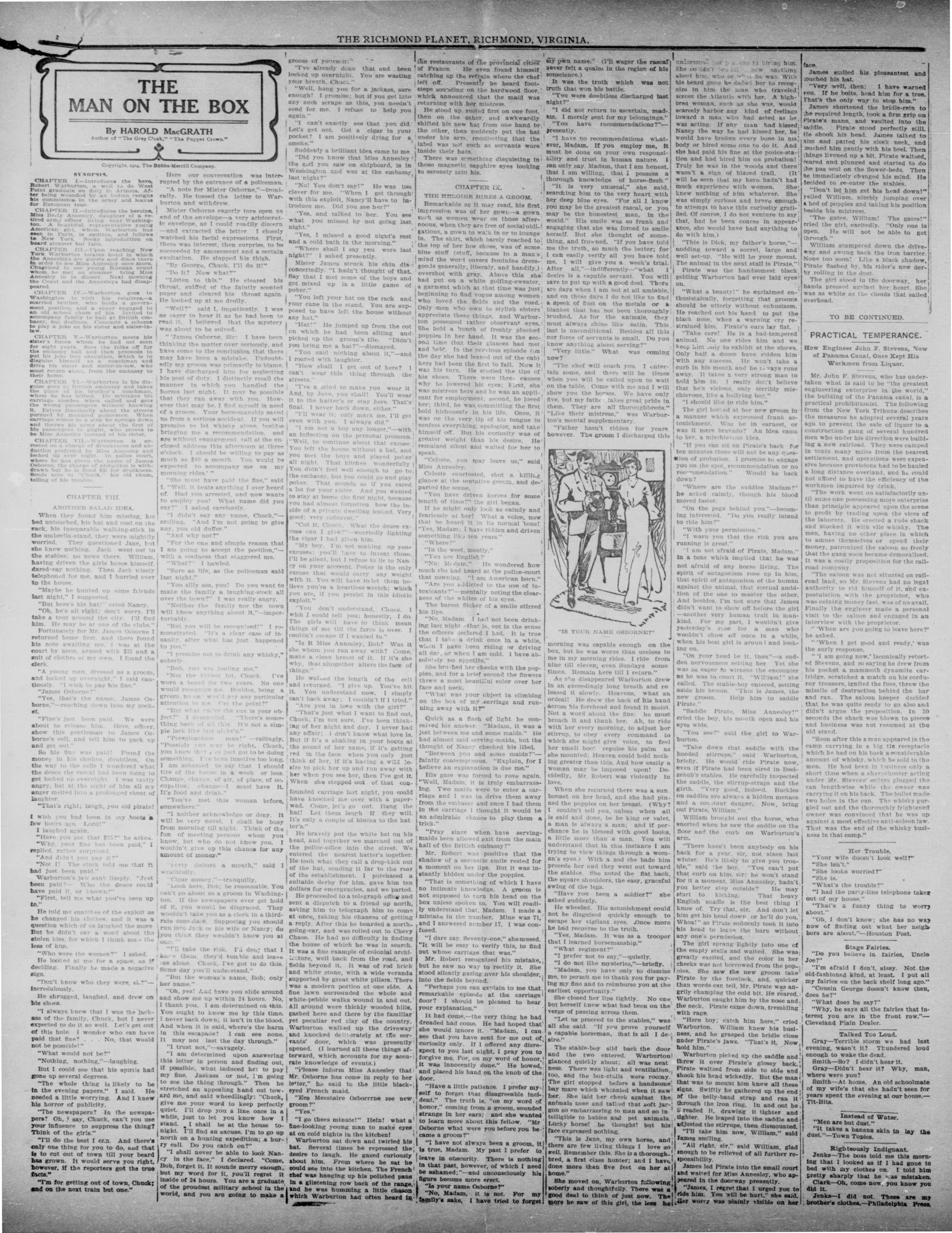
THE RICHMOND PLANET, RICHMOND, VIRGINIA.
groom of yourself."
"I've already done that and been locked up overnight. You are wasting your breath, Chuck."
"Well, hang you for a jackass, sure enough! I promise; but if you get into any such scrape as this, you needn't send for me. I refuse to help you again."
"I can't exactly see that you did. Let's get out. Got a cigar in your pocket? I am positively dying for a smoke."
Suddenly a brilliant idea came to me.
"Did you know that Miss Annesley the girl you saw on shipboard, is in Washington and was at the embassy last night?"
"No! You don't say!" He was too clever for me. "When I get through with this exploit, Nancy'll have to introduce me. Did you see her?"
"Yes, and talked to her. You see what you missed by not going last night."
"Yes, I missed a good night's rest and a cold bath in the morning."
"Where shall I say you were last night?" I asked presently.
Mister James struck his chin dis-concertedly. "I hadn't thought of that. Say that I met some of the boys and got mixed up in a little game of poker."
"You left your hat on the rack and your cane in the stand. You are supposed to have left the house without any hat."
"Hat!" He jumped up from the cot on which he had been slitting and picked up the groom's tile. "Didn't you bring me a hat?"—dismayed.
"You said nothing about it,"—and I roared with laughter.
"How shall I get out of here? I can't wear this thing through the streets."
"I've a mind to make you wear it And, by Jove, you shall! You'll wear it to the hatter's or stay here. That's final. I never back down, either."
"I'll wear it; only mark me, I'll get even with you. I always did."
"I am not a boy any longer,"—with an inflection on the personal pronoun.
"Well, to continue about that excuse. You left the house without a hat, and you met the boys and played poker all night. That hitches wonderfully. You didn't feel well enough to go to the embassy, but you could go and play poker. That sounds as if you cared a lot for your sister. And you wanted to stay at home the first night, because you had almost forgotten how the inside of a private dwelling looked. Very good; very coherent."
"Cut it, Chuck. What the deuce excuse can I give?"—worriedly lighting the cigar I had given him.
"My boy, I'm not making up your excuses; you'll have to invent those. I'll be silent, but I refuse to lie to Nancy on your account. Poker is the only excuse that you will have to let them believe you're a heartless wretch; which you are, if you persist in this idiotic exploit."
"You don't understand, Chuck. I wish I could tell you; honestly, I do. The girls will have to think mean things of me till the farce is over. I couldn't escape if I wanted to."
"Is It Miss Annesley, Bob? Was it she whom you ran away with? Come, make a clean breast of it. If it's she why, that altogether alters the face of things."
He walked the length of the cell and returned. "I give up. You've hit it. You understand now. I simply can't back away; I couldn't if I tried." "Are you in love with the girl?"
"That's just what I want to find out, Chuck, I'm not sure. I've been thinking of her night and day. I never had any affair; I don't know what love is. But if it's a shaking in your boots at the sound of her name, if it's getting red in the face when you only just think of her, if it's having a wild desire to pick her up and run away with her when you see her, then I've got it. When she stepped out of that confounded carriage last night, you could have knocked me over with a paper-wad. Come, let's go out. Hang the hat! Let them laugh if they will. It's only a couple of blocks to the hat."
He bravely put the white hat on his head, and together we marched out of the police-office into the street. We entered the nearest hatter's together. He took what they call a drop-kick out of the hat, sending it far to the rear of the establishment. I purchased a suitable derby for him, giving him ten dollars for emergencies, and we parted. He proceeded to a telegraph office and sent a dispatch to a friend up north, asking him to telegraph him to come at once, taking his chances of getting a reply. After this he boarded a northgoing-car, and was rolled out to Chevy Chase. He had no difficulty in finding the house of which he was in search. It was a fine example of colonial architecture, well back from the road, and fields beyond it. It was of red brick and white stone, with a wide veranda supported by great white pillars. There was a modern portico at one side. A fine lawn surrounded the whole and white-pebble walks wound in and out. All around were thickly wooded hills, gashed here and there by the familiar yet peculiar red clay of the country. Warburton walked up the driveway and knocked deliberately at the servants' door, which was presently opened. (I learned all these things afterward, which accounts for my accurate knowledge of events.) "Please inform Miss Annesley that Mr. Osborne has come in reply to her letter," he said to the little blackeyed French maid.
"Ees Meestaire Osborrrne zee new groom?" "Yes."
"I go thee minute!" Hein! what a fine-looking young man to make eyes at on cold nights in the kitchen!
Warburton sat down and twirled his hat. Several times he repressed the desire to laugh. He gazed curiously about him. From where he sat he could see into the kitchen. The French chef was hanging up his polished pans in a glistening row back of the range, and he was humming a little chason which Warburton had often heard in
the restaurants of the provincial cities of France. He even found himself catching up the retrain where the chef left off. Presently he heard footsteps sounding on the hardwood floor, which announced that the maid was returning with her mistress.
He stood up, rested first on one foot, then on the other, and awkwardly shifted his new hat from one hand to the other, then suddenly put the hat under his arm, recollecting that the label was not such as servants wore inside their hats.
There was something disquieting in those magnetic sapphire eyes looking so serenely into his.
CHAPTER IX
THE BEFOREINE HIRES A GROOM.
Remarkable as it may read, his first impression was of her gown—a gown such as women wear on those after-noons, when they are free of social obligations, a gown to walk in or to lounge in. The skirt, which barely reached to the top of her low shoes, was of some blue stuff (stuff, because to a man's mind the word covers feminine dress-goals generally, liberally, and handily), overshot with gray. Above this she had put on a white golfing-sweater, a garment which at that time was just beginning to find vogue among women who loved the fields and the road. Only men who own to stylish sisters appreciate these things, and Warburton possessed rather observant eyes. She held a bunch of freshly plucked poppies in her hand. It was the second time that their glances had met and held. In the previous episode (on the day she had leaned out of the cab) hers had been the first to fall. Now it was his turn. He studied the tips of his shoes. There were three causes why he lowered his eyes; First, she was mistress here and he was an applicant for employment; second, he loved her; third, he was committing the first bold hishoonesty in his life. Once, it was on the very tip of his tongue to confess everything, apologize, and take himself off. But his curiosity was of greater weight than his desire. He remained silent and waited for her to speak.
"Celeste, you may leave us," said Miss Annesley.
Celeste courtesied, shot a killing glance at the tentative groom, and departed the scene.
"You have driven norses for some length of time?" the girl began.
If he might only look as calmly and fearlessly at her! What a voice, now that he heard it in its normal 'tone!'
"Yes, Madam; I have ridden and driven something like ten years."
"Where?"
"In the west, mostly."
"You are English?"
"Are you addicted to the use of intoxicants?"—mentally noting the clearness of the whites of his eyes.
The barest flicker of a smile stirred his lips.
"No, Madam. I had not been drinking last night - that is, not in the sense the officers declared I had. It is true that I take a drink once in a while, when I have been riding or driving all day, or when I am cold. I have absolutely no appetite."
She bruised her cheeks with the popples, and for a brief second the flowers threw a most beautiful color over her face and neck.
"What was your object in climbing on the box of my carriage and running away with it?"
Quick as a flash of light he conceived his answer. "Madam, it was a jest between me and some malds." He had almost said serving-malds, but the thought of Nancy checked his libel.
"Between you and some malds?"—faintly contemptuous. "Explain, for I believe an explanation is due me."
His gaze was forced to rove again.
"Well, Madam, it is truly embarrassing. Two malds were to enter a carriage and I was to drive them away from the embassy and once I had them in the carriage I thought it would be an admirable chance to play them a trick."
"Pray since when have serving-malds been allowed exit from the main hall of the British embassy?"
Mr. Robert was positive that the shadow of a sarcastic smile rested for a moment on her lips. But it was instantly hidden under the popples.
"That is something of which I have no intimate knowledge. A groom is not supposed to turn his head on the box unless spoken to. You will readily understand that, Madam. I made a mistake in the number. Mine was 71, and I answered number 17. I was confused.
"I dare say. Seventy-one," she mused. "It will be easy to verify this, to find out whose carriage that was."
Mr. Robert recognized his mistake, but he saw no way to rectify it. She stood silently gazing over his shoulder, into the fields beyond.
"Perhaps you can explain to me that remarkable episode at the carriage door? I should be pleased to hear your explanation."
It had come,—the very thing he had dreaded had come. He had hoped that she would ignore it. "Madam, I can see that you have sent for me out of curiosity only. If I offered any disrespect to you last night, I pray you to forgive me. For, on my word of honor, it was innocently done." He bowed, and placed his hand on the knob of the door.
"Have a little patience. I prefer myself to forget that disagreeable incident." The truth is, "on my word of honor," coming from a groom, sounded strange in her ears; and she wanted to learn more about this fellow. "Mr Osborne what were you before you became a groom?"
"I have not always been a groom, it is true, Madam. My past I prefer to leave in obscurity. There is nothing in that past, however, of which I need be ashamed;" and unconsciously his figure become more erect.
"Is your name Osborne?"
"No, Madam, it is not. For my family's sake, I have tried to forget
my own name." (I'll wager the rascal never felt a qualm in the region of his conscience.) It was the truth which was not truth that won his battle. "You were doubtless discharged last night?" "I did not return to ascertain, madam, I merely sent for my belongings." "You have recommendations?"—presently.
"I have no recommendations whatever, Madam. If you employ me, it must be done on your own responsibility and trust in human nature. I can only say, Madam, that I am honest, that I am willing, that I possess a thorough knowledge of horse-desh."
"It is very unusual," she said, searching him to the very heart with her deep blue eyes. "For all I know you may be the greatest rascal, or you may be the honestest man, in the world." His smile was so frank and engaging that she was forced to smile herself. But she thought of something, and frowned. "If you have told me the truth, so much the better; for I can easily verify all you have told me. I will give you a week's trial. After all," -indifferently-"what I desire is a capable servant. You will have to put up with a good deal. There are days when I am not at all amable, and on these days I do not like to find a speck of dust on the metals or a blanket that has not been thoroughly brushed. As for the animals, they must always shine like satin. This last is unconditional. Besides all this our force of servants is small. Do you know anything about serving?" "Very little." What was coming now?
"The chef will coach you. I entertain some, and there will be times when you will be called upon to wait on the table. Come with me and I will show you the horses. We have only five, but my father takes great pride in them. They are all thoroughbreds." "Like their mistress," was Warburton's mental supplementary. "Father hasn't ridden for years however. The groom I discharged the
"IS YOUR NAME OSBORNET"
morning was capable enough on the box, but he was worse than useless to me in my morning rides. I ride from nine till eleven, even Sundays some times. Remain here till I return."
As she disappeared Warburton drew in an exceedingly long breath and released it slowly. Heavens, what an ordeal! He drew the back of his hand across his forehead and found it moist. Not a word about the fine: he must broach it and thank her. Ah, to ride with her every morning, to adjust her stirrup, to obey every command to which she might give voice, to feel her small boot. repulse his palm as she mounted; Heaven could hold nothing greater than this. And how easily a woman may be imposed upon! Decidedly, Mr. Robert was violently in love.
When she returned there was a sun-bonnet on her head, and she had pinned the popples on her breast. (Why? I couldn't tell you, unless when all is said and done, be he king or valet, a man is always a man; and if perchance he is blessed with good looks, a little more than a man. You will understand that in this instance I am trying to view things through a woman's eyes.) With a nod she bade him precede her and they went out toward the stables. She noted the flat back, the square shoulders, the easy, graceful swing of the legs.
"Have you been a soldier?" she asked suddenly.
He wheeled. His astonishment could not be disguised quickly enough to escape her vigilant eyes. Once more he had recourse to the truth.
"Yes, Madam. It was as a trooper that I learned horsemanship."
"What regiment?"
"I prefer not to say."—quietly,
"I do not like mysteries,"—briefly.
"Madam, you have only to dismiss me, to permit me to thank you for paying my fine and to reimburse you at the earliest opportunity."
She closed her lips tightly. No one but herself knew what had been on the verge of passing across them.
"Let us proceed to the stables," was all she said. "If you prove yourself a capable horseman, that is all I desire."
The stable-boy sild back the door and the two entered. Warburton glanced quickly about; all was neat ness. There was light and ventilation, too, and the box-stalls were roomy. The girl stopped before a handsome bay mare which whinched when it saw her. She laid her cheek against the animals nose and talked that soft jargon so embarrassing to man and so intelligible to babies and pet animals. Lucky horse! he thought! but his face expressed nothing.
"This is Jane, my own horse, and there are few living things I love so well. Remember this. She is a thorough-bred, a first class hunter; and I have done more than five feet on her at home."
She moved on. Warburton following soberly and thoughtfully. There was a good deal to think of just now. The more he saw of this girl, the less he
onderstood her purpose in hiring him. She couldn't be soil, now anything about him, who or what he was. With his beard gone he defended her to recognize in him the man who traveled across the Atlantic with her. A highbred woman, such as she was, would scarcely harbor any kind of feelings toward a man who had acted as he was acting. If any man had kissed Nancy the way he had kissed her, he would have broken every bone in his body or hired some one to do it. And she had paid his fine at the police-station and had hired him on probation! Truly he was in the woods and there wasn't a sign of blazed trail. (It will be seen that my hero hadn't had much experience with women. She knew nothing of him whatever. She was simply curious and brave enough to attempt to have this curiosity gratified. Of course, I do not venture to say that, had he been coarse in appearance, she would have had anything to do with him.)
"This is Dick, my father's horse,"—nodding toward a sorrel, large and well set-up. "He will be your mount. The animal in the next stall is Pirate." Pirate was the handsomest black gelding Warburton had ever laid eyes on.
"What a beauty!" he exclaimed enthusiastically, forgetting that groomes should be utterly without enthusiasm. He reached out his hand to pat the black nose, when a warning cry restrained him. Pirate's ears lay flat. "Take care! He is a bad-tempered animal. No one rides him and we keep him only to exhibit at the shows. Only half a dozen have ridden him with any success. He won't take a curb in his mouth and he always runs away. It takes a very strong man to hold him in. I really don't believe that he's vicious, only terribly mischievous, like a bullying boy." "I should like to ride him."
The girl looked at her new groom in a manner which expressed frank astonishment. Was he in earnest, or was it mere bravado? An idea came to her, a mischievous idea.
"If you can sit on Pirate's back for ten minutes there will not be any question of probation. I promise to engage you on the spot, recommendation or no recommendation." Would he back down?
"Where are the saddles Madam?" he asked calmly, though his blood moved faster.
"On the pegs behind you."—becoming interested. "Do you really intend to ride him?"
"With your permission."
"I warn you that the risk you are running is great."
"I am not afraid of Pirate, Madam," in a tone which implied that he was not afraid of any horse living. The spirit of antagonism rose up in him, that spirit of antagonism of the human against the animal, that eternal ambition of the one to master the other. And besides, I'm not sure that James didn't want to show off before the girl—another very human trait in mankind. For my part, I wouldn't give yesterday's rose for a man who wouldn't show off once in a while, when his best girl is around and looking on.
"On your head be it, then"—a sudden nervousness seizing her. Yet she was as eager to witness the encounter as he was to court it. "William!" she called. The stable-boy entered, setting aside his broom. "This is James, the new groom. Help him to saddle Pirate."
"Saddle Pirate, Miss Annesley!" cried the boy, his mouth open and his eyes wide.
"You see?" said the girl to War-burton.
"Take down that saddle with the hooded stirrups," said Warburton, briefly. He would ride Pirate now, even if Pirate had been sired in Beelzebub's stables. He carefully inspected the saddle, the stirrup-straps and the girth. "Very good, indeed. Buckles on saddles are always a hidden menace and a constant danger. Now, bring out Pirate, William."
William brought out the horse, who snorted when he saw the saddle on the floor and the curb on Warburton's arm.
"There hasn't been anybody on his back for a year, sir, not since last winter. He's likely to give you trouble," said the boy. "You can't put that curb on him, sir; he won't stand for it a moment. Miss Annesley, hadn't it better step outside? He may start to kicking. That heavy English snailie is the best thing I know of. Try that, sir. And don't let him get his head down, or he'll do you. Whoa!" as Pirate suddenly took it into his head to leave the barn without any one's permission.
The girl sprang lightly into one of the empty stalls and waited. She was greatly excited, and the color in her cheeks was not borrowed from the poppies. She saw the new groom take Pirate by the forelock, and, quicker than words can tell, Pirate was angrily champing the cold bit. He reared, Warburton caught him by the nose and the neck. Pirate came down, trembling with rage.
"Here boy; catch him here," cried Warburton. William knew his business, and he grasped the bridle close under Pirate's jaws. "That's it. Now hold him."
Warburton picked up the saddle and threw it over Pirate's glossy back. Pirate waltzed from side to side and shook his head wickedly. But the man that was to mount him knew all these signs. Swiftly he gathered up the end of the belly-band strap and ran it through the iron ring. In and out he readed it, drawing it tighter and tighter. He leaped into the saddle and adjusted the stirrups, then dismounted. "I'll take him now, William," said James smiling.
"Ail right, sir," said William, glad enough to be relieved of all further responsibility.
James led Pirate into the small court and waited for Miss Annesley, who appeared in the doorway presently.
"James, I regret that I urged you to ride him. You will be hurt," she said. Her worry was plainly visible on her
James smiled his pleasantest and touched his hat.
"Very well, then; I have warned you. If he bolts, head him for a tree. That's the only way to stop him."
James shortened the bridle-rein to the required length, took a firm grip on Pirate's mane, and vaulted into the saddle. Pirate stood perfectly still. He shook his head. James talked to him and patted his sleek neck, and touched him gently with his heel. Then things livened up a bit. Pirate waltzed, caresed and plunged and started to do the pas seul on the flower-beds. Then he immediately changed his mind. He decided to re-enter the stables.
"Don't let him get his head down!" yelled William, nimply jumping over a bed of popples and taking his position beside his mistress.
"The gates, William! The gates!" cried the girl, excitedly. "Only one is open. He will not be able to get through."
William scampered down the driveway and swing back the iron barrier. None too soon! Like a black shadow, Pirate flashed by, his rider's new derby rolling in the dust.
The girl stood in the doorway, her hands pressed against her heart. She was as white as the clouds that sailed overhead.
TO BE CONTINUED
PRACTICAL TEMPERANCE.
How Engineer John F. Stevens, Now of Panama Canal, Once Kept His Workmen from Liquor.
Mr. John F. Stevens, who has undertaken what is said to be "the greatest engineering enterprise in the world," the building of the Panama canal, is a practical prohibitionist. The following from the New York Tribune describes the measures he adopted several years ago to prevent the sale of liquor to a construction gang of several hundred men who under his direction were building a new railroad. They were camped in tents many miles from the nearest settlement, and operations were expensive because provisions had to be hauled a long distance overland, and he could not afford to have the efficiency of the workmen impaired by drink.
"The work went on satisfactorily until some one possessing more enterprise than principle appeared upon the scene to profit by trading upon the vices of the laborers. He erected a rude shack and stocked it with vile whisky. The men, having no other place in which to amuse themselves or spend their money, patronized the saloon so freely that the gang soon became demoralized. It was a costly proposition for the railroad company.
"The saloon was not situated on railroad land, so Mr. Stevens had no legal authority to rid himself of it, and expositional with the proprietor, who was coining money fast, was of no avail. Finally the engineer made a personal visit to the saloon and engaged in an interview with the proprietor.
"When you are going to leave here?" he asked.
"When I get good and ready," was the surly response.
"I am going now,' laconically retorted Stevens, and so saying he drew from his pocket a mammoth dynamite cartridge, scratched a match on his corduroy trousers, ignited the fuse, threw the missile of destruction behind the bar and ran. The saloon keeper decided that he was quite ready to go also and didn't argue the proposition. In 30 seconds the shack was blown to pieces and business was not resumed at the old stand.
"Soon after this a man appeared in the camp carrying in a big tin receptacle which he had on his back a considerable amount of whisky, which he sold to the men. He had been in business only a short time when a sharpshooter acting under Mr. Stevens' orders plugged the can lengthwise while the owner was carrying it on his back. The bullet made two holes in the can. The whisky gurgled out and the thoroughly frightened owner was convinced that he was up against a most effective anti-saloon law. That was the end of the whisky business in that camp."
"She looks worried?"
"She is.
"What's the trouble?"
"I had the party-line telephone taken out of my house."
"That's a funny thing to worry about."
"Oh, I don't know; she has no way now of finding out what her neighbors are about."-Houston Post.
Stage Fairies.
"Do you believe in fairies, Uncle Joe?"
"I'm afraid I don't, sissy. Not the old-fashioned kind, at least. I put all my fairies on the back shelf long ago."
"Cousin George doesn't know then, does be?"
"What does he say?"
"Why, he says all the fairies that interest you are in the front row."—Cleveland Plain Dealer.
Talked Too Loud.
Gray—Terrible storm we had last evening, wasn't it? Thundered loud enough to wake the dead.
Smith—So? I didn't hear it.
Gray—Didn't hear it? Why, man, where were you?
Smith—At home. An old schoolmate of my wife's that she hadn't seen for years spent the evening at our house.—Tit-Bits.
"It takes a banana skin to lay the dust."—Town Topics.
Righteously Indignant.
Jenks—The boss told me this morning that I looked as if I had gone to bed with my clothes on. I told him pretty sharply that he was mistaken.
Clark—Oh, come now, you know you did it.
Jenks—I did not. These are my brother's clothes.—Philadelphia Press.
THE PLANET
SATURDAY...FEB. 10TH. 1906
Dan Cupid's Day As It Was And as It Is Now
By WALTON WILLIAMS
Copyright, 1806, by Hamilton Mack.
JUST why St. Valentine's day is so called nobody has ever known. There were a number of Valentines, two of them saints, but none of them is recorded to have been especially fond of flirting or sending anonymous libels through the mails. It would have seemed more appropriate to have called it Dan Cupid's day; but, inasmuch as it was named several centuries before we were born, there is no need of bothering about that now.
One theory to account for the designation is that away back in early times it was called gallantin day, this being the word from which gallant is derived, and in time this was confused with Valentine, so the church tacked on the name of the saint. Another tradition is that during the reign of the Emperor Claudius II. Bishop Valentine was one of the most beloved preachers about Rome. The emperor got mad at his own wife or somebody else's wife and decreed that nobody should get married for a year. Valentine took pity on the folks and married them secretly. When Claudius learned this the bishop was promptly jailed and afterward lost his head. One legend is perhaps about as good as the other, so the reader can take his choice.
The origin of the day, however, belongs to a time far more ancient than Claudius or even Rome. At about this time of year in pretty much all countries and all ages have been celebrated the returning of the sun and the first fracture in the backbone of winter. As was proclaimed by many of the old poets, this is the season that the birds choose their mates. It is not on record that the bird songs degenerate into bad doggerel because of this fact but that is doubtless because the feathered folk merely sing and do not send valentines.
In the far ancient times the festival was celebrated with orgies of the most shocking description, but in Rome the 15th of February, which was called the Lupercalia, was toned down to comparative respectability. There the names of the Lydias, Chloes and other middens, such as gay old Horace used to sing were shaken up together and drawn by the young men of the day, and the maiden whose name was so drawn became the partner of the holder of her ticket for a year.
The early church could not suppress this practice, so in place of having the names of girls drawn by lot it substituted the names of saints. It was at about this time that Valentine's name was dragged into the affair. To the youth of the middle ages, however, saints were not nearly so interesting as real flesh and blood maledens, so the older custom of choosing the girls' names was revived. In consequence the festival became very popular. When the age of chivalry was in full swing this most gallant of the holidays was about the biggest thing in the calendar. Why not? Love and spring poetry thrive in February, and there should be some day at about this season especially devoted to their culture.
Around St. Valentine's day grew up many other customs. One of the earliest was to permit the maidens to choose partners as well as the men. Of course the youths, manlike, were more attentive to the girls whom they had drawn than to the girls who had drawn them, but at any rate an incipient stage in woman's rights was in evidence. In the dissolute days of Charles II. in England the names of married people went into the pot along with those of the bachelors and spinsters. As a result that delightful old gossip, Samuel Pepys, tells of a Lord Something-or-other who spent 80 for a ring to grace the finger of somebody else's pretty young wife.
The girls were all anxious to dream of their sweethearts the night before
AN EARLY VICTORIAN VALENTINE
St. Valentine's and resorted to various charms to woo the god of dreams. For one thing they pinned holly leaves on their pillows. For another they boiled eggs, took out the yolks, filled the apertures with salt, then ate them, shells, salt and all, and that without drinking any water afterward. If this we not make a poor girl dream of her lover, besides most of her ancestors, nothing would.
After this came the custom of sending atrocious prints, with still more
atrocious poetry, through the mails. In the earlier times poetry concerning St. Valentine's day was of a fairly high order. Also the pictures sent were of a certain degree of artistic merit. Thus in England in the days of the Napole-
one wars the valentines sent to the soldiers and sailors were of a quality to make the hearts of the Tommy Atkinses and Jack tars of that day swell with pride. The cards that made one look like a cheap edition of a Chinese dragon or an antediluvian monster, with verses of the quality of Mother Goose rhymes without the Mother Goose melody, came later. Likewise the fluffy, tinsel, gold and silver creations, plentifully bespikled with hearts and containing sentimental poetry of a certain made to order air, were the product of more modern and more degenerate days. In England these are now practically things of the past. In fact, St. Valentine's day is little observed at all in the British isles except for the giving of flowers. But it is still in vogue in America and some of the countries of continental Europe. Years ago St. Valentine's day was very prolific of marriages. The mates
FIRST LOVE
VALENTINE OF THE TIME OF WILLIAM IV.
then chosen were taken not simply in fun, but often for better or worse. It has been said that marriage is a lottery anyway, so what does the form of the lottery matter? If a partner for a year, why not for all the years? Thus, whatever his own history may have been, Valentine became the patron saint of matrimony. This is a very proud distinction, and we will hope that he did something to earn it. To complete the legend it is just as well to believe that he did marry the heart-sick Roman youths and maidens against the emperor's order and was killed for so doing, thus becoming a martyr to love. In that event it would be only poetic justice that he should be remembered by lovers for ages.
Long may his day remain with us, for while men and women are tound on this old earth they will marry and be given in marriage. It is a significant fact that while all the other pagan gods are dead Cupid is still worshiped. The divinities of power, of wisdom, of war and what not have passed away, but the divinity of love is immortal. All these things grow old, but love is ever fresh and new. They expand and change, but love is the same yesterday, today and forever.
May we not hope for a like immortality for St. Valentine's day, which is distinctively the holiday of love? Even though one English paper says, "It is a forgotten anniversary," and even though much of its art halts and its verse limps, is there not enough vitality in the love it symbolizes to keep its memory living in the heart of the world? The young yet cherish it, and the young are ever with us. The privilege of sending an anonymous valentine romantic or even the anonymous valentine ugly—for there are both sorts—is too highly prized to have it die at the mere dictum of a few sleepy English papers. Dry-as-dust people from time immemorial have announced the demise of Santa Claus, and yet Santa Claus is with us. Little eyes still dance at the mention of him, and little hearts grow warm at his expected coming. Who would rob youth of all its romantic legends?
Good Bishop Valentine, sacred to lovers of all times and climes, who would banish him? What if his day does burd? the postman? The postman is a good, hearted soul and doesn't mind. He is repaid by the blushing faces and anger eyes of those his advent makes happy.
MY VALENTINE.
MY valentine! 'Twas Cupid threw
The cast of fate that gave me you
And some would call it chance, but we,
Who have unveiled Love's mystery,
Know what seems chance is destiny.
It was not only for a year,
But for a life, I gained you, dear,
When Cupid on that day divine
Arranged the lot that made you mine.
The gods, in ways we do not see,
Ordained our love by high decree,
Before our births, that you should be
AS atoms by attraction meet,
So was the force that drew our feet
To tread one path. We did not know
What had been fated us, and so
In ways made sweeter by surprise
We came to fill our destinies.
And get, by some foreknowledge deep,
Like that which shapes our dreams in sleep,
I would have searched the wilde earth through,
Unsatisfied, till, finding you,
Conviction thrilled my inmost goal
That I had gained Love's final goal.
I would have felt God meant you mine,
My alentine.
WHO knows the sweet and hidden law
By which two souls together draw?
Who may declare the magic spell
And who define the miracle
By which a new and fairer earth,
When Love awakens, comes to birth?
Hower it be, I only see
One truth within the mystery—
That you divinely came to me.
Upon the heavens is a sign—
Three stars as one together shine,
The star of Love, and pours, and mine,
How to Preserve Clotheslines. Clotheslines and pegs will keep in good condition much longer, says the Chicago News, if they are bolted for ten minutes before using.
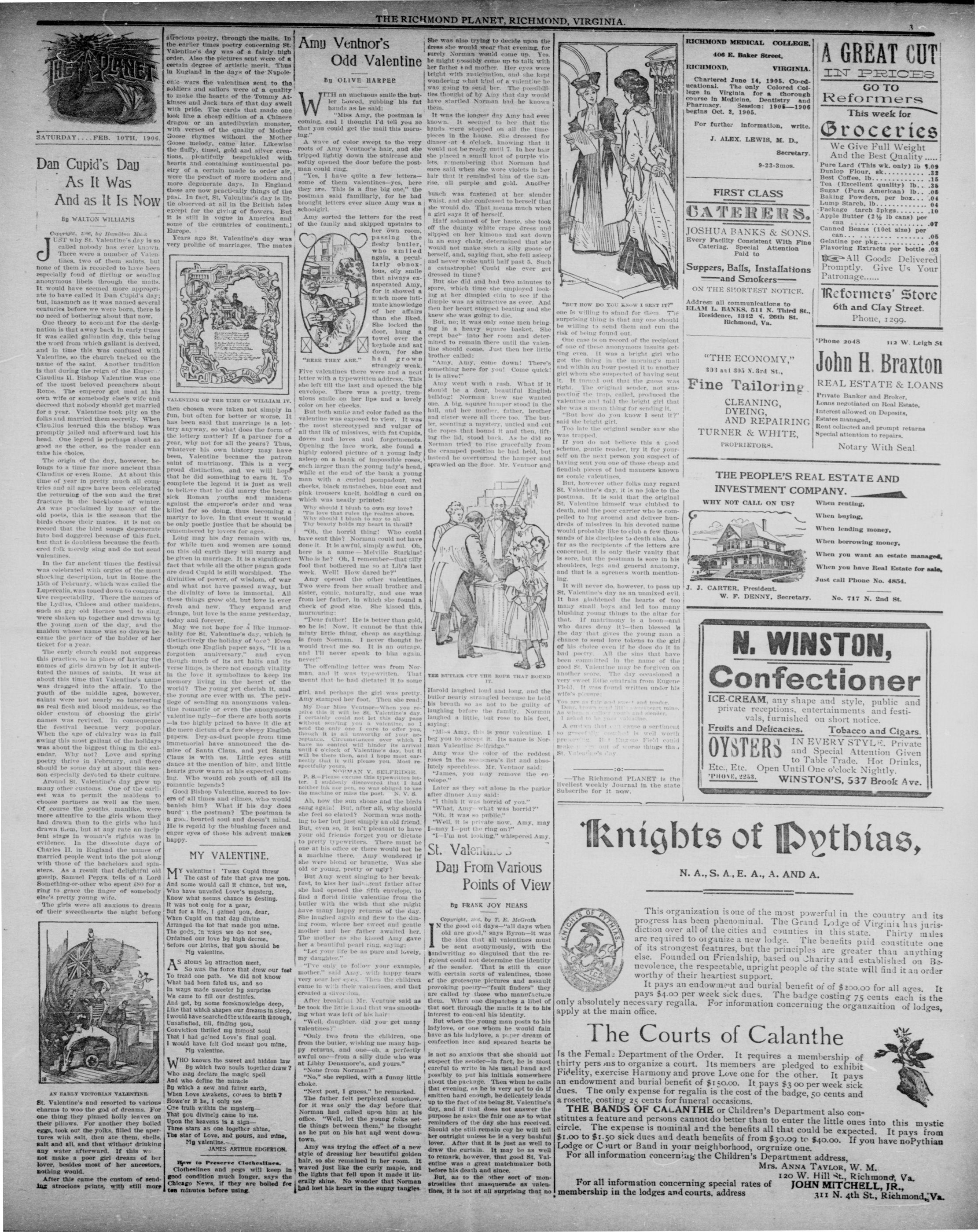
THE RICHMOND PLANET, RICHMOND, VIRGINIA
Amy Ventnor's Odd Valentine
By OLIVE HARPEP
WITH an unctuous smile the butler bowed, rubbing his fat hands as he said:
"Miss Amy, the postman is coming, and I thought I'd tell you so that you could get the mail this morning."
A wave of color swept to the very roots of Amy Ventnor's hair, and she tripped lightly down the staircase and softly opened the door before the postman could ring.
"Yes, I have quite a few letters—some of them valentines—yes, here they are. This is a fine big one," the postman said familiarly, for he had brought letters ever since Amy was a schoolgirl.
Amy sorted the letters for the rest of the family and skipped upstairs to
X X
her own room,
passing the fleshy butler,
who smiled again,
a peculiarly obso-
lous, oily smile
that always ex-
asperated Amy,
for it showed a much more intimate knowledge of her affairs
than she liked.
She locked the
door, hung the
towel over the
keyhole and sat
dowel, for she
had grown
strangely weak.
"HERE THY ARE." had grown strangely weak. Five valentines there were and a neat letter with a typewritten address. This she left till the last and opened the big envelope. There was a pretty, tremulous smile on her lips and a lovely color on her cheeks. But both smile and color faded as the valentine was exposed to view. It was the most stereotyped and vulgar of all that lik of missives, with fat Cupids, doves and loves and forgetmenots. Opening the lace work, she found a highly colored picture of a young lady asleep on a bank of impossible roses, each larger than the young lady's head, while at the end of the bank a young man with a curled pompadour, red cheeks, black mustaches, blue coat and pink trousers knelt, holding a card on which was neatly printed:
Why should I blush to own my love?
Tis love that rules the realms above.
Why should I blush to own my love?
Thy beauty holds my heart in thrall?
"Oh, the horrid thing! Who could have sent this? Norman could not have done it. It is awful, simply awful. Oh, here is a name — Melville Starkins! Who is he? Oh, I remember—that silly fool that bothered me so at Lib's last week. Well! How dared he?"
Amy opened the other valentines. Two were from her small brother and sister, comic, naturally, and one was from her father, in which she found a check of good size. She kissed this, murmuring:
"Dear father! He is better than gold, so he is! Now, it cannot be that this minty little thing, cheap as anything, is from Norman. I never thought he would treat me so. It is an outrage, and I'll never speak to him again, never!"
The offending letter was from Norman, and it was typewritten. That meant that he had dictated it to some girl, and perhaps the girl was pretty. Amy stamped her foot. Then she read:
My Dear Miss Ventnor-When you receive this it will be St. Valentine's day, I certainly could not let this day pass without sending you a valentine, so I send the only one I care to offer you, though it is all unworthy of your acceptance. Circumstances over which I will be willing to arrive until 6 o'clock of Valentine's day, but it will be there then, and I hope most earnestly that it will please you. Most respectfully yours.
NORMAN V. SELFRIDGE
P. S.-Please excuse this typewritten letter. I suddenly discovered that I had neither ink nor pen, so was obliged to use the machine or miss the post. N. V. S.
Ah, now the sun shone and the birds sang again! But, after all, why should she feel so elated? Norman was nothing to her but just simply an old friend. But, even so, it isn't pleasant to have your old friends forget you or dictate to pretty typewriters. There must be one at his office or there would not be a machine there. Amy wondered if she were blond or brunette. Was she old or young, pretty or ugly?
But Amy went singing to her breakfast, to kiss her indulgent father after she had opened the fifth envelope, to find a florid little valentine from the butler with the wish that she might have many happy returns of the day. She laughed again and flew to the dining room, where her sweet and gentle mother and her father awaited her. The mother as she kissed Amy gave her a beautiful pearl ring, saying:
"Let your life be as pure and lovely, my daughter."
"I've only to follow your example, mother," said Amy, with happy tears very near her eyes. Then the children came in with their valentines, and that created a diversion.
After breakfast Mr. Ventnor said as he took the little hand that was smoothing what was left of his hair:
"Well, daughter, did you get many valentines?"
"Only two from the children, one from the butler, wishing me many happy returns, and one—oh, a perfectly awful one—from a silly dude who was at Libby Densmore's, and yours."
"None from Norman?"
"No," she replied, with a funny little choke.
"Next post, I guess," he remarked.
The father felt perplexed somehow, for it was only the day before that Norman had called upon him at his office. "Well, let the young folks set things between them," he thought as he put on his hat and went downtown.
Amy was trying the effect of a new style of dressing her beautiful golden hair, so she remained in her room. It waved just like the curly maple, and the lights that fell upon it made it literally shine. No wonder that Norman had lost his heart in the sunny tangles.
She was also trying to decide upon the dress she would wear that evening, for surely Norman would come up. Yes, he might possibly come up to talk with her father and mother. Her eyes were bright with antidilation, and she kept wondering what kind of a valentine he was going to send her. The possibilities thought of by Amy that day would have startled Norman had he known them.
It was the longest day Amy had ever known. It seemed to her that the hands were stopped on all the timepieces in the house. She dressed for dinner at 4 o'clock, knowing that it would not be ready until 7. In her hair she placed a small knot of purple violets, remembering that Norman had once said when she wore violets in her hair that it reminded him of the rumise, all purple and gold. Another
bunch was fastened at her slender waist, and she confessed to herself that she would do. That means much when a girl says it of herself.
Half ashamed of her haste, she took off the dainty white crape dress and slipped on her kimono and sat down in an easy chair, determined that she would not make such a silly goose of herself, and, saying that, she fell asleep and never woke until half past 5. Such a catastrophe! Could she ever get dressed in time?
But she did and had two minutes to spare, which time she employed looking at her dimpled cinn to see if the dimple was as attractive as ever. And then her heart stopped beating and she knew she was going to die.
But, no; it was only some men bringing in a heavy square basket. She crept bae* into her room and determined to remain there until the valentine should come. Just then her little brother called:
"Amy, Amy, come down! There's something here for you! Come quick! It is alive!"
Amy went with a rush. What if it should be a dear, beautiful English bulldog? Norman knew sue wanted one. A big, square hamper stood in the hall, and her mother, father, brother and sister were all there too. The butter, secing a mystery, untied and cut the ropes that bound it and then, lifting the lid, stood back. As he did so Norman tried to rise gracefully from the cramped position he had held, but instead he overturned the hamper and sprawled on the floor. Mr. Ventnor and
A
THE BUTLER CUT THE ROPE THAT BOUND IT.
Harold laughed loud and long, and the butler nearly strangled because he held his breath so as not to be guilty of laughing before the family. Norman laughed a little, but rose to his feet, saying:
"Mi-s Amy, this is your valentine. I beg you to accept it. Its name is Norman Valentine Selfridge."
Amy was the color of the reddest roses in the seersmen's list and absolutely speechless, Mr. Ventnor said:
"James, you may remove the envelope."
Later as they sat alone in the parlor after dinner Amy said:
"I think it was horrid of you."
"What, Amy—what was horrid?"
"Oh, it was so public."
"Well, it is private now. Amy, may I—may I—put the ring on?"
"I—I'm not looking," whispered Amy. St. Valentine's
Day From Various Points of View
By FRANK JOY MEANS
Copyright, 1906, by T. E. McGrath
In the good old days "all days when old are good," says Byron—it was the idea that all valentines must be sent anonymously, with the handwriting so disguised that the recipient could not determine the identity of the sender. That is still th case with certain sorts of valentines, those of the grotesque pictures and assault provoking poetry—"fault finders" they are called by those who manufacture them. When one dispatches a label of that sort through the mails it is to his interest to conceal his identity.
But when the young man posts to his ladylove, or one whom he would fain have as his ladylove, a paper dream of confection lace and speared hearts he
is not so anxious that she should not suspect the sender—in fact, he is most careful to write in his usual hand and possibly to put his initials somewhere about the package. Then when he calls that evening, as he is very apt to do to smitten hard enough, he delicately leads up to the fact of its being St. Valentine's day, and if that does not answer the purpose he asks the fair one as to what reminders of the day she has received. Should she still remain coy he will tell her outright unless he is a very bashful lover. After that it is just as well to draw the curtain. It may be as well to remark, however, that good St. Valentine was a great matchmaker both before his death and since.
But, as to the other sort of monstrosities that masquerade as valentines, it is not at all surprising that no
Knights of Pythias,
This organization is one of the most powerful in the country and its progress has been phenomenal. The Grand Lodge of Virginia has jurisdiction over all of the cities and counties in this state. Thirty males are required to organize a new lodge. The benefits paid constitute one of its strongest features, but the principles are greater than anything else. Founded on Friendship, based on Charity and established on Benevolence, the respectable, upright people of the state will find it an order worthy of their heartiest support.
It pays an endowment and burial benefit of of $200.00 for all ages. It pays $4.00 per week sick dues. The badge costing 75 cents each is the only absolutely necessary regalla. For information concerning the organization of lodges, apply at the main office.
The Courts of Calanthe
Is the Female Department of the Order. It requires a membership of thirty persons to organize a court. Its members are pledged to exhibit Fidelity, exercise Harmony and prove Love one for the other. It pays an endowment and burial benefit of $150.00. It pays $300 per week sick dues. The only expense for regalia is the cost of the badge, 50 cents and a rosette, costing 25 cents for funeral occasions. THE BANDS OF CALANTHE or Children's Department also con-
constitutes a feature and persons cannot do better than to enter the little ones into this mystic circle. The expense is nominal and the benefits all that could be expected. It pays from $1.00 to $1.50 sick dues and death benefits of from $30.09 to $40.00. If you have noPythian Lodge or Court or Band in your neighborhood, orgrnize one.
For all information concerning the Children's Department address.
For all information concerning special rates of membership in the lodges and courts, address
M.
"BUT HOW DO YOU KNOW I SENT IT?"
one is willing to stand for them.
The surprising thing is that any one should be willing to send them and run the risk of being found out.
One case is on record of the recipient of one of these anonymous insults getting even. It was a bright girl who got the thing in the morning's mail and within an hour posted it to another girl whom she suspected of having sent it. It turned out that the guess was right. The original sender, not suspecting the trap, called, produced the valentine and told the bright girl that she was a mean thing for sending it.
"But how do you know I sent it?" said the bright girl.
Too late the original sender saw she was trapped.
If you do not believe this a good scheme, gentle reader, try it for yourself on the next person you suspect of having sent you one of those cheap and fendish pieces of bad manners known as comic valentines.
But, however other folks may regard St. Valentine's day, it is no joke to the postman. It is said that the original St. Valentine himself was clubbed to death, and the poor carrier who is compelled toug around and deliver hundreds of missives in his devoted name would probably like to club a few thousands of his disciples to death also. As far as the recipients of the letters are concerned, it is only their vanity that is sore, but the postman is sore in his shoulders, legs and general anatomy, and that is a soreness worth mentioning.
It will never do, however, to pass up St. Valentine's day as an unmixed evil. It has gladdened the hearts of too many small boys and led too many blushing young things to the altar for that. If matrimony is a boon—and who dares deny it—then bless is the day that gives the young man a chance to send love tokens to the girl of his choice even if he does do it in bad poetry. All the sins that have been committed in the name of the good St. Valentine may be forgiven on another score. The day occasioned a very sweet little outpatrain from Eugene Field. It was found written under his wife's picture:
You are as fair and sweet and tender. Denir, brown earl little sweetheart mine. As when, a yellow youth and slender, I asked to be your valentine.
A custom that can cause a sentiment so gregorous could is well worth preserving. But Eugene Field could make you out of worse things than St. Valentine's day.
The Richmond PLANET is the liveliest weekly Journal in the state Subscribe for it now.
KNIGHTS OF PYTHIAST
1481
THE PEOPLE'S REAL ESTATE AND INVESTMENT COMPANY.
N. WINSTON,
Confectioner
ICE-CREAM, any shape and style, public and
private receptions, entertainments and festi-
vals, furnished on short notice.
Fruits and Delicacies. Tobacco and Cigars.
OYSTERS IN EVERY STYLE. Private
and Special Attention Given
to Table Trade. Hot Drinks,
Etc., Etc. Open Until One o'clock Nightly.
PHONE, 2253.
WINSTON'S, 537 Brook Ave.
Chartered June 14, 1905. Co-educational. The only Colored College in Virginia for a thorough course in Medicine, Dentistry and Pharmacy. Session: 1905—1906 begins Oct. 2, 1905.
For further information, write.
J. ALEX. LEWIS, M. D.,
Secretary.
9-23-3mos.
FIRST CLASS
CATERERS.
JOSHUA BANKS & SONS. Every Facility Consistent With Fine Catering. Special Attention Paid to Suppers, Balls, Installations and Smokers
Address all communications to ELAM L. BANKS, 511 N. Third St. Residence, 1312 N. 20th St. Richmond, Va.
"THE ECONOMY," 303 aul 305 N.3rd St.,
CLEANING,
DYEING,
AND REPAIRING
TURNER & WHITE,
PROPRIETORS.
THE PEOPLE'S REAL
INVESTMENT COMP
WHY NOT CALL ON US?
J. J. CARTER, President.
W. F. DENNY, Secretary.
N. WIN
Confec
ICE-CREAM, any shape
private receptions, ente
vals, furnished o
Fruits and Delicacies.
OYSTERS IN EV
and S
to Tab
Etc., Etc. Open Until On
'PHONE, 2253. WINSTO
N. A., S. A., E. A., A. AND A. organization is one of the most power has been phenominal. The Grander all of the cities and counties in need to organize a new lodge. The longest features, but the principles ended on Friendship, based on Sha the respectable, upright people of their heartiest support. an endowment and burial benefit o per week sick dues. The badge
IN PRICES
GO TO
Reformers
This week for
Groceries
We Give Full Weight
And the Best Quality .....
Pure Lard (This wk. only) lb 5.09
Dunlop Flour, sk.....32
Best Coffee, lb.....15
Tea (Excellent quality) lb.....35
Sugar (Pure American) lb.....05
Baking Powders, per box.....04
Lump Starch, lb.....04
Package tarch 3pkgs.....10
Apple Butter (2½ lb cans) per
Canned Beans (10ct size) per can.....05
Gelatine per pkg.....04
Flavoring Extracts per bottle.....03
All Goods Delivered Promptly. Give Us Your Patronage.....
Reformers' Store 6th and Clay Street. Phone, 1299.
John H. Braxton
REAL ESTATE & LOANS
Private Banker and Broker,
Loans negotiated on Real Estate,
Interest allowed on Deposits,
Estates managed,
Rent collected and prompt returns
Special attention to repairs.
Notary With Seal.
AL ESTATE AND
PANY.
When renting.
When buying,
When lending money,
When borrowing money,
When you want an estate managed,
When you have Real Estate for sale,
Just call Phone No. 4854.
No. 717 N. 2nd St.
HISTON,
actioner
e and style, public and
entertainments and festi-
on short notice.
Tobacco and Cigars.
EVERY STYLE. Private
Special Attention Given
Table Trade. Hot Drinks,
One o'clock Nightly.
TON'S, 537 Brook Ave.
Rythias,
A.
Feverful in the country and its
and Lodge of Virginia has juris-
in this state. Thirty males
the benefits paid constitute one
is greater than anything
clarity and established on Be-
of the state will find it an order
of $200.00 for all ages. It
the costing 75 cents each is the
ing the organization of lodges,
VINE
ment also con-
ne little ones into this mystic
d be expected. It pays from
$40.00. If you have noPythian
address,
TAYLOR, W. M.
Hill St., Richmond, Va.
N MITCHELL, JR.,
311 N. 4th St., Richmond, Va.
THE PLANET
Published every Saturday by JOHN MITCHELL
JR. at 311 North 4th Street, Richmond Va.
Al. communications intended for publication should be sent so as to reach us by Wednesday.
TERMS IN ADVANCE
One Copy, one year. $1.50
One Copy, eight months. 1.40
One Copy, six months. .80
One Copy, four months. .80
One Copy, three months. .40
Single Copy. .30
ADVERTISING RATES.
For one inch, one insertion. $ .80
For one inch, each subsequent insertion. .40
For two inches, three months. 6.00
For two inches, six months. 10.00
For two inches, nine months. 14.00
For two inches, twelve months. 20.00
Marriage and Funeral Notices, one inch. .80
Standing and Transient Notices per line. .10
POSTAGE STAMPS OF A HIGHER DE-NOMINATION THAN TWO CENTS NOT RECEIVED ON SUBSCRIPTIONS.
THE PLANET is issued weekly. The subscription price is $1.50 per year in advance.
There are FOUR WAYS by which money can be sent by mail at our risk—In a Post Office Monetary Bank Check or Drift, or an Ex press Money Bank or Drift, or those can be procured, in a Registered Lett.
MONEY ORDERS. You can buy a Money Order at your Post-Office, payable at the Richmond Post-Office, and we will be responsible for the delivery of the Express Money ORDERS can be obtained at any office of the American Express Co., the United States Express Co., and the West Fargo and Co.'s Express Company. We will be responsible for the delivery of the Express Money Order is a sas and convenient way forifting money.
REGISTERED LETTER—If a money Order Post-Office or an Express Office is not within the letter you wish to send us on payment of amounts. Then, if the letter is lost or stolen it can be traced. You can send money in this manner your credit. We cannot be responsible for money sent in letters in any other way than one of the four ways mentioned above. If you send your money in any other way, you must do it at your RENEWAL, ETC.—If you do not want THE PLANET continued for another year after your subscription has run out, you then notify us by Postal Card to discontinue. The courts have not order their paper discontinued at the duration of time for which it has been paid are held liable for the payment of the subscription state when they order the paper discontinued.
COMMUNICATIONS:—When writing to us to renew your subscription or to discount your paper, you should give your name and address in full otherwise we cannot find your name on our books.
CHANGE OF ADDRESS.—In order to change no address of a subscriber, we must be sent the former as well as the present address.
Entered at the Post-Office at Richmond. Ve as second-class matter.
SATURDAY...FEB. 10TH, 1906.
There is no use being despondent or cast down. The race is succeeding and the Negro-haters are "cussing" and God is on our side, so let us be happy even though it is cold on the outside.
The congregation of the Fifth Baptist Church is indeed fortunate in securing the services of the able Rev. Dr. W. F. Graham. He is well qualified for the work and he should prove to be a God-sent blessing to that struggling body of Christian believers at this stage of their strag believers at this stage of their efforts.
____:o:____
Mr. P. S. Twister of Washington is enthusiastic in his advocacy of that most estimable gentleman, Prof William H. Richards. He says:
The man who is needed to carry out the mission, which is to be the hope and promise of the future generations of his race: a man who is able, more able than brilliant, to cope with the conditions as they are: this man is Prof. William H. Richards, of the Law Department of Howard University. He believes in the American Ideal—The Trinity, Liberty, Fraternity, Equality. He believes in the unlimited development of his race. Especially does he believe in the strength of his class, his ethnic type; that the very inertia of it to-day, gives it an unquenchable momentum for to-morrow, and that in the future we will have a great race in this country, founded upon the faith of the Fathers. Most profoundly, does he believe in the young men, the value of the priceless element, courage, and certain success of the future. It is his belief, as it is the belief of all who think, that Howard University must send down the shafts that must leaven the "loaf" in the future. He appeals from the present disciples of commercialism and imperialism to the future fairness and equality; and dares to say that a man must stand or fall upon the eternal verities. The Golden Rule, The Declaraton of Independence and the Constitution of the United States are his guides. And in keeping with these he would run Howard University for the highest good of his race, his country and humanity, in the faith of the Fatherhood of God and the Brotherhood of Man. Unite the forces for Prof. William H. Richards.
COLORED FOLKS ACTIVE
There seems to be an awakening among the colored people of the North on the race question, which has been erroneously called a problem. The fact that Iev. Thomas Dixon, Jr. has violated southern precepts and examples and permitted himself to be drawn into a personal
discussion with persons of color, speaking from the same platform in New York City indicates that there is hope for the future and that white men of the Garrison type are yet alive to the people's interests and that they will take radical measures to defend them.
When T. Thomas Fortune, Esq. Prof. W. E. B. DuBois, Prof. Kelly Miller, Hon. George H. White and that accomplished queen among women, Mrs Mary Church Terrell stand for the rights of an oppressed and downtrodden people in open meeting and in the presence of a mixed audience so to speak, it betokens a crisis in our affairs that cannot but result in good. We have an extended report of the recent meeting at Cooper Union, New York City, which we shall endeavor to publish, although it will be a great undertaking so to do.
The resolutions adopted are conservative and we note that they carefully avoid endorsing the Crump-packer resolution for reduction of congressional representation in the Southland. This is ominous however for it stands for the enforcement of the Constitution of the United States in all of the Southern states. In the light of the recent decisions by the Supreme Court of the United States, we do not think that a congress could be found that could pass suffrage legislation that would pass the Supreme Court of the United States as it is at present constituted.
The member of that tribunal from Massachusetts is about as unsound on this question as is the member from Louisiana. They receive notice apparently of the coming of the suffrage cases long before they have left the lower courts and so to speak they "wink the other eye" and proceed to get ready to do some heavy "batting" on their own account landing the case back to the state from which it came or putting it out of action entirely.
The only way these colored people here manage to get along is to take a treatise on state's rights, embracing all of the doctrines of John C. Calhoun and Jeff. Davis and govern themselves accordingly. We se cure the services of southern lawyers, well versed in the law and honorable in their interpretation of it. That justice and injustice that we cannot secure by this route we do without or appeal the case to that tribunal, over which King Jesus presides and before which the twelve apostles are the advocates.
The way they are killing us out down here makes it reasonably certain that we will not have long to wait before we can appear before that heavenly Judge in person, and secure a decree in keeping with that biblical Constitution, which pales into insignificance the earthly one.
CRIMINAL SUITS UP TO GOVERNOR
Insurance Probers Report to Pennsylvania Legislature.
WANT FEES AND TAX REDUCED
Harrisburg, Pa., Feb. 7.—The legislative insurance investigating committee presented its report to the senate and house, and was continued until the close of the present extra session, February 15, to further investigate esuch additional information as may come before it.
The committee calls to the attention of Governor Pennpacker and Attorney General Carson the testimony secured by it which may tend to estab-
J.
Ish malfassance in office on the part of former Commissioners Luper, Lambert and Durham and some of their subordinates, especially that which relates to receiving the actuary's compensation and also to the illegal fees said to have been taken under Durham.
The committee has not yet decided when it will hold its next sitting, if at all. At present its members say it has no information which will justify a continuation of the investigation. Should any information be laid before the committee, however, a meeting will be called to consider it.
What the Probs Revealed.
Following in brief are the facts brought to light by the insurance investigating committee which sent its report to the legislature:
Acturial fees paid, either by voluntary agreement or by compulsion, to commissioners, or their personal rep
RICHMOND PLANET, RICHMOND, VIRGINIA
resentatives, as follows:
George B. Luper, $15,833.
James H. Lambert, $28,183.
Israel W. Durham, $5000.
Edward H. Eccles, $7390.
J. Clayton Erb, $141,223.
Carried on the pay rolls of the insurance department by Israel W. Durham's order for no actual work: R. M. J. Reed, Charles B. Gray, Edward J. Davis and Israel, Stone.
No check on insurance department by auditor general and state treasurer.
No audit of accounts of any state department for 20 years.
Insurance department is the only one that does not file sworn pay roll with state treasurer.
Recommendations.
The committee's report reviews the testimony at great length and then makes the following recommendations:
First—That the insurance commissioner, as well as all other officers, employees, servants and agents of the commonwealth, so far as practicable, should be on a salaried basis, and that all fees now authorized or hereafter to be authorized by law should be paid by the commissioner to the state treasurer for the use of the state.
Second—That the actuary of the insurance department should be an officer of the commonwealth, required to act exclusively in that capacity, for which he should receive a salary of $5000 per annum and be provided with an adequate tec corps of competent assistants, to be on a salaried basis.
Third—That instead of examiners of insurance companies being selected promiscuously and paid by the companies examined, one or as many examiners of insurance companies may be necessary should be salaried officers of the commonwealth and that the cost of the examination of insurance companies when made by him should be upon a fixed rate proportionate to the work done, and its cost paid into the state treasury for the use of the state.
Fourth—Fees and charges of the insurance department and taxes paid by insurance companies should be reduced so as to lessen the burden upon the policyholder.
Fifth—There should be a complete reorganization of the clerical force in the insurance department, and the present system of allowing the insurance commissioner to draw upon the state treasurer for any sums he may consider necessary as an expense of the office should be abolished.
Sixth—Provision should be made for a quarterly audit of the accounts of the various state officers receiving money or having in their control or subject to their charge any contingent fund, either by special officer constituted by law for that purpose or a special assistant in the office of the auditor general.
Seventh—The committee further recommends to the attention of the governor and the attorney general the testimony given which may tend to
establish malfeasance by former Commissioners George B. Super, James H. Lambert, Israel W. Durham and their subordinates, and especially in so far as it relates to the receiving of a part of the actuary's compensation during their respective administrations, and also to the testimony that during the administration of Israel W. Durham the state was defrauded by vouchers being granted and payment made for services which had never been rendered or for which there was no legal liability.
DIVORCE SUIT FILED
Countess Castellane Brings Action For Separation.
Paris, Feb. 6.—Countess Boni de Castellane (formerly Anna Gould) has entered a plea for divorce. Representatives of the countess and the count appeared before Judge Henry Ditte, of the court of first instance, who, in conformity with the French law, endeavored to arrange a reconciliation before allowing a definite suit to proceed. It is said on unquestionable authority that Judge Ditte's efforts were not successful, the countess absolutely declining to resume her relations with her husband, and that after repeated but vain attempts by Count de Castellane's advisers to arrange a settlement, the representatives of the count and countess left the court and that the suit will proceed.
No decision has been reached relative to the eventual custody of the three children of the count and countess, but they being under age will for the present naturally remain in the care of their mother.
Sensational reports have been circulated with reference to the count's conduct, and the name of a prominent society leader of Paris, a woman of very high standing, has been mentioned in connection with the affair. But the greatest reticence has been maintained by all the parties concerned relative to the process of the negotiations looking to a reconciliation.
It now appears that the efforts of those interested in bringing about a settlement of the differences between the countess and the count without an appeal to the courts have been unavailing. The count is said to be in the southeast of France.
Jail For Poor Directors.
Media, Pa., Feb. 6.—Judge Johnson in court refused a new trial to former Poor Directors Newton P. West, of Swarthmore, and Frank E. Sharpless, of Bothwyn, and sentenced each to pay a fine of $50 and serve one year in the county jail. The men were convicted of embezzling $1522.40 of the county funds while directors of the poor house. They paid the money back and were in hopes of having a new trial granted, as the jury only found them guilty on one of the counts of the indictment.
Penn's Power House Damaged By Fire Philadelphia, Feb. 7.—The power house of the University of Pennsylvania, at 34th and Spruce streets, was damaged by fire to the extent of $50,000. The power plant supplied light and power for nearly all of the buildings of the university.
550,000 MINERS MAY STRIKE
Conference With Operators Adjourns Without Reaching Agreement.
MEN DEMAND WAGE INGREASE
Indianapolis, Feb. 3.—With prospects pointing to a strike of 550,000 coal miners unless the present deadlock is broken by some unforeseen influence, the national convention of the United Mine Workers of America adjourned after the dissolution without reaching a settlement of a wage scale of the joint conference of operators and miners of the central and southwestern districts. President John Mitchell, of the miners' union, advised the delegates to go home and look to the securing of a defense fund in view of a possible industrial strife between miners and operators, the miners having refused to renew the present wage scale and the operators having refused to grant an increase in wages.
The apparent determination of both operators and miners indicates that neither will make overtures to the other for further negotiations, and as indicated by the speeches of both the radicals and the conservatives of both organizations at the joint conference, it is probable that the 550,006 men controlled by the United Mine Workers will walk out of the mines in every part of the United States on April 1. During an interview, President John Mitchell said:
"It is true that never in the history of this country has a strike of such far-reaching effect been threatened. It means a national suspension of mining if the strike comes on at the expiration of our mining contracts, March 31, and it includes the anthracite districts. I do not know whether this action will have any effect on the meeting of the anthracite miners and operators on February 15, but it is the plan now to meet the anthracite operators at that time."
According to figures given out by the national officers of the miners' organization, they expect the strike, if there be one, to bring out about 100,000 non-union miners in West Virginia and Pennsylvania, with the 450,000 union miners. Of the 450,000 union men that would be affected, 150,000 would be out in the anthracite regions.
President Mitchell estimates that four persons are dependent on each miner, and a national strike, such as is planned, would affect nearly 3,000,000 persons dependent on mining for bread.
With assessments from now to April 1, the miners, with nearly $3,000,000 on hand, could be in possession of something like $6,000,000 by April 1.
COLLIERIES ON FULL TIME
Tons to Storage Stock By April.
Mahanoy City, Pa., Feb. 5.—The celliers throughout the anthracite region have orders to operate at full capacity from now until next April. A number of washeries in the Sueyukil field that have been closed have resumed operations on full time. The companies expect to add 3,000,000 tons of coal to their storage stock in the next eight weeks.
AGAINST PUBLIC OWNERSHIP
N. J. Commission Says Municipal Con
trol of Trolleys is Impracticable.
Trenton, N. J., Feb. 7.—The commission appointed by the legislature to investigate the question of limited franchises and the taxation of public utilities companies sent its report to the legislature.
Former Governor Voorhees, chairman of the commission, gave out a statement embodying the essential features of the report, which declares the municipal operation of public utility plants, especially trolley lines, is impracticable because of their extension through more than one municipality.
Excessive stock and bond issues is condemned, and the Massachusetts plan is advised for the creation of a board to limit bond and stock issues. It is suggested that there be a gradual increasing tax, according to the average annual mileage receipts.
Gets Four Years For Robbing Malts.
Baltimore, Md., Feb. 7.—In the arrest, conviction and sentence of Archer B. Ruhnan, a substitute letter carrier, on a charge of taking money from letters, the inspectors of that department and the office of the United States district attorney established a record for celerity of action, the prisoner being sentenced by Judge Morris, in the United States district court, to four years in the penitentiary and incarcerated In that institution just 36 hours after his arrest.
Big Colliery Closed.
Mahanoy City, Pa., Feb. 7.—Five hundred men and boys were thrown out of employment by the closing down of the Silver Brook Coal company's colliery at Silver Brook, near here. The mules were hoisted and the miners were ordered to remove their tools. It is said the Philadelphia & Reading Coal & Iron company is negotiating for the purchase of the colliery, which is not expected to resume operations before next September.
$20,000 For Randolph Macon College, Lynchburg, Va., Feb. 7.—Andrew Carnegie has given $20,000 to the Randolph Macon Woman's College here, conditional on the college raising a like amount. This will be done. It means building an additional dormitory and a large science hall, and it is claimed will make the college one of the five largest female colleges of grade A in the United States.
1,000,000 Bushels of Wheat Burned.
1,000,000 Bushels of Wheat Burned.
East St. Louis, III. Feb. 5. — The Union elevator, containing a million bushels of wheat, was destroyed by fire, entailing a loss of more than $1,000,000. The fire spread to the stables of the St. Louis Transfer company and 200 horses and 200 wagons were destroyed, as well as the stables. The fire originated in a brick engine house 30 feet from the elevator.
RUFUS JOHNSON INDICTED
"Gullu I. Murdered the Woman." H
"Guilty, I Murdered the Woman," He
Said, When Asked to Plead.
Mount Holly, N., J. Feb. 6. — The grand jury found a true bill of indictment against Rufus Johnson for the wilful murder of Miss Florence W. Allinson at Moorestown. A formal plea of not guilty was entered in Johnson's behalf, and the trial will take place on Thursday next.
"How say you, Rufus; are you guilty or not guilty?" asked Justice Hendrickson. The prisoner raised his head and looked the justice square in the face as he gave his abrupt reply:
"Gulty; I murdered the woman."
"The court recognizes only the plea of not guilty in this case," said Justice Hendrickson to the prisoner. "You are not permitted to plead guilty."
While the colored man stood with head lowered and with his shifting eyes taking in apprehensively the crowd on either side, the court then fixed next Thursday as the date for his trial and appointed Jacob Hendrickson, a Mount Holly attorney, to defend him. This was the closing scene of the proceeding which started the brutal murderer of Miss Allinson on his swift march to the gallows.
FOUND HIS FAMILY DEAD
Mrs. Annie Dixon Kills Herself and Four Children
Boston, Feb. 7.—A woman and four children were found dead in bed at their home, 29 Dennis street. An investigation by the police indicates that the woman, Mrs. Annie L. Dixon, had killed the children and herself by opening three gas jets. The children were Annie, aged 5 years; George, 3½ years; Mildred, 2 years, and Marlon, 1 year old.
The tragedy was discovered by the woman's husband, Arthur B. Dixon, when he returned home from work. Dixon found the house locked and was obliged to break in the front door. He found the bodies of his wife and children in a bedroom. Medical Examiner A. A. McDonald decided that Mrs. Dixon had killed the children and herself. Dixon told the police that he left home at 6 o'clock in the morning to go to his work. At that time his wife was up, the children were all awake and he did not notice anything unusual.
CONVICT WINS $25,000 PRIZE
Guested Attendance at St. Louis Fair and Gave Lawyer Half to Get It.
Lincoln, Neb. Feb. 7.—The winner of the $25,000 prize for correctly naming the attendance at the St. Louis exposition in 1904 was Frank Campbell, a convict in the Nebraska state penitentiary, who still has about one year to serve. Campbell was convicted of embezzlement. He will receive only $12,500 of the prize, as he fearing that difficulty in securing the money would arise while he was imprisoned, agreed to pay a lawyer half of the prize in case of success in securing it. Campbell's attorney had a conference with him at the penitentiary in regard to the disposition of the money, which will be received in a few days. The convict will be unable to use the money until his sentence has expired.
NEW YORK'S GREAT BUSINESS
Imports and Exports for 1905 Exceed
$1,300,000,000.
New York, Feb. 6.—The forthcoming annual report of the New York chamber of commerce for the fiscal year 1905, compiled under the supervision of Secretary Wilson, shows the total value of foreign imports received at the port of New York 1904/1905, fiscal year ending June 30, 1905, to have been $995,168,950, as compared with a total of $503,479,947 for all other ports of the United States. The total value of domestic exports from the port of New York was $616,294.631, as compared with a total from all other ports during the same period of $996,361,184.
NINE BURNED TO DEATH
Perished In Fire Which Destroyed
Their Home in Maryland Village
Their Home in Maryland Village.
Baltimore, Md., Feb. 7.—An isolated small frame house near the village of Curtis Bay, in Anne Arundel county, was consumed by a fire in which were burned to death nine colored persons, only one of the inmates escaping alive. The names of those who lost their lives were Richard Taylor, Horace Jackson, his wife, Eliza, and their son, Samuel, a youth of 17; Mrs. Rose Jackson, a widow, and her children, Ida, a grown daughter; Susan, 11 years old; Isidar, 9 years, and a 6-months-old baby.
The only inmate who escaped with her life was Ella Webster, a woman who managed to get to a window and jumped from the second story to the ground. For a few minutes after gripping the ground she was unconscious, and on recovering she made her way to neighboring houses and gave the elk.
When the neighbors arrived the house was a pile of blazing and smoking debris, and when the bodies were recovered nothing but the charred bones of the victims were left. Ella Webster is being held by the police on suspicion of starting the fire. It is said two men who were in the houses were to testify against her sweetheart.
DAMAGES FOR LOST EYESIGHT
Verdict of $17,500 Against Philadelphia
Cemetery Co. For Boy's Injury.
Philadelphia, Feb. 7.—For the loss
of his eyeglass, which resulted from
an explosion of dynamite while he was
assisting in blasting work in North
wood cemetery about two years ago.
George W. White, a 16-year-old boy,
recovered a verdict of $15,000 damages against the cemetery company.
The boy's father, George W. White,
also received an award of $2500 to
compensate him for the loss of his
son's earnings and to reimburse him
for medical expense.
Lawyers Scott and Leaming showed that young White had been engaged to drive a cart, but that when the company found it necessary to do some blasting he had been ordered to assist in that work, with little or no knowledge of the dangers to be encountered in handling dynamite, and it was testified that he had tapped a stick of the explosive too hard, and this caused the accident.
WANTS NEW
HAZING LAW
The President Thinks Dismissal Often Too Severe a Punishment.
33 MORE MIDDIES UNDER BAN
Washington, Feb. 4.—The president made public a letter urging upon congress a modification of the law against hazing at the naval academy. Unless congress shall promptly amend the existing law against hazing, which makes mandatory the dismissal of any midshipman found guilty of any form of hazing, the secretary of the navy may be forced to dismiss 33 midshipmen from the naval academy within the next month, in addition to the eight who have already suffered this penalty, and the three whose cases are awaiting the action of the department. Secretary Bonaparte after urging upon individual members of congress the necessity for immediate legislation, finally laid the whole matter before the president.
It is admitted at the navy department that if the present law is allowed to stand the service will suffer severely. The investigating board of officers appointed by the superintendent of the naval academy to obtain evidence against a midshipman guilty of any form of hazing has already brought to light evidence resulting in the trial of 14 midshipmen, of whom two have been accrued, eight dismissed, one pardoned while under suspension, and another—Midshipman Minor Merlwether, Jr., whose case is now awaiting action by the department—has been found guilty and recommended for pardon. The papers in the cases of Midshipmen Jules James, of Virginia, and W. T. Boyd, Jr., of Illinois, are before the department for execution of sentence of dismissal.
The investigating board has left with the superintendent of the academy evidence against 33 other midshipmen, who will probably be ordered for court martial. The law will necessitate the dismissal of each midshipman found guilty. Included in the list are midshipmen whose records are otherwise above reproach, among them members of the first class, who will graduate next week, and a number related to prominent members of congress.
The case of Minor Meriweher, now before the secretary, will probably come to the president for consideration. Meriweher is serving a sentence of one year's confinement to the academy grounds for participation in the fatal fight with Mishipman Branch. The evidence in his trial for hazing as to the character of his pranks is the ground on which the question of his pardon is being considered.
The president points out that it is often unjust to subject a mishmishman convicted of hazing to dismissal. He suggests, further, that it is an error to try hazers by court marial. His idea is that the power to deal with such cases ought to be lodged in some administrative officer or body.
PUBLIC SCHOOL BURNED
200 Pupils Were Panic-Stricken, But All Escaped Uninjured.
Wilkes-Barre, Pa., Feb. 6.—A fire destroyed the public school, a large brick structure in Edwardsville, two miles from here. There were nearly 200 pupils in the building, who for a time were panic-stricken, but all were taken out without injury. The origin is said to be from a defective flue leading from a furnace in the cellar. Loss is estimated at $7509.
A WEEK'S NEWS CONDENSED
Executors of the estate of Marshall Field place the value of the state in Illinois at $75,000,000.
Miss Rose Weller, aged 18, of Rome, N. Y., died after lying in a trance for more than three weeks.
The New York legislature passed a bill authorizing the insurance investigating committee to have 5000 copies of the insurance testimony printed.
A Delaware & Hudson passenger train collided with a work train near Schenectady, N. Y., and one laborer was killed and two passengers fatally injured.
Friday, February 2
W. N. Sawyer, of Elizabeth City, N. C., former proprietor of the Arlington Hotel, committed suicide by shooting while despondent.
Masked burglars entered the home of Walter Dickinson, postmaster at Beaver Meadow, near H. H.ison, Pa., and escape dwith $500 in cash stamps and registered letters.
Tom Filer, father-in-law of the colored men who killed Sheriff Robertson, of Covington county, Miss., was lodged in jail at Jacksonville to escape a mob that formed to lynch him.
Ensign Wade, U. S. N., attached to the Bennington at the time of the fatal explosion, is soon to marry Miss Edith Fabregon, who nursed him through a critical fever while he was ashore in a hospital.
Saturday, February 3.
Walter W. Hamilton, a negro, was hanged at Washington, D. C., for the murder of his common law wife.
The temperature in the Adirondacks, near Malone, N. Y., on Friday registered 29 degrees below zero, the lowest this season.
Thomas Minehall, postmaster at La Crescent, Minn., for 40 consecutive years, 1859 to 1899, is dead at the age of $2 years.
President Roosevelt has pardoned Midshipman John Paul Miller, of Kentucky, recently convicted of hazing at Annapolis naval academy.
Monday, February 5.
The navy department has accepted the resignation of Midshipman Judson L. Hand, of Pelham, Ga.
Fifteen persons were hurt, two fatally, when an eastbound Rock island express train was derailed near Duran, N. M.
Mrs. Mary. Dougherty, reputed to
have been the oldest woman in Pennsylvania, died in Tamaquat at the age of 108 years.
Wrapping his coat about her, 10-year-old Russell Fisher, of Catawissa, Pa. saved his little sister from burning to death after her dress had caught fire.
Virginia manufacturers of fruit and vegetable baskets, packages and barrels will lose heavily by the increased price of pine lumber, as the season's orders are nearly all in.
Tuesday, February 6.
James Ryan, alias "New York Red," was sentenced to 19 years' imprisonment for murder at Reading, Pa.
One thousand mounted men from Fort Sill, Okla., will participate in a three-days' hunt to rid the national game preserve of wolves.
Frederick Kimball, an insurance agent and formerly an absconder, committed suicide in Worcester, Mass., by inhaling gas while despondent.
A national convention of the laymen of the United Presbyterian denomination will be held in Pittsburg for three days, beginning February 13, to exchange ideas on Christian work.
William Milton was found in the road frozen to death near Milton, Pa.
The South Carolina legislature has passed a bill to abolish the state dispensary.
The funeral of the late King Christian of Denmark will take place on February 18.
James B. Doherty has been reappointed commissioner of labor for the state of Virginia.
Three little girls of J. B. Cypher were burned to death in a fire that destroyed their home at Helena, Mont.
Jacob Kohter, 65 years old, of Thomasville, near York, Pa., was seized with cramps and died in a carriage while being taken to a doctor.
PRODUCE QUOTATIONS
The Latest Closing Prices In the Principal Markets.
PHILADELPHIA—FLOUR steady; winter exerts $3.23; Pennsylvania roller, clear, $3.49; $3.69; city mills, fancy, $4.75; $4.80. RYE FLOUR firm; por barrel, $3.75. WHEAT firm; No. pennsylvania red, new, $4.84; $8.5COR; steady; No. 2 yellow, local, $4.8c; steady; No. 2 white, clipped, $3.6c; steady; No. 2 white, HAY steady; No. 1 tilted, $3.6c for large bales. PORK firm; family, $17. BEEF steady; beef hams, $23@24. Poultry. Live steak; hens, $13@13c; old roosters, @9c. Dressed steady; choice towls, 14c; old roosters, @3c BUTTER firm; creamery, 30; per GGS steady. New York and Pennsylvania, 19@20c per dozen. POTATOES steady; per dozen, 70@73c.
BALTIMORE-WHEAT quiet; No. 2 spot, 84% @ 84%c; steamer No. 2 spot, 80% @ 80%c; southern, 80% @ 48%c; CORN firm; mixed spot, 48% @ 48%c; mixed, 46% @ 46%c; southern, 43% @ 43%c; white, No. 2, 36% @ 36%c; No. 3, 35% @ 35%c; No. 4, 34@ 34%c; mixed, No. 2, 35% @ 35%c; No. 3, 34@ 34%c; No. 4, 33@ 33%c; BUTTER firm; creamy separator, extras 25% @ 26%; held, 21 separator, extras 27c; Maryland and Pennsylvania; prints 16c. EGGS熟了; fancy Maryland Pennsylvania, Virginia and West Virginia, Pennsylvania, southern, 15c.
Live Stock Markets
PITTSBURG (Union Stock Yards)—
CATTLE strong; choice, $5.40@5.10;
prime, $5.25@5.50. HOGS higher;
prime heavies, $6.50; mediums, York-
kent heavies, $6.50; roughs, $5.20;
$5.20. SHEEP slowed; wethers,
$5.60@5.75; common sheep, $2.50@
3.50; spring lambs, $5@7.40; veal
calves, $8@8.50.
Corporate Will Close Business
Carnegie Will Give Swarthmore $50,000
Swarthmore, Pa., Reb. 5—President
Swain, of Swarthmore College,
announced that Andrew Carnegie has
offered to donate $50,000 for a new
library building on condition that the
college shall raise $50,000 for its maintenance.
Killed In Runaway Accident.
Media, Pa., Feb. 7.—Thomas B. Allen,
county commissioner, was thrown from
his wagon in a runaway accident and
died before he reached the Chester
hospital. He was 66 years of age, and was
favorably known throughout the county.
Allen had been in office just a
little over a month, assuming his
duties the first Monday of January.
$500 More For Captain Caste
Atlantic City, N. J., Feb. 7.—Captain Mark Casto, who with his crew of six men rescued 52 persons from the stranded steamer Cherokee, received a check for $500 from the Clyde Line Steamship company, the owners of the steamer, as a recognition of his courage.
Anti-Cigarette Law For Maryland
Annapolis, Md., Feb. 6.—The state senate passed a bill imposing a penalty of $25 for the first offense, and $100 for the second, upon any person who sells, harters, gives away or in any manner disposes of any cigarettes in the state of Maryland. The house of delegates has yet to pass upon the bill
Lady Grey Is Dead.
London, Feb. 5.—Lady Grey, wife of Sir Edward Grey, the foreign minister, who sustained concussion of the brain by being thrown from her trap at Ellingham, Northumberland, last Thursday, died without having regained consciousness.
Two Killed By Train
Norristown, Pa., Feb. 5. - While walking along the Pennsylvania railroad tracks near Spring Mill, Joseph Masal, 28 years old, and Michael Augustine, 35 years of age, both of Spring Mill, were struck by the locomotive of a freight train and instantly killed. The train crew were not aware that the men had been killed until they arrived at Consohoocken, when the pilot of the locomotive was found to be covered with blood. An investigation was made and the bodies of the men were found.
Indian Pupils Married
Carlisle, Pa., Feb. 6.—The first public wedding of Indian pupils at Carlisle Indian school took place there. Rose La Farge, a crew maiden, became the bride of Charles Dillen, a member of the Indian school football team. Rev. George Norcross officiated. The ceremony was performed in the new auditorium and was witnessed by 1000 pupils and guests.
THE PLANET
SATURDAY....FEB. 10TH, 1906.
STORIES OF CAMP AND WAR MILITARY PRISONERS' POKER
Story of How the Game Was Played by Union Officers Confined in Charleston.
Maj. D. A. Carpenter, of Knoxville, Tenn., was in Charleston the other day for the first time since August 2, 1864, says the Charleston News-Courter. When Maj. Carpenter left the city on that day, with 49 other federal officers, the crisis of the great war had passed, and the disaster seemed inevitable to the confederate cause.
East Tennessee was, for the most part, loyal to the union, and so it came about that Maj. Carpenter joined the federal army and fought on that side until his capture and imprisonment. At first he spent six months at Libby prison, and later went to Macon, being confined in the prison there.
When the union battery at Morris Island was shelling the city, the defender had 50 officers brought from Macon and placed them in the Cunningham house, at the foot of Broad street, as a means of stopping the bombardment. In retaliation the union forces brought down 50 confederate officers and kept them on Morris Island, threatening to place them on the Monitor when they attacked the city's defenses.
This state of affairs becoming palpably absurd and inhuman, an exchange was finally effected, and the 50 men of each side were exchanged.
While the union officers, of which Maj. Carpenter was one, were confined in the Cunningham house the time dragged on slowly. They were very kindly treated, but something was needed as a diversion.
The confederate officer in charge one day offered each union officer a loan of sufficient money to keep them supplied with little luxuries, besides the necessities, on their notes of honor. They all accepted eagerly, and Maj. Carpenter says:
"We were divided up into messes, and there were four in my mess, including a Kentuckian named Cash. Cash was the crack poker player of the mess, as of the whole prison.
"I suggested that our mess back Cash against the house, and the others assented. We didn't regret it. Cash won every day, and we were soon doubling and trebling our money. Then I suggested that we use the winslings in setting up a fine dinner every day, which was done. Cash was never a loser. On Thanksgiving day we had a dinner that cost $800 in confederate money, and that was a pretty big banquet in those days."
TOO COMFORTABLE.
Officers, After Hard Campaigning, Unable to Sleep in Soft
Bees.
Habit plays a large part in the comfort of the individual. At least, so it was with a party of soldiers from the Seventy-ninth regiment of highlanders, whose adventures are related by Mr. Todd in his book on the civil war. The regiment was in barracks near Cincinnati for over Sunday, and a party of four was made up to visit the city and see the sights.
As a rare treat we were to put up at the hotel for the night, and enjoy good sleep on soft beds and have a fine breakfast before returning to camp.
We went to the hotel and paid for a big room with two bees in it. We went to the theater and afterward partook of a delicious oyster supper. We were feeling pretty well as we returned to the hotel, and playing our poor comrades in their hard bunks.
As we climbed into our comfortable beds we made various remarks about the places in which we were accustomed to sleep. Then we settled for rest.
For some reason I could not get to sleep and my bedfellow was very restless. I also heard sounds from the other bed which indicated that its occupants were not repelling.
"Come, John, why don't you go to sleep?" I said to my mate.
"Why don't you go yourself?" he returned.
"The bed's too soft!" came from across the room.
That was the secret of our wakefulness. We rolled hopelessly about until John exclaimed in desperation:
"I say, fellows, let's go home!"
We really did. All four of us dressed,
and softly sneaking out of the comfort-
able hotel, went back to the barracks
and turned into our hard bunks. We
fost the hotel breakfast, for which we
had paid in advance, but we got our
sleep.
Editorial "Taffy" in China.
According to a Tienstein newspaper, an author in Peking received from a native publication, together with his rejected manuscript, the following letter from the editor: "Illustrious Brother of the Sun and of the Moon: We have perused your manuscript with celestial delight. By the bones of our ancestors we swear that we have never met a masterpiece like it. If we publish it his majesty the emperor will command us to take it as a criterion and to print nothing that does not equal it. Since that could never be possible in
ten thousand years, we return your manuscript, trembling and asking your mercy seventeen thousand times. Lo, our head is at your feet and we are the slave of your slave."
REMINISCENCES OF LOGAN.
How the Qualities of the True Soldier Kept an Officer in Line of Duty.
Gen. Logan was popular in the army, His friends called him John, and he generally had his room filled with officers, he "receiving" in short sleeves, writes Wimer Bedford, in Lippincott's. He was part Irish, part Indian, and wholly American—a handsome man slightly above the medium height, having coal-black eyes and long, straight, black hair, which hung all about the head and, if I remember correctly, turned in all around. His hair was probably accounted for by his Indian blood. As to the Indian blood, I had that information directly from one who knew him very well. He was impulsive. Being a good stump speaker, he was frequently called upon to speak for the veteran cause—that is, to urge the men who had enlisted for three years and served that term, thus entitling themselves to be regarded as veterans, and who wished to stop at the expiration of their term, to reenlist as veterans.
When I was in the post office at Cairo, Ill., after having served about a year in the army, I got leave from the postmaster and went down to the front to see Gen. Logan. I told him that I came to get that staff position he had promised me when he was in Cairo. He said I was too late; that an order had just been issued from Washington saying that so staff appointments could in future be made from civil life. "But," said he. "I can get you a horse, and if you can get a bouse and saber you can ride with me as a volunteer aide, paying your share of the mess table." I did so forgetting to go back to Cairo (which remissness was afterward condoned), and when I had been with him about two weeks, I think, I was offered the adjutancy of the Forty-eighth Illinois, which I gladly accepted, for there is no other position in the army I would rather fill than that of regimental adjutant
Once when Gen. Logan was coming in from the front at Shiloh I handed him a dispatch which had been on the road two weeks before I received it, which said I was wanted at home; that my father was dying. Just then the guns at the front were heard by both of us.
"Well, my boy," said the general "your father will be hurled by the time you get home. Don't you hear those guns? "The war-horse snuffs the battle from afar off."
"All right, general." I answered, and went back to work, to mourn alone.
OLD SOLDIERS' MONUMENT
Splendid Memorial Erected at Le Roy
N. Y., to Be Unveiled Next
Decoration Day.
A fine monument has just been completed at Le Roy, N. Y., to the memory of the old soldiers who fought in the civil war. The figure of the private soldier which surmounts the
THE MEMORIAL OF THE
SOLDIER WHO SAVED THE
CITY OF BOSTON
NEW SOLDIERS' MONUMENT AT LE ROY, N. Y.
massive stone base on which is the inscription expresses in every line and feature the keen, alert, aggressive attitude of the typical soldier who served in the civil war. The monument will be unveiled next Memorial day.
What He Thought
Jacob Melrose, who was being examined by the commissioners of insanity in San Francisco was asked: "What is your occupation?" He replied: "A phrenologist told me I was a thinker, I think I was. I was in the army once, I stayed there until I began to think. I thought there was going to be war, so I quit."
King Rewards Faithful Soldier.
King George of Greece, while strolling about incognito, failed to answer the challenge of a sentry and was fired at, but escaped with a rent in his overcoat. Next day he summoned the sentry to the palace, thanked him for his devotion, and presented him with one of his minor military orders.
Chinese Learning to Make Guns.
Seven young Chinese sent by their government to learn the making of guns, rifles and ammunition arrived in London the other day. They will be attached to arms and ammunition factories. Eight others are in Germany and ten in Austria for the same purpose.
Prize for Field Kitchen.
The German government has offered three prizes for the best field kitchens available for army use, and it is stipulated that every such outfit must be of a size making it possible to carry it on a horse with space left for the driver's luggage and forage for the horse.
Just Too Sweet
Miss Elder—Yes, Jack asked me to be his partner for life, and I accepted.
Miss Younger—How lovely! And you will be the senior partner, won't you, dear?—Cleveland Leader.
THE RICHMOND PLANET, RICKMOND, VIRGINIA
INDIAN PRIESTS TRY TO ROAST CHAUFFEUR ALIVE
Enraged at Desecration of Auto Crashing Into Temple Door, They Place Him on Every Altar.
London.—A thrilling story of how the side slipping of a motor car nearly resulted in a man being roasted alive is told by Ernest Esdale. The incident occurred in Duhila, a village on the road from Delhi to Bombay. The car was being driven slowly past a Jain temple amid the whooping of natives and the beating of tom-toms.
"At the temple entrance," said Mr. Esdale, 'stands two priests, regarding us with no friendly visage. Bang! and our back tire has burst—deep rut in the road has caught the wheel, too. In a moment we swerve round, and horror! smash right into the temple door
ON A RUDE ALTAR OUR MOTOR BOY
WAS BEING ROASTED ALIVE.
"Alas! we have committed sacrilege, and of the worst kind. We set to work to mend our tire, and just as we have finished a heart-rending, ear-piercing shriek rang out from the temple inclosure.
"We rush in, brushing aside two juvenile priests who try to stop our progress. A crowd of white-robed priests stand between us and the inner sanctuary. But the three of us are old football players; the priests are down like ninepins; we tear the curtain aside and stand for a moment rooted with horror.
"There on a rude altar our poor native motor boy is being literally roasted alive. Only a second's pause to take in the situation, and with a rush we are on them. Seizing the uplifted knife from the nearest fanatic, we cut the leather strings and lift the fainting sacrifice from the altar."
Then the motorists beat the priests off, regain their car and ride away amid a shower of missiles.
HIS HAIR TURNING WHITE.
Bright Bay Horse of Ware, Mass., Undergoing a Curious Experience from Fright.
Ware, Mass.—Dan, a bright bay horse, and one of the pets of this village, is gradually turning white from the effects of a shock which he suffered last summer. Veterinary surgeons say the effect on the animal's nerves are precisely like that on the nerves of a human being whose hair turns white overnight through some severe fright or tremendous strain. The white hairs have appeared gradually in patches all over his body, giving him a queer mottled appearance, and he is becoming whiter every day.
Last July Dan was hitched in front of a livery stale while a heavy thunderstorm was in progress. Suddenly one of the boots of lightning struck the edge of the stable and there was a tremendous crash and a dazzling flash of lightning. The horse dropped down to the ground as if shot, and remained there in a shivering, trembling mass until he was literally dragged to his feet. He was not hurt a particle, and it was doubtful if he was even stunned by the bolt of lightning, but he was nearly frightened out of his senses. He was taken to a stable and cared for, but continued to shiver and tremble until the next day.
About a week later Dan's driver, A. T. Thayer, noticed a small spot of white hair on the horse's legs. The next day there were several white spots on the animal's back. Mr. Thayer made a thorough examination to detect the presence of an eruption or any skin disease, but the horse was found to be in the best of health. Daily new spots of white have appeared, until Dan is now nearly one-half white, and is one of the sights of the town.
He is a big, handsome animal, weighing 1,400 pounds, and does duty on a heavy wood wagon. No load is too big for him to handle, and his ready disposition to tackle any burden has made him a favorite with the teamsters, as his kindly, friendly nature has made him a pet with the children. Since his transformation began he is receiving more apples and sugar than ever and Mr. Thayer says there is danger that Dan will be spoiled.
Young Woman and Boy Elope. Mishawaka, Ind.—A case which seems an exact counterpart of the sensational episode at Evanston, Ill., some time ago, when Miss Florence Ely, through her strange infatuation for her nephew, Frank Rogers, aged 14, eloped with the lad, is recorded here. Miss Adelia Evans, of Akron, O., who has been visiting in this locality for two weeks gave indications in numerous ways that she was infatuated with Clyde Major, a lad of only 13, less than half her age. Her love for the boy was noticed, but the matter was not seriously considered by the relatives. Recently she drove to the Woodland school and asked for the lad, then induced him to enter the carriage with her.
No Delav.
Nknicker—Has Smith's auto every convenience?
Bocker—Yes; he carries his own cop to arrest him and his own judge to try him—N. Y. Sun.
Wasted
Patience - Priscilla says there's nothing wasted in her house.
Patrice- She's wrong, I saw her kissing her pet dog. -Yonkers Stateman
CONTINUED FROM FIRST PAGE.
sell Catlett, Bertha Crawford, Daniel Davis, Hugh Fountain, Bertha Fife, Florence Goodman, Leroy Hooper, Norval Jones, Blackwell Johnson, William Jackson, Robert Lewis, Bertha Lockett, Rosa Pervall, James Roane, Lottie Ronee, Jesse Thompson, Edna Tinsley, Ira Williams, Sadie Wilson, Pauline West, Clara Yancey.
SECOND HONORS—Percy Stewart, Mary Beverly, Martha Smith, Marie Ellis, Ardella Johnson, Warrenton Lovings, Charlie Ross, George Scott, Holt Dawson.
3A GRADE. FIRST HONORS—Bessie Anderson, Martha Chiles, Gertrude Chambers, Ethel Johnson Fanny Gaston, Vivian Lemus, Annie Haskins, Rosa Robinson, Bessie Smith, Charles Brown, Mary Christian, Lizzie Gaunes, Florence Gardner, Alice Jenkins, Edward Lee, Daisy Wright, Ethel Robinson. SECOND HONORS—Ella Sidney, Royal Hamilton, Richard Edwards Richard Johnson, Jessie Coleman, Willie Watts, Irma Hope, irene Tom Ilan, Clarence Nelson, Willie Taylor, Benjamin Holmes, Junius Day, Robert Crawford, Everett Johnson.
2B GRADE, FIRST HONORS—Leonard Barcroft, Benjamin Carter, Willie Johnson, Annie King, Lizzie King, Gracie Knox, Ethel Lemas, Rosa Meade, Willie Mitchell, Bernard Mitchell, Lucie Payne, Marion Parham, Etta Payne, Walter Robinson, Alta Robinson, Horace Scott, John Sims, Ellsworth Storry, Henry Smith, Leslie Sims, Helena Tomlin, Ruth Thompson, Leroy Wyche, Thomas Webb.
SECOND HONORS—Martha Christian James Carter, Marie Epps, Joe Fisher, George Greene, Lavada Greene, Francis Goodman, Douglas Grey, Ruth Holman, Goldie Hill, Luille Johnson, Rosa James, Da Johnson, Robert Jones, Wendell Miles, Susie Polke, Charlie Robinson, Laura Yancey.
2A GRADE, FIRST HONORS—Louise Adams, Cardwell Bass, Thomas as Barrett, Lawrence Butler, Ruth Cattley, Pauline Clarke, Moselle Coles, James Chiles, Zonohla Gilpin, Ottie Graham, Beatrice Harris Daisy Hill, Joseph Sadie, Sadie Johnson, Robert Jones, Robert Lee Jones, Henrileta Mason, Blanche Morris Ella Morris, John Price, James Pearson, Nannie Pollard, Marie Trent, Grannis Turner, India Woodson.
SECOND HONORS — Clinton Brown, Morton Braxton, Gracie Coleman, Frederick Cephas, John Denny, Beryl Fleet, Bernice Holmes Alma Hope, Willie Holmes Sylvester Harris, Amanda Johnson, Alynn Lewis, Pinkie Pollard, Eddie Thom as Sadie White.
1B GRADE, FIRST HONORS—Alex Davenport, Louise Shelton, Daisy Crutchfield, Aubrey Chambers, Rachael Davis, Ida Hayden, Samuel Harris, Nolla Davis, Mama Hall, Pearl Vest, Wilmer Jones, Ida Johnson, Timothy Morton, Moses Toliver.
SECOND HONORS—Regina Jonathan, Otelia Ellington, Maria Knight, Daniel Clarke, Henry Brown, Battie Carter, Beulah Johnson, John Bradshaw.
1A GRADE, FIRST HONORS—Essie Mosby, Jessica Harris, Arthur Ferguson, Belle Boyd, Lillian Peters, Clarissa Kyles, Joseph Richardson, Ruth Dean, Irene Liggons, Geneva Shorts.
SECOND HONORS—Marlon Thompson, Ruth Augustus, Doni Gardner, Clara Pollard, Blanch Holmes, Bessie Edmonds, Mary Eldridge, Annetta Peyton, Chris Pollard, Richard Ballard.
VIRGINIA: In the Circuit Court of
Henrico County, the 2nd day of
February, 1906.
Louise Booker Stockton and Henry
Stockton,
vs.
Plaintiffs.
Harriet Booker Powell, William
Powell, Annie Booker Hawkins,
Charles Hawkins and David Booker
Defendants.
IN CHANCERY
The object of this suit is to make partition in the mode prescribed by law, or if necessary to sell the same and divide the proceeds therefrom among those entitled, of that lot or parcel of land with improvements thereon, lying and being on Maddox Hill, near the city of kichmond, Va. in Henrico County, Va., designated as lots one (1) and two (2), and fronting 51 and seven twelfths ft. on the east line of Littlepage St. and running back 76 ft., more or less and is the same real estate of which Winston Booker died, seized and possessed.
And affidavit having been made and filed, that David Booker one of the defendants, if alive, is not a resident of the state of Virginia, and that if dead, his descendants or devisers, whose names and where abouts are unknown, it is ordered that he or they do appear here within fifteen days after due publication of this order and do whatsoever is necessary to protect his or their interests herein.
Honest Men Required to Collect In-
Insurance Companies sometimes have a good deal of trouble with who mishandle the people's money. As a rule the agents and collectors of the American Beneficial Insurance Company are honest and upright men; very recently however two of the agents have dealt unfair with the Company, having collected the people's money and used it for themselves. The Company has been very lenient towards them not wishing to punish them, but since they are not making any efforts to return the moneys misappropriated, these two agents are forever and eternally mismissed from our service. The one is Mr. Willie
S. Page, the other is Rev. Robert Watkins. The public is warned against them.
Very respectfully,
The American Ben. Ins. Co.
W. F. Graham, Pres.
47
Rev. Check and President Hayes Suit Going on Now.
The suit of Rev. E. A. P. Cheek of Farmville, Va., against Prof. G. W. Hayes, President of the Virginia Theological Seminary and College was called in Lynchburg, Va. yesterday. Prominent citizens from all parts of the State have been summoned including Rev. R. H. Bowling D. D. of Norfolk, Rev. W. F. Graham, D. D. of Richmond, Prof. G. Rice Hovey of Virginia Union University, Rev. Dr. B. F. Fox of Salem. The evident intention is to show that Prof. G. W. Hayes was mistaken when he stated in his testimony in the case heard before the Mayor that the Virginia Baptist State Convention and not himself owned the Lynchburg, Va. Christian Organizer, which newspaper Rev. Cheek alleges libelled him.
The allied charge was that of undue intimacy of Rev Cheek with a female resident of this state, which charge Rev Cheek indignantly denies.
Rev. Cheek is asking for ten thou s and dollars.
RICHMOND PRODUCE MARKET
LIVE POULTRY — Chickens, small, fat, per lb, 15c; chickens, large, fat, per lb, 13@14c; hens, small, per lb, 12c; hens, large, per lb, 11c; roosters each, 30@15c; ducks, large, per lb, 13c; small, per lb, 11@12c; geese, large, fat, each, 65@75c; turkeys, hens, per lb, 15c turkeys, gobbler, per lb, 13@14c.
DRESSED POULTRY (UN-DRAWN)—Turkeys, hens, per lb, 16@17c; turkeys, gobbler, per lb, 15c; ducks, choice, fat, per lb, 15@16c; geese choice, fat, per lb, 11@13c; chickens, choice, small, per lb, 14@15c; chickens, choice, large, per lb, 12½@13c; hens, choice, per lb, 12@13c. (Drawn poultry 1@2c more than undrawn.)
GAME—Rabbits choice, to fancy each, 15@17c; rabbits, stale or badly shot, each, 8@10c; partridges choice, each, 18@20c; pheasants choice, each, 65@75c; wild turkeys choice, per lb, 14@15c.
EGGS—In crates, nearby, fresh, per doz, 18c; in crates, Southwest Virginia, per doz, 18c; in crates, other sections, per doz, 17 @ 18c.
BUTTER—Choice family-packed, per lb, 18c; choice dairy-packed, per lb, 18c; choice store-packed, per lb, 16 @ 17; medium store-pack ed, per lb, 15 @ 16c; choice roll, per lb, 18c; mixed medium roll, per lb, 15 @ 16c; common grades, per lb, 14 @ 15c.
LIVE STOCK—Veals, choice, per lb, 7½ @ 8c; veals, fair to good, per lb, 6½ @ 7c; veals runners, per lb, 5 @ 5½ c; sheep, fair to prime, per lb, 4 @ 6; lambs, spring, per lb, 5 @ 8c; cattle fair to prime, per lb, 3 @ 5c; hogs, fair to prime, per lb, 5½ @ 6c.
DRESSED HOGS—Choice small, per lb, 7½ c; choice, large per lb, 6½ @ 7c; old sows, etc, per lb, 5 @ 6c.
COUNTRY BACON—Hams, small well smoked, per lb., 16 @ 17c; hams large, well smoked, per lb., 13 @ 15c sides, well smoked, per lb., 11 @ 12c shoulders, well smoked, per lb., 10 @ 11c.
HIDES—Dry flint, per lb., 18c; dry salt, per lb., 16c; green salt, per lb., 10c; green, per lb., 9c.
FURS—Otter, common to prime, $3.00 @ 8.00; beaver, common to prime, $2 @ 7.00; mink, common to prime, $1.50 @ 3.00; raccoon, common to prime, 10 @ 60c; opossum, common to prime, 10 @ 30c; muskrat, common to prime, 10 @ 1c; skunk, common to prime, 50c @ $1
MISCELLANEOUS—Dried peaches, peeled, per lb., 12@13c; dried apples, bright sliced, per lb., 5½c; onions, choice dry, per bus., 75c; peas, blackeye, No. 1, per bus., $150@1.60; beans, choice navy, per bus., $1.50@1.60; beans, choice colored, per bus., $1.25; ginseng large, per lb., $6.50; golden seal per lb., $1.00@1.20; snake root per lb., 20@30c; wild ginger, per lb., 8@12c; pink root, per lb., 17@18c; seneca, per lb., 30@40c.
FLOUR— (Jobbers' Prices).
Winter superior, $2 @ 2.75; winter
extra, $2.75 @ 3.00; winter clears,
$3 @ 3.80; winter straight, t, $4 @ 4.25
winter patent, $4.50 @ 4.75. Buck-
wheat, per lb., 2½ @ 3c. Corn
Meal, sacked, 70 @ 72½ c; coun-
try bolted, sacked, 62 @ 65c.
Stiti Working
"I found an adder in my kitchen this morning."
"Nonsense! This is not the season for snake stories."
"This is no snake story. I was referring to my gas meter."
"Oh, mine's a multiplier."—Houston Post.
Too True.
Robinson—They say that there are two things that a man cannot dodge—death and taxation.
Smith—Well, I never have known anyone to dodge death successfully, but I have known of several of our millionaires dodging taxation—Cincinnati Commercial-Tribune.
Putting It Gently
Mrs. Knewbride—Don't you like this cake, George? I made it with my own hands.
Mr. Knewbride—Yes, my dear, but—er—I think there must be some typographical errors in your cook book.—Cleveland Leader.
Accomplished
Tess—Oh, yes, she was married on the thirteenth.
Jess—On the thirteenth? Gracious! isn't that unlucky?
Tess—How can it be unlucky if she's actually married?—Philadelphia Press.
Judging by Precedent.
"This book of yours is full of rank nonsense,"s aid the publisher.
"In that case," answered the author,
"I shall have to ask for a larger royalty. It's success is assured."—Washington Star.
THE WONDER OF THE 20TH CENTURY!
The above named book proves that Jesus Christ had Negro blood in his veins, that David and Solomon both married black women, that Solomon's Temple Was Built by a Negro, that Free Masonry was founded by a Negro, that the first righteous priest recorded under Heaven was a black man, and that the black man married as high up in society as was possible for man to go, and many other such wonderful things are to be found in this wonderful book. Price, prepaid, 50 cents. Cash with order. Good agents wanted. For terms, etc., send three 1-cent stamps. Write to-day and be first to sell this book in your town.
Send all orders to
W. G. OVERTON, Wilburton, L.T.
he J V. Hawkin's
Hawkin's HAIR GROWER & RESTORER REGISTERED.]
[TRADE MARK REGISTERED.]
Has proved to be a fortune to many of the unfortunate, who are to-day delighted with its wonderful results. The merits of this great hair preparation naturally places it in a sphere all of its own, and the glowing terms in which our patrons speak of it reassures us of its satisfactory results. We can well boast of a large patronage throughout this and other States and also enjoys the commendation of the very best white and colored people in this immediate community. In order to convince the most sceptical readers of the merits and results of the J. V. Hawkin's Hair Grower and Restorer, we will from time to time produce in print the photographs of those giving us permission to do so, who have used our preparation.
among the many bearing witness of its genuine quality correspondence of those expecting a miracle or an availabration is a natural and pure compound, the ingrediency hesitate to put in print. We will just here remind States Government has placed national patent right which it is protected and we are in turn responsible est methods and square dealings. It will positively remove Dandruff, Cure Scalp of all impurities, Restore Hair on Clean Temples or Bald Heads, where the roots are not dead.
witness of its genuine qualities. We do not desire the pacing a miracle or unavailing unreasonable. Our preparate compound, the ingredients of which we would not. We will just here remind the public that the United national patent rigits on our hair preparation by we are in turn responsible to the government for honailings.
We Dandruff, Cure Scalp
among the many bearing witness of its genuine qualities. We do not desire the correspondence of those expecting a miracle or availing unreasonable. Our preparation is a natural and pure compound, the ingredients of which we would not hesitate to put in print. We will just here remind the public that the United States Government has pleased national patent rights on our hair preparation by which it is protected and we are in turn responsible to the government for highest methods and square dealings.
It will positively remove Dandruff, Cure Scalp of all impurities, Restore Hair on Clean Temples or Bald heads, where the roots are not dead.
PRICES:- 25 cts. per box (local orders) 35 cts.
out city; eight boxes, $2.80 express prepaid.
The Face Beauflier makes the use of powder entirely unnecessary, and is perfectly harmless. Sale prices; 25, 50;ts and $1.00
The Face Beautifier makes the use of powder entirely unnecessary, and is perfectly harmless. Sale prices; 25, 50cts and $1.00.
Money can be sent by Post Office Money Order or Express Money Order. A charge of 1cts, extra is imposed on all out of city orders.
Address all communications to
Money can be sent by Post Office Money Order or Express Money Order A charge of 19cts, extra is imposed on all out of city orders. Address all communications to MME. J. V. HAWKINS, 612 N. First Street, Richmond, Va. PHONE, 4601. Correspondence strictly confidential.
A. D. PR
Funeral Director, Embalmer
All orders promptly filled at short notice by
Halls rented for meetings and nice entertainm
with all necessary conveniences. Large p
hire at reasonable rates and nothing but first
etc. Keeps constantly on hand fine funeral su
212 East Leigh
D. PRICE,
tor, Embalmer and Liveryman.
filled at shortnotice by telegraph or telephone.
tags and nice entertainments. Plenty of room
veniences. Large plasic or band wagons for
and nothing but first-class carriages, buggies,
on hand fine funeral supplies.
East Leigh Street.
A. D. PRICE,
Funeral Director, Embalmer and Liveryman.
All orders promptly filled at shortnotice by telegraph or telephone. Halls rented for meetings and nice entertainments. Plenty of room with all necessary conveniences. Large pincis or band wagons for hire at reasonable rates and nothing but first-class carriages, buggies, etc. Keeps constantly on hand fine funeral supplies
212 East Leigh Street.
Residence Next Door
OPEN ALL DAY & NIGHT.—M
PUT ON YOUR THINK
SYDNOR & HUNDLEY, 709—11—1
Richmond, N
est and choicest selection of
in the South. Prices are
Druggets, Curtain
Abundant Vari
BRIDAL OUTFITS SPECIAL
For HOLIDAY and NEW
many very attractive FURNITURE
been provided for you to select from
& NIGHT.—Man on Duty All Night
YOUR THINKING CAP.
BODLEY. 709—11—13 E. Broad Street
Richmond, Va., have the larg-
ricest selection of FURNITURE
South. Prices are moderate.
s, Curtains, &c., in
abundant Variety.
FITS. SPECIALTY.
HOLIDAY and NEW YEARS GIFTS
active FURNITURE specialties have
or you to select from.
E FREE.
Free.
H F Jonathan
OPEN ALL DAY & NIGHT.—Man on Duty All Night
SYDNEOR & HUNDLEY. 709-11-13 E. Broad Street Richmond, Va., have the largest and choicest selection of FURNITURE in the South. Prices are moderate. Druggets, Curtains, &c., in Abundant Variety. BRIDAL OUTFITS. SPECIALTY.
For HOLIDAY and NEW YEARS GIFTS many very attractive FURNITURE specialties have been provided for you to select from.
You can now obtain a large dollar size free package of Man Medicine—free on request. Man Medicine cures man-weakness.
Man Medicine gives you once more the gusto, the joyful satisfaction, the pulse and throb of physical pleasure, the keen sense of mansensation, the luxury of life, body power and body comfort—free. Man Medicine does it.
Man Medicine cures man-weakness, nervous debility, early decay, discouraged manhood, functional failure, vital weakness, brain fag, backache, prostatitis, kidney trouble and nervousness.
You can cure yourself at home by Man Medicine, and the full size dollar package will be delivered to you free, plain wrapper, sealed, with full directions how to use it. The full size dollar package free, no payments of any kind, no receipts, no promises, no papers to sign. It is free.
All we want to know is that you are not sending for it out of idle curiosity, but that you want to be well and become your strong natural self once more. Man Medicine will do what you want it to do; make you a real man, man-like, man-powerful. Your name and address will bring it; all you have to do is to send and get it. We send it free to every discouraged one of the man sex. Interstate Remedy Company, 262 Luck Building, Detroit, Mich.
Send all orders to
W. E. H.
'Phone, 577.
DOLLAR PACKAGE FREE
Man Meicine Free.
A. B.
Richmond. Va
FISH, OYSTERS AND PRODUCE.
ALL ORDERS WILL RECEIVE
PROMPT ATTENTION.
Long Distance Phone. 752.
60 YEARS' EXPERIENCE
PATENTS
COPYRIGHT & C.
Anyone sending a sketch and description may quickly ascertain our opinion free whether an invention is broad and inclusive, a communication strictly confidential, Munn & Co. patent free. Obstant agency for securing patents, Munn & Co. receive special notice, without charge, in the
Scientific American.
A handson, illustrated weekly. Largest circulation in a magazine and a year; four months. $1. Sold by all newsletters.
MUNN & Co. 381 Broadway, New York
Branch Office, 25 F St., Washington, D.C.
THE REVERE
SATURDAY... FEB. 10TH. 1906
THE DAIRY
FARM CHEESE-MAKING.
A Process Which Can Be Carried Out on the Farm Without Too Much Trouble.
The Holland cheese, Gouda, is perhaps one of the easiest kinds to make on the farm. This cheese is of the sweet curd kind, quickly and easily made, is a good keeper and will cure in most any place where it is cool and damp.
The ordinary process by which American cheese is made in factories is not applicable to farm dairy
EXTERIOR OF CHEESE CAVE
cheese making, because it requires too much time and is so complicated that it requires years of practice to become sufficiently familiar with the varying conditions in which milk comes to the vat. The various changes that take place in milk nearly all develop in the milk drawn in the evening and kept over until the following morning. So if milk is made into cheese immediately after it is drawn, no difficulty will be experienced and by employing a simple and short method of manufacture, anyone at all accustomed to handling milk can make uniformly a good cheese with the appliances found in any farm home. The best time to make dairy cheese is immediately after milking. First pour the milk from one vessel to another in some locality where the air is pure and fresh, raising the vessel
INTERIOR OF CAVE
from which the milk is poured high, so the air can pass through the milk and carry off the animal odor. Then pour the milk into the vat, or if you have no vat, use a large wash boiler. It is not necessary to use cheese color, but if you desire the cheese to look rich, use about a teaspoonful of cheese color to 16 gallons of milk. To mix in the color take a large dipper, fill it half full of milk, mix the color thoroughly in it and stir into the milk. Now add rennet extract at the rate of one ounce to 100 pounds or 12 gallons of milk. The milk should begin to curdle in from 10 to 12 minutes. If you use rennet tablets, take one small tablet for every five gallons of milk, or one large tablet to 25 gallons of milk. Small tablets are about the size of a dime; large tablets are about the size of a silver quarter of a dollar. The rennet may be procured from any creamery supply house.
The accompanying illustrations, taken from the Orange Judd Farmer, show a home made curing room. A ventiator should be arranged at the top to allow warm air to pass out. A good curing room can be made by simply digging a cave in a clay bank where the soil is stiff enough to prevent caving in. The famous Roquesort cheese of France is cured in natural deep caves where the temperature and moisture are nearly always the same.
To add the rennet if tablets are used, dissolve the required amount in a small quantity of cold water, then pour into the milk. If rennet extract is used, mix it in half a dipper of cold water, then pour it into the milk. Great care should be taken not to have the milk at a temperature below 86 degrees when the rennet is put in, and it should not be above 90 degrees. After the rennet is added, stir gently for two cr three minutes, then let stand until the curd is firm enough to cut. To ascertain when the curd is ready for the cutting insert the index finger in the milk at an angle of 45 degrees until the thumb nail touches the milk, make a slight notch in the curd with the thumb, then gently raise the finger; if the curd creaks clean across it without many fakes remaining on the finger, it is ready for cutting. A little practice will soon tell you when the best time to cut.
A Gallon of Cream.
A gallon of cream, if well skimmed
either by hand or machine, should
produce from two and one-half to
three and one-half pounds of butter.
The cream that produces more than
this is too rich, and there is apt to be
considerable loss in handling it. If
less than three pounds butter is made
per gallon, you are handling too much
milk along with your cream, which
means extra labor.
Get Along Without a Dog.
Better run your dairy wit'
and keep your cows quiet. A dog will nip at their heels and cause kicking cows. The moment she touches a cow's heels in milking she will kick, thinking a dog is after her.
RECORDS OF DAIRY COLO
System Which One Man Follows in Keeping Tab on the Productiveness of His Herc.
In keeping the record of the milk, we use a ruled sheet with a split column in which to record the morning and evening milking, writes H. H. Dean. We place the cow's number at the head on the column devoted to that animal. These sheets we keep in a frame with a movable glass to protect the sheet from dirt.
It is not sufficient to weigh the milk; you must know what the cow is testing in fat; therefore, we keep a bottle in which to place samples taken from the milk. Each bottle is labeled with the number of the cow, and the label covered with silicone varnish for protection. each milkler has his own row of bottles corresponding with the cows he milkes. After the milk has been weighed, he pours a tiny dippier into the bottle belonging to that cow. In each bottle we place a preservative consisting of potassium bicarbonate and corrosive sublimate, which will keep the milk perfectly fresh for a month. The test for the fat is made once a month.
I do not know that any part of the work has enabled us to improve the record of our cows, by culling out the poor ones, so effectually as this system.
As the slips become torn or are lost it is necessary to have a permanent record. Once a month therefore, the record of each cow is transferred into a book, one page of which holds the record of a cow for a year. There is a special column on the page for remarks, in which any important facts regarding the animal are noted down; so that if you ask me about any cow in our herd, I simply have to turn to the index and look her up. I do not think the dairymen realize what value there is in keeping a record of performance of individual cows or more of them would do it, and I think perhaps our dairymen's associations ought to do something to assist men who are willing to take up this work. I would suggest that these associations should furnish suitable scales and necessary apparatus to men who wish to keep records, and if necessary send a man to show them exactly how it is done. It might also be desirable to offer prizes for the best kept records.
OUTDOOR ROUGHAGE RACK
Contrivance Which Will Prove a Great Saver of Food to the Dairy Farmer.
While the roughage rack as a rule is used for the feeling of fattening cattle, there is a chance for the use of a similar idea in the handling of dairy cows, and particularly where the barnyard is so protected that the cows can be left out of doors a portion of the day, particularly when the weather is good.
When cows are left out of doors any
OUTDOOR ROUGHAGE RACK FOR DAIRY CATTLE.
length of time it is a good plan to give them something to do, says the Prairie Farmer. There is no better way, probably, than to supply them with some sort of roughage to pick over. This may consist of corn stalks, straw or hay, but in any event it should not be thrown on the ground where it will be mussed over and spoiled.
Generally speaking, the cut shows all of the details necessary. It is three feet across the bottom and six feet at the top, and stands six feet high. Rough lumber and 2x4's are about all of the material necessary. Spikes should be used where they are needed so that strength is assured.
DAIRY GLEANINGS.
Bad flavors in butter are often caused by the water used in washing it.
Fall calving is coming largely into favor, as by it the milk supply is kept uniform throughout the year.
Where cream can be sold from the farm at a fair price it is the surest way of making profit out of the cows.
Keep your eyes open, and when you see your neighbor about to turn off a good calf, get it yourself, if you can.
Keeping a record of each cow's milk, both quality and quantity, will promote better care in feeding, and detect the robbers in the herd.
We cannot very well wash the cows udders with cold water now; but we can carefully wipe them with a moist cloth dipped in warm water. Do this every morning.
Even if you are milking only two or three cows, see that they have sensible treatment. Warm, clean stables will help keep up the supply of milk.
The man who sells the best cows
ana the best cows out of his dairy is
surely whitening with the shade of his
knife toward him. He will be lucky
if he does not get cut—Parm Journal.
Cover in the Silo.
There are some sections of the country where life will never become very popular. The sections in mind are those where white or even plant or the rhum plant can not be grown. There is no particular advantage in siling clover, and heaths clover silage has a very strong flavor and smell that is very much objected to by the best dairymen.
In the Dark
Patience—They say popping the question is as hard as pulling teeth. Patrice—Yes, and both operations are often performed without gas.—Yonkers Statesman.
THE RICHMOND PLANET, RICHMOND, VIRGINIA.
JOB DEPARTMENT
It is thoroughly equipped to do all kinds of printing on short notice. We make a specialty of Society printing and work for Insurance Companies, such as Financial
VISION WORK C
arter-Sheets, Half and Whole
Placards, Society Cards, Min-
ing Stationery.
is to please
give them
the lowest
with satisf
WE AN ELEGANT
WHICH WE WILL SHOW AN
Stock Room
LATEST STYLE BOND, FINE WRITT
AS SMALL AS A DODGER.
sheet Poster
EXCURSION
We print Handbills, Quarter-Sh
Sheet posters, Tags, Tickets, Placards
utes, Visiting Cards, Mourning Stadi
WE HAVE
Our St
OF THE LATE
WE CAN PRINT A BILL AS SM
A Three-Shee
EXCURSION WORK OF ALL DESCRIPTIONS
We print Handbills, Quarter-Sheets, Half and Whole Sheet posters, Tags, Tickets, Placards, Society Cards, Minutes, Visiting Cards, Mourning Stationery.
OF THE LATEST STYLE BOND, FINE WRITING—FLAT AND LINEN PAPER, ENVELOPES, ETC.
OUR PRESENT CO
IS WITHIN EASY
Our street-entrance is retired and has no obj
fastidious lady being able to enter without embar
OUR PRESENT CORP OF EMPLOYEES ARE
IS WITHIN EASY REACH OF THE PUBLIC
ired and has no objectionable features, the
enter without embarrassment or anuoyance
2213.
Our street-entrance is retired and has no objectionable features, the most fastidious lady being able to enter without embarrassment or annoyance.
LONG DISTANCE TELEPHONE, 2213.
the woman Wallace burned his hands badly.
GIVES BODY TO SUN AS A LIVING TORCH
An ambulance was summoned and the woman was rushed to the county hospital, where she died.
Neighbors who testified at the inquest, said that Mrs. Rizz was extremely devout in her worship of the sun, "She was a sun god worshiper," said Mrs. R. A. Fitzsimmons, who lived in the same building. "Often I have seen her as the sun was setting, with her eyes turned toward it and her lilas
WOMAN CREMATES HERSELF AS
A SACRIFICIAL OFFERING.
CHANTS HER FUNERAL DIRGE
Ties Garments Around Her with Cords,
Pours Oil Upon Them, Then
Applies Match and Meets
Her Death.
Chicago.—Tyling her garments, which
she had first saturated with oil, to
her body with silken cords, Mrs. Con,
cetta Rizz ignite her clothing and,
voicing her own funeral dirge, gave
herself up as sacrifice to her god, the
sun.
Enveloped in a mass of flames, Mrs. Rizz rushed into the front yard of her home on Cornell avenue, and with arms outstretched chanted a hymn to the sun, until, overcome by the flames, she sank unconscious to the ground. She died a few hours later at the county hospital. For days the woman had been preparing for the sacrifice. Constantly she sat at the back window of her little home gazing at the sun. At night she burned in sense to her deity, always praying that her call might soon arrive. Noticing his mother's strange actions and fearing she was planning some sacrifice her son, George Rizz, ordered his sister Antoinette to remain at all times by her side.
The other morning Mrs. Ritz, arising before her children, prepared herself for the sacrifice. Going to the basement of their home, she tied her clothing around her. Then pouring benzine over the garments, she applied a match. Enveloped in a mass of flames, shouting exultantly, she rushed from the basement into the front yard. For a moment, with the flames reaching far above her head, she stood motionless, her arms outstretched and her face upturned to the sun. Then as neighbors, horrified by the awful sight, rushed to her assistance, she broke into a weird chant, and whirling and whirling around, danced the dance of her religion until, succumbing to the flames, she sank a charred and blackened mass.
Passing children ran with terror from the spectacle and when help reached the woman she was already beyond all human aid.
The first to reach the woman's side was Michael Wallace and Policeman T. M. Kelly, the back of whose homes look into the front yard of the Rizz house. Attracted by the screams of women and the weird cendant of Mrs. Rizz, the two men, who were eating their breakfasts, rushed to her aid. As Wallace reached the woman's side she was still whirling in her dervishlike dance and singing. He and Kelly, with rugs and blankets, suffocated the blaze and tore the burning garments off her blackened body. In his efforts to save
---
---
Cards, Policies, both straight life and benevolent, Physician's Certificates, Sick Cards, Application blanks, Agents Report Sheets, Rate Cards, etc.
OUR PRESENT CORP OF EMPLOYEES ARE COMPETENT AND QUICK-WORKING. OUR OFFICE IS WITHIN EASY REACH OF THE PUBLIC, BEING WITHIN FIFTY YARDS OF BROAD ST.
ENVELOPED IN A MASS OF FLAME
SHE SHOUTED EXULTANTLY.
All of the neighbors of the dead woman testify that her religion was of that character, and her son George reluctantly admitted it last night.
"My mother was a worshiper of the sun," he said. "But little did I ever think she would sacrifice herself."
Both the son, who is 20 years of age, and his sister, who is ten years his senior, were prostrated by the awful death of their parent. Neither had seen their mother in flames, as the boy had left the house in the interim of his mother preparing herself for the sacrifice, while the daughter had not yet arisen.
Shafting Strips Young Man
Chester, Fn. - While mending a belt at the works of a manufacturing company, Louis Hickey, aged 22, was caught in the shafting. With rare presence of mind he grasped a girder and held on while the shaft revolved, whirling him in a semicircle. When taken down he was entirely nude except for his shoes, every stitch of clothing having been torn from his body, his socks being torn from the tops of his shoes. Hickey did not suffer a scratch and went back to work when he was provided with clothing.
Back to Nature
"Jones went to Maine to get back to nature."
"Did he?"
"Yes, got shot by mistake for a deer and is now buried."—Town Topics.
Behind Them.
"Old Wilkins says that ir. his early days he used to follow the horses. Do you believe it?" "Sure. I've seen him in a patrol wagon many a time."—Milwaukee Sentinel.
WORK OF ALL
OUR AIM
is to please our patrons and to
give them the best service at
the lowest prices, consistent
with satisfactory work.
LEGANT I
SHOW ANY ONE DESIRING
om Embrace
NE WRITING—FLAT AND
ELEVEEES ARE COMPETENT AND QUALIFIED THE PUBLIC, BEING WITHIN F
features, the most
or annoyance. FOR FUR
Jol
Poo- Venus.
Poor Venus has an awful time
Among those other stats-
She cannot wear her saturn dress,
Nor closer sit to Mars.
—Cincinnati Commercial-Tribune.
MITIGATING CIRCUMSTANCES.
Judge—So you confess that you stole the suit of clothes? Have you anything to say in mitigation of sentence? Prisoner—Yes, your honor. The vest was a wretched fit.—Fliegende Blau-ta
"Do you think she is very old?"
"Yes, awfully. I heard her speak of 'winking on the gate' when she was a little girl. It's a long time since fences."—Detroit Frece Press.
Happy Days.
Estelle—Clarence, just think of it! Five weeks from to-day and we will be married.
Clarence—Well, let's be happy while we may.—Tit-Bits.
Cruel.
Young Mother—Oh, Mr. Bachellor, you must see my little baby. He's such a funny little fellow.
Bachelor—Well, Nature will have her little joke.—Puck.
His Chance.
Mrs. Jawback—John, wake up! You are talking in your sleep.
Mr. Jawback—Lemme 'lone. It's the only chance I ever get, ain't it?—Cleveland Leader.
At the Concert.
Patience—That long-haired man with the diamonds, at the piano, I just heard started life as a poor musician.
Patrice—Well, he's that yet.—Yonkere Statesman.
"Yes; you say when a fighter is all in it is easy to put him out."—Houston Post.
Not Single.
He—How many sisters have you got?
She—Two.
"Are they single?"
"No, they're twins."—Yonkers Statesman.
---
We print Wedding Invitations, and High Class Stationery for Balls, Parties, Picnics and all entertainments of a social nature.
ALL DESCRIBE
and to
service at
consistent
We furnish "cuts" when de-
complete special work in our line
in our line, call and see us an
T LINE OF S
RESIRING TO SEE THEM.
traces a full
T AND LINEN PAPER, ENVELOP
WE HAVE ONE OF THE
OF WOOD
Of Any Job Printing E
T AND QUICK-WORKING. OUR OFFICE
WITHIN FIFTY YARDS OF BROAD ST.
FOR FURTHER INFORMATION, AP
John Mitch
311 N. 4th St.
FOR FURTHER INFORMATION, APPLY TO
John Mitchell, Jr.,
New Phone, 473.
ROBT. S. FORRESTER,
FLORIST
212 E. Leigh Street,
RICHMOND. VIRGINIA.
Reliable Prescription Drug Store 724 North Second Street. BEFORE MAKING
ed man
no, I just
musician.
st.—Yonk
U
R
G
Refrigerators,
Mattings, Oil-Cloths
And in fact everything that is need
ed in house furnishings.
RUGS AND CARPETS.
S. C. G. Jurgen's Son
451 EAST BROAD ST., 7
between 4th and 6th Street
A
A
A Give Away.
We furnish "cuts" when desired and we will arrange to complete special work in our line. When in need of any work in our line, call and see us and estimates will be furnished.
WE HAVE ONE OF THE LARGEST ASSORTMENTS OF WOOD-TYPE Of Any Job Printing Establishment in the city.
311 N. 4th St., Richmond, Va.
We print Church Envel-
Applying the Vernacular.
"So far this dinner has been fearfully bad. Anything else on the bill?"
"Imported sausage."
"Ah, the wurst is yet to come."—Chicago Sun.
Where It Came From.
"There goes Bjones the poet. I think the fire of genius burns in his breast, don't you?"
"No; I think it's the gnawing of bunger in his stomach."—Milwaukee Sentinel.
Frank Waller, Jr
PRACTICAL HOUSE
PAINTER,
Residence, 1 E. Orange St.
Prompt attention given to all mail
ters. Satisfaction guaranteed.
1 Kinds of Painting Done Cheap.
Give me a call before going else-
where.
Plant Decorations, Choice Rosebuds, Cut Flowers, Funeral Designs House Decorations for Wedding Parties, &c. a specialty. Give me a call
When You Are Sick
"ure and Fresh Medicines only will cure you then purchase your Drugs and Medicine from."
If our purchase you would do well to sell it at the most reliable furniture house in the city and see the fine line of
Of every description, zion the las
less designs in ROCKERS and speci
ial OATERS. Our goods are the
best for the price and the price is
very low.
opes, Note and Letter Paper
Bill-heads, Monthly Statements,
Business Cards, Financial and Order Books,
Circulars, Check-books, Pamphlets.
SCRIPTIONS
insired and we will arrange to
line. When in need of any work
estimates will be furnished.
SAMPLES
Line
PES, ETC.
LARGEST ASSORTMENTS
OD-TYPE
establishment in the city.
PLY TO
nell, Jr.,
Richmond, Va.
'Phone, 1589.
Residence. No. 911-824 St.
ROBT. W. WILLIAMS,
FUNERAL DIRECTOR &
EMBALMER.
NO. 3019 P. STREET, BETWEEN
30TH AND 31ST STREETS.
RICHMOND, --- VA.
Special attention given to all busi-
ness entrusted to me. Carriages
for funerals, receptions and marriages at all hours. Satisfaction guaranteed to all.
A. Hayes
OFFICE AND WARE ROOMS,
727 North Second Street
RESIDENCE, 725 N. 2nd St.
First-class Hacks and Caskets of all decriptions. I have a spare room for bodies when the family has not suitable place. All country orders give special attention. Your special attention is called to the new style Oak Caskets Call and see me and you shall be waited on kindly.
'Phone, 2778.
THE
Custalo House,
702 East Broad Street.
Having remodeled my BAR, and having an up-to-date place, I am prepared to serve my friends and the public at the same old stand!
CHOICE WINES, LIQUORS & CIGARS.
FIRST CLASS RESTAURANT,
MEALS AT ALL HOURS.
New Phone 1261,
WM. CUSTALO, - Prop.
S. W. ROBINSON,
NO. 23 NORTH 18TH ST.
FINE WINES, LIQUORS CIGARS, &c.
JOHN M. HIGGINS,
DEALEE IN
CHOICE GROCERIES,
WINES LIQUORS,
AND CIGARS.
PURE GOODS, FULL VALUE FOR
THE MONEY.
1610 East Franklin Street
[Near Old Market.]
RICHMOND, VIRGINIA
```markdown
```
A Hymn for Today
THY WILL BE DONE
By Charlotte Ellott
CHARLOTTE ELLIOTT (1733-1871), the well known author of "Just as I Am," was the writer of about 150 other hymns. With the possible exception of Mrs Ridley Havergal, no other woman has so successfully sung her way into the infections of the people. Popular as this hymn is in the English, it is even more in the French and German translations. It is known today in almost every modern tongue and sung in every clime, being an especial favorite with mission converts and with all who are subject to persecution for their religious faith.
Then when on earth I breathe no more.
The prayer oft mixed with tears before
I'll sing upon a happier shore.
"Thy will be done, thy will be done"
Lincoln In
the Illinois
Legislature
By WALTON WILLIAMS
It was at this time that Mr. Lincoln began the practice of law, first in the justice courts, afterward as a circuit rider. In 1836 he was nominated for the legislature, and in the ensuing campaign his great powers began to be come manifest. Before the fight was over he had gained more than forty-fame as a stump speaker, a
ITTLE has been said of Abraham Lincoln's service in the Illinois legislature. Yet his eight years
las. One incident of this campaign was worth repeating. There lived in Springfield a rather grandioquent personage of the name of Forquer. He had been a Whig, but had turned Democrat and soon after was appointed to a fat federal office. He was the only man in Springfield with a lightning rod on his house. After one of Lincoln's speeches Forquer rose and said, "This young man must be taken down, and I am truly sorry that the task devolves upon me," after which he proceeded in an overbearing way to attack Lincoln and his speech. In response Lincoln answered Forquer's arguments in a manner that seemed to the crowd as overwhelming. He then ended his rejoinder in these words:
in that body formed the foundation for his political career. He was defeated once, the first time he ran, at the age of twenty-three. But he received all except seven votes in his own precinct and formed an acquaintance with the people that carried him through two years later. His first race was in 1832. Lincoln was just through his soldier experience in the Black Hawk war, in which he had been captain of a company. His first appearance on the stump was at a public sale at Fauppsville, near Springfield. Lincoln stopped a fist fight by hurling one of the trouble makers a dozen feet through the air and then spoke as follows:
Gentlemen and Follow Girls — I presume you all know who I am. I am humble Abraham Lincoln. I have been so satisfied by my friends to become a candidate for the presidency, to short and sweet and to the old women dance. I am in favor of a national bank. I am in favor of the internal improvement system and a high protective tariff. These principles and political principles. If elected I shall be thankful; if not it will be all the same.
The gentleman commenced his speech by saying that this young man—alluding to me—must be taken down. I am not so young in years as I am in the tricks and trades of a politician; but, live long or die and rather die now than, like the gentleman, live long. I am at a $2,000 office and, en feel obliged to erase a lightning rod over my house to protect a guilty conscience from the vengeance of an offended God.
Lincoln was elected in this campaign by an increased majority. There were
After his defeat he became a merchant in a small way and was also postmaster for a short time. It was some time in 1832 that he began the study of law. He also spent a portion of the next two years as a surveyor. In 1834 came the second race for the legislature. In relation to this canvass Mr. Herndon, afterward law partner and biographer of the martyr president, tells the following story:
nine members from Sangamon county in the succeeding legislature, and as they were all over six feet in height they were known as "the long nine." Lincoln, being the tallest, was called "the longest of the nine," also "the Sangamon chief." It was this delegation that succeeded in having the state capital removed from Vandalia to Springfield, and much of the burden of the fight fell on Lincoln. Stephen A. Douglas was a member of this legislature, and he and
A
He (Lincoln) came to my house near Island Grove during harvest. He got his dinner and went out in the field where the men were at work. I gave him an introduction, and the boys said they could not vote for a man unless he could "make a hand." "Well, boys," said he, "if that all is all, I am sure of your votes." He took the candle and led all the way round with it, the boys were saddened, and I don't think he was in this crowd. The next day there was speaking at Island. He went from my house with Dr. Barnett, the man that had asked me who this man Lincoln was. I told him that he was a candidate for the legislature. He laughed and said, "Can't the party raise better material than that?" I said, "Go tomorrow and hear all before I come to the justice judgment." When he came back I said, "What say you now?" "Why, sir," said he, "he is a perfect take-in. He knows more than all of them put together."
"YOU MAY BURN MY BODY TO ASHES."
Mr. Lincoln was elected this time and in due course he took his seat in the
"Honest Abe" often crossed swords. It was in this session likewise that the future president made his first recorded protest against slavery. There was only one man in the entire body that had the courage to sign it with him, although it was a comparatively mild document.
lower house, in which body all his legislative life was passed.
In the first session he took little part. He watched every move keenly, voted regularly, but seldom spoke. He was "getting on to the ropes." He was free from political trickery, never denounced members of the opposition, was honest, courteous and warm hearted. Hehad a keen faculty of always picking out the salient point of a measure in discussion and never losing sight of it. Even
A
After the state capitol had been moved Lincoln left New Salem, where he had formerly lived, and moved to Springfield. All his possessions he carried in a pair of saddlebags. In fact, he had always been poor and so remained to the end. When first elected to the legislature he was compelled to borrow $200 for clothes and conveyance.
At Springfield Lincoln began his law practice in earnest and continued it nearly a quarter of a century. Despite his change of residence he was re-elected to the legislature in 1838, as he was also in 1840. In the last named year he stumped the entire state in the famous "log cabin" campaign. It was in one of these last sessions in which he served that Mr. Lincoln and another Whig jumped out of a window during a call of the house. The attempt was to break a deadlock. Often he convulsed the house with his apt and droil stories and on one occasion effectually squelched a former attorney general of the state who was trying to make merry at his expense. He said the gentleman talked so much it reminded him of a man who shot for hours at what he thought was a squirrel, but which turned out to be only a house in his eye.
thus early in his career he showed his remarkable perception of principles rather than men. Shortly after the close of this session occurred the sad death of Anne Rutledge that threw Lincoln into despair and, according to his best friends,
brow. The story silenced Lincoln's opponent for the rest of the session. At one time during his legislative career Mr. Lincoln was urged to consent to a log rolling proposition. He said:
You may burn my body to ashes and scatter them to the winds of heaven, you may drag my soul down to the regions of darkness and despair to be tormented by hands of the damned forever, but you will never get me to support a measure which I believe to be wrong, although by doing so I may accomplish that which I believe to be right.
LINCOLN and The POETS
```markdown
```
ham Lincoln. There was something about the homely, heroic figure that seemed to call forth rhythmic praise. This may have been due to the fact that Lincoln himself was a poet. He scribbed a volume of verse in his youth and then burned it. Some few of his pieces escaped into print, however. With all due respect to them, they are not half as poetical as some of his prose. The Gettysburg speech, the second inaugural address and his letter to the mother whose sons were slain in battle are prose poems. Perhaps the poets responded to this kinded strain.
The noblest poem to the martyr president is unquestionably that of James Russell Lowell. It is a really great ode, almost as great as the subject, and that is saying much. The following extracts show its merit:
Nature, they say, doth dote
And cannot make a man
Save on some corrupt plan.
Repeating us by rote.
For him her old world molds aside she
threw
And, choosing sweet clay from the
bearth.
Of the unexhausted west.
With stuff untainted shaped a hero new,
Wise, steadfast in the strength of God
and true.
How beautiful to see
Once more a shepherd of mankind indeed,
Who loved his charge, but never loved to
be.
One whose meek flock the people joyed
to be.
His was no lonely mountain peak of mind, Thrusting to thin air o'er our cloudy bars.
A sea, mark now, now lost in vapors blind;
Broad prairie rather, genial, level lined,
Fruitful and friendly for all humankind,
Yet also nish to heaven and loved of
loftiest stars.
Here was a type of the true elder race.
And one of Plutarch's men talked with us
face to face.
I praise him not; it were too late.
And some innative weakness there must
in him who condescends to victory
Such as the present gives and cannot
wait.
Safe in himself as in a fate.
So always firmly be—
He knew to bide his time
And can his fame abide.
Still patient in his simple faith sublime.
Till the wise years decide.
Great captains, with their guns and drums
A. B.
"WISE, STEADFAST IN THE STRENGTH OF GOD, AND TRUE."
Disturb our judgment for the hour,
But at last silence comes;
These all are gone, and, standing like a tower,
Our children shall behold his fame,
That chiefly earnest, brave, foreseeing man.
Sagacious, patient, dreading praise, not blame.
New birth of our new soil, the first American.
Even better known than Lowell's immortal ode is Walt Whitman's poem, published shortly after Lincoln's assassination. It is one of the very few rhymed pieces written by Whitman.
Even in this the rhymes are far from perfect, but the sentiment redeems mere external imperfections:
O captain, my captain, our fearful trip is done!
While follow eyes the steady keel, the vessel grim and daring.
But, O heart, heart heart!
But the bleeding drops of red
Where on the deck my captain lies,
Fallen cold and dead!
O captain, my captain, rise up and hear the bells!
Rise up! For you the flag is flung, for the bouquet and ribboned wreathes, for you the shores a-crowding—
For you they call, the swaying mass, their eager faces turning.
Here, captain, dear father.
This arm beneath your head!
It is some dream that on the deck
You've fallen cold and dead.
My captain does not answer; his lips are pale and still.
My father does not feel my arm; he has no pulse nor will.
The ship is anchored safe and sound, its voyage closed and done!
From the victor ship comes in with object won.
Exult, O shores, and ring, O bells!
But I, with mourful tread,
Wake the deck my captain lies,
Fallen cold and dead.
Edmund Clarence Stedman's poem
Lowell. Whitman.
Stedman. Nebel.
FOUR GREAT FOOTS WHOM LINCOLN'S CA
BREER INSPIRED.
FOUR GREAT POETS WHOM LINCOLN'S CAST
BEER INSPIRED.
on "The Hand of Lincoln" is not so
well known as either of the foregoing,
yet it contains many fine lines:
Look on this cast and know the hand
That hore a nation in its hold;
From this mute witness understand
What Lincoln was—how large of mold.
The hand of Anak, sinewed strong;
The fingers that on greatness clutch—
Yet, lo, the marks their lines along
Of one who strove and suffered much.
For here in knotted cord and vein
I trace the varying heart of years;
I know the troubled heart, the strain,
The weight of Atlas—and the tears.
Lo, as I gaze the statured man;
Built up from yon large hand, appears,
A type that nature wills to plan
But once in all a people's years.
What better than this volceless cast
To tell of such a one as he.
Since through its living semblance passed
The thought that bade a race be free!
Almost every American poet since Lincoln's day has rendered some meed of praise to the memory of the great Iberator. Notable among these are Alice Cary, Richard Henry Stoddard and James Whitcomb Riley.
Of foreign tributes the most celebrated was that of the London Punch, beginning, "You lay a wreath on murdered Lincoln's bier," and referring to itself as a "scurrile jester" for the gibes it had thrown at America's "true born king of men."
One of the most notable of the Lincoln poems is by Edwin Markham, the author of "The Man With the Hoe." It refers to the elemental character of the man, made up of "the red earth" and "the path's greatness of the rock." Again he likened to the pine tree that "falls with a great shout upon the hills."
There are other verses innumerable concerning the "saint of liberty," all breathing forth the love and reverence in which he is held by the whole people. As the years pass this chorus of song will swell until it grows into a mighty anthem of praise and thanksgiving that this latter day Moses was lent to our nation to liberate another race and to lead us all through the wilderness into the promised land of liberty and union.
Bunt, Uncle Billy's pet bear, had broker his chain and got loose. Uncle Billy was gone to town, and Uncle Billy was the only person in the house who could make him behave.
"Bunt's loose! Bunt's loose!" screamed all the children, running in to their mother. Aunt Jenelle took them with her into the bedroom.
Bunt came shuffling and snuffling into the house. He smelled some hon
PULLED AT THE LID.
ey up in the attic in a big wooden chest. Bears love honey. He shuffled upstairs and grunted and snuffed when he got close enough to smell the honey plain. He climbed up on the back of the chest and pulled at the lid. Up it came, and in went his brown hairy paw. He got it full of honey. Then he leaned forward, and his weight smashed the lid down on it, pinching it cruelly. He drew back howling, pulled his paw out and licked it. Then he tried again. For nearly an hour old Bunt worked at that chest, but as he always got up on the lid before he tried to open it so he always pinched his toes and never got any honey.
When Uncle Billy came home they told him how bad the bear had been. He went upstairs to lead him down and chain him in the back yard.
Poor Bunt looked so miserable when he was being dragged away that Uncle Billy said, "I'll sell you to a circus, but first I will give you as much honey as you want to eat, only you mustn't tell anybody I gave it to you."
Bunt winked his little piggy eyes as much as to say that he knew better than to tell. Uncle Billy turned back and gave him a great big piece of honeycomb to eat, and I am sure that Bunt did understand every word, for he has never to this day told anybody who gave him that honeycomb. — Atlanta Constitution.
Money received on deposit amounts above $1.00 which re
Money Loaned on Satisfaction
Business Accounts Handled
Amounts of ten cents and
This establishment is fitted up in the white vanh, burlar proof steel chest, enlistence for safety and the accommodation for all information concerning Stock Oasisher.
Banking Hours have been arranged people as follows: 9 A. M. to 4 P. close Saturday at 3 P. M. and open again P. M. Call by as you come from work.
OFFICE
JOHN MITCHELL, JR., President.
THOS. H. W.
BOARD OFF
REV. W. F. GRAHAM, D. D., JN.
S. R. JEFFERSON H. F. JONATHAN
J. O. FARLEY.
S. A. WASHINGTON, R. W. WHITING
JOHN MITCHELL, JR., Pres.
W. I. JOE
FUNERAL DIRECTOR
Office & Warerooms, 207 N.
KACKS R.
Diales by Telephone or Te
pers and Entertainment
Old Phone, 686, Residence
received on deposit and interest paid on $1.00 which remains 60 days and over.
used on Satisfactory Security.
accounts Handled Promptly.
ten cents and upwards received on deposit
it is fitted up in the most improved style, having a large
proof steel chest, electric lights and every modern conveni-
ence the accommodation of the public.
on concerning Stocks, Deposits, Loans, etc., apply to the
have been arranged for the special convenience of the work
9 A.M. to 4 P.M. Saturday, 9 A.M. to 8 P., a W.
M. and open again at 5 P.M., remaining open until
come from work.
OFFICERS:
JR., President. H. F. JONATHAN, Vice-President
THON, H. WYATT, Cashier.
BOARD OF DIRECTORS:
HAM, D. D., JNO. R. CHILES B. P. VANDERYALL,
H. F. JONATHAN, THOMAS SMITH D. J. CHAVERE
D. FARLEY, JA. TAYLOR.
Money received on deposit and interest paid on amounts above $1.00 which remains 60 days and over.
Money Loaned on Satisfactory Security.
Business Accounts Handled Promptly.
Amounts of ten cents and upwards received on deposit. This establishment is fitted up in the most improved style, having a large white vanit, burlar-proof steel chest, electric lights and every modern convenience for safety and the accommodation of the public.
For all information concerning Stocks, Deposits, Loans, etc., apply to the Cashier.
Banking Hours have been arranged for the special convenience of the work people as follows: 9 A. M. to 4 P. M. Saturday, 9 A. M. to 8 P. A. close Saturday at 3 P. M. and open again at 5 P. M., remaining open until P. M. Call by as you come from work.
OFFICERS:
JOHN MITCHELL, JR., President. H. F. JONATHAN, Vice-President
THOS. H. WYATT, Cashier.
BOARD OF DIRECTORS:
REV. W. F. GRAHAM, D. D., JNO. R. CHILES, B. P. VANDERVALL,
S. R. JEFFERSON, H. F. JONATHAN, THOMAS SMITH, D. J. CHAVERS,
J. O. FARLEY, JA. TAYLOR.
M. JOHNSON,
DIRECTOR AND EMBALMER
rooms, 207 N. Foushee St. Corner Broad
HACKS FOR HIRE:
Telephone or Telegraph filled. Wedding, Sun
Entertainments promptly attended.
6. Residence in Building, New Pnone, 44
KNIGHTS OF COLUMBUS OF T
W. I. JOHNSON FUNERAL DIRECTOR AND EMBALMER
Office & Warerooms, 207 N. Foushee St. Corner Broad HACKS FOR HIRE: by Telephone or Telegraph filled. Wedding, Surp ers and Entertainments promptly attended. Old Phone, 686. Residence in Building, New Phone.
TO WHOM IT MAY CONCERN:
This organization has been chartered and legally
attributed under the laws and statute of the state of New
York, for the purpose of uniting together all acceptable
men on the found bases of Charity. Beneficial
note the Social and Moral constitution of humanities
tary and uniform make will secure for this organization
at all sacred institutions of modern events a grand hope
deputies wanted in all areas of the consortium in organi-
dially helpless.
F. L. HEN Supreme envoy
This organization has been chartered and legally
stinted under the laws and statute of the state of New
York, for the purpose of uniting together all acceptable
men on the broad bases of Charity Benefits.
general and to promote the Social and
its two distinct military and uniform
place in the front ranks at all sacred ins
unify for active men. depictions waste
lodges. Khidy address.
W. ALLENS
It is two distinct military and uniform ranks will secure for this organization
place in the front ranks of all sacred institutions of modern events a great oppor-
tunity for active men. Deputies wanted in all areas of the country to present
lodges. Kirkland address.
W. ALLEN Storeman - manager
846 W. 87th Street New York City
A DRUNKARD'S SPECIAL.
Unique Midnight Train Which Was Run on the Interurban Railroad of London.
One of the interurban railways of London has, without meaning to do so, done something to promote sobriety. Drunken men on the train were a great annoyance to the sober travelers. This was especially true on the late evening trains, when the drunken men were more numerous. The railway management, besides assigning a car in each evening train for drunkards, prepared a train at midnight, especially for them. The only sober persons allowed on this train were those in charge of the drunken fellows. The announcement of the arrangement has had the effect of sobering the bibulous chaps. When the drunkards' special, with stalwart railway men ready to put them in the cars, was made up there were none. The drinkers were evidently ashamed to be known as travelers on such a train, and either went home before they became thoroughly drunk or ceased getting drunk. The plan which was intended to assure the comfort of sober travelers, has had a wider effect in shaming the drinkers into at least a degree of sobriety.
Every week our country spends $22,000,000 for intoxicating drinks.
A drunken passenger threw a lighted match into some gasoline on the launch "Ben Hur," near Detroit, Mich., and in the panic which followed four passengers were drowned.
for Detroit, Mich.,
which followed four
nced.
chaplain of the
clerkenwell, Lon-
not the fogs of
Rev. J. W. Horsley, chaplain of the house of detention, Clerkenwell, London, asserts that it is not the fogs of winter, but the grogs of summer that cause suicides to increase. The Columbian hospital, now almost completed in Wilkinson, Pa., will be an exceptional institution. No one will be employed in any capacity who is addicted in the slightest degree to the use of drugs or intoxicating liquors.
I HOLD THE KEY THAT UNLOCKS THE SECRETS OF THAT WONDERFUL FORCE.
SECRETS OF THAT WONDERFUL FORCE
I WILL SEND you this won-
derful Book abso-
lude.
etotaler.
to be elected to
the 'varsity foot-
board' Sharpie
The third tecotaler to be elected to the captaincy of the Yale 'varsity football team is Thomas Leonard Shevlin, who was chosen to succeed Capt. Jim Hogan as the guiding star on the Yale gridiron this season. Capt. Rafferty of the 1903 team was a temperance man, it is said, and Capt. Jim Hogan of the 1904 team prided himself on never having tasted intoxicants.
The Commercial Age.
Secretary—Mr. Scads sends us his check for a million. In signing it he has made his mark.
College President—Acknowledge receipt and ask him whether we shall make him a B. A. or LL.D.—Town Topics.
"Why is it?" queried the fox, "that you always look so lean and hungry?" "Tradition is responsible for it." answered the wolf. "It requires me to hang around the poet's door all the time."—Chicago Daily News.
[Image of a man with a beard and a crown of flowers on his head.]
```markdown
```
FACTS TO PONDER
Favor the Teetotaler
The Commercial Age
Mechanics' Savings Bank OF RICHMOND, VA. 511 NORTH THIRD STREET.
Capital, $25,000.
OFFICERS
WIL AM CUSTALO. J. J. CARTEN
THOMAS M. CRUMP SEC.
V. P. & F. K. of W.
FORD'S
HAIR POMADE
Formerly known as
"OZONIZED OX MARROW"
SO
STRAIGHTENS
KINKY or CURLY HAIR that it can be put
up in any style desired consistent with its
length.
The Ozonized Ox Marrow Co.
BLESSINGS TO ALL
GREATEST SECRETS EVER REVEALED
FREE FREE FREE
I WILL SEND
this you won-
t understand,
absolutely Free.
It will tell you how to raise
measures, Weakness, Issus-
ness, Drudgery and
Heroism to Power
and Prosperity. I
am helping thousands of
people.
Countless numbers who were crushed in life by all manner of sorrows are now becoming powerful, prosperous and happy by the aid of my hand. I am a woman who is the most powerful book of its kind ever published. It is full of valuable Secret Information, and handsomely illustrated. It tells you how to heal and empower yourself, move evil influences, v. unite the separated, win undying love, how to away the minds of people, cause man and woman to dearly love and serve each other, hypnotism, Willism, Personal Magnification, Selfless Mental and Magnetic Healers; how to read the life and character of persons; how to locate buried treasures, and to find the lost. White and Black Art. Any one can learn. Masters not what your troubles are, this wonderful book will tell you how you can gain your heart's desire and become the most powerful woman in the world, with years of power. It should be in the hands of every person, especially women. It is the key of everlasting life, a goddess of humanity. Remember, this Book is absolutely free to use for it to-day. Send your name and address to:
DR. WHITE'S COLLEGE OF SCIENCE,
1817 E. Pratt ST, Baltimore, Md. Deed, B.
SCENIC ROUTE
TO THE WEST
ROUTE
2 Hours and 25 Minutes to Norfolk
LEAVE RICHMOND-EASTBOUND.
7:35 a.m. — Week days—Local to Newport
News and way staions.
9:00 a.m. — Local to United—Arrives Williams
burg 9:35 a.m. Newport News a.m.
Ohi Point 11:00 a.m. Norfolk 11:25 a.m.
9:00 a.m. — Daily Special—Arrives Williams
burg 10:35 a.m. News 10:35 p.m.
Ohi Po 10:35 p.m. Norfolk 10:35 p.m.
5:00 p.m. — Week days—Local to Old Point
A LINE-WESTBOUND.
7:30 a.m.
2:56 p.m. — Daily with Clifton Force
Cinnamint Indianapolis, through Pullman
Cinnamint Indianapolis, through Pullman service for
Louville and St. Louis.
5:15 p.m. — Week days—Local to Gondwanaville
11 p.m. — Week days—Local to Pullman Service
to Cincinnati, St. Louis, St. Louis
and Chicago.
AMES RIVER LINE.
AMES RIVER LINE
10.20 a. m. Dewey Express to Lynchburg, Lexington, Newton, Express to Forsge and principal stations.
6.15 a. m. Local to Lexington.
TRAIN 3 ARRIVE RICHMOND FROM Lynchburg. 10.20 a. m. week days.
11.30 a. m. daily and. 11.30 a. m. Newport. News local 8.00 p. m. week days.
Sundale and West 7:39 a.m. m. daily
and 3:30 p.m. m. local from Clifton Forge 7:45 p.m. m. daily
8:20 a.m. m. except Sunday from cordonsville.
Moorland Lake from Clifton Forge
6:35 p.m. m. Esmont Acom 8:40 a.m. m.
except Sunday
C.E. DOYLE W. O. WARTHEN.
Genl Manager list Pass Agt
H.W FULLEL
G.P.A.
Nov 26, 1905
Norfolk and Western R. R.
LEAVE RICHMOND (DAILY), BYRD
STREET STATION.
NORWOLF LIMITED. Arrives at Norwolf 11:20 A.M. Attends only as Peersburg, Waverley and Waverley 9:00 A.M. CHICAGO EXPRE Buffet Par 9:00 A.M. LYONCHA Expres Buffet to Columbus and Bunfield to Cincinnati Buffet to Knoxville and Knoxville to Chattanooga and them all 12:20 P.M. R.M. Roanoke Express for Farmville, Lynchburg and Roanoke
3:30 P. M. O. Ocean Shore Limited Arrives
Norfolk 5:20 P. M. Stops only at Petersburg
Warrington and Suffolk. Connects with Steamer
to Boston, Princeton, New York, Baltimore
and Washington
6:30 P. M. for Norfolk and all stations cast
of Petersburg.
2:52 P.M. NEW ORLEANS SHORT LINE. Pull in a Richmond to Lynchburg, Petersburg to Lynchburg to Chattanooga Memphis and New Orleans. Cafe Dining Car Trans arrives from the west. 120 a.m. p. m. and 8:56 p. m., from Norfolk 130 a.m. 1:32 a.m. m. and 6:36 p. m. W. B. REVILY 8:58 East Main Street W. B. REVILY HOSLEY J. Pen. Agr. Art
SOUTHERN RAILW Y
Effective Dec. 23rd, 1905.
12:30 p. m. — Daily. Limited. BuFet Pullman
11:30 p. m. and Fanta f. wingham. New Orleans
Memphis. Montanaans and all the South.
10:30 p. m. — Ex. Keysville.
10:30 p. m. — Daily. Limited. Pullman ready
10:30 p. m. for all alls South.
10:30 p. m. for all alls South.
**FORRE YEKLINE**
The favorite. latitude and eastern
points. Leavie Richmond. Daily dx
except Sunday, connecting with boat
more Mondays, weddings and Fridays.
4:30 p. m. except sanoy. Local mixed for
West Point.
2:15 p. m. Mondays, weddings and Fridays
Local for West Point.
except Sunday. For West Point,
connecting campers for Baltimore and
river landings Mountains for Baltimore and
Steamers call at Gloucester Point,
Almonds TAINTS AREIS RICHMOND.
6.55 m. and 6.25 p. - From all the South.
3.35 p. - From Charlotte and Durham
Raleigh.
8 o. a. m. — Fram Keysville.
9:25 a.m. M. from West Point with Baltimore
connections Sundays, Wednesday and Fridays.
10:40 a.m. M. from West Point Wednesdays and
Fridays.
9:10 a.m. M. from West Point.
S.H.HARDWICK, Pass Traf. M.Y.G. R.
H.B. SPENCER, G.M. W. H.M.Y.G. R.
C.W. WESTHURY, D.P.A., Richmond, Vn.
R. R. P. P. Richmond, Fredericksburg, and Potc
M railroad.
Trains Leave Richmond—Northward.
4:25 a.m. M., daily, Byrd St. Through.
6:20 a.m. M., daily, Main St. Through.
6:50 a.m. M., daily Main St. Through—All Pul
M.
6:24 a.m. except Monday, Byrd St. through.
All Pul M. cars.
7:25 a.m., week days. Ella. Ashland accommodation.
8:40 a. m., daily Byrd st. Tarough
Local schools
4:30 o, week day. Byrd st. Through
14:00, week day. Byrd st. Fredericks burg accom
5:00 p, m daily. Main st. Through
5:30 p, week day. Elba. Aisland accom
modation
8:25 a.m. week days, Byrd St. Fredericks
burg accommodation.
8:30 a.m. Byrd St. Through.
11:25 a.m. week days, Byrd St. Through.
Local stops.
11:30 a.m. Main St. Through.
5:43 p.m. week days, Elba Ashland accom
modations.
7:10 p.m. daily, Byrd St. Through.
7:10 p.m. daily, Byrd St. Through. Local
stops.
9:42 p.m. Daily, Main St. through. All Ful-
mium cars.
10:50 p.m. daily, Main St. Through.
11:40 p.m Week days, Byrd 2t. through. All
Fulman cars.
- Pullman Sleeping or Parlor Cars are all above maxima except train arriving Rickman 11.500 and local account modulation of arrivals and departures of arrivals and departures and case sections not guaranteed.
C. W. CULP, W. P. TAVLOR
Gent' Man'r. Asst' Gent' Man'r. Tr. M'农
EFFECTIVE SUNDAY, APRIL 16TH.
9:05 a. p. A. C. L. Express to all points.
9:30 a. p. Petersburg and Norfolk.
12:10 p. Petersburg and N. & W. West.
12:10 p. Goldsboro and Norfolk.
14:10 p. Goldsboro local.
8:45 p. Petersburg local.
7:25 p. "Florida and West Indian Limited
points bouth."
9:30 p. Petersburg and W. West.
11:30 p. Petersburg local.
TRAINS ARRIVE RICHMOND—Daily
4:07 a. p. m. 7:12 a. m. 8:33 a. m. except Sunday
10:45 a. m. Sunday only. 11:40 a. m. 1 p. m.
3:05 p. m. 8:50 p. m. 7:45 p. m. 9:38 p. m.
10:45 p. m. 8:50 p. m. 7:45 p. m. 9:38 p. m.
W. J. CRAIG
SEABOARD AIR LINE RAILWAY
Short Line to the principal Cities of the South and Southwest, Florida, Cuba and Mexico.
TRAINS LEAVE RICHMOND, MAIN ST.
STATION DAILY.—Schedule in effect
April 19th, 1906.
9:10 a. m.—Local for Nortina, Raleigh, Hamlet
12:20 p. m.—SEABOARD Mall, composed of Pulman
male sleeping cars to Atlantic,
Savannah and Jacksonville; SEA-
boarder cars are also operated
on this train and are maintained at
the highest degree of excellence
so large comfortable day coaches,
running without change to Florida.
10:00 p. m.—SEABOARD EXPEDITION,
composed of Pulman slepers to Atlantic,
Savannah, Jacksonville and Tampa.
SEABOARD cars, and day
coaches, running to Florida without
change.
TRAINS ARRIVE RICHMOND, DAILY.
6:35 a. m.—Florida, Atlanta and the Southwest.
4:55 p. m.—From Florida, Atlanta and the Southwest.
5:30 p. m.—Passenger points.
For all information to rides, schedule
and connections apply to any SEABOAR
Agent, or H. S. LEARD
W. M. TAYLOR,
District Passenger Agt City Ticket Agt
903 East Main St, Richmond, Va.
THE MOST CONSPICUOUS YOUNG WOMAN IN THE WORLD.
F is not every day that a daughter of the president gets married, nor is it every president that has a daughter like Alice Roosevelt. So it is not to be wondered at that the American people—and the whole world, for the matter of that—are interested in the event of Feb. 17. Even the kings and em-
ting up and taking notice. Practically every potentate of Europe is to send a wedding present. It is said that the pope will honor the occasion by a token of remembrance, and it is not improbable that the sultan of Turkey, the empress dowager of China and the mkado of Japan may get into the game. Your Uncle Samuel has grown big enough to be the fashion, even though his republican notions are not exactly acceptable to the royalties who remain to pester the world.
Let it be said to the honor of Miss Roosevelt that she decided to marry a man rather than a title. That the man is an American is all the better. After the alliance of so many of our heliresses to princes, dukes, counts and other weaklings with noble nicknames this is a grateful variation. This is an age of men, not of titles; of deeds, not of seemings. In America this is especially true, for ours is a land of men and deeds, and it is well that the daughter of a president who is himself so democratic should thus honor the genius of her country.
Yet high society in Washington long predicted that the daughter of the White House would wed a title. Rumor 4 that city of rumors has it that there is not an unmarried titled member of any foreign legation at the national capital that has not had designs on her. Besides, the castles of Europe are full of more of the sort. Then there is Asia. She might have been sultana of Sulu. True, she denied that story about the suitan of many wives offering her his hand and the upper left hand corner of his heart, but others of the Taft party insist that the proposal actually took place. It is too good a tale to be snuffed out by a mere denial. Why spoil so exciting a romance by the prosy statement that it is not a fact?
Washington rumor also says—but what does it not say?—that Congressman Longworth had to propose seven times before he was finally accepted. There is a man after our own heart. He deserves her. All the world loves a lover, and especially a lover who knows what he wants and will not take no for an answer. Lucky seven! The mystic number that has been sung by oriental poets and is held in reverence by people even farther west. Never did it turn the trick in a better muse. That union, dependent on a seventh "popping of the question" by a persistent lover, should be a happy one.
One other thing is there that should not be overlooked. Mr. Longworth—the Hon, Nicholas Longworth—to whom he all honor for his good taste, luck and perseverance, hails from Ohio. Does that not solve the riddle? The state that gave to the world a Grant, a Sherman and a Sheridan; where were born a Stanton, a Howells and an Edison; that was the home of one Harrison and the birthplace of another and that was both the home and birthplace of three other presidents; the state of Corwin, Gildings, Chase, Thurman and Taft—to say nothing of Hanna, John Sherman and Rockefeller! There are people who have gone so far as to say that the only thing President Roosevelt lacks is an Ohio birthplace, but if he cannot have a Buckeye birthplace he can at least afford a Buckeye son-in-law. He can have the state related to him by matrimony if not by maternity.
As for Nick Longworth, as he is familiarly called by everybody about his two homes at Cincinnati and Washington, he is a thoroughbred. Moreover, he has wealth, birth, position, education, social distinction and all those things prized by certain classes of people, but withal he possesses the more fundamental qualities of manliness, independence, intellectual stamina and uprightness that are esteemed by every one. His family has been a leading one about Cincinnati since the beginning of the nineteenth century. He can point not only to a grandfather, but a great-grandfather. There are people who would give money for a great-grandfather—in fact, they have been known to do so and have thus had ancestors made to order.
Mr. Longworth also has a great great-grandfather, but perhaps he would not point to this forbear with so much pride, that worthy having been a Tory at the time of the American Revolution. As a result of his sympathes with George III., his lands near Newark, N. I., were confiscated. This fact caused the great-grandfather, another Nicholas Longworth, by the way, to emigrate to Cincinnati in 1803, when he was twenty-one years of age. He became a lawyer and took the defense of a horse thief for his first case. As a fee he received two copper whiskey stills, which he traded for thirty-three acres of land, then in the words, but now in the very heart of the city. Before he died the land was valued at $2,000,000. He also went in debt to the tune of $5,000 to buy an old pasture lot and was sharply reproved by one of his friends for his extravagance. He lived to see that land worth nearly as much as the other. He took up grape culture and made it exceedingly profitable. He gathered about him a fine library, rare old paintings and a notable art collection. His
I
MISS BOOSEVELT AS A
BABY.
Nuptials of Miss Alice Roosevelt and Representative Nicholas Longworth of Ohio in the East Room of the Executive Mansion on Feb. 17----The Groom and His Ancestors----Miss Roosevelt's Interesting Career----The Most Conspicuous Young Woman in the World----Preferred a Man Rather Than a Title----Her Piquant, Independent, and Vivacious Personality
110
REPRESENTATIVE NICHOLAS LONGWORTH
son Joseph, the grandfather of the present Nicholas, gave Cincinnati her art museum. Joseph's daughter, now the wife of Bellamy Storer, the American ambassador to Austria-Hungary, was the founder of the famous Rookwood potteries at Cincinnati. She was herself a proficient painter of china, receiving a gold medal at the Paris exhibition for her work. Her brother was Nicholas Longworth, father of our Nicholas. Many stories are told of this elder Nick. He was a judge of the Ohio supreme court and was noted for his exceeding gravity. So marked, indeed, was his solemnity that a woman of his acquaintance named her pet owl "Judge Longworth." When the real Judge Longworth was once visiting in her home the entire company was startled, not to say embarrassed, by having
REPRESENTATIVE NIC
a maid burst into the room in great excitement with the shell announcement: "Madame! Madame! 'Judge Longworth' has laid an egg." Nicholas Longworth, the real Nick, not the old one, was born Nov. 5, 1869. He was graduated from Harvard in 1891 and was later admitted to the bar, though he never practiced. He preferred to devote himself to art, music, sports, caring for his estates, and finally politics. His first office was that of a member of the Cincinnati school board. He also ran for the legislature, but was defeated. He tried again, and this time was successful. Two years later he went to the state senate, where, in collaboration with the attorney general, he prepared the present municipal code of Ohio. In 1902 he was elected to congress from the First Ohio district and re-elected in 1904.
Congressman Longworth is devoted to out of door life, is an accomplished horseman, boxes, fences and plays ball, tennis and golf. He is not a hunter and fisher, however, and has never been known to indulge in any sport that involves the taking of life. He is a good swimmer and loves the water. His chief recreations, however, are social. He is a familiar figure at banquets, receptions, balls, pink teas and other similar functions and is a favorite wherever he goes. He is a member of exclusive clubs in Cincinnati, Washington and other cities. He is a musician of more than amateur ability, playing well on the violin and piano and even acquiring himself with credit as a singer. He often gives musicals in his home city, which is one of the great music centers of America. But, though devoted to society and popular with women, his feminine admirers had about concluded that he was proof against affairs of the heart—that is, they had so concluded before his attentions to Miss Roosevelt became noticeable. Since then no lover was ever more devoted. The society dames early discovered the direction of the wind, so that wherever the president's daughter was invited Mr. Longworth was included. When Miss Alice would go to Newport or New York he found it convenient likewise to go to Newport or New York. He even journeyed with her in a trip half round the world and back and was so constantly in the company of the fair one that other would be suitors deserted the field.
One of Longworth's sisters is the Countess de Chambrun. At her marriage the Duke of Manchester was
THE RICHMOND PLANET, RICHMOND, VIRGINIA
THE MIDDLE FLOOR
FUTURE WASHINGTON HOME OF BRIDEGROOM AND BRIDE
present and seemed in a temper because he was not invited to sit at the bride's table. It was explained to him that this was not the custom in America, but the statement failed to mollify his anger. Afterward the noble duke made himself so disagreeable over the incident that Nick Longworth threatened to punch his face, after which Manchester subsided.
There is another story to the effect that on a wager Nick Longworth drove a golf ball through the streets of Cincinnati, though he had to pay for some broken windows as a result of the escape.
Relative to his love for music, it is stated that George Ward Nichols, an uncle, founded the Cincinnati conservatory and also started the famous musical festivals. Judge Nicholas Long
SCHOLAS LONGWORTH.
worth also gave freely to promote these enterprises, and the donations have been continued by the son. A friend has said of the popular congressman that "Nick is one of the best amateur violinists in Cincinnati." It is not generally known that he spent several years abroad studying music, but such is the fact. He was a pupil of the celebrated Ysaye, from whom he has many letters and one of whose violins he owned. Later he traded this instru
FUTURE WASHINGTON HOME
ment and another almost equally expensive for a $6,000 Stradivarius, paying $3,000 "to boot." He attends all the best musical concerts and is an enthusiast on the divine art.
In appearance the prospective son-in-law of the president is rather above medium height, of an athletic build and an easy, quick and graceful carriage. His face seems rather long, which effect is heightened by an abnormally high forehead, partially due
to baldness. This gives an intellectual cast to a countenance whose features, while regular and handsome, are not especially distinctive. In manner he is not effusive, but cheery and cordial. He is a good story teller and a hall fellow with everybody. He is cautious about going into new enterprises, but once in he lends the whole energy of 1 character to whatever he has to do. Mr. Longworth's Cincinnati home is a square, old fashioned mansion, half hidden in vines and called Rookwood. It is situated on the Grandin road and is surrounded by ample grounds beautified by the highest art of a landscape gardener. The house itself of which Alice Roosevelt is to be the future mistress contains rare paintings and art collections, the music room being especially notable.
10
COPYRIGHT BY F. B. MURRAY
It is in Mr. Longworth's Washington house, however, that the newly married couple will spend most of their time for at least the next two years owing to his congressional duties. This mansion, situated at Eighteenth and Q streets, only two or three blocks from the White House, is already pointed out to those "seeing Washington." The house is spacious, but unpretentious in appearance, and already contains nearly as notable a collection of tapestries champagne or man emperor, by the a red letter, as it saw her birthday two years a Her mother, Boston, died of Alice, but velt, whom the years later
OF BRIDEGROOM AND BRIDE.
paintings and other works of art as the Cinchiniati home. To these will be added the presents given to the bride on her trip to the far east, where Japs, Chinese and Filipinos vied with each other in bestowing costly souvenirs on the "white princess," as they persisted in calling the daughter of the American executive. The tariff duties alone on these articles is said to have amounted to $2,000. As to the bride herself, she has been
in the public eye so much for the past four years that it is hardly worth while to recount here her triumphs, social and otherwise. To say that during this time she has been easily the most conspicuous young woman in the world is but to repeat what has been said often before, both in her own land and abroad. From the day in 1902 when she christened the kaiser's yacht Meter to the present few weeks have passed that her name has not been in the papers. This has not been alone due to the fact that she is her father's daughter, but in no small degree has been owing to her own pluant, independent and vivacious personality. She is in love with life and gets the joy out of everything. That initial public event in which she stood with Prince Henry and her father and broke the bottle of
POPULARITY BY P. M. MURPHY
champagne over the prow of the German emperor's sail occurred in February, by the way. The short month is a red letter one in her career, it seems, as it is to see her marriage, as it saw her birth, which occurred twenty-two years ago.
Her mother, formerly a Miss Lee of Boston, died three days after the birth of Alice, but the second Mrs. Roosevelt, whom the president married three years later, has been more than a mother to the girl. Miss Roosevelt was educated in private schools till she was eighteen, when she made her debut in Washington society. Before that event not a little of her time was spent with her mother's people in Boston. In the vicinity of their Brookline home Miss Alice has always been popular. The older people cherish her for the sake of her mother, Alice Lee, for whom she was named, and the younger people for her own sake. Wherever she has been—at New York, Boston or Washington—she has ever drawn to her a large number of girl friends, and after she became the cynosure of the world's eyes she yet clung to these companions of her youth. To them she shows her most vivacious and winning side, does acrobatic stunts and skirt dances for their amusement, sings cool songs and makes herself generally so lively that there are no dull moments in her vicinity. There is a dash of originality and audacity about this daughter of her father that is distinctly Rooseveltian.
For example, there is the story of the foreign diplomat who, of course, was dressed in his bravest togcery, with his bosom agleam with medals. Happening in conversation with Miss Roosevelt, she asked him to give the history and signification of the various decorations. Glowingly he told her, in his broken English, and finally, pointing to one, said, "Zat is ze order of ze seven kisses." Quick as a flash she answered, "I'll give you ten for it." But either he lacked gallantry or did not wish to part with the medal, for the offer was not accepted. The same evening she matched quarters with a young officer and shocked some people by flinging back over her shoulder as she left him, "Remember, you owe me $250." At another time, it is related of her that she rode in a railway carriage with two young Yale students at her feet and attracted not a little attention by flashing a green snake in their faces ever and anon. When ast
what she did with her curious pet she answered that she placed it on the curtain and let it catch flies. She is original and not bound by fashion unless it suits her. She is distinctively a shirt waist girl, and while she dresses tastily and well does not affect extensive and lavishly expensive wardrobes and is not a slave to clothes. Yet the most aristocratic society of Washington—and few cities have a set more exclusive—has looked on her with approving eyes and murmured, "She'll do." One summer at Newport she introduced the innovation of carrying a cane and did it with such a chic grace that she made it the style.
She is quite an expert sleight of hand performer and often entertains small groups by doing difficult feats in this line. When needing a hat for egg tricks or the like she uses her father's cowboy sombrero. Her penchant for startling things was shown by the fact that she was the first woman on earth to go down in a submarine boat, taking a trip to the bottom of Narranagaset bay at least two years before President Roosevelt made the world gasp by a similar feat. Despite all this Alice Roosevelt has a shrinking side, dislikes the publicity of her position, or did before she got used to it, and refused for years to per-
mit a photograph of herself to be taken. It was only the ruse of a clever artist, painting her in an antiquated hat and threatening to use the picture unless he could get a photo, that caused her to sit for a likeness, but the shy slip of a girl of four years ago, at which time this incident occurred, is hardly the Alice Roosevelt of today. She has grown in poise, in experience and in beauty. Alice Roosevelt's appreciation of her father has been shown on many occasions. At the launching of the Meteor her first glance after the christening was not at Prince Henry or the assembled thousands, but at the familiar face
beside her, and the answering look of Theodore Roosevelt showed that he understood. At another time Miss Roosevelt left the senate gallery in high indignation because Senator Carmack of Tennessee had spoken in criticism of the president. It was an impulsive act that would not have been done by one more trained in the ways of the world, but it revealed what was in the girl's heart.
Alice Roosevelt's trip to the far east was the climax of her girlhood. Prior to that time she had visited Cuba and Porto Rico, where she received popular evations: New Orleans, where she was showered with honors such as had never been shown a woman in that proud city, and the St. Louis exposition, where she became at once the chief attraction of the show.
As a member of Secretary Taft's party her slight figure dwarfed even that of the gigantic Taft himself, while the senators, representatives and other high dignitaries were scarcely one-two-three in the popular estimation. In Hawaii and the Philippines she was shown almost royal honors, while in Japan she was received by the mikado and in China by the empress dowager. Her honeymoon trip to Europe, which will be taken next summer after the congressional session is practically over, will complete her trip around most of the world. Until that time the newly married couple will remain for the most part in Washington. The wedding itself will easily eclipse any social event that has ever occurred in the White House. The nuptials will be celebrated in the historic east room, and Right Rev. Henry Y. Satterlee of Washington will officiate.
There have been many similar ceremonies witnessed in the executive mansion, the last one being that of the marriage of President Grover Cleveland to Miss Frances Fosson, twenty years ago. The one most nearly approaching the present affair, however, was the wedding of Nellie Grant to Algernon Sartoris. It is the only other marriage ever celebrated in the east room. The home life of Grant was much like that of the present occupant of the White House, and the heart of the silent man was wrapped up in his daughter. One of the unexpected parts of that brilliant event was the presence of some unlavished guests in the persons of little Jesse Grant's baseball nine, the ragged urchins creating both amusement and consternation by dodging about among the swell guests.
Prior to the civil war there were a number of White House weddings. The first one was that of a relative of Mrs. Dolly Madison, who was quite a social leader in her day and made the event a gala occasion. During President Monroe's regime his daughter, Marina, was married in the blue room to her cousin, Samuel I, Governor of New York. Only a few invited guests were present. Six years afterward John Adams, son of President John Quincy Adams, was wedded to his cousin, Miss Helen Jackson, the ceremony occurring in the White House. Two weddings occurred during Jackson's incumbency of the office, one of a niece of the president and the other of the daughter of an old friend. President Van Buren's son was married while his father was in office, but the event did not occur in the executive mansion.
The most brilliant of the early White House weddings was that of the daughter of President Tyler to William Waller of Virginia. Tyler was the last of the Virginia executives, and Virginia hospitality was the order of the day. President Tyler himself was married a second time while in office, but not in Washington.
Now one more gala event, the most notable of the list, is to gladden the home of America's chief of state. Both on his account and for the sake of his sensible daughter the American people enter into the joy of the occasion.
J. A. EDGERTON.
STATEMENT OF THE FINANCIAL
The Mechanics' Savings Bank, located at Richmond, in the State of Virginia, at the close of business, 29th day of January, 1906 made to the State Corporation Commission.
RESOURCES.
Loans and Discounts..... $3,691.52
Overdrafts..... 133.97
Stocks, bonds and mort-
gages..... 3,563.88
Other Real Estate..... 70,016.46
Furniture and Fixtures..... 2,160.62
Exchanges for clearing
house..... 325.11
Due from National Banks. 13,103.37
Specie, nickles and cents. 734.55
Paper Currency..... 1,332
LIABILITIES
Capital stock paid in ... $11,000.96
Surplus fund, ... 6,250.
Undivided profits, less a
amount paid for interest,
expenses and taxes, ... 561.88
Dividends unpaid, ... 89.27
Demand certificates of de-
posit, ... 31,053.20
Time certificates of depos-
it. ... 45,732.12
Certified checks, ... 150.00
Cashier's checks outstand-
ing, ... 104.05
Total ... $95,031.48
I, Thomas H. Wyatt, do solemnly
sweat that the above is a true state
ment of the financial condition of
the Mechanics' Savings Bank, loca-
ted at Richmond, in the State of
Virginia, at the close of business on
the 29th day of January, 1906, to
the best of my knowledge and belief.
THOMAS H. WYATT, Cashier
Correct—Attest:
State of Virginia,
City of Richmond.
Sworn to and subscribed before
me this 3rd day of Feb., 1906.
J. THOMAS HEWIN, Notary.
My commission expires Apr. 11th,
1906.
CARLTON HOUSE
456 & 458 Carlton Ave.
Brooklyn. New York.
Newly furnished rooms for perma nent or transient guests. Board if desired. The largest and best appointed house in Brooklyn.
MRS.
MRS. LEVI NEAL, Proprie&or.
Do You Know Her?
I desire to know the whereabouts of Moselle Warner, a little girl about eight years of age. When last heard of, she was living in Richmond. Her mother's name is Mrs. Mattle Lee Warner, Address,
A. A. MARTIN,
U. S. S. Mongonghela,
Naval Station,
Guantanamo Bay,
Cuba.
WANTED—Position in drug store as clerk; graduate in Pharmacy. For particulars address, J. E. GREEN, 604 N. Market St., Staunton, Va.
Dr. Alex. A. Gaines
Nature's Greatest Herbist.
The World's Wonder and Greatest, Acknowledged by Hundreds and Thousands of Cures; and for the Benefit of Suffering Humanity Treats all Cases with Natures Remedies. I use nothing but Natures Remedies; Roots, Herbs, Gums, Barks, Vines and Flowers. Thirty years experience.
Dr. Gaines Wonderful Powders.
This is one of the best and safest purgatives known. It is speedy in its operation and always free from any danger or deleterious effects. It may be given in all cases where a purgative is needed and to persons of all ages. Changes the entire system. Acts on the Liver and Kidneys. Regulates the bowels.
25cts each or 4 for $1.
1725 Lombard St.
Philadelphia, Pa.
Branch Office,
Sweethall,
King William Co., Va.
STRAUS' SPECIAL
Old Yacht Club,
PURE WHISKEY
Will Satisfy the lover of the right kind of stimulant. Special prices.
We have all grades of good liquors,
Cigars and Tobacco. Call and see us.
ISAAC STRAUS & CO.,
422 E. Broad St.,
Richmond, Virginia.
GEORGE O. BROWN.
PHOTOGRAPHER.
Fine Photographs. True to Life. High-class service. Latest Improvements in Photographic Out-door Work executed. Reasonable Estimates and Prompt Services. Pictures Enlarged from Old negatives or Photographs. 5-ms.
BOARDING & LODGING
Rates Reasonable. All the Comforts
or Home
Orders received by letter or telegraph.
MRS. BOOKER LEFTWICH,
PROPRIETRESS.
816 N. 2nd St. Richmond, Va.