Richmond Planet
Saturday, February 17, 1906
Richmond, Virginia
Page text (machine-generated)
THE RICHMOND PLANET
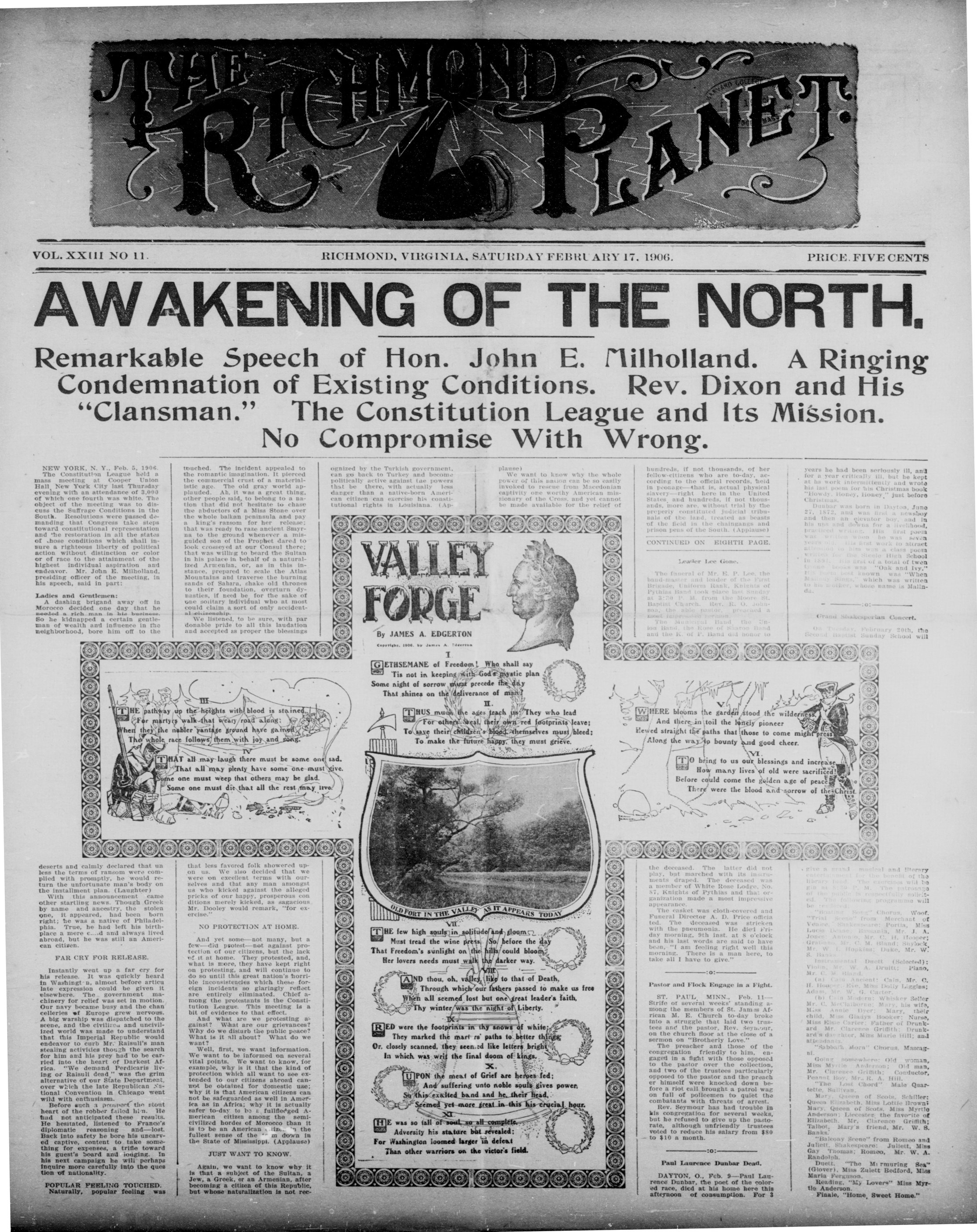
AWAKENING OF THE NORTH.
Remarkable Speech of Hon. John E. Milholland. A Ringing Condemnation of Existing Conditions. Rev. Dixon and His "Clansman." The Constitution League and Its Mission. No Compromise With Wrong.
THE pathway up the heights with blood is stained.
For martyrs walk that weary road along;
When they the nobler vantage ground have gained;
The whole race follows them with joy and song.
THAT all may laugh there must be some one sad.
That all may plenty have some one must give.
Some one must weep that others may be glad.
Some one must die that all the rest may live.
VOL. XXIII NO 11.
AWA
Remarka
Condem
“Clans
NEW YORK, N. Y., Feb. 5, 1906. The Constitution League held a mass meeting at Cooper Union Hall. New York City last Thursday evening with an attendance of 3,000 of which one fourth was white. The object of the meeting was to discuss the Suffrage Conditions in the South. Resolutions were passed demanding that Congress take steps toward constitutional representation and the restoration in all the states of those conditions which shall insure a righteous liberty of political action without distinction or color or of race to the attainment of the highest individual aspiration and endeavor. Mr. John E. Milholland, presiding officer of the meeting, in his speech, said in part:
Ladies and Gentlemen:
A dashing brigand away off in Morocco decided one day that he needed a rich man in his business. So he kidnapped a certain gentleman of wealth and influence in the neighborhood, bore him off to the
THE pathway
For mar-
When they the
The whole
deserts and calmly declared that un-
less the terms of ransom were com-
plied with promptly, he would re-
turn the unfortunate man's body on
the installment plan. (Laughter)
With this announcement came
other startling news. Though Greek
by name and ancestry, the stolen
one, it appeared, had been born
right; he was a native of Philadelphia.
pica, he was born in Philadelphia,
place a more c...d and always lived abroad, but he was still an American citizen.
FAR CRY FOR RELEASE
Instantly went up a far cry for his release. It was quickly heard in Washington, almost before articulate expression could be given it elsewhere. The government machinery for relief was set in motion. Our navy became busy and the chan celliers of Europe grew nervous. A big warship was dispatched to the scene, and the civilized and uncivilized world was made to understand that this Imperial Republic would endeavor to curb Mr. Raisuli's man stealing activities though the search for him and his prey had to be carried into the heart of Darkest Africa. "We demand Perdicaris living or Raisuli dead" was the grim alternative of our State Department, over which the late Republican National Convention in Chicago went wild with enthusiasm.
Before such a prospect the stout heart of the robber failed him. He had not anticipated these results. He hesitated, listened to France's diplomatic reasoning and—lost. Back into safety he bore his uncarved captive, content to take something for expenses, a trifle toward his guest's board and iouging. In his next campaign he will perhaps inquire more carefully into the question of nationality.
POPULAR PEELING TOUCHED.
Naturally, popular feeling was
touched. The incident appealed to the romantic imagination. It pierced the commercial crust of a materialistic age. The old gray world applauded. Ah, it was a great thing, other people said, to belong to a nation that did not hesitate to chase the subductors of a Miss Stone over the whole balkan peninsula and pay a king's ransom for her release; that was ready to raze ancient Smyrna to the ground whenever a misguided son of the Prophet dared to look crosseyed at our Consul there; that was willing to be heard the Sultan in his palace in behalf of a naturalized Armenian, or, as in this instance, prepared to scale the Atlas Mountains and traverse the burning sands of Sahara, shake old thrones to their foundation, overturn dynasties, if need be for the sake of one soilitary individual who at most could claim a sort of only accidental citizenship.
We listened, to be sure, with par donable pride to all this laudation and accepted as proper the blessings
up the heights with blood is stained;
walk that weary road along;
bler vantage ground have gained;
follows them with joy and song.
IV
T all may laugh there must be some
that all may plenty have some one m
one must weep that others may be glas
one must die that all the rest may
that less favored folk showered upon us. We also decided that we were on excellent terms with ourselves and that any man amongst us who kicked against the alleged pricks of our happy, prosperous converse merely kicked, as sagacious Mr. Dooley would remark, "for exercise."
NO PROTECTION AT HOME
And yet some—not many, but a few—did protest—not against protection of our citizens, but the lack of it at home. They protested, and, what is more, they have kept right on protesting, and will continue to do so until this great nation's horrible inconsistencies which these foreign incidents so glaringly reflect are entirely eliminated. Chief among the protestants is the Constitution League. This meeting is a bit of evidence to that effect.
And what are we protesting against? What are our grievances? Why do we disturb the public peace? What is it all about? What do we want?
Well, first, we want information. We want to be informed on several vital points. We want to know, for example, why is it that the kind of protection which all want to see extended to our citizens abroad cannot be obtained for domestic use; why it is that American citizens can not be safeguarded as well in America as in Africa; why it is actually safer to-day to be a fullfledged American citizen among the semicivilized hordes of Morocco than it is to be an American citizen, in the fullest sense of the down in the State of Mississippi. (Apause)
JUST WANT TO KNOW.
Again, we want to know why it is that a subject of the Sultan, a Jew, a Greek, or an Armenian, after becoming a citizen of this Republic, but whose naturalization is not rec-
RICHMOND, VIRGINIA, SATURDAY FEBRUARY 17, 1906.
THUS much the ages teach us. They who lead
For others weal, their own red footprints leave;
To save their children's blood, themselves must bleed;
To make the future happy, they must grieve.
OLD FORT IN THE VALLEY AS IT APPEARS TODAY
ognized by the Turkish government, can go back to Turkey and become politically active against the powers that be there, with actually less power than the Turkish government and can citizen can exercise his constitutional rights in Louisiana. (AP-
plause)
We want to know why the whole power of this nation can be so easily invoked to rescue from Macedonian captivity one worthy American missionary of the Cross, and yet cannot be made available for the relief of
WHERE blooms the garden stood the wilderness.
And there in toil the lonely pioneer
Hewed straight the paths that those to come might press
Along the way to bounty and good cheer.
VI.
TO bring to us our blessings and increase
How many lives of old were sacrificed!
Before could come the golden age of peace
There were the blood and sorrow of the Christ.
hundreds, if not thousands, of her fellow-citizens who are to-day, according to the official records, field in peonage—that is, actual physical slavery—right here in the United States and hundreds, if not thousands, more are, without trial by the properly constituted judicial tribunals of the land, treated as beasts of the field in the chaingangs and prison pens of the South. (Applause)
Leader Lee Gone.
The funeral of Mr. E. P. Lee, the band-master and leader of the First Brigade, Uniform Rank, Knights of Pythias Band took place last Sunday at 3:30 P. M. from the Moore St. Baptist Church, Rev. R. O. Johnson, the able pastor, preached a most impure sermon at the municipal Band, the Union Band, the Rose of Sharon Band and the K. of P. Band did honor to
V. HERE blooms the garden stood there
And there in toil the lonely pion-
ewed straight the paths that those to
Along the way to bounty and good.
VI. TO bring to us our bless-
How many lives of old
Before could come the golden
There were the blood and
the deceased. The latter did not play, but marched with its instruments draped. The deceased was a member of White Rose Lodge, No. 87, Knights of Pythias and that organization made a most impressive appearance. The casket was cloth-covered and Funeral Director A. D. Price office ted. The deceased was stricken with the pneumonia. He died Friday morning, 9th inst., at 8 o'clock and his last words are said to have bean, "I am feeling right well this morning. There is a man here, to take all I have to give."
____:0:____
Pastor and Flock Engage in a Fight.
ST. PAUL, MINN., Feb. 11—Strife or several weeks' standing among the members of St. James African M. E. Church to-day broke into a struggle that laid two trustees and the pastor, Rev. Seymour, on the church floor at the close of a sermon on "Brotherly Love." The preacher and those of the congregation friendly to him, engaged in a fight with those opposed to the pastor over the collection, and two of the trustees particularly opposed to the pastor and the praach er himself were knocked down before a riot call brought a patrol wag on full of policemen to quiet the combatants with threats of arrest. Rev. Seymour has had trouble in his congregation for several weeks, but he refused to give up the pastorate, although unfriendly trustees voted to reduce his salary from $80 to $10 a month.
Paul Laurence Dunbar Dead.
DAYTON, O., Feb. 9—Paul Lawrence Dunbar, the poet of the colored race, died at his home here this afternoon of consumption. For 3
PRICE. FIVE CENTS
RTH.
A Ringing and His mission.
years he had been seriously ill, and for a year critically ill, but he kept at his work intermittently and wrote his last poem for his Christmas book "Howdy. Honey, Honey." Just before Christmas.
Dunbar was born in Dayton, June 27, 1872, and was first a newsboy and then an elevator boy, and in his uss and downs for a livelihood, practiced writing. His first poem was written when he was seven years old. His first work to attract attention to him was a class poem written for the Steele High School in 1884 as first of a total of twen teenage books titled Jack and Ivy. His poem host known was "When Manlymary Sinuga," which was written to his mother, whose name is Mallinda.
On Tuesday, February 20th, the Second Baptist Sunday School will
night press
and increase
sacrificed!
of peace
now of the Christ.
give a grand musical and Literary entertainment for the benefit of the library fund. The exercises will be begin at 8:30 P. M. The patronage of the public is respectfully solicited. The following programme will be rendered.
"Boating Song" Chorus, Woof.
"Trial Scene" from Merchant of Venice, Shakespeare: Port, Miss Lucie Deane, Bassiania, Mr. J. A. Jones; Antonio, Mr. C. H. Hooper; Gratiano, Mr. C. M. Hland; Suylock, Mr. W. L. Hopkins; Duke, Mr. W. S. Banks.
Instrumental Duett (Selected):
Violin, Mr. W. A. Druitt; Plano, Mr. C. W. Bland.
(a) Cain Ancient: Cain, Mr. C. H. Hover, Eve, Miss Dolly Liggins; Adam, Mr. W. G. Carter.
(b) Cain Modern: Whiskey Seller Mr. C. McClaiborne; Mary, his wife, Miss Amie Dyer; Mary, their child, Miss Gladys Booker; Nurse, Miss Elise Carter; Father of Drunkard Mr. Clarence Griffith; Drunkard's daughter, Miss Marie Hill; and attendants.
"Sabbath Morn" Chorus, Mascagni.
Going somewhere: Old woman, Miss Myrlea Anderson; Old man, Mr. Clarence Griffith; Conductor, Peanut Boy, Mr. R. A. Hill.
"The Lost Chord" Male Quartette, Sullivan.
Mary, Queen of Scots, Schiller;
Queen Elizabeth, Miss Lottie Brown;
Mary, Queen of Scots, Miss Myrtle
Anderson; Liecesteg the favorite of
Elizabeth, Mr. Clarence Griffith;
Tabtol, Mary's friend, Mr. W. S.
Banks;
"Balcony Scene" from Romeo and
Juliett. Shakespeare: Juliett, Miss
Gay Thomas, Romeo, Mr. W. A.
Randolph.
Duett, "The Mirmuring Sea"
(Glover), Miss Zulett Bedford, Miss
Maria Ferguson.
Reading, "My Lovers" Miss Myrtle
Anderson.
Finale, "Home, Sweet Home."
THE
MAN ON THE BOX
By HAROLD MacGRATH
Author of "The Grey Cloak," "The Puppet Crown."
Copyright, 1904. The Bobba-Merrill Company.
CHAPTER I.—Introduces the hero, Robert Warburton, a well to do West Point graduate on duty in Arizona. Afraid wounded by an Indian resigns his commission to the army and leaves for European tour.
CHAPTER II.—Introduces the heroine, Miss Betty Annesley, daughter of a retired army officer living near Washington, D.C., and American girl, whom Warburton has seen in Paris, is smitten, and follows to New York. Seeks introduction on board steamer but fails.
CHAPTER III.—Upset reaching New York Warburton locates hotel in which the Annesleys are guests and dines there in order to see Misa Annesley once more. Chagrined to see young Russian count Annesley in to dinner. Next morning the Count and the Annesleys had disappeared.
CHAPTER IV.—Warburton goes to Washington to visit his relatives—a man both to the army and embassy position, and a sister engaged to an old school chum of his. Invited to accompany family to balt at British embassy, but declines. Concocts a scheme to play a joke on his sister and sister-in-law.
CHAPTER V.—Warburton meets his sister's fiance whom he had not seen for eight years. See the folks off for whom he will tell. He puts his joke into execution, which is to disguise himself as a coachman and drive his sister and sister-in-law, who must return alone, from the embassy to CHAPTER VI.—Warburton in his disguise goes to British embassy and takes the place of his brother's coachman, when he has brushed. He mistakes his sister when he was called the wrong passengers without knowing it. Drives frantically about the streets pursued by mounted policemen. When he is caught, he and throws his arms about the first of his passengers to aight, who proves to be Miss Annesley instead of his sister.
CHAPTER VII.—Warburton is arrested on a charge of drunkenness and abducted by Miss Annesley. Miss Annesley locked up over night at court, where he has given the name of James Osborne, the charge of abduction is withdrawn but he is fined $5 for drunkenness, his old chum, telling of his trouble.
CHAPTER VIII. "Chuck" takes suit of clothes and money to pay the fine to city sail, only to find that fine had been Osborne, receives note from Miss Annesley offering him position of coachman, he must to accept in spite of protests of his friend whom he explains his disappearance to his relatives, by stating that he had gone north suddenly on a hunting trip. Annesley, after closely questioning Warburton, known to her as James Osborne) at her home, hires him on probation. While belis shown about the stables expressed interest in thoroughbred called Pirate. With Miss Annesley's percussion he saddles and mounts the horse which immediately
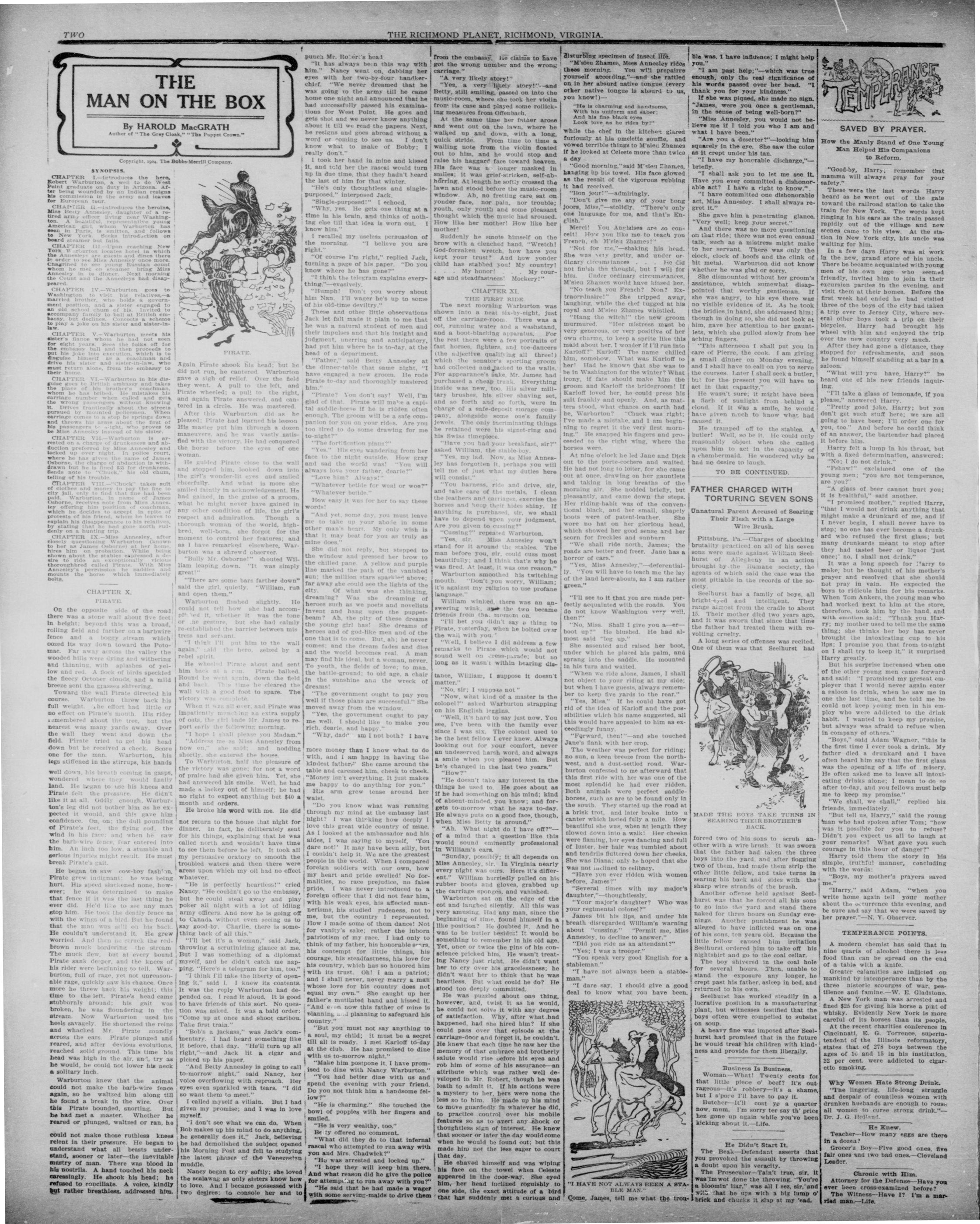
On the opposite side of the road there was a stone wall about five feet in height; beyond this was a broad, rolling field and farther on a barbwire fence and a boggy stream which oozed its way down toward the Potomac. Far away across the valley the wooded hills were dying and withering and thinning, with splashes of yellow and red. A flock of birds speckled the fleecy October clouds, and a mild breeze sent the grasses shivering. Toward the wall Pirate directed his course. Warburton threw back his full weight. The effort had little or no effect on Pirate's mouth. His rider remembered about the tree, but the nearest was many yards away. Over the wall they went and down the field. Pirate tried to get his head down but he received a check. Score one for the man. Warburton, his legs stiffened in the stirrups, his hands
well down, his breath coming in gasps, wondered where they would finally land. He began to use his knees and Pirate felt the pressure. He didn't like it at all. Oddly enough, Warburton's leg did not bother him as he expected it would, and this gave him confidence. On, on; the dull pounding of Pirate's feet, the flying sod, the wind in his face; and when he saw the barb-wire fence, fear entered into him. An inch too low, a stumble and serious injuries might result. He must break Pirate's sait.
He began to saw cow-boy fashion. Pirate grew indignant: he was being hurt. His speed slackened none, however; he was determined to make that fence if it was the last thing he ever did. He'd like to see any man stop him. He took the deadly fence as with the wings of a bird. But he found that the man was still on his back. He couldn't understand it. He grew worried. And then he struck the red-brown muck bordering the stream. The muck flew, but at every bound Pirate snake deeper, and the knees of his rider were beginning to tell. Warburton, full of rage, yet not unreasonable rage, quickly saw his chance. Once more he threw back his weight; this time to the left. Pirate's head came stubbornly around; his gait was broken, he was founding in the stream. Now Warburton used his heels savagely. He shortened the reins and whacked Mr. Pirate soundly across the ears. Pirate plunged and reared, and after devious evolutions, reached solid ground. This time his head was high in the air, and, try as he would, he could not lower his neck a solitary inch.
Warburton knew that the animal could not make the barb-wire fence again, so he waltzed him along till he found a break in the wire. Over this Pirate bounded, snorting. But he had met a master. Whether he reared or plunged, waltzed or ran, he could not make those ruthless knees relent in their pressure. He began to understand what all beasts understand, sooner or later—the inevitable mastery of man. There was blood in his nostrils. A hand touched his neck caressingly. He shook his head; he refused to conciliate. A voice, kindly but rather breathless, addressed him.
CHAPTER X
PIRATE.
A
Again Pirate shook his head; but he did not run, he cantered. Warburton gave a sigh of relief. Over the field they went. A pull to the left, and Pirate wheeled; a pull to the right, and again Pirate answered, and cantered in a circle. He was mastered.
After this Warburton did as he pleased; Pirate had learned his lesson. His master put him through a dozen maneuvers, and he was vastly satisfied with the victory. He had conquered the horse before the eyes of one woman.
He guided Pirate close to the wall and stopped him, looked down into the girl's wonder-lit eyes and smiled cheerfully. And what is more she smiled faintly in acknowledgement. He had gained, in the guise of a groom, what he might never have gained in any other condition of life, the girl's respect and admiration. Though a thorough woman of the world, high-bred, well-born, she forgot for the moment to control her features; and as I have remarked elsewhere, Warburton was a shrewd observer.
"Bully Mr. Osborne!" shouted William leaping down. "It was simply great!"
"There are some bars farther down" said the girl, quietly. "William, run and open them."
Warburton flushed slightly. He could not tell how she had accomplished it, whether it was the tone or he gesture, but she had calmly re-established the barrier between mistress and servant.
"I think I'll put him to the wall again," said the hero, seized by a rebel spirit.
He wheeled Pirate about and sent him back at a run. Pirate balked. Round he went again, down the field and back. This time he cleared the wall with a good foot to spare. The victory was complete.
When it wan all ever, and Pirate was impatiently menchuring an extra supply of oats, the girl bade Mr. James to report early the following morning.
"I hope I shall please you Madam." "Address me as Miss Annesy from now on," she said; and nodding shortly, she entered the house.
To Warburton, half the pleasure of the victory was gone; for not a word of praise had she given him. Yet, she had answered his smile. Well, he had made a lackey out of himself; he had no right to expect anything but $40 a month and orders.
He broke his word with me. He did
not return to the house that night for dinner. In fact, he deliberately sent for his things, explaining that he was called north and wouldn't have time to see them before he left. It took all my persuasive oratory to smooth the troubled waters and then there were areas upon which my oil had no effect whatever.
"He is perfectly heartless!" cried Nancy. "He couldn't go to the embassy, but he could steal away and play poker all night with a lot of idling army officers. And now he is going off to Canada without even seeing us to say good-by. Charlie, there is something back of all this."
"I'll bet it's a woman," said Jack, throwing a scrutinizing glance at me. But I was something of a diplomat myself, and he didn't catch me napping. "Here's a telegram for him, too."
"I think I'll take the liberty of opening it," said I. I knew its contents. It was the reply Warburton had depended on. I read it aloud. It is good to have friends of this sort. No question was asked. It was a bald order: "Come up at once and shoot caribou. Take first train."
"Bob's a jackass," was Jack's commentary. I had heard something like it before, that day. "He'll turn up all right,"—and Jack lit a cigar and picked up his paper.
"And Betty Annosley is going to call to-morrow night," said Nancy, her voice overflowing with reproach. Her eyes even sparkled with tears. "I did so want them to meet."
I called myself a villain. But I had given my promise; and I was in love myself.
"I don't see what we can do. When Bob makes up his mind to do anything, he generally does it." Jack, believing he had demolished the subject opened his Morning Post and fell to studying the latest phases of the Venemuel muddle.
Nancy began to cry softly; she loved the scalawag as only sisters know how to love. And I became possessed with two desires: to console her and to
PIRATE.
THE RICHMOND PLANET, RICHMOND, VIRGINIA.
punch Mr. Roer's head.
"It has always been this way with him." Nancy went on, dabbing her eyes with her two-by-four handkerchief. "We never dreamed that he was going to the army till he came home one night and announced that he had successfully passed his examinations for West Point. He goes and gets shot and we never know anything about it till we read the papers. Next, he resigns and goes abroad without a word or coming to see us. I don't know what to make of Bobby; I really don't."
I took her hand in mine and kissed it, and told her the rascal would turn up in due time, that they hadn't heard the last of him for that winter.
"He's only thoughtless and single-purposed." interposed Jack.
"Single-purposed!" I echoed.
"Why, yes. He gets one thing at a time in his brain, and thinks of nothing else till that idea is worn out. I know him."
I recalled my useless persuasion of the morning. "I believe you are right."
"Of course I'm right," replied Jack, turning a page of his paper. "Do you know where he has gone?"
"I think the telegram explains everything"—evasively.
"Humph! Don't you worry about him Nan. I'll wager he's up to some of his old-time devilty."
These and other little observations Jack let fall made it plain to me that he was a natural student of men and their impulses and that his insight and judgment, unerring and anticipatory, had put him where he is to-day, at the head of a department.
"Father," said Betty Annesley at the dinner-table that same night. "I have engaged a new groom. He rode Pirate to-day and thoroughly mastered him."
"Pirate? You don't say! Well, I'm glad of that. Pirate will make a saddle horse if he is ridden often enough. The groom will be a safe companion for you on your rides. Are you too tired to do some drawing for me to night?"
"The fortification plans?"
"Yes." His eyes wandering from her face to the night outside. How gray and sad the world was! "You will always love your father, dearie?"
"Love him? Always!"
"Whatever betide for weal or woe?"
"Whatever betide."
How easy it was for her to say these words!
"And yet, some day, you must leave me to take up your abode in some other man's heart. My only wish is that it may beat for you as truly as mine does."
She did not reply, but stepped to the window and pressed her brow to the chilled pane. A yellow and purple line marked the path of the vanished sun; the million stars sparkled above; far away she could see the lights of the city. Of what was she thinking, dreaming? Was she dreaming of heroes such as we poets and novelists invent and hang upon the puppet-beam? Ah, the pity of these dreams the young girl has! She dreams of heroes and of god-like men and of the one that is to come. But, ah, he never comes; and the dream fades and dies the world becomes real. A man may find his ideal, but a woman, never. To youth, the fields of love; to man, the battle-ground; to old age, a chair in the sunshine and the wreck of dreams!
"The government ought to pay you well if those plans are successful." She moved away from the window.
"Yes, the government ought to pay me well. I should like to make you rich, dearle, and happy."
"Why, daddo! am I not both? I have more money than I know what to do with, and I am happy in having the kindest father." She came around the table and caresed him, cheek to cheek. "Money isn't everything. It just makes me happy to do anything for you."
His arm grew tense around her waist.
"Do you know what was running through my mind at the embassy last night? I was thinking how deeply I love this great wide country of mine. As I looked at the ambassador and his alides, I was saying to myself, 'You dare not!' It may have been silly, but I couldn't help it. We are the greatest people in the world. When I compared foreign soldiers with our own, how my heart and pride swelled! No formalities, no race prejudice, no false pride. I was never introduced to a foreign officer that I did not fear him, with his weak eyes, his affected mannerisms, his studied rudeness, not to me, but the country I represented. How I made some of them dance! Not for vanity's sake; rather the inborn patriotism of my race. I had only to think of my father, his honorable scars, his contempt for little things, his courage, his stealthiness, his love for his country, which has so honored him with its trust. Oh! I am a patriot; and I shall never, never marry a man whose love for his country does not equal my own." She caught up her father's mutilated hand and kissed it. "And even now this father of mine is planning and planning to safeguard his country."
"But you must not say anything to a soul, my child; it must be a secret till all is ready. I met Karloff to-day at the club. He has promised to dine with us to-morrow night."
"Make him postpone it. I have promised to dine with Nancy Warburton."
"You had better dine with us and spend the evening with your friend. Do you not think him a handsome fellow?"
"He is charming." She touched the bowl of poppies with her fingers and smiled.
"He is very wealthy, too."
"Betty offered no comment."
"What did they do to that infernal rascal who attempted to run away with you and Mrs. Chadwick?"
"He was arrested and locked up."
"I hope they will keep him there.
And what reason did he give the police
for attempting to run away with you?"
"He said that he had made a wager
with some serving-mails to drive them
from the embassy. He claims to have got the wrong number and the wrong carriage."
"A very likely story!"
A very nice story.
"Yes, a very likely story!"-and Betty, still smiling, passed on into the music-room, where she took her violin from its case and played some rollicking measures from Offenbach.
At the same time her father arose and went out on the lawn, where he walked up and down, with a long, quick stride. From time to time a wailing note from the violin floated out to him, and he would stop and raise his haggard face toward heaven.
His face was no longer masked in smiles; it was grief-striken, self-abhorring. At length he softly crossed the lawn and stood before the music-room window. Ah, no fretting care sat on yonder face, nor pain, nor trouble; youth, only youth and some pleasant thought which the music had aroused. How like her mother! How like her mother!
Suddenly he snute himself on the brow with a clenched hand. "Wretch! God-forsaken wretch, how have you kept your trust? And how yonder child has stabbed you! My country! . My honor! . My courage and steadfastness! Mockery!"
CHAPTER XI
The next morning Warburton was shown in a neat six-by-eight, just off the carriage-room. There was a cot, running water and a washstand, and a boot-blacking apparatus. For the rest there were a few portraits of fast horses, fighters, and toe-dancers (the adjective qualifying all three!) which the senator's sporting groom had collected andacked to the walls. For appearance's sake, Mr. James had purchased a cheap trunk. Everything inside was new, too. His silver military brushes, his silver shaving set, and so forth and so forth, were in charge of a safe-deposit storage company, alongside some one's family jewels. The only incriminating things he retained were his signot-ring and his Swiss timepiece.
"Have you had your breakfast, sir?" asked William, the stable-boy.
"Yes, my lsd. Now, as Miss Annesley has forgotten it, perhaps you will tell me of just what my duties here will consist."
"You harness, ride and drive, sir, and take care of the metals. I clean the leathers and carriages, exercise the horses and keep their hides shiny. If anything is purchased, sir, we shall have to depend upon your judgment. Are you given to cussing?"
"Cussing?" repeated Warburton.
"Yes, sir. Miss Annesley won't stand for it around the stables. The man before you, sir, could cuss most beautifully; and I think that's why he was fired. At least, it was one reason."
Warburton smoothed his twitching mouth.
"Don't you worry, William; it's against my religion to use profane language."
William winked, there was an answering wink, and the two became friends from the moment on.
"I'll bet you didn't say a thing to Pirate, yesterday, when he bolted over the wall with you."
"Well, I believe I did address a few remarks to Pirate which would not sound well on dress-garage; but so long as it wasn't within hearing distance, William, I suppose it doesn't matter."
"No, sir; I suppose not."
"Now, what kind of a master is the colonel?" asked Warburton strapping on his English leggins.
"Well, it's hard to say just now. You see, I've been with the family ever since I was six. The colonel used to be the best fellow I ever knew. Always looking out for your comfort, never an undeserved harsh word, and always a smile when you pleased him. But he's changed in the last two years."
"How?"
"He doesn't take any interest in the things he used to. He goes about as if he had something on his mind; kind of absent-minded, you know; and forgets to-morrow what he says to-day. He always puts on a good face, though, when Miss Betty is around."
"Ah. What night do I have off?"—of a mind that a question like this would sound eminently professional in William's ears.
"Sunday, possibly; it all depends on Miss Annesley, sir. In Virginia nearly every night was ours. Here it's different." William hurriedly pulled on his rubber boots and gloves, grabbed up the carriage sponges, and vanished.
Warburton sat on the edge of the cot and laughed silently. All this was very amusing. Had any man, since the beginning of time, found himself in a like position? He doubted it. And he was to be butler besides! It would be something to remember in his old age. Yet, once or twice the pins of his conscience pricked him. He wasn't treating Nancy just right. He didn't want her to cry over his gravelessness; he didn't want her to think that he was heartless. But what could he do? He stood too deeply committed.
He was puzzled about one thing, however, and, twist it as he would, he could not solve it with any degree of satisfaction. Why, after what had happened, had she hired him? If she could pass over that episode at the carriage-door and forget it, he couldn't. He knew that each time he saw her the memory of that embrace and brotherly salute would rise before his eyes and rob him of some of his assurance—an attribute which was rather well developed in Mr. Robert, though he was loath to admit it. If his actions were a mystery to her, hers were none the less so to him. He made up his mind to move guardedly in whatever he did, to practice control over his mobile features so as to alert any shock or thoughtless sign of interest. He knew that sooner or later the day would come when he would be found out; but this made him not the less eager to court that day.
He shaved himself and was wiping his face on the towel when Celeste appeared in the door-way. She eyed him, her head inclined rugously to one side, the exact attitude of a bird that hs suddenly met a curious and
disturbing specimen of insect life.
"M'sieu Zhames, Mees Annosley rides theses morning. You will prepaire yourself according."—and she rattled on in her absurd native tongue (every other native tongue is absurd to us, you know!)—
"He is charming and handsome, With his uniform and saber; And his fina black eyes Look love as he rides by!"
while the chef in the kitchen glared furiously at his omellette souffle, and vowed terrible things to M'sieu Zhames if he looked at Celeste more than twice a day
"Good morning." said M'sieu Zhames, hanging up his towel. His face glowed as the result of the vigorous rubbing it had received.
"Bon jour!"—admiringly.
Bon jour! —admiringly,
"Don't give me any of your bong
joors, Miss."—stolidly, "There's only
one language for me, and that's English."
Merci! You Anglaises are so conceit!
How you like me to teach you French, ch'Msieu Zhames?
"Not for me,"—shaking his head.
She was very pretty, and under ordinary circumstances . . .
He did not finish the thought, but I will for him. Under ordinary circumstances, M'sieu Zhames would have kissed her.
"No teach you French? Non? Extraordinaire!" She tripped away, laughing, while the chef tugged at his royal and M'sieu Zhames whistled.
"Hang the witch!" the new groom murmured, "Her mistress must be very generous, or very positive of her own charms, to keep a sprite like this maid about her, I wonder if I'll run into Karloff?" Karloff! The name chilled him, somehow. What was Karloff to her! Had he known that she was to be in Washington for the winter? What irony, if fate should make him the groom and Karloff the bridegroom! If Karloff loved her, he could press his suit frankly and openly. And, as matters stood, what chance on earth had, Warburton? "Chuck was right; I've made a mistake, and I am beginning to regret it the very first morning." He snapped his fingers and proceeded to the right wing, where the horses were.
At nine o'clock he led Jane and Dick out to the porte-cochere and waited. He had not long to loiter, for she came out at once, drawing on her gauntlets and taking in long breaths of the morning air. She nodded briefly, but pleasantly, and came down the steps. Her riding-habit was of the conventional black, and her small, shapely boots were of patent-leather. She wore no hat on her glorious head, which showed her good sense and her scorn for freckles and sunburn
"We shall ride north, James; the roads are better and freer. Jane has a horror of cars."
"Yes, Miss Annesley,"—deferentially. "You will have to teach me the lay of the land here-abouts, as I am rather green."
"I'll see to it that you are made perfectly acquainted with the roads. You do not know Washington very well, then?"
"No, Miss. Shall I give you a—er—boot up?" He blushed. He had almost said "leg up."
She assented and raised her boot, under which he placed his palm, and sprang into the saddle. He mounted in his turn and waited.
"When we ride alone, James, I shall not object to your riding at my side; but when I have guests, always remember to keep five yards to the rear."
"Yes, Miss." If he could have got rid of the idea of Karloff and the possibilities which his name suggested, all this would have appealed to him as exceedingly funny.
"Fqward, then!"—and she touched Jane's flank with her crop.
The weather was perfect for riding; no sun, a keen breeze from the northwest, and a dust-settled road. Warburton confessed to me afterward that this first ride with her was one of the most splendid he had ever ridden. Both animals were perfect saddle-horses, such as are to be found only in the south. They started up the road at a brisk trot, and later broke into a canter which lasted fully a mile. How beautiful she was, when nt length they slowed down into a walk! Her cheeks were flaming, her eyes dancing and full of luster, her hair was tumbled about and tendrils fluttered down her cheeks. She was Diana; only he hoped that she was not inclined to celibacy.
"Have you ever ridden with women before, James?"
"Several times with my major's daughter."—thoughtlessly.
"Your major's daughter? Who was your regimental colonel?"
James bit his lips, and under his breath disregarded William's warning about "cussing." "Permit me, Miss Annesley, to decline to answer." "Did you ride as an attendant?" "Yes; I was a trooper." "You speak very good English for a stableman."
"I have not always been a stable-
man."
"I dare say. I should give a good
deal to know what you have been.
I HAVE NOT ALWAYS BEEN A STA
Ble was. I have influence; I might help you."
"I am past help;"—which was true enough, only the real significance of his words passed over her head. "I thank you for your kindness."
If she was piqued, she made no sign. "James, were you once a gentleman, in the sense of being well-born?"
"Miss Annesley, you would not believe me if I told you who I am and what I have been."
"Are you a deserter?"—looking him squarely in the eye. She saw the color as it crept under his tan.
"I have my honorable discharge,"—briefly.
"I shall ask you to let me see it. Have you ever committed a dishonorable act? I have a right to know."
"I have committed one dishonorable act, Miss Annesley. I shall always regret it."
She gave him a penetrating glance. "Very well; keep your secret."
And there was no more questioning on that ride; there was not even casual talk, such as a mistress might make to her servant. There was only the clock, clock of hoops and the clink of bit metal. Warburton did not know whether he was glad or sorry. She dismounted without her groom's assistance, which somewhat disappointed that worthy gentleman. If she was angry, to his eye there was no visible evidence of it. As he took the bridles in hand, she addressed him; though in doing so, she did not look at him, gave her attention to her gauntlets, which she pulled slowly from her aching fingers.
"This afternoon I shall put you in care of Pierre, the cook. I am giving a small dinner on Monday evening, and I shall have to call on you to serve the courses. Later I shall seek a butler, but for the present you will have to act in that capacity."
He wasn't sure; it might have been a flair of sunlight from behind a cloud. If it was a smile, he would have given much to know what had caused it.
He trumped off to the stables. A butler! Well, so be it. He could only reasonably object when she called upon him to act in the capacity of a chambermaid. He wondered why he had no desire to laugh.
TO BE CONTINUED.
FATHER CHARGED WITH TORTURING SEVEN SONS
Pittsburg, Pa.—Charges of shocking brutality practiced on all of his seven sons were made against William Seelhurst of Allegheny in an action brought by the Humane society, the agents of which said the case was the most pittable in the records of the society.
Seelhurst has a family of boys, all bright-eyed and intelligent. They range almost from the cradle to about 15. Their mother died two years ago, and it was sworn that since that time the father had treated them with revolting cruelty.
A long series of offenses was recited. One of them was that Seelhurst had
MADE THE BOYS TAKE TURNS IN
SEARING THEIR BROTHER'S
BACK
forced two of his sons to scrub another with a wire brush. It was sworn that the father had taken the three boys into the yard, and after flogging two of them, had made them strip the other little fellow, and take turns in searing his back and sides with the sharp wire strands of the brush.
Another offense held against Seelhurst was that he forced all his sons to go into the yard and stand there naked for three hours on Sunday evenings. Another punishment he was alleged to have inflicted was on one of his sons, ten years old. Because the little fellow caused him irritation Seelhurst ordered him to take off his nightshirt and go to the coal cellar.
The boy shivered in the coal hole for several hours. Then, unable to stand the exposure any longer, he crept past his father, asleep in bed, and returned to his own.
Seelhurst has worked steadily in a lucrative position in a manufacturing plant, but witnesses testified that the boys often were compelled to subsist on soup. A heavy fine was imposed after Seelhurst had promised that in the future he would treat his children with kindness and provide for them liberally.
Business Is Business
Woman-What! Twenty cents for that little piece o' beef? It's outrageous, its robbery—it's a shame, but I s'pone I'll have to pay it.
Butcher-It'll cost ye a quarter now, mum. I'm sorry ter say't price hez gone up again while you've been kicking about it. Life
He Didn't Start It.
The Beak—Defendant asserts that you provoked the assault by throwing a doubt upon his veracity.
The Prosecutor—Tain't true, sir, it was imwot done the throwing. "You're a bloomin' liar," was all I sez, sir, and with that he ups with a big lump o' brick and chucks it slap on my 'ead.
TEMPERANCE
How the Manly Stand of One Young Man Helped His Companions to Reform
"Good-by, Harry; remember that mamma will always pray for your safety."
These were the last words Harry heard as he went out of the gate toward the railroad station to take the train for New York. The words kept ringing in his ears as the train passed rapidly out of the village and new scenes came to his view. At the station in New York city, his uncle was waiting for him.
In a few days Harry was at work in the new, grand store of his uncle. There he became acquainted with young men of his own age who seemed friendly, invited him to join in their excursion parties in the evening, and visit them at their homes. Before the first week had ended he had visited three of the boys of the city had taken a trip over to Jersey City, where several other boys took a trip on their bicycles. Harry had brought his wheel with him and enjoyed the trip over the new country very much. After they had gone a distance, they stopped for refreshments, and soon he found himself standing at a bar in a saloon.
"What will you have, Harry?" he heard one of his new friends inquiring.
"I'll take a glass of lemonade, if you please," answered Harry.
"Pretty good joke, Harry; but you don't get such stuff here; we are all going to have beer; I'll order one for you, too." And before he could think of an answer, the bartender had placed it before him.
Harry felt a lump in his throat, but with a fixed determination, answered: "No; I do not drink."
"Peshaw! exclaimed one of the young men; "you are not temperance, are you?
"A glass of beer cannot hurt you; it is healthful," said another.
"I promised mother," replied Harry, "that I would not drink anything that might make a drunkard of me, and if I never begin, I shall ever have to stop; no one has ever become a drunkard who refused the first glass; but many drunkards meant to stop after they had tasted beer or liquor 'just once'; no, I shall not drink."
It was a long speech for Harry to make; but he thought of his mother's prayer and resolved that she should not pray in vain. He expected the boys to ridicule him for his remarks. When Tom Ankers, the young man who had worked next to him at the store, therefore, took him by the hand, and with emotion said: "Thank you Harry; my mother used to tell me the same thing; she thinks her boy has never brought the intoxicating cup to his lips; I promise you that from to-night on I shall try to keep it," it surprised Harry greatly.
But his surprise increased when one of the other young men came forward and said: "I promised my present employer that I would never again enter a saloon to drink, when he saw me in one the last time, and he told me he could not keep young men in his employ who were addicted to the drink habit. I wanted to keep my promise, but always was afraid to refuse when in company of others."
"Boys," said Adam Wagner, "this is the first time I ever took a drink. My father died a drunkard and I have often heard him say that the first glass was the opening of a life of misery. He often asked me to leave all intoxicating drinks alone; I mean to do so after to-day, and you fellows must help me to keep my promise."
"We shall, we shall," replied his friends, immediately.
"But tell us, Harry," said the young man who had spoken after Tom; "how was it possible for you to refuse? Didn't you expect us all to laugh at your remarks? What gave you such courage in this hour of danger?" Harry told them the story in his simple, truthful manner, concluding with the words: "Boys, my mother's prayers saved me." "Harry," said Adam, "when you write home again tell your mother about the occurrence this evening, and be sure and say that we were saved by her prayer."—N. Y. Observer.
TEMPERANCE POINTS
A modern chemist has said that in nine quarts of alcohol there is less food than can be spread on the end of a table with a knife. Greater calamities are inflicted on mankind by intemperance than by the three historic scourges of war, pestilence and famine.—W. E. Gladstone. A New York man was arrested and fined $25 for giving his horse a pint of whisky. Evidently New York is more careful of its horses than its people. At the recent charities conference in Cincinnati, E. G. Torrence, superintendent of the Illinois reformatory, states that of 278 boys between the ages of 10 and 15 in his institution, 22 per cent. were addicted to cigarette smoking.
Why Women Hate Strong Drink.
"The lingering, life-long struggle and despair of countless women with drunken husbands are enough to rouse all women to curse strong drink."—Dr. J. G. Holland.
He Knew.
Teacher—How many eggs are there in a dozen?
Grocer's Boy—Five good ones, five fair ones and two bad ones.—Cleveland Leader.
Chronic with Him.
Attorney for the Defense—Have you ever been cross-examined before?
The Witness—Have I? I'm a married man—Life.
THE PLANET
SATURDAY....FEB. 17TH, 1906.
The Cherry
Tree Tale
THE hatchet wielded by young George,
That, too, has vanished quite.
Not e'en a rusty spot remains.
To greet the pilgrim's sight.
Bow precious would that relic be
Did it exist today.
But, like the tree it felled to earth,
It, too, hath passed away.
THE lie that Georgie did not tell
Was made of better stuff.
(The way it's worn through constant use
Proves it extremely tough.)
Should any doubt that hatchet yarn
(And there may be a few)
We have the lie George did not tell
Farewell Address Of Washington
Farewell Address Of Washington
PRESIDENT WASHINGTON was generally urged to become a candidate for the chief magistrate a third time. While some opposition to him had developed there is no doubt that he could have been elected if he had permitted the use of his name. His declination and the reasons that impelled him to make it established the unwritten law that no president can serve more than two terms. General Washington's refusal to let his name be considered for a third election was made in his historic farewell address. "I am influenced," he declared, "by no diminution of zeal for your future interest, no deficiency of grateful respect for your past kindness, but am supported by a full conviction that the step is compatible with both." Continuing he said:
Here, perhaps, I ought to stop, but a solicitude for your welfare, which cannot end but with my life, is the solicitation of danger natural to that solicitation of danger me, on an occasion like the present, to offer to your solemn contemplation and to recommend to your frequent review sentiments which are the result of much experience, possibly in servation, and which appear to me all important to the permanency of your felicity as a people. These will be offered to you with the more freedom as you can only to them the disinterested warnings of a particular motive to bias his counsel.
In contemplating the causes which may disturb our union, it occurs as a matter of serious concern that any ground should be been furnished for characterizing parties in the union, northern and southern, Atlantic and western, whence designing men may endeavor to excite a belief that there is a real difference of local interests and views. One of the expedients of party to acquire information about the opinions and taints other districts. You cannot shield yourselves too much against the jealousies and heartburnings which spring from these misrepresentations; they tend to render alien to each other those who ought to represent the opinions and taints upon another. It is important, likewise, that the habits of thinking in a free country should inspire caution; in those intrusted with its administration, to confine themselves within their respective constitutional spheres, avoiding in the exercise of the powers of the government upon another. The spirit of encroachment tends to consolidate the powers of all the departments in one and thus to create, whatever the form of government, a real despotism. A just estimate of that love of power and proneness to abuse it which predominates in the human heart is sufficient to satisfy us of the truth of this position. We love good faith and justice toward all nations. Cultivate peace and harmony with all.
In the execution of such a plan nothing is more essential than that permanent inveterate antipathies against particular nations and passionate attachments for others should be excluded and that in place of such antipathies feelings toward all should be cultivated. In which indulges toward another a habitual hatred or a habitual fondness is in some degree a slave. It is a slave to its animosity or to its affection, either of which is sufficient to lead it astray from its interests.
Antipathy in occasion against another disposes each more readily to offer insult and injury, to lay hold of slight causes of umbrage and to be haughty and intractable when accidental or trifling occasions of dispute occur; hence frequent collisions, obstinate, envenomed and bloody situations are prompted by ill will and resentment some impulse impatient at the government, contrary to the best calculations of policy.
The government sometimes participates in the national propensity and adopts through passion what reason would reject; at other times it makes the animosity of the nation subservient to projects of the nation subservient to projects of other sinister and pernicious motives. The peace often, sometimes perhaps the liberty, of nations has been the victim.
Against the insidious wiles of foreign influence I conjure you to believe me, my fellow citizens, the jealousy of a free people ought to be constantly awake, since experience and experience prove that foresight is one of the most baneful foes of repression of government. But that jealousy to be used is impartial; else it becomes the instrument impartial; else it becomes the instrument to be avoided, instead of a defiance.
against it. Excessive partiality for one foreign nation and excessive dislike of another cause those whom they actuate to see danger only on one side and serve to well and even second the arts of infiltration, may resist the intrigues of the favorite, are liable to become suspected and odious, while its tools and dupes usurp the applause and confidence of the people, to unleash the enemies. 'Tis our true purpose to steer clear of permanent alliances with any portion of the foreign world. Taking care always to keep ourselves, by suitable establishments, on a respectfully defensive posture, will prevent the invasion of our alliances for extraordinary emergencies. Harmony, liberal intercourse with all nations, are recommended by policy, humanity and interest, but even our compulsory hold an equal and impartial hand, neither in the exclusive favors or preferences; constantly keeping in view that 'tis folly in one nation to look for disinterested favors from another; that it must pay with a certain amount of money it may accept under that character; that by such acceptance it may place itself in the condition of having given equivalents for nominal favors and yet of being reproached with ingratitude for not giving the right to expect or calculate upon real favors from nation to nation. 'Tis an illusion which experience must cure, which a just pride ought to discard. In my country, these counsels of an old countryclimate friend I dare not hope they will make the strong and lasting impression I could wish—that they will control the usual current of the passions or prevent our nation from runaway course which has hitherto marked the destiny.
But if I may even flatter myself that they may be productive of some partial benefit, some occasional good—that they may be productive of some partial benefit, fury of party spirit, to warn against the mischiefs of foreign intrigue, to guard against the impostures of pretended patriotism—this hope will be a full recompense for the loss of their welfare by which they have been dictated.
English Ancestors of Washington
By ARTHUR JAMES JANES
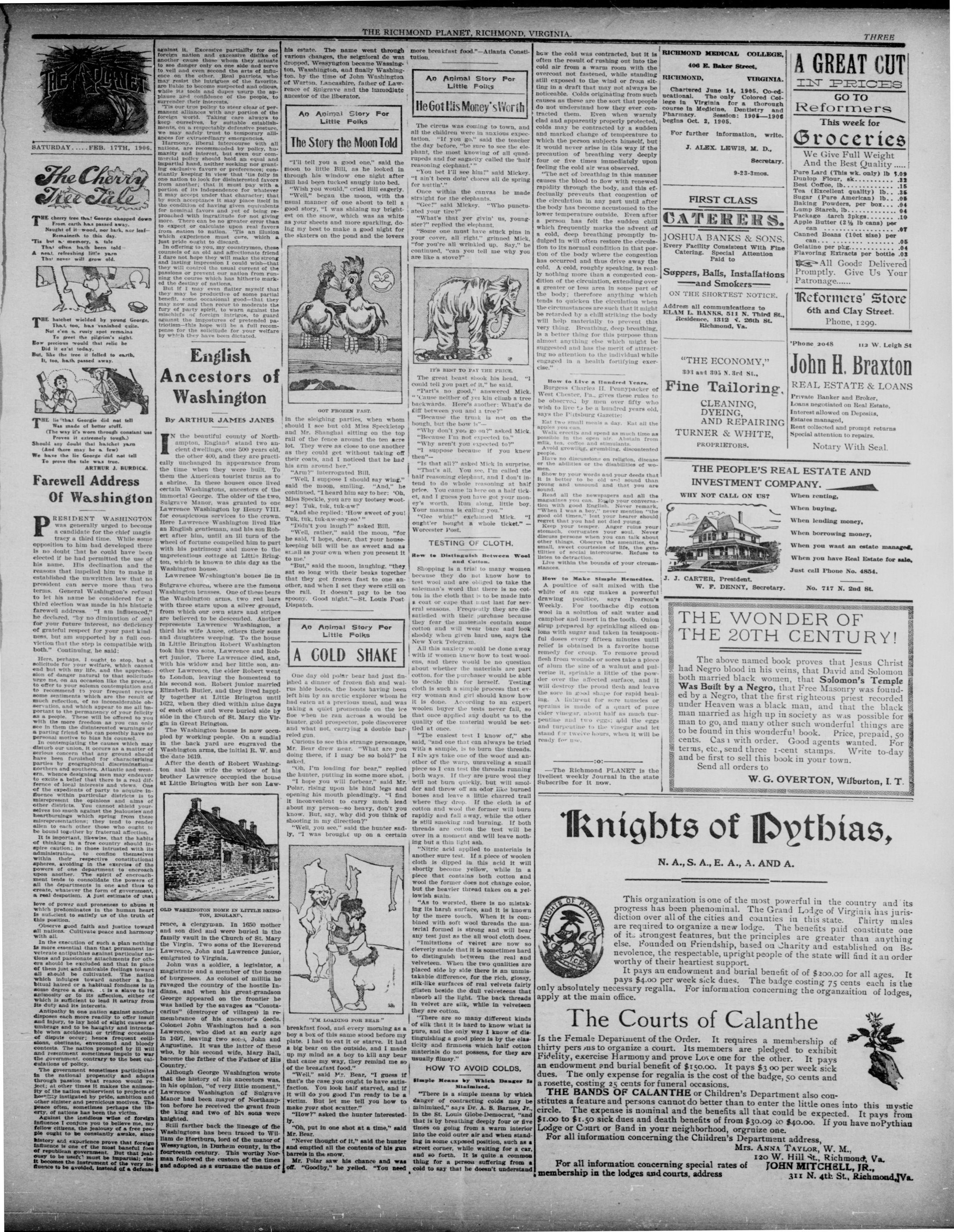
IN the beautiful county of North-ampton, England stand two ancient dwellings, one 500 years old, the other 400, and they are practically unchanged in appearance from the time when they were built. To them the American tourist turns as to a shrine. In these houses once lived certain Washington's ancestors of the immortal George. The older of the two, Sulgrave Manor, was granted to one Lawrence Washington by Henry VIII for conspicuous services to the crown. Here Lawrence Washington lived like an English gentleman, and his son Robert after him, until an ill turn of the wheel of fortune compelled him to part with his patrimony and move to the unpretentious cottage at Little Brington, which is known to this day as the Washington house.
Lawrence Washington's house he in Sulgrace church, where are the famous Washington brasses. One of these bears the Washington arms, two red bars with three stars upon a silver ground, from which our own stars and stripes are believed to be descended. Another represents Lawrence Washington, a third his wife Amee, others their sons and daughters weeping. To the house in Little Brington Robert Washington took his two sons, Lawrence and Robert junior. There Lawrence died, and, with his widow and her little son, another Lawrence, the elder Robert went to London, leaving the homestead to his second son. Robert junior married Elizabeth Butler, and they lived happily together at Little Brington until 1622, when they died within nine days of each other and were buried side by side in the Church of St. Mary the Virgin in Great Brington.
The Washington house is now occupied by working people. On a sundial in the back yard are engraved the Washington arms, the initial R. W. and the date 1619.
After the death of Robert Washington and his wife the widow of his brother Lawrence occupied the house at Little Brington with her son Law-
OLD WASHINGTON HOME IN LITTLE BRING-
TON, ENGLAND.
OLD WASHINGTON HOME IN LITTLE BRINGTON, ENGLAND.
rence, a clergyman. In 1650 mother and son died and were buried in the family vault in the Church of St. Mary the Virgin. Two sons of the Reverend Lawrence, John and Lawrence junior, emigrated to Virginia.
John was a soldier, a legislator, a magistrate and a member of the house of burgesses. As colonel of militia he ravaged the country of the hostile Indians, and when his great-grandson George appeared on the frontier he was hailed by the savages as "Conotacarius" (destroyer of villages) in remembrance of his ancestor's deeds. Colonel John Washington had a son Lawrence, who died at an early age in 1697, leaving two sons, John and Augustine. It was the latter of these who, by his second wife, Mary Ball, bacename the father of the Father of His Country.
Although George Washington wrote that the history of his ancestors was, in his opinion, "of very little moment." Lawrence Washington of Sulgrave Manor had been mayor of Northampton before he received the grant from the king and two of his sons were knighted.
Still farther back the lineage of the Washingtons has been traced to William de Herturbion, lord of the manor of Wessington, in Durham county, in the fourteenth century. This worthy Norman followed the custom of the times and adopted as a surname the name of
THE RICHMOND PLANET, RICHMOND, VIRGINIA
his estate. The name went through various changes, the seignioral de was dropped. Wessyngton became Wassington, Wasshington, and finally Washington, by the time of John Washington of Warton, Lancashire, father of Lawrence of Sniagra and the immediate ancestor of the liberator.
An Animal Story For Little Folks
"I'll tell you a good one," said the moon to little Bill, as he looked in through his window one night after Bill had been tucked snugly into bed. "Wish you would," cried Bill eagerly. "Well," began the moon, with the usual manner of one about to tell a good story, "I was shaking my brightest on the snow, which was as white as your sheets and more sparkling, doing my best to make a good night for the skaters on the pond and the lovers
in the sleighing parties, when whom should I see but old Miss Speckletop and Mr. Shanghai sitting on the top rail of the fence around the ten acre lot. They were as close to one another as they could get without taking off their coats, and I noticed that he had his arm around her."
"Arm?" interrogated Bill.
"Well, I suppose I should say wing," said the moon, smiling. "And," he continued. "I heard him say to her: 'Oh, Miss Speckle, you are my totosey wootsey! Tuk, tuk, tuk-aw'"
"And she replied: 'How sweet of you! Tuk, tuk, tuk-aw-say-so.'"
"Didn't you laugh?" asked Bill.
"Well, rather," said the moon, "for he said, I hope, dear, that your housekeeping bill will be as sweet and as small as your own when you present it to me."
"But," said the moon, laughing. "they sat so long with their beaks together that they got frozen fast to one another, and when I set they were still on the rail. It doesn't pay to be too spoony. Good night."—St. Louis Post Dispatch.
An Animal Story For
Little Folks
One day old polar bear had just finished a dinner of frozen fish and walrus hide boots, the boots having been left him by an arctic explorer whom he had eaten at a previous meal, and was taking a quiet promenade on the ice floe when he ran across a would be hunter, gold prospector, pole discoverer and what not, carrying a double barreled gun.
Curious to see this strange personage, Mr. Bear drew near. "What are you doing there, if I may be so bold?" he asked.
"Oh, I'm loading for bear," replied the hunter, putting in some more shot. "I hope you will forbear," said Mr. Polar, rising upon his hind legs and opening his mouth pleadingly. "I find it inconvenient to carry much lead about my person—so heavy, don't you know. But, say, why did you think of shooting in my direction?"
"Well, you see," said the hunter sadly, "I was brought up on a certain
"I'M LOADING FOR BEAR"
breakfast food, and every morning as a boy a box of this same stood before my plate. I had to eat it or starve. It had a big bear on the outside, and I made up my mind as a boy to kill any bear that came my way, they remind me so of the breakfast food."
"Well," said Mr. Bear, "I guess if that's the case you ought to have satisfaction. You look half starved, and if it will do you good I'm ready to be a victim. But let me tell you how to make your shot scatter."
"How?" asked the hunter interestedly.
"Oh, put in one shot at a time," said Mr. Bear.
"Never thought of it," said the hunter and emptied all the contents of his gun barrels in the snow.
Mr. Polar saw his chance and was off. "Goodbye," he yelled. "You need
more breakfast food."-Atlanta Consti tution. An Animal Story Por Little Folks
The circus was coming to town, and all the children were in anxious expectation. "If you go," said the teacher the day before, "be sure to see the elephant, the most knowing of all quadrups and for sagacity called the 'half reasoning elephant.'"
"You bet I'll see him!" said Mickey. "I ain't been doin' chores all de spring fer nuttin.'"
Once within the canvas he made straight for the elephants.
"Gee!" said Mickey. "Who punctuated your tire?"
"What's that yer givin' us, youngster?" replied the elephant.
"Some one must have stuck pins in your cover, all right," grinned Mick. "for you're all wrinkled up. Say," he continued, "can you tell me why you are like a stove?"
IT'S BEST TO EAT THE PRICE.
The great beast shook his head. "I could tell you part of it." he said. "Part's no good." answered Mick. "Cause neither of yez kin climb a tree backwards. Here's another: What's deff between you and a tree?" "Because the trunk is not on the bough, but the bow is"—"Why don't you go on?" asked Mick. "Because I'm not expected to." "Why aren't you expected to?" "I suppose because if you knew then"—"Is that all?" asked Mick in surprise. "That's all. You see, I'm called the half reasoning elephant, and I don't intend to do whole reasoning at half price. You came in here on a half ticket, and I guess you have got your money's worth. Run along, little boy. Your mamma is calling you." "Gee whiz!" exclaimed Mick. "I ought'er bought a whole ticket." — Worcester Post.
TESTING OF CLOTH
Hew to Distinguish Between Wool and Cotton.
Shopping is a trial to many women because they do not know how to test wool and are obliged to take the salesman's word that there is no cotton in the cloth that is to be made into a coat or cape that must last for several seasons. Frequently they are dissatisfied with their purchase because they fear the materials contain some cotton and will wear bare and look shoddy when given hard use, says the New York Telegram.
All this anxiety would be done away with if women knew how to test woolens, and there would be no question about whether the materials are part cotton, for the purchaser would be able to decide this for herself. Testing cloth is such a simple process that every woman and girl should know how it is done. According to an expert woolen buyer the tests never fall, so that once applied any doubt as to the quality of the material would be settled at once.
"The easiest test I know of," she said, "and one that can always be tried with a sample, is to burn the threads. I always take one of the wool and another of the warp, unraveling a small piece so I can test the threads running both ways. If they are pure wool they will not burn quickly, but will smolder and throw off an odor like burned bones and leave a little charred trail where they drop. If the cloth is of cotton and wool the former will burn rapidly and fall away, while the other is still smoking and burning. If both threads are cotton the test will be over in a moment and will leave nothing but a thin light ash.
"Nitric acid applied to materials is another sure test. If a piece of woolen cloth is dipped in this acid it will shortly become yellow, while in a piece that contains both cotton and wool the former does not change color, but the heavier thread takes on a yellowish stain.
"As to worsted, there is no mistaking its harsh surface, and it is known by the mere touch. When it is combined with soft wool threads the material formed is strong and will bear any test just as the all wool cloth does."
"Imitations of velvet are now so cleverly made that it is sometimes hard to distinguish between the real and velveteen. When the two qualities are placed side by side there is an unmistakable difference, for the rich, glossy, silk-like surfaces of real velvets fairly glisten beside the dull velveteens that absorb all the light. The back threads in velvet are silk, while in velveteen they are cotton.
"There are so many different kinds of silk that it is hard to know what is pure, and the only way I know of distinguishing a good piece is by the elasticity and firmness which half cotton materials do not possess, for they are usually filmsy."
HOW TO AVOID COLDS.
Simple Means by Which Danger Is Minimized.
"There is a simple means by which danger of contracting colds may be minimized," says Dr. A. S. Barnes, Jr., in the St. Louis Globe-Democrat, "and that is by breathing deeply four or five times on going from a warm interior into the cold outer air and when standing in some exposed position, such as a street corner, while waiting for a car, and so forth. It is quite a common thing for a person suffering from a cold to say that he doesn't understand
Knights of Pythias,
This organization is one of the most powerful in the country and its progress has been phenominal. The Grand Lodge of Virginia has jurisdiction over all of the cities and counties in this state. Thirty males are required to organize a new lodge. The benefits paid constitute one of its strongest features, but the principles are greater than anything else. Founded on Friendship, based on Charity and established on Benevolence, the respectable, upright people of the state will find it an order worthy of their heartiest support.
It pays an endowment and burial benefit of of $200.00 for all ages. It pays $4.00 per week sick dues. The badge costing 75 cents each is the only absolutely necessary regalla. For information concerning the organization of lodges, apply at the main office.
The Courts of Calanthe
Is the Female Department of the Order. It requires a membership of thirty persons to organize a court. Its members are pledged to exhibit Fidelity, exercise Harmony and prove Love one for the other. It pays an endowment and burial benefit of $150.00. It pays $300 per week sick dues. The only expense for regalia is the cost of the badge, 50 cents and a rosette, costing 25 cents for funeral occasions.
THE BANDS OF CALANTHE or Children's Department also constitutes a feature and persons cannot do better than to enter the little ones into this mystic circle. The expense is nominal and the benefits all that could be expected. It pays from $1.00 to $1.50 sick dues and death benefits of from $30.09 to $40.00. If you have no Pythian Lodge or Court or Band in your neighborhood, orgrnize one.
how the cold was contracted, but it is often the result of rushing out into the cold air from a warm room with the overcoat not fastened, while standing still exposed to the wind or from slitting in a draft that may not always be noticeable. Colds originating from such causes as these are the sort that people do not understand how they ever contracted them. Even when warmly clad and apparently properly protected, colds may be contracted by a sudden and marked change of temperature to which the person subjects himself, but it would never arise in this way if the precaution of breathing very deeply four or five times immediately upon feeling the cold air was observed.
"The act of breathing in this manner causes the blood to flow with renewed rapidity through the body, and this effectively prevents that congestion of the circulation in any part until after the body has become accustomed to the lower temperature outside. Even after a person has felt the sudden chill which frequently marks the advent of a cold, deep breathing promptly indulged in will often restore the circulation to its normal condition in that portion of the body where the congestion has occurred and thus drive away the cold. A cold, roughly speaking, is really nothing more than a congested condition of the circulation, extending over a greater or less area in some part of the body; therefore anything which tends to quicken the circulation when the circumstances are such that it might be retarded by a chill striking the body will help materially to prevent this very thing. Breathing, deep breathing, is a better thing for this purpose than almost anything else which might be suggested and has the merit of attracting no attention to the individual while engaged in a health fortifying exercise."
How to Live a Hundred Years.
Burgess Charles H. Pennypacker of West Chester, Pa., gives these rules to be observed by men over fifty who wish to live to be a hundred years old, says the Pittsburg Gazette:
Eat two small meals a day. Eat all the apples you can.
Walk erectly and spend as much time as possible in the open air. Abstain from milk, tea, coffee and stimulants. Avoid growling, grumbling, discontented
Avoid growling, grumbling, discontented people.
Have no discussions on religion, disease or the abilities or the disabilities of women.
Show by your words and your deeds that it is better to be old and sound than young and unsound and that you are sound.
Read all the newspapers and all the magazines you can. Encourage your conversation with them and your small. Never discuss persons when you can talk about other things. Observe the amenities, the small, sweet courtesies of life, the gentilities of social intercourse. Refuse to live within the bounds of your circumstances.
How to Make Simple Remedies.
A poultice of salt mixed with the white of an egg makes a powerful drawing poultice, says Pearson's Weekly. For toothache dip cotton wool in a solution of salt water and camphor and insert in the tooth. Onion sirup prepared by sprinkling sliced onions with sugar and taken in teaspoonful doses every fifteen minutes until relief is obtained is a favorite home remedy for croup. To remove proud flesh from wounds or sores take a piece of alum the size of a walnut and pulverize it, sprinkle a little of the powder over the affected surface, and it will destroy the proud flesh and leave the sore in good shape for rapid healing. A limement for sore muscles or sprains is made of a quart of pure cider vinegar, about half as much turpentine and two eggs; add the eggs and turpentine to the vinegar and let stand for twelve hours, when it will be ready for use.
The Richmond PLANET is the liveliest weekly Journal in the state Subscribe for it now.
KNIGHTS OF PYTHAS
S.C.B.
This orga
progress ha
diction over
are required
of its strong
else. Foun
nevolence, t
worthy of t
It pays a
pays $4.00
only absolutely necessary rega
apply at the main office.
The Court
Is the Female Department of the
thirty persons to organize a co-
Fidelity, exercise Harmony and
an endowment and burial bene-
dues. The only expense for r
a rosette, costing 25 cents for f
THE BANDS OF CALA
stitutes a feature and persons a
circle. The expense is nonin
Chartered June 14, 1905. Co-educational. The only Colored College in Virginia for a thorough course in Medicine, Dentistry and Pharmacy. Session: 1905—1906 begins Oct. 2, 1905.
GO TO Reformers This week for Groceries M. D.,
For further information, write
Secretary.
9-23-3mos.
FIRST CLASS
CATERERS.
JOSHUA BANKS & SONS.
Every Facility Consistent With Fine
Catering. Special Attention
Paid to
Suppers, Balls, Installations
and Smokers
ON THE SHORTEST NOTICE.
Address all communications to
ELAM L. BANKS, 511 N. Third St.,
Residence, 1312 V. 26th St.
Richmond, Va.
"THE ECONOMY,"
303 and 305 N. 3rd St..
Fine Tailoring.
CLEANING,
DYEING,
AND REPAIRING
TURNER & WHITE,
PROPRIETORS.
THE PEOPLE'S REAL
INVESTMENT COMP
LE'S REAL ESTATE AND NT COMPANY.
THE PEOPLE'S REAL ESTATE AND INVESTMENT COMPANY.
J. J. CARTER, President.
W. F. DENNY, Secretary.
THE WONDER
THE 20TH C
The above named book had Negro blood in his veins, both married black women, Was Built by a Negro, that ed by a Negro, that the first under Heaven was a black man married as high up in so man to go, and many other s to be found in this wonderful cents. Cas 1 with order. G terms, etc., send three 1-cen and be first to sell this book
WONDER OF
20TH CENTURY!
named book proves that Jesus Christ
in his veins, that David and Solomon
black women, that Solomon's Temple
Negro, that Free Masonry was found-
that the first righteous priest recorded
as a black man, and that the black
high up in society as was possible for
many other such wonderful things are
is wonderful book. Price, prepaid, 50
th order. Good agents wanted. For
three 1-cent stamps. Write to-day
all this book in your town.
ers to
The above named book proves that Jesus Christ had Negro blood in his veins, that David and Solomon both married black women, that Solomon's Temple Was Built by a Negro, that Free Masonry was founded by a Negro, that the first righteous priest recorded under Heaven was a black man, and that the black man married as high up in society as was possible for man to go, and many other such wonderful things are to be found in this wonderful book. Price, prepaid, 50 cents. Cas 1 with order. Good agents wanted. For terms, etc., send three 1-cent stamps. Write to-day and be first to sell this book in your town.
Send all orders to
W. G. OVERTON, Wilburton, I. T.
Pythias,
A. AND A.
the most powerful in the country and its
The Grand Lodge of Virginia has juris-
counties in this state. Thirty males
lodge. The benefits paid constitute one
principles are greater than anything
based on Charity and established on Be-
ht people of the state will find it an order
trial benefit of of $200.00 for all ages. It
The badge costing 75 cents each is the
in concerning the organization of lodges,
N. A., S. A., E. A., A. AND A.
organization is one of the most power has been phenominal. The Grander per all of the cities and counties in need to organize a new lodge. The longest features, but the principles ended on Friendship, based on Char the respectable, upright people of their heartiest support. an endowment and burial benefit o per week sick dues. The badge
Department also con-
trol to enter the little ones into this mystic
al that could be expected. It pays from
$30.09 to $40.00. If you have no Pythian
ornize one.
department address,
Ms. ANNA TAYLOR, W. M.,
120 W. Hill St., Richmond, Va.
JOHN MITCHELL, JR.,
311 N. 4th St., Richmond, Va.
J. ALEX. LEWIS, M. D., Secretary
9-23-3mos.
WHY NOT CALL ON US?
Send all orders to
THREE
IN PRICES
We Give Full Weight
And the Best Quality ...
Pure Lard (This wk. only) lb .9.09
Dunlop Flour, sk .32
Best Coffee, lb .15
Tea (Excellent quality) lb .35
Sugar (Pure American) lb .05
Baking Powders, per box .04
Lump Starch, lb .04
Package tarch 3pkgs .10
Apple Butter (2½ lb cans) per
can .07
Canned Beans (10ct size) per
can .05
Gelatine per pkg .04
Flavoring Extracts per bottle .03
All Goods Delivered
Promptly. Give Us Your
Patronage.....
Reformers' Store
6th and Clay Street.
Phone, 1299.
John H. Braxton
REAL ESTATE & LOANS
Private Banker and Broker,
Loans negotinted on Real Estate,
Interest allowed on Deposits,
Estates managed,
Rent collected and prompt returns
Special attention to repairs.
Notary With Seal
When renting,
When buying,
When lending money,
When borrowing money,
When you want an estate managed,
When you have Real Estate for sale,
Just call Phone No. 4854.
No. 717 N. 2nd St.
MELANTHUS
FOUR
THE PLANET
Published every Saturday by JOHN MITCHELL
JR., at 311 North 4th Street, Richmond Va.
All communications intended for publication should be sent so as to reach us by Wednesday
TERM8 IN ADVANCE.
One Copy, one year, $1.50
One Copy, eight months $1.00
One Copy, six months $0.00
One Copy, four months $0.00
One Copy, three months $0.00
Single Copy $0.00
ADVERTISING RATES.
For one inch, one insertion, $0.50
For two inches, three months, $0.00
For two inches, six months, $0.00
For two inches, nine months, $0.00
For two inches, twelve months $0.00
Marriage and Funeral Notices, one inch, $0.00
Standing and Transient Notices per Hno. $0
POSTAGE STAMPS OF A HIGHER DE-
NOMINATION THAN TWO CENTS NOT
RECEIVED ON SUBSCRIPTIONS.
THE PLANET is issued weekly. The subscription price is $1.50 per year in advance.
There are FOUR ways by which money can be sent by mail on an risk. - In a Post Office Money Order, by bank Check or Draft, or an Exhibit of the bank. - In a Registered Lettar, these can be procured, in a Registered Lettar. MONEY ORDERS. - You can buy a Money Order at your Post-Office, payable at the Richmond Post-Office, and we will be responsible for EXPRESS MONEY ORDERS can be obtained at any office of the American Express Co., the United States Express Co., and the West Fargo and CO. Express Company. We will be responsible for companies. The Express Money Order is a safe and convenient way for forwarding money. REGISTERED LETTER. - If a money Order Post-Office or an Express Company is not written, the letter will be sent to us on payment of cents. Then, if the letter is lost or stolen it can be sent money in the manner at our risk. We cannot be responsible for money same in letters in any other way than one of the four ways mentioned above. If you send your money in another way, you must do it at your own risk.
RENEWALS, ETO.-If you do not want your PLANET continued for another year after your subscription has run out, you then notify us by email or card to discount much. The course will decide that subscribers to newspaper, who do not order their paper discontinued at the end of the year, for which it has been held liable for the payment of the subscription up to date when they order the paper continued.
COMMUNICATIONS.-When writing to us to renew your subscription or so discontinue your paper, you should give your name and address in full otherwise we cannot find' your name on our records we cannot find' your name on the Post-Office at Richmond. We second-class matter.
SATURDAY.....FEB. 17TH, 1906
The death of Poet Paul Lawrence Dunbar removes from our midst one of the most brilliant writers of verse the race has ever produced. He was a brilliant meteor that remained in sight just long enough to be fully seen. It is conceded that he has had no equal and but a few superiors 'during the last decade. His life's light has been blown out but his record will live through endless ages and his fame will continue to circle the globe.
Prof. W. T. Vernon of Quindaro, Kansas will be the next Register of the Treasury and all agitation along this line has ceased. That the President made a good selection hardly admits of any question. It establishes the precedent that a capable person at the head of an industrial school presumed to be out of politics can be appointed to a political office just as though his institution was in politics. The colored people of the country will appreciate this recognition how ever and the encumbent is to be congratulated, not only upon the ease with which he secured the appointment, but upon the prompt action of the United States Senate in confirming him.
Editor A. N. Johnson of the Mobile, Ala. Weekly Press has visited Talladega College at Talladega, Ala. and gives it as his unbiased opinion that the students who rebelled against the college authorities are wrong. He found Mr. Parks, the assistant superintendent to be a plious, Christian southerner and worty of the support of our people. This is gratifying information and makes all the more surprising the ebullition to which that section of the country was treated. It is very disappointing to us, however and only emphasizes the necessity of thorough conservative action on the part of our people on all questions and in all contentions which are liable to attract the attention of the public at large.
We are at a loss to know who is responsible for the following false statement published at first in the Washington, D. C. Post:
RICHMOND, JAN. 19—At a moving picture show in Fifth Avenue Baptist Church, which was witnessed by more than 2000 Colored people, a lynching scene was shown in which blood-hounds were hot on the trail of the Negro. When the Negro was finally caught and swung up, the entire audience of Colored people arose and applauded as the Negro was shown dangling from a tree.
There is not a word of truth in.
this report and Rev. A. E. Edwards,
D. D., pastor of the Fifth Street
Baptist Church, on Sunday morning
Feb. 4th, 1906 denounced it as an
infamous slander. Our contemporaries will kindly take notice.
Both the white and colored people
of this city are opposed to lynching
and it has been demonstrated here
more than once that a man charged
with crime, no matter how heinous
can be assured of police protection,
and if guilty hanged in accordance
with the forms of law.
Please trip that running lie so
that when it falls it will break its
own neck.
PUT IT TO SLEEP
The proposed whipping post bill for wife-beaters of the District of Columbia was virtually laughed out of the House of Representatives last Monauy and President Roosevelt, who had recommended the measure had the displeasure of seeing one of the recommendations of one of his messages relegated to the serp-heap, where it undoubtedly belonged. The resurrection of this barbarous mode of punishment isn't to be considered in this progressive republic. It was not whether the wife-beaters deserved the punishment, but whether an enlightened nation could afford to administer it.
All of these extreme measures are brutalizing in their tendencies and cannot be defended by any one who respects the advancements of modern civilization. We would no more favor establishing the whipping post for wife-beaters than we would be in favor of erecting one for husband beaters and it is known that many men who are tied to their wives' apron strings, so to speak, are often the victims of physical castigation. Many men are so trifling that many women are the heads of the families in all but name and could fittingly array their worst halves in dresses, while they could take to the breeches and overcoats. Oh, yes, there are women-men, just as there are men-women and the law will be undertaking a delicate and unsatisfactory task when it undertakes to adjust the difficulties.
THE WAY IT LOOKS
It is hardly to be doubted, but what Hon. Judson W. Lyons will be heard from again ere jong and that his discreet silence will at last be broken. It must be conceded that he is a remarkable character and a consummate leader of men. He has abundant opportunity to exercise his skill. We have never read a speech made by him that did not ring true on all questions affecting the race with which he is identified.
He is suave, polite and diplomatic. That he has been and is true to his political friends hardly admits of a question and that he will line up with prominent white Republicans in the campaigns to come is now a foregone conclusion. We believe that a revolution is going on beneath the surface in the personnel of the Republican Party and that new alliances and combinations are being formed. President Roosevelt is too popular with the people to be openly opposed, but that he will hand down a legacy of sorrow to the statesman that he shall favor as a successor in the White House seems to be conceded by those who dare talk above a whisper.
To our mind, President Roosevelt is launching a new party that for the want of a better designation may well be called the Roosevelt Party. It has been evident to our mind that he has not read the platform of the last National Republican Convention for a long time and the platform of the National Democratic Convention may have met with the same kind of neglect. Party fealty is no longer the paramount issue in a canvass for political office. With white men, it is whether or no Mr. Roosevelt's policies are supported and with colored men it is this qualification reinforced by an endorsation by the distinguished wizard of Tuskegee Institute. The Afro-American office-seekers of the country will do well to take notice.
WANTED
100 young Colored girls to do light manufacturing work. Will be well paid while learning. Can soon make from $3.00 to $5.00 a week, according to capacity and willingness to work.
The work is healthy, light, clean and easy, and employment steady with satisfactory hours.
Only girls of good character and behavior wanted.
Appiy at once to 516 N. 12th St.
Opposie Colored Normal School.
4t
Scattered Some
"Was he calm and collected when
the boiler explosion occurred?"
"Well, he was calm, all right, but
they never did get him collected."—
Cleveland Leader.
Absolute.
"Who is The Autocrat of the Break-
fast Tables?""
"Our hired girl."—Cleveland Leader
THE RICHMOND PLANET, RICHMOND, VIRGINIA
BAER FLAYS LAW MAKERS
BAER FLAYS LAW MAKERS
President of Reading Ridicules Pro- pysis investigation of Coal Roads.
NO P. OF IT IN MIGH COAL PRICES
Philadelphia, Pa., Feb. 12.—George F. Baer, president of the Reading Railway company, gave out a statement concerning the company's attitude toward the investigation demanded by the Pennsylvania legislature into the alleged combination of railroad and mining interests, in violation of the state constitution. The statement is as follows:
My attention has been called to the pos- sibility that there are a great many people in the country who may take the action of the Kansasiana legislature seriously, and that, therefore, some statement of the facts should be made.
First-As to the right of the Reading company to own stock of coal companies: The legislature seems to be the only law officers and law makers of the state who have been granted the constitution of 1873. All the corporationsferred to obtained their rights and franchises under charters granted prior to the adoption of the new constitution. The framers of the constitution well knew that these were vested rights fully protected by the constitution, and prevent any misapprehension the new constitution explicitly declares in article 18 section 2: "And all rights, actions, prosecutions and contracts shall continue as if this constitution had not been adopted, and the meaning they declare in article 16 thereof" "All existing charters or grants of special or exclusive privileges under which a bona fide organization shall not have taken place and business been commenced in good faith at the time of the adoption of the constitution, shall thereafter have no validity."
The supreme court of the state has several times passed upon the effect of the new constitution in repealing vested rights and franchises, and have uniformly abolished the restrictions did not apply to corporations existing prior to the passage of the new constitution.
But all this can safely be left to the report of the attorney general. The religion of the state has been invested in Pennsylvania securities need not be alarmed at the vagaries of the legislature.
Second—The resolution avers: "It is allowed that the price of an antichalcite coal has been raised since the last antichalcite coal was mined. The operators are refusing to allow the miners an increase in wages; thus another strike is threatened." This is in form a cowardly statement, the falsity of which the public should know. The wages as paid by the Philadelphia & Reading Coal & Iron company were fixed by a sliding scale. In 1900, under the leadership of the United Mine Workers of America, the labor troubles began. It is just, therefore, to compare costs to hosts in 1828 with present costs and prices.
The average price, per ton, received by the coal and iron company for its coal at the mines in 1899 was $1,713; the average price, per ton, received in 1906 was $1,693; the average price of 73 6-10 cents per ton in seven years. The increase in the cost of mining coal was 63 3-10 cents per ton, which was made up as follows: Labor cost per ton, 1899, $1,067; Labor cost per ton, 1906, $1,584. The increase in the cost of mining coal in 1899 to 43 cents in labor. In other words, the increased cost of production was: Labor, 51 7-10 cents; materials, 11 6-10 cents or a total of 63 3-10 cents, leaving the coal company an increase of only 10 3-10 cents per ton in the last seven years. In point of fact, notwithstanding this increase of 10 3-10 cents per ton, if the coal and iron company had charged the usual average royalty of 50 cents per ton for coal mined from its own mines, the company would have resulted in a loss. By reference to the annual report of the Coal & Iron company for the year 1899 it will be found that the surplus for that year was only $425,088.50. In the previous year there was a delict of $23,-54.54.
These are the facts, and if any committee of the legislature awits to verify their accuracy, the books of the company are open for inspection.
AFTER THE COAL ROADS
Pennsylvania Legislature Adopts Resolutions to Investigate Them.
Harrisburg, Pa., Feb. 13—The Creasy resolution directing the attorney general to investigate the charge that certain railroad companies of Pennsylvania are violating the state constitution by engaging in the mining of anthracite coal was adopted by the senate by a viva voce vote. The senate also adopted, with only two dissenting votes, the Wayne resolution asking the governor to call a special session of the legislature at the close of the present session to permit the enactment of legislation to allow the trolley companies to carry freight.
WILL PROBE THE RAILROADS
Senate Passed Resolution Ordering Investigation of Combines
Vestigation of Combines.
Washington, Feb. 13. — The senate adopted a joint resolution reported by Mr. Tillman from the senate committee on interstate commerce, which directs the interstate commerce commission to investigate the charge of discrimination and combination in restraint of trade made against the railroads. The adoption of the resolution was preceded by a speech by Mr. Tillman, in which he practically charged that the administration was not proceeding in good faith to secure railroad legislation; because he was not satisfied with the president's advisers. Among these he mentioned Secretary Root and Senator Knox, the former of whom he said was an adviser of the "magnates responsible for the devilment," and the latter of whom had been for years attorney for the Pennsylvania Railroad company. Mr. Knox contradicted the charge relative to himself, saying that he never had been attorney for the Pennsylvania railroad.
Embezzler Gets Two Years.
Sandusky, Ohio, Feb. 14.—John J Esch, the convicted embezzler secretary of the Aerie of Eagles, was sentenced to two years in the penitentiary. Esch, till recently, was a prominent merchant.
Life Sentence For Murderer
Wilmington, Del., Feb. 14.—In the court of general sessions George Mitchell, a young colored man, on trial for shooting and killing Isaac Anderson, colored, in a saloon in this city last September, was convicted of murder in the second degree. Mitchell was immediately sentenced to imprisonment for life. He broke down and wept bitterly when sentence was pronounced.
GIRL'S HORRIBLE FATE
Elither a Shocking Murder or a Horrible Case of Suicide.
West Chester, Pa., Feb. 14.—What is either a most shocking murder or a most unnatural suicide occurred here. The victim of the tragedy was a young colored woman. The young woman went to the home of Mamie Togod, a well known colored woman, and asked if she could stay all night, saying that she was a stranger in the community. The young woman slept on the first floor of the house. Just before midnight David Bacon, a boarder, detected smoke, and upon rushing down stairs he was horrified to find the young woman standing in the middle of the room with her hands outstretched and her body wrapped in flames. Bacon ran to his room for a quilt and in a minute he returned and threw it abutu the girl, who fell dead at his feet, without uttering a word. Nothing was burned about the room, and the lamp, the only vessel that contained oil, was full.
She was a very pretty young colored woman, and she told Mrs. Togod that she had once lived in Virginia, but she did not give her name. She seemed greatly distressed, as if she was afraid of some one pursuing her. Deputy Coroner Russell and Chief of Police Jeffries are investigating, and they say the case is the strangest one they ever had anything to do with.
TROLLEY CARS COLLIDE
Score of Persons Injured, Two Fatally
Near, Mahang City, Pa
Mahanoy City, Pa. Feb. 12.—Two crowded trolley cars came together in a head-on collision in a heavy fog on the Lake side Railway at Robinson's, near here, injuring and maiming over a score of passengers, two of whom will probably die. One of the cars left a siding where it should have waited for the passage of the other car. The injured passengers were riding in the forward vestibule of the cars. Those within the cars escaped with slight bruises. The forward ends of both cars were stove in. Motorman William Frick, who is believed to be fatally hurt, was pinioned fast on his platform, and it was almost an hour before he was released. Francis McLaughlin, aged 18 years, and Thomas Carson each lost a leg; McLaughlin is likely to die.
Others seriously hurt are: Charles Carrson, Patrick O'Brien, Michael Doyle, Patrick Tierney, John and Patrick Coyne, William Dowling, Thomas Haves, Louis Hillibush, Nelle Tahaney and Dora Coyne.
BIG ORDER FOR CARTRIDGES
Frankford Arsenal to Make 4,000,000 of Krag-Jorgensen Type.
Philadelphia, Feb. 14.—An order for 4,000,000 ball cartridges has been received from the ordnance department at the Frankford arsenal here. They are to be of 30-calibre and of the Krag-Jorgensen type. Although no information could be obtained at the arsenal as to the reason for the large additional order for cartridges, it is understood they are intended for the troops in the Philippines. These troops it is understood use the Krag-Jorgensen ride exclusively, and it is intimated that the increased order for ammunition is in anticipation of possible trouble in China. The present daily output of cartridges at the arsenal is 170,000, and the new order will increase it 40,000 daily for the next four months.
LINCOLN'S BIRTHDAY
600,000 Methodist Congregations Celebrated the Event.
Cincinnati, Feb. 12—The Methodists throughout the United States celebrated the 97th anniversary of Lincoln's birthday, and 10,000 Epworth League Societies and 600,000 congregations held song service in connection with the celebration. Cincinnati is the centre of this movement, being the head quarters of the Freedmen's Aid and Southern Educational Society, whose president, J. B. Walden, delivered in historical address detailing the struggles of the society from 1866 to the present.
BRYAN'S FLING AT CARNEGIE
Won't Serve College That Accepta Funds From Ironmaster.
Jacksonville, Ill., Feb. 13.—William J. Bryan, writing from Hong Kong, it was announced, has sent his resignation as trustee of Illinois College, declaring that he would not serve a school where the board of trustees was in favor of accepting funds from "Carnegie or other trust owners who are attempting to subsidize the colleges of America to prevent the teaching of economic truth."
TOM JOHNSON DENOUNCED
Cleveland Ministers to Begin Campaign to Enforce Laws.
Cleveland, Feb. 13.—Mayor Tom L. Johnson was the object of a severe arraignment at a meeting of 100 ministers here. The ministers went on record as being strenuously opposed to what they termed a diabolical usurpation of the people's power by the mayor, and they declared that they would begin a campaign at once to compel him to enforce the law. Every minister present agreed to speak next Sunday in denunciation of the mayor. Resolutions were adopted calling upon Mayor Johnson to take immediate action in closing dance halls, especially on Sunday nights, in accordance with his previous promises to the pastors.
Whipping Post Bill Defeated
Washington, Feb. 13. --- The house had sport with the whipping post bill for wife beaters, and then laid it on the table, effectively disposing of it by a vote of 155 to 57. The most impassioned speech for the measure was delivered by Mr. Hepburn (iowa), who depicted the brutality of the man who would beat his wife, and declared that to be whipped was hardly adequate punishment. Mr. Adams opened the discussion with a serious speech in favor of the bill. All of the opposing speeches partook of levity, and Mr. Adams received more than one fling because he is a bachelor.
GIFTS POUR IN FOR MISS ROOSEVELT
Jewelry of Unique Design For the Bride-Elec.
FIVE WATCHES ALONG THEM
Washington, Feb. 12.—Miss Roosevelt's wedding presents are now arriving in large numbers. Among the additions was a beautiful set of cocktail cups of heavy sliver, the stands perfectly plain save for the infidels of the owner, with the bowls of lattice work and the inner cup of gilt-edged Beloake. They were sent by the Vice President and Mrs. Fairbanks. The Secretary of State and Mrs. Root, who were among the first to send a gift, selected a long chain of particularly well matched turquoise, made to Mrs. Root's own order in New York.
The Cuban Minister and Madame Quesada were the first of the diplomats to have their gift delivered, their selection being a tea service of silver, The German Ambassador and Baroness von Speck Sternberg are greatly disappointed at the non-arrival of their present, which was ordered immediately upon the announcement of the engagement and may fall to reach Washington in time for the 17th. Their selection is a set of Dresden plates, made to order, with a special decoration by a famous German artist, and the bride's monogram on each plate. One of the choicest gifts is that of the Ambassador from Austria-Hungary and Baroness Hengelmuller—a brooch or pendant in a new design, which is almost a four-cornered design, wider than it is deep, with the centre a large sapphire surrounded with diamonds.
Five watches already have been received, one of the last, from Mr. and Mrs. John R. McLean, of this city, being a small Swiss timepiece in a case incrusted in sapphires and diamonds. Mrs. Knox, wife of the senator from Pennsylvania, has sent a silver jewel case made to accommodate a large portion of the large collection of jewels. This box is nearly 13 inches long and nine inches in height, of heavy hand-carved silver, and lined with light blue velvet in various compartments for watch, necklaces, rings, brooches, chains and a tiara, the latter being the only ornament not yet received by the bride-to-be.
The Secretary of the Navy and Mrs. Bonaparte have sent a service of small table silver, made in Baltimore from an exclusive design, while in course of decoration by the same silversmith is a complete dinner service.
The king of Italy's gift is of rare value and beauty. It is a table of Italian mosaic work, showing scenes from Italian cities and towns. The table was made in Florence and was personally selected by the king. The bachelor diplomats invited have decided to confine their gifts to flowers, to be sent the morning of the wedding.
BEAVER8 GET8 TWO YEARS
Former Postal Official Plea Guild to Conspiracy and Fraud.
Washington, Feb. 14. — George W. Beavers, the former chief of the salaries and allowance division of the postoffice department, pleaded guilty to an indictment charging him with conspiracy to defraud the government in connection with the sale of time recording clocks to the postoffice department. He was immediately sentenced to two years in the penitentiary at Moundsville, W. Va., where August Machen, Dr. George E. Lorenz and the two Groff brothers already are confined, the former for four years and the remainder for two years each.
Mad Race For Life.
Bay City, Mich., Feb. 14.—One hundred men harvesting ice on Saginaw bay, with a dozen horses, were driven ashore in a panic, when a sudden northeaster swept down on them, breaking the ice field loose from the shore. Men and horses raced madly for their lives, all safely reaching the land, however, before the breach between the ice field and the shore ice became impassible. The ice, field was driven against the shore with terrific force, crushing and grinding the shore ice and piling up ice barriers 10 to 20 feet high. The northeaster was accompanied by a blinding snow storm.
Fatal Fire at St. Albans, W. Va.
Charleston, W. Va., Feb. 13.—Daniel Leeds was burned to death and a loss of $60,000 was caused by a fire which originated in a room in the Lewis building at Sa. Albans, W. Va. The Baptist church, the Lewis building and several stores were destroyed. St. Albans, a town of 2000 people, was visited a few days ago by a fire that destroyed most of the business section and caused a property loss estimated at over $100,000.
Boast He Will Bust Monroe Doctrine. Willemstad, Curacao, Feb. 12.—Conditions in Venezuela were unchanged at the date of the latest advice from that country. The censorship is rigid. One report is that the attitude of President Vincente Gomez, who is said to be plotting a revolution against President Castro, in case of a French blockade, is causing some anxiety. President Castro is said to be boasting that he will bust the Monroe doctrine.
Spanish General Kills Himself.
Madrid, Feb. 14.—General Marquis de Mandegorria, alde de camp to the king, committed suicide. He was the Spanish attache with the Russian army throughout the recent Russo-Japanese war.
Miss Mary Lee Fatally Injured.
Richmond, Va., Feb. 14.—Miss Mary Lee, daughter of the late Colonel Richard Lee, and a near relative of General Robert E. Lee, was probably fatally injured in a runaway accident near Winchester. She was driving a thoroughbred horse, which became frightened and ran, and she was thrown out of the buggy, landing on her head and shoulders.
A WEEK'S NEWS CONDENSED
THURSDAY, February 8.
A locomotive on the Erie railroad struck an electric car at Pittsburg, Pa., wrecking it and injuring four passengers.
In a dynamite explosion at Tank Point, Utah, on the Western Pacific railroad, three men were killed and four fatally injured.
President Roosevelt has appointed Griffith T. Davis, of Scranton, Pa., collector of internal revenue for the 12th Pennsylvania district.
The constitutionality of the Louisiana state law prohibiting the possession of bird feathers for trimming women's hats has been upheld.
Friday, February 9.
Fire destroyed the Portsmouth (O.) Stove and Range works, entailing a loss of $100,000.
The Pennsylvania Retail Hardware Dealers' Association will meet next year in Pittsburg.
General Charles J. Anderson has been appointed adjutant general of Virginia, to succeed General Nalle.
The Illinois supreme court denied a rehearing to Johann Hoch, sentenced to be banged in Chicago February 23 for wife murder.
While hurrying to get a doctor for his sick wife, William H. Parks, of Philadelphia, Pa., was struck by a Pennsylvania railroad train and instantly killed.
Saturday, February 10.
Twenty-five roller skaters dropped to the floor of a rink at Zanesville, O., overcrowded by escaping fumes from a gas stove.
John E. Madden paid $47,000 for Prince Wilbourne at a sale in Chicago, the price being the highest ever paid for a horse in the west.
The whole of Long Beach, N. J., has been sold to a syndicate headed by the Henry Morganthan company, who will convert it into an all-year-round resort.
After confessing that she had stolen $600 worth of laces, Ida M. Marriner, a New York domestic, committed suicide by shooting herself through the mouth.
Monday, February 12.
The anthracite miners get 1 percent, less wages for February than in January.
While listening to the merry song of a passing sleighing party Lon Hensyl was run down by a train and killed near Shamokin, Pa.
Frank Populace, of Philadelphia, shot and killed Mrs. Anna Jablowsky because she would not listen to his lovemaking, and hen tried to commit suicide.
While doing, guard duty at Fort Brady, Mich., Private Thomas Stewart, of Hopper, Ky., was killed by the accidental discharge of a gun held by his friend, Private Joseph Young.
Tuesday, February 13.
David E. Filson, professor in mathematics at Blair Academy, Blairstown, N. J., died of typhoid fever.
Two persons were killed and 12 injured, when a Pennsylvania railroad train struck a crowded street car in Chicago.
John Smith died in a Chicago hospital from injuries received in a football game last October, when he was kicked in the stomach.
The car barn of the International Railway company, on the Canadian side of the Niagara Falls, was burned, with 27 cars, causing a loss of $70,000. Midshipman Minor Meriwether, convicted and sentenced to dismissal from the Annapolis Naval Academy for hazing, has been pardoned by the president.
Wednesday, February 14.
Governor Stokes, of New Jersey, has appointed Edward G. Roberts a member of the state board of education.
William M. Evans, a prominent furniture merchant of New Castle, Pa., was killed by a fall down a cellarway. Boys and girls under 18 years of age will not be allowed in Chicago dance halls unless accompanied by their parents. The John M. Smith Lumber company, of Nashville, Tenn., has filed a petition in bankruptcy, with $300,000 liabilities. A bill has been introduced in the Kentucky legislature to erect a Lincoln memorial tablet at Hodgenville, the birthplace of Abraham Lincoln.
PRODUCE QUOTATIONS
The Latest Closing Prices In the Principal Markets
PHILADELPHIA - FLOUR steady; winter extras. $3@2.25; Pennsylvania roller, clear, $3.40@3.60; city mills, fancy, $4.75@4.80. RYE FLOUR firm; per barrel, $3.75. WHEAT firm; No. Pennsylvania red, new, 84%@8.58; CORN, new, 2 yellow, local; 48%@8. OATS steady; clipped, 36c.; lower grades, 48% HAY steady; No. 1 timothy, $1.50 for large bales, PORK firm; family, $17. BEEF steady; beef hams, $23@24. Poultry: Live steak; hens, $13@13c; old roosters, 8@9c. Dress, choice, fowls, 14c; old roosters, 9%@9c. Frozen farm; creamery, 31c. per pound. EGGS per dozen. POTATOES steady; per bushel, 70@73c.
BALTIMORE - WHEAT steady; No. 2 spot, 86@86%c; steamer No. 2 spot, 11%@81%c; southern, 73@82c; OATS, 11%@81%c; southern, 73@82c; 16%@86%c; No. 3, 51%@35%c; No. 3, 51%@35%c; No. 3, 51%@35%c; mixed, No. 2, 35@35%c; No. 2, 34%@34%c; No. 4, 33@34%c; CORN quiet; mixed spot, 48@48%c; steamer mixed, 46%@46%c; southern, 43%@48%c; BUTTER firm; creamy separator extras, 25%@26c; held, 21@22c; Maryland, and Penn sylvania dairy print; EGGS firm; fancy Maryland, Pennsylvania, Virginia and West Virginia, 18%c; southern, 17c; per dozen.
Live Stock Markets
PITTSBURG (Union Stock Yards)—
CATTLE steady; choice, $5.60; $5.80;
prime, $5.30; $5.50; HOGS steady;
prime, heavier, $6.30; mediums, Yorkers
and plugs, $6.35; toughs, $5.60;
SHEEP steady; prime wrench, $5.60;
$5.75; common, $2.50; $5.90; spring
lambs, $5; $7.60; veal calves, $5.50; $9.
Opening Date of Jamestown Fair.
Norfolk, Feb. 13.—The formal
opening of the Jamestown Exposition
has been set for April 26, 1907, in
stead of May 13, 1907, as originally
planned. It was on April 26, 1607, that
the English settlers in the London
company debarked at Cape Henry, Va,
and in the desire to fittingly celebrate
the 300th anniversary of that event,
as well as the tercentennial of the set.
MUST STRIKE OR BACK DOWN
Mine Operators Will Refuse Demands of the Men.
SCALE COMMITTEE AT WORK
New York, Feb. 14.—The anthracite mine operators, including the presidents of the coal carrying railroads and several independent operators, came to a general agreement as to the policy they will pursue at the conference to be held on Thursday between themselves on the one hand and the president and representatives of the United Mine Workers on the other. All the presidents of the anthracite roads and a number of independent operators are expected to be present and about 15 of the miners' committee, including President Mitchell. It is expected that the miners' committee will put forward their demands at the first meeting. The intention of the operators is then to adjourn the meeting in order to take time to consider their reply.
The presidents of the coal carrying roads are unwilling to discuss for publication the questions at issue prior to their meeting with Mr. Mitchell and his associates, but their position, elicited by careful canvass, is as one president put it, such that "the miners will have to strike or back down."
"We do not propose," he said, "to accede to their demands in any way, and do not see what else they can do but strike. They are coming into this conference to demand an eight-hour day and recognition of the union, besides other things. It was clearly shown in the report of the anthracite commission in 1902 that the miners do not work eight hours a day, and the claim is only a disguised demand for higher rate of wages per hour, as was explained in Mr. Willcox's recent letter to Mr. Mitchell. The anthracite commission also decided that it was the right of the operators to employ either union or non-union miners without discrimination. These are the two main points of the demand the miners' committee will make, and both have been already decided by an eminent commission and have been adhered to rigorously. The miners have no complaint to make, simply another demand, which." said the operator, "they have a perfect right to do."
"But," he continued. "I wish the leaders would understand that these demands will not be met. We shall couch our refusal to meet them in the most courteous and diplomatic terms, and give them every opportunity to back down gracefully. It is our sincere hope that there will be no rupture. We are willing to continue under the present arrangement, whereby the miners are receiving today the high-water mark in wages."
The scale committee of the anthracite mine workers, numbering 36 men, held its first meeting since coming to New York, at which it took up the demands to be presented to the operators at the conference on Thursday. President Mitchell and the other members of the committee remain silent as to the exact nature of the demands to be made. It is understood, however, that the miners will put up a strong fight for a change in the methods of the board of conciliation. The mine workers are dissatisfied with the present method of settling difficulties, and say there will always be friction until a better method of settling disputes is found. There is a growing belief that if the operators will be liberal in granting concessions to the miners the demand for the recognition of the union may not be pressed.
MIDDIES RECEIVE DIPLOMAS
Graduation Exercises Rather Gloomy,
Class Remembering Hazers' Fate.
Annapolis, Md., Feb. 13.—The career of the class of 1906 at the Naval Academy was brought to its close officially in the magnificent new armory, when Secretary of the Navy Charles J. Bonaparte delivered to 101 members of the class their coveted diplomas in the presence of fully 2500 persons. In the large crowd were the families and friends of the graduates from all over the country, and while not marked with the joyousness of similar occasions in the past, the scene was an impressive and beautiful one.
The handsome sword given each year by the class of 1876 to the midshipman holding the best record in the department of practical and theoretical ordnance and gunnery, was presented to the man who earned it this year. He was Midshipman W. A. Glassford, of Seattle, Wash., who received the prize from the hand of Secretary Bonaparte.
Death Due to Enterprise Failure.
Pittsburg, Pa., Feb. 12.—Word was received here of the death of Joseph Hastings, of this city, in a sanitarium at Summit, N. J. Mr. Hastings was prominent in business life, and his illness dates from a period following the collapse of the Enterprise National Bank. He was associated in many private business ventures with T. Lee Clark, who was cashier of the bank and who committed suicide.
Melting Snow Disclosea Murder
Wilkes-Barre, Pa., Feb. 14. — The body of Frank Gucinski, of Duryea, was found in an alley way near the main street of the borough by a boy. Gucinski had been missing since Thursday night at which time he was undoubtedly murdered, as the body was covered with bruises and a bloody picket was found near by. The guilty parties evidently covered the body snow to hide the crime. The thawing of the snow made discovery possible.
THE PLANET
SATURDAY.....FEB. 17TH. 1906.
ROAD AND FARM IMPROVEMENT
BURNING CHARCOAL
What Is Necessary to Secure an Excellent Quality of the Fuel.
Wood used in making charcoal must be quite dry. It is better if cut in the winter and allowed to dry until late summer before burning. Although almost any good wood will make some charcoal, hardwoods will turn out a better product, says the Farm and Home.
Split the blocks about six feet long into quarters and place in the pile with the bark side out until dry. The wood is placed in a conical pile about 12 feet high and 8 to 40 feet in diameter. Pour
MANNER OF BUILDING THE PILE. charcoal dust or ordinary coal dust all over the pile and cover the entire heap with soil. It will stand better if some solid sods are placed on the outside. Holes are made at the sides near the top to allow air to enter to the fire.
Build a fire in the center of the top of the heap and allow it to burn down inside the pile, and as it descends make another row of holes about half way down the sides of the pile. As smoke ceases to come out of these holes make others below and stop those above. With some woods considerable tar and acid will be formed, which must be drained off from the bottom of the pile by a ditch. When smoke no longer comes out of the holes they are stopped and the whole pile allowed to cool two or three days. Then remove the soil and sort the charcoal, putting any that is still hot into water and quench it. If thoroughly burned and well managed a cord of wood should give 30 bushels of charcoal.
THE ICE HOUSE.
Points to Be Remembered If the Building Is to Render Good Service.
The points to be secured in an ice house, says the Farm Journal, are first, drainage good drainage must be present. Therefore lay a loose floor or give other means for the easy escape of
first, drainage good drainage must be present. Therefore lay a loose door or give other means for the easy escape of melted ice. The next essential is to keep all heat out that can be kept out. Board up inside the studding and inside the rafters and pack with shavings, sawdust or hay. Even with such precautions much heat will come through the roof from the sun. There must be ventilation at the top to let all heated air out. The cut shows a handy ice-house with arrangement for hoisting ice to all heights. The doors are opened from the top downward as fast as the ice is used.
THINKS FOR THE FARMER.
The cross-eyed person shows that there's more than one way of looking at things.
Don't judge the country by the land along the railroad track.
Old blood is thin and ruts slowly; give the folks the warmest nook in the chimney corner.
The size of the kernels of seed corn should be as nearly uniform as possible. No one who plants grain from tips and butts can expect an even stand.
If there are thin places in your pastures, put the feeding boxes or salt boxes around them. The droppings from the animals will be helpful in building up those spots.
One of the best fields of corn the writer saw all last summer was harrowed three times before the corn came up. Then the weeder was used until the corn was big enough to cultivate.—Farmers' Review.
Permanent Fences
The farmer should avoid building temporary fences, unless it is his intention to remove them occasionally to make way for his rotation of crops. Most farmers, however, do not do this; but expect always to keep one fence in place. One cause of loss on American farms is the lack of permanency in the fences. A man should build a fence that will last a lifetime, says the Farmers' Review. He should select posts that will not decay and have them so long that he can set them deeply in the ground. In fact, they should be set so that neither the frosts nor gales nor floods can shake them. It takes a little longer to build a fence of this kind, but in the years to come the extra labor at the beginning will be found to be economy.
BAD ROADS EXPENSIVE.
A Timely and Pertinent Discussion of the Needs of Rural Districts.
In fall, winter and spring the farmer has the best opportunity of appreciating the cost to him of bad roads. In the fall the mud is deep in some of the highways, especially those on a clayey loam which heaves badly with the frost. When the ground freezes up the deeply cut ruts remain, and when not covered deeply with snow are a constant impediment to traffic. They are worse than the dust in the summer or the mud at the two ends of winter. In the most northern part of the country such ruts are covered with snow during most of the time they are frozen, but this is not true of all the country. South of the region where snow lies all winter is a strip of country hundreds of miles wide where the ground is frozen for months, but where the snow covers it for but a short time. In this strip which extends from the Missouri river to the Atlantic coast, the roads are very bad for many months of the coldest part of the year, except where such roads are made of gravel or are on a soil gravelly by nature. The ruts damage vehicles of all kinds and frequently break harness when heavy loads are being drawn. The force expended by horses in pulling loads over such roads is far in excess of the force required to pull a load over even a poor earth road in summer. This is the time of year, says the Farmers' Review, when farmers have time for organization of societies for road improvement. Local societies for the improvement of the roads are far more effective than great national associations, because the local societies have no local jealousies to overcome. If the people of any community can be brought to a realization of how expensive bad roads are they will take measures to remedy them. The plan that will do in one locality will not do in another; for the reason that each locality has its particular road problem. There is only one thing in which there is a similarity, and that is, that in each community bad roads are expensive. It costs more to keep up a bad road than it does a poor one, but the people seldom realize this, for the reason that the tax is distributed over a multitude of things—men, carriages, horses, harness, and the like. The good road costs little to keep up in comparison, but the cost appears large because it is all to be found on the town's books. The sentiment in favor of improving the roads finds its greatest stimulus in the expensiveness of poor roads. Where bad roads are tolerated from year to year, the people have never taken time to consider the loss sustained from the bad roads. Agitators for road improvement will find their strongest argument to be the losses caused by the roads in their poor condition. If a man can take the time to go about his community and make a list of the accidents to horses, wagons and harness, that have occurred for years back, he will find himself in possession of a most powerful argument in favor of immediate improvement of the highways. The same array of facts will be a surprise to the men who have furnished the data, for none of them have ever considered the magnitude of the aggregate losses. The road system of the United States is one of the wonderful things in the world, and the like of it is not possessed by any other nation, but there are many points at which it can be improved. The vastness of this road system is its weakness.
USEFUL IDEA FOR BRIDGES.
Safe and Serviceable Structure Which the Farmer Will Find Easy to Build.
On the majority of farms there is need for one or more bridges. Too often they are poorly constructed and not kept in repair. Resulting from such neglect, a horse, the best one always, goes through and breaks a leg, or a loaded USEFUL IDEA FOR BRIDGES.
wagon breaks through with much loss and then after the damage has been done the farmer attempts to repair the old or build a new bridge. The general topography as well as numerous streams on my farm makes it necessary to have a number of bridges. After planning all manner of cross-over arrangements I finally adopted the one shown in the illustration, says a writer in the Prairie Farmer, and when built of good timber it is a very lasting and serviceable affair. It is especially valuable where a single log cannot be used as a stringer. The stringer pieces (a) should be of nothing but good timber and of such size as is required to sustain the weight which the bridge will be called upon to bear.
Don't Give Up
Don't give up, discouraged, when things all go against you. Remember that the true worth of many a man has been brought out by the way he said "Ouch" when he got his fingers pinched in the door of adversity.—Farm Journal.
Reciprocal Relations
It is claimed that the manure made from a ton of clover fed to fattening cattle is worth about $7.50, and what is more important, the clover crop has not robbed the land of any fertility. In fact it made it better.
From the French
Dramatist—It's the first performance of my play to-night; I feel so jolly nervous.
THE RICHMOND PLANET. RICHMOND. VIRGINIA
TOBACCO SMOKING.
I believe it is almost impossible to induce a confirmed smoker to give up the habit, and I speak in this respect from personal experience. I myself in early life was not a smoker. I went through all the arduous work of a medical student by being present at operations in large hospitals, in studying anatomy, in the dissecting and post-mortem rooms, and in the fever hospitals, and I never smoked, though I went through my work with great facility. Later on I learned to smoke, and continued to do so for many years. The whole of that time I was dyspeptic from smoking. I at length resolved to give it up. It was hard work to do so, but I eventually succeeded, and I have never been more thankful than for the day it was accomplished. I gave up wine, beer and every other alcoholic drink with infinitely less trouble than smoking. It very difficult indeed to abandon this permissible habit of smoking. Inveterate smokers are those who commence to smoke early in life. Smoking is, to a certain extent, connected with drinking. Persons who smoke experience a faintness, followed by a nausea, which alcoholic drinks often allay. On this point I can speak from personal experience. I should have been led into the fields of total abstinence five years before I was, had it not been for the smoking habit I had contracted. Whatever may be said about the effects of tobacco smoking in adults, there can be no doubt as to its effects on the young. In them it always produces a state of functional disease which is unquestionable, and of serious character. It stops the proper working of the digestive powers. If it were a fact that all our young men and young women were to smoke, and continued the habit until they were fathers and mothers, their offspring would be so stunted and little as to be thoroughly incapable of carrying out the duties required by our generation. We cannot praise our mothers too much for the fact that they have not become smokers—The late Sir B. W. Richardson, M. D., F.R. S.
ONE CASE.
How an Injury Was Followed by Periodic Cases of Drunk-
enness.
This incident is by no means rare, but its significance has not yet been realized. A temperate, hard-working man was made unconscious by the kick of a horse on his head. The next morning he awoke and demanded spirits. Whisky was given him, and he soon became intoxicated. On recovery he demanded more, and continued to drink to intoxication for the next three days, then a pronounced epileptic paroxysm came on from which he recovered. Two months later he began to drink again, becoming wildly intoxicated, then recovered. From this time on for the next five years until his death from an accident, he was a periodic drinker, and when intoxicated was very dangerous. The free intervals were marked by intense efforts to help himself, and great constriction for his condition. He was treated as a moral delinquent who could have helped himself, but did not care to do so. Journal of Inebriety.
DISEASE OF INEBRIETY
A Medical View of Drunkenness and Some Theories as to Its Treatment
The disease of inebriety is a condition of morbid impulse, in which the patient is impelled to secure relief from a state of exhaustion and feeling of want which nothing but alcohol can gratify. It is not a matter of reason or judgment, but an insane impulse which so pervades the system and controls it as to dominate every other instinct. There may be stages of this impulse in which it is weak and can be diverted by drugs or remedial measures. There are other stages in which nothing but force can prevent the person from gratifying this impulse. If we could determine the degree and intensity of this impulse, we should be able to apply the exact means, but not knowing this and attempting to use uniform remedies mistakes will occur. —Journal of Inebriety.
REFORM PROGRESS
The lord bishop of Swansea, England, has signed the temperance pledge.
More than 1,000 persons were registered at the great international temperance congress at Buda-Pesth, and 14 different languages were spoken.
The Jerome (Arizona) Miners' union cut out saloon and gambling dens. In two months $50,000 was placed to their credit in the banks and $10,000 in money orders was issued. Does temperance pay?
Last year there were brought into this country 700,000 pounds of opium and a ton of morphine, which is five times as much as was used six years ago, and the Chicago Tribune estimates that 1,000,000 people in this country are addicted to the use of either morphine or cocaine.
A Difference
"She is exceedingly well read," said the admiring young woman.
"Indeed?" rejoined Miss Cayenne.
"Yes. She reads all the new books as fast as they are published."
"That means she is abundantly read, but not well read." - Washington Star.
So Consistent.
Mrs. Sububbs—I was cleaning our silver on Sunday when Mrs. Straitlace called on her way home from church. Fortunately, though, she didn't find it out.
Mrs. Naybor—She's very strict about the Sabbath, isn't she?
Mrs. Sububbs—Yes. She apologized for calling upon me on that day, but she thought she just ought to tell me that scandalous story about Mrs. Gidday—Philadelphia Press.
DOLLAR PACKAGE FREE
Man Medicine Free.
You can now obtain a large dollar size free package of Man Medicine—free on request.
Man Medicine cures man-weakness.
Man Medicine gives you once more the gusto, the joyful satisfaction, the pulse and throb of physical pleasure, the keen sense of mansensation, the luxury of life, body power and body comfort—free. Man Medicine does it.
Man Medicine cures man-weakness, nervous debility, early decay, discouraged manhood, functional failure, vital weakness, brain fag, backache, prostatitis, kidney trouble and nervousness.
You can cure yourself at home by Man Medicine, and the full size dollar package will be delivered to you free, plain wrapper, sealed, with full directions how to use it. The full size dollar package free, no payments of any kind, no receipts, no promises, no papers to sign. It is free.
All we want to know is that you are not sending for it out of die curiosity, but that you want to be well and become your strong natural self once more. Man Medicine will do what you want it to do; make you a real man, man-like, man-powerful. Your name and address will bring it; all you have to do is send and get it. We send it free to every discouraged one of the man sex. Interstate Remedy Company, 263 Luck Building, Detroit, Mich.
$159.00 Endowment Paid.
Rural Retreat, Va. Feb. 4, 1906.
This is to certify that I have received from John Mitchell, Jr.,
Grand Chancellor of the Grand
Lodge of Virginia, Knights of Pythias,
N. A., S. A., E. A., A and A
($150.00) One Hundred and Fifty
Dollars in payment of the death-
claim of Charles Russell, Sr., who
was a member of Summit Lodge, No
80 of Rural Retreat, Va.
Signed:—Chas. Va.
Beneficiary.
Witnesses:—
E. J. Richardson M. of W.
John F. Bentley, D. D. G. C.
Must Be Humiliating
Bessie—It's quite a come down for him.
Tessle—What do you mean?
Bessie—When he is at home he be longs to the upper ten, but here at college he is on the second eleven—Town Topics.
"He is, for a fact. I don't suppose that fellow ever bought a share of worthless mining stock in his life"—Chicago Journal.
"A man with six queens doesn't need to bluff."—Cleveland Leader.
The Line.
Mary had a little waist
Where waists were meant to grow,
And everywhere the fashiones went
He was sure to go.
-N. Y. Sun
A PRECAUTION.
Jigson—I just joined the Don't Worry club.
Higson—Why?
Jigson—Going to be married next week.—Chicago Sun.
Room for Doubt.
"How do you know she makes splendid biscuits?"
"She boasts of 'em."
"Yes; but her husband doesn't—Houston Post.
Educated.
"You say her daughters are highly educated?"
"They have been taught to say 'this is so sudden' in every modern language."—Judge.
He Had.
"Did you ever do anything philanthropic?"
"Sure, I done the ol' geezer dat runs de ald society outen de price of an overcoat."
Not Dangerous.
Yeast—Here are some verses my 12-year-old boy wrote.
Crimsonbeak—Oh, I wouldn't worry over that. He'll very likely outgrow it!—Yonkers Statesman.
A Relief.
Stewdeus—I hear that you had a rough voyage coming over.
Miss Hifi—Oh, frightfully so! It was such a relief to set foot once more on vice versa!—Judge.
During the Spanking.
The Parent—Tommy, this hurts me more than it does you.
The Child—No it don't, neither! You've got a glove on, durn it all—Cleveland Leader.
He—Oh. yes; it never talks with its mouth filled with hairpfns.—Yonkers Statesman.
STATEMENT OF THE FINANCIAL CONDITION OF
The Nickel Savings Bank located at Richmond, in the State of Virginia, at the close of business, January 29, 1906 made to the State Corporation Commission.
Resources.
Loans and discounts ....$7,085.00
Other real estate .....5,800.00
Furniture and Fixtures ..1,500.00
Exchanges for clearing house.....300.00
Due from National Banks. 1,200.00
Specie, nickels and cents. 1,420.18
Paper Currency .....2,300.00
Total.....$19,605.18
Liabilities.
Capital stock paid in ... $7,350.00
Surplus fund. ... 1,880.60
Individual deposits subject
to check ... 7,450.58
Time certificates of deposit 2,924.00
Total ... $19,605.18
I. R. F. Tancil, do solemnly swear
that the above is a true statement
of the financial condition of the
Nickel Savings Bank, located at
Richmond, in the State of Virginia,
at the close of business on the 29th
day of January, 1906 to the best of
my knowledge and belief.
R. F. TANCIL, Pres.
Correct—Attest:
Benjamin Smith,
R. J. Bass,
Charles West.
Directors.
State of Virginia.
City of Richmond.
S sworn to and subscribed before
me this 12th day of Feb. 1906.
JOS. R. POLLARD.
Notary Public
My Commission expires 21st February.
1907.
Honest Men Required to Collect In-
surance Money.
Insurance Companies sometimes have a good deal of trouble with men who mishandle the people's money. As a rule the agents and collectors of the American Beneficial Insurance Company are honest and upright men; very recently however two of the agents have dealt unfair with the Company, having collected the people's money and used it for themselves. The Company has been very lenient towards them not wishing to punish them, but since they are not making any efforts to return the moneya misappropriated, these two agents are forever and eternally dismissed from our service. The one is Mr. Willie S. Page, the other is Rev. Robert Watkins. The public is warned against them.
Very respectfully,
The American Ben. Ins. Co.
W. F. Graham, Pres.
VIRGINIA: In the Circuit Court of
Henrico County, the 2nd day of
February, 1906.
Louise Booker Stockton and Henry
Stockton,
vs.
Plaintiffs.
Harriet Booker Powell, William
Powell, Annie Booker Hawkins,
Charles Hawkins and David Booker
Defendants.
IN CHANCERY.
The object of this suit is to make partition in the mode prescribed by law, or if necessary to sell the same and divide the proceeds therefrom among those entitled, of that lot or parcel of land with improvements thereon, lying and being on Maddock Hill, near the city of kichmond, Va. in Henrico County, Va., designated as lots one (1) and two (2), and fronting 51 and seven twelfths ft. on the east line of Littlepage St. and running back 76 ft., more or less and is the same real estate of which Winston Booker died, seized and possessed.
And affidavit having been made and filed, that David Booker one of the defendants, is alive, is not a resident of the state of Virginia, and that if dead, his descendants or devisers, whose names and where abouts are unknown, it is ordered that he or they do appear here within fifteen days after due publication of this order and do whatsoever is necessary to protect his or their interests herein.
C. F. WHITTLE, pq.
A copy test.
SAMUEL P. WADDILL
Clerk.
4t
H F Jonathan
FISH, OYSTERS AND PRODUCE.
BASS
ALL ORDERS WILL RECEIVE PROMPT ATTENTION. Long Distance Phone. 752.
60 YEARS' EXPERIENCE
PATENTS
TRADE MARKS
DEBIGNS
Company, Inc.
Anyone sending a sketch and description may quickly ascertain our opinion free whether an invention is patented or not. Tensions strictly confidential. HANDBOOK on Patents sent free. Oldest agency for securing patents.
Patents taken through Munn & Co. receive special notice, without charge, in New York.
Scientific American.
A handsomely illustrated weekly. Largest circulation of any scientific journal. Terms. 35 a year. Four months. All. Sold by mail nationwide.
MUNN & Co. 361 Broadway, New York
Branch Office, 62 S. F. St., Washington, D. C.
HERE AT LAST!
PROF. D. D. BRUCE. M. D.
Strange, Wonderful but True are the aween test tests given by The Great Gatsby.
He is the only one that will give a Written Guarantee to complete your business or refund your money Are you sick? Do you know what the trouble is with you? Come and Consult Nature's Doctor.
PROF. D. D. BRUCE, M. D.,
the only Living Apostle of Science
of the Mysteries.
SHOW GOES to any one in the
World to compete with him.
Possessing more power than any four
mediums combined.
Rheumatism, Insomnia, Hysteria and all Diseases cured. Points given on Horse Racing and all Games of Chance.
No matter what ails you, come and see this wonderful man. Read, have you noticed that some people have a hard time to get along, no matter how they toll, while others have success. Many wealthy men and women owe their success to this wonderful man.
No card, trance or hand humbug.
Greatest Hindoo Medium in the World.
SO GREAT IS HIS POWER that he can tell you while in a Clairvoyant state, all you wish to know without a word being spoken. Come, all ye unbelievers, scoffers and jeerers; bring all your skepticism with you—he will open your eyes to the private chamber mystery. Come all ye broken hearted wives, all with low spirits and let him lift the burden from your aching and jealous heart. He challenges the World to compete with him in causing a speedy marriage with the one you love; uniting the separated and brim back the lost one. Traces lost or stolen goods. Unearths hidden treasures. Removes evil influences Crosses, Spells, Ill luck, Cures tricks and Conjurations, gives Luck and Success in all you undertake. Cures the Tobacco and Liquor Habits. All allows the Captive to be set Free.
He will tell you whom you will marry. Will you be happy? He will tell you who your friends and enemies are. Can you tell? Don't take a .eap in the dark, but be advised by this wonderful man. Greatest Prophet in existence. he always Succeeds when others fa!" This is the chance of a life Don't let it pass you.
lost or
hidden
influences
les tricks
back and
e. Cures
bits. Al
Free.
B—Our consultation Fee is 50
cents. Settings. $1.00. All letters
containing $1.00 will be answered
in full.
610 N. 1st St., Richmond, Va.
Main Office—510 S. 8th St. Philadelphia, Pa.
Hawkin's HAIR GROWER &
RESTORER
ISTERED.]
T V. Hawkin's HAIR GROWER & RESTORER
[TRADE MARK REGISTERED.]
Has proved to be a fortune to many of the unfortunate, who are to-day delighted with its wonderful results. The merits of this great hair preparation naturally places it in a sphere all of its own, and the glowing terms in which our patrons speak of it reassures us of its satisfactory results. We can well boast of a large patronage throughout this and other States and also enjoys the commendation of the very best white and colored people in this immediate community. In order to convince the most skeptical readers of the merits and results of the J. V. Hawkin's Hair Grower and Restorer, we will from time to time produce in print the photographs of those giving us permission to do so, who have used our preparation, and are to-day
Mary Louise
less of its genuine qualities. We do not desire the miracula or anavenging unreasonable. Our preparation, the ingredients of which we could not ill just here remind the public that the United national patent rights on our hair preparation by use in turn responsible to the government for honors. Dandruff, Oure Scalp
among the many bearing witness of its genuine qualities. We do not desire the correspondence of those expecting a miracle or unavailing nauseaable. Our preparation is a natural and pure compound, the ingredients of which we would not hesitate to put in print. We will just here remind the public that the United States Government has placed national patent rights on our hair preparation by which it is protected and we are in turn responsible to the government for honest methods and square dealings.
It will positively remove Dandruff, Oure Scalp of all impurities, Restore Hair on Clean Temples or Bald Heads, where the roots are not dead.
PRICES: -25 cts. per box (local orders) 35 cts.
out city: eight boxes, $2.80 express, unpaid.
eight boxes, $2.80 express prepaid.
The Face Beautifier makes the use of powder entailment noncary, and is perfectly harmless. Sale prices: 25, 500s. Money can be sent by Post Office Money Order or Express Money Order. A charge of $10ets, extra is impounded on all out of city orders.
Address all communications to
MME. J. V. HAWKINS,
612 N. First Street,
PHONE, 4601.
Correspondence strictly confidential.
OUR THINKING CAP. 709-11-13 E. Broad Street Richmond, Va., have the larget selection of FURNITURE
PUT ON YOUR THINKING CAP.
SYDNOR & HUNDLEY, 709—11—13 E. Broad Street
Richmond, Va., have the larg-
est and choicest selection of FURNITURE
in the South. Prices are moderate.
Druggets, Curtains, &c., in
Abundant Variety.
BRIDAL OUTFITS A SPECIALTY.
For HOLIDAY and NEW YEARS GIFTS
many very attractive FURNITURE specialties have
been provided for you to select from.
'Phone, 577. Richmond, Va.
A. D. PRICE,
All orders promptly filled at short notice by telegraph or telephone. Halls rented for meetings and nice entertainments. Plenty of room with all necessary conveniences. Large pisnic or band wagons for hire at reasonable rates and nothing but first-class carriages, buggies, etc. Keeps constantly on hand fine funeral supplies
[OPEN ALL DAY & NIGHT.—Man on Duty All Night.
*ours*: 9 A. M. to 9. 30 P. M.
*aday*: 2:30 to 7:30 P. M.
FIVE
A. B.
THE PLANET
SATURDAY....FEB.17TH.1906
STORIES OF CAMP AND WAR
SAVED BY MRS. DAVIS.
How the Kindness of a Union Officer Helped Him When Face to Face with Death.
"Not long ago," said a writer in the Chicago Inter Ocean. "I found Capt. Samuel Haris at at one of the colored kindergartens on the South side. He seemed greatly interested, not only in the children and teachers, but in all the colored people. He told me later that on one occasion, while in command of a detachment of his regiment, the fifth Michigan cavalry, he lost his way and would have ridden into a strong force of confederates, had not a young colored man explained the situation so clearly as to enable him to avoid the enemy.
"This led him to observe closely, and in the last year of the war he was cognizant of so many cases in which the loyalty and sympathy of colored men were put to severe test that he became the friend of their race for all time. Capt. Harris, by the way, commanded a detachment at the famous Dahlgren raid on Richmond, in March, 1864. He led the charges on the Westham road, in which he was severely wounded. He was captured a few days later, was taken to Richmond and, on the theory that the Dahlgren raiders had intended to capture Jefferson Davis, was sentenced by a drumhead court-martial to be hanged.
"Two months before he started on the raid Capt. Harris had found a Mrs Brooke and four children starving. He secured food for them, and provided for them the ordinary comforts of life. Mrs. Brooke told him that her husband was in the confederate army, and that she herself had been the schoolmate and friend of Mrs. Jefferson Davis. A few days later she wrote Mrs. Davis at Richmond telling the story of the union officer's kindness to herself and children, and saying in conclusion: 'If Lieut. Samuel Harris, of the Fifth Michigan cavalry, should ever fall into your hands do what you can for him for my sake.'
"This letter reached Mrs. Davis, and when it was announced to Mr. Davis that one of the officers of the Dahlgren raiders (who had penetrated the outer fortifications of Richmond) had been sentenced to death and was to be executed at once, Mrs. Davis asked his name. On being told that the wounded officer waiting in a wagon outside was Lieut. Samuel Harris she reminded her husband of Mrs. Brooke's letter, and sent Capt. Waller, of Davis' staff, to inquire as to the identity of the officer under sentence of death. Waller came to the wagon, and after a few questions told Harris that he would not be hanged. Mrs. Davis had secured a reprieve.
"Harris was sent to Libby prison, where his wounds received careful attention. All of Mr. Davis' cabinet insisted that he should be hanged, but Mr. Davis declared that he should be treated as any other prisoner of war. The surgeon gave Harris one chance in a hundred to live, but he recovered and is active in business in Chicago to-day. In 1895 Capt. Harris visited Mrs. Davis at Narragansett Pier and thanked her for saving his life in 1864. All the circumstances were recalled and the captain learned by a visit to Richmond the whereabouts of the daughter of Mrs. Brooke and others who had played a part in his little war drama. In 1897 Capt. Harris met in New Orleans Col. Armand Hawkins, provost marshal in Richmond in 1864, who was preparing to hang Harris when he received an order from Mr. Davis not to do so. All of Capt. Harris' friends know this story, but it is worth the telling again and again."
BUMBUM'S RIDE.
The enemy charged with a whoop and a yell,
And on our heroes they savagely fell;
But we hacked and we hewed them with might and with main,
And they piled up the valley with cords of the slate.
But hard was the fight and uncertain the day,
With Bumbum a quarter of a mile away.
But we fought with the might of the heroes of yore.
Till our boots overflowed with the swift-running gore,
And the grass was all red with the cardinal day.
While the bullet-torn banner still fluttered on high;
Yet we scarce could repress a slight touch of dismay.
With Bumbum seventeen miles away.
Still we cut and we slashed, and we swore and we fired.
And we carved up the foe till our fingers were tired;
While on the red plain every moment increased
Vast piles of the foeman abruptly deformed.
But we flew to the rear at the close of the day,
With Bumbum forty-seven miles away.
—J. A. Macon, in American Tribune.
Scheme Falls Through
Owing mainly to the inability of the British government to find a suitable site for the proposed imperial memorial to all those who fell in the South African war the scheme has been abandoned and all subscriptions are to be returned.
"FAIR PLAY."
Thrilling Story of a Duel and a Rescue at the Hands of the Enemy.
"Git up."
It was in 1864, down in front of Grant's army, says a writer in the Grand Army Sentinel, and I was a mile or so outside on the union pickets, having been out on a scout. In making my way back I had been followed pretty closely by a half dozen confederates, and had cluded them by hiding in a thicket. After an hour's rest I was creeping along on my hands and knees toward the nearest field fence, when the above command reached my ears, and a confederate stepped into view from behind a large tree.
"Yank, in course?" he queried, as he looked me over, holding his carbine ready for a shot.
I nodded in the affirmative.
"How are you heeled?"
I had my navy revolver in my belt,
and I showed it to him.
He threw down his carbine, drew a
navy from his own belt, and, coming
quite close to me, he said:
"Yank, one of us has got to die! A
week ago some of you's used the cabin
afire and turned my poor old mother
out in the fields to take sick and die.
I swore on her brave to kill the first
A
"YOU MEAN THAT WE SHALL FIGHT
A DUELT."
"YOU MEAN THAT WE SHALL FIGHT
A DUELT."
Yank I could draw bead on, and you're
my meat."
"Are you going to shoot a prisoner
down in cold blood?"
"That ain't Silas Curtis—not much.
It's ten paces—one—two—three—fire.
You shall have fair play."
"You mean that we shall fight a
duel?"
"Sorter one. I expect you to shoot
at me and miss, and I'll shoot at you
and put a ball through your head. I'm
no bushwhacker to shoot a man down
without show, but I'm dead certain to
kill you, all the same."
We backed away from each other.
The woods were fairly open, and when
we had 30 feet between us there
was no obstruction to deflect a bullet
or annoy the eye.
"All ready, Yank?"
"Yes."
"I'll be fair. You may do the counting. Good-by to you, for I'm a dead shot."
"One—two—three—fire."
The two pistols made one report, but as the noise filled my ears I went down. I was bewildered—half unconscious—but realized that I was hurt.
"Shoo, now, but I just raked his scalp! I heard the man say, as he bent over me. "Say, Yank, we must have another shot. You cut powerful close to my ear, and maybe I dodged a bit. Come, fair play, ye know."
I tried to rise up, but fell back, and at that moment two bushwhackers pushed out of the woods and came running up. I heard loud talking, oaths, threats, and a bullet from a pistol tore through the cloth on my shoulder. Then I must have fainted, for the next thing I remember was being carried on the man's back through the woods. When he felt me moving he laid me down and asked:
"Say, Yank, how fur is it to your lines?"
"About a mile from where we fought."
"Straight north?"
"Yes."
"Because those bushwhackers was bent on killing you, and, to see fair play, I had to plant 'em both. Reckon I hain't no more business in the confederacy after this. Reckon Uncle Sam won't be any wuss on me nor Jeff Davis. Yank, kin ye hang on to my neck?"
"Yes."
"All right. Keep this 'ere handkerchief sorter waving as a signal to the pickets and I'll carry ye safe as an ambulance."
And, clinging to the back of the man who had thirsted for my blood, I was soon inside the lines, and Sam was explaining to the pickets:
"No, I hain't no deserter. I've been sorter driven in here because Sile Curtis will see fair play if it takes a leg."
Almost Buried Alive
Augustin Poole a veteran trainer, who fought in the Crimea in 1854-56, was thrown into a burial trench while wounded after the battle of Tchernaya, but made a slight movement that was noticed and was pulled out again, died in England the other day. He lived just 50 years after his funeral.
Friendly Consideration.
"I understand," said Congressman Dubbkins, "that you published part of one of my speeches yesterday without giving me credit."
"Yes," replied the editor, "we had to have something at the last minute to fill up with, and having no desire to bring ridicule on your wife and family, I omitted your name. Do you expect to run again next fall?"—Chicago Record-Herald.
THE RICHMOND PLANET, RICHMOND, VIRGINIA
JOB DEPARTMENT
EXCURSION
We print Handbills, Quarter-Sheet posters, Tags, Tickets, Placards minutes, Visiting Cards, Mourning Stations
WE HAVE
Our St
OF THE LATES
WE CAN PRINT A BILL AS SMALL
A Three-Sheet
AS LARGE AS A FRO
Our street-entrance is retired and fastidious lady being able to enter w
EXCURSION WORK OF ALL DESCRIPTIONS
We print Handbills, Quarter-Sheets, Half and Whole Sheet posters, Tags, Tickets, Placards, Society Cards, Minutes, Visiting Cards, Mourning Stationery. OUR AIM is to please our patrons and to give them the best service at the lowest prices, consistent with satisfactory work. We furnish "cuts" when desired and we will arrange to complete special work in our line. When in need of any work in our line, call and see us and estimates will be furnished.
WE HAVE AN ELEGANT LINE OF SAMPLES
Our Stock Room Embraces a Full Line
WE CAN PRINT A BILL AS SMALL AS A DODGER. A Three-Sheet Poster AS LARGE AS A FRONT DOOR. WE HAVE ONE OF THE LARGEST OF WOOD- Of Any Job Printing Establishme
Our street-entrance is retired and has no objectionable features, the most fastidious lady being able to enter without embarrassment or annoyance.
LONG DISTANCE TELEPHONE, 2213.
---
It is thoroughly equipped to do all kinds of printing on short notice. We make a specialty of Society printing and work for Insurance Companies, such as Financial
TREATMENT OF INEBRIETY.
How the Efforts at Reform Work in Great Britain—Largest Class of Drinkers Not Reached.
Mr. Shell, who has just retired from service as a metropolitan police magistrate after 25 years, gives the following observations on the treatment of inebriety:
Temperance in the sense of moderation was of no avail to the drunkard, because it was impossible to him, while as for total abstinence, although perhaps it endure for a year, it usually was but a thing of a day. In almost every case a drink offered in a friendly spirit would lead to a fresh outbreak, with worse results than before.
The habitual drunkard's act is merely permissive, while the inebriate's act affects a comparatively very limited class of persons; namely, criminal and habitual police court inebriates. It in no way reaches an immeasurably larger class of persons, who rarely, if ever, figure in police court records or in public documents at all. This is not because they are not drunkards, but because of the endless sacrifices made for them by their friends in the hopes of keeping them out of trouble, and of avoiding open scandal. Few people but medical men have any idea of the extent of the evil, and the number of silent traegedies due to inebriety.
A considerable percentage of these cases might prove to be curable if early and proper treatment could be enforced, but at present this is impossible. They must themselves apply for seclusion in a retreat, and this they fall to do until matters have gone very far. This is quite natural because many inebriates are as incapable of appreciating the gravity of the disease as any legally insane person. What is wanted in England is the power to detain in a retreat for a period medically deemed to be advisable any person who is proved to be a drug or drink inebriate.—British Medical Journal.
ON THE WHISKY TRAFFIC.
A Long Indictment of King Alcohol and His Human Agencies for Evil.
To-night it enters a humble home to strike the roses from a woman's cheek and to-morrow it challenges this republic in the halls of congress.
To-day it strikes a crust from the lips of a starving child and to-morrow levies tribute from the government itself.
There is no cottage humble enough to escape it, no place strong enough to shut it out.
It defies the law when it cannot coerce suffrage.
It is flexible to cajole but merciless in victory.
It is the mortal enemy of peace and order, the despoiler of men and terror of women, the cloud that shadows the face of children, the demon that has dug more graves and sent more souls unshriven to judgment than all the pestilences that have wasted life since God sent the plagues to Egypt, and all the wars since Joshua stod before Jericho. It comes to ruin, and it shall profit mainly by the ruin of your sons and
Cards, Policies, both straight life and benevolent, Physician's Certificates, Sick Cards, Application blanks, Agents Report Sheets, Rate Cards, etc.
ION WORK
arter-Sheets, Half and Whole
Placards, Society Cards, Min-
ing Stationery.
WE AN ELSE
WHICH WE WILL
Stock Roo
LATEST STYLE BOND, FIRE
AS SMALL AS A DODGER.
Sheet Poster
A FRONT DOOR.
OUR PRESENT CORP OF EMPLOYE
IS WITHIN EASY REACH OF
ired and has no objectionable fe
enter without embarrassment or
2213.
is to please give them the lowest with satis
AN ELEGANT WHICH WE WILL SHOW A Rock Room Style Bond, Fine Writ
ALL AS A DODGER.
Poster DOOR.
PRESENT CORP OF EMPLOYEES ARE WITH EASY REACH OF THE PUBLIC
as no objectionable features, the out embarrassment or annoyance
WHICH WE WILL SHOW ANY ONE DESIRING TO SEE THEM.
OUR PRESENT CORP OF EMPLOYEES ARE COMPETENT AND QUICK-WORKING. OUR OFFICE IS WITHIN EASY REACH OF THE PUBLIC, BEING WITHIN FIFTY YARDS OF BROAD ST.
It comes to mislead human souls and to crush human hearts under its rumbling wheels.
It comes to bring gray-haired mothers down in shame and sorrow to their graves.
It comes to change the wife's love into despair and her pride into shame.
It comes to still the laughter on the lips of little children.
It comes to stifle all the music of the home and fill it with silence and desolation.
It comes to ruin your body and mind, to wreck your home, and it knows it must measure its prosperity by the swiftness and certainty with which it wrecks this world.—American Home.
IN TEMPERANCE FIELDS.
Does hell exist? Yes. Where? in over 200,000 saloons.—American issue. The Iowa state officials are planning to set to work in the coal mines the drunkards that are sent to the new inebriate asylum of the state.
The board of police commissioners, of Kansas City, Mo., has published orders to the effect that police officers must not drink, whether on or off duty, or at any time when they have their uniform on.
The Manitoba Sunday-school association has entered upon a pledge-signing crusade, and has prepared cards, single and double, also honor rolls, for the insertion of names of all who are pledged.
Temperance and Track Athletics.
There is a temperance lesson in the Marathon race of 25 miles, which is always a feature of Boston's celebration of St. Patrick's day. The doctors who examined the runners immediately before and after the races declare that those who are the most successful and suffer the least injury from the contest are the ones who have been given no alcoholic stimulants either before or during the long, hard race. In several cases the runners who are given a drink of whisky or other stimulant during the race soon find themselves in distress and are obliged to quit running. The winners had only a bit of lemon juice or an occasional swallow of water.
Expected of Him
"Mr. Henpeck laughs uproarously at his wife's jokes, and I can't for the life of me see any point to them." Why, I can see why he laughs every time.
"Why, I can see why he laughs every time."
"You can?"
"Yes; he laughs because he is Mrs. Henpeck's husband."—Houston Post.
A Good Excuse.
Sweet Little Innocent—Do you think it wrong for a woman to wear feathers?
Spooner—That depends.
Sweet Little Innocent—What on?
Spooner—On the woman. Now you, for instance, are a little duck; so you of course can wear them.
Consolation.
"I fear I shall not be able to attract much attention," said the new congressman.
"Don't worry," answered Scorator Sorghum, "in this era of accusations and investigations it is sometimes a
---
WORK OF ALL
OUR AIM
is to please our patrons and to
give them the best service at
the lowest prices, consistent
with satisfactory work.
LEGANT I
SHOW ANY ONE DESIRING
om Embrace
NE WRITING—FLAT AND
EYEES ARE COMPETENT AND QUIET
THE PUBLIC, BEING WITHIN F
eatures, the most
r annoyance. FOR FURT
Jol
luxury not to be noticed."—Washington Star.
Also a Reformer.
"Dey're sendin' a lot o' grafters to jail," remarked Meandering Mike.
"I'm glad of it," answered Plodding Pete.
"If dis high-class patronage keeps comin' in maybe de wardens will wake up an improve de accommodations."—Washington Star.
Of Course.
"Which is the most theatrical state?" inquired the idiotic citizen.
"Give it up."
"Ain't it the lone star?"—Chicago Sun.
"Did you ever notice that you seldom find a woman who stutters when she talks?"
"That's so. I wonder why?"
"I suppose they haven't got time."
—Cleveland Leader.
Looking for Trouble.
She—Where will we stop for dinner, dear, if we go out in the automobile?
He—Oh, we had better take our dinner along, and we'll eat wherever we happen to stop.—Yonkers Statesman.
Corrected.
Gebhart—I suppose he is breathlessly awaiting the possible outcome of that will-contest?
Carsone—More likely breathlessly awaiting the possible income.—Judge.
A girl! in an automobile
Ran down an old man with a squille;
When they picked up the pieces
He said: "Excuse meces,
You don't know how funny I file."
—Houston Post.
IN POSITION TO BE OVERLOOKED
"That's rather a long nose you've got, isn't it? Have you never noticed it!"
"Yes; but I generally manage to overlook it."
"My boy," said Popley, "it should be your ambition to carve your name some day upon the temple of fame."
"Say, pop," replied the boy, "that reminda me, you ain't never gev me that jackknife you promised me."—Philadelphia Press.
Before the Blow Fell.
"You saved your own life really?"
"How?"
"By your will power; you ardently desired to live, did you not?"
"I did, doctor; that was before I saw your bill, you know."—Houston Post.
We print Wedding Invitations, and High Class Stationery for Balls, Parties, Picnics and all entertainments of a social nature.
ALL DESCRIBE
and to
service at
consistent
work.
We furnish "cuts" when des-
complete special work in our 1st
in our line, call and see us and
T LINE OF S
DESIRING TO SEE THEM.
braces a full 2
AT AND LINEN PAPER, ENVELOP
WE HAVE ONE OF THE I
OF WOOD
Of Any Job Printing E
NT AND QUICK-WORKING. OUR OFFICE
WITHIN FIFTY YARDS OF BROAD ST.
FOR FURTHER INFORMATION, AP
John Mitch
311 N. 4th St.
FOR FURTHER INFORMATION, APPLY TO
John Mitchell, Jr.,
Leonard's
Reliable
Prescription
Drug Store
724 North Second Street.
BEFORE
MAKING
Refrigerators,
Mattings, Oil-Cloths.
And in fact everything that is need
ed in house furnishings.
RUGS AND CARPETS.
"It should
your name
of fame."
boy, "that
ever gav me
you ardently lot?"
as before I
."—Houston
---
Also a Reformer
Of Course
One Explanation
Looking for Trouble.
Corrected.
It Reminded Him
WE HAVE ONE OF THE LARGEST ASSORTMENTS OF WOOD-TYPE Of Any Job Printing Establishment in the city.
311 N. 4th St., Richmond, Va.
We print Church Envel-
"I mashed my thumb at the office to-day, and you should have heard me holler."
"It's just like you to do it at the office instead of at home, where it would amuse baby."-Houston Post.
The Only Way.
Knicker—So Jones has planned a model apartment house? Bocker—Yes; the janitor lives on the top floor, so the steam is always on and the elevator always running. —N. Y. Sun.
Frank Waller, Jr
PRACTICAL HOUSE
PAINTER,
Residence, 1 E. Orange St.
Prompt attention given to all mail
lers. Satisfaction guaranteed.
i Kinds of Painting Dome Cheap.
Give me a call before going else-
here.
New Phone, 473.
ROBT. S. FORRESTER,
FLORIST
Plant Decorations, Choice Rosebuds, Cut Flowers, Funeral Designs, House Decorations for Wedding Parties, &c. a speciality. Give me a call.
*ure and Fresh Mediimes only wi*
*eure you then purchase your*
*Drugs and Mediimes from.*
*Your purchase you would do well to call at the most reliable furniture house in the city and see the fine line of
Of every description; also the laest design in ROOKERS and especial ONAIRS. Our goods are the best for the price and the price is very low.
opes, Note and Letter Paper, Bill-heads, Monthly Statements, Business Cards, Financial and Order Books, Circulars, Check-books, Pamphlets.
SCRIPTIONS
sired and we will arrange to
line. When in need of any work
estimates will be furnished.
SAMPLES
Line
PES, ETC.
LARGEST ASSORTMENTS
OD-TYPE
Establishment in the city.
PLY TO
nell, Jr.,
Richmond, Va.
'Phone, 1589.
Residence. No. 011-82d St.
ROBT. W. WILLIAMS,
FUNERAL DIRECTOR &
EMBALMER.
NO. 8019 P. STREET. BETWEEN
20TH AND 31ST STREETS.
RICHMOND, --- VA.
Special attention given to all business entrusted to me. Carriages for funerals, receptions and marriages at all hours. Satisfaction guaranteed to all.
A. Hayes
OFFICE AND WARE-ROOMS,
727 North Second Street
RESIDENCE, 725 N. 2nd St.
First-class Hacks and Caskets of all de
criptions. I have a spare room for bod
ies when the family have not r suitable
place. All country orders me gives
special attention. Your special attention
is called to the new style Oak Caskets
Call and see me and you shall be waited
on kindly.
'Phone, 2778.
THE
Custalo House,
702 East Broad Street.
Having remodeled my BAR, and hav-
ing an up-to-date place, I am prepared
to serve my friends and the public at
the same old stand.
CHOICE WINES, LIQUOR & CIGARS
FIRST CLASS RESTAURANT
WM. CUSTALO, - Prop.
S. W. ROBINSON.
NO. 23 NORTH 18TH ST.
DEALER IN
FINE WINES, LIQUORS,
CIGARS, &c.
All Stock Sold as Guaranteed.
PROMPT ATTENTION.
Your patronage is respectfully solicited.
JOHN M. HIGGINS,
CHOICE GROCERIES,
WINES LIQUORS,
AND CIGARS.
PURE GOODS, FULL VALUE FOR
THE MONEY.
1610 East Franklin Street
[Near Old Market.]
RICHMOND. VIRGINIA.
A Poem for Today
By Albert Gorton Greene
ALBERT GORTON GREENE, author and jurist, was born in Providence, R. I., Feb. 10, 1832, and died in Cleveland, O. Jan. 3, 1868. He was a lawyer by profession, but a scholar by natural choice, and took a deep interest in the intellectual development of his native state. The private library of Judge Greene, now in Erown university, contained 20,000 volumes. "Old Grimes" is the best known of his poems.
OLD Grimes is dead, that good old man. We neer shall see him more. He used to wear a long black coat. All buttoned down before.
His heart was open as the day. His feelings all were true. His hair was some inclined to gray; He wore it in a cue.
Whence'er he heard the voice of pain His breast with pity burned. The large round head upon his cane From ivory was turned.
Kind words he ever had for all; He knew no base design. His eyes were dark and rather small; His nose was aquiline.
He lived at peace with all mankind. In friendship he was true. His coat had pocket holes behind; His pantaloons were blue.
Unharmed, the sin which earth pollutes He passed securely ever— And never wore a pair of boots For thirty years or more.
---
George Washington as a Strategist
By HILTON WARBURTON
[Copyright, 1906, by American Press Association.]
THE attempt of this age to take a true measure of George Washington, while it has resulted in bringing us nearer to his human qualities, has not succeeded in giving the country an insight into his character as a commander. The greatness of the civil war captains has somewhat cast into eclipse the truly brilliant maneuvers of the chief in the war for independence. Not only is this so, but there seems a tendency in these latter days to deny to Washington great ability as a soldier. This is a mistake. In all the history of war there have been few greater campaigns than some of those planned and executed by this first of American generals. Trenton, Princeton, Monmouth and Yorktown are witnesses that cannot be ignored. As admirable as he was in other things
the future will see Washington's chief greatness to have been that of a military strategist. Europe recognized this at the time. Such celebrated warriors as Napoleon and Frederick the Great saw it. Frederick expressing it in his extravagant tribute, "From the oldest general to the greatest."
Washington has been called "the American Fabius," and with much justice. There is a striking similarity between the character and tactics of the two. Neither was successful in pitched battles. Both were great as tacticians. There is no discredit to the American in likening him to Fabius, for, while it was Scipio who finally conquered Hannibal, it was Fabius who wore out the great Carthaginian. And while Washington won no notable victories in actual contests he outmaneuvered the British until he could make the master stroke that ended the war.
In a study of the commander in chief of the Revolution as a strategist the early campaigns about Boston and New York may be passed over, although, if closely studied, it will be discovered that Washington's moves showed this
A
WASHINGTON'S RETREAT FROM LONG ISLAND.
element even there. It must be remembered that the odds were against him, that he had untrained men under his command and that his supplies were far from adequate. Under all the circumstances his Fabian policy at these two points was perhaps the most effective that he could have adopted. Thomas Paine showed at the time how the capture of Burgoyne was due to the plans and work of Washington rather than to any superior generalship on the part of Gates. The evacuation of Boston by the British also reflected credit on the commander in chief, as he was voted a medal by congress for bringing it about.
The New York campaign, despite Washington's skill, was disastrous to the American forces. First they were forced out of Long Island, then out of
0 LD Grimes is dead, old man. We neer shall see He used to wear a coat. All buttoned down before.
But good old Grimes is now at rest
Nor fears misfortune's frown.
He wore a double breasted vest—
The stripes run up and down.
He modest merit sought to find
And pay it its dessert.
He had no malice in his mind,
No ruffles on his shirt.
His neighbors he did not abuse—
Was sociable, and good.
His knowledge, hid from public gaze,
He did not bring to view
Nor make a noise town meeting days
As many people do.
His worldly goods he never threw
In trust to fortune's chances,
But lived (as all his brothers do)
In easy circumstances.
Thus undisturbed by anxious cares
His peaceful moments ran.
And everybody said he was
A fine old gentleman.
Manhattan Island, next out of New York state and finally out of New Jersey and into Pennsylvania. Washington had only about 3,000 men left when he reached Pennsylvania, and, beaten as he had been, a man of less faith and will would have given up the struggle, but it was just at this point, when the British thought they had him crushed that the resourcefulness of the man began to show itself. It was here that he made the brunches on Trenton and Princeton, in states that have won the praise of military strategists the world over.
But it was Yorktown that brought out Washington's strategic ability in its full splendor. The story of that campaign, while familiar to the average reader in a general way, is not so well known as to details, and it is in the details that Washington's masterly plan is brought into relief. During the winter before the movement the forces were somewhat in this general position: Washington, with about 11,000 men, was wintering at Morristown, Lafayette, with 3,000 American troops, was near Baltimore. Rochaubeau, with 6,000 French troops, had been landed in Rhode Island. Count de Grasse, with a large French fleet, was off the West Indies. Of the British forces there was a large army in New York; Cornwallis, with 10,000 men, was at Yorktown, and the British fleet was cruising along the coast. Every evidence goes to show that Washington thought out his plan during the winter. In order to carry it out it was necessary to observe the utmost secrecy, to deceive the British as to his intentions and to bring four of his own disconnected forces to bear on a common point.
Washington's first move was to take his main army to White Plains, N. Y., in order to protect the French troops as they marched around New York city ready for their trip south. While doing this he led the British to think that he intended an attack on New York. When Rochambeau came up, the combined army then crossed the Hudson prepared for the long march to Yorktown. About this time came the second great move in the game. The fleet under De Grasse was ordered up to the Chesapeake in order to cut off Cornwallis from escape by sea. Too late the British admiral saw the significance of the step. He attempted to cut off De Grasse from accomplishing the investment, but arrived a day after the French admiral had reached the Chesapeake. Battle was offered by the British, but they were repulsed.
Washington, with his 17,000 American and French soldiers, now swung rapidly southward. Then the English commander at New York began to see the masterly game that was being played, but it was again too late. He attempted to divert the attention of the American commander by devastating New England, but Washington was too wise to be drawn from his purpose. The instrument chosen by the British general was Benedict Arnold, who attacked the unprotected people of Connecticut with ruthless cruelty. General Washington knew of this raid, and it caused him great uneasiness and sorrow, but he never relinquished his plan and pushed steadily toward Yorktown. On the way south he was joined by Lafayette, and the forces under the American commander were swelled to about 20,000 troops.
It was autumn when the Continental armies reached Yorktown and began the investment. Spreading his lines around the doomed Cornwallis, Washington began the final moves in the game that was to give independence to his country. The British were now completely hemmed in. De Grasse seized them off from escape by sea, and the forces under Washington prevented their escape by land. It was now but a matter of driving home, and this was accomplished by gallant assaults, in which the Continental and French troops vied with each other in attempts to win glory.
The success that crowned the efforts of the American commander in chief was not all due to strategy, however. The greatness of the man excited respect quite as much in the French ranks as in his own. He was the acknowledged master of the situation at all times. There was never a moment when he did not completely control the entire forces engaged in the investment. Even the French naval commander was under his direction and cooperated with his plans. There are few examples in history of a commander so thoroughly dominating his allies.
THE RICHMOND PLANET, RICHMOND, VIRGINIA
In this connection there is a curious fact that has seemingly escaped most of the historians. Whether by design or not, the American troops were just about equal to the British and French combined. Cornwallis at the time of the surrender had about 8,000 and Rochambeau 6,000. When joined by Lafayette's 3,000 American troops, Washington had in the neighborhood of 14,000 Continental soldiers, or a force equal to the combined armies of Cornwallis and Rochambeau. As it turned out, there proved no occasion for doubling the French troops. But if there had been Washington was still master of the situation, or if, as has happened in so many other wars where allies from a stronger nation have been called in to assist a weaker, the French had wished to become masters of the colonists in place of the English the
American commander was in a position to have checkmated such a move. Be it said to the everlasting credit of the French that they evinced no such desire. But it can scarcely be considered possible that a general so cautious as Washington would have overlooked that possibility. It is therefore probable that the fact of there being as many American troops present as both the English and French could muster was not a matter of accident. It was October when the assaults of the besieging armies finally made the
A
GENERAL WASHINGTON PLANNING THE CAPTURE OF YORKTOWN.
position of the British commander untenable. Every schoolboy in the land has read of the bombardment of Yorktown and has been thrilled with the story of the American and French armies sweeping in over the blazing ruins of the English fortifications. But the strategy, like the moving of pieces on a chessboard, by which the result became possible is even more thrilling than the action itself. Its execution was as perfect as its planning. Co. nalls surrendered, and the war was an end.
How to Trim Your Hat
However cheap your hat may be—and often a cheap one answers every purpose—let the ribbons, flowers, feathers, jet, etc., which form its trimming be as good as you can possibly afford, since this is true economy in the long run, says the New Orleans Times-Democrat. When tired of a hat, remove the trimming, brush it, free it from dust and put it away. It will emerge in a few months and do its duty nobly once again. Every home milliner should possess a bit box, where all these articles can be stored, and this would prove a veritable boon and blessing to a large family of girls, since perhaps what Mary has finished with will be just the one thing which Maud will consider indispensable. One of the first aims in millinery is to accomplish the production of a really smart ribbon bow, and this requires practice. The chief thing is to get the knot as small and tight as possible and then pull out the loops and ends firmly. Always endeavor to get the loops, or bows, to stand up without artificial support, and where the ribbon is of good quality this is quite easy. When doubtful as to the style to adopt in the trimming of a hat a little time spent examining models in some good milliner's window will give the girl of artistic tastes ample ideas, and then, having mastered the materials required, let her take an excursion to the dry goods windows and see where similar goods may be had best and cheapest, for the price of millinery and the various items comprising it varies more than anything else.
How to Renovate Chifon
HOW TO REINOVATE CHIPBON.
Chifton if not too badly soiled may be cleaned by brushing carefully with powdered starch and borax, two parts of the former to one of the latter, says the Pittsburgh Press. Spread the chifton on some clean surface and rub over several times with the mixture, using a soft cloth or brush. Shake free of the soiled powder each time. After going over it several times in this way fill the chifton with clean powder and leave for a day or two where it will be free from dust. When this last application is removed the chifton should be fresh and clean. Chifton is a very difficult material to clean, but dry processes are invariably more satisfactory than those which necessitate wetting the material. It will sometimes answer quite well to use benzine or gasoline, but there is always the danger of pulling it out of shape, and there is rarely any crispness left after such cleaning.
How to Make a Good Mouth Wash.
A good mouth wash can be made at home for a trifling cost as follows: Dissolve two ounces of borax in three pints of boiling water. Before quite cold add a teaspoonful of finiture of myrrh and a tablespoonful of good eau de cologne or spirits of camphor. Half fill a tumbler with this solution and add sufficient water to fill it up. Use this wash daily after each meal, and you will find your teeth are preserved and whitened.
CARE OF PLUMBING.
How to Keep Pipes In Closets, Tubs and Slips Clean and Keep
And Slugs Clean and Free.
The care of plumbing is an important duty. Yet, provided there be nothing wrong about the plumbing in the start and the supply of water be constant and generous, this duty will not be found a hard one.
The housekeeper should impress upon the younger members of the family the importance of thoroughly flushing the closets, says the Cleveland Plain Dealer. She should at least once a day personally see to it that there is a sufficient flushing. The best time for this is after the morning's work is done.
The laundry tubs should be thoroughly rinsed after washing, being generous with the water, that no trace of suds shall be left in the pipes.
After the midday work is done, and again at night, the pipe in the kitchen should be thoroughly flushed with hot water if possible. In case there should be no hot water be generous with the cold. Once a week put half a pint of washing soda in an old saucepan and add six quarts of hot water. Place on the fire until the soda is all dissolved; then pour the water into the pipes, reserving two quarts of it for the kitchen sink.
Have an old funnel to use in the bath tub and basins, the soda may not touch any of the metal save that in the pipes. Particles of grease sometimes lodge in the sink pipe and cause an unpleasant odor. The hot soda dissolves this grease and carries it away.
Copperas will remove odors from the drain pipes. Put one pound of the crystals in a quart bottle and fill up with cold water. Cork tightly and label "Poison." Pour a little of this into the pipes whenever there is any odor. If hot soda and thorough flushing will not keep pipes sweet, there is something wrong with the plumbing.
No substance that might clog the pipes should ever be thrown into closet or basin. Here are some of the things: Hair, lint, pieces of rags, no matter how small, matches and fruit peelings.
How to Gain Apparent Height.
Tall women are very much in fashion just now, and more women wish to be tall than to be short in stature, says the Boston Transcript. order to add to one's apparent height the length of the skirt must be studded. The ankle length skirt will take off apparently several inches from height. One that just touches the floor in front and slightly trains at the back will make one seem taller, but if the train lies much on the floor the wearer will look dwarfed. The best materials to add apparent height are either plain ones or those having thy stripes running lengthwise. A long waist gives even the smallest woman a semblance of greater height, and a narrow belt, especially if fashioned to a point in front, considerably lengthens the line from shoulder to waist. The suspender suits also give an appearance of length to the waist. But, however one is gowned, unless one carries oneself properly it is impossible to look her best. One should hold her head up and her body straight without the least suggestion of strain or stiffness, and this position alone will add not only apparently, but really, to one's height. A woman who allows herself to "top" cannot hope to have the proper form, no matter what the style of her dress.
How to Remove Cinder From Eye.
One who gets a cinder in the eye must first of all exercise self control, says Youth's Companion. He must not rub the eye. He may take a glass of clean water, throw in a pinch of salt, then put the head down, so that the eye is in the water, and wink several times rapidly. If this does no good, the particle can sometimes be dislodged by taking hold of the lashes and drawing the upper lid down over the lower and letting it slide back into place. If the speck can be seen on looking into a mirror it may often be removed by the tip of a cone made by folding the handkerchief several times. Sometimes a friend can see the speck by looking into the eye with a magnifying glass and can remove it by gently touching it with the handkerchief cone. This is all any one should attempt, and if these gentle efforts fail to dislodge the cinder no time should be lost in seeking the help of a physician, who may take it away before inflammation or ulceration comes to complicate the accident.
How to Prevent Tartar on Teeth.
Tartar is more easily prevented than removed, says the Boston Traveler. Prevention may be compassed by any ordinary tooth powder and a brush. Removal necessitates either the dentist's sealing instruments or the use of acids. The danger with acids is their power of destroying the enamel of the teeth and so opening the way for decay. Still, the following plan, if carefully carried out, will not involve much risk: Add fifteen drops of dilute hydrochloride to two teaspoonfuls of water. Make a small roll of a fragment of unbleached calico. Dip in the liquid and rub briskly over the teeth. Then apply a soft brush dipped in water and covered with camphorated chalk. Finally rinse the mouth with water.
How to Water Plants.
A florist says that the best way to water plants is to immerse the pot in water, letting it rise an inch or two above the top of the pot. When the bubbles cease to rise it is a sign that not a dry spot is left in the earth. The fault with the ordinary method of watering is said to be that the water does not thoroughly penetrate the earth, the roots remaining dry, while the top is moist. The plants should be watered only when they seem dry.
How to Make Scrapbook Paste.
To make a paste for scrapbooks dissolve slowly in water a piece of common glue two inches square, adding as much alum in powder as glue. Then work half a teaspoonful of flour into a paste with a little cold water. Stir all together and boil till dissolved. When almost cold add a teaspoonful of oil of cloves or lavender.
PRESIDENT
Mechanics' Savings Bank
OF RICHMOND, VA.
511 NORTH THIRD STREET
Money received on deposit amounts above $1.00 which rent Money Loaned on Satisfaction Business Accounts Handled Amounts of ten cents and 1.00 This establishment is fitted up in the white vanl. burler-proof steel chest, elec. lence for safety and the accommodation of For all information concerning Stock Onahier. Banking Hours have been arranged for people as follows: 9 A. M. to 4 P. M. close Saturday at 3 P. M. and open again P. M. Call by as you come from work.
OFFICE
JOHN MITCHELL, JR., President.
TH08, H. WY
BOARD OF I
REV. W. F. GRAHAM, D. D., JNO.
E. R. JEFFERSON, H. F. JONATHAN,
J. O. FARLEY,
E. A. WASHINGTON, R. W. WHITING,
JOHN MITCHELL, JR., PRES.
W. I. JOHN
FUNERAL DIRECTOR
Office & Warerooms, 207 N. HACKS FO
Duties by Telephone or Telephone and Entertainment
Old Phone, 686, Residence
on deposit and interest paid on
which remains 60 days and over.
Satisfactory Security.
Handled Promptly.
bits and upwards received on deposit
up in the most improved style, having a larg-
gest, electric lights and every modern conven-
dation of the public.
ing Stocks, Deposits, Loans, etc., apply to the
arranged for the special convenience of the work
to 4 P. M. Saturdays, 9 A. M. to 3 P. W.
upon again at 5 P. M., remaining open until
work.
Money received on deposit and interest paid on amounts above $1.00 which remains 60 days and over.
Money Loaned on Satisfactory Security.
Business Accounts Handled Promptly.
Amounts of ten cents and upwards received on deposit. This establishment is fitted up in the most improved style, having a large white vanit, burlar-proof steel chest, electric lights and every modern convenience for safety and the accommodation of the public.
For all information concerning Stocks, Deposits, Loans, etc., apply to the Oahier.
Banking Hours have been arranged for the special convenience of the working people as follows: 9 A. M. to 4 P. M. Saturdays, 9 A. M. to 3 P. We close Saturday at 3 P. M. and open again at 5 P. M., remaining open until 3 P. M. Call by as you come from work.
OFFICERS
Ident. H. F. JONATHAN, Vice-President
S. H. WYATT, Cashier.
RD OF DIRECTORS:
J. JNO. R. CHILLS. R. P. VANDERVALL,
JONATHAN, THOMAS SMITH D. J. CHAVERS
J. JNO. TAYLOR.
JOHN MITCHELL, JR., President. H. F. JONATHAN, Vice-President
THOS. H. WYATT, 'cashier.
BOARD OF DIRECTORS:
REV. W. F. GRAHAM, D. D., JNO. R. CHILES, B. P. VANDERVALL,
S. R. JEFFERSON H. F. JONATHAN, THOMAS SMITH D. J. CHAVERS
J. O. FARLEY, JN. TAYLOR.
OHNSON,
VICTOR AND EMBALMER.
207 N. Foushee St. Corner Broad
BROKES FOR HIRE:
or Telegraph filled. Wedding, Sup
tainments promptly attended.
Evidence in Building, New Phone, 14
RIGHTS OF COLUMBUS OF T
V. P. & F. K. of W.
W. I. JOHNSON, FUNERAL DIRECTOR AND EMBALMER
Office & Warerooms, 207 N. Foushee St. Corner Broad KACKS FOR HIRE: Drafts by Telephone or Telegraph filled. Wedding, Suppers and Entertainments promptly attended. Old Phone, 686, Residence in Building, New Phone.
TO WHOM IT MAY CONCERN:
This organization has been chartered and legally
situated under the laws and statute of the state of Nisa
Vork, for the purpose of uniting together all acceptable
men on the Broad Bases of Charity—Beneficial and
the Social and Moral condition of humanity
and uniform ranks will secure for this organization
all sacred institutions of modern events, a grand oppose
patients wanted in all sections of the country to organi-
city address.
A.I.LEN Supreme ovager.
This organization has been chartered and legally
stated under the laws and statute of the state of New
York, for the purpose of uniting together all acceptable
men on the Broad Bases of Charity—Beneficial
concerned and to promote the Social and 1
11s two distinct military and uniform
place in the front ranks of all sacred instu-
tility for active men. Deputies wanted
lodges Kliarly address.
W. ALLEN SU
It is two distinct military and uniform ranks will secure for this organization place in the front ranks at all sacred institutions of modern events, a grand oppose unity, for active men. Deputies wanted in all sections of the country to organize lodges.
3. W. ALLEN Supreme voyager.
846 W. 87th Street, New York City.
Mary's Frankfurters.
Mary had some little "dogs."
She put 'em in to stew;
They never growled a single bit,
Until she'd enten two.
-Yonkers Statesman.
FORD'S
HAIR POMADE
Formerly known as
"OZONIZED OX MARROW"
Mary's Frankfurters.
Mary had many "little dogs."
She put 'em in to stew;
They never growled a single bit,
Until she'd enten two.
-Yonkers Statesman.
STRAP - HANGER'S FORCE OF
HASIT.
STRAP - HANGER'S FORCE OF
HASIT.
A
Jones (arriving late, after a busy day, and addressing his wife) - Madam take my heat, please. I'm 'cushtomes to stband - The Sketch.
Clara—How do you haze a girl at your college?
May—We look her in her room and then tell her through the keyhole about the beautiful bargains which are to be had at mark-down sales.—Town Topics.
The Ozonized Ox Marrow Co.
(None genuine without my signature)
Charles Ford Post
76 Wabash Ave., Chicago, Ill.
Agents wanted everywhere.
"I understand you played a solo at the musicale last night."
"No; merely an accompaniment."
"Why, nobody sang."
"True. But everybody talked."—Chicago News.
HOLD THE KEY THAT UNLOCKS THE SECRETS OF THAT WONDERFUL FORCE.
SECRETS OF THAT WONDERFUL FORCE FREE
"To be frank, this is pretty bum cooking, old man."
"Still, I wouldn't let her haze me."—Chicago Sun.
Nasty.
Estelle—I said a word last night that made Clarence the happiest man on earth.
Eileen—Why, I didn't know you were going to refuse him—Cleveland Leader.
Adds to the Cost
"Wat," remarked the moralizer, "is more expensive now than it was a hundred years ago."
"That's right," rejoined the demoralizer. "They didn't have riots at home after the war was over in those days."—Chicago Daily News.
The Usual Result
Jenks—Have you seen the prospectus of the Welsh Gold Mining company?
Jenks—Yes; and I've seen the mine and had a private assay.
Jenks—And what did you find?
Jenks—Seven grains of gold and seven tons of lies.
A
Refined Cruelty
It Often Happens
Nasty
Capital, $25,000.
WILL AM CUSTALO, J. J. CARTEN
THOMAS M. CRUMP, SSC:
80
STRAIGHTENS
KINKY or CURLY HAIR that it can be put up in any style desired consistent with its a
length.
* **Dorland's Hair Pomade** was formerly known as "OZONIZED OX MARROW" and is known as *make up* kinky or curly hair straight, as shown above. It has made the most stubborn, smooth and easy to comb. These results may be obtained from one treatment; 2 to 3 times a week, or a combination of Ford's Hair Pomade ("OZONIZED DRUFF, relieves itching, invigorates the scalp, stops the hair from failing outbreak off, and provides it now life and vigor. Being elegantly designed for ladies, gentlemen and children, it is necessary for ladies, gentlemen and children." **Dorland's Hair Pomade** has been made "OZONIZED OX MARROW" has been registered in the United States Patent Office. It has been sold. FORD'S HAIR POMADE remains sweet and effective, no matter how long you have used it. It makes the hair STRAIGHT, SOFT, and the hair DURF. That Ford's Hair Pomade ("OZONIZED OX MARROW") is put up only in 30 cm. size, and is made only in the United States. It contains with every other product reactions with every other product. Sold by drugstores and dealers. If your drug procure it from his jobber or wholesale dealer, it is put up on one bottle postpaid, or $1.40 for three bottles or one bottle postpaid, or express paid. pay postage and express sent postal or express money order, and send postal or express money order, or address plainly to:
BLESSINGS TO ALL
GREATEST SECRETS EVER REVEALED
FREE FREE FREE
Countless numbers who were crushed in life by all manner of sorrows are now becoming powerful and wonderful discovery. This is the latest and most powerful book of its kind ever published. It is a book that handsomely illustrated. It tells you to help yourself and others of all diseases; how to remove evil influences, remite the separated, win over the oppressed; how to cause man and woman to dearly love and serve you. Tells how to develop the power of Clarity, Mental and Magnetic Healing; how to read bioblade and character of persons; how to locate buried treasures. tells you of that wonderful power of all powers, how to overcome the most powerful woman in the world, with the help of your troubles. this wonderful book will tell you how you can gain your heart a desire to be by the most powerful woman in the world, with the help of your troubles. It should be in the hands of every person, especially women. It is the key of everlasting life, a goddess of wisdom and strength. The Book is absolutely Free. Write it for to-day. Send your name and address to: BOOK OF SCIENCE, 1917 E. Prest St. Baltimore, MD. Dent R.
I WILL SEND
you this wonderful Book ab-
solutely Free.
I will tell you how to raise from Sadness, Disappointments, Weakness, Disgust, Difficulty, to Health, Growth, to Health, Wealth, Power and Prosperity, I am helping thousands of people.
SCENIC ROUTE
TO THE WEST
CINCINNATI, INDIANAPOLIS, ST. LOUIS,
CHICAGO, LOUISVILLE, NASHVILLE,
MEMPHIS, 2:00 p. m. and 11:00 p. m. daily.
WESTBOUND LOCAL TRAINS.
7:30 a. m. and 1:50 p. m. week days.
NEWPORT NEWS NORFOLK AND
OLD POINT.
9 a. m. and 4 p. m. daily.
LOCAL FOR NEWPORT NEWS AND
OLD POINT.
7:35 a. m. and 5 p. m. week days.
JAMES RIVER LINE:
10:20 n. m. daily; 5:15 p. m. week days.
Arrive Maine Line from West; 7:30 A. M.
*8:30 a. m. M.* 7:45 P. M. From
East; 8:30 a. m. M.* 7:45 P. M.
*8:00 P. M. James R. r.* 8:40 A. M. *8:35
P. M. ('Daily.' Ex. Sunday.)
Nortolk and Western R. R.
LEAVE RICHMOND (DAILY), BYRD
STREET STATION
ORFOLK LIMITED. Arrives at
Nortok 11-30. Sends only at Peersburg,
Waverley and Suffolk.
9.00 A.M. , CHICAGO EXPRE Buffet Par
Lynchburg to Lynchburg and Roanoke
Pulaski to Columbus and
Bluefield to Cincinnati, also to Knoxville
and Knoxville to Chattanooga and Mem
palm Beach.
12.20 P.M. Roanoke Express for Farmville,
Lynchburg and Roanoke
Ocean Shore Limited Arrives
Norfolk 5.20 P.M.船 only at Petersburg
Waverley and Suffolk with Steamer
to Boston, rividence, New York, Saltmine
and Washington
636 P. M., for Norfolk and all stations east of Petersburg.
9:25 P.M. M. NEW ORLEANS SHORT LINE. PULL
ooner Neerich Richmond to Lynchburg, Peters
Memphis and New York to Chattanooga,
Carriage Car
Trains arrived from the west 7:23 m., 7
p. m. and 8:55 p. m., from Norfolk 11:10 a.
11:22 a. m. and 6:36 p. m.
11:38 a. m. and 8:58 East Mid Street.
W. R. BEVILL
Jen. Penn. Art
C. H. SHELLEY
Diy. Pesas. Art
ATLANTIC COAST LINE
EFFECTIVE JANUARY 21TH.
Trains leave: Richmond daily;
For Florida and south, 9:35 A. M., 7:25 and
*11:50 P. M.*
9.25 and 11.30 P. M.
For Goldsboro and Fayetteville, **9.38 P. M.**
For Sierra Drive Richmond daily, 4.17, 6.40, **8.33**
**10.45 and 10.40 A. M.**, 7.00, 2.05, 6.50, 8.00
0.20 P. M.
* Except Sunday, * Sunday only.
C. S. CAMPBELL, D. P. A.
NIGHT LINE FOR NORFOLK
Leave Richmond every evening (foot
Ash Street) at 7 P. M., stopping at Newport
News on route. Fare $2.50 one way, $4.50
round trip, lift at waterfront berth, meals,
50c trip, Street Cars, Wharf.
FOR NEW YORK
Via Night Line Steamers (except Saturday)
making connection in Norfolk k with Main Line
ships, following day at P.M. k also Norfolk and
Wilmington k
and Chesspeake & Ohio Ry. at 9 A.M. k
making connection daily (except Sunday) at
Norfolk with Main Line Ships sailing at 7 P.M.
SOUTHERN RAIL W Y
Effective Feb. 14th, 1906.
TRAINS LEAVE RICHMOND
7:00 a. m.-Daily. Local for Charlotte.
12:00 p. m.-Daily. Limited. Budget Pullman
1 to Atlanta and Ft. wingham. New Orleans
Chattanooga and all the South
Through condo of Chase City, Oxford, Dur
ham and Raleigh.
8:00 p. m.—Ex. sunday, Keysville
11:00 p. m.
11 30 p. m.-Daily. Limited. Pullman read:
9:30 p. m. for all s. South.
MARINE
The favorite route Baltimore and eastern
10'00 p. Leave Richmond and 4 20 p. m. Daily ex-
cept Sunday, connecting with boat for Balti-
mage Month, Wednesdays and Fridays.
4 45 p. m.-Except Sunday. Local mix d for
West Point.
21 20 p. m. Wednesdays and Fridays
Local for West Point.
4 20 p. m.-Except Sunday. For West Point
connecting with steamers for Baltimore and
land rivers Mondays, Wednesdays and
Fridays from Glacier Point, Almonds and Clay Bank.
TRAINS ARELIE RICHMOND.
6 58 p. m. and 7 50 p. m.-From all the South.
3 35 p. m. From Charlotte and Durham and
Raceigh.
a. m. -From Keysville.
9 25 p. m. From West Point with Baltimore
connections Sundays, Wednesday and Fridays.
10:44 a.m. From West Point Wednesdays and
fridays.
5:10 p.m. From West Point.
S H HARDWICK, Pass Traf. M'g r.
H. P. SPENCER, G. M. H. TAVLAY G. P.
C. W. WESTBURY, D. P. A., Richmond. Vs.
R. F & P Richmond, Frederick'sburg, and Potte
654 a m, except Monday, Byrd St. through.
All Pullman Cars.
7. 25 a.m., week days, Elba, Ashland accommodation
8:40 a. m., daily Byrd st. Through Local stops.
12:05 noon, week days. lyrd st. Through
12:30 noon, week days. Byrd st. Fredericks
burg accommodation.
12:50 p. medially, Main st. Through.
13:00 p. weekdays. Elba. Ashland accommodation.
8:20 a.m. week days, Byrd St. Frederick-
burg accommodation.
8:55 a.m. daily, Byrd St. Through.
8:58 a.m. week days, Byrd St. Through.
Local stores.
1. 9:30 p. m., daily, Byrd St. Through. Local
stops.
9:42 p m Daily, Main St. through. All Pulman cars.
9:42 p m daily, Main St. Through
11:40 p m Week days, Byrd St. through. All Pulman cars.
NOTE...Pulman Sleeping or Porter Cars on trains except train arriving Richmond 11:56 a.m. week days and local accommodations. Times of arrivals and departures and connections not guaranteed. W. connection not guaranteed. G. W. L.P. W. P. TAYLOR. Ass't. t to pres. G.oul'Sup't. Traf'
SEABOARD AIR LINE RAILWAY
Short Line to the principal Cities of the South and Southwest, Florida, Cuba and Mexico.
TRAINS LEAVE RICHMOND, MAIN ST. STATION DAILY. - Schedule in effect
April 16th, 1900.
9:10 a. m. - Local for Nortna, Raleigh, Haratet and Charlotte
2:20 p. m. - SEABOARD Mail, composed of Pullman, sleeping cars to Atlanta, Savannah, Jacksonville and BOARD Cafes cars are also operated on this train, they are maintained at the highest comfortable excellence; all so large comfortable cars are running without change to Florida.
10:00 p. m. - SEABOARD EXPRES. Composed of Savannah and Atlanta, Savannah, Jacksonville and SEABOARD Cafes cars, and day coaches, running to Florida without
4:55 p. m. -From Florida, Atlanta and the
Southwest.
5 30 p. m. -From Florida points.
For all information as to rates, absend!
and connections apply to any SEASOAR
Agent, or to
H. S. LEARD
W. M. TAYLOB
District Passenger Agt City Ticket Agt
803 East Main St, Richmond, Va.
SAT
DIXON!!
O Dixon of Dixie, thou reneged
The scum of the South—you
Though you pose in the North
There are none who regard,
Your despicable work as a bro
Will haunt its inventor for me
And no one will pity or offer
To a wretch who like you l
You have stirred up dissension
By appeals to the passions
And you teach human kind that
The only true way to make
You're mistaken. You know
Opposed to your methods,
But you'll not be convinced of
Till you've lingered in Hade
If all of the preachers of the go
Were like you, Tom Dixon,
The faith of the fathers would
And few there would be to
But you, erring soul, are a mis
You are hardly a respectable
Your mission in life is a failure
All that you've accomplished
Like a mushroom you grew and
From the stage where you've
feel,
And exploited the evil within
And revealed something more
AWAKE
THE N
CONTINUED FE
O Dixon of Dixie, thou renegade preacher!
The scum of the South—you don't represent much.
Though you pose in the North as a great moral teacher;
There are none who regard, or respect you as such.
Your despicable work as a breeder of discord
Will haunt its inventor for many a day,
And no one will pity or offer a kind word
To a wretch who like you has gone the wrong way.
You have stirred up dissension like a demon of Hades,
By appeals to the passions and weakness of men;
And you teach human kind that the gospel of hate is
The only true way to make others your frien'.
You're mistaken. You know it, for the gospel you preach is
Opposed to your methods, which are vicious and vile,
But you'll not be convinced of your errors and speeches
Till you've lingered in Hades a very long while.
If all of the preachers of the gospel of Jesus,
Were like you, Tom Dixon, as hardened in sin,
The faith of the fathers would lose power to save us,
And few there would be to sing praises to him.
But you, erring soul, are a miserable cipher,
You are hardly a respectable bump on a log.
Your mission in life is a failure and therefore
All that you've accomplished is beclouded in fog.
Like a mushroom you grew and like one you'll depart,
From the stage where you've shown all the world what you feel.
AWAKENING OF THE NORTH.
CONTINUED FROM FIRST PAGE.
We want to know why the biggest nation in all Europe, Asia or Africa is not big enough or strong enough to injure, with impunity a single citizen of the Republic, whereas the smallest hamlet in the smallest con-monwealth of Dixie can, without fear of federal interference, lynch or burn or beat to death a citizen when ever the lawless leaders of the community decide such proceedings are necessary. (Applause)
RINGING THE CHANGES
We want to know why the Czar of Russia, the King of England, the Sultan of Turkey or China's Empress dare not, without the fairest trial, condemn to death the meanesl wretch of an offending American that ever left these shores, whereas as a mob of lawbreakers in Georgia can snap their fingers at the supreme law of the land and without the faintest semblance of judicial examination burn a man at the stake with cruelties that would drive an Apache Indian out of trade and make the Inquisition of Old Spain an overrated institution. (.pollause)
We want to know why it is that whenever the laws of other nations, or even that anomalous compilation known as the international code, come in contact with our Constitution as regards the rights of Americans, those foreign laws, whether national or international, rational or irrational, seem invariably to give way, whereas before the abominations intentional certain State con-stitution resting on the upon force and fraud, the organic law of the nation becomes mere sounding brass. (Applause.
PECULIAR INCONSISTENCY
We want to know why this great nation, so solicitous for the welfare of its people that the loss of the three hundred gallant seaman who weat down to death in Havana Harbor caused it to take such an awful vengeance as humbled in the dust one of the proudest empires in history, yet will, without practical remonstrance, permit the mob murder of from one to three men and women every week in the year and every year for a whole decade, until these horrors have become almost too commonplace to chronicle.
(Applause)
We want information on still another point: the integrity of the Illinois State Constitution has never been challenged; the fraudulent character of Alabama's new constitution has never been successfully denied. When the railroad riots broke out in Chicago the President of the United States was Grover Cleveland, a Democrat (hisses and
---
EIGHT
ade preacher!
you don't represent much,
as a great moral teacher;
or respect you as such.
reeder of discord
many a day,
a kind word
has gone the wrong way.
like a demon of Hades,
and weakness of men;
but the gospel of hate is
others your frien'.
it, for the gospel you preach is
which are vicious and vile,
your errors and speeches
is a very long while.
gospel of Jesus,
has hardened in sin,
close power to save us,
using praises to him.
variable cipher,
be bump on a log,
and therefore
is beclouded in fog.
like one you'll depart,
shown all the world what you
your black heart,
me that it cannot conceal.
—BRUCE GRIT.
NING OF
WORTH.
OM FIRST PAGE.
(applause) who might certainly be supposed to do full justice to the doctrine of State rights, and yet he did not permit that doctrine, or any other contention set up by the Governor of the State, to prevent him ending United States troops to protect life and property, although the State and local authorities declared it the time this to be unnecessary. (Applause) The President's action in that matter, however, was sustained overwhelmingly by the sentiment of the country. Now, if the valid constitution of Illinois will not shut out national interference when necessary for the protection of life and property why should a State constitution like that of Alabama or that of the other Southern States be sufficient to prevent proper measures to protect in these States life, property and the rights guaranteed under the Constitution? (Applause)
A DISGRACEFUL OLIGARCHY
Finally, we want to know why a mighty government that assumes to protect not only its own shores from invasion, but also declares its intention and ability to protect from the Old World's schemes and invasions every other republic on the whole American Continent from the Rio Grande to the Straits of Magellan, and yet allows its Constitution to be laughed at and annulled by the United States but politicians who have fastened themselves upon the governments of the Southern States and by appeals to race prejudice and mob violence, by unblushing effrontery and intimidation, have, in defiance of law, order and civilization itself, set up in the midst of this Republic an oligarchy as hateful, as despicable, as cruel and as tyrannous as ever disgraced the name of Florence or of Kome.
In our shame we are unique. No other civilized people approach our disgraceful condition of mob rule and lynch law. No other civilized nation would permit it. A few years ago a mob down in Louisiana killed some Italian immigrants. Such an outcry was made in consequence by the Italian government as caused the Washington authorities endless uneasiness, a feeling that was not quieted until we paid heavy damages and made such efforts to punish the guilty as had seldom, if ever, been put forth in behalf of our own citizens. It was exceedingly distasteful to be held up before the Old World as a nation unable to protect reputable men in their daily labors. We writhed under it, and you will notice that since then there has been very little interference with our Italy
THE RICHMOND PLANET, RICHMOND, VIRGINIA
ian fellow citizens in the Southern or any other States. (Applause)
MASSACRE OF CHINESE RE
CALLED.
Recall the massacre of the Chinese at Green River and on the Pacific Coast some years previously, and you will recollect the prompt measures taken by the government for their protection and the punishment of the murderers. Neither State rights nor State constitutions, lawful or unlawful, were permitted to stand in the way when foreign governments began to ask hard questions. Why should they be allowed to stand as a shield for the protection of the vilest crimes, the most horrible atrocities upon American citizens that had ever disgraced the Anglo-Saxon or any other race? (Applause)
These things shame us at home and abroad. How can an American citizen express his hatred of Russian tyranny or Turkish oppression or Boxer excesses when he is told to his face that we are on all fours with the bestial Kurds, for after all, a Georgia lynching bee has little to learn from the horrors of Odessa or Baku. (Applause)
My friends, an end must be made to these strocities. The hour for a new departure has struck. In this time, when the nation's conscience is awakening, let us not lose sight of this gigantic wrong, which is not eclipsed for an instant by all the insurance scandals and political graft the railroad rebates and monopoly's triumphs that may have been disclosed by intelligent, relentless inquiry. (Applause)
A REFERENCE TO GEORGIA
All these are bad enough in their way, but were they multiplied a hundredfold they could not tippo up to that dangerous condition of affairs which was significantly suggested by the member of the last Georgia Legislature who stood up in his place and, amid the applause of his associates, boldly announced what every intelligent citizen already knew that the commonwealth to which he owed allegiance is no longer a democracy, but an admirable specimen of oligarchical rule. That remark applies to nearly every Southern State. There majority rule is no more. Elections are a roaring farce. Political slavery has been merely substituted for physical slavery. Republican government is only so in appearance, not in reality. (Applause)
I repeat, the hour has struck. The time has come for the people of the United States to clear up the accumulated evils of a generation. (Applause) The situation is disagreeable, yet it must be faced at once, courageously—and do not forget the more contagious than small ones "ever" ever or any other disease known to the medical profession. (Applause)
MANY REMEDIES
How this may be done will be told to you to-night by the able speakers who are about to follow me. Various remedies will be set forth for your consideration. The Constitution League has not committed itself to one or the other as a final effect—to none as a panacea. We have many compounds for the malady in its laboratory. In the two years since its formation the league's founders have tried to study every righteous force that makes for betterment and endeavored to assign to each the importance to which it is entitled by the results shown, or what might be expected from its application.
NO HONEST EFFORT MADE.
I am entirely within the facts when I say that there is not a single honest, patriotic, intelligent effort that has been put forth to uplift the South which has not received assistance and co-operation from the league or its members. We stand for education. There are not in the United States to-day more urgent supporters of that cause than can be found among those identified with out organization. We go further than many in demanding the immediate passage of a Federal Education bill. (Applause) and one most comprehensive in character. In Atlanta and Tuskaggee, in the Fisk University, Berea College, in Hampton, in Howard and in the small but not less worthy institutions of learning this league recognizes potential forces for the uplifting of the colored people. But, while efficient, we say without hesitation that education, carried even to theUGHT that its most sanguine supporters agree, will never alone be sufficient to figure about a satisfactory solution of the problem. (Applause) The best educated men of Greece and Rome were frequently slaves. The best educated men in Russia to-day are the persecuted, downtrodden Hebrews, and the best educated men in Turkey to-day are the Armenians, whose unspeakable condition can with difficulty be paralleled this side the internal regions (Applause)
"JIM CROW" AND ITS ABUSES
All the negro schools and colleges of the Southern States have never been able to prevent the enactment of one disfranchisement statute nor prevented the steady curtailment of the Afro-American's rights and privilege of the disfranchisement has kept pace with the beneficent results of the Slater and Peabody funds.
It is proper to add that before taking the course which this meeting marks to-night, that of appealing to you, the plain people, the final court of all appeals, we had also tried the judicial remedy. We have been to the courts. Yes, we went, and we came away again, unremedied in a single grievance. We have been and are now carrying cases right up to that faithful old ally of the slaveholding fraternity, known as the United States Supreme Court, and have been told to go to—Congress. We have gone to Congress, and Congress has told us to go to the—Courts, or to Coventry, or anywhere outside its precincts.
AFRICAN EMIGRATION RIDICULOUS.
There is one remedy, however, that we have absolutely harred. I refer to the emigration proposal. The idea of carrying away ten million American citizens to Africa or some other far off and remote clime we tossed into the waste basket. (Laughter) It is too ridiculous to
discuss seriously, for it rests upon the assumption that any ten million American citizens, black or white, or partly black and partly white can be treated as one lady with one mind, one desire and one will, whereas the negro problem to-day is the problem of ten million individuals. (Applause) There are ten million economic futures of the negro in this country. An honest thrifty black man will rise in the world like an honest thrifty Swede or Dutchman. A gang of lazy negroes will pick less cotton than a gang of industrious Italians. All of which is commonplace, and means simply this, that you can't roll up together the negro or any other people, Dutch, Irish, French or German, and dispose of them in a mass; each man, woman and child has his or her own future, and each will work out his or her own destiny safely if you give him the rights guaranteed him under the Constitution. (Applause) If any American citizen, black or white, wants to go to Africa, he is welcome to go, but, to my mind, the only desirable exodus from the South would be distinctly Caucasian in character.
WANTS NEGRO-HATERS TO GO
If the gentlemen who are so jealous of their race and have so much to say about superior and inferior people and who find so much to criticise in their fellow citizens and in government of, for and by the people will kindly pull up stakes and take themselves off to Senegambia, I believe that the nation at large might be induced to pay their transportation expenses, though it might draw the line at return tickets. (Laughter)
The greatest calamity that could overtake the Southern States to-day would be the withdrawal of the Afro-American citizen, for he is today the backbone of the South, and it don't know it then you have never been with the real practical men of the South that studied this question at first hand, in the number woods of Virginia, in the pententine campo of Georgia, the cotton fields of Carolina, along the banks of the Mississippi and on railroad construction all over the South, even as far down as the Keys of Florida. (Applause)
A TELLING COMPARISON
Talk about foreign emigration supplanting the Southern colored American! Do the Nelson Pages and the Dixons and other voiciferous perverters of economic truths realize the utter absurdity of this contention? Do they realize that if every man, woman and child in Italy should drop down in Texas to tomorrow that State would still need the entire population of France to give it as many people to the square mile as now has Italy? Have they ever taken time to figure out that the population of England Wales, Ireland and Scotland could move in a body into Louisiana, Arkansas, Indian Territory and Oklahoma, and when it had settled there the population of Holland and Belgium would be needed to give those States a density of population equal to that of the United Kingdom? Are they aware that if all the people of Portugal moved to Missouri that State with its present population, would not be as densely settled at Portugal is at this hour?
In other words, without coming on this side of the Mississippi River, the South has room for about one hundred and thirty million people from Europe, and would then be not much more than half as thickly settled as Massachusetts is now. Tennessee, Alabama, Mississippi, Tennessee, and Kentucky could find room for all the people of the German Empire without being any more crowded than Germany is this year of our Lord 1908.
THE BALANCE OF THE SOUTH
The balance of the South could accommodate all the people of the Austro-Hungarian Empire without being more densely settled than Austria-Hungary. The South can take two hundred and forty million people from Europe without crowding the negro out. In other words, if my friend Immigration Commissioner Watchorn should continue to receive a million emigrants annually at Lillis Island, and half of these, or five hundred thousand should go into the South, he would be kept busy for the next five hundred years filling up Dixie and even then the negro would find plenty of elbow room.
I have emphasized the necessity of ending mob rule, because it is the crux of the situation in the South. Until the Supreme law of this land is re-established throughout the Southern States slow progress will be made in bettering existing conditions. Until I can say three things in New Orleans as free as my Dixon can indulge his sentiments in New York, until life and property, whether it be that of a black white citizen, as is safe in the Carolina in Connecticut, there can be only supervised in provement, for behind all the political fraud and chicery glems the assassin's knife, the bludgeon, the rifle of those midnight marauders which this perverted playwright is trying to deify.
FORENSIC ORATORY.
I know not how it may be with others, but to me this old hall is in itself an inspiration. It is a sacred place, sacred to that sublime movement for a wider dispensation of justice and liberty throughout the world. For more than forty years its old walls have echoed the sentiments of the Garrisons, the Phillies, the Ingersolls and all those who like them stood far out upon the firing line of human progress, the pioneers of the better day, the real leaders, who, climbing the heights, see the sunshine of all to-morrows upon the distant mountain peaks, and in describing their vision lighten the labors of the great mass of men and women groping and grooming in valleys of the shadow.
Occasionally false notes have been struck yet from the day when Abraham Lincoln on his way to glory and the grave stood up here and reflected in solemn utterance the dominant feeling, the quickened conscience the inspiring courage of a nation in deadly peril, down through the long years to this hour, the keynote of Cooper Union's proclamation has been "Liberty throughout the land and to the inhabitants thereof."
A SPASMODIC PEOPLE
We are a spasmodic people.
do things suddenly, unexpectedly, with tremendous rapidity; the work of years is condensed into weeks; we have done in a decade that which required fifty years of Europe and cycles of Cathay. Evils in our national life grow and spread their blighting influence. The watchers cry but the great mass, busy sowing and reaping, pay no heed, at least to all appearance. The evil grows. It becomes a greater and greater menace. The alarms are sounded; still the people seem indifferent to all conditions and consequences. The little leaders who do not understand his nation's rough, awful ways of doing business cry out in despair, with the superficial observers who upon us from afar, was their heir to the abyss, as they did in '61, when Old Glory, was laid at Saturn. "The Republic is doomed," when, as a matter of fact, we had really not begun to move in the matter. They didn't know, they didn't understand the way our people act. They had not learned the way we do things.
THE WAY IT IS DONE
They had to discover that it is only when the citizens of this great Republic have brought home to them that something really serious requires attention, that real danger confronts the national life, they drop their tools in the shop, leave their ploughs in the furrow, desert factories and counting rooms offices and shipyards, mines and railroads, to clear up the situation, and they do it every time, no matter how serious it may be. Once it required the lives of a million men and countless millions of treasure, but there was no shrinking; the price was paid.
We have reached another crisis of the kind that will illustrate in the treatment that it is destined to receive the heights and depths of our character as a people.
A foul attempt has been made to perpetuate a system of political slavery in place of the physical slavery that was blown hellward from the cannon's mouth and the rife barrel. I say foul, because it represents the effort of a supposedly superior class to brutalize and tyrannize over others whom the advantages of education and enlightenment had been denied. I say foul because it represents intellectual ability and perverted morals dedicated to the task of keeping down those who had come up to higher levels through great tribulation. I say foul, because it represents a blow struck in disheath. It represents the violation of a so-called pledge, the breaking of the parole, the shameless act ever committed by master-knight. Every rebellious State was re-admitted only upon the solemn pledge to obey the Constitution as amended touching the freedmen. How has that pledge been kept? O! the shame of it all!
DOOMED TO FAIL
But the lawless crusade is doomed to fail. It is doomed to fail because it represents a conspiracy against human rights, an effort to block the path of human progress, a substitution of force and fraud for the dynamic power of moral ideas. It cannot succeed, and we cannot fall, because they have against them and we have with us that raging thirst for liberty, which universal demand for justice which grows more vehement every hour. The conscience of this nation and of all civilized people is on our side and so are the best tendencies of human nature, the most powerful passions in the heart of man and the unchanging decrees of the Eternal God.
(Great applause)
General H. E. Tremain, president of the Republican Club was second speaker and offered the resolutions as follows:
WHEREAS, disregard of law breeds contempt of law, and contempt of law breeds lawlessness; and
WHEREAS, in at least eleven States of this Union the Constitution of the United States is avoided, violated or defied with the acquiescence of the local authorities; and
WHEREAS, civic privileges are not uniformly accorded to the native inhabitants of said States without discrimination in account of race or color, in consequence no healthy political opposition to the Oligarchy flourishes unless it favors such discrimination; and
WHEREAS, political affairs in said States are directed and managed by the Oligarchy created and supported by such conditions; and
WHEREAS, such Oligarchy by this means secures an unfair number of votes in the House of Representative and in the Electoral College, and thus obtains undue influence and power in the making of the National Laws and in the administration of National policies, besides repressing discussion of and individual action upon National public measures, except as they are framed within or adopted by the single party in unfair control of public life in those States, and thus encouraging a pernicious sectionalism, unprincipled lawlessness, vicious influences upon our national life, and a danger to Republican institutions; therefore RESOLVED: That this meeting deplores these conditions and believes they can and should be remedied. We favor political manhood and the practical observance of the Constitution of the United States in every State of the Union.
We believe that all Articles of the Constitution of the United States should be regarded and enforced in letter and in spirit without discrimination in respect to race or color; and be it further RESOLVED: We demand that the majority membership of the Fifty-ninth Congress, pledged as it is in harmony with this Declaration, take the first steps toward Constitutional representation, and the restoration in all the States of those conditions which shall insure a righteous liberty of political action, impartial suffrage, and honest ballot and count, and civic happiness; thus, under Providence, guilding the people of this land, without distinction or color or of race, to the attainment of the highest individual aspiration and endeavor.
MR. HUMPHREY'S REMARKS.
Mr. A. B. Humphrey secretary of the Constitution League after being introduced by the chairman and received much applause, said that the Constitution League was composed of the Union League and Republican Party and that the Socialists all over the world and especial-
ly in Russia began their letters with "Dear Comrade" and ended with "yours for the Revolution. He want ed 75,000,000 out of the 80,000,000 people in America to join the Constitution League and all to begin their letters with "Dear Comrade" and end with "Yours for the Constitution" (Long applause). He further stated that the League depended on no one policy but wart ed all the people to move together in the direction of equal rights. He said the meeting began in Boston last November under the auspices of the New England Boston Suffrage Leagues, and that meeting will be held in Philadelphia. Baltimore, Washington, D. C. and from there to Chicago and throughout the South. (Applause)
CONGRESSMAN WHITE SPEAKS
Address by Ex-congressman Geo. H. White, introduced by Mr. Milholland, who said that the programme was mistaken in putting him down as the last colored congressman as the last colored congressman could not be spoken of for at least 2000 years. (Much laughter and applause) Mr. White was elected congressman from North Carolina. He said in part that to come from the miasmatic air of the political slums of a State in the Southern oligarchy to New York to breathe the free ozone of its political deency was most invigorating. He said the 14th and 15th amendu t of the Constitution have been moved by the Southerners, and that if any State North, South, East or West he allowed to pick out a certain section of the country which it does not like and ratify it, then every other State should be allowed the same privilege. By this process the whole instrument would go to pieces.
The only way to hold the instrument together was to have every section of the country and State to be compelled to obey every part of the law. The South has disfranchised all the citizens of the race to which I belong and yet it has the temerity to demand that it should be allowed to keep all its representatives. One vote down there offsets five votes in New York. Shall one man in one state be allowed to offset five men in another State in voting?
DUCED
If such a proposition was offered to Congress it would not get a vote. Why even Tillman and Vardaman (hisses) would not vote for such a measure if it was a new and original proposition! (Applause) The Southerners, say that you dare not interfere.
They are the most impudent, brazen, cheeky fellows I ever saw. (Laughter) They tell us that to cut down their representation means to perpetuate disfranchisement, to punish their violation is to perpetuate the crime. They might as well say that to punish a thief who steals my watch is to perpetuate stealing. (Laughter)
The Southern outrages began in broken doses. Lynching sprang from neglect to stop violations of the law. First it was sporadic and applied for the crime of rape. Now it is even applied to an impudent Negro. It is like a disease and is spreading all over the country. The only remedy is for every State to live up to its own local laws and to the National laws and to punish the law-breakers to deter others.
PROF. KELLEY MILLER SPEAKS
Prof. Kelley Miller of Howard University, Washington, D. C., said in part: In this day of material engrossment those who would insist upon the ancient land marks of human liberty must approach the subject in an apologetic spirit, or be branded as mischievous visionaries and doctrinaire promoters of strife. But zeal is upholding the organic law is offensive only to those who profit by its violations. (Applause). God forbid that the time should ever come when an American citizen must apologize for advocating those principles promulgated in the Declaration of Independence and embodied in the United and amended Constitution of the United States. The National Constitution is boastfully defied and effectually annulled by tricky evasion, while patriotic Americans look listlessly on with reluctant knowledge and connivance.
The evil is gnawing at the vitals of the Nation, for if the fundamental can be trodden under foot with impunity compact can have binding sanction?
EQUALITY BEFORE THE LAW.
In dealing with the broad platform of American institutions, there is no North, no South, no East, no West, no credal schism or chromatic scheme of color; but the Constitution and the law is in all and above all. (Applause) What profit is it for a nation to gain the whole world and lose its own liberty? (Applause) Oppression has never righted a wrong or solved a problem in the history of human experience. (Applause) Equality before the law and behind the law is the surer solvent for all the complexities of this vexed and tangled problem. (Applause).
Whatever may have been the shortcomings of the reconstruction governments due in large part to unsettled conditions of the times, they changed the policy of the South from an oligarchy into a democracy. (Applause) and gave to it the free public schools for all the children, which is the most enlightened and far reaching measure of statesmanship that has ever blessed that fair section. (Applause)
Again, they tell us that the Negro should not be entrusted with the full privilege and opportunity of American citizenship, because he does not appreciate the importance of that preoccupative. And yet experience shows that the black man has advocated with voice and vote the wisest men and measures that have ever been brought before the American people from the time of his enfranchisement to the present hour. (Applause)
THE BLOOD OF THE CAPTIVE
When we consider the blood of the captive on his way to a cruel bounty, the blood of the slave drawn by the lash, the blood of the soldier sned in behalf of his country, the blood of the victim of cruelty and outrage, we can surely say of the black man; if blood be the price of
liberty, Lord, God, he has paid in full. (Great applause)
Now comes this Thomas Dixon, Jr., (hisses) this shameless apostate priest of God (Laughter) with undisguised daring is doing the work of the devil, with satanic glee, he stirs the fire of race wrath and inflames the evil passions of men. In olden times when God communicated with man from moun tain top and burning brush, he selected as his mouth piece men of reverent and devout spirit, who loved their fellow men. Any conceivable intimacy between Thomas Dixon and the Divine Providence (Roaring laughter and applause would reverse all of our received notions of the Divine attributes. (Applause).
The evil cause in which he is engaged is not only traitorous to the spirit and genius of American institutions, but repugnant to human nature an insult to God and man. (Applause) The Negro slave fixed his gaze upon the north star that pointed the land of freedom. His sable sons in quest of large liberty amid doubt, dangers and denials, keep his gaze upon the sky of liberty which shall be a light unto his feet and a lamp unto his pathway. (Long and great applause)
To be continued next Week
$50.00 Death Claim Paid
Please allow me a space in your valuable paper to thank the Cook's Union. No. 552, of which Mr. I. Salah Love is president and Mr. Robert Hopson secretary for the prompt deposit on account of the death of my husband, Montgomery Logan.
HIS WIFE
Church A Burning: Fire!
Rev. A. E. Edwards, D. D. will preach Sunday morning at Fifth St. Baptist Church. His subject will be, "The Church A Burning: Fire!" You want to hear him on this subject.
He will also preach at night. Subject: "We are on Our Way." All are invited to attend these services.
CARLTON HOUSE.
456 & 458 Carlton Ave.
Brooklyn, New York.
Brooklyn. New York.
Newly furnished rooms for perma
nent or translent guests. Board if
desired. The largest and best
appointed house in Brooklyn.
MRS. LEVI NEAL. Proprietor.
Do You Know Her?
I desire to know the whereabouts of Mosele Warner, a little girl about eight years of age. When last heard of, she was living in Richmond. Her mother's name is Mrs. Mattle Lee Warner. Address,
A. A. MARTIN,
U. S. 3. Monongahela,
Naval Station,
Guantanamo Bay,
Cuba.
WANTED—Position in drug store as clerk; graduate in Pharmacy. For particulars address, J. E. GREEN,
604 N. Market St., Staunton, Va.
Dr. Alex. L. Gaines
Nature's Greatest Herbist.
The World's Wonder and Greatest, Acknowledged by Hundreds and Thousands of Cures; and for the Benefit of Suffering Humanity Treats all Cases with Natures Remedies. I use nothing but Natures Remedies; Roots, Herbs, Gums, Barks, Vines and Flowers. Thirty years experience. Dr. Gaines Wonderful Powders. This is one of the best and safest purgatives known. It is speedy in its operation and always free from any danger or deleterious effects. It may be given in all cases where a purgative is needed and to persons of all ages. Changes the entire system. Acts on the liver and Kidneys. Regulates the bowels. 25cts each or 4 for $1. 1725 Lombard St. Philadelphia, Pa. Branch Office, Sweethall, King William Co., Va.
STRAUS' SPECIAL
Old Yacht Club,
PURE WHISKEY
Will Satisfy the lover of the right kind of stimulant. Special prices.
We have all grades of good liquors,
Cigars and Tobacco. Call and see us.
ISAAC STRAUS & CO.,
422 E. Broad St.,
GEORGE O. BROWN
PHOTOGRAPHER.
Fine Photographs. True to Life. High-class
service. Latest improvements in Photograph-
tography. Lessons based on national
estimates and Prompt service. Fine images
from Old negatives or Photographs. $-ma.
BOARDING & LODGING
Rates Reasonable. All the Conforts
of Home
Orders received by letter or telegraph.
MRS. BOOKER LEFTWICH,
PROPRIETRESS.
816 N. 2nd ST.
Richmond, Va.