Richmond Planet
Saturday, February 24, 1906
Richmond, Virginia
Page text (machine-generated)
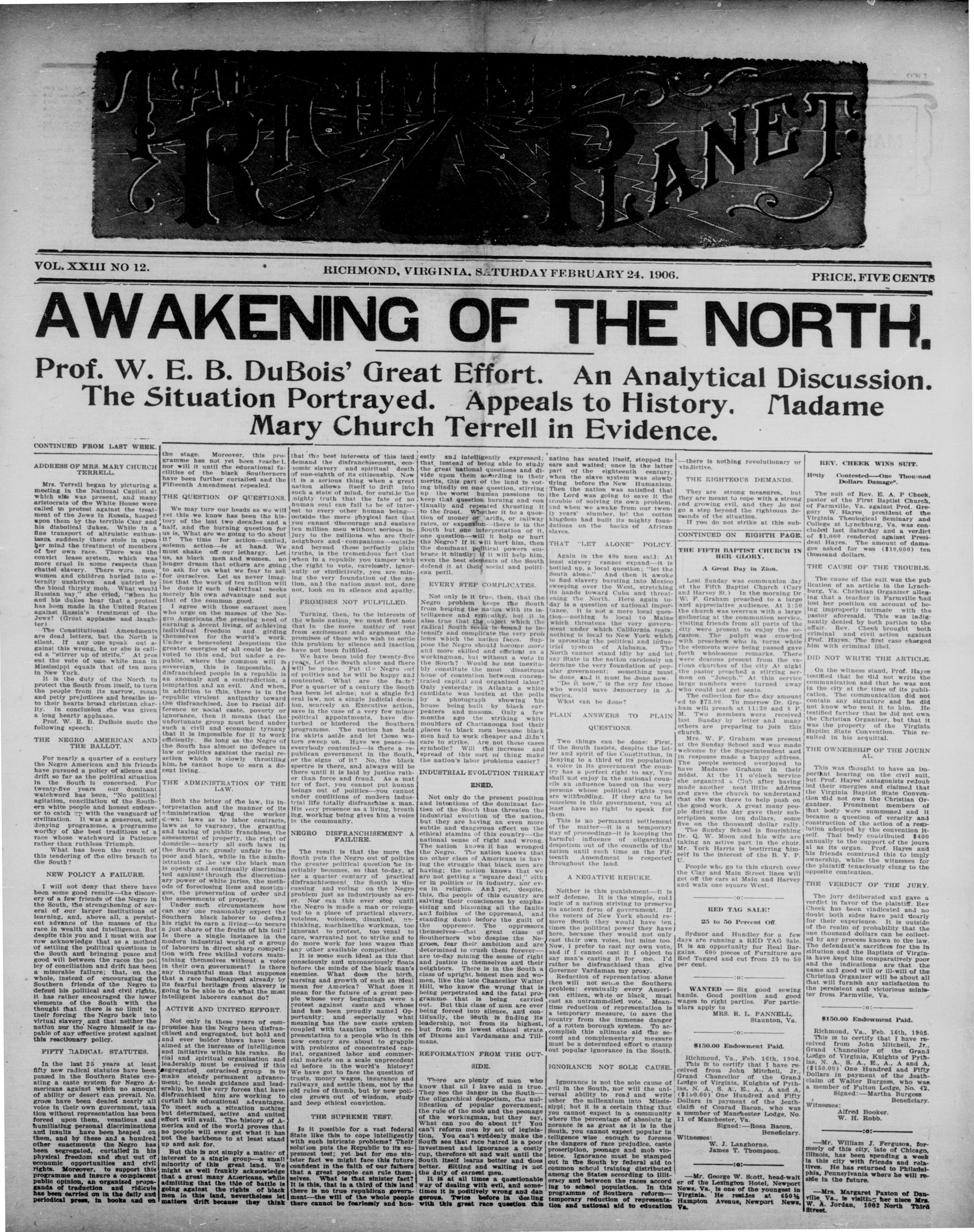
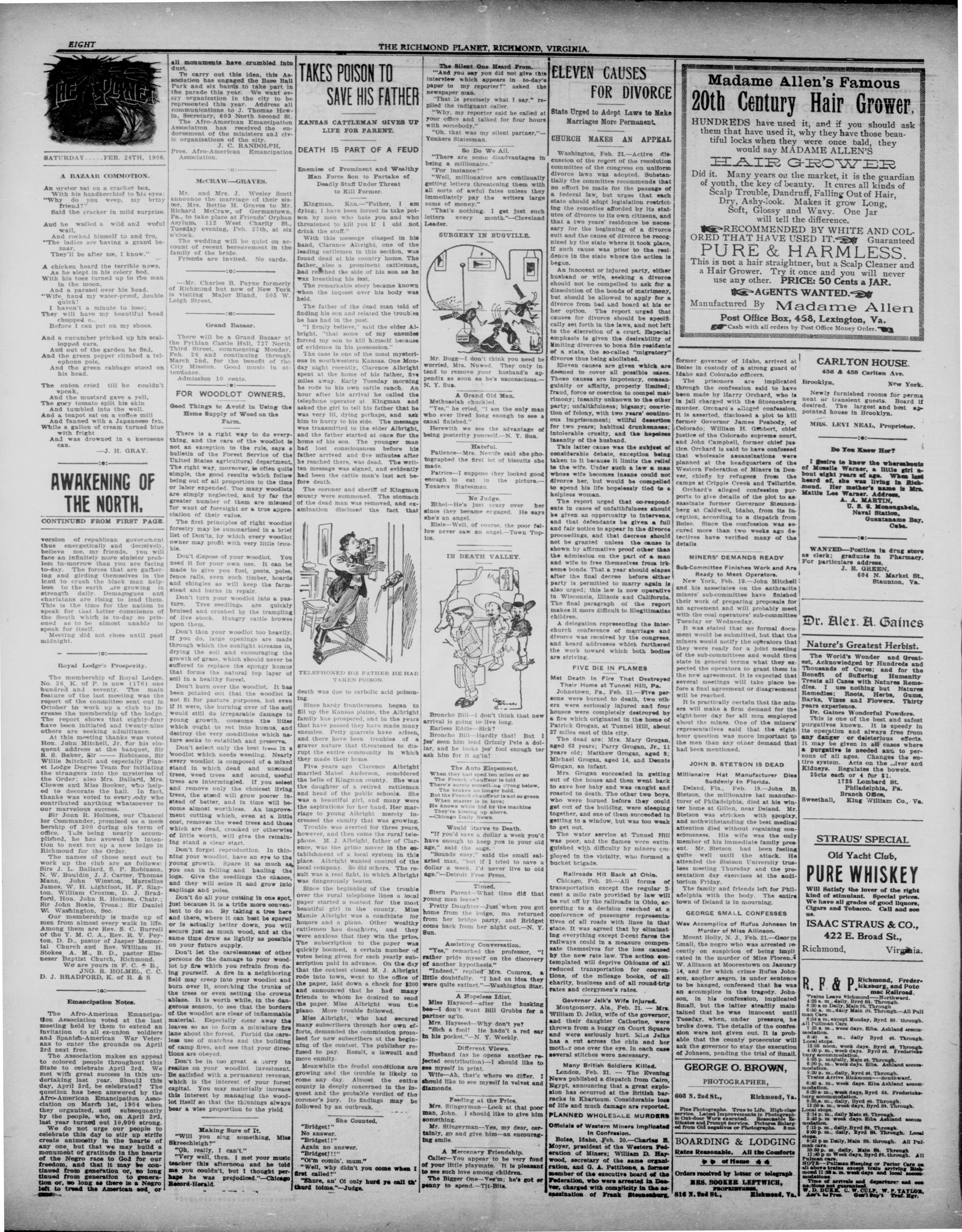
AWAKENING OF THE NORTH.
Prof. W. E. B. DuBois' Great Effort. An Analytical Discussion. The Situation Portrayed. Appeals to History. Madame Mary Church Terrell in Evidence.
VOL. XXIII NO 12.
AWA
Prof. W.
The S
CONTINUED FROM LAST WEEK.
ADDRESS OF MRS. MARY CHURCH
TERRELI.
Mrs. Terrell began by picturing a meeting in the National Capitol at which she was present, and many aristocrats of the White House were called to protest against the treatment of the Jews in Russia, heaped upon them by the terrible Czar and his diabolical dukes. While in a fine transport of altruistic enthusiasm, suddenly there stole in upon her mind the treatment of members of her own race. There was the convict lease system, which was more cruel in some respects than chattel slavery. There were men, women and children hurled into eternity unshriven and untried by the thirsty mob. What would Russian say," she cried, "when he and his dukes hear that a protest has been made in the United States against Russia's treatment of the Jews? (Great applause and laughter)
The Constitutional Amendments are dead letters, but the North is silent. If any one word out against this wrong, he or she is called a "stirrer up of strife." At present the vote of one white man in Mississippi equals that of ten men in New York.
It is the duty of the North to protect the South from itself, to turn the people from its narrow, mean and petty prejudices and breathe into their hearts broad christian charity. In conclusion she was given a long hearty applause.
Prof. W. E. B. DuBois made the following speech:
THE NEGRO AMERICAN AND
THE BALLOT.
For nearly a quarter of a century the Negro American and his friends have pursued a policy of silence and drift so far as the political situation in the South is concerned. For twenty-five years our dominant watchword has been, "No political agitation, conciliation of the Southern white people and honest endeavor to catch up with the vanguard of civilization. It was a generous, self denying programme, a programme worthy of the best traditions of a race whose watchword is Patience rather than ruthless Triumph. What has been the result of this tendering of the olive branch to the South?
NEW POLICY A FAILURE
I will not deny that there have been some good results—the discovery of a few friends of the Negro in the South, the strengthening of several of our larger institutions of learning, and, above all, a persistent advance of the masses of the race in wealth and intelligence. But despite this you and I must with sorrow acknowledge that as a method of settling the political questions in the South and bringing peace and good will between the races the policy of conciliation and drift has been a miserable failure; that, on the whole, instead of encouraging the Southern friends of the Negro to defend his political and civil rights, it has rather encouraged the lower elements of the South with the thought that there is no limit to their forcing the Negro back into virtual slavery, and that neither the nation nor the Negro himself is capable of any effective protest against this reactionary policy.
FIFTY RADICAL STATUTES
In the last 25 years at least fifty new radical statutes have been passed in the Southern States creating a caste system for Negro Americans against which no amount of ability or desert can prevail. Negroes have been denied nearly all voice in their own government, taxation without representation has been forced upon them, vexatious and humiliating personal discriminations and insults have been heaped on them, and by these and a hundred other enactments the Negro has been segregated, curtailed in his physical freedom and shut out of economic opportunities and civil rights. Moreover, to support this programme and insure a complacent public opinion, an organized propaganda of traduction and ridicule has been carried on in the daily and periodical press, in books and on
the stage. Moreover, this programme has not yet been reached, nor will it until the educational facilities of the black Southerners have been further curtailed and the Fifteenth Amendment repealed.
THE QUESTION OF QUESTIONS
We may turn our heads as we will yet this we know has been the history of the last two decades and a half, and the burning question for us is, What are we going to do about it? The time for action—united, solemn action—is at hand. We must shake off our lethargy. Let us, as black men and women, no longer dream that others are going to ask for us what we fear to ask for ourselves. Let us never imagine that the work of ten million will be done if each individual seeks merely his own advantage and not that of the common good.
I agree with those earnest men who urge on the masses of the Negro Americans the pressing need of earning a decent living, of achieving individual freedom and girding themselves for the world's work. Under a benevolent despotism the greater energies of all could be devoted to this end, but under a republic, where the common will is sovereign, this is impossible. A disfranchised people in a republic is an anomaly and a contradiction, a temptation and an evil. And when, in addition to this, there is in the republic virulent antipathy toward the disfranchised, due to racial difference or social caste, poverty or ignorance, then it means that the unfortunate group must bend under such a civil and 'economic tyranny that it is impossible for it to work efficiently. So long as the Negro of the South has almost no defence in law or politics against the racial reaction which is slowly throttling him, he cannot hope to earn a decent living.
THE ADMINISTRATION OF THE LAW.
Both the letter of the law, its interpretation and the manner of its administration drag the worker down; laws as to labor contracts, laws as to vagrancy, the granting and taxing of public franchises, the assessment of property, the right of domicile—nearly all such laws in the South are grossly unfair to the poor and black, while in the administration of the law the black man is openly and continually discriminated against through the discretionary power of white juries, the methods of foreclosing liens and mortgages, the preservation of order and the assessments of property.
Under such circumstances how can any one reasonably expect the Southern black laborer to defend his right to earn a living—to secure a share of the fruits of his toll? Is there a single instance in the modern industrial world of a group of laborers in direct sharp competition with free skilled carpenters maintaining themselves without office in their own government? Is there any thoughtful man that supposes that a race handicapped already by its fearful heritage from slavery is going to be able to do what the most intelligent laborers cannot do?
ACTIVE AND UNITED EFFORT.
Not only in these years of compromise has the Negro been disfranchised and segregated, but boll and and ever bolder blows have been aimed at the increase of intelligence and initiative within his ranks. Social and spiritual organization and leadership must be evolved if this segregated, ostracised group is to make steady permanent advancement; he needs guidance and leadership, but the very forces that have disfranchised him are working to curtail his educational advantages. To meet such a situation nothing but determined, active and united effort will avail. The history of America and of the world proves that no people will ever get what it has not the backbone to at least stand up and ask for.
But this is not simply a matter of interest to a single group—a small minority of this great land. We might as well frankly acknowledge that a great many Americans, while admitting that the title of battle is going against the rights of black men in this land, nevertheless let matters drift because they think
that the best interests of this land demand the disfranchisement, economic slavery and spiritual death of one-eighth of its citizenship. Now it is a serious thing when a great nation allows itself to drift into such a state of mind, for outside the mighty truth that the fate of no human soul can fall to be of interest to every other human being—outside the mere physical fact that you cannot discourage and enslave ten million men without serious injury to the millions who are their neighbors and companions—outside beyond these perfectly plain truths, the prejudice of what when in a republic you tamper with the right to vote, carelessly, ignorantly or vindictively, you are mining the very foundation of the nation, and the nation must not, dare not, look on in silence and apathy.
PROMISES NOT FULFILLED.
Turning, then, to the interests of the whole nation, we must first note that in the mere matter of rest from excitement and argument the promises of those who wish to settle this problem by silence and inaction have not been fulfilled.
We have been told for twenty-five years, Let the South alone and there will be peace. Put the Negro out of politics and he will be happy and contented. What are the facts? For a quarter of a century the South has been let alone; not a single federal law, not a single judicial decision, scarcely an Executive action, save in the case of a very few minor political appointments, have disturbed or hindered the Southern programme. The nation has held its skirts aside and let those waters sweep on. Have we peace—is anybody contented—is there a republican government in the South, or the signs of it? No. Blake spectre is there, and always will be there until it is laid by justice rather than force and fraud. As a matter of fact, you cannot put human beings out of politics—you cannot under conditions of modern industrial life totally disfranchise a man. His very presence as a living, breathing, working being gives him a voice in the community.
NEGRO DISFRANCHISEMENT A
FAILURE.
The result is that the more the South puts the Negro out of politics the greater political question he inevitably becomes, so that to-day, after a quarter century of practical disfranchisement the South is discussing and voting on the Negro problem just as industriously as ever. Nor can this ever stop until the Negro is made a man or relegated to a place of practical slavery, voteless, volceless, disunited, unthinking, machinellike workman, too ignorant to protest, too venal to care, warranted not to strike and to do more work for less wages than any other available competitor. It is some such ideal as this that consciously and unconsciously floats before the minds of the black man's enemies. What does the birth, nursing and growth of such an ideal mean for America? What does it mean for the future of a great people whose very beginnings were a protest against caste and whose land has been proudly named Opportunity; and especially what meaning has the new caste system coupled with taxation without representation to a people who in this new century are about to grapple with problems of concentrated capital, organized labor and commercial markets on a scale unprecedented before in the world's history? We have got to face the question of trusts, money wages, insurance and railways, and settle them, not by the old rules of thumb, but by new policies grown out of wisdom, study and deep ethical conviction.
THE SUPREME TEST.
Is it possible for a vast federal State like this to cope intelligently with such intricate problems? Their solution puts the Republic to its supremest test; yet but for one sinister fact we might face this future confident in the faith of our fathers that a great people can rule themselves. What is that sinister fact? It is this, that in a third of this land there is no true republican government—the will of the whole people there cannot be fearlessly and hon-
estly and intelligently expressed; that instead of being able to study the great national questions and divide upon them according to their merits, this part of the land is voting blindly on one question, stirring up the worst human passions to keep that question burning and continually and repeated thrusting it to the front. Whether it be a question of money or arfs, or railway rates, or expansion—there is in the South but one interpretation of it, one question—will it help or hurt the Negro? If it will hurt him, then the dominant political powers embrace it blindly; if it will help him, even the best elements of the South defend it at their social and politician peril.
EVERY STEP COMPLICATES
Not only is it true, then, that the Negro problem keeps the South from helping the nation with its intelligence and sympathy, but it is also true that the object which the radical South seeks is bound to intensify and complicate the very problems which the nation faces. Suppose the Negro should become more and more skilled and efficient as a workingman, but without a vote in the South? Would he not inevitably constitute the most disastrous bone of contention between concentrated capital and organized labor? Only yesterday in Atlanta a white candidate was beaten at the polls by a photograph showing his house being built by black carpenters and masons. Only a few months ago the striking white moulders of Chattanooga bost their places to black men because black men had to work cheaper and didn't care to strike. Are not these cases symbolic? Will the increase and spread of this sort of thing make the nation's labor problems easier?
INDUSTRIAL EVOLUTION THREAT
Not only do the present position and intentions of the dominant faction of the South thus threaten the industrial evolution of the nation, but they are having an even more subtle and dangerous effect on the ethical stamina of this country—the national sense of right and wrong. The nation knows it has wronged the Negro. The nation knows that no other class of Americans is having the struggle that black men are having; the nation knows that we are not getting a "square deal," either in politics or in industry, nor even in religion. And yet, despite this, the people of this country are salving their consciences by emphasizing and blazoning all the faults and folles of the oppressed, and standing dumb before the guilt of the oppressor. The oppressors themselves—that great class of Southerners who despise the Negro—have the ambition and are determined to crush the form of war are to-day mining the sense of right and justice in themselves and their neighbors. There is in the South a class of upright, honest men and women, like the late Chancellor Walter Hill, who know the wrong that is being perpetrated and the fatal programme that is being carried out. But this class of men are ever being forced into silence, and continually, the 360th is finding its leadership, not from its highest, but from its lowest ethical strata of Dixons and Vardamans and Tillmans.
REFORMATION FROM THE OUT-
There are plenty of men who know that all I have said is true. They see the danger in the South—the oligarchical despotism, the nullification of popular government, the rule of the mob and the peonage of the workingman, but they say, What can you do about it? You can't reform men by act of legislation. You can't suddenly make the South see that race hatred is a poor investment and ignorance a costly cup, therefore sit and wait until the South itself learns better and does better. Sitting and waiting is not the duty of earnest men. It is at all times a questionable way of dealing with evil, and sometimes it is positively wrong and dangerous. Twice before in dealing with this great race question this
nation has seated itself, stopped its ears and waited; once in the latter part of the eighteenth century, when the slave system was slowly dying before the New Humanism. Then the nation was satisfied that the Lord was going to save it the trouble of solving its own problem, and when we awake from our twenty years' slumber, lo! the cotton kingdom had built its mighty foundations on the backs of African slaves.
THAT "LET ALONE" POLICY
Again in the 40s men said: At least slavery cannot expand—it is bottled up, a local question; "let the South alone." And then it awoke to find slavery bursting into Mexico sweeping over the West, stretching its hands toward Cuba and threatening the North. Here again today is a question of national importance. It is not a mere local question—nothing is local to Maine which threatens the very government under which California rests; nothing is local to New York which is uprooting the political and industrial system of Alabama. The North cannot stand idly and let the State in the nation carelessly undermine the very foundation of popular government, something must be done and it must be done now. "Do it now," is the cry for those who would save democracy in America. What can be done?
PLAIN ANSWERS TO PLAIN QUESTIONS.
Two things can be done: First, if the South insists, despite the letter and spirit of the Constitution, denying to a third of its population a voice in its government the country has a perfect right to say, You shall not enjoy in the national councils an influence based on the very persons whose political rights you are withholding. If they are to be voiceless in this government, you at least have no right to speak for them. This is no permanent settlement of the matter—it is a temporary stay of proceedings—it is keeping the harmful influence of oligarchical despotism out of the countryside nation until such time as the Fifteenth Amendment is respected throughout the land.
A NEGATIVE REBUKE
Neither is this punishment—it is self defense. It is the simple, coll logic of a nation striving to preserve its ancient form of government. If the voters of New York should remove South they would have ten times the political power they have here, because they would not only cast their own votes, but mine too. Now, I prefer to cast my own vote, and if I cannot cast it I object to any man's casting it for me. I'd rather be disfranchised than give Governor Vardaman my proxy. Reduction of representation alone then will not set the Southern problem: eventually every American citizen, white or black, must cast an untrammelled vote. Meantime reduction of representation is a temporary measure, to save the country from the immense danger of a rotten borough system. To accomplish this ultimate aid the second and complementary measure must be a determined effort to stamp out popular ignorance in the South.
Ignorance is not the sole cause of evil in the South, nor will the universal ability to read and write usher the millennium into Mississippi; but it is a certain thing that you cannot expect in a community where the percentage of absolute ignorance is as great as it is in the South, you cannot expect popular in intelligence wise enough to foresee the dangers of race prejudice, caste proscription, peonage and mob violence. Ignorance must be stamped in the South by federal aid to common schools, and among the States according to illiteracy and between the races according to school population. In this programme of Southern reform—temporary reduction of representation and national aid to education
—there is nothing revolutionary or vindictive.
THE RIGHTEOUS DEMANDS
They are strong measures, but they are meant to cope with a strong and growing evil, and they Jo not go a step beyond the righteous demands of the situation. If you do not strike at this sub CONTINUED ON EIGHTH PAGE
THE FIFTH BAPTIST CHURCH IN HER GLORY.
A Great Day in Zion.
Last Sunday was communion day at the Fifth Baptist Church (Cary and Harvey St.) In the morning Dr. W. F. Graham preached to a large and appreciative audience. At 3:30 the church was overrun with a large gathering at the communion service, visiting friends from all parts of the city were present to enjoy the occasion. The pulpit was crowded with preachers who in turns while the elements were being passed gave forth wholesome remarks. There were deacons present from the various churches of the city At night the pastor preached a stirring sermon on "Joseph." At this service large numbers were turned away who could not get seats.
The collection for the day amounted to $73.00. To morrow Dr. Graham will preach at 11:30 and 8 P. M. Two members were received last Sunday by letter and many others are preparing to join this church.
Mrs. W. F. Graham was present at the Sunday School and was made welcome by the Superintendent and in response made a happy address. The people seemed overjoyed to have Madame Graham in their midst. At the 11 o'clock service she organized a Club after having made another neat little address and gave the church to understand that she was there to help push on the good work. A great many people during the day gave their subscription some ten dollars, some five on the thousand dollar rally. The Sunday School is flourishing Dr. Q. W. Moon and his wife are taking an active part in the choir. Mr. York Harris is bestirring himself in the interest of the B. Y. P. U. People who go to this church over the Clay and Main Street lines will get off the cars at Main and Harvey and walk one square West.
RED TAG SALE!
25 to 50 Percent Off
Sydnor and Hunley for a few days are running a RED TAG Sale. It is an opportunity for Real Bargains. 600 pieces of Furniture are Red Tagged and cut from 25 to 50 per cent.
WANTED — Six good sewing hands. Good position and good wages to right parties. For particulars apply to.
$150.00 Endowment Paid.
Richmond, Va., Feb. 16th, 1906.
This is to certify that I have received from John Mitchell, Jr.,
Grand Chancellor of the Grand
Lodge of Virginia, Knights of Pythias,
N. A, S. A, E., A. A, and A.
($1.00.00) One Hundred and Fifty
Dollars in payment of the death-
claim of Conrad Bacon, who was
a member of Manchester Lodge, No.
11 of Manchester, Va.
Signed:—Rosa Bacon,
Beneficiary.
Witnesses:
W. J. Langhorne.
James T. Thompson.
:0:
—Mr. George W. Scott, head-walt
er of the Lexington Hotel, Newport
News, Va. is one of the youngest in
Virginia. He resides at 650½
Hampton Avenue, Newport News,
Va.
PRICE, FIVE CENTS RTH.iscussion. idame
REV. CHEEK WINS SUIT.
Hody Contested—One Thousand Dollars Damages.
The suit of Rev. E. A. P Cheek, pastor of the First Baptist Church, of Farmville, Va. against Prof. Gregory W. Hayes, president of the Virginia Theological Seminary and College at Lynchburg, Va. was concluded last Saturday and a verdict of $1,000 rendered against President Hayes. The amount of damages asked for was ($10,000) ten thousand dollars.
THE CAUSE OF THE TROUBLE
The cause of the suit was the put publication of an article in the Lynchburg, Va. Christian Organizer alleging that a teacher in Farmville had lost her position on account of being improperly intimate with the pastor aforesaid. This was indignantly denied by both parties to the affair. Rev. Cheek brought both criminal and civil action against Prof. Hayes. The first case charged him with criminal libel.
DID NOT WRITE THE ARTICLE
On the witness stand, Prof. Hayes testified that he did not write the communication and that he was not in the city at the time of its publication. The communication did not contain any signature and he did not know who sent it to him. He testified further that he did not own the Christian Organizer, but that it was the property of the Virginia Baptist State Convention. This resulted in his acquittal.
THE OWNERSHIP OF THE JOURNAL
This was thought to have an important bearing on the civil suit, but Prof. Hayes' antagonists rebelled their energies and claimed that the Virginia Baptist State Convention did not own the Christian Organizer. Prominent members of that body were summoned and it became a question of veracity and construction of the action of a resolution adopted by the convention itself. That body contributed $400 annually to the support of the journal as its organ. Prof. Hayes and his friends construed this to imply ownership, while the witnesses for the plaintiff tenaciously clung to the opposite contention.
THE VERDICT OF THE JURY
The jury deliberated and gave a verdict in favor of the plaintiff. Rev Cheek has been vindicated and no doubt both sides have paid nearly for their experience. It is outside of the realm of probability that the one thousand dollars can be collected by any process known to the law. The defendant's sacrifices for the in institution and the Baptists of Virginia have kept him comparatively poor and the indications are that the name and good will or ill-will of the Christian Organizer will be about all that will furnish any satisfaction to the persistent and victorious minister from Farmville, Va.
$150.00 Endowment Paid
Richmond, Va., Feb. 16th, 1905.
This is to certify that I have received from John Mitchell, Jr.,
Grand Chancellor of the Grand Lodge of Virginia, Knights of Pythias, N. A. S. A., E. A., A and A. ($150.00) One Hundred and Fifty Dollars in payment of the death-claim of Walter Burgess, who was a member of Fulton Lodge, No. 42.
Signed:—Martha Burgess
Beneficiary.
Witnesses:
Alfred Booker.
W. H. Robb.
:0:
—Mr. William J. Ferguson, formerly of this city, late of Chicago, Illinois, has been spending a week in this city with friends and relatives. He has returned to Philadelphia, Pennsylvania where he will reside in the future.
—Mrs. Margaret Paxton of Danville Va., is visiting her niece Mrs. W. A. Jordan, 1002 North Third Street
THE
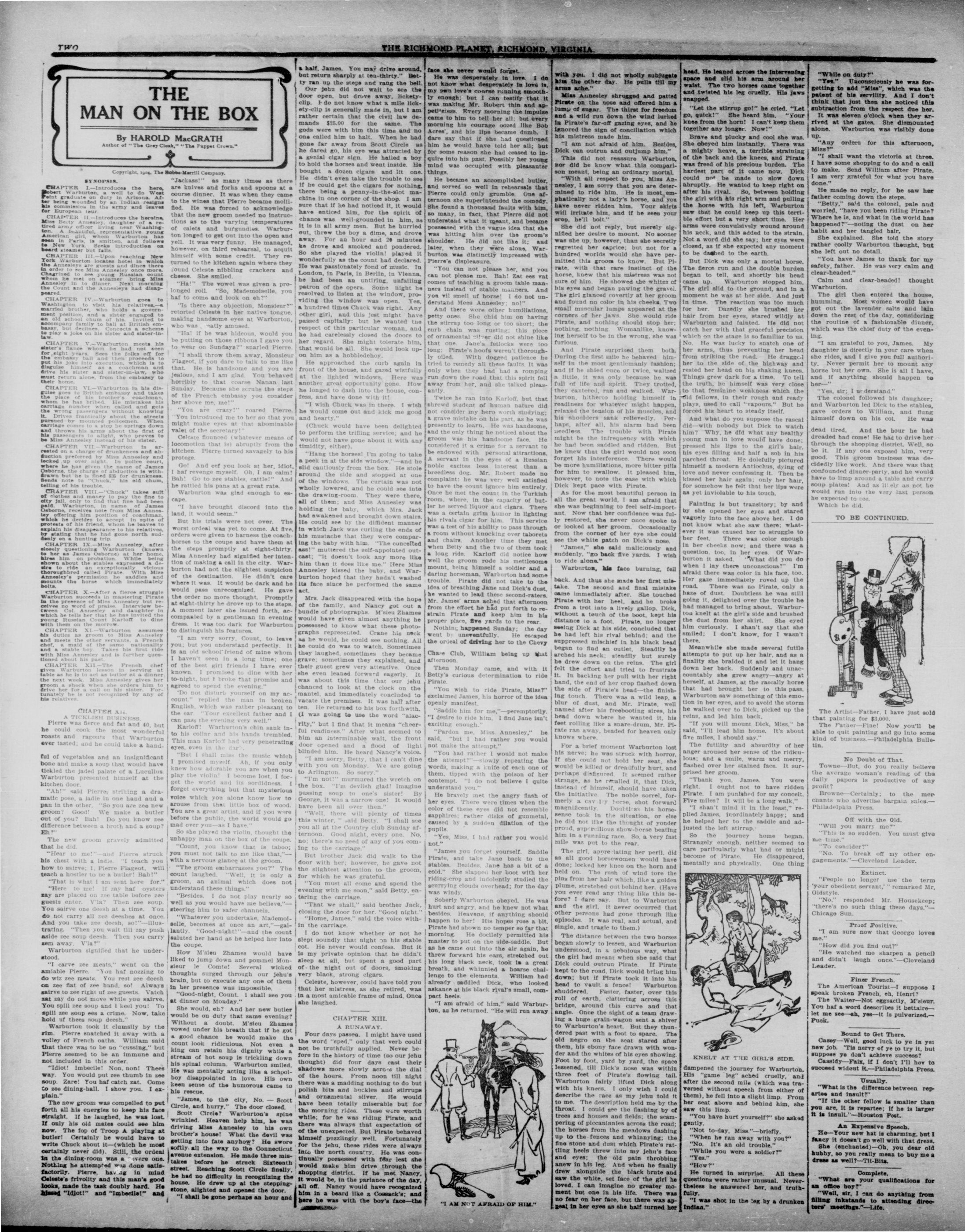
MAN ON THE BOX
By HAROLD MacGRATH
Author of "The Grey Cloak," "The Puppet Crown."
Copyright, 1904, The Bobbs-Merrill Company.
CHAPTER I.-Introduces the here, Robert Warburton, a well to do West Point graduate on duty in Arizona. After being rounded by an Indian resigns his commission, the army and leaves for European tour.
CHAPTER II.-Introduces the here, Miss Betty Annesley, daughter of a retired army officer living near Washington, represents young American girl, whose Warburton soon in Paris, is smitten, and follows to New York. Seeks introduction on board stainer but falls.
CHAPTER III.-Upon reaching New York Warburton located hotel in which the Annesley are guests and dines there in order to see Miss Annesley once more. Arguined to see young Russian count the Annesley in to dinner. Next morning the Count and the Annesley had disappeared.
CHAPTER IV.-Warburton goes to Washington to visit his relatives—a mother, mother who holds a government position, and she is married to an old school chum of his. Invited to accompany family to ball at British embassy, but declines. Concocts a scheme play a joke on his sister and sister-in-law.
CHAPTER V.—Warburton meets his sister's fiance whom he had not seen for eight years. Sees the folks off for the embassy ball and then proceeds to set his job into exposition, which is disguise himself as a coachman and drive his sister and sister-in-law, who must return alone, from the embassy to their home.
CHAPTER VI.—Warburton in his disguise goes to British embassy and takes the place of his brother's coachman, whom he has written to him and to the carriage number when called and gets the wrong passengers without knowing it. Drives frantically about the streets pursued by mounted policemen. When carriage comes to a stop he springs down and shows his arms about the first of his passers to alight, who provides to be Miss Annesley instead of his sister.
CHAPTER VII.—Warburton is arrested on a charge of drunkenness and abduction preferred by Miss Annesley and lecked up over night. In police court, where he has given the name of James Osborne, the charge of abduction is withheld by the� he has to be for drunkenness. Bends note to "Chuck," his old chum, telling of his trouble.
CHAPTER VIII.—"Chuck" takes suit of clothes and money to pay the fine to city jail only to find that fine had been James Osborne, receives note from Miss Annesley offering him position of coachman, which he decides to accept in spite of his dislike for the horse. He explains his disappearance to his relatives, by stating that he had gone north suddenly on a hunting trip.
CHAPTER IX.—Miss Annesley, after receiving a letter from her to her as James (osborne) at her home, hires him on probation. While being shown about the stables expressed a desire to have the horse thoroughly bred called Pirate. With Miss Annesley's permission he saddles and mounts the horse which immediately follows.
CHAPTER X.—After a fierce struggle Warburtin succeeds in mastering Pirate in the presence of Miss Annesley but receives no word of praise, interweaves between the two, and returns which he tells her that he has invited the young Russian Count Karloff to dine with them on the morrow. Warburtin assumes his dutton as groom to Miss Annesley and meets the other servants, a French chef, a maid of the same nationality and a stable boy. Takes his first ride questioned about his pass.
CHAPTER XII - The French chef gives Warburton lesson in serving at the next week. The next week, Miss Annesley gives her groom a shock when she orders him to drive her to a call on his sister. Fortunately he is not recognized by any of them.
Pierre was fierce and fat and 40, but he could cook the most wonderful roasts and raagouts that Warburton ever tasted; and he could take a handful of vegetables and an insignificant bone and make a soup that would have tickled the jaded palate of a Lucullus Warburton presented himself at the kitchen door.
"Ah!" said Pierre, striking a dramatic pose, a ladle in one hand and a pan in the other. "So you are zee groom? Good! We make a butler out of you? Bah! Do you know zee difference between a broth and a soup? Eh?"
The new groom gravely admitted that he did.
"Hear to me!"—and Pierre struck his chest with a ladle. "I teach you how to salve; 1, Pierre Flageot, will teach a hostler to be a butter! Bah!"
"That is what I am sent here for."
"Here to me! I zay haf oysters
zay are placed on zee table before zee
guests enter. Via?" Then zee soup.
You sairve one deesh at a time. You
do not carry all zee deeshs at once
And you take zee deesh, so!"—illust-
rating. "Then you wait till zay push
aside zee soup deesh. Then you carry
zem away. Via?"
Warburton signified that he under-
stood.
"I carve zee meats," went on the
ambiable Pierre. "You haf nozzling to
do wtz zee meats. You rest zee deesh
on zee flat of zee hand, so!" Always
sairve to zee right uf zee guests. Vatch
zat zay do not move while you sairve.
You spill zee soup and I keel you! To
spill zee soup ees a crime. Now, take
hold uf thees soup deesh."
Warburton took it clumsily by the rim. Pierre snatched it away with a volley of French oaths. William said that there was to be no "cussing," but Pierre seemed to be an immune and not included in this order.
"Iidiot! Imbecile! Non, non! Thees way. You would put zee thumb in zee soup. Zare! You haf catch zat. Come to zee dining-hall. I show you. I explain."
The new groom was compelled to put forth all his energies to keep his face straight. If he laughed, he was lost. If only his old mates could see him now. The top of Troop A playing at butler! Certainly he would have to write Chuck about it—(which he most certainly never did). Still, the ordeal in the dining-room was a severe one. Nothing he attempted was done satisfactorily. Pierre, having in mind Celeste's frivolity and this man's good looks, made the task doubly hard. He blessed "idiot!" and "imbecile!" and
CHAPTER 411
"Jackass!" as many times as there are knives and forks and spoons at a course dinner. It was when they came to the wines that Pierre became mollified. He was forced to acknowledge that the new groom needed no instructions as to the varying temperatures of cales and burgundies. Warburton longed to get out into the open and yell. It was very funny. He managed, however, on third rehearsal, to acquit himself with some credit. They returned to the kitchen again where they found Celeste nibbling crackers and cheese. She smiled.
"Ha!" The vowel was given a prolonged roll. "So, Mademoiselle, you haf to come and look on eh?" "Is there any objection, Monsieur?" retorted Celeste in her native tongue, making handsome eyes at Warburton, who was "eaty amused." "Ha! if he was hideous, would you be putting on those ribbons I gave you to wear on Sundays?" snarled Pierre.
"I shall throw them away, Monsieur Flageot. If you dare to talk to me like that. He is handsome and you are jealous, and I am glad. You behaved horribly to that coarse Nanan last Sunday. Because she scrubs the steps of the French embassy you consider her above me, me!" "You are crazy!" roared Pierre. "You introduced me to her so that you might make eyes at that abominable valet of the secretary!" Celecate flounced (whatever means of locomotion that is) abruptly from the kittchen. Pierre turned savagely to his protege. Go! And eef you look at her, idiot, I haf revenge myself. Oh, I am calm! Bah! Go to zee stables, cattle!" And he hattled his pans at a great rate. Warburton was glad enough to escape. "I have brought discord into the land, it would seem."
But his trials were not over. The worst ordeal was yet to come. At five orders were given to harness the coach-horses to the coupe and have them at the steps promptly at eight-thirty. Miss Annesley had signified her intention of making a call in the city. Warburton had not the slightest suspicion of the destination. He didn't care where it was. It would be dark and he would pass unrecognized. He gave the order no more thought. Promptly at eight-thirty he drove up to the steps. A moment later she issued forth, accompanied by a gentleman in evening dress. It was too dark for Warburton to distinguish his features.
"I am very sorry, Count, to leave you; but you understand perfectly. It is an old school'friend of mine whom I haven't seen in a long time; one of the best girl friends I have ever known. I promised to dine with her to-night, but I broke that promise and agreed to spend the evening."
"Do not disturb yourself on my account," replied the man in broken English, which was rather pleasant to the ear. "Your excellent father and I can pass the evening very well."
Karloff! Warburton's chin sank into his collar and his hands trembled. This man Karloff had very penetrating eyes, even in the dar'.
"But I shall miss the music which I promised myself. Ah, if you only knew how adorable you are when you play the violin! I become lost, I forget the world and its sordidness. I forget everything but that mysterious voice which you alone know how to arouse from that little box of wood. You are a great artist, and if you were before the public, the world would go mad over you—as I have."
So she played the violin, thought the unhappy man on the box of the coupe. "Count, you know that is taboo; you must not talk to me like that."—with a nervous glance at the groom.
"The groom embarrasses you?" The count laughed. "Well, it is only a groom, an animal which does not understand these things." "Besides. I do not play nearly so well as you would have me believe,"—steering him to safer channels. "Whatever you undertake, Mademoiselle, becomes at once an art,"—gallantly. "Good-night!"—and the count saluted her hand as he helped her into the coupe. How M'slen Zhames would have liked to jump down and pommel Monsteur le Comte! Several wicked thoughts surged through our jehu's brain, but to execute any one of them in her presence was impossible. "Good-night, Count. I shall see you at dinner on Monday."
She would, eh? And her new butter would be on duty that same evening? Without a doubt. M'steu Zhames vowed under his breath that if he got a good chance he would make the count book ridiculous. Not even a king can retain his dignity while a stream of hot soup is trickling down his spinal column. Warburton smiled. He was mentally acting like a schoolboy disappointed in love. His own keen sense of the humorous came to his rescue.
"James, to the city, No. — Scott Circle, and hurry." The door closed. Scott Circle? Warburton's spine wrinkled. Heaven help him, he was driving Miss Annesley to his own brother's house! What the devil was getting into fate anyhow? He swore softly all the way to the Connecticut avenue extension. He made three mistakes before he struck Sixteenth street. Reaching Scott Circle finally, he had no difficulty in recognizing the house. He drew up at the stepping-stone, alighted and opened the door. "I shall be gone perhaps an hour and
THE RICHMOND PLANET. RICHMOND. VIRGINIA
a half, James. You may drive around, but return sharply at ten-thirty." Betty ran up the steps and rang the bell. Our jehu did not wait to see the door open, but drove away, lickety-clip. I do not know what a mile lickety-clip is generally made in, but I am rather certain that the civil law demands $25.00 for the same. The gods were with him this time and no one called him to halt. When he had gone far away from Scott Circle as he dared go, his eye was attracted by a genial cigar sign. He hailed a boy to hold the horses and went inside. He bought a dozen cigars and lit one. He didn't even take the trouble to see if he could get the cigars for nothing, there being a penny-in-the-slot machine in one corner of the shop. I am sure that if he had noticed it, it would have enticed him, for the spirit of chance was well-grounded in him, as it is in all army men. But he hurried out, threw the boy a dime, and drove away. For an hour and 20 minutes he drove and smoked and pondered. So she played the violin! played it wonderfully as the count had declared. He was passionately fond of music. In London, in Paris, in Berlin, in Vienna, he had been an untiring, unfailing patron of the opera. Some night he resolved to listen at the window, providing the window was open. Yes, a hundred times Chuck was right. Any other girl, and this jest might have passed capitally: but he wanted the respect of this particular woman, and he had carelessly closed the doors to her regard. She might tolerate him, that would be all. She would look upon him as a hobbled boy.
He approached the curb again in front of the house, and gazed wistfully at the lighted windows. Here was another great opportunity gone. How he longed to dash into the house, confess, and have done with it!
"I wish Chuck was in there. I wish he would come out and kick me good and hearty."
(Chuck would have been delighted to perform the trilining service; and he would not have gone about it with any timidity, either).
"Hang the horses! I'm going to take a peek in at the side window."—and he slid cautiously from the box. He stole around the side and stopped at one of the windows. The curtain was not wholly lowered, and he could see into the drawing-room. They were there, all of them; and Miss Annesley was holding the baby, which Mrs. Jack had awakened and brought down stairs. He could see by the diffident manner in which Jack was curling the ends of his mustache that they were comparing the baby with him. "The concerted ass!' muttered the self-appointed outcast; "it doesn't look any more like him than it does like me." Here Miss Annesley kissed the baby, and Warburton hoped that they hadn't washed its face since he performed the same act.
Mrs. Jack disappeared with the hope of the family, and Nancy got out a bundle of photographs. M'sieu Zhames would have given almost anything he possessed to know what these photographs represented. Crane his neck as he would, he could see nothing. All he could do was to watch. Sometimes they laughed, sometimes they became grave; sometimes they explained, and their guest grew very attentive. Once she even leaned forward eagerly. It was about this time that our jehu chanced to look at the clock on the mantel, and immediately concluded to vacate the premises. It was hall after ten. He returned to his box forthwith. (I was going to use the word "alac-
rity," but I find that it means "cheerful readiness." After what seemed to him an interminable wait, the front door opened and a flood of light blinded him. He heard Nancy's voice. "I am sorry, Betty, that I can dine with you on Monday. We are going to Arlington. So sorry." "I'm not!" murmured the wretch on the box. "I'm devilish glad! Imagine passing soup to one's sister! By George, it was a narrow one! It would have been all over then." "Well, there will plenty of times this winter," said Betty. "I shall see you all at the Country club Sunday afternoon. Good night, every one. No; there's no need of any of you coming to the carriage." But brother Jack did walk to the door with her; however, he gave not the slightest attention to the groom, for which he was grateful.
"You must all come and spend the evening with me soon," said Betty, entering the carriage.
"That we shall," said brother Jack, closing the door for her. "Good night."
"Home, James," said the voice within the carriage.
I do not know whether or not he slept soundly that night on his stable cot. He never would confess. But it is my private opinion that he didn't sleep at all, but spent a good part of the night out of doors, smoking very black, strong cigars.
Celeste, however, could have told you that her mistress, as she retired, was in a most amicable frame of mind. Once she laughed.
CHAPTER XIII
A RUNAWAY
Four days passed. I might have used the word "sped." only that verb could not be truthfully applied. Never before in the history of time (so our jeeh thought) did four days cast their shadows more slowly across the dial of the hours. From noon till night there was a madding nothing to do but polish bits and buckles and stirrups and ornamental silver. He would have been totally miserable but for the morning rides. These were worth while; for he was riding Pirate, and there was always that expectation of the unexpected. But Pirate behaved himself puzzling well. Fortunately for the jeeh, these rides were always in the north country. He was continually possessed with fear lest she would make him drive through the shopping district. If he met Nancy, it would be, in the parlance of the day, all off. Nancy would have recognized him in a beard like a Cossack's; and here he was with the boy's face—the
face she never would forget
face she never would forget.
He was desperately in love. I do not know what desperately in love is, my own love's course running smoothly enough; but I can testify that it was making Mr. Robert thin and appetitesless. Every morning the impulse came to him to tell her all; but every morning his courage oozed like Bob Acres, and his lips became dumb. I dare say that if she had questioned him he would have told her all; but for some reason she had ceased to inquire into his past. Possibly her young mind was occupied with pleasanter things.
He became an accomplished butler, and served so well in rehearsals that Pierre could only grumble. One afternoon she superintended the comedy. She found a thousand faults with him, so many, in fact, that Pierre did not understand what it meant, and became possessed with the vague idea that she was hitting him over the groom's shoulder. He did not like it; and later, when they were alone, Warburton was distinctly impressed with Pierre's displeasure.
"You can not please her, and you can not please me. Bah! Zat ees vat comes of teaching a groom table manners instead of stable manners. And you will smell of horse! I do not understand Mees Annesley: no!"
And there were other humiliations, petty ones. She child him on having the stirrup too long or too short; the curb chain was rusting; this piece of ornamental silver did not shine like that one. Jane's fetlocks were too long; Pirate's hoofs weren't thoroughly oiled. With dogged patience he tried to remedy all these faults. It was only when they had had a romping run down the road that this spirit fell away from her, and she talked pleasantly.
Twice he ran into Karloff, but that shrewd student of human nature did not consider my hero worth studying; a grave mistake on his part, as he was presently to learn. He was handsome, and the only thing he noticed about the groom was his handsome face. He considered it a crime for a servant to be endowed with personal attractions. A servant in the eyes of a Russian noble excites less interest than a breedless dog. Mr. Robert made no complaint: he was very well satisfied to have the count ignore him entirely. Once he met the count in the Turkish room, where, in the capacity of butler he served liquor and cigars. There was a certain grim humor in lighting his rivals cigar for him. This service was a test of his ability to pass through a room without knocking over taboets and chairs. Another time they met when Betty and the two of them took a long ride. Karloff did notice how well the groom rope his mettlesome mount, being himself a soldier and a daring horseman. Warburton had some trouble. Pirate did not take to the idea of breathing Jane and Dick's dust, he wanted to lead these second ratters. Mr. James' arms ached that afternoon from the effort he had put forth to restrain Pirate and keep him in his proper place, five yards to the rear.
Nothing happened Sunday; the day went by uneventfully. He escaped the ordeal of driving her to the Chevy Chase Club, William being up that afternoon.
Then Monday came, and with it Betty's curious determination to ride Pirate.
"You wish to ride Pirate, Miss?" exclaimed James, his horror of the idea openly manifest.
"Saddle him for me,"—peremptorly. "I desire to ride him, I find Jane isn't exciting enough."
"Pardon me, Miss Annesley," he said, "but I had rather you would not make the attempt."
"You had rather I would not make the attempt?"—slowly repeating the words, making a knife of each one of them, tipped with the poison of her contempt. "I do not believe I quite understand you."
He bravely met the angry flash of her eyes. There were times when the color of these eyes did not resemble sapphires; rather disks of gunmetal, caused by a sudden dilation of the pupils.
"Yes, Miss, I had rather you would not."
"James you forget yourself. Saddle Pirate, and take Jane back to the stables. Besides, Jane has a bit of a cold." She slapped her boot with her riding-crop and indolently studied the scurrying clouds overhead; for the day was windy.
Sobberly Warburton obeyed. He was hurt and angry, and he knew not what besides. Heavens, if anything should happen to her! His hopes rose a bit. Pirate had shown no temper so far that morning. He docilely permitted his master to put on the side-saddle. But as he came out into the air again, he threw forward his ears, stretched out his long black neck, took in a great breath, and whinned a hoarse challenge to the elements. William had already saddled Dick, who looked askance at his black rival's small, compact heels.
"I am afraid of him," said Warburton, as he returned. "He will run away
CLAN NORTH AFRICA OF KUWAIT
"I AM NOT AFRAID OF HIM."
with you. I did not wholly subjugate him the other day. He pulls till my arms ache."
Miss Annesley shrugged and patted Pirate on the nose and offered him a lump of sugar. The thirst for freedom and a wild run down the wind lurked in Pirate's far-off gazing eyes, and he ignored the sign of conciliation which his mistress made him.
"I am not afraid of him. Besides, Dick can outrun and outjump him."
This did not reassure Warburton, nor did he know what this comparison meant, being an ordinary mortal. "With all respect to you, Miss Anneley, I am sorry that you are determined to ride him. He is most emphatically not a lady's horse, and you have never ridden him. Your skirts will irritate him, and if he sees your erop, he'll bolt."
She did not reply, but merely signified her desire to mount. No sooner was she up, however, than she secretly regretted her caprice; but not for a hundred worlds would she have permitted this groom to know. But Pirate, with that rare instinct of the horse, knew that his mistress was not sure of him. He showed the whites of his eyes and began pawing the gravel. The girl glanced covertly at her groom and found no color in his cheeks. Two small muscular lumps appeared at the corners of her jaws. She would ride Pirate, and nothing should stop her; nothing, nothing. Womanlike, knowing herself to be in the wrong, she was furious.
And Pirate surprised them both. During the first mile he behaved himself in the most gentlemanly fashion; and if he shied once or twice, waltzed a little, it was only because he was full of life and spirit. They trotted, they cantered, ran and walked. Warburton, hitherto holding himself in readiness for whatever might happen, relaxed the tension of his muscles, and his shoulders sank relievedly. Perhaps, after all, his alarm had been needless. The trouble with Pirate might be the infrequency with which he had been saddled and ridden. But he knew that the girl would not soon forget his interference. There would be more humilizations, more bitter pills for him to swallow. It pleased him, however, to note the ease with which Dick kept pace with Pirate.
As for the most beautiful person in all the great world, I am afraid that she was beginning to feel self-important. Now that her confidence was fully restored, she never once spoke to or looked at her groom. Occasionally from the corner of her eye she could see the white patch on Dick's nose. "James," she said maliciously and suddenly, "go back five yards. I wish to ride alone."
Warburton, his face burning, fell
back. And thus she made her first mistake. The second and final mistake came immediately after. She touched Pirate with her heel, and he broke from a trot into a lively gallop. Dick, without a touch of the boot, kept his distance to a foot. Pirate, no longer seeing Dick at his side, concluded that he had left his rival behind; and the suppressed mischief in his black head began to find an outlet. Steadily he arched his neck; steadily but surely he drew down on the reins. The girl felt the effort and tried to frustrate it. In backing her pull with her right hand, the end of her crop flashed down the side of Pirate's head—the finishing touch. There was a wild leap, a blur of dust, and Mr. Pirate, well named after his freebooting sires, his head down where he wanted it, his feet rolling like a snare-drum. Mr. Pirate ran away, headed for heaven only knows where.
For a brief moment Warburton lost his nerve; he was struck with horror. If she could not hold her seat, she would be killed or dreadfully hurt, and perhaps distrusted. It seemed rather strange, as he recalled it, that Dick, instead of himself, should have taken the initiative. The noble sorrel, formerly a cavalry horse, shot forward magnificently. Doubtless his horse-sense took in the situation, or else he did not like the thought of yonder proud, superlulous show-horse beating him in a running race. So, a very fast mile was put to the rear.
The girl, apprehating her peril, did as all good horsewomen would have done; locked her knee on the horn and held on. The rush of wind tore the pins from her hair which, like a golden plume, stretched out behind her. (Have you ever read any thing like this before? I dare say. But to Warburton and the girl, it never occurred that other persons had gone through like episodes. It was real, and actual, and single, and tragic to them.)
The distance between the two horses began slowly to lessen, and Warburton understood, in a nebulous way, what the girl had meant when she said that Dick could outrun Pirate. If Pirate kept to the road, Dick would bring him down; but if Pirate took it into his head to vault a fence! Warburton shuddered. Faster, faster, over this roll of earth, clattering across this bridge, around this curve and that angle. Once the sight of a team drawing a huge grain-wagon sent a shiver to Warburton's heart. But they thundered past with a foot to spare. The old negro on the seat stared after them, his ebony face drawn with wonder and the whites of his eyes showing. Foot by foot, yard by yard, the space lessened, till Dick's nose was within three feet of Pirate's flowing tail. Warburton fairly lifted Dick along with his knees. I only wish I could describe the race as my jehun told it to me. The description held me by the throat. I could see the flashing by of trees and houses and fields; the scampering of piccaniners on the road; the horses from the meadows dashing up to the fences and whinnying; the fine stone and dust which Pirate's rattling heels threw into my jehun's face and eyes; the old pain throbbing anew in his leg. And when he finally drew alongside the black brute and saw the white, set face of the girl he loved. I can imagine no greater moment but one in his life. There was no fear on her face, but there was appeal in her eyes as she half turned her
head. He leaned across the intervening space and slid his arm around her waist. The two horses came together and twisted his leg cruelly. His jaws snapped.
"Let the stirrup go!" he cried. "Let go, quick!" She heard him. "Your knee from the horn! I can't keep them together any longer. Now!"
Brave and plucky and cool she was. She obeyed him instantly. There was a mighty heave, a terrible straining of the back and the knees, and Pirate was freed of his precious burden. The hardest part of it came now. Dick could not be made to slow down abruptly. He wanted to keep right on after his rival. So, between holding the girl with his right arm and pulling the horse with his left, Warburton saw that he could keep up this terrible effort but a very short time. Her arms were convulsively wound around his neck, and this added to the strain. Not a word did she say; her eyes were closed, as if she expected any moment to be dazed to the earth.
But Dick was only a mortal horse. The fierce run and the double burden began to tell, and shortly his head came up. Warburton stopped him. The girl slid to the ground, and in a moment he was at her side. And just in time. The reaction was too much for her. Dazedly she brushed her hair from her eyes, stared wildly at Warburton and fainted. He did not catch her with that graceful precision which on the stage is so familiar to us. No. He was lucky to snatch one of her arms, thus preventing her head from striking the road. He dragged her to the side of the highway and rested her head on his shaking knees. Things grew dark for a time. To tell the truth, he himself was very close to that feminine weakness which the old fellows, in their rough and ready plays, used to call "vapours." But he forced his heart to steady itself.
And what do you suppose the rascal did—with nobody but Dick to watch him? Why, he did what any healthy young man in love would have done; pressed his lips to the girl's hair, his eyes filling and half a sob in his parched throat. He dolefully pictured himself a modern Antiochus, dying of love and never confessing it. Then he kissed her hair again; only her hair, for somehow he felt that her lips were as yet inviolable to his touch.
Falnting is but transitory; by and by she opened her eyes and stared vaguely into the face above her. I do not know what she saw there; whatever it was caused her to struggle to her feet. There was color enough in her cheeks now; and there was a question too, in her eyes. Of Warburton it asked. "What did you do when I lay there unconscious?" I'm afraid there was color in his face, too. Her gaze immediately roved up the road. There was no Pirate, only a haze of dust. Doubtless he was still going it, delighted over the trouble he had managed to bring about. Warburton knelt at the girl's side and brushed the dust from her skirt. She eyed him curiously. I shan't say that she smiled; I don't know, for I wasn't there.
Meanwhile she made several futtle attempts to put up her hair, and as a finality she braided it and let it hang down her back. Suddenly and unaccountably she grew angry—angry at herself, at James, at the rascally horse that had brought her to this pass, Warburton saw something of this emotion in her eyes, and to avoid the storm he walked over to Dick, picked up the reins, and led him back.
"If you will mount Dick, Miss," he said, "I'll lead him home. It's about five miles, I should say."
The futility and absurdity of her anger aroused her sense of the ridiculous; and a smile, warm and merry, flashed over her stained face. It surprised her groom.
"Thank you, James. You were right. I ought not to have ridden Pirate. I am punished for my conceit. Five miles? It will be a long walk."
"I shan't mind it in the least," replied James, inordinately happy; and he helped her to the saddle and adjusted the left stirrup.
So the journey home began. Strangely enough, neither seemed to care particularly what had or might become of Pirate. He disappeared, mentally and physically. One thing
A
KNELT AT THE GIRL'S SIDE.
damped the journey for Warburton.
His "game leg" ached cruelly, and
after the second mile (which was tra-
versed without speech from either
of them), he fell into a slight limp. From
her seat above and behind him, she
saw this limp.
"You have hurt yourself?" she asked
gently.
"Not to-day, Miss."—briefly.
"When he ran away with you?"
"No. It's an old trouble."
"While you were a soldier?"
"Yes."
"How?"
He turned in surprise. All these
questions were rather unusual. Never-
theless he answered her, and truth-
fully.
"I was shot in the leg by a drunken
Indian."
"While on duty?"
"Yes." Unconsciously he was forgetting to add "Miss", which was the patent of his servility. And I don't think that just then she noticed this subtraction from the respect due her. It was eleven o'clock when they arrived at the gates. She dismounted alone. Warburton was visibly done up.
"Any orders for this afternoon, Miss?"
"I shall want the victoria at three. I have some shopping to do and a call to make. Send William after Pirate. I am very grateful for what you have done."
He made no reply, for he saw her father coming down the steps.
"Betty," said the colonel, pale and worried, "have you been riding Pirate? Where he is, and what in the world has happened?"—noting the dust on her habit and her tangled hair.
She explained. She told the story rather coolly Warburton thought, but she left out no detail.
"You have James to thank for my safety, father. He was very calm and clear-headed."
Calm and clear-headed! thought Warburton.
The girl then entered the house, humming. Most women would have got out the lavender salts and lain down the rest of the day, considering the routine of a fashionable dinner, which was the chief duty of the evening.
"I am grateful to you, James. My daughter is directly in your care when she rides, and I give you full authority. Never permit her to mount any horse but her own. She is all I have, and if anything should happen to her—"
"Yes, sir; I understand."
The colonel followed his daughter; and Warburton led Dick to the stables, gave orders to William, and flung himself down on his cot. He was dead tired. And the hour he had dreaded had come! He had to drive her through the shopping district, Well, so be it. If any one exposed him, very good. This groom business was decidedly like work. And there was that confounded dinner-party, and he would have to limp around a table and carry soup plates! And as likely as not he would run into the very last person he expected to see.
P
The Artist—Father. I have just sold that painting for $3,000.
The Father—Fine! Now you'll be able to quit painting and go into some kind of business.—Philadelphia Bulletin.
No Doubt of That
Towne—But, do you really believe the average woman's reading of the daily papers is productive of any profit?
Browne—Certainly; to the merchants who advertise bargain sales.—Philadelphia Press.
Off with the Old.
"Will you marry me?"
"This is so sudden. You must give me time."
"To consider?"
"No. To break off my other engagements."—Cleveland Leader.
Extinct.
"People no longer use the term 'your obedient servant,'" remarked Mr. Oldstyle.
"No." responded Mr. Housekeep;
"there's no such thing these days."—Chicago Sun.
Proof Positive
"I am sure now that George loves me."
"How did you find out?" "He watched me sharpen a pencil and didn't laugh once."—Cleveland Leader.
Finer French
The American Tourist—I suppose I speak broken French, eh, Henri? The Walter—Not eggsactly, M'sieur. You haf a word describes it bettaire—let me see—ah, yes—it is pulverized.—Puck.
Bound to Get There
Casey—Well, good luck to ye in ye; new job. "Tis nervy of ye to try it, but suppose ye don't achieve success? Cassidy—Falx, if I don't 'I'll he to succeed wilt out it—Philadelphia Press.
Usually
"What is the difference between repartee and insult?"
"If the other fellow is smaller than you are, it is repartee; if he is larger it is insult."—Houston Post.
An Expensive Speech
He—Your new hat is charming, but I fancy it doesn't go well with that dress.
She (enchanted)—Oh, you dear old hubby, so you really mean to buy me a dress as well?—Tit-Bita.
Complete
"What are your qualifications for an office hoy?"
"Well, sir, I can do anything from filling inkstands to attending directors' meetings."—Life.
THE YUANET
SIMPLE SCIENCE.
Action of Heat and Air Shown by Candle Experiments.
Touch paper is made by dipping ordinary unglazed paper into a solution of saltpeter. When it is dry after this treatment, it will burn with smoke, but without flame. You will need it in performing experiments, a few of which follow.
In the top of a shallow pasteboard box that is well made and close cut two holes about an inch in diameter each and place over each hole an argand lamp chimney.
In one of the holes under the chimney place a piece of candle of such a length that it will project above the hole about half an inch. Light the candle, and it will burn brightly.
Now ignite some touch paper, and the smoke will rise from it, but hold it over the chimney that has no candle in it and the smoke, instead of rising, will go down into the chimney and fill the box and then rise out of the chimney in which the candle is burning.
The reason is a simple one. The burning candle makes a draft up its chimney, using the air in the box. If the box be perfectly tight, with no crevices through which the air can enter, then the air comes down the other chimney to fill the box, because no space can remain empty of air. This draft going down the one chimney carries the smoke from the touch paper with it, and you can readily see why it rises in the other.
Of course you know that the candle could not burn without air, but you can prove it by holding your hand over the chimney down which the current has been going into the box. The candle will soon begin to burn feebly and will finally smoke and go out. No air can come down its own chimney because the upward draft in it is too strong. Another way to make both of these experiments is to use an ordinary lamp chimney and a piece of cut in the shape of a T, as shown in the picture. Hang the piece of tin inside the chimney and place the candle a little to one side of it. Now, when you light the candle, the draft will go up that side and down the other, so, if you hold the touch paper to the empty side, the smoke will descend and ascend on the candle side, and in the same way, by holding your hand over the empty side of the chimney, you can put the candle out—New York Mall.
THE SNOW FLOWER
A Wonderful Plant That Is Found In Northern Siberia.
A traveler in Siberia tells us about a wonderful plant found in the northern part of that country, where the ground is perpetually covered with a coating of frost and snow. It shoots out of the frozen soil on the first day of the year and attains a height of three feet. On the third day it blooms, remaining open for only twenty-four hours. Then the stem, the leaves and the flowers are converted into snow—in other words, the plant goes back into its original elements.
The leaves are three in number, and the flower is star shaped. On the third day, the day the bloom appears, little glistening specks appear on the extremities of the leaves. They are about the size of the head of a pin and are the seeds of the flower.
It is said that some of these seeds were gathered once and taken to St. Petersburg, where they were buried in a bed of snow. The first of the following year the plant burst forth and bloomed, just as it does in Siberia. That reads like a fairy tale, doesn't it?-Exchange.
Conundrums.
Why are your nose and chin always at variance? Because words are continually passing between them.
Why are stars the best astronomers? Because they have studied (*tulded*) the heavens since the creation.
What trees flourish best upon the hearth? Ashes.
Why need a schoolmaster whose scholars are leaving him never fear losing them all? Because he has always a pupil in his eye.
The Right of Way
In a crowded street keep to the right.
Should you wish to break this rule remember that you should turn aside to the right when others wish to pass you.
It is courteous, whether you or the stranger has the right of way, to turn aside for your elders or for those who have a burden.
A Riddle Rhyme.
I had a saucy servant,
And his name was Silver Jim;
He hadn't any body,
And he hadn't any limb.
He had little arm,
And he had a little wrist
And little pointed fingers
That couldn't make a fist.
He brought me new potatoes
And every kind of meat
And all the different sorts of pies
That any one could eat.
But all the time I had him—
A dozen years, I think—
The same way, I would power both a fist.
Katie is a little girl just four years old. One morning her Aunt Sue took her to the postoffice. They do not live in a city where the letter carriers bring the mail to the houses, but in a large town where all have to go to the postoffice to get their mail.
When they reached the office Aunt Sue asked the clerk at the window if there was a letter there for her. He went back into the room and looked. Pretty soon he came back and said: "Yes, there is one for you," and gave it to her. Then they went home, and Aunt Sue read her letter.
One day about a week after that Katie was feeling very lonesome. There was no one she could play with, and she had played alone until she was tired. Aunt Sue had gone to the city for a day. All at once Katie thought: "Oh, I'll go down to the postoffice and get a letter. That will be such nice fun."
She knew where the postoffice was,
and as the town was a quiet one she
was often allowed to go as far as that
alone. She took her smallest dolly with
her for company and started out. When
she came to the office she went up to
the window. For quite a little while
the clerk did not know she was there.
She was so small that her head did not
come up to the window, and he could
not see her.
By and by he heard some one say in a
very small voice, "Mister."
Then the clerk went to the window
and saw Katie and said:
"What do you want, little woman?"
He was a very good natured clerk and
liked little boys and girls.
"If you please, sir," said Katie, "I
want a letter."
"What is your name?" asked the
clerk.
"Oh, yes," the man said, and went and looked in the boxes. Then he came and told Katie there was no letter for her that day.
So she had to go home without any. All the time she was wondering what the reason was that she could not get a letter like Aunt Sue. After awhile she thought:
"Perhaps they have to buy them the same as they do candy. I'll go and see."
Now, that very morning Aunt Sue had given Katie a cent for doing an errand for her, and this cent, strange to say, was not yet spent, but was safe at home.
Katie went home, got the money and came back to the office. The clerk was at the office this time, and she put her money upon the shelf, saying:
"Please, misser, if you can buy a letter for a cent I want one."
When he heard that the clerk laughed and said:
"No, you can't buy a letter for a cent, but you can take your money and go down to the store and buy some candy. Then if you stop when you come back I rather think there will be a letter here for you."
So Katie did as he said, and when she came back, in about ten minutes, sure enough, there was a letter in a real envelope, directed in a nice, plain hand, to "Miss Katie Bishop." In the envelope was a lovely card with a picture and some verses on it.
Where do you suppose it could have come from?-Philadelphia Ledger.
Some Queer Trees
Among the curiosities of tree life is the sofar, or whistling tree, of Nubia. When the winds blow over this tree it gives out flatelike sounds, playing away to the wilderness for hours at a time strange, weird melodies. It is the spirits of the dead singing among the branches, the natives say, but the scientific white man says that the sounds are due to a myriad of small holes which an insect bores in the spines of the branches.
The weeping tree of the Canary islands is another arboreal freak. This tree in the driest weather will rain down showers from its leaves, and the natives gather up the water from the pool formed at the foot of the trunk and find it pure and fresh. The tree exudes the water from innumerable pores situated at the base of the leaves.
THE WISH
I wish I had a candy shop
I'd sell a few, say one or two
MINTS
LICORICE
I wish I had a candy shop with candies on the shelf.
I'd sell a few, say one or two, and the rest myself
TO RELIEVE CHOKING
How to Save Life by Prompt and Intelligent Action.
Dr. J. S. Fulton, secretary of the state board of health of Maryland, thus tells in the Baltimore Sun how to relieve choking:
"When a person chokes at the table or elsewhere he should promptly stand up, as attempts to cough up the obstruction while sitting are liable to cause it to sink farther down the windpipe. The seriousness of the cheking
"Katle Bishop."
DUMB PATIENCE
As many persons may play patience as can be conveniently seated in a circle in the middle of the room. Place the chairs with the backs inward and between two of them leave enough space for a person to pass through. All the players are seated except one, who is called the director.
Inside the circle is a chair, on which Dumb Patience sits. She is dumb all through the game or as long at least as she is patient, but she may laugh or cry or make any sound that is not talking.
Now, the director's business is to watch Patience and announce to the players, who all have their backs to her, what she is doing from time to time, and then the players have to imitate her.
Suppose she laughs, the director calls out, "Patience says laugh!" and all the players must laugh. Suddenly she stops and begins to sew or to go through the motion of sewing; then the director says, "Patience says sew!" and all the players must quickly stop laughing and imitate her. While this is going on all must be silent.
Then Patience begins to cry, and the director says, "Patience says cry!" when all the players begin to cry and keep it up until Patience begins suddenly to make the motions of playing the piano, when at a word from the director all the players stop crying and move their hands about as if over the keys of a piano.
Patience may do anything she pleases, and the players, who are told of it by the director, must begin at once to imitate her.
When she gets tired of giving the players different things to do she jumps up from her chair and, passing out of the circle, begins to run around the chairs. All the players must get up and follow her until she sits down, when they all do likewise except one, of course, who is left without a chair to sit in, and that player then becomes Fatience for the next round.
The Multiplication Table.
A village schoolmaster in Germany one day did something at which the parents of one of his pupils foolishly took offense. On the following moraling the angry mother of the lad entered the schoolroom during lesson time and began to scold and rate the master. He knew what was coming and as she began called out in a tone of command, "Children, the multiplication table!" At once the whole school began to repeat the table in chorus. The woman stormed and raged, while the scholars only shouted the harder, and the master quietly laughed to himself. Speechless with anger and surprise, the woman at last went away, and the teacher was left master of the field of battle.
Freddie's Candy Cane.
Little Freddie had a cane.
A candy cane had he.
He walked about the house with it;
Twas a pretty sight to see.
He leaned upon this candy cane,
Red striped and very neat,
And once or twice he took a bite
And found it very sweet.
So sweet it was that Freddie smiled
and gavly shook his head.
"I'll eat it up, and then 'twill be
My staff of life." he said.
with candies on the shelf.
vo, and eat the rest myself.
depends upon the position of the lungs when the lodgment occurs. If they are inflated the pressure which the person naturally exerts is likely to move the obstruction, but the serious cases are where the lungs happen to be deflated, and the first efforts at coughing carry the object farther down the windpipe. "With a child in a serious condition of this kind the best thing to do is lift it up bodily by the feet, with the head hanging downward, and give a few violent jerks. This is almost certain to accomplish the desired result. In dealing with a grown person the
THE RICHMOND PLANET, RICHMOND, VIRGINIA
-Washington Post.
-Youth's Companion.
remedy is not so easy. One of the best methods is to grasp him around the waist and have blim lean forward so that his head will be as low as his feet and then give violent shakes.
"The sight of a choking person is likely to excite those who see it. After the first convulsive coughs have failed and the sufferer begins to lose strength so rapidly that he cannot make further efforts the case seems to be hopeless. But even after breath has been entirely cut off and the person is helpless there is no need to despair of saving this life. Prompt and vigorous action as long as the head is kept down and gravity is helping may join out the obstruction.
"When the simple methods seem to fail no time should be lost in sending for a physician or preferably a surgeon. Often lives have been saved at the last moment by the bold use of the knife. There is no time then for anaesthetics or other preliminaries. The moment the larynx has been cut and an air passage opened the patient begins to breathe and regain strength. "The story is told of Dr. L. McLane Tiffany, who was once about to operate on a young person to remove an unnatural growth, from the nostrils when the bit of flesh fell into the patient's windpipe. Without a moment's delay he cut through and removed the obstruction and made what was a remarkable operation.
"Once there was an old country doctor who was called in to a patient who was choking with a button. 'Do something, quick,' all cried as he came in at the door. The patient was on the floor, on her hands and knees, straining to cough up the button. The doctor had on a big pair of boots. He swung back and gave her one kick, which sent the button flying in one direction and her in another."
How to Make Indelible Ink
How to Make Indelible ink.
Indelible ink for marking linen may be easily prepared at home by putting two inches of lunar caustic in an ounce bottle and filling the bottle up with good vinegar, says Chicago News. Be careful that the bottle is perfectly clean, or the result will not be satisfactory. Cork tightly and leave in a sunny place for two days before using. In using indelible ink it will be found more satisfactory to write on the goods if the following preparation is first used: Put in a clean bottle a scant dessertspoonful of salts of tartar and a lump of gum arabic the size of a hickery nut. Fill the bottle with rain water and stand in a sunny place for a couple of days before using. To use dip a camel's hair brush in the gum liquid and paint over a space on the linen large enough to contain the initials or name desired, then allow it to dry for at least twenty-four hours and iron before using the indelible ink. Always use a new pen and dry in the sun if possible.
How to Cure a Felon With Eggs.
A Chicago doctor says that for the last fifteen years he has used eggs to cure felon and has yet to see a case it will not cure. The way to apply the egg is as follows: Take a fresh egg and crack the shell at the larger end. Make a hole just large enough to admit the thumb or finger, whichever it may be, and force it into the egg as far as possible without rupturing the shell. Wipe off the egg which runs out and bind a handkerchief or soft cloth around the finger or thumb, leaving the egg on overnight. This will generally cure in one application, but, if not, make another application.
How to Remove Grease Spots
How to Remove Grease Spots.
For removing grease from a woolen or silk dress try sprinkling the spot with warmed flour, says the Pittsburgh Press. Rub the surface quite hard, then brush the flour off and repeat the process. The spot will gradually disappear. French chalk may also be used for removing grease. Rub the spot well with the chalk and then hang the garment in a dark closet for a few days. If the spot has not entirely disappeared you may then repeat the process.
How to Tell Watered Milk.
A simple method of testing whether milk has been watered is to take a well polished knitting needle and dip it into a deep vessel of milk and withdraw it immediately, says the Medina Register. If the milk is unwatered some of the fluid will adhere to the needle, but if it has been watered in the least degree the needle will come out quite free of the milky fluid.
An Animal Story For
Little Folks
A False Friend
There was once a crane who had for his very good friend a monkey. The monkey, who was extremely mischievous, got the crane into a great deal of trouble, but the worst thing he ever did I am going to tell you about. The crane had seen a man playing on a flute and longed very much to do the
A monkey
"WHY NOT?"
same. "Why not?" said the monkey. "Your beak will be the very thing. I'll drill the holes in it, through which you can blow sweet music." The crane pranced for joy. "I can play at all the dances," he cried. For you must know that cranes are very fond of giving dances and going to dances. "All who listen will admire
Knights of Pythias,
This organization is one of the most powerful in the country and its progress has been phenominal. The Grand Lodge of Virginia has jurisdiction over all of the cities and counties in this state. Thirty males are required to organize a new lodge. The benefits paid constitute one of its strongest features, but the principles are greater than anything else. Founded on Friendship, based on Charity and established on Benevolence, the respectable, upright people of the state will find it an order worthy of their heartiest support.
It pays an endowment and burial benefit of of $200.00 for all ages. It pays $4.00 per week sick dues. The badge costing 75 cents each is the only absolutely necessary regalla. For information concerning the organization of lodges, apply at the main office.
The Courts of Calanthe
Is the Female Department of the Order. It requires a membership of thirty persons to organize a court. Its members are pledged to exhibit Fidelity, exercise Harmony and prove Love one for the other. It pays an endowment and burial benefit of $150.00. It pays $3.00 per week sick dues. The only expense for regalia is the cost of the badge, 50 cents and a rosette, costing 25 cents for funeral occasions.
THE BANDS OF CALANTHE or Children's Department also constitutes a feature and persons cannot do better than to enter the little ones into this mystic circle. The expense is nominal and the benefits all that could be expected. It pays from $1.00 to $1.50 sick dues and death benefits of from $30.09 to $40.00. If you have noPythian Lodge or Court or Band in your neighborhood, orgrnize one.
me. Miss Isabella Crane will gladly become my bride when I am a famous musician."
"No doubt," said the monkey, "and in your day of grandeur I hope you will remember that you owe it all to me."
But alas and alas! When the mischievous monkey got those holes drilled through the crane's beak not a sound could he make. Even his old cry, which was not very pretty, came strange and whistling. "I'm ruined!" cried the crane.
And it was so. The young crane lady whom he had hoped to marry said she did not desire a damaged article. All the other cranes cast him out and would have nothing to do with him. "This comes," said the monkey, "from being too ambitious. Who ever heard of a crane attempting to be a musician?"—St. Louis Post-Dispatch.
An Animal Story For
Little Folks
The Bull That Remembered
One the spring morning when the buttercups were full of butter there was standing in the meadow a long legged, sad eyed little bull. It was a great day for him, for he had just come into this world, all green below and all white above, and everything was strange and queer, and his legs were wrably and wouldn't go where he told them. He made the most of his first days in the world, for they were to be his happiest, though he didn't know it at the time.
At the end of a week there came a cross eyed boy, with a switch, whose
"NOW I'B MY CHANCE."
feet were bare and whose face was all covered with freckles. Our little friend did not like that boy's looks, and he liked less what he did, for he drove him from his mother, he beat him with the stick, he pulled his tail, he put him in a box stall in the stable all by himself, and when he cried for mother he fed him on a bottle with a nasty rubber top.
"You horrid boy!" said the little bull. "I'll get even with you for this if it takes me years to do it. You think I can't remember because I'm a dumb beast. But you wait."
All this he said out loud, but the boy only laughed. He couldn't understand. The years went by, and little Mr. Bull grew into big Mr. Bull, but he did not forget. Each day that freckled boy came near Mr. Bull would give a low grunt and say: "I can wait. I shan't forget." By and by the boy had grown to be a young man. He put on long pants and a tail coat. Mr. Bull had grown also and put on a fine pair of horns.
One day the boy was standing in the yard looking at his pigeons. Some one had left the gate to the pasture open. Mr. Bull remembered.
"Now is my chance," said he. He put down his head, he put up his tail, he made a bee line for that freckled boy. The boy had forgotten, but when he crawled down off the barn roof he remembered. Boys, some animals have good memories. Look out!-Pittsburg Dispatch.
Knigh
KNIGHTS OF PYTHIAS
F.C.B.
pays $4.00 only absolutely necessary regu apply at the main office.
The Court
Is the Female Department of the thirty persons to organize a co Fidelity, exercise Harmony and an endowment and burial bene dues. The only expense for m a rosette, costing 25 cents for r THE BANDS OF CALA stitutes a feature and persons a circle. The expense is nomi
Final
"This en's it," said she, coldly, "all is over between us. I will thank you to return my letters."
"Very well," he replied, "I'll send them to you by messenger the first thing in the morning."
"Oh, there's no killing hurry. You can bring them when you call to-morrow evening." -Philadelphia Press.
He Knew.
"I want to get a bottle of medicine for a baby," said the woman, "but I can't just think of the name of it. Oh don't you know, what is it that 'babies cry for'."
"For about five hours," promptly replied the druggist, who had been up with his own the night before.—Philadelphia Press.
Varying Fortune.
This world's a fleeting show. We come,
The humble and the proud.
Some have their chairs reserved and some
have sit down with the crowd.
—Washington Star.
RICHMOND MEDICAL COLLEGE
406 E. Baker Street
Chartered June 14, 1905. Co-educational. The only Colored College in Virginia for a thorough course in Medicine. Dentistry and Pharmacy. Session: 1905—1906 begins Oct. 2, 1905.
For further information, write.
J. ALEX. LEWIS, M. D..
Secretary.
9-23-3mos.
9-23-3mos.
FIRST CLASS
JOSHUA BANKS & SONS.
Every Facility Consistent With Fine
Catering. Special Attention
Paid to
Suppers, Balls, Installations
and Smokers
ON THE SHORTEST NOTICE.
Address all communications to
ELAM L. BANKS, 511 N. Third St.,
Residence, 1812 N. 26th St.
Richmond, Va.
"THE ECONOMY," 303 and 305 N.3rd St..
Fine Tailoring.
CLEANING,
DYEING,
AND REPAIRING
TURNER & WHITE,
PROPRIETORS.
THE PEOPLE'S REAL
INVESTMENT COMP
WHY NOT CALL ON US?
J. J. CARTER, President.
W. F. DENNY, Secretary.
organization is one of the most power has been phenominal. The Grand over all of the cities and counties in need to organize a new lodge. The longest features, but the principles ended on Friendship, based on Char the respectable, upright people of their heartiest support. an endowment and burial benefit o per week sick dues. The badge
TUPEE
The Soubrette — You say you're not on speaking terms with the manager?
The Comedian — Precisely. I always require a written contract. — Puck.
Looking Pale
"You look pale; I fear you have been burning the midnight oil."
"No, indeed; we cook our rarebits with alcohol."—Houston Post.
A Difference.
Sultor—Is your sister Stella the oldest of the family?
Tommy—None; she was just born first.—N. Y. Sun.
Worse Than a Crank.
"Is Blank a one-idea man?"
"He's worse than that; he hasn't any ideas at all."—Detroit Free Press.
A GREAT CUT
IN PRICES
GO TO
Reformers
This week for
Groceries
We Give Full Weight
And the Best Quality .....
Pure Lard (This wk. only) lb 5.00
Dunlop Flour, sk.....22
Best Coffee, lb.....15
Tca (Excellent quality) lb.....35
Sugar (Sure American) lb.....05
Baking Powders, per box.....04
Lump Starch, lb.....04
Package tarch Skpks.....10
Apple Butter (2 1/2 lb cans) per
can.....07
Canned Beans (18ct size) per
can.....05
Gelatine per pkg.....04
Flavoring Extracts per bottle .08
All Goods Delivered
Promptly. Give Us Your
Patronage.....
Reformers' Store
6th and Clay Street.
Phone, 1299.
112 W. Leigh St
John H. Braxton
REAL ESTATE & LOANS
Private Banker and Broker,
Loans negotiated on Real Estate,
Interest allowed on Deposits,
Estates managed,
Rent collected and prompt returns
Special attention to repairs.
Notary With Seal.
REAL ESTATE AND
EMPANY.
When renting,
When buying,
When lending money,
When borrowing money,
When you want an estate managed,
When you have Real Estate for sale,
Just call Phone No. 4854.
No. 717 N. 2nd St.
ythias,
A.
powerful in the country and its
Lodge of Virginia has juris-
in this state. Thirty males
the benefits paid constitute one
is greater than anything
security and established on Be-
of the state will find it an order
of of $200.00 for all ages. It
are costing 75 cents each is the
ing the organization of lodges,
CORNELIUM
ment also con-
he little ones into this mystic
uld be expected. It pays from
$40.00. If you have noPythian
address,
TAYLOR, W. M.,
Hill St., Richmond, Va.
N MITCHELL, JR.,
311 N. 4th St., Richmond, Va.
FOUR
THE PLANET
Published every Saturday by JOHN MITCHELL
Jn., at 311 North 4th Street, Richmond Va.
Ali communications intended for publication should be sent so as to reach us by Wednesday.
TERMS IN ADVANCE.
One Copy, one year, $1.59
One Copy, eight months, 1.00
One Copy, twelve months, 1.00
One Copy, four months, 5.00
One Copy, three months, 4.00
Single Copy, .00
ADVERTISING RATES
For one inch, one subsequent insertion. For one inch, three months. For two inches, six months. For two inches, nine months. For two inches, twelve months. For two inches, twelve months. For one and Paternal Notices, one inch. Standing and Transient Notices per line.
THE PLANET is issued weekly. The subscription price is $1.00 per year in advance.
There are four ways by which money can be sent by mail at our risk.—In a Post Office Monetization Service, you can get a free money Order, or an Express Money Order, and when none of these can be procured, in a Registered Lett.c.
Money Orders.—You can buy a Money Order at your Post Office, payable as the Richmond Post Office, and we will be responsible for the safe arrival.
The Money Order can be obtained at any office of the American Express. On the United States Express Co., and the Well's Fargo and Co's Express Company. We will be responsible for money sent by any of these companies. The Express Money Order is a second and convenient way for forwarding money.
REGISTERED LETTER.—If a money Order Post-Office, or an Express Office is not within your address, or if the Office is not your letter you wish to send us on payment of ten cents. Then, if the letter is lost or stolen, you can send money in this manner at our bank.
We cannot be responsible for money sent in letters in any other way than one of the four ways mentioned above. If you send your money in another way, you must do it at your risk.
REWARNS, ETA.—If you do not want this letter continued for another year after your money is sent, you must discontinue it. The courts have decided that subscribers to newspaper, who do not send money for another year, must discontinue of time for which it has been paid are held liable for the payment of the subscription to date when they order the paper discontinue.
COMMUNICATIONS:—When writing to us to renew your subscription or to discontinue your paper, you should give your name and surname to us, whenever we cannot find your name on our books.
CHANGE OF ADDRESS:—In order to change the address of a subscriber, we must be sent a copy of the letter we send to your name on our books.
Entered at the Post-Office at Richmond. Ve as second-class matter.
SATURDAY....FEB. 24TH, 1906.
PRINCIPLE VERSUS EXPEDIENCY.
Our irrepressible, but able correspondent, Mr. P. S. Twister writes to us again and this time, he criticises the recent address of Dr. Booker T. Washington on account of remarks made in Washington recently at the First Congregational Church. Mr. Twister says:
"He declared that the only salvation of the Negro is upon the farm, that the lure of city life is sapping the body there is the race, and that Tuskegee seeks to teach and train men for service. Dr Washington pointed out that he is providing servants for as many family files of the South as the limited means of his school will allow and expects to improve from time to time."
Barring the declaration that the only salvation of the Negro is in the plan stated, we agree with him. For our part, we believe that there are many plans for the race's salvation and that many or all of them must be utilized in order to give our people their proper place among the nations of the world. We presume that Dr. Washington was referring to the masses of Negroes with whom he comes in contact. When he speaks to a cultured Washington audience, he will rarely evoke approval from the majority of his auditors, if they believe that he specifically refers to them.
Unfortunately the class of colored people, who are useless in a city would be worse than useless upon a fa-m. The dandy and the dude the gambler and the lofer are all parasites well suited to the profession that they have chosen, but only a "let and a hindrance" to the people with whom they are identified. We see no reason why trained colored people should not be servants for southern white people, provided they are willing to vouchsafe them fair treatment and pay the price. All honest labor is honorable and it requires only superior ability and good judgment to elevate and ennoble it.
We may rest assured of one thing and that is that the superior qualities in the race will rise to the top and no man qualified for the higher professions and profound learning will content himself with work on the farm or work as butler, coachman or house-servant, when he posesses the requisite qualifications for higher things.
For our part we have always been anxious ever since our boyhood days to see the race look up rather than have it look down and for this reason we have favored the higher education of the colored people in the United States, where ever and whenever they demonstrate the ability to receive it. Men and women
---
are qualified for their respective vocations and employments. We have no doubt but that many fine servants have been spoiled in the effort to make good professional men. It is evident that the material that would have made fine professional men has been spoiled in the effort to make good servants. The secret of success in life is to find that employment, be it menial or professional for which we are best suited.
It is evident that the average Southerner longs for the day when he can secure first class servants at third class pay. He will not be able to do this. God and progress have decreed otherwise. The industrial education craze has swept many of our philanthropic Northern friends from their feet and educational institutions for the higher education of the Negroes have correspondingly suffered.
But this will not last always. The reasoning faculties of the economists of the country will again be active and they will see that the industrial education and the higher education of the citizens of color must go hand in hand in order to accomplish the purpose intended and to give our unfortunate race of people the proper standing among the most intelligent classes of people in this great Republic.
Mr Twister says further;
"At Howard University, Dr. Washington preached the doctrine of work, that in this age there must be a material demonstration in order to get recognition, that the day has passed when simple principle meets the demands, and we must conform to the doctrine of expediency if we would keep pace with the times."
We cannot believe that any member of the race outside of the loafing contingent will disagree with Dr. Washington relative to the doctrine of work, but we have been wondering if the distinguished educator was correctly quoted with reference to his declaration that simple principle does not meet the demands and that the doctrine of expediency must be subscribed to and imitated by the colored leaders and the colored people in the United States to-day.
If he is correctly quoted, we would necessarily be forced to take issue with him for the doctrine of expediency is but another name for the doctrine of commercialism and the doctrine of commercialism so far as it affects the Negro and his rights and the Irishman and his rights and the Jew and his rights is, pardon the broadness of the expression, the voice of the Devil. It has already robbed our people of well nigh every vestige of their rights, so far as the South is concerned guaranteed in the Constitution of the United States.
It gives us the "Jim Crow" car and its abominations. It stunts the growth of a person and eliminates man-blood. It creates peonage in the South and the oppression of labor in the North. It has steadily reduced the number of colored men holding office in this country and by its decree, every removal now made is to be followed by the appointment of white men, whose greed in this direction seems to find no limit. It was expediency that absorbed the Philippines and annexed Porto Rico and the Hawaiian Islands.
It was expediency that tolerated slavery. It was expediency that gave us the Dred Scott Decision and made every northern state a hunting ground for the Southern slave owner. It was expediency that caused us to recognize the so-called Republic of Panama, and it will be expediency that will be the cause of our next civil war. No nation has ever yet yielded to the voice of the silen and obeyed the behests of the tempter, but what has paid in blood for all of the moments of its folly. Simple principle can never be safely set aside and the nation is blind indeed if it believes that its temporary success will be of long duration. It is handing down a legacy of blood to its children and there are men and women to-day, who will live long enough to see the fulfillment of the prophecy: Principle like God is eternal; expediency, like man lasts but a little while. Oh, no, Mr. Twister, Dr. Booker T. Washington must have been incorrectly quoted. A man of his learning, religious tendencies and power could hardly be expected to turn his back upon the goddess of simple principle to bow to the siren of expediency. But this subject has touched a tender spot in our heart. Let us drop the subject.
Dr. Washington spoke at the Negro Business League given in his honor. Mr. Twister continues:
"He said that it was his opinion that it is better to enter the mercantile pursuits with a small capital than to hold the best government position obtainable. He declared that this was the true outlet for the Negro Americans, and that they are making very rapid progress in this direction. Dr. Washington spoke of the Capital Saving's Bank failure, and advised the people to come together and start another Bank, that this is the only way to reach the plane of equality in our country."
In this case Dr. Washington spoke truly. His words will serve as a source of inspiration to the struggling colored men of the United States, who are endeavoring to merit the kind of independence
THE RICHMOND PLANET, RICHMOND, VIRGINIA
that the engagement in mercantile pursuits brings.
Still, Dr. Washington should not forget the utterances of his great and good friend, President Roosevelt, when in a speech to colored people upon the occasion of his recent Southern trip, he warned them that the mercantile avenues were already over-crowded and he commended this same class of Negroes to go to the farm.
The reason the Negro seeks the cities or rather those far-seeing ones who desire to immediately beter their financial condition is because all of the white folks who want to make money go there. But the farm it is, so let us go to the farm. One thing is certain, the man who will make the money will be the one who will remain in the city and handle what we produce on the farm. But then we will get our share of the prosperity and enjoy the love and esteem of our families, so let us go to the farm.
It is evident that Mr. Twister would have the good Dr. Washington appear inconsistent, but we believe he meant to say that we could pursue both courses and still be on the high road to material and permanent prosperity. Mr. Twister says:
"A delegation headed by Dr. Washington as spokesman, called on the President last week in the interest of the natives of the Congro Free State, asking the President to use his influence to relieve the conditions which are brutalizing and slowly killing the inhabitants. It is not known that he spoke with respect to the Congelites of Alabama. But it would seem to us far more fitting that his own should have been considered. Have we not brutality at our own door? Is it not the duty of those who have the ear of the mighty to speak out for the oppressed? Are not the conditions in the peon districts of Alabama and Georgia and many other Southern States as damnable as the conditions in Africa? Then why should any man, when his house is on fire, run to put out the fire which is destroying his neighbor's house, leaving his own to be devoured by the flames? Frankly, we cannot see the virtue of such an act. To me it is seething with hypocrisy and virulent with danger and oppression. We believe it would have been better for Dr. Washington to have remained silent on these matters if he could not defend his own like a man.
The writer might well criticise Dr. Washington along these lines, if the conditions in the Congo Free State are not as this committee por-trayed them. The distinguished educator has certainly condemned lynching and discountenanced lawlessness in all of its forms. Still, according to the doctrine of expediency, which we have before noted, he could not be expected to make himself obnoxious to the section in which he resides by undue haste and violent denunciation of the conditions which unfortunately surround him.
Mr. Twister should not forget that it is much safer to condemn, brutality, outrage and flendish practices in Africa than it is to do that same thing at our own doors. We cannot endorse Mr. Twister's attack upon Tuskegee Institute. Wq are of the opinion that it is worth all that it has cost and we can say the same of that great institution at Normal, Alabama. The industrial leaders are building a foundation for the race to stand upon and in this their actions are highly meritorious. This should not be done however at the expense of our manhood rights or at the expense of higher education. We must train our leaders and the training given must be the best the educational institutions of the country afford.
We can hardly neglect to say that the doctrine of expediency has blasted the hopes and shattered the prospects of every great nation in the world's history. Persia, Greece Rome, Spain, England and the American republics have suffered in their turn.
It is like Jonah's gourd, which grew in a night and in the morning was not. It is like the house built upon the sand so graphically described in the Scriptures. The nation at the present time seems anxious to forsake the paths marked out by the Fathers. It is playing with its prosperity as a child would with a toy and during its holiday, human rights are forgotten.
Truth is the essence of principle. Expediency is the creature of error and the hand-maiden of falsehood. To bow at the shrine of priniciple is to pay homage at the palace of truth. Goldsmith majestically says:
"Truth from his lips prevalled with double sway,
And fools who came to scoff remain'd to pray."
This view is emphasized by Bryant when he says:
Pride.
Pride that is earned is regal, and he is a
pitiful thing
WEDDED IN THE WHITE HOUSE
Miss Alice Roosevelt Becomes Bride of Nicholas Longworth.
THE DECORATIONS ELABORATE
Washington, Feb. 17.—The historic east room of the White House was the scene of one of the largest and most beautiful weddings ever colemnized at the national capital when Miss Alice Lee Roosevelt, daughter of the president, and Representative Nicholas
MISS ALICE ROOSEVELT.
Longworth, of Cincinnati, were united in marriage. The ceremony was performed by the Right Rev. Henry J. Satterlee, Protestant Episcopal bishop of Washington.
There were no bridesmaids, Miss Roosevelt being attended by seven chums, all friends of long standing. The groom's best man was Thomas Nelson Perkins, of Boston, a classmate and long-time friend. Three of Mr. Longworth's classmates and a college mate at Harvard, B. A. Wallingford, Jr., of Cincinnati, who married Mr. Longworth's oldest sister; Larz Anderson, of Washington, great grandson of Nicholas Longworth, the founder of the Longworth family fortune; Viscount Charles de Chambrun, brother of Count Adelibert de Chambrun, who married the groom's youngest sister, and Theodore Roosevelt, Jr. the oldest son of the president, were the ushers.
The Decorations
The east room was decorated most elaborately, yet with extreme taste. The predominating colors were white and green. Huge tree ferns and graceful palms of the Australian and South American variety were used as a background for the flowers. White lilies, white lilacs, potted white azaleas and white tulips were arranged about the wedding platform, while white orchids and lilies-of-the-valley were used upon the bridal table in the dining room. When the ceremony was performed the bridal couple stood on a raised diaz, and immediately after Bishop
P.
NICHOLAS LONGWORTH.
Satterlee concluded the services the procession of guests passed, who greeted Mrs. Nicholas Longworth for the first time. After the reception of the guests by the bride and groom had been concluded a buffet wedding breakfast was served in the state dining room. About 950 guests were present.
Presents of Friendship
Presents of Enormous Value.
The great number of gifts of enormous value has started ever one in Washington talking, for no one can estimate within $100,000 or $200,000 how much they are worth. In the embassies this is a general topic of conversation, for even at the courts of Europe such magnificent presents are seldom seen.
The following are among the choicest gifts that have been received at the White House:
Diamond collar, set with enormously large stones laid in platinum.
Diamond locket, with emerald pendant, said to be the gift of William Taft.
Diamond and rub tiara, one of the largest ever made.
Diamond locket, with emerald centre, another of Taft's gifts.
From the emperor of Japan, two silver vases and a valuable piece of Japanese embroidery.
From Secretary and Mrs. Bonaparte, a handsome piece of de Millen of Repousse silver.
From the president of France, a piece of Gobelin valued at $20,000 to $50,000.
From Emperor William, a handsome jeweled bracelet and a set of Saxony dishes.
From the empress of China, embroid-
From Baron and Baroness Von
Sternberg (German ambassador), a
a specially designed set of Dresden
dessert plates.
From Vice President Fairbanks, set
of Beltique boulion cups in gold, and
silver.
Secretary and Mrs. Shaw, Sevres
chocolate set.
Senator Foraker, mirror in heavy embossed silver frame.
Senator Knox, silver jewel box.
Ambassador and Mrs. Reid, a diamond dog collar.
Mr. Longworth, a strand of diamonds closely set in gold mountings.
A necklace and brooch of aqua marine stone set about by four tiny diamond hearts with diamond hearts in chain, from the Taft party.
A set of Tiffany glass from the New York delegation.
Mrs. Longworth, mother of the bridesgroom, a diamond necklace.
Secretary Root, a chain of turquoises.
A handsome travelling bag with toilet articles and bottles of cut glass with tops of solid gold, from Congressman Sherly.
Cuba, a necklace of pearls.
A magnificent service of silver from the Rough Riders' Association.
A Krag-Jorgensen rifle of solid gold, working model size, from officers of the United States army.
Among other gifts are three diamond tiaras, valued at from $3000 to $20,000 each.
Collar of pearls and diamonds.
Five brooches of diamonds and other precious stones.
Twelve chests of silver.
Five solid silver loving cups.
Four large urns of silver, lot sixteen solid silver tea sets.
Twelve dozen spoons of various kinds and dozens of rings, brooches and bracelets.
Twelve Oriental rugs have also been received, and enough candlesticks to light a church, as a friend who had seen the presents expressed it.
Bridal Couple Sails For Cuba.
Tampa, Fla. Feb. 21.—Representative and Mrs. Longworth arrived here Tuesday night and proceeded directly to Port Tampa, there boarding the steamer for Havana to spend part of their honeymoon in Cuba. At the city station a large crowd gathered, and the Cuban consul, F. F. Mendoza, presented to Mrs. Longworth a magnificent floral design emblematic of the friendship of Cubans for herself and her father, President Roosevelt, Mrs. Longworth received the gift with smiles.
New York, Feb. 19.—John A. McCall, until recently president of the New York Life Insurance company, died at the Laurel house, in Lakeweed, N. J., where he had been taken three weeks ago in the hope that the change might benefit his health, which had suffered a breakdown two months ago. The news of the death was not given out by the family until some time after the end. Then Mr. McCall's son, John C. McCall, briefly annou' sed: "The end has come. My father has passed away."
It was announced that Mr. McCall's death was due to enlargement of the liver and that the end had been peaceful and without pain.
Mr. McCall's physical breakdown occurred about the close of the investigation of life insurance affairs in this state by the legislative committee December last. Mr. McCall's examination before the committee was a severe one, and the ordeal he underwent in rehearsing in detail the affairs of the company and in divulging transactions about which the general public was ignorant worried him greatly, it was said.
TRAGEDY ON STEAMER
Crazed Mother Threw Three Children and Herself Overboard.
and Hersel Overboard.
Fall River, Mass., Feb. 21. The open door of a stateroom which had been occupied by a woman and three young children on the trip of the Fall River line steamer Plymouth from New York to this city, led to the discovery that Mrs. J. Watters, of Brooklyn, N. Y., had taken the lives of her three little ones and then her own.
Mrs. Watters apapently had thrown overboard her two young daughters and infant son and then jumped after them.
Investigation by the attaches of the steamer indicated that the tragedy occurred between midnight and 3.30 a.m., the fact of the stateroom being unoccupied having been discovered just before the Plymouth made the Newport landing. The woman left two notes addressed to her husband. In one, penciled on the back of an envelope, she begged forgiveness; in the other, written on wrapping paper, she said that she "had worried" until she feared insanity and could not bear to leave the children.
Bridge Company Fined $5000.
Bridge Company Fined $5000.
Pittsburg, Pa., Feb. 21. Judge Joseph Buffington, of the United States district court, ordered the Union Bridge company to pay a fine of $5000 and the cost of prosecution for its failure to obey the mandate of the secretary of war to raise the Union bridge over the Allegheny river to a point high enough to permit navigation. The case has been before the courts and authorities for over a year. The river men in this vicinity complain navigation in the Allegheny river is obstructed by the bridge, which spans the river at the mouth of the Ohio river.
Talk of Trolleys By Canal.
Pottsville, Pa., Feb. 19. — It is stated here that a company of Pottsville and Philadelphia capitalists has been formed to get possession of the Schuylkill canal, now practically abandoned by the Reading company, and operate it with electric trotway boats from Schuylkill Haven to Philadelphia. Through express boats for passengers, and others designed to give quick haulage of coal and other freight, are contemplated.
Pat Crowe Released On Ball.
Council Bluffs, Ia., Feb. 21. — Pat Crowe was released on a bond for $1500 signed by his brother, John Crowe, and the latter's wife and Joseph Nansen, a wealthy farmer of this county. Crowe's trial on a charge of holding up street cars has been put over until March.
PRESIDENT URGES LOCK CANAL
Sends Engineers' Report to Congress,
But Favors Minority Plan.
SAVES TIME AND MONEY
Washington, Feb. 20. — President Roosevelt transmitted to congress the report of the board of consulting engineers on the Panama canal, together with the letter of Secretary Taft, the report of the Isthmian canal commission and a letter by Calef Engineer Stevens. The letter of the president in part is as follows:
"To the senate and house of representatives—I submit herewith the letter of the secretary of war transmitting the report of the board of consulting engineers on the Panama canal and the report of the Isthmian canal commission thereon, together with a letter written to the chairman of the Isthmian canal commission by Chief Engineer Stevens. Both the board of consulting engineers and the canal commission divide in their report.
"The majority of the board of consulting engineers, eight in number, including the five foreign engineers, favor a sea level canal; and one member of the canal commission, Admiral Endicott, takes the same view. Five of the eight American members of the board of consulting engineers and five members of the Isthmian canal commission favor the lock canal, and so does Chief Engineer Stevens. The secretary of war recommends a lock canal pursuant to the recommendations of the minority of the board of consulting engineers and of the majority of the canal commission. After careful study of the papers submitted and full and exhaustive consideration of the whole subject, I concur in this recommendation.
"A careful study of the reports seems to establish a strong probability that the following are the facts: The sea level canal would be slightly less exposed to damage in the event of war, the running expenses, apart from the heavy cost of interest on the amount employed to build it, would be less, and for small ships the time of transit would probably be less.
"On the other hand, the lock canal at a level of 80 feet or thereabouts would not cost much more than half as much to build and could be built in about half the time, while there would be very much less risk connected with building it, and for large ships the transit would be quicker, while taking into account the interest on the amount saved in building, the actual cost of maintenance would be less.
"After being built it would be easier to enlarge the lock canal than the sea level canal. Moreover, what has been actually demonstrated in making and operating the great lock canal, the Soo, a more important artery of traffic than the great sea level canal, the Suez goes to support the opinion of the minority of the consulting board of engineers and of the majority of the Isthmian canal commission as to the superior safety, feasibility and desirability of building a lock canal at Panama.
"The law now on our statute books seems to contemplate a lock canal. In my judgment a lock canal, as herein recommended, is advisable. If the congress directs that a sea level canal be constructed its direction will of course be carried out. Otherwise the canal will be built on substantially the plan for a lock canal outlined in the accompanying papers, such changes being made, of course, as may be found actually necessary, including possibly the change recommended by the secretary of war, as to the site of the dam on the Pacific side.
"TheEODORE ROOSEVELT."
The estimated cost of $247,021,000 for the sea level canal and $139,705,200 for the 85-foot level canal, a difference of $107,000,000. The Isthmian canal commission and the chief engineer regard the estimate for the sea level canal as too low by at least $25,000,000 for reasons stated in their reports.
TO PROBE OIL AND COAL TRUSTS
House Sub-Committee Agrees On Reso
lution
Washington, Feb. 20.—Investigation by the interstate commerce commission of alleged monopoly of il and coal by combinations of railways and other corporations, is authorized by a compromise resolution agreed upon by a sub-committee of the house committee on interstate and foreign commerce appointed to consider the Tillman and Gillespie resolution and agree upon a measure which will be reported to the entire house committee on interstate and foreign commerce. A combination of the Tillman, Gillespie and Campbell resolutions was effected.
Suit Against Oil Trust Dismissed.
Trenton, N. J. 21. Feb. 21—Judge Lanning in the United States court dismissed the amended bill of the estate of George Rice, of Marietta, Ohio, against the Standard Oil company.
Rice before he died sued for damages, claiming that his business as an independent oil operator had been ruined by the Standard Oil company. His bill was set aside as vague and defective, and the amended bill has been dismissed on the same grounds.
The Dewey Near Canary Islands
Eggs En Casserole.
Eggs en casserole are delicious for luncheon or supper. A small casserole should be used and, after being well buttered, is lined with slices of bread. Cover the bottom with slices of hard boiled eggs and cover the eggs with white sauce made with butter, flour and milk, cooked together and flavored with salt, pepper, celery salt and paprika. Sprinkle thickly with crumbs. Be
peat this process until the dish is nearly full, placing a thick layer of crumbs over the top. Dot with bits of butter and sprinkle with minced parsley. Bake until brown and puffy and serve in the casserole.
Wives Who Are In Debt.
There are wives in Minneapolis who are up to their ears in debt and live in perpetual dread of being found out. A man has no legal or moral right to place his wife in such a position, but if women know that they lack the courage to bring matters to an issue. Some dread scenes and others dread something worse—abandonment—so they become proficient in the art of deceit or try to get harumened to distressing conditions. Both fates are unnecessary.—Woman Correspondent in Minneapolis Tribune.
Glycerin In the Laundry
For laundry purposes pure glycerin is simply invaluable, especially in the washing of blankets, iannels and all materials for which softened water is necessary. It is not extravagant, for a tablespoonful of the pure article in a large bucket in which the blankets are to be washed will prove exceedingly useful.
House Flannels.
Cut off the feet of old stockings, cut the legs open and sew them up, two together, for rubbers. These will be found to make excellent "house flannels" and useful polishers for furniture. The cutoff feet, opened out, are handy for applying the beeswax and turpentine or other polishing medium.
Pay bills weekly. A wise housewife never allows them to run longer. Monthly bills mean an additional cent tacked onto nearly every article that is bought, as some tradesmen will tell you themselves.
A WEEK'S NEWS CONDENSED
Thursday, February 15.
The Christian Horald of New York has contributed $10,000 for the relief of the famine stricken Japanese.
The Kentucky legislature passed a bill prohibiting the operating of pool rooms and fixing the fine at $1000 to $5000.
Levi C. Hay, foreman of the job printing department of the government printing office, Washington, D. C., has resigned.
Because he was deficient in conduct and studies, Midshipman William P. Bowen, of Columbia, Tenn., resigned from the Annapolis naval academy.
A fast mail train on the Missouri Pacific railway was ditched near Jefferson City, Mo., three cars being burned and several trainmen injured.
Friday, February 16.
General Fred Walsen, a famous Colorado pioneer, died at Denver of dropsy. Shadrach Bray, the last survivor of the Seminole war of 1836, died at Fort Payne, Ala.
Mrs. Aaron Blair, a sister-in-law of General Lew Wallace, died in Washington of apoplexy.
The Riggs National Bank, of Washington, was awarded $1,000,000 4 per cent. Philippine bonds at $1,083,747.
While responding to an alarm of fire, Chief William T. Cheswol, of the Boston fire department, died of heart disease.
Saturday, February 17.
Three children of Joseph Rodis, of Traverse City, Mich., were burned to death in a fire which destroyed their home.
It is rumored in San Francisco that Jamess J. Hill intends to run a line of steamers between that port and Honolulu.
Rev. H. Lee Harrel, a Presbyterian preacher, of Monticello, Ga., was accidentally shot dead by a friend while bird hunting.
While driving across the railroad tracks near Columbus, O., in a buggy, Miss Maude Kile and Miss Georgia Robinson were struck by a train and killed.
Warrants were sworn out at Charleston, S. C., for the officers of the defunct Columbian Trust and Savings Bank for accepting a $100 deposit after they knew the bank was insolvent.
Monday, February 19.
The beet sugar industry has increased 225 per cent. in product and 231 per cent. in value of product since 1900.
Trainman Jacob Koontz was killed and three passengers were injured in a wreck on the B. & O. near Johnstown, Pa.
Three men were killed and 20 girls were slightly injured by an explosion at the Hercules Powder Works at Louisiana, Mo.
Elmer E. Strawn, aged 37 years, was caught in the machinery at the Beehlem Steel Works, Bethlehem, Pa., and crushed to death.
Tuesday, February 20.
Mary Wilkes, widow of Rear Admiral Wilkes, U. S. N., died at Florence, Italy.
Joseph T. Osborne, an actor, was accidentally thrown from a train at Chicago and killed.
How to Handle Diphtheria.
At the first indication of diphtheria in the throat of a child make the room close, take a tin cup and pour into it an equal quantity of pine tar and turpentine, then hold the cup over a fire so as to fill the room with the fumes, says the Boston Traveler. The patient in inhaling the fumes will cough and spit up the membranous matter, and the diphtheria may pass off. The fumes of the tar and turpentine lessen the trouble in the throat and thus afford the relief that has baffled the skill of physicians to give, but, above all, send for a doctor at once.
MITCHELL NOT IN POLITICS
Miners' Leader Declines Nomination For Congress
New York, Feb. 20.—John Mitchell, president of the United Mine Workers of America, received a telegram from Peoria, Ill., in which he was offered the Democratic nomination for congress to represent that district. Mr. Mitchell immediately replied to the convention, then in session in Peoria, declining the nomination. He stated that he would not accept any political office while head of the workers. Mr. Mitchell lives at Spring Valley, Ill.
THE PLANET
SATURDAY.....FEB. 24TH. 1906.
POULTRY AND BEES
Device Found Most Serviceable in Keeping the Sections of Honey Clean.
I will try to give you a description of the device I have been using for this season for keeping my sections clean, writes J. W. Ormsby, to Gleanings in Bee Culture. First, I use the ordinary section-holder, which prevents the bottom of the sections from being dirty, and then I have cut from zinc a piece the exact size to cover the sections in the super, with the beeway the same as the bottom of the section-holders, which I place on the top of the sections the same as a
HOW SECTION PROTECTOR IS USED. queen-excluder should be used. This prevents the bees from travelling over the sections, and consequently all I have to clean is the beeway above and below in the sections, which I trim with a very sharp knife.
To remove the sections from the super, proceed in the ordinary way. Knock out the wedges and upset the super on a bench or table, and the section will come off easily, and this prevents the protector from getting kinked or bent, as it comes off last. In using this we can leave the sections on any length of time, and they can't be solled.
And now a word about disposing of the crop. If you make a crop, what are you going to do with it? With many bee-keepers it is an easy matter to produce a crop of fine honey; but then their ability to handle it to advantage ceases. That's should not be. The producer should know and understand how to make the most out of his crop. If he does not he should educate himself up to it. With some this ability comes naturally; but others must learn it. Education is necessary in other lines, and also applies in apiculture.
FEED NOTES.
Utilizing the Scraps and Refuse from the Table in Feeding the
Hens.
We are doing the best we can by the hens these days, and they are paying us liberally in eggs for our trouble. "I wouldn't bother with the hens as you do," a neighbor said to me recently, and, by the way, this woman is buying eggs.
Like many other farmers we cannot give our hens the full list of feeds advised by the scientific poultry teacher. Our way is making the most of the feeds we have on hand, produced on the farm. Wheat, oats and corn are grown on the place and the hens get their share of each. No food we produce is too good or too expensive for the hens when the grocer gladly pays the farmer's wife 25 cents per dozen in cash for eggs. After corn has been ground for the horses, hogs and other stock we run it through a sieve, save the fine meal for soft feed and the cracked grains that won't go through the sieve we throw in litter for the hens.
Every year we plant pumpkins with the corn and raise them for feed. The hens like them, and we find they are good for them, as well as for the other stock. The seeds are the most valuable part of the pumpkin, it is claimed, and the hens like the seeds best, but will eat every bit of the pumpkin except the rind. I notice when the hogs are fed pumpkins there are always a number of the active little Leghorn hens around picking up the seeds.
At our place the richest, greasy
sop, and all the table scraps and
waste pieces of fresh meat go to the
hens. Potato and apple peelings are
quickly run through a meat cutter,
then mixed with their mash. The
butchering offal, cracklings, etc., is
all saved for the hens. The cracklings
are worth more as hen food than they
are for soap grease. We have lately
learned that hens like buttermilk better
than skim-milk. They won't
drink skim-milk if they can get but
termilk. Now we save every bit of
the latter in a large jar for the hens
and the pigs get the skimmed milk.
There are so many feeds on the a
average farm that would go towards making
a perfectly-balanced ration for
the hens, if the farmer would only
make use of them, says the Ohio
Farmer. The result, we find, of
giving the hens a variety in their
bill-of-fare is a larger egg yield. Of
course, it won't do to push the egg
field too fast for fear of reducing fertility and vitality; but there's no use of the whole flock being idle all winter, not laying enough eggs to pay for their feed.
PROTECT FOWLS FROM LICE
Some Suggestions as to How It May Be Done Even When Flocks Are Large.
Fowls are hard to protect from lice largely on account of the number of fowls that must be kept by any one man who expects to make much money out of them. If a 1,000-pound steer or horse has lice, the treatment of that animal for the parasites is not a great task; but it is far different if 1,000 pounds of chickens have to be treated. That might mean as many as 200 fowls to be washed, dipped or otherwise handled and cared for.
There are several ways of killing lice, but the most thorough way is to wash the fowl with soap and water. A poultry exhibitor said to the writer: "If the man that has lousy hens will wash them as the showman does his birds he will have no trouble with lice, provided he does not again permit them to come in contact with other birds that are lousy." His method of washing is to make a strong lather of soap and water and scrub the birds thoroughly. The lather was worked into the feathers and under all of them and was again and again washed off. This kind of treatment gets rid of the lice and leaves the birds absolutely clean.
The next best thing, in the opinion of the Farmers' Review, is perhaps grease put under the wings, under the tall feathers, and on top of the head, Sooner or later the lice on the bird will take refuge in the places mentioned and will become covered with grease, which will in turn cause the stoppage of the breathing pores of the insects and hence strangulation. This is the current opinion, but whether all the lice do thus commit suicide is a question that is hard to settle. Certain it is that the application of grease does greatly reduce the number of lice infesting the fowl.
PIANO CASE CHICKEN HOUSE
Arrangement of Two Boxes So as to Make a Most Convenient Shelter for Hen.
Our illustration shows result of combining two piano cases to form the body of a hen house. The cases are placed back to back and separated three feet. The backs are removed and the boards used for the roof or the peak at both ends. The dotted lines in the drawing indicate the position of the cases. Nests and roosts can be suitably arranged inside. The cases are attached with four-inch boards running across the bottom and top of
OUTLINES OF PIANO CASE POULTRY HOUSE
suds. Between these a door is swung at one side, while at the other a sash and glass will admit light to the coop. In the end of one case a square opening may be cut and provided with a drop slide. In both peaks square openings are cut and protected with netting. These are for ventilation and may be kept open winter and summer. The boards forming the roof should be covered with tarred paper to make the house water tight or if desired it can be shingled at a very small additional cost, explains the Orange Judd Farmer. The door can be made from three or four pieces of boards held together with battens and supported at one side of the jamb with three strap hinges, while at the opposite side a hasp and staple are provided. With two piano cases at hand the additional cost for a house of this kind, including tarred paper or shingles, should not exceed $5, but often the materials may be at hand and the cost is then insignificant.
POULTRY AS SIDE ISSUE
Not Apt to Be a Success Because Too Little Time Is Devoted to the Fowl.
The man that goes into the breeding of birds as a side issue to make money out of it is usually disappointed. He generally has but a few minutes a day that he thinks can be devoted to the fowls. He also figures out that 100 or more hens should make him a good profit during the year—not less than $100. But his mistake has come in figuring that the few minutes a day will suffice to do all the work that must be done in connection with poultry, says the Farmers' Review. In a few months he is very tired of his side issue; for the reason that he is trying to do too much in too little time. If a man has but a few minutes a day to give to poultry he should keep but a few fowls—not more than 25. He will then get both profit and pleasure out of them. In the other case they become a burden and also generally become unprofitable.
Good Time to Set Hens
A good time to set hens is in March and April; then not till the time so they can raise their brood while they mount. They haven't much else to do at that time, anyhow, and nothing makes a hen feel like laying in the fall like having turned off a dozen fine chickens.
Texas Pensions Old Soldiers.
Texas, in the fiscal years of 1958 and 1959, will pay $300,000 to confederate veterans for pensions, besides expending $154,538 for the support of the coniferate home.
THE RICHMOND PLANET, RICHMOND, VIRGINIA
WOOS LOVE WITH GUN AND DAGGER
THE ARDENT AND DESPERATE COURTSHIP OF AN ITALIAN.
FAIR MAID FINALLY YIELDS
Cuts Her with Razor, Blows Up Her Home with Dynamite and Shoots Off Her Fingers Before His Suit Is Successful.
London.-Salvatore Vinciano, a gallant Roman, wooed and won Paolina di Ponta, a beautiful Roman girl, after the most ardent, strenuous, and desperate courtship on record.
For love of her he attacked her with a razor slashing her cheek; he blew up her home with dynamite, he stabbed her with a sillette, and then shot off two of her fingers. Incidentally he spent three years and three months in prison as a result of his loving attentions.
Such sacrifice, constancy, and devotion at last conquered the heart of the beautiful Italian girl, and recently she married him in the church of San Giuseppe, in Rome, after tearfully pleading with the magistrate not to send him to jail again, but to forgive him for shooting on two of her fingers, that she might give all of herself that he had failed to cut or shoot or blow off to him in wreck. The courtship began four years ago, when Salvatore saw and fell desperately in love with Paolina, a girl of great beauty, and who, besides, had an income of $1,500 a year. He loved not her money—he loved her, and with all the passion and fierceness of his race. But her people were proud and they considered his family beneath them, although he claimed the blood of the Roman conquerors.
For months he wooed her with mandolin and song, sitting under her casement and slinging soft love songs, but she scorned his love and would have none of him.
Despairing in his suit, Salvatore met her in the street, and, passionately avowing his love, pleaded with her to marry him, and as she turned away he drew a razor and slashed her across the cheek, trying in vain to spoil the beauty that was not for him. The wound on the olive cheek healed, and Salvatore was given eighteen months in prison in which to heal the wound in his heart, but he came forth from his cell more loving than ever, and after proposing again and being refused again, he procured dynamite and
HE ATTACKED HER WITH A DAGGER
blew up her father's house, killing two horses and a mule belonging to his inamorata, and wrecking the lower part of the house.
For that he was sent away to prison for another eighteen months, and Paolina, flattered by the delicate attentions and constancy of her lover, refused her other suitors.
Then, one sunny day Vinciano returned from prison, and, armed with a guitar and a dagger, he seated himself under the casement and sang love songs until the signorita came out with her mother. He approached humbly and pleaded with her again to marry him, and again, in spite of the razor and dynamite, she refused, and Vinciano, drawing the dagger, stabbed her in the arm, inflicting a serious wound.
The girl, touched with this added proof of her lover's devotion, did not prosecute damagingly, and the magistrate reduced the sentence to three months in prison; and when he was gone Paolina mourned.
It seemed as if Salvatore was going to have to serve for his Rachel even longer time than Jacob did for his.
Salvatore, when he was released, determined to adopt drastic measures to win the heart of the obdurate beauty. He appealed to her to marry him and again she refused, and that time he opened fire and shot off two of her fingers. He was arrested and dragged away, and then, with her fingers gone, a scar on her face, another on her arm, her heart relented and she pleaded with the magistrate to free her lover that she might marry him and prevent him from bringing heavy artillery or shimmo into the courtship.
So the following week they were married in great state in the grand old church of San Giuseppe, and Paolina, putting the three fingers of her hand trustingly into the hand of Salvatore, took the vows of the church, and after some searching Salvatore found a finger and slipped the ring upon it. And they have lived happily ever since.
"He isn't," answered Miss Cayenne,
"or he wouldn't try to sing."—Washington Star.
CITY RECORDS GUARDED BY A BIG YELLOW CAT.
Fussy Fights Rats and Mice as Best He Can Because Aldermen Favor Economy.
Albion, Mich.—A big yellow and white cat is all that stands between the Albion city records and ignominious destruction by the rats and mice. The Albion common council has its room over the city fire engine house. The place of meeting has the regulation desks and is kept clean, the engine house below is also spotless in its cleanliness, the firemen's quarters above are as neat and clean as one can wish. The only place in the building which does not rejoice in the general neatness is the rickety, dusty old cupboard, which from time immemorial has been the repository of Albion's municipal affairs, a wooden compartment built in the back wall of the council room. Now the papers could stand dust and have stood it. They could stand being jammed in together with no particular care being taken of them, but they could not stand the mice. About
THE CITY OF ALDIN
VS
SMITH
THE GUARDIAN OF THE CITY REC
ORDS.
a year or so ago the city fathers discovered this fact.
So for two or three council meetings they discussed nothing else but the buying of steel receptacles, which at least should be mouse-proof. But the price of such a commodity was a little too high, they declared; the agents wanted too much, they said, for their mouse-proof safes.
To no avail did the city clerk argue the matter. Of no avail were the statements that at some future date these same records might be useful.
"No, the steel boxes cost too much. But," the council said, "we will seek to remedy the matter; we will get a cat."
Such an idea seemed to be feasible and, moreover, could be put into operation at so little expense that all were delighted.
Accordingly, a large yellow pussy, guaranteed to be a good mouser, was purchased. Since then a constant warfare has been waged. The cat is a good one and the mice who are accustomed to eat three times a day of the jucier portions of the city records in the dusty old cupboard know it full well.
But alas! poor Thomas has got behind in his orders. Bits of paper by the cupful can still be taken from the city document case if one is brave enough to disregard the accumulated dust. The mice still feed on the city papers.
But this is not all.
Albion is at present in the midst of a very interesting suit with the saloon men over the liquor license. The other day City Attorney A. F. Cooper went to the ancient cupboard wherein repose the Albion chronicles to look for a certain paper which would aid him in his defense of the city in this suit.
When he got there the cupboard was not bare; far from it. He found the paper he sought, but the mice had been there first and the article was chewed beyond all possible usefulness. Naturally Mr. Cooper was just a little bit annoyed. Here he was, proving to his own satisfaction exactly what he told the council when he was city clerk would happen—namely, that some day the documents would be needed. Just what Mr. Cooper's predecessor had assured the council would happen, just what his successor had prophesied, had come to pass.
Dead Man Takes a Walk
Rome.—A man named Glovanella, residing near Magherno, near Povla, who had for a long time suffered from an affection of the heart, was supposed to have died suddenly. He was a bachelor and lived alone. Neighbors agreed to watch the body in turn, and candles were lit and placed round the bed. When the body was about to be put into the coffin the supposed dead man rose and was astounded to see so many people and lights about him. The people present escaped, struck with terror. Signor Glovanella was soon quite well, and later went out for a walk.
Bulldog Attacks Fly-Wheel
Lancaster, O.—"Checkers," a fighting bulldog belonging to Jeff Riggs of this city, entered the engine room of a glass works the other morning and savagely attacked the monster fly wheel. A spoke in the wheel caught Checkers in the middle and he was whirled around in midair for two minutes before the engine could be stopped. The big plant suspended operations for 15 minutes. The dog apparently had suffered no injuries, except a brief spell of dizziness.
The Groom's Smack.
"Oh, yes, George always comes home at the lunch hour," said the young bride to some of her girl friends.
"Doesn't have time to eat much, I suppose?" said one of the girls.
"Oh, no, he only takes a smack and runs," said the innocent bride.
And then they all laughed—Yonkers Statesman.
Insurance Companies sometimes have a good deal of trouble with some men who mishandle the people's money. As a rule the agents and collectors of the American Beneficial Insurance Company are honest and upright men; very recently however two of the agents have dealt unfair with the Company, having collected the people's money and used it for themselves. The Company has been very lenient towards them not wishing to punish them, but since they are not making any efforts to return the money's misappropriated, these two agents are forever and eternally lismissed from our service. The one is Mr. Willie S. Page, the other is Rev. Robert Watkins. The public is warned against them.
Very respectfully,
The American Ben. Ins. Co.
W. F. Graham, Pres.
VIRGINIA: In the Circuit Court of Henrico County, the 2nd day of February, 1906.
Louise Booker Stockton and Henry Stockton, Plaintiffs.
vs.
Harriet Booker Powell, William Powell, Annie Booker Hawkins, Charles Hawkins and David Booker Defendants.
IN CHANCERY
The object of this suit is to make partition in the mode prescribed by law, or if necessary to sell the same and divide the proceeds therefrom among those entitled, of that lot or parcel of land with improvements therson, lying and being on Maddox Hill, near the city of kichmond, Va. in Henrico County, Va., designated as lots one (1) and two (2), and fronting 51 and seven twelfths ft. on the east line of Littlepage St. and running back 76 ft., more or less and is the same real estate of which Winston Booker died, seized and possessed.
And affidavit having been made and filed, that David Booker one of the defendants, it alive, is not a resident of the state of Virginia, and that if dead, his descendant or devisers, whose names and where abouts are unknown, it is ordered that he or they do appear here within fifteen days after due publication of this order and do whatsoever is necessary to protect his or their interests herein.
C. F. WHITTLE, pq.
A copy test.
SAMUEL P. WADDILL
Clerk.
The PLANET is the liveliest week ly Journal in Virginia.
Consult!
THE 3 CELEBRATED
MEDIUMS,
CLAIRVOYANTS
AND PALMISTS.
CALL FULL NAMES, RE-UNITE
THE SEPARATED. CAUSE SPEEDY
MARRIAGE. WHEN IN DOUBT
OR TROUBLE, CALL. DO NOT
WRITE. WE HAVE NO TIME TO
ANSWER LETTERS.
Between Bond and Nevins Sts.
Bergen Street Cars Pass My Door
WANTED
100 young Colored girls to do light manufacturing work. Will be well paid while learning. Can soon make from $3.00 to $5.00 a week, according to capacity and willingness to work.
The work is healthy, light, clean and easy, and employment steady with satisfactory hours.
Only girls of good character and behavior wanted.
Apply at once to 516 N. 12th St.
Opposie Colored Normal School.
4t
H F Jonathan
FISH, OYSTERS AND
PRODUCE.
ALL ORDERS WILL RECEIVE PROMPT ATTENTION. Long Distance Phone. 759.
60 YEARS' EXPERIENCE
PATENTS
TRADE MARKS DESIGNS COPYRIGHTS & C.
Anyone sending a sketch and description may quickly ascertain our opinion free whether an invention was written, published, or communicated strictly confidential. HANDBOOK on Patents sent free. Oldest agency for securing patents. Patents taken through Munn & Co. receive special notices, without charge, in the
Scientific American.
A handsomely illustrated weekly. Largest collection of patent notices, for months. Bold by all new advertisers.
MUNN & Co. 381 Broadway, New York
W. Worthington, D. C.
HERE AT LAST!
PROF. D. D. BRUCE, M. D.
Strange, Wonderful but True are the awe stricken tests given by The Great Australian Medium, for PROF. D. D. BRUCE, M. D., the only Living Apostle of Science of the Mysteries.
$5000 in Gold to any one in the World to compete with him. Possessing more power than any four mediums combined.
No card, trance or hand humbug.
He is the only one in a Written Guarara your business or your Are you told? Do the trouble is with Consult Nature's. Rheumatism, I and all Diseases on on Horse Rack of Chance.
No matter what
Greatest Hindoo Medium in the World.
SO GAEAT IS HIS POWER that he can tell you while in a Clairoyant state, all you wish to know without a word being spoken. Come, all ye unbelievers, scoffers and jeerers; bring all your skepticism with you—he will open your eyes to the private chamber mystery. Come all ye broken hearted wives, all with low spirits and let him lift the burden from your aching and jealous heart. He challenges the World to compete with him in causing a speedy marriage with the one you love; uniting the separated and bring the lost one. Traces lost or stolen the good Unearths hidden treasures. Removes evil influences Spells, Illusions, Lice Coats tricks and Conjurations, gives Lice and Success in all you undertake. Cures the Tobacco and Liquor Habits. Allows the Cantive to be set Free.
Hawkin's HAIR GROWER & RESTORER
The J. V. Hawkin's HAIR GROWER & RESTORER
[TRADI. MARK REGISTERED.]—
Has proved to be a fortune to many of the unfortunate, who are to-day delighted with its wonderful results. The merits of this great hair preparation naturally places it in a sphere all of its own, and the glowing terms in which our patrons speak of it reassures us of its satisfactory results. We can well boast of a large patronage throughout this and other States and also enjoys the commendation of the very best white and colored people in this immediate community. In order to convince the most skeptical readers of the merits and results of the J. V. Hawkin's Hair Grower and Restorer, we will from time to time produce in print the photographs of those giving us permission to do so, who have used our preparation and are to-day less of its genuine qualities. We do not desire the miracle or avenue unreasonable. Our prepampound, the ingredients of which we would not will just here remind the public that the United national patent rights on our hair preparation be in turn responsible to the government for hongues.
andruff. Cure Scalp
among the many bearing witness of its genuine qualities. We do not desire the correspondence of those exposing a miracle or avenging unreasonable. Our preparation is a natural and pure compound, the ingredients of which we would not hesitate to put in print. We will just here remind the public that the United States Government has placed national patent rights on our hair preparation by which it is protected and we are in turn responsible to the government for honest methods and square dealings.
It is positively remove Dandruff, Gave Soalp of all impurities, Restore Hair on Clean Temples or Bald Heads, where the roots are not dead.
PRICES:—25.0ts, etc. box (local orders), 35.0ts
PRICES:-25 cts. per box (local orders) 35 cts.
out city: eight boxes, $2.80 express prepaid.
The Face Beautifier makes the use of powder entirely unnecessary, and is perfectly harmless. Sale prices; 25, 50cts and $1.00.
Money can be sent by Post Office Money Order or Express Money Order. A charge of 10cts, extra is imposed on all out of city orders.
OUR THINKING CAP.
EY. 709-11-13 E. Broad Street
Richmond, Va., have the larg-
PUT ON YOUR THINKING CAP.
SYDNOR & HUNDLEY, 709—11—13 E. Broad Street
Richmond, Va., have the larg-
est and choicest selection of FURNITURE
in the South. Prices are moderate.
Druggets, Curtains, &c., in
Abundant Variety.
BRIDAL OUTFITS A SPECIALTY.
For HOLIDAY and NEW YEARS GIFTS
many very attractive FURNITURE specialties have
been provided for you to select from.
'Phone; 577. Richmond, Va
All orders promptly filleted at short notice by telegraph or telephone. Halls rented for meetings and nice entertainments. Plenty of room with all necessary conveniences. Large pisnic or band wagons for hire at reasonable rates and nothing but first-class carriages, buggies, etc. Keeps constantly on hand fine funeral supplies.
OPEN ALL DAY & NIGHT.—Man on Duty All Night.
[Name]
He is the only one that will give a Written Guarantee to complete your business or refund your money Are you sick? Do you know what the trouble is with you? Come and Consult Nature's Doctor. Rheumatism, Insomnia, Hysteria and all Diseases cured. Points given on Horse Racing and all Games of Chance. No matter what alls you, come and see this wonderful man. Reader, have you noticed that some people have a hard time to get along, no matter how they toil, while others have success. Many wealthy men and women owe their success to this wonderful man. He will tell you whom you will marry. Will you be happy? He will tell you who your friends and enemies are. Can you tell? Don't take a cap in the dark, but be advised by this wonderful man. Greatest Prophet in existence. He always succeeds when others fail. This is the chance of a life time. Don't let it pass you. Office
Office hours: 9 A. M. to 9:30 P. M.
Sunday: 2:30 to 7:30 P. M.
Tuesday, 2:30 P. 7:30 P. M.
N. B.—Our consultation Fee is 50
cents. Settings, $1.00. All letters
containing $1.00 will be answered
in full.
610 N. 1st St., Richmond, Va.
Main Office—510 3. 8th St. Phila-
delphia, Pa.
A. E.
THE PLANET
MADE CRIMINAL BY SIGHT OF PRISON
STRANGE DUAL EXISTENCE OF
AN IOWA MAN.
RAISED IN SHADOW OF JAIL
Crimes Committed by Him Laid to
This Fact—Convicted of Killing
Father-in-Law, But Par-
oled by Governor.
Anamosa, In—Condemned to be a
criminal by the fact that he chanced
to live within sight of the state pen-
tentiary, led into a Jekyll and Hyde
life by an irresistible attraction draw-
ing him toward the prison doors, Emmett Seymour, paroled by Gov. Cummins from a life sentence for murder,
will spend the remainder of his days
where he can never see a penitentiary
and will endeavor to free himself from
the mysterious snail cast over his life.
The ties of church, the instincts of good breeding, the full knowledge of the consequences of his life, were insufficient to restrain this unfortunate man from committing the acts he knew would put him within the walls of the Anamosa prison, upon which he had looked every day since he was a mere boy.
"Seymour's case is a rare one, but I believe he speaks the truth when he says an influence beyond his control made him bad, and it is reasonable to suppose that the prison was responsible for the influence," said Dr. Grant J. Ross, of Sioux City, an alienist of state reputation, after talking with the man just paroled.
"It is my belief that young Seymour got the idea into his mind while a mere boy that he was a hereditary criminal. He said he would look at his face in the glass when a boy and wonder if it was the face of a criminal. Then the little crimes began, and Seymour gradually persuaded himself that he was predestined to be a great criminal and to be one of the boys in stripes in Anamosa prison."
The crime for which Seymour was serving a life sentence was the killing of his father-in-law, George Fifield, whose body was found on the railroad track a short distance from the home of his son-in-law. During the search
HE LED A DUAL LIFE.
for the murderer suspicion settled on the son-in-law as the guilty person. He was well to do, respected by everyone in Anamosa and active in church work. But finally he was arrested for stealing, and at the trial it came out that Seymour had been leading a dull existence and had committed many crimes and had stolen things from his most intimate friends.
Emmett Seymour, a pillar in the Baptist church and a man of great integrity, was not the man who would be suspected of wholesale, high-handed thievery, but it was made plain that he had two personalities. One night he was caught with a bob sled in a lumber yard, and whipped up his horses to escape. A careful examination showed a notch in one of the runners and there was a ridge left in the snow behind the fleeting bob sled. It was followed to the Fiffield home, but Seymour had fled without unhitching the horses. The sled was loaded with lumber.
In the cellar was found sugar by the barrel, coffee by the sack, canned fruit by the case and everything which could be of use which could be stolen from a grocery store.
Fifield was believed to have discovered the peculiations of his son-in-law, and as he was an honest man the court found a motive for his murder in the trial of Emmett Seymour for the larceny of a load of lumber. It was believed that Fifield would have exposed his daughter's husband had he lived. But dead men tell no tales. Fifield died. Seymour was arrested while working in a livery barn in Red Bud, IL, and while in jail awaiting trial it is said by other prisoners he confessed to murdering a man. It was asserted that he could not sleep, something was on his mind, and that one morning before daybreak, in his anguish and misery, he told the story. This was never admitted by Seymour, and he was brought to trial on the grand-larceny charge, found guilty and sequenced to three years in
Anamosa. When he had served his term he was met at the prison gate and arrested for murder. At the trial he was found guilty of murder and sentenced to spend his life behind the walls which he had looked upon practically all his life.
THRILLING ESCAPE OF
A MOUNTAIN CLIMBED.
Friend Seizes Him by Ankle as He Falls and Thus Entire Party Was Saved.
Geneva.—Lieuts. Menatti and Rossard, of the Italian Alpine regiment, and Mr. Walter Vollman, a well-known German Alpinist, have had a thrilling experience in the Italian Alps while attempting to climb the Bouctier peak, nearly 13,000 feet high. All attempts to reach the summit, even from the northern and easier side, have failed, as the last 200 yards rise like a dome, and neither foot nor hand hold is afforded. The three Al-
SEIZED HIM BY THE ANKLE.
pinists resolved to ascend from the south and more dangerous side. The slightest slip meant death to all, for in their cramped position they could not have held a failing body, four times Mr. Vollman attempted to pass a pass 150 yards from the summit, but he failed, and the party descended to the foot of the dome. Once more they reached the spot—a jutting ledge on which a goat could scarcely stand. Suddenly Mr. Vollman slipped and fell. As he dropped, head foremost, Lieut. Menotti, an exceptionally strong man, seized him by the ankle, and thus saved the party from destruction. Mr. Vollman's head struck the mountain side and he was renured senseless. Trembling with shock, Lieut. Menotti, still holding his friend by the ankle, descended to safety, and eventually all three reached the valley.
MAN BURIED AND YET LIVES
Remarkable Experience of Workman
Entombed in Ten Tons of
Cinders.
Omaha, Neb.-J. McKeyhill, an em
ployee at the street railway's power
house here, is a man of experience,
rare if not extensive. Mr. McKeyhill,
though not in any sense a "dead one"
in the accepted spirit of that term,
has been buried and has risen to tell
the story. That is, he could tell it if
he were a mind to, but he isn't preaching
it from the housetops.
In the course of his regular day's
work Mr. McKeyhill was unchocking
or unchecking or in some way or other
trying to let out of a big receptacle or
chute a volume of cinders, about ten
tons, more or less. By some hook or
crook Mr. McKeyhill managed to get
his body in front of the cinders, and
that was the last seen of him for an
hour and a half. He was entombed,
clear out of sight.
The entire force at the plant started in trying to dig out their fellow workman, hoping to be able to resurrect his body, though not expecting it to be alive. At the end of an hour and a half of hard labor here came McKeyhill to the surface, alive and doing well. Neither he nor anyone else pretends to explain how he managed to stay alive, but he is a living testimony against the assertion that he is dead. And the man was not even seriously injured. The cinders not being as cold as they might have been left a little mark here and there on his face and hands, but otherwise he got off well.
FINDS HUSBAND A WOMAN.
Bride, Shocked by Discovery After Ceremony, Causes Arrest of Spouse.
Kansas City, Mo—Miss Marlette Jelley married John Allisine Whitman at Independence the other day only to learn later that her husband was a woman. The "bridgroom" was arrested and will be prosecuted on a charge of perjury.
"I am a woman, but I have lived and dressed as a man for three years," said the prisoner when questioned. "I have worked as a man and lived as one. I married this girl as a matter of accommodation. She said she couldn't live without me. My real name is Pauline Webster and I am from Gaffney, S. C. I have dressed as a man for years because it was easier to get work. I have been educated but I do not care to say where. My mother, a woman of good birth and refinement, died when I was a little child. I worked in hotels and restaurants until about three years ago, when the owner of an employment agency told me if I was a man I could get $60 a month. That gave me the idea."
His Fatal Error
"You say Rev. Mr. Newman was a failure at your church?"
"Yes; he made the mistake of attempting to bring the congregation into harmony with his ideas, instead of bringing his ideas into harmony with the congregation."—Philadelphia Press.
THE RICHMOND PLANET, RICHMOND, VIRGINIA
JOB DEPARTMENT
SION WORK
arter-Sheets, Half and Whole
Placards, Society Cards, Min-
ing Stationery.
WE AN EL
WHICH WE WILL
Stock Roof
LATEST STYLE BOND, F
AS SMALL AS A DODGER
Sheet Poster
A FRONT DOOR.
OUR PRESENT CORP OF EMPLOYE
IS WITHIN EASY REACH OF
tired and has no objectionable
enter without embarrassment o
, 2213.
EXCURSION
We print Handbills, Quarter-Sheet posters, Tags, Tickets, Placard minutes, Visiting Cards, Mourning Stations
WE HAVE
Our St
OF THE LATE
WE CAN PRINT A BILL AS SMALL
A Three-Sheet
AS LARGE AS A FRO
Our street-entrance is retired and fastidious lady being able to enter w
EXCURSION WORK OF ALL DESCRIPTIONS
We print Handbills, Quarter-Sheets, Half and Whole Sheet posters, Tags, Tickets, Placards, Society Cards, Minutes, Visiting Cards, Mourning Stationery.
OUR AIM is to please our patrons and to give them the best service at the lowest prices, consistent with satisfactory work.
We furnish "cuts" when desired and we will arrange to complete special work in our line. When in need of any work in our line, call and see us and estimates will be furnished.
WE HAVE AN ELEGANT LINE OF SAMPLES
WHICH WE WILL SHOW ANY ONE DESIRING TO SEE THEM.
WE CAN PRINT A BILL AS SMALL AS A DODGER. A Three-Sheet Poster AS LARGE AS A FRONT DOOR. WE HAVE ONE OF THE LARGEST OF WOOD-T
Our street-entrance is retired and has no objectionable features, the most fastidious lady being able to enter without embarrassment or annoyance.
LONG DISTANCE TELEPHONE, 2213.
NOMAN CLIMBS POLE ON
NEW YORK SKYSCRAPER with big
"Why
asked.
"Bring it down if you can," ordered
Steeple Jack; but they couldn't.
Merrill, Hohn and Johnson grabbed the hauling rope and all together pulled on it steadily, rhythmically. Up went Mrs. Merrill. She gently kicked herself away from the overhanging top of the lantern and there she swung between earth and sky, seemingly as happy as a child rollling around a Maypole. Slowly, slowly she ascended, until, reaching out, she touched the great ball on top of the flagstaff. Gently she oscillated in the atmosphere for five minutes, smiling down at her husband and waving her arms to the spectators. Then they let her down. When she stepped from the chair into the lantern again the few persons in the lantern cheered. "You've won the ring," proudly said Steepe Jack. "It's a lovely sunset," remarked Steepe Jill, with superlative self-possession.
Bridgeport, Conn.—Disguised as a man, a Miss Stanton of Derby worked for three weeks as a lathe operator in a cutlery company factory and for a week in the plant of a manufacturing company before her sex was discovered. As Robert Stanton she got employment in the cutlery company, carried a bag of tobacco and book of rice paper, and rolled and smoked her own cigarettes, flirted with the girl operatives, treated her male associate workers to drinks in saloons, and otherwise conducted herself like a man, without being detected. Miss Stanton's secret was told by her boarding mistress. She had cut off her hair and parted it like a man, but her voice caused suspicion. She was known among her shopmates as "Sissy Stanton."
---
It is thoroughly equipped to do all kinds of printing on short notice. We make a specialty of Society printing and work for Insurance Companies, such as Financial
"Steeple Jill" Ascends Flagstaff and
Admires Sunset 345 Feet
New York.—Mrs. Robert Merrill accented to the top of the flagstaff on the Pulitzer building recently, and at an altitude of 345 feet above the sidewalk admired the rod radiance of the setting sun at her leasure. Mrs. Merrill is the first woman in the world to reach that height on a flagstaff. Her husband is a "Steeple Jack" by profession, so she is a "Steeple Jill," which is the only polite feminization of the title says the New York World. Mrs. Merrill went up the flagstaff to win a $1,000 bet for David Sussman, a friend of her husband, and to win a diamond ring for herself. The newspapers recently described a "Steeple Jack's" wife who is her husband's true mate, who helps him paint lofty gas tanks and fix eagles atop of altitudinal flagstaffs. C. W. Williams, of the Bronx, read about this helpful woman and hap-
A
GENTLY SHE OSCILLATED IN THE ATMOSPHERE.
pened into Mr. Sussman's store near "Steeple Jack" Merrill's office.
There never was a woman who would go to the top of a flagpole," Mr. Williams declared.
"Nonsense," retorted Sussman. "I know a woman, Bob Merrill's wife, who dares to go anywhere her husband goes and who will go to the top of any flagpole you name."
"Bet you $1,000 she won't go to the top of the Pulitzer building flagpole," cried Williams.
"Done," said Sussman.
Merrill climbed the flagpole in his accustomed manner, with a pair of stirrups and a rope around him and the pole, and at the top he rigged a light set of falls to the end of which he hung a bosun's chair, when he descended. Meantime Mrs. Merrill waited in the lantern on top the dome, through which blew the frigid winds from the four heavens. She wore a cap and a white sweater; her skirts were firmly caught bloomer fashion.
Cards, Policies, both straight life and benevolent, Physician's Certificates, Sick Cards, Application blanks, Agents Report Sheets, Rate Cards, etc.
OUR PRESENT CORP OF EMPLOYEES ARE COMPETENT AND QUICK-WORKING. OUR OFFICE IS WITHIN EASY REACH OF THE PUBLIC, BEING WITHIN FIFTY YARDS OF BROAD ST.
"Why do you do this?" a reporter asked.
"For the sport of it," answered "Steepe Jim," who was calm as a baby fast asleep.
"And for a diamond ring," added Steepe Jack. "Don't forget that."
He and his two helpers, Jack Hohn and Bob Johnson, old sailors both, put all their weight on the bo-sun's chair to test it.
"Have you your nerve with you?" asked Steepe Jack.
For answer Steeple Jill, who is not a fairy weight, seated herself in the bo'sun's chair. It was 4:40 p. m. Far below hundreds of persons were watching. They thought, of course, a man was going up the pole, and the risk of it was enough to halt them on their way home.
Girl Works as a Man
"But his brother is a crook."
"I know, but I love him."
"And his sister is a dipsomaniac."
"Yes, but I love him"
"And he is said to be dishonest."
"I know, but he is worth a million."
"Oh, why didn't you say so?"—Houston Post.
Teo True.
A woman's aim is bad, 'tis said;
Thus, when she's indiscreet
And throws herself at some man's head
She lands right at his feet.
—Philadelphia Press.
with big pins.
WORK OF ALL
OUR AIM
is to please our patrons and to
give them the best service at
the lowest prices, consistent
with satisfactory work.
LEGANT
SHOW ANY ONE DESIRING
from Embrace
LINE WRITING—FLAT AND
ELOYEES ARE COMPETENT AND QUALIFIED
THE PUBLIC, BEING WITHIN FURTHER
features, the most
or annoyance. FOR FURTHER
JO
OF COURSE, HER FIGURE.
C. C. W.
She—It wasn't her face. He fell in love with her figure.
He—No wonder. She's worth a million.—Cincinnati Enquirer.
In After Years.
"Did you marry your ideal, Mrs. Pennington?"
"No, thank heaven. He's in the penitentiary now. I believe it was forgery for the purpose of keeping up appearances, or something of that kind."—Chicago Record-Herald.
He (six weeks after the honey moon)—I suppose you think you were a fool when you stood up and married me?
He—That's true, or I wouldn't have been there.—Yonkers Statesman.
Just Half Way.
"You will understand," said the editor of the new semihumorous publication, "that we don't wish our writers to be either too funny or too serious. We just wish a happy medium."
"I understand," chuckled the buffoon scribe; "you want them to be half witty."—Chicago Daily News.
Her Aim.
"We can get you the divorce quickly and without notoriety."
"But I don't want it that way; I want to have to put up a fight for it and get it after a protracted scuffle through the newspapers."
"Oh, you're going on the stage, ah!"—Houston Post.
Turned About.
Redd—How your friend Shipton has changed? He used to be so communicative, you know.
Greene—isn't he yet?
"No; why he draws himself right into his shell, now, when you're trying to question him."
"He's turned turtle, has he?"—Tenkera Stateman.
We print Wedding Invitations, and High Class Stationery for Balls, Parties, Picnics and all entertainments of a social nature. We print Church Envel-
ALL DESCRIPTION
us and to service at consistent work.
We furnish "cuts" when desired special work in our line, call and see us an
AT LINE OF S
DESIRING TO SEE THEM.
braces a full
AT AND LINEN PAPER, ENVELOP
WE HAVE ONE OF THE OF WOOD
Of Any Job Printing E
T AND QUICK-WORKING. OUR OFFICE WITHIN FIFTY YARDS OF BROAD ST.
FOR FURTHER INFORMATION, AP
John Mitch
311 N. 4th St
URE.
Dead Eggs.
Yeast—Did you ever try to dye eggs?
FOR FURTHER INFORMATION, APPLY TO
John Mitchell, Jr.,
New 'Phone, 473.
ROBT. S. FORRESTER,
FLORIST
thing to a
don't have
man.
Leonard's
Reliable
Prescription
Drug Stors
724 North Second Street.
the edi-
us publica-
our writers
so serious.
um."
the buf-
BEFORE
MAKING
Refrigerators,
Mattings, Oil-Cloths,
And in fact everything that is need
ed in house furnishings.
BUGS AND CARPETS.
Of every description; also the latest designs in ROCKERS and special CHAIRS. Our goods are the best for the price and the price is very low.
C. G. Jurgen's Son
EAST BROAD ST.,
A B
OF WOOD-TYPE Of Any Job Printing Establishment in the city.
311 N. 4th St., Richmond, Va.
Crimsonbeak—No, I never did; but
I've tried 'em after they were dead.—
Yonkers Statesman.
"Why do they always allude to it as 'dear old Broadway'?"
"Say, if you ever did any New York shopping, you'd know."--Pittsburg Post.
Frank Waller, Jr
PRACTICAL HOUSE
PAINTER,
Residence, 1 E. Orange St.
Prompt attention given to all mail
ers. Satisfaction guaranteed.
[ Kinds of Painting Done Cheap.
Give me a call before going else-
where.
212 E. Leigh Street,
RICHMOND, VIRGINIA.
Plant Decorations, Choice Rose-
bugs, Cut Flowers, Funeral Designs,
House Decorations for Wedding
Parties, &c. a specialty. Give me a call.
Fure and Fresh Mediences only wi
sure you then purchase your
Drugs and Mediences from.
Your purchase you would do well to call at the most reliable furniture house in the city and see the fine line of
opes, Note and Letter Paper, Bill-heads, Monthly Statements, Business Cards, Financial and Order Books, Circulars, Check-books, Pamphlets.
SCRIPTIONS
insired and we will arrange to
line. When in need of any work
estimates will be furnished.
SAMPLES
Line
PES, ETC.
LARGEST ASSORTMENTS
OD-TYPE
establishment in the city.
PLY TO
nell, Jr.,
Richmond, Va.
'Phone, 1889.
Residence. No. 911-82d St.
ROBT. W. WILLIAMS,
FUNERAL DIRECTOR &
EMBALMER.
NO. 3019 P. STREET, BETWEEN
30TH AND 31ST STREETS.
Special attention given to all business entrusted to me. Carriages for funerals, receptions and marriages at all hours. Satisfaction guaranteed to all.
A. Hayes
OFFICE AND WARE-ROOMS,
727 North Second Street
RESIDENCE, 725 N. 2nd St.
First-class Hacks and Caskets of all descriptions. I have a spare room for bodies when the family have not e suitable place. All country orders give special attention. Your special attention is called to the new style Oak Caskets Call and see me and you shall be wetted on kindly.
'Phone, 2778.
THE
Custalo House,
702 East Broad Street.
Having remodeled my BAR, and having an up-to-date place, I am prepared to serve my friends and the public at the same old stand.
WM. CUSTALO, - Prop.
S. W. ROBINSON,
NO. 23 NORTH 18TH ST.
DEALER IN
FINE WINES, LIQUORS,
CIGARS, &c.
All Stock Sold as Guaranteed.
'PROMPT ATTENTION.
Your patronage is respectfully solicited.
JOHN M. HIGGINS,
CHOICE GROCERIES,
WINES LIQUORS,
AND CIGARS.
PURE GOODS, FULL VALUE FOR
THE MONEY.
$610 East Franklin Street,
[Near Old Market.]
A Poem for Today
By Rudyard Kipling
D of our fathers, known of old—
Lord of our far flung battle line—
Beneath whose awful hand we hold
Dominion over palm and pine—
Lord God of hosts, be with us yet,
Lest we forget—lest we forget!
the shouting dies—
and the kings depart;
the ancient Sacrifice,
and a contrite heart.
Is, be with us yet,
lest we forget!
The tumult and the shouting dies—
The captains and the kings depart;
Still stands Thine ancient Sacrifice,
An humble and a contrite heart.
Lord God of hosts, be with us yet,
Lest we forget—lest we forget!
Par called our navies melt away—
On dune and headland sinks the fire—
Lo, all our pomp of yesterday
Is one with Nineveh and Tyre!
Judge of the nations, spare us yet,
Lest we forget—lest we forget!
er, we loose
not thee in awe—
us use
the law—
us yet,
et!
For heathen heart that puts her trust
In reeking tube and iron shard—
All valiant dust that builds on dust,
And, guarding, calls not thee to guard—
For frantic boast and foolish word,
Thy mercy on thy people, Lord!
ficult thing is the hand painted decorations, but if a woman has a little experience this will be easy. One holder may be fashioned from two plain white or colored napkins of crape paper. They should be about twelve inches wide and from twenty-four to twenty-six inches long. Between them is placed a sheet or two of fine cotton batting delicately scented with rose or violet, and the edges are bound with ribbon to match the decorations to be painted or stamped on the paper. If red roses are painted in water color, then red satin ribbon is used, while if bunches of violets are put in the border blue ribbon is sewed to the edges, or, with chrysanthemums, a yellow ribbon. When both sides are decorated fold the napkins once, sew the corners of one end together and fasten with one or two dainty bows of baby ribbon of a shade to match that used on the edges. Then fold one corner of the other end, bring it down to the bottom and fasten in place. Put on one or two bows like those at the top and the holder is complete. The one side turned over makes it easier to slip the vells into place and shows the one on top, so that the woman who goes to get a veil can readily see the color.
Managing Husbands.
"If a wife would keep her husband her lover let him miss her now and then," is the advice of a worldly wise woman. "Men get tired of their wives just from seeing them round so much—the same face at breakfast 385 times a year, the same face at dinner year in and year out. Neither realizes what the trouble is, and the wife as often as not thinks it is her fault and prods herself into greater conscientiousness, greater fidelity. Stuff and nonsense Let her pack her grip and go off for a holiday. Give him the jolt of finding that he must eat his dinner alone once in awhile. The use and wont attitude toward the wife, the taking her for granted—it is this which, unguessed, unseen, lies at the bottom of much domestic friction of the day. In nine cases out of ten the woman is its victim; but, on the other hand, it is generally her fault to begin with. These self effacing, meek, ultra conscientious little wives—oh, how much they have to answer for"—New York Tribune.
Buying Remnants.
It is seldom the part of wisdom to buy remnants of anything unless they are of a length to make some complete garment. Odds and ends of silk, lace, insertion and passmenterie may look irresistible on the counter in company with others of their kind, but what are they good for when you get them home? Shirtwaists, fancy stocks, guipimes and so on may be concocted with success out of marked down bits and shreds, but to buy odd lengths of things at random, hoping to employ them on new gowns or wraps, is generally foolish. Unless one buys with an exact use in mind one is apt to find one's self burdened with a lot of impossible things, and there is certainly no economy in that.
Silk Hot Hand Bag.
A very useful hand bag may be made of an old, but not too old, silk hat. Carefully remove binding, band and soft lining and brush all the nap thoroughly. With a sharp pennkite cut the brim from the crown, and the "beaver" will peel off easily. Rejoin the crown to the base and brim and fit the whole with a silk lining. The rings for the drawing strings should be fastened inside, and the appearance is much improved by a full silk frill behind the rings. This bag will not roughen and look shabby in a very short time, as might be expected, and a particular convenience will be found in its flat base, which enables the contents to be seen at a glance.
Home Distilled Water
Distilled water can be made easily at home and be continually on hand for cooking, drinking or bathing. It is the only water that should be used upon the face, while for a drink for dyspeptics it is unequalled, causing no discomfort after it is taken. Take a teakettle with a closely fitting cover and a gutta percha or lead pipe fastened to the spout. The pipe should lead through a pail of cold water into a receptacle for holding the distilled water. The steam from the boiling water goes off through the tube, condenses under the cold water and runs out pure into the receiver.
G
WOMAN'S WORLD.
MISS FLOREENCE H. KING.
A Noted Patent Attorney Who Is a Self Made Woman.
Fifteen years ago a maid of all work in an Iowa farmhouse earning $1.25 a week "and her keep" by cooking potatoes, washing dishes and scrubbing floors; today a "patent" attorney in Chicago with an annual income of $10,000, licensed to practice in the United States supreme court and with the record of having put a $5,000,000 corporation entirely out of existence by proving in open court that the corporation was wrong and that her client was right.
These are the extremes of the achievements of Miss Florence H. King of Chicago, who is a self made woman if ever was one. While working as a maid she saved enough money to take a business course in college, and then she set herself to the study of her chosen profession, with the result that today she is one of the best patent attorneys in the country.
Miss King is her own technician and expert. She can make intricate drawings and specifications and elucidate mechanical principles to the finest de-
C.
MISS FLORENCH H. KING.
tail. She is intimately familiar with the construction, purpose and operation of every one of the hundreds of parts of a locomotive or dynamo. She discusses them fluently and authoritatively. The keenest mechanician is unable to confound her once she has made a study of a particular device.
The triumph of her career as a lawyer came in the supreme court of the United States in 1903 in a suit involving the rights in a packing for journals used in axle boxes on railroad equipments. The inventor had spent three years, from 1887, the year the patent was issued, until 1900, trying to induce the railroads to use his packing. In 1900 he died and left his patent to his widow, who had no other means of support. She licensed the patent to a big supply company with a capital of $5,000,000, the company agreeing to pay her a minimum royalty of $8,000 a year. The company fulfilled its contract for a time and then canceled the license and refused to pay the royalty. Choosing Miss King as her attorney the widow brought suit against the company. Opposed to the Chicago woman as counsel were several of the most brilliant lawyers, aided by high priced experts. The case was carried through to the federal supreme court, and in 1908 Miss King won her case. The result was the annihilation of the big corporation, which went out of business entirely.
In this case were involved some very fine technical distinctions as well as legal principles. Miss King was master of them all, and her argument was one of the most lucid, forcible and comprehensive of the kind ever delivered in the nation's highest tribunal. Since that victory Miss King's practice has grown by leaps and bounds, especially as it relates to anything in the way of railway equipment—New York Herald.
Crape Paper Vell Holders.
Beautiful vell holders may be fashioned out of crape paper, and it made at home are inexpensive. The only dif-
```markdown
```
THE RICHMOND PLANET, RICHMOND, VIRGINIA
An Animal Story For
Little Polks
THE BUSYBODY
One day Mr. Trunks was quite sick. It was all because he had taken too much of the pink lemonade that the peanut boy in the circus, where Mr. Trunks resided, had given him for a joke. And just as he was feeling the worst there came buzzing along Mr. Bluebottle Fly.
He was one of those busybodies that always mix themselves up in other people's affairs and always know what is best for boys and girls, much better, indeed, than their parents.
"Oh, dear, I'm so sick!" moaned Mr. Trunks.
"You eat too much," buzzed the fly in his right ear.
"You ought to take antifat."
"Oh, fly off!" cried Mr. Trunks. "You increase my pain." And he jabbed at him with his trunk and missed him again.
"I know all about your case," buzzed Mr. Bluebottle close to his mouth. "I have been all summer around a soda water fountain in a drug store, and I am now quite a skilled doctor. You should take liver pills and then salts
"NEXT TIME YOU WILL MIND YOUR OWN BUSINESS."
and then tonic. No candy, no tarts, no peanuts. Go to bed at 8. Study your lessons in the afternoon and never at night. I should advise you to give up the circus business, as it is too wearing."
"Will you please go away?" groaned Trunks.
"You ought to have a mustard plaster on your stomach and a blister on your head."
An idea struck Mr. Trunks.
"Mr. Fly," he said, "do you suppose if you stung me on the head it would do for a fly blister?"
"Of course! Most certainly! I shall try at once!" buzzed the busybody.
Trunks lowered his head and Mr. Fly fit. He began to sting. Mr. Trunks began to fill his trunk with pink lemonade. Suddenly he raised his trunk, shook off Mr. Bluebottle, aimed at him as he flew by and doused him with the contents. "Next time," said he, "you will mind your own business." I think he did—Detroit Journal.
An Animal Story For
Little Folks
THE UNFAITHFUL
GIRAFFE'S FATE
The giraffe and the rooster once formed a partnership. They agreed to share and share alike all things they got.
One day after they had looked in vain for something to eat they came to a tall banana tree.
"Ah, here we are!" cried Mr. Rooster, "Help yourself, Brother Giraffe, and toss a few of the juicy bananas down here to me."
But Mr. Giraffe had forgotten the bargain he had made.
"COME UP AND HELP YOURSELF."
"Hand me a banana, I say!" cried Mr. Rooster. "I am so hungry I can hardly see straight. Hand me a banana or two." But Mr. Giraffe only laughed and said: "There is plenty of good, ripe fruit up here, partner. Come up and help yourself." "Very well," replied Mr. Rooster. "If you will not let me share your dinner I shall let everybody know that you are here." Then he raised himself upon his toes, flapped his wings and crowed as loud as he could. "Cook-a-doodle-doo-o-o-o-o!" Some hunters who were near by heard the rooster and came running to the scene. They threw a lasso about the giraffe's neck and took him away to spend the rest of his days in a circus. The rooster they gave a good home, and he lived to a ripe age very happily. -Afanta Constitution.
How to Make a Heliotrope Sachet.
A heliotrope sachet is one of the best that are made and imparts a most delicious scent to clothing. Make it thus: Mix together and pass through a coarse sleeve half a pound of orchis root, quarter of a pound of ground rose leaves, two ounces of powdered tonquin beans, half a grain of musk and two drops of essence of almonds.
Gems In Verse
Gems In Verse
OLD FAVORITES.
Old Shoes.
How much a man is like old shoes!
For instance, each a soul may lose;
Both have been tanned, both are made
by cobblers, both get left and right.
Both need a mate to be complete,
And both are made to go on feet.
They both need healing; oft are sold,
And both in time turn all to mold.
With shoes the last is first; with men
The shoes when they wear
The shoes wear out they're made new;
When men wear out they're men dead toes!
They both are trod on, and both
Will tread on others, nothing loath;
Both have their ties, and both incline,
Both have their shoes to shine,
And both peg out. And would you choose
To be a man or be his shoes?
Rain on the Roof
When the humid shadows hover
Over all the starry spheres
And the moist darkness
Gently weeps in rainy tears.
What a bliss to press the pillow
Of a cottage chamber bad
And listen to the patter
Of the soft rain overhead!
Every tinkle on the shingle
Has an echo in the heart.
And a thousand dreamy fancies
Into busy being start.
And a thousand recollections
Weave the threads into woof
As I listen to the patter
Of the rain upon the roof.
Now in memory comes my mother
As she used in years ago.
To regard the darling dreamers
Ere she left them till the dawn;
So I see her leaning o'er me
As I list to the retrain
Which is played upon the shingles
By the patter of the rain.
Then my little serapha sister,
With her wings and waving hair,
And her star eyed cherub brother—
a angelic pair.
Glide around wakeful pillow,
With their praise or mild reproof,
As I listen to the murmur
Of the soft rain on the roof.
And another comes to thrill me
With her eyes' delicious blue,
And I mind not, musing on her,
That her heart was all untrue;
I remember but to love her
With a passion kin to pain,
And my heart's quick pulses vibrate
To the patter of the rain.
There is naught of tone or cadence
That can work with such a spell
In soul so mysterious fountains,
Where the sky of future well,
As that melody of nature.
—Coates Kinney.
The Rhoders
In May, when sea winds pierced our soil-tudes.
I found the fresh rhodora in the woods.
Spreading its leafless blooms in a damp
nook.
Te please the desert and the sluggish brook.
The purple petals, fallen in the pool.
Made the black waters with their beauty gay.
Hen night the redbird comes his plumes to the pool.
And court the flower that cheapens his array.
Rhodora, if the sages ask the why
This charm is wasted on the earth and sky.
Dear tell them that if eyes were made for seeing.
Then beauty is its own excuse for being.
Why wort wert there, eh, rival of the rose.
I never thought to ask: I never knew!
But simple ignorance suppose
The selfsame Power that brought me there brought you.
—Ralph Waldo Emerson.
"Knew Ye the Land?"
Know ye the lands where the cypress and myrtle.
Are emblems of deeds that are done in their cline.
Where the fruits of the vulture, the love of the turtle.
Now melt into sorrow, now madden to crime?
Know ye the land of the cedar and vine.
Where the flowers ever blossom, the
beams ever shine.
When the light of zephyr, oppressed
with perfume.
Wax faint o'er the gardens of Gull in her bloom;
Where the citron and olive are fairest of fruit
fruit
And the voice of the nightingale never is
mute.
Where the tints of the earth and the hues
of the sky.
In color though varied, in beauty may vie,
And the purple of ocean is deepest in dye;
Where the virgins are soft as the roses
they twine.
And all, save the spirit of man, is divine!
'Tis the name of the east, 'tis the land of
the sun.
Can he smile on such deeds as his children
have done?
Oh, wild as the accents of lovers' farewell
Are the hearts which they bear and the
Night.
Mysterious night, when our first parent knew
Thee from report divine and heard thy name.
Did he not tremble for this lovely frame
This glorious canopy of light and blue?
Yet neath a curtain of translucent hue,
Bathed in the rays of the great setting
flame,
Hesperus with the host of heaven came,
And, lo, creation widened in man's view!
What he thought such darkness
lay concealed
Within thy beams, O sun, or who could
find,
Whilst flower and leaf and insect stood revealed.
That to such countless orbs thou mad'st us blind?
Why do we then shun death with anxious strife?
If light can thus deceive us, wherefore not life?
Palinode
When I was young and light of heart,
I made sad songs with easy art;
Now I am sad and no more young.
My sorrow cannot find a tongue.
Fray, Muses, since I may not sing
Of the old and any grievous thing.
Teach me some joyful truth, that I
May mock my youth's hypocrisy!
—T. B. Aldrich.
Of all the passions that possess mankind
The love of novelty rules most the mind.
In search of this from realm to realm we
roam.
Our fiesta come fraught with evry felly
home.
Tincture of myrrh is one of the best
things to use as a mouth wash. It
hardens the gums, leaves a clean taste
in the mouth and a pleasant odor on
the breath.
A piece of charcoal placed upon the
shelves of the refrigerator will absorb
any unpleasant odors and keep it sweet
smelling.
Don't fidget. One hour of fidgety
movements will set your nerves flying.
---
Mechanics' Savings Bank
OF RICHMOND, VA. 511 NORTH THIRD STREET.
Money received on deposit amounts above $1.00 which receipt Money Loaned on Satisfaction Business Accounts Handled Amounts of ten cents audited. This establishment is fitted up in the white vault, burlar-proof steel chest, elec-ience for safety and the accommodation. For all information concerning Stock Cashier. Banking Hours have been arranged for ing people as follows: 9 A. M. to 4 P. M. close Saturday at 3 P. M. and open again P. M. Call by as you come from work.
OFFICIO JOHN MITCHELL, JR., President. THON. R. WY. BOARD OF F. REV. W. F. GRAHAM, D. D., JRO E. R. JEFFERSON H. F. JONATHAN, J. O. FARLEY E. A. WASHINGTON, R. W. WHITING, JOHN MITCHELL, JR. PRES.
W. I. JOHN PUNERAL DIRECTOR
Office & Warerooms, 207 N. HACKS F.
Offers by Telephone or Telephone and Entertainment
Old Phone, 686. Residence
dived on deposit and interest paid on
11.00 which remains 60 days and over.
used on Satisfactory Security.
accounts Handled Promptly.
Ten cents and upwards received on deposit
is fitted up in the most improved style, having a large-
of steel chest, electric lights and every modern conven-
ance of the public.
concerning Stocks, Deposits, Loans, etc., apply to the
we have arranged for the special convenience of the work
9 A. M. to 4 P. M. Saturday, 9 A. M. to 3 P. M.
and open again at 5 P. M., remaining open until
come from work.
OFFICERS:
R., President. H. F. JONATHAN, Vice-President
THON. E. WYATT, Cashier.
BOARD OF DIRECTORS:
AM, D. D., JNO. R. CHILES, B. P. VANDERVALL,
H. F. JONATHAN, THOMAS SMITH, D. J. CHAVERS
FARLEY, JN. TAYLOR.
Countless nu-
all manner of
certain pres-
sion of
wonderful d
powerful
handsomely
yourself
move evil int
cause man a
you. Tells h
mental and May
character of
yous of White
White, but
not what you
will tell you
sail in the world.
It should be
rally women,
saved to软
Book is about
your name a
1917 F.
Money received on deposit and interest paid on amounts above $1.00 which remains 60 days and over.
Money Loaned on Satisfactory Security.
Business Accounts Handled Promptly.
Amounts of ten cents and upwards received on deposit
This establishment is fitted up in the most improved style, having a large white vault, burlar-proof steel chest, electric lights and every modern convenience for safety and the accommodation of the public.
For all information concerning Stocks, Deposits, Loans, etc., apply to the Oashier.
Banking Hours have been arranged for the special convenience of the work people as follows: 9 A. M. to 4 P. M. Saturdays, 9 A. M. to 3 P. M. We close Saturday at 3 P. M. and open again at 5 P. M., remaining open until * P. M. Call by as you come from work.
OFFICERS
JOHN MITCHELL, JR., President. H. F. JONATHAN, Vice-President
THON. R. WYATT, Cashier.
BOARD OF DIRECTORS:
REV. W. F. GRAMAM, D. D. JNO. R. CHILES, B. P. VANDERVALL,
E. R. JEFFERSON, H. F. JONATHAN, THOMAS SMITH D. J. CHAVERS
J. O. FARLEY, JA. M. TAYLOR,
E. A. WASHINGTON, R. W. WHITING, WIL. AM OUSTALO, J. J. OARTER
JOHN MITCHELL, JR. PRES. THOMAS M. ORUMP, SEC'R.
W. I. JOHNSON,
FUNERAL DIRECTOR AND EMBALMER.
Office & Warerooms, 207 N. Foushee St. Corner Broad
HACKS FOR HIRE:
Offers by Telephone or Telegraph filled. Wedding, Sup-
pers and Entertainments promptly attended.
Old Phone, 686. Residence in Building, New Phone,
W. I. JOHNSON FUNERAL DIRECTOR AND EMBALMER
Office & Warerooms, 207 N. Foushee St. Corner Broad HACKS FOR HIRE:
Officers by Telephone or Telegraph filled. Wedding, Suppers and Entertainments promptly attended.
Old Phone, 686. Residence in Building, New Phone.
KNIGHTS OF COLUMBUS OF T
TO WHOM IT MAY CONCERN:
This organization has been chartered and legally
stated under the laws and statute of the state of New
York, for the purpose of uniting together all acceptable
men on the Broad Bases of Charity—Beneficial and
note the Social and Moral condition of humanity.
Library and uniform ranks will secure for this organization
of all sacred institutions of modern events a grand oppo-
deputies wanted in all sections of the country to organ-
kindly address.
V. ALLEN Supreme voyager.
This organization has been chartered and legally
stituted under the laws and statute of the state of New
York, for the purpose of uniting together all acceptable
men on the Broad Bases of Charity—Beneficial
catered and to promote the Social and
its two distinct military and uniform
place in the front ranks of all sacred instu-
ntility for active men. Deputies wanted
kindly address,
C. W. ALLEN S.
It is two distinct military and uniform ranks will secure for this organization place in the front ranks of all sacred institutions of modern events, a grand opportunity for active men. Deputies wanted in all sections of the country to organize kindly address,
W. ALLEN Supreme voyager.
846 W. 87th Street, New York City.
Incorrigible.
Mater—And what did that dreadful boy say when you threatened to cut him off with a shilling?
THOROUGHLY AROUSED.
Mater—And what did that dreadful boy say when you threatened to cut him off with a shilling?
Pater—Oh, the young blackguard asked me if I couldn't make it 18 pence, cash down!
Necessity.
Nodd—Why did you have your telephone changed from a direct wire to a party line?
Tom—My wife complained she couldn't hear a thing the neighbors said.—Life.
Mike—So Cassidy was killed in a railroad wreck—was it a head-on collision?
Pat—No, begobs—his head was off when they found him, Ol believe!—Life.
The Clergyman—Do you mean to say that your wife goes to church every Sunday without you? "Well, it isn't my fault. I can't persuade her to stay at home."—Life.
Went Fast.
Customer—Look here, this bicycle I bought here only three weeks ago has all gone to pieces.
Dealer—Yes, sir. You remember I warranted it to go fast.—Tit-Bits.
FORD'S
HAIR POMADE
Formerly known as
"OZONIZED OX MARROW"
Eugenie--You must join our Social History club.
Anne--Why, what do you do?
Eugenie--Play bridge for lovely prizes--Town Topics.
Difference in Time and Place.
Chicago-You remember that last quickstep you composed?
Philadelphia Composer--Perfectly.
"They're using it in Chicago for a funeral march."--Life.
-
May- Well, you certainly have your share of sand.—Chicago Journal.
```markdown
```
川
incorrigible
Necessity
A. Head, Oft Collision
No Help for It.
Went Fast
What's in a Name?
THOSE DEAR FRIENDS.
Capital, $25,000.
WIL AM CUSTALO, J. J. CARTEN
THOMAS M. ORUMP SEC.
"Agnes looks dreadfully bad. My, how 'hin she has grown."
"Doesn't she realize her condition? Hasn't she done anything to save herself?
"Oh, yes, indeed. She consulted her doctor yesterday and she changed dressmakers a month ago."—Chicago Journal.
The Successful Candidate.
The promise he made ere the battle was won.
With some apprehension he'll view it.
The easy to te, yes, what ought to be done, but difficult, very, to do it.
—Washington Street.
GORGEOUS OR MARROW
SO
STRAIGHTENS
KINKY or CURLY HAIR that it can be put
up in any style desired consistent with its
length.
BLESSINGS TO ALL
GREATEST SECRETS EVEN REVEALED
FREE FREE FREE
HOLD THE KEY THAT
UNLOCKS THE SECRETS
OF THAT WONDERFUL
FORCE.
HOLD THE KEY THAT UNLOCKS THE SECRETS OF THAT WONDERFUL FORCE.
I WILL SEND you this wonderful book absolutely Free!
I will tell you how to raise from Sadness, Disappointment, Poverty and Drudgery, to Health, Wealth, Power and Prosperity, I am bound to help you, others; I want to help you.
Countless numbers who were crushed in life by all manner of sorrows are now becoming powerful witnesses to the hard work, information, and handsomely illustrated. It tells you yourself and others of all diseases; how to remove evil influences, remit the separated, win back the mind, the body causes man and woman to dignity and serve you. Tells how to develop the power of Glorvance, Hypnosis, William, Personal Magnetism, Selflessness, and heartfelt love for every character of persons: how to locate buries treasures. Tells you of that powerful power of all powers. White and Black Art. Anyone can learn. Matters not what your twobirths would have for you will tell you how you can gain your heart's desire. It is written by the most powerful woman. It should be in the years of practical experience. It is female. It is the key of everlasting like a good send to suffering humanity. Remember, this book will serve your fort to-day. Send your name and address to:
DR. WHITE'S COLLEGE OF SCIENCE,
1917 E. Pratt St, Baltimore, Md. Deal, B.
C & O SCENIC ROUTE TO THE WEST
CINCINNATI, INDIANAPOLIS, ST. LOUIS
CHICAGO, LOUISVILLE, NASHVILLE
MEMPHIS, 2:30 p. m. and 11:00 p. m. daily.
WESTBOUND LOCAL TRAINS.
7:30 p. m. and 9:00 p. m. week days.
NEWPORT, NEWS PORTFOLK AND
OLD POINT
7.25 a. m. and 5 p. m. week days.
JAMES RIVER LINE;
10:20 a.m. daily; 5:15 p.m. week days.
Arrive Maine Line from West; **7:34 A.M.**
Arrive Boston Line from West; **7:34 A.M.**
East; **10:33 A.M.** *11:45 A.M.* *7:30 P.M.*
*8:00 P.M.* *James River.* **10:34 A.M.* *6:35*
*P.M.* (*Daily* **Ex. Sunday*)
Norfolk and Western R. R.
LEAVE RICHMOND (DAILY), BYRD
STREET STATION
9:00 a.m. m. NORFOLK LIMITED Arrives at
Norfolk II 10:30 A.M. Stops only at Peersburg,
Norfolk and Suffolk.
9:00 a.m. M. NORFOLK EXPRE Baffet Pay
for car Petersburg to Lyndonbury and Roanoke
Pulliam Sleeper Roanoke to Columbus and
Knoxville and Knoxville, also Roanoke to Knoxville and Knoxville, Chattanooga and Memphis.
P. M. Roanoke express for Farmville,
Lyndonbury and Roanoke.
3:00 P.M. Ocean Shore Limited Arrives
3:00 P.M. Ocean Shore stops only at Petersburg
Waverly and Suffolk, connects with Steamer to Boston, *providence*, New York, Baltimore and Washington.
6:36 P. M., for Norfolk and all stations east of Petersburg.
9:35 P. M. NEW ORLEANS SHORT TIME. Pulliam Sleeper Richmond to Lynchburg. Peters Memphis to Lynchburg to Chattanooga. Memphis and New Orleans. Car Trains arrives from the west 7:35 a.m. p. m. and 8:56 p. m. from Norfolk 11:10 a.m. 11:32 a.m. m. a. m. and 6:36 p. m. W. B. BEVILI 8:58 East Main Street. W. B. BEVILI C. H. BOBLEY Gen. Paxt. Div. Paxt. Agent
ATLANTIC COAST LINE
EFFECTIVE LAN AND ACK
For Norfolk, 9:05 A. M., 3:00 P. M. and 7:25 P. M.
1:20 P. M.
N. & W. Ry. West, 12:10 and 9:00
P. M.
For Petersburg 9:00 A. M., 12:10, 8:00, 5:45,
9:20 and 11:30 P. M.
For Goldsboro and Fayetteville .*8.38 P. M.
Trains arrive Richmond daily. 4.17, 6.00, 8.38
*10.45 and 11.40 A. M., *1.00, 2.05, 6.50, 8.00
*9.20 P. M.
* Except Sunday, * ** Sunday only.**
C. S. CAMPBELL, D. P. A.
OLD DOMINION
STEAMSHIP CO.
NIGHT LINE FOR NORFOLK
Leave Richmond every evening (foot
Ash Street) at 7 P. M., stopping at Newport
News at 7 P. M., round trip in. Inluding stateroom birth menus,
50c. each. Street Care to Steamer's Wharf.
ON NEW YORK.
Via Night Line to Steamer's Saturday
making connection in Norfolk with Main Line
ship, following day at 7 P. M., also Norfolk and
Western Ry. at 7 P. M., and 3 M., and Cheapea-
land Ry. at 7 P. M., making connection daily (except Sunday) at
Norfolk with Main Line ships sailing at 7 P.
SOUTHERN RAILW Y
Effective Feb. 11th, 1906.
TRAINS LEAVE RICHMOND
7:00 a.m.-Daily. Local for Charlotte.
12:30 p.m.-Daily. Limited. Buffet Pullihan
11:30 a.m.-For winding. New Orleans
Memphis. Chattanooga. All for Friday.
Through coach for Chase City, Oxford, Durham and Raleigh.
9:00 a.m.-Daily. Sunday. Keysville.
11:30 p.m.-Daily. Limited. fullman ready.
9:30 p.m.-for Sunday. York River LINE
The favorite to route Baltimore and eastern points. Leave Richmond 4:20 p.m. Daily ex-lysity, connecting with both for Baltimore Monroe and Ft. Wayne.
4:45 a.m.-Except Sunday. Local mixed for 2:15 p.m. Mondays, Wednesdays and Fridays
Local for West Point.
4:20 p.m.-Except Sunday. For West Point.
4:20 p.m.-Except Sunday. For river landings Mondays, Wednesdays and Fridays. Steamers call at Gloucester Point, Almaden and Clay Bay.
TRAINS LEAVE RICHMOND
6:38 a.m. and 7:50 p.m. From the south.
6:38 a.m. From Charlotte and Durham and Raleigh.
8:40 a.m.-From Keysville.
9:25 a.m. From West Point with Baltimore attractions Sundays, Wednesday and Fridays.
10:45 a.m. - From West Point Wed weddays and
11:00 a.m. - From West Point.
5:10 p.m. - From West Point.
G. B. SPENCHER, G. W. H. MIGK, G. P.
H. B. SPENCHER, G. W. H. MIGK, G. P.
C. W. WESTBURY, D. P. A., Richmond, V.
SEABOARD
Short Line to the principal Cities of the South and Southwest, Florida, Cuba and Mexico.
TRAINS LEAVE RICHMOND, MAIN ST.,
STATION DAILY. - Schedule in effect
9:10 a.m. - Local for Nortina, Raleigh, Hamie
and Charlize.
2:20 p.m. - Mail, composed of Pallman sleeping cars to Atlanta, Savannah and Jacksonville; SEA BOARD EXPRESS, operated on this train, they are operated on the highest degree of excellence co.; at the table day coaches, running without休閑.
9:50 p.m. - SEABOARD EXPRESS, Composed of pilman sleeping to Atlanta, Savannah, Raleigh and Miami; SEABOARD Cafe cars, and day coaches, running to Florida wi thout
For all information as to rates, schedule and connections apply to any SHAPOARD Agent, or H. S. LEARD W. M. TAYLOE District Passenger Agt City Ticket Agt 800 East Main St. Richmond, Va.
REYLNER
SATURDAY...FEB. 24TH. 1906.
A BAZAAR COMMOTION.
An oyster sat on a cracker box,
With his handkerchief to his eyes:
"Why do you weep, my briny
friend?"
Said the cracker in mild surprise.
And he walled a wild and woful
wall,
And rocked himself to and fro.
"The ladies are having a grand bazaar,
They'll be after me, I know."
A chicken heard the terrible news,
As he slept in his celery bed,
With his toes turned up to the man
in the moon.
And a parasol over his head.
"Wife hand my water-proof, double
quick!
I haven't a minute to lose;
They will have my beautiful head
chopped o...
Before I can put on my shoes.
And a cucumber pricked up his scalloped ears.
And out of the garden he fled.
And the green pepper climbed a telephone pole.
And the green cabbage stood on his head.
The onion cried till he couldn't speak.
And a teapot sat on a coffee mill
And fanned with a Japanese fen.
While a gallon of cream turned blue
with fright
And was drowned in a kerosene
can.
J. H. GRAY
AWAKENING OF THE NORTH.
CONTINUED FROM FIRST PAGE
version of republican government
thus energetically and decisively,
believe me, my friends, you will
face an infinitely more sinister problem
to-morrow than you are facing
to-day. The forces that are gathering
and girding themselves in the
land to crush the black man helpless
to the earth are growing in
strength daily. Demagogues and
charlatans are rising to lead them.
This is the time for the nation to
speak for that better conscience of
the South which is to-day so prisoned
as to be almost unable to
speak for itself.
Meeting did not close until past
midnight.
Royal Lodge's Prosperity.
The membership of Royal Lodge, No. 26 K. of P. is now (170) one hundred and seventy. The main feature of the last meeting was the report of the committee sent out in October to work up a club to increase the membership of the lodge. The report shows that eighty-four have been initiated and twenty-nine others are seeking admittance. At this meeting thanks was voted Hon. John Mitchell, Jr. for his eloquent address at the banquet, Sir S. S. Baker, Sir — Robinson, Sir Willie Mitchell and especially Planet Lodge Degree Team for initiating the rangers into the mysteries of the Orkney Islands. Mr. Clowes and Miss Booker, who helped to decorate the hall. In fact, thanks was voted to everybody who contributed anything whatsoever to our marvelous success.
Sir John R. Holmes, our Chancellor Commander, promised us a memborship of 200 during his term of office. This being nearly accomplished, he has avowed his intention to next set up a new lodge in Richmond for the Order.
The names of those sent out to work up the club are as follows: Sirs J. L. Ballard, S. P. Robinson, N. W. Bouldin J. J. Carter, Thomas Mann, John Winston, Marcellus James, W. H. Lightfoot, H. F. Slayton, William Croxton, D. J. Bradford, Hon. John R. Holmes, Chair; Sir John Beale, Trees; Sir Daniel W. Washington, Sec.
Our membership is made up of men from almost every walk in life. Among them are Rev. S. C. Burrell of the Y. M. C. A., Rev. R. V. Peyton, D. D., pastor of Jasper Memorial Church and Rev. William H. Stokes A. M. B. D., pastor Ebenzer Baptist Church, Richmond.
We are yours in F. C. *B.*, JNO. R. HOLME, C. C. D. J. BRADFORD, K. of R. & S.
Emancipation Notes
The Afro-American Emancipation Association voted at the last meeting held by them to extend an invitation to all ex-union soldiers and Spanish-American War Veterans to enter the grounds on April 3rd next free. The Association makes an appeal to colored people throughout this State to celebrate April 3rd. We met with great success in this undertaking last year. Should this day April 3rd be celebrated? The question been answered by the Afro-American Emancipation Association on March 1st, 1904 when they organized, and subsequently by the people, who, on April 3rd, last year turned out 10,000 strong.
We do not urge our people to celebrate this day to stir up strife create animosity in the hearts of any one, but that we may build a monument of gratitude in the hearts of the Negro race to God for our freedom, and that it may be continued from generation or, so long continued from generation to generation or, so long as there is a Negro left to tread the American sod, or
all monuments have crumbled into dust.
To carry out this idea, this Association has engaged the Base Ball Park and six bands to take part in the parade this year. We want every organization in the city to be represented this year. Address all communications to J. Thomas Hewin, Secretary, 603 North Second St. The Afro-American Emancipation Association has received the endorsement of the ministers and civic organizations of the city. C. RANDOLPH, Pres. Afro-American Emancipation Association
McCRAW—GRAVES.
Mr. and Mrs. J. Wesley Scott announce the marriage of their sister, Mrs. Bettle H. Graves to Mr. Richard McCraw, of Germantown, Pa., to take place at Friends' Orphan Asylum, 112 West Charity St., Tuesday evening, Feb. 27th, at six o'clock. The wedding will be quiet on account of recent bereavement in the family of the bride. Friends are invited. No cards.
—Mr. Charles B. Payne formerly of Richmond but now of New York is visiting Major Bland, 505 W. Leigh Street.
Grand Bazaar.
There will be a Grand Bazaar at
the Pythian Castle Hall, 727 North
Third Street, commencing Monday,
Feb. 26, and continuing through
March 2nd, for the benefit of the
City Mission. Good music in attentance.
Admission 10 cents.
_____:●:
FOR WOODLOT OWNERS.
Good Things to Avoid in Using the Home Supply of Wood on the Farm.
There is a right way to do everything, and the care of the woodlot is not an exception to the rule, says a bulletin of the Forest Service of the United States agricultural department. The right way, moreover, is often quite simple, the good results which follow being out of all proportion to the time or labor expended. Too many woodlots are simply neglected, and by far the greater number of them are misused for want of foresight or a true appreciation of their value.
The first principles of right woodlot forestry may be summarized in a brief list of Don'ts, by which every woodlot owner may profit with very little trouble.
Don't dispose of your woodlot. You need it for your own use. It can be made to give you fuel, posts, poles, fence rails, even such timber, boards and shingles as will keep the farm-stead and barns in repair.
Don't turn your woodlot into a pasture. Tree seedlings are quickly bruised and crushed by the trampling of live stock. Hungry cattle browse upon them.
Don't thin your woodlot too heavily. If you do, large openings are made through which the sunlight streams in, drying the soil and encouraging the growth of grass, which should never be suffered to replace the spongy humus that forms the natural top layer of soil in a healthy forest.
Don't burn over the woodlot. It has been pointed out that the woodlot is not fit for pasture purposes, but even if it were, the burning over of the soil would still do irreparable damage to young growth, consume the litter which ought to rot into humus, and destroy the very conditions which nature seeks to establish and preserve.
Don't select only the best trees in a woodlot which needs weeding. Nearly every woodlot is composed of a mixed stand in which dead and unsound trees, weed trees and sound, useful trees are intermingled. If you select and remove only the choicest living trees, the stand will grow poorer instead of better, and in time will become almost worthless. An improvement cutting which, even at a little cost, removes the weed trees and those which are dead, crooked or otherwise of little worth, will give the remaining stand a clear start.
Don't forget reproduction. In thinning your woodlot, have an eye to the young growth. Spare it as much as you can in felling and hauling the logs. Give the seedlings the chance, and they will seize it and grow into saplings and poles.
Don't do all your cutting in one spot, just because it is a trifle more convenient to do so. By taking a tree here and there, where it can best be spared or is actually better down, you will secure just as much wood, and at the same time draw as lightly as possible on your future supply.
Don't let the carelessness of other persons do the damage to your woodlot by fire which you refrain from doing yourself. A fire in a neighboring field may creep into your woodlot and burn over it, scorching the trunks of the trees or even setting the crowns ablaze. It is worth while, in the dangerous season, to see that the borders of the woodlot are clear of inflammable material. Especially clear away the leaves so as to form a miniature fire lane about the forest. Forbid the careless use of matches and the building of camp fires, and see that your directions are obeyed.
Don't be in too great a hurry to realize on your woodlot investment. Be satisfied with a permanent revenue, which is the interest of your forest capital. You may materially increase this interest by managing the woodlot itself so that the thinnings always bear a wise proportion to the yield.
Making Sure of It
"Will you sing something, Miss Skreechleigh?"
"Oh, really, I can't."
"Very well, then. I met your music teacher this afternoon and he told me you couldn't, but I thought perhaps he was prejudiced."—Chicago Record-Herald.
THE RICHMOND PLANET, RICHMOND, VIRGINIA
TAKES POISON TO SAVE HIS FATHER
KANSAS CATTLEMAN GIVES UP
LIFE FOR PARENT.
DEATH IS PART OF A FEUD
Enemies of Prominent and Wealthy
Man Force Son to Partake of
Deadly Stuff Under Threat
to Kill Former.
Kingman, Kan.—"Father, I am
dying; I have been forced to take polson
by men who hate you and who
threatened to kill you if I did not
drink the stuff."
With this message clasped in his
hand, Clarance Albright, one of the
leading cattlemen in this section, was
found dead at his country home. The
father, also a prominent cattleman,
had reached the side of his son as he
was breathing his last.
The remarkable story became known when the inquest over his body was held.
The father of the dead man told of finding his son and related the troubles he has had in the past.
"I firmly believe," said the elder Albright, "that some of my enemies forced my son to kill himself because of evidence in his possession."
The case is one of the most mysterious in southwestern Kansas. One Monday night recently, Clarence Albright spent at the home of his father, five miles away. Early Tuesday morning he rode to his own cattle ranch. An hour after his arrival he called the telephone operator at Kingman and asked the girl to tell his father that he was very ill, dying perhaps, and ask him to hurry to his side. The message was transmitted to the elder Albright, and the father started at once for the home of his son. The younger man had lost consciousness before his father arrived and five minutes after he reached there, was dead. The written message was signed, and evidently had been the cattle man's last act before death.
The coroner and sheriff of Kingman county were summoned. The stomach of the dead man was removed, and examination disclosed the fact that
TELEPHONED HIS FATHER HE HAD
TAKEN POISON.
death was due to carbolic acid poisoning.
Since hardy frontiersmen began to fill up the Kansas plains, the Albright family has prospered, and in the years that have passed they have made many enemies. Petty quarrels have arisen, and there have been troubles of a graver nature that threatened to disrupt the entire community in which they made their home.
Five years ago Clarence Albright married Mabel Anderson, considered the belle of Kingman county. She was the daughter of a retired cattleman and head of the public schools. She was a beautiful girl, and many were the aspirations for her hand. Her marriage to young Albright merely increased the enmity that was growing.
Trouble was averted for three years, however, and then came the rural telephone. M. J. Albright, father of Clarence, was the prime mover in the establishment of a local system in this place. Albright wanted control of the local company. So did others. The result was a real fight, in which Albright was dangerously beaten.
Since the beginning of the trouble over the rural telephone lines a local paper started a contest for the most beautiful girl in the county. Miss Mamie Albright was a candidate for honors and a piano. Other wealthy cattlemen had daughters, and they were anxious that they win the prize. The subscription to the paper was quickly boomed, a certain number of votes being given for each yearly subscription paid in advance. On the day that the contest closed M. J. Albright rode into town, went to the office of the paper, laid down a check for $300 and announced that he had many friends to whom he desired to send the paper. Miss Albright won the piano. More trouble followed.
Miss Albright, who had secured many subscribers through her own efforts, demanded the commission promised for new subscribers at the beginning of the contest. The publisher refused to pay. Result, a lawsuit and more enmity.
Meanwhile the feudal conditions are growing and the trouble is likely to come any day. Almost the entire county is deeply concerned in the inquest and the probable verdict of the coroner's jury. Its findings may be followed by an outbreak.
She Counted.
The Silent One Heard From.
"And you say you did not give this interview which appears in to-day's paper to my reporter?" asked the newspaper man.
"That is precisely what I say," replied the indignant caller.
"Why, my reporter said he called at your office and talked for four hours with somebody."
"Oh, that was my silent partner."—Yonkers Statesman.
So Do We All.
"There are some disadvantages in being a millionaire."
"For instance?"
"Well, millionaires are continually getting letters threatening them with all sorts of awful fates unless they immediately pay the writers large sums of money."
"That's nothing. I get just such letters every month."—Cleveland Leader.
SURGERY IN BUGVILLE.
Mr. Bugg—I don't think you need be worried, Mrs. Nuwed. They only intend to remove your husband's appendix as soon as he's unconscious. N. Y. Sun.
"Yes," he cried. "I am the only man who ever lived long enough to see a canal finished."
Herew we see the advantage of being posterity yourself.—N. Y. Sun.
Hateful.
Patience—Mrs. Newife said she photographed the first lot of biscuits she made.
Patrice—I suppose they looked good enough to eat in the picture.—Yonkers Statesman.
No Judge.
Ethel—He's just crazy over her since they became engaged. He says she's an angel.
Elsie—Well, of course, the poor fellow never saw an angel.—Town Topics.
IN DEATH VALLEY.
Broncho Bill—I don't think that new arrival is going to live long.
Broncho Bill—Hardly that! But I
jes' seen him lend Grizzly Pete a
dollar, and he looks jes' fool enough
ten ask him for it ar'gin!
The Auto Elongement
When they had speed for miles or so
The French, chauffeur, is told
There’s surely something wrong below,
The brakes no longer hold.
But the French chauffeur is not so green
When master is in love;
He knows while hid by the machine
They’re kissing up above.
—Chicago Daily News.
Would Starve to Death.
“If you’d save a dollar a week you’d
have enough to keep you in your old
age,” said the sage.
“Sounds easy,” said the small sal-
arled man, “but if I tried to save
a dollar a week, I’d never live to old
age.”—Detroit Free Press.
Timed.
Stern Parent—What time did that
young man leave?
Pretty Daughter—Just when you got
home from the lodge, ma returned
from her bridge party, and Bridget
come back from her night out.—N. Y.
Sun.
"Yes," remarked the professor, "I rather pride myself on the discovery of another hypothesis."
"Indeed," replied Mrs. Cumrox, a little doubtfully. "I had an idea they were quite extinct."-Washington Star.
A Hopeless Idiot
Miss Hayseed—after the husking bee—I don't want Bill Grubbs for a partner ag.in.
Mrs. Hayseed—Why don't ye?
"Sich a fool! He hadn't a red ear in his pocket."—N. Y. Weekly.
Different Views
Husband (as he opens another rejected contribution)—I should like to see myself in print.
Wife—Ah, that's where we differ. I should like to see myself in velvet and diamonds.
Feeding at the Price.
Mrs. Stingeyman—Look at that poor man. I should like to give him something.
Mr. Stingeyman—Yes, my dear, certainly, go and give him—an encouraging smile.
A Mercenary Friendship.
Caller—You appear to be very fond of your little playmate. It is pleasant to see such love among children.
The Bigger One—Yes'm; he's got er penny to spend.—Tit-Bits.
ELEVEN CAUSES FOR DIVORCE
State Urged to Adopt Laws to Make Marriages More Permanent.
CHURCH MAKES AN APPEAL
Washington, Feb. 21.—Active discussion of the report of the resolution committee of the congress on uniform divorce laws was adopted. Substantially the committee recommends that no effort be made for the passage of a federal law, but urges that each state should adopt legislation restricting the remedies afforded by its statutes of divorce to its own citizens, and that a two years' residence be necessary for the beginning of a divorce suit and the cause of divorce be recognized by the state where it took place, if such cause was prior to the residence in the state where the action is begun.
An innocent or injured party, either husband or wife, seeking a divorce should not be compelled to ask for a dissolution of the bonds of matrimony, but should be allowed to apply for a divorce from bed and board at his or her option. The report urged that causes for divorce should be specifically set forth in the laws, and not left to the discretion of a court. Especial emphasis is given the desirability of Mimiting divorces to bona fide residents of a state, the so-called "migratory" divorce thus being abolished.
Eleven causes are given which are deemed to cover all possible causes. These causes are impotency, consanguinity or affinity, properly limited; fraud, force or coercion to compel matrimony; insanity unknown to the other party; unfaithfulness; bigamy; conviction of felony, with two years' continuous imprisonment; willful desertion for two years; habitual drunkenness; intolerable cruelty, and the hopeless insanity of the husband.
This latter cause was the subject of considerable debate, exception being taken to it because it limits the relief to the wife. Under such a law a man whose wife becomes insane could not divorce her, but would be compelled to spend his life hopelessly tied to a helpless woman.
The report urged that co-respondents in cases of unfaithfulness should be given an opportunity to intervene, and that defendants be given a full and fair notice to appear in the divorce proceedings, and that decrees should not be granted unless the cause is shown by affirmative proof other than the admission on the part of a man and wife to free themselves from irksome bonds. That a year should elapse after the final decree before other party is permitted to marry again is also urged; this law is now operative in Wisconsin, Illinois and California. The final paragraph of the report makes it more difficult to illegitimize children.
A delegation representing the interchurch conference of marriage and divorce was received by the congress, and heard addresses which furthered the work toward which both bodies are striving.
FIVE DIE IN FLAMES
Met Death In Fire That Destroyed Their Home at Tunnel HILL, Pa.
Johnstown, Pa., Feb. 21.—Five persons were burned to death, two others were seriously injured and four houses were completely destroyed by a fire which originated in the home of Patrick Grogan, at Tunnel Hill, about 27 miles east of this city.
The dead are: Mrs. Mary Grogan, aged 63 years; Parry Grogan, Jr., 11 years old; Matthew Grogan, aged 8; Michael Grogan, aged 14, and Dennis Grogan, an infant.
Mrs. Grogan succeeded in getting out of the house and then went back to save her baby and was caught and roasted to death. The other two boys, who were burned before they could get out of the building, were sleeping together, and one of them succeeded in getting to a window, but was too weak to get out.
The water service at Tunnel Hill was poor, and the flames were extinguished with difficulty by miners employed in the vicinity, who formed a bucket brigade.
Railroads Hit Back at Ohio
Chicago, Feb. 20.—All forms of transportation except the regular 2-cent a mile rate provided by law will be cut off by the railroads in Ohio, according to a decision reached at a conference of passenger representatives of all roads with lines in that state. It was agreed that by eliminating everything except 2-cent fares the railways could in a measure compensate themselves for the loss caused by the new rate law. The action contemplated will deprive Ohioans of all reduced transportation for conventions, of the mileage books, of all charity, business and of all round-trip rates and clergymen's rates.
Governor Jolk's Wife Injured
Montgomery, Ala., Feb. 21. — Mrs. William D. Jelks, wife of the governor, and their daughter Catherine, were thrown from a buggy on Court Square and were seriously hurt. Miss Jelks has a cut across the chin and her mother one over the eye. In each case several stitches were necessary.
Many British Soldiers Killed
Many British Soldiers Killed.
London, Feb. 21. - The Evening
News published a dispatch from Cairo,
Egypt, announcing that a great explosion
has occurred at the British barracks in Khartoum. Considerable loss
of life and much damage are reported.
PLANNED WHOLESALE MURDERS
Officials of Western Miners Implicated In Confession.
Boise, Idaho, Feb. 20—Charles E. Moyer, president of the Western Federation of Miners; William D. Haywood, secretary of the same organization, and G. A. Pettibone, a former member of the executive board of the Federation, who were arrested in Denver, charged with complicity in the assassination of Frank Steenburgh
Madame Allen's Famous 20th Century Hair Grower.
HUNDREDS have used it, and if you should ask them that have used it, why they have those beautiful locks when they were once bald, they would say MADAME ALLEN'S
Did it. Many years on the market, it is the guardian of youth, the key of beauty. It cures all kinds of Scalp Trouble, Dandruff, Falling Out of Hair, Dry, Ashy-look. Makes it grow Long, Soft, Glossy and Wavy. One Jar will tell the difference.
RECOMMENDED BY WHITE AND COLORED THAT HAVE USED IT. Guaranteed
PURE & HARMLESS.
This is not a hair straightner, but a Scalp Cleaner and a Hair Grower. Try it once and you will never use any other. PRICE: 50 Cents a JAR.
former governor of Idaho, arrived at Boise in custody of a strong guard of Idaho and Colorado officers.
The prisoners are implicated through the confession said to have been made by Harry Orchard, who is in jail charged with the Stuvenenberg murder. Orchard's alleged confession, it is asserted, disclosed a plot to kill former Governor James Peabody, of Colorado; William H. G. Gebert, chief justice of the Colorado supreme court, and John Campbell, former chief justice. Orchard is said to have confessed that wholesale assassinations were planned at the headquarters of the Western Federation of Miners in Denver, chiefly by refugees from the camps at Cripple Creek and Telluride.
Orchard's alleged confession purports to give details of the plot to assassinate former Governor Steunenberg at Caldwell, Idaho, from its inception, according to a dispatch from Boise. Since the confession was secured more than two weeks ago detectives have verified many of the details
MINERS' DEMANDS READY
Sub-Committee Finishes Work and Are Ready to Meet Operators.
New York, Feb. 19.—John Mitchell and his associates on the anthracite miners' sub-committee have finished their work of preparing proposals for an agreement and will probably meet with the coal operators' sub-committee Tuesday or Wednesday.
It was stated that no formal document would be submitted, but that the miners would notify the operators that they were ready for a joint meeting of the sub-committees and would then state in general terms what they expected the operators to grant them in the new agreement. It is expected that several meetings will take place before a final agreement or disagreement will be reached.
It is practically certain that the miners will make a firm demand for the eight-hour day for all men employed about the mines. One of the minerals representatives said that the eight-hour question was more important to the men than any other demand that had been mentioned.
JOHN B. STETSON IS DEAD
Millionaire Hat Manufacturer Dies Suddenly in Florida.
Deland, Fla., Feb. 19.—John B. Stetson, the millionaire hat manufacturer of Philadelphia, died at his winter home at Gillen, near Deland. Mr. Stetson was stricken with apoplexy, and notwithstanding the best medical attention died without regaining consciousness. His wife was the only member of his immediate family present. Mr. Stetson had been feeling quite well until the attack. He attended the Stetson University trustees meeting Thursday and the presentation day exercises at the auditorium Friday.
The family and friends left for Philadelphia with the body. The entire town of Deland is in mourning.
GEORGE SMALL CONFESSES
Was Accomplice of Rufus Johnson In
Murder of Miss Allison
Mount Holly, N. J. Feb. 21.—George Small, the negro who was arrested recently on suspicion of being implicated in the murder of Miss Floren. W. Allinson at Moorestown on January 14, and for which crime Rufus Johnson, another negro, is under sentence to be hanged, confessed that he was an accomplice in the tragedy. Johnson, in his confession, implicated Small, but the latter steadily maintained that he was innocent until Tuesday, when, under pressure, he broke down. The details of the confession were not given out. It is probable that the county prosecutor will ask the governor to stay the execution of Johnson, pending the trial of Small.
GEORGE O. BROWN.
PHOTOGRAPHER.
Fine Photographs. True to Life. High-class service. Latest improvements in Photographs. Enhanced timates and Prompt services. Pictures Enlarged from Old negatives or Photographs. 8-ms.
CARLTON HOUSE
Brooklyn. New York.
Newly furnished rooms for perma nent or transient guests. Board if desired. The largest and best appointed house in Brooklyn.
MRS. LEVI NEAL, Proprietor.
Do You Know Her?
I resume to know the whereabouts of Moselle Warner, a little girl about eight years of age. When last heard of, she was living in Richmond. Her mother's name is Mrs. Mattie Lee Warner. Address,
A. A. MARTIN,
U. S. G. Monongakela,
Naval Station,
Guantaname Bay,
Cuba.
WANTED—Position in drug store as clerk; graduate in Pharmacy. For particulars address. J. E. GREEN,
604 N. Market St.
Staunton, Va.
Dr. Alex. A. Gaines
Nature's Greatest Herbist.
The World's Wonder and Greatest, Acknowledged by Hundreds and Thousands of Cures; and for the Benefit of Suffering Humanity Treats all Cases with Natures Remedies. I use nothing but Natures Remedies; Roots, Herbs, Gums, Barks, Vines and Flowers. Thirty years experience.
Dr. Gaines Wonderful Powders.
This is one of the best and safest purgatives known. It is speedy in its operation and always free from any danger or deleterious effects. It may be given in all cases where a purgative is needed and to persons of all ages. Changes the entire system. Acts on the Liver and Kidneys. Regulates the bowels.
25cts each or 4 for $1.
1725 Lombard St.
Philadelphia, Pa.
Branch Office.
Sweethall, King William Co., Va.
STRAUS' SPECIAL
Old Yacht Club,
PURE WHISKEY
Will Satisfy the lover of the right kind of stimulant. Special prices. We have all grades of good liquors, Cigars and Tobacco. Call and see us. ISAAC STRAUS & CO.,
422 E. Broad St.
Richmond, Virginia.