Richmond Planet
Saturday, March 3, 1906
Richmond, Virginia
Page text (machine-generated)
THE RICHMOND PLANET
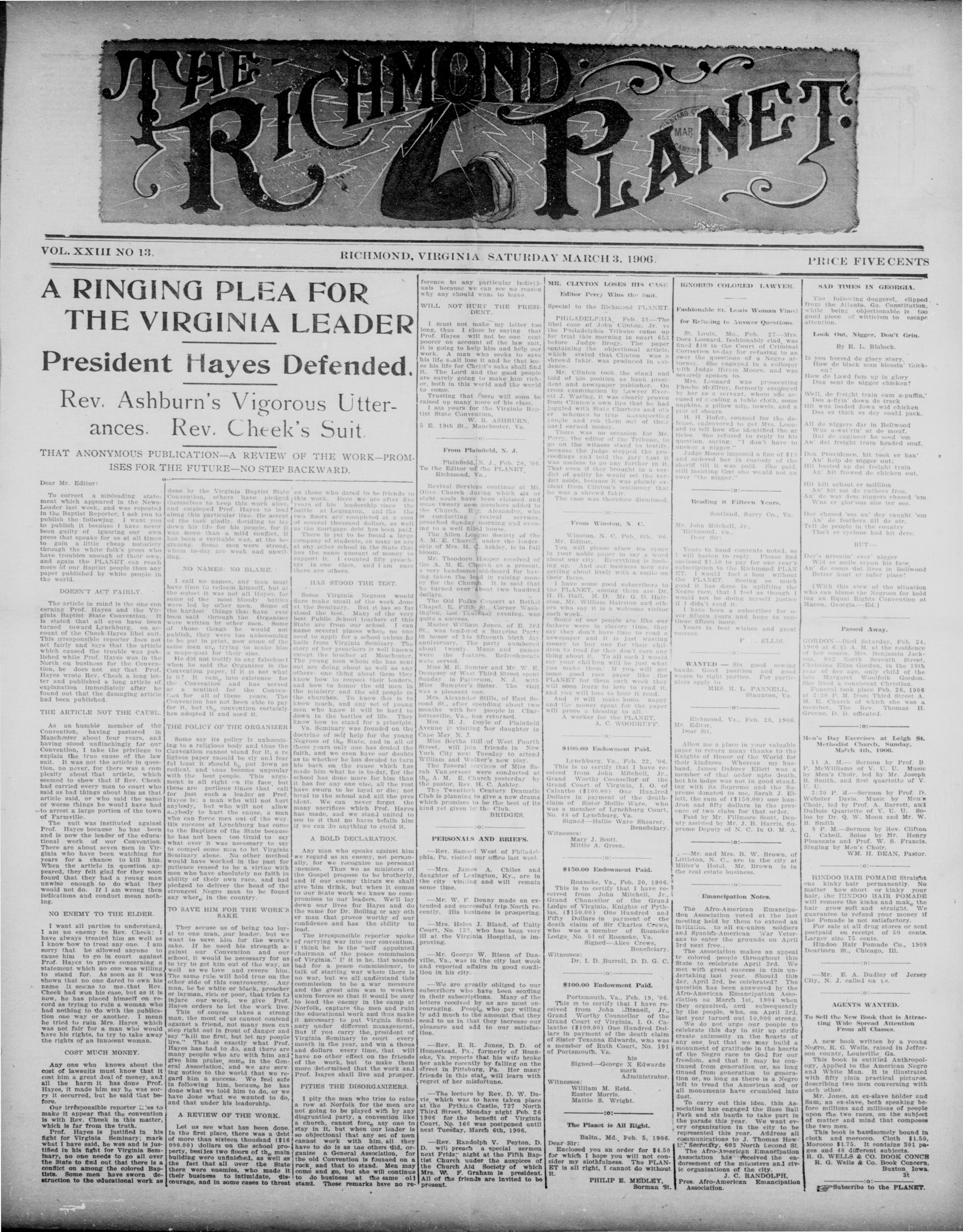
A RINGING PLEA FOR THE VIRGINIA LEADER President Hayes Defended. Rev. Ashburn's Vigorous Utterances. Rev. Cheek's Suit.
THAT ANONYMOUS PUBLICATION-A REVIEW OF THE WORK-PROMISES FOR THE FUTURE-NO STEP BACKWARD
VOL. XXIII NO 13.
A RINGI
THE V
President
Rev. Ashb
ances.
THAT ANONYMOUS PU
ISES FOR T
Dear Mr. Editor:
To correct a misleading statement which appeared in the News-Leader last week, and was repeated in the Baptist Reporter, I ask you to publish the following. I want you to publish it because I have never been guilty of ignoring our own press that speaks for us at all times to gain a little cheap notoriety through the white folk's press who have troubles around their own, and again the PLANET cover each more of our Baptist people than any paper published by white people in the world.
DOESN'T ACT FAIRLY.
The article in mind is the one concerning Prof. Hayes and the Virginia Baptist State Convention. It is stated that all eyes have been turned toward Lynchburg, on account of the Cheek-Hayes libel suit. This irresponsible reporter does not act fairly and says that the article which caused the trouble was published while Prof. Hayes was in the Convention, he does not say that Prof. Hayes wrote Rev. Cheek a long letter and published a long article of explanation immediately after he found out that the damaging article had been published.
THE ARTICLE NOT THE CAUSE
As an humble member of the Convention, having pastored in Manchester about four years, and having stood unlinearly for our Convention, I take the privilege to explain the true cause of the law suit. It was not the article in question, no never, for there was a complexity about that article, which seemed to show that if Rev. Cheek had carried every man to court who said as bad things about him as that article said, or who said the same or worse things he would have had to arrest a large portion of the town of Farmville.
The suit was instituted against Prof. Hayes because he has been and is now the leader of the educational work of our Convention. There are about seven men in Virginia who have been watching for years for a chance to kill him. When the article in question appeared, they felt glad for they soon found that they had a young man unwise enough to do what they would not do. If I am wrong then indications and conduct mean nothing.
NO ENEMY TO THE ELDER.
I want all parties to understand,
I am no enemy to Rev. Check; I
have always treated him as well as
I know how to treat any one. I am
sorry that he allowed anyone to
cause him to go in court against
Prof. Haycs to prove concerning a
statement which no one was willing
to stand for. As soon as it was
shown that no one dared to own his
name it seems to me that Rev.
Cheek had won his case, but as it is
now, he has placed himself on record
as trying to ruin a woman who
had nothing to do with the publication
one way or another. I mean
he tried to ruin Mrs. Haycs, which
was not fair for a man who would
have his rights, to try to take away
the rights of an innocent woman.
COST MUCH MONEY.
Any one who knows about the cost of lawsuits must know that it cost him a great deal of money, and all the harm it has done Prof. Hayes, it made him say he was sorry it occurred, but he said that before.
Our irrresponsible reporter tries to make it appear that the convention is with Rev. Cheek in this matter, which is far from the truth.
Prof. Hayes is justified in his fight for Virginia Seminary; mark what I have said, he was and is justified in his fight for Virginia Seminary, no one needs to go all over the State to find out that there is a conflict on among the colored Baptists. Some men have sworn destruction to the educational work as
done by the Virginia Baptist State Convention, others have pledged themselves to keep this work alive, and employed Prof. Hayes to lead along this particular line. He accepted the task gladly, deciding to lay down his life for his people, for it was more than a mild conflict, it has been a veritable war, at the beginning. Some men were strong, whom to-day are weak and unwilling.
NO NAMES: NO BLAME
I call no names, any man must have time to redeem himself, but at the outset it was not all Hayes, for some of the most bloody battles were led by other men. Some of the hardest things that have ever been said through the Organizer were written by other men. Some of those things he would not publish, they were too unbecoming to be put in print, now some of the same man ar e trying to make him a hero to tell his sins. He did not testify to my falsehood when he said the Organizer is the Convention paper, if it is not what is it? It can, into existence for the Convention and has served as a sentinel for the Convention for all of these years. The Convention has not been able to pay for it, but the convention certainly has adopted it and used it.
THE POLICY OF THE ORGANIZER
Some say its policy is unbecoming to a religious body and thus the Convention cannot stand for it, a religious paper should be sly and fear ful least it should $b_e$ put down as radical and, unusus be unpolar with the best people. This argument is all right on its face, but these are perilous times that call for just such a leader as Prof. Hayes is; a man who will not hurt anybody, but who will not allow anybody to hurt the cause, a man who can force men out of the way. His success at Lynchburg has come to the Baptists of the State because he has not been too timid to say what ever it was necessary to say to compel some men to let Virginia alone. No one method would have worked in the past for patience ceased to be a virtue with men who have absolutely no faith in ability of their own race, and had pledged to deliver the head of the strongest Negro man to be found any where, in the country.
TO SAVE HIM FOR THE WORK'S SAKE
They accuse us of being too loyal to one man, our leader, but we want to save him for the work's sake. If he used his strength against our Convention and our school, it would be necessary for us to try to get him out of the way, as well as we love and revere him. The same rule will hold true on the other side of this controversy. Any man, he be white or black, preacher or layman, rich or poor, that tries to injure our work, we give Prof. Hayes orders to let the work live. This of course takes a strong man, the most of us cannot contend against a friend, not many men can step right out in front of danger and say "Kill me first, but let my people live." That is exactly what Prof. Hayes has had to do, and there are many people who are with him and give him praise, som<sub>0</sub> in the General Association, and we are serving notice to the world that we regard him a success. We feel safe in following him, because<sub>0</sub> he has done what we told him to do, or we have done what we wanted to do, and that under his leadership.
A REVIEW OF THE WORK
Let us see what has been done. In the first place, there was a debt of more than sixteen thousand ($16 000.00) dollars on the school property, besies two floors of the $th building were unfinished, as well as the fact that all over the State there were enemies, who made it their business to intimidate, discourage, and in some cases to threat
RICHMOND, VIRGINIA. SATURDAY MARCH 3. 1906
en those who dared to be friends to this work. Here we are after five years of his leadership since the battle at Lexington, and the the two floors are completed at a cost of several thousand dollars, as well as the mortgage debt has been paid. There is yet to be found a large company of students, as many as are at any other school in the State that has the same amount of money to support it. I counted fifty preachers in one class, and I am sure there are others.
HAS STOOD THE TEST
Some Virginia Negroes would dare make small of the work done at the Seminary. But it has so far stood the test. Many of the very best Public School teachers of this State are from our school. I can name several places where no one need to apply for a school unless he hails from Virginia Seminary. The story of her preachers is well known except the brother at Manchester. The young men whom she has sent out are doing about as well as any others: one thing about them they know how to respect their leaders, and how to honor the old men in the ministry and the old people in the churches. To know this is to know much, and any set of young men who know it will be hard to down in the battles of life. They know how to stand for a principle. Va. Seminary was founded on the doctrine of self help for the young Negroes of the State, and in all of these years only one has denied the faith, and we even have our doubts as to whether he has decided to turn aside on the cause which has made him that he is to-day, for the school has done so for him than it has for any one else; all the rest have sworn to be loyal or die; loyal to the school and kill the president. We can never forget the many sacrifices which Prof. Hayes has made, and we stand united to see to it that no harm befalls him if we can do anything to avoid it.
A BOLD DECLARATION
Any man who speaks against him we regard as an enemy, not personally, for we recognize no personal enemies. Thus we as ministers of the Gospel propose to be brotherly, and if our enemy thirsts we shall give him drink, but when it comes to our State work we know no compromises to our leaders. We'll lay down our lives for Hayes and do the same for Dr. Bolling or any other man that proves worthy of our confidence and has the ability to lead.
The irresponsible reporter spoke of carrying war into our convention. I think he is the "self appointed chairman of the peace commission of Virginia." If it is he, that sounds bad for a peace commission, to talk of starting war where there is no war, but we all understand this commission to be a war measure and the great aim was to weaken union forces so that it would be easy to lead the enemy in the camp at Norfolk, capture the men and ruin the educational work and thus make it necessary to put Virginia Seminary under different management, But if you carry the president of Virginia Seminary to court every month in the year, and win a thousand dollars every time, that will have no other effect on the friends of the work, but to make them more determined that the work and Prof. Hayes shall live and prosper.
PITIES THE DISORGANIZERS
I pity the man who tries to raise a row at Norfolk for the men are not going to be played with by any disgruntled party, a convention like a church, cannot force any one to stay in it, but when our leader is so objectional that any set of men cannot work with him, all they have to do is as the others tid, organize a General Association, for old motion is founded on a rock, and that man will come and go, but she will continue to do business at the same oil stand. These remarks have no re-
ference to any particular individuals because we can see no reason why any should want to leave.
WILL NOT HURT THE PRESH DENT
I must not make my letter too long, thus I close by saying that Prof. Hayes will not be one cent poorer on account of the law suit, it is going to help him and help our work. A man who seeks to save his life s.all lose it and he that loses his life for Christ's sake shall find it. The Lord and the good people are surely going to make him richer, both in this world and the world to come.
Trusting that there will soon be raised up many more of his class, I am yours for the Virginia Baptist State Convention, W. R. ASHBURN, 5 E. 19th St., Manchester, Va.
From Plainfield, N. J.
Platfield, N. J., Feb. 20, '06.
To the Editor of the PLANET
Richmond, Va.
Revival Services continue at Mt.
Olive Church during which six or
eight souls have been claimed and
some twenty new members added to
the Church. R. r. Alexander, who
is conducting revival services,
preached Sunday morning and evening
to a well filled house.
The Allen League Society of the
A. M. E. Church, under the leadership
of Mrs. H. C. Ashley, is in full bloom.
Mr. Theodore Hooper received of the
A. M. E. Church as a present,
a very handsome sideboard for having
taken the lead in raising money
for the Church. It is said that
he turned over about two hundred
dollars.
The Old Folks Concert at Bethel
Chapel, E. Fifth St. Corner Washington,
last Thursday evening, was quite successful.
Master William Jones, of E. 3rd St., was tendered a Surprise Party in honor of his fifteenth birthday anniversary. The party numbered about twenty. Music and games were the feature. Refreshments were served.
Miss M. E. Sumter and Mr. W. E. Dempsey of West Third Street spent Sunday in Patterson, N. J., with Miss Sumpter's Sister. The visit was a pleasant one.
Mrs. Alexander Stills, of East Second St., after spending about two months with her people in Charlottesville, Va., has returned.
Mrs. M. J. Doyle of Plainfield Avenue is visiting her daughter in Cape May N. J. Miss Bertha Hill of West Fourth Street, will join friends in New York City next Tuesday to attend William and Walker's new play. The funeral services of Miss Sara Vanierveer were conducted at the A. A. Church yesterday by the pastor, Rev. H. C. Ashby. The Twentieth Century Dramatic Club is planning to give a new drama which promises to be the best of its kind yet given by the Club.
PERSONALS AND BRIEFS
—Rev. Samuel West of Philadelphia, Pa. visited our office last week.
—Mrs. James A. Chiles and daughter of Lexington, Ky., are in the city visiting and will remain some time.
—Mr. W. F. Denny made an extended and successful trip. North recently. His business is prospering.
—Mrs. Helen J. Bland, of Unity Court, No. 132, who has been very ill at the Virginia Hospital, is improving.
—Mr. George W. Rison of Danville, Va., was in the city last week and reported affairs in good condition in his city.
—We are greatly obliged to our subscribers who have been sending in their subscriptions. Many of the letters received by us are most encouraging. People $ _{e} $ who pay willingly add much to the amount that they send to us in that they increase our pleasure and add to our satisfaction.
—Rev. R. R. Jones, D. D. of Homestead, Pa., formerly of Roanoke, Va. reports that his wife broke her ankle recently by falling on the street in Pittsburg, Pa. Her many friends in this state $ _{e} $ will learn with regret of her misfortune.
—The lecture by Rev. D. W. Davis, which was to have taken place at the Pythian Castle, 727 North Third Street, Monday night Feb. 26 1906 for the benefit of Virginia Court, No. 166 was postponed until next Tuesday, March 6th, 1906.
—Rev. Randolph V. Peyton, D. D. will preach a special sermon next Friday night at the Fifth Baptist Church under the auspices of the Church Aid Society of which Mrs. W. F. Graham is president. All of the friends are invited to be present.
MR. CLINTON LOSES HIS CASE
Editor Perry Wins the Suit.
Special to the Richmond PLANET
PHILADELPHIA, Feb. 21—The libel case of John 'Clinton' Jr. vs the Philadelphia Tribune came up for trial this morning in court 653 before Judge Bregy. The paper containing the objectional article, which stated that Clinton was a shrewd fakir, was produced in evidence.
Mr. Clinton took the stand and told of his position as bank president and newspaper publisher. On cross examination by Lawyer Everett J. Waring, it was clearly proven from Clinton's own lips that he had jugged with State Charters and other schemes to trap unsuspecting people and rob them out of their inland money.
There was no occasion for Mr. Perry, the editor of the Tribune, to go on the witness stand to testify, because the judge stopped the proceedings and told the jury that it was useless to go any further in it. That even if they brought in a verdict of guilty he would set the verdict aside, because it was plainly evident from Clinton's testimony that he was a shrewd fakir.
The case was therefore dismissed.
From Winston, N. C.
Winston, N. C. Feb. 6th, '06.
Mr. Editor.
You will please allow me space in your noble paper to say a word about our city. Everything is looking up. And our business men are getting about lively with a smile on their faces.
I have some good subscribers to the PLANET, among them are Dr. H. H. Hall, M. D. Mr. G. D. Hairston, William Hairston and others who say it is a welcome visitor each week.
Some of our people are like our fathers were in slavery time, they say they don't have time to read a newspaper and it is just wasting money to buy one for their children to read for they don't care anything about it. To all such I would say your children will be just what you make them. If you will get some good race paper like the PLANET for them each week they will soon learn to love to read it, and you will love to hear it read.
And it will make home, nappy and the money spent for the paper will prove a blessing to all.
A worker for the PLANET.
A. C. WOODRUFF
$100.00 Endowment Paid.
Lynchburg, Va., Feb. 22, '06.
This is to certify that I have received from John Mitchell, Jr.
Grand Worthy Counsellor of the Grand Court of Virginia, I. O. of Calanthe ($100.00) One Hundred Dollars in payment of the deathclaim of Sister Mollie Ware, who was a member of Lynchburg Court.
No. 48 of Lynchburg, Va.
Signed—Hallie Ware Shearer,
Beneficiary.
Witnesses:
Mary J. Scott.
Mittie A. Green.
$150,00 Endowment Paid.
Roanoke, Va., Feb. 20, 1906.
This is to certify that I have received from John Mitchell, Jr.,
Grand Chancellor of the Grand
Lodge of Virginia, Knights of Pythias,
($150.00) One Hundred and Fifty Dollars in payment of the death claim of Sir Charles Crews,
who was a member of Roanoke
Lodge, No. 51 of Roanoke, Va.
Signed—Alice Crews,
Beneficiary.
Witnesses:
Dr. I. D. Burrell, D. D. G. C.
$100.00 Endowment Paid
Portsmouth, Va., Feb. 19, '06.
This is to certify that I have received from John Littenell, Jr.,
Grand Worthy Counsellor of the
Grand Court of Virginia, I. O. Calanthe ($100.00) One Hundred Dollars in payment of the death claim of Sister Texanna Edwards, who was a member of Ruth Court, No. 191 of Portsmouth, Va.
his
Signed—George X Edwards
mark
Administrator.
Witnesses:
William M. Reid.
Easter Morris.
Mattie S. Wright.
The Planet is All Right.
Balto, Md., Feb. 5, 1906.
Dear Sir:
Enclosed you an order for $4.50
for which I hope you will not
consider my slothfulness. The PLAN-
ET is all right, I cannot do without
it.
PHILIP E. MEDLEY,
Sorman St.
Fashionable St. Louis Woman Fines
for Refusing to Answer Questions.
St. Louis, Mo., Feb. 27—Mrs. Dora Leonard, fashionably clad, was fined $10 in the Court of Criminal Correction to-day for refusing to an swer the questions of a Negro attorney. She engaged in a colloquy with Judge Hiram Moore, and was severely spoken to.
Mrs. Leonard was prosecuting Phoebe McElroy, formerly employed by her as a servant, whom she accused of scaling a table cloth, some napkins, a pillow slip, towels, and a pair of shears.
H. H Hofer, counsel for the defense, endeavored to get Mrs. Leonard to tell how she identified the articles. She refused to reply to his question, saying "I don't have to answer a nigger."
Judge Moore imposed a fine of $19 and ordered her in custody of the sheriff till it was paid. She paid, still insisting that she would not an swer "the nigger."
Reading it Fifteen Years
Scotland, Surry Co., Va.
Yours to hand contents noted, so! I will hasten to reply. Please find enclosed $1.50 to pay for one year's subscription to the Richmond PLANET. I would feel a loss without the PLANET. Seeing so much good it has done in uplifting the Negro race, that I feel as though I would not be doing myself justice if I didn't read it.
I have been a subscriber for over fifteen years and hope to continue fifteen more.
Yours in best wishes and great success.
WANTED — Six good sewing hands. Good position and good wages to right parties. For particulars apply to
MRS. R. L. PANNELL,
Staunton, Va.
Richmond, Va., Feb. 28, 1906.
Mr. Editor,
Dear Sir,
Allow me a place in your valuable paper to return many thanks to the Knights of Honor of the World for their kindness. Whereas my husband, James Dabney Ellett was a member of that order up to death, but his lodge was not in good standing with its Supreme and the Supreme donated to me Sarah J. Ellett, for $10,000 one hundred and fifty dollars in the presence of two clubs for that order.
Paid by Mr. Fillmore Scott, Deputy assisted by Mr. J. B. Harris, Supreme Deputy of M. C. In O. M. A.
, Mr. and Mrs. B. W. Brown, of Littleton, N. C., are in the city at Miller's Hotel. Mr. Brown is in the real estate business.
Emancipation Notes.
The Afro-American Emancipation Association voted at the last meeting held by them to extend an invitation to all ex-union soldiers and Spanish-American War Veterans to enter the grounds on April 3rd next free.
The Association makes an appeal to colored people throughout this State to celebrate April 3rd. We met with great success in this undertaking last year. Should this day, April 3rd, be celebrated? The question has been answered by the Afro-American Emancipation Association on March 1st, 1904 when they organized, and subsequently by the people, who, on April 3rd, last year turned out 10,000 strong.
We do not urge our people to celebrate this day to stir up strife create animosity in the hearts of any one, but that we may build a monument of gratitude in the hearts of the Negro race to God for our freedom, and that it may be continued from generation or, so long timed from generation to generation or, so long as there is a Negro left to tread the American sod, or all monuments have crumbled into dust.
To carry out this idea, this Association has engaged the Base Ball Park and six bands to take part in the parade this year. We want every organization in the city to be represented this year. Address all communications to J. Thomas Hewitt, Secretary, 603 North Second St. The Afro-American Emancipation Association has received the endorsement of the ministers and civil organizations of the city. J. C. RENDOLPH, Pres. Afro-American Emancipation
SAD TIMES IN GEORGIA.
The following doggerel, clipped from the Atlanta, Ga. Constitution, while being objectionable is too much piece of witticism to escape attention.
Look Out, Nigger. Don't Grin.
By R. L. Blalock
Is you heeled de glory story.
How de black man blessin' thicken?
How de Lawd fum up in glory
Dun sent de nigger chicken?
Well, de freight train cum a-puffin,' Des a-flin' down de track
Hit wuz loaded down wid chicken
Des ez thick ez dey pack.
All de niggers dar in Bellwood
Wuz a-wat'rin' at de mouf.
But de engineer he seed 'em
An' dat freight train headed souf.
Hir kit erbout er milion
An' hit sot de yuthers free,
An' de way dem niggers chased 'em
Wuz er glorous site ter see.
Dey chased 'em an' dey caught 'em
An' de feathers fill de air,
Tell de people in the country
Thot' er cyclone had hit dea
Dey's arrestin' ever' nigger
Wid er smile erpun his face.
An' de coons that lives in Bellwood
Better hunt er safer place!
[With this view of the situation
who can blame the Negroes for hold
ing an Equal Rights Convention at
Macon, Georgia.]—Ed.1
Passed Away.
GORDON—Died Saturday, Feb. 24, 1966 at 6:45 A.M. at the residence of her cousin, Mrs. Benjamin Jackson, 992 North Seventh Street, Christina Eliza Gordon, in the 18th year of her age, only child of the late Margaret Woolfolk Gordon. She lived a consistent Christian. She attended to place Feb. 26, 1966 at 3:30 A.M. from Third Street A. M. E. Church which she was a member. The Rev. Thomas H. Greene, D. D. officiated.
Men's Day Exercises at Leigh St.
Metinic Hall, Church Sunday,
May 16th, Mafi 11:30
11 A. M.—Sermon by Prof. B. F. McWilliams of V. U. U. Music by Men's Choir, led by Mr. Joseph B. Smith, and first quartette of V. U. U.
3:30 P. M.—Sermon by Prof. D. Webster Davis, Music by Mon's Choir, led by Prof. A. Barrett, and DuBois Quartette of V. U. U. Solos by Dr. Q. W. Moon and Mr. W. B. Smith
8 P. M.—Sermon by Rev. Clifton G. Cabell. Solos by Mr. Henry Pleasants and Prof. W. S. Francis. Singing by Men's Choir.
WM. H. DEAN, Pastor.
HINDOO HAIR POMADE Straightens kinky hair permanently. No matter how short or kinky your hair, the HINDOO HAIR POMADE will remove the kinks and make the hair grow soft and straight. We guarantee to refund your money if the Pomade is not satisfactory. Or sale at all drug stores or sent postpaid of 50 cents. Larger size 75 cents. Hindoo Hair Pomade Co., 1908 Dearborn St., Chicago, Ill.
—Mr. E. A. Dudley of Jersey City, N. J. called on ts.
AGENTS WANTED.
To Sell the New Book that is Attracting Wide Spread Attention From all Classes.
A new book written by a young Negro, R. G. Wells, raised in Jefferson county, Louisville, Ga.
This book is entitled Anthropology, Applied to the American Negro and White Man. It is illustrated with fifty plain practical pictures, describing two men conversing with each other.
Mr. Giles, an ex-slave holder and Sam; an ex-slave, both speaking before millions and millions of people upon the two races, on the subject of matter and mind that composes the two men.
This book is handsomely bound in cloth and morocco. Cloth $1.50, Morocco $1.75. It contains 301 pages and 48 different subjects.
R. G. WELLS & CO. BOOK CONCE
R. G. Wells & Co. Book Concern,
Buxton, Iowa.
3t
:0:
Subscribe to the PLANET.
THE
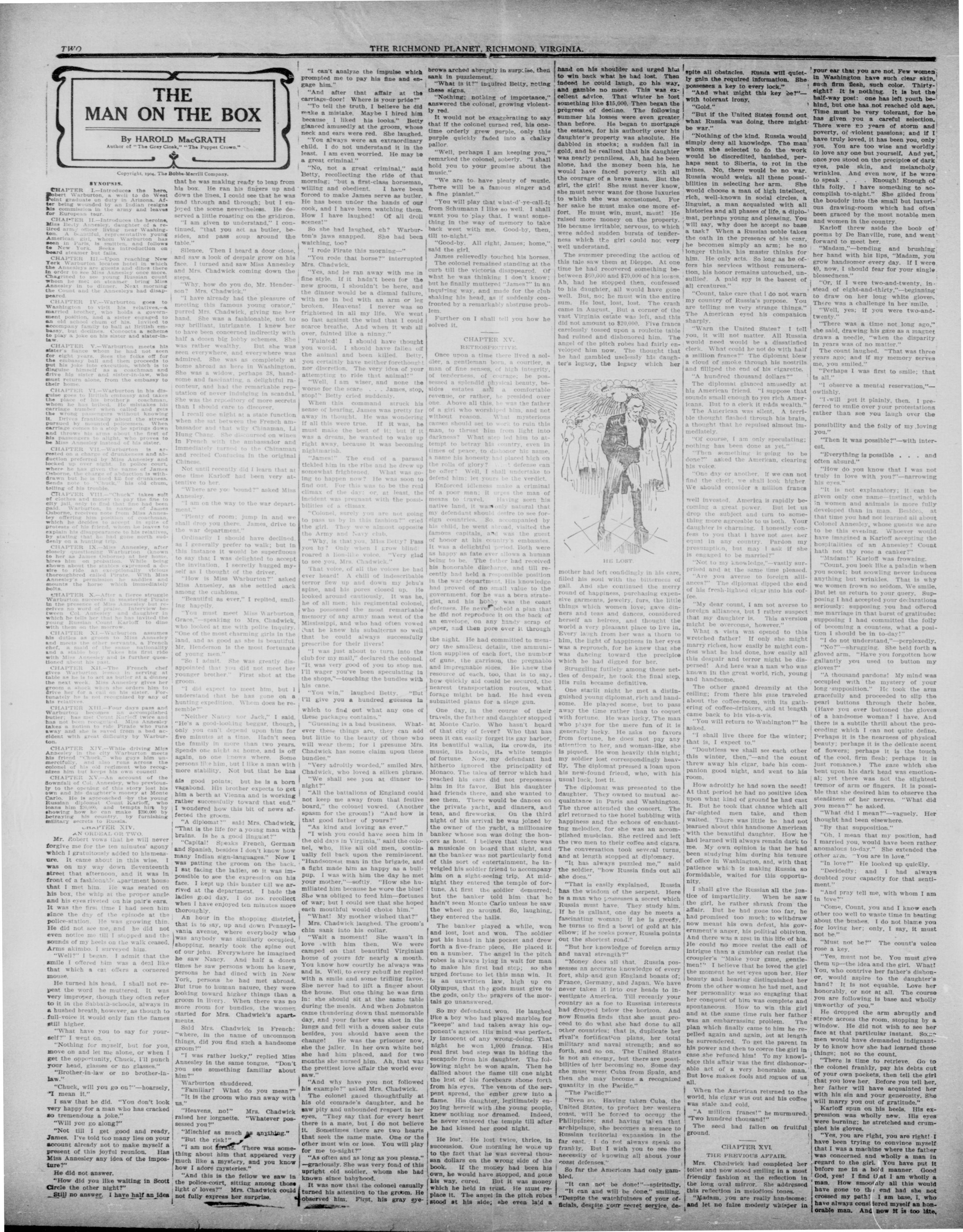
MAN ON THE BOX
By HAROLD MacGRATH
Author of "The Grey Cloak," "The Puppet Crown."
Copyright, 1904. The Bobbs-Merrill Company.
Copyright, 1904. The Bobbs-Merrill Company.
CHAPTER I.—Introduces the hero, Robert Warburton, a well to do West Point graduate on duty in Arizona. Afternoon wounded by an Indian resigns his commission to the army and leaves for European tour.
CHAPTER II.—Introduces the heroine, Miss Beaty Annesley, daughter of a retired army officer living near Washing- American. Beautiful representative young man seen in Paris, is smitten, and follows to New York. Seeks introduction on board steamer but fails.
CHAPTER III.—Upon reaching New York Warburton local hotel in which the Annesleyes are guests and dines there in order to see Miss Annesley once more. Chagrined to see young Russian count Annesley in to dinner. Next morning the Count and the Annesleyes had disappeared.
CHAPTER IV.—Warburton goes to Washington to visit his relatives—a married brother, who holds a government office, an old school chum of his, invited to accompany family to ball at British embassy, but declines. Concocts a scheme to play a joke on his sister and sister-in-
CHAPTER V.—Warburton meets his sister's flame whom he had not seen for eight years. See the folks off for proceed to put his poke into execution, to disguise himself as a coachman and drive his sister and sister-in-law, who must return alone, from the embassy to CHAPTER VI.—Warburton in his disguise goes to British embassy and takes the place of his brother's coachman, whom he has bribed. He mistakes his sister for a police officer. He the wrong passengers without knowing it. Drives frantically about the streets pursued by mounted policemen. When he meets a to stop his spiral down and throws his horse first, his passengers to alight, who proves to be Miss Annesley instead of his sister.
CHAPTER VII.—Warburton is arrested on a charge of drunkenness and abduction preferred by Miss Annesley and locked up in a prison, where he has given the name of James Osborne, the charge of abduction is withdrawn but he is fined $2 for drunkenness, his old chum, telling of his trouble.
CHAPTER VIII.—"Chuck" takes suit of clothes and money to pay the fine to city jail, only to find that fine had been Osborne, receives note from Miss Annesley offering him position of coachman, he decides to accept in spite of his dislike to the horse, explains his appearance to his relatives, by stating that he had gone north suddenly on a hunting trip.
CHAPTER IX.—Miss Annesley after being taken to her home to her as James Osborne) at her home, hires him on probation. While being shown about the stables expressed a desire to thoroughbred called Pirate. With Miss Annesley's permission he saddles and mounts the horse which immediately in CHAPTER X.—After a fierce struggle Warburtin succeeds in mastering Pirate in the presence of Miss Annesley but receives no word of trust, interruption and reckless in which he tells her that he has invited the young Russian Count Karloff to dine with them on the morrow. With Annesley the assistant assumes his duties as groomer to Miss Annesley and meets the other servants, a French chef, a maid of the same nationality and a stable boy. Takes his first ride with Mimi Osborne and is further questioned about his past.
CHAPTER XII.-The French chef gives Warburtion lesson in serving at table as he is to serve at a dinner table. He asks Amnesey to groom a shock when she orders him to drive her for a call on his sister. Fortunately he is not recognized by any of his relatives. Warburtion XIII.-Four days pass and Warburtion becomes an accomplished butler; has met Count Karloff twice and has not been recognized. Miss Amnesey takes a notion to ride Pirate who runs a ship to help Amnesey with great difficulty by Warburtion. CHAPTER XIV.-While driving Miss Amnesey in the city Warburtion meets his friend "Chuck," who guys him uncomfortably. He is the colonel of his old regiment who recognizes him but keeps his own council. CHAPTER XV.-An account of the downfall of Col Amnesey, who previously to the opening of this story lost his job in the country by burying military secrets to Russia.
CHAPTER XIV.
Mr. Robert vows that he will never forgive me for the ten minutes' agony which I gratuitously added to his measure. It came about in this wise. I was on my way down Seventeenth street that afternoon, and it was in front of a fashionable apartment house that I met him. He was seated on his box, the whip at the proper angle and his eyes riveted on his pair's ears. It was the first time I had seen him since the day of the episode at the police-station. He was growing thin. He did not see me, and he did not even notice me till I stopped and the sounds of my heels on the walk ceased. Arms akimbo. I surveyed him. "Well?" I began. I admit that the smile I offered him was a deal like that which a car offers a cornered mouse.
He turned his head. I shall not repeat the word he muttered. It was very improper, though they often refer to it in the Sabbath-schools, always in a hushed breath, however, as though to full-voice it would only fan the flames still higher.
"What have you to say for yourself?" I went on.
"Nothing for myself, but for you, move on and let me alone, or when I get the opportunity, Chuck, I'll punch your head, glasses or no glasses."
"Brother-in-law or no brother-in-law."
"Chuck, will you go on?"—hoarsely, "I mean it."
I saw that he did. "You don't look very happy for a man who has cracked so tremendous a joke."
"Not till I get good and ready,
James. I've told too many lies on your
account already not to make myself a
present of this joyful reunion.
Has Miss Annesley any idea of the imposture?
He did not answer.
"How did you like waiting in Scott
Circle the other night?"
Still no answer. I have half an idea
$YNOPS1S
"Will you go along?"
He did not answer.
that he was making ready to leap from his box. He ran his fingers up and down the lines. I could see that he was mad through and through; but I enjoyed the scene nevertheless. He deserved a little roasting on the gridiron. "I am given to understand," I continued, "that you act as butler, besides, and pass soup around the table."
Silence. Then I heard a door close, and saw a look of despair grow on his face. I turned and saw Miss Annesley and Mrs. Chadwick coming down the steps.
"Why, how do you do, Mr. Henderson? Mrs. Chadwick."
"I have already had the pleasure of meeting this famous young orator," purred Mrs. Chadwick, giving me her hand. She was a fashionable, not to say brilliant, intrigante. I knew her to have been concerned indirectly with half a dozen big lobby schemes. She was rather wealthy. But she was seen everywhere, and everywhere was admired. She was as completely at home abroad as here in Washington. She was a widow, perhaps 38, handsome and fascinating, a delightful raconteur, and had the remarkable reputation of never indulging in scandal. She was the repository of more secrets than I should care to discover.
I recall one night at a state function when she sat between the French ambassador and that wily Chinaman, Li Hung Chang. She discussed on wines in French with the ambassador and immediately turned to the Chinaman and recited Confucius in the original Chinese.
Not until recently did I learn that an one time Karloff had been very attentive to her.
"Where are you bound?" asked Miss Annesley.
"I am on the way to the war department."
"Plenty of room; jump in and we shall drop you there. James, drive to the war department."
Ordinarily I should have declined, as I generally prefer to walk; but in this instance it would be superfluous to say that I was delighted to accept the invitation. I secretly hugged myself as I thought of the driver.
"How is Miss Warburton?" asked Miss Annesley, as she settled back among the cushions.
"Beautiful as ever," I replied, smiling happily.
"You must meet Miss Warburton, Grace,"—speaking to Mrs. Chadwick, who looked at me with polite inquiry. "One of the most charming girls in the land, and as good as she is beautiful. Mr. Henderson is the most fortunate of young men."
"So I admit. She was greatly disappointed that you did not meet her younger brother." First shot at the groom.
"I did expect to meet him, but I understand that he has gone on a hunting expedition. Whom does he resemble?"
"Neither Nancy nor Jack," I said. "He's a good-looking beggar, though, only you can't depend upon him for five minutes at a time. Hadn't seen the family in more than two years, Spends one night at home, and is off again, no one knows where. Some persons like him, but I like a man with more stability. Not but that he has
his good points; but he is a born vagabond. His brother expects to get him a berth at Vienna and is working rather successfully toward that end." I wondered how this bit of news affected the groom.
"A diplomat?" said Mrs. Chadwick. "That is the life for a young man with brains. Is he a good linguist?" "Capital! Speaks French, German and Spanish, besides I don't know how many Indian sign-languages." Now I was patting the groom on the back. I sat facing the ladies, so it was impossible to see the expression on his face. I kept up this banter till we arrived at the department. I bade the ladies good day. I do no, recollect when I have enjoyed ten minutes more thoroughly.
An hour in the shopping district, that is to say, up and down Pennsylvania avenue, where everybody who was anybody was similarly occupied, shopping, nearly took the spine out of our jehu. Everywhere he imagined he saw Nancy. And half a dozen times he saw persons whom he knew, persons he had dined with in New York, persons he had met abroad. But true to human nature, they were looking toward higher things than a groom in livery. When there was no more room for bundles, the women started for Mrs. Chadwick's apartments.
Said Mrs. Chadwick in French: "where, in the name of uncommon things, did you find such a handsome groom?"
"I was rather lucky," replied Miss Annesley in the same tongue. "Don't you see something familiar about him?"
Warburton shuddered.
"Familiar? What do you mean?"
"It is the groom who ran away with us."
"Heavens, no!" Mrs. Chadwick raised her lorgnette. "Whatever possessed you?"
"Mischief as much as anything."
"But the risk!"
"I am not afraid. There was something about him that appeared very much like a mystery, and you know how I adore raysteries."
"And this is the fellow we saw in the police-court, sitting among those light o' loves?" Mrs. Chadwick could not fully express her surprise.
THE RICHMOND PLANET. RICHMOND. VIRGINIA
"I can't analyze the impulse which prompted me to pay his fine and engage him."
"And after that affair at the carriage-door! Where is your pride?"
"To tell the truth, I believe he did make a mistake. Maybe I hired him because I liked his looks." Betty glanced amusedly at the groom, whose neck and ears were red. She laughed.
"You always were an extraordinary child. I do not understand it in the least. I am even worried. He may be a great criminal."
"No, not a great criminal," said Betty, recollecting the ride of that morning; "but a first-class horseman, willing and obedient. I have been forced to make James serve as butler. He has been under the hands of our cook, and I have been watching them. How I have laughed! Of all droll scenes!"
So she had laughed, eh? Warburton's jaws snapped. She had been watching, too?
"I rode Pirate this morning—"
"You rode that horse?" interrupted Mrs. Chadwick.
"Yes, and he ran away with me in fine style. If it hadn't been for the new groom, I shouldn't be here, and the dinner would be a dismal failure, with me in bed with an arm or leg broken. Heavens! I never was so frightened in all my life. We went so fast against the wind that I could scare breathe. And when it was all over, fainted like a ninny."
"Fainted! I should have thought you would. I should have fallen off the animal and been killed. Betty, you certainly have neither forethought nor discretion. The very idea of your attempting to ride that animal!
"Well, I am wiser, and none the worse for the scare . . . James, stop, stop!" Betty cried suddenly.
When this command struck his sense of hearing, James was pretty far away in thought. He was wondering if all this were true. If it was, he must make the best of it; but if it was a dream, he wanted to wake up right away, because it was becoming nightmarish.
"James!" The end of a parasol tickled him in the ribs and he drew up somewhat frightened. What was going to happen now? He was soon to find out. For this was to be the real climax of the day; or, at least, the incident was prescient with the possibilities of a climax.
"Colonel, surely you are not going to pass us by in this fashion?" cried the girl. They were almost opposite the Army and Navy club.
"Why, is that you, Miss Etty? Pass you by? Only when I grow blind: roared a lion-like voice. "Very glad to see you, Mrs. Chadwick."
That voice, of all the voices he had ever heard! A chill of indescribable terror flew up and down my jehb's spine, and his pores closed up. He looked around cautiously. It was he, he of all men; his regimental colonel, who possessed the most remarkable memory of any army man west of the Mississippi, and who had often vowed that he knew his subalterns so well that he could always successfully prescribe for their livers!
"I was just about to turn into the club for my mail," declared the colonel. "It was very good of you to stop me. I'll wager you've been speculating in the shops,"—touching the bundles with his cane.
"You win," laughed Betty. "But I'll give you a hundred guesses in which to find out what any one of these packages contains."
"Guessing is a bad business. What- ever these things are, they can add but little to the beauty of those who will wear them; for I presume Mrs. Chadwick has some claim upon these bundles."
"Very adroitly worded," smiled Mrs. Chadwick, who loved a silken phrase.
"We shall see you at dinner tonight?"
"All the battalions of England could not keep me away from that festive board," the colonel vowed. (Another spasm for the groom!) "And how is that good father of yours?"
"I wish you could have seen him in the old days in Virginia," said the colonel, who, like all old men, continually fell back upon the reminiscent. "Handsomest man in the brigade, and a fight made him as happy as a bull-pup. I was with him the day he met your mother,"—softly. "How she humiliated him because he wore the blue! She was obliged to feed him—fortunes of war; but I could see that she hoped each mouthful would choke him." "What! My mother wished that?" Mrs. Chadwick laughed. The groom's chin sink into his collar.
cinn sank into his collar.
"Walt a moment! She wasn't in love with him then. We were camped on that beautiful Virginian home of yours for nearly a month. You know how courtly he always was and is. Well, to every rebuff he replied with a smile and some trifling favor. She never had to lift a finger about the house. But one thing he was firm in: she should sit at the same table during the meals. And when Johnston came thundering down that memorable day, and your father was shot in the lungs and fell with a dozen saber cuts besides, you should have seen the change! He was the prisoner now, she the jailer. In her own white bed she had him placed, and for two months she nursed him. Ah, that was the prettiest love affair the world ever saw."
"And why have you not followed his example?" asked Mrs. Chadwick. The colonel gazed thoughtfully at his old comrade's daughter, and he saw pity and unbounded respect in her eyes. "They say that for every heart there is a mate, but I do not believe it. Sometimes there are two hearts that seek the same mate. One or the other must win or lose. You will play for me to-night?" "As often and as long as you please." —graciously. She was very fond of this upright old soldier, whom she had known since babyhood. It was now that the colonel casually turned his attention to the groom. He observed him. First, his gray eye-
brows arched abruptly in surprise, then sank in puzzlement.
"What is it?" inquired Betty, noting these signs.
"Nothing; nothing of importance," answered the colonel, growing violently red.
It would not be exaggerating to say that if the colonel turned red, his one-time orderly grew purple, only this purple quickly faded into a chalky pallor.
"Well, perhaps I am keeping you," remarked the colonel, soberly. "I shall hold you to your promise about the music."
"We are to have plenty of music. There will be a famous singer and a fine pianist."
"You will play that what-d'ye-call-it from Schumann I like so well. I shall want you to 'play that. I want something in the way of memory to take back west with me. Good-by, then, till to-night."
"Good-by. All right, James; home," sald the girl.
James relievedly touched his horses, the colonel remained standing at the curb till the victoria disappeared. Of what he was thinking I don't know; but he finally muttered "James" in an inquiring way, and made for the club shaking his head, as if suddenly confronted by a remarkably abstruse problem.
Further on I shall tell you how he solved it.
CHAPTER XV.
Once upon a time there lived a soldier, a gentleman born, a courrier, a man of fine senses, of high integrity, of tenderness, of courage; he possessed a splendid physical beauty, besides estates and a comfortable revenue, or rather, he presided over one. Above all this, he was the father of a girl who worshiped him, and not without reason. What mysterious causes should set to work to ruin this man, to thrust him from light into darkness? What step led him to attempt to betray his country, even in times of peace, to dishonor his name, a name his honesty had placed high on the rolls of glory? What defense can he offer? Well, I shall undertake to defend him; let yours be the verdict.
Enforced idleness make a criminal of a poor man; it urges the man of means to travel. Having seen his native land, it was only natural that my defendant should desire to see foreign countries. So accompanied by his child, he went abroad, visited the famous capitals, and was the guest of honor at his country's embassies. It was a delightful period. Both were as happy as fate ever allows a human being to be. The father had received his-holded discharge, and till recently had held a responsible position in the war department. His knowledge had proved of no small value to the government, for he was a born strategist, and his hobby was the coast defenses. He never beheld a plan that he did not reproduce it on the back of an envelope, on any handy scrap of paper, and then pore over it through
the night. He had committed to memory the smallest details, the ammunition supplies of each fort, the number of guns, the garrison, the pregnable and impregnable sides. He knew the resource of each, too, that is to say, how quickly aid could be secured, the nearest transportation routes, what forage might be had. He had even submitted plans for a sledge gun.
One day, in the course of their travels, the father and daughter stopped at Monte Carlo. Who hasn't heard of that city of fever? Who that has seen it can easily forget its gay harbor, its beautiful walks, its crowds, its music, its hotels, its white temple of fortune. Now, my defendant had hitherto ignored the principality of Monaco. The tales of terror which had reached his ears did not prepossess him in its favor. But his daughter had friends there, and she wanted to see them. There would be dances on the private yacht, and dinners, and teas, and fireworks. On the third night of his arrival he was joined by the owner of the yacht, a millionaire banker whose son was doing the honors as host. I believe that there was a musicale on board that night, and as the banker was not particularly fond of this sort of entertainment, he inveigled his soldier friend to accompany him on a sight-seeing trip. At midnight they entered the temple of fortune. At first the soldier demurred; but the banker told him that he hadn't seen Monte Carlo unless he saw the wheel go around. So, laughing, they entered the halls.
The banker played a while, won and lost, lost and won. The soldier put his hand in his pocket and drew forth a five-franc piece. He placed it on a number. The angel in the pitch robes is always lying in wait for man to make his first bad step; so she urged fortune to let this man win. It is an unwritten law, high up on Olympus, that the gods must give to the gods, only the prayers of the mortals go unanswered.
So my defendant won. He laughed like a boy who had played marbles for "keeps" and had taken away his opponent's agates. His mind was perfectly innocent of any wrong-doing. That night he won 1,000 francs. His real first bad step was in hiding the escapade from his daughter. The following night he won again. Then he dalled about the flame till one night the list of his forebears shone forth from his eyes. The venom of the serpent spread, the ember grew into a flame. His daughter, legitimately enjoying herself with the young people, knew nothing nor dreamed. Indeed, he never entered the temple till after he had kissed her good night.
He lost. He lost twice, thrice, in succession. One morning he woke up to the fact that he was several thousand dollars on the wrong side of the book. If the money had been his own, he would have stopped, and gone his way, cured. But it was money which he held in trust. He must replace it. The angel in the pitch robes stood at his side; she even laid a
hand on his shoulder and urged him to win back what he had lost. Then indeed he could laugh, go his way, and gamble no more. This was excellent advice. That winter he lost something like $15,000. Then began the progress of decline. The following summer his losses were even greater than before. He began to mortgage the estates, for his authority over his daughter's property was absolute. He dabbled in stocks; a sudden fall in gold, and he realized that his daughter was nearly penniless. Ah, had he been alone, had the money been his, he would have faced poverty with all the courage of a brave man. But the girl, the girl! She must never know, she must never want for those luxuries to which she was accustomed. For her sake he must make one more effort. He must win, must, must! He raised more money on the property. He became irritable; nervous, to which were added sudden bursts of tenderness which the girl could not very well understand.
The summer preceding the action of this tale saw them at Dippe. At one time he had recovered something be between $90,000 and $70,000 of his losses. Ah, had he stopped then, confessed to his daughter, all would have gone well. But, no; he must win the entire sum. He lost, lost, lost. The crash came in August. But a corner of the vast Virginia estate was left, and this did not amount to $20,000. Five francs carelessly tossed upon a roulette table had ruined and dishonored him. The angel of the pitch robes had fairly enveloped him now. The thought that he had gambled uselessly his daughter's legacy, the legacy which her
A
HE LOST.
mother had left confidingly in his care, filled his soul with the bitterness of gall. And she continued the merry round of happiness, purchasing expensive garments, jewelry, furs, the little things which women love; gave dinners and teas and dances, considered herself an helix, and thought the world a very pleasant place to live in. Every laugh from her was a thorn to him, the light of happiness in her eyes was a reproach, for he knew that she was dancing toward the precipe which he had digged for her.
Struggling fuitely among these nettles of despair, he took the final step. His ruin became definitive.
One starlit night he met a distinguished young diplomat, rich and handsome. He played some, but to pass away the time rather than to coquet with fortune. He was lucky. The man who plays for the mere fun of it is generally lucky. He asks no favors from fortune, he does not pay any attention to her, and woman-like, she is piqued. He won heavily this night; my soldier lost correspondingly heavily. The diplomat pressed a loan upon his new-found friend, who, with his usual luck, lost it.
The diplomat was presented to the daughter. They owned to mutual acquaintance in Paris and Washington. The three attended the concert. The girl returned to the hotel bubbling with happiness and the echoes of enchanting melodies, for she was an accomplished musician. She retired and left the two men to their coffee and cigars. The conversation took several turns, and at length stopped at diplomacy.
"It has always puzzled me," said the soldier, "how Russia finds out all she does."
"That is easily explained. Russia has the wisdom of the serpent. Here is a man who possesses a secret which Russia must have. They study him. If he is gallant, one day he meets a fascinating woman; if he is greedy, he turns to find a bowl of gold at his elbow; if he seeks power, Russia points out the shortest road."
"But her knowledge of foreign army and naval strength?"
"Money does all that. Russia possesses an accurate knowledge of every fort, ship and gun England boasts of; France, Germany, and Japan. We have never taken it into our heads to investigate America. Till recently your country as a foe to Russian interests had dropped below the horizon. And now Russia finds that she must proceed to do what she had done to all other countries; that is, duplicate her rival's fortification plans, her total military and naval strength; and so forth, and so on. The United States is not an enemy, but there are possibilities of her becoming so. Some day she must wrest Cuba from Spain, and then she may become a recognized quantity in the Pacific."
"Even so. Having taken Cuba, the United States, to protect her western coast, will be forced to occupy the Philippines; and having taken that archipelago, she becomes a menace to Russian territorial expansion in the far east. I do not always speak so frankly. But I wish you to see the necessity of knowing all about your coast defenses."
So far the American had only gambled.
"It can not be done!"—spiritedly.
"It can and will be done." smiling.
"Despite the watchfulness of your officials, despite your secret service, de-
spite all obstacles. Russia will quietly gain the required information. She possesses a key to every lock."
"And what might this key be?"—with tolerant irony.
"Gold."
"But if the United States found out what Russia was doing, there might be war."
"Nothing deny all knowledge. Russia would simply deny all knowledge. The man whom she selected to do the work would be discredited, banished, perhaps sent to Siberia, to rot in the mines. No, there would be no war. Russia would weigh all these possibilities in selecting her arm. She would choose a man of high intellect, rich, well-known in social circles, a linguist, a man acquainted with all histories and all phases of life, a diplomat, perhaps young and pleasing. You will say, why does he accept so base a task? When a Russian noble takes the oath in the presence of his czar, he becomes simply an arm; he no longer thinks, his master thinks for him. He only acts. So long as he offers his services without remuneration, his honor remains untouched, unsullied. A paid spy is the basest of all creatures."
"Count, take care that I do not warn my country of Russia's purpose. You are telling me very strange things." The American eyed his companion sharply.
"Warn the United States? I tell you, it will not matter. All Russia would need would be a dissatisfied clerk. What could he not do with half a million francs?" The diplomat blew a cloud of smoke through his nostrils and filled the end of his cigarette.
"A hundred thousand dollars?"
The diplomat glanced amusedly at his American friend. "I suppose that sounds small enough to you rich Americans. But to a clerk it reads wealth."
"Of course, I am only speculating; nothing has been done as yet."
"Then something is going to be done?" asked the American, clearing his voice.
"One day or another. If we can not find the clerk, we shall look higher. We should consider a million francs well invested. America is rapidly becoming a great power. But let us drop the subject and turn to something more agreeable to us both. Your daughter is charming. I honestly confess to you that I have not met her equal in any country. Pardon my presumption, but may I ask if she is engaged to be married?
"Not to my knowledge"—vastly surprised and at the same time pleased.
"Are you averse to foreign alliances?" The diplomat dipped the end of his fresh-lighted clear into his coffee.
"My dear count, I am not averse to foreign alliances, but I rather suspect that my daughter is. This aversion might be overcome, however."
What a vista was opened to this wretched father! If only she might marry riches, how easily he might confess what he had done, how easily all this despair and terror might be dispersed! And here was a man who was known in the great world, rich, young and handsome.
The other gazed dreamily at the ceiling; from there his gaze traveled about the coffee-room, with its gathering of coffee-drinkers, and at length came back to his vis-a-vis.
"You will return to Washington?" he asked.
"I shall live there for the winter; that is, I expect to."
"Doubtless we shall see each other this winter, then,"—and the count threw away his cigar, bade his companion good night, and went to his room.
How adroitly he had sown the seed! At that period he had no positive idea upon what kind of ground he had cast it. But he took that chance which all far-sighted men take, and then waited. There was little he had not learned about this handsome American with the beautiful daughter. How he had learned will always remain dark to me. My own opinion is that he had been studying him during his tenure of office in Washington, and, with that patience which is making Russia so formidable, waited for this opportunity.
I shall give the Russian all the justice of impartiality. When he saw the girl, he rather shrank from the affair. But he had gone too far, he had promised too much; to withdraw now meant his own defeat, his government's anger, his political oblivion. And there was a zest in this life of his. He could no more resist the call of intrigue than a gambler can resist the croupler's "Make your game, gentlemen!" I believe that he loved the girl the moment he set eyes upon her. Her beauty and bearing distinguished her from the other women he had met, and her personality was so engaging that her conquest of him was complete and spontaneous. How to win this girl and at the same time ruin her father was an embarrassing problem. The plan which finally came to him he repelled again and again, but at length he surrendered. To get the parent in his power and then to coerce the girl in case she refused him. To my knowledge this affair was the first dishonorable act of a very honorable man. But love makes fools and rogues of us all.
When the American returned to the world, his cigar was out and his coffee was stale and cold.
"A million frances!" he murmured.
"Two hundred thousand!"
The seed had fallen on fruitful ground.
CHAPTER XVI
THE PREVIOUS AFFAIR
Mrs. Chadwick had completed her toilet and now stood smiling in a most friendly fashion at the reflection in the long oval mirror. She addressed this reflection in melodious tones. "Madam, you are really handsome; and let no falze modestly whisper in
your ear that you are not. Few women in Washington have such clear skin, such firm flesh, such color. Thirty-eight? It is nothing. It is but the half-way post: one has left youth behind, but one has not reached old age. Time must be very tolerant, for he has given you a careful selection. There were no years of storm and poverty, of violent passions; and if I have truly loved, it has been you, only you. You are too wise and worldly to love any one but yourself. And yet, once you stood on the precipice of dark eyes, pale skin, and melancholy wrinkles. And even now, if he were to speak . . . Enough! Enough of this folly. I have something to accomplish to-night." She glided from the boudolr into the small but luxurious drawing-room which had often been graced by the most notable men and women in the country.
Karloff threw aside the book of poems by De Baville, rose, and went forward to meet her.
"Madam,"—bending and brushing her hand with his lips, "Madam, you grow handsomer every day. If I were 40, now, I should fear for your single blessedness."
"Or, if I were two-and-twenty, instead of eight-and-thirty,"—beginning to draw on her long white gloves. There was a challenge in her smile.
"Well, yes; if you were two-and-twenty."
"There was a time not long ago," she said, drawing his gaze as a magnet draws a needle, "when the disparity in years was of no matter."
The count laughed. "That was three years ago; and if my memory serves me, you smiled."
"Perhaps I was first to smile; that is all."
"I observe a mental reservation,"—owlishly.
"I-will put it plainly, then, I preferred to smile over your protestations, rather than see you laugh over the possibility and the folly of my loving you."
"Then it was possible?"—with interest.
"Everything is possible . . . and often absurd."
"How do you know that I was not truly in love with you?"—narrowing his eyes.
"It is not explanatory; it can be given only one name—instinct, which in women and animals is more fully developed than in man. Beside, at that time you had not learned all about Colonel Annesley, whose guests we are to be this evening. Whoever would have imagined a Karloff accepting the hospitalities of an Annesley? Count hath not thy rose a canker?"
"Madam!" Karloff was frowning.
Hallam: Harlan was rowing.
"Count, you look like a paladin when you scowl; but scowling never induces anything but wrinkles. That is why we women frown so seldom. We smile. But let us return to your query. Supposing I had accepted your declarations seriously: supposing you had offered me marriage in that burst of gratitude; supposing I had committed the folly of becoming a countess, what a position I should be in to-day!"
"I do not understand."—perplexedly.
"No?"—shrugging. She held forth a gloved arm. "Have you forgotten how gallantly you used to button my gloves?"
"A thousand pardons! My mind was occupied with the mystery of your long-supposition." He took the arm gracefully and proceeded to slip the Pearl buttons through their holes. (Have you ever buttoned the gloves of a handsome woman? I have. And there is a subtle thrill about the proceeding which I can not quite define. Perhaps it is the nearness of physical beauty; perhaps it is the delicate scent of flowers; perhaps it is the touch of the cool, firm flesh; perhaps it is just romance.) The gaze which she bent upon his dark head was emotional; yet there was not the slightest tremor of arm or fingers. It is possible that she desired him to observe the steadiness of her nerves. "What did you mean?" he asked.
"What did I mean?"—vaguely. Her thought had been elsewhere.
"By that supposition."
"Oh, I mean that my position, had I married you, would have been rather anomalous to-day." She extended the other arm. "You are in love."
"In love?" He looked up quickly.
"Decidedly; and I had always doubted your capacity for that sentiment."
"And pray tell me, with whom I am in love?"
"Come, Count, you and I know each other too well to waste time in beating about the bushes. I do not blame you for loving her; only, I say, it must not be."
"Must not be?" The count's voice rose a key.
"Yes, must not be. You must give them up—the idea and the girl. What! You, who contrive her father's dishonor, would aspire to the daughter's hand? It is not equable. Love her honorably, or not at all. The course you are following is base and wholly unworthy of you."
He dropped the arm abruptly and strode across the room, stopping by a window. He did not wish to see her face at that particular instant. Some men would have demanded indignantly to know how she had learned these things; not so the count.
"There is time to retrieve. Go to the colonel frankly, pay his debts cut of your own pockets, then tell the girl that you love her. Before you tell her, her father will have acquainted her with his sin and your generosity. She will marry you out of gratitude."
Karloff spun on his heels. His expression was wholly new. His eyes were burning; he stretched and crumpled his gloves.
"Yes, you are right, you are right! I have been trying to convince myself that I was a machine where the father was concerned and wholly a man in regard to the girl. You have put it before me in a bold manner. Good God, yes! I find that I am wholly a man. How smoothly all this would have gone to the end had she not crossed my path! I am base, I, who have always considered myself an honorable man. And now it is too late."
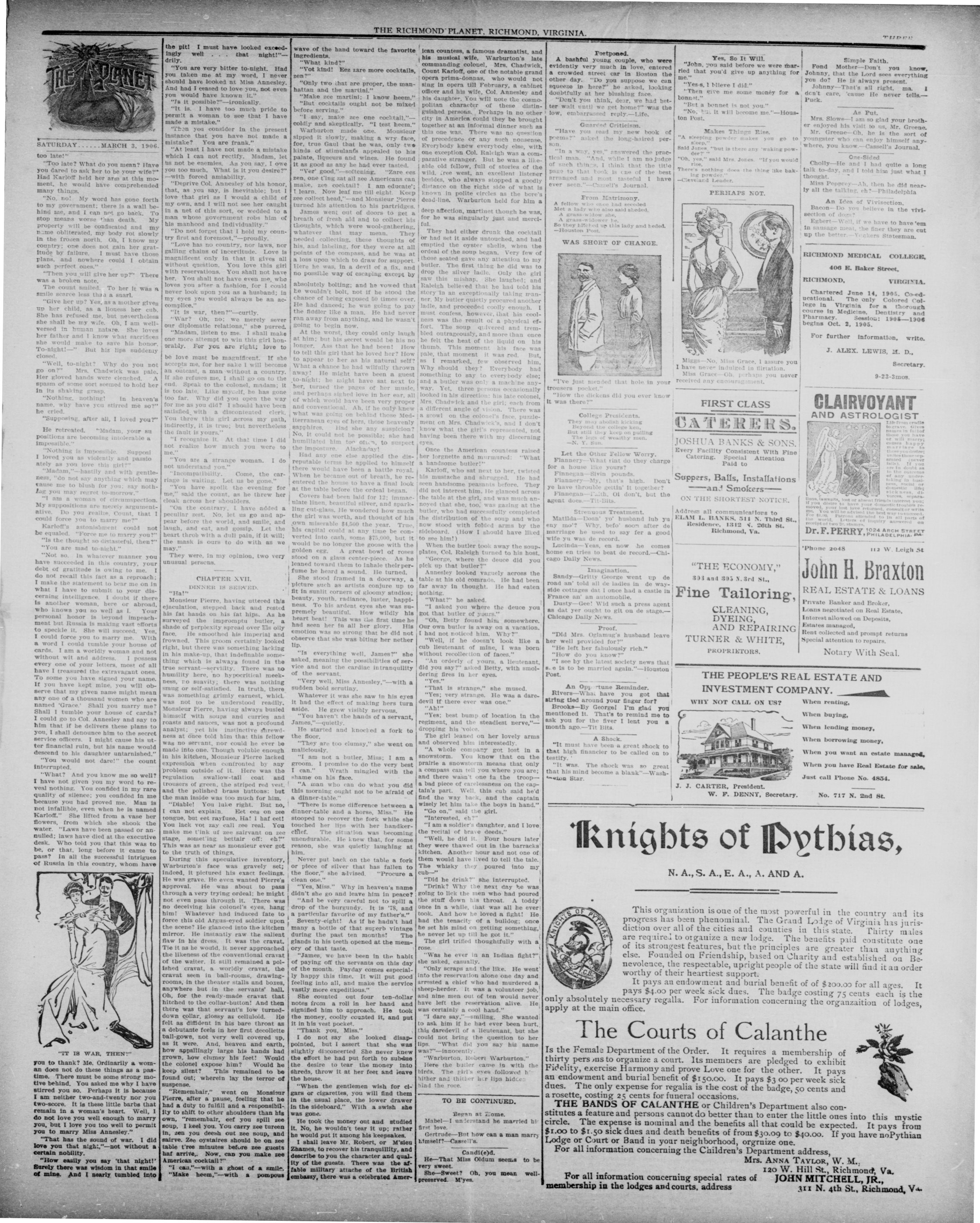
THE PLANET
"Too late? What do you mean? Have you dared to ask her to be your wife?" Had Karloff held her arm at this moment, he would have comprehended many things.
"No, no! My word has gone forth to my government; there is a wall behind me, and I can not go back. To stop means worse than death. My property will be confiscated and my name obliterated, my body rot slowly in the frozen north. Oh, I know my country; one does not gain her gratitude by failure. I must have those plans, and nowhere could I obtain such perfect ones."
"Then you will give her up?" There was a broken note.
The count smiled. To her it was a smile scarce less than a snarl.
"Give her up? Yes, as a mother gives up her child, as a lioness her cub. She has refused me, but nevertheless she shall be my wife. Oh, I am well-versed in human nature. She loves her father and I know what sacrifices she would make to save his honor. To-night!-" But his lips suddenly closed.
"Well, to-night? Why do you not go on?" Mrs. Chadwick was pale. Her gloved hands were clenched. A spasm of some sort seemed to hold her in its shaking grasp.
"Nothing, nothing! In heaven's name, why have you stirred me so?" he cried.
"Supposing, after all, I loved you?"
He retreated. "Madam, your supositions are becoming intolerable a impossible."
"Nothing is impossible. Supposi I loved you as violently and passio ately as you love this girl?"
"Madam,"—hastily and with gentleness, "do not say anything which may cause me to blush for you; say nothing you may regret to-morrow."
"I am a woman of circumspection. My suppositions are merely argumentative. Do you realize, Count, that I could force you to marry me?"
Karloff's astonishment could not be equaled. "Force me to marry you?"
"Is the thought so distasteful, then?"
"You are mad to-night."
"Not so. In whatever manner you have succeeded in this country, your debt of gratitude is owing to me. I do not recall this fact as a reproach; I make the statement to bear me on in what I have to submit to your discerning intelligence. I doubt if there is another woman, here or abroad, who knows you so well as I. Your personal honor is beyond impeachment but Russia is making vast efforts to speckle it. She will succeed. Yes, I could force you to marry me. With a word I could tumble your house of cards. I am a worldly woman and not without wit and address. I possess every one of your letters, most of all have I treasured the extravagant ones. To some you have signed your name. If you have kept mine, you will observe that my given name might mean any one of a thousand women who are named 'Grace.' Shall you marry me? Shall I tumble your house of cards? I could go to Col. Annesley and say to him that if he delivers these plans to you, I shall denounce him to the secret service officers. I might cause his utter financial ruin, but his name would descend to his daughter unattnished." "You would not dare!" the count interrupted.
"What? And you know me so well? I have not given you my word to reveal nothing. You confided in my rare quality of silence; you confided in me because you had proved me. Man is not infallible, even when he is named Karloff." She lifted from a vase her flowers, from which she shook the water. "Laws have been passed or annulled; laws have died at the executive desk. Who told you that this was to be, or that, long before it came to pass? In all the successful intrigues of Russia in this country whom have
A
"IT IS WAR, THEN?"
you to thank? Me. Ordinarily a woman does not do these things as a pastime. There must be some strong motive behind. You asked me why I have stirred you so. Perhaps it is because I am neither two-and-twenty nor you two-score. It is these little barbs that remain in a woman's heart. Well, I do not love you well enough to marry you, but I love you too well to permit you to marry Miss Annesley."
"That has the sound of war. I did love you that night,"—not without a certain nobility.
"How easily you say 'that night!' Surely there was wisdom in that smile of mine. And I nearly tumbled into
the pit! I must have looked exceedingly well . . . that night!"—drily.
"You are very bitter to night. Had you taken me at my word, I never should have looked at Miss Annesley. And had I ceased to love you, not even you would have known it."
"Is it possible?"—ironically.
"It is. I have too much pride to permit a woman to see that I have made a mistake."
"Then you consider in the present instance that you have not made a mistake? You are frank."
"At least I have not made a mistake which I can not rectify. Madam, let us not be enemies. As you say, I owe you too much. What is it you desire?"—with forced amiability.
"Deprive Col. Annesley of his honor, that, as you say, is inevitable; but I love that girl as I would a child of my own, and I will not see her caught in a net of this sort, or wedded to a man whose government robs him of his manhood and individuality."
"Do not forget that I hold my country first and foremost."—proudly.
"Love has no country, nor laws, nor galling chains of incertitude. Love is magnificent only in that it gives all without question. You love this girl with reservations. You shall not have her. You shall not have even me, who loves you after a fashion, for I could never look upon you as a husband; in my eyes you would always be an accomplice."
"It is war, then?"—curtly.
"War? Oh, no; we merely sever our diplomatic relations," she purred.
"Madam, listen to me. I shall make one more attempt to win this girl honorably. For you are right; love to
be love must be magnificent. If she accepts, for her sake I will become an outcast, a man without a country. If she refuses me, I shall go on to the end. Speak to the colonel, madam; it is too late. Like myself, he has gone too far. Why did you open the way for me as you did? I should have been satisfied, with a discontented clerk. You throw this girl across my path, indirectly, it is true; but nevertheless the fault is yours."
"I recognize it. At that time I did not realize how much you were to me."
"You are a strange woman. I do not understand you."
"Incompatibility. Come, the carriage is waiting. Let us be gone."
"You have spolit the evening for me," said the count, as he threw her cloak across her shoulders.
"On the contrary, I have added a peculiar zest. No, let us go and appear before the world, and smile, and laugh, and eat, and gossip. Let the heart throb with a dull pain, if it will; the mask is ours to do with as we may."
They were, in my opinion, two very unusual persons.
CHAPTER XVII
DINNER IS SEINVED.
"Ha!"
Monsieur Pierre, having uttered this ejaculation, stepped back and rested his fat hands on his fat hips. As he surveyed the impromptu butter, a shade of perplexity spread over his olly face. He smoothed his imperial and frowned. This groom certainly looked right, but there was something lacking in his make-up, that indefinable something which is always found in the true servant—servility. There was no humility here, no hypocritical meekness, no suavity; there was nothing smug or self-satisfied. In truth, there was something grimly earnest, which was not to be understood readily. Monsieur Pierre, having always busied himself with soups and curries and roasts and sauces, was not a profound analyst; yet his instinctive shrewdness at once told him that this fellow was no servant, nor could he ever be made into one. Though voluble enough in his kitchen, Monsieur Pierre lacked expression when confronted by any problem outside of it. Here was the regulation swallow-tall coat and trousers of green, the striped red vest, and the polished brass buttons: but the man inside was too much for him.
"Diable! You like right. But no, I can not explain. Eet ees on zee tongue, but eet rayfuse, Ha! I haf eel! You lack vot zay call zee real. You make me tink uf zee sairvant on zee stage, someting bettair off: eh" This was as near as monsieur ever got to the truth of things.
During this speculative inventory, Warburton's face was gravely set; indeed, it pictured his exact feelings. He was grave. He even wanted Pierre's approval. He was about to pass through a very trying ordeal; he might not even pass through it. There was no deceiving his colonel's eyes, hang him! Whatever had induced fate to force this old Argus-eyed soldier upon the scene? He glanced into the kitchen mirror. He instantly raw the salient flaw in his dress. It was the cravat. Tie it as he would, it never approached the likeness of the conventional cravat of the waiter. It still remained a polished cravat, a worldly cravat, the cravat seen in ball-rooms, drawing rooms, in the theater stalls and boxes, anywhere but in the servants' hall. Oh, for the ready-made cravat that hitched to the collar-button! And then there was that servant's low turned-down collar, glossy as celluloid. He felt as diffident in his bare throat as a debutante feels in her first decollette ball-gown, not very well covered up, as it were. And, heaven and earth, how appallingly large his hands had grown, how clumsy his feet! Would the colonel expose him? Would he keep silent? This remained to be found out; wherein lay the terror of suspense.
"Remembair," went on Monsieur Pierre, after a pause, feeling that he had a duty to fulfill and a responsibility to shift to other shoulders than his own, "remembair, eef you spill zee soup, I keel you. You carry zee tureen in, zen you deesh out zee soup, and sairie. Zee oystaires should be on zee table 'tree minutes before zee guests haf arrive. Now, can you make zee American cocktail?"
"I can,"—with a ghost of a smile, "Make heem,"—with a pompous
THE RICHMOND PLANET, RICHMOND, VIRGINIA
wave of the hand toward the favorite ingredients.
"What kind?"
"Vot kind! Eez zare more cocktails, zen?"
"Only two that are proper, the manhattan and the martini."
"Make zee martini! I know heem."
"But cocktails ought not be mixed before serving."
"I say, make zee one cocktail,"—coldly and skeptically, "I test heem."
Warburton made one. Monsieur slipped it slowly, making a wry face, for, true Gaul that he was, only two kinds of stimulants appealed to his palate, illeurs and wines. He found it as good as any he had ever tasted.
"Ver good,"—softening. "Zare eeszen, one 'ligt zat all aee Americans can make, zee cocktail? I am educate! I learn. Now leaf me till eight. Keep zee collect head,"—and Monsieur Pierre turned his attention to his parridges.
James went out of doors to get a breath of fresh aid and to collect his thoughts, which were wool-gathering, whatever that may mean. They needed collecting, these thoughts of his, and labeling, for they were at all points of the compass, and he was at a loss upon which to draw for support. Here he was, in a devil of a fix, and no possible way of escaping except by absolutely bottling; and he vowed that he wouldn't bolt, not if he stood the chance of being exposed 50 times over. He had danced; he was going to pay the fiddler like a man. He had never ran away from anything, and he wasn't going to begin now.
At the worst, they could only laugh at him; but his secret would be his no longer. Ass that he had been! How to tell this girl that he loved her? How to appear to her as his natural self? What a chance he had wilfully thrown away! He might have been a guest to-night; he might have sat next to her, turned the pages of her music, and perhaps sighed love in her ear, all of which would have been very proper and conventional. Ah, if he only knew what was going on behind those Mediterranean eyes of hers, those heavenly sapphires. Had she any suspicion? No, it could not be possible; she had humiliated him too often, to suspect the imposture. Alackaday! Had any one else applied the disreputable terms he applied to himself there would have been a battle royal. When he became out of breath, he reentered the house to have a final look at the table before the ordeal began.
Covers had been laid for 12; immaculate linen, beautiful silver, and sparkling cut-glass. He wondered how much the girl was worth, and thought of his own miserable $4,500 the year. True, his capital could at any time be converted into cash, some $75,000, but it would be no longer the goose with the golden egg. A great bowl of roses stood on a glass center-piece. As he leaned toward them to inhale their perfume he heard a sound. He turned. She stood framed in a doorway, a picture such as artists conjure up to fit in sunlit corners of gloomy studios; beauty, youth, radiance, luster, happiness. To his ardent eyes she was supremely beautiful. How wildly his heart beat! This was the first time he had seen her in all her glory. His emotion was so strong that he did not observe that she was biting her nether lip.
"Is everything well, James?" she asked, meaning the possibilities of service and not the cardiac intranquility of the servant.
"Very well, Miss Annesley,"—with a sudden bold scrutiny.
Whatever it was she saw in his eyes it had the effect of making hers turn aside. He grew visibly nervous.
"You haven't the hands of a servant, James,"—quietly.
"They are too clumsy," she went on maliciously.
"I am not a butler, Miss; I am a groom. I promise to do the very best I can." Wrath mingled with the shame on his face.
"A man who can do what you did this morning ought not to be afraid of a dinner-table."
"There is some difference between a dinner-table and a horse, Miss." He stooped to recover the fork while she touched her lips with her handkerchief. The situation was becoming unendurable. He knew that, for some reason, she was quietly laughing at him.
Never put back on the table a fork or piece of silver that has fallen to the floor," she advised. "Procure a clean one."
"Yes, Miss." Why in heaven's name didn't she go and leave him in peace?
"And be very careful not to spill a drop of the burgundy. It is '78, and a particular favorite of my father's."
Seventy-eight! As if he hadn't had many a bottle of that superb vintage during the past ten months! The glands in his teeth opened at the memory of that taste.
"James, we have been in the habit of paying off the servants on this day of the month. Payday comes especially happy this time. It will put good feeling into all, and make the service vastly more expedition."
She counted out four ten-dollar notes from a roll in her hand and signified him to approach. He took the money, coolly counted it, and put it in his vest pocket.
I do not say she looked disappointed, but I assert that she was slightly disconcerted. She never knew the effort he had put forth to subdue the desire to tear the money into shreds, throw it at her feet and leave the house.
"When the gentlemen wish for cigars or cigarettes, you will find them in the usual place, the lower drawer in the sideboard." With a swish she was gone.
He took the money out and studied it. No, he wouldn't tear it up; rather he would put it among his keepsakes.
it. No, he wouldn't tear it up; rather he would put it among his keepsakes. I shall leave Mr. Robert, or M'sieur Zhames, to recover his tranquility, and describe to you the character and quality of the guests. There was the affable military attache of the British embassy, there was a celebrated Amer-
ian countess, a famous dramatist, and his musical wife, Warburton's late commanding colonel, Mrs. Chadwick, Count Karloff, one of the notable grand opera prima-donnas, who would not sing in opera till February, a cabinet officer and his wife, Col. Anneley and his daughter. You will note the cosmopolitan character of these distinguished persons. Perhaps in no other city in America could they be brought together at an informal dinner such as this one was. There was no question of precedence or any such nonsense. Everybody knew everybody else, with one exception Col. Raleigh was a comparative stranger. But he was a likeable old fellow, full of stories of the wild, free west, an excellent listener besides, who always stopped a goodly distance on the right side of what is known in polite circles as the bore's dead-line. Warburton held for him a
deep affection, martinet though he was, for he was singularly just and merciful.
They had either drunk the cocktail or had set it aside untouched, and had emptied the oyster shells, when the ordeal of the soup began. Very few of those seated gave any attention to my butler. The first thing he did was to drop the silver ladle. Only the girl saw this mishap. She laughed; and Raleigh believed that he had told his story In an exceptionally taking manner. My butler quietly procured another ladle, and proceeded coolly enough. I must confess, however, that his coolness was the result of a physical effort. The soup quivered and trembled outrageously, and more than once he felt the heat of the liquid on his thumb. This moment his face was pale, that moment it was red. But, as I remarked, few observed him, Why should they? Everybody had something to say to everybody else; and a butler was only a machine anyway. Yet, three persons occasionally looked in his direction: his late colonel, Mrs. Chadwick and the girl, each from a different angle of vision. There was a scowl on the colonel's face, puzzelment on Mrs. Chadwick's, and I don't know what the girl's represented, not having been there with my discerning eyes.
Once the American countess raised her lorgnette and murmured: "What a handsome butler!"
Karloff, who sat next to her, twisted his mustache and shrugged. He had seen handsome peasants before. They did not interest him. He glanced across the table at the girl, and was much annoyed that she, too, was gazing at the butler, who had successfully completed the distribution of the soup and who now stood with folded arms by the sideboard. (How I should have liked to see him!)
When the butler took away the soup-plates, Col. Raleigh turned to his host, "George, where the deuce did you pick up that butler?"
Annesley looked vaguely across the table at his old comrade. He had been far away in thought. He had eaten nothing.
"What?" he asked.
"I asked you where the deuce you got that butler of yours."
"Oh, Betty found him somewhere, Our own butter is away on a vacation, I had not noticed him. Why?"
"Well, if he doesn't look like a cub leuttenant of mine, I was born without recollection of faces."
"An orderly of yours, a leuttenant, did you say?" asked Betty, with smoldering fires in her eyes.
"Yes."
"That is strange," she mused.
"Yes; very strange. He was a dare-devil if there ever was one."
"Ah!"
"Yes; best bump of location in the regiment, and the steadiest nerve,"—dropping his voice.
The girl leaned on her lovely arms and observed him interestedly.
"A whole company got lost in a snowstorm. You know that on the prairie a snowstorm means that only a compass can tell you where you are; and there wasn't one in the troop—a bad piece of carelessness on the captain's part. Well, this cub said he'd find the way back, and the captain wisely let him take the boys in hand."
"Go on," said the girl.
"Interested, eh."
"I am a soldier's daughter, and I love the recital of brave deeds."
"Well, he did it. Four hours later they were thawed out in the barracks kitchen. Another hour and not one of them would have lived to tell the tale. The whisky they poured into my cub—"
"Did he drink?" she interrupted.
"Drink? Why the next day he was going to lick the men who had poured the stuff down his throat. A toddy once in a while, that was all he ever took. And how he loved a fight! He had the tenacity of a bulldog; once he set his mind on getting something, he never let up till he got it."
The girl trifled thoughtfully with a rose.
"Was he ever in an Indian fight?" she asked, casually.
"Only scraps and the like. He went into the reservation alone one day and arrested a chief who had murdered a sheep-herder. It was a volunteer job, and nine men out of ten would never have left the reservation alive. He was certainly a cool hand."
"I dare say,"—smiling. She wanted to ask him if he had ever been hurt, this daredevil of a lieutenant, but she could not bring the question to her lips. "What did you say his name was?"—innocently.
"Warburton, Robert Warburton."
Here the butler came in with the birds. The girl's eyes followed him hither and thither her lips hiden blind the rose.
TO BE CONTINUED.
Mabel—I understand he married his first love.
Gertrude—But how can a man marry himself?—Cassell's.
Candi(e)d.
He—That Miss Oldum seems to be very sweet.
She—Sweet? Oh, you mean well-preserved. Myes.
Knights of Pythias,
This organization is one of the most powerful in the country and its progress has been phenominal. The Grand Lodge of Virginia has jurisdiction over all of the cities and counties in this state. Thirty males are required to organize a new lodge. The benefits paid constitute one of its strongest features, but the principles are greater than anything else. Founded on Friendship, based on Charity and established on Benevolence, the respectable, upright people of the state will find it an order worthy of their heartiest support. It pays an endowment and burial benefit of of $200.00 for all ages. It pays $4.00 per week sick dues. The badge costing 75 cents each is the only necessary regalia. For information concerning the organization of lodges, main office.
The Courts of Calanthe
Is the Female Department of the Order. It requires a membership of thirty persons to organize a court. Its members are pledged to exhibit Fidelity, exercise Harmony and prove Love one for the other. It pays an endowment and burial benefit of $150.00. It pays $3 00 per week sick dues. The only expense for regalia is the cost of the badge, 50 cents and a rosette, costing 25 cents for funeral occasions.
THE BANDS OF CALANTHE or Children's Department also con-
stitutes a feature and persons cannot do better than to enter the little ones into this mystic circle. The expense is nominal and the benefits all that could be expected. It pays from $1.00 to $1.50 sick dues and death benefits of from $30.09 to $40.00. If you have no Pythian Lodge or Court or Band in your neighborhood, orgrnize one.
For all information concerning the Children's Department address
For all information concerning special rates of membership in the lodges and courts, address
Postponed.
A bashful young couple, who were evidently very much in love, entered a crowded street car in Boston the other day. "Do you suppose we can squeeze in here?" he asked, looking doubtfully at her blushing face. "Don't you think, dear, we had better wait until we get home?" was the low, embarrassed reply—Life.
"Have you read my new book of poems?" asked the long-haired person.
"In a way, yes," answered the practical man. "And, while I am no judge of such things, I think that the title page to that book is one of the best arranged and most tasteful I have ever seen." Carsell's Journal.
hower be.
So they hitched up this lady and heed.
—Houston Post.
WAS SHORT OF CHANGE.
"I've just mended that hole in your
trousers pocket."
"How the dickens did you ever know it was there?"
College Presidents.
They may abolish kicking
Beyond the college ken.
But still they keep on pulling
The legs of wealthy men.
-N. Y. Sun.
Let the Other Fellow Worry.
Flannery—What rint do they charge for a house like yours?
Finnegan—Silvin pounds.
Flannery—My, that's high. Don't ye have throuble gettin' it together?
Finnegan—Faith, Ol don't, but the agent does.—Tit-Bits.
Strenuous Treatment
Matilda—Doan' yo' husband lub yu eny mo'? Why, befo soon after de marriage he used to say fer a good wife yu was de record.
Lucinda—Yeas, en now he comes home en tries to beat de record.—Chicago Daily News.
Imagination.
Sandy—Gritty George went up de road an' told all de ladies in de way-side cottages dat I once had a castle in France an' an automobile.
Dusty—Gee! Wid such a press agent as dat yer ought to git on de stage.—Chicago Daily News.
Proof.
"Did Mrs. Oglamug's husband leave her well provided for?"
"He left her fabulously rich."
"How do you know?"
"I see by the latest society news that s. e is to be married again."—Houston Post.
Rivers—What have you got that string tied around your finger for? Brooks—By Georgel I'm glad you mentioned it. That's to remind me to ask you for the fiver I lent you a month ago.—Tit Bits.
A Shock.
"It must have been a great shock to that high financier to be called on to testify."
"It was. The shock was so great that his mind become a blank"—Washington Star.
Knight
KNIGHTS OF PYTHAS
F.C.B.
only absolutely necessary rega
apply at the main office.
The Court
Is the Female Department of the
thirty persons to organize a cou
Fidelity, exercise Harmony and
an endowment and burial benef
dues. The only expense for re
rosette, costing 25 cents for fu
THE BANDS OF CALAN
stitutes a feature and persons c
circle. The expense is nomina
THE PEOPLE'S REAL ESTATE AND INVESTMENT COMPANY.
Yes, So It Will.
"John, you said before we were married that you'd give up anything for me."
"Yes-s, I bieve I did."
"Then give me some money for a bonnet."
"But a bonnet is not you."
"No, but it will become me."—Houston Post.
Makes Things Rise.
"A sleeping powder makes you go to sleep."
Said Jones. "but is there any 'waking powder?'"
"Oh, yes," said Mrs. Jones. "If you would rise."
There's nothing does the thing like baking powder."
-Cleveland Leader.
BARBARA'S
Miggs—No, Miss Grace, I assure you I have never indulged in flirtation. Miss Grace—Oh, perhaps you never received any encouragement.
FIRST CLASS
JOSHUA BANKS & SONS.
Every Facility Consistent With Fine
Catering. Special Attention
Paid to
Suppers, Balls, Installations
and Smokers
ON THE SHORTEST NOTICE.
Address all communications to
ELAM L. BANKS, 511 N. Third St.,
Residence, 1312 N. 26th St.
Richmond, Va.
"THE ECONOMY," 303 and 305 N.3rd St.
Fine Tailoring
CLEANING,
DYEING,
AND REPAIRING
TURNER & WHITE,
PROPRIETORS.
THE PEOPLE'S REAL
INVESTMENT COME
WHY NOT CALL ON US?
J. J. CARTER, President.
W. F. DENNY, Secretary.
organization is one of the most power has been phenominal. The Grand per all of the cities and counties in ed to organize a new lodge. The largest features, but the principles sunded on Friendship, based on Cha the respectable, upright people of their heartiest support. an endowment and burial benefit o per week sick dues. The badge
TUDEN
Simple Faith
Fond Mother—Don't you know,
Johnny, that the Lord sees everything
you do? He is always present.
Johnny—That's all right. ma. I
don't care, cause He never tells.
Puck.
As Put.
Mrs. Slowe—I am so glad your brother enjoyed his visit to us, Mr. Greene.
Mr. Greene—Oh, he is the sort of youngster who can enjoy himself anywhere, you know—Cassell's Journal.
One-Sided
Cholly—He and I had quite a long talk to-day, and I told him just what I thought.
Miss Prepprey—Ah, then he did nearly all the talking, eh?—Philadelphia
An Idea of Vivisection.
Bacon—Do you believe in the vivisection of dogs?
Egbert—Well, if we have to have'em in sausage meat, the finer they are cut up the better—Yeakers Statesman
RICHMOND MEDICAL COLLEGE
406 E. Baker Street
RICHMOND, VIRGINIA.
Chartered June 14, 1905. Co-educational. The only Colored College in Virginia for a thorough course in Medicine, Dentistry and Pharmacy. Session: 1905—1906 begins Oct. 2, 1905.
For further information, write.
J. ALEX. LEWIS, M. D.
Secretary.
9-23-3mos.
CLAIRVOYANT
AND ASTROLOGIST
Life from cradle to grave. Gives names in full of those you have or will marry or cause happy marriage to those you desire any other woman married. If you are in doubt as to the outcome of any under-taking in bad news, social or domestic life, select news, disclosure, etc.
Ions, lawsuits, lost or absent friends, or the most important if you desire to have your domestic trouble you move, your lost love returned, consult or write me. You will be advised the best way to succeed. For $1.00. Patrons attended to in all parts of the world. Letters of inquiry answered on receipt of two 20 stamps.
Dr. F. PERRY, 1024 ARCH STREET, PHILADELPHIA, PA.
Phone 2048 112 W. Leigh St.
112 W. Leigh St
John H. Braxton
REAL ESTATE & LOANS
Private Banker and Broker,
Loans negotiated on Real Estate,
Interest allowed on Deposits,
Estates managed,
Rent collected and prompt returns
Special attention to repairs.
Notary With Seal.
REAL ESTATE AND
COMPANY.
When renting,
When buying,
When lending money,
When borrowing money,
When you want an estate managed,
When you have Real Estate for sale,
Just call Phone No. 4854.
No. 717 N. 2nd St.
ythias,
perful in the country and its
Lodge of Virginia has juris-
in this state. Thirty males
benefits paid constitute one
are greater than anything
arity and established on Be-
f the state will find it an order
of of $200.00 for all ages. It
the costing 75 cents each is the
ing the organization of lodges,
MANGO
but also con-
e little ones into this mystic
and be expected. It pays from
40.00. If you have no Pythian
address,
RAYLOR, W. M.,
Hill St., Richmond, Va.
MITCHELL, JR.,
111 N. 4th St., Richmond, V.
FOUR
THE PANET
Published every Saturday day by JOHN MITCHELL
Jr. on 311 North 4th Street, Richmond Va.
Al. communications intended for publication
should be sent so as to reach us by Wednesday
One Copy, one year. $2.00
One Copy, eight months. $1.00
One Copy, six months. $8.00
One Copy, four months. $5.00
One Copy, three months. $4.00
Single Copy $2.00
ADVERTISING RATES.
For one inch, one insertion. $5.00
For one inch, each subsequent insertion. $4.00
For two inches, three months. $5.00
For two inches, six months. $10.00
For two inches, nine months. $14.00
For two inches, twelve months. $20.00
Marriage and Funeral Notices, one inch. $10.00
Standing and Transient Notices per line. $10.00
POSTAGE STAMPS OF A HIGH
NOMINATION THAN TWO CAN
RECEIVED ON SUBSCRIPT!
THE PLANET is Seen weekly. The subscription price is $1.00 per year in advance.
There are four ways by which money can be sent by mail at one risk. In a Post Office Mon-
or or Order, by Bank Check or Draft, or when more of these
can be procured, in a Registered Letter.
The ORDERS. You can buy a Money Or-
der at your Post Office, payable at the Rich-
mond Post Office, and we will be responsible
EXPRESS MONEY OFFER is an online way to use the American Express. The United States Express Co., and the West Coast Express Co., are available for any possible use of money sent by any of these parties. The Express Mercy Order is a second and convenient way for forwarding money.
REGISTERED LETTER—if a money Order is sent to you, you can send it to the address of your reach. If you send it to the address of your reach, your Postmaster will Registrate your reach. Then if the letter is sent on payment of amounts, you can send money in this manner at our risk.
We cannot be responsible for money sent in letters in any other way than one of the first ways mentioned above. If you send your money in any other way, you must do it at your own time.
RENEWAL, ETC—If you do not want your LASER (contact) to another year after you've submitted a money order, you may not pay your postcard (card to discontinue it). The costs have been higher than the cost of the postcard, so you must not order their paper discontinued at it. If you are not in the process of the payment of time for which it has been paid, you may not be able to send the payment of the non-payment of date when they order the prepaid outstand.
COMMUNICATIONS—When writing to us renew your subscription or omission to your paper, you should give your name and address in full otherwise we cannot find your name and address.
CHANGE OF ADDRESS—In order to change your address of a subscriber, we must let us know the former as well as the present address.
Entered at the Post-Office at Richmond. We
second-class matter.
SATURDAY...MARCH 3, 1996
The poor-houses of the country
as a rule draw their recruits from
the "good-time" folks. Remember
that.
We have many true friends in the Southland. Let us do nothing that will estrange them or rob us of their support.
As an attraction, Dr. Booker T. Washington is the greatest drawing card the colored people of this country have to-day.
---
President Roosevelt has certainly commended himself to the people of this country is more than one way. The colored people are especially friendly to his administration.
A colored man who would insult a white man, because he is a white man is just as bad as the white man who would insult a colored man, because he is a colored man. Both are Jonahs and should be cast overboard.
The meeting of the Constitution League at the Metropolitan A. M. E. Church February 23d, 1906 was a grand success. Prof. W. H. Richards was the presiding genius and he discharged the duty to the satisfaction of all present.
The annual report of the Virginia Department of Agriculture for 1905, Hon. George W. Kolner, Commissioner is one of the best yet issued and it is put up in a most attractive form. It contains useful and valuable information for the farmer and demonstrates beyond question that this department is in most capable and worthy hands.
Colored men, we must be careful of our conduct and at no time give forth signs of arrogance or bad behaviour. This is a critical period in the race's history and only cool-headed, conservative, manly leaders should be permitted to speak for us. Of course, if the others insist upon doing so, we cannot prevent it. Still, we should not give them encouragement.
Some of the leading colored men in the country never see the need of colored journals until they want an organ to boom them for some office
or are desirous of having some of their pet hobbies placed before the public and find that the white news papers of the United States will not do them the service. When a leading citizen of color has his name on the subscription lists of a reputable race journal and keeps it there, he can be depended upon for substantial service when is sues concerning the welfare of his people are involved and such man should be loyally supported by the newspaper fraternity.
Well, it seems that justice is to be done in one case at least, if we are to rely upon the following telegraphic report which explains itself.
"Atlanta, Ga., Feb. 24—Mrs. Nina May Dupree, the young woman whose throat was cut at the home of a well known citizen just outside of Atlanta some weeks since, has confessed that she inflicted the injury upon herself. She was found unconscious in the home where she had worked in the return of the family from the city and declared later that she had been attacked by a Negro, who had cut her throat. Posses were organized and a search of the vicinity was made, but no trace was found of the alleged assailant.
Mrs. Dupree went to the home of her mother in Alabama, and a letter from the mother to the woman for whom Mrs. Dupree worked here brought the information of the confession."
If Judge Lynch had his way, the confession would have come too late
TROUBLE IN OHIO
It is almost inconceivable that the present lawless conditions said to be existing at Springfield, Ohio could continue two hours. It is admitted that the city officials were powerless and that the local militia company were inadequate or indisposed to cope with the mob of white men that raided the colored section of the city and destroyed property. This city was at one time and if we mistake not is now the home of the Anti-Lynching and Anti-Mob Association.
The cause of the outbreak was the shooting of a white railroad brake man, named M. M. Davis by Preston Ladd and Edward Dean, both colored men. The prisoners were taken to Dayton in order to prevent a lynching. The necessity for this is in itself an absurdity, and was evidently caused by the timidity and cowardice of those city officials charged with the enforcement of the law. The members of this mob should be taught that the law is all sufficient to punish guilty white men as well as guilty colored ones. The affair occurred during the early morning hours of February 28th and at this writing troops from other cities are being hurried to the scene of the disturbance.
There is nothing to be done but to teach the mob in Springfield a lesson and this can best be done by arresting the ring leaders and by giving them a term in the Ohio penitentiary. It begins to look that a man is safer in Atlanta, Georgia than he is in Springfield, Ohio. Lynch-law must go!
THE PARTING OF THE WAYS.
The expected has happened and the breach in the Republican Party of the nation has been made both wide and deep. The action of the United States Senate Interstate Commerce Committee in naming Senator Benjamin R. Tillman of South Carolina to present the Hepburn Rate Bill to the Senate is without a parallel in the legislative history of the country.
No rebuke could have been administered to the President of the United States that would have been more stinging in its nature and more humiliating in its adoption. At one fell blow, it stamps him as overriding his party and as forcing upon a Republican congress all of the nauseating features of a plank from the Democratic platform. It emphasizes the fact that Mr. Roosevelt has thrown party discipline and pledges to the winds and has decided that there shall be but one platform and that is the will of the distinguished occupant of the White House.
Senator Aldrich and his four Republican associates have certainly given him a "Roland for his Oliver" and made him drink deeply from the cup of political humiliation. For our part, we are of the opinion that the Democratic members of the committee in general and Senator Tillman in particular showed very poor judgment. They profited by Mr. Roosevelt's discomfiture and played well into the hands of the Republican, who sought his undoing. Had Mr. Tillman declined the honor and forced the same upon some member of the Republican Party, they would have shown surprising sagacity and made possible the passage of this momentous measure.
As the matter now stands, Senator Aldrich and his supporters may rest assured that the measure is seriously handicapped and loaded by being in the custody of Senator Tillman. He is a man of little skill and no judgment. He is the "blun derbuss" of the United States Sem-
THE RICHMOND PLANET, RICHMOND, VIRGINIA
ate. No enemy of the measure can fall to smile and no true friend of the bill can fail to shudder at the prospect ahead of this most remarkable piece of legislation. It is like confiding a master-piece of the painter's art to the keeping of a third-rate artist with instructions to retouch but retain its appearance,—you will not know the original, when he is through with the job. To emphasize the admiration that Senator Tillman has for the measure, it is well to quote his previous remarks upon the pending bill. Here they are:
"I believe there are too many words in the Hepburn bill; it is a maze of words through which you can stumble, and every man will disagree as to what it means."
"I want a provision which will prevent any monopoly of the bituminous coal lands on the Atlantic slope by the Pennsylvania Railroad and its allies, and you have not got it in this bill."
"I want more light before I agree to vote for a bill that may contain half dozen snakes in it."
"And, certainly we had better pass none at all rather than pass something that will fool the people."
"They may find next year when the Supreme Court has gotten through with it, that this maze of words—these thousands of phrases and lings all doubled and twisted and muddled up—have in them a loop hole through which, with a little stretching, you can drive not only an automobile, but a whole freight train."
Now these words were uttered in the United States Senate as recently as February 12th, 1906 and it is to the hands of this man that the Senate Inter-State Commerce Committee has entrusted this measure. If President Roosevelt has smiles on his countenance and is happy over the prospect of the passage of his pet measure, he is more than human and is no doubt ready for immediate translation to the other world. From a Party standpoint, the five Republican members should have had a restraining effect upon the other three.
Senator Dolliver and his associates laid down a new platform. They laid down the precedent, however that the bill was not a party measure and the Republican minority had a right to form a coalition with the Democratic minority. Senator Aldrich accepted the gage of battle and "played his hand" with the skill of an adept at the business. He has made the whole world laugh over the ludicrous appearance of the situation and he has given notice that there will be "something doing" before the Democratic measure championed by the Democratic clown of the United States Senate is engrafted upon the statute books of this country.
President Roosevelt is a rough-rider and Senator Tillman may well be said to be a rough rider. He has seldom met with success outside of South Carolina. He is most unpopular in the North and has but recently experienced a rebuke at the hands of his own party in the Mrs. Minor Morris affair. It is but safe to say that the elements of death were injected into that Hepburn Rate Bill, when he was given charge of that measure and the cast of decay is already upon its countenance. Unless something is done and that quickly, the measure will be "as dead as Julius Caesar."
It may be well to remark that while the Democratic Party appears to be a unit in support of the measure, there are many Railroad Democratic Senators, who will join with the Railroad Republican ones in so amending the present measure as to make it practically worthless and to cause many tears from the presidential eyes at the White House over the mutilation of his child that had been left to the "tender mercies" of the "Pitch-fork" Senator from South Carolina.
BISHOP TURNER AND HIS UT
TERANCES.
____.
The Washington, D. C. Post in its issue of the 27th ult. seems much wrought up over utterances accredited to Bishop H. M. Turner relative to the flag of the nation. It says:
"In New England fifty years ago there were white citizens of high intelligence, liberal education, unquestioned integrity and eminent respect tability who believed and declared, in the most open, formal manner, that the Constitution of the United States was a 'league with hell and a covenant with the devil.' They contended the flag of our Union in unsparing terms, refused to vote or hold office under either the national, State or municipal governments, because their moral judgment forbade them thus to acquiesce in that covenant and league. Their course was most decidedly disapproved by at least 90 per cent of their fellow citizens, even in Massachusetts, where most of them resided. Occasionally their leaders were subjected to personal indignities in the shape of stale eggs and small stones. Even Wendell Phillips, the brightest, the most eloquent of all the champions, had to cause, needed protection in order to escape personal injury on his way to an Essex place after delivering an impassioned address in Music Hall. It is a strange fact that in the State of Georgia to-day there is an influential colored citizen who is an contemptuous of the flag and the government as were those erring friends of his race it. New England in ante-bellum days. The 'twin relic' at which Phillips and Garrison and their friends inveighed has been dead for more than forty years the constitutional guarantee of the
right to own slaves was wiped out in blood, not by th<sub>4</sub> abolitionists, but by the army of the Union and under an administration and party that came in pledged to respect the Constitution and offered, on the eve of open war, to so amend the Constitution that slavery, never should be disturbed in any State in which it then existed. The Kansas City Journal notes the fact that Bishop Turner, a Negro, in a speech before a convention of his race at Macon, Georgin, a few days ago wherein the Negro problem was the topic of discussion, took occasion to refer to the American flag as to direct and contemptible rag and to declare that the hell is an improvement on the United States so far as the Negro is supposed. This is not the first of this man's outrageous offenses against the flag and the government. He has erupted in that way on frequent occasions. And, what is far more important, his hearers have uttered no protest. He still holds the influential position of bishop."
The Post tells only a half truth for the unpatriotic utterances of Bishop Turner have been disapproved and condemned by wellnigh every race journal among the colored people in the United States. We have not as yet seen one that has voice! and re-echoed his utterances along this line. This distinguished churchman is quoted as follows:
"I used to love what I thought was the grand old flag, and sing with ecstacy about the stars and stripes but to the Negro in this country to-day the American flag is a dirty and contemptible rag. (Applause) Not a star in it can the colored man claim, for it is no longer a symbol of our manhood, rigats and liberties I have heard of both white and black men perpetrating rapes upon innocent and angelic women, but no Negro in this country has been tried fairly by the courts and found guilty of the horrible crime of rape in fifteen years. (Applause) I know that bloody-money-money mobs say so, but what Christian people would accept what they say? there are millions of men and women who pretend to be moral, and claim to be sensible in this country who go to these drunken mobs to get information relative to the conduct of Colored men. "Without multiplying words, I wish to say, hell is an improvement upon the United States when the Negro is involved. (Applause) If the United States Supreme Court will allow me to appear before it, and plead the cause of the Negro for three hours, I will be willing to be taken immediately and hung. It has come upon us in this country that when I guess a white man, who was never heard nor even would be until ten thousand and years after the resurrection trump, wishes a little notoriety, he begins to belle and slander the Negro and bounds into popularity. I challenge any and all of them to meet me in public debate and I will show that the Negro is a far better man than they are. (Applause)
These were the utterances to which our esteemed contemporary took exceptions. Much of what Bishop Turner says is true, but his attack upon the American flag was a bowshot beyond the lines laid down for the government of the citizens of this republic. Still Bishop Turner is a product of the Southland. He has imbled its spirit and from the depth of his honest heart gives voice to the thoughts and feelings of hundreds of his white fellow Georgians, who at this stage of the game dare not utter them.
We cannot see that in his lack of discretion and error of judgment he is any worse than Senator Benjamin R. Tillman, who not only defies the flag of the nation, but refuses to maintain and support the Constitution of the United States although he is sworn so to do. He has, with an effrontery that was amazing proclaimed that he has murdered citizens of the United States for no crime whatever, only because they exercised their legal political rights and that he stood ready and willing to murder as many more.
Yet this same Senator has just been entrusted with the task of reporting the pet administration measure known as the Hepburn Rate Bill and it is reported that President Roosevelt pronounced him an honest man. If a man, who has sworn to do one thing and then proceeded to do another is an honest man, then Senator Tillman is an honest man. If a man, whose hands are dyed in the blood of innocent citizens of color and whose crime is designated on our statute books as murder is an honest man, then Senator Tillman of South Carolina is an honest man. If white men of national renown can stand for such as Senator Tillman, why should colored men in Georgia be condemned for doing the same thing? Bishop Turner is trying to drive the colored people to the Dark Continent and every thing he says is along the line of sending them there. If he could arouse the feeling of antagonism among the white people to such an extent as to cause them to transport the Negroes of the United States to that dark and benighted country, his purpose would be accomplished. As for Bishop Turner, he would be no worse off, for a man of his age is a candidate for heaven and not a traveller to any earthly country. We do not take the distinguished churchman seriously. He means well and he may do some good.
If Jefferson Davis, Robert Toombs, Robert E. Lee, Stonewall Jackson, Joseph E. Johnson, James K. Vardaman, Benjamin R. Tillman, are canonized and lauded in certain portions of the South, all of whom have given voice to similar utterances with reference to the nation's emblem and Theodore Roosevelt has
been on an active hunt for the men and their kindred, who have been bitterest and most uncompromising in the denunciation of this same old flag, with the avowed intention of placing them in office and thus indirectly pensioning them from the treasury of the government that they have so strenuously abused, and attempted to destroy, we cannot see that we should go into hysteria over the ill-advised assertions of this accomplished leader of the colored race.
If we are to judge the future by the past, it will be only a few days now before some member of his family will be recommended by one of Roosevelt's referees, with a view to securing a government office. The qualification now seems to be, not so much your ability as it is, did your father fight against the flag? The Post gracefully concludes as
The Post gracefully concludes as follows:
It might be well for us to wrathful bishop and those who snare his hatred of our flag and government to look abroad over the face of the world and try to find in any other land, any large body in their race who are so well situated as are the nine or ten millions of Negroes in the United States. And it could do no harm for sober and discreet leaders in Bishop Turner's church to acquaint him with the fact that his wild temper and vicious tongue are doing the Negroes serious injury. He and his disciples have not the excuse that Phillips and Garrison thought they had. And the fact that he is permitted to revile the Stars and Stripes and the government for which the flag stands is conclusive proof that he has quite as much liberty as he deserves, if not somewhat more.
We shall certainly not take issue with this view of the situation. Judging from the reports we receive from the Congo Free State, and British South Africa, we are content to take our chances in this country. We pause to remark how ever that the remarks addressed to the colored race in general and Bishop Turner in particular would be particularly appropriate if they were copied on a type writer, and sent to Senator B. R. Tillman of South Carolina via White House, Washington, D. C. Old Glory, like the Holy Bible has many false prophets and Pharisees fighting under its banner, but its truths remain the same and its principles are ever lasting.
Oh no, Bishop Turner, damn the hypocrites, but don't denounce the flag!
NEW MOVEMENT IN GEORGIA
The leading colored men of Georgia, in their Equal Rights Convention held February 13th and 14th, 1906 have certainly given President Roosevelt, his cabinet, the Supreme Court and the people of the United States something to think about. The composition of that body was such as to command attention and emphasize all that they were bold enough to say. We think we are safe in saying that it is the beginning of a truly great movement.
It does not embrace the vaporings of a body of irresponsible colored men, but the mature thought and judgment of some of the ablest Afro-Americans in all of this land. When W. J. White, R. S. Williams, W. O. Emory, P. J. Bryant, H. M. Porter, D. D. Crawford, A. B. Murden, J. B. Goodwin, H. M. Turner, W. O. Johnson, Judson W. Lyons, W. E. B. DuBols, John Hope, H. D. Canalay and J. W. Holly sign their names to resolutions there are unquestionably great issues at stake. The address is unquestionably one of the most scathing denunciations of existing conditions that it has ever been our good fortune to read. The creditable part of it is in the citation of facts rather than the display of forensic oratory. It will have a telling effect in the North. For example, where is the answer to this?
The white and black school populations are nearly equal and yet out of every dollar of the state school money 80 cents go to the white child and 20cts, to the Negro child; each white child receives $5.92 a year, while the Negro child receives over a million dollars a year and Negro teachers less than three hundred thousand. Less than half our children have school facilities furnished them and not a cent is given by the state to the higher training of Negro teachers and professional men. Of more than a million dollars given by the United States government for agricultural training, we who are preeminently the farmers of the state have received only $264,000, and the fund is as present being divided at the rate of $34,000 to the whites and $8,000 to the Negroes."
It says those who would and have asserted that the Negro should yield up his political rights: It says:
"The right to vote is in itself an education and l. Georgia had taken as much time and trouble to fit us for political responsibility as she has in denying us our rights, she would have a safer and saner electorate than that which is to-day swaying her by appeals to her worst passions. Voteless workingmen are slaves: without the defense of the ballot we stand naked to the power of our enemies, the helpless victims of jealousy and hate, subjected to and subjected to unreasoning caste spirit, which grows more feeds upon. If we are good enough to be represented by five Georgia congressmen in the councils of the nation, we are surely good enough
to choose those representatives; if we are not good enough to be represented, at least, as human beings, we are too good to be misrepresented by our enemies. We ask of this nation therefore the enforcement of the 14th and 15th amendments."
"It drives the nail home" at one blow when it says:
"We ask for an abolition of Jim Crow cars on railroads and the substitution of first and second class cars, which would separate men according to condition, and not according to color."
It tears off the mask of hypocrisy when it says:
"The menace of the drunken unreasoning mobs hangs ever above us Since 1886, 260 Georgia. Negroes have been lynched and burned with out the semblance of a legal trial, not to mention hundreds of unacused persons who have been murdered."
It leaves nothing unsaid, when it adds:
"We ask, further, representation on the juries of the State: Trial by one's peers is one of the fundamental rights of common law, and this is systematically denied in Georgia."
It tells the "start-saked" truth when it says:
"Colored men are punished in this state without intelligent discrimination: old and young, thug and mischief-maker, and often men and women, are herded together after unfair trials before juries who would rather convict ten innocent Negroes than let one guilty one escape. The sentences inflicted are cruel and excessive: 25 per cent. of the convicts are condemned for life and 60 per cent. for 10 years and more. White men often escape conviction or are promptly pardoned. These slaves of the state are then sold body and soul to private captives in the shade of captivity the shadow of an attempt at reformation, and are thrown into rebellless competition with free Negro laborers.
"The fortune of many a prominent white Georgia family is red with the blood and sweat of black men justly and unjustly held to labor in Georgia prison camps; the state to-day is receiving $225,000 a year of this blood money and boasting of her ability to make crime pay."
It would be well to have that address type-written and sent to President Roosevelt. Despite all of this, despite the fact that the citizens of color constitute the bulk of the Republican vote in Georgia, the larger proportion of the offices of responsibility and trust are being filled by the white contingent, thus emphasizing the very inequality of which this Equal Rights Convention complains.
We think we see a peculiar significance in this movement in this Southern state, when it is considered in conjunction with the recent rousing mass-meetings held in New York and Washington. It is the beginning of an organized protest against existing conditions and announcements of the birth of the great movement which will have for its purpose the overthrow of the alleged Roosevelt-Washington method of making appointments to office throughout the country in general and the Southland in particular.
This movement, too will have the cordial approval and support of those old-time Republicans, who present the importation into the party of Democrats, who come not only with their uniforms and equipments of the other side, but bring with them their socialistic and Negro-hating principles as well. The President of the nation is establishing a new party and his effort in this direction will be met by the Constitution League in the North and the Equal Rights Association in the South, with the members of both fraternizing and voting in each organization. What will the en be?
NO MORE FREE SEEDS
House Committee On Agriculture Abolishes the Practice.
Washington, Feb. 28. — The hou-o committee on agriculture decided by a vote of 8 to 7 not to recommend any appropriation to buy seeds for free distribution by the department of agriculture. This means a saving of about $250,000 annually. The only seeds purchased by the department hereafter if congress sustains the committee's action will be rare and unusual varieties for use at experiment stations. The committee was influenced to abolish the seed distribution by petitions from organizations of farmers in New York, Illinois and many other states.
Laborers Terrorized By Negroes
Laborers Terrorized By Negroes.
Altoona, Pa., Feb. 27—Federal laborers engaged on railroad construction work between here and Lewiston are being daily terrorized and robbed by negro desperadoes under the leadership of Franklin Jones, a fugitive from justice. Shanties and commissaries have been burglarized, and the amount of plunder already amounts to thousands of dollars in money and merchandise. Jones recently escaped from the mifflin county jail by digging through the stone floor of his cell. He was nude at the time save for an old pair of pantaloons which he stole from the turnkey.
Syndicate Lost $5,000,000
New York, Feb. 28. — It becomes known in Wall Street that recent selling of bonds of the international Mercantile Marine company has been for the account of members of the syndicate which underwrote the bonds to the extent of $50,000,000 in 1902. The syndicate operation was unprofitable, the total loss to the participants being estimated at $5,000,000.
PROF. LANGLEY PASSES AWAY
Was Secretary of Smithsonian Institute and a Noted Scientist.
FLYING MACHINE INVENTOR
Alkens, S. C., Feb. 28.—S. P. Langley, secretary of the Smithsonian Institution, and known as a scientist throughout the world, died here from a stroke of paralysis.
A Noted Scientist.
Washington, Feb. 28. — Professor Samuel P. Langley, who died at Alken, S. C., had a slight stroke of
PROFESSOR LANGLEY.
paralysis on November 22, which affected his right side. He was gradually recovering from this attack when, on the advice of his physician, he went south to escape the more rigorous months of February and March in this city.
Professor Langley was 72 years old. His whole life had been devoted to scientific work. Though by profession a civil engineer and architect, astronomy occupied most of his time.
Several years ago Professor Langley conducted a number of experiments with a flying machine at Widewater, Va., on the Potomac river, the results of which were watched with widespread interest. The experiments, however, ended disastrously. It was a singular coincidence that on the day of Professor Langley's death the question of appropriations for flying machines came up incidentally during the debate in the house, while the army appropriation bill was under consideration.
Professor Langley's scientific career covered a wide range of subjects and included work in various instituti ns, which was supplemented by frequent trips to Europe in visiting to-eign conservatories and other institutions there.
Considerable of the scientific work done by Professor Langley has related to the sun, its heat spectra and other sources of radiation, and he has accompanied some of the eclipse observation expeditions.
Professor Langley had been the secretary of the Smithsonian Institution since 1887. 'He was a member of scientific societies, and his published writings include more than 100 titles.
NEGRO LYNCHED BY MOB
Assailant of Girl Shot to Death and
Body Buried Near Piaville, La
Body Buried near Blenville, La.
Shreveport, La., Feb. 26. — A mob of 506 men shot to death Wiltz Page, a negoed aged 30 years, and afterwards burned the body, near Blenville. The negro was suspected of being the one who attempted to assault Sarah Gunt, 11 years old. Page was identified by the girl, and when a deputy sheriff started to jail with Page a mob overpowered the officer and took the negro. He was taken to the scene of the attack on the girl, where he made a confession, it is said. The mob then stood him up against a tree and shot him to death, riddling his body with bullets. More than 500 shots were fired. After the shooting a fire was kindled around the body of the negro and the mob remained until it had been cremated.
Wife Brutally Murdered By Husband,
Richmond, Va. Feb. 26.—Mrs. Mette
P. Hodges, of Durham, N. C., was
brutally murdered in her bedroom
by her husband, John H. Hodges. She
was dragged from a sick bed by the
infuriated man, her left arm being
broken in the scuffle. She was shot
through the heart as she lay on the
floor at her husband's feet. The
tragedy was witnessed by the 19 year-
son of the couple, who was himself
knocked down by his father when he
tried to interfere. There had been
infectity in the Hodges household for
some time. Mrs. Hodges had recently
instituted divorce proceedings. The
murderer was promptly captured and
confessed the crime.
Committed Suicide In Barn
East Orange, N. J., Feb. 28.—William D. Kerr, a manufacturing jeweler of Newark, was found dead in a barn at the rear of his residence here. There was a bullet wound in his right temple and a revolver was lying by his side. The police say that he committed suicide.
Gets 99 Years For Attempted Assault.
Fort Worth, Tex., Feb. 28.—Houston Thomas, a young negro, was given 99 years at hard labor by a jury for an attempted assault on Miss Koel man, a young girl. The negro pleaded guilty.
Found Dead In Benzine Vat.
Pittsburg, Pa. Feb. 28 — Albert Sonicker, 19 years old, was found dead in a benzine vat the plant of the Canfield Oil company, at Coropolis S-nicker was in charge of the bnazine filter at the plant, and is supposed to have gone to sleep and to have fallen into the vat, which contained about six inches of benzine. He was asphyxated by the fumes.
THE PLANET
SATURDAY.....MARCH 3, 1906.
TO KEEP CITY HAWKS.
How a Massachusetts Man Protects His Poultry.
A Massachusetts correspondent of the Rural New Yorker gives the following advice on how to keep hawks away from chicken yards:
"In the first place, my chicken yard is fenced with poultry netting, small mesh at bottom, larger mesh at top. Lengthwise of the field I run wires, telegraph wire or wire half as large, on high posts ten feet above the ground and about thirty feet apart. Across these wires I stretch common twine, such as is used for lining cornfields. Just how frequently these lines stretch across the wires I do not know, but last season mine were not more than four or five feet apart. I think these lines should cover the entire field to the outermost edge. This costs something—a small sum of money for material, some labor and considerable time—but it is a satisfaction to let one's chicks out and feel that they are safe.
"I never saw a hawk in my chicken yard last season after the lines were put up. Put up the posts and wire substantially, and they will remain several years. The twine will need renewing every season, although with care, taking down and rolling it up in the fall, it might be made to do duty two seasons. I also hang upon the wire some strips of colored cloth and some shiny pieces of tin. Shiny bottles suspended also are good."
How to Buy and Care For Shoes.
Buyers should never go in the early morning to buy boots and shoes, says the Washington Star. If it is remembered that activity and standing enlarge the feet and at the latter part of the day they are at their maximum size there will not be so many complaints of shoes being tight, which at the time of fitting seemed perfectly comfortable. Never wear a shoe too small or that does not fit when you first put it on, for misery more complete than a shoe that pinches does not exist. A shoe should be washed every now and then with a wet rag and oiled overnight. In this case a fresh application of blacking restores the brilliancy of the leather. A wet shoe must never be placed too near the fire, for it will become hard and stiff. The way to save a shoe that is wet from an early grave is to wipe it off and then apply an oil or cream by means of a soft piece of flannel or cloth. Wear old shoes in bad weather. Patent leather should never be handled until warmed, and they can be made smooth and bright by cream rubbed in by a cloth or by the palm of the hand, which is better.
To Hope, of Hope, With Hope.
Hope has eyes, and Hope has hair,
Hope has lips, and Hope is pair,
Hope has little hands to press
Tenderly and kiss—no less.
Hope is sweet beyond compare
(With her dainty, dreamy air).
Hope, by choice, elects to wear
White (as liles wear it) e'er.
Hope in future days, I guess,
Shall be known as Happiness.
-H. R. R. Hertzberg.
The Wanderlust.
With book and bundle on my back and
knotty staff in hand.
I fare along the dusty road through wood
and meadow land.
Or give me a train to behold
Or, gazing from the flying train, behold the starry night
Or, leaning from the vessel, watch the wake of creamy white.
On, on through sleeping villages with curtained panes I pass.
By many a silent, moonlit field knee deep in fragrant grass.
Though the landscape and pleasant most
Though in some green and pleasant spot
I chance awhile to stay,
The fire of travel in my blood soon urges
me away.
I see the flash of gilded domes beside a
turquise flood
And vinegards purpling in the sun and
mice in the bud;
Before me from the mountain tops, by ancient tower and town.
**An** angel clad in golden mail, the morning marches down.
**A** pilgrim of the earth am I; no narrow walks confine
**My** soul as in a rusty sheath; the horizon is mine;
The joy of motion leads my feet untired
over wale and hill.
And from the shadows and the mist new
prospects beckon still.
—Minna Irving.
The Seven Ages.
A little laugh,
A little fun,
A blossom bordered
Way to run.
A getting tall
And serious, too,
And then to school
To labor through.
Then blossom bordered
Ways of love—
Just two on earth
And stars above.
Then to the altar;
Then away
To homely cares
Of every day.
Then joys untold,
Then new delight,
A baby crying
In the night!
Then something more
Than parent's glee—
A grant child
Climbing on your knee
And then to sleep;
Green seed above.
But life's worth living
For the love.
The Golden Crown
---
C1.
"THEN WHY DON'T YOU ASK ME?" SAID THE PRINCESS
THERE was once a king who went out by himself for a ride on horseback. He had
his scepter in his hand and his golden crown on his head. The day was terribly hot, and the farther the king rode the thirstier he became. At length, to his great joy, he saw a pool of water. It looked delightfully cool and inviting, so he got off his horse and, kneeling by the margin, put his mouth to the surface to drink. As he stooped his golden crown fell off into the water. "Oh, dear! Oh, dear!" he cried. "Here's a pretty kettle of fish!" He tethered his horse to a tree to mark the spot and hastened home. As he ran up the palace steps he met the prime minister coming down. He at once told him of his loss and asked advice.
"The pond must be dragged."
This was done, and under guidance of the king the prime minister, the keeper of the regalia and a policeman set out for the scene of the disaster. But, though they dragged the pond from end to end, they did not recover the golden crown.
By advice of the prime minister and the other councillors of state the king issued a proclamation, which was posted up on the town hall, offering half his kingdom to whoever would restore the golden crown. The reason why the crown could not
"THEN WHY DON'T YOU AS
be found was really very simple. When it fell into the pool it was seized by a water fairy, who gave it to a goblin for a looking glass.
Then the goblin marched off with the golden crown on his head.
By and by, feeling tired, he lay down to rest and placed the crown by his side. Then he heard the sound of music, and a dwarf approached playing the bargapines. The dwarfs are distant relations of the fairies.
"I suppose, now, you wouldn't part with the instrument?" asked the goblin.
"Oh, I don't mind exchanging it for—shall we say—that crown," replied the dwarf, with apparent indifference.
The goblin was delighted with his bargain, and the cunning dwarf took the crown home to his family.
Among those who read the notice which was affixed to the town hall was a foreign prince who was seeking his fortune. He gathered all the particulars he could with regard to the loss and then, getting up at daybreak, went to the pool.
As he sat by the margin thinking he noticed a little pill box close by him. He took it up. On the lid was written, "Miss Fay."
The box apparently contained ointment.
It flashed across the prince that he had read of fay, or fairy, ointment. It was easy to prove whether this was it. He took a little out and rubbed it gently on his eyes. If it was what he hoped, he would be able to see the fairies should they happen to be about. He started with pleasure. Near him sat one of the "small people." In her band she held a looking glass. She was the fairy of the pool.
"Good morning," said the prince, raising his cap.
"Good morning to you," said the fairy, "and I do hope for qualer times than I've been having of late! Have you come to look for anything?"
"I've not come to drag the pool and make a disturbance, but I do want to find a golden crown that was dropped into the water."
"I'm sorry you want it so badly, because," said the fairy, "I haven't. However, you are so polite that I don't mind telling you who has."
"And that is?"
"The goblin, to be sure!"
"Would you kindly give me his address?" asked the prince anxiously.
The fairy indicated a hole in the bank. "Go down there," she said, "keep to the right, ask for Goblin court; that's where he lives."
"Quite an unexpected pleasure!" said the goblin when the prince introduced himself. "Oh, yes. I had the crown from the water fairy, that's right enough, but I exchanged it for these delightful gagpiipes. Only listen to
THE RICHMOND PLANET, RICHMOND, VIRGINIA
"One moment," said the prince. "To whom did you part with the crown?"
"And where are they?"
"I have no more idea than a petrified cabbage. Now let me play to you."
As he played the goblin closed his eyes in ecstasy, so the prince managed to slip away and retraced his steps to the upper earth.
He wandered, lost in thought, but as he passed an oak he heard a voice and, listening intently, caught these words;
"Ninety-nine years imprisoned in this tree Waiting for some kind friend to set me free.
Oh, dearle, dearle me!"
The kind hearted prince whipped out his dagger and soon made a hole in the tree. Out of the hollow inside leaped a daddekin.
"Here's an unexpected chance!"
thought the prince, and he told the daddekin the story of his quest.
Directly the daddekin heard that the dwarfs had the crown she was greatly excited.
"They shut me up in the tree.
I'll pay them out!" said she.
One day when she was asleep they stole her handkerchief and that placed her in their power.
K METT SAID THE PRINCESS.
"If we only had some fairy ointment," she said, "all might be well."
The prince placed Miss Fay's box in her paws.
The daddekin danced.
"The very thing for you and me. Our fortune made!" she cried with glee.
The dwarfs were very busy. Their king was paying a visit to the fairies. A feast was spread in his honor. He was to be presented with the golden crown.
At midnight the company sat down to the feast. There were dwarf apples in plenty, siewed mushrooms and sticks of celery, while for drink there was abundance of honey dew.
A presentation speech was made, and the king was graciously pleased to accept the golden crown.
"Now wrap it in that handkerchief," said he, "and put it on yonder stone, that I may not forget it by and by."
Suddenly a big fowl swooped down from the firmament, pounced on handkerchief and crown, and made off at top speed.
The king and all the company started in pursuit, crying, "Stop thief!" But in their haste they got in each other's way and fell sprawling.
The fowl was the daddekin, and she and the prince rejoiced greatly at the success of their clever scheme.
Then said the fowl: "I am under a double spell, which only a prince can break. Please smear the remainder of the ointment on my bill and claws and say 'kollypotkin' three times."
So the prince did as directed and behold! In place of the fowl there stood before him a most beautiful princess.
"Thanks," she said. "And now we've each got what we want."
The prince looked and sighed.
"Five minutes ago I should have agreed," said he, "but since I've seen you I am very dissatisfied. I've found my fortune, but I want you to share it."
"Then why don't you ask me?" said the princess—Boston Herald.
Utilizing Children's Games
In playing any game that requires enumeration, such as the well known "enl. meny. miny. mo." I substitute something that will be of after use for the children to know. For instance, the Greek alphabet, pointing around the circle with "Alpha, beta, gamma, delta," etc—the one coming out on "omega" being "it." Sometimes it is the signs of the zodiac in their order, "Arles, Taurus, Gemini, Cancer" etc.; or, again, the numerals in French. Of course in this way the children get only a mechanical knowledge of those things, but terms are fixed in their heads that often prove a stumbling block to beginners—Good Housekeeping.
HOW ONE MAN DID.
After a Series of Failures He Makes a Success of Winter Culture of Vegetables.
A thrifty German friend of the writer, who had the usual large family, was not content to rest and loaf during the winter months. He was burdened with a heavy mortgage which went on 365 days a year, and piled up interest against the labor of the summer. He declared that he would do something to offset the mortgage fiend.
Visiting a large market during the winter season he saw how readily fresh vegetables found sale at handsome prices. Inquiry revealed the fact that these vegetables were grown in hot-houses near the town, and that a handsome profit was made. He concluded to build a small greenhouse and try intensive culture under glass the next year.
Two hundred dollars was spent in the house and equipment and when winter blasts came the fire was started and lettuce sown. The plants came up quickly and started a fine growth. When about half ready for the market a bit of carelessness caused the house to become overheated, and two-thirds of the crop was lost. Nothing daunted, the dead plants were rooted out and another crop sown. This was attacked by lice, and almost destroyed before our friend knew what was the matter. Fumigation was resorted to, but the crop had been practically killed. Thus far the results had been disastrous. Our friend was working in the dark, so to speak. He was learning by experience, but it was costly.
He determined to visit greenhouses of successful gardeners and learn the secrets of their success. In one week he learned the simple rules regarding soil, moisture, heat, ventilation and fumigation. He returned home and made another effort. This time the trop was raised, not, however, without trroubles, but it was placed on the market and netted $75. The next year the subject of greenhouse gardening was studied in greater detail, and several changes made. The house was started early in October, and kept going until the first of April. The season netted him about $500, or almost as much as he made on his farm during the summer. Since the first experiment, says the Ohio Farmer, two larger houses have been built, and the business has increased until it nets about $1,500 a year. The people are anxious for the products, and are willing to pay big prices for them.
Something Wrong
When we churn half an hour one day and half a day the next it is evident the temperature of the cream is wrong. Have a dairy thermometer and use it, thus preventing the occurrence of such trouble.—Farmer's Voice.
The farmer should be well educated as a citizen.
A Family Affair
Othello had just smothered Desdemona.
"She had wakened him twice to walk the baby, three times to hunt burglaries in the cellar and twice to close the back parlor windows so the rain wouldn't come in," explained his friends.
Fearing, however, to make the tragedy too somber, Shakespeare wrote up a different version—N. Y. Sun.
Dr. Alex H Gaines
Nature's Greatest Herbist.
The World's Wonder and Greatest, Acknowledged by Hundreds and Thousands of Cures; and for the Benefit of Suffering Humanity Treats all Cases with Natures Remedies. I use nothing but Natures Remedies, Roots, Herbs, Gums, Barks, Vines and Flowers. Thirty years experience.
Dr. Gaines Wonderful Powders.
This is one of the best and safest ingestives known. It is speedy in operation and always free from any danger or deuterion, effects which are given in all cases where a purgative is needed an- to persons of all ages. Changes the entire system. Acts on the liver and kidneys. Regulates the bowels.
Sweethall, King William Co., Va
Old Yacht Club.
PURE WHISKEY
Will satisfy the lover of the right kind of stimulant. Special prices. We have all grades of good liquors, Cigars and Tobacco. Call and see us. ISAAC STRAUS & CO., 422 E. Broad St., Richmond, Virginia.
GEORGE O BROWN.
PHOTOGRAPHER,
603 N. 2nd St., Richmond, Va.
Fine Photographs True to Life. High-class
services. Latest improvements. Photographs.
Outdoor Work extended. Room Rule.
Estimates and Trumpet service. Features Enlarged
from Old negatives or Photographs. 3-m.
RIDING & LODGING
Rates Reasonable. All the Comforts
of Home
BOOKLEEFTWO
PRODUCTIONS
616 N. 2nd St., Richmond, Va.
Root System of the Corn Plant.
The root system of the corn plant is many times greater than most persons suppose it to be. While it is true that the corn plant is in the main a surface feeder, it is also true that the smaller roots are very long and penetrate the earth to a great depth. At one of the stations a cube of ground around a corn plant was cut out whole and the roots of the corn plant washed out. It was found that this corn plant had sent its roots to a depth of about four feet and that they spread three and a half feet from the corn plant laterally.
Her View of Him
Nupop—Tom Browne is a fine, manly young fellow, isn't he?
Mrs Nupop—I certainly can't agree with you. When he first saw our dear little baby he was just as cold, and indifferent as—
Nupop—Of course. If he were womanly he would have gushed.—Philadephia Press.
VIRGINIA: In the Circuit Court of Henrico County, the 2nd day of February, 1906.
Louise Booker Stockton and Henry Stockton, Plaintiffs.
vs.
Harriet Booker Powell, William Powell, Annie Booker Hawkins, Charles Hawkins and David Booker Defendants.
IN CHANCERY
The object of this suit is to make partition in the mode prescribed by law, or if necessary to sell the same and divide the proceeds therefrom among those entitled, of that lot or parcel of land with improvements thereon, lying and being on Maddox Hill, near the city of Richmond, Va. in Henrico County, Va., designated as lots one (1) and two (2), and fronting 51 and seven twelfths ft. on the east line of Littlepage St. and running back 76 ft., more or less and is the same real estate of which Winston Booker died, seized and possessed.
And affidavit having been made and filed, that David Booker one of the defendants, l. alive, is not a resident of the state of Virginia, and that if dead, his descendants or devisers, whose names and where abouts are unknown, it is ordered that he or they do appear here within fifteen days after due publication of this order and do whatsoever is necessary to protect his or their interests herein.
C. F. WHITTLE. pg.
A copy test.
SAMUEL P. WADDILL
Clerk.
4t
The PLANET is the live, nest week ly Journal in Virginia.
Consult!
THE 3 CELEBRATED
MEDIUMS,
CLAIRVOYANTS
AND PALMISTS.
CALL. FULL NAMES, RE-UNITE
THE SEPARATED. CAUSE SPEEDY
MARRIAGE. WHEN IN DOUBT
OR TROUBLE, CALL. DO NOT
WRITE. WE HAVE NO TIME TO
ANSWER LETTERS.
Between Bond and J. Nevins Sts.
Bergen Street Cars Pass My Door
WANTED.
100 young Colored girls to do light manufacturing work. Will be well paid while learning. Can soon make from $3.00 to $5.00 a week, according to capacity and willingness to work.
The work is healthy, light, clean and easy, and employment steady with satisfactory hours.
Only girls of good character and behavior wanted.
Apply at once to 516 N. 12th St.
Opposite Colored Normal School.
4t
H F Jonathan
FISH, OYSTERS AND PRODUCE.
SEA BASS
ALL ORDERS WILL RECEIVE
PROMPT FOR CON.
Long Disc Photos, Prices
60 YEARS' EXPERIENCE
PATENTS
TRADE MARKS
DESIGN
COPYRIGHT & C.
Anyone sending a sketch and description may
receive our opinion free whether an
applicant is already patented. Company
is extremely confidential. HANDBOOK on Patents
closes. Great agency for securing patents.
Taken through Maugh. & Co. receive
office, without charge, in the
Scientific American.
Licensed research work. Licensed
any scientific journal. Terms. $2
months. $1. Bold by all newleases.
Co. 361 Broadway. New York
501 E. 10th St. Washington, D.C.
HERE AT LAST!
PROF. D. D. BRUCE, M. D.
Strange. Wonderful but True are He is the only
the awe stricken tests given by The a Written Guara
Great Australian Medium your business.
He is the only one that will give a Written Guarantee to complete your business or refund your money Are you sick? Do you know what the trouble is with you? Come and Consult Nature's Doctor.
PROF. D. D. BRUCE, M. D.,
the only Living Apostle of Science
of the Mysteries.
$2000 in Gold to any one in the
World to compete with him. Possessing
more than any four mediums combined.
Rheumatism, Insomnia, Hysteria and all Diseases cured. Points given on Horse Racing and all Games of Chance.
No card, trance or hand humbug
No matter what asks you, come and see this wonderful man. Read, have you noticed that some people have a hard time to get along, no matter how they toll, while others have success. Many wealthy men and women owe their success to this wonderful man.
Greatest Hindoo Medium in the World.
SO G.EAT IS HIS POWER that he can teal u while in a Clairvoyant state, all you wish to know without a word being spoken. Come, all ye unbelievers, scotters and jeerers; bring all your skepticism with you—he will open your eyes to the private chamber mystery. Come all ye broken hearted wives, all with low spirits and let him lift the burden from your aching and jealous heart. He challenges the World to compete with him in causing a speedy marriage with the one you love; uniting the separated and bring back the lost one. Traces lost on stolen goods. Unearths hard treasures. Removes evil influence Crosses, Spells, ill luck, Cures tricks and Conjurations, gives Luck and Success in all you undertake. Cures the Tobacco and Liquor Habits. Allows the Captive to be set Free.
He will tell you whom you will marry. Will you be happy? He will tell you who your friends and enemies are. Can you tell? Don't take a cape in the dark, but be advised by this wonderful man. Greatest Prophet in existence.
He always succeeds when others fall. This is the chance of a life time. Don't let it pass you.
Office hours: 9 A. M. to 9:30 P. M.
Sunday: 2:30 to 7:30 P. M.
brin
lost or
hidden
influences
tricks
and
e Cures
suits. Al
Free.
Sunday: 2:30 to 7:30 P. M.
N. B.—Our consultation Fee is 50
cents. Settings, $1.00. All letters
containing $1.00 will be answered
in full.
610 N. 1st St, Richmond, Va.
Main Office—510 S. 8th St. Philadelphia, Pa.
hawkin's HAIR GROWER &
RESTORER
STERED.]
The J. V. Hawkin's HAIR GROWER & RESTORER
-[TRADE MARK REGISTERED.]
Has needed to be fortune to many of the unfortunate, who are today delighted with its wonderful results. The merits of this great hair preparation naturally place it in a sphere all of its own, and the glowing terms in which our outstretched space of trustress us of its satisfactory results. We can witness of a large patronage our guests this and other States and also enjoy the convalescence of the very best whites and coloured children this time company in readiness to invite this insecure readers of the material and results of the. H. Hawkins's Fair Grower and Restorer, we will from time to time provide in print the proofs of those giving us permission to do so, who have used our preparation all are to lay off of its generous qualities. We do not disregard the great art of treating hair, our purpose and, the ingredients of waming, we will not just have them in our purity that the United national patent rights on our hair preparation by e in turn responsible to the government for formulas.
among the many bearing witness of its genuine qualities. We do not dissuade
correspondence of this institution a useful or valuable field. Our reservation is a natural and pure compound, the ingredients of which we would not hesitate to put in print. We will just have remitted our praise to the United States Government has placed national patent rights on our hair preparation by which it is protected and we are in turra responsible to the government for non-
est methods and square dealings.
It will positively remove Dandruff, Ours Soalp
of all impurities, Restore Hair on Oleum Temples
or Bald tt-ads, where the roots are not dead
PRICES:-25 ots. per box (local orders) 35 ots.
PRICES: -25 cts. per box (local orders) 35 cts.
our city; eight boxes. $2.80 express prepaid.
The Face Beautifier makes the use of powder en-
trely numerous v. and is perfectly harmless. Sale
process: 25, 50 sts and $100.
Money can be sent by Post Office Money Order
or Express Money Order. A charge of 10£
exra is imposed on all out of city orders.
OUR THINKING CAP.
Y. 709—11—13 E. Broad Street
Richmond, Va., have the larg-
t selection of FURNITURE
th. -Prices are moderate.
Curtains, &c., in
dant Variety.
IS A SPECIALTY.
AY and NEW YEARS GIFTS
the FURN TURE specialties have
to select from.
SYDONOR & HUNDLEY. 709-11-13 E. Broal Street Richmond, Va., have the largest and choicest selection of FURNITURE in the South. Prices are moderate. Druggets, Curtains, &c., in Abundant Variety.
For HOLIDAY and NEW YEARS GIFTS many very attractive FURN TURE specialties have been provided for you to select from.
. PRICE,
Embalmer and Liveryman.
at short notice by telegraph or telephone
and nice entertainments. Plenty of room
enches. Large plastic or band wagons for
nothing but first-class carriages, buggies
and fine funeral supplies.
2 East Leigh Street.
A. D. PRICE.
Funeral Director, Embalmer and Liveryman.
All orders promptly filled at short notice by telegraph or telephone Halls rented for meetings and nice entertainments. Plenty of room with all necessary conveniences. Large picnic or band wagons for hire at reasonable rates and nothing but first-class carriages, buggies etc. Keeps constantly on hand fine funeral supplies.
No. 212 East Leigh Street.
Holdenbury Next House.
OPEN ALL DAY & NIGHT.—Man on Duty All Night
W. E. H.
FIVE
M.
Richmond, Va
THE PLANET
SATURDAY.....MARCH 3. 1906
LIVE STOCK
CONVENIENT HOG HOUSE.
Arrangement of Building Which One Farmer Has Found to Be Satisfactory.
Last fall we built the hog house illustrated herewith, writes a correspondent of the Ohio Farmer. It is 20 feet long, 12 feet wide, and seven feet high to the square. In the plan, C, is the hallway; D, the feeding floor; b, the sleeping room; A, room for brood sow; E, the trough; G, window for throwing out manure; F, the hog door. The partition, separating these rooms or divisions are four feet high. The partition between the hall, C, and the feeding floor, D, sets over the trough, E, leaving enough of the trough projecting into the hall so that slop can be poured in from the C side. There is a window in each end, and one in each end of attic. The sow room is provided with guard
```markdown
```
rail around three sides, to protect the little pigs. This room is for farrowing, with feeding floor in the yard outside. We got out all the frame timber on the farm, buying only the drop siding, shingles, window and the door and sash. The house is set up on stone pillars, leaving space underneath large enough for a dog to run through, so that there is no rat harbor. The artist did not get the partition between A, B and C, D, in proper position. D should be 12 feet long, and B eight feet. The bridge at hog door can be removed and put back at pleasure. The shingles on this house (2,000) cost $1.50; the drop siding, door frames, etc., about $20; the labor (outside of getting out the frame timber), about $22. We hired an extra hand two or three days to help cut logs and get them to the mill; the rest of that work was done by the farm manager and myself. The total cost of the building, including the painting, was not over $75. The floor is of two-inch hard maple and red beech plank and the frame, rafters, lath, joist, partitions, etc., of beech. We shall have two more windows put in, and will then consider the house good enough for the purpose, and ample for a dozen head of swine besides the brood sow and pigs.
NEED OF VENTILATION
A Low Temperature with Good Air Is Better Than Higher Temperature and Foul Air.
When it comes to the ventilation remember that the stable should be, normally, just warm enough to keep the snow comfortable. The old idea that to save feed and produce butter economically it should be 70 or even 60 degrees in the cold days of winter is long ago exploded. Better too much ventilation and too cool than too hot and stifling, declares C. D. Smith, of Michigan agricultural college. Naturally, without artificial heat it is impossible to have the stable warm in the sense of above 60 degrees on cold days and at the same time well ventilated. The silo should be at one side with a ventilated space between it and the stable. The hay, if over the tows, should be supplied through a shute outside the stable but near enough to the feeding alley to avoid carrying a long distance and consequent dust.
THE LIVE STOCK
Always use a thoroughbred sire and give him the best of care.
Unused horses and colts will require no grain if fed molasses with the hay. Increase the herd gradually by careful selection, and keep it up to a high standard.
Try feeding molasses to a part of the horses or colts and note results. It is both economical and satisfactory.
Farmers who experience difficulty in making good silage, either cut the crop too green or else have improperly constructed silos.
Going into sheep growing? Pick out the highest, driest part of your farm. Sheep cannot go with wet feet. High and dry must be the rule with them.
Do not tempt your hogs by placing them in a ramshackly old pen. Make the pen good and strong. After a hog once gets out it is hard to keep him in.
It is estimated that the cost of maintaining 100 breeding ewes in condition is $1 per day, or one cent per head per day when kept on corn fodder, sugar beets and oats.—Farm Journal.
No Advantage in Cut Hay.
There is no particular advantage in
cutting hay for horses. When the horses are worked hard, when the hay is yet dusty, or when it appears necessary to dilute the grain ration, it may be well to cut and molisten the hay and mix it in the grain.
A TALK TO STOCKMEN.
Some Advice as to How to Improve the Breed of the Animals on the Farm.
Producers of live stock and animal products might be classified into several groups, but there are one or two classes in particular that we wish to consider briefly. First, there is that class engaged largely in the production of pedigreed animals to be disposed of for purposes of improvement; we have no criticism to offer this class; they are by far too few and do not receive the support and encouragement that their efforts deserve.
The average producer of meats and milk (not breeder) seems determined not to pay more than about meat prices for males to infuse improved blood in his herd or flock, and the breeder cannot make a living producing them at these prices. Failing to secure improved males at these low prices, too many producers fall back on the grade or even the scrub, and frequently combine with this inbreeding. The greatest and most pressing needs to-day in live stock improvement are more breeders, more good males and more men willing to pay remunerative prices for them and cease admitting blood and using grades and scrubs.
Let us suppose the case of a farmer with a bunch of 20 cows and hefters of common and mixed breedings, says Robert S. Shaw, in the Prairie Farmer. In general this man cannot sell off these mixed and common cows and replace them with pure-bred ones, for two reasons; first, if many were to attempt this at once the pedigreed animals could not be secured, they are too few; and, second the finances of few men would permit such a course as it might take the returns from several common cattle to secure one good one. The producer who is heavily embarrassed financially and who has to cash every available product as soon as sable in order to meet the pressing obligations is in severe straits when thoughts of radical live stock improvement are considered, but we hope this class is small.
The first step toward improvement must be to make the best possible use of the stock in hand. We suggest that the herd be looked over carefully and graded into three classes; namely, good, medium and inferior. We then suggest that the two first classes be retained and the last disposed of as quickly as possible in the best available way.
Next the producer must stop, think and decide upon what line or lines of animal production he desires to follow and then breed with no other purpose in view but that one. Then, in the case of the herd of cattle, secure the best-pedigreed bull of the breed showing the desired type that the pocket-book will allow; when he can be used no longer without in-breeding, secure a better one of the same breed, and so on in constant succession.
Not more than two or three generations will have been produced by the good bulls from the common or mixed breed cows before their progeny will conform quite closely to the type of the ancestors, and as producers of meat or milk they will soon almost equal the capabilities of the breed used for improvement. We must not forget, however, that these up-graded animals in most instances can never possess pedigrees, nor can they attain the same degree of propensity as the breed used for improvement. At the same time that the first sire is chosen we suggest that a female or two of the same blood as the bull be secured, if possible. The progeny of these two or three registered animals should grow into a nice little herd at the end of ten years, which could be used to replace the poorer of the high grades.
That the high grade is a useful animal cannot be disputed; it forms the bulk of the western feeders coming to our feed lots; it makes up almost the same total of the 400,000 prime steers that annually cross the Atlantic; it occupies no mean place in the list of awards in fat classes at state, national and international live stock shows. It is highly desirable that some form of cooperation for communities should be established, by which males could be owned and used by several parties rather than one. In theory, these propositions sound well, but in actual practice they have not worked well, as illustrated by the numerous unsatisfactory results from the joint ownership of stallions.
NON-FREEZING WATERTANK
How Galvanized Tank May Be Arranged Over Well So as to Protect from Frost.
A very simple device for keeping water from freezing is to make a tank of
WATER TANK THAT WON'T FREEZE. galvanized iron two or three inches narrower at the bottom than at top, without a bottom. Set the whole directly on the stringers of the well, and plank up to it on each side. Then the warm air from the well, striking against the bottom of tank and side, keeps the water warm. And, suggests the Rural New Yorker, a cover to the box is a good thing.
Time to Sell.
When a herd of swine are just holding their own, having reached the limit of improvement or gain on full feed, there is certainly no economy in holding them longer.
Always.
"When doctors hold a consultation do they divide the amount of the bill" "No, they double it."-Houston Post.
THE RICHMOND PLANET RICHMOND VIRGINIA
JOB DEPARTMENT
SION WORK
Quarter-Sheets, Half and Whole
Placards, Society Cards, Min-
ing Stationery.
WE AN ELE
WHICH WE WILL
Stock Roof
THE LATEST STYLE BOND, F
AS SMALL AS A DODGER
Sheet Poster
A FRONT DOOR.
OUR PRESENT CORP OF EMPLOYE
IS WITHIN EASY REACH OF
tired and has no objectionable
enter without embarrassment
, 2213.
EXCURSION
We print Handbills, Quarter-Sheet posters, Tags, Tickets, Placard minutes, Visiting Cards, Mourning Stations
WE HAVE
Our St
OF THE LATE
WE CAN PRINT A BILL AS SMALL
A Three-Sheet
AS LARGE AS A FRO
Our street-entrance is retired and fastidious lady being able to enter w
We print Handbills, Quarter-Sheets, Half and Whole Sheet posters, Tags, Tickets, Placards, Society Cards, Minutes, Visiting Cards, Mourning Stationery.
OUR AIM is to please our patrons and to give them the best service at the lowest prices, consistent with satisfactory work.
We furnish "cuts" when desired and we will arrange to complete special work in our line. When in need of any work in our line, call and see us and estimates will be furnished.
WE HAVE AN ELEGANT LINE OF SAMPLES
WHICH WE WILL SHOW ANY ONE DESIRING TO SEE THEM.
Our Stock Room Embraces a Full Line
OF THE LATEST STYLE BOND, FINE WRITING—FLAT AND LINEN PAPER, ENVELOPES, ETC.
WE CAN PRINT A BILL AS SMALL AS A DODGER A Three-Sheet Poster AS LARGE AS A FRONT DOOR.
Our street-entrance is retired and has no objectionable features, the most fastidious lady being able to enter without embarrassment or annoyance.
LONG DISTANCE TELEPHONE, 2213.
First Student — That philosophy teacher's antecedents were all millers.
Second Ditto — Possibly that accounts for the fact that he's such an awful grind. — Detroit Free Press.
So Discreet.
He—And you've been careful who you told of our engagement, dearest?
She—Oh, yes, darling. I've told everyone, in fact. And, what's more, I didn't say it was a secret.
"Not yet. It's the spring colds that always worry me first."—Detroit Freo Press
It is thoroughly equipped to do all kinds of printing on short notice. We make a specialty of Society printing and work for Insurance Companies, such as Financial
THE BRUTE WHISKY MADE.
A Striking and Awful Example of the Degrading Work of the Saioon.
A recent number of the Toledo News-Bee gives an aggravated case illustrating the bristlishness which takes possession of a man under the influence of strong drink. Arthur Bridenbecker, of 1116 Washington street, says the Bee, painfully abused his wife, who is the mother of their one-week-old baby that died Sunday night.
Bridenbecker's only excuse is that he presumes he was drunk. He also presumes he is guilty, but claims his mind is a blank as to what happened Sunday night.
The physician testified that he was called upon to attend Mrs. Bridenbecker three months ago and found her in an extremely nervous condition. This condition, he said, was caused by the alleged abuse that had been heaped upon her by her drunken husband.
A child was born to Mrs. Bridenbecker a week ago, and Bridenbecker made his wife get out of bed and crawl on her hands and knees to the stove and put coal on the fire for him the second day after the child was born.
When the child was born it was deformed. This. Dr. Glison believes, was caused by Bridenbecker's alleged abuse of his wife at different times during the three months prior to the birth of the child.
Although the child was deformed it was doing nicely for a time, but took sick during the week and died last Saturday night. Dr. Glison believes the child was poisoned by its mother's milk. He also believes the milk was rendered unwholesome by worry and abuse.
The horror of horrors, however, came at the end of the story. It is charged that Bridenbecker came home drunk last night, pulled his wife out of bed, knocked her down on the floor, and then knocked the casket containing the remains of the child over on top of her. There is nothing but whisky will turn a man into such a brute.
LETTER FROM A WIFE.
Heart-Rending Appeal of a Woman
Sufferer from the Liquor
Traffic.
The following letter from a wife to
a judge in Cleveland was recently
published:
"For ten years I have suffered and starved, stood all the miseries that drink brings to a home. I cannot stand it any more. I shall go mad, or I shall forget that which I owe to God and take my life. I have tried to live honest and bring up my children likewise and have done so, but I cannot starve myself and my children longer with tea and bread to pay up saloon debts and never see a change, only drink, abuse, insults, long, weary nights of watching, sickness, misfortune. Is there no law for me? Can I not have peace? All I ask is peace and to be away from my tormentor, or I shall go mad. This is Christmas night. I have not slept for three nights. My little boy is dying of diphtheria. Do you know the long wears
Cards, Policies, both straight life and benevolent, Physician's Certificates, Sick Cards, Application blanks, Agents Report Sheets, Rate Cards, etc.
AN WORK C
is to please
give them
the lowest
with satisfi
AN ELEGANT
WHICH WE WILL SHOW AN
Rock Room D
STYLE BOND, FINE WRITT
AS A DODGER.
Poster
DOOR.
PRESENT CORP OF EMPLOYEES ARE
IN EASY REACH OF THE PUBLIC
is no objectionable features, the
but embarrassment or annoyance
OUR PRESENT CORP OF EMPLOYEES ARE COMPETENT AND QUICK-WORKING. OUR OFFICE IS WITHIN EASY REACH OF THE PUBLIC, BEING WITHIN FIFTY YARDS OF BROAD ST.
nights of diphtheria." Is it not hard to see your own child helpless before you and near death, then to have a staggering man fall into the house and then have to sit for hours and listen to abuse heaped upon you? Oh, God! Do something for me, judge."
This wife is only one of thousands of wives and mothers in this country who are suffering similar experiences. Shall nothing be done for them? Shall they be left to suffer and cry and die? Is there a man with the heart of a man who can hear such a piteous plea and not do something—nay, and not do everything within; his power to help this wife and others like her? What can be done?—Evangelical Messenger.
TO MAKE YOU THINK.
Only a blind man can dwell in the light and not discern the condition of those around him.—American Issue. Opium kills about 160,000 persons annually in China. And it is estimated that alcoholic liquors kill every year 61,000 in America, with a population about one-fifth as large. Any man who will vote to keep a saloon in his community becomes a party to every crime committed through the influence of that saloon.—Kentucky Issue. Chaplain Woodson, of the state penitentiary, at Eddyville, Ky., took an individual poll of the inmates of that institution, and discovered that 90 per cent. of them came there either directly or indirectly through the liquor curse.
Practical Temperance.
The manager of the Republic Iron and Steel company at Youngstown has made arrangements to have hot coffee served to the workmen at intervals during working hours through winter. The object is to help the men avoid temptation to frequent saloons to obtain hot drinks. This is about the most practical temperance movement we have heard of. When a man is exhausted from cold and hard labor, it is an easy matter for him to still his conscience into the belief that intoxicating drinks will be good for him. Hot coffee will produce the desired beneficial effects, but not the injurious ones.—McKeesport Times.
May Be Inherited.
So Discreet
A Tearer
"He says they have a servant at his house who just goes tearing through her day's work." "It must be their wash woman."—Houston Post.
WORK OF ALL
OUR AIM
is to please our patrons and to
give them the best service at
the lowest prices, consistent
with satisfactory work.
LEGANT
SHOW ANY ONE DESIRE
om Embrace
INE WRITING—FLAT AN
LOVEES ARE COMPETENT AND QUIET OF THE PUBLIC, BEING WITHIN ITS FEATURES, the most or annoyance. FOR FURTHER JOL
"Is this a fast color?" asked the man who wanted three pairs of socks for a quarter.
"Sir," replied the salesperson, blandly, "that color is so fast that if it should start to run it would inevitably be arrested for exceeding the speed limit."—Puck.
Cultivating Solemity.
"Do you think that a course of hazing is likely to make a naval officer more dignified?"
"Unquestionably. The practical jokes that I have seen described seem calculated to wholly destroy any young man's sense of humor."—Washington Star.
Source of Unhappiness.
"There was a serious love-affair on between Jinx and the Minx girl when I was here last."
"Yes; but it ended unhappily."
"You astonish me! I was sure they would get married."
"They did."—Tit Bits.
Bobby's Version.
"Say, Bobbie," said little Bessie as she struggled over the long words in the stock reports, "what is a 'curbstone broker'?"
"Why, a broker that sells curbstones, of course," elucidated Bobby.—Chicago Daily News.
Described.
Weary Willie—Dey's a piece in dis paper about a man dat's called a "cosmopolitan." What's dat, anyway?
Harvard Hasben—Well, Weary, a cosmopolitan is just a sort of wealthy hobo, that's all.—Philadelphia Press.
Straight Up.
"But did you not have to sleep on your arms sometimes when in the enemy's country?"
"Yes, but we didn't mind that; what breaks a fellow up is having to sleep on his legs."—Houston Post.
Hypothetical.
When the captain remarked to the boat-swain:
"Suppose your Creator had choatswain To create you a cow, sir?"
Merely hitching his trouser.
The boatswain replied: "Wul, s'poat-swain?"—Puck.
"You say your husband is devout. Does he read the scriptures?" "O yes, ma'am. I've heard that the minister said he was real bibulous."
```markdown
```
We print Wedding Invitations, and High Class Stationery for Balls, Parties, Picnics and all entertainments of a social nature.
ALL DESCRIPTION
and to service at consistent work.
We furnish "cuts" when done complete special work in our line, call and see us an
T LINE OF S
RESIRING TO SEE THEM.
Traces a full
T AND LINEN PAPER, ENVELOP
WE HAVE ONE OF THE
OF WOOD
Of Any Job Printing
T AND QUICK-WORKING. OUR OFFICE
INTHIN FIFTY YARDS OF BROAD ST.
FOR FURTHER INFORMATION, AR
John Mitch
311 N. 4th St
FOR FURTHER INFORMATION, APPLY TO
John Mitchell, Jr.
Army Talk.
"Have you heard how Capt. Jinks disgraced himself?"
"No. What'd he do?"
"Went and married a civilian, that's what."—Chicago Sun.
New 'Phone, 473.
ROBT. S. FORRESTER,
FLORIST
212 E. Leigh Street,
RICHMOND. VIRGINIA.
Reliable Prescription Drug Store 724 North Second Street. BEFORE MAKING
devout.
that the
nous."
S. C. G. Jurgen's Son
421 KAS! BROAD ST.,,
between 4th and 5th Street
A
Cultivating Solenpity
Bobby's Version
HE DRANK IT IN.
We furnish "cuts" when desired and we will arrange to complete special work in our line. When in need of any work in our line, call and see us and estimates will be furnished.
WE HAVE ONE OF THE LARGEST ASSORTMENTS OF WOOD-TYPE Of Any Job Printing Establishment in the city.
311 N. 4th St., Richmond, Va.
We print Church Envel-
Purely a Question of Advertising.
Ferdy Stagedoor—W will you—aw-
marry me, Miss Footlights?
Dolly Footlights—Oh, this is so sudden;
but you may speak to my advance
agent—Town Topics.
Frank Waller, Jr
PRACTICAL HOUSE PAINTER,
Residence, 1 E. Orange St.
Prompt attention given to all mailers. Satisfaction guaranteed.
(1 Kinds of Painting Done Cheap.
Give me a call before going elsewhere.
Plant Decorations, Choice Rosebuds, Cut Flowers, Funeral Designs, House Decoratons for Wedding Parties, &c. a specialty. Give me a call.
When You Are Sick
Pure and Fresh Mediences only will sure you then purchase your Drugs and Medicine from;
Your purchase you would do well to call at the most reliable furniture house in the city and see the fine line of
Refrigerators,
Mattings, Oil-Cloths,
And in fact everything that is needed in house furnishings.
Of every description; also the fastest designs in ROCKERS and special OHAIRS. Our goods are the best for the price and the price is very low.
opes, Note and Letter Paper, Bill-heads, Monthly Statements, Business Cards, Financial and Order Books, Circulars, Check-books, Pamphlets.
SCRIPTIONS
resired and we will arrange to
line. When in need of any work
estimates will be furnished.
SAMPLES
Line
PES, ETC.
LARGEST ASSORTMENTS
OD-TYPE
Establishment in the city.
PLY TO
hell, Jr.,
Richmond. Va.
'Ph.ae, 1589.
Residence. No. 911-82d St.
ROBT. W. WILLIAMS,
FUNERAL DIRECTOR & EMBALMER.
RICHMOND, VA.
Special attention given to all business entrusted to me. Carriages for funerals, receptions and marriages at all hours. Satisfaction guaranteed to all.
A. Hayes
OFFICE AND WARE-ROOMS,
727 North Second Street
RESIDENCE, 725 N. 2nd St.
First-class Hacks and Caskets of all des-
criptions. I have a spare room for bod-
ies when the family have not a suitab-
l place. All country orders are given
special attention. Your special attention
is called to the new style Oak Caskets
Call and see me and you shall be warted
on kindly.
'Phone, 2778.
Custalo House,
Having remodeled my BAR, and having an up to-date place, I am prepared to serve my friends and the public at the same old stand.
WM. CUSTALO, - Prop.
S. W. ROBINSON,
NO. 23 NORTH 18TH ST.
DEALER IN
FINE WINES, LIQUORS,
CIGARS, &c.
All Stock Sold as Guaranteed.
PROMPT ATTENTION.
Your patronage is respectfully solicited.
JOHN M. HIGGINS,
DEALER IN
CHOICE GROCERIES,
WINES LIQUORS,
AND CIGARS.
PURE GOODS, FULL VALUE FOR
THE MONEY.
1610 East Franklin Street
[Near Old Market.]
RICKSORD. VIRGINIA
A Poem for Today
By Joaquin Miller
CINCINNATI HEINE (JOAQUIN) MILLER has long been known by the American public as a poet and journalist. He was born in Indiana in BMI and now lives in Oakland, Cal. Mr. Miller has had a varied career as a miner, express messenger, editor, lawyer, judge and writer. His life has been passed in Oregon, California, London, Washington and again in California. Mr. Miller has published many volumes of prose and verse and a few plays.
HOW soft the moonlight of my south!
How sweet the south in soft moonlight!
I want to kiss her warm, sweet mouth
As she lies sleeping here tonight.
I hear some singing stars; the mouth
Of my vast river sings and sings.
And pipes on reeds of pleasant things—
Of splendid promise of my south:
My great south-woman, soon to rise
And tiptoe up and loose her hair;
Tiptoe and take from out the skies
God's stars and glorious moon to wear!
ces, young or old, should cut the eyebrows, but many who boast of the prettiest arched ones and of the highest growth owe this to the excellent habit of combing them from the side of the face toward the nose. This is very good for them and will often thicken them. Vaseline and fatty creams are beneficial for the actual eyebrows, but the danger is they may be allowed to go beyond, and so encourage the growth of supernous hair.
A valuable means of ascertaining the progress of a child, which is too often neglected, is regular weighing. A child from birth to six months of age should be weighed weekly, as by this means, almost to the exclusion of all others, we can tell how the child is developing. During the first week there is generally loss in weight, but by the end of the second week the child should have regained its birth weight, and if there is a gain of less than four ounces weekly or a stationary weight we know there is some fault with its nutrition, either in the quantity or quality of the milk which it receives or its power of assimilation.
A Plan That Will Work Well With Servants and Children.
Probably there is no other conversational art upon which so many things depend as the faculty of putting a thing positively instead of putting it negatively. The way it will work for your own good and the good of everybody else is little short of marvelous. The servant is taking a course that has got to be stopped. Instead of telling her so in terms of negation tell her of some other course which you have seen her take with which you are mightily pleased or of some way that you have thought of for her to do instead. You will find that you will not give half so many orders, because the better plan is not so easy to evolve, but it will give better results. She will listen to you with attention, where if you find fault she would give a sniff of indifference. And in thinking the matter over to see what is really the best way the developing power of oneself is simply amazing.
It is the same with the children. Orders to stop this and that are received with indifference, while suggestion as to a better way of doing things is hailed as an idea worthy of attention. One whose advice often was asked and taken made it a rule never to give advice negatively. "There always is a reflection in telling people not to do things," she said. The plan applied to one's small talk may be carried to the point where it becomes an inspiration. About to criticise some one, ever so indirectly and without mentioning any names, turn it and fit the opposite conditions to some individual even if he has to be imagined, and you find yourself telling fairy tales.
THE TRAINED NURSE
Qualities Which Smooth the Path That Leads to a Diploma.
The girl who is slovenly about her person or her clothes need not waste money for car fare to the city where the hospital school is located. Untidiness clips the wings of a probationer as quickly as a physical defect. The strong, straight limbed, full chested girl who carries herself well and whose skin is clear and well kept, whose clothes are immaculate, whose every movement is alert, is the girl the superintendent is looking for.
The girl who is given to violent intimacles, followed by violent quarrels, is not fitted for this work. The trained nurse must be self contained to the point of being secretive. She must study the art of keeping to herself and her work. Neither is the training school for nurses the place for the high strung, emotional girl, who overestimates her importance.
The path which leads to a diploma holds for you absolute self-effacement. You are but part, and a very small part at that, of the great hospital system with which you have cast your lot. Your personality is merged into but one word, "duty."—Anna S. Richardson in Woman's Home Companion.
HOUSEHOLD HINTS
Old incandescent gas mantels make a splendid polish for silverware. Crush a little on a soft duster and rub on the silver. Kerosene will remove ink stains and fresh paint, while nothing takes out blood stains better than cold soapsuds to which kerosene has been added. A labor saving device, though not especially new, is the duspan with a
```markdown
```
How still! I do not hear a mouse.
I see some bursting buds appear;
I hear God in his garden—hear
Him trim some flowers for his house.
DRESSING THE NECK.
It Has an Important Bearing on the Effect of the Toilet.
Many an otherwise artistic toilet has been entirely ruined because the neck was not gracefully dressed. Fat necks can be made to look thin and short necks long, with a chic little bow pinned here or a fancy chain hung there.
On a short neck tulle bows and bands have to be applied with a very careful hand. Just as they serve to shorten a long neck, so they can reduce a short, clubby neck almost to nothingness. Choux of tulle at the back or side of the neck are only for slender throats, while, on the other hand, the bow of maline fastened directly in front is becoming only to a woman with short neck, though she must wear it well down on the collar bone.
Thin collars boned very high either at the back or front give a decidedly choked look to a fat neck. A lace band of very medium height, with a scant valenciennes frill, alone becomes the chubby throat. Necklaces or chains worn with these low bands should encircle them midway and have a pendant attachment to give a long effect in front, or they should fall well below the collar bone. A slender throat looks best with an ornament or chain at the top of the collar.
When a neck is pretty, but short and chubby, a long, dark, jeweled chain or a band of narrow black velvet ribbon encircles the back of the throat and hangs down straight on either side in stole effect. Wide collar collars are only for long, slender throats, and the short necked woman who affects them is apt to look as though her head rested directly on her shoulders.—Boston Traveler.
THE EXTRAVAGANT GIRL
A Word About Spending Money and Buying New Gowns
How many housekeeping women are always in debt to the grocer and perhaps the butcher as well? They run a bill and have the purchases marked down in a book, and on this plan a great deal more is bought than if cash were paid. Many women merely send a certain sum on account each Saturday, and they are always in the butcher's and grocer's debt. Under these circumstances they do not question either the price or the quality. They go on blindly and waste $5 or $10 a week in this one way. Men are often heavy spenders and often they gamble, but they get a return of some sort for their money in enjoyment or in sport. They rarely put money into the pockets of tradesmen as women do, says Kate Masterson in the Philadelphia Press. Women, like so many savages, are caught by the glitter of bargains and fill their homes with hideously ugly stuff. They buy clothes when the season comes around without going over their present wardrobe and ascertaining what it is they really need. Frequently a new gown is purchased when there is one already on hand that would do nicely for another season, but the new gown is the newest thing, and it is put on for all occasions, even in the rain, and by and by it hangs, half worn and shabby, with the others. So the extravagant girl accumulates a supply of useless hats, veils, gloves, hosiery, none of it really worn out, but none of it fit to pack for a journey on a short notice, as a man can always do.
NURSERY NOTES.
Dwarf furniture is pretty and appropriate in the nursery. The little ones do not have to sit in chairs with their feet dangling.
Never lift a child by the arms or under the arms or you may cause deformity or dislocate the shoulder. The little body should be lifted from about the waist.
To make baby's hair curl brush it upward and twist around your fingers while wet after washing. Brushing downward encourages the hair to grow straight and smooth.
When desirable to see the tongue of a very small child the object may be accomplished by touching the upper lip with a bit of sweet oil, which will cause the child to protrude its tongue.
Don't neglect headache in children. A doctor should be consulted without delay if a child suffers from frequent headaches. Remember the saying, "An hour lost in treating the illness of a child is as bad as a day lost in treating the illness of a man."
Weak Eyebrows.
In the case of weak eyebrows their growth can be greatly encouraged by brushing with a soft brush. This does a world of good, says the London Queen. No one under any circumstan-
IRIS
Weighing the Baby.
GIVING ORDERS
THE RICHMOND PLANET, RICHMOND, VIRGINIA
Long, perpendicular handle. Its use saves many a click in the muscles of the back.
The best covers for tumblers in a sickroom are rounds of thin white cardboard. They are inexpensive, clean, noiseless and can be easily replaced as soon as they become stained and unsightly.
Bits of iron will prevent water from becoming putrid. Sheet iron or iron trimmings are the best. The offensive smell of water in vases of flowers would be avoided by putting a few small nails in the bottom of the vases.
To Business Girls.
It is not what you spend on clothes, but how you spend it, that counts with a man, and there is no use in our trying to evade the issue. Suitable clothes count tremendously in this hard fought game of earning our daily bread. You often hear a man say, "It takes money to make money." Yes, and it takes good clothes to command a good salary if you are a woman wage earner. Perhaps it is not fair to Elizabeth Jones or you or me—this stern demand for well dressed women in business. Perhaps we need the money for what we consider more important things, but so long as the ruling holds good it is up to us to make the most of our money we spend for clothes, to get the largest returns from the least expenditure, and this does not mean haunting bargain sales, either, but buying things that last and count. Philadelphia Press.
The Love Stone.
Our "houses" may differ much in material, size and architecture, but everywhere the "home" – the real "home, sweet home" – is the same, for it is butte of "love." Few may recognize the "love stone" in some of our home structures, for the kind of stone may be bidden by a jagged, rough exterior, which has had no chiseling or polishing, and so the beauty of the real stone be lost. Sometimes even the family themselves may fall to recognize the fact that their home is built of anything so beautiful or heavenly as love. And yet why should we hide it? For each mother knows deep down in her heart that, back of all dinners and breakfasts, of patching and mending, sweeping and dusting, the care of baby and the children's play—back of it all is "love"—Mothers Magazine.
Gems In Verse
Gems In Verse
A Daily Poem For Lovers.
If you become a nun, dear,
A friar I will be;
In any cell you run, dear,
Pray look behind for me.
The roses all turn pale too;
The doves all take the veil too;
The blind will see the show.
What, you become a nun, my dear?
I will not believe it, no!
If you become a nun, dear,
The bishop Love will be;
The Cupids every one, dear,
Will chant, "We trust in thee!"
The candles will go stinking.
The candles fall a-dying.
The water turn to wine.
What, you go take the vows, my dear?
You may-but they'll be mine. Leigh Hunt
Our Modern Way
Yes, Old Ironsides is battered (weak, defenseless) and old.
And the rusty guns are silent whose voices once were bold.
No more she meets her rivals to leave them shattered wrecks.
No more the feet of heroes pace, fore and aft, her decks.
Then take her out and sink her under the rolling waves;
Let her join the ships she conquered in their boundless deep sea graves.
For this is our modern spirit, this is our modern way—
If it costs us gold to keep her, then she must die today.
Gone are the men who loved her when she was queen of the sea.
Gone are the men who led her in the fight for liberty.
And they are dead and forgotten who would, if they lived, recall
How she faced the guns of a hundred forts and silenced one and all,
Then let us not be silly, old fashioned, behind the times;
Let us think not of her glory, but the dollars and the dimes.
For this is our modern spirit; 'neath the great god Mammon's sway
If it costs us cold to keep her, then she must die today.
The guns that spoke defiance they thunder forth no more.
The ship that swept the ocean lies helpless near the shore.
Her fire is never faded, her labors are complete;
Then drag her out and make her a target for our feet;
Let Yankee gunner's sink her, unerring is their aim.
And he whose shots destroy her a goodly prize should gain—
A prize that's valued highly—for this is our modern way—
*Twould have cost us gold to keep her, we can afford to pay.*
*Forget her ancient glory, the service she's performed.*
The mighty foes she conquered and the forts she bravely stormed;
Heed not the foolish people who say that she should live—
What use can she be put to, what has she left to give?
Her iron sides are battered, her guns are red with rust;
Then to the sea that loves her her rotting holk intrust.
Live up to our modern spirit—our strictly modern way—
If it costs us gold to keep her, then she must die today.
—E. D. Biggers.
The True American.
He need not first behold the day
In Georgia or in Maine.
Among New England's snowy hills
Or Dixie's sugar cane.
To be the noblest of his kind
Since first the world began.
The best beloved of freedom's sons,
A true American.
The Norseman with his viking blood
And locks of yellow gold.
The German feeling in his breast
A knightly courage bold.
The bad of England's dewy lanes
Or Scotland's clan.
Each rallies to the stars and stripes,
A true American.
It matters not the spot of earth
That claimed him at his birth.
The open hand, the loyal heart,
The soul of honest worth.
The love of right and liberty,
The life that all may scan.
These are the signs by which we know
Cheer Up.
It is easy to be cheerful
When the world is going wrong
For adversity is thrilling
As a challenge to the strong,
A challenge to the weak
When the night in gloom and shadow
Hides each friend, guide and mark
Art | familiar trees and bushes
Turn to figures grim and stark.
Never yet has been a youngster
But wud whistle in the dark
But when all the barns are bursting
With the harvest overflow.
When the shattle of the weaver
Whirs unceasing to and fro—
Then it is we hear the prophets
Of calamity and woe:
"We are growing far too wealthy
And at far too fast a gait.
We are going to the bowwows;
There is danger to the state;
All existing things must tumble;
Better stop awhile and wait."
So when all the land is glowing
And the day dispels the night,
When prosperity is smiling
And the sun is shining bright,
Try to grin and bear it, brother,
When the wind is going right—
—McLaren Wilson
Cards and Kisses
Cards and Kisses.
Cupid and my Campaspe played
at cards for bisses—Cupid paid;
His staker his bives, and arrows.
His mother's doves and team of sparrows;
Loses them, too; then down the throws
the coral of his lip, the rose
Growing on 's cheek (but none knows
how);
With these, the crystal of his brow,
And then the dimple of his chin;
All these did my Campaspe win.
At least he set her both his eyes—
She won, and Cupid bind did rise.
Oh, Love, has she done this to thee?
What shall, alas, become of me?
—John Llyv.
On bill and headland, darkly gleaming,
Meessens I hear sonorous lines
deeply, dreamily
I sat me down and thought profound:
This maxim wise I drew:
It's easier far to like a girl
Than make a girl like you
TRAINING THE CHILD
Early Lessons In Observation Are Absolutely Essential.
The first time that a child makes a mistake, and all childish wrongs are but mistakes, it is the duty and privilege of the parent to make that child understand that the act is wrong and why it is so. A child is neither a toy nor a nuisance to be endured, but the greatest opportunity for doing good offered to man and womankind.
Can you teach truth and obedience if you tell the story of the big black man, only to be held in contempt when the brain, which at least is your equal, develops enough to find you out? Last year after attending a luncheon I went with a friend into her apartments in the same building to see her three-year-old son. In the corridor she explained to me that he had not wished her to go to the luncheon and that she had told him that she was going only to the basement and had passed through to the other side of the building without being seen by him. We entered, and there stood the sternest of little judges, with face like a thunder cloud, with unforgiving eyes and scornful mouth. As his mother approached him he backed to the farthest corner of the room and cried, "Go away, bad mother, you said, you said"—And then he sobbed bitterly, and I thought better of his mother that the tears rolled down her face as she took his little unwilling body into her arms. No stage ever told a more tragic incident. The mother told me that she had learned a lesson, but how much better to have learned that lesson without scars on the heart and mind of her little son.
To teach obedience begin when the child first acts of his own volition, when the tiny hand first reaches for the thing it should not touch. Gently, but firmly, draw me hand back until it ceases to reach. The child will look into your face, and the expression will impress him. Be watchful, persistent and consistent, and you will teach him to let the article alone without a blow.—Grace Blain; Hanger in House-keeper.
THE SIDEBOARD
A Good Model For the Home Carpenter to Follow.
The sideboard shown in the illustration will serve as a model or will give good suggestions to the home carpenter who wants to construct one of these very necessary adjuncts to the dining room.
The height of this sideboard is three feet from the floor, not allowing for the upper shelf, which stands nine inches high. The width is four feet, the depth eighteen inches. Each of the cupboard doors is two feet six inches
(10)
A COMMODIOUS SIDEBOARD.
high by twelve inches wide. They are made from half inch material, with an outer framework an inch thick. The curves in the footboard and the back can be cut with a keyhole saw, first marking them out from a paper pattern on the wood. Each cupboard will be fitted with one shelf, and the top drawer should be fitted and lined with felt to take silverware. Wood an inch thick is used for the main structure, and the small pillars which hold the shelf are one and one-half inches thick. The metal hinges and keyhole plates should be of bright iron.—Woman's Home Companion.
How Shall We Entertain
How shall we entertain? Joyously!
Pleasure is contagious. I remember,
hostess, every house has its climate.
Some are in the torrid, some in the
OF RICHMOND, VA.
511 NORTH THIRD STREET
Money received on deposit amounts above $1.00 which receive Money Loaned on Satisfaction Business Accounts Handled
Amounts of ten cents audited. This establishment is fitted up in the white vault, burlar-proof steel chest, elec tence for safety and the accommodation. For all information concerning Stock Cashier. Banking Hours have been arranged for people as follows: 9 A. M. to 4 P. M. close Saturday at 8 P. M. and open again P. M. Call by as you come from work.
OFFICIO JOHN MITCHELL, JR., President, THON, H. WY BOARD OF F REV. W. F. GRAHAM D. D., JN E. R. JEFFERSON H. F. JONATHAN, J. O. FARLEY, E. A. WASHINGTON, R. W. WRITING, JOHN MITCHELL, JR. PRES.
W. I. JOHN FUNERAL DIRECTOR
Office & Waterrooms, 207 N. KACKS F
Offices by Telephone or Telephons and Entertainment
Old Phone, 686, Residence
received on deposit and interest paid on 11.00 which remains 60 days and over used on Satisfactory Security. Accounts Handled Promptly.
Ten cents and upwards received on deposit is fitted up in the most improved style, having a large of steel chest, electric lights and every modern convenience of the public.
Concern Stocks, Deposits, Loans, etc., apply to the have been arranged for the special convenience of the work 9 A. M. to 4 P. M. Saturdays, 9 A. M. to 8 P. W. M. and open again at 5 P. M., remaining open until some from work.
OFFICERS:
R., President. H. F. JONATHAN, Vice-President
THON, H. WYATT, Cashier.
BOARD OF DIRECTORS:
AM, D. D., JNO. R. CHILES, B. P. VANDERVALL.
H. F. JONATHAN, THOMAS SMITH, D. J. CHAVES
FARLEY, JN. TAYLOR,
R. W. WHITING, WH. AM CUSTALO, J. J. CAPTER
L. JR. FRES. THOMAS M. CRUMP, SEC'c.
H. JOHNSON,
DIRECTOR^ AND EMBALMER
Rooms, 207 N. Foushee St. Corner Broad
HACKS FOR HIRE:
Telephone or Telegraph filled. Wedding, Superintendments promptly attended.
6, Residence in Building, New Phone,
Money received on deposit and interest paid on amounts above $1.00 which remains 60 days and over
Money Loaned on Satisfactory Security.
Business Accounts Handled Promptly.
Amounts of ten cents and upwards received on deposits.
This establishment is fitted up in the most improved style, having a large white vault, burlar-proof steel chest, electric lights and every modern convenience for safety and the accommodation of the public.
For all information concerning Stocks, Deposits, Loans, etc., apply to the Cashier.
Banking Hours have been arranged for the special convenience of the working people as follows: 9 A. M. to 4 P. M. Saturdays, 9 A. M. to 3 P. W. close Saturday at 3 P. M. and open again at 5 P. M., remaining open until 7 P. M. Call by as you come from work.
OFFICERS
JOHN MITCHELL, JR., President. H. F. JONATHAN, Vice-President.
THON, H. WYATT, Cashier.
BOARD OF DIRECTORS:
REV. W. F. GRAHAM, D. D., JNO. R. CHILES B. P. VANDERYALL
S. R. JEFFERSON H. F. JONATHAN, THOMAS SMITH D. J. CHAVOR
J. O. FARLEY, JN. TAYLOR.
W. I. JOHNSON, FUNERAL DIRECTOR AND EMBALMER
Office & Waterrooms, 207 N. Foushee St. Corner Broad
KACKS FOR HIRE:
Old Phone, 686, Residence in Building, New Phone,
KNIGHTS OF COLUMBUS OF T
TO WHOM IT MAY CONCERN:
This organization has been chartered and legally
stituted under the laws and statute of the state of
Vork, for the purpose of uniting together all acceptabl
men on the broad Bases of Charity - Beneficial and
note the Social and Moral condition of humanity
library and uniform ranks will secure for this organization
of all sacred institutions of modern events - a grand oppo-
deputies wanted in all sections of the country to orga-
nize highly address.
V. ALLEN Supreme voyager.
This organization has been chartered and legally
stated under the laws and stance of the state of New
York, for the purpose of uniting together all acceptable
men on the board Bases of Charity - Beneficial
external and to promote the Social and
its two distinct military and uniform
place in the front ranks at all sacred instu-
tility for active men. Deputies wanted
lodges
G. W. ALLEN S
Its two distinct military and uniform ranks will secure for this organisation place in the front ranks of all sacred institutions of modern events a grand opportunity for active men. Deputies wanted in all sections of the country toergeav lodges Kindly address.
G. W. ALLEN Supreme voyager.
846 W. 87th Street New York City
it grieves me to fun! such a universal preference for hearing disagreeable things."—Washington Star.
Grown Wise.
"Is yoh husband' lookin' foh work?"
"Yes," answered Mrs. Pinkley.
"He's done foun' out dat its less work to go out lookin' foh work dan it is to stay home an' chop wood an' carry water foh de wash tubs."—Washington Star.
The Danger.
"Why didn't you permit your client to testify; didn't you think he would acquit himself well?"
"He might've acquitted himself well, but the jury would have convicted him as sure as preaching."—Houston Post.
Honest Confession.
"At any rate," said the woman who sneers, "I am not a parvenue."
"Neither am I," answered Miss Cayenne. "But I hate to think of the foolish investments I have made trying to become one."—Washington Star.
DECLINED WITH THANKS.
Cannibal Chief—Won't you stay and take pot-luck with us?
Cannibal Chief—Won't you stay and take pot-luck with us?
He said: : "You will wend me, Miss Sweteor,
You are due to find out
I will marry Miss Stout.
She's not sweet as you, but she's meteor."
—Houston Post.
Thoroughly Broken.
"Is the new cook at your house
broken in yet?"
"Thoroughly. She's broken into
every set of china we've got."—Milwaukee Sentinel.
Disappointed.
First Millionaire—How is your machine working?
Second Millionaire—Very poorly.
Haven't jaid a fine for over three days.
—Life
Nickler--Has he an auto face?
Bocker--Not all of it; he left four teeth, two ears and one eye in various accidents.--N. Y. Sua.
[Portrait of a man seated in a chair, holding a book and a pipe.]
I
Grown Wise
The Danger.
Honest Confession
The Theorist,
My duty 'tis the world to teach
How how things should be run
I go ahead and make a speech
And feel my duty's done.
—Washington Star.
Thoroughly Broken
Capital, $25,000.
A Bride's Sad Fate.
Mrs. Blifkins—I am afraid my darter is awful unhappy with that new husband of hers.
Mrs. Gab—Do tell! Have you heard so?
"No; but I've seen him on the street every day since he got married, and he walks along just as chippy and independent as ever. He doesn't look subdued a bit."—N. Y. Weekly.
The Mystery of Life
"The Millyards keep house on $10 a week."
"That's very different. The Millyards can afford to be beggarly. They've got money to burn. We are poor, and if we try to live on less than $50 a week, we shall certainly be ruined."-Puck.
Appropriate
The bright clerk was tacking up the new calendar.
"It's right pretty," commented the boss, "but you have it crooked."
"Oh, that's all right," laughed the bright clerk. "It was given out by a crooked insurance company."—Chicago Da. J. News.
Striving to Please
"It grieves me to find that you prefer saying disagreeable things about people," said the considerate woman. "Yes," answered Miss Cayenne, "and
FORD'S
HAIR POMADE
Formerly known as
"OZONIZED OX MARROW"
so
STRAIGHTENS
KINKY or CURLY HAIR that it can be put up in any style desired consistent with its
length.
*This is a: Hair, Fomade was formerly known as "OZONIZKED OX MARROW" and is the only safe preparation known to us that is known to be made. It is made in the form above. It is use makes the most stubborn harsh, kinky or curly hair soft, pliable and soft. It is made from one treatment: 1 to 2 or 3 or 4 or 5 or 6 or 7 or 8 or 9 or 10 or 11 or 12 or 13 or 14 or 15 or 16 or 17 or 18 or 19 or 20 or 21 or 22 or 23 or 24 or 25 or 26 or 27 or 28 or 29 or 30 or 31 or 32 or 33 or 34 or 35 or 36 or 37 or 38 or 39 or 40 or 41 or 42 or 43 or 44 or 45 or 46 or 47 or 48 or 49 or 50 or 51 or 52 or 53 or 54 or 55 or 56 or 57 or 58 or 59 or 60 or 61 or 62 or 63 or 64 or 65 or 66 or 67 or 68 or 69 or 70 or 71 or 72 or 73 or 74 or 75 or 76 or 77 or 78 or 79 or 80 or 81 or 82 or 83 or 84 or 85 or 86 or 87 or 88 or 89 or 90 or 91 or 92 or 93 or 94 or 95 or 96 or 97 or 98 or 99 or 100 or 101 or 102 or 103 or 104 or 105 or 106 or 107 or 108 or 109 or 110 or 111 or 112 or 113 or 114 or 115 or 116 or 117 or 118 or 119 or 120 or 121 or 122 or 123 or 124 or 125 or 126 or 127 or 128 or 129 or 130 or 131 or 132 or 133 or 134 or 135 or 136 or 137 or 138 or 139 or 140 or 141 or 142 or 143 or 144 or 145 or 146 or 147 or 148 or 149 or 150 or 151 or 152 or 153 or 154 or 155 or 156 or 157 or 158 or 159 or 160 or 161 or 162 or 163 or 164 or 165 or 166 or 167 or 168 or 169 or 170 or 171 or 172 or 173 or 174 or 175 or 176 or 177 or 178 or 179 or 180 or 181 or 182 or 183 or 184 or 185 or 186 or 187 or 188 or 189 or 190 or 191 or 192 or 193 or 194 or 195 or 196 or 197 or 198 or 199 or 200 or 201 or 202 or 203 or 204 or 205 or 206 or 207 or 208 or 209 or 21
(None genuine without my signature)
Charles Ford Post
76 Wabash Ave., Chicago, Ill.
Agents wanted everywhere.
SEVEN
BLESSINGS TO ALL
GREATEST SECRETS EVEN REVAILED
FREE FREE FREE
I HOLD THE KEY THAT
UNLOCKS THE SECRETS
OF THAT WONDERFUL
FORCE.
I WILL SEND
you this wonderful Book absolutely Free
It will only allow you to raise
from Sadness. Disappointments. Weakness. Diseases. Disease. Dead. Dudgery. to Health. Wealth. Power and Prosperity. I am helping thousands of
Countless numbers who were crushed life by all manner of sorrows are now becoming powerful, prosperous and happy by the aid of my wonderful discovery. This is the hateful trouble most powerful book of its kind ever published. It is full of valuable Secret Information, and handsomely illustrated. It tells you how to heave from the world of all. It is the most move evil influences, reunite the separated, win and dilving love! How to sway the minds of people, cause man and woman to dearly love and serve the world. My heart is a good and unbearable chance. Hypostism, William, Personal Magnetism, Selism, Mental and Magnetic Healing; how to read the life and character of persons; how to locate bارد trousers. You'll see that a wonderful power of all is to do. White and Black Art. Anyone can learn. Matters not what your troubles are, this wonderful book will tell you how you can gain your heart as a friend. In the world, with years of practical experience, it should be in the hands of every person, especially women. It is the key of everlasting life, a good and unbearable number of the member, this Book is absolutely Free. Write for it to do. Send your name and address to
DR. WHITE S. COLLEGE OF SCIENCE, 1917 E. Prahl St., Baltimore, Md., Dept. B.
SCENIC ROUTE
TO THE WEST
ROUTE
CINCINNATI, INDIAN AFOLOIS, ST. LOUIS CHICAGO, LOUISVILLE, NASHVILLE MEMPHIS, 2300 p.m. and 1100 p.m. daily
TEATNS.
7:23 a. m. mod 5:15 p. m. week days.
NEWPORT NEWS NORFOLK AND
OLD POINT.
9 a. m. mod 4 p. m. daily.
LOCAL FOR NEWPORT NEWS AND
OLD POINT.
7:23 a. m. mod 5 p. m. week days.
JAMES RIVER LINE.
10:20 a.m. daily; 5:15 p.m. weekdays
Arrive Maine Line from West: *7:33 A.M.*
Arrive Maine Line from East: *7:30 A.M.*
From East: *10:33 A.M.* *7:14 A.M.*
From East: *10:30 A.M.* *7:14 A.M.*
From East: *10:30 A.M.* *7:14 A.M.*
P.M. (Daily) **Ex. Sunday**
*Norliok and Western R. R.*
*LEAVE RICHMUND (DAILY), BYRD*
*STREET STATION.*
*9:00 a.m. NORLIOK STATION.* Arrives at
Norliok 10:14 A.M. *M Shops* at Peeersburg,
Waverly and Suffolk.
Arrives at EXPRIE Buffet Par
for car Petersburg to Lyndhurst Buffet.
Pulman Sleeper Roanoke to Columbus and
Bluelock to Cincinnati, also Roanox to
Knoxville to Chattanooga and Mem
plains.
12:20 p.M. Roanoke Express for Farmville,
Waverly and Knoxville.
12:30 p.M. Roanoke Express Limited Arrives
Norliok 5:20 P.M. *Stops only at Petersburg*
Waverly and Suffolk. Connects with Steamer
and Finance, New York, Baltimore
and Washington
6561; M. J. Fornolf and all stations east
6561; M. J. Fornolf and all stations east
6561; M. NEW ORLEANS SHORT TRAIN
onat Sleeper Richmond to Lynchburg, Peters
Lynchburg to Lynchburg, Montana,
Mississippi to Cafe Dining
TRANS arrives from the west 7:35 a.m. m. f.
7:35 a.m. from, from Norfolk 11:30 a.m.
11:30 a.m. from, from Norfolk 11:30 a.m.
11:30 a.m. from, from Norfolk 11:30 a.m.
Office N888 East Main Street
W. B. Riley C. H. ELSLEY
Gen. Pass, Art
ATLANTIC COAST LINE
For N. & W. Ry. West, 12:10 and 9.00 P.M.
For Petersburg 9:00 A. M., 12:10, 3:00, 5:45,
9:25 and 11:30 P. M.
130 P. M.
For Goldstein and Fayetteville." $25 P. M.
For Goldstein and Fayetteville daily. 4:17, 6:40, 8:33
*10 45 and 11 40. A. M. "100, 2 06, 6 50, 8 00 and
9:20 P. M.
Except sur day." Sunday only.
C. S. CAMPBELL, D. P. A.
OLD DOMINION
STEAMSHIP CO.
NIGHT LINE FOR NORFOLK
Least Richmond every evening foot
Ash Street where staircases at
news en route. Fare. $2.50 on way,
bake trip in, hiding stateroom both meals,
50c each. Cure Cure to Steamer's Whart.
FOR
Via Night Line Steamers (except Saturday) making connection in Norfolk with Main Line ships, following day at 1 P.M. also Norfolk and Cheapeake & Ohio. Rt. at 9 A.M. also Cheapeake & Ohio. Rt. at 9 A.M. also making connection to daily (except Sunday) at Norfolk with Main Line ships sailing at 7 P.M.
SOUTHERN RAIL W Y
12 30 p. m.—Daily. Limited, Reflect Paulman
10 p. a. to Atlanta and Ft. st. ingham, New Orleans
Memphis. Chattanooga and all the North
strongest疼 for Chase City, Oxford, Durham
00 p. a. to m.—Exx. unday Keysville.
10 30 p. m.—Daily. limited, Paulman ready
6 30 p. a. to m.—Exx. unday Keysville.
YORK $IVER LINE
The favorite toRoute rounthe Baltimore and eastern
points. Leave Richmond 4 20 p. m. Daily ex-
plysure with boat for Baltimore
Mondays, wednesday for Baltimore
4 45 a. m.—Except Sunday. Local nikef for
2:15 p. a. to Mondays, Wednesdays and Fridays
Local for West Point.
4 20 p. m.—Except Sunday. For West Point,
connecethe with steamers for Baltimore and
routes on Sundays, Wednesdays and
Fridays. Steamers are Gloucester Point,
Almonds and Clay Bank.
TRAIN $AIRIVE RICHMOND.
6 35 a. m. from 7 50 p. m.—From all the South
4 35 a. m. from Charlotte and Durham and
Raleigh.
10. Lake,—From West Point Wednesdays and
Fridays.
5. 100.—From West Point.
S H. HARDWICK, Pass Traf. M'dr.
E B. POPE, W H. TAYLOR, G P A
C W. W. TAYLOR
AIR LINE RAILWAY
Short Line to the principal Cities of the South and Southwest, Florida, Cuba and Mexico.
9:10 a. m.-Local for Norlina, Raleigh, Hamle
and Charlotte
9:30 p. m. - SEABOARD EXPRESS, S. Composed of PULMAN sleepers to Atlanta, Savannah, Jacksonville and Tampa. SEABOARD Office, east, and day coaches, running to Florida without shanger.
TRAINS ARRIVE RICHMOND,DAILY.
6:15 A. M.
6:45 a. m. - From Florida, Atlanta and the Southwest.
4:25 a. p. - From Florida, Atlanta and the Southwest.
For all information as to rates, schedule and instructions apply to any SEABOARD Agent, or to
H S. LEARD W. M. TAYLOR,
District Passenger Agt City Ticket Axt
803 East Main St., Richmond, Va
EIGHT
THE PANET
PRESIDENT AS PEAGEMAKER
Appeals to Miners and Operators to Avert Soil, Coal Strike.
WILL CENTER ON MARCH 15
New York, Feb. 27. — President Roosevelt has again intervened as a peacemaker between the coal miners and operators, and as a result of a letter addressed by him to John Mitchell, president of the United Mine Workers of America, a national convention of the United Mine Workers will be held March 15 to try to reach an agreement with the soft coal operators in the hope of averting the threatened strike of April 1 in the blituminous coal fields.
The president's letter and the announcement that the national convention would be called were made public by Mr. Mitchell, after a conference with Francis L. Robbins, president of the Pittsburgh Coal company, and chairman of the bituminous operators. The president's letter to Mr. Mitchell follows:
"White House, Washington, Feb. 24.
"Sir—I note with very great concern the failure of your late convention on the joint interstate agreement to come to a basis of settlement of the bituminous mining scale of wages. You in this business have enjoyed a great industrial peace for many years, thanks to the joint trade agreement that has resulted in the action of your successive conventions.
"A strike such as is threatened on April 1 is a menace to the peace and general welfare of the country. I urge you to make a further effort to avoid such a calamity.
"You and Mr. Robbins are joint chairmen of the trade agreement committee of the National Civic Federation, and it seems to me that this imposes additional duty upon you both and gives an additional reason why each of you should join in making a further effort. Very respectfully,
"THEODORE ROOSEVELT."
Mr. Mitchell announced that after the reading of President Roosevelt's letter it was agreed both by himself and the operators that the national convention should be called. The miners were in session recently at Indianapolis, but failed to reach an agreement with the operators. President Mitchell himself has been quoted as saying that so far as he knew there would certainly be a strike in the bituminous fields April 1.
Pending a settlement of the soft coal controversy, the negotiations with the anthracite operators have apparently been suspended. No meeting between the anthracite operators sub-committee and the miners' subcommittee took place today, as had been announced, and no other date of meeting has yet been arranged. It is believed by the operators that President Mitchell probably will allow the anthracite question to await a settlement of the bituminous controversy, and that his demands may be affected by the settlement secured in the soft coal fields.
No letter from President Roosevelt has been received by the hard coal operators.
President Mitchell, when asked for his opinion regarding the probable effect of President Roosevelt's letter with reference to the coal strike sitation, said:
"It would be more speculation for me to say anything now. It remains for the miners' convention to make the final decision."
Robbins Calls Operators Together, Pittsburgh. Feb. 28—Acting on the advice of President Roosevelt, made known through letters to John Mitchell, president of the United Mine Workers, and Francis Robbins, chairman of the Pittsburgh Coal company and leader of the bituminous operators, the latter has called a meeting in this city of the members of the operators' committee who are members of the inter-state agreement, in an endeavor to arrange some means of preventing a strike of the bituminous coal miners on April 1. The meeting of the operators promises to be a stormy one. The turbulence is expected to arise over the attitude of some of the independent operators in the Pittsburgh district who are opposed to any concessions whatever. Several of these operators expressed the intention of being present at the meeting and entering a vigorous protest to any such concessions as proposed. The opposition to granting an advance in the miners' wages is said to be based on the fact that the coal trade today is in a worse condition than it was two years ago, when the miners accepted a reduction. If there is to be any change at all, the opposition claims that it should be along lines of further reductions rather than for advances.
Heavy Snow In Virginia.
Richmond, Va., Feb. 28.—Snow has fallen steadily all day practically throughout Virginia. It is reported 10 inches deep in the mountain section. The blizzard-like development is likely to cause suffering, as it follows peculiarly springlike weather. The peach trees were reported in full bloom in the vicinity of Richmond.
Finnish Robbers Get $37,500.
Helsingfors, Finland, Feb. 27.—Ten men forced an entrance into the Russian state bank, shot the guardian and secured $37,500. The robbers have not been captured.
MILLVILLE BAKER
ROBBED OF $4000
Fred. Radel Forced to Open His Safe by Masked Men.
ESCAPED WITH THE CASH
Millville, N. J., Feb. 27.—Fred Radel, a baker of this city, was held up in his yard by two masked men, who gagged him and carried him into his home, where, at the point of a revolver, they compelled him to open his safe, from which they secured $4000 in cash.
After finishing the night's baking, Radel went to the barn in the rear of his bake shop and began to litch up a horse. He was selzed from behind by a colored man, and then followed a tussle, which was ended by the appearance of a slender white man, who promptly gagged Radel. Then the two robbers, each selzing an arm, marched Radel into his home, where they commanded him to open the safe.
Radel at first refused to do this, whereupon the white man, producing a revolver, threatened to kill Radel if he did not comply. Radel manipulated the combination and the white man secured money in cash to the amount of nearly $4000. Both robbers then fed. Radel was so wrought up that he was unable to give an accurate description of either of the men except that both wore masks and that one was a white man and the other a colored man, weighing about 200 pounds. Radel's description of the men tallies in some particulars with that of the men who robbed and murdered a baker at Phoenixville several weeks ago. Both local and county authorities were placed on the case.
A baker for Radel was at work in the baker shop the whole time that the robbery was going on, but so silently was the job done that his suspicions were never once attracted.
The stolen money was received by Radel from an insurance company in settlement of losses by a brick kiln fire. On Saturday Radel cashed the insurance company's check but took the money home, as he does not believe in banks, and did not wish his friends to know about his business affairs. It is supposed that the robbers learned of the money and carefully planned the robbery.
Mt. Holly, N. J. Feb. 26.—A strong case will be established against George Small, who confesses the murder of Miss Allinson, and when Prosecutor Attkinson finishes the investigation there will be no doubt as to the degree of the crime of which the negro is guilty. As to the conviction of Rufus Johnson, there arises some doubt, since Small in his confession assumed practically all the responsibility of the actual murder. For the sake of argument alone the question has now been raised whether life imprisonment could not be properly applied in Johnson's case. There are some who favor a movement to carry Johnson's case to a higher court on a writ of error, but others are satisfied that no moral or legal error has been made and are willing to accept the unlawful act as it is contemplated by the statute—murder accompanying conspiracy to rob being murder in the first degree.
WOULD PUNISH THE SOUTH
Bill In Congress to Reduce Members
Because of Disfranchising Laws.
Washington, Feb. 27. — Representative
Keifer (Ohio) introduced a bill to
reduce the number of representatives
in the house of southern states, because of the disfranchisement of colored voters.
The bill makes the reduction as follows:
Alabama, from 9 to 5; Arkansas,
from 7 to 5; Florida, from 3 to 2;
Georgia, from 11 to 6; Louisiana, from
7 to 3; Mississippi, from 8 to 3; North
Carolina, from 10 to 6; South Carolina,
from 7 to 3; Tennessee, from 10 to
8; Texas, from 16 to 12; Virginia,
from 10 to 8.
Took Overdose of Morphine
TOOK OVERSEAS OF MORPHEINE
Pittsburg, Pa., Feb. 28. — Lindsay DeB, Little, a draughtsman employed at the Cambria Steel Works at Johns town, Pa., died of morphine polsonine at the Homeopathic hospital two hours after he was taken from the Hotel Duquesne. He returned from a drive and was found helpless in his room. A physician was summoned, who rushed the man to the hospital where I was said that Little had been told medicine (containing a drug) that his death was not an overdose.
Diseased Pork Deadly.
Savannah, Ga., Feb. 27. - Rufus Woods, aged 24 years, of Collins, Ga., is at the Savannah hospital, recovering from an attack of trichinosis. He is the seventh victim. His wife is now recovering. Mr. and Mrs. Fred Wowart Wood's father-in-law and mother-in-law, and their three daughters have all died of the disease within the past few weeks, caused, it is believed, by eating diseased pork.
RATE CILL REPORTED
Large Crowd Present When Tillman
Presented Bill In Senate
Presented Bill In Senate.
Washington, Feb. 27.—The Hepburn railroad rate bill was reported to the senate by Senator Tillman in accordance with the action of the senate committee on interstate commerce last Friday. Large crowds assembled in the galleries, anticipating a field day of debate, but were disappointed. There was little of interest in the proceedings regarding the bill. A brief statement from Mr. Tillman, with the necessary arrangement for printing the report of the hearings before the committee and a promise that a formal report would be made later, was followed by a few remarks from Mr. Aldrich showing the position of the five Republicans who opposed the bill as reported. Mr. Aldrich indicated that there would be no unnecessary delay, but that the bill would be discussed in accordance with its importance.
THE RICHMOND PLANET, RICHMOND, VIRGINIA
CHINESE ATTACK MISSION
Two Englahmen and Six Jesuite
Killed: Americans Escape.
Killed, Americans Escape.
Washington, Feb. 27—Consul General Rodgers, at Shanghai, cabled the state department that the American mission at Nanchang, in the province of Klangsi, had been destroyed.
Telegrams received from those points, he said, stated that the 14 American missionaries at that place escaped, but the Kingham family, English, were reported to have been killed.
A later cablegram from Mr. Rodgers saps that the reports of the Nanchang trouble are conflicting. It is now reported to have originated in a dispute between the French Jesuits and Chinese officials. A Chinese magistrate was at first reported to have been stabbed by a Catholic missionary, but it is now claimed that the magistrate stabbed himself.
In the riot six Jesuits and two members of the Klinman family were killed. Chinese troops were protecting the foreigners. The refugees are going to Klukiang. The American mission building is understood to have been saved and order is now restored. Mr. Rodgers adds that all is quiet in Shanghai. Another dispatch from Mr. Rodgers at the state department says that the inland British missions are reported to be safe.
MOB BENT ON BURNING
Shooting of White Man Starts Race War at Springfield, O.
Springfield, O., Feb. 28.—Mob violence is threatened here as the result of a shooting in the railroad yards, in which M. M. Davis, a brakeman, was perhaps fatally shot by two negroes, Preston Ladd, of Bellefonte, and Edward Dean, of this city. Ladd was taken to the hospital, where he lies in a ward adjacent to his victim.
Dean was taken to Dayton after a hurried conference of officials. A mob of 100 men and boys formed and marched to the "Jungles," a locality inhabited by colored people, with the announced purpose of burning that section. Several buildings occupied by negroes were burned, when the militia, which were summoned, reached the scene and restored order. Further trouble is feared.
DAVID B. HENDERSON DEAD
Former Speaker of Congress Dice of
Paresis at Dubuque, Ia.
Parcels at Dubuque, Ia.
Dubuque, Ia, Feb. 26. — David B. Henderson, formerly speaker of the national house of representatives, died at Mercy hospital of paresis, which attacked him nine months ago. Colonel Henderson began to sink on Friday afternoon, rallied Saturday morning, but in the afternoon lapsed into unconsciousness and failed rapidly until the end came. All of his family except a son in California were at the bedside, but Colonel Henderson was unable to recognize any one but his wife since a week ago, except on Friday, when he partly regained his mental faculties.
MINE DISASTER IN ALABAMA
Six Killed, Twelve Inured, Many Fatally, By Explosion.
Birmingham, Ala., Feb. 28.—Six men were killed and 12 so badly injured that most of them are expected to die by an explosion in Little Cahaba mine No. 2 at Piper, Ala.
The mine is owned by the Little Cahaba Coal company, of which J. R. Smith, of this city, is president. Piper is in Bibb county, in the Blocton field, about 6 0miles south of Birmingham.
The Little Cahaba settlement is on a spur track of the Birmingham Mineral railway and is difficult of access by wire communication.
No Clemency For Girl's Murderer.
Norfolk, Va., Feb. 27.—The supreme court of appeals of Virginia, with all of the judges concurring, has denied a writ of error in the case of Captain E. W. Jones, of the Virginia National Guard, convicted of the murder of Maude Cameron Robinson, formerly of Selma, N. C., and given 18 years in the penitentiary. This means that Captain Jones must accept the sentence of the jury in full unless, after the expiration of half his sentence, he should be allowed a conditional pardon under the Virginia law governing such pardons.
Senate to Vote On Statehood March 19.
Washington, Feb. 28.—The senate agreed to vote on the statehood bill before adjournment of Friday, March 9. The proposition to take the vote at that time was made by Mr. Beveridge, and there was little difficulty in reaching an understanding. The suggestion immediately followed a speech in support of the bill by Mr. Hopkins, during the course of which Mr. Hale suggested that the territories were not prepared for statehood, and suggested that their admission be deferred.
Mor. Fitzmaurice Dead
Atlantic City, N. J., Feb. 28—Monsignor James J. Fitzmaurice, rector of St. Michael's Roman Catholic church, Philadelphia, a brother of Bishop Fitzmaurice, of Erie, and one of the best-known clergymen in Pennsylvania, died here after a protracted illness. He was born in County Kerry, Ireland, and was 63 years of age. He was ordained in 1866, and was appointed irremovable rector of St. Michael's church in 1877. He was made a monsignor by the present pope.
Wife Saw Husband Drown.
Lancaster, Pa., Feb. 24. — William Shaub, 25 years of age, was drowned in a mill dam at Conowingo, Drumore township, while skating. His wife was standing on the bank and saw him go through the ice.
FILTRATION HELD UP
John W. Hill Threatens to Sue Philadelphia United Weekly for Nudity
delphia Unless Work is Abandoned.
Philadelphia, Feb. 28.—Further delay in the construction of the municipal filtration plant, work upon which was stopped last summer following Mayor Weaver's investigation of the methods of the filtration bureau and the contractors, is likely to result from action taken by John W. Hill, former chief
engineer of the filtration bureau, who was recently acquitted of charges of forgery and falsifying the records of his office. Former Judge James Gay Gordon, private counsel to the mayor, made public the fact that Mr. Hill has taken out patents on the material features of the filtration plant, and his attorney, Edward Kitchle, of Cincinnati, has notified Mayor Weaver that unless work on the filters is abandoned legal action will be taken against the city. The patents were applied for by Mr. Hill while he was chief of the filtration bureau and were granted after his arrest.
A WEEK'S NEWS CONDENSED
Thursday, February 22.
Twenty buildings were destroyed by fire at Hitchcock, Okla., entailing a loss of $150,000.
Mrs. Silvia L. Dunham, the second oldest person in Connecticut, died at Southington, aged 105 years.
Miss Hildegarde McKenna, daughter of Justice and Mrs. McKenna, was married to John L. Pultz in Washington.
Mrs. Hannah Ingram, of Philadelphia, was burned to death in her home by the explosion of an oil stove.
The British high court of justice have declared a Dakota divorce valid in England.
Friday, February 23.
St. Viaturs College, near Kankakee, Ill., was destroyed by fire, entailing a loss of $175,000.
Memorial exercises in honor of the late General Joseph Wheeler will be held at Atlanta, Ga., on March 26.
The annual convention of the National Association of Boot and Shoe Manufacturers was held in New York. Edward Edwards, one of the best known rolling mill men in Pennsylvania, died at Allentown, Pa., aged 64 years.
In a collision on the Pennsylvania railroad at Carnegie, Pa., between a freight train and a yard engine one trainman was killed and nine others injured, one fatally.
Saturday, February 24.
The Virginia senate passed a bill providing for work of prisoners during jail terms on public roads.
Faustino Baudino, 16 months old, died in Philadelphia from drinking part of a bottle of benzine.
Fire resulting from an explosion of black damp is raging in a colliery at Dillonvale, O., and 500 men are thrown out of employment.
Former Police Captain James Wilson, of Allegheny, Pa., recently convicted of extortion in connection with therefore crusade, was sentenced to serve six months in the workhouse and pay a fine of $100, in addition to the costs of prosecution.
Monday, February 25.
A National Purity convention has been called to meet in Chicago October 9 to 11.
Poison taken by mistake in the dark killed Dr. Hugh J. Sullivan, coroner of Wayne county, at Wooster, O.
Edward Smith, aged 16, attempted to board a train near Tyrone, Pa., and, missing his footing, he was fatally injured.
The entire plant of the Intercolonial railroad, at Moncton, N. B., owned by the Canadian government, was destroyed by fire, causing a loss of $1,500,000.
Governor Cummings, of Iowa, has been authorized by the legislature to call a conference of the various states in July regarding popular election of United States senators.
Tuesday, February 27.
An imperial ukase announces that the Russian national assembly will meet May 10.
George L. Herbert, coxswain of the battleship Texas, fell overboard at New Orleans and was drowned.
President Judge Robert H. Little, of Columbia and Montour counties, Pa., died at Bloomsburg of pneumonia.
Robbers entered the postoffice at San Diego, Cal., blew open the vault with dynamite and escaped with all the money and stamps in the office.
The Canadian government will appoint a commission to investigate and report on life insurance business in Canada with a view to enacting proper legislation.
Councilman Jeremiah Amundson, of Akron, O., was fined $500 for soliciting a bribe.
Over half the flour mills of Minneapolis have shut down owing, it is said, to the small demand for flour.
Bessie Cole, of Bloomingbury, O., died of a bursting blood vessel, caused by a spell of sneezing which lasted 10 hours.
An explosion of nitro-glycerine at the Marletta Torpedo company's plant at Williamson, W. Va., wrecked the building and killed one man.
Rev. George G. Wade, of Lead, S. D., was sentenced to one year in prison and fined $1000 for defrauding the government by illegal land entries.
WILL BURY PAUL JONES APRIL 24
Great Sea Fighter Will Be Interred
With Images Near Me
With Imposing Naval Display.
Annapolis, Md., Feb. 27.—Secretary of the Navy Charles J. Bonaparte, General Horace Porter, Governor Edwin Warfield, of Maryland, and Admiral Sands were in conference relative to the interment of the remains of Admiral John Paul Jones, April 24, the anniversary of his victory over the British frigate Drake. The body of the great sea fighter will on that date be removed from the temporary vault in which it was placed upon its return to this country, to the handsome memorial hall in the new midshipmen's quarters. While all the details have not been arranged, the ceremonies of April 24, which will be held in the armory of the naval academy, will be presided over by Secretary of the Navy Bonaparte, and addresses will be made by President Roosevelt, General Porter, Governor Warfield and the Frenoh ambassador, M. Jusserand.
It was decided to make the display a purely naval one, except that the various patriotic societies throughout the country will be invited to attend and participate. A feature of the occasion will be the fleet of warships of the United States, France, and, it is expected, other countries which will be at anchor of this city.
Fatal Explosion at Blast Furnace.
Harrisburg, Pa., Feb. 26—One man was fatally burned and two seriously injured in an explosion, caused by what is known as a slip at a blast furnace at the Pennsylvania Steel company's plant at Steelton.
PRODUCE QUOTATIONS
The Latest Closing Prices In the Principal Markets.
PHILADAMPLHA—FLOUR steady; winter extras, $33@.25; Pennsylvania roller, clear, $3.40@.360; city mills, fancy, $4.7@.480; RYE FLOUR firm; per barrel, $3.70. WHEAT firm; No. 2 Pennsylvania red, new, 84% @.85; CORN firm; No. 2 yellow, local, 48% @.85; TFS steady; No. 2 white, clipped, 36% @.85; PORK steady; firm; No. 1 timothy, $15.50 for large bales. PORK steady; family, $17. BEEF steady; beef hams, $23 @.24. Poultry! Live steak; hens, 12% @.13c; old roosters, 91% c. Dressed firm; choice lows, 14c; old roosters, 10c. BUTTER steady; creamy, 30c; per pound. EGGS firm; selected, 16 firm; choice lows, 15% @.16c; southern, 14@.15c. POTATOES steady; per bushel, 65@.67c.
BALTIMORE-WHEAT steady; No. 2 spot, 85%<sub>12</sub>; steamer No. 2 spot, 80%; southern, on grade, 80%; CORN mixed, 45%<sub>12</sub>; corn mixed, 45%<sub>12</sub>; southern, 44%; OATS steady; white, No. 2, 35%<sub>12</sub>; No. 3, 34%<sub>12</sub>; No. 4, 33%<sub>12</sub>; mixed, No. 4, 32%<sub>12</sub>; BUTTER mixed, No. 4, 32%<sub>12</sub>; BUTTER separator extras, 28%<sub>12</sub>; prints, 29%<sub>12</sub>; hedd, 23%<sub>12</sub>; Maryland and Pennsylvania dairy prints, 16%; steamed, fancy Maryland, Pennsylvania; steamed, West Virginia, 13%; southern, 12%
Live Stock Markets.
PITTSBURG (Unicorn Stock Yards)—
CATTLE steady; choice, $5.50@5.75,
prime, $5.20@5.40 HOGS active; prime
heavies, mediums and heavy Yorkers,
$5.00@6.50 plus, $6.80@6.55 Yorkers,
$5.00@6.50 KIP strong; prime wethers, $5.75@6;
common sheep, $2.50@3.50; lamb, $5@
7.50; calve calves, $8@8.25.
QUACK GRASS DESTROYER
Home-Made Device Which Will Uproot the Troublesome Pest of the Farmer.
Once it is allowed to infest thoroughly the right kind of soil, few weed pests are more difficult to eradicate than quack grass. An ordinary cultivator will make little impression on it, and about the only thing that can be done, anyway, is to cover the roots up and smother them out.
This is a slow process, however. Hence the admissibility of constructing an implement such as is shown in the accompanying picture. Into the
HOME-MADE QUACK GRASS DE
STROYER
head of it, which consists of hard wood and is six inches square and six feet long, are inserted at regular distances apart 12 steel teeth, each one inch square at the top and running down to a sharp point. A good blacksmith should be able to make them as required. They want to be two feet long and placed at an angle of 30 degrees with the tongue. This, of course, should be joined securely to the head (morising best accomplishes it), and also well braced with iron braces. An old mower or rake seat should then be placed on it so that the driver can ride if he wishes, and thereby force the teeth in to their full depth. It is thus possible, says the Prairie Farmer, where soil is practically free from stones, to tear out all, or nearly all, the quack roots. As they will collect on the teeth, it is necessary to stop and remove them at intervals; this can be readily done by lifting the implement up as one would an old-fashioned hay rake.
GATE PROP.
Simple Device for Attaching to Farm
Gate Which Will Keep
It Open.
I am going to give others the benefit of a patent gate prop my father invented several years ago, writes a
THE GATE PROP
correspondent of the Farmers' Review.
It is a great deal of trouble to hold a gate open and drive stock through it also. Now, when you swing the gate open, have a stick of wood, say a broom handle two feet long, fastened to the third slat of the gate with leather so it can be turned either way. Drive a nail at B, and when gate is closed put prop on B. When you open it drop A and swing it and it will stay where it stops.
Keen Observer.
Bessie—Oh, Tommy! My new baby dolly is almost human! When I squeeze her she begins to cry, and when I put her up to bed she closes her eyes!
Tommy—Huh! She'd be more human if she closed her eyes when you walk the floor with her, and began to cry when you put her to bed!—Puck.
War Notes.
"That young Mrs. Potter has a queer hobby," said Mrs. Henpeck. "When ever she sees a wedding notice in the paper she clips it out. I wonder what she wants with them?" "Probably," replied her husband, half-hoping, half-fearing she'd catch his meaning, "probably she puts them in a scrapbook."-Philadelphia Press.
BARGAINS IN GROCERIES A GREAT CUT
IN PRICES FOR THIS WEEK.
Best Flour, Sk., . . .
Pure Lard, 3 lbs., . . .
Country Meal, Pk., . . .
Pure A Granulated Sugar
½ Gallon Jars Sweet P
Best Butter, lb. . . .
Good Pork, lb., . . .
Good Rice, lb., . . .
Pocahontas Corn, 3 Can
Baking Powders, Can .
Lemon and Vanilla Extra
Navy Beans, Qt., . . .
Country Butter, lb., . . .
ALL GOODS STRI
Prompt Delivery
REFORM
Corner
THE WON
THE 20TH
The above named boo
had Negro blood in his ve
both married black women
Was Built by a Negro, th
ed by a Negro, that the fir
under Heaven was a black
man married as high up in
man to go, and many other
to be found in this wonderf
cents. Cash with order.
terms, etc., send three 1-c
and be first to sell this boo
SPECIAL—Send this "A
copy will be sent to you.
our, Sk., ..... 29c
ard, 3 lbs, ..... 25c
Meal, Pk., ..... 18c
Granulated Sugar, 6 lbs., ..... 25c
on Jars Sweet Pickle, ..... 20c
utter, lb., ..... 25c
ork, lb., ..... 8c
ice, lb., ..... 5c
ntas Corn, 3 Cans, ..... 25c
Powders, Can, ..... 4c
and Vanilla Extracts, ..... 4c
eans, Qt., ..... 5c
Butter, lb., ..... 18c
GOODS STRICTLY FIRST CLASS.
prompt Delivery to All Parts of the City.
EFORMER STORE,
Corner 6th & Clay.
WONDER OF
20TH CENTURY!
above named book proves that Jesus Christ
blood in his veins, that David and Solomon
died black women, that Solomon's apple
by a Negro, that Free Masonry was under
egro, that the first righteous priest recorded
even was a black man, and that the black
died as high up in society as was possible for
and many other such wonderful things are
in this wonderful book. Price, prepaid, so
ash with order. Good agents wanted. For
send three 1-cent stamps. Write to-day
to sell this book in your town.
ECIAL—Send this "Adv." with only 35 cents cash, and a
sent to you.
Best Flour, Sk., ..... 29c
Pure Lard, 3 lbs., ..... 25c
Country Meal, Pk., ..... 18c
Pure A Granulated Sugar, 6 lbs., ..... 25c
% Gallon Jars Sweet Pickle, ..... 20c
Best Butter, lb., ..... 25c
Good Pork, lb., ..... 8c
Good Rice, lb., ..... 5c
Pocahontas Corn, 3 Cans., ..... 25c
Baking Powders, Can., ..... 4c
Lemon and Vanilla Extracts, ..... 4c
Navy Beans, Qt., ..... 5c
Country Butter, lb., ..... 18c
ALL GOODS STRICTLY FIRST CLASS.
Prompt Delivery to All Parts of the City.
THE WONDER OF THE 20TH CENTURY!
The above named book proves that Jesus Christ had Negro blood in his veins, that David and Solomon both married black women, that Solomon's temple Was Built by a Negro, that Free Masonry was added by a Negro, that the first righteous priest recorded under Heaven was a black man, and that the black man married as high up in society as was possible for man to go, and many other such wonderful things are to be found in this wonderful book. Price, prepaid, 50 cents. Cash with order. Good agents wanted. For terms, etc., send three 1-cent stamps. Write to-day and be first to sell this book in your town.
SPECIAL—Send this "Adv." with only 35 cents cash, and a copy will be sent to you.
W. G. OVERTON, Wilburton, L. T.
Madame Aller
20th Century
HUNDREDS have used them that have used it, tiful locks when they would say MAIR
HAIR G
Did it. Many years on the of youth, the key of beauty, Scalp Trouble, Dandr Dry, Ashy-look. M Soft, Glossy and will tell the
RECOMMENDED ORED THAT HAVE USE
PURE & H
This is not a hair straighten a Hair Grower. Try it use any other. PR
AGENTS
Manufactured By Ma
Post Office Box, 4
Cash with all orders by
Madame Allen's Famous Century Hair Grower
EDS have used it, and if you should ask that have used it, why they have those beautocks when they were once bald, they would say MADAME ALLEN'S AIR GROWER
Many years on the market, it is the guardian in the key of beauty. It cures all kinds of Trouble, Dandruff, Falling Out of Hair, Dry, Ashy-look. Makes it grow Long, Soft, Glossy and Wavy. One Jar will tell the difference.
RECOMMENDED BY WHITE AND COLHAT HAVE USED IT. Guaranteed
FIRE & HARMILESS. Not a hair straightner, but a Scalp Cleaner and Grower. Try it once and you will never many other. PRICE: 50 Cents a JAR.
AGENTS WANTED.
Hired By Madame Allen
Post Office Box, 458, Lexington, Va.
Cash with all orders by Post Office Money Order.
Madame Allen's Famous 20th Century Hair Grower
HUNDREDS have used it, and if you should ask them that have used it, why they have those beautiful locks when they were once bald, they would say MADAME ALLEN'S
Did it. Many years on the market, it is the guardian of youth, the key of beauty. It cures all kinds of Scalp Trouble, Dandruff, Falling Out of Hair, Dry, Ashy-look. Makes it grow Long, Soft, Glossy and Wavy. One Jar will tell the difference.
RECOMMENDED BY WHITE AND COLORED THAT HAVE USED IT. Guaranteed
PURE & HARMILESS.
This is not a hair straightner, but a Scalp Cleaner and a Hair Grower. Try it once and you will never use any other. PRICE: 50 Cents a JAR.
AGENTS WANTED.
CARLTON HOUSE
Brooklyn. New York.
Newly furnished rooms for perma
nent or transient guests. Board if
desired. The largest and best ap-
pointed house in Brooklyn.
MRS. LEVI NEAL, Proprietor.
I desire to know the whereabouts of Moselle Warner, a little girl about eight years of age. When last heard of, she was living in Richmond. Her mother's name is Mrs. Mattle Lee Warner. Address,
A. A. MARTIN,
U. S. 3. Monongahela,
Naval Station,
Guantanamo Bay,
Cuba.
WANTED—Position in drug store as clerk; graduate in Pharmacy. For particulars address, J. E. GREEN,
604 N. Market St., Staunton, Va.
Do You Know Her?
R. F. & P. Richmond, Fredericksburg, and Potomac Railroad