Richmond Planet
Saturday, March 10, 1906
Richmond, Virginia
Page text (machine-generated)
THE RICHMOND PLANET
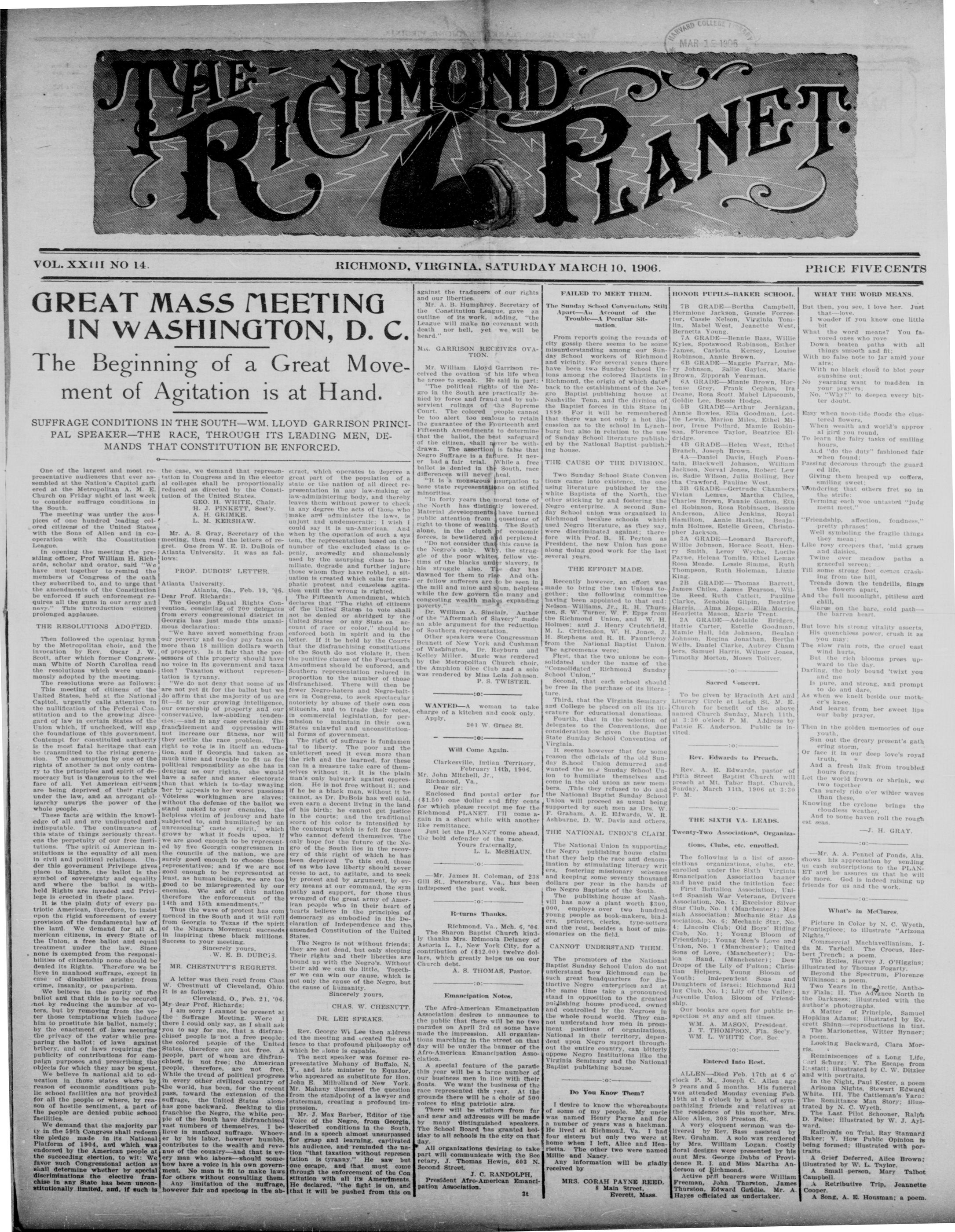
GREAT MASS MEETING IN WASHINGTON, D. C. The Beginning of a Great Movement of Agitation is at Hand.
SUFFRAGE CONDITIONS IN THE SOUTH—WM. LLOYD GARRISON PRINCIPAL SPEAKER—THE RACE, THROUGH ITS LEADING MEN, DEMANDS THAT CONSTITUTION BE ENFORCED.
VOL. XXIII NO 14.
GREAT M
IN WAR
The Beginn
ment of A
SUFFRAGE CONDITIONS
PAL SPEAKER—THE
MANDS T
One of the largest and most re
presentative audiences that ever assembled at the Nation's Capitol gath
ered at the Metropolitan A. M. E.
Church on Friday night of last week
to consider suffrage conditions in
the South.
The meeting was under the auspices of one hundred leading colored citizens of the United States with the Sons of Allen and in cooperation with the Constitution League.
In opening the meeting the presiding officer, Prof William H. Richards, scholar and orator, said, "We have met together to remind the members of Congress of the oath they subscribed to, and to urge that the amendments of the Constitution be enforced if such enforcement requires all the guns in our army and navy." This introduction elicited prolonged applause.
THE RESOLUTIONS ADOPTED.
Then followed the opening hymn by the Metropolitan choir, and the invocation by Rev. Oscar J. W. Scott, after which former Congressman White of North Carolina read the resolutions which were unanimously adopted by the meeting.
The resolutions were as follows: This meeting of citizens of the United States, held at the National Capitol, urgently calls attention to the nullification of the Federal Constitution and to the growing disregard of law in certain States of the Union which, if unchecked, will sap the foundations of this government. Contempt for constituted authority is the most fatal heritage that can be transmitted to the rising generation. The assumption by one of the rights of another is not only contrary to the principles and spirit of democracy but is dangerous to the welf of all. Yet American citizens are being deprived of their rights under the law, and an arrogant oligarchy usurps the power of the whole people.
These facts are within the knowledge of all and are undisputed and indisputable. The continuance of this state of things seriously threatens the perpetuity of our free institutions. The spirit of American institutions is the equality of all men in civil and political relations. Under this government Privilege gives place to Rights, the ballot is the symbol of sovereignty and equality and where the ballot is withheld Rights are invaded and Privilege is erected in their place.
It is the plain duty of every patriotic American, therefore, to insist upon the rigid enforcement of every provision of the fundamental law of the land. We demand for all American citizens, in every State of the Union, a free ballot and equal treatment under the law. Since none is exempted from the responsibilities of citizenship none should be denied its Rights. Therefore we be lieve in manhood suffrage, except in case of disabilities arising from crime, insanity, or pauperism.
We believe in the purity of the ballot and that this is to be secured not by reducing the number of voters, but by removing from the voter those temptations which induce him to prostitute his ballot, namely; by the enactment of laws securing the privacy of the voter while preparing the ballot; of laws against bribery, and of laws requiring the publicity of contributions for campaign purposes and prescribing the objects for which they may be spent.
We believe in national aid to education in those states where by reason of economic conditions public school facilities are not provided for all the people or where, by reason of hostile sentiment, a part of the people are denied public school facilities.
We demand that the majority party in the 59th Congress shall redeem the pledge made in its National Platform of 1904, and which was endorsed by the American people at the succeeding election, to wit: We favor such Congressional action as shall determine whether by special discriminations the elective franchise in any State has been unconstitutionally limited, and, if such is
the case, we demand that representation in Congress and in the elector al colleges shall be proportionally reduced as directed by the Constitution of the United States.
GEO. H. WHITE, Chair.
H. J. PINKETT, Seet'y.
A. H. GRIMKE.
L. M. KERSHAW.
Mr. A. S. Gray, Secretary of the meeting, then read the letters of regret. One from W. E. B. DuBois of Atlanta University. It was as follows:
PROF. DUBOIS' LETTER
Atlanta University.
Atlanta, Ga., Feb. 19, '06.
Dear Prof. Richards:
The Georgia Equal Rights Convention, consisting of 200 delegates from every congressional district in Georgia has just made this unanimous declaration: "We have saved something from our poverty and to-day pay taxes on more than 18 million dollars worth of property. Is it fair that the possessors of this property should have no voice in its government and taxation? Taxation without representation is tyranny.
"We do not deny that some of us are not yet fit for the ballot but we do affirm that the majority of us are fit—fit by our growing intelligence, our ownership of property and our conservative, law-abiding tendencies;—and in any case certainly disfranchisement and oppression will not increase our fitness, nor will they settle the race problem. The right to vote is in itself an education, and if Georgia had taken as much time and trouble to fit us for political responsibility as she has denying us our rights, she would have a safer and saner electorate than that which is to-day swaying her by appeals to her worst passions Voteless workingmen are slaves; without the defense of the ballot we stand naked to our enemies, the helpless victim of jealousy and hate subjected to, and humiliated by an unreasoning caste spirit, which grows by what it feeds upon. If we are good enough to be represented by five Georgia congressmen in the councils of the nation, we are surely good enough to choose those representatives; and if we are not good enough to be represented at least, as human beings, we are too good to be misrepresented by our enemies. We ask of this nation therefore the enforcement of the 14th and 15th amendments."
Thus the wave of protest has commenced in the South and it will roll from Georgia to Texas if the spirit of the Niagara Movement succeeds in inspiring these black millions. Success to your meeting. Sincerely yours, W.E.B.DUROIS
MR. CHESTNUTT'S REGRETS
A letter was then read from Chas W. Chestnut of Cleveland, Ohio. It is as follows:
Cleveland, O., Feb. 21, '06. My dear Prof. Richards:
I am sorry I cannot be present at the Suffrage Meeting. Were I there I could only say, as I shall ask you to say for me, that a disfranchised people is not a free people; the colored people of the United States, therefore are not free. A people, part of whom are disfranchised, is not free; the American people, therefore, are not free. While the trend of political progress in every other civilized country of the world, has been, for the recent pass, toward the extension of the suffrage, the United States alone has gone backward. Seeking to this franchise the Negro, the white people of the South have disfranchised vast numbers of themselves. I believe in manhood suffrage. Whoever by his labor, however humble, contributes to the wealth and revenue of the country—and that is every man who labors—should somehow have a voice in his own government. No man is fit to make laws for others without consulting them. Any limitation of the suffrage, however fair and specious in the ab-
RICHMOND, VIRGINIA, SATURDAY MARCH 10, 1906.
stract, which operates to deprive a great part of the population of a state or the nation of all direct representation in any law-making or law-administering body, and thereby leaves them without power to check in any degree the acts of those who make and administer the laws, is unjust and undemocratic; I wish I could say it is un-American. And when by the operation of such a system, the representation based on the number of the excluded class is openly, avowedly and shamelessly used by the usurping class to humiliate, degrade and further injure those whom they have robbed, a situation is created which calls for emphatic protest and ceaseless agitation until the wrong is righted.
The Fifteenth Amendment, which declares that "The right of citizens of the United States to vote shall not be denied or abridged by the United States or any State on account of race or color" should be enforced both in spirit and in the letter. If it be held by the Courts that the disfranchising constitutions of the South do not violate it, then the punitive clause of the Fourteenth Amendment should be enforced, and Southern representation reduced in proportion to the number of those disfranchised. There will then be fewer Negro-haters and Negro-halters in Congress, to seek spectacular notoriety by abuse of their own constituents, and to trade their votes, in commercial legislation, for permission to maintain in their own States unlawful and unconstitutional forms of government.
The right of suffrage is fundamental to liberty. The poor and the unlettered need it even more than the rich and the learned, for these can in a measure take care of themselves without it. It is the plain man's only bulwark against oppression. He is not free without it; and if he be a black man, without it he cannot, as Dr. DuBois has well said, even earn a decent living in the land of his birth; he cannot get justice in the courts; and the traditional scorn of his color is intensified by the contempt which is felt for those who cannot defend themselves. The only hope for the future of the Negro of the South lies in the recovery of this right of which he has been deprived. To this end, those of us who love liberty should never cease to act, to agitate, and to seek by protest and by argument, by every means at our command, the sympathy and support, for those thus wronged of the great army of American people who in their heart of hearts believe in the principles of democracy as embodied in the Declaration of Independence and the amended Constitution of the United States.
The Negro is not without friends; they are not dead, but only sleeping Their rights and their liberties are bound up with the Negro's. Without their aid we can do little. Together we can win our cause, which is not only the cause of the Negro, but the cause of humanity.
Sincerely yours.
Rev. George Wj. Lee then addressed the meeting and created the audience to that profound philosophy off which he alone is capable.
The next speaker was former representative Mahany of Buffalo, N. Y., and late minister to Equador, who appeared as substitute for Hon. John E. Milholland of New York. Mr. Mahany discussed the question from the standpoint of a lawyer and statesman, creating a profound impression.
Mr. J. Max Barber, Editor of the Voice of the Negro, from Georgia, described conditions in the South, and in a speech almost unsurpassed for grasp and learning, captivated his audience, and reminded the nation "that taxation without representation is tyranny." He saw but one escape, and that must come through the enforcement of the Constitution with all its Ameniments. He declared, "the fight is on, and that it will be pushed from this on
against the traducers of our rights and our liberties.
Mr. A. B. Humphrey, Secretary of the Constitution League, gave an outline of its work, adding, "the League will make no covenant with death nor hell, yet we will be heard."
M. K. GARRISON RECEIVES OVA TION.
Mr. William Lloyd Garrison received the ovation of his life when he arose to speak. He said in part: "The political rights of the Negro in the South are practically denied by force and fraud and by subservient rulings of the Supreme Court. The colored people cannot be too alert too zealous to retain the guarantee of the Fourteenth and Fifteenth Amendments to determine that the ballot, the best safeguard of the citizen, shall never be withdrawn. The assertion is false that Negro Suffrage is a failure. It never had a fair trial. While a free ballot is denied in the South, race differences will never heal. "It is a monstrous assurpation to base state representations on stifled minorities. "In forty years the moral tone of the North has distinctly lowered. Material developments have turned public attention from questions of right to those of wealth. The South alone, in the clutch of economic forces, is bewildered and perplexed. "Do not consider that this cause is the Negro's only. Why, the struggle of the poor whites, fellow victims of the blacks under slavery, is his struggle also. The day has dawned for them to rise. And other fellow sufferers are to be seen in the mill and mine and slum, helpless while the few govern the many and congesting wealth makes expanding poverty."
Dr. William A. Sinclair, Author of the "Aftermath of Slavery" made an able argument for the reduction of Southern representation. Other speakers were Congressman Bennett of New York and Cushman of Washington, Dr. Reyburn and Kelley Miller. Music was rendered by the Metropolitan Church choir, the Amphion Glee Club and a solo was rendered by Miss Lola Johnson.
WANTED—A woman to take charge of a kitchen and cook only. Apply.
Will Come Again.
Clarkesville, Indian Territory,
February 14th, 1906.
Mr. John Mitchell, Jr.,
Richmond, Va.,
Dear sir:
Enclosed find postal order for
($1.50) one dollar and fifty cents
for which please receipt me for the
Richmond PLANET. I'll come again
in a short while with another
like remittance.
Just let the PLANET come ahead,
the bold defender of the race
—Mr. James H. Coleman, of 238 Gill St., Petersburg, Va., has been indisposed the past week.
Returns Thanks.
Richmond, Va., Mch, 6, '06.
The Sharon Baptist Church kindly thanks Mrs. Edmona Delaney of Astoria L. I., New York City, for a contribution of $12.00 twelve dollars, which greatly helps us on our Church debt.
A. S. THOMAS, Pastor.
Emancipation Notes
The Afro-American Emancipation Association desires to announce to the public that there will be no two parades on April 3rd as some have made the impression. All organizations marching in the street on that day will be under the banner of the Afro-American Emancipation Association.
A special feature of the parade this year will be a large number of our business men in line with their floats. We want the business of the race represented this year. At the grounds there will be a choir of 500 voices to sing patriotic airs.
There will be visitors from far and near and addresses will be made by many distinguished speakers. The School Board has granted holiday to all schools in the city on that day.
All organizations desiring to take part will communicate with the Sec retary, J. Thomas Hewin, 603 N. Second Street.
J. C. RANDOLPH,
President Afro-American Emancipation Association.
FAILED TO MEET THEM.
The Sunday School Conventions Still Apart—An Account of the Trouble—A Peculiar Situation.
From reports going the rounds of city gossip there seems to be some misunderstanding among our Sunday School workers of Richmond and vicinity. For several years there have been two Sunday School Unions among the colored Baptists in Richmond, the origin of which date back to the establishment of the Negro Baptist publishing house at Nashville Tenn, and the division of the Baptist forces in this State in 1899. For it will be remembered that there was not only a hot discussion as to the school in Lynchburg but also in relation to the use of Sunday School literature published by the National Baptist-publishing house.
THE CAUSE OF THE DIVISION
Two Sunday School State Conventions came into existence, the one using literature published by the white Baptists of the North, the other sticking by and fostering the Negro enterprise. A second Sunday School union was organized in Richmond because schools which used Negro literature, as they say, were discriminated against; therefore with Prof. B. H. Peyton as President, the new Union has gone along doing good work for the last several years.
THE EFFORT MADE
Recently however, an effort was made to bring the two Unions together; the following committee having been appointed to that end: Nelson Williams, Jr., R. H. Thurston, S. W. Turner, W. P. Epps from the Richmond Union, and W. H. Holmes; and J. Henry Crutchfield, M. L. Crittendon, W. H. Jones, J. H. Stephens and R. H. Fauntleroy from the National Baptist Union. The agreements were; First, that the two unions be consolidated under the name of the "Consolidated Richmond Sunday School Union." Second, that each school should be free in the purchase of its literature. Third, that the Virginia Seminary and College be placed on all its literature for educational donations. Fourth, that in the selection of delegates to the Conventions, due consideration be given the Baptist State Sunday School Convention of Virginia. It seems however that for some reason the officials of the old Sunday School Union demurred and wanted the new Sunday School Union to humiliate themselves and come in the old union as new members. This they refused to do and the National Baptist Sunday School Union will proceed as usual being supported by such men as Drs. W. F. Graham, A. E. Edwards, W. R. Ashburne, D. W. Davis and others
THE NATIONAL UNION'S CLAIM
The National Union in supporting the Negro publishing house claim that they help the race and denomination by stimulating literary writers, fostering missionary schemes and keeping some seventy thousand dollars per year in the hands of the Negro Baptists of the South. The publishing house at Nashville has now a plant worth $300,000, employs over two hundred young people as book-makers, binders, printers, clerks, type-setters and the rest, besides a host of missionaries on the field.
CANNOT UNDERSTAND THEM
The promoters of the National Baptist Sunday School Union do not understand how Richmond can be such great headquarters for distinctive Negro enterprises and at the same time take a pronounced stand in opposition to the greatest publishing house produced, owned and controlled by the Negroes in the whole round world. They cannot understand how men in prominent positions of organizations, National in their territory, dependent upon Negro support throughout the entire country, can bitterly oppose Negro Institutions like the Virginia Seminary and the National Baptist publishing house.
Do You Know Them?
I desire to know the whereabouts of some of my people. My uncle was named Henry Payne and for a number of years was a hackman. He lived at Richmond, Va. I had four sisters but only two were at home when I left, Alice and Henrietta. The other two were named Millie and Nancy.
Any information will be gladly received by
MRS. CORAH PAYNE REED,
8 Main Street.
Everett. Mass.
HONOR PUPILS--BAKER SCHOOL
7B GRADE—Bertha Campbell,
Hermione Jackson, Gussie Forrester,
Cassie Nelson, Virginia Tomilin,
Mabel West, Jeanette West,
Bernetta Young.
7A GRADE—Bennie Bass, Willie Kyles, Spotwood Robinson, Esther James, Carlotta Kersey, Louise Robinson, Annie Brown.
6B GRADE—Maggie Farrar, Mary Johnson, Sallie Gayles, Marie Brown, Zipporah Yearman.
6A GRADE—Minnie Brown, Hortense Grey, Frank Cephas, Ira Deane, Rosa Scott. Mabel Lipscomb, Goldie Lee, Bessie Hodge.
6B GRADE—Arthur Jernigan, Annie Bowles, Ella Goodman, Lotte Lewis, Marion Miles, Ethel Minor, Irene Pollard, Mamie Robinson, Florence Taylor, Beatrice Eldridge.
4B GRADE—Helen West, Ethel Branch, Joseph Brown.
4A—Daniel Davis, Hugh Fountain, Blackwell Johnson, William Jackson, Norval Jones, Robert Lewis, Sadie Wilson, Julia Bolling, Bertha Crawford, Pauline West.
3B GRADE—Gertrude Chambers Vivian Lemus, Martha Chiles, Charles Brown, Fannie Gaston, Etel Robinson, Rosa Robinson, Bessie Anderson, Alice Jenkins, Royal Hamilton, Annie Haskins, Benjamin Holmes, Estelle Green, Christopher Jackson.
3A GRADE—Leonard Barcroft, Willie Johnson, Horace Scott, Henry Smith, Leroy Wyche, Lucie Payne, Helena Tomlin, Ethel Lemas Rosa Meade, Lessie Simms, Ruth Thompson, Ruth Holeman, Lizzie King.
2B GRADE—Thomas Barrett, James Chiles, James Pearson, Willie Reed, Ruth Catlett, Pauline Clarke, Zenobia Gilpin, Beatrice Harris, Alma Hope, Ella Morris, Henrietta Mason, Marie Trent.
2A GRADE—Adelaide Bridges, Hattie Carter, Estelle Goodman, Mamie Hall, Ida Johnson, Beulan Johnson, Regina Jonathan, Bertha Wells, Daniel Clarke, Aubrey Chambers, Samuel Harris, Wilmer Jones, Timothy Morton, Moses Tolliver.
Sacred Concert.
To be given by Hyacinth Art and Literary Circle at Leigh St. M. E. Church for benefit of the above named Church Sunday, March 11th, at 3:30 o'clock P. M. Address by Patsie K. Anderson. Public is invited.
Rev. Edwards to Preach.
Rev. A. E. Edwards, pastor of Fifth Street Baptist Church will preach at Mt. Tabor Bapt. Church, March 11th, 1906 at 3:30 P. M.
THE SIXTH VA. LEADS
Twenty-Two Associations, Organiza-
tions, Clubs, etc. enrolled.
The following is a list of associations organizations, clubs, etc. enrolled under the Sixth Virginia Emancipation Association banner and have paid the initiation fee: First Battalion Association, United Spanish War Veterans, Drivers Association, No. 1; Excelsior Silver Star Club, No. 1 (Manchester); Mesiah Association; Mechanic Star Association, No. 6; Mechanic Star, No. 4; Lincoln Club; Old Boys' Riding Club, No. 1; Young Bloom of Friendship; Young Men's Love and Union, No. 1 (Manchester); United Sons of Love, (Manchester); Union Band, (Manchester); Dew Drops of the Lily of Fulton; Christian Helpers, Young Bloom of Youth; Independent Sons and Daughters of Israel; Richmond Riding Club, No. 1; Lily of the Valley; Juvenile Union Bloom of Friendship.
Our books are open for public inspection at any and all times.
WM. A. MASON, President.
J. T. THOMPSON, Fin. Sec'y.
WM. L. WHITE Cor. Sec
Entered Into Rest.
ALLEN—Died Feb. 17th at 6 o'clock P. M., Joseph C. Allen age 9 years and 5 months. His funeral was attended Monday evening Feb. 19th at 3 o'clock by a host of sympathizing friends and relatives at the residence of his mother, Mrs. Alice Allen, 308 Preston St.
A very eloquent sermon was delivered by Rev. Bass assisted by Rev. Graham. A solo was rendered by Mrs. William Logan. Costly floral designs were presented by his aunt Mrs. George Dabbs of Providence R. I. and Mies Martha Anderson of Richmond.
Active poll bearers were William Freeman, John Thurston, James Thurston, Edward Gaddie, Mr. A Hayes officiated as undertaker.
PRICE FIVE CENTS
WHAT THE WORD MEANS.
But then, you see, I love her. Just that—love.
I wonder if you know one little bit.
What the word means? You favored ones who rove
Down beaten paths with all things smooth and fit;
With no false note to jar amid your airs;
With no black cloud to blot your sunshine out;
No yearning want to madden in your prayers;
No, "Why?" to deepen every bitter doubt.
Easy when noon-tide floods the clustered flowers.
When wealth and world's approv al gird you round.
To learn the fairy tasks of smiling hours,
Ald "do the duty" fashioned fair when found;
Passing decorous through the guard ed life,
Giving them heaped up coffers, smiling sweet;
Wondering that others fret so in the strife;
Terming each woe untasted "judg ment meet."
"Friendship, affection, fondness," pretty phrases!
Well symbolizing the fragile things they mean;
Like rosy creepers that, 'mild grass and daisies,
Twine over meadow paths a graceful screen;
Till some strong foot comes crashing from the hill,
Treads down the tendrills, flings the flowers apart;
And the full moonlight, pitiless and chill,
Glares on the bare, cold path—the barren heart.
But love his strong vitality asserts,
His quenchless power, crush it as you may;
The slow rain rots, the cruel east wind hurts,
But the rich blooms press upward to the day.
Darling, the holy bound 'twixt you and me,
Is pure, and strong, and prompt to do and dare.
As when we knelt beside our mother's knee,
And learnt from her sweet lips our baby prayer.
Then in the golden memories of our youth,
Sun out the dreary present's gath ering storm,
Or face it in our deep love's royaf truth,
And a fresh link from troubled hours form;
Let the world frown or shrink, we two together
Can surely ride o'er wilder waves than these.
Knowing the cyclone brings the cloudless weather,
And to some haven roll the rough est seas.
—J. H. GRAY.
:o:
—Mr. A. A. Fennel of Ponds, Ala. shows his appreciation by sending us cash subscriptions to the PLANET and he assures us that he will do more. God is indeed raising up friends for us and the work
What's in McClures
Picture in Color by N. C. Wyeth, Frontpiece; to illustrate "Arizona Nights."
Commercial Machiavellianism, Ida M. Tarbell. The Crocus, Herbert Trench; a poem.
The Exiles, Harvey J. O'Higgins; illustrated by Thomas Fogarty. Beyond the Spectrum, Florence Wilkinson; a poem.
Two Years in the Arctic, Anthony Fiala; II. The Advance North in the Darkness; illustrated with the author's photographs.
A Matter of Principle, Samuel Hopkins Adams; illustrated by Everett Shinn—reproductions in tint. The Marionettes, Witter Bynner; a poem.
Looking Backward, Clara Morris.
Reminiscences of a Long Life, Carl Schurz; V. The Escape from Rastatt; illustrated by C. W. Ditzler and with portraits.
In the Night, Paul Kester, a poem Arizona Nights, Stewart Edward White. III. The Cattleman's Yarn: The Rememtance Man Story; illustrated by N. C. Wyeth.
The Last Pilot Schooner, Ralph D. Paine; illustrated by W. J. Aylward.
Railroads on Trial, Ray Stannard Baker; V. How Public Opinion is being formed; illustrated with portraits.
A Grief Deferred, Alice Brown; illustrated by W. L. Taylor.
A Small person, Mary Talbot Campbell.
A Retributive Trip, Jeannette Cooper.
A Song, A. E. Housman; a poem.
THE
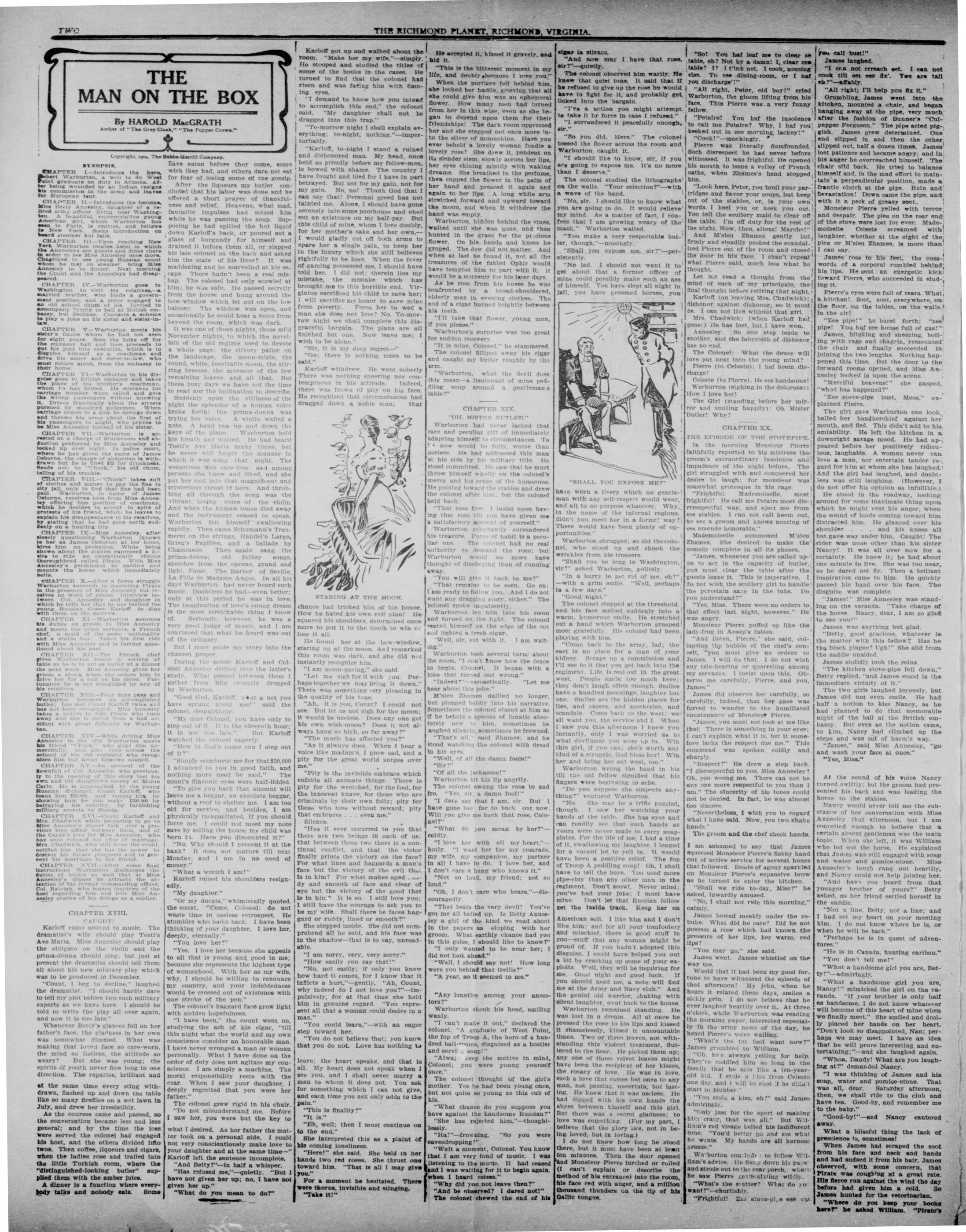
MAN ON THE BOX
By HAROLD MacGRATH
Author of "The Grey Closk," "The Puppet Crown."
Copyright, 1904. The Bobba-Merrill Company.
CHAPTER I.—Introduces the hero, Robert Warburton, a well to do West Point graduate on duty in Arizona. After his commission in the army and leaves for European tour.
CHAPTER II.—Introduces the heroine, Miss Betty Annesley, daughter of a retired army officer living near Washington, an American girl, whom Warburton has seen in Paris, is smitten, and follows to New York. Seeks introduction on business but falls.
CHAPTER III.—Upon reaching New York Warburton locates hotel in which the Annesleses are guests and dines there in order to see Miss Annesley once more. Chagrined to see young Russian count Anneslese in to dinner. Next morning the Count and the Annesleses had disappeared.
CHAPTER IV.—Warburton goes to Washington to visit his relatives—a mother, a brother, a mentation position, and a sister engaged to an old school chum of his. Invited to accompany family to ball at British embassy, but declines. Concocts a scheme to play a joke on his sister and sister-in-law.
CHAPTER V.—Warburton meets his sister's flame who he had not seen for eight years. See the folks off for his call, and he puts his joke into execution, which is to disguise himself as a coachman and drive his sister and sister-in-law, who returns alone, from the embassy to their home.
CHAPTER VI.—Warburton in his disguise goes to British embassy and takes the wrong passengers without knowing whom he has bribed his brother's coachman whom he has bribed him. Carriage number when called and gets the wrong passengers without knowing whom he has bribed him. Carriage comes to a stop he springs down and throws his arms about the first of them. He misses the Miss Anniesley instead of his sister.
CHAPTER VII.—Warburton is arrested on a charge of drunkenness and abduction preferred by Miss Annesley and objection given by Miss Jasborne, where he has given the police court, where he has given the judge Jasborne, the charge of abduction is withdrawn but he is fired $55 for drunkenness. Sends not to "Chuck," his old chum, to Warburton. CHAPTER VIII.—"Chuck" takes suit of clothes and money to pay the fine to city jail, only to find that fine had been paid. Warburton, in name of James Annesley, receives note from Miss Annesley offering to take the case against which he decides to accept in spite of protests of his friend, whom he leaves to explain his disappearance to his relatives, stating that he had gone north suddenly. CHAPTER IX.—Miss Annesley, after closely questioning Warburton (known to her as James Observer) at her home, gives him on probation. He being brought to prison expresses a desire to ride an exceptionally vicious thoroughbred called Pirate. With Miss Annesley's permission he saddles and attaches the horse which immediately bolts.
CHAPTER X—After a fierce struggle Warburtion succeeds in mastering Pirate in the presence of Miss Annesley but re-enters between Col. Annesley and daughter in which he tells her that he has invited the warrior to dine with them on the morrow.
CHAPTER XI—Warburtion assumes his duties as groom to Miss Annesley and meets the other servants, a French cook and a stable boy. Takes his first ride with Miss Annesley and is further questioned about his past.
CHAPTER XII—The French chef gives Warburtion lesson in serving at table he is to act as butler at a dinner the next week. Miss Annesley gives her groom a shock when she orders him to take a cath on his knees and tunes him he is not recognized by any of his relatives.
CHAPTER XIII—Four days pass and Warburtion is accomplished but he meets a mettle man who has not been recognized. Miss Annesley takes a notion to ride Pirate who runs away and she is saved from a bad accident with great difficulty by Warburtion.
CHAPTER XIV - While driving Miss Annesek in the city Warburton meets his friend, Chuck, who guys him uncle and nephew, so he colonel of his old regiment who recognizes him but keeps his own council. He goes to the downfall of Col. Annesek, who previously to the opening of this story lost his own and his daughter's money at Monte Carlo. He is approached by the young man who loans him $30,000, and tempts him by showing how he can make $30,000 by begging him to furnish illicit secrets to Russia.
led by the young
unt Karloff, who
tempts him by
make $200,000 by
buy furnishing
sina.
unt Karloff and
reparing to go to
talk over a pre-
men them, and of
is Anniesley, who
was
“To give you back that amount will
leave me a beggar, an absolute beggar,
without a roof to shelter me. I am too
old for service, and besides, I am
physically incapacitated. If you should
force me, I could not meet my note
save by selling the house my child was
born in. Have you discounted it?”
CHAPTER XVI—Count Karloff and Mrs. Chadwick while preparing to go to Annesley's dinner talk over a previous dinner at the Count's love for Miss Annesley, who has once refused his offer of marriage. Mrs. Chadwick who has escaped the count, and who has his own plans to destroy his future prospects and to prevent his marriage to her friend.
CHAPTER XVII—After some final instructions, butteries charges the duties of butterer well that Annesley's dinner he attracts the attention of his former commanding officer, Col. Raleigh, who makes inquiries of the Annesley's stories of his doings as a soldier.
Karloft came around to music. The dramatist's wife should play Tostf's Ave Maria. Miss Annasley should play the obligato on the violin and the prima-donna should sing; but just at present the dramatist should tell them all about his new military play which was to be produced in December.
"Count, I beg to decline," laughed the dramatist. "I should hardly dare to tell my plot before two such military experts as we have here. I should be told to write the play all over again, and now it is too late."
Whenever Betty's glances fell on her father's face, the gladness in her own was somewhat dimmed. What was making that loved face so care-worn, the mind so lisless, the attitude so weary? But she was young; the spirits of youth never flow long in one direction. The repatriate, brilliant and
at the same time every sting withdrawn, flashed up and down the table like so many fireflies on a wet lawn in July, and drew her irresistibly.
As the courses came and passed, so the conversation became less and less general; and by the time the ices were served the colonel had engaged his host, and the others divided into two. Then coffee, liqueurs and cigars, when the ladies rose and trailed into the little Turkish room, where the "distinguished-looking butler" supplied them with the amber juice.
A dinner is a function where everybody talks and nobody eats. Some
CHAPTER XVIII
CAUGHT!
Have eaten before they come, some wish they had, and others dare not eat for fear of losing some of the gossip. After the liqueurs my butter concluded that his labor was done and he offered a short prayer of thankfulness and relief. Heavens, what mad, fantastic impulses had seized him while he was passing the soup. Supposing he had spilled the hot liquid down Karloff's back, or poured out a glass of burgundy for himself and drained it before them all, or slapped his late colonel on the back and asked him the state of his liver? It was maddening and he marvelled at his escape. There hadn't been a real mishap. The colonel had only scowled at him; he was safe. He passed secretly from the house and hung around the bow-window which let out on the low balcony. The window was open, and occasionally he could hear a voice from beyond the room, which was dark.
It was one of those nights, those mild November nights, to which the novelists of the old regime used to devote a whole page; the silvery pallor on the landscape, the moon-mists, the round, white, inevitable moon, the stirring breezes, the murmur of the few remaining leaves, and all that. But these busy days we have not the time to read nor the inclination to describe
But I must guide my story into the channel proper.
During the music Karloff and Colonel Annesley drifted into the latter's study. What passed between them I gather from bits recently dropped by Warburton.
"Good God, Karloff, *at* a net you have sprung about me!" said the colonel, desperately.
"My dear Colonel, you have only to step out of it. It is the eleventh hour; it is not too late." But Karloff watched the colonel eagerly.
"How in God's name can I step out of it?"
"Simply reimburse me for that $20,000 I advanced to you in good faith, and nothing more need be said." Theount's Slavonic eyes were half-bledd.
"No. Why should I present it at the bank? It does not mature till next Monday, and I am in no need of money."
"What a wretch I am!"
Karloff raised his shoulders resignedly.
"My daughter."
"Or my ducats," whimisically quoted.
the count. "Come, Colonel: do not waste time in useless retrospect. He stumbles who looks back. I have been thinking of your daughter. I love her, deeply, eternally."
"You love her?"
"Yes. I love her because she appeals to all that is young and good in me; because she represents the highest type of womanhood. With her as my wife, why, I should be willing to renounce my country, and your indebtedness would be crossed out of existence with one stroke of the pen."
The colonel's haggard face grew light with sudden hopefulness.
"I have been," the count went on, studying the ash of his cigar, "till this night what the world and my own conscience consider an honorable man. I have never wronged a man or woman personally. What I have done on the order of duty does not agitate my conscience. I am simply a machine. The moral responsibility rests with the czar. When I saw your daughter, I deeply regretted that you were her father."
The colonel grew rigid in his chair,
"Do not misunderstand me. Before
I saw her, you were but the key to
what I desired. As her father the matter
took on a personal side. I could
not very conscientiously make love to
your daughter and at the same time—"
Karloff left the sentence incomplete.
"And Betty?"—in half a whisper.
"Has refused me,"—quietly. "But I
have not given her up; no, I have not
given her up."
"What do you mean to do?"
THE RICHMOND PLANET, RICHMOND, VIRGINIA
Karloff got up and walked about the room. "Make her my wife,"—simply. He stooped and studied the titles of some of the books in the cases. He turned to find that the colonel had risen and was facing him with flaming eyes. "I demand to know how you intend to accomplish this end," the colonel said. "My daughter shall not be dragged into this trap." "To-morrow night I shall explain everything; to-night, nothing."—imper-turbably.
"Karloff, to-night I stand a ruined and dishonored man. My head, once held so proudly before my fellow-men, is bowed with shame. The country I have fought and bled for I have in part betrayed. But not for my gain, not for my gain. No,! Thank God that I can say that! Personal greed has not tainted me. Alone, I should have gone serenely into some poorhouse and eaked out an existence on my half-pay. But this child of mine, whom I love doubly, for her mother's sake and her own,—I would gladly cut off both arms to spare her a single pain, to keep her in the luxury which she still believes rightfully to be hers. When the fever of gaming possessed me, I should have told her. I did not; therein lies my mistake, the mistake which has brought me to this horrible end. Virginiaus sacrificed his child to save her; I will sacrifice my honor to save mine from poverty. Force her to wed a man she does not love? No. To-morrow night we shall complete this disgraceful bargain. The plans are all finished but one. Now leave me; I wish to be alone."
"Go; there is nothing more to be said."
Karloff withdrew. He went soberly. There was nothing sneering nor contemptuous in his attitude. Indeed, there was frown of pity on his face. He recognized that circumstances had dragged down a noble man; that
M
STARING AT THE MOON.
chance had tricked him of his honor.
How he hated his own evil plan! He squared his shoulders, determined once more to put it to the touch to win or lose it all.
He found her at the bow-window, staring up at the moon. As I remarked this room was dark, and she did not instantly recognize him.
"I am moon-gazing," she said.
"Let me sigh for it with you. Perhaps together we may bring it down."
There was something very pleasing in the quality of his tone.
"Ah, it is you, Count? I could not see. But let us not sigh for the moon; it would be useless. Does any one get his own wish-moon? Does it not always hang so high, so far away?"
"The music has affected you?"
"As it always does. When I hear a voice like madam's, I grow sad, and a pity for the great world surges over me."
"Pity is the invisible embrace which enfolds all animate things. There is pity for the wretched, for the fool, for the innocent knave, for those who are criminals by their own folly; pity for those who love without reward; pity that embraces . . . even me."
Silence.
"Has it ever occurred to you that there are two beings in each of us; that between these two there is a continual conflict, and that the victor finally prints the victory on the face? For what lines and haggards a man's face but the victory of the evil that is in him? For what makes aged muddy and smooth of face and clear of eye but the victory of the good that is in him? It is so. I still love you; I still have the courage to ask you to be my wife. Shall there be faces haggard or ruddy, lined or smooth?"
She stepped inside. She did not comprehend all he said, and his face was in the shadow—that is to say, unreadable.
"I am sorry, very, very sorry."
"How easily you say that!"
"No, not easily; if only you knew how hard it comes, for I know that it inflicts a hurt,"—gently. "Ah, Count, why indeed do I not love you?"—impulsively, for at that time she held him in genuine regard. "You represent all that a woman could desire in a man."
"You could learn,"—with an eager step toward her.
"You do not believe that; you know that you do not. Love has nothing to
learn; the heart speaks, and that is all. My heart does not speak when I see you, and I shall never marry a man to whom it does not. You ask for something which I can not give, and each time you ask only adds to the pain.
"This is finality?"
"It is."
"Eh, well; then I must continue on to the end."
She interpreted this as a plaint of his coming loneliness.
"Here!" she said. She held in her hands two red roses. She thrust one toward him. "That is all I may give you."
For a moment he hesitated. There were thorns, invisible and stinging.
"Take it!"
He accepted it, kissed it gravely, and hld it.
"This is the bitterest moment in my life, and doubly because I love you."
When the portiere fell behind him, she locked her hands, grieving that all she could give him was an ephemeral flower. How many men had turned from her in this wise, even as she began to depend upon them for their friendships! The dark room oppressed her and she stepped out once more into the silver of moonshine. Have you ever beheld a lovely woman fondle a lovely rose? She drew it, pendent on its slender stem, slowly across her lips, her eyes shining mistily with waking dreams. She breathed in the perfume, then cupped the flower in the palm of her hand and pressed it again and again to her lips. A long white arm stretched forward and upward toward the moon, and when it withdrew the hand was empty.
Warburton, hidden behind the vines, waited until she was gone, and then hunted in the grass for the precious flower. On his hands and knees he groped. The dew did not matter. And when at last he found it, not all the treasures of the fabled Ophir would have tempted him to part with it. it would be a souvenir for his later days. As he rose from his knees he was confronted by a broad-shouldered, elderly man in evening clothes. The end of a cigar burned brightly between his teeth. "I'll take that flower, young man, if you please." Warburton's surprise was too great for sudden recovery. "It is mine, Colonel," he stammered. The colonel filled away his cigar and caught my butler roughly by the arm.
"Warburton, what the devil does this mean—a leutenant of mine peddling soup around a gentleman a table?"
CHAPTER XIX
Warburton had never lacked that care and peculiar gift of immediately adapting himself to circumstances. To now would be folly, worse than useless. He had addressed this man at his side by his military title. He stood committed. He saw that he must throw himself wholly on the colonel's mercy and his sense of the humorous. He pointed toward the stables and drew the colonel after him; but the colonel held back.
"That rose first; I insist upon having that rose till you have given me a satisfactory account of yourself."
Warburton reluctantly surrendered his treasure. Force of habit is a peculiar one. The colonel had no real authority to demand the rose; but Warburton would no more have thought of disobeying than of running away.
"You will give it back to me?" "That remains to be seen. Go on; I am ready to follow you. And I do not want any dragging story, either." The colonel spoke impatiently. Warburton lea him into his room and turned on the light. The colonel seated himself on the edge of the cot and lighted a fresh cigar. "Well, sir, out with it. I am waiting." Warburton took several turns about the room. "I don't know how the deuce to begin. Colonel. It began with a joke that turned out wrong." "Indeed?"—sarcastically. "Let me hear about this joke."
M'sieu Zhames dallied no longer, but plunged boldly into his narrative. Sometimes the colonel stared at him as if he beheld a species of lunatic absolutely new to him, sometimes he aughed silently, sometimes he frowned. "That's all," said Zhames; and he stood watching the colonel with dread in his eyes.
"Well, of all the damn fools!"
"Sir?"
"Of all the jackasses!"
Warburton bit his lip angrily.
The colonel swung the rose to and fro.
"Yes, sir, a damn fool!"
"I dare say that I am, sir. But I have gone too far to back out now. Will you give me back that rose, Colonel?"
"What do you mean by her?"—coldly.
"I love her with all my heart,"—hotly. "I want her for my comrade, my wife, my companion, my partner in all I have to do. I love her, and I don't care a hang who knows it." "Not so loud, my friend; not so
"Not so loud, my friend; not so loud."
"Oh, I don't care who hears,"—discouragedly.
"That beats the very devil! You've got me all balled up. Is Betty Annesley a girl of the kind we read about in the papers as eloping with her groom. What earthly chance had you in this gulse, I should like to know?"
"I only wanted to be near her; I did not look ahead."
"Well, I should say not! How long were you behind that trellis?"
"A year, so it seemed to me."
"Any lunatics among your ancestors?"
Warburton shook his head, smiling wanly.
"I can't make it out," declared the colonel. "A graduate of West Point, the top of Troop A, the hero of a hundred ball-rooms, disguised as a hostler and serving soup!"
"Always keep the motive in mind, Colonel; you were young yourself once."
The colonel thought of the girl's mother. Yes he had been young once, but not quite so young as this cub of his.
"What chance do you suppose you have against the handsome Russian?"
"She has rejected him,"—thoughtlessly.
"Ha!"—frowning. "So you were eavesdropping."
"Wait a moment, Colonel. You know that I am very fond of music. I was listening to the music. It had ceased and I was waiting for it to begin again, when I heard voices."
"Why did you not leave then?"
"And be observed? I dared not!"
The colonel chewed the end of his
eigar in silence.
"And now may I have that rose, sir?"—quietly.
The colonel observed him warily. He knew that quiet tone. It said that if he refused to give up the rose he would have to fight for it, and probably get licked into the bargain.
"I've a notion you might attempt to take it by force in case I refused."
"I surrendered it peacefully enough, sir."
"So you did. Here." The colonel tossed the flower across the room and Warburton caught it.
"I should like to know, sir, if you are going to expose me. It's no more than I deserve."
The colonel studied the lithographs on the walls. "Your selection?"—with a wave of the hand.
"No, sir. I should like to know what you are going to do. It would relieve my mind. As a matter of fact, I confess that I am growing weary of the mask." Warburton waited.
"You make a very respectable butler, though."—musingly.
"Shall you expose me, sir?"—persistently.
"No lad. I should not want it to get about that a former officer of mine could possibly make such an ass of himself. You have slept all night in jail, you have groomed horses, you
A
"SHALL YOU EXPOSE ME?"
have worn a livery which no gentleman with any self-respect would wear, and all to no purpose whatever. Why, in the name of the infernal regions, didn't you meet her in a form! way? There would have been plenty of opportunities."
Warburton shrugged; so did the colonel, who stood up and shook the wrinkles from his trousers.
"Shall you be long in Washington, sir?" asked Warburton, politely.
"In a hurry to get rid of me, eh?"—with a grim smile. "Well, perhaps in a few days."
"Good night."
The colonel stopped at the threshold, and his face melted suddenly into a warm, humorous smile. He stretched out a hand which Warburton grasped most gratefully. His colonel had been playing with him.
"Come back to the army, lad; the east is no place for a man of your kidney. Scrape up a commission and I'll see to it that you get back into the regiment. Life is real out in the great west. People smile too much here; they don't laugh often enough. Smiles have a hundred meanings, laughter but one. Smiles are the hidden places for lies, and sneers, and mockeries, and scandals. Come back to the west; we all want you, the service and I. When I saw you this afternoon I knew you instantly, only I was worried as to what devilment you were up to. Win this girl, if you can; she's worth any kind of a struggle, God bless her! Win her and bring her out west, too."
Warburton wring the hand in his till the old fellow signified that his fingers were beginning to ache.
"Do you suppose she suspects anything?" ventured Warburton.
"No. She may be a trifle puzzled, though. I saw her watching your hands at the table. She has eyes and can readily see that such hands as yours were never made to carry soupsplates. For the life of me, I had a time of it, swallowing my laughter. I longed for a vacant lot to yell in. It would have been a positive relief. The top of Troop A peddling soup! Oh. I shall have to tell the boys. You used more pipe-clay than any other man in the regiment. Don't scowl. Never mind; you've had your joke; I must have mine. Don't let that Russian fellow get the inside track. Keep her on
American soil. I like him and I don't like him; and for all your tomofellow and mischief, there is good stuff in you—stuff that any woman might be proud of. If you hadn't adopted this disguise, I could have helped you out a bit by cracking up some of your exploits. Well, they will be inquiring for me. Good night and good luck. If you should need me, a note will find me at the Army and Navy club." And the genial old warrior, shaking with silent laughter, went back to the house.
Warburton remained standing. He was lost in a dream. All at once he pressed the rose to his lips and kissed it shamelessly, kissed it uncountable times. Two or three leaves, not withstanding this violent treatment, fluttered to the floor. He picked them up; any one of those velvet leaves might have been the recipient of her kisses, the rosary of love. He was in love, such a love that comes but once to any man, not passing, uncertain, but lasting. He knew that it was useless. He had digged with his own hands the abyss between himself and this girl. But there was a secret gladness; to love was something. (For my part, I believe that the glory lies, not in being loved, in being loved.)
I do not know how long he stood there, but it must have been at least ten minutes. Then the door opened and Monsieur Pierre lurched or roiled (I can't explain or describe the method of his entrance) into the room, his face red with anger, and a million thousand thunders on the tip of his Gallic tongue.
"So! You haf leaf me to clear ze table, eh? Not by a damn! I, clear ze table? I? I t'ink not. I cook, nozzing else. To ze dining-room, or I haf you discharge!" "All right, Peter, old boy!" cried Warburton, the gloom lifting from his face. This Pierre was a very funny fellow. "Petaire! You haf the insolence to call me Petaire? Why, I haf you keeled out in zee morning, lackey!" "Cook!"—mockingly. Pierre was literally dumfounded. Such disrespect he had never before witnessed. It was frightful. He opened his mouth to issue a volley of French oaths, when Zhames's hand stopped him.
"Look here, Peter, you broil your parridges and flavor your soups, but keep out of the stables, or, in your own words. I keel you or keek you out. You tell the soullery maid to clear off the table. I'm off duty for the rest of the night. Now, then, allons! Marche!" And M'lesu Zhames gently but firmly and steadily pushed the scandalized Pierre out of the room and closed the door in his face. I shan't repeat what Pierre said, much less what he thought.
Let me read a thought from the mind of each of my principals, the final thought before retiring that night. Karloff (on leaving Mrs. Chadwick); dishonor against dishonor; so it must be. I can not live without that girl. Mrs. Chadwick: (when Karloff had gone); He has lost, but I have won. Annesley: So one step leads to another, and the labyrinth of dishonor has no end.
The Colonel! What the deuce will love put next into the young mind?
Pierre (to Celeste): Haf heem discharge!
Celeste (to Pierre). He ees handsome!
Warburton (sighing in the dolorosa):
How I love her!
The Girl (standing before her mirror and smiling happily): Oh Mister Butler! Why?
CHAPTER XX
THE EPISODE OF THE STOVEPIPE.
In the morning Monsieur Pierre faithfully reported to his mistress the groom's extraordinary insolence and impudence of the night before. The girl struggled with and conquered her desire to laugh; for monsieur leur was somewhat grotesque in his rage.
"Frightful. Mademoiselle, most frightful! He call me Petaire most disrespectful way, and eject me from ee stables. I can not call heem out, he eez a groom and knows nozzing ue amende honorable."
Mademoiselle summoned M'steu Zhames. She desired to make the comedy complete in all its phases.
"James, whenever you are called upon to act in the capacity of butler, you must clear the table after the guests leave it. This is imperative. I do not wish the soullery girl to handle the porcelain sace in the tubs. Do you understand?"
"Yes, Miss. There were no orders to that effect last night, however." He was angry.
Monsieur Pierre puffed up like the lady-frog in Aesop's fables.
"And listen, Pierre," she said, collapsing the bubble of the chef's conceit, "you must give no orders to James. I will do that. I do not wish any tale-bearing or quarrelling among my servants. I insist upon this. Observe me carefully, Pierre, and you, James."
James did observe her carefully, so carefully, indeed, that her gaze was forced to wander to the humiliated countenance of Monsieur Pierre.
"James, you must not look at me like that. There is something in your eyes; I can't explain what it is, but it somehow lacks the respect due me." This command was spoken, coldly and sharply.
"Respect?" He drew a step back.
"I disrespectful to you, Miss Annesley?
Oh, you wrong me. There can not be
any one more respectful to you than I
am." The sincerity of his tones could
not be denied. In fact, he was almost
too sincere.
"Nevertheless, I wish you to regard
what I have said. Now, you two shake
hands."
The groom and the chef shook hands.
I am ashamed to say that James
squeezed Monsieur Pierre's flabby hand
out of active service for several hours
that followed. Beads of agony sparkled
on Monsieur Pierre's expansive brow
as he turned to enter the kitchen.
"Shall we ride to-day, Miss?" he asked, inwardly amused.
"No, I shall not ride this morning," calmly.
James bowed meekly under the rebuke. What did he care? Did he not possess a rose which had known the pressure of her lips, her warm, red lips?
"You may go," she said.
James went. James whistled on the way too.
Would that it had been my good fortune to have witnessed the episode of that afternoon! My jehu, when he hears it related these days, smiles a sickly grin. I do not believe that he ever laughed heartily over it. At three o'clock, while Warburton was reading the morning paper, interested especially in the army news of the day, he heard Pierre's voice walling.
"What's the fat fool want now?" James grumbled to William.
"You stole a kiss, eh?" said James admiringly.
"Only just for the sport of making him crazy, that was all." But William's red visage belted his indifferent tone. "You'd better go and see what he wants. My hands are all harness grense."
Warburton concluded to follow William's advice. He flung down his page and strode out to the rear porch, where he saw Pierre gesticulating wildly.
"What's the matter? What do you want?"—churlishly.
"Frightful! Zee stove-plue ees vat
You call bust!"
James laughed.
"I can not rreach eet. I can not cook till set ees fix." You are tall eh?"—affably.
"All right; I'll help you fix it."
Grumbling, James went into the kitchen, mounted a chair, and began banging away at the pipe, very much after the fashion of Bunner's "Culpepper Ferguson." The pipe acted pigish. James grew determined. One end slipped in and then the other slipped out, half a dozen times. James lost patience and became angry; and in his anger he overreached himself. The chair slid back. He tried to balance himself and, in the mad effort to maintain a perpendicular position, made a frantic clutch at the pipe. Ruin and devastation! Down came the pipe, and with it a peck of greasy soot.
Monsieur Pierre yelled with terror and despair. The pies on the rear end of the stove were lost for ever. Mademoiselle Celeste screamed with laughter, whether at the sight of the pies or M'sieur Zhames, is more than I can say.
James rose to his feet, the cusswords of a corporal rumbled behind his lips. He sent an energetic kick toward Pierre, who succeeded in eluding it.
Pierre's eyes were full of tears. What a kitchen! Soot, soot, everywhere, on the floor, on the tables, on the walls, in the air!
"Zee pipe!" he burst forth; "zee pipe! You hat zee house full of gas!" James, blinking and sneezing, boiling with rage and chagrin, remounted the chair and finally succeeded in joining the two lengths. Nothing happened this time. But the door to the forward rooms opened, and Miss Annesley looked in upon the scene.
"Merciful heavens!" she gasped, "what has happened?"
"Zee stove-pipe bust, Mees," explained Pierre.
The girl gave Warburton one look, bailed her handkerchief against her mouth, and fled. This didn't add to his amiability. He left the kitchen in a downright savage mood. He had appeared before her positively ridiculous, laughable. A woman never can love a man, nor entertain tender regard for him at whom she has laughed. And the girl had laughed, and doubtless was still laughing. (However, I do not offer his opinion as infallible.)
He stood in the roadway, looking around for some inanimate thing upon which he might vent his anger, when the sound of hoofs coming toward him distracted him. He glanced over his shoulder, and his knees all but gave way under him. Caught! The rider was none other than his sister Nancy! It was all over now for a certainty. He knew it; he had about one minute to live. She was too near, so he dared not fly. Then a brilliant inspiration came to him. He quickly passed his hand over his face. The disguise was complete.
"James!" Miss Annesley was standing on the veranda. "Take charge of the horse. Nancy, dear, I am so glad to see you!"
James was anything but glad.
"Betty, good gracious, whatever is the matter with this fellow? Has he the black plague? Ugh!" She slid from the saddle unadded.
James stolidly took the reins.
"The kitchen stove-pipe fell down," Betty replied, "and James stood in the immediate vicinity of it." The two girls laughed joyously, but James did not even smile. He had half a notion to kiss Nancy, as he had planned to do that memorable night of the ball at the British embassy. But even as the notion came, to kim, Nancy had climbed up the steps and was out of harm's way. "James," said Miss Annesley, "go
"James" said Miss Annesley, "go and wash your face at once."
"Yes, Miss."
At the sound of his voice Nancy turned swiftly; but the groom had presented his back and was leading the horse to the stables.
Nancy would never tell me the substance of her conversation with Miss Annesley that afternoon, but I am conceived enough to believe that a certain absent gentleman was the main topic. When she left, it was William who led out the horse. He explained that James was still engaged with soap and water and pumice-stone. Miss Annesley's laugh rang out heartily, and Nancy could not help joining her.
"And have you heard from that younger brother of yours?" Betty asked, as her friend settled herself in the saddle.
"Not a line, Betty, not a line; and I had set my heart on your meeting him. I do not know where he is, or when he will be back."
"Perhaps he is in quest of adventures."
"He is in Canada, hunting caribou." "You don't tell me!" "What a handsome girl you are, Betty!"—admiringly.
"What a handsome girl you are, Nancy!" mimicked the girl on the varanda. "If your brother is only half as handsome, I do not know whatever will become of this heart of mine when we finally meet." She smiled and drolly placed her hands on her heart.
"Don't look so disappointed, Nan; perhaps we may meet. I have an idea that he will prove interesting and entertaining;"—and she laughed again.
"Whoa, Dandy! What are you laughing at?" demanded Nancy.
"I was thinking of James and his soap, water and pumice-stone. That was all, dear. Saturday afternoon, then, we shall ride to the club and have tea. Good-by, and remember me to the baby."
"Good-by!!"—and Nancy cantered away.
What a blissful thing the lack of prescience is, sometimes!
When James had scraped the soot from his face and neck and hands and had saddened it from his hair, James observed, with some concern, that Pirate was cougging at a great rate. His fierce attack against the wind the day before had given him a cold. So James hunted for the veterinarian.
"Where do you keep your books
Where do you keep your books here?" he asked William. "Pirate's
THE YOUNGET
SATURDAY.....MARCH 10, 1906.
got a cold."
"In the house library. You just go in and get it. We always do that at home. You'll find it on the lower shelf, to the right as you enter the door."
It was half after four when James having taken a final look at his hands and nails, proceeded to follow William's instructions. He found no one about. Outside the kitchen the lower part of the house was deserted. To reach the library he had to pass through the music-room. The first thing that caught his attention was a movable drawing-board, on which lay an uncompleted drawing. At one side a glass into which were thrust numerous pens and brushes. Near this lay a small ball of crumpled cambric, such as women insist upon carrying in their street-car purses, a delicate, dainty, useless thing. So she drew pictures, too, he thought. Was there anything this beautiful creature could not do? Everything seemed to suggest her presence. An indefinable feminine perfume still lingered on the air, speaking eloquently of her.
Curiosity compelled him to step forward and examine her work. He approached with all the stealth of a gentlemanly burglar. He expected to see some trees and hills and mayhap a brook, or some cows standing in a stream or some children picking daisies. He had a sister and was reasdasies. He had a sister and was reasonably familiar with the kind of subjects chosen by the lady-amateur.
He bent close to it. Here was the sea, here was the land, here the number of soldiers, cannon, rounds of ammunition, resources in the matter of procuring aid, the telegraph, the railways, everything was here on this pale, waxen cloth, everything but a name. He stared at it, bewildered. He couldn't understand what a plan of this sort was doing outside the war department. Instantly he became a soldier; he forgot that he was masquerading as a groom; he forgot everything but this mute thing staring up into his face. Underneath, on a little shelf, he saw a stack of worn envelopes. He looked at them. Rough drafts of plans, Governor's island! Fortress Monroe! What did it mean? What could it mean? He searched and found plans, plans, plans of harbors, plans of coast defenses, plans of ships building, plans of full naval and military strength; everything! He straightened. How his breath pained him! . . . And all this was the handiwork of the woman he loved! Good God, what was going on in this house? What right had such things as these to be in a private home? For what purpose had they been drawn? So accurately reproduced? For what purpose?
Oh, whatever the purpose was, she was innocent; upon this conviction he would willingly stake his soul. Innocent, innocent! ticked the clock over the mantel. Yes, she was innocent. Else how could she laugh in that light-hearted fashion? How could her eyes shine so bright and merry? . . . Karloff, Annesley! Karloff the Russian, Annesley the American; the one a secret agent of his country, the other a former trusted official! No, no! He could not entertain so base a thought against the father of the girl he loved. Had he not admired his clean record, his personal bravery, his fearless honesty? And yet, that absent-mindedness, this care-worn countenance, these must mean something. The purpose, to find out the purpose of these plans!
He took the handkerchief and hid it in his breast, and quietly stole away . . . A handkerchief, a rose, and a kiss; yes, that was all that would ever be his.
Pirate nearly coughed his head off that night; but, it being William's night off, nobody paid any particular attention to that justly indignant animal.
CHAPTER XXI
THE ROSE
On Wednesday morning, clear and cold; not a cloud floated across the sky, nor did there rise above the horizon one of those clouds (portentious forerunners of evil!) to which novelists refer as being "no larger than a man's hand." Heaven knew right well that the blight of evil was approaching fast enough, but there was no visible indication on her face that glorious November morning. Doubtless you are familiar with history and have read all about what great personages did just before calamity swooped down on them. The Trojans laughed at the wooden horse; I don't know how many Roman bankers never reached the desert because the enemy had not paid any singular regard to courtesies in making the attack; men and women danced on the eve of Waterloo—"On with the dance, let joy be unconfined;" my heroine simply went shopping. It doesn't sound at all romantic; very prosaic, in fact.
She declared her intention of making a tour of the shops and of dropping into Mrs. Chadwick's on the way home. She ordered James to bring around the pair and coupe. James was an example of docile obedience. As she came down the steps, she was a thing of beauty and a joy for ever. She wore one of those jackets to which several gray-squirrel families had contributed their hides, a hat whose existence was due to the negligence of a certain rare bird, and many silk-worms had spun the fabric of her gown. Had any one called her attention to all this, there
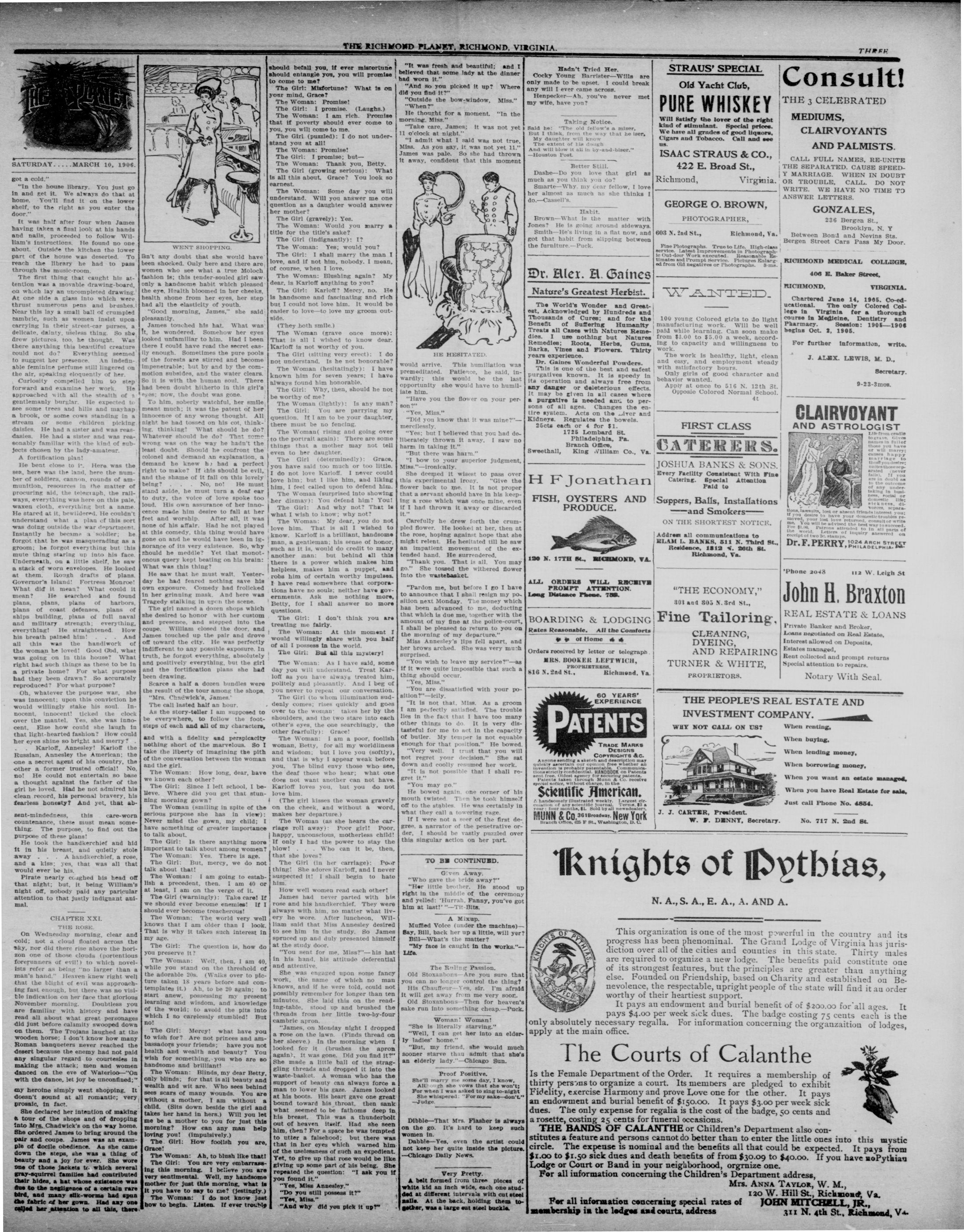
A woman in a long coat stands in a bar, holding a purse.
WENT SHOPPING.
Bn't any doubt that she would have been shocked. Only here and there are women who see what a true Moloch fashion is; this tender-souled girl saw only a handsome habit which pleased the eye. Health bloomed in her cheeks, health shone from her eyes, her step had all the elasticity of youth.
"Good morning, James," she said pleasantly.
James touched his hat. What was it, he wondered. Somehow her eyes looked unfamiliar to him. Had I been there I could have read the secret easily enough. Sometimes the pure pools of the forests are stirred and become impenetrable; but by and by the commotion subsides, and the water clears. So it is with the human soul. There had been doubt hitherto in this girl's eyes; now, the doubt was gone.
To him, soberly watchful, her smile meant much; it was the patent of her innocence of any wrong thought. All night he had tossed on his cot, thinking, thinking! What should he do? Whatever should he do? That some wrong was on the way he hadn't the least doubt. Should he confront the colonel and demand an explanation, a demand he knew he had a perfect right to make? If this should be evil, and the shame of it fall on this lovely being? No, no! He must stand aside, he must turn a deaf ear to duty, the voice of love spoke too loud. His own assurance of her innocence made him desire to fall at her feet and worship. After all, it was none of his affair. Had he not played at this comedy, this thing would have gone on and he would have been in ignorance of its very existence. So, why should he middle? Yet that monotonous query kept beating on his brain: What was this thing?
He saw that he must wait. Yesterday he had feared nothing save his own exposure. Comedy had frolicked in her grinning mask. And here was Tragedy stalking in upon the scene.
The girl named a dozen shops which she desired to honor with her custom and presence, and stepped into the coupe. William closed the door, and James touched up the pair and drove off toward the city. He was perfectly indifferent to any possible exposure. In truth, he forgot everything, absolutely and positively everything, but the girl and the fortification plans she had been drawing.
Scarce a half a dozen bundles were the result of the tour among the shops.
"Mrs. Chadwick's, James."
The call lasted half an hour.
As the story-teller I am supposed to be everywhere, to follow the foot-steps of each and all of my characters,
and with a fidelity and perspicacity nothing short of the marvelous. So I take the liberty of imagining the pith of the conversation between the woman and the girl.
The Woman: How long, dear, have we known each other?
The Girl: Since I left school, I believe. Where did you get that stunning morning gown?
The Woman (smiling in spite of the serious purpose she has in view); Never mind the gown, my child; I have something of greater importance to talk about.
The Girl: Is there anything more important to talk about among women?
The Woman: Yes. There is age.
The Girl: But, mercy, we do not talk about that!
The Woman: I am going to establish a precedent, then. I am 40 or at least, I am on the verge of it.
The Girl (warningly): Take care! If we should ever become enemies! If I should ever become treacherous!
The Woman: The world very well knows that I am older than I look.
That is why it takes such interest in my age.
The Girl: The question is, how do you preserve it?
The Woman: Well, then, I am 40, while you stand on the threshold of the adorable 20s. (Walks over to picture taken 18 years before and contemplates it.) Ah, to be 20 again; to start anew, possessing my present learning and wisdom, and knowledge of the world; to avoid the pits into which I so carelessly stumbled! But no!
The Girl: Mercy! what have you to wish for? Are not princes and ambassadors your friends; have you not health and wealth and beauty? You wish for something, you who are so handsome and brilliant!
The Woman: Blinds, my dear Betty, only blinds; for that is all beauty and wealth and wit are. Who sees behind sees scars of many wounds. You are without a mother, I am without a child. (Sits down beside the girl and takes her hand in hers.) Will you let me be a mother to you for just this morning? How can any man help loving you! (impulsively.)
The Girl: How foolish you are, Grace!
The Woman: Ah, to blush like that!
The Girl: You are very embarrassing this morning. I believe you are very sentimental. Well, my handsome mother for just this morning, what is it you have to say to me? (jestingly.)
The Woman: I do not know just how to begin. Listen. If ever trouble
THE RICHMOND PLANET, RICHMOND, VIRGINIA
should betall you, if ever misfortune
should entangle you, you will promise
to come to me?
The Girl: Misfortune? What is on
your mind, Grace?
The Woman: Promise!
The Girl: I promise. (Laughs.)
The Woman: I am rich. Promise
that if poverty should ever come to
you, you will come to me.
The Girl (puzzled): I do not understand
you at all!
The Woman: Promise!
The Girl: I promise; but—
The Woman: Thank you, Betty.
The Girl (growing serious): What
is all this about. Grace? You look so earnest.
The Woman: Some day you will understand. Will you answer me one question as a daughter would answer her mother?
The Girl (gravely): Yes.
The Woman: Would you marry a
title for the title's sake?
The Girl (indignantly): I?
The Woman: Yes; would you?
The Girl: I shall marry the man I love, and if not him, nobody I mean, of course, when I love.
The Woman: Blushing again? My dear, is Karloff anything to you?
The Girl: Karloff? Mercy, no. He is handsome and fascinating and rich but I could not love him. It would be easier to love—to love my groom outside.
(They both smile.)
The Woman (grave once more):
That is all I wished to know dear.
Karloff is not worthy of you.
The Girl (sitting very erect): I do not understand. Is he not honorable?
The Woman (hesitatingly): I have known him for seven years; I have always found him honorable.
The Girl: Why, then, should he not be worthy of me?
The Woman (lightly): Is any man?
The Girl: You are parrying my question. If I am to be your daughter, there must be no fencing.
The Woman (rising and going over to the portrait again): There are some things that a mother may not tell even to her daughter.
The Girl (determinedly): Grace, you have said too much or too little. I do not love Karloff. I never could love him; but I like him, and liking him, I feel called upon to defend him.
The Woman (surprised into showing her dismay): You defend him? You!
The Girl: And why not? That is what I wish to know, who not?
The Woman: My dear, you do not love him. That is all I wished to know. Karloff is a brilliant, handsome man, a gentleman; his sense of honor, such as it is, would do credit to many another man: but behind all this there is a power which makes him helpless, makes him a puppet, and robs him of certain worthy impulses. I have read somewhere that corporations have no souls; neither have governments. Ask me nothing more, Betty, for I shall answer no more questions.
The Girl: I don't think you are treating me fairly.
The Woman: At this moment I would willingly share with you half of all I possess in the world.
The Girl: But all this mystery!
The Woman: As I have said, some day you will understand. Treat Karloff as you have always treated him, politely and pleasantly. And I beg of you never to repeat our conversation.
The Girl (to whom illumination suddenly comes; rises quickly and goes over to the woman: takes her by the shoulders, and the two stare into each other's eyes, the one searchingly, the other fearfully): Grace!
The Woman: I am a poor, foolish woman, Betty, for all my worldliness and wisdom; but I love you (softly), and that is why I appear weak before you. The blind envy those who see, the deaf those who hear; what one does not want another can not have. Karloff loves you, but you do not love him.
(The girl kisses the woman gravely on the cheek, and without a word, makes her departure.)
The Woman (as she hears the carriage roll away): Poor girl! Poor, happy, unconscious, motherless child! If only I had the power to stay the blow! . . . Who can it be, then, that she loves? The Girl (in her carriage): Poor thing! She adores Karloff, and I never suspected it! I shall begin to hate him. How well women read each other! James had never parted with his rose and his handkerchief. They were always with him, no matter what livery he wore. After luncheon, William said that Miss Annesley desired to see him in the study. So James spruced up and duly presented himself at the study door. "You sent for me, Miss?"—his hat in his hand, his attitude deferential and attentive.
She was engaged upon some fancy work, the name of which no man knows, and if he were told, could not possibly remember for longer than ten minutes. She laid this on the reading-table, stood up and brushed the threads from her little two-by-four cambridge apron.
"James, on Monday night I dropped a rose on the lawn. (Finds thread on her sleeve.) In the morning when I looked for it (brushes the apron again), it was gone. Did you find it?" She made a little ball of the straggling threads and dropped it into the waste-hasket. A woman who has the support of beauty can always force a man to lower his gaze. James looked at his boots. His heart gave one great bound toward his throat, then sank what seemed to be fathoms deep in his breast. This was a thunderbolt out of heaven itself. Had she seen him, then? For a space he was tempted to utter a falsehood; but there was that in her eyes which warned him of the uselessness of such an expedient. Yet, to give up that rose would be like giving up some part of his being. She repeated the question: "I ask you if you found it."
"It was fresh and beautiful; and I believed that some lady at the dinner had worn it."
"And so you picked it up? Where did you find it?"
"Outside the bow-window, Miss."
"When?"
He thought for a moment. "In the morning. Miss." "Take care, James; it was not yet 11 o'clock at night." "I admit what I said was not true, Miss. As you say, it was not yet 11." James was pale. So she had thrown it away, confident that this moment
A
HE HESITATED.
would arrive. This humiliation was premeditated. Patience, he said, inwardly; this would be the last opportunity she would have to humiliate him.
"Have you the flower on your person?"
"Yes, Miss."
"Did you know that it was mine?"—mercilessly.
"Yes; but I believed that you had deliberately thrown it away. I saw no harm in taking it."
"But there was harm."
"I bow to your superior judgment, Miss."—ironically.
She deemed it wisest to pass over this experimental irony. "Give the flower back to me. It is not proper that a servant should have in his keeping a rose which was once mine, even if I had thrown it away or discarded it."
Carefully he drew forth the crumpled flower. He looked at her, then at the rose, hoping against hope that she might relent. He hesitated till he saw an impatient movement of the extended hand. He surrendered.
"Thank you. That is all. You may go." She tossed the withered flower into the wastebasket.
"Pardon me, but before I go I have to announce that I shall resign my position next Monday. The money which has been advanced to me, deducting that which is due me, together with the amount of my fine at the police-court, I shall be pleased to return to you on the morning of my departure."
Miss Annesley's lips fell apart, and her brows arched. She was very much surprised.
"You wish to leave my service?"—as if it were quite impossible that such a thing should occur.
"Yes, Miss."
"You are dissatisfied with your position?"—jelly.
"It is not that, Miss. As a groom I am perfectly satisfied. The trouble lies in the fact that I have too many other things to do. It is very distasteful for me to act in the capacity of butler. My temper is not equable enough for that position." He bowed. "Very well. I trust that you will not regret your decision." She sat down and coolly resumed her work. "It is not possible that I shall regret it." "You may go." He bowed again, one corner of his mouth twisted. Then he took himself off to the stables. He was certainly in what they call a towering rage. If I were not a seer of the first degree, a narrator of the penetrative order, I should be vastly puzzled over this singular action on her part.
TO BE CONTINUED.
"Her little brother. He stood up right in the middle of the ceremony and yelled: 'Hurrah, Fanny, you've got him at last!'" — "Tit-Bits.
A Miyun
Muffled Voice (under the machine)—
Say, Bill, back her up a little, will yer?
Bill—What's the matter?
"My face is caught in the works."—
Life.
Old Stoxanbans—Are you sure that you can no longer control the thing?
His Chaufeur—Yes, sr. I'm afraid it will get away from me very soon.
Old Stoxanbans—Then for heaven's sake run into something cheap—Puck.
"Well, I can get her into an elderly ladies' home."
"But, my friend, she would much sooner starve than admit that she's an elderly lady." - Chicago Sun.
Proof Positive.
She'll marry me some day, I know,
Although she vows that she won't;
For when I was asked to sing to-night
She whispered: "For my sake—don't"
—Judge.
Dibble—That Mrs. Flasher is always
on the go. It's hard to keep such
women in.
Dabble—Yes, even the artist could
not keep her quite inside the picture.
—Chicago Daily News.
Very Pretty.
A belt formed from three pieces of white kid an inch wide, each one studded at different intervals with cut steel nails. At the back, holding them together, was a large cut steel buckle.
Knights of Pythias,
This organization is one of the most powerful in the country and its progress has been phenominal. The Grand Lodge of Virginia has jurisdiction over all of the cities and counties in this state. Thirty males are required to organize a new lodge. The benefits paid constitute one of its strongest features, but the principles are greater than anything else. Founded on Friendship, based on Charity and established on Benevolence, the respectable, upright people of the state will find it an order worthy of their heartiest support.
It pays an endowment and burial benefit of of $200.00 for all ages. It pays $4.00 per week sick dues. The badge costing 75 cents each is the only absolutely necessary regalla. For information concerning the organization of lodges, apply at the main office.
The Courts of Calanthe
Is the Female Department of the Order. It requires a membership of thirty persons to organize a court. Its members are pledged to exhibit Fidelity, exercise Harmony and prove Love one for the other. It pays an endowment and burial benefit of $150.00. It pays $3.00 per week sick dues. The only expense for regalia is the cost of the badge, 50 cents and a rosette, costing 25 cents for funeral occasions.
THE BANDS OF CALANTHE or Children's Department also con-
constitutes a feature and persons cannot do better than to enter the little ones into this mystic circle. The expense is nominal and the benefits all that could be expected. It pays from $1.00 to $1.50 sick dues and death benefits of from $30.09 to $40.00. If you have no Pythian Lodge or Court or Band in your neighborhood, orgrnize one.
For all information concerning the Children's Department address,
Mrs. ANNA TAYLOR, W. M.,
120 W. Hill St., Richmond, Va.
For all information concerning special rates of JOHN MITCHELL, JR.,
membership in the lodges and courts, address
311 N. 4th St., Richmond, V4
Hadn't Tried Her
Cocky Young Barrister—Wills are only made to be upset. I could break any will I ever came across.
Henpecker—Ah, you've never met my wife, have you?
Taking Notice.
Said he: "The old fellows a miser,
Eurie, told me a way that he iser,
the widow will know."
Better Still
Dashe—Do you love that girl as much as you think you do?
Smarte—Why, my dear fellow, I love her almost as much as she thinks I do.—Cassell's.
Habit.
Brown—What is the matter with Jones? He is going around sideways.
Smith—He's living in a flat now, and got that habit from slipping between the furniture.—Puck.
Dr. Aler. H. Gaines
Dr. Aler. H. Gaines
Nature's Greatest Herbist.
The World's Wonder and Greatest. Acknowledged by Hundreds and Thousands of Cures; and for the Benefit of Suffering Humanity Treats all Cases with Natures Remedies. I use nothing but Natures Remedies; Roots, Herbs, Gums, Barks, Vines and Flowers. Thirty years experience. Dr. Gaines Wonderful Powders. This is one of the best and safest purgatives known. It is speedy in its operation and always free from any danger or deleterious effects. It may be given in all cases where a purgative is needed and to persons of all ages. Changes the entire system. Acts on the Liver and Kidneys. Regulates the bowels.
Sweethall, King William Co., Va
H F Jonathan
FISH, OYSTERS AND PRODUCE.
120 N. 17TH St., RICHMOND, VA.
ALL ORDERS WILL RECEIVE
PROMPT ATTENTION.
Long Distance Phone. 758.
BOARDING & LODGING
Rates Reasonable. All the Comforts
of Home
Orders received by letter or telegraph:
MRS. BOOKER LEFTWICH,
PROPRIETRESS,
816 N. 2nd St., Richmond, Va.
60 YEARS' EXPERIENCE
TRADE MARKS
DESIGNS
COPYRIGHTS AG.
Anyone sending a sketch and description may
quickly ascertain our opinion free whether an
invention is probably patentable. COMMUNICA-
tions strictly confidential. HANDBOOK on Patents
sent free. Oldest agency for securing patents.
Patents taken through Munn & Co. receive
special notice without the
Scientific American.
A handsomely illustrated weekly. Largest circulation of any scientific journal. Terms, $3 a year; four months, $1. Sold by all newdealer.
MUNN & Co. 361Broadway, New York
Branch Office, 625 F St., Washington, D.C.
KNIGHTS OF PYTHAS
F.C.B.
pays $4.00 only absolutely necessary regu apply at the main office.
The Cou
Is the Female Department of thirty persons to organize a co Fidelity, exercise Harmony and an endowment and burial bene dues. The only expense for a rosette, costing 25 cents for THE BANDS OF CALA stitutes a feature and persons circle. The expense is nomi
THE PEOPLE'S REAL ESTATE AND INVESTMENT COMPANY.
PURE WHISKEY
Will Satisfy the lover of the right kind of stimulant. Special prices. We have all grades of good liquors, Cigars and Tobacco. Call and see us.
422 E. Broad St.,
Richmond, Virginia.
GEORGE O. BROWN.
PHOTOGRAPHER.
603 N. 2nd St..
603 N. 2nd St., Richmond, Va.
Fine Photographs. True to Life. High-class service. Latest Improvements in Photograph- outdoor or on-accounted. Reasonable baggage. Prime Promotion. Fee charged. Received from Old negatives or Photographs. 8 ms.
WANTED.
---
100 young Colored girls to do 30 light manufacturing work. Will be well paid while learning. Can soon make from $3.00 to $5.00 a week, according to capacity and willingness to work.
The work is healthy, light, clean and easy, and employment steady with satisfactory hours.
Only girls of good character and behavior wanted.
Apply at once to 516 N. 12th St.
Opposite Colored Normal School.
FIRST CLASS
JOSHUA BANKS & SONS.
Every Facility Consistent With Fine
Catering. Special Attention
Paid to
ON THE SHORTEST NOTICE.
Address all communications to
ELAM L. BANKS, 511 N. Third St.
Residence, 1812 N. 26th St.
Richmond, Va.
"THE ECONOMY," 303 and 805 N. 3rd St.,
Fine Tailoring.
CLEANING,
DYEING,
AND REPAIRING
TURNER & WHITE,
PROPRIETORS.
THE PEOPLE'S REAL
INVESTMENT COMP
WHY NOT CALL ON US?
J. J. CARTER, President.
W. F. DENNY, Secretary.
organization is one of the most power has been phenominal. The Grand over all of the cities and counties inled to organize a new lodge. The longest features, but the principles studied on Friendship, based on Char the respectable, upright people of their heartiest support. an endowment and burial benefit o per week sick dues. The badge galla. For information concerning
THREE
Consult!
THE 3 CELEBRATED MEDIUMS, CLAIRVOYANTS
AND PALMISTS
CALL FULL NAMES, RE-UNITE
THE SEPARATED. CAUSE SPEEDY
MARRIAGE. WHEN IN DOUBT
OR TROUBLE, CALL. DO NOT
WRITE. WE HAVE NO TIME TO
ANSWER LETTERS.
GONZALES,
236 Bergen St.,
Brooklyn, N. Y
Between Bond and Nevins Sts.
Bergen Street Cars Pass My Door.
RICHMOND MEDICAL COLLEGE,
406 E. Baker Street.
RICHMOND. VIRGINIA
RICHMOND. VIRGINIA.
Chartered June 14, 1905. Co-educational. The only Colored College in Virginia for a thorough course in Medicine, Dentistry and Pharmacy. Session: 1905----1906 begins Oct. 2, 1905.
For further information, write.
J. ALEX. LEWIS, M. D.,
Secretary.
9-23-3mos.
Secretary.
9-23-3mos.
CLAIRVOYANT
AND ASTROLOGIST
Life from candle to grave. Gives names in full of those you have of a will or causes a happy man to mourn those you deserve unless those separated never fails. If you are in doubt as to how outcome of any incident taking in business, need domestic life, stickness, disgrace.
Life from credible sources names in full of those you have to have happy causes happy lives, though you deserve unites those separated (never forget you are in doubt as to the outcome taking in business domestic life wickle newspaper lawsuits, lost or absent friends interest you; if you desire to have your domestic troubles removed, your house has been sold to me, you will be advised the best way to succeed. He Parmentre trained to in all parts of the world. Letters of recommendation on receipt of two 2c. stamps.
Dr. F. PERRY 1024 ARCH STREET PHILADELPHIA
'Phone 2048
112 W. Leigh St
John H. Braxton
John H. Braxton
REAL ESTATE & LOANS
Private Banker and Broker,
Loans negotiated on Real Estate,
Interest allowed on Deposits,
Estates managed,
Rent collected and prompt returns
Special attention to repairs.
Notary With Seal.
AL ESTATE AND
IMPANY.
When renting
When buying,
When lending money,
When borrowing money,
When you want an estate managed,
When you have Real Estate for sale,
Just call Phone No. 4854.
No. 717 N. 2nd St.
ythias,
A.
powerful in the country and its
and Lodge of Virginia has juris-
in this state. Thirty males
the benefits paid constitute one
s are greater than anything
marity and established on Be-
of the state will find it an order
t of of $200.00 for all ages. It
age costing 75 cents each is the
ing the organization of lodges,
POMEGRANATE
ment also con-
the little ones into this mystic
uld be expected. It pays from
$40.00. If you have noPythian
i address,
TAYLOR, W. M.,
Hill St., Richmond, Va.
N MITCHELL, JR.,
311 N. 4th St., Richmond, V4.
FOUR
THE PLANET
JOHN MITCHELL, JR. • EDITOR
At communications intended for publication
should be sent so as to reach us by Wednesday
TERMS IN ADVANCE
One Copy one year.
One Copy eight months
One Copy six months
One Copy, four months
One Copy, three months
Stake Copy.
ADVENTISING RATES.
For one inch, one insertion.
For two inches, each subsequent insertion.
For two inches, six months.
For two inches, nine months.
For two inches, twelve months.
For two inches, twenty months.
For two inches and General Notices, one inch.
Standing and Transient Notices per line.
EP POSTAGE STAMPS OF A HIGHER, DE NOMINATION THAN TWO CENTS NOT RECEIVED ON SURSCRIPTS.
THE PLANET is szmed weekly. The subscription price is $1.50 per year in advance.
There are FOUR WAYS by which money can be sent by mail at our risk.—In a Post Office Money Order, or Check or Draft, or an Excess Money Order, and when more of those can be procured, in a Registered Lett. or.
MONEY ORDERS.—You can buy a Money Order at your Post Office, payable at the Rich and Post-Officer, and we will be responsible for its safe arrival.
EXPRESS MONEY ORDERS can be obtained at any office of the American Express Co. on the phone or by Go and Co.'s Express Company. We will be responsible for money sent by any of these companies. The Express Money Order is a sandwich note that contains the name of the company, the REGISTERED LETTER—If a money Order Post-office or an Express Office is not written your reach, your Postmaster will register the Letter you wish to send us on payment of your money. You can send money in one way can be traced. You can send money in this manner at our risk.
We cannot be responsible for money sent in another way other than one of the ways mentioned above. If you send your money in any other way, you must do it at your Renewal, ETC. If you do not want your PLANET continued for another year after your subscription has run out, you then notify my Postal Card to discontinue it. The counts have not ordered their paper discontinued at the expiration time for which it has been paid are held liable for the payment of the subscription. When they order the paper discontinued.
COMMUNICATIONS:—When writing to us to renew your subscription or to discontinue your subscription, we must date when they order the paper discontinued.
CHANGE OF ADDRESS:—In order to change the address of your account, we must be sent a copy of your current address.
Entered at the Post-Office at Richmond. We
as second-class matter.
SATURDAY.....MARCH 10, 1906.
Colored men, we are still under
fire in the Southland, although
well-nigh every political right and
privilege under the law has been
taken from us.
---
We have no time to grieve and repine over existing conditions. We must scheme, plan and work along all legitimate lines with a view of increasing our usefulness to the community and adding to our own coffers.
Colored men, who commit heinous crimes upon women, be the victims white or colored deserve no sympathy at our hands. If guilty, the sooner they find the rope's end the better for all concerned. The hoodlum Negro is a hindrance and the criminal one is a nuisance.
Every man, be he white or black is entitled to a fair and impartial trial and he should have it. The granting of this right and a legal conviction should cause all cessation of all efforts in behalf of the prisoner, on the part of the public.
Teach your children to be polite and obliging to everybody, be they white or black. Some people mistake impertinence and ill-breeding for nerve and manhood.
The colored people of this country are advancing rapidly and the better classes of them are widely separated from the lazy lawless good-for-nothing elements. Few white people realize this however.
The Constitution League of the United States has held two meetings, one in New York city and the other in Washington, D. C. We have carefully read the resolutions adopted in the former city and the resolutions adopted in the latter city. It seems to us that the wings don't flap together. It is a well-known fact that there is a wide difference of opinion as to whether it is best to reduce the congressional representation of the states that have disfranchised the Negro. Some of our leaders contend that to do this would emphasize and make per manent the very evil of which we complain, while others urge that it would have a punitive effect upon those Negro-hating politicians in the Southland, who were profit-ing by this form of political robbery. Be that as it may, it seems a lit-
the odd for the organization to say one thing in New York and another thing in Washington, the two places being within a radius of two hundred miles of each other. It is hoped that these evidences of intestinal disagreements may be eliminated and the movement be focused under one management and under one leadership.
MITCHELL DENIES
STRIKE PLOT
Miners' Leader Says Story From Pittsburg is All Nonsense.
WAITING OPERATORS' ANSWER
New York, March 6.—John Mitchell, president of the United Mine Workers, denied emphatically that he had entered into a deal with Mr. Robbins, the independent operator. When seen at the Ashland House the miners' leader said:
"Things are in status quo. Let me say this: The dispatches from Pittsburg intimating that I have entered into a deal or am about to come to an understanding with Mr. Robbins, to the effect that if I would help the anthracite miners to get an increase of wages he would make similar efforts for the bituminous miners, is all nonsense. We are waiting for developments from the operators' side."
A Soft Coal Plot?
Pittsburg, March 6.—The word has been passed out in Pittsburg among the independent as well as other coal operators that a strike in the anthracite regions has been decided on, that it will be a forced strike and that the bituminous operators, many of whom are hesitating about paying the advance demanded by the miners here, will be greatly benefited.
The assurance that the anthracite strike is as good as on is one of the inducements now being held out to the balking independent operators.
It is openly asserted by those in a position to know that such action has been discussed by President John Mitchell, of the United Mine Workers, and Chairman Francis L. Robbins, of the Pittsburg Coal Company.
Mitchell has been positively assured that if a strike in the anthracite regin is guaranteed to the blituminous operators the soft coal miners will receive an advance that will force the anthracite operators to raise their pay to the miners, and that there will be little trouble in securing a good advance in the blituminous region, not only in territory covered by the Pittsburg Coal Company, but by other operators, independent and otherwise.
Just what answer Mitchell made to this proposition is not made public, but the fact remains that independent operators in the Pittsburg district say they have been assured that there will be a strike, in the anthracite region, and that it will be a good one. Some of the operators have changed their minds and will vote for an advance to the miners here.
"Make the anthracite people come up to the mark, or close their mines, and we will deal with you. If you don't, we may deal with you anyway on the advance, but we will stop the 'check-off.' and you know, what that will mean."
That was the cold way in which the proposition was handed to John Mitchell within the last seventy-two hours by Robbins, or his personal representative, and it has made Mitchell think.
The abolishment of the "check-off" by the blituminous operators, it is declared, would kill the miners' union.
The "check-off" is toll collected from the miners' pay envelopes by the operators for the United Mine Workers. That is how the union is kept up. All admit that, if left to the miners themselves, the dues would not be paid. The threat to stop this collecting or "holding out" from the miners' pay has had its effect.
The object of the move is to boost bituminous prices and get into the eastern markets, long controlled by the anthracite people, as soon as their mines are made idle by a strike.
LOCAL OPTION DEFEATED
Only Thirteen Votes For It In New Jersey Senate.
Trenton, N. J., March 6: The Assembly was in session until after midnight, the entire time being taken up with a discussion of Assemblyman Miller's local option bill and a motion of Mr. Martin to relieve committees from assembly bills 13 and 17. The local option bill was discussed almost without limit, and when it finally came to a vote was defeated, with only 13 votes in the affirmative. Practically the only speaker in favor of the bill was Assemblyman Buck, who took charge of it in the absence of Mr. Miller, the introducer.
Gives $100,000 to Episcopal Missions.
Philadelphia, March 6—George C.
Thomas, a retired banker of this city,
has presented $100,000 to the board of
missions of the Episcopal church. It
is Mr. Thomas' request that the dona-
tion shall be used as a permanent fund
known as the "Bessie Moorhead
Thomas Memorial Fund," after his
daughter, who died some years ago.
The fund is placed at the disposal of
the board of missions of New York,
and will be used for foreign or home
missionary work, at the discretion of
the board.
The Longworths In Washington. Washington, March 5. Representative and Mrs. Nicholas Longworth returned to Washington from Cuba, to which place they journeyed after their wedding. They occupied a private car attached to a regular train of the Southern railway. They were met at the station by Mr. Longworth's private secretary and drove immediately to Mr. Longworth's residence on 18th street, where they have taken up their home. Mr. Longworth will immediately resume his legislative duties at the capitol.
THE RICHMOND PLANET, RICHMOND, VIRGINIA
BANKER'S SON KIDNAPPED
$20,000 Ransom Demanded to Saves
Boy's Life
New York. March 7.—A banker's son kidnapped and held for $20,000 ransom is the latest puzzle the New York police have been called upon to solve. The parents, frantic with fear have received two letters from the boy, imploring that the sum mentioned be sent to his captors. The kidnappers themselves have twice written demanding the ransom on penalty of the lad's death.
The victim of the bold plan to extort $20,000 is Antonio Bozuff, the 14-year-old son of John Bozuff, a leading Italian banker, whose place of business is at 63d street and First avenue.
The kidnapping occurred last Saturday, on which day the bank is kept open during the afternoon. The boy, who was acting as a clerk, was sent out to purchase $10 worth of stamps and did not return. Inquiry proved that he had made the purchase. Monday the first letter came from the lad. Tuesday came the second, and with it the letter of the abductors. The latter was well written and in Italian. The boy's first letter said he was held a captive in Brooklyn. After asking that the money be paid, the note concluded: "Do not advise the police under any circumstances, because if you do my life will leave this world." March 8 is the day set for the payment of the ransom.
ROBBED FIFTEEN RESIDENCES
Scranton Man Stole to Satisfy His Pass
sion. For Playing Pool.
Scranton, Pa., March 5. — Edward Griffiths, a chauffeur, aged 24, the son of a very good family, was arrested here on suspicion of being the lone burglar who, since December 1, entered and ransacked 15 residences. He broke down when confronted with evidences of his guilt, and confessed to eight of the burglaries. He said he might have been guilty of the other depredations, but he was not sure as some of the houses he burglarized were selected at random, and he does not know the names of the occupants. One of the places he admitted burglarizing was the home of County Detective W. A. Phillips. His detection was effected through his attempt to dispose of some old coins stolen from one of the houses.
He was a pool flend, he sald, and stole that he might raise money to indulge his passion for the game. His method was to go from house to house ringing door bells until he found one from which all the household was absent, which he would enter by breaking a pane of glass in the window and loosening the catch. All the houses where the ring of the door bell was answered he would ask to be directed to some fictitious residence.
CANNOT AGREE
Lackawanna & Western Trainmen Ask
For Company's Ultimatum.
Scranton, Pa, March 7.—After four weeks of conference, the joint grievance committee of the Delaware, Lackawanna & Western conductors and trainmen concluded that they cannot reach an amicable agreement with General Superintendent T. E. Clarke and they will ask for his best ultimum preliminary to reporting to the local lodges that they cannot secure an adjustment and asking for a vote as to whether or not to order a strike. This was given out by the committee after a session at their headquarters. The announcement will be received with great surprise in Lackawanna circles, as each party to the conference, by solemn agreement, had given out no inklings of what was taking place except to say that "satisfactory progress" was being made. The grievances are mostly about wages.
FARMER DRAWN INTO THRESHER
Hlg Leg So Badly Mangled That Am
putation Was Necessary
pulation Was Necessary.
York, Pa. March 6.—A. M. Glattfelter, a farmer and prominent Democratic politician, was caught in the threshing machinery on his farm near New Salem, this county, and received injuries which may cause his death.
Glattfelter was adjusting a belt which had slipped off the machine, when he was struck over the head with the threshing board, which became fastened in the belt. His left leg was drawn into the machine, and that member was badly lacerated. The left leg was amputated by surgeons who also found that his skull was fractured.
MURDERER BREAKS J...
Condemned Negro Escapees to Wrocks and All Traces of Him Are Lost. Towson, Md., March 6. -Isaac Winder, colored, under sentence to be hanged March 30, for the murder December 21, 1905, of Frederick T. Rinehart, keeper of a toll-gate near here, escaped from jail and track of him was lost in nearby woods. This is Winder's third attempt to escape, the first having been made before his trial. It was almost successful, but one lock remaining between him and freedom when he was discovered. The crime for which Winder was condemned aroused great indignation, and if he is caught by one of the many parties of civilians now scouring the country for him a lynching is threatened.
RURAL DELIVERY'S GROWTH
There Are Now 35,000 Routes In Op
eration in the Northeast Region
eration in the United States.
Washington, March 6.—The operations of the rural free delivery service up to March 1, 1906, are shown in a statement issued by Fourth Assistant Postmaster General DeGraw. Up to that time 52,227 petitions had been received and referred. Of these 13,772 were acted upon adversely. The number of routes in operation March 1 was 35,031.
In connection with these figures the statement is made that notwithstanding the development of the service there is an unexpended balance on hand to the credit of new establishment of $905,106, from the appropriation of $2,276,696 which became available July 1 of last year.
GEORGE SMALL
GUILTY OF MURDER
He and Rufus Johnson to Hang March 24 For Allinson Crime.
WIFE COLLAPSED AFTER TRIAL
Mt. Holly, N. J., March 7.—George Small, the negro, who was on trial here charged with the killing of Miss Florence W. Allinson, near Moorestown, on January 18, was convicted of murder in the first degree. $ \textcircled{1} $ was sentenced to be hanged on March 24, at which time Rufes Johnson will also be executed for the same crime. Johnson was convicted of the murder on February 8, and sentenced to be hanged on February 23. A few days prior to the day set for the execution, Small, who had been arrested for complicity in the murder, made a confession, in which he said he did the killing. On the strength of this Johnson was repieved for a month pending the outcome of Small's trial.
Counsel for Small made a strong effort against the admission of the confession alleged to have been made by the defendant, but without avail. Small took the witness stand and denied that he had any thing to do with the crime, and also maintained that he was not in the vicinity of the Allinson home on the day the murder was committed. Small's wife collapsed as he was led past her cell on his way from the court house, and her condition is considered critical. She had been held as a witness.
ROBBERY STORY A FAKE
Millville, N. J., Baker Charged With
Embezzlement
Millville, N. J., March 5.—Frederick Roedel, the baker, whose story of assault and robbery of $4000 last week started this city, was held in $3000 bail by Mayor Payne for his appearance at the April term of court on the charge of embezzlement and conspiracy. Roedel claimed he was held up by two men, who robbed him of the money. The charge was preferred by Lilburn M. Hess, who held a mortgage of $1100 on a brick company's plant which was burned in December, and of which Roedel was treasurer. Hess did not believe the story, and had detectives investigate the case, which resulted in the arrest of Roedel. According to the detectives, Roedel told the robbery story in order to get control of $2700 insurance money that had been paid to him. Roedel denies all attempts to conspire for the money, and affirmed that his story of the assault and robbery was true.
SUSAN B. ANTHONY JLL
Woman Suffragist Advocate Suffering From Pneumonia.
Rochester, N. Y., March 7. — Miss Susan B. Anthony is seriously ill at her home here of pneumonia, which developed on her return from her recent visit to Washington. Her physician, Dr. Marsena S. Ricker, said: "Miss Anthony's left lung is now affected by pneumonia. Her right lung has practically cleared. As the result of nausea she became very weak. She is still unable to retain nourishment and consequently is very weak. Of course these conditions in Miss Anthony's case are serious. We hope that her constitution, which has been vigorous even in old age, will carry her through to an improved condition soon. It is difficult to say now what the change may be."
Unanimously Chosen Head of Democratic Congressional Committee. Washington, March 7.—Representative J. M. Griggs, of Georgia, was unanimously chosen chairman of the Democratic congressional committee at a meeting in the capitol attended by 31 members of the committee. Representative Bowers, of Mississippi, placed Mr. Griggs in nomination. There were no other nominations, and the secretary was instructed to cast the entire vote for Mr. Griggs.
Exedus of Foreigners From Coal Milnes
New York, March 7.—More than 1000 Hungarians and Slavs from the anthracite coal regions attempted to obtain passage on the steamer Kaiser Wilhelm der Grosse which sailed for Europe from Hoboken. Only 780 of the would-be passengers could be accommodated, and the others were forced to remain behind and await another steamer. The men said that they were only the advance guard of thousands of their fellow country men who will leave the coal fields within the next few weeks for their homes. They appeared to believe that a strike in the coal regions is certain to come, and told they have decided to go home to remain until the trouble is settled.
No Cemetery For Dog.
Norristown, Pa., March 6. — The court decided that a cemetery is no place for the burial of animals, no matter how much they are beloved by the owners. The case in point was that of Charles Bean, who interred a pet poodle in his lot in the Lutheran cemetery at North Wales, and erected a monument similar to those marking the names of other members of the family, and inscribed "Our Pet." For this he was haled into court by the church people, and Judge Swartz holds they were justly aggrieved.
Woman Hanged Herself.
Harrisburg, Pa., March 6. — Mrs. Elizabeth Emig, aged 63 years, committed suicide in a fit of despondency, caused by illness, by hanging herself from a post used to fasten a clothes line, at her residence in this city.
Barge Burned Off Atlantic City.
Atlantic City, N. J., March 7. — The barge Hamilton Fish, owned by the C. Dunham Nephew company, of New York, was destroyed by fire at sea four miles off the Barnegat life saving station. The captain and crew were taken off by the tug which had the barge in tow. The vessel was left burning and the tug proceeded up the coast.
A WEEK'S NEWS CONDENSED
Thursday, March 1.
Two daughters of George Storer, of Camden, Mich., were poisoned by eating canned salmon.
Rear Admirals Colby M. Chester and French E. Chadwick have been placed on the retired list.
Postmaster Albert Hoerner, of West Seneca, N. Y., is under arrest, charged with embezzling $5000 postoffice funds.
Mrs. Sarah E. Ray, aged 102 years, one of the oldest women in Baltimore, and a, well-known war nurse, died of old age.
George Kingsbury, grand scribe of the Grand Chapter, Royal Arch Masons of Michigan, died at Cassopolis of consumption.
Friday, March 2.
at Windsor, N. C., for wife murder.
Armour & Co.'s meat distributing plant in Philadelphia was destroyed by fire, entailing a loss of $150,000.
North College, the oldest dormitory at Wesleyan University, at Middletown, Conn., was destroyed by fire. Loss $80,000.
By the collapse of the upper floor of a building at Cleveland, O., one man was killed, one totally injured and 10 had miraculous escapes from death.
President Roosevelt has asked congress to appropriate $100,000 to defray the expenses of the delegates of the United States to the Pan-American congress in Rio de Janeiro next spring.
Saturday, March 3.
Andrew Thompson, a negro, was hanged at Greenville, S. C., for rape.
Robert S. Woodruff, former law judge of Mercer county, N. J., died at Trenton from stomach trouble.
Governor Pennypacker has designated Friday, April 6, and Friday, April 20, as Arbor Days throughout Pennsylvania.
Mrs. Joseph A. Swann, widow of former Governor Swann, of Maryland, who recently suffered a paralytic stroke, died in Washington.
Attempting to open a can of powder with a pick caused an explosion which fatally injured three foreigners and destroyed a house at Greensburg, Pa.
Monday, March 5.
Over 1,000,000 acres of fine pasture land in the pan handle of New Mexico has been burned over by a two-days' prairie fire.
Caught under a loaded coal car that jumped the vladict at the Laughlin steel plant in Wheeling, W. Va., John Cramer, a workman, was killed.
From a strong, husky fellow, Harry Wakefield has been transformed into a weakling at Richmond, Va., by five weeks of hiccups.
Captain A. J. Standing, assistant superintendent of the Carlisle (Pa.) Indian Training School for 20 years and lately connected with Dickinson College, has resigned to go to England.
Tuesday, March 6.
Andrew Carnegie will give $25,000 to Rio Grande College, a Baptist theological school at Rio Grande, O.
William Dowd was sentenced to two and a half years in prison at Ballston, N. Y., for illegal voting last fall.
Major Livingston Mims, one of the most widely known men in the south and an intimate friend of Jefferson Davis, died at Atlanta, Ga.
J. H. Ward, a prominent merchant of Toledo, O., became mentally unbalanced in a political campaign and committed suicide by shooting.
A passenger train on the Southern Railway was wrecked at High Point, N. C., and a score of persons were injured, but no one was killed.
Wednesday, March 7.
George Hasty was convicted of murdering two actors at Raleigh, N. C., and sentenced to life imprisonment. Joseph Hogan, 14 years old, of Philadelphia had both legs cut off while attempting to board a Reading freight train.
Governor Pennypacker has vetoed the resolutions passed by the Pennsylvanal legislature to investigate the coal combine.
Frank J. Constantine, who is wanted in Chicago for the murder of Mrs. Arthur W. Gentry, has been arrested near Wheeling, W. Va.
President Roosevelt will appoint Manly Lawton, son of the late Major General Lawton, a cadet to the West Point military academy.
GEN. SCHOFIELD PASSES AWAY
Retired Army Officer Died Suddenly at St. Augustine, Fla.
St. Augustine, Fla., March 5 —leutenant General John M. Schofield, U. S. A., retired, former head of the army, died here. He was attacked with cerebral hemorrhage. His wife and young daughter were with him.
With the death of General Schofield, the last surviving army commander during the Civil War has passed away.
John McAllister Schofield was a native of the state of New York and was born in Chautauqua county, November 29, 1831. His father was a Baptist minister. He removed to Freeport, Ill., when his son was but 11 years of age, and it was from there that the future general in chief of the republic's armies was sent to West Point. He graduated in 1852, and in 1860, while a first lieutenant, obtained leave of absence to accept the chair of physics in the Washington University of St. Louis.
The echoes of the first gun fired upon Sumter had hardly ceased before young Schofield resigned his chair at St. Louis, and offering his services to the government was made mustering officer of the state of Missouri. A month later he was elected a captain in Colonel Frank A. Blair's regiment, First Missouri Infantry, which was afterward transferred to the artillery service. He won the foundation of a reputation for promptness and efficiency when at Fredericktown, Md., where a large Confered force had
suddenly gathered, by hastily embarking recruits on a railroad train and hurrying with them to the scene, organizing the raw troops after his arrival and routing the Confederates completely. In 1869 he was appointed major general of the United States army and ordered to the department of the Missouri.
From 1870 to 1876 he had charge of the department of the Pacific and was superintendent of the military academy at West Point for the five years from 1876 to 1881. In 1882 and 1883 he was again in charge of the department of the Pacific, and from 1883 to 1888 had command of the division of the Missouri. Then he was placed in command of the division of the Atlantic and was in charge of Governor's island in New York harbor when in 1888 the death of Sheridan occurred. Schofield being then the senior major general of the army, was raised to the position of general in chief.
General Schofield was president of the board that adopted the army tactics in 1870, went on a special mission to the Hawaiian Islands in 1873 and was president of the board of inquiry in the Fitz-John Porter case in 1878. He was twice married, his first wife being Miss Bartlett, daughter of a West Point instructor, and his second wife, to whom he was united in 1891, Miss Georgia Kilbourne of Iowa.
DIDN'T KNOW IT WAS LOADED
Miss Eliza Weaver Accidentally Killed
By Her Sister.
Gettyburs, Pa., March 5. — Mrs. Isaac H. Welkert, residing near her accidentally shot and instantly killed her sister, Miss Eliza Weaver, aged 35 years. Mrs. Welkert was examining a revolver which had been purchased by her, she supposing it was empty. In some manner it was discharged and the bullet entered Miss Weaver's brain. Mrs. Welkert is heartbroken over the affair and is in a serious condition.
High License for Chicago.
Chicago, March 6.—As a step toward stamping out crime in Chicago, the city council by a vote of 40 to 28 passed an ordinance making the price of saloon licenses $1000 instead of $500 as heretofore. The law is effective on May 1 unless Mayor Dunne should veto the ordinance. Chicago has 7017 saloons. With the doubling of the cost of a license, it was thought that many of these places would be compelled to discontinue business. The saloonkeepers put up a bitter fight against the high license plan.
Sixteen Persons Burned to Death.
Florence, March 6.—At the village of Fucecchio, 23 miles west of Florence, a house where a dance was in progress took fire. In the panic among the guests which ensued the floor gave way and 16 persons perished. While many others were injured.
Charles Brewster Hanged.
Coudersport, Pa., March 7.—Charles Brewster, convicted of the murder of Marshal Stryker, his step-father, was banged in the Potter county jail here. He had nothing to say on the gallows and went to his death unfinchingly.
PRODUCE QUOTATIONS
The Latest Closing Prices In the Principal Markets
PHILADELPHIA — FLOUR steady; winter extras. $3@2.25; Pennsylvania roller, clear. $3.40@3.60; city mills, fancy. $4.75@4.80. RYE FLOUR firm; per barrel. $3.70. WHEAT firm; No. 2 Pennsylvania red. new. $8@3.80. CONF firm; No. 2 yellow, local, 46½c OATS steady; steady, clipped, 35½c grade; grades 35½c firm; No. 1 timothy. $15.50 for large bales. PORK steady; family. $17 BEEF steady; beef hams. $23 @24 POULTRY: live steady; hens, 12½@13c; old roosters, 9½c. Dressed firm; choice fowls, 14c.; old roosters, 10c. BUTTER steady. creamy, 32c EGGS firm; selected, 16@17c; nearby 15c. western, 14@15c; southern, 13@14c. POTATOES steady; per bushel. $6@76c.
BALTIMORE - WHEAT steady; No 2 spot, 85%1c; steamer No. 2 spot 80c; southern, on grade, 80c, CORN quiet; mixed spot, 46%1c; steamer mixed, 45%1c; southern, 44c, OATS steady; white No. 2, 35%1c; No. 3, 34@34%1c; No. 4, 33@33%1c; mixed No. 2, 34@34%1c; No. 3, 33@33%1c; No. 4, 32@32%1c; BUTTER steady; mixed No. 2, 34@34%1c; forerun 85%20c, prints 29%, held 23%24c; land and Pennsylvania dairy prints, 16%17c EGGS steady; fancy Maryland, Pennsylvania, Virginia and West Virginia, 13c; southern, 12c.
Live Stock Markets
PITTSBURG (Union Stock Yards)—
CATTLE lower; choice, $5.40@5.60
prime, $5.15@5.35. HOGS higher; prime
heavies, mediums and heavy Yorkers
light Yorkers, $6@6.65
plugs, $6.50@5.80
SHEEP tair; prime wethers, $6.50
common sheep, $2.50@3.50; lambs, $7
7.50; calve calves, $8@8.50
Killed His Playmate
Glens Falls. N. +Y., March 5—Leon Pixley, aged 12 years, shot and killed Gilbert Armstrong, aged 9 years. In the kitchen of the former's home at Johnsburn, because young Armstrong refused to allow him to join in a game of dominoes.
BRYAN GREETED IN INDIA
Nebraska Shown Marked Courtesies
By British Officials There
By British Officials There.
Calcutta, India, March 7.—William J. Bryan has arrived here on his trip around the world. He has received much courteous attention from officials and others, many fetes and entertainments having been arranged in his honor. Luncheons have been given him by the lieutenant governor and the viceceroy, the Earl of Minto.
Trade Increases Despite Boycott:
Trade Increases Despite Boycott.
Washington, March 7.—In view of the widespread feeling regarding the effect of the Chinese boycott of American goods, Secretary Metcalf, of the department of commerce and labor, gave out a statement, prepared in the statistical division of his office, showing the amount of exports from this country to China, by months, July, 1904, to January, 1905, and from July, 1905, to January, 1906, respectively.
It appears from this that the total exports for the seven months ending January, 1905, amounted to $23,432,948, whereas for the seven months ending January, 1906, they equaled $28,862,680, or a total increase of $5,429,732.
HORRORS OF THE RUSSIAN BASTILE
REVOLUTIONARY LEADER IN-CARCERATED 16 YEARS.
STORY OF HIS SUFFERING
Polish Patriot Describes Tortures Inflicted on Prisoners at Schusselburg Fortress—Waters Pour Through Dungeons.
London.—For the first time since the transformation of the Schusselburg prison into the Russian bastle in 1884, has a living soul come out of its dungeons to tell the story of his sufferings.
The Schlusselburg is a fortress on a Neva island about 20 miles east of St. Petersburg, and is used only for the most dangerous political criminals. As a rule unfortunate beings who enter it never come out alive, and the saying, "as dead as a prisoner of the Schlusselburg," has become proverbial in Russia. The recent amnesty, however, opened the doors to some of the prisoners, and one of them, a Polish patriot, after being released fled to London, where he has told the story of his suffering during 16 years' seclusion in a living tomb.
He is now 37 years of age, having been imprisoned at the age of 21 when a student at Warsaw university. His appearance, however, is that of a man of 60. He is physically and mentally a wreck, his scarce locks are whitened by the moist air of the prison cells, and his features are haggard; the vivid eyes alone show that there is still life in the wasted body. His awful experience has made him very timid, and he declines to permit the use of his name for fear he may be caught again by the czar and sent back to his prison cell.
This is the story: "A little over 16 years ago I was brought from Warsaw to the Schlusselburg, after a Polish patriotic agitation. My cell was an underground room of about eight feet by twelve. For the first six months I was kept chained to an iron bar passing through the wall and out
FOR SIXTEEN YEARS THE STONE FLOOR SERVED AS HIS LED.
into the corridor. Whenever the bar was turned by the guard I was jerked round in my bed. Every half hour the guard turned the handle so that even the solace of an undisturbed sleep on an iron bedstead was not granted to me.
"In the morning the bed was removed from the cell, and I was obliged to lie on the damp stone floor, not withstanding my illness.
"In spring, when the snow melts, the waters of the Neva often rise and pour through the dungeons. For days together we and to live with the icy cold snow water up to our knees.
"The food consisted of water in the morning, cabbages at noon, and water again at night, not even the sick being given more strengthening food.
"The crying and laughing of prisoners who had become insane haunted me day and night and drove me nearly mad myself. Oh, that hard, metallic laughter! How it echoed in the cells and corridors of the Schlussburg! Even now I shiver when I think of it.
"Knocking at the walls, singing, whistling, and even quick walking are prohibited, and any infringement of the rule is severely punished by an application of the knot or a suspension of the food supplies.
"In such surroundings it is little wonder if attempts are made by the prisoners to free themselves from the burden of a life without hope. One prisoner, Gratshevsky by name, poured over himself the contents of the paraffin oil lamp, and died after horrible sufferings. Another, Sopsy Grussburg, opened her veins with a broken lamp tube.
"It would be impossible to give all the details of the tortures meted to the political prisoner. I will only mention one instance of that of an 'unknown' man whose cell was walled up, and he was left to starve in his tomb. "The amnesty gave freedom to some of us, but there are still five men awaiting their liberation."
James Wasn't Ready
One morning a father, who was in from the country visiting his son at the university, was busy shining his shoes in his room, and called to his son, who was dressing in the next:
"James, are you ready to go up on the campus yet?"
"No," answered James. "I have to go up street and get my shoes polished before I'll be ready."—Judge.
Same Thing.
"Are you giving your daughter a musical education?"
"Well, perhaps not that; but I'm paying for one."—Life.
IT WILL PAY YOU
RICHMOND PLANET.
IN ORDER TO FURTHER INCREASE OUR STEADILY GROWING CIRCULATION WE WILL OFFER PRIZES.
```markdown
```
To interest the
RICHMON
IF YOU WILL TALK WITH YOUR NEIGH-
BORS AND INTEREST
WE WILL HELP YOU
IN ORDER TO FUL
RS AND INTEREST THEM IN THE PLANET.
WE WILL HELP YOU TO OBTAIN A PREMIUM.
IN ORDER TO FURTHER INCREASE OUR STEADILY GROW
WE WILL SEND YOU THE PLANET AND THE ST LOUIS, MISSOURI, SEMI-WEEKLY GLOBE DEMOCRAT, ONE OF THE LEADING REPUBLICAN JOURNALS IN THE UNITED STATES FOR $2.25 PER YEAR FOR BOTH.
WE WILL SEND YOU THE PLANET AND THE COSMOPOLITAN MAGAZINE FOR $2.25 PER YEAR FOR BOTH.
WE WILL SEND YOU THE PLANET AND McCLURE'S MAGAZINE FOR $2.25 PER YEAR FOR BOTH.
BORS AND INTEREST THEM IN THE PLANET. WE WILL HELP YOU TO OBTAIN A PREMIUM.
WE WILL SEND YOU THE PLANET AND THE ST LOUIS, MISSOURI, SEMI-WEEKLY GLOBE DEMOCRAT, ONE OF THE LEADING REPUBLICAN JOURNALS IN THE UNITED STATES FOR $2.25 PER YEAR FOR BOTH.
WE WILL SEND YOU THE PLANET AND THE COSMOPOLITAN MAGAZINE FOR $2.25 PER YEAR FOR BOTH.
WE WILL SEND YOU THE PLANET AND McCLURE'S MAGAZINE FOR $2.25 PER YEAR FOR BOTH.
OR THEIR EQUIVALENT, WE WILL SEND PICTURES, ONE ONLY, OF PRESIDENT THEODORE ROOSEVELT, DR. BOOKER T. WASHINGTON, BATTLE OF SANTIAGO, LAND BATTLE OF QUASIMAS NEAR SANTIAGO, JUNE 24, 1898, SHOWING THE NINTH AND TENTH COLLORED CAVALRY IN SUPPORT OF ROUGH RIDERS, SIZE 20X28 AND 20X24 INCHES, LAND BATTLE AND CHARGE OF THE 24TH & 25TH
COLORED INFANTRY IN RESCUE OF ROUGH RIDERS SAT SAN JUAN HILL, JULY 2, 1898, SIZE 22X28 AND 20X24 INCHES, ADMIRAL DEWEY'S GREAT NAVAL BATTLE OFF CAVITE IN MAHA BAY, MAY 1ST, 1898, NAVAL BATTLE, STRUCTION OF ADMIRAL CERVERA'S SANISH FLEET OFF SANTIAGO DE CUBA, JULY 3RD, 1898, SIZE 22X28 INCHES; LAND BATTLE, CAPTURE OF EL CANEY, EL PASO AND TERTIFICATIONS OF SANTIAGO, JULY FIRST AND SECOND, 1898, SIZE 22X28 AND 22X27 INCHES. WE WILL SEND YOU ONE OF ANY OF THE FOLLOWING BATTLES OF THE CIVIL WAR ON THE SAME TERMS. THE PICTURES ARE THE OTHER BATTLES ARE FINISHED IN COLORS. THEY ARE 22X28 INCHES AND REALL AT ONE DOLLAR EACH. WE WILL BURNISH FRAMES FOR ANY OF THESE FINE CROMOS FOR 2 DOLLARS & 50 CTS. EACH ADDITIONAL. BATTLE OF GETTYSBURG, BATTLE OF SHILOH, BATTLE OF FIVE FORKS, VA., BATTLE OF ATLANTA, GA., BATTLE OF POTTSYLVANIA, VA., BATTLE OF VICKSburg, MISS., BATTLE OF LOOKOUT MOUNTAIN, TENN., BATTLE BETWEEN THE MONIER AND THE MERRIMAC, BATTLE OF BULLMAN, VA., BATTLE OF CHANCELLORSVILLE, BATTLE OF THE BIG HORN, (CUSTER'S LAST CARGE) STORMING OF FORT WAGNER, S. (COLORED TROOPS IN THIS FIGHT), BATTLE OF NEW ORLEANS, LA., CAPTURE AND BATTLE OF SITTING BULL, THE GREAT INN CHIEFTAIN; FORT PILLOW MASSACRE, BATTLE OF PETERSBURG, VA., BATTLE OF WINESTER, VA., BATTLE OF OLUSTEE, FLA. WE WILL SEND FAMILY RECORD, SIZE 22 BY WHICH CONTAINS SPACE FOR PHOTOAPHS OF PARENTS AND TEN CHILDREN. WE WILL SEND SOLDIERS WAR RECORD (CERICATE OF SERVICE IN UNITED STATES ARMY.)
OR THEIR EQUIVALENT, WE WILL SEND PICTURES, ONE ONLY, OF PRESIDENT THEODORE ROOSEVELT, DR. BOOKER T. WASHINGTON, BATTLE OF SANTIAGO, LAND BATTLE OF QUASIMAS NEAR SANTIAGO, JUNE 24, 1898, SHOWING THE NINTH AND TENTH COLORED CAVALRY IN SUPPORT OF ROUGH RIDERS, SIZE 20X28 AND 20X24 INCHES, LAND BATTLE AND CHARGE OF THE 24TH & 25TH
COLORED INFANTRY RIDERS sAT SAN JUAN 20X28 AND 20X24 INC. GREAT NAVAL BATTLE NILA BAY, MAY 1ST DESTRUCTION OF THE SPANISH FLEET OFF LY 3RD, 1898, SIZE 22 TLE, CAPTURE OF ELE FORTIFICATIONS OF AND SECOND, 1898, INCHES. WE WILL S OF THE FOLLOWING WAR ON THE SAME, LIKE THE OTHER BAT COLORS. THEY ART TAIL AT ONE DOLL FURNISH FRAMES FOR CHROMOS FOR 2 DOLL DITIONAL. BATTLE TLE OF SHILOH, BATTLE BATTLE OF ATLANT SPOTTSYLVANIA, VA. BURG, MISS., BATTLE TAIN, TENN., BATTLE TOR AND THE MERP RUN, VA., BATTLE O BATTLE OF THE BIG CHARGE) STORMING C., (COLORED TROOP TLE OF NEW ORLEA DEATH OF SITTING DIAN CHIEFTAIN; FALL OF PETERSBUR CHESTER, VA., BATT WE WILL SEND FAM 28, WHICH CONTA GRAPHS OF PARENT WE WILL SEND SOLD TIFICATE OF SERVICE MY.)
COLORED INFANTRY IN RESCUE OF ROUGH RIDERS sAT SAN JUAN HILL, JULY 2, 1898, SIZE 20X28 AND 20X24 INCHES, ADMIRAL DEWEY'S GREAT NAVAL BATTLE OFF CAVITE IN MANILA BAY, MAY 1ST, 1898, NAVAL BATTLE, DESTRUCTION OF ADMIRAL CERVERA'S SPANISH FLEET OFF SANTIAGO DE CUBA, JULY 3RD, 1898, SIZE 22X28 INCHES; LAND BATTLE, CAPTURE OF EL CANEY, EL PASO AND FORTIFICATIONS OF SANTIAGO, JULY FIRST AND SECOND, 1898, SIZE 22X28 AND 22X27 INCHES. WE WILL SEND YOU ONE OF ANY OF THE FOLLOWING BATTLES OF THE CIVIL WAR ON THE SAME TERMS. THE PICTURES LIKE THE OTHER BATTLES ARE FINISHED IN COLORS. THEY ARE 22X28 INCHES AND RETAIL AT ONE DOLLAR EACH. WE WILL FURNISH FRAMES FOR ANY OF THESE FINE CHROMOS FOR 2 DOLLARS & 50CTS. EACH ADDITIONAL. BATTLE OF GETTYSBURG, BATTLE OF SHILOH, BATTLE OF FIVE FORKS, VA., BATTLE OF ATLANTA, GA., BATTLE OF SPOTTSYLVANIA, VA., BATTLE OF VICKSBURG, MISS., BATTLE OF LOOKOUT MOUNTAIN, TENN., BATTLE BETWEEN THE MONITOR AND THE MERRIMAC, BATTLE OF BULL RUN, VA., BATTLE OF CHANCELLORSVILLE, BATTLE OF THE BIG HORN, (CUSTER'S LAST CHARGE) STORMING OF FORT WAGNER, S.C., (COLORED TROOPS IN THIS FIGHT), BATTLE OF NEW ORLEANS, LA., CAPTURE AND DEATH OF SITTING BULL, THE GREAT INDIAN CHIEFTAIN; FORT PILLOW MASSACRE, FALL OF PETERSBURG, VA., BATTLE OF WINCHESTER, VA., BATTLE OF OLUSTEE, FLA. WE WILL SEND FAMILY RECORD, SIZE 22 BY 28, WHICH CONTAINS SPACE FOR PHOTOGRAPHS OF PARENTS AND TEN CHILDREN. WE WILL SEND SOLDIERS WAR RECORD (CERTIFICATE OF SERVICE IN UNITED STATES ARMY.)
FOR FIVE NEW SUBSCRIBERS
FOR ONE YEAR EA
LENT, WE WILL SEN
CLE TOM'S CABIN, T
TERESTING BOOK
WILL SEND YOU A
WITH YOUR PICTU
R ONE YEAR EACH, OR THEIR EQUIVA-
NT, WE WILL SEND YOU A COPY OF UN-
TE TOM'S CABIN, THE MOST INTENSELY IN-
RESTING BOOK IN THE COUNTRY. WE
WILL SEND YOU A GOLD-PLATED BROOCH
WITH YOUR PICTURE THEREIN, YOU TO
FOR ONE YEAR EACH, OR THEIR EQUIVALENT, WE WILL SEND YOU A COPY OF UNCLE TOM'S CABIN, THE MOST INTENSELY INTERESTING BOOK IN THE COUNTRY. WE WILL SEND YOU A GOLD-PLATED BROOCH WITH YOUR PICTURE THEREIN, YOU TO
```markdown
```
```markdown
```
To interest yourself in promoting the CIRCULATION of the
FOR TWO YEARLY SUBSCRIBERS
READ THE GREAT INDUCEMENTS OFFERED BY THE PLANET
THE RICHMOND PLANET, RICHMOND, VIRGINIA
YOU
yourself in promot=
CIRCULATION of the
PLANET.
SHOULD YOU DESIRE ANY COLORED
JOURNAL IN THE UNITED STATES, WE WILL
SEND IT TO YOU IN CONJUNCTION WITH THE
PLANET AT A GREATLY REDUCED RATE
FOR BOTH.
VING CIRCULATION WE WILL OFFER PRIZES.
FURNISH THE PHOTOGRAPH, ONE FOUN-
TAIN PEN, GOLD POINT; ONE LADIES RING,
ONE BREAST-PIN, GOLD FILLED; HALF DOZ-
EN LINEN HANDKERCHIEFS, ONE ALARM
CLOCK, ONE DOZEN NAPKINS, ONE HALF
DOZEN TOWELS, ONE CHOCOLATE POT, ONE
PAIR VASES, ONE PAIR KID GLOVES, ONE
HAM, ONE TURKEY.
SHOULD YOU DESIRE ANY COLORED JOURNAL IN THE UNITED STATES, WE WILL SEND IT TO YOU IN CONJUNCTION WITH THE PLANET AT A GREATLY REDUCED RATE FOR BOTH.
FURNISH THE PHOTOGRAPH, ONE FOUNTAIN PEN, GOLD POINT; ONE LADIES RING, ONE BREAST-PIN, GOLD FILLED; HALF DOZEN LINEN HANDKERCHIEFS, ONE ALARM CLOCK, ONE DOZEN NAPKINS, ONE HALF DOZEN TOWELS, ONE CHOCOLATE POT, ONE PAIR VASES, ONE PAIR KID GLOVES, ONE HAM, ONE TURKEY.
WE WILL SEND ONE CHINA SET, THIRTY-ONE PIECES; ONE NECKLACE; DICKENS, SHAKESPEARE, BYRON WORKS; ONE UMBRELLA, ONE PLAIN GOLD RING, ONE PAIR LACE CURTAINS 1,000 ENVELOPES, 1,000 SHEETS OF PAPER PRINTED AND DELIVERED; ONE TOILET SET, ONE HALF CORD OF SAWED WOOD.
WE WILL SEND ONE CHINA SET, THIRTY-ONE PIECES; ONE NECKLACE; DICKENS, SHAKESPEARE, BYRON WORKS; ONE UMBRELLA, ONE PLAIN GOLD RING, ONE PAIR LACE CURTAINS 1,000 ENVELOPES, 1,000 SHEETS OF PAPER PRINTED AND DELIVERED; ONE TOILET SET, ONE HALF CORD OF SAWED WOOD.
WE WILL GIVE ONE HANDSOME GOLD RING WITH OPALS, RUBIES OR PEARLS; ONE JEWELRY BOX FINISHED IN GOLD OR SILVER; ONE SILK SHIRT WAIST; ONE READY MADE DRESS, ONE GOLD WATCH, FILLED, WARRANTED FOR TEN YEARS, ONE ROCKING CHAIR, ONE LOAD OF COAL, ONE GROSS OF SOAP, EITHER WASHING OR TOILET; ONE BARREL OF BEST FLOUR, ONE PAIR BLANKETS, ONE MANICURE SET, ONE SEAMSTRESS' WORK BOX, ONE PAIR SHOES, GENTS OR LADIES.
WE WILL GIVE ONE HANDSOME GOLD RING WITH OPALS, RUBIES OR PEARLS; ONE JEWELRY BOX FINISHED IN GOLD OR SILVER; ONE SILK SHIRT WAIST; ONE READY MADE DRESS, ONE GOLD WATCH, FILLED, WARRANTED FOR TEN YEARS, ONE ROCKING CHAIR, ONE LOAD OF COAL, ONE GROSS OF SOAP, EITHER WASHING OR TOILET; ONE BARREL OF BEST FLOUR, ONE PAIR BLANKETS, ONE MANICURE SET, ONE SEAMSTRESS' WORK BOX, ONE PAIR SHOES, GENTS OR LADIES.
FOR FORTY YEARLY SUBSCRIBERS
OR EQUIVALENT, WE WILL GIVE ONE SEWING MACHINE, ONE DIAMOND RING, ONE GOLD WATCH, ONE PAIR FINE GOLD EARRINGS, ONE MUSIC BOX, ONE PHONOGRAPH, ONE READY MADE DRESS, ONE SUIT OF GENTLEMEN'S CLOTHES, ONE GOLD-HEADED CANE, ONE GOLD-HEADED UMBRELLA, ONE CHINA SET, ONE DOZEN SILVER-PLATED KNIVES AND FORKS, ONE HAT-RACK ONE
OR EQUIVALENT, WE WILL GIVE ONE SEWING MACHINE, ONE DIAMOND RING, ONE GOLD WATCH, ONE PAIR FINE GOLD EARRINGS, ONE MUSIC BOX, ONE PHONOGRAPH, ONE READY MADE DRESS, ONE SUIT OF GENTLEMEN'S CLOTHES, ONE GOLD-HEADED CANE, ONE GOLD-HEADED UMBRELLA, ONE CHINA SET, ONE DOZEN SILVER-PLATED KNIVES AND FORKS, ONE HAT-RACK, ONE SILK DRESS, ONE WEEK'S TRIP TO THE SEASHORE, RAILROAD FARE AND HOTEL BILL PAID, FOR ANY RICHMOND WORKER. THESE OFFERS MAY BE TAKEN ADVANTAGE OF BY SENDING ONE OR TWO SUBSCRIBER'S NAMES AT A TIME. WE WILL KEEP A RECORD OF THEM; AS SOON AS THE
REQUISITE NUMBER IS OBTAINED, WE WILL FORWARD THE PRESENT INDICATED. A PERSON WHO TRIES TO GET FORTY SUBSCRIBERS AND GETS TIRED MAY INDICATE HIS WISH AND WE WILL SEND THE PRESENT FOR THE NUMBER HE HAS SECURED OVER FIVE. THE NUMBER WILL BE FOR NOT LESS THAN FIVE NOR MORE THAN TEN AND NOT LESS THAN TEN NOR MORE THAN TWENTY AND NOT LESS THAN TWENTY NOR MORE THAN FORTY, TO DETERMINE THE PRIZE TO WHICH THE WORKER IS ENTITLED.
IF ANYTHING IS DESIRED NOT SPECIFIED IN THIS LIST, WRITE US ABOUT IT AND WE WILL TELL YOU IN WHAT CLASS IT BELONGS.
A man is sitting at a desk. A man is standing next to him.
```markdown
```
FOR TEN NEW SUBSCRIBERS
FOR TWENTY NEW SUBSCRIBERS
```markdown
```
FIVE
15
PROF. D. D. BRUCE, M. D.
Strange, Wonderful but True are
the awe stricken tests given by The
a Written Gunra
Great Australian Medium.
He is the only
your business or
He is the only one that will give a Written Guarantee to complete your business or refund your money Are you sick? Do you know what the trouble is with you? Come and Consult Nature's Doctor.
PROF. D. D. BRUCE, M. D. the only Living Apostle of Science of the Mysteries. 1800 in Gold to any one in the World to be with him. Possessing more power than any four mediums combined.
Rheumatism, Insomnia, Hysteria and all Diseases cured. Points given on Horse Racing and all Games of Chance.
No card, trance or hand humbug
No matter what alls you, come and see this wonderful man. Read, have you noticed that some people have a hard time to get along, no matter how they toil, while others have success. Many wealthy men and women owe their success to this wonderful man.
Greatest Hindoo Medium in the World.
SO GREAT IS HIS POWER that he can tell you while in a Clairvoyant state, all you wish to know without a word being spoken. Come, all ye unbelievers, scoffers and jeerers; bring all your skepticism with you—he will open your eyes to the private chamber mystery. Come all ye broken hearted wives, all with low spirits and let him lift the burden from your aching and jealous heart. He challenges the World to compete with him in causing a speedy marriage with the one you love; uniting the separated and bring back the lost one. Traces lost or stolen goods. Unearths hidden treasures. Removes evil influences Crosses, Spells, ill luck, Cures tricks and Conjurations, gives Luck and Success in all you undertake. Cures the Tobacco and Liquor Habits. All allows the Captive to be set Free.
He will tell you whom you will marry. Will you be happy? He will tell you who your friends and enemies are. Can you tell? Don't take a cape in the dark, but be advised by this wonderful man. Greatest Prophet in existence.
He always succeeds when others fail. This is the chance of a life time. Don't let it pass you.
Office hours: 9 A. M. to 9:30 P. M.
Sunday: 2:30 to 7:30 P. M.
N. B.—Our consultation Fee is 50 cents. Settings. $1.00. All letters containing $1.00 will be answered in full.
610 N. 1st St., Richmond, Va.
Main Office—510 S. 8th St. Philadelphia, Pa.
[TRADE MARK REGISTERED.]
Has proved to be a fortune to many of the unfortunate, who are to-day delighted with its wonderful results. The merits of this great hair preparation naturally places it in a sphere all of its own, and the glowing terms in which our patrons speak of it reassures us of its satisfactory results. We can well boast of a large patronage throughout this and other States and also enjoys the commendation of the very best white and colored people in this immediate community. In order to convince the most skoptical readers of the merits and results of the J. V. Hawkin's Hair Grower and Restorer, we will from time to time produce in print the photographs of those giving us permission to do so, who have used our preparation and are to-day
among the many bearing witness of its genuine qualities. We do not desire the correspondence of those expecting a miracle or anything unreasonable. Our preparation is a natural and pure compound, the ingredients of which we would not hesitate to put in print. We will just here remind the public that the United States Government has placed national patent rights on our hair preparation by which it is protected and we are in turn responsible to the government for honest methods and square dealings.
It will positively remove Dandruff, Cure Scalp of all impurities, Restore Hair on Clean Temples or Bald Heads, where the roots are not dead.
PRICES:—35 cts. per box (local orders) 35 cts.
A.
The Face Beautifier makes the use of powder entirely unnecessary, and is perfectly harmless. Sale prices; 25, 50cts and $1.00
Money can be sent by Post Office Money Order or Express Money Order. A charge of 10cts, extra is imposed on all out of city orders.
PUT ON YOUR THINKING CAP.
SYDNOR & HUNDLEY, 709—11—13 E. Broad Street
Richmond, Va., have the larg-
est and choicest selection of FURNITURE
in the South. Prices are moderate.
Druggets, Curtains, &c., in
Abundant Variety.
BRIDAL OUTFITS A SPECIALTY.
For HOLIDAY and NEW YEARS GIFTS
many very attractive FURNITURE specialties have
been provided for you to select from.
'Phone, 577. Richmond, Va.
All orders promptly filled at short notice by telegraph or telephone. Halls rented for meetings and nice entertainments. Plenty of room with all necessary conveniences. Large pisnic or band wagons for hire at reasonable rates and nothing but first-class carriages, buggies, etc. Keeps constantly on hand fine funeral supplies.
OPEN ALL DAY & NIGHT.—Man on Duty All Viz
THE PLANET
"LITTLE PITCHERS"
GROWN-UPS OFTEN UNWISE IN
TALK BEFORE CHILDREN.
"Little Pitchers Have Big Ears" and
Parents Should Be Careful About
Discussing Neighbors in Their
Hearing—Object Lessons in Lying
—The Incompetent Nurse—Burdens Upon Childish Minds—Copying Parents' Fauits.
BY MARGARET E. SANGSTER.
(Copyright 1906. by Joseph B. Bowles.)
(Nothing stamps a mother more surely as sweet and refined than entire confidence between parents and children. Still, in every household matters come up which should not be discussed in the presence of juniors. This is especially true when, as sometimes happens, the older ones are talking over questions that concern outsiders, either neighbors or friends. If, unfortunately, something comes to light about a family in the community, which that family would naturally prefer to keep to itself, it is to the last degree unkind as well as unwise to make any allusion to the subject in the hearing of children. The difference between children, so far as curiosity is concerned, is very marked. An inquisitive child who is also secretive, will linger about, quietly observant, hanging eagerly on the conversation of father and mother, only half understanding what she hears, and perhaps without knowing the extent of the mischief she makes, will repeat scraps that she has heard to the undoing of the parents. No one can be other than mortified if her friends are told things that she has said at home, which were never meant for the public ear.
The little pitcher is often a little critic. One of these children said to me: "I cannot understand mother. She saw Mrs. — coming down the street, and she said to Aunt Charlotte: 'There is that old cat. I am afraid she is coming here. She always chooses the most inconvenient time, and I can't bear her anyway.' 'I expected,' went on the child, "to see her treat Mrs. — very coldly, but she was just as polite as she could be. She said: 'Dear Mrs. —, how glad I am to see you,' and a great deal more. If I tell stories, I am punished. But what can I think of mother?"
What, indeed? If you are going to be a social hypocrite you would better keep your little pitcher in the nursery out of sight and hearing of your deceit. All the precept in the world will not make children truthful if they have object lessons in lying set before their eyes.
Not a great while ago, a beautiful golden-haired little boy, scarcely four, startled his mother by calmly uttering an oath in the middle of his play. "Why, Harry!" exclaimed the mother, in dismay. "Where did you hear such a word? Do you not know that it is very, very wicked to use such words as that?" "Why," said the child, with honest eyes fixed on her face, "it can't be so very wrong. Father and Uncle Fred often speak in that way." **Urren are creatures of imitation.** The words they hear they repeat. Evil is not evolved from the recesses of their own hearts. It comes upon them as part of the stain and soil of the world in which they live.
A great deal of harm is done to children when they are left in the care of irresponsible and incompetent hirrelings. A mother careful of every breath her child draws, sometimes seeks for it a nurse who is foreign-born, with the very laudable desire to accustom the child's ear and tongue to French, or German, or Italian, so that it may acquire the other language side by side with its native English. Unless the mother obtains for the child a nurse who is pure-minded and sufficiently well educated to speak her own tongue with precision, she may be doing the child a great injury. It is no advantage to infancy to learn a corrupt and barbarous patois, instead of a pure and elegant language. If, in addition, the nurse be rough and untortured, and without scruples of a conscientious order, the little pitcher will very probably be filled to the brim with ideas and thoughts that are anytling but clean and wholesome.
The imperative cry of childhood is for something to do. Therefore, so soon as the little one emerges from the dawning mists of babyhood and becomes an independent personage, with exactions and demands that are to be met, the kindergarten should open for it a new world. In the multiform plays and tasks of the kindergarten, with the little tables where clay may be molded and beads may be strung, and patterns pricked into paper with pins, a child steps into a fascinating realm of its own. Children who are carefully taught in a kindergarten and who are allowed plenty of time for outdoor play, who are healthfully active all day and who go to bed early at night, are not in much danger of becoming objectionable little pitcher.
For the children's own sake, they should not too early have burdens laid upon them that they cannot bear. A woman who has children of her own told me that when she was a little thing of six she was in the room when her parents were somewhat exercised over the payment of a large bill. "I have absolutely no money to meet it."
declared the father. For days there after the child shuddered whenever she saw a strange man turn in at the gate, and she was afraid that some dreadful thing was about to happen in her home long after her lighthearted father and mother had forgotten all about their transient embarrassment.
The whole business of bringing up children bristles with difficulty. If only we could be perfect beings ourselves the undertaking would not be so arduous. But we make so many blunders, we are so ready to leave undone what we ought to do, and to do what we ought not to do, that our children have a pretty hard time in their turn. Somehow they scramble up in spite of our mistakes. Heredity has a good deal to do with their success or failure. It is a great thing for a child to have had worthy grandparents. Training tells, too, but only as we train ourselves do we ever succeed in training our successors aright. Little Lilly and Josephine may be told all day long that it makes no difference how they look if only they behave well, but if mamma be valin and inconsiderate they will probably copy her rather than obey her precepts. Jack and Horace will not have finer ideals of honor than their father. I have heard the father of five sons, between the ages of four and 14, relate with positive glee, a story of gains that he had made through overreaching another in a business transaction. The little pitchers had big ears. They drank in the shameful tale. It would be too much to expect that later on they should go forth into life with a noble standard and a high ideal of integrity.
"I don't care what sort of men my boys make, so long as they learn to make money and keep it," said another father in the hearing of his sons. Not one of those boys turned out even decently, when he arrived at manhood. To make money and to keep it is too low an ideal to be set before a growing youth. Look out for the little pitchers. It is worth while.
FROCK FOR A LITTLE GIRL.
Suitable for Child from Seven to Nine Years—The Material a Striped Cream Wool.
Our model is in a creamy-white woolen material woven with dark blue lines to form a small plaid. It makes a very becoming dress for a little girl. The front of the dress is arranged in three deeply-set pleats each side, leav-
ME
A NEAT DRESS.
ing the center front plain, which simulates a wide box-pleat. The pleats are stitched from the shoulders to just below the bust, where they are ornamented with three dark blue velvet-covered buttons. A belt of the same material is worn below the waist-line; it crosses and buttons in front, and is held in position by stitching firmly to the center of back.
Materials required: $2\frac{1}{2}$ yards 48 inches wide, one-quarter yard velvet.
A CORRECT LUNCHEON.
Hour Is Somewhere Near One and Course Meal Somewhat Like Following Is Served.
The question is asked how to give a correct luncheon, the hour, courses, etc. One or half after is the accepted time; the shades are drawn, and artificial lights used as for an evening dinner. There is usually a centerpiece of flowers, although a fruit piece is sometimes substituted. Candles with shades to match the color scheme are used, and place cards, elaborate or simple, according to the taste and purse of the hostess.
In serving a good rule to follow is a fruit, bonilion or light soup, a lamb chop, a chicken, oyster or sweetbread patty, potato or rice croquettes, olives, jelly, or celery, radishes, a salad with wafers and a dessert followed by coffee, cheese and crackers. Many hostesses now serve one of the popular cordials in tiny glasses, holding barely a thimbleful.
Pretty, light gowns are worn, high neck and elbow sleeves -Madame
Care of the Hands
Soft, tepid water, pure soap, and careful drying whenever bathed will help greatly to keep the hands soft and white. Skin food and massage will keep them well rounded and skin smooth. Well-shaped, polished nails with well-kept cuticle and immaculate cleanliness is an imperative law.
Still the Style
All-over lace, trimmed with medallions of batiste embroidery, is an exact reversal of the lace-trimmed all-over embroideries of a year ago, which, by the way, are still in favor.
An Important Point
Mrs. Blifkins (reading) -The points of fine seal 'or are, first, the texture—Mr. Blifkins-Humph! Seems to me the first point is the price.—N. Y. Weekly.
THE RICHMOND PLANET. RICHMOND. VIRGINIA
JOB DEPARTMENT
EXCURSION
We print Handbills, Quarter-Sheet posters, Tags, Tickets, Placards, Visiting Cards, Mourning Stations
WE HAVE
Our St
OF THE LATE
WE CAN PRINT A BILL AS SMALL
A Three-Sheet
AS LARGE AS A FRO
Our street-entrance is retired and fastidious lady being able to enter w
EXCURSION WORK OF ALL DESCRIPTIONS
We print Handbills, Quarter-Sheets, Half and Whole Sheet posters, Tags, Tickets, Placards, Society Cards, Minutes, Visiting Cards, Mourning Stationery.
OUR AIM is to please our patrons and to give them the best service at the lowest prices, consistent with satisfactory work.
We furnish "cuts" when desired and we will arrange to complete special work in our line. When in need of any work in our line, call and see us and estimates will be furnished.
WE HAVE AN ELEGANT LINE OF SAMPLES
WHICH WE WILL SHOW ANY ONE DESIRING TO SEE THEM.
Our Stock Room Embraces a Full Line
OF THE LATEST STYLE BOND, FINE WRITING—FLAT AND LINEN PAPER, ENVELOPES, ETC.
WE CAN PRINT A BILL AS SMALL AS A DODGER. A Three-Sheet Poster AS LARGE AS A FRONT DOOR.
Our street-entrance is retired and has no objectionable features, the most fastidious lady being able to enter without embarrassment or annoyance.
LONG DISTANCE TELEPHONE, 2213.
---
It is thoroughly equipped to do all kinds of printing on short notice. We make a specialty of Society printing and work for Insurance Companies, such as Financial
BEAUTIFUL SHOULDERS
For Evening Dress a Woman Likes
Well - Developed Shoulders and
Arms—Massage Helpful.
Every woman, and especially the
woman who appears frequently at
society functions in decollete gowns,
should take pride in the appearance of
her arms, neck and shoulders. Frequent
rubbing with cocoa butter will whiten
the skin, while the correct massage
movements will render it firm and
velvety, writes Mime, Hebe.
To massage the sides of the neck let
the head rest well back and use the
two middle fingers with a rotary move-
WELL-ROUNDED SHOULDERS.
ment, from the ear downward to the collar bone.
For a prominent collar bone massage above and below, using light pressure with a good skin food.
A splendid method of developing the shoulders is to shrug them. First expel all the air from the lungs and let the shoulders droop; then take in a long breath and raise the shoulders as far as possible; as the air leaves the lungs bring the shoulders forward and continue the movement in a rotary direction.
If the line of the neck and shoulder shows a tendency toward bony prominence, the defect may be remedied by a combination of massage with exercise. The muscle that caps the shoulder, the deltoid, is a very strong one, and when properly developed will raise the arm above the head with ease.
POINTS ON ETIQUETTE.
About Answering Announcement
Cards, the Proper Form Thereof
and the Reception Day.
There exists a confusion sometimes
in regard to the question of a reply to
announcement cards.
In fact, no answer at all is required,
unless the cards contain a date of re-
ception or days in certain months.
Then the calling card of the recipient
should be mailed to the address, di-
rected to whoever sent the cards of
announcement, writes Hortense Prevost.
A card announcing a marriage is
equivalent to a card only; it is not an
invitation of any kind, but a statement
Cards, Policies, both straight life and benevolent, Physician's Certificates, Sick Cards, Application blanks, Agents Report Sheets, Rate Cards, etc.
ION WORK
arter-Sheets, Half and Whole,
Placards, Society Cards, Min-
ing Stationery.
WE AN ELSE
WHICH WE WILL
Stock Roo
LATEST STYLE BOND, FI
AS SMALL AS A DODGER.
sheet Poster
A FRONT DOOR.
OUR PRESENT CORP OF EMPLOYE
IS WITHIN EASY REACH OF
fired and has no objectionable f
enter without embarrassment o
2213.
OUR PRESENT CORP OF EMPLOYEES ARE COMPETENT AND QUICK-WORKING. OUR OFFICE IS WITHIN EASY REACH OF THE PUBLIC, BEING WITHIN FIFTY YARDS OF BROAD ST.
to the effect that a couple have been married at a certain time and place. If, however, there is added that "Mr. and Mrs. Blank," the newly-married couple, will be "at home" with day and date and address, a reply must be made, if not in person, by one's card, enclosed and posted to reach the name on the day of the "at home."
Announcement cards are always sent by the parents or those who stand in that relation, or the bride. The form is simple:
"Mr. and Mrs. Blank announce the marriage of their daughter (or niece), Mary Elliza, to Mr. James Fenner Smith, at such and such a church (or at a home wedding) on such and such a date."
The acknowledgment must be a visiting card in an envelope with the names of Mr. and Mrs. Blank on the outside, they having sent the card of announcement.
Two of the husband's cards must be enclosed, with one of the wife's, of course.
Acknowledgments of the receiving announcement cards are never sent to the bride, as she does not send them at all. A note of congratulation to the bride is always in order, if one is personally acquainted.
Sleeve Protectors
Decidedly acceptable to the business woman are the dainty little sleeve protectors made of the large fancy handkerchiefs now so much in vogue. One handkerchief will make a pair. It is folded diagonally in four, and then a three-cornered piece is cut off the side, and the raw edges thus left neatly joined with a French seam. Two of the bits removed are shaped to a neat angle, joined to the sleeves with the seam on the right side and turned up, forming dalty cuffs. The pair described was made of a pale blue handkerchief decorated with large butterflies in darker blue and was both pretty and effective.
A Muddy Complexion
There is often an underlying cause for the so-called muddy complexion. The best way is to find out the cause of the trouble and then seek to cure it. Are you particular to use laxative food or some exceptional article that will have that effect? Then do you drink plenty of water and but little tea and coffee?
A Question of Water
Don't use cold water on your face with the idea that you are going to cleanse it or rid it of blackheads. Use warm water with your complexion brush and soap. Then, if you like, after rinsing thoroughly with warm water sponge the face with cold which acts as a tonic. Hot water taken internally is excellent.
Behind the Scenes.
"The star seems to have plenty of diamonds and automobiles." whispered the sweet singer. "They say she is well fixed." "Ah," chuckled the comedian, "I suppose she is what we would call a fixed star."—Chicago Daily News.
The Unusual Way.
"When we were driving yesterday, our horse ran away and kicked the dashboard all to pieces."
"What did you do?"
"Why, we had to borrow an automobile to drag us home."—Detroit Free Press.
WORK OF ALL
OUR AIM
is to please our patrons and to
give them the best service at
the lowest prices, consistent
with satisfactory work.
LEGANT I
SHOW ANY ONE DESIRING
from Embrace
ONE WRITING—FLAT AND
LOYEES ARE COMPETENT AND QUI
THE PUBLIC, BEING WITHIN F
features, the most
or annoyance. FOR FURT
Jol
WHEN THE PLANTS FAIL.
Atmosphere in Our Homes Too Dry—
Insects Attack Plants in a
Dry Atmosphere.
The amount of pleasure derived
from growing plants depends entirely
on their condition. A hardy plant in
a tin can is a more hopeful and inspiring sight than a mighty palm with yellowing and dejected edges.
Here are some of the reasons why
plants refuse to thrive indoors:
Plants in bloom that have been
bought of florists have been forced
into flower by means of artificial heat and moisture. To keep such plants
they must be moistened frequently,
letting the pot rest in a basin half full
of water until the plant has absorbed
enough water and the top layer of
earth is damp. The leaves should be
sprayed with a flower spray or gently
washed off, according to their size.
When the plant has not been forced watering must be adapted to its individual needs. A cactus or other succulent plant require less water than robust foliage plants, for instance. Many of the slow-growing cactaceae need hardly any water during the winter months unless they are in a very warm room. Ferns, however, need to be watered and sprayed frequently, and the slightest neglect in this respect will do the plant great injury. The water should, if possible, be soft. Rain water, collected for the purpose, is best for ordinary use. Palms and foliage plants require spraying every other day in winter, if kept in rooms where the temperature is high. The proper temperature of the room in which plants are to thrive should be between 65 and 70 degrees. This will suffice for all plants, even tropical ones. The temperature is often too dry in the American dwelling house, and many kinds of insects attack plants in a dry atmosphere. Frequent spraying helps to overcome this trouble, but when the green fly makes its appearance on the house plants it must be fought either with strong tobacco smoke or by dipping the foliage in weak tobacco water. Young shoots should be dusted with tobacco powder.
The red spider which attacks plants if kept too dry can be got rid of by washing with a strong solution of fir tree oil.
Diseases arise from injudicious watering, draughts, previous attacks of insects or bad drainage.
Mildew on the house plant is caused by sudden chills. It attacks young shoots particularly.
When the leaves of a plant turn sickly yellow, something is generally the matter with the root, and the plant should be turned out and examined.
If the cause is not apparent a removal of the old soil, repotting in fresh and suitable soil, will effect a cure.
Roots of house plants are often found to be rotting if the plant is allowed to stand in water.
Plants most suitable for indoor blooming during the winter are, besides, the fern varieties, carnations, Persian violets, primulas, begonias, and many kinds of bulbous plants, such as hyacinths, narcissi, lilies, lily of the valley, etc.-N. Y. World.
We print Wedding Invitations, and High Class Stationery for Balls, Parties, Picnics and all entertainments of a social nature. We print Church Envel-
ALL DESCRIBE
us and to
service at
consistent
x.
We furnish "cuts" when de-
complete special work in our l
in our line, call and see us and
OT LINE OF S
DESIRING TO SEE THEM.
braces a full
AT AND LINEN PAPER, ENVELOP
WE HAVE ONE OF THE
OF WOOD
Of Any Job Printing E
T AND QUICK-WORKING. OUR OFFICE
WITHIN FIFTY YARDS OF BROAD ST.
FOR FURTHER INFORMATION, AP
John Mitch
311 N. 4th St.
FAIL.
Too Dry—
in a
derived
entirely
plant in
l and in-
palm with
Stronger.
Teacher—Johnny, for what is Switz-
erland famous?
Scholar—Why—m'm—Swiss cheese.
Teacher—Oh, something grander,
more impressive, more tremendous.
Scholar — Limburger? — Cleveland
Leader.
Not His Custom.
The Old Timer was handing out ad-
vice.
FOR FURTHER INFORMATION, APPLY TO
John Mitchell, Jr.,
Frank Waller, Jr
Residence, 1 E. Orange St.
Prompt attention given to all mail
lors. Satisfaction guaranteed.
1 Kinds of Painting Done Cheap.
Give me a call before going else-
here.
New Phone, 475.
ROBT. S. FORRESTER,
FLORIST
212 E. Leigh Street,
RICHMOND.
VERGENIA.
Reliable Prescription Drug Store 794 North Second Street. BEFORE MAKING
plant turn
generally
and the plant
examined.
rent a re-
rotting in
all effect a
are often
plant is al-
or indoor
or are, be-
carnations,
begonias,
us plants,
st., lilies,
f. World.
Refrigerators,
Mattings, Oil-Cloths.
And in fact everything that is need
ed in house furnishings.
RUGS AND CARPETS.
Of every description; also the la-
stest designs in ROOKERS and special
GHAIRS. Our goods are the
best for the price and the price is
very low.
C. G. Jurgen's Son
421 EAST BROAD ST.,
between 4th and 5th Street
WE HAVE ONE OF THE LARGEST ASSORTMENTS OF WOOD-TYPE Of Any Job Printing Establishment in the city.
311 N. 4th St., Richmond, Va.
"Never marry a widow," said he.
"I never do," said the cheerful chap
from St. Louis. "That is, seldom or
never."—Chicago Sun.
PRACTICAL HOUSE PAINTER,
Plant Decorations, Choice Rosebuds, Cut Flowers, Funeral Designs, House Decorations for Wedding Parties, &c. a specialty. Give me a call.
When You Are Sick
future and Fresh Medicines only will cure you than purchase your Drugs and Medicine from!
Your purchase you would do well to call at the most reliable furniture house in the city and see the fine line of
opes, Note and Letter Paper, Bill-heads, Monthly Statements, Business Cards, Financial and Order Books, Circulars, Check-books, Pamphlets.
SUPPLIED and we will arrange to
line. When in need of any work
estimates will be furnished.
SAMPLES
Line
TUES, ETC.
LARGEST ASSORTMENTS
OD-TYPE
establishment in the city.
PLY TO
neil, Jr.,
Richmond, Va.
'Phone, 1569.
Residence. No. 911-82d St.
ROBT. W. WILLIAMS,
FUNERAL DIRECTOR &
EMBALMER.
No. 8019 P. STREET, BETWEEN
30TH AND 31ST STREETS.
RICHMOND, VA.
Special attention given to all business entrusted to me. Carriages for funerals, reception and marriages at all hours. Satisfaction guaranteed to all.
A. Hayes
OFFICE AND WARE-ROOMS,
727 North Second Street
RESIDENCE, 725 N. 2nd St.
First-class Hacks and Caskets of all decriptions. I have a spare room for bodies when the family have not a suitable place. All country orders give special attention. Your special attention is called to the new style Oak Caskets Call and see me and you shall be waited on kindly.
'Phone, 2778.
THE
Custalo House,
702 East Broad Street.
Having remodeled my BAR, and having an up-to-date place, I am prepared to serve my friends and the public at the same old stand.
CHOICE WINES, LIQUORS & CIGARS.
FIRST CLASS RESTAURANT,
MEALS AT ALL HOURS.
New 'Phone 1261,
WM. CUSTALO, - Prop.
S. W. ROBINSON,
NO. 23 NORTH 18TH ST.
DEALER IN
FINE WINES, LIQUORS
CIGARS, &c.
All Stock Sold as Guaranteed.
'PROMPT ATTENTION.
Your patronage is respectfully solicited.
JOHN M. HIGGINS,
DEALER IN
CHOICE GROCERIES,
WINES LIQUORS,
AND CIGARS.
PURE GOODS, FULL VALUE FOR
THE MONEY.
1610 East Franklin Street
[Near Old Market.]
Richmond,
A Poem for Today
B
BREAK, break, break.
On thy cold gray stones, O sea!
And I would that my tongue could utter
The thoughts that arise in me.
Oh, well for the fisherman's boy
That he shouts with his sister at play!
Oh, well for the sailor lad
That he sings in his boat on the bay!
And the stately ships go on
To their haven under the hill;
But, oh, for the touch of a vanished hand
And the sound of a voice that is still!
Break, break, break.
At the foot of thy crags, O sea!
But the tender grace of a day that is dead
Will never come back to me.
The Little
ttle Green Apple
```markdown
```
The Little Green Apple
TWO apples grew on the lowest branch of the apple tree. One morning they were talking together. "I wish," said the smaller apple, "that I did not have to grow up. I should like to be a beautiful blossom all my life." finest ones. They are all sizes and colors. Very few fine looking apples care to go into cider." "What are you going to do when you get ripe?" asked the smaller apple presently. The larger apple thought for some
"Well, you won't," screamed an apple near the top of the tree.
"Neither will you," retorted the apple below. "Besides, I hear you have a worm hole in you."
The apple on the top branch was so angry that it almost lost its balance and fell to the ground. This would have been a disgrace for any apple.
"I have no worm hole at all," cried the apple above. "I shall grow to be much larger than you. You are too near the ground to be safe."
"What does it mean by that?" asked the smaller apple on the lowest branch in a whisper.
"It means that we are in danger of being picked, I suppose," explained the other apple. "For my part I should just as soon be picked as have the wind blow me down."
"Who would pick us?" asked the smaller apple, looking around.
"Oh, boys, of course," answered the larger apple. "That wouldn't be so bad, either, if they would only give us
PRESENTLY THEY BROUGHT
BROUGHT DOWN THE LARGE APPLE.
C. A.
time to ripen. When they pick us green there is but one thing to do." "What is that?" asked the smaller apple eagerly. "Give them the stomach ache. No apple likes to be eaten before the proper time. The stomach ache is the only way to punish them." For a few moment the smaller apple did not speak. Then it said: "I think it horrid to grow up anyway. It would be much nicer to be a sweet smelling blossom." "How can you say so? I think it is fine to feel the sun on our faces and know our cheeks grow redder each day." "My cheeks aren't red," replied the smaller apple, "and my seeds are green." "When you are older you will be handsomer," said the big apple. "Perhaps you will be used in a pie."
The boys stood and looked up at big apple. Then they caught a glimp of the large apple on the lowest bus. "They see me!" cried the apple great anger. "This is much larger," declared first boy, "and we can reach it with the rake." So they stood on their tiptoes aimed for the apple. At first they down only the leaves, which disc the smaller apple. Presently brought down the large apple to ground with a loud thump. "It is just my luck to be pickered for I am ripe. I shall never be so a fruit stand. Wait and see what now!" cried the apple as it lay grass. The boys were about to look for other apple when the gardener apped. The first boy ran through the
"Good gracious, how unpleasant!" exclaimed the smaller apple, twisting on its stem. "What is a pie?" It is something people eat. It is very good. No apple need feel ashamed to be used in one." "Will the apple at the top of the tree be used in a pie?" inquired the smaller apple. "If it has a worm hole I should not care to be used in the same pie," remarked the larger apple. "I should not care to be used in a pie anyway," said the smaller apple. "What else could I do?" "Oh, there are baked apples and fried apples and apples that are used for cider." "Cider sounds much pleasanter than pie." "The apples used in cider are not the
---
---
finest ones. They are all sizes and colors. Very few fine looking apples care to go into elder."
"What are you going to do when you get ripe?" asked the smaller apple presently.
The larger apple's thought for some time. "I am going to the city," it said, "to be sold on a fruit stand. All the largest and finest apples are sold there. They are looked after well too. Their checks are polished until they shine, and they are shaven in a window beside the grape fruit and oranges and grapes. By Thanksgiving time I suppose I shall be eaten."
questions when all the apples on the tree began to flutter.
There was silence in the apple tree.
The little apple shook with fear, but it did not say a word. Two boys came down the pathway and stood under the tree.
"We must not make any noise," said one of the boys, "or the gardener will drive us away."
"Which do you think is the largest apple?" asked the first boy.
"There is a fine one near the top of the tree," answered the other boy. "We might bring it down with a stone."
The larger apple on the lowest branch was much relieved to hear this.
The boys stood and looked up at the big apple. Then they caught a gilpme of the large apple on the lowest branch. "They see me!" cried the apple in great anger.
"This is much larger," declared the first boy, "and we can reach it easily with the rake."
So they stood on their tiptoes and aimed for the apple. At first they tore down only the leaves, which disclosed the smaller apple. Presently they brought down the large apple to the ground with a loud thump.
"It is just my luck to be pickled before I am ripe. I shall never be sold on a fruit stand. Wait and see what I do now!" cried the apple as it lay in the grass.
The boys were about to look for another apple when the gardener appeared. The first boy ran through the garden gate. The other hurried into the house with the apple hidden in his blouse.
All the smaller apples talked at once.
"I don't see why you think you were in danger," said the large apple on the top branch. "They wanted me, of course."
It was late in the afternoon when the garden was again disturbed. The noises came from the house. At first they were low, but grew louder and louder. The little apple started. "What horrible noises!" it exclaimed. "Does it mean more boys are coming?"
The large apple on the top branch was looking in at the nursery window of the house.
"It is the boy who carried away the apple, and he has the stomach ache." "But it is such a loud noise," said the
888
THE RICHMOND PLANET, RICHMOND, VIRGINIA
"Well," exclaimed the apples together, "of course it is. Wasn't it the largest apple on the tree?"—New York World.
A Queer Shellsh.
Amoing marine animals is a starfish, often called the "brittle star," which is the despair of collectors. It seems to make it a point of pride that none of its family shall be shown in a bottle or on a museum shelf. When taken from the water this starfish throws off its legs and also its stomach. The story is told of one collector who thought he had succeeded in coaxing a specimen into a pail, only to see it dismember itself at the last moment.
Giving Concerts.
We give fine concerts, Betty and I;
Betty can dance, and I can sing.
And both of us make our fingers fly
in plane duets, like everything.
The piano is only a table, you know,
But we play it in style from end to end;
We cross our hands, go fast and slow.
Till we nearly forget it is all pretend.
Dear baby and Joel clap their hands,
They clamp their feet, and they squeak
them and
Till of course we must yield to their demands,
So Betty and I come, bowing, out.
Oh, giving concerts is jolly good fun!
-Washington Star
Gems In Verse
Across the iron silence of the night
A keen wind fitfully creeps, and far away
The northern ridges glimmer faintly bright
Like hills on some dead planet hard and gray,
Divinely from the ice sky look down
The deathless stars that sparkle overhead,
The Wain, the Herdsman and the Northern Crown.
And yonder, westward, large and balefully red.
Arctures, breeding over fierce resolves.
Like music dancers in the arctic air
The troop of the Aurora shift and spin;
The Dragon strews his bale fires, and within
His trailing and prodigious loop involves
The lonely Pole Star and the Lesser Bear.
—Archbald Lampman.
The Boundary Invisible
Beautiful world from which I part,
Holding the summer in my heart!
'Thou hast been my friend
To the shining end.
In the wide arms of space,
Star, sun or any place.
What can I gain or miss
As sweet as this?
Breath of wet moss, brown buds and
wasting snow.
Oh, thrill me once again before I go!
Too subtle April stirring in the veins.
The maple light that fires October rains.
Half moon. guardian half, a solemn moon
Watched by two silent on a night in June;
Fairer than耳, what things may be or are
In those strange lands where I must travel
far?
Beautiful world to which I go.
Bowing my head before the snow!
While the storm grows old,
Take me, lover cold!
True is thy faith and kind
As one I left behind;
Now, dumb and dear as his,
Thy sacred kiss.
Beautiful world for which I start,
Hiding the tremor in my heart!
When my last sun shall dim and dip
Behind the long hill's somber slope,
Strong be the paeon on my lip
And flaring to the darkness, tell
That she shall never pass well
Did grasp the hearty hand of hope,
Gave back to God her falling breath,
With trust of him and joy of death.
-Elizabeth Stuart Philp Ward in Atlan-
The Sweet o' the Year.
Crimson bushes line the hollows.
Yellow treeops fringe the hills.
The sky is full of swallows.
With a twitter in their bills.
The sky is full of swallows.
The air is full of sun.
And sparkling winter follows
When autumn's done.
Ivory pillar, crystal rafter,
Make a palace of the wood.
The world is bilieth with laughter;
She wears an ermine hood.
The world peeps out in laughter;
Her heart melts anon.
But, oh, the spring comes after,
When winter's gone.
Gleams of bluebirds, flute of thrushes
Thrill the Glossom milled trees;
The apple orchard blushes,
Arbutus balms the trees;
The apple orchard blushes,
The heart on the wing.
And flood of summer gushes
Fromounts of spring.
Sea and summit tempt the rover,
Fairy horns to forest call;
The bees are drunk with clover,
The bees are drunk with bait;
The bees are drunk with clover,
The poem of the year
Turns a new leaf over.
Almost.
The Unpopular Man
Give me for friend the man whose friends are few.
Who, though his heart be clean and
stanch and good.
Though every fiber of his soul be true,
Is tasteless, blunt and seidom under-
stood.
In such a drift God oft conceals a lode
Whose richness makes Golconda's
wealth seem naught;
On such a one he oftimes has bestowed
Large worth so hid it must be shrewdly
sought.
So, while the rabble fsw was on him whose
friends
Are as the sands that rim the ocean's
blue.
I choose the best of all that heaven
sands—
Give me for friend the man whose
friends are few.
—Strickland W. Gillilan.
Love's Sailing
Each one with. "Ho there! Who'll aboard to me!"
Love saw an old man
Writing out a sonnet writing on his knee.
"Ho, there, and so, there! Chill it is and cold man!
Come into the sunshine; come aboard to me!"
be sung man.
Throw away your inkhorn and come
aboard to me!"
Love laughed lightly.
"You who sit a-dreaming beneath the will-
low tree.
You have never seen me, never knew
Sit there and dream there. Who'll aboard to me?
- Pall Mall Magazine.
God Bless Us Every One
Of soul we tipee earth to look on him.
High towering over all
He loved the loveless world, nor dreamed,
indeed.
That it at best could give to him the
while
But pitying glances, when his only need
Was but a cheery smile.
And thus he prayed, "God bless us every
one."
Infolding all the creeds within the span
Of his child heart and so, despising none,
Was nearer saint than man.
—James Whitcomb Riley.
Our nature here is not unlike our wine;
Some sorts, when old, continue brisk and
fine;
So age's gravity may seem severe.
But nothing harash or bitter ought to ap-
pear.
—Denham
The Strolling Minstrel.
"Minstrel, pray you sing of love!"
"I shall sing the butterfly
Hovering each bloom above,
Caught between the earth and sky.
Clasp it close, what can I sing?
Memory and broken wing."
"Minstrel, sing of love, I pray!"
"I will sing you duusk's first star;
Night's pale passion strove with day;
Let it where all lost things are.
Shrine for song, for hope, for pain,
Yet, slas, a star must wane."
"Minstrel, has not love a song!"
"I shall sing you as I will.
See where summer steals along.
Night beneath her kisses thrill;
Strippin' their bloom and desiate
In the bitter days that wait."
"Go, then, minstrel; go your way."
All I had to you I brought,
Passion's birth, life's roundelay,
Dunk and light in singing wrought,
Matin, veer, chime and knell.
Would you have love's song? Fare
well!"
-Virginia Woodward Cloud.
Delilah
Evermore I hear my nam
I hear my name
Blared upon the cruel street,
Echoed in my cry no retreat
Breathing fame and branding shame;
Evermore it mocks my dream.
Though I wear the purple fine—
All the pomp of Palestine—
Havens over Gaza scream,
"Delliah"
And when most I should be gay
For my triumph, lo, my sight
Darkens in another's night,
And accusing voices say,
"Gullie may lightly vanquish edds,
And though mortals pay the price
And accuse sacrifice,
Treason's hateful to the gods,
Delliah"
Samson, bowing reverent knee
Unto, Israel's God and thine,
Didlet thou think I loved not mine?
Unto him I yell thus,
Yet—oh, mighty in thy fall—
Groping still the yel Gud to find,
Bond and bound, bereft and blind,
Happier thou than she they call
Delliah—
—Florence Earle Coates.
At the End of the Day.
There is no escape by the river.
There is no escape by the fen;
We are compassed by the seawar
Of the night of their marching men.
Give a cheer!
For our hearts shall not give way;
Here's to a day of conserved;
And here's to a brave today!
The tale of their boats is countless
And the tale of no boats;
But the palm is naught to the dauntless,
And the cause is more and more;
Give a cheer!
We may die, but not give way;
Here's to a morrow,
And here's to a storm foot.
When the worlds have passed in night
Give a cheer!
"—More Songs From Vagabondia." by Richard Hovey and Bliss Carman.
Then does men's life become one vast disease.
When once they seek their life by fills to cure.
Sophie.
Church Debts.
There is no good excuse for church debts or for a dearth of good works among church members because of a lack of funds. Let all who pretend to love the Lord litch their income faithfully and the treasury will always be full and the pews too.—Rev. G. F. Hall, Independent, Chicago.
Power of the Tongue.
Speech is the gate of the mind and heart. It reflects the thoughts and feelings of man—wins the world to us or estranges it from us. The tongue is a fire that warms men or burns them, a magnet that attracts or repels, a fountain of bitter and sweet waters, a stimulant or narcotic, a food or a poison, the source of life or death—Rabbi Joseph Silverman, D. D., New York
Gospel of Peace.
Once we understand and possess the gospel of peace there will spring into us an earnest desire to see it spread and enjoyed by all. It will show us means of co-operation in the good work of devoted men whose lives have been consecrated to the preaching of the gospel of peace. The poor missions of our own country will appeal to us, and we will help them by our prayers and our alms. To bring this gospel of peace to those in darkness and in the shadow of death is the best means of preparing ourselves for the coming of the King of Peace. Amen.—Rev. Father Jackson, Roman Catholic, Atlanta, Ga.
Children In the Church
Children In the Church.
Let us turn for one moment to the matter of church attendance. I am always glad when I see children at church. The Sunday school is usurping the place of the church to such an extent that it is thought not proper to take the children to church. I wish every single child in this parish might be in church every Sunday morning. I believe that the influence of this habit of being in church, of feeling that they are a part of it, of feeling that it is expected of them that they will come, is more important than anything else that you can give in the way of religious training. If the church is the best realization of your religious ideal that you can practically attain, then I believe that there is nothing finer for the children than that they should grow up to feel that they are a part of it.-Rev. Dr. Minot J. Savage, Unitarian, New York.
511
Money received on de
amounts above $1.00 which re
Money Loaned on Satisfa
Money received on deposit and interest paid on amounts above $1.00 which remains 60 days and over.
Money Loaned on Satisfactory Security.
Business Accounts Handled Promptly.
Amounts of ten cents and
This establishment is fitted up in the
white vault, burlar-purge steel chest,
elence for safety and the accommodation.
For all information concerning Stoe
Oakier.
Banking Hours have been arranged
people as follows: 9 A. M. to 4 P.
close Saturday at 3 P. M. and open again.
P. M. Call by as you come from work.
OFFICE
JOHN MITCHELL, JR., President.
THOS. H. W.
BOARD OFF.
Rev. W. F. GRAHAM, D. D., JN.
E. R. JEFFERSON
H. F. JONATHAN
J. O. FARLEY,
E. A. WASHINGTON,
R. W. WHITING
JOHN MITCHELL, JR., PRES.
W. I. JOE
FUNERAL DIRECTOR
Office & Warerooms, 207 N.
KACKS R.
Officers by Telephone or Te
pers and Entertainment
Old Phone, 686, Residence
Amounts of ten cents and upwards received on deposit:
This establishment is fitted up in the most improved style, having a large white vault, burlar-proof steel chest, electric lights and every modern convenience for safety and the accommodation of the public.
For all information concerning Stocks, Deposits, Loans, etc., apply to the Osheri.
Banking Hours have been arranged for the special convenience of the work
ing people as fellows: 9 A.M. to 4 P.M. Saturdays; 9 A.M. to 3 P. We
close Saturday at 3 P.M. and open again at 5 P.M., remaining open until
5 P.M. Call by as you come from work.
OFFICERS:
JOHN MITCHELL, JR., President.
H. F. JONATHAN, Vice-President
THOS. H. WYATT, Cashier.
BOARD OF DIRECTORS:
RBV. W. F. GRAHAM, D. D., JNO. R. CHILES, B. P. VANDERVALL,
R. R. JEFFERSON H. F. JONATHAN, THOMAS SMITH D. J. CHAVERS
J. O. FARLEY, JN. TAYLOR.
W. I. JOHNSON. FUNERAL DIRECTOR AND EMBALMER
Office & Warerooms, 207 N. Foushee St. Corner Broads
HACKS FOR HIRE:
Dedicated by Telephone or Telegraph filled. Wedding, Su-
ppers and Entertainments promptly attended.
Old Phone, 686, Residence in Building, New Phone,
KNIGHTS OF COLUMBUS OF T
V. P. & F. K. of W.
TO WHOM IT MAY CONCERN:
This organization has been chartered and legally
stated under the laws and statute of the state of New
York, for the purpose of uniting together all acceptab-
men on the Broad Roses of Charity. Beneficial to
KNIGHTS OF COLUMBUS OF T
KNIGHTS OF COLUMBUS OF T
TO WHOM IT MAY CONCERN:
This organization has been chartered and legally
situated under the laws and statute of the state of New
York, for the purpose of uniting together all acceptable
men on the Broad Roses of Charity - Beneficial
external and to promote the Social and
its two distinct military and unifor-
place in the front ranks at all sacred in-
tuity for active men. Deputies want
lodges. Kindly address.
G. W. ALLENS
348 W. 970 S.
Its two distinct military and uniform ranks will secure for this organization place in the front ranks of all sacred institution of modern events a great opportunity for active men. Deputies wanted in all sections of the country to argee lodges. Kindly address.
PHYSICAL EDUCATION.
It Means a Keener Mentality, More Strength and Endurance, and Is Generally Beneficial.
Too many, alas, think of physical education as a one-sided education—all physical—the development of power, force, skill, physical perfection of form—physical ability—physical endurance. They fail to realize the effect that physical training must have upon the mental and moral forces.
A healthy body is a good thing, a necessary thing, but a healthy mind is also necessary, and, to complete the perfect human being, a healthy soul. Gymnastic movements, besides developing muscular force, promoting digestion and respiration, and exerting a corrective, recursive and invigorating influence upon the body as a whole, educates the motor centers of the brain, but even more is accomplished, for the thinking powers themselves are improved.
The student of physical culture soon learns to think more rapidly, as well as more correctly, her reaction time is visibly quickened and sense of rhythm improved; perception becomes more acute and memory stronger, observation more keen and sure; in fact, she soon discovers that she has better control of her mind as well as her body. She is truly a stronger woman in every sense of the word, for, as brain and body have unconsciously developed, a strong feeling of self-confidence (the result of conscious power) has taken the place of timidity, as grace and ease of movement have supplanted awkwardness.
Daily exercise increases the powers of resistance and the vitality of the tissues and organs, and not only lends pleasure to the life of to-day, but stores up strength and endurance for the coming to-morrow.
ARE MARRIED IN AN AUTO.
Justice Called Out to Sidewalk at Los Angeles, Cal., to Perform Unique Ceremony.
Los Angeles, Cal.—In compliance with the wishes of the bride-to-be, William L. Hale, a ranchman from Fullerton, and Miss Joan E. Nichols, of Modesto, were married in a touring car.
The bride admits 33 years. She has been a school-teacher. Some time ago she went to Modesto, where she met Hale, and it was a case of love at first sight, despite the fact that Hale was a widower with two children.
The couple came to Los Angeles accompanied by some relatives, drove their auto to the front of the courthouse, had Justice Pierce come out and perform the ceremony in the machine. Although no invitations were issued, the ceremony had more than 100 spectators.
The judge's work was quickly performed. The bridegroom put the ring on the bride's finger, and with a kiss the ceremony was ended. The justice, who is newly married himself, was invited to kiss the bride, but he declined. Their honeymoon will be
Mechanics' Savings Bank
OF RICHMOND, VA.
511 NORTH THIRD STREET
Capital, $25,000
OFFICERS
WIL. AM CUSTALO, J. J. CARTER
THOMAS M. C. ORMUM, SEC.
taken in the machine.
Blinds Himself Rather Than Work.
Tunis.—Distaste for work has led Jean Delbasse, a soldier in the French disciplinary battalion stationed here, to a desperate expedient. In order to escape the task of roadmaking, he asked a comrade named Pape to render him blind in one eye. He sat in a chair and never finched while Pape thrust a red-hot knitting needle into his eye. He told his commanding officer that he had lost his eye accidentally, but the true cause was discovered, and he was sent back to work with a reprimand. Determined to avoid work at any cost, Delbasse actually persuaded Pape to blind the other eye, which was done in the same manner. After being treated in the hospital, the iron-nerved, but lazy soldier was dismissed from the army, while his recurrence fee was sentenced to eight years' imprisonment.
Good Lin Salve
Get this salve for your lips: Lano-
lIn, one dram; almond oil, two ounces;
spermacetti, two drams; white wax,
one dram; carbolic acid, one-half
dram. Melt the oils together and add
the acid when the mixture has cooled.
Do not molsten the lips while out in
the air, and if you have the nabit of
biting your lips it must be discontinued.
FORD'S
HAIR POMADE
Formerly known as
"OZONIZED OX MARROW"
SO
STRAIGHTENS
KINKY or CURLY HAIR that it can be put up in any style desired consistent with its use.
SEVEN
BLESSINGS TO ALL
GREATEST SECRETS EVER REVEALED
FREE FREE FREE
HOLD THE KEY THAT
UNLOCKS THE SECRETS
OF THAT WONDERFUL
FORCE.
SECRETS
OF
THAT
WONDERFUL
FORCE
I WILL SEND
you this wonderful Book abso-
lately.
It will tell you how to raise
from Sadness, Disappointments, Weakness, Diseases, Poverty and Drug-
gery, to Health, Wealth, Power and Poverty. I am helping thousands of others; I want to help you.
Countless numbers who were crushed in life by
all manner of sorrows are now becoming powerful,
preserving the confidence of the people, and
most powerful book of its kind ever published.
It is full of valuable Secret Information, and
hardensly illustrated. It tells you how to heal
yourself and others all the time. I am now
more evil influences, reunite the separated,
reuniting love; how to away the minds of people,
cause man and woman to dearly love and serve
you. Tells how to develop the power of Clairvoyance,
and to make the world more open and positive.
Mental and Magnetic Healing: how to do the life
character of persons; how to locate buried treasures.
Tells you of that wonderful power of all powers,
White and Black Art. Any one can learn. Matters
about what you trouble are, this wonderful book
will tell you how you will be
sure. It is written by the most powerful woman
in the world, with years of practical experience.
It should be in the hands of every person, especially
women. It is the key of everlasting life, a good
friend to suffering humanity. Remember, this
Book is absolutely Free. Write for it today. Send
your name and address to
DR. WHITE'S COLLEGE OF SCIENCE,
1917 E. Pratt St., Baltimore, Md. Dept. B.
SCENIC ROUTE
TO THE WEST
ROUTE
CINCINNATI, INDIANAPOLIS, ST. LOUIS
CHICAGO, LOUISVILLE, NASHVILLE
MEMPHIS, 2:00 p. m. and 11:00 p. m. daily.
WESTBOUND LOCAL TRAINS,
7:30 a. m. and 5:15 p. m. week days.
NEWPORT NEWS NORFOLK AND
OLD POINT,
9 a. m. and 5 p. m. daily.
LOCAL FOR NEWS NEWS AND
OLD POINT,
7:35 a. m. and 5 p. m. week days.
JAMES RIVER LINE.
10:20 a.m. daily; 5:15 p.m. week days.
Arrive Maine Line from West; 7:39 A.M.
* M. M; 8:30 E.M. M; 7:45 P.M. M. From
East; 8:30 E.M. M; 7:40 P.M.
* 8:00 P.M. James River; 8:40 A.M. * 8:33
P.M. (Daily). **Ex. Sunday.
Nortok and Western R. R.
LEAVE RICHMOND (DAILY), BYRD
STREET STATION.
9:00 a.m. NORFOLK LIMITED. Arrives at
Nortok 11:30 A.M. Stops only at Poersburg
Wavely and Buffol.
9:00 a.m. HIAGO EXPRE Buffet Par
Car Peter's Lounge and Rohonek and
Pallman Sleepover Roanoke; also Rohonek to
Blinfield to Cincinnati; also Rohonek to Kinsville
and Knoxville to Cattanooga and Mem
plane.
12:23 P.M. Rohonek Express for Farmville,
Lynchburg and Rohonek
Ocean Shore Limited Arrives Norfolk 5.20 P.O. Box only at Petersburg Waverley and Suffolk. Connects with Steamer to Boston, providence, New York, Baltimore and Washington.
For Norfolk and all stations east of
Petersburg.
w 358 P. M. NEW ORLEANS SHORT LINE. Ful-
lum. 358 P. M. BROOKHAM to Lynchburg, Peters-
burg to Roanoke and Lynchburg, Peters-
burg to New Orleans. Dear Loving.
Trains arrive from the west 7:35 a. m., 7
:35 a. m., 6:35 a. m., 7:35 a. m.
3:35 a. m., a. m. and 6:35 a. m.
Trains arrive from the East Main Street
W. E. BEVIL. Ten Pass Ave.
D. P. Pease Agent
ATLANTIC COAST LINE
For Florida and South, 9:05 A. M., 7:25 and
*10:00*
For Northfolk, 9:05 A. M., 3:00 P. M. and
7:25 P. M.
N. & W. R. Wy. 12:10 and 9:00
P. M.
For Petersburg 9:00 A. M., 12:10, 3:00, 5:45,
9:25 and 11:30 P. M.
10.0 P.M.
For Goldstein and Fayetteville, $3.58 P.M.
Trains arrive Richmond City, 4.17, 6.40, $8.33
**10.45 and 11.40 A.M. $10.00, 6.50, 8.00
and 9.20 P.M.
Except Sunday, *Sunday only.*
C. S. CAMPBELI, D. P. A.
NIGHT LINE FOR NORFOLK
Leave Richmond every evening (foot
Astro Street) at 7 P. M., stopping at Newport
Newport Beach, $25 one way, $45 two
round trip, in luggage at stateroom beeh, meals,
$6 each, Street Car $25, Wharf,
FOR NEW YORK
Via Night Line Steamers (except Saturday)
via long connection in Norfolk with Main Line
ship, for traveling day at F. M., also Norfolk and
Western River, for traveling day at A. M., and
Chesapeake & Ohio River at 9 A. M. at
making connection daily (except Sunday) at
norfolk with Main Line ships sailing at 7 P. M.
SOUTHERN RAIL W Y
Effective Feb. 11th, 1906.
TRAINS LEAVE RICHMOND
7:00 a.m.-Daily. Local for Charlotte.
7:00 a.m.-Daily. Limited. Breast Balmings.
7:00 a.m.-Friday. Fiji mingham, New Orleans.
Memorial Parks and Fiji mingham and all the South.
Through concourse. Churse City, Oxford, Durham and Raleigh.
0:00 p.m.-Eri, cunday, Keysville.
0:00 p.m.-Eri, cunday, Keysville.
0:30 p.m., for all. limited. fulman ready
0:30 p.m., for all.
YOBE IVER LINE
The favorite route Baltimore and eastern points. Leave Baltimore. 820 p.m. Daily except Sunday, connected for Baltimore Mondays, weddings and Fridays.
4:00 a.m.-Except Sandy. Local mixed for West Point.
2:15 p.m. Mondays, weddings and Fridays
Local for West Point.
September Sunday. For West Point
connecting with Montana. For Baltimore and
river landings Monroe. For Westdays and
Steamers call at Glonced Point, Point.
Almonds Trains ABBEY WICHROM.
6:35 a.m. and 7 50 p.m. - From all the South
3:35 p.m. - From Charlotte and Durham and
Raleigh.
5 a.m. - From Keysville.
9:25 a.m. - From West Point with Baltimore
connections Sundays, Wednesday and Fridays.
10 a.m. - From West Point Wednesdays and
Fridays.
5:10 p.m. - From West Point.
S.H. HARDWICK, Pass Traf. Mgr', F.
H. B. SPENCER, G. M. H. T. HAYLOE, P. A.
C W. WESTBURY, D. P. A. - Bickmond, Va.
SEABOARD
Short Line to the principal Cities of the South and Southwest, Florida, Cuba and Mexico.
TRAINS LEAVE RICHMOND, MAIN ST.
STATION DAILY.—Schedule in effect
9:10 a. m.—Local for Nortina, Raleigh, Hamle and Charlotte
2:30 p. m.-SE3.BOARD Mall, composed of Pulman
Sawmuch sleeps cars to Atlanta,
Savannah, boroughville; SE4.BOARD
Cafe cars are also
on this train, they are maintained
at the highest degree of excellence; al-
charges comfortable day coaches,
runs with a bus service.
9:50 p. m. — NEABOARD EXPRESS, Composed
of Pullman, alpepers to Atlanta,
Safeway, groceryville and Tampa,
SEABOARD, Cayman
coaches, running to Florida without
charge.
TRAINS ARRIVE RICHMOND, DAILY.
6:15 A. M.
information as to rates, schedule
and connections apply to any SEABOARD
Agents, or to
H. S. LEARD W. M. TAYLOR,
District Passenger Agent City Ticket Art
903 East Main St. Richmond, Va
EIGHT
HEY PLANET
SATURDAY....MARCH 10, 1906
BIRDS AND FLOWERS.
The birds in their songs and their plumage so gay,
Tell us as plainly as one can well say,
That here is a power pervading all space,
And that we move in Him and live by His grace.
Their flight through the air—the thin viewless air,
As sporting and happy and void of all care,
They fly toward heaven on tireless wing,
They tell the old story while praises they sing.
The fragrance of flowers in garden and glen,
Their redolent beauty which glau dens all men,
In shape and rich verdure, delighting the eye,
With every gay color beneath the bright sky.
All join in the chorus resounding a-far,
Whose praises of God there is nothing to mar,
The birds and the flowers sing praises so sweet,
That those who can hear them confess they are meet.
—O. M. STEWARD.
Sends Congratulations:
Mr. Editor:
Please accept my congratulations
on your stirring editorials. I en-
joy reading your paper and always
am ready to pay for the same. Your
Editorials on the current events
cannot be surpassed.
Here is $1.50 for a year's sub-
scription.
Yours for the Race.
B. J. ANDERSON.
1226 Moore St.
Wants to Find Them.
I would like to find some of my people. My home was Leesburg, Va. I also lived at Knoxville, Tenn. for a while. My brother's name was Fenton Van Horn, my sisters' Julia and Ellen Van Horn. When last heard of they lived at Leesburg, Va. My mother was named Matilda Van Horn; father was named Isaac Van Horn. Address all information to Mrs. OLIVIA VAN HORN DAVIS, 115 W. Marshall St., Richmond, Va.
Pythian Anniversary
- The anniversary exercises of the lodges of this city will be held Sunday, March 25th, 1906 at the Sixth Mount Zion Baptist Church at 3 P. M. The anniversary of the Courts of Calanthe will be held at the Fifth Street Baptist Church March 25th, 1906 at night at 8:30 o'clock
We return thanks for an invitation to the Tenth Anniversary of Mr. and Mrs. James A. Dixon, Mch 16th, 1906 at No. 307 Duval St from 9 to 120'clock P. M.
FREE! FREE!
Borax Powdered Soap.
On Monday we will give away
absolutely free. 250 lbs or packages
one package, customer, or
Grandma's Borax Powdered Soap.
This soap is used by every first
class Laundry and we want every
family and washerwoman to have a
free package. We are giving it
free to introduce the soap.
HARRIS "THE HARDWARE MAN"
409 E. Broad St.
Next door to 5 and 10ct. Store.
Pythians Enter Lexington
Lexington, Va., March 6, 1906. A new lodge of Knights of Pythias, N. A., S. A., E., A., A. and A. was instituted here last night by Grand Chancellor John Mitchell, Jr., assisted by Col. E. R. Jefferson, Assistant Surgeon General; Sir W. J. Wells, District Deputy Grand Chancellor of Lynchburg, Va., Capt John G. Smith, District Deputy Grand Chancellor of Hanover Co., Va., Ex-Grand Master at Arms, S. Baker and Sir A. C. Mabrey.
The party had a pleasant trip and the following officers of Lexington Lodge, No. 104 were installed: C. C., Sir J. B. Roane; M. w., Sir G. E. Woodford; V. C., Sir D. H. Lyle; Prelate, Sir R. Gooch; M. of Ex., Sir James E. Nelson; M. of F., William L. Washington; K. of R. and S., Sir John W. Brooks; M. at A., Sir Oliver G. Brooks; O. G., Sir Lee Morrison; I. G., Sir Lafayette Morris; Trustees: Sir Richard Jones, Sir Richard Washington, Sir Albert Price; Attendants: Sir Napoleon Holloway Sr., Sir Custis Jones, Sir William Carter, Sir Samuel Jackson.
After the initiation, a bounteous repast was spread at the business place of Sir G. E. Woodford. The visitors were outspoken in their praise of their treatment here. Grand Chancellor Mitchell paid a high tribute to the management. The table was lovely and the repast was served and prepared in a way that would have done credit to the finest hotels in the country. Mrs. Woodford's skill in cooking was a surprise to the visitors. District Deputy Grand Chancellor E. F.
Scott of Clifton Forge, Va. and Dis trict Deputy Grand Chancellor Wm. Ellis, Jr. of Staunton, Va. were expected, but failed to arrive.
The Grand Chancellor appointed Sir G. E. Woodford District Deputy Grand Chancellor for this District.
The party left this morning. This is the first lodge of Knights of Pythias in this town and work is under way to organize a Court.
Another New Court in Richmond
Grand Worthy Counsellor John Mitchell, Jr. organized a Court of Calanthe, Friday night, March 2nd at the new Pythian Castle with the following officers: Worthy Counsellor, Sir Robert D. Grandison; W. In spectrix, Mrs. Sarah Ragland; W. In spector, Mrs. Rachel A. Brooks; Senior Directress, Mrs. Lucy G. Coles; Junior Directress, Mrs. Lucy Royal Orator, Mrs. Kate Hewlett; Register of Deeds, Miss Blanche Grandison; Register of Accounts, Mrs. Fannie Thomas; Escort, Mrs. Cora Tyler; Conductress, Mrs. Edmonia Jordan; Assistant Conductress, Mrs Rosa E. Jordan; Protector, Mrs Josephine Gardner; Herald, Mrs Belle Harris; Trustees; Mrs. Rebecca Allen, Mrs Sarah Ragland Sir Robert D. Grandison.
The Grand Worthy Counsellor was assisted by District Deputy Grand Worthy Counsellor Anna Taylor, Grand Worthy Register of Deeds, Miss M. L. Chiles, Past Worthy Counsellors, Mrs. Lucy Cross, Mrs. Mildred Johnson and others. Refreshments were served and all heartily enjoyed themselves. This Court was organized through the efforts of Mrs. Sallie Fox and the Grand Worthy Counsellor was outspoken in his commendation of her. The new body will be known as Mignonette Court. No. 102.
CONTRACTS ANNULLED
Building of Philadelphia Filtera Taken
From: McNiphil, Eisen
From McNichol Firm.
Philadelphia, March 7.—One of the first official acts of Thomas L. Hicks, who was sworn in as director of public works of Philadelphia, succeeding A. Lincoln Acker, who resigned, was to annul the five contracts held in the name of Daniel J. McNichol for the construction of several parts of the city's filtration system. The reason given by the director for the rescheduling of the contracts is "collusion, irregularity, and fraud in the procuring and execution of the contracts whereby the city has been wronged an defrauded in its rights and property." The total value of the cancelled contracts is $1,795,000. The McNichol firm, which includes former State Insurance Commissioner Israel W. Durham and State Senator James P. McNichol, had already completed contract work on the filter plant amounting to more than $12,000,000.
The McNichol firm has determined not to give up the contracts without a contest. Senator McNichol has turned the matter over to his counsel, and has declared that he will institute legal action against the city to compel the director to rescind his order. Suit Mr. McNichol said, would be begun in the common pleas courts.
LIQUOR THE INDIANS' BANE
Does More to Ruin Them Than All Other Agencies.
Washington, March 7.—In the house the Indian bill, carrying an appropriation of $7,785,528, was taken up. Mr. Sherman, of New York, explaining its provisions. No changes in policy had been made with reference to the red man, said Mr. Sherman. The committee had been most liberal in providing for education.
"The one condition we find mentioned in all reports of agents," said Mr. Sherman, "which comes to us from all sections, is that liquor does more to ruin the Indian than any other single element."
"What have you done?" asked Mr. Stephens, of Texas.
"Aside from the restraint exercised by the Indian police, we have appropriated $10,000 as an added amount to prevent the sale of liquor to Indians," replied Mr. Sherman.
Took Musitage For Poison
Shamokin, Pa., March 7.—Following a quarrel with his wife, Albert De Long, Jr., swallowed what he thought was poison. The bottle contained mucilage, which stuck in his throat and almost smothered him. For the time his jaws were locked fast. When his wife learned the true state of affairs she laughed at him. He tried to chide her, but his tongue was pasted fast to the roof of his mouth. The couple later became reconiled.
1906 MARCH 1906
Su. Mo. Tu. We. Th. Fr. Sa.
1 2 3
4 5 6 7 8 9 10
11 12 13 14 15 16 17
18 19 20 21 22 23 24
25 26 27 28 29 30 31
Breaks Leg Pulling on Boot
Hartford, Conn.—Andrew J. Curtiss is a commercial traveler. In the course of his wanderings, incident to the lifes of all such in his occupation, he happened in Granby and stopped there over night. He is evidently a strenuous sort of a man, for when he arose in the morning and was dressing, he broke a bone in his right leg while engaged in the simple operation of pulling on his boot. This unusual occurrence has brought about a lawsuit in which Mr. Curtiss is the plaintiff and the Connecticut Travelers' Mutual Accident association, is the defendant.
THE RICHMOND PLANET. RICHMOND. VIRGINIA
A USEFUL POTATO SORTER
Device Easily Made Which Will Make Quick Work of Handling the Tubers.
For sorting potatoes quickly the device here illustrated will be found admirable. It consists of a slatted chute about six feet in length provided with legs at one end. The slats should be of inch stuff fastened as shown and about three-quarters of an inch apart, slight-
THE POTATO SORTER
ly farther apart at the bottom than at the top. This will prevent the potatoes from becoming wedged in the slots as they roll down. The width should be about 20 inches and the sideboards eight inches in height. The potatoes may then be shoveled from the wagon directly into the chute down which they will roll, the smaller ones failing through the slots. If desired, suggest the Prairie Farmer, two short legs may be fastened to the lower end of the chute so that a basket may be used in catching the potatoes as they fall.
A BUTCHERING TRESTLE.
Useful Contrivance Which Will Facilitate the Handling of the Hogs.
Here is a description and sketch of a butchering trestle used by a correspond-
tion and sketch of a used by a correspondent of the Farm Journal: A strong, low table with crosspieces nailed securely to the
ent of the Farm Journal: A strong, low table with crosspieces nailed securely to the two by four scantlings that form the braces and legs. Two stout men can mount this table to draw the hog from the scalding barrel that leans at an easy angle in the curve A and B—a 45-inch curve. If a derrick is used to raise and lower the hog, so much the better. The scraping and rinsing of the hog may be done on this trestle prior to hoisting for disemboweling.
FARM JOTTINGS
The farmer must uplift himself—no one else can or will do the job.
Our national surplus of wheat, including flour at its equivalent in wheat, may be expected to approach 200,000,000 bushels this winter.
An American wheat expert hazards the prediction that western Canada within ten years will be the principal source of European wheat supplies.
It is now definitely settled that the recent apple crop is just about half as large as the previous year's crop. The final estimate for 1905 is 23,500,000 barrels. Demand is good; prices high and firm.
For the protection of a large area from the codling moth pest, the Cape government has prohibited the import of fresh apple, pear or quince fruit into certain large South African districts.
Raising or Buying Small Fruit. We have always urged farmers to raise enough small fruit for their family use. The proportion of farmers that raise enough fruit for their families is increasing from year to year, but yet there are many farmers that do not raise any kind of small fruit. Their stock argument is that it is cheaper to buy the fruit than to raise it. That may be so in some cases, but even if it were so in all cases, the fact remains that most farmers do not buy fruit for their families; and if they do not raise it, their families do not get it. Every man can afford to raise all the fruit his family can use in a year, and if his fruit-raising operations are properly conducted, they will require but little time throughout the year.
The Pitch of Roof
The rake or pitch of roofs has much to do in giving character and finish to a building. For ordinary roofs, whether shingles or slate are used, the rise should be one-third the width of the building. In houses where head room is wanted in the attic the rise should be one-half the width of the building.
Winter Wheat Area
The newly seeded area of winter wheat is estimated at 31,341,000 acres, an increase of 0.6 per cent, over the area sown in the fall of 1904. The condition of winter wheat was recently 94.1, as compared with 82.9 in 1904, 86.6 in 1903, and a ten-year average of 91.5.
Demand for Ash and Zich
Demand for AR and its industry. Manufacturers of vehicles and implements are finding that the supply of woods used in their industries is becoming more and more difficult to obtain.
STORING POTATOES.
Conditions to Be Observed If the Most Satisfactory Results Are Obtained.
I have found in my experience on the farm that it is necessary to use considerable care in the storing of potatoes in the cellar if they are to be made to keep well and not sprout or rot. The storing in open bins used to be followed by my father when I was a boy, and the potatoes got a good deal of sunlight and warmth. The result was that several times throughout the winter we boys had jobs sprouting the potatoes. The work is all right, but the potatoes are reduced in condition each time they are permitted to sprout. The moisture that goes out in the sprouts leaves the tubers soft and wrinkled. In that condition
they are of little value for eating and of less value for seed.
There are two things that need to be looked after in the storing of potatoes. One is to keep the potatoes boxed or barreled tight, so as not to permit the air to pass through the storage places and draw moisture from the tubers. The other is to keep the cellar cool. Under modern conditions this is more difficult than it was under the old conditions; for the reason that many of our farmhouses are now heated by means of furnaces which greatly increase the warmth in the cellar. In a case of this kind it is absolutely necessary to have a second cellar beyond the first or have the first cellar divided into two parts by a double wall that will not permit the heat from the furnace to warm the air in the other portion. The windows from the cellar to the open air must be fixed to open, so that now and then throughout the winter the storage cellar may be filled with cool air. Potatoes must be kept from sprouting and must also be kept from losing moisture. They should be as sound and hard late in the winter as when first put in the cellar.
FERTILIZER FOR CELERY.
Celery feeds largely on nitrogen and does best in a soil well stocked with vegetable matter. In other words, it reveals in a black loam, or muck soil. The best fertilizer is well decayed farmyard manure strewn in the bottom of the furrow made to receive the plants and stirred in the same as to mix it with earth by running a one-horse cultivator along the furrow with the teeth set close. Compost made of decayed sods and leaves will answer the same purpose. If commercial fertilizers are used, the ingredient most needed is nitrogen applied at the rate of, say, 100 pounds per acre. Fifty pounds per acre could be sown along the rows at the time of planting, just after the plants have been set, and the balance some weeks later.
Usually each state requires the fertilizer to be analyzed before it is put on the market, and a statement of the analysis to be furnished with the goods. In some instances, suggests the Farm and Home, such materials may be chemically analyzed by applying to the state chemist or to the chemist of the agricultural college. As is generally known, nitrogen may be purchased in the form of nitrate of soda, sulphate of ammonia and slag.
EASILY-MADE SAW CLAMP.
Something Every Farmer Needs
When Putting New Edge
on His Saws.
The simple saw clamp here illustrated
is made as follows: Take two one-inch
boards and dress each down on one side
CLAMP FOR SAW.
to nearly an edge. Construct a base to hold these as shown in the cut; it can be made to stand either on the bench or on the floor. Place the saw in the beveled boards in your hands and then insert in the beveled slot. A slight tapping with the hammer will render it perfectly rigid.
That Boy
Did you ever think how it rejoices the heart of that boy to be permitted to go to town with father? It is the same way whether father drives out, no matter if it is only to get a pig of a neighbor. Get the boy up on the seat with you, says the Farm Journal. Be ready to answer all his questions—and there will be a lot of them! Let him help you "hitch up." Trust him to hold the horses while you are in the store. Let him help you get the pig. In short, think of him as your right-hand man of to-morrow. It will do the boy good and you will be the better man for it.
Asses' Milk
According to the London Daily Mail, there are several dairies for the production of asses' milk in that city, the milk being sent all over the country in sealed bottles, the price being six shillings (about $1.44) a quart. It is considered valuable for invalids or sickly children.
TERRIBLE EXPERIENCE
Crawls Partly Into Den When Earth Gives Way Burying Him—Rescued After Three Days.
San Angelo, Tex—Sam Lawson came over from Oklahoma one day recently to spend a week or so with his brother-in-law, Mile Bloodygut, up in Deaf Smith county, in the Panhandle. The next day he mounted his horse and went out after wolves.
He didn't come back that day, and next morning they went searching for him. They found his horse on the prairie, saddled, but without a bridle. Thirty men scoured the country all day, but could not find the missing Lawson.
The hunt was kept up until late in the afternoon of the next day, and then one of the party came upon the feet and legs of a man sticking out of a hole in the ground. The feet and legs were Lawson's. The hole in the ground was a wolf den, and Lawson's body was covered three feet deep with dirt and stones. His face, however, was not buried. He was alive, and was quickly rescued
from his living grave, so much nearer dead than alive that it was not until he was carried home and cared for that he could give any account of how he got into the situation in which he was found.
He had trailed a wolf to its den and discovered that the hole contained a number of wolf pups. In order to get
THEY FOUND HIM HALF BURIED IN A WOLF DEN.
do them he had dug down on a slant, as if he were making an entrance to a dugout. In the trench thus made he lay down to reach in after a pup. He got it, dragged it out and killed it, and threw it back from the trench. His horse was tied a bunch of bear grass near the hole, and the dead Wolf pup fell directly under his nose. That scared the horse and he began to plunge about. His plunges caved in the bank upon Lawson where he lay. The falling earth and rocks buried him completely, and with his arms stretched out in front of him so that it was with great difficulty that he could move.
By a frantic effort he managed to work with his hands enough dirt down into the hole under him so that he uncovered a breathing space, although he was almost smothered before he accomplished the task. The weight on him was so great he could not move a muscle further than that, and succor had not arrived a moment too soon. Lawson had lain there helpless, without food or drink, two nights and nearly three days.
Subscribe to the PLANET.
WANTED — Six good sewing hands. Good position and good wages to right parties. For particulars apply to
HINDOO HAIR POMADE Straightens kinky hair permanently. No matter how short or kinky your hair, the HINDOO HAIR POMADE will remove the kinks and make the hair grow soft and straight. We guarantee to refund your money if the Pomade is not satisfactory. We sale all store stores or sent postpaid an receipt of 50 cents. Larger size 75 cents. Hindoo Hair Pomade Co., 1908 Dearborn St., Chicago, Ill.
AGENTS WANTED.
To Sell the New Book that is Attracting Wide Spread Attention
From all Classes.
A new book written by a young Negro, R. G. Wells, raised in Jefferson county, Louisville Ga.
This book is entitled Anthropology, Applied to the American Negro and White Man. It is illustrated with fifty plain practical pictures, describing two men conversing with each other.
Mr. Jones, an ex-slave holder and Sam, an ex-slave, both speaking before millions and millions of people upon the two races, on the subject of matter and mind that composes the two men.
This book is handsomely bound in cloth and morocco. Cloth $1.50, Morocco $1.75. It contains 301 pages and 48 different subjects.
R. G. WELLS & CO. BOOK CONCE
R. G. Wells & Co. Book Concern.
Buxton, Iowa.
3t
:o:
WANTED—Position in drug store
as clerk; graduate in Pharmacy.
For particulars address,
J. E. GREEN,
604 N. Market St.,
Staunton, Va.
Do You Know Her?
I desire to know the whereabouts of Moselle Warner, a little girl about eight years of age. When last heard of, she was living in Richmond. Her mother's name is Mrs. Mattie Lee Warner. Address, A. A. MARTIN, U. S. S. Monongahela, Naval Station, Guantanamo Bay, Cuba.
GOOD FOR 5 PER
E Perkinson
421 North
Saturday. May
Wine Cake, 5, 10, 15 and 2
Pound Cake, best, 25c.
35c Layer Cake, 7 d.
20c. Layer Cake, 9 d.
All nice fresh stock always.
for the little ones.
E PERKIN
BARGAINS IN GROCERIES A GREAT CUT
IN PRICES FOR THIS WEEK.
Best Flour, Sk., . . .
Pure Lard, 3 lbs, . . .
Country Meal, Pk., . . .
Pure A Granulated Sugar
½ Gallon Jars Sweet Pine
Best Butter, lb. . . .
Good Pork, lb. . . .
Good Rice, lb. . . .
Pocahontas Corn, 3 Cans
Baking Powders, Can .
Lemon and Vanilla Extra
Navy Beans, Qt. . . .
Country Butter, lb. . . .
ALL GOODS STRICT
Prompt Delivery to
REFORMED
Corner
THE WON
THE 20TH
The above named book had Negro blood in his vein, both married black women. Was Built by a Negro, then by a Negro, that the first under Heaven was a black man married as high up in man to go, and many other to be found in this wonderflicents. Cash with order. terns, etc., send three r-ce and be first to sell this book.
SPECIAL—Send this "A copy will be sent to you."
our, Sk., ..... 29c
ard, 3 lbs, ..... 25c
Meal, Pk., ..... 18c
Granulated Sugar, 6 lbs., ..... 25c
on Jars Sweet Pickle, ..... 20c
utter, lb., ..... 25c
ork, lb., ..... 8c
ice, lb., ..... 5c
ntas Corn, 3 Cans, ..... 25c
Powders, Can ..... 4c
and Vanilla Extracts ..... 4c
beans, Qt., ..... 5c
Butter, lb., ..... 18c
GOODS STRICTLY FIRST CLASS.
rompt Delivery to All Parts of the City.
EFORMER STORE,
Corner 6th & Clay.
WONDER OF
20TH CENTURY!
above named book proves that Jesus Christ
blood in his veins, that David and Solomon
ried black women, that Solomon's Temple
it by a Negro, that Free Masonry was found-
egro, that the first righteous priest recorded
aven was a black man, and that the black
died as high up in society as was possible for
, and many other such wonderful things are
d in this wonderful book. Price, prepaid, so
ash with order. Good agents wanted. For
, send three 1-cent stamps. Write to-day
st to sell this book in your town.
ECIAL—Send this "Adv." with only 35 cents cash, and a
e sent to you.
Best Flour, Sk., ..... 29c
Pure Lard, 3 lbs., ..... 25c
Country Meal, Pk., ..... 18c
Pure A Granulated Sugar, 6 lbs., ..... 25c
% Gallon Jars Sweet Pickle, ..... 20c
Best Butter, lb., ..... 25c
Good Pork, lb., ..... 8c
Good Rice, lb., ..... 5c
Pocahontas Corn, 3 Cans., ..... 25c
Baking Powders, Can., ..... 4c
Lemon and Vanilla Extracts, ..... 4c
Navy Beans, Qt., ..... 5c
Country Butter, lb., ..... 18c
THE WONDER OF THE 20TH CENTURY!
The above named book proves that Jesus Christ had Negro blood in his veins, that David and Solomon both married black women, that Solomon's Temple Was Built by a Negro, that Free Masonry was founded by a Negro, that the first righteous priest recorded under Heaven was a black man, and that the black man married as high up in society as was possible for man to go, and many other such wonderful things are to be found in this wonderful book. Price, prepaid, 50 cents. Cash with order. Good agents wanted. For terms, etc., send three 1-cent stamps. Write to-day and be first to sell this book in your town.
SPECIAL—Send this "Adv." with only 35 cents cash, and a copy will be sent to you.
W. G. OVERTON, Wilburton, I. T.
Madame Aller
20th Century
HUNDREDS have used them that have used it, tiful locks when they would say MAI
HAIR G
Did it. Many years on the of youth, the key of beauty, Scalp Trouble, Dandr Dry, Ashy-look. M Soft, Glossy and will tell the RECOMMENDED THAT HAVE USED PURE & H
This is not a hair straight a Hair Grower. Try it use any other. PR
AGENTS
Manufactured By Ma
Post Office Box, 4
Cash with all orders by
Madame Allen's Famous Century Hair Grower
EDS have used it, and if you should ask that have used it, why they have those beau-locks when they were once bald, they would say MADAME ALLEN'S HAIR GROWER
Many years on the market, it is the guardian h, the key of beauty. It cures all kinds of Trouble, Dandruff, Falling Out of Hair, Dry, Ashy-look. Makes it grow Long, Soft, Glossy and Wavy. One Jar will tell the difference.
RECOMMENDED BY WHITE AND COL-HAT HAVE USED IT. Guaranteed RE & HARMLESS. Not a hair straightner, but a Scalp Cleaner and Grower. Try it once and you will never any other. PRICE: 50 Cents a JAR.
AGENTS WANTED.
Sured By Madame Allen
Post Office Box, 458, Lexington, Va.
Cash with all orders by Post Office Money Order.
Madame Allen's Famous 20th Century Hair Grower
HUNDREDS have used it, and if you should ask them that have used it, why they have those beautiful locks when they were once bald, they would say MADAME ALLEN'S
Manufactured By Madame Allen Post Office Box, 458, Lexington, Va. Cash with all orders by Post Office Money Order.
CARLTON HOUSE
Newly furnished rooms for perma-
nent or transient guests. Board if
desired. The largest and best ap-
pointed house in Brooklyn.
MRS. LEVI NEAL, Proprietor.
CENT IN TRADE.
Bons Bakery
6th Street,
March 10th, 1906.
5c. Jelly Roll, 10c. per lb.
Pound Cake, 15c. per lb.
different kinds, 25c.
different kinds, 15c.
Small Cakes in abundance
R. F & P. Richmond, Fredericksburg, and Potemac Railroad