Richmond Planet
Saturday, March 17, 1906
Richmond, Virginia
Page text (machine-generated)
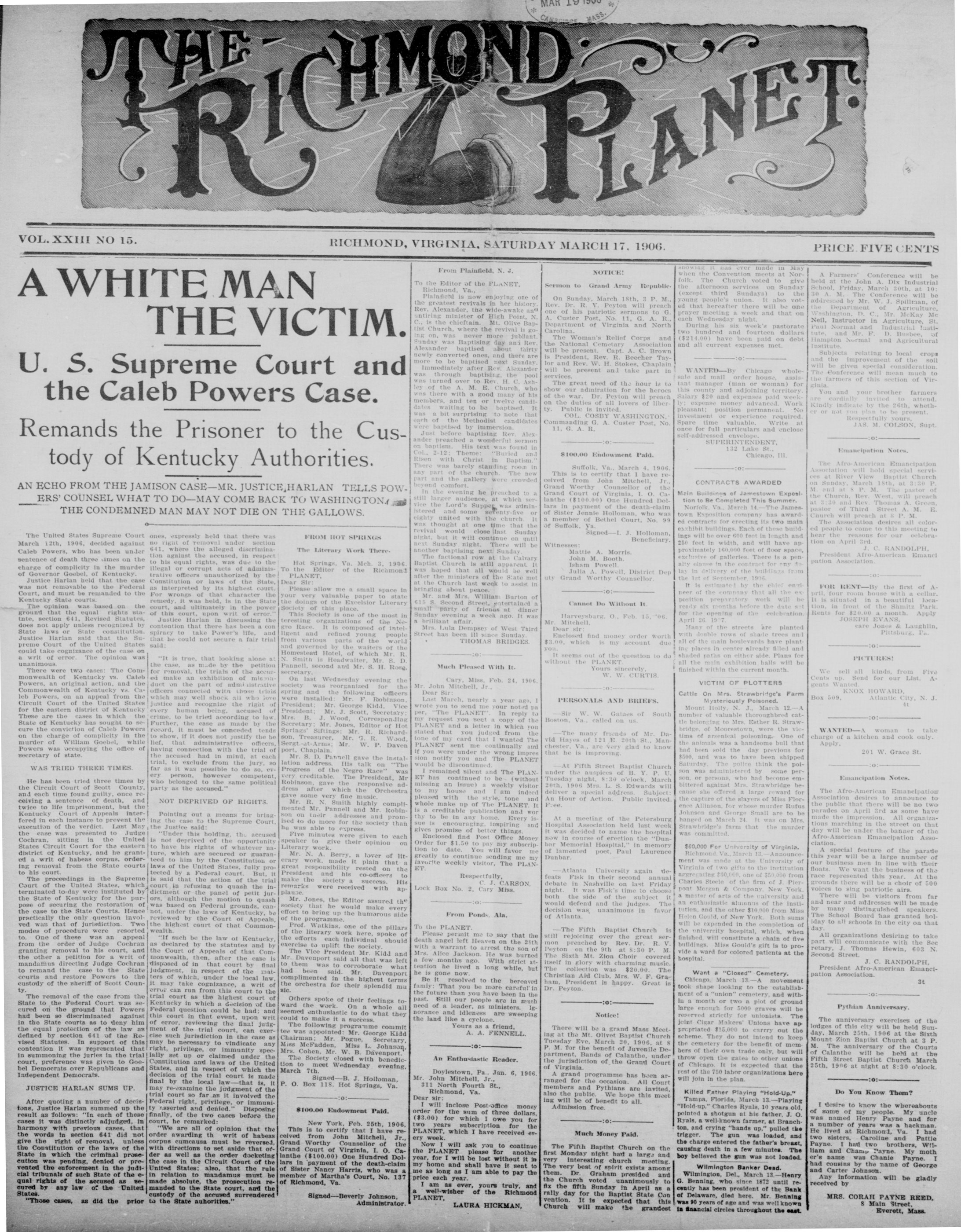
THE RICHMOND PLANET
A WHITE MAN THE VICTIM.
U. S. Supreme Court and the Caleb Powers Case. Remands the Prisoner to the Custody of Kentucky Authorities.
AN ECHO FROM THE JAMISON CASE-MR. JUSTICE,HARLAN TELLS POWERS' COUNSEL WHAT TO DO-MAY COME BACK TO WASHINGTON. THE CONDEMNED MAN MAY NOT DIE ON THE GALLOWS.
"Those cases, as did the prior to the State authorities."
VOL. XXIII NO 15.
A WHILE
U. S. Su
the Cal
Remands th
tody of K
AN ECHO FROM THE JAM
ERS' COUNSEL WHAT
THE CONDEMNE
The United States Supreme Court March 12th, 1906, decided against Caleb Powers, who has been under sentence of death three times on the charge of complicity in the murder of Governor Goebel, of Kentucky.
Justice Harlan held that the case was not removable to the Federal Court, and must be remanded to the Kentucky State courts.
The opinion was based on the ground that the equal rights statute, section 641, Revised Statutes, does not apply unless recognized by State laws or State constitution.
Justice Harlan said that the Supreme Court of the United States could take cognizance of the case on a writ of error. The opinion was unanimous.
There were two cases: The Commonwealth of Kentucky vs. Caleb Powers, an original action, and the Commonwealth of Kentucky vs. Caleb Powers, on an appeal from the Circuit Court of the United States for the eastern district of Kentucky. These are the cases in which the State of Kentucky has sought to secure the conviction of Caleb Powers on the charge of complicity in the murder of William Goebel, while Powers was occupying the office of secretary of state.
WAS TRIED THREE TIMES
He has been tried three times by the Circuit Court of Scott County, and each time found guilty, once receiving a sentence of death, and twice to life imprisonment, but the Kentucky Court of Appeals interfered in each instance to prevent the execution of the verdict. Last May the case was presented to Judge Cochran, sitting in the United States Circuit Court for the eastern district of Kentucky, and he granted a writ of habeas corpus, ordering removal from the State courts to his court.
The proceedings in the Supreme Court of the United States, which terminated to-day were instituted by the State of Kentucky for the purpose of securing the restoration of the case to the State Courts. Hence practically the only question involved was that of jurisdiction. Two modes of procedure were resorted to. One of these was an appeal from the order of Judge Cochran granting removal to his court, and the other a petition for a writ of mandamus directing Judge Cochran to remand the case to the State courts and restore Powers to the custody of the sheriff of Scott County.
The removal of the case from the State to the Federal Court was secured on the ground that Powers had been so discriminated against in the State courts as to deny him the equal protection of the law as defined by section 641 of the Revised Statutes. In support of this contention it was represented that in summoning the juries in the trial court, preference was given to Goebel Democrats over Republicans and Independent Democrats.
JUSTICE HARLAN SUMS UP
After quoting a number of decisions, Justice Harlan summed up the result as follows: "In each of these cases it was distinctly adjudged, in harmony with previous cases, that the words in section 641 did not give the right of removal, unless the Constitution or the laws of the State in which the criminal prosecution was pending, denied or prevented the enforcement in the judicial tribunals of such State of the equal rights of the accused as secured by any law of the United States.
ones, expressly held that there was no right of removal under section 641, where the alleged discrimination against the accused, in respect to his equal rights, was due to the illegal or corrupt acts of administrative officers unauthorized by the Constitution or laws of the State, as interpreted by its highest court. For wrongs of that character the remedy, it was held, is in the State court, and ultimately in the power of this court, upon writ of error." Justice Harlan in discussing the contention that there has been a conspiracy to take Power's life, and that he could not secure a fair trial said:
"It is true, that looking alone at the case, as made by the petition for removal, the trials of the accused make an exhibition of misconduct on the part of administrative officers connected with those trials which may well shock all who love justice and recognize the right of every human being, accused of crime, to be tried according to law. Further, the case as made by the record, it must be conceded tends to show, if it does not justify the he lief, that administrative officers, having connection with the trial of the accused had in mind, at each trial, to exclude from the jury, so far as it was possible to do so, every person, however competent, who belonged to the same political party as the accused."
NOT DEPRIVED OF RIGHTS
Pointing out a means for bringing the case to the Supreme Court, the Justice said: "Under this holding, the accused is not deprived of the opportunity to have his rights of whatever nature, which are secured or guaranteed to him by the Constitution or laws of the United States, fully protected by a Federal court. But, it is said that the action of the trial court in refusing to quash the indictment or the panel of petit jurors, although the motion to quash was based on Federal grounds, cannot, under the laws of Kentucky, be reviewed by the Court of Appeals, the highest court of that Commonwealth.
"If such be the law of Kentucky, as declared by the statutes and by the Court of Appeals of that Commonwealth, then, after the case is disposed of in that court by final judgment, in respect of the matters of which, under the local law, it may take cognizance, a writ of error can run from this court to the trial court as the highest court of Kentucky in which a decision of the Federal question could be had; and this court in that event, upon writ of error, reviewing the final judgment of the trial court, can exercise such jurisdiction in the case as may be necessary to vindicate any right, privilege, or immunity specially set up or claimed under the Constitution and laws of the United States, and in respect of which the decision of the trial court is made final by the local law—that is, it may re-examine the judgment of the trial court so far as it involved the Federal right, privilege, or immunity asserted and denied." Disposing finally, of the two cases before the court, he remarked:
"We are all of opinion that the order awarding th writ of habeas corpus cumcaus must be reversed, with directions to set aside that order as well as the order docketing the case in the Circuit Court of the United States; also, that the rule in relation to mandamus must be made absolute, the prosecution remanded to the State court, and the custody of the accused surrendered to the State authorities."
FROM HOT SPRINGS
The Literary Work There-
Hot Springs, Va. Mch. 3, 1906. To the Editor of the Ricamon M PLANET. Dear Sir: Please allow me a small space in your very valuable paper to state the doings of the Excelsior Literary Society of this place. This Society is one of the most interesting organizations of the Negro Race. It is composed of intelligent and refined young people from various parts of the world and governed by the waiters of the Homestead Hotel, of which Mr. R. N. Smith is Headwaiter, Mr. S. D. Pannell, second and Mr. S. H. Rosq, secretary. On last Wednesday evening the society was reorganized for the spring and the following officers were installed: Mr. F. Robinson, President; Mr. George Kidd, Vice President; Mr. J. Scott, Secretary; Mrs. B. J. Wood, Corresponding Secretary; Mr. Jones, Editor of Hot Springs' Siftings; Mr. R. Richardson, Treasurer, Mr. G. R. Wood, Sergt-at-Arms, Mr. W. P. Daven port, Chaplain. Mr. S. D. Pannell gave the installation address. His talk on "The Progress of the Negro Race" was very creditable. The President, Mr Robinson, gave the responsive address after which the Orchestra gave some very fine music.
Mr. R. N. Smith highly complimented Mr. Pannell and Mr. Robinson on their addresses and promised to do more for the society than he was able to express.
Five minutes were given to each speaker to give their opinion on Literary work.
Mr. N. A. Berry, a lover of literary work, made it plain that a great responsibility rested on the President and his co-officers to make the society a success. His remarks were received with applause.
Mr. Jones, the Editor assured the society that he would make every effort to bring up the humorous side of the programme.
Prof. Watkins, one of the pillars of the literary work here, spoke of the efforts each individual should exercise to uplift the society.
The Vice President Mr. Kidd and Mr. Davenport said all that was left to them was to corroborate what had been said. Mr. Davenport complimented in the highest terms the orchestra for their splendid music.
Others spoke of their feelings toward the work. On a whole all seemed enthusiastic to do what they could to make it a success.
The following programme committee was appointed: Mr. George Kidd Chairman; Mr. Pogue, Secretary, Miss McFadden, Miss L. Johnson, Mrs. Cohen, Mr. W. B. Davenport, The Society closed with benediction to meet Wednesday evening, March 7th. Signed—B. J. Hollowman, P. O. Box 118. Hot Springs, Va.
$100.00 Endowment Paid
New York, Feb. 25th, 1906.
This is to certify that I have received from John Mitchell, Jr.,
Grand Worthy Counselor of the Grand Court of Virginia, I. O. Calanthe ($100.00) One Hundred Dollars in payment of the death-calm of Sister Nancy Harris, who was a member of Martha's Court, No. 137 of Richmond, Va.
Signed—Beverly Johnson,
Administrator.
From Plainfield, N. J.
To the Editor of the PLANET,
Richmond, Va.
Plainfield is now enjoying one of the greatest revivals in her history.
Rev. Alexander, the wide-awake and untiring minister of High Point, N.
C., is the chieftain. Mt. Olive Baptist Church, where the revival is going on, was never more jubilant.
Sunday was Baptising day and Rev.
Alexander baptised about thirty newly converted ones, and there are more to be baptised next Sunday.
Immediately after Rev. Alexander was through baptising, the pool was turned over to Rev. H. C. Ashley of the A. M. E. Church, who was there with a good many of his members, and ten or twelve candidates waiting to be baptised. It was a bit surprising to note that each of the Methodist candidates were baptised by immersion.
Just before baptising Rev. Alexander preached a wonderful sermon on baptism. His text was found in Col. 2-12; Theme: "Buried and Risen with Christ in Baptism."
There was barely standing room in any part of the church. The new part and the gallery were crowded beyond comfort.
In the evening he preached to a still larger audience, at which service the Lord's Supper was administered and some seventy-five or eighty united with the church. It was thought at one time that the revival would close last Sunday night, but it will continue on until next Sunday night. There will be another baptising next Sunday. The factional row at the Calvary Baptist Church is still apparent. It was hoped that all would be well after the ministers of the State met at the Church last week to assist in bringing about peace.
Mr. and Mrs. William Burton of 615 S. Second Street, entertained a small party of friends at dinner Sunday evening a week ago. It was a brilliant affair.
Mrs. Lula Dempsey of West Third Street has been ill since Sunday. THOMAS BRIDGES
Much Pleased With It.
Cary, Miss, Feb. 24, 1806.
Mr. John Mitchell, Jr.,
Dear Sir:
Last March, nearly a year ago, I
wrote you to send me your noted pa-
per, "The PLANET". In reply to
my request you sent a copy of the
PLANET and a letter in which you
stated that you judged from the
tone of my card that I wanted The
PLANET sent me continually and
if you were under the wrong impres-
sion notify you and The PLANET
would be discontinued.
I remained silent and The PLAN-
ET has continued to be (without
missing an issue) a weekly visitor
to my house and I am indeed
pleased with the style, tone and
whole make up of The PLANET. It is a creditable publication and worty to be in any home. Every issue is encouraging, inspiring and gives promise of better things.
Enclosed find Post Office Money
Order for $1.50 to pay my subscription to date. You will favor me greatly to continue sending me my favorite weekly visitor, The PLANET.
Respectfully
From Ponds. Ala.
To the PLANET.
Please permit me to say that the death angel left Heaven on the 28th with a warrant to arrest the son of Mrs. Alice Jackson. He was burned a few months ago. With strict attention he lived a long while, but he is gone now.
Be it resolved to the bereaved family: That you be more careful in the future than you have been in the past. Still our people are in much need of a leader, as ministers. Ignorance and idleness are sweeping the land like a cyclone.
Yours as a friend,
A. A. FENNELL
An Enthusiastic Reader
Doylestown, Pa., Jan. 6, 1906
Mr. John Mitchell, Jr.,
311 North Fourth St.
I will inclose Post-office money order for the sum of three dollars, ($3.00) for which I owe you for two years subscription for the PLANET, which I have received every week.
Now I will ask you to continue the PLANET please for another year, for I will be lost without it in my home and shall have it sent to me as long as I am able to pay the price each year.
I am as ever, yours truly, and a well-wisher of the Richmond PLANET,
LAURA HICKMAN.
NOTICE!
Sermon to Grand Army Republic
On Sunday, March 18th, 3 P. M. Rev. Dr. R. V. Peyton will preach one of his patriotic sermons to G. A. Custer Post, No. 11, G. A. R. Department of Virginia and North Carolina.
The Woman's Relief Corps and the National Cemetary Association will be present. Capt. A. C. Brown is President, Rev. R. Beecher Taylor and Rev. W. H. Stokes, Chaplain will be present and take part in services.
The great need of the hour is to show our admiration for the heroes of the war. Dr. Peyton will preach on the duties of all lovers of liberty. Public is invited.
COL. COSBY WASHINGTON; Commanding G. A. Custer Post, No. 11, G. A. R.
$100,00 Endowment Paid
Suffolk, Va., March 4, 1906.
This is to certify that I have received from John Mitchell, Jr.
Grand Worthy Counselor of the Grand Court of Virginia, I. O. Calanthe ($100.00) One Hundred Dollars in payment of the death-claim of Sister Jennie Holloman, who was a member of Bethel Court, No. 99 of Suffolk, Va.
Signed—I. I. Holloman,
Beneficiary.
Witnesses:
Julia A. Powell, District Deputy Grand Worthy Counsellor.
Cannot Do Without It.
Harveysburg, O., Feb. 15, 196.
Mr. Mitchell,
Dear sir:
Enclosed find money order worth
$3.00, which is my account due
you.
It seems out of the question to do
without the PLANET.
Yours sincerely,
W. W. CURTIS.
PERSONALS AND BRIEFES
—Sir W. W. Gailes of South Boston, Va., called on us.
—The many friends of Mr. David Hayes of 121 E. 20th St., Manchester, Va., are very glad to know that he is improving.
—At Fifth Street Baptist Church under the auspices of B. Y. P. U. Tuesday night, 8:30 o'clock, March 20th, 1906 Mrs. L. S. Edwards will deliver a special address. Subject: An Hour of Action. Public invited. Free.
At a meeting of the Petersburg Hospital Association held last week it was decided to name the hospital now in course of erection the "Dunbar Memorial Hospital," in memory of lamented poet, Paul Laurence Dunbar.
—Atlanta University again defeats Fisk in their second annual debate in Nashville on last Friday night. It was Fisk's time to choose both the side of the subject it would defend and the judges. The decision was, unanimous in favor of Atlanta.
—The Fifth Baptist Church is still rejoicing over the great sermon preached by Rev. Dr. R. V. Peyton on the 9th at 3:00 P. M. The itself Mt. Zion Choir covered its in glory with charming music. The collection was $20.00. The Christian Aid Club, Mrs. W. F. Graham, President is happy. Great is Dr. Peyton.
Notice!
There will be a grand Mass Meeting at the Mt. Olivet Baptist Church Tuesday Eve, March 20, 1906, at 8 P. M. for the benefit of Juvenile Department, Bands of Calanthe, under the jurisdiction of the Grand Court of Virginia.
A grand programme has been arranged for the occasion. All Court members and Pythians are invited, also the public. We hope this meeting will be of benefit to all.
Much Money Paid.
The Fifth Baptist Church on the first Monday night had a large and very interesting church meeting. The very best of spirit exists among them. Dr. Graham presided and the Church voted unanimously to fix the fifth Sunday in April as a rally day for the Baptist State Convention. It is expected that this Church will make the greatest
showing it has ever made in May when the Convention meets at Norfolk. The Church voted to give the afternoon services on Sunday (except third Sundays) to the young people's union. It also voted that hereafter there will be one prayer meeting a week and that on each Wednesday night. During his six week's pastorate two hundred and fourteen dollars ($214.00) have been paid on debt and all current expenses met.
____:o:____
WANTED-By Chicago wholesale and mail order house, assistant manager (man or woman) for this county and adjoining territory. Salary $20 and expenses paid weekly; expense money advanced. Works pleasant; position permanent. No investment or experience required. Spare time valuable. Write at once for full particulars and enclose self-addressed envelope. SUPERINTENDENT,
122 Lake St.,
Chicago, IL.
CONTRACTS AWARDED
Main Buildings of Jamestown Exposition to Be Completed This Summer.
Norfolk, Va., March 14.—The Jamestown Exposition company has awarded contracts for erecting its two main exhibit buildings. Each of these buildings will be over 600 feet in length and 250 feet in width, and will have approximately 160,000 feet of floor space, exclusive of galleries. There is a penalty clause in the contract for any delay in delivery of the buildings from the 1st of September, 1906.
It is estimated by the chief engineer of the company that all the exposition preparatory work will be ready six months before the date set for the opening of the celebration, April 26, 1907.
Many of the streets are planted with double rows of shade trees and all of the main boulevards have planting places in center already filled and shaded paths on either side. Plans for all the main exhibition halls will be finished within the current month.
VICTIM OF PLOTTERS
Cattle On Mrs. Strawbridge's Farm
Mysteriously Poisoned.
Mount Holly, N. J., March 12.—A number of valuable thoroughbred cattle belonging to Mrs. Esther R. Strawbridge, of Moorestown, were the victims of arsenical poisoning. One of the animals was a handsome bull that had been sold the day previous for $500, and was to have been shipped Saturday. The police think the poison was administered by some person, or persons, who had become embittered against Mrs. Strawbridge because she offered a large reward for the capture of the slayers of Miss Florence Allinson, for whose murder Rufus Johnson and George Small are to be banged on March 24. It was on Mrs. Strawbridge's farm that the murder was committed.
$60,000 For University of Virginia. Richmond, Va., March 13.—Announcement was made at the University of Virginia of two gifts to the institution aggregating $50,000, one of $50,000 from Charles Steele of the firm of J. Pierpont Morgan & Company, New York, a master of arts of the university and an enthusiastic alumnus of the institution, and the other $10,000 from Miss Helen Gould, of New York. Both sums will be expended in the completion of the university hospital, which, when finished, will constitute a chain of five buildings. Miss Gould's gift is to provide a ward for colored patients at the hospital.
Want a "Closed" Cemetery
Want a "Closed" Cemetery.
Chicago, March 13.—A movement took shape looking to the establishment of a "union" cemetery, and within a month or two a plot of ground large enough for 5000 graves will be reserved strictly for unionists. The joint Cigar Makers' Unions have appropriated $15,000 to carry out the scheme. They do not intend to keep the cemetery for the benefit of members of their own trade only, but will throw open the gates to other unions of Chicago. It is expected that the rest of the 750 labor organizations here will join in the plan.
Killed Father Playing "Hold-Up."
Tampa, Florida, March 13.—Playing "Hold-up," Charles Ryals, 10 years old, pointed a shotgun at his father, J. O. Ryals, a well-known farmer, at Branchton, and crying "hands up," pulled the trigger. The gun was loaded, and the charge entered the father's breast, causing death in a few minutes. The boy believed the gun was not loaded.
Wilmington Banker Dead.
Wilmington, Del., March 13.—Henry G. Bennion, who since 1872 until recently has been president of the Bank of Delaware, died here. Mr. Bennion was 90 years of age and was well known in financial circles throughout the east.
PRICE FIVE CENTS
A Farmers' Conference will be held at the John A. Dix Industrial School, Friday, March 30th, at 10: 30 A. M. The Conference will be addressed by Mr. W. J. Spillman, of the Department of Agriculture, Washington, D. C., Mr. McKay Mc Neil, Instructor in Agriculture, St. Paul Normal and Industrial Institute, and Mr. F. D. Bushee, of Hampton Normal and Agricultural Institute.
Subjects relating to local crops and the improvement of the soil will be given special consideration. The Conference will mean much to the farmers of this section of Virginia.
You and your brother farmers are cordially invited to attend. Kindly indicate by the 26th, whether or not you plan to be present.
Respectfully yours.
JAS. M. COLSON, Supt.
Emancipation Notes.
The Afro-American Emancipation Association will hold special services at River View Baptist Church on Sunday, March 18th, at 3:30 P.M. and at 8 P.M. The pastor of the Church, Rev. West, will preach at 3:30 and Rev. Thomas A. Green, pastor of Third Street A. M. E. Church will preach at 8 P.M.
The Association desires all colored people to come to this meeting to hear the reasons for our celebration on April 3rd.
J. C. RANDOLPH,
President Afro-American Emancipation Association.
FOR RENT—By the first of April, four room house with a cellar. It is situated in a beautiful location, in front of the Shmitz Park Rents for $20.00 a month. Apply JOSEPH EVANS, care Jones & Laughlin, Pittsburgh, Pa.
PICTURES!
We sell all kinds, from Five
Cents up. Send for our List.
Agents Wanted.
KNOX HOWARD,
Box 509,
Atlantic City, N. J.
4t
WANTED—A woman to take charge of a kitchen and cook only. Apply.
Emancipation Notes.
The Afro-American Emancipation Association desires to announce to the public that there will be no two parades on April 3rd as some have made the impression. All organizations marching in the street on that day will be under the banner of the Afro-American Emancipation Association.
A special feature of the parade this year will be a large number of our business men in line with their floats. We want the business of the race represented this year. At the grounds there will be a choir of 500 voices to sing patriotic airs.
There will be visitors from far and near and addresses will be made by many distinguished speakers. The School Board has granted holiday to all schools in the city on that day.
All organizations desiring to take part will communicate with the Sec retary, J. Thomas Hewin, 603 N. Second Street.
J. C. RANDOLPH,
President Afro-American Emancipation Association.
Pythian Anniversary.
The anniversary exercises of the lodges of this city will be held Sunday, March 25th, 1906 at the Sixth Mount Zion Baptist Church at 3 P.M. The anniversary of the Courts of Calanthe will be held at the Fifth Street Baptist Church March 25th, 1906 at night at 8:30 o'clock
Do You Know Them?
I desire to know the whereabouts of some of my people. My uncle was named Henry Payne and for a number of years was a hackman. He lived at Richmond, Va. I had two sisters, Caroline and Pattle Payne. I had two brothers, William and Champ. Payne. My mother's name was Chanie Payne. I had cousins by the name of George and Carter Johnson.
Any information will be gladly received by
MRS. CORAH PAYNE REED,
8 Main Street,
Everett, Mass.
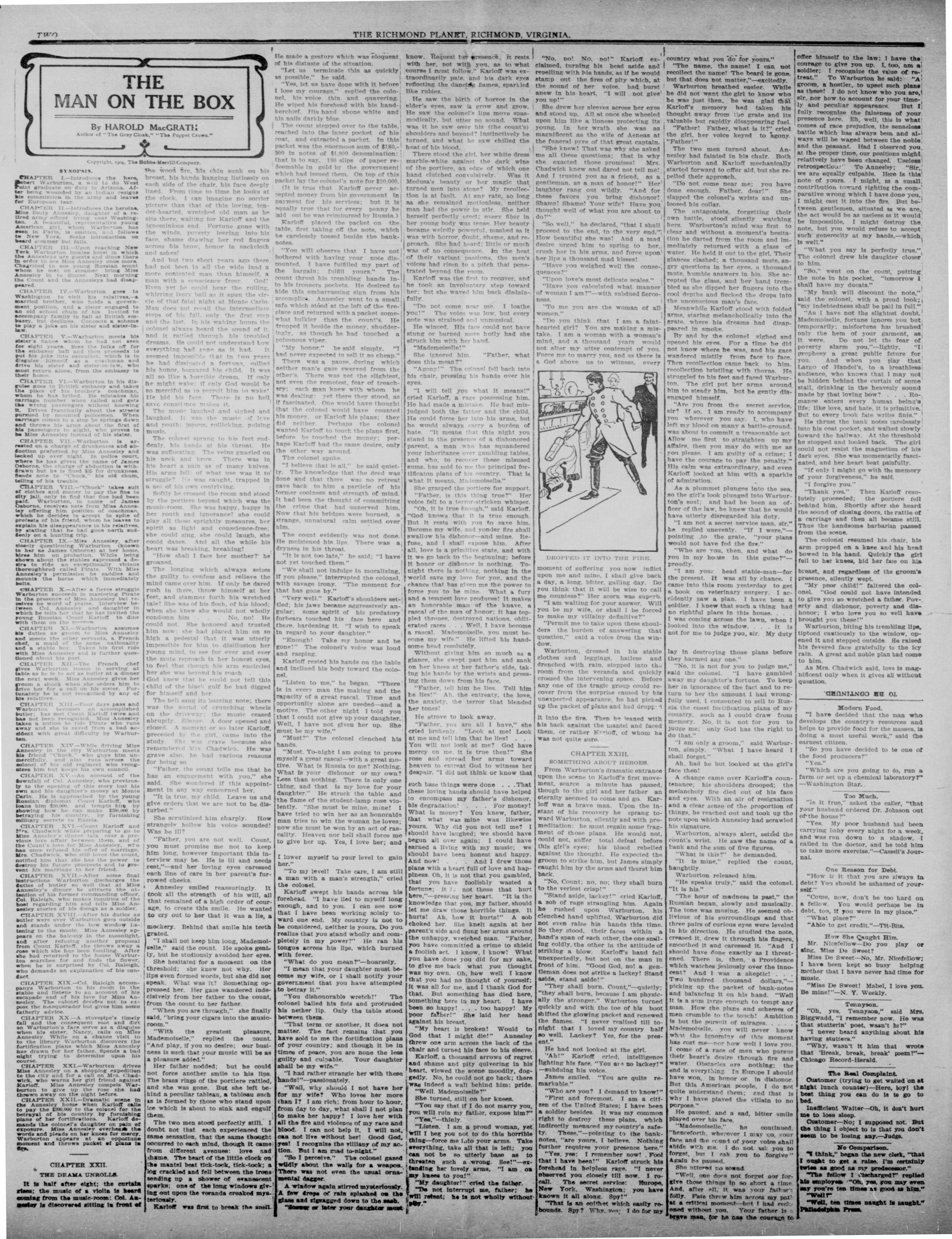
THE
MAN ON THE BOX
By HAROLD MacGRATH
Author of "The Grey Cloak," "The Puppet Crown."
Copyright, 1904. The Bobba-Merrill Company.
CHAPTER I.—Introduces the heroe, Robert Warburton, a well to do West Point graduate on duty in Arizona. Afternoon wounded by an Indian resigns his commission to the army and leaves for European tour.
CHAPTER II.—Introduces the heroe, Miss Betty Annesley, daughter of a retired army officer living near Washing-ton, American girl, whom Warburton has seen in Paris, is smitten, and follows to New York. Seeks introduction on board gamer but fails. Warburton is reaching New York Warburton locates in which the Annesleys are guests and dines there in order to see Miss Annesley once more. Charged to see young Russian count Annesley, the Annesleys in to dinner. Next morning the Count and the Annesleys had disappeared.
CHAPTER IV.—Warburton goes to Washington to vist his relatives—a man south to South Africa, a moment position, and a sister engaged to an old school chum of his. Invited to accompany family to ball at British embassy, but declines. Concocts a scheme to play a joke on his sister and sister-in-law.
CHAPTER V.—Warburton meets his sister's fiance whom he had not seen for eight years. Sees the folks off for a ride, all will be in jail. puts his joke into execution, which is to disguise himself as a coachman and drive his sister and sister-in-law, who must return alone, from the embassy to CHAPTER VI.—Warburton in his disguise goes to British embassy and takes the place of his brother's coachman, who mistakes him for a carriage number when called the wrong passengers without knowing it. Drives frantically about the streets pursued by mounted policemen. When pursued by a police officer and throws his arms about the first of his passengers to alight, who proves to be Miss Anneesley instead of his sister.
CHAPTER VII.—Warburton is arrested on a charge of drunkenness and absurdity and locked up over night. In police court, where he has given the name of James Osborne, the charge of abduction is withdrawn, as is the fine $5 for drunkenness, note to be knock, "his old chum, telling of his trouble."
CHAPTER VIII. "Chuck" takes suit of clothes and money to pay the fine to him, and jacket and fine one has been paid. Warburton, in name of Miss Annesley, receives note from Miss Annesley offering him position of coachman, and Warburton, in spite of protections of his friend, accuses him to explain his disappearance to his relatives, by stating that he had gone north suddenly on a hunting trip. Warburton, in name of Miss Annesley, after closely questioning Warburton (known to her as James Osborne) at her home, hires him on probation. While being sive to ride the stables pressed sive to ride the optionally vicious thoroughbred called Pirate. With Miss Annesley's permission she saddles and mounts the horse which immediately chained CHAPTER X. After a fierce struggle Warburton succeeds in mastering Pirate in the presence of Miss Annesley but receives no word of praise interrupted by an insult. Annesley and whichever he tells her that he has invited the young Russian Count Karloff to dine with them on the river. Warburton assumes his duties as groom to Miss Annesley and meets the other servants, a French chef, a maid of the same nationality and a stable boy. Takes his first ride and is further questioned about his past.
CHAPTER XII-The French chef gives Warburton lesson in serving at table as he is to act as butler at a dinner table. He is to serve a groom a shock when she orders him to drive her for a call on his sister. Fortunately he is not recognized by any of his relatives. CHAPTER XIII-Four days pass and Warburton becomes an accomplished butler; has met Count Karloff twice and has not been recognized. Miss Annelesy takes a notion to ride Pirate who runs the ship with the great difficulty as a resident with great difficulty by Warburton.
CHAPTER XIV-While driving Miss Annelesy in the city Warburton meets his friend "Chuck", who guys him unmercifully. He is the count of his old regiment who recognizes him but keeps his own council.
CHAPTER XV-An account of the downfall of Col. Annelesy, who previously to the opening of this story lost his own and his daughter's money at Monte Carlo, where he met a Russian diplomat Count Karloff, who loans him $30,000 and tempts him by showing how he can make $200,000 by betraying his country, by furnishing him with a new coat.
CHAPTER XVI.-Count Karloff and Mrs. Chadwick while preparing to go to Miss Anneley's dinner talk over a previous love affair between them, and of course she has once refused his offer of marriage. Mrs. Chadwick, who still loves the count, notified him that she has the power to destroy his future prospects and to prevent her from being married. CHAPTER XVII.-After some final instructions Warburton discharges the duties of butler so well that at Miss Anneley's dinner he attracts the attention of his former commanding officer, Mr. Warburton, who is invited to host regarding him and tells Miss Anneley stories of his doings as a soldier. CHAPTER XVIII.-After his duties as butler were over Warburton goes outside and stands under the bow window listening to the music. Miss Anneley appears to be in a state of exhaustion after refusing another proposal from Count Karloff, she throws away a rose which she has been fondling. After she had returned to the house Warburton searches for and finds the flower, she is in a state of joy. Religion, who demands an explanation of his conduct
CHAPTER XIX.-Col. Raleigh accompanies Warburton to his room in the stable and listens to an account of his illness and to the neesley. The colonel decides not to expose the masquerader but gives him some fatherly advice.
CHAPTER XX.-A stevepeple's timely fall and the consequent soot and dirt from his clothing when his sister, Nancy, calls on Miss Annesley. While on a chance visit to the library Warburton discovers the fortification on a shopping expedition to the city and for a call on Mrs. Chadwick, who warns her girl friend against Karloff. Miss Annesley compels Warburton to give up the rose she had thrown away in the night before.
CHAPTER XII-Dramatic scene in the Annesley home when Karloff calls to pay the $200,000 to the colonel for the betrayal of her husband by carrying off the fortifications. Karloff demands the colonel's daughter on pain of exposure. Miss Annesley overhears the words and pleads on her knees for mercy. Warburton appears at an opportunity and throws packets of plans in tree.
THE DRAMA UNBOLLS
It is half after eight; the curtains rises; the music of a violin is heard coming from the music-room. Col. Anderson is discovered sitting in front of
TWO
CHAPTER XXII.
the wood fire, his chin sunk on his breast, his hands hanging listlessly on each side of the chair, his face deeply lined. From time to time he looks at the clock. I can imagine no sorrier picture than that of this loving, tender-hearted, wretched old man as he sits there, waiting for Karloff and the ignominious end. Fortune gone with the winds, poverty leering into his face, shame drawing her red fingers across his brow, honor in sackcloth and ashes!
And but two short years ago there had not been in all the wide land a more contented man than himself, a man with a conscience freer. God! Even yet he could hear the rolling, whirring ivory ball as it spun the circle of that night at Monte Carlo. Man does not recall the Intermediate steps of his fall, only the first step and the last. In his waking hours the colonel always heard the sound of it and it rattled through his troubled dreams. He could not understand how everything had gone as it had. It seemed impossible that in two years he had dissipated a fortune, sullen his honor, beggared his child. It was all so like a horrible dream. If only he might wake: if only God would be so merciful as to permit him to wake! He hid his face. There is no hell save conscience makes it.
The music launched and sighed and laughed. It was the music of love and youth: joyous, rollicking, pulsing music.
The colonel sprang to his feet suddenly, his hands at his throat. He was suffocating. The velns gnarled on his neck and brow. There was in his heart a pain as of many knives. His arms fell: of what use was it to struggle? He was caught, trapped in a net of his own contriving.
Softly he crossed the room and stood by the portiere beyond which was the music-room. She was happy, happy in her youth and ignorance! she could play all those sprightly measures, her spirit as light and conscience-free; she could sing, she could laugh, she could dance. And all the while his heart was breaking, breaking!
"How shall I face her mother?" he groaned.
The longing which always seizes the guilty to confess and relieve the mind came over him. If only he dared rush in there, throw himself at her feet, and stammer forth his wretched tale! She was of his flesh, of his blood; when she knew she would not wholly condemn him . . . No, no! He could not. She honored and trusted him now; she had placed him on so high a pedestal that it was utterly impossible for him to distillion her young mind, to see for ever and ever the mute reproach in her honest eyes, to feel that though his arm encircled her she was beyond his reach . . . God knew that he could not tell this child of the black gulf he had digged for himself and her.
The bell sang its buzzing note; there was the sound of crunching wheels on the driveway; the music ceased abruptly. Silence. A door opened and closed. A moment or so later Karloff, preceded by the girl, came into the study. She was grave because she remembered Mrs Chadwick. He was grave also; he had various reasons for being so.
"Father, the count tells me that he has an engagement with you," she said. She wondered if this appointment in any way concerned her.
"It is true, my child. Leave us and give orders that we are not to be disturbed."
She scrutinized him sharply. How strangely hollow his voice sounded! Was he ill?
"Father, you are not well. Count, you must promise me not to keep him long, however important this interview may be. He is ill and needs rest," and her loving eyes caressed each line of care in her parent's furrowed cheeks.
Annesley smiled reassuringly. It took all the strength of his will, all that remained of a high order of courage, to create this smile. He wanted to cry out to her that it was a lie, a mockery. Behind that smile his teeth grated.
"I shall not keep him long, Mademoiselle," said the count. He spoke gently, but he studiously avoided her eyes. She hesitated for a moment on the threshold; she knew not why. Her lips even formed words, but she did not speak. What was it? Something oppressed her. Her gaze wandered indecisively from her father to the count, from the count to her father.
"When you are through," she finally sald, "bring your cigars into the musicroom."
"With the greatest pleasure, Mademoiselle," replied the count. "And play, if you so desire; our business is such that your music will be as a pleasure added."
Her father nodded; but he could not force another smile to his lips. The brass rings of the portiere rattled, and she was gone. But she left behind a peculiar tableau, a tableau such as is formed by those who stand upon ice which is about to sink and engulf them.
The two men stood perfectly still. I doubt not that each experienced the same sensation, that the same thought occurred to each mind, though it came from different avenues: love and shame. The heart of the little clock on the mantel beat tick-tock, tick-tock; a log crackled and fell between the froms sending up a shower of evanescent sparks; one of the long windows giving out upon the veranda creaked mysteriously. Karloff was first to break the snell.
THE RICHMOND PLANET. RICHMOND. VIRGINIA
He made a gesture which was eloquent of his distaste of the situation.
"Let us terminate this as quickly as possible," he said.
"Yes, let us have done with it before I lose my courage," replied the colonel, his voice thin and quavering. He wiped his forehead with his hand-kerchief. His hand shone white and his nails darkly blue.
The count stepped over to the table, reached into the inner pocket of his coat, and extracted a packet. In this packet was the enormous sum of $180,000 in notes of $1,000 denomination: that is to say, 180 slips of paper redeemable in gold by the government which had issued them. On top of this packet lay the colonel's note for $20,000.
(It is true that Karloff never accepted money from his government in payment for his services; but it is equally true that for every penny he laid out he was reimbursed by Russia.) Karloff placed the packet on the table, first taking off the note, which he carelessly tossed beside the banknotes.
"You will observe that I have not bothered with having your note discounted. I have fulfilled my part of the bargain; fulfill yours." The count thrust his trembling hands into his trousers pockets. He desired to hide this embarrassing sign from his accomplice. Annesley went to a small safe which stood at the left of the fireplace and returned with a packet somewhat bulkier than the count's. He dropped it beside the money, shudderingly, as though he had touched a poisonous viper.
"My honor," he said simply. "I had never expected to sell it so cheap." There was a pause, during which neither man's gaze swerved from the other's. There was not the slightest, not even the remotest, fear of treachery; each man knew with whom he was dealing; yet there they stood, as if fascinated. One would have thought that the colonel would have counted his money, or Karloff his plans; they did neither. Perhaps the colonel wanted Karloff to touch the plans first, before he touched the money; perhaps Karloff had the same desire, only the other way around. The colonel spoke.
"I believe that is all," he said quietly. The knowledge that the deed was done and that there was no retreat gave back to him a particle of his former coolness and strength of mind. It had been the thought of committing the crime that had unnerved him. Now that his bridges were burned, a strange, unnatural calm settled over him.
The count evidently was not done. He moistened his lips. There was a dryness in his throat.
"It is not too late," he said; "I have not yet touched them."
"We shall not indulge in moralizing, if you please," interrupted the colonel, with savage irony. "The moment for that has gone by."
"Very well." Karloff's shoulders settled; his jaws became aggressively angular; some spirit of his predatory forbears touched his face here and there, hardening it. "I wish to speak in regard to your daughter."
"Enough! Take my honor and be gone!" The colonel's voice was loud and rasping.
Karloff rested his hands on the table and inclined his body toward the colonel.
"Listen to me," he began. "There is in every man the making and the capacity of a great rascal. Time and opportunity alone are needed—and a motive. The other night I told you that I could not give up your daughter. Well, I have not given her up. She must be my wife."
"Must?" The colonel clenched his hands.
"Must. To-night I am going to prove myself a great rascal—with a great motive. What is Russia to me? Nothing. What is your dishonor or my own? Less than nothing. There is only one thing, and that is my love for your daughter." He struck the table and the flame of the student-lamp rose violently. "She must be mine, mine! I have tried to win her as an honorable man tries to win the woman he loves; now she must be won by an act of rascality. Heaven nor hell shall force me to give her up. Yes, I love her; and I lower myself to your level to gain her."
"To my level! Take care, I am still a man with a man's strength," cried the colonel.
Karloff swept his hands across his forehead. "I have lied to myself long enough, and to you. I can see now that I have been working solely toward one end. My country is not to be considered, neither is yours. Do you realize that you stand wholly and completely in my power?" He ran his tongue across his lips, which burned with fever.
"What do you mean?"—hoarsely.
"I mean that your daughter must become my wife, or I shall notify your government that you have attempted to betray it."
"You dishonorable wretch!" The colonel balled his fists and protruded his nether lip. Only the table stood between them.
"That term or another, it does not matter. The fact remains that you have sold to me the fortification plans of your country; and though it be in times of peace, you are none the less guilty and culpable. Your daughter shall be my wife."
"I had rather strangle her with these hands!" - passionately.
"Well, why should I not have her for my wife? Who loves her more than I? I am rich; from hour to hour, from day to day, what shall I not plan to make her happy? I love her with all the fire and violence of my race and blood. I can not help it. I will not, can not live without her! Good God, yes! I recognize the villainy of my action. But I am mad to night."
"So I perceive." The colonel gazed wildly about the walls for a weapon. There was not even the usual ornamental dagger.
A window again stirred mysteriously.
A few drops of rain splashed on the glass and zigzagged down to the seash.
"Snowy or later your daughter must
know. Request her presence, it rests with her, not with you, as to what course I must follow." Karloff was extraordinarily pale, and his dark eyes reflecting the dancing flames, sparkled like rubies.
He saw the birth of horror in the elder's eyes, saw it grow and grow. He saw the colonel's lips move spasmodically, but utter no sound. What was it he saw over his (the count's) shoulders and beyond? Instinctively he turned, and what he saw chilled the heat of his blood.
There stood the girl, her white dress marble-white against the dark wine of the portiere, an edge of which one hand clutched convulsively. Was it Medusa's beauty or her magic that turned men into stone? My recollection is at fault. At any rate, so long as she remained motionless, neither man had the power to stir. She held herself perfectly erect; every fiber in her young body was tense. Her beauty became weirdly powerful, masked as it was with horror, doubt, shame, and reproach. She had heard; little or much was of no consequence. In the heat of their variant passions, the men's volces had risen to a pitch that penetrated beyond the room. Karloff was the first to recover, and he took an involuntary step toward her; but she waved him back disdainfully.
"Do not come near me. I loathe you!" The voice was low, but every note was strained and unmusical.
He winced. His face could not have stung or burned more hotly had she struck him with her hand.
"Mademoiselle!"
She ignored him. "Father, what does this mean?"
"Agony!" The colonel fell back into his chair, pressing his hands over his eyes.
"I will tell you what it means!" cried Karloff, a rage possessing him. He had made a mistake. He had misjudged both the father and the child. He could force her into his arms, but he would always carry a burden of hate. "It means that this night you stand in the presence of a dishonored parent, a man who has squandered your inheritance over gambling tables, and who, to recover these misused sums, has sold to me the principal fortificator plans of his country. That is what it means, Mademoiselle."
She grasped the portiere for support.
"Father, is this thing true?" Her voice fell to a terror-striken whisper.
"Oh, it is true though," said Karloff.
"God knows that it is true enough.
But it rests with you to save him.
Become my wife, and yonder fire shall swallow his dishonor—and mine.
Refuse, and I shall expose him.
After all, love is a primitive state, and with it we go back to the beginning; before it honor or dishonor is nothing.
Tonight there is nothing, nothing in the world save my love for you, and the chance that has given me the power to force you to be mine. What a fury and a tempest love produces! It makes an honorable man of the knave, a rascal of the man of honor; it has topled thrones, destroyed nations, obliterated races . . . Well, I have become a rascal. Mademoiselle, you must become my wife." He lifted his handsome head resolutely.
Without giving him so much as a glance, she swept past him and sank on her knees at her father's side, taking his hands by the wrists and pressing them down from his face.
"Father, tell him he lies. Tell him he lies!" Ah, the entreaty, the love, the anxiety, the terror that blended her tones!
He strove to look away.
"Father, you are all I have," she cried brokenly. "Look at me! Look at me and tell him that he heles! You will not look at me? God have mercy on me, it is true then!" She rose and spread her arms toward heaven to entreat God to witness her despair. "I did not think or know that
such base things were done . . . That these loving hands should have helped to encompass my father's dishonor, his degradation! . . . For money! What is money? You knew, father, that what was mine was likewise yours. Why did you not tell me? I should have laughed; we should have begun all over again; I could have earned a living with my music; we should have been honest and happy. And now! . . . And I drew those plans with a heart full of love and happiness. Oh, it is not that you gambled, that you have foolishly wasted a fortune; it f. . . not these that hurt here,"—pressing her heart. "It is the knowledge that you, my father, should let me draw those horrible things. It hurts! Ah, how it hurts!" A sob choked her. She knelt again at her parent's side and flung her arms around the unhappy, wretched man. "Father, you have committed a crime to shield a foolish act. I know, I know! What you have done you did for my sake, to give me back what you thought was my own. Oh, how well I know that you had no thought of yourself; it was all for me, and I thank God for that. But something has died here, something here in my heart. I have been so happy! . . . too happy! My poor father!" She laid her head against his breast.
"My heart is broken! Would to God that I might die!" Annesley threw one arm across the back of the chair and turned his face to his sleeve. Karloff, a thousand arrows of regret and shame and pity quivering in his heart, viewed the scene moodily, doggedly. No, he could not go back; there was indeed a wall behind him: pride. "Well. Mademoiselle?" She turned, still on her knees. "You say that if I do not marry you, you will ruin my father, expose him?" "Yes,"—thinly. "Listen. I am a proud woman, yet will I beg you not to do this horrible thing—force me into your arms. Take everything, take all that is left; you can not be so utterly base as to threaten such a wrong. See!"—extending her lovely arms, "I am on my knees to you!"
"My daughter!" cried the father.
"Do not interrupt me, father; he will retent; he is not wholly without joy."
"No, no! No, no!" Karloff exclaimed, turning his head aside and repelling with his hands, as if he would stamp out the fires of pity which, at the sound of her voice, had burst anew in his heart. "I will not give you up!" She drew her sleeves across her eyes and stood up. All at once she wheeled upon him like a lioness protecting its young. In her wrath she was as magnificent as the wife of Aneacas at the funeral pyre of that great captain. "She knew! That was why she asked me all these questions; that is why she exacted those promises! Mrs. Chadwick knew and dared not tell me! And I trusted you as a friend, as a gentleman, as a man of honor!" Her laughter rang out wildly. "And for these favors you bring dishonor! Shame! Shame! Your wife? Have you thought well of what you are about to do?"
"So well," he declared, "that I shall proceed to the end, to the very end." How beautiful she was! And a mad desire urged him to spring to her, crush her in his arms, and force upon her lips a thousand mad kisses!
"Have you weighed well the consequences?"
"Upon love's most delicate scales."
"Have you calculated what manner of woman I am?"—with subdued fierceness.
"To me you are the woman of all women."
"Do you think that I am a faint-hearted girl? You are making a mistake. I am a woman with a woman's mind, and a thousand years would not alter my utter contempt of you. Force me to marry you, and as there is a God above us to witness, every
A man in a long coat is stepping on a fireplace.
DROPPED IT INTO THE FIRE.
moment of suffering you now inflict upon me and me, I shall give back a day, a long, bitter, galling day. Do you think that it will be wise to call me countess?" Her scorn was superb.
"I am waiting for your answer. Will you be my wife, or shall I be forced to make my villainy definitive?
"Permit me to take upon these shoulders the burden of answering that question," said a voice from the window.
Warburton, dressed in his stable clothes and leggings, hatless and drenched with rain, stepped into the room from the veranda and quickly crossed the intervening space. Before any one of the tragic group could recover from the surprise caused by his unexpected appearance, he had picked up the packet of plans and had droop:
it into the fire. Then he leaned with his back against the mantel and faced them, or rather Kroff, of whom he was not quite sure.
CHAPTER XXIII
SOMETHING ABOUT HEROES.
From Warburton's dramatic entrance upon the scene to Karloff's first movement, scarce a minute has passed, though to the girl and her father an eternity seemed to come and go. Karloff was a brave man. Upon the instant of his recovery he sprang toward Warburton, silently and with premeditation: he must regain some fragment of those plans. He would not, could not, suffer total defeat before this girl's eyes; his blood rebelled against the thought. He expected the groom to strike him, but James simply caught him by the arms and thurst him back.
"No, Count; no, no; they shall burn to the veriest crisp!"
"Stand aside, lackey!" cried Karloff, a sob of rage strangling him. Again he rushed upon Warburton, his clenched hand uplifted. Warburton did not even raise his hands this time. So they stood, their faces within a hand's span of each other, the one smiling coldly, the other in the attitude of striking a blow. Karloff's hand fell unexpectedly, but not on the man in front of him. "Good God, no! a gentleman does not strike a lackey! Stand aside, stand aside!" "They shall burn, Count,"—quietly; "they shall burn, because I am physically the stronger." Warburton turned quickly and with the toe of his boot shifted the glowing packet and renewed the flames. "I never realized till tonight that I loved my country half so well. Lackey? Yes, for the present." He had not looked at the girl.
"Ah!" Karloff cried, intelligence lighting his face. "You are no lackey!"—subduing his voice.
James smiled. "You are quite remarkable."
"Who are you? I demand to know!" "First and foremost. I am a citizen of the United States; I have been a soldier besides. It was my common right to destroy these plans, which indirectly menaced my country's safety. These."—pointing to the banknotes, "are yours, I believe. Nothing further requires your presence here."
"Yes, yes; I remember now! Fool that I have been!" Karloff struck his forehead in helpless rage. "I never observed you closely till now. I recall. The secret service: Europe, New York, Washington; you have known it all along. Spy!" "That is an epithet which easily rebounds. Spy? Why yes; I do for my
country what you do for yours."
"The name, the name! I can not recollect the name! The beard is gone, but that does not matter."—excitedly.
Warburton breathed easier. While he did not want the girl to know who he was just then, he was glad that Karloff's memory had taken his thought away from the grate and its valuable but rapidly disappearing fuel.
"Father! Father, what is it?" cried the girl, her voice keyed to agony.
"Father!"
The two men turned about. Annesley had fainted in his chair. Both Warburton and Karloff mechanically started forward to offer aid, but she repelled their approach.
"Do not come near me; you have done enough. Father, dear!" She slapped the colonel's wrists and unloosed his collar.
The antagonists, forgetting their own battle, stood silently watching hers. Warburton's mind was first to clear and without a moment's hesitation he darted from the room and immediately returned with a glass of water. He held it out to the girl. Their glances clashed; a thousand mute, angry questions in her eyes, a thousand mute, humble answers in his. She accepted the glass, and her hand trembled as she dipped her fingers into the cool depths and flecked the drops into the unconscious man's face. Meanwhile Karloff stood with folded arms, staring melancholically into the grate, where his dreams had disappeared in smoke.
By and by the colonel sighed and opened his eyes. For a time he did not know where he was, and his gaze wandered mistily from face to face. Then recollection came back to him. recollection bristling with thorns. He struggled to his feet and faced Warburton. The girl put her arms around him to steady him, but he gently disengaged himself.
"Are you from the secret service, sir? If so, I am ready to accompany you who you say, I, who have left my blood on many a battle-ground, was about to commit a treasonable act. Allow me first to straighten up my affairs, then you may do with me as you please. I am guilty of a crime; I have the courage to pay the penalty." His calm was extraordinary, and even Karloff looked at him with a sparkle of admiration.
As a plummet plunges into the sea, so the girl's look plunged into Warburton's soul; and had he been an officer of the law, he knew that he would have utterly disregarded his duty.
"I am not a secret service man, sir," he replied unevenly. "If I were"—pointing to the grate, "your plans would not have fed the fire."
"Who are you, then, and what do you in my house in this guise?"—proudly.
"I am your: head stable-man—for the present. It was all by chance. I came into this room yesterday to get a book on veterinary surgery. I accidently saw a plan. I have been a soldier. I knew that such a thing had no rightful place in this house. . . . I was coming across the lawn, when I looked into the window. . . . It is not for me to judge you, sir. My duty lay in destroying those plans before they harmed any one."
"No, it is not for you to judge me," said the colonel. "I have gambled away my daughter's fortune. To keep her in ignorance of the fact and to return to her the amount I had wrongfully used, I consented to sell to Russia the coast fortification plans of my country, such as I could draw from memory. No, it is not for you to judge me; only God has the right to do that."
"I am only a groom," said Warburton, simply. "What I have heard I shall forget."
Ah, had he but looked at the girl's face then!
A change came over Karloff's countenance; his shoulders drooped; the melancholy fire died out of his face and eyes. With an air of resignation and a clear sense of the proportion of things, he reached out and took up the note upon which Annesley had scrawled his signature.
Warburton, always alert, seized the count's wrist. He saw the name of a bank and the sum of five figures.
"What is this?" he demanded.
"It is mine," replied the count, haughtily.
Warburton released him.
"He speaks truly," said the colonel.
"It is his."
"The hour of madness is past," the Russian began, slowly and musically. The tone was musing. He seemed oblivious of his surroundings and that three pairs of curious eyes were leveled in his direction. He studied the note, creased it, drew it through his fingers, smoothed it and caressed it. "And I should have done exactly as I threatened. There is, then, a Providence which watches jealously over the innocent? And I was a skeptic! . . . Two hundred thousand dollars."—picking up the packet of bank-notes and balancing it on his hand. "Well it is a sum large enough to tempt any man. How the plans and schemes of men crumble to the touch! Ambition is but the pursuit of mirages. . . . Mademoiselle, you will never know what the ignominy of this moment has cost me—nor how well I love you. I come of a race of men who pursue their heart's desire through fire and water. Obstacles are nothing; the end is everything. In Europe I should have won, in honor or in dishonor. But this American people, I do not quite understand them; and that is why I have played the villain to no purpose."
He paused, and a sad, bitter smile played over his face.
"Mademoiselle," he continued,
"henceforth, wherever I may go, your face and the sound of your voice shall abide with me. I do not ask you to forget, but I ask you to forgive."
Again he paused.
She uttered no sound.
"Well, one does not forget nor forgive these things in so short a time. And, after all, it was your father's folly. Fate threw him across my path at a critical moment—but I had re-joined without you. Your father is a brave man, for he has the courage to
offer himself to the law; I have the courage to give you up. I, too, nm a soldier; I recognize the value of retreat." To Warburton he said: "A groom, a hostler, to upset such plans as these! I do not know who you are, sir, nor how to account for your timely and peculiar appearance. But I fully recognize the falseness of your presence here. Eh, well, this is what comes of race prejudice, the senseless battle which has always been and always will be waged between the noble and the peasant. Had I observed you at the proper time, our positions might relatively have been changed. Useless retrospection:" To Annesley; "Slr, we are equally culpable. Here is this note of yours. I might, as a small contribution toward righting the comparative wrong which I have done you, I might cast it into the fire. But between gentlemen, situated as we are, the act would be as useless as it would be impossible. I might destroy the note, but you would refuse to accept such generosity at my hands,—which is well."
"What you say is perfectly true." The colonel drew his daughter closer to him.
"So," went on the count, putting the note in his pocket, "tomorrow I shall have my ducats."
"My bank will discount the note," said the colonel, with a proud look; "my indebtedness shall be paid in full." "As I have not the slightest doubt. Mademoiselle, fortune ignores you but temporarily; misfortune has brushed only the hem of your garment, as it were. Do not let the fear of poverty alarm you."-lightly. "I prophesy a great public future for you. And when you play that Largo of Handel's, to a breathless audience, who knows that I may not be hidden behind the curtain of some stall, drinking in the heavenly sound made by that loving bow? . . . Romance enters every human being's life; like love, and hate, it is primitive. But to every book fate writes finis."
He thrust the bank notes carelessly into his coat pocket, and walked slowly toward the hallway. At the threshold he stopped and looked back. The girl could not resist the magnetism of his dark eyes. She was momentarily fascinated, and her heart beat painfully.
"If only I might go with the memory of your forgiveness," he said.
"I forgive you."
"Thank you." Then Karloff resolutely proceeded; the portiere fell behind him. Shortly after she heard the sound of closing doors, the rattle of a carriage and then all became still. Thus the handsome barbarian passed from the scene.
The colonel resumed his chair, his arm propped on a knee and his head bowed in his hand. Quickly the girl fell to her knees, hid her face on his breast, and regardless of the groom's presence, silently wept.
"My poor child!" faltered the colonel.
"God could not have intended to give you so wretched a father. Poverty and dishonor, poverty and dishonor; I who love you so well have brought you these!"
Warburton, biting his trembling lips, tiptoed cautiously to the window, opened it and stepped outside. He raised his fevered face gratefully to the icy rain. A great and noble plan had come to him.
As Mrs. Chadwick said, love is magnificent only when it gives all without question.
TO BE CONTINUED.
Modern Food
"I have decided that the man who develops the country's resources and helps to provide food for the masses, is doing a most useful work," said the earnest citizen.
"So you have decided to be one of the food producers?"
"Yes."
"Which are you going to do, run a farm or set up a chemical laboratory?" —Washington Star.
Too Much.
"Is it true," asked the caller, "that your husband ordered Dr. Johnson out of the house?"
"Yes. My poor husband had been carrying baby every night for a week, and was run down to a shadow. I called in the doctor, and he told him to take more exercise."—Cassell's Journal.
One Reason for Debt.
"How is it that you are always in debt? You should be ashamed of yourself."
"Come, now, don't be too hard on a fellow. You would perhaps be in debt, too, if you were in my place."
"What place?"
"Able to get credit."—Tit-Bits.
How She Caught Him
Mr. Nicefellow—Do you play or sing, Miss De Sweet?
Miss De Sweet—No, Mr. Nicefellow;
I have been kept so busy helping mother that I have never had time for music.
"Miss De Sweet! Mabel, I love you. Be mine!"—N. Y. Weekly.
Tennyson.
"Oh, yes, Tennyson," said Mrs. Biggwadd, "I remember now. He was that stutterin' poet, wasn't he?"
"I never heard anything about his having stutters."
"Why, wasn't it him that wrote that 'Break, break, break' poem?"—Chicago Record-Herald.
The Real Complaint
Customer (trying to get waited on at night lunch counter)—Hero, boy! the best thing you can do is to go to bed.
Inefficient Walter—Oh, it don't hurt me to lose sleep.
Customer—No; I supposed not. But the thing I object to is that you don't seem to be losing any—Judge.
No Comparison
"I think," began the new clerk, "that I ought to get a raise. I'm certainly twice as good as my predecessor."
"The fellow I 'discharged?' replied his employee. "Oh, yes, you may even say you're ten times as good as him."
"Well."
"Well, ten times naught is naught." Philadelphia Press.
THE YOUNG
SATURDAY....MARCH 17, 1906.
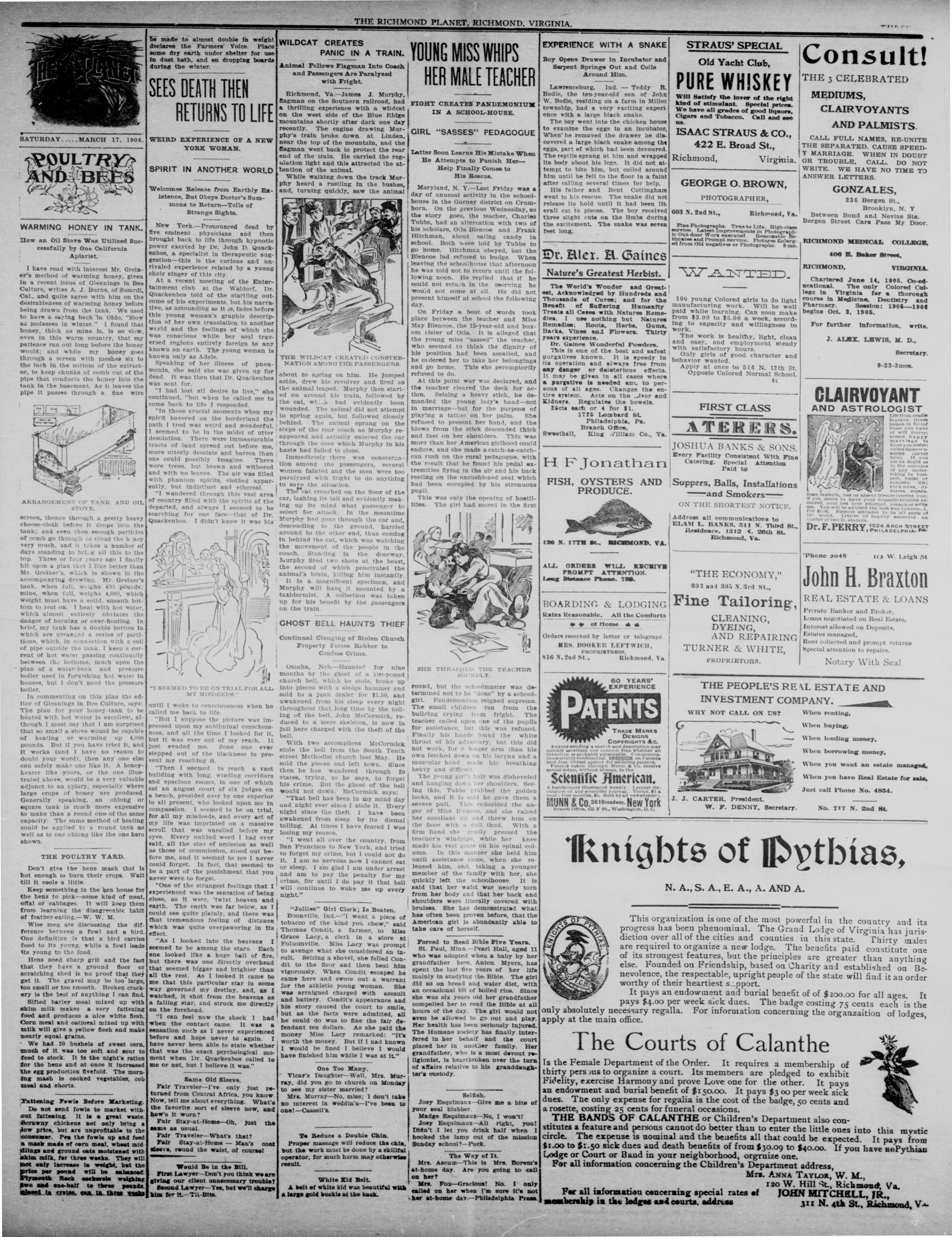
POULTRY AND BEES
How an Oil Stove Was Utilized Successfully by One California Aplarist.
I have read with Interest Mr. Greiner's method of warming honey, given in a recent issue of Gleanings in Bee Culture, writes A. J. Burns, of Susdari, Cal., and quite agree with him on the desirableness of warming honey before being drawn from the tank. We used to have a saying back in Ohio, "Slow as molasses in winter." I found that honey, thick as mine is, is so slow, even in this warm country, that my patience ran out long before the honey would; and while my honey goes through a screen with meshes six to the inch in the bottom of the extractor, to keep chunks of comb out of the pipe that conducts the honey into the tank in the basement. As it leaves the pipe it passes through a fine wire
ARRANGEMENT OF TANK AND OIL STOVE.
screen, thence through a pretty heavy cheese-cloth before it drops into the tank; and even then enough particles of comb go through to cloud the h nay very much, and it takes a number of days standing to bring all this to the top. Three or four years ago I finally hit upon a plan that I like better than Mr. Greiner's, which is shown In the accompanying drawing. Mr. Greiner's tank, when full, weighs 400 pounds; mine, when full, weighs 4,000, which weight must have a solid, smooth bottom to rest on. I heat with hot water, which almost entirely obviates the danger of burning or over-heating. In brief, my tank has a double bottom In which are arranged a series of partitions, which, in connection with a coil of pipe outside the tank, I keep a current of hot water passing continually between the bottoms, much upon the plan of a water-back and pressure boiler used in furnishing hot water in houses, but I don't need the pressure boiler.
In commenting on this plan the editor of Gleannings in Bee Culture, says: The plan for your honey-tank to be heated with hot water is excellent, although I must say that I am surprised that so small a stove would be capable of heating or warming up 4,000 pounds. But if you have tried it, and it works (and I have no reason to doubt your word), then any one else can safely make one like it. A honey-heater like yours, or the one illustrated above, would be a very valuable adjunct to an apiary, especially where large crops of honey are produced. Generally speaking, an oblong or square tank is much more expensive to make than a round one of the same capacity. The same method of heating could be applied to a round tank as well as to one oblong like the one here shown.
THE POULTRY YARD.
Don't give the hens mash that is hot enough to burn their crops. Wait till it cools a little.
Keep something in the hen house for the hens to pick—some kind of meat, offal or cabbages. It will keep them from learning the disagreeable habit of feather-eating.—W. W. M.
Wise men are discussing the difference between a fowl and a bird. One definition is that a bird carries food to its young, while a fowl leads its young to the food.
Hens need sharp grit and the fact that they have a ground floor or scratching shed is no proof that they get it. The gravel may be too large, too small or too smooth. Broken crockery is the best of anything I can find.
Sifted barley milk mixed up with skim milk makes a very fattening food and produces a nice white flesh. Corn meal and oatmeal mixed up with milk will give a yellow flesh and make nearly equal grains.
We had 20 bushels of sweet corn, much of it was too soft and sour to feed to stock. It is the night's ration for the hens and at once it increased the egg production fivefold. The morning mash is cooked vegetables, cob meal and shorts.
Fattening Fowls Before Marketing.
Fattening Fowls Before Marketing.
Do not send fowls to market without fattening. It is a great waste.
Scrawny chickens not only bring a low price, but are unprofitable to the consumer. Pen the fowls up and feed a mask made of corn meal, wheat middlings and ground oats moistened with skim milk, for three weeks. They will not only increase in weight, but the price per pound will be enhanced.
Plymouth Reck cocherele weighing two and one-half to three pounds, placed in crates, can in three weeks
be made to almost double in weight declares the Farmers' Voice. Place some dry earth under shelter for use in dust bath, and on dropping boards during the winter.
SEES DEATH THEN RETURNS TO LIFE
WEIRD EXPERIENCE OF A NEW YORK WOMAN.
Welcome Release from Earthly Existence, But Obeys Doctor's Summons to Return—Tells of Strange Sights.
New York.—Pronounced dead by five eminent physicians and then brought back to life through hypnotic power exerted by Dr. John D. Quackenbos, a specialist in therapeutic suggestion—this is the curious and unrivaled experience related by a young choir singer of this city.
At a recent meeting of the Entertainment club at the Waldorf, Dr. Quackenbos told of the startling outcome of his experiments, but his narrative, as astounding as it is, fades before this young woman's graphic description of her own translation to another world and the feelings of which she was conscious while her soul traversed regions entirely foreign to any known on earth. The young woman is known only as Adele.
Speaking of her illness of pneumonia, she said she was given up for dead. It was then that Dr. Quackenbos was sent for.
"I had lost all desire to live," she continued, "but when he called me to come back to life I responded.
"In those crucial moments when my spirit hovered on the borderland the path I trod was weird and wonderful. I seemed to be in the midst of utter desolation. There were immeasurable tracts of land spread out before me, more utterly desolate and barren than one could possibly imagine. There were trees, but brown and with no leaves. The air was filled with phantom spirits, clothed apparently, but indistinct and ethereal.
"I wandered through this vast area of country filled with the spirits of the departed, and always I seemed to be searching for one face—that of Dr. Quackenbos. I didn't know it was his
"I SEEMED TO BE ON TRIAL FOR ALL MY MISDEEDS."
until I woke to consciousness when he called me back to life.
"But I suppose the picture was impressed upon my subliminal consciousness, and all the time I looked for it, but it was ever out of my reach. I just evaded me. Some one ever stepped out of the blackness to prevent my reaching it.
"Then I seemed to reach a vast building with long, winding corridors and spacious rooms, in one of which sat an august court of six judges on a bench, presided over by one superior to all present, who looked upon me in compassion. I seemed to be on trial, for all my misdeeds, and every act of my life was imprinted on a massive scroll that was unrolled before my eyes. Every unkind word I had ever said, all the sins of omission as well as those of commission, stood out before me, and it seemed to me I never could forget. In fact, that seemed to be a part of the punishment that you never were to forget.
"One of the strangest feelings that I experienced was the sensation of being close, as it were, 'twixi heaven and earth. The earth was far below, as I could see quite plainly, and there was that tremendous feeling of distance which was quite overpowering in its effect.
"As I looked into the heavens I seemed to be among the stars. Each one looked like a huge ball of fire, but there was one directly overhead that seemed bigger and brighter than all the rest. As I looked it came to me that this particular star in some way governed my destiny, and, as I watched, it shot from the heavens as a falling star, and struck me directly on the forehead.
"I can feel now the shock I had when the contact came. It was a sensation such as I never experienced before and hope never to again. I have never been able to state whether that was the exact psychological moment when Dr. Quackenbos called to me or not, but I believe it was."
Same Old Sleeve
Fair Traveler—I've only just returned from Central Africa, you know. Now, tell me about everything. What's the favorite sort of sleeve now, and how's it worn?
Fair Stay-at-Home—Oh, just the same as usual.
Fair Traveler—What's that?
Fair Stay-at-Home — Man's coat sleeve, reound the waist, of course!
Would Be in the Bill
First Lawyer—Don't you think we are giving our client unnecessary trouble? Second Lawyer—Yes, but we'll charge him for it—Tit-Bits.
THE RICHMOND PLANET. RICHMOND. VIRGINIA
Animal Follows Flagman Into Coach and Passengers Are Paralyzed with Fright.
Richmond, Va.—James J. Murphy, flagman on the Southern railroad, had a thrilling experience with a wildcat on the west side of the Blue Ridge mountains shortly after dark one day recently. The engine drawing Murphy's train broke down at Linden, near the top of the mountain, and the flagman went back to protect the rear end of the train. He carried the regulation light and this attracted the attention of the animal.
While walking down the track Murphy heard a rustling in the bushes, and, turning quickly, saw the animal
THE WILDCAT CREATED CONSTER-
NATION AMONG THE PASSENGERS.
about to spring on him. He jumped aside, drew his revolver and fired as the animal leaped. Murphy then started on around his train, followed by the cat, which had evidently been wounded. The animal did not attempt to spring again, but followed closely behind. The animal sprang on the steps of the rear coach as Murphy appeared and actually entered the car through the door which Murphy in his haste had failed to close.
Immediately there was consternation among the passengers, several women fainted and the men were too paralyzed with fright to do anything to save the situation.
The cat crouched on the floor of the car, lashing its tail and evidently making up its mind what passenger to select for attack. In the meantime Murphy had gone through the car and, descending to the ground, hurried around to the other end, thus coming in behind the cat, which was watching the movement of the people in the coach. Standing in the doorway, Murphy fired two shots at the beast, the second of which penetrated the animal's brain, killing him instantly. It is a magnificent specimen, and Murphy will have it mounted by a taxidermist. A collection was taken up for his benefit by the passengers on the train.
GHOST BELL HAUNTS THIEF
Continual Changing of Stolen Church
Property Forces Robber to
Confess Crime.
Omaha, Neb.—Haunted for nine
months by the ghost of a 700-pound
church bell, which he stole, broke up
into pieces with a sledge hammer and
sold to a junk dealer for $1.50, and
awakened from his sleep every night
throughout that long time by the tolling
of the bell, John McCormick, reduced to a mere skeleton, is now in
fall here charged with the theft of the bell.
With two accomplices McCormick
stole the bell from the South Tenth
street Methodist church last May. He
sold the pieces and left town. Since
then he has wandered through 20
states, trying, as he says, to forget
his crime. But the ghost of the bell
would not down. McCormick says:
"That bell has been in my mind day and night ever since I stole it. Every night since the theft I have been awakened from sleep by its dismal tolling. At times I have feared I was losing my reason.
"I went all over the country, from San Francisco to New York, and tried to forget my crime, but I could not do it. I am so nervous now I cannot eat or sleep. I am glad I am under arrest and am to pay the penalty for my crime, for until I do pay it that bell will continue to wake me up every night."
"Jollies!" Girl Clerk; Is Beaten. Boonville, Ind.—I want a piece of tobacco of the kind you chew," said Thomas Condit, a farmer, to Miss Grace Lacy, a clerk in a store at Folsomville. Miss Lacy was prompt to avenge what she considered an insult. Seizing a shovel, she felled Condit to the floor and then beat him vigorously. When Condit escaped he came here and swore out a warrant for the athletic young woman. She was arraigned charged with assault and battery. Condit's appearance and his story caused the court to smile, but as the facts were admitted, all he could do was to fine the fair defendant ten dollars. As she paid the money Miss Lacy remarked: "It's worth the money. But if I had known I would be fined I believe I would have finished him while I was at it."
One Too Many.
Vicar's Daughter—Well, Mrs. Murray, did you go to church on Monday to see my sister married?
Mrs. Murray—No, miss; I don't take no interest in weddin's—I've been to one!—Cassell's.
To Reduce a Double Chin
Proper massage will reduce the chin, but the work must be done by a skillful operator, for much harm may otherwise result.
White Kid Belt.
A belt of white kid was beautiful with a large gold buckle at the back.
YOUNG MISS WHIPS HER MALE TEACHER
FIGHT CREATES PANDEMONIUM
IN A SCHOOL-HOUSE.
GIRL "SASSES" PEDAGOGUE
Latter Soon Learns His Mistake When
He Attempts to Punish Her—
Help Finally Comes to
His Parents
Maryland, N. Y. - Last Friday was a day of unusual activity in the schoolhouse in the Gurney district on Crumhorn. On the previous Wednesday, so the story goes, the teacher, Charles Tubbs, had an altercation with two of his scholars, Ols Blencoe and Frank Hitchman, about eating candy in school. Both were told by Tubbs to go home. Hitchman obeyed, but the Blencoe lad refused to budge. When leaving the schoolhouse at afternoon he was told not to return until the following noon. He replied that if he could not return in the morning he would not come at all. He did not present himself at school the following day.
On Friday a bout of words took place between the teacher and Miss May Blencoe, the 15-year-old and buxom sister of Otis. It is alleged that the young miss "sassed" the teacher, who seemed to think the dignity of his position had been assailed, and he ordered her to take her belongings and go home. This she peremptorily refused to do.
At this point war was declared, and the teacher cleared the deck for action. Selzing a heavy stick, he demanded the young lady's hand—not in marriage—but for the purpose of playing a tattoo on her palm. She refused to present her hand, and the blows from the stick descended thick and fast on her shoulders. This was more than her American girlhood could endure, and she made a catch-as-catch canrush on the rural pedagogue, with the result that he found his pedal extremities flying in the air and his back resting on the uncushioned seat which had been occupied by his strenuous pupil.
This was only the opening of hostilities. The girl had scored in the first
SHE THRASHED THE TEACHER SOUNDLY.
round, but the schoolmaster was determined not to be "done" by a schoolgirl. Pandemonium reigned supreme. The small children ran from the building crying from fright. The teacher called upon one of the pupils for assistance, but this was refused. Finally his hands found the white throat of his adversary; but this did not work, for a longer arm than his own fetched down on his larynx and a muscular hand made his breathing heavy and difficult.
The young girl's hair was disheveled and hanging down her shoulders. Seeing this, Tubbs grabbed the golden locks, and it is said he gave them a severe pull. This doubled the anger of Miss Benceo, and she raised her assailant up and threw him on the floor with a dull thud. With a firm band she gently pressed the teacher's windpipe, while her knee made his vest grate on his spinal column. In this manner she held him until assistance came, when she released him, and, taking a younger member of the family with her, she quickly left the schoolhouse. It is said that her waist was nearly torn from her body and that her back and shoulders were literally covered with bruises. She has demonstrated what has often been proven before, that the American girl is abundantly able to take care of herself.
Forced to Read Bible Five Years.
St. Paul, Minn.—Pearl Hall, aged 11 who was adopted when a baby by her grandfather here, Anton Myers, has spent the last five years of her life mainly in studying the Bible. The girl did so on bread and water diet, with an occasional bit of boiled rice. Since she was six years old her grandfather compelled her to read the Bible at all hours of the day. The girl would not even be allowed to go out and play. Her health has been seriously injured. The Humane society has finally interfered in her behalf and the court placed her in another family. Her grandfather, who is a most devout religiousist, is heartbroken over the turn of affairs relative to his granddaughter's custody.
Selfish.
Joey Esquimaux—Give me a bite of your seal blubber.
Madge Esquimaux—No, I won't!
Joey Esquimaux—All right, you!
Didn't I let you drink half when I hooked the lamp out of the mission Sunday school?—Puck.
The Way of It.
Mrs. Ascum-This is Mrs. Borem's at-home day. Are you going to call on her?
Mrs. Fox-Gracious! No. I only called on her when I'm sure it's not her at-home day.-Philadelphia Press.
Knights of Pythias,
This organization is one of the most powerful in the country and its progress has been phenominal. The Grand Lodge of Virginia has jurisdiction over all of the cities and counties in this state. Thirty males are required to organize a new lodge. The benefits paid constitute one of its strongest features, but the principles are greater than anything else. Founded on Friendship, based on Charity and established on Benevolence, the respectable, upright people of the state will find it an order worthy of their heartiest support.
It pays an endowment and burial benefit of of $200.00 for all ages. It pays $4.00 per week sick dues. The badge costing 75 cents each is the only absolutely necessary regalia. For information concerning the organization of lodges, apply at the main office.
The Courts of Calanthe
Is the Female Department of the Order. It requires a membership of thirty persons to organize a court. Its members are pledged to exhibit Fidelity, exercise Harmony and prove Love one for the other. It pays an endowment and burial benefit of $150.00. It pays $300 per week sick dues. The only expense for regalia is the cost of the badge, 50 cents and a rosette, costing 25 cents for funeral occasions.
THE BANDS OF CALANTHE or Children's Department also constitutes a feature and persons cannot do better than to enter the little ones into this mystic circle. The expense is nominal and the benefits all that could be expected. It pays from $1.00 to $1.50 sick dues and death benefits of from $30.09 to $40.00. If you have no Pythian Lodge or Court or Band in your neighborhood, orgrnize one.
For all information concerning the Children's Department address
For all information concerning special rates of membership in the lodges and courts, address
EXPERIENCE WITH A SNAKE
Boy Opens Drawer in Incubator and Serpent Springs Out and Coils Around Him.
Lawrenceburg, Ind. — Teddy R. Bodle, the ten-year-old son of John W. Bodle, residing on a farm in Millet township, had a very exciting experience with a large black snake.
The boy went into the chicken house to examine the eggs in an incubator. When he removed the drawer he discovered a large black snake among the eggs, part of which had been devoured. The reptile sprang at him and wrapped its body about his legs. It did not attempt to bite him, but coiled around him until he fell to the floor in a faint after calling several times for help.
His father and Bent Cottingham went to his rescue. The snake did not release its hold until it had been lit eral cut to pieces. The boy received three slight cuts on the limbs during the excitement. The snake was seven feet long.
Dr. Alex. A. Gaines
Nature's Greatest Herbist.
The World's Wonder and Greatest. Acknowledged by Hundreds and Thousands of Cures; and for the Benefit of Suffering Humanity Treat all Cases with Natures Remedies. I use nothing but Natures Remedies; Roots, Herbs, Gums, Barks, Vines and Flowers. Thirty years experience.
Dr. Gaines Wonderful Powders.
This is one of the best and safest purgatives known. It is speedy in its operation and always free from any danger or deleterious effects. It may be given in all cases where a purgative is needed an- to persons of all ages. Changes the entire system. Acts on the liver and Kidneys. Regulates the bowels.
25cts each or 4 for $1.
1725 Lombard St.
Philadelphia, Pa.
Branch Office,
Sweethall, King William Co., Va.
H F Jonathan
FISH, OYSTERS AND
PRODUCE.
120 N. 17TH St., RICHMOND, VA.
ALL ORDERS WILL RECEIVE
PROMPT ATTENTION.
Long Distance Phone, 758
BOARDING & LODGING
Rates Reasonable. All the Comforts
or Home
Orders received by letter or telegraph
MRS. BOOKER LEFTWICH,
PROPRIETRESS,
816 N. 2nd St., Richmond, Va
60 YEARS' EXPERIENCE
PATENTS
TRADE MARKS DESIGNS
COPYRIGHT & C.
Anyone sending a sketch and description may quickly ascertain our opinion free whether an invention is probably patentable. Communications are probably patentable. A MIDIOR entailment sent free. Obstacle agency for securing patents. Patent taken. Through MUNN & Co. receive special notice, without charge, in the Scientific American.
A handsomely illustrated weekly. Largest circulation of any scientific journal. Terma. $2 a tour. for grounding. Send MUNN & Co. special notice, without charge, in the MUNN & Co. 361 Broadway, New York Branch Office, 254 E. St. Washington D. C.
knigh
KNIGHTS OF PYTHIAST
C. B. C.
1837
only absolutely necessary rega
apply at the main office.
The Court
Is the Female Department of the
thirty persons to organize a co
Fidelity, exercise Harmony and
an endowment and burial bene
dues. The only expense for r
a rosette, costing 25 cents for f
THE BANDS OF CALA
stitutes a feature and persons o
circle. The expense is nomin
THE PEOPLE'S REAL ESTATE AND INVESTMENT COMPANY.
Will Satisfy the lover of the right kind of stimulant. Special prices. We have all grades of good liquors, Cigars and Tobacco. Call and see us. ISAAC STRAUS & CO., 422 E. Broad St., Richmond, Virginia.
GEORGE O. BROWN.
PHOTOGRAPHER.
Fine Photographs. True to Life. High-class service. Latest improvements in Photographs executed. Reasonable Estimates and Proven Results. Course Enabled from Old negatives or Photographs.
WANTED.
100 young Colored girls to do light manufacturing work. Will be well paid while learning. Can soon make from $3.00 to $5.00 a week, according to capacity and willingness to work.
The work is healthy, light, clean and easy, and employment steady with satisfactory hours.
Only girls of good character and behavior wanted.
Apply at once to 516 N. 12th St.
Opposite Colored Normal School.
4th
FIRST CLASS
JOSHUA BANKS & SONS.
Every Facility Consistent With Fine
Catering. Special Attention
Paid to
Suppers, Balls, Installations
and Smokers
Address all communications to ELAM L. BANKS, 511 N. Third St. Residence, 1312 N. 26th St. Richmond, Va.
"THE ECONOMY," 803 and 305 N.3rd St.,
CLEANING,
DYEING,
AND REPAIRING
TURNER & WHITE,
PROPRIETORS.
THE PEOPLE'S REAL
INVESTMENT COMB
WHY NOT CALL ON US?
J. J. CARTER, President.
W. F. DENNY, Secretary.
organization is one of the most powerful has been phenominal. The Grand over all of the cities and counties in need to organize a new lodge. The longest features, but the principles ended on Friendship, based on Chast the respectable, upright people of their heartiest support. an endowment and burial benefit of no week sick dues. The badge
TURCI
THE 3 CELEBRATED
MEDIUMS,
CLAIRVOYANTS
AND PALMISTS.
CALL FULL NAMES, RE-UNITE
THE SEPARATED. CAUSE SPEEDY
MARRIAGE. WHEN IN DOUBT
OR TROUBLE, CALL. DO NOT
WRITE. WE HAVE NO TIME TO
ANSWER LETTERS.
GONZALES.
236 Bergen St.
Brooklyn, N. Y
Between Bond and Nevins Sts.
Bergen Street Cars Pass My Door.
RICHMOND MEDICAL COLLEGE,
406 E. Baker Street.
RICHMOND, VIRGINIA.
Chartered June 14, 1905. Co-educational. The only Colored College in Virginia for a thorough course in Medicine, Dentistry and Pharmacy. Session: 1905—1906 begins Oct. 2, 1905.
For further information, write.
J. ALEX. LEWIS, M. D.
Secretary.
9-23-3mos.
Secretary.
9-23-3mos.
CLAIRVOYANT AND ASTROLOGIST
lift from cradle to grave. Gives those you have those you have happiness marriage to those you unite those you pardoned (never united these pardoned) in doubt as to the outcome taking in busiest domestic life; sickness due to domestic life;
tograve, gives in fullness of those you have or will marry, gives in marriage to those you desire to marry, gives in marriages (never fails). If you desire to do to the outcomes of any undertaking in business, education, sickness, disability, lawsuits, lost or absent friend's interest you; if you desire to have your domestic troubles removed, your lost love returned, consult or write a letter. We will adhere to the laws. Fee $1.00. Patrons attended to in lieu of the work. Letters of inquiry answered on request two at a time. DR. F. PERRY 1024 ARCH STREET PHILADELPHIA, PA
John H. Braxton
REAL ESTATE & LOANS
Private Banker and Eroker,
Loans negotiated on Real Estate,
Interest allowed on Deposits,
Estates managed,
Rent collected and prompt returns
Special attention to repairs.
Notary With Seal.
REAL ESTATE AND
PANY.
When renting,
When buying,
When lending money,
When borrowing money,
When you want an estate managed,
When you have Real Estate for sale,
Just call Phone No. 4854.
No. 717 N. 2nd St.
ythias,
werful in the country and its
and Lodge of Virginia has juris-
in this state. Thirty males
the benefits paid constitute one
is greater than anything
clarity and established on Be-
of the state will find it an order
of of $200.00 for all ages. It
the costing 75 cents each is the
ing the organization of lodges,
```markdown
```
ment also con-
tains little ones into this mystic
d be expected. It pays from
$40.00. If you have no Pythian
address,
TAYLOR, W. M.,
Hill St., Richmond, Va.
N MITCHELL, JR.,
311 N. 4th St., Richmond, V.
.
FOUR
THE PLANET
JOHN TITCHELL, OR. - EDITOR
All communications intended for publication should be sent so as to reach us by Wednesday
TERMS IN ADVANCE
One Copy, one year. $21.50
One Copy, eight months. 1.00
One Copy, six months. 0.80
One Copy, four months. 0.40
One Copy, three months. 0.20
Single Copy. 0.00
ADVERTISING RATES
For one inch, one insertion. $3.00
For one inch, each subsequent insertion. 4.00
For two inches, three months. 8.00
For two inches, six months. 10.00
For two inches, nine months. 14.00
For two inches, twelve months. 20.00
Marriage and Funeral Notices, one inch. 30.00
Standing and Transient Notices per line. 37
POSTAGE STAMPS OF A HIGHER DE
NOMINATION THAN TWO CENTS NOT
RECEIVED ON SUBSCRIPTIONS.
AGE PLANET is issued weekly. The subcrip-
tion price is $1.50 per year in advance.
There are FOUR WAYS by which money can be sent by mail at or risk — in a Post Office Money Order by mail, by Charge Order, or an E-Rank Order by Mail and Draft, or if those can be procured, in a Registered Lettter.
MONEY ORDERS. — You can buy a money Order at your Post-Office, payable at the Richmond Post Office, and we will be responsible for your costs.
EXPRESS MONEY ORDERS can be obtained at any office of the American Express Co., the United States Express Co., and the Wells Fargo Company, and you are responsible for money sent by any of these companies. The Express Money Order is a safe and convenient way for forwarding money.
REGISTERED LETTER. — If a money Order is registered, your Postmaster will Register your letter you wish to send us on payment of Senn cents. Then, if the letter is lost or stolen you can send money in this manner at our risk.
We cannot be responsible for money sent in letters in any other way than one of the four ways mentioned above. If you send your money in any other way, you must do it at your own risk.
RENEVAILS, FYC.-If you do not want your PLANEAR continued for another year after subscription has run out, you then notify us immediately and we discontinue it. We decided that subscribers to newspaper, who do not order their paper discontinued at the time of subscription, are hold liable for the payment of the subscription up to date when they order the power discontinued.
CONTACT MESSAGES--When writing to us, renew your subscription or so discontinue your paper, you should give your name and address in both otherwise we cannot find your name on our book.
CHANGE OF ADDRESS.-In order to change the address of a subscriber, we must be sent the former as well as the present address.
Entered at the Post-Office at Richmond, Ves second-class matter.
SATURDAY. MARCH 17, 1906
The New York Age solemnly affirms that the gas consumers of that city get 80 cent gas dejure and $1.00 gas de-facto. To be plain the law requires the gas companies to sell gas at eighty cents per 1000 cubic feet and the gas companies have meters that faithfully register more gas than the consumer uses, thus "evening up" on the law.
TILLMAN AND SPOONER
That the congress of the United States perpetrated a huge joke on "Pitchfork" Tillman, when it passed his investigating resolution is manifest, but this colloquy between the South Carolina Senator and Senator Spooner of Wisconsin, is to say the least both amusing and interesting. It may be well to remark that the latter is one of the shrewdest and ablest Constitutional lawyers in the Chamber and stands at the head of his profession. He is a Republican of the deepest dye. Here it is:
Mr. Spooner thought the resolution defective in that it did not give the commission authority to send for witnesses and administer oaths in connection with the new investigation "I has been requested to make, and which is one in addition to the duties imposed by the inter state commerce act.
"Would it not be a redundancy and idiocy to give authority to send for persons and papers when it already has that authority?" asked Mr. Tillman.
"If the Senator had studied law as he should have done, he would not ask that question," retorted Mr. Spooner.
Mr. Tillman said that there were witnesses, "a thousand or more of them in Pennsylvania and West Virginia, who were begging and clamoring for a chance to tell the way they are being robbed by the railroads."
"Obviously that has nothing to do with the case," said Mr. Spooner. After passages between the two Senators, who occupy seats directly opposite on the center aisle, Mr. Spooner said laughingly: "The Senator from South Carolina need not try to intimidate me." "Oh, you are only trying to get off an old joke," said Mr. Tillman. There was confusion in the galleries, and with difficulty the Vice President suppressed it, calling attention to the rule prohibiting applause. "The people in the galleries did not applaud, Mr. President, they only laughed," said Mr. Spooner.
This last remark of Senator Spooner was stinging. The people did not applaud Senator Tillman as a statesman: they only laughed at him as a clown.
PRESIDENT ROOSEVELT'S ALLY
Our prediction that Senator Ben-Jamin R. Tillman would prove a veritable blunderbuss in handling the Hepburn Rate Bill has been more than verified. He has delighted Senator Aldrich and his colleagues, who oppose the measure. Those gentlemen "builted better than they knew" and it is now being demonstrated that they were "past-masters" at the business when they entrusted President Roosevelt's pet measure to the keeping of that remarkable production from South Carolina.
His first blunder was when he was interviewed shortly after the happening. Although he must necessarily keep in touch with the President and his advisers in order to secure the passage of the measure, this is the way he spoke, the quotation being from the columns of the Washington, D. C. Post.
"Have you had any communication whatever with the President on the subject?" he was asked.
"None whatever," replied Senator Tillman, adding "and I don't see why I should. I am thoroughly tired of this talk about what the President wants done. And I do not mean this in an ugly sense, either. The Senate now has the bill, and the country is looking to us to perfect it and enact a law that will afford the relief demanded. I hope the President will continue to use his influence with his friends among the Republicans for the right sort of bill. To this nobody who wants a good law enacted can object."
This was unquestionably an implied insult to the Chief Executive of the nation. But this is the way President Roosevelt handled Senator Tillman's pet bill which passed both houses. In his message to the United States Senate, he said:
"I have signed the joint resolution instructing the Interstate Commerce Commission to make examinations into the subject of railroad disestimations and monopolies in coal and oil, and report on the same from time to time. I have signed it with hesitation, because in the form in which it was passed it achieves very little, and may achieve nothing; and it is highly undesirable that a resolution of this kind shall become law in such a form as to give the impression of insincerity; that is, of pretending to do something which really is not done. But, after much hesitation, I concluded to sign the resolution because defects can be remedied by legislation, which I hereby ask for, and it must be understood that unless this subsequent legislation is granted, the present resolution must be mainly, and may be entirely, inoperative.
This message was sent and read March 7th, 1906. It is officially announced that it is a dead letter and that it was evidently passed as a joke, so far as some of the leading Senators are concerned, who represent the very interests that Senator Tillman was after.
It is not at all surprising that most of the Senators are said to have smiled broadly and that Senator Spooner laughed outright. To emphasize Senator Tillman's discomfiture, President "Roosevelt said:
"I accordingly recommend to Congress the serious consideration of just what they wish the commission to do and how far they wish it to go."
This is inleed rich reading, supplemented as it is by the additional statement by the President that such an investigation would cost $50,000 as a starter, with no telling where the cost would end. This was a good joke on the "Pitchfork" Senator from South Carolina, who is now the recognized ally of the President of the United States. That the ludicrous feature of this most remarkable legislative and executive muddle is appreciated is evidenced by the happening in the Senate Chamber Monday, March 12th, 1906. The Washington, D.C. Post reports the affair as follows:
Senator Tillman, the floor leader of the President's railroad reform fight, was compelled yesterday to take issue with his new chief for having criticised the Senate for the form in which it had sent to the White House for Executive approval the Tillman-Gillespie resolution directing the Interstate Commerce Commission to investigate the reported coal trust and the oil trust. The South Carolinian was careful to explain how he regretted the necessity which caused him thus easily to disagree with the President, "for," he said, "fate has enlisted me as an ally of the President in getting an adequate railroad-rate bill, and I regret very much to have anything come up which would occasion any disruption of the amicable relations that now exist, or appear to exist, between us." This statement provoked smiles and able chuckles from both sides of the chamber.
This was enough to make them chuckle. We have no doubt that Senator Aldrich was jolly shaking hands with himself. The senatorial blunderbuss was at work in "great style" and no one could stop him. Certainly, none of the railroad Senators desired to stop him. While professing to be friendly to the anti-railroad legislation, he was really crushing the life out of the measure he professed to be supporting. He continued:
THE RICHMOND PLANET, RICHMOND, VIRGINIA
"But there are some things that is a Senator I cannot put up with patiently," he declared, and they said that the Executive contempt and ridicule of the resolution seemed to charge that he had been ignorant of what he was doing in offering the resolution, and by the same token that the Committee on Interstate Commerce, which had adopted the resolution unanimously, as had also the Senate, was likewise ignorant and slipshod.
There you have it. How far do you presume such a team could pull together? The driver might as well, get down and unniten them or give up all hope of reaching town "in the morning."
After having the clerk read the President's message criticising the resolution and suggesting amendments which, in the judgment of the Executive, would make it more efficacious, Mr. Tillman said: "Now that is going a great way in a very little while. That is a pretty big contract the President has taken on himself to justify such a sweeping charge." Taking up the resolution, Mr. Tillman said it was a joint measure and was now a law. He called attention to the fact that both Houses of Congress had given the subject consideration. Mr. Hansbrough called attention to the fact that what the President complained of especially was the failure of Congress to appropriate money to carry out the provisions of the resolution. "Oh, I saw that point last week," replied Mr. Tillman, "but taint is not all. He complains that there is no power to administer oaths."
Mr. Tillman then read the resolution, and also from the act to regulate commerce and amendments thereto, to prove his contention that the commission has the means and authority to carry on the investigation proposed. "The commission has as much authority to carry out the instructions of this resolution" he said, "as we could give it if we pressed a resolution every day for the next twelve months." Then he added: "There can be no good reason for the President to scold us in a manner that is almost insulting by charging us with insincerity, pretense, and ignorance. The only reason I can see is that he must have been miserably advised. I am not a lawyer—only a farmer—but I have better common sense than that."
Mr. Tillman went extensively into the subject of appropriating money for the purpose of the resolution, declaring that it could be taken care of in the sunday civil bill. He closed with a protest against the President "lightly and flippantly" insulting the Senate. He said he could pardon many things on account of the great burdens of the President, and because of his impetuosity.
This then is the "parting of the ways" between President Roosevelt and Senator B. R. Tillman. If the rate bill can survive the treatment by these two doctors, it is entitled to eternal bliss and life everlasting. This is the Senator that President Roosevelt is alleged to have declared to be an honest man. What does the distinguished occupant of the White House think of him now? Would he withdraw his endorsement if he could.? We shall see. Death alone will change Senator Tillman and he will keep still then only because he can't move.
CALEB POWERS AND THE SU PREME COURT.
.
The United States Supreme Court on Monday, March 12th, 1906 handed down a decision against Caleb Powers, ex-Secretary of State, remanding him to the custody of the Sheriff of Scott county, Kentucky. He is a Republican charged with complicity in the murder of State Senator William Goebel. He has been convicted three times by Kentucky Juries and twice was sentenced to life imprisonment and once to the gallows. He is now making one of the greatest efforts ever known in criminal annals to escape the gallows and to come forth a free man.
That he is not guilty is the prevailing opinion of those people outside of the zone of Kentucky influence. Powers is a white man and he is having as much trouble, if not more to secure justice than would an Afro-American in a similar predicament. Justice Harlan rendered the decision and it does not appear so bad as it did at first blush. Powers was placed in the hands of the Federal officials on a writ of habeas corpus. It was the dissolving of this writ and the issuance of a writ of mandamus that has summarily placed him where he was before and caused this unfortunate to stand within the shadow of the gibbet again.
Still there is hope in the decision, for the same principles involved in the Henry Jamison case in Georgia are commented upon at length here. In the former case an abrupt dismissal was all that that was vouchsafed. Jamison was a Negro. In this case, Mr. Justice Harlan points out the way and plainly states that the case is subject to review by the Supreme Court of the United States and that it will take jurisdiction in the case. What is to be done? Powers must make his appeal to the Supreme Court of Appeals of Kentucky. If this tribunal refuses to grant him a new trial, he must apply to the Supreme Court of the United States for a writ of error. Mr. Justice Harlan lays down a new method of
procedure, that is far-reaching for he says that the writ of error will run from the Supreme Court of the United States to the trial Court, that is the Court in which Powers has been tried and convicted and the action of the Supreme Court of the United States will necessarily affect the trial court directly without reference to the Supreme Court of Kentucky.
It will be well for all constitutional lawyers to take note. It is that all legal means must have been exhausted in a state court before the Supreme Court of the United States will take cognizance of the case and then not through the District or Apellate Courts, but direct to the highest tribunal. This ruling seems to eliminate the highest court in a state and the lower federal courts in Kentucky. It is plainly stated that the Supreme Court of Kentucky is thus ignored because the laws of Kentucky forbid that tribunal to pass upon or review motions based upon the federal constitution. We are getting some light on an all important subject.
We should like to know if the right of appeal cannot be bad from the State Supreme Court to a District or an Apellate Circuit Federal Court? If not, why not?
OPERATORS REFUSE MINERS' DEMANDS
OPERATORS REFUSE MINERS' DEMANDS
Suggest Award of Anthracite Commission to Be Continued.
NOTHING TO WARRANT CHANG.
New York, March 12.—The propositions of the United Mine Workers of America for a reassignment of wage and conditions in the anthracite fields, as a whole, have been denied by the committee representing the anthracite operators. As a counter proposition, the operators suggest that the awards made by the anthracite constrike commission, on the principles upon which they were established by the commission and the methods established for carrying out their findings and awards, shall be continue for a further term of three years from April 11, 1906. The present agreement terminates March 31 of this year.
Announcement of the antracite operators' decision and their counterproposition was made in a long, formal statement, which was given out for publication. This statement, which includes the correspondence on the subjects at issue between President John Mitchell, of the United Mine Workers, acting for the miners, and George F. User, president of the Philadelphia & Rending Coal and Iron company, for the operators, discusses the miners' proposition in detail. In every instance the contention is made by the operators either that conditions in the coal fields do not warrant the changes proposed by the miners or that the questions at issue already have been passed upon by the strike commission.
The demand of the miners that the operators enter into an agreement with the union is declined on the ground that the anthracite operators "stand unattractively for the open shop, and again decline to make an agreement with the United Mine Workers of America, an organization controlled by a rival industry." Of the demand for an eight-hour day, the statement says the operators know of no change in conditions that can be used to sustain the renewed demand for a reduction in hours. It declares that the expectation of the strike commission that the reduction from ten to nine hours "should not result in any decrease in the output of the mines" has not been realized, and adds: "We might justly say that with the experience of the past three years, the 16-hour day should be restored; but we are willing to abide by the decision of the commission." The proposition that a uniform scale of wages be established in the anthracite fields is met by the operators with the reply that-this would be impracticable by reason of the varying capacities of the workmen and the varying conditions existing in the region and at the collieries.
No Change in Conciliation Board.
"We cannot increase wages without advancing the price of coal; and we are not willing to advance the price of coal." is the reply to the demand for a general increase in wages. The request that the operators shall collect from each employee certain stated sums for the support of the Mine Workers' Union is denied on the ground that, "as a matter of policy, we would not make such an agreement as you request, and as a matter of law, we are not permitted to make it." The operators decline to agree to any change in the board of conciliation as established by the anthracite coal strike commission, taking the ground that the system proposed would simply involve the creation of a series of minor boards whose decisions might be conflicting and from which appeals would have to be taken to an arbitrator, thereby cresting more delays than now exist. The complaint of the miners that the board of conciliation does not act promptly the operators declare to be not war ranted by the facts. The demand for a new sliding wage scale is denied on the ground that the sliding scale fixed by the anthracite coal strike commission covers practically all the propositions in the proposed new scale.
The Demands of the Minera.
The demands of the mine workers sought to provide for an agreement between the representatives of the United Mine Workers of America and the various anthracite operating companies that certain wages, rates, hours of labor and conditions of employment
should be come effective April 1, 1906, and continue in effect until April 1, 1907. The proposals included the establishment of an eight-hour day for all persons covered by the agreement; a readjusted scale of wages with an increase of 10 per cent. above the award made by the strike commission for contract miners; a new sliding scale providing for an increase of 1 per cent. in wages for all mine workers affected by the agreement for each increase of five cents in the average price of coal in the sizes known as grate, egg, stove and chestnut coal at or near New York above $4.50 per ton, the rate of compensation in no case to be less than that fixed in the agreement; the recognition of a mine committee from the union with full authority to take up with the officials of a company any dispute or grievance which may arise at a colliery.
The demands also provided that each employee be given an itemized pay statement at least one day before payday; that a discharged employee have the right to present his grievance in the same manner as provided for in the case of other grievances; that no person be refused employment or in any other way be discriminated against on account of membership in any labor organization; that the companies collect from each employee such amounts as might be levied by their organization monthly, the amount thus collected to be turned over to an authorized committee at the colliery; that all employees who are required to work a safety lamp should receive 10 per cent, extra, in addition to the regular wages or prices, and that the violation of any provisions of the agreement, either by the employers or the employees, should not invalidate any of its provisions.
ROOSEVELT NOT TO ACT
Is Taking No Part in Negotiations Between Miners and Operators
Washington, March 13. — President Roosevelt is taking no part in the pending negotiations between the miners and operators to prevent a coal strike. The statement was made at the White House that Professor Charles P. Nelll, commissioner of labor, did not confer with John Mitchell, president of the United Mine Workers of America, by authority of the pre-ident. In this connection it was said, also, that the president would deplore greatly another strike of the coal miners, and would do all in his power which he properly might do to avert a strike, but that he was doing nothing at this time.
FRANCHISE DECISION
Supreme Court Defines Rights of Chicago Railway Companies.
Chicago, March 13.—By the decision of the United States supreme court the city of Chicago obtains almost complete control of the local traction situation. The decision sustains the acts of the state legislature extending the life of the charters of the street railway companies to 99 years, but does not sustain the contention of the companies that contract rights which are limited to few years than remain to the charter life of the companies are also extended.
The original ordinances granted to the street car companies were for 99 years inside the city limits as they existed in 1865. The companies have extended their tracks as the boundaries of the city have been enlarged, and have claimed that the extended lines which were built under franchises from the city were also operative under the 99-year act. The court has held, however, that the 99-year act extended only the charter life of the street car companies without extending their ordinances.
MYSTERY IN BRAKEMAN'S DEATH
Disappeared From Train and His Body Found In River.
Easton, Pa., March 14.—Jeremiah Mahoney, a brakeman on the Lehigh Valley Railroad, disappeared from his train. There is much mystery about the case, and it is intimated that the brakeman met with foul play. He went to work after, it is said, he had received a letter from a woman friend. It is said the woman is married.
Mahoney's body was found in the Lehigh river 200 feet below the railroad bridge. There was a gash in the back of his head, caused either by a blow from a blunt instrument or by the body striking the bridge in falling.
BURY MINE DISASTER VICTIMS
Latest Figures Show That 1212 Pen
ished in Explosion.
Paris, March 14.—Hundreds of funerals are being held at the towns surrounding Courriers, where the mine disaster on Saturday resulted in the loss of over a thousand lives. Snow has fallen, but lines of mourners fill every road, many of them carrying caskets, as the number of hearses obtainable is insufficient. The company's latest figures show that there were 1212 victims of the explosion.
Mining Director Meyer, of Herne, Prussia, with his rescue corps of Westphailans, recovered 26 more bodies this morning. The heroic efforts of the German sare exciting admiration and praise.
Professor Otto Fuchs Dead.
Baltimore, Md, March 14—Professor Otto Fuchs, for the past 23 years director of the Maryland Institute School of Art and Design, died after a brief illness of pneumonia. He was 67 years old. It was largely through the efforts of Professor Fuchs that Andrew Carnegie gave the Maryland Institute funds to the amount of more than a quarter of a million dollars for the erection of a new home to replace that destroyed in the fire of February, 1904.
Quay Monument Contract Awarded.
Quay Monument Contract Awarded.
Philadelphia, March 12.—The contract for the Quay monument, to be erected in the capitol grounds in Harrisburg, was awarded by the commission to Carl Bitter for $17,700. The statue of the late senator is to be full size, in white marble, and is to be completed within 15 months. Furness, Evans & Co., architects, are to have supervision of the work, and are to see that the specifications are compiled with.
OPPOSE EXPULSION CF NAVAL HAZERS
House Committee Waits Graduated Form of Punishment.
Washington, March 14.—The subcommittee named by the house committee on naval affairs to investigate hauling at Annapolis, made its report to the whole committee through representative Vireck, of New York, chairman of the investigating committee.
Rear Admiral Brownson is censured in the report for exacting a pledge from midshipmen not to engage in hazing and for allowing the boys to think the pledge was personal to him and did not hold after Rear Admiral Sandes became superintendent at Annapolis.
Lieutenant C. P. Snyder is also censured mildly for having countenanced hazing.
Graduated punishment for hazing is recommended by the sub-committee, which is firmly of the opinion that the present system of expelling all midshipmen found guilty of hazing is vicious. Dear Admiral Sands and other officers now at the academy are praised for the discipline they are maintaining, and the report shows that cadet officers have been chiefly responsible for hazing.
As a result of its examination of witnesses and records the sub-committee found that 281 members of the three upper classes at the academy, including the class which was recently graduated have been guilty of hazing, and on trial could be expelled from the academy. The result would be a great and unnecessary loss to the government, in the opinion of the members of the committee, who found that many of the offences were trivial.
The investigation of the committee showed there are three forms of hazing at Annapolis—physical hazing, running and farging. They are defined at length in the report. The physical hazing consists of fighting, compelling mishapmen to stand on their hands, and other much discussed means of punishment. Farging is the forcing of under classmen to do menial service for upper classmen such as blacking shoes and serving meets. Running in the forcing of under classmen to do ridiculous feats. One of the most popular performances under this classification was giving an exact imitation of sunrise on the farm, which consisted of imitating roosters and other domestic fowl.
Under the forms of physical hazing, sitting on infinity was one of the most commonly practiced. It was generally practiced at meal time, and was the forcing of a midshipman to maintain a sitting posture after his chair was withdrawn from under him. Cadet officers tolerated all such practices, and, in fact, encouraged them, according to the report of the subcommittee. Fencing youngsters to do such things was one of the most cherished rights of members of the first class, enriched with maintaining discipline. According to surgeons' records in sick quarters, only seven fights have been recorded there since October 1, 1904, and the report says it is impossible to find that the number of fights was larger. It is suggested that surgeons should resort more fully on injuries, even though slight, which seem to be caused by fighting.
With the exception of Leutenant Snyder, disciplinary officers are exonerated from convivence at hazing. He is charged with having indicated to upper classmen that fourth classmen might be disciplined by upper classmen for laughing at an order.
MANN INDICTED FOR PERJURY
Grand Jury Returns True Bill Against
Editor of Town Tonics
Editor of Town Topics.
New York, March 13.—Colonel William D. Mann, editor of Town Topics, was indicted for perjury by the grand jury. The indictment was based on his testimony in the recent trial of Norman Hapgood, editor of Collier's Weekly, on a charge of criminal libel.
Colonel Mann denied that he wrote the characters "O. K., W. D. M.," on a letter of Count Reginald Ward.
Hurled Over 50-Foot Embankment.
Pittsburg, Pa., March 14. — William Kuhn, driver of a lumber wagon, is dying at his home in Homestead from injuries received by being hurled over a 50-foot bluff by a trolley car. Kuhn, with a companion, James O'Donnell, was driving on the tracks near McKeesport, when the street car came up behind and struck and wrecked the wagon. Kuhn was thrown from his seat over the side of the bluff. O'Donnell was thrown through the air in the same direction, but caught hold of a telegraph pole on the edge of the bluff and saved himself from serious injury.
Valentina Sentence Affirmed
Washington, March 13.—The supreme court of the United States refused to grant a writ of habeas corpus in the case of Anna Valentina, the Italian woman who is under sentence of death at Hackensack, N. J., on the charge of murder in that city in 1904 thus affirming the decision of the circuit court.
Charged With Robbing Dead Man.
Harrisburg, Pa., March 13.—Charged with riding the pockets of the corpse of Milo Vanslime, a Hungarian, killed along the Pennsylvania Railroad at Lochiel, Saturday, March 3, Percy Miller was arrested and locked up in the Dauphin county prison by the Harrisburg police.
Ridicule Spelling Reform Movement. London, March 14.—Andrew Carnegie's spelling reform movement finds little favor with British authors. Many opinions on the subject are published, mostly opposed to the innovation, and others admitting that the idea is worthy of consideration. Charles Algernon Swinburne describes the movement as a "monstrous, barbarous absurdity."
SUSAN B. ANTHONY PASSES AWAY
Aged Woman Suffragist Dies at Rochester, N. Y.
Rochester, N. Y., March 13.—The long and eventful life of Susan B. Anthony is closed. The end came peacefully. Miss Anthony had been unconscious practically for 24 hours, and her death had been momentarily expected since Sunday night. Only her wonderful constitution kept her alive. She was 86 years of age. Dr. M. S. Ricker, her attending physician, said Miss Anthony died of heart failure induced by double pneumonia. She had had serious valvular heart trouble for the last six or seven years. Her lungs were practically clear and the pneumonia had yielded to treatment, but the weakness of her heart prevented her recovery.
Her Busy Life.
Susan R. Anthony was born at North Adams, Mae., February 15, 1820. She came of rugged stock. Her youth was passed in Rochester, a city which for many years was noted for the number of isms that were born and flourished there. There she became acquainted with Thurlow Weed and Lucretia Mott and Lucy Stone and Frederick Douglass, and there she attended the Jerry Rescue trial. She was engaged in teaching school for 15 years, beginning at the age of 15, and retiring from the schoolroom only when she began her life work.
The first results of the labors of Miss Anthony and her coworkers was the passing of laws giving women various property and other rights. When they began there was not a state in the Union in which the mother could be the guardian of her own children. Now there are six states where the mother owns her children. In 1851 there was not a state in which a woman had a right to her own wages. Now there is hardly a state in which the law has not been changed in this regard.
In 1856 there were but two institutions called colleges in America that admitted women. Now the number of women colleges is legion, and co-education is advancing every year in the ranks of the most conservative colleges. When Miss Anthony began, woman had no part whatever in the suffrage in America. Wyoming has had complete suffrage for women now for years, and in more than 20 states woman may vote for school officers. Municipal suffrage, too, has made considerable strides, and as a result of the agitation women have entered many branches of industrial and professional life that were before closed to them.
Since she retired from the presidency of the Suffrage party, about three years ago, Miss Anthony has travelled widely and lectured more than was wise for one of her age.
In 1894 she went to Germany to attend the International Congress of Women, the result of a plan which she devised in 1898 at the 40th anniversary of the first women's rights meeting. Miss Anthony was received at court by Emperor William and his wife, who were charmed by her simple manners and dignity.
their beloved Elizabeth's Letter and Casts Her List With Reformers.
Chicago, March 14.—John Alexander Dowle, head of the Zion church, and his wife have putted, according to a story printed in the Daily News, it is declared that the last message of Dowle to his home was ignored, and that Mrs. Dowle has thrown in her lot with the ordinary folks of Zion.
It is asserted that Mrs. Dowle has said to her friends that she has been deceived as to the real conditions in the church, and believed that millions of money were available when there was no such condition existing.
Mrs. Dowle called in brokers who made an inventory of the furnishings of the Dowle home in Zion City, which is decorated in a most expensive manner. She said she desired to sell everything for the good of the church.
Drank Poison Before Sweetheart.
Washington, March 14. — William Thomas, of Saginaw, Mich., a member of the chorus of the "Wonderland" company, performing at the Columbia theatre here, committed suicide by drinking carbolite acid while the play was in progress. Thomas was an admirer of Idra Gordon, a 16-year-old girl, also a member of the company. The suicide was caused by disappointment because she would not reciprocate his attentions. The couple were in the property room of the theatre. Thomas sat on the side of a table with a goblet in one hand and a bottle in the other. Pouring out the poison, he accused her of playing with his affections and saying: "Good-bye, old girl." drank the poison before she could stop him. The play continued uninterruptedly, the audience not being aware of what had transpired.
Twin Dies at 4; Weighed 196 Pounds.
Springfield, Mass., March 12.—Mini
ple Eggert, one of the mammoth Eggert
twins, of Newark. N J., died here
of diphtheria. She was only 4 years
old, but weighed 196 pounds. The
other twin is a boy, who weighs 198
pounds.
Altered.
Mayor Dunne of Chicago is not without witty moments between worries over traction matters and an incompetent police force. He recently visited a strange barber shop, where the barber, falling to recognize him, was very talkative.
"Have you ever been here before?" he asked.
```markdown
```
---
THE PLANET
SATURDAY.....MARCH 17, 1906
A grocery box has the front and bottom removed. The front is then fitted with two
GETTING CORRECT START.
Not Necessary to Begin with Elaborate Equipment in Win Success with Poultry.
It is not necessary to build elaborate houses or to have them furnished with the latest patented trap nests, roosts, etc. In point of usefulness, a plain building, warm, well-ventilated, and well lighted is to be preferred. I prefer to divide the chickens into flocks of 25, giving each flock a separate yard, and housing all in one long building, divided into as many rooms as there are flocks, by putting in partitions of wire netting with a two-foot board partition at the bottom. An orchard is an ideal location for the poultry yard, says the Orange Judd Farmer, furnishing shade for the fowls during the hot weather, and the fruit trees are benefited by the chickens destroying numerous injurious insects. Face the houses south if possible and see that they have enough windows to give abundant light. Construct the nests and roosts so they may be removed to facilitate cleaning and do not place the roosts so high that the fowls are injured in flying down. A walking board is desirable where the nests must be high up.
the chicken into each flock a seaping all in one long into as many rooms by putting in partl- place on the shelf cleaned off the next coop set over on this cleaned space, and so on. The "dry mash"
at they have enough abundant light. Con- roosts so they may dilitate cleaning and costs so high that corn meal oat- meal, bran, mid- dings and meat meal) can be made by tak-
To keep the hens laying it is necessary to feed intelligently and see they get plenty of exercise. A fat hen will not lay and if the chickens are compelled to work for their food they will be kept in proper condition. I feed all kinds of grain and vegetables available, aiming always to give a variety of food. A mash of grain, cooked vegetables and table scraps constitutes the morning meal; in the evening grain is fed. Milk is one of the best foods to produce eggs, and green bone should be fed two or three times a week. Grit must be provided at all times and nothing is better than broken crockery. The chickens perfer it to the commercial article, but for a large flock its preparation would require too much work.
Cleanliness is one of the chief requisites of success, so the houses, nests and yards should be cleaned frequently, the houses whitewashed and insect powder used freely. Clean out the droppings every day, oil the roosts frequently, and provide clean material for the nests. If this is done there will be no trouble from lice, but if flith is allowed to accumulate, the mites will multiply rapidly and cause no end of trouble. I change nesting material every two weeks and when
RETURNED TO
NED TO MAIN OFFICE.
RIDERS sA
20X28 ANI
GREAT N
NILA BAY
DESTRUCK
SPANISH I
LY 3RD, I
TLE, CAP
FORTIFICA
AND SECO
INCHES.
OF THE F
WAR ON
LIKE THE
COLORS.
TAIL AT
FURNISH
CHROMOS
DITIONAL
TLE OF SH
BATTLE
SPOTTSYI
BURG, M
TAIN, TEN
TOR AND
RUN, VA.
BATTLE O
CHARGE)
C., (COLO
TLE OF N
DEATH C
RETURNED TO MAIN OFFICE.
A
PROF. D. D. BRUCE. M. D.
Strange, Wonderful but True are the awe stricken tests given by The Great Australian Medium,
PROF. D. D. BRUCE, M. D.,
the only Living Apostle of Science of the Mysteries.
$5000 in Gold to any one in the World to compete with him. Possessing more power than any four mediums combined.
No card, trance or hand humbug.
Greatest Hindoo Medium in the World.
SO GREAT IS HIS POWER that he can tell ; u while in a Clairvoyant state, all you wish to know without a word being spoken. Come, all ye unbelievers, scoffers and jeerers; bring all your skepticism with you—he will open your eyes to the private chamber mystery. Come all ye broken hearted wives, all with low spirits and let him lift the burden from your aching and jealous heart. He challenges the World to compete with him in causing a speed y marriage with the one you love; uniting the separated and bring back the lost one. Traces lost or stolen goods. Unearths hidden treasures. Removes evil influences Crosses, Spells, Ill luck. Cures tricks and Conjurations, gives Luck and Success in all you undertake. Cures the Tobacco and Liquor Habits. All lows the Captive to be set Free.
putting in the new mesh sparkle it liberally with insect powder. A dirt floor is best for the hen house and should be raised several inches above the outside level so it may be kept dry.
THE FATTENING COOP.
Way in Which a Grocer's Box May
Be Utilized—A Dry-Mash
Bin on Tap.
The fattening coop illustrated in
Fig. 1 is handy for fattening fowls.
coop illustrated in or fattening fowls.
A grocery box has the front and bottom removed.
The front is then fitted with two
the front and bottom removed. The front is then fitted with two bars and wire netting, as shown. The bars permit easy feeding and watering, while the absence of any bottom permits the coop to be set aside and the shelf cleaned. A long shelf could have coops set along its whole length, leaving one vacant space. The first coop can be set on this vacant space, its place on the shelf cleaned off, the next coop set over on this cleaned space, and so on. The "dry mash"
cleaned off the next coop set over on this cleaned space, and so on.
The "dry mash" has come to stay. The hens cannot gorge themselves upon it, and so get overfat. Keeping bins of it constantly before the fowls does away with half the former work of feeding. This, with scratch feed in the litter, solves the problem of feeding.
The Farm Journal suggests that an easily made bin for dry feed (mixed corn meal cat meal, bran, middlings and meat meal) can be made by taking a small grocery box and sawing it diagonally (along the dotted lines) as shown in Fig II. Then nail a board along the upper half of the opening—see Fig III. The wriffer has such bins in use and they work well.
Training of Fowls.
There are some exhibitors at poultry shows who claim that it is perfectly easy to train a bird to stand erect and be exhibited. The meep that make this claim generally try to carry it out by practice. For weeks before they exhibit their fowls they confine them in coops similar to the ones that are to be used in the exhibition. In feeding the birds in these coops they place the food so high that the birds will have to reach for it. They claim that by this means they make it easier for the bird to stand erect when it is being judged.
New Horse Disease
A disease not yet named that causes horses to refuse food and drink and in a day or two drop down and die in agony, is reported from Cashmere, Wash.
Don't Overload the Horse.
Those who use light-weight horses for farm work are quite apt to overload them. Put on smaller loads and get there offener.
He is the only one that will give a Written Guarantee to complete your business or refund your money. Are you sick? Do you know what the trouble is with you? Come and Consult Nature's Doctor. Rheumatism, Insomnia, Hysteria and all Diseases cured. Points given on Horse Racing and all Games of Chance.
No matter what ails you, come and see this wonderful man. Read, have you noticed that some people have a hard time to get along, no matter how they toil, while others have success. Many wealthy men and women owe their success to this wonderful man.
He will tell you whom you will marry. Will you be happy? He will tell you who your friends and enemies are. Can you tel.? Don't take a .aep in the dark, but be advised by this wonderful man. Greatest Prophet in existence.
He always Succeeds when others fall. This is the chance of a life time. Don't let it pass you. Office hours:
Once hours: 9 A. M. to 9:30 P. M.
Sunday: 2:30 to 7:30 P. M.
N. B.—Our consultation Fee is 50
cents. Settings, $1.00. All letters
containing $1.00 will be answered
in full.
MAIN OFFICE:
510 S. 8th St., Philadelphia, Pa.
IT WILL PAY YOU
To interest yourself in promoting the CIRCULATION of the
RICHMOND PLANET.
WE WILL SEND YOU THE PLANET AND THE ST LOUIS, MISSOURI, SEMI-WEEKLY GLOBE DEMOCRAT, ONE OF THE LEADING REPUBLICAN JOURNALS IN THE UNITED STATES FOR $2.25 PER YEAR FOR BOTH.
WE WILL SEND YOU THE PLANET AND THE COSMOPOLITAN MAGAZINE FOR $2.25 PER YEAR FOR BOTH.
WE WILL SEND YOU THE PLANET AND McCLURE'S MAGAZINE FOR $2.25 PER YEAR FOR BOTH.
FURNISH THE PHOTOGRAPH, ONE FOR TAIN PEN, GOLD POINT; ONE LADIES IN ONE BREAST-PIN, GOLD FILLED; HALF IN EN LINEN HANDKERCHIEFS, ONE AL CLOCK, ONE DOZEN NAPKINS, ONE DOZEN TOWELS, ONE CHOCOLATE POT, PAIR VASES, ONE PAIR KID GLOVES, HAM, ONE TURKEY.
FOR TEN NEW SUBSCRIBERS
OR THEIR EQUIVALENT, WE WILL SEND PICTURES, ONE ONLY, OF PRESIDENT THEODORE ROOSEVELT, DR. BOOKER T. WASHINGTON, BATTLE OF SANTIAGO, LAND BATTLE OF QUASIMAS NEAR SANTIAGO, JUNE 24, 1898, SHOWING THE NINTH AND TENTH COLORED CAVALRY IN SUPPORT OF ROUGH RIDERS, SIZE 20X28 AND 20X24 INCHES, LAND BATTLE AND CHARGE OF THE 24TH & 25TH
READ THE GREAT INDUCEMENTS OFFERED BY THE PLANET
THE RICHMOND PLANET, RICHMOND, VIRGINIA
IF YOU WILL TALK WITH YOUR NEIGH-
WE WILL HELP YOU TO OBTAIN A PREMIUM.
```markdown
```
FOR TWO YEARLY SUBSCRIBERS
COLORED INFANTRY IN RESCUE OF ROUGH RIDERS sAT SAN JUAN HILL, JULY 2, 1898, SIZE 20X28 AND 20X24 INCHES, ADMIRAL DEWEY'S GREAT NAVAL BATTLE OFF CAVITE IN MANILA BAY, MAY 1ST, 1898, NAVAL BATTLE, DESTRUCTION OF ADMIRAL CERVERA'S SPANISH FLEET OFF SANTIAGO DE CUBA, JULY 3RD, 1898, SIZE 22X28 INCHES; LAND BATTLE, CAPTURE OF EL CANEY, EL PASO AND FORTIFICATIONS OF SANTIAGO, JULY FIRST AND SECOND, 1898, SIZE 22X28 AND 22X27 INCHES. WE WILL SEND YOU ONE OF ANY OF THE FOLLOWING BATTLES OF THE CIVIL WAR ON THE SAME TERMS. THE PICTURES LIKE THE OTHER BATTLES ARE FINISHED IN COLORS. THEY ARE 22X28 INCHES AND RETAIL AT ONE DOLLAR EACH. WE WILL FURNISH FRAMES FOR ANY OF THESE FINE CHROMOS FOR 2 DOLLARS & 50CTS. EACH ADDITIONAL. BATTLE OF GETTYSBURG, BATTLE OF SHILOH, BATTLE OF FIVE FORKS, VA., BATTLE OF ATLANTA, GA., BATTLE OF SPOTTSYLVANIA, VA., BATTLE OF VICKSBURG, MISS., BATTLE OF LOOKOUT MOUNTAIN, TENN., BATTLE BETWEEN THE MONITOR AND THE MERRIMAC, BATTLE OF BULL RUN, VA., BATTLE OF CHANCELLORSVILLE, BATTLE OF THE BIG HORN, (CUSTER'S LAST CHARGE) STORMING OF FORT WAGNER, S. C., (COLORED TROOPS IN THIS FIGHT), BATTLE OF NEW ORLEANS, LA., CAPTURE AND DEATH OF SITTING BULL, THE GREAT INDIAN CHIEFTAIN; FORT PILLOW MASSACRE, FALL OF PETERSBURG, VA., BATTLE OF WINCHESTER, VA., BATTLE OF OLUSTEE, FLA. WE WILL SEND FAMILY RECORD, SIZE 22 BY 28. WHICH CONTAINS SPACE FOR PHOTOGRAPHS OF PARENTS AND TEN CHILDREN. WE WILL SEND SOLDIERS WAR RECORD (CERTIFICATE OF SERVICE IN UNITED STATES ARMY.)
FOR FIVE NEW SUBSCRIBERS
FOR ONE YEAR EACH, OR THEIR EQUIVALENT, WE WILL SEND YOU A COPY OF UNCLE TOM'S CABIN, THE MOST INTENSELY INTERESTING BOOK IN THE COUNTRY. WE WILL SEND YOU A GOLD-PLATED BROOCH WITH YOUR PICTURE THEREIN, YOU TO
REQUISITE NUMBER IS OBTAINED, WE WILL FORWARD THE PRESENT INDICATED. A PERSON WHO TRIES TO GET FORTY SUBSCRIBERS AND GETS TIRED MAY INDICATE HIS WISH AND WE WILL SEND THE PRESENT FOR THE NUMBER HE HAS SECURED OVER FIVE. THE NUMBER WILL BE FOR NOT LESS THAN FIVE NOR MORE THAN TEN AND NOT LESS THAN TEN NOR MORE THAN TWENTY AND NOT LESS THAN TWENTY NOR MORE THAN FORTY, TO DETERMINE THE PRIZE TO WHICH THE WORKER IS ENTITLED.
IF ANYTHING IS DESIRED NOT SPECIFIED IN THIS LIST, WRITE US ABOUT IT AND WE WILL TELL YOU IN WHAT CLASS IT BE-LONGS.
ADDRESS ALL ORDERS TO
JOHN MITCHELL, JR.,
311 North Fourth Street,
RICHMOND,
VIRGINIA.
A man sitting in a chair and a man standing in front of him.
BIDILY GROWN
LANET
EEEKLY
LEADING
UNITED
TH.
T AND
ER $2:25
T AND
YEAR
S
ND PIC-
THEO-
WASH-
D BAT-
UNE 24,
TH COL-
LUGH RI-
, LAND
& 25TH
```markdown
```
REQUISE
FORWARD
SHOULD YOU DESIRE ANY COLORED JOURNAL IN THE UNITED STATES, WE WILL SEND IT TO YOU IN CONJUNCTION WITH THE PLANET AT A GREATLY REDUCED RATE FOR BOTH.
FURNISH THE PHOTOGRAPH, ONE FOUNTAIN PEN, GOLD POINT; ONE LADIES RING, ONE BREAST-PIN, GOLD FILLED; HALF DOZEN LINEN HANDKERCHIEFS, ONE ALARM CLOCK, ONE DOZEN NAPKINS, ONE HALF DOZEN TOWELS, ONE CHOCOLATE POT, ONE PAIR VASES, ONE PAIR KID GLOVES, ONE HAM, ONE TURKEY.
FOR TEN NEW SUBSCRIBERS
WE WILL SEND ONE CHINA SET, THIRTY-ONE PIECES; ONE NECKLACE; DICKENS, SHAKESPEARE, BYRON WORKS; ONE UMBRELLA, ONE PLAIN GOLD RING, ONE PAIR LACE CURTAINS 1,000 ENVELOPES, 1,000 SHEETS OF PAPER PRINTED AND DELIVERED; ONE TOILET SET, ONE HALF CORD OF SAWED WOOD.
FOR TWENTY NEW SUBSCRIBERS
WE WILL GIVE ONE HANDSOME GOLD RING WITH OPALS, RUBIES OR PEARLS; ONE JEWELRY BOX FINISHED IN GOLD OR SILVER; ONE SILK SHIRT WAIST; ONE READY MADE DRESS, ONE GOLD WATCH, FILLED, WARRANTED FOR TEN YEARS, ONE ROCKING CHAIR, ONE LOAD OF COAL, ONE GROSS OF SOAP, EITHER WASHING OR TOILET; ONE BARREL OF BEST FLOUR, ONE PAIR BLANKETS, ONE MANICURE SET, ONE SEAMSTRESS' WORK BOX, ONE PAIR SHOES, GENTS OR LADIES.
FOR FORTY YEARLY SUBSCRIBERS
OR EQUIVALENT, WE WILL GIVE ONE SEWING MACHINE, ONE DIAMOND RING, ONE GOLD WATCH, ONE PAIR FINE GOLD EARRINGS, ONE MUSIC BOX, ONE PHONOGRAPH, ONE READY MADE DRESS, ONE SUIT OF GENTLEMEN'S CLOTHES, ONE GOLD-HEADED CANE, ONE GOLD-HEADED UMBRELLA, ONE CHINA SET, ONE DOZEN SILVER-PLATED KNIVES AND FORKS, ONE HAT-RACK, ONE SILK DRESS, ONE WEEK'S TRIP TO THE SEASHORE, RAILROAD FARE AND HOTEL BILL PAID, FOR ANY RICHMOND WORKER
THESE OFFERS MAY BE TAKEN ADVANTAGE OF BY SENDING ONE OR TWO SUBSCRIBER'S NAMES AT A TIME. WE WILL KEEP A RECORD OF THEM; AS SOON AS THE
FIVE
```markdown
```
```markdown
```
THE PLANET
SCIENCE AND INVENTION.
NEW WINDOW SASH.
Glass Framing Attachment Which Gives One the Advantage of the Old-Style Casement Windows.
Windows as ordinarily constructed are difficult to clean without exposing the operator to danger. Furthermore, the usual sliding sash construction does not permit of opening more than one-half of the window at a time, so that it is impossible to get the complete ventilation afforded by the old casement windows. A recent invention is herewith illustrated, which in a very simple manner overcomes the above-mentioned defects. The glass is mounted in a frame, which is hinged to the window sash in such a manner that it can be swung into the room, while the sash remains in position in
GLASS FRAMING ATTACHMENT FOR
WINDOW SASH.
the window frame. This enables both sides of the glass to be cleaned without the slightest danger to the operator, and when the glass is swung open for ventilation purposes, it will be evident that the entire window frame is uncovered. The glass-carrying frame is perfectly made of light steel strips, as indicated in the section view. In this manner a very strong construction is provided, which is at the same time very light, and does not obstruct an appreciable amount of light. The metal frame is covered by a molding, which harmonizes with the window sash. The window sash is provided with a lining plate formed at the outer edge with a flange against which the glass frame lies when in closed position. The frame is provided with a spring catch at one side, to keep the glass frame closed. It will be obvious, says the Scientific American, that the sash may be mounted to slide in the window frame as usual. The window may thus be lowered or raised to any extent desired. In this way the advantages of the sliding sash and casement windows are combined.
DISCOVERS NEW COMET.
Dr. William R. Brooks Wins the Honors of Finding First One This Year.
The honor of discovering the first comet in the year 1906 has fallen to the lot of Dr. William R. Brooks, director of Smith observatory at Geneva.
DR. WILLIAM R. BROOKS.
N. Y., and professor of astronomy at Hobart college. This is the twenty-fifth comet discovered by Dr. Brooks. Its position is right ascension 16 hours 19 minutes and 30 seconds, declination north 47 degrees 10 minutes. It has a moderate motion in a northwesterly direction.
What the Hair Tells
One's hair, if never cut, would furnish a record of his health during life. This is the interesting discovery of Matsura, a Japanese physiologist, who shows that the hair—like the fingernails—grows smaller in disease and that the duration of the malady may be estimated from the length of the thinner sections of the hairs. The variations are most striking in the coarse-haired races of people.
Highest Kite Ascension.
The highest kite ascent was lately made at Lindenberg, Prussia, 21,100 feet being reached, with six attached kites and 16,000 yards of wire. The temperature fall from 41 degrees at the surface to 13 degrees below zero; the wind—18 miles at the surface—was 56 miles an hour at highest point.
OF AID TO HOSTESS
SUGGESTIONS FOR NOVEL AND PLEASING ENTERTAINMENTS.
Various Amusing Ways in Which Partners May Be Arranged—"The Bells" a Pleasing Public Entertainment.
Finding Partners.
So many requests have come in for ways to find partners that I shall give every method that comes to mind, hoping that some of them will prove new and novel.
Prepare balls of cotton, with silips inside, bearing words intimately associated, such as "Barby" and "Joan," "Anthony" and "Cleopatra," "Paul" and "Virginia," "Desdemona," "The Moor," "Bread" and "Butter," "Ice Cream" and "Cake," etc. The these balls with ribbon or wrap them in crepe paper to look like oranges. Then divide the company in two lines, and at a given signal throw the balls. In the scramble each will retain one, tear it open, and "Barby" will hunt for "Joan," "Bread" for "Butter," etc. Hide duplicate, animal crackers throughout the rooms. When mates are found, it will have developed into a very merry party, with every suspicion of ice broken
When the guests are not numerous matching flowers is a pretty way of finding partners. Have two carnations of each color, roses ditto, and two of every flower obtainable. Matching rosettes of ribbon is done in the same way. Make of baby ribbon rosettes about as big as a quarter, fastening a pin in each. Obtain baby pictures of the boys and girls, and let them find the originals. This will take up considerable time, and may be a feature of the evening's entertainment. This is most practical when the company is a small one. For a musical entertainment, write a few bars of a well-known musical composition, then cut the paper in two. When the melody is completed partners will be found. Quotations that are well known may be arranged in the same way, and the parts hidden in the rooms.
Put a mask on the girls one at a time, and in a room alone. Let the men guess who belongs to the eyes, and the successful guesser wins his partner.
Another way is to auction off the men by description. This is very amusing, if the auctioneer is well acquainted and has a ready flow of language.
Still another way is to give the girls the names of capital cities, and the men of states, and let the latter find their "capitals." This same scheme may be carried out with book titles and their authors.
Cutting hearts, diamonds, spades and clubs is a "puzzle" way of distributing partners at a card party.
A. Church or Club Entertainment
A Church or Club Entertainment.
This evening of living pictures was called "The Bells," and was worked up in a most effective manner. A large frame was prepared for the picture, and the lights were thrown on from the side in colors most befitting the subject. There was a slightly raised platform, and the preparations are so simple, the entertainment could be an invitation affair, and given at a private house, taking up a silver offering; but more money would be made by charging a regular admission. First there was a ten-minute paper on "Bells." Much of interest is obtainable on this subject at the library; How they are made chimes, great and historic bells, etc. The first picture shown was "Those Evening Belles." There were two or three girls in up-to-date evening gowns, while that old-time piece, "Those Evening Bells" was played on the piano. Picture number two, "Those Morning Belles," showed the same girls in negligee costumes, while the music was "Oh. What a Difference in the Morning."
"The Modern Belle" showed a girl in outing costume with a golf bag. "An Old-Time Belle" was a dear grandmother in "kerchief and cap, knitting a stocking. "Long, Long Ago," was the melody played. "A Scotch Belle" was a girl in Highland costume, and the music was "Blue Bells of Scotland." "The Convent Belle" was a sweet-faced nun, and "The Monastery Bells" was played softly. The last picture was called "The Belle of the Future," and revealed a year baby. Many more pictures may be added, but the secret of a successful programme is in having it short, with the audience wishing for more. It is usually best not to respond to encores.
Progressive Conversation
There is nothing better to promote sociability than progressive conversation. Prepare cards with five or six good topics, such as "Should Women Vote?" "What Would You Do with a Million?" "What Trip Would You Take if You Could Choose?" "What Is Your Hobby?" "What Is Your Beta Noir?" "Can You Keep a Resolution?" Pass these cards and allow ten minutes for a topic. Then ring a bell and change partners. After all have progressed, take a vote on the most popular topic—Madame Merri.
SENDS PAPER "SCOOP"
ON HIS OWN DEATH.
Reporter Attempts Suicide Over Love
Affair, Turns on Gas, But Un-
fortunately Recovers.
Cincinnati, O. — His news instinct
alive until the last—or what he
thought was the last—D. C. Bigger-
staff, of Charleston, Il., after being
rejected by his sweeheart one night
recently, wrote a detailed story of his
death, mailed it to a paper of his
home town, on which he was once a
reporter, retired to his room in a
hotel, twisted a handkerchief about
his neck, and then turned on the gas.
He was found the next morning un-
conscious, but was revived quickly.
Then he bethought himself of his
THE RICHMOND PLANET, RICHMOND, VIRGINIA
JOB DEPARTMENT
EXCURSION
We print Handbills, Quarter-Sheet posters, Tags, Tickets, Placard notes, Visiting Cards, Mourning Stations
WE HAVE
Our St
OF THE LATE
WE CAN PRINT A BILL AS SMALL
A Three-Sheet
AS LARGE AS A FRO
Our street-entrance is retired and fastidious lady being able to enter w
VISION WORK
Charter-Sheets, Half and Whole
Placards, Society Cards, Min-
ing Stationery.
WE AN ELSE
WHICH WE WILL
Stock Roof
LATEST STYLE BOND, FI
AS SMALL AS A DODGER.
Sheet Poster
A FRONT DOOR.
OUR PRESENT CORP OF EMPLOYE
IS WITHIN EASY REACH OF
tired and has no objectionable f
enter without embarrassment o
, 2213.
ETIQUETTE AND BUSINESS.
EXCURSION WORK OF ALL DESCRIPTIONS
We print Handbills, Quarter-Sheets, Half and Whole Sheet posters, Tags, Tickets, Placards, Society Cards, Minutes, Visiting Cards, Mourning Stationery. OUR AIM is to please our patrons and to give them the best service at the lowest prices, consistent with satisfactory work. We furnish "cuts" when desired and we will arrange to complete special work in our line. When in need of any work in our line, call and see us and estimates will be furnished.
WE CAN PRINT A BILL AS SMALL AS A DODGER. A Three-Sheet Poster AS LARGE AS A FRONT DOOR. WE HAVE ONE OF THE LARGEST OF WOOD- Of Any Job Printing Establishme
Our street-entrance is retired and has no objectionable features, the most fastidious lady bein, able to enter without embarrassment or annoyance.
LONG DISTANCE TELEPHONE, 2213.
The rigidity governing the code of manners for the polite world has had to be considerably altered since the advent of the business woman, for, despite her long hours of work, she often holds a certain position in society, but she is exempt from certain formalities. The business woman is not entirely freed from social duties as is the American business man, and some few observances of the ceremonies of convention still are expected of her, but she is not tied down to severe rules as is the case with her idle sister, says Margaret Hubbard Ayres, in the New York World.
The business woman who is at work all day long must of necessity be exempt from formal social calls, such as should be paid between the hours of 3 and 5:30 in the afternoon, for it is always assumed that she is busy during these hours excepting on Sunday.
It is thoroughly equipped to do all kinds of printing on short notice. We make a specialty of Society printing and work for Insurance Companies, such as Financial
"scoop," sent a telegram to the man- aging editor that the story was a
HE LAY ON THE BED UNCONSCIOUS.
"fake," and asked him not to use it. But the telegram was too late. Before the message reached Charleston the paper had been scattered broadcast bearing to all of Biggerstaff's acquaintances the story of his death. The young man, who seemed very glad to be alive after he had been resuscitated, again began to wonder if life were worth living when he heard this. He thought about all the people laughing at his love affair and its serio-comic ending. He went out on the street to think about it some more, but the more he thought about it the worse it seemed, and that evening when he returned to the hotel he looked so dejected that the management refused to let him have his room again for fear he might make another attempt to end his life.
Biggerstaff, when first found in the hotel, told a story of assault and robbery, and the police were summoned. A detective, however, found in his trunk letters from Miss May Lowe, of Covington, Ky., and went to see her. She said Biggerstaff had called on her and asked her to marry him. She refused, and then he begged for just one farewell kiss. When she would not give him this, she said, he threatened to kill himself.
The detective went back to Biggerstaff and told him what he had learned. Biggerstaff then admitted that he had tried to end his life. Then he thought of his "scoop" and tried to stop it. Had he not tried to make the detective think he was a victim of robbers he would have had time to prevent the story being printed.
Cures Leprosy.
Dr. Isadore Dyer, of New Orleans, who has made a life-long study of leprosy, has announced that the second leper whom he has completely cured has been discharged from the Lepers' home. The patient discharged last was a woman, whose name is withheld. The other patient was a boy, in whom the disease had just developed. Other patients undergoing Dr. Dyer's treatment are said to be improving.
Salt in the Ocean
The ocean contains about 2,139 grains of salt and other solids per gallon, and the Dead sea about 19,700 grains per gallon.
Cards, Policies, both straight life and benevolent, Physician's Certificates, Sick Cards, Application blanks, Agents Report Sheets, Rate Cards, etc.
WHICH WE WILL SHOW ANY ONE DESIRING TO SEE THEM.
OUR PRESENT CORP OF EMPLOYEES ARE COMPETENT AND QUICK-WORKING. OUR OFFICE IS WITHIN EASY REACH OF THE PUBLIC, BEING WITHIN FIFTY YARDS OF BROAD ST.
While Business Woman Is Exempt from Certain Formalities, She Is Expected to Observe Some.
She reserves Sunday for calls of pleasure, rather than ceremony.
The business woman invited to dinner cannot always pay her dinner call on her hostess within the prescribed time. She therefore sends a note of thanks within a couple of days after the dinner.
Notes are frequently substituted by the woman for personal calls and it is necessary for her to have her dainty stationery free from the slightest trace or suggestion of her profession.
Great punctuality in the matter of her notes of appreciation excuses the business woman from calls and visits that she has not the time to attend to.
She can keep in touch with her world through these graceful missives and at the same time courteously furnish excuses for any seeming delinquency.
There are many occasions when the business woman can only send cards instead of leaving them in person.
The business woman also sends cards to her intimate friends and to those to whom she is under obligations, announcing the change in her home address.
The business woman observes the same rule as a man in never confounding her business with her personal card, which should only bear her home address.
The business woman also sends her card with a few words of inquiry or good feeling in the case of some illness or misfortune which may have befallen an acquaintance.
The business woman observes a certain amount of formality in her business relations; thus, she does not send in a card with her personal address when making a business call on a man; nor does she shake hands with a business acquaintance unless he is also a personal friend.
FOR A JAPANESE DINNER.
One Can Imitate Many of the Queen
Dishes—The Matter of Decorat
ation Is Easy.
Numerous requests have come from
readers for a strictly up-to-date Jap-
anese dinner. In a large city one can
purchase at a large importing house
nearly all the requisites for such
WORK OF ALL
OUR AIM
is to please our patrons and to
give them the best service at
the lowest prices, consistent
with satisfactory work.
LEGANT DAY
SHOW ANY ONE DESIRING
From Embrace
ONE WRITING—FLAT AND
EYEES ARE COMPETENT AND QUI
THE PUBLIC, BEING WITHIN F
features, the most
or annoyance. FOR FUR
Jol
a dinner, such as the salted plums, pickled fish and chop suey, soy to mix with rice and salads, and the dalmy rice cakes, or, at least, the rice flour, and all sorts of delicious preserved fruits, which are served with forks for that purpose, or if these be lacking toothpicks may be used. With materials the average housekeeper has at hand she could serve a boneless meat of some kind, as the Japs never serve meat with a bone in it at the table, and olives. Rice is cooked with tea, but this would not be relished by the average guest. Salads are always made of salted or pickled fish; herring could be used. Sweet cakes are served with tea in cups without handles. The room should be decorated with Japanese lanterns, umbrellas and fans, with lanterns used as candle and globe shades. Tiny fans come expressly for hair ornaments, six being too many for the decoration of one's coiffure. Napkins come folded most intricately into shapes of frogs and other animals, and it is quite a trick to see if they can be refolded in the original shape. The repast in Japan would end with salted plums, so pass the olives again.—Madame Merri.
SCALLOPS ARE IN VOGUE.
Fashions in Fancy-Work Change and
To-Day the Scallop Is a Favor-
ite in Embroidery.
I have been asked to give some patt-
terns of scallops to be used on pillow
cases, sheets, towels, buffet and bureau
scarfs.
The large scallop is in vogue at pres-
ent and the patterns I have drawn can
be made less elaborate, writes Sarah
Hale Hunter, an expert in needlework,
if desired, by leaving out the eyelids and
in case of the double scallop by stamping only one.
Pad the scallops well with white darning
cotton before buttonholing them
with mercerized cotton, number 25 or
20, or with bear luster, E extra fine.
Run the eyelids around with the cotton,
then piece and embroider over and
over. It is pretty to work all the articles
of a bedroom set in the same scallop.
Deepest Gold Mine.
The greatest depth at which gold
has as yet been excavated from the
earth is 4,200 feet (about three-fourths
of a mile), at the New Chums mine,
Australia.
Signe of Greatness.
Mrs. Hopeful—Is my boy improving any?
Professor of Penmanship—He is getting worse. His writing is now so bad no living soul can read it.
"How lovely! The darling! He'll be a great author some day."—N. Y.
Weekly.
We print Wedding Invitations, and High Class Stationery for Balls, Parties, Picnics and all entertainments of a social nature.
ALL DESCRIBE
us and to
service at
consistent
We furnish "cuts" when de-
complete special work in our L
in our line, call and see us an
T LINE OF S
DESIRING TO SEE THEM.
races a full
ART AND LINEN PAPER, ENVELOP
WE HAVE ONE OF THE N
OF WOOD
Of Any Job Printing E
T AND QUICK-WORKING. OUR OFFICE
WITHIN FIFTY YARDS OF BROAD ST.
FOR FURTHER INFORMATION, AP
John Mitch
311 N. 4th St.
FOR FURTHER INFORMATION, APPLY TO
heper has boneless caps never it at the looked with finished by are always fish; her cakes are
A Heavy Coat.
"Why do you say that I am thick-skinned?"
"Because beauty, you know, is skin deep."
"You flatterer!"—Houston Post.
OGUE.
range and
favor-
some pat-
on pillow
New 'Phone, 473.
ROBT. S. FORRESTER,
FLORIST
212 E. Leigh Street,
RICHMOND. VIRGINIA.
Leonard's Reliable Prescription Drug Store 724 North Second Street. BEFORE MAKING
Refrigerators,
Mattings, Oil-Cloths
And in fact everything that is need
ed in house furnishings.
BUGS AND CARPETS.
Of every description; also the last
designs in ROCKERS and speci
al CHAIRS. Our goods are the
best for the price and the price is
very low.
C. G. Jurgen's Son
IN EAST BROAD ST.,
between 5th and 6th Street.
Deepest Gold Mine.
WE HAVE ONE OF THE LARGEST ASSORTMENTS OF WOOD-TYPE Of Any Job Printing Establishment in the city.
311 N. 4th St., Richmond, Va.
Evidence Lacking.
Mrs. X. How are you getting on with your servants now?
Mrs. Z. Splendidly We have made them a present of the house, and now we board with them—Cassell's Journal.
Frank Waller, Jr
PRACTICAL HOUSE
PAINTER,
Residence, 1 E. Orange St.
Prompt attention given to all mail
lers. Satisfaction guaranteed.
Kinds of Painting Done Cheap.
Give me a call before going else-
here.
Plant Decorations, Choice Rosebuds, Cut Flowers, Funeral Designs, House Decorations for Wedding Parties, &c. a specialty. Give me a call.
*ure and Fresh Medisines only will
encore you then purchase your
Drugs and Medisina from.*
Your purchase you would do well to call at the most reliable furniture house in the city and see the fine line of
opes, Note and Letter Paper Bill-heads, Monthly Statements, Business Cards, Financial and Order Books Circulars, Check-books, Pamphlets.
SCRIPTIONS
sired and we will arrange to
line. When in need of any work
estimates will be furnished.
SAMPLES
Line
PES, ETC.
LARGEST ASSORTMENTS
OD-TYPE
establishment in the city.
PLY TO
nell, Jr.,
Richmond, Va.
'Phone, 1589.
Residence. No. 911-32d 84.
ROBT. W. WILLIAMS,
FUNERAL DIRECTOR &
EMBALMER.
NO. 6019 P. STREET, BETWEEN
30TH AND 31ST STREETS.
RICHMOND, --- VA.
Special attention given to all business entrusted to me. Carriages for funerals, receptions and marriages at all hours. Satisfaction guaranteed to all.
A. Hayes
OFFICE AND WARE-ROOMS,
727 North Second Street
RESIDENCE, 725 N. 2nd St.
First-class Hacks and Caskets of all descriptions.
I have a spare room for bodies when the family have not r suitable place. All country orders give special attention. Your special attention is called to the new style Oak Caskets Call and see me and you shall be watted on kindly.
Custalo House,
Having remodeled my BAR, and having an up to-date place, I am prepared to serve my friends and the public at the same old stand.
CHOICE WINES, LIQUORS & CIGARS.
FIRST CLASS RESTAURANT,
MEALS AT ALL HOURS.
New 'Phone 1261,
WM. CUSTALO, - Prop.
S. W. ROBINSON,
NO. 23 NORTH 18TH ST
DEALER IN
FINE WINES, LIQUORS
CIGARS, &c.
A Poem for Today
FREEDOM AT AN INN
By William Shenstone
T
O thee, fair Freedom, I retire
From fattery, cards and dice and din;
Nor art thou found in mansions higher
Than the low cot or humble inn.
"Tis here with boundless power I reign,
And every health which I begin
Converts dull port to bright champagne;
Such freedom crowns it at an inn.
I fly from pomp, I fly from plate.
-I fly from falsehood's specious grin;
Freedom I love and form I hate,
And choose my lodgings at an inn.
Here, waiter! Take my sordid ore,
Which lackeys also might hope to win.
It buys what courts have not in store.
It buys me freedom at an inn.
Whoe'er has traveled life's dull round,
Where'er his stages may have been.
May sigh to think he still has found
The warmest welcome at an inn.
Here, waiter! Take my sordid ore,
Which hackeys else might hope to win.
It buys what courts have not in store.
It buys me freedom at an inn.
Whoe'er has traveled life's dull round,
Where'er his stages may have been,
May sigh to think he still has found
The warmest welcome at an inn.
he listened silently. It was all true he could say nothing in reg. Martha hoped he would. If he had swerved her sharply and made her grry it would not be half so hard leave him. He watched her with a look of hopeless misery on his face as he tried to grasp the fact that she really meant to go away and not come back. In all the seven years of their married life she had never been away from home longer than two weeks, and he still looked back to it as the longest, loneliest fortnight he ever spent. How he could ever manage to drag out the dreary, hopeless years that lay before him he did not know.
The Awakening of Peter Halsey
By Pearl Howard Campbell
Copyright, 1905, by Pearl Howard Campbell
THE mellow light of a Wisconsin
September lay over Rock valley. In the orchards the an
He was so stunned by the blow that he made no effort to dissuade her from her purpose in the days that followed. He only said:
plies were ripening and dropping one by one to heaps beneath the trees. The stubble lands, the low lying hills, dotted with clumps of trees, and the pastures had yet the rich greenness of the summer. But the subtle change that marks the coming of autumn was already beginning to manifest itself in the cornfields. The summer had been backward and cold; crops that should have been abundant were almost a failure.
"You will wait until after the punks are sold, won't you, Marty?"
And she answered with a flash of the old spirit that made her again the Martha of his courting days:
"No, Peter Halsey; I shan't. I'm going as soon as I get the house cleaned up."
```markdown
```
Peter Halsey, sitting on the top rail of the dilapidated fence between the pasture and the cornfield, viewed the straggling stalks and the poor, undeveloped ears with a disgust which he made no effort to conceal. The crop, as usual, was a failure, but scattered thickly through the field were mammoth golden pumpkins that seemed to hold all the garnered rays of many a sunny day.
For Peter, dreamer and believer in scientific farming though he was, had followed the footsteps of his shiftless ancestors and planted his corn and pumpkins together. His more practical neighbors had long ceased to do this, claiming, what was quite true, that the pumpkins interfered with the thorough cultivation of the corn and that neither did as well. However, all theories fail in a bad season, and this year Peter's crop was abundant, while his neighbors had neither corn nor pumpkins.
At the close of a long hard day's work he came home to a silent house. There was no fire in the kitchen stove, but a tempting supper was arranged on the table. He tried to cheat himself into thinking that she was tired and had lain down to rest, so he went through the deserted rooms, calling softly:
Peter looked at them with a satisfied smile on his face.
"My, but there's a pile of punkins out there!" he mused. "Ain't they whoppers? Bet they ain't a punkin in the whole state of Wisconsin that can beat that biggest one of mine. And the ples—won't they be great, though?" He smacked his lips in anticipation of the coming treat. Just then the Wescott children on their way to school began to sing as they passed the house:
"Oh. Martby, you ain't really gone, are you?" She had taken nothing save the remnants of her wedding finery and the poor clothes she had bought with her own hard earned money. A little workbasket he had given her on their first anniversary lay on the table and beside it a curl of golden hair clipped from the head of their only child and a worn little shoe, showing yet the creases made by the baby feet that long ago found out the pathway to the homeland.
"Peter, Peter, punkin eater,
Had a wife and couldn't keep her!"
"Drat them young uns!" Peter muttered savagely. "If I could catch 'em
I'd give 'em a training they'd remember for one while!"
The sight of Peter sitting on the fence of the pumpkin field suggested the last couplet, and they called mockingly:
Martha had kept these treasures with sacred care; but, knowing that she could give Peter no better proof of her lasting love, she had divided with him. He took them in his big rough hands and touched them with tender fingers. Then he sat down in her empty chair and sobbed aloud.
"Better put her in a punkin shell. Then you'll keep her very well."
Touched to the quick, he climbed wearily down from the fence and went to his work. The smile that softened his rugged features and made them almost beautiful was gone, and in its place was a look of hearttending woe, of a bitter grief that knew no resignation. In his momentary pride in his pumpkins he had forgotten the shadow that lay over his household.
"O Lord," he whispered brokenly, "I thought it was hard enough when baby died, but now Marthy's gone it seems like I jest can't live without her."
That night and the day that followed were like a wretched nightmare to him. On the next his mind, made clear by suffering and loss of sleep, aroused from the torpor of grief and began to reassert itself. He surveyed the farm with the critical eyes of a stranger, realizing for the first time how badly everything about the place needed repairing. He noted the rickety fences, the tumbling outbuildings and the ruinous condition of the house and admitted the truth of Martha's accusations.
The nonsensical nursery rhyme was true. Martha Halsey, who married him against the will of her parents, who prophesied that no good would ever come to a Halsey, and who had loved and believed in him for seven years, had suddenly decided to leave him and go back to her father's. "It can't any use, Peter," she had said. "I'm tired of working in doors and out trying to make a living, while you fool away your time on experiments. In all the seven years I've been married I alii," never had nothing new but the callico dresses I bought with the egg money. And I'm sick of it!
"I have been shiftless," he said to himself. "Days when I ought to have been at work in the fields I've fooled away my time reading or trying to hatch up some scheme to make money out o' nothing."
"I want a decent house, and I want to live like other folks, go to meeting and have the sewing society to tea. I didn't believe pa when he said you was shiftless. I thought it was because you didn't have nobody to spruce you up and help you save. And I kept on hoping that things would be different after awhile, but they ain't. Not but what you've been kind to me. for you have."
"It's good land, too," he went on, after a pause. "It ought to make a decent living for us two and give Marthy all the fixings she wants, but this year it isn't raised nothing but punkins and experiments."
His eyes twinkled, and in spite of the gravity of the situation he laughed as he counted up all the will-o'-the-wishes he had followed for seven years. There were the orchard, where he ruined the apples trees by grafting them with varieties which were not adapted to the climate, and the row of hardy peach trees that never even leaved out
Martha wiped away a tear and went on. "You've helped in the house and done everything except make a decent living. So I'm going home, and I shan't come back until you do something to support me."
THE RICHMOND PLANET, RICHMOND, VIRGINIA
Beyond them was the garden plot where he had tried to grow ever bearing strawberries, with a tangled thicket of wineberries flourishing in one corner.
"Darn things!" Peter muttered. "I paid $10 for them bushes, and I hain't never et a berry from 'em yet. And there's them white blackberries of mine and the orange flavored rhubarb. I wish I could get shet of the pesky stuff."
Last of all were the pumpkins. All the other experiments were wretched failures, but these had amply rewarded him for the time he had spent in cultivating them. He well remembered the suity afternoon in July that he devoted to cross fertilizing the blossoms of the two varieties. The result was the new strain, larger, sweeter and firmer of flesh than either of its parents.
"I ought to make something out of those punkkins," he said thoughtfully. "And if I don't I'll quit fooling with experiments and tend to farming. I will anyway and show Martyh I mean business."
He watched the pumpkins with jealous care, turning them to get all the sun and guarding them so vigilantly that the neighbors began to think his trouble had turned his head. He found time to do a great deal of cleaning up about the farm. He mended the fences burned up the unsightly piles of publish until the place began to look tidy and well kept. It is true that there were days when he relapsed into his old bad habits, but for the most part he worked with tireless energy, longing eagerly for the time when he should bring Martyh home again.
One day in the early fall he gathered his pumpkins, selecting the most perfect ones for exhibition at the county fair. The largest one of all was a rich golden yellow and so immense that it might easily have served for Cinderella's carriage.
"Bet this Jumbo of mine will weigh close to 200 pounds," he said as he lifted it carefully on to the scales.
"Must be I don't see straight," he added, "or, great Caesar, he weighs 250!" A week later he loaded Jumbo, who proudly bore the inscription
into the wagon with several others nearly as large and drove to the fair grounds. All day throngs of admiring spectators crowded into the agricultural building to see it. Beside the mammoth pumpkin the wonders of the hairless calf and the winged horse of the side shows faded into insignificance.
Housewives tapped its yellow rind as they speculated on its flavor and wondered how many pies it would make. At night it proudly wore two ribbons, the blue of the first premium and a yellow one denoting that it had been awarded the special prize of $10 offered for the largest vegetable on exhibition.
Yet Peter was not satisfied, although he had been offered $50 for it by the envious side show man. Just before
J. M.
the close of the fair a stranger entered the building and, passing by the displays of fruit and vegetables, paused before Jumbo. He drew a tapeline from his pocket and carefully verified the measurements. Then he inspected the others of the group and tested the flavor and grain of the samples. And at last, well satisfied, he turned away.
"Are you the grower of the prize pumpkin?" he asked Peter some hours later.
"I reckon I am," Peter answered proudly. "That punkin was grown right there in the cornfield."
"I understand, of course," said the stranger slowly, "that the pumpkins on exhibition are the largest you have. Would you mind showing me the smallest you raised?"
Peter lit the lantern and led the way to the barn where they were stored.
"May I ask how you obtained the variety?"
"By cross fertilizing the blossoms," Peter replied. "It's the only one of my experiments that's been anything of a success."
"Yes," said the stranger, "it is a success, a very decided success. Indeed, I am authorized by the Imperial Seed company to offer you $5,000 for the seeds."
The lantern swayed in Peter's trembling hands, and a mist gathered in his eyes. Even in his wildest dreams he had never hoped for any such sum as this. Five thousand dollars—why, that was more than the farm was worth. He could fix up the house and have Martha home for Thanksgiving. He turned away his face that the stranger might not see his joy as he answered:
"You may have the punkins on them terms."
The news that Peter had sold his pumpkins for $5,000 spread like wildfire over the country. Those who had seen Jumbo boasted of its size and beauty and began to refer to Peter, whom they had always called Shiffless Peter, as "Halsey, the Pumpkin King." The neighbors watched the improvements he made with envious eyes and
whispered that sooner or later the money would all be squandered on foolish experiments.
But it wasn't, and one glad October day Peter drove through the russet fields to Martha's old home. She was sitting on the steps of her father's home eagerly watching the passersby. When she saw Peter she sprang to her feet with a little low cry of joy and can to meet him.
He took her in his strong arms and crushed her to him. For awhile neither cared for other speech than that of clasped hands and long, long kisses, but at last Peter said tenderly:
"I've come to take you home again, Marthy. I can't live without you now, but I've turned over a new leaf, and I'm going to do different than I have. Will you come and give your Shiffless Peter another chance?"
"Yes," she answered, and her face was as radiant with happiness as that of the girl he had wedded seven years before. "But, oh, I thought you would never come!"
Gems In Verse
Reading the Milestone
I stopped to read the milestone here.
A laggard schoolboy, long ago.
I came not far; my home was near,
But, ah, how far I longed to go!
Bebold a number and a name.
A finger, westward, cut in stone;
The vision of a city came.
Across the dust and distance shown.
Around me lay the farms asleep
In bases of autumnal air.
And sounds that quiet loves to keep
Were heard, and heard not, every
where.
I read the milestone day by day;
I learned to cross the barren bound.
To know the golden Farnaway.
To walk the ground!
In the Valley of Contentment, just beyond the Hills of Old.
Where the streams are always silver and the sunshine always gold.
Where the hour is ever morning and the skies are never gray.
In the yellow haze of springtime stands the Castle Yesterday.
The echoes of their music cannot quits have died away.
But still must thrill the rooftree of the Castle Yesterday.
And the loving hearts we knew there in the time of trust and truth,
Surely still they wait behind us in the Panthere of youth!
But still must thrill the rooftree of the Castle Yesterday.
But the angel of the valley at the portal bars our way.
When the pilgrimage is ended, may we turn then, may we change
Te the vanished and familiar from the present and the strange?
Whoso chooses to his heaven, I shall be content to stay
Where the place of dead years wander through the halls of Yesterday.
—Reginald Wright Kauffman.
The Call of the City.
Do you hear the call of the city?
Do you mark how the men reply?
Thousands and hundreds of thousands
The crowds are hurrying by.
The crowds are hurrying by.
And those who have failed are many.
And those who are known.
But the most of all the thousands
Are the men who have just begun.
For "youth" is the call of the city,
And the strong young man come forth
From the cheer of the southern plantations.
From the desolate farms of the north,
From the old New England homestead,
From the lonely ranch in the west;
They bring their strength to the struggle.
They offer the city their best.
They give their youth and vigor
In eager sacrifice.
Another great mass of their tolling
Shall the City of Beauty arise.
They are worn and spent with labor
Now my time has come to die,
Good my masters, hear;
This a sinner's litany;
Daring to your ear;
Life hath played for me to dance
Up and down the line.
(Eh, I paid the fiddler, sirs,
But the dance was fine!)
Love came swinging to my call—
Black eyed love and bold;
Give me scarlet lips to kiss,
Both her hands to hold.
Fast and fearful our feet
To the music's beat.
(Eh, I paid the fiddler, sirs,
But the dance was sweet!)
I have danced it through the world—
Ah, the merry tune!
Danced the red sun down the west,
Danced away the moon.
Could I cavall at the price?
Out on a table so messy.
(Eh, I paid the fiddler, sirs,
But the dance was keen!)
Beggared now, my masters all,
Cry your displease;
Ralse your eyes and count your gold;
Trudge your dreary ways.
I. In the mourner far,
Envy not nor pince.
(Eh. I pall the fiddler, sir,
But the dance—was mine!)
—Theodosis Garrison.
A Nation's Strength.
What builds the nation's pillars high
And its foundations strong?
What makes it mighty to defy
The foes that round it throng?
It is not gold. Its kingdoms grand
Go down in battle's shock;
Its shafts are laid on sinking sand,
Not on abiding rock.
Is it the sword? Ask the red dust
Of empires passed away;
The blood has turned their stones to rust,
Their glory to decay.
And is it pride? Ah that bright-crown
Has seemed to nations sweet.
But God has struck its huster down
In ashes at his feet!
Not gold, but only man, can make
A people great and strong;
Men who, for truth and honer's sake,
Stand fast and suffer long.
Brave men who work while others sleep,
Who dare while others fly.
They build a nation's pillars deep
And lift them to the sky.
RELIGIOUS THOUGHT.
Some Changed From the Teachings of All Denominations.
Bearly happiness is the sect; heavily happiness will be the Sower.—Bov. Moore Samborn, Unitarian, Atlanta, Ga.
```markdown
```
Mechanics' Savings Bank
OF RICHMOND, VA.
511 NORTH THIRD STREET
Money received on deposit and interest paid on s amounts above $1.00 which remains 60 days and over. Money Loaned on Satisfactory Security.
Money received on deposit and interest paid on a amounts above $1.00 which remains 60 days and over.
Money Loaned on Satisfactory Security.
Business Accounts Handled Promptly.
Amounts of ten cents and upwards received on deposit. This establishment is fitted up in the most improved style, having a large white vault, burlar-proof steel chest, electric lights and every modern convenience for safety and the accommodation of the public.
For all information concerning Stocks, Deposits, Loans, etc., apply to the Cashier.
Banking Hours have been arranged for the special convenience of the working people as follows: 9 A. M. to 4 P. M. Saturdays, 9 A. M. to 8 P. M. to close Saturday at 3 P. M. and open again at 5 P. M., remaining open until P. M. Call by as you come from work.
OFFICERS:
JOHN MITCHELL, JR., President. H. F. JONATHAN, Vice-President
THOS. H. WYATT, Cashier.
BOARD OF DIRECTORS:
REV. W. F. GRAHAM, D. D., JNO. R. CHILES B. P. VANDERVALL,
E. R. JEFFERSON H. F. JONATHAN, THOMAS SMITH D. J. CHAVERS
J. O. FARLEY, JNO. TAYLOR.
Amounts of ten cents and upwards received on deposit. This establishment is fitted up in the most improved style, having a large white vault, burlar-proof steel chest, electric lights and every modern convenience for safety and the accommodation of the public. For all information concerning Stocks, Deposits, Loans, etc., apply to the Oashier.
Banking Hours have been arranged for the special convenience of the work ing people as follows: 9 A. M. to 4 P. M. Saturday, 9 A. M. to 3 P. W. close Saturday at 3 P. M. and open again at 5 P. M., remaining open until P. M. Call by as you come from work.
OFFICERS
JOHN MITCHELL, JR., President. H. F. JONATHAN, Vice-President
THOS. H. WYATT, Cashier.
BOARD OF DIRECTORS:
REV. W. F. GRAHAM, D. D., JNO. R. CHILES B. P. VANDERVALL,
E. R. JEFFERSON H. F. JONATHAN, THOMAS SMITH D. J. CHAVERS
J. C. FARLEY, JN. TAYLOR,
E. A. WASHINGTON, R. W. WHITING, WIL. AM CUSTALO, J. J. GARTER
JOHN MITCHELL, JR., PRES. THOMAS M. CRUMP, SEC.
W. I. JOHNSON,
FUNERAL DIRECTOR AND EMBALMER.
Office & Warerooms, 207 N. Foushee St. Corner Broad
HACKS FOR HIRE:
Orders by Telephone or Telegraph filled. Wedding, Sup
pers and Entertainment promptly attended.
Old Phone, 686. Residence in Building, New Phone, 44
W. I. JOHNSON, FUNERAL DIRECTOR AND EMBALMER
Office & Warerooms, 207 N. Foushee St. Corner Broad HACKS FOR HIRE: by Telephone or Telegraph filled. Wedding, Suppers and Entertainments promptly attended. Old Phone, 686, Residence in Building, New Phone, 44
```markdown
```
KNICHTS OF COLUMBUS OF T
TO WHOM IT MAY CONCERN:
This organization has been chartered and legally
situated under the laws and statute of the state of New
York, for the purpose of uniting together all acceptable
men on the land bases of Charity—Beneficial
Fraternal and to promote the Society and moral condition of humanity
Its two distinct military and uniform ranks will secure for this organization
place in the front ranks of all sacred institutions of modern events a grand oppo-
nity for active men. Deputies wanted in all sections of the constitution to organ-
lize.
Kindly address.
S. W. ALLEN Supreme voyager.
This organization has been chartered and legally
attested under the laws and statute of the state of New
York, for the purpose of uniting together all acceptabl
men on the land bases of Charity—Beneficial
Praternal and to promote the Social and moral condition of humanity
Its two distinct military and uniform ranks will secure for this organization
place in the front ranks of all sacred institutions of modern events a grand oppo-
tuity for active men. Deputies wanted in all sections of the consory to organ-
kinally address,
S. W. ALLEN Supreme voyager.
846 W. 87th Street New York City
The J. V. Hawkin's HAIR GROWER & RESTOPER
The J. V. Hawkin's HAIR GROWER & RESTORER
[TRADE MARK REGISTERED.]
Has proved to be a fortune to many of the unfortunate, who are to-day delighted with its wonderful results. The merits of this great hair preparation naturally places it in a sphere all of its own, and the glowing terms in which our patrons speak of it reassures us of its satisfactory results. We can well boast of a large pairnage throughout this and other States and also enjoys the commendation of the very best white and colored people in this immediate community. In order to convince the most skeptic readers of the merits and results of the J. W Hawkin's Hair Grower and Restorer, we will from time to time produce in print the photographs of those giving us permission to do so who have used our preparation.
fortranates, who are to-day delighted with its wonderful results. The merits of this great hair preparation naturally places it in a sphere all of its own, and the glowing terms in which our patrons speak of it reassures us of its satis factory results. We can well boast of a large patronage throughout this and other States and also enjoys the commendation of the very best white and colored people in this immediate community. In order to convince the most skeptical readers of the merits and results of the J. V Hawkin's Hair Grower and Restorer, we will from time to time produce in print the photo graphs of those giving us permission to do so who have used our preparation and are to-day among the many bearing witness of its genuine qualities. We do not desire the correspondence of those expecting a miracle or an availing unreasonable. Our prepa-ration is a natural and pure compound, the ingredients of which we would not hesitate to put in print. We will just here remind the public that the United States Government has placed national patent rights on our hair preparation by which it is protected and we are in turn responsible to the government for honest methods and square dealings.
It will positively remove Dandruff, Cure Scalp of all impurities. Restore Hair, Clear Skin.
among the many bearing witness of its genuine qualities. We do not desire the correspondence of those expecting a miracle or availing unreasonable. Our preparation is a natural and pure compound, the ingredients of which we would not hesitate to put in print. We will just here remind the public that the United States Government has placed national patent rights on our hair preparation by which it is protected and we are in turn responsible to the government for honest methods and square dealings.
It will positively remove Dandruff, Oure Scalp of all impurities, Restore Hair on Clean Temples or Bald Heads, where the roots are not dead.
A. B.
PRICES:-35 cts. per box (local orders) 35 cts.
out city; eight boxes, $2.80 express prepaid.
makes prepand.
The Face Beautifier makes the use of powder entirely unnecessary, and is perfectly harmless. Sale prices; 25, 50cts and $1.00.
Money can be sent by Post Office Money Order or Express Money Order A charge of $1cts. extra is imposed on all out of city orders.
PUT ON YOUR THINKING CAP.
SYDNOR & HUNDLEY, 709—11—13 E. Broad Street
Richmond, Va., have the larg-
est and choicest selection of FURNITURE
in the South. Prices are moderate.
Druggets, Curtains, &c., in
Abundant Variety.
SYDNOR & HUNDLEY, 709-11-13 E. Broad Street Richmond, Va., have the largest and choicest selection of FURNITURE in the South. Prices are moderate. Druggets, Curtains, &c., in Abundant Variety. BRIDAL OUTFITS A SPECIALTY.
For HOLIDAY and NEW YEARS GIFTS many very attractive FURNITURE specialties have been provided for you to select from.
All orders promptly filled at short notice by telegraph or telephone. Halls rented for meetings and nice entertainments. Plenty of room with all necessary conveniences. Large plush or band wagons for hire at reasonable rates and nothing but first-class carriages, burgies etc. Keeps constantly on hand fine funeral supplies.
SEVEN
BLESSINGS TO ALL
GREATEST SECRETS EVEN REVEALED
FREE FREE FREE
HOLD THE KEY THAT
UNLOCKS THE SECRETS
OF THAT WONDERFUL
FORCE.
SECRETS
OF
THAT
WONDERFUL
FORCE!
I WILL SEND
you this won-
derful Book abso-
lutely Free.
It will tell you how to raise
from Sadness, Disappoint-
ment, Witness, Dis-
eases, Poverty, Dru-
dency, to Health, Wealth,
Power and Prosperity.
I am helping thousands of
people.
Countless numbers who were crushed in life by all manner of sorrows are now becoming powerful, prosperous and happy by the aid of my people. I am so impressed by the most powerful book of its kind ever published. It is full of valuable Secret Information, and is beautifully illustrated. It tells you how to heal yourself through love, to move evil influences, reunite the separated, win undying love; how to away the minds of people, cause man and woman to dearly love and serve each other; how to locate buried treasures,ance, Hypnotism, Willism, Personal Magnetism, Selfless, Mental and Magnetic Healing; how to read the life and character of persons; how to locate buried powers of all powers, White and Black Art. Any one of these wonderful books will tell you how you can gain your heart's desire, written by the most powerful woman in the world, who is a master of all things. It should be in the hands of every person, especially women. It is the key of everlasting like a goddess of humanity. Remember, this book is absolutely Free for it to-day. Send your name and address to
DR. WHITE'S COLLEGE OF SCIENCE,
1917 E. Pratt St., Baltimore, Md. Dept. B.
SCENIC ROUTE
ROUTE
TO THE WEST
CINCIN
CH GO, LOUISVILL
MEMPHIS, 5:00 p. m. and 11:00 p. m. daily.
WESTROUND LOCAL
a. m. n. 1: 4 p. m. daily
LOCAL FOR NE. PORT NEWS AND
OLD POINT.
7: 35 a. m. and p. m week days.
JAMES RIVER LINE.
10: 30 a. m. daily; 5: 35 p. m week days.
Arrive Maine Line from West; 7: 45 a. M.
Arrive Maine Line from East; 7: 53 p. M. 7: 45 p. M. From
East; 7: 10 a. M. 7: 10 p. M. 8: 00 p. M. 8: 00 p. M. James Riv. 8: 00 A. M. 6: 35
P. M. ("Daily"; "Ex. Sunday"
Nortolk and Western R. R.
GEAVE RICHMOND (DAILY), BYRD
STREET STATION.
0: 00 a. m. NORFOLK LIMITED. Arrives at
Nortolk 11: 30 A. M. Shops only at Peersburg.
Severely and Suffolk.
9.00 A.M. , CHICAGO EXPRE Buffet Par
Lancaster to Lynchburg and Roanoke
Parc to Lynchburg to Lynchburg and
Columbus and
Bluffside to Cincinnati and Roanoke to Knox
ville and Knoxville to Chattanooga and Mom
parc
12.20 P.M. Roanoke Express for Farmville
Lynchburg and Roanoke
M M Ocean Shore Limited Arrives
Norfolk Ferry stops only at Petersburg
Waverly and Suffolk. Connects with Steamer
to Boston, providence, New York, Baltimore
and Washington.
6067 M. or Norfolk and all stations east of Pembroke.
9296 E. NEW ORLEANS SHORT LINE. Pullman Sleeper Richmond to Lynchburg Peters to Reoankee to Lynchburg to Chattanooga Memphis and New Orleans. Cafe Dining Car Trains arrives from the west 7:35 a. m., m. and 5:50 p. m., from Norfolk 11:30 a. m. 1:32 m. and 5:50 p. m., from Norfolk 11:30 a. m. Office Number 8587 East Main Street.
W. B. BEVILL. C. H. BOSLEY
Gen. Pass. Act Div. Pass Agent
For Florida and South, 9:30 A. M., 7:25 and
11:20 M.
For Norfolk, 9:30 A. M., 3:00 P. M. and
7:25 P. M.
For N. & W Ry. West, 12:10 and 9:00
M.
For Petersburg 9:00 A. M., 12:10, 5:45,
9:25 and 11:30 P. M.
For Goldsboro and Fayetteville, 9:38 P. M.
Trains arrive Richmond daily, 41.7, 64.0, 53.3
*10.10 and 11.40 A. M., 11.00, 6.50, 8.00 and
9.20 P. M.
*Except Sunday, *Sunday only.
C. S. CAMPBELL, D. P. A.
LD DOMINION
STEAMSHIP CO.
NIGHT LINE FOR NORFOLK
Leave Richmond on evening (foot
Ash Street) at 7 P. M. stopping at west
News en route, Fare, $25 on one, way,
45 round trip, in Inding stateroom berth, meals,
soc. each, in stateroom Wharf.
FOR NEW YORK
Via Night Line Steamers (except Saturday)
making connection in Norfolk with Main Line
following day at 7 P. M., also Norfolk and
Western Ry. on evening (except Sunday)
and Cheapeake & Ohio Ry. at 9 A. M., and 4:40
making connection daily (except Sunday)
at Norfolk with Main Line Ships sailing at 7 P. M.
SOUTHERN RAIL W Y
13 30 p. m.-Daily. Limited, Budget Pulman
1 to Atlanta and Ft. ingham, New Orleans
Thombs, G Gastanaora and all the South.
Thombs, Chase City, Oxford, Dur-
ham and Raleigh.
9 30 p. m.-Ex. unday, Keysville.
11 30 p. m.-Daily. Limited, fullman ready
9 30 p. m.-for 10 South.
WORK LINE
The favorite to route Baltimore and early
points. Leave Richmond 4 20 and East-
except Sunday, connecting with boat for
more Mondays, weddings and Fridays.
4 20 except Sunday. Local mixed for
West Point.
2:15 p. m. Mondays, weddings and Fridays
Local for West Point.
4:25 p. m. - Kept cunday. For West Point,
Baltimore. Steamers for Baltimore and
river landings. Wednesdays and
Friday. Steamers call at Gloucester Point,
Almonds and Clay Bank. WE RICHMOND.
6:58 a. m. and 7 50 p. m. From all the South.
3:39 p. m. From Charttown and Durham and
leigh.
6:58 a. m. - From Kowellville.
9:25 a. m. From West Point with Baltimore
connections Sundays, Wednesday and Fri-
days.
10 p.m. - From West Point Wednesdays and
Friday.
12 p.m. - From West Point.
5:20 p.m. - From West Point.
PASS Traf. M.P.A.
B. SPENKER (G) G.
C. W. WESTEURY, D. P. A. N. WESTEURY, V.
SEABOARD AIR LINE RAILWAY
Short Line to the principal Cities for
tourism to the Southwest,
Florida Cuba and
TRAINS LEAVE RICHMOND, MAIN ST.,
STATION DAILY.-Schedule in effect
9:10 a.m.-Local for Nortna, Raleigh, Hamle
and Charleston
20 p. m. - SEABOARD Mail, composed of Pullman
sleeping cars to Atlanta,
Savannah and Miami.
BOARD Cafe cars are also operated
on this train, they are maintained at
the highest degree of excellence; also
large sleeping cars are running without change to Florida.
9:50 p. m.—SEABOARD EXPRESS, Command of Pullman sleepers to Atlanta, Savannah, Jacksonville and Tampa. SHARO 300. Cafe care, and day coaches, running to Florida without change
TRAINS ARRIVE RICHMOND, DAILY.
6 15 A. M.
6:45 a. m.—From Florida, Atlanta and the
4:55 p. m.—From Florida, Atlanta and the
Southwest.
For all information as to rates, schedule and connections apply to any SEABOARD Area.
S. LEARD
W. M. TAYLOR,
District Passenger Agt City Ticket Agt
808 East Main 51, Richmond, Va
EIGHT
THE PLANET
SATURDAY.....MARCH 17. 1906.
A WEEK'S NEWS CONDENSED
Thursday, March 8.
The Neenah Paper Mills Company's plant at Neenah, Wis., was destroyed by fire. Loss, $300,000.
Midshipmen B. McDaniel and William W. Sercy, both of Texas, resigned from the Annapolis naval academy.
The 16th annual convention of the public school superintendents of Pennsylvania was held at Harrisburg.
A bill has been introduced in congress to increase the pensions of survivors of the Mexican war from $12 to $20 per month.
Mrs. Sarah Rumbly 98 years old, mother of the late Walter Q. Gresham, former secretary of state, died at her home, near Lanesville, Ind.
Major General Corbin, accompanied by his wife and personal staff, arrived in San Francisco from Manila.
Stanley W. Little, a prominent attorney, committed suicide at Towanda, Pa., by shooting while suffering from melancholia.
An appropriation bill carrying $191. 85$8,848 for postal service has been agreed upon by the house committee on post offices.
A Philadelphia jury awarded William Jones, a blacksmith, $5500 damages for the loss of an eye at the Baldwin locomotive works.
Saturday, March 10.
The house of representatives on Friday passed 408 private pension bills.
Secretary of the Navy Bonaparte addressed the Swedish-American Central Republican Club of Chicago.
Over 250 slot machines, captured in raids, were burned by the Law and Order Society in Philadelphia by order of the court.
Despondent over domestic troubles, Abraham Welnstein, of Camden, N. J., committed suicide by kneeling a towel around his neck, causing strangulation. Gavin Harris, who is worth $50,000 and who enlisted in the army at Columbus O., said he did so to get away from undesirable companions and to lead a quiet life.
Monday, March 12.
Convicted on the charge of perjury
Attorney George Collins has been sentenced to 14 years' imprisonment at San Francisco.
Present prospects are that 20,000,000 bushels of grain will be waiting transportation at the head of the lakes when navigation opens.
Rev. G. Wells Ely, a Presbyterian clergyman, has been drawn for jury duty in Lancaster, Pa., the first preacher to serve as a juror in that county.
John Mincer was instantly killed and Robert Basinger and Burton Shadle each had a leg broken by a fall of rock at Josseh Haberstroh's quarries, near Lock Haven Pa.
Tuesday. March 13.
Dr. Manuel Quintana, president of the Argentine Republic, died at Buenos Ayres.
The piano and organ factory of H. Lehr & Co., at Easton, Pa., was destroyed by fire. Loss, $75,000.
During a fit of jealousy, Corinne Miller, aged 19, of Wichita, Kan., shot and killed her sweetheart, William Morrow.
To punish his wife for leaving him, Emil Fuhl, killed himself and 5-year-old daughter by turning on the gas in a New York tenement house.
Detected in the act of robbing a store at Monongahela, Pa., Joseph Kolasak, a young Slav, was shot and killed by Joseph Freeman, the watchman.
Wednesday. March 14.
A. K. Read, of Louisiana, a Rhodes scholar at Oxford, died in London of meningitis.
The camp of United Veterans of Poplar Bluff, Mo., elected President Roosevelt an honorary member.
A slight fire caused a panic among the 150 guests of the Irondale hotel, Donora, Pa., but no one was hurt. Loss, $3000.
The house committee on military affairs reported favorably the bill to appropriate $300,000 for a government powder factory.
Citizens of Toledo, O., will make an organized effort to induce President Roosevelt to pardon George E. Lorenz, who is now in prison for conspiracy to defraud the government in the postal cases.
WAS DESIRED BY SERENADERS
House Riddled With Slit and Other Damage Done With Dynamite.
Perrycopolis, Pa., March 14.—Because he was besieged in his home all night, and because of damage to his property by strenuous serenaders upon the occasion of the wedding of his son, H. J. Mossbury, of this place, has sworn out warrants for the arrest of 40 of the town's prominent young men. Mr. Mossbury says the serenaders made him a target for sticks and stones, riddled his house with shot and caused other damage with dynamite. In addition to the criminal prosecution, Mr. Mossbury announces he will bring civil suits against the offenders. The serenaders, 50 in number, appeared at the Mossbury home, and when Mossbury with his son and daughter-in-law appeared on the porch the crowd threw a volley of stones, one of these hitting the elder man in the leg, causing a painful wound. Incensed with rage, he drew a revolver, and firing into the air, ordered the crowd to leave.
His act only served to enrage them, and after sending a part of their number after shotguns, members of the mob began a fusilade, which did not
diminish until nearly four hours later. Over 250 shots were fired during this time, and when the crowd ceased firing at 2 o'clock in the morning, the shade trees in the front yard were shot to pieces, the roof of the porch and parts of the house were riddled with shot and the fences in the immediate vicinity were laid flat on the ground. Later the besieging force secured five sticks of denimane and exploded all of them simultaneously. Nearly every window in the house was shattered and its occupants badly frightened. When the crowd dispersed, nearly two bushels of empty shotgun shells were picked up in the front yard.
PRODUCE QUOTATIONS
The Latest Closing Prices in the
Principal Markets.
PHILADELPHIA — FLOUR steady;
winter extrax. $103.22; Pennsylvania
roller. clair. $84.00; 260; city mills
fancy. $475.40 & 80. RYE FLOUR firm;
fancy. $475.40 & 80. RYE FLOUR firm;
2. Pennsylvania red. $815.@;
CORN firm: No. 2 yellow, local, 48k;
OATS steady: No. 2 white, clipped
36c; lower grades. 24kc. HAY firm:
No. treadmill. $15.50 for large bales
treadmill. $15.50 for large bales
steady; beef hams. $32 @ 24. POUL-
TRY: Live steady. hams. $125.@;13c;
old roosters. 94k. Dressed firm; choice
fowls. 1lc; old roosters. 10c. BUTTER
steady; cremery. 22c per lb. EGGS
steady; cremery. 22c per lb. EGGS
western. 14@ 15c; southern. 134c;
FOATOES steady; per bushel, 63c.
BALTIMORE - WHEAT quiet and
smooth. 2 spat. steamer No. 1
spat. 75% CORK, corn mixed.
spot. 46c; steamer mixed, 44c;
southern. 433c; OATS easy; white.
No. 2. 35%@35%c; No. 3. 34%@35%
No. 4. 32%@35%c; mixed. No. 2. 34%@35%
TERR steady; creamery separator, ex-
st. 28%@29%; heid. 25%@29%; prints.
28%@39%; Maryland and Pennsylvania
dairy prints. 16@17%; EGGS steady;
fancy Maryland and Pennsylvania, 14c;
southern. 12c; West Virginia, 14c;
southern. 12c
Live Stock Markets
PITTSBURG (Union Stock Yards)-CATTLE steady; choice, $5.50@5.75
prime, $5.25 @ 5.50. HOGS active
prime heavy, mediums and heavy
Yorkers, $6.50; light Yorkers, $6.50
Yorkers, $6.50; light Yorkers, $6.50
Yorkers, $6.50; light Yorkers, $6.50
SHEEP, light Yorkers, wethers,
$5.80@6; common, $2.50@5.90,
lambs
$5.72@6; veal calves, $8.50
CARE OF FURS
How to Clean and Pack Them Safely For Summer.
Now is the time when furs are to be cleaned and put away where neither moth nor rust shall corrupt them, and this is how the furriers do it and charge you from $5 to $20 for it:
When it is decided to put away the fur garment or piece it should be hung out on a line in the sun two days, taking it in at night. Then the garment, of whatever kind, or muff should be laid flat on a clean place and well beaten with two light but strong rattan sticks. This is done to smash any moth eggs that may have found lodgment. Every part of the fur should be beaten thus to make sure the eggs are destroyed.
All dark furs, including skunk, mink, seal and astrakhan, and, in fact, all the furs except ermine and chinchilla, should be well rubbed with a mixture of hot sand and sawdust in equal parts, but not hot enough to burn the fur. This is to be shaken all over the garments and rubbed in well, and then they should be hang up and beaten with the rattans. This shakes the sand and sawdust out and leaves the fur clean and glossy.
If the long hairs in bearskins or any of the long haired furs do not look fluffy when the beating is done, comb that part out with a clean comb. Bear particularly is apt to tangle.
Skeinskin may be wet and brushed up with the grain, which is made to run upward. Leave it until dry and then brush it, and if that does not free it all use a fine tooth comb.
Ermeine and white fox should be aired on a dry, windy day and then thoroughly beaten with the rattans and left in the sun. If any moth should be in the fur, this will kill it, and the beating also destroys eggs.
Ermeine and chinchilla to be cleaned of grease and all other soils must be laid flat and plaster of paris and corn-starch used. The plaster of paris is applied dry first and rubbed well into the very roots of the hairs with the bare hand. Lots of it should be put on and rubbed in until the fur will look clean when shaken out. The powde absorbs the dirt and grease, and then it is to be beaten out with the rattans, and if this can be done in the open air it is better.
When this is done and the plaster is all out, the cornstarch is to be applied with a liberal hand and rubbed into the roots of the fur and finally shaken and beaten out. After this is done the fur should be white as snow and fluffy as feathers. When the fur is thus fully cleaned and beaten, it should be again hung in the sun all day, after which it can be put into a cotton bag and this sewed tightly, so that nothing can enter it. Then liberally sprinkle the bag with camphor gum in powder, or, if preferred, camphor balls, and then put it into a tarred paper bag. Such bags are to be purchased everywhere, and they afford an excellent protection. The coolest place in a house is the one for hanging the paper bags with the furs in them. In the large fur houses they have a cold storage place, and fine furs are kept in there.
In the fall, when it is time for furs again, a day's airing is all that is required, and they are clean and ready to wear. This is the method of cleaning furs as used by the best houses. The silk or satin linings can be cleaned with gasoline.
How to Beautify the Skin.
How to beautify the skin.
To obtain a beautiful skin one must diet properly, says Tit-Bits. Butter, fat meat and greasy food of every kind must be avoided. Coffee and tea must be given up; so must claret and all kinds of wine, and milk or lemonade substituted. Fruit and vegetables should be eaten in abundance, rich sweets and cake avoided. Pastry never should be touched, and plickles and acid food generally dispensed with. A woman who follows the above rules will find that her skin will become smooth and clear after several months have passed. Of course the dieting must be thorough and careful. No improvement can be made unless it is.
THE RICHMOND PLANET, RICHMOND, VIRGINIA
ELECTRICITY AND ODORS.
Found That the Latter Act to Prevent the Passage of Former Through Atmosphere.
That strong perfumes may act to prevent the discharge of an electrified body through the atmosphere has been recently proved by a French experimenter, Mr. A. Balditt. He suggests that if this research be properly followed up it may throw light on the character of the odorous particles thrown off by substances that give out perfume. Says the writer in an account of his experiments contributed to Cosmos (Paris) and translated for the Literary Digest;
"Modern theories . . . have made us familiar with various kinds of corpuscles; but there is one kind that has been known since the world began, and yet its physical study is very backward—I mean the corpuscles that emanate from odorous substances. The study of these bodies by means of the balance is very difficult, as may be seen when we realize that such a substance as ideform gives off in a hundred years a weight of odorous matter equal to about one-thousandth part of its total. But electric methods which are so sensitive that they enable us to weigh bodies whose mass is a thousand times smaller than that of the atom of hydrogen, furnish us data of great interest regarding the nature of these corpuscles.
"It is well known that the theories of 'ionization' explain how an insulated electrified body may lose its charge by the impact of electrified particles (ions) which are always present throughout the atmosphere in greater or less numbers.
"If we cause an almost imperceptible cloud of smoke to pass near such a body, the discharge decreases very sensibly and almost instantaneously, resuming its former value when the smoke has disappeared. This is explained by the diffusion of the atmospheric ions toward the particles of smoke. These ions, which are free to move in any direction, are now surrounded with an escort of relatively huge particles, which retard their motion.
"It may be understood that this method may give valuable indications regarding the nature of the particles comprising the smoke-cloud as well
PLAN OF THE EXPERIMENT.
as regarding their size and number. It may also be applied to the emanations from odoriferous bodies; thus, the following experiments have been performed:
"A is an electroscope surmounted by a cylinder of blackened brass (B). C is a glass jar covering the whole apparatus. The cylinder B is charged with a rod of resin and the time is measured during which the leaves of the electroscope A approach by a certain number of divisions. Then the odorous substance is placed under the jar and the experiment is repeated.
"Although these measurements were made in unfavorable weather and only on a single substance, vanilla, we have found a sensible diminution of the loss of electricity. We finally sought to find whether a perfumed substance charged with electricity diffuses more odor than in the neutral state, but the impression of odor is too subjective to enable us to give an affirmative answer without a very great number of measurements."
"We think that it would be interesting to resume these measurements under better conditions. Among other
ople's Estate nent Co. Second St.
---
The People's Real Estate Investment Co. 767 North Second St.
'PHONE, 4854.
WANT TO BUY,
WANT TO SELL,
WANT TO RENT
Y, CO SULT US.
Real Estate Office in Rich-
ice that's better in every
obtain anywhere else.
this large and commodious
the most convenient lo-
cted Every traction sys-
sur this point and if you
to rent, you'll realize the
con because possible buy-
convenient for them. WE
MORE HOUSES TO
big house keep us con-
property. Our system of
ough that property never
it our new office if you're
You'll realize to what a
modern real estate busi-
IF YOU WANT TO BUY, WANT TO SELL, WANT TO RENT PROPERTY, CO SULT US.
The best equipped Real Estate Office in Richmond—offering you service that's better in every particular than you can obtain anywhere else. We have fitted up this large and commodious office (707 N. 2nd St.) in the most convenient location that could be selected. Every traction system in the city stops near this point and if you have houses to sell or to rent, you'll realize the advantages of this location because possible buyers and tenants find it convenient for them. WE ARE SOLICITING MORE HOUSES TO RENT AND SELL.
Quick trades and a big house keep us constantly seeking more property. Our system of exploitation is so thorough that property never lags on our hands. Visit our new office if you're interested in real estate. You'll realize to what a point of development a modern real estate business has been brought.
I. I. CARTER. President.
W. F. DENNY, Secretary.
Whereabouts Wanted.
I would like to find my sisters
Julia, Maria and Minerva Organ.
My name was Sarah Organ. They
have lived at Winchester and Rich-
mond, Va. Address
MRS. SARAH DOUGLASS,
6116 Grayson St.,
DOLLAR PACKAGE FREE
Man Medicine Free
You can now obtain a large dollar size free package of Man Medicine—free on request:
Man Medicine cures man-weakness.
Man Medicine gives you once more the gusto, the joyful satisfaction, the pulse and throb of physical pleasure, the keen sense of mansensation, the luxury of life, body power and body comfort—free.
Man Medicine does it.
Man Medicine cures man-weakness, nervous debility, early decay, discouraged manhood, functional failure, vital weakness brain fag, backache, prostatitis, kidney trouble and nervousness.
You can cure yourself at home by Man Medicine, and the full size dollar package will be delivered to you free, plain wrapper, sealed, with full directions how to use it.
The full size dollar package free, nº payments of any kind, no receipts, no promises, no papers to sign. It is free.
All we want to know is that you are not sending for it out of idle curiosity, but that you want to be well curiosity, but that you want to be well and become your strong natural self once more. Man Medicine will do what you want it to do; make you a real man, man-like, man-powerful. Your name and address will bring it; all you have to do is to send and get it. We send it free to every discouraged one of the man sex. Interstate Remedy Company, 263 Luck Building Detroit, Mich.
FORD'S
HAIR POMADE
Formerly known as
"OZONIZED OX MARROW"
80
Length:
*s* Hair Pomade was first produced "OZONIZED OX MARROW" and is only safe preparation known to us that it is a key key to the person who has grown above. It is not make the most stumbler than, harsh, kinky or curly hair soft, but is not the same as the most soft, and may be obtained from one treatment; 2 to 4 bottles of the "OZONIZED OX MARROW" for a year. It is not made, but is not made, and it is not made for a year. OX MARROW "I removes and prevents danded stops the hair from falling out of a scoff, and it is not made to stop the hair from breaking the roots, but it is not made to stop the hair from breaking the roots, and it is not made to form the roots, and it is not made to perform and, harmless, it is a toilet necessary for ladies, gentlemen and children.
*s* Marrow? has been made and sold until now since about 1888, and label "OZONIZED OX MARROW" has been made and sold in the United States.
*s* Patient Offers, in 1824. In all, long period of time there has never been a bottle of the same kind of OX. The OX is a bottle of the same kind of OX, and the one sold, effective, no matter how long you know, and if you have a pair of stents, make the hair straight, SOFT, and light.
*s* Lord's Halo Point, 1820. The "Ford" is put up only in 50 ct size, and it is in the size of the given one has the same Chinese Form Prox. on each package. Refuse all others. Full did not be used for any of the "OZONIZED OX MARROW" or "OZONIZED OX MARROW" to be sold or dealer can not supply you, he can be sold or dealer can not supply you, or send us 20 ct. for one bottle postage. For £49 for three bottles or £26 for six bottles, the cost is $100. The cost is $100 for three beverages, and charges are all points in U.S.A. When ordering the send-post or express money order, and the cost is $100. Write your name and address plainly to:
The Ozonized Ox Marrow Co
Charlie Ford Print
76 Wabash Ave., Chicago, Ill.
Agents wanted everywhere.
The Pe
Real I
Investm
707 North
'PHON
IF YOU WA
WA
WA
PROPERTY
The best equipped
mond—offering you serve
particular than you can.
We have fitted up the
office (707 N. 2nd St.) in
cation that could be sele
tem in the city stops ne
have houses to sell on
advantages of this locat
ers and tenants find it c
ARE SOLICITING
RENT AND SELL.
Quick trades and a
stantly seeking more p
exploitation is so thor
lags on our hands. Vis
interested in real estate
point of development a
ness has been brought,
---
experiments, it would be interesting to see whether the particles of odorous substances may serve as nuclei of condensation . . . in a humid atmosphere. Researches of this kind may throw a new light on the physical role of perfume in plants, whose physiological role is already known."
TRI-CARS ARE POPULAR
Three-Wheeled Automobiles Which Are Finding Favor Among English People.
Three-wheeled automobiles are becoming very popular in England, and especially one of the plan represented in the cut. These are propelled in the
THE ENGLISH TRI-CAR.
usual manner by gasoline motors, and they either have the seats tandem, as shown in the picture, or have two in the rear and one in the front for the driver.
Regains His Speech in Anger
Regains His Speech in Anger.
Stockton, Cal. — Anger at being robbed of covering by a bedfellow so excited Dave Miller, a deaf mute, that he regained both speech and hearing Miller became a deaf mute following an attack of typhoid fever over a year ago. He shared his bed in a lodging house with a fellow sufferer from financial stringency. The night was cold and Miller's bedfellow rolled up in all of the covering, leaving the deaf mute in nothing but silence and shivers. Miller awoke so angry that he forgot his misfortune and attempted desperately to curse the despoiler of his warmth. Something in his head snapped and Miller cursed volubly and distinctly. He also heard.
Every Day of the Week.
Puffins—What sort of chap is Spark-nts?
Puffins—Is he now? I thought he was a weakly bloke.
Subscribe to the PLANET
WANTED Six good sewing hands. Good position and good wages to right parties. For particulars apply to MRS. R. L. PANNELL. Staunton, Va.
HINDOO HAIR POMADE Straight
ens kinky hair permanently. No
matter how short or kinky your
hair, the HINDOO HAIR POMADE
will remove the kinks and mak $_{6}$
the hair grow soft and straight. We
guarantee to refund your money if
the Pomade is not satisfactory.
For sale at all drug stores or sent
postpaid on receipt of 50 cents.
Larger size 75 cents.
Hindoo Hair Pomade Co., 1908
Dearborn St., Chicago, Ill.
AGENTS WANTED.
To Sell the New Book that is Attracting Wide Spread Attention From all Classes.
A new book written by a young Negro, R. G. Wells, raised in Jefferson county, Louisville Ga.
This book is entitled Anthropology, Applied to the American Negro and White Man. It is Illustrated with fifty plain practical pictures, describing two men conversing with each other.
Mr. Jones, an ex-slave holder and Sam, an ex-slave, both speaking before millions and millions of people upon the two races, on the subject of matter and mind that composes the two men.
This book is handsomely bound in cloth and morocco. Cloth $1.50. Morocco $1.75. It contains 301 pages and 48 different subjects.
R. G. WELLS & CO. BOOK CONCE
R. G. Wells & Co. Book Concern.
WANTED—Position in drug store as clerk; graduate in Pharmacy For particulars address,
J. E. GREEN,
604 N. Market St.
Staunton, Va.
:o:
Do You Know Her?
I desire to know the whereabouts of Moselle Warner, a little girl about eight years of age. When last heard of, she was living in Richmond. Her mother's name is Mrs. Mattle Lee Warner. Address.
A. A. MARTIN,
U. S. 3. Monongahela,
Naval Station,
Guantaname Bay,
Cuba.
GOOD FOR 5 PER
E Perkinso
421 North
Saturday. May
Wine Cake, 5, 10, 15 and 25
Pound Cake, best, 25c.
35c Layer Cake, 7 c
BARGAINS IN GROCERIES A GREAT CUT
IN PRICES FOR THIS WEEK.
Best Flour, Sk., . . .
Pure Lard, 3 lbs, . . .
Country Meal, Pk., . . .
Pure A Granulated Sugar
½ Gallon Jars Sweet Pine
Best Butter, lb. . . .
Good Pork, lb., . . .
Good Rice, lb., . . .
Pocahontas Corn, 3 Cans
Baking Powders, Can .
Lemon and Vanilla Extra
Navy Beans, Qt., . . .
Country Butter, lb., . . .
ALL GOODS STRICT
Prompt Delivery to
REFORMED
Corner
THE WONDER
THE 20TH
The above named book had Negro blood in his vein both married black women Was Built by a Negro, then ed by a Negro, that the first under Heaven was a black man married as high up in man to go, and many other to be found in this wonderflicents. Cash with order, terms, etc., send three r-c and be first to sell this book.
SPECIAL—Send this "A copy will be sent to you."
our, Sk., ..... 29c
ard, 3 lbs, ..... 25c
Meal, Pk., ..... 18c
Granulated Sugar, 6 lbs., ..... 25c
on Jars Sweet Pickle, ..... 20c
titter, lb., ..... 25c
ork, lb., ..... 8c
ice, lb., ..... 5c
ntas Corn, 3 Cans, ..... 25c
Powders, Can ..... 4c
and Vanilla Extracts ..... 4c
beans, Qt., ..... 5c
Butter, lb., ..... 18c
GOODS STRICTLY FIRST CLASS.
Prompt Delivery to All Parts of the City.
FEORMER STORE, Corner 6th & Clay
WONDER OF 20TH CENTURY!
above named book proves that Jesus Christ of blood in his veins, that David a Solomon cried black women, that Solomon's Temple fit by a Negro, that Free Masonry as found-legro, that the first righteous priest recorded even was a black man, and that the black cried as high up in society as was possible for it, and many other such wonderful things are used in this wonderful book. Price, prepaid, so as with order. Good agents wanted. For sale, send three 1-cent stamps. Write to-day for sale.
SPECIAL—Send this "Adv." with only 35 cents cash, and a free sent to you.
Best Flour, Sk., ..... 29c
Pure Lard, 3 lbs., ..... 25c
Country Meal, Pk., ..... 18c
Pure A Granulated Sugar, 6 lbs., ..... 25c
Gallon Jars Sweet Pickle, ..... 20c
Best Butter, lb., ..... 25c
Good Pork, lb., ..... 8c
Good Rice, lb., ..... 5c
Pocahontas Corn, 3 Cans., ..... 25c
Baking Powders, Can., ..... 4c
Lemon and Vanilla Extracts, ..... 4c
Navy Beans, Qt., ..... 5c
Country Butter, lb., ..... 18c
ALL GOODS STRICTLY FIRST CLASS Prompt Delivery to All Parts of the City
Corner 6th & Clay
THE WONDER OF THE 20TH CENTURY!
The above named book proves that Jesus Christ had Negro blood in his veins, that David and Solomon both married black women, that Solomon's Temple Was Built by a Negro, that Free Masonry was founded by a Negro, that the first righteous priest recorded under Heaven was a black man, and that the black man married as high up in society as was possible for man to go, and many other such wonderful things are to be found in this wonderful book. Price, prepaid, 50 cents. Cash with order. Good agents wanted. For terms, etc., send three 1-cent stamps. Write to-day and be first to sell this book in your town.
SPECIAL—Send this "Adv." with only 35 cents cash, and a copy will be sent to you.
W. G. OVERTON, Wilburton, I. T.
Madame Aller
20th Century
HUNDREDS have used them that have used it, tiful locks when they would say MAD
HAIR GREAT
Did it. Many years on the of youth, the key of beauty. Scalp Trouble, Dandru Dry, Ashy-look. M Soft, Glossy and will tell the RECOMMENDED ORED THAT HAVE USED PURE & HAIR
This is not a hair straighten a Hair Grower. Try it use any other. PRE
AGENTS
Manufactured By Ma
Post Office Box, 4
Cash with all orders by
Madame Allen's Famous Century Hair Grower
EDS have used it, and if you should ask that have used it, why they have those beau-locks when they were once bald, they would say MADAME ALLEN'S HAIR GROWER
Many years on the market, it is the guardian h, the key of beauty. It cures all kinds of p Trouble, Dandruff, Falling Out of Hair, dry, Ashy-look. Makes it grow Long, Soft, Glossy and Wavy. One Jar will tell the difference.
RECOMMENDED BY WHITE AND COL-THAT HAVE USED IT. Guaranteed RE & HARMLESS.
Not a hair straightner, but a Scalp Cleaner and Grower. Try it once and you will never any other. PRICE: 50 Cents a JAR.
AGENTS WANTED.
Furnished By Madame Allen
Post Office Box, 458, Lexington, Va.
Cash with all orders by Post Office Money Order.
Madame Allen's Famous 20th Century Hair Grower
HUNDREDS have used it, and if you should ask them that have used it, why they have those beautiful locks when they were once bald, they would say MADAME ALLEN'S
CARLTON HOUSE
Newly furnished rooms for perma-
nent or transient guests. Board it
desired. The largest and best ap-
pointed house in Brooklyn.
MRS. LEVI NEAL, Proprietor.
CENT IN TRADE.
Bons Bakery
6th Street,
March 10th, 1906.
5c. Jelly Roll, 10c. per lb.
Pound Cake, 15c. per lb.
different kinds, 25c.
different kinds, 15c.
Small Cakes in abundance
New York.
R. F. & P. Richmond, Fredericksburg, and Pote mac Railroad
Trains Leave Richmond----Northward.