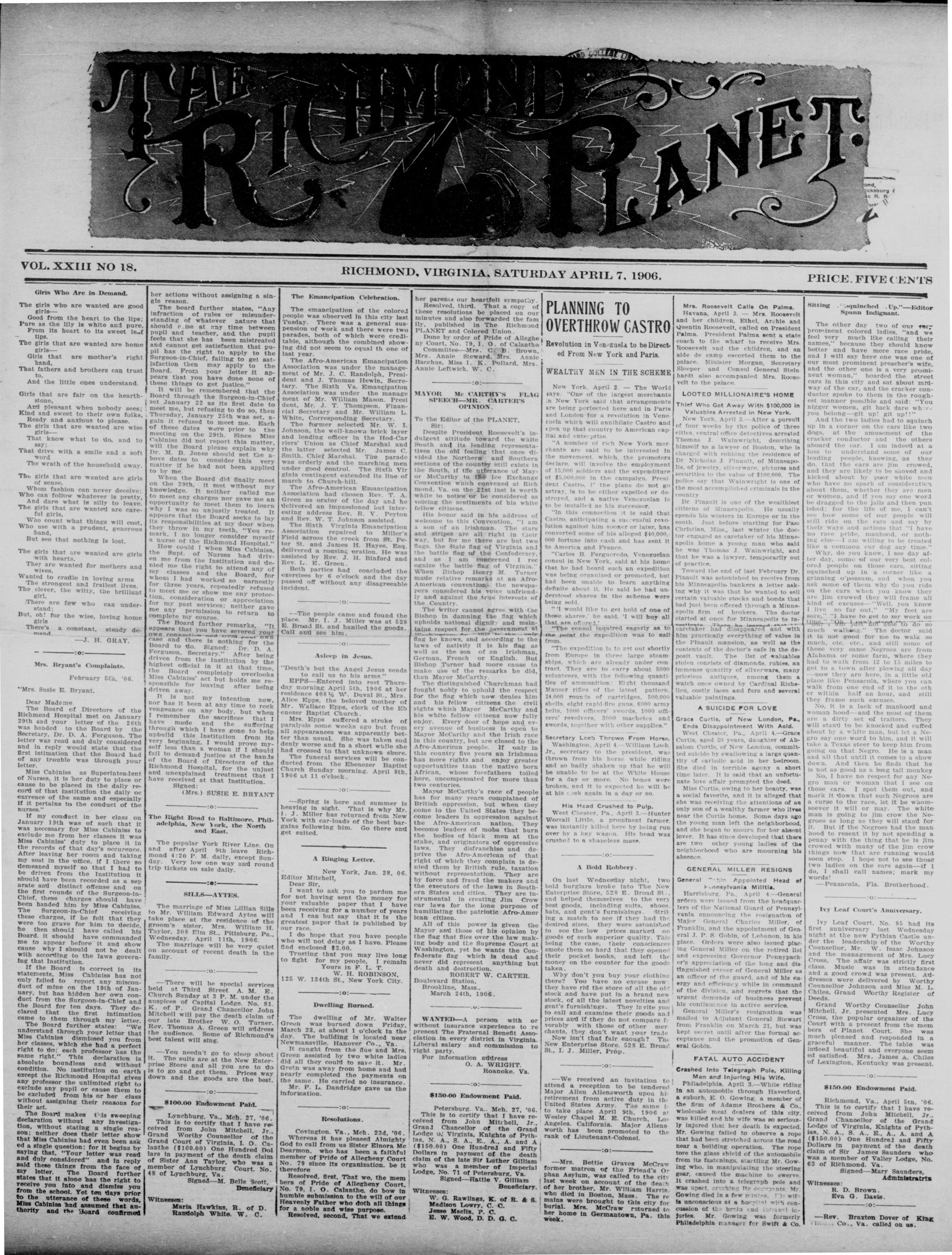
Richmond Planet
Saturday, April 7, 1906
Richmond, Virginia
Page text (machine-generated)
THE RICHMOND PLANET
February 5th, '06
"Mrs. Susie E. Bryant,
Dear Madame
The Board of Directors of the Richmond Hospital met on January 29th and your letter of the 26th was handed to the Board by the Secretary, Dr. D. A. Ferguson. The letter was read and duly considered and in reply would state that the first intimation that the Board had of any trouble was through your letter.
Miss Cabiniss as Superintendent of Nurses, it is her duty to place or cause to be placed in the daily record of that institution the daily occurrence of the same and especially if it pertains to the conduct of the nurses."
If my conduct in her class on January 19th was of such that it was necessary for Miss Cabiniss to exclude me from her classes it was Miss Cabiniss' duty to place it in the records of that day's occurrence. After leaving her room and taking my seat in the office, if I there so demeaned myself so that I had to be driven from the Institution it should have been recorded as a separate and distinct offense and on the first rounds of the Surgeon-in-Chief, these charges should have been handed him by Miss Cabiniss. The Surgeon-in-Chief receiving these charges, if he felt that they were too grave for him to decide, he then should have called his Board, it should have commanded me to appear before it and show cause why I should not be dealt with according to the laws governing that Institution.
If the Board is correct in its statements, Miss Cabiniss has not only failed to report any misconduct of mine on the 19th of January, but has hidden her own conduct from the Surgeon-in-Chief and the Board for ten days. They declared that the first intimation came to them through me.
The Board further states: "We understand through your letter that Miss Cabiniss dismissed you from her classes, which she had a perfect right to do; each professor has the same right." This declaration is absolute boundless and without condition. No institution on earth except the Richmond Hospital gives any professor the unlimited right to exclude any pupil or cause them to be excluded from his or her class without assigning their reasons for their act.
The Board makes this sweeping declaration without any investigation, without stating a single reason; neither does their letter show that Miss Cabiniss had even been asked a single question; for it begins by saying that, "Your letter was read and duly considered" and in reply said these things from the face of my letter. The Board further states that it alone has the right to receive you into and dismiss you from the school. Yet ten days prior to the utterance of these words, Miss Cabiniss had assumed that authority and the Board confirmed
her actions without assigning a single reason.
The board further states, "Any infraction of rules or misunderstanding of whatever nature that should arise at any time between pupil and teacher, and the pupil feels that she has been mistreated and cannot get satisfaction that pupil has the right to apply to the Surgeon-in-Chief, falling to get satisfaction then may apply to the Board. From your letter it appears that you have done none of these things to get justice."
It will be remembered that the Board through the Surgeon-in-Chief set January 22 as its first date to meet me, but refusing to do so, then Thursday, January 25th was set, again it refused to meet me. Each of these dates were prior to the meeting on the 29th. Since Miss Cabinnis did not report this matter, will the Board please explain why Dr. M. B. Jones should set the above dates to consider this very matter if he had not been applied to by me.
When the Board did finally meet on the 29th, it met without my knowledge. It neither called me to meet any charges nor gave me an opportunity to meet them to learn why I was so unjustly treated. It appears that the Board seeks to lay its responsibilities at my door when they throw in my teeth, "You remark, I no longer consider myself a nurse of the Richmond Hospital." How could I when Miss Cabiniss, the Supt. of Nurses had driven me from the institution and denied me the right to attend any of my classes and the Board, for whom I had worked so earnestly for three years, repeatedly refused to meet me or show me any protection, consideration or appreciation for my past services; neither gave me any permission to return to complete my course.
The Board further remarks, "It appears that you have severed your own connection and tried your own case and there is nothing for the Board to do. Signed: Dr. D. A. Ferguson, Secretary." After being driven from the institution by the highest official in it at that time, the Board completely overlooks Miss Cabiniss' act but holds me responsible for leaving after being driven away.
It is not my intention now, nor has it been at any time to seek vengeance on any body, but when I remember the sacrifices that I have made and the suffering through which I have gone to help upbuild this institution from its very beginning, I would prove myself less than a woman if I should fail to demand justice at the hands of the Board of Directors of the Richmond Hospital, for the unjust and unexplained treatment that I have received at that Institution.
Signed:
(Mrs.) SUSIE E. BRYANT
The Right Road to Baltimore, Philadelphia, New York, the North and East.
The popular York River Line. On and after April 9th leave Richmond 4:20 P. M. daily, except Sunday. Very low one way and round trip tickets on sale daily.
SILLS—AYTES
The marriage of Miss Lillian Sills to Mr. William Edward Aytes will take place at the residence of the groom's sister, Mrs. William H. Taylor, 208 Elm St., Pittsburgh, Pa., Wednesday. April 11th, 1906.
The marriage will be very quiet on account of recent death in the family.
—There will be special services held at Third Street A. M. E. Church Sunday at 3 P. M. under the auspices of Capital Lodge. No. 81. K. of P. Grand Chancellor John Mitchell will pay the death claim of our late Brother W. O. Turner. Rev. Thomas A. Green will address the audience. Some of Richmond's best talent will sing.
—You needn't go to sleep about it. The suits are at the New Enterprise Store and all you are to do is to go and get them. Prices way down and the goods are the best.
$100.00 Endowment Paid.
Lynchburg, Va., Meh. 27, '06.
This is to certify that I have received from John Mitchell, Jr.
Grand Worthy Counsellor of the Grand Court of Virginia, I. O. Calanthe ($100.00) One Hundred Dollars in payment of the death claim of Sister Ann Taylor, who was a member of Lynchburg Court. No. 48 of Lynchburg, Va.
RICHMOND, VIRGINIA, SATURDAY APRIL 7, 1906.
The Emancipation Celebration.
The emancipation of the colored people was observed in this city last Tuesday. There was a general suspension of work and there were two parades, both of which were creditable, although the combined showing did not seem to equal th one of last year.
The Afro-American Emancipation Association was under the management of Mr. J. C. Randolph, President and J. Thomas Hewin, Secretary. The Sixth Va. Emancipation Association was under the management of Mr. William Mason, President, Mr. J. T. Thompson, Financial Secretary and Mr. William L. White, Corresponding Secretary.
The former selected Mr. W. I. Johnson, the well-known brick layer and leading officer in the Hod-Carriers' Union as Chief Marshal and the latter selected Mr. James C. Smith. Chief Marshal. The parade was orderly and the marching men under good control. The Sixth Virginia contingent extended its line of march to Church-hill.
The Afro-American Emancipation Association had chosen Rev. T. A. Green as orator of the day and he delivered an impassioned but interesting address Rev. R. V. Peyton and Rev. W. T. Johnson assisted.
The Sixth Virginia Emancipation Association repaired to Miller's Field across the creek from St. Peter St. and James H. Hayes, Esq. delivered a rousing oration. He was assisted by Rev. J. H. Binford and Rev. L. E. Green.
Both parties had concluded the exercises by 6 o'clock and the day passed off without any disagreeable incident.
--The people came and found the place. Mr. I. J. Miller was at 528 E. Broad St. and halled the goods. Call and see him.
Asleep in Jesus.
"Death's but the Angel Jesus sends to call us to his arms."
his arms.
EPPS—Entered into rest Thursday morning April 5th, 1906 at her residence 408½ W. Duval St., Mrs. Alice Epps, the beloved mother of Mr. Wallace Epps, clerk of the Ebenezer Baptist Church.
Mrs. Epps suffered a stroke of paralysis some weeks ago but from all appearances was apparently better than usual. She was taken sadly worse and in a short while she had crossed to that unknown shore.
The funeral services will be conducted from the Ebenezer Baptist Church Sunday morning. April 5th, 1906 at 11 o'clock.
—Spring is here and summer is heaving in sight. That is why Mr. I. J. Miller has returned from New York with car-loads of the best bargains following him. Go there and got suited.
A Ringing Letter.
New York, Jan. 28, 06.
Editor Mitchell,
Dear Sir,
I want to ask you to pardon me
for not having sent the money for
your valuable paper that I have
been receiving for a number of years
and I can but say that it is the
greatest paper that is published by
our race.
I do hope that you have people
who will not delay as I have. Please
find enclosed $3.00.
Trusting that you may live long
to fight for my people, I remain
Yours in F. L. T.
W. H. ROBINSON,
125 W. 124th St. New York City
Dwelling Burned
The dwelling of Mr. Walter Green was burned down Friday, March 23, at about 1 o'clock in the day. The building is located near Newmansville. Hanover Co., Va. It caught from the flue and Mrs. Green assisted by two white ladies did all they could to save it. Mr. Gretn was away from home and had nearly completed the payments on the same. He carried no insurance. Mr. P. L. Dandridge gave us the information.
Resolutions
Covington. Va., Mch. 23d. '06. Whereas it has pleased Almighty God to call from us Sister Elmora Me Dearman, who has been a faithful member of Pride of Allegheny Court No. 79 since its organization, be it therefore Resolved, first, That we, the members of Pride of Allegheny Court, No. 79, I. O. Calanthe, do bow in humble submission to the will of our Heavenly Father who doth all things for a noble and wise purpose.
Resolved, second. That we extend
her parents our heartfelt sympathy.
Resolved, third. That a copy of
these resolutions be placed on our
minutes and also forwarded the family,
published in The Richmond
PLANET and Colored Union.
Done by order of Pride of Alleghen
ny Court, No. 79, I. O. of Calanthe
Committee—Mrs. C. B. Brown,
Mrs. Annie Steward, Mrs. Annie
Bacchus, Miss I. K. Pollard, Mrs.
Annie Leftwich, W. C.
MAYOR Mc CARTHY'S FLAG
SPEECH—MR. CARTER'S
OPINION
To the Editor of the PLANET,
Sir:
Despite President Roosevelt's indulgent attitude toward the white South and its leading representatives the oil feeling that once divided the Northern and Southern sections of the country still exists in the South, if the utterance of Mayor or McCarthy to the Ice Exchange Convention which convened at Richmond, Va. on the 21st inst is worth while to notice or be considered as voicing the sentiments of his white fellow citizens.
His honor said in his address of welcome to this Convention, "I am a son of an irishman. The stars and stripes are all right in their way, but for me there are but two flags, the State flag of Virginia and the battle flag of the Confederacy, and as I am concerned I recognize the battle flag of Virginia."
When Bishop Henry M. Turner made relative remarks at an Afro-American convention, the newspapers considered his voice unfriendly and against the true interests of the Country.
The writer cannot agree with the Bishop in damning the flag which upholds national dignity and maintains respect for the government at all times. The flag he knows, and according to the laws of nativity it is his flag as well as the son of an irishman, German, French or English. But Bishop Turner had more cause to make use of the remarks he did, than Mayor McCarthy.
The distinguished Churchman had fought nobly to uphold the respect for the flag which now denies him and his fellow citizens the civil rights which Mayor McCarthy and his white fellow citizens now fully enjoy. Every door of hope and every avenue of business is open to Mayor McCarthy and the Irish race in this country, but are closed to the Afro-American people. If only in this country five years an Irishman has more rights and enjoy greater opportunities than the native born African, whose forefathers toiled here, uncompensated for more than two centuries.
Mayor McCarthy's race of people has for many years complained of British oppression, but when they come to the United States they become leaders in oppression against the Afro-American nation. They become leaders of mobs that burn the bodies of black men at the stake, and originators of oppressive laws. They disfranchise and deprive the Afro-American of that right of which they complain is denied them by British rule, taxation without representation. They are by force and fraud the makers and the executors of the laws in Southern States and cities. They are instrumental in creating Jim Crow car laws for the lone purpose of humiliating the patricotic Afro-American citizen.
All of this power is given the Mayor and those of his opinion by the flag that flies over the law making body and the Supreme Court at Washington, yet he wants the Confederate flag which is dead and never did represent anything but death and destruction.
ROBERT W. CARTER.
Boulevard Station,
Brookline, Mass.
March 24th, 1906.
WANTED—A person with or without insurance experience to re present The Fraternal Benefit Association in every district in Virginia. Liberal salary and commission to right party. For information address O. A. WRIGHT. Roanoke. Va.
$150.00 Endowment Paid
Petersburg, Va., Mch. 27, '06.
This is to certify that I have received from John Mitchell, Jr.
Grand Chancellor of the Grand
Lodge of Virginia, Knights of Pythias, N. A., S. A., E., A., A. and A
($150.00) One Hundred and Fifty
Dollars in payment of the death
claim of the late Sir Luther Gilliam
who was a member of Imperial
Lodge, No. 71 of Petersburg, Va.
Signed—Hattie V. Gilliam
Beneficiary.
Witnesses:
W. G. Rawlings, K. of R. & S.
Madison Lowry, C. C.
Jesse Maclin, P. C.
E. W. Wood, D. D. G. C
PLANNING TO
OVERTHROW CASTRO
PLANNING TO
OVERTHROW CASTRO
Revolution in Venezuela to be Direct ed From New York and Paris.
WEALTHY MEN IN THE SCHEME
New York. April 2. — The World says. "One of the largest merchants in New York said that arrangements are being perfected here and in Paris and London for a revolution in Venezuela which will annihilate Castro and open up that country to American capital and enterprise.
"A number of rich New York merchants are said to be interested in the movement, which, the promoters declare, will involve the employment of 15,000 soldiers and the expenditure of $5,000,000 in the campaign. President Castro, if the plans do not go astray, is to be either expelled or destroyed, and a native Venezuelan is to be installed as his successor.
"In this connection it is said that Castro, anticipating a successful revolution against him sooner or later, has converted some of his alleged $40,000,000 fortune into cash and has sent it to America and France.
"Carlos B. Fergueredo, Venezuelan consul in New York, said at his home that he had heard such an expedition was being organized or promoted, but had been unable to learn anything definite about it. He said he had understood shares in the scheme were being sold.
"I would like to get hold of one of those shares," he said. "I will buy all that are offered."
"The consul inquired eagerly as to the point the expedition was to sail from.
"The expedition is to set out shortly from Europe in three large steamships, which are already under contract. They are to carry about 5000 volunteers, with the following quantities of ammunition: Eight thousand Mauser rifles of the latest pattern, 24,000 rounds of cartridges, 500,000 shells, eight rapid-fire guns, 8000 army bolts, 1000 officers' swords, 1000 officers' revolvers, 3000 machetes and swords, together with other supplies."
Secretary Leeb Thrown From Horse, Washington, April 4.—William Loeb, Jr., secretary to the president, was thrown from his horse while riding and so badly shaken up that he will be unable to be at the White House for a day or more. No bones were broken, and it is expected he will be at his desk again in a day or so.
His Head Crushed to Rulp
West Chester, Pa., April 3.—Hunter Worral Little, a prominent farmer, was instantly killed here by being run over by a hay wagon. His head was crushed to a肩膀less mass.
A Bold Robbery
On last Wednesday night, two hold burglaries broke into The New Enterprise Store, 528 E. Broad St., and helped themselves to the very best goods, including suits, shoes, hats, and gent's furnishings. Striking a match to see if they had the desired sizes, they were astonished to see the low prices marked on goods of such superior quality. Tails being the case, their consciences smote them so hard that they opened their pocket books, and left the money on the counter for the goods taken.
Why don't you buy your clothing there? You have no excuse now; they have rid the store of all the old stock and have put in a brand new stock, of all the latest novelties and gent's furnishings. They invite you to call and examine their goods and prices and if they do not compare favorably with those of other merchants, they don't want your trade. Now isn't that fair enough? The New Enterprise Store, 528 E. Broad St., I. J. Miller, Prop.
—We received an invitation to attend a reception to be tendered Major Allen Allensworth upon his retirement from active duty in the United States Army. The same is to take place April 9th, 1906 at Wesley Chapel M. E. Church, Los Angeles, California. Major Allensworth has been promoted to the rank of Lieutenant-Coboln.
—Mrs. Bettle Graves McCraw former matron of the Friend's Orphan Asylum, was called to the city last week on account of the death of her brother, Mr. William Harris, who died in Boston, Mass. The remains were brought to this city for burial. Mrs. McCraw returned to her home in Germantown, Pa. this week.
Mrs. Roosevelt Calls On Palma.
Havana, April 3. — Mrs. Roosevelt and her children, Ethel, Archie and Quentin Roosevelt, called on President Palma. President Palma sent a state coach to the wharf to receive Mrs. Roosevelt and the children, and an aide de camp escorted them to the palace. Minister Morgan, Secretary Sleeper and Consul General Steinhardt also accompanied Mrs. Roosevelt to the palace.
LOOTED MILLIONAIRE'S HOME
Thief Who Got Away With $100,000 In
Valuable Assets In New York
Valuables Arrested in New York.
New York, April 3. After a pursuit of four weeks by the police of three cities, central office detectives arrested Thomas J. Wainwright, describing himself as a lawyer of Boston, who is charged with robbing the residence of Dr Nicholas J. Pinault, of Minneapolis, of jewelry, silverware, pictures and securities to the value of $100,000. The police say that Wainwright is one of the most accomplished criminals in the country.
Dr Pinault is one of the wealthiest citizens of Minneapolis. He usually spends his winters in Europe or in the south. Just before starting for Pass Christian, Miss., last winter the doctor engaged as caretaker of his Minneapolis home a young man who said he was Thomas J. Wainwright, and that he was a lawyer, temporarily out of practice.
Toward the end of last February Dr. Pinault was astonished to receive from his Minneapolis bankers a letter asking why it was that he wanted to sell certain valuable stocks and bonds that had just been offered through a Minneapolis firm of brokers. The doctor started at once for Minneapolis to investigate. There he learned that the caretaker had disappeared and with him practically everything of value in the Pinault mansion, as well as the contents of the doctor's safe in the deposit vault. The list of valuables stolen consists of diamonds, rubies, an immense quantity of silverware, many priceless antiques, among them a watch once owned by Cardinal Richelie, costly laces and furs and several valuable paintings.
A SUICIDE FOR LOVE
Grace Curtis, of New London, Pa. Ends Disappointment With Acid. West Chester, Pa., April 4.—Grace Curtis, aged 20 years, daughter of Absalom Curtis, of New London, committed suicide by swallowing a large quantity of carbolic acid in her bedroom. She died in terrible agony a short time later. It is said that an unfortunate love affair prompted the deed. Miss Curtis, owing to her beauty, was a social favorite, and it is alleged that she was receiving the attentions of an only son of a wealthy farmer who lives near the Curtis home. Some days ago the young man left the neighborhood, and she began to mourn for her absent lover. It has since developed that there are two other young ladies of the neighborhood who are mourning his absence.
GENERAL MILLER RESIGNS
General Cobin Appointed Head of Pennsylvania Milltia.
Harrisburg, Pa., April 4—General orders were issued from the headquarters of the National Guard of Pennsylvania announcing the resignation of Major General Charles Miller, of Franklin, and the appointment of General J. P. S. Gobin, of Lebanon, in his place. Orders were also issued placing General Miller on the retired list and expressing Governor Pennpacker's appreciation of the long and distinguished career of General Miller as an officer of the guard, and of his energy and efficiency while in command of the division, and regrets that the urgent demands of business prevent his continuance in active service.
General Miller's resignation was mailed to Adjutant General Stewart from Franklin on March 21, but was kept secret until after the formal acceptance and the promotion of General Gobin.
FATAL AUTO ACCIDENT
Crashed Into Telegraph Pole, Killing Man and Injuring His Wife.
Philadelphia, April 3. While riding in an automobile through Haverford, a suburb, E. O. Gowing, a member of the firm of Adams Brothers & Co., wholesale meat dealers of this city, was killed and his wife was so seriously injured that her death is expected. Mr. Gowing failed to observe a rope that had been stretched across the road near a building operation. The rope tore the glass shield of the automobile from its fastenings, startling Mr. Gowing who, in manipulating the steering gear, caused the machine to swerve. It crashed into a telegraph pole and was upset, crushing its occupants. Mr. Gowing died in a few minutes. His wife is unconscious at a hospital with concussion of the brain and internal injuries. Mr. Gowing was formerly Philadelphia manager for Swift & Co.
Sitting . . . "quinched . Up."—Editor
Spann Indignant.
The other day two of our very prominent colored ladies, "and we feel very much like calling their names," because they should know better and have more race pride, and I will say here one was one of our most prominent preacher's wife, and the other one is a very prominent woman," boarded the street cars in this city and sat about midway of the car, and the cracker conductor spoke to them in the roughest manner possible and said: "You nigger women, git back dare who you belong—git up! git up!!" And the two ladies had to squinch up in a corner on the cars like two dogs, at the amusement of the cracker conductor and the others aboard the car. I am indeed at a loss to understand some of our leading people, knowing, as they do, that the cars are jim crowed, and they are likely to be shoved and kicked about by poor white men who have no spark of consideration about them, whether they are men or women, and if you say one word be dragged to the jails and then punished; for the life of me, I can't see how some of our people will still ride on the cars and say by their ways and actions that "I have no race pride, manhood, or nothing else—I am willing to be treated like a common car dog any time."
Why, do you know, I see day after day, some of our very best colored people on those cars, sitting squinched up in a corner like a grinning o'possum, and when you ask some of them why do you ride on the cars when you know they are jim crowed they will frame all kind of excuses—"Well, you know I live so far out," "My feet are sore," "I have to get to my work on time," "Oh jim not able to do so much walking." The doctor said it is not good for me to walk so much, ete, ete, and still some of those very same Negroes are from Alabama or some farm, where they had to walk from 12 to 15 miles to get to a town after plowing all day—now they are here, in a little old place like Pensacola, where you can walk from one end of it to the oth er within half an hour, and still they frame such excuses.
No, it is a lack of manhood and woman hood—and the most of them are a dirty set of traitors. They will stand to be knocked and cuffed about by a white man, but let a Negro say one word to him, and it will take a Texas steer to keep him from going on that Negro. He is a man and all that until it comes to a show down. And then he finds that he is not as good as a long tall monkey No, I have no respect for any Negro man or woman that I see on those cars. I spot them out, and mark it town that such Negroes are a curse to the race, let it be whomover it will or may. The white man is going to jim crow the Negroes as long as they will stand for it. But if the Negroes had the man hood to resent it by not spending a penny with the thing that he is jim crowed with many of the jim crow things now that are running would soon stop. I hope not to see those two ladies on the cars again—if I do, I shall call names; mark my words!
—Pensacola, Fla. Brotherhood.
Ivy Leaf Court's Anniversary
Ivy Leaf Court, No. 85 had its first anniversary last Wednesday night at the new Pythian Castle under the leadership of the Worthy Counsellor, Mr. W. Isaac Johnson and the management of Mrs. Lucy Cross. The affair was strictly first class. Music was in attendance and a good crowd was present. Addresses were delivered by Worthy Counsellor Johnson and Miss M. L. Chiles, Grand Worthy Register of Deeds.
Grand Worthy Counsellor John Mitchell, Jr. presented Mrs. Lucy Cross, the popular organizer of the Court with a present from the members of Planet Court. She was much pleased and responded in a graceful manner. The table was indeed beautiful and everyone seemed satisfied. Mrs. James A. Chiles of Lexington, Kentucky was present
$150.00 Endowment Paid
Richmond, Va., April 5th, '66. This is to certify that I have received from John Mitchell, Jr., Grand Chancellor of the Grand Lodge of Virginia, Knights of Pythias, N. A., S. A., E., A, A. and A ($150.00) One Hundred and Fifty Dollars in payment of the death claim of Sir James Saunders who was a member of Valley Lodge, No. 63 of Richmond, Va.
—Rev. Braxton Dover of King
Wing Co., Va. called on us.
TWO
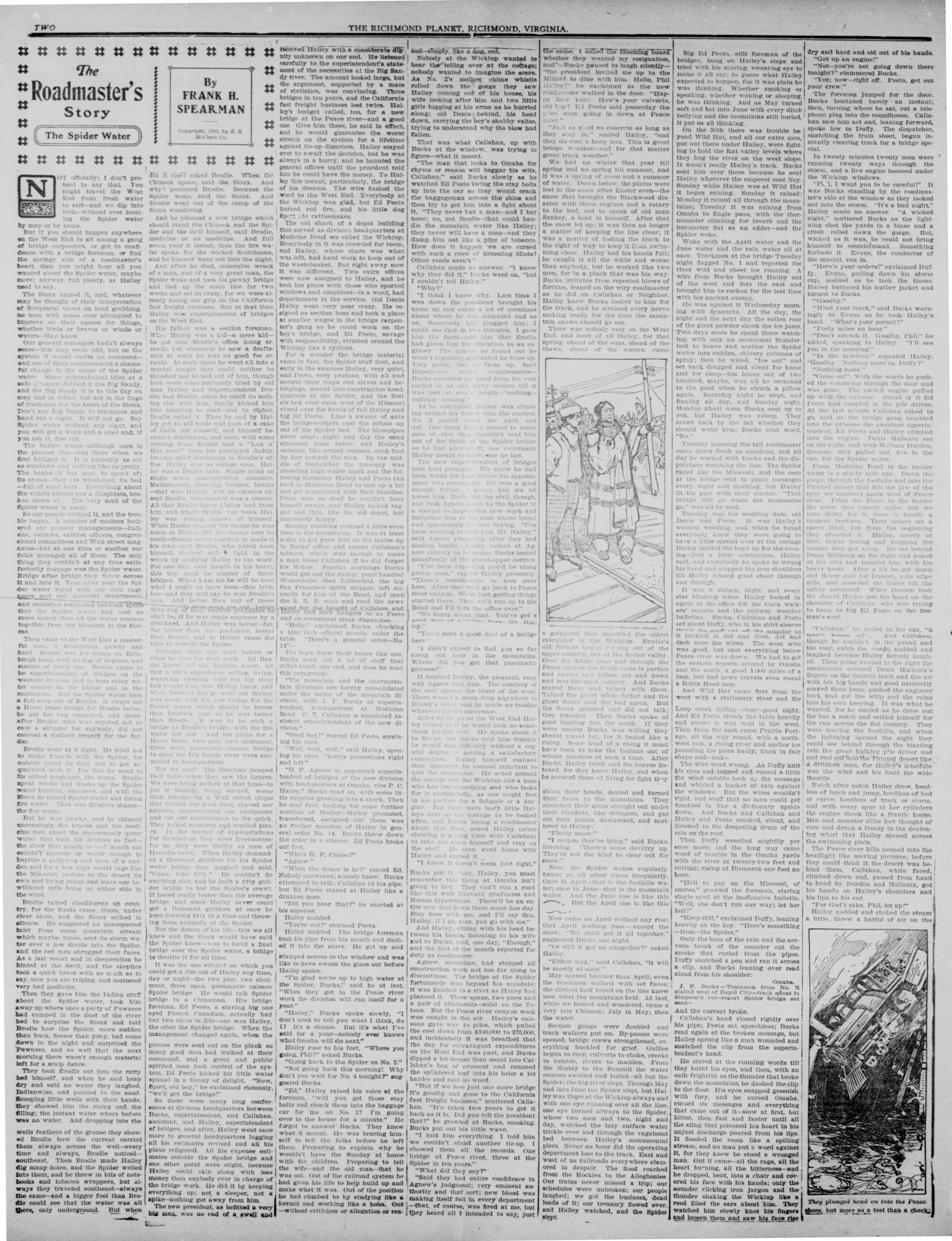
T officially; I don't pretend to say that. You might travel the West End from fresh water to salt—and we dip into both—without ever locating the Spider water
N
OT offe
tend
might
End
to salt
both—
ling
by map or by name.
But if you should happen anywhere on the West End to sit among a gang of bridge carpenters, or get to confidence with a bridge foreman, or find the springy side of a roadmaster's heart, then you might hear all you wanted about the Spider water, maybe more; anyway full plenty, as Halley used to say.
The Sloux named it, and, whatever may be thought of their interpretation of Scriptural views on land grabbing, no man with sense ever attempted to improve on their names for things, whether birds or braves or winds or waters—the know.
Our general managers hadn't always sense—this may seem odd, but on the system it would excite no comment—and one of them countenanced a shameful change in the name of the Spider water. Some polytechnical idlot at a safe distance dubbed it the Big Sandy, and the Big Sandy it is to this day on map and in folder, but not in the lingo of trackmen nor the heart of the Stoux. Don't say Big Sandy to trackmen and hand out a cigar. It will not go. Say Spider water without any cigar, and you will get a word and a stool and, if you ask it, fine cut.
The Spider water—although ours is the pioneer line—was there when we first bridged it. It is probably as old as sundown and nothing like as pretty. The banks—it has none to speak of; its stones—it are whiskered; its bed—full of sand burs. Everything about the villain stream has a dilapidate, broken down all. The very mud of the Spider water is rusty.
So our people bridged it, and the trouble began. A number of matters bothered our pioneer management—Indians, outlaws, cabinet officers, congressional committees and Wall street magnates—but at one time or another our folks managed all of them. The only thing they couldn't at any time satisfactorily managed was the Spider water, Bridge after bridge they threw across it and into it. Year after year the Spider water towed with our civil engineers and our material department, and statistics estimated between spots that the Spider water had cost us more money than all the water courses together from the Missouri to the Sierras.
Then came to the West End a masterful man, a Scotchman, pawky and hard. Brodie was his name, an Edinburgh man, with no end of degrees, and master of every one. Brodie came to be superintendent of bridges on the western division and to boss every water course on the plains and in the mountains. But the Spider water took a fall even out of Brodie. It swept out a Howe truss bridge for Brodie before he got his bag unpacked, and thereafter Brodie, who was reputed not to care a stringer for anybody, did not conceal a distinct respect for the Spider.
Brodle went at it right. He tried not to make friends with the Spider, for nobody could do that, but to get acquainted with it. For this he went to its oldest neighbors, the Sloux. Brodle spent weeks and weeks up the Spider water hunting, summers, and with the Sloux he talked Spider water and drank fire water. That was Brodle's shame—the fire water.
But he was pawky, and he chinned unceasingly the braves and the medicine men about the uncommonly queer water that took the bridges so fast—the river that month in and month out couldn't squeeze up water enough to baptize a polywog and then of a sudden and for a few days would rage like the Missouri, restore to the desert its own and living image and leave our bewildered rails bung up either side in the wind.
Brodie talked cloudbursts up country, for the floods came, times, under clear skies, and the Sioux sulked in silence. He suggested an unsuspected inlet from some mountain stream which maybe, times, sent its storm water over a low divide into the Spider, and the red men shrugged their faces. As a last resort and in desperation he hinted at the devil, and the skeptics took a quick brace with as much as to say, now you are talking, and muttered very bad medicine.
Then they gave him the Indian stuff about the Spider water, took him away up where once a party of Pawnees had camped in the dust of the river bed to surprise the Sioux and told Brodie how the Spider, more sudden than buck, fleeter than pony, had come down in the night and surprised the Pawnees, and so well that the next morning there wasn't enough material left for a scalp dance.
They took Brodie out into the ratty bed himself, and when he said heap dry and said no water they laughed. Indianwise, and pointed to the sand. Scoping little wells with their hands, they showed him the rising and the filling; the instant water where before was no water. And dropping into the wells feathers of the grouse they showed Brodie how the current carried them always across the well—every time and always, Brodie noticed—southeast. Then Brodie made Halley dig many-holes, and the Spider welled into them, and he threw in bits of notebooks and tobacco wrappers, but always they traveled southeast—always the same—and a bigger fool than Brodie could see that the water was all there, only underground. But when
Did it rise? asked Brodie. When the Chinook spoke, said the Sioux. And why? persisted Brodie. Because the Spider woke, said the Sioux. And Brodie went out of the camp of the Sioux wondering.
And he planned a new bridge which should stand the Chinook and the Spider and the dell himself, said Brodie, medicine or no medicine. And full seven year it lasted; then the fire water spoke for the wicked Scotchman, and he himself went out into the night.
And after he died, miserable wreck of a man, and of a very great man, the Spider woke and took his pawky bridge and tied up the main line for two weeks and set us crazy, for we were already losing our grip on the California fast freight business. But at that time Halley was superintendent of bridges on the West End.
His father was a section foreman. Whee, Hailey was a kid—a mere kid—he got into Brodie's office doing errands, but whenever he saw a draftsman at work he was no good for errands. At such times he went all into an mental tangle that could neither be thrashed nor kicked out of him, though both were conscientiously tried by old man Hailey and Superintendent Brodie, and Brodie, since he could do nothing else with him, finally kicked him into learning to read—and to cipher, Brodie called it. Then by and by Hailey got an old table and part of a cake of India ink himself, and himself became a draftsman, and soon, with some cursing from Brodie and a "Luk a" that now!" from his paralyzed daddy, became chief draftsman in Brodie's office. Hailey was a Brodie man. Single mind on single mind, concentration absolute, Mathematics, drawing, bridges, brains—that was Hailey. But no classics except Brodie, who himself was a classic. All that Brodie knew Hailey had from him, and where Brodie was weak Hailey, was strong, master of himself. When Brodie shamed the image he was made in Hailey the shame best he could—though never touched or made it his own—and Brodie, who hated even himself, showed still light in the wreck by molding Hailey to his work. For one day, said Brodie in his heart, this boy shall be master of these bridges. When I am rot he will be here what I ought to have been—this Irish boy—and they will say he was Brodie's man. And better than any of these than any of their eastern graduates he shall be, if he was made engineer by a drunkard. And Hailey was better—far, far better than the graduates, better than Brodie, and to Hailey came the time to wrestle the Spider.
Stronger than any man before or since he was for that work. All Brodie knew, all the Indians knew, all that a life's experience, eating, living, watching, sleeping with the big river had taught him, that Halley knew, and when Brodie's bridge went out Halley was ready with his new bridge for the Spider water which should be better than Brodie's, just as he was better than Brodie. It was to be such a bridge as Brodie's bridge, with the fire water left out. And the plans for a Howe truss, two pier, two abutment, three span, pneumatic caisson bridge to span the Big Sandy river were submitted to headquarters.
But the cost! The directors jumped their table when they saw the figures. We were being milked at that time—to put it bluntly, being sucked, worse than lemons—by a Wall street clique that robbed our good road, shaved our salaries, impoverished our equipment and cut our maintenance to the quick. They talked economy and studied piracy. In the matter of appropriations for themselves they were freebooters; for us, they were thrifty as men of Hamelln town. When Halley demanded a thousand guilders for his Spider water bridge they laughed and said, "Come, take fifty." He couldn't do anything else, and he built a fifty guilder bridge to bar the Spider's crawl. It lasted really better than the average bridge, and since Halley never could get a thousand guilders at once he kept drawing fifty at a time and throwing them annually at the Spider.
But the dream of his life—this we all knew and the Sioux would have said the Spider knew—was to build a final bridge over the Spider water, a bridge to throttle it for all time.
It was the one subject on which you could get a rise out of Halley any time, day or night—the two pier, two abutment, three span, pneumatic caisson Spider bridge. He would talk Spider bridge to a Chinaman. His bridge foreman, Ed Peeto, a staving big one eyed French Canadian, actually had but two ideas in life—one was Halley, the other the Spider bridge. When the management changed again, when the pirates were sent out on the plank so many good men had walked at their command, and a great and public spirted man took control of the system, Ed Peeto kicked his little water spaniel in a frenzy of delight, "Now, Sport, old boy," he exclaimed riotously, "we'll get the bridge."
So there were many long conferences at division headquarters between Bucks, superintendent, and Callahan, assistant, and Halley, superintendent of bridges, and after, Halley went once more to general headquarters lugging all his estimates revised and all his plans configured. All his expense estimates outside the Spider bridge and one other point were slight, because Halley could skin along with less money than anybody ever in charge of the bridge work. He did it by keeping everything up; not a sleeper, not a spike—nothing got away from him. The new president, as befitted a very big man, was no end of a swell and
THE RICHMOND PLANET, RICHMOND, VIRGINIA
received Hailey with a considerate dignity unknown on our end. He listened carefully to the superintendent's statement of the necessities at the Big Sandy river. The amount looked large, but the argument, supported by a mass of statistics, was convincing. Three bridges in ten years, and the California fast freight business lost twice. Hailey's budget called, too, for a new bridge at the Peace river—and a good one. Give him these, he said in effect, and he would guarantee the worst stretch on the system for a lifetime against tie-up disasters. Hailey stayed over to await the decision, but he was always in a hurry, and he haunted the general offices until the president told him he could have the money. To Hailey this meant, particularly, the bridge of his dreams. The wire fashed the word to the West End. Everybody at the Wickup was glad, but Ed Peeto burned red fire, and his little dog Sport rattlesnakes.
The old shack of a depot building that served as division headquarters at Medicine Bend we called the Wickup. Everybody in it was crowded for room, and Halley, whose share was what was left, had hard work to keep out of the wastebasket. But right away now it was different. Two extra offices were now assigned to Halley, and he took his place with those who sported windows and cuspidors—in a word, had departments in the service. Old Denls Halley went very near crazy. He resigned as section boss and took a place at smaller wages in the bridge carpenter's gang so he could work on the boy's bridge, and Ed Peeto, savage with responsibility, strutted around the Wickup like a cyclops.
For a wonder the bridge material came in fast, the Spider stuff first, and early in the summer Halley, very quiet, and Peeto, very profane, with all and several their traps and slaves and belongings, moved into construction headquarters at the Spider, and the first air lock ever sunk west of the Missouri closed over the heads of tall Halley and big Ed Peeto. Like a swarm of ants the bridgeworkers cast the refuse out of the Spider bed. The blowplipes never slept; night and day the sand streamed from below, and Halley's calssons, like armed cruisers, sunk foot by foot toward the rock. By the middle of September the masonry was crowding high water mark and the following Saturday Halley and Peeto ran back to Medicine Bend to rest up a bit and get acquainted with their families. Peeto was so deaf he couldn't hear himself swear, and Halley looked ragged and thin, like the old depot, but immensely happy.
Sunday morning counted a little even then in the mountains. It was at least a day to get your feet on the tables up in Buck's office and smoke Callahan's tobacco, which was enough to make a man bless Callahan if he did forget his Maker. Sunday mornings Bucks would get out the dainty, pearl handled Wostenholm that Lilienfeld, the big San Francisco spirit shipper, left annually for him at the Bend, and open the R. R. B. mali and read the news cloud for the benefit of Callahan and Halley and such hangers on as Peeo and an occasional stray dispatcher. "Hello!" exclaimed Bucks, chuckling a nine inch official manila under the table. "Here's a general order—No. 14"—
The boys drew their briers like one. Bucks read out a lot of stuff that didn't touch our end, and then he read this paragraph:
"The mountain and the intermountain divisions are hereby consolidated under the name of the mountain division, with J. F. Bucks as superintendent, headquarters at Medicine Bend. C. T. Callahan is appointed assistant superintendent of the new division."
"Good boy!" roared Ed Peeto, straining his ears.
"Well, well, well," said Hailey, opening his eyes, "here's promotions right and left."
"H. P. Agnew is appointed superintendent of bridges of the new division with headquarters at Omaha, vice P. C. Hailey." Bucks read on, with some little surprise growing into a shock. Then he read fast, looking for some further mention of Hailey—Hailey promoted, transferred—but there was no further mention of Hailey in general order No. 14. Bucks threw down the order in a silence. Ed Peeto broke out first.
"Who's H. P. Canoe?"
"Agnew."
"When the deuce is he?" roared Ed.
Nobody answered; nobody knew. Bucks
attempted to talk; Callahan lit his pipe,
but Ed Peceto stared at Hailey like a
drunken man.
"Did you hear that?" he snorted at
his superior.
Hailey nodded.
"You're out!" stormed Peeto.
Hailey nodded. The bridge foreman took his pipe from his mouth and dashed it into the stove. He got up and stamped across to the window and was like to sworn the glass out before Hailey spoke.
"I'm glad we're up to high water at the Spider, Buck's," said he at last.
"When they get in the Peace river work the division will run itself for a year."
"Hailey," Bucks spoke slowly, "I don't need to tell you what I think, do I? It's a shame. But it's what I've said for a year—nobody ever knows what Omaha will do next."
Hailey rose to his feet. "Where you going, Phil?" asked Bucks.
"Going back to the Spider on No. 2."
"Not going back this morning! Why don't you wait for No. 4 tonight?" suggested Bucks.
"Ed." Hailey raised his voice at the foreman, "will you get those stay bolts and chuck them into the baggage car for me on No. 2? I'm going over to the house for a minute." He forgot to answer Bucks. They knew what it meant. He was bracing himself to tell the folks before he left them. Preparing to explain why he wouldn't have the Sunday at home with the children. Preparing to tell the wife—and the old man—that he was out. Out of the railroad system he had given his life to help build up and make what it was. Out of the position he had climbed to by studying like a hermit and working like a hobo. Out—without criticism or allegeation or res-
son—slimly like a dog, out
sick, simpy, like a dog, out.
Nobody at the Wickup wanted to hear the telling over at the cottage; nobody wanted to imagine the scene. As No. 2's mellow chime whistle rolled down the gorge they saw Halley coming out of his house, his wife looking after him and two little girls tugging at his arms as he hurried along; old Denis behind, his head down, carrying the boy's shabby valise, trying to understand why the blow had fallen.
That was what Callahan, up with Bucks at the window, was trying to figure—what it meant.
"The man that looks to Omaha for rhyme or reason will beggar his wits, Callahan," said Bucks slowly as he watched Ed Peeto swing the stay bolts up into the car so they would crack the baggageman across the shims and then try to get him into a fight about it. "They never had a man—and I bar none; no, not Brodie—that could handle the mountain water like Halley; they never will have a man—and they dump him out like a pipe of tobacco. How does it happen we are cursed with such a crew of blooming idiots? Other roads aren't." Callahan made no answer. "I know why they did it." Bucks went on, "but I couldn't tell Halley."
"I think I know why. Last time I was down the president brought his name up and asked a lot of questions about where he was educated and so on. Somebody had plugged him; I could see that in two minutes. I gave him the facts—told him that Brodie had given him his education as an engineer. The minute he found out he wasn't regularly graduated he froze up. Very polite, but he froze up. See? Experience, actual requirements—Bucks extended his hand from his vest pocket in an old wavy motion till it was lost at arm's length—"nothing—nothing—nothing."
As he concluded Hailey was climbing behind his father into the smoker. No. 2 pulled down the yard and out. One thing Hailey meant to make sure of—that they shouldn't beat him out of the finish of the Spider bridge as he had planned it; one monument Hailey meant to have—one he has.
The new supertendent of bridges took hold promptly. We knew he had been wired for long before his appointment was announced. He was a good enough fellow, 1 guess, but we all hated him. Bucks did the civil, though, and took Agnew down to the Spider in a special to inspect the new work and introduce him to the man whose bread and opportunity he was taking. "I've been wanting to meet you, Mr. Halley," sald Agnew pleasently after they had shaken hands. Halley looked at Agnew silently as he spoke; Bucks looked steadfastly at the grasshopper derrick. "I've been expecting you'd be along pretty soon," replied Halley presently. "There's considerable to look over here. After that we'll go back to Peace river canyon. We're just getting things started then. Then we'll run up to the Bend and I'll turn the office over." "No hurry about that. You've got a good shot of a 'Biller' here, Mr. Halley."
"You'll need a good deal of a bridge here."
"I didn't expect to find you so far along out here in the mountains. Where did you get that pneumatic process?"
It touched Halley, the pleasant, easy way Agnew took him. The courtesy of the east against the blunt of the west. There wasn't a mean drop anywhere in Halley's blood, and he made no trouble whatever for his successor.
After he let go on the West End Halley talked us if he would look up something farther east. He spoke about it to Bucks, but Bucks told him frankly he would find difficulty without a regular degree in getting a satisfactory connection. Halley himself realized that; moreover, he seemed reluctant to quit the mountains. He acted around the cottage and the Wicklup like a man who has lost something and who looks for it abstractedly, as one might feel in his pockets for a fishpole or a burglar. But there were lusty little Halleyes over at the cottage to be looked after, and Bucks, losing a roadmaster about that time, asked Halley (after chewing it a long time with Callahan) to take the place himself and stay on the staff. He even went home with Halley and argued it.
"I know it doesn't seem just right," Bucks put it. "but, Halley, you must remember this thing at Omaha isn't going to last. They can't run a road like this with Harvard graduates and Boston typewriters. There'll be an entire new dead down there some fine day. Stay here with me, and I'll say this, Halley, if I go, ever, you go with me." And Halley, sitting with his head between his hands, listening to his wife and to Bucks, said, one day, "Enough," and the first of the month reported for duty as roadmaster.
Agnew, meantime, had stopped all construction work not too far along to discontinue. The bridge at the Spider fortunately was beyond his mandate; it was finished to a rivet as Hailey had planned it. Three spans, two piers and a pair of abutments—solid as the Tetons. But the Peace river canyon work was caught in the air. Hailey's caissons gave way to piles, which pulled the cost down from $100,000 to $75,000, and incidentally it was breathed that the day for extravagant expenditures on the West End was past, and Bucks dipped a bit deeper than usual into Callahan's box of crosscut and rammed the splintered leaf into his brier a bit harder and said no word.
"But if we lose just one more bridge it's goodly and gone to the California fast freight business," muttered Callahan. "It's taken two years to get it back as it is. Did you tell the president that?" he growled at Bucks, smoking. Bucks put out his little wave.
"I told him everything. I told him we couldn't stand another tie-up. I showed them all the records. One bridge at Peace river, three at the Spider in ten years." "What did they say?"
"Said they had entire confidence in Agnew's judgment; very eminent authority and that sort; new blood was making itself felt in every department—that, of course, was fired at me, but they heard all I intended to say, just
the same. I asked the blooming board whether they wanted my resignation, and"—Bucks paused to laugh silently—"the president invited me up to the Millard to dine with him. Hello, Phil Halley!" be exclaimed as the new readmaster walked in the door. "Happy New Year. How's your culverts, old boy? Ed Peeto said yesterday the piles were going in down at Peace river."
"Just as good as concrete as long as they stay in," smiled Halley, "and they do cost a heap less. This is great bridge weather—and for that matter great track weather."
We had no winter that year till spring and no spring till summer, and it was a spring of snow and a summer of water. Down below, the plains were lost in the snow after Easter even—the snow that brought the Blackwood disaster with three engines and a rotary to the bad, not to speak of old man Sankey, a host in himself. After that the snow let up; it was then no longer a matter of keeping the line clear; it was a matter of lashing the track to the right of way to keep it from swimming clear. Hailey had his hands full; he caught it all the while and worse than anybody, but he worked like two men, for in a pinch that was his way. Bucks, irritable from repeated blows of fortune, leaned on the wiry roadmaster as he did on Cahlanan or Neighbor. Hailey knew Bucks looked to him for the track, and he strained every nerve making ready for the time the mountain snows should go out.
There was nobody easy on the West End, and least of all Halley, for that spring, ahead of the sun, ahead of the thaws, ahead of the waters, came
A woman in a long coat stands on a railway track, holding a pole. She is facing a crowd of people, some of whom are holding umbrellas. The background features a train and a bridge.
a going-out that unsettled the oldest calculator in the Wicklup. Brodie's old friends began carving out of the upper country, out of the Spider valley. Over the Eagle pass and through the Peace canyon the Sloux came in parties and camps and tribes, out and down and into the old country. And Bucks stayed them and talked with them. Talked the great white father and the ghost dance and the bad agent. But the Sloux grunted and did not talk; they traveled. Then Bucks spoke of good hunting far, far south. If they were uneasy Bucks was willing they should travel far, for it looked like a rising. Some kind of a rising it must have been to take the Indians out of winter quarters at such a time. After Bucks, Halley tried, and the braves listened, for they knew Halley, and when he accused them of fixing for fight thy
shook their heads, denied and turned their faces to the mountains. They stretched their arms straight out under their blankets, like stringers, and put out their palms, downward, and muttered to Halley:
"Plenty snow."
"I reckon they're lying," said Bucks, listening. "There's some devilty up. They're not the kind to clear out for snow."
Now, the Spider wakes regularly twice; at all other times irregularly. Once in April—that is the foothills water; once in June—that is the mountain water. And the June rise is like this.
But the April rise is like this.
Now came an April without any rise; that April nothing rose—except the snow. "We shall get it all together," suggested Bucks one night.
"Or will it get us altogether?" asked Halley.
"Either way," said Callahan, "it will be mostly at once."
May opened bleaker than April; even the trackmen walked with set faces; the dirtiest half breed on the line knew now what the mountains held. At last, while we looked and wondered, came a very late Chinook; July in May; then the water.
Section gangs were doubled and track walkers put on. By-passes were opened, bridge crews strengthened, everything buckled for grief. Gullies began to race, culverts to choke, creeks to tumble, rivers to madden. From the Muddy to the Summit the water courses swelled and boiled—all but the Spider; the big river slept. Through May and into June the Spider slept, but Halley was there at the Wickup allways and with one eye running over all the line, one eye turned always to the Spider, where two men and two, night and day, watched the lazy surface water trickle over and through the vagabond bed between Hailey's monumental pliers. Never an hour did the operating department lose to the track. East and west of us railroads everywhere clamored in despair. The flood reached from the Rockies to the Alleghenies. Our trains never missed a trip; our schedules were unbroken; our people laughed; we got the business, dead loads of it; our treasury flowed over, and Halley watched, and the Spider slept.
Big Ed Peeto, still foreman of the bridges, hung on Halley's steps and tried with his staring, swearing eye to make it all out; to guess what Halley expected to happen, for it was plain he was thinking. Whether smoking or speaking, whether waking or sleeping, he was thinking. And as May turned soft and hot into June with every ditch bellyling and the mountains still buried, it put us all thinking.
On the 30th there was trouble beyond Wild Hat, and all our extra men, put out there under Halley, were fighting to hold the Rat valley levels where they hug the river on the west slope. It wasn't really Halley's track. Bucks sent him over there because he sent Halley wherever the emperor sent Ney. Sunday while Halley was at Wild Hat it began raining. Sunday it rained; Monday it rained all through the mountains; Tuesday it was raining from Omaha to Eagle pass, with the thermometer climbing for breath and the barometer flat as an adder—and the Spider woke.
Woke with the April water and the June water and the rain water all at once. Trackmen at the bridge Tuesday night flagged No. 1 and reported the river wild and sheet ice running. A wire from Bucks brought Halley out of the west and into the east and brought him to reckon for the last time with his ancient enemy.
He was against it Wednesday morning with dynamite. All the day, the night and the next day the sullen roar of the giant powder shook the ice jams. Two days more he spent there watching, with only an occasional thunderbolt to heave and scatter the Spider water into sudden, shivery columns of spray; then he wired, "Ice out" and set back dragged and silent for home and for sleep—ten hours out of two hundred, maybe, was all he reckoned to the good when he struck a pillow again. Saturday night he slept, and Sunday all day, and Sunday night. Monday about noon Bucks sent up to ask, but Halley was asleep. They asked back by the lad whether they should wake him; Bucks sent word, "No."
Tuesday morning the tall roadmaster came down fresh as sunshine, and all day he worked with Bucks and the dispatchers watching the line. The Spider raced like the Missouri, and the men at the bridge sent in panic messages every night and morning, but Halley lit his pipe with their alarms. "That bridge will go when the mountains go," was all he said.
Tuesday was his wedding date, old Denis told Peeto. It was Halley's wooden wedding, and when he found everybody knew they were going to have a little spread over at the cottage Halley invited the boys up for the evening—just a little celebration, Halley said, and everybody he spoke to wring his hand and slapped his iron shoulders till Halley echoed good cheer through and through.
It was 9 o'clock, night, and every star blinking when Hailey looked in again at the office for the track walkers' reports and the railway weather bulletins. Bucks, Callahan and Peeto sat about Duffy, who in his shirt sleeves drew the stump out off the sounder as it trickled in dot and dash, dot and dash over the wires. The west wire was good, but east everything below Peace river was down. We had to get the eastern reports around by Omaha and the south, a good 1,000 miles of a loop, but bad news travels even round a Robin Hood loop.
And Wild Hat came first from the west with a stationary river and the Loup creek falling—clear good night. And Ed Peeto struck the table heavily and swore it was well in the west. Then from the east came Pralle Portage, all the way round, with a north-west rain, a rising river and anchor pounding the pliers badly, track in fair shape and—and
The wire went wrong. As Duffy knit bls eyes and tugged and cussed a little the wind outside took up the message and whirled a bucket of rain against the windows. But the wires wouldn't right, and stuff that no man could get tumbled in like a dictionary upside down. And Bucks and Callahan and Halley and Peeto smoked, silent, and listened to the deepening drum of the rain on the roof.
Then Duffy wrestled mightily yet once more, and the long way came word of trouble in the Omaha yards with the river at twenty-two feet and cutting; rising at Bismarck one foot an hour.
"Hell to hold the Missouri, of course," growled the foreman, staring single eyed at the inoffensive bulletin.
"Well, she don't run our way; let her boll."
"Keep still," exclaimed Duffy, leaning heavily on the key. "Here's something—from—the Spider."
Only the hum of the rain and the nervous break of the sounder cut the smoke that curled from the pipes. Duffy snatched a pen and ran it across a clip, and Bucks leaning over read aloud from his shoulder:
J. F. Buck's -Trainmen from No. 75 stalled west of Rapid City-track affront in Simpson's cut-report Spider bridge out send-
And the current broke.
Callahan's hand closed rigidly over his pipe; Peeto sat speechless; Bucks read again at the broken message, but Halley sprang like a man wounded and snatched the clip from the superintendent's hand.
He stared at the running words till they burnt his eyes, and then, with an oath frightful as the thunder that broke down the mountains, he dashed the clip to the floor. His eyes snapped greenish with fury, and he cursed Omaha, cursed its messages and everything that came out of it—slow at first, but bitter, then fast and faster until all the sting that poisoned his heart in his unjust discharge poured from his lips. It flooded the room like a spilling stream, and no man put a word against it, for they knew he stood a wronged man. It came—all the rage, all the heart burning, all the bitterness—and he dropped, bent, into a chair and covered his face with his hands; only the sounder clicking iron jargon and the thunder shaking the Wicklup like a reed filled the ears about him. They watched him slowly knot his fingers and loosen them and saw his face rise
dry and hard and old out of his hands.
"Get up an engine!"
"Not—you're not going down there tonight?" stammered Bucks.
"Yes; now—right off. Peeto, get out your crew."
The foreman jumped for the door. Bucks hesitated barely an instant; then, turning where he sat, cut a telephone plug into the roundhouse. Callahan saw him act and, leaning forward, spoke low to Duffy. The dispatcher, snatching the train sheet, began instantly clearing track for a bridge special.
In twenty minutes twenty men were running twenty ways through the storm, and a live engine boomed under the Wicklup windows.
"PK.3. I want you to be careful!" It was Bucks standing by the roadmaster's side at the window as they looked out into the storm. "It's a bad night." Hailey made no answer. "A wicked night," muttered Bucks as the lightning shot the yards in a blaze and a crash rolled down the gorge. But, wicked as it was, he could not bring himself to countermind. Something forbade it. Evans, the conductor of the special, ran in.
"Here's your orders!" exclaimed Duffy. Evans, pulling down his storm cap, nodded as he took the tissue. Hailey buttoned his leather jacket and turned to Bucks.
"Goodby."
"Mind your track," said Bucks warningly to Evans as he took- Hailey's hand. "What's your permit?"
"Forty miles an hour."
"Don't stretch it. Goodby, Phil," he added, speaking to Hailey. "I'll see you in the morning."
"In the morning" repeated Hailey, "Goodby. Nothing more in, Duffy?" "Nothing more." "Come on." With the words he pushed the conductor through the door and was gone. The switch engine puffed up with the caboose. Ahead of it Ed Peeto had coupled in the pile driver. At the last minute Callahan asked to go, and as the bridge gang tumbled into the caboose the assistant superintendent, Ed Peeto and Hailey climbed into the engine. Denis Mullenix sat on the right, and with William Durden, fireman, they pulled out, five in the cab, for the Spider water.
From Medicine Bond to the Spider water is a ninety mile run. Down the gorge, through the foothills and into the Painted desert that fills the jaw of the spur we intersect again west of Peace river. From the Peace to the Spider the crow flies twenty miles, but we take thirty for it; there is hardly a tangent between. Their orders set a speed limit, but from the beginning they crowded it. Hailey, moody at first, began joking and laughing the minute they got away. He sat behind Denis Mullenix on the right and poked at his ribs and taunted him with his heavy heels. After a bit he got down and threw coal for Durden, mile after mile, and crowded the boiler till the safety screamed. When Durden took the shovel Hailey put his hand on the shoulder of Calahan, who was trying to hang to big Ed Peeto on the fireman's seat.
"Callahan," he yelled in his car, "a man's better off." And Callahan, though he couldn't, in the pound and the roar, catch the words, nodded and laughed because Halley fiercely laughed. Then going around to the right the roadmaster covered Denis Mullenix's fingers on the throttle latch and the air with his big hands and good naturelly coaxed them loose, pushed the engineer back and got the whip and the reins into his own keeping. It was what he wanted, for he smiled as he drew out the bar a notch and settled himself for the run across the flat country. They were leaving the foothills, and when the lightning opened the night they could see behind through the blasting rain the great hulking pile driver nod and reel out into the Painted desert like a drunken man, for Halley's schedule was the wind and his limit the wide throttle.
Notch after notch Hailey drew, heedless of lurch and jump, heedless of bed or curve, heedless of track or storm, and with every spur at her cylinders the engine shook like a frantic horse. Men and monster alike lost thought of care and drunk a frenzy in the deafening whirl that Hailey opened across the swimming plain.
The Peace river hills loomed into the headlight like moving pictures; before they could think it the desert was behind them. Callahan, white faced, climbed down and, passed from hand to hand by Durden and Mullenen, got his hands on Hailey's shoulders and his lips to his ear.
"For God's sake, Phil, let up!" Hailey nodded and choked the steam a little, threw a hatful of air on the
A
They plunged head on into the Peace
shoes, but more as a test than a check.
THE PLANET
SATURDAY...APRIL 7TH. 1906
the fire was in his blood, and he slew into the hills with a speed unslackened. From the rocks it is a down grade all the way to the canyon, and the wind blew them and the track pulled them, and a fricken man sat at the throttle. Just where the line crosses Peace river the track bends sharply in through the Needles to take the bridge. The curve is a ten degree. As they struck it the headlight shot far out upon the river—and they in the cab knew they were dead men. Instead of lighting the box of the truss the lamp lit a black and snaky flood sweeping over the abutment with yellow foam. The Peace had licked up Agnew's thirty foot piles, and his bridge was not.
Whatever could be done—and Halley knew all—death to the cab. Denis Mullenix never moved; no man that knew Halley would think of trying to supplant him, even with death under the ponies. He did what a man could do. There was no chance anyway for the cab, but the caboose held twenty of his faithful men.
He checked, and with a scream from the flanges the special, shaking in the clutches of the air brake, swung the curve.
Again the roadmaster checked heavily. The leads of the pile driver, swaying high above gravity center, carcened for an instant wildly to the tangent, then the monster machine, parting from the tender, took the elevation like a hardie and shot into the trees, dragging the caboose after it. But engine and tender and five in the cab plunged on into the Peace.
Not a man in the caboose was killed. It was as if Halley had tempered the blow to its crew. They scrambled out of the splinters and on their feet, men and ready to do. One voice from below came to them through the storm, and they answered its calling. It was Callahan, but Durden, Mullenix, Peeto, Halley, never called again.
At daybreak wreckers of the West End, swarming from mountain and plain, were heading for the Peace, and the McCloud gang, up, crossed the Spider on Halley's bridge, on the bridge the coward traimmen had reported out, quaking as they did in the storm at the Spider foaming over its approaches. But Halley's bridge stood—stands today.
Yet three days the Spider raged and knew then its master, while he three whole days sat at the bottom of the Peace clutching the engine levers in the ruins of Agnew's mistake.
And when the divers got them up Callahan and Bucks tore big Peeto's arms from his muster's body and shut his staring eye and laid him at his master's side. And only the Spider raveeting at Hailey's caissons raged. But Hailey slept.
NEXT WEEK,
"THE DISPATCHER'S STORY."
$HEARING BY MACHINERY.
Experience of One Farmer Proves That in This Day It Is Most Economical.
I have used a sheep-shearing machine for the past five or six years, writes a correspondent of the Rural New Yorker. They have been very much improved in that time. The first knife, or clippers, that I had, very soon got clogged and did not do good work on sheep that had fine or oily wool, or had any wrinkles. The one I now have, used on the same machine, will clip any kind of a sheep or wool. Now as to the direct question: Has the machine any advantage over hand work? So long as we had the old-fashioned shearers, who could turn off 30 to 40 sheep a day, well sheared, I had no need of a machine. As the old men died off, or were unable to shear any longer, and because of the scarcity of sheep few young men took up shearing, it became a problem to know how to get the sheep well and economically sheared. The men who were unused to it not only cut the sheep and tangled up the wool, but they would shear only a few sheep per day, which made it expensive. For this reason I put in a machine. Any man who is at all handy soon learns how to hold a sheep, which is the important thing. A careless man can cut a sheep badly with the edge of the clippers, but soon sees the danger and avoids it. With the shears the sheep, in the hands of such a man, is covered with little cuts. I find that after a little practice a man will shear a sheep every 15 or 20 minutes; and their bodies will be as smooth as a well-clipped horse. Of course it takes another man to turn the crank, so it is not so much of a time saver in the hands of a novice; but a skilled man, or an old shearer who knows how to handle a sheep, will average better than a sheep every ten minutes. The man who turns can be a cheap hand, who could in no case use the shears. I propose next year to rig a shaft and use my one and one-half horsepower gasoline spray engine to drive the machine. It is not necessary, as some have supposed, to use a shears to finish or trim the legs. The same power, with a different knife, can be used to clip horses, or the shearing clippers can be used on a horse-clipping machine. Like all machinery, they must be looked after and kept in order.
Survivor of a Flock Struck by a Train
in South Dakota Found
40 Hours Later.
Seattle, Wash. — Twelve hundred
units, 40 hours' endurance, perched on
the rod of a trans-continental train.
Is the record of a white leghorn roostor, which since has had a more comfortable and less dangerous roost at the boathouse home of Railway Postal Clerk L. Meade Johnson, at Lescott Park. It is a sad commentary on the sympathetic element of man that after this notable feat the end of it should be so prosalic—as soup. The Great Northern's Oriental limited dashed into a flock of chickens, approaching Minot, S. D., one night recently, and during the stop at the
THE ROOSTER PERCHED ON THE BRAKE ROD.
station feathers, wishbones and giblets were cleared from the engine and trucks. Upon approaching Leavenworth, this state, a horse was struck by the train, and inspectors at Leavenworth were in the act of again clearing the train when a remarkable discovery was made. Perched on a brake rod under the mail coach was a rooster, his plumage indicating him a survivor of the Minor disaster. Made an easy prisoner, he was carried to the coach, and with a rope tether was given the freedom of the car. That 1,200-mile journey, as blind baggage, had left no apparent ill effects, and he crowded and strutted proudly about after he had been fed from lunch boxes.
As the feat of the bird came in full realization to the postal clerks, John Schaffer and L. Meade Johnson, a desire to possess him grew in each, and they drew lots to determine ownership, and Johnson won. The subsequent fate of the rooster is told in his owner's words: "We had first decided to give him to the captain of the Minnesota as a mascot, but some one suggested the possibility of his forming the basis of a chop suey en route, and we had only one recourse—our own soup."
MONKEY ADOPTS A KITTEN
did Nurse.
New York.—Betty, a monkey who was in the habit of going on sprees with her former master in her unregenerate days, has settled down to a quiet life at the Society for the Prevention of Cruelty to Animals headquarters in Jersey City as the foster mother of a black and white kitten.
A girl of 13 entered the building a few days ago with a half-starved six-weeks-old kitten in her arms. She said her mother didn't want her to keep the kitten any longer; and would the "cruelty man" please find a nice home for her?
Inspector Deterle promised to look around for a place, and then Betty, from her perch on top of a big door leading to the office, began to chatter. As soon as the girl had departed she swung herself down from her high seat and walked toward the kitten, who sat washing her face with her paws in front of the desk.
The monkey circled around her several times, and the cat made a playful tap at Betty's stump tail. Betty made a few remarks which Deterle didn't attempt to interpret, and then tenderly took the kitten in her arms. She climbed back to the top of the door and remained there for hours hugging the cat to her bosom with the tenderness of a mother. When it came bedtime several officers were obliged to do circus stunts to get the adopted baby away, and Betty didn't take kindly to the separation. She was allowed to have the kitten again in the morning. She promptly carried the furry ball to a pan of milk and held her head down while the cat lapped her fill. Then she cuddled the kitten in her hairy arms and both went to sleep.
Since the day Betty adopted her baby she hasn't let the kitten get further than the length of her chain except when the officers have forcibly removed her. The kitten has apparently taken a shine to her foster mother and seems to be happiest when snuggling in her embrace.
WORTHLESS.
Percy—What can you give me for my head?
Doctor—Nothing! I wouldn't have it as a gift.
Not So Far Ahead.
Blox—Jimblecute is certainly a genius. He's in advance of his age.
Knox—How far in advance.
Blox—Er—about 30 minutes.—Chicago Daily News.
Too Much of a Good Thing.
Drawler—My ten-ants an-noy me im-mense-ly.
Sharpe—Ten aunts! I should think so. I've only one, and she drives me nearly silly.
THE RICHMOND PLANET, RICHMOND, VIRGINIA
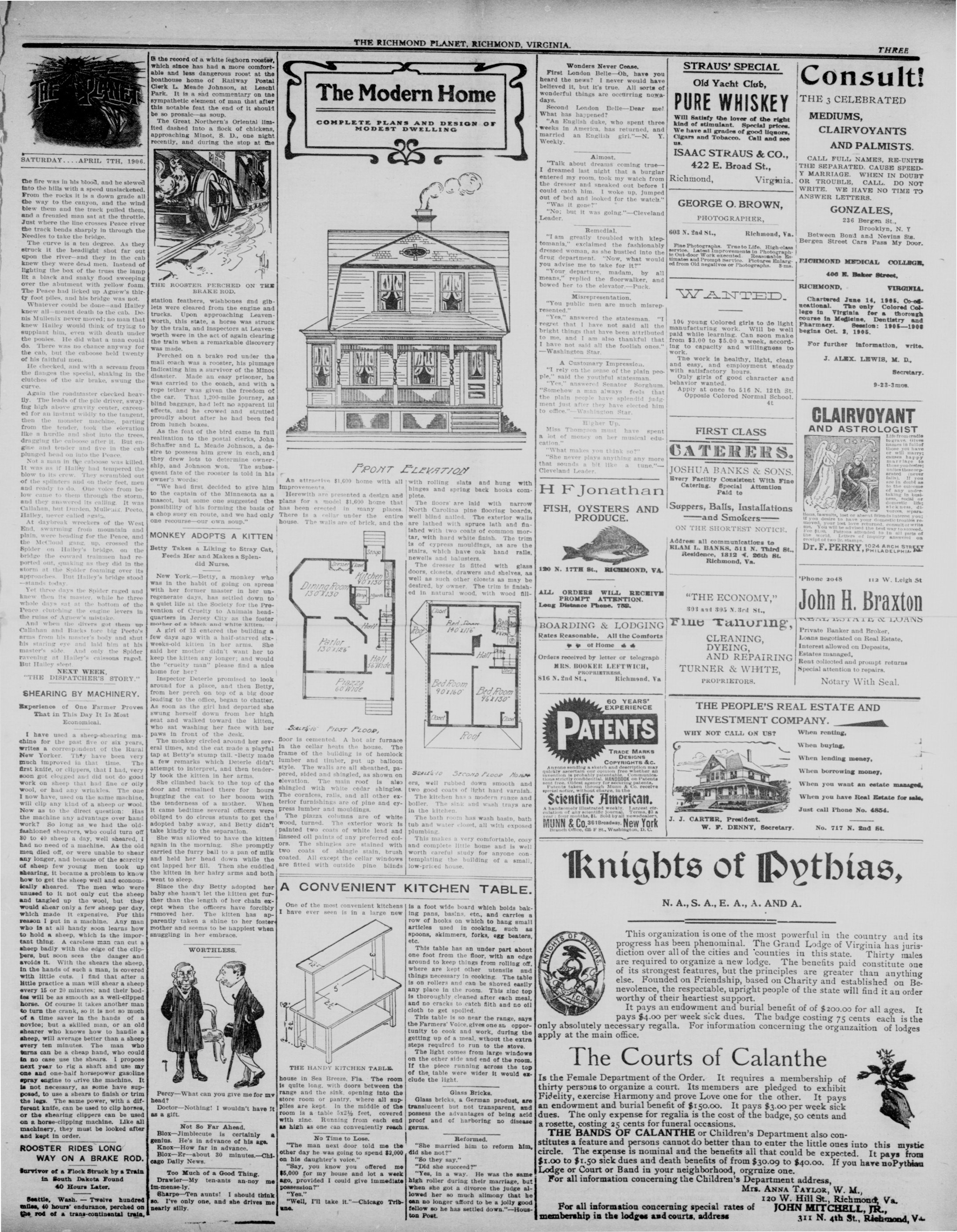
The Modern Home
COMPLETE PLANS AND DESIGN OF
MODEST DWELLING
FRONT ELEVATION
An attractive $1,600 home with all improvements. Herewith are presented a design and plans for a model $1,600 home that has been erected in many places. There is a cellar under the entire house. The walls are of brick, and the
Stego
Dresser
Kitchen
90'x150'
Dining Room
130'x130'
Bath
Marth
Hall
Parlor
130'x186'
Hall
56 Wide
Piazza
60 Wide
floor is cemented. A hot air furnace in the cellar heats the house. The frame of the building is of hemlock lumber and timber, put up balloon style. The walls are all sheathed, papered, sided and shingled, as shown on elevation. The main roof is also shingled with white cedar shingles. The cornices, rails, and all other exterior furnishings are of pine and cypress lumber and mouldings. The plaza columns are of white wood, turned. The exterior work is painted two coats of white lead and linseed oil paints of any preferred colors. The shingles are stained with two coats of shingle stain, brush coated. All except the cellar windows are fitted with outside pine blinds
A CONVENIENT KITCHEN TABLE
A CONVENIENT KITCHEN TABLE
One of the most convenient kitchens I have ever seen is in a large new
THE HANDY KITCHEN TABLE.
house in Sea Breeze, Fla. The room is quite long, with doors between the range and the sink, opening into the store room or pantry, where all supplies are kept. In the middle of the room is a table $5x1/2$ feet, covered with zinc. Running from each end as high as one can conveniently reach
No Time to Lose.
"The man next door told me the other day he was going to spend $2,000 on his daughter's voice."
"Say, you know you offered me $5,000 for my house and lot a week ago, provided I could give immediate possession?"
"Yes."
"Well, I'll take it."—Chicago Tribune.
No Time to Lose.
with rolling slats and hung with hinges and spring back hooks complete.
The floors are laid with narrow North Carolina pine flooring boards, well blind nailed. The exterior walls are lathed with spruce lath and finished with two coats of common mortar, with hard white finish. The trim is of cypress mouldings, as are the stairs, which have oak hand rails, newells and balusters.
The dresser is fitted with glass doors, closets, drawers and shelves, as well as such other closets as may be desired, by owner. The trim is finished in natural wood, with wood fill-
Closet
Bed Room
140 x 116'
Bathroom
432x288
Hall
Park
Bed Room
90 x 160'
Bed Room
96 x 130'
Closet
Closet
Roof
ers, well rubbed down smooth and two good coats of light hard varnish. The kitchen has a modern range and boiler. The sink and wash trays are in the kitchen. The bath room has wash basin, bath tub and water closet, all with exposed plumbing. This makes a very comfortable, cosy and complete little home and is well worth careful study for anyone contemplating the building of a small, low-priced house.
is a foot wide board which holds baking pans, basins, etc., and carries a row of hooks on which to hang small articles used in cooking, such as spoons, skimmers, forks, egg beaters, etc.
This table has an under part about one foot from the floor, with an edge around to keep things from rolling off, where are kept other utensils and things necessary in cooking. The table is on rollers and can be shoved easily any place in the room. This zinc top is thoroughly cleaned after each meal, and no cracks to catch filth and no oil cloth to get spilled.
This table is so near the range, says the Farmers' Voice, gives one an opportunity to cook and work, during the getting up of a meal, without the extra steps required to run to the stove.
The light comes from large windows on the other side and end of the room. If the piece running across the top of the table were wider it would exclude the light.
Glass bricks, a German product, are translucent but not transparent, and possess the advantages of being acid proof and of harboring no disease germs.
Reformed.
"She married him to reform him, did she not?"
"Yes, in a way. He was the same high roller during their marriage, but when she got a divorce the judge allowed her so much alimony that he can no longer afford to be a jolly good fellow so he has settled down."—Houston Post.
Glass Bricka
Knights of Pythias,
This organization is one of the most powerful in the country and its progress has been phenominal. The Grand Lodge of Virginia has jurisdiction over all of the cities and counties in this state. Thirty males are required to organize a new lodge. The benefits paid constitute one of its strongest features, but the principles are greater than anything else. Founded on Friendship, based on Charity and established on Benevolence, the respectable, upright people of the state will find it an order worthy of their heartiest support.
It pays an endowment and burial benefit of of $200.00 for all ages. It pays $4.00 per week sick dues. The badge costing 75 cents each is the only absolutely necessary regalla. For information concerning the organization of lodges apply at the main office.
The Courts of Calanthe
Is the Female Department of the Order. It requires a membership of thirty persons to organize a court. Its members are pledged to exhibit Fidelity, exercise Harmony and prove Love one for the other. It pays an endowment and burial benefit of $150.00. It pays $3.00 per week sick dues. The only expense for regalia is the cost of the badge, 50 cents and a rosette, costing 25 cents for funeral occasions.
THE BANDS OF CALANTHE or Children's Department also con-
stitutes a feature and persons cannot do better than to enter the little ones into this mystic circle. The expense is nominal and the benefits all that could be expected. It pays from $1.00 to $1.50 sick dues and death benefits of from $30.09 to $40.00. If you have no Pythian Lodge or Court or Band in your neighborhood, orgrnize one.
For all information concerning special rates of membership in the lodges and courts, address
First London Belle—Oh, have you heard the news? I never would have believed it, but it's true. All sorts of wonderful things are occurring nowadays.
Second London Belle—Dear me! What has happened?
"An English duke, who spent three weeks in America, has returned, and married an English girl."—N. Y. Weekly.
Almost
"Talk about dreams coming true—I dreamed last night that a burglar entered my room, took my watch from the dresser and sneaked out before I could catch him. I woke up, jumped out of bed and looked for the watch." "Was it gone?" "No; but it was going."—Cleveland Leader.
Remedial
"I am greatly troubled with kleptomania," exclaimed the fashionably dressed woman, as she bustled into the drug department. "Now, what would you advise me to take for it?" "Your departure, madam, by all means," replied the floorwalker, and bowed her to the elevator—Puck.
Misrepresentation
"You public men are much misrepresented."
"Yes," answered the statesman. "I regret that I have not said all the bright things that have been attributed to me, and I am also thankful that I have not said all the foolish ones." —Washington Star.
A Customary Impression.
"I rely on the sense of the plain people," said the youthful statesman.
"Yes," answered Senator Sorghum.
"Somehow a man always feels that the plain people have splendid judgment just after they have elected him to office." —Washington Star.
Higher Up.
Miss Thompson must have spent a lot of money on her musical education."
"What makes you think so?"
"She never plays anything any more that sounds a bit like a tune." —Cleveland Leader.
H F Jonathan
FISH, OYSTERS AND PRODUCE.
120 N. 17TH St., RICHMOND, VA.
ALL ORDERS WILL RECEIVE
PROMPT ATTENTION.
Long Distance Phone. 782.
BOARDING & LODGING
Rates Reasonable. All the Comforts
of Home
Orders received by letter or telegraph.
MRS. BOOKER LEFTWICH,
PROPRIETRESS,
816 N. 2nd St., Richmond, Va
60 YEARS'
EXPERIENCE
PATENTS
TRADE MARKS
DESIGNS
COPYRIGHTS & C.
A notice sending a sketch and description may quickly ascertain our opinion. Free whether an invention is probably patentable. Communications strictly confidential. HANDBOOK on Patents cut free. Offer agency for securing patents. Patents taken through Munn & Co. receive special notice, without charge, in the Scientific American.
A handwritten illustrated weekly. Largest circulation of any scientific journal. Terms, $5 a year; four months, $1. Sold by all news dealers.
MUNN & Co. 3618 broadway, New York Branch Office, 625 F St., Washington, D. C.
KNIGHTS OF PYTHIAST
F.C.B.
only absolutely necessary rega
apply at the main office.
The Court
Is the Female Department of t
thirty persons to organize a co
Fidelity, exercise Harmony and
an endowment and burial bene
dues. The only expense for r
a rosette, costing 25 cents for f
THE BANDS OF CALA
stitutes a feature and persons o
circle. The expense is nomin
THE PEOPLE'S REAL ESTATE AND INVESTMENT COMPANY.
PURE WHISKEY
Will Satisfy the lover of the right kind of stimulant. Special prices. We have all grades of good liquors, Cigars and Tobacco. Call and see us.
Richmond, Virginia
GEORGE O. BROWN.
PHOTOGRAPHER.
Fine Photographs. True to Life. High-class service. Latest Improvements in Photograph- Outdoor Work excerted. Reasonable Estimates and Provided Service. Pictures Enlarged from Old negatives or Photographs. 3-ms.
WANTED.
100 young Colored girls to do light manufacturing work. Will be well paid while learning. Can soon make from $3.00 to $5.00 a week, according to capacity and willingness to work.
The work is healthy, light, clean and easy, and employment steady with satisfactory hours.
Only girls of good character and behavior wanted. Apply at once to 516 N. 12th St. Opposite Colored Normal School. 45
FIRST CLASS
CATERERS.
JOSHUA BANKS & SONS.
Every Facility Consistent With Fine
Catering. Special Attention
Paid to
Suppers, Balls, Installations
and Smokers
ON THE SHORTEST NOTICE.
Address all communications to
KLAM L. BANKS, 511 N. Third St.,
Residence, 1812 4. 26th St.
Richmond, Va.
"THE ECONOMY,"
303 and 305 N.3rd St.,
Fine Tanning,
CLEANING,
DYEING,
AND REPAIRING
TURNER & WHITE,
PROPRIETORS.
THE PEOPLE'S REAL
INVESTMENT COMP
WHY NOT CALL ON US?
J. J. CARTER, President.
W. F. DENNY, Secretary.
organization is one of the most powerful has been phenominal. The Grand Master all of the cities and counties in need to organize a new lodge. The longest features, but the principles handed on Friendship, based on Charity the respectable, upright people of their heartiest support. An endowment and burial benefit of per week sick dues. The badge galla. For information concerning
THREE
THE 3 CELEBRATED
MEDIUMS,
CLAIRVOYANTS
AND PALMISTS.
CALL FULL NAMES, RE-UNITE
THE SEPARATED. CAUSE SPEEDY
MARRIAGE. WHEN IN DOUBT
OR TROUBLE, CALL. DO NOT
WRITE. WE HAVE NO TIME TO
ANSWER LETTERS.
236 Bergen St.
Brooklyn, N. Y
Between Bond and Nevins Sts.
Bergen Street Cars Pass My Door.
RICHMOND MEDICAL COLLEGE,
400 E. Baker Street.
Chartered June 14, 1905. Co-educational. The only Colored College in Virginia for a thorough course in Medicine, Dentistry and Pharmacy. Session: 1905—1908 begins Oct. 2, 1905.
For further information, write.
J. ALEX. LEWIS, M. D.
Secretary.
9-23-3 mos.
9-23-3mos.
CLAIRVOYANT AND ASTROLOGIST
Life from credit to grave, gives many of those you have or will marry, covers your marriage lage to those youdesire to be separated (never fails). If you are in doubt to the outcome of any under-taking in bungalow or domestic life, weakness, displacement, lawsuits, lost or absent friends interest you; you desire to have your domestic troubles removed and lost; require court or witness. You will be advised the best way to proceed. Floor. Patrons attended in all parts of the country. Letters of inquiry answered on receipt of two 20-stamps.
Dr.F.PERRY 1024 ARCH STREET
PHILADELPHIA
112 W. Leigh St
John H. Braxton
John H. Braxton
REAL ESTATE & LOANS
Private Banker and Broker,
Loans negotiated on Real Estate,
Interest allowed on Deposits,
Estates managed,
Rent collected and prompt returns
Special attention to repairs.
Notary With Seal.
AL ESTATE AND
PANY.
When renting,
When buying,
When lending money,
When borrowing money,
When you want an estate managed,
When you have Real Estate for sale,
Just call Phone No. 4854.
No. 717 N. 2nd St.
ythias,
A.
powerful in the country and its
Lodge of Virginia has juris-
in this state. Thirty males
the benefits paid constitute one
are greater than anything
clarity and established on Be-
f the state will find it an order
of of $200.00 for all ages. It
the costing 75 cents each is the
ing the organization of lodges
```markdown
```
ment also con-
ne little ones into this mystic
d be expected. It pays from
$40.00. If you have noPythian
address,
TAYLOR, W. M.,
Hill St., Richmond, Va.
N MITCHELL, JR.,
311 N. 4th St., Richmond, Va.
FOUR
THE PLANET
Published over a year since JOHN MITCHELL,
JR., at 311 North 4th Street, Richmond Va.
JOHN MITCHELL, JR., - EDITOR
All communications intended for publication
should be sent so as to reach us by Wednesday.
One Copy, one year. $1.50
One Copy, eight months. 1.00
One Copy, six months. 8.00
One Copy, four months. 4.00
One Copy, three months. 40
Single Copy. 100
ADVERTISING RATES
For one inch, one insertion. $5.00
For one inch, each subsequent insertion. 40
For two inches, three months. 6.00
For two inches, six months. 10.00
For two inches, nine months. 14.00
For two inches, twelve months. 18.00
Marriage and Eternal Notices, one inch. 50
Standing and Transient Notices per line. 100
POSTAGE STAMPS OF A HIGHER DE-
NOMINATION THAN TWO CENTS NOT
RECEIVED ON SUBSCRIPTIONS.
THE PLANET is issued weekly. The subscription price is $1.50 per year in advance.
There are four ways by which money can be sent by mail on our risk—In a Post Office Mon
order by BAY or Draft, or an Ex-
press Monche order, and when more of these
can be procured, in a Registered Lett.
MONEY ORDERS. You can buy a Money Or-
der at your Post-Office, payable at the Rich
money Office, and we will be responsible
for its safe arrival.
EXPRESS MONEY ORDERS can be obtained at any office of the American Express Co. the
Express Money Office, the Express Co. and, then, the Fair Park
Co. and Co.'s Express Money Office. We are also
sponsible for money sent by any of these companies.
The Express Money Order is a sandwich
registered LETTER. If a money Order
Post-Office or an Express Office is not within
your reach, your Postmaster will register the
Letter you wish to send us on payment of your
money. You can send the letter
can be traced. You can send money in this
manner at our risk.
We cannot be responsible for money you
letter you wish to send us on payment of your
money in any other way than one of the
ways mentioned above. If you send your money
in any other way, you must do it at your
RESERVALS, ETC. If you do not want to
rLANKY continued for another year after your
subscription has run out, you then notify us by
Postal Card to discontinue it. The Court has
not ordered our paper discontinued at the expiration
of time for which it has been paid.
We are hold liable for the payment of the subscri-
pation when they order the paper this
continued.
COMMUNICATIONS:—When writing to us to
renew your subscription or to discontinue your
subscription, we must send the letter in
full otherwise we cannot find your name on
our books.
CHANGE OF ADDRESS:—In order to change
the name of an address, we must send
the former as well as the present address.
Entered at the Post-Office at Richmond. Vs
second-class matter.
SATURDAY.....APRIL 7TH, 1906
IS THE NATIONAL GOVERN
MENT AFRAID?
At this writing, no information has been received as to the arrest of any of the persons connected with the lynching of Ed. Johnson, the colored man who was charged with criminal assault at Chattanooga, Tennessee. On the other hand, it is boldly announced that an attempt was made to burn down the residence of Rev. Dr. Howard L. Jones, pastor of the First Baptist Church of that city simply because he condemned the mob that took Johnson's life and thereby defied the mandates of the Supreme Court of the United States.
The persons guilty of this second heinous offense have not been apprehended. The enquiry naturally resolves itself into the question, Is the national government afraid? We are unwilling to believe that with all of the skill displayed by some of the best detectives in the United States that it is an impossible feat to find out the names of the men who lynched Johnson. Past experience has demonstrated that often it is the case of the dog treeing the right man, but the wrong one so far as the feelings of the community are concerned. The result is that the dog is called off.
We have taken much interest in the affair. Certainly, if the lynching is being probed by the United States officials, the attempted destruction of the property of Dr. Jones should be investigated by the city officials. It is asserted that Rev. Dr. Jones and his friends fired guns in order to ascertain whether or not the incendiaries were still in the neighborhood of his home. This was a wise precaution and emphasizes the force of our contention that fire-arms are a necessary adjunct to southern life. The time to find lynchers is when they are there and it behooves every good citizen, both white and colored, to own a repeating rifle or a shot-gun and to use it when the occasion demands.
These weapons should be called into service in upholding the law and not in violating its decrees. Conditions are indeed critical when the national authorities hesitate to arrest murderers and pause on account of the excitement in a community where a crime has been committed. It seems that the bold, defiant, justice loving servant of God from Virginia, who risks the destruction of his property in order to proclaim eternal truths is more to be commended than are the sworn officers of the law, both state and federal, who as yet have accomplished nothing in the way of punishing admitted violators of the law.
TILLMAN AND THE RATE BILL
Senator B. R. Tillman has been virtually side-tracked and the Hepburn Rate Bill is hopelessly ill under his treatment. We predicted that he would prove a champion blunderbuss in the handling of the measure and our expectations have been more than justified. President Roosevelt, who at the time of his selection to present the bill to the Senate and to take charge of the measure on the floor of the chamber is said to have consoled himself with the remark that Senator Tillman is an honest man has become thoroughly disgusted.
In fact, he has emphasized it by calling a conference of Senators at the White House, to which Senator Tillman was not even invited and as a result an a mendment, providing for a court review was adopted. That the South Carolina "Pitchfork" is angry goes without saying. He has been interviewed and the following extract will give an idea of his feelings at the present time:
"Senator Tillman, who has charge of the railway-rate bill in the Senate, said last night that he was not satisfied with the court review a mendment to the measure which was agreed upon Saturday at a conference between President Roosevelt, several Republican Senators, who are supporting the bill, and members of the Interstate Commerce Commission.
The Senator said he would oppose it on the floor of the Senate, and he expressed the opinion that not half a dozen of his Democratic colleagues would stand by the amendment.
Senator Tillman declared the amendment does not meet the situation fully, inasmuch as it makes no provision setting forth specifically that there shall be no suspension of the railway rate fixed by the Interstate Commerce Commission pending the judicial determination of any case which may be appealed from the rate as established.
This is a contention which Senator Tillman and a number of Democratic Senators have urged, as they argue that a failure to provide absolutely against a suspension of the rate operates to nullify the objects for which the legislation is desired. The Senator added that he would prefer to vote for the House bill as it stood to accept the amendment, for the pending measure gave the right of review where constitutional questions are involved.
The proposed amendment was discussed generally yesterday among groups of Democratic Senators, but there was no conference on the subject among them.
Senator Spooner was at the White House last night in conference with President Roosevelt, presumably on matters connected with rate legislation."
Will Senator Tillman insist upon ing and obstructing legislation on will he simply enter his protest and offer his amendments and permit a vote? Should he pursue the course indicated, he will be subserving the purposes of Senator Aldrich about as well as though he voted against all rate legislation. This fiery South: Garolinian and the forces rallying under President Roosevelt's leadership have been outgeneralled at every point.
The distinguished occupant of the White House at last seems to realize that he is too heavily handicapped to win along the lines laid down by him at the outset. He has slightly changed his course without materially affecting his policy with the hope that he may save something from the wreck of the demoralized army that has been grievously worsted in a contest under the leadership of the blundering commander from South Carolina.
Further comment seems to indicate that Senator Tillman does not know exactly what to do. He may find himself at any time without even the semblance of a following. Here is the way a knowing correspondent puts it:
Meantime Senator Tillman is in something of a quandary over the question of pressing for an agreement to vote. Thus far he has encountered united opposition from the Republicans in this matter, and has had no encouraging support from the Democrats. Mr. Aldrich has given it out that there must be no discussion of a date to vote until Mr. Bailey has returnd. Nothing daunted, however, Mr. Tillman has persisted in his efforts to get some sort of an expression from the Senate as to when it would be pleased to vote. Presumably he will take this matter up with Mr. Bailey before the Senate meets to morrow and try to convince the Texan that there is no use longer to delay a voting agreement.
It is broadly hinted that if Mr. Aldrich is convinced he can have his own way he will either take the nominal management of the bill away from Mr. Tillman and restore it to Republican hands—or that he will enforce a policy by which Mr. Tillman's parliamentary leadership will be completely ignored by the Republicans and those Democrats who are alleged to stand with the Rhode Islander in railroad legislation.
Should this be undertaken there is no doubt it would cause the ferry South Carolinian to speak out even more plainly and bluntly than he has thus far done, in an effort to arouse the country to a keener interest in his contention than would be indicated by his being humiliated by the Aldrich element without a united resistance on the Democratic side of the chamber."
Truly is the South Carolina Senator's predicament pitiful, but merited. His vanity has been tickled and now his lumiliation is a bout to be complete. He cannot control the Republican elephant
THE RICHMOND PLANET, RICHMOND, VIRGINIA
and even the Democratic jack-ass refuses to follow him.
The man that boasted of the number of Negroes he had killed, but of whom President Roosevelt is said to have designated as an honest man will soon be feeling the chilly waters of defeat and his mouth and his vanity will have been the most potent cause of his crushing undoing.
STRIKE MEETING TAKES A REGESS
Miners and Operators Adjourn Until Thursday. BOTH SIDES REMAIN FIRM
New York, April 4.—The sub-committee representing the anthracite operators and the mine workers of Eastern Pennsylvania held their first joint meeting here, and after nearly a three-hours' session adjourned until 1 p.m. Thursday without coming to an agreement. Each side to the controversy has refused to make the slightest concession, and the whole question apparently is as far from solution as it was before the conference began. In the meantime the tie-up of the anthracite industry remains as complete as it was Monday, without indication that a resumption of mining will occur very soon. Notwithstanding the fruitless session and the apparently hopeless deadlock between the workmen and their employers, rumors are still current that a way will be found that will enable the operators and miners to stand on common ground and settle their differences.
After the conference the following statement was given out by a representative of the operators:
"The conference began with President E. B. Thomas, of the Lehigh Valley company, in the chair. Mr. Mitchell made a long speech, detailing why in his judgment the original demands of the miners ought to be granted. He was followed by Mr. Nicholls, president of the Lackawanna-Wyoming district of the Miners' Union, who supported Mr. Mitchell's argument. There were other speeches by the representatives of the miners. In fact, that side did nearly all the talking.
"There was no disposition on either side to recede from its original position or to accept any modification of the original demands. Mr. Mitchell's attitude indicated that the counter-proposition made by the operators for a renewal of the working agreement drafted by the anthracite strike commission was not acceptable to the miners.
"On motion of Mr. Mitchell, the conference adjourned until Thursday.
"The entire situation remains the same as before the meeting. The suspension of work in the anthracite mine will continue pending negotiations."
Each member of the operators' committee was sought for an interview giving further details of the meeting, but none of them cared to say anything beyond what was contained in the statement. President Baer, who is chairman of the operators' sub-committee, said: "We simply had a long talk, which was in the nature of glittering generalities. Practically nothing was accomplished."
The members of the miners' committee, including President Mitchell, absolutely refused to talk of the conference. The miners' president also refused to express an opinion as to whether the situation was hopeful or discouraging from his viewpoint.
The Shamokin scale committee, which numbers 36 men, and which was appointed last December, held a session Tuesday night at the Ashland House, as planned at Indianapolis last week. The meeting was held behind closed doors, but it is understood that the committee went over the situation as it presents itself, and discussed what further action should be taken. The committee was empowered by the Shamokin convention to endeavor to make an agreement with the operators subject to the ratification of another convention to be called when the committee is ready to report.
The scale committee was in session less than an hour. The sub-committee which had been in conference with the operators made its report, after which President Mitchell read the following letter from Governor Pennypacker, of Pennsylvania:
"Harrisburg, Pa., March 31, 1906.
"Dear Sir—The commonwealth of Pennsylvania expects that every reasonable effort will be made by the parties interested to accommodate the differences between coal operators and coal miners and to avert the strike which is now threatened.
"SAMUEL W. PENNYPACKER.
"To George F. Baer, Reading Terminal, Philadelphia.
"John Mitchell, Indianapolis."
Mr. Mitchell stated to the committee that he had acknowledged receipt of the letter and had notified Governor Pennypacker that he would communicate its contents to the Shamokin scale committee.
Reports received from the anthracite fields, according to the labor leaders, were satisfactory to them. There were no breaks reported in the ranks of the mine workers and none is expected.
Mr. Mitchell, in discussing the situation in the bituminous fields, said he had received a large number of telegrams from the soft coal fields which satisfied him that affairs in those regions are working themselves out just as he had anticipated. Thousands of men, he said, returned to work under the scale of 1903, which gives them an increase of 5.55 cents over the wages received during the last two years.
FIRST BLOODSHED
Civil Engineer Shot By Striking Miner at Moosic. Scranton, Pa., April 3.—The first bloodshed of the anarchic strike of 1806 occurred at Moosic, where John Shepherd, civil engineer at Consoli-
dated colliery of the Pennsylvania Coal company, an Erie working, was shot in the hip by Anthony Coplosk, a striking miner. There is a stockade about the breaker, and guards are patrolling inside. Coplosk had some words with one of the guards, and Silas Randall, son of the outside foreman of the latter, came towards the striker in a threatening manner. Coplosk drew a revolver and fired at Randall. The bullet struck Shepherd, who was standing by. The wound is not serious. The man who did the shooting escaped.
MINERS NOT DISAPPOINTED
Did Not Expect New York Conference
to Approach First Meeting
to Agree at First Meeting.
Philadelphia, April 4.—Information concerning the conference in New York between the operators and the representatives of the miners was eagerly sought by the idle workmen in the hard coal region. Definite results were not expected from the first meeting, and there was no disappointment when it was learned that the conferences had adjourned until Thursday. In fact, the friendly spirit in which both sides are reported to have met has aroused throughout the region a feeling that the suspension of work will only be temporary. The situation remains practically unchanged. In Shamokin the Enterprise colliery, owned by W. L. Connell & Co. was operated shorthanded by non-union men. In Scranton the Oxford colliery, a small non-union operation, and 20 washeries were worked. Aside from these plants there were no attempts in any part of the region to operate the collieries.
Reports from Scranton are to the effect that the Delaware & Hudson and the Erie companies are making preparations to resume as soon as possible. A number of men have been engaged at the mines of these companies ostensibly for guard duty. In this city the Delaware & Hudson company has opened two offices for the purpose of employing guards and laborers in and about the mines. Railroad companies have laid off a number of coal crews and telegraph operators in various sections, but those suspended, it is said, have been requested not to leave the region, indicating according to the miners, that an early resumption is anticipated.
The Reading company has stored at Reading about 122,000 tons of bituminous coal, and it is reported to have stored at Landingville, Abrams and other places about 1,750,000 tons of antracite.
Several minor disturbances occurred during the day near Wilkes-Barre. The companies of the state police again patrolled the roads in the vicinity of the collieries, and reported that good order prevailed.
THE SOFT COAL STRIKE
Conditions in Pittsburgh District Rap idly Growing Better.
Pittsburg, April 4. With the exception of one or two points outside of the Pittsburg district, the strained situation between operators and miners in the soft coal fields of Western Pennsylvania is hourly growing more pacific. Following the signing of the scale demanded by the miners, the mines of the operators who signed the scale resumed their operations, although in many instances with reduced forces. In the Pittsburg district there were 18,000 miners working and 12,000 were idle. Nearly all of the mines of the Pittsburg Coal company were in operation, and it was expected that those men who are out would return within a day or so.
The independent operators who decided not to sign the scale held another meeting last night (Tuesday). The independent operators employed between 12,000 and 14,000 men, and they are all idle and will be so until either the scale is signed or some agreement is reached between the operators and the employees. There were representatives of 20 operators present, representing an annual output of 20,000,000 tons. A permanent organization was formed and after the meeting the following official statement was given out:
"At a meeting of the independent operators the position taken at the previous meeting was reaffirmed and no action was taken toward the acceptance of the 1903 scale. The probable outcome of these meetings will be the formation of an independent coal operators' association of Western Pennsylvania district. Those present were absolutely unanimous against signing the 1903 scale."
Mr. Robbins said that he had signed the scale of 1903, and among the other signers were the Monongahela River Consolidated Coal and Coke company, the Ellsworth Coal company, the Crescent Coal company, the Mifflin Coal company, the Peoples' Coal company, the Marine Coal company, the Steen Coal company, the Vesta Coal company, the Dilworth Coal company, and the Mansfield Coal and Coke company. These companies represent 30,000,000 tons, or over three-quarters of the coal mined in the Pittsburg district.
The miles of the independent operators are shut down in the Pittsburgh district in conjunction with those in Ohio, Indiana and Illinois. The independent operators met in this city and adjourned after passing a resolution to support the operators of the forenamed states in refusing to sign the scale.
Killed In Freight Wreck
Harrisburg, April 4.—James Holla-
han, conductor, was killed, and William Biggs, brakeman, seriously inju-
ned in a collision between two freight trains on the Pennsylvania railroad, at Rockville. The men live in Harrisburg.
Want "Jim Crow" Cars In Washington
Washington, March 31.—A bill was
introduced by Representative Hefflin,
of Alabama, to compel street railway
companies in this city to provide and
operate separate street cars for negro
passengers, and to make it unlawful
for street car companies to allow white
and negro passengers to ride in the
same car under a fine of $100 for each
offense.
A WEEK'S NEWS CONDENSED
Thursday. March 29.
Charles Sanders and George Ellison were killed at Dayton, O., by the collapse of a scaffolding 100 feet high. The New York senate passed the bill postponing the elections of all mutual insurance companies until November 15. The 122d annual session of the Baltimore conference, Methodist Episcopal church, South, was held at Cumberland, Md. The body of Joseph Holmes, 70 years old, was found on the beach at Atlantic City, N. J., near Young's pier, from which he had fallen. Emelie Reigen, an aged woman, was burned to death in her millinery store at Jersey City, while trying to save her money in the cash drawer.
Friday. March 30.
Over 11,000 immigrants arrived in New York on board seven steamships from European ports.
One man was killed and two others seriously injured by a fall of slate in the Short Mountain colliery at Lykens, Pa.
A negro known as "Cotton" was lynched near Flora, Tenn., for attempted criminal assault on a young white woman.
Mrs. Roosevelt, accompanied by her children, Ethel, Archie and Quentin, left Washington for a 10-days' cruise in West Indian waters.
William Welch, said to be the oldest veteran of the Civil War and the oldest Mason in America, celebrated his 106th birthday at Lempster, N. H.
Saturday, March 31.
The main building of the University of Idaho, at Moscow, was destroyed by fire.
Isaac Winder, colored, was hanged at Towson, Md., for the murder of Frederick T. Rhinehart, an aged toll-gate keeper.
The house committee on public buildings agreed to report a public building bill carrying appropriations aggregating $20,000,000.
Fully 10,000 persons witnessed the public hanging of Tom Young, near Austin, Texas, for the murder of his adopted daughter.
Joseph A. Turney, teller of the National bank of North America, of New York, is under arrest on the charge of stealing $34,000 from the bank.
Monday. April 2.
The Theodore Roosevelt, Intended to be the fastest steamer on the Great Lakes, was launched at Toledo, O. George Bainyak, of Glen Carbon, Pa, near Pottsville, lost his mind worrying over the mining situation and was with great difficulty imprisoned. While in a delirium from excessive drinking, J. A. C. Ruffner, of Greensburg, Pa., shot and fatally wounded his wife and seriously wounded his daughter. The Ohio legislature has adopted resolutions asking congress to investigate charges against Estes G. Rathbone in connection with the Cuban postal scandal.
Tuesday, April 3.
Four men fell three stories in a Brooklyn (N. Y.) Elevator, all being terribly injured and three are expected to die.
William F. Welser, a retired banker, of York, Pa., dropped dead in his apartments while preparing to go to Atlantic City.
A building 200 by 500 feet, part of the plant of the Cornell Iron company, near Newburgh, N. Y., was destroyed by fire. Loss $200,000.
Senator John F. Dryden, president of the Prudential Insurance company, resigned as a director of the Public Service Corporation of New Jersey.
Wednesday, April 4
The iron bed and spring mattress factory of Foster Brothers at Utica, N. Y., was destroyed by fire. Loss, $240,000.
James Clynch, 21 years old, of Portsmouth, Va., was fatally shot in Chicago by Henry Seaman, whom he attempted to rob.
The Buffalo, N. Y., Eventing Times building was badly damaged by fire that started in the lithograph department. Loss, $200,000.
The Iowa legislature has invited President Roosevelt to attend the national convention of the Philippines was veterans at Des Moines in August.
PRODUCE QUOTATIONS
The Latest Closing Prices In the Principal Markets.
PHILADELPHIA — FLOUR steady;
winter extras, $3@3.35; Pennsylvania roller, clear, $3.25 @ 3.40; city mills, fancy, $4.69 @ 70. RYE FLOUR firm;
2 Pennsylvania red, new, $8 @ 32%; CORN firm; No. 2 yellow, local, $52%; OATS steady; No. white, clipped, $35%; lower grades, $34%; HAY firm;
10 thimothy, $15.50 for large bales, PORK firm; $15.50 for large bales, steady; beef hams $2 @ 24. POULTRY: Live steady; hens, 14% @15%; old roosters, 10c. Dressed firm; choice fowls, 10c. old roosters, 10c. BUTTER steamed; camery, 20 per b. EGGS selected; selected beef steamed; western, 14@15%; southern, 14c. POATOES steady; bushel, 14c.
BALTIMORE - WHEAT dull; No. 2
spot, 83% c. steamer 2 spot, 76% c.
spot, 83% c. steamer mixed, 46% c.
spot, 48% c. steamer mixed, 46% c.
southern, 41% c. OATS firm; white No. 2,
27% @37% c.; No. 3, 36% @36% c.
No. 4, 34% @35%; mixed No. 2, 35% c.
No. 4, 34% @35%; mixed No. 2, 35% c.
BUTTER steady; creamyery
extras, 27% @28%; held, 23% @24%;
prints, 28@29c; Maryland and Pennsylvania dairy prints, 16@17c; EGGS land and Pennsylvania
15c; Virginia and West Virginia.
15c; southern, 14c.
Live Stock Markets.
PITTSBURG (Union Stock Yards)—CATTLE steady; choice, $5.60@5.80; prime, $5.30@5.50; HOGS slow; prime caeces, $5.00@5.65; mediums and heavy Yorkers, $6.60@6.70; light Yorkers, $6.50@6.60; pigs, $6.40@6.50; roughs, $5.00@6.6; SHEEP slow; prime wethers, $6@6.25; common sheep, $6@4; lambs, $5@7.15; veal calves, $5.50@6.75.
$25,000 For Schuylkill Seminary.
Allentown, Pa., April 3.—Lewis D. Krause and Lesher H. Yeager, of this city, announced that they had donated $20,000 and $5000 respectively to the endowment fund of Schuylkill Seminary at Reading, of which they are trustees. Mr. Krause is a retired merchant and president of the Citizens' Deposit and Trust company. Mr. Yeager is actively engaged in business.
ON HOME QUARRELS
REMEMBER IT TAKES TWO TO MAKE A QUARREL.
"I Have Known Families Who Were Never Happy When Separated, Though Always Wretched When Together"—Entire Agreement Impossible in Any Home—Friction of Right Kind Tends to Development of Highest Type—Obstinacy vs. Firmness—"Be Patient with the Living."
BY MARGARET E. SANGSTER.
An old Spanish proverb runs to the effect that it takes two to make a quarrel; one can always end it. This is equivalent to saying that one of two who are contending will have sufficient rest-restraint and kindness of heart to forego the privilege of the last word. In the family as nowhere else on earth, wills and temperaments are in danger of clashing, and people being sure of mutual affection, express their minds with a cander that may wound the sensitive and leave uncomfortable memories. I have known families who were never happy when separa d, though they were always wretched when together. Incompatibility of disposition may work disaster to domestic peace, when everybody concerned is high-minded and honorable. A good man may have a knack of putting his foot clumsily where it behooves him to tread delicately, and a good woman may have a trick of flying off the handle on slight occasion. When such opposite forces exist in a home, there is great need to remember the pith of the old proverb. It takes two to make a quarrel.
The wisest of men declared that a soft answer turneth away wrath. As a rule this is a verity. But there are exceptions. In certain moods, a soft answer is an irritant, an aggravation of the previous offense, and its effect is that of a firebrand upon dry stubble.
While men and women continue what they are, human and imperfect, there will never be unbroken serenity and entire agreement in any home under the sun. An old gentleman once boasted that he had lived with his wife 50 years, and they had never had a difference of opinion.
"Vera praiseworthy," commented a plain-spoken Scottish friend, "but very monotonous." Another man complacently asserted that he had dwelt in harmony with his better half for a great many years. "If she prefers red and I prefer blue," he explained, "we always settle the matter by compromising on the blue." An obviously easy method this was, if a wife were ready to sacrifice her own desire and efface her own individuality. A long course of it would spoil the most reasonable of husbands and make him terribly self-opinionated, or were the pendulum to swing the other way, and the wife forever have the final decision, it would turn the sweetest of women into a tyrant of the hearth. Fairness compels the conclusion that two or more grown persons sheltered under the same roof, cannot invariably think alike.
Nor would it be desirable that they should. A stagnant pool is a merace to health. Running water, foaming over the rocks, is a pledge of wholesome life in the locality. A stirless day, when no breeze blows, is less stimulating than a day when the winds hold a jubilee. Movement, progression, even friction of the right kind, tend to development of the finest type. But people may differ without blickering and fighting. They may express themselves strongly without inflicting pain. They may continue to think differently, and yet live in tranquility, if they choose.
"It takes two to make a quarrel; One can always end it."
"You might accept my politics," expostulated a husband, who was an old-fashioned democrat, to his wife, who was a radical republican.
"I accepted you, dear," she replied, "but my political sentiments are an inheritance from my father, and I cannot change them any more than I can change the color of my eyes."
"Thank Heaven," he murmured, "that you haven't a vote."
Some of us who have no enthusiasm on the subject of universal suffrage, are of the honest man's opinion. And yet, if ever American women in an insistent majority, should demand suffrage, American men will have too much gallantry to deny them, and none of us anticipate that any frightful domestic calamities will ensue from that cause.
Common sense and mutual good feeling, with due regard for the effect of quarrels upon the children will usually prevent distressing squabbles in the home. Hot-tempered people are prone to say more than they mean. Tactless folk rush into mistakes. But love is a solvent that prevails to blend the most diverse elements, and to concollate the most obstinate.
Speaking of obstinacy, thousands of people confuse it with firmness. They fancy if they cannot be moved from a position, either by argument or persuasion, that they are showing tenacity of purpose and strength of will to an extent that lifts them above their fellows. Often instead of firmness, these people are simply displaying the temper of a balky horse, or the absurd steadfastness of a mule that refuses to stir a step. We may be obstinate in holding fast to a prejudice, or obstinate because of over-weaning self-conceit. An ability to see another person's side of the shield, to look at affairs from a viewpoint that is not
wolly our own, goes far to reduce obstinacy to its lowest terms, and make people agreeable comrades on the road.
Note that a character amounts to little which is without convictions. About right and wrong we should have positive ideas and maintain them with firmness. About questions of policy or expediency we should be open to persuasion or concessions from others.
Whether or not married folk agree, they should not let wrath and bitterness creep into their lives. If arguments and discussions breed dissension they would better be waived. Anthony Trollop wrote a brilliant novel in which the hero, a man of wide reading, good family and gentlemanly antecedents, always knew he was right. His mullish obstinacy was the rock on which his wife's heart broke, and which wrecked his domestic peace. If people do quarrel by daylight, let them forgive and forget before they sleep. The vicissitudes of life are too many, the trials too inevitable, and lie itself is too short for any of us to spend it in foolish quarrels.
There are very few of us who do not sometimes need to remind ourselves that we would better be patient with our living loved ones. The circle shall not always remain unbroken. While we are together it is worth while to trample down our selfishness and live with those who belong to us in something better than mere peace and resignation, in real joy and gladness and in frequent yielding little things that the great thing in our life may be love.
Sweet friend, when thou and I are gone, Beyond earth's weary labor, When small shall be our need of grace From comrade or from neighbor, For all the strife, the toll, the care, And to all the sick, the sick, What tender truth shall we have gained, Alas, by simply dying!
Then lips too chary of their praise
Will tell our merits over.
And eyes too swift our faults to see
Shall not defect discover.
Then hands that would not lift a stone
Where stones were thick to cumber
Our steep hill path, will scatter flowers
Above our pillowed slumber.
Sweet friend, perchance both thou and L
Ere love is past forgiving.
Should take the earnest lesson home—
Be patient with the child.
To-day's repressed rebuke may save
Our blinding tears to-morrow;
Then patience, e'en when keenest edge
May what a nameless sorrow.
'Tis easy to be gentle when
Death's silence shames our clamor,
And easy to discern the best
Through memory's mystic glamor;
But wise it were for thee and me,
Ere love is past forgiving,
To take the tender lesson home—
Be patient with the living.
(Copyright, 1906, by Joseph B. Bowles.)
A NEWSPAPER HOLDER.
The Material Used Should Be Strong, Like Firm Serge or Cloth, for This Case.
A very firm serge or cloth should be used for this holder, the latter is best, as the scalloped edges will not fray if they are left just cut, not button-holed.
A straight strip eleven inches wide and 28 inches long is used; it is joined round like a roller-towel, and is attached to a strip of bamboo about 18
CONVENIENT RECEPTACLB
inches in length. One side is embroidered with some bold design, and a scroll bearing the word "papers." Attached to the bamboo is cord which hangs down with tasselled ends each side and is carried across to form a loop by which to suspend the holder. At many fancy-work shops the holders can be purchased ready traced for working, and all ready mounted. They are really very convenient, as they can be hung on the wall by the easy-chair, or on the writing-table, so that papers likely to be required are always handy.
Will Spoil a Good Complexion
The entire beauty of a good complexion is spotted when it is seen through a dirty veil and often the daintiest of women forget that dark veils which do not show the dirt themselves after being worn for a long time leaves marks on the face which spoils all the effects of face culture. Inexpensive veils can be thrown away, but the more costly should be dipped in odorless cleaning fluid and then vigorously shaken out and put to dry on the bed or ironingboard, stretching them and pinning down the corners to the counterpane or covering.
Mohair Petticoat
For everyday wear no petticoat is better than the pretty plaid mohair offered in all good shops. They are very nicely made and are quite as attractive as the more expensive taffetas. Of course, they wear twice as long. Taffeta petticoats are the dresser, and will always be preferred to any others, but for service the mohair are highly recommended.
Very Likely.
Willie—Our teacher was telling us to-day about a tree that grows out of rocks, but I can't think of its name. Do you know it, pa?
Pa—Maybe it's the family tree.—Philadelphia Press.
Bacon—Do you believe that history repeats itself?
Egbert—Why, certainly I do. And what is more I believe that the historical novels do, too.—Yonkers Statesman.
Finely Chiseled
Miss Deery—Don't you think Harry has the profile of a Greek statute?
Miss Jellers—Yes; it's particularly noticeable in his cheek.—Chicago Tribune.
```markdown
```
To interest yourself in promot ing the CIRCULATION of the RICHMOND PLANET.
---
SATURDAY...APRIL 7TH. 1906.
DO NOT BE SO TENSE.
Let the Lips Lightly Touch, Not Be Compressed, and Practice Taking Perfect Rests.
Resting the mouth is very important. Your lips should lightly touch each other, but should not be compressed. Your teeth should not be ground together, as is the habit of most people. You should not pull the upper lip down or do anything that distorts the mouth. Take a looking glass and examine your mouth. Be sure that you know how to rest your lips.
Then learn how to rest your head. This, too, requires some knack. In walking the head should rest well back upon the neck. It should never be thrust forward. In sitting it should take the easiest position possible, and if convenient, it should rest against a cushion or the back of a chair. There ought to be more high backed chairs in the world. The head ought to be rested more than it is.
Resting the back is very important. Most women have a backache simply because they cannot rest the back. Men usually sit in comfortable chairs, Desk and office furniture, though it looks stiff and heavy, is really very comfortable. A good desk seat is the most comfortable thing in the world, Often the chair revolves, giving one a chance to rest one's muscles. One can turn this way or that, revolve so as to keep away from the light and turn in such a manner that the rays strike one's book just right. But with women's furniture it is different. Nothing is really comfortable.
The woman's resting chair should be low enough for her to touch her feet to the ground; it should be located where it is just bright enough. Few women have the room light enough during the day. They sit and poke along in the dark. Few women have nice, cozy, bright comfortable reading desk, and few indeed, have the right kind of a sewing room.
In a handsome home on Long Island there is a linen closet that is as a linen closet ought to be. It is 12 feet square, has two windows, and is papered in a comfortable buff. Its chairs are high-backed sewing chairs, and there are foot-stools. The room is scented with lavender and there are low shelves and plenty of them, for the linen. Such a room, if converted into a sewing room would be ideal.
Learn to rest your body all over.
Then practice resting for five or ten minutes three or four times a day.
Pretty soon the habit will become strong on you and you will rest all the time.
"Taking the perfect rest cure will seem worth while to you when you discover how it this you of headaches and otherills. Just try it for a few weeks and see how you feel."
DAINTY CASE FOR MUSIC.
Not Infrequently the Musician Wants Something Fancy to Carry Music Roll of an Evening.
It is not always easy to find a really practical music-case which will hold a fair number of pieces, and which yet will not look out of place when carried in the evening, and when seen in the company of a dainty evening cloak. We give a suggestion in the accompanying sketch for a simple but very pretty music-case, suitable for taking out in the evening.
This case should be made in silk of some dark color, and lined also with
MUSIC.
A DAINTY CASE.
silk, but in a paler shade, a stiff interlining of canvas being used to make it firmer. Just where the case folds over, on the inner side, there should be a band of strong black elastic about one-half inch wide, but long enough to reach from end to end of the case, and tacked securely on either elde. The music can then be folded in half and slipped under the elastic band, just as blotting paper is held in a blotting-book. The case should be edged with silk cord in a harmonious color, and tied with ribbon bows. A handle formed of twisted ribbon and also tied with ribbon bows will give a finishing touch to this pretty case.
Smoothing Veils.
No woman traveler or dweller in a boarding house need put up with rumped veils, ribbons and other affairs nowadays. Light-weight and convenient smoothing irons are to be had together with little alcohol lamps for heating them. They are easily portable and take up very little room. And they do the necessary pressing as quickly and well as the old-fashioned kind.
Simple Cucumber Cream.
Take the cucumbers and cut in small pieces, then cover with water, using a cupful to each cucumber. Let simmer for half an hour on a slow fire. Strain and add ten drops of benzin to each pint of clear fluid. Shake well and use as a face wash.
IT WILL PAY YOU
WE WILL HELP YOU TO OBTAIN A PREMIUM.
COLORED INFANTRY IN RESCUE OF ROUGH RIDERS AT SAN JUAN HILL, JULY 2, 1898, SIZE 20X28 AND 20X24 INCHES, ADMIRAL DEWEY'S GREAT NAVAL BATTLE OFF CAVITE IN MANILA BAY, MAY 1ST, 1898, NAVAL BATTLE, DESTRUCTION OF ADMIRAL CERVERA'S SPANISH FLEET OFF SANTIAGO DE CUBA, JULY 3RD, 1898, SIZE 22X28 INCHES; LAND BATTLE, CAPTURE OF EL CANEY, EL PASO AND FORTIFICATIONS OF SANTIAGO, JULY FIRST AND SECOND, 1898, SIZE 22X28 AND 22X27 INCHES. WE WILL SEND YOU ONE OF ANY OF THE FOLLOWING BATTLES OF THE CIVIL WAR ON THE SAME TERMS. THE PICTURES LIKE THE OTHER BATTLES ARE FINISHED IN COLORS. THEY ARE 22X28 INCHES AND RETAIL AT ONE DOLLAR EACH. WE WILL FURNISH FRAMES FOR ANY OF THESE FINE CHROMOS FOR 2 DOLLARS & 50CTS. EACH ADDITIONAL. BATTLE OF GETTYSBURG, BATTLE OF SHILOH, BATTLE OF FIVE FORKS, VA., BATTLE OF ATLANTA, GA., BATTLE OF SPOTTSYLVANIA, VA., BATTLE OF VICKSBURG, MISS., BATTLE OF LOOKOUT MOUNTAIN, TENN., BATTLE BETWEEN THE MONITOR AND THE MERRIMAC, BATTLE OF BULL RUN, VA., BATTLE OF CHANCELLORSVILLE, BATTLE OF THE BIG HORN, (CUSTER'S LAST CHARGE) STORMING OF FORT WAGNER, S. C., (COLORED TROOPS IN THIS FIGHT), BATTLE OF NEW ORLEANS, LA., CAPTURE AND DEATH OF SITTING BULL, THE GREAT INDIAN CHIEFTAIN; FORT PILLOW MASSACRE, FALL OF PETERSBURG, VA., BATTLE OF WINCHESTER, VA., BATTLE OF OLUSTEE, FLA. WE WILL SEND FAMILY RECORD, SIZE 22 BY 28. WHICH CONTAINS SPACE FOR PHOTOGRAPHS OF PARENTS AND TEN CHILDREN. WE WILL SEND SOLDIERS WAR RECORD (CERTIFICATE OF SERVICE IN UNITED STATES ARMY.)
FOR ONE YEAR EACH, OR THEIR EQUIVALENT, WE WILL SEND YOU A COPY OF UNCLE TOM'S CABIN, THE MOST INTENSELY INTERESTING BOOK IN THE COUNTRY. WE WILL SEND YOU A GOLD-PLATED BROOCH WITH YOUR PICTURE THEREIN, YOU TO
PLANET DEPOTS.
```markdown
```
NEW YORK CITY.
Charles Devan, 111 W. 11th St.
W. J. Buckner, 150 W. 33rd St.
J. W. Watkins, 439 W. 35th St.
R. Plummer, 124 W. 134th St.
W. H. Small, 181 W. 134th St.
M. W. Slaughter, 312 W. 40th St.
W. W. Johnson, 247 W. 47th St.
H. R. Beckham, 1 W. 134th St.
L. F. Croft, 332 W. 52nd St.
W. M. Banks, 368 W. 126th St.
H. M. Mitchell, 152 W. 27th St.
Geo. H. Washington, 453-7th Ave.
Standard News Co., 323 W. 37th St
Turner R. Robinson, 12-6th St.
E. A. Williams, 200 W. 63rd St.
M. B. Walker, 309 W. 37th St.
J. H. Jarrett, 453-7th Ave.
Smith & Miles, 232 W. 41st St.
M. B. Wineyglass, 322 W. 59th St.
W. O. Markland, 71 W. 99th St.
PHILADELPHIA, PA.
M. Clay, 1801 Fitzwater St.
J. H. Gray, 1233 Pine St.
Alpheus Stevens, 1630 Lombard St.
John Bradley, 500% S. 12th St.
J. A. Stokes, 1411 Fitzwater St.
E. P. Mackens, 1116 Pine St.
James E. Warwick, 254 S. 11th St.
Mrs. B. Homsher, 1040 Pine St.
S. Fingerot, 1218 Pine St.
William Parker, 631 Pine St.
Mrs. Lavinia Aldridge, 521 S. 12th.
Chas. A. George, 4063 Market St.
PITTSBURG, PA.
Jos. Evans, care Jones & Laughill.
E. K. Thumm, 1402 Wylie Ave.
A. Johnson, 1230 Wylie Ave.
BOSTON, MASS.
C. Branum, 657 Shawmut Ave.
J. W. White, 832 Tremont St.
R. E. Crusenbery, 113 Hammond St.
S. M. Peterson, 79 Shawmut Ave.
NORFOLK, VA
John Debona, 610 Church St.
T. E. W. Perry, 2 Jones Place.
CHICAGO, ILL.
Richard Webb, 2640 ½ State St.
E. H. Faulkner, 3104 State St.
BROOKLYN, N. Y.
Lee Ricks, 782 Fulton St.
William A. Dabney, 3 Quincy St.
William Pope, 174 Myrtle Ave.
Dick Brown, 366 Hudson Ave.
CHARLESTON, W. VA.
L. C. Farrar, 501 Brooks St.
CINCINNATI, O.
H. B. Brooks, 337 W. Court St.
BUXTON IOWA.
E. H. Smith.
WHALEYSVILLE, VA.
Earnest Watson.
JERSEY CITY, N. J.
Virginia News Co., 12 Ivy Place,
BLUEFIELD, W. VA.
John B. Hill.
ASTORIA, L. I.
Frank R. Wood, 144 Broadway,
ATLANTIC CITY, N. J.
Hursey Bros., 1217 Commerce Ave.
BALTIMORE, MD.
Henry Albert, 203 Richmond St.
MALDEN, MASS.
E. J. Derricotte, 505 Main St.
HAVERHILL, MASS.
J. B. Mobley, 25 Main St.
SPRINGFIELD, MASS.
H. P. Drew, 229 Quincy St.
HOT SPRINGS, ARK.
Afro-American News Co.
PLAINFIELD, N. J.
Thos. H. Bridges, 614 W. 4th St.
BRADDOCK, PA.
G. A. Nevels, 421-6th St.
LOW MOOR, VA.
Blaine G. Ross.
WARE NECK, VA.
Alex. Jones.
SCARBORA, W. VA.
Walter Johnson, Box 38.
HEMPSTEAD, L. I., N. Y.
Jacob Johnson, 15 High St.
FLUSHING, N. Y.
C. B. Smith, 33 S. Prince St.
MEMPHIS, TENN.
G. J. Gary, 327 Beale St.
NEWPORT NEWS, VA.
E. J. Jefferson, 1211-30th St.,
TARBORO, N. C.
V. E. Howard.
NEWARK, N. J.
Joseph Ray, 10 Green St.,
WINSTON-SALEM, N. C.
Avery C. Woodruff,
520 Sycamore Street.
WILMINGTON, N. C.
William H. Moore.
STAUNTON, VA.
Wm. C. Johnston, 111 E. Main St.,
LYNCHBURG, VA.
Charles Morgan, 702 Taylor St.
HAMPTON, VA.
John M. Phillips.
DANVILLE, VA.
O. P. Clark, 233 N. Union St.,
PORTSMOUTH, VA.
H. S. Cooper, 1332 County St.,
JACKSONVILLE, FLA.
John H. Johnson, 210 Bridge St.,
PROVIDENCE, R. I.
Douglass A. A. P. Agency,
YOUNGSTOWN, OHIO.
Howard Thompson,
327 W. Myrtle Ave.
DENIOPOLIS, ALA.
John W. Anderson.
MILWAUKEE, WIS.
J. D. Cook, 26 Juneau Ave.
HUNTINGTON, W. VA.
Cary Lightfoot, 1201-7th Ave.
WE WILL SEND YOU THE PLANET AND THE ST LOUIS, MISSOURI, SEMI-WEEKLY GLOBE DEMOCRAT, ONE OF THE LEADING REPUBLICAN JOURNALS IN THE UNITED STATES FOR $2.25 PER YEAR FOR BOTH.
WE WILL SEND YOU THE PLANET AND THE COSMOPOLITAN MAGAZINE FOR $2.25 PER YEAR FOR BOTH.
WE WILL SEND YOU THE PLANET AND McClure's MAGAZINE FOR $2.25 PER YEAR FOR BOTH.
FURNISH THE PHOTOGRAPH, ONE FOR TAIN PEN, GOLD POINT; ONE LADIES FOR ONE BREAST-PIN, GOLD FILLED; HALF IN EN LINEN HANDKERCHIEFS, ONE ALL CLOCK, ONE DOZEN NAPKINS, ONE H DOZEN TOWELS, ONE CHOCOLATE POT, PAIR VASES, ONE PAIR KID GLOVES, HAM, ONE TURKEY.
FOR TEN NEW SUBSCRIBERS
OR THEIR EQUIVALENT, WE WILL SEND PICTURES, ONE ONLY, OF PRESIDENT THEODORE ROOSEVELT, DR. BOOKER T. WASHINGTON, BATTLE OF SANTIAGO, LAND BATTLE OF QUASIMAS NEAR SANTIAGO, JUNE 24, 1898, SHOWING THE NINTH AND TENTH COLORED CAVALRY IN SUPPORT OF ROUGH RIDERS, SIZE 20X28 AND 20X24 INCHES, LAND BATTLE AND CHARGE OF THE 24TH & 25TH
READ THE GREAT INDUCEMENTS OFFERED BY THE PLANET
THE RICHMOND PLANET, RICHMOND, VIRGINIA
IF YOU WILL TALK WITH YOUR NEIGH-
```markdown
```
FOR TWO YEARLY SUBSCRIBERS
FOR FIVE NEW SUBSCRIBERS
REQUISITE NUMBER IS OBTAINED, WE WILL FORWARD THE PRESENT INDICATED. A PERSON WHO TRIES TO GET FORTY SUBSCRIBERS AND GETS TIRED MAY INDICATE HIS WISH AND WE WILL SEND THE PRESENT FOR THE NUMBER HE HAS SECURED OVER FIVE. THE NUMBER WILL BE FOR NOT LESS THAN FIVE NOR MORE THAN TEN AND NOT LESS THAN TEN NOR MORE THAN TWENTY AND NOT LESS THAN TWENTY NOR MORE THAN FORTY, TO DETERMINE THE PRIZE TO WHICH THE WORKER IS ENTITLED.
IF ANYTHING IS DESIRED NOT SPECIFIED IN THIS LIST, WRITE US ABOUT IT AND WE WILL TELL YOU IN WHAT CLASS IT BELONGS.
JOHN MITCHELL, JR. 311 North Fourth Street, RICHMOND, VIRGINIA
A man in a suit is sitting in a chair. A man in a suit is standing next to him.
DILY GROW
LANET
WEEKLY
READING
UNITED
BATH.
T AND
R $2.25
T AND
YEAR
ND PIC-
THEO-
WASH-
D BAT-
JUNE 24,
H COL-
GH RI-
LAND
& 25TH
```markdown
```
REQUISITION FOR WAR
SHOULD YOU DESIRE ANY COLORED JOURNAL IN THE UNITED STATES, WE WILL SEND IT TO YOU IN CONJUNCTION WITH THE PLANET AT A GREATLY REDUCED RATE FOR BOTH.
FURNISH THE PHOTOGRAPH, ONE FOUNTAIN PEN, GOLD POINT; ONE LADIES RING, ONE BREAST-PIN, GOLD FILLED; HALF DOZEN LINEN HANDKERCHIEFS, ONE ALARM CLOCK, ONE DOZEN NAPKINS, ONE HALF DOZEN TOWELS, ONE CHOCOLATE POT, ONE PAIR VASES, ONE PAIR KID GLOVES, ONE HAM, ONE TURKEY.
FOR TEN NEW SUBSCRIBERS
WE WILL SEND ONE CHIE
PIECES; ONE NECKLACE
PEARE, BYRON WORKS;
PLAIN GOLD RING, ONE
1,000 ENVELOPES, 1,000
PRINTED AND DELIVER
ONE HALF CORD OF SAV
FOR TWENTY NET
WE WILL GIVE ONE HAL
WITH OPALS, RUBIES O
ELRY BOX FINISHED IN
ONE SILK SHIRT WAIST
DRESS, ONE GOLD WA
RANTED FOR TEN YE
CHAIR, ONE LOAD OF O
SOAP, EITHER WASHING
BARREL OF BEST FLOU
ETS, ONE MANICURE SE
WORK BOX, ONE PAIR S
DIES.
FOR FORTY YEAR
OR EQUIVALENT, WE W
ING MACHINE, ONE D
GOLD WATCH, ONE PA
RINGS, ONE MUSIC BOX,
ONE READY MADE DRE
TLEMEN'S CLOTHES,
CANE, ONE GOLD-HEAD
CHINA SET, ONE DON
KNIVES AND FORKS, O
SILK DRESS, ONE WEEK
SHORE, RAILROAD FA
PAID, FOR ANY RICHMO
THESE OFFERS MAY
TAGE OF BY SENDING
SCRIBER'S NAMES AT
KEEP A RECORD OF THE
THE NUMBER IS OBTAINED, W
ORD THE PRESENT INDICATED
PERSON WHO TRIES TO GET
BERS AND GETS TIRED MON
IS WISH AND WE WILL SE
IT FOR THE NUMBER HE
OVER FIVE.
I NUMBER WILL BE FOR N
VE NOR MORE THAN TEN A
THAN TEN NOR MORE THAN T
IT LESS THAN TWENTY NO
ORTY, TO DETERMINE THE P
THE WORKER IS ENTITLED.
IF ANYTHING IS DESIRED NO
THIS LIST, WRITE US ABOUT
TELL YOU IN WHAT CLAS
ALL SEND ONE CHINA SET, THIRD
ONE NECKLACE; DICKENS, S.
BYRON WORKS; ONE UMBRELL,
GOLD RING, ONE PAIR LACE CU
ENVELOPES, 1,000 SHEETS OF
AND DELIVERED; ONE TOIRE
FELT CORD OF SAWED WOOD.
FOR TWENTY NEW SUBSCRIBER.
ALL GIVE ONE HANDSOME GOL
PALS, RUBIES OR PEARLS; ONE
BOX FINISHED IN GOLD OR
SKIRT WAIST; ONE READY
ONE GOLD WATCH, FILLED
FOR TEN YEARS, ONE R
ONE LOAD OF COAL, ONE G
EITHER WASHING OR TOILI
OF BEST FLOUR, ONE PAIR
THE MANICURE SET, ONE SEAM
BOX, ONE PAIR SHOES, GENTS.
FOR FORTY YEARLY SUBSCRIBER.
INVALENT, WE WILL GIVE ONE
MACHINE, ONE DIAMOND RING
WATCH, ONE PAIR FINE GOL
ONE MUSIC BOX, ONE PHONO
ADY MADE DRESS, ONE SUIT
N'S CLOTHES, ONE GOLD-
ONE GOLD-HEADED UMBRELL
SET, ONE DOZEN SILVER-
AND FORKS, ONE HAT-RAC
RESS, ONE WEEK'S TRIP TO T
RAILROAD FARE AND HOT
FOR ANY RICHMOND WORKER
COME OFFERS MAY BE TAKEN
OF BY SENDING ONE OR TW
'S NAMES AT A TIME. WE
RECORD OF THEM; AS SOON
IS OBTAINED, WE WILL
RENT INDICATED.
O TRIES TO GET FORTY
GETS TIRED MAY INDIC
WE WILL SEND THE
NUMBER HE HAS SE-
WILL BE FOR NOT LESS
MORE THAN TEN AND NOT
MORE THAN TWENTY
THAN TWENTY NOR MORE
ENTERMINE THE PRIZE TO
OR IS ENTITLED.
IS DESIRED NOT SPECI-
WRITE US ABOUT IT AND
IN WHAT CLASS IT BE-
WE WILL SEND ONE CHINA SET, THIRTY-ONE PIECES; ONE NECKLACE; DICKENS, SHAKESPEARE, BYRON WORKS; ONE UMBRELLA, ONE PLAIN GOLD RING, ONE PAIR LACE CURTAINS 1,000 ENVELOPES, 1,000 SHEETS OF PAPER PRINTED AND DELIVERED; ONE TOILET SET, ONE HALF CORD OF SAWED WOOD
FOR TWENTY NEW SUBSCRIBERS
WE WILL GIVE ONE HANDSOME GOLD RING WITH OPALS, RUBIES OR PEARLS; ONE JEWELRY BOX FINISHED IN GOLD OR SILVER; ONE SILK SHIRT WAIST; ONE READY MADE DRESS, ONE GOLD WATCH, FILLED, WARRANTED FOR TEN YEARS, ONE ROCKING CHAIR, ONE LOAD OF COAL, ONE GROSS OF SOAP, EITHER WASHING OR TOILET; ONE BARREL OF BEST FLOUR, ONE PAIR BLANKETS, ONE MANICURE SET, ONE SEAMSTRESS' WORK BOX, ONE PAIR SHOES, GENTS OR LADIES.
FOR FORTY YEARLY SUBSCIIBERS
OR EQUIVALENT, WE WILL GIVE ONE SEWING MACHINE, ONE DIAMOND RING, ONE GOLD WATCH, ONE PAIR FINE GOLD EARRINGS, ONE MUSIC BOX, ONE PHONOGRAPH, ONE READY MADE DRESS, ONE SUIT OF GENTLEMEN'S CLOTHES, ONE GOLD-HEADED CANE, ONE GOLD-HEADED UMBRELLA, ONE CHINA SET, ONE DOZEN SILVER-PLATED KNIVES AND FORKS, ONE HAT-RACK, ONE SILK DRESS, ONE WEEK'S TRIP TO THE SEASHORE, RAILROAD FARE AND HOTEL BILL PAID, FOR ANY RICHMOND WORKER. THESE OFFERS MAY BE TAKEN ADVANTAGE OF BY SENDING ONE OR TWO SUBSCRIBER'S NAMES AT A TIME. WE WILL KEEP A RECORD OF THEM; AS SOON AS THE
ADDRESS ALL ORDERS TO
MIN MITCHELL,
311 North Fourth Street,
LND,
RED BY THE PLANET
CHELL, JR.,
Fourth Street,
VIRGINIA.
FIVE
not= the
COLORED
ISS, WE WILL
WITH THE
SECED RATE
PRIZES.
ONE FOUN-
DADIES RING,
HALF DOZ-
ONE ALARM
ONE HALF
THE POT, ONE
MOVES, ONE
ERS
SHIRTY-ONE
ISS, SHAKES-
RELLA, ONE
THE CURTAINS
OF PAPER
TOILET SET,
AND.
IBERS
GOLD RING;
ONE JEW-
DR SILVER;
READY MADE
LED, WAR-
RE ROCKING
THE GROSS OF
DILET; ONE
HAIR BLANK-
CLAMSTRESS'
ANTS OR LA-
IBERS
ONE SEW-
RING, ONE
GOLD EAR-
ONOGRAPH,
QUIT OF GEN-
OLD-HEADED
RELLA, ONE
PER-PLATED
MACK, ONE
AND THE SEA-
HOTEL BILL
BAKER.
EN ADVAN-
TWO SUB-
WE WILL
ON AS THE
```markdown
```
```markdown
```
THE YELLOWET
SATURDAY...APRIL 7TH, 1906.
STORIES OF CAMP AND WAR
A HORNET'S NEST.
Soldiers in a Spirit of Recklessness
Stir Up a Warm Time for the
Army.
The following story is related by a
member of the Ninety-fifth Illinois,
says the American Tribune.
While on a march, in the spring of
1865, General Thomas issued strict orders that not a gun should be fired; but as the rebellion was evidently collapsing, it was often impossible to maintain strict discipline among the boys, who had volunteered "for the war," but only for the war, and many seemed to take pleasure in finding some excuse for setting at naught the military orders of their superiors. No sooner was this order issued than an inconquerable desire selzed many of the men to try their guns. But peace smiled all about us; not a dog stirred, and the sense of restraint was becoming unbearable, when suddenly a keen-
A
THE ENRAGED HORNETS IMMEDIATELY SALLTED FORTH.
eyed, mischievous fellow spied a hornet's nest in a decayed fance post by the road.
"By Jove, Don, see that hornet's nest?" and quick as thought he had aimed, fired and the ball went crashing through the settlement of the little but extremely belligerent republican community of nest builders.
I have assisted in the assault upon more than one line of confederate defense with less serious consequences, for the enraged hornets immediately saliled forth on the aggressive with a spirit that came near completely routing us, cavalry and infantry.
They swarmed about the cavalry, a few rods ahead of us, with a venomous fury that caused a wild stampede, wounding several of the men and losing us a number of our horses.
It took more than an hour's hard work to get the men in their places again, and the line of battle drawn up, and henceforth we let hornets' nests alone, convinced that observance of military discipline was as necessary to safety in their presence as in that of the confederates.
MUSIC IN THE ARMY.
"I remember that while I was in Washington during the war," says Hudson Taylor, 'there was one period when there was some talk of doing away with all the regimental bands in the army. It was said that they cost the government millions of dollars, and as there was clamoring among some for retrenchment, it was seriously proposed that music in the army be dispensed with. A little party of gentlemen, including myself, fearing that such an order would be given, went to the war office one evening to call upon Mr. Stanton socially, as we often did, and in the course of the little talk we had the matter was broached. Sald Mr. Stanton: 'It is urged simply as a matter of economy. We now have hundreds of millions of debt, and it is growing fast.' Sald I: 'Mr. Stanton, I have read somewhere that music has been used in all ages, not only as a stimulus to the passion of combat, but also as a sedative to the sense of danger, and while embattled hosts are marching with measured tread to the field or death music is the magic that lures them to their doom!' Mr. Stanton rose from his chair, and in an emphatic manner exclaimed:
"By thunder, Taylor, that's a true saying! Where did you get that? The regiments shall keep their bands if all the finances of the United States go to the d—".
"It is needless to add that music in the army was not abolished."
Women in the Ranks
Women in the Banks.
Women, disguised as men, have often served as soldiers. The following inscription is on a tombstone in the English town of Brighton: "In
memory of Phoebe Hassel; born 1713, died 1821, aged 108 years. She served for many years as a private soldier in many parts of Europe, and at the battle of Fontenoy, fighting bravely, she received a bayonet wound in the left arm."
BULLET CUT OUT.
Veteran Had Carried the Piece of Lead
Around in His Body for
42 Years.
For 42 years William Arthur, 63
years old, of 122 North Liberty street,
who was a member of Company H,
Tenth Indiana infantry, during the
civil war, carried around in the left
side of his back a slug of lead which
he received in the battle of Chickamauga,
says the American Tribune.
He suffered greatly from the bullet.
Without even taking an anesthetic, he
permitted the doctor to cut out the
piece of lead. Then Arthur walked
home.
"I'm tired of telling people where
that bullet is," Arthur said previously
to the operation. "Soon's the doctor
has taken a little cut at me I'll be able
to take it out of my pocket and show
them.
"Where did I get the bullet? Right on the firing line at the battle of Chickamauga. The Tenth Indiana was in the thick of the fight and H company was well to the front. When the thing occurred I could see no fewer than four or five regimental flags of the rebels. I guess I had fired my gun five or six times when I noticed that a Mississippi regiment to our right was cutting our men down as if they were weeds. I just thought to myself, 'I'll take one shot at you fellows,' and raised my gun to fire, but I never fired that shot, and it was a long time before I fired another one.
"Just as I raised my gun and was taking aim to let one of the nearest confederates have it, I felt a sharp sting in the left arm, and realized that I was shot. My gun fell to the grouffl and Barney Shaw, of Lafayette, who is well known in Indianapolis, and who was the hospital steward of H company, came up from behind and helped me to get in an ambulance.
"Shaw took me back about a mite and a half, where I was dropped on the ground with thousands of others, some dying, some already dead, others only slightly wounded. My wound was in the left arm, almost in the shoulder. It gave me all sorts of pala then, and in years afterward, in fact it was a much worse hurt than one would imagine. If I had not been blessed with a splendid constitution I would never have lived to have that bullet taken out after carrying it around with me for 42 years, for I got little attention until after I got to a hospital at Nashville, Tenn., several weeks after the battle.
"In the old Crutchfield House, now the Read House, at Chattanooga, which was used as a hospital after the battle of Chickamauga, they gave me little or no attention, and the wound was not even properly dressed until I got to Nashville. Then the bullet couldn't be found. Gradually it worked its way back over my shoulder down on the left side of my back."
Arthur exhibited the big, ugly scar which the bullet made when it went into his arm, and the doctor traced this probable course taken by the bullet during the 42 years it has been getting farther and farther away from the place it went in. When the physician prepared to cut the bullet out it was found to be near the thirteenth and fourteenth vertebrae, about an inch and a half to the left of the backbone. The old soldier sat in a chair leaning over and with his hands and head resting on the operating table. The physician injected cocaine where the inclusion was to be made and a moment later the bullet, which probably kept Arthur from tching some member of a Mississippi regiment at the battle of Chickamauga, had been cut out. Arthur stood the operation well, showing remarkable grit, and after few minutes walked to his home. The physician expects no ill effects from the operation.
"Feel better already," Arthur remarked, after the operation, as he took a good look at the leaden missile, which he carried around so long. "Now, when they ask me where that bullet is I can show 'em better than I can tell 'em."
LIBBY PRISON ANECDOTE.
How Chaplain, Now Bishop, McCabe Brought Sunshine Into the Dark Place.
The old soldiers have many stories to tell of war times, and many of them are so good that they bear repetition. Here is a Libby prison anecdote told in the Washington Star by Col. C. E. Bradshaw, of that city, "I recall one of the darkest, stormiest, rainiest nights at old Libby," said Col. Bradshaw. "The union prisoners were huddled together on one of the lower floors and the rain was coming in on them in a perfect deluge. Among the captives in blue was Bishop McCabe, then a chaplain. In his excess of good nature he saw the humorous side of even such a situation as I have described. While our boys, hungry and cold, were trying to keep warm and dry a voice was raised above the howling of the tempest outside and could be heard in all parts of the prison: 'Hands on your pocketbooks.' The voice was that of Chaplain McCabe, who knew full well that there was not a single dollar in all that great crowd of shivering Yankee soldiers. The sally caused an outburst of laughter notwithstanding the uncomfortableness of the situation."
Total Cost of Civil War
The civil war lasted four years, had cost during the last year more than $3,-000,000 a day; and left the United States with a debt of more than $2,749,491,745. It had cost more than half a million lives, including both sides.
Take Motor-Cars with Them.
Some of the officers of the British navy now carry motor cars to sea with them, for use in foreign ports.
THE RICHMOND PLANET, RICHMOND, VIRGINIA
JOB DEPARTMENT
EXCURSION
We print Handbills, Quarter-Sheet posters, Tags, Tickets, Placard minutes, Visiting Cards, Mourning Stations
WE HAVE
Our St
OF THE LATE
WE CAN PRINT A BILL AS SMALL
A Three-Sheet
AS LARGE AS A FRO
Our street-entrance is retired and fastidious lady being able to enter w
EXCURSION WORK OF ALL DESCRIPTIONS
We print Handbills, Quarter-Sheets, Half and Whole Sheet posters, Tags, Tickets, Placards, Society Cards, Minutes, Visiting Cards, Mourning Stationery.
WE CAN PRINT A BILL AS SMALL AS A DODGER. A Three-Sheet Poster AS LARGE AS A FRONT DOOR. WE HAVE ONE OF THE LARGEST OF WOOD-T Of Any Job Printing Establishment
Our street-entrance is retired and has no objectionable features, the most fastidious lady being able to enter without embarrassment or annoyance.
LONG DISTANCE TELEPHONE, 2213.
It is thoroughly equipped to do all kinds of printing on short notice. We make a specialty of Society printing and work for Insurance Companies, such as Financial
TWO OF A MIND
How Johnny Helped the Yank and How the Latter Returned the Favor.
In the spring of 1865, after Fort Fisher had been captured, I was detailed with four men to do scouting duty, says a Michigan correspondent of the American Tribune. We had stopped for dinner, when I thought to ride alone to the top of a mountain near and see if I could learn anything while the boys made the coffee. I was soon on the mountain, and before I knew it, in turning a point, was in the immediate neighborhood of 20 North Carolina cavalry. It was too late to retreat, and so, doffing my hat, I put spurs to my horse and rushed in among them, exclaiming: "The Yankees are just upon us strong, and we must get out of this." They questioned me sharply about how I, claiming to be one of them, was wearing the Yankee blue. I told them that I was one of the Eleventh Texas cavalry, and was employed as a spy, and was then on my way to Newbern. I could see that this story was believed by all save
A man and a boy are sitting on a rock in a forest. The man is holding a stick and looking at the boy. The boy is standing behind him, looking at the man. There are trees and a wooden fence in the background.
HE DODGED ALONG FROM TREE TO TREE, and I DID THE SAME.
a tall, shrewd, silent fellow who said nothing. I rode in the direction of Newborn with them that afternoon, at night camping in a secluded spot, at no great distance from Coxe's picket line. After supper, for which I had a keen appetite, I lay thinking how to escape. When they had all got to sleep I began to crawl out of camp. I soon got upon my feet, and was making my way the best I could when I heard a musket click.
There stood the Johnny who did not believe me. I told him I had been out picking up what information I could, and wanted to get back into camp, but, having got bewildered, had lost my way and wished he would show me.
"Well, you are a slick one," he responded; "come on, I will show you into camp."
I saw at once that he was taking the wrong way to go to camp, but followed on. Pretty soon we came to his outer plicket, when he got down and dodged along from tree to tree.
Cards, Policies, both straight life and benevolent, Physician's Certificates, Sick Cards, Application blanks, Agents Report Sheets, Rate Cards, etc.
VISION WORK
arter-Sheets, Half and Whole
Placards, Society Cards, Min-
ing Stationery.
WE AN ELE
WHICH WE WILL
Stock Roof
LATEST STYLE BOND, F
AS SMALL AS A DODGER
Sheet Poster
A FRONT DOOR.
OUR PRESENT CORP OF EMPLOYE
IS WITHIN EASY REACH OF
ired and has no objectionable
enter without embarrassment
2213.
OUR PRESENT CORP OF EMPLOYEES ARE COMPETENT AND QUICK-WORKING. OUR OFFICE IS WITHIN EASY REACH OF THE PUBLIC, BEING WITHIN FIFTY YARDS OF BROAD ST.
and I did the same. As soon as we were past the picket and out of hearing I said to him: "I am sure you are going the wrong way."
He then turned to me and said: "See here. I have helped you through this line, now you help me through yours. I know you are playing off—that you belong to the union army, and I want to go there, too. I am sick of serving on the wrong side."
In a little time we came to the union pickets, when I got them to send us under guard to Gen. Coxe. I gave him valuable information, and then sought my regiment, who were glad to see me after my sudden leave-taking.
My confederate ally was paroled, and allowed to go where he chose.
Pilot Knob Battlefield
Representative Rhodes, of Missouri, has introduced a bill setting aside 160 acres of land and appropriating $75,000 for its improvement as a national park to commemorate the sharp little battle at Pilot Knob by Gen. Ewling's forces in 1864, which had so much to do with defeating Price's raid into Missouri. The ground will embrace old Fort Davidson, where the most of the fighting took place. The government has already a rifle range there known as the Arcadia range and Grant Springs and the Grant Oak. Under the latter Gen. Grant received his commission as a brigadier general of volunteers. It is marked and around it are several cannon from the battlefield of Shiloh. There is also a monument to Gen Grant. The Pilot Knob Memorial association, of which David Murphy, of St. Louis, is president, is deeply interested in the matter and working hard to secure the passage of the bill.
Gets War Relic.
Maj. S. H. M. Byers, of Des Moines, Ia., recently visited the old confederate prison at Columbia, S. C., where he was confined as a prisoner during the civil war. He escaped by sawing a hole through the building. While looking over the scene of his escape of 40 years ago he discovered the very hole and had the surrounding boards cut out and the reloe shipped to his home.
BRUTAL OFFICERS OF WAR.
Threats Made Then by Soldiers to Kill Never Been Known to Be Fulfilled.
"I have often wondered," said the major, "what became of the unreasonable and wantonly brutal officers of the old volunteer army. I do not mean the petulant, noisy or swearing officers who were good fighters, but the martinets and coarse-grained men who were gratuitously abusive, and uniformly severe or merciless in the administration of punishment. The volunteers admired rather than disliked a good disciplinarian, and they did not resent the explosive language of a hard fighter, but they swore vengeance on the officers who took advantage of shoulder straps to treat men in the ranks contemptuously or brutally.
"There were not many officers on this kind, but nearly every regiment had one or more. Some were headed martinets, some were rufous, and some were influence."
RK OF ALL
OUR AIM
is to please our patrons and to
give them the best service at
the lowest prices, consistent
with satisfactory work.
LEGANT I
SHOW ANY ONE DESIRING
om Embrace
INE WRITING—FLAT AND
LOVEES ARE COMPETENT AND QUIET
THE PUBLIC, BEING WITHIN F
features, the most
or annoyance. FOR FUR
Jol
inordinate vanity or petty resentment to persecution of their own men. They aided the regular officers in cultivating aloofness, but they had notning of the regular officer's soldierly quality or his disposition to care for his men. The regular punished severely in the interest of discipline, whereas the ruffian or the incompetent in shoulder straps punished in the spirit of vengeance or resentment, and failed utterly in discipline and in care of his men. A few of these officers probably were shot by their own men during the war, and most of them at the close of the war, if repeated declarations of their own men meant anything, were under sentence of death.
"But I never heard of one of them being shot after the close of the war by a man who served under him. Scores of them were beaten in fist fights by men they had abused, and several in my field of observation found it advisable to leave their old home neighborhoods and settle in distant states, but not in a single case was the oath of a private to kill his captain or leutnant carried out. Those seeking revenge for humiliation or injury found other means of satisfying that revenge. In one case an unpopular officer sought admission to the regular army some years after the war. By that time one of his old non-commissioned officers had been elected to congress.
"He told his story to Garfield, Butler and others, and the applicant was ruled out. In another case an officer who had been brutal toward the more intelligent men in his company sought a nomination for sheriff and made an active canvass. The president of the convention was one of his sergeants. Several of his old privates were delegates. He was snowed under in the interest of Private Jack, and he knew why. In still another case an officer given to abuse of his men sought an appointment at the hands of the governor. He met with a rebuff that took him out of the state."—Chicago Inter Ocean.
Old Gent (who wants a packet of notepaper)—Do you keep stationery? Shopwalker—No, sir. I should soon lose my job if I did.
The Mother—Yes, my son, in the days of ancient Rome all the fighting was done in the arena.
The Boy—And didn't they allow any fighting in the choir, ma?—Yonkers Statesman.
We print Wedding Invitations, and High Class Stationery for Balls, Parties, Picnics and all entertainments of a social nature.
ALL DESCRIPTION
We furnish "cuts" when de-
complete special work in our
in our line, call and see us an
ST LINE OF S
RESIRING TO SEE THEM.
Traces a full
ART AND LINEN PAPER, ENVELOP
WE HAVE ONE OF THE
OF WOOD
Of Any Job Printing E
T AND QUICK-WORKING. OUR OFFICE
WITHIN FIFTY YARDS OF BROAD ST.
FOR FURTHER INFORMATION, AP
John Mitch
311 N. 4th St.
FOR FURTHER INFORMATION, APPLY TO
John Mitchell, Jr.,
New 'Phone, 478.
ROBT. S. FORRESTER,
FLORIST
Reliable Prescription Drug Store
724 North Second Street.
BEFORE
MAKING
Refrigerators,
Mattings, Oil-Cloths.
And in fact everything that is need
ed in house furnishings.
RUGS AND CARPETS.
Of every description; also the la-
stest designs in ROCKERS and speci-
ial OHAIRS. Our goods are the
best for the price and the price is
very low.
C. G. Jurgen's Son
431 EAST BROAD ST.,
between 11th and 16th Street
---
MUST KEEP GOING
The Boy's Idea.
WE HAVE ONE OF THE LARGEST ASSORTMENTS OF WOOD-TYPE Of Any Job Printing Establishment in the city.
311 N. 4th St., Richmond, Va.
We print Church Envel-
His Only Concern.
"John," whispered his wife, shaking him, "I hear somebody in the basement."
John groped his way, half awake, to the wall, and bawled down the register.
"You infernal scoundrel," he said, "after you have satisfied yourself that there's nothing worth stealing down there, will you please push in the upper damper rod of the furnace? I forgot to do it."
Then he crawled back into bed again—Chicago Tribune.
Frank Waller, Jr
PRACTICAL HOUSE
PAINTER,
Residence, 1 E. Orange St.
Prompt attention given to all mail
iers. Satisfaction guaranteed.
Kinds of Painting Done Cheep.
Give me a call before going else-
where.
212 E. Leigh Street,
RICHMOND, VIRGINIA.
Plant Decorations, Chloe Rose
bags, Cut Flowers, Funeral Designs,
House Decorations for Wedding
Parties, dc. a specialty. Give me a call.
ture and Fresh Medicines only will
eure you then purchase your
Drugs and Medicine from;
*Your purchase you would do well to call at the most reliable furniture house in the city and see the fine line of
opes, Note and Letter Paper, Bill-heads, Monthly Statements, Business Cards, Financial and Order Books, Circulars, Check-books, Pamphlets.
SCRIPTIONS
insired and we will arrange to
line. When in need of any work
estimates will be furnished.
SAMPLES
Line
PES, ETC.
LARGEST ASSORTMENTS
OD-TYPE
establishment in the city.
PLY TO
nell, Jr.,
Richmond, Va.
'Plane, 1589.
Residence. No. 911-82d St.
ROBT. W. WILLIAMS,
FUNERAL DIRECTOR &
EMBALMER.
NO. 8010 P. STREET, BETWEEN
30TH AND 81ST STREETS.
RICHMOND, . . . VA.
Special attention given to all busi-
ness entrusted to me. Carriages
for funerals, receptions and marriages at all hours. Satisfaction guaranteed to all.
A. Hayes
OFFICE AND WARE-ROOMS,
727 North Second Street
RESIDENCE, 725 N. 2nd St.
First-class Hacks and Caskets of all decriptions. I have a spare room for bodies when the family have not suitables place. All country orders give special attention. Your special attention is called to the new style Oak Caskets Call and see me and you shall be waited on kindly.
'Phone, 2778.
THE
Custalo House,
702 East Broad Street.
Having remodeled my BAR, and having an up-to-date place, I am prepared to serve my friends and the public at the same old stand.
CHOICE WINES, LIQUORS & CIGARS.
FIRST CLASS RESTAURANT,
MEALS AT ALL HOURS.
New 'Phone 1261,
WM CUSTALO
S. W. ROBINSON.
NO. 23 NORTH 18TH ST
FINE WINES, LIQUORS
CIGARS, &c.
All Stock Sold as Guaranteed.
PROMPT ATTENTION.
Your patronage is respectfully solicited.
JOHN M. HIGGINS,
DEALER IN
CHOICE GROCERIES,
WINES LIQUORS,
AND CIGARS.
PURE GOODS, FULL VALUE FOR
THE MONEY.
1610 East Franklin Street
[Near Old Market.]
RICHMOND, . . . VIRGINIA
A Poem for Today
MORNING
LL there really be a morning?
Is there such a thing as day?
Could I see it from the mountains
If I were as tall as they?
Has it feet like water lilies?
Has it feathers like a bird?
Is it brought from famous countries
Gems Glenced From the Teachings of All Denominations.
The world is civilized just in so far as it has become religions and not one particle beyond.—Rev. Dr. Minot J. Savage, Unitarian, New York.
Educational Value of the Bible.
From the point of educated literature the Bible is simply pre-eminent. It enlightens and enlarges the minds of its readers. It is impossible to be a thorough Biblical student and remain a small souled man.—Rev. F. K. Sanders, Presbyterian, New Haven, Conn.
Highest Happiness.
The man who has learned the secret of highest happiness is the man who finds joy in the sincere and honest labor of each day. Blessed are the honest hands of toll and happy the man who worships God in daily work.—Rev. N. W. Stroup, Methodist, Cleveland, O.
Men are immortal only as they love God and serve him. The deep questionings of the soul are the real values in life. Men are lovingly remembered in proportion as they help answer these questions by a Christian life and by Christian deeds.—Rev. Dr. W. J. Williamson, Baptist, St. Louis.
Trust and Devotion.
The man who prays earnestly, trusts in God and loves him will manifest that love by devotion to his fellow men, and conversely the man who consecrates himself to his brother men will find the inspiration and motive for this service in the love of God.—Bishop Talbot, Episcopalian, Washington.
Social ascendency, whether accompanied by wealth, intellect or power, does not create greatness. That consists merely in childlike simplicity, candor and docility, and only those who possess such qualities shall enter the kingdom of God.—Rev. H. O'Rourke, S. J., Roman Catholic, New York.
A Fulness of Blessing.
There is a coming morning when God will put into one him a fullness of blessing, everything that our hearts have ever cawed, our shattered hopes will then be all fulfilled; there will be nothing forever to save perfect happiness and exemplified glory.—Rev. Dr. C. M. Hassaway, Methodist, St. Louis.
In this world we note the succession of time. In the other world we lose track of time. It is an eternity. Here we have a few intimate friends and gaze inertly at the rest of the world. Over there we shall be brought into closer relationship with men—Rev. W. E. Bentley, Episcopalian, New York.
A Life to Be Lived.
Christianity does not consist in psalm singing, or prayer saying or even in churchgoing; it is a life to be lived. He who would do what Christ would have him do for his neighbor in his conversion will work along his own individual lines, doing his neighbor all the good he can—Rev. J. A. Jaynes, Disciple, Pittsburg.
Those nations of today where there is the most of tender care, the most sympathy, pity, love, where the incompetent and the poor and the weak are best cared for, are the mightiest in battle if it comes to war, mightiest in finance, mightiest in manufacture, mightiest in all that goes to make up a strong national life.—Rev. Minot J. Savage, Uniarian, New York.
Bible In the Public Schools.
Intelligence and morality should go together to produce true citizenship, but instead of the Bible its enemies desire to put it out and let the dance take its place. Dancing has no part in the public schools. The buildings were not erected for such a purpose. We have no right to abuse the public confidence and misuse public funds in such a manner. As a strictly business proposition the dance has no place in our public school buildings. Things such as that affect our whole educational system. If any mistake is to be made let us make it on the side of right. The Bible has never done any harm; the dance has done much evil. We can make no mistake if we keep the one in and the other out of our public schools.—Rev. W. W. Bustard, Baptist, Boston.
Education Along Peace Lines.
Education Along Peace Lines.
Instead of teaching so many the art of war, a course of education for the rising generation along lines of peace and of the evils of war, except in extreme cases, might be more profitable as a branch of study in our schools and colleges. As much as we honor the sword of our president which he bore in the battle for his country we honor still more the pen which Roosevelt wielded for the sake of peace between warring nations, for surely the latter was just as brave and patriotic an act as the former, and for it our worthy president will be remembered long after his charge at San Juan hill will have been forgotten. The greatest war of all to be waged is that against evil. War against all kinds of dishonesties, grafting, deceit, wickedness in high places, vice, crime and the like, these are things against which we may all rightly and most vigorously war with might and soul. Satan is marshal-
W
RELIGIOUS THOUGHT
Highest Happiness
Real Values In Life
Trust and Deception
Greatness.
A Fulness of Blessing.
in heaven.
A Life to Be Lived.
Mightiest of Nations.
ing his forces, and mighty are his armies, at the head of which he advances. The church of God needs, therefore, to be awake to its duty and every soldier of the cross to be assigned to duty and be trustworthy to the place lest vantage grounds be surrendered to the enemy. We must be true to our colors and faithful to our trust, and with God and the right we are sure of victor. "Hold the fort!" is the Lord's cry. By his grace we will—Rev. Dr. L. M. Zimmerman, Lutheran, Baltimore.
CULTURE OF FERNS
How to Water, Fertilize and Pot Them.
Few need to be told of the infinite variety and beauty of form and exquisite shades and tints which are to be found in the fern class of plants. One cannot here go into details as to the management of each species, but fortunately the chief points in fern culture do not differ materially, says the Cincinnati Commercial Tribune.
One of the essentials is a good supply of water, and to enable the soil to withstand the effects of frequent watering without being turned sour all pots or other receptacles should be exceptionally well drained and the soil itself made extremely porous.
A frequent cause of disaster to ferms of delicate root action is overpotting and using too deep a body of soil in the pots. A good depth of soil may be suitable for some of the strong growing pterises, but for delicate adiantums and all ferns that spread themselves by creeping, as rhizomes, it is especially wrong to pot or plant in a big body of soil, for with these the soil is merely a medium through which the necessary moisture is conducted to the plants, and if too much is used it is soon rendered unit to perform its work, and the roots die out.
All potting should be carried out in spring just as the new fronds of the year are about to appear. In splitting plants be careful that each division is well provided with roots and crown, so that they will soon make a good and shapely plant.
The soil used in potting may be half fibrous loam, broken up as roughly as can be used, with leaf mold, earth and sand in equal proportions. The whole should be incorporated with finely broken brick or charcoal. Ferns may be raised from spores, the operation being a somewhat delicate one. Shallow pans should be filled with rocks, and on these should be placed a few thin layers of lumpy soil. Press the soil flat, watering well, and then place over the surface a few fronds which are well supplied with ripe brown spores. The pan should be placed in a damp and shady corner and covered with a sheet of glass. This may be watered by partly immersing the pan, taking care not to let the water rise to the level of the surface. Rhizomatous ferns may be increased by securing a lump of soil to the rhizome near the end and severing this portion when a root has formed.
In spring fertilize ferns at least once a week with bone meal; the washings of a bird cage is also good for them. They should be bathed occasionally in tepid water. They require but little sunlight. Treated in this way the ferns will grow majestically.
How to Preserve Cut Flowers.
A florist of many years' experience gives the following recipe for preserving bouquets, says the Chicago News: "When you receive a bouquet sprinkle it lightly with fresh water; then put it into a vessel containing some soapsuds, which nourish the roots and keep the flowers as bright as new. Take a bouquet out of the suds every morning and lay it sidewise in fresh water, the stock entering first into the water. Keep it there a minute or two, then take it out and sprinkle the flowers lightly with pure water. Replace the bouquet in the soapsuds, and the flowers will bloom as fresh as when first gathered. The soapsuds need to be changed every third day. By observing these rules a bouquet can be kept bright and beautiful for at least a month and will last still longer in a very passable state."
How to Clean Fine Glnas
Fine glass needs constant care. For cleansing purposes, says the New York Globe, a small quantity of murlastic acid may be poured into glasses that have become discolored. After allowing the acid to remain a short time fill up the glasses with water. They will soon become bright and clear. Potato parings may be utilized for cleaning glass to great advantage. Place the parings in a dish and allow them to remain four or five hours, then wash the dish with warm soapsuds. Wipe the dish dry as soon as washed. A stiff brush may be used if dust has collected in the cut glass.
How to Make Linoleum Wear.
Linoleum will wear much better if washed off with skim milk. Use a soft flannel cloth, and do not walk on the linoleum until it is dry. Soap and water are injurious.
How to Make a French Sec
How to make a French seam.
A French seam is made by first sewing up your seam on the right side, then cutting close to the stitching and sewing up the seam on the wrong side.
THE RICHMOND PLANET, RICHMOND, VIRGINIA
A PLUCKY DASH.
Gen. Ripley Tells of the Heroism of His Handful of Men and Great Victory They Won.
Gen. Ripley, whose recent death removes another well-known figure from the rapidly thinning ranks of the civil war veterans, was one of the earliest among Vermont men to respond to the first call of President Lincoln. His company was the old Rutland Light Guard, and he afterward had a command in the First United States Sharpshooters. In "Vermont Riflemen" the general tells of a bold charge of that gallant company.
A great sovereign once addressed the general of his army thus: "I send you against the enemy with sixty thousand men." "But," protested the general, "there are only fifty thousand." "Ah, but I count you as ten thousand," was the monarch's reply.
In the same spirit each man of company F agreed to call his comrade equal to two. So while their numbers were not large, they counted themselves a strong body, and they dared to make a brave assault on the foe at the Rappahannock. The enemy, in strong force, was occupying rifle-pits on the opposite
A
HE STOOD ON THE VERY EDGE OF THE WORKS.
banks, and the union soldiers were sent out to attack them. The sharpshooters were in front, but it was soon found out the nemey could not be driven away by simple rifle work; and the regiment was ordered to make a close attack. The skirmishers went first, followed by the sharpshooters and other companies.
The men had to wade through the open stream, waist-deep, exposed to the full, delibereate fire of the concealed foe. The lines were carefully formed, and at the sound of the bugle the regiment dashed forward into the cold, rapid water and struggled to the opposite shore.
When the bank was reached, the lines were broken and the soldiers
RETURNED TO
RETURNED TO MAIN OFFICE.
#
PROF. D. D. BRUCE. M. D.
Strange, Wonderful but True are the awe stricken tests given by The Great Australian Medium,
PROF. D. D. BRUCE, M. D.,
the only Living Apostle of Science of the Mysteries.
$5000 in Gold to any one in the World to compete with him. Possessing more power than any four mediums combined.
No card, trance or hand humbug.
Greatest Hindoo Medium in the World.
SO GREAT IS HIS POWER that he can tell u while in a Clairvoyant state, all you wish to know without a word being spoken. Come, all ye unbelievers, scoffers and jeerers: bring all your skepticism with you—he will open your eyes to the private chamber mystery. Come all ye broken hearted wives, all with low spirits and let him lift the burden from your aching and jealous heart. He challenges the World to compete with him in causing a speed y marriage with the one you love; uniting the separated and bring back the lost one. Traces lost or stolen goods. Unearths hidden treasures. Removes evil influences Crosses, Spells, ill luck, Cures tricks and Conjurations, gives Luck and Success in all you undertake. Cures the Tobacco and Liquor Habits. Allows the Captive to be set Free.
scattered in their efforts to escape the hot fire. But the sharpshooters pressed on, passing the skirmish-line. The captain of company F, just promoted to his command, led the way until he stood on the very edge of the works, overlooking the enemy within, of whom he demanded instant and complete surrender.
He was far in advance of his men, and the enemy, at first taken aback by the very boldness of the demand, now seeing him, as they thought, unsupported, refused to surrender, but called to him to give himself up as prisoner. The captain, not at all inclined to yield his sword the very first time of its wearing, called back:
"Some of you men of company F, with guns, come up here!"
Up rushed the undaunted sharp-shooters, and the whole confederate force of some five hundred men surrendered without delay to the little company, which, from its daring, they supposed to be a host.
California's Historic Flag
California's Historic Flag.
Locked up in the vault of one of the banks at Redding, Cal., is a flag that is second in historic importance to Californiaans only to the Bear flag that is so jealously guarded by Pacific coast pioneers. The flag referred to is the one that Gen. Fremont unfurled from the summit of the Rocky mountains in 1841, when he and his small party were on their way to California before the Mexican war. The banner is the property of P. M. Reardon, managing director of the Bully Bill mine at Delamar. It was given to him a few years ago by Mrs. Fremont herself. It was made by her own hands on the eve of her husband's pathfinding expedition to the west. The flag differs from the ordinary emblem only in the field, on which is wrought a large American engle, done in embroidery of great delicacy and beauty. About the eagle are clustered the 26 stars that in 1841 represented the states in the union. On the reverse side of the flag is pinned a silk scarf bearing the inscription in golden letters, "Rocky Mountain, 1841." The banner is in a fairly good state of preservation, considering its age.
What Is Wanted
The principal want of many present day citizens is a want of principle.
Theory and Practice
Doctor (to brother physician)—Yes, air, the sovereign remedy for all ill airs is fresh air, and plenty of it. People don't let enough air into their houses. Well, I must hurry off; I'm on an errand. Brother Physician—Going far. "No; only down to the hardware store to get half-a-mile of weather strips."—N. Y. Weekly.
Postponed Appreciation
"So you've moved into an old-fashioned house. Don't you miss the convenences of a flat?"
"Yes, indeed! Particularly the convenience of blaming the janitor whenever anything goes wrong."—Detroit Free Press.
MAIN OFFICE.
He is the only one that will give a Written Guarantee to complete your business or refund your money Are you sick? Do you know what the trouble is with you? Come and Consult Nature's Doctor.
Rheumatism, Insomnia, Hysteria and all Diseases cured. Points given on Horse Racing and all Games of Chance.
No matter what ails you, come and see this wonderful man. Read er, have you noticed that some people have a hard time to get along, no matter how they toll, while others have success. Many wealthy men and women owe their success to this wonderful man.
He will tell you whom you will marry. Will you be happy? He will tell you who your friends and enemies are. Can you tel.? Don't take a leap in the dark, but be advised by this wonderul man. Greatest Prophet in existence.
He always Succeeds when others fail. This is the chance of a life time. Don't let it pass you. Office hours:
Office hours: 9 A. M. to 9:30 P. M.
Sunday: 2:30 to 7:30 P. M.
N. B.—Our consultation Fee is 50
cents. Settings, $1.00. All letters
containing $1.00 will be answered
in full.
P
Capital, $25,000.
Money received on deposit and interest paid on amounts above $1.00 which remains 60 days and over. Money Loaned on Satisfactory Security.
Money received on deposit and interest paid on amounts above $1.00 which remains 60 days and over.
Money Loaned on Satisfactory Security.
Business Accounts Handled Promptly.
Amounts of ten cents and upwards received on deposit. This establishment is fitted up in the most improved style, having a large white vault, burlar-proof steel chest, electric lights and every modern convenience for safety and the accommodation of the public.
For all information concerning Stocks, Deposits, Loans, etc., apply to the Cashier.
Banking Hours have been arranged for the special convenience of the working people as follows: 9 A.M. to 4 P.M. Saturday, 9 A.M. to 3 P.M. W. close Saturday at 3 P.M. and open again at 5 P.M., remaining open until P.M. Call by as you come from work.
OFFICERS:
JOHN MITCHELL, JR., President. H. F. JONATHAN, Vice-President.
THOS. H. WYATT, Cashier.
BOARD OF DIRECTORS:
REV. W. F. GRAHAM, D. D., JNO. R. CHILES, B. P. VANDERVALL,
E. R. JEFFERSON H. F. JONATHAN, THOMAS SMITH D. J. CHAVERS
J. O. FARLEY, J. N. TAYLOR
Amounts of ten cents and upwards received on deposit. This establishment is fitted up in the most improved style, having a large white vanit, burlar-proof steel chest, electric lights and every modern convenience for safety and the accommodation of the public. For all information concerning Stocks, Deposits, Loans, etc., apply to the Oashier. Banking Hours have been arranged for the special convenience of the work ing people as follows: 9 A.M. to 4 P.M. Saturday, 9 A.M. to 3 P. W. close Saturday at 3 P.M. and open again at 5 P.M., remaining open until 1 P.M. Call by as you come from work.
OFFICERS
JOHN MITCHELL, JR., President. H. F. JONATHAN, Vice-President THON. H. WYATT, Cashier. BOARD OF DIRECTORS
E. A. WASHINGTON. R. W. WHITING,
JOHN MITOHELL, JR. FRES.
W. I. JOHNSON,
FUNERAL DIRECTOR AND EMBALMER
Office & Warerooms, 207 N. Foushee St. Corner Broad
KACKS FOR HIRE:
Dollars by Telephone or Telegraph filled. Wedding, Su-
pers and Entertainments promptly attended.
Old Phone, 686. Residence in Building, New Phone.
W. I. JOHNSON, FUNERAL DIRECTOR AND EMBALMER
Office & Warerooms, 207 N. Foushee St. Corner Broad HACKS FOR HIRE: by Telephone or Telegraph filled. Wedding, Sug pert and Entertainments promptly attended. Old Phone, 686. Residence in Building. New Phone.
V
KNIGHTS OF COLUMBUS OF T
V. P. & F. K. of W.
TO WHOM IT MAY CONCERN:
This organization has been chartered and legally instituted under the laws and statute of the state of New York, for the purpose of uniting together all acceptable men on the Broad Pases of Charity. Beneficial to craternal and to promote the Social and Moral condition of humanity.
Its two distinct military and uniform ranks will secure for this organization place in the front ranks at all sacred institutions of modern events. a grand openunity for active men. Deputies wanted in all sections of the conspiracy to orgaize lodges. Kirkly address.
This organization has been chartered and legally
attributed under the laws and statute of the state of New York, for the purpose of uniting together all acceptable men on the Broad Bases of Charity Beneficial to external and to promote the Social and Moral condition of humanity.
Its two distinct military and uniform ranks will secure for this organization place in the front ranks of all sacred institutions of modern events, a grand open suit for active men, deputies wanted in all sections of the country to organize Kirkly address.
W. ALLEN Supreme voyager.
146 W. 87th Street, New York City.
The J. V. Hawkin's HAIR GROWER & RESTORER
The J. V. Hawkin's HAIR GROWER & RESTOPER
- [TRADE MARK REGISTERED.]
Has proved to be a fortune to many of the unfortunate, who are to-day delighted with its wonderful results. The merits of this great hair preparation naturally places it in a sphere all of its own, and the glowing terms in which our patrons speak of it reassures us of its satisfactory results. We can well boast of a large patronage throughout this and other States and also enjoys the commendation of the very best white and colored people in this immediate community. In order to convince the most skeptical readers of the merits and results of the J. V. Hawkin's Hair Grower and Restorer, we will from time to time produce in print the photographs of those giving us permission to do so, who have used our preparation and advice.
among the many bearing witness of its genuine qualities. We do not desire the correspondence of those expecting a miracle or anything unreasonable. Our preparation is a natural and pure compound, the ingredients of which we would not hesitate to put in print. We will just here remind the public that the United States Government has placed national patent rights on our hair preparation by which it is protected and we are in turn responsible to the government for how methods and square dealings.
It will positively remove Dandruff. Cure Scalp of all impure hair.
among the many bearing witness of its genuine qualities. We do not desire the correspondence of those expecting a miracle or anything unreasonable. Our preparation is a natural and pure compound, the ingredients of which we would not hesitate to put in print. We will just here remind the public that the United States Government has placed national patent rights on our hair preparation by which it is protected and we are in turn responsible to the government for hon est methods and square dealings.
It will positively remove Dandruff, Cure Scalp of all impurities, Restore Hair on Clean Temples or Bald heads, where the roots are not dead.
A. B.
PRICES:-25 cts. per box (local orders) 35 cts.
out city; eight boxes, $2.80 express prepaid.
The Face Beautifier makes the use of powder entirely unnecessary, and is perfectly harmless. Sale prices; 25, 50 cts and $1.00.
Money can be sent by Post Office Money Order or Express Money Order A charge of 10 cts, extra is Imposed on all out of city orders.
PUT ON YOUR THINKING CAP.
SYDNOR & HUNDLEY, 709—11—13 E. Broad Street Richmond, Va., have the largest and choicest selection of FURNITURE in the South. Prices are moderate.
Druggets, Curtains, &c., in Abundant Variety.
SYDNOR & HUNDLEY. 709-11-13 E. Broad Street Richmond, Va., have the largest and choicest selection of FURNITURE in the South. Prices are moderate. Druggets, Curtains, &c., in Abundant Variety. BRIDAL OUTFITS A SPECIALTY.
For HOLIDAY and NEW YEARS GIFTS many very attractive FURNITURE specialties have been provided for you to select from. Phone, 577. Richmond, V
A. D. PRICE,
Funeral Director, Embalmer and Liveryman.
All orders promptly filled at shortnotice by telegraph or telephone. Halls rented for meetings and nice entertainments. Plenty of room with all necessary conveniences. Large panic or band wagons for hire at reasonable rates and nothing but first-class carriages, buggies, etc. Keeps constantly on hand fine funeral supplies.
No. 212 East Leigh Street.
Residence Next Door.
SEVEN
Mr. Van Doughdust—To think that just as our garage is completely stocked, we must give up motoring.
His Wife—Yes, you must sell them all. This afternoon on the road my car passed those of the grocer, the butcher, the caterer, the florist and the milliner. There is nothing for us to do but wait for alrships—Puck
Which?
Riche—Look at me! Twenty years ago a poor boy, working like a dog, and now—Look at me! See what I have made of myself.
Smarte—Yes, sir. Do you— Is this meant as a warning or an example?— Cassell's.
All of Us
"I expect we shall all have a lot of trouble now."
"How so?"
"Why, in getting used to calling her Mrs. Longworth instead of Alice."—Houston Post.
Mean Insinuation.
Said the maid,
I'm afraid
That my darling Jim
Won't love me when I grow old."
Said her friend,
"I'd not spend
Any time on him
If he's already growing cold."
—Cleveland Leader.
SCENIC ROUTE TO THE WEST
ROUTE
CINCINNATI, INDIANAPOLIS, ST.
LOUIS CHICAGO, LOUISVILLE,
NASHVILLE, MEMPHIS, 2:00 p.
m. and 11:00 p. m. daily.
WESTBOUND LOCAL TRAINS.
7:30 a. m. and 5:15 p. m. week das.
NEWPORT NEWS, NORFOLK AND
OLD POINT
local For Newport News and
OLD POINT
10:20 A. m. daily; 5:15 p. m. week days.
Arrive Maite Line from West; **7:39 A. M.**
**8:33 A. M.** East; **10:00 A. M.** **11:45 A. M.**, **7:00 P. M.**
**8:00 P. M.** James Riv; **8:40 A. M.** **6:25 P. M.** (*Daily*; **Ex. Sunday*)
Nortolk and Western R. R.
LEAVE RICHMOND (DAILY), BYRD
STREET STATION.
**9:00 A. m. NORFOLK LIMITED.** Arrives at Nortolk 11:30 A. M. Stops only at Peersburg,
Waverley and Suffolk.
9.00 A.M. CHICAGO EXPRE Buffet Par
for Car Petersburg to Lynchburg and Roanoke
to Lynchburg to Roanoke to Columbus and
Bluefield to Chesterfield to Columbus and
ville and Knoxville to Chattanooga and Mem-
phis.
120 P.M. Roanoke Express for Farmville,
Lynchburg and Roanoke
3:00 P. M. Ocean Shore Limited Arrives
Norfolk 5:20 P. M. Stops only at Petersburg
Waverley and Suffolk. Connects with Steamer
tour of evidence, New York, Baltimore
and Washington
6:56 P. M. for Norfolk and all stations east of
Petersburg.
9:38 P. M. NEW ORLEANS SHORT LINE. Pull-
mum Richmond to Lynchburg, Peters
burg to burglar jail in Chattanooga,
Memphis and New Orleans. Café.
Trains arrives from the west: 7:30 a. m. m.
p. m and 8:56 p. m., from Norfolk 11:10 a. m
11:32 a. m. m. and 6:56 p. m.
18:58 East St. Street
W. B. BEVILL
Gen. Pass. Agt
C. H. BOSLEY
Div. Pass. Agt
ATLANTIC COAST LINE
For Florida and, outh, 9:00 A. M., 7:25 and
* 10:25.
For Norfolk, 9:00 A. M., 3:00 P. M. and
7:25 P. M.
For N. & W. Ry. West, 12:10 and 9:00
P. M.
For Petersburg 9:00 A. M., 12:10, 3:00, 5:45,
9:25 and 11:30 P. M.
For Goldsboro and Fayetteville, $3.58 P. M.
Trans arrive Richmond daily, 4.17 6.40, 8.33
10.99 and 11.40 A. M., $1.00, 2.05, 6.50, 8.00 and
9.20 P. M.
* Except Sunday, * Sunday only.
C. S. CAMPBELL, D. P. A.
LD DOMINION
STEAMSHIP CO.
NIGHT LINE FOR NORFOLK
Leave Richmond every evening (foot
Ash Street) at 7 P. M. every day.
News en route. Fare, $2.50 on way, $4.50
round trip, including stateroom beeth, meals,
5.60 each. Including Steamer's Wharf.
FOR NEW
Via Night Line Steamers (except Saturday)
making connection in Norfolk with Main Line
Ship, following day at 7 P. M., also Norfolk and
Western River with Norfolk and Mapeake
& Ohio. Rhy, at 9 A. M., and 4 M. M.
making connection daily (except Sunday) at
Norfolk with Main Line Ships sailing at 7 P.
SOUTHERN RAIL W Y
Effective Feb. 11th, 1906.
12 30 p.m. - Daily. Limited, Buffet Pullman
1 10 p.m. - Atlanta and Ft. S. ingham, New Orleans
1 10 p.m. - Atlanta and Tampa and all the South.
Through concerts in Clouse City, Oxford, Durham
and Raleigh.
6 00 p.m. - ex. Sunday. Keysville.
11 30 p.m. - Sunday. Rulman ready.
9 30 p.m. for all the South.
YORK RIVER LINE
The favorite to route Baltimore and eastern
points, connecting with both the daily
except Sunday, connecting with both the
baltimore Mondays, weddings and Fridays.
4 45 a.m. - Except Sunday. Local mixed for
West Point.
2 15 p.m. Mondays, weddings and Fridays
Local for West Point.
4 20 p.m. - Except Sunday. For West Point,
connecting with weathers for Baltimore and
river trips. Weddings and Fridays.
Steamers call at Gloucester Point,
Almonds and Clay Bank.
TRAINING ARISE RICHMOND.
6 38 a.m. - From all the South.
8 36 p.m. From Charlotte and Durham
and Raleigh.
8 a.m. - From Keysville.
9:28 a.m. From West Point with Baltimore
Sundays, Wednesday and Fridays.
10:45 a. m.—From West Point Wednesdays and
Fridays.
5:10 p.—From West Point.
S. H. HAYES, Pass Traf. M'g'r.
H. B. SPENGER, G. M. W. H. TAYLOR, G. P. A.
C. W. WESTBURY, D. P. A., Richmond, Va.
SEABOARD
Short Line to the principal Cities of the South and Southwest, Florida, Cuba and Mexico.
TRAINS LEAVE RICHMOND, MAIN ST.,
STATION DAILY—Schedule in effect
9:10 a.m.—Local for Nortina, Raleigh, Hamle
2:20 p.m.—SEABOARD Mail, composed of Pullman sleeping cars to Atlanta,
Savannah, and New York; SEABOARD Cars are also operated on this train, they are maintained at the highest degree of excellence; al-
so storage, loading without change to Florida.
9:50 p. m. - SEABOARD EXPRESS. Composed of Pullman sleepers to Atlanta, SEABOARD Savannah and Tampa, SEABOARD Cake, care, day coaches, running to Florida without change.
TRANS ARRIVE RICHMOND, DAILY.
6:15 A. M.
6:45 a. m. - From Florida, Atlanta and the 4:35 p. m. - From Florida, Atlanta aadge Southwest.
For all information as to rates, schedule and conditions apply to any SEABOAR Agent, or to
H. S. LEARD
W. M. TAYLOR,
District Passenger Agt City Ticket Agt
803 East Main St. Richmond, W.
EIGHT
HE PLANET
DOWIE DETHRONED; PROPERTY SEIZED
Serious Charges Made Against Head of Zion City.
WIFE AND SON DESERT HIM
Chicago, April 3.—John Alexander Dowle, head of the "Christian Catholic Church in Zion," has been deposed as a religious leader, suspended from membership in the church he founded, shorn of his temporal possessions as far as they are located in Zion City, the home of his childhood, and warned to accept the situation quietly least worse things betall him.
The active revolt against the leadership of Dowie was foreshadowed Sunday, when Overseer Voliva, who had been placed by Dowie in charge of the church, while he sought health in Jamaica and Mexico, announced that he would no longer accept orders from Dowie, who had, he declared, grossly mismanaged the affairs of the church. The members of the church, including the wife and son of Dowie, agreed to stand with him.
The first move looking to his overthrow was made Monday by Overseer Voliva, who holds a power of attorney from Dowie. In company with several ether officers of the church, Voliva hastened to Wankegan, the county seat of Lake county, in which Zion City it situated, and filed for record a warranty deed transferring to Alexander Granger all the real estate held by Dowie in Zion City. He also executed a bill of sale to Deacon Granger putting him in possession of all of the personal property of Dowie, including his horses and carriages, books and even his bed. Later in the day Granger conveyed these to Voliva and at nightfall the overseer appointed by Dowie had not only succeeded him as the head of the church, but was the holder of all of his property as well. The following message was then sent to Dowie, informing him of the change in the situation:
"Dowle, Ocotian, Jalisco, Mexico—Telegram received here and Chicago. Practically all, including Cincinnati representatives, indorse Voliva's administration, Speelcher's reinstatement and Granger's retention, emphatically protesting against your extravagance, hypocrisy, misrepresentations, exaggerations, tyranny and injustice. You are hereby suspended from office and membership for polygamous teaching and other grave charges. See letter. Quietly retire. Further interference will preclipitate exposure, rebellion, legal proceedings. Your statement of stupendously magnificent financial outlook is extremely foolish in view of thousands suffering through your mismanagement. Zion and creditors will be protected at all costs."
Regarding the polygamous teachings mentioned in the massage to Dowley, Overseer Volly declared that he would issue a statement regarding them later, when Dowley had been given an opportunity for reply. He said, however, that the teachings had not been public, but were of a private character.
If the deposed leader becomes obstreporous, it is said that his son Gladstone Dowley is prepared to make startling revelations.
CHILD DIES OF GRIEF
Will Be Buried With the Grandfather
She Loved So Dearly.
Seaford, Del., April 4.—Grief-stricken
over the death of her grandfather,
George Marvel, who died Sunday afternoon,
Mabel Marvel, 12-year-old daughter
of Mr. and Mrs. Edward Marvel,
died at her parents' home, near town.
The girl was convalescing from an attack of measles, but had a relapse when informed of her grandfather's death, and gradually grew worse, until death relieved her. The child and her grandfather will be buried together.
Wilson Mizner Robbed of Jewels.
New York, April 4.—Wilson Mizner,
who recently married Mrs. Charles T.
Yerkes, reported to the police that his
apartments in the Hotel Seymour, in
West 45th street, had been broken
into during his temporary absence and
jewelry valued at $7500 stolen. The
missing articles included three diamonds,
one and a half karats each;
two pearl studs, two pearl dress suit
clasps, two diamond stick pins, two
karats each, and two sapphires.
Government Pays Old War Claim.
Harrisburg, Pa., April 4.—Governor Pennypacker received from the federal government a check for $236.
762.65 in payment for interest on war claims for the war of 1812. Since 1889 the state has received from the government a total of $2,210,509 in payment of claims for the war of 1812 and the Civil and Spanish wars. The payment made is for accrued interest on a claim first made in 1827, which at that time amounted to only $30,000.
DEMAND INVESTIGATION
New Jersey State Senators Deny Charges of Gra...
Trenton, N. J., April 3.—In the senate Senators Shinn and Martens rose to a question of personal privilege, and asked for an investigation of the charges that had been made against them by Philip Krimke, a Newark pawnbroker. Krimke in an affidavit made last week and published in a
Newark newspaper charged that these senators had asked $200 each to suppress a bill. Both senators denied the charges, and on motion of Mr. Hillery, President Bradley was empowered to appoint an investigating committee. Mr. Bradley appointed the senate judiciary committee, which consists of Senators Hillery, Wakelee and Minturn.
GAME OF CRAP ENDS IN MURDER
Negro Shot Dead In Quarrel Over Five Cents.
Lancaster, Pa., April 2.—In a quarrel over a five cent stake in a game of crap, Steve Green, aged 22 years, was shot dead by John Waters, Jr., about the same age. With a number of other negroes they were playing in a stable in the northern part of the city. When the dispute arose both men pulled revolvers. They were apparently pacified, and Green started to walk away, when Waters deliberately shot him in the side. He died in a few minutes. Waters escaped in the excitement.
President Entertains Earl Grey.
Washington, April 4. — President Roosevelt gave a dinner at the White House in honor of the governor general of Canada and Countess Grey and their party, who are sojourning in this country. The visitors, with Earl and Lady Grey, include their daughter, Lady Sybil Grey; Lady Alexandra de Vere Beauclerc and Colonel Henbury Williams. They will remain in the city for several days and will be entertained by the British ambassador and Lady Durand and other friends. At the dinner the table decorations were bridal and Golden Gate roses.
Want to Be Pennsylvania State Polices
Burlington, Vt. April 2.—A score of
non-commissioned officers at Fort
Ethan Allen have already obtained
their discharge from government service
ans as many more are said to
have applied for their discharge, in
order that they may become members of
the Pennsylvania state police force
which is now being augmented on account of the great coal strike. In the new state police work the men will
receive $60 a month, an amount over
doubt that which they have received
from the government.
FREE $1.00 PACKAGE
FOSO CURES DANDRUFF. STOPS
FALLING HAIR. QUICKLY
FALLING HAIR. QUICKLY RESTORES GRAY OR FADED HAIR TO ITS NATURAL COLOR.
Foso Never Fails to Grow Hair on Bald Heads, Eyebrows or Lashes.
The Above Illustration Plainly Shows What Foso Has Done for Others. It will do as Much for You. Try it
Men whose hair or beards are straggling or all gone, women whose tresses have been thinned by fever or hair falling out, requiring the use of switches; little children, boys and girls whose hair is coarse and unruly; all find in this great remedy just the relief that they want. Foso grows hair on bald heads, thickens eyebrows and length ens eyelashes, restores gray or faded hair to its natural color, prevents thin hair, stops itching, cures dandruff, scurf of scalp, pimples and makes the hair of any man, woman or child long, heavy, silky and beautifully glossy. Fill out free coupon and mail to day.
Free $1.00 Package Coupon.
Fill out the blank lines be
low, cut out the coupon and
mail to J. F. Stokes, Mgr..
5465 Foso Bldg, Cincinnati,
Ohio. Enclose ten cents in sill
ver as an evidence of good
faith and to help cover pack
ing, postage, etc., and the $1
package will be sent you at
once by mail free of charge.
Give full address—write plainly
Unto the government we bow
And lend a reverent ear.
I'd rather lend it cash, I vow,
And be a financier.
—Washington Star.
NOT A TEACHER
T
He-I never kissed a girl before.
She-Then don't start in on me. I'm
running no training school.-Chicago
Journal.
He-I never kissed a girl before.
She-Then don't start in on me. I'm
running no training school.-Chicago
Journal.
THE RICHMOND PLANET, RICHMOND, VIRGINIA
FACES DEATH TO SAVE A STRANGER
HEROIC ACT OF A YOUNG NEW YORK GIRL.
MAN BREAKS THROUGH ICE
Brave Maid Hears Cries for Help and Goes to His Rescue—Drags Her Exhausted Victim from Water.
Gouverneur, N. Y.—An instance of unusual heroism has just come to light from the shores of Black lake, a long body of water lying in the extreme eastern portion of St. Lawrence county. Unaided and alone, with the judgment of a mature mind and the determination of one who knows no fear, Diantha Apple, 22 years old, saved a man from drowning one night recently.
John Cassidy, whose widowed mother resides in this village, is the teacher at the Stark district school. On the night in question he skated up the swamp to the home of one of his pupils who was ill. After spending an hour in the visit he started for his home, taking the course down the lake. As he sped homeward, a dark figure silhouetted against the whitened surface of the ice, his approach was discerned by Diantha Apple, who stood looking out of a window of the John Mandigo home, where she was employed in caring for Mr. Mandigo's sister.
Cassidy quickly passed out of her sight behind an island and entered a narrow channel where the water runs swiftly. Suddenly he broke through into the icy water. He fought desperately to gain the shore, which was 30 feet distant to the left. He managed to remove his gloves and tried to take his skates off, but the task was impossible. When he realized that he could not save himself he cried loudly for help. In the stillness of the night his call was fainly heard by the girl in the house a quarter of a mile away. Knowing the frail nature of the ice in the channel, she at once realized that the man she had seen passing two minutes before was in the water. She ran to the shore and saw out in the swift current the man struggling for his life. The little woman called to
Cassidy that she would save him if he could keep up a minute longer. Unassisted, she placed a rowboat that was on the shore on a large hand sled and moved it out upon the ice. As she advanced cautiously out toward the figure in the channel he called to her not to come nearer, adding that she, too, would break through.
"I don't know who you are," she said, "but one life's as good as another and if you will keep up I'll save you. She then pushed the boat off the sled upon the ice and carefully pushed toward the man. The thin ice sank under the weight until the girl stood ankle deep in the water that rushed back. With never a thought of the possibility of the ice giving way she then called out:
"Take hold of that boat and hang on for your life."
Cassidy reached up and took hold of the end of the boat, but his hands were
ANNUAL S
For the Fiscal Year Ending the 31st
tual Condition of the American
organized under the Laws of the
Auditor of Public Accounts for
suant to the laws of Virginia.
Name of the Company in full, The A
pany. Location of home or princi
Va. Character of business transac
ment. Organized and incorporated
ness Aug. 2nd, 1902. President, W
Peyton. Name of general agents
dence, 108 E. Leigh St., Richmond.
Amount of Capital Stick, ...
No. of policies and amount of Insu
thereby in force at end of previ
No. of policies issued during the y
mount of Insurance effected the
Total ...
No. of policies and amount of Insu
have ceased to be in force during
Total ...
Whole number of policies in force
risks therein at end of year.
RECE
Amount of premiums received, ...
Amount of interest received, ...
Amount of rents received, ...
Amount of other receipts, ...
Total ...
DISBURS
Amount of losses paid, ...
Amount of dividends paid Stockho
Amt. paid for expenses including t
Total ...
ASS
Bonds, market value, ...
Real estate unencumbered market
Cash in bank, trust Co. and Co. of
Uncollected and deferred premiums
All other assets ...
Total ..
ANNUAL STATEMENT.
For the Fiscal Year Ending the 31st day of December, 1905 of the Actual Condition of the American Beneficial Insurance Company. Organized under the Laws of the State of Virginia, made to the Auditor of Public Accounts for the Commonwealth of Virginia, pursuant to the laws of Virginia.
Name of the Company in full, The American Beneficial Insurance Company. Location of home or principal office of said Company, Richmond, Va. Character of business transacted by the Company, Life Assessment. Organized and incorporated Aug. 1st, 1902. Commenced business Aug. 2nd, 1902. President, W. F. Graham. Secretary, B. H. Peyton. Name of general agents in Virginia, W. F. Graham. Residence, 108 E. Leigh St., Richmond, Va.
Amount of Capital Stick. $ 15,000.00
No. of policies and amount of Insurance effected
Total.....31,068 1100,249.00
Whole number of policies in force and the amount of liabilities or risks therein at end of year. ,
Total..... $52,375.40
DISBURSEMENTS
Total..... 48,586,56
Bonds, market value..... $10,000.00
Real estate unencumbered market value..... 6,200.00
Cash in bank, trust Co. and Co. offices..... 5,841.81
Uncollected and deferred premiums..... 6,203.60
All other assets..... 2,800.00
Total..... 31,045.41
BUSINESS IN VA. DURING 1905.
No. and amount in force December
No. and amount of policies issued on
Total.....
Deduct number and amount that l
to be in force during 1905.....
Total.....
Amt. of losses and claims in poli
during year 1905. .....
Amount of Assessments, premiums
or secured in Va. during the ye
or credits without any deduction
Commissions or other expenses.
Subscribed and sworn before
No. and amount in force December 31st, 1904 ..25,657 $863,422.00
No. and amount of policies issued during year 1905 7,552 2789,008.00
Deduct number and amount that have ceased
to be in force during 1905..... 3,420 112,572.00
Amt. of losses and claims in policies paid
during year 1905.....5,814 19,340.18
Amount of Assessments, premiums, dues and fees collected
or secured in Va. during the year '05 in cash and notes
or credits without any deduction from losses, dividends,
Commi... or other expenses.....$48,795.30
W. F. GRAHAM, Pres.
from Water.
"HANG ON FOR YOUR LIFE."
humb with cold and he slipped back into the water and sank. On coming to the surface he said: "It's no use." "Don't you give up, mister. I know I can save you. Take another hold on that boat and don't you dare let go this time."
Encouraged by the sharp commands of the little woman, Cassidy got another grip on the boat, this time more securely. The woman then forced the small heel of her shoe through the thin ice to brace herself and slowly hauled the boat toward shore. She then jabbed the other heel through and moved still farther back. This performance was repeated until the ice was thick enough to hold them both, when Cassidy fell back exhausted. The brave girl then dragged the prostrate form to land and assisted Cassidy up to the house. A roaring fire was started, dry clothes and liquor provided, and in two hours the man was none the worse for his awful experience except for weakness.
The following day Cassidy sent the girl all of the money he had saved from his salary as teacher, and the trustees of Stark district have made a cash donation.
Miss Apple is attractive in appearance and, though slight in build, has the hardihood and strength of one, accustomed to an active, outdoor life.
Fighting Over It
Newtt—Weil, what name are you going to call the baby?
Popley—It isn't settled yet. My people and my wife's people are too busy calling each other names just now.—Philadelphia Press.
Trying to Reassure Him.
"Yes," said Miss Tartum, "at the next meeting of the club we are to have amateur theatricals. You are to have a thinking part."
"But," objected Archie Feathertop, much mortified, "is there no other—"
"O. you're not really expected to think, you know. You will only need to look as if you were doing it."—Chicago Tribune.
Suspicious Wife—What did you want to buy such eggs as these for? I don’t like the look of them.
Mr. Pneer—I got the best bargain in those eggs I’ve had this winter. They cost the firm 29 cents a dozen and I bought ‘em for less than half that.—Chicago Tribune.
STATEMENT.
First day of December, 1905 of the Ac-
tion Beneficial Insurance Company, Or-
State of Virginia, made to the
the Commonwealth of Virginia, pur-
American Beneficial Insurance Com-
pany office of said Company, Richmond,
detected by the Company, Life Assess-
Aug. 1st, 1902. Commenced busi-
V. F. Graham. Secretary, B. H.
in Virginia, W. F. Graham. Resi-
Va.
Insurance effected
ous year, ... 26,804
year and the a-
reby, ... 7,746
... 34,550
Insurance which
ing the year... 3,482
... 31,068
and the amount of liabilities or
REIPTS.
$50,692.46
300.00
133.78
1,249.16
$52,375.40
SEMENTS.
$19,748.16
348.40
taxes (623.90) 28,490.00
48,586.56
SETS.
$10,000.00
6,200.00
5,841.81
6,203.60
2,800.00
31,045.41
31st, 1904 ...25,657 $863,422.00
during year 1905 7,552 2789,008.00
.....33,209 1142,330.00
have ceased
.....3,420 112,572.00
.....29,789 1019,758.00
tles paid
.....5,814 19,340.18
dues and fees collected
year '05 in cash and notes
from losses, dividends,
.....$48,795.30
W. F. GRAHAM, Pres.
B. E. PEYTON, Sec.
me on the 1st day of March, 1906.
J. THOMAS HEWIN, Notary Public,
ASSETS.
Thrift
DOLLAR PACKAGE FREE.
Man Medicine Free.
You can now obtain a large dollar size free package of Man Medicine—free on request.
Man Medicine cures man-weakness.
Man Medicine gives you once more the gusto, the joyful satisfaction, the pulse and throb of physical pleasure, the keen sense of mansensation, the luxury of life, body power and body comfort—free.
Man Medicine does it.
Man Medicine cures man-weakness, nervous debility, early decay, discouraged manhood, functional failure, vital weakness brain fag, backache, prostatitis, kidney trouble and nervousness.
You can cure yourself at home by Man Medicine, and the full size dollar package will be delivered to you free, plain wrapper, sealed, with full directions how to use it. The full size dollar package free, no payments of any kind, no receipts, no promises, no papers to sign. It is free.
All we want to know is that you are not sending for it out of idle curiosity, but that you want to be well curiosity, but that you want to be well and become your strong natural self once more. Man Medicine will do what you want it to do; make you a real man, man-like, man-powerful. Your name and address will bring it; all you have to do is to send and get it. We send it free to every discouraged one of the man sex. Interstate Remedy Company, 263 Luck Building, Detroit, Mich.
Persistent
"Lend me $5, old man, will you?"
"Like to accommodate you, but I'm trying to borrow $10 myself."
"Good! As soon as you get it, then you can lend me five of it."—Cleveland Leader.
The Higher Mathematics,
Mrs. Golightly (pausing, to turn to her husband)—Richard, dear, what is my age next birthday?
Richard—I couldn't say, my love.
You were 28 last birthday, I know that.
Verified.
Stella—Mabel boasts of having family jewels.
Bella—Well, I know her engagement! ring was in three families before Jack gave it to her.—N. Y. Sun.
Kind Lady—And you say your blue blood has often been recognized?
Gritty George—Sure, mum. Why, one time de brakeman threw me off at Palm Beach.—Puck.
The Insult.
First Dod—Did they tie a tin can to your tail?
Second Dog—Yes; of a cheap brand, and me such a stickler for pure food.—N. Y. Sun.
A Man of Business.
The Matchley Girl—Was Archie long in coming to the point?
The Pinley Girl—Oh, no; he told me what his income was to begin with.
AGENTS WANTED
To Sell the New Book that is Attracting Wide Spread Attention From all Classes.
A new book written by a young Negro, R. G. Wells, raised in Jefferson county, Louisville Ga.
This book is entitled Anthropology, Applied to the American Negro and White Man. It is illustrated with fifty plain practical pictures, describing two men conversing with each other.
Mr. Jones, an ex-slave holder and Sam, an ex-slave, both speaking before millions and millions of people upon the two races, on the subject of matter and mind that composes the two men.
This book is handsomely bound in cloth and morocco. Cloth $1.50, Morocco $1.75. It contains 301 pages and 48 different subjects.
R. G. WELLS & CO. BOOK CONCE
R. G. Wells & Co. Book Concern,
Buxton Iowa.
WANTED — Six good sewing hands. Good position and good wages to right parties. For particulars apply to
MRS. R. L. PANNELL,
Staunton, Va.
WANTED-By Chicago wholesale and mail order house, assistant manager (man or woman) for this county and adjoining territory. Salary $20 and expenses paid weekly; expense money advanced. Work pleasant; position permanent. No investment or experience required. Spare time valuable. Write at once for full particulars and enclose self-addressed envelope.
SUPERINTENDENT,
132 Lake St.,
Chicago, Ill.
Whereabouts Wanted
I would like to find my sisters
Julia, Marla and Minerva Organ.
My name was Sarah Organ. They
have lived at Winchester and Rich-
mond, Va. Address
MRS. SARAH DOUGLASS,
616 Grays St.,
Louisville, Ky.
Do You Know Her?
I desire to know the whereabouts of Moselle Warner, a little girl about eight years of age. When last heard of, she was living in Richmond. Her mother's name is Mrs. Mattle Lee Warner, Address, A. A. MARTIN, U. S. S. Monecgahela, Naval Station, Guantaname Bay, Cuba.
THE WONDER OF THE 20TH CENTURY!
The above named book proves that Jesus Christ had Negro blood in his veins, that David and Solomon both married black women, that Solomon's Temple Was Built by a Negro, that Free Masonry was founded by a Negro, that the first righteous priest recorded under Heaven was a black man, and that the black man married as high up in society as was possible for man to go, and many other such wonderful things are to be found in this wonderful book. Price, prepaid, 50 cents. Cash with order. Good agents wanted. For terms, etc., send three 1-cent stamps. Write to-day and be first to sell this book in your town.
SPECIAL—Send this "Adv." with only 35 cents cash, and a copy will be sent to you.
W. G. OVERTON, Wilburton, L. T.
100 Pounds of SO
FOR
I will send you formula and full d
soap for 25c Send
This is a big bargain. Address: J. F.
ends of SOAP $1.00
FOR ***
formula and full direction for making the
Send self-addressed envelope.
n. Address: J. F. CLARK, Conway, Ark.
ENT IS ALL IT WILL COST YOU
to write for our big FIRSE BICYCLE catalogue
showing the most complete line of high-grade
BICYCLES, TIRES and SUNDRIES at PRICES
LOW any other manufacturer or dealer in the world.
DO NOT BUY A BICYCLE from anyone
kind of terms, until you have received our complete. New case
illustrating and describing every kind of high-grade and low-grade
old patterns and latest models, and learn of our remarkable LOW
and wonderful new offers made possible by selling from factory
ON APPROVAL without a cent deposit. Pay the Freight and
Days Free Trial and make other liberal terms which no other
the world will do. You will learn everything and get much valu-
ation by simply writing us a postal.
a Slicker Tire and can offer an opportunity
money to suitable young men who apply at once.
NCTURE-PROOF TIRES ONLY
100 Pounds of SOAP $1.00 FOR*****
I will send you formula and full direction for making the soap for 25c Send self-addressed envelope. This is a big bargain. Address: J. F. CLARK, Conway, Ark
CENT IS ALL IT WILL COST YOU
to write for our big FREE BICYCLE catalogue
showing the most complete of high-grade
BICYCLES, TIRES and SUNDRIES at PRICES
BELOW any other manufacturer or dealer in the world.
DO NOT BUY A BICYCLE from anyone,
price,
or on any kind of terms, until you have received our complete Free
Bicycle illustrations and describing every kind of high-grade and low-grade
bicycle patterns and learn of our remarkable LOW
PRICES and wonderful new offers made possible by selling from factory
direct to rider with no middlemen's profits.
**PERFORMANCE APPROVAL** without a cent deposit, Pay the Freight and allow 10 days to final and make other liberal terms which no other house in the world will do. You will learn everything and get much valuable information by simply writing us a postal. We need a *S*.
making. No danger from THORNS, CACTUS, PINS, NAILS, TACKS or GLASS. Serious punctures, like intentional knife cuts, can be vulcanized like any other tire.
Two Hundred thousand pairs now in actual use. Over Seventy-five thousand pairs sold last year.
DESCRIPTION: Made in all sizes. It is lively and eco-
with a special quality of rubber, which never becomes porous
without allowing the air to escape. We have hundreds of
that type of time to be used for a long time in a
an ordinary life, the puncture resistance of qualities being
prepared fabric on the tread. That "holding Back" semantic
policy, made it overcome by the patent "Basket Weave"
expected cut between the tire and the round overcoming
tires is $8 per pole, but for advertising purposes we are m
of only $4.50 per pair. All orders shipped same day letter i
ve was the same day order you are examined and found i
that you have been examined and found in any
Fuzz CASH WELL ORDER and enclose this advert
plate to the same hand pump and two same-poon metal puncture
puncture disperses to be used in case of intentional write-ents
at OUR expense if for any reason they are not satisfying
that we are perfectly reliable and money sent to us is as safe
banker. Express or Freight Agent or the Editor of this p
etques, you will find the policy will ride each run on
fuer that you are very good to see and see at any price. We
that when you want a bicycle you will give us your order.
order as once, hence this remarkable tire offer.
GOASTER-BRAKES, everything in the��prices charged by desiers and repair men. Write for our b
DO NOT WAIT but write us a postal today.
WE ARE MAKING IT A TIMES TO
MEND JYCLE COMPANY, Dept.
It is lively and easy riding, very durable and reposed inside which never becomes porous and which closes up small punctures upon the side of letters from satisfied customers stating existing qualities being given by several layers of thin, special patent "Basket Waves"ures, which prevents all air from being the road thus overcoming all suction. The regular price of these retiring purposes we are making a special factory price into the ride, shipped, same day letter is received. We ship C.O.D. on approval, of 5 per cent (thereby making the price $10 per day if you send and enclose this advertisement, we will also send one nickel to intentional knife cuts on heavy gosshes. Tires to be returned on they are not satisfactory on examination.
The cost of this paper is as a bank. Ask your Postmaster, money sent to us is as safe as in a bank. If you order a pair of the태화 (this paper) you will ride easier, run� and look at the longer and look good or even at any price. We know that you will be on a small train to the St.
The cost of this paper is as small as a bank. If you order a pair of the Basket or this paper, you will be on a small train to the St.
boitt-up-wheels, saddles, pedals, parts and repairs, and everything in the bicycle line are sold by us at half the usual fair men. Write for our big SUNDAY catalogue.
We are in the same place as the Basket. Not a think OF BUYING a car or a pair of tires from any common will you know and if you have a postal to learn everything. Write it NOW.
MPANY, Dept. "JL" CHICAGC, ILL.
**DESCRIPTION** Made in all sizes. It is lively and easy riding, very durable and lined inside because porous and which closes up small punctures without allowing the air to escape. We have customers stating that their tread have only been pumped upon or twice in a whole season. They weigh 15 pounds, possess qualities being given by several layers of skin, specially prepared fabric on the tread. The tread is when riding on asphalt or sox, conus is overcome by the patent "Basket Weave" tread which prepares the road between the porous road thus overcoming all suction. The regular price of this tread is $5.00 for advertising a special price to the rider of only 4.00 per pair. All orders shipped same day letter is received. We ship C.G.D. in approval, will allow each dish to be cleaned.
FULL CASH WITH ORDER and enclose this advertisement and also send one nickel plated bismuth hand pump and two bismuth pump closure pins on full packs (these metal puncture closers to be used in case of intentional knife cuts or heavy gashes). Tires to be returned at OUR expense if for any reason they are not satisfactory on examination.
We are perfectly reliable and money sent to us is as safe as in a book. Ask your Postmaster, the Billing Agent or the Editor of your paper about us. If you order a pair of these tires, you will find a new tire for you. If you order a pair of finer tires, you may tire you have ever used or seen at any price. We know that you will be so well pleased that you order a tire for your order. We want you to send us a small trial order as once, hence this remarkable tire offer.
COASTER-BRAKES, built-up-wheels, saddles, pedals, parts and repairs, and everything in the bicycle line are sold by us at half the usual prices charged by deniers and repair men. Write for our big SUNDRY catalogue.
DO NOT WAIT but write us a postal today. DO NOT THINK OF BUYING a bicycle or a pair of tires from anyone until you know the new and would offer you a post to learn everything. Write it NOW.
MEND JYCLE COMPANY; Dept. "J L" CHICAGC.ILL
FOR RENT-By the first of April, four room house with a cellar. It is situated in a beautiful location, in front of the Shmitz Park. Rents for $20.00 a month. Apply JOSEPH EVANS, care Jones & Laughlin, Pittsburg, Pa.
We sell all kinds, from Five Cents up. Send for our List. Agents Wanted.
Atlantic City, N. J
4t
FORD'S
HAIR POMADE
Formerly known as
"OZONIZED OX MARROW"
80
STRAIGHTENS
KINKY or CURLY HAIR that it can be put
on any style desired consistent with its
length.
The Ozonlized Ox Marrow Co.
(None genuine without my signature)
Charlie Ford Press
78 Wabash Ave., Chicago, Ill.
Agents wanted everywhere.
$8.50
Regular Price
$8.50 per pair.
To Introduce
We Will Sell
You a Sample
Pale for Only
Regular Price $8.50 per pair.
To Introduce
We Will Sell
You a SAMPLE
Paid for Only
(CASH WITH ORDER $4.50)
NO MORE TROUBLE FROM PUNCTURES.
PICTURES!
KNOX HOWARD.
S. CAC-
GLASS.
cuts, can
use. Over
Notice the thick rubber tread
"OK" and puncture strips "K"
and "KK" also thin strips
to prevent rim cutting. This
tire will outlast any other
made with ELASTIC and
EASY RIDING.
Do You Know Them?
I desire to know the whereabouts of some of my people. My uncle was named Henry Payne and for a number of years was a hackman. He lived at Richmond, Va. I had two sisters, Caroline and Pattie Payne. I had two brothers, William and Champ Payne. My mother's name was Chanie Payne. I had cousins by the name of George and Carter Johnson. Any information will be gladly received by
MRS. CORAH PAYNE REED,
8 Main Street,
Everett, Mass.
CARLTON HOUSE
456 & 458 Carlton Ave.
Brooklyn, New York.
Newly furnished rooms for perma
nent or transient guests. Board if
desired. The largest and best ap-
pointed house in Brooklyn.
MRS. LEVI NEAL, Proprietor.
R. F. & P. Richmond, Fredericksburg, and Poto mac Railroad
Trains Leave Stichmond—Northward.
4:25 a.m. m. daily. Byrd St. Through.
6:20 m daily. Main St. Through.
6:20 m. daily Main St. Through. All Pull
man Cars.
12:06 noon, week days. Byrd st. Through
4:00 p.m. week days. Byrd st. Fredericks
burg accommodation.
5:05 p.m. medally. Main st. Through.
6:30 p.m. week days. Elba. Ashland accom
modation.
8:20 p. m., daily, Byrd st. Through.
Trains Arrive Richmond—Southward.
6:40 a. m., week days. Elba Aahland accommodation.
8:20 a.m., week days, Byrd 8s. Frederick-
burg accommodation.
8:20 a.m., week days, Byrd 8s. Through.
11:50 a.m., week days, Byrd 8s. Through.
Local stops.
2:14 p.m., daily Main 8s. Through.
8:20 a.m., week days, Eiba Ashland accom-
modation.
7:15 p. m., daily, Byrd St. Through.
9:00 p. m., daily, Byrd St. Through. Local
service.
9:42 p. m. Daily, Main St. through. All Pul-
man cars.
10:50 p. m., daily, Main St. Through.
11:00 p. m. week days, Byrd St. through. All
Pulman cars.
NOTE----Pulman sleeping or Parlor Cars on
all above trains except train arriving High-
way. m. week days and local acco-
modations.
Time of arrivals and departures and con-
nections not guaranteed.
GULP, W. P. TAYLOR,
Aust. t. to Pres.
GULP's but T. Traf. Mgr.