Richmond Planet
Saturday, April 14, 1906
Richmond, Virginia
Page text (machine-generated)
THE RICHMOND PLANET
LONG ago, as Gaster emblems,
Bloomed the lilies, tall and
white.
Wan, as if with prayer and fasting,
Pale with watching by the dead.
Near a garden tomb they lingered.
Low before it bowed the head.
TOUCHED THE SWEET, THE MYSTIC LILIES.
For the angels' silent fingers,
As they softly waited there,
Touched the sweet, the mystic lilies
Lovingly, with tender care.
While the world in solemn stillness
Watched the coming of the day
Of that first, that ancient Easter
When the stone was rolled away.
And when morning dawned replendent,
And on earth its glory shed,
Pealed the lily bells in triumph,
"Christ is risen from the dead!"
—Christian Worth.
HONOR PUPILS--BAKER SCHOOL
7B GRADE—Hermione Jackson,
Janie Royall, Azelia Storrs, Lillie
Wright, Mabel West, Bernetta
Young.
7A GRADE—Bennie Bass, Esther
James, Spotwood Robinson, Katie
Gilpin, Annie Mosby, Armeta Stokes
6B GRADE—Marie Brown, Sallie
6B GRADE—Marie Brown, Sallie Gayles, Zipporah Yearman.
6A GRADE—Minnie Brown.
Frank Cephas, Ira Deane, Irma Holmes, George Brown.
5B GRADE—Williana Branch, Ella Goodman. Lottie Lewis, Ethel Minor. Mamie Robinson, Eva Smith, Florence Taylor.
5A GRADE—Fannie Henderson, Celeste Weaver. Samuel Woolfolk, Rexford Ovelton.
4A GRADE—Julia Bolling, Hugh Fountain, William Jackson, Percy Stewart, Robert Lewis, Blackwell Johnson.
3B GRADE—Vivian Lemus, Gertrude Chambers, Rosa Robinson, Ethel Robinson, Martha Calles, Richard Edwards.
3A GRADE—Ethel Lemas, Rosa Meade, Lucille Payne, Helena Tom. In, Willie Johnson, Horace Scott, Henry Smith, Thomas Webb.
2B GRADE—Louise Adams, Ruth Catlett. Beatrice Harris, Marie Trent, Zenobia Gilpin, John Price, James Pearson, Willie Reed.
2A GRADE—Adelaide Bridges Daisy Crutchfield, Hattie Carter. No Ila Davis, Lizzle Ferrell, Mamie Hall, Ida Johnson, Regina Jonathan Louise Shelton. Bertha Wells, John Bradshaw, Aubrey Chambers, Samuel Harris, Alexander James, Wilmer Jones, John Minor, Moses Toliver.
Mrs Gill's Easter Excursion
Washington.
Train leaves Hancock and Broad Sts. at 9 A. M., returning leaves Washington Wednesday, April 18th at 6 P. M. Round trlp $2.50.
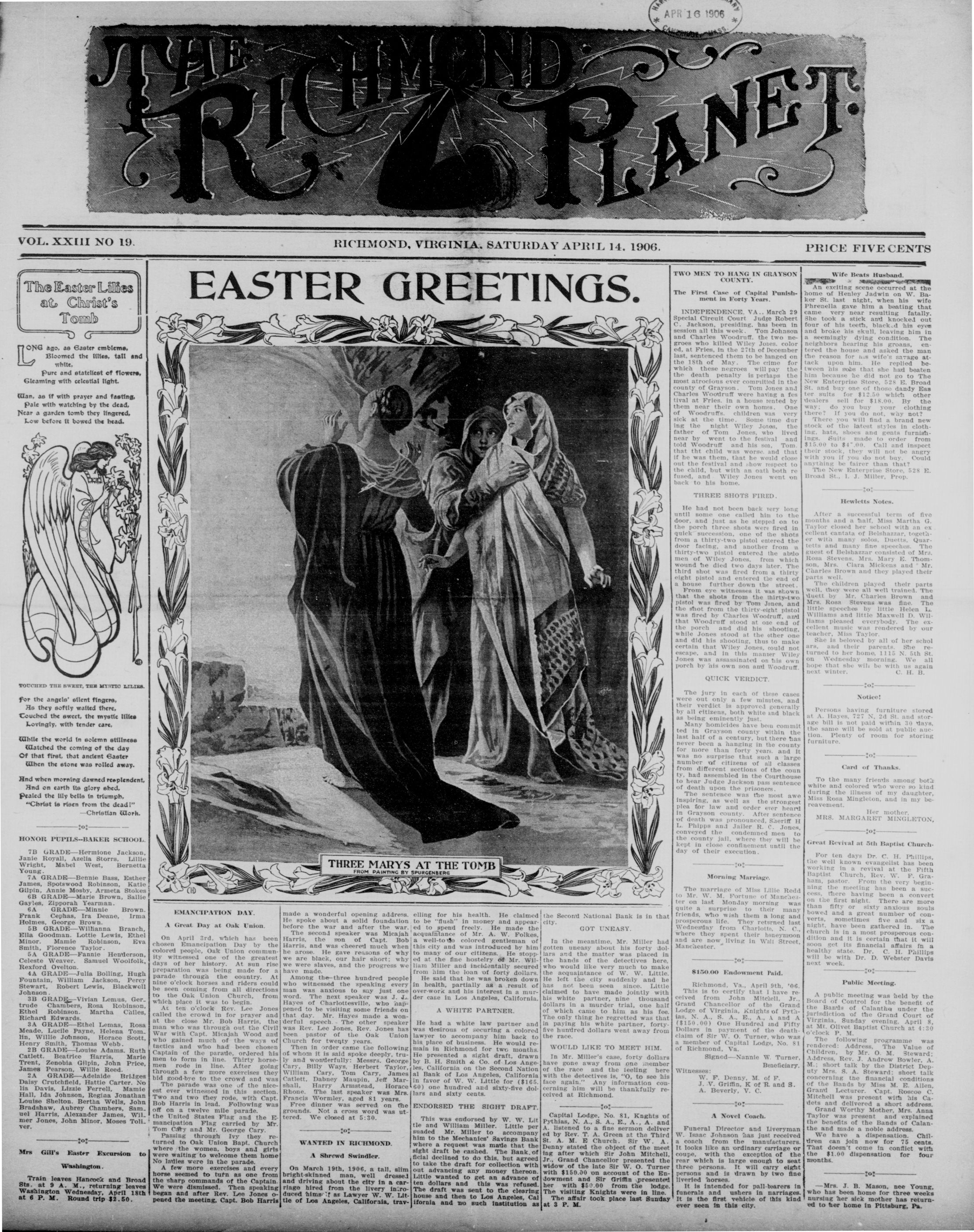
EASTER GREETINGS.
EMANCIPATION DAY
A Great Day at Oak Union
On April 3rd, which has been chosen Emancipation Day by the colored people, Oak Union community witnessed one of the greatest days of her history. At sun rise preparation was being made for a parade through the country. At nine o'clock horses and riders could be seen coming from all directions to the Oak Union Church, from which place it was to begin.
At ten o'clock Rev. Lee Jones called the crowd in for prayer and at the close Mr. Bob Harris, the man who was through out the Civil War with Capt. Micajah Wood and who gained much of the ways of tactics and who had been chosen Captain of the parade, ordered his men to form in line. Thirty horsemen rode in line. After going through a few more exercises they bid good-bye to the crowd and was the parade was one of the nicest ever witnessed in this section. Two and two they rode, with Capt. Bob Harris in lead. Following was off on a twelve mile parade. the United States Flag and the Emancipation Flag carried by Mr. Tom Cary and Mr. George Cary. Passing through Ivy they returned to Oak Union Bapt. Church where the women, boys and girls were waiting to welcome them home No ladies were in the parade.
A few more exercises and every horse seemed to turn as one from the sharp commands of the Captain. We were dismissed. Then speaking began and after Rev. Lee Jones opened the meeting, Capt. Bob Harris
made a wonderful opening address.
He spoke about a solid foundation before the war and after the war.
The second speaker was Micaajah Harris, the son of Capt. Bob Harris, and was cheered much when he arose. He gave reasons of why we are black, our hair short; why we were slaves, and the progress we have made.
Among the three hundred people who witnessed the speaking every man was anxious to say just one word. The next speaker was J. L. Hayes of Charlottesville, who happened to be visiting some friends on that day. Mr. Hayes made a wonderful speech. The other speaker was Rev. Lee Jones, Rev. Jones has been pastor of the Oak Union Church for twenty years.
Then in order came the following of whom it is said spoke deeply, truly and wonderfully: Messrs. George Cary, Billy Ways, Herbert Taylor, William Cary, Tom Cary, James Catlett, Dabney Maupin, Jeff Marshall, Harry Armstead, Horace Rhone. The last speaker was Mrs. Francis Wormley, aged 81 years.
Free dinner was served on the grounds. Not a cross word was uttered. We closed at 5:30.
WANTED IN RICHMOND
A Shrewd Swindler
On March 19th, 1906, a tall, slim bright-skinned man, well dressed and driving about the city in a carriage hired from the livery introduced himself as Lawyer W. W. Lift of Los Angeles, California, trav-
elling for his health. He claimed to be "flush" in money and appeared to spend freely. He made the acquaintance of Mr. A. W. Folkes, a well-to-colored gentleman of this city and was introduced by him to many of our citizens. He stopped at the fine hostelry of Mr. William Miller and incidentally secured from him the loan of forty dollars. He said that he was broken down in health, partially as a result of over-work and his interest in a murder case in Los Angeles, California.
A WHITE PARTNER
He had a white law partner and was desirous of securing a colored lawyer to accompany him back to his place of business. He would remain in Richmond for two months. He presented a sight draft, drawn by B. H. Smith & Co. of Los Angeles, California on the Second National Bank of Los Angeles, California in favor of W. W. Little for ($165.60) one hundred and sixty-five dollars and sixty cents.
ENDORSED THE SIGHT DRAFT
This was endorsed by W. W. Little and William Miller. Little per suaded Mr. Miller to accompany him to the Mechanics' Savings Bank where a request was made that the sight draft be cashed. The Bank, of ficial declined to do this, but agreed to take the draft for collection with out advancing any money thereon. Little wanted to get an advance of ten dollars and this was refused. The draft was sent to the clearing house and then to Los Angeles, California and no such institution as
the Second National Bank is in that city.
GOT UNEASY.
In the meantime, Mr. Miller had gotten uneasy about his forty dollars and the matter was placed in the hands of the detectives here, who would like very much to make the acquaintance of W. W. Little. He left the city suddenly and he has not been seen since. Little claimed to have made jointly with his white partner, nine thousand dollars in a murder trial, one half of which came to him as his fee. The only thing he regretted was that in paying his white partner, forty-five hundred dollars went away from the race.
WOULD LIKE TO MEET HIM
In Mr. Miller's case, forty dollars have gone away from one member of the race and the feeling here with the detectives is, "O, to see his face again." Any information concerning him will be thankfully received at Richmond.
Capital Lodge, No. 81, Knights of Pythias, N. A., S. A., E. A., A. and A. listened to a fine sermon delivered by Rev. T. A. Green at the Third St. A. M. E Church. Sir W. A. Denny stated the object of the meeting after which Sir John Mitchell, Jr., Grand Chancellor presented the widow of the late Sir W. O. Turner with $150.00 on account of the Endowment and Sir Griffin presented her with $50.00 from the lodge. The visiting Knights were in line. The affair took place last Sunday at 3 P. M.
TWO MEN TO HANG IN GRAYSON COUNTY.
The First, Case of Capital Punishment in Forty Years.
INDEPENDENCE, VA.. March 29 Special Circuit Court Judge Robert C. Jackson, presiding, has been in session all this week. Tom Johnson and Charles Woodruff, the two negroes who killed Wiley Jones, colored, at Fries, in the 27th of December last, sentenced them to be hanged on the 18th of May. The crime for which these negroes will pay the death penalty is perhaps the most atrocious ever committed in the county of Grayson. Tom Jones and Charles Woodruff were having a festival at Fries, in a house rented by them near their own homes. One of Woodruffs. children was very sick at the time. Some time dur ing the night Wiley Jones, the father of Tom Jones, who lived near by went to the festival and told Woodruff and his son, Tom. that the child was worse, and that if he was them, that he would close out the festival and show respect to the child, but with an oath both reused, and Wiley Jones went on back to his home.
THREE SHOTS FIRED
He had not been back very long until some one called him to the door, and just as he stepped on to the porch three shots were fired in quick succession, one of the shots from a thirty-two pistol entered the door facing, and another from a thirty-two pistol entered the abbot men of Wiley Jones, from which wound he died two days later. The third shot was fired from a thirty eight pistol and entered the end of a house further down the street. From eye witnesses it was shown that the shots from the thirty-two pistol was fired by Tom Jones, and the shot from the thirty-eight pistol was fired by Charles Woodruff, and that Woodruff stood at one end of the porch and did his shooting, while Jones stood at the other one and did his shooting, thus to make certain that Wiley Jones, could not escape, and in this manner Wiley Jones was assassinated on his own porch by his own son and Woodruff.
QUICK VERDICT
The jury in each of these cases were out only a few minutes, and their verdict is approved generally by all citizens, both white and black as being eminently just.
Many homicides have been committed in Grayson county within the last half of a century, but there has never been a hanging in the county for more than forty years, and it was no surprise that such a large number of citizens of all classes from different sections of the county, had assembled in the Courthouse to hear Judge Jackson pass sentence of death upon the prisoners.
The sentence was the most awe inspiring, as well as the strongest plea for law and order ever heard in Grayson county. After sentence of death was pronounced, Saeriff H. L. Phipps and Jailer R. C. Jones, conveyed the condemned men to the county jail, where they will be kept in close confinement until the day of their execution.
Morning Marriage
The marriage of Miss Lillie Redd to Mr. W. M. Fortune of Manchester on last Monday morning was quite a surprise to their many friends, who wish them a long and prosperous life. They returned last Wednesday from Charlotte, N. C., where they spent their honeymoon and are now living in Walt Street, Manchester.
$150.00 Endowment Paid
Richmond, Va., April 9th, '06.
This is to certify that I have received from John Mitchell, Jr.,
Grand Chancellor of the Grand Lodge of Virginia, Knights of Pytias,
N. A., S. A, E., A, A and A
($150.00) One Hundred and Fifty Dollars in payment of the death-
claim of Sir W. O. Turner, who was a member of Capital Lodge, No. 81
of Richmond, Va.
Signed—Nannie W. Turner,
Beneficiary.
Witnesses:
W. F. Denny, M. of F.
J. V. Griffin, R of R and S.
A. Beverly, V. C.
A Novel Coach.
Funeral Director and Liveryman W. Isaac Johnson has just received a coach from the manufacturers. It looks like an ordinary carriage or coupe, with the exception of the rear which is large enough to seat three persons. It will carry eight persons and is drawn by two fine liveried horses. It is intended for pall-bearers in funerals and ushers in marriages. It is the first vehicle of this kind ever seen in this city.
PRICE FIVE CENTS
Wife Beats Husband.
An exciting scene occurred at the home of Henley Jadwin on W. Baker St. last night, when his wife Phrenella gave him a beating that came very near resulting fatally. She took a stick and knocked out four of his teeth, blacked his eyes and broke his skull, leaving him in a seemingly dying condition. The neighbors hearing his groans, entered the house and asked the man the reason for his wife's savage attack upon him. He replied between his sobs that she had beaten him because he did not go to The New Enterprise Store, 528 E. Broad St. and buy one of those dandy East suits for $12.50 which other dealers sell for $18.00. By the way; do you buy your clothing there? If you do not, why not? There you will find a brand new stock of the latest styles in clothing, hats, shoes and gents furnishings. Suits made to order from $15.00 to $47.00. Call and inspect their stock, they will not be angry with you if you do not buy. Could anything be fairer than that? The New Enterprise Store, 528 E. Broad St. I, J. Miller, Prop.
Hewletts Notes.
After a successful term of five months and a half, Miss Martha G. Taylor closed her school with an excellent cantata of Belshazzar, together with many solos, Duetts, Quartets and many fine speeches. The guest of Belshazzar consisted of Mrs. Rosa Stevens, Mrs. Mary E. Thomson, Mrs. Clara Mickens and Mr. Charles Brown and they played their parts well.
The children played their parts well, they were all well trained. The duett by Mr. Charles Brown and Mrs. Rosa Stevens was fine. The little speeches by little Helen L. Williams and little Maxwell D. Williams pleased everybody. The excellent music was rendered by our teacher, Miss Taylor.
She is beloved by all of her school ars, and their parents. She returned to her home, 1115 N. 5th St. on Wednesday morning. We all hope that she will be with us again next winter.
C. H. B.
Notice!
Persons having furniture stored at A. Hayes, 727 N, 2d St. and storage bill is not paid within 30 days, the same will be sold at public auction. Plenty of room for storing furniture.
Card of Thanks
To the many friends among both white and colored who were so kind during the illness of my daughter, Miss Rosa Mingleton, and in my bereavement.
Great Revival at 5th Baptist Church
For ten days Dr. C. H. Phillips, the well known evangelist has been working in a revival at the Fifth Baptist Church, Rev. W. F. Graham, pastor. From the very beginning the meeting has been a success, there having been a convert on the first night. There are more than fifty or sixty anxious souls bowed and a great number of converts, sometimes five and six a night, have been gathered in. The church is in a most prosperous condition and it is certain that it will soon get its financial affairs in a healthy state. Dr. C. H. Phillips will be with Dr. D. Webster Davis next week.
Public Meeting.
A public meeting was held by the Board of Control for the benefit of the Bands of Calanthe under the jurisdiction of the Grand Court of Virginia, Sunday evening, April 8, at M. Olivet Baptist Church at 4:30 o'clock P. M.
The following programme was rendered: Address, The Value of Children, by Mr. O. M. Steward; Address, Rev. J. Andrew Bowler, A. M.; short talk by the District Deputy Mrs. S. A. Steward; short talk concerning the financial conditions of the Bands by Miss M. E. Allen, Grand Lecturer. Capt. Roosec C. Mitchell was present with his Cadets and delivered a short address. Grand Worthy Mother, Mrs. Anna Taylor was present and explained the benefits of the Bands of Calanthe and made a noble address.
We have a dispensation. Children can join now for 75 cents. That doesn't come in conflict with the $1.00 dispensation for four months.
—Mrs. J. B. Mason, nee Young, who has been home for three weeks nursing her sick mother has returned to her home in Pittsburgh, Pa.
TWO
I
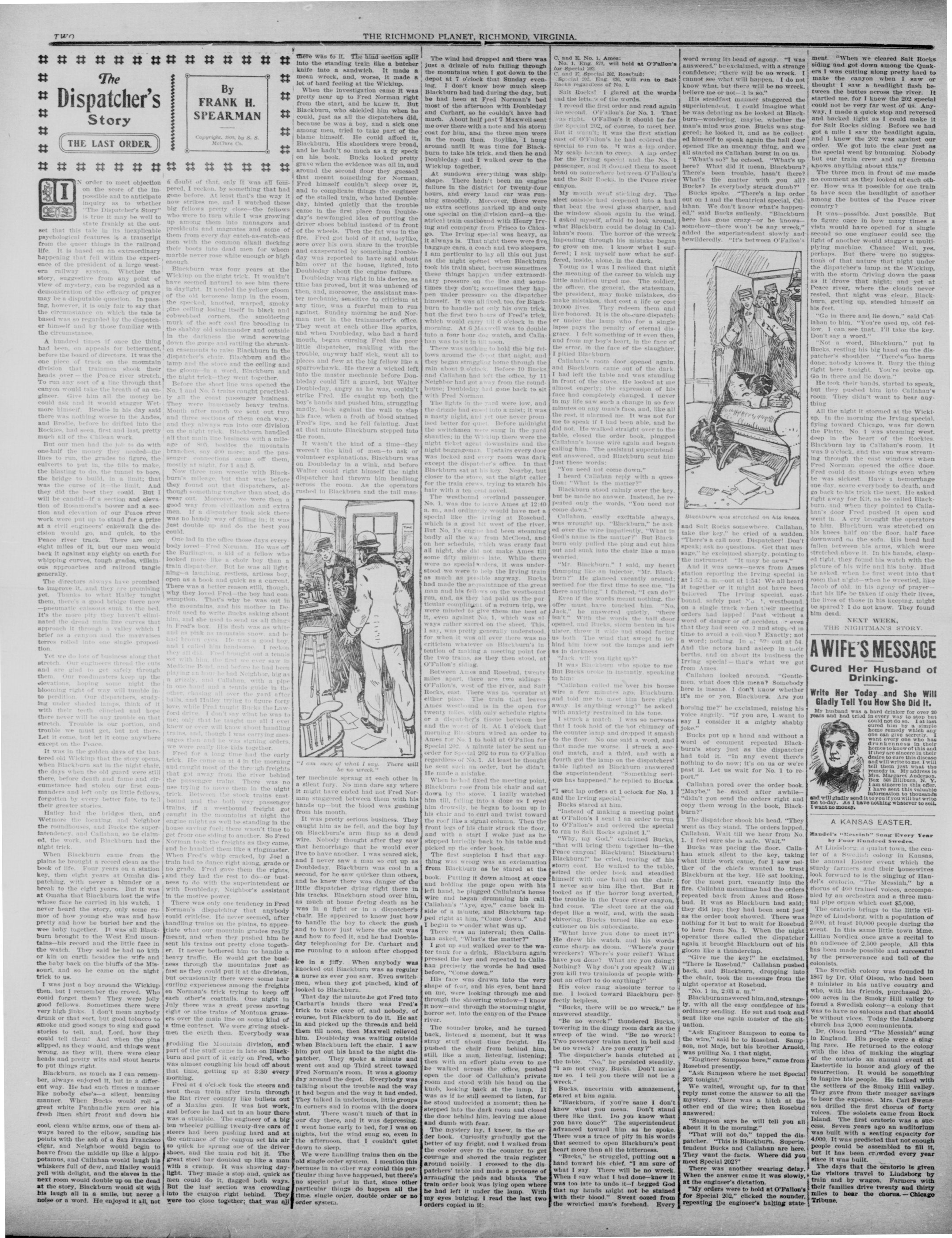
N order to meet objection on the score of the impossible and to anticipate inquiry as to whether "The Dispatcher's Story" is true it may be well to state frankly at the outset that this tale in its inexplicable psychological features is a transcript from the queer things in the railroad life. It is based on an extraordinary happening that fell within the experience of the president of a large western railway system. Whether the story, suggestive from any point of view of mystery, can be regarded as a demonstration of the efficacy of prayer may be a disputable question. In passing, however, it is only fair to say that the circumstances on which the tale is based was so regarded by the dispatcher himself and by those familiar with the circumstance.
A hundred times if once the thing had been, on appeals for betterment, before the board of directors. It was the one piece of track on the mountain division that trainmen shook their heads over—the Peace river stretch. To run any sort of a line through that canyon would take the breath of an engineer. Give him all the money he could ask and it would stagger Wet more himself. Brodie in his day said there was nothing worse in the Andes, and Brodie, before he drifted into the Rockies, had seen, first and last, pretty much all of the Chilean work.
But our men had the job to do with one half the money they needed—the lines to run, the grades to figure, the culverts to put in, the fills to make, the blasting to do, the tunnel to bore, the bridge to build, in a limit; that was the curse of it—the limit. And they did the best they could. But I will be candid—if a section and elevation of Rosamond's bower and a section and elevation of our Peace river work were put up to stand for a prize at a civil engineers' cenkwal the decision would go, and quick, to the Peace river track. There are only eight miles of it, but our men would back it against any eighty on earth for whipping curves, tough grades, villainous approaches and railroad tangle generally.
The directors always have promised to improve it, and they are promising yet. Thanks to what Halley taught them, there's a good bridge there now—pneumatic calcsons sunk to the bed. It's the more pity they haven't eliminated the dread main line curves that approach it through a valley which I brief as a canyon and the mauvasses terres rolled into one single proposition.
Yet we do lots of business along that stretch. Our engineers thread the cuts and are as a canyon and to get safely through them. Our roadmasters keep up the elevations, hoping some night the blooming right of way will tumble in to perdition. Our dispatchers, studying under shaded lamps, think of it with their teeth clinched and hope there never will be any trouble on that stretch. Trouble is our portion, and trouble we must get, but not there. Let it come, but let it come anywhere except on the Pence.
It was in the golden days of the battlered old Wiekup that the story opens, when Blackburn sat in the night chair, the days when the old guard were still there, before death and fame and circumstance had stolen our first commanders and left only us little fellows, forgotten by every better fate, to tell their greater stories.
Halley had the bridges then, and Wetmore the locating, and Neighbor the roundhouses, and Bucks the superintendency, and Callahan, so he claimed, the work, and Blackburn had the night trick.
When Blackburn came from the plains he brought a record clean as the book of life. Four years on a station key, then eight years at Omaha dispatching, with never a blunder or a break to the eight years. But it was at Omaha that Blackburn lost the wife whose face he carried in his watch. I never heard the story, only some rumor of how young she was and how pretty and how he buried her and the wee baby together. It was all Blackburn brought to the West End mountains—his record and the little face in the watch. They said he had no kith or kin on earth besides the wife and the baby back on the bluffs of the Missouri, and so he came on the night trick to us.
I was just a boy around the Wickupup then, but I remember the crowd. Who could forget them? They were jolly good fellows. Sometimes there were very high jinks. I don't mean anybody drunk or that sort, but good tobacco to smoke and good songs to sing and good stories to tell, and, Lord, how they could tell them! And when the plns slipped, as they would, and things went wrong, as they will, there were clear heads and pretty wits and stout hearts to put things right.
Blackburn, as much as I can remember, always enjoyed it, but in a different way. He had such times a manner like nobody else's—a silent, beaming manner. When Bucks would roll great white Panhandle yarn over his fresh linen shirt front and down his
cool, clean white arms, one of them always bared to the elbow, sanding his points with the ash of a San Francisco cigar, and Neighbor would begin to heave from the middle up like a hippopotamus, and Callahan would laugh his whiskers full of dew, and Halley would yell with delight, and the slaves in the next room would double up on the dead at the story, Blackburn would sit with his laugh all in a smile, but never a noise or a word. He enjoyed it all, not
a doubt of that, only it was all tempered, I reckon, by something that had gone before. At least that's the way it now strikes me, and I watched those big fellows pretty close—the fellows who were to turn while I was growing up among them into managers and presidents and magnates and some of them from every day catch-as-catch-can men with the common alkall flecking their boots into dead men for whom marble never rose white enough or high enough.
Blackburn was four years at the Wickburn on the night trick. It wouldn't have seemed natural to see him there in daylight. It needed the yellow gloom of the old kerosene lamp in the room, the speckled, knotted, warped, smoky pine ceiling losing itself in black and cobwebbed corners, the smoldering murk of the soft coal fire brooding in the shabby old salamander and outside in the darkness the wind screwing down the gorge and rattling the shrunk-en casements to raise Blackburn in the dispatcher's chair. Blackburn and the lamp and the stove and the ceiling and the gloom—in a word, Blackburn and the night trick—they went together.
Before the short line was opened the No. 1 and No. 5 trains caught practically all the coast passenger business. They were immensely heavy trains. Month after month we sent out two and three sections of them each way, and they always ran into our division on the night trick. Blackburn handled all that main line business with a mileage of 805, besides the mountain branches, say 400 more; and the passenger connections came off them, mostly at night, for 1 and 5. Now three men wrestle with Blackburn's mileage, but that was before they found out that dispatchers, although something tougher than steel, do wear out. Moreover, we were then a good way from civilization and extra men. If a dispatcher took slick there was no handy way of filling in; it was just double up and do the best you could.
One lad in the office those days everybody loved - Fred Norman. He was off the Burlington, a kid of a fellow who looked more like a choir boy than a train dispatcher. But he was all lightning—a laughing, restless, artless boy, open as a book and quick as a current. There was a better reason still, though, why they loved Fred—the boy had consumption. That's why he was out in the mountains, and his mother in Detroit used to write Bucks asking about him, and she used to send us all things in Fred's box. His flesh was as white and as pink as mountain snow, and he had brown eyes. He was a good boy, and I called him handsome. I reckon they all did. Fred brought out a tennis set with him, the first we ever saw in Medicine Bond, and before he had been playing an hour he had Neighbor, big as a grizzly, and Callahan, with a pipe in one hand and a tennis guide in the other, chasing all over the yard after balls, and Holley trying to figure forty love, and Fred taught Bucks the Lawford drive. I don't say what he was to me; only that he taught me all I ever knew or ever will know about handling trains, and, though I was carrying messages then and he was signing orders, we were really like kids together.
Fred for a long time had the early trick. He came on at 4 in the morning and caught most of the through freights that got away from the river behind the passenger trains. There was no use trying to move them in the night trick. Between the stock trains eastbound and the both way passenger trains, if a westbound freight got caught in the mountains at night the engine might as well be standing in the house saving fuel; there wasn't time to get from one sliding to another. So Fred Norman took the freights as they came, and he handled them like a ringmaster. When Fred's whip cracked, by Joel a train had to dance right along, grade or no grade. Fred gave them the rights, and they had the rest to do—or business to do with the superintendent or with Doubleday, Neighbor's assistant in the motive power.
There was only one tendency in Fred Norman's dispatching that anybody could criticise. He never seemed, after handling trains on the plains, to appreciate what our mountain grades really meant, and when they pushed him he sent his trains out pretty close together. It never bothered him to handle a heavy traffic. He would get the business through the mountains just as fast as they could put it at the division, but occasionally there were some hair curling experiences among the freights on Norman's trick trying to keep off each other's contorts. One night in July there was a great press moving eight or nine trains of Montana grassers over the main line on some kind of a time contract. We were giving stockmen the earth then. Everybody was
prodding the Mountain division, and part of the stuff came in late on Blackburn and part of it early on Fred, who was almost coughing his head off about that time, getting up at 3:30 every morning.
Fred at 4 o'clock took the steers and sent them train after train through the Rat river country like bullets out of a Maxim gun. It was hot work, and before he had sat in an hour there was a stumble. The engineer of a big ten wheeler pulling twenty-five cars of steers had been pushing hard and at the entrance of the canyon set his air so quick he sprung one of the driver shoes, and the main rod hit it. The great steel bar doubled up like a man with a cramp. It was showing daylight. They made a stop and, quick as men could do it, flagged both ways. But the last section was crowding into the canyon right behind. They were too close together; that was all
THE RICHMOND PLANET. RICHMOND. VIRGINIA
there was to it. The hind section split into the standing train like a butcher knife into a sandwich. It made a mean wreck, and, worse, it made a lot of hard feeling at the Wicklup.
When the investigation came it was pretty near up to Fred Norman right from the start, and he knew it. But Blackburn, who shielded him when he could, just as all the dispatchers did, because he was a boy, and a sick one among men, tried to take part of the blame himself. He could afford it, Blackburn. His shoulders were broad, and he hadn't so much as a fly speck on his book. Bucks looked pretty grave when the evidence was all in, and around the second floor they guessed that meant something for Norman. Fred himself couldn't sleep over it, and to complicate things the engineer of the stalled train, who hated Double-day, hinted quietly that the trouble came in the first place from Double-day's newfangled idea of putting the driver shoes behind instead of in front of the wheels. Then the fat was in the fire. Fred got hold of it and, boylike, sore over his own share in the trouble and exasperated by something Double-day was reported to have said about him over at the house, lighted, into Double-day about the engine failure.
Doubleleday was right in his device, as time has proved, but it was unheard of then, and, moreover, the assistant master mechanic, sensitive to criticism at any time, was a fearful man to run against. Sunday morning he and Norman met in the trainmaster's office. They went at each other like sparks, and when Doubleleday, who had a hard mouth, began cursing Fred the poor little dispatcher, ranking with the trouble, anyway half sick, went all to pieces and few at the big fellow like a sparrowhawk. He threw a wicked left into the master mechanic before Doubleleday could lift a guard, but Walter Doubleleday, angry as he was, couldn't strike Fred. He caught up both the boy's hands and pushed him, struggling madly, back against the wall to slap his face, when a froth of blood stained Fred's lips, and he fell fainting. Just at that minute Blackburn stepped into the room.
It wasn't the kind of a time—they weren't the kind of men—to ask or volunteer explanations, Blackburn was on Doublebay in a wink, and before Walter could right bimself the night dispatcher had thrown him headlong across the room. As the operators rushed in Blackburn and the tall mass
TIME PLACE
"I am sure of what I say. There will be no wreck."
ter mechanic sprang at each other in a silent fury. No man dare say where it might have ended had not Fred Norman staggered between them with his hands up—but the blood was gushing from his mouth.
It was pretty serious business. They caught him as he fell, and the boy lay on Blackburn's arm limp as a dead wire. Nobody thought after they saw that hemorrhage that he would ever live to have another. I was scared sick, and I never saw a man so cut up as doubleday. Blackburn was cool in a second, for he saw quicker than others, and he knew there was danger of the little dispatcher dying right there in his tracks. Blackburn stood over him, as much at home facing death as he was in a fight or in a dispatcher's chair. He appeared to know just how to handle the boy to check the gush and to know just where the salt was and how to feed it, and he had Doubleday telephoning for Dr. Carhart and me running to a saloon after chopped ice in a jiffy. When anybody was knocked out Blackburn was as regular a nurse as ever you saw. Even switchmen, when they got pinched, kind of looked to Blackburn.
That day the minute he got Fred into Carhart's hands there was Fred's trick to take care of, and nobody, of course, but Blackburn to do it. He sat in and picked up the threads and held them till noon, then Maxwell relieved him. Doubleday was waiting outside when Blackburn left the chair. I saw him put out his hand to the night dispatcher. They spoke a minute and went out and up Third street toward Fred Norman's room. It was a gloomy day around the depot. Everybody was talking about the trouble and the way it had begun and the way it had ended. They talked in undertones, little groups in corners and in rooms with the doors shut. There wasn't much of that in our day there, and it was depressing. I went home early to bed, for I was on nights, but the wind sung so, even in the afternoon, that I couldn't quiet down to sleep.
We were handling trains then on the old single order system. I mention this because in no other way could this particular thing have happened, but there's no special point in that, since other particular things do happen all the time. single order, double order or no order system.
The wind had dropped and there was just a drizzle of rain falling through the mountains when I got down to the depat at 7 o'clock that Sunday evening. I don't know how much sleep Blackburn had had during the day, but he had been at Fred Norman's bed most of the afternoon with Doubleday and Carbart, so he couldn't have had much. About half past 7 Maxwell sent me over there with a note and his storm coat for him, and the three men were in the room then. Boylike, I hung around until it was time for Blackburn to take his trick, and then he and Doubleday and I walked over to the Wicklup together.
At sundown everything was shipshape. There hadn't been an engine failure in the district for twenty-four hours, and every hand car was running smoothly. Moreover, there were no extra sections marked up and only one special on the division card—a theatrical train eastbound with Henry Irving and company from Frisco to Chicago. The Irving special was heavy, as it always is. That night there were five baggage cars, a coach and two sleepers. I am particular to lay all this out just as the night opened when Blackburn took his train sheet, because sometimes these things happen under extraordinary pressure on the line and sometimes they don't; sometimes they happen under pressure on the dispatcher himself. It was all fixed, too, for Blackburn to handle not only his own trick, but the first two hours of Fred's trick which would carry till 6 o'clock in the morning. At 6 Maxwell was to double into a four hour dog watch, and Callahan was to sit in till noon.
There was nothing to hold the big felows around the depot that night, and they began straggling home through the rain about 9 o'clock. Before 10 Bucks and Callahan had left the office, by 11 Neighbor had got away from the roundhouse; Doubleday had gone back to sit with Fred Norman.
The lights in the yard were low, and the drizzle had cascaded into a mist; it was a nasty night, and yet one never promised better for quiet. Before midnight the switchmen were sung in the yard shanties; in the Wicklup there were the night ticket agent downstairs and the night baggageman. Upstairs every door was locked and every room was dark except the dispatcher's office. In that Blackburn sat at his key. Nearby, but closer to the stove, sat the night caller for the train crews, trying to starch his hair with a ten cent novel.
The westbound overland passenger, No. 1, was due to leave Ames at 12:40 a. m., and ordinarily would have met a special like the Irving at Rosebud, which is a good bit west of the river. But No. 1's engine had been steaming badly all the way from McCloud, and on her schedule, which was crazy fast all night, she did not make Ames till some fifty minutes later. While there were no special orders, it was understood we were to help the Irving train as much as possible anyway. Bucks had made the acquaintance of the great man and his fellows on the westbound run, and, as they had paid us the particular compliment of a return trip, we were minded to give them the best of it, even against No. 1, which was always rather sacred on the sheet. This, I say, was pretty generally understood, for when it was all over there was no criticism whatever on Blackburn's intention of making a meeting point for the two trains, as they then stood, at O'Fallon's siding.
Between Ames and Rosebud, twenty miles apart, there are two sidings—O'Fallon's, west of the river, and Salt Rocks, east. There was no operator at either place. The train that leaves Ames westbound is in the open for twenty miles, with only schedule rights or a dispatcher's tissue between her and the worst of it. At 1 o'clock that morning Blackburn wired an order to Ames for No. 1 to hold at O'Fallon for Special 202. A minute later he sent an order for Special 202 to run to O'Fallon regardless of No. 1. At least he thought he sent such an order, but he didn't. He made a mistake.
When he had fixed the meeting point, Blackburn rose from his chair and sat down by the stove. I lazily watched him till, falling into a doze as I eyed him drowsily, he began to loom up in his chair and to curl and twist toward the roof like a signal column. Then the front legs of his chair struck the floor, and with a start I woke just as he stepped hurriedly back to his table and picked up the order book.
The first suspicion I had that anything was wrong was an exclamation from Blackburn as he stared at the book. Putting it down almost at once and holding the page open with his left hand, he plugged Callahan's house wire and began drumming his call, Callahan's "Aye, aye," came back inside of a minute, and Blackburn tapped right at him, "Come down." And I began to wonder what was up.
There was an interval; then Callahan asked, "What's the matter?"
I got up and walked over to the water tank for a drink. Blackburn again pressed the key and repeated to Callahan precisely the words he had used before, "Come down." His face was drawn into the very shape of fear, and his eyes, bent hard on me, were looking through me and through the shivering window—I know it now—and through the storming night, horror set, into the canyon of the Peace river.
The sounder broke, and he turned back, listened a moment, but it was stray stuff about time freight. He pushed the chair from behind him, still, like a man, listening, listening; then with an effort plain even to me he walked across the office, pushed open the door of Callahan's private room and stood with his hand on the knob, looking back at the lamp. It was as if he still seemed to listen, for he stood undecided a moment; then he stepped into the dark room and closed the door behind him, leaving me alone and dumb with fear.
The mystery lay, I knew, in the order book. Curiosity gradually got the better of my feight, and I walked from the cooler over to the counter to get courage and shoved the train register around noisily. I crossed to the dispatchers' table and made a pretense of arranging the pads and blanks. The train order book was lying open where he had left it under the lamp. With my eyes bulging. I read the last two orders copied in it:
C. and E. No. 1, Ames:
No. 1. Eng. 871, will hold at O'Fallon's
for Special 202.
C. and E. Special 202, Rosebud:
Special 202, Eng. 435, will run to Salt
Rocks regardless of No. 1.
Salt Rocks! I glared at the words and the letters of the words.
I reread the first order and read again the second. O'Fallon's for No. 1. That was right. O'Fallon's it should be for the Special 202, of course, to meet her. But it wasn't; it was the first station east of O'Fallon's he had ordered the special to run to. It was a lap order. My scalp began to creep. A lap order for the Irving special and the No. 1 passenger, and it doomed them to meet head on somewhere between O'Fallon's and the Salt Rocks, in the Peace river canyon.
My mouth went sticking dry. The sleet outside had deepened into a hall that beat the west glass sharper, and the window shook again in the wind. I asked myself, afraid to look around, what Blackburn could be doing in Calhahan's room. The horror of the wreck impending through his mistake began to grow on me. I know what I suffered; I ask myself now what he suffered, inside, alone in the dark.
Young as I was I realized that night the meaning of the career to which my little ambition urged me. The soldier, the officer, the general, the statesman, the president, may make mistakes, do make mistakes, that cost a life or cost 10,000 lives. They redeem them and live honored. It is the obscure dispatcher under the lamp who for a single lapse pays the penalty of eternal disgrace. I felt something of it even then, and from my boy's heart, in the face of the error, in the face of the slaughter. I pitied Blackburn
Callahan's room door opened again,
and Blackburn came out of the dark.
I had left the table and was standing
in front of the stove. He looked at me
almost eagerly; the expression of his
face had completely changed. I never
in my life saw such a change in so few
minutes on any man's face, and, like all
the rest, it alarmed me. It was not for
me to speak if I had been able, and he
did not. He walked straight over to the
table, closed the order book, plugged
Callahan's house wire again and began
calling him. The assistant superintend
answered, and Blackburn sent him
just these words:
"You need not come down."
I heard Callahan reply with a
question: "What is the matter?"
Blackburn stood calmly over the key, but he made no answer. Instead, he repeated only the words, "You need not come down."
Callahan, easily excitable always, was wrought up, "Blackburn," he asked over the wire impatient, "What in God's name is the matter?" But Blackburn only pulled the plug and cut him out and sunk into the chair like a man weared.
"Mr. Blackburn," I said, my heart thumping into an injector, "Mr. Blackburn?" He glanced vacantly around; seemed for the first time to see me. "Is there anything?" I faltered, "I can do?" Even if the words meant nothing, the offer must have touched him. "No, Jack," he answered quietly, "there isn't." With the words the ball door opened, and Buck's storm beaten in his ulster, threw it wide and stood facing us both. The wind that swept in behind him blew out the lamps and left us in darkness.
"Jack, will you light up?"
It was Blackburn who spoke to me. But Bucks broke in instantly, speaking to him: "Callahan called me over his house wire a few minutes ago. Blackburn, and told me to meet him here right away. Is anything wrong?" he asked with anxiety restrained in his tone. I struck a match. I was so nervous that I took hold of the hot chimney of the counter lamp and dropped it smash to the floor. No one said a word, and that made me worse. I struck a second match, and a third, and with a fourth got the lamp on the dispatchers' table lighted as Blackburn answered the superintendent. "Something serious has happened," he replied to Bucks. "I sent lap orders at 1 oclock for No. 1 and the Irving special." Bucks stared at him. "Instead of making a meeting point at O'Fallon's I sent 1 an order to run to O'Fallon's and ordered the special to run to Salt Rocks against 1."
"Why, my God," exclaimed Bucks, "that will bring them together in—the Peace canyon! Blackburn! Blackburn! Blackburn!" he cried, tearing off his storm coat. He walked to the table, seized the order book and steadied himself with one hand on the chair. I never saw him like that. But it looked as if the horror long averted, the trouble in the Peace river canyon, had come. The sheet tore at the old depot like a wolf, and, with the sash shivering, Bucks turned like an executioner on his subordinate.
"What have you done to meet it?" He drew his watch, and his words came sharp as doom. "Where's your wreckers? Where's your relief? What have you done? What are you doing? Nothing? Why don't you speak? Will you kill two trainloads of people without an effort to do anything?"
His voice rang absolute terror to me. I looked toward Blackburn perfectly helpless.
"Bucks, there will be no wreck," he answered steadily.
"Be no wreck!" thundered Bucks, towering in the dingy room dark as the sweep of the wind. "Be no wreck! Two passenger trains meet in hell and be no wreck? Are you crazy?"
The dispatcher's hands clutched at the table. "No," he persisted steadily. "I am not crazy, Bucks. Don't make me so. I tell you there will not be a wreck."
Bucks, uncertain with amazement, stared at him again.
"Blackburn, if you're sane I don't know what you mean. Don't stand there like that. Do you know what you have done?" The superintendent advanced toward him as he spoke. There was a trace of pity in his words that seemed to open Blackburn's pent heart more than all the bitterness.
"Bucks," he struggled, putting out a hand toward his chief, "I am sure of what I say. There will be no wreck. When I saw what I bad done—knew it was too late to undo it—I begged God that my hands might not be stained with their blood." Sweat oozed from the wretched man's forehead. Every
word wring its head of agony. "I was answered," he exclaimed, with a strange confidence; "there will be no wreck. I cannot see what will happen. I do not know what, but there will be no wreck, believe me or not—it is so."
His steadfast manner staggered the superintendent. I could imagine what he was debating as he looked at Blackburn—wondering, maybe, whether the man's mind was gone. Bucks was staggered; he looked it, and as he collected himself to speak again the hall door opened like an uncanny thing, and we all started as Callahan burst in on us.
"What's so?" he echoed. "What's up here? What did it mean, Blackburn? There's been trouble, hasn't there? What's the matter with you all? Bucks? Is everybody struck dumb?"
Bucks spoke. "There's a lap order out on 1 and the theatrical call, Cailahan. We don't know what's happened," said Bucks sullenly. "Blackburn here has gone crazy-or he knows—somehow—there won't be any wreck," added the superintendent slowly and bewilderedly. "It's between O'Fallon's
A
and Salt Rocks somewhere. Callahan, take the key," he cried of a sudden. "There's a call now. Dispatcher! Don't speak; ask no questions. Get that message," he exclaimed sharply, pointing to the instrument. "It may be news." And it was news—news from Ames station reporting the Irving special in at 1:52 a.m.—out at 1:54! We all heard it together or it might not have been believed. The Irving special, east bound, safely past No. 1, westbound, on a single track when their meeting orders had lapped! Past without a word of danger or of accident or even that they had seen no.1 and stopped in time to avoid a collision? Exactly; not a word; nothing. In at 1:52; out at 54. And the actors hard asleep in their berths, and on about its business the Irving special—that's what we got from Ames.
Callahan looked around. "Gentlemen, what does this mean? Somebody here is insane. I don't know whether it's me or you. Blackburn. Are you horsing me?" he exclaimed, raising his voice angrily. "If you are, I want to say I consider it a mighty shabby joke." Bucks put up a hand and without a word of comment repeated Blackburn's story just as the dispatcher had told it. "In any event there's nothing to do now; it's on us or we're past it. Let us wait for No. 1 to report." Callahan pored over the order book. "Maybe," he asked after awhile—"didn't you send the orders right and copy them wrong in the book, Blackburn?" The dispatcher shook his head. "They went as they stand. The orders lapped, Callahan. Wait till we hear from No. 1. I feel sure she is safe. Wait."
Bucks was pacing the floor. Callahan stuck silent to the key, taking what little work came, for I saw nelther of the chiefs wanted to trust Blackburn at the key. He sat looking, for the most part, vacantly into the fire. Callahan meantime had the orders repeated back from Ames and Rosebud. It was as Blackburn had said; they did lap; they had been sent just as the order book showed. There was nothing for it but to wait for Rosebud to hear from No. 1. When the night operator there called the dispatcher again it brought Blackburn out of his gloom like a thunderclap.
"Give me the key!" he exclaimed. "There is Rosebud." Callahan pushed back, and Blackburn, dropping into the chair, took the message from the night operator at Rosebud.
Blackburn answered him, and, strangely, with all the easy confidence of his ordinary sending. He sat and took and sent like one again master of the situation.
"Ask Engineer Sampson to come to the wire," said he to Rosebud. Sampson, not Maje, but his brother Arnold, was pulling No. 1 that night.
"Engineer Sampson here," came from Rosebud presently.
"Ask Sampson where he met Special 202 tonight."
We waited, wrought up, for in that reply must come the answer to all the mystery. There was a hitch at the other end of the wire; then Rosebud answered:
"Sampson says he will tell you all about it in the morning."
"That will not do," tapped the dispatcher. "This is Blackburn. Superintendent Bucks and Callahan are here. They want the facts. Where did you meet Special 202?"
There was another wearing delay.
When the answer came it was slowly,
at the engineer's dictation.
"My orders were to hold at O'Fallon's
for Special 202," clicked the sounder,
repeating the engineer's halting state-
ment. "When we cleared Salt Rocks siding and got down among the Quakers I was cutting along pretty hard to make the canyon when I saw or thought I saw a headlight flash between the buttes across the river. It startled me, for I knew the 202 special could not be very far west of us. Anyway, I made a quick stop and reversed and backed tight as I could make it for Salt Rocks siding. Before we had got a mile I saw the headlight again, and I knew the 202 was against our order. We got into the clear just as the special went by bumming. Nobody but our train crew and my fireman knows anything about this."
The three men in front of me made no comment as they looked at each other. How was it possible for one train to have seen the headlight of another among the buttes of the Peace river country?
It was—possible. Just possible. But to figure once in how many times a vista would once be opened for a single second so one engineer could see the light of another would stagger a multiplying machine. Chance! Well, yes, perhaps. But there were no suggestions of that nature that night under the dispatcher's lamp at the Wicklup, with the storm driving down the pass as it drove that night; and yet at Peace river, where the clouds never rested, that night was clear. Blackburn, getting up, steadied himself on his feet.
"Go in there and lie down," said Calahan to him. "You're used up, old fellow. I can see that. I'll take the key. Don't say a word."
"Not a word, Blackburn," put in Bucks, resting his big hand on the dispatcher's shoulder. "There's no harm done; nobody knows it. Bury the thing right here tonight. You're broke up. Go in there and lie down."
He took their hands, started to speak, but they pushed him into Callahau's room. They didn't want to hear anything.
All the night it stormed at the Wicklup. In the morning the Irving special, flying toward Chicago, was far down the Platte. No. 1 was steaming west, deep in the heart of the Rockies. Blackburn lay in Callahan's room. It was 9 o'clock, and the sun was streaming through the east windows when Fred Norman opened the office door. Fred could do those things even when he was sleekest. Have a hemorrhage one day, seakey everybody to death, and go back to his trick the next. He asked right away for Kit, as he called Blackburn and when they pointed to Callahan's door Fred pushed it open and went in. A cry brought the operators to him. Blackburn was stretched on his knees half on the floor, half face downward on the sofa. His head had fallen between his arms, which were stretched above it. In his hands, clasped tight, they found his watch with the picture of his wife and his baby. Had he asked, when he first went into that room that night—when he wrestled, like Jacob of old, in his agony of prayer—that his life be taken if only their lives, the lives of those in his keeping, might be spared? I do not know. They found him dead.
THE NIGHTMAN'S STORY
A WIFE'S MESSAGE Cured Her Husband of Drinking.
Write Her Today and She Will Gladly Tell You How She Did It.
Mr husband was a hard drinker for over 50 years and had tried in every way to stop but
hard drinker for over $20 in every way to stop but to cure him by a simple home remedy which any one can give secretly. I want every one who takes their homes to know of this and if they are sincere in their desire to cure this disease I tell them just what the remedy is. My address is Mrs. Margaret Anderson, Anderson, I am sincere in this offer. I have sent this valuable
could not do so. I at last cured him so, at last simple home remedy which will one can give secretly. I want every one who has dawned over homes to know of this and if they are sincere in their desire to cure this disease and will tell them just tell them just what the remedy is. My address is Mrs. Margaret. Anderson, Box 60, Hillburn, N.Y. I am sincere in this offer. I have sent this valuable information still to thousands and will gladly send it to you if you want me to-day. As I have nothing whatever to sell, I want no money.
A KANSAS EASTER.
Haudel's "Messiah" Sung Every Year by Four Hundred Swedes.
At Lindsborg, a quiet town, the center of a Swedish colony in Kansas, the annual Easter event which the sturdy farmers and their housewives look forward to is the singing of Handel's oratorio, "The Messiah," by a chorus of 400 trained voices, accompanied by an orchestra and a three manual pipe organ which cost 5,000. The oratorio brings to the little village of Lindsborg, with a population of 2,000, at least 10,000 people during the event. In this same little town Mine. Lillian Nordica once gave a recital to an audience of 2,500 people. All this has been made possible and successful by the perseverance and toll of the colonists.
The Swedish colony was founded in 1867 by Dr. Olaf Olson, who had been a minister in his native country and who, with his friends, purchased 20,000 acres in the Smoky Hill valley to found a Swedish colony—a colony that was to have no saloons and that should be without vices. Today the Lindsborg church has 3,000 communicants.
Dr. Olson heard "The Messiah" sung in England. His people were a singing race. He returned to the colony with the iden of making the singing of the oratorio an annual event at Eastertide in honor and glory of the resurrection. It would be something to inspire his people. He talked with the settlers of the Smoky Hill valley. They gave from their meager savings to bear the expense. Mrs. Carl Swenson drilled the first chorus of forty voices. The soloists came from Rock Island. The first oratorio was a success. Seven years ago an auditorium was built with a seating capacity for 4,000. It was predicted that not enough people could be assembled to fill it, but it has been crowded every year since it was built.
The days that the oratorio is given the visitors travel to Lindsborg by train and by wagon. Farmers with their families drive twenty and thirty miles to hear the chorus.—Chicago Tribune.
THE PLANET
SATURDAY.....APRIL 14. 1906
Easter Sunday In the Catholic Capital
THE great feature of the Roman Easter is the pontifical high mass in St. Peter's, attended by thousands of persons of every nationality and every walk in life. The great temple on this occasion, decorated with a wealth of flowers and greens and filled with brilliant robes and uniforms, is a triumph of beauty and splendor.
In a draped tribute at one side of the main altar are the ambassadors, ministers and other members of the diplomatic corps accredited to the holy see, ablaze with decorations and colored ribbons, while throughout the church and on the square Swiss guards and other papal soldiers are stationed. At 10 o'clock the order to present arms is given. The Swiss guards raise their halberts high in front of them as the head of the procession moves into the church. Marching in front is a platoon of soldiers. Then follow the various officials of the pope's household in clerical attire—priests of different ecclesiastical grades, heads of monastic orders, mitered abbets and monks
Now the sovereign pontiff appears, seated on a throne which is carried high above the heads of every one by servants of the Vatican clad in scarlet silk and bearing the platform on which the pope's chair rests upon their shoulders. Beside the throne walk high dignitaries of the papal court, holding in their raised hands huge white bunches of ostrich plumes, which they wave gently to and fro. The pontiff is attired in white, his toga beating of a soft material that clings to the body. Upon his head he wears the emblem of his power, the glittering tiara. As he passes through the throng of people he bestows the benediction upon all present, his uplifted right arm making the sign of the cross continuously, while his lips pronounce the grand words of peace. The pious people receive this benediction kneeling.
THE BAPTIST CHURCH
THE POPE BLESSING THE WOOD.
but when the pope has passed they rise and cheer him, waving their hats and handkerchiefs.
The high mass following upon the grand entry is conducted with all the pomp and circumstance the church of Rome has at command for festive occasions. After church is over the pope is carried back to his residence with the same ceremonies that marked his entry.
The paschal celebrations in the Eternal City in the times when the pope reigned supreme over the seven hills and "blessed the world from the loggia of St. Peter's on Easter mori" were more impressive than those of today.
"I witnessed this spectacle in 1860, when I was a boy," says a widely traveled American, "but its grandeur is still fresh in my mind. I remember that our party repaired to St. Peter's place at daybreak. The immense square was thronged with a dense mass of natives, exchanging voluble greetings, and strangers who, like ourselves, watched the incidents of the day with the impatience born of expectancy. The greater part of the papal army was drawn up in the center. The regiments had donned their most showy uniforms, and the standards struggled bravely with the morning breeze. Presently deep silence settled over the immense assemblage. Pio Nono, followed by a retinue of magnificently attired prelates, had appeared in the loggia. The sunbeams played carelessly about the glittering tiara on his brow, and the kindly face of the pontiff expressed love and compassion. Now he stretched forth both hands as if to place them on the 10,000 heads below and in a loud voice pronounced the world's blessing, "Benedicat vos."
"A moment later the cannons of the 'Mole of Hadran' in the castle of St. Angelo carried the glad tidings abroad, the various bands in the square struck up the 'Te Deum,' and the crowds broke forth in jubilant 'vivas.'"—Louisville Courler-Journal.
EASTER IN GERMANY.
Qualit Customs Observed on the Great Baronial Estates.
In Germany some qualit Easter customs are observed by the peasantry. At sunrise on Easter morning one is awakened by the servants on the great estates singing Easter anthems beneath the window to the accompaniment of a small but excellent orchestra maintained among them. Then the baron and all his guests assemble in the great hall' of the castle while the entire establishment passes in review before them.
Each couple carry—for they march two by two—something which indicates to what department they belong and is also emblematic of the life and death of the Saviour or of something connected therewith. The washerwoman carries a tub white as snow containing a large doll intended to represent the infant Jesus; the woodmen have a shining hatchet, its bright blade driven into a small cross of some black wood; the gardeners a large bouquet surmounted by a crown of thorns; the cooks a huge cake baked in the form of a sepulcher; the housemaids a broom wrapped in white rag, emblematic of the Saviour's winding sheet; the blacksmiths a great sledge hammer and spikes, to represent the implements which nailed him to the cross, while the masons bring up the rear, trowel in hand and carrying a large stone to represent the one which was rolled away from Christ's tomb.
As each pair pass the master of the house they make a profound obeisance and receive from him a gift of money. This quiet Easter custom has been observed for many generations and is universal on all the great estates of Germany.—San Francisco Chronicle.
London at Easter Time.
All London seems to have turned out into the streets at Easter time. Of course Easter Sunday is somewhat quiet and sober, most of the people who make any pretensions to respectability going to church, but Easter Monday is a universal holiday, upon which the whole population gives itself up to sport and mirth. The theaters all have some special attraction for Easter Monday and are crowded to the dome, as they continue to be throughout the Easter holidays, which in England continue for two weeks. Fashionable society, which has so long been chafing under the austerities of Lent, now gives itself up to all manner of gayeties.
Easier In the Early Church.
The proper time for the celebration of Easter occasioned no little controversy in the early church, the great mass of the eastern Christians celebrating the feast upon the fourteenth day of the first Jewish month, or moon, the date of the Passover. The western Christians celebrated it on the Sunday following the fourteenth day, claiming that this more nearly commemorated the resurrection of Christ. In 325 the council of Nice decided in favor of the western usage and branded the eastern custom as the "quarto-december heresy."
Eastertide In Billyville.
There are numerous angels pictured on the Easter cards, but they are all scantily clothed, and not one of 'em wears a twelve dollar hat.
Times are not exactly as flush as they might be, so yesterday we took our rifle and killed four jay birds for our wife to trim her hat with.
There is just this about it: These Easter trimmings not only cover the ground, but certainly fill the bill.
We have been kept very busy of late. We are running an Easter millinery establishment in connection with our newspaper.
We have sold enough Easter lilies this season to pay off the mortgage on our mule.
The Easter weather is so clear and beautiful you can see a bill collector approaching a quarter of a mile away.
-Atlanta Constitution.
Origin of the Easter Egg.
The custom of Easter eggs is one of ancient origin, being derived from the Greeks and Romans, who employed eggs, and undoubtedly colored eggs, as accessories for their pagan festivals. At any rate magical powers have always been ascribed to eggs in times gone by, and Cesarius von Heisterbach, who wrote in the middle ages, tells many stories of bewitched eggs. They were said to be able to fly of their own accord toward the sun, and a certain celebrated egg was believed to have been laid by a rabbit, which egg when hatched produced a basilisk.
An Appropriate Hymn:
Hasty or unwise selection of hymns has caused more than one minister serious mortification. A minister in an eastern city had charge of the Easter programme in the Sunday school of his church. Each child present was to receive an Easter egg, and when it came time for this part of the programme the minister rose and said: "We will now sing 'Awake, My Soul, to Cheerful Lays', after which the Easter eggs will be distributed."—Lipipcott's.
Easter Monday In Bulgaria.
In Bulgaria young men and women meet on Easter Monday, congregating in the churchyard attired in holiday dress, and indulge in social games. If during these games a girl allows her handkerchief to be taken away by a young man this is a sign of a proposal and acceptance. The next day her parents send a jug of wine to him as a token of their approval.
An Egyptian Eater Egg
A very rare specimen of egg decoration, as it was practiced in Egypt, is shown in the Detroit Museum of Art. The etchings on the shell follow the same general design as do the paintings of men and animals recently found in Cairo.
Self Mastery.
Be master of yourself. Do not be the slave of habit or of poverty or of superstition or of time, but stand facing life, the uncrowned king of circumstance, and in it all plan for eternity.—Rev. C. C. Pierce, Baptist, Los Angeles, Cal.
THE RICHMOND PLANET, RICHMOND, VIRGINIA
DEER HUNT TAKES PLACE IN CHICAGO
AN ESCAPED ANIMAL SPREADS
PANIC IN CITY'S STREETS.
One Policeman Injured Before It Is Captured and Returned to Home in Lincoln Park.
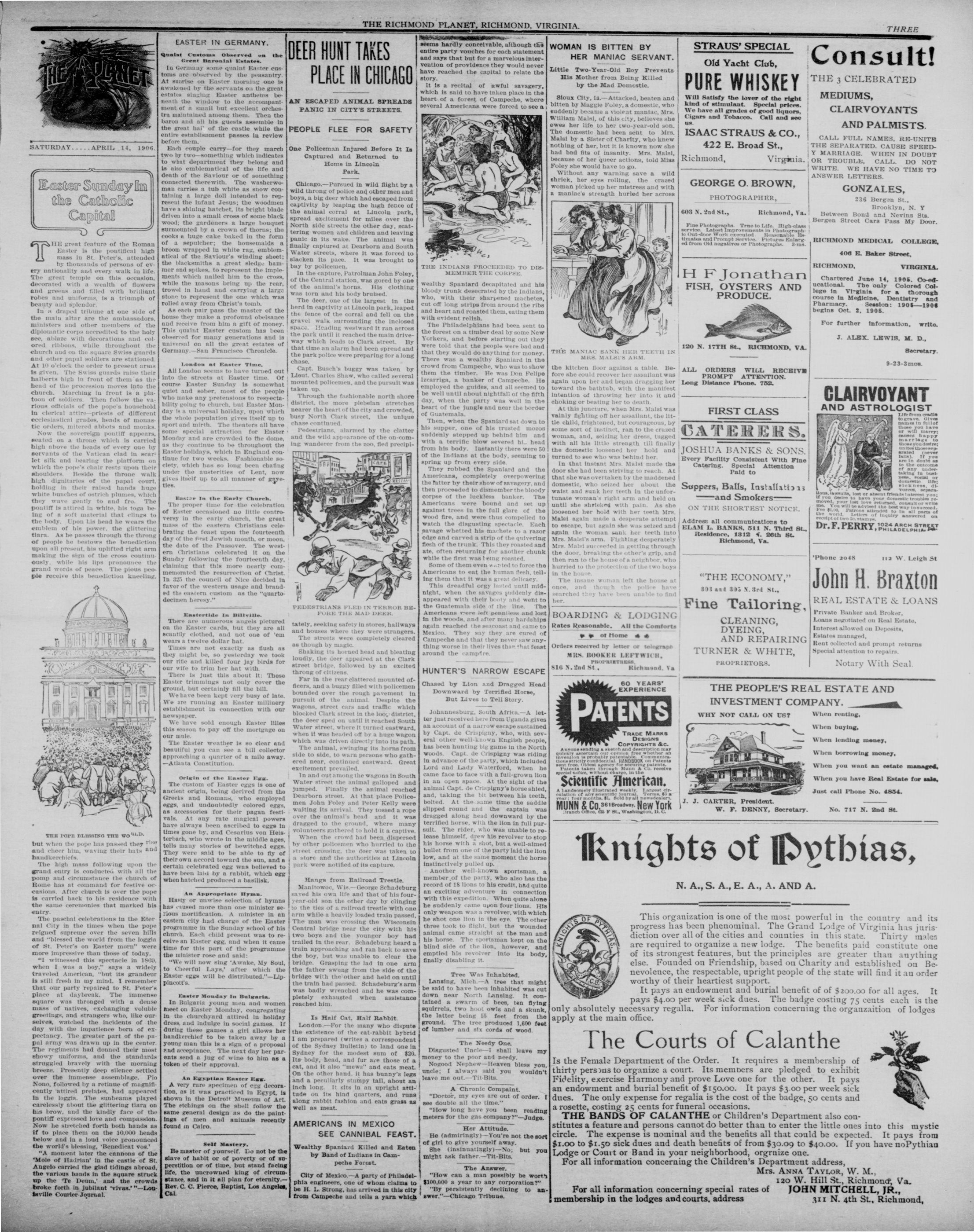
Chicago.—Pursued in wild flight by a wild throng of police and other men and boys, a big deer which had escaped from captivity by leaping the high fence of the animal corral at Lincoln park, spread excitement for miles over the North side streets the other day, scattering women and children and leaving panic in its wake. The animal was finally captured at Dearborn and South Water streets, where it was forced to slacken its pace. It was brought to bay by policemen.
In the capture, Patrolman John Foley, of the Central station, was gored by one of the animal's horns. His clothing was torn and his body bruised.
The deer, one of the largest in the herd in captivity at Lincoln park, leaped the fence of the corral and fell on the gravel walk surrounding the inclosed space. Heading westward it ran across the park until it reached the main driveway which leads to Clark street. By that time an alarm had been spread and the park police were preparing for a long chase.
Capt. Busch's buggy was taken by Lleut. Charles Shaw, who called several mounted policemen, and the pursuit was taken up.
Through the fashionable north shore district, the more plebeian stretches nearer the heart of the city and crowded, busy North Clark street, the unique chase continued.
Pedestrians, alarmed by the clatter and the wild appearance of the on-coming wanderer from the zoo, fled prel-
PEDESTRIANS FLED IN TERROR BEFORE THE MAD DEER.
tately, seeking safety in stores, hallways and houses where they were strangers. The streets were completely cleared as though by magic. Shaking its horned head and bleating loudly, the deer appeared at the Clark street bridge, followed by an excited throng of citizens. Far in the rear clattered mounted officers, and a buggy filled with policemen bounded over the rough pavement in pursuit of the animal. Despite the wagons, street cars and traffic which blocked Clark street in the loop, district, the deer sped on until it reached South Water street, where it turned eastward, when it was headed off by a huge wagon which was driven directly into its path. The animal, swinging its horns from side to side, to warn persons who gathered near, continued eastward. Great excitement prevailed.
In and out among the wagons in South Water street the animal galloped and jumped. Finally the animal reached Dearborn street. At that place Policemen John Foley and Peter Kelly were waiting its arrival. They tossed a rope over the animal's head and it was dragged to the ground, where many volunteers gathered to hold it a captive. When the crowd had been dispersed by other policemen who hurried to the street crossing, the deer was taken to a store and the authorities at Lincoln park were notified of its capture.
Hangs from Railroad Trestle
Hangs from Railroad Trestle.
Manitowoc, Wis—George Schadeburg saved his own life and that of his four-year-old son the other day by clinging to the ties of a railroad trestle with one arm while a heavily loaded train passed. The man was crossing the Wisconsin Central bridge near the city with his two boys and the younger boy had trailed in the rear. Schadeburg heard a train approaching and ran back to save the boy, but was unable to clear the bridge. Grasping the lad in one arm the father swung from the side of the bridge with the other and held on until the train had passed. Schadeburg's arm was badly wrenched and he was completely exhausted when assistance reached him.
Is Half Cat. Half Rabbit
London.—For the many who dispute the existence of the cat-rabbit hybrid I am prepared (writes a correspondent of the Sydney Bulletin) to land one in Sydney for the modest sum of $20. Its body, head, and fur are those of a cat, and it also "mews" and eats meat. On the other hand, it has bunny's legs and a peculiarly stumpy tail, about an inch long. It sits in an upright attitude on its hind quarters, and runs along rabbit fashion and eats grass as well as meat.
AMERICANS IN MEXICO SEE CANNIBAL FEAST.
Wealthy Spaniard Killed and Eaten by Band of Indians in Campeche Forest.
City of Mexico.—A party of Philadelphia engineers, one of whom claims to be H. L. Strong, has arrived in this city from Campeche and tells a yarn which
seems hardly conceivable, although the entire party vouchers for each statement and says that but for a marvelous intervention of providence they would never have reached the capital to relate the story.
It is a recital of awful savagery, which is said to have taken place in the heart of a forest of Campeche, where several Americans were forced to see a
THE INDIANS PROCEEDED TO DISMEMBER THE CORPSE
wealthy Spanishi decapitated and his bloody trunk desecrated by the Indians, who, with their sharpened machetes, cut off long strips from around the ribs and heart and roasted them, eating them with evident relish.
The Philadelphiaians had been sent to the forest on a timber deal by some New Yorkers, and before starting out they were told that the people were bad and that they would do anything for money. There was a wealthy Spanishi in the crowd from Campeche, who was to show them the timber. He was Don Fellippe Izcarriga, a banker of Campeche. He employed the guides, and all seemed to be well until about nightfall of the fifth day, when the party was well in the heart of the jungle and near the border of Guatemala.
Then, when the Spanish sat down to his supper, one of his trusted mozos suddenly stepped up behind him and with a terrific blow severed hl. head from his body. Instantly there were 50 of the Indians at the body, seeming to spring up from every side.
They robbed the Spanish and the Americans, completely overpowering the fatter by their show of savagery, and then proceeded to dismember the bloody corpse of the luckless banker. The Americans were bound and set up against trees in the full glare of the wood fire, and were thus compelled to watch the disgusting spectacle. Each savage whetted his machete to a razor edge and carved a strip of the quivering flesh of the trunk. This they roasted and ate, often returning for another chunk while the first was being roasted.
Some of them even wanted to force the Americans to eat the human flesh, telling them that it was a great delicacy.
This dreadful orgy lasted until midnight, when the savages suddenly disappeared with their booty and went to the Guatemala side of the line. The Americans were left penniless and lost in the woods, and after many hardships again reached the seacoast and came to Mexico. They say they are cured of Campeche and that they never saw anything worse in their lives than that feast around the campfire.
HUNTER'S NARROW ESCAPE
Chased by Lion and Dragged Head Downward by Terrified Horse, But Lives to Tell Story.
Johannesburg, South Africa.—A letter just received here from Uganda gives an account of a narrow escape sustained by Capt. de Crispigny, who, with several other well-known English people, has been hunting big game in the North woods. Capt. de Crispigny was riding in advance of the party, which Included Lord and Lady Waterford, when he came face to face with a full-grown lion in an open space. At the sight of the animal Capt. de Crispigny's horse shiled, and, taking the bit between his teeth, bolted. At the same time the saddle slipped round and the captain was dragged along head downward by the terrified horse, with the lion in full pursuit. The rider, who was unable to release himself, drew his revolver to stop his horse with a shot, but a well-aimed bullet from one of the party laid the lion low, and at the same moment the horse instinctively pulled up.
Another well-known sportsman, a member of the party, who also has the record of 18 lions to his credit, had quite an exciting adventure in connection with this expedition. When quite alone he suddenly came upon four lions. His only weapon was a revolver, with which he shot one lion in the eye. The other three took to flight, but the wounded animal came straight at the man and his horse. The sportsman kept on the blind side of the lion, however, and emptied his revolver into its body, finally disabling it.
Tree Was Inhabited
Lansing, Mich.—A tree that might be said to have been inhabited was cut down near North Lansing. It contained a swarm of bees, ten flying squirrels, two hoot owls and a skunk, the latter being 55 feet from the ground. The tree produced 1,600 feet of lumber and six cords of wood.
The Needy One
sound leave my money to the poor and the needy. Noogood Nephew—Heaven bless you, uncle; I always said you wouldn't leave me out—Tit-Bits.
"How long have you been reading meters for the gas company?"—Judge.
Her Attitude
Her Attitude.
He (admiringly)—You're not the sort of girl to give yourself away.
She (insinuating)—No; but you might ask father.—Tit-Bits.
The Answer.
"How can a man possibly be worth $100,000 a year to any corporation?"
"By persistently declining to answer."—Chicago Tribune
Knights of Pythias,
This organization is one of the most powerful in the country and its progress has been phenominal. The Grand Lodge of Virginia has jurisdiction over all of the cities and counties in this state. Thirty males are required to organize a new lodge. The benefits paid constitute one of its strongest features, but the principles are greater than anything else. Founded on Friendship, based on Charity and established on Benevolence, the respectable, upright people of the state will find it an order worthy of their heartiest support.
It pays an endowment and burial benefit of of $200.00 for all ages. It pays $4.00 per week sick dues. The badge costing 75 cents each is the necessary regalla. For information concerning the organization of lodges in office.
The Courts of Calanthe
Is the Female Department of the Order. It requires a membership of thirty persons to organize a court. Its members are pledged to exhibit Fidelity, exercise Harmony and prove Love one for the other. It pays an endowment and burial benefit of $150.00. It pays $3.00 per week sick dues. The only expense for regalia is the cost of the badge, 50 cents and a rosette, costing 25 cents for funeral occasions. THE BANDS OF CALANTHE or Children's Department also con-
stitutes a feature and persons cannot do better than to enter the little ones into this mystic circle. The expense is nominal and the benefits all that could be expected. It pays from $1.00 to $1.50 sick dues and death benefits of from $30.09 to $40.00. If you have noPythian Lodge or Court or Band in your neighborhood, orgrnize one.
For all information concerning special rates of membership in the lodges and courts, address
WOMAN IS BITTEN BY
HER MANIAC SERVANT.
Little Two-Year-Old Boy Prevents His Mother from Being Killed by the Mad Domestic.
Sloux City, Ia.—Attacked, heaten and bitten by Maggie Foley, a domestic, who suddenly became a violent maniac, Mrs. William Malsi, of this city, believes she shows her life to her two-year-old son. The domestic had been sent to Mrs. Malsi by a Sister of Charity, who knew nothing of her, but it is known now she had bad fits of insanity. Mrs. Malsi, because of her queer actions, told Miss Foley she would have to go.
Without any warning save a wild shriek, her eyes rolling, the crazed woman picked up her mistress and with a maniac's strength hurled her across
THE MANIAC SANK HER TEETH IN
MRS. MALS'S ARM.
THE MANIAC SANK HER TEETH IN
MRS. MALSIS ARM.
the kitchen floor against a table. Before she could recover her assailant was again upon her and began dragging her toward the bathtub, with the manifest intention of throwing her into it and choking or beating her to death.
At this juncture, when Mrs. Malsi was vainly fighting off her assailant, the little child, frightened, but courageous, by some sort of instinct, run to the crazed woman, and, seizing her dress, tugged with all his little strength till finally the domestic loosened her hold and turned to see who was behind her.
In that instant Mrs. Malsi made the door she had been striving to reach. At that she was overtaken by the maddened domestic, who seized her about the waist and sunk her teeth in the unfortunate woman's right arm and held on until she shrieked with pain. As she loosened her hold with her teeth Mrs. Malsi again made a desperate attempt to escape, but again she was seized and again the woman sank her teeth into Mrs. Malsi's arm. Fighting desperately Mrs. Malsi succeeded in getting through the door, breaking the other's grip, and then ran to the house of a neighbor, who hurried to the protection of the two boys in the house.
The insane woman left the house at once, and though the police have searched they have been unable to find her.
BOARDING & LODGING
Rates Reasonable. All the Comforts
of Home
Orders received by letter or telegraph
MRS. BOOKER LEFTWICH,
PROPRIETRESS,
816 N. 2nd St.
Richmond, Va
60 YEARS'
EXPERIENCE
PATENTS
TRADE MARKS
DESIGNS
COPYRIGHTS & C.
Anyone sending a sketch and description may
quickly ascertain our opinion, free whether an
invention is probably potential. Communications
store is confidential. HANDBOOK on Patents
sent free. Oldest agency for securing patents.
Orders taken through Mum & Co. receive
special notice, without charge, in the
Scientific American.
A handsomely illustrated weekly. Largest circulation of any scientific journal. Terms, 60 a year; four months, 4. Sold by all new-delivery.
MUNN & Co. 361 Broadway, New York
Branch Office, 625 F St., Washington, D.C.
KNIGHTS OF PYTHIAAS
F.C.E.
only absolutely necessary reg
apply at the main office.
The Court
Is the Female Department of
thirty persons to organize a co
Fidelity, exercise Harmony and
an endowment and burial bene
dues. The only expense for it
a rosette, costing 25 cents for
THE BANDS OF CALA
stitutes a feature and persons
circle. The expense is nomi
THE PEOPLE'S REAL ESTATE AND INVESTMENT COMPANY.
Old Yacht Club.
PURE WHISKEY
Will Satisfy the lover of the right kind of stimulant. Special prices. We have all grades of good liquors, Cigars and Tobacco. Call and see us. ISAAC STRAUS & CO., 422 E. Broad St., Richmond, Virginia.
GEORGE O. BROWN.
PHOTOGRAPHER.
Fine Photographs. True to Life. High-class service. Latest Improvements in Photographic Outs. Accepted. Seasonal Exhibition and Promotion. Fine Photographs. From old negatives or Photographs. 3-mg.
H F Jonathan
FISH, OYSTERS AND
PRODUCE.
ALL ORDERS WILL RECEIVE
PROMPT ATTENTION.
Long Distance Phone. 752.
FIRST CLASS
CATERERS.
JOSHUA BANKS & SONS.
Every Facility Consistent With Fine
Catering. Special Attention
Paid to
Suppers, Balls, Installations
and Smokers
Address all communications to
ELAM L. BANKS, 511 N. Third St.
Residence, 1312 4. 26th St.
Richmond, Va.
"THE ECONOMY," 303 and 305 N.3rd St.,
Fine Tailoring.
CLEANING,
DYEING,
AND REPAIRING
TURNER & WHITE,
PROPRIETORS.
THE PEOPLE'S REAL
INVESTMENT COMP
WHY NOT CALL ON US?
J. J. CARTER, President.
W. F. DENNY, Secretary.
A organization is one of the most powerful has been phenominal. The Grand Master all of the cities and counties in need to organize a new lodge. The longest features, but the principles handed on Friendship, based on Charity, the respectable, upright people of their heartiest support. An endowment and burial benefit of no per week sick dues. The badge galla. For information concerning
THREE
Consult!
THE 3 CELEBRATED
MEDIUMS,
CLAIRVOYANTS
AND PALMISTS.
CALL FULL NAMES, RE-UNITE
THE SEPARATED. CAUSE SPEEDY
MARRIAGE. WHEN IN DOUBT
OR TROUBLE, CALL. DO NOT
WRITE. WE HAVE NO TIME TO
ANSWER LETTERS.
GONZALES.
236 Bergen St.,
Brooklyn, N. Y
Between Bond and Nevins Sts.
Bergen Street Cars Pass My Door.
RICHMOND MEDICAL COLLEGE,
406 E. Baker Street.
Chartered June 14, 1905. Co-educational. The only Colored College in Virginia for a thorough course in Medicine, Dentistry and Pharmacy. Session: 1905—1906 begins Oct. 2, 1905.
For further information, write.
J. ALEX. LEWIS, M. D..
Secretary.
9-23-3mos.
9-23-3 mos.
CLAIRVOYANT
from friends to acquaintances names in full of those you have to will marry, can the marriage to those you desire limited time parished (never fails). If you need does not to the outcome of any unde-aking in business or domestic life, slickness, dis-orders, lawsuits, lost or absent friend interest you; if you desire to have your domestic troubles re-covered or lost love returned, consult or write me. You will be advised the law is assessed, Fee $1.00. Patrons attended to in the office, the work. Letters of inquiry answered on receipt of two so many.
Dr. F. PERRY, 1024 ARCH STREET
PHILADELPHIA
'Phone 2048
112 W. Leigh St
John H. Braxton
REAL ESTATE & LOANS
Private Banker and Broker,
Loans negotiated on Real Estate,
Interest allowed on Deposits,
Estates managed,
Rent collected and prompt returns
Special attention to repairs.
Notary With Seal.
REAL ESTATE AND
PANY.
When renting,
When buying,
When lending money,
When borrowing money,
When you want an estate managed,
When you have Real Estate for sale,
Just call Phone No. 4854.
No. 717 N. 2nd St.
ythias,
A.
powerful in the country and its
Lodge of Virginia has juris-
in this state. Thirty males
the benefits paid constitute one
is greater than anything
marity and established on Be-
of the state will find it an order
of of $200.00 for all ages. It
are costing 75 cents each is the
ing the organization of lodges
```markdown
```
ent also con-
he little ones into this mystic
ld be expected. It pays from
$40.00. If you have noPythian
address,
TAYLOR, W. M.,
Hill St., Richmond, Va.
N MITCHELL, JR.,
311 N. 4th St., Richmond,
FOUR
THE PLANET
Published every Saturday by JOHN MITCHELL
JR., at 811 North 4th Street, Rickmond Va.
TERMS IN ADVANCE
One Copy, one year. $1.50
One Copy, eight months 1.00
One Copy, six months 0.40
One Copy, four months 0.50
One Copy, three months 0.40
Single Copy. 0.06
ADVERTISING RATES
For one inch, one insertion. $50
For one inch, each subsequent insertion. 4.60
For two inches, three months. 6.00
For two inches, six months. 10.00
For two inches, nine months 14.00
For two inches, twelve months 20.00
Marriage and Eunational Notices, one inch. $50
Standing and Transient Notices per line. 1.10
NEW POSTAGE STAMP OF A HIGHER DE-
NOMINATION THAN TWO CENTS NOT
RECEIVED ON SUBSCRIPTIONS.
THE PLANET is issued weekly. The subscription price is $1.50 per year in advance.
There are FOUR WAYS by which money can be sent by mail at our risk—In-App Post Office Mon. Mail, Print, or an Ex-Press Money Order, and when it can be procured in a Registered Letter.
MONEY ORDERS.—You can buy a Money Order at your Post-Office, payable at the Richmond mall Office, and we will be responsible for its safe delivery. You can obtain a EXPRESS MONEY ORDERS can be obtained at any office of the American Express Co., the United States Express Co., and the Wells Fargo and Co.'s Express Company. We will be responsible for its safe delivery to your company. The Express Money Order is a safe and convenient way for forwarding money.
REGISTERED LETTER.—If a money Order Post-Office or an Express Office is not written in the form of a letter, the Letter you wish to send us on payment of the cents. Then, if the letter is lost or stolen it can be traced. You can send money in this manner. We cannot be responsible for money sent in letters in any other way than one of the four ways mentioned above. If you send your money in any other way, you must do it at your bank.
RESKWALLE, ETC.—If you do not want your PLANETS continued for another year after your subscription has run out, you then notify us by Postal Card to discontinue it. The courts have not order their paper discontinued at theiration of time for which it has been paid are held liable for the payment of the suscrip date when they order the paper discontinued.
COMMUNICATIONS:—When writing to us to
renew your subscription or to discontinue your
paper, you should give your name and address
in full; otherwise we cannot find your name on
our books.
CHANGE OF ADDRESS:—In order to change
the address of a subscriber, we must be sent
the former as well as the present address.
Entered at the Post-Office at Richmond. We
as second-class matter.
We are at a loss to understand the constant evidences of friction existing between certain officials of the National Baptist Convention, as is evidenced by open attacks in the newspapers of the country upon each other. Rev. E. C. Morris, D. D. is one of the ablest divines in this country and is the president of that powerful organization and yet it seems that he is unmercifully criticized in the columns of the organ of the organization and by able officials who should be his mainstay and support. It seems to us that criticisms of this kind should be under seal of personal or official letters and that the public press is hardly the place for an expression of opinion relative to the policy or action of the presiding officer of the organization in question.
TRYING TO LEAD TWO PARTIES
The announcement that President Roosevelt has openly sought the aid and support of the Democratic Senators in the passage of the Tillman. Hepburn Rate Bill by inviting some of them to a conference at the White House emphasizes our contention relative to the purposes of his recent trip through the South. The attempt of certain colored people to see and hear him was undoubtedly a source of embarrassment to him and annoyance to those far-seeing statesmen, who had no doubt arranged the trip. The Washington, D. C. Post, in its issue of the 6th inst. says:
Apparently the President has burned his bridges behind him in the railroad-rate fight, and has entered the last stages of the war with a redoubled determination to win at all hazards. He is now formally conferring with Senate Democrats in an endeavor to enlist their active aid in pressing through the Senate the limited court-review amendment to the Doliver-Hepburn bill agreed up on at the White House conference last Saturday.
As frequently pointed out by the Post, President Roosevelt appealed indirectly to the Democrats for aid when he permitted the statement to be sent out from the White House last Saturday, after he had conferred with Senators Allison, Cullom, Dolliver, Clapp and Long, and Interstate Commerce Commissioners Knapp and Prouty, that the Republican friends of the bill thought they could safely count on about twenty-nine votes for the measure on their side of the chamber, thus leaving the bill, to be amended in accord with the convictions of its supporters, sixteen votes short of the required number.
Within the past thirty-six hours the President has talked at the White House with several Democratic Senators on the subject of their party's attitude toward the proposed limited court-review amendment. Prominent among those who have responded to his invitation to call at the White House are Mr.
Clay of Georgia, Mr. Foster of Louisiana, Mr. Daniel of Virginia, and Mr. Overman of North Caroll, na.
To all of them Mr. Roosevelt has made a plain statement of what he understands are the status and prospects of the rate bill, and has frankly told them that as at no time has he considered the movement a partisan one, he would like very much to secure assurances of their co-operation with the other supporters of effective legislation.
He called attention to the fact that the Doliver-Hepburn bill was reported from the Committee on Interstate Commerce by the votes of all the Democratic members and of only three of the Republican members; that it was intrusted to the management of a Democrat, and that he, therefore, was constrained to believe that it had the favor of Democrats as well as Republicans. What assurances the President received in detail from his Democratic callers cannot be stated at this time though it is known in a general way that they gave him to understand that they desired to see effective legislation at this session on the subject of the Federal regulation of transportation charges.
One of the Democratic Senators told him, in response to the direct question as to how the minority side of the Senate stood, that he believed three or four of them were opposed outright to any and all action of the kind provided for in the House bill, and that probably among this number were Mr. Gor. man and Mr. Morgan.
While no direct invitation has as yet been extended to Mr. Bailey, who, in the absence of Mr. Gorman, is the active floor manager of the minority, to visit the White House, it is understood that the President would be pleased to confer with the Texan in his capacity as the Democratic leader. It is considered im-probable, however, that Mr. Bailey will go to the White House on this or any other subject unless he should receive a direct summons from the President.
As in previous conferences, Mr. "Blunderbuss" Tillman is being left out of it if we are to believe the following report:
Mr. Tillman, who has charge of the bill, has not been asked to participate in the conferences at the White House, though it is very well known that the President would like to discuss the whole subject with the South Carolinian, for whose honesty and frankness he has a high regard.
When asked yesterday if he would go to the White House if the President should invite him, Mr. Tillman replied in effect that there was not likely to arise any necessity which would call him in to close conference with the President; that Mr. Roosevelt certainly knew how he stood on the rate question, and that they could effectively co-operate without his going to the White House for a personal interview.
President Roosevelt seems to think that he can officiate as leader of both the Republican and the Democratic parties at the same time. He will find himself grievously mis-taken in this. The Richmond, Va. Times-Dispatch correspondent in the issue of that journal of the 7th inst. says;
It is safe to assume that the President thought when he made this great concession in the matter of a court review, that he would break the ranks of those Repubil. can Senators who were fighting the bill so bitterly, but the event has shown that he was sadly mistaken. The so-called "railroad senators," are still as bitterly opposed to the bill as they were months ago. The hope undoubtedly cherished by the President of being able to secure the enactment of the law by Repub. lican votes, has been dashed. He had been told many times in the past that this was impossible, but he refused to believe it. Time and again has the Republican majority this session refused to be led or driven into supporting measures on which the heart of the President was set but Mr. Roosevelt persisted in believing that his influence and prestige were still sufficient to carry through his great scheme of governmental rate regulation.
He had found that which was apparent long ago, that his party is split wide open on the subject of rate regulation by legislation, and that while he is the nominal leader of the Republican party in this country, his following is far from being as large as it was a year a go. Of course, this applies chiefly to Congress. It is problematical whether it has been decreased in the country at large, among the masses of the voters.
This indicates that there are "Railroad Senators" on both sides of the Chamber who are playing "hide and seek" with him in his efforts to curb the power of the railroads and to secure favorable legislation for the shippers. He should have realized that corporations know no party and that they look after their own interests, without regard to the politics of the legislator, from whom they expect favors. The Southerners are occupying an enviable position. They can dictate to the President of the United States and are incidentally able to curtail the powers of the Supreme Court of the United States. That tribunal has a blind eye on the Chattanooga lynching, while President Roosevelt through his Secret Service Department seems to be "marking time" in the matter of making arrests in the State of Tennessee. There are peculiar conditions existing just now and the colored people of the United States might as well take notice.
Commercialism and expediency are holding high carnival in the nation and great principles and human rights seem to have been forgotten. The reaction will be fearful and it is appalling for the far-seeing
THE RICHMOND PLANET, RICHMOND, VIRGINIA
and thoughtful to consider. Let us hope that ere its consequences are felt and its results are apparent that all of us shall have been gathered into the graves of our fathers.
INHERENT RIGHTS OF AN OWN
ER.
Judge R. Carter Scott of the Circuit Court granted an injunction last Tuesday to the residents of Fulton Park restraining the owner of the property from selling the property or any part thereof to Negroes. The case will be heard some time in the future. It is alleged that when these white people purchased their homes at the park, a provision was made in the contract which assured the purchasers that lots would never be sold to Negroes or to any person or company who would sell them to Negroes. It was understood that the park was a residential section for whites only.
Fulton Park belonged originally to a Mr. Black. He transferred it to Mrs. Ida M. Butts and after several other transfers, it passed into the hands of Mrs. Ida M. Butts, who now owns it. The plain question is, Has a person the right to sell her property to a citizen of Virginia? Judge Scott will be asked to decide to what extent can a person exercise control over his property after he has purchased it and can a previous owner dictate to him or prescribe the mode and manner of disposing of the same? We can hardly doubt the final conclusion of the matter for an unlawful contract is no contract and has neither binding force or effect.
There are colored people through out this state in possession of property formerly owned by Negro-hating white persons, who engrafted just such remarkable provisions in the deeds to the sarc. We are not waiting to learn Judge R. Carter Scott's decision. To our mind if the case is contested by the owner, the injunction will be dissolved and the matter settled in a way so as to prevent any gullible white purchasers from being deceived in the future.
When the Supreme Court of Appeals of Virginia sustains such a contention, it will be in order for all of us to come to the conclusion that equality before the law is asleep and that justice has gone on a long jour ney.
SECRETARY TAFT AND THE NEGRO.
The speech of Secretary William H. Taft, delivered at Tuskegee, Alabama, April 4th, 1906 is certainly significant, reflecting as it does the sentiment of the administration of which he is the unquestioned official spokesman. He was bold in his position and outspoken in his sentiments. He showed conclusively that the present attitude of the Supreme Court of the United States with reference to the reconstruction amendments to the Constitution of the United States is cordially approved by him.
This is especially significant; when it is remembered that he has been named as the successor of one of the retiring justices of that supreme tribunal. It emphasizes the fact that Mr. Roosevelt is in accord with this sentiment and that the mandatory provisions of the Constitution are to be evaded and ignored and that the nullifiers of that instrument may sleep in tranquility for a generation at least. Secretary Taft seems to be in thorough accord with the prevailing sentiment of the age so far as it relates to the Southland. His utterances hardly rank with those of a statesman, neither do they line up with the truths of history. It would, in our judgment have been far more manly for him to correct a constitutional mistake by a constitutional enactment.
He bows at the altar of expediency, and vices homage at the shrine of race prejudice. How else are we to interpret his remarks? Here is what he said:
Declarations of equality and popular rights and universal suffrage offer but a feather's weight against the inevitable impulse of human nature. It was impossible that with the elements I have stated there should not have been disturbance and fraud and violence and injustice and illegality and oppression.
He said further:
When a class of persons is so ignorant and so subject to oppression and misleading that they are merely political children, not having the mental status of manhood, then it can hardly be said that their voice in the government secures any benefit to them. Therefore it seems to me that a policy of the Southern people in adopting laws which exclude impartially both the black and white ignorant, and irresponsible, could not be criticised.
He admitted that he has heard the allegations of the other side when he said:
But it is said, but with what truth I do not know, that these laws are intended to be enforced by means of the discretionary power vested in election and other State officers so as to exclude the colored voters with vigor under their provisions and to allow the white voters who ought also to be excluded, to enjoy the franchise.
Assuming this to be true, still the situation is still by no means a hope less one, for the Negro and the political power that he may in the future exercise.
It will be noted that the distinguished Secretary virtually condones the very fraud and trickery that he assumes to have been practiced. In this particular, he is in line with the Supreme Court of the United States of which he is soon to become a most prominent part. He makes no qualification when he speaks of the ignorance and incapacity of the Negroes of the Southland, but he preclaims in qualifying language that he does not know that the suffrage laws of the Southland are a fraud, framed to disqualify worthy and capable Negroes and to deceive honest and justice loving white people in the North.
Those facts with which we are not personally familiar can only be substantiated and sustained by evidence. Certainly, if the able Ohio statesman had paid any attention whatever to the election cases so often paraded in congress and to the suits at law repeatedly carried up to the Supreme Court, he could proclaim with truth and with authority that the charges made are true for the reason that no reputable Democrat has taken the pains to deny them.
Even Senator B. R. Tillman openly boasted not only of fraud, but of murder, and he has the brand of President Roosevelt on his back, if the distinguished occupant of the White House has been correctly quoted that he is an honest man.
Secretary Taft assures the Negroes of the South that they will be able to accomplish the miracle of lifting themselves up by their own boot-straps. He falls, however to cite any fact in history, where this feat has ever been accomplished without outside help, and it is known by all scholars and students of the ages that "history repeats itself."
Here in Virginia, a colored physician, a graduate from a medical college, a man who had passed the medical examining board in this state was denied the right to register and to vote upon the specious plea that he did not understand the Virginia state constitution, and the said registrar was unable to keep his own books. A colored mall-carrier of this city, who had passed the Civil Service examination was denied the right to register and vote for the same reason. A colored minister, a graduate of a theological college and a student in Latin, was denied the right to register at Phoebus, Va. for the same reason. A practicing pharmacist, who owned at that time thousands of dollars worth of property went to vote and found himself marked "dead," and it took him more than six months after the election before he was able to become "alive" again.
Some colored men took advantage of this species of fraud by refusing to pay poll-taxes, when the assessments were made on the ground that dead men were not required to pay taxes—they were citizens of the other world. But Secretary Taft says he does not know these things and the Supreme Court of the United States repeatedly refuses to know these things and we suggest that this great economist, jurist and statesman accept the appointment and thereby find himself in the midst of the most agreeable company.
Secretary Taft advocated a division of the Negro vote and we incidentally infer that he and his associates are anxious to unload the citizen of color. What else are we to infer from the following language?
In the first place, if he continues to increase in intelligence by the acceptance of the educational opportunities which are being offered him under the influence of Washington in great institutions like this, and industrially he becomes a power and this gradually increases the number of his race who are eligible to vote in accordance with law, he introduces into the electorate a body of individuals well qualified to act with, common sense and judgment and who, by their very position in the community, give weight to the vote they cast.
Coming to the ballot box in small numbers as compared with the total number of the race, so as to relieve the fear that an ignorant majority will take over the government, their votes and their support will ultimately prove attractive to the parties into which the white race must inevitably divide. If then, with the independence of thought and action which economic independence will surely give them, they divide their votes between contending parties, their votes will be sought, instead of suppressed.
Such a gradual acquisition of political power will secure more real political power and ability to help the Negroes in their development than when their right of suffrage was unrestricted. I cannot put my self among those pessimists who regard the settlement of the political question in the South as beyond hope.
This specious argument sounds well to the ear to be broken to the hope. It is the enunciation of the new doctrine of the Negro-haters: In division, there is strength. What Secretary Taft argues may be one of the results of intellectual proficiency, but it should not be put forth as the primary principle, for it is as misleading as the Jack-O'Lantern of our boyhood days.
Vouch-safe to the well-bred, thoroughly qualified Negro all of the rights of citizenship and take out his way all of the blighting handicaps of race prejudice and the other surrounding circumstances will take care of themselves. Give him an equal chance and an equal opportunity in the race of life and leave the conditions, to which Secretary Taft refers the opportunity of adjusting themselves.
Nowhere in this great speech of Secretary Taft, in our judgment does he rise to the high plane of the true statesman. He keeps to the lower level of the practical commercialist and the politician, who see only to-day and its embarrassing surroundings. He looks to man, rather than to God and he seems staggered by the problems confronting and the questions asked him. We are pleading for equal rights and opportunity for the intellectual and morally qualified Negro with out regard to his race, color or previous condition of servitude. We are insisting that the same restrictions and handicaps placed upon the ignorant Negro be placed upon the ignorant white man. No self-respecting educated Negro will demand more or expect less.
Secretary Taft need not be at all uneasy as to the ultimate culmination of the conditions existing down here. They will be settled and he spoke truly, when he said:
The white men who can do the most good for the Negro, who can aid him in his toilsome march to better material and intellectual conditions, are the Southern white men who are his neighbors. It is one of the encouraging signs of the time that there is growing up in the South a body of leading white men who feel that the future of the Negro race, affects the future of the South, and that both self interest and humanity require them to lend all the aid they can to this people in the throes of a burdensome effort.
It is to this class of white men that we are looking for succor and relief. There are thousands of God fearing white men in the North, who would do much, and are doing more to aid us, but they are not in power in the nation. Some of these advocates are identified with the Constitution League, the principles of which organization Secretary Taft has indirectly repudiated.
The northerners in power, with possibly one exception (President Roosevelt) have lacked the courage to enforce the law and to speak out for great principles. They have been cowed by the powerful southern combination in control at Washington and in the face of this array, the rights of the Negro as a man and a citizen have been sacrificed President Roosevelt stood alone in the breach, so to speak and declared in favor of "all men up instead of some men down."
But that was before he was leading the fight for the Hepburn Rate Bill, with Senator B. R. Tillman, the most inveterate Negro-hater in the world, in charge of the measure. If any one has heard from him any recent declaration upon this all-important subject, we would be pleased to have copious extracts therefrom mailed to this office. To be plain, even the President of the United States, for the time being, is corralled. His recent attack of lock-jaw may be only temporary, but there are ominous signs of a slight change of heart, and a slight modification of policy, when his recent speeches in the South-land are considered and the utterances of his Secretary of War pondered. But then President Roosevelt deserves well of the nation. Even as "one swallow does not make summer," so one error of judgment does not shatter a statesman. When put to the test, he has always rung true and let us hope that when he is free once more from the temporary associates with whom he has aligned himself he may come back to his first love and stand noble and true to the great principles that have made nations and immortalized statesmen since the beginning of history many centuries after the foundation of the world.
An attack upon the universal suffrage of the Negro is an attack upon the universal suffrage of the white man, for the reason that the Negro is a citizen and the white man is a citizen. An attack upon the universal suffrage of the citizen is an attack upon one of the fundamental principles of this government and is a recognition of the fundamental principles of the limited monarchies of the Old World. This is summing up the situation in a nut-shell and Secretary Taft seems to have chosen his position with open eyes, for he is a jurist of the "first water."
Secretary Taft, with all due de-
ference and respect, either enforce these provisions or repeal them. If you attempt to do the former, you shall have our hearty support and good wishes. If the latter, we shall have a few more words to say on the same subject and there will be lively times in this country.
"Right is right as God is God. And Right the day will win. To doubt would be disloyalty To falter would be sin."
A SHERIFF'S DEFIANCE.
That conditions are growing better in some sections of the Southland and worse in some others will hardly admit of a question. The telegraphic report which follows demonstrates conclusively that the sheriff of Franklin county, Mississippipi believes that the United States is a part of Mississippi, instead of Mississippi being a part of the United States. Here is the report:
Jackson, Miss., April 8.—"Let the United States government do its d—dest to convict me. It won't amount to anything," said Dr. Al Newman, the sheriff of Franklin County to day. Sheriff Newman is here to be tried in the Federal Court on an indictment charging him with being the abetter in the wholesale whitecapping of Negroes which has been going on in Franklin County for months.
The government employed detectives to run down the men who were whipping Negroes, some of whom were witnesses in the Federal Court, and on evidence secured by the detectives Sheriff Newman was indicted.
Sheriff Newman has made arrangements with the manager of the Commercial Hotel for quarters for 200 citizens of Franklin County, who are to be here to testify in the cases against him. These persons are all friends and neighbors of Sheriff Newman, and he desires that they shall receive proper accommodations during their enforced visit to Jack. son.
After the exodus of persons under indictment and the witnesses who have been summoned, it would not be a difficult matter to take a census of Franklin County.
Here then is an open admission that the residents of the entire county of Franklin are in open rebellion against the authority of the United States. That Sheriff Newman is guilty of contempt of court hardly admits of a question. That he will be backed by a lawless wellarmed mob does not admit of a doubt and demonstrates beyond a shadow of a doubt that he intends to be rescued by his friends, even should an adverse decision be rendered in his case. Where is the white juror or the colored one either, who would dare convict him? He has served notice on his accusers and upon the court. What will be done about it? If a Supreme Court hesitates to punish persons guilty of contempt, when it is known that the reside in Tennessee, will a District Court quail in the face of the threats of the lawless who reside in Mississippi? We shall see.
One thing we know, if the jurist who is to try the case and he belongs to the aristocratic stock of the South_land, he will enforce respect for his tribunal and meet Sheriff Newman's threat, if it takes all of the power vested in the United States government to do it. Here is a sheriff sworn to obey and enforce the law, boldly defying the very law he is pledged to execute and there are some people who believe that colored, people stand a show in a locality of this kind.
Slavery still exists within the confines of this section and the tyranny exercised is worse than that of the ante_bellum days. Then they had a master to protect them and to strike or whip another slave-holder's Negro was as great an offense as it would have been to strike another man's dog.
But matters are coming to a focus. Unlimited toleration of evil has brought forth unlimited defiance. If the Sheriff of one county in Mississippi can whip out that part of the United States government that remains within its confines it will not be long before other sections will be equally as positive and emphatic in performing a similar task in the other common wealths in that neighborhood.
SOME VIRGINIA LEGISLATION
If the white people of Virginia will stand for the last legislature of this state in session here, then they should forever abandon all criticism of the legislative acts of the colored people. It was claimed that with the elimination of the Negro and a certain element of poor white men as voting factors in this state, the dawn of pure politics and able statesmanship was at hand. Instead, we see gross irregularities and even forgery and fraud. It is conceded that legislative measures have been tampered with and their purposes frustrated by methods that were morally criminal, if not legally so.
Men have openly advocated measures and secured their passage, in order to create offices and salaries for themselves. A most meritorious measure providing for the establish
ment in this state of a deaf and dumb school was passed. In its or original form, it carried with it an appropriation of ($15,000) fifteen thousand dollars. This was amended so as to make the appropriation ($5,000) five thousand dollars. The advocates of the measure accepted this small appropriation with as good grace as was possible, believing that they would be able at a subsequent session to increase the amount. All went well until the Governor had signed the bill, when it was discovered that somebody had strick en out the five thousand dollar appropriation and left a lifeless corpse in the hands of its friends.
This remarkable piece of legislative jugglery and chicanery is well described in the following communication to the Richmond, Va. Times Dispatch of April 10th, 1906. Here it is:
Editor of the Times-Dispatch:
Sir,—In regard to "House, bill No. 126," purporting to establish and maintain a school for the colored deaf and blind of the State, and on which there was a conference committee on the disagreement of the Senate and the House of delegates, your reporter, in your issue of the 2d inst., says: "The journals of the two houses of the General Assembly show that the bill passed in this form ($5,000 appropriated), and yet the enrolled copy, which was signed by the Governor, contains no appropriation whatever." In this connection I wish to emphatically assert as my recollection, that the said bill, as it finally passed the "House" CARRIED NO APPROPRIATION WHATEVER, and this fact was well known to a number of the members. It was for that reason that I voted "no" on the question.
When I responded in the negative several of my associates, knowing that I had supported the measure in its original form, i. e., when it contained an appropriation of $15, 000, came at once to me, while the roll was yet being called and enquired the cause. I informed them that since all appropriation had been stricken from the bill it would of necessity be a nullity in its practical effect and that I would not be a party to a farce. They claimed, however, that it would at least be putting the State on record as in sympathy with so laudable an undertaking.
G. E. T. LANE.
Port Haywood, Va.
It is for the people of the United States to judge as to the depths this proud commonwealth has fallen. We challenge comparison with the palmiest days of Reconstruction rule to show a more depraved piece of political trickery than is here set forth in the communication to which a reference is made. This is another demonstration of the vile effect of practicing evil that good may come.
Jefferson was right when he said, "I tremble for my country when I remember that God is just."
"JIM CROW" CARS AT WASHINGTON.
It has always been the South's misfortune to send certain intemperate legislators to the national capital, who attempt to force their obnoxious customs upon the nation at large. They clamor for state rights and local customs and when these considerations are granted, they proceed to "get gay" and have these same customs and prejudices forced upon people in other sections who do not desire them.
A noticeable instance of this may be seen in the action of Congressman J. Thomas Hefflin, who has had the effrontery to offer in Congress a "Jim Crow" street car bill for the City of Washington and the District of Columbia. He is evidently hunting for trouble for if enacted into law, it would apply to the foreign embassies and their coterie of employees and then the trouble would begin.
It seems to us that the place for Mr. Hefflin is in Alabama, where he can have all of the elements of his fiery nature attended to and where he can have the separation in the day time for which he craves and the union of races in the night time for which some members of his race sigh. The offering of the bill which has the cast of death already upon its countenance was bad enough, but when he set up the claim that the measure was desired by the colored people of Washington, he made a statement that the most cursory examination of the facts would prove to be untrue.
Mr. Heflin is the representative of many thousand Negroes in Alabama and it seems to us that he should be content. He and his associates asked that the white people of Alabama be permitted to deal with the Negroes of that locality in their own way and the request has been granted. It is then entirely out of place for him to go to the District of Columbia to endeavor to force that community to recognize local customs in vogue in Alabama.
But then you cannot argue with a Negro-hater. These people are thoroughly inconsistent and unreasonable. If the people of the District of Columbia, wish "Jim Crow" cars, they know how to get them. It will be an anomalous situation to see them in operation at the National Capital. We feel certain that Grover Cleveland would not have approved of such an innovation and we are more persuaded to believe that such a measure would not re-
THE PLANET
ROAD AND FARM IMPROVEMENT
How the Task May Be Made Easy by the Use of a Tripod and Old Stump.
Though labor and time-saving devices for all sorts of work are so common, one often sees a man sharpening fence posts in the old way by holding the post with one hand and wielding the ax with the other. There are several ways in which the work can be made easy, two of which will be given. For the first plan, take three rails of equal length and fasten them together in the form of a tripod.
Set a block in the ground, or, better yet, use the stump of a tree which has been cut, leaving it about a foot above ground. Hollow out the middle of the stump to form a place to rest the post, and place the tripod in position before it. Place the post with its lower end on the block ready to be cut, and let the upper end lean against the tripod, resting between two of the rails. Both hands can then be used in chopping and the work.
THE REST ON AN OUTBUILDING.
be quickly, suggests the Farmers' Review, is to have the block or stump near an outbuilding, where a piece of timber can be nailed on the corner in proper position to hold the post while being sharpened. This takes a little less work in preparation than the first plan, but the work must always be done in the same place, while by the other plan the tripod can be taken anywhere it is wanted. In this connection the chopping block used in splitting wood might be mentioned. Much labor may be saved by providing a sound solid block, as less blows are required on a perfectly solid foundation than when a yielding one is used. Either select stump of a tree as described for the first post sharper, or take a knotty length cut from a log, making it about a foot long and setting it on end in the ground so that it is only about four inches above the surface. If a few flat stones are placed directly under it, it will make a still former foundation. This forms a block that is practically unyielding and the work is much easier by its use.
ON LOADING HAY
Some Suggestions Which Will Help to Keep New Hay from Heating and Spoiling.
The most essential point in loading new hay, says a dealer, in Country Gentleman, is to see that it is not loaded flat—that is, with the flat sides of the bale up. When loaded this way, with the smooth sides of the bales together, no space is left for air, and as a consequence it invariably heats. A properly loaded car has the edges or rough sides of the bales together. This allows air space between the bales, and always prevents danger of heating. Do not try to load cars with the purpose of beating the railroad out of a few cents in weight. It's much better to pay in excess of the actual weight, if necessary, for the selling price of your hay will more than make up to you the excess freight expense. In putting up hay, it depends largely upon whom you ship to as to the size of the bales. If you ship to small jobbers who deal almost exclusively with the retail trade of the city, it is advisable to make the bales small, but generally the trade on the market will create as good a demand for 75-pound bales as for 60-pound bales.
PREVENT GATES SAGGING.
Brace of Wire and How It Is Applied
to the Gate and Main
Post.
The simple arrangement shown in
the cut effectually prevents a gate
in prevents a gate from sagging, or may be applied to a gate which has already sagged, to lift it up and hold it from the ground. An old gate hinge, a with gag screw
from sagging, or may be applied to a gate which has already sagged, to lift it up and hold it from the ground. An old gate hinge, a with lag screw at one end is inserted in the top of post, and wire, b. attached, running out to such point in gate as is necessary to take up the strain.
In the case of the man that wants to plant trees on a hillside, I would ad
wise digging several feet around each tree and then cultivate with a hoe; or, plow a strip where you wish to sell a row of trees, crosswise of the slope, leaving the middle of the row in grass to prevent washing.
NAMING RURAL HIGHWAYS.
Boards of Supervisors in Some Sections of Country Active in This Matter.
In certain sections of the country, boards of supervisors are actively promoting the naming of rural highways, in addition to sanctioning the laudable custom the county legislators are appropriating funds for the erection of road signs at the intersections of highways giving the names of the various roads. The plan is the same that has been in vogue in our leading cities for many years.
There is everything to favor the naming of rural roads and posting signs at the corners indicating the names of the intersecting highways. There is nothing against the plan so far as can be seen, other than the necessary insignificant expense of erecting and maintaining the necessary road signs.
Highways can be easily and appropriately named. Perhaps no better means could be adopted than using the names of pioneers of the particular region. Where the surnames of old settlers cannot be agreed upon, some distinctive feature of the particular highway can be pressed into service. For instance, if there is difficulty in agreeing upon the relative claims of the pioneer Brown, Jones or Smith families, some characteristic term like the "Valley Road," "Cliff Road" or "River Valley" can be pressed into service. When a highway leads unmistakably through a town it might be called the "Farmington road."
Not only would the practice of officially naming highways prove to be a convenience to travelers, remarks the Prattie Farmer, but the custom would add a pleasing charm to every locality. There are so many reasons why the farmer should enjoy every convenience possible that we feel that this well-recognized city custom to this extent could be most appropriately established.
AS TO MAKING CULVERTS.
Use of Flat Stones Which Will Make a Permanent and Safe Construction.
Where flat stones are at hand, the best calvert that can be made is shown in Fig. 1. It is often necessary, how-
CULVERT FOR SMALL STREAM.
ever, to bridge a stream, across which a single flat stone will not reach.
The plan shown in Fig. 2 can then be used to advantage, says the Orange Judd Farmer. This is really an arch and can be extended even farther than
SMALL ARCH CULVERT.
shown, the only point to be observed carefully is that the side stones should all be broad and that enough earth is placed above them to hold them all in place when the weight of the team is at the center of the span. Fig. 1 needs but little earth. Fig. 2 needs a heavy ball-last of earth.
THE ROAD DRAG
Action of the Iowa Legislature Looking to the Improvement of Highways.
The following law has been passed by the Iowa general assembly, which is "the greatest compliment yet given the split-log drag."
The trustees or supervisors of roads of each township in the state of Iowa shall be authorized by this act to have the public highways under their control and supervision worked by using the split-tog or other road drag. Said trustees or supervisors of roads shall have the said road drag used on the public highways under their control not less than ten times for each mile of road of said highways during any one year, and at a cost for such work not to exceed 50 cents per mile for each time so dragged. Said trustees or supervisors of roads shall be in working the public highways under this act that the preference shall be given to the person near and adjacent to the public highways throughout the different townships. This act, being of immediate importance, shall be in force from and after its publication.
ALL ABOUT THE FARM
Don't try to expand the blacksmith's bills.
Too many farmers are depending on the native grasses in their pastures.
Good tools, like good labor, may come a little higher at first; but in the end they are the cheapest and best.
If a horse calks himself, bind it up with tar wagon grease. It will keep dirt and bacteria out and the sore will heal at once.
Round tile are the best for nearly all purposes. They are easiest to lay, strongest, and do not get out of place so easily in the ditch after being covered.
There are so many little jobs about the farm or home buildings when putty is very useful, that everyone should keep a little on hand. If packed in an oilled paper with a little kerosene upon it and put into a tin can with a close cover, it will keep a long time.
Was Popular.
Gen. Wheeler's popularity knew no Mason and Dixon's line. It was national in its scope.
THE RICHMOND PLANET, RICHMOND, VIRGINIA
JOB DEPARTMENT
EXCURSION
We print Handbills, Quarter-Sheet posters, Tags, Tickets, Placard minutes, Visiting Cards, Mourning Stations
WE HAVE
Our St
OF THE LATE
WE CAN PRINT A BILL AS SMALL
A Three-Sheet
AS LARGE AS A FRO
Our street-entrance is retired and fastidious lady being able to enter w
We print Handbills, Quarter-Sheets, Half and Whole Sheet posters, Tags, Tickets, Placards, Society Cards, Minutes, Visiting Cards, Mourning Stationery.
OUR AIM is to please our patrons and to give them the best service at the lowest prices, consistent with satisfactory work.
We furnish "cuts" when desired and we will arrange to complete special work in our line. When in need of any work in our line, call and see us and estimates will be furnished.
WE HAVE AN ELEGANT LINE OF SAMPLES
WHICH WE WILL SHOW ANY ONE DESIRING TO SEE THEM.
WE CAN PRINT A BILL AS SMALL AS A DODGER. A Three-Sheet Poster AS LARGE AS A FRONT DOOR. WE HAVE ONE OF THE LARGEST OF WOOD- Of Any Job Printing Establishmen
Our street-entrance is retired and has no objectionable features, the most fastidious lady being able to enter without embarrassment or annoyance.
LONG DISTANCE TELEPHONE, 2213.
It is thoroughly equipped to do all kinds of printing on short notice. We make a specialty of Society printing and work for Insurance Companies, such as Financial
FROM HIGH LIFE TO CELL OF A FELON
FROM HIGH LIFE TO CELL OF A FELON
THE STARTLING CAREER OF A
RUSSIAN.
FIRST SCUANDERS FORTUNE
Then Turns Thief and Murderer—
Sent to Sakhaïin, But Escapes—
Kills Man Who Reaped Him
and Takes His Name.
Warsaw, Russia. — Contemporary
Russia yields a rich harvest of romance
in real life, but the story of Alexander
Michaël is starting.
Michaël's father, a wealthy local
merchant, sent him to three European
universities, for he was a young man of
great intellectual attainments and brilliant qualities.
He punged into the gay life of a fashionable young society man. At 21 he inherited his father's immense fortune. He rented a palace in Paris, kept a steam yacht in the Mediterranean and race horses in Vienna. When he traveled he hired special trains and was always accompanied by an entourage of women. He speculated heavily on the stock exchanges of Europe and was regularly fleeced. Within three years he was reduced to absolute destitution. His friends deserted him and he was left alone to start a new career under the most unfavorable circumstances at 24. After some futile attempts to earn money, young Michailloff embarked on a criminal career. At first he carried on minor financial swindles. Later he became an expert hotel thief and a perpetrator of larger financial frauds, much of his success being due to his distinguished manners.
After two years he was arrested at Moscow and sentenced to prison. He served two years and then led a band of burglaries. In three years he was marked down by the Russian police as the most dangerous outlaw in the czar's dominions. A large reward was offered for his apprehension.
Finally he was caught red handed just as he had administered a death blow to one of his victims at Saratoff. He was sentenced to penal servitude for life on the terrible Island of Sakhalin.
Michalloff was permanently loaded with iron chains and compelled to work for ten hours daily in the mines, where brutal overseers flogged the convicts with loaded knouts until the blood flowed from their raw backs. Michalloff remained indomitable. More than two years passed before he found an opportunity of escaping, and then he only succeeded after he had bludgeoned one warrior to death and shot another through the head. Somehow he traveled to the city of Tomsk, where he became friendly with a young Russian named Kasteleff, who was making a journey through Siberia for the purposes of study. Michalloff at first opportunity murdered Kasteleff in cold blood and appropriated all his documents, includ-
Cards, Policies, both straight life and benevolent, Physician's Certificates, Sick Cards, Application blanks, Agents Report Sheets, Rate Cards, etc.
SION WORK
arter-Sheets, Half and Whole
Placards, Society Cards, Min-
ing Stationery.
WE AN EL
WHICH WE WILL
Stock Roof
LATEST STYLE BOND, FIRE
AS SMALL AS A DODGER.
Sheet Poster
A FRONT DOOR.
OUR PRESENT CORP OF EMPLOYE
IS WITHIN EASY REACH OF
fired and has no objectionable f
enter without embarrassment o
2213.
OUR PRESENT CORP OF EMPLOYEES ARE COMPETENT AND QUICK-WORKING. OUR OFFICE IS WITHIN EASY REACH OF THE PUBLIC, BEING WITHIN FIFTY YARDS OF BROAD ST.
HE WAS ALWAYS ACCOMPANIED BY
AN ENTOURAGE OF WOMEN.
As Michalloff and Kasterleff were about as old as one another and similar in appearance, it was an easy matter for the former to assume the name and identity of the latter. Henceforth the ex-convict Michalloff existed no more, and in his place there lived a distinguished and ambitious young state official named Kasterleff. The real Kasteleff had occupied a post in the government service at Warsaw, so the false Kasteleff made his way to the Caucasian provinces, and under some pretext or other reentered the government's service at Tiflis.
After a time, however, he was transferred to Lodz, where he was attached to the personal staff of the governor, M. Petrikoff. Michalloff, alias Kasteleff, rose from rank to rank, and was well on his way to the highest post in the Russian empire.
There were still friends and relatives of the real Kasteleff at Warsaw who had never been able to understand what had become of him. Chance led to the astounding discovery that the Kasteleff at Lodz was in truth none other than the notorious criminal, Michailoff. He was speedily arrested, loaded in chains and incarcerated again.
Aged Woman Cuts Teeth
Boston, Mass.—Mrs. Lucinda M. Leavitt, who is passing her declining years with the family of Mr. and Mrs. William Plaisted, in Campton, N. H., was 87 years old last December. She has within three weeks cut three upper teeth, in perfect shape and condition. Two of these teeth are front ones and one a back tooth, the back tooth being in better condition than the front ones, and not so brittle.
Matter of Conscience
First Messenger Boy (excitedly)—
Say, Cully, come into this toy store,
and see the nigger dance on a box an'
turn summersets widout losin' step.
Second Messenger Boy (solemnly)—
I've got a message for a doctor—case
of life and death—and can't stoe;
more'n a half hour or so.—N. Y
Weekly.
Natural History
A horseman cried: 'Now hump yourself!'
His poky steed accented.
And that is how the camel, friends,
First come to be invented.
-N
ing his passport
WORK OF ALL
OUR AIM
is to please our patrons and to
give them the best service at
the lowest prices, consistent
with satisfactory work.
ELEGANT I
SHOW ANY ONE DESIRING
Em Embrace
NE WRITING—FLAT AND
OYEES ARE COMPETENT AND QUI
THE PUBLIC, BEING WITHIN F
eatures, the most
r annoyance. FOR FUR
Jol
MUST EMBRACE PASTOR.
New Religion Calls for Hugs and Kisses by Women—Feature Causes Consternation.
Atlanta, Ga.—On the complaint of several husbands who thought he was too demonstrative as "Apostle" of the new religion, Church of God, Saints of Christ, Alexander Dawson, who halls from the West Indies, has been arrested. One of the requirements of this latest religion among the negroes is that all female communicants must hug and kiss the pastor and elders of the church.
Dawson came to Atlanta about one year ago from Washington, D. C., where lives the "great prophet" of the new religion. Dawson tells his followers that the "great prophet" is the appointed of God. One of the requirements of the church is that each member shall contribute ten per cent. of his or her earnings every week for the support of the "great prophet." The church also observes Saturday as the Lord's day. The kissing feature of the religion has caused considerable consternation among the negroes. All male members of the congregation are entitled to receive a kiss and hug from the female members, but they must seek them out, while the pastor stands in one corner of the church and receives the embraces of the faithful.
Girl Makes Perilous Trip
Montrose, Col.-To be with her dying sister, Miss Helen Dougherty the other night, in a blinding blizzard, walked across a narrow trail on the transcontinental divide. In some places a single misstep would have cost her her life. Miss Douherty rods horseback to Cedar Creek, where she tried to get a guide to pilot her across the divide. Because of the blizzard no one would go. Without telling anyone of her intention, Miss Dougherty set out on foot. Old-timers say the watchful eye of Providence is the only explanation of her safely making the amazing journey. She arrived before her sister died.
Throws Baby on Hot Stove
York, Pa.—Angry because she was being teased, 13-year-old Lillian Thornman threw a 30-months-old daughter of Robert and Hester Dorsey on a redhot stove. Then, for several seconds, she calmly watched its struggles to get a way from the stove and the kettle of boiling water which had been upset over its body. Another girl ran from the yard and saved the child from further torture. The baby was frightfully burned from the mouth to the waist. Lillian Thornman has a mania for burning children and the Dorsey child is her third victim.
"Primitive woman had bigger waists
Than ours," said the fair Miss Charms,
"Ah, yes," said Ann, "but primitive man,
They tell us, had longer arms."
—Cleveland Leader.
Tell the Rest.
Miss Elder—Charlie Simpkins made
a confession of love to me last night.
Miss Younger—Indeed? And with
whom is he in love?—Cleveland
Leader.
We print Wedding Invitations, and High Class Stationery for Balls, Parties, Picnics and all entertainments of a social nature.
ALL DESCRIBE
us and to
service at
consistent
work.
We furnish "cuts" when de-
complete special work in our l
in our line, call and see us and
T LINE OF S
DESIRING TO SEE THEM.
braces a full
AT AND LINEN PAPER, ENVELOP
WE HAVE ONE OF THE D
OF WOOD
Of Any Job Printing E
T AND QUICK-WORKING. OUR OFFICE
INTHIN FIFTY YARDS OF BROAD ST.
FOR FURTHER INFORMATION, AP
John Mitch
311 N. 4th St.
STOR.
Refreshing.
FOR FURTHER INFORMATION, APPLY TO
John Mitchell, Jr.,
New 'Phone, 478.
ROBT. S. FORRESTER,
FLORIST
Reliable Prescription Drug Store 724 North Second Street. BEFORE MAKING
kins made
st night.
And with
Cleveland
C. G. Jurgen's Son
421 EAST BROAD ST.,
between 4th and 5th Street
It Was All Right
Tell the Rest.
OF WOOD-TYPE Of Any Job Printing Establishment in the city.
311 N. 4th St., Richmond, Va.
About half an hour before dinner, beat a raw, fresh egg until light, put in a little sugar and milk, flavor, if you like, and drink it down. It will relieve the faintness and will not "spoll your dinner."
Dick—Don't be discouraged. A woman's "O" often means "Yes."
Tom—A woman's "No" might, but she said "Nit."—Philadelphia Press
Frank Waller, Jr
PRACTICAL HOUSE
PAINTER,
Residence, 1 E. Orange St.
Prompt attention given to all mailers. Satisfaction guaranteed.
Kinds of Painting Done Cheap.
Give me a call before going elsewhere.
212 E. Leigh Street,
RICHMOND. VIRGINIA.
Plant Decorations, Choice Rosebuds, Cut Flowers, Funeral Designs,
House Decorations for Wedding Parties, &c. a specialty. Give me a call.
When You Are Sick
store and Fresh Mediames only will cure you then purchase your Drugs and Medicine from:
Your purchase you would do well to call at the most reliable furniture house in the city and see the fine line of Refrigerators, Mattings, Oil-Cloths, And in fact everything that is need ed in house furnishings.
RUGS AND CARPETS.
Of every description; also the latest designs in ROCKERS and special CHAIRS. Our goods are the best for the price and the price is very low.
opes, Note and Letter Paper, Bill-heads, Monthly Statements, Business Cards, Financial and Order Books, Circulars, Check-books, Pamphlets.
SCRIPTIONS
sired and we will arrange to
line. When in need of any work
estimates will be furnished.
SAMPLES
Line
PES, ETC.
LARGEST ASSORTMENTS
OD-TYPE
establishment in the city.
PLY TO
nell, Jr.,
Richmond, Va.
'Phone, 1589.
Residence. No. 911-82d St.
ROBT. W. WILLIAMS,
FUNERAL DIRECTOR &
EMBALMER.
NO. 8019 P. STREET, BETWEEN
30TH AND 81ST STREETS.
RICHMOND, --- VA.
Special attention given to all business entrusted to me. Carriages for funerals, receptions and marriages at all hours. Satisfaction guaranteed to all.
A. Hayes
OFFICE AND WARE-ROOMS,
727 North Second Street
RESIDENCE, 725 N. 2nd St.
First-class Hacks and Caskets of all descriptions. I have a spare room for bodies when the family have not a suitable place. All country orders give special attention. Your special attention is called to the new style Quak Caskets Call and see me and you shall be wetted on kindly.
'Phone, 2778.
THE
Custalo House,
702 East Broad Street.
Having remodeled my BAR, and having an up-to-date place, I am prepared to serve my friends and the public at the same old stand.
FIRST CLASS RESTAURANT,
MEALS AT ALL HOURS.
New 'Phone 1261.
WM. CUSTALO, - Prop.
S. W. ROBINSON.
NO. 23 NORTH 18TH ST.
FINE WINES, LIQUORS
CIGARS, &c.
All Stock Sold as Guaranteed.
PROMPT ATTENTION.
Your patronage is respectfully solicited.
JOHN M. HIGGINS,
DEALER IN
CHOICE GROCERIES,
WINES LIQUORS,
AND CIGARS.
PURE GOODS, FULL, VALUE FOR
THE MONEY.
1610 East Franklin Street
[Near Old Market.]
RICHMOND, VIRGINIA
THE PLANET
SATURDAY...APRIL 14.1906
Aunt Cynthia Bray's Easter Decorations
NEW minister had come to slow moving, out of the way Spruce Hill, and with his coming had appeared a spirit of change and improvement. He was fresh from his theological course and eager with youth and love for the work. Hitherto the church had been to Spruce Hill a place of solemnity, only to be visited at required intervals and as a duty. Now, under the ministrations of this young zealot, it gradually came to them that duty could be approached from many directions, and not all of them were necessarily thorny and narrow.
Among other innovations were the Easter sermon and church decoration. The new minister made the announcement one Thursday evening after prayer meeting and added that he hoped all would be present and that the ladies of the church would arrange for a tasteful and appropriate decoration.
After service the women stood about irresolutely, looking at each other with blank, questioning faces.
"I guess you'll have to excuse me, Mr. Kent," one of them said at last
A woman in a dress and hat is handing a small object to a woman in a dress and hat. A man is seated in a chair, facing the woman.
"I'VE BRUUNG THE MINISTER."
bluntly. "I ain't got any flowers, an', besides, I don't know anything about decoratin."
"Nor me," "Nor me," "Nor me," came in rapid succession and in evident relief from the other women. "Tain't time yet for flowers to bloom."
"Can't we find a few callas and Easter lilies and narcissuses and perhaps some other white flowers?" asked the minister, with less confidence in his voice.
"All the houses in the neighborhood can't scare up white posies enough for a buttonhole bouquet," declared one woman aggressively. "As for Easter lilies, I ain't never seen one, an' narcissus I ain't even heard of. The idea o' decoratin a whole church this time o' year."
"I've heard Mis' Bray speak o' narcissus," said a woman reflectively, "she that was the florist's wife, you know. An', come to think, she's likely a master hand at this decoratin' business. She has spoke o' seein' big city churches filled with flowers." "Who is Mrs. Bray?" asked the minister quickly. "Perhaps she can help me out with this. Curious I have not heard of her before." "Oh, I don't know," dryly. "Folks sort o' die away from the world after they go into the poorhouse. Mis' Bray's husband was for gettin' on, so he went to the city an' learned the forstin' trade. For a time he done well; then his business broke, an' he dled. An' his wife come back here an' lived up what little she had. After that there was notnith' but the poorhouse."
"Why, yes; I don't mind if I do. Cynthia Bray was as much of a lady as anybody round."
The next afternoon the minister's buckboard stopped in front of the poorhouse, and he and Mrs. Perry alighted.
In answer to their knock a hard featured woman came to the door.
"Mis' Bray?" she repeated.
"Oh, Aunt Cynthia, as we call her, is a good worker, so we keep her in the kitchen. I don't'pose she's had a visitor afore in five years. Won't you come in?"
They entered. Five minutes passed; then a little old woman, with a deprecatory manner, stole softly into the room.
"Did—did you wish to see me?" she asked tremulously.
Mrs. Perry sprang forward in quick forgetfulness of the immeasurable distance which lay between her social position and the poorhouse.
"Why, you poor soul," she cried sympathetically, "how old you've grown! My hair hain't begun to turn yet, an' here your'n is perfectly white." "It's been a long time since you and I were young," answered the old woman gently. Then she colored with sudden remembrance and drew herself up stiffly.
"Is there anything I can do for you?" she asked.
"Come, Cynthia, don't talk that way," remonstrated Mrs. Perry. "You know farmers' wives are always work'n',
tu'-an'-it's a good piece from our place to the'-"
"Poorhouse," said the old woman calmly.
"Well, yes, poorhouse," deprecatingly, "but never mind all that. I've brung the minister."
"I don't think I've had the pleasure of meeting Mrs. Bray before," said the minister, rising, "and yet I've called here several times."
"No, we haven't met," acquiesced the old woman. "I generally stay in the kitchen."
"I must acknowledge this visit is mostly a business one, Mrs. Bray," he said, resuming his seat. "You see, I am planning to have the church decorated for Easter, but the ladies of my congregation assure me that such a thing is utterly impossible. I have come to you as a last resort. Can you help me?"
The old woman looked from one to the other with a sudden yearning in her eyes. Then a soft flush began to steal over her face.
"It isn't easy to decorate without anything to decorate with," she said tremulously. "In the city we used to have palms and Easter lilies and no end of ferns and delicate things to bank with."
"But there are the woods," suggested the minister. "I notice lots of pretty things on my walks."
"Yes, the woods are beautiful around here in the spring. I notice them from the kitchen windows, and sometimes before any one is up I take short walks." Her hands were still trembling, but into her face was coming an expression which Mrs. Perry remembered to have belonged to her old days. "Do you mean for me to take charge
"Do you mean for me to take charge of the decorating?" she asked.
"Yes, but of course with plenty of help."
He turned hastily and glanced through the window. Something rapturous in the expression on the old woman's face made him lose command of himself for a moment.
"Well, I shall need help in gathering the decorations," she was saying as he turned back. "There will be things to cut and bring home and boxes and boards to build up for the banking. There are some bushes along the creek that I can fix up to look very much like palms at a little distance, and that dark moss below the ledge will make a beautiful bank on which we can arrange the early white flowers which are beginning to bloom on the hillsides. But there," breaking into a low, joyous laugh, which apparently frightened her, for she stopped suddenly and looked about in a scared, tremulous sort of way. "I was only going to say," she went on deprecatingly, "that I haven't seen the church yet. I ought to go there first and look around." "Of course. We will take you there this afternoon," volunteered the minister, beaming.
"And you can have my horse an' wagon every afternoon if you like," added Mrs. Perry warmly. "Then there is my boy Tommy; you can have him to drive you an' to do your gatherin' an' liftin'."
The old woman's face was now absolutely radiant.
"It will be beautiful," she murmured, "like the world seemed when I was young." She was not thinking of the decoration now, but of the beautiful thing of not being forgotten. "God is good to be remembered me so lovingly."
The minister gazed at her a moment, then turned again to the window. "There will be no failure in the church decoration," he remarked to Mrs. Perry.
Nor was there, nor in the beautiful thing that had come to the little old woman. During the decorating she was like a different creature. When it was all over the minister went to her impulsively and grasped both her hands.
"I cannot tell you how much you have helped me," he said earnestly.
"The decoration has been a perfect success, and it is all owing to you. But there is another thing I wish to speak about. My housekeeper is about to leave, and I need some one to take her place. Will you come and look after the parsonage—and me, too, for that matter?"
So the beautiful thing which had come to her was not of a day, but was to last through all the remainder of her years.
Easter Eye In Italy.
On Easter eve the people of all parts of Italy play upon instruments and sing before the shrines of the Virgin Mother of Christ with the poetic idea of assanging her grief for the death of her beloved Son. Italy pays great attention to the decoration of the churches, and the Easter decoration in Italy is probably more elaborate than in any other country. On Easter eve young men and women assemble at the churches and aid in their decoration, a collation being served on the completion of the plious work.
Egg Smashing In Rural England.
Egg Smashing in Rural England.
Egg contests survive in many rural parts of England. A popular game is that of egg smashing. Eggs are pitted against each other in a shell breaking contest, the owner of the egg that cracks the other taking the spoils home in a bucket for an omelet. In Northumberland if a man asks a woman for an egg on Easter and is refused he may take off her shoes and keep them until she pays a penalty. If a man refuses the egg to a woman, she snatches away his cap and holds it for redemption by a roney forfeit.
Easter Eggs as Love Tokens
In some old countries Easter eggs were believed to have peculiar properties, and a maiden could awaken love in a man's heart by sending him an egg which she had got on Maundy Thursday and boiled on Easter eve.
The Agriculturist.
"What you bury'in' your Easter eggs for?"
"To grow some more. Didn't you never hear of a egg plant, goosle!"
THE RICHMOND PLANET, RICHMOND, VIRGINIA
RETURNED TO MAIN OFFICE.
72
JAPAN'S EASTER EGGS
Triumphs of Art Are These Symbols of Spring.
In Japan, where the coming of spring and the bursting into bloom of the cherry trees are made the occasion for an annual festival, the eggs of the Au rallian ostrich are greatly in demand as an important feature in the joyous festival. It is a far cry indeed from our travesty of an Easter egg, whose pure, delicate surface is actually disfigured by cheap dyes and crude, raw designs, to the exquisite works of art that the Japanese artist puts upon the market to welcome the spring. The Japanese artist always works as if imbued with the thought that God is everywhere.
Nothing that the nimble brown fingers touch is ever slighted, and upon the oval surface of these large eggs the Japanese artists lavish a very wealth of artistic efforts. The natural tint of the egg, a grayish blue, is often retained, and fairy landscapes are traced upon this background, which blends exquisitely with the blue of the sky, distant mountains or tiny lakes and rivers. Again, the egg will be tinted all over by the artist, and the designs are then chosen with great care relative to the ground color. Some of the most expensive eggs decorated in Japan are those which simulate specimens of cloisonne ware.
Such an egg, gorgeous in gold leaf and rare pigments and inclosed in a wonderfully carved ivory box, was once designed by an obscure artist and sent to the mikado, long years ago, just as the cherry trees were bursting into bloom. The royal recipient sent an immense sum of money to the artist as a mark of his appreciation and ordered him to leave the little country village where he had toiled unknown and come to the imperial city, and honor and great renown became his through long years.
Many and various are the designs on the Japanese eggs—dancing gelshas and grinning devils, wistaria covered tee houses, with a gelsha smiling coy welcome from the tiny porch, and stately temples presided over by solemn, sad eyed Buddhas, flowery landscapes smiling under sunny skies and lofty mountain peaks wrapped in lowering clouds. All the varieties of Japanese landscape and all the vicissitudes of Japanese life are portrayed on these eggs of the artist in Japan.—New York Tribune.
THE PASCHAL KISS
Russin's Characteristic Saturation on Easter Morning.
Easter solicitations among the Russians are characteristic. The "Easter kiss" is one of the chief observances. On meeting friends, relatives or even mere acquaintances on Easter morning it is the custom to exchange the same greeting that passed between the priest and people on the "Great Sabbath" service. This is repeated three times in succession; the friends kiss each other and exchange red eggs, of which a pocketel are carried for this purpose.
Strictly religious people make it a rule to kiss the first person they meet on Easter morning outside their own
RETURNED TO
PROF. D. D.
Strange, Wonderful but True are the awe stricken tests given by The Great Australian Medium,
PROF. D. D. BRUCE, M. D.,
the only Living Apostle of Science of the Mysteries.
$5000 in Gold to any one in the World to compete with him. Possessing more power than any four mediums combined.
No card, trance or hand humbug.
Greatest Hindoo Medium in the World.
SO G.E.A.T IS HIS POWER that he can tell, u whilo in a Clairvoyant state, all you wish to know without a word being spoken. Come, all ye unbelievers, scoffers and jeerers; bring all your skepticism with you—he will open your eyes to the private chamber mystery. Come all ye broken hearted wives, all with low spirits and let him lift the burden from your aching and jealous heart. He challenges the World to compete with him in causing a speed y marriage with the one you love; uniting the separated and bring the lost one. Traces lost or stolen good in Earths hidden treasures. Remove influences. Spells, Spells, ill luck, Cures tricks and Conjurations, gives Love and Success in all you undertake. Cures the Tobacco and Liquor Habits. Allows the Captive to be set Free.
doors, whether this be a stranger or a friend, of high rank or of low. The Emperor Nicholas I. observed this rule with such fidelity that he once so honored a common soldier, who, in addition to his humble station, had imbbed more酒ka than was good for him. At another time this high honor of the touch of the lips of the great czar fell to the lot of a poor beggar woman, who was as much terrified by her good fortune as though it had been a sentence of death—Atlanta Constitution.
An Odd Easter Festival
An odd Easter observance was arranged by the management of the Hotel Majestic in New York for its guests and friends last Easter Sunday, says the New York Times. Some 400 guests and their friends assembled in the foyer. A barnyard scene on a large scale, with chickens, ducks and rabbits, had been fitted up, and there was a good sized rustic house with straw roof, in which a choir of eight adult voices and a boys' surplaced choir of ten voices sang a number of Easter hymns. On every pillar in the foyer were hung two bird cages, with a canary in each cage, and these sang all during the festival. An organ, chimes and orchestra furnished Easter music.
When the Bells Go to Rome.
In Catholic countries in the old world the bells are not rung during Passion week, and the belief still lingers among the peasants that they have gone to Rome to be blessed by the pope. "But they return on Easter morning, bringing presents of scarlet eggs from the holy father to his good children. The joy bells come back first, and the angels, drawn from heaven by their joyous peals, fill the egg baskets of the good children. The death bells come back also, but bring nothing, for Easter is full of joy only. So in the Easter of the children the bells tell of the joy and the eggs of the gifts of love Christ brings to the little ones."—Chicago Tribune.
Easter Hares In Warwickshire
Easter Houses in Warwickshire.
In Warwickshire if the young men can catch a hare and bring it to the parson in the morning of Easter Monday he is bound to give them 100 eggs and other presents. As hares are uncommon there this time of year, the prize is seldom claimed.
If the Wind Is In the East.
If the wind is in the cast on Easter, it is regarded in some places as a wise plan to draw water and to wash in it, as by this means one will avoid the various ills from the cast wind throughout the year.
Where Eggs Are Worshined
Where Eggs Are Worshipped.
All through northern Africa the worship of eggs is universal. No altar decoration is considered complete without its circle of pendent eggs, and few private houses are without at least one sacred egg. Special designs, appropriate to the purpose for which the eggs are intended, are used. On all eggs devoted to sacred usage a verse from the Koran is inscribed at either end, while the sides are embellished by views of the sacred Nile, with glimpses of the sphinx and the pyramids in the
MAIN OFFICE.
BRUCE, M. D.
He is the only one that will give a Written Guarantee to complete your business or refund your money Are you sick? Do you know what the trouble is with you? Come and Consult Nature's Doctor. Rheumatism, Insomnia, Hysteria and all Diseases cured. Points given on Horse Racing and all Games of Chance. No matter what ails you, come and see this wonderful man. Read, have you noticed that some people have a hard time to get along, no matter how they toll, while others have success. Many wealthy men and women owe their success to this wonderful man. He will tell you whom you will marry. Will you be happy? He will tell you who your friends and enemies are. Can you tel.' Don't take a cape in the dark, but be advised by this wonderful man. Greatest Prophet in existence. He always Succeedes when others fall. This is the chance of a life time. Don't let it pass you.
Office hours: 9 A. M. to 9:30 P. M.
Sunday: 2:30 to 7:30 P. M.
N. B.—Our consultation Fee is 50
cents. Settings, $1.00. All letters
containing $1.00 will be answered
in full.
MAIN OFFICE:
510 S. $th St., Philadelphia, Pa.
SAMUEL
Mechanics' Savings Bank
OF RICHMOND, VA.
511 NORTH THIRD STREET.
Capital, $25,000.
Money received on deposit and interest paid on amounts above $1.00 which remains 60 days and over.
Money Loaned on Satisfactory Security.
Money received on deposit and interest paid on amounts above $1.00 which remains 60 days and over.
Money Loaned on Satisfactory Security.
Business Accounts Handled Promptly.
Amounts of ten cents and upwards received on deposit
This establishment is fitted up in the most improved style, having a large white vault, burlar-proof steel chest, electric lights and every modern convenience for safety and the accommodation of the public.
For all information concerning Stocks, Deposits, Loans, etc., apply to the Cashier.
Banking Hours have been arranged for the special convenience of the working people as follows: 9 A. M. to 4 P. M. Saturdays, 9 A. M. to 3 P. W. close Saturday at 3 P. M. and open again at 5 P. M., remaining open until P. M. Call by as you come from work.
OFFICERS:
JOHN MITCHELL, JR., President. H. F. JONATHAN, Vice-President
THOS. H. WYATT, Cashier.
BOARD OF DIRECTORS:
Amounts of ten cents and upwards received on deposit
This establishment is fitted up in the most improved style, having a large
white vault, burlar-proof chest chest, electric lights and every modern conven-
lence for safety and the accommodation of the public.
For all information concerning Stocks, Deposits, Loans, etc., apply to the
Oashier.
Banking Hours have been arranged for the special convenience of the work-
ing people as follows: 9 A. M. to 4 P. M. Saturdays, 9 A. M. to 3 P. M. W
close Saturday at 3 P. M. and open again at 5 P. M., remaining open until
P. M. Call by as you come from work.
OFFICERS
JOHN MITCHELL, JR., President. H. F. JONATHAN, Vice-President
THON. H. WYATT, Cashier.
BOARD OF DIRECTORS:
REV. W. F. GRAHAM, D. D., JNO. R CHILES, B. P. VANDERYALL,
E R. JEFFERSON H. F. JONATHAN, THOMAS SMITH D. J. CHAVERS
J. O. FARLEY, JNO. J. TAYLOR.
E. A. WASHINGTON, R. W. WHITING,
JOHN MITCHELL, JR. PRES.
B. A. WASHINGTON, R. W. WHITING, WILL AM CUSTALO, J. J. CARTER JOHN MITCHELL, JR., FRES. THOMAS M. CRUMP, SEC'R.
W. I. JOHNSON,
FUNERAL DIRECTOR AND EMBALMER.
Office & Warerooms, 207 N. Foushee St. Corner Broad
KACKS FOR HIRE:
Officers by Telephone or Telegraph filled. Wedding, Sup-
pers and Entertainments promptly attended.
Old Phone, 686. Residence in Building, New Phone, 14
W. I. JOHNSON, FUNERAL DIRECTOR AND EMBALMER
Office & Warerooms, 207 N. Foushee St. Corner Broad HACKS FOR HIRE: Officers by Telephone or Telegraph filled. Wedding, Suppers and Entertainments promptly attended. Old Phone, 686, Residence in Building, New Phone.
```markdown
```
KNIGHTS OF COLUMBUS OF T
TO WHOM IT MAY CONCERN:
This organization has been chartered and legally
situated under the laws and statute of the state of
York, for the purpose of uniting together all acceptable
men on the Broad Bases of Charity—Beneficial
Craternal and to promote the Social and Moral condition of humanity.
Its two distinct military and uniform ranks will secure for this organization
place in the front ranks of all sacred institutions of modern events, a grand oppo-
nity, for active men. Deputies wanted in all sections of the country to orga-
nize Kidney address.
W. ALLEN Supreme voyager.
This organization has been chartered and legally situated under the laws and statute of the state of New York, for the purpose of uniting together all acceptable men on the Broad Bases of Charity Beneficial to craternal and to promote the Social and moral condition of humanity. Its two distinct military and uniform ranks will secure for this organization place in the front ranks at all sacred institutions of modern events, a grand opportunity for active men. Deputies wanted in all sections of the country to greet lodges.
S. W. ALLEN Supreme voyager
446 W. 87th Street, New York City
The J. V. Hawkin's HAIR GROWER & RESTORER
[TRADE MARK REGISTERED.]—
Has proved to be a fortune to many of the unfortunate, who are to-day delighted with its wonderful results. The merits of this great hair preparation naturally places it in a sphere all of its own, and the glowing terms in which our patrons speak of it reassures us of its satisfactory results. We can well boast of a large patronage throughout this and other States and also enjoys the commendation of the very best white and colored people in this immediate community. In order to convince the most skeptical readers of the merits and results of the J. V. Hawkin's Hair Grower and Restorer, we will from time to time produce in print the photographs of those giving us permission to do so, who have used our preparation, and are
among the many bearing witness of its genuine qualities. We do not desire the correspondence of those expecting a miracle or anything unreasonable. Our preparation is a natural and pure compound, the ingredients of which we would hesitate to put in print. We will just here remind the public that the United States Government has placed national patent rights on our hair preparation by which it is protected and we are in turn responsible to the government for hon est methods and square dealings.
among the many bearing witness of its genuine qualities. We do not desire the correspondence of those expecting a miracle or awning unreasonable. Our preparation is a natural and pure compound, the ingredients of which we would not hesitate to put in print. We will just here remind the public that the United States Government has placed national patent rights on our hair preparation by which it is protected and we are in turn responsible to the government for hon est methods and square dealings.
It will positively remove Dandruff, Oure Scalp of all impurities, Restore Hair on Clean Temples or Bald Heads, where the roots are not dead.
PRICES—25 cts. per box (local orders) 25 cts.
A. B.
PRICES; - 35 cts. per box (local orders) 35 cts.
out city; eight boxes. $2.80 express prepaid.
The Face Beautifier makes the use of powder entirely unnecessary, and is perfectly harmless. Sale prices; 25, 50cts and $1.00. Money can be sent by Post Office Money Order or Express Money Order. A charge of 10cts. extra is imposed on all out of city orders.
Correspondence strictly confidential.
PUT ON YOUR THINKING CAP.
SYDNOR & HUNDLEY, 709-11-13 E. Broad Street Richmond, Va., have the largest and choicest selection of FURNITURE in the South. Prices are moderate.
Druggets, Curtains, &c., in Abundant Variety.
Druggets, Curtains, &c., in Abundant Variety.
For HOLIDAY and NEW YEARS GIFTS many very attractive FURNITURE specialties have been provided for you to select from.
A. D. PRICE,
Funeral Director, Embalmer and Liveryman.
All orders promptly filled at shortnotice by telegraph or telephone. Halls rented for meetings and nice entertainments. Plenty of room with all necessary conveniences. Large pincle or band wagons for hire at reasonable rates and nothing but first-class carriages, buggies, etc. Keeps constantly on hand fine funeral supplies.
No. 212 East Leigh Street.
Residence Next Door.
SEVEN
BLOCKED IN.
Fair Passenger—Can't we go on?
Train official—No, mum. For once
the iron horse appears to be beaten.
F. P.—You shouldn't call it an iron
horse.
T. O.—Why not?
F. P.—Because it's block tin!—
Scraps.
C&O SCENIC ROUTE
ROUTE TO THE WEST
CINCINNATI, INDIANAPOLIS, ST.
LOUIS CHICAGO, LOUISVILLE,
NASHVILLE, MEMPHIS, 2:00 p.
m. and 11:00 p. m. daily.
WESTBOUND LOCAL TRAINS.
7:30 a. m. and 5:15 p. m. week das.
NEWPORT NEWS, NORFOLK AND
OLD POINT.
9 a. m. and 4 p. m. daily.
Local For Newport News and
10:20 a.m. daily; 5:35 p.m. week days.
*Arrive Maine Lane from West;* **7:39 A.M.**
*Arrive Maine Lane from East;* **7:40 P.M.**
*East;* **10:05 A.M.** **11:45 A.M.** **7:70 P.M.**
*M.P.,* **10:05 A.M.** **11:45 A.M.** **7:70 P.M.**
*M.P.,* **10:05 A.M.** **11:45 A.M.** **7:70 P.M.**
Norfolk and Western R. R.
LEAVE RICHMOND (DAILY), BYRD
STREET STATION.
A. a. m. NORFOLK LIMITED. Arrives at
Waverley and Suffolk only at Peersburg.
Waverley and Suffolk.
9:00 A.M. (CHICAGO EXPRE Buffet Par
Lor Car Petersburg to Lynchburg and Roanoke
to Lynchburg to Columbus and
Bluffside to Cincinnati to Chattanooga
village and Knoxville to Chattanooga and Mem
plaza
12:29 P.M. Roanoke Express for Farmville,
Lynchburg and Roanoke
3:00 P. M. Ocean Shore Limited Arrives
Norfolk 5:20 P. M. Stops only at Petersburg
Norfolk 5:20 P. M. Connects with Steamer
to Boston, residence, New York, Baltimore
and Washington.
M. M. For Norfolk and all stations east
of Petersburg.
9:35 P. M. NEW ORLEANS SHORT LINE. Pullman
man boat-bordmond to Lynnburg, Petersburg
Knoxville to Atlanta, Tampa
Memphis and New Orleans. Cafe Deli.
Trains arrive from the west 7:35 a.m. m. j.
Knoxville from Norfolk 11:10 a.m.
11:32 a.m. m. a.m.
Office Noread Main Street.
W. M. DEVILLE. C. H. HOSLEY
Gen. Pension.
ATLANTIC COAST LINE
EFFECTIVE JANUARY 28TH.
Jimbo daily
For Florida and outh, 9:35 A. M., 7:25 and *11:30 P. M.
For Norfolk, 9:35 A. M., 3:00 P. M. and 7:30 P. M.
For N. & W. Ry. West, 12:10 and 9:00 P. M.
For Petersburg 9:00 A. M., 12:10, 3:00, 5:45, 9:25 and 11:30 P. M.
For Goldsboro and Fayetteville, *3:58 P. M.
For Fairview Richmond daily, 417, 640, *8:33 *10:45 and 11:40, *4:00, 2:60, 6:50 and 8:20 P. M.
Except Sunday, **Sunday only.
C. S. CAMPBELL, D. P. A.
NIGHT LINE FOR NORFOLK
Leave Richmond every evening (foot
A. Street) at 7 P. M., stopping at Newport
50 New round trip, in 50 round trip, in
indoor station bedroom, meals,
50c. each, Street Cars to Steamer's Wharf,
FOR NEW YORK.
Via Night Line Steamers (except Saturday)
making canoe trips for Main Line
ship, following day at 9 A. M., and
Western Ry. at 9 A. M. and 3 P. M., and Cheapea
& Ohio Ry. at 9 A. M., and 4 P. M.
Connection daily (except Sunday) at
Norfolk with Main Line ships sailing at 7 P. M.
SOUTHERN RAILWAY
Effective Feb. 11th, 1906.
TRAINS LEAVE RICHMOND.
7:00 a.m. - Daily. Limited for Charlotte.
12:30 p.m. - Daily. Limited, Budget Pullman
1 to Atlanta and Florida mingham, New Orleans
Mobiles, Chastain and all the South.
Through the Closest City, Oxford, Durham
and Raleigh.
6:30 p.m. - Ex. sydney, Keysville.
12:30 p.m. - Limited, Pullman ready
9:30 p.m. for all.
YORK & IVER LINE
The favorite route to Baltimore and eastern
points. Leave Richmond 4:20 p.m. Daily ex-
cept Sunday, connecting with boat for Salti-
more.
4:30 p.m. - Ex. Except Sandy, Local mixed for
West Point.
2:15 p.m. daily except Sunday Local for West
Point.
4:30 p.m. - Ex. Except Sandy, For West Point,
connecting with steamboats at Montreal and
river landings. Steamboats call at Montreal
and Clay Bank on Mondays, Wednesdays and
Fridays and at Gloucester Point, Ciements
and Sandals on Tuesdays, Thursdays and
Saturdays.
TRAINS ARIEIVE RICHMOND.
6:30 a.m. and 7:30 p.m. - From all the South
3:30 p.m. From Charlotte and Durham
Raleigh.
8:40 a.m - Fram Keysville.
6:30 a.m. - From Point with Baltimore
connections daily except Sunday.
10:45 a.m. - From West Point daily except
Sunday.
5:00 a.m. - From West Point daily
S. H. HARDWICK, Pass Traf. M'g'r. P A
H. E. HENRY, Pass Traf. M'g'r. P A
C. W. HENRY, D. P. A, Richmond, C. W.
SEABOARD
Short Line to the principal Cities of the South and Southwest, Florida, Cuba and Mexico.
TRAINS LEAVE RICHMOND, MAIN ST.,
STATION DAILY—Schedule in effect
9:10 a.m. m.-Ratele, Ratele, Hamle
and Charlotte
2:20 p. m. - SEABOARD Mail, composed of Pullman sleeping cars to Atlanta, Southampton, New York, and BOARD Cafe cars are also operated on this train, they are maintained at the highest degree of excellence; also large comfortable day coaches, provide meals.
9:50 p. m. - SEABOARD EXPRESS, Composed of Pullman slepers' to Atlanta, Savannah, Jacksonville and Tampa, Seaboard, running to Florida without change.
TRAINS ARRIVE RICHMOND, DAILY.
6:15 A. M
6:45 a. m. - From Florida, Atlanta and the
6:45 p. m. - From Florida, Atlanta and the Southwest.
For all information as to rates, schedule and connections apply to any SEABOARD Agent, or to
H. S. LEARD
W. M. TAYLOR,
District Passenger Agt City Ticket Agt
808 East Main St., Richmond, Va.
EIGHT
THE PLANET
William Stanley Braithwaite—Poet.
[By John E. Bruce]
[By John E. Bruce.]
Sometime ago I was favored by the author with a copy of a collection of his fugitive poems, which he had gathered together and published in book form, for the benefit of those, who like myself delight in reading his poetical offerings. The volume before me is entitled "Lyrics of Life and Love." It is well printed and bound and the seventy five or eighty poems which it contains show that this brilliant young Negro poet supports a commerce with the muses, which discover genius and talents of no mean order.
A book reviewer in a Baltimore daily a few months ago frankly admitted, after a fulsome review of his book, that this poet's color only prevented him from taking rank as one of America's greatest lyric poets. Of course this reviewer is wrong as in the domain of intellect there is no color. The aristocracy brains comprehends men and wo. men of all races, all creeds and all climes. Mr. Braathwaite is therefore not barred by reason of his color from taking rank as one of the world's greatest lyric poets. What was possible for Poushkin to accomplish is equally possible for any man of pluck and genius, white or black. Our white friends in the South and in some parts of the North, are constantly proclaiming themselves to be the "superior race," as notice the following extract from an address of Joan Sharp Williams, a Mississippi Con. gressman before the John Sharp Williams Club of Economic and Social Science:
"The white race now in the possession of knowledge and culture, the fruit of development through many centuries, necessarily has the advantage and will therefore move forward more rapidly than such a race as the Negro, starting as he does, so near the bottom of the ladder and being, as he is, deficient in the qualities needful for building commonwealths, framing laws, initiating enterprises persisting in efort can***The migration of one race or the other, or the intermigration of both would seem then the only solution that is left. But is this practicable? Yes, if we bear in mind this one thing, That God in granting us intelligence has made us his deputies to direct the course of human events within the bounds of physical possibility."
What charming conceit- Pearson in his "National Life and Character" says: "It is in the lower stra ta that we have to seek for the springs of national life."*** And the whole tendency of modern reforms is to improve the condition of the masses."
The "I am holler than thou" the ory which the Dixons, Vardamans, Tillmans and Williamsses are seeking to popularize will not stand the test. No race has a monopoly of either goodness or badness, and thanks to the wisdom of the God of races, no race has yet been success, ful in creating a corner in brains. The Southern vicegerents of the AL mighty would doubtless be glad to bring about such a condition either through prayer or persuasion, but they have doubtless long since dis- covered that neither will avail.
The hallucination that they are God's deputies, commissioned to direct the course of human events, would be very important if it were true. The oral gymnastics of these misguided Southerners, are quite in interesting and amusing. Florid imaginations give birth to many abnormally developed thoughts and just now the birth rate in the South is on the increase. We shall next be told that the late Mr. Jefferson Davis was a lineal descendant of the man of whom Jean Paul Richter said, "Is the holiest among the mighty and the mightiest among the holy." But I am digressing. I was speaking of William Stanley Braith, waite, the poet—the Negro poet if you please; a representative of a race of whom God's self appointed "deputies" arrogating to themselves all the wisdom and learning, and culture of all the ages look down up on with pitying contempt and lofty disdain.
In the little volume before me are some poems that show how foolish and vain is the pretention to intellectual and moral excellencies based merely on a white skin. As Cowper has well said:
Fleecy locks and dark complexion
Do not alter nature's claim,
Skins may differ but affection
Dwells in white and black the same.
"Mankind is one," says another. "and hath but one great end."
Mr. Braithwaite is a true poet who looks at nature with both eyes, and sings with a charm and delicacy as captivating as it is refreshing. In the entire collection of his verses it will be hard to find anything more beautiful in sentiment or delicate in expression than this:
TO A PERSIAN ROSE
In the world's garden close
Where a wild Eden blows,
Where the earth's treasury
Hoards by the Arat Sea
You grew a rose.
In the finished lyric dawn
Poignant with scented breath.
Gold dew you feed upon
Gleaming like crystals sweet
Stars of the lawn.
From all the islands blent.
One thousand essences
Odors of ravishment,
Called from the Eastern seas
Filled you with scent.
Dowered and nurtured you.
Till past all loveliness
That the East ever knew
Regal you grew.
One June in Maenad mirth,
The great luxurious Mother
Gave you strange mystic birth
Such as she gave no other,
You child of Earth.
No unguent was too precious
For the high god's to give,
No passion too delicious
Through which you might not live
To joy and grieve.
Long wanton centuries since,
In the days of Rome and Tyre,
Thou mated once a Prince
Of a great Persian sire
For love's desire.
O thou wast more than fair,
Thou Rose of Paradise
In lips and cheek and hair,
Neath those hot skies.
There is a delicate oriental flavor about these verses, which would do credit to Sir Edwin Arnold.
The young lover whose soul is full of fire and sentiment, mostly sentiment, will appreciate the following lines, for they accurately describe the feelings of every man who has felt the tender passion. They are entitled "Leave Taking."
Your hand in mine for a space Through a brief living sigh; The red rose white in your face And a swift goodby.
One moment- Ah could it be Life's veriest depth and height. The death of my soul for me And you well the red rose white.
Louisburg Square, one of the most picturesque resident sections of Boston, where I have strolled many and many a time, is thus described:
A quiet little space set in
Upon the sloping hill side where Comes not the sound of traffic din
To fill the air.
The stately houses on each side.
The little Park which lies between How in seclusion all abide
A quiet dream.
Could anything be more sugges-
tive than this little conceit?
I BLOW YOU A KISS.
I blow you a kiss on the evening wind.
Or over the rolling sea.
I blow you a kiss, but after the kiss
Do you know what follows, my
dear?
The authors admiration of Jas. Russell Lowell is expressed in lofty vein of him. He thus sings:
And Camelot came to Cambridge in his heart,
Where Rosaline met ancient Brit. omart.
The optimism of the poet finds expression in a particularly meritorious poem entitled "The Land of Hope to Be:"
There is a way to happiness.
Up the road of dreams.
Where my soul goes wayfaring
By the sleepy streams.
Heart that sends you memories
In the shape of song.
To the land of Hope to be.
Is the journey long?
Nay, companion of my house.
In the longest flight.
Distance in desire is drowned
As the day in night.
Heart and soul go wayfaring
Up the road of dreams
To the land of Hope to be
By the sleepy streams.
Of life and death he sings thus:
I rented once a house of clay,
An object beautiful to see;
I lighted it with pleasant thoughts
And Life 'twas named by Mystery.
And when long years therein I lived,
I moved into a fairer clime,
And then my house was named anew,
For it was christened Death by Time.
That he is in love with his art
is evidenced by these stirring lines
entitled "Rhapsody:"
I am glad day long for the 'gift of
song,
For time and change and sorrow,
For the sunset arises and the world
and things.
Which have on the edge of To-
morrow.
I am glad for my heart whose gates
apart
Are the entrance place of won-
ders.
Where dream came in from the rush and tinn
Like sheep from the rains and thunders.
This collection of fugitive verses, some seventy or eighty all told, have been published in book form under the title of "Lyrics of Life and Love." The author has the rare gift of brevity and they ought surely to commend his poems to those who do not like over much circumlocution in those who have a message to deliver. There is a di-rectness and point in all these verses which one who runs may grasp Mr. Braithwaite is an extremely modest young gentleman and there are reasonable grounds for the be- lief that if he lives he will make a great poet. He is a resident of Boston, Massachusetts.
—Funeral Director J. B. Harris had charge of the body of Mrs. Edmonia Taylor in Philadelphia, and the remains were shipped to this city on the 4th last. in care of Mr. Wm. I. Johnson for interment in this city.
THE RICHMOND PLANET, RICHMOND, VIRGINIA.
Vote For Your Pastor.
During the next sixty days we will give away absolutely free, to the two Pastors of Richmond and Manchester, who receive the highest number of votes in our Pastor's Con test, two Tailor-made Suits of clothing, one for $40.00 and one for $25. Every $1.00 spent in our store from now until July 1st will entitle the purchaser to one vote.
Now is the time to give your Pastor a nice suit of clothes free. Just spend your money with us and get the votes to make him win. Remember that there are two prizes, the $40 suit to the Pastor receiving the highest number of votes, and the $25 suit to the one receiving the next highest number. Watch the papers next week for the names of the places where you may deposit your votes.
The New Enterprise Store, 528 E. Broad St., L. J. Miller, Prop.
Thanks to Friends
Mrs. Susan Dobson desires to return thanks to her many friends and those of her daughter, the late Mrs. Bettie Dobson Graves, for their kindness and sympathies shown her during her recent illness and death.
Rev. Jackson Here.
Rev. J. C. Jackson, pastor of the Court Street Baptist Church is in this city conducting a revival at the Fifth Street Baptist Church, Rev. A. E. Edwards, D. D. pastor. He is meeting with success.
The debate, "Resolved that it is better to be an old man's darling than a young man's slave" that was to have taken place at the Mt. Olivet Baptist Church Monday, April 9th, was postponed on account of the inclement weather and will take place Monday, April 23d. Tickets are good until then. Beautiful lamp given to the one selling highest number of tickets.
— 90²
— Thomas J. Blackwell, the practical painter, was called to the bedside of his ill-mother in Raleigh, N. C. a few days ago but has returned and is going on with his work. He will thank you for your orders. All work guaranteed. 618 St. Peter St.
United Aid Inspection
HOME OFFICE, 312 East
Incorporated 1894 under the laws
Has written over Three Million
business since organization.
Over sixty-five thousand
Over twenty-five Branches
All claims paid to date
Ten Thousand Dollars on Deposit
OFF
J. E. Byrd
W. W. Lee
D. S. Alston
W. J. Spray
R. L. Clay
R. H. Stok
R. C. Malle
BOARD OF
J. E. Byrd, W. J. Spratley, W. W.
Balley, W. C. Carter, P. S.
Stokes, F.
Reliable men can find employment
Address,
ANNUAL S
For the Fiscal Year Ending the 31st
total Condition of the American
organized under the Laws of the
Auditor of Public Accounts for
suant to the laws of Virginia.
Name of the Company in full, The A
pany. Location of home or princi
Va. Character of business transac
ment. Organized and incorporated
ness Aug. 2nd, 1902. President, W
Peyton. Name of general agents
dence, 108 E. Leigh St., Richmond
Amount of Capital Stick,
No. of policies and amount of Insu
thereby in force at end of previ
No. of policies issued during the y
mount of Insurance effected the
Total.
No. of policies and amount of Insu
have ceased to be in force duri
Total.
Whole number of policies in for
risks therein at end of year.
REC
Amount of premiums received,
Amount of interest received,
Amount of rents received,
Amount of other receipts,
Total.
DISBURE
Amount of losses paid,
Amount of dividends paid Stockh
Amt. paid for expenses including
Total.
AS
Bonds, market value.
Real estate unencumbered market
Cash in bank, trust Co. and Co. o
Uncollected and deferred premium
All other assets
Total.
Aid Insurance Co.
CE, 312 East Broad St, R
4 under the lawsof Virginia. Capita-
l over Three Million ($3,000,000-00) D.
organization.
sixty-five thousand policy holders.
twenty-five Branches.
mins paid to date.
Dollars on Deposit with the Treasure
OFFICERS.
J. E. Byrd, President.
W. W. Lee, 1st Vice President.
D. S. Alston, 2nd Vice President.
W. J. Spratley, Sect'y. and Gen.
R. L. Clay, Asst. Secretary.
R. H. Stokes, Cashier and Tro-
R. C. Malloy, General Inspector
BOARD OF DIRECTORS.
Spratley W. W. Lee, D. S. Alston,
C. Carter, P. S. Brown, C. H. Jon
Stokes, F. E. Puryear.
find employment as solicitors and a
Address.
United Aid Insurance Company
Incorporated 1894 under the lawsof Virginia. Capital Stock, $25,000.
Has written over Three Million ($3,000,000-00) Dollars worth of business since organization.
NATIONAL STATEMENT
Year Ending the 31st day of December, 1902, of the American Beneficial Insurance for the Laws of the State of Virginia, Public Accounts for the Commonwealth, Laws of Virginia.
Many in full, The American Beneficial of home or principal office of said Company, business transacted by the Company and Incorporated Aug. 1st, 1902. President, W. F. Graham. S. general agents in Virginia, W. F. High St., Richmond, Va.
Stick, ....
amount of Insurance effected at end of previous year, ... 26,800
during the year and the amount effected thereby, ... 7,740
amount of Insurance which be in force during the year. ... 3,480
policies in force and the amount end of year. ...
ANNUAL STATEMENT.
For the Fiscal Year Ending the 81st day of December, 1905 of the Act,
tual Condition of the American Beneficial Insurance Company, Or-
ganized under the Laws of the State of Virginia, made to
Auditor of Public Accounts for the Commonwealth of Virginia, pur-
suant to the laws of Virginia.
Name of the Company in full, The American Beneficial Insurance Com-
pany. Location of home or principal office of said Company, Richmond,
Va. Character of business transacted by the Company, Life Assess-
ment. Organized and Incorporated Aug. 1st, 1902. Commended bus-
ness Aug. 2nd, 1902. President, W. F. Graham. Secretary, B. H.
Peyton. Name of general agents in Virginia, W. F. Graham. Resi-
dence, 108 E. Leigh St., Richmond, Va.
Amount of Capital Stick, $15,000.00
No. of policies and amount of Insurance effected
Total.....34,550 1226,335.00
No. of policies and amount of Insurance which have ceased to be in force during the year.....3,482 126,086.00
Total.....31,068 1100,249.00
Whole number of policies in force and the amount of risks therein at end of year.
RECEIPTS.
Amount of premiums received..... $50,692.46
Amount of interest received..... 300.00
Amount of rents received..... 133.78
Amount of other receipts..... 1,249.16
Total..... $52,375.40
Amount of premiums received, ..... $50,692.46
Amount of interest received, ..... 300.00
Amount of rents received, ..... 133.78
Amount of other receipts, ..... 1,249.16
DISBURSEMENTS.
paid.....$19,
uds paid Stockholders.....
enses including taxes (622.90) 28.4
ASSETS.
value.....$10,
cumbered market value.....$6
st Co. and Co. offices.....$5,
deferred premiums.....$6,
2,
Amount of losses paid..... $19,748.16
Amount of dividends paid Stockholders..... 348.40
Amt. paid for expenses including taxes (622.90) 28,490.00
Total..... 48,586.56
Bonds, market value..... $10,000.00
Real estate unencumbered market value..... 6,200.00
Cash in bank, trust Co. and Co. offices..... 5,841.81
Uncollected and deferred premiums..... 6,203.60
All other assets ..... 2,800.00
Total..... 31,045.41
BUSINESS IN VA. DURING 1905.
No. and amount in force December
No. and amount of policies issued
Total......
Deduct number and amount that
to be in force during 1905......
Total......
Amt. of losses and claims in pol-
during year 1905......
Amount of Assessments, premium
or secured in Va. during the y
or credits without any deducti
Commi o-s or other expenses
Subscribed and sworn before
in force December 31st, 1904 ...25
of policies issued during year 1905
33,2
and amount that have ceased
during 1905.....
29,7
and claims in policies paid
5....5
assments, premiums, dues and fees co.
Va. during the year '05 in cash and
out any deduction from losses, div
or other expenses.
W. F. GRA
B. E. PEY
and sworn before me on the 1st day
J. THOMAS HEW
No. and amount in force December 31st, 1904 ..25,657 $863,422.00
No. and amount of policies issued during year 1905 7,552 2789,008.00
Total.....33,209 1142,330.00
Deduct number and amount that have ceased
to be in force during 1905.....3,420 112,572.00
Total.....29,789 1019,758.00
Amt. of losses and claims in policies paid
during year 1905.....5,814 19.340.48
Amount of Assessments, premiums, dues and fees collected
or secured in Va. during the year '05 in cash and notes
or credits without any deduction from losses, dividends
Subscribed and sworn before me on the 1st day of March, 1906. J. THOMAS HEWIN, Notary Public,
Notice!
SAY HE DEFNAUDED NEGRO EX-SLAVES.
Postmaster General Issues Order Against Rev. Walton—Savannah Preacher Charged With Using the Mails in a Fraudulent Scheme to Obtain Pensions for Credulous Negro Ex-Slaves.
Washington, March 12—Postmaster General Cortelyou has issued a fraud order against a certain Rev. Isaac L. Walton, of Savannah, charged with being head of a scheme to drafraud credulous colored people of the United States.
Walton is, or was until recently, head of an organization which has headquarters in several parts of the south, purporting to have for its object the securing of pensions for exslaves. At least, such is the report of the inspectors, who have caused several fraud orders to be issued in the past against the order, which is known by various names, such as the Independent Order of the National Industrial Council of America, Fraternal. Rev. Walton, say the inspectors has a bad habit of distributing the money he gets through the mail from applicants for membership in his organization among few of his close friends and himself. Most of it, however, going into his own pocket.
The head of this order promised the authorities last December that he would have nothing more to do with the organization, and would not connect himself with any scheme for securing pensions for ex-slaves in use of the mails, but it is reported that he has broken his word, and is at it once more.
The fraud order has now been issued against all of his personal mail, with the hope of putting a final stop to the plan.
—Atlanta, Constitution
Agents Wanted
To sell R. G. Wells books, a colored man. Title. "Anthropology Applied to American Negro and White Man.".
$5.00 cash or its value in a prize to any one selling 25 books, besides the large commission per volume.
Write
C. E. COVINGTON.
Buxton, Iowa
4t.
Insurance Company,
First Broad St, Richmond, Va.
of Virginia. Capital Stock, $25,000.
on ($3,000,000-00) Dollars worth of
policy holders.
ches.
e.
with the Treasurer of Virginia.
VICEERS.
P. President.
e. 1st Vice President.
n. 2nd Vice President.
ley, Sect'y, and Gen'l Manager.
e. Asst. Secretary.
es, Cashier and Treasurer.
y, General Inspector.
F DIRECTORS.
L. Lee, D. S. Alston, R. L. Clay, V.
B. Brown, C. H. Jones, R. H.
E. Puryear.
as solicitors and agents.
UNITED AID INSURANCE CO,
312 E. Broad St. Richmond, V.
STATEMENT.
Last day of December, 1905 of the Acadian Beneficial Insurance Company, Orte State of Virginia, made to the Commonwealth of Virginia, pur-
American Beneficial Insurance Compal office of said Company, Richmond, dated by the Company, Life Assess- Aug. 1st, 1902. Commenced busi- V. F. Graham. Secretary, B. H, in Virginia, W. F. Graham. Resi- l, Va.
$ 15,000.00
Insurance effected
ous year, ... 26,804 908,905.00
ear and the a-
reby, ... 7,746 317,430.00
34,550 1226,335.00
Insurance which
ing the year... 3,482 126,086.00
31,068 1100,249.00
e and the amount of liabilities or
REIPTS.
$50,692.46
300.00
133.78
1,249.16
$52,375.40
RESEMENTS.
$19,748.16
folders 348.40
taxes (622.90) 28,490.00
48,586.56
SETS.
$10,000.00
est value 6,200.00
offices 5,841.81
us 6,203.60
us 2,800.00
31,045.41
ber 31st, 1904 ...25,657 $863,422.00
during year 1905 7,552 2789,008.00
.....33,209 1142,330.00
have ceased
.....3,420 112,572.00
.....29,789 1019,758.00
lices paid
.....5,814 19,340.43
dues, dues and fees collected
year '05 in cash and notes
on from losses, dividends,
.....$48,795.30
W. F. GRAHAM, Pres.
B. E. PEYTON, Sec.
are me on the 1st day of March, 1906
J. THGMAS HEWIN, Notary Public
RECEIPTS
ASSETS
DOLLAR PACKAGE FREE
Man Medicine Free
You can now obtain a large dollar size free package of Man Medicine—free on request.
Man Medicine cures man-weakness.
Man Medicine gives you once more the gusto, the joyful satisfaction, the pulse and throb of physical pleasure, the keen sense of man-sensation, the luxury of life, body power and body comfort—free. Man Medicine does it.
Man Medicine cures man-weakness, nervous debility, early decay, discouraged manhood, functional failure, vital weakness brain fag, backache, prostatitis, kidney trouble and nervousness.
You can cure yourself at home by Man Medicine, and the full size dollar package will be delivered to you free, plain wrapper, sealed, with full directions how to use it.
The full size dollar package free, n° payments of any kind, no receipts, no promises, no papers to sign. It is free.
All we want to know is that you are not sending for it out of idle curiosity, but that you want to be well curiosity, but that you want to be well and become your strong natural self once more. Man Medicine will do what you want it to do; make you a real man, man-like, man-powerful. Your name and address will bring it; all you have to do is to send and get it. We send it free to every discouraged one of the man sex. Interstate Remedy Company, 263 Luck Building, Detroit, Mich.
:0:
VIRGINIA:—In the Law and Equity Court of Richmond, Va., April 11th, 1906.
Lucy Cherry, Plaintiff.
vs.
Gus Cherry, Defendant
IN CHANCERY.
The object of this suit is to obtain a divorce, a vincuolo Matrimonii by the plaintiff from the defendant. An amidavit having been made and filed that the defendant is a non resident of the State of Virginia, it is ordered that he appear here within fifteen days after due publication of this order and do whatever is necessary to protect his interest herein.
A Copy Teste:
P. P. Winston, Clerk.
To Gus Cherry,
Take notice:
You are hereby notified that I shall on Thursday, June 14th, 1966,
at the law office of William M. Turpin, Room 11, Shafer's Building,
corner of 10th and Main Streets, in the City of Richmond, Va., between
the hours of 10 o'clock A. M. and 6 o'clock P. M. on that day, proceed
to take depositions of Thoraton Davis and others to be read in
evidence in my behalf in a certain suit in Equity, depending
in the Law and Equity Court of the City of Richmond, Va., wherein
you are the defendant and I am the plaintiff.
If from any cause the taking of the said depositions be not commenced
on that day, or if commenced be not concluded in that day, the taking of the same will be adjourned
and continued from day to day or from time to time, at the same place
and between the same hours until
the same shall be completed.
LUCY CHERRY.
C. F. Whittle, pq.
AGENTS WANTED.
To Sell the New Book that is Attracting Wide Spread Attention From all Classes.
A new book written by a young Negro, R. G. Wells, raised in Jefferson county, Louisville, Ga.
This book is entitled Anthropology, Applied to the American Negro and White Man. It is illustrated with fifty plain practical pictures, describing two men conversing with each other.
Mr. Jones, an ex-slave holder and Sam, an ex-slave, both speaking before millions and millions of people upon the two races, on the subject of matter and mind that composes the two men.
This book is handsomely bound in cloth and morocco. Cloth $1.50, Morocco $1.75. It contains 301 pages and 48 different subjects.
R. G. WELLS & CO. BOOK CONCE
R. G. Wells & Co. Book Concern,
Buxton Iowa.
3t
:0:
WANTED—A person with or
without insurance experience to re
present The Fraternal Benefit Associa-
tion in every district in Virginia.
Liberal salary and commission to
right party.
For information address
O. A. WRIGHT.
Roanoke, Va.
:0:
WANTED—By Chicago wholesale
and mail order house, assistant
manager (man or woman) for
this county and adjoining territory.
Salary $20 and expenses paid week-
ly; expense money advanced. Work
pleasant: position permanent. No
investment or experience required.
Spare time valuable. Write at
once for full particulars and enclose
self-addressed envelope.
SUPERINTENDENT,
132 Lake St.,
Chicago, Ill.
Whereabouts Wanted.
I would like to find my sisters
Julia, Marla and Minerva Organ
Ily name was Sarah Organ. They
have lived at Winchester and Rich
mond, Va. Address
MRS. SARAH DOUGLASS,
616 Grayson St.,
Louisville, Ky
Do You Know Her?
I desire to know the whereabouts of Moselle Warner, a little girl about eight years of age. When last heard of, she was living in Richmond. Her mother's name is Mrs Mattle Lee Warner. Address,
A. A. MARTIN,
U. S. S. Monongahela,
Naval Station,
Guantanamo Bay
Cuba.
THE WONDER OF THE 20TH CENTURY!
The above named book proves that Jesus Christ had Negro blood in his veins, that David and Solomon both married black women, that Solomon's Temple Was Built by a Negro, that Free Masonry was founded by a Negro, that the first righteous priest recorded under Heaven was a black man, and that the black man married as high up in society as was possible for man to go, and many other such wonderful things are to be found in this wonderful book. Price, prepaid, 50 cents. Cash with order. Good agents wanted. For terms, etc., send three 1-cent stamps. Write to-day and be first to sell this book in your town.
SPECIAL—Send this "Adv." with only 35 cents cash, and a copy will be sent to you.
W. G. OVERTON, Wilburton, I. T.
100 Pounds of SO
FOR
I will send you formula and full di
soap for 25c Send
This is a big bargain. Address: J. F.
bands of SOAP $1.00
FOR
formula and full direction for making the
Send self-addressed envelope
n. Address: J. F. CLARK, Conway, Ark
ENT IS ALL IT WILL COST YOU
to write for our big FREE BICYCLE catalogue
showing the most complete line of high-grade
BICYCLES, TIRES and SUNRIES at PRICES
LOW any other manufacturer or dealer in the world.
DO NOT BUY A BICYCLE at any price,
kind of terms, until you have received our complete Free Cata-
nstrating and describing every kind of high-grade and low-grade
patterns and latest models, and learn of our remarkable LOW
and wonderful new offers made possible by selling from factory
POP ON APPROVAL at a cent deposit, Pay the Freight and
DO NOT Free Trial and make other liberal terms which no other
the world will do. You will learn everything and get much valu-
ation by simply writing as a postal.
a Rider Agent in every town and can offer an opportunity
money to suitable young men who apply at once.
NCTURE-PROOF TIRES ONLY
$4.80
100 Pounds of SOAP $1.00 FOR
I will send you formula and full direction for making the soap for 25c Send self-addressed envelope This is a big bargain. Address: J. F. CLARK, Conway, Ark
CENT IS ALL IT WILL COST YOU
to write for me, big FREE BIGCYCLE catalogue
showing the most complete list of high-grade
BIGCYCLES, TIKES and SUNDRIES at PRICES
BELOW any other manufacturer or dealer in the world.
DO NOT BUY A BIGCYCLE from anyone,
or on any kind of terms, until you have received our complete Catalogue
illustrating and describing every kind of high-grade and low-grade
BIGCYCLES and learn of our remarkable LOW
PRICES and wonderful new offers more possible by selling from factory
direct to rider with no middlemen's profits.
WE SHIP ON APPROVAL without a cent deposit, Pay the Freight and have a delivery fee. We will accept terms which no other house in the world will do. You will learn everything you need get much valuable information by simply writing us a postal. We will send you a copy and can offer an opportunity to make money to suitable young men who apply at once.
MERCER VOORD BERGEN
MERCER VOORD BERGEN
MERCER VOORD BERGEN
(CASH WITH ORDER $4.65)
NO MORE TROUBLE FROM PUNCTURES.
Result of 15 years experience in tire
mating. Won driver DENS, CAC-
TUS, PINS, NLS, TACKS, GLASS,
Serious punctures, like intentional knife cuts, can
be vulcanized like any other tire.
Two Hundred Thousand pairs now in actual use. Over
Seventy-five Thousand pairs sold last year.
all sizes. It is lively and easy riding, very durable and lined inside which never becomes porous and which closes up small punctures use. We have hundreds of letters from satisfied customers stating up once or twice in a whole season. They weigh no more than a pound and are particularly useful at "Holding Back" sensation commonly felt when riding on asphalt. "Basket Weave" tread which prevents all air from being trapped in the road and parcels it in. The regular price of these restituting purposes we are making is special face tacques to the rider shipped same day letter is received. We ship C.O.D. on approval, have examined and found them strictly as represented. We will send you a kite if you send it and enclose this advertisement. We will also send one nickel to Sampoan metal puncture closers on full paid orders (these metal of intentional knife cuts or heavy gashes). Tires to be returned are used or seen at any price. We know that you will be well pleased to give us your order. We want you to send us a small trial table built-up-wheels, saidies, pedals, parts and repairs, and $5, everything in the bicycle line are sold by us at half the usual pair man. Write for our big SUNDRY catalogue. Write us a post today, NO NOW THINK OF BUYING a cycle or a pair of tires from any until you send it and it only costs a post to learn everything. Write it NOW.
EMPANY, Dept. "J L" CHICAGO, ILL.
**DESCRIPTION** Made in all sizes. It is lively and easy riding, very durable and lined inside a spacious rubber, which never becomes porous and which closes up small punctures without allowing the air to escape. It is suitable for customers stating that their tires have only been pumped up once or twice in a whole season. They mention an ordinary tire, the puncture resisting qualities being given by several layers of thin, specially designed rubber. The sensation commonly felt when riding on asphalt or soft, roads is overcome by the patent "Basket Wheel" squeezed out between the tire and the road thus overcoming all suction. The regular price of their tires is $5 per pair, but for advertising purposes we are making a special factory price to the rider. You do not pay a cent until you have examined and found them strictly as represented.
We will allow each discount of 5 percent (thereby making the price $4.55 per pair) if you send
the item to us directly or advertise it. We will also send one nickel
plated brass hand pump and two sampler metal knives and orderers (these metal
puncture closers to be used in case of intentional knife cuts or heavy gashes). Tires to be returned
at OUR expense if for any reason they are not satisfactory on examination.
We are perfectly reliable and mouse sent to us is as safe as in a bank. Ask your Postmaster, these tires, you will find that they will ride easier, run faster, wear better, last longer and look finer than any tire you have ever used or seen at any price. We know that you will be so well pleased with any tire you want your order. We want you to send us a small trial order at once, hence this remarkable tire offer.
COASTER-DRAKES built-up-wheels, saudades, pedals, parts and repairs, and
prices charged by dealers and repairmen. Write for our big SUNDRY catalogue.
The Right Road to Baltimore, Philadelphia, New York, the North and East.
The popular York River Line. On and after April 9th leave Richmond 4:20 P. M. daily, except Sunday. Very low one way and round trip tickets on sale daily.
We sell all kinds, from Five Cents up. Send for our List. Agents Wanted.
KNOX HOWARD,
Box 509, Atlantic City, N. J.
4t
FORD'S
HAIR POMADE
Formerly known as
"OZONIZED OX MARROW"
SO
STRAIGHTENS
KINKY or CURLY HAIR that it can be put up in any style desired consistent with its
length.
◆ Hair Pomade was formerly known as "OZONIZED OX MARROW" and is the only safe preparation known to us that is shown above. It uses make the most stubby, pliable and easy to comb. These results may be obtained from one treatment; 2 to 4 times of Ford's Hair Pomade ("OZONIZED OX DRIE, relieves itching, invigorates the scalp, stops the hair from falling out or breaking off, relieves itching, invigorates the scalp, gives it new life and vigor. Being elegantly perfumed and mildest, it is used by Ford's Hair Pomade and children. Ford's Hair Pomade ("OZONIZED OX NASTY, mildest, and label "OZONIZED OX States Patent Office, in 187. In all that long period of time there has never been a bottle so sweet and effective, no matter how long you have held. FORD'S Hair Pomade we have sweet and effective, no matter how long you make the hair STRAIGHT, SOFT, and that Ford's Hair Pomade ("OZONIZED OX MARROW") is put only up in 20 cm. size. The guarantee has the signature, Charles Ford Pres. guarantee has the signature, Charles Ford Pres. receipt is every bottle, only $2.99 oci. Sold by druggists and dealers. If your drug-procedure it from his jobber or wholesale dealer for three bottles, only $2.99 oci. For three bottles, only $2.99 oci. Express paid. We pay postage and express sending postal or express money order, and address pliable. Write your name and address pliable.
(None genuine without my signature)
Charlie Ford East
78 Wabash Ave., Chicago, IL
Agents wanted everywhere.
$8.50
Regular Price
$8.50
per pair.
To Introduce
We Will Sell
You a Sample
Pair for Only
$4.80
NAILS TACKS
WON'T LET
OUT THE AIR
PICTURES!
Box 509.
```markdown
```
Notice the thick rubber tread "A" and puncture棒 "B" and "D," also rim棒 "B" to prevent rim cutting. This fire will outlast any other flammable LASTIC and EASY RIDING.
Do You Know Them?
I desire to know the whereabouts of some of my people. My uncle was named Henry Payne and for a number of years was a hackman. He lived at Richmond, Va. I had two sisters, Caroline and Pattie Payne. I had two brothers, William and Champ Payne. My mother's name was Chanie Payne. I had cousins by the name of George and Carter Johnson. Any information will be gladly received by
MRS. CORAH PAYNE REED,
8 Main Street,
Everett, Mass.
CARLTON HOUSE
456 & 458 Carlton Ave.
New York.
Brooklyn.
Newly furnished rooms for perma nent or transient guests. Board if desired. The largest and best appointed house in Brooklyn. MRS. LEVI NEAL, Proprietor.
R. F & P. Richmond, Frederickburg and Pote
B. F.
Trains Leave Richmond—Northward.
4:25 a. m. daily, Byrd St. Through.
4:25 a m daily, Main St. Through.
4:25 a m daily, Main St. Through—All Pull
man cars.
8:40 a. m., daily Byrd st. Through Local stops.
8:20 p. m..daily, Byrd st. Through
8:20 a.m. week days, Byrd St. Fredericks-
burg accommodation.
8:35 a.m. daily, Byrd St. Through.
1:50 a.m. week days, Byrd St. Through.
Lakefront apartment.
2:14 p.m. daily Mazn St. Through.
5:43 p.m week days, Elba Aisland accom
9:42 p.m Daily, Main St. through. All Pulman cars.
10:50 p.m. daily, Main St. Through
11:30 a.m. Week days, Ryrd St. through. All Pulman cars.
NOTE - Pullman Sleeping or Partier Cars on all above trains except train arriving Richmond a.m. week days and local accommodations.
Time of arrivals and departures and connections not guaranteed. C. W. CULP, W. P. TAYLOR, Asst. to Pres. G. Gupta's Traf. Mgr.