Richmond Planet
Saturday, April 21, 1906
Richmond, Virginia
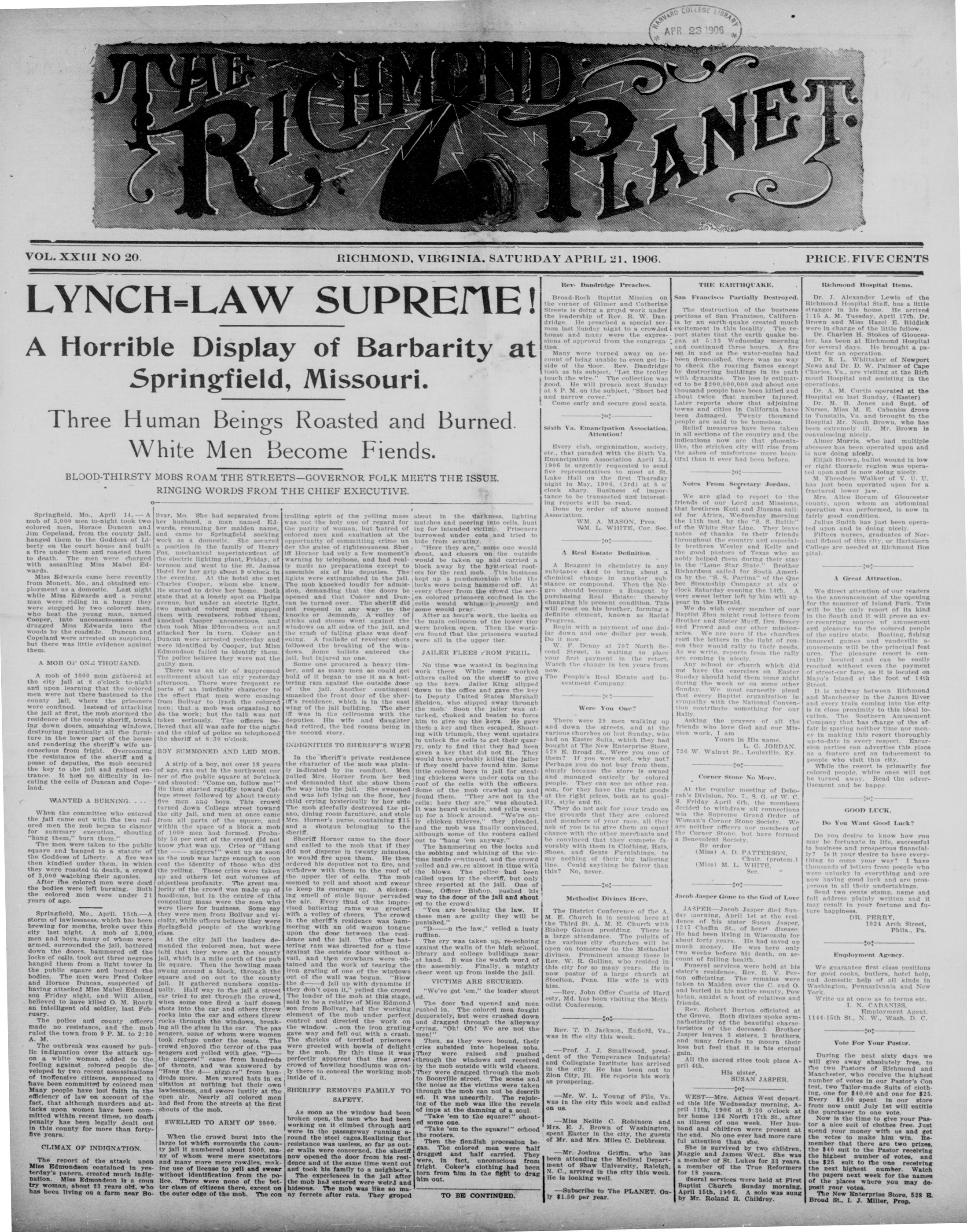
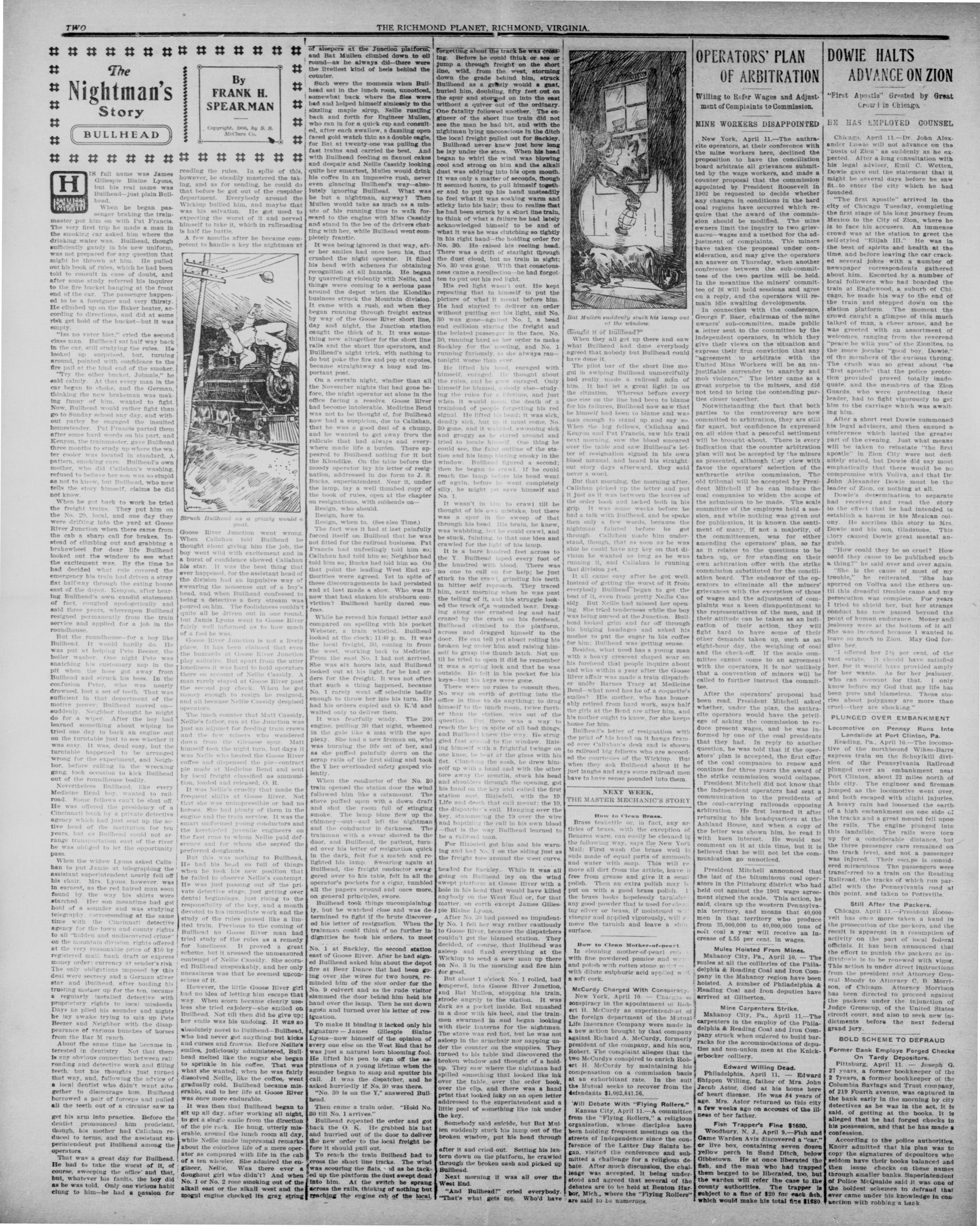
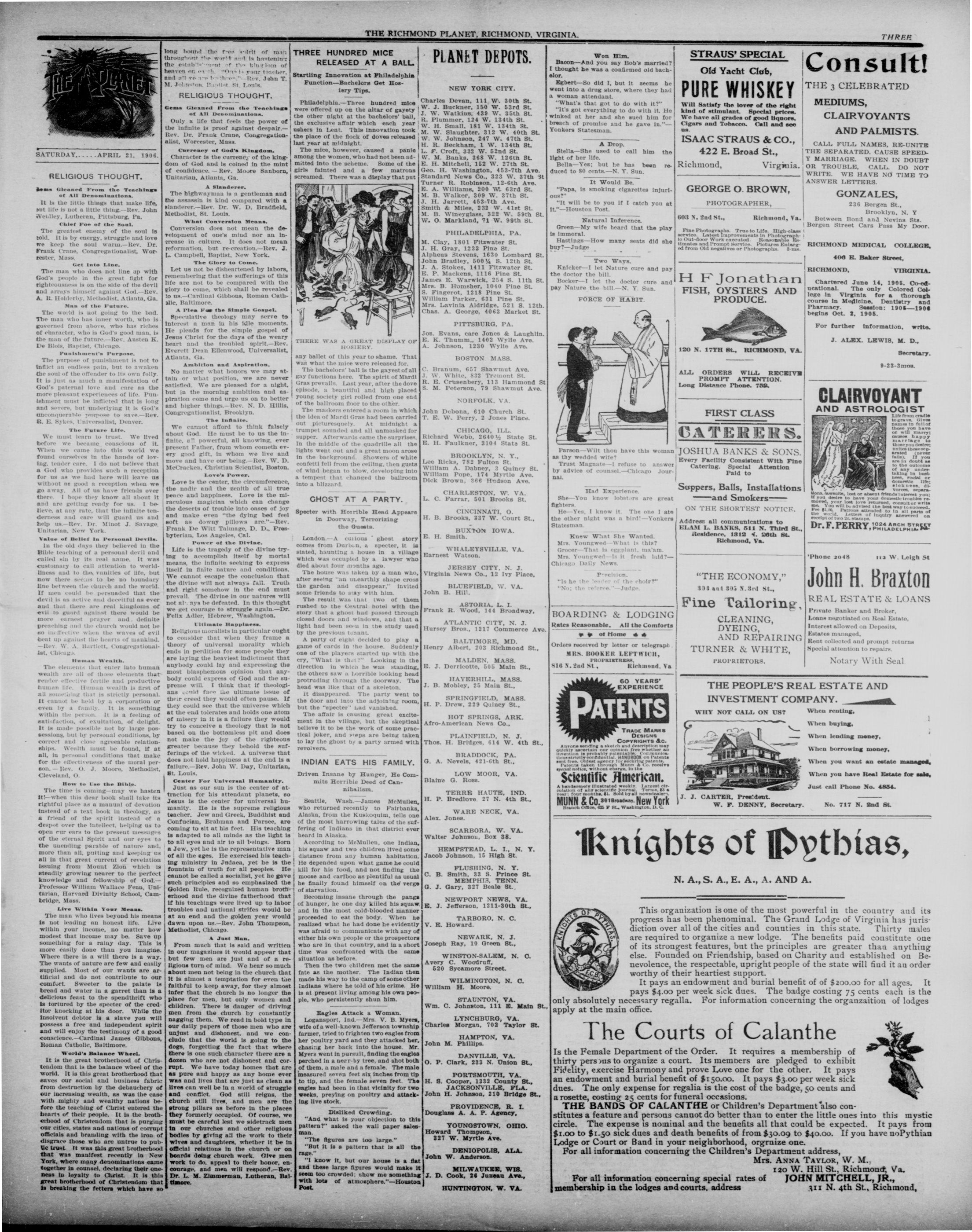
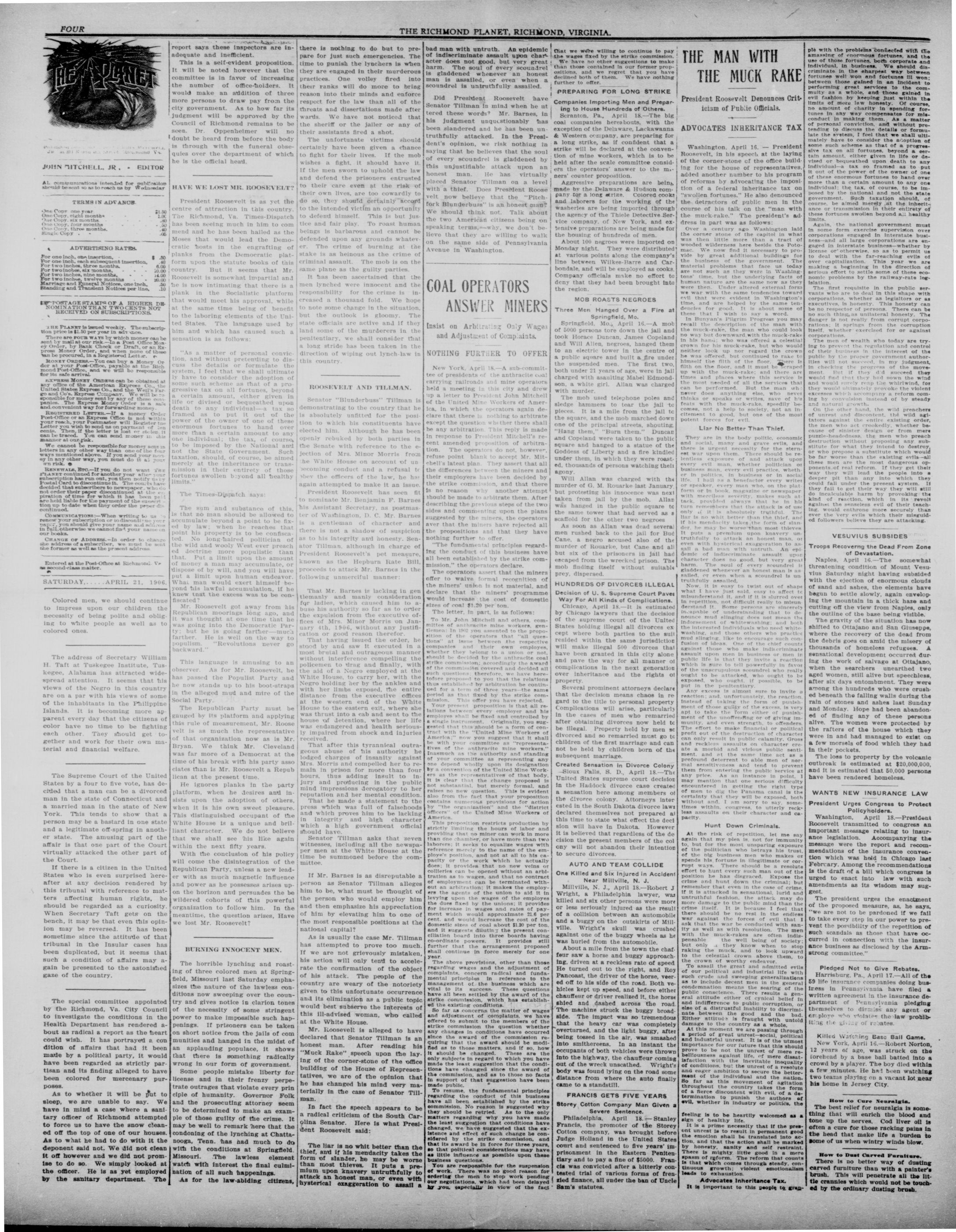
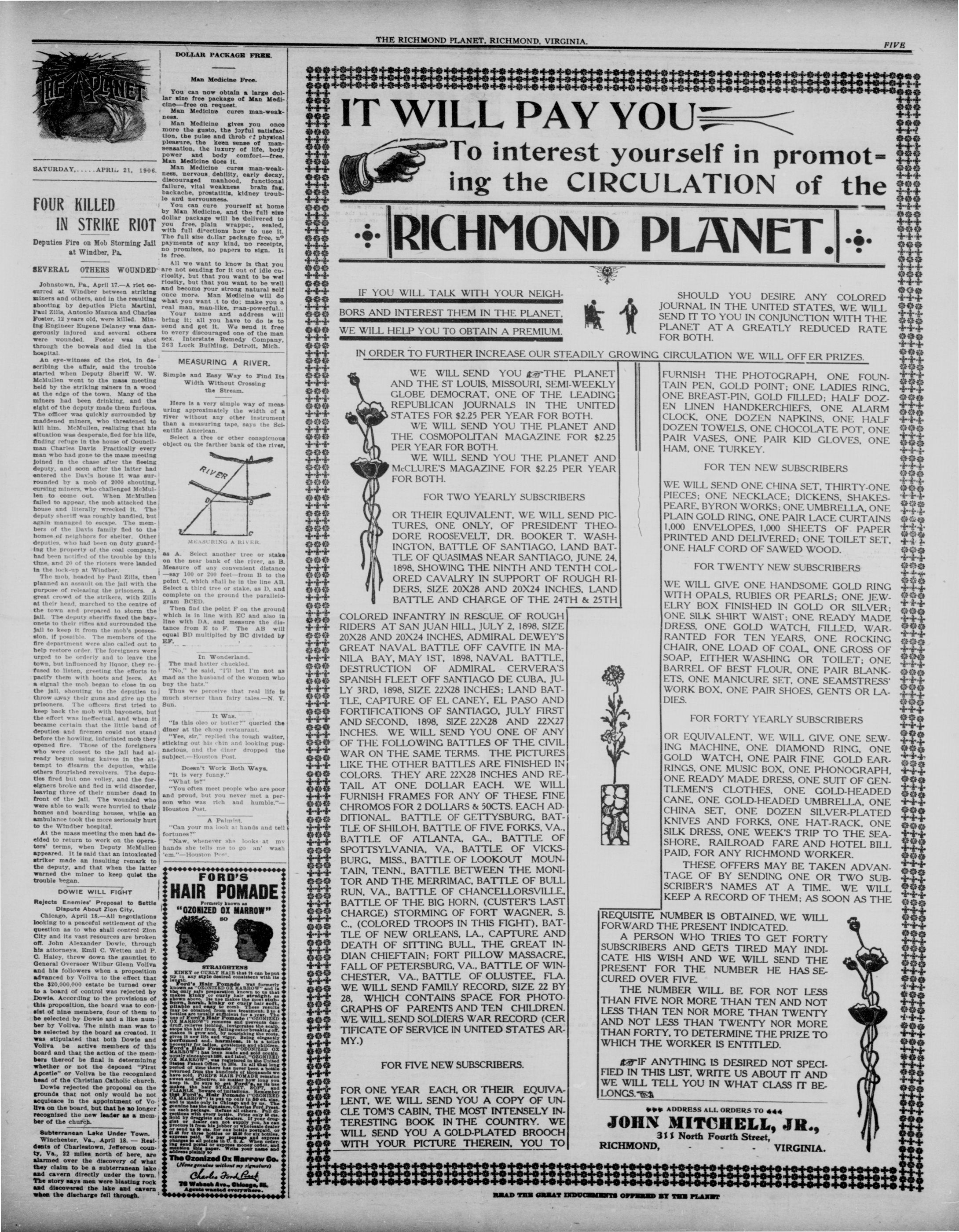
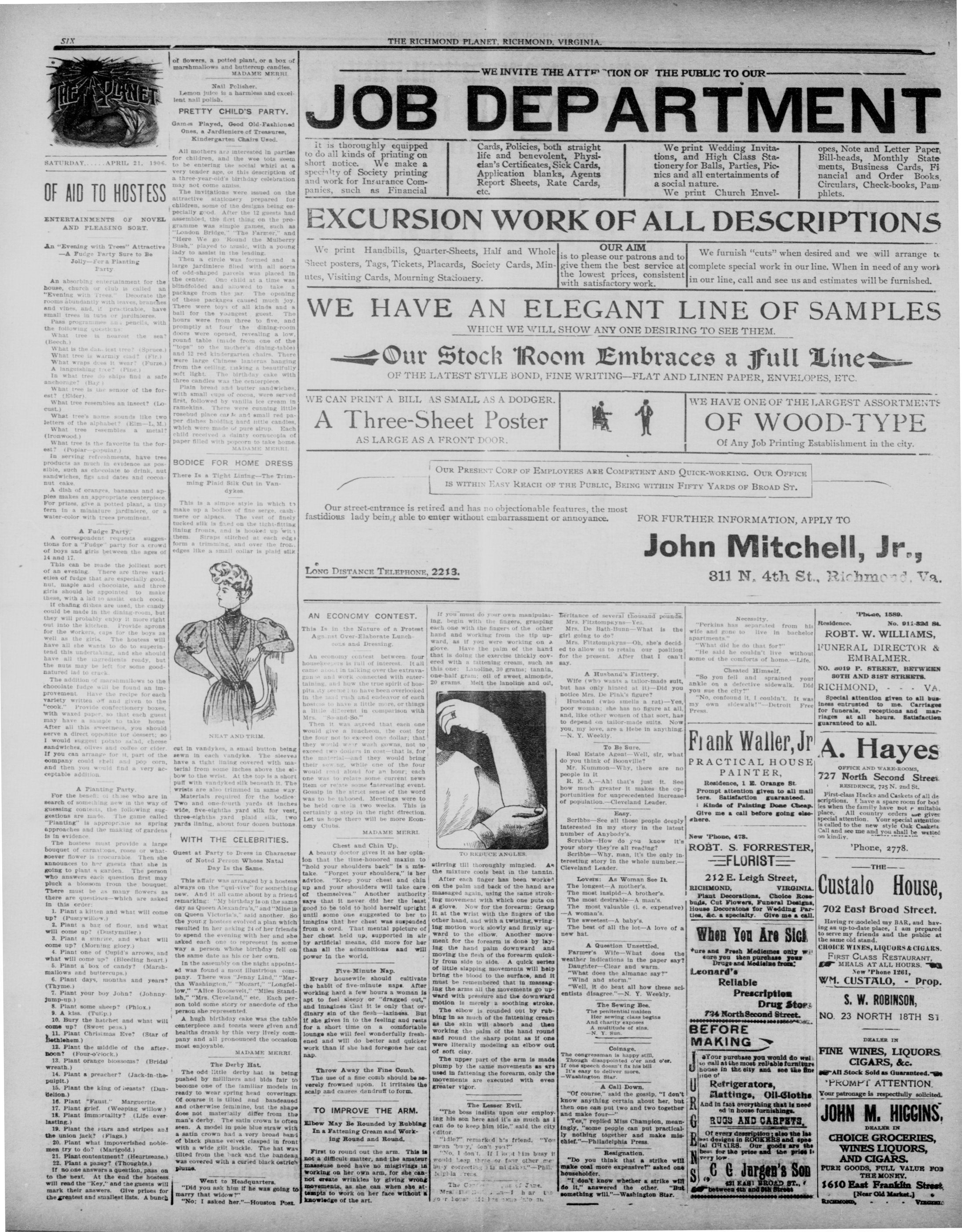
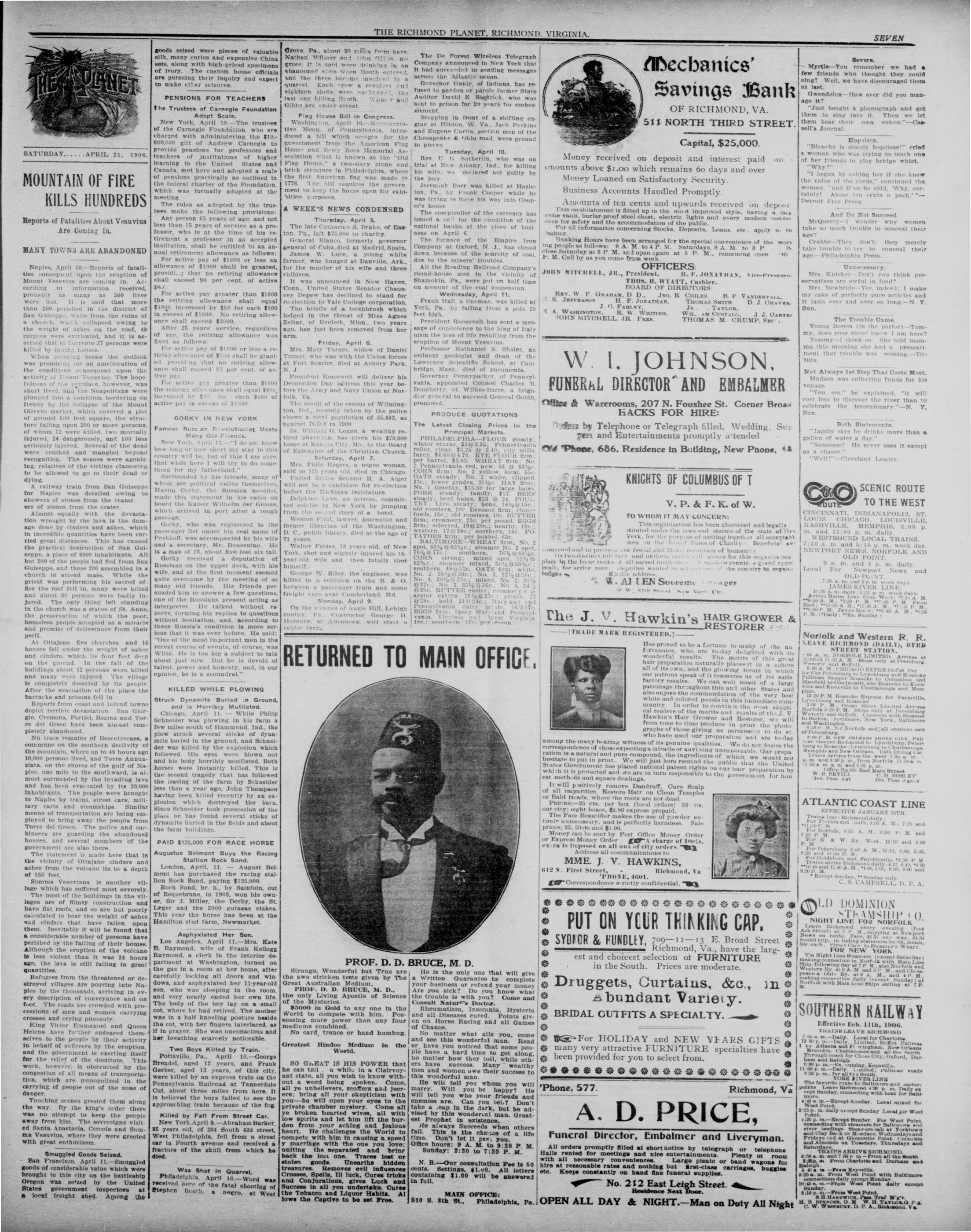
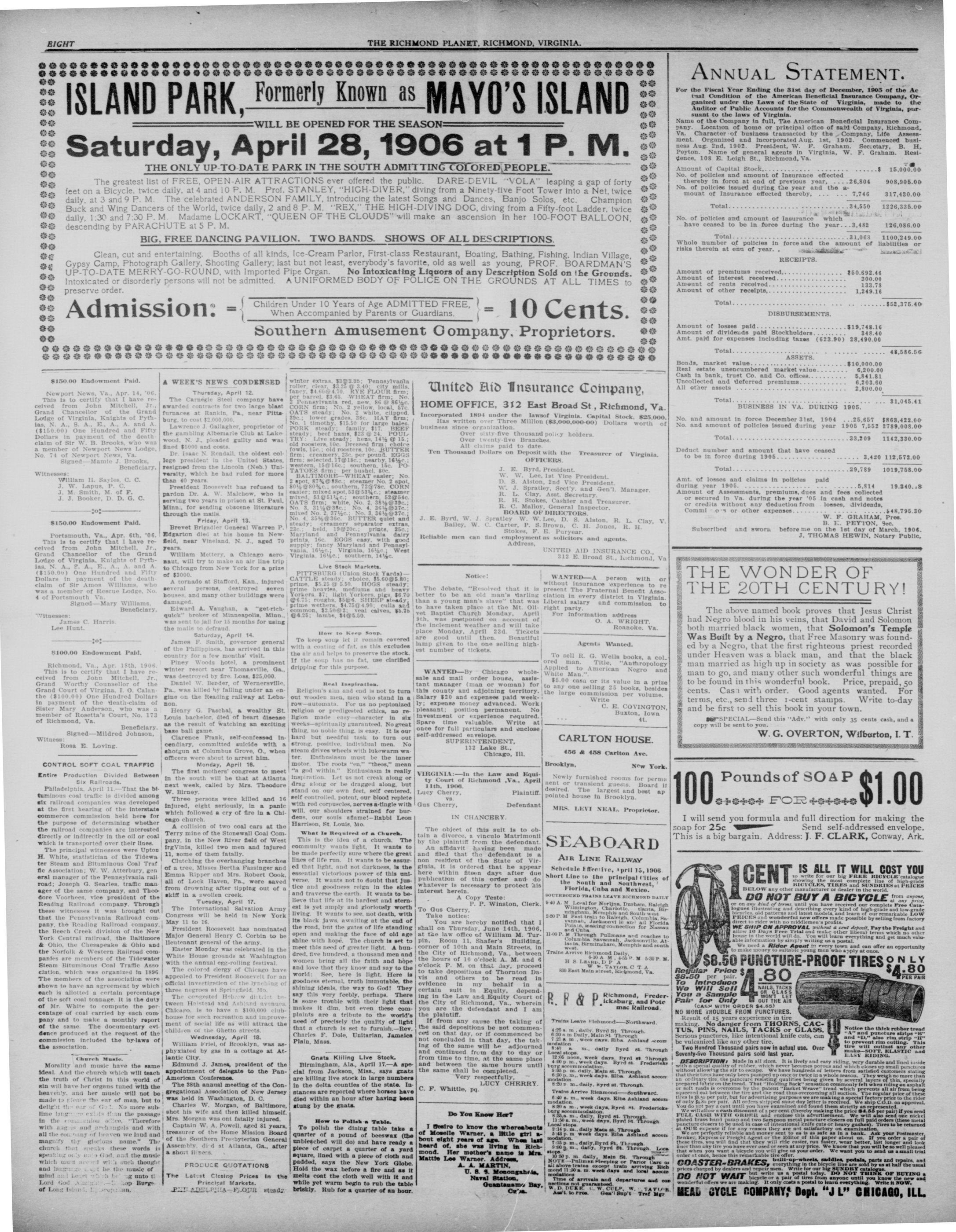
Page text (machine-generated)
THE RICHMOND PLANET
LYNCH=LAW SUPREME!
A Horrible Display of Barbarity at Springfield, Missouri.
Three Human Beings Roasted and Burned. White Men Become Fiends. BLOOD-THIRSTY MOBS ROAM THE STREETS-GOVERNOR FOLK MEETS THE ISSUE. RINGING WORDS FROM THE CHIEF EXECUTIVE.
VOL. XXIII NO 20.
LYNCH
A Horrible
Sp
Three Hu
W
BLOOD-THIRSTY
Springfield, Mo., April 14. — A mob of 3,000 men to-night took two colored men, Horace Duncan and Jim Copeland, from the county jail, hanged them to the Goddess of Liberty on the court house and built a fire under them and roasted them to death. The men were charged with assaulting Miss Mabel Edwards.
Miss Edwards came here recently from Monett, Mo., and obtained employment as a domestic. Last night while Miss Edwards and a young man were riding in a buggy they were stopped by two colored men who beat the young man, named Cooper, into unconsciousness and dragged Miss Edwards into the woods by the roadside. Duncan and Copeland were arrested on suspicion, but there was little evidence against them.
A MOB OF ON THOUSAND
A mob of 1000 men gathered at the city jail at 8 o'clock to-night and upon learning that the colored men were not there hastened to the county jail, where the prisoners were confined. Instead of attacking the jail at first, the mob stormed the residence of the county sheriff, breaking down doors, smashing windows, destroying practically all the furniture in the lower part of the house and rendering the sheriff's wife unconscious from fright. Overcoming the resistance of the sheriff and a posse of deputies, the mob secured the key to the jail and gained entrance. It had no difficulty in locating the cells of Duncan and Copeland.
WANTED A BURNING.
When the committee who entered the jail came out with the two colored men the mob began to clamor for summary execution, shouting "hang them," burn them."
The men were taken to the public square and hanged to a statute of the Goddess of Liberty. A fire was then kindled under them, in which they were roasted to death, a crowd of 3,000 watching their agonies.
After the colored men were dead the bodies were left burning. Both the colored men were under 21 years of age.
Springfield, Mo., April. 15th.—A storm of lawlessness, which has been brewing for months, broke over this city last night. A mob of 3,000 men and boys, many of whom were armed, surrounded the jail, battered down the doors, hammered off the locks of cells, took out three negroes hanged them from a light tower in the public square and burned the bodies. The men were Fred Coker and Horace Duncan, suspected of having attacked Miss Mabel Edmond son Friday night, and Will Allen, believed to have killed O. M. Roark an intelligent old soldier, last February.
The police and county officers made no resistance, and the mob ruled the town from 9 P. M. to 2:30 A. M.
The outbreak was caused by public indignation over the attack upon a white woman, added to the feeling against colored people developed by two recent assassinations of inoffensive citizens, supposed to have been committed by colored men. Many people have lost faith in the efficiency of law on account of the fact, that although murders and attacks upon women have been committed within recent times, no death penalty has been legally dealt out in this county for more than forty-five years.
CLIMAX OF INDIGNATION
The report of the attack upon Miss Edmondson contained in yesterday's papers, created much indignation. Miss Edmondson is a country woman, about 23 years old, who has been living on a farm near Bo
lvar, Mo. She had separated from her husband, a man named Edwards, resuming her malaen name, and came to Springfield seeking work as a domestic. She secured a position in the family of Henry Fox, mechanical superintendent of the electric lighting plant, Friday, afternoon and went to the St. James Hotel for her grip about 9 o'clock in the evening. At the hotel she met Charles Cooper, whom she knew, He started to drive her home. Both state that at a lonely spot on Phelps avenue, but under an electric light, two masked colored men stopped them with revolvers, robbed them, knocked Cooper unconscious, and then took Miss Edmondson out and attacked her in turn. Coker and Duncan were arrested yesterday and were identified by Cooper, but Miss Edmondson failed to identify them. The police believe they were not the guilty men.
There was an air of suppressed excitement about the city yesterday afternoon. There were frequent reports of an indefinite character to the effect that men were coming from Bollvar to lynch the colored men; that a mob was organized to do the work; but the talk was not taken seriously. The officers believed that all was safe for the night and the chief of police so telephoned the sheriff at 8:30 o'clock.
BOY SUMMONED AND LED MOB
A strip of a boy, not over 18 years of age, ran out in the northwest corner of the public square at 9o'clock and shouted: "Come on, follow me!" He then started rapidly toward College street followed by about twenty five men and boys. This crowd turned down College street toward the city jail, and men at once came from all parts of the square, and within the space of a block a mob of 1000 men had formed. Probably 50 per cent of the crowd did not know what was up. Cries of "Hang the—— niggers!" went up as soon as the mob was large enough to conceal the identity of those who dilled the yelling. These cries were taken up and others let out volumes of objectless profanity. The great majority of the crowd was made up of hoodlums, but in the centre of this congealing mass were the men who were there for business. Some say they were men from Bollvar and vicinity, while others believe they were Springfield people of the working class.
At the city jail the leaders demanded the colored men, but were told that they were at the county jail, which is a mile north of the pubic square. Then the howling mass swung around a block, through the square and on out to the county jail. It gathered numbers continually. Half way to the jail a street car tried to get through the crowd, when some one fired a half dozen shots into the car and others threw rocks into the car and others threw rocks through the windows, breaking all the glass in the car. The passengers, some of whom were women took refuge under the seats. The crowd enjoyed the terror of the passengers and yelled with glee. "D—the niggers!" came from hundreds of throats, and was answered by "Hang the d—niggers" from hundreds more. Men waved hats in exultation at nothing but their own lawlessness, and swore lustily at the open air. Nearly all colored men had fled from the streets at the first shouts of the mob.
SWELLED TO ARMY OF 3000.
When the crowd burst into the large lot which surrounds the county jail it numbered about 3000, many of whom were mere spectators and many more mere rowdies, making use of license to yell and swear without identification from the police. There were none of the better class of citizens there, except on the outer edge of the mob. The con
RICHMOND, VIRGINIA, SATURDAY APRIL 21, 1906.
trolling spirit of the yelling mass was not the holy one of regard for the purity of woman, but hatred of colored men and exultation at the opportunity of committing crime under the guise of righteousness. Sheriff Horner had only a few moment's warning by telephone, and had really made no preparations except to assemble six of his deputies. The lights were extinguished in the jail. The mob knocked loudly for admission, demanding that the doors be opened and that Coker and Duncan be turned over. The sheriff did not respond in any way to the knocks or demands. A volley of sticks and stones went against the windows on all sides of the jail, and the crash of falling glass was deafening. A fuselade of revolver shots followed the breaking of the windows. Some bullets entered the jail, but injured no one. Some one procured a heavy timber, and as many men as could hold of it began to use it as a battering ram against the outside door of the jail. Another contingent smashed the front door of the sheriff's residence, which is in the east wing of the jail building. The sheriff was in the cellrooms with the deputies. His wife and daughter had retired, the bed rooms being in the second story.
INDIGNITIES TO SHERIFF'S WIFE
In the sheriff's private residence the character of the mob was plainly indicated by its conduct. Men pulled Mrs. Horner from her bed and demanded that she show them the way into the jail. She swooned and was left lying on the floor, her child crying hysterically by her side. The mob gleefully destroyed the piano, dining room furniture, and stole Mrs. Horner's purse, containing $15 and a shotgun belonging to the sheriff.
Sheriff Horner came to the door and called to the mob that if they did not disperse in twenty minutes, he would fire upon them. He then ordered his deputies not to fire, and withdrew with them to the roof of the upper tier of cells. The mob seemed to yell and shoot and swear to keep its courage up. A sickening smell of stale liquor pervaded the air. Every thud of the improvised battering rams was greeted with a volley of cheers. The crowd in the sheriff's residence was hammering with an old wagon tongue upon the door between the residence and the jail. The other battering ram was directed for a time against the outside door without avail, and then crowbars were obtained and the work of tearing the iron grating of one of the windows out of the wall was begun. "Blow the d——d jail up with dynamite if they don't open it," yelled the crowd The leader of the mob at this stage, said to be a relative of Miss Edmond son from Bolivar, had the working element of the mob under perfect control and directed the work on the window. ooon the iron grating gave way and fell out with a crash. The shrieks of terrified prisoners were greeted with howls of delight by the mob. By this time it was perfectly apparent that the great crowd of howling hoodlums was only there to conceal the working mot inside of it.
SHERIFF REMOVES FAMILY TO
SAFETY.
As soon as the window had been broken open, the men who had been working on it climbed through and were in the passageway running around the steel cage.Realizing that resistance was useless, so far as outer walls were concerned, the sheriff now opened the door from his residence and at the same time went out and took his family to a neighbor's. The experiences in the jail after the mob had entered were weird and hideous. The mob was like so many ferrets after rats. They groped
about in the darkness, lighting matches and peering into cells, hunting for intended victim. Prisoners burrowed under cots and tried to hide from scrutiny.
"Here they are," some one would shout, and cheers on the outside would be taken up and carried a block away by the hysterical rooters for the real mob. This business kept up a pandemonium while the locks were being hammered off. At every cheer from the crowd the seven colored prisoners confined in the cells would whine piously and some would pray.
After an hour's work, the locks on the main cellroom of the lower tier were broken open. Then the workers found that the prisoners wanted were all in the upper tier.
JAILER FLEES FROM PERIL.
No time was wasted in beginning work there. While some worked others called on the sheriff to give up the keys. Jailer King slipped down to the office and gave the key to Deputy United States Marshall Shelden, who slipped away through the mob. Soon the jailer was attacked, choked and beaten to force him to give up the keys. He gave them a key and then escaped. Shouting with triumph, they went upstairs to unlock the cells to get their quarry, only to find that they had been given a key that did not fit. They would have probably killed the jailer if they could have found him. Some little colored boys in jail for stealing chickens were under cots on the roof of the cells with the officers. Some of the mob crawled up and found them. "They are not in the cells; here they are," was shouted. It was heard outside, and yells went up for a block around. "We're only chicken thieves," they pleaded, and the mob was finally convinced, although some of the rooters called out to "hang 'em anyway."
The hammering on the locks and the sobbing and whining of the victims inside continued, and the crowd yelled and swore almost in time with the blows. The police had been called upon by the sheriff, but only three reported at the jail. One of these, Officer Bishop, pushed his way to the door of the jail and shouted to the crowd:
"You are breaking the law. If these men are guilty they will be punished."
"D——n the law," velled a lusty ruffian.
The cry was taken up, re-echoing against the walls of the high school, library and college buildings near at hand. It was the watch word of the assembly. Finally, a mighty cheer went up from inside the fall.
VICTIMS ARE SECURED.
"We've got 'em," the leader shouted.
The door had opened and men rushed in. The colored men fought desperately, but were crushed down and dragged through the alleyway crying, "Oh! Oh! We are not the men!"
Then, as they were bound, their cries subsided into hopeless sobs. They were raised and pushed through the windows and received by the mob outside with wild cheers. They were dragged through the mob to Boonville street. The scene and the noise as the victims were taken through the mob can not be described. It was unearthly. The rejoicing of the mob was like the revels of impes at the damning of a soul.
"Take 'em to the square!" shouted one.
"Take 'em to the square!" echoed the rooters.
Then the fliendish procession began. The colored men were half dragged and half carried. They were, in fact, unconscious from fright. Coker's clothing had been torn from him in the fight to drag him out.
TO BE CONTINUED.
Rev. Dandridge Preaches
Broad-Rock Baptist Mission on the corner of Gilmer and Catherine Streets is doing a grand work under the leadership of Rev. R. W. Dandridge. He preached a special sermon last Sunday nigat to a crowded house and many were the expressions of approval from the congregation.
Many were turned away on account of being unable to even get inside of the door. Rev. Dandridge took as his subject, "Let the trolley touch the wire." The collection was good. He will preach next Sunday at 8 P. M. on the subject, "Short bed and narrow cover."
Come early and secure good seats.
Sixth Va. Emancipation Association Attention!
Every club, organization, society, etc., that paraded with the Sixth Va. Emancipation Association April 31, 1906 is urgently requested to send five representatives to meet at St. Luke Hall on the first Thursday night in May, 1906, (3rd) at 8 o'clock sharp. Business of importance to be transacted and interesting reports will be read.
Done by order of above named Association.
WM. A. MASON, Pres.
WM. L. WHITE, Cor. Sec.
A Real Estate Definition
A Reagent in chemistry is any substance used to bring about a chemical change in another substance or compound. Then the Negro should become a Reagent by purchasing Real Estate; thereby changing his present condition. This will react on his brother, forming a definite element, known as Racial Progress.
Begin with a payment of one dollar down and one dollar per week. Do it now.
W. F. Denny at 707 North Second Street, is waiting to place your first payment in the retort. Watch the change in ten years from now.
The People's Real Estate and Investment Company.
Were You One?
There were 39 men walking up and down the streets, and at the various churches on last Sunday, who had on Easter Suits, which they had bought at The New Enterprise Store, 528 E. Broad St., Were you one of them? If you were not, why not? Perhaps you do not buy from them, simply because the store is owned and managed entirely by colored people. They can see no other reason, for they have the right goods at the right prices, both as to quality, style and fit. They do not ask for your trade on the grounds that they are colored and members of your race, all they ask of you is to give them an equal chance with the other merchants and be convinced that they compete favorably with them in Clothing, Hats, Shoes, and Gents Furnishings, to say nothing of their big tailoring line. Could anything be fairer than this? No, never.
Methodist Divines Here.
The District Conference of the A. M. E. Church is in session here at the Third St. A. M. E. Church with Bishop Gaines presiding. There is a large attendance. The pulpits of the various city churches will be open on tomorrow to the Methodist divines. Prominent among these is Rev. W. R. Gullins, who resided in this city for so many years. He is now pastor of a large church at Steelton, Penn. His wife is with him.
—Rev. John Offer Custis of Hardesty, Md. has been visiting the Methodist Conference.
Rev. T. D. Jackson, Enfield, Va., was in the city this week.
—Prof. J. J. Smallwood, president of the Temperance Industrial and Collegiate Institute has arrived in the city. He has been out to Zion City, Ill. He reports his work as prospering.
—Mr. W. L. Young of File, Va. was in the city this week and called on us.
—Miss Nellie C. Robinson and Mrs. E. J. Brown of Washington, spent Easter in the city, the guests of Mr. and Mrs. Miles C. Debbress.
—Mr. Joshua Griffin, who has been attending the Medical Department of Shaw University, Raleigh, N. C., arrived in the city this week. He is looking well.
—Subscribe to The PLANET. Only $1.50 per year.
THE EARTHQUAKE.
San Francisco Partially Destroyed.
The destruction of the business portions of San Francisco, California by an earth-quake created much excitement in this locality. The report states that the earth quake began at 5:13 Wednesday morning and continued three hours. A fire set in and as the water-mains had been demolished, there was no way to check the roaring flames except by destroying buildings in its path with dynamite. The loss is estimated to be $200,000,000 and about one thousand people have been killed and about twice that number injured. Later reports show that adjoining towns and cities in California have been damaged. Twenty thousand people are said to be homeless. Relief measures have been taken in all sections of the country and the indications now are that phoenix-like, the stricken city will rise from the ashes of misfortune more beautiful than it ever had been before.
Notes From Secretary Jordan.
We are glad to report to the friends of our Lord and Mission, that brethren Koti and Jiusana sailed for Africa, Wednesday morning the 11th inst. by the "S. S. Baltic" of the White Star Line. They leave notes of thanks to their friends throughout the country and especially brethren Wesley and Kelly and the good pastors of Texas who so nobly helped them during their stay in the "Lone Star State." Brother Richardson said for South America by the "S. S. Parima" of the Quebec Steamship Company at six o'clock Saturday evening the 14th. A very sweet letter left by him will appear in the Herald.
We do wish every member of our Baptist Zion might read letters from Brother and Sister Murff, Drs. Bouey and Prowd and our other missionaries. We are sure if the churches read the letters in the light of reason they would rally to their needs. As we write, reports from the rally are coming in nicely.
Any school or church which did not have the exercises on Easter Sunday should hold them some night during the week or on some other Sunday. We most earnestly plead that every Baptist organization in sympathy with the National Convention contribute something for our Rally.
Asking the prayers of all the friends who love God and our Mission work, I am
Yours in His name,
L. G. JORDAN.
726 W. Walnut St., Louisville, Ky.
Corner Stone No More.
At the regular meeting of Deborah's Division, No. 7, S. G. of W. C. S. Friday April 6th, the members decided to withdraw all connections win the Supreme Grand Order of Woman's Corner Stone Society. We are neither officers nor members of the Corner Stone, but have formed a Benevolent Society.
By order
(Miss) A. D. PATTERSON,
Chair. (protem.)
(Miss) M. L. WHITE,
Sec. "
Jacob Jasper Gone to the God of Love
JASPER—Jacob Jasper died Sunday morning, April 1st at the residence of his sister Susan Jasper, 1217 Chaffin St., of heart disease. He had been living in Wisconsin for about forty years. He had saved up much money. He was here only two weeks before his death, on account of failing health.
Funeral services were held at his sister's residence. Rev. R. V. Peyton officiating. The remains were taken to Malden over the C. and O. and buried in his native county. Pow hatan, amidst a host of relatives and friends.
Rev. Robert Burton officiated at the Grove. Both divines spoke sympathetically of the beautiful characteristics of the deceased. Brother Jasper leaves 3 sisters, 2 brothers, and many friends to mourn their loss but feel that it is his eternal gain.
All the sacred rites took place April 4th.
WEST—Mrs. Agnes West departed this life Wednesday morning. April 11th, 1906 at 9:30 o'clock at her home 126 North 17th St., after an illness of one week. Her husband and children were present at the end. No one ever had more careful attention than she. She is survived by two children, Maggie and James West. She was a member of St. Lukes for 32 years. a member of the True Reformers for 18 years.
Uneral services were held at First Baptist Church Sunday morning, April 15th, 1906. A solo was sung by Mr. Roland R. Childrey.
PRICE.FIVE CENTS
Richmond Hospital Items.
Dr. J. Alexander Lewis of the Richmond Hospital Staff, has a little stranger in his home. He arrived 7:15 A. M. Tuesday, April 17th. Dr. Brown and Miss Hazel E. Riddick were in charge of the little fellow. Dr. Charles H. Stokes of Gloucester, has been at Richmond Hospital for several days. He brought a patient for an operation. Dr. R. L. Whittaker of Newport News and Dr. D. W. Palmer of Cape Charles, Va., are visiting at the Richmond Hospital and assisting in the operations. Dr. A. M. Curtis operated at the Hospital on last Sunday, (Easter) Dr. M. B. Jones and Supt. of Nurses, Miss M. E. Cabanis drove to Tunstall, Va. and brought to the Hospital Mr. Noah Brown, who has been extremely ill. Mr. Brown is convalescing nicely. Almer Morris, who and multiple abcesses has been operated upon and is now doing nicely. Ellijah Brown, bullet wound in low er right thoracic region was operated upon and is now doing nicely. M. Theodore Walker of V. U. U, has just been operated upon for a fractured lower jaw. Mrs. Alice Borum of Gloucester county, upon whom an abdominal operation was performed, is now in fairly good condition. Julius Smith has just been operated upon and is doing nicely. Fifteen nurses, graduates of Normal School of this city, or Hartsaorn College are needed at Richmond Hospital.
A Great Attraction.
We direct attention of our readers to the announcement of the opening for the summer of Island Park. Tails will be the only resort of its kind in the South and it will prove an ever-recurring source of amusement and pleasure to the colored people of the entire state. Boating, fishing innocent games and vaudeville amusements will be the principal features. The pleasure resort is centrally located and can be easily reached without even the payment of street-car fare, as it is located on Mayo's Island at the foot of 14th Street.
It is midway between Richmond and Manchester in the James River and every train coming into the city is in close proximity to this ideal location. The Southern Amusement Company that has charge of the affair is sparing neither time nor money in making this resort thoroughly up-to-date in every respect. Excursion parties can advertise this place as a feature and an inducement to people who visit this city.
While the resort is primarily for colored people, white ones will not be turned away. Read the advertisement and be happy.
GOOD LUCK.
Do You Want Good Luck?
Do you desire to know how you may be fortunate in life, successful in business and prosperous financially? Is it your desire to have everything to come your way? I have thousands of letters from people who were unlucky in everything and are now having good luck and are prosperous in all their undertakings. Send two cents stamp, name and full address plainly written and it may result in your fortune and future happiness.
DR. PERRY,
1024 Arch Street,
Phila., Pa.
Employment Agency
We guarantee first class positions for good cooks, helpers, hotel help, and domestic help of all kinds in Washington, Pennsylvania and New York.
Write us at once as to terms etc.
I. N. CABANISS,
Employment Agent.
1144-15th St., N. W., Wash. D. C.
Vote For Your Pastor.
During the next sixty days we will give away absolutely free, to the two Pastors of Richmond and Manchester, who receive the highest number of votes in our Pastor's Contest, two Tailor-made Suits of clothing, one for $40.00 and one for $25. Every $1.00 spent in our store from now until July 1st will entitle the purchaser to one vote.
Now is the time to give your Pastor a nice suit of clothes free. Just spend your money with us and get the votes to make him win. Remember that there are two prizes, the $40 suit to the Pastor receiving the highest number of votes, and the $25 suit to the one receiving the next highest number. Watch the papers next week for the names of the places where you may deposit your votes.
The New Enterprise Store, 528 E Broad St., I. J. Miller, Prop.
TWO
S full name was James
Gillespie Blaine Lyons,
but his real name was
Bullhead—just plain Bullhead.
H
When he began passenger braking the train
master put him on with Pat Francis. The very first trip he made a man in the smoking, car asked him where the drinking water was. Bullhead, though sufficiently gaudy in his new uniform, was not prepared for any question that might he thrown at him. He pulled out his book of rules, which he had been told to consult in case of doubt, and after some study referred his inquirer to the fire bucket hanging at the front end of the car. The passenger happened to be a foreigner and very thirsty. He climbed up on the Baker heater, according to directions, and did at some risk get hold of the bucket—but it was empty.
"Iss no vater hier," cried the second class man. Bullhead sat half way back in the car, still studying the rules. He looked up surprised, but, turning around, pointed with confidence to the fire pail at the hind end of the smoker. "Try the other bucket, Johnnle," he said calmly. At that every man in the car began to choke, and the German, thinking the new brake-man was making funny of him, wanted to fight. Now, Bullhead would rather fight than go to Sunday school any day, and without parley he engaged the insulted homesteader. Pat Francs parted them after some hard words on his part, and Kenyon, the trainmaster, gave Bullhead three months to study up where the water cooler was located in standard. A pattern, smoking cars. Bullhead's own mother, who did Callahann's washing, refused to believe her son was so stupid as not to know, but Bullhead, who now tells the story himself, claims he did not know.
When he got back to work he tried the freight trains. They put him on the No. 29, local, and one day they were drifting into the yard at Goose River Junction when there came from the cab a sharp call for brakes. Instead of climbing out and grabbing a brakewheel for dear life Bullhead looked out the window to see what the excitement was. By the time he had decided what rule covered the emergency his train had driven a stray flat halfway through the eating house east of the depot. Keayon, after hearing Bullhead's own candid statement of fact, coughed apologetically and said three years, whereupon Bullhead resigned permanently from the train service and applied for a job in the roundhouse.
But the roundhouse--for a boy like Bullhead. It would hardly do. He was put at helping Pete Beezer, the boiler washer. One night Pete was snatching his customary nap in the pit when the hose got away from Bullhead and struck his boss. In the confusion Peter, who was nearly drowned, lost a set of teeth. That was sufficient in that department of the motive power; Bullhead moved on--suddenly. Neighbor thought he might do for a wiper. After the boy had learned something about wiping he tried one day to back an engine out on the turntable just to see whether it was easy. It was, dead easy, but the turntable happened to be arranged wrong for the experiment, and Neighbor, before calling in the wrecking gang, took occasion to kick Bullhead out of the roundhouse bodily.
Nevertheless Bullhead, like every Medicine Bend boy, wanted to railroad. Some fellows can't be shut off. He was offered the presidency of a Cincinnati bank by a private detective agency which had just sent up the active head of the institution for ten years, but as Bullhead could not arrange transportation east of the river he was obliged to let the opportunity pass.
When the widow Lyons asked Callahan to put Jamie at telegraphing the assistant superintendent nearly fell off his chair. Mrs. Lyons, however, was in earnest, as the red hairied man soon found by the way his shirts were starched. Her son meantime had got hold of a sounder and was studying telegraphy, corresponding at the same time with the Cincinnati detective agency for the town and county rights to all "hidden and undiscovered crime" on the mountain division rights offered at the very reasonable price of $10 by registered mail, bank draft or express money order; currency at sender's risk. The only obligations imposed by this deal were secrecy and a German silver star and Bullhead after holding his trusting mother up for the ten, became a regularly installed detective with proprietary rights to local misdeeds. Days he piled his sounder and nights he lay awake trying to mix up Pete Beezer and Neighbor with the disappearance of various bunches of horses from the Bar M ranch.
About the same time he became interested in dentistry. Not that there is any obvious connection between railroading and detective work and filling teeth, but his thoughts just turned that way, and, following the advice of a local dentist who didn't want altogether to discourage him, Bullhead borrowed a pair of forceps and pulled all the teeth out of a circular saw to get his arm into practice. Before the dentist pronounced him proficient, though, his mother had Callahan reduced to terms, and the assistant superintendent put Bullhead among the operators.
That was a great day for Bullhead. He had to take the worst of it, of course, sweeping the office and that, but, whatever his faults, the boy did as he was told. Only one vicious habit clung to him—he had a passion for
By
FRANK H.
SPEARMAN
Copyright, 1800, by S. S.
McClure Co.
reading the rules. In spite of this, however, he steadily mastered the taking, and as for sending, he could do that before he got out of the cuspidor department. Everybody around the Wicklup bullied him, and maybe that was his salvation. He got used to expecting the worst of it and nerved himself to take it, which in raftroading is half the battle.
A few months after he became competent to handle a key the nightman at
JAMES H.
Struck Bullhead as a grizzly would a gnat.
Goose River Junction went wrong.
When Callahan told Bullhead he thought about giving him the job, the boy went wild with excitement and in a burst of confidence showed Callahan his star. It was the best thing that ever happened, for the assistant head of the division had an impulsive way of swearing the nonsense out of a boy's head, and when Bullhead confessed to being a detective a fiery stream was poured on him. The foolishness couldn't quite all be driven out in one round, but Jamie Lyons went to Goose River fairly well informed as to how much of a fool he was.
Goose River Junction is not a lively place. It has been claimed that even the buzzards at Goose River Junction play solitaire. But apart from the utter loneliness it was hard to hold operators there on account of Nellie Cassidy. A man rarely stayed at Goose River past the second pay check. When he got money enough to resign he resigned, and all because Nellie Cassidy despised operators.
The lunch counter that Matt Cassidy, Nellie's father, ran at the Junction was just an adjunct for feeding train crews and the few miners who wandered down from the Glencoe spur. Matt himself took the night turn, but days it was Nellie who heated the Goose River coffee and dispensed the pie—contract pie made at Medicine Bend and sent by local freight classified as ammunition, loaded and released. O. R.
It was Nellie's cruelty that made the frequent shifts at Goose River. Not that she was unimpressible or had no heroes. She had plenty of them in the engine and the train service. It was the smart uniformed young conductors and the kerchiefed juvenile engineers on the fast runs to whom Nellie paid deference and for whom she served the preferred doughnuts.
But this was nothing to Bullhead. He had his head so full of things when he took his new position that he failed to observe Nellie's contempt. He was just passing out of the private detective stage, just getting over dental beginnings, just rising to the responsibility of the key, and a month devoted to his immediate work and the study of the rules passed like a limited train. Previous to the coming of Bullhead no Goose River man had tried study of the rules as a remedy for loneliness. It proved a great scheme but it aroused the unmeasured contempt of Nellie Cassidy. She scorned Bullhead unspeakably, and her only uneasiness was that he seemed unconscious of it.
However, the little Goose River girl had no idea of letting him escape that way. When scorn became clearly useless she tried caplery—she smiled on Bullhead. Not till then did he give up; her smile was his undoing. It was so absolutely novel to Bullhead—Bullhead, who had never got anything but kicks and curses and frowns. Before Nellie's smiles, judiciously administered, Bullhead melted like the sugar she began to sprinkle in his coffee. That was what she wanted; when he was fairly dissolved Nellie, like the coffee, went gradually cold. Bullhead became miserable, and to her life at Goose River was once more endurable.
It was then that Bullhead began to sit up all day, after working all night, to get a single smile from the direction of the pie rack. He hung, utterly miserable, around the lunch room all day, while Nellie made impersonal remarks about the colorless life of a mere operator as compared with life in the cab of a ten wheeler. She admired the engineer, Nellie. Was there ever a doughnut girl who didn't? And when No. 1 or No. 2 rose smoking out of the alkali east or the alkali west and the mogul engine checked its gray string
THE RICHMOND PLANET, RICHMOND, VIRGINIA.
of sleepers at the Junction platform, and Bat Mullen climbed down to oil round--as he always did--there were the liveliest kind of heels behind the counter.
Such were the moments when Bullhead sat in the lunch room, unnoticed, somewhat back where the flies were bad and helped himself amicably to the sizzling maple skrup, Nellie rustling back and forth for Engineer Mullen, who ran in for a quick cup and consulted, after each swallow, a dazzling open faced gold watch thin as a double eagle, for Bat at twenty-one was pulling the fast trains and carried the best. And with Bullhead feeding on channel cakes and despair and Nellie Cassidy looking quite her smartest, Mullen would drink his coffee in an impressive rush, never even glancing Bullhead's way—absolutely ignoring Bullhead. What was he but a nightman, anyway? Then Mullen would take as much as a minute of his running time to walk forward to the engine with Miss Cassidy and stand in the lee of the drivers chatting with her, while Bullhead went completely frantic.
It was being ignored in that way, after her smiles had once been his, that crushed the night operator. It filled his head with schemes for obtaining recognition at all hazards. He began by quarrelling violently with Nellie, and things were coming to a serious pass around the depot when the Klondike business struck the Mountain division. It came with a rush, and when they began running through freight extras by way of the Goose River short line, day and night, the Junction station caught the thick of it. It was something new altogether for the short line rails and the short line operators, and Bullhead's night trick, with nothing to do but扑oke the fire and pop at coyotes, became straightway a busy and important post.
On a certain night, windier than all the November nights that had gone before, the night operator sat alone in the office facing a resolve. Goose River had become intolerable. Medicine Bend was not to be thought of, for Bullhead now had a suspicion, due to Callahan, that he was a good deal of a chump, and he wanted to get away from the ridicule that had always and everywhere made life a burden. There appeared to Bullhead nothing for it but the Klondike. On the table before the moody operator lay his letter of resignation, addressed in due form to J. S. Bucks, superintendent. Near it, under the lamp, lay a well thumbed copy of the book of rules, open at the chapter on resignations, with subheads on—Resign, who should.
Resign, how to.
Resign, when to. (See also Time.)
The fact was it had at last painfully forced itself on Bullhead that he was not fitted for the railroad business. Pat Francis had unfeelingly told him so; Callahan had told him so; Neighbor had told him so; Bucks had told him so. On that point the leading West End authorities were agreed. Yet in spite of these discouragements he had persisted and at last made a show. Who was it now that had shaken his stubborn conviction? Bullhead hardly dared confess.
While he reread his formal letter and compared on spelling with his pocket Webster, a train whistled. Bullhead looked at the clock; 11:40 p. m. It was the local freight, 30, coming in from the west, working back to Medicine. From the east No. 1 had not arrived. She was six hours late, and Bullhead looked out at his light, for he had orders for the freight. It was not often that such a thing happened, because No. 1 rarely went off schedule badly enough to throw her into his turn. He had his orders copied and O. K'd and waited only to deliver them.
It was fearfully windy. The 260 engine, pulling 30 that night, wheezed in the gale like a man with the apoplexy. She had a fireman on, who was burning the life out of her, and as she puffed painfully down on the scrap rails of the first siding and took the Y her overloaded safety gasped violently.
When the conductor of the No. 30 train opened the station door the wind followed him like a catamount. The stove puffed open with a down draft and shot the room full of stinging smoke. The lamp blaze flew up the chimney—out—and left the nightman and the conductor in darkness. The trainman with a swear shoved to the door, and Bullhead, the patient, turned over his letter of resignation quick in the dark, felt for a match and relied his lamp. Swearing again at Bullhead, the freight conductor swaggered over to his table, felt in all the operator's pockets for a cigar, tumbled all the papers around and once more, on general principles, swore. Bullhead took things uncomplainingly, but he watched close and was determined to fight if the brute discovered his letter of resignation. When the trainman could think of no further indignities he took his orders, to meet
No. 1 at Sackley, the second station east of Goose River. After he had signed Bullhead asked him about the depot fire at Bear Dance that had been going over the wires for two hours, reminded him of the slow order for the No. 9 culvert and as the rude visitor slammed the door behind him held his hand over the lamp. Then he sat down again and turned over his letter of resignation.
To make it binding it lacked only his signature — James Gillespie Blaine Lyons—now himself of the opinion of every one on the West End that he was just a natural born blooming fool. He lifted his pen to sign off the aspirations of a young lifetime when the sounder began to snap and sputter his call. It was the dispatcher, and he asked hurriedly if No. 30 was there.
"No. 30 is on the Y," answered Bullhead.
Then came a train order, "Hold No. 30 till No. 1 arrives."
Bullhead repeated the order and got back the O. K. He grabbed his hat and hurried out of the door to deliver the new order to the local freight before it should pull out.
To reach the train Bullhead had to cross the short line tracks. The wind was scouring the flats, and as he tacked up the platform the dust swept dead into him. At the switch he sprang across the rails, thinking of nothing but reaching the engine cab of the local.
forgetting about the track he was crossing. Before he could think or see or jump a through freight on the short line, wild, from the west, storming down the grade behind him, struck Bullhead as a grizzly would a gnat, hurled him, doubling, fifty feet out on the spur and stormed on into the east without a quiver out of the ordinary. One fatality followed another. The engineer of the short line train did not see the man he had hit, and with the nightman lying unconscious in the ditch the local freight pulled out for Buckley.
Bullhead never knew just how long he lay under the stars. When his head began to whirl the wind was blowing cool and strong on him and the alkali dust was eddying into his open mouth. It was only a matter of seconds, though it seemed hours, to pull himself together and to put up his hand unsteadily to feel what it was soaking warm and sticky into his hair; then to realize that he had been struck by a short line train, to think of what a failure he had later acknowledged himself to be and of what it was he was clutching so tightly in his right hand—the holding order for No. 30. He raised his reeling head. There was a drift of starlight through the dust cloud, but no train in sight; No. 30 was gone. With that consciousness came a recollection—he had forgotten to put out his red light.
His red light wasn't out. He kept repeating that to himself to put the picture of what it meant before him. He had started to deliver an order without putting out his light, and No. 30 was gone—against No. 1, a head end collision staring the freight and the belated passenger in the face. No. 30, running hard on her order to make Sackley for the meeting, and No. 1 running furiously, as she always ran—tonight worse than ever.
He lifted his head, enraged with himself, erased. He thought about the rules, and he grew enraged. Only himself he blamed, nobody else—studying the rules for a lifetime, and just when it would mean the death of a trainload of people forgetting his red signal. He lifted his head; it was sick, deadly sick, but up it must come, No 30 gone, and it wobbled, swooning sick and groggy as he stared around and tried to locate himself. One thing he could see, the faint outline of the station and his lamp blazing smoky in the window. Bulbhead figured a second; then he began to crawl. If he could reach the lamp before his head went off again, before he went completely silly, he might get save himself and No. 1.
It wasn't in him to crawl till he thought of his own mistake, but there was a spur in the sweep of that through his head. His brain, he knew, was wabbling, but he could crawl, and he stuck, fainting, to that one idea and crawled for the light of his lamp.
It is a bare hundred feet across to the Y. Bullhead taped every foot of the hundred with blood. There was no one to call on for help; he just stuck to the crawl, grinding his teeth in bitter self reproach. They traced him, next morning when he was past the telling of it, and his struggle looked the track of a wounded bear. Dragging along one crushed leg and half crazed by the crack on his forehead, Bullhead climbed to the platform, across and dragged himself to the door. He can tell yet about rolling his broken leg under him and raising himself to grasp the thumb latch. Not until he tried to open it did he remember it was a spring lock and that he was outside. He felt in his pocket for his keys—but his keys were gone.
There were no rules to consult then. No way on earth of getting into the office in time to do anything; to drag himself to the lunch room, twice further than the station, was out of the question. But there was a way to reach the key in spite of all bad things, and Bullhead knew the way. He strugged fast around to the window. Raising himself with a frightful tinge on one knee, he beat at the glass with his fist. Clutching the sash, he drew himself up with a hand and with the other tore away the muntin, stuck his head and shoulders through the opening, got his hand on the key and called the first station east. Bullhead, with the 19. Life and death that call meant; the 19. the dispatcher's call. Hanging over the key, stammering the 19 over the wire and baptizing the call in his own blood—that is the way Bullhead learned to be a railroad man.
For Blairdsey got him and his warning and had No. 1 on the siding just as the freight tore around the west curve, headed for Saackley. While it was all going on Bullhead lay on the wind swept platform at Goose River with a hole in his head that would have killed anybody on the West End or, for that matter, on earth except James Gillespie Blaine Lyons.
After No. 30 had passed so impudently No. 1 felt her way rather cautiously to Goose River, because the dispatchers couldn't get the blamed station. They decided, of course, that Bullhead was asleep and fixed everything at the Wickup to send a new man up there on No. 3 in the morning and fire him for good.
But about 1 o'clock No. 1 rolled, bad tempered, into Goose River Junction, and Bat Mullen, stopping his train, strode angry to the station. It was dark as a pocket inside. Bat smashed in a door with his heel, and the trainmen swarmed in and began looking with their lanterns for the nightman. The stove was red hot, but he was not asleep in the armchair nor napping under the counter on the supplies. They turned to his table and discovered the broken window and thought of a hold-up. They saw where the nightman had spilled something that looked like ink over the table, over the order book, over the clip, and there was a hand print that looked inky on an open letter addressed to the superintendent and a little pool of something like ink under the key.
Somebody said suicide, but Bat Mullen suddenly stuck his lamp out of the broken window, put his head through
after it and cried out. Setting his lantern down on the platform, he crawled through the broken sash and picked up Bullhead. Next morning it was all over the West End. "And Bullhead!" cried everybody. "That's what gets me. Who'd have
A man is climbing up a wall, holding a lantern in his hand. Below him is a dog lying on the ground.
Bat Mullen suddenly stuck his lamp out of the window.
thought it of Bullhead?"
When they all got up there and saw what Bullhead had done everybody agreed that nobody but Bullhead could have done it.
The pilot bar of the short line mogul in swiping Bullhead unmercifully had really made a railroad man of him. It had let a great light in on the situation. Whereas before every one else on the line had been to blame for his failures, Bullhead now saw that he himself had been to blame and was man enough to stand up and say so. When the big fellows, Callahan and Keonyan and Pat Francis, saw his trail next morning, saw the blood smeared over the table and saw Bullhead's letter of resignation signed in his own blood manual, and heard his straight-out story days afterward, they said never a word.
But that morning, the morning after, Callahan picked up the letter and put it just as it was between the leaves of the order book and locked both in his grip. It was some weeks before he had a talk with Bullhead, and he spoke then only a few words, because the nightman falted before he got through. Callahan made him understand, though, that as soon as he was able he could have any key on that division he wanted as long as he was running it, and Callahan is running that division yet.
It all came easy after he got well. Instead of getting the worst of it from everybody Bullhead began to get the best of it, even from pretty Nellie Cassidy. But Nellie had missed her opening. She tried tenderness while the boy was being nursed at the Junction. Bullhead looked grim and far off through his bulging bandages and asked his mother to put the sugar in his coffee for him; Bullhead was getting sense. Besides, what need has a young man with a heavy crescent shaped scar on his forehead that people inquire about and who within a year after the Goose River affair was made a train dispatcher under Barnes Tracy at Medicine Bend—what need has he of a coquette's smiles? His mother, who has honorably retired from hard work, says half the girls at the Bend are after him, and his mother ought to know, for she keeps house for him.
Bullhead's letter of resignation with the print of his hand on it hangs framed over Callahann's desk and is shown to railroad big fellows who are accorded the courtesies of the Wickup. But when they ask Bullhead about it he just laughs and says some railroad men have to have sense pounded into them.
NEXT WEEK.
THE MASTER MECHANIC'S STORY
How to Clean Brass.
Brass teakettle or, in fact, any articles of brass, with the exception of Benares ware, can easily be cleaned in the following way, says the New York Mail: First wash the brass well it suds made of equal parts of ammonia and water with soap. This will remove all dirt from the article, leave it free from grease and give it a semi polish. Then an extra polish may be put on with a good brass polish. The brass looks hopelessly tarnished any good powder that is used for cleaning silver or brass, if moistened with vinegar and applied vigorously, will move the tarnish and leave a shiny surface.
How to Cleen Mother-of-pearl
In cleaning mother-of-pearl rub with fine powdered pumice and water and polish with rotten stone moisture with dilute sulphuric acid applied with a soft cork.
McCurdy Charged With Conspiracy.
New York, April 10 — Charges of conspiracy in the appointment of Robert H. McCurdy as superintendent of the foreign department of the Mutual Life Insurance Company were made in a new action brought by that company against Richard A. McCurdy, former president of the company, and his son, Robert. The complaint alleges that the two McCurdys conspired to enrich Robert H. McCurdy by maintaining his compensation on a commission basis at an exhortant rate. In the suit the Mutual seeks to recover from the defendants $1,002,841.56.
"Will Debate With "Flying Rollers." Kansas City, April 11.—A committee from the "Flying Rollers," a religious organization, whose disciples have been holding frequent meetings on the streets of Independence since the conference of the Latter Day Saints began, visited the conference and submitted a challenge for a religious debate. After much discussion, the challenge was accepted, it being understood and agreed that several of the debates are to be held at Benton Harbor, Mich., where the "Flying Rollers" are said to be numerous
OPERATORS' PLAN OF ARBITRATION
Willing to Refer Wages and Adjust ment of Complaints to Commission.
MINE WORKERS DISAPPOINTED
New York, April 11.—The anthracite operators, at their conference with the mine workers here, declined the proposition to have the conciliation board arbitrate all grievances submitted by the wage workers, and made a counter proposal that the commission appointed by President Roosevelt in 1902 be requested to decide whether any changes in conditions in the hard coal regions have occurred which require that the award of the commission should be modified. The mine owners limit the inquiry to two grievances—wages and a method for the adjustment of complaints. The miners have taken the proposal under consideration, and may give the operators an answer on Thursday, when another conference between the sub-committees of the two parties will be held. In the meantime the miners' committee of 36 will hold sessions and agree on a reply, and the operators will remain idle awaiting developments.
In connection with the conference, George F. Baer, chairman of the mine owners' sub-committee, made public a letter sent to the committee by the independent operators, in which they give their views on the situation and express their firm conviction that any "agreement to arbitrate with the United Mine Workers will be an unjustifiable surrender to anarchy and mob violence." The letter came as a great surprise to the miners, and did not tend to bring the contending parties closer together.
Notwithstanding the fact that both parties to the controversy are now committed to arbitration, they are still far apart, but confidence is expressed on all sides that a peaceful settlement will be brought about. There is every indication that the counter arbitration plan will not be accepted by the miners as presented, although they view with favor the operators' selection of the anthractite strike commission. The old tribunal will be accepted by President Mitchell if he can induce the coal companies to widen the scope of the submission to be made. The scale committee of the employees held a session, and while nothing was given out for publication, it is known the sentiment of many, if not a majority, of the committeemen, was for either amending the operators' plan, so far as it relates to the questions to be taken up, or for standing on their own arbitration offer with the strike commission substituted for the conciliation board. The endeavor of the operators to eliminate all the miners' grievances with the exception of those of wages and the adjustment of complaints was a keen disappointment to the representatives of the men, and if their attitude can be taken as an indication of their action, they will fight hard to have some of their other demands taken up, such as an eight-hour day, the weighing of coal and the check-off. If the scale committee cannot come to an agreement with the operators, it is not unlikely that a convention of miners will be called to further instruct the committee.
After the operators' proposal had been read, President Mitchell asked whether, under the plan, the anthracite operators would have the privilege of asking the commission to reduce present wages, and he was informed by one of the coal presidents that they had. In reply to another question, he was told that if the operators' plan is accepted, the first offer of the coal companies to renew and continue for three years the award of the strike commission would collapse. President Mitchell did not know that the independent operators had sent a communication to the presidents of the coal-carrying railroads opposing arbitration. He first learned it after returning to his headquarters at the Ashland House, and when a copy of the letter was shown him, he read it with keen interest. He would not comment on it at this time, but it is believed that he will not let the communication go unnoticed.
President Mitchell announced that the last of the bituminous coal operators in the Pittsburgh district who had held out against the 1903 wage agreement signed the scale. This action, he said, clears up the western Pennsylvania territory, and means that 40,000 men in that territory who produce from 35,000,000 to 40,000,000 tons of soft coal a year will receive an increase of 5.55 per cent. in wages.
Mules Hoisted From Miner
Mahanoy City, Pa., April 10. — The mules at all the collieries of the Philadelphia & Reading Coal and Iron Company in the Mahanoy region have been hoisted. A number of Philadelphia & Reading Coal and Iron deputies have arrived at Gilberton.
Mine Carpenters Strike.
Mahanoy City, Pa., April 11.—The carpenters in the employ of the Philadelphia & Reading Coal and Iron Company struck when ordered to build barracks for the accommodations of deputies and non-union men at the Knickerbocker colliery.
Edward Willing Dead.
Philadelphia, April 11. — Edward Shippen Willing, father of Mrs. John Jacob Astor, died at his home here of heart disease. He was 84 years of age. Mrs. Astor returned to this city a few weeks ago on account of the illness of her father.
Fish Trapper's Fine $1680.
Woodbury, N. J., April 9.—Fish and Game Warden Avis discovered a "car," or live box, containing seven dozen yellow perch in Sand Ditch, below Gibbstown. He at once liberated the fish, and the man who had trapped them begged to be liberated, too, but the warden will refer the case to the county authorities. The trapper is subject to a fine of $20 for each fish, which would make his total fine $1800.
DOWIE HALTS ADVANCE ON ZION
"First Apostle" Greeted by Great Crowd in Chicago.
HE HAS EMPLOYED COUNSEL
Chicago, April 11—Dr. John Alexander Dowie will not advance on the "hosts of Zion" as suddenly as he expected. After a long consultation with his legal adviser, Emil C. Wetten, Dowie gave out the statement that it might be several days before he saw fit to enter the city which he had founded.
"The first apostle" arrived in the city of Chicago Tuesday, completing the first stage of his long journey from Mexico to the City of Zion, where he is to face his accusers. An immense crowd was at the station to greet the self-styled "Elijah III." He was in the best of spirits and health at the time, and before leaving the car cracked several jokes with a number of newspaper correspondents gathered about him. Escorted by a number of local followers who had boarded the train at Englewood, a suburb of Chicago, he made his way to the end of the train and stepped down on the station platform. The moment the crowd caught a glimpse of this much talked of man, a cheer arose, and he was greeted with an assortment of welcomes, ranging from the reverend "peace be with you" of the Zionites, to the more jocular "good boy, Dowle," of the members of the curious throng. The crush was so great about the "first apostle" that the police protection provided totally inadequate, and the members of the Zion Guards, who were protecting their leader, had to fight vigorously to get him to the carriage which was awaiting him.
After a short rest Dowie summoned his legal advisers, and then ensured a conference which lasted the greater part of the evening. Just what means will be taken to reinstate "the first apostle" in Zion City were not definitely stated, but Dowie did say most emphatically that there would be no compromise with Voliva, and that Dr. John Alexander Dowie must be the leader of Zion, or nothing at all. Dowie's determination to separate had received and read the story to the effect that he had intended to establish a harem in his Mexican colony. He ascribes this story to Mrs. Dowie and his son, Gladstone. This story caused Dowie great mental anguish.
"How could they be so cruel? How could they cause to be published such a thing?" he said over and over again. "She is the cause of most of my trouble," he reiterated. "She has spurred on Volva and the others until this dreadful trouble came and my persecution was complete. For years I tried to shield her, but her strange conduct has now passed beyond the point of human endurance. Money and jealousy were at the bottom of it all. She was incensed because I wanted to leave so much to Zion. May God forgive her.
"I offered her 2½ per cent, of the vast estate. It should have satisfied her, for it would have provided amply for her wants. As for her jealousy, who can account for that. I only know before my God that my life has been pure and blameless. These stories about polygamy are more than cruel—they are shocking."
PLUNGED OVER EMBANKMENT
Locomotive on Pennsy Runs Inte
Landslide at Port Clinton Pa
Landside at Port Clinton, Pa.
Reading, Pa., April 10.—The locomotive of the northbound Wikes-Barre express train on the Schuylkill division of the Pennsylvania Railroad plunged over an embankment near Port Clinton, about 22 miles north of this city. The engineer and fireman jumped as the locomotive went over, and both escaped with slight injuries. A heavy rain had loosened the earth of a high embankment on one side G the tracks and a great mound fell upon the rails. The engine plunged into this landslide. The rails were torn up for a considerable distance, but the three passenger cars remained on the track level, and not a passenger was injured. Their escape is considered miraculous. The passengers were transferred to a train on the Reading Railroad, the tracks of which run parallel with the Pennsylvania road at this point, and taken to Pottsville.
Still After the Packers.
Chicago, April 11.—President Roosevelt has once more taken a hand in the prosecution of the packers, and the result is apparent in a resumption of activity on the part of local federal officials. It has been announced that the effort to punish the packers as individuals is to be renewed with vigor. This action is under direct instructions from the president and Attorney General Moody to Attorney C. B. Morrison, of Chicago. Attorney Morrison has been directed to proceed against the packers under the injunction of Judge Grossecup, of the United States circuit court, and also to seek new indictments before the next federal jury.
BOLD SCHEME TO DEFRAUD
Former Bank Employee Forged Checks On Tardy Depositors.
Pittsburg, April 11. — Joseph G. 27 years, a former bookkeeper of the 2 7 years, a former bookkeeper of the Columbia Savings and Trust company, of 219 Fourth avenue, was captured in the bank early in the morning by city detectives as he was in the act, it is said, of getting at the books. It is alleged that he had forged checks in his possession, and that he has made a confession.
According to the police authorities, Knorr admitted that his plan was to copy the signatures of depositors who seldom have their books balanced and then issue checks on these names through smaller banks. Superintendent of Police McQualde said it was one of the boldest schemes to defraud that ever came under his knowledge in connection with robbing a bank
THE PLANET
SATURDAY...APRIL 21. 1906
RELIGIOUS THOUGHT.
Bems Glecaned From the Teachings of All Denominations.
It is the little things that make life, out life is not a little thing.—Rev. John Weidley, Lutheran, Pittsburg, Pa.
Chief Foe of the Soul.
The greatest enemy of the soul is cold. It is by energy, struggle and love we keep the soul warm.—Rev. Dr. Frank Crane, Congregationalist, Worcester, Mass.
Get Into Line.
The man who does not line up with God's people in the great fight for righteousness is on the side of the devil and arrays himself against God.—Rev. A. R. Holderby, Methodist, Atlanta, Ga.
Man of the Future.
The world is not going to the bad.
The man who has inner worth, who is
governed from above, who has riches
of character, who is God's good man, is
the man of the future.—Rev, Austen K.
De Blois, Baptist, Chicago.
Punishment's Purpose.
The purpose of punishment is not to inflict an endless pain, but to awaken the soul of the offender to its own folly. It is just as much a manifestation of God's paternal love and care as the more pleasant experiences of life. Punishment must be inflicted that is long and severe, but underlying it is God's unconquerable purpose to save.-Rev. R. E. Sykes, Universalist, Denver.
The Future Life
We must learn to trust. We lived before we became conscious of it. When we came into this world we found ourselves in the hands of loving, tender care. I do not believe that a God who provides such a reception for us as we had here will leave us without as good a reception when we go away. All of us have friends over there. I hope they know all about it and are getting ready for us. I believe, at any rate, that the infinite tenderness and care will guard us and help us.-Rev. Dr. Minot J. Savage, Unitarian, New York.
Value of Belief In Personal Devils.
In the old days they believed in the Bible teaching of a personal devil and called sin by its real name. It was customary to call attention to worldliness and to the vanities of life, but now there seems to be no boundary line between the church and the world. If men could be persuaded that the devil is as active and deceitful as ever and that there are real kingdoms of evil to guard against there would be more earnest prayer and, definite preaching and the church would not be so ineffective when the waves of evil beat up against the hearts of mankind.—Rev. W. A. Bartlett, Congregationalist, Chicago.
Human Wealth.
The elements that enter into human wealth are all of those elements that render effective fertile and productive human life. Human wealth is first of all something that is strictly personal. It cannot be held by a corporation or even by a family. It is something within the person. It is a feeling of satisfaction, of exultation, of delight. It is made possible not by large possessions, but by personal conditions, by correct and close agreeable relationships. Wealth must be found, if at all, in personal conditions that make for the effectiveness of the moral person. - Rev. O. J. Moore, Methodist, Cleveland. O.
How to Use the Bible.
The time is coming—may we hasten it—when this dear book shall take its rightful place as a manual of devotion instead of a text book in theology, as a friend of the spirit instead of a despot over the intellect, helping us to open our ears to the present messages of the eternal Spirit and our eyes to the unending parable of nature and, more than all, putting and keeping us all in that great current of revelation issuing from Mount Zion which is steadily growing nearer to the perfect knowledge and fellowship of God.—Professor William Wallace Fenn, Unitarian, Harvard Divinity School, Cambridge, Mass.
Live Within Your Means.
The man who lives beyond his means is not leading an honest life. Live within your income, no matter how modest that income may be. Save up something for a rainy day. This is more easily done than you imagine. Where there is a will there is a way. The wants of nature are few and easily supplied. Most of our wants are artificial and do not contribute to our comfort. Sweeter to the palate is bread and water in a garret than is a delicious feast to the spendthrift who is tortured by the specter of the creditor knocking at his door. While the insolvent debtor is a slave you will possess a free and independent spirit and will enjoy the testimony of a good conscience.—Cardinal James Gibbons, Roman Catholic, Baltimore.
World's Balance Wheel.
It is the great brotherhood of Christendom that is the balance wheel of the world. It is this great brotherhood that saves our social and business fabric from destruction by the debauchery of our increasing wealth, as was the case with mighty and wealthy nations before the teaching of Christ entered the hearts of their people. It is the brotherhood of Christendom that is purging our cities, states and nations of corrupt officials and branding with the iron of disgrace those who are untrue to public trust. It was this great brotherhood that was manifest recently in New York, where many denominations came together in counsel, declaring their onesness in loyalty to Christ. It is this great brotherhood of Christendom that is breaking the fetters which have so
long bound the free spirit of man throughout the world and is hastening the establishment of the kingdom of heaven on earth. "One is your teacher, and all we are beholdest" St. Louis, John T. M. Johnston Baptist St. Louis.
RELIGIOUS THOUGHT.
Gems Gleaned From the Teachings of All Denominations.
Only a life that feels the power of the infinite is proof against despair. Rev. Dr. Frank Crane, Congregationalist, Worcester, Mass.
Currency of God's Kingdom.
A Slanderer.
The highwayman is a gentleman and the assassin is kind compared with a slanderer.-Rev. Dr. W. D. Bradfield, Methodist. St. Louis.
What Conversion Means:
Conversion does not mean the development of one's mind nor an increase in culture. It does not mean reformation, but re-creation.-Rev. J. L. Campbell, Baptist, New York.
The Glory to Come.
Let us not be disheartened by labors, remembering that the sufferings of this life are not to be compared with the glory to come, which shall be revealed to us—Cardinal Gibbons, Roman Catholic, Baltimore.
A Plea For the Simple Gospel. Speculative theology may serve to interest a man in his idle moments. He pleads for the simple gospel of Jesus Christ for the days of the weary heart and the troubled spirit.—Rev Everett Dean Ellenwood, Universalist, Atlanta, Ga.
Ambition and Aspiration.
Ambition and Aspiration.
No matter what honors we may attain or what position, we are never satisfied. We are pleased for a night, but in the morning ambition and aspiration come and urge us on to better and higher things.—Rev. N. D. Hillis, Congregationalist, Brooklyn.
The Infinite.
We cannot afford to think falsely about God. He must be to us the infinite, all powerful, all knowing, ever present Father, from whom cometh every good gift, in whom we live and move and have our being—Rev. W. D. McCracken, Christian Scientist, Boston.
Love's Power.
Love is the center, the circumference, the nadir and the zenith of all true peace and happiness. Love is the miraculous magician which can change the deserts of trouble into ones of joy and make even "the dying bed feel soft as downy pillows are."-Rev. Frank De Witt Talmage, D. D., Presbyterian, Los Angeles, Cal.
Power of the Divine.
Life is the tragedy of the divine trying to accomplish itself by mortal means, the infinite seeking to express itself in finite nature and conditions. We cannot escape the conclusion that the divine will not always fall. Truth and right somehow in the end must prevail. The divine in our natures will not always be defeated. In this thought we get courage to struggle again—Dr. Felix Adler, Hebrew, Washington.
Ultimate Happiness.
Religious moralists in particular ought to consider that when they frame a theory of universal morality which ends in perdition for some people they are laying the heaviest indictment that anybody could lay and expressing the most blasphemous opinion that anybody could express of God and the supreme will. I think that if theologians could face the ultimate issue of their creed they would often pause. If they could see that the universe which at the end tolerates and holds one atom of misery in it is a failure they would try to conceive a theology that is not based on the bottomless pit and does not make the joy of the righteous greater because they behold the sufferings of the wicked. A universe that does not hold happiness at the end is a failure.—Rev. John W. Day, Unitarian, St. Louis.
Center For Universal Humanity
Just as our sun is the center of attraction for his attendant planets, so Jesus is the center for universal humanity. He is the supreme religious teacher. Jew and Greek, Buddhist and Confucian, Brahman and Parsee, are coming to sit at his feet. His teaching is adapted to all minds as the light is to all eyes and air to all beings. Born a Jew, yet he is the representative man of all the ages. He exercised his teaching ministry in Judaea, yet he is the fountain of truth for all peoples. He cannot be called a socialist, yet he gave such principles and so emphasized the Golden Rule, recognized human brotherhood and the divine fatherhood that if his teachings were lived up to labor troubles and national strifes would be at an end and the golden year would dawn upon us.-Rev. John Thompson, Methodist, Chicago.
A Just Man:
From much that is said and written in our magazines it would appear that but few men are just and of a religious turn of mind. We hear so much about men not being in the church that it is almost a temptation for even the faithful to keep away, for they almost infer that the church is no longer the place for men, but only women and children. There is danger of driving men from the church by constantly nagging them. We read in bold type in our daily papers of those men who are unjust and dishonest, and we conclude that the world is going to the dogs, forgetting the fact that where there is one such character there are a dozen who are not dishonest and corrupt. We have today homes that are as pure and happy as any home ever was and lives that are just as clean as lives can well be in a world of struggle and conflict. God still reigns, the church still lives, and men are the strong pillars as before in the places they formerly occupied. Of course, we must be careful lest we sidetrack men in our churches and other religious bodies by giving all the work to their wives and daughters, whether it be in official relations in the church or on boards doing church work. Give men work to do, appeal to their honor, encourage, and men will respond.—Rev Dr. L. M. Zimmerman, Lutheran, Baltimore.
THE RICHMOND PLANET, RICHMOND, VIRGINIA
THREE HUNDRED MICE
RELEASED AT A BALL
Startling Innovation at Philadelphia
Function—Bachelors Get Hos-
iery Tips.
Philadelphia.—Three hundred mice were offered up on the altar of gayety the other night at the bachelors' ball, the exclusive affair which each year ushers in Lent. This innovation took the place of the flock of doves released last year at midnight.
The mice, however, caused a panic among the women, who had not been admitted into the scheme. Some of the girls fainted and a few matrons screamed. There was a display that put
THERE WAS A GREAT DISPLAY OF HOSIERY.
any ballet of this year to shame. That was what the mice were released for.
The bachelors' ball is the gayest of all gay functions here. The spirit of Mardi Gras prevails. Last year, after the dove episode, a beautiful and high placed young society girl rolled from one end of the ballroom floor to the other. The maskers entered a room in which the idea of Mardi Gras had been carried out picturesquely. At midnight a trumpet sounded and all unmasked for supper. Afterwards came the surprises. In the middle of the quadrille all the lights went out and a great moon arose in the background. Showers of white confetti fell from the ceiling, then gusts of wind began to blow, developing into a tempest that changed the ballroom into a blizzard.
GHOST AT A PARTY.
Specter with Horrible Head Appears
London.—A curious ghost story comes from Durban, a specter, it is stated, haunting a house in a village which was occupied by a lawyer who died about four months ago.
The house was taken by a man who, after seeing "an earthly shape cross the garden and disappear," invited some friends to stay with him.
The result was that two of them rushed to the Central hotel with the story that a ghost had passed through closed doors and windows, and that a light had been seen in the study used by the previous tenant.
A party of eight decided to play a game of cards in the house. Suddenly one of the players started up with the cry, "What is that?" Looking in the direction in which he was standing, the others saw a horrible looking head protruding through the doorway. The head was like that of a skeleton.
It disappeared. The party went to the door and into the adjoining room, but the "specter" had vanished.
The affair is causing great excitement in the village, but the skeptical believe it to be the work of some practical joker, and steps are being taken to lay the ghost by a party armed with revolvers.
INDIAN EATS HIS FAMILY.
Driven Insane by Hunger, He Commits Horrible Deed of Cannibalism.
Seattle, Wash.—James McMullen, who returned recently to Fairbanks, Alaska, from the Kuskoquim, tells one of the most harrowing tales of the suffering of Indians in that district ever heard in Alaska.
According to McMullen, one Indian, his squaw and two children lived some distance from any human habitation. He depended upon what game he could kill for his food, and not finding the moose and cariboo as plentiful as usual he finally found himself on the verge of starvation.
Becoming insane through the pangs of hunger, he one day killed his squaw and in the most cold-blooded manner proceeded to eat the body. When he realized what he had done he evidently was afraid to communicate with any of either his own people or the prospectors who are in that country, and in a short time was confronted with the same situation as before. Then the two children met the same fate as the mother. The Indian then made his way to the camp of some other Indians where he told of his crime. He is at present living among his own people, who persistently shun him.
Eagles Attack a Woman
Logansport, Ind.—Mrs. V. B. Myers, wife of a well-known Jefferson township farmer, tried to frighten two eagles from her poultry yard and they attacked her, chasing her back into the house. Mr. Myers went in pursuit, finding the eagles perched in a near-by tree, and shot both of them, a male and a female. The male measured seven feet six inches from tip to tip, and the female seven feet. The eagles had been in that vicinity for two weeks, preying on poultry and attacking live stock.
Disliked Crowding
"And what is your objection to this pattern?" asked the wall paper salesman.
"The figures are too large."
"But it is a pattern that is all the rage."
"I know it, but our house is a flat and these large figures would make it seem too crowded; show me something with lots of atmosphere."—Houston Post
PLANET DEPOTS.
PLANET DEPOTS.
NEW YORK CITY.
Charles Devan, 111 W. 30th St.
W. J. Buckner, 150 W. 30th St.
J. W. Watkins, 93 W. 35th St.
R. Plummer, 124 W. 134th St.
W. H. Small, 181 W. 134th St.
M. W. Slaughter, 312 W. 40th St.
W. W. Johnson, 247 W. 47th St.
W. R. Beckham, 1 W. 134th St.
L. F. Croft, 332 W. 52nd St.
W. M. Banks, 368 W. 126th St.
W. H. Mitchell, 152 W. 27th St.
Geo. H. Washington, 453-7th Ave.
Standard News Co., 323 W. 37th St.
Turner R. Robinson, 12-6th St.
E. A. Williams, 200 W. 63rd St.
M. B. Walker, 309 W. 37th St.
J. H. Jarrett, 453-7th Ave.
Smith & Miles, 232 W. 41st St.
M. B. Wineglass, 322 W. 59th St.
W. O. Markland, 71 W. 99th St.
PHILADELPHIA, PA.
M. Clay, 1801 Fitzwater St.
M. H. Gray, 1233 Pine St.
Alpheus Stevens, 1630 Lombard St.
John Bradley, 500% S. 12th St.
J. A. Stokes, 1411 Fitzwater St.
E. P. Mackens, 1116 Pine St.
James E. Warwick, 254 S. 11th St.
Mrs. B. Homerson, 1040 Pine St.
S. Fingerot, 1218 Pine St.
William Parker, 631 Pine St.
Mrs. Lavinia Aidridge, 521 S. 12th.
Chas. A. George, 4063 Market St.
PITTSBURG, PA.
Jos Evans, care Jones & Laughlin
E. John Thumm 402 Ave.
E. John Thumm 402 Ave.
BOSTON MASS
C. Branum, 657 Shawmut Ave.
J. W. White, 832 Tromont St.
R. E. Crusenbery, 113 Hammond St.
S. M. Peterson, 79 Shawmut St.
NORFOLK. VA.
John Debona, 610 Church St.
T. E. W. Perry, 2 Jones Place.
CHICAGO, ILL.
Richard Webb, 2640 ½ State St.
E. H. Faulkner, 3104 State St.
BROOKLYN, N. Y.
Lee Ricks, 782 Fulton St.
William A. Dabney, 3 Quincy St.
William Pope, 174 Myrtle Ave.
Dick Brown, 366 Hudson Ave.
CHARLESTON, W. VA.
L. C. Farrar, 501 Brooks St.
CINCINNATI, O.
H. B. Brooks, 337 W. Court St.
BUXTON IOWA.
E. H. Smith.
WHALEYSVILLE, VA.
Earnest Watson.
JERSEY CITY, N. J.
Virginia News Co., 12 Ivy Place,
BLUEFIELD, W. VA.
John B. Hill.
ASTORIA, L. I.
Frank R. Wood, 144 Broadway,
BALTIMORE, MD.
Henry Albert, 203 Richmond St.,
HAVERHILL, MASS.
J. B. Mobley, 25 Main St.,
SPRINGFIELD, MASS.
H. P. Drew, 229 Quincy St.,
HOT SPRINGS, ARK.
Afro-American News Co.,
PLAINFIELD, N. J.
Thos. H. Bridges, 614 W. 4th St.
LOW MOOR, VA.
Blaine G. Ross.
TERRE HAUTE, IND.
H. P. Bredlove. 27 N. 4th St..
WARE NECK, VA.
Alex. Jones.
SCARBORA, W. VA.
Walter Johnson, Box 38.
HEMPSTEAD, L. I., N. Y.
Jacob Johnson, 15 High St.
FLUSHING, N. Y.
C. B. Smith, 33 S. Prince St.
MEMPHIS, TENN.
G. J. Gary, 327 Beale St.
NEWPORT NEWS, VA.
E. J. Jefferson, 1211-30th St..
TARBORO, N. C.
V. E. Howard.
NEWARK, N. J.
Joseph Ray, 10 Green St.
WINSTON-SALEM, N. C.
Avery C. Woodruff,
520 Sycamore Street.
WILMINGTON, N. C.
William H. Moore.
STAUNTON, VA.
Wm. C. Johnston, 111 E. Main St.
HAMPTON, VA.
John M. Phillips.
DANVILLE, VA.
O. P. Clark, 233 N. Union St.,
PORTSMOUTH, VA.
H. S. Cooper, 1332 County St.,
JACKSONVILLE, FLA.
John H. Johnson, 210 Bridge St.,
PROVIDENCE, R. I.
Douglass A. A. P. Agency,
DENIOPOLIS, ALA.
John W. Anderson.
MILWAUKEE, WIS.
J. D. Cook, 26 Juneau Ave.
HUNTINGTON, W. VA.
Knights of Pythias,
This organization is one of the most powerful in the country and its progress has been phenominal. The Grand Lodge of Virginia has jurisdiction over all of the cities and counties in this state. Thirty males are required to organize a new lodge. The benefits paid constitute one of its strongest features, but the principles are greater than anything else. Founded on Friendship, based on Charity and established on Benevolence, the respectable, upright people of the state will find it an order worthy of their heartiest support.
It pays an endowment and burial benefit of of $200.00 for all ages. It pays $4.00 per week sick dues. The badge costing 75 cents each is the only absolutely necessary regalla. For information concerning the organization of lodges apply at the main office.
The Courts of Calanthe
Is the Female Department of the Order. It requires a membership of thirty persons to organize a court. Its members are pledged to exhibit Fidelity, exercise Harmony and prove Love one for the other. It pays an endowment and burial benefit of $150.00. It pays $3.00 per week sick dues. The only expense for regalia is the cost of the badge, 50 cents and a rosette, costing 25 cents for funeral occasions. THE BANDS OF CALANTHE or Children's Department also con-
constitutes a feature and persons cannot do better than to enter the little ones into this mystic circle. The expense is nominal and the benefits all that could be expected. It pays from $1.00 to $1.50 sick dues and death benefits of from $30.09 to $40.00. If you have noPythian Lodge or Court or Band in your neighborhood, orgrnize one.
Won Him.
Bacon—And you say Bob's married?
I thought he was a confirmed old bachelor.
Egbert—So did I, but it seems he went into a drug store, where they had a woman attendant.
"What's that got to do with it?"
"It's got everything to do with it. He winked at her and she sued him for breach of promise and he gave in."—Yonkers Statesman.
A Drop.
Bella—Yes; but he has been reduced to 80 cents—N. Y. Sun.
It Would Be
"It will be to you if I catch you at it."—Houston Post.
Natural Inference.
Green—My wife heard that the play is immoral.
Hastings—How many seats did she buy?—Judge
Two Ways.
Knicker—I let Nature cure and pay the doctor the bill.
Bocker—I let the doctor cure and pay Nature the bill. N. Y. Sun.
FORCE OF HABIT
Parson—Wilt thou have this woman as thy wedded wife?
Trust Magnate—I refuse to answer by advice of counsel.—Chicago Journal.
Had Experience.
She—You know lobsters are great fighters.
He—Yes, I know it. The one I ate the other night was a bird!—Yonkers Statesman.
Knew What She Wanted.
Mrs. Youngwed—What is this?
Grocer—That is eggplant, ma'ma.
Mrs. Youngwed—Is it fresh laid?—Chicago Daily News.
Precision.
"Is he the leader of the choir?"
"No; the referee."—Judge.
BOARDING & LODGING Rates Reasonable. All the Comforts
60 YEARS' EXPERIENCE
PATENTS
TRADE MARKS
DESIGNS
COPYRIGHTS &C.
Anyone needing a sketches and description may quickly asserten our opinion on what an invention is probably patentable. Communications strictly confidential. HARBOR on Patent sent free. Oldest agency for securing patents.
Patents taken through Munn & Co. receive proof notice, without charge. BIN
Scientific American.
A handsomely illustrated weekly. Largest circulation of any scientific journal. Terms, $2 a year; four months, $4. Sold by all new dealers.
MUNN & Co. 361 Broadway, New York
Branch Office, 625 F St., Washington, D. C.
KNIGHTS OF PYTHIAAS
FCB
only absolutely necessary reg
apply at the main office.
The Court
Is the Female Department of the
thirty persons to organize a co
Fidelity, exercise Harmony and
an endowment and burial bene
dues. The only expense for it
a rosette, costing 25 cents for
THE BANDS OF CALA
stitutes a feature and persons
circle. The expense is nomi
STRAUS' SPECIAL Old Yacht Club.
PURE WHISKEY
Will Satisfy the lover of the right kind of stimulant. Special prices. We have all grades of good liquors, Cigars and Tobacco. Call and see us.
Richmond, Virginia.
GEORGE O. BROWN.
PHOTOGRAPHER.
Fine Photographs. True to Life. High-class service. Latest Improvements in Photographer facilities. Updated. Reasonable Repairs and Prompt Service. From old negatives or Photographs. 3-ms.
H F Jonathan
FISH, OYSTERS AND
PRODUCE.
120 N. 17TH St., RICHMOND, VA.
ALL ORDERS WILL RECEIVE
PROMPT ATTENTION.
Long Distance Phone. 752.
FIRST CLASS
CATERERS.
JOSHUA BANKS & SONS.
Every Facility Consistent With Fine
Catering. Special Attention
Paid to
Suppers, Balls, Installations
and Smokers
Address all communications to
ELAM L. BANKS, 511 N. Third St.
Residence, 1812 N. 20th St.
Richmond, Va.
"THE ECONOMY," 304 au1 305 N. 3rd St.,
Fine Tailoring.
CLEANING,
DYEING,
AND REPAIRING
TURNER & WHITE,
PROPRIETORS.
THE PEOPLE'S REAL
INVESTMENT COMP
WHY NOT CALL ON US?
J. J. CARTER, President.
W. F. DENNY, Secretary.
Organization is one of the most powerful has been phenomenal. The Grand over all of the cities and counties in need to organize a new lodge. The longest features, but the principles handed on Friendship, based on Char the respectable, upright people of their heartiest support. an endowment and burial benefit o per week sick dues. The badge galla. For information concerning
THREE
Consult!
THE 3 CELEBRATED MEDIUMS, CLAIRVOYANTS
AND PALMISTS
CALL FULL NAMES, RE-UNITE
THE SEPARATED. CAUSE SPEEDY
MARRIAGE. WHEN IN DOUBT
OR TROUBLE, CALL. DO NOT
WRITE. WE HAVE NO TIME TO
ANSWER LETTERS.
GONZALES.
236 Bergen St.,
Brooklyn, N. Y
Between Bond and Nevins Sts.
Bergen Street Cars Pass My Door.
RICHMOND MEDICAL COLLEGE
RICHMOND.
RICHMOND. VIRGINIA.
Chartered June 14, 1905. Co-educational. The only Colored College in Virginia for a thorough course in Medicine, Dentistry and Pharmacy. Session: 1905—1906 begins Oct. 2, 1905.
J. ALEX. LEWIS, M. D.,
Secretary.
9-23-3mos.
Secretary.
9-23-3mos.
CLAIRVOYANT
From caretails to grave. Give
those you have or will marry
marriage to those you deserve,
armed (never
armed) (never
in doubt as to the
outcome
taking in bunt-
demestic life;
dickness
dilemma
to grave, gives
nances in full of
those you have
could have
causes happy
treats to
those you deserve
unites those deceased
fails). If you
are deprived to
the outcome
of any under-
tenance, rock, or
domestic life,
sickness, or
threats,
lawsuits, lost or absent friends interest you;
if you do not have your domestic trouble removed,
you lost your love affection ma. You will be advised the best way to succeed.
If the Patron affirms it to in all parts of the world, Letters of liquor in receipt of two 2c. stamps.
Dr. F. PERRY
1024 ARCH STREET
PHILADELPHIA
112 W. Leigh St
'Phone 2048
John H. Braxton
REAL ESTATE & LOANS
Private Banker and Broker,
Loans negotiated on Real Estate,
Interest allowed on Deposits,
Estates managed,
Rent collected and prompt returns
Special attention to repairs.
NOTARY WITH SEAL
REAL ESTATE AND
IPANY.
When renting,
When buying,
When lending money,
When borrowing money,
When you want an estate managed,
When you have Real Estate for sale,
Just call Phone No. 4854.
No. 717 N. 2nd St.
ythias,
A.
powerful in the country and its
and Lodge of Virginia has juris-
in this state. Thirty males
the benefits paid constitute one
is greater than anything
charity and established on Be-
of the state will find it an order
t of of $200.00 for all ages. It
age costing 75 cents each is the
ing the organization of lodges
```markdown
```
ment also con-
the little ones into this mystic
should be expected. It pays from
$40.00. If you have noPythian
t address,
TAYLOR, W. M.,
Hill St., Richmond, Va.
IN MITCHELL, JR.,
311 N. 4th St., Richmond,
FOUR
THE SPACE
JOHN MITCHELL, JR. - EDITOR
All communications intended for publication should be sent so as to reach us by Wednesday
TERMS IN ADVANCE
One Copy, one year. $1.50
One Copy, eight months. 1.00
One Copy, six months. .80
One Copy, four months. .60
One Copy, three months. .40
Single Copy. .06
ADVERTISING RATES
For one inch, one insertion. $ .50
For one inch, each subsequent insertion. .40
For two inches, three months. 6.00
For two inches, six months. 10.00
For two inches, nine months. 14.00
For two inches, twelve months 20.00
Marriage and Funeral Notices, one inch. .80
Standing and Transient Notices per line. .10
POSTAGE STAMPS OF A HIGHER DE-
NOMINATION THAN TWO CENTS NOT
RECEIVED ON SUBSCRIPTIONS.
THE PLANET is issued weekly. The subscription
price is £1.50 per year in advance.
There are four WATS by which money can be
sent by mail at our risk—In a Post Office Mon-
ney Order, or an Ex-
press Money Order, and when money these
can be procured, in a Registered Lettr.
MONEY ORDERS—You can buy a Money Order
at your Post Office, payable at the Rich-
ter Post Office, and we will be responsible for
its safe arrival.
EXPRESS MONEY ORDERS can be obtained at
any office of the American Express Co. the
United States Express Co., and the Wells Fargo
Company. We are also responsible for money sent by any of these companies. The Express Money Order is a safe and convenient way for forwarding money.
REGISTERED LETTER—If a money Order
is registered, your reach, your Postmaster will Register
Lettter you wish to send on us payment of ten
cents. Then if the letter is lost or stolen you
can send it. You can send money in this
manner at our risk.
We cannot be responsible for money sent in
letters in any other way than one of the four
ways mentioned above. If you send your mone-
ture in a way you must do it as your
wrisk.
RENEWALS, EPC.-If you do not want THE PLANET continued for another year after your description has run out, you then notify my Paint Card to discontinue it. The court has decided that subscribers to newspaper, who do not order their paper discontinued at the expiration of time for which it has been paid, should lodge for the payment of the subscription up to date when they order the paper discontinued.
COMMUNICATIONS:—When writing to us to renew your subscription or to discontinue your subscription, in full, otherwise we cannot find your name on our books.
CHANGE OF ADDRESS:—In order to change she address of a subscriber, we must be sent the former as well as the present address.
Entered at the Post-Office at Richmond. Vs second-class matter.
SATURDAY,.....APRIL 21, 1906.
Colored men, we should continue to impress upon our children the necessity of being polite and obliquing to white people as well as to colored ones.
The address of Secretary William H. Taft at Tuskegee Institute, Tuskegee, Alabama has attracted widespread attention. It seems that his views of the Negro in this country are on a par with his views of some of the inhabitants in the Philippines Islands. It is becoming more apparent every day that the citizens of color have no time to be fighting each other. They should get together and work for their own material and financial welfare.
The Supreme Court of the United States by a four to five vote, has decided that a man can be a divorced man in the state of Connecticut and a married man in the state of New York. This tends to show that a person may be a bastard in one state and a legitimate off-spring in another state. The amusing part of the affair is that one part of the Court virtually attacked the other part of the Court.
If there is a citizen in the United States who is even surprised hereafter at any decision rendered by this tribunal with reference to matters affecting human rights, he should be regarded as a curiosity. When Secretary Taft gets on the bench, it may be that even this opinion may be reversed. It has been sometime since the attitude of that tribunal in the Insular cases has been duplicated, but it seems that such a condition of affairs may again be presented to the astonished gaze of the country.
The special committee appointed by the Richmond, Va. City Council to investigate the conditions in the Health Department has rendered about as radical a report as the heart could wish. It has portrayed a condition of affairs that had it been made by a political party, it would have been regarded as strictly partisan and its finding alleged to have been colored for mercenary purposes.
As to whether it will be put to sleep, we are unable to say. We have in mind a case where a sanitary officer of Richmond attempted to force us to have the snow cleaned off the top of one of our houses. As to what he had to do with it the deponent said not. We did not clean it off however and we did not promise to do so. We simply looked at the officer. He is as yet employed by the sanitary department. The
report says these inspectors are inadequate and inefficient. This is a self-evident proposition. It will be noted however that the committee is in favor of increasing the number of office-holders. It would make an audition of three more persons to draw pay from the city government. As to how far its judgment will be approved by the Council of Richmond remains to be seen. Dr. Oppenheimer will no doubt be heard from before the body is through with the funeral obsequies over the department of which he is the official head.
HAVE WE LOST MR. ROOSEVELT?
President Roosevelt is as yet the centre of attraction in this country. The Richmond, Va. Times-Dispatch has been seeing much in him to commend and he has been hailed as the Moses that would lead the Democratic hosts in the engrafting of planks from the Democratic platform upon the statute books of this country. But it seems that Mr. Roosevelt is somewhat impartial and he is now intimating that there is a plank in the Socialistic platform that would meet his approval, while at the same time being of benefit to the laboring elements of the United States. The language used by him and which has caused such a sensation is as follows:
"As a matter of personal conviction, and without pretending to discuss the details or formulate the system, I feel that we shall ultimately have to consider the adoption of some such scheme as that of a progressive tax on all fortunes, beyond a certain amount, either given in life or divided or bequeathed upon death to any individual—a tax so framed as to put it out of the power of the owner of one of these enormous fortunes to hand over more than a certain amount to any one individual; the tax, of course, to be imposed by the National and not the State Government. Such taxation, should, of course, be aimed merely at the inheritance or transmission in their entirety of those fortunes swollen beyond all healthy limits."
The Times-Dispatch says:
The sum and substance of this, is that no man should be allowed to accumulate beyond a point to be fixed by law; when he reaches that point his property is to be confiscated. No long-haired politician of the wild and woolly West ever preached doctrine more populistic than that. Put a limit upon the amount of money a man may accumulate, or dispose of by will, and you will have put a limit upon human endeavor. What man would exert himself beyond his lawful accumulation, if he knew that the excess was to be confiscated?
Mr. Roosevelt got away from his Republican moorings long ago, and it was thought at one time that he was going into the Democratic Party; but he is going farther—much farther. He is well on the way to populism. "Revolutions never go backward."
This language is amusing to an observer. As for Mr. Roosevelt, he has passed the Populist Party and he now stands up to his boot-straps in the alleged mud and mire of the Social Party.
The Republican Party must be ganged by its platform and applying this rule of measurement, Mr. Roosevelt is as much the representative of that organization now as is Mr. Bryan. We think Mr. Cleveland was far more of a Democrat at the time of his break with his party asciates than is Mr. Roosevelt a Republican at the present time.
He ignores planks in the party platform, when he desires and insists upon the adoption of others, when it is his own sweet pleasure. This distinguished occupant of the White House is a unique and brilliant character. We do not believe that we shall see his like again within the next fifty years. With the conclusion of his policy will come the disintegration of the Republican Party, unless a new leader with as much magnetic influence and power as he possesses arises upon the horizon and persuades the be wildered cohorts of this powerful organization to follow him. In the meantime, the question arises, Have we lost Mr. Roosevelt?
BURNING INNOCENT MEN
The horrible lynching and roasting of three colored men at Springfield, Missouri last Saturday emphasizes the nature of the lawless conditions now sweeping over the country and gives notice in clarion tones of the necessity of some stringent power to make impossible such happenings. If prisoners can be taken on short notice from the jails of communities and hanged in the midst of an applauding populace, it shows that there is something radically wrong in our form of government
Some people mistake liberty for license and in their frenzy perpetrate outrages that violate every principle of humanity. Governor Folk and the prosecuting attorney seem to be determined to make an example of those guilty of the crime. It may be well to remark here that the condoning of the lynching at Chattanooga, Tenn. has had much to do with the conditions at Springfield. Missouri. The lawless element watch with interest the final culmination of all such happenings. As for the law adding itse
As for the law-abiding citizens.
there is nothing to do but to prepare for just such emergencies. The time to punish the lynchers is when they are engaged in their murderous practices. One volley fire into their ranks will do more to bring reason into their minds and enforce respect for the law than all of the threats and dissertations made after wards. We have not noticed that the sheriff or the jailer or any of their assistants fired a shot.
The unfortunate victims should certainly have been given a chance to fight for their lives. If the mob wishes a fight, it should have it. If the men sworn to uphold the law and defend the prisoners entrusted to their care even at the risk of their own lives, are too cowardly to do so, they should certainly accord to the intended victim an opportunity to defend himself. This is but justice and fair play. To roast human beings is barbarous and cannot be defended upon any grounds whatever. The crime of burning at the stake is as heinous as the crime of criminal assault. The mob is on the same plane as the guilty parties.
It has been ascertained that the men lynched were innocent and the responsibility for the crime is increased a thousand fold. We hope to note some change in the situation, but the outlook is gloomy. The state officials are active and if they land some of the murderers in the penitentiary, we shall consider that a long stride has been taken in the direction of wiping out lynch-law in this country.
ROOSEVELT AND TILLMAN
Senator "Blunderbuss" Tillman is demonstrating to the country that he is absolutely unfitted for the position to which his constituents have elected him. Although he has been openly rebuked by both parties in the Senate with reference to the ejection of Mrs. Minor Morris from the White House on account of unbecoming conduct and a refusal to obey the officers of the law, he has again attempted to make it an issue. President Roosevelt has seen fit to nominate Mr. Benjamin F. Barnes his Assistant Secretary, as postmaster of Washington, D. C. Mr. Barnes is a gentleman of character and there is not a shadow of suspicion as to his integrity and honesty. Senator Tillman, although in charge of President Roosevelt's pet measure, known as the Hepburn Rate Bill, proceeds to attack Mr. Barnes in the following unmerciful manner:
That Mr. Barnes is lacking in gen templem and manly consideration for ladies, which caused him to abuse his authority so far as to order the expulsion from the executive offices of Mrs. Minor Morris on January 4th, 1906, without any justification or good reason therefor.
That having issued the order, he stood by and saw it executed in a most brutal and outrageous manner without interference compelling the policemen to drag and finally, with the aid of a Negro employed at the White House, to carry her, with the Negro holding her by the ankles and with her limbs exposed, the entire distance from the executive offices at the western end of the White House to the eastern exit, where she was thrust into a cab and sent to the house of detention, where her life was endangered and health seriously impaired from shock and injuries received.
That after this tyrannical outrageous abuse of his authority he lodged charges of insanity against Mrs. Morris and compelled her to remain in prison for more than four hours, thus adding insult to injury and producing in the public mind impressions derogatory to her reputation and her mental condition. That he made a statement to the press which was full of falsehoods and which proves him to be lacking in integrity and high character which a high government official should have.
Senator Tillman asks that seven witnesses, including all the newspaper men at the White House at the time be summoned before the committee.
If Mr. Barnes is as disreputable a person as Senator Tillman alleges him to be, what must be thought of the person who would employ him and then emphasize his appreciation of him by elevating him to one of the most responsible positions at the national capital?
As is usually the case Mr. Tillman has attempted to prove too much. If we are not grievously mistaken, his action will only tend to accelerate the confirmation of the object of his attack. The people of the country are weary of the notoriously given to this unfortunate occurrence and its elimination as a public topic would best subserve the interests of this ill-advised woman, who called at the White House.
Mr. Roosevelt is alleged to have declared that Senator Tillman is an honest man. After reading his "Muck Rake" speech upon the laying of the corner-stone of the office building of the House of Representatives, we are of the opinion that he has changed his mind very materially in the case of Senator Tillman.
In fact the speech appears to be a radical criticism of the South Carolina Senator. Here is what President Roosevelt said:
The liar is no whit better than the thief, and if his mendacity takes the form of slander, he may be worse than most thieves. It puts a premium upon knavery untruthfully to attack an honest man, or even with hysterical exaggeration to assail a
THE RICHMOND PLANET, RICHMOND, VIRGINIA
to pre-
thes when
derous
into
to bring
bad man with untruth. An epidemic of indiscriminate assault upon character does not good, but very great harm. The soul of every scoundrel is gladdened whenever an honest man is assailed, or even when a scoundrel is untruthfully assailed.
that we were willl the wages fixed by
We have no other than those contain ostions, and we declined both of the further to offer.
Did President Roosevelt have Senator Tillman in mind when he uttered these words? Mr. Barnes, in his judgment unquestionably has been slandered and he has been untruthfully attacked. In the President's opinion, we risk nothing in saying that he believes that the soul of every scoundrel is gladdened by this unjustifiable attack upon an honest man. He has virtually placed Senator Tillman on a level with a thief. Does President Roosevelt now believe that the "Pitchfork Blunderbuss" is an honest man? We should think not. Talk about the two American citizens being on speaking terms,—why, we don't believe that they are willing to walk on the same side of Pennsylvania Avenue in Washington.
COAL OPERATORS ANSWER MINERS
COAL OPERATORS ANSWER MINERS
Insist on Arbitrating Only Wages and Adjustment of Complaints.
NOTHING FURTHER TO OFFER
New York, April 18.—A sub-committee of presidents of the anthracite coal carrying railroads and mine operators held a meeting in this city and drew up a letter to President John Mitchell of the United Mine Workers of America, in which the operators again declare that there is nothing to arbitrate except the question whether there shall be any arbitration. This reply is made in response to President Mitchell's recent amended proposition of arbitration. The operators do not, however, refuse point blank to accept Mr. Mitchell's latest plan. They assert that all the differences between the miners and their employers have been decided by the strike commission, and that there is no reason why another attempt should be made to arbitrate them. After describing the previous steps of the two sides and commenting upon the plans suggested by the miners, the operators aver that the miners have rejected all the propositions and that they have nothing further to offer.
"The fundamental principles regarding the conduct of this business have all been established by the strike commission," the operators declare.
The operators assert that the miners offer to waive formal recognition of the miners' union is not material, and declare that the miners' programme would increase the cost of domestic sizes of coal $1.20 per ton.
The letter, in part, is as follows:
The letter, in part, is as follows:
To Mr. John Mitchell and others, committee of anthracite mine workers, gentlemen: In 1892 you assented to the proposition that the companies' actions" at issue between the respective companies and their own employees, whether they belong to a union or not, should be decided by the anthracite coal strike commission, accordingly the award of the strike commission would such questions; therefore, we have herefore proposed to you that the relations thus established by arbitration be continued for a term of three years—the same period as that fixed by the strike com-
Your present proposition is that all relations between every employer and his employees be fixed and controlled by a single instrument. Originally, you suggested that this should be a form of contract with the "United Mine Workers of America;" now you suggest that it shall be with your committee as "representative of the anthracite mine workers." Inasmuch as the anthracite mine workers of your committee as representing any one depend wholly upon its designation by a convention of the United Mine Workers as the representatives of that body, it is clear that the change proposed is not substantial, but merely formal, and raises no new question. This is evident also from the fact that your proposition has numerous provisions for action by "the organization" and the "district officers" of the United Mine Workers of America.
This proposition restricts production by strictly limiting the hours of labor and providing that no miner can work in more than one chamber, or have more than two hours of labor per day. The reference merely to the name of the employee's position, and not at all to his capacity or the work which he actually does; it provides that no new veins or colleries can be opened without an arbitration as to wages, and that no contract can be entered into without an arbitration; it makes the employers the agents of the union to aid it in leaving upon the wages of the employees the dues fixed by the unions; it provides for increase in wages and rates of payment, and would increase the cost of the domestic sizes of coal about $1.20 per ton, and it suggests diluting the present conciliation board into three boards having co-ordinate powers. It provides still further that the arrangement proposed will continue in force merely for one year.
The above provisions, other than those regarding wages and the adjustment of complaints, concern radical and fundamental principles in reference to the conditions set out in the bill, vital to its success. These questions have all been settled by the award of the strike commission, which has established the existing conditions. The commission concerns the matter of wages and adjustment of complaints, we have offered to submit to the members of the strike commission the question whether any changes in conditions have occurred since the award of the commission requiring that the award should be modified, and whether it should be changed. These are the only subjects in regard to which you have made the least suggestion that the conditions have changed since the award of the commission, and as to those no facts that suggestion have been made public.
To resume, the fundamental principles regarding the conduct of this business have all been established by the strike commission. No reason is suggested why matters regarding why you have made the least suggestion that conditions have changed, we have suggested that the existence and effect of such change be considered by the strike commission, and that you have made the least suggestion so that political considerations may have as little influence as possible upon these business questions.
You are responsible for the suspension of work. There was no good reason for ordering the man to stop work pending the suspension of work, especially in view of the fact
That we were willing to continue to pay the wages fixed by the strike commission. We have no other suggestions to make than those contained in our former prophet's regret that you have declined both of them. We have nothing further to offer.
PREPARING FOR LONG STRIKE
Companies Importing Men and Prepar
ing to House Hundreds of Others.
Scranton, Pa., April 18.—The big coal companies hereabouts, with the exception of the Delaware, Lackawanna & Western company, are preparing for a long strike, as if confident that a strike will be declared at the convention of mine workers, which is to be held after the scale committee considers the operators' answer to the maners' counter proposition.
Aggressive preparations are being made by the Delaware & Hudson company for a long strike. Colored cooks and laborers for the working of the washeries are being imported through the agency of the Thiele Detective Service company, of New York, and extensive preparations are being made for the housing of hundreds of men.
About 100 negroes were imported on Monday night. They were distributed at various points along the company's line between Wilkes-Barre and Carbondale, and will be employed as cooks. Company officials make no effort to deny that they had been brought into the region.
MOB ROASTS NEGROES
Three Men Hanged Over a Fire at Springfield, Mo.
Springfield. Mo. April 16. A mob of 5000 persons tore down the jail and took Horace Duncan, James Copeland and Will Allen, negroes, hanged them to an electric tower in the centre of a public square and built a fire under the suspended men. The first two, both under 21 years of age, were in jail charged with assaulting Mabel Edmondson, a white girl. Allan was charged with murder.
The mob used telephone poles and sledge hammers to tear the jail to pieces. It is a mile from the jail to the square, and the mob marched down one of the principal streets, shouting, "Hang them," "Burn them." Duncan and Copeland were taken to the public square and hanged to a statue of the Goddess of Liberty and a fire kindled under them, in which they were roasted, thousands of persons watching their agony.
Will Allan was charged with the murder of G. M. Rouarke last January, but protesting his innocence was next taken from jail by the mob. Allan was hanged in the public square to the same tower that had served as a scaffold for the other two negroes. As soon as Allan was dead several men rushed back to the jail for Bud Cane, a negro accused also of the murder of Rouarke, but Cane and all but six of the prisoners in jail had escaped from the wrecked prison. The mob finding itself without suitable prey, dispersed.
HUNDREDS OF DIVORCES ILLEGAL
Way For All Kinds of Complications.
Chicago, April 18—It is estimated by Chicago lawyers that the decision of the supreme court of the United States holding illegal all divorces except where both parties to the suit resided within the same jurisdiction will make illegal 500 divorces that have been granted in this city alone and pave the way for all manner of complications in the next generation over inheritance and the rights of property.
Several prominent attorneys declare that the decision means chaos in regard to the title to personal property Complications will arise, particularly in the cases of men who remarried after obtaining divorces now held to be illegal. Property held by men so divorced and so remarried must go to children of the first marriage and can not be held by children born of the subsequent marriage.
Created Sensation in Divorce Colony
—Sioux Falls, S. D., April 18.—The United States supreme court decision in the Haddock divorce case created a sensation here among members of the divorce colony. Attorneys interested in the South Dakota divorce laws declared themselves not prepared at this time to state what effect the decision will have in Dakota. However it is believed that regardless of the decision the present members of the colony will not abandon their intention to secure divorces.
AUTO AND TEAM COLLIDE
One Killed and Six Injured in Accident
Near Millville, N. J.
Millville, N. J., April 18.—Robert J Wright, a Philadelphia lawyer, was killed and six other persons were more or less seriously injured as the result of a collision between an automobile and a buggy on the outskirts of Millville. Wright's skull was crushed against one of the buggy wheels as he was hurled from the automobile.
About a mile from the town the chaffeur saw a horse and buggy approaching, driven at a reckless rate of speed. He turned out to the right, and Roy Pancoast, the driver of the horse, veered off to his side of the road. Both vehicles kept up speed, and before either chaffeur or driver realized it, the horse shiled and dashed across the road. The machine struck the buggy broadside. The impact was so tremendous that the heavy car was completely overtowed, and the light buggy, after being tossed in the air, was smashed into smithereens. In an instant the occupants of both vehicles were thrown into the highway, the chaffeur coming out of the wreck unscathed. Wright's body was found lying on the road some distance from where the auto finally came to a standstill.
Philadelphia. April 18.—Stanley Francis, the promoter of the Storey Cotton company, was brought before Judge Holland in the United States court and sentenced to five years' imprisonment in the Eastern Penitentiary and to pay a fine of $5000. Francis was convicted after a bitterly contested trial of various forms of frenzled finance, all under the ban of Uncle Sam's statutes.
THE MAN WITH THE MUCK RAKE
President Roosevelt Denounces Criticism of Public Officials.
ADVOCATES INHERITANCE TAX
Washington, April 16. — President Roosevelt, in his speech, at the laying of the corner-stone of the office building for the house of representatives, added another number to his program of reforms by advocating the imposition of a federal inheritance tax on "swollen fortunes." He also denounced the detractors of public men in the course of his talk on the "man with the muck-rake." The president's address in part was as follows:
Over a century ago Washington laid the corner stone of the capitol in what was then little more than a tract of wooded wilderness here beside the Potomac. We now find it necessary to proclaim a new additional buildings for the business of the material problems that face us today are not such as they were in Washington's time, but the underlying facts of human nature are the same now as they were then. Under altered external form we war with the same tendencies toward the muck-rake, the man who could look up in his hand, and who was offered a celestial crown for his muck-rake, but who would neither look up nor regard the crown he was offered, but continued to rake to himself the filth of the floor. There is flinth on the floor, and it must be scraped, and it was offered times and places where this service is the most needed of all the services that can be performed. But the man who never does anything else, who never thinks or speaks or writes, save of his feats with the muck-rake, speedily be inclement, not a help to society, not an inclement to one of the most potent forces for evil.
Liar No Better Than Thief
They are in the body politic, economic and social, many and grave evils, and there is urgent necessity for the sternest war upon them. There should be relentless exposure of and attack upon a man, whether politician or business man or businesswoman in politics, in business or in social life. I hall as a benefactor every writer or speaker, every man who, on the platform or in book, magazine or newspaper with merciless severity, makes such attacks that turn rememberers that the attack is of use only if it is absolutely truthful. The liar is no whit better than the thief, and if his mendency takes the form of slander, he may be worse than most thieves a premium upon knavery untruthfully, even with hysterical exaggeration to assail a bad man with untruth. An epidemic of indiscriminate assault upon character does no good, but very great harm. The soul of every scoundrel is an honest man is as sailed, or even when a scoundrel is untruthfully assailed.
Now, it is easy to twist out of shape what I have just said, easy to affect to misunderstand it, and if it is slurred over with a word, it is not easy to understand it. Some persons are sincerely incapable of understanding that to denounce mud slinging does not mean the indulgence of whitewashing; and both mud slinging and whitewashing, and those others who practice mud slinging, like to encourage such confusion of ideas. One of the chief counts against those who make indictiminate mud slinging is that public life is that they invite a reaction which is sure to tell powerfully in favor of the unscrupulous scoundrel who really ought to be attacked, who ought to be put in the penitentiary.
Any excess is almost sure to invite a reaction; and, unfortunately, the reaction, instead of taking the form of punishment of those guilty of the excess, is very apt to take the form either of punishment of the guilty, or of community, and even strength, to offenders. The effort to make financial or political profit out of the destruction of character can only result in public calamity. Gross and reckless assaults on character create a morbid and vicious public sentiment, and at the same time act as a maniac or men of normal sensitivity and tenacity to them from entering the public service at any price. As an instance in point, I may mention that one serious difficulty encountered in getting the right type of men to dig the Panama canal is the certainty that they will be exposed, both without and, I am sorry to say, sometimes in Congress, to utterly reckless assaults on their character and capacity.
Hunt Down Criminals.
At the risk of repetition, let me say again that my plea is, not for immunity to, but for the most unsparing exposure of the politician who betrays his trust, of the politician who betrays who make or spends his fortune in illegitimate rudges ways. There should be a resolute effort to hunt every such man out of the position he has disgraced. Expose the crime and hunt down the criminal; but remember that even in the case of crime, the attacker in sensational, lurid and untruthful statements may more damage to the public mind than the crime itself. It is because I feel that there should be no rest in the endless war against the forces of evil that I ask that the war be conducted with evil as well as with resolution. The men with such cruel and insidious will indispensable the well being of such but only they know when to stop raking the muck, and to look upward to the celestial crown above them, to the crown of worthy endeavor. To assail the great and admitted evils of such cruel and insidious men with such crude and sweeping generalization as to include decent men in the general condemnation means the searing of the public conscience. There results a general attitude either of cynical belief in and indifference to public corruption, or of indifference to discriminate between the good and bad. Either attitude is fraught with untold damage to the country as a whole.
At this moment we are passing through a period of great unrest—social, political and industrial unrest. It is of the utmost importance for our future that this should be a period of great unrest of mere bellousness against life. We need dissatisfaction with the inevitable ineffectiveness of conditions, but the unrest of a resolute and eager ambition to secure the betterment of the individual and the nation. So far as this movement of agitation takes the country takes the form of a fierce content with evil, of a determination to publish the authors of evil, whether in industry or politics, the feeling is to be heartily welcomed as a sign of healthy life.
It is a prime necessity that if the present unrest is to result in permanent good the emotion shall be translated into action, and that the action shall be marked by honesty, sanity and self restraint. There is mighty little good in a mere spasm of rgform. The reform that counts is that which comes through steady, continuous growth; violent emotionalism leads to exhaustion.
Advocates Inheritance Tax.
It is important to this people to gran-
ple with the problems connected with the amassing of enormous fortunes, and the use of those fortunes, both corporate and individual, in business. We should discriminate in the sharpest way between the fortunes of one man and the fortunes of another; between those gained in an incident performing great services to the community as a whole, and those gained in evil fashion by keeping just within the limits of more law honesty. Of course, the fortunes of one man in spending fortunes in any way compete for a conduct in making them. As a matter of personal conviction, and without pretending to discuss the details or formulate the system, I feel that we shall ultimately have to consider the adoption of a tax on all fortunes, an excessive tax on all fortunes, beyond a certain amount, either given in life or devised or bequeathed upon death to any individual—a tax so framed as to put it out of the power of the owner of one fortune, or to put it out of the power of one fortune more than a certain amount to any one individual; the tax, of course, to be imposed by the national and not the state government. Such taxation should, of course, be aimed merely at the inheritance or transmission in their entirety of fortunes swollen beyond all healthy limits.
Again, the national government must in some form exercise supervision over corporations engaged in interstate business, all of which corporations engaged in interstate business—whether by license or otherwise, so as to permit us to deal with the far-reaching evils of over capitalization. This year we are making a beginning in the direction of these economic problems by the railway-rate legislation. The first requisite in the public servants who are to deal in this shape with corporations is whether as legislators or as attorneys is honest. The danger is no respecter of persons. There can be no such thing, as unilateral honesty. The danger is not really from corrupt corporations; it springs from the corruption which either exercised for or against corporations.
The men of wealth who today are trying to prevent the regulation and control of their business in the interest of the public by the proper government authorities will not succeed. In my judgment, in checking the progress of the movement. But if they did succeed they would find that they had sown the wind and would surely reap the whirlwind, for the government would not excesses which accompany a reform coming by convulsion instead of by steady and natural growth.
On the other hand, the wild preachers of unrest and discontent, the wild agitators against the entire existing order, the men who act crookedly, whether beheaded, tortured, or puzzle-headedness, the men who preach destruction without proposing any substitute for what they intend to destroy, or who propose a substitute which would be more dangerous than these men are the most dangerous opponents of real reform. If they get their way they will lead the people into a deeper pit than any into which they fail to get their way they will fail to get their way they will still incalculable harm by provoking the kind of reaction, which in its revolt against the senseless evil of their teaching, would enthrone more securely than the other, and the followers believe they are attacking.
VESUVIUS SUBSIDES
Troops Recovering the Dead From Zone of Devastation.
Naples, April 16.—The somewhat threatening condition of Mount Vesuvius Saturday night having subsided with the ejection of enormous clouds of sand and ashes, the elements have begun to settle slowly, again enveloping the mountain in a thick haze and cutting off the view from Naples, only the outline of the base being visible.
The gravity of the situation has now shifted to Ottajano and San Glusepea, where the recovery of the dead from the debris goes on amid the misery of thousands of homeless refugees. A sensational development occurred during the work of salvage at Ottajano, when the searchers unearthed two aged women, still alive but speechless, after six days entombment. They were among the hundreds who were crushed beneath the falling walls during the rain of stones and ashes last Sunday and Monday. Hope had been abandoned of finding any of these persons alive. The women were protected by the rafters of the house which they were in and had managed to exist on a few morsels of food which they had in their pockets.
The loss to property by the volcanic outbreak is estimated at $20,000,000, and it is estimated that 50,000 persons have been rendered homeless.
WANTS NEW INSURANCE LAW
Washington, April 18.—President Roosevelt transmitted to congress an important message relating to insurance legislation. Accompanying the message were the report and recommendations of the insurance convention which was held in Chicago last February. Among the recommendations is the draft of a bill which congress is urged to enact into law with such amendments as its wisdom may suggest.
The president urges the enactment of the proposed measure, as, he says, "we are not to be pardoned if we fail to take every step in our power to prevent the possibility of the repetition of such scandals as those that have occurred in connection with the insurance business as disclosed by the Armstrong committee."
Pledged Not to Give Rebates
Harrisburg, Pa., April 17—All of the 59 life insurance companies doing business in Pennsylvania have filed a written agreement in the insurance department of Pennsylvania pledging themselves to dismiss any agent or employee who violates the law prohibiting the giving of robes.
Killed Watching Base Ball Game.
New York, April 16—Robert Norton, 12 years of age, was struck on the forehead by a base ball batted into a crowd by a player. The boy died within a few minutes. He had been watching two teams playing on a vacant lot near his home in Jersey City.
How to Cure Neuralgia
The best relief for neuralgia is something that will enrich the blood and tone up the nerves. Cod liver oil is often a cure for those racking pains in the head that make life a burden to some of us when wintry winds blow.
How to Dust Carved Furniture
There is no better way of dusting carved furniture than with a painter's brush. This will penetrate all the little crannies which would not be touched by the ordinary dusting brush.
THE PLANET
SATURDAY....APRIL 21.1906
FOUR KILLED IN STRIKE RIOT
Deputies Fire on Mob Storming Jail at Windber, Pa.
SEVERAL OTHERS WOUNDED
Johnstown, Pa., April 17.—A riot occurred at Windber between striking miners and others, and in the resulting shooting by deputies Pictu Martini, Paul Zills, Antonio Mazuca and Charles Foster, 12 years old, were killed. Mining Engineer Eugene Delaney was dangerously injured and several others were wounded. Foster was shot through the bowels and died in the hospital.
An eye-witness of the riot, in describing the affair, said the trouble started when Deputy Sheriff W. W. McMullen went to the mass meeting held by the striking miners in a wood at the edge of the town. Many of the miners had been drinking, and the sight of the deputy made them furious. The officer was quickly surrounded by maddened miners, who threatened to kill him. McMullen, realizing that his situation was desperate, fled for his life, finding refuge in the house of Councilman Charles Davis Practically every man who had gone to the mass meeting joined in the chase after the fleeing deputy, and soon after the latter had entered the Davis house it was surrounded by a mob of 2000 shouting, cursing miners, who challenged McMullen to come out. When McMullen failed to appear, the mob attacked the house and literally wrecked it. The deputy sheriff was roughly handled, but again managed to escape. The members of the Davis family fled to the homes of neighbors for shelter. Other deputies, who had been on duty guarding the property of the coal company, had been notified of the trouble by this time, and 20 of the rioters were landed in the lock-up at Windber.
The mob, headed by Paul Zills, then planned an assault on the jail with the purpose of releasing the prisoners. A great crowd of the strikers, with Zills at their head, marched to the centre of the town and prepared to storm the jail. The deputy sheriff fixed the bayonets to their rifles and surrounded the jail to keep it from the mob's possession, if possible. The members of the fire department were also called out to help restore order. The foreigners were urged to be orderly and to leave the town, but influenced by liquor, they refused to listen, greeting the efforts to pacify them with hoots and jeers. At a signal the mob began to close in on the jail, shouting to the deputies to throw away their guns and give up the prisoners. The officers first tried to keep back the mob with bayonets, but the effort was ineffectual, and when it became certain that the little band of deputies and firemen could not stand before the howling, infuriated mob they opened fire. Those of the foreigners who were closest to the jail had already begun using knives in the attempt to disarm the deputies, while others flourished revolvers. The deputies fired but one volley, and the foreigners broke and fled in wild disorder, leaving three of their number dead in front of the jail. The wounded who were able to walk were hurried to their homes and boarding houses, while an ambulance took the more seriously hurt to the Windber hospital.
At the mass meeting the men had decided to return to work on the operators' terms, when Deputy McMullen appeared. It is said that an intoxicated striker made an insulting remark to the deputy, and that when the latter warned the miner to keep quiet the trouble began.
DOWIE WILL FIGHT
Rejects Enemies' Proposal to Settle Dispute About Zion City.
Chicago, April 18.—All negotiations looking to a peaceful settlement of the question as to who shall control Zion City and its vast resources are broken off. John Alexander Dowle, through his attorneys, Emil C. Wetten and P. C. Haley, threw down the gauntlet to General Overseer Wilbur Glenn Voliva and his followers when a proposition advanced by Voliva to the effect that the $20,000,000 estate be turned over to a board of control was rejected by Dowle. According to the provisions of this proposition, the board was to consist of nine members, four of them to be selected by Dowle and a like number by Voliva. The ninth man was to be selected by the board as created. It was stipulated that both Dowle and Voliva be active members of this board and that the action of the members thereof be final in determining whether or not the deposed "First Apostle" or Voliva be the recognized head of the Christian Catholic church.
Dowle rejected the proposal on the grounds that not only would he not acquiesce in the appointment of Voliva on the board, but that he no longer recognized the new leader as a member of the church.
Subterranean Lake Under Town.
Winchester, Va., April 18. — Residents of Charlestown, Jefferson county, Va., 22 miles north of here, are alarmed over the discovery of what they claim to be a subterranean lake and cavern directly under the town. The story says men were blasting rock and discovered the lake and cavern when the discharge fell through.
DOLLAR PACKAGE FREE
Man Medicine Free.
You can now obtain a large dollar size free package of Man Medicine—free on request.
Man Medicine cures man-weakness.
Man Medicine gives you once more the gusto, the joyful satisfaction, the pulse and throb of physical pleasure, the keen sense of man-sensation, the luxury of life, body power and body comfort—free. Man Medicine does it.
Man Medicine cures man-weakness, nervous debility, early decay, discouraged manhood, functional failure, vital weakness brain fag, backache, prostatitis, kidney trouble and nervousness.
You can cure yourself at home by Man Medicine, and the full size dollar package will be delivered to you free, plain wrapper; sealed, with full directions how to use it. The full size dollar package free, no payments of any kind, no receipts, no promises, no papers to sign. It is free.
All we want to know is that you are not sending for it out of idle curiosity, but that you want to be well curiosity, but that you want to be well and become your strong natural self once more. Man Medicine will do what you want. t to do; make you a real man, man-like, man-powerful. Your name and address will bring it; all you have to do is send and get it. We send it free to every discouraged one of the man sex. Interstate Remedy Company, 263 Luck Building, Detroit, Mich.
MEASURING A RIVER:
Simple and Easy Way to Find Its Width Without Crossing the Stream.
Here is a very simple way of measuring approximately the width of a river without any other instrument than a measuring tape, says the Scientific American.
Select a tree or other conspicuous object on the farther bank of the river.
MEASURING A RIVER
as A. Select another tree or stake on the near bank of the river, as B. Measure off any convenient distance—say 100 or 200 feet—from B to the point C, which shall be in the line AB. Select a third tree or stake, as D, and complete on the ground the parallelogram BCED.
Then find the point F on the ground which is in line with EC and also in line with DA, and measure the distance from E to F. The AB will equal BD multiplied by BC divided by EF.
In Wonderland
"No," he said, "I'll bet I'm not as mad as the husband of the women who buy the hats."
Thus we perceive that real life is much sterner than fairy tales.—N. Y. Sun.
It Was.
"Is this oleo or butter?" queried the diner at the cheap restaurant.
"Yes, sir," replied the tough walter, sticking out his chin and looking pugnacious, and the diner dropped the subject.—Houston Post.
Doesn't Work Both Ways.
"It is very funny."
"What is?"
"You often meet people who are poor and proud, but you never met a person who was rich and humble."—Houston Post.
A Palmist.
"Can your ma look at hands and tell fortunes?"
Naw, whenever she looks at my hands she tells me to go an' wash 'em."—Houston Post.
FORD'S
HAIR POMADE
Formerly known as
"OZONIZED OX MARROW"
SO
STRAIGHTENS
Ford's Hair Fommade was formerly the first of the first "Ford's" and the only safe preparation known to what makes kinky or curly hair straight, as it was made in 1910. The first of the first stubborn, harsh, kinky hair cut-off, and pimble and easy to comb. These results have been a very significant treatment; 3 to 4 buties are usually sufficient.
The Ford's Hair Fommade ("OZONIZED DRUG, RELIEVES ISCHING, AND prevents damage to hair from falling into the head, by nourishing the roots, given to new life, and by nonrising the roots, performed and, harmilious, it is a toilet activity. It lies, gentlemen and children, "Ford's Hair FOMMADE" has been made and sold in the USA.
The best-made hair from the FOMZARROW is 2000, and label, "OZONIZED DRUG, RELIEVES ISCHING, AND�民族式, in 1924. In all that long period of time there has never been a bottle of hair from the head. The best-made hair has been sold, and the best-made hair is 2000. For the PDAMADE, no matter how long you make and effective, no matter how long you make, the hair STRAIGHT is not a test of the PDAMADE.
The best-made hair is made of imitations. Remember, "OZONIZED DRUG," is made of imitations.
The FOMZARROW is 10 years old. The FOMZARROW is a petty and is made only in Chicago and by us. The fommade has the signature, Charles Ford. Pre-mention and a copy of the firstmathscr. is also called "Ford's hair. It is not only the very bottle. It's only 50 cigars. It is very a very very good one. It is very good for a person in his jobber or wholesale dealer or send us 50 cig. for one bottle postpaid, or express paid. We pay postage and express charges to all points in U.S. A. When order, we are in the order of the top-up money order, and mention this paper. Write your name and address plainly to
THE RICHMOND PLANET, RICHMOND, VIRGINIA
```markdown
```
IF YOU WILL T
BORS AND INTERES
WE WILL HELP YOU
IN ORDER TO F
RICHMOND PLANET.
IF YOU WILL TALK WITH YOUR NEIGH-
BORS AND INTEREST THEM IN THE PLANET.
WE WILL HELP YOU TO OBTAIN A PREMIUM.
SHOULD YOU DESIRE ANY COLOR
JOURNAL IN THE UNITED STATES, WE W
SEND IT TO YOU IN CONJUNCTION WITH THE
PLANET AT A GREATLY REDUCED R
FOR BOTH.
IN ORDER TO FURTHER INCREASE OUR STEADILY GROWING CIRCULATION WE WILL OFFER PRIZES.
WE WILL SEND YOU THE PLANET
AND THE ST LOUIS, MISSOURI, SEMI-WEEKLY
GLOBE DEMOCRAT, ONE OF THE LEADING
REPUBLICAN JOURNALS IN THE UNITED
STATES FOR $2.25 PER YEAR FOR BOTH.
WE WILL SEND YOU THE PLANET AND
THE COSMOPOLITAN MAGAZINE FOR $2.25
PER YEAR FOR BOTH.
FURNISH THE PHOTOGRAPH, ONE FOR
TAIN PEN, GOLD POINT; ONE LADIES P
ONE BREAST-PIN, GOLD FILLED; HALF I
EN LINEN HANDKERCHIEFS, ONE AL
CLOCK, ONE DOZEN NAPKINS, ONE H
DOZEN TOWELS, ONE CHOCOLATE POT,
PAIR VASES, ONE PAIR KID GLOVES,
HAM ONE TURKEY.
WE WILL SEND YOU THE PLANET AND McCLURE'S MAGAZINE FOR $2.25 PER YEAR FOR BOTH.
OR THEIR EQUIVALENT, WE WILL SEND PICTURES, ONE ONLY, OF PRESIDENT THEODORE ROOSEVELT, DR. BOOKER T. WASHINGTON, BATTLE OF SANTIAGO, LAND BATTLE OF QUASIMAS NEAR SANTIAGO, JUNE 24, 1898, SHOWING THE NINTH AND TENTH COLORED CAVALRY IN SUPPORT OF ROUGH RIDERS, SIZE 20X28 AND 20X24 INCHES, LAND BATTLE AND CHARGE OF THE 24TH & 25TH
COLORED INFANT RIDERS AT SAN JUY 20X28 AND 20X24 IN GREAT NAVAL BAY NILA BAY, MAY 15 DESTRUCTION OF SPANISH FLEET OF LY 3RD, 1898, SIZE TLE, CAPTURE OF FORTIFICATIONS OF AND SECOND, 1898 INCHES. WE WILL OF THE FOLLOWING WAR ON THE SAM LIKE THE OTHER I COLORS. THEY AT TAIL AT ONE DO FURNISH FRAMES CHROMOS FOR 2 DO DITIONAL. BATTLE TLE OF SHILOH, BATTLE OF ATL SPOTTSYLVANIA, BURG, MISS., BATT TAIN, TENN., BATT TOR AND THE MEN RUN, VA., BATTLE BATTLE OF THE B CHARGE) STORMI C., (COLORED TRO TLE OF NEW ORL DEATH OF SITTIN DIAN CHIEFTAIN; FALL OF PETERSBU CHESTER, VA., BAY WE WILL SEND FA 28, WHICH CONT GRAPHS OF PARE WE WILL SEND SOL TIFICATE OF SERV MY.)
COLORED INFANTRY IN RESCUE OF ROUGH RIDERS AT SAN JUAN HILL, JULY 2, 1898, SIZE 20X28 AND 20X24 INCHES, ADMIRAL DEWEY'S GREAT NAVAL BATTLE OFF CAVITE IN MANILA BAY, MAY 1ST, 1898, NAVAL BATTLE, DESTRUCTION OF ADMIRAL CERVERA'S SPANISH FLEET OFF SANTIAGO DE CUBA, JULY 3RD, 1898, SIZE 22X28 INCHES; LAND BATTLE, CAPTURE OF EL CANEY, EL PASO AND FORTIFICATIONS OF SANTIAGO, JULY FIRST AND SECOND, 1898, SIZE 22X28 AND 22X27 INCHES. WE WILL SEND YOU ONE OF ANY OF THE FOLLOWING BATTLES OF THE CIVIL WAR ON THE SAME TERMS. THE PICTURES LIKE THE OTHER BATTLES ARE FINISHED IN COLORS. THEY ARE 22X28 INCHES AND RETAIL AT ONE DOLLAR EACH. WE WILL FURNISH FRAMES FOR ANY OF THESE FINE CHROMOS FOR 2 DOLLARS & 50CTS. EACH ADDITIONAL. BATTLE OF GETTYSBURG, BATTLE OF SHILOH, BATTLE OF FIVE FORKS, VA., BATTLE OF ATLANTA, GA., BATTLE OF SPOTTSYLVANIA, VA., BATTLE OF VICKSBURG, MISS., BATTLE OF LOOKOUT MOUNTAIN, TENN., BATTLE BETWEEN THE MONITOR AND THE MERRIMAC, BATTLE OF BULL RUN, VA., BATTLE OF CHANCELLORSVILLE, BATTLE OF THE BIG HORN, (CUSTER'S LAST CHARGE) STORMING OF FORT WAGNER, S. C., (COLORED TROOPS IN THIS FIGHT), BATTLE OF NEW ORLEANS, LA., CAPTURE AND DEATH OF SITTING BULL, THE GREAT INDIAN CHIEFTAIN; FORT PILLOW MASSACRE, FALL OF PETERSBURG, VA., BATTLE OF WINCHESTER, VA., BATTLE OF OLUSTEE, FLA. WE WILL SEND FAMILY RECORD, SIZE 22 BY 28, WHICH CONTAINS SPACE FOR PHOTOGRAPHS OF PARENTS AND TEN CHILDREN. WE WILL SEND SOLDIERS WAR RECORD (CERTIFICATE OF SERVICE IN UNITED STATES ARMY.)
FOR FIVE NEW SUBSCRIBERS
FOR ONE YEAR BE
LENT, WE WILL SE
CLE TOM'S CABIN,
TERESTING BOOK
WILL SEND YOU
WITH YOUR PICT
THE YEAR EACH, OR THEIR
WE WILL SEND YOU A COPY
MIS CABIN, THE MOST INTEN-
TING BOOK IN THE COUNT
SEND YOU A GOLD-PLATED
YOUR PICTURE THEREIN, Y
FOR ONE YEAR EACH, OR THEIR EQUIVALENT, WE WILL SEND YOU A COPY OF UNCLE TOM'S CABIN, THE MOST INTENSELY INTERESTING BOOK IN THE COUNTRY. WE WILL SEND YOU A GOLD-PLATED BROOCH WITH YOUR PICTURE THEREIN, YOU TO
ADDRESS ALL ORDERS TO
JOHN MITCHELL, JR.,
311 North Fourth Street,
RICHMOND, VIRGINIA.
```markdown
```
```markdown
```
To interest yourself in promoting the CIRCULATION of the
READ THE GREAT INDUCEMENTS OFFERED BY THE PLANET
FOR TWO YEARLY SUBSCRIBERS
REQUISITE NUMBER IS OBTAINED, WE WILL FORWARD THE PRESENT INDICATED. A PERSON WHO TRIES TO GET FORTY SUBSCRIBERS AND GETS TIRED MAY INDICATE HIS WISH AND WE WILL SEND THE PRESENT FOR THE NUMBER HE HAS SECURED OVER FIVE. THE NUMBER WILL BE FOR NOT LESS THAN FIVE NOR MORE THAN TEN AND NOT LESS THAN TEN NOR MORE THAN TWENTY AND NOT LESS THAN TWENTY NOR MORE THAN FORTY, TO DETERMINE THE PRIZE TO WHICH THE WORKER IS ENTITLED.
IF ANYTHING IS DESIRED NOT SPECIFIED IN THIS LIST, WRITE US ABOUT IT AND WE WILL TELL YOU IN WHAT CLASS IT BELONGS.
A man in a suit talking to a woman in a chair.
FREDILY GROW
LANET
WEEKLY
LEADING
UNITED
H.
T AND
ER $2.25
T AND
YEAR
AND PIC-
THEO-
WASH-
D BAT-
JUNE 24,
TH COL-
UGH RI-
LAND
& 25TH
```markdown
```
REQUISE FOR WA
SHOULD YOU DESIRE ANY COLORED JOURNAL IN THE UNITED STATES, WE WILL SEND IT TO YOU IN CONJUNCTION WITH THE PLANET AT A GREATLY REDUCED RATE FOR BOTH.
FURNISH THE PHOTOGRAPH, ONE FOUNTAIN PEN, GOLD POINT; ONE LADIES RING, ONE BREAST-PIN, GOLD FILLED; HALF DOZEN LINEN HANDKERCHIEFS, ONE ALARM CLOCK, ONE DOZEN NAPKINS, ONE HALF DOZEN TOWELS, ONE CHOCOLATE POT, ONE PAIR VASES, ONE PAIR KID GLOVES, ONE HAM, ONE TURKEY.
WE WILL SEND ONE CHINA SET, THIRTY-ONE PIECES; ONE NECKLACE; DICKENS, SHAKESPEARE, BYRON WORKS; ONE UMBRELLA, ONE PLAIN GOLD RING, ONE PAIR LACE CURTAINS 1,000 ENVELOPES, 1,000 SHEETS OF PAPER PRINTED AND DELIVERED; ONE TOILET SET, ONE HALF CORD OF SAWED WOOD
FOR TWENTY NEW SUBSCRIBERS
WE WILL GIVE ONE HANDSOME GOLD RING WITH OPALS, RUBIES OR PEARLS; ONE JEWELRY BOX FINISHED IN GOLD OR SILVER; ONE SILK SHIRT WAIST; ONE READY MADE DRESS, ONE GOLD WATCH, FILLED, WARRANTED FOR TEN YEARS, ONE ROCKING CHAIR, ONE LOAD OF COAL, ONE GROSS OF SOAP, EITHER WASHING OR TOILET; ONE BARREL OF BEST FLOUR, ONE PAIR BLANKETS, ONE MANICURE SET, ONE SEAMSTRESS' WORK BOX, ONE PAIR SHOES, GENTS OR LADIES.
FOR FORTY YEARLY SUBSCRIBERS
OR EQUIVALENT, WE WILL GIVE ONE SEWING MACHINE, ONE DIAMOND RING, ONE GOLD WATCH, ONE PAIR FINE, GOLD EARRINGS, ONE MUSIC BOX, ONE PHONOGRAPH, ONE READY MADE DRESS, ONE SUIT OF GENTLEMEN'S CLOTHES, ONE GOLD-HEADED CANE, ONE GOLD-HEADED UMBRELLA, ONE CHINA SET, ONE DOZEN SILVER-PLATED KNIVES AND FORKS, ONE HAT-RACK, ONE SILK DRESS, ONE WEEK'S TRIP TO THE SEASHORE, RAILROAD FARE AND HOTEL BILL PAID, FOR ANY RICHMOND WORKER. THESE OFFERS MAY BE TAKEN ADVANTAGE OF BY SENDING ONE OR TWO SUBSCRIBER'S NAMES AT A TIME. WE WILL KEEP A RECORD OF THEM; AS SOON AS THE
FOR TEN NEW SUBSCRIBERS
FIVE
---
```markdown
```
THE PLANET
OF AID TO HOSTESS
ENTERTAINMENTS OF NOVEL
AND PLEASING SORT.
An "Evening with Trees" Attractive
—A Fudge Party Sure to Be
Jolly—For a Planting
Party.
An absorbing entertainment for the
house, church or club is called an
"Evening with Trees." Decorate the
rooms abundantly with leaves, branches
and vines, and, if practicable, have
small trees in tubs or jardinieres.
Pass programmes and pencils, with
the following questions:
What tree is nearest the sea?
(Beech.)
What is the daniest tree? (Spruce.)
What tree is warmly clad? (Fir.)
What wraps does it wear? (Furze.)
A languishing tree? (Pine).
In what tree do ships find a safe
anchorage? (Bay.)
anchorage? (Bay)
What tree is the senior of the forest? (Elder).
What tree resembles an insect? (Locust.)
What tree's name sounds like two letters of the alphabet? (Elm—L.M.)
What tree resembles a metal? (Ironwood.)
What tree is the favorite in the forest? (Poplar—popular).
In serving refreshments, have tree products as much in evidence as possible, such as chocolate to drink, nut sandwiches, figs and dates and cocoa nut cake.
A dish of oranges, bananas and apples makes an appropriate centerpiece.
For prizes, give a potted plant, a tiny fern in a miniature jardiniere, or a water-color with trees prominent.
A Fudge Party.
A correspondent requests suggestions for a "Fudge" party for a crowd of boys and girls between the ages of 14 and 17.
This can be made the jolliest sort of an evening. There are three varieties of fudge that are especially good, nut, maple and chocolate, and three girls should be appointed to make these, with a lad to assist each cook.
If chafing dishes are used, the candy could be made in the dining-room, but they will probably enjoy it more right out into the kitchen. Provide aprons for the workers, caps for the boys as well as the girls. The hostess will have all she wants to do to superintend this undertaking, and she should have all the ingredients ready, but the nuts may be left for some good-natured lad to crack.
The addition of marshmallows to the chocolate fudge will be found an improvement. Have the recipe for each variety written on and given to the "cook." Provide confectionery boxes, with waxed paper, so that each guest may have a sample to take home. After all this sweetness, you should serve a direct opposite for dessert; so I would suggest potato salad, cheese sandwiches, olives and coffee or cider. If you can arrange for it, part of the company could shell and pop corn, and then you would find a very acceptable addition.
A Planting Party
For the benefit of those who are in search of something new in the way of guessing contents, the following suggestions are made. The game called "Planting" is appropriate as spring approaches and the making of gardens is in evidence.
The hostess must provide a large bouquet of carnations, roses or whatsoever flower is procurable. Then she announces to her guests that she is going to plant a garden. The person who answers each question first may pluck a blossom from the bouquet. There must be as many flowers as there are questions—which are asked in this order:
1. Plant a kitten and what will come up? (Pussywillow.)
2. Plant a bag of flour, and what will come up? (Dustymiller.)
3. Plant a sunrise, and what will come up? (Morning glory.)
4. Plant one of Cupid's arrows, and what will come up? (Bleeding heart.)
5. Plant a 'box of candy? (Marshmallows and buttercups.)
6. Plant days, months and years? (Thyme.)
7. Plant your boy John? (Johnny-jump-up.)
8. Plant some sheep? (Phlox.)
9. A kiss. (Tulip.)
10. Bury the hatchet and what will come up? (Sweet peas.)
11. Plant Christmas Eve? (Star of
Bethlehem.)
12. Plant the middle of the after-
noon? (Four-o'clock.)
13. Plant orange blossoms? (Bridal
wreath.)
14. Plant a preacher? (Jack-in-the-pulpit.)
15. Plant the king of beasts? (Danielielon.)
16. Plant "Faust." Marguerite.
17. Plant grief. (Weeping willow.)
18. Plant immortality? (Life everlasting.)
19. Plant the stars and stripes and the union jack? (Flags.)
20. Plant what impoverished noblemen try to do? (Marigold.)
21. Plant contentment? (Heartsease.)
22. Plant a pansy? (Thoughts.)
If no one answers a question, pass on to the next. At the end the hostess will read the "Key," and the guests will mark their answers. Give prizes for the greatest and smallest lists. A bunch
of flowers, a potted plant, or a box of marshmallows and buttercup candies. MADAME MERRL
Nail Polisher.
Lemon juice is a harmless and excel lent nail polish.
PRETTY CHILD'S PARTY.
Garnas Played, Good Old-Fashioned Ones, a Jardiniere of Treasures, Kindergarten Chairs Used.
All mothers are interested in parties for children, and the wee tots seem to be entering the social whirl at a very tender age, or this description of a three-year-old's birthday celebration may not come amiss.
The invitations were issued on the attractive stationery prepared for children, some of the designs being especially good. After the 12 guests had assembled, the first thing on the programme was simple games, such as "London Bridge," "The Farmer," and "Here We go" "Round the Mulberry Bush," played to music, with a young lady to assist in the leading.
Then a circle was formed and a large jardiniere filled with all sorts of odd-shaped parcels was placed in the center. One child at a time was blindfolded and allowed to take a package from the jar. The opening of these packages caused much joy. There were toys of all kinds and a ball for the youngest guest. The hours were from three to five, and promptly at four the dining-room doors were opened, revealing a low, round table (made from one of the "tops" to the mother's dining-table) and 12 red kindergarten chairs. There were large Chinese lanterns hanging from the ceiling, making a beautifully soft light. The birthday cake with three candles was the centenpiece.
Plain bread and butter sandwiches, with small cups of cocoa, were served first, followed by vanilla ice cream in ramekens. There were cunning little rosebud place cards k and small red paper dishes holding hard little candle, which were made of pure sipr. Each child received a dainty cornucopia of paper filled with popcorn to take home. MADAME MERRL
BODICE FOR HOME DRESS
There Is a Tight Lining—The Trimming Plaid Silk Cut in Vandykes.
This is a simple style in which to make up a bodice of fine serge, cashmere or alpaca. The vest of finely tucked silk is fixed on the tight-fitting lining fronts, and is hooked up with them. Straps stitched at each edge form a trimming, and over the frond, edges like a small cloak is plaid silk
1
NEAT AND TRIM.
cut in vandykes, a small button being sewn in each vandyke. The sleeves have a tight lining covered with material from some inches above the elbow to the wrist. At the top is a short puff with vandyked silk beneath it. The wrists are also trimmed in same way. Materials required for the bodice: Two and one-fourth yards 48 inches wide, five-eighths yard silk for vest, three-eighths yard plaid silk, two yards lining, about four dozen buttons.
WITH THE CELEBRITIES.
Guest at Party to Dress in Character of Noted Person Whose Natal Day Is the Same.
This affair was arranged by a hostess always on the "qui-vive" for something new. And it all came about by a friend remarking: "My birthday is on the same day as Queen Alexandra's," and "Mine is on Queen Victoria's," said another. So the young g hostess evolved a plan which resulted in her asking 24 of her friends to spend the evening with her and she asked each one to represent in some way a person whose birthday fell on the same date as his or her own.
In the assembly on the night appointed was found a most illustrious company. There was "Jenny Lind," "Martha Washington," "Mozart," "Longfellow," "Alice Roosevelt," "Miles Standish," "Mrs. Cleveland," etc. Each person told some story or anecdote of the person she represented.
A hugh birthday cake was the table centerpiece and toasts were given and healths drank by this very lively company and all pronounced the occasion most enjoyable.
MADAME MERRI
The Derby Hat.
The odd little derby hat is being pushed by milliners and bids fair to become one of the familiar models in ready to wear spring head coverings. Of course it is tilted and bandeaued and otherwise feminine, but the shape does not materially differ from the man's derby. The satin crown is often seen. A model in pale blue straw with a satin crown had a very broad band of black panne velvet clasped in front with a wide gilt buckle. The hat was tilted from the back and the bandeau was covered with a curied black ostrich plume.
Went to Headquarters.
"Did you ask him if he was going to marry that widow?"
"No; I asked her."—Houston Post.
THE RICHMOND PLANET, RICHMOND, VIRGINIA.
JOB DEPARTMENT
EXCURSION
We print Handbills, Quarter-Sheet posters, Tags, Tickets, Placard minutes, Visiting Cards, Mourning Stations
WE HAVE
Our St
OF THE LATE
WE CAN PRINT A BILL AS SMALL
A Three-Sheet
AS LARGE AS A FRO
Our street-entrance is retired and fastidious lady being able to enter w
EXCURSION WORK OF ALL DESCRIPTIONS
We print Handbills, Quarter-Sheets, Half and Whole Sheet posters, Tags, Tickets, Placards, Society Cards, Minutes, Visiting Cards, Mourning Stationery. OUR AIM is to please our patrons and to give them the best service at the lowest prices, consistent with satisfactory work. We furnish "cuts" when desired and we will arrange to complete special work in our line. When in need of any work in our line, call and see us and estimates will be furnished.
Our Stock Room Embraces a Full Line
WE CAN PRINT A BILL AS SMALL AS A DODGER. A Three-Sheet Poster AS LARGE AS A FRONT DOOR. WE HAVE ONE OF THE LARGEST OF WOOD-T Of Any Job Printing Establishment
Our street-entrance is retired and has no objectionable features, the most fastidious lady being able to enter without embarrassment or annoyance.
LONG DISTANCE TELEPHONE, 2213.
It is thoroughly equipped to do all kinds of printing on short notice. We make a specialty of Society printing and work for Insurance Companies, such as Financial
AN ECONOMY CONTEST.
This Is in the Nature of a Protest Against Over-Elaborate Lunch-cons and Dressing.
An economy contest between four housekeepers is full of interest. It all came about in talking over the extravagance and work connected with entertaining, and how the true spirit of hospitality seemed to have been overlooked in the mid rush and endeavor of each hostess to have a little more, or things a little different in comparison with Mrs. "So-and-So."
Then it was agreed that each one would give a luncheon, the cost for the four not to exceed one dollar; that they would wear wash gowns, not to exceed two dollars in cost—that is, for the material—and they would bring their sewing, white one of the four would read aloud for an hour; each one was to relate some current news item or relate some interesting event. Gossip in the strict sense of the word was to be tabooed. Meetings were to be held once in two weeks. This is certainly a step in the right direction. Let us hope there will be more Economy Clubs.
MADAME MERRL
Chest and Chin Up
A beauty doctor gives it as her opinion that the time-honored maxim to "hold your shoulders back" is a mistake. "Forget your shoulders," is her advice. "Keep your chest and chin up and your shoulders will take care of themselves." Another authority says that it never did her the least good to be told to hold herself upright until some one suggested to her to imagine that her chest was suspended from a cord. That mental picture of her chest held up, supported in air by artificial means, did more for her than all the admonitions and will power in the world.
Five-Minute Nap.
Every housewife should cultivate the habit of five-minute naps. After working hard a few hours a woman is apt to feel sleepy or "dragged out," and imagines that it is only that ordinary sin of the flesh—laziness. But if she gives in to the feeling and rests for a short time on a comfortable lounge she will feel wonderfully freshened and will do better and quicker work than if she had foregone her cat nap.
The use of a fine comb should be severely frowned upon. It irritates the scalp and causes dandruff to form.
TO IMPROVE THE ARM
Elbow May Be Rounded by Rubbing In a Fattening Cream and Working Round and Round.
First to round out the arm. This is not a difficult matter, and the amateur masseuse need have no misgivings in working on her own arm, for she cannot create wrinkles by giving wrong movements, as she can when she attempts to work on her face without a knowledge of the art.
Cards, Policies, both straight life and benevolent, Physician's Certificates, Sick Cards, Application blanks, Agents Report Sheets, Rate Cards, etc.
VISION WORK
arter-Sheets, Half and Whole
Placards, Society Cards, Min-
ing Stationery.
WE AN EL
WHICH WE WILL
Stock Roo
LATEST STYLE BOND, FI
AS SMALL AS A DODGER.
Sheet Poster
A FRONT DOOR.
OUR PRESENT CORP OF EMPLOYE
IS WITHIN EASY REACH OF
fired and has no objectionable f
enter without embarrassment o
2213.
WHICH WE WILL SHOW ANY ONE DESIRING TO SEE THEM.
OUR PRESENT CORP OF EMPLOYEES ARE COMPETENT AND QUICK-WORKING. OUR OFFICE IS WITHIN EASY REACH OF THE PUBLIC, BEING WITHIN FIFTY YARDS OF BROAD ST.
If you must do your own manipulating, begin with the fingers, grasping each one with the fingers of the other hand and working from the tip upward, as if you were working on a glove. Have the palm of the hand that is doing the exercise thickly covered with a tattening cream, such as this one: Lanoline, 30 grams; tannin, one-half gram; oil of sweet almonds, 20 grams. Melt the lanoline and oil.
TO REDUCE ANGLES.
stirring till thoroughly mingled. As the mixture cools heat in the tannin.
After each finger has been worked on the palm and back of the hand are massaged again, using the same stroking movement with which one puts on a glove. Now for the forearm: Grasp it at the wrist with the fingers of the other hand, and with a twisting, wringing motion work slowly and firmly upward to the elbow. Another movement for the forearm is done by laying the hand palm downward and moving the flesh of the forearm quickly from side to side. A quick series of little slapping movements will help bring the blood to the surface, and it must be remembered that in massaging the arms all the movements go upward with pressure and the downward motion is merely a soothing stroke.
The elbow is rounded out by rubbing in as much of the fattening cream as the skin will absorb and then working the palm of the hand round and round the sharp point as if one were literally modeling an elbow out of soft clay.
The upper part of the arm is made plump by the same movements as are used in fattening the forearm, only the movements are executed with even greater vigor.
The Lesser Evil
"The boss insists upon our employing his son here and it's as much as I can do to keep him idle," said the city editor.
"Idle?" remarked his friend. "You mean 'buy', don't you?"
"No, I don't. If I kept him busy it would keep three or four other men busy correcting his mistakes."—Phil. helplin press.
The Court of Justice.
Mrs. D. B. B. J.—I hear the your house did as come into an
OUR AIM
is to please our patrons and to
give them the best service at
the lowest prices, consistent
with satisfactory work.
ELEGANT I
SHOW ANY ONE DESIRING
from Embrace
ONE WRITING—FLAT AND
ELEVENE ARE COMPETENT AND QUIET
THE PUBLIC, BEING WITHIN FREEDOM
features, the most
r annoyance. FOR FURT
Jol
Heritance of several thousand pounds.
Mrs. Fitztompkins—Yes.
Mrs. De Bath-Bunn—What is the girl going to do?
Mrs. Fitztompkins—Oh, she's decided to allow us to retain our position for the present. After that I can't say.
A Husband's Flattery.
Wife (who wants a tailor-made suit, but has only hinted at it)—Did you notice Mrs. De Pink's figure?
Husband (who smells a rat)—Yes, poor woman; she has no figure at all, and, like other women of that sort, has to depend on tailor-made suits. Now you, my love, are a Hebe in anything.
—N. Y. Weekly.
To Be Sure.
Real Estate Agent—Well, sr, what do you think of Boonville?
Mr. Kummon—Why, there are no people in it
R. E. A.—Ah! that's just it. See how much greater it makes the opportunities for unprecedented increase of population.—Cleveland Leader.
Easy.
Scribbs—See all those people deeply interested in my story in the latest number of Anybody's.
Scrubbs—How do you know it's your story they're all reading?
Scribbs—Why, man, it's the only interesting story in the whole number.—Cleveland Leader.
Lovers: As Woman See It.
The longest—A mother's.
The most insipid—A brother's.
The most desirable—A man's.
The most valuable (i. e. expensive)
—A woman's.
The sweetest—A baby's.
The best of all the lot—A love of a new hat.
A Question Unsettled. Farmer's Wife-What does the weather indications in the paper say? Daughter-Clear and warm. "What does the almanac say?" "Wind and storm." "Well, it do beat all how these scientists disagree."-N. Y. Weekly.
The congressman is happy still.
Though disappointed o'er and o'er.
If one speech doesn't fix his bill
It's easy to deliver more.
—Washington Star.
A Call Down.
"Of course," said the gossip, "I don't
know anything certain about her, but
then one can put two and two together
and make four—"
"Yes," replied Miss Champion, mean-
ingly, "some people can put practically
nothing together and make mis-
chief."—Philadelphia Press.
Resignation.
"Do you think that a strike will
make coal more expensive?" asked one
householder.
"I don't know whether a strike will
do it," answered the other. "But
something will."—Washington Star.
We print Wedding Invitations, and High Class Stationery for Balls, Parties, Picnics and all entertainments of a social nature.
ALL DESCRIBE
and to
service at
consistent
We furnish "cuts" when des-
complete special work in our l
in our line, call and see us and
T LINE OF S
RESIRING TO SEE THEM.
races a full
T AND LINEN PAPER, ENVELOP
WE HAVE ONE OF THE M
OF WOOD
Of Any Job Printing E
T AND QUICK-WORKING. OUR OFFICE
within Fifty YARDS OF BROAD ST.
FOR FURTHER INFORMATION, AP
John Mitch
311 N. 4th St
FOR FURTHER INFORMATION, APPLY TO
John Mitchell, Jr.,
Frank Waller, Jr
the latest know it's g? the only in number. New 'Phone, 478. ROBT. S. FORRESTER, FLORIST
Leonard's
Reliable
Prescription
Drug Stores
724 North Second Street.
BEFORE
MAKING
Refrigerators,
Mattings, Oil-Cloths
And in fact everything that is need
ed in house furnishings.
RUGS AND CARPETS.
strike will
asked one
strike will
er. "But
on Star.
S C G Jurgen's Son
421 EAST BROAD ST.,
between 4th and 9th Street
A Husband's Flattery
To Be Sure
The Sewing Bee.
The penitential malden
Her sewing class begins
And charity exposes
A multitude of sins.
-N. Y. Sun.
Coinage
Resignation
WE HAVE ONE OF THE LARGEST ASSORTMENTS OF WOOD-TYPE Of Any Job Printing Establishment in the city.
311 N. 4th St., Richmond, Va.
We print Church Envel-
"Perkins has separated from his wife and gone to live in bachelor apartments."
"So you fell and sprained your ankle on a defective sidewalk. Did you sue the city?" "No, confound it. I couldn't. It was my own sidewalk!"—Detroit Free Press.
PRACTICAL HOUSE
PAINTER,
Residence, 1 E. Orange St.
Prompt attention given to all mail
iers. Satisfaction guaranteed.
1. Kinds of Painting Done Cheap.
Give me a call before going else-
where.
212 E. Leigh Street,
RICHMOND. VIRGINIA
Plant Decorations, Choice Rose-
buds, Cut Flowers, Funeral Designs,
House Decorators for Wedding Parties,
&c. a specialty. Give me a call.
When You Are Sick
future and Fresh Medicines only will
care you then purchase your
Drugs and Medicine from;
Your purchase you would do well to call at the most reliable furniture house in the city and see the fine line of
Of every description; also the last best designs in BOOKERS and spee
d IBRS. Our goods are the best for the price and the price is very low.
opes, Note and Letter Paper Bill-heads, Monthly Statements, Business Cards, Financial and Order Books Circulars, Check-books, Pamphlets.
SCRIPTIONS
sired and we will arrange to
line. When in need of any work
estimates will be furnished.
SAMPLES
Line
DES, ETC.
LARGEST ASSORTMENTS
OD-TYPE
establishment in the city.
PLY TO
nell, Jr.,
Richmond, Va.
'Phone, 1589.
Residence. No. 911-32d 84.
ROBT. W. WILLIAMS,
FUNERAL DIRECTOR &
EMBALMER.
NO. 3019 P. STREET, BETWEEN 30TH AND 31ST STREETS.
RICHMOND, . . . VA.
Special attention given to all business entrusted to me. Carriages for funerals, receptions and marriages at all hours. Satisfaction guaranteed to all.
A. Hayes
OFFICE AND WARE-ROOMS,
727 North Second Street
RESIDENCE, 725 N. 2nd St.
First-class Hacks and Caskets of all decriptions. I have a spare room for bodies when the family have not a suitable place. All country orders are given special attention. Your special attention is called to the new style Oak Caskets Call and see me and you shall be waited on kindly.
'Phone, 2778.
THE Custalo House,
702 East Broad Street.
Having remodeled my BAR, and having an up-to-date place, I am prepared to serve my friends and the public at the same old stand.
CHOICE WINES, LIQUORS & CIGARS.
FIRST CLASS RESTAURANT,
MEALS AT ALL HOURS.
New 'Phone 1261,
WM. CUSTALO, - Prop.
S. W. ROBINSON.
NO. 23 NORTH 18TH ST
FINE WINES, LIQUORS CIGARS, &c.
All Stock Sold as Guaranteed.
PROMPT ATTENTION.
Your patronage is respectfully solicited.
JOHN M. HIGGINS.
DEALER IN CHOICE GROCERIES, WINES LIQUORS, AND CIGARS. PURH GOODS, FULL VALUE FOR THE MONEY. 1610 East Franklin Street [Near Old Market.] RICHMOND, VIRGINIA
THE PLANET
MOUNTAIN OF FIRE KILLS HUNDREDS
Reports of Fatalities About Vesuvius Are Coming In.
MANY TOWNS ARE ABANDONED
Naples, April 10.—Reports of fatalities consequent upon the eruption of Mount Vesuvius are coming in. According to information received, probably as many as 500 lives were lost. It is said that more than 200 perished in the district of San Gulpeuse, while from the ruins of a church, which collapsed owing to the weight of ashes on the roof, 49 corpses were extricated, and it is assorted that at Sorrento 37 persons were killed by tipping houses.
When morning broke the outlook was promising for an amelioration of the conditions consequent upon the activity of Mount Vesuvius. The hopefulness of the poplace, however, was short lived, and the Neapolitans were plunged into a condition bordering on frenzy by the collapse of the Mount Oliveto market, which covered a plot of ground 600 feet square, the structure falling upon 200 or more persons, of whom 12 were killed, two mortally injured, 24 dangerously, and 100 less seriously injured. Several of the dead were crushed and mangled beyond recognition. The scenes were agonizing, relatives of the victims clamoring to be allowed to go to their dead or dying.
A railway train from San Guiseppe for Naples was derailed owing to showers of stones from the crater. ers of stones from the crater.
Almost equally with the devastation wrought by the lava is the damage done by clinders and ashes, which in incredible quantities have been carried great distances. This has caused the practical destruction of San Guiseppe, a place of 6000 inhabitants. All but 200 of the people had fled from San Guiseppe, and these 200 assembled in a church to attend mass. While the priest was performing his sacred office the roof fell in, many were killed and about 60 persons were badly injured. The only thing left standing in the church was a statue of St. Anne, the preservation of which the poor, homeless people accepted as a miracle and promise of deliverance from their peril.
At Ottajano five churches and 10 houses fell under the weight of ashes and cinders, which lie four feet deep on the ground. In the fall of the buildings about 12 persons were killed and many were injured. The village is completely deserted by its people. After the evacuation of the place the barracks and prisons fell in. Reports from coast and inland towns depict terrible devastation. San Giorgio, Cremona, Porta, Reslce, and Torre del Greco have been almost completely abandoned.
No trace remains of Boscotrecase, a commune on the southern declivity of the mountain, where up to 48 hours ago 10,000 persons lived, and Torre Annunziata, on the shores of the gulf of Naples, one mile to the southward, is almost surrounded by the invading lava and has been evacuated by its 30,000 inhabitants. The people were brought to Naples by trains, street cars, military carts and steamships. Similar means of transportation are being employed to bring away the people from Torre del Greco. The police and carbineers are guarding the abandoned houses, and several members of the government are also there.
The statement is made here that in the vicinity of Ottajano cinders and ashes from the volcano lie to a depth of 150 feet.
Somma Vesuviana is another village which has suffered more severely. The most of the buildings in the villages are of filmsy construction and have flat roofs, and so are but poorly calculated to bear the weight of ashes and cinders that have fallen upon them. Inevitably it will be found that a considerable number of persons have perished by the falling of their homes. Although the eruption of the volcano is less violent than it was 24 hours ago, the lava is still falling in great quantities. Refugees from the threatened or destroyed villages are pouring into Naples by the thousands, arriving in every description of conveyance and on foot. The roads are crowded with processes of men and women carrying crosses and crying piteously.
King Victor Emmanuel and Queen Helena have further endeared themselves to the people by their activity in behalf of sufferers by the eruption, and the government is exerting itself for the relief of the destitute. This work, however, is obstructed by the congestion of all means of transportation, which are monopolized in the carrying of people out of the zone of danger.
Touching scenes greeted them along the way. By the king's order there was no attempt to keep the people away from him. The sovereigns visited Santa Anastasia, Cercola and Somma Vesuvius, where they were greeted with great enthusiasm.
Smuggled Goods Seized
San Francisco, April 11.—Smuggled goods of considerable value which were brought to this city on the battlefield Oregon was seized by the United States government inspectors at a local freight shed. Among the
goods seized were pieces of valuable silk, many curios and expensive China sets, along with high-priced specimens of ivory. The custom house officials are pursuing their inquiry and expect to make other seizures.
PENSIONS FOR TEACHERS
The Trustees of Carnegie Foundation Adopt Scale.
New York, April 10.—The trustees of the Carnegie Foundation, who are charged with administering the $10,000,000 gift of Andrew Carnegie to provide pensions for professors and teachers of institutions of higher learning in the United States and Canada, met here and adopted a scale of pensions practically as outlined in the federal charter of the Foundation, which was formally adopted at the meeting.
The rules as adopted by the trustees make the following provisions: Any person 65 years of age, and not less than 15 years of service as a professor, who is at the time of his retirement a professor in an accepted institution, shall be entitled to an annual retirement allowance as follows: For active pay of $1600 or less an allowance of $1900 shall be granted, providi g that no retiring allowance shall exceed 90 per cent. of active pay.
For active pay greater than $1600
the retiring allowance shall equal
$1000, increased by $50 for each $100
in excess of $1600. No retiring allowance shall exceed $3000.
After 25 years' service, regardless of age, the retiring allowance was fixed as follows:
For active pay of $1600 or less a retiring allowance of $800 shall be granted, providing that no retiring allowance shall exceed 80 per cent of active pay.
For active pay greater than $1600
the retiring allowance shall equal $800, increased by $40 for each $100 of active pay in excess of $1600.
GORKY IN NEW YORK
Famous Russ an Revolutionist Meets Many Old Friends.
New York, April 11.—"I do not know how long or how short my stay in this country will be, but of this I am sure, that while here I will try to do something for my fatherland."
Surrounded by his friends, many of whom are political exiles themselves, Maxim Gorky, the Russian novelist, made this statement in his cabin on board the Kaiser Wilhelm der Grosse, which arrived in port after a rough passage.
Gorky, who was registered in the passenger list under his real name of Peshikoff, was accompanied by his wife and a secretary, Mr. Bousenine. He is a man of 28, about five feet six tall. Gorky received a deputation of Russians on the upper deck, with his wife, and at the first moment seemed quite overcome by the meeting of so many old friends. His friends persuaded him to answer a few questions, one of the Russians present acting as interpreter. He talked without reserve, forming his replies to questions without hesitation, and, according to these Russia's condition is more serious that it was ever before. He said: "One of the most important men in the recent course of events, of course, was Witte. He is too big a subject to talk about just now. But he is devoid of talent, power and honesty, and, in our opinion, he is a scoundrel."
KILLED WHILE PLOWING
Struck Dynamite Buried in Ground, and in Hospital. Mutilated.
and is Horribly Mutilated.
Chicago, April 11. — While Philip Schneider was plowing in his farm a few miles south of Hammond, Ind, the plow struck several sticks of dynamite buried in the ground, and Schneider was killed by the explosion which followed. His eyes were blown out and his body horribly mutilated. Both horses were instantly killed. This is the second tragedy that has followed the leasing of the farm by Schneider less than a year ago, John Thompson having been killed recently by an explosion which destroyed the barn. Since Schneider took possession of the place he has found several sticks of dynamite buried in the fields and about the farm buildings.
London, April, 11. — August Belmont has purchased the racing stallion Rock Sand, paying $125,000.
Asphyxiated Her Son
Los Angeles, April 11.—Mrs. Kate B. Raymond, wife of Frank Kellogg Raymond, a clerk in the interior department at Washington, turned on the gas in a room at her home, after carefully locking all doors and windows, and asphyxiated her 11-year-old son, who was sleeping in the room, and very nearly ended her own life. The body of the boy lay on a small cot, where he had retired. The mother was in a half kneeling posture beside the cot, with her fingers interlaced, as if in prayer. She was unconscious and her breathing scarcely noticeable.
Two Boys Killed by Train.
Pottsville, Pa., April 10.—George Brendel, aged 12 years, and Frank Gerber, aged 13 years, of this city, were killed by an express train on the Pennsylvania Railroad at Tannerdale Cut, about three miles from here. It is believed the boys failed to see the approaching train because of the fog.
Killed by Fall From Street Car.
New York, April 9.—Abraham Barker, 85 years old, of 204 South 42d street, West Philadelphia, fell from a street car in Fourth avenue and received a fracture of the skull from which he died.
Was Shot in Quarrel
Philadelphia. April 10—Word was received here of the fatal shooting of Stephen Booth. a negro, at West
THE RICHMOND PLANET, RICHMOND, VIRGINIA
Grove Pa., about 30 miles from here,
Nathan Wilmer and John Gibbs
nagroes. It is said were drinking in an
abandoned shop when Booth entered,
and the three became involved in a
quarrel. Each drew a revolver and
eighteen shots were exchanged, the last one killing Booth. Wilmer and
Gibbs are under arrest.
Flag House Bill in Congress
Washington, April 10.—Representative Moon, of Pennsylvania, introduced a bill which accepts for the government from the American Flag House and Betty Ross Memorial Association what is known as the "Old Flag House," a two-sicery stone and brick structure in Philadelphia, where the first American flag was made in 1776. The bill requires the government to keep the house open for exhibition purposes.
A WEEK'S NEWS CONDENSED
Thursday, April 5
The late Catharine S. Drake, of Easton, Pa., left $75,000 to charity.
General Blanco, formerly governor general of Cuba, died at Madrid, Spain.
James W. Luce, a young white farmer, was hanged at Danville, Ark., for the murder of his wife and three children.
It was announced in New Haven, Conn., United States Senator Chaucey Depew has declined to stand for re-election to Yale College corporation.
The bristle of a toothbrush which lodged in the throat of Miss Agnes Zeltar, of Eveleth, Minn., two years ago, has just been removed from her arm.
Friday. April 6.
Mrs. Mary Turner, widow of Daniel Turner, who was with the Union forces at Fort Sumter, died at Asbury Park, N. J.
President Roosevelt will deliver his Decoration Day address this year before the Army and Navy Union at Norfolk, Va.
The result of the census of Wilmington, Del., recently taken by the police shows a total population of 85,493, as against 76,508 in 1900.
Dr. William G. Logan, a wealthy retired physician, has given his $70,000 home at Kansas City, Mo., to the Board of Extension of the Christian Church.
Saturday, April 7.
Mrs. Philo Rogers, a negro woman, said to 123 years old, died in Chicago.
United States Senator R. A. Alger will not be a candidate for re-election before the Michigan legislature.
Delphine Love, an actress, committed suicide in New York by jumping from the second story of a hotel.
Weston Flint, lawyer, journalist and former librarian of the Washington, D. C., public library, died at the age of 71 years.
Walter Foster, 18 years old, of New York, shot and slightly injured his 16-year-old wife and then fatally shot himself.
George W. Riley, the engineer, was killed in a collision on the B & O. between a passenger train and some freight cars near Cumberland, Md.
Monday, April 9.
On the summit of Angle Hill, Lehigh county, Pa., Contractor George H. Hardner, of Allentown, will start a rabbit farm.
RETURNED TO
RETURNED TO MAIN OFFICE
A.
PROF. D. D. BRUCE, M. D.
Strange, Wonderful but True are the awe stricken tests given by The Great Australian Medium,
PROF. D. D. BRUCE, M. D.,
the only Living Apostle of Science of the Mysteries.
$5000 in Gold to any one in the World to compete with him. Possessing more power than any four mediums combined.
No card, trance or hand humbug.
Greatest Hindoo Medium in the World.
He is the only a Written Guarara your business or r Are you sick? D The trouble is with Consult Nature's Rheumatism, I and all Diseases c en on Horse Rack of Chance.
No matter what and see this wont er have you notice ple have a hard t
SO GREAT IS HIS POWER that he can tell, u while in a Clairmoyant state, all you wish to know without a word being spoken. Come, all ye unbellevers, scoffers and jeerers; bring all your skepticism with you—he will open your eyes to the private chamber mystery. Come all ye broken hearted wives, all with low spirits and let him lift the burden from your aching and jealous heart. He challenges the World to compete with him in causing a speed y marriage with the one you love; uniting the separated and bring back the lost one. Traces lost or stolen goods. Unearths hidden treasures. Removes evil influences Crosses, Spells, ill luck, Cures tricks and Conjurations, gives Luck and Success in all you undertake. Cures the Tobacco and Liquor Habits. Allows the Captive to be set Free.
The De Forest Wireless Telegraph Company announced in New York that it had succeeded in sending messages across the Atlantic ocean.
Governor Hanley, of Indiana, has refused to pardon or parole former State Auditor David E. Stegrick, who was sent to prison for 20 years for embezzlement.
Stepping in front of a shifting engine at Hinton, W. Va., Jack Perkins and Eugene Curtis, section men of the Chesapeake & Ohio road, were ground to pieces
Tuesday, April 10.
Rev U. G. Sutherlin, who was on trial at New Albany, Ind., for killing his wife, wa declared not guilty by the jury
Jeremiah Barr was killed at Hazleton, Pa., by Frank Cooper while he was trying to force his way into Cooper's house
The comptroller of the currency has issued a call for the condition of the national banks at the close of business on April 6.
The furnace of the Empire Iron Company at Oxford, N. J., has closed down because of the scarcity of coal, due to the miners' troubles.
All the Reading Railroad Company's round-house men in the vicinity of Shamokin, Pa., were put on half time on account of the coal suspension.
Wednesday, April 11.
Frank Hall, a clinician, was killed at York, Pa., by falling from a pole 20 feet high.
President Roosevelt has sent a message of condolence to the king of Italy upon the loss of life resulting from the eruption of Mount Vesuvius.
Professor Nathaniel S. Shaler, an eminent geologist and dean of the Lawrence Scientific School, at Cambridge, Mass., died of pneumonia.
Governor Pennypacker, of Pennsylvania, appointed Colonel Charles B. Dougherty, of Wilkes-Barre, a brigadier general to succeed General Goblin, promoted.
PRODUCE QUOTATIONS
The Latest Closing Prices In the Principal Markets
PHILADELPHIA—FLOUR steady; winter etheras, $3 @ 33.35; Pennsylvania roller, clear, $3.25 @ 3.40; city mills, fancy, $4.60 @ 4.70. RYE FLOUR firm; per barrel, $3.65 WHEAT firm; No. 16 bale, $3.65 CORN firm; No. 2 yellow local, 55c OATS steady; No. 2 white, clipped 37c; lower grades, 35% HAY firm; No. timothy, $15.50 for large bales. STEAM steady, $15.75. BEEF steady; live steers, $3 @ 33.35. TRY: Live steady; heats, 14% @ 15c old roosters, 10c. Dressed firm; choice fowls, 15c; old roosters, 10c. BUTTER firm; creamy, 32c. per pound. EGGS elected, 8c @ 20c; nearby, 18c; winter elected, 8c @ 20c; nearby, 18c. POTATOES firm; per bushel 36.
BALTIMORE -WHEAT firm; No. 2
spot, 68% @ $83½c; steamer No. 1 spot,
76% @ $77c; southern, 76% @ $83½c;
RN strong; mixed spot, 52% @ $12½c
shame; mixed, 50% @ $50½c; southern,
48% @ $12½c; white, No. 2, 38% @ $39c; No. 3, 37% @ $39c; No. 4, 36% @ $37c; mixed, No. 2, 36% @ $37c; No. 3, 35% @ $36; No. 4, 35% @ $36; BUTTER easier; creamy s parator extras, 26% @ $27c; prints, 27@ $28c; held, 21@ $24c; Mary and j amania dairy prints, 16@ $17c; EGRS dairy prints, 16@ $17c; Virginia, Virginia and West Virginia, Virginia, 17c per dozen
MAIN OFFICE.
He is the only one that will give a Written Guarantee to complete your business or refund your money. Are you sick? Do you know what the trouble is with you? Come and Consult Nature's Doctor.
Rheumatism, Insomnia, Hysteria and all Diseases cured. Points given on Horse Racing and all Games of Chance.
No matter what all you, come and see this wonderful man. Reader, have you noticed that some people have a hard time to get along, no matter how they toll, while others have success. Many wealthy men and women owe their success to this wonderful man.
He will tell you whom you will marry. Will you be happy? He will tell you who your friends and enemies are. Can you tell? Don't take a leap in the dark, but be advised by this wonderful man. Greatest Prophet in existence.
He always succeeds when others fall. This is the chance of a life time. Don't let it pass you.
Office hours: 9 A. M. to 9:30 P. M.
Sunday: 2:30 to 7:30 P. M.
N. B.—Our consultation Fee is 50
cents. Settings, $1.00. All letters
containing $1.00 will be answered
in full.
MAIN OFFICE:
510 S. 8th St., Philadelphia, Pa.
FREDERICK J. BURGESS
Mechanics' Savings Bank
OF RICHMOND, VA.
511 NORTH THIRD STREET.
Capital, $25,000.
Money received on deposit and interest paid on amounts above $1.00 which remains 60 days and over
Money Loaned on Satisfactory Security.
Money received on deposit and interest paid on amounts above $1.00 which remains 60 days and over
Money Loaned on Satisfactory Security.
Business Accounts Handled Promptly.
Amounts of ten cents and upwards received on deposit
This establishment is fitted up in the most improved style, having a large white vanit, burlar-proof steel chest, electric lights and every modern convenience for safety and the accommodation of the public.
For all information concerning Stocks, Deposits, Loans, etc., apply to the Cashier.
Banking Hours have been arranged for the special convenience of the work ing people as follows: 9 A. M. to 4 P. M. Saturday, 9 A. M. to 8 P. W close Saturday at 8 P. M. and open again at 5 P. M., remaining open until P. M. Call by as you come from work.
OFFICERS:
JOHN MITCHELL, JR., President. H. F. JONATHAN, Vice-President.
THOS. H. WYATT, Cashier.
BOARD OF DIRECTORS:
REV. W. F. GRAHAM, D. D., JNO. R. CHILES, B. P. VANDERVALL,
B. R. JEFFERSON, H. F. JONATHAN, THOMAS SMITH, D. J. CHAVER,
J. O. FABLEY, JN. TAYLOR.
Amounts of ten cents and upwards received on deposit
This establishment is fitted up in the most improved style, having a large
white vanity, burlar-proof steel chest, electric lights and every modern conven-
ence for safety and the accommodation of the public.
For all information concerning Stocks, Deposits, Loans, etc., apply to the
Cashier.
Banking Hours have been arranged for the special convenience of the work
people as follows: 9 A. M. to 4 P. M., Saturdays, 9 A. M. to 8 P. P.
Close Saturday at 3 P. M. and open again at 5 P. M., remaining open until
P. M. Call by as you come from work.
OFFICERS:
JOHN MITCHELL, JR., President, H. F. JONATHAN, Vice-President,
THOS. H. WYATT, Cashier.
BOARD OF DIRECTORS
W. I. JOHNSON,
FUNERAL DIRECTOR AND EMBALMER
Office & Warerooms, 207 N. Foushee St. Corner Broad
HACKS FOR HIRE:
Officers by Telephone or Telegraph filled. Wedding, Sup-
port and Entertainments promptly attended
Old Phone, 686. Residence in Building, New Phone, 44
W. I. JOHNSON. FUNBRAL DIRECTOR AND EMBALMER
Office & Warerooms, 207 N. Foushee St. Corner Broad HACKS FOR HIRE:
Officers by Telephone or Telegraph filled. Wedding, Support and Entertainments promptly attended
Old Phone, 686. Residence in Building, New Phone.
```markdown
```
KNIGHTS OF COLUMBUS OF T
KNIGHTS OF COLUMBUS OF T
TO WHOM IT MAY CONCERN:
This organization has been chartered and legally instituted under the laws and statute of the state of New York, for the purpose of uniting together all acceptable men on the Broad Bases of Charity. Beneficial to external and to promote the Social and Moral condition of humanity.
Its two distinct milary and uniform ranks will secure for this organization place in the front ranks of all sacred institutions of modern events a grand opportunity for active men. Deputies wanted in all sections of the country to organize. Kindly address.
W. A. I. N. Supreme avenger
This organization has been chartered and legally instituted under the laws and statute of the state of New York, for the purpose of uniting together all acceptable men on the broad fases of Charity. Beneficial, internal and to propose one Social and Moral condition of humanity. Its two distinct military and uniform garb will secure for this organization place in the front ranks at all sacred institutions of modern events a grand opportunity for active men. Deputies wanted in all sections of the country to organize kindly address.
W. All IEN Supreme Manager
10 W. 87th Street, New York City.
The J. V. Hawkin's HAIR GROWER & RESTORER
The J. V. Hawkin's HAIR GROWER & RESTORER
[TRADE MARK REGISTERED.]
Has proved to be a fortune to many of the unfortunate, who are to-day delighted with its wonderful results. The merits of this great hair preparation naturally places it in a sphere all of its own, and the glowing terms in which our patrons speak of it reassures us of its satisfactory results. We can well boast of a large patronage throughout this and other States and also enjoys the commendation of the very best white and colored people in this immediate community. In order to convince the most skeptical readers of the merits and results of the J. V. Hawkin's Hair Grower and Restorer, we will from time to time produce in print the photographs of those giving us permission to do so who have used our preparation.
proved to be a fortune to many of the unfortunate, who are to-day delighted with its wonderful results. The merits of this great hair preparation naturally places it in a sphere all of its own, and the glowing terms in which our patrons speak of it reassures us of its satis factory results. We can well boast of a large patronage throughout this and other States and also enjoys the commendation of the very best white and colored people in this immediate community. In order to convince the most skeptical readers of the merits and results of the J. V. Hawkin's Hair Grower and Restorer, we will from time to time produce in print the photographs of those giving us permission to do so who have used our preparation and are to-day among the many bearing witness of its genuine qualities. We do not desire the correspondence of those expecting a miracle or any wrong unreasonable. Our prepa ration is a natural and pure compound, the ingredients of which we would not hesitate to put in print. We will just here remind the public that the United States Government has placed national patent rights on our hair preparation by which it is protected and we are in turn responsible to the government for hon est methods and square dealings.
It will positively remove Dandruff, Oure Scalp of all impurities. Restore Hair on Gloss Tearless.
among the many bearing witness of its genuine qualities. We do not desire the correspondence of those expecting a miracle or anything unreasonable. Our preparation is a natural and pure compound, the ingredients of which we would not hesitate to put in print. We will just here remind the public that the United States Government has placed national patent rights on our hair preparation by which it is protected and we are in turn responsible to the government for honest methods and square dealings.
It will positively remove Dandruff, Cure Scalp of all impurities, Restore Hair on Clean Temples or Bald Heads, where the roots are not dead.
A.
PRICES:-25 cts. per box (local orders) 35 cts.
out city; eight boxes, $2.80 prepaid
The Face Beautifier makes the use of powder entirely unnecessary, and is perfectly harmless. Sale prices; 25, 50'st and $1.00.
Money can be sent by Post Office Money Order or Express Money Order A charge of 10¢s, extra is imposed on all out of city orders.
Correspondence strictly confidential.
PUT ON YOUR THINKING CAP.
SYDNOR & HUNDLEY, 709—11—13 E. Broad Street Richmond, Va., have the largest and choicest selection of FURNITURE in the South. Prices are moderate.
Druggets, Curtains, &c., in Abundant Variety.
PUT ON YOUR THINKING CAP.
est and choicest selection of FURNITURE in the South. Prices are moderate. Druggets, Curtains, &c., in abundant Variety. BRIDAL OUTFITS A SPECIALTY.
For HOLIDAY and NEW YEARS GIFTS many very attractive FURNITURE specialties have been provided for you to select from.
Richmond, Va
A. D. PRICE.
Funeral Director, Embalmer and Liveryman.
All orders promptly filled at shortnotice by telegraph or telephone. Halls rented for meetings and nice entertainments. Plenty of room with all necessary conveniences. Large plasic or band wagons for hire at reasonable rates and nothing but first-class carriages, buggies etc. Keeps constantly on hand fine funeral supplies.
No. 212 East Leigh Street.
Residence Next Door.
SEVEN
Severa.
Myrtle—You remember we had a few friends who thought they could sing? Well, we have discouraged them at last.
Gwendolen—How ever did you manage it?
"Just bought a phonograph and got them to sing into it. Then we let them hear their own voices."—Cassell's Journal.
Hopalega
"Blanche is simply hopeless!" cried a woman who was trying to teach one of her friends to play bridge whist.
"Why?"
"I began by asking her if she knew the value of the cards," continued the woman, "and B'an he said, 'Why, certainly! About ten cents a pack.'"—Detroit Free Press.
And Do Not Succeed
McQueery—I wonder why women take so much trouble to conceal their age?
Crabbe—They don't; they merely take trouble to try to conceal their age—Philadelphia Press.
Mrs. Knicker—Don't you think preservatives are awful in food?
Mrs. Newbride—Yes, indeed; I make my cake of perfectly pure articles and it lasts ever and ever so long—N. Y. Sun.
The Trouble Game
Young Borem (in the parlor)—Tommy, does your sister know I am here? Tommy—I think so. She told mamma this morning she had a presentiment that trouble was coming—Tit-Bits.
Not Always 1st Step That Costs Most. Hudson was collecting funds for his voyage.
"You see," he explained, "it will cost less to discover the river than to celebrate the tercentenary."—N. Y. Sun.
Both Statements.
"Jagsby says he drinks more than a gallon of water a day."
"Nonsense! He never uses it except as a chaser."
"Well?"—Cleveland Leader.
SCENIC ROUTE
TO THE WEST
CINCINNATI, INDIANAPOLIS, ST.
LOUIS CHICAGO, LOUISVILLE,
NASHVILLE, MEMPHIS, 2:00 p.
m. and 11:00 p. m. daily.
WESTBOUND LOCAL TRAINS.
7:30 a. m. and 5:15 p. m. week days.
NEWPORT NEWS, NORFOLK AND
OLD POINT.
9 a. m. and 4 p. m. daily.
Local For Newport News and
OLD POINT.
7:30 a. m. and 5 p. m. week days.
JAMES RIVER LINE:
10:20 a. m. daily; 5:15 p. m. week days.
Arrive Maine Lane from West: 7:3 A.M.
8:30 A.M. 7:30 P.M. 7:45 P.M. From
East: 10:05 A.M. 11:15 A.M. 7:0 P.M.
7:00 P.M. James River: 8:40 A.M. 7:20 P.M.
P.M. (Daily: Ex. Sunday.)
Norlok and Western R. R.
LEAVE RICHMOND (DAILY), BYRD
STREET STATION.
400 A. m. NORFOLK LIMITED. Arrives at
Norlok 11:20 A. M. Shops only at Peersburg,
Waverley and Suffolk.
9:00 A.M. CHICAGO EXPRIE Buffet Par
Lynchburg to Lynchburg and Roanoke
Pullman Mall to Columbus, Columbus, and
Buffield to Cincinnati, also Roanoke,
Village and Knoxville to Chattanooga and Mem
park.
12:20 P.M. Roanoke Express for Farmville,
Lynchburg and Roanoke
Beaumont Shore Limited Arrives
Roanoke 5:20 P.M.
Waverly and Suffolk. Connects with Steedt to
Boston, providence, New York, Baltimore
and Nashville.
6:56 P.M. Roanoke and all stations east
of Petersburg.
9:35 P.M. NEW ORLEANS SHORT LINE
Pullman Mall to Richmond to Richmond to
Roanoke; Lynchburg to Chattanooga
Memphis and New Orleans. Café Dining Car
trains arrives from the west 7:35 a.m.
11:32 a.m. and 12:32 a.m.
1:32 a.m. a.m. and 6:56 p.m.
Office Ng88 East Main Street
W. B. HOSLEY
Jennie Pass Agent
ATLANTIC COAST LINE
For Florida and outh, 9.35 A. M., 7.25 and
*11.50 P. M.
For Norfolk, 9:35 A. M., 3:00 P. M. and
7:25 P. M.
For N. & W. Ry. West, 12:10 and 9:00
P M
P. Potterton, 10:10
For Petersburg 9:00 A.M. 12:10, 3:00, 5:45,
10:00, 11:00, 12:00, 13:00, 14:00, 15:00,
For Goldsboro and Fayetteville, *5:38 P.M.
M trains arrive Richmond daily. 4:17, 6:40, *8:33
P.M. trains arrive 11:40 A.M. *1,100, 2:65, 6:50, 8:00
and 9:20 P.M.
Except Sunday, **Sunday only.
LD
STREAMSHIP CO.
NIGHT LINE FOR NORFOLK
Leave Richmond every evening (foot 10 a.m., stopting at Newport News en route. Fare $10. round trip, in lading stateroom beach, means. 50c each. Street Cars to Steamer's Wharf. YORK. Via Night Line Steamer most Saturday) making connection in Norfolk with Main Line, following day at 7 P.M., also Norfolk and West Coast. At 7 P.M., also Chepake and Ohio RY at 9 A.M., making connection daily (except Sunday) at Norfolk with Main Line ships sailing at 7 P.M.
SOUTHERN RAILWAY
12 30 p. m.—Daily. Limited, Buffet Pullman.
11 Atlanta and Ft. wingham, New Orleans
Mississippi and Moorhead and all the South
Through coach Chase City, Oxford, Durham
and Raleigh.
6 30 p. m.—Ex. counday, Keysville.
11 30 p. m.—Ft. wingham, Pullman ready
9 30 p. m. for all south. S.
YORK RIVER LINE
The favorite ronte to Baltimore and easter:
point. Leave Richmond 4 30 p. m. daily except Sunday, connecting with boat for Baltimore.
4:35 a.m.—Except Sunday. Local mixed for West Point.
2:10 a.m. daily except Sunday Local for West Point.
2:30 p.m.—Except Sunday. For West Point connecting with steamers for Baltimore and river steamers can at Yorktown and Clay Bank on Monmouth Wednesday and Fridays and at Gloucester Point. Cements and Almonds on Tuesday, Thursdays and Saturday.
TRAINS AREIVE RICHMOND.
6:58 a.m. and 7:50 p.m.—From all the South.
6:58 a.m. From Charlotte and Durham and Baskerville.
8:0 a.m.—From Keyville.
9:25 a.m. from West Point with Baltimore connections daily except Monday.
10:10 a.m.—From West Point daily except Sunday.
5:10 p.m.—From West Point.
S.H. HARDWICK, Pass Traf. M'g'r.
H. B. HARDWICK, Pass Traf. G'P A.
C. W. WESTWICK, D. P. A., Richmond, W.
ISLAND PARK, Formerly Known as MAYO'S ISLAND WILL BE OPENED FOR THE SEASON Saturday, April 28, 1906 at 1 P. M.
The greatest list of FREE, OPEN-AIR ATTRACTIONS ever offered the public. DARE-DEVIL "VOLA" leaping a gap of forty feet on a Bicycle, twice daily, at 4 and 10 P. M. Prof. STANLEY, "HIGH-DIVER," diving from a Ninety-five Foot Tower into a Net, twice daily, at 3 and 9 P. M. The celebrated ANDERSON FAMILY, introducing the latest Songs and Dances, Banjo Solos, etc. Champion Buck and Wing Dancers of the World, twice daily, 2 and 8 P. M. "REX," THE HIGH-DIVING DOG, diving from a Fifty-foot Ladder, twice daily, 1:30 and 7:30 P. M. Madame LOCKART, "QUEEN OF THE CLOUDS" will make an ascension in her 100-FOOT BALLOON, descending by PARACHUTE at 5 P. M.
Clean, cut and entertaining. Booths of all kinds, Ice-Cream Parlor, First-class Restaurant, Boating, Bathing, Fishing, Indian Village, Gypsy Camp, Photograph Gallery, Shooting Gallery; last but not least, everybody's favorite, old as well as young, PROF. BOARDMAN'S UP-TO-DATE MERRY-GO-ROUND, with Imported Pipe Organ. No Intoxicating Liquors of any Description Sold on the Grounds. Intoxicated or disorderly persons will not be admitted. A UNIFORMED BODY OF POLICE ON THE GROUNDS AT ALL TIMES to preserve order.
```markdown
```
EIGHT
$150.00 Endowment Paid.
Newport News, Va., Apr. 14, '06.
This is to certify that I have received from John Mitchell, Jr.,
Grand Chancellor of the Grand
Lodge of Virginia, Knights of Pythias, N. A., S. A., E., A. A, and A.
($150.00) One Hundred and Fifty
Dollars in payment of the death-
claim of Sir W. B. Brooks, who was
a member of Newport News Lodge,
No. 74 of Newport News, Va.
Signed—Mamie J. Brooks,
Beneficiary.
Witnesses:
William H. Sayles, C. C.
J. W. Lapus, P. C.
J. M. Smith, M. of F.
J. J. Booker, D. D. G. C.
$150.00 Endowment Paid.
Portsmouth, Va., Apr. 6th, '06.
This is to certify that I have received from John Mitchell, Jr.,
Grand Chancellor of the Grand
Lodge of Virginia, Knights of Pythias,
N. A., S. A., E., A., A. and A.
($150.00) One Hundred and Fifty
Dollars in payment of the death-
claim of Sir Amos Williams, who
was a member of Rescue Lodge, No
4 of Portsmouth Va.
Signed—Mary Williams,
Beneficiary.
Vitnesses:
James C. Harris.
Lee Hunt.
S100.00 Endowment Paid
Richmond, Va., Apr. 18th, 1906.
This is to certify that I have received from John Mitchell, Jr.
Grand Worthy Counsellor of the Grand Court of Virginia, I. O. Calantha ($100.00) One Hundred Dollars in payment of the death-claim of Sister Mary Anderson, who was a member of Rosetta's Court, No. 173 of Richmond, Va.
Beneficiary
Signed—Mildred Johnson,
Witness:
Rosa E. Loving.
CONTROL SOFT COAL TRAFFIC
Entire Production Divided Between Six Railroads.
Philadelphia, April 11.—That the blituminous coal traffic is divided among six railroad companies was developed at the first hearing of the interstate commerce commission held here for the purpose of determining whether the railroad companies are interested directly or indirectly in the oil or coal which is transported over their lines.
The principal witnesses were Upton H. White, statistician of the Tidewater Steam and Bituminous Coal Traffic Association; W. W. Atterbury, general manager of the Pennsylvania railroad; Joseph G. Searles, traffic manager of the same company, and Theodore Voorhees, vice president of the Reading Railroad company. Through these witnesses it was brought out that the Pennsylvania Railroad company, the Reading Railroad company, the Beech Creek division of the New York Central railroad, the Baltimore & Ohio, the Chesapeake & Ohio and the Norfolk & Western Railroad companies are members of the Tidewater Steam Bituminous Coal Traffic Association, which was organized in 1896. The members of the association were shown to have an agreement by which each is allotted a certain percentage of the soft coal tonnage. It is the duty of Mr. White to compute the percentage of coal carried by each company and to make a monthly report of the same. The documentary evidence produced at the request of the commission included the bylaws of the association.
Church Music.
Morality and music have the same ideal. And the church which will teach the truth of Christ in this world of sin will have her organs tuned with the heavenly, and her music will not be made to please the ear of man, but to delight the ear of God. No more sublime language exists than the passage in the communion office. "Therefore with angels and archangels and with all the company of heaven we land and magnify thy glorious name." The church that speaks these words is speaking only unto God, and the music which must accord with such thought and language, must be the music of mind and heart which being unto the Lord God Almighty—Hipp Burgee of Long Island, New Jersey.
THE ONLY UP-TO-DATE PARK IN THE SOUTH ADMITTING COLORED PEOPLE.
BIG, FREE DANCING PAVILION. TWO BANDS. SHOWS OF ALL DESCRIPTIONS.
A WEEK'S NEWS CONDENSED
Thursday, April 12.
The Carnegie Steel company have awarded contracts for two large blast furnaces at Rankin, Pa., near Pittsburgh, to cost $2,000,000.
Lawrence J. Gallagher, proprietor of the gambling Albemarle Club at Lakewood, N. J., pleaded guilty and was fined $5000 and costs.
Dr. Isaac N. Rendall, the oldest college president in the United States, resigned from the Lincoln (Neb.) University, which he had ruled for more than 40 years.
President Roosevelt has refused to pardon Dr. A. W. Malchow, who is serving two years in prison at St. Paul, Minn., for sending obscene literature through the mails.
Friday, April 13.
Brevet Brigadier General Warren P. Edgarton died at his home in Newfield, near Vineland, N. J., aged 70 years.
William Mettery, a Chicago aeronaut, will try to make an air line trip to Chicago from New York for a prize of $3000.
A tornado at Stafford, Kan., injured several persons, destroyed seven houses, and many other buildings were damaged.
Edward A. Vaughan, a "get-rich-quick" broker of Minneapolis, Minn., was sent to jail for 15 months for using the mails to defraud.
Saturday, April 14.
James F. Smith, governor general of the Philippines, has arrived in this country for a few months' visit.
Piney Woods hotel, a prominent winter resort near Thomasville, Ga., was destroyed by fire. Loss, $25,000.
Daniel W. Bender, of Wernersville, Pa., was killed by falling under an engine on the Reading railway at Lebanon.
Henry G. Paschal, a wealthy St. Louis bachelor, died of heart disease as the result of watching an exciting base ball game.
Clarence Frank, self-confessed incendiary, committed suicide with a shotgun at Columbus Grove, O., when officers were about to arrest him.
Monday, April 16.
The first mothers' congress to meet in the south will be that at Atlanta next week, called by Mrs. Theodore W. Birney.
Three persons were killed and 16 injured, eight seriously, in a panic which followed a cry of fire in a Chicago church.
A collision of two coal cars at the Terry mine of the Stonewall Coal Company, in the New River field of West IrgVinia, killed two men and injured 11, some of them fatally.
Clutching the overhanging branches of a tree, Misses Bertha Fassinger and Emma Ripper and Mrs. Robert Cook, all of Lock Haven, Pa., were saved from drowning after tipping out of a skiff in a swollen creek.
Tuesday, April 17.
The International Salvation Army Congress will be held in New York May 11 to 16.
President Roosevelt has nominated Major General Henry C. Corbin to be lieutenant general of the army.
Easter Monday was celebrated in the White House grounds at Washington with the annual egg-rolling festival.
The colored clergy of Chicago have appealed to President Roosevelt for an official investigation of the lynching of three negroes at Springfield, Mo.
The congested Hebrew district between Haislead and Ashland avenues, Chicago, is to have n $100,000 clubhouse for such recreation and improvement of social life as will attract the children of the Ghetto streets.
William Friel, of Brooklyn, was asphyxiated by gas in a cottage at Atlantic City.
Edmund J. James, president of the appointment of delegate to the Pan-American Conference.
The 38th annual meeting of the Congregational Association of New Jersey was held in Washington, D. C.
Charles W. Morgan, of Baltimore, shot his wife and then killed himself. Mrs. Morgan was on fatally injured.
Captain W. A. Powell, aged 81 years, treasurer of the Home Mission Board of the Southern Presbyterian General Assembly, died at Atlanta, Ga., after a short illness.
PRODUCE QUOTATIONS
Principal Markets.
PIEI ADDELPHA - FLOUR standz.
THE RICHMOND PLANET, RICHMOND, VIRGINIA
winter extras. $3@3.35; Pennsylvania roller, carer. $3.25 @ 3.40; city mills, fancy. $4.60 @ 4.70. RYE FLOUR firm; per barrel. $3.65. WHEAT firm; No. 2 Pennsylvania red, new. 86 @ 86½c. ORM firm; No. 2 yellow local, 57c. ORM firm; No. 2 brown local, 39c. lower grades. 38c. HAY firm; No. 1 timothy. $15.50 for large bales. PORK steady; beef, family. $17. BEEF steady; beef hams. $23 @ 24. POULTRY: Live steady; hens, 14½@ 15; old roosters, 10c. Dressed firm; choice fowls, 15c.; old roosters, 10c. BUTTER firm;reamed meat, 15c. EGGS firm;reamed meat, 17½@ nearly. 15c. western, 15@16c.; southern, 15c. PO-TATOSEF firm; per bushel, 80c.
BALTIMORE—WHEAT easier; No 2 spot, 87%@88c.; steamer No. 2 spot, 80%@80%c.; southern, 72@78c. CORN easier; mixed spot, 53@53%c.; steamer mixed, 51@51%c.; southern, 52@54c OATS firm; white, No. 2, 38%@39c; No. 3, 31%@38c; No. 4, 36%@37c; mixed No. 2, 37%c; No. 3, 36%@37c; No. 4, 35%@36c. BUTTER quiet and steady; creamery separator extras, 23c; held, 19@20c; prints, 25c; Maryland and Pennsylvania dairy prints, 16c. EGGS easy, with good supply; fancy Maryland and Pennsylvania, 16%c; Virginia, 16%c; West Virginia, 16%c; southern, 14%c
Live Stock Markets
PITTSBURG (Union Stock Yards)—
CATTLE steady; choice, $5.25@5.80;
prime, $5.25@5.50. HOGS steady;
prime heavens, mediums and heavy
Yorkers, $7; light Yorkers, plats, $6.75@
6.75; roughs, $6.65 SHEEP steady,
$6.65@6.90; culls and
common, $2.50@3; veal calves, $5.75@
6.25; lambs, $4@5.50.
How to Keep Sonn
To keep soup let it remain covered with a coating of fat, as this excludes the air and helps to preserve the stock. If the soup has no fat, use clarified dripping for this purpose.
Real Inspiration.
Religion's aim and end is not to turn out wooden men, men who stand in a row—automata. For us no peptonized religion or predigested ethics, no religion made easy—character in six weeks—spiritually guaranteed. No great thing, no noble thing is easy. It is our hard but needful task to turn out strong, positive, individual men. No steam drives wheels with lukewarm water. Enthusiasm must be the inner motor. The roots "en," "theos," mean "a god within." Enthusiasm is really inspiration. Let us not creak along or drag along or be dragged along, but stand on our own feet, self centered, self controlled, potent, our blood replete with red corpuscles, nerves a-tingle with will, our shoulders strained for burdens, our souls afamet—Rabbi Leon Harrison, St Louis, Mo.
What Is Required of a Church.
What Is Required of a Church.
This is the idea of a church. The community wants light. It wants to be made perfectly sure where the great lines of life run. It wants to be assured that light, and not darkness, is the essential victorious power of this universe. It wants not to doubt that justice and goodness reign in the skies and traverse the earth. It wants to be believe that life at its hardest and sternest is yet amply and gloriously worth living. It wants to see, not death, with its black jaws, awaiting at the end of the road, but the gates of life standing open and making the face of old age shine with hope. The church is set to meet this need of greater light. A hundred, five hundred, a thousand men and women bring all the faith and hope and love that they know and say to the world: See, here is light. Here is goodness eternal, truth immutable, the shining ideals, the way to God! They say this very feebly, perhaps. There is some trouble with their light that makes it dim, but even these complaints are a tribute to the world's need of precisely the quality of light that a church is set to furnish.—Rev. Charles F. Dole, Unitarian, Jamaica Plain, Mass.
Gnate Killing Live Stock
Birmingham, Ala., April 17.—A special from Jackson, Miss., says gnats are killing live stock in large numbers in the delta counties of the state. Instances are reported where horses have died within an hour after having been stung by the gnats.
How to Polish a Table.
To polish the dining table take a quarter of a pound of beeswax (the unbleached will do) and have ready a piece of carpet a quarter of a yard square, lined with a piece of cloth and padded, says the New York Globe. Hold the wax before a fire and as it melts coat the cloth well with it and while yet warm begin to rub the table briskly. Rub for a quarter of an hour.
United Aid Insurance Company.
HOME OFFICE, 312 East Broad St, Richmond, Va.
Incorporated 1894 under the lawsof Virginia. Capital Stock, $25,000.
Has written over Three Million ($3,000,000-00) Dollars worth of business since organization.
J. E. Byrd, President.
W. W. Lee, 1st Vice President.
D. S. Alston, 2nd Vice President.
W. J. Spratley, Sec'y, and Gen'l. Manager.
R. L. Clay, Asst. Secretary.
R. H. Stokes, Cashier and Treasurer.
R. C. Malloy, General Inspector.
BOARD OF DIRECTORS
J. E. Byrd, W. J. Spratley W. W.
Bailey, W. C. Carter, P. S.
Stokes, F.
Reliable men can find employment
Address,
Notice!
J. E. Byrd, W. J. Spratley W. W. Lee, D. S. Alston, R. L. Clay, V. Bailey, W. C. Carter, P. S. Brown, C. H. Jones, R. H.
The debate, "Resolved that it is better to be an old man's darling than a young man's slave" that was to have taken place at the Mt. Olivet Baptist Church Monday, April 9th, was postponed on account of the inclement weather and will take place Monday, April 23d. Tickets are good until then. Beautiful lamp given to the one selling highest number of tickets.
WANTED—By Chicago wholesale and mail order house, assistant manager (man or woman) for this county and adjoining territory. Salary $20 and expenses paid weekly; expense money advanced. Work pleasant; position permanent. No investment or experience required. Spare time valuable. Write at once for full particulars and enclose self-addressed envelope.
VIRGINIA:—In the Law and Equity Court of Richmond, April
The object of this suit is to obtain a divorce, a vinculo Matrimonii by the plaintiff from the defendant.
An affidavit having been made and filed that the defendant is a non resident of the State of Virginia, it is ordered that he appear here within fifteen days after due publication of this order and do whatever is necessary to protect his interest herein.
A Copy Teste:
P. P. Winston, Clerk.
To Gus Cherry,
You are hereby notified that I shall on Thursday, June 14th, 1906, at the law office of William M. Turpin, Room 11, Shafer's Building, corner of 10th and Main Streets, in the City of Richmond, Va., between the hours of 10 o'clock A. M. and 6 o'clock P. M. on that day, proceed to take depositions of Thornton Davis and others to be read in evidence in my behalf in a certain suit in Equity, depending in the Law and Equity Court of the City of Richmond, Va., wherein you are the defendant and I am the plaintiff.
If from any cause the taking of the said depositions be not commenced on that day, or if commenced be not concluded in that day, the taking of the same will be adjourned and continued from day to day or from time to time, at the same place and between the same hours until the same shall be completed.
Very respectfully,
LUCY CHERRY.
C. F. Whittle, p.
I desire to know the whereabouts of Moselle Warner, a little girl about eight years of age. When last heard of, she was living in Richmond. Her mother's name is Mrs. Mattie Lee Warner. Address,
A. A. MARTIN,
U. S. S. Mongongahia,
Naval Station,
Guantanamo Bay,
Cu'an.
Notice!
SUPERINTENDENT,
132 Lake St.,
Chicago, Ill.
Defendant
IN CHANCERY
Do You Know Her?
UNITED AID INSURANCE CO.
312 E. Broad St. Richmond, Va.
WANTED—A person with or without insurance experience to represent The Fraternal Benefit Association in every district in Virginia. Liberal salary and commission to right party.
For information address
O. A. WRIGHT.
Roanoke, Va.
Agents Wanted.
To sell R. G. Wells books, a colored man. Title, "Anthropology Applied to American Negro and White Man." $5.00 casa or its value in a prize to any one selling 25 books, besides the large commission per volume. Write C. E. COVINGTON, Buxton, Iowa 4t.
CARLTON HOUSE
Brooklyn. New York.
Newly furnished rooms for perma nent or transient guests. Board is desired. The largest and best ap pointed house in Brooklyn.
MRS. LEVI NEAL. Proprietor.
SEABOARD
Schedule Effective, April 15, 1996
Short Line to the principal office
SOUTHBOUND TRAINS LEAVE RICHMOND DAILY
9-40 A.M. M. Lecalor for Norlina, Durham, Raleigh
Birmingham, Charleston and Tampa, Birmingham
Maryland and Charleston, 2:20 P.M. M. Fast train to Raleigh, Columbia, Savannah, Jacksonville and Florida
making connection for Nassau and
Cuba.
11-00 P.M. Through Pullman and coaches to
Poughkeepsie, Jacksonville, Atlanta,
Birmingham, Memphis and south
west.
Trains Arrive Richmond Daily
6-10 A.M. 6-35 P.M 5-30 P.M.
M. S LEARD, D P A
M. S LEARD, C T A
880 East Main street, Richmond Va.
R. F & P Richmond, Frederickburg and Pote
P. F.
Trains Leave #fichmond—Northward.
4:25 a.m. daily, Byrd St. Through.
6:20 a.m daily, Main St. Through.
6:20 a.m, weeks daily, Elba, Ashland accommodation.
8:40 a. m., daily Byrd st. Through
local stops
4:00 p. week days, Byrd st. Through
4:00 p. week days, Byrd st. Frederick
burg accommodation.
5:35 p. m., daily Main st. Through
5:35 p. m., week days, Elsa Ashland accom
modation.
8:20 p. m., daily. Ryrd st. Through.
Trains arrive Richmond — Southward.
6:40 a. m., week days. Elba Ashland accom-
modation.
8:20 a.m., week days, Byrd St. Fredericks
burg accommodation.
5:48 p.m. week days Eliza Ashland accommodation.
7:35 p.m. daily, Byrd St. Through.
7:35 p.m. daily, Byrd St. Through. Loca stope.
7:35 p.m. daily, Main St. Through
NOTE - Pulman Fleeping or Pulman Fleeping or all above trains except train arrival Richmont 11:30 a.m. week days and local accom time of arrivals and departures and connections not guaranteed.
Time of arrivals and departures and connections not guaranteed.
Gent's Pulman L.P. W. TAYLOR Asst. to free. Gent's Pulman T. Frey.
ANNUAL STATEMENT.
For the Fiscal Year Ending the 31st day of December, 1905 of the Actual Condition of the American Beneficial Insurance Company, Organized under the Laws of the State of Virginia, made to the Auditor of Public Accounts for the Commonwealth of Virginia, pursuant to the laws of Virginia.
Name of the Company in full, The American Beneficial Insurance Company. Location of home or principal office of said Company, Richmond, Va. Character of business transacted by the Company, Life Assessment. Organized and incorporated Aug. 1st, 1902. Commenced business Aug. 2nd, 1902. President, W. F. Graham. Secretary, B. H. Peyton. Name of general agents in Virginia, W. F. Graham. Residence, 108 E. Leigh St., Richmond, Va.
Amount of Capital Stock..... $ 15,000.00
No. of policies and amount of Insurance effected
Total.....31,063 1100,249.00
Whole number of policies in force and the amount of liabilities or risks therein at end of year.
RECEIPTS.
Amount of premiums received..... $50,692.46
Amount of interest received..... 300.00
Amount of rents received..... 133.73
Amount of other receipts..... 1,249.16
Total..... $52,375.40
DISBURSEMENTS
Amount of losses paid
Amount of dividends paid Stockholders.
Amt. paid for expenses including taxes (62)
Total.
ASSETS.
Bonds, market value.
Real estate unencumbered market value.
Cash in bank, trust Co. and Co. offices.
Uncollected and deferred premiums.
All other assets
Total.
BUSINESS IN VA. DURING
No. and amount in force December 31st, 1905.
No. and amount of policies issued during year
Total.
Deduct number and amount that have ceased to be in force during 1905.
Total.
Amt. of losses and claims in policies paid during year 1905.
Amount of Assessments, premiums, dues and or secured in Va. during the year '05 in or credits without any deduction from Commissions or other expenses.
Subscribed and sworn before me on J. THOR
THE WONDER OF THE 20TH CENTURY
The above named book proves had Negro blood in his veins, that both married black women, that Was Built by a Negro, that Free-ed by a Negro, that the first right under Heaven was a black man, that man married as high up in society man to go, and many other such wives to be found in this wonderful book cents. Cash with order. Good a terms, etc., send three 1-cent stamps and be first to sell this book in your SPECIAL—Send this "Adv." with copy will be sent to you.
paid Stockholders. 348.40
including taxes (623.90) 28,490.00
ASSETS. 48,586.56
mered market value. 6,200.00
L. and Co. offices. 5,841.81
mered premiums. 6,203.60
2,800.00
BINESS IN VA. DURING 1905. 31,045.41
Since December 31st, 1904 ...25,657 $863,422.00
Cliccles issued during year 1905 7,552 2789,008.00
33,209 1142,330.00
amount that have ceased
ing 1905. 3,420 112,572.00
29,789 1019,758.00
claims in policies paid 5,814 19,340.18
tats, premiums, dues and fees collected
during the year '05 in cash and notes
any deduction from losses, dividends,
or expenses. $48,795.30
W. F. GRAHAM, Pres.
B. E. PEYTON, Sec.
worn before me on the 1st day of March, 1906.
J. THOMAS HEWIN, Notary Public,
WONDER OF
20TH CENTURY!
named book proves that Jesus Christ
died in his veins, that David and Solomon
black women, that Solomon's Temple
Negro, that Free Masonry was found-
that the first righteous priest recorded
was a black man, and that the black
high up in society as was possible for
many other such wonderful things are
his wonderful book. Price, prepaid, 50
th order. Good agents wanted. For
three 1-cent stamps. Write to-day
ell this book in your town.
Send this "Adv." with only 35 cents cash, and a
you.
Amount of losses paid. $19,748.16
Amount of dividends paid Stockholders. 348.40
Amt. paid for expenses including taxes (623.90) 28,490.00
Total. 48,586.56
ASSETS.
Bonds, market value. $10,000.00
Real estate unencumbered market value. 6,200.00
Cash in bank, trust Co. and Co. offices. 5,841.81
Uncollected and deferred premiums. 6,203.60
All other assets. 2,800.00
Total. 31,045.41
BUSINESS IN VA. DURING 1905.
No. and amount in force December 31st, 1904 ...25,657 $863,422.00
No. and amount of policies issued during year 1905 7,552 2789,008.00
Total. 33,209 1142,330.00
Deduct number and amount that have ceased
to be in force during 1905 3,420 112,572.00
Total. 29,789 1019,758.00
Amt. of losses and claims in policies paid during year 1905.....5,814 19.340.8
Amount of Assessments, premiums, dues and fees collected or secured in Va. during the year '05 in cash and notes or credits without any deduction from losses, dividends,
Subscribed and sworn before me on the 1st day of March. 1806. J. THCMAS HEWIN. Notary Public.
THE WONDER OF THE 20TH CENTURY!
The above named book proves that Jesus Christ had Negro blood in his veins, that David and Solomon both married black women, that Solomon's Temple Was Built by a Negro, that Free Masonry was founded by a Negro, that the first righteous priest recorded under Heaven was a black man, and that the black man married as high up in society as was possible for man to go, and many other such wonderful things are to be found in this wonderful book. Price, prepaid, 50 cents. Cash with order. Good agents wanted. For terms, etc., send three 1-cent stamps. Write to-day and be first to sell this book in your town.
SPECIAL—Send this "Adv." with only 35 cents cash, and a copy will be sent to you.
W. G. OVERTON, Wilburton, I. T.
100 Pounds of SO
FOR
I will send you formula and full do
soap for 25c Send
This is a big bargain. Address: J. F.
ends of SOAP $1.00
FOR
formula and full direction for making the
Send self-addressed envelope.
n. Address: J. F. CLARK, Conway, Ark.
ENT IS ALL IT WILL COST YOU
to write for our big FREE BICYCLE catalogue
showing the most complete line of high-grade
BICYCLES, TIRES and SUNDRIES at PRICES
LOW any other manufacturer or dealer in the world.
DO NOT BUY A BICYCLE from anyone,
kind of terms, until you have received our complete Free Cata-
illustration and describing every kind of high-grade and low-grade
old pattern and largest models and learn of our remutable LOW
and wonderful new offers made possible by selling from factory
rider with no middlemen's profits.
UP ON APPROVAL insured a post deposit. Pay the Freight and
UP ON FREE Trial and make other liberal terms which no other
the world will do. You will learn everything and get much valu-
ation by simply writing us a postal.
A FREE Trial in every town and can offer an opportunity
money to suitable young men who a apply at once.
NCTURE-PROOF TIRES ONLY
100 Pounds of SOAP $1.00 FOR
I will send you formula and full direction for making the soap for 25c Send self-addressed envelope. This is a big bargain. Address: J. F. CLARK, Conway, Ark.
CENT IS ALL IT WILL COST YOU
to write for our big FREE BICYCLE catalogue
showing the most complete line of high-grade
BICYCLES and PRICES at PRICES
BELOW any other manufacturer or dealer in the world.
DO NOT BUY A BICYCLE from anyone,
or on any kind of terms, until you have received our complete Free Catalogue illustrating and describing every kind of high-grade and low-grade
BICYCLES and wonderful new offers made possible by selling from factory
direct to rider with no middlemen's profits.
WE SHIP ON APPROVAL without a cent deposit, Pay the Freight and
WE SHIP ON APPROVAL without a cent deposit, Pay the Freight and allow 10 Days Free Trial and make other liberal terms which no other house in the world will do. You will learn everything and get much valuable information by simply writing us a postal.
we need a Hidor Agent in every town and can offer an opportunity to make money to suitable young men who apply at once.
all sizes. It is lively and easy riding, very durable and lined inside, which never becomes porous and which closes up small punctures in the pants. We have hundreds of letters from satisfied customers stating that jumped up one inch of the fabric and the resistance qualities being given by several layers of thin, specially that "Holding Back" sensation commonly felt when riding on asphalt or rubber pads. The tread which prevents all air from being in the way and road thus overcomes the resistance of our advertising purposes we are making a special factory price to the rider who is shipped same day after a receipt. We ship C.O.D. on approval, and we will send the price to you at 5 per cent (thereby making the price $4.55 per pair) if you send it and enclose this advertisement. We will also send one nickel two shampoo metal puncture closers on one paid orders (the metal costs $10.00). The trees to be returned season they are not satisfactory on examination. Money sent to us is as is卖 in a bank. Ask your Postmaster, who will send you the money. They will ride easier, run faster, wear better, last longer and look or used or seen at any price. We know that you will be well pleased you will give us your order. We want you to send us a small trial kit, built-up-wheels, saddles, pedals, parts and repairs, and ESs everything in the bicycle line are sold by us at half the usual price.
DESCRIPTION: Made in all sizes. It is lively and easy riding, very durable and lined inside with a durable rubber, which becomes porous and which closes up small punctures without allowing the air to escape. We have a variety of tires that their tires have only been pumped up once or twice in a whole season. They weigh no more than an ordinary tire, the puncture resisting qualities being given by several layers of thin, specially designed rubber. The puncture resistance of the tire is limited to soft roads is overcome by the patent "Basket Weave" tread which prevents all air from being squeezed out between the tire and the road thus overcoming all suction. The regular price of these tires is per pair, but for advertising purposes we are making a special factory price to the rider of only $4.95 per pair. We also have a special approval. You do not pay a cent until you have examined and found them strictly as represented. We will allow a discount of 5 per cent (thereby making the price $4.55 per pair) if you send us a letter of acceptance for advertising purposes. You can place a plated brass hand pump and two Sampson metal puncture closers on full paid orders (these metal puncture closers to be used in case of intentional knife cuts or heavy gashes). Tires to be returned at OUE expense if for any reason they are not satisfactory on examination. You can place your Postmaster, Banker, Express or Prentg Agent or the Editor of this paper about us. If you order a pair of these tires, you will find that they will ride easier, run faster, wear better, last longer and look better. We will send you a sample of these tires at that when you want a bicycle you will give us your order. We want you to send us a small trial order at once, hence this remarkable tire offer.
COASTER-BRAKES, everything in the bicycle line is sold by us at half the usual prices charged by dealers and repair men. Write for our big SUNDRY catalogue.
DO NOT WAIT, buy it now! We NOW THINK OF BUYING a bicycle by buying it today anywhere and wonderful offers we are making. It only costs a postal to learn everything. Write it NOW.
MEAD CYCLE COMPANY, CHICAGO, ILL.
A
Regular Price $8.50 per pair.
To Introduce We Will Sell You a Sample Pair for Only
PASS THROUGH THE CABLE
PER PAIR
MATERIALS USED
FOR THE CABLE
```markdown
```
Notice the thick rubber tread
"A" and puncture strips "B"
and "D," also rim strip "E"
to prevent rim cutting. This
outlast any other
make-NO LASTIC and
EASY RIDING.