Richmond Planet
Saturday, April 28, 1906
Richmond, Virginia
Page text (machine-generated)
THE RICHMOND PLANET
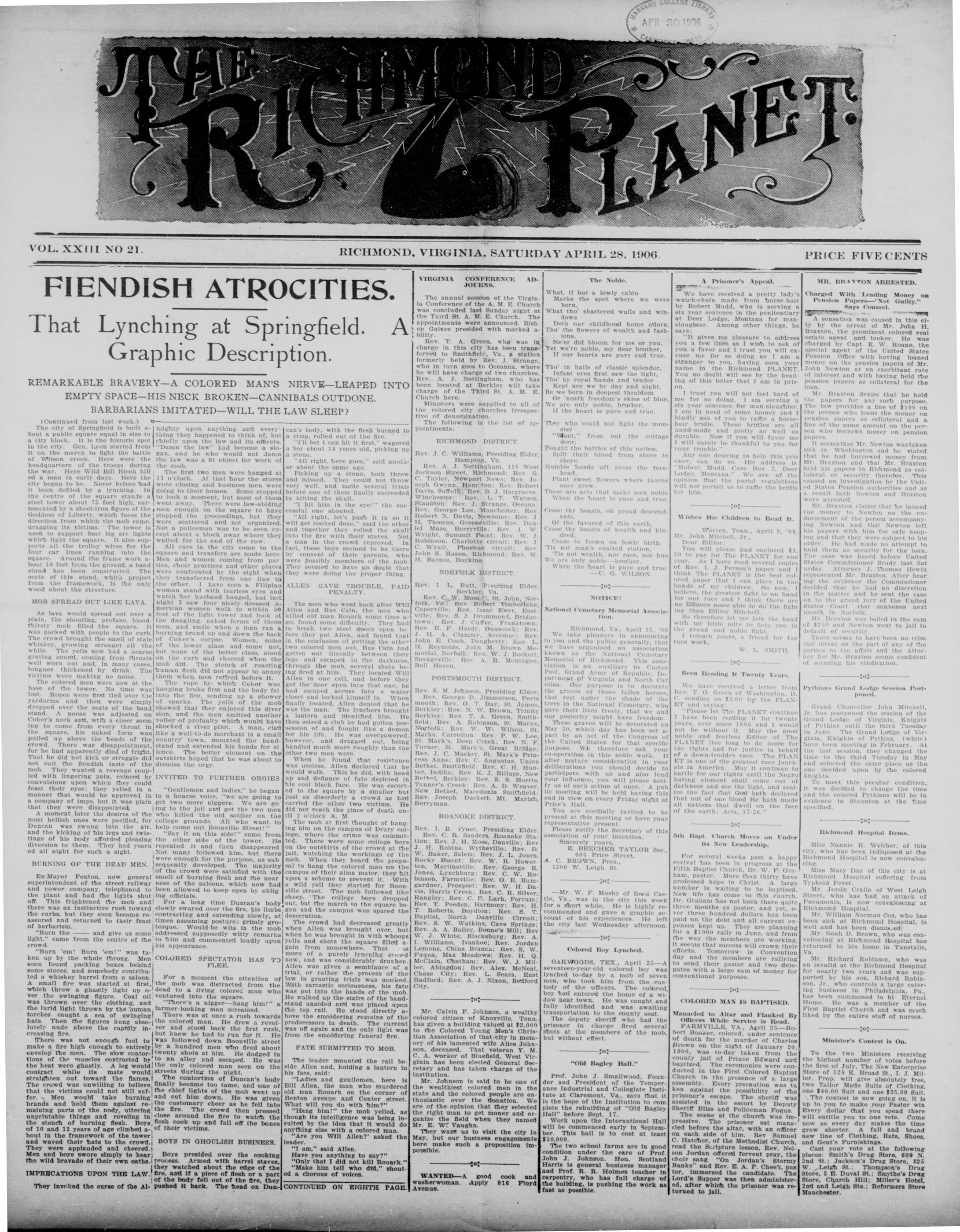
FIENDISH ATROCITIES. That Lynching at Springfield. A Graphic Description.
REMARKABLE BRAVERY—A COLORED MAN'S NERVE—LEAPED INTO EMPTY SPACE—HIS NECK BROKEN—CANNIBALS OUTDONE. BARBARIANS IMITATED—WILL THE LAW SLEEP?
VOL. XXII NO 21.
FIENDI
That Lynch
Gra
REMARKABLE BRAVER
EMPTY SPACE—H
BARBARIAN
(Continued from last week.) The city of Springfield is built about a public square equal in size to a city block. It is the historic spot in the city. Gen. Lyon started from it on the march to fight the battle of Wilson creek. Here were the headquarters of the troops during the war. Here Wild Bill Hickok killed a man in early days. Here the city began to be. Never before had it been defiled by a lynching. In the centre of the square stands a steel tower about 75 feet high, surrounded by a sheet-iron figure of the Goddess of Liberty, which faces the direction from which the mob came, dragging its victims. The tower is used to support four big arc lights which light the square. It also supports all the trolley wires for the four car lines running into the square. Around the frame work about 10 feet from the ground, a band stand has been constructed. The seats of this stand, which project from the framework, is the only wood about the structure.
MOB SPREAD OUT LIKE LAVA
As lava would spread out over a plain, the shouting, profane, blood-thirsty mob filled the square. It was packed with people to the curb. The crowd brought the smell of stale whiskey, growing stronger all the while. The yells now had a noarse grating sound, coming from throats well worn out and, in many cases, tongues thickened by drink. The victims were making no noise.
The colored men were now at the base of the tower. No time was lost. Ropes were first tied over the yardarms and then were simply dropped over the seats of the band stand. A noose was adjusted on Coker's neck ant, with a cheer seeming to come from every throat in the square, his naked form was pulled up above the heads of the crowd. There was disappointment, for he had apparently died of fright. That he did not kick or struggle did not suit the flendish taste of the mob. They wanted a revenge coupled with lingering pain, evinced by convulsions upon which they could feast their eyse; they yelled in a manner that would be approved in a company of imps, but it was plain that they were disappointed.
A moment later the desires of the most hellish ones were pacified, for Duncan was swung into the air, and the kicking of his legs and twistings of his body afforded pleasing diversion to them. They had yearned all night for such a sight.
BURNING OF THE DEAD MEN
Ex-Mayor Fenton, now general superintendent of the street railway and power company, telephoned to the plant and had the ligats shut off. This frightened the mob and there was an instinctive rush toward the curbs, but they soon became reassured and returned to their feast of barbarism.
"Burn the ____ and give us some light," came from the centre of the crowd.
"Burn 'em! Burn 'em!" was taken up by the whole throng. Men soon found packing boxes behind some stores, and somebody contributed a whiskey barrel from a saloon. A small fire was started at first, which threw a ghastly light up over the swinging figure. Coal oil was thrown over the clothing, and the lurid light thrown by the human torches caught a sea of swinging hats. Then the figures hung absolutely nude above the rapidly increasing fire.
There was not enough fuel to make a fire high enough to entirely envelop the men. The slow contortions of the muscles contracted by the heat were ghastly. A leg would contract while its mate would straighten out toward the flames. The crowd was unwilling to believe that the victims could not still suffer. Men would take burning brands and hold them against remaining parts of the body, uttering unprintable things and reveling in the stench of burning flesh. Boys of 10 and 12 years of age climbed about in the framework of the tower and waved their hats to the crowd. They were applauded and cheered. Men and boys swore simply to hear the wild bravado of their own oaths.
IMPRECATIONS UPON THE LAW
They invoked the curse of the Al-
mighty upon anything and everything they happened to think of, but chiefly upon the law and its officers. "Damn the law" had become a slogan, and he who would not damn the law was a fit object for work of the mob.
The first two men were hanged at 11 o'clock. At that hour the stores were closing and business men were going to their homes. Some stopped to look a moment, but most of them went away. There were law-abiding men enough on the square to have stopped the proceedings, but they were scattered and not organized. Not a policeman was to be seen except about a block away where they waited for the end of the row.
All cars in the city come to the square and transfers are made here. Men and women coming from parties, choir practices and other places were confronted by the sight when they transferred from one line to the other. I have seen a Filipino woman stand with tearless eyes and watch her husband hanged, but last night I saw four nicely dressed American women walk to within 50 feet of the light tower and look at the dangling, naked forms of those men, and smile when a man ran a burning brand up and down the back of Coker's corpse. Women, some of the lower class and some not, but none of the better class, stood on the curb and cheered when the mob did. The stench of roasting human flesh did not appear to annoy them when men refreshed it.
The rope by, which Cokor was hanging broke first and the body fell into the fire, sending up a shower of sparks. The yells of the mob showed that they enjoyed this diversion, and the men emitted another volley of profanity which would have shocked a river pilot. A man, clad like a well-to-do merchant in a small country town, mounted the bandstand and extended his hands for silence. The better element on the outskirts hoped that he was about to dismiss the orgy.
INVITED TO FURTHER ORGIES
"Gentlemen and ladies," he began in a hoarse voice, "we are going to get two more niggers. We are going to the jail and get the two men who killed the old soldier on the college grounds. All who want to help come out Boonville Street!" "Say it on this side!" came from the other side of the tower. He repeated it and then disappeared. Not many followed him, but there were enough for the purpose, as subsequently developed. The majority of the crowd were satisfied with the smell of burning flesh and the nearness of the saloons, which now had been allowed to keep open by obliging officials. For a long time Duncan's body slowly swayed over the fire, his limbs contracting and extending slowly, at times assuming postures grimly grotesque. Would-be wits in the mob addressed supposedly witty remarks to him and commented loudly upon his appearance.
COLORED SPECTATOR HAS TO FLEE.
For a moment the attention of the mob was distracted from the dead to a living colored man who ventured into the square.
"There's a nigger—hang him!" a farmer-looking man screamed.
There was at once a rush towards the colored man. He drew a revolver and stood back the first rush, but knew he had to run for it. He was followed down Boonville street by a hundred men who fired about twenty shots at him. He dodged in to an alley and escaped. He was the only colored man seen on the streets during the night.
The contortion of Duncan's body finally became too tame, and one of the chief lights of the mob went up and cut him down. He was given the customary cheer as he fell into the fire. The crowd then pressed close around the fire to watch the flesh cook up and fall off the bones of their victims.
BOYS IN GHOULISH BUSINESS.
Boys presided over the cooking process. Armed with barrel staves, they watched about the edge of the fire, and if a piece of flesh or a part of the body fell out of the fire, they pushed it back. The head on Dun-
can's body, with the flesh burned to a cris, rolled out of the fire.
"I'll bet I can hit it first," wagered a boy about 14 years old, picking up a stone. "All right, here goes," said another about the same age. Pickling up a stone, both threw and missed. They could not throw very well, and made several trials before one of them finally succeeded in hitting the skull. "I hit him in the eye!" the successful one shouted.
"All right, let's push it in so it will get cooked done," said the other and together they rolled the skull into the fire with their staves. Not a man in the crowd reproved. In fact, these boys seemed to be there by consent of their parents, who were possibly members of the mob. They seemed to have no doubt that they were doing the proper thing.
ALLEN GAVE TROUBLE, PAID
PENALTY
The men who went back after Will Allen and Bus Cain, the men who killed old man Rouark some time ago, found some difficulty. They had to break two steel doors open before they got Allen, and found that in the confusion of getting the other two colored men out, Bus Cain had gotten out literally between their legs and escaped in the darkness, through the mob, several shots being fired at him. They located Will Allen in one cell, and before they got the door open into that one, he had escaped across into a water closet and locked himself in. When finally located, Allen denied that he was the man. The lynchers brought a lantern and identified him. He then seized a club he had gotten possession of and fought like a demon for his life. He was overpowered, however, and dragged out, being handled much more roughly than the other two men were.
When he found that resistance was useless, Allen declared that he would walk. This he did, with head up and defiance of fate depicted in his coal black face. He was escorted to the square by a smaller but just as disorderly a crowd as had carried the other two victims. He did not reach the place of death until 2 o'clock A. M.
The mob at first thought of hanging him on the campus of Drury college, where the crime was committed. There were some college boys on the outskirts of the crowd at the jail, watching the workings of the mob. When they heard the proposal to hang the colored man on the campus of their alma mater, they hit upon a scheme to prevent it. With a wild yell they started for Boonville street. The mob followed like sheep. The college boys dropped out, but the march to the square began and the campus was spared the desecration. The crowd had decreased greatly when Allen was brought over, but when he was brought in with whoops yells and shots the square filled again from somewhere. That is more of a purely lynching crowd now, and was considerably drunken. Allen was given asemblance of a trial, or rather the process of the law in granting trials was mocked. With sarcastic seriousness, his fate was put into the hands of the mob. He walked up the stairs of the bandstand unaided and was placed upon the top rail. He stood directly above the smoldering remains of the predecessors in death. The current was off again and the only light was from the smoldering funeral fire.
FATE SUBMITTED TO MOB
The leader mounted the rail beside Allen and, holding a lantern in his face, said: "Ladies and gentlemen, here is Bill Allen, the man who murdered old man Rouark on the corner of Benton avenue and Center street. What will you do with him?" "Hang him!" the mob yelled, as though its intelligence was being insulted by the idea that it would do anything else with a colored man. "Are you Will Allen?' asked the leader. "I am," said Allen. "Have you anything to say?"
"Only that I did not kill Rouark."
"Make him tell who did," shouted a chorous of voices.
CONTINUED ON EIGHTH PAGE
VIRGINIA CONFERENCE AD- JOURNS.
The annual session of the Virginia Conference of the A. M. E. Church was concluded last Sunday night at the Taird St. A. M. E. Church. The appointments were announced. Bishop Gaines presided with marked ability.
Rev. T. A. Green, who was in charge in this city has been transferred to Smithfield, Va., a station formerly held by Rev. J. Strange, who in turn goes to Oceanna, where he will have charge of two churches. Rev. A. J. Nottingham, who has been located at Berkley will take charge of the Third St. A. M. E. Church here.
Ministers were supplied to all of the colored city churches irrespective of denomination. The following is the list of appointments:
RICHMOND DISTRICT
Rev. J. C. Williams, Presiding Elder
Hampton, Va.
Rev. A. J. Nottingham, 118 W. Jackson Street, Richmond; Rev. G. C. Taylor, Newport News; Rev. Joe Joseph Gwynn, Hamilton; Rev. Robert Davis, Suffolk; Rev. B. J. Hargraves, Winchester; Rev. L. T. Watson Staunton; Rev. J. Strange, Oceana; Rev. George Lee, Manchester; Rev Robert N. Davis, Newsome; Rev. J. H. Thomas, Greeneville; Rev. Daniel Maze, Berryville; Rev. J. W. Wright, Summit Point; Rev. W. J. Robinson, Charlotte circuit; Rev. J. C. Wyatt, Phoebus circuit; Rev John S. Mason, Richmond; Rev. W. H. Barnes, Boykins.
NORFOLK DISTRICT.
Rev. I. L. Butt, Presling Elder
Berkley, Va.
Rev. C. W. Moss, J. St. John, Norfolk, Va; Rev. Robert Timlakebron Caperville; Rev. Isaac Ewer, Eastville; Rev. S. J. Drummond, Bridge town; Rev. J. Cuffer, Franatown; Rev. E. F. Hardy, Onancec; Rev J. H. A. Clammy, Accomac; Rev John E. Cook, Daugherty; Rev L. H. Reynolds, John M. Brown Memorial, Norfolk; Rev. W. J. Beckett Savageville; Rev. A. R. Montague Bell Haven.
PORTSMOUTH DISTRICT
Rev. S. M. Johnson, Presiding Elder;
Rev. George D. Jimmerson, Ports
mouth; Rev. O. T. Day, St. James;
Berkley; Rev. N. W. Brown, Trinity
Berkley; Rev. T. A. Green, Smithfield;
Rev. A. Robinson, St. Marks;
Norfolk; Rev. W. W. Wilson, St.
Marks, Carrollton; Rev. P. W. Lee;
St. Mark's, Deep Creek; Rev. N. F.
Turner, St. Mark's, Great Bridge;
Rev. J. C. Mackey, St. Mark's Princess Anne; Rev. C. Augustus, Union Bethel, Smiffield; Rev. C. H. Hunter, Indika; Rev. K. J. Billups, New Bethel, Berkley; Rev. S. S. Morris, Tanner's Creek; Rev. A. D. Weaver, New Bethel, Macedonia Smithfield; Rev. Joseph Duckett, Mt. Marian, Berryman.
ROANOKE DISTRICT
Rev. I. B. Iyner, Presiding Elder;
Rev. C. R. Sanders, Roanoke Station;
Rev. J. H. Moss, Danville; Rev J. H. Robins, Wytheville; Rev D. W. Baker, Salem; Rev J. L. Jones, Rocky Mount; Rev W. R. Howerton, Martinsville; Rev George R. Jones, Lynchburg; Rev C. W. Robinson, Farmville; Rev O. E. Bumpardner, Prospect; Rev W. H. Davis, Harris Creek; Rev C. R. Silver, Rangley; Rev C. E. Lark, Ferrum; Rev T. Peeden, Harmony; Rev H. T. Roberts, Boydton; Rev S. T. Baptist, North Danville Circuit;
Rev S. W. Watkins, Cave Springs; Rev A. A. Bailey, Boone's Mill; Rev W. J. White, Blacksburg; Rev A. I. Williams, Ivanhoe; Rev J. Jordan Lemons, China Branch; Rev S. W. Fuqua, Max Meadows; Rev H. Q. McClain, Chatham; Rev W. J. Miller, Abingdon; Rev Alex. McNeal, Chase City; Rev L. Sears, East Radford; Rev A. J. Nixon, Betford City.
Mr. Calvin F. Johnson, a wealthy colored citizen of Knoxville, Teenn has given a building valued at $2,000 to the Colored Young Men's Christian Association of that city in memory of his lamented wife Alice Johnson, deceased. That veteran Y. M. C. A. worker of Bluefield, West Virginia has been elected General Secretary and has taken charge of the institution.
Mr. Johnson is said to be one of the wealthiest colored men in the state and the colored people are enthusiastic over the donation. We are of the opinion that they selected the right man to get money and organize the field when they named Mr. E. W. Vaughn.
They want us to visit the city in May, but our business engagements here make such a proposition impossible.
WANTED—A good cook and washerwoman. Apply 816 Floyd Avenue.
What, if but a lowly cabin
Marks the spot where we were
born.
What tho' shattered walls and windows
Doth our childhood home atorn.
Tho' the flowers of wealth and fashions.
Ne'er did bloom for me or you.
Yet we're noble, my dear brother.
If our hearts are pure and true.
Tho' in halls of classic splendor,
Infant eyes first saw the light.
Tho' by royal hands and tender
Kept are we by day and night.
Be we born in deepest thraldom
Or 'neath freedom's skies of blue.
We are only noble, brother,
If the heart is pure and true.
They who could not fight the monster
"Want," from out the cottage door.
Fought the battles of this nation.
Spilt their blood from shore to shore.
Humble hands oft press the forehead.
Plant sweet flowers where thorns once grew.
These are acts that make men noble
When the heart is pure and true.
Cease thy boasts, oh proud descend-ants.
Cease to frown on lowly birth
Tis not man's exalted station,
Tis not wealth, nor race, nor hue
We are only noble—brother,
When the heart is pure and true.
—U. G. WILSON.
NOTICE!
National Cemetary Memorial Association
Richmond, Va., April 15, '06
We take pleasure in announcing to you and the public generally, that we have organized an association known as the National Cemetary Memorial of Richmond. This association is an auxiliary to Custer Post, Grand Army of Republic, Department of Virginia and North Carolina. Our purpose is to decorate the graves of those fallen heroes, that rest under the shade of the trees in the National Cemetary, who gave their lives freely, that we and our posterity might have freedom. These graves will be decorated on May 30, which day has been set apart by an act of the Congress of the United States for that specific purpose. We therefore ask your co-operation in this noble work. If after mature consideration in your deliberations you should decide to participate with us and also lend your influence, you will please notify us of such action at once. A public meeting will be held having tails end in view on every Friday night at Price's Hall.
You are cordially invited to be present at this meeting or have your representative present.
Please notify the Secretary of this association of your intention.
Sincerely yours,
R. BEECHER TAYLOR Sec., 606 Price Street.
A. C. BROWN, Pres.,
—Mr. W. F. Mosby of Rock Castle, Va., was in the city this week for a short while. He is highly recommended and gave a graphic account of his experiences. He left the city last Wednesday afternoon.
Colored Boy Lynched
OAKWOODS, TEX., April 25—A seventeen-year-old colored boy was lynched to-day by a mob of seven men, who took him from the custody of the officers. The colored boy had entered the home of a window near town. He was caught and fully identified and was awaiting transportation to the county seat. The deputy sheriff who had the prisoner in charge fired several shots at the members of the mob, but without effect.
"Old Bagley Hall."
Prof. John J. Smallwood, Founder and President of the Temperance Industrial and Collegiate Institute at Claremont, Va., says that it is the hope of the Institution to complete the rebuilding of "Old Bagley Hall" before Sept. 17.
Work upon the International Hall will be commenced early in September. This hall is to cost at least $10,000.
The two school farms are in good condition under the care of Prof. John J. Johnson. Hon. Scotland Harris is general business manager and Prof. R. R. Holmes teacher in carpentry, who has full charge of the building, is pushing the work as fast as possible.
A Prisoner's Appeal.
We have received a pretty lady's watch-chain made from horse-hair by Robert Mudd, who is serving a six year sentence in the penitentiary at Deer Lodge, Montana for manslaughter. Among other things, he says:
"It gives me pleasure to address you a few lines as I wish to ask of you a favor and I trust you will excuse me for so doing as I am a stranger to you, having seen your name in the Richmond PLANET. You no doubt will see by the heading of this letter that I am in prison.
I trust you will not feel hard of me for so doing. I am serving a six year sentence for man-slaughter. I am in need of some money and I kindly ask of you to raffle a horse-hair bridle. These bridles are all hand-made and pretty as well as durable. Now if you will favor me I will surely be thankful to you for your trouble."
Any one desiring to help this prisoner, can do so. His address is "Robert Mudd, Care Box 7, Deer Lodge, Montana." We are of the opinion that the postal regulations will not permit us to raffle the bridle for him.
Wishes His Children to Read It
Warren, Tenn., April 9, '06.
Mr. John Mitchell, Jr.,
Dear Editor:
You will please find enclosed $1,
50 to pay for The PLANET for one
year. As I have read several copies
of Rev. I. J. Person's paper and I
think The PLANET is the best colored
paper that I can place in the
hands of my children. So now, I
believe, the greatest fight is on hand
for our race and I think there are
no Editors more able to do the fight
ing than Editor Mitchell.
So therefore let me join the hand
with my little mite to help you in
the grand and noble fight.
I remain yours, a friend for the
race work.
W. L. SMITH
Been Reading It Twenty Years
We have received a letter from Rev. T. O. Green of Washington, D.C. sending us $3,00 for the PLANET and saying:
"Please let The PLANET continue I have been reading it for twenty years, ever since 1886 and I would not be without it. May the most noble and fearless Editor of The PLANET live long to do more for the rights and for justice in behalf of a down-trodden race. The PLANET is one of the greatest race journals in America. May it continue to battle for our rights until the Negro hating element shall come out of darkness and see the light, and realize the fact that God hath declared that out of one blood He hath made all nations that dwell on the face of the earth; Acts. 17-26."
5th Bapt. Church Moves on Under its New Leadership.
For several weeks past a happy revival has been in progress at the Fifth Baptist Church, Dr. W. F. Graham, pastor. More than thirty have professed hope in Christ. A large number is waiting to be baptised. New life has come to this church. Dr. Graham has not been there quite three months as pastor, and yet, over three hundred dollars has been paid on the debt and all current expenses kept up. They are planning for a $1000 rally in June, and from the way the members are working, it seems that success will crown their efforts. Tomorrow is Convention day and the members are rallying to send their pastor and two delegates with a large sum of money for conventional purposes.
COLORED MAN IS BAPTISED
Manacled to Altar and Flanked By
Officers While Service is Read.
FARMVILLE, VA., April 25—Robert Booker, colored, under sentence of death for the murder of Charles Brown on the night of January 20, 1906, was to-day taken from the county jail of Prince Edward and baptized. The ceremonies were conducted in the First Colored Baptist Church in the presence of a large assembly. Every precaution was toaken against the possibility of the prisoner's escape. The sheriff was assisted in the escort by Deputy Sheriff Bliss and Policeman Fogus. The scene at the church was impressive. The prisoner sat mancled before the altar, with an officer on each side of him. Rev Samuel C. Hatcher, of the Methodist Church, read the Scripture lesson, Rev. Nelson Jordan offered fervent pray, the choir sang "On Jordan's Stormy Banks" and Rev. E. A. P. Chee't, pastor, immersed the candidate. The Lord's Supper was then administered, after which the prisoner was returned to jail.
MR. BRAYTON ARRESTED.
Charged With Lending Money on Pension Papers—"Not Guilty," Says Counsel.
A sensation was caused in this city by the arrest of John H. Braxton, the prominent colored real estate agent and broker. He was charged by Capt. R. W. Roane, the special agent of the United States Pension Office with having loaned money on the pension papers of Mr. John Newton at an exorbitant rate of interest and with having held the pension papers as collateral for the loan. Mr. Braxton denies that he held the papers for any such purpose. The law provides a fine of $100 on the person who loans the money on pension papers as collateral and a fine of the same amount on the person who borrows money on pension papers. It seem that Mr. Newton was taken sick in Washington and he stated that he had borrowed money from Mr. Braxton and that Mr. Braxton held his papers in Richmond as collateral or security therefor. This caused an investigation by the United States Pension authorities and as a result both Newton and Braxton were arrested.
Mr. Braxton claims that he loaned the money to Newton on the endorsement of the person accompanying Newton and that Newton left his papers with him for safe keeping and that they were subject to his order. He had no attempt to hold them as security for the loan. The case was heard before United States Commissioner Brady last sat day. Attorney J. Thomas Hewin represented Mr. Braxton. After hearing the evidence the Commissioner decided that he had no discretion in the matter and he sent the case on to the grand jury of the United States Court that convenes next month in Norfolk.
Mr. Braxton was bailed in the sum of $250 and Newton went to jail in default of security.
There seems to have been no criminal intent on the part of any of the parties to the affair and the Attorney for Mr. Braxton seems confident of securing his vindication.
Pythians Grand Lodge Session Post-
nounced.
Grand Chancellor John Mitchell, Jr. has postponed the session of the Grand Lodge of Virginia, Knights of Pythias until the third Tuesday in June. The Grand Lodge of Virginia, Knights of Pythias, (white) have been meeting in February. At the last session, they changed the time to the third Tuesday in May and selected the same place as the one decided upon by the colored knights.
To meet this peculiar condition, it was decided to change the time and the colored Pythians will be in evidence in Staunton at the time specified.
Richmond Hospital Items
Miss Nannie R. Welcher, of this city, who has been indisposed at the Richmond Hospital is now convalescing.
Miss Mazy Day of this city is at Richmond Hospital suffering from Typhoid Fever.
Mr. Jessie Cralle of West Leigh Street, who has had an attack of Pneumonia, is now convalescing at Richmond Hospital.
Mr. William Norman Cox, who has been sick at Richmond Hospital, is well and has been dismis. ed.
Mr. Noah D. Brown, who was convalescing at Richmond Hospital has returned to his home in Tunstalls, Va.
Mr. Richard Robinson, who was an invalid at the Richmond Hospital for nearly two years and was supported by his son, Richard Robinson, Jr., who controls a large catering business in Philadelpia, Pa. has been summoned to his Eternal Home. He was a member of the First Baptist Church and was much liked by the entire staff of nurses.
Minister's Contest is On.
To the two Ministers receiving the highest number of votes before the first of July, The New Enterprise Store of 528 E. Broad St., I. J. Miller, Prop. will give absolutely free, two Tullor Made Suits of Clothing, one $40.00 Suit and one $25.00 Suit. The contest is now going on, it is up to you to make your Pastor Win every dollar that you spend there will entitle you to one vote. Come now as every day makes the time grow shorter. A full and brand new line of Clothing, Hats, Shoes, and Gent's Furnishings. Cast your vote at the following places: Smith's Drug Store, 609 N. 2nd St.; Jackson's Drug Store, $25 W. Leigh St.; Thompson's Drug Store, 2 E. Duval St.; Smythe's Drug Store, Church Hill; Miller's Hotel, 2nd and Leigh Sts.; Reformers Store Manchester.
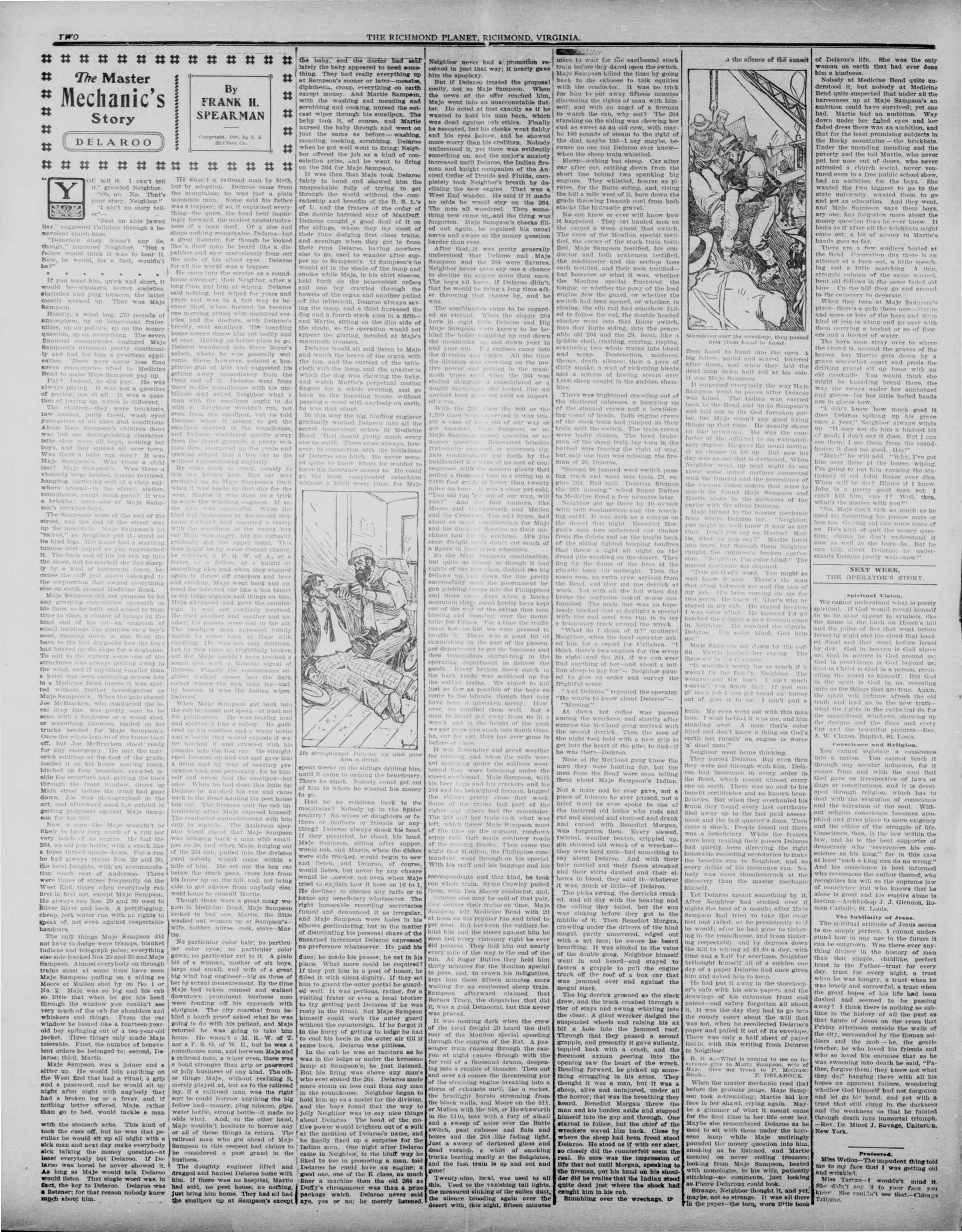
The Master Mechanic's Story
U tell it. I can't tell it." growled Neighbor. "Oh, no. No. That's your story, Neighbor." "I ain't no story teller"—
Y
"Just an able tawed
"Just an able jawed liar," suggested Callahan through a benevolent bluish haze.
"Delaroo's story wasn't any lie, though," muttered Neighbor. "But a fellow would think it to hear it. Now, he would, for a fact, wouldn't he?"
If you want him, quick and short, it would be—whiskers, secret societies, statistics and plug tobacco, the latter mostly worked up. That was Maje Sampson.
Bluntly, a wind bag; 270 pounds of atmosphere, up on benevolent fraternities, up on politics, up on the money question, up on everything. The seven financial conspiracies engaged Maje Sampson's attention pretty continually and had for him a practical application. There were never less than saven conspiracies afoot in Medicine Bend to make Maje Sampson par up.
Pay? Indeed, he did pay. He was always paying. It was not a question of paying; not at all. It was a question of paying up, which is different. The children—they were brickbats, tow headed, putty faced, wash eyed youngsters of all sizes and conditions. About Maje Sampson's children there was but one distinguishing characteristic—they were all boys, nothing but boys, and they spread all over town. Was there a baby run over? It was Maje Sampson's. Was there a child lost? Maje Sampson's. Was there a violently large headed, coarse featured, hangdog, clattering sort of a chap anywhere around—in the street, station, roundhouse, yards, stock pens? It was a brickbat, sure—one of Maje Sampson's brickbat boys.
The Sampsons were at the end of the street, and the end of the street was up the mountain. Maje Sampson's lot "raired," as Neighbor put it—stood on its hind legs. His house had a startling tumble over aspect as you approached it. The back end of his lot ran up into the sheer, but he marked the line sharply by a kind of horizontal fence, because the cliff just above belonged to the corporation that owned everything else on earth around Medicine Bend.
Maje Sampson did not propose to let any grasping corporation encroach on his lines, so he built, and added to from time to time, a cluster of things on the hind end of his lot-an eruption of small buildings like pimples on a boy's nose, running down in size from the barn to the last drygoods box the boys had heaved up the slope for a doghouse. To add to the variety some one of the structures was always getting away in the wind, and if anything smaller than a hotel was seen careening across lots in a Medicine Bend breeze it was spotted without further investigation as Maje Sampson's. When the gale abated Joe McBracken, who conducted the local dray line, was pretty sure to be seen with a henhouse or a wood shed, or something likewise, loaded on his trucks headed for Maje Sampson's. Once the whole lean-to of the house blew off, but Joe McBracken stood ready for any emergency. He met the maverick addition at the foot of the grade, loaded it on his house moving truck, hitched on four bronchos, crawled inside the structure and, getting the lines through the front window, drove up Main street before the wind had gone down. Joe was photographed in the act, and afterward used the exhibit in getting judgment against Maje Sampson for his bill.
Now, a man like Maje wouldn't be likely to have very much of a run nor very much of an engine. He had the 204, an old pop bottle, with a stack like a tepee turned upside down. For a run he had always trains Nos. 29 and 30, the local freights, with an accommodation coach east of Anderson. There were times of stress frequently on the West End, times when everybody ran first in first out, except Maje Sampson. He always ran Nos. 29 and 30 west to Silver River and back. A pettifogging, cheap, jerk water run with no rights to speak of, not even against respectable handcars.
The only things Maje Sampson did not have to dodge were drapes, blanket Indians and telegraph poles; everything else side tracked Nos. 29 and 30 and Maje Sampson. Almost everybody on through trains must at some time have seen Maje Sampson puffing on a sliding as Moore or Mullen shot by on No. 1 or No. 2. Maje was so big and his cab so little that when he got his head through the window you couldn't see very much of the cab for shoulders and whiskers and things. From the car window he looked like a fourteen-year-old boy springing out of a ten-year-old jacket. Three things only made Maje tolerable. First, the number of benevolent orders he belonged to; second, Delaroo: third, Martie.
Maje Sampson was a joiner and a sitter up. He would join anything on the West End that had a ritual, a grip and a password, and he would sit up night after night with anybody that had a broken leg or a fever, and, if nothing better offered, Maje, rather than go to bed, would tackle a man with the stomach ache. This kind of took the cuss off, but he was that peculiar he would sit up all night with a sick man and next day make everybody sick talking the money question—at least everybody but Delaroo. If Delaroo was bored he never showed it. As long as Maje would talk Delaroo would listen. That single word was, in fact, the key to Delaroo. Delaroo was a listener; for that reason nobody knew much about him.
He wasn't a railroad man by birth, but by adoption. Delaroo came from the mountains; he was just a plain mountain man. Some said his father was a trapper; if so, it explained everything—the quiet, the head bent inquiringly forward, the modest unobstrusiveness of a man deaf. Of a size and shape nothing remarkable. Delaroo—but a great listener, for though he looked like a deaf man he heard like a dispatcher and saw marvelously from out the ends of his silent eyes. Delaroo for all the world was a trapper.
He came into the service as a roundhouse sweeper; then Neighbor, after a long time, put him at wiping. Delaroo sald nothing, but wiped for years and years and was in a fair way to become liked when instead he became one morning plitted with umbilical vessels, and the doctors, with Delaroo's brevity, sald smallpox. The boarding house keeper threw him out bodily and at once. Having no better place to go, Delaroo wandered into Steve Boyer's saloon, where he was generally welcome. Steve, however, pointed a hospitable gun at him and suggested his getting away immediately from the front end of it. Delaroo went from there to the roundhouse with his umbilicals and asked Neighbor what a man with the smallpox ought to do with it. Neighbor wouldn't run, not even from the smallpox, but he told Delaroo what it meant to get the smallpox started in the roundhouse, and Delaroo wandered quietly away from the depot grounds, a pretty slack man then, staggered up the yards and crawled stupid into a box car to die without embarrassing anybody.
By some book or crook, nobody to this day knows how, that car was switched on to Maje Sampson's train when it was made up that day for the west. Maybe it was done as a trick to scare the windbang engineer. If so, the idea was successful. When the blind end brakeman at the second stop came forward and reported a tramp with the smallpox in the empty box car Maje was angry, but his curiosity gradually got the upper hand. This man might be by some distant chance, he reflected, a P. Q. W. of A, or a frater, or a fellow, or a knight or something like, and when they stopped again to throw off crackers and beer and catchup, Maje went back and entered the infected car like a lion tamer to try lodge signals and things on him. Maje advanced and gave the counter-sign. It was not cordially received. He tried another and another and another; his passes were lost in the air. The smallpox man appeared totally unable to come back at Maje with anything. He was not only delirious, but by this time so frightfully broken out that Maje couldn't have touched a sound spot with a Masonic signal of distress. Finally the venturesome engineer walked closer into the dark corner where the sick man lay—and, by heaven, it was the Indian wiper, Delaros!
When Maje Sampson got back into the cab he could not speak—at least not for publication. He was tearing made and sputtered like a safety. He gathered up his cushion and a water bottle and a bottle that would explode if water touched it and crawled with his plunder into the box car. He straightened Delaroo up and out and gave him a drink and by way of sanitary precaution took one personally, for he himself had never had the smallpox—but once. When he had done this little for Delaroo he finished his run and came back to the Bend hauling his pest house box car. The fireman quit the cab immediately after Maje exposed himself. The conductor communicated with him only by signals. The Anderson operator wired ahead that Maje Sampson was bringing back a man with smallpox on 30, and when Maje, bulging out of the 264 cab, pulled into the division yard nobody would come within a mile of him. He set out the box car below the stock pens, cross lots from his house up on the hill, and, not being able to get advice from anybody else, went home to consult Martie.
Though there were a great many women in Medicine Bend, Maje Sampson looked to but one, Martie, the little washed out woman up at Sampson's-wife, mother, nurse, cook, slave—Martie.
No particular color hair; no particular color eyes; no particular color gown; no particular cut to it. A plain bit of a woman, mother of six boys, large and small, and wife of a great big wind bag engineer—big as three of her by actual measurement. By the time Maje had taken counsel and walked downtown prominent business men were fending off his approach with shotguns. The city marshal from behind a bomb proof asked what he was going to do with his patient, and Maje retorted he was going to take him home. He wasn't a M. R. W. of T. nor a P. S. G. of W. E., but he was a roundhouse man, and between Maje and a railroad man, a wiper even, there was a bond stronger than grip or password or jolly business of any kind. The other things Maje, without realizing it, merely played at, but as to the railroad lay, if a railroad man was the right sort he could borrow anything the big fellow had—money, plug tobacco, pipe, water bottle, strong bottle—it made no odds what. And, on the other hand, Maje wouldn't hesitate to borrow any or all of these things in return. The railroad man who got ahead of Maje Sampson in this respect had claims to be considered a past grand in the business.
The doughy engineer lifted and dragged and hauled Delaroe home with him. If there was no hospital, Martie had said, no pest house, no nothing, just bring him home. They had all had the smallpox up at Sampson's except
THE RICHMOND PLANET, RICHMOND, VIRGINIA
the baby, and the doctor had said lately the baby appeared to need something. They had really everything up at Sampson's sooner or later—measles, diphtheria, croup, everything on earth except money. And Martie Sampson, with the washing and mending and scrubbing and cooking, nursed the outcast wiper through his smallpox. The baby took it, of course, and Martie nursed the baby through and went on just the same as before—washing, mending, cooking, scrubbing. Delaroo when he got well went to firing; Neighbor offered the job as a kind of consolation prize, and he went to firing on the 264 for Maje Sampson.
It was then that Maje took Delaroo fairly in hand and showed him the unspeakable folly of trying to get through the world without the comradeship and benefits of the B. S. L's of U. and the fraters of the order of the double barreled star of MacDuff. Delaroo caught a good deal of it on the sidings, where they lay most of their time dodging first class trains, and evenings when they got in from their runs Delaroo, having nowhere else to go, used to wander after supper up to Sampson's. At Sampson's he would sit in the shade of the lamp and smoke while Maje, in his shirt sleeves, held forth on the benevolent orders and one boy crawled through the bowels of the organ and another pulled off the tablecioth. Delaroo always saving the lamp, and a third harassed the dog and a fourth stuck pins in a fifth—and Martie, sitting on the dim side of the shade, so the operation would not appear too glaring, mended at Maje's mammoth trousers.
Delaroo would sit and listen to Male and watch the heave of the organ with the boy, and the current of the table-cloth with the lamp, and the quarter in which the dog was chewing the baby, and watch Martide's perpetual motion fingers for a whole evening, and go back to the boarding house without passing a word with anybody on earth, he was that silent. In this way the big, bluffing engineer gradually worked Delaroo into all the secret benevolent orders in Medicine Bend. That meant pretty much every one on earth. There arose always, however, in connection with the inititions of Delaroo one hitch. He never seemed quite to know whom he wanted to leave his insurance money to. He could go the most complicated catechism without a hitch every time for Male
J. M.
He straightened Delaroe up and gave him a drink.
spent weeks on the sidings drilling him, until it came to naming the beneficiary. There he stuck. Nobody could get out of him to whom he wanted his money to go.
Had he no relations back in the mountains? Nobody up in the Spider country? No wives or daughters or fathers or mothers or friends or anything? Delaroo always shook his head. If they persisted, he shook his head. Maje Sampson, sitting after supper, would ask, and Martie, when the dishes were side trucked, would begin to sew and listen, and Delaroo, of course, would listen, but never by any chance would he answer, not even when Maje tried to explain how it bore on 16 to 1. He declares to discuss any ratio or to name any beneficial whatsoever. The right honorable recording secretaries fumed and denounced it as irregular, and Maje Sampson wore holes in his elbows gesticulating, but in the matter of distributing his personal share of the unearned increment Delaroo expressed no preference whatsoever. He paid his
dues; he made his passes; he sat in his place. What more could be required? If they put him in a post of honor, he filled it with silent dignity. If they set him to guard the outer portal he guarded well. It was perilous, rather, for a visiting frater or even a local brother to try getting past Delaroo if he was rusty in the ritual. Not Maje Sampson himself could work the outer guard without the countersign. If he forgot it in the hurry of getting to lodge he had to cool his heels in the outer air till it game back. Delaroo was pitiless.
In the cab he was as taciturn as he was in the lodge or under the kerosene lamp at Sampson's; he just listened. But his firing was above any man's who ever stoked the 264. Delaroo made more steam on less coal than any man in the roundhouse. Neighbor began to hold him up as a model for the division, and the boys found that the way to jolly Neighbor was to say nice things about Delaroo. The head of the motive power would brighten out of a sulk at the mention of Delaroo's name, and he finally fixed up a surprise for the Indian man. One night after Delaroo came in Neighbor, in the bluff way he liked to use in promoting a man, told Delaroo he could have an engine; a good one, one of the K class, as much finer a machine than the old 264 as Duffy's chronometer was than a prize package watch. Delaroo never said aye, yes or no; he merely listened.
Neighbor never had a promotion received in just that way; it nearly gave him the apoplexy.
But if Delaroo treated the proposal coolly, not so Maje Sampson. When the news of the offer reached him, Maje went into an unaccountable flutter. He acted at first exactly as if he wanted to hold his man back, which was dead against cab ethics. Finally he assented, but his cheeks went flabby and his eyes hollow, and he showed more worry than his creditors. Nobody understood it, yet there was evidently something on, and the major's anxiety increased until Delaroo, the Indian fireman and knight companion of the Ancient Order of Druids and Fluids, completely took Neighbor's breath by declining the new engine. That was a West End wonder. He said if it made no oids he would stay on the 264. The men all wondered. Then something new came up, and the thing was forgotten. Maje Sampson's cheeks filled out again, he regained his usual nerve and swore on the money question harder than ever.
After that it was pretty generally understood that Delaroo and Maje Sampson and the 264 were fixtures. Neighbor never gave any one a chance to decline an engine more than once. The boys all knew. If Delaroo didn't, that he would be firing a long time after throwing that chance by, and he was.
The combination came to be regarded as eternal. When the sloppy 264 hove in sight little Delaroo and Big Maje Sampson were known to be behind the boiler pounding up and down the mountains, up and down year in and year out. Big engines came into the division and bigger. All the time the division was crowding on the motive power and putting in the mammoth types until when the 264 was stalled alongside a consolidated or a mogul skyscraper she looked like an ancient beer glass set next an imported stein.
With the 264 when the 800 or the 1,100 class were concerned it was simply a case of keep out of our way or get smashed. Maje Sampson or no Maje Sampson, money question or no money question. Benevolent benefits fraternity proposed or anteroom signals confidentially put forth by the baldheaded 264 were of no sort of consequence with the modern giants that pulled a thousand tons in a string up a 2,000 foot grade at better than twenty miles an hour. It was a clear yet cold, "You old tug, 'get out of our way, will you?" And the fast runners, like Moore and Hawksworth and Mullen and the Crowleys, Tim and Syme, had about as much consideration for Maje and his financial theories as their machines had for his machine. His Jim crow freight outfit didn't cut much of a figure in their track schedules.
So the Male Sampson combination, but quite as brassy as though it had rights of the first class, dodged the big fellows up and down the line pretty successfully until the government began pushing troops into the Philippines and there came days when a Rocky mountain sheep could hardly have kept out of the way of the extras that tore, hissing and bouncing, over the mountains for Frisco. For a time the traffic came hot—so hot we were pressed to handle it. There was a good bit of skirmishing on the part of the passenger department to get the business and then tremendous skirmishing in the operating department to deliver the goods. Every broken down coach in the back yards was scrubbed up for the soldier trains. We aimed to kill just as few as possible of the boys en route to the islands, though that may have been a mistaken mercy. How ever, we handled them well. Not a man in khaki got away from us in a wreck, and in the height of the push we put more live stock into South Omaha, car for car, than has ever gone in before or since.
It was November and great weather for running, and when the rails were not springing under the soldiers west-bound they were humming under the steers eastbound. Maje Sampson, with his beer kegs and his crackers and his 264 and his beeknighted fireman, hugged the slings pretty close that week. Some of the trains had part of the rights and others had the remainder. The 264 and her train took what was left, which threw Maje Sampson most of the time on the wormout, rundown scrap rails that made corduroy roads of the passing tracks. Then came the night that Mautitan, the Philippine commandant, went through on his special. With his staff and his baggage and his
correspondents and that kind, he took one whole train. Syme Crowley pulled them, with Ben Sherer conductor, and, however else may be said of that pair, they deliver their trains on time. Maje Sampson left Medicine Bend with 29 at noon on his regular run and tried to get west. But between the soldiers behind him and the steers against him he soon lost every visionary right he ever did possess. They laid him out nearly every mile of the way to the end of the run. At Sugar Buttes they held him thirty minutes for the Moulton special to pass, and, to crown his indignities, kept him there fifteen minutes more waiting for an ebound sheep train. Sampson afterward claimed that Barnes Tracy, the dispatcher that did it, was a gold Democrat, but this never was proved.
It was nearing dark when the crew of the local freight 29 heard the dull roar of the Moulton special speeding through the canyon of the Rat. A passenger train running through the canyon at night comes through with the far roll of a thousand drums, deepening into a rumble of thunder. Then out and over all comes the threatening pur of the straining engine breaking into a storm of exhausts until, like a rocket, the headlight bursts streaming from the black walls, and Moore on the S11, or Mullen with the S18, or Hawksworth in the 110, tear with a fury of alkali and a sweep of noise over the Butte switch, past caboose and flats and boxes and the 264 like fading light. Just a sweep of darkened glass and dead varnish, a whirl of smoking trucks beating madly at the fishplates, and the fast train is up and out and gone!
Twenty-nine, local, was used to all this. Used to the vanishing tall lights, the measured sinking of the sullen dust, the silence brooding again over the desert with, this night, fifteen minutes
more to wait for the eastbound stock train before they dared open the switch. Majie Sampson killed the time by going back to the caboose to talk equities with the conductor. It was no trick for him to put away fifteen minutes discussing the rights of man with himself; and with an angel of a fireman to watch the cab, why not? The 264 standing on the sliding was chewing her cud as sweet as an old cow, with maybe 140 pounds of steam to the right of the dial, maybe 150—I say maybe, because no one but Delarooo ever knew—when the sheep train whistled.
Sheep—nothing but sheep. Car after car after car, rattling down from the short line behind two spanking big engines. They whistled, hoarse as pirates, for the Butte sliding, and, rising the hill a mile west of it, bore down the grade throwing Dannah coal from both stacks like hydraulic gravel.
No one knew or ever will know how it happened. They eat hauled men on the carpet a week about that switch. The crew of the Moulton special testified, the crews of the stock train testified, Maje Sampson testified, his conductor and both brakemen testified, the roadmaster and the section boss each testified, and their men testified—but however or what it was, whether the Moulton special fractured the tongue, or whether the pony of the lead engine flew the guard, or whether the switch had been opened, or whether, in closing, the slip rail had somehow failed to follow the rod, the double headed stocker went into that Butte switch, into that Butte siding, into the peaceable old 264 and the 29, local, like a lyddite shell, crashing, rearing, ripping, scattering two whole trains into blood and scrap. Destruction, madness, throes, death, silence; then a pyre of dirty smoke, a wall of slickening bleats and a scream of hissing steam over 1,000 sheep caught in the sudden shambles.
There was frightened crawling out of the shattered caboses, a hurrying up of the stunned crews and a bewildering count of heads. Both engine crews of the stock train had jumped as their train split the switch. The train crews were badly shaken. The head brakeman of the sheep train lay torn in the barbed wire fencing the right of way, but only one man was missing, the fireman of 29, Delaroo.
"Second S6 jumped west switch passing track and went into train 29, engine 264. Bad spill. Delaroo, fireman the 264. missing." wired Sugar Buttons to Medicine Bend a few minutes later.
Neighbor got up there by 10 o'clock with both roadmasters and the wrecking outfit. It was dark as a canyon on the desert that night. Benedict Morgan's men tore splintered car timber from the debris and on the knolls back of the sliding lighted heaping bonfires that throw a light all night on the dread pile smoking on the desert. They dug by the flame of the fires at the ghostly heap till midnight. Then the moon rose, an extra crew arrived from the Bend, and they got the derrick at work. Yet with all the toil when day broke the confusion booked worse confounded. The main line was so hopelessly blocked that at daylight a special with ties and steel was run in to lay a temporary track around the wreck.
"What do I think of it?" muttered Neighbor, when the local operator asked him for a report for Callahan. "I think there's two engines for the scrap in sight—and the 264, if we can ever find anything of her—and about a million sheep to pay for"—Neighbor paused to give an order and survey the frightful scene.
"And Delaroo," repeated the operator. "He wants to know about Delaroo"—"Missing."
At dawn hot coffee was passed among the wreckers, and shortly after sunrise the McCloud gang arrived with the second derrick. Then the men of the night took hold with a new grip to get into the heart of the pile; to find—if he was there—Delaroo.
None of the McCloud gang knew the man they were hunting for, but the men from the Bend were soon telling them about Maje Sampson's Indian.
Not a mute nud he ever gave, not a piece of tobacco he ever passed, not a brief word he ever spoke to one of the battered old hulks who rode and cut and slashed and stormed and drank and cursed with Benedict Morgan, was forgotten then. Every slewed, twisted, weather beaten, crippled up, gin shivered old wreck of a wrecker—they were hard men—had something to say about Delaroo. And with their hair matted and their faces streaked and their shirts daubed and their elbows in blood, they said it—whatever it was, much or little—of Delaroo.
The picks swung, the derricks creaked, and all day with the heaving and the calling they toiled, but the sun was sinking before they got to the middle of it. Then Benedict Morgan, crawling under the drivers of the hind mogul, partly uncovered, edged out with a set face; he swore he beard breathing. It was alcohol to the veins of the double gang. Neighbor himself went in and heard—and stayed to fasten a grapple to pull the engine truck off the roof of a box car that was jammed over and against the mogul stack.
The big derrick grouned as the slack drew, and the truck crashed through a tier of stays and swung whirling into the clear. A giant wrecker dodged the suspended wheels and raising his ax bit a hole into the jammed roof. Through that they passed a second grapple, and presently it gave sullenly, toppled back with a crash, and the foremost axman peering into the opening saw the heart of the wreck. Bending forward, he picked up something struggling in his arms. They thought it was a man, but it was a sheep, alive and uninjured, under all the horror; that was the breathing they heard. Benedict Morgan threw the man and his burden aside and stepped himself into the gap and through. One started to follow, but the chief of the wreckers waved him back. Close by where the sheep had been freed stood Delaroo. He stood as if with ear alert, so closely was the counterfeit seem the real. So sure was the impression of life that not until Morgan, speaking to the fireman, put his hand on his shoulder did he realize that the Indian stood quite dead just where the shock had caught him in his cab.
Stumbling over the wreckage. th
A man is being carried down a steep slope by a fireman. He is wearing a hat and a vest. The slope is steep and the fireman is holding him securely. There are other people in the background, some of whom are also wearing hats. The scene is set in a construction area with a large crane in the background.
Stumbling over the wreckage, they passed him from hand to hand.
from hand to hand into the open A big fellow, pallid and scared, toothed after them, and when they laid the dead man down half fell at his side. It was Maje Sampson.
It surprised everybody the way Maje Sampson went to pieces after Delaroo was killed. The Indian was carried back to the Bend and up to Sampson's and laid out in the God forsaken parlor, but Maje wasn't any good fixing things up that time. He usually shone on like occasions. He was the comfort of the afflicted to an extraordinary degree. He gave the usual mourner no chance to let up. But now his day was as one that is darkened. When Neighbor went up next night to see about some minor matters connected with the funeral and the precedence of the various dozen orders that were to march he found Maje Sampson and Martie none in the darkness of the parlor with the silent Delaroo.
Maje turned to the master mechanic from where Delaroo lay. "Neighbor, you might as well know it now as ary time. Don't you say so, Martie? Martie, what do you say?" Martie burst into tears, but through them Neighbor caught the engineer's broken confession "Neighbor, I'm color blind." The master mechanic sat stunned.
"True as God's word. You might as well know it now. There's the man that stood between me and the loss of my job. It's been coming on me for two years. He knew it. That's why he stayed in my cab. He stayed because I was color blind. He knew I'd giketched the minute a new fireman come in. Neighbor. He watched the signals Delaroo. I'm color blind, God help me."
Maje Sampson sat down by the coffin. Martie hushed her crying. The three sat in the darkness.
"It wouldn't worry me so much if it wasn't for the family. Neighbor. The woman—and the boys. I ain't much a-savin'; you know that. If you can gi' me a job I can get bread an' butter out of, give it to me. I can't pull a train. My eyes went out with this man here. I wish to God it was me, and him standing over. A man that's color blind and don't know a thing on God's earth but runnin' an engine is worse 'n' dead man."
Neighbor went home thinking
They buried Delaroo. But even then they were not through with him. Delaroo had insurance in every order in the Bend, which meant almost every one on earth. There was no end to his benefit certificates and no known beneficiaries. But when they overhaul his trunk they found every last certificate filed away up to the last paid assessment and the last quarter's dues. Then came a shock. People found out there was a beneficiary. While the fraters were busy making their passes Delaroo had quietly been directing the right honorable recording secretaries to make the benefits run to Neighbor, and so every dollar of his insurance ran. Nobody was more thunderstruck at the discovery than the master mechanic himself.
Yet Delaroo meant something by it. After Neighbor had studied over it nights the best of a month; after Mate's Sampson had tried to take the color test and failed, as he persistently said he would; after he had gone to tinkering in the roundhouse, and from tinkering respectably, and by degrees down the hill to wiping at $1.40 a day, with time and a half for overtime, Neighbor bethought himself all of a sudden one day of a paper Delaroo had once given him and asked him to keep.
He had put it away in the storekeeper's safe with his own papers and the drawings of his extension front end patent—and safely forgotten all about it. It was the day they had to go into the county court about the will that was not, when he recollected Delaroo's paper and pulled it out of its envelope. There was only a half sheet of paper inside, with this writing from Delaroo to Neighbor:
R. B. A.—What is coming to me on insurance give to Marty Sampson, wife of Maje. Give my trunk to P. McGraw, Rispk. P. DELAROUX.
When the master mechanic read that before the probate judge, Maje Sampson took a-trembling; Martie hid her face in her shaw, crying again. May be a glimmer of what it meant came for the first time in her life over her. Maybe she remembered Delaroo as he used to sit with them under the kerosene lamp while Maje untryling pounded the money question into him, smoking as he listened, and Martie mended on never ending trousers; looking from Maje Sampson, heated with monologue, to his wife, patiently stitching—no comments, just looking as Pierre Delaroux could look.
Strange, Neighbor thought it, and yet, maybe, not so strange. It was all there in the paper—the torn, worn little book
of Delaroo's life. She was the only woman on earth that had ever done him a kindness.
Nobody at Medicine Bend quite understood it, but nobody at Medicine Bend quite suspected that under all the barrenness up at Maje Sampson's an ambition could have survived; yet one had. Martie had an ambition. Way down under her faded eyes and her faded dress there was an ambition, and that for the least promising subjects in the Rocky mountains — the brickbats. Under the unending mending and the poverty and the toll Martie, who never put her nose out of doors, who never attended a church social, never ventured even to a free public school show, had an ambition for the boys. She wanted the two biggest to go to the state university, wanted them to go and get an education. And they went, and Maje Sampson says them boys, ary one, has forgotten more about the money question than he ever knew. It looks as if after the brickbats might come out; a bit of money in Martie's hands goes so far.
There are a few soldiers buried at the Bend. Decoration day there is an attempt at a turn out, a little speeching and a little marching. A thin, straggle column of the same warped, bent old fellows in the same faded old blue. Up the bill they go and around to the cemetery to decorate.
When they turn at Maje Sampson's place—there's a gate there now—Marle and more or less of the boys and Maje kind of join in along and go over with them carrying a basket or so of flowers and a bucket of water.
The boys soon stray over to where the crowd is, around the graves of the heroes but Martile gets down by a grave somewhat apart and prods the drifting gravel all up loose with an old caseknife. You would think she might be kneading bread there, the way she sways under her sunbonnet and gloves—for her little bolled hands are in gloves now.
"I don't know how much good it does Delaroo spiking up his grave once a year," Neighbor always winds up. "It may not do him a blamed bit of good; I don't say it does. But I can see them; I see them from the round-house; it does me good. Hm!"
"Maje?" he will add. "Why, I've got him over there at the house, wiping. I'm going to put him running the stationary if old John Boxer ever dies. When will he die? Blame if I know. John is a pretty good man yet. I can't kill him, can I? Well, then, what's the matter with you?"
"No, Maje don't talk as much as he used to; forgetting his passes more or less too. Getting old like some more of us. He's kind of quit the money question; claims he don't understand it now as well as the boys do. But he can talk about Delaroo; he understands Delaroo pretty well—now!"
NEXT WEEK.
THE OPERATOR'S STORY.
Spiritual Vision.
We cannot understand what is purely spiritual. If God would reveal himself to us he must appear in symbols, like the name in the bush on Hebreh's hill and the pillar of fire that went before Israel by night and the cloud that hooded Shmi and that went before Israel by day. God in heaven is God above us; God in nature is God around us; God in providence is God beyond us; God in Christ is God in a person, reconciling the world to himself. But God in the spirit is God in us, revealing unto us the things that are true. Again, the spirit will inflame afresh the old truth and lead us to the new truth—what the Lights in the cathedral do for the magnificent windows, showing up the designs and the lines and every tint and the beautiful pictures.—Rev. A. W. Claxon, Baptist. St. Louis.
Conscience and Religion.
You cannot legislate a conscience into a nation. You cannot teach it through any secular influence, for it comes from and with the soul that God gave us irrespective of laws or flags or constitutions, and it is developed through religion, which has to deal with the evolution of conscience and the salvation of the soul. Without religion conscience becomes atrophied and gives place to mere exigency and the ethics of the struggle of life. Conscience, then, is the law within the law, and he is the best supporter of democracy who "reverences his conscience as his king," for in this case at least "such a king can do no wrong." And his conscience is best informed who reverences the author thereof, who recognizes his will as the supreme law of conscience and who knows that he alone is great and his empire alone is lasting—Archbishop J. J. Glennon, Roman Catholic, St. Louis.
The Sublimity of Jesus.
The spiritual attitude of Jesus seems to me simply perfect. I cannot understand how in any age in the future it can be outgrown. Was there ever anything diviner in the history of man than that simple, childlike, perfect trust in the Father—trust for every day, trust for every night, a trust when he was hungry, a trust when he was lonely and sorrowful, a trust when the great hopes of his life had been dashed and seemed to be passing away? I think there is nothing so sublime in the history of all the past as that figure of Jesus on the cross that Friday afternoon outside the walls of the city, surrounded by the Roman soldiers and the mob—he, the gentle teacher, he who loved his friends and who so loved his enemies that as he was swooning into death he said, "Father, forgive them; they know not what they do;" hanging there with all his hopes an apparent failure, wondering whether God himself had not forgotten and let go his hand, and yet with a trust that still clung in the darkness and the weakness so that he fainted through death into immortal triumph.—Rev. Dr. Minot J. Savage, Unitarian, New York.
Protected.
Miss Wellon—The impudent thing told me to my face that I was getting old and wrinkled.
Miss Tartun—I wouldn't mind it. She didn't say it to your face, you know. She couldn't see that—Chicago Tribune.
BROADWAY
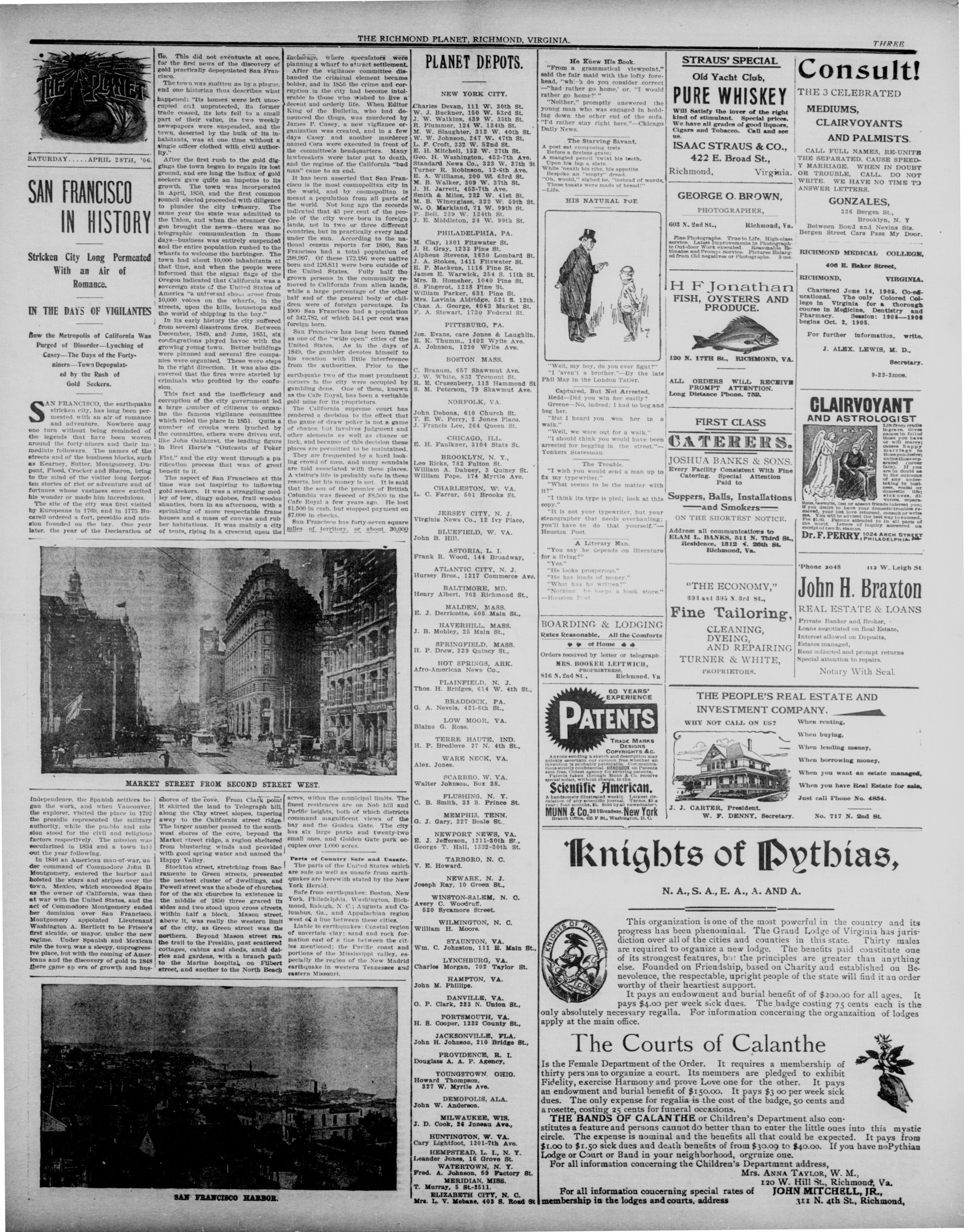
MARKET STREET FROM SECOND STREET WEST
LA VILLA DE MADRID
THE PLANET
SATURDAY.....APRIL 28TH, '06
SAN FRANCISCO IN HISTORY
Stricken City Long Permeated With an Air of Romance.
IN THE DAYS OF VIGILANTES
Row the Metropolis of California Was Purged of Disorder—Lynching of Casey—The Days of the Fortyniners—Town Depopulated by the Rush of Gold Seekers.
SAN FRANCISCO, the earthquake stricken city, has long been permeated with an air of romance and adventure. Nowhere may one turn without being reminded of the legends that have been woven around the forty-niners and their immediate followers. The names of the streets and of the business blocks, such as Kearney, Sutter, Montgomery, Dupont, Flood, Crocker and Sharon, bring to the mind of the visitor long forgotten stories of riot or adventure and of fortunes whose vastness once excited his wonder or made him incredulous.
The site of the city was first visited by Europeans in 1769, and in 1775 Bucarell ordered a fort, presidio and mission founded on the bay. One year later, the year of the Declaration of
MARKET
Independence, the Spanish settlers began the work, and when Vancouver, the explorer, visited the place in 1762 the presidio represented the military authority, while the pueblo and mission stood for the civil and religious factors respectively. The mission was secularized in 1834 and a town laid out the year following.
In 1846 an American man-of-war, under command of Commodore John B. Montgomery, entered the harbor and holsted the stars and stripes over the town. Mexico, which succeeded Spain as the owner of California, was then at war with the United States, and the act of Commodore Montgomery ended her dominion over San Francisco. Montgomery appointed Lleutenant Washington A. Bartlett to be Frisco's first alcalde, or mayor, under the new regime. Under Spanish and Mexican rule the town was a sleepy, unprogressive place, but with the coming of Americans and the discovery of gold in 1849 there came an era of growth and bus-
---
Ue. This did not eventuate at once, for the first news of the discovery of gold practically depopulated San Francisco. The town was snitten as by a plague, and one historian thus describes what happened: "its houses were left unoccupied and unprotected, its former trade ceased, its lots fell to a small part of their value, its two weekly newspapers were suspended, and the town, deserted by the bulk of its inhabitants, was at one time without a single officer clothed with civil authority."
After the first rush to the gold diggings the town began to regain its lost ground, and ere long the infux of gold seekers gave quite an impetus to its growth. The town was incorporated in April, 1850, and the first common council elected proceeded with diligence to plunder the city treasury. The same year the state was admitted to the Union, and when the steamer Oregon brought the news—there was no telegraphic communication in those days—business was entirely suspended and the entire population rushed to the wharfs to welcome the harbinger. The town had about 10,000 inhabitants at that time, and when the people were informed that the signal flags of the Oregon indicated that California was a sovereign state of the United States of America "a universal shout arose from 10,000 voices on the wharfs, in the streets, upon the hills, houseets and the world of shipping in the bay."
In its early history the city suffered from several disastrous fires. Between December, 1849, and June, 1851, six conflagrations played havoc with the growing young town. Better buildings were planned and several fire companies were organized. These were steps in the right direction. It was also discovered that the fires were started by criminals who profited by the confusion.
This fact and the inefficiency and corruption of the city government led a large number of citizens to organize the famous vigilance committee which ruled the place in 1851. Quite a number of crooks were lynched by the committee, others were driven out, like John Oakhurst, the leading figure in Bret Harte's "Outcasts of Poker Flat," and the city went through a purification process that was of great benefit to it.
The aspect of San Francisco at this time was not inspiring to inflowing gold seekers. It was a straggling medley of low, dingy adobe, frail wooden shanties, born in an afternoon, with a sprinkling of more respectable frame houses and a mass of canvas and rubber habitations. It was mainly a city of tents, rising in a crescent upon the
T STREET FROM SECOND STREET
shores of the cove. From Clark point it skirted the land to Telegraph hill, along the Clay street slopes, tapering away to the California street ridge. The larger number passed to the southwest shores of the cove, beyond the Market street ridge, a region sheltered from blustering winds and provided with good spring water and named the Happy Valley.
Stockton street, stretching from Sacramento to Green streets, presented the nearest cluster of dwellings, and Powell street was the abode of churches, for of the six churches in existence in the middle of 1850 three graced its sides and two stood upon cross streets, within half a block. Mason street above it, was really the western limit of the city, as Green street was the northern. Beyond Mason street ran the trail to the Presidio, past scattered cottages, cabins and sheds, amid daries and gardens, with a branch path to the Marine hospital, on Filbert street, and another to the North Beach
THE FIELD
THE RICHMOND PLANET, RICHMOND, VIRGINIA
anchorage, where speculators were planning a wharf to attract settlement. After the vigilance committee disbanded the criminal element became bolder, and in 1856 the crime and corruption in the city had become intolerable to those who wished to live a decept and orderly life. When Editor King of the Bulletin, who had denounced the thugs, was murdered by James P. Casey, a new vigilance organization was created, and in a few days Casey and another murderer named Cora were executed in front of the committee's headquarters. Many lawbreakers were later put to death, and the regime of the California "bad man" came to an end.
It has been asserted that San Francisco is the most cosmopolitan city in the world, and by cosmopolitan is meant a population from all parts of the world. Not long ago the records indicated that 43 per cent of the people of the city were born in foreign lands, not in two or three different countries, but in practically every land under the sun. According to the national census reports for 1890, San Francisco had a total population of 298,997. Of these 172,186 were native born and 126,811 were born outside of the United States. Fully half the grown persons in the community removed to California from alien lands, while a large percentage of the other half and of the general body of children were of foreign parentage. In 1900 San Francisco had a population of 342,782, of which 34.1 per cent was foreign born.
San Francisco has long been famed as one of the "wide open" cities of the United States. As in the days of 1849, the gambler devotes himself to his vocation with little interference from the authorities. Prior to the earthquake two of the most prominent corners in the city were occupied by gambling dens. One of them, known as the Cafe Royal, has been a veritable gold mine for its proprietors.
The California supreme court has rendered a decision to the effect that the game of draw poker is not a game of chance, but involves judgment and other elements as well as chance or luck, and because of this decision these places are permitted to be maintained. They are frequented by a hard looking crowd of men, and many scandals are told associated with these places. A visitor's life is probably safe in these resorts, but his money is not. It is said that the son of the premier of British Columbia was fleeced of $8,500 in the Cafe Royal a few years ago. He lost $1,500 in cash, but stopped payment on $7,000 in checks. San Francisco has forty-seven square miles of territory, or about 30,000
ET WEST.
acres, within the municipal limits. The finest residences are on Nob hill and Pacific heights, both of which districts command magnificent views of the bay and the Golden Gate. The city has six large parks and twenty-two small ones, and Golden Gate park occupies over 1,000 acres.
Parts of Country Safe and Unsafe.
The parts of the United States which are safe as well as unsafe from earthquakes are herewith stated by the New York Herald.
Safe from earthquakes: Boston, New York, Philadelphia, Washington, Richmond, Raleigh, N.C.; Augusta and Columbus, Ga., and Appalachian region west of a line between these cities.
Liable to earthquakes: Coastal region of uncertain clay; sand and rock formation east of a line between the cities mentioned; the Pacific coast and portions of the Mississippi valley, especially the region of the New Madrid earthquake in western Tennessee and eastern Missouri.
```markdown
```
PLANET DEPOTS.
PLANET DEPOTS.
NEW YORK CITY.
Charles Devan, 111 W. 30th St.
W. J. Buckner, 150 W. 53rd St.
J. W. Watkins, 429 W. 35th St.
R. Plummer, 124 W. 134th St.
M. W. Slaughter, 312 W. 40th St.
W. W. Johnson, 247 W. 47th St.
L. F. Croft, 332 W. 52nd St.
H. Mitchell, 152 W. 27th St.
Geo. H. Washington, 453-7th Ave.
Standard News Co., 323 W. 37th St
Turner R. Robinson, 12-6th Ave.
E. A. Williams, 200 W. 63rd St.
M. B. Walker, 309 W. 37th St.
J. H. Jarrett, 453-7th Ave.
Smith & Miles, 232 W. 41st St.
M. B. Wineyglass, 322 W. 59th St.
W. O. Markland, 71 W. 99th St.
P. Bell, 232 W. 124th St.
J. E. Middleton, 24 W. 99th St.
PHILADELPHIA. PA.
M. Clay, 1801 Fitzwater St.
J. H. Gray, 1233 Pine St.
Alpheus Stevens, 1630 Lombard St.
J. A. Stokes, 1411 Fitzwater St.
E. P. Mackens, 1116 Pine St.
James E. Warwick, 254 S. 11th St.
Mrs. B. Homsher, 1040 Pine St.
S. Fingerot, 1218 Pine St.
William Parker, 631 Pine St.
Mrs. Lavinia Aldridge, 521 S. 12th.
Chas. A. George, 4063 Market St.
F. A. Stewart, 1730 Federal St.
PITTSBURG, PA.
Jos. Evans, care Jones & Laughlin.
E. K. Thumm., 1402 Wylle Ave.
A. Johnson, 1230 Wylle Ave.
BOSTON MASS
C. Branum, 657 Shawmut Ave.
J. W. White, 832 Tremont St.
R. E. Crusenbery, 113 Hammond St.
S. M. Peterson, 79 Shawmut St.
NORFOLK, VA
John Debona, 610 Church St.
T. E. W. Perry, 2 Jones Place.
J. Francis Lee, 264 Queen St.
CHICAGO, ILL.
E. H. Faulkner, 3104 State St.
BROOKLYN, N. Y.
Lee Ricks, 782 Fulton St.
William A. Dabney, 3 Quincy St.
William Pope. 174 Myrtle Ave.
CHARLESTON, W. VA.
L. C. Farrar, 501 Brooks St.
JERSEY CITY, N. J.
Virginia News Co., 12 Ivy Place.
BLUEFIELD, W. VA.
John B. Hill.
ASTORIA, L. I.
Frank R. Wood, 144 Broadway,
ATLANTIC CITY, N. J.
Hursey Bros., 1217 Commerce Ave.
BALTIMORE, MD.
Henry Albert, 203 Richmond St.,
MALDEN, MASS.
E. J. Derricotte, 505 Main St.,
HAVERHILL, MASS.
J. B. Mobley, 25 Main St.,
SPRINGFIELD, MASS.
H. P. Drew, 229 Quincy St.,
HOT SPRINGS, ARK.
Afro-American News Co.,
PLAINFIELD, N. J.
Thos. H. Bridges, 614 W. 4th St.,
BRADDOCK, PA.
G. A. Nevels, 421-6th St.,
LOW MOOR, VA.
Blaine G. Ross.
TERRE HAUTE, IND.
H. P. Bredlove 27 N. 4th St.,
WARE NECK, VA.
Alex. Jones.
SCARBRO, W. VA.
Walter Johnson, Box 38.
FLUSHING, N. Y.
C. B. Smith, 33 S. Prince St.
MEMPHIS, TENN.
G. J. Gary, 327 Beale St.
NEWPORT NEWS, VA.
E. J. Jefferson, 1211-30th St.
George T. Hall, 1332-30th St.
TARBORO, N. C.
V. E. Howard.
NEWARK, N. J.
Joseph Ray, 10 Green St.
WINSTON-SALEM, N. C.
Avery C. Woodruff,
520 Sycamore Street.
WILMINGTON, N. C.
William H. Moore.
STAUNTON, VA.
Wm. C. Johnston, 111 E. Main St.,
LYNCHBURG, VA.
Charles Morgan, 702 Taylor St.
HAMPTON, VA.
John M. Phillips.
DANVILLE, VA.
O. P. Clark, 223 N. Union St.,
PORTSMOUTH, VA.
H. S. Cooper, 1332 County St.,
JACKSONVILLE, FLA.
John H. Johnson, 210 Bridge St.,
PROVIDENCE, R. I.
Douglass A. A. P. Agency,
YOUNGSTOWN, OHIO.
Howard Thompson,
327 W. Myrtle Ave.
DEMOPOLIS, ALA.
John W. Anderson.
MILWAUKEE, WIS.
J. D. Cook, 26 Juneau Ave.,
HUNTINGTON, W. VA.
Cary Lightfoot, 1201-7th Ave.
HEMPSTEAD, L. L. N. Y.
Leander Jones, 16 Grove St.
WATERTOWN, N. Y.
Fred. A. Johnson, 59 Factory St.
MERIDIAN, MISS.
T. Murray, 5 St.-2511.
ELIZABETH CITY, N. C.
Mrs. L. V. Mebane, 403 S. Road St
Knights of Pythias,
This organization is one of the most powerful in the country and its progress has been phenominal. The Grand Lodge of Virginia has jurisdiction over all of the cities and counties in this state. Thirty males are required to organize a new lodge. The benefits paid constitute one of its strongest features, but the principles are greater than anything else. Founded on Friendship, based on Charity and established on Benevolence, the respectable, upright people of the state will find it an order worthy of their heartiest support.
It pays an endowment and burial benefit of of $200.00 for all ages. It pays $4.00 per week sick dues. The badge costing 75 cents each is the only absolutely necessary regalla. For information concerning the organization of lodges apply at the main office.
The Courts of Calanthe
Is the Female Department of the Order. It requires a membership of thirty persons to organize a court. Its members are pledged to exhibit Fidelity, exercise Harmony and prove Love one for the other. It pays an endowment and burial benefit of $150.00. It pays $3.00 per week sick dues. The only expense for regalia is the cost of the badge, 50 cents and a rosette, costing 25 cents for funeral occasions.
THE BANDS OF CALANTHE or Children's Department also constitutes a feature and persons cannot do better than to enter the little ones into this mystic circle. The expense is nominal and the benefits all that could be expected. It pays from $1.00 to $1.50 sick dues and death benefits of from $30.09 to $40.00. If you have no Pythian Lodge or Court or Band in your neighborhood, orgrnize one.
For all information concerning the Children's Department address,
For all information concerning special rates of membership in the lodges and courts, address
He Knew His Book
"From a grammatical viewpoint," said the fair maid with the lofty head, "whil' do you consider correct—"had rather go home,' or, "I would rather go home?" "Neither," promptly answered the young man who was engaged in holding down the other end of the sofa. "I'd rather stay right here."—Chicago Dally News.
The Starving Savant.
A poet sat composing tests.
Before a fireless grate;
A mangled pencil 'twixt his teeth,
Upon his lap a slate.
While neath his ribs, his appetite Bespoke an "empty" dread.
"Oh, would," sighed he, "instead of words, These toats were made of bread!"
—Life
HIS NATURAL FOE
"Well, my boy, do you ever fight?"
"I 'aven't a brother.'—By the late Phil May in the London Tatler.
Captured, But Not Arrested.
Redd—Did you win her easily?
Greene—No, indeed; I had to beg and beg her.
"But I heard you won her in a walk."
"Well, we were out for a walk."
"I should think you would have been arrested for begging in the street."—Yonkers Statesman.
The Trouble.
"I wish you would send a man up to fix my typewriter."
"What seems to be the matter with it?"
"I think its type is pled; look at this copy."
"It is not your typewriter, but your stenographer that needs overhauling; you'll have to do that yourself."—Houston Post.
A Literary Man.
"You say he depends on literature for a living?"
"Yes."
"He looks prosperous."
"He has loads of money."
"What has he written?"
"Nothing: he keeps a book store."
—Houston Post
BOARDING & LODGING
Rates Reasonable. All the Comforts
of Home
Orders received by letter or telegraph.
MRS. BOOKER LEFTWICH,
PROPRIETRESS.
816 N. 2nd St. Richmond, Va.
60 YEARS' EXPERIENCE
DATENTS
COPYRIGHT & C.
TRADE MARKS
DESIGNS
Anyone sending a sketch and description may quickly ascertain our opinion free whether an invention is probably patentable. Communication from our headquarters through MUNN & Co. is sent free. Oldest agency for securing patents, it takes through MUNN & Co. receive special notice, without charge, in the
Scientific American.
A handsome illustrated weekly. Largest circulation of any scientific journal. Terms: $2 a month from noon until. Subscription: $15 a month from MUNN & Co. 38 15Broadway. New York
Branch Office. 65 F St. Washington, D. C.
knigh
KNIGHTS OF PYTHIAAS.
F.C.B.
only absolutely necessary rega
apply at the main office.
The Court
Is the Female Department of the
thirty persons to organize a co
Fidelity, exercise Harmony and
an endowment and burial bene
dues. The only expense for r
a rosette, costing 25 cents for f
THE BANDS OF CALA
stitutes a feature and persons o
circle. The expense is nonin
PURE WHISKEY
Will Satisfy the lover of the right kind of stimulant. Special prices. We have all grades of good liquors, Cigars and Tobacco. Call and see us.
ISAAC STRAUS & CO.,
422 E. Broad St.,
Richmond, Virginia.
Virginia.
GEORGE O. BROWN.
PHOTOGRAPHER.
Fine Photographs. True to Life. High-class service. Latest Improvements in Photography to Outdoor Work executed. Reasonable Ease. Professional Photographers Enlarged from Old negatives or Photographs
H F Jonathan
FISH, OYSTERS AND
PRODUCE.
120 N. 17TH St., RICHMOND, VA.
ALL ORDERS WILL RECEIVE
PROMPT ATTENTION.
Long Distance Phone. 753.
FIRST CLASS
CATERERS.
JOSHUA BANKS & SONS.
Every Facility Consistent With Fine
Catering. Special Attention
Paid to
Suppers, Balls, Installations
and Smokers
ON THE SHORTEST NOTICE.
Address all communications to
ELAM L. BANKS, 511 N. Third St.,
Residence, 1312 N. 26th St.
Richmond, Va.
"THE ECONOMY," 303 and 305 N.3rd St.,
Fine Tailoring.
CLEANING,
DYEING,
AND REPAIRING
TURNER & WHITE,
PROPRIETORS.
THE PEOPLE'S REAL
INVESTMENT COMP
WHY NOT CALL ON US?
J. J. CARTER, President.
W. F. DENNY, Secretary.
organization is one of the most power has been phenominal. The Grand over all of the cities and counties in need to organize a new lodge. The longest features, but the principles funded on Friendship, based on Char the respectable, upright people of their heartiest support. an endowment and burial benefit o per week sick dues. The badge galla. For information concerning
THREE
Consult!
THE 3 CELEBRATED
AND PALMISTS
CALL FULL NAMES, RE-UNITE
THE SEPARATED. CAUSE SPEED-
Y MARRIAGE. WHEN IN DOUBT
OR TROUBLE, CALL. DO NOT
WRITE. WE HAVE NO TIME TO
ANSWER LETTERS.
GONZALES.
236 Bergen St.,
Brooklyn, N. Y
Between Bond and Nevins Sts.
Bergen Street Cars Pass My Door.
RICHMOND MEDICAL COLLEGE,
406 E. Baker Street.
Chartered June 14, 1905. Co-educational. The only Colored College in Virginia for a thorough course in Medicine, Dentistry and Pharmacy. Session: 1905—1906 begins Oct. 2, 1905.
For further information, write.
J. ALEX. LEWIS, M. D.,
Secretary.
9-23-3mos.
Secretary.
9-23-3mos.
CLAIRVOYANT
AND ASTROLOGIST
from children
names in full of
those you have
names happy
those you define
those you own
these parished
never
they are in doubt as
to the outcome
taking in business,
social or
discipline
dissatisfaction
'Phone 2048
112 W. Leigh St
John H. Braxton
REAL ESTATE & LOANS
Private Banker and Broker,
Loans negotiated on Real Estate,
Interest allowed on Deposits,
Estates managed,
Rent collected and prompt returns
Special attention to repairs.
AL ESTATE AND
PANY.
When renting,
When buying,
When lending money,
When borrowing money,
When you want an estate managed,
When you have Real Estate for sale,
Just call Phone No. 4854.
No. 717 N. 2nd St.
ythias,
a.
powerful in the country and its
Lodge of Virginia has juris-
in this state. Thirty males
the benefits paid constitute one
are greater than anything
parity and established on Be-
f the state will find it an order
of of $200.00 for all ages. It
costing 75 cents each is the
ing the organization of lodges
```markdown
```
ment also con-
tains little ones into this mystic
and be expected. It pays from
$40.00. If you have noPythian
address,
TAYLOR, W. M.,
Hill St., Richmond, Va.
N MITCHELL, JR.,
321 N. 4th St., Richmond,
THE PLANET
JOHN MITCHELL, JR. - EDITOR
All communications intended for publication should be sent so as to reach us by Wednesday
TERMS IN ADVANCE
One Copy, one year. 21.50
One Copy, eight months. 1.00
One Copy, six months. .80
One Copy, four months. .60
One Copy, three months. .40
Single Copy. .20
ADVERTISING RATES
For one inch, one insertion. $ .50
For one inch, each subsequent insertion. .40
For two inches, three months. 5.00
For two inches, six months. 10.00
For two inches, nine months. 14.00
For two inches, twelve months 24.00
Marriage and General Notices, one inch. .80
Standing and Transient Notices per line. .15
# POSTAGE STAMPS OF A HIGHER DEFINITION TRIAN TWO CENTS NOT RECEIVED ON SUBSCRIPTIONS.
THE PLANET is issued weekly. The subscription price is £1.50 per year in advance. There are FOUR WAYS by which money can be sent by mail at our risk—In a Post Office Money Order, in an Ex-Post Office Money Order, and when money there can be procured, in a Registered Letter.
MONEY ORDERS—You can buy a Money Order at your Post-Office, payable at the Richmond Post Office, and we will be responsible for its safe arrival.
EXPRESS MONEY ORDERS can be obtained at any office of the American Express Co., the United States Express Co., and the Wells Fargo Company. We will be responsible for money sent by any of these companies. The Express Money Order is a safe and convenient way for forwarding money.
REGISTERED LETTER—If a money Order cannot be received, your Postmaster will Register your letter wishing to us on payment of ten cents. Then if the letter is lost or stolen you can send money in this manner at our place.
We cannot be responsible for money sent in letters in any other way than one of the four ways mentioned above. If you send your money in any other way, you must do it at your own expense.
RENEWAL, EVIC. If you do not want THE PLANET continued for another year after your subscription has run out, you then notify us by Post Office to discontinue it. The county law decided that subscribers to newspaper, who do not order their paper discontinued at the expiration of time for which it has been paid are held liable for the payment of the subscription up to date when they order the paper discontinued.
COMMUNICATIONS: When writing to us to renew your subscription or to discontinue your paper, you should give your name and address in full otherwise we cannot find your name on our website.
Entered at the Post-Office at Richmond, Vt as second-class matter.
SATURDAY.....APRIL 28TH, '06.
THOSE LYNCHINGS at SPRING FIELD.
The graphic description of the horrible lynching at Springfield, Missouri, which we conclude in this issue is well worth a perusal, surpassing in atrocity the most vivid descriptions of the orgies of the cannibal of the Old World. It is almost in conceivable to realize that the brutal elements in man's nature can on such short notice assert them selves and change into demons, persons, who but a short time befor had given signs of being Christian civilized beings.
The men who witnessed tails cruse exhibition of brutality without making an effort to stop the same wery guilty of the crime. The last victim showed down-right bravery and in fact set an example that all men would do well to imitate. He protested his innocence to the last and when taunted with the cry that he was too cowardly to jump, boldly jumped from the platform into the open space and broke his own neck.
It was a pity that he was forced to meet such a fate. He fought his murderers, before he was brought from his cell. If he had been armed with a repeating rifle, there would have been interesting times in Springfield. The most cowardly man in all that ill-fated city was the Sheriff. According to his own admissions, his deputies wanted to fire on the mob and he would not permit them to do so. The Washington, D. C. Post, in its issue of the 23d inst facetiously remarks:
"Unless the courts begin to make a better job of it, people through out the country will come to the conclusion that the only cure for those Springfield troubles is the Springfield rifle."
We are highly gratified to know that the Post has reached that station, has made that admission and that the people of the country will reach the only logical conclusion. For twenty years we have waged a practically ceaseless warfare against lynch-law. Now, well-nigh every reputable journal, both north and south is doing the same thing.
We have further insisted that the time to punish the lynchers is when they are engaged in their nefarious practices. It was a Georgia sheriff that years ago set a noble example along this line and it was at Roanoke, Virginia that a mob was taught a similar lesson. The result is that no lyncher in this state will go up against a jail, defended by the state militia.
Lawless people, both white and colored should be taught that they will not be coaxed, but ordered and that the law will enforce its decrees.
regardless of the sacrifice or the slaughter. Governor Folk and the Commonwealth's Attorney seem to mean business. The members of that lynching party should be put to the expense and annoyance of a trial even though all of them are acquitted. The charge against them should be murder and no bail should be allowed them.
Every citizen black and white in these lawless districts should own a repeating rifle and a shot-gun. In every family there should be a person with the nerve to use them. They should fire on a mob first and ask questions afterwards. This will cool the ardor of this kind of material and work a revolution in the affairs of this section of the country. Lynch-law must go!
SENATOR TILLMAN DENOUNCED
Senator "Blunderbus" Tillman continues to be the clown of the United States Senate. The Washington correspondent of the Atlanta Constitution under date of the 19th inst. describes the memorable scene in that body, when Senator Hopkins had the manliness to say openly all that had been spoken privately relative to the amazing ebuilitions of this representative from South Carolina.
Washington, April 19—A savage attack by Senator Hopkins upon Senator Tillman for his defense of lynching and his alleged boast of suppression of the Negro vote by shooting and burning enlivened the early part of to-day's session of the senate. For an hour it looked like a revival of the old force bill and bloody saint contest of the past. So bitter tild the personal passages finally become that other senators felt impelled to insist upon the chair preserving order by strictly enforcing the rules of the body. The South Carolina senator precipitated the attack by returning to his controversy of Tuesday with the Illinois senator over the action of the banks of Chicago in coming to the relief of the Walsh bank. He had asked Senator Hopkins if it were not true that John R. Walsh had been indicted for alleged frauds under the banking laws. Senator Hopkins had declared there had been no indictment of Mr. Walsh.
Seeking to sustain the charge that the Illinois senator had quibbled in that reply, Senator Tillman quoted from several newspaper reports giving the status of the Walsh case. These showed that Mr. Walsh had been arrested and held for the grand jury; that he was out on bond given by a company of which he was the principal stockholder and of which Senator Hopkins is vice president; that there has been five different postponements of the case, and that it was strongly suspected influence was being exerted at Washington to prevent prosecution. The names of Senator Cullom and Speaker Cannon were used with that of Senator Hopkins in this connection.
This insinuation brought a prompt denial from Senator Cullom and from Senator Hopkins that they had seen anyone in Washington in be half of Mr. Walsh. Then Senator Hopkins turned his batteries upon the South Carolina senator.
"Who," he asked, "is this great modern reformer who gets up here in the senate every morning and pours forth criticisms upon things about which he is incapable of knowing anything, and solely for the purpose of playing to the gallery; who is this man who insists upon seeing wrong in everything any other man does?
"He holds his seat in this body through the fraudulent suppression of the rights of a majority of the citizens of his state."
Quoting a speech of Senator Till man in which he declared "we have hung them and burned them in South Carolina," Senator Hopkins continued:
"He bows his head in assent. My God, think of a man in the United States who would approve such a barbarous and treacherous practice. He talks about possible infractions of the banking laws; how is a little money to be compared with the burning of men and women at the stake without any opportunity of protesting their innocence?" Senator Hopkins "struck home" and completely demoralized Senator Tillman. The following explains itself:
Senator Tillman aggrily protested that the protection of civilization demanded lynching for crimes a gainst womanhood, but Senator Hopkins retorted that the South Carolina senator's boast had been of such practices to suppress the Negro vote. Senator Tillman charged the Illinois senator with the evasion of the real question. "When a lawyer as a bad case," he declared, "I notice he always attacks the counsel for the other side.
"I'll discuss the race question with the senator some other time. What we want to know is about these Chicago Banks." He denied that Negroes had been burned in South Carolina to keep them from voting.
Senator Hopkins returned to the attack, and there was a further exchange of heated compliments until a reference to the lynching at Spring field, Ohio, brought Senator Foraker into the discussion. He acknowledged there had been a deplorable affair in his own state, but he rejoiced that the law had triumphed as it had more recently at Spring field, Mo. Paying a high compliment to Governor Folk, the Ohio senator said he was glad to be able to say that of all the senators representing states where such affairs had occurred but one, the senator from South Carolina, had ever stood in the senate chamber to defend them.
Senator Tillman, flushed with anger, was returning to the attack up on Senator Hopkins when he was taken off his feet by the demand for order.
Thus is the Negro's cause which
THE RICHMOND PLANET, RICHMOND, VIRGINIA
Saturday, April 28, 1906 at 1 P.M.
The greatest list of FREE, OPEN-AIR ATTRACTIONS ever offered the public. DARE-DEVIL "VOLA" leaping a gap of forty feet on a Bicycle, twice daily, at 4 and 10 P. M. Prof. STANLEY, "HIGH-DIVER," diving from a Ninety-five Foot Tower into a Net, twice daily, at 3 and 9 P. M. The celebrated ANDERSON FAMILY, introducing the latest Songs and Dances, Banjo Solos, etc. Champion Buck and Wing Dancers of the World, twice daily, 2 and 8 P. M. "REX," THE HIGH-DIVING DOG, diving from a Fifty-foot Ladder, twice daily, 1:30 and 7:30 P. M. Madame LOCKART, "QUEEN OF THE CLOUDS" will make an ascension in her 100-FOOT BALLOON, descending by PARACHUTE at 5 P. M.
Clean, cut and entertaining. Booths of all kinds, Ice-Cream Parlor, First-class Restaurant, Boating, Bathing, Fishing, Indian Village, Gypsy Camp, Photograph Gallery, Shooting Gallery; last but not least, everybody's favorite, old as well as young. PROF. BOARDMAN'S UP-TO-DATE MERRY-GO-ROUND, with Imported Pipe Organ. No Intoxicating Liquors of any Description Sold on the Grounds. Intoxicated or disorderly persons will not be admitted. A UNIFORMED BODY OF POLICE ON THE GROUNDS AT ALL TIMES to preserve order.
is indeed the cause of justice and humanity being vindicated. Senator Tillman is rapidly reaching "the end of his tether" and it will require but a few more similar experiences to relegate him to that obscurity which he so richly deserves. President Roosevelt in his now famous "Muckrake" speech discovered that he is not an honest man and the Senate of the United States will soon find out that he is not even as much as a "corn-field" statesman.
SAN FRANCISCO WILLRISE AGAIN
Putting Up Temporary Buildings and Planning Beautiful City.
DEAD ESTIMATED AT 1000
Fort Mason, attended by Generals Greely and Funston, Mayor Schmitz, Governor Pardee, Dr. Devine and some others, it was agreed that this was the case and that Dr. Devine himself should frame a telegram to the president informing him of the splendid work already done and of his perfect willingness to assist in forwarding the measures already undertaken.
What hart even more than this was the suggestion made in the letter from President Roosevelt to Secretary of War Taft that reports have reached pressed their willingness to co-operate in the great work and advance any funds that are needed.
The work will commence right at the water front. This district will be entirely rebuilt on new and modern as well as picturesque lines. It is estimated that the work right there will cost $25,000,000. The new wharves and the like will be constructed on entirely different lines and new depots will be built.
DOGS EATING HUMAN BODIES
passed through the horrors of the earthquake and subsequent fire.
Mr. Gill and his wife and several prominent Philadelphians spent the winter in Honolulu and on the coast. The party were guests at the St. Francis Hotel Wednesday morning. Be sides Mr. Gill, there were in the part Mr. E. W. Aumont, a retired officer of the Girard Trust company, of Philadelphia; Mrs. Aumont, Miss Florence Aumont, Miss A. M. Haehnlen and J. Millard Kessler.
The Street Car Situation Remains the Same.
The street car situation remains the same. The colored people are not riding and vow they will continue to walk always. Interested parties say it will all blow over in a couple months and our people will begin to ride again. They say the Negro is impulsive and has no staying qualities. This latter proposition we do not believe. We believe he is unalterably opposed to class legislation and color discrimination and will fight it to the end. We are determined to never "go way back and sit down" behind the Mexicans, the Bohemians and other third class nations. The property owning, tax-paying intelligent and self respecting Negro thinks he is as good as they are and that he as well as they should be allowed to take seat in public conveyances wherever his fancy leads. There is no truth in the statement that our people are interfering with those who want to ride. The fact is no self-respecting race loving Negro wants to ride. Their sense of justice and right alone is keeping them off the cars. The only force used is the appeal to their manhood and race pride.
The Statesman admits that Negroes have withdrawn their patronage from the street-car, which is one-third; but in the next breath says that their receipts have not materially decreased. The two statements are contradictory. By what method of reason is reached its conclusion we can* not see. —Austin, Texas Watchman.
$150.00 Endowment Paid.
Richmond, Va., April 21, '06.
This is to certify that I have received from John Mitchell, Jr.
Grand Chancellor of the Grand
Lodge of Virginia, Knights of Pythias, N. A., S. A., E., A., A. and A.
($150.00) One Hundred and Fifty
Dollars in payment of the death-
claim of Sir E. A. Washington, who was a member of Blooming Lily
Lodge, No. 15 of Richmond, Va.
Signed—Isabelle Washington.
Administratrix.
Witness:
J. Andrew Bower.
$100.00 Endowment Paid.
Richmond, Va., Dec. 14th, '66
This is to certify that I have received from John Mitchell, Jr.,
Grand Worthy Counselor of the Grand Court of Virginia, I. O. Calanhe ($100.00) One Hundred Dollars in payment of the death-claim of Sister Sarah E. Ellis, who was a member of Mechanics' Court, No. 45 of Richmond, Va.
Signed—William Ellis, Jr
$150.00 Endowment Paid.
Chase City, Va., Apr. 18, '08
This is to certify that we have received from John Mitchell, Jr.,
Grand Chancellor of the Grand Lodge of Virginia, Knights of Pythias, N. A., S. A., E., A., A. and A. ($150.00) One Hundred and Fifty Dollars in payment of the deathclaim of Sir A. E. Burton, who was a member of Sons of Liberty Lodge No. 77 of Chase City, Va.
Signed:
Inis Burton.
her
Lucy X Burton
mark
Alice S. Burton
Beneficiaries
Witnesses:
F. L. Jones.
his
Isaac X Toone.
mark
W. E. Davis.
THE ONLY UP-TO-DATE PARK IN THE SOUTH ADMITTING COLORED PEOPLE.
BIG, FREE DANCING PAVILION. TWO BANDS. SHOWS OF ALL DESCRIPTIONS
Southern Amusement Company, Proprietors.
SAN FRANCISCO WILL RISE AGAIN
Putting Up Temporary Buildings
and Planning Beautiful City.
DEAD ESTIMATED AT 1000
Coroner Issues Statement of Bodies
Recovered and Buried.
PLENTY RELIEF FOR ALL
President Roosevelt's Letter That
Chinese Were Being Discriminated
Against Hurt the Frisco Authorities,
Who Are Relieving the Destitute
Regardless of Creed or Color—Three
Naval Heroes Checked the Fire.
San Francisco, April 25—It is a week since the earthquake jarred the city so severely and started the fires that laid it in ashes, and as on the preceding days, Tuesday up took up the accumulated impetus of Monday and added much volume of force of its own, so that Wednesday dawned on a situation that is a long way towards the normal. Such marts of trade as remain unburned were opening for the transaction of ordinary business, temporary structures were being run up for the accommodation of others, the clearing of the devastated area of its ruins was well under way, the inquiry into the condition of the bank vaults was completed, the organization and preparation for service of the street railways were so far advanced that the company expressed its readiness to resume business as soon as the mayor would permit; the water company announced the completion of such repairs as enabled it to supply a total of 12,000,000 gallons daily. In fine, there was all the evidence that put at rest now and forever the fears of those who predicted that San Francisco would never rise again.
Estimates Dead at 1000.
Coroner William Walsh estimated that the total number of dead will not be less than 1000. His reports are complete, and his estimate is made up from all the data he has been able to collect.
Coroner Walsh said: "Bodies that the deputy coroners have found and buried number 300, as follows: At Polk and Bay streets, 32; at Portsmouth Square, 23; at Washington Square, 12; at the Six-Mile House, 200; at Laurel Hill, 23; scattered in different parts of the city, 10. No thorough search has been made of the district south of Market street or the Chinese quarter. Many lives must have been lost in these sections. South of Market street are the cheap lodging houses, and many of these collapsed from the earthquake. There is little chance that half of the inmates of the collapsed buildings had opportunity to escape. This also is true of Chinatown.
"Shortly after the earthquake soldiers and police, so I have been told, buried bodies along the water front. I have received no official report of these. The total number of dead will undoubtedly reach, if it does not exceed, 1000."
Property Loss $300,000,000.
It was estimated by competent authorities that the loss will aggregate $300,000,000, and on this vast amount of property the insurance companies carried approximately $175,000,000 insurnace.
Surprised at President's Proclamation. The citizens of San Francisco had done so splendidly in the face of such an appalling catastrophe that some little consternation was created when President Roosevelt's proclamation was read turning over to Dr. Edward Devine, of the National Red Cross, the management of relief measures and the distribution of the great funds so generously appropriated by congress. This feeling was also evinced because of the president's recommendation to the people of the United States that their contributions of food and supplies and money should be diverted into the same hands. At a conference at
Fort Mason, attended by Generals Greely and Funston, Mayor Schmitz, Governor Pardee, Dr. Devine and some others, it was agreed that this was the case and that Dr. Devine himself should frame a telegram to the president informing him of the splendid work already done and of his perfect willingness to assist in forwarding the measures already undertaken.
What hart even more than this was the suggestion made in the letter from President Roosevelt to Secretary of War Taft that reports had reached him that less charity was being shown the Chinese who dwelt here than the whites, and directing that if this be true the situation should be remedied at once. If the people of San Francisco are not in love with the Chinese, it was felt that the name they have earned in the past for charity and open-heartedness should have saved them from any reflection that they would have permitted any human being—white, black or yellow—within their reach to suffer.
Are Alding the Chinese.
Mature reflections, however, brought the conviction that the truth had not reached the president, and a special message was sent him signed by the constituted authorities recounting the exact facts. The message read:
"President Roosevelt, Washington.—All reports that the people or the representatives of the relief committees of San Francisco are making any distinction in relieving, succoring or protecting the Chinese or any other people differing in race or color are totally false and entirely unfounded. The committees, and even the homeless sufferers themselves are treating the Chinese and all other fellow unfortunate with the consideration worthy of our civilization and our country. The people of San Francisco are striving with all their heart to relieve their destitute, care for the sick, protect their helpless and uplift their stricken, irrespective of the race, creed or color, in accordance with the dictates of humanity in a manner worthy of Americans, and in the common brotherhood of man. Please give press."
Food For All.
The work of housing and feeding the homeless and reconstructing the sanitary conditions are carried on with tremendous energy. It is certain that no one is hungry in San Francisco. There is food for all, and the method of distributing it has been so perfected that it is within the reach of all. As for the health and sanitary conditions, there is, considering all circumstances, nothing to be desired. An investigation of the sewers has shown that they were not as badly damaged as was feared, and while there were breaks they have been repaired. There has been no outbreak of disease of a contagious character, nor is any feared, and as for those pulmonary diseases that might be expected to be prevalent in such a crisis, they are chiefly notable by their absence. The hospitals, which in the few instances were crowded by great numbers, are discharging them by the score.
Housing the Homeless.
In the great stretches of the Golden Gate Park, famed the world over for its beauty, have arisen frame shells, housing 40,000 people. There is still considerable interest of blankets, bedding and cots, and when this has been met, as possibly it will be within the next 24 hours, the condition of those unfurtnutes will, in view of all that has happened, be almost ideal. For some days San Francisco showed an unwonted eagerness to get rid of its people. That period has now passed. Of the able-bodies mechanics and inborners she had especial need and is making every endeavor to heart them and induce them to work. They are answering the call nobly.
Planning to Build Beautiful City. Steps are being taken to organize a movement for the rebuilding of San Francisco on the plans of Architect Daniel Burnham. While the various other committees have been busy with relief work, many prominent citizens have been in consultation, and within the next few days plans will be outlined and the work of making arrangements for the most beautiful city in the world will begin. W. E. Bennett, one of the men in the latest movement, says all the funds needed for this great work will be forthcoming just as soon as the committee is ready to begin its work. Telegrams have been sent all over the country explaining the plans of the committee, and great men of finance have ex-
pressed their willingness to co-operate in the great work and advance any funds that are needed. The work will commence right at the water front. This district will be entirely rebuilt on new and modern as well as picturesque lines. It is estimated that the work right there will cost $25,000,000. The new wharves and the like will be constructed on entirely different lines and new depots will be built.
DOGS EATING HUMAN BODIES
graph and Russian Hills.
San Francisco, April 25.—One of the gruesome scenes that has followed the fire was that witnessed on Telegraph and Russian hills and along the entire north beach front of the city, when scores of half-starved dogs were found eating human bodies. The animals were discovered gnawing and tearing the dogs were digging for the rest of the body. Men who had been sent into the ruins of homes to look for what little property that might have escaped the flames, came upon this sickening condition and immediately reported it to the naval officers in command of the water front military districts. In response to their appeal that something be done, blue jackets were detailed to cover the sections designated and kill all dogs found in those vicinities. All morning rife reports could be heard on the hillside and along the beach as the dogs were being killed. Men were pressed into service either to bury the carcasses of the dogs or throw them into the bay. In a few places smoldering fires were found and there it was possible to cremate the animals.
It was not believed that there were so many dead in the ruins of Telegraph and Russian hills until the dogs were found there digging for the bodies. When the dogs have all been run down and slain a further search will be made of those sections to obtain the bodies and bury them as soon as possible.
Thief Cut Off Finger to Steal Rings.
Colorado Springs, Col., April 25—
Passing through this city on a Denver
& Rio Grande train bound for Chicago,
where her parents reside, was a San
Francisco fugitive, who said her name
was Miss Logan. She wore a bandage
on her left hand, and said that while
she lay unconscious upon the floor of
the lobby of the St. Francis Hotel in
San Francisco, after the earthquake
last Wednesday morning, the third
finger of her left hand was cut off
and she was robbed of rings that she had
worn there. The young woman is
20 years of age, and is almost prostrated with grief and indignation.
RELIEF WORKER SHOT DEAD
10. C. Tilden Killed In His Auto By
Members of Citizens' Bureau
Members of Citizens' Patrol.
San Francisco, April 24.—H. C. Tilden, one of the most prominent members of the general relief committee, was shot and almost instantly killed in his automobile while returning from Menlo Park. He was shot by men supposed to be members of the citizens' patrol.
Hugo Alltschul, a coachman, who was with him in the automobile, was cut in the face by a bullet, and another ball pierced the seat and struck in the back of R. G. Seaman, acting lieutenant of the Second Company of the Signal Corps. The force of the bullet was spent, and Seaman suffered no injury.
The three men under arrest are H. S. Boyneton, a telephone inspector in the employ of the Pacific States Telephone company; George W. Simmons and Malcolm Vance. They are all young men and members of the citizens' patrol. Boyneton declares that he did not see the Red Cross flag on Tilden's car, and when the latter did not stop when challenged, he fired. The coachman in the car then began shooting, and Simmons and Vance replied. The killing of Tilden has created the greatest indignation.
The three men were taken by Chief of Police Dinan in an automobile to Fort Mason and turned over to General Funston.
WILD SCENES IN STREETS
Fors of Earthquake and Fire.
Colorado Springs, Col, April 23.—J. C. Gill, a retired member of the firm of King, Hillman & Gill, of Philadelphia, arrived in this city from San Francisco, where with his party he
passed through the horrors of the earthquake and subsequent fire. Mr. Gill and his wife and several prominent Philadelphians spent the winter in Honolulu and on the coast. The party were guests at the St. Francis Hotel Wednesday morning. Besides Mr. Gill, there were in the party Mr. E. W. Aumont, a retired officer of the Girard Trust company, of Philadelphia; Mrs. Aumont, Miss Florence Aumont, Miss A. M. Haehnlen and J. Millard Kessler.
"Mrs. Gill and myself were in a room on the third floor of the hotel," said Mr. Gill. "We were awakened by the rocking of our beds. Then they seemed to be lifted from their legs, suspended in the air and as suddenly dropped, while the plaster began crackling and falling. We arose and left our room after putting on a few clothes. We felt that with every step we were treading on glass and that the 10 stories above us would fall, not allowing us to escape alive. But once outside the building and with our friends, I began to realize what had happened.
"With hundreds of others we roamed in the park in front of the hotel several hours. When we saw the fire hemming in the lower part of the city we walked toward the outskirts and were sheltered for a time at 1317 Jones street by Miss McEwen. Early next morning we decided to leave the city and started for the ferry. Policemen would stop us, and it was with difficulty and much trepidation that we walked through the burned district and arrived 15 minutes before the boat left.
"The scenes we passed through were sickening and indescribable. I fancy that scores of men, wharf rats, who had looted wholesale liquor houses and were maudlin drunk, were burned to death without being the wiser of their condition.
"The air was filled with the roar of explosions. Firemen, soldiers and citizens were dynamiting great blocks. Sailors were training guns to rake rows of residences.
"All the while we were moving onward with the crowd. Cinders were falling about us. At times our clothing caught fire—just little embers that smoked once and went out. The stinging cinders burned our faces and we used our handkerchiefs for vells."
Mr. and Mrs. C. F. Williams, of Norristown, Pa., also survivors of the disaster at San Francisco, are at the Antlers Hotel here. Their experiences were similar to those of the other survivors.
MILLIONS FOR BELIEF
Money and Supplies Flowing Toward
Stricken Californians.
New York, April 23.—The voiceless appeal of San Francisco has been heard throughout the civilized world. From every city and town in this country, from European capitals and from the far eastern communities comes news that all humanity, in expressing its sympathy, is also offering every material assistance. Money and supplies are flowing toward the stricken California metropolis and the other cities by the Pacific affected by the recent disaster with a generosity unprecedented in history. From the incomplete figures of the contributions which have been made, it is estimated here that the San Francisco fund has passed $20,000,000. The United States appropriated $2,500,000. In the list of generous contributors, New York ranks first. The fund amounts to approximately $6,000,000, with contributions coming in fast.
The state of Massachusetts has undertaken to raise $3,000,000, and with Boston's generous help is well on the way to the goal. Chicago's fund, spontaneously subscribed, is approaching $1,000,000, and promises to go beyond that sum. Philadelphia will send $500,000. These are but a few of the larger sums. A score or more of cities are contributing $100,000 and more, while hundreds of municipalities are sending all their means will allow. From London, Paris, Berlin and wherever Americans are congregated, a generous inflow of gold is reported. Wholly foreign contributions, while deeply appreciated, are not to be accepted, according to the precedent established by the president in declining a gift of $25,000 from a German steamship line. America, though touched by the evidences of foreign generosity, feels able to care for its own. Nor is the work of raising relief
IT WILL PAY YOU To interest yourself in promot ing the CIRCULATION of the RICHMOND PLANET.
---
THE PLANET
SATURDAY.....APRIL 28TH. '06
funds confined to the large cities. From every section, every state, comes the news of contributions made by small towns. Not large in themselves, their aggregate will be enormous. Throughout the country theatrical performances are being planned, the proceeds to go to the relief fund.
HOW THE FIRE WAS CHECKED
San Francisco, April 25.—Three heroes saved San Francisco—what was left of it. They were the dynamite squad that threw back the fire demon at Van Ness avenue.
When the burning city seemed doomed and the flames lit the sky further and further to the west, Admiral McCalla sent a squad of his most trusted men from Mare Island with orders to check the confagration at any cost of life or property. With them they brought a ton and a half of gun-cotton. The terrific power of the explosive was equal to the maniac determination of the fire.
Captain MacBride was in charge of the squad. Chief Gunner Adamson placed the charges and the third gunner set them off.
The thunderous detonations to which the terrified city listened all that dreadful night meant the salvation of 375,000 lives. A million dollars worth of property, noble residences and worthless shacks alike were blown to drifting dust, but that destruction broke the fire and sent the raging flames over their own charred path.
The whole east side of Van Ness avenue, from Golden Gate to Greenwich, were dynamited a block deep, though most of the structures stood untouched by spark or cinder. Not one charge failed. Not one building stood upon its foundations.
Unless some second malicious miracle of nature reversed the direction of the west wind, the whole populous district to the west blocked with fleeing refugees and unilluminated except by the disastrous glare on the water front, seemed safe by 9 o'clock.
Captain MacBride's dynamiting squad realized that a stand was hopeless except on Van Ness avenue. They could have forced their explosives further in the burning section, but not a pound of gun-cotton could be or was wasted. The ruined block that met the wide thoroughfare formed a trench through the clustered structures that the conflagration, wild as it was, could not leap. Engines pumping brine through Fort Madison from the bay completed the little work that the gun-cotton had left, but for three days the haggard-eyed firemen guarded the flickering ruins.
The desolate waste straight through the heart of the city is a mute witness to the most heroic and effective work of the whole calamity. Three men did this, and when their work was over and what stood of the city rested quietly for the first time, they departed as modestly as they had come. They were ordered to save San Francisco and they obeyed the orders, and Captain MacBride and his two gunners made history on that dreadful night.
REACHED CRATER OF VESUVIUS
Naples, April 25.—Professor Matteucci, director of the royal observatory, succeeded in reaching the crater of Vesuvius. He describes the spectacle there as one of great grandeur. The diameter of the crater, which before the eruption was about 100 feet, is now about 5000 feet. There is no eruption of incandescent stones as before the outburst, but a small quantity of ashes is being ejected. Vesuvius seems to be assuming the character of a dead volcano. The cone of the crater, which before the eruption rose to a height of 6000 feet above sea level, has diminished about 800 feet.
Work is being vigorously pushed to re-establish the funicular railway to the observatory.
Dedication Date Fixed.
Harrisburg, Pa., April 25—The capitol dedication commission, at a meeting here, officially fixed October 4 next as the date for the dedication of the new state capitol. President Roosevelt, and probably Mrs. Roosevelt and the members of the president's cabinet and their wives will attend the exercises. A large grand stand will be erected at the entrance to the capitol for the dedicatory exercises.
Jersey Lawmakers Get Railroad Passes Camden, N. J., April 25—Members of the New Jersey Legislature in this section of the state received annual passes over the Pennsylvania railroad, Central Railroad of New Jersey and the West Shore railroad. They have been using passes good only during the session of the legislature, which the railroads are required by law to furnish. The receipt of the annuals was a surprise.
Southern Truck Damaged By Frost.
Raleigh, N. C., April 25—A special from Wilmington, N. C., says: Reports from many sections of eastern North Carolina are to the effect that a heavy frost seriously damaged truck. Strawberries are probably not injured to any exxtent. Irish potatoes, beans, cucumbers and English peas suffered most. A heavy frost and some ice is reported from Kenasville.
Old sheets and other pieces of linen should never be thrown away, but kept in a convenient place for use in case of cuts or burns or other accidents.
BORS AND INTEREST THEM IN THE PLANET. WE WILL HELP YOU TO OBTAIN A PREMIUM.
COLORED INFANTRY IN RESCUE OF ROUGH RIDERS AT SAN JUAN HILL, JULY 2, 1898, SIZE 20X28 AND 20X24 INCHES, ADMIRAL DEWEY'S GREAT NAVAL BATTLE OFF CAVITE IN MANILA BAY, MAY 1ST, 1898, NAVAL BATTLE, DESTRUCTION OF ADMIRAL CERVERA'S SPANISH FLEET OFF SANTIAGO DE CUBA, JULY 3RD, 1898, SIZE 22X28 INCHES; LAND BATTLE, CAPTURE OF EL CANEY, EL PASO AND FORTIFICATIONS OF SANTIAGO, JULY FIRST AND SECOND, 1898, SIZE 22X28 AND 22X27 INCHES. WE WILL SEND YOU ONE OF ANY OF THE FOLLOWING BATTLES OF THE CIVIL WAR ON THE SAME TERMS. THE PICTURES LIKE THE OTHER BATTLES ARE FINISHED IN COLORS. THEY ARE 22X28 INCHES AND RETAIL AT ONE DOLLAR EACH. WE WILL FURNISH FRAMES FOR ANY OF THESE FINE CHROMOS FOR 2 DOLLARS & 50CTS. EACH ADDITIONAL. BATTLE OF GETTYSBURG, BATTLE OF SHILOH, BATTLE OF FIVE FORKS, VA., BATTLE OF ATLANTA, GA., BATTLE OF SPOTTSYLVANIA, VA., BATTLE OF VICKSBURG, MISS., BATTLE OF LOOKOUT MOUNTAIN, TENN., BATTLE BETWEEN THE MONITOR AND THE MERRIMAC, BATTLE OF BULL RUN, VA., BATTLE OF CHANCELLORSVILLE, BATTLE OF THE BIG HORN, (CUSTER'S LAST CHARGE) STORMING OF FORT WAGNER, S. C., (COLORED TROOPS IN THIS FIGHT), BATTLE OF NEW ORLEANS, LA., CAPTURE AND DEATH OF SITTING BULL, THE GREAT INDIAN CHIEFTAIN; FORT PILLOW MASSACRE, FALL OF PETERSBURG, VA., BATTLE OF WINCHESTER, VA., BATTLE OF OLUSTEE, FLA. WE WILL SEND FAMILY RECORD, SIZE 22 BY 28, WHICH CONTAINS SPACE FOR PHOTOGRAPHS OF PARENTS AND TEN CHILDREN. WE WILL SEND SOLDIERS WAR RECORD (CERTIFICATE OF SERVICE IN UNITED STATES ARMY.)
FOR ONE YEAR EACH, OR THEIR EQUIVALENT, WE WILL SEND YOU A COPY OF UNCLE TOM'S CABIN, THE MOST INTENSELY INTERESTING BOOK IN THE COUNTRY. WE WILL SEND YOU A GOLD-PLATED BROOCH WITH YOUR PICTURE THEREIN, YOU TO
$150.00 Endowment Paid.
Richmond, Va., Dec. 19th, '06.
This is to certify that I have received from John Mitchell, Jr.,
Grand Chancellor of the Grand Lodge of Virginia, Knights of Pythias, N. A., S. A., E., A., A. and A. ($150.00) One Hundred and Fifty Dollars in payment of the deathclaim of Sir Jack Vaughan, who was a member of Invincible Lodge, No. 65 of Richmond, Va.
her
Signed—Lucy X Vaughan.
mark
Beneficiary.
Beneficiary.
Witnesses:
J. Samuel Bray.
J. W. Anderson.
Vote For Your Pastor.
During the next sixty days we will give away absolutely free, to the two Pastors of Richmond and Manchester, who receive the highest number of votes in our Pastor's Contest, two Tailor-made Suits of clothing, one for $40.00 and one for $25. Every $1.00 spent in our store from now until July 1st will entitle the purchaser to one vote.
Now is the time to give your Pastor a nice suit of clothes free. Just spend your money with us and get the votes to make him win. Remember that there are two prizes, the $40 suit to the Pastor receiving the highest number of votes, and the $25 suit to the one receiving the next highest number. Watch the papers next week for the names of the places where you may deposit your votes.
The New Enterprise Store, 528 E. Broad St., I. J. Miller, Pron
A New Company at Suffolk
Sufolk, Va., April 26, '06.
Brigadier John Mitchell, Jr.
commanding the Uniform Rank,
Knights of Pythias arrived here yesterday afternoon accompanied by Capt. John G. Smith. Despite his sprained ankle, Gen. Mitchell performed his duties and left for Richmond. Last night he organized Sufolk Company, No. 5 with the following officers: Captain, B. B. Elliott;
First Lieutenant, J. C. Waite, Second Lieutenant, John W. Brown;
Recorder, Charles Taylor; Treasurer, C. W. Jordan; Guard, Henderson Williams; Sentinel, Isham Powell.
Gen. Mitchell and Capt. Smith took supper at the residence of Mr. and Mrs. N. W. Twitty and spent the night at the residence of Mr. and Mrs. C. W. Jordan. This Company was organized through the persistent efforts of Sir C. W. Jordan.
The party visited Mr. and Mrs. Isham Powell's residence
Notice!
There will be a grand sacred concert given at the Fifth St. Baptist Church by the Woman's Day Club Sunday, May 6th, 1906 at 3:30 o'clock. Special programme will be rendered.
VIRGINIA V. TAYLOR, Sec.
R. E. LOVINGS, Pres.
"Your friend Deeply," said the editor, "left some verses with me to-day that were quite amusing."
"Indeed!" exclaimed - Reeder, "I didn't think he was a humorous writer."
"Neither does he."—Philadelphia Press.
The Wrong Door.
"I'd like to see the head of the house, please," said the man who had just rung the front door bell.
"You'll have to go to the kitchen door. I guess the cook's in," replied the man who answered the bell.—Yonkers Statesman.
Looked Like a Quitter.
Bacon—I was in court, to-day, and saw your friend Brief.
Egbert—What was he doing?
"Oh, laying down the law."
"Is that so. Why, he only took it up about a year ago!"—Yonkers Statesman.
FORD'S
HAIR POMADE
Formerly known as
"OZONIZED OX MARROW"
CLORIZED OX MARROW
80
STRAIGHTENS
(None genuine without my signature)
Charles Ford Park
78 Wabash Ave., Chicago, Ill.
Agents wanted everywhere.
Subscribe to the PLANET.
IN ORDER TO FURTHER INCREASE OUR STEADILY GROWING CIRCULATION WE WILL OFFER PRIZES.
WE WILL SEND YOU THE PLANET AND THE ST LOUIS, MISSOURI, SEMI-WEEKLY GLOBE DEMOCRAT, ONE OF THE LEADING REPUBLICAN JOURNALS IN THE UNITED STATES FOR $2.25 PER YEAR FOR BOTH.
WE WILL SEND YOU THE PLANET AND THE COSMOPOLITAN MAGAZINE FOR $2.25 PER YEAR FOR BOTH.
WE WILL SEND YOU THE PLANET AND McCLURE'S MAGAZINE FOR $2.25 PER YEAR FOR BOTH.
FURNISH THE PHOTOGRAPH, ONE FATIN PEN, GOLD POINT; ONE LADIES IN ONE BREAST-PIN, GOLD FILLED; HALF IN EN LINEN HANDKERCHIEFS, ONE AL CLOCK, ONE DOZEN NAPKINS, ONE DOZEN TOWELS, ONE CHOCOLATE POT, PAIR VASES, ONE PAIR KID GLOVES, HAM, ONE TURKEY.
FOR TEN NEW SUBSCRIBERS
OR THEIR EQUIVALENT, WE WILL SEND PICTURES, ONE ONLY, OF PRESIDENT THEODORE ROOSEVELT, DR. BOOKER T. WASHINGTON, BATTLE OF SANTIAGO, LAND BATTLE OF QUASIMAS NEAR SANTIAGO, JUNE 24, 1898, SHOWING THE NINTH AND TENTH COLORED CAVALRY IN SUPPORT OF ROUGH RIDERS, SIZE 20X28 AND 20X24 INCHES, LAND BATTLE AND CHARGE OF THE 24TH & 25TH
READ THE GREAT INDUCEMENTS OFFERED BY THE PLANET
THE RICHMOND PLANET. RICHMOND. VIRGINIA
IF YOU WILL TALK WITH YOUR NEIGH-
```markdown
```
FOR TWO YEARLY SUBSCRIBERS
FOR FIVE NEW SUBSCRIBERS.
REQUISITE NUMBER IS OBTAINED, WE WILL FORWARD THE PRESENT INDICATED. A PERSON WHO TRIES TO GET FORTY SUBSCRIBERS AND GETS TIRED MAY INDICATE HIS WISH AND WE WILL SEND THE PRESENT FOR THE NUMBER HE HAS SECURED OVER FIVE. THE NUMBER WILL BE FOR NOT LESS THAN FIVE NOR MORE THAN TEN AND NOT LESS THAN TEN NOR MORE THAN TWENTY AND NOT LESS THAN TWENTY NOR MORE THAN FORTY, TO DETERMINE THE PRIZE TO WHICH THE WORKER IS ENTITLED.
IF ANYTHING IS DESIRED NOT SPECIFIED IN THIS LIST, WRITE US ABOUT IT AND WE WILL TELL YOU IN WHAT CLASS IT BE LONGS.
A man in a suit is sitting in a chair. A man in a suit is standing in front of him.
DIDILY GROWN
LANET
WEEKLY
READING
UNITED
H.
T AND
R $2.25
T AND
YEAR
ND PIC-
THEO-
WASH-
D BAT-
JUNE 24,
H COL-
UGH RI-
LAND
& 25TH
```markdown
```
REQUISE FOR WA
SHOULD YOU DESIRE ANY COLORED JOURNAL IN THE UNITED STATES, WE WILL SEND IT TO YOU IN CONJUNCTION WITH THE PLANET AT A GREATLY REDUCED RATE FOR BOTH.
FURNISH THE PHOTOGRAPH, ONE FOUNTAIN PEN, GOLD POINT; ONE LADIES RING, ONE BREAST-PIN, GOLD FILLED; HALF DOZEN LINEN HANDKERCHIEFS, ONE ALARM CLOCK, ONE DOZEN NAPKINS, ONE HALF DOZEN TOWELS, ONE CHOCOLATE POT, ONE PAIR VASES, ONE PAIR KID GLOVES, ONE HAM, ONE TURKEY.
WE WILL SEND ONE CHINA SET, THIRTY-ONE PIECES; ONE NECKLACE; DICKENS, SHAKESPEARE, BYRON WORKS; ONE UMBRELLA, ONE PLAIN GOLD RING, ONE PAIR LACE CURTAINS 1,000 ENVELOPES, 1,000 SHEETS OF PAPER PRINTED AND DELIVERED; ONE TOILET SET, ONE HALF CORD OF SAWED WOOD.
FOR TWENTY NEW SUBSCRIBERS
WE WILL GIVE ONE HANDSOME GOLD RING WITH OPALS, RUBIES OR PEARLS; ONE JEWELRY BOX FINISHED IN GOLD OR SILVER; ONE SILK SHIRT WAIST; ONE READY MADE DRESS, ONE GOLD WATCH, FILLED, WARRANTED FOR TEN YEARS, ONE ROCKING CHAIR, ONE LOAD OF COAL, ONE GROSS OF SOAP, EITHER WASHING OR TOILET; ONE BARREL OF BEST FLOUR, ONE PAIR BLANKETS, ONE MANICURE SET, ONE SEAMSTRESS' WORK BOX, ONE PAIR SHOES, GENTS OR LADIES.
FOR FORTY YEARLY SUBSCRIBERS
OR EQUIVALENT, WE WILL GIVE ONE SEWING MACHINE, ONE DIAMOND RING, ONE GOLD WATCH, ONE PAIR FINE GOLD EARRINGS, ONE MUSIC BOX, ONE PHONOGRAPH, ONE READY MADE DRESS, ONE SUIT OF GENTLEMEN'S CLOTHES, ONE GOLD-HEADED CANE, ONE GOLD-HEADED UMBRELLA, ONE CHINA SET, ONE DOZEN SILVER-PLATED KNIVES AND FORKS, ONE HAT-RACK, ONE SILK DRESS, ONE WEEK'S TRIP TO THE SEASHORE, RAILROAD FARE AND HOTEL BILL PAID, FOR ANY RICHMOND WORKER. THESE OFFERS MAY BE TAKEN ADVANTAGE OF BY SENDING ONE OR TWO SUBSCRIBER'S NAMES AT A TIME. WE WILL KEEP A RECORD OF THEM; AS SOON AS THE
FOR TEN NEW SUBSCRIBERS
FIVE
```markdown
```
```markdown
```
THE PLANET
SCIENCE AND INVENTION.
Little Instrument Which Pricks the Skin in Thousands of Places.
Abnormal relinness of the skin, especially of the nose, is now treated successfully by the use of an instrument that pricks the skin in thousands of places. The pricking instrument, which has lately come into use in Germany, is illustrated in the American Inventor, which also prints the following description of its mode of action, contributed by the Berlin correspondent of that journal. He says.
"The permanent redness of a nose is due to pathologically enlarged blood vessels and can be produced by different causes. It may be said, however, that excessive drinking is far more seldom the cause of this anomaly than is generally supposed. In fact, the redness is most commonly produced by an extensive though very slight freezing, resulting in a morbid sensitiveness of the blood vessels as to variations in temperature.
An efficient means of remedying abnormal redness consists in scarifying by scratching the extremities of the small veins concerned. This process is, however, rather lengthy, and, moreover, is liable to result in an even more serious disfiguring of the nose than the
PRICKING INSTRUMENT
TREATING A RED NOSE.
original anomaly. Now Prof. Lassar,
of Berlin, has designed a very suitable
apparatus for treating red noses.
"An electrometer is made to drive a concussor (as used e.g in filling teeth). The latter is provided with a stamp working in a vertical direction and to the centrifugal end of which a bundle of about 40 thin gilded platinum points has been attached. This stamp can be inserted and removed by means of a convenient key and is disinfected carefully before each treatment. The nose can be anaesthetized by chlor-ethyl spray, though most patients readily endure the pricking treatment. This is made by producing a very full bleeding of the skin (cleaned carefully beforehand) by a vertical application of the needles kept on or some minutes. The bleeding is arrested instantaneously by compression.
Six to eight sittings (one or two per week) are said to be sufficient in most cases to restore even the most abnormal nose permanently to its normal color, without leaving any scar, by the suprificial destruction of the excessive blood vessels.
"The rapidly-repeated prickling may be combined with the use of galvanocaustical or electrolytical needles. Dermatologists have been using the device with a marked degree of success, and it may serve the purpose of eliminating birthmarks and other blemishes of the skin."
NOVELTY IN WATCH DIALS.
Specially Adapted for Short-Sighted Civilian and the Soldier on Night Scouting.
Maj. Gen. Baden-Powell, of Mafeking fame, and the author of more than one valuable handbook on military matters, is responsible for an invention illustrated herewith which scarcely
A NOVELTY IN WATCH DIALS.
needs description. It appeals alike to the shortsighted civilian and the soldier employed on night scouting, says the Scientific American. According to one of the most fosh onable jeweler, in London, a number of eminent military and naval officers have had the "B-P" dial adapted to their chronometers.
Turning Iron Into Gold
A splendid illustration of the increased value of manufactured iron and the raw material is found in a
Berlin factory, where they make castiron ornaments. The fineness and delicacy of these separate ornaments is so great that 10,000 of them go to the pound and are worth by the ton $250,000, while the raw material of which they are made costs about $750.
TRUCK FOR BARRELS
Holds the Barrel in a Perpendicular Position and Well-Balanced.
Trucks of many different sizes and shapes have been devised for some special use, some having handles, while others simply travel on four wheels supporting a platform. To remove barrels from one place to another requires trucks constructed especially for that purpose, as very often the barrels must be kept in a perpendicular position and so balanced as not to allow the contents to fall
HOLDS THE BARREL UPRIGHT.
out in cases where the cover of the barrel has been removed. A truck which fills all these requirements is shown in the illustration and is the invention of a Massachusetts man. The platform is of frame construction, with an angle iron, bent in the shape of a U, connecting with a cross-bar joining the ends in front. Another cross-bar extends through the middle of the platform, and is attached to the cross-bar in front and the curved bar at the back. Around the outer edge of the curved angle iron is an upright extension which serves as a guide for the barrel. The handle is made as a bar, the upper end curved and fashioned to be grasped by the operator. Only a single handle is employed. In use the barrel is placed upon the platform (as represented by the dotted lines in the illustration), and besides being well balanced is held in a perpendicular position. When it is desired to run the truck up an incline, explains the Philadelphia Record, the edge of the barrel near the handle bar is raised onto a projection, which is attached to the handle bar near the lower end, and the barrel when thus supported will be well balanced. The platform, although light, is exceptionally strong and durable.
THE MOTOR SKATE.
Man in Paris Who Has Been Gliding
Over Pavements on Pedal
Autos.
At first it was regarded as a fake
that a man was skating around Paris
with the aid of small motors to his
skates. The later reports assert the
THE MOTOR SKATE.
truth of this, and that quite remarkable results have been achieved. On each of the pair of skates is a small automobile connected with the rear axle, and the gasoline can attached to the person of the skater. Here is where there are possibilities, as a man cannot go around forever at a speed of 25 miles an hour and carrying a can of gasoline without something happening. It is claimed that messenger boys can use the device to much greater effect than bicycles.
NOVEL BASEBALL BAT
It Is Covered with Inner Layer of Cloth and an Outer Covering of Corrugated Rubber.
Soon the baseball season will be upon us, and the interest of a large portion of men and boys of the country will be turned towards the game, the players and paraphe rnallia which is used in this popular national sport. The
```markdown
```
inventive genius of Americans finds its opportunities here and pitching machines and other novel contrivances are from time to time being brought forth and seeking to enlist the interest and endorsement of the professional and amateur players of the game. The latest invention is that of a bat, the striking part of which has a covering composed of an inner layer of cloth cemented to the bat and an outer layer of rubber corrugated lengthwise. It is the invention of a Chicago man.
Value Increased by Manufacture.
A splendid illustration of the increased value of manufactured iron and the raw material is found in a Berlin factory, where they make cast-iron ornaments. The fineness and delicacy of these separate ornaments is so great that 10,000 of them go to the pound and are worth by the ton $250,000. while the raw material of which they are made costs about $7.50.
Cutting.
He—Don't you think—
She—Not while you're here. It would seem selfish—Cassells Journal.
THE RICHMOND PLANET, RICHMOND, VIRGINIA
JOB DEPARTMENT
EXCURSION
We print Handbills, Quarter-Sheet posters, Tags, Tickets, Placard minutes, Visiting Cards, Mourning Stations
WE HAVE
Our St
OF THE LATE
WE CAN PRINT A BILL AS SMALL
A Three-Sheet
AS LARGE AS A FRO
Our street-entrance is retired and fastidious lady being able to enter w
VISION WORK
Charter-Sheets, Half and Whole
Placards, Society Cards, Min-
ing Stationery.
WE AN ELE
WHICH WE WILL
Stock Roof
LATEST STYLE BOND, F
AS SMALL AS A DODGER
Sheet Poster
A FRONT DOOR.
OUR PRESENT CORP OF EMPLOYE
IS WITHIN EASY REACH OF
tired and has no objectionable
enter without embarrassment
, 2213.
EXCURSION WORK OF ALL DESCRIPTIONS
We print Handbills, Quarter-Sheets, Half and Whole Sheet posters, Tags, Tickets, Placards, Society Cards, Minutes, Visiting Cards, Mourning Stationery. OUR AIM is to please our patrons and to give them the best service at the lowest prices, consistent with satisfactory work. We furnish "cuts" when desired and we will arrange to complete special work in our line. When in need of any work in our line, call and see us and estimates will be furnished.
OF THE LATEST STYLE BOND, FINE WRITING—FLAT AND LINEN PAPER, ENVELOPES, ETC.
Our street-entrance is retired and has no objectionable features, the most fastidious lady being able to enter without embarrassment or annoyance.
LONG DISTANCE TELEPHONE, 2213.
to the edge. Make a similar disk of bright blue paper. Put both disks on the card and pencil top, and slip the edge of one where it is slit under the edge of the other. Now by turning the upper disk on the lower you can hide as much of one and show as much of the other as you choose.
You can make the disk all yellow, all blue, half blue and half yellow, one-third blue and two thirds yellow, and so on, says the People's Home Journal. Pin the disks fast in any position and spin the top. When spinning it looks, we will suppose, yellow and gray. Move the disks so as to show less yellow and more blue and spin the top again. Probably you have overdone the thing and made it a blue-gray, but after changing the disks a few times you can make it a pure gray—almost white if your colored papers are very bright. You see, then, that yellow and blue make white—for the difference between gray and white is only a matter of brightness.
Criticism—It isn't half bad. By the way, did you draw on your imagination for those ostriches in the background?
DeAubrey—Ostriches! Why, you squint-eyed duffer, those are angels. Chicago Daily News.
Sorrow of It.
"Queer thing, isn't it?" queried the absent-minded person, who asks questions on the installment plan.
It is thoroughly equipped to do all kinds of printing on short notice. We make a specialty of Society printing and work for Insurance Companies, such as Financial
DAINTY HOME EXPERIMENT
How the Women of the Household Can Match Their Colors with Certainty.
Here you see a young lady making a scientific experiment to find out whether or not the trimming of her new dress is going to match well. She has covered a round card with the dress goods, pinned a piece of the trimming on the edge, poked a sharp lead penell through the center of the card and set it spinning like a top. You see, as she does, that the pattern of the dress goods has vanished, leaving only a uniform tint in the center of the spinning card. At the edge is a border of a different shade, but also is perfectly uniform, as the pattern of the trimming has also vanished and all the colors of both pieces of goods have blended together.
The border is darker than the center because the trimming is darker than the dress goods. Now suppose that each has a complicated pattern containing several bright colors, and that the general effect of each is violet or purple. If you test them on the spinning top you are not surprised or displeased to find the edge darker than the center, because that is as it should be. But you may be both surprised and displeased to find the edge a red purple and the center a blue purple, though you thought they would "go together" so well. Lucky you
HELPS MATCH DRESS TRIMMINGS. found it out before the dress was made! You must exchange that trimming the first thing in the morning.
The little top may be used to combine colors in a way that will interest those of us who care for something besides dresses. You know that when white sunlight passes through a glass prism it is split up into light of various colors—red, orange, yellow, green, blue and violet. Now if you mix all these colored lights together they will combine and form a white light again. So, if you divide the cardboard top into sections by lines running out from the center and paint the sections with these colors the top will look white when you spin it. The experiment is troublesome because you must have just the right shade of each color and just the right amount, for some of the sections must be made much broader than others.
But there is a simpler and quite as interesting way of combining colors with the aid of the top. Cut a round piece of bright yellow paper the size of the top, make a hole a little larger than the pencil in the center, and slit the paper from this hole straight out
Cards, Policies, both straight life and benevolent, Physician's Certificates, Sick Cards, Application blanks, Agents Report Sheets, Rate Cards, etc.
WHICH WE WILL SHOW ANY ONE DESIRING TO SEE THEM.
OUR PRESENT CORP OF EMPLOYEES ARE COMPETENT AND QUICK-WORKING. OUR OFFICE IS WITHIN EASY REACH OF THE PUBLIC, BEING WITHIN FIFTY YARDS OF BROAD ST.
An Awful Jolt
DeAuber (proudly)—Here's a painting I have just finished. What do you think of it, old man?
Sorrow of It.
"What's queer?" asked the other party to the dialogue.
"That putting a plain gold ring on a woman's third finger should place a man under her thumb," explained the party of the prelude.—Chicago Daily News.
Never Before
Never Before.
I like to don the roller skates
And scoot about once more.
And glide and whirl and shoot and scoot
Just as I did of yore.
And bump myself as then, though I
Was never bump—before.
—Houston Post.
CORRECTED.
R
Simple—I suppose you go Europe very frequently.
OUR AIM
is to please our patrons and to
give them the best service at
the lowest prices, consistent
with satisfactory work.
LEGANT
SHOW ANY ONE DESIRING
FROM Embraced
LINE WRITING—FLAT AND
ELEVEN ARE COMPETENT AND QUIET
THE PUBLIC, BEING WITHIN H
features, the most
or annoyance. FOR FUR
Jol
Mrs. Smartset-On the contrary, 1 visit home occasionally. — Chicago Daily News.
"Bet that tall chap was a senator or congressman on earth," he whispered.
"Why so?" asked the society reporter of the Asbestos Age.
"Because as soon as he stepped on the ferry he began to fumble about for a pass."—Chicago Daily News.
Not His Job.
"You'll have to fix this poem over before I can buy it," said the editor.
"There appears to be something the matter with its feet."
"I would have you understand, sir," said the bard, with dignity, "that I am a poet and not a chiropodist."—Cleveland Leader.
A Bit of a Goer.
Spofkyns—Hullo, old son! How did you get on with Cadgley the other night?
Muggs—Well, y'see, it was so late I had to ask him to stay the night.
Spofkyns—Did he stay?
Muggs—Stay? He stayed the week!
Change in Temperature.
"I hear the audience last night was rather cold," said the critic.
"Most of the people were, at first," replied Hamm, "but when they remembered that they had paid good money to see the show they got hot."—Philadelphia Press.
The Doctor's Bill.
The Magnate—Do you mean to say, sir, that you will charge me $1,000 for this operation if I live, and $2,000 if I die? How is that?
Great Surgeon—If you die it will be so much easier to collect from the estate.—Life.
No Commercialism.
"I suppose," sighed the minor poet, "that I'll have to sell this little gem of thought to you for mere dollars."
"Not at all," responded the editor, reassuringly. "I'm only going to give you 50 cents for it."—Cleveland Leader.
Tom (to friend with black eye)—
Hello, Charlie, what are you in mourning for, old pal?
Charlie—For my sins.
Tom—By Jove! I didn't know you'd lost any.
Servant—The plumber says this check should be five dollars more. Castleton—But it's the amount he asked for.
"Yes, sir. But you've kept him waitin' for nearly an hour."—Life.
A Varlable.
"How much does your baby weigh, Nupop?"
"That depends. At 2 a. m. his weight appears to run up to ninety or a hundred pounds."—Cleveland Leader.
His Congratulations.
"My congratulations, old fellow!"
"Yes, I have married the Widow Swift."
"Married her! I heard she had rejected you!"—Houston Post.
We print Wedding Invitations, and High Class Stationery for Balls, Parties, Picnics and all entertainments of a social nature. We print Church Envelop
ALL DESCRIBE
s and to
service at
consistent
We furnish "cuts" when de-
complete special work in our
in our line, call and see us an
ST LINE OF S
RESIRING TO SEE THEM.
races a full
T AND LINEN PAPER, ENVELOP
WE HAVE ONE OF THE
OF WOOD
Of Any Job Printing
T AND QUICK-WORKING. OUR OFFICE
INTHIN FIFTY YARDS OF BROAD ST.
R FURTHER INFORMATION, A
John Mitch
311 N. 4th St
FOR FURTHER INFORMATION, APPLY TO
John Mitchell, Jr.,
Miss Plumpleigh—Why don't you take it to Paddem & Co.?
Miss Angles—Are they your tailors?
Miss Plumpleigh—Oh, no; they're upholsterers—Tit-Bits.
New 'Phone, 478.
ROBT. S. FORRESTER,
FLORIST
Leonard's
Reliable
Prescription
Drug Store
724 North Second Street.
BEFORE
MAKING
S. C. G. Jurgen's Son
421 EAST BROAD ST.,
between 4th and 5th Street
Force of Habit
Not His Job.
A Bit of a Goer.
No Commercialism
WE HAVE ONE OF THE LARGEST ASSORTMENTS OF WOOD-TYPE Of Any Job Printing Establishment in the city.
311 N. 4th St., Richmond, Va.
Miss Angles-This new gown of mine doesn't give me the graceful figure the tailor claimed it would. I must have it altered.
A Modern Instance.
"Was the yellow at the funeral?"
"Which one?"—Judge
Frank Waller, Jr
PRACTICAL HOUSE
PAINTER,
Residence, 1 E. Orange St.
Prompt attention given to all mail
lers. Satisfaction guaranteed.
1 Kinds of Painting Done Cheap.
Give me a call before going else-
where.
212 E. Leigh Street,
RICHMOND, VIRGINIA.
Plant Decorations, Choice Rose-
buds, Cut Flowers, Funeral Designs,
House Decorations for Wedding Part-
ties, &c. a specialty. Give me a call.
When You Are Sick
Pure and Fresh Medicines only will
sure you then purchase your
Drugs and Medicine from.
Your purchase you would do well to call at the most reliable furniture house in the city and see the fine line of Refrigerators, Mattings, Oil-Cloths. And in fast everything that is need ed in house furnishings.
Of every description; also the latest designs in ROOKERS and special GRAIRS. Our goods are the best for the price and the price I very low.
opes, Note and Letter Paper, Bill-heads, Monthly Statements, Business Cards, Financial and Order Books, Circulars, Check-books, Pamphlets.
SCRIPTIONS
Iresired and we will arrange to
line. When in need of any work
estimates will be furnished.
SAMPLES
Line
PES, ETC.
LARGEST ASSORTMENTS
OD-TYPE
Establishment in the city.
PLY TO
nell, Jr.,
Richmond, Va.
'Pbse, 1589.
Residence. No. 911-32d 84.
ROBT. W. WILLIAMS,
FUNERAL DIRECTOR &
EMBALMER.
NO. 5019 P. STREET, BETWEEN
30TH AND 31ST STREETS.
RICHMOND, --- VA.
Special attention given to all busi-
ness entrusted to me. Carriages
for funerals, receptions and marriages at all hours. Satisfaction guaranteed to all.
A. Hayes
OFFICE AND WARE-ROOMS,
727 North Second Street
RESIDENCE, 725 N. 2nd St.
First-class Hacks and Caskets of all de
descriptions. I have a spare room for bod
les when the family have not suitable
place. All country orders we gives
special attention. Your special attention
is called to the new style Oak Caskets
Call and see me and you shall be waited
on kindly.
'Phone, 2778.
THE
Custalo House,
702 East Broad Street.
Having remodeled my BAR, and having
an up-to-date place, I am prepared
to serve my friends and the public at
the same old stand.
CHOICE WINES, LIQUORS & CIGARS.
FIRST CLASS RESTAURANT,
MEALS AT ALL HOURS.
New 'Phone 1261,
WM. CUSTALO, - Prop.
S. W. ROBINSON.
NO. 23 NORTH 18TH ST
FINE WINES, LIQUORS
CIGARS, &c.
All Stock Sold as Guaranteed.
'PROMPT ATTENTION.
Your patronage is respectfully solicited.
JOHN M. HIGGINS,
DEALER IN
CHOICE GROCERIES,
WINES LIQUORS,
AND CIGARS.
PURE GOODS, FULL VALUE FOR
THE MONEY.
1610 East Franklin Street
[Near Old Market.]
EIGHT
SATURDAY...APRIL 28TH, '06
FIENDISH ATROCITIES.
CONTINUED FROM FIRST PAGE.
"Bus Cain killed Rouark," said Allen. "I had nothing to do with it."
"Hang him," again roared the mob.
Allen showed no fear. He stood where he could smell the burning remains of Duncan and Coker, but he apparently needed no such intuitions of approaching death. A rope was about his neck and it was attached to the railing upon which he was standing. The mob yelled tauntingly at him to jump and show that he was game. He took them at their word and jumped out from the bandstand. His neck broke with a crack plainly heard well out into the crowd. The rope broke and, turning a somersault, the body landed in the fire. His convulsive kicks and contortions sent embers and charred remains of the other victims flying in all directions. Reaching into the flames, the mob dragged the body, tied the rope together and drew the body up. It twitched for a while and became limp. The fire was replenished and the same orgy was gone through with again.
POLICE WAIT FOR DAYLIGHT
The mob lingered about until the fire had consumed the body of Allen and dispersed about daylight. It was full daylight before the police considered it safe to show themselves and clear up the debris left by the awful night's work, the ashes were taken to an undertaking establishment to await an inquest. To-day has been one of great nervous strain for everyone. The churches were filled with Easter wor shippers, but the mark of gloom was upon every face. Pastors referred to the awful slogan of the mob, "Damn the law," in their prayers and sermons.
All day the square has been filled with people, morbidly curious, looking at the ash-marked ground and the burned bandstand on the tower. People talk only to people they know and do not enter into arguments with strangers. The actions of the mob are condoned by few, if any, of the good citizens. The mob is believed to be still in town, if indeed any of it came from out of town in the first place. Men can be heard openly praising the action of the mob, or rather, defending it on the ground that the law is not enforced in the county.
The whole people are in a very inflammable state. The shooting of one white man by a colored man or a disturbance of any sort caused by a colored man might cause a race war the outcome of which could hardly be estimated. There are probably 7000 colored people in the town and many of these were run out of Joplin, Pierce City and Monett during the race wars there. A certain class of cheerful idiots keep circulating reports calculated to keep up the excitement. One of the worst of these was that a mob of 300 colored men was forming in Westport, a colored suburb, to mob and hang Miss Edmondson to-night. The sheriff has sworn in about 250 deputies and a number of determined citizens met and organized for protection to-night. Six companies of the national guard have been ordered here by Gov. Folk at the request of Sheriff Horner, and arrived about midnight to-night.
GRAFT PART OF THE AGGRAVATION.
A mob of whites gathered tails afternoon at the mouth of an alley leading to a colored club. The police seemed afraid to try to disperse them. It has been charged for some time that colored offenders are used for profit by fee-getting officials. They are fined the minimum, which, of course, carried costs with the fine, and are turned loose to soon be arrested again. Repeated offenses by colored men, have gradually exhausted the patience of even good people. Those who tend naturally to excesses have enlarged up on this exasperation of good people and worked up the mob sentiment. Springfield has had five lynchings and one legal execution in its history. The man who was legally executed, about forty-five-years ago, was afterward found to be innocent of the crime of which he was charged. This has operated to ward off the death penalty from all criminals ever since.
J. J. MAYES.
Woman's Day at St. Luke Hall.
The Woman's Auxiliary of the Richmond Charitable Union will have a Woman's Day Sunday, April 29th, 1906, 3:30 o'clock P. M. at St. Luke Hall.
Mrs. A. E. Edwards will address the women of the city. Subject, "The Interest on that which You have Borrowed is Due."
Music will be furnished by some of Richmond's best talent.
Free for all women. Come and help a worthy cause.
Will Hang Next Friday
FARMVILLE, VA., April 25—Robert Booker was tried at the March term of Prince Edward Court and sentenced by Judge Hundley to be hanged on Friday, May 4th. No ef fort has been made to stay the execution of the court's sentence, and Sheriff Dickinson is making ready for the occasion.
DOLLAR PACKAGE FREE.
Man Medicine Free.
You can now obtain a large dollar size free package of Man Medicine—free on request.
Man Medicine cures man-weakness.
Man Medicine gives you once more the gusto, the joyful satisfaction, the pulse and throb of physical pleasure, the keen sense of mansensation, the luxury of life, body power and body comfort—free. Man Medicine does it.
Man Medicine cures man-weakness, nervous debility, early decay, discouraged manhood, functional failure, vital weakness brain fag, backache, prostatitis, kidney trouble and nervousness.
You can cure yourself at home by Man Medicine, and the full size dollar package will be delivered to you free, plain wrappe, sealed, with full directions how to use it. The full size dollar package free, n° payments of any kind, no receipts, no promises, no papers to sign. It is free.
All we want to know is that you are not sending for it out of idle curiosity, but that you want to be well curiosity, but that you want to be well and become your strong natural self once more. Man Medicine will do what you want it to do; make you a real man, man-like, man-powerful. Your name and address will bring it; all you have to do is send and get it. We send it free to every discouraged one of the man sex. Interstate Remedy Company, 263 Luck Building, Detroit, Mich.
In Winston-Salem
The Knights of Pythias ammiversary was observed at Winston-Salem, N. C. The lodges and courts met at the Masonic Hall. The parade was under the leadership of Grand Chancellor J. S. Pitts, Rev. Dr. G. W. Hol land delivered an able sermon. Grand Keeper of Records and Seal R. W. Brown, Prelate J. G. Lattie, Rev. G. W. Kilgo, Capt. J. E. Klimbrough, and others took part in the exercises. Mr. G. D. Hairston sent the information through Mr. A. C. Woodruff, agent.
STATEMENT OF THE FINANCIAL CONDITION OF
The Nickel Savings Bank, located at Richmond, in the State of Virginia, at the close of business, April 15, 2014, the State Corporation, Commission.
RESOURCES.
Loans and Discounts, ..... $7,180.00
Other real estate ..... $5,825.00
Furniture and fixtures, ..... $1,500.00
Exchanges for clearing house ..... $200.00
Due from National Banks, 1,220.76
Specific, nickels and cents, 1,522.00
Paper Currency, ..... $2,452.64
Total ..... $19,900.40
LIABILITIES.
Capital stock paid in ..... $7,400.00
Surplus fund, ..... $1,900.00
Individual deposits subject to check ..... $7,620.40
Time certificates of deposit ..... $2,980.00
Total ..... $19,900.40
I, R. F. Tancil, do solemnly swear that the above is a true statement of the financial condition of the Nick el Savings Bank, located at Richmond in the State of Virginia, at the close of business on the 6th day of April, 1906 to the best of my knowledge and belief.
R. F. TANCIL, Pres.
Correct—Attest:
R. J. Bass.
Charles West.
Benjamin Smith.
Directors.
State of Virginia.
City of Richmond,
Sworn to and subscribed before me this 16th day of April, 1906.
Jos. R. Pollard, Notary Public.
My commission expires Feb. 21, '07.
STATEMENT OF THE FINANCIAL CONDITION OF The Mechanics' Savings Bank, located at Richmond, in the State of Virginia, at the close of Business, 6th day of April, 1906, made to the State Corporation Commission
RESOURCES
Loans and discounts, ..... $3,119.88
Overdrafts, ..... 283.68
Stocks, bonds and mortgages 3,460.88
Other Real Estate ..... 70,016.46
Furniture and Fixtures, ..... 2,160.62
Exchanges for clearing
house ..... 459.03
Due from National Banks. 8,088.94
Specie, nickles and cents ..... 378.83
Paper Currency, ..... 1,074.00
All other items of Resour,
ces, ..... 259.27
Total ..... $89,301.59
LIABILITIES.
Capital stock paid in . . . $12,058.02
Surplus fund, . . . 6,250.00
Dividends unpaid, . . . 80.75
Individual deposit subject to
check, . . . 22,745.63
Time certificates of depos-
Total.....$89,301.59
I. Thomas H. Wyatt, do solemnly swear that the above is a true statement of the financial condition of the Mechanics' Savings Bank, located at Richmond, in the State of Virginia at the close of business on the 6th day of April 1906 to the best of my knowledge and belief.
Thomas H. Wyatt, Cashier
Correct—Attest:
John Mitchell, Jr.
W. F. Graham,
D. J. Chavers.
Directors.
State of Virginia,
City of Richmond.
Sworn to and subscribed before me this 6th day of April, 1906.
J. Thomas Hewin, Notary Public
My Commission expires April 11th, 1906.
THE RICHMOND PLANET. RICHMOND. VIRGINIA
HONEST. PROGRESSIVE. INCORPORATED The Southern A HOME OFFICE: 504 N. S HEADQUARTERS EASTERN DIVISION
CORPORATED, FEBRUARY 25TH
Barn Aid Society
CE: 504 N. SECOND STREET, RICH
ERN DIVISION: 555—25th STREET
INCORPORATED. FEBRUARY 25TH. 1893.
The Southern Aid Society of Virginia
HOME OFFICE: 504 N. SECOND STREET, RICHMOND, VA. HEADQUARTERS EASTERN DIVISION: 555-25th STREET, NEWPORT NEWS, VA.
B. A. CEPHAS, Superintendent.
BRANCH OFFICES IN THE PRINCIPAL CITIES IN THE STATE.
LITTLE RIVER BANK AUCTION FUND
Insuring against SICKNESS ACCIDENTS AND DEATH
COMPANY'S BUIL
It has the strength of Gibraltar, because it
corporation is stronger than its motives—hence c
C
During the past fourteen years, the Compa-
effs the sum of $140,000-00; in death claims, $6
ITS RESOUR
Through scrupulously honest and the most
the following resources:
Real Estate, $20,000.00; Cash, $10,000.00; Bone
000.00, and an enviable reputation
The SOUTHERN AID SOCIETY is the people
policy-holder the most for his money.
Act today—don't delay. Take out a good
protection of your family. No man ever became
ing man has not his thousands to invest in large
family in the SOUTHERN AID SOCIETY. This
those declining, gloomy hours of death. The
hold out to the laboring man or woman the gre-
to-day a part of the throw-away-money for the
life appear? Sick and Accident Benefits from $
$1000.00
OFFICERS AND BOARD OF DIRECTORS
ART; 2nd Vice Pres., JAS. T. CARTER; 3rd Vice
Treas., W. E. BAKER; Gen'l. Inspector and A.
WASHINGTON, CHAS. N. JACKSON.
COMPANY'S BUILDING. NEWPORT NEWS. VA
It has the strength of Gibraltar, because it is founded upon the basis of conservatism and honesty. No corporation is stronger than its motives—hence our chain is endless strength—for every link is Honesty.
During the past fourteen years, the Company has paid out to its policy holders, in sick and accident benefits the sum of $140,000.00; in death claims, $64,000.00.
ITS RESOURCES ARE THE LARGEST.
IT and the most conservative management
$10,000.00; Bonds, $10,000.00; Personal, $5,500.00
stable reputation in the homes of its thousand
ITY is the people's Company because it is
money.
Take out a good policy on your life in the S
Can ever became rich from salary, but by su
invest in large affairs, but he can buy a go
SOCIETY. This will bring the largest ret
death. The Insurance policies issued by
woman the greatest amount of protection
money for the future comfort of your fam
Benefits from $1.25 to $15.00 per week.
F DIRECTORS:—President, A. D. PRICE;
RTER; 3rd Vice Press. B. A. CEPHAS; Sec.
spector and Auditor. B. L. JORDAN. E.
ON.
Through scrupulously honest and the most conservative management, the Company has accumulated the following resources:
Real Estate, $20,000.00; Cash, $10,000.00; Bonds, $10,000.00; Personal, $5,000.00; All Other Securities, $10,000.00, and an enviable reputation in the homes of its thousands of policy-holders.
The SOUTHERN AID SOCIETY is the people's Company because it is run in their interest and pays the policy-holder the most for his money.
Act today—don't delay. Take out a good policy on your life in the SOUTHERN AID SOCIETY for the protection of your family. No man ever became rich from salary, but by successful speculation. The laboring man has not his thousands to invest in large affairs, but he can buy a good policy on every member of his family in the SOUTHERN AID SOCIETY. This will bring the largest returns, sunshine and happiness in those declining, gloomy hours of death. The insurance policies issued by the SOUTHERN AID SOCIETY hold out to the laboring man or woman the greatest amount of protection at the least cost. Why not invest to-day a part of the throw-away-money for the future comfort of your family when the evening's shadows of life appear? Sick and Accident Benefits from $1.25 to $15.00 per week. Death Benefits from $15.00 to $100.00.
OFFICERS AND BOARD OF DIRECTORS:—President, A. D. PRICE; 1st Vice Pres., EDWARD STEWART; 2nd Vice Pres., JAS. T. CARTER; 3rd Vice Pres. B. A. CEPHAS; Sec. and M'g'r. THOMAS M. CRUMP; Treas., W. E. BAKER; Gen'l. Inspector and Auditor, B. L. JORDAN, E. C. BROWN, W. A. JORDAN, A. WASHINGTON, CHAS. N. JACKSON.
RESIDENT BOARD. DAVILLE, Va.
S. D. MILLS, Chairman.
PROF. THOS. A. LONG, Sec.
LEVI W. HOLBROOK.
DR. A. L. WINSLOW.
REV. ROBT. G. ADAMS.
DANIEL P. LUCK.
CHARLES W. WEST.
C. E. X. BOISSEAU, Supt.
United Aid Insurance
HOME OFFICE, 312 East
Incorporated . 1894 under the lawsof
Has written over Three Million (o
business since organization.
Over sixty-five thousand p
Over twenty-five Branches
All claims paid to date.
Ten Thousand Dollars on Deposit w
OFFICE
HOME OFFICE, 312 East Broad St, Richmond, Va.
Incorporated 1894 under the lawsof Virginia. Capital Stock, $25,000.
Has written over Three Million ($3,000,000-00) Dollars worth of business since organization.
J. E. Byrd, W. J. Spratley W. W. Le
Balley, W. C. Carter, P. S. Br
Stokes, F. E.
Reliable men can find employment as
Address,
J. E. Byrd, W. J. Spratley W. W. Lee, D. S. Alston, R. L. Clay, Bailey, W. C. Carter, P. S. Brown, C. H. Jones, R. H.
WANTED—A person with or without insurance experience to represent The Fraternal Benefit Association in every district in Virginia. Liberal salary and commission to right party.
To sell R. G. Wells books, a col- ored man. Title, "Anthropology Applied to American Negro and White Man." $5.00 casa or its value in a prize to any one selling 25 books, besides the large commission per volume.
We guarantee first class positions for good cooks, butlers, hotel help, and domestic help of all kinds in Washington, Pennsylvania and New York.
Write us at once as to terms etc.
I. N. CABANISS,
Employment Agent.
1144-15th St., N. W., Wash. D. C.
WANTED—By Chicago wholesale and mail order house, assistant manager (man or woman) for this county and adjoining territory. Salary $20 and expenses paid weekly; expense money advanced. Work pleasant; position permanent. No investment or experience required. Spare time valuable. Write at once for full particulare and enclose self-addressed envelope.
HONEST.
ISSUES ATTRACTIVE CONSERVATIVE and MODERN FEATURE POLICIES:
Paid out in Sick, Accident and Death Claims during the year, 1905.
$36,000.00.
Sixth Va. Emancipation Association Attention!
Every club, organization, society, etc., that paraded with the Sixth Va. Emancipation Association April 33. 1906 is urgently requested to send five representatives to meet at St. Luke Hall on the first Thursday night in May, 1906, (3rd) at 8 o'clock sharp. Business of importance to be transacted and interesting reports will be read. Done by order of above named Association. WM. A. MASON, Pres. WM. L. WHITE, Cor. Sec.
Do You Know Her?
I desire to know the whereabouts of Mosele Warner, a little girl about eight years of age. When last heard of, she was living in Richmond. Her mother's name is Mrs. Mattle Lee Warner. Address,
A. A. MARTIN,
U. S. S. Monongahela,
Naval Station,
Guantanamo Bay,
Cuba.
GOOD LUCK
Do You Want Good Luck?
Do you desire to know how you may be fortunate in life, successful in business and prosperous financially? Is it your desire to have everything to come your way? I have thousands of letters from people who were unlucky in everything and are now having good luck and are prosperous in all their undertakings. Send two cents stamp, name and full address plainly written and it may result in your fortune and future happiness. DR. PERRY, 1024 Arch Street, Phila, Pa.
SPECIAL NOTICE!
While thousands of people are dying, yet at Lucyville, Cumberland Co Va., are the greatest healing waters known to the world.
We have more medicinal springs with greatest healing properties in the world.
We challenge the world on healing and restoring health to people whom the Doctors have given up to die.
For this city these waters are kept at W. H. Anderson's, 809½ N. 4th St. All kinds of these mineral waters are kept there.
Free Bottles Given Away for You to Try.
Call and see these waters. Try for yourselves.
THE COLEMANVILLE MINERAL SPRING HOTEL will be open on the 1st of June. Boarding and Lodging. Water Free! Rates $1.00 per day.
R. T. COLEMAN, Pres.
ENERGETIC. CONSERVATIVE. BURUARY 25TH, 1893. Society of Virginia D STREET, RICHMOND, VA. 5-25th STREET, NEWPORT NEWS, VA.
APPORT NEWS, VA.
upon the basis of conservatism and honesty. No endless strength—for every link is Honesty.
out to its policy holders, in sick and accident ben-
HE LARGEST.
live management, the Company has accumulated
90; Personal, $5,000.00. All Other Securities, $10,
of its thousands of policy-holders.
because it is run in their interest and pays the
your life in the SOUTHERN AID SOCIETY for the salary, but by successful speculation. The labor-
he can buy a good policy on every member of his
the largest returns, sunshine and happiness in policies issued by the SOUTHERN AID SOCIETY
of protection at the least cost. Why not invest
of your family when the evening's shadows of 10 per week. Death Benefits from $15.00 to
A. D. PRICE; 1st Vice Pres., EDWARD STEW-
CEPHAS; Sec. and M'g'r, THOMAS M. CRUMP;
JORDAN. E. C. BROWN, W. A. JORDAN, A.
interested, fill out and mail this to
HOME OFFICE, 504 N. 2nd St., Richmond, Va.
Name
St. No.
City, County,
State
Amount of Ins. wanted, $
Age, Employment
Paper saw Add
Insurance Company,
312 East Broad St, Richmond, Va.
Under the lawsof Virginia. Capital Stock, $25,000.
Three Million ($3,000,000·00) Dollars worth of
five thousand policy holders.
Five Branches.
Paid to date.
Persons on Deposit with the Treasurer of Virginia.
OFFICERS.
If interested, fill out and mail this to
HOME OFFICE, 504 N. 2nd St., Richmond, Va.
Name _____
St._____ No.___
City,_____ County,_____
State _____
Amount of Ins. wanted, $_____
Age_____, Employment_____
Paper saw Add_____
United Aid Insurance Company.
J. E. Byrd, President.
W. W. Lee, 1st Vice President.
D. S. Alston, 2nd Vice President.
W. J. Spratley, Secty, and Gen'l. Manager.
R. L. Clay, Asst. Secretary.
R. H. Stokes, Cashier and Treasurer.
R. C. Malloy, General Inspector.
BOARD OF DIRECTORS.
atley W. W. Lee, D. S. Alston, R. L. Clay, V.
Carter, P. S. Brown, C. H. Jones, R. H.
Stokes, F. E. Puryear.
employment as solicitors and agents.
Address,
For information address
O. A. WRIGHT.
Roanoke, Va.
C. E. COVINGTON,
Buxton, Iowa
4t.
CLAIMS PAID.
Agents Wanted.
Employment Agency
SUPERINTENDENT,
132 Lake St.,
Chicago, Ill.
CONSERVATIVE
INDUSTRIAL INSURANCE IN ALL ITS BRANCHES.
High-class Policies a Specialty.
Issues the Most Liberal Policy; the Promptest in Adjusting all Claims; the Safest Company for the People—your neighbor will tell you so.
Join To-day.
UNITED AID INSURANCE CO., 312 E. Broad St. Richmond, Va
VIRGIMIA:—In the Law and Equity Court of Richmond, Va., April 11th, 1906.
Lucy Cherry, Plaintiff.
vs.
Defendant
IN CHANCERY
The object of this suit is to obtain a divorce, a vinculo Matrimonii by the plaintiff from the defendant.
An affidavit having been made and filed that the defendant is a non resident of the State of Virginia, it is ordered that he appear here within fifteen days after due publication of this order and do whatever is necessary to protect his interest herein.
A Copy Teste:
P. P. Winston, Clerk.
To Gus, Cherry
Take notice:
You are hereby notified that I shall on Thursday, June 14th, 1906, at the law office of William M. Turpin, Room 11, Shafer's Building, corner of 10th and Main Streets, in the City of Richmond, Va., between the hours of 10 o'clock A. M. and 6 o'clock P. M. on that day, proceed to take depositions of Thornton Davis and others to be read in evidence in my behalf in a certain suit in Equity, depending in the Law and Equity Court of the City of Richmond, Va., wherein you are the defendant and I am the plaintiff.
If from any cause the taking of the said depositions be not commenced on that day, or if commenced be not concluded in that day, the taking of the same will be adjourned and continued from day to day or from time to time, at the same place and between the same hours until the same shall be completed.
Very respectfully,
LUCY CHERRY.
C. F. Whittle, pg.
ANNUAL STATEMENT.
For the Fiscal Year Ending the 31st day of December, 1995 of the Actual Condition of the American Beneficial Insurance Company, Organized under the Laws of the State of Virginia, made to the Auditor of Public Accounts for the Commonwealth of Virginia, pursuant to the laws of Virginia.
Name of the Company in full, The American Beneficial Insurance Company. Location of home or principal office of said Company, Richmond, Va. Character of business transacted by the Company, Life Assessment. Organized and incorporated Aug. 1st, 1902. Commenced business Aug. 2nd, 1902. President, W. F. Graham. Secretary, B. H. Peyton. Name of general agents in Virginia, W. F. Graham. Residence, 108 E. Leigh St., Richmond, Va.
Amount of Capital Stock..... $ 15,000.00
No. of policies and amount of Insurance effected
No. of policies and amount of Insurance which
have ceased to be in force during the year.....3,482 126,086.00
Total.....31,068 1100,249.00
Whole number of policies in force and the amount of liabilities or
risks therein at end of year.
Amount of premiums received..... $50.692.46
Amount of interest received..... 300.00
Amount of rents received..... 133.78
Amount of other receipts..... 1,249.16
Total..... $52.375.40
Amount of losses paid..... $19,748.16
Amount of dividends paid Stockholders..... 348.40
Amt. paid for expenses including taxes (623.90) 28,490.00
ASSETS.
Bonds, market value..... $10,000.00
Real estate unencumbered market value..... 6,200.00
Cash in bank, trust Co. and Co. offices..... 5,841.81
Uncollected and deferred premiums..... 6,203.60
All other assets..... 2,800.00
No. and amount in force December 31st, 1904 ..25,657 $863,422.00
No. and amount of policies issued during year 1905 7,552 2789,008.00
Total .....33,209 1142,330.00
Deduct number and amount that have ceased
to be in force during 1905 .....3,420 112,572.00
Total .....29,789 1019,758.00
Amt. of losses and claims in policies paid
during year 1905 .....5,814 19,340.18
Amount of Assessments, premiums, dues and fees collected
or secured in Va. during the year '05 in cash and notes
or credits without any deduction from losses, dividends,
Commissions or other expenses .....$48,795.30
W. F. GRAHAM, Pres.
B. E. PEYTON, Sec.
Subscribed and sworn before me on the 1st day of March, 1906.
J. THOMAS HEWIN, Notary Public.
THE WONDER OF THE 20TH CENTURY!
The above named book proves that Jesus Christ had Negro blood in his veins, that David and Solomon both married black women, that Solomon's Temple Was Built by a Negro, that Free Masonry was founded by a Negro, that the first righteous priest recorded under Heaven was a black man, and that the black man married as high up in society as was possible for man to go, and many other such wonderful things are to be found in this wonderful book. Price, prepaid, 50 cents. Cash with order. Good agents wanted. For terms, etc., send three 1-cent stamps. Write to-day and be first to sell this book in your town.
SPECIAL—Send this "Adv." with only 35 cents cash, and a copy will be sent to you.
100 Pounds of SO
FOR
I will send you formula and full d
soap for 25c Send
This is a big bargain. Address: J. F.
100 Pounds of SOAP $1.00 FOR
I will send you formula and full direction for making the soap for 25c Send self-addressed envelope. This is a big bargain. Address: J. F. CLARK, Conway, Ark.
or lo
F
d
h
a
t
to
$8.50
Regular Price
$8.50 per pair.
To Introduce
We Will Sell
You a Sample
Pair for Only
making. No danger from THORNS, CACTUS, PINS, NAILS, TACKS or GLASS. Serious punctures, like intentional knife cuts, can be vulcanized like any other tire.
Two Hundred Thousand pairs now in actual use. Over Seventy-five Thousand pairs sold last year.
DESCRIPTION: Made in all sizes. It is lively and easy with a special quality of rubber, which never becomes porous without allowing the air to escape. We have hundreds of that their tires have only been pumped up once or twice in a an ordinary tire, the puncture resisting qualities being gip prepared fabric on the tread. That "Holding Back" sensaic or soft roads is overcome by the patent "Basket Weave", squeezed out between the tire and the road thus overcoming tires is $8.50 per pair, but for advertising purposes we are m of only $4.80 per pair. All orders shipped same day letter
**DESCRIPTION:** Made in all sizes. It is lively and easy riding, very durable and lined inside it becomes popped and which closes up small punctures without allowing the air to escape. We have hammers that allow them to that their tires have only been pumped up once or twice in a whole season. They weight more than an ordinary tire, the puncture resisting qualities being given by several layers of thin, specially designed rubber. The tire is commonly worn when riding on asphalt or soft roads is overcome by the patent "Basket Weaver" tire or squeezed out between the tire and the road thus overcoming all suction. The regular price of these tires is per pair, but for advertising purposes we are making a special factory price to the rider of only 8% or 9% of the price of approval. You do not pay a cent until you have examined and found them strictly as represented.
We will allow a cash discount of 5 per cent (thereby making the price $4.55 per pair) if you send EFI fitted brass hand pump and two Sampion metal puncture cloors on will also send one nickel plated brass hand pump and two Sampion metal puncture cloors on puncture cloors to be used in case of intentional knife cuts or heavy gashes). Tires to be returned are perfectly reliable and money sent to us is satisfactory on examination.
We are perfectly reliable and money sent to us is satisfactory to your Postmaster, Banker, Express or Freight Agent or the Editor of this paper about us. If you order a pair of tires, we are very reliable and money sent to us will wear better, last longer and look finer than any tire you have ever used or seen at any price.
that when you want a bicycle you will give us your order. We want you to send us a small trial order at once, hence this remarkable wheel, suit-up wheels, saddles, pedals, parts and repairs, and OOASTER-BRAKES, everything in the bicycle line are sold by us at half the usual prices charged by dealers and repair men. Write for our big SUNDRY catalogue.
DO NOT WAIT but write us a postal today. DO NOT THINK OF BUYING a
new book and wonderful offers we are making. It only costs a postal to learn everything. Write it WAIT.
MEAD $ ^{\circ} $ CYCLE COMPANY, $ ^{\circ} $ Dept. "J L" CMICAGO, $ ^{\circ} $ ILL.
RECEIPTS.
WONDER OF
20TH CENTURY!
named book proves that Jesus Christ
d in his veins, that David and Solomon
black women, that Solomon's Temple
Negro, that Free Masonry was found-
that the first righteous priest recorded
was a black man, and that the black
high up in society as was possible for
many other such wonderful things are
his wonderful book. Price, prepaid, 50
th order. Good agents wanted. For
three 1-cent stamps. Write to-day
ell this book in your town.
-Send this "Adv." with only 35 cents cash, and a
you.
W. G. OVERTON, Wilburton, L.T
bands of SOAP $1.00
FOR
formula and full direction for making the
Send self-addressed envelope.
n. Address: J. F. CLARK, Conway, Ark.
ENT IS ALL IT WILL COST YOU
to write for our big FREE BICYCLE catalogue
showing the most complete line of high-grade
BICYCLES, TIRES and SUNDRIES at PRICES
LOW any other manufacturer or dealer in the world.
DO NOT BUY A BICYCLE at any price,
kind of terms, until you have received our complete Free Cura-
turing and describing every kind of high-grade and low-grade
old patterning and latest models, and learn of our remarkable LOW
and wonderful new offers made possible by selling from factory
rider with no middlemen's profits.
DO NOT APPROVAL without a post default. Pay the Freight and
Days Free Trial and make other liberal terms which no other
the world will do. You will learn everything and get much valu-
mation by simply writing us a postal.
At Rider post in every town and can offer an opportunity
money to suitable young men who apply at once.
NCTURE-PROOF TIRES ONLY
or on any kind of terms, until you have received our complete logos illustrating and describing every kind of high-grade and low-grade patterns and patterns and learn of our remarkable LOW PRICES and more powerful new offers made possible by factory from director to rider with the middlemen's profits.
WE SHIP ON APPROVAL without a cent deposit. Pay the Freight and allow 10 Days Free Trial and make other liberal terms which no other will do. You will learn everything and get much valuable information by simply writing us a postal. We need a Ride.
we need a Rider Agent in every town and can offer an opportunity to make money to suitable young men who apply at once.
all sizes. It is lively and easy riding, very durable and lined inside, which never becomes porous and which closes up small punctures. We have hundreds of letters from satisfied customers stating that we have been given the weight weigh no more than resisting qualities being given by several customers at "Holding Back" sensation commonly felt when riding on asphalt. we patent "Basket Weave" tread which prevents all air from being present in the coming all suction. The regular price of these resisting purposes we have been given is shipped same day letter is received. We ship C.O.D. on approval, have examined and found them strictly as represented. we have examined and found the making the price $4.55 per pair if you send us a letter enclosing this advertisement. we Sampon metal puncture closers on full paid orders (the metal use of intentional knife cuts or heavy gashes). Tires to be returned soon they are not satisfactory on examination. We will ask your Postmaster,ent or the Editor of this paper about us. If you order a pair of
$48,795.30
W. F. GRAHAM, Pros.
B. W.
MERCERHAM RECORD
MERCERHAM
TITLE
TAPE PAIR
```markdown
```
Notice the thick rubber tread "A" and puncture strips "B" and "D," also rim strip "H" to prevent rim cutting. This will outlist any other make NO LASTIC and EASY RIDING.